

FEDERAL COURT OF AUSTRALIA
Southernwood v Brambles Limited (No 3) [2026] FCA 418
File number(s): | VID 972 of 2018 |
Judgment of: | MURPHY J |
Date of judgment: | 10 April 2026 |
Catchwords: | CORPORATIONS – shareholder class action – representative proceedings – listed securities – earnings guidance for sales revenue and Underlying Profit growth – misleading or deceptive conduct relating to securities – contravention of s 1041H of the Corporations Act 2001 (Cth) – contravention of s 12DA of the ASIC Act 2001 (Cth) – contravention of s 18 of the Australian Consumer Law – whether BXB had reasonable grounds to make representations – continuous disclosure obligations under ASX Listing Rule 3.1 – contravention of s 674 of Corporations Act – loss and damage – market-based or indirect causation |
Legislation: | Australian Securities and Investments Commission Act 2001 (Cth) ss 5, 12BAA, 12BAB, 12BB, 12DA, 12GF, 12GM Corporations Act 2001 (Cth) ss 9, 111AE, 111AL, 111AP, 674, 676, 677, 761A, 764A, 769C, 1041H, 1041I, 1317E, 1317HA, 1317S Competition and Consumer Act 2010 (Cth) s 131A, Sch 2 ss 2, 4, 18, 236 Evidence Act 1995 (Cth) ss 79, 136 Federal Court of Australia Act 1976 (Cth) ss 33Q, 33R, 37M Foreign Evidence Act 1994 (Cth) s 7 Trade Practices Act 1974 (Cth) ss 45D, 51A |
Cases cited: | Australian Competition and Consumer Commission v Colgate-Palmolive Pty Ltd (No 4) [2017] FCA 1590; 353 ALR 460 Australian Competition and Consumer Commission v GlaxoSmithKline Consumer Healthcare Australia Pty Ltd [2019] FCA 676; 371 ALR 396 Australian Competition and Consumer Commission v Mazda Australia [2023] FCAFC 45 Australian Competition and Consumer Commission v Telstra Corporation Ltd [2007] FCA 1904; 244 ALR 470 Australian Competition and Consumer Commission v TPG Internet Pty Ltd [2013] HCA 54; 250 CLR 640 Australian Competition and Consumer Commission v TPG Internet Pty Ltd [2020] FCAFC 130; 278 FCR 450 Australian Competition and Consumer Act v Valve Corp (No 3) [2016] FCA 196; 337 ALR 647 Australian Competition and Consumer Commission v Woolworths Limited [2019] FCA 1039 Addenbrooke Pty Ltd v Duncan (No 2) [2017] FCAFC 76; 348 ALR 1 Allen v The Queen [2014] VSCA 180 Ambergate Ltd v CMA Corp Ltd (Administrators Appointed) [2016] FCA 94; 110 ACSR 642 Arhill Pty Ltd v General Terminal Company Pty Ltd (1990) 23 NSWLR 545 Armory v Delamirie (1722) 1 Stra 505; 93 ER 664 Australian Securities and Investments Commission v Australian Lending Centre Pty Ltd (No 3) [2012] FCA 43; 213 FCR 380 Australian Securities and Investments Commission v Big Star Energy Ltd (No 3) [2020] FCA 1442; 389 ALR 17 Australian Securities and Investments Commission v Cycclone Magnetic Engines Inc [2009] QSC 58; 71 ACSR 1 Australian Securities and Investments Commission v Fortescue Metals Group Ltd (No 5) [2009] FCA 1586; 264 ALR 201 Australian Securities and Investments Commission v Geary and Flugge (Ruling No 5) [2015] VSC 665 Australian Securities and Investments Commission v GetSwift Limited (Liability Hearing) [2021] FCA 1384 Australian Securities and Investments Commission v MacDonald (No 11) [2009] NSWSC 287; 256 ALR 199 Australian Securities and Investments Commission v Narain [2008] FCAFC 120; 169 FCR 211 Australia and New Zealand Banking Group Limited v Australian Securities and Investments Commission [2024] FCAFC 128; 305 FCR 383 Australian Competition and Consumer Commission v Dateline Imports [2015] FCAFC 114 Australian Competition and Consumer Commission v Jones (No 5) [2011] FCA 49 Australian Competition and Consumer Commission v Woolworths Group Ltd [2020] FCAFC 162; 281 FCR 108 Bauer Consumer Media Ltd v Evergreen Television Pty Ltd [2017] FCA 507; 349 ALR 679 Benlist Pty Ltd v Olivetti Australia Pty Ltd [1990] FCA 416; ATPR 41-043 Blatch v Archer [1774] EngR 2; 1 Cowp 63; 98 ER 969 Bonham atf Auchum Super Fund v Iluka Resources Ltd [2022] FCA 71; 404 ALR 15 Brunner v Greenslade [1971] Ch 993 Butcher v Lachlan Elder Realty Pty Ltd [2004] HCA 60; 218 CLR 592 Campbell v Backoffice Investments Pty Ltd [2009] HCA 25; 238 CLR 304 Campomar Sociedad Limitada v Nike International Ltd [2000] HCA 12; 202 CLR 45 Cape Byron Power I Pty Ltd v HSB Engineering Insurance Ltd [2017] NSWSC 1081 CCL Secure Pty Ltd v Berry [2019] FCAFC 81 Ceramic Fuel Cells Limited (in liq) v McGraw-Hill Financial, Inc [2016] FCA 401; 245 FCR 340 Cessnock City Council v 123 259 932 Pty Ltd [2024] HCA 17; 418 ALR 304 City of Botany Bay Council v Jazabas Pty Ltd [2001] NSWCA 94 Claremont Petroleum NL v Cummings [1992] FCA 446; 110 ALR 239 Commonwealth v Amann Aviation Pty Ltd (1991) 174 CLR 64 Communications, Electrical, Electronic, Energy, Information, Postal, Plumbing and Allied Services Union of Australia v Australian Competition and Consumer Commission [2007] FCAFC 132; 162 FCR 466 Crowley v Worley Limited (No 2) [2023] FCA 1613; 171 ACSR 410 Crowley v Worley Limited [2022] FCAFC 33; 293 FCR 438 Cubillo v Commonwealth of Australia (No 2) [2000] FCA 1084; 103 FCR 1 Davis v Wilson [2025] FCA 108 Demagogue Pty Ltd v Ramensky (1992) 39 FCR 31 Digi-Tech (Australia) Ltd v Brand [2004] NSWCA 58; 62 IPR 184 Doppstadt Australia Pty Ltd v Lovick & Son Developments Pty Ltd [2014] NSWCA 158 Downey v Carlson Hotels Asia Pacific Pty Ltd [2005] QCA 199 Euromark Limited v Smash Enterprises Pty Ltd (No 3) [2023] VSC 490 Fabre v Arenales (1992) 27 NSWLR 437 Fink v Fink (1946) 74 CLR 127 Forrest v Australian Securities and Investments Commission [2012] HCA 39; 247 CLR 486 Fraser v NRMA Holdings Limited (1995) 55 FCR 452 Fuller-Lyons (by his tutor Lyons) v New South Wales [2015] HCA 31; 89 ALJR 824 George v Rockett (1990) 170 CLR 104 Gestmin SGPS SA v Credit Suisse (UK) Limited [2013] EWHC 3560 (Comm) Ghazal v Government Insurance Office of New South Wales (1992) 29 NSWLR 336 Global Sportsman Pty Ltd v Mirror Newspapers Ltd (1984) 2 FCR 82 Gloucester (Sub-Holdings 1) Pty Ltd v Chief Commissioner of State Revenue [2013] NSWSC 1419 Google Inc v Australian Competition and Consumer Commission [2013] HCA 1; 249 CLR 435 Grant-Taylor v Babcock & Brown Limited (in liq) [2016] FCAFC 60; 245 FCR 402 Grant-Taylor v Babcock & Brown Ltd (in liq) [2015] FCA 149; 322 ALR 723 Henville v Walker [2001] HCA 52; 206 CLR 459 Ho v Powell (2001) [2001] NSWCA 168; 51 NSWLR 572 Hornsby Building Information Centre Pty Ltd v Sydney Building Information Centre Ltd [1978] HCA 11; 140 CLR 216 Houghton v Immer (No. 155) Pty Ltd [1997] 44 NSWLR 46 Hutchence v South Seas Bubble Co Pty Ltd (1986) 64 ALR 330 James Hardie Industries NV v Australian Securities and Investments Commission [2010] NSWCA 332; 274 ALR 85 Johnson Tiles Pty Limited v Esso Australia Pty Ltd [2000] FCA 1572; 104 FCR 564 Jones v Dunkel [1959] HCA 8; 101 CLR 298 Joye v Beach Petroleum NL (1996) 67 FCR 275 Li v Chief of Army (2012) 261 FLR 226 Lloyd v Belconnen Lakeview Pty Ltd [2019] FCA 2177; 377 ALR 234 Marks v GIO Australia Holdings Ltd [1998] HCA 69; 196 CLR 494 Masters v Lombe (Liquidator); in the matter of Babcock & Brown Limited (In Liq) [2019] FCA 1720 McCartney v Orica Investments Pty Ltd [2011] NSWCA 337 McFarlane as Trustee for the S McFarlane Superannuation Fund v Insignia Financial Ltd [2023] FCA 1628 McGrath; in the matter of Pan Pharmaceuticals Ltd (in liq) v Australian Naturalcare Products Pty Ltd [2008] FCAFC 2; 165 FCR 230 Mealey v Power [2015] NSWSC 1678 Medlin v State Government Insurance Commission [1995] HCA 5; 182 CLR 1 Miller and Associates Insurance Broking Pty Ltd v BMW Australia Finance Ltd [2010] HCA 31; 241 CLR 357 Momcilovic v The Queen [2011] HCA 34; 245 CLR 1 Oran Park Motor Sport Pty Ltd v Fleissig [2002] NSWCA 371 Packer v Cameron (1989) 54 SASR 246 Parkdale Custom Built Furniture Pty Ltd v Puxu Pty Ltd [1982] HCA 44; 149 CLR 191 Payne v Parker [1976] 1 NSWLR 191 Pitcher Partners Consulting Pty Ltd v Neville’s Bus Service Pty Ltd (2019) 271 FCR 392; [2019] FCAFC 119 Potts v Miller (1940) 64 CLR 282 Queensland v Masson [2020] HCA 28; 94 ALJR 785 R (on the application of Bancoult No 3) v Secretary of State for Foreign and Commonwealth Affairs [2018] UKSC 3 R v Myer [2023] QCA 144 Re HIH Insurance Ltd (in liq) (2016) 335 ALR 320; [2016] NSWSC 482 Rivkin Financial Services Ltd v Sofcom Ltd [2004] FCA 1538 Ronchi v Portland Smelter Services Ltd [2005] VSCA 83 RRG Nominees Pty Ltd v Visible Temporary Fencing Australia Pty Ltd (No 4) [2019] FCA 686 Sagacious Legal Pty Ltd v Wesfarmers General Insurance Ltd [2011] FCAFC 53 Schellenberg v Tunnel Holdings Pty Ltd [2000] HCA 18; 200 CLR 121 Schneider v Caesarstone Australia Pty Ltd [2012] VSC 126 Smith v Samuels (1976) 12 SASR 573 Sons of Gwalia Ltd v Margaretic; ING Investment Management LLC v Margaretic [2007] HCA 1; 231 CLR 160 Southernwood v Brambles Limited (Ruling No 1) [2022] FCA 1036 Stemcor (A/asia) Pty Ltd v Oceanwave Line SA [2004] FCA 391 Stone v Chappel [2017] SASCFC 72; 128 SASR 165 Sykes v Reserve Bank of Australia (1989) 88 FCR 511 Taco Co of Australia Inc v Taco Bell Pty Ltd (1982) 42 ALR 177 Tillmanns Butcheries Pty Ltd v Australasian Meat Industry Employees’ Union (1979) 27 ALR 367 Ting v Blanche (1993) 118 ALR 543 TPT Patrol Pty Ltd (as trustee for Amies Superannuation Fund) v Myer Holdings Ltd [2019] FCA 1747; 293 FCR 29 Travel Compensation Fund v Tambree [2005] HCA 69; 224 CLR 627 Venerdi Pty Ltd v Anthony Moreton Group Funds Management Ltd [2013] QSC 219; 1 Qd R 214 Willis v Commonwealth [1946] ALR 349; 73 CLR 105 Woodcroft-Brown v Timbercorp Securities Ltd [2011] VSC 427; 85 ACSR 354 Wotton v Queensland (No 5) [2016] FCA 1457; 157 ALD 14 Zonia Holdings Pty Ltd v Commonwealth Bank of Australia [2024] FCA 477 Zonia Holdings Pty Ltd v Commonwealth Bank of Australia [2025] FCAFC 63 |
Division: | General Division |
Registry: | Victoria |
National Practice Area: | Commercial and Corporations |
Sub-area: | Regulator and Consumer Protection |
Number of paragraphs: | 4171 |
Date of last submission/s: | 27 October 2022 |
Date of hearing: | 8 August - 27 October 2022 |
Counsel for the Applicants | Mr BF Quinn KC with Mr WAD Edwards, Mr TJD Chalke and Mr TA Rawlinson |
Solicitor for the Applicants | Maurice Blackburn Lawyers and Slater & Gordon Lawyers |
Counsel for the Respondents | Mr M Borsky KC with Mr K Loxley and Ms SCB Brenker |
Solicitor for the Respondents | Allens |
Table of Corrections | |
1 May 2026 | Substitution of “Kennett” for “Mackie” in the seventh line of [476] |
1 May 2026 | Removal of duplicate wording at [1592]-[1593] of “Even so, having regard to the fact that the case regarding the October Representations was fully argued, and to the possibility that I may be found to be wrong in relation to the August Representations, it is appropriate that I set out my view as to whether Brambles’ conduct conveyed the October Representations” and splitting of paragraph so as to preserve numbering. |
1 May 2026 | Substitution of “considered” to “did not consider” in the first line of [2664] |
14 May 2026 | Inclusion of relevant graph under [2189] |
14 May 2026 | Substitution of “losses” for “contraventions” at [3063] |
VID 972 of 2018 | ||
BETWEEN: | HOLLY SOUTHERNWOOD Applicant WILLIAM VINCENT KIDD AND MARY AGNES COLLUM AS TRUSTEES FOR THE MAGNESS-BENNETT SUPERANNUATION FUND Applicant | |
AND: | BRAMBLES LIMITED Respondent | |
TABLE OF CONTENTS
REASONS FOR JUDGMENT
MURPHY J
1. INTRODUCTION
1 The first applicant, Holly Southernwood, and the second applicant, William Vincent Kidd and Mary Agnes Collum as Trustees for the Magness-Bennett Superannuation Fund, bring this securities class action on their own behalf and on behalf of all persons who acquired an interest in the ordinary shares of the respondent, Brambles Limited (ACN 118 896 021) (Brambles or the Group), between 18 August 2016 and 17 February 2017 inclusive (Relevant Period) and who suffered loss or damage caused by, or which resulted from, Brambles’ alleged conduct (group members).
2 The proceeding concerns statements made by Brambles by way of earnings guidance to the market regarding expected sales revenue and Underlying Profit growth in the 2016/17 financial year (FY17 Guidance) and medium-term targets for sales revenue and Underlying Profit growth to FY19 (Medium-Term Targets) and 20% return on capital invested by FY19 (FY19 ROCI Target) (together, the FY19 Targets). The applicants allege that Brambles announced those forecasts to the Australian Securities Exchange (ASX or the market) on 18 August 2016, and reiterated, reaffirmed or maintained them on 20 October 2016 and 16 November 2016. Brambles was unable to achieve its FY17 Guidance and withdrew it on 23 January 2017, and then withdrew the FY19 Targets on 20 February 2017. A significant drop in the price of Brambles shares followed each withdrawal.
3 The applicants allege that Brambles’ earnings guidance announcements to the market were representations in respect of future matters for which there were not reasonable grounds. They allege that on and from each of 18 August, 20 October and 16 November 2016 Brambles contravened the prohibition on misleading or deceptive conduct in trade or commerce in s 1041H(1) of the Corporations Act 2001 (Cth) and its statutory analogues, and that they purchased Brambles shares during the Relevant Period at prices which were inflated as a result of Brambles’ misconduct. They further alleged that, on and from those dates, Brambles was “aware” within the meaning of ASX Listing Rule 3.1 that it was likely that it would not achieve the FY17 Guidance, and that by not immediately disclosing that to the ASX Brambles contravened the continuous disclosure regime under s 674(2) of the Corporations Act.
4 At all material times, Brambles was a huge and successful multinational corporation with a portfolio of businesses and operations around the globe. In the 2015/16 financial year, it earned Underlying Profit (defined as profit from continuous operations before finance costs, tax and significant items) of US$970 million, and in the 2016/17 financial year (FY17) it was budgeted to achieve Underlying Profit of US$1,063 million. For FY17, Brambles’ management set an aggressive budget for one of its largest country business units, CHEP North America (CHEP NA) including CHEP NA’s largest business division, US Pooled, as components of the much greater overall Group budget. There was nothing wrong with that; aggressive budgets are a part of commercial life. However, Brambles’ senior management and the Board unwisely set and announced the FY17 Guidance to the market of investors and potential investors in Brambles shares, which guidance left Brambles with little room for any underperformance.
5 The evidence does not show why Brambles set itself such a high bar, and it does not matter in the case. But it I infer that it did so for its own purposes; to optimise its share price. Brambles was, of course, entitled to seek to optimise its share price, but I am satisfied that its earnings guidance announcements were likely to be relied on by investors in deciding whether to buy or dispose of Brambles shares. The problem for Brambles was that a miss to the Underlying Profit budget of less than 1% would mean that it would not achieve the FY17 Guidance.
6 That is what happened. Brambles was forced to withdraw the earnings guidance, which it took too long to do; and when Brambles finally did so it led to two significant share price declines. In the class action the applicants seek to recover their losses suffered by the drop in the price or value of the Brambles share they bought in the Relevant Period; i.e., the amount of the inflation in Brambles’ share price caused by the alleged misleading earnings guidance and failure to disclose that it was, in fact, likely not to achieve its FY17 Guidance.
7 The applicants did not establish their claims on and from 18 August 2016 or on and from 20 October 2016. But by 16 November 2016, US Pooled had been unable to achieve its sales revenue budget in any of the first four months of FY17, and because of that and four months of over-budget direct costs, it was unable to achieve its Underlying Profit budget in three out of the first four months of FY17. In September and October FY17, US Pooled and CHEP NA materially missed their respective budgets, and also two reforecasts that had been made to plot a path for their recovery. Upon receipt of the October FY17 results in early November 2016, US Pooled had run up a $(15.9) million sales revenue deficit to budget and a $(25.3) million Underlying Profit deficit to budget year-to-date (or YTD), and largely as a result Brambles had run up a $(15) million sales revenue deficit to budget and an $(18) million Underlying Profit deficit to budget YTD.
8 A reforecast made in September FY17 projected that Brambles would recover to meet its Underlying Profit budget for the full-year largely through a remarkable six months of over-budget performance by US Pooled in the second half of FY17. That reforecast and a revision of it in October FY17 were relied on by Brambles’ management to project that US Pooled and Brambles would recover to achieve budget and the FY17 Guidance for the full year, but US Pooled missed the first months of each of those reforecasts almost immediately after they were made. As it eventuated, US Pooled did not achieve its sales revenue budget in any month from July to December FY17 inclusive, or its Underlying Profit budget in July or any month from September to December FY17 inclusive.
9 Having regard to the aggressive and stretched US Pooled and CHEP NA budgets, months of US Pooled underperformance against budget, the likelihood of continuing US Pooled underperformance against budget, and the unrealistic nature and extent of the projected US Pooled recovery in the second half of FY17, I have found that:
(a) as at and from 16 November 2016 until 23 January 2017 there were not reasonable grounds for the FY17 Guidance in respect of Brambles’ Underlying Profit growth in FY17; and
(b) as at and from 21 December 2016 until 23 January 2017 there were not reasonable grounds for the FY17 Guidance in respect of Brambles’ sales revenue and Underlying Profit growth in FY17.
Brambles thereby engaged in misleading or deceptive conduct as it had made representations in respect of future matters for which lacked reasonable grounds. For similar reasons I have found that, in the same periods, Brambles breached its obligations of timely disclosure to the ASX under the continuous disclosure regime in the Corporations Act.
10 The sales revenue and Underlying Profit performance by US Pooled against budget did not improve in December 2016. The December results, received in early January 2017, showed it had again materially missed budget and reforecasts. Those results continued to translate into materially under-budget results for Brambles overall. In the event that I am later found to have been wrong in the decisions as at 16 November 2016 and 21 December 2016, I find that on and from 5 January 2017 until 23 January 2017 there were not reasonable grounds for the FY17 Guidance in respect of Brambles’ sales revenue and Underlying Profit growth in FY17, and so it had contravened the prohibition against misleading or deceptive conduct. Brambles did not withdraw its FY17 Guidance until 23 January 2017. Again, for similar reasons, I find that over the same period Brambles contravened the continuous disclosure regime.
11 The applicants did not establish their claims in relation the FY19 Targets.
12 The applicants established that they suffered loss and damage as a result of Brambles’ contraventions.
13 The trial ran for five weeks. The case involved a detailed consideration of the budget-setting process for CHEP NA and US Pooled in the first half of calendar year 2016, and the operations of those businesses in the second half of 2016 (being the first half of FY17) with particular emphasis on the reasons for and extent of the sales revenue underperformance and the direct costs overruns. As above, the exercise of determining whether there were reasonable grounds for the earnings guidance to the market are required to be determined as at 20 October 2016, 16 November 2016, 21 December 2016 and 5 January 2017 (and in respect of the FY19 Targets, also as at 23 January 2017). The affidavit evidence on liability ran to more than 1,050 pages, the experts’ reports ran to more than 1,320 pages, the electronic tender bundle comprised around 2,600 documents and the core bundle of documents comprised approximately 500 documents taking up seven lever arch folders. All issues were in dispute, and the parties’ closing submissions totalled 780 pages. As a result, these reasons are necessarily lengthy. No doubt they could be shortened but that would take even longer.
1.1 Notes as to terminology and other matters
14 FY17 refers to the financial year from 1 July 2016 to 30 June 2017, and the same applies, mutatis mutandis, to FY15, FY16, etc. Similarly:
(a) 1H17 and 2H17 refer to the first and second halves (six-month periods) of FY17 respectively and the same notation applies in relation to earlier years;
(b) 1Q17, 2Q17, etc., or Q1, Q2, etc., refer to the corresponding quarters (three-month periods) of FY17, and the same notation applies in relation to earlier years; and
(c) P1, P2, etc., refer to the corresponding monthly reporting periods of FY17 (e.g., P1 of FY17 is the month of July 2016), and the same notation applies in relation to earlier years.
15 I have generally not noted grammatical and spelling errors in emails, in part because English is not the first language of some of the authors.
16 All figures relating to Brambles’ financial results are in US dollars. All figures relating to Brambles’ share price on the ASX are in Australian dollars.
2. BRAMBLES
17 I commence by explaining Brambles’ organisational structure, some relevant Brambles business metrics and the pallets business.
18 Brambles’ business structure and pallets business were not in dispute. I have largely drawn this section of the reasons from the parties’ submissions.
2.1 Brambles’ structure
19 At all material times Brambles’ business was divided into three core business divisions:
(a) The global pallet business, which operated under the Commonwealth Handling Equipment Pool (CHEP) brand and was the dominant pallet pooling business in the world. In FY16, the global pallets business (CHEP Global) accounted for approximately 74% of Brambles’ annual revenue. From 2010, CHEP Global also included a pallet recycling business in North America;
(b) The reusable plastic crates (RPC) pooling business (IFCO), which in FY16 accounted for approximately 18% of Brambles’ annual revenue; and
(c) The containers pooling business (Containers), which in FY16 accounted for approximately 8% of Brambles’ annual revenue. This included an oil and gas business which was deconsolidated and equity accounted upon the creation of the HFG Oil & Gas joint venture (HFG Joint Venture) in FY17 (explained below).
20 CHEP Global was divided into regional “country business units” (CBUs), for operational and reporting purposes. In the Relevant Period, CHEP Global comprised the following five CBUs:
(a) CHEP North America (CHEP NA);
(b) CHEP Europe;
(c) CHEP Latin America (CHEP LATAM);
(d) CHEP Africa, India and the Middle East (CHEP AIME); and
(e) CHEP Asia-Pacific (CHEP APAC).
21 It also included a business called CHEP Aerospace, which was subsequently divested by Brambles on 2 November 2016.
22 Each of those CBUs operated in what were classified within Brambles as either a mature market or an emerging market, based on the saturation of pallet pooling within that region. CHEP NA was a mature market business. CHEP Europe and CHEP APAC were predominantly mature market businesses. CHEP LATAM and CHEP AIME were emerging market businesses.
23 In FY16, within CHEP Global:
(a) CHEP Americas (which included CHEP NA and CHEP LATAM, but of which CHEP NA made up by far the largest percentage of revenue) accounted for approximately 44% of Brambles’ total sales revenue;
(b) CHEP Europe, Middle East and Africa (CHEP EMEA) (which included CHEP Europe and CHEP AIME) accounted for approximately 24% of Brambles’ total sales revenue; and
(c) CHEP APAC accounted for approximately 6% of Brambles’ total sales revenue.
2.2 CHEP North America
24 The applicants’ case focused on the financial performance of CHEP NA, and more particularly on US Pooled, the largest division within CHEP NA. Brambles estimated that there were over 300 million pooled pallets in North America in 2014, approximately 260 million (84%) of which were in the US Pooled pool. In FY16, CHEP NA earned $2,224.8 million in sales revenue and made $398.1 million in Underlying Profit (defined in section 2.4 below). In FY16 it accounted for approximately 39% of Brambles’ total revenue and 39% of Brambles’ Underlying Profit. In FY17 it was expected to generate approximately 41% of Group Underlying Profit.
25 At all material times CHEP NA comprised the following business units:
(a) US Pooled;
(b) CHEP Canada;
(c) US Recycled; and
(d) Paramount.
26 US Pooled. This business specialised in leasing pallets to manufacturers in the United States for use and return through a pooling model, and it was the largest business unit in CHEP NA. It predominantly issued pallets to manufacturers in the fast-moving consumer goods industry, for which grocery retailers or distributors (such as Walmart, Kroger and Safeway) represented the largest group. Those distributors tended to “turn” their inventories of goods once every 30 to 40 days, which meant that on average a pallet would become available for return to US Pooled after about a month in a distributor’s warehouse.
27 In submissions, Brambles tried to downplay the importance of US Pooled to its achievement of its FY17 earnings guidance. In my view, US Pooled was one of Brambles’ most important CBUs and the performance of US Pooled against its FY17 budget was objectively significant to Brambles achieving its budget for FY17 (Group FY17 budget) and achieving the FY17 earnings guidance.
28 In FY16 US Pooled accounted for:
(a) approximately 67.9% of CHEP NA revenue and approximately 79.1% of CHEP NA Underlying Profit; and
(b) approximately 26.5% of Brambles’ total revenue and approximately 30.1% of Group Underlying Profit.
The Group FY17 budget projected that in FY17 US Pooled would account for:
(a) approximately 68.1% of forecast CHEP NA revenue and 79.2% of forecast CHEP NA Underlying Profit; and
(b) approximately 27.6% of forecast Group revenue; and approximately 34.2% of forecast Group Underlying Profit.
29 That is not to suggest that US Pooled was the only important business unit within Brambles. In FY16, CHEP Europe earned sales revenue of $1,228.2 million compared to US Pooled which earned $1,510.5 million. In that year, CHEP Europe made Underlying Profit of $322.3 million which slightly exceeded US Pooled Underlying Profit of $315 million.
30 CHEP Canada. This business leased pooled pallets to manufacturers in Canada for use and return to the business. It accounted for approximately 8% of Brambles’ total revenue in FY16.
31 US Recycled and Paramount. These businesses were not pallet pooling businesses, and instead were trading businesses that purchased various grades of single use whitewood pallets or cores from retailers and other vendors, repaired them to convert them into pallets of merchantable quality, and then sold the recycled whitewood pallets to customers in the United States and Canada.
32 Together US Recycled and Paramount accounted for approximately 4% of Brambles’ total revenue in FY16.
33 Although US Recycled contributed to CHEP NA’s revenue, due to its lower margins and lower return on capital invested it did not make a material contribution to Underlying Profit. For example, in FY16, annual revenue in US Recycled was $460 million and its Underlying Profit was a loss of $(4.2) million.
2.3 The pallets business
34 A pallet is a flat object that goods are stored on, primarily for the purpose of transportation. They are designed to enable stock to be readily moved by a forklift or hand truck, and their consistent size standardises unit loads for transportation and storage purposes. Pallets typically travel through the supply chain from a product manufacturer to a distributor (either wholesaler or retailer). Most pallets are made from wood. Most CHEP pallets are block pallets, a durable design that can be accessed by a forklift or hand truck from all four directions.
35 A pallet pool is a system by which a “pallet pooler” (such as Brambles) rents pallets to manufacturers of products, which products are then stored and transported on the pallet. The pallet takes a one-way trip “downstream” through the product manufacturer’s supply chain to distributors and retailers. Once emptied of the product, the pallet is returned to the pallet pooler (with different methods applying between different distributors and retailers) for inspection, any necessary repairs and maintenance and then redeployment by the pallet pooler to the next manufacturer.
36 It is useful to understand the typical cycle of a pallet, from its construction, to its delivery to a customer, and then through the pooling cycle until it returns to the pallet pooler; as well as the points in the cycle at which the pallet pooler earns revenue, and incurs capital expenditure and operating costs:
(a) in the event that the pallet pooler purchases a new pallet (as opposed to re-issues an existing pallet):
(i) a pallet is ordered and constructed (often by a third party). The pallet pooler recognises the cost of construction of the pallet (including the cost of delivering the pallet to the manufacturer) as a capital expense;
(ii) the new pallet is delivered either to the pallet pooler or, more commonly, directly to the manufacturer who is the customer of the pooler. If the pallet is delivered to the pallet pooler, and the pooler is required to store the pallet for any period before it is delivered to the manufacturer, the pooler will incur storage costs. If the pallet is not stored before being issued to a manufacturer, then the pallet pooler will not incur any operating costs in relation to that pallet until it goes through the distribution network and returns to the pooler;
(b) when the pallet pooler issues a pallet to a manufacturer (either a new pallet, or more commonly a re-issued pallet previously returned to the pool), the pooler charges the manufacturer an “issue fee”, along with any surcharges, which the pooler recognises as revenue at the time the pallet is issued to the manufacturer;
(c) the manufacturer holds the pallet while it produces its goods, and builds a pallet load for shipment to one of its customers. For each day between issue and the day that the manufacturer transfers the pallet to a distributor, the pallet pooler charges the manufacturer a daily hire fee. CHEP Global commonly refers to this fee as a “Daily Hire Fee”, or more commonly Pallet Days or P-Days;
(d) once the manufacturer has assembled a pallet load of goods, it ships the loaded pallet (under load of those goods) to the manufacturer’s customer (a retailer or distributor). At that point, the pallet pooler takes the pallet off the manufacturer’s account, the pallet is transferred to the distributor’s account, and the pooler charges the manufacturer a “transfer fee”. CHEP Global classified the retailer or distributor to whom the manufacturer transfers the pallet as a “Non-Participating Distributor” (NPD) (explained below). Such manufacturers can be required to pay an “NPD Upcharge”. After the manufacturer transfers the pallet to a retailer or distributor, CHEP Global stops charging the manufacturer a daily hire fee for the pallet;
(e) a retailer or distributor keeps the pallet for as long as it takes to empty the pallet of its load, at which point it is set aside to be returned to the pallet pooler’s Service Centre. The pallet pooler does not generally charge the retailer or distributor a hire fee. Sometimes the pallet pooler may enter an arrangement allowing the retailer or distributor to re-use the pallet while it remains there, which may result in the pallet suffering a higher level of damage; and
(f) the pallet is either returned to the pallet pooler by the retailer or distributor, or collected by the pooler or a third-party contractor. At this point, the end of the pallet cycle, the pallet pooler incurs the bulk of its operating costs in relation to that pallet, namely the cost of transporting, inspecting, washing, repairing and storing the pallet. The cost of repairing damaged pallets can be a material part of operating expenditure.
This describes the cycle of a single pallet, and it should be kept in mind that CHEP Global issued many millions of pallets each year.
37 CHEP Global’s paying customers are the product manufacturers. Manufacturers sign a rental agreement pursuant to which they receive pallets that they are authorised to ship to distributors. In return, manufacturers pay fees to CHEP Global. The delivery of a pooled pallet to a manufacturer is known as an “issue”.
38 In the Relevant Period, the main fees paid to CHEP Global by manufacturers using pooled pallets were:
(a) an issue / delivery charge (for each pallet delivered to the manufacturer);
(b) a daily hire charge (for each day that the pallet was held by the manufacturer);
(c) a transfer fee (for each pallet sent onward to a distributor);
(d) a surcharge for transfer of a pallet to an NPD; and
(e) other surcharges (fuel, lumber, or non-standard delivery costs).
39 Retailers and distributors who receive goods from manufacturers using pooled pallets issued by the pallet pooler to the manufacturer do not typically pay fees to the pooler, but are critical to the pooler’s business model. The efficient recovery of pallets at the end of the supply chain is critical to the success of the pallet pool. Because the manufacturer ceases to pay daily hire fees at the point at which it transfers a pallet to a retailer or distributor, the longer the retailer or distributor holds a pallet, the longer it remains in the cycle without the pallet pooler earning revenue. Moreover, the longer a pallet remains in circulation, the higher the prospect that it will return to the pallet pooler in need of repair or greater repairs, and consequently the greater the operating costs incurred by the pooler.
40 CHEP Global categorised distributors in the following manner:
(a) a Participating Distributor (PD) is a distributor that has signed a “Participating Distributor Agreement” (PDA) or had another arrangement with CHEP Global covering its use of pooled pallets;
(b) a Non-Participating Distributor (NPD) is a distributor authorised to receive pallets from a manufacturer, but which does not have an agreement or contractual relationship governing the return of its pallets after use. Within this group, US Pooled had two specific sub-categories, defined with reference to their “Flow-Through Ratio” (FTR), being the volume of pallets flowing to a distributor compared with the volume recovered from that distributor:
(i) a Semi-Cooperating Distributor (SCD), being an NPD with a flow-through ratio of 70% or higher. Some cooperation from the SCD is likely to occur for a FTR of this level; and
(ii) a Non-Cooperating Distributor (NCD), being an NPD with a flow-through ratio of less than 70%.
In other words, SCDs were easier to recover pallets from than NCDs.
41 The cost to CHEP Global for recovering pallets from a PD was typically lower than from an NPD. The likelihood that a pallet returned to CHEP Global in a damaged state was also lower with a PD than an NPD. As a result, operating expenses associated with pallets that end their journey with a PD were usually lower than with an NPD, particularly an NCD. Pallets were also far more likely to be lost altogether when shipped to an NPD.
42 CHEP NA had another type of pallets business named US Recycled (also known as CHEP Recycled) which involved the construction and sale, or recycling and sale, of different grades of Single Use Whitewood Pallets (whitewood pallets or cores) to manufacturers. The business of recycling whitewood pallets involves purchasing used cores from retailers and other vendors, repairing those cores to convert them into pallets of merchantable quality, and then selling the recycled whitewood pallets to manufacturers. Whitewood pallets are of lower quality than standardised pooled pallets, cheaper to make and less durable than block pallets, and often only accessible by lifting equipment from two of the four directions. For product manufacturers, purchasing whitewood pallets was an alternative to renting a pooled pallet, but such pallets were intended only for a single use. Where products are shipped on a whitewood pallet, ownership of the pallet passes with the product. As a consequence, distributors at the end of the supply chain accumulated used cores that were then typically either sold to or collected by pallet recyclers.
2.4 Brambles’ business terms, metrics and programs
43 The business terms that Brambles used and the metrics that it tracked included the following.
(a) Control ratio: the number of pallets recovered (returned or found) in a given time period as against the number issued (expressed as a percentage). This provides primary information on how effectively the pool is operating - the extent to which the control ratio falls below 100% indicates the degree to which pallets are not being returned to CHEP Global.
(b) Components per Repair or CPR: the average expense for consumption of lumber used to repair a CHEP pooled pallet.
(c) Conversion rate: being the value of customer ‘wins’ as a percentage of the total value of the sales funnel or pipeline.
(d) Cycle time: the average number of days taken for a pallet to return to CHEP Global having been dispatched to the manufacturer. A lower cycle time indicates a more efficient pallet pool, which reduces the need for capital expenditure on new pallets.
(e) Damage ratio: the percentage of pallets returned to the pool that require conditioning or repair, adjusted for movement in pallets between business units, which includes the following metrics:
(i) the network damage rate: the consolidated US Pooled damage rate;
(ii) the Service Centre damage rate: in FY16, this metric made up the majority (54%) of the contribution to the network damage rate increase that financial year;
(iii) the Walmart damage rate: Walmart pallets had a higher average damage rate than Service Centre and Non-Walmart Total Pallet Management pallets (TPM), due to Walmart's practice of holding on to usable pallets and only returning damaged pallets; and
(iv) the Non-Walmart damage rate: in FY16, TPMs at non-Walmart retailers contributed only a small amount (4%) to the network damage rate increase.
(f) Durability Program: this included two initiatives to increase the durability of pallets within the US Pooled pallet pool which were progressively incorporated across the division:
(i) adding clinched nails to the construction of new pallets and the repair of pallets returned to Service Centres; and
(ii) using nail plates in the construction of new pallets.
The Durability Program also impacted other cost metrics, such as a lower CPR resulting from the pallets needing less repairs.
(g) Durability Study: a pallet durability study conducted at the Pallet Test Track in Orlando, USA which reported in February 2015. The study was intended to simulate the real-world pallet environment, and its results informed the introduction of the Durability Program.
(h) IPEP: Brambles had a policy for managing and appropriately accounting for lost or irrecoverable pallets and other pooled equipment, known as the Irrecoverable Pooling Equipment Provision or IPEP policy. The IPEP was a provision held by Brambles to account for pooling equipment that could not be economically recovered and for which there was no reasonable expectation of receiving compensation, and was reflected on the balance sheet within accumulated depreciation.
(i) OneBetter Program: this program was introduced in around April 2014 for the purpose of reducing overhead costs across the Brambles Group, with its main focus being to centralise functions globally. The program included a dedicated project team who reported to Zlatko Todorcevski on issues including finance, IT, human resources and procurement. At the time the OneBetter Program was introduced, the program was expected to generate a total benefit of approximately $100 million across the Brambles Group by 2020.
(j) NPD upcharge (or surcharge): To account for the risk of higher costs associated with NPD channels, CHEP Global generally charged customers who distributed to NPDs an upcharge fee or surcharge. The NPD upcharge (or surcharge) was priced to accommodate the poor pallet visibility, higher risk of damage and loss, more complexity in collection, and higher costs associated with operating in these channels.
(k) Revenue Per Issue or RPI: the average revenue earned from each pallet issued, calculated as total sales revenue divided by number of pallets issued.
(l) Sales funnel or sales pipeline: the mechanism used by Brambles to organise and track potential new customers. US Pooled did not ‘sell’ pallets but rather leased pallets to customers to use to transport their goods. But US Pooled referred to ‘sales’ because that was the relevant discipline or skillset required to negotiate and enter into leasing contracts with customers.
(m) Sales revenue: what constitutes sales revenue depends upon the nature of the business in the relevant business unit. In US Pooled, sales revenue represented the totality of all fees received from issued pallets.
(n) Stretch: requests for enhanced performance from one level of management of the business to another, so as to enhance or optimise performance, were often referred to as ‘stretch’. The terms ‘go-get’ or ‘white space’ were also used to refer to stretch items within a budget which were not allocated to a specific action item, project or opportunity.
(o) Underlying Profit (also referred to as ULP within Brambles and EBIT (earnings before interest and tax) by some experts and market analysts): calculated by reference to statutory earnings, excluding acquisitions and related costs, restructuring and integration costs, impairment of goodwill and acquisition gains.
(p) Unidentified wins or volume stretch: referred to the total amount of new business Brambles expected to win in a financial year but which was not yet allocated to a specific or potential customer.
(q) Volume growth: referred to as positive or negative revenue growth of pallet volumes (i.e., not changes in price). Brambles recognised two types of volume growth:
(i) New wins: also referred to as new business, comprised of:
(A) Current year wins or CY wins: there are two types of CY wins: New customer contracts: contracts that are entered into in the current financial year; and Lane expansion: refers to securing additional volume in the current financial year under a new agreement with an existing customer, to expand to different products or to provide pallets in additional geographical regions; and
(B) Rollover wins: a contract was considered a rollover win for the portion of the initial 12 months of the contract that fell within the financial year after the year in which the contract was commenced. For example, if a customer signed a 12-month contract in October 2015, that contract would be considered a rollover win for July, August and September of 2016 (the last three months of the contract rollover into FY17); and
(ii) Organic growth: growth from an existing customer under an existing contract (i.e., issuing more pallets to a customer under a contract already in place).
(r) Rollover loss: the opposite of a rollover win, where the portion of the first 12 months of a customer contract loss fell within the financial year following the one in which the loss occurred.
2.5 Dramatis personae
44 The following Brambles officers and executives feature prominently in the case:
(a) Mr Stephen Johns was a non-executive director of Brambles from August 2004 to 30 June 2020. He was the Chair of the Board from 30 September 2014 to 30 June 2020.
(b) Mr Brian Long was a non-executive director of Brambles from 1 July 2014 to 8 October 2020. During that time, he was also a member of the Audit Committee. He was Chair of the Audit Committee from 30 September 2014 to 8 October 2020.
(c) Mr Tom Gorman was the Chief Executive Officer (CEO) of Brambles. He retired from his role as CEO on 20 February 2017.
(d) Mr Graham Chipchase was the CEO-Designate of Brambles from 1 January 2017 to the end of the Relevant Period. He became the CEO of Brambles on 20 February 2017.
(e) Mr Zlatko Todorcevski was the Chief Financial Officer (CFO) of Brambles from October 2012 to 17 November 2016. He retired from his role as CFO on 17 November 2016 but remained available to assist the new CFO until February 2017.
(f) Ms Nessa O’Sullivan was the CFO-Designate of Brambles from 10 October 2016 to 17 November 2016. She took over from Todorcevski as CFO of Brambles from 17 November 2016 to the end of the Relevant Period.
(g) Mr Peter Mackie was the Group President of CHEP Global, a role he held since March 2013. He reported to Gorman.
(h) Mr Philip “Buster” Kennett was the CFO and Senior Vice President of CHEP Global from 6 January 2014 to around the end of the Relevant Period. He reported directly to Mackie and had a functional “dotted-line” reporting structure to Todorcevski (until 16 November 2016) and then to O’Sullivan (from 17 November 2016).
(i) Mr Carmelo Alonso-Bernaola Ruiz was Senior Vice President, Supply Chain, for CHEP Global from September 2013 to the end of the Relevant Period. He reported directly to Mackie and, from early 2017, following a business restructure and realignment of the executive leadership team he reported to Chipchase.
(j) Ms Kim Rumph was the President of CHEP NA until 8 March 2017. She reported to Mackie.
(k) Mr Matthew Lallatin was the CFO of CHEP NA until around 7 October 2016. He reported directly to Rumph.
(l) Mr Bret Hill was the interim CFO of CHEP NA from 18 November 2016 until the end of the Relevant Period. He reported to Rumph.
(m) Ms Laura Nador was the Senior Vice President and General Manager of US Pooled from 1 July 2016 until the end of the Relevant Period. She reported to Rumph.
(n) Mr Daniel Martin (Martin) was the Senior Vice President, Sales and Customer Operations for CHEP NA from around July 2013 until the end of the Relevant Period. He reported to Nador.
2.6 The reporting and monitoring structures
45 The following account of the salient reporting and monitoring structures is drawn almost entirely from Brambles’ submissions:
(a) CHEP weekly volumes report: this report showed a comparison of issues of pallets in the month-to-date (MTD) against the budget or forecast volumes, and level of growth compared to the previous year. The pallet issues were reported on a regional basis within CHEP Global.
(b) ‘Pre-flash’ reports: in the third or fourth week of each reporting period, the Financial Planning and Analysis (FP&A) teams of each CHEP Global CBU prepared a ‘pre-flash’ report based on the data extracted from Brambles Reporting and Consolidation System (BRACS), being the central financial reporting system used by all the business units within Brambles. That report incorporated analysis of the financial results for the first two to three weeks of the reporting period and projections for the balance of the reporting period of each CHEP Global CBU. In FY17, the pre-flash report was due on the third Thursday of each month.
Once settled by the CHEP Global CBUs, the pre-flash reports were sent to the CHEP Global FP&A team. The usual process was then that the CHEP Global FP&A team:
(i) reviewed the pre-flash reports for each CBU and prepared a consolidated CHEP Global pre-flash report; and
(ii) circulated the consolidated pre-flash report to Mackie, Alonso and Kennett, among others.
Due to the time required to prepare the pre-flash report, it being based on an estimate rather than results following close of the month, and the cadence of other financial reporting by CHEP Global, this report was stopped in October 2016.
(c) Submission of monthly results: the final submission of monthly results for each business unit within each CBU was due to be loaded within BRACS four business days after the period end.2327
(d) ‘Flash’ reports: the FP&A team of each CHEP Global CBU usually prepared a flash report of the financial results for the business units of each CBU and sent the data via BRACS to the CHEP FP&A team around four business days following month end. A consolidated flash report for CHEP Global would then be produced and circulated by the CHEP Global FP&A team to Mackie and Kennett, among others.
The flash report provided a preliminary, high-level overview of the financial performance of the Group for the month (broken down into each business division), typically providing details of the revenue and Underlying Profit results from the preceding month and some breakdown of costs. It was prepared shortly after the results for the relevant reporting period became available in BRACS, so they were unaudited and unverified. It did not provide detailed commentary or explanations on the results for the relevant reporting period.
(e) Pallets Performance Review (PPR) reports and meetings: the PPR submission from each CHEP Global CBU was due six days after the period end. The PPR was a template presentation detailing the monthly performance of each CBU and was prepared by the FP&A and management teams of the CBU. Following the submission of the PPRs, around two weeks into each month, a PPR meeting was held with the President and CFO of each CBU and attended by Mackie, Alonso and Kennett to discuss their results for the prior month, including the status of customer negotiations, the competitive landscape and analysis of current and future projected performance.
With respect to the status of customer negotiations, the PPRs set out ‘highlights’ of customer and market opportunities. The purpose of the PPR was not to exhaustively list all wins or prospects.
(f) Business Performance Review (BPR) reports and meetings: each month, two performance review meetings were held for each business division (relevantly, CHEP Global). There was both a CFO BPR meeting and a CEO BPR meeting:
(i) CFO BPRs were held around 10 business days into the month (or around one week after the flash reports were produced). The CFO from the business division (for CHEP Global, being Kennett) would attend and present the results of their division, including data on sales revenue, Underlying Profit and costs for the month and year-to-date (or YTD) to Brambles’ CEO and CFO, Mackie, Alonso and members of the Group FP&A team. The CFO BPR included a discussion of market conditions, including competition, monthly financial results and projections for the balance of the year. Ordinarily, the CFOs (including Kennett) would provide this data one or two days prior to the meeting in the form of a slide deck (CFO BPR Report), prepared following receipt of the PPRs from each CBU.
(ii) CEO BPRs took place around the third week of each month, after the CFO BPRs. These reviews were attended by both the Group President (for CHEP Global, being Mackie) and CFO of the business division, and by Brambles’ CEO and CFO, Kennett, Alonso and members of the Group FP&A team. The purpose of the CEO BPRs was to discuss the safety, financial performance, customers and competition of CHEP Global, as well as strategy and business initiatives, including the outlook for the balance of the financial year. It was usual practice for a slide deck or pack of materials to be circulated in advance of the CEO BPR meetings by members of the business division (CEO BPR Report).
(g) Quarterly reforecasts: in order to monitor its performance against the budget and five-year plan (5YP), Brambles also undertook a quarterly forecast or ‘reforecast’ process in or around September, December and February each year, which assessed current and projected financial results against budget and earnings guidance. The quarterly forecast considered the risks and opportunities known to the business at the time each quarterly forecast was developed. The quarterly forecast involved each CBU again adopting a ‘bottom-up’ approach with ‘top-down’ review by the business division (e.g., CHEP Global). The two reforecasts relevant to this proceeding were prepared by Brambles in September and October 2016 (September Reforecast) and in December 2016 (December Reforecast).
46 Other structured reports and meetings included:
(a) Brambles’ Executive Leadership Team (Brambles’ ELT): Brambles’ ELT comprised the CEO, CFO, the Presidents of each business division, Jean Holley (Group Senior Vice President and Chief Information Officer) and Nicholas Smith (Group Senior Vice President (Human Resources)). On a monthly basis, the ELT (and generally members of the Group FP&A team) met to discuss the financial performance across the Group (including any areas of shortfall in performance), market consensus updates, strategic updates and group governance issues.
(b) At the CHEP Global level:
(i) PLT meetings: on a quarterly basis, the Pallets Leadership Team (CHEP Global PLT) met to discuss the global business performance and strategic direction of CHEP Global; and
(ii) Brambles Strategy Review (BSR) meetings: on a quarterly basis, members of the ELT met to discuss CHEP Global’s progress on the strategic initiatives behind the five-year plan and the long-term strategy for the business division as part of the Group's overall strategic goals.
(c) At the CHEP NA and US Pooled levels:
(i) CHEP NA Executive Leadership Team (CHEP NA ELT): comprised Lallatin, Chris Young (Senior Vice President, Supply Chain, CHEP NA), Daniel Gormley (Vice President, Asset Management, US Pooled), Steve Nebeker (Vice President, Strategic Planning, CHEP NA) and Vishal Patell (Vice President, Retail Solutions, US Pooled).
(ii) US Pooled Executive Leadership Team (US Pooled ELT): comprised Nador (Senior Vice President and General Manager of US Pooled), Martin (Senior Vice President Sales and Customer Operations), Patell, Gormley and Ana Baltasar (Senior Finance Director of US Pooled);
(iii) Monthly Business Review (MBR): the MBR report was a month-in-progress business review of the results for the first two to three weeks of each reporting period, sales pipeline review (of new and existing business) and Risk and Opportunities analysis (R&O schedule). The MBR meeting was generally held during the third week of each reporting period, attended by the CHEP NA leadership team, as well as the key functional leaders of the CHEP NA businesses (including US Pooled) and the business partners in the FP&A team;
(iv) Monthly close deck: the US Pooled close deck was a monthly review of the results for US Pooled for each reporting period. The US Pooled close meeting was held approximately one week after the close of the reporting period, and was where the US Pooled team, together with senior members of the CHEP NA team, discussed the US Pooled close deck;
(v) Monthly Sales Funnel Reports: US Pooled generated monthly Sales Funnel Reports, which set out in significant detail and updated on a rolling basis the opportunities in the sales funnel that were being pursued by US Pooled that underpinned the unidentified new wins assumptions, including annual volumes and the proportion new issues that may be secured in the current year.2345 The Sales Funnel Reports were extracted from the Bluesheet App, a software program that US Pooled used to store, navigate, monitor and update each sales opportunity in the sales funnel, with each opportunity being referred to as a ‘bluesheet’; and
(vi) Monthly Sales and Operations Planning (S&OP) Demand Consensus Reports (Demand Consensus Reports): These were prepared by the US Pooled S&OP team and constituted a demand projection and assessment of individual customer accounts from the sales pipeline, as well as an assessment of organic growth. It also factored in feedback from customers.
(d) Brambles’ Board of Directors (Board): Brambles’ Board met on a monthly basis other than in July. The Board meetings followed a regular cycle which included six in-person meetings and five conference call meetings throughout each financial year. In-person Board meetings were typically scheduled in:
(i) February, when the Board discussed the results for the first half of the financial year and related market disclosures (in Sydney);
(ii) April, when the Board discussed the company’s five-year plan;
(iii) June, when the annual budget was presented to the Board for approval;
(iv) August, when the Board discussed the full-year financial results and related market disclosures (in Sydney);
(v) October, when the Board participated in an annual strategy day; and
(vi) November, shortly before the AGM (in Sydney).
(e) Reporting to the Board generally included the following:
(i) the presentation of a Financial Update at the monthly Board meeting by the CFO. The Financial Update was in the form of a slide deck and was based on the monthly discussions during the CFO BPR and CEO BPR meetings. It included a report on the revenue, Underlying Profit and cash flow results across the Group for the preceding month and the YTD compared against budget and the most recent forecast (if applicable);
(ii) Board packs were provided to the Board in advance of Board meetings, which contained the agenda and Board papers for the relevant meeting, including any slide deck for the Financial Update, and any additional papers for consideration during the relevant Board meeting depending on the time of year (for example, the budget and five-year plan papers for the following financial year would be provided in advance of the June Board meeting); and
(iii) a detailed, monthly Board Report, which was prepared and circulated after the Board meeting (often the following month). It was prepared in a pro-forma template setting out, among other matters, commentary on the Group’s financial results and business performance including developments in geographic markets relating to competition.
3. OVERVIEW OF CLAIMS
47 On 18 August 2016, Brambles published three announcements to the ASX. The applicants alleged that in those announcements, Brambles stated the following earnings guidance to the market:
(a) sales revenue growth for FY17 at constant currency of between 7% and 9%; and
(b) Underlying Profit growth in FY17 of between 9% to 11%, equating to a range of between $1,055 million and $1,075 million, at 30 June 2016 foreign exchange rates.
(together, the FY17 Guidance).
48 The applicants also alleged that in those announcements Brambles reaffirmed its target for return on capital invested (ROCI) of 20% by the end of FY19 (excluding foreign exchange impacts and acquisitions made since December 2013 when this target was set) (which I previously identified as the FY19 ROCI Target), and its FY19 targets of constant currency sales revenue growth in the high-single digits, with Underlying Profit growth exceeding sales revenue growth (which I previously identified as the Medium-Term Targets).
49 The Amended Consolidated Statement of Claim (ACSOC) alleged two broad categories of claim.
50 First, that Brambles published its earnings guidance to the market of investors and potential investors in Brambles shares on 18 August 2016, and reaffirmed or maintained that guidance on 20 October and 16 November 2016. On each occasion, Brambles is alleged to have made, reaffirmed or maintained the representations as to each constituent part of the guidance. The representations are alleged to be continuing representations throughout the Relevant Period. The applicants alleged that those representations were misleading and deceptive because they lacked reasonable grounds, having been based on the Group FY17 budget, prepared in substance between February and June 2016, which, among other things, relied on unreasonable assumptions, failed to take adequate account of the predictable negative effects that decisions taken by Brambles in FY16 would have on revenue and costs for US Pooled in FY17, and was infected with unreasonable stretch.
51 The claim of misleading or deceptive conduct does not only turn on Brambles making the representations on 18 August 2016, but also upon Brambles not having revised or corrected those representations during the Relevant Period. The applicants relied upon the totality of Brambles’ conduct, including its reaffirmation of the express representations and its silence in relation to those representations thereafter, as Brambles’ financial performance deteriorated. The applicants also relied on Brambles’ silence in the context that it was bound to comply with the continuous disclosure regime under ASX Listing Rule 3.1 and s 674(2) of the Corporations Act. It is alleged that in that context the market of investors and potential investors in Brambles shares had a reasonable expectation that Brambles would immediately inform the ASX if the representations did not have reasonable grounds.
52 The representations are alleged to be misleading or deceptive or likely to mislead or deceive in contravention of s 1041H(1) of the Corporations Act, s 12DA(1) of the Australian Securities and Investments Commission Act 2001 (Cth) (the ASIC Act) and s 18(1) of the Australian Consumer Law (the ACL) in sch 2 of the Competition and Consumer Act 2010 (Cth) (the CCA), because they were representations as to future matters and Brambles did not have reasonable grounds for making them.
53 Second, that Brambles contravened the obligation of continuous disclosure under ASX Listing Rule 3.1 and s 674(2) of the Corporations Act because it was aware, or ought reasonably to have been aware, on and from 18 August, 20 October or 16 November 2016, that it was likely, or there was at least a material risk, that it would not achieve the FY17 Guidance, FY19 ROCI Target and / or the Medium-Term Targets. That is alleged to be “information” which a reasonable person would expect, if it were generally available, to have a material effect on the price or value of Brambles shares on the ASX, and Brambles was obligated to immediately tell the ASX that information.
54 It is uncontroversial that Brambles did not inform the ASX that it would not achieve the FY17 Guidance until 23 January 2017, and it did not withdraw the FY19 ROCI Target until 20 February 2017.
3.1 The alleged August 2016 contraventions
55 As noted above, the ACSOC alleged that on or about 18 August 2016, Brambles stated to the market that, or to the effect that:
(a) for FY17 Brambles forecast that it would achieve year-on-year growth in sales revenue of between 7% and 9% (defined as the August Sales Revenue Forecast);
(b) for FY17 Brambles forecast that it would achieve year-on-year growth in Underlying Profit of between 9% and 11% (defined as the August Underlying Profit Forecast); and
(c) Brambles reiterated a target for ROCI of 20% by FY19 (defined as the August ROCI Forecast)
(which I collectively call the August Express Representations).
56 The ACSOC further alleged that Brambles made other express representations on 18 August 2016, namely the August Price Representation, and the Medium-Term Targets. However:
(a) the alleged August Price Representation and August Costs Representations were not the subject of detailed submissions by the applicants independent of the August Underlying Profit Forecast. The applicants gave little or no attention to these representations in cross-examination of Brambles’ witnesses or in closing submissions; and
(b) the alleged Medium-Term Targets were not concerned solely with FY17 financial results. It concerned the position in which Brambles expected to be by the end of FY19 (30 June 2020). They alleged that Brambles reaffirmed its FY19 targets of constant currency sales revenue growth in the high-single digits and its FY19 targets of Underlying Profit growth exceeding sales revenue growth. The applicants gave little attention to the Medium-Term Targets in cross-examination of Brambles’ witnesses or in closing submissions. Nor did the applicants take the Court to evidence to rebut Brambles’ contention that there was almost three years between the time the Group FY17 budget was set and when the Medium-Term Targets were due to be met, and that even if Brambles did not meet the FY17 Guidance there was time for Brambles to meet the Medium-Term Targets.
57 In large part, the way in which the applicants’ submissions addressed the August Costs Representations, the August Price Representation, and the Medium-Term Targets representation was just to tack them on to arguments which centrally related to the FY17 Guidance.
58 In a case this large, with so many contested issues, it was inappropriate for the applicants to continue to formally advance those representations but to put on little or nothing by way of evidence or submissions to make them out. If it was not sufficiently important for the applicants to give proper attention to those allegations, then the Court should not be required to deal with them. In my view, given the applicants’ approach to these representations, it is unnecessary to deal with them.
59 I am confirmed in that view because little turns on those alleged representations. If the applicants’ misleading and deceptive conduct claims succeed in relation to the August Sales Revenue Forecast and the August Underlying Profit Forecast, little is added by the August Costs Representations, the August Price Representation, and the Medium-Term Targets. And if the applicants’ claims in relation to the August Sales Revenue Forecast and August Underlying Profit Forecast do not succeed, the applicants are likely to fail on the other pleaded representations.
60 My approach in this regard is not limited to the position as at 18 August 2016. I take the same approach to:
(a) analogous representations to the August Costs Representation such as the October Costs Representation alleged as at 20 October 2016, and the alleged reiteration of the August Costs Representation as at 16 November 2016; and
(b) the Medium-Term Targets representation when picked up as at 20 October 2016 by the October Medium-Term Outlook Representation (as defined later in these reasons) and the alleged reiteration of the Medium-Term Targets representation as at 16 November 2016.
The same applies to the extent that the Medium-Term Targets are integrated into the 23 January Representations as defined later in these reasons, as well as the way they are integrated into the August Information, October Information, and November Information (defined below) in respect of the alleged continuous disclosure contraventions.
61 It is alleged that, by making the express August Sales Revenue Forecast, the August Underlying Profit Forecast and the August ROCI Forecast, Brambles impliedly represented to the market that:
(a) it had undertaken all necessary and reasonable investigations before making any statement or representation as to the state of its business and accounts and had satisfied itself on reasonable grounds following those investigations that the public statements were substantially accurate and not misleading or deceptive in any respect (August All Reasonable Investigations Implied Representation); and
(b) no information had come to the attention of Brambles that meant that there was any material risk that Brambles would not achieve the FY17 Guidance, FY19 ROCI Target or the other alleged representations (August No Material Risk Implied Representation)
(together, the August Implied Representations). The ACSOC pleaded the same implied representations as at 20 October and 16 November 2016.
62 The ACSOC alleged that the alleged express and implied representations (together, the August Representations) were continuing representations. That is, they continued to operate until they were qualified or withdrawn by Brambles. It is alleged that they were not wholly corrected by Brambles until either 23 January 2017 or 20 February 2017.
63 The August Representations are alleged to be:
(a) conduct in trade or commerce;
(b) in relation to a “financial product” and a “financial service” within the meaning of the relevant subsections of the Corporations Act and the ASIC Act;
(c) as to the August Sales Revenue Forecast, August Underlying Profit Forecast and August ROCI Forecast, made in relation to future matters within the meaning of s 769C of the Corporations Act, s 12BB of the ASIC Act, or s 4 of the ACL. On that basis it is alleged the representations are taken to be misleading or deceptive unless there existed reasonable grounds for those representations at the time Brambles made them; and
(d) information that a reasonable person would expect to have a material effect on the price or value of Brambles shares.
64 Then, a plethora of matters are alleged in relation to what is said to be the true state of Brambles’ business as at 18 August 2016, referring to features of Brambles’ performance in FY16 (all in US Pooled and CHEP NA) which are alleged to have meant that Brambles’ growth in sales revenue and Underlying Profit in FY16 was unlikely to be repeated in FY17. I will not set out those allegations. I cover them when dealing with the facts.
65 Then, by reference to a variety of matters, it is alleged that the budget-setting process for the CHEP NA FY17 budget (including the US Pooled FY17 budget), and as a result the CHEP Global FY17 budget and the Group FY17 budget (for Brambles overall), was flawed including because it involved unreasonable assumptions, failed to adequately take account of known or identified risks, and was infected by significant “top-down” pressure from management to impose stretch targets in CHEP NA, and in particular US Pooled. I will not set out those allegations here.
66 Brambles’ Board approved the Group FY17 budget on or about 28 June 2016. The ACSOC alleged that the actual US Pooled and CHEP NA trading results for July 2016 showed below-budget performance in terms of sales revenue and Underlying Profit growth in that month. It is alleged that as at 18 August 2016 (which took into account the actual July 2016 results) a variety of matters including sales revenue, average RPI, the damage rate, direct costs and other metrics meant that it was likely, or alternatively there was a material risk, that in FY17 Brambles would experience a material increase in the costs incurred in US Pooled, and that the revenue earned by Brambles from US Pooled and from CHEP Recycled would decrease, or alternatively would not be sufficient to offset the increase in costs.
67 It is alleged that as at 18 August 2016, it was likely, or alternatively there was a material risk, that Brambles would not achieve, among other alleged representations, the August Sales Revenue Forecast, the August Underlying Profit Forecast and the August ROCI Forecast.
68 The following “information” is alleged to have existed as at and from 18 August 2016:
(a) in respect of sales revenue, it was likely or there was at least a material risk that in Brambles would not achieve year-on-year sales revenue growth of between 7% and 9% in FY17, or its medium term target of constant currency sales revenue growth in the high single digits; and an integral reason for this was that revenue in US Pooled would likely not meet budget in FY17; and
(b) in respect of Underlying Profit, it was likely or there was at least a material risk that Brambles would not achieve year-on-year Underlying Profit growth of between 9% and 11% in FY17, its medium term target of Underlying Profit growth exceeding sales revenue growth or its ROCI target of 20% by FY19; and integral reasons for this were that revenue in US Pooled would likely not meet budget in FY17 and direct costs were going up.
(defined as the August Information). When referred to together with the same information in October and November, this is the Primary Information.
69 It is alleged that (within the meaning of s 674(2) of the Corporations Act):
(a) Brambles had the August Information by no later than 18 August 2016;
(b) the August Information was not generally available; and
(c) a reasonable person would expect the August Information, if it were generally available, to have a material effect on the price or value of Brambles shares.
70 The applicants alleged that Brambles was required by operation of ASX Listing Rule 3.1 to notify that information to the ASX by no later than 18 August 2016, and it did not tell the ASX that information at any time prior to 23 January 2017 or alternatively prior to 20 February 2017. It thereby contravened its continuous disclosure obligation under s 674(2) as at 18 August 2016, and on each day between 18 August 2016 and 23 January 2017 when the August Information was alleged to be partially disclosed, or alternatively at any time prior to 20 February 2017 when it was alleged to be fully disclosed (together with the previous disclosure in January), defined as the August Continuous Disclosure Contraventions.
71 In the alternative, the ACSOC alleged that, as at and from 18 August 2016, Brambles breached its continuous disclosure obligation by failing to disclose certain specified pieces of information (described as Alternative Information) which were available at that time, defined as the Alternative August Continuous Disclosure Contraventions. Brambles also alleged similar contraventions, although based on different pieces of Alternative Information, at and from both 20 October 2016 and 16 November 2016. The applicants, however, abandoned the “Alternative Information” claims during the trial and it is unnecessary to summarise them. Having regard to the applicants’ abandonment of this alternative case I will not further refer to it.
72 Based on the same factual matters that are alleged to underpin the August Continuous Disclosure Contraventions, it is alleged that Brambles:
(a) did not, by 18 August 2016, have reasonable grounds for making the August Sales Revenue Forecast, the August Underlying Profit Forecast or the August ROCI Forecast;
(b) by reason of the matters in (a) did not have reasonable grounds for the representations with respect to future matters in (a) within the meaning of s 769C of the Corporations Act and/or its analogues; and
(c) in the premises, by making the August Representations, engaged in conduct that was misleading or deceptive or that was likely to mislead or deceive in contravention of s 1041H of the Corporations Act and/or its analogues
(the August Misleading Conduct Contraventions).
73 In the period from 18 August 2016 to the end of the Relevant Period, the applicants alleged that the August Continuous Disclosure Contraventions and August Misleading Conduct Contraventions (the August Contravening Conduct) caused the traded price for Brambles shares to be materially higher than their true value or the price that would have existed if the August Contravening Conduct had not occurred.
3.2 The alleged October 2016 contraventions
74 In relation to the alleged contraventions on and from 20 October 2016 the ACSOC adopted the same pleading structure as the alleged August 2016 contraventions.
75 The ACSOC alleged that on 20 October 2016, when Brambles published its First Quarter Trading Update (Q1 Trading Update) to the ASX it stated that, or to the effect that (among other things):
(a) it expected to earn sufficient revenue from new business in US Pooled in 2H17 to achieve the August Underlying Profit Forecast, defined as the October Revenue Representation; and
(b) repeated and thereby reaffirmed the August Underlying Profit Forecast, defined as the October Underlying Profit Representation
(together, the October Express Representations).
76 Again, the ACSOC alleged that Brambles made some other express representations at that time, namely the October Costs Representation and the October Medium-Term Outlook Representation. For the reasons I expressed earlier it is unnecessary to set those representations out when at trial the applicants said little or nothing about them independent of the October Revenue Representation and the October Underlying Profit Representation, and they add little. As earlier noted, having regard to the applicants’ approach to these representations I consider it unnecessary to deal with them.
77 The alleged express representations are alleged to have carried the same implied representations to those conveyed in August (defined as the October Implied Representations). The ACSOC alleged that the alleged express and implied representations (together, the October Representations) were continuing representations. That is, that they continued to operate until they were qualified or withdrawn by Brambles. It is alleged that they were not wholly corrected by Brambles until either 23 January 2017 or 20 February 2017.
78 As with the August Express Representations, the October Express Representations are alleged to be:
(a) conduct in trade or commerce;
(b) in relation to a “financial product” and a “financial service” within the meaning of the relevant subsections of the Corporations Act and the ASIC Act;
(c) made in relation to future matters within the meaning of s 769C of the Corporations Act and/or its analogues. Again, on that basis it is alleged the representations are taken to be misleading or deceptive unless there existed reasonable grounds for those representations at the time Brambles made them; and
(d) information that a reasonable person would expect to have a material effect on the price or value of Brambles shares.
79 Again, a large number of factual matters are alleged regarding the true state of Brambles’ business as at 20 October 2016, including that the indicators as to Brambles’ financial situation, performance and prospects in FY17 had not improved since August 2016, and had in fact worsened. I will not set out those allegations here.
80 By reason of those matters, it is alleged that as at 20 October 2016, Brambles’ performance in US Pooled and US Recycled in 1Q17 meant that it was likely, or alternatively there was a material risk, that Brambles would:
(a) not achieve its August Sales Revenue Forecast;
(b) would achieve FY17 Underlying Profit growth materially less than the August Underlying Profit Forecast and / or the October Underlying Profit Representation; and
(c) would not achieve its August ROCI Forecast.
81 It is alleged that the following “information” existed as at and from 20 October 2016:
(a) in respect of sales revenue, Brambles’ performance in CHEP NA since 1 July 2016 meant it was likely or there was at least a material risk that Brambles would not achieve year-on-year sales revenue growth of between 7% and 9% in FY17, or its medium-term target of constant currency sales revenue growth in the high single digits; and an integral reason for this was that revenue in US Pooled would likely not meet budget in FY17; and
(b) in respect of Underlying Profit, Brambles’ performance in CHEP NA since 1 July 2016 meant it was likely or there was at least a material risk that Brambles would not achieve year-on-year Underlying Profit growth of between 9% and 11% in FY17, its medium term target of Underlying Profit growth exceeding sales revenue growth or its ROCI target of 20% by FY19; and integral reasons for this were that revenue in US Pooled would likely not meet budget in FY17 and direct costs were going up.
(defined as the October Information).
82 The applicants alleged (within the meaning of s 674(2) of the Corporations Act):
(a) Brambles had the October Information by no later than 20 October 2016;
(b) the October Information was not generally available; and
(c) a reasonable person would expect the October Information, if it were generally available, to have a material effect on the price or value of Brambles shares.
83 Thus the applicants alleged Brambles was required by operation of ASX Listing Rule 3.1 to tell the ASX the October Information (in addition to the August Information to the extent there was any difference between them) by no later than 20 October 2016, and it did not tell the ASX the October Information (or the August Information) at any time prior to 23 January 2017 or alternatively prior to 20 February 2017. Brambles is alleged to have thereby contravened its continuous disclosure obligation under s 674(2) as at 20 October 2016, and on each day between 20 October 2016 and 23 January 2017 when it was partially disclosed, or alternatively at any time prior to 20 February 2017 when it was fully disclosed (together with the previous disclosure in January), defined as the October Continuous Disclosure Contraventions.
84 Based upon the same factual matters that underpin the alleged October Continuous Disclosure Contraventions, the ACSOC alleged that Brambles:
(a) did not, by 20 October 2016, have reasonable grounds for making or maintaining (as the case may be) the August Sales Revenue Forecast, the August Underlying Profit Forecast, the August ROCI Forecast, the October Revenue Representation or the October Underlying Profit Representation;
(b) by reason of the matters in (a) did not have reasonable grounds for the representations in (a) within the meaning of s 769C of the Corporations Act and/or its analogues; and
(c) in the premises by making the October Representations, further or alternatively by not correcting the August Representations, Brambles engaged in conduct that was misleading or deceptive or that was likely to mislead or deceive,
(the October Misleading Conduct Contraventions).
85 In the period from 20 October 2016 to the end of the Relevant Period, the applicants alleged that the October Continuous Disclosure Contraventions and October Misleading Conduct Contraventions (the October Contravening Conduct) caused the traded price for Brambles shares to be materially higher than their true value, or the price that would have existed if the October Contravening Conduct had not occurred.
3.3 The alleged November 2016 contraventions
86 In relation to the alleged contraventions as at and from 16 November 2016 the pleading continued with the same structure as the alleged August and October 2016 contraventions.
87 The ACSOC alleged that on 16 November 2016, at the time of Brambles’ Annual General Meeting (AGM), Brambles repeated and thereby reaffirmed the August Underlying Profit Forecast, the August Sales Revenue Forecast, and the August ROCI Forecast, (together with the August Costs Representations and the Medium-Term Targets) defined as the November AGM Representations. Those representations are alleged to have carried the same implied representations to those conveyed in August and October 2016, defined as the November Implied Representations. As earlier noted given the applicants’ approach to the August Costs Representations and the Medium-Term Targets I consider it unnecessary to deal with them.
88 It is alleged that the November AGM Representations and November Implied Representations (together, the November Representations), were continuing representations. That is, that they continued to operate until they were qualified or withdrawn by Brambles. It is alleged that they were not wholly corrected by Brambles until either 23 January 2017 or 20 February 2017.
89 The November Representations are alleged to be:
(a) conduct in trade or commerce;
(b) in relation to a “financial product” and a “financial service” within the meaning of the relevant subsections of the Corporations Act and the ASIC Act;
(c) as to the November AGM Representations, made in relation to future matters within the meaning of s 769C of the Corporations Act and/or its analogues; and
(d) information that a reasonable person would expect to have a material effect on the price or value of Brambles shares.
90 Again, a variety of factual matters are alleged regarding the true state of Brambles’ business as at 16 November 2016, including that the indicators as to Brambles’ financial situation, performance and prospects in FY17 had not improved since August 2016. I will not set out those allegations.
91 It is alleged that as at 16 November 2016, Brambles’ performance in US Pooled and US Recycled since 1 July 2016 meant that it was likely, or alternatively a material risk, that Brambles would:
(a) not achieve its August Sales Revenue Forecast including the October Revenue Representation, and to the extent they concerned Brambles’ revenue, the November AGM Representations;
(b) achieve Underlying Profit growth in FY17 materially less than its August Underlying Profit Forecast, October Underlying Profit Representation and November AGM Representations; and
(c) not achieve its August ROCI Forecast.
92 Again, it is alleged that “information” (the same information as in August and October but with a different asserted factual basis) existed on and from 16 November 2016, being that:
(a) in respect of sales revenue, Brambles’ performance in CHEP NA since 1 July 2016 meant it was likely or there was at least a material risk that Brambles would not achieve year-on-year sales revenue growth of between 7% and 9% in FY17; and an integral reason for this was that sales revenue in US Pooled would likely not meet budget in FY17; and
(b) in respect of Underlying Profit, Brambles’ performance in CHEP NA since 1 July 2016 meant it was likely or there was at least a material risk that Brambles would not achieve year-on-year Underlying Profit growth of between 9% and 11% in FY17, or its ROCI target of 20% by FY19; and integral reasons for this were that sales revenue in US Pooled would likely not meet budget in FY17 and direct costs were going up,
(the November Information).
93 As with the earlier alleged continuous disclosure contraventions it is alleged that:
(a) Brambles had the November Information as at 16 November 2016;
(b) the November Information was not generally available; and
(c) a reasonable person would expect the November Information, if it were generally available, to have a material effect on the price or value of Brambles shares.
94 The applicants alleged that Brambles was required by ASX Listing Rule 3.1 to immediately tell the ASX the November Information (in addition to the August Information and the October Information to the extent there was any difference between them) and it did not do so at any time prior to either 23 January 2017 or 20 February 2017. It is alleged to have thereby contravened its continuous disclosure obligation under s 674(2) as at 16 November 2016, and on each day between 16 November 2016 and 23 January 2017 when it was partially disclosed, or alternatively at any time prior to 20 February 2017 when it was fully disclosed (together with the previous disclosure in January), defined as the November Continuous Disclosure Contraventions.
95 Based on the same factual matters that underpin the alleged November Continuous Disclosure Contraventions, it is alleged that Brambles:
(a) did not, by 16 November 2016, have reasonable grounds for making or maintaining (as the case may be) the August Sales Revenue Forecast, the August Underlying Profit Forecast, the August ROCI Forecast, the October Revenue Representation, the October Underlying Profit Representation or the November AGM Representations;
(b) by reason of the matters in (a) did not have reasonable grounds for the representations in (a) within the meaning of s 769C of the Corporations Act and/or its analogues; and
(c) in the premises, by making the November Representations, not correcting the October Representations, further or alternatively by not correcting the August Representations, Brambles engaged in conduct that was misleading or deceptive or that was likely to mislead or deceive,
(the November Misleading Conduct Contraventions).
96 In the period from 16 November 2016 to the end of the Relevant Period, the applicants alleged that the November Continuous Disclosure Contraventions and November Misleading Conduct Contraventions (the November Contravening Conduct) caused the traded price for Brambles shares to be materially higher during the Relevant Period than their true value, or the price that would otherwise have existed had the November Contravening Conduct not occurred.
3.4 The alleged January 2017 contraventions and corrective disclosure
97 The ACSOC alleged that on 23 January 2017, Brambles stated to the market, among other things, that, or to the effect that:
(a) in 1H17 it expected:
(i) sales revenue growth of approximately 5%; and
(ii) Underlying Profit growth of approximately 3%;
(b) in FY17 it expected year-on-year growth in:
(i) sales revenue to be below the August Sales Revenue Forecast; and
(ii) Underlying Profit to be below the August Underlying Profit Forecast; and
(c) Brambles had delivered sales revenue growth in every operating segment and Underlying Profit growth in every operating segment other than CHEP NA.
98 Brambles also stated to the market that it had experienced revenue and cost pressures in CHEP NA during the back end of the first half, which were partly due to US retailer destocking which impacted volumes and resulted in increased transport and plant costs associated with higher than expected pallet returns (Customer Destocking Issues), and had continued to see a deferral of potential customer conversions to pooling in US Pooled (Ongoing Customer Deferral Issue) and pricing pressures across CHEP NA’s whitewood pallets business. Brambles also provided some further detail as to the Customer Destocking Issues and the Ongoing Customer Deferral Issue, defined as the January Disclosure.
99 The applicants alleged that the information the subject of the January Disclosure:
(a) related to the subject matter of the August Contravening Conduct, the October Contravening Conduct and the November Contravening Conduct;
(b) was information that a reasonable person would expect to have a material effect on the price or value of Brambles shares;
(c) operated to qualify, supplement or partly correct the information available to the market about the August Contravening Conduct, the October Contravening Conduct and the November Contravening Conduct; and
(d) to the extent it did so it caused persons considering acquiring and selling Brambles shares to lower the price at which they were willing to do so.
100 By reason of the qualification, supplementation or correction of the information previously available to the market it is alleged that the price at which Brambles shares traded declined from a closing price of $12.28 on 20 January 2017 to a closing price of $10.34 on 23 January 2017, being a decline of approximately 15.8%. That is alleged to have partially corrected the inflation introduced into the price at which Brambles shares traded as a result of Brambles’ contravening conduct on and from 18 August, 20 October and 16 November 2016.
101 The ACSOC also alleged that Brambles’ announcement to the market on 23 January 2017 conveyed the following two further representations:
(a) that the Customer Destocking Issue was a reason that Brambles would not achieve its FY17 Guidance; and
(b) notwithstanding that Brambles would not achieve its FY17 Guidance for sales revenue and Underlying Profit growth in FY17, and that there was a risk that Brambles would not achieve its Medium-Term Targets for sales revenue and Underlying Profit growth:
(i) the Customer Destocking Issues and Ongoing Customer Deferral Issue were not necessarily likely to affect Brambles’ ability to substantially achieve the Medium-Term Targets (Revised Medium-Term Outlook Representations); and
(ii) US Pooled remained able to achieve sufficient growth to drive Brambles to substantially achieve the Medium-Term Targets (Revised US Pooled Performance Representation),
defined as the 23 January Representations. For the reasons earlier canvassed it is unnecessary to deal with the representations relating to the Medium-Term Targets.
102 It is also alleged that Brambles’ announcement conveyed implied representations:
(a) relating to the Medium-Term Targets, which I will not deal with; and
(b) that there was no information known to Brambles which it had not disclosed on 23 January 2017 which created a material risk that the January Disclosure was unreliable (the January No Material Risk Representation)
(the January Implied Representations).
103 It is alleged that Brambles did not wholly correct the 23 January Representations or the January Implied Representations (together the January Representations). It is further alleged that the January Representations were continuing representations. That is, that they continued to operate until they were qualified or withdrawn by Brambles. It is alleged that they were not wholly corrected until 20 February 2017.
104 The January Representations are alleged to be:
(a) conduct in trade or commerce;
(b) in relation to a “financial product” and a “financial service” within the meaning of the relevant subsections of the Corporations Act and the ASIC Act;
(c) as to the case of the 23 January Representations, made in relation to future matters within the meaning of s 769C of the Corporations Act and/or its analogues; and
(d) information that a reasonable person would expect to have a material effect on the price or value of Brambles shares.
105 By reason of the same factual matters it is alleged that Brambles:
(a) did not, by 23 January 2017, have reasonable grounds for making the 23 January Representations;
(b) by reason of the matters in (a) did not have reasonable grounds for making the 23 January Representations within the meaning of s 769C of the Corporations Act and/or its analogues; and
(c) in the premises, by making the January Representations, engaged in conduct that was misleading or deceptive or was likely to mislead or deceive in contravention of s 1041H of the Corporations Act and/or its analogues,
(the January Misleading Conduct Contraventions).
106 No allegation of breach of the continuous disclosure regime is made in relation to the 23 January 2017 announcement.
3.5 The alleged February 2017 partial disclosure
107 It is alleged that on 20 February 2017, at the time of releasing its 1H17 interim financial report, Brambles:
(a) stated to the market that in 1H17 it had earned:
(i) sales revenue of approximately $2,744.7 million being a 5% increase in revenue compared with 1H16; and
(ii) Underlying Profit of approximately $468.9 million, being a 3% increase in Underlying Profit compared with 1H16;
(b) stated that or to the effect that for FY17 it anticipated:
(i) sales revenue growth in line with 1H17 (which equated to 5% growth); and
(ii) no growth in Underlying Profit when compared with FY16; and
(c) withdrew the August ROCI Forecast
(the February Disclosure).
108 The applicants alleged that the information the subject of the February Disclosure:
(a) related to the subject matter of the August Contravening Conduct, the October Contravening Conduct and the November Contravening Conduct;
(b) was information that a reasonable person would expect to have a material effect on the price or value of Brambles shares;
(c) operated to further qualify, supplement or partly correct the information available to the market about the August Contravening Conduct, the October Contravening Conduct and/or the November Contravening Conduct; and
(d) to the extent it did so it caused persons considering acquiring and selling Brambles shares to lower the price at which they were willing to do so.
109 By reason of those matters it is alleged that the price at which Brambles shares traded declined from a closing price of $10.51 on 17 February 2017 to a closing price of $9.28 on 21 February 2017, being a decline of approximately 11.8%. That is alleged to have corrected the residual inflation introduced into the price at which Brambles shares traded as a result of Brambles’ contravening conduct on 18 August, 20 October and 16 November 2016.
3.6 Loss and damage
3.6.1 Market based causation
110 The ACSOC alleged that the applicants and group members entered into contracts for the acquisition of interests in Brambles shares during the Relevant Period (Period Shares) and on either 23 January or 20 February 2017 still held those shares.
111 It is alleged that the applicants and group members acquired and thereafter retained their Period Shares in a market regulated by the ASX Listing Rules and ss 674(2) and 1041H of the Corporations Act, in which Brambles was a “listed disclosing entity” bound by the Listing Rules, and in which market the price at which Brambles shares were trading rapidly adjusted to reflect all material information concerning the shares that was disclosed by Brambles in accordance with the Listing Rules, and in which the various pleaded contraventions had occurred.
112 It is alleged that by reason of the August, October and November Continuous Disclosure Contraventions, information that a reasonable person would expect to have a material effect on the price or value of Brambles shares had not been disclosed to the market, and by reason of the August, October, November and January Misleading Conduct Contraventions, information had been released to the market that was misleading or deceptive or likely to mislead or deceive and that a reasonable person would expect to have an effect on the price or value of Brambles shares.
113 It is alleged that as a result the applicants and group members:
(a) paid an inflated purchase price for their Period Shares; and
(b) by still holding Period Shares on either of 23 January or 20 February 2017, suffered loss or damage as the January Disclosure and/or the February Disclosure (as the case may be) caused the removal of inflation from the ASX trading price of the Period Shares.
114 Further or alternatively, it is also alleged that the applicants and some or all of the group members acquired an interest in the Period Shares as a result of holding and acting upon the assumption that the price at which they acquired the Period Shares represented the market price in a market that had been informed of all material information relating to Brambles, and all such material information was reflected in the price of the Period Shares as at the time of acquisition (the Price Integrity Assumption).
115 Further or alternatively to acquiring Period Shares while acting under the Price Integrity Assumption, it is alleged that some group members acquired and thereafter retained their Period Shares in reliance upon one or more of the August Representations, the October Representations, the November Representations and/or the January Representations.
3.7 Entitlement to relief
116 The applicants and group members seek compensation from Brambles:
(a) under s 1317HA of the Corporations Act for the loss or damage that resulted from the breach of the continuous disclosure obligation; and
(b) further or alternatively, under s 1041I of the Corporations Act, s 12GF of the ASIC Act or s 236 of the ACL for the loss or damage that resulted from its misleading or deceptive conduct.
4. LEGAL FRAMEWORK – MISLEADING OR DECEPTIVE CONDUCT
4.1 The provisions prohibiting misleading or deceptive conduct
117 At all material times s 1041H of the Corporations Act, s 12DA of the ASIC Act and s 18 of the ACL contained similar prohibitions on conduct which is misleading or deceptive or likely to mislead or deceive. The only difference of substance relates to the conduct to which the prohibition applies. The applicants rely on each of the provisions.
4.1.1 Section 1041H of the Corporations Act
118 Section 1041H(1) of the Corporations Act proscribed misleading or deceptive conduct in relation to a “financial product or a financial service” as follows:
1041H Misleading or deceptive conduct (civil liability only)
(1) A person must not, in this jurisdiction, engage in conduct, in relation to a financial product or a financial service, that is misleading or deceptive or is likely to mislead or deceive.
119 Section 1041H(2) defined “engaging in conduct in relation to a financial product” as including but not limited to “issuing a financial product” (s 1041H(2)(b)(i)) or “publishing a notice in relation to a financial product” (s 1041H(2)(b)(ii)).
120 Brambles admitted that at all material times it was a person within the meaning of s 1041H, and that its shares were “financial products” within the meaning of the Corporations Act. That admission was appropriate. “Financial product” is defined in the Act to include “a security”, which is in turn defined to include “a share in a body” (ss 761A and s 764A(1)(a)) which includes shares in a corporation: RRG Nominees Pty Ltd v Visible Temporary Fencing Australia Pty Ltd (No 4) [2019] FCA 686 at [67] (White J).
121 The expression “in relation to” refers to a relationship or connection between two subject matters. In the phrase “engaging in conduct in relation to a financial product” the requisite relationship is between conduct which is alleged to be misleading or deceptive on the one hand, and a “financial product” on the other. The phrase “in relation to” has a broad meaning, but it will depend upon the context whether it is necessary that the relationship be direct or substantial, or whether an indirect or less than substantial connection will suffice: Joye v Beach Petroleum NL (1996) 67 FCR 275 at 285 (Beaumont and Lehane JJ).
122 In ASIC v Narain [2008] FCAFC 120; 169 FCR 211 the Full Court considered the requisite relationship contemplated by s 1041H(1). The case concerned a release to the ASX prepared and caused to be sent by Mr Narain, the managing director of a public company, Citrofresh International Ltd. The release announced what was said to be “landmark” laboratory test results regarding the efficacy of a Citrofresh product in providing protection against several deadly viruses. ASIC brought a proceeding against Mr Narain alleging, among other things, that the release constituted misleading or deceptive conduct under s 1041H. The release did not directly refer to the company’s shares or the price at which they traded on the ASX, and the primary judge held that the release was not “in relation to a financial product”.
123 On appeal, the Full Court overturned that finding. The Full Court held (per Finkelstein J at [9]-[12] and per Jacobson and Gordon JJ at [75]-[87]) that the requisite connection under s 1041H(1) between the alleged misleading conduct and a company’s shares need not necessarily be immediate or direct, and an indirect or less than substantial connection is sufficient. The Full Court held that it was not necessary for the release to specifically refer to a company’s shares for it to be “in relation to a financial product” under s 1041H(1). Finkelstein J explained (at [12]) that the statements in the release “related to” the company’s shares (and thus to a “financial product”) because a reasonable person would expect the release to have a material effect on the price at which the company’s shares traded on the ASX.
124 Here, the position is the same. Brambles published statements to the ASX on 18 August, 20 October and 16 November 2016 as to its expected growth in sales revenue and Underlying Profit in FY17, and as to its ROCI target by FY19. Those statements, and the representations which in my view they conveyed, were plainly relevant to the price at which Brambles shares traded on the ASX. Indeed, that was the very reason why Brambles made the statements. I am satisfied that in doing so Brambles was engaging “in conduct, in relation to a financial product” within the scope of s 1041H. Brambles did not contend otherwise.
4.1.2 Section 12DA of the ASIC Act
125 Section 12DA(1) of the ASIC Act proscribed misleading or deceptive conduct, in trade or commerce, “in relation to financial services”, as follows:
12DA Misleading or deceptive conduct
(1) A person must not, in trade or commerce, engage in conduct in relation to financial services that is misleading or deceptive or is likely to mislead or deceive.
Brambles admitted that it was at all material times a person within the meaning of s 12DA and a trading corporation within the meaning of the ASIC Act.
126 As I have said, the expression “in relation to” has a broad meaning but it depends upon the context as to whether the requisite relationship between the alleged misleading or deceptive conduct and the “financial product” must be direct or substantial, or whether an indirect or less than substantial connection will suffice: Beach Petroleum at 285. The reasoning in Narain also applies in relation to the requisite connection between the alleged misleading or deceptive conduct and a “financial service”. Having regard to my reasoning above, provided Brambles’ conduct in publishing statements to the ASX on 18 August, 20 October and 16 November 2016 as to its expected growth in sales revenue and Underlying Profit in FY17, and its ROCI target by FY19 can properly be seen as concerning a “financial service”, then the applicants’ claim will be within the scope of s 12DA.
127 Section 5 of the ASIC Act provided that “financial service” has the meaning given by s 12BAB. Section 12BAB(1)(a) and (b) provided that, among other things, “a person provides a financial service if they: (a) provide financial product advice … or (b) deal in a financial product”. Section 12BAB(7)(a) and (b) defined “dealing in a financial product” to include “applying for or acquiring a financial product” and “issuing a financial product”.
128 At the relevant time s 12BAA(1) defined “financial product” in general terms, which included “a facility through which, or through the acquisition of which, a person … makes a financial investment” (s 12BAA(1)(a)), and s 12BAA(7)(a) provided that “financial products” include “a security”. Section 12BAB(1AA) provided that for the purpose of Div 2 of Pt 2 of the ASIC Act, in which s 12BAA is located, “a financial product is a financial service”. However, this provision was inserted by way of an amendment in 2018 and only applies in relation to acts or omissions on or after 26 October 2018.
129 The question is whether Brambles’ conduct in publishing statements to the ASX on 18 August, 20 October and 16 November 2016 as to its expected growth in sales revenue and Underlying Profit in FY17, and as to its ROCI target by FY19, was conduct in relation to dealing in a financial product (namely, Brambles shares). In my view it was. Brambles’ statements, and the representations which in my view they conveyed, were plainly relevant to the price at which Brambles shares were acquired and sold on the ASX. Indeed, that was the very reason why Brambles made the statements. They were statements in relation to dealing in financial products and thus in relation to the provision of a financial service under s 12BAB(1): see ASIC v GetSwift Limited (Liability Hearing) [2021] FCA 1384 at [2137], [2142] (Lee J), citing Ambergate Ltd v CMA Corp Ltd (Administrators Appointed) [2016] FCA 94; 110 ACSR 642 at [56] (Buchanan J), ASIC v Cycclone Magnetic Engines Inc [2009] QSC 58; 71 ACSR 1 at [151]-[153] (Martin J), in turn citing the remarks of Hayne J in Sons of Gwalia Ltd v Margaretic; ING Investment Management LLC v Margaretic [2007] HCA 1; 231 CLR 160 at [135]. Alternatively, it was conduct intended to influence persons in making a decision in relation to a particular financial product (namely, Brambles shares) or could reasonably be regarded as being intended to have such an influence and was therefore the provision of “financial product advice”: see s 12BAB(1)(a) and (5). Brambles did not contend otherwise.
4.1.3 Section 18 of the ACL
130 Section 18 of the ACL in Sch 2 of the CCA proscribed misleading or deceptive conduct, as follows:
18 Misleading or deceptive conduct
(1) A person must not, in trade or commerce, engage in conduct that is misleading or deceptive or is likely to mislead or deceive.
Unlike s 1041H of the Corporations Act and s 12DA of the ASIC Act, the scope of s 18 was not, on its face, restricted to conduct in respect of either financial products or financial services.
131 However, at all material times:
(a) s 131A(1) of the CCA provided that that Division of the CCA does not apply to “the supply, or possible supply, of services that are financial services, or of financial products”; and
(b) s 131A(2)(a) provided that, without limiting s 131A(1), Pt 2-1 of the ACL does not apply to “conduct engaged in in relation to financial services”, subject to some exceptions in s 131A(2)(b) and (c) which are not relevant here.
Section 2 of the ACL defined the terms “financial product” and “financial service” by reference to the definitions of “financial product” and “financial service” in ss 12BAA and 12BAB of the ASIC Act.
132 To my mind there is a question as to whether the carveout in s 131A applies here, but both parties proceeded on the basis that s 18 was applicable in the circumstances of this case. In circumstances where it makes no difference to the outcome, I proceed on that basis.
4.2 The provisions regarding representations with respect to future matters
133 A representation may be as to a present state of affairs, or it may be as to a future matter. The applicants allege that Brambles’ statements on 18 August, 20 October or 16 November 2016 conveyed representations with respect to future matters.
134 At all material times s 769C(1) of the Corporations Act, s 12BB(1) of the ASIC Act and s 4(1) of the ACL provided that unless the representor has reasonable grounds for making a representation with respect to a future matter the representation is taken to be misleading.
4.2.1 Section 769C of the Corporations Act
135 Section 769C of the Corporations Act relevantly provided:
769C Representations about future matters taken to be misleading if made without reasonable grounds
(1) For the purposes of this Chapter, or of a proceeding under this Chapter, if:
(a) a person makes a representation with respect to any future matter (including the doing of, or refusing to do, any act); and
(b) the person does not have reasonable grounds for making the representation;
the representation is taken to be misleading.
(2) Subsection (1) does not limit the circumstances in which a representation may be misleading.
4.2.2 Section 12BB of the ASIC Act
136 Sections 12BB(1) and (2) of the ASIC Act provided:
12BB Misleading representations with respect to future matters
(1) If:
(a) a person makes a representation with respect to any future matter (including the doing of, or the refusing to do, any act); and
(b) the person does not have reasonable grounds for making the representation;
the representation is taken, for the purposes of Subdivision D (sections 12DA to 12DN), to be misleading.
(2) For the purposes of applying subsection (1) in relation to a proceeding concerning a representation made with respect to a future matter by:
(a) a party to the proceeding; or
(b) any other person;
the party or other person is taken not to have had reasonable grounds for making the representation, unless evidence is adduced to the contrary.
137 Section 12BB(2), for which there was no equivalent in s 769C of the Corporations Act, operated as a deeming provision. It provided that a representor is taken not to have reasonable grounds for making such a representation “unless evidence is adduced to the contrary”.
138 Sections 12BB(3) and (4) clarified the operation of subs (1) and (2), as follows:
…
(3) To avoid doubt, subsection (2) does not:
(a) have the effect that, merely because such evidence to the contrary is adduced, the person who made the representation is taken to have had reasonable grounds for making the representation; or
(b) have the effect of placing on any person an onus of proving that the person who made the representation had reasonable grounds for making the representation.
(4) Subsection (1) does not by implication limit the meaning of a reference in this Division to:
(a) a misleading representation; or
(b) a representation that is misleading in a material particular; or
(c) conduct that is misleading or is likely or liable to mislead;
and, in particular, does not imply that a representation that a person makes with respect to any future matter is not misleading merely because the person has reasonable grounds for making the representation.
4.2.3 Section 4 of the ACL
139 Sections 4(1) and (2) of the ACL were in materially the same terms as ss 12BB(1) and (2), as follows:
4 Misleading representations with respect to future matters
(1) If:
(a) a person makes a representation with respect to any future matter (including the doing of, or the refusing to do, any act); and
(b) the person does not have reasonable grounds for making the representation;
the representation is taken, for the purposes of this Schedule, to be misleading.
(2) For the purposes of applying subsection (1) in relation to a proceeding concerning a representation made with respect to a future matter by:
(a) a party to the proceeding; or
(b) any other person;
the party or other person is taken not to have had reasonable grounds for making the representation, unless evidence is adduced to the contrary.
140 Section 4(2) of the ACL operated as a deeming provision in the same way as s 12BB(2) of the ASIC Act. Sections 4(3) and (4) of the ACL clarified the operation of ss 4(1) and (2) in the same way as ss 12BB(3) and (4) of the ASIC Act.
141 It is necessary to understand that the deeming provisions in s 12BB(2) of the ASIC Act and s 4(2) of the ACL did not reverse the onus of proof in relation to whether there are reasonable grounds for a representation in respect of a future matter. They imposed an evidential burden upon the respondent to adduce some evidence that the representor had reasonable grounds for making the representation, and upon that having occurred the deeming provision no longer operates. An evidential burden does no more than oblige a party to show that there is sufficient evidence to raise an issue as to the existence or non-existence of a fact: Momcilovic v The Queen [2011] HCA 34; 245 CLR 1 at [665]. Once the respondent discharges that evidential burden the applicant has the dispositive burden to establish that the representor did not have reasonable grounds for making the representation and thus that the conduct is misleading or deceptive: Australian Competition and Consumer Commission v Woolworths Limited [2019] FCA 1039 at [113].
4.3 Relevant principles
142 To succeed in establishing misleading or deceptive conduct under one or other of s 1041H of the Corporations Act, s 12DA of the ASIC Act and s 18 of the ACL, the applicants must prove that one or more of the representations alleged (or the maintenance of, or failure to qualify, a continuing representation) was misleading or deceptive or likely to mislead or deceive.
143 In Australian Competition and Consumer Commission v Telstra Corporation Ltd [2007] FCA 1904; 244 ALR 470 at [14]-[15] Gordon J explained as follows:
[14] …A two-step analysis is required. First, it is necessary to ask whether each or any of the pleaded representations is conveyed by the particular events complained of: Campomar Sociedad, Limitada v Nike International Ltd (2000) 202 CLR 45; 169 ALR 677; 46 IPR 481; [2000] HCA 12 at [105]; National Exchange Pty Ltd v Australian Securities and Investments Commission (2004) 49 ACSR 369; 61 IPR 420; [2004] ATPR 42-000; [2004] FCAFC 90 at [18] per Dowsett J (with whom Jacobson and Bennett JJ agreed); Astrazeneca Pty Ltd v GlaxoSmithKline Australia Pty Ltd [2006] ATPR 42-106; [2006] FCAFC 22 at [37] ...
[15] Second, it is necessary to ask whether the representations conveyed are false, misleading or deceptive or likely to mislead or deceive. This is a ‘quintessential question of fact’: Australian Competition and Consumer Commission v Telstra (2004) 208 ALR 459; [2004] FCA 987 at [49].
144 There is no real difference between the parties as to the relevant principles in deciding whether conduct is misleading or deceptive or likely to mislead or deceive, only as to their application. In the context of this case the following principles are relevant.
(a) Whether conduct is misleading or deceptive or likely to mislead or deceive is a question of fact to be determined in light of all relevant surrounding facts and circumstances; and by having regard to the conduct as a whole. The central question is whether the impugned conduct, viewed as a whole, has a sufficient tendency or is apt to lead a person exposed to the conduct into error, that is, to form an erroneous assumption or conclusion about some fact or matter. The test is objective and a court must determine the question for itself: Parkdale Custom Built Furniture Pty Ltd v Puxu Pty Ltd [1982] HCA 44; 149 CLR 191 at 198; Taco Co of Australia Inc v Taco Bell Pty Ltd (1982) 42 ALR 177 at 199-200, 202; Butcher v Lachlan Elder Realty Pty Ltd [2004] HCA 60; 218 CLR 592 at [109]; Campbell v Backoffice Investments Pty Ltd [2009] HCA 25; 238 CLR 304 at [102]; Australian Competition and Consumer Commission v TPG Internet Pty Ltd [2013] HCA 54; 250 CLR 640 at [39].
(b) One consequence of the need to consider the conduct in light of all relevant circumstances is that a representation which is alleged to be misleading or deceptive or likely to mislead or deceive must be considered having regard to any qualifications or disclaimers to the impugned statement: Campbell at [29]-[30]. To be effective the qualification or disclaimer must have the effect of erasing or neutralising whatever is alleged to be misleading or likely to mislead in the conduct: Downey v Carlson Hotels Asia Pacific Pty Ltd [2005] QCA 199 at [83] (Keane JA, with whom Williams and Atkinson JJA agreed); Benlist Pty Ltd v Olivetti Australia Pty Ltd [1990] FCA 416; ATPR 41-043 at 51,590 (Burchett J). Relevant considerations in that regard will include the prominence and clarity of the disclaimer and its placement in relation to the alleged misleading statement. Ultimately, the question is one of the overall assessment of the publication or communication in the context it was made: Australian Competition and Consumer Commission v TPG Internet Pty Ltd [2020] FCAFC 130; 278 FCR 450 (ACCC v TPG (FC)) at [25] (Wigney, O’Bryan and Jackson JJ); Australian Competition and Consumer Commission v Valve Corp (No 3) [2016] FCA 196; 337 ALR 647 (ACCC v Valve Corp) at [214]. The party alleging that a disclaimer has the effect of erasing or neutralising the alleged misleading conduct ordinarily has the onus to establish that: Australian Competition and Consumer Commission v GlaxoSmithKline Consumer Healthcare Australia Pty Ltd [2019] FCA 676; 371 ALR 396 at [33(3)] (Bromwich J) citing Hutchence v South Seas Bubble Co Pty Ltd (1986) 64 ALR 330 at 338 (Wilcox J).
(c) The words “likely to mislead or deceive” in the relevant provisions make it clear that it is not necessary to demonstrate actual deception to establish a contravention: Taco Bell at 202; Google Inc v Australian Competition and Consumer Commission [2013] HCA 1; 249 CLR 435 at [6] (French CJ, Crennan and Kiefel JJ). Conduct is “likely to mislead or deceive” if there is a real, not remote, chance or possibility that relevant persons will be misled or deceived regardless of whether or not it is greater than 50%: Global Sportsman Pty Ltd v Mirror Newspapers Ltd (1984) 2 FCR 82 at 87.
(d) To show misleading or deceptive conduct it is not necessary prove that the representor intended to mislead or deceive: Hornsby Building Information Centre Pty Ltd v Sydney Building Information Centre Ltd [1978] HCA 11; 140 CLR 216 at 228 (Stephen J, Jacobs J agreeing); 234 (Murphy J).
(e) In the case of an alleged non-disclosure it is not necessary to show that the representor knew of the facts not disclosed. If by reason of what was said and what was left unsaid, the conduct of a corporation is misleading or deceptive or likely to mislead or deceive, a contravention would occur even if the corporation, through its directors and officers, did not have knowledge of the undisclosed facts which rendered the conduct in breach of the relevant statutory proscription. A contravention may occur without knowledge or fault on the part of the corporation, and notwithstanding the exercise of reasonable care: Johnson Tiles Pty Limited v Esso Australia Pty Ltd [2000] FCA 1572; 104 FCR 564 at [66] (French J, with Beaumont and Finkelstein JJ agreeing), quoting Fraser v NRMA Holdings Limited (1995) 55 FCR 452 at 465 (Black CJ, von Doussa and Cooper JJ).
(f) Where the impugned conduct is directed to the public generally, or to a section of it, the question as to what, if any, representation was conveyed by the conduct, and whether the conduct is likely to mislead or deceive, must be approached at a level of abstraction where the Court must consider the relevant class to whom the conduct is directed and consider the likely effect of the conduct on ordinary or reasonable members of the class, disregarding reactions that might be regarded as extreme or fanciful. Although the class may be expected to include a wide range of persons, in isolating an ordinary or reasonable member of that class, certain characteristics may be objectively attributed to that hypothetical person: Campomar Sociedad Limitada v Nike International Ltd [2000] HCA 12; 202 CLR 45 at [101]-[105]; Google Inc at [7].
(g) In the case of representations to the ASX concerning a company’s performance or prospects, the conduct is directed to the investing public generally rather than to a specific individual. The intended audience for such a statement is sufficiently identified as “investors (both present and possible future investors) and, perhaps, as some wider section of the commercial or business community”: Forrest v Australian Securities and Investments Commission [2012] HCA 39; 247 CLR 486 at [36]. That is a broad class which includes large and small, frequent and infrequent, sophisticated and unsophisticated investors, but does not extend to the irrational investor: James Hardie Industries NV v Australian Securities and Investments Commission [2010] NSWCA 332; 274 ALR 85 at [79]-[80].
(h) Mere silence without more is unlikely to constitute misleading or deceptive conduct, but remaining silent will be misleading or deceptive if the circumstances are such as to give rise to a reasonable expectation that if some relevant fact does exist, it will be disclosed. The existence or otherwise of such a reasonable expectation is to be determined objectively: Miller and Associates Insurance Broking Pty Ltd v BMW Australia Finance Ltd [2010] HCA 31; 241 CLR 357 at [16]-[21], citing Demagogue Pty Ltd v Ramensky (1992) 39 FCR 31 at [41]; Addenbrooke Pty Ltd v Duncan (No 2) [2017] FCAFC 76; 348 ALR 1 at [482].
(i) Where the alleged misleading or deceptive conduct involves a failure by a listed company to disclose information to the ASX, the circumstances give rise to a reasonable expectation that the company will not be silent where it has an obligation to make disclosure under s 674(2) of the Corporations Act and the ASX Listing Rules. Market participants have a reasonable expectation that a listed company will act lawfully in complying with its obligation to make any material disclosures to the market, including by correcting information that is no longer accurate, if it is material and not generally available: TPT Patrol Pty Ltd (as trustee for Amies Superannuation Fund) v Myer Holdings Ltd [2019] FCA 1747; 293 FCR 29 at [1482]-[1488]; GetSwift at [2118].
(j) A representation with respect to a future matter is taken to be misleading if the representor did not have reasonable grounds for making that representation: s 769C(1) of the Corporations Act, s 12BB(1) of the ASIC Act and s 4(1) of the ACL. In the context of a financial forecast by a company, the question is whether the company had reasonable grounds for the representation, not whether the Board of the company acted reasonably or unreasonably given the information made available to it by the company’s officers: Crowley v Worley Limited [2022] FCAFC 33; 293 FCR 438 (Crowley (FC)) at [54].
(k) The phrase “representation with respect to any future matter” refers to a representation that expressly or by implication makes a prediction, forecast or projection, or otherwise conveys something about what may (or may not) happen in the future, but which cannot be proven to be true or false at the time it is made: Australian Competition and Consumer Commission v Woolworths Group Ltd [2020] FCAFC 162; 281 FCR 108 (Woolworths (FC)) at [121]. Whether a statement is with respect to a future matter depends upon the words used and the context in which they were used: Digi-Tech (Australia) Ltd v Brand [2004] NSWCA 58; 62 IPR 184 at [99]-[101]; Woolworths (FC) at [125]. Having said that, the phrase “with respect to” is an expression of the widest possible scope, and a representation may be a representation with respect to a future matter even if it is also impliedly a representation as to the existing state of mind of the representor: Digi-Tech at [100]-[101] citing Ting v Blanche (1993) 118 ALR 543 at 553 and Sykes v Reserve Bank of Australia (1989) 88 FCR 511 at 514, 520-521.
(l) A continuing representation in respect of a future matter may not be misleading or deceptive at the time that it was made, but can be falsified by subsequent events at any point in time during which the representation is continuing, such that it becomes misleading or deceptive or likely to mislead or deceive at that time: McGrath; in the matter of Pan Pharmaceuticals Ltd (in liq) v Australian Naturalcare Products Pty Ltd [2008] FCAFC 2; 165 FCR 230 at [146]-[149] (Allsop J (as his Honour then was), with Stone J agreeing); Stone v Chappel [2017] SASCFC 72; 128 SASR 165 at [325].
(m) Whether a representor has reasonable grounds for a representation is to be assessed objectively: Australian Competition and Consumer Commission v Dateline Imports [2015] FCAFC 114 at [97] (Gilmour, McKerracher and Gleeson JJ); Australian Competition and Consumer Commission v Mazda Australia [2023] FCAFC 45 at [108] (Mortimer, Lee and Halley JJ). There will be an absence of reasonable grounds for making a representation if, at the time of making it, the representor did not have facts sufficient to induce, in the mind of a reasonable person, a basis for making the representation: Dateline at [100] citing Australian Competition and Consumer Commission v Jones (No 5) [2011] FCA 49 at [32]-[33]; George v Rockett (1990) 170 CLR 104 at 112; Mazda at [108]. Thus, while the representor’s subjective views as to the existence of reasonable grounds for a representation are relevant, they are not determinative: James Hardie at [349], [454] (Spigelman CJ, Beazley and Giles JJA) and the authorities there cited. The frame of analysis is not subjective, but the assessment of reasonable grounds must be from the vantage point of the representor based on the facts that were either actually known by the representor or ought to have been known. City of Botany Bay Council v Jazabas Pty Ltd [2001] NSWCA 94 at [83]-[85]; Davis v Wilson [2025] FCA 108 at [1233]-[1235]
(n) Whether or not reasonable grounds for a representation in respect of a future matter exist is a question of fact which is to be judged objectively as at the date of the representation. But it is permissible to examine evidence of later events which may throw light upon the overall probability that the representation was reasonable, indeed the overall probabilities and circumstances may offer the most reliable guidance. It is, though, vital to guard against hindsight illusion: Jazabas at [83].
5. LEGAL FRAMEWORK - CONTINUOUS DISCLOSURE
5.1 Background and rationale
145 The background and rationale for the continuous disclosure regime in the Listing Rules, enforced through s 674(2) of the Corporations Act, was usefully summarised by Lee J in GetSwift at [1065]-[1071] and I need not reiterate it here. It is enough to note that the requirement for a publicly listed company to take steps to prevent a false market from being created in relation to its shares has a long genesis in Australia, which dates back to the late 19th century. In James Hardie at [355] the NSW Court of Appeal held that the purpose of the continuous disclosure regime is:
…to enhance the integrity and efficiency of Australian capital markets by ensuring that the market is fully informed. The timely disclosure of market sensitive information is essential to maintaining and increasing the confidence of investors in Australian markets, and to improving the accountability of company management. It is also integral to minimising incidences of insider trading and other market distortions.
5.2 Section 674 of the Corporations Act and ASX Listing Rule 3.1
146 It is uncontentious that at all material times:
(a) Brambles was a company incorporated under the Corporations Act, and:
(i) was listed on a financial market operated by the ASX;
(ii) had issued shares which were traded on the ASX, being ED securities (short for “enhanced disclosure securities”) within the meaning of s 111AE of the Corporations Act;
(iii) was a “listed disclosing entity” within the meaning of s 111AL(1) of the Corporations Act;
(iv) was subject to and bound by the Listing Rules; and
(v) was by reason of the above matters and ss 111AP(1) and / or 674(1) of the Corporations Act, an entity to which s 674(2) of that Act applied;
(b) the ASX was a market operator of a listed market, namely the ASX’s financial market, in relation to Brambles shares, for the purposes of s 674(1) of the Corporations Act; and
(c) there existed a market of investors and potential investors in Brambles shares on the ASX.
147 At all material times, ASX Listing Rule 3.1 provided:
Once an entity is or becomes aware of any information concerning it that a reasonable person would expect to have a material effect on the price or value of the entity’s securities, the entity must immediately tell ASX that information.
Brambles admitted that it was subject to and bound by the Listing Rules.
148 At all material times, s 674 of the Corporations Act gave statutory force to the disclosure requirements of the Listing Rules. It provided:
674 Continuous disclosure—listed disclosing entity bound by a disclosure requirement in market listing rules
Obligation to disclose in accordance with listing rules
(1) Subsection (2) applies to a listed disclosing entity if provisions of the listing rules of a listing market in relation to that entity require the entity to notify the market operator of information about specified events or matters as they arise for the purpose of the operator making that information available to participants in the market.
(2) If:
(a) this subsection applies to a listed disclosing entity; and
(b) the entity has information that those provisions require the entity to notify to the market operator; and
(c) that information:
(i) is not generally available; and
(ii) is information that a reasonable person would expect, if it were generally available, to have a material effect on the price or value of ED securities of the entity;
the entity must notify the market operator of that information in accordance with those provisions.
[…]
Brambles admitted that it was an entity to which s 674(2) of that Act applied.
149 As observed by Lee J in Australia and New Zealand Banking Group Limited v Australian Securities and Investments Commission [2024] FCAFC 128; 305 FCR 383 (ANZ v ASIC) at [29], it follows from the terms of Listing Rule 3.1 that to establish a contravention of s 674(2), a claimant is required to demonstrate facts that make out five elements or “requirements”:
(a) First, that there is in existence “information” concerning the company.
(b) Second, that the entity had the “information”, in the sense that it was “aware” of it (Listing Rule 3.1 and s 674(2)(b)).
(c) Third, that the “information” was not “generally available” (s 674(2)(c)(i)).
(d) Fourth, that a reasonable person would have expected that “information”, if it were generally available, to have a “material effect” on the price or value of the company’s shares (s 674(2)(c)(ii)).
(e) Fifth, that the entity failed to notify the ASX of that “information” (s 674(2)(c)).
5.3 The existence of “information”
150 First, there must be something that constitutes “information” within the meaning of s 674(2) of the Corporations Act. Relevantly, s 674(2) operates by reference to the information the Listing Rules require a listed company to notify to ASX. The company’s obligation is to make whatever disclosure the Listing Rules require.
151 The term “information” is not defined for the purposes of s 674. Section 674(1) refers to “information about specified events or matters” but that is just a reference back to the Listing Rules. Section 674(2)(b) refers to “information” that the entity has but does not define the “information” other than by reference back to the Listing Rules.
152 Listing Rule 3.1 is key. It provides that the “information” is “any information concerning [the entity] that a reasonable person would expect to have a material effect on the price or value of the entity’s securities”. It refers to “any information”. Other than requiring that the “information” be information concerning the company, it does not limit the type of matters that might constitute such “information” by reference to source, character, category or otherwise. For example, “information” is not limited to information that is financial in character or that is measurable in financial terms.
153 At all material times, Listing Rule 19.12 provided that for the purpose of Listing Rule 3.1 “information” included “matters of supposition and other matters that are insufficiently definite to warrant disclosure to the market” and “matters relating to the intentions, or likely intentions, of a person”. What constitutes “information” extends beyond pure matters of fact and includes matters of opinion and intention. It extends to opinions that an officer ought reasonably to have formed on the facts known to the officer, regardless of whether the officer did or did not in fact form that opinion, and to opinions which an entity ought reasonably to have formed on the facts known to it regardless of whether it did or did not in fact form that opinion: Crowley (FC) at [5] (Perram J) and [160] (Jagot and Murphy JJ).
154 The ASX Notes to Listing Rule 3.1 provide a non-exhaustive list of the types of information that could comprise such “information” which, as one could expect, includes “the fact that the entity’s earnings will be materially different from market expectations”. The requirement to notify “information” to the ASX pursuant to Listing Rule 3.1 is subject to the exceptions set out in Listing Rule 3.1A (which at all material times operated as a carve-out from Listing Rule 3.1). It provides that information is not notifiable if:
(a) one or more of the following five situations applies:
(i) it would be a breach of a law to disclose the information;
(ii) the information concerns an incomplete proposal or negotiation;
(iii) the information comprises matters of supposition or is insufficiently definite to warrant disclosure;
(iv) the information is generated for the internal management purposes of the entity; or
(v) the information is a trade secret;
(b) the information is confidential and ASX has not formed the view that the information has ceased to be confidential; and
(c) a reasonable person would not expect the information to be disclosed.
155 Of course, whether “information” exists which a reasonable person would expect, if it were generally available, to have a material effect on the price or value of the company’s shares, is inevitably fact and context dependent. A decision as to whether at any particular time such information exists “will, invariably, be assisted by analysis against specific factual circumstances”: Grant-Taylor v Babcock & Brown Limited (in liq) [2016] FCAFC 60; 245 FCR 402 (Grant-Taylor (FC)) at [94] (Allsop CJ, Gilmour and Beach JJ).
5.4 Whether the company ‘had’ the information?
156 Second, it must be established that that company had the “information”, in the sense that it was “aware” of it (Listing Rule 3.1 and s 674(2)(b)). Whether at any particular time the company had the relevant “information” falls to be determined by reference to Listing Rule 3.1 which provides that an entity had the information “[o]nce an entity is or becomes aware of” the “information” (emphasis added).
157 At all material times Listing Rule 19.12 defined “aware”, as follows:
[A]n entity becomes aware of information if, and as soon as, an officer of the entity … has, or ought reasonably to have, come into possession of the information in the course of the performance of their duties as an officer of that entity.
Thus ‘awareness’ contemplates an officer’s or an entity’s actual or constructive knowledge of the relevant “information”: Masters v Lombe (Liquidator); in the matter of Babcock & Brown Limited (In Liq) [2019] FCA 1720 at [274] citing Grant-Taylor (FC) at [185].
158 In terms of actual knowledge, an officer comes into possession of information when the officer either ascertains it themselves or receives it from someone else.
159 In terms of constructive knowledge, an officer “ought reasonably to have come into possession of the information” when, viewed objectively in light of the officer’s role and the surrounding circumstances (including the information to which they have access) the “information” is information that a reasonable person would expect the officer to have: Zonia Holdings Pty Ltd v Commonwealth Bank of Australia [2025] FCAFC 63 (Zonia (FC)) at [225] (Murphy, Moshinsky and Button JJ).
160 In Crowley (FC) (at [160]), Jagot and Murphy JJ explained as follows:
(1) s 674(2) operates by reference to the material information the Listing Rules requires the listed corporation to notify to the ASX. The obligation is to do whatever the Listing Rules requires. If a listing rule deems a corporation to have information which it ought to have, and establishes an obligation to disclose that information, then the obligation applies by operation of the Corporations Act;
(2) the material information the Listing Rules requires the corporation to notify includes information that an officer of the entity has, or ought reasonably to have - as that is the information of which the corporation is “aware” pursuant to Listing Rule 19.12;
(3) the information required to be disclosed extends to opinions of officers of the corporation. If, for example, officers hold opinions about market sensitive matters which are not generally available then, subject to the other requirements and exceptions in the Listing Rules, these are required to be disclosed to the market. WOR did not contend otherwise; and
(4) the information that a corporation has or ought reasonably to have is not confined to information (including opinions) that an employee of the company has and ought to have informed the corporation about. Contrary to obiter dicta in Grant-Taylor and Myer, in our view the information that a corporation ought reasonably to have includes opinions that an officer ought to have held by reason of facts known to the officer.
(Emphasis added.)
161 Justices Jagot and Murphy held that the continuous disclosure provisions deem a company to have the information where:
(a) the information in fact existed, (b) reasonable information systems or management procedures ought to have brought the information to the attention of a relevant company officer, and (c) acting reasonably the company officer ought to have discerned the significance of the information, then s 674 and the Listing Rules deem the company to have had the information.
162 As Perram J put it in Crowley (FC) at [5] the constructive knowledge limb of the definition of “aware” in Listing Rule 19.12 means that a company is ““aware” of an opinion which it ought reasonably to have formed on the facts known to it regardless of whether it did or did not in fact form that opinion”.
163 The practical purpose of the constructive knowledge limb is obvious. Without it, an entity could simply avoid or delay its continuous obligations by failing to bring information to its officers in a timely manner.
164 A forecast or prediction as to a company’s future financial performance is necessarily an opinion or judgement: Myer at [1167] (Beach J). It follows that if a company ought, by reason of the information available to officers of the company, to have formed the opinion that it was likely that it would not achieve the forecasts that the company made to the market, then the company will have been “aware” of that “information” and to have constructively had that “information” for the purpose of s 674(2)(b) of the Corporations Act.
5.5 Whether the information was “generally available”?
165 Third, s 674(2)(c)(i) of the Corporations Act requires that for the “information” to be notifiable to the ASX, it must not be “generally available”. At all material times, s 676 of the Corporations Act provided that for the purposes of s 674 the “information” is “generally available” if it consists of a “readily observable matter”; has been made known in a manner likely to bring it to the attention of those who commonly invest in the relevant securities; and a reasonable period for the information to be disseminated to such people has elapsed; or it consists of deductions, conclusions or inferences from such information.
166 The concept of a “readily observable matter” was elaborated on by Judd J in Woodcroft-Brown v Timbercorp Securities Ltd [2011] VSC 427; 85 ACSR 354 at [164]:
Whether information is readily observable matter is a question of fact to be determined objectively and hypothetically. It does not matter how many people actually observe the relevant information; information may be readily observable even if no one observed it. It is not a question whether the particular matter was in fact observed, but whether it could have been. Ready observability is also not limited to perceptibility by the unaided human senses. In considering the factual question involved, modern means of communication such as telephone, telex, facsimile, television and the internet should be taken into account.
(Emphasis in original.)
As well as the Full Court in Grant-Taylor (FC) at [118]-[121]:
The first limb of the test in s 676(2)(a) stands as an independent basis upon which information may be found to be “generally available”. It does not involve a consideration of whether the market has had a reasonable time to absorb the information.
The term “readily observable matter” is not defined in the Act. Extrinsic material relating to the enactment of the analogous provisions proscribing insider trading explained the expression “readily observable matter” as “facts directly observable in the public arena” (explanatory memorandum to the Corporations Legislation Amendment Bill 1991 (Cth) [328]: see R v Firns [2001] NSWCCA 191; 51 NSWLR 548 at [56]). Whether information is “readily observable matter” is a question of fact to be determined objectively and hypothetically. It does not matter how many people actually observe the relevant information; information may be readily observable even if no one has observed it (ASIC v Citigroup (supra) at [546] and [551] per Jacobson J and Woodcroft-Brown v Timbercorp Securities Ltd [2011] VSC 427; 253 FLR 240 at [167] per Judd J (affirmed on appeal but with no additional discussion on relevant aspects ([2013] VSCA 284; 96 ACSR 307))). The test of whether material is readily observable is not whether the particular matter was actually observed but whether it could have been observed readily, meaning easily or without difficulty.
Further, s 676(2)(a) does not define the class of persons by whom the matter is to be “readily observable” (cf s 676(2)(b)(i)).
Generally, material notified to the ASX becomes generally available on the basis that it is readily observable matter. Further, material stated in a financial report released by a company is readily observable matter: James Hardie Industries NV v Australian Securities and Investments Commission [2010] NSWCA 332; 274 ALR 85 at [541] to [545]. In that case, ASIC accepted, and the Court also appeared to accept, that the information contained in the 4th quarter financial report released by the defendant was readily observable, but the omission from the report of one important aspect of the information requiring disclosure meant that the defendant breached its obligation. ASIC also accepted that when the omitted information was included in the annual report released subsequently, that was sufficient disclosure: [433] and [545].
5.6 Materiality
167 Fourth, it must be established that a reasonable person would expect the “information”, if it were generally available, to have had a material effect on the price or value of the company’s shares.
168 The requirement for a “material effect”, commonly referred to as a requirement for ‘materiality’ arises from the text of Listing Rule 3.1 and s 674(2) of the Corporations Act. At all material times:
(a) Listing Rule 3.1 provided that a company is required to immediately tell the ASX any “information” that a reasonable person would expect to have a “material effect” on the price or value of the company’s shares; and
(b) s 674(2)(c)(ii) stated that, provided the “information” is not generally available, if it is information that a reasonable person would expect, if it were generally available, to have a “material effect” on the price or value of a company’s shares, the company must notify the “information” in accordance with the Listing Rules.
169 Listing Rule 3.1 does not elaborate on the requirement for ‘materiality’, but at all material times s 677 of the Corporations Act operated as a deeming provision. It provided as follows:
677 Sections 674 and 675—material effect on price or value
For the purposes of sections 674 and 675, a reasonable person would be taken to expect information to have a material effect on the price or value of ED securities of a disclosing entity if the information would, or would be likely to, influence persons who commonly invest in securities in deciding whether to acquire or dispose of the ED securities.
170 Listing Rule 3.1 does not use the phrase “commonly invest in securities” found in s 677, but it is to be construed to “implicitly embrace the elaboration in s 677”: Grant-Taylor (FC) at [95].
171 The expression “persons who commonly invest in securities” refers to a notional class of rational investors. In Grant-Taylor (FC) at [115]-[116] the Full Court explained, as follows:
We are of the view that the expression ‘persons who commonly invest in securities’ is a class description. First, the plural ‘persons’ is used in contradistinction to the singular ‘a reasonable person’ in s 677. Secondly, to treat this as a class description avoids distinctions dealing with large or small, frequent or infrequent, sophisticated or unsophisticated individual investors. Such idiosyncratic distinctions are made irrelevant if one is looking at a class of investors. There is no reason to confine ‘likely to influence persons’ to the sophisticated. The unsophisticated also need protection. Likewise the small investor and likewise the infrequent investor. But not the irrational investor. Thirdly, in the context of s 676, the question is whether the information has been made known to the relevant class, albeit that the class may be narrower than for s 677. We accept that the phrase does not use the express language of ‘class’, but in using the plural ‘persons’, the legislature appears to be generalising to a group description.
The word ‘commonly’ in s 677 has been employed to underline that the objective question of materiality posed by ss 674 and 675 by reference to the hypothetical reasonable person in turn has regard to what information would or would be likely to influence a hypothetical class of persons namely ‘persons who commonly invest in securities’.
(Emphasis in original.)
172 The Full Court said (at [96]) that to satisfy the materiality requirement imposed by s 674(2)(c)(ii), the information must be “non-trivial” and rise beyond information which “may” or “might” influence a decision by investors and it must be shown that the information “would” or “would be likely” to influence a decision.
173 That can be accepted, but it must be kept in mind that the legislature did not qualify the word “influence” by reference to any requisite degree or extent. For example, s 677 does not require that the “information” would or would be likely to “influence to a significant extent” persons who commonly invest in shares in deciding whether to acquire or dispose of the shares, and it would be impermissible to read those words into the section. As the applicants submitted, by its reference to “non-trivial” information the Full Court must have meant that information which is no more than trivial could not exert any influence on a decision to acquire or dispose of shares, such that s 677 would not be satisfied.
174 It should also be kept in mind that the continuous disclosure provisions are remedial; and are intended to enhance the public interest and to protect individual investors. Sections 674 to 677 must therefore be construed beneficially so as to give the fullest relief which the fair meaning of their language will allow: James Hardie at [356].
175 In my view the test in s 677 is satisfied if the “information” “would or would be likely” to influence persons who commonly invest in shares to some measurable extent.
176 Section 677 poses an objective test which is to be applied at the time it is alleged that disclosure should have occurred, and ‘materiality’ is to be determined on an ex ante basis. It involves an evaluative assessment of all the relevant facts, including the views of the company or its officers and of investors regarding materiality, although those views cannot by themselves be determinative: Grant-Taylor v Babcock & Brown Ltd (in liq) [2015] FCA 149; 322 ALR 723 at [64] (Perram J).
177 Even so, it is permissible for a court to also consider how the market in fact reacted when the “information” was disclosed, at least as a cross-check on the Court’s conclusion on materiality, which involves an ex post assessment: see Rivkin Financial Services Ltd v Sofcom Ltd [2004] FCA 1538 at [113]-[116] (Emmett J); Australian Securities and Investments Commission v Fortescue Metals Group Ltd (No 5) [2009] FCA 1586; 264 ALR 201 at [474]-[477] (Gilmour J); Australian Securities and Investments Commission v MacDonald (No 11) [2009] NSWSC 287; 256 ALR 199 at [1063]-[1067] (Gzell J); James Hardie at [534]-[537]; Grant-Taylor at [64].
178 In MacDonald (No 11) at [1067], Gzell J explained the basis for permitting an ex post assessment, in stating “[w]here likelihood of the occurrence of an event is in issue and relevant facts are available, they are to be preferred to prophecies”. A similar approach can be seen in Tillmanns Butcheries Pty Ltd v Australasian Meat Industry Employees’ Union (1979) 27 ALR 367 (Bowen CJ, Evatt and Deane JJ), albeit in a different context. That was a case under s 45D of the Trade Practices Act 1974 (Cth) concerning alleged secondary boycotts. To establish the alleged contravention, it was necessary to show that the impugned conduct was engaged in for the purpose, and “would have or be likely to have” the effect, of causing substantial loss or damage to the business of the relevant corporation. Consideration was given to whether, on an ex post assessment, the required effect on the business of the corporation had occurred. Deane J (at 381-382) citing Dixon J in Willis v Commonwealth [1946] ALR 349; 73 CLR 105 at 116 explained:
…if conduct had run its ordinary course and had not had the specified effect, it would be but rarely that a court would feel justified in disregarding the lesson of the event and finding that while the conduct did not have the specified effect it had been more likely than not that it would have that effect.
179 In the present case it is important that the test in relation to ‘materiality’, and thus the obligation to disclose, is objective. In James Hardie at [454] the NSW Court of Appeal explained:
…the statutory obligation to disclose involves an objective test ... Therefore, the views of a company’s senior management or its directors cannot determine whether disclosure of any given information is required. That is not to say that the views of those who make the decision as to disclosure may not be relevant. For example, if there was particular information that informed the decision-making of management, such information may be relevant to the determination of whether or not, objectively determined, disclosure was required. However, the ultimate decision of management or the directors to the disclosure or not of information is not determinative.
180 During the Relevant Period the ASX published Guidance Notes to assist listed companies to understand and comply with their obligations under the Listing Rules. Guidance Note 8 discussed thresholds at which listed companies should treat earnings-related information as material. Where a company had published earnings guidance for the current reporting period, Guidance Note 8 recommended companies apply the guidance on materiality that formally appeared in the Australian Accounting Standards, and “suggested” that companies treat an expected variation in earnings compared to its published earnings guidance:
(a) of equal to or greater than 10% as material; and
(b) of equal to or less than 5% as not being material,
“unless, in either case, there is evidence or convincing argument to the contrary”. The Guidance Note guided very large companies like Brambles (which was in the ASX300) and companies with very stable or predictable earnings to a threshold of materiality of more than 5%: ASX Guidance Note 8, 17 August 2015, 47-48.
181 The Court has applied or referred to the thresholds in Guidance Note 8 in previous forecast cases. In Myer at [1166] Beach J held that, in the context of that case, “materially lower” meant at least 5% lower than the forecast, and that 5% was “the relevant standard in the present context”. In Crowley (FC) at [114] the Full Court referred to assumptions of either a 5% or 10% materiality threshold.
182 There are sound reasons for treating the magnitude of an expected shortfall to a forecast or earnings guidance as informing the assessment of whether the expected shortfall is likely to have a material effect on the company’s share price, such that a company has an obligation to notify the market of the expected variation. I do not, however, accept Brambles’ contention that, if it is found to have been “aware” of “information” that it was unlikely to achieve its FY17 Underlying Profit forecast at any point in the Relevant Period prior to 23 January 2017, that such “information” could not be “material” because the applicants could not establish that any expected decline in its Underlying Profit would reach the materiality threshold of 5% of the bottom end of the range of Brambles’ earnings guidance.
183 Guidance Note 8 makes it sufficiently clear that the proposed materiality thresholds are only a “rule of thumb”. Of course, such a rule of thumb will often be of assistance for companies seeking to comply with their obligations under the continuous disclosure regime, and it serves a useful purpose. But whether “information” exists which a reasonable person would expect, if it were generally available, to have a material effect on the price or value of the company’s shares, is inevitably fact and context dependent. Sometimes the application of such a rule of thumb will assist, and other times the statutory test will not be answered simply by applying a rule of thumb.
184 ASX Guidance Note 8 makes that clear in stating that the recommended 5% or 10% materiality thresholds were “purely a suggestion to assist entities in determining if and when they should update their published earnings guidance”, and that the ASX “recommended” or “suggested” those materiality thresholds “unless, in either case, there is evidence or convincing argument to the contrary”. Here, as I later turn to explain, I consider there is evidence and convincing argument to conclude that during the Relevant Period, at least until 23 January 2017, the “information” that Brambles was unlikely to achieve its FY17 Guidance or FY19 ROCI Target by the amounts in question in this case “would, or would be likely to, influence persons who commonly invest in securities in deciding whether to acquire or dispose of” Brambles’ securities. That is, a reasonable person would expect that “information”, if it were generally available, to have a material effect on the price or value of Brambles shares.
5.7 Failure to notify the “information” to the ASX
185 Fifth, it must be established that the company failed to immediately disclose the “information” to the ASX. Here, there is no dispute that Brambles did not notify the ASX that it withdrew its FY17 Guidance until 23 January 2017, nor that Brambles did not notify the ASX that it withdrew its FY19 ROCI Target until 20 February 2017.
6. PREPARATION OF THESE REASONS
186 Given the regrettable delay in the provision of these reasons, it is appropriate that I provide some explanation, not in an attempt to justify the delay, but to explain that I do not consider that it reduced my ability to make the factual findings that I have. I again apologise to the parties for my delay. I doubt that anyone who knows me would think the delay arose out of indolence. The truth is that I worked uncommonly hard throughout those years, but I wrongly let other work get in the way of completing the reasons.
187 The trial in this matter ran for five weeks, from 8 August to 8 September 2022, and 26 to 27 October 2022. The applicants did not call any lay evidence on liability. They put on a documentary case based on discovered Brambles documents, contemporaneous emails and management accounts, supported by the expert evidence of Mr David Lee and Mr Tony Samuel. Brambles relied on the evidence of seven of its executives, and two members of the Board, being the Chair of the Board and the head of the Audit Committee during the Relevant Period, each of whom made detailed and lengthy affidavits and were cross-examined.The documentary evidence was voluminous, some 2,600 documents including 500 key documents The loss and damage case involved four experts and lengthy evidence..
188 There was no material disagreement between the parties as to the numbers in Brambles’ management accounts, internal presentations and emails but there was a gulf between them as to what those (uncontentious) numbers meant in relation to the existence of reasonable grounds for the alleged representations. The contemporaneous emails of Brambles’ executives and officers and the accounts often speak for themselves, but Brambles’ witnesses sometimes sought to explain what they said in emails or presentations at the time in a way which differed from the applicants’ contentions as to what those documents meant.
189 I made notes of the evidence each day during the trial, and after Court each day, on hard copies of the documents and on pages interposed into the hard copy lay witness affidavits. I flagged and annotated the documents referred to and noted my views regarding that evidence as the witnesses gave their evidence and at the end of each day.
190 Immediately following the trial, my associate and I began the lengthy task of having my handwritten notes and document annotations into a chronology which broke the evidence down into monthly periods. The parties filed written closing submissions totalling 780 pages on 21 October 2022, and I heard oral closing submissions on 26 and 27 October 2022. My associate and I continued the work of typing my handwritten notes and document annotations into a chronology until 30 October 2022.
191 Following hearing closing submissions, I had reached conclusions on the appropriate determinations of the central questions in the case. I was persuaded that the applicants had failed to establish their claims of misleading or deceptive conduct and breach of the continuous disclosure regime at and from 16 August 2016 and 20 October 2016, but that they had made out their case for the period at and from 16 November 2016, after which the performance of US Pooled, CHEP NA, CHEP Global and the Group had only further deteriorated. Brambles withdrew the FY17 Guidance on 23 January 2017.
192 For the rest of that year I was engaged in preparing for and hearing two other lengthy matters, a class action and a native title determination application ‘on country’. After Christmas I returned to work in mid-January 2023. From then until the end of August 2023, with substantial interruptions due to other cases, my associate and I continued the work of typing my handwritten notes and document annotations into the chronology, and at the same time building in the detailed references to the evidence from the parties’ written submissions. By the end of August 2023, the chronology was largely complete, as was a 15-page executive summary of the judgment that formed a template for these reasons.
193 Unfortunately, other work then kept me away from these reasons and I did not return to them until after around April 2025. I and my associates have worked on it from then, interrupted by other work but much less. That gap in time created substantial inefficiency as I felt it was necessary to revisit the voluminous witness statements, the parties’ submissions, and the salient parts of the transcript. On revisiting the materials and returning to the preparation of these reasons my view of the facts was unchanged from those earlier recorded in the lengthy chronology and in the case summary and template earlier prepared. I relied on the chronology, although rechecking every document referred to.
194 I again note that nothing significant in the decision turns on my impressions of witnesses. I have rejected entirely Mr Lee’s evidence and I have given little weight to or not accepted large parts of the evidence of Brambles’ lay witnesses. But that was not because of impressions in relation to their testimony, or because of concerns they were not endeavouring to give a truthful account. As I will explain, it was centrally because I found their testimony to be inconsistent with or to jar with contemporaneous documents or with other evidence which I prefer. In a case like this I consider the contemporaneous documentary record is by far the most reliable evidence, particularly when the witnesses were giving evidence about otherwise mundane business matters, around six years after those events.
7. THE WITNESSES
7.1 The applicants’ liability witnesses
195 The applicants did not call any lay evidence on liability. They put on a documentary case based on Brambles’ management accounts and contemporaneous emails, supported by two expert witnesses who prepared reports, and also upon cross-examination of Brambles’ lay witnesses who were senior executives and officers of Brambles during the Relevant Period.
196 The applicants relied upon the expert evidence of:
(a) Mr David Lee, a person with lengthy experience in the pallets industry, who provided reports dated 2 March 2022 (First Lee Report), 11 July 2022 (Second Lee Report), and 4 August 2022 which is a short addendum to the First Lee Report (Third Lee Report); and
(b) Mr Tony Samuel, an expert valuer and forensic accountant, who provided reports dated 2 March 2022 (First Samuel Report) and 11 July 2022 (Second Samuel Report).
Both experts were cross-examined.
7.2 Brambles’ liability witnesses
197 Brambles relied on the evidence of the following nine lay witnesses, being seven of its senior executives and two Board members - the chair of Brambles’ Board and a non-Executive Director who was also head of the Audit Committee during the Relevant Period - each of whom made detailed affidavits. Each was cross-examined.
Brambles
(a) Johns is an accountant by profession and he held a number of senior executive positions in the Westfield Group from 1985 to 2002. He was a non-executive director of the Westfield Group from 2003 to 2013. From August 2004 to 30 June 2020 he was a non-executive director of Brambles, including as Chair of the Audit Committee from 2005 to 2014, and Chair of the Board from 30 September 2014 to 30 June 2020. Brambles relied upon his affidavit affirmed 13 December 2021 (Johns Affidavit).
(b) Long is an accountant by profession and was a partner of Ernst & Young (EY) from 1981 to 2010. He served as Chair of EY’s Global Advisory Council from 2007 to 2010, and Chair of EY’s Australian practice and then the Oceania Area Advisory Council from 2000 to 2010. Following his retirement from EY he was a director of several publicly listed companies including Ten Network Holdings Ltd from July 2010 to July 2016 including as the Chair from December 2010 to February 2012, and Commonwealth Bank of Australia from September 2010 to December 2018 including being Chair of the Audit Committee from November 2011 to September 2018. He was a non-executive director of Brambles from 1 July 2014 to 8 October 2020, during which period he was also Chair of the Audit Committee from 30 September 2014 to 8 October 2020. Brambles relied upon his affidavit sworn 11 November 2021 (Long Affidavit).
(c) Todorcevski is an accountant by profession and worked at BHP Billiton Ltd for almost 24 years from 1986 in various finance roles. From May 2005 to December 2008 he was CFO of the BHP petroleum division. From June 2009 for three years he was CFO of Oil Search Ltd until he left to take up employment with Brambles. He was CFO of Brambles from October 2012 until his resignation on 17 November 2016, after which he remained available to assist the incoming CFO until February 2017. Brambles relied upon his affidavits sworn 8 October 2021 (First Todorcevski Affidavit) and 3 June 2022 (Second Todorcevski Affidavit).
(d) O’Sullivan is an accountant by profession and from 1985 to 1990 she worked as an auditor and consultant at Price Waterhouse & Co in Dublin and in Sydney. From November 1990 to July 1993 she was the Regional Financial Controller (Asia Pacific) at Grinnell Corporation, a subsidiary of Tyco International (US) Inc. From July 1993 to April 2005 she worked at Tricon Global Restaurants Inc, a subsidiary of PepsiCo, in various roles at Pizza Hut South Pacific Region (and later KFC) initially as a Finance Manager, then as Financial Controller, then as Director IT and Finance. From June 2005 to June 2015 she worked as CFO of Coca-Cola Amatil Ltd for the Australia and New Zealand region. She was the CFO-Designate of Brambles from 10 October 2016 to 17 November 2016, when she took over as CFO from Todorcevski and held that position throughout the balance of the Relevant Period. Brambles relied upon her affidavit affirmed on 29 September 2021 (O’Sullivan Affidavit).
CHEP Global
(e) Peter Mackie was the Vice President of Marketing for CHEP Europe from 2001 to 2003, General Manager of CHEP United Kingdom and Ireland from 2003 to 2005, Vice President (Strategy) of CHEP Europe from 2005 to 2006, Senior Vice President (Customer Service) of CHEP Europe from 2006 to 2008, President of CHEP Europe from 2008 to 2010, Group President of CHEP Asia-Pacific from 2010 to 2011, Group President of CHEP Americas from 2011 to 2013 in which role he was responsible for managing CHEP’s operations in the USA, Canada and Latin America, and Group President of CHEP Global from March 2013 to March 2017 reporting to Gorman. Brambles relied upon his affidavits affirmed 28 October 2021 (First Mackie Affidavit) and 6 June 2022 (Second Mackie Affidavit).
(f) Kennett is a management accountant by profession. From 1989 to 1993 he worked as an auditor and management accountant at KPMG in the UK, from 1993 until 1995 he worked as a management accountant with British Bakeries, from 1995 until 2005 he had various roles in the Household and Body Care division of the Sarah Lee Corporation including as a Factory Controller, a Sales and Marketing Analyst, a Supply Chain Accountant, then from September 1998 to October 2000 he was Assistant to the Segment CFO at Sarah Lee, from October 2000 to August 2003 he was Finance Director, Canada, and from August 2003 to January 2006 he was Finance Director, Germany and Austria, from January 2006 until June 2012 he was CFO of the Coffee and Tea division of Sarah Lee which has expanded to include the International Bakery Division. He was the CFO and Senior Vice President of CHEP Global from 6 January 2014 until March 2017 when the CHEP Global structure was eliminated in a company restructure. From March 2017 until September 2017 he worked in various project roles for Brambles’ CFO and from October 2017 until April 2019 he was Group Vice President of Risk and Internal Audit. He reported directly to Mackie and had a functional “dotted-line” reporting structure to Todorcevski (until 16 November 2016) and then to O’Sullivan (from 17 November 2016). Brambles relied upon his affidavits sworn 14 October 2021 (First Kennett Affidavit) and 7 June 2022 (Second Kennett Affidavit).
(g) Alonso is an agro-industrial engineer by training. He joined CHEP Spain in 1992 following the completion of his engineering degree and over the course of his employment with Brambles has held a range of supply chain roles including Quality Manager in Iberia, Logistics Director for South Europe, Vice President, Logistics for Europe, Senior Vice President, Supply Chain for Europe, Senior Vice President, Operations & Planning for CHEP. From September 2013 and through the Relevant Period he was the Senior Vice President, Supply Chain of CHEP Global. He reported directly to Mackie and, from early 2017, following a business restructure and realignment of the executive leadership team he reported to Chipchase. Brambles relied upon his affidavits affirmed 14 October 2021 (First Alonso Affidavit) and 3 June 2022 (Second Alonso Affidavit).
CHEP NA
(h) Martin holds a bachelors degree from the School of Business at the University of Maine. From 1988 until 2001 he worked for Ryder Systems Inc, a transportation and logistics business, and associated businesses in roles including Location Manager / Regional Operations Manager, Director and General Manager / Regional Vice President and General Manager, Vice President Commercial Sales US and Area Vice President. From 2001 to 2013 he worked for IFCO Systems initially in the role of Senior Vice President and General Manager - Packaging and Logistics Services and then as Vice President - US Sales and Marketing. IFCO was acquired by Brambles in 2011. He was Senior Vice President, Sales and Customer Operations of CHEP NA from July 2013 and through the Relevant Period. Brambles relied upon his affidavits affirmed 18 November 2021 (First Martin Affidavit) and 7 June 2022 (Second Martin Affidavit).
US Pooled
(i) Laura Nador is an industrial engineer by training and also holds an MBA. From 1996 to 2001 she held various roles at Ryder Systems Inc, a transportation and logistics business, including from September 1996 to January 1999 as a Logistics Engineer, and from January 1999 to July 2002 as Business Development Manager. Relevantly, since 2003 she has worked for Brambles. From 2003 to 2008 she worked in CHEP UK as a Program Management Office Manager and as Director of Distributor Sales, Europe, from July 2006 she was Vice President of the Returnable Plastic Containers Business Unit in Europe, from July 2008 until June 2013 she was the Vice President and Country General Manager of CHEP Iberia (covering Spain and Portugal), and from July 2013 until June 2016 she was Vice President Supply Chain, CHEP Latin America. From July 2016 and through the Relevant Period she was Senior Vice President and General Manager of US Pooled. Brambles relied upon her affidavit affirmed 21 October 2021 (Nador Affidavit).
Other relevant personnel
198 The following were the other main relevant Brambles personnel during the Relevant Period. They were not called to give evidence.
(a) Gorman, the CEO of Brambles from before the beginning of the Relevant Period until 20 February 2017.
(b) Graham Chipchase, the CEO-Designate of Brambles from 1 January 2017 to the end of the Relevant Period. He became the CEO of Brambles on 20 February 2017.
(c) Rumph, the President of CHEP NA from before the beginning of the Relevant Period until 8 March 2017. She reported directly to Mackie.
(d) Lallatin, the CFO of CHEP NA from before the beginning of the Relevant Period until around 7 October 2016. He reported directly to Rumph.
7.3 Assessment of the liability witnesses
199 I now turn to make some observations about the evidence of the parties’ liability witnesses.
7.3.1 Mr Lee
200 The applicants adduced expert evidence from Mr Lee on the basis that he is a pallets industry expert with more than 30 years’ experience in the preparation of budgets for pallet pooling operations. His relevant experience included working as Senior Vice President of US Pooled from 1989 to 1995 as part of the team which launched US Pooled onto the US market in 1990, and working as President and CEO of PECO Pallets, a competitor of US Pooled, from 2005 to 2016. His curriculum vitae showed that he had firsthand experience in strategic planning, business modelling, budgeting, and the pricing and selling of pooled pallet services. His formal qualifications include a Master of Science: Economics from the University of London.
201 Mr Lee focused on the US Pooled FY17 budget and concluded that from the outset it was unlikely that US Pooled would achieve the budget. He identified six assumptions which he said underpinned the budget and forecast in relation to sales revenue and Underlying Profit, which in his opinion did not have a reasonable basis. In his view those assumptions lacked reasonable grounds as at 18 August 2016 when the budget was approved, and the reasonableness of those assumptions only deteriorated further over 1H17 as US Pooled performed poorly against the budget and forecast.
202 He summarised the asserted unreasonable assumptions in the following terms:
(a) In respect of revenue growth, the [US Pooled] FY17 Budget:
(i) depended on $89.5m in customer wins, including $53 million in ‘unidentified wins’, being customers not yet in Brambles’ customer book, without adequate justification and without appropriately accounting for the time required to formalize contracts and begin issuing pallets to any large new customer;
(ii) assumed a material increase in revenue per pallet issued, without clear plans for pricing increases and despite Brambles’ concerns regarding competition and the current run rate being below the budget assumptions;
(b) In respect of direct costs, the [US Pooled] FY17 Budget:
(i) assumed an unreasonable decrease in damage rates [for pallets], despite the fact that decisions made by Brambles in FY16 were likely to increase those rates and despite a well-established trend which suggested such a decrease would not occur;
(ii) built in a top-down reduction in control ratio, which reduced expected costs, despite the very large number of pallets that had been issued into the market in prior years;
(iii) failed to properly account for the recovery costs that would be associated with Brambles’ expansion in NPD issues in FY16; and
(iv) failed to properly account for depreciation that would need to be recorded in FY17 on account of new pallet acquisitions.
At different points of his reports, he described each of those assumptions as “overly ambitious”, “unreasonable” or “aggressive”.
203 He commenced his first report with the following brief summary of his opinion (at [10]):
My view, based on the evidence provided, is that, having enjoyed a particularly successful FY16, Brambles was overly ambitious in formulating the budget for CHEP USA and made assumptions, covering both demand growth and direct cost control, which were unreasonable. Budgeted revenue growth was unduly ‘stretched’ by (a) optimism generated from the FY16 performance, which [had] benefited from a number of one-off events or circumstances and (b) determination to remain in line with the 2019 Five Year Plan. Budgeted control and reductions in direct costs were excessive given performance over recent years and unwarranted confidence in unproven control programs.
204 In his first report he provided a more fulsome summary of his opinion as to the likelihood that US Pooled would achieve the sales revenue and Underlying Profit forecasts in the US Pooled FY17 budget (at [220]-[226]) as follows:
[220] In my view, and for the reasons set out in this report, Brambles was unlikely to achieve the revenue or earnings forecasts set out in its US Pooled Pallets (CHEP USA) budgets for the 2017 financial year, as at 18 August 2016, 13 October 2016, 20 December 2016 or otherwise throughout the ‘relevant period’ (which I understand to be 18 August 2016 - 17 February 2017).
[221] CHEP USA’s budgets relied on overly ambitious assumptions and, as a consequence, the FY17 budgets for US Pooled Pallets were unreasonable. The sales revenue and direct cost assumptions seem to me to have been more optimistic than was justified given the prevailing circumstances including the state of the sales pipeline and the continued challenges created by pallet damage, lengthening cycle times and the retrieval and handling costs. As the monthly Pallet Performance Reviews show, forecasts were continually missed as the year unfolded.
[222] Ultimately, even though CHEP management did succeed in raising prices and securing some significant new business, the FY17 sales revenue growth forecast was missed. Given the challenging market conditions at the time and the threats from the competition, the actual result of just under 2% was commendable but it fell short of the budgeted objective by $75.7 million. As illustrated by the comparison of budgeted and actual results for FY17 with the actual results for FY16 (estimated from the company’s monthly results summary) in the table below, the assumptions turned out to be too optimistic:
CHEP USA ($US million) | FY17 Budget | FY17 Actual | Variance | FY16 Actual | FY17 Actual / FY16 Actual |
Sales Revenue | 1616 | 1540 | -75.7 | 1510.5 | +1.95% |
Direct Costs | 1092 | 1123 | +30.9* | 1044 | +7.56% |
Gross Profit | 524 | 418 | -106.6 | 467 | -8.95% |
Gross Margin | 32.4% | 27.1% | -5.3% | 30.9% | -12.3% |
Indirect Costs | 161 | 153 | -8.3 | 152 | Negligible |
Underlying Profit | 364 | 265 | -98.3 | 315 | -16% |
ULP% | 22.5% | 17.2% | -5.3% | 20.9% | -17.7% |
*a positive cost delta indicates a result worse than budget.
[223] The other significant shortfalls against the FY17 Budget were in respect of direct costs. Although sales revenue fell below budget by around $75.7 million, direct costs ended up some $31 million above Budget i.e., over 7.5% higher than had been planned.
[224] The ULP result for US Pooled was $98.3 million below budget. Given that revenue and costs are the base components of ULP, the table above would suggest that the ULP shortfall may be split approximately 70/30 sales revenue to direct costs.
[225] Publicly, in its 1H17 results, Brambles management attributed the failure to meet their US Pooled budgets to the following factors:
a. Competitive pressure was responsible for 40 - 45%;
b. Network costs were responsible for 40%; and
c. Customer destocking was responsible for 15 - 20%.
[226] The first two explanations (competitive pressure and network costs), to me, suggest forecasting errors at the time the budget was put together. This conclusion is not only apparent in hindsight but, as set out in the following sections of my report, follows from an analysis of the information available to Brambles at the time. The decline in the sales growth rate, given the time it takes to convert and start new customers to pallet pooling, suggests that the sales pipeline was insufficiently well qualified. And the higher than expected network costs, including the reference to only ‘minor’ benefits from the durability programme in 1H17, suggest, again, overly ambitious assumptions at the start of FY17. The important point in my mind is that these developments were visible from the start of FY17.
205 Then, in cross-examination, Mr Lee’s opinions completely changed. Without seeking to take anything away from the careful and thorough cross-examination by senior counsel for Brambles, Mr Borsky KC, it was apparent from relatively early on that Mr Lee was a highly suggestible witness. Before any substantial application of the cross-examiner’s blowtorch, he showed a surprising readiness to accept the propositions put to him by Mr Borsky, even though they were at odds with the opinions he had expressed in writing. It did not take very long before Mr Lee had almost completely collapsed and seemed to become prepared to concede almost anything that was put to him by Mr Borsky.
206 I commented on that tendency at the time. At one point in cross-examination I referred to Mr Lee as “such an agreeable witness”, and at another point I remarked that I was “trying to understand how the witness could say one thing in his report and then so easily concede that that was not correct without any debate about it or - but he has done it again”. At a later point in the hearing I described Mr Lee’s change of position as a “spectacular witness collapse”. I assume that he had given careful consideration to the opinions he provided in his reports, and I found the readiness with which he gave up those opinions, and his calmness in doing so, quite remarkable.
207 Ultimately Mr Lee’s testimony in cross-examination completely departed from the opinions he had expressed in his reports. He accepted that insofar as his oral evidence was inconsistent with his reports (which it was in most important respects) his oral evidence was to be preferred. It is unnecessary to go to every example, and I use the following only to show how Mr Lee completely backtracked on the opinions he had expressed in writing:
(a) Contrary to his report in which he said that the US Pooled FY17 budget was unduly stretched through top-down pressure from senior management which led to an “overly ambitious” budget and forecast, Mr Lee conceded that Brambles’ budgeting process was an entirely orthodox and appropriate process. He accepted that his opinion that the US Pooled FY17 budget was “unduly aggressive” and “became progressively more aggressive” was “untenable in light of the extremely modest increase from the initial budget submission to the final submission” and should be withdrawn. He also accepted that the “top-down” guidance from senior management in relation to the December Reforecast was reasonable and that there was never any pressure on US Pooled to maintain forecasts that its executives did not believe were achievable.
(b) In relation to each of the six assumptions which underpinned the US Pooled FY17 budget, which he had opined lacked reasonable grounds when the budget was approved on 18 August 2016, and in relation to which he opined that the reasonableness of those assumptions deteriorated further over 1H17 as US Pooled performed poorly against its budget, he either withdrew that assertion or contradicted the position he took in his report. In relation to some of the assumptions underpinning the US Pooled FY17 budget he accepted that they were positively reasonable. For example:
(i) contrary to the opinion in his first report in which he said that it was unreasonable for the US Pooled FY17 budget to assume approximately $53 million in unidentified wins, in cross-examination Mr Lee said that, having regard to the detailed sales reports for US Pooled at the time the budget was prepared, the foundation for his view that the budget was unreasonable in this respect fell away. He accepted that the S&OP Demand Consensus projections and pallet volume numbers were extremely accurate and were therefore a reasonable basis for assuming the sales revenue projections in the September Reforecast would be met. He conceded, at least in relation to Martin, that it was reasonable for him to think that the new wins assumption in the September Reforecast was something US Pooled could “bank on”. He accepted that Brambles had good evidence upon which to base the sales revenue budget and forecast in the December Reforecast. He also accepted that it was reasonable for the December Reforecast to include some volume from expected customer wins even though sales negotiations were still ongoing;
(ii) contrary to his first report in which he opined that it was unreasonable for Brambles to assume an increase in the RPI to an average of $5.28 in US Pooled FY17 budget, Mr Lee conceded that in circumstances where the assumed increase was 1.15% and less than the expected rate of inflation at the time, it was a reasonable assumption. He accepted that, in light of his acceptance of the reasonableness of the RPI assumption when the US Pooled FY17 budget was approved, the RPI assumptions in the September Reforecast and in the December Reforecast were also reasonable;
(iii) Mr Lee did not completely disavow the opinion he expressed in his first report that Brambles should not have assumed a decrease in damage rate over FY17 because of the projected effect of the US Pooled durability program aimed at improving pallet durability. Rather, he changed his position to state that it would have been prudent for Brambles to assume that the damage rate would be constant, rather than to assume it would decrease. But he agreed that he was in a “significantly inferior” position to Alonso (who said the damage rate assumption in the US Pooled FY17 budget, explained below, was reasonable) to assess the reasonableness of the damage rate assumptions, and that he was a pessimist in relation to such matters. Further, contrary to his written opinion that the reasonableness of Brambles’ damage rate assumption deteriorated further over 1H17, he conceded that as at 21 October 2016, when Brambles had produced a revised version of the September Reforecast, the actual damage rate aligned with the damage rate assumption; and conceded that his opinion was one upon which reasonable minds could differ. He conceded that on the basis of information available to US Pooled at the time of the December Reforecast the damage rate assumption was reasonable in the circumstances;
(iv) contrary to his opinion in his first report, Mr Lee conceded that the assumed reduction in the control ratio in the US Pooled FY17 budget when it was approved was reasonable given the growth rates that US Pooled was predicting. He accepted that the assumed control ratio in the September Reforecast and the December Reforecast were reasonable in the circumstances;
(v) contrary to his opinion in his first report, he withdrew his evidence that the US Pooled FY17 budget did not properly account for increased pallet recovery costs because of the level of NPD issues in FY16. He accepted that the asset recovery assumptions in the September Reforecast and the December Reforecast were reasonable; and
(vi) contrary to the opinion in his first report that Brambles lacked a reasonable basis for the 20% ROCI Forecast, he accepted that because that forecast applied to the performance of the Brambles Group, rather than just to US Pooled which was the focus of his consideration, his opinion lacked a reasonable basis and could not be relied upon.
208 Mr Lee recanting the central planks of his reports was, of course, a very good result for Brambles as it was plain that the applicants relied on his reports in preparing their case. But Brambles sought to go further. In closing submissions Brambles submitted that Mr Lee, an industry expert outside Brambles’ camp, saw things in very similar terms to Brambles’ lay witnesses, and his evidence supported its position that the US Pooled FY17 budget was not unreasonably stretched and that the budget and the September and December Reforecasts of the budget had a reasonable basis. Essentially, Brambles argued that Mr Lee’s oral evidence contradicted the applicants’ case, and that it should be accepted.
209 The applicants opposed that contention. They submitted:
Mr Lee was bizarrely agreeable in cross examination. The unanticipated disconnect between Mr Lee’s opinions in his reports and evidence under cross examination could not have been more extreme. In cross examination, Mr Lee conceded in effect every proposition that was put to him with respect to questions 6 and 7, at the end of which he had effectively abandoned almost entirely his answers to those questions. That abandonment was without any resistance whatsoever. Beyond simply being suggestable, Mr Lee abandoned his opinions under cross examination that was (with respect) far from rigorous or exacting (because it did not need to be), and that in many instances sought only Mr Lee’s agreement with a simple and undeveloped proposition contrary to that in his report. Agreement was frequently (indeed almost invariably) and freely given without hesitation, with the points being tested little beyond the mere assertion by the cross examiner.
The result is that the Court can place little weight on the evidence that Mr Lee gave with respect to questions 6 or 7, either in his written reports, or in the witness box. …
210 Mr Lee recanted the central opinions in his reports and, as Brambles submitted, his evidence provides no support for the applicants’ case. Indeed, as Brambles contended, if accepted, his evidence contradicts the applicants’ case. But what is the appropriate approach to his evidence?
211 Mr Lee produced detailed and comprehensive reports in which he expressed firm opinions and in evidence-in-chief he said his reports were true and correct. It is appropriate to infer that Mr Lee genuinely held the opinions he expressed in those reports, and that cognisant of his obligations to the Court he took care before expressing those opinions in writing. Brambles did not contend to the contrary.
212 Then, in cross-examination, he reversed his opinions without those concessions being dragged from him as one sometimes sees. I cannot know what was going on in Mr Lee’s head when he wrote the opinions in his reports, nor when he swiftly recanted those opinions in his oral testimony. Yet, Mr Lee completely contradicted his earlier opinions in almost every important respect. I have spent around 48 years working in litigation both as a lawyer and as a judge and the manner of his change in opinion was remarkable. The fact and extent of his reversal of opinion, and the manner in which he gave his evidence, led me to conclude that I have no confidence whatsoever in any opinions he expressed. I give no weight to his evidence.
213 For that reason, notwithstanding that Brambles’ submissions are liberally sprinkled with references to and reliance on Mr Lee’s revised opinions, I do not refer to his evidence. Sometimes Mr Lee’s revised opinions coincided with other evidence which I accept, and other times it did not. In each case I saw little point in setting out those parts of Mr Lee’s evidence which Brambles sought to rely on, only to then state that I give no weight to it. The fact that I do not refer to Mr Lee’s revised opinions should not be misunderstood as meaning that I do not understand his evidence. By the end his evidence was almost entirely favourable to Brambles, but for the reasons I explained, I can give no weight to it.
7.3.2 Mr Samuel
214 The applicants adduced expert evidence from Mr Samuel, a forensic accountant and valuer, and he provided opinions going to, among other things, whether the information available to Brambles at the time it prepared its Group FY17 budget provided a reasonable basis for Brambles’ forecast year-on-year growth in US Pooled and CHEP NA in FY17 in sales revenue and Underlying Profit.
215 Mr Samuel is an experienced and well credentialled forensic accountant and valuer. He graduated from the University of Western Australia with a Bachelor of Commerce in 1983 and has practised as a chartered accountant since February 1987. He was not challenged on his evidence that his training, study and experience includes: (a) over 20 years’ experience as an accountant with Price Waterhouse and PwC including over five years in audit and business advisory services, over four years in corporate finance and recovery services and 11 years as a forensic accountant, and that during that period his training included numerous courses in audit, accounting, forensic and valuation issues; (b) in 2014 he was recognised as a Chartered Accountant Business Valuation Specialist; (c) more than 30 years of experience in the valuation of shares, businesses and intangible assets in the context of acquisition, sales, IPOs and disputes, and he has been instructed as an expert valuer in dozens of disputes; (d) he has been involved in the investigation of accounting records for the purposes of audit, due diligence, valuation or disputes over 30 years; (e) the consideration of solvency issues in the context of receiverships, liquidations, administrations, valuations and disputes on a regular basis since 1990; and (f) he has been instructed as an independent expert accountant and / or valuer for the purpose of providing an opinion as to damages, valuation issues or accounting issues on hundreds of occasions, which engagements often required the preparation of or consideration of forecasts.
216 Brambles objected to the admissibility of Mr Samuel’s opinions on grounds including that valuation is not a field of specialised knowledge that equipped Mr Samuel to opine on the reasonableness of Brambles’ budgets or internal forecasts, and that his opinions were not wholly or substantially based on his specialised knowledge as a valuer. On Brambles’ argument, “valuation” is not a field of specialised knowledge that equipped Samuel to opine on the reasonableness of Brambles’ budgets or internal forecasts less still to descend to the specifics of quantifying risks and opportunities and opining as to how such risks and opportunities ought to be applied in near-term business forecasting.
217 Brambles contended that the skill set of a valuer - determining a point in time value of a business or an asset - is not apt to determining the reasonableness of a company’s budgeting process and outcome. It argued that valuation is a fundamentally different exercise to the preparation of annual budgets and quarterly forecasts by a business and that Samuel “strayed outside his lane” by venturing an opinion outside of his specialised knowledge. For the reasons I explained in Southernwood v Brambles Limited (Ruling No 1) [2022] FCA 1036 at [10]-[25], I did not accept that Samuel’s opinions were inadmissible. In my view Brambles’ objections went to the weight properly to be attributed to his evidence rather than to admissibility.
218 In closing submissions Brambles made no suggestion that Mr Samuel was being untruthful in expressing the opinions he provided. It accepted that he was careful and well prepared in his evidence. I consider he gave thoughtful and considered evidence, and that he made appropriate concessions. Brambles however submitted that, while Mr Samuel’s evidence had survived the admissibility challenge, it should be given no or minimal weight. I do not accept that submission, but I will deal with it when dealing with Mr Samuel’s evidence. Overall, I found him to be a thoughtful and careful witness who sought to avoid overreaching in his testimony, and who gave reliable evidence. I found Brambles’ submissions regarding weight to be overstated. His evidence was of assistance and I accept some but not all of his opinions.
7.3.3 Brambles’ lay witnesses
219 As previously outlined, each of Brambles’ nine lay witnesses had substantial business experience before joining Brambles, and except for O’Sullivan, each of the senior executives and Board members had appreciable experience within Brambles prior to the Relevant Period.
220 Without descending far into the specifics, their evidence included that the budget-setting process for the US Pooled, CHEP NA, CHEP Global and Group FY17 budgets was sophisticated, rigorous and robust; that Brambles had an unblemished track record for achieving the earnings guidance it gave to the market; that the company was on a growth trajectory and had substantial momentum coming out of FY16, and that at all material times, until Brambles withdrew the FY17 Guidance and FY19 ROCI Target, they had reasonable grounds for their confidence that the Group FY17 budget was realistic and achievable, and provided reasonable grounds for that guidance.
221 I accept much of the evidence of Brambles’ lay witnesses, and a large part of Brambles’ case. But I give little weight to many important aspects of their testimony. I do not conclude that any of Brambles’ lay witnesses gave knowingly false evidence. In the main they gave apparently candid evidence, although that was not always the case. But even where their evidence was apparently candid that does not mean that it must be uncritically accepted. And a judge may decide not to accept or to give little weight to part of a witness’ evidence without reaching a conclusion that the witness was being disingenuous. As O’Loughlin J explained in Cubillo v Commonwealth of Australia (No 2) [2000] FCA 1084; 103 FCR 1 at [118], there is no difficulty, in appropriate circumstances, with accepting part of the evidence of a witness but not accepting or giving little weight to other parts. His Honour’s observations were cited with approval in CCL Secure Pty Ltd v Berry [2019] FCAFC 81 at [94] (McKerracher, Robertson and Lee JJ), in which although the result was overturned on appeal to the High Court there was no criticism of the Full Court’s statements of principle; R v Myer [2023] QCA 144 at [108] (McMurdo, Bond and Dalton JJA); Allen v The Queen [2014] VSCA 180 at [65] (Maxwell P, Neave and Kyrou JJA).
222 My approach to the lay evidence is informed by the following matters:
223 First, I started from a general premise (but not a rule) that when determining contested factual issues in commercial litigation such as this, what matters most is usually “the proper construction of such contemporaneous notes and documents as may exist, and the probabilities that can be derived from those notes and any other objective facts”: Mealey v Power [2015] NSWSC 1678 at [4] (Pembroke J). There is force in the observations of Leggatt J (as his Lordship then was) in Gestmin SGPS SA v Credit Suisse (UK) Limited [2013] EWHC 3560 (Comm) at [22] (cited with approval by the UK Supreme Court in R (on the application of Bancoult No 3) v Secretary of State for Foreign and Commonwealth Affairs [2018] UKSC 3 at [103]), where his Lordship said:
… the best approach for a judge to adopt in the trial of a commercial case is, in my view, to place little if any reliance at all on witnesses’ recollections of what was said in meetings and conversations, and to base factual findings on inferences drawn from the documentary evidence and known or probable facts.
224 Second, over the course of the hearing I reached the view that the lay witness affidavits did not manifest each witness’ unassisted recollection of the relevant events. I concluded that they were the product of significant drafting, refinement and polishing in lawyers’ offices. For example, Mackie said as much in relation to his affidavits. He described the process that he went through with Brambles’ lawyers as “they sent me all the documents. They asked me to review the documents. I reviewed all the documents, and they used my words to build the affidavit, which I reviewed and signed off”.
225 In another example, Alonso said in relation to an email exchange he had with Nador on 6 October 2016 that, “I think she was coming as well with the views, looking at these emails, that potentially she could receive additional stretches” (emphasis added). Earlier in the same exchange he said, “[t]hat was how I’m reading this [email] years later”. That is, he was reconstructing his view from the emails rather than his having a full recollection. Alonso was pressed on a difference between what he said in his affidavit and an email exchange he had with Rumph on 6 and 7 October 2016. Senior counsel for the applicants suggested to him that he had left some nuance out of his affidavit. He responded:
I don’t know. So it’s - at the end of the day, this is - this is a long process of something that happened six years ago. I don’t know what were the emotions at the time, what were the context on the different emails. In my affidavit, I was trying to reflect to the best of my knowledge what I thought was relevant for the case.
At another point, Alonso said:
In the way we were doing emails, this is more a gossiping email than anything else. We were - I was not picking up my response on the specifics of the words, saying, “Yes, yes, you are right. This is very stretched.” That was how I’m reading this years later.
(Emphasis added.)
226 I concluded that the affidavits were largely reconstructions after the witness had pored over the emails and management accounts from FY16 and FY17, and then worked closely with lawyers, with the lawyers putting the affidavits together. I have real doubts as to whether they are an authentic account of the witnesses’ recollections and I am not confident of the reliability of their contents. The heavy involvement of lawyers is readily apparent in the language in which the affidavits are expressed and the similarity in expression between affidavits. For example, the affidavits of Johns and Long contain numerous similarities of expression.
227 It is also relevant that, notwithstanding their length and comprehensiveness, the affidavits were not complete. They regularly did not set out particular emails or parts of emails which might have tended to throw a different light on the witness’ narrative. There are too many examples of that to recount them. I did not conclude that the affidavits were deliberately misleading, but I found they had so much of the lawyers’ inputs that I was left with little confidence that they reflected the genuine uncoloured recollections of the witnesses as distinct from the witness’ story as crafted by lawyers.
228 I agree with the remarks of Lee J in Lloyd v Belconnen Lakeview Pty Ltd [2019] FCA 2177; 377 ALR 234 at [111]-[112] where his Honour said:
In making this point, two observations referred to by Pembroke J in Thomas v SMP (International) Pty Ltd [2010] NSWSC 822 at [24]-[26] have resonance. The first is by Lord Woolf contained in the Access to Justice Report, Final Report (HMSO), 1996 at [55] that:
Witness statements have ceased to be the authentic account of the lay witness; instead they have become an elaborate, costly branch of legal drafting.
The second is the more colourful aphorism attributed to Lord Buckmaster (repeated often by the Hon T E F Hughes AO QC), that ‘the truth sometimes leaks out of an affidavit - like water from the bottom of a well’.
Those remarks were cited with apparent approval in Queensland v Masson [2020] HCA 28; 94 ALJR 785 at [112] (Nettle and Gordon JJ). To the remarks of Lee J, I would add that, in my experience, once a witness has signed off on a detailed witness statement or affidavit most of them endeavour to stick to that in their oral testimony. The reconstructed account becomes, in their mind, the truthful account.
229 Third, the lay evidence centrally concerned an otherwise mundane budget-setting process in the last six months of FY16, and the performance of US Pooled against that budget in the first seven months of FY17. The relevant witnesses had been involved in numerous budget-setting processes over the years; they offered no particular reason as to why they could remember the details of the FY17 budget-setting process; they made their first affidavits around five years after the relevant events; and they did not give evidence until around six years after the relevant events. As I heard their evidence I developed concerns about how much each of them was genuinely able to recall about unremarkable business events from so long ago. Some witnesses accepted that. For example, Mackie said “it’s a long time ago now for me to recall all of the specific items that I was thinking about at the time”. At points in the testimony of each of them, although to different extents, it appeared that their recall of the detail of the relevant events was not as good as their affidavits indicated, and for some witnesses their account (even when steadfastly maintained) was in my view incorrect having regard to the contemporaneous documentary record or other evidence.
230 For example, Johns appeared to have little independent recollection of events in the relevant period. His recollection was particularly poor, and I consider his evidence was almost entirely reconstructed from his review of the documents. The following examples will suffice:
(a) when asked by the applicants whether he was concerned about lower than forecast ROCI growth in FY17, Johns stated he did not recall;
(b) when taken to a presentation titled “Budget and 5 year plan Board presentation” dated 28 June 2016, Johns could not recall:
(i) whether he received the paper in advance of the June Board Meeting; or
(ii) whether it was the document Todorcevski spoke to at the June Board Meeting;
(c) Johns could not recall whether Brambles’ budget contained a contingency each year he was a director;
(d) Johns was taken to the June Board Meeting minutes, and specifically to a request that the assumptions behind the 5YP be reviewed in detail by management at the October Board Meeting on 18, 19 and 20 October 2016. Johns could not recollect:
(i) why this request was made; and
(ii) whether it was made due to concerns from Brambles’ director Tahira Hassan;
(e) when taken to a document titled “Brambles Financial Update July 2016”, Johns could not recall:
(i) without assistance from the applicants’ counsel, the slide titled “Underlying profit guidance range”; and
(ii) any specifics with respect to the way Brambles dealt with the budget contingency that year;
(f) Johns could not recall a discussion at the September Board Meeting regarding a concern about high direct costs in US Pooled;
(g) when taken to his own affidavit evidence relating to Todorcevski’s explanation of “the factors factoring in September FY17 results and the steps being taken in response to those factors”, Johns admitted he had no recollection of what those steps were; and
(h) when taken to the December Board Meeting minutes, Johns could not recall then CEO-Designate Chipchase pushing hard for a guidance downgrade at that meeting. His recollection was not assisted by the applicants’ counsel taking him to an email dated 22 December 2016 from Todorcevski to Gorman, which contained an account of the exchange.
231 By the conclusion of the evidence, I was left with diminished faith in each of the lay witnesses’ recollections of the relevant events.
232 Fourth, it is material to my view that some important parts of the evidence of Brambles’ lay witnesses were essentially inconsistent with, or at least jarred with, the contemporaneous documentary record, including (sometimes) the witnesses’ own emails. Contrary to Brambles’ submissions, this is not a case where the applicants cherry-picked some internal emails regarding the achievability of the relevant budgets and misconstrued or took those communications out of context, in an effort to undermine the testimony of Brambles’ lay witnesses. Here, a number of contemporaneous emails or memos ran counter to some important aspects of the lay witness evidence. In the main I concluded that the contemporaneous emails and documents were the most reliable evidence of what a witness thought, or what the true position was, at that point in time. At the least it was more reliable than their testimony, largely a reconstruction, about otherwise ordinary business events, given around six years after those events.
233 Mackie’s evidence included the proposition that his emails should not be understood according to their plain words or as expressing his true views about the CHEP Global FY17 budget, and instead should be understood as Mackie deliberately exaggerating the level of stretch and risk to his more senior management colleagues. For the reasons I explain, I found that evidence to be inherently unlikely, and I give it little weight. In relation to Mackie’s evidence it was particularly clear that his contemporaneous emails were the most reliable evidence of what he thought, or what the true position was, at that point in time. I give substantially greater weight to the account that can be drawn from the contemporaneous emails, including his own, than to his other evidence.
234 There was a substantial gap between the picture Alonso painted in his affidavits and what he said in contemporaneous emails about the aggressiveness of the assumptions and level of stretch (and hence risk to achievability) in the supply chain aspects of US Pooled, CHEP NA and CHEP Global budgets (and the forecast Underlying Profit in the US Pooled budget). In broad terms, he deposed in his affidavits that at the time they were set and at various later points in time he considered the budget assumptions and budgets to be “realistic” or “reasonable” and “achievable”. His emails told a different story, and in cross-examination a different picture emerged.
235 For example, on 22 April 2016 Alonso attended the presentation of the CHEP Global budget to Gorman and Todorcevski, and he deposed that, for various reasons, he was “comfortable” that the budget presented “was realistic and achievable from a supply chain perspective”. Yet in an email exchange with Rumph and Lallatin on 12 and 13 April 2016 in relation to CHEP NA’s second revised budget submission which was produced on or around 13 April 2016 (the CHEP NA Second Revised Budget Submission) he agreed that the proposed budget was a “huge stretch” and said, “we have enough stretch and hence risk already”, and “I do not see any more opportunity for further initiatives”. He was so concerned about that level of stretch that his email said that he was prepared to speak at the CHEP Global PLT meeting the following day to reinforce any message Rumph would like “on how stretch[ed] this budget is already”.
236 In cross-examination, Alonso agreed that at that time Rumph was “pretty concerned actually” about the level of stretch, and that he was concerned too. He testified that he understood Rumph to be saying that the CHEP NA budget “was close to the limit of what was achievable”, and he agreed with that view. He said that he thought the CHEP NA budget was “a stretched budget but still achievable” but that CHEP NA “could not go beyond that”, and that if any additional stretch was imposed, it would put US Pooled “in a very difficult position to achieve any target”.
237 And in an email to Mackie on 14 April 2016 about the CHEP Global budget after the CHEP NA Second Revised Budget Submission (which I have called the Alonso Risks Email), Alonso said the US Pooled budget had “the most aggressive and stretched [Underlying Profit]” with “risks in all line items, sales, direct cost, overheads and [capital expenditure (capex)]”; that the initiatives in the CHEP Global budget for cutting direct costs involved a “huge stretch” with “no margin for error at all”; and that overall the CHEP Global budget was “full of risks and I do not see any major opportunity that could help us”. His emails and his evidence in cross-examination were in my view incompatible with his description of the supply chain aspects of the CHEP Global FY17 budget as realistic and achievable.
238 In another example, as at 13 October 2016 US Pooled had been over-budget on direct costs in July and August, and the September results were terrible, which had sparked an investigation into the drivers of the substantial miss to budget on revenue, direct costs and Underlying Profit. Alonso deposed at that point that:
…while the miss was significant enough to justify such an investigation, it was only an increase of 2.4% on budget expectations over one quarter, so it was not a particularly large miss. It was also only the first quarter of FY17, so we still had three quarters in hand to make up for the miss. My main concern therefore was to make sure we understood the key drivers of the miss so we could put in place mitigation plans if necessary and recoup the miss to date.
239 Yet in an email exchange between Nador and Alonso on 6 October 2016, just after the US Pooled September results came in (and after Kennett sought to impose a $15 million cash flow stretch on CHEP NA), Nador said that the US Pooled budget was “already impossible going in, and with everything else on top, it is going to be a disaster!!” Alonso responded “Absolutely!” In cross-examination he denied that he considered the US Pooled budget was not achievable from the outset, but he described the budget at that point as “super stretch[ed]”, “very stretched”, or “very, very stretched”. He testified, “I thought it was still possible for the supply chain part. I don’t want to comment on the sales part. That was [Nador’s] responsibility. But on the supply chain part, I still believed it was possible” (emphasis added). Then he said that his view as to the deliverability of the supply chain initiatives at that time was that “I thought they were possible still, with significant risk” (emphasis added). Again, his email and his evidence in cross-examination jarred with his apparent confidence that the budget miss could be readily recouped through “mitigation plans if necessary”.
240 Further, in cross-examination Alonso said that he considered the US Pooled and CHEP NA budgets after the CHEP NA Second Revised Budget Submission on 13 April 2016 to be stretched and close to the limit of what was achievable, and that CHEP NA “could not go beyond that”. He said that if any additional stretch was imposed, it would put US Pooled “in a very difficult position to achieve any target”. Then, the US Pooled and CHEP NA budgets were stretched further in the CHEP Global budget review process, yet Alonso’s evidence as at 22 April 2016 was that the US Pooled, CHEP NA and CHEP Global budgets for FY17 were achievable. Then, following seriously under-budget performance in US Pooled and CHEP NA over the first four months of FY17, which meant that the only way they could meet their budgets was to substantially over-perform against budget for the remainder of FY17, the thrust of Alonso’s evidence continued to be that the CHEP Global FY17 budget was achievable, notwithstanding that the US Pooled and CHEP NA budgets were “super stretch[ed]”, “very stretched”, or “very, very stretched”. As US Pooled and CHEP NA suffered further budget stretches, and as their performance against budget worsened in over 1H17, I found Alonso’s statements of confidence in the budgets increasingly unlikely.
241 In relation to Alonso’s evidence, it was particularly clear that his contemporaneous emails were the most reliable evidence of what he thought, or what the true position was, at particular points in time. I give substantially greater weight to the account that can be drawn from Alonso’s contemporaneous emails than to his testimony.
242 Fifth, some of Brambles’ lay witnesses seemed to approach the achievability of the US Pooled and Group FY17 budgets by reference to the possibility that US Pooled would recover from its under-budget performance, or recover sufficiently such that the Group FY17 budget continued to have reasonable grounds. The evidence of Nador, Alonso and Martin suffered from this deficiency. The evidence showed that as the underperformance against budget by US Pooled and CHEP NA worsened over the first four months of FY17, the prospect of CHEP Global returning to alignment with budget depended upon US Pooled achieving an increasingly steep recovery trajectory in the second half of FY17. Nador and Alonso described the projected recovery by US Pooled by terms such as “challenging”, “very challenging”, “extremely challenging”, “much more aggressive, so much more difficult” and Martin described the recovery as “incrementally more difficult to rationalize”. But the question is not whether it was possible for US Pooled and CHEP NA to recover to meet budget in FY17 in the sense that there was a possible pathway for that to occur, or more fundamentally whether it was possible for them to recover sufficiently that the Group FY17 budget had reasonable grounds, and provided reasonable grounds for the FY17 Guidance. The question is whether, viewed objectively, it was more likely than not that they would do so.
243 In relation to Kennett’s testimony, unsurprisingly there were many things that Kennett could not recall about specific elements of the US Pooled, CHEP NA and CHEP Global FY17 budget-setting processes, and the subsequent underperformance by US Pooled. But I found him reluctant to concede matters which he thought ran against Brambles’ case. For example, he denied that he was “shocked” about the level of stretch Todorcevski sought to impose in the CHEP Global budget in May 2016, but he was forced to concede that when he was taken to another email he sent. And then, having repeatedly said that he was “surprised” rather than “shocked”, he tried to explain away the email on the basis that there was not much difference between the two. He also steadfastly denied that he and Mackie imposed specific targets on CHEP CBUs, for the reason that they were concerned to maintain the bottom-up nature of the budget-setting process. But when taken to an email from Lallatin on 1 April 2016 he was drawn to accept that Mackie had indeed done so in the budget review meeting with CHEP NA management on 31 March 2016.
244 Kennett was taken to an email Lallatin sent to Kennett on 12 August 2016 in relation to US Pooled’s July 2016 results. Among other things, Lallatin said “[t]here are some concerning trends. Damage rate is 62%, as high as I can remember it ever being”. In cross-examination Kennett said that he agreed with Lallatin’s observations, and that the damage rate of 62% was as high as he could remember it being. But he made an uninvited additional observation in Brambles’ favour by stating that the damage rate was “on budget...or virtually on budget. So it’s where they planned it to be”. He was pressed by senior counsel for the applicants on his recollection, and told that he should be very careful in his evidence. In the face of that caution Kennett maintained that he had a recollection about the damage rate in July 2017 “because of the BPR presentations that I make to Tom Gorman each month”. That evidence was wrong. Senior counsel then took Kennett to a document that shows that the US Pooled FY17 budget provided for a damage rate in July 2016 of 61.3%. It should be understood that, when it comes to the damage rate, the difference between 61.3% and 62% is a significant one.
245 I found it unsurprising that Kennett could not accurately recall the damage rate for US Pooled in July 2016. After all, that was just one of a number of otherwise mundane business integers relevant to the financial performance of US Pooled in July 2016, and he was not called on to give evidence until six years after the event. But his willingness to assert that he had a good recollection about it and its relationship to the budget, when he did not, contributed to my concerns about the reliability of his recall.
246 It is relevant to my view of Kennett’s evidence that, notwithstanding that his first affidavit ran to more than 200 pages with more than 400 exhibits, he was sometimes selective in what he referred to. For example, he did not refer to:
(a) his email to Richard Thompsen (Senior Director, Finance, CHEP Global FP&A) on 9 May 2016, where he wrote that he was “a little in shock when [he] saw these numbers (understatement)”;
(b) Alonso’s email to Mackie on 14 April 2016, which was provided to Kennett when Mackie copied Kennett into his response. That is an important document in which Alonso expressed serious concern about the level of stretch in the proposed CHEP NA budget at that point, and said that “[a]t profit levels, the US Pooled is the most aggressive and stretched UPL. It comes with risks in all line items, sales, direct cost, overheads and capex”. In relation to the proposed CHEP Global FY17 budget at that point he said, “I really think next year [sic] budget is full of risks and I do not see any major opportunity that could help us”. In cross-examination, Kennett was asked why this email was not included in his affidavit, to which he responded “I think it’s because most of this is included in the …budget presentation that comes on 21 April”. I found that explanation unpersuasive; and
(c) an email he sent to Todorcevski on 23 November 2016 or Todorcevski’s response to that email. Kennett attached a report by Mr Andres Moreno (FP&A Director, CHEP Global) analysing the high costs in US Pooled’s supply chain which had been an ongoing cause of concern since the beginning of FY17. In his response Todorcevski said:
… I’m not sure where to start. There’s so much in here that needs work it’s not funny….the US processes are not up to scratch and have been ineffective in identifying trends and issues.…How we weren’t all over the higher third party fees on day one of FY17 is beyond me, why we’re paying so much more for storage yet maintaining a high level of capex with much lower volume growth, etc. This is not a good read.
That was an important email which showed that, notwithstanding that costs overruns were a substantial part of US Pooled’s under-budget performance in the first four months of FY17, which Brambles had been trying to contain, Brambles was only then coming to understand the problem. In cross-examination, Kennett said he did not recall sharing Moreno’s analysis with Todorcevski until it was put to him.
247 In relation to Martin’s evidence, his affidavit largely went to emails he had sent or received, and occasionally meetings he had attended, and he rarely referred to telephone conversations he had, notwithstanding that (as I infer) much of his work is likely to have been conducted by telephone. He deposed that “[o]ther than as outlined in this affidavit, I do not recall the exact conversations that were held during the preparation of the FY17 Sales Budget” (at [40]) and at several other points flagged discussions that he could not then recall, instead giving evidence of his usual practice or any contemporaneous documents (e.g., at [75], [77], [242], [260], [319], [332], [341], [349], [382]). That together with his responses in cross-examination led me to conclude that his actual recall of what were otherwise ordinary business events that took place around six years earlier was poor, and that his evidence was a reconstruction from contemporaneous emails and management accounts. At other points his evidence was inconsistent or implausible. One example of that is his evidence in relation to ‘sandbagging’. I will explain the deficiencies in his evidence on that topic when dealing with it.
7.4 Whether Jones v Dunkel inferences are appropriate?
248 Brambles did not call three former senior executives to give evidence, being:
(a) Gorman, Brambles’ CEO from October 2009 and throughout the Relevant Period. He left Brambles on 20 February 2017;
(b) Rumph, President of CHEP NA throughout the Relevant Period. She left Brambles on 8 March 2017; and
(c) Lallatin, CFO of CHEP NA during the Relevant Period until around 7 October 2016.
The applicants sought a Jones v Dunkel inference in respect of Brambles’ allegedly unexplained failure to call those executives to give evidence.
7.4.1 Relevant principles
249 Under the rule in Jones v Dunkel [1959] HCA 8; 101 CLR 298 the unexplained failure by a party to call a witness may, in appropriate circumstances, lead to the inference that the uncalled evidence would not have assisted that party’s case. The following conditions must be established for the rule in Jones v Dunkel to apply:
(a) the uncalled witness would be expected to be called by one party rather than the other; that is, the witness is in the party’s ‘camp’;
(b) the evidence would elucidate a particular matter; and
(c) their absence is unexplained.
(Jones v Dunkel at 308, 312 and 320-321; Australian Securities and Investments Commission v Big Star Energy Ltd (No 3) [2020] FCA 1442; 389 ALR 17 at [34], citing Payne v Parker [1976] 1 NSWLR 191 at 201-202).
250 As Brambles submitted, in relation to the first condition, the mere fact that a potential witness is a former employee of the party may not, in and of itself, mean that the witness is in the party’s camp: Doppstadt Australia Pty Ltd v Lovick & Son Developments Pty Ltd [2014] NSWCA 158 at [87]; Cape Byron Power I Pty Ltd v HSB Engineering Insurance Ltd [2017] NSWSC 1081 at [58]. As time passes, the justification for an inference degrades (Cape Byron Power at [57]-[58]) and where the initial relationship between the party and the witness has been severed, and there is no apparent ongoing relationship, there may be no reason to conclude that the witness is in the party’s camp: Australian Competition and Consumer Commission v Colgate-Palmolive Pty Ltd (No 4) [2017] FCA 1590; 353 ALR 460 at [579] citing Australian Securities and Investments Commission v Australian Lending Centre Pty Ltd (No 3) [2012] FCA 43; 213 FCR 380 at [153]; Claremont Petroleum NL v Cummings [1992] FCA 446; 110 ALR 239 at 259.
251 In relation to the second condition, an inference drawn to make a finding of fact must be one that is reasonably available on the evidence and capable of being expressed with clarity: Wotton v Queensland (No 5) [2016] FCA 1457; 157 ALD 14 per Mortimer J (as her Honour then was) at [116], citing Jones v Dunkel at 305, 306; Fuller-Lyons (by his tutor Lyons) v New South Wales [2015] HCA 31; 89 ALJR 824 at [46]; Communications, Electrical, Electronic, Energy, Information, Postal, Plumbing and Allied Services Union of Australia v Australian Competition and Consumer Commission [2007] FCAFC 132; 162 FCR 466 at [70]-[71]. While the rule may make certain evidence or the inferences which may be drawn from the evidence more probable, it cannot fill gaps in the evidence, or convert conjecture and suspicion into inference: Bauer Consumer Media Ltd v Evergreen Television Pty Ltd [2017] FCA 507; 349 ALR 679 per Perry J at [57] citing Jones v Dunkel; Schellenberg v Tunnel Holdings Pty Ltd [2000] HCA 18; 200 CLR 121 at [53]. Additionally, the rule does not operate to require a party to call unnecessary witnesses to give merely cumulative evidence: Cubillo at [360] (O’Loughlin J); Ronchi v Portland Smelter Services Ltd [2005] VSCA 83 at [85] (Nettle JA). The inference is not mandatory and, “generally speaking, these inferences only become material where the balance of the evidentiary record is equivocal”: Sagacious Legal Pty Ltd v Wesfarmers General Insurance Ltd [2011] FCAFC 53 at [79] (Besanko, Perram and Katzmann JJ).
252 In relation to the third condition, the rule in Jones v Dunkel has no application if the failure to call the witness is satisfactorily explained or readily understood: Ghazal v Government Insurance Office of New South Wales (1992) 29 NSWLR 336 at 343. The authorities show that a satisfactory explanation may include:
(a) that the witness is suffering from an illness, overseas, or by reason of some other unavailability, unable to attend to give evidence: Payne v Parker [1976] 1 NSWLR 191 at 202; Smith v Samuels (1976) 12 SASR 573 at 581; Li v Chief of Army (2012) 261 FLR 226 at [128], [135]; and
(b) the trouble and expense involved in having to call the witness outweighs the value of any evidence that would be elicited: Packer v Cameron (1989) 54 SASR 246 at 254.
253 In Fabre v Arenales (1992) 27 NSWLR 437 at 450-451, Mahoney JA (with whom Sheller JA and Priestly JA agreed at 454) held that a Jones v Dunkel inference was not available where a witness was only available to be called if a subpoena was issued and that “[a] party is not, under pain of a detrimental inference, required to call a witness blind”.
7.4.2 Gorman
254 In my view Gorman’s evidence is likely to have elucidated the issues in the proceeding, but having regard to the first and third conditions above I am not prepared to draw an inference under the rule in Jones v Dunkel. The applicants did not establish that Gorman is in Brambles’ camp, nor that Brambles’ failure to call him was not readily understandable.
255 Brambles relied upon the affidavit of Mr Paul Nicols (Nicols), a partner with Allens, Brambles’ solicitors, affirmed 26 April 2022. Brambles submitted that Nicols’ evidence explained the absence of Gorman. It contended that the evidence demonstrates that Gorman was not willing to provide assistance to Brambles in the proceeding, and submitted that Brambles was not required to call him blind or subpoena him or take other steps somehow to try to compel him to give evidence from the United States. It submitted that this is sufficient to preclude a Jones v Dunkel inference being drawn.
256 Nicols deposed that:
(a) Gorman’s employment with Brambles terminated on 20 February 2017;
(b) he was informed by Mr Robert Gerrard (Gerrard), Brambles’ Chief Legal Officer and Company Secretary, that Gorman was resident in the United States;
(c) he spoke with Gorman by telephone on 31 October 2019 and asked Gorman whether he would be willing to provide assistance to Brambles by providing a written statement for Brambles’ use in this proceeding. In response, Gorman said words to the effect of “I am not actually compelled to collaborate or cooperate with Brambles”;
(d) he caused a letter to be sent to Gorman via email on 7 October 2021 in which he said that he understood from their telephone discussion on 31 October 2019 that Gorman was unwilling to provide assistance to Brambles in relation to this proceeding, and asked Gorman to confirm whether that remained the case;
(e) when he did not receive a response to that letter, he caused it to be re-sent to Gorman via email on 8 November 2021; and
(f) on 8 November 2021 he received an email from Gorman confirming that Nicols’ understanding was correct.
257 The applicants did not cross-examine Nicols. His affidavit was admitted into evidence subject to a ruling under s 136 of the Evidence Act 1995 (Cth) that it could only be used to show what Nicols was told by Gorman in the conversation on 31 October 2019 and in the email on 8 November 2021: Southernwood v Brambles Limited (Ruling No 2) [2022] FCA 973. His evidence cannot be used for the hearsay purpose of establishing that, in truth, Gorman was not contractually obligated to assist Brambles by providing a witness statement or giving evidence or that, in truth, Gorman was not willing to assist Brambles in the proceeding by providing a witness statement or giving evidence.
258 Brambles does not, however, seek to use Nicols’ evidence for those hearsay purposes. Rather, it relied upon his evidence to show that Gorman emailed Nicols and told him that he was correct in understanding that Gorman was unwilling to provide assistance to Brambles in the proceeding. It is appropriate to infer that Nicols understood that Gorman was unwilling to assist. In those circumstances Brambles’ decision not to call Gorman is readily understandable.
259 Nicols’ evidence shows that Gorman resigned his employment with Brambles approximately five and a half years before the trial of the proceeding commenced, and there is no evidence of any ongoing contact between him and Brambles. His evidence was that Gorman told him that he was correct in understanding that Gorman was unwilling to provide assistance to Brambles in the proceeding. Gorman’s conduct in doing so, in addition to the fact that his employment ended five and a half years before the trial, tends to show that the relationship between Gorman and Brambles has been severed, and there is no apparent ongoing relationship between them. In my view the applicants did not establish that Gorman is in Brambles’ camp: Doppstadt at [87]; Cape Byron Power at [58]; Australian Lending Centre at [153].
260 It is also relevant that Nicols’ evidence indicates that Gorman lives in the United States. Given Nicols’ likely understanding from what he was told by Gorman, it is appropriate to infer that he thought Gorman would only give evidence if he was compelled to do so.
261 As Brambles submitted, there were only two procedures by which Brambles might have compelled Gorman to give evidence in the proceeding. First, Brambles could have sought leave to issue and serve a subpoena on Gorman in the US, in compliance with the Convention on the Service Abroad of Judicial and Extrajudicial Documents in Civil or Commercial Matters: Ceramic Fuel Cells Limited (in liq) v McGraw-Hill Financial, Inc [2016] FCA 401; 245 FCR 340 at [55] (Wigney J). There is, however, no provision for extradition from the US to Australia in connection to contempt of Court under the Extradition (United States of America) Regulations 1988 (Cth), and it is generally accepted that a subpoena is not enforceable in relation to a person living in a foreign country. Service of a subpoena on a person living overseas constitutes an order, backed by the threat of punishment for contempt of court if the order is not obeyed, in a proceeding in another country to which the person has not submitted. Such a subpoena will not be capable of enforcement without other steps being taken to enlist the support of a relevant foreign court or authority: Stemcor (A/asia) Pty Ltd v Oceanwave Line SA [2004] FCA 391 at [12]-[13] (Allsop J, as his Honour then was); ASIC v Geary and Flugge (Ruling No 5) [2015] VSC 665; 49 VR 606 at [12], [15].
262 Further, the authorities indicate that the requirement to have regard to international law and comity, the need for restraint before granting leave to issue and serve a subpoena on a person living overseas, and the difficulties of enforcing any such subpoena, means that as a practical matter, unless exceptional circumstances exist, it is unlikely that a court will grant leave to issue and serve a subpoena on a person living overseas: see Ceramic Fuel Cells at [34]-[61] (Wigney J) and the cases there cited, including Arhill Pty Ltd v General Terminal Company Pty Ltd (1990) 23 NSWLR 545 at 553F (Rogers CJ Comm D); Stemcor at [12]-[13]; Schneider v Caesarstone Australia Pty Ltd [2012] VSC 126 at [9] (Davies J); Gloucester (Sub-Holdings 1) Pty Ltd v Chief Commissioner of State Revenue [2013] NSWSC 1419 at [29] (White J). There is no evidence to show exceptional circumstances in relation to Gorman.
263 Second, Brambles could have sought an order pursuant to s 7(1) of the Foreign Evidence Act 1994 (Cth) relating to Gorman:
(a) for his examination at a place outside Australia before a judge of the court, an officer of the court or such other person as the court may appoint (s 7(1)(a));
(b) for the issue of a commission for his examination at a place outside Australia (s 7(1)(b)); or
(c) the issue of a letter of request to the judicial authorities of the foreign country to take his evidence or cause it to be taken (s 7(1)(c)).
In exercising the discretion in relation to each of s 7(1)(a)-(c), the Court would be required pursuant to s 7(2) to have regard to, among other things, whether Gorman was willing or able to come to Australia to give evidence.
264 On Nicols’ understanding as to Gorman’s preparedness to assist Brambles, those were the only two courses open to Brambles to compel Gorman to testify. Brambles faced significant obstacles whichever course it chose. It is relevant too that in Fabre at 450-451, the NSW Court of Appeal held that a Jones v Dunkel inference is not available where a witness is only available to be called if a subpoena is issued and the witness would have to be called “blind”. It is appropriate to apply the same reasoning in circumstances where (on Nicols’ understanding) Gorman would only give evidence if compelled to do so under s 7 of the Foreign Evidence Act, and he would have to be called “blind” unless he cooperated with Brambles. In those circumstances it is readily understandable that Brambles did not call Gorman.
7.4.3 Rumph
265 During the Relevant Period Rumph was the President of CHEP NA, and she was directly involved in the initial budget submissions and review meetings and discussions regarding the US Pooled and CHEP NA FY17 budgets. In my view her evidence is likely to have elucidated many issues in the proceeding, including as to whether the “bottom-up” budget submissions for US Pooled and CHEP NA involved “sandbagging” or budget negotiations involving deliberate exaggerations. That is, whether she and other CHEP NA executives proposed easily achievable, underestimated initial budgets to CHEP Global management, perhaps in order to assist them to achieve higher incentive payments, or deliberately exaggerated the stretch and risk in a budget in order to avoid the imposition of further budgetary “stretch”.
266 The application for a Jones v Dunkel inference in relation to Brambles not calling Rumph meets the second condition outlined above, but it fails on the first and third conditions. Again, the applicants did not establish that Rumph is in Brambles’ camp, nor did they establish that Brambles’ decision not to call her was not readily understandable.
267 Brambles again relied on the affidavit of Nicols. It said that his evidence demonstrates that Rumph ignored the first two letters from Brambles asking for her assistance in the case, and then she finally responded to a third letter, this time from Brambles’ solicitors. It submitted that, while her response was not as clear cut as Gorman’s, she said that she was not obliged or compelled to assist Brambles in the proceeding, and on a plain reading of her response she was not agreeing to do so. On its argument, that explanation is sufficient to preclude a Jones v Dunkel inference being drawn.
268 Nicols deposed that:
(a) Rumph is no longer employed by Brambles;
(b) he spoke with Gerrard, Brambles’ Chief Legal Officer and Company Secretary, by telephone in around April 2020, and Gerrard told him that he had spoken to Rumph. Gerrard said to him words to the effect of “I have spoken to Kim Rumph. She is not willing to assist with the [p]roceeding”;
(c) he caused a letter to be sent to Rumph via email on 7 October 2021, in which he sought confirmation that Rumph was unwilling to provide assistance to Brambles in relation to this proceeding;
(d) on 8 November 2021 he caused the 7 October 2021 letter to be re-sent to Rumph via email, because he had not received a response to the earlier letter;
(e) on 7 December 2021 he caused the 7 October 2021 letter and email to be again re-sent to Rumph via email, because he had not received a response to either of his earlier emails; and
(f) he received an email from Rumph dated 7 December 2021 stating:
The communications I have had with Robert Gerrard indicated I am not legally or contractually obligated to respond or provide support to Brambles at this time. I have copied Robert here to clarify my obligations.
269 The applicants did not cross-examine Nicols. In Ruling No 2, I made the same ruling under s 136 of the Evidence Act in relation to Rumph as I did in relation to Gorman. The effect of the ruling is that Nicols’ evidence can only be used to show what Nicols was told by Gerrard in their conversation about Rumph in April 2020, and what he was told by Rumph in her email on 7 December 2021. It cannot be used for the hearsay purpose of establishing that, in truth, Rumph was not contractually obligated to assist Brambles in the proceeding or that she was unwilling to assist.
270 Brambles does not seek to use Nicols’ evidence for those hearsay purposes. Rather, it relies upon his evidence to show that Gerrard told Nicols that he had spoken to Rumph and she was unwilling to assist Brambles, and that Rumph had emailed Nicols and said that she was not obligated to assist Brambles in the proceeding. From that it is appropriate to infer that Nicols understood that Rumph was unwilling to assist. In those circumstances Brambles’ decision not to call Rumph is readily understandable.
271 It is relevant too that Nicols’ evidence shows that Rumph’s employment with Brambles finished on 8 March 2017, approaching five and a half years before the trial began, and there is no evidence of any contact between her and Brambles in the intervening period. His evidence shows that Rumph told him by email that she had been informed that she was not contractually obligated to assist Brambles in the proceeding. Her conduct in doing so, in addition to the fact that her employment ended almost five and a half years before the trial, tends to show that the relationship between her and Brambles has been severed, and there is no apparent ongoing relationship between them. The applicants did not establish that Rumph is in Brambles’ camp.
272 It is also relevant that the evidence indicates that Rumph lived in the US while she was employed by Brambles, and it seems likely that she still did so when contacted in relation to the trial in this proceeding. Given Nicols’ likely understanding from what he was told by Gerrard and Rumph, it is appropriate to infer that he thought Rumph would only give evidence if she was compelled to do so. On the basis of Nicols’ understanding as to Rumph’s unwillingness to assist Brambles, as outlined above, there were only two courses open to Brambles to compel her to testify, and Brambles faced significant obstacles whichever course it chose.
273 Further, it is appropriate to apply the reasoning in Fabre at 450-451 in circumstances where (on Nicols’ understanding) Rumph would only give evidence if compelled to do so under s 7 of the Foreign Evidence Act, and she would have to be called “blind” unless she cooperated with Brambles. Again, in such circumstances it is readily understandable that Brambles did not call Rumph.
7.4.4 Lallatin
274 Lallatin was the CFO of CHEP NA during the Relevant Period, until 7 October 2016, and he was also directly involved in the US Pooled and CHEP NA initial budget submissions and the review meetings and discussions for their FY17 budgets. His evidence too is likely to have elucidated the issue as to whether the ‘bottom-up’ budget submissions for CHEP NA involved ‘sandbagging’. That is, whether he deliberately proposed easily achievable, underestimated budgets so that the CHEP NA could more easily achieve its FY17 budget (and he would be more likely to receive any applicable bonuses or incentives).
275 Again, the application for a Jones v Dunkel inference therefore meets the second condition for an inference under the rule, but it fails on the first and third conditions. For similar reasons, the applicants did not establish that Lallatin is in Brambles’ camp, nor did they establish that Brambles’ decision not to call him was not readily understandable.
276 The evidence shows that during the Relevant Period, Lallatin was based in Atlanta in the US. His employment came to an end approaching six years before the trial began; there is no evidence of any contact between him and Brambles in the intervening period, and the applicants did not establish that he is in Brambles’ camp. Further, Brambles submitted that his evidence would be merely cumulative given that evidence of the day-to-day management of the CHEP North America budget was given by Mackie, Kennett, Alonso, Nador and Martin. That, and the fact that he was only employed by Brambles for part of the Relevant Period may explain his absence.
A. ALLEGED AUGUST 2016 CONTRAVENTIONS
8. THE AUGUST FACTS
8.1 The budget-setting process
277 From 2013 Brambles had an annual process in which it developed: (a) a 5YP for each of its business units which were then consolidated into a 5YP for the Brambles Group; and (b) a budget for each of its business units which was then consolidated into a budget for the Group. The Group 5YP, Group budget and the budgets for the business units were internal to Brambles. They were not published to the market, but Brambles relied upon the Group and business unit budgets in providing earnings guidance to the market from time to time.
278 Preparation of the Group 5YP and Group budget for the forthcoming financial year (being the initial year of the 5YP) and for each of its business units was progressed concurrently and commenced in around December / January each year. The two processes were linked in that the 5YP was prepared and approved before the budgets. Then, when the business unit budgets had been approved by management, and the Group budget had been approved by top-level management and then the Board, those figures were substituted for the first year of the 5YP at the Group and business unit levels. The processes for preparing the 5YPs and budgets were broadly similar.
279 Brambles’ purpose in having the business units prepare a 5YP before preparing a budget for that financial year was to have them focus on the long-term goals of the business before looking at their short-term plan (i.e., the budget for that financial year), and setting a budget aligned with the longer-term objectives of the Group.
280 Prior to the business units preparing their draft 5YPs and budgets, Brambles’ ELT provided the business units with ‘top-down’ guidance regarding Brambles’ expectations for financial performance for the forthcoming financial year and the following five years. Then, relevantly to CHEP Global, in what Brambles claimed was a ‘bottom-up’ process, management of each CHEP CBU prepared a draft 5YP, and submitted it to CHEP Global management for review and approval. The review process involved analysis, testing and sometimes proposed revisions (or ‘stretches’) by CHEP Global management, and some push-back against the proposed stretches by CBU management. Upon approval of the business unit 5YPs by CHEP Global management, the consolidated (or ‘rolled-up’) 5YPs were compiled into a draft 5YP for CHEP Global and submitted to Brambles’ top-level management (principally the CEO and CFO) for review and approval.
281 In a continuation of what Brambles claimed was a ‘bottom-up’ process, management of each CHEP CBU prepared a budget submission for the coming financial year (being the initial year of the 5YP), and submitted it to CHEP Global management for review and approval. Again, the review process involved analysis, testing and sometimes proposed revisions (or ‘stretches’) by CHEP Global management, and some push-back by business unit management. Upon approval by CHEP Global management, the consolidated (or ‘rolled-up’) CBU budgets were compiled into a draft budget for CHEP Global for the forthcoming financial year and submitted to Brambles’ CEO and CFO for review and approval. That review process also sometimes involved analysis, testing and proposed revisions or stretches by Brambles’ CEO and CFO, and some push-back against the stretches by CHEP Global management. Upon approval, the rolled-up budgets for all Brambles’ divisions and business units were compiled into a Group budget for that financial year, and provided to the Board for review and approval. Upon approval by the Board, that budget became the Group budget for the forthcoming financial year, and its constituent parts for each business unit became the budget for that business unit.
282 Brambles’ budget-setting process was of long standing, and Brambles relied upon its past success in achieving the earnings guidance it provided to the market which was based upon the budgets it had prepared. I accept that, broadly speaking, the process Brambles followed in setting the US Pooled, CHEP NA and Group FY17 budgets was the same as in previous years.
283 At the time Brambles made the impugned FY17 earnings guidance announcements to the market it had a perfect record of meeting the earnings guidance it provided. From FY12 (when Brambles first provided earnings guidance to the market) through to FY16, Brambles had always achieved its earnings guidance, including in years where the earnings guidance had upgraded during the year (such as in FY16); and also in years where underperformance in one segment of the Group was offset by overperformance in another segment. For example:
(a) in FY12, the impact of reduced profitability in CHEP Europe and CHEP AIME was offset by improved margins in CHEP Americas (and sales growth throughout the business) and Brambles met guidance;
(b) in FY13, sales mix and operational efficiency improvements in the CHEP Global and RPC businesses offset higher direct costs in other businesses and Brambles met guidance where the Underlying Profit guidance range was narrowed part-way through the year;
(c) in FY14, despite CHEP APAC, IFCO and Corporate (which I infer to mean Brambles HQ) all suffering declines in Underlying Profit compared to the prior year, Brambles met guidance; and
(d) in FY15, direct cost increases in CHEP NA were more than offset by efficiencies and price benefits in CHEP Europe, and Brambles’ results for sales and Underlying Profit were at the top of guidance.
8.2 The target of 20% ROCI by FY19
284 Brambles’ target of achieving 20% ROCI by FY19 was not a new target in FY17. On 9 December 2013 Brambles published an Investment Market Briefing Presentation (December 2013 IMB) to the ASX, in which it said that its “five-year plan targets sustained delivery of our investment proposition” and that its plan was for:
(a) “Annual percentage sales revenue growth in the high single digits”; and
(b) “Consistent incremental improvement in Group ROCI to at least 20% by FY19” (emphasis added).
In a note below these statements, Brambles made the statements regarding its 5YP “on an ‘organic’ constant-currency basis, exclusive of the impact of merger, acquisition or divestment activity” and subject to a disclaimer.
285 The December 2013 IMB reflected an internal five-year plan (FY13 5YP) which was recorded in an email from Nick Scaiff (Senior Director, FP&A) to Todorcevski on 10 December 2013. Scaiff was responding to an enquiry from Todorcevski about the planned ROCI growth from 16% in FY13 to 20% by FY19, and he said:
The 5 year plan includes ROCI improvement to 21.6% by FY19. In the below and attached I have reduced ULP margin improvement to reduce the improvement to the guided 20% ROCI by FY18.
You will see that the 4 [percentage point] improvement in ROCI that we are guiding is driven 50/50 between margin improvement and capital efficiency improvement. The majority of the margin improvement is driven by direct cost savings in pallets, but there is a small contribution from overheads not growing as fast as sales. The capital efficiencies are coming from all business units.
286 A chart was embedded in the email which showed that the FY13 5YP was a plan that included the following growth targets:
(a) incremental ROCI growth of approximately one percentage point (pp) per year from FY14 to FY16, so that by FY16 Brambles’ ROCI would have improved by 2.2 percentage points to 18.3%;
(b) year-on-year sales growth of between 6.4% and 7% per annum (pa) from FY14 to FY16; and
(c) an improvement in the Underlying Profit margin of around one percentage point per year from FY14 to FY16, so that by FY16 its margin would have improved by 1.9 percentage points to 19.8%.
287 By the time the Group FY17 budget was approved by the Board on 29 June 2016 it must have been plain that the planned ROCI growth had not eventuated. The FY16 Investor Presentation published to the ASX on 18 August 2016 shows that ROCI for FY16 was 17.2%, rather than the planned 18.3%, and had been up and down rather than incrementally improving.
8.3 The top-down guidance for the FY21 5YP and FY17 budget
288 The evidence shows that the first stage of Brambles’ process for setting the FY17-FY21 5YP (FY21 5YP) and the FY17 budgets involved Brambles’ top-level management providing top-down guidance to the business units.
289 On 9 December 2015 Mackie emailed the CHEP Global PLT, attaching a draft note titled “Note from the Executive Leadership Team”, with a subject line ‘FY17-21 Strategic & Financial Planning Process Guidance’ (December 2015 Guidance Note). The email said that the note from Brambles’ ELT would go on wider circulation that day.
290 The December 2015 Guidance Note advised of some changes from the previous year to the process for setting the 5YP and the FY17 budget, including by “improving upfront expectation setting”. It said:
1) Improving upfront expectation setting. Based upon the FY16-20 five-year plan, commitments made to our shareholders and our year-to-date FY16 performance, the ELT already has a view of its expectations for each business unit’s contribution for the balance of FY16, the FY17 budget and the FY17-21 five-year plan. These top-down expectations will be clearly communicated during December so your teams know the targets the ELT assumes they are working towards. This will allow you to flag any potential variances (positive or negative) early in the process.
…
3) Improved feedback in April budget reviews. As a result of using top-down targets as guidance and addressing any material plan exceptions early in the third quarter of FY16, we expect a smoother review and revision process during the April business review sessions. The expectation is that the FY17 budget will be roughly in line with the expectations set out in the FY16-20 five-year plan, meaning relatively minor Group feedback should be required during the formal reviews in April.
(Emphasis added.)
291 The highlighted passages said, in terms, that Brambles’ top-level management already had a view of its expectations for each business unit’s 5YP and FY17 budget and expected their 5YP and FY17 budget submissions to be “roughly in line” with those expectations, such that Brambles’ ELT expected “relatively minor” feedback from the business units during the April review of their budget submissions. The note was a clear statement from Brambles’ ELT to operational management that its expectations for FY17 financial performance were already set, and that it expected any deviation from those forecasts to be relatively minor.
292 Then, on 18 January 2016, Brambles’ ELT provided the leaders of the various divisions, including CHEP Global, a document titled “5 year plan and budget guidance” (ELT Guidance Note).
293 In relation to the proposed 5YP, the ELT Guidance Note stated the following “medium term commitments” for the Group:
Our medium-term commitments remain the same as last year continuing through to FY19. In this year’s 5 year plan it is important that we show momentum towards these commitments in FY17 and onwards after FY19.
Our company’s medium-term commitments are:
• Revenue growth of 7% to 9% per annum
• Overheads as a percentage of sales to decrease from 15.5% to 13.5% by FY19
• Average Capital Invested growth of slightly over 5% per annum - includes $1.5bn of growth capital expenditure in the four years to FY19
• ROCI (ex acquisitions) of 20% by FY19
(Emphasis added.)
294 It stated the following “Business Unit expectations” for CHEP Global under the 5YP:
(a) sales revenue growth of “[a]t least 7% pa growth driven by 4-8% growth in mature markets… and ~15% growth in emerging markets”;
(b) “[i]mprovement in margin to 25% by FY21 through direct cost efficiencies (Durability and asset efficiency in USA pooled driving most of this ~ 500 [basis points] improvement in USA gross margins), overhead savings and improved asset control. Overheads to grow at half the rate of revenue growth (~3% pa)”;
(c) Average Capital Invested (ACI) growth “below revenue growth (~5%pa), reflecting asset productivity gains and improvements in control”; and
(d) ROCI growth “to 28% by FY21 and improving Underlying profit to cash conversion throughout the 5 years”.
295 The ELT Guidance Note stated the following in relation to the proposed Group FY17 budget:
FY17 Expectations
It has been challenging to present adequate progress against the ROCI targets during FY15 and FY16 with headwinds in costs particularly in our North American businesses and additional capital expenditure needs required across the Group to support our customers and investments for future growth. It is therefore critical that we demonstrate improvements towards these targets in FY17.
Our expectations based on last year’s 5 year plan and the strong start to FY16 are for over 50bps improvement in the Group Underlying profit margin in FY17 driven by efficient growth and benefits from many of the initiatives currently underway across all business units. This, combined with tight balance sheet management resulting in Capital Invested growing at a slower rate than sales, will drive a higher ROCI improvement of almost 100bps.
Cost and growth challenges experienced in some business over the last few years have resulted in shortfalls in the achievement of Long Term Incentive Plans financial. The FY14-16 Plan maturing this financial year is likely to be similarly challenged. However, with the achievement of the expectations below, we will remain on track to achieve the targets for the FY15-17 and FY16-18 [long-term incentive] plans.
(Emphasis added.)
296 It stated the following “Business Unit expectations” in relation to the proposed CHEP Global FY17 budget:
(a) sales revenue growth of “[o]ver 7% driven by 4-8% growth in mature markets… and ~ 15% growth in emerging markets”;
(b) “[i]mprovement in margin to >22% driven by direct cost efficiencies, overhead savings. Overheads to grow at half the rate of revenue growth (~ 3%)”;
(c) growth in ACI of approximately 6% “partially to support investments for growth in FY18 onwards”; and
(d) ROCI growth “[i]mprovement to >23.5% driven by profit improvement and asset efficiency”.
297 That guidance for the preparation of the CHEP Global FY21 5YP and Group FY17 budget was included in a slide deck for the CHEP Global PLT meeting on 21 January 2016, and the top-down figures for FY17 derived from the ELT Guidance Note were presented at the Brambles Board Meeting on 18-19 February 2016.
298 Kennett deposed in his first affidavit:
In relation to the 5YP, the planning and development process was complete each year and included, at a high level: Brambles providing ‘top down’ guidance to the leaders of the business segments (e.g., CHEP Global). While the guidance was not required to be delivered by the CBUs in their budget submissions (which were prepared through a bottom-up process), CHEP Global shared the Group guidance with the PLT to provide an indication of Brambles’ expectations for the CHEP Global budget and 5YP. The Group guidance… was for CHEP Global in total, and was not specific to the CBUs within CHEP Global. We (the CHEP Global team) did not give any of the CBUs guidance for their region. If we had done so, I would have been concerned that it would unduly influence the CBU’s ‘bottom-up’ budget and 5YP preparation. It was for that reason that I did not give specific targets to the CBUs nor give guidance per CBU. Instead, segment management (Mackie, Alonso-Bernaola and I) would review, provide feedback and challenge the budget and 5YP submissions based on their initial submissions. I considered it was the responsibility of each CBU to build their own ‘bottom up’ 5YP and budget and it was my role to review, assess and challenge their plans, to ensure I was driving the performance of the business. It was my usual practice to present a budget that I thought was reasonable and achievable, even if it was not in line with Brambles’ expectations. This practice, which I followed in the preparation of the FY17 to FY21 5YP (FY21 5YP) and FY17 budget planning, was intended to ensure that the CBUs would prepare and build a ‘bottom up’ 5YP and budget without being influenced by any targets from CHEP Global or the ‘top down’ guidance provided by Brambles. I wanted to ensure that the submissions from the CBUs were based on a true ‘bottom up’ view developed by each business.
(Emphasis added.)
299 The thrust of Brambles’ lay evidence was that the ELT Guidance Note was not binding, or compulsory, and was intended merely to provide an “indication” of what Gorman and Todorcevski “would like” each business unit to deliver to ensure the Group was trending on course towards its long-term objectives. Brambles submitted that the expectations provided in the ELT Guidance Note were expectations for the CHEP, IFCO and Containers business divisions as a whole, based on a portfolio approach, and were not targets set for each business within the group (such as, for example, US Pooled). It relied on Kennett’s evidence that CHEP Global management did not share any CBU breakdown of the ELT Guidance Note with CBU management teams, nor did CHEP Global management provide any targets “specific to CBUs” so that it would not unduly influence the bottom-up budget and 5YP preparation.
300 I do not accept those submissions. In my view the tone and terms of the December 2015 Guidance Note, the ELT Guidance Note and many of the contemporaneous emails show that the guidance in the ELT Guidance Note was more prescriptive than a mere indication of what Gorman and Todorcevski “would like” each business unit to achieve. Among other things:
(a) the December 2015 Guidance Note told CHEP Global and CHEP NA management that the ELT was “improving up front expectation setting” and that it already held “a view of its expectations for each business unit’s contribution” for the FY21 5YP which would be “clearly communicated”; that it expected the FY17 budget to be “roughly in line” with the 5YP and therefore expected only “relatively minor” feedback from the business units. It said in clear terms that Brambles’ top-level management expected any deviation from Brambles’ ELT’s expectations to be relatively minor;
(b) the ELT Guidance Note was prescriptive, albeit at a high level, about Brambles’ ELT’s expectations for the CBU 5YPs. It indicated Brambles’ requirements by referring to the components of the 5YP as “medium term commitments”, and in stating that “it is important that we show momentum towards these commitments in FY17 and onwards after FY19”. It described it as “critical” that the FY17 budget show improvement towards the FY19 ROCI Target and said that the ELT’s “expectation” was that an improvement in profit margin, and capital invested growing at a slower rate than sales, would “drive” improvement of ROCI from FY16 of “almost” 1%;
(c) as the applicants submitted, Brambles’ ELT’s stated concern in relation to achieving momentum towards the FY19 ROCI Target was entirely understandable because, by reference to an email sent by Scaiff to Todorcevski on 10 December 2013, ROCI results had not always met projections. The following table is a reproduction of the forecasts and results in Scaiff’s email:
Forecast | Actual results | |
FY13 | 16.1% | 16.4% |
FY14 | 15.8% | 16.3% |
FY15 | 17.0% | 15.8% |
FY16 | 18.3% | 15.3% (or 17.2%, see below) |
(although after excluding the impact of acquisitions and foreign exchange movements since December 2013, ROCI in FY16 was 17.2%);
By stating that the medium-term commitments (such as the FY19 ROCI target) “remain the same as last year continuing through to FY19”, Brambles’ ELT told lower-level management that there would be no change to the target, even though Brambles had been behind target for the previous two financial years;
(d) contemporaneous emails show that in practice the ELT Guidance Note was relied on by Mackie and Kennett in the CHEP NA budget review process. As I will explain, in my view their primary focus was achieving, as near as possible, alignment of the CHEP Global budget with the ELT Guidance Note. Gorman and Todorcevski had a similar focus when they reviewed the draft CHEP Global budget. I do not consider it appropriate to describe the US Pooled or CHEP NA FY17 budgets as resulting from a bottom-up process when the process was informed by management expectations set at the outset, and later stretched as near as possible into alignment with those expectations; and
(e) Kennett was drawn to accept that he was wrong in stating that CHEP Global did not provide any specific targets to CHEP NA so as not to unduly influence the bottom-up nature of the budget it proposed. Kennett initially denied this, but the evidence shows that following a budget review meeting on 31 March 2016 Mackie instructed Rumph and Lallatin that CHEP NA should get “as close as possible” to 20.4% ROCI, notwithstanding that Rumph and Lallatin told him in a later email that that would be a “major stretch”.
8.4 Setting the FY21 5YP
301 The process for setting the FY21 5YP for the CBUs and then the Group was similar to previous years. In summary, the planning for the FY21 5YP commenced in December 2015 and included the following steps:
(a) Brambles’ ELT providing top-down “guidance” as to its expectations for the 5YP in December 2015 / January 2016; and
(b) relevantly to CHEP Global, the CHEP CBUs preparing a draft FY21 5YP between December 2015 and February 2016, and submitting that to CHEP Global management for review, testing and any proposed revisions.
302 On 17 December 2015 Thompsen emailed the CFOs of each CBU attaching final 5YP and FY17 budget template files and instructions, which included a timetable for steps.
303 Relevantly to CHEP Global, from around 18 January to 2 February 2016 each CHEP CBU prepared its draft FY21 5YP with the assistance of the CHEP FP&A team. A presentation titled “Brambles 5 year plan US Pooled presentation FY17-FY21” dated 25 January 2016 (25 January 2016 5YP presentation) included the following summary:
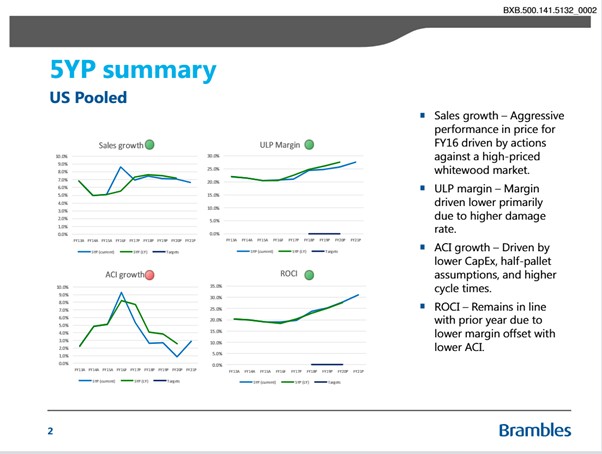
304 Brambles highlighted that:
(a) the presentation acknowledged that US Pooled’s sales revenue had been high in FY16 in part because of a high-priced whitewood pallet market, and with the price in whitewood pallet markets levelling off, expectations for future price increases were reduced;
(b) in around late-January 2016, the supply chain teams of US Pooled, CHEP NA and CHEP Global agreed to reduce the control ratio for US Pooled from 97.5% to 96.5% in the FY17 year of the CHEP NA 5YP. US Pooled was growing and had been issuing more pallets in FY16. It was therefore projected that more pallets would flow out to customers than the business would recover, leading to a lower control ratio. Alonso testified that the reduction brought the control ratio in line with FY16, and Brambles submitted that the sales pipeline as at January 2016 also supported the reduced control ratio assumption;
(c) in its FY21 5YP US Pooled adopted a reduced damage rate assumption linked to the Durability Study and forecast a drop in the damage rate of 3.8% between FY16 and FY17 (from 61.3% in FY16 to 57.5% in FY17). However, US Pooled then took a more conservative approach by assuming that the damage rate would only drop by 7.2 pps from FY16 to FY20 (from 61.3% in FY16 to 54.1% in FY20), which was half the drop forecast in the Durability Study; and
(d) that the ‘roll-up’ of the 5YP submissions by the CHEP CBUs indicated that the FY19 ROCI Target would be over-delivered, with a forecast ROCI of 23.9% by FY17 and 26.3% by FY19. Kennett testified that those numbers were reasonable and achievable.
The thrust of those submissions was that there were reasonable grounds for the US Pooled 5YP, and that the ‘roll-up’ of the 5YP submissions for CHEP Global indicated that the FY19 ROCI Target would be met, indeed over-delivered.
305 There is little evidence of objection by CHEP NA management to the growth forecast in the US Pooled FY21 5YP.
306 On around 1 February 2016 the businesses in each CHEP CBU submitted their draft 5YPs to the President and CFO of that CBU. Relevantly, US Pooled submitted its 5YP to the President and CFO of CHEP NA, Rumph and Lallatin, with an accompanying slide deck presentation.
307 Kennett’s practice was to review the 5YP submissions and slide deck presentations in advance of the 5YP review meetings and to provide the CFO of each CBU with a list of key topics for discussion during the 5YP review, together with any questions he had about the submissions or slide decks. From around 4 until 10 February 2016 Kennett engaged with Lallatin about the draft CHEP NA FY21 5YP and raised a number of queries, to which Lallatin responded.
308 Between 1 and 4 February 2016, the CHEP FP&A team under Kennett’s supervision prepared an initial ‘roll-up’ or consolidation of the CHEP Global FY21 5YP. In an email to Mackie and Alonso on 4 February 2016 Kennett noted that the ‘roll-up’ indicated CHEP Global FY19 ROCI of 26.3%. This was on target with the ELT Guidance Note projection of “>26.2%”. Kennett gave evidence that that level of ROCI growth was reasonable and achievable.
309 From around 9 to 10 February 2016, Kennett and others conducted 5YP review meetings with the President and CFO of each CBU. Relevantly to CHEP NA, on 10 February 2016 they met with Rumph, Lallatin, Mackie and Alonso and others in the CHEP NA 5YP review meeting. The CHEP NA FY21 5YP (including the US Pooled 5YP) was agreed at or shortly after that meeting.
310 The CHEP NA FY21 5YP was consistent with the “medium-term commitments” stated in the ELT Guidance Note of sales revenue growth of 7-9% pa, and ROCI of 20% by FY19.
311 Between 8 and 15 February 2016 Kennett prepared several drafts of the consolidated 5YPs for the CHEP CBUs. On 14 February 2016 he produced a draft presentation with the self-explanatory title “Pallets First Cut 5YP” and sent it to Gorman, Todorcevski, Scaiff and others, and copied it to Mackie and Alonso.
312 On 15 February 2016 Mackie, Kennett, Alonso and others presented the proposed CHEP Global 5YP to Gorman and Todorcevski at a CHEP Global 5YP review meeting. The executive summary of the presentation included the following:
• CHEP Pallets 5 Year Plan FY17-FY21 is expected to deliver beyond guidance on all key dimensions
• Overall shape is on track with prior year and over-delivering on FY19 ROCI (even after forex impact);
• Boosted by a strong FY16F above budget
• First year of the plan to be worked on in the Budget process
…
• Growth driven primarily by white wood conversion across all CBUs
Kennett gave evidence that the expectation that CHEP Global would deliver beyond guidance on all key dimensions was based on the financials he had considered, analysed and reviewed with Mackie, Alonso and others, although he said that there was more work to do on the FY17 numbers. The thrust of Kennett and Mackie’s evidence on affidavit and in cross-examination was that they considered the numbers in the CHEP Global 5YP to be reasonable and achievable.
313 The evidence shows some later versions of the CHEP Global 5YP but the changes were not material. The final version titled “Pallets 5YP BSR” was presented at the Business Strategy Review on 3 March 2016, at which the attendees included Gorman, Todorcevski, Kennett, Mackie and Alonso. The revisions to the numbers in the “Pallets First Cut 5YP” were relatively minor.
314 The Pallets 5YP BSR presentation projected that CHEP would achieve or exceed the “medium-term commitments” stated in the ELT Guidance Note. In relation to the numbers for FY17, it said that the “[f]irst year of the plan [is] to be worked on in the Budget process” but provided for the following:
(a) in sales revenue, greater than 7% growth;
(b) in Underlying Profit, improvement to Return on Sales (ROS) to greater than 22%. (Return on Sales is a metric showing Underlying Profit growth over time, calculated by dividing Underlying Profit by sales); and
(c) ROCI growth, improvement to greater than 23.5%.
Those numbers reflected the ELT Guidance Note.
8.5 Setting the FY17 budgets
8.5.1 The timetable
315 The process and timetable for setting the FY17 budgets for the CHEP CBUs, consolidating them into the CHEP Global budget, and then consolidating them into the Group FY17 budget was broadly the same as in previous years. Relevantly to CHEP Global, Kennett and the FP&A team undertook preparations from September to October 2015, out of which came the FY21 5YP and FY17 budget instructions and template documents, which set out the timelines, key dates, and assumptions to be adopted in the FY21 5YPs and FY17 budgets for the business units and for CHEP Global. The process for the FY17 budgets in CHEP Global CBUs thus commenced in around November 2015.
316 On 17 December 2015 Thompsen emailed the CFOs of each CHEP CBU, attaching final FY21 5YP and FY17 budget templates, files and instructions. The key steps, dates and budget planning milestones included:
(a) 21 March 2016: the initial FY17 budget submissions of each CHEP CBU were to be loaded into BRACS;
(b) 23 March 2016: management of each CBU was to submit its initial FY17 budget presentation to CHEP Global management for review and approval, including any revisions;
(c) 30 to 31 March 2016: CHEP Global management to review the initial CBU budget submissions;
(d) 8 April 2016: CBU management to load any revisions to the CBU budget submissions resulting from the CHEP Global management reviews into BRACS;
(e) 13 April 2016: CHEP Global management were to submit the CHEP Global FY17 budget presentation to Brambles’ CEO and CFO;
(f) 22 to 25 April 2016: CHEP Global management were to present the CHEP Global FY17 budget to Brambles’ CEO and CFO, for review and approval, including any revisions;
(g) 20 May 2016: following approval, including any revisions by the CEO and CFO, CBU management teams were to load their final FY17 budgets into BRACS; and
(h) 5 August 2016: the final “flexed” Group and CBU FY17 budgets (explained below) were to be finalised in BRACS.
317 As it eventuated the FY17 budget-setting process was broadly compliant with that timetable. On 29 June 2016 the Board approved the Group FY17 budget, (which necessarily included approval of the budgets for CHEP Global and its constituent business units). Upon that occurring the CHEP NA FY17 budget (including US Pooled) replaced the first year of the existing FY21 5YP.
8.5.2 ‘Stretch’
318 Within Brambles, requests for enhanced performance from one level of management of the business to another, so as to enhance or optimise performance, were referred to as ‘stretch’. The terms ‘go-get’ or ‘white space’ were also used to refer to stretch items within a budget which were not allocated to a specific action item, project or opportunity. It was usual practice to include elements of go-get or white space in each budget, which were used to achieve budgetary goals.
319 Brambles’ lay evidence was to the effect that budget stretching was appropriate to achieve what they described as “challenging but achievable” budgets. For example, Todorcevski deposed:
Throughout the budget preparation process, it was always my focus to drive the business divisions to set budgets that reflected the potential of those businesses in the market context they operated in, while remaining achievable. The process of seeking to optimise performance from the initial budget submissions was known within Brambles as ‘stretching’ the budget. During each year that I set a budget while CFO of Brambles I stretched the business divisions to improve their initial budget submissions to a level I thought they were capable of achieving. This process of stretching the budget submissions, included multiple rounds of discussions with the Group FP&A Team and the President and CFO of each business division, with the business divisions consistently seeking to emphasise that their budgets were ‘stretched’ in circumstances where, in my experience, there was invariably room to enhance performance. …
(Emphasis added.)
320 How the stretching worked in practice in US Pooled in FY17 is disputed. The applicants contended, among other things, that performance expectations were set from the top through the ELT Guidance Note and then unreasonable top-down pressure was applied to bring the CHEP NA and US Pooled FY17 budgets into line with those predetermined goals. That was alleged to have resulted in US Pooled and CHEP NA FY17 budgets (and as a result a Group FY17 budget) which lacked reasonable grounds and did not provide reasonable grounds for the impugned FY17 Guidance and FY19 ROCI Target that Brambles announced to the market on 16 August 2016 and reiterated on subsequent dates.
321 On the other hand, Brambles contended that the formal top-down guidance provided through the ELT Guidance Note did not impose unreasonable top-down pressure. It submitted that top-down guidance was not compulsory nor required to be met and that the process of testing, analysing and challenging the bottom-up budget submissions made by the CBUs through the FY17 budget review process, which resulted in budget stretches, did not constitute unreasonable top-down pressure. Nor did it mean that the CHEP NA, CHEP Global or Group budgets lacked reasonable grounds or were unlikely to be achieved.
322 Brambles’ lay evidence was to the effect that in their respective budget review processes it was reasonable and appropriate for both CHEP Global management (principally Mackie and Kennett) to stretch the CHEP NA FY17 budget; and for Brambles’ CEO and CFO (Gorman and Todorcevski) to stretch the CHEP Global budget. They said:
(a) there were often mistakes or errors in the CBUs initial budget submissions, including where costs had been allocated to incorrect buckets, double-counting and misapplication of the budget assumptions; and
(b) the bottom-up submissions by CBUs tended to be overly conservative, or subject to ‘sandbagging’. Kennett described sandbagging as a practice in which CBU management submitted easily achievable, underestimated budgets in order to more easily achieve or outperform their budgets and therefore more easily receive short-term incentive (STI) benefits under Brambles’ executive remuneration plan. Todorcevski did not use the term ‘sandbagging’ but he described the same practice. They each said that the budget review process was aimed at optimising performance and setting “challenging but achievable” budgets.
323 Relatedly, some of Brambles’ lay witnesses testified that the budget-setting process involved a negotiation between, relevantly CHEP NA management and CHEP Global management; and then between CHEP Global management and Brambles’ CEO and CFO, in which lower-level management exaggerated their concerns regarding the level of stretch and risk in the budget as a positioning tactic in those negotiations.
324 The process of reviewing and stretching the CBU FY17 budgets took place over several months. Relevantly to US Pooled, the main steps in the budget review process were as follows:
(a) on around 24 March 2016 CHEP NA management (Rumph and Lallatin) submitted the CHEP NA (including US Pooled) FY17 initial budget submission to CHEP Global management (Mackie and Kennett) (the CHEP NA Initial Budget Submission);
(b) on around 5 April 2016 Rumph and Lallatin proposed a revised CHEP NA FY17 budget (including a revised US Pooled budget) in response to stretches sought by Mackie and Kennett (which I have called the CHEP NA First Revised Budget Submission);
(c) on around 13 April 2016 Rumph and Lallatin proposed a further revised CHEP NA FY17 budget (including a revised US Pooled budget) in response to stretches sought by Mackie and Kennett (which I have previously called the CHEP NA Second Revised Budget Submission);
(d) on around 22 April 2016 Mackie and Kennett proposed a consolidated CHEP Global FY17 budget encompassing the stretched budgets of each of the CHEP CBUs; and
(e) on around 20 May 2016 Mackie proposed a revised CHEP Global FY17 budget in response to stretches sought by Todorcevski. Those further stretches had an impact on the US Pooled FY17 budget (which I have called the CHEP Global Revised Budget Submission).
8.5.3 The role of the ELT Guidance Note
325 The parties characterised the effect of the ELT Guidance Note on the budget stretches sought and achieved in relation to the US Pooled and CHEP NA FY17 budgets in completely different ways.
326 Principally in reliance on the evidence of Mackie, Kennett and Todorcevski, Brambles characterised the ELT Guidance Note as merely setting out what Brambles ELT “would like” each CBU to deliver, and was not binding, compulsory or required to be delivered. Brambles noted that the FY21 5YP for each CBU (the first year of which being FY17) was agreed with that CBU before the FY17 budget was set. It contended that the CHEP NA (including US Pooled) Initial Budget Submissions were the result of a bottom-up process, and that the revisions resulted from a process in which CHEP Global management (including Mackie, Kennett, Martin and Alonso) analysed, tested and challenged the budget and the budget assumptions, and proposed budget improvements, until an agreed budget was reached.
327 Mackie, Kennett and Todorcevski described their involvement in the budget review process as being directed to optimising performance by setting “challenging but achievable” budgets, including by getting any pessimism, conservatism or sandbagging out of the budget. They said that they did not seek to set budgets which were not achievable, noting that that would be entirely counter-productive. Mackie described his role in the budget-setting process as managing the tension between “driving the performance of the business units to achieve growth, staying ahead of the competition”, and “managing requests for ‘stretch’ or enhanced performance from Brambles to make sure the targets ultimately set by the budget were achievable”. He said that he “anticipated needing to have multiple rounds of discussions with the business units about aspects of their proposed FY17 budgets which could be stretched to deliver more optimal and achievable levels of performance”. Brambles emphasised that the process it used to set the US Pooled, CHEP NA, CHEP Global and Group FY17 budgets was the same as in previous years, and it had a perfect record of meeting the earnings guidance it provided to the market.
328 By contrast, the applicants submitted that the evidence shows that the ELT Guidance Note set top-down expectations within CHEP NA about the expected growth in sales revenue, Underlying Profit and ROCI in FY17, which became the touchstone for Mackie’s and Kennett’s determination of the adequacy of the CHEP NA (including US Pooled) Initial and Revised Budget Submissions, and for Gorman’s and Todorcevski’s determination of the adequacy of the draft CHEP Global FY17 budget.
329 On their argument the ELT Guidance Note (and the 5YP which followed from it) operated as an anchor point for the preparation of the CHEP NA (including US Pooled) FY17 budget towards which Mackie and Kennett, and later Todorcevski and Gorman, then stretched the budgets. They contended that the evidence shows that the budget-setting process for the US Pooled and CHEP NA FY17 budgets “involved aggressive and unreasonable top-down pressure to improve budgets submitted by the business units”, that Mackie and Kennett ignored or downplayed the concerns of CHEP NA management about the level of stretch in the CHEP NA budget, and then that Gorman and Todorcevski ignored or downplayed Mackie’s concerns about the level of stretch in the CHEP Global budget.
330 Contrary to the thrust of Brambles’ lay evidence the contemporaneous email exchanges within CHEP NA management, between CHEP NA management and CHEP Global management, and between CHEP Global management and Brambles’ CEO and CFO indicated that the budget review process for the CHEP NA and CHEP Global FY17 budgets was not, in practice, centrally directed to dragging conservatism or pessimism out of the budget whether arising from sandbagging or otherwise. I consider the account that can be drawn from contemporaneous emails to be substantially more reliable than the lay evidence, largely a reconstruction put together five years after the relevant events, as to what the witness thought at the time about otherwise mundane business matters which there was no particular reason for them to recall or to have taken particular note of.
331 It is appropriate to infer that the primary focus of Mackie and Kennett in reviewing the draft budget submitted by CHEP NA, and later Gorman and Todorcevski in reviewing the draft budget submitted by CHEP Global, was to end up with a budget at a Group and CBU level which was, as near as possible, aligned with the expectations set in the ELT Guidance Note. Their primary focus was on bringing the business units into line with those predetermined targets.
332 That is not, though, to find that getting conservatism or pessimism out of the CHEP NA and CHEP Global budgets so as to optimise performance, rooting out any sandbagging and finding further growth opportunities were not motivating factors for the budget stretching that occurred. They were. But there were numerous contemporaneous emails and documents which support an inference that the primary focus of Mackie, Kennett, Gorman and Todorcevski was achieving alignment with the ELT Guidance Note (and the 5YP which followed it). That inference also finds support in the fact that the budget stretching went beyond getting conservatism or pessimism out of the budgets and ultimately resulted in a CHEP NA budget which involved what CHEP NA management considered to be a “huge stretch” and hence to carry real risks to achievability.
333 It is also not to find that Mackie or Kennett deliberately sought to set a budget for CHEP NA (or that Gorman or Todorcevski deliberately sought to set a budget for CHEP Global) that they did not consider to be achievable. It would be counter-productive for them to deliberately take that course. Rather, I infer that in FY17 their primary focus on achieving alignment with the predetermined goals of Brambles’ top-level management led them into error in relation to the reasonable achievability of those budgets.
8.6 The CHEP NA Initial Budget Submission - February to 24 March 2016
334 Over January and February 2016, each of the CHEP CBUs worked to draft their FY17 initial budget submissions. That work included obtaining and assessing estimates provided by Alonso regarding the effect of supply chain savings initiatives on the FY17 budgets and obtaining guidance about the budget assumptions from Kennett.
335 Relevantly to US Pooled, on 30 January 2016, Young (Senior Vice President, Supply Chain, CHEP NA) emailed Alonso, attaching a document titled “5 year plan Key Comparison Summary - US Pooled”, which set out the reduced damage rate assumption in the US Pooled FY21 5YP. It forecast damage rates of 61.3% in FY16, 57.5% in FY17, 56.2% in FY18, 55% in FY19, 54.1% in FY20 and 54.8% in FY21.
336 As earlier explained, the ‘damage rate’ represents the percentage of returning pallets which require conditioning or repair. At the time the US Pooled FY17 budget was prepared, a one pp change in the damage rate in the US Pooled business equated to a change in direct costs of approximately $5-6 million. The assumed reduction in the damage rates in the US Pooled FY21 5YP were linked to the Durability Program rolled out on 1 July 2015, which was based on the Durability Study. Over the five years from FY16 to FY20 the program was expected to deliver a total net cumulative benefit to CHEP Global of approximately $91.3 million in gross savings ($112 million of total cumulative gross savings at a total investment cost of $20.7 million), or $35 million in annual benefits when fully implemented at year five of the program.
337 There were three iterations of the initial budget submission by US Pooled:
(a) the first draft, produced on or around 26 February 2016;
(b) a revised draft, produced on or around 15 March 2016; and
(c) the finalised initial budget submission loaded into BRACS on 24 March 2016.
338 On 26 February 2016, the CHEP NA ELT met and reviewed a presentation titled “FY17 Budget CHEP USA Pooled” (26 February US Pooled budget presentation), which included a comparison of the key financial metrics between: (i) the US Pooled FY16 budget; (ii) the FY16 February forecast for US Pooled; (iii) the first year of the US Pooled FY21 5YP which had recently been completed; and (iv) the draft US Pooled FY17 budget at that point. In February 2016 CHEP NA (including US Pooled) had (upwardly) reforecast its FY16 sales revenue and Underlying Profit (FY16 February Forecast), and that was the most recent FY16 budget for CHEP NA and CHEP Global.
339 As Brambles submitted, the metrics in that early draft budget show:
(a) the US Pooled FY17 budget at that point was more conservative than the first year of the recently completed 5YP, in that it budgeted for lower sales revenue, lower RPI, higher overheads, lower profit and higher capital expenditure;
(b) the initial control ratio was 96.5%, the same as the final control ratio adopted in the first year of the FY21 5YP; and
(c) the damage rate was forecast to be 3.8% lower than in FY16 (being the difference between 61.3% and 57.5%).
340 The draft US Pooled FY17 budget included a summary of projected sales revenue which showed:
(a) a baseline of $1,506 million for sales already secured from existing customer contracts;
(b) sales volume growth of $72.8 million from a combination of organic growth and growth from new wins, and $13.5 million from price / mix, totalling $1,592.3 million; and
(c) in relation to the new wins it provided (in a table prepared and produced by Brambles):
($US million) | Draft US Pooled FY17 Budget (26 February 2016) |
New wins | 78.8 |
Unidentified new wins | 41.9 |
Other new wins | 36.9 |
(Losses) | (21.1) |
Net new wins | 57.7 |
341 By contrast, the FY16 February Forecast had projected new wins of $76 million, losses of $(17.1) million, and net new wins of $58.9 million. Where in these reasons I rely on any table produced by either of the parties, unless I say otherwise, I do not understand there to be any dispute about the material accuracy of the table.
342 Over late-February and early March 2016, CHEP NA management (principally Rumph and Lallatin) reviewed the draft initial budget submissions from its constituent business units including US Pooled and asked them to identify further opportunities for budget improvements. Alonso said, and I accept, that the goal of that exercise was for each team to review the suggestions made by CHEP NA management and provide feedback on whether they were realistic and achievable.
343 During this period Alonso pushed for a more conservative view of the US Pooled damage rate and to reduce the forecast full-year drop in the damage rate between FY16 and FY17 from 3.8% to around 2% (which was required to get the forecast FY16 aggregate damage rate of 61.3% to the forecast FY17 damage rate of 57.5%) due to:
(a) the Durability Study’s assumption that the cycle time was fixed where a more conservative assumption was that new and improved pallets would stay longer in the supply chain; and
(b) the practice of Walmart of only returning damaged pallets pursuant to its specific contractual arrangement with US Pooled (which had been a factor adversely impacting the CHEP NA damage rate for more than eight years).
344 On 15 March 2016, the CHEP NA ELT held a follow-up meeting and reviewed a presentation titled “FY17 Budget, CHEP USA Pooled, March 15th Leadership Meeting” (15 March US Pooled budget presentation), which adjusted the 26 February 2016 draft US Pooled FY17 budget. The presentation provided for:
(a) a reduction in the damage rate to 59.3%, which represented a 2% drop from 61.3% in the FY16 February Forecast (the damage rate assumption); and
(b) a revenue stretch of the initial draft US Pooled FY17 budget of $13.7 million, which Martin (Senior Vice President, Sales and Customer Operations, CHEP NA) testified was to be achieved through volume growth (one million additional pallet issues) and RPI. The revenue stretch included an increase in unidentified wins from $41.9 million to $43.2 million, and a reduction in “losses” from $(21.1) million to $(18.5) million. The increased revenue included the following in relation to customer ‘wins’ which involved a $3.9 million increase in ‘net new wins’:
($US million) | Draft US Pooled FY17 budget (26 February 2016) | Revised draft US Pooled FY17 budget (15 March 2016) |
New wins | 78.8 | 80.1 |
Unidentified new wins | 41.9 | 43.2 |
Other new wins | 36.9 | 36.9 |
(Losses) | (21.1) | (18.5) |
Net new wins | 57.7 | 61.6 |
The presentation also involved other changes Brambles described as “mixed”. For example, while RPI and Underlying Profit increased, so too did overheads and capital expenditure.
345 The assumed 59.3% damage rate (which was 2% lower than the 61.3% in the FY16 February Forecast and which, as it eventuated, approximated the actual damage rate in FY16) remained constant throughout later iterations of the CHEP NA FY17 budget.
346 The 15 March US Pooled budget presentation included a schedule of “Risk and Opportunities”, which identified the risks and opportunities faced, the probability of their occurrence, and the potential quantum impact on sales revenue, Underlying Profit and cash flow if each risk or opportunity transpired. The R&O schedule said that there was a 25% risk that the budgeted stretch in sales volume would not be achieved. Martin testified that that translated to approximately $7.8 million in revenue terms or $1.5 million in Underlying Profit.
347 Todorcevski described the purpose of such R&O schedules as follows:
…to itemise issues which may impact business performance and allow for a discussion to plan the ways in which risks may be managed or mitigated, and opportunities may be captured. Accurate quantification of risks and opportunities is a complex and nuanced process that requires industry experience and deep market knowledge. Throughout my career, I have used risk and opportunity schedules to frame how budgets and forecasts are positioned, not to derive a risk weighted financial outcome incorporating those risks and opportunities.
348 Brambles submitted, and I accept, that such R&O schedules involved a management judgement, and were an approximation of identified risks and opportunities rather than a “mathematical science”. Management judged whether it was more or less probable that something was likely to happen, and the probabilities were listed as multiples of 25 pps.
349 Todorcevski, Mackie, Kennett and Martin gave evidence to the effect that risks tended to be highlighted or emphasised more than opportunities in R&O schedules in initial budget submissions. Todorcevski, Mackie and Kennett said it was common for initial budget submissions to be skewed towards risks, in part due to sandbagging. Martin said that from his perspective in order to “cover our bases” it was important to highlight all potential risks and to have a low threshold for identifying potential risks, to ensure that the final budget was realistic and achievable. He said that it was less important to focus on potential opportunities because if an unexpected or unidentified opportunity materialised, “it would not negatively impact our ability to meet budget”.
350 As noted above, on or around 24 March 2016 each of the CHEP CBUs loaded their initial budget submissions into BRACS. Between 24 March and 31 March 2016, Kennett worked with the FP&A team, along with Mackie, Alonso and Scaiff to analyse the budget submissions of the CHEP CBUs, identify key topics for discussions during the budget reviews with each CBU, and to begin developing a consolidated CHEP Global FY17 budget presentation.
351 The initial budget submissions took the form of slide decks. As Brambles submitted, the US Pooled initial budget submission included the following metrics:
($US million) | Draft US Pooled FY17 budget (26 February 2016) | FY16 February Forecast | FY17 5YP | Initial Budget Submission (24 March 2016) |
Revenue | 1,468.5 | 1,508.2 | 1,617.5 | 1,606.1 |
RPI ($ / unit) | 5.11 | 5.21 | 5.26 | 5.27 |
Damage rate | 60.3% | 61.3% | 57.5% | 59.3% |
Control ratio | 96.9% | 95.5% | 96.5% | 96.3% |
Direct costs238 | - | 1,038 | - | 1,093 |
Overheads | 115.2 | 120.8 | 122 | 130.6 |
Underlying Profit | 300.4 | 317.6 | 360 | 347.6 |
Capex | 302.1 | 335.7 | 295.3 | 365.7 |
ROCI | - | 19.4% | 20.4% | 19.2% |
352 That submission showed the following forecast growth rates in FY17 for US Pooled, as compared with the FY16 February Forecast:
Revenue | Underlying Profit | ROCI |
$1,606 million or 6.5% growth rate | $347.6 million or 9% growth rate | 19.2% or (0.2) pp variance |
353 The CHEP NA Initial Budget Submission forecast the following growth rates.
Revenue | Underlying Profit | ROCI |
$2,373 million or 5.6% growth rate | $443 million or 7% growth rate | 19.2% or (0.1) pp variance |
354 With respect to the US Pooled’s forecast sales revenue, Brambles highlighted that:
(a) the forecast growth rate of 6.5% was lower than the 8.4% growth projection in the FY16 February Forecast and the 7.2% growth projection in the initial year of the US Pooled FY21 5YP;
(b) the forecast growth rate of 6.5% comprised:
(i) 1.0% of organic growth ($15 million), which represented a slower rate of growth than the 1.3% organic growth in the FY16 February Forecast and was at the bottom end of the 1-2% organic growth range expected for a CHEP mature market business;
(ii) 1.3% of pricing growth ($19 million), which was in line with the 1.3% of pricing growth in the FY16 February Forecast and towards the bottom end of the 1-2% price growth range for CHEP’s mature market businesses;
(iii) 4.1% of volume growth from net new wins ($61.6 million), which was below the rate of 4.3% growth in net new wins in FY16; and
(iv) 0.1% of “other” growth.
355 Brambles highlighted that the stretches or improvements in the US Pooled budget submissions between 26 February 2016 until the initial budget submission was made on 24 March 2016 can be summarised with respect to customer ‘wins’ as follows:
($US million) | Draft US Pooled FY17 budget (26 February 2016) | Revised draft US Pooled FY17 budget (15 March 2016) | Initial Budget Submission (24 March 2016) |
New wins | 78.8 | 80.1 | 89.5 |
Unidentified new wins | 41.9 | 43.2 | 52.6 |
Other new wins | 36.9 | 36.9 | 36.9 |
(Losses) | (21.1) | (18.5) | (27.9) |
Net new wins | 57.7 | 61.6 | 61.6 |
It said that those increases were only modest increases on the FY16 February Forecast in which new wins were $76 million; customer losses were $(17.1) million; and net new wins were $58.9 million.
Brambles produced the following table comparing new wins and net new wins in the US Pooled initial budget submission to actual performance in previous years.
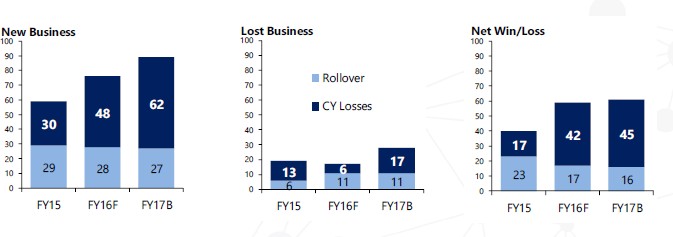
356 Brambles submitted in respect of US Pooled:
(a) direct costs increased from $1.038 million in the FY16 February Forecast to $1.093 million in the CHEP NA Initial Budget Submission which represented an increase of $55 million. That reflected:
(i) higher direct costs due to increased cost expected from the greater volume of increased pallets in FY16;
(ii) an increase in pallet repair costs of $10.8 million compared to the first year of the FY21 5YP, which arose from applying the higher damage rate of 59.3% instead of 57.5%;
(iii) increased fuel prices; and
(iv) increased collection costs due to “retailer pressure” (where retailers refused to meet the cost of self-returning pallets to CHEP);
(b) the CHEP NA Initial Budget Submission provided for a relatively high increase in indirect costs, in that:
(i) overheads increased by $8.6 million compared to the first year of the FY21 5YP;
(ii) overheads increased by $10 million compared to the FY16 February Forecast; and
(iii) other indirect costs included an additional $0.5 million IPEP charge on the basis of increased NPD transfers; and
(c) with respect to capital expenditure:
(i) the proposed capital expenditure of $365.7 million represented an increase of $60.4 million compared to the initial year of the FY21 5YP, primarily driven by the budgeted purchase of 2.5 million additional pallets;
(ii) this in turn was the result of the drop in the assumed control ratio from 97.5% to 96.3% and an increased cycle time; and
(iii) the increased cycle time was due to changes CHEP NA was observing in both distributor and retailer inventories, driven by restocking, changes to customer inventory policies and increased transfers to NPDs, each of which drove up cycle times.
357 The CHEP NA Initial Budget Submission included an R&O schedule relating to US Pooled which is reproduced below.
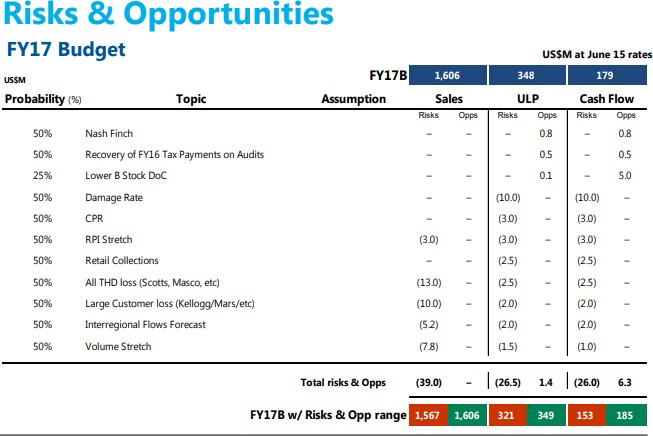
358 It also included an R&O schedule relating to CHEP NA, which is reproduced below.
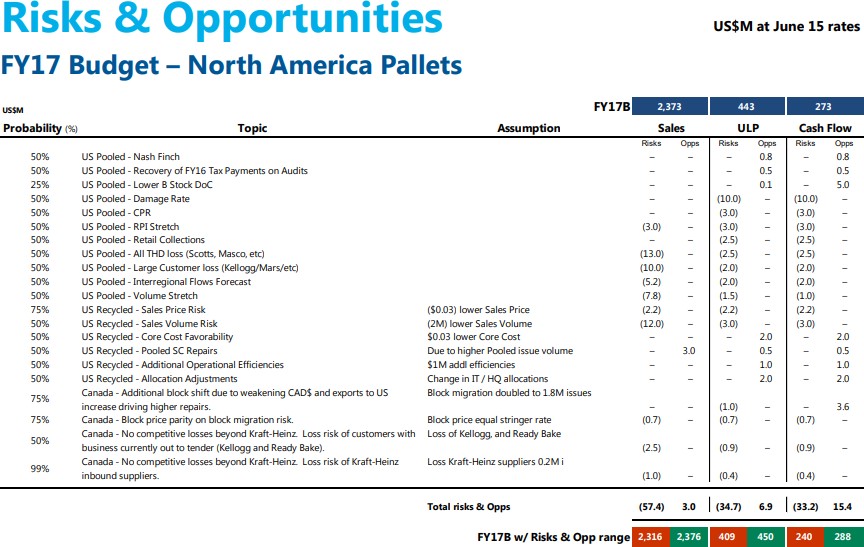
359 Brambles submitted that those risks and opportunities were similar to those in the budget submission dated 15 March 2016, except that the revised R&O schedule added:
(a) $3 million in Underlying Profit risk assigned to CPR at 50% probability (as a result of the forecast increase in NPD volumes), and $2.5 million in Underlying Profit risk assigned to retail collections at a 50% probability (due to increasing retailer pressure on pallet returns); and
(b) $7.8 million in risk to revenue (or $1.5 million in Underlying Profit) assigned to sales volume stretch, at 50% probability.
In relation to the 50% risk to revenue from sales volume stretch, Brambles relied on Martin’s evidence that he was not worried about that risk and was confident in its achievability.
360 Todorcevski testified that the sales revenue and Underlying Profit in the subsequent revised US Pooled draft budget were tracking on course with his expectations, and that the price growth of 1.3%, organic growth of 1.2% and net new wins growth of 4.1% were within the parameters of what he expected for a mature pallets business. He considered that the budget for approximately $53 million in unidentified wins was achievable based on his observation of the track record of the US Pooled sales team. He also said that he had reviewed the opportunities in the US Pooled sales funnel during BSR meetings and periodically and he did not recall having any concerns about the achievability of the ‘net new wins’ target set by US Pooled. Mackie said that he thought that the $10 million in higher overheads for US Pooled was potentially higher than necessary, and considered that the damage rate projections and NPD costs had been adequately budgeted for.
361 The applicants highlighted that the R&O schedule assessed a 50% chance that the damage rate in US Pooled would not reduce by an average of 2% across the year, and the consequence, should the damage rate not reduce, would be a reduction in Underlying Profit of approximately $10 million. As will be seen, the risk that the damage rate would not improve to 59.3% continued to be referred to in R&O schedules in the various revised draft US Pooled FY17 budgets that followed, and the final US Pooled FY17 budget. The applicants submitted that the R&O schedules in relation to US Pooled contained a raft of risks and opportunities, which greatly outweighed any upside opportunities the businesses identified . They said that, on a non-risk-adjusted basis for US Pooled, there was $39 million in risk to sales revenue (with every risk assessed at a 50% probability), and no opportunities to increase revenue, and $26.5 million in risk to Underlying Profit, with only $1.4 million in opportunities, giving rise to net unadjusted risk of $25.1 million. They noted that most of the identified risks and opportunities were given a probability of 50%, with some probabilities exceeding that amount. In his report, at the CHEP Global level, Mr Samuel assessed the probability-adjusted net risks to sales revenue to be $39.8 million and to Underlying Profit to be $23.1 million.
362 The applicants produced the following summary (derived from Mr Samuel’s report) of the unadjusted and probability-adjusted risks and opportunities identified in the initial budget submissions:
Unadjusted Risks and Opportunities Excluded from the Initial Budget Submissions | ||||||
($US million) | Sales revenue | Underlying Profit | ||||
Opps | Risks | Net | Opps | Risks | Net | |
US Pooled | 0 | (39.0) | (39.0) | 1.4 | (26.5) | (25.1) |
CHEP NA | 3.0 | (57.4) | (54.4) | 6.9 | (34.7) | (27.8) |
CHEP Global | 13.4 | (94.3) | (80.9) | 14.6 | (57.4) | (42.8) |
Probability-Adjusted Risks and Opportunities Excluded from the Initial Budget Submissions | ||||||
($US million) | Sales revenue | Underlying Profit | ||||
Opps | Risks | Net | Opps | Risks | Net | |
US Pooled | 0 | (19.5) | (19.5) | 0.7 | (13.3) | (12.6) |
CHEP NA | 1.5 | (29.9) | (28.4) | 3.4 | (18.5) | (15.1) |
CHEP Global | 6.8 | (46.6) | (39.8) | 7.2 | (30.2) | (23.1) |
363 The parties disputed the significance of the risks and opportunities in the R&O schedules. The applicants contended that the identification of risks such as those in the R&O schedules, without modifying the budgets to take those risks into account, was unreasonable and resulted in excessive optimism in the budgets. Brambles said that that approach to the identified risks and opportunities was erroneous.
364 The applicants highlighted that in this period US Pooled’s major competitor, PECO, was aggressively pursuing some of its major customers in the second half of FY16, including Kellogg’s, Niagara and Mondelez. On 23 March 2016, it was confirmed that US Pooled had lost the large Kraft-Heinz account to PECO, which was worth $9.4 million per year.
365 The applicants submitted that the US Pooled initial budget submission was based on some unreasonable assumptions and was “ambitious from the outset”. But, as Brambles noted, the applicants did not contend that US Pooled’s initial budget submission was itself over-stretched. In their opening submissions the applicants said that top-down pressure from management “overbore or overcame the bottom-up aspects that were coming from the business units, in particular from CHEP CBUs because, of course, only the business units could really develop a budget for their own operations”. That is, the applicants relied on the stretching that occurred to the CHEP NA (including US Pooled) budget after the initial budget submissions were made on 24 March 2016, rather than the adjustments that took place in the course of CHEP NA management developing and putting forward their own initial budget submission.
8.7 The First Revised Budget Submission - 24 March to 5 April 2016
366 Between 24 March 2016 and 31 March 2016, Kennett, Mackie, Alonso, Scaiff and members of the CHEP Global FP&A team worked to review the CHEP CBU initial budget submissions. I accept Kennett’s evidence that he analysed the submissions, identified key topics for discussion during the forthcoming budget review meetings with CBU management, and began developing a consolidated CHEP Global FY17 budget.
367 During the period from 24 March to 13 April 2016, Mackie, Kennett and others, including Alonso in relation to supply chain issues, interacted with the Presidents and CFOs of the CHEP CBUs (relevantly to CHEP NA and US Pooled, principally with Rumph and Lallatin) to analyse, test and challenge the assumptions in their initial budget submissions.
368 On 23 March 2016, Lalita Limpanatevin (Senior Manager, Finance, FP&A) emailed Mackie, Kennett, Alonso and Cesare Gussago (Vice President Strategy and Planning, CHEP EMEA), copied to Thompsen, attaching the initial budget submissions of each of CHEP’s business units, including CHEP NA. In an email to Kennett on 24 March 2016, in which Thompsen was copied, Mackie showed his focus on achieving alignment with the ELT Guidance Note, by immediately asking for information to show where the initial budget submission sat as against that guidance. Thompsen acknowledged the importance of that guidance in a reply email the same day. He said:
Sorry for the oversight. We should have included this in the package.
369 On 27 March 2016, Kennett emailed Mackie and Thompsen and noted the following “key insight”:
First things first: you have seen that we are short of the 5YP ULP by about 25M
This showed his focus on aligning the CHEP Global FY17 budget with the ELT Guidance Note (and the 5YP that followed it), notwithstanding that the Pallets 5YP BSR presentation provided that the FY17 budget numbers were to be worked on in the FY17 budget-setting process.
370 On 29 March 2016, Mackie emailed Kennett and asked him to provide the “absolute gap” on Underlying Profit. On 30 March 2016, Kennett circulated a ‘Discussion Document’ to senior personnel including Mackie and Alonso.
371 The covering email to the Discussion Document said:
… the attached discussion document should ensure we are all on the same page; first understanding the current forecast, and where we put the stretch….
(Emphasis added.)
372 The Discussion Document contained a table comparing the roll up of the initial budget submissions from the CHEP CBUs, and the guidance provided by Brambles in the ELT Guidance Note and the first year of the CBUs’ five-year plans that had been completed by around 3 March 2016. The table included red, amber and green notations. Kennett explained his “traffic light” notation by stating (in relation to another presentation) that “the green in general…refers to all lights on green and everything is on track. The amber means be aware there are some things here. And the red means be careful because there’s something we need to address”. He also said that a red traffic light indicated “a high level of risk”.
373 The relevant table is reproduced below.
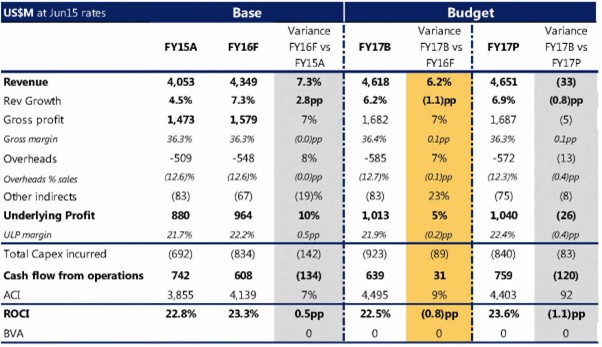
374 The table identified a shortfall to the ROCI growth in the ELT Guidance Note of approximately 80 basis points, and Kennett attributed a “red light” to that discrepancy. He also ascribed a red traffic light to revenue growth and Underlying Profit margin growth. In the attached discussion paper Kennett identified that “in order to deliver the 5YP ROCI, but only reduce ACI by -50M, we would need [$]32M additional ULP”. The main shortfall in forecast sales growth was within CHEP NA, with US Pooled behind $11M and US Recycled behind $29M. Kennett sent the table to Mackie and said that the “absolute gap” to the Underlying Profit projected in the 5YP was $26 million.
375 Another table in the Discussion Document, reproduced below, compared the rolled-up initial budget submissions of the CHEP CBUs with the February FY16 Forecast, the ELT Guidance Note and the FY17 year of the 5YP.
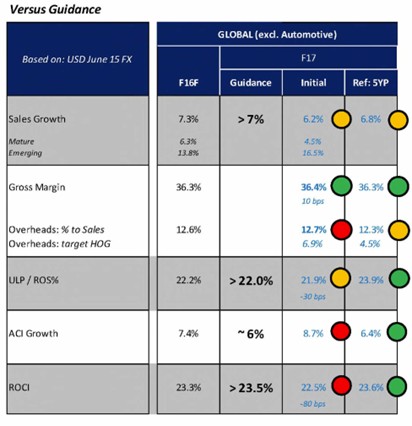
376 That is another example of Kennett’s focus on the requirements of the ELT Guidance Note. The table identified that the initial budget submissions fell below the guidance in the ELT Guidance Note and below the FY17 year of the FY21 5YP, noting:
(a) sales growth of 6.2%; below the “greater than 7%” provided in the ELT Guidance Note and below the 6.8% in the FYP (with $40 million of that shortfall attributable to CHEP NA);
(b) ACI growth of 8.7%; below the approximately 6% provided in the ELT Guidance Note and below the 6.4% in the 5YP (which was driven by $70 million more capital expenditure in US Pooled and $25 million more capital expenditure in CHEP Europe); and
(c) ROCI of 22.5%; below the “greater than 23.5%” provided in the ELT Guidance Note and below the 23.6% in the 5YP (driven by a $26 million shortfall in Underlying Profit and $100 million in higher ACI).
The Discussion Document stated that in order to deliver the ROCI forecast in the FY17 year of the FY21 5YP, it would need to find $32 million in additional Underlying Profit and to reduce ACI by $50 million. The shortfalls against the Guidance Note in respect of ACI growth and ROCI were given a red traffic light notation, indicating something that needed to be addressed.
377 Mackie emailed the President of each CHEP CBU (and Kennett and Alonso) on 31 March 2016, and said:
I have been working my way through the detail [of the CHEP CBU Initial Budget Submissions] over the weekend and we have a budget that is going backwards on our current momentum and is off what was in my view relatively modest guidance from Brambles this year. Guidance that has ROCI improving by only 20bpts on FY16F. I will not submit this add up because I think we are better than that as a team but I also want to make sure we confront the main issues. The reviews over the next few days will focus on:
• Getting the big issues clearly on the table
• Flushing out the errors/conservatism - hopefully without too many deep dives but the opportunity looks substantial
• Identify what we need to do to take charge of the remaining financial issues created.
There, in another example of his primary focus, Mackie framed the budget stretches he anticipated proposing by reference to achieving alignment with the ELT Guidance Note.
378 In cross-examination, Alonso was taken to this email and he accepted that Mackie wanted a CHEP Global FY17 budget that was close enough to the ELT Guidance Note, and that he wanted to push for an aggressive budget. He said such pushback from higher management was a process that happened every year and he described it as “a kind of negotiation”.
379 The CHEP NA budget review meeting was held on 31 March 2016, attended by Mackie, Kennett, Alonso, Rumph, Lallatin, Thompsen, Gussago, Joshua Glick (Vice President Strategy and Planning, Americas), and Moreno. Mackie deposed that following the meeting CHEP NA management were “required to submit a revised version of its budget, after making adjustments reflecting on the matters discussed at the meeting”.
380 Kennett deposed that in the CBU budget review meetings he and Mackie did not give specific instructions for budget stretches. Instead, he said “we indicated during the meetings that Mackie, Alonso and I would consider all of the reviews conducted and evaluate the overall position and opportunity, which we would then communicate back to each CBU in or around early April”. He said that notwithstanding that he had conducted his own analysis of where he thought stretches could be made, when communicating back to each CBU he would ask the CBUs to supply their own improvements. He deposed:
My reason for doing it this way was because I thought it was important to ensure ownership of the numbers by the CBUs, to make sure they were identifying and submitting numbers they thought were achievable, that is, a ‘bottoms-up build’ of the budget. Consistent with this approach, I did not share this GoGet analysis with the CBUs.
(Emphasis added.)
381 On 2 April 2016, Kennett emailed the CFOs and Presidents of each CBU, copied to Mackie, Alonso, Thompsen and Gussago, asking each CBU to send its proposed updates to its current budget submissions by 4 April 2016, directly to Thompsen.
382 Under cross-examination, Kennett maintained that he and Mackie did not give specific instructions for budget stretches at the CHEP NA budget review meeting. He said that his memory was clear about the budget review meetings for FY17 with the various CBU management teams and that he was “absolutely confident” that “we never used to give any targets at those meetings”. He said that instructions were not given at those meetings as to what CHEP NA’s business units should go and try to achieve in terms of improvements to their budget.
383 That was not, however, the position. Kennett was taken to an email Lallatin sent to some CHEP NA executives on 1 April 2016 (immediately after the budget review meeting), in which he said:
The budget review with Pete [Mackie] and Buster [Kennett] went well today, but we have some work to do. While Pete understands what is driving our variance to the 5YP numbers, he would like us to improve ROCI for the US Pooled business to a number as close as possible to 20.4% (the 5YP ROCI). To achieve that we would need to improve ULP by $12M and ACI by $42M, or some combination of the two. Kim [Rumph] and I agreed to claw back as much as we possibly can, but told him it would be a major stretch to get all the way to 20.4%.
(Emphasis added.)
384 Kennett said that he could not recall any such direction or instruction by Mackie, but in light of that email he accepted, in my view appropriately, that Mackie had in fact instructed CHEP NA management to stretch ROCI in US Pooled to a number “as close as possible to 20.4%”. That conclusion is also supported by an email Lallatin sent to Rumph, Young and Martin on 4 April 2016, where Lallatin said:
Pete [Mackie] indicated he would like us to get back to the 5YP ROCI of 20.4%, which is incredibly difficult to do.
(Emphasis added.)
385 I infer that Mackie gave that instruction, and that he did so notwithstanding that Rumph and Lallatin told him that it would be a “major stretch” for US Pooled to achieve 20.4% ROCI in FY17. That also supports an inference that his primary focus was achieving alignment with the ELT Guidance Note.
386 The conclusion that Mackie gave that instruction also jars with his evidence that “[i]t was not unusual for a budget submission to differ from the relevant 5YP, as the preparation of the budget involved more rigorous bottom-up analysis of the upcoming financial year whereas the five year planning process focused on analysing the longer term direction of the business”. By giving that instruction to CHEP NA management Mackie gave more importance to the ROCI target in the 5YP than to the more rigorous ‘bottom-up’ analysis of likely FY17 earnings in CHEP NA’s initial budget submission.
387 Lallatin’s 1 April 2016 email set out a list of action items arising out of the CHEP NA budget review meeting. In relation to US Pooled, it listed the following action item:
US Pooled Objective - Improve ROCI and get as close to 5YP as possible (20.4%) - Would need ULP $12M, ACI $42M.
(Emphasis added.)
388 Kennett denied that there had been a discussion of that action item in the budget review meeting. I give little weight to that evidence, in circumstances where:
(a) his recollection of what took place in the budget review meeting was poor, and wrong in respect of his main point that “we never used to give any targets at those meetings”;
(b) Lallatin’s email records that he and Rumph told Mackie that achieving 20.4% ROCI in FY17 would involve a “major stretch”. I doubt they would have said that without there being some ensuing discussion of the types of steps that would be necessary if that outcome was to be achieved; and
(c) Lallatin’s email included a list of action items, most of which Kennett accepted had been discussed at the budget review meeting, and I can see no good reason why this important action item would not have been discussed.
389 Kennett’s preparedness to maintain that he had a good recollection of what took place at an unremarkable budget review meeting around six years earlier, when he did not, contributed to my doubts as to the reliability of his testimony as it is inconsistent with or at least is inconsistent with statements in, or inferences open to be drawn from, contemporaneous documents and emails. I do not make any adverse finding as to his credit; instead, the finding reflects my view as to the weight appropriately to be given to the documentary record as compared to his recollection.
390 The applicants submitted that Lallatin’s email “fundamentally undermines” Brambles’ contention that the ‘bottom-up’ budget submissions for FY17 that fed into the Group FY17 budget were developed free of “unreasonable interference from management”. I am satisfied by this email and a number of other emails and memos that the CHEP NA (including US Pooled) budget-setting process was not genuinely bottom-up, and there was substantial top-down pressure to achieve a CHEP NA and CHEP Global budget which would align with the ELT Guidance Note. But I do not consider it to be “unreasonable” for Mackie to review the draft budget put forward by CHEP NA and put pressure on Rumph and Lallatin to do better. Such pressure is a common-place part of budget-setting processes in large and medium-sized businesses.
391 The email Lallatin sent to Rumph, Young and Martin on 4 April 2016 (referred to above), set out some “proposed improvements” to the US Pooled FY17 budget, which Lallatin said was “a real stretch”. That ROCI was still 40 basis points short of the FY17 year of the US Pooled 5YP which projected ROCI of 20.4%, and thus short of where Mackie indicated he wanted US Pooled to get.
392 Rumph replied to Lallatin’s email on 4 April 2016, copied to Martin and Young, and said:
Matt - This will be a tough deliver. I suggest we stop here and submit at the 20%.
393 Lallatin responded the same day, and said:
I agree this is a major stretch. There is no buffer. This reflects a $41M improvement in ULP, versus a $32M improvement this year. If you prefer we can scale it back to 19.8% ROCI, which is about $3M of ULP.
(Emphasis added.)
394 In a real sign of concern about the level of further stretch that might be required by Mackie and Kennett, Rumph there took the others off the email chain and emailed Lallatin alone. She suggested that, instead of accepting a stretch to 20% ROCI, they should instead “hold back a little” and propose ROCI at 19.8% for FY17. She said:
Just between us -
What would you think if we tried only taking to 19.8%? If we don’t hold back a little I think Mike will and we will be the gap closer for [CHEP Global] and the other guys will get set up with a more realistic budget than ours. Pete [Mackie] will of course jump on it if we offer 20%. Thoughts? I don’t think we can see a path to the 20%. Cycle time will eat us alive.
(Emphasis added.)
395 There Rumph proposed holding back a small amount of the proposed stretch to 20% ROCI in FY17 (which Lallatin had budgeted for but described as “incredibly difficult” to deliver) and to instead put forward a budget stretched to 19.8% ROCI. In context the reference to ‘Mike’ is likely a reference to Mike Pooley, President of CHEP Europe. Lallatin agreed to Rumph’s suggested course and noted that 19.8% ROCI still represented a “significant increase from our initial roll up and is still a big stretch”. The concern about being the “gap closer” expressed Rumph’s fear that if the CHEP Global budget fell short of senior management’s predetermined goals set out in the ELT Guidance Note, then US Pooled would have further stretches imposed in order to close that gap.
396 On 5 April 2016, Thad Linderman (Director of FP&A, CHEP NA, who reported to Lallatin) emailed Kennett, Limpanatevin and Thompsen in response to Kennett’s 2 April 2016 email, copied to Rumph, Lallatin and James Tran (CHEP NA FP&A team), with a list of stretches to the US Pooled budget. The improvements included $8 million additional Underlying Profit and $24.9 million in reduced capex, which resulted in 19.8% ROCI (that being an increase of 0.6% from the initial budget submission). This was the CHEP NA First Revised Budget Submission.
397 A table embedded in Linderman’s email described how US Pooled planned to achieve this stretch:
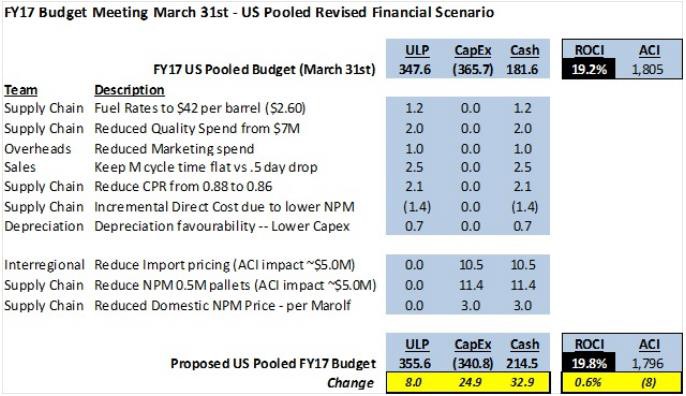
8.8 The Second Revised Budget Submission - 5 April to 13 April 2016
398 CHEP NA’s First Revised Budget Submission (which included US Pooled) was short of the 20.4% ROCI that Mackie had requested that US Pooled get “as close as possible to”. In my view the evidence shows that Mackie continued to endeavour to stretch the CHEP NA budget so as to achieve (as far as possible) alignment with the ELT Guidance Note (and the FY21 5YP which followed it).
399 After receipt of the revised budget submissions from all CHEP CBUs, Kennett, Mackie, Alonso and others analysed how they affected the CHEP Global budget. During this period, Alonso worked with his team to identify potential stretch in the supply chain areas of the CBUs and to prepare the supply chain division slides for a CHEP Global FY17 draft budget presentation to be presented to Gorman and Todorcevski.
400 On 11 April 2016, in another example of his focus on achieving alignment with the ELT Guidance Note, Mackie sent emails to the President of each CBU setting out where the CHEP Global budget was sitting relative to the ELT Guidance Note, and proposing actions they could take to bring the budget as close as possible into alignment. The email Mackie sent to Rumph said:
Attached is a very simple document that shows where we are on the Pallet budget relative to the Brambles guidance that I would like us to get to. The table at the moment solves for ROCI given the external commitments but we need you to take another look at the 3 elements:
• Rev/Price - there are small number of very clear reasons that explain why we are off guidance and I actually believe getting to 7% revenue growth as a consequence is unrealistic but what I would like you to do is to look at any offsetting challenge you can give your teams in this area because any change here should flow through nicely to EBIT with good leverage to ROCI.
• EBIT - I think we still have an opportunity here and the specifics for your CBU are detailed in the attachment.
• ACI - The roll up of ACI in prior years overall has proven to be overstated in the budget and over delivered in the actual and I would like to break the cycle.…
(Emphasis added.)
401 The email attached a note titled “F17B Addl Req” (shorthand for “FY17 Budget Additional Requirement”). In his affidavit Mackie described the email as showing Rumph where the CHEP Global budget was sitting relative to the top-down guidance and requesting that she review the CHEP NA budget for further stretch in sales revenue, Underlying Profit and ACI. In cross-examination, he accepted that his reference to the position that he would “like us to get to” was a reference to the FY19 ROCI Target. Kennett deposed that the ‘F17B Addl Req’ documents that Mackie sent to the President of each CBU were prepared by him and set out the results of an analysis that he and Mackie had conducted together. He said that they included a summary of the roll-up of the CHEP Global budget from the initial submission to the revised position and showed the position where he and Mackie both thought the budget could get to.
402 The attachment included three tables, two of which bore the heading “Current Status & Requirement”, and which identified the further stretch required as “Total gap to close from First Submission” and “Requirement to hit ROCI Guidance”. Kennett’s use of the word “requirement”, and the urgency of the email which sought a response within 24 hours, is telling. That was not the language of a CFO who was comfortable with proposing a CHEP NA or CHEP Global budget that did not meet the ELT Guidance Note.
403 Reproduced below is one of the tables Mackie attached to his email:
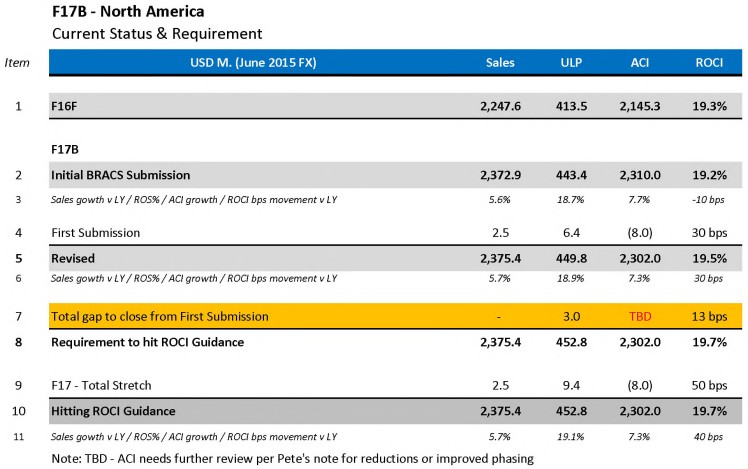
404 The reference to the “Initial BRACS Submission” was a reference to CHEP NA’s Initial Budget Submission. Mackie accepted that:
(a) line 4, “First Submission” was a reference to the first budget stretch which provided for $2.5 million increased sales revenue, $6.4 million increased Underlying Profit and $8 million in reduced ACI, leading to 19.5% ROCI; and
(b) line 7, the orange row, indicated the further stretch he expected CHEP NA to achieve, being a further $3 million in Underlying Profit for FY17 and an increase to 19.7% ROCI.
Importantly, Mackie accepted in cross-examination that the forecast increase in Underlying Profit could not come from increased sales revenue because revenue was as “stretched as it [could] be” and instead was to come from cost reductions.
405 Mackie’s “very simple document” included a third sheet, which included a table titled “ULP Improvement”. For each of the businesses in CHEP NA, it set out:
(a) the amount of Underlying Profit submitted by the business in the CHEP NA Initial Budget Submission, the aggregate of which was $443.4 million;
(b) the additional stretch that Rumph and Lallatin had applied in US Pooled (and some small deductions applied in US Recycled) in the CHEP NA Revised Budget Submission, which increased Underlying Profit by $6.4 million; and
(c) how Mackie considered Rumph might find an additional $3 million in Underlying Profit through a reduction in overheads, resulting in a total increase of $11.1 million in Underlying Profit for US Pooled from the CHEP NA Initial Budget Submission, and an aggregate increase for CHEP NA of $9.4 million to $452.8 million.
406 Having received Mackie’s note, Rumph, Alonso and Lallatin undertook work to identify where additional stretch might be added to the US Pooled budget for Underlying Profit, and they ultimately arrived at a proposal in which Underlying Profit would be increased by an additional $1 million in revenue by increasing the price that US Pooled expected it could get for pallets, and reducing the operating expenses for “quality” and overheads, by $1 million, and reducing capex by an additional $4 million.
407 In his first affidavit Mackie deposed that the “small number of very clear reasons” he referred to in his email included the pricing headwinds impacting the US Recycled budget and the loss of one working day in FY17. Having regard to those matters, he thought that increasing the revenue growth in CHEP NA to 7% was unlikely, and he therefore only proposed improvements to Underlying Profit and ACI, which would lead to an improvement in the ROCI growth. In circumstances where he did not think there was scope to improve revenue growth to 7%, he described the purpose of his email as follows:
…I wanted Rumph to reflect on the CHEP North America submission and consider the extent to which she thought there was scope to improve the submission, to bridge part of the gap to 7%. … it was not compulsory for the business divisions to deliver the top down guidance of Brambles’ management in their budget submissions. I was comfortable proposing a budget that did not meet the top down guidance, provided I was confident the CBUs had pushed themselves to propose a budget that was challenging but achievable.
(Emphasis added.)
408 I give little weight to Mackie’s evidence that he was comfortable proposing a budget that did not meet the ELT Guidance Note provided he was confident the CBUs had pushed themselves to propose a budget that was challenging but achievable. That evidence is inconsistent with, or jars with, a number of contemporaneous emails and internal documents (to which I later go), and also with other testimony which I prefer. The contemporaneous emails tend to show that Mackie pressured CHEP NA management to accept budget stretches which would bring the CHEP NA budget into alignment with the ELT Guidance Note, which resulted in a budget which Rumph, Lallatin, and Alonso described in emails at the time as involving a “huge stretch” and which Alonso described in his evidence as being stretched to “close to the limit of what was achievable”, a limit which CHEP NA “could not go beyond”. As I later explain, Mackie’s evidence shows that he gave little weight to the concerns expressed by Rumph and Alonso in their emails and memos at the time because he thought they were either overstating their concerns about the level of stretch and hence risk to achievability in the budget as part of a budget negotiation, in furtherance of a more easily achievable budget and STI benefits, or because they were expressing deliberately pessimistic views at his request so as to assist him in his subsequent budget negotiations with Gorman and Todorcevski.
409 I give little weight to that evidence as it is inconsistent with or at least jars with statements in, or inferences open to be drawn from, contemporaneous documents and emails. I do not, though, consider that Mackie was being disingenuous in his evidence. Rather, my conclusion as to weight reflects my view as to the weight appropriately to be given to the contemporaneous documentary record, as compared to the weight to be given to his recollection, more than five years after the relevant events, as to what he was thinking at the time about otherwise mundane business events, much of which was in my view a reconstruction with the assistance of lawyers.
410 On 12 April 2016, Rumph forwarded Mackie’s 11 April 2016 email to Lallatin and Alonso, and asked them to summarise how CHEP NA should address the budget stretch that Mackie sought. The following ensued:
(a) By reply email on 12 April 2016, Lallatin flagged additional risks in CHEP NA that had not been accounted for, namely that NPD transfers continued to be significantly higher than expected, which he said would increase asset recovery fees in FY17 and could present an approximately $2 million risk not factored in to the budget. He said that, having regard to the R&O schedule in the CHEP NA Initial Budget Submission, the budget had “a lot more risk than opportunity in FY17”. Nevertheless, he suggested some revisions to the CHEP NA First Revised Budget Submission, adding $4 million of Underlying Profit, reducing ACI by another $7 million, and increasing ROCI to 20.1%.
(b) By reply email on 12 April 2016, Alonso said that he was not comfortable with that level of budget stretch. He said:
I think at GM level we have enough stretch and hence risk already as to plug any more. I would propose we remove [damage rate] (we cut from 4pp to 2pp) we spend that money anyway. Other than that, I do not see any more opportunity for further initiatives, we have already $31M!
(Emphasis added.)
(c) Later the same day Lallatin replied and said:
Overall improvement for US Pooled from budget review with Pete [Mackie] is $11M of ULP, $29M of CapEx, and $40M of Cash Flow. Talk about stretch.
I think we should also mention the ~[$]2M of [Asset Recovery] risk we are not factoring in here that we will have to find a way to offset.…
(Emphasis added.)
(d) Rumph replied the same day, and said:
Thank you, Matt. I agree this is a huge stretch. We will go with this and try to stop here. I will send the note through as I want to add commentary about what a huge stretch it is.
(Emphasis added.)
(e) Later that same day, Alonso agreed that the further budget improvement sought was a huge stretch, and recognised the possibility of a further round of budget stretching. He said that he agreed that CHEP NA should not offer stretches beyond that, and should “keep the Canadian HS opportunity” just in case that was needed in a second round of stretches. He told Rumph that at the CHEP Global PLT meeting the following day he would:
…reinforce any message you would like to make on how stretch[ed] this budget is already.
(Emphasis added.)
(f) On 13 April 2016, in response to Alonso’s offer to speak at the CHEP PLT meeting to reinforce how stretched the CHEP NA budget was by then, Rumph replied by email:
Thank you!!! It is a HUGE stretch - I am pretty concerned actually…
(Emphasis added.)
411 To recap, the views of those who were directly responsible for the preparation of the CHEP NA Second Revised Budget Submission, and who were accountable for achieving the budget targets, were as follows:
(a) Lallatin commented: “Talk about stretch”.
(b) Rumph agreed: “I agree this is a huge stretch. We will go with this and try to stop here. I will send the note through, as I want to add commentary about what a huge stretch it is”.
(c) Alonso agreed and offered to: “reinforce any message [Rumph] would like to make on how stretch [sic] this budget is already” at the CHEP Global PLT meeting the following day.
(d) Rumph responded: “Thank you!!! It is a HUGE stretch - I am pretty concerned actually”.
(Emphasis added in italics.)
412 Brambles submitted that these emails had been “cherry picked” by the applicants, did not reflect the true position regarding the CHEP NA budget, and should be given little weight in deciding whether the CHEP NA budget had reasonable grounds. It contended that operational management at the level of Rumph and Lallatin were intent on having an “easily achievable” budget so as to more easily achieve the STI benefits available under Brambles’ executive remuneration plan.
413 I take a different view. I consider these contemporaneous emails, between managers at roughly equivalent levels of seniority within Brambles, point strongly away from accepting that they were intent on having an “easily achievable budget”. These emails were not going to anyone higher up the management chain; they were internal to those executives. On any sensible reading they reflect a genuine concern that the changes sought by CHEP Global management (Mackie and Kennett) had resulted in US Pooled and CHEP NA budgets that were excessively ambitious and hence carried real risks to achievability.
414 In relation to this email exchange, Alonso deposed that he:
...was aligned with Rumph on pushing back on any further stretch on the supply chain aspects of the CHEP North America FY17 budget as I considered there was limited scope to further enhance the supply chain opportunities in the budget. However, I didn’t think the CHEP North America budget submission was concerning or any more challenging than prior years.
He also said that in his role running the global supply chain business he took a global view and that “while some CBU budgets had less scope for further stretch than others, there were opportunities across all CBUs to over-deliver and offset risk in other geographies”.
415 Alonso was cross-examined on his email exchange with Rumph and Lallatin and asked what he understood Rumph to mean when she said: “I agree this is a huge stretch. We will go with this and try to stop here”. To his credit, Alonso did not try to walk back the significance of Rumph’s remarks. Importantly, he said that he understood Rumph to be saying that the budget “was close to the limit of what was achievable”, and he said that he agreed with Rumph’s view. He said that was why he offered to reinforce “any message you would like to make on how stretch[ed] this budget is already” at the pending CHEP PLT meeting. I understand Rumph’s email the same way as Alonso’s, and I accept his evidence in this regard.
416 Alonso agreed that Rumph was “pretty concerned actually” about the level of stretch, and testified that he was concerned too. He said that he thought the CHEP NA budget at that point was “a stretched budget but still achievable. But we could not go beyond that” (emphasis added). Importantly, he also testified that if any additional stretch was imposed, it would put US Pooled “in a very difficult position to achieve any target” (emphasis added).
417 Alonso, however, also testified that the CHEP NA FY17 budget at that point was no more concerning or challenging than in prior years. I give that evidence little weight as it is in my view inconsistent with, or at least jars with:
(a) his unguarded remarks to his senior colleagues in the email exchange with Rumph and Lallatin on 12-13 April 2016;
(b) his evidence in cross-examination that the CHEP NA budget was stretched close to the limit of achievability and that “we could not go beyond that”, and that if any additional stretch was imposed, it would put US Pooled “in a very difficult position to achieve any target”;
(c) his statements in his email to Mackie on 14 April 2016 (to which I will shortly go) where he said that the US Pooled FY17 budget had “the most aggressive and stretched” Underlying Profit and came with “risks in all line items, sales, direct cost, overheads and capex”; that the initiatives in the CHEP Global budget for cutting direct costs involved a “huge stretch” with “no margin for error”; and that overall the CHEP budget “is full of risks and I do not see any major opportunity that could help us”; and
(d) Rumph’s statements in the Headlines Memo on 16 April 2016 (to which I will shortly go).
418 Further, in my view it is implausible that CHEP NA operated at such a high level of stretch and risk over many years and consistently met its budgets.
419 On 12 April 2016 Rumph replied to Mackie’s email and said:
Pete - we have scrubbed our [CHEP] NA budget and are getting very concerned about the level of stretch here. We are offering up the below results which overall represent huge improvements since our initial budget submission (which I had stretched the team on twice already). Total improvements since initial submittal include:
• $11M of ULP
• $29M of CapEx
• $40M of Cash Flow
We also just identified ~$2M of Asset Recovery risk and have not modified the budget - we will find a way to mitigate it.
Please let us know if you need additional information or have any questions.
(Emphasis added.)
420 With respect to the asset recovery risk, Alonso testified that he was aware of it and was not particularly concerned about such costs in the scheme of the budget overall. Nor did Mackie give the asset recovery risk much significance. He said the risk was not definitely going to transpire; the extent of those costs was not certain; and in any event Rumph said that she would find a way to mitigate them.
421 The applicants submitted that, as at April 2016, Brambles had not identified any actions that could be expected to address the increasing cycle times and damage rates in FY17 for pallets issued to Walmart. That was conceded by Mackie in cross-examination, when he explained that the actions identified by Brambles in April 2016 were directed to relationship building with Walmart rather than directly giving rise to a reduction in the damage rate.
422 On the day following Rumph’s email, 13 April 2016, the CHEP Global PLT meeting took place. At this time CHEP NA management agreed to a further stretch to its budget, which I have previously referred to as the CHEP NA Second Revised Budget Submission.
423 Kennett sent an email on 14 April 2016 to Rumph and Lallatin (copied to Mackie, Alonso and Thompsen) with the subject line “NAM > F17B Confirmation of Expectation”, in which he confirmed the stretch to the CHEP NA budget through the Second Revised Budget Submission. The email included a table which showed the stretches from the CHEP NA Initial Budget Submission, reproduced below.
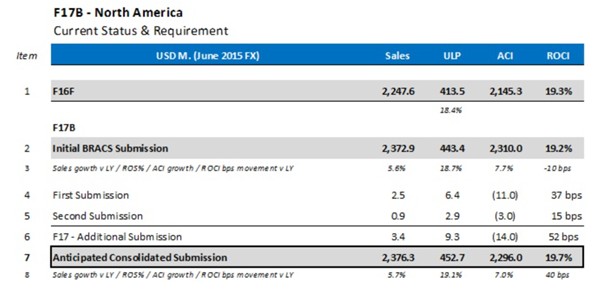
424 The stretch from CHEP NA’s Initial Budget Submission comprised $3.4 million of increased sales revenue, $9.3 million of increased Underlying Profit, and $14 million of reduced ACI, which resulted in increased ROCI of 19.7%.
425 The pressure from Mackie and Kennett for alignment with the ELT Guidance Note had the desired result. On 13 April 2016 Thompsen emailed Kennett, including some embedded tables, and identified the level of stretch applied to the budget submissions of each of the CHEP CBUs. In another example of the focus on achieving alignment with the ELT Guidance Note, Thompsen exclaimed: “We’ve met guidance!”.
426 One of the embedded tables, reproduced below, showed that following the CHEP NA Second Revised Budget Submissions the budgeted ROCI for CHEP was 23.5%, which was consistent with the guidance of “>23.5%” in the ELT Guidance Note.
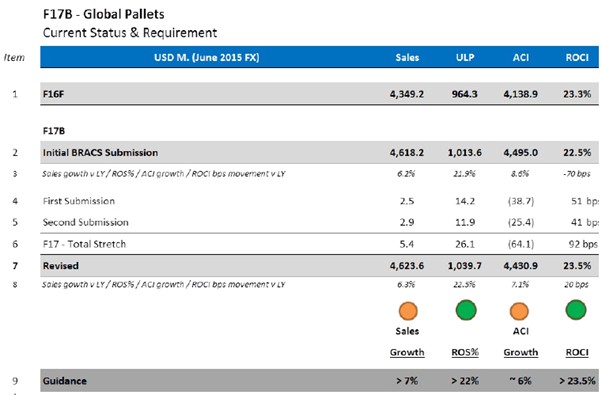
8.8.1 The Headlines Memo
427 When Kennett emailed Rumph and Lallatin on 14 April 2016 to confirm their agreement to the numbers in the CHEP NA Second Revised Budget Submission, he also asked them to provide Mackie with a “simple one pager” identifying “the big issues / key risks / unidentified stretch” within that budget.
428 On 15 April 2016, Lallatin sent Rumph a draft of the “one pager” Kennett had requested. His draft, which he described as “a work in progress”, included the following:
Unidentified stretch in the FY17 budget
• $53M of unidentified wins assumed in US Pooled ($90M total wins versus $78M in FY16)
• Pricing stretch of ~$6M for US Pooled to compensate for lower volume due to drop in FY16 demand and fewer B days in FY17; RPI $0.01 higher than 5YP
• $31M of Supply Chain Initiatives, ~$5M of which is unidentified
• $1M of unidentified OneBetter task in Overheads (USP)
• $2M+ asset recovery costs not in FY17B -- NPD transfers much higher than anticipated in 2H FY16
• $1M transportation go-get in Canada. Individual initiatives yet to be identified
429 On 16 April 2016 Rumph emailed a finalised document titled “CHEP Pallets North America FY17 Proposed Budget: Headlines in FY17B” to Mackie, copying Kennett, Lallatin, Alonso and Linderman (the Headlines Memo). It picked up some of Lallatin’s draft but was longer and organised around different headings to the ones Kennett identified in his draft.
430 The Headlines Memo said the following in relation to “the big issues / key risks / unidentified stretch” in the CHEP NA budget:
FY17 Proposed Budget
Headlines in FY17B
Competition
• Increased competition in US Pooled and Canada with leadership changes pending at PECO driving uncertainty around future behaviors their recent win of Kraft/Heinz in North America, and that they are now accepted at all top 5 Retailers in Canada. Recycler and PECO behaviors related to pallet collections also presents future risk and disruption to the US business model.
Risk: Both Canada and US Pooled assumed low loss rates despite this volatility with PECO. Loss of a major customer is not assumed in the US budget and no loss is assumed in Canada though Mars seems imminent.
Revenue
• Pooled Revenue
• Growth assumption is very aggressive given one-time benefits in FY16 that aren’t likely to repeat (NPD upcharges, variable rate manufacturer CT increase, price increases responding to recycled market).
• US Pooled volume trending lower in FY16 creates a jump-off risk into FY17.
• $53M of unidentified wins assumed in US ($90M total wins versus $78M in FY16).
• Pricing stretch of ~$6M for US Pooled to compensate for lower volume due to drop in FY16 demand and fewer B days in FY17; RPI $0.02 higher than 5YP.
…
• Recycled Revenue
• FY16 exit pricing forecasted to be below FY17B price, creating immediate ULP risk.
• Continued volume loss to poolers over and above projections is a key risk.
• A grade pricing may require further reduction beyond budgeted levels to move inventory and deliver volume.
Direct Costs
• US Pooled Durability Investment: Assumed to pay off with a damage rate reduction of 2pp (61.3% to 59.3%). If damage rate improvements do not manifest as planned, we face up to $11M in unbudgeted repair costs. Also made aggressive assumptions on CPR.
…
• US Pooled Asset Recovery: NPD transfer growth higher than anticipated driving $2M+ of recovery fees from FY16 flows not in budget that will hit us in FY17.
• US Pooled Initiatives: $28M of Supply Chain Initiatives; ~$3M of which is unidentified.
• US Pooled Quality: Continued investment in strategic quality investment to deliver growth.
• US Pooled Retail Collection Costs: FY17B assumes only known retailers we are actively negotiating with drive incremental CHEP paid collections. We could face higher collection fees than budget if new challenges arise with Recyclers or PECO disrupting our business model further with unidentified US Retailers.
…
Overheads
• Assumed HOG concept in budgeting FY17 Overheads and was relying on OneBetter to help deliver it. We then layered in $3M of additional, unidentified OneBetter savings.
• US Pooled adds incremental $2M in strategic marketing spend.
• US Recycled takes on $1 million in incremental OHs [overheads] to address controls environment in FY17.
Capex
• Purchasing 14.7M pallets in FY17 to support continued growth and control ratio levels.
431 To recap, Rumph’s stated concerns included that the US Pooled budget was based on assumptions:
(a) that notwithstanding increased competition from PECO, US Pooled would have a low customer loss rate and it would not suffer the loss of any major customer
(b) of “very aggressive” growth in revenue, having regard to:
(i) one-time benefits in FY16 that were not likely to be repeated;
(ii) US Pooled’s sales volume, which was trending lower in FY16 and created a jump-off (or starting point) risk into FY17;
(iii) around $53 million being budgeted for unidentified wins; and
(iv) a pricing increase of around $6 million that had been factored in to compensate for lower sales volume;
(c) of a two pp reduction in the damage rate, where there was up to $11 million in unbudgeted repair costs if the damage rate improvements did not manifest as planned pursuant to the Durability Program. There were also aggressive assumptions on CPR, a $2 million Asset Recovery Risk, and $3 million of cost savings through unidentified supply chain initiatives; and
(d) that overheads would grow at half of the rate of revenue, relying on the OneBetter program to help deliver that - but then $3 million in additional, unidentified savings in OneBetter were layered in.
432 Mackie downplayed the significance of the Headlines Memo. He said that it was his usual practice each year to request such notes from the CBU heads and request Alonso (in relation to supply chain issues) to assist him when he was presenting the proposed CHEP Global budget to Gorman and Todorcevski. He said that he took his usual course in respect of the proposed CHEP Global FY17 budget. He said that the intended purpose of the notes he sought was “to provide me with information relating to the underlying position of the budget so that I was well placed to address any stress testing from Gorman and Todorcevski during the presentation of the consolidated [CHEP Global FY17 budget]”. In cross-examination he said: “I wanted to defend that budget the best that I possibly could. So in order to do that, I armed myself with as many of the pessimistic views on the budget from each of the CBUs and from my head of supply chain” (emphasis added). In re-examination he said that he had no doubt that he asked Rumph for a pessimistic view of the CHEP NA budget.
433 He testified that he was comfortable with the accommodation of risks in the CHEP NA Second Revised Budget Submission. He also said that he was not going to, and did not, present the Headlines Memo to Gorman. Rather he digested that and the other information he had been sent so that he was armed with a number of issues that he could make Gorman aware of, where relevant.
434 Kennett testified that he was not surprised when he read the Headlines Memo, because the matters in the memorandum had been raised during the budget process. He agreed that it was factually correct but said that he thought “[t]here was some information missing”. He thought that the memo portrayed an overly pessimistic picture and did not provide a realistic assessment of the risks and opportunities in respect of the budget for CHEP NA.
435 Brambles noted that some of the Headlines Memo was fact and some of it was opinion, and it submitted that insofar as it was opinion it was pessimistic. For example, it submitted:
(a) it was a fact that the US Pooled budget assumed around $53 million in unidentified wins, but in circumstances where unidentified wins had been achieved in previous years, describing all of the $53 million as a risk (as opposed to only some of it) was pessimistic;
(b) Mackie testified that it was pessimistic for Rumph to describe the growth assumptions as being “very aggressive given one time benefits in FY16 that aren’t likely to repeat”;
(c) Mackie testified it was pessimistic for Rumph to state that “US Pooled volume trending lower in FY16 creates a jump-off risk into FY17”. He said that there was always risk between budget years but “jump-off risk” was not a certainty and it was pessimistic to assume it; and
(d) it was pessimistic for Rumph to state that “[l]oss of a major customer is not assumed in the US budget”. Brambles said that can only have been a reference to the risk of losing another unidentified major customer, as the loss of Kraft / Heinz was assumed in the US Pooled budget at that time. The R&O schedule described the probability of a loss of a large customer at 50%, and the US Pooled budget assumed $21.1 million of unidentified losses. With respect to the “imminent” loss of the Mars accounts, that was only referring to the loss of part of the account worth around $200,000, which was not material to the budget.
436 I give little weight to Mackie’s evidence that Rumph was invited to express a pessimistic view about the CHEP NA draft budget at that stage, and to his evidence that Rumph expressed deliberately pessimistic views in the Headlines Memo. As I have said, that evidence is inconsistent with or at least jars with statements in, or inferences open to be drawn from, contemporaneous documents and emails. On my view of the evidence, it is appropriate to infer that Rumph did no more than she was asked by Kennett; that is, provide Mackie with a “simple one pager” regarding the “big issues / key risks / unidentified stretch” in the CHEP NA budget at that point. I infer that in doing so she expressed her genuinely held concerns about the level of stretch and hence risk to achievability in the CHEP NA budget.
437 Several matters are material to my view in this regard.
438 First, the only documentary record of a request for such a memo is Kennett’s 14 April 2016 email to Rumph and Lallatin, which did not ask them to provide a pessimistic view. Kennett’s evidence was that his request for a “one pager” was something that was always done in respect of the budget because the CHEP Global team was creating a budget presentation and it allowed him and Mackie to understand the perspectives of each of the business units. He did not testify that he asked Rumph to express a pessimistic view, nor did he state that Rumph was not stating her true opinion and was instead stating a deliberately pessimistic view. His evidence rose no higher than to state that while the Headlines Memo was factually correct, he considered “[t]here was some information missing” and it therefore painted a pessimistic picture.
439 Second, Mackie said the Headlines Memo was cast in a tone which he “expected and wanted”, but in his evidence-in-chief he did not state that he asked Rumph for a pessimistic view of the CHEP NA FY17 budget. There is no contemporaneous documentary record of Mackie (or Kennett) asking Rumph to prepare a memo providing a pessimistic view of the CHEP NA budget, Kennett made the request and he did not ask her for a pessimistic view, and the only email in evidence did not ask for a pessimistic view. Further, while Mackie maintained that Rumph had been asked to express a pessimistic view, in cross-examination he conceded that he did not “recall specifically asking [Rumph] for a pessimistic view”.
440 Third, the concerns Rumph expressed in the Headlines Memo are consistent with the views she expressed in her 12-13 April 2016 email exchange with Lallatin and Alonso, and her 12 April 2016 email to Mackie. There is no proper basis to infer that Rumph was being deliberately pessimistic about the CHEP NA FY17 budget in the Headlines Memo when she was expressing similar views in unguarded emails to her senior colleagues, and had expressed a concern to Mackie about the level of stretch in the budget.
441 Fourth, as Mackie accepted in cross-examination, many of the matters Rumph identified in the Headlines Memo were matters of fact rather than opinion, including that, in relation to US Pooled, the CHEP NA Second Revised Budget Submission:
(a) assumed that there would not be a loss of a major customer;
(b) assumed $53 million of unidentified wins;
(c) assumed pricing increases of $6 million for US Pooled to compensate for lower volume due to a drop in FY16 demand and fewer business days in FY17;
(d) assumed the Durability Program would pay off with a damage rate reduction of two pps (61.3% down to 59.3%);
(e) required US Pooled to face up to $11 million in unbudgeted repair costs if damage rate improvements did not manifest as budgeted;
(f) assumed non-participating transfer growth higher than anticipated in FY16;
(g) assumed that only the known retailers US Pooled was actively negotiating with would drive incremental CHEP-paid collections;
(h) provided for costs savings to be achieved through the OneBetter program, but $3 million of additional unidentified OneBetter savings had been layered in;
(i) added an incremental $2 million in strategic marketing expenditure; and
(j) required the purchase of 14.7 million pallets in FY17 to support continued growth and control ratio levels.
It was not deliberately pessimistic for Rumph to set out the factual matters which she considered showed aggressive assumptions or stretch in the budget.
442 Brambles also based its contention that Rumph was being deliberately pessimistic in the Headlines Memo on some of her later emails. It argued that those emails showed that Rumph believed in the achievability of the CHEP NA budget and maintained that view through to January 2017. Brambles highlighted that:
(a) on 20 May 2016, Rumph emailed Alonso in relation to a management request for a budget stretch in relation to capex and said, “Carmelo - we’re all in this together, so let’s just leave it as prescribed and we will find a way to hit the numbers together”;
(b) on 15 August 2016, Rumph emailed Lallatin (copying Nador) and said, “it is way to[o] early and completely unfounded to signal any risk to the market. We will always have challenges and must find ways to manage them. We have plenty of time to catch up here”. The risk to which she was referring was a risk of US Pooled not meeting budget;
(c) on 26 October 2016, Rumph wrote to the US Pooled management team and said:
Thank you for the hard work you are putting into developing our gap closure plan for US Pooled. Thanks also for the great effort that has gone into preparing for the presentation with Pete and Tom today - it was clearly communicated and understood. I appreciate your efforts and feel confident we can close this gap and deliver our budget commitments
(Emphasis added.);
and
(d) on 14 January 2017, Rumph wrote to Sullivan regarding the FY17 H2 outlook:
I feel strongly that to give a proper view we need to get through January to see how volume trends as well as the outcome on a few pending deals.
443 I do not accept that Rumph’s email to Alonso on 20 May 2016 showed that she considered the CHEP NA FY17 budget to be achievable. Alonso understood that email, as do I, as Rumph telling him: “[W]e made a commitment to deliver those numbers, so let’s…work as best as we can to deliver those numbers because it’s our commitment”. It is appropriate to infer that Rumph considered the budget to be stretched close to the limit of achievability, which was the effect of her email exchange with Lallatin and Alonso on 12-13 April 2016. That was how Alonso understood her emails, and he testified that he agreed with that view at the time. As for Brambles’ contention that Rumph maintained her belief in the achievability of the CHEP NA FY17 budget at various later points in the Relevant Period, I will deal with that when dealing with those periods.
8.8.2 Alonso’s Risks Email
444 On 14 April 2016 Alonso sent Mackie an email under the subject line “Re: FY17 Budget comments on Supply Chain” (Alonso’s Risks Email). In that email Alonso provided his comments on the CHEP NA and CHEP Global budgets at that stage, with a focus on supply chain issues.
445 The email is remarkable in its directness. Alonso said:
As you requested yesterday, below my comments on next year Budget, mostly focus on Supply Chain but also including views on different line items:
• Direct cost cutting initiatives is a huge stretch in FY17. All initiatives globally are adding up to $81M, including $11M from pallet durability in the US, and that is the highest level we ever targeted (or delivered). We normally go with actions at a 75% probability to have some buffers to cover downsizes during the year but this year we go with +95% probability, so no margin for error at all.
• Inflation at $45M is mainly based in very low levels assumptions. In any case, I think there is some conservatism in the US transportation of around $2M to $3M, but efficiencies are also having a big stretch in the US at a total of $48M, from which >$5M are today in white space (I would propose we reduce both inflation and efficiencies at same levels to have a more realistic view on both). In EU, if either fuel or timber cost goes above current levels, we won´t be able to offset any upward price correction (today oil cost is already above the $42 we budgeted for all next year)
…
• At profit levels, the US Pooled is the most aggressive and stretched ULP. It comes with risks in all line items, sales, direct cost, overheads and capex
• And last but not least, as already stated by everyone, procurement overlays in Overheads are not having solid plans behind and I think they will be more cost avoidance than real positive impact on the P&L’s
I am sorry if I am painting a quite pessimistic view, but I really think next year budget is full of risks and I do not see any major opportunity that could help us.
(Emphasis added.)
446 To recap, the email painted a stark picture of the stretch and risk in the CHEP NA and CHEP Global FY17 budgets at that time, including that:
(a) the US Pooled FY17 budget with respect to Underlying Profit was “the most aggressive and stretched” with “risks in all line items, sales, direct cost, overheads and capex”;
(b) the $48 million of budgeted efficiencies in US Pooled involved a “big stretch”, and should be reduced to a more realistic level;
(c) the $81 million in direct cost-cutting initiatives in the CHEP Global FY17 budget involved a “huge stretch” which assumed a “+95%” probability of success and left “no margin for error at all”. In cross-examination Alonso accepted that achieving those savings initiatives required “perfect execution”; and
(d) overall, the CHEP Global FY17 budget was “full of risks” and he could not see “any major opportunity that could help us”.
447 Mackie responded to Alonso on the same day (14 April 2016): “[o]verall I think this is challenging yet again”. He stated that in making that comment he was referring to CHEP Global budgets set in recent years, which also involved stretch and were ultimately achieved.
448 As with his evidence regarding the Headlines Memo, Mackie sought to downplay the significance of Alonso’s Risks Email. He again said that it was his usual practice to request such notes from the head of each CBU, and from Alonso in relation to supply chain issues, and that he did this in respect of the FY17 budget. He said that the intended purpose of Alonso’s note was “to arm me with the information required to push back on any requests from Gorman or Todorcevski for further stretch relating to the supply chain”, and that he specifically asked for pessimistic views. As earlier noted, in cross-examination he said: “I wanted to defend that budget the best that I possibly could. So in order to do that, I armed myself with as many of the pessimistic views on the budget from each of the CBUs and from my head of supply chain”. In re-examination he said that he had no doubt that he asked Alonso for a pessimistic view of the supply chain aspects of the FY17 budget.
449 Alonso deposed that he sent that email in response to a request from Mackie:
…for my insights on the CHEP budget submission to equip Mackie with information on the supply chain budget to resist any requests for further stretch during the CHEP budget review with Gorman and Todorcevski.
In cross-examination he said the same thing. He testified that: “I was trying to give Mackie weapons to have a discussion with his boss, with Gorman and Todorcevski, to resist for any additional stretch”. He said further that he “was providing to [Mackie] arguments to push back on additional stretches”, and he said that he was emphasising the negative.
450 Alonso also gave evidence to clarify or explain what he meant in the email. Among other things, he said that:
(a) the probability numbers he set out in relation to the initiatives in the CHEP Global budget for cutting direct costs were more of an art than a science, and not based upon any sophisticated analysis;
(b) his remark that there was “no margin for error” was specifically in relation to the supply initiatives or efficiencies in the CHEP NA FY17 budget, and not to the overall CHEP Global FY17 budget. He used those words to emphasise his thoughts because he was providing arguments for his boss to assist him on “pushing back” against Gorman and Todorcevski;
(c) he agreed that it was necessary for the supply chain team to perform very well to meet the “+95 probability” upon which the budgeted savings from $79 million in initiatives and efficiencies relied (rather than the usual 75% probability), and he agreed that it would be necessary for the supply chain team to perform “very well” and seemed to accept that it was necessary for the team to perform abnormally well. He said that the supply chain team had a track record of achieving very high standards in execution and sometimes over-delivering, and he also knew “that we still had kind of 15 months to work through whatever could show up in the buffer”;
(d) he agreed that his view was that delivering the $79 million of supply chain initiatives required “perfect execution”. Alonso also used that phrase in an email to Kennett on 22 June 2016, in an email chain to which he attached slides on the supply chain aspects of the CHEP Global budget for a presentation to the June Board Meeting on 28 to 30 June 2016. There he said:
Remember I always said we normally deliver at 75% probability, but this year we went with a 100% so Perfect execution
(Emphasis added);
(e) despite the smaller margin of error, he remained comfortable with the cost savings initiatives because the supply chain team was improving its ability to deliver on initiatives and had a track record of exceeding budget in the past two years;
(f) his reference to the “big stretch” in the forecast cost savings in US Pooled to a total of $48 million, of which more than $5 million was in ‘white space’, was a reference to unidentified efficiencies, being a go-get target, which was something the supply chain team did every year;
(g) he highlighted other risks in the CHEP Global FY17 budget at that time including risks in Europe and did not identify opportunities because he was presenting the information to help Mackie push back on any additional stretch from above;
(h) he agreed that his statements that the US Pooled budget for Underlying Profit was the “most aggressive and stretched” of all the CHEP CBUs’ budgets, presenting “risks in all line items, sales, direct cost, overheads and capex”, reflected his belief at the time. But he said that he was putting emphasis on that to discourage Gorman and Todorcevski from seeking any further stretch from CHEP NA, and to reinforce and support Rumph’s request to limit any further stretch imposed on CHEP NA; and
(i) in stating that “I am sorry if I am painting a quite pessimistic view, but I really think next year budget is full of risks and I do not see any major opportunity that could help us”, he was intending to emphasise to Mackie that he “didn’t see any major opportunity to offset a scenario where all risks in the FY17 budget materialised, which would have been an unusual development”.
451 Mackie testified that he understood Alonso’s Risks Email in light of his request for a pessimistic view of the supply chain risks, so as to arm him for his conversation with Gorman. He denied that the views Alonso expressed were realistic, and he denied that if Alonso thought he had been invited to express a pessimistic view he would not have apologised for providing it. He said that he had no doubt that he had asked for a pessimistic view, and that the reason why Alonso would apologise for offering a pessimistic view was because he was an incredibly positive person who would have found it difficult to write a pessimistic note. He also said that his experience over multiple years was that Alonso’s team would say “this is a big stretch in the budget this year” and then they would over-deliver.
452 I give little weight to Mackie’s evidence that Alonso was invited to express a pessimistic view about the supply chain issues in the CHEP Global budget at that time, and I do not accept that it is appropriate to describe the views that Alonso expressed in his email as being deliberately pessimistic as distinct from him expressing his genuinely held concerns. I infer that Alonso’s Risks Email expressed his genuinely held concerns about the level of stretch and risk to achievability in the CHEP Global budget, for the purpose of assisting Mackie to avoid further budget stretching. A number of matters are material to that conclusion.
453 First, Alonso’s Risks Email largely speaks for itself and does not necessitate Alonso’s (or Brambles’) purported clarification or explanation. The email itself is the most reliable evidence of Alonso’s views at the time.
454 Second, there is no contemporaneous record of either Mackie or Kennett asking Alonso to prepare a document providing a pessimistic view of the CHEP Global budget. Mackie had no recollection of asking Alonso for such a document. Rather, his evidence was that Kennett had made the request. For his part Kennett accepted that Alonso was giving “his assessment” and “his opinion” on the CHEP Global budget to be presented to Gorman and Todorcevski, and he did not state that he asked Alonso to express any particular view, let alone a pessimistic one.
455 I infer that Mackie asked Alonso to provide the document because Alonso said that was the case, and because the email starts with the words: “Peter, [a]s you requested yesterday…”. Alonso testified that Mackie did not request that he express a pessimistic view or adopt any particular “tone”, and he testified that the way in which he expressed the document was his own choice. I give little weight to Mackie’s evidence that he asked for a pessimistic view when he could not even recall that it was him who requested the document. I give greater weight to Alonso’s evidence that Mackie did not request that he express a pessimistic view or adopt a particular tone.
456 Third, Alonso also testified that through his email he “was taking the opportunity to support Mrs Rumph because Mackie has requested my views”. That was a reference to his statement in his 12 April 2016 email to Rumph that in the scheduled CHEP PLT meeting he would “reinforce any message you would like to make on how stretch[ed] this budget is already”. He testified that in providing the email “what I was trying [to do] was stand with my word given to Kim Rumph that I could help her in - in resisting from getting additional stretch into the North American budget”. He considered the CHEP NA budget to be a “huge stretch” and wanted to ensure that was understood so that no further stretch was imposed. In my view that is different from his stating a deliberately pessimistic view.
457 Fourth, the views Alonso expressed in his email were broadly consistent with his 12-13 April 2016 email exchanges with Rumph and Lallatin and with his evidence as to what he thought about the CHEP NA budget at the time. In his emails he said “we have enough stretch and hence risk already”. As I have said, and reiterated, he testified that the CHEP NA FY17 budget at this stage was “a stretched budget but still achievable” but “we could not go beyond that” and if any additional stretch was imposed, it would put US Pooled “in a very difficult position to achieve any target”. There is no proper basis to infer that Alonso was being deliberately pessimistic and overstating his concerns to Mackie about the level of stretch and risk in the CHEP NA budget when he was expressing the same views in emails with his senior colleagues.
458 Fifth, Alonso testified that he was giving an accurate and truthful account in his Risks Email. In cross-examination he testified that:
(a) he did not say that the US Pooled FY17 budget was “the most aggressive and stretched” Underlying Profit with “risks in all line items, sales, direct costs, overheads and [c]apex” just to help Rumph. Rather, he said that was actually his view at the time and that he believed what he said but he was trying to emphasise it;
(b) he described the US Pooled budget in those terms because, in relation to the supply chain, “if we had any additional stretch, it would put the US business in a very difficult position to achieve any target”; and
(c) there was no margin for error in the supply chain for CHEP NA.
459 Sixth, Mackie’s evidence that Alonso was requested to provide a pessimistic view does not sit well with the fact that Alonso apologised to Mackie for his “quite pessimistic view”.
460 Finally, I should note that I consider it appropriate to give weight to Alonso’s assessments of the risks and stretch in the US Pooled and CHEP NA budgets in respect of supply chain issues. In cross-examination Kennett accepted that Alonso had great experience in respect of supply chain issues that might affect direct costs, and direct costs estimates in the budget, and that his judgements in that regard were “very accurate”. Kennett said that he trusted Alonso’s judgement in respect of the assessment of budget submissions and whether or not it was appropriate to apply stretch in relation to supply chain issues.
8.9 Budget ‘sandbagging’ and/or budget ‘negotiations’?
8.9.1 Sandbagging?
461 As stated above, the thrust of Brambles’ submissions on this issue was that CHEP NA management (and subsequently CHEP Global management) deliberately put forward conservative budget submissions, anticipating that a process of budget negotiation would follow in which higher-level management would ask for further stretch.
462 Brambles argued that management were financially incentivised by Brambles’ STI plan to achieve budget, so there was natural resistance to higher-level management stretching the budget and thus making it harder to achieve. It contended that ‘sandbagging’, meaning the presentation of deliberately easily achievable, underestimated budgets or financial projections, was a common business practice, including at Brambles.
463 Several of Brambles’ witnesses gave evidence that the initial budget submissions by management of CHEP CBUs were commonly easier than could be achieved, in part because an easier budget made it easier for the executives to achieve STI benefits. Some of them called this asserted practice ‘sandbagging’.
464 For example, Kennett deposed:
My experience in reviewing initial budget submissions, both within CHEP and in previous CFO roles, was that the initial submissions usually came in lower than could be achieved. My experience in my previous CFO roles and at CHEP, was that businesses within CHEP (such as Europe, LATAM, AIME and US Pooled) left out a lot of opportunities and it would be for management (e.g. me as the CHEP Global CFO, or Mackie as President, or Alonso-Bernaola as SVP, Supply Chain) to try and identify those opportunities and draw them out for consideration in preparing and finalising a budget. Businesses would also often underestimate the last forecast before the budget was prepared, so that the growth from forecast to budget would demonstrate expected growth percentages. This meant that establishing the reasonableness of a forecast was also an important part of the review process. I often referred to this whole initial budgeting process by the CBUs as a ‘sandbagging’ process. When I refer to ‘sandbagging’, I refer to a practice I had observed in my career to be common in budget preparation processes whereby a business unit would include easily achievable, underestimated budgets or financial projections. I considered sandbagging to be more common where securing bonuses or incentive payments were tied to the financial performance of the business. In addition to understanding the drivers of the numbers in a CBU’s initial budget submissions, these questions were aimed at identifying where potential opportunities might be, or what is sometimes referred to as identifying where the ‘stretch’ might be. However, I also accounted for risks and additional costs.
(Emphasis added.)
465 He also deposed:
The STI model provided for a portion of CHEP employees’ remuneration to be based on the achievement of performance targets, which were tiered based on whether a business unit achieved or exceeded budget. In my experience as CFO of CHEP Global, and my previous international CFO roles, the effect of this on budget planning processes was that businesses within the CBUs (or within business divisions generally) would tend to only present budgets that they thought were reasonable and achievable, and in fact there would often be an element of ‘sandbagging’, because it was in their interest to be able to meet their budget as it would mean they would meet their STI targets, and there was in effect, a structured incentive for the businesses to set a lower, more achievable budget. In relation to the ongoing performance of a business, the STI model also provided an additional reason for employees within a business to continually strive to meet or even exceed budget (being their STI targets), which in my view was an important motivator in continuing to drive the performance of the business. It is part of what gave me comfort in the CHEP Global budget planning process because I knew that in light of the STI structure, CBUs would not present a budget that they thought was unachievable and I also knew that they would continue to work towards achieving or even exceeding budget throughout a fiscal year.
(Emphasis added.)
He testified that the CHEP NA Initial Budget Submission was conservative, and that his interactions with CHEP NA management were in part directed to eradicating that conservatism.
466 In evidence-in-chief Mackie said that one of the reasons for his confidence in the proposed CHEP Global budget he submitted to Gorman and Todorcevski was that “there was no incentive, and in fact there were financial disincentives, for the business units to submit or propose budgets that were not achievable given that bonus payments were predicated on achieving and exceeding budget”. And in his second affidavit he deposed that he was not surprised that the US Pooled initial budget submission identified a higher level of risk than opportunity, and said that “it was normal to see a conservative or negatively skewed assessment of risks and opportunities in an initial budget submission because…the budget was tied to individual bonus payments”. He did not there use the term ‘sandbagging’ but his evidence was to the same effect.
467 In cross-examination he said:
…what I’ve experienced over many years of budgeting is that the first budget submission of the team is a conservative view and requires what I would describe as pressure testing, questioning and understanding where the conservatism might be - or - or to the other degree, where the - where the optimism might be. But generally the case is the first budget submissions are conservative.
468 In his evidence-in-chief, Todorcevski also said that he had experienced pessimistic CHEP Global budget submissions from Mackie (although he did not use the term ‘sandbagging’). He deposed:
…In my experience reviewing CHEP Global budgets in prior years, I observed that Mackie was prone to set budgets that were pessimistic, highlighting challenges and risks. I often experienced strong pushback from CHEP in moving the numbers from the original budget submission, which I thought was due to a recognition within CHEP of the budget flowing into the incentive program. Having regard to my prior experience settling budgets with Mackie, the overall shape of the proposed CHEP Global budget, and how it sat against the guidance, was consistent with my expectations. I thought Mackie was holding back a few opportunities to stretch the ULP growth by looking at parts of the proposed CHEP Global budget regarding capex and overheads, which I thought could be reduced.
(Emphasis added.)
469 He also deposed:
During the period I was CFO, the historical performance of US Pooled and the budget preparation process regularly followed a pattern of softer initial budget submissions followed by adjustments in the preparation of the final budget and strong performance exceeding the final budget set by the business….
…
During my time at Brambles, it was common for risk and opportunity schedules to evolve during the preparation of a budget or forecast, as risks and opportunities were discussed and plans were developed to manage risks or pursue opportunities as the budget evolved. As I stated in paragraphs 95, 124 and 221 of my First Affidavit, risks were frequently identified in CHEP budget submissions to justify pitching budgets at a lower level for varied reasons, including the achievability of incentive payments. In FY17, recent history, including in FY16, demonstrated that CHEP Global budget submissions tended to be overly cautious and conservative. Blindly adopting any net risk or opportunity identified in an initial budget submission would not produce an appropriate budget.
(Emphasis added.)
He gave evidence that Rumph and Mackie were each incentivised by Brambles’ STI plan to put up budgets that were underestimated and thus more easily achieved.
470 Alonso did not use the term ‘sandbagging’, but he said that the supply chain teams he supervised tended to push for more conservative budget targets that they could more comfortably achieve. In relation to the estimates he made of supply chain efficiencies he deposed:
I intended these estimates to be a primer to begin discussions with each of the CBUs regarding inflationary impacts and supply chain efficiencies for the FY17 budget. The estimates were preliminary and subject to further changes. If the CBUs thought they would achieve different supply chain efficiencies in FY17, it was usual practice for them to present their alternative numbers and reasons to me and that we would discuss their proposal. The aim of this process was to come to an agreement with each CBU on reasonable supply chain efficiency targets. It was my usual practice to set expectations, and for the CBUs to push for more conservative targets to try and fix targets they could comfortably achieve. It was part of my role to challenge and test the CBUs on their supply chain efficiency targets, to ensure efficiency targets were set which were realistic and achievable, but also drove shareholder value.
(Emphasis added.)
471 Martin used the term ‘sandbagging’, and deposed:
When the initial drafts of the ‘bottom-up’ budgets had been prepared by my Direct Reports and the sector teams, they initially submitted their populated budget spreadsheets to Bachtell. Each of the Huggers groups underwent a ‘first round of defense’ with Bachtell to discuss the respective budgets.
Bachtell and I then discussed the proposed budgets and in particular, the large accounts within each sector. Using our customer data about those large accounts and the sectors more broadly, Bachtell and I assessed each sector budget and had further discussions with those sector teams.
I reviewed the drafts prepared for each sector and provided feedback based on my experience, as part of an iterative process. This feedback involved several rounds of discussions about the various budget inputs and assumptions made in preparing the bottom-up budgets of each sector. Other than as outlined in this affidavit, I do not recall the exact conversations that were held during the preparation of the FY17 Sales Budget.
This feedback also involved challenging any potential ‘sandbagging’ by the teams preparing the ‘bottom-up’ budgets for each sector. In my experience working at CHEP North America, it was common for sales team budgets to be ‘sandbagged’ by initially drafting them with a lower sales volume than could actually be achieved. Part of my discussions with the teams preparing the ‘bottom-up’ budgets was to test whether any elements of sales had been budgeted too low or too high.
(Emphasis added.)
472 There he said that it was common for sales team budgets to be “‘sandbagged’ by initially drafting them with a lower sales volume than could actually be achieved”, but that it was his job, together with Justin Bachtell (Director, Sales Finance (Commercial), CHEP NA), to spot and mitigate any sandbagging. In effect he said that sales team would attempt to sandbag budgets and it was part of his job to challenge that. Then, as I later explain in more detail, in cross-examination Martin gave a different account, in which he said, in effect, that he engaged in sandbagging himself.
473 The ‘Remuneration Report’ in Brambles’ FY16 Annual Report said the following in relation Brambles’ incentive plans:
Remuneration is divided into those components which are Fixed Remuneration and those components which are variable and directly linked to Brambles’ financial performance and the delivery of personal strategic objectives (At Risk Remuneration).
Fixed remuneration generally consists of base salary, benefits and superannuation contributions.
A significant element of Disclosable Executives’ total reward is required to be At Risk. An individual will achieve maximum remuneration only when they meet challenging objectives in terms of Brambles’ overall financial performance, returns for shareholders and strategic objectives
…
Brambles’ At Risk Remuneration is provided by way of three types of annual incentive awards: an STI cash award, an STI share award and an LTI share award….
474 The evidence shows that Brambles’ executive remuneration plan was structured around a fixed-base salary, incentives under the STI plan and incentives under the long-term incentive (LTI) plan. The STI plan provided for a portion of employees’ remuneration to be based on the achievement of annual performance targets which were tiered based on whether a business unit achieved or exceeded budget. Todorcevski described:
(a) STIs as incentive benefits based on meeting annual performance benchmarks based on a balanced score card, some of which was payable in cash and some of which was payable in deferred Brambles shares; and
(b) LTIs, which only applied to senior executives, as incentive benefits based on meeting long-term benchmarks over a three-year performance period, with Brambles shares being granted at the end of that performance.
475 He testified that he, Gorman, Mackie, Kennett and Rumph were participants in both the STI and LTI plans. He, however, only gave evidence in respect of the incentives available to executives under the STI plan, and he said little about the incentives under the LTI plan.
476 Brambles asserted that the US Pooled, CHEP NA and CHEP Global FY17 budgets were ‘sandbagged’ and it carried the evidentiary burden of establishing that. I was not persuaded by the evidence of Brambles’ lay witnesses in relation to sandbagging of the proposed US Pooled and CHEP NA FY17 budgets. Having regard to the totality of the evidence on the issue, Brambles did not establish that the US Pooled or CHEP NA Initial or Revised Budget Submissions were sandbagged by management at that level (nor, as I later explain, did Brambles establish that Mackie was sandbagging when he sought approval of the CHEP Global budget from Gorman and Todorcevski). The following matters are material to my view in that regard.
477 First, the emails between Rumph, Lallatin and Alonso on 12-13 April 2016, Rumph’s 12 April 2016 email to Mackie, Rumph’s Headlines Memo and Alonso’s Risks Email point strongly away from an inference that CHEP NA management deliberately submitted easily achievable, underestimated Initial or Revised Budget Submissions to Mackie and Kennett. They support an inference, which I draw, that CHEP NA management, and Alonso, as head of the CHEP global supply chain division, considered the CHEP NA (including US Pooled) Second Revised Budget Submission to be heavily stretched and close to the limit of what was achievable.
478 I have previously set out the contents of those emails, and I need not reiterate them. Mackie sought to downplay the significance of Rumph’s 12 April 2016 email by asserting that she was deliberately exaggerating the level of stretch as part of a budget negotiation. And he sought to downplay the significance of Rumph’s Headlines Memo and Alonso’s Risks Email on the basis that he invited them to deliberately express pessimistic views.
479 Having regard to the fact that Rumph and Alonso were expressing the same general view in emails to each other and to Lallatin at the time there is no proper basis to infer that they were deliberately exaggerating their views to Mackie regarding the level of stretch and hence risk to achievability in the US Pooled and CHEP NA budgets. In my view those emails are the most reliable evidence of Rumph and Alonso’s view regarding the achievability of those budgets at that time. The compelling inference is that their contemporaneous emails stated their genuinely held concerns at that point (with which Lallatin agreed) that the changes sought by CHEP Global management had resulted in a budget that was excessively ambitious and hence carried real risks to its achievability.
480 Second, there is nothing in the contemporaneous emails between Kennett and Mackie when they were considering the CHEP NA Initial, First and Second Revised Budget Submissions to support an inference that they thought Rumph had submitted a deliberately easily achievable, underestimated CHEP NA FY17 budget. I expect that they would have discussed that between themselves had they held the view that Rumph was attempting to pull the wool over their eyes. Yet there is no evidence of any communication between them to that effect. There was no email between Kennett and Mackie showing that and they did not testify that they discussed that.
481 Third, Kennett did not testify that he believed that the US Pooled and CHEP NA Initial Budget Submission was sandbagged by Rumph and Lallatin. The highest his evidence rose was a general observation, based on his experience at Brambles and other businesses when reviewing initial budgets, that it was common for CBUs to submit “easily achievable, underestimated budgets or financial projections” which was “more common where securing bonuses or incentive payments were tied to the financial performance of the business”. His evidence rose no higher than that it was necessary to test the numbers and assumptions in CHEP CBU initial budget submissions as they might be sandbagged. Importantly, in cross-examination he denied that he was suggesting that there was sandbagging in respect of the FY17 budget by any business unit, and he accepted that he was not actually accusing any of the CHEP NA management team of sandbagging.
482 Fourth, the Court did not have the benefit of evidence from Rumph or Lallatin, the two CHEP NA executives centrally responsible for preparation of the CHEP NA Initial and Revised Budget Submissions, with respect to whether their initial budget submissions for US Pooled and CHEP NA were sandbagged. The only evidence is their contemporaneous emails in which they refer to aggressive budget assumptions and a high level of stretch, and hence real risks to the achievability of those budgets. Their emails do not support a finding that their initial or revised budget submissions were “sandbagged”. Further, Alonso gave evidence about the preparation of those budgets and he did not testify that the US Pooled and CHEP NA budget submissions were easily achievable. He said the opposite.
483 Fifth, Martin was involved in formulating the US Pooled sales budget. In his affidavits, which are comprehensive and highly detailed, he did not state that the sales revenue targets in the US Pooled FY17 initial budget submission had been sandbagged or set at a conservative level that was easily achievable. Rather, he said, in effect, that while it was common for members of his team to attempt to sandbag the revenue targets, it was his job to mitigate or stop any such attempts.
484 Then in cross-examination he gave a different account. He was taken to an email, sent by Bachtell to Lallatin and others on 25 January 2016, in relation to a proposed $10 million increase to the US Pooled FY17 sales budget. In the email Bachtell said:
…I have big concerns with layering on another $10M to [US Pooled] revenue in FY’17 without adjusting volume.
That would be an additional $0.03 to RPI making the YOY growth $0.11 or +2% on top of the $0.13 growth we’re seeing this year [FY16] which everybody would agree is not sustainable and contains a lot of one time activities.
If we’re saying this is what we absolutely have to do to tie out FY’17 then I will but I want to make sure everybody understands the risk of adding more in.
Lallatin responded:
No arm twisting here, Justin. We would definitely need Dan [Martin] to buy in to any change. Have you run this by him?
Bachtell then spoke to Martin, and after doing so he went back to Lallatin and said:
…I talked to Dan and he’s definitely concerned about having to take on an additional $10M given that we’ve already been fairly aggressive with rate in the 5YP…especially given the large amounts of pressure we’re starting to see PECO put on these deals (Kraft, Mars, Niagara, etc.)
I’m going to talk to him again in the morning after he’s had the night to think about it. We might be able to get an additional $0.01 in FY’17, but it’s hard to see a path to another $0.03.
485 Martin was then copied into the email chain and, on 26 January 2016, he responded to Bachtell’s email and said:
Let’s think through our reply here. It comes down to how much price we can take in such a short period of time. When you take the 42 cents and apply it to the non-top 20 customers (who we are taking down $9M next year), the net rate increase is a much higher per customer (let’s calculate this amount).…on the heels of the record increases in [FY]16. By the way, can we track back to the last time the pool business took this much rate (as a %) in one year?
Clearly there is a little sandbagging going on, so we need to logically rebut some of this with the potential customer risk.
(Emphasis added.)
486 Martin agreed that he had spoken to Bachtell, and that Bachtell had accurately recorded what Martin told him regarding his concerns about budgeting for $10 million of sales revenue in FY17 when US Pooled had already been “fairly aggressive” with the pricing rate in the 5YP, and when US Pooled’s main competitor PECO was putting “large amounts of pressure” on some of its larger customers.
487 He testified, however, that what he told Bachtell in the email did not reflect the true position and was not his real view. He said that he was not, in fact, concerned about achieving a further $10 million in sales revenue and instead he was “trying to keep the budget at a reasonable low level so we can all attain it”, and that he “didn’t want to have to take - take more on because I wanted to really beat the budget significantly”. He also said: “We were trying to give Matt [Lallatin] information so that we didn’t see the plan go that much higher. So we were trying to negotiate with - with our leadership”.
488 Brambles argued that in relying on Bachtell’s email the applicants “seize[d] on internal emails from a relatively junior and inexperienced member of the US Pooled finance team”. I do not accept that. The importance of that email exchange is not what it shows about Bachtell’s view, but what Martin said and how that sits with Martin’s other evidence.
489 I give little weight to Martin’s evidence to the effect that the US Pooled FY17 budget was sandbagged. In part that is because I see that evidence as less reliable than inferences that are open to be drawn from contemporaneous emails, and in part because his evidence in that regard was sometimes inconsistent, implausible and incoherent.
490 The following matters are material to that conclusion.
(a) First, in his very comprehensive first affidavit he at no point stated that the US Pooled FY17 sales budget was sandbagged, that is, proposed or set at a deliberately and easily achievable level. That was the occasion for him to make that assertion if that was his view. Instead, he said, in effect, that it was common for members of his team to attempt to sandbag the sales budget but it was his and Bachtell’s roles to mitigate or stop that from occurring.
(b) Second, inconsistently with his affidavit, in cross-examination he said in effect that he was personally involved in sandbagging. He said that he resisted a proposed $10 million increase in the sales revenue budget even though, on his account, he was not concerned about the achievability of that. He gave evidence that he was “trying to keep the budget at a reasonable low level so we can all attain it”. The two sides of his evidence about sandbagging did not fit. Why would Martin work to root out sandbagging as he deposed, and then himself engage in sandbagging?
(c) Third, Martin agreed that when he said in his email - “[c]learly there is a little sandbagging going on, so we need to logically rebut some of this with the potential customer risk” - he was talking about other people sandbagging and his wanting to rebut the sandbagging by showing them what the real risks were. But he then said: “There was sandbagging with me, I’m sandbagging with the next level and so on. It’s kind of a - like I said, it’s an iterative process. They come in lower than they feel they can come in, I push back on that, there’s - there’s room”. That evidence was inconsistent and I also found it somewhat incoherent.
(d) Fourth, when Martin was asked why he would have told Bachtell something other than his true view about the difficulty associated with a further $10 million in sales revenue, he said: “Because I think behind the scenes, we were having a discussion about trying not to let the budget go over what was in the five-year plan. So we were communicating ways to try to keep it down” (emphasis added). I give little weight to Martin’s evidence about what he thinks was going on behind the scenes. That was plainly a reconstruction rather than a genuine recollection. In any event the contemporaneous email exchange is more reliable evidence than what Martin thinks that he did, in evidence given six years after the event in relation to otherwise everyday business discussions of which there was no particular reason for him to take note or to recall.
(e) Fifth, when, in cross-examination, Martin was confronted with the inconsistency between what he agreed he had said to Bachtell, and what he then said, Martin tried to walk back his agreement. He said, “I don’t recall exactly what I told [Bachtell] specifically, to be honest” and “[i]f you’re asking me if that’s exactly what I said, I don’t know that. I know that I - I agreed that that would be a response back to our leadership but maybe not necessarily my confidence in the 2017 budget” (emphasis added). In my view Martin tried to walk back his testimony when it no longer suited his narrative. That is not to find that he was being disingenuous in his evidence. The difficulty for Martin was that his evidence on this point was a reconstruction rather than a recollection.
(f) Sixth, Martin did not explain why he would have misled Bachtell as to his true view in relation to the difficulty associated with achieving a further $10 million in sales revenue in FY17 when Bachtell was part of Martin’s team and both stood to benefit from the lower sales budget which Martin said he was trying to engineer.
(g) Seventh, Martin said that “we” were trying to give information to Lallatin so that the sales revenue budget did not go up. It is not clear to me who Martin was there referring to. On Martin’s account he did not tell the truth to Bachtell and his 26 January 2016 email to Bachtell was not copied to Lallatin. I do not understand how the email exchange could be part of a negotiation with Lallatin.
(h) Eighth, it is quite unlikely that the US Pooled FY17 sales budget was, in fact, sandbagged by US Pooled and CHEP NA management. The weight of the evidence is that the US Pooled budget was based on aggressive sales growth assumptions. For example, the budget assumed $53 million in unidentified wins, and in cross-examination Nador accepted she knew that US Pooled was “going after a very high level of unidentified wins” in FY17 (emphasis added). And the contemporaneous emails of Rumph, Lallatin and Alonso, including Rumph’s Headlines Memo and Alonso’s Risks Email, show that they considered the US Pooled budget was based on aggressive sales assumptions and carried a concerning level of risk to achievability.
491 Sixth, the evidence about sandbagging all related to Brambles’ STI plan which incentivised executives to achieve or exceed annual budget targets. But Rumph and Mackie were also incentivised under the LTI plan to meet medium-term and long-term targets. In cross-examination Todorcevski was reluctant to concede the obvious - that the LTI plan incentivised Rumph and Mackie in a different direction to the STI plan. The evidence shows that the targets under the LTI plan included the FY19 ROCI Target. Achieving the FY19 ROCI Target was closely linked to performance in FY17, because if the trajectory towards 20% ROCI did not improve in FY17 it would be significantly harder, perhaps impossible, for Brambles to achieve that target by FY19. That target created a disincentive for Rumph and Mackie to put up easily achievable, underestimated budgets.
492 The evidence does not permit a conclusion as to which of the two, somewhat opposed, incentive plans had the greater significance in the particular circumstances that applied at the time. Brambles was the only party with the capacity to adduce evidence as to the comparative value of STI benefits to its senior management and their relevance in the particular circumstances compared to the value and relevance of LTI benefits, but it did not. Its evidence must be weighed in that context.
493 Seventh, the contention that the US Pooled, and CHEP NA budget submissions (and later the CHEP Global budget submission) were sandbagged effectively amounts to an allegation that Rumph and Lallatin actively sought to mislead Mackie (and Mackie sought to mislead Todorcevski) to improperly receive STI benefits. Such a finding would require cogent evidence, and Brambles’ evidence in support of its contention that those budgets were deliberately conservative does not rise to anywhere near that level. The evidence about sandbagging by Rumph is also inconsistent with Mackie’s evidence that he considered Rumph to be a competent manager who was frank and honest in her dealings with him and that he never thought he was being misled by her in any way.
8.9.2 Budget ‘negotiations’ involving deliberate exaggeration?
494 Budgeting in businesses the size and complexity of US Pooled, CHEP NA or CHEP Global could not be precise, and reasonable minds could differ as to where the zone of reasonableness lay and as to what constituted a challenging but reasonably achievable budget. I accept that the budget review discussions between Rumph and Mackie about where to set the various parameters in the US Pooled and CHEP NA budgets involved a discussion in which they held different views but sought to reach an agreed position. The same can be said of the subsequent discussions between Mackie and Todorcevski in relation to the CHEP Global FY17 budget.
495 I accept that in some ways those discussions may be likened to a negotiation. However, the evidence shows that, in the finish, higher-level management had the power to impose higher targets or budget stretches even when they were opposed by lower-level management. It also shows that higher-level management occasionally exercised that power.
496 Mackie testified that in their budget review discussions, Rumph would “exaggerate a position” in order to negotiate an agreement on the US Pooled and CHEP NA budgets in an effort to avoid the imposition of further stretch. He gave evidence in cross-examination that communications between management in the budget process were not “open and transparent” and they were a “negotiation”. He said that in a budget negotiation, “you would want to present the budget as…very well stretched, which…language existed through all the years we presented and negotiated budgets”. He did not describe that as sandbagging; instead he called it “negotiating” but the notions of budget ‘sandbagging’ and budget ‘negotiations’ are plainly related. They involve the consideration of similar evidentiary material, which unavoidably involves some repetition.
497 I accept that Rumph wished to avoid the imposition of further stretch to the CHEP NA budget, but Brambles did not establish that she deliberately overstated the level of stretch and hence risk in the budget as part of the FY17 budget discussions. As I later explain, I take the same view in relation to Mackie’s budget discussions with Todorcevski regarding the CHEP Global FY17 budget. The following matters are material to my view in this regard.
498 First, the primary thrust of Brambles’ evidence was that the budget-setting process was a bona fide management process in which:
(a) management of the CHEP CBUs, with the assistance of the CHEP FP&A team, made a detailed assessment of likely FY17 financial performance and submitted initial budget submissions to CHEP Global management (Mackie and Kennett) for review and approval. Mackie and Kennett (with the assistance of the CHEP Global FP&A team) then analysed, tested and challenged the budgets and the assumptions that lay behind them, and proposed budget revisions or stretches in order to set them a challenging but achievable budget; and then
(b) Mackie and Kennett, with the assistance of the FP&A team, then presented a consolidated CHEP Global budget submission to Brambles’ management (Gorman and Todorcevski) for review and approval. Gorman and Todorcevski then analysed and challenged that budget and the assumptions that lay behind it, and proposed budget revisions or stretches in order to set a challenging but achievable budget.
Brambles’ case was that the budget review process was a detailed analytical process aimed at understanding whether the budget assumptions had a reasonable basis, and deciding whether the particular budget was well-founded but appropriately challenging.
499 Some of the other Brambles executives referred to “negotiations” or “negotiating”, but Mackie was the only witness to expressly state that the CHEP NA budget review process involved a negotiation in which Rumph deliberately exaggerated the level of stretch in the budget. It is noteworthy that:
(a) Kennett was a member of the team which reviewed the US Pooled and CHEP NA Initial Budget Submissions, and he did not testify that Rumph deliberately exaggerated the level of stretch in the proposed CHEP NA budget. He expressly disavowed that he was accusing any of the CHEP NA management team of sandbagging. His evidence was only that they were incentivised to do so; and
(b) Alonso was another member of the team which reviewed the US Pooled and CHEP NA Initial Budget Submissions, and he gave evidence that the budgeting process usually involved negotiations where the CBUs pushed for more conservative targets that he would test in setting his own expectations as to what was realistic and achievable. He testified that a process of negotiation took place each year wherein top management would push back on the initial budget submissions provided by line management. But he did not testify that Rumph or Lallatin deliberately exaggerated the level of stretch in the proposed CHEP NA FY17 budget. How could he, when his own emails at the time show that he considered that budget to be a “huge stretch”, and he testified that the CHEP NA budget was stretched close to the limit of achievability and “we could not go beyond that”.
500 Martin’s evidence provides some support for Brambles’ submission that the US Pooled budget-setting process involved some deliberate exaggeration, and he spoke of “puts” and “takes” by different levels in relation to the sales budget. But he was not involved in the CHEP NA budget review discussions that Rumph and Lallatin had with Mackie. And for the reasons I have explained I give his evidence on the topic little weight.
501 Second, as I said in respect of sandbagging, the email exchange between Rumph, Lallatin and Alonso on 12-13 April 2016 is inconsistent with Mackie’s evidence that Rumph was deliberately exaggerating the position in the budget review discussions. The contemporaneous emails do not support a conclusion that there was one message internal to CHEP NA management and another message for consumption by Mackie or Kennett. The compelling inference is that Rumph’s 12 April 2016 email to Mackie stated her genuinely held concerns about the level of stretch in the CHEP NA budget at that stage, with which concerns Lallatin and Alonso agreed.
502 Third, Rumph set out her concerns about the level of stretch and hence risk to achievability in the US Pooled and CHEP NA draft budgets in the Headlines Memo she sent Mackie on 16 April 2016. She sent that email after the CHEP NA budget review discussions with Mackie were complete. For the reasons I have explained, I do not accept that she sent the Headlines Memo in the terms that she did because Mackie had asked her to express a pessimistic view. The fact that the budget review discussions were already over when she sent the Headlines Memo which expressed strong concerns about the level of stretch and risk in the US Pooled and CHEP NA budgets also supports an inference that, in the budget review discussions, Rumph was stating her genuinely held concerns rather than deliberately exaggerating them as part of a budget negotiation.
503 Fourth, Mackie resisted the suggestion that he was stating that Rumph actively sought to mislead him in the asserted budget negotiations, but that was the effect of his evidence. That evidence is inconsistent with his evidence that he had particular trust in Rumph’s judgement and capability as CHEP NA President; and that she was frank and honest in her dealings with him and he never thought he was being misled by her in any way.
504 Mackie’s evidence that Rumph was deliberately exaggerating the position in her budget discussions with him is important to Brambles’ case. It was on that basis that Mackie denied that he was aware from her 12 April 2016 email and her statements to him in the budget review discussions that she considered the CHEP NA FY17 budget had a concerning level of stretch. Unless Rumph was deliberately exaggerating the level of stretch (and hence risk to achievability) in the CHEP NA budget in her discussions with Mackie, and unless at his request the Headlines Memo expressed deliberately pessimistic views, it would be reasonable to expect Mackie to have given some weight to her views. She was primarily responsible for delivering the budget and Mackie testified that he had particular trust in her judgement and capability as President of CHEP NA.
505 Fifth, Alonso’s Risks Email stated similar concerns about the level of stretch and risk in the US Pooled and CHEP NA budgets to those stated by Rumph. Unless (which I do not accept), Alonso’s Risks Email was part of the same pantomime to which Mackie referred, that also points strongly away from an inference that Rumph deliberately exaggerated the concerns as part of a budget negotiation rather than stating her genuinely held beliefs.
8.9.3 A ‘bottom-up’ budget?
506 Brambles’ lay witnesses gave evidence that, as in other years, the budget-setting process for CHEP NA (including US Pooled) in FY17 was genuinely bottom-up and that the ELT Guidance Note just set out what Brambles’ top-level management “would like” each CBU to deliver, and that it was not binding, compulsory or required to be delivered. For example, Kennett testified that although the ELT Guidance Note was shared with the CBUs, CHEP Global management did not give any guidance or specific targets to the CBUs so that it would not unduly influence the bottom-up budget and 5YP preparation. He also said that CHEP Global management did not share any breakdown of the ELT Guidance Note per CBU with the CBUs, nor did CHEP share any ‘CBU-specific’ targets. Mackie said that while keeping the ELT Guidance Note in mind, his role was not to make the CBUs’ budget submissions match as close as possible to the expectations set, and he denied that he “forced” concessions from CBUs during the budget review process.
507 I give little weight to that evidence. The following matters are material to my view.
508 First, it is likely that CHEP NA management understood the ELT Guidance Note as a firm statement of Brambles’ “expectations” and “medium term commitments” and as more of a “direction” than “guidance”. And, having regard to the contemporaneous emails, I am satisfied that that was how it operated in practice. The ELT Guidance Note guidance may not (as Brambles submitted) have been binding, compulsory or required to be delivered, but the CHEP NA and US Pooled budget-setting process in FY17 was informed by management expectations set at the outset through the ELT Guidance Note. And the contemporaneous emails show that the primary focus of Mackie and Kennett in relation to the CHEP NA and US Pooled budgets, and later Todorcevski in relation to the CHEP Global budget, was to achieve alignment as close as possible to that guidance. The top-down pressure which Mackie and Kennett, and later Todorcevski, brought to bear operated to cancel out a substantial amount of the bottom-up nature of the budget-setting process.
509 Second, in cross-examination it became clear that Kennett was wrong in his evidence that Mackie did not give guidance or specific targets to CHEP CBU management, relevantly CHEP NA management. He was taken to a 1 April 2016 email from Lallatin to Linderman and others which set out follow-up actions from the budget review meeting. As Kennett ultimately accepted, emails show that Mackie instructed Rumph and Lallatin that CHEP NA should get “as close as possible” to 20.4% ROCI in FY17, notwithstanding their telling Mackie that would be a “major stretch”, or as Lallatin later put it, “incredibly difficult” to deliver. That email seriously undercut Mackie’s evidence that he did not “force” concessions from CBUs during the budget review process.
510 Third, in cross-examination Alonso testified in respect of the Second Revised Budget Submission:
…management is saying, ‘We need to get to this number. You can pull things out from here or there, but get to the number.’
I understood Alonso to mean that by that stage of the budget-setting process Mackie directed or instructed particular targets that had to be met, although he left the CBUs with the flexibility of where they made the budget stretch in order to do so.
511 Fourth, Rumph’s 12 April 2016 email to Mackie, the 12-13 April email exchange between Rumph, Lallatin and Alonso, Rumph’s Headlines Memo and Alonso’s Risks Email all indicate that CHEP NA management felt substantial top-down pressure, as they ultimately submitted what they considered to be a CHEP NA budget which was stretched close to the limit of achievability.
512 Fifth, Mackie’s evidence and his emails at the time indicate that he was a forceful leader with strong views about budgetary matters, backed up by a history of success. As the President of CHEP Global he had the responsibility to approve the proposed CHEP NA FY17 budget and it is more likely than not that he found ways to ensure that the budget was set so that CHEP Global aligned as near as possible with the ELT Guidance Note. The evidence indicates that, to a large extent, he achieved the stretches that he sought.
513 Sixth, subsequent interactions by Kennett and Mackie with CHEP NA management were emblematic of the top-down pressure they applied. For example, on 5 October 2016 Kennett emailed Rumph and Lallatin to inform them of a further stretch to the US Pooled budget, in the context of reforecasting the budget in September 2016 (because of underperformance by US Pooled against budget). Kennett proposed a $14.2 million cash flow stretch to the US Pooled budget, which proposal appears to have come from Todorcevski. Rumph replied to Kennett the same day and point blank refused to agree to that. Kennett responded by email on 6 October 2016. He told Rumph that the issue was not up for discussion. He said:
…we’re not expecting any change or further discussion on the top-down stretch that we have been given (it has already been discussed at length); it needs to be in the forecast.
514 Rumph continued to refuse the proposed stretch, including by email on 6 October 2016 in which she refused to enter the necessary revisions to the forecast into BRACS. She said: “Brambles will need to override my FC [forecast] and put in BRACS. We are not entering a [forecast] we know we can’t hit. Feel free to do what you need to do to top of our [forecast], but we are not entering it in the system” (emphasis added). As it eventuated, $15 million in cash flow stretch was imposed on CHEP NA, including $9.7 million in US Pooled, despite Rumph’s strenuous objections. What transpired in relation to that request for stretch is completely contrary to the testimony of Mackie and Kennett that the budgets and forecasts for CHEP NA and US Pooled were the result of a bottom-up process, subject only to challenge or testing, but not dictated from above.
515 Todorcevski, Mackie and Kennett described the budget-setting process as a bottom-up one, but the thrust of their evidence was to deride the budget submissions submitted by CBU management being deliberately underestimated and subject to sandbagging, which were therefore necessary to be stretched. In response to that perceived problem with the US Pooled and CHEP NA budgets (a problem which the evidence did not establish in fact existed) Mackie and Kennett applied significant top-down pressure to stretch those budgets. That pressure was sufficient to result in US Pooled and CHEP NA budgets following the Second Revised Budget Submission that Rumph, Lallatin and Alonso considered to be a “huge stretch” and close to the limit of achievability. Then Gorman and Todorcevski applied significant top-down pressure to stretch the CHEP Global budget, including pressure specifically directed to the US Pooled budget.
516 Alonso’s Risks Email described Underlying Profit in the US Pooled budget as “the most aggressive and stretched” with “risks in all line items, sales, direct cost, overheads and capex”, and stated that the $48 million of budgeted cost savings efficiencies in US Pooled involved a “big stretch”, and should be reduced to a more realistic level. He testified that he thought the CHEP NA FY17 budget was “a stretched budget but still achievable” but that “we could not go beyond that” and that if any additional stretch was imposed, it would put US Pooled “in a very difficult position to achieve any target”. The US Pooled and CHEP NA budgets were then stretched further. That is not a bottom-up budget-setting process.
8.10 CHEP Global Revised Budget Submission - 13 April to 19 May 2016
517 Notwithstanding the concerns Rumph and Alonso expressed about the level of stretch and hence risk to achievability attaching to the CHEP NA Second Revised Budget Submission, that was not the end of the budget stretching. There was continued top-down pressure, this time from Gorman and Todorcevski, to stretch the draft CHEP Global budget, which further stretched the CHEP NA (including US Pooled) budget.
518 On 22 April 2016, Mackie and Kennett submitted the proposed CHEP Global FY17 budget to Gorman and Todorcevski. On 7 May 2016 Gorman told the Presidents of the CHEP CBUs, including Mackie, that Todorcevski would be in touch with them directly about some “required improvements”. On 9 May 2016, Todorcevski emailed Mackie with a request for an increase of $12 million in Underlying Profit and a significant capital expenditure reduction. After something of a battle about those proposed stretches, Mackie agreed to some lesser stretches to the CHEP Global budget, which resulted in stretches to the CHEP NA and US Pooled budgets, which I have previously referred to as the CHEP Global Revised Budget Submission.
519 I now turn to set out my view of the evidence leading up to this last stretch of the US Pooled and CHEP NA FY17 budgets.
8.10.1 The “pre-read” presentation of the CHEP Global budget
520 The proposed CHEP Global FY17 budget was due to be submitted to Gorman and Todorcevski for review and approval on 22 April 2016. On 19 April 2016, Kennett emailed Gorman and Todorcevski a “pre-read” of the CHEP Global budget presentation.
521 The applicants highlighted that the executive summary of that presentation set out what were described as “key risks” and “key opportunities”. The key risks included increased competitive pressure on price and terms, direct cost inflation (especially fuel and lumber), and pallet durability and damage rate in US Pooled, which were all matters identified by Alonso and Rumph as risks to the CHEP NA budget, and to which Rumph had referred in the Headlines Memo.
522 The key opportunities included “Walmart breakthrough” and pallet durability and damage rate in US Pooled. As I later explain, I am not satisfied that there was any significant opportunity for a breakthrough with Walmart, where problems with a high pallet damage rate had bedevilled US Pooled for years.
523 The pre-read presentation included the following slide with respect to the CHEP NA budget (excluding US Recycled).
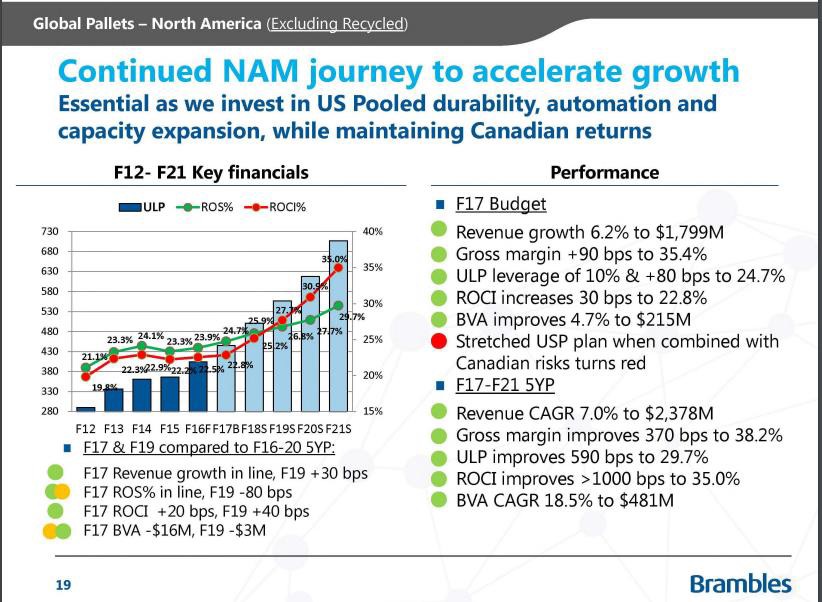
524 It described the US Pooled budget as “stretched”, and when combined with Canadian risks, ascribed a red traffic light, signifying a matter that needed to be addressed and a “high level of risk”. A later slide described the US Pooled budget as “stretched not balanced” and gave it an amber traffic light, which indicated that it was something to be aware of.
525 Todorcevski deposed that “it was my usual practice to focus on the submissions of the business divisions against the top-down guidance to interrogate any reasons for differences”. In my view that is another example of the focus on achieving alignment with the ELT Guidance Note. He deposed in his first affidavit:
…the areas I wanted to focus on in my discussion with the CHEP leadership team were sales growth, overheads and capital expenditure…. I was keen to pressure test whether the growth expectations across the other CHEP business units could be improved. Overheads and capital expenditure were a priority of mine having regard to the FY19 Targets, and the impact that higher overheads and capital expenditure could have on achieving the ROCI goals of the business.
526 He also deposed that based on his experience reviewing CHEP Global budgets in prior years, he thought “Mackie was prone to set budgets that were pessimistic, highlighting challenges and risks”. He said that he often experienced “strong pushback” from CHEP Global in stretching the numbers from the original budget submission, which he thought was “due to a recognition within CHEP [Global] of the budget flowing into the incentive program”.
527 He said:
Having regard to my prior experience settling budgets with Mackie, the overall shape of the proposed CHEP Global budget, and how it sat against the guidance, was consistent with my expectations. I thought Mackie was holding back a few opportunities to stretch the ULP growth by looking at parts of the proposed CHEP Global budget regarding capex and overheads, which I thought could be reduced.
(Emphasis added.)
528 In relation to US Pooled he said:
For US Pooled, the budget submission for revenue and ULP was tracking on course with my expectations. The price growth of 1.3%, organic growth of 1.2% and net new wins growth of 4.1%, were all within the parameters of what I expected for a mature pallets business. I was confident in the ability of the US Pooled business to achieve these targets, including the $53 million of unidentified wins, based on my observation of the track record of the sales team, led by Dan Martin, to access the opportunity in the addressable market in the United States. I reviewed the opportunities in the sales funnel…for the US Pooled business during BSR meetings and periodically. I do not recall having any concerns about the achievability of the net new wins target set by the US Pooled business.
8.10.2 Key aspects of the CHEP Global budget presentation
529 On 22 April 2016, Mackie, Kennett and Alonso presented the proposed CHEP Global budget to Gorman and Todorcevski among others.
530 Reproduced below are some tables prepared by Brambles from the CHEP Global FY17 budget presentation which compare the relevant metrics in that budget with those metrics in the FY16 February Forecast, the first year of the CHEP NA 5YP, and the Initial Budget Submissions for CHEP NA and US Pooled. The numbers are not in dispute.
(a) The table below compares the sales revenue, Underlying Profit and ROCI metrics for CHEP Global, CHEP NA and US Pooled following the Initial Budget Submissions to those metrics in the 22 April 2016 CHEP Global budget:
Budget targets ($US million) | CBU Budget Submissions to CHEP Global (24 March 2016) | CHEP Global Budget Submission to Brambles (22 April 2016) | |||
CHEP Global | |||||
Sales | 4,618.2 or 6.2% growth rate | 4,623.6 or 6.3% growth rate | |||
Underlying Profit | 1,013.4 or 5.1% growth rate | 1,034.5 or 7.3% growth rate | |||
ROCI | 22.5% | 23.3% | |||
CHEP North America | |||||
Sales | 2,373 or 5.6% growth rate | 2,376.4 or 5.7% growth rate | |||
Underlying Profit | 443 or 7% growth rate | 452.7 or 9.5% growth rate | |||
ROCI | 19.2% | 19.7% | |||
US Pooled | |||||
Sales | 1,606.1 or 6.5% growth rate | 1,609.5 or 6.7% growth rate | |||
Underlying Profit | 347.6 or 9% growth rate | 358.7 or 13% growth rate | |||
ROCI | 19.2% | 20% | |||
(b) The table below compares the relevant metrics for CHEP NA in the 22 April 2016 CHEP Global budget with those metrics in the CHEP NA FY16 February Forecast and the FY17 year of its 5YP:
($US million) | FY16 Feb Forecast | 5YP FY17 | CHEP Global Budget Submission (22 April 2016) |
Revenue | 2,247.6 | 2,411.1 | 2,376.4 |
Overheads | (190.5) | (194.5) | (202.2) |
Underlying Profit | 413.6 | 463.0 | 452.7 |
Capex | (371.6) | (330.7) | (369.4) |
ROCI | 19.3% | 20.3% | 19.7% |
(c) The table below compares the relevant metrics for US Pooled in the 22 April 2016 CHEP Global budget with those metrics in the FY16 February Forecast, the FY17 year of its 5YP, and its Initial Budget Submission:
($US million) | FY16 February Forecast | 5YP FY17 | Initial Budget Submission (24 March 2016) | CHEP Global Budget Submission (22 April 2016) |
Revenue | 1,508.2 | 1,617.5 | 1,606.1 | 1,609.5 |
Damage rate | 61.3% | 57.5% | 59.3% | 59.3% |
Overheads | (122.7) | (122) | (130.6) | (126.6) |
Underlying Profit | 309.3 | 360 | 347.6 | 358.7 |
Capex | (338.8) | (295.3) | (365.7) | (336.8) |
ROCI | 19.4% | 20.4% | 19.2% | 20.0% |
531 Brambles highlighted various matters in relation to the CHEP Global FY17 budget presentation, including the following:
(a) with respect to revenue:
(i) CHEP Global’s budgeted growth of 6.3% was below the top-down guidance of 7% in the ELT Guidance Note;
(ii) CHEP Global had experienced 7.9% sales growth in 2H16, compared to 6.8% in 1H16, indicating that the business was on an upward trajectory and had strong momentum heading into FY17;
(iii) volume growth for net new wins was driven by US Pooled, CHEP LATAM and CHEP Europe. For US Pooled, this included $21 million of rollover wins, $15 million of new business in the sales funnel and around $53 million of unidentified wins proposed in its initial budget submission. Kennett said that this was similar in proportion to the prior year. As a percentage of sales, US Pooled’s net new wins decreased by 0.1% compared to the FY16 February Forecast. CHEP Europe was budgeted to secure $26 million of rollover wins;
(iv) overall, the customer “losses” budgeted across CHEP Global for FY17 were higher than FY16;
(v) revenue was budgeted to grow at around 1.3% on price across the consolidated pooling business; and
(vi) for US Pooled, compared to the consumer price index, pricing was in line with expectations, and in line with the previous year and market; and
(b) with respect to direct costs:
(i) CHEP Global budgeted for total direct costs of $2,924 million, increased from $2,770 million in the FY16 February Forecast. Total direct costs made up 63.3% of sales, which was comparable to the figure in the FY16 February Forecast of 63.7%;
(ii) “other” direct costs included a $23 million negative impact in US Pooled, which in turn included $10 million for “collections” costs due to retailer pressure and “incremental assets recovery risk” which took into account the $2 million asset recovery risk earlier referred to;
(iii) the assumed damage rate for US Pooled was 59.3%, the same as in the US Pooled initial budget submission;
(iv) the budget had the “highest level of cost out initiatives ever at $79M, in response to meet profit guidance, offset by the lowest inflation in years [i.e., since FY14] of $42M, and requiring an increase in Plant Equipment Capital”. This was said to signal to Gorman and Todorcevski that Alonso did not think there was much room for further stretch in the supply chain budget (particularly in US Pooled), and that further capital expenditure was needed to drive automation and other efficiency investments. Brambles submitted that that was in fact the case. Alonso testified that there was no further stretch on the $79 million of supply chain savings initiatives, and that his concerns about meeting the budgeted savings initiatives were the same as he had every year;
(v) the $79 million of supply chain initiatives included $11 million in savings from the Durability Program and $10 million of ‘white space’ or unidentified go-get efficiencies. Alonso described the $11 million in savings from the Durability Program as a conservative assumption of the program’s benefits. Brambles submitted that, by this, Alonso meant that the assumed damage rate benefits in the FY17 budget were half of the total opportunity that was initially identified, and then halved again - reducing the forecasted drop in the damage rate for FY16 to FY20 from 14.99% to 8.99% and then for FY16 to FY17 from 3.8% to 1.8%. In cross-examination, Alonso clarified: “I would not say conservative or not. It was something that was still achievable and realistic. We had an opportunity. We had put actions in place to deliver. So we thought [the Durability Program] could start giving us some benefits”. Alonso further pointed out that the $11 million of benefits from the Durability Program was out of a $3 billion budget for direct costs;
(vi) without the $11 million of assumed benefits from the Durability Program, total efficiencies came to $68 million, which was in line with the $67.9 million of efficiencies achieved in FY15 (which did not include any Durability Program benefits); and
(vii) strong growth in the FY16 February Forecast was due to significant benefits and tailwinds coming from direct costs. However, benefits in FY16 from approximately $30 million of US tailwind items were not expected to reoccur in FY17;
(c) with respect to indirect costs, the budget provided for an increase in overhead costs of $32 million or 5.9% on FY16, made up of $14 million in ‘core’ overhead expenses and $18 million in ‘investment’ overhead expenses;
(d) with respect to Underlying Profit:
(i) CHEP Global’s Underlying Profit was budgeted at $1,035 million being 7.3% growth year-on-year, which would exceed the previous year’s 5YP submission on Underlying Profit by $12 million;
(ii) CHEP NA’s Underlying Profit growth was budgeted to increase from 7% in the FY16 forecast to 9.4% in FY17; and
(iii) the main challenges (or “headwinds”) for US Pooled included inflation and collection costs;
(e) in respect of capital expenditure:
(i) total capex costs were budgeted at $866 million; and
(ii) the budget forecast a $42 million year-on-year increase in capex as against the FY16 February Forecast; and
(f) with respect to ROCI:
(i) CHEP NA budgeted for a ROCI of 19.7%, well below the 20.4% which had been requested of them as a stretch;
(ii) ACI was growing ahead of target (at 8.6% instead of guidance of 6%) which impacted the ROCI by negative 1.1%, compared to the ELT Guidance Note;
(iii) the initial CBU submissions were for a ROCI of 22.4%. This budget increased that ROCI by 0.5% because of improvements to gross profit and indirect costs, and by a further 0.3% because the cycle time assumption in US Pooled was too aggressive in the US Pooled FY21 5YP and was increased to compensate; and
(iv) as a result, CHEP Global expected to achieve a ROCI of 23.3% in FY17, ‘holding flat’ and exceeding the previous year’s 5YP submission by 40bps.
532 Brambles also highlighted that the CHEP Global FY17 budget submission presentation included R&O schedules which:
(a) estimated key risks of around $20 million and key opportunities around $15 million, with an estimated financial impact weighted to risks of around $5 million. Mackie testified that those risks and opportunities were not certain enough to include in the budget; and
(b) the “Pallet Durability/Damage Rate” in US Pooled was listed as both a $2 million risk (because the Durability Program was in its early stages of implementation and there was uncertainty as to how effective it would be) and a $2 million opportunity (because, as Alonso testified, the reduced damage rate assumption was conservative and there was scope for the program to deliver benefits in excess of the budget).
533 Mackie and Kennett each testified that they considered the proposed CHEP Global budget to be realistic and achievable. Mackie deposed:
I thought the budget presented was realistic and achievable. I had confidence that the CBUs would deliver the growth rates in their submissions. While the budget included elements of stretch and risk, those were no more significant than any previous budget I set during my time as Group President.
As I later explain, that is quite different to what he said in his email to Gorman on 19 April 2016 and his emails to Todorcevski on 9-11 May 2016, to which I will shortly go.
534 Kennett deposed that:
At this point in time, I considered that the draft CHEP Global FY17 budget was achievable and reasonable, having regard to:
(a) the rigorous budget planning process we undertook, including the development of the FY17 budget planning instructions, templates and assumptions…;
(b) my detailed review of the CHEP CBU FY17 budget presentations and the detailed analysis my team and I undertook in connection with the March CBU budget reviews…;
(c) the rigorous analysis I observed was undertaken by other CHEP Global team members, Mackie and Alonso-Bernaola, in connection with the CHEP CBU budget presentations and development of the consolidated CHEP Global FY17 budget;
(d) my detailed review, analysis and development of the consolidated CHEP Global FY17 budget, before and after the CBU budget reviews…;
(e) my understanding of the CHEP business, including year on year trends and the strong track record against budget each year; the FY16 year to date performance of the CHEP business, across the portfolio of CHEP CBUs;
(f) the STI policy that provided a disincentive for CBUs to set unachievable or unreasonable budgets and created instead a structured incentive for the businesses to set achievable budgets…; and
(g) the matters described [elsewhere in his first affidavit] including my usual practices and how I satisfied myself as to the reasonableness of the CHEP Global and CBU FY17 budget numbers.
535 That was, of course, quite different to what Kennett accepted was the position when he approved Mackie’s 19 April 2016 email to Gorman.
536 Mackie gave evidence that, once the CHEP CBU budgets had been agreed with CBU management, there was strong internal support regarding the achievability of the CHEP Global budget. He said:
So, after those letters, arming me for the budget discussion with Tom, Buster [Kennett], myself, Carmelo [Alonso] and Cesare had an incredibly intense period going through the final budget presentation to Tom… to actually get the budget either agreed or through to the next round of discussions. So they were all completely behind what was presented at that point…
I give little weight to Mackie’s testimony that everyone was “completely behind” the CHEP Global budget presentation. Centrally that is because that evidence is inconsistent with, or at least jars with, the contemporaneous emails. It also jars with Alonso’s evidence about the level of stretch and risk in the CHEP NA budget.
537 Mackie also deposed that he allowed some room in the CHEP Global FY17 draft budget to enhance performance in anticipation of further requests for budget stretch in the budget review process with Gorman and Todorcevski. As I later explain, I do not give much weight to that evidence.
538 On 26 April 2016, Scaiff emailed Mackie and Kennett (copied to Gorman and Todorcevski, among others) attaching the “notes and action points” he had taken down during the CHEP Global FY17 budget presentation meeting on 22 April 2016. The meeting notes record that:
(a) “Lack of ROCI growth is a key issue in the current FY17 budget - particularly when compared to historic improvement and future expectations”; and
(b) “Control ratio improvement in FY17 - 0.8% USA, 0.3% in Europe - used as a stretch to reduce capex to get to ROCI target”.
Kennett accepted that the latter indicated a requirement for improvement in the control ratios when the CHEP Global budget FY17 was ultimately presented, with a view to reducing capital expenditure, so as to enhance the prospect of reaching the ROCI target. In my view the meeting notes indicated that CHEP Global could expect a request or directive from top-level management for further stretching of Underlying Profit, so as to show better progress towards meeting the expectations for ROCI in the ELT Guidance Note.
539 In contrast, the applicants highlighted that the budget presentation gave an amber traffic light for the “stretched not balanced” US Pooled budget and a red traffic light (meaning a high level of risk) for the stretched US Pooled budget when combined with Canadian risks. That is, they contended that the budget was aggressive rather than conservative.
540 Kennett was taken to the CHEP Global FY17 budget presentation, which said that “US Pooled has major risk on both win and loss assumptions”. Kennett accepted that there was a major risk that the assumptions in relation to customer “wins” would prove to be overstated in FY17, and he accepted that the forecast customer “wins” did not occur. But he said that was balanced out by an equal and opposite risk that the “loss” assumptions would prove to be overstated. I do not accept that is what the budget presentation meant. It is unlikely that the assessment that there was a “major risk” in relation to the customer “loss” assumptions was a reference to the possibility of the (happy) result that the loss assumption would prove to be overstated, and that US Pooled would therefore enjoy a better sales revenue result in FY17. In my view, the budget presentation was more likely to have been referring to the risk that the customer “loss” assumption would be understated, which was a risk to sales revenue.
8.10.3 Mackie’s 19 April 2016 email to Gorman
541 I earlier set out Mackie’s and Kennett’s evidence regarding their view as to the reasonable achievability of the CHEP Global budget at that stage. But as previously noted, Mackie’s contemporaneous emails paint a quite different picture as to the aggressiveness of the assumptions and the level of stretch (and hence risk to achievability) in the proposed CHEP Global budget.
542 On 17 April 2016, Mackie emailed Kennett a draft of an email he proposed to send to Gorman regarding the CHEP Global budget. He asked Kennett to undertake a “sanity check” of his proposed email and to make sure the numbers were correct. Kennett responded by email on 18 April 2016 making some minor changes. In cross-examination, Kennett accepted that Mackie’s email was accurate and also reflected his own views at the time.
543 On 19 April 2016, Mackie sent the email to Gorman. It said:
I believe it might be prudent this year for you and I to catch up on the budget ahead of the session on Friday to discuss where we have got to. We are close to guidance but the stretch in the numbers is excessive to overcome some key issues and allow investment in human capital. If the add up at the group level doesn’t work then I think we will have a problem again, hopefully we are close enough.
…
We are in-line with the margins ULP 22.4% and ROCI 23.3% after a significant [gross margin] stretch on FY16F of +40 ppt but adrift in absolute ULP, initially $1,013m but post stretch $1,035m and marginally short of guidance. The main issue driving the real ULP gap to guidance, if you put aside the stretch to self-fund the human capital investment, is the top line gap of 0.7ppt to 7% guidance. The budget submissions contain very aggressive assumptions on volume as always but we have been unable to additionally offset the 0.6 ppt compared to our DecF 5YP…
…
With the absolute issue in ULP we have also stretched every aspect of ACI we can to get the ROCI in the right place.
(Emphasis added.)
544 There, rather than describing the CHEP Global budget as realistic and achievable (or challenging but achievable), Mackie, with Kennett’s concurrence, expressed concerns about the level of stretch in the draft CHEP Global budget he was about to submit, and suggested that he and Gorman have a discussion ahead of the budget review meeting. To recap the email, Mackie said:
(a) the proposed CHEP Global budget was “close” to the guidance in the ELT Guidance Note, but the stretch in the numbers to get there was “excessive”;
(b) there had been “significant” gross margin stretch from FY16;
(c) the budget was based on “very aggressive assumptions on volume as always”, but the 5YP provided for growth of 6.9% whereas they had only been able to get to 6.3%; and
(d) with the “absolute issue” being Underlying Profit every aspect of ACI that could be stretched had been in order “to get the ROCI in the right place”.
Kennett testified that the shortfall of 0.6 pps represented approximately $30 million in sales revenue.
545 In my view, this email shows not only the stretch in the draft CHEP Global budget, but also the focus on achieving alignment of the budget with the guidance in the ELT Guidance Note.
546 In relation to this email, Mackie deposed:
I wanted Gorman to be aware of the stretch already incorporated in the budget submission from my reviews with the business unit leaders and the work undertaken to get the budget to that point. While I was expecting Gorman and Todorcevski to request additional stretch following the budget presentation, I was seeking to position the budget with Gorman in a way that limited the extent of the request for further adjustments.
547 In cross-examination he went somewhat further. He denied that his email to Gorman reflected his true views in relation to the CHEP Global budget, and he said, in effect, that he was deliberately exaggerating.
8.10.4 Budget review meeting for CHEP Global budget - 22 April 2016
548 On 22 April 2016, Mackie, Kennett and Alonso presented the CHEP Global budget to Gorman, Todorcevski, Scaiff, Moreno, Glick, Holley and Jackie Callaway (Group Financial Controller).
549 The presentation was an updated version of the pre-read document Kennett distributed in advance of the meeting. A draft of the presentation distributed on 16 April 2016 included the following statement (which was not included in the final version):
This plan - based on the assumptions in place today - represents a stretched but challenging target, with significant risk. We have pushed the regions to deliver an additional $22M ULP above their original submissions, as well as reducing and phasing capex to improve the ACI initially reviewed.
(Emphasis in original.)
550 The final version of the presentation projected sales revenue growth in FY17 in line with the level that was expected to be achieved in FY16, which was stated to be the highest level in 10 years. It included the following slide showing annual sales revenue over the period from FY12:
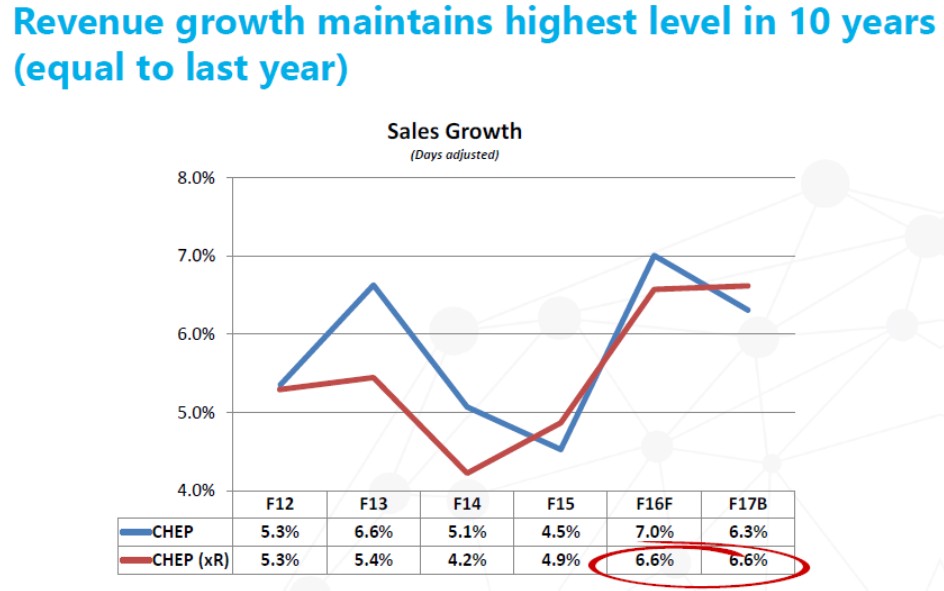
551 The presentation also included a slide headed “Direct Costs - Highlights” which stated in relation to the FY17 budget that:
Highest level of cost out initiatives ever at $79M, in response to meet profit guidance, offset by lowest inflation in years of $42M, and requiring an increase in Plant Equipment Capital.
552 It projected gross annual savings of $79 million to offset increased costs due to inflationary impacts of $42.3 million. The annual savings included:
(a) $11 million from the Durability Program; and
(b) $10 million of ‘white space’.
553 The presentation included:
(a) the key details of the budget showing revenue of $4.6 billion (6.3% growth), Underlying Profit of $1,035 million (7.3% growth) and ROCI “holding… flat whilst investing in the long term future”, which Mackie deposed was intended to mean that it was on track to meet the 20% projection for FY19;
(b) details of the key risks and opportunities, with an “imbalance of risks of approx. ~$5M”, which Mackie deposed was intended to mean that there was an estimated financial impact weighted to risks of around $5 million. The US Pooled Durability Program was presented as a risk of $2 million, as well as an opportunity of $2 million, which Mackie said was because of both the risk that the program may not deliver on damage rate as anticipated, but also the chance that it could exceed the budget;
(c) an overview of the FY16 February Forecast, which included full-year growth of 7.3% in sales (or 7% on a days-adjusted basis) and 9.6% in Underlying Profit. Mackie deposed that the FY16 performance was an important factor in considering the FY17 budget as it provided an indication of the prevailing business performance and momentum heading into FY17;
(d) an overview of the FY17 forecast, including a table which set out the FY17 budget against the top-down guidance in the ELT Guidance Note with traffic light indicators. Mackie deposed he intended to show how the budget landed against the guidance. Among other things it showed sales growth of 6.3% against guidance of >7% (with a note stating: “Main shortfall caused by Recycled -0.6%, and 1 less day -0.3%”, which Mackie intended to refer to there being one fewer business day in FY17). The table stated that the sales growth comprised 4.7% growth from mature markets and 16.3% growth from emerging markets. The traffic light indicator for sales growth was both amber and green, which Mackie said reflected the mixed projection in performance for mature markets and emerging markets against the top-down guidance. It included a waterfall graph which Mackie said he thought illustrated the portfolio nature of the business. He intended to show that the softness in sales growth caused by the headwinds in US Recycled and the loss of one business day were partially offset by higher growth assumptions in other geographies, including Europe, LATAM and Asia-Pacific. ROCI was at 23.3%, in-line with guidance of >23.5% and marked with a green traffic light;
(e) an overview of growth rates for CHEP NA showed that, excluding US Recycled, the FY17 revenue growth across North America was projected at 6.2% to $1,799 million and Underlying Profit margin growth was forecast at 10%, which was described as “leverage” because it was more than the revenue growth. The slide referred to the US Pooled FY17 budget as “stretched” and when combined with Canadian risks was assigned a red traffic light. Mackie deposed that was for the purpose of indicating to Gorman and Todorcevski that “the US Pooled budget had been carefully assessed through multiple rounds of review and to limit the extent to which further stretch was proposed following the review”. Other FY17 budget factors such as revenue growth, Underlying Profit leverage and ROCI increases were assigned the green light to indicate they were on track. The slide which focused on US Pooled assigned an amber light to the risk that the US Pooled budget was “stretched not balanced”. Kennett gave evidence that there was discussion around whether it and the individual items related to it should have been red; and
(f) various slides devoted to other CBUs some of which were positive about prospects for improvement in sales revenue and Underlying Profit. For example:
(i) an overview of the CHEP LATAM FY17 budget and projections for the FY21 5YP, which referred to “significant profit improvement” and “[a]ccelerating growth”. The FY17 LATAM budget included 19.2% revenue growth to $301 million and a 21% increase in the Underlying Profit margin to 24.6%. Mackie stated that he considered there were significant growth opportunities in South America;
(ii) an overview of the CHEP Europe FY17 budget and projections for the FY21 5YP, which stated that the business unit was “ahead of prior long term targets”. The CHEP Europe budget included the “highest sales growth in 10 years” of 4.2% to $1,269 million and 2.8% growth in the Underlying Profit margin to 25.6%. The Underlying Profit growth was described as “deleverage” as it was less than the revenue growth. Mackie deposed that, following a number of years of relatively stagnant growth, the Underlying Profit for CHEP Europe had increased from approximately $200 million in FY12 to more than $300 million in the FY16 forecast. He said that, although projected Underlying Profit growth for FY17 was 2.8%, and there was a need to defend price to retain large accounts, given the growth trajectory of that CBU over the previous five years he was confident CHEP Europe was well placed for sustained top line growth in FY17; and
(iii) an overview of the CHEP AIME FY17 budget and projections for the FY21 5YP, which were “on track” with the long-term growth targets of the CBU. The projected revenue growth in FY17 for CHEP AIME was 14.5% to $223 million, and while there was no leverage in the bottom-line growth, the Underlying Profit of the business unit was estimated to deliver an Underlying Profit margin of 37.3% in FY17. Mackie deposed that South Africa was the main geographic region that contributed to the performance of CHEP AIME and was a highly profitable region for CHEP.
554 Mackie deposed that in preparing the annual CHEP Global budgets he considered the projections of the CBUs as a collective whole. He said that although Brambles had a track record of achieving its market guidance, it was always the case that part of the business was over-delivering against its budget and part of the business was underperforming. He did not recall one year where every part of the business delivered for the year exactly as forecast in the budget.
555 He also stated that CHEP NA and CHEP Europe were the business units that contributed most substantively to the financial results of CHEP Global. He said that, if there was any underperformance against budget in either CHEP NA or CHEP Europe, it was generally offset by outperformance against budget in the other CBU and in additional regions including South Africa (which formed part of CHEP AIME) and Mexico (which formed part of CHEP LATAM) where CHEP operated at a higher profit margin than other parts of the business and there was often scope to push the business and over-deliver against budget.
556 In cross-examination Todorcevski said that he recalled Mackie telling him at the time the CHEP Global budget was presented that the budget for US Pooled was already stretched. He also testified that Mackie “was one of the best supply-chain logistics executives I’ve worked with”; he trusted Mackie’s assessment of the risks facing CHEP Global; and he was confident in both Mackie and Kennett’s ability to run the CHEP Global business.
8.10.5 Further stretch to the CHEP Global budget - 7 May to 19 May 2016
557 Upon receiving the proposed CHEP Global budget on 22 April 2016, Gorman and Todorcevski analysed and proposed some stretches to it, which was met with strenuous pushback by Mackie. Mackie, Kennett and Alonso each characterised the proposed stretch and pushback as a standard part of the budget-setting process which occurred each year.
558 On 7 May 2016, Gorman emailed Mackie and each President of the CHEP CBUs and expressed the view that the CHEP Global budget was not showing sufficient growth in Underlying Profit or sufficient improvement in ROCI. He wrote:
…Although the Revenue growth commitments are solid, we are not showing any year-over-year ULP margin increase or ROCI improvement. The primary areas requiring improvement are in the growth rate of overhead cost and the Capex increase.
I have asked Zlatko [Todorcevski] to contact you directly with the assessment of improvements required. I appreciate greatly your commitment to delivering the improvements required to put us on the trajectory to reach our medium term targets. We have developed an enormous amount of market credibility and we are delivering great results for our people, our customers and our shareholders. Your commitment to improving the FY17 Budget is appreciated.
(Emphasis added.)
559 Mackie testified that he did not understand Gorman’s statements as a direction that the CHEP Global budget needed to be stretched to incorporate budget improvements. That would subsequently be proposed by Todorcevski. He said that while Gorman and Todorcevski could make requests and propose budget improvements, setting the CHEP Global budget was Mackie’s responsibility. In his view, the email was just a “negotiating stance” by Gorman, in which Gorman was positioning himself for the budget review discussions.
560 I give little weight to Mackie’s evidence that Gorman’s email was just a negotiating stance. The following matters are material to my view:
(a) Gorman expressly said that Todorcevski would directly contact Mackie with the required budget improvements. He did not say that Todorcevski would seek the best endeavours of CBU management or their agreement to the proposed budget stretches. The email itself is the most reliable evidence.
(b) Todorcevski subsequently contacted Mackie and sought some further stretches. He did not get everything he asked for but the stretches he achieved were over Mackie’s strenuous opposition.
(c) The contemporaneous emails tend to show that de facto power in relation to proposed stretches to the CHEP Global budget lay with Gorman and Todorcevski, rather than with Mackie.
561 On 9 May 2016, in the contact foreshadowed in Gorman’s 7 May 2016 email, Todorcevski emailed Mackie (copied to Kennett and Callaway). He referred to Gorman’s email and sought an increase of $12 million in Underlying Profit (by reducing expenditure on overheads) and a significant capital expenditure reduction in relation to both hire stock (i.e., pallets) and non-hire stock (i.e., plant and equipment used in the service and storage of pooled pallets). The email said:
As we discussed in Atlanta the main concern with the Pallets FY17 Budget was the lack of ROCI improvement driven by the level of overhead and capex growth. We would therefore like you to reduce both as follows:
US$M June 15 fx rates | Profit | Cashflow Impact | Average Capital Invested |
Overheads Capex (pooling and NHS) | 12 | 12 40 | (20) |
Total | 12 | 52 | (20) |
I am flexible on which CBU’s these modifications are taken in but will note that showing positive improvement in US Pooling is critical to the strong momentum we have developed this financial year.
Rest assured that all BU’s and Corporate are being asked to contribute to the challenge.
These modifications must be locked down and finalised (for the budget and flow-on implications in the 5YP) in BRACS by 20 May.
…
Thank you for your support in drawing this process to a successful conclusion.…
(Emphasis added.)
As the applicants submitted, Todorcevski’s email was emblematic of the top-down pressure management exerted on CHEP CBUs to show “momentum” in their budget proposals towards Brambles’ predetermined goals set out in the ELT Guidance Note.
562 Brambles sought to characterise Todorcevski’s 9 May 2016 email as a request with which Mackie was not bound to comply. I do not accept that. Although Todorcevski’s email referred to what Gorman and Todorcevski “would like”, it expressly said the stretches “must be locked down and finalised” in the budget within 10 days. The only flexibility Todorcevski agreed to provide was as to where the stretches were taken in the CHEP Global budget, rather than Mackie having a choice as to whether to accept the proposed stretches. Todorcevski also expressly said that some of the stretch needed to come from US Pooled.
563 In cross-examination, Alonso did not accept that, when directions to stretch the budget came from Todorcevski and Gorman, Mackie had no choice but to put it in the budget. He stated: “Well, they could have always said no. The choice - you always have the choice to say no”. That testimony was, though, inconsistent with other evidence which to my mind shows that, in reality, it was far from easy to just say “no”. That other evidence includes:
(a) the email exchange between Kennett and Rumph on 5-6 October 2016 referred to above;
(b) Alonso’s evidence that in the budget-setting process, management sometimes said: “We need to get to this number. You can pull things out from here or there, but get to the number”; and
(c) the strong pressure Todorcevski put on Mackie when he did say “no”, including a threat that rejecting the proposed stretch would reduce Mackie’s prospects of being appointed CEO.
564 Mackie was able to say “no” to the further stretch that Todorcevski sought, but it is clear from contemporaneous emails that Todorcevski was not easily turned away, he applied substantial pressure, and although he did not get all the stretch that he asked for, he achieved some further stretch over Mackie’s strenuous objections.
565 It is plain from the email exchanges at the time that Kennett was shocked by the size and nature of the budget stretches that Todorcevski sought. Kennett deposed that: “At the time I received Todorcevski’s email, my initial reaction was one of surprise, because these adjustments were what I considered as significant. In addition, I thought that no indication of this sort of requirement was provided at the end of our budget presentation”. Under cross-examination, Kennett denied that he was “shocked” by Todorcevski’s email; he maintained that he was only “surprised” by it, and he denied that calling it a “surprise” would be an understatement.
566 Kennett was then taken to an email he sent to Thompsen on 9 May 2016, to which he attached Todorcevski’s email, in which he said:
For info (if you respond - respond only to me please!).
I was a little in shock when I saw these numbers (understatement).
I’ve spoken with Pete, and will speak with Zlatko tomorrow - no idea where this has come from!!!
(Emphasis added.)
567 Kennett did not refer to that email in his affidavit. Upon being shown the email, he accepted that he was, in fact, “shocked”, but he tried to explain that away by saying that there was “not a lot of difference” between the two. Kennett’s preparedness to (incorrectly) maintain his denial that he was shocked at the time contributed to my concerns about the reliability of his evidence regarding everyday business communications that occurred around six years earlier and about which there was no particular reason to take note or to recall.
568 Mackie’s response to Todorcevski’s email also indicated shock at the size and nature of the budget stretches being proposed. In an email to Todorcevski on 9 May 2016 he said:
I thought we were close? Look at [CHEP NA excluding Recycled] - it does not make sense to stretch this another 12m/40m…
569 Mackie strongly opposed the proposed stretch. In another email to Todorcevski on 9 May 2016 he said:
I will look at both profit and capex today but it is highly unlikely I can commit to these levels, I will give you what we think is deliverable and allows traction in growth initiatives.
570 Kennett deposed that Mackie’s email was consistent with his business style and usual practice, in that Mackie was saying that he would do what he could to achieve what was being asked of the CHEP Global business but would not commit to the numbers requested. He said that he agreed with Mackie’s approach and the sentiment of his email. Kennett said that in this period he worked with Alonso, Thompsen, Mackie and the FP&A team, as well as the CBU teams, to identify ways Brambles might achieve a reduction in overheads and capex in the CHEP Global budget.
571 Mackie deposed:
Based on my previous involvement in the annual budget setting process, and Gorman’s email, I expected Todorcevski made similar requests of the other business divisions. For this reason, in response to Todorcevski, I initially refused to include the reductions requested to the FY17 budget because it wasn’t clear to me how much of the total request for reduced overheads and capex was sought from CHEP Global. Although I thought there was some room in the FY17 budget for CHEP to absorb a proportion of the ask, I was not willing to immediately stretch the budget to incorporate the request due to a concern that there would be further requests made of CHEP if I agreed too readily to the request. I also wanted to position to Todorcevski that the budget submissions of the CHEP business units were already stretched and that [US] Recycled was dragging down the overall performance of the business division, which was otherwise broadly on course with the top down guidance.
572 In an email to Mackie on 10 May 2016, Todorcevski identified for Mackie what he saw as the “logic” of the proposed budget stretches. Todorcevski said:
Pete - the logic here is to get your overheads back down to 4% growth - not a reduction but a slower growth and aligned with the guidance.
On capex, we have another unsustainably high capex ask across the group, as we did 12 months ago year. It currently sits at $1.25bn for FY17. You’ll recall last year it was an issue of affordability because the capex tipped us over the leverage policy targets we set. This year it’s more about the massive capex increase on FY16 (20%) delivering a flat ROCI outcome on reasonable ULP growth.
… It’s about showing progress from where we think FY16 will land, with leverage in ULP and moderate progress in ROCI (but still not the 1pp per annum that we originally targeted).
(Emphasis added.)
That email again shows the focus on achieving alignment with the ELT Guidance Note.
573 In an email in response the same day Mackie continued to strongly resist the proposed stretches. He said:
… I have no intention of taking $12m out of overheads on top of the existing stretch I have put there on one Better and sticking to the 5 year plan growth numbers. At a stretch I could phase a little bit but that is $1-2m. The only remaining lever I have is delaying the quality opex so this needs to be compared with other choices given this will be the 4th year it has been delayed in Brambles key business. Again we could phase this, assuming a slower roll out but it is also in the region of is $1-2m
On ROCI I think you need to look at the performance excluding recycled to understand how aggressive the pallets budget is and we have played lever to get ROCI to guidance overall so I think the capex is already risky, as we discussed in the budget review. Carmelo [Alonso] thinks we may be able to get some of the 3rd parties to share investments but probably only in the region of $10m…
(Emphasis added.)
574 There, Mackie rejected the proposed stretch on the basis that the proposed CHEP Global FY17 budget was already aggressive, that it had required stretch to get ROCI into alignment with the ELT Guidance Note and the capex was already risky.
575 Todorcevski did not accept Mackie’s response. He said:
Just so I’m clear, are you saying you won’t flow through these changes?
I don’t think there’s any real stretch in the one better numbers that have been picked up at the BU level….
We can’t ignore Recycled. The good work done in Pooled this year will fall away if you can’t show progress next year and talking about performance ex recycled will get little traction with the board and market.
My few cents worth what it’s worth but I do need to understand if you’re flat out refusing to make these changes.
(Emphasis added.)
There, Todorcevski challenged Mackie to say that CHEP Global would not comply with the stretches that Todorcevski said were required.
576 Mackie was not deterred by Todorcevski’s tone. He responded by email on 11 May 2016:
These numbers won’t be delivered on top of a very stretched 1st submission so I won’t commit to this request. What I don’t understand is how: ‘we are very close’ translates to this level of stretch.
(Emphasis added.)
577 Todorcevski responded by email on 11 May in which he said:
4% increase in overheads rather than 6% doesn’t feel like a stretch to me and dropping $40m of capex on the increased base you have isn’t a big ask. Obviously you feel differently.
I’m happy to discuss Pete but doesn’t feel like there’s much value and we can leave to Tom [Gorman] to decide.
You just need to make sure this is the outcome you want with everything else happening in the background.… I’ve tried to help but this will go beyond me.
(Emphasis added.)
578 Neither Todorcevski nor Mackie referred to that last email in their otherwise comprehensive and highly detailed affidavits. Todorcevski was taken to that email and he accepted that his reference to “everything else happening in the background” was a reference to Mackie’s application for appointment as CEO, to replace Gorman whose retirement was to be announced in August. He testified that he was telling Mackie that “he had submitted a five-year plan that was quite different in shape to what he was now proposing in the budget, and I think that would reflect poorly in front of the Board for him”.
579 Mackie also accepted that Todorcevski was referring to his application to be appointed as CEO and indicating that the Board would look less favourably on his application if he did not agree to the proposed stretches. The applicants put to Mackie that the email constituted a threat. Mackie initially refused to accept that Todorcevski’s email was a threat, and he described it as “a tactic in a negotiation” used “to try and influence me into agreeing what he wanted”. But when pressed he agreed that it was a “threat” but said that he did not consider it to be “a credible threat” and that the email had no effect on him. Todorcevski’s email was plainly a threat. It is another piece of evidence supporting the inference that it was very difficult to reject stretches proposed by higher-level management, and unlikely that the stretches that were proposed could be entirely escaped.
580 Later, on 11 May 2016, Mackie responded to Todorcevski’s email and said:
The issue is the stretch when combined with what I have done already to the budget on direct cost and capex. I appreciate the help but see little point in writing down a number I know wont be delivered and requires choices that continue to weaken the core business of the group even to get close. There has to be a better way through this?
(Emphasis added.)
581 As I said earlier, Mackie sought to characterise this exchange as part of a budget negotiation with Todorcevski, which involved posturing and deliberate exaggeration by both sides. For the reasons previously explained I do not consider that evidence to be reliable and I give it little weight.
582 On 18 May 2016, Todorcevski emailed Mackie and asked for a phone call, as he had heard from Kennett that CHEP Global had not “yet landed where [Mackie felt] comfortable on adjustments to the FY17 budget, for ULP and capex/cash”. Mackie and Todorcevski had that phone call on 18 May 2016. Mackie noted in a subsequent email that he was hopeful there was a middle ground they could get to. Following that call, Todorcevski emailed Gorman on 18 May 2016 and reported on progress in his discussions with Mackie. He said:
Tom - just caught up with Pete. Won’t get what we asked for but some progress.
Overheads he feels there’s no room - outside of merit increase, all increases are for strategic initiatives…
He feels there’s some opportunity on direct costs and will come through tomorrow with something he will commit to.
On capex, doesn’t feel $40m is achievable but can get to $25m and will also confirm that…
583 On 19 May 2016, Mackie emailed Todorcevski (copied to Kennett) and said he had instructed his team to make changes to the Second Revised Budget Submission that would result in an improvement in CHEP Global of $7.8 million in Underlying Profit and $15 million in capex, which changes were agreed by Todorcevski. I have described this as the CHEP Global Revised Budget Submission. On 19 May 2016, Mackie instructed Rumph to revise the budget for CHEP NA by reducing costs (and thereby increasing Underlying Profit) by $4 million and reducing capex by an additional $10 million. Thus, CHEP NA was to bear a significant proportion of the burden of the further stretch.
584 As the applicants submitted, the reaction to the proposed changes from CHEP NA management and from Alonso contradicted any suggestion that the budget-setting process was in substance a bottom-up one. On 19 May Alonso emailed Rumph and said:
I think we all realize how stretch[ed] the direct cost budget is now with limited capital, but I am keeping confident on the team and their commitment and focus to deliver (but any help by releasing some money form [sic] other line items will be more than welcome! :)
(Emphasis added.)
It should be recalled that, before this latest stretch, Alonso’s evidence was that the assumed probability for delivery of $79 million in cost saving initiatives in the CHEP NA FY17 budget had been increased from the usual 75% probability to “+95%” probability and thus had no “margin for error at all”. He said that it would require “perfect execution” and now there would be less money available to run the costs savings initiatives.And he had said that if there was any additional stretch to the US Pooled budget from the CHEP NA Second Revised Budget Submission “it would put the US business in a very difficult position to achieve any target”.
585 Rumph responded to Alonso’s email on 20 May 2016:
Carmelo - we’re all in this together, so let’s just leave it as prescribed and we will find a way to hit the numbers together.
Contrary to Brambles’ submission, this email does not show that Rumph was confident of meeting the CHEP NA budget. Understood in the context of her earlier emails, I infer that she considered the CHEP NA budget to be a “huge stretch” and hence to have real risks to achievability, but thought the best way to deal with the situation was for her and her team to knuckle down and do their best.
586 Lallatin had a similar view about the further stretch. He emailed Kennett on 20 May 2016 and said:
Regarding Capex, this only leaves Chris with $4M of non-hire stock capex. I honestly believe we are setting ourselves up for failure. He has to deliver over $30M of initiatives. Was there any thought given to putting the stretch on hire stock Capex instead?
(Emphasis added.)
587 I accept Brambles’ submission that the full context of the email correspondence shows that Todorcevski told Mackie that he “would like” an increase in Underlying Profit by $12 million, and a reduction of capex by $40 million, and that after a period of negotiation, Mackie agreed to:
(a) an increase in Underlying Profit of $7.8 million;
(b) a reduction in capex by $15 million; and
(c) no increase in sales revenue growth beyond 6.3%, which was below the ELT Guidance Note.
588 Mackie testified that he viewed the changes to the budget that he had agreed to with Todorcevski as a “good outcome” at the end of a very tough few days of negotiation, and he came away from the negotiation “with specific changes that I knew how to implement”.
8.10.6 Mackie’s evidence regarding the CHEP Global budget
589 As I have said, Mackie testified, in effect, that his 19 April 2016 email to Gorman did not reflect his true views regarding the proposed CHEP Global budget, and that instead he was exaggerating in order to position CHEP Global in the forthcoming budget negotiation process. Rather than the CHEP Global budget having “excessive” stretch Mackie said that he had left some room in the budget in case there were requests from Gorman and Todorcevski for further stretch. He testified that he thought there was scope to further stretch the CHEP NA budget but he decided to wait until he had presented the CHEP Global budget to Gorman and Todorcevski and he held back some room for further stretching of the CHEP NA budget if necessary. He said that he knew that Gorman and Todorcevski would try to stretch the budget further, as he “hadn’t experienced a year where there wasn’t a robust discussion about, ‘[y]ou could do more’”. In Mackie’s view, it would have been “ludicrous” for him to enter the budget review process saying that “I think this budget will be easy to hit”, and he did not take that approach.
590 Again, in my view, the most reliable evidence of what Mackie thought about the level of stretch and risk in the CHEP Global budget at this point in time are his statements in his contemporaneous emails. I prefer the contemporaneous documentary record to his recollection as to what he thought about otherwise mundane business matters more than five years after the event, much of which was a reconstruction with the assistance of lawyers. I infer that Mackie thought that the CHEP Global budget was stretched and aggressive, but nevertheless achievable. The following matters are material to my view.
591 First, in his 19 April 2016 email to Gorman, Mackie said the stretch in the numbers in the CHEP Global budget was “excessive”; the gross margin stretch on the FY16 February Forecast was “significant”; the budget contained “very aggressive assumptions on volume”; and that every aspect of ACI had been stretched “to get the ROCI in the right place”. And in his emails to Todorcevski between 9-11 May 2016, Mackie described the proposed CHEP Global FY17 budget as “very stretched” and said that Todorcevski needed to look at performance excluding US Recycled “to understand how aggressive the pallets budget is and we have played lever[age] to get ROCI to guidance overall”. As I have said, his contemporaneous emails are the most reliable evidence of what he thought at the time.
592 Second, there is nothing in the contemporaneous documentary record to support an inference that, in his 19 April 2016 email, Mackie deliberately overstated the aggressiveness of the assumptions and the level of stretch in the CHEP Global budget. I would expect that, if it were Mackie’s plan to mislead Gorman and Todorcevski in the budget review discussions, there would have been some communication between him and Kennett, at least to make sure they were on the same page. Yet there is no evidence, either in contemporaneous emails or in their testimony, of any communication between Mackie and Kennett in which they agreed to express exaggerated views about the level of stretch and risk in the budget. In fact, the evidence goes the other way. Kennett testified that the views Mackie expressed in his 19 April 2016 email reflected their true concerns at the time, and he did not describe the email as a positioning tactic.
593 Third, the views Mackie expressed in his 19 April 2016 email to Gorman and his 9-11 May 2016 emails to Todorcevski were, at a high level, consistent with the views expressed in emails by Rumph, Lallatin and Alonso earlier that month. Mackie’s testimony that, at that time, the CHEP Global budget left some “room to move” (or ‘fat’) is completely inconsistent with Alonso’s Risks Email, as well as his own emails.
594 Fourth, as previously described, the primary thrust of Brambles’ lay evidence was that the budget-setting process for CHEP Global was a bona fide and analytical management process. Mackie’s evidence was contrary to that. His evidence was to the effect that, rather than an analytical process aimed at understanding whether the budget assumptions had a reasonable basis, the budget review process in relation to the CHEP Global budget involved a “negotiation” involving deliberate exaggeration. In effect, he testified that:
(a) Rumph and Lallatin did not inform him and Kennett of their true views or concerns about the CHEP NA budget and instead deliberately exaggerated the aggressiveness of the assumptions, the level of stretch, and hence the risks to achievability of the budget; and
(b) then he did not inform Gorman and Todorcevski of his true views or concerns about the CHEP Global budget and instead deliberately exaggerated the aggressiveness of the assumptions, the level of stretch, and hence the risks to achievability of the budget.
595 At all material times, Brambles was a huge multinational corporation with a turnover in FY16 of more than $5,535 million. CHEP NA, the CBU Rumph headed, had a turnover of $2,224 million in FY16, and CHEP Global, the division Mackie headed, had a turnover of around $4,090 million. There is a strong sense of unreality in Mackie’s evidence that in a business of this size and complexity, Rumph actively sought to mislead him about the CHEP NA budget, and he actively sought to mislead Gorman and Todorcevski about the CHEP Global budget. Accepting his evidence would mean concluding that the budget review process was some sort of elaborate pantomime, involving disingenuous claims by different levels of senior management in which each sought to mislead the level above about their true views as to the level of stretch and risk associated with the budget. I give little weight to his evidence in this regard. His evidence was inconsistent with the contemporaneous documentary record, and inherently unlikely. It is more likely than not that his contemporaneous emails reflected his genuinely held views at that time about the aggressiveness of the assumptions and the level of stretch and risk in the CHEP Global budget.
596 Fifth, it is significant that Kennett was involved in the presentation of the CHEP Global budget to Gorman and Todorcevski at the budget review meeting on 22 April 2016. He did not say that in that meeting, Mackie exaggerated the level of stretch or risk in the CHEP Global budget. Nor did he state that Mackie presented a pessimistic budget which exaggerated the level of stretch or risks. Rather, he said that Mackie’s practice, “just like mine, was to present a realistic and achievable budget”.
597 Alonso was also involved in the presentation of the CHEP Global FY17 budget to Gorman and Todorcevski. He did not state that Mackie presented the budget in a pessimistic way or that he accentuated the level of stretch or risk in the budget. Todorcevski was the other side in the asserted budget “negotiation” with Mackie, and he did not say that Mackie was deliberately exaggerating the stretch or risks in the CHEP Global budget. Instead, Todorcevski said that in his emails and discussions, Mackie was expressing his genuinely held views (albeit different to those held by Todorcevski), and was telling him in clear terms that the CHEP Global budget was stretched as far as it possibly could be.
598 Thus, if his evidence is accepted, Mackie was the only person who believed that he was involved in a budget negotiation in which the different sides either deliberately exaggerated or deliberately minimised the aggressiveness of the assumptions and the level of stretch, and hence risk to achievability, of the proposed CHEP Global budget.
599 Sixth, the evidence shows that Mackie went through the voluminous documentary record from the Relevant Period before making a comprehensive first affidavit, with the assistance of lawyers, which ran to 112 pages. He did not explain anywhere in that affidavit where, after the CHEP NA Second Revised Budget Submission, he had left “room to move” or ‘fat’ in the CHEP NA or CHEP Global FY17 budgets. Nor, in cross-examination, could he recall which parts of the CHEP Global budget allowed room for further stretches. He sought to explain that by stating “it’s more than five years ago now, and I didn’t send emails to anybody about my thoughts”. Then he said he could remember one aspect of the asserted room for further stretches, although again conceding “it’s a long time ago now for me to recall all of the specific items that I was thinking about at the time”.
600 Seventh, and relatedly, Mackie and Kennett both described eradicating conservatism and rooting out any sandbagging in the proposed CHEP CBU budgets as an important part of their roles in the budget-setting process. They said they sought to do so before they submitted the consolidated CHEP Global budget to Gorman and Todorcevski. It is inherently unlikely that they would both work to eradicate conservatism, and then themselves submit a CHEP Global budget which carried some material fat. What would be the point of Mackie and Kennett beating any conservatism or sandbagging out of the proposed CHEP CBU budgets if they intended to themselves submit a CHEP Global budget which had ‘fat’ in it?
601 Nor do I give much weight to Todorcevski’s evidence that Mackie held back some opportunities for Underlying Profit growth in the CHEP Global budget, perhaps because he was incentivised by Brambles’ STI plan to propose a more easily achievable budget.
(a) First, that evidence is inconsistent with Todorcevski’s evidence that he did not consider that Mackie was deliberately exaggerating the stretch or risk in the CHEP Global FY17 budget, and was instead expressing his genuinely held views and telling him in clear terms that the CHEP Global budget was stretched as far as it possibly could be. Todorcevski cannot have it both ways.
(b) Second, Todorcevski’s evidence that Mackie was incentivised to hold back some opportunities for Underlying Profit growth had the same shortcoming as Mackie’s evidence about the incentives for Rumph. Mackie was also incentivised under Brambles’ LTI plan to meet medium-term and long-term targets which included the FY19 ROCI Target.123 That created a disincentive for him to put up a more easily achievable CHEP Global FY17 budget because that target was closely linked to performance in FY17. If the trajectory towards 20% ROCI by FY19 did not improve in FY17, it would be significantly harder, perhaps impossible, to meet that target by FY19. The evidence does not permit a conclusion as to which of the two somewhat opposed incentives was the stronger. It would have been straightforward for Brambles to adduce evidence as to that and it did not.
602 Further, I do not consider Mackie’s testimony that everyone got “completely behind” the proposed CHEP Global FY17 budget to be reliable, and it does not carry much weight. Accepting that would involve accepting that Rumph, Lallatin and Alonso had revised the strong concerns they had expressed in their email exchange on 12-13 April 2016, in Alonso’s Risks Email and in the draft and final Headlines Memo. There is little or nothing in the contemporaneous documentary record to support the proposition that their views had materially changed. Further, in cross-examination Mackie accepted that it was not his position that Alonso, having expressed pessimistic views in respect of budget achievability in Alonso’s Risks Email, then changed those views and no longer expressed any concern about the budget thereafter. It may be that CHEP NA management “got behind” the CHEP NA FY17 budget once it became a fait accompli, but that is not what Mackie meant by his evidence.
8.11 The FY17 Pre-Flex Budget - 20 May 2016
603 The adjusted CHEP NA and CHEP Global FY17 budgets incorporating the CHEP Global Revised Budget Submission were loaded into BRACS on or about 20 May 2016. The table below compares the adjusted budgets (the Group FY17 Pre-Flex budget) to the earlier proposed budgets:
($US million) | CHEP NA Initial Budget Submission (24 March 2016) | CHEP Global Initial Budget Submission (22 April 2016) | Group FY17 Pre-Flex Budget (20 May 2016) |
CHEP Global | |||
Revenue | 4,618.2 (or 6.2% growth rate) | 4,623.6 (or 6.3% growth rate) | 4,626 (or 6.3% growth rate) |
Underlying Profit | 1,013.4 (or 5.1% growth rate) | 1,034.5 (or 7.3% growth rate) | 1,042 (or 8.1% growth rate) |
ROCI | 22.5% | 23.3% | 23.5% |
CHEP NA | |||
Sales revenue | 2,373 (or 5.6% growth rate) | 2,376.4 (or 5.7% growth rate) | 2,376 (or 5.7% growth rate) |
Underlying Profit | 443 (or 7% growth rate) | 452.7 (or 9.5% growth rate) | 455 (or 10.1% growth rate) |
ROCI | 19.2% | 19.7% | 21.1% |
604 Brambles highlighted the fact that, compared to the FY17 budget submissions originally presented by the CBUs, the final submission for CHEP Global (as consolidated in the FY17 Pre-Flex budget) contained:
(a) no adjustment in sales revenue growth of 6.3%;
(b) an increase in Underlying Profit growth from 7.3% to 8.1%;
(c) a reduction in capex of $15 million; a reduction in ACI from 7.1% to 6.9%; and
(d) an increase in ROCI from 23.4% to 23.6% (which Brambles characterised as negligible).
Those ROCI figures do not match the figures reproduced in the table above, I assume because they were extracted from an email sent on 19 May 2016 by Mackie to Kennett, Alonso and the presidents of the CBUs with the proposed final submission. Mackie, however, said that those figures were “not final”. I will adopt the figures in the table above, which are drawn from the budget presentation.
605 Brambles submitted that the level of stretch incorporated into the CHEP NA FY17 budget through the CHEP Global Revised Budget Submission (particularly in relation to US Pooled) was modest, and does not show that the CHEP NA FY17 budget lacked reasonable grounds or was unlikely to be achieved. More fundamentally, Brambles said that the level of stretch does not show that the Group FY17 budget lacked reasonable grounds, such that the FY17 Guidance (which had an $18 million buffer) lacked reasonable grounds. That contention is not without force.
8.12 Board approval of the Group FY17 Pre-Flex Budget
606 As noted, on 28 to 30 June 2016, Brambles held the June Board Meeting. The minutes record that on 29 June 2016, Gorman and Todorcevski presented the Group FY17 Pre-Flex budget and FY21 5YP to the Board, and that:
(a) Gorman and Todorcevski reviewed the FY21 5YP in detail and the Board discussed the plan and decided to revisit it at the October Board Meeting;
(b) Gorman presented an overview of the Group FY17 Pre-Flex Budget, including its key assumptions, and Todorcevski provided a detailed review of the budget for each of the CHEP, IFCO RPC and Containers businesses. Gorman also provided a review of the corporate budget for FY17;
(c) Gorman and Todorcevski informed the Board that the Group was on track to deliver 20% ROCI by FY19 (excluding acquisitions), as announced to the market in December 2013. They told the Board “that this required the FY17 budgeted and forecast FY18 and FY19 forecasted sales and underlying profit growth to be achieved”; and
(d) the Board expressed concern about the Group FY17 budget having no central contingency provision. To meet this concern the Board decided that “management would hold back certain overhead initiatives in the Pallets business totalling $15 million until the second half of FY17 and assess at that time whether the initiatives should be undertaken in FY17”.
607 Subject to the phasing of overhead initiatives as discussed in the meeting, the Board resolved to approve the Group FY17 Pre-Flex budget.
8.12.1 The $10 million contingency
608 Although the June 2016 Board minutes record that the Board decided that $15 million in overhead initiatives in CHEP would be held back as a contingency, as it eventuated that only $10 million in overhead initiatives was held back ($10 million contingency). The evidence is unclear as to how that change occurred. In his affidavit, Long deposed that:
Although the minutes refer to a $15 million contingency being included in the budget, where certain initiatives in the budget would be held back until the second half of FY17 to assess whether they would be undertaken in FY17, the contingency ultimately agreed was $10 million…
In cross-examination, he testified that “[t]he minutes say 15 [million], and I’m assuming that is what was said at the meeting. It was the subsequent meeting where the number was agreed to be 10 [million] by the board”. Long did not have a recollection of how the figure was changed and at whose instigation.
609 Mackie’s evidence as to the timing and instigation of the contingency was different. He said that the $10 million contingency was approved at the June Board Meeting. He deposed that Gorman emerged from the meeting and informed him that the Board would not approve the Group FY17 budget without a contingency, and said words to the effect of “I need you to agree to a $10 million contingency in CHEP so we can get the budget approved”. He said that exchange lasted only a minute or two, and there was no discussion as to when Brambles would assess CHEP Global’s performance to determine whether and when the “contingency” would be released.
610 Little turns on the difference in the evidence of Long and Mackie on this point. But the difference in their recollection again illustrates the reliability (or lack thereof) of recollection about otherwise mundane business events more than six years after the relevant events, of which there was no reason to take particular note or to recall.
611 There was initially some dispute as to how the $10 million contingency was to be applied. In an email to Callaway and others on 19 July 2016, Kennett proposed that the “best/simplest approach” would be to have the contingency placed in CHEP Global, so it was effectively held at the Brambles head office level. Callaway responded the same day and said that her understanding was that “we need to push these adjustments down into the CBU’s budgets”. Mackie did not accept that. In an email the same day he said to Callaway:
What I was asked to do by Tom [Gorman] was to delay overhead spend until we were clear we didn’t need the contingency not reduce my overhead cost by $10m - I am happy to push down but hold 10m contingency in CHEP international but will not reduce my overhead budget by 10m.
612 Todorcevski took a different view. In an email to Mackie on 20 July 2016, he said:
Pete - we may be speaking at cross purposes. There is the intent of the delay, which you are absolutely correct on, and the mechanics of how this is reflected in the budget….
Only way we can get a corporate contingency is if, for the purposes of the budget model, we assume your overheads are $10m lower and a group contingency of $10 is created. You are correct that the request from Tom was to delay $10m of overhead spend until we see growth and performance coming through but, for the purposes of the budget, a ‘delay’ doesn’t deliver what Tom and the Board wanted, which was a group contingency of $10m.
The practical outcome is that, as the growth and performance from Pallets comes through, the corporate contingency will be released to you and only to you to fund additional overhead growth as originally agreed.
(Emphasis added.)
613 The $10 million contingency was pushed down to the CHEP CBUs in accordance with Todorcevski’s wishes. The process of implementing the $10 million contingency was as follows:
(a) Kennett sent suggested reductions to the CHEP CBUs, focussing on types of overheads that could be reduced without impacting on the short-term performance of the business, such as by delaying positions and reducing travel and expenses;
(b) each CBU reviewed its numbers and provided its own proposal as to the overhead reduction it thought was appropriate and achievable, with the exception of CHEP NA which adopted Kennett’s proposal;
(c) CHEP NA agreed to reductions to overheads totalling $3.5 million, which were phased over the full financial year. Those reductions were allocated as a $1 million reduction through delayed positions, a $1.5 million reduction in travel and expenses costs, a $0.5 million reduction in marketing and consultancy overheads and a $0.5 million reduction achieved through cuts in the “other” smaller items; and
(d) following the consolidation of the CBUs’ nominated reductions, the reductions totalled $9.8 million. The remaining $0.2 million was allocated to the CHEP overheads bucket (also referred to as “International”), in accordance with usual practice.
614 The parties are in dispute as to the significance of the $10 million contingency. Brambles submitted that the $10 million contingency provided a buffer because it was held at corporate level, but implemented by reducing the overhead budgets of CHEP CBUs by a total of $10 million on the basis that there was no present authority to spend that sum. It was only to be released to the CBUs if and when the growth and performance occurred. The applicants submitted that because the contingency was “pushed down” to the CHEP CBUs, it would only operate to provide a buffer if CHEP Global could achieve its budgeted Underlying Profit without spending the $10 million in overheads. On this argument, were it necessary for Brambles to spend those overheads to achieve, for example, budgeted supply chain initiatives, then it would provide no buffer at all. Viewed in that way, it merely operated as a reduction in the budgeted amount available to meet overhead costs, which meant it operated akin to a budget stretch.
615 That can be seen in an email exchange between Kennett and Alonso on 12-13 August 2016. Alonso noted a $3 million risk in CHEP NA through higher depreciation costs, and he asked Kennett if “there is something we could do to offset it”. Kennett replied:
That doesn’t sound great. I’m not aware of any offsets really - everything is ‘stretch’, AND we layered the extra $10M contingency in there ($3.5M for NAM), which makes it even harder.
Because of the contingency ($3.5 million of which applied to CHEP NA), CHEP NA in fact had $3.5 million less available to spend on initiatives that might have offset the depreciation risk. As in CHEP Global, the contingency was proposed to operate similarly to a budget stretch. The applicants argued that Todorcevski ended up enforcing a reduction in overheads in the CHEP Global FY17 budget effectively equivalent to what he had sought following the April budget reviews, which Mackie had resisted.
616 The applicants also contended that while the reduction in overheads might have later been “released”, the Court is left to speculate as to when and the circumstances in which that might happen, and that these circumstances were not discussed prior to the imposed reduction. They argued that this uncertainty is another reason why the $10 million contingency cannot be said to be a true contingency which enhanced the reasonableness of the Group FY17 budget.
617 They argued that, properly understood, a contingency is a buffer designed to allow for a cost overrun (or revenue shortfall). So, a contingency in this instance would have increased the overheads allowed for in the budget, rather than reducing them. They also said that this was not a true contingency because the circumstances in which it could be drawn on were not clear and appeared to be discretionary.
618 In support of that contention, the applicants relied on evidence from Mr Samuel’s first report. There Mr Samuel said:
[209] In my experience, a contingency for budgeting purposes is normally a reserve that is set aside as a buffer in case of unexpected costs or a shortfall in sales. By way of example, if costs were forecast to be $100, then a 10% contingency would mean that costs would be increased to $110, and therefore forecast profit reduced by a further $10. In this way there is a buffer that allows for the possibility that costs will exceed $100. The above comment indicates to me the ‘contingency’ was not a contingency in the usual sense. The Board proposal to ‘hold back initiatives’ means that actions that might reduce costs would not be taken. This is not the same as allowing for possible cost overruns. A contingency in this scenario would be to proceed with the cost initiatives and then include a provision for possible cost overruns.
[210] Mr Kennett states as follows:
The effect of asking CHEP Global to hold $10m in overhead costs and requiring Brambles to hold a $10m contingency at the Corporate level had a net nil effect on the overall Brambles budget, but it meant that the CHEP Global budget increased, in effect, by $10m, because we either had to achieve $10m more in ULP or spend $10m less in overheads.
…
[212] This post flex budget included sales of $4,474.6 million and ULP of $997.3 million, and was consistent with the final FY2017 Budget for CHEP Global (refer Table 13). I conclude that the FY2017 Budget was amended to reduce overhead expenses and increase the ULP for CHEP Global by $10 million. The column that reflects the adjustment states ‘Add contingency (offset in HQ)’. I conclude that:
(a) the phrase ‘add contingency’ is a misnomer. As stated in Section IV, a contingency is a buffer designed to allow for a cost overrun. It is not a reduction in costs as shown in the above table;
(b) the $10 million reduction in overheads was not supported by any planned initiatives or actions. There was no apparent basis for the reduction in overheads;
(c) there was an equal and offsetting adjustment in ‘HQ’, which would mean that at a group level there was no impact on ULP. As a consequence, there was no allowance in Brambles as a group for cost overruns as a consequence of this adjustment; and
(d) the ‘contingency’ in HQ was no more than an offsetting amount for a reduction in overheads that was not supported by any initiatives or planned actions.
619 However, in cross-examination Mr Samuel accepted that the reduction in overhead expenditure at the CHEP Global level would reflect in a favourable $10 million variation in Underlying Profit at the Brambles level. Assuming that Brambles HQ did not have authority to spend the $10 million contingency (which I am satisfied it did not), Mr Samuel accepted that the $10 million contingency provided an additional $10 million buffer between the bottom end of the FY17 Guidance for Underlying Profit and the Group FY17 budget.
620 I take the same view. The $10 million contingency amounted to Brambles HQ withholding, or delaying, $10 million in overhead expenditure, which monies could not be spent unless authorised (which it was not). I am not persuaded that it was a “sleight of hand” as the applicants put it. It operated as a buffer or “headroom” in case of a shortfall in Underlying Profit. Even so, as Kennett noted in his 12 August 2016 email, it also had the effect of making the budget more difficult to achieve (and thus had the effect of a stretch) because less overhead expenditure was available to achieve costs saving and efficiency initiatives. Mackie understood that, hence his statement in his 19 July 2016 email to Callaway in which he said: “I am happy to push down but hold 10m contingency in CHEP international but will not reduce my overhead budget by 10m”. Mackie’s proposed approach was not accepted by Todorcevski.
8.13 The ‘flexed’ Group FY17 budget
621 From late July to mid-August, the FY17 Pre-Flex budget underwent a ‘flex’ process. Kennett described that process as converting the Group FY17 budget numbers presented to the Board in June 2016 from the 30 June 2015 foreign exchange (FX) rates, which had been used during the budget preparation, into 30 June 2016 FX rates. He said that the main purpose of the flex process was to allow a comparison of year-on-year performance and actual results on a like-for-like basis through FY17, often referred to as a ‘constant currency’ or ‘constant FX’ basis. He said if Brambles did not use fixed FX rates, then currency fluctuations could distort the results throughout the year.
622 There were two material changes to the Group FY17 budget during the flex process. The resulting Group FY17 Flexed budget included:
(a) the $10 million contingency; and
(b) an improvement of $10 million to the IFCO budget, because of IFCO’s strong performance in the last quarter of FY16.
623 The Board approved the flex adjustments to the Group FY17 budget at the August Board Meeting which took place on 16 and 17 August 2016. After the flex adjustments:
(a) the Group FY17 budget had the following main metrics:
($US million) | Revenue | Underlying Profit | ROCI |
Brambles | 5,848 (or 7.9% growth) | 1,063 (or 9.6% growth) | 16.5% |
CHEP Global | 4,474.6 (or 4.7% growth) | 990.5 (or 7.8% growth) | 23.6% |
CHEP NAM | 2,374.6 (or 7.3% growth) | 459 (or 16% growth) | 21.4% |
US Pooled | 1,616 (or 7% growth) | 363.5 (or 15% growth) | 22.2% |
(b) the US Pooled FY17 budget had the following metrics:
($US million) | US Pooled Flexed Budget |
Revenue | 1,616.0 |
RPI ($/unit) | 5.31 |
Damage rate | 59.3% |
Control ratio | 96.3% |
Direct costs549 | (1,091.7) |
Overheads | (126.2) |
Underlying Profit | 363.5 |
Capex | (322.3) |
ROCI | 22.2% |
8.14 The One-Off Phasing Issue
624 During the flexing process it came to Kennett’s attention that there had been a phasing error in the CHEP NA budget (One-Off Phasing Issue). This arose because $2.5 million of a $3.5 million “pricing stretch” put in the CHEP NA budget during the budget review discussions was phased to occur “up front” in the first reporting period of FY17 (P1, being July 2016) instead of being phased evenly across FY17. Kennett emailed Mackie and Alonso on 13 August 2016 and said:
I have tried to break down the main variances versus Budget based on various feedback. It is unfortunate, but it seems that the $3.5M pricing stretch we put on NAM, most of this was phased in P1, and we have been trying to change this in the flex process - this appears to be the main issue. Then we also have a phasing issue of $0.7M on LEC revenue, and then the $1.0M deductible on the China flood. This 3 items [sic] impact the ULP by $4. 3 M.
(Emphasis added.)
625 The evidence is that the pricing stretch could not be rephased until after the July results were reported.
8.15 The July results
626 On around 12 August 2016 the “flash” results for July 2016 became available on BRACS. The July 2016 results (and therefore the YTD position) for US Pooled were:
(a) sales revenue was $153 million, which was $(2.9) million under-budget;
(b) Underlying Profit was $27.8 million, which was $(4) million under-budget; and
(c) direct costs were over-budget by $1.7 million.
627 The July and YTD results for CHEP Global were similar. It was $3 million under-budget in sales revenue growth, and $3 million under-budget in Underlying Profit growth.
628 The Group was ahead of budget for July and YTD:
(a) sales revenue was $555 million, which was $6 million ahead of budget; and
(b) Underlying Profit was $108 million, which was $1 million ahead of budget.
629 On 12 August 2016, Mackie emailed Kennett, Alonso and Rumph, (copied to Thompsen and Moreno) following receiving the flash results and he said:
…looks like a big rock in direct cost/price? In US Pooled as well as a bit of a surprise on the top line ? price given weekly volumes?
Alonso responded that the $(1.7) million overrun in direct costs was all in US Pooled. At a high level he broke down the reasons for the above-budget direct costs, including an adverse $400,000 impact from the damage rate being 0.7 pps above-budget.
630 The under-budget sales revenue was largely the result of the One-Off Phasing Issue. On 13 August 2016, Rumph emailed Mackie (copied to Kennett, Alonso, Lallatin and Moreno) identifying that a significant cause of the $(2.9) million sales revenue shortfall to budget for US Pooled was the One-Off Phasing Issue. It is plain from other emails that Kennett and Mackie agreed with that analysis.
631 Alonso added the following concern in an email to Kennett the same day. He said:
Apparently we have like a $3m risk in a full year bases due to higher depreciations ($0.3M this month) with the origin in write offs that should have been made last year within the IPEP provisions but they were not.
632 Kennett’s response the same day acknowledged how stretched the CHEP NA budget was:
Carmelo - I will follow up. That doesn’t sound great. I’m not aware of any offsets really - everything is “stretch”, AND we layered the extra $10M contingency in there ($3.5M for NAM), which makes it even harder.
(Emphasis added.)
That email is consistent with Mackie’s 19 April email to Gorman, and his 9-11 May emails to Todorcevski about the aggressiveness of the assumptions and the level of stretch in the CHEP Global budget. It jars with Kennett, Mackie and Todorcevski’s evidence that the CHEP Global budget was realistic and achievable.
633 Mackie sent Rumph’s email to Gorman and Todorcevski the same day, adding:
All price, largely budgeting error that will be solved but worry bead on two mix items in the month if these turn into trends. We can understand the detail of these two items next month.
Good news is that the volume is there
There, Mackie noted that the sales revenue shortfall was all about pricing, and largely the One-Off Phasing Issue which he did not see as concerning. In his view sales volumes were good. He did not express any concern in relation to the budget miss on direct costs.
634 On 13 August Todorcevski responded to Mackie’s email (copied to Gorman and Kennett) and said that he was:
… more concerned about the additional $1.7m miss on direct costs (total GP miss to budget was $4.6m in US Pooled). We can’t tell whether that’s volume related or cost overruns but are digging into it with Matt and the team.
In cross-examination Kennett accepted that, notwithstanding it was a relatively small number, Todorcevski was concerned about the $1.7 million deficit to budget in direct costs in US Pooled, and Kennett accepted that the direct costs overruns were a “major concern”. As I will explain, over-budget direct costs became a substantial problem in US Pooled in FY17.
635 On 13 August 2016, Kennett sent an email containing his analysis of the CHEP Global July flash results to Mackie and Alonso (copied to Thompsen and Moreno). Mackie forwarded Kennett’s analysis to Gorman and Todorcevski that day, and said (among other things):
This from Buster is much clearer. Overall I think a confusing but decent start to the year, two worry beads top of mind for me
1 US Pooled pricing mix issues of $1.1 and $0.9 being a trend rather than a one-off
2 Damage rate in US, although offset FY17 is the year we need to see more progress
We will understand these two better next week
636 There, Mackie described July as a “decent start” to the year, while noting the lack of improvement in the damage rate. Alonso gave similar evidence. He said that he did not think that the July results were a bad start to the year and while the damage rate was above-budget, that was almost completely offset by CPR benefits and the remaining budgeted supply chain efficiencies were delivered.
637 Todorcevski’s response requested a better explanation for the results so he could understand if there were fundamental issues at play that could impact the FY17 outlook. He said that setting aside the One-Off Phasing Issue, the below-budget revenue and above-budget direct costs “don’t make sense”. He said that there was a need to have work performed “that better explains the underlying July performance relative to budget so we can determine what might be noise or something more fundamental we need to consider when we talk about outlook for FY17” (emphasis added). He said that Kennett was going to ask Lallatin and others to work on it over the weekend. Todorcevski gave evidence that he wanted more detailed information to make sure that, when he was speaking to the Board at its meeting on 16 and 17 August 2016, he was able to provide an accurate description of CHEP Global’s July results.
638 Kennett sent Todorcevski’s email to Lallatin, under the heading “URGENT: Main Movements versus Budget”, labelling it “High” importance. He requested Lallatin’s help in providing more detail as to what was behind the direct costs issue, asking him to work on the issue over the weekend because it was important. He explained that “they” (I infer Todorcevski and top-level management) are “trying to pin down guidance / positioning for the market”. He said that higher management were “fine” with the CHEP Global results for the rest of the world, but in relation to US Pooled “they [were] feeling very edgy” because of the July results. That email indicates the sensitivity of Group results to US Pooled’s results. It erodes Brambles’ contention that the applicants erroneously focused on US Pooled’s results when the case is concerned with Group performance against earnings guidance.
639 This email indicates that Gorman and Todorcevski were trying to work out what earnings guidance to recommend to the Board at the August Board Meeting. US Pooled’s under-budget performance in the first month of FY17 was plainly of concern to them.
640 Lallatin quickly responded to Kennett’s request for more information, noting among other things that: “There are some concerning trends. Damage rate is 62%, as high as I can remember it ever being. Non-demand repairs are still driving cost (related to re-use)” (emphasis added). The US Pooled FY17 budget was in part based on an assumption of a two pp reduction in the average damage rate in FY17, yet the damage rate was still going up.
641 As earlier noted, Kennett was taken to Lallatin’s email in cross-examination. He maintained that he had a good recollection that although the damage rate was as high as he had ever seen it, it was nevertheless on budget. Kennett’s willingness to assert that he had a good recollection about the budgeted damage rate, when he did not, contributed to my concerns about the reliability of his recall.
642 On 14 August 2016, Nador emailed Lallatin providing her analysis of the US Pooled results compared to budget. She said:
Clearly the majority of fields represent a risk. I don’t know how Kim would like to play that given the market announcements and the fact we are in P1 only… but the risk profile seems a fair reflection of where we stand. It would not be a bad idea to signal some of it. Particularly what we can’t control.
For sales, the budget is heavily weighted to H2. We are running at 3.7% growth per Bday vs our expected 5.1%. We have a risk created by pipeline softening (delay in Pilgrims Pride and Georgia Pac) however we must catch it up and still make the budget for new wins. In terms of the rental gap, which is the biggest risk, we are now dissecting the data to understand trends (by region, retailer or category if any), and be able to better forecast. As per price, we have been focusing on the plans to accelerate this with the sales team in the last couple of days. I expect some quick actions in the coming months to give us some price uptake.
In Supply chain, the risk on damage is evident but we are going to expand ADI in the network and that in combination with the nail plate + clinch investment should start to work. I am concerned about the 1M pallets to be repaired… and also about the fact that we have 2 or 3 plants that are likely to need transition out to a 3rd party, so we will have some one-off costs there.
The rest, I don’t think we can explain much more than what you have already included here.
(Emphasis added.)
643 There Nador expressed the view that it “would not be a bad idea” to signal to the market some of the risks facing US Pooled in achieving its budget. Lallatin sent Nador’s email to Rumph.
644 On 14 August 2016, Lallatin got back to Kennett with the requested insight (copied to Rumph and Nador). Lallatin’s email opened with the commentary that:
We are highlighting some of the pressure points in the month that may continue in future periods, but we want to be very clear that we are fully committed to achieving our budget targets. The insight on the challenges is for transparency internally, but after one month it is way too early and unnecessary to signal any risk to the market. We have action plans in place and plenty of time to catch up. We will discuss all this in more detail during the September forecast process.
Other than the $(2.5)M miss in pricing, the largest concern with Sales is the decline in rental days and pricing mix, key challenges we must overcome and that we are actioning already. Laura [Nador] is initiating several quick actions that she expects will give us some price uptake in the coming months. The issues in Supply Chain are consistent with prior months. Everyone is well aware of the damage rate risk. Along with the nail plate + clinch investments, we are expanding ADI use in the network, which should help bring down the DR. The incremental handling and repair cost related to re-use is also being addressed. Some of the issues like lower fuel prices and higher depreciation could continue to be a drag throughout the FY, but we will find other initiatives to offset these as we always do
(Emphasis added.)
645 The email and attachment identified “pressure points” for the US Pooled FY17 budget including the following:
(a) revenue was approximately $(2.5) million worse than budget, accounted for by the One-Off Phasing Issue;
(b) revenue earned from rental fees for each day the customer held a Pooled Pallet was $(1.1) million worse than budget;
(c) revenue earned from the various other charges associated with the rental of Pooled Pallets, including transfer fees and NPD upcharges, was approximately $(0.9) million worse than budget;
(d) direct costs associated with damaged pallets were approximately $(0.4) million, worse than budget, as a result of the high damage rate;
(e) direct cost related to the repair and handling of pallets were approximately $(1.4) million worse than budget, which was related to the higher re-use of pallets by customers with whom US Pooled had a TPM arrangement. Walmart was one of those customers; and
(f) lower fuel prices and higher depreciation.
646 But Lallatin considered it to be “way too early and unnecessary” to signal any risk to the market. He stated that all of those issues (with the exception of fuel prices and depreciation) were being addressed by targeted actions or initiatives, and that the team would find other initiatives to offset fuel prices and depreciation “as we always do”. Kennett forwarded Lallatin’s email to Todorcevski and Gorman (copied to Mackie, Callaway, Alonso and Rumph) the same day, and emphasised that “the team are fully committed to achieving the budget”.
647 Todorcevski was not satisfied with Lallatin’s explanation. On 15 August 2016 he forwarded Lallatin’s email and attachment to Michael Ford (Senior Financial Analyst in the Group FP&A team) and Scaiff and said:
Guys - can you please pull this apart so we can understand what the underlying drivers are. Some of the [supply chain] explanations don’t make sense or aren’t well explained.
648 Later that day, Scaiff replied to Todorcevski’s email and, with respect to the over-budget direct costs, said:
I agree this does not really add too much light and still leaves us with the lower days on rental and customer mix driving the result - net $2M profit decline in the month.
On the [supply chain] items I note most of it nets to zero with the key take aways of possible future risk the higher damage rate ($0.4M) and lower fuel price ($0.2M). However CPR and efficiencies appear to be offsetting in July.
I take confidence that the team remains committed to the full year budget and are implementing actions to offset the price/ mix issue.
I understood that email to indicate that Scaiff was not overly concerned about the July 2016 results.
649 Todorcevski, however, continued to be concerned. In cross-examination he said that, while a $1.7 million miss on direct costs was not significant in a business the size of Brambles, it was “[s]ignificant in terms of our understanding of the underlying drivers of that and whether they were repeatable or not”. He said that he wanted to understand whether it was the start of a pattern, and he thought that Gorman would have been similarly interested. He agreed that following the July results Brambles did not fully understand exactly what was happening in respect of over-budget direct costs in US Pooled, and he was concerned about the inability to get to the bottom of what was driving that underperformance.
8.16 The August Board meeting
650 As noted, on 16 and 17 August 2016 the Brambles Board of Directors met for the August Board Meeting. The Board minutes record that:
(a) Todorcevski reviewed the FY16 Underlying Profit outcome and presented the preliminary financial results for July 2016, noting that there had been a solid start to FY17;
(b) Todorcevski presented the proposed flex adjustments to the Group FY17 budget to take into account 30 June 2016 foreign exchange rates. The Board reviewed and discussed those adjustments and resolved to approve them;
(c) Todorcevski gave a presentation on the proposed earnings guidance to be given to the market for FY17 sales revenue and Underlying Profit and the assumptions underlying that guidance. The Board reviewed and discussed the proposed FY17 market guidance. Later in the meeting Ms Raluca Chiriacescu (Group Manager, Investor Relations) tabled an updated draft ASX release on the FY16 results and the FY17 market guidance (I infer that the latter would become the FY17 Guidance). The Board reviewed the draft ASX release and made some minor modifications to it;
(d) Todorcevski reviewed in detail the ‘Five Year Plan’ Board paper, which dealt with the three years of that plan up to FY19, and the individual elements of that plan, which, if delivered, would enable the group to meet the FY19 Targets announced to the market during December 2013;
(e) Gorman outlined the plan in place to achieve the outcomes for the OneBetter and durability and supply chain efficiency programs referred to in the Board paper and reported that those outcomes were achievable but required effective execution of those programmes. He concluded by noting that he and Brambles’ ELT were of the view that, absent any material disruption, the FY19 Targets were achievable. The Board reviewed and discussed the first three years of the Five Year Plan to FY19, and concluded that the material presented supported the statements regarding the FY19 Targets. It is uncontroversial that the FY19 Targets included 20% ROCI by FY19;
(f) the Board reviewed and discussed the first three years of the 5YP to FY19 and concluded that the material presented supported the statements on the FY19 objectives set out in the draft of the ASX release on the FY16 results and the Annual Report included in the Board pack; and
(g) the Board resolved to establish a special committee to approve the consolidated financial report for FY16 to be provided to the ASX and, importantly, to approve all associated media releases and investor presentations and to authorise their release to the market.
651 On 17 August 2016, a Special Committee of the Board considered and approved the FY16 results and the earnings guidance to be given to the market.
8.17 The Impugned Announcements
652 As noted above, in accordance with the Board’s approval at the August Board Meeting, on 18 August 2016 Brambles published three announcements to the ASX:
(a) a media release titled “Brambles reports strong FY16 result” (the FY16 Results Announcement);
(b) the “Brambles Annual Report 2016” (FY16 Annual Report); and
(c) a PowerPoint presentation for investors titled “Brambles Full Year 2016 Results” (FY16 Investor Presentation) which was used during a presentation and webcast with analysts and investors later that day (FY16 Earnings Call).
The fact that Brambles made those publications is uncontroversial.
653 The applicants alleged that in those announcements, Brambles stated the following earnings guidance to the market:
(a) sales revenue growth for FY17 at constant currency of between 7% and 9%; and
(b) Underlying Profit growth in FY17 of between 9% to 11%, equating to a range of between $1,055 million and $1,075 million, at 30 June 2016 foreign exchange rates,
(which I previously defined as the FY17 Guidance). The fact that the announcement included that information is uncontroversial.
654 The applicants also alleged that in those announcements Brambles reaffirmed its target for ROCI of 20% by the end of FY19 (excluding foreign exchange impacts and acquisitions made since December 2013 when this target was set).
655 The FY16 Results Announcement relevantly stated as follows:
(a) on page one, under the prominent heading “Brambles reports strong FY16 result, in line with upgraded guidance; sales revenue momentum and profit leverage expected to continue in FY17”:
Guidance for continuing operations:
• FY17 Sales revenue growth at constant currency of between 7% and 9%
• FY17 Underlying Profit growth of between 9% to 11%, equating to a range of between US$1,055 million and US$1,075 million at 30 June 2016 foreign exchange rates
• FY19 targets reaffirmed: constant-currency sales revenue growth in the high-single digits and ROCI of 20%.
(b) on page three, under the subheading “FY17 Outlook”:
FY17 Outlook
Brambles has provided FY17 guidance for constant-currency sales revenue growth in the range of 7% to 9% and Underlying Profit growth between 9% and 11%. This translates to Underlying Profit of between US$1,055 million and US$1,075 million (at 30 June 2016 FX rates).
Brambles’ CEO, Tom Gorman, said: ‘in FY17, we expect to realise the benefit of the investment we have made to date in operational efficiencies, including the US Pallets durability program, which is expected to more than offset direct cost pressures.’
(c) at footnote 6:
FY17 guidance is based on FY16 results from continuing operations but excluding the Oil & Gas business which will be deconsolidated and equity accounted upon the creation of the HFG Oil and Gas JV in FY17. As 30 June 2016 FX rates, this translates to FY16 sales revenue of US$5,419M and Underlying Profit of US$970M.
656 The FY16 Annual Report relevantly stated the following, under the heading “Letter from the CEO”:
2016 Performance
Our performance during the Year reflected the continued execution of our growth strategy and our focus on driving direct and indirect cost efficiencies across our operations. At constant-currency, sales revenue increased 8% as we delivered strong growth with new and existing customers in both developed and emerging market businesses. At constant currency, operating profit was US$915 million, up 5%, and Underlying Profit was US$993 million, up 9%. Return on Capital Invested was 15.3%.
…
Outlook
Subject to there being no material change in underlying economic conditions, in FY17 we expect to deliver constant-currency growth in sales revenue in the range of between 7% and 9% and Underlying Profit growth in the range of between 9% to 11%. We have forecast Underlying Profit to be between US$1,055 million and US$1,075 million, at 30 June 2016 foreign exchange rates.
We remain committed to delivering the five-year targets we set out in December 2013 which were to deliver annual constant-currency sales revenue growth in the high single digits, with Underlying Profit growth exceeding sales revenue growth, and achieving Return on Capital Invested of 20% by the end of the 2019 financial year.
657 The FY16 Investor Presentation relevantly stated as follows:
• FY17 Guidance (constant FX):
• Sales revenue growth of 7% to 9%
• Underlying Profit growth of 9% to 11%
• FY19 targets reaffirmed: 20% ROCI by FY19 (excluding acquisitions and FX impacts)
658 The FY16 Earnings Call was presented by Johns, the Chair of the Board, Gorman and Todorcevski. In that call, an analyst from Citigroup asked Johns “how [do] you get comfortable that you can lock in a lot of the senior management that are integral to the delivery of I guess that FY19 target to ensure that they stick around for the business”, given the succession of Gorman (who had that day announced his retirement effective from 28 February 2017). Johns said it was “business as usual” for Brambles and that “[t]he Board is highly confident that the projections through to FY19 remain valid and will be achieved. If we didn’t believe that, we would be making an announcement to the contrary”.
659 Each of the three impugned announcements was accompanied by a written disclaimer, which I will later set out.
660 Todorcevski said, and I accept, that Brambles used the sales revenue and Underlying Profit numbers in the Flexed Group FY17 budget as the mid-point of the growth ranges in the FY17 Guidance, building in a range of plus or minus 1%, which he said was Brambles’ usual practice to account for the potential upside or downside in performance throughout a financial year. As earlier noted, the Group FY17 budget provided for sales revenue (at June FY16 FX rates) of $5,848 million (representing 7.9% growth); and Underlying Profit (at June FY16 FX rates) of $1,063 million (representing 9.6% growth) (which amount included the $10 million contingency for overhead initiatives).
661 Thus, the bottom end of the FY17 Guidance range:
(a) for sales revenue growth of 7% year-on-year was $5,799 million, whereas the Group FY17 budget budgeted for sales revenue of $5,848 million; and
(b) for Underlying Profit was $1,055 million (which represented roughly 9% growth on FY16), whereas the Group FY17 budget budgeted for Underlying Profit of $1,063 million.
662 The parties proceeded on the basis that the financial results for the Oil & Gas divisions of Brambles’ Containers business were to be excluded from any consideration of the Group FY17 budget or the FY17 Guidance. I take the same approach.
663 Johns stated in his affidavit that he “thought the full year FY16 results reported at the August Board Meeting were strong and strengthened [his] confidence in Gorman, Todorcevski and the business to deliver the FY17 Budget”. Long said the same (nearly word-for-word) in his affidavit. He deposed: “I thought the final results for FY16 were strong and reinforced my confidence in Gorman, Todorcevski and the business’s track record of delivering ‘on-budget’ results. Through this my confidence in the FY17 budget was also strengthened”.
8.18 The headroom between the Group FY17 budget and the FY17 Guidance
664 The budgeted Group FY17 Underlying Profit of $1,063 million was $8 million more than the bottom of the guidance range for Group Underlying Profit in the FY17 Guidance ($1,055 million), and thereby allowed $8 million in headroom before any below-budget performance in Underlying Profit meant Brambles would fall below the bottom of the Underlying Profit FY17 Guidance. Additionally, the $10 million contingency (on the basis that the contingency was not released to pay for overhead initiatives, as it was not) meant that Brambles had a further $10 million in headroom, taking the headroom to $18 million. In cross-examination Mr Samuel accepted that.
665 The “Financial Update: July 2016” presented at the August Board Meeting, reproduced below, provided a helpful illustration of the ‘headroom’ between the budgeted Underlying Profit in the Group FY17 budget and the bottom of the Underlying Profit range in the FY17 Guidance.
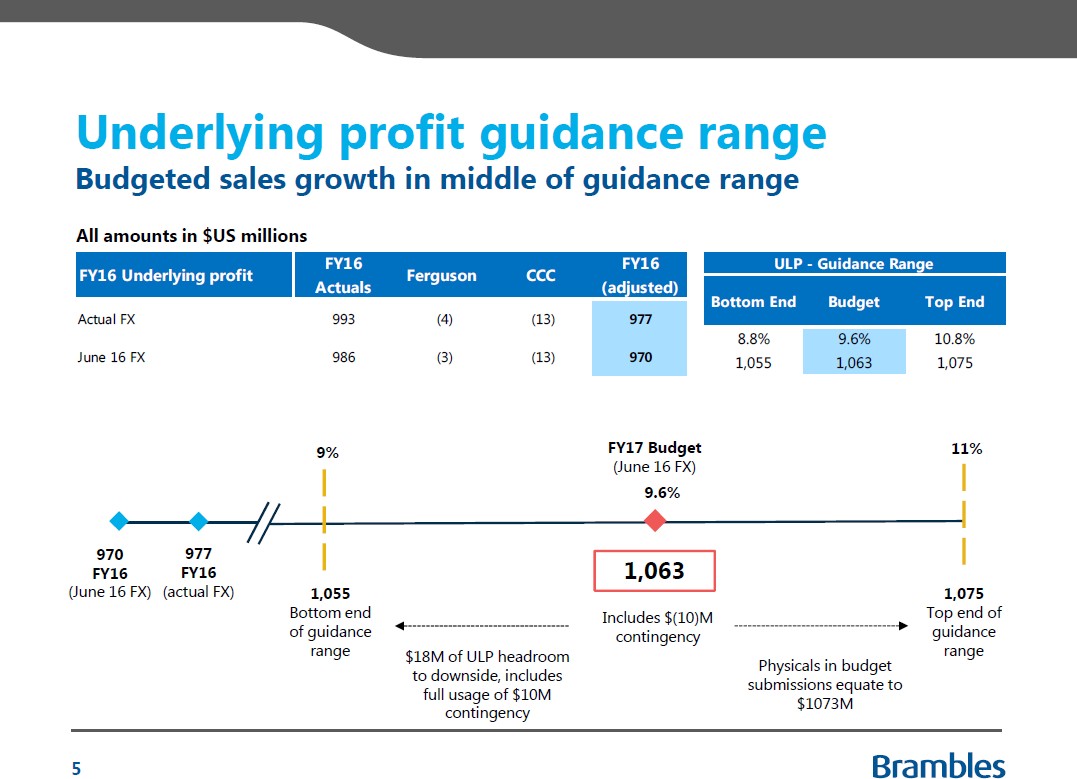
9. MR SAMUEL’S OPINION
9.1 The questions
666 Relevantly to the alleged August Contravening Conduct, Mr Samuel provided his expert opinion on the following questions:
Question 1
(a) Did the information available to Brambles Limited (Brambles) at the time it prepared its budget for the financial year ended 30 June 2017 (FY2017 Budget) provide a reasonable basis for its projected increase in:
(i) revenue;
(ii) underlying profit (Underlying Profit); and/or
(iii) return on capital invested (ROCI),
in FY2017 compared with FY2016 for:
(A) the North American Pooled Pallets Business;
(B) the North American Whitewood Pallets Business; and
(C) the North American Operations?
Question 2
(b) Did the information available to Brambles provide a reasonable basis to support the:
(i) August Sales Revenue Forecast;
(ii) August Underlying Profit Forecast;
(iii) August ROCI Forecast and
(iv) Medium-Term Targets,
at each of the following dates:
(A) 18 August 2016;
…
667 It is uncontentious that the references to:
(a) the North American Pooled Pallets Business are to US Pooled;
(b) the North American Whitewood Pallets Business are to US Recycled;
(c) the North American Operations are to CHEP NA; and
(d) the FY2017 Budget are to the Group FY17 budget.
9.2 Mr Samuel’s approach
668 Mr Samuel was briefed with a raft of Brambles’ documents, including management accounts, internal management reports, draft budget and forecast presentations, R&O schedules, contemporaneous emails and memos, and Brambles’ voluminous lay witness affidavits which annexed numerous emails and internal documents.
669 In setting out his general approach, Mr Samuel noted that the questions put to him concerned the reasonableness of a budget and certain forecasts, and he gave opinions as to the reasonableness of the basis for the relevant budgets and forecasts based on his expertise and experience as a valuer. Based on this expertise and experience, he offered the following principles of valuation:
(a) Value is a forward looking concept. That is, purchasers in a market, formulate their economic decisions based on what the business or asset is likely to generate under their ownership. The valuation of:
(i) securities is therefore concerned with the cash flows that would be derived from dividends or the sale of the securities. Those cash flows are a function of the cash flows that will be generated by the underlying business; and
(ii) a business is therefore concerned with the future cash flows it will generate;
(b) Valuation necessarily requires expectations about future events to be assessed in order to establish the present value of the cash flows arising from those events;
(c) As future events are uncertain, they are subject to risk. A present value for the business or asset is determined by applying a discount rate to future cash flows to reflect that risk;
(d) It is axiomatic that a forecast that is:
(i) optimistic - i.e. anticipates higher cash flows than those that are likely to eventuate - will result in an over-valuation; and
(ii) pessimistic - i.e. anticipates lower cash flows than those that are likely to eventuate - will result in an under-valuation; and
(e) As a valuer, when conducting valuations:
(i) it is therefore necessary to consider whether a forecast is “reasonable”. Although this is a fundamental step in any valuation based on forecasts, there is little guidance as to what constitutes a “reasonable” forecast; and
(ii) I assess reasonableness by:
• identifying the key assumptions on which a forecast is based;
• determining the extent to which those assumptions can be verified objectively to supporting data; and
• assessing whether assumptions which cannot be verified objectively to supporting data nevertheless are based on sound reasoning and/or judgment and are not unduly optimistic or pessimistic.
670 He then summarised the limited professional guidance and standards available to him, which I have paraphrased below:
671 First, the organisation Chartered Accountants Australia and New Zealand, of which Mr Samuel is a member, requires members to comply with two guidance notes:
(a) Accounting Professional & Ethical Standards (APES) GN 20 ‘Scope and Extent of Work for Valuation Services’ for guidance in determining the scope and extent of work that may be appropriate for the type of Valuation Service being provided; and
(b) APES GN 21 ‘Valuation Services for Financial Reporting’ for guidance on matters to be disclosed in a Valuation Report when providing a Valuation Service for Financial Reporting.
Mr Samuel said, and I accept, that the latter did not provide useful guidance, and the former - while it did not address detailed valuation mechanics - was broadly consistent with his approach in that it encouraged the performance of valuations through “obtaining and reviewing any forecasts or budgets and asking for any assumptions underlying them”.
672 Second, International Valuation Standards issued in 2022 (IVS 22) state, among other things:
Cash Flow Forecasts
50.12. Cash flow for the explicit forecast period is constructed using prospective financial information (PFI) (projected income/inflows and expenditure/outflows).
50.13. As required by para 50.12, regardless of the source of the PFI (eg, management forecast), a valuer must perform analysis to evaluate the PFI, the assumptions underlying the PFI and their appropriateness for the valuation purpose. The suitability of the PFI and the underlying assumptions will depend upon the purpose and the required bases of value. For example, cash flow used to determine market value should reflect PFI that would be anticipated by participants; in contrast, investment value can be measured using cash flow that is based on the reasonable forecasts from the perspective of a particular investor.
…
50.15. The projected cash flow should capture the amount and timing of all future cash inflows and outflows associated with the subject asset from the perspective appropriate to the basis of value.
50.16. Typically, the projected cash flow will reflect one of the following:
(a) contractual or promised cash flow,
(b) the single most likely set of cash flow,
(c) the probability-weighted expected cash flow, or
(d) multiple scenarios of possible future cash flow.
50.17. Different types of cash flow often reflect different levels of risk and may require different discount rates. For example, probability-weighted expected cash flows incorporate expectations regarding all possible outcomes and are not dependent on any particular conditions or events (note that when a probability-weighted expected cash flow is used, it is not always necessary for valuers to take into account distributions of all possible cash flows using complex models and techniques. Rather, valuers may develop a limited number of discrete scenarios and probabilities that capture the array of possible cash flows). A single most likely set of cash flows may be conditional on certain future events and therefore could reflect different risks and warrant a different discount rate.
Mr Samuel noted this guidance recognised the need to consider whether assumptions underlying a forecast are appropriate, and ensure that the projected cash flows capture the amount and timing of all future cash inflows and outflows.
673 Third, an article from the ‘Business Valuation Update’ (BVU), a monthly publication issued by Business Valuation Resources LLC, which typically includes articles on topical issues, US case law updates relevant to valuation issues and relevant updated economic data for the US. Whilst the publication is not specific to Australia, Mr Samuel posited the valuation issues on which articles are written are typically of relevance to valuation in any jurisdiction. Mr Samuel included the following from the article, dated September 2021:
Since PFI represents future expectations, it is, by its very nature, imprecise. Therefore, the assumptions used in preparation of the PFI must be reasonable and supportable.
…
The responsible party should have a reasonably objective basis to present a financial forecast. Because financial forecasts are presentations of information about the future, they are inherently less precise than information about past events.
Nevertheless, financial forecasts present, to the best of the responsible party’s knowledge and belief, the entity’s expected financial position, results of operations, and cash flows.
…
The responsible party has a reasonably objective basis to present a financial forecast if sufficiently objective assumptions can be developed for each key factor …
The evaluation of whether sufficiently objective assumptions can be developed for each key factor should be made within the following context:
A factor is evaluated by considering its significance to the entity’s plans and the dollar magnitude and persuasiveness of the related assumption’s potential effect on forecasted results.
The responsible party’s consideration of which key factors have the greatest potential impact on forecasted results is a matter of judgment. A key factor having the greatest potential impact on forecasted results is one in which omission or misstatement of the related assumption would probably, in light of surrounding circumstances, change or influence the judgment of a reasonable person relying on the financial forecast.
The responsible party should seek out the best information that is available in order to develop the assumptions. Cost alone is an insufficient reason not to acquire needed information. However, the cost of incremental information should be commensurate with the anticipated benefit to be derived.
A conclusion that a reasonably objective basis exists for a forecast might be easier to support if the forecast were presented as a range
(Emphasis added.)
674 Mr Samuel stated the BVU article reflected his experience as a valuer in many respects, and in particular the need, when considering the reasonableness of a forecast:
(a) to focus on the key assumptions that might change the outcome of a forecast; and
(b) to consider whether those key assumptions are based on objective data where possible.
675 Fourth, the 4th Edition of the text by the Australian valuer W. Lonergan “The Valuation of Businesses, Shares and Other Equity”, from which he extracted the following:
Estimating Cash flows
…
While, in theory, apparently accurate and often complex models can be constructed, the reality is that the models are only as good as the assumptions on which they are based. Given the inevitable difficulty in forecasting future events, models should not be attributed with an undue level of precision.
PROBABILITY ADJUSTED CASH FLOWS
Notwithstanding the limitations in any forecast, however, the object is to produce the best estimate of likely outcomes. It should not be assumed however, that the probability of bettering the forecast result should be the same as the probability of not meeting it. This is because of factors such as:
• competitor reaction
• natural limits of the market
• customer resistance
• unexpected developments
• regulatory changes
• Murphy’s Law.
The forecast should be reduced (or increased) to achievable levels or probabilities may be assigned to a range of possible outcomes as set out below.
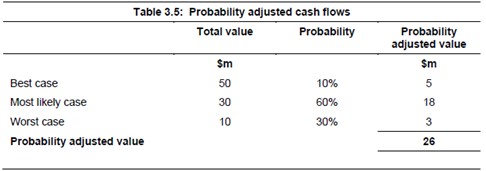
ESTIMATION OF FUTURE CASH FLOWS
The estimation of future cash flows is a difficult process, which requires reliable financial information or, at the least, realistic and reasonable projections and involves considerable professional judgment.
(Emphasis added.)
676 Mr Samuel agreed with Lonergan’s view that forecast cash flows should be realistic, with the object of producing a best estimate of likely outcomes. He opined that a forecast that exceeds the best estimate of likely outcomes would be an optimistic forecast, and in his experience is often called a “target”.
677 I understood Lonergan to have said that the best estimate of a likely outcome will account for various cash-flow contingencies through probability-weighting, and I understood Lonergan’s reference to “Murphy’s Law” as a reference to the axiom “anything that can go wrong will go wrong”.
678 Mr Samuel said, in relation to his approach:
(a) the budget he was asked to consider in Question 1 is a “single outcome” and was therefore more akin to the “single most likely set of cash flow” identified in IVS 22 paragraph 50.16;
(b) the forecasts he was asked to consider in Questions 2, 3 and 4 include a range of outcomes and they are therefore more akin to the “multiple scenarios of possible future cash flow” identified in IVS 22 [50.16]; and
(c) in any event, having regard to all of the above, for the purpose of responding to the questions, he:
(i) focused on key assumptions evident from the material available to him;
(ii) sought to identify objective support for those assumptions; and
(iii) quantified the consequences of objective analysis which would affect the budget and/or forecasts upon which he was asked to comment.
679 Mr Samuel broadly outlined his approach to Question 1 as follows:
My approach to Question 1 was to review the changes made between presentation of the initial versions of the budget prepared by [US Pooled] and CHEP Global and the final budget presented to the Board, and to consider whether objective support existed for the increase in revenue, Underlying Profit and ROCI.
680 Under the heading “My Approach” he said:
… in my opinion the reasonableness of a budget or forecast will depend on the reasonableness of the assumptions that underpin it. I am not an industry expert, nor do I have the knowledge that comes from someone within the business. My experience as a valuer includes reviewing management prepared forecasts to determine whether the underlying assumptions are properly supported by objective analysis and/or industry expertise.
In order to answer Question 1, I have:
(a) considered the changes to the budgets made between the presentation of the initial budget based on the bottom up budget development and the final budget approved by the Board; and
(b) identified the key assumptions and the objective support for the projected increase in revenue, Underlying Profit and ROCI.
681 In relation to Question 1, Mr Samuel acknowledged that he did not have access to all assumptions underpinning the Group FY17 budget, but said that he identified key assumptions by reference to:
(a) preliminary budget presentations for the CBUs and subsequent changes that were made in the final budget approved by the Board;
(b) budget presentations, reports and other documents that included information on budget assumptions; and
(c) the risk and opportunity analyses which quantified potential variations from budget.
682 In Mr Samuel’s experience, “a common way of addressing the possible deviations from the budget is to identify and quantify the estimated financial impact of a company’s material known risks or opportunities”. He used the R&O schedules set out in the US Pooled, CHEP NA, CHEP Global and Group FY17 initial, revised and final budgets to reach an opinion as to whether the information available to Brambles at the time it set its Group FY17 budget provided a reasonable basis for the FY17 Guidance and FY19 ROCI Target.
683 Mr Samuel accepted that his approach to assessing the risks and opportunities that faced Brambles at different material points in time was to assume that if a risk (or opportunity) were identified in one of the US Pooled, CHEP NA or CHEP Global R&O schedules in his briefing materials, that risk (or opportunity) ought to have been probability-weighted and incorporated into the budget or reforecast as the case may be (depending on when the document was created), unless there was “objective” evidence to show why the risk was not included.
684 In summary, in relation to Question 1, Mr Samuel concluded that a significant quantum of the dollar value of probability-adjusted net risks (i.e., netted off against opportunities) identified in the US Pooled, CHEP NA or CHEP Global R&O schedules were not adequately incorporated into the Group FY17 budget, which in his view affected the reasonableness of the basis for the Group FY17 budget at the time it was set, and thus for the August Express Representations. He further concluded that, had Brambles adequately taken account of the risks and opportunities identified in the US Pooled, CHEP NA or CHEP Global R&O schedules at different points, the budgeted Underlying Profit in the Group FY17 budget would have been below the bottom end of the guidance range in the FY17 Guidance.
685 Mr Samuel’s approach to Question 2 was methodologically consistent with his approach to Question 1, and concerned whether information available to Brambles as at 18 August 2016 provided a reasonable basis to support the August Representations. This accordingly turned on both the information available throughout the Group FY17 budget preparation process as it related to Question 1, and information which became available to Brambles throughout FY17 up to 18 August 2016.
9.3 The material Mr Samuel relied upon and his analysis
686 As outlined above, in answering Question 1, Mr Samuel particularly relied on R&O schedules for US Pooled, CHEP NA and CHEP Global prepared in the lead-up to the approval of the Group FY17 budget. In answering Question 2, Mr Samuel also relied on the July results made available around 12 August 2016, and additional R&O schedules prepared up to 18 August 2016.
687 I now turn to consider the materials relied upon by Mr Samuel, and his analysis of them as they relate to his answers to Questions 1 and 2.
688 As previously noted, on 26 February 2016 the CHEP NA ELT met and reviewed the draft US Pooled FY17 budget presentation of that date. Mr Samuel’s report extracted the R&O schedule from the presentation (reproduced below) which recorded a risk to Underlying Profit of $21.5 million, and a net Underlying Profit risk (after netting against opportunities) of $13 million.
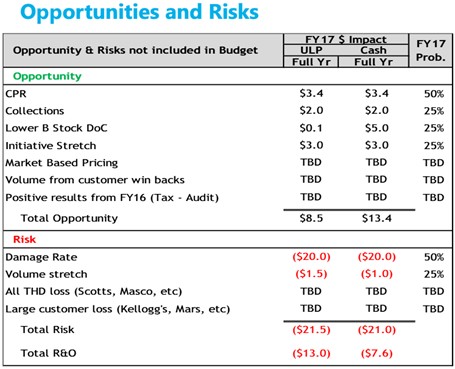
689 The R&O schedule assigned a probability to each opportunity and risk. For example, in the schedule above Brambles assessed that the risk that Underlying Profit in FY17 would be negatively impacted by the damage rate was assigned a 50% probability, and the consequence of that risk materialising was quantified at $20 million.
690 Following a presentation to the CHEP NA ELT on around 4 March 2016, each of the units within CHEP NA were provided with action items to be included in their draft budgets, intended to reduce the variance to the 5YP. Mr Samuel noted that the list identified an initial variance to the 5YP Underlying Profit of $(18) million, and an updated variance of $(14.1) million in the event that each action was taken.
691 As previously noted, on 15 March 2016 the US Pooled ELT reviewed the US Pooled budget presentation of that date, which revised the draft budget dated 26 February 2016. Mr Samuel noted that this draft budget recorded:
(a) increased sales revenue of $1,606.1 million, up from $1,592.4 million; and
(b) increased Underlying Profit of $348.0 million, up from $342.0 million.
In this draft budget the variance from the 5YP in sales revenue was $(11.3) million and in Underlying Profit was $(12.1) million. That is, the draft US Pooled budget was materially under the 5YP.
692 The presentation included an R&O schedule, which Mr Samuel extracted (reproduced below):
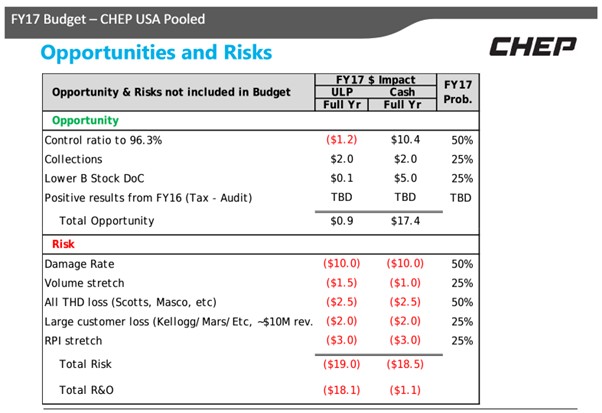
693 Mr Samuel noted that the schedule recorded that the revised Underlying Profit risk was $(19) million (a decrease of $(2.5) million from February), and the net Underlying Profit risk was $(18.1) million (an increase of $(5.1) million from February). By contrast, Mr Samuel calculated a revised overall probability-adjusted Underlying Profit net risk of $(8.0) million. That decrease in unadjusted Underlying Profit risks resulted from a halving of the quantum of the damage rate risk, offset to an extent by the addition of values for other risks being “All THD loss”, “Large customer loss”, and “RPI Stretch”.
694 As I have said, on or around 24 March 2016 CHEP NA, together with the other CHEP CBUs, submitted their Initial Budget Submissions to CHEP Global. The CHEP NA draft budget forecast a US Pooled sales revenue of $1,606 million and Underlying Profit of $348 million which was unchanged from the 15 March US Pooled budget presentation. But the R&O schedule relating to US Pooled was revised, as reproduced below.
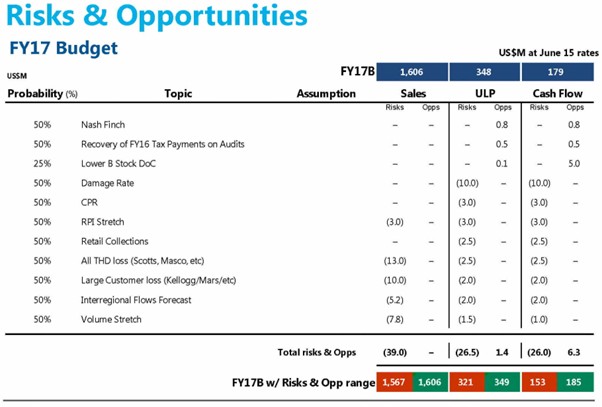
695 Mr Samuel noted that Brambles there identified net risks in US Pooled with a potential impact:
(a) on sales revenue of $(39) million (or probability-adjusted of $(19.5) million); and
(b) on Underlying Profit of $(25.1) million (or probability-adjusted of $(12.6) million).
He noted that the net risks had increased from the 15 March US Pooled budget presentation.
696 The presentation also contained an R&O schedule relating to CHEP NA which Mr Samuel extracted, as reproduced below.
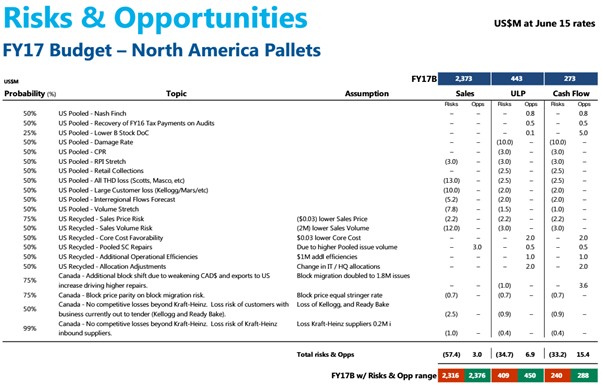
697 Mr Samuel noted that this table recorded for CHEP NA:
(a) forecast sales revenue of $2,373 million, with total risks of $(57.4) million and total opportunities of $3 million (meaning net risks of $(54.4) million); and
(b) forecast Underlying Profit of $443 million, with total risks of $(34.7) million and total opportunities of $6.9 million (meaning net risks of $(27.8) million).
698 Having regard to the probabilities Brambles had assigned to those risks and opportunities, Mr Samuel calculated the probability-adjusted sales revenue net risk and Underlying Profit net risk of the constituent businesses within CHEP NA. Reproduced below is a table he prepared.
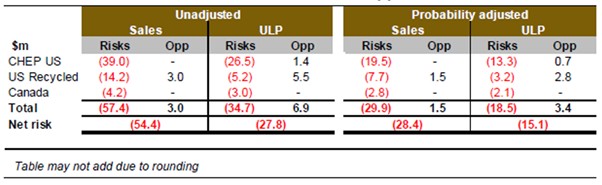
699 The table records:
(a) for US Pooled:
(i) unadjusted net risk to sales revenue and Underlying Profit of $(39.0) million and $(25.1) million respectively; and
(ii) a probability-adjusted net risk to sales revenue of $(19.5) million and net risk to Underlying Profit of $(12.6) million; and
(b) for CHEP NA, a probability-adjusted net risk to sales revenue of $(28.4) million and net risk to Underlying Profit of $(15.1) million.
700 As I have said, on around 24 March 2016, the CHEP CBUs made their initial budget submissions to CHEP Global. Mr Samuel prepared the following table setting out the risks and opportunities set out in the CHEP CBUs’ initial budget submissions:
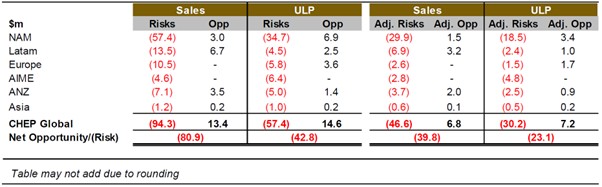
701 Mr Samuel noted that following the CHEP NA budget review meeting on or about 31 March 2016, further revisions (stretches) were made to the US Pooled draft budget on 8 April, 14 April and 20 May. He extracted a US Pooled spreadsheet titled “FY17 Budget -US Pooled Revised Financial Scenarios - To Final Targets” which showed that the net impact of the revisions was to:
(a) increase Underlying Profit from $347.6 million to $360.9 million;
(b) decrease capital expenditure by $40 million from $365.7 million to $326.7 million; and
(c) increase ROCI from 19.2% to 20.2%.
He said that he was unable to identify documents which would inform whether the proposed actions sitting behind the revisions were supported and reasonable.
702 Mr Samuel could not locate any updated R&O schedules for US Pooled or CHEP NA following those draft budget submissions.
703 Mr Samuel then referred to Rumph’s remarks in the Headlines Memo about the aggressive assumptions, stretch and risk in the CHEP NA budget following its Second Revised Budget Submission. He noted her remarks that:
(a) in relation to sales revenue:
(i) the revenue growth assumption in US Pooled sales revenue is “very aggressive given one-time benefits in FY16 that aren’t likely to repeat”;
(ii) “US Pooled volume trending lower in FY16 creates a jump-off risk into FY17”;
(iii) “$53M of unidentified wins assumed in US ($90M total wins versus $78M in FY16)”;
(iv) “Pricing stretch of ~$6M for US Pooled to compensate for lower volume due to drop in FY2016 demand and fewer B days in FY17”; and
(v) “FY16 exit pricing forecasted to be below FY17B price, creating immediate ULP risk”; and
(b) in relation to direct costs:
(i) “US Pooled Durability Investment: Assumed to pay off with a damage rate reduction of 2pp (61.3% to 59.3%). If damage rate improvements do not manifest as planned, we face up to $11M in unbudgeted repair costs. Also made aggressive assumptions on CPR”;
(ii) “US Pooled Initiatives: $28M of Supply Chain Initiatives; ~$3M of which is unidentified”;
(iii) “Recycled Transport Costs: Aggressive assumption in budget that we deliver ~$1M reduction in third-party common carrier freight through core optimization”;
(iv) “Canada Pooled Initiatives: $2.5M in Initiatives. $1M of transportation savings unidentified”; and
(v) “Assumed HOG concept in budgeting FY17 Overheads and was relying on OneBetter to help deliver it. We then layered in $3M of additional, unidentified OneBetter savings”.
704 Mr Samuel also relied on:
(a) Lallatin’s first draft of the Headlines Memo dated 15 April 2016; and
(b) some remarks in the email exchanges between Rumph, Lallatin and Alonso on 12-13 April 2016 and Rumph’s email to Mackie on 12 April 2016 regarding the CHEP NA Second Revised Budget Submission, to the effect that the budget was a “huge stretch” and Rumph was “very concerned about the level of stretch”.
705 Mr Samuel gave evidence that, in his experience, aggressive budget assumptions tended to result in an optimistic forecast instead of a best estimate of the likely outcome.
706 Mr Samuel considered the level of stretch in the CHEP NA budget. He went through the various CHEP NA budget submissions and produced a table of the sales revenue and Underlying Profit forecasts in the initial and revised CHEP NA draft budgets compared to the versions approved by the Board, as reproduced below.
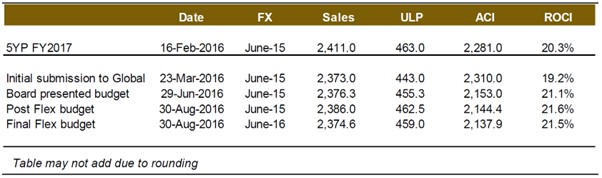
He noted that between March 2016 and Board approval on 29 June 2016, the total stretch between the CHEP NA Initial Budget Submission and the final version had the effect of increasing sales revenue by $3.3 million and Underlying Profit by $12.3 million.
707 He also identified the level of stretch in the CHEP Global FY17 budget, which he calculated from a document titled “GoGet (2nd Submission)” dated 13 April 2016, emailed by Thompsen to Kennett on that day, which set out the total revisions for all CHEP CBUs and CHEP Global from the Initial Budget Submissions through to the CHEP Global budget.
708 Mr Samuel considered that the stretch to the CHEP Global budget from the CBUs’ initial budget submissions had the effect of increasing sales revenue by $5.4 million and Underlying Profit by $26.1 million. He said that the “total stretch” was based on a list of actions which were described as “BK’s list of Go-Get” which included some 20 actions across the CHEP CBUs. I infer that “BK” was a reference to Kennett.
709 Mr Samuel noted that the stretch or ‘go-get’ initiatives were then either accepted and incorporated into the CBUs’ revised budget submissions or rejected by the CBUs. He referred to another Brambles document which showed the list of initiatives that were included in the CHEP Global budget, and noted that some had no dollar values which he took to indicate that those changes had not been accepted by the CBUs.
710 Mr Samuel said that from the documents available to him he was unable to say whether the adjustments that were described as “ULP improvements” in the CHEP Global budget at this stage were robust and reasonable, as no further detail was available to him as to how those budget improvements would be achieved.
711 Mr Samuel then proceeded to compare the risks and opportunities that were identified by the CHEP CBUs in their initial budget submissions with the stretch that was ultimately included in the CHEP Global FY17 budget. He provided the following table:
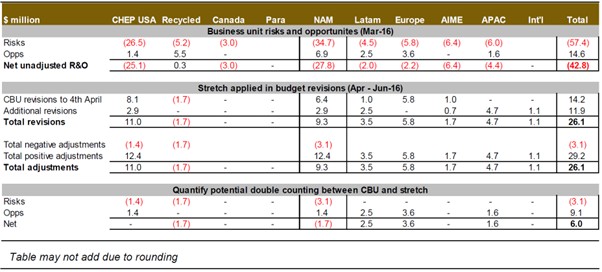
712 Mr Samuel explained the table in relation to CHEP USA (the first column) (which I take to mean US Pooled), as follows:
(a) the R&O schedules in the initial budget submission identified potential risks to Underlying Profit of $(26.5) million and opportunities of only $1.4 million, which resulted in net unadjusted risks of $(25.1) million;
(b) the stretch applied to the US Pooled FY17 budget was $11 million, made up of positive adjustments of $12.4 million and negative adjustments of $(1.4) million;
(c) the $12.4 million of positive adjustments (or stretch) exceeded the $1.4 million of opportunities that US Pooled had identified; and
(d) the $(1.4) million of negative adjustments was substantially less than the $(26.5) million of risks that US Pooled had identified.
713 Mr Samuel concluded the stretch of $26.1 million in the CHEP Global FY17 budget consisted mostly of “opportunities”. He said he was unable to determine whether the opportunities that were included in the stretch were the same as those that had been identified by the CHEP CBUs. He also opined that out of the $14.6 million of opportunities identified by the CBUs, at most $9.1 million could have been included in the positive adjustments (stretch) of $29.2 million, as there were opportunities of $5.5 million identified for US Recycled but no stretch.
714 Mr Samuel noted that the Board approved the Group FY17 Pre-Flex budget on 29 June 2016, and that the Board had a presentation titled “Budget and 5 year plan Board presentation” dated 28 June 2016. The budget forecast sales revenue of $2,376 million and Underlying Profit of $455 million for CHEP NA and assumed strong margin improvement in CHEP NA primarily driven by US Pooled.
715 The Board presentation included a Group R&O schedule which Mr Samuel extracted, as reproduced below.
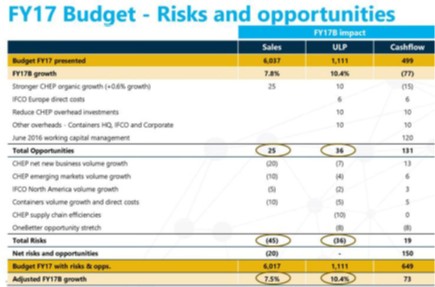
716 Mr Samuel identified that there were two earlier drafts of that Board presentation dated 14 and 24 June 2016 each with an R&O schedule. He prepared a table, reproduced below, to capture the change in risks and opportunities between the draft and final presentations:
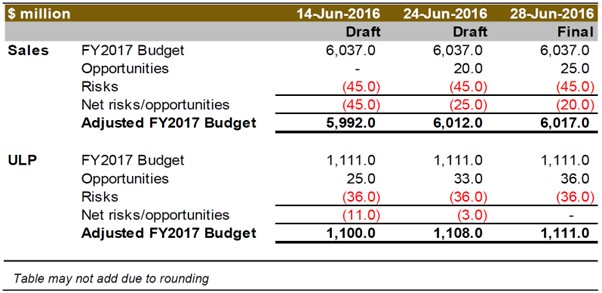
717 He concluded that between 14 June and 28 June 2016:
(a) an additional $25 million of sales opportunities had been identified, reducing the net sales revenue risk by the same amount; and
(b) an additional $11 million of Underlying Profit opportunities had been identified, thereby eliminating the Underlying Profit risk.
718 He further concluded that, compared to the final R&O schedule, the Group FY17 budget omitted:
(a) opportunities with a potential sales revenue impact of $25 million and Underlying Profit impact of $36 million; and
(b) risks with a potential sales revenue impact of $(45) million and Underlying Profit impact of $(36) million.
719 He found that no supporting documentation for the draft or final version of those risks and opportunities had been presented to the Board. He said that the information available to him did not explain the reasons for the changes between the risks and opportunities that had been assessed by the CHEP CBUs in their budget submissions in March 2016 and the final analysis in the report presented to the Board in June 2016, or the changes that were made to the final version of the same report between 14 and 28 June 2016.
720 Mr Samuel also noted another Group budget presentation in the Board pack for the June Board Meeting, titled “Final Board Papers”. The Board pack included the following R&O schedule:
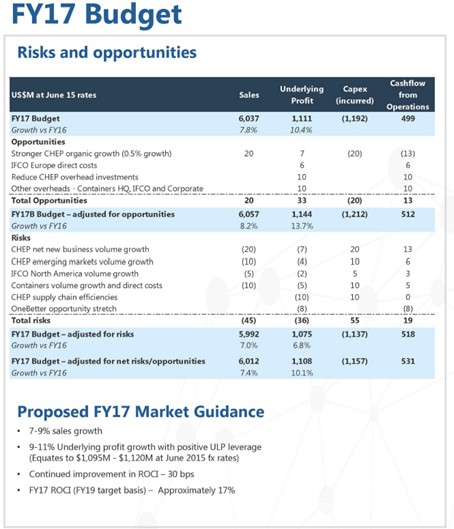
721 Mr Samuel extracted the items relating to CHEP Global, as set out below:
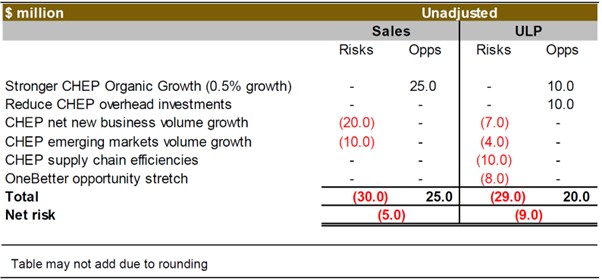
722 On the basis of this material, Mr Samuel concluded in relation to the Group FY17 budget:
…CHEP NAM had identified a net sales risk of ($54.4) million and net ULP risk of ($27.8) million during its budget presentation in March 2016. This implies that some of the risks in CHEP NAM had been set aside as, based on the initial CHEP Global CBU presentations on risk and opportunities … Latam, Europe, AIME, ANZ and Asia, the other CBUs that together with CHEP NAM, make up CHEP Global, were all reporting net sales and Underlying Profit risks.
723 In relation to Question 2, Mr Samuel prepared the following table from the US Pooled MBR dated 25 August 2016 (US Pooled August MBR), which summarised the forecast monthly variances in sales revenue and Underlying Profit to the Group FY17 budget.
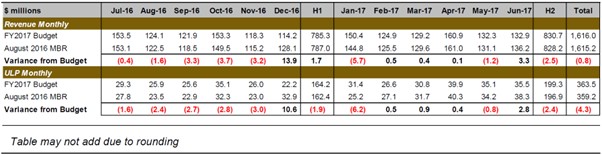
724 He concluded that in US Pooled it was forecast that:
(a) sales revenue would be under-budget for successive months to November 2016, but those shortfalls would be offset by over-budget sales revenue in December 2016, such that revenue would be ahead of budget for 1H17 by $1.7 million;
(b) Underlying Profit would be under-budget for successive months to November 2016, but those shortfalls would be largely offset in December 2016 by exceeding the monthly Underlying Profit budget of $22.2 million by $10.6 million, resulting in a cumulative Underlying Profit miss for 1H17 of only $(1.9) million; and
(c) for the full FY17 year sales revenue would be below-budget by $(0.8) million and Underlying Profit would be below-budget by $(4.3) million.
725 Mr Samuel said that he could not identify any documentation that supported the assumed increase in sales revenue and Underlying Profit in US Pooled in December 2016. There is, however, some evidence that indicates that December was usually a strong month for sales revenue in US Pooled because of the heavy use of pallets transporting consumer goods in the period leading up to and over the Christmas period.
726 Mr Samuel extracted an R&O schedule from the US Pooled August MBR, as reproduced below.
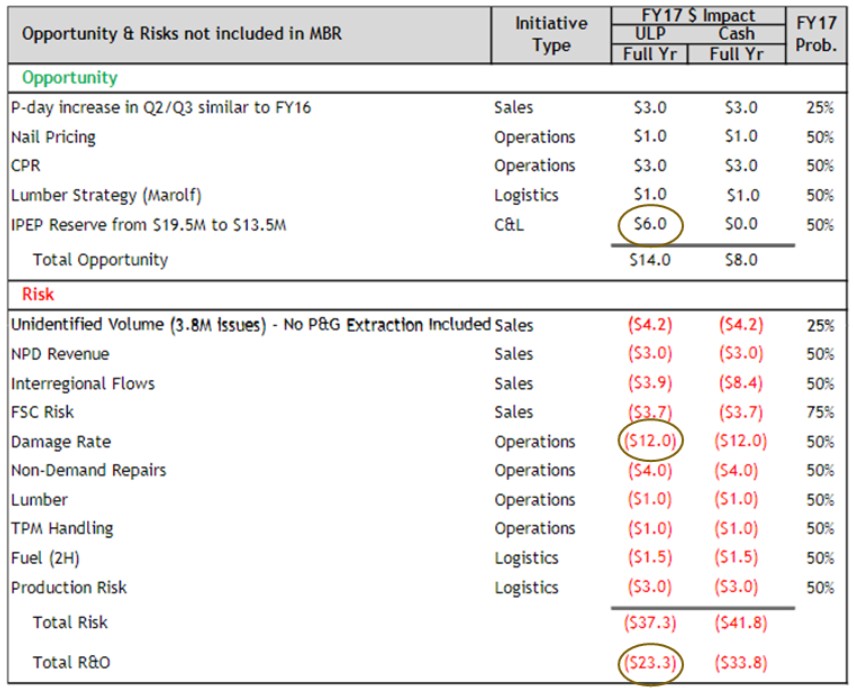
727 He calculated that the probability-adjusted net risk to Underlying Profit was $12.3 million, which he said would have meant that the Group Underlying Profit would have fallen below the bottom of the FY17 Guidance range. He accepted, though, that he was unable to explain the basis for each item in the R&O schedule. For methodological reasons that need not be explored, Mr Samuel could not come to any firm view on how this asserted shortfall in Group Underlying Profit would impact ROCI over the medium term. He said, however, that any shortfall in Group Underlying Profit would “adversely impact the likely achievement” of the forecast Group ROCI.
728 I will not set out Mr Samuel’s opinions in relation to the position in US Recycled when the applicants said little about that part of CHEP NA’s business. Mr Samuel accepted that the documents with which he was briefed did not allow an analysis of risks and opportunities for the businesses outside of US Pooled.
9.4 Mr Samuel’s answers to Questions 1 and 2
9.4.1 Question 1
729 As noted, Question 1 asked Mr Samuel to opine as to whether the information available to Brambles at the time it prepared the Group FY17 budget provided a reasonable basis for the projected growth from FY16 to FY17 in sales revenue, Underlying Profit and ROCI in US Pooled, US Recycled and CHEP NA.
730 Based on the above analysis, Mr Samuel provided the following opinions in relation to Question 1. He said that:
(a) the CHEP NA Initial Budget Submission of $2,373 million for sales revenue and $443 million Underlying Profit did not include the identified unadjusted net sales revenue risk of $(54.4) million, or the unadjusted net Underlying Profit risk of $(27.8) million;
(b) between March 2016 and June 2016, the total stretch applied to the CHEP NA Initial Budget Submission increased sales revenue by $3.3 million and Underlying Profit by $12.3 million. He opined that those increases appeared to be inconsistent with the risks that had been identified at the time of the initial budget submissions, and that detailed plans as to how the stretch would be achieved were not available to him;
(c) email correspondence between members of the CHEP NA leadership team included references to the CHEP NA budget being a “huge stretch”, to them being “very concerned about the stretch”, and to growth assumptions that were “aggressive”;
(d) the Group FY17 budget approved by the Board on 29 June 2016 forecast sales revenue of $2,376 million (5.7% above the FY16 forecast) and Underlying Profit of $455 million (10.1% above the FY16 forecast); and
(e) the Board was presented with risks and opportunities excluded from the Group FY17 budget that only included a net sales risk of $(5) million and net Underlying Profit risk of $(9) million relating to CHEP Global, and the information about risks and opportunities presented to the Board did not include the relevant supporting documents.
731 In relation to the forecast increase in Underlying Profit in the CHEP NA FY17 budget, Mr Samuel opined that “the information available to Brambles did not provide a reasonable basis for the projected increase in Underlying Profit” (emphasis added) in the Group FY17 budget for CHEP NA because:
(a) the Group FY17 budget for CHEP NA was “more in the nature of a target” due to the inclusion of aggressive assumptions relating to net new wins and supply chain efficiencies, and unidentified wins and pricing stretch in the bottom-up CBU projections;
(b) it did not reflect the net risks which had been identified by CHEP NA; and
(c) if the aggressive assumptions, unidentified wins and stretch had not been included, and the probability-adjusted net risks for CHEP NA been included in the Group FY17 budget, Brambles’ projected Underlying Profit would have been below the bottom end of the guidance range stated in the FY17 Guidance.
732 In his view, the level of net risk in the Group FY17 budget did not reflect the risks and opportunities identified by CHEP Global in March 2016, at which time the CHEP CBUs had collectively identified a probability-adjusted net risk to sales of $(39.8) million and to Underlying Profit of $(23.1) million ($(15.1) million of which Underlying Profit risk was attributable to CHEP NA).
9.4.2 Question 2
733 Question 2 relevantly asked Mr Samuel to opine as to whether the information available to Brambles as at 18 August 2016 provided a reasonable basis to support the August Sales Revenue Forecast and the August Underlying Profit Forecast (i.e., the FY17 Guidance), the August ROCI Forecast (i.e., the FY19 ROCI Target) and the Medium-Term Targets. As noted, I will not deal with the Medium-Term Targets claims.
734 Mr Samuel relied on essentially the same information as in Question 1 but also accounted for the July 2016 results and US Pooled August MBR. In relation to the July 2016 results, in that month Underlying Profit in CHEP Global was $(3) million below the Group FY17 budget, and the largest contributor to that variance was US Pooled which recorded sales revenue of $(2.9) million below-budget and Underlying Profit of $(4) million below-budget. The Group was, however, ahead of budget in July with:
(a) sales revenue of $555 million, which was $6 million ahead of budget; and
(b) Underlying Profit of $108 million, which was $1 million ahead of budget.
735 Mr Samuel said that the Group FY17 budget approved by the Board on 17 August 2016 was unchanged from the version approved by the Board at the June Board Meeting, other than through flex adjustments. He opined that the risks and opportunities presented to the Board in June 2016, which showed (only) net risks to sales revenue of $(20) million and net risks to Underlying Profit of $0, were not supported by the information available to him.
736 He opined that the Group FY17 budget:
(a) did not include risks and opportunities identified by CHEP Global (from the CHEP CBUs’ initial budget submissions in March 2016), which, on a probability-adjusted net basis, had a potential adverse impact:
(i) on sales revenue of $(39.8) million; and
(ii) Underlying Profit of $(23.1) million; and
(b) contrary to the net risks identified in (a), included a “total stretch” which increased sales revenue by $5.4 million and Underlying Profit by $26.1 million from the CHEP CBUs’ initial budget submissions.
He opined that, as at 18 August 2016, the Group FY17 budget was not a best estimate of the likely outcomes and was instead highly optimistic and therefore more in the nature of a target.
737 He also opined that the combined effect of including the probability-adjusted net risks and removing the budget stretch to the Group FY17 budget (which applied to Underlying Profit only) would have resulted in:
(a) sales revenue of $5,802.8 million, which represented revenue at the lower end of the FY17 Guidance; and
(b) Underlying Profit of $1,013.8 million ($1,019.8 million if he accounted for what he considered to be potential double counting), which would have been “significantly below the lower end” (emphasis added) of the guidance range in the FY17 Guidance (being $1,055 million).
738 He concluded in relation to Question 2 that:
(a) the information available to Brambles as at 18 August 2016 did not provide a reasonable basis for:
(i) the upper end of the August Sales Revenue Forecast; and
(ii) the August Underlying Profit Forecast;
(b) a reduction in the August Underlying Profit Forecast would have had an adverse impact on the August ROCI Forecast; and
(c) a reduction in the August Underlying Profit Forecast and the FY17 ROCI would have adversely impacted Brambles’ ability to achieve the August ROCI Forecast.
9.5 Brambles’ submissions regarding Mr Samuel’s evidence
739 In the course of the trial, Brambles submitted that Mr Samuel’s opinions were not admissible pursuant to s 79 of the Evidence Act. I did not accept that for the reasons I explained in Ruling No 1. Then, in closing submissions, Brambles submitted that while Mr Samuel’s evidence had survived the admissibility challenge it should be given no or minimal weight. There was a significant crossover between Brambles’ submissions on the admissibility of Mr Samuel’s opinions, and the weight properly to be given to them.
740 First, Brambles submitted that Mr Samuel did not have the right expertise or experience to provide an opinion as to the reasonableness of Brambles’ FY17 budget and forecasts. Brambles noted that he accepted that a business valuation publication he referred to in his first report was a “reputable and reliable publication” and that it reflected reputable, reliable and valid opinions in the expert valuation industry. In a part of that publication to which Mr Samuel did not refer, the publication said:
…the analyst must be qualified for the subject industry if he or she will opine on it. There is no way to know whether something has a reasonably objective basis if the analyst does not have the expertise in that particular type of business and that particular industry.
741 Brambles argued that, contrary to that guidance, and as Mr Samuel accepted, he did not have any expertise in a business of the nature of Brambles’ businesses, including US Pooled; he was not an industry expert in relation to the US Pooled business; and prior to this assignment he had no expertise or experience in that market or business. Mr Samuel accepted that he had no knowledge of US Pooled’s business or the US pooled pallets market save what he had gleaned from the documents he was briefed with.
742 Second, Brambles challenged Mr Samuel as to whether he brought to bear his experience in the preparation of budgets, plans and forecast for a listed public company in the UK when he was employed as a management and financial accountant in 1989 to 1990. Mr Samuel testified that it was “just a piece of my global experience in the context of forecasts” and that he did his work as a valuer and forensic accountant.
743 Third, Brambles submitted that Mr Samuel’s evidence should be given no or minimal weight because he accepted that, before providing an opinion as a valuer, he would typically seek to learn about the particular business and industry through dialogue with management, and he agreed that in the present case he did not have the benefit of any such dialogue.
744 Fourth, Brambles contended that Mr Samuel’s opinions should be given no weight because he did not take the requisite or sufficient steps to familiarise himself with the views of Brambles’ management as set out in Brambles’ lay witness affidavits, and that he paid little or no regard to the explanations of Brambles’ management in those affidavits. It contended that Mr Samuel’s lack of consideration of the context provided in Brambles’ lay affidavits might have been explained by his purported approach: determining the extent to which Brambles’ assumptions in the budgeting and forecasting process could be verified “objectively”. But it said, and I accept, that Mr Samuel’s analysis was not purely objective.
745 Fifth, Brambles criticised Mr Samuel’s evidence that, in his experience as a valuer, a common way of addressing the possible deviations from a budget is to identify and quantify the estimated financial impact of a company’s material known risks or opportunities, and that the sum total of all risks and opportunities equals the net risk / opportunity for the business.
746 On Brambles’ argument it was not appropriate for Mr Samuel to incorporate all of the risks and opportunities identified in R&O schedules in the initial and revised US Pooled and CHEP NA budgets into the Group FY17 budget in the manner that he did to reach his opinions. It relied on the evidence of Todorcevski, Mackie, Kennett, Nador and Alonso who said, among other things:
(a) in bottom-up budget submissions risks were often identified in an effort to justify pitching the budget at a lower level, including to more easily achieve STI benefits;
(b) bottom-up budget submissions sometimes included risks that were already known to or in the control of the group and were therefore not genuine risks;
(c) during the budgeting process, strategies were identified to mitigate or manage risks;
(d) risks and opportunities evolved over time because of fluctuations in market conditions and the progressive effects of mitigation and offsetting strategies starting to take effect;
(e) if a risk or opportunity was sufficiently certain, it would be “baked in” to the budget, MBR or forecast numbers;
(f) risks or opportunities that were immaterial were removed where they would have no impact on the business performance;
(g) R&O schedules were point in time representations of risks and opportunities under discussion at the meeting for which the schedule was prepared. In contrast, identifying and reacting to risks and opportunities was a fluid and live process at Brambles;
(h) the intention behind R&O schedules was to demonstrate potential variations against the budget or forecast, not to net them off against the budget or forecast;
(i) where an R&O schedule identified risks and opportunities which were “not in the budget”, “not in the MBR” or “not in the forecast” it did so because: (i) the items were considered not sufficiently certain; (ii) were considered sufficiently under the business’ control; (iii) mitigation measures had addressed the risk; or (iv) because of matters specific to the item in question; and
(j) the probability-weightings applied in the R&O schedules were directional in nature; they were not a precise formulation or science.
747 Brambles contended that R&O schedules were predominantly for the purpose of identifying and acting upon risks, rather than budgeting, and that the above matters explained why the earlier identified risks and opportunities changed over time.
748 Brambles also criticised Mr Samuel’s approach on the basis that the R&O schedules prepared by US Pooled and CHEP NA in the budgeting process identified more risks and opportunities because bottom-up budget submissions tended to be overly conservative or pessimistic, and it was common for Brambles’ line managers to engage in sandbagging. It said that such practices led to a low threshold for identifying risks, so as to ensure the budget was achievable. Martin said that it was more important to highlight all potential risks and to have a low threshold for identifying risks to ensure the budget was realistic and achievable. If an unexpected or unidentified opportunity materialised, it would not negatively impact their ability to meet budget.
749 Brambles further submitted that Mr Samuel’s approach of mathematically “baking in” all of the net risks in R&O schedules was inappropriate because it assumed that:
(a) the risks and opportunities in R&O schedules were static;
(b) the bottom-up R&O schedules by US Pooled and CHEP NA represented the true net risks to the business, instead of being weighted more heavily to risks than to opportunities; and
(c) the probability-weightings given to each item were a precise, mathematical formulation, when the evidence was that they were directional in nature. In effect, a 25% probability-weighting was used by the business to represent a low probability, 50% to represent medium and 75% to represent a high probability.
According to Mackie and Todorcevski, if a CBU’s initial budget submission was accepted and adjusted for all probability-weighted risks and opportunities that it identified, the CHEP Global budget would produce an unreasonably low target that would not drive the performance of the business to achieve its growth potential.
750 Relatedly, Brambles submitted that Mr Samuel’s approach to quantifying risks and opportunities was not applicable in a business budgeting context. It said that R&O schedules are used by businesses to frame how budgets and forecasts are positioned, not to derive a risk-weighted financial outcome. It contended that risk management is about ensuring that all risks have been identified and that appropriate strategies have been developed to mitigate them through offsetting measures, and that it is not appropriate to adjust the budget for all risks that can be identified. It relied on Mr Samuel’s acceptance that:
(a) business managers will have a different focus for considering risks and opportunities due to the need to look ahead at what risks and opportunities may occur down the road;
(b) preparing an R&O schedule served a significantly different function in the budgeting context than the valuation context because in the budgeting context management is trying to achieve the budget; and
(c) it was “a good purpose” for management to identify risks and opportunities even though they may not reasonably form part of their best estimate of the future outcome, just so as to ensure that management could develop initiatives to avoid or mitigate the risks.
751 Sixth, Brambles argued that Mr Samuel’s approach was erroneous, and his opinions should be given little weight, because he assumed that all risks and opportunities could be netted off against each other, when each risk and opportunity needed to be assessed in context and on a case-by-case basis. It noted that some risks and opportunities are mutually exclusive, while others are interdependent. And it argued that the budget development process was a robust one with regular discussions regarding risks and opportunities, which continued throughout each financial year as risks and opportunities evolved.
752 Seventh, Brambles contended that Mr Samuel’s evidence should be given no weight because the portfolio nature of Brambles’ business meant that it was common for risks in one part of the business to be offset by opportunities in another part of the business. Brambles relied on an example provided by Kennett and Alonso in relation to the September Reforecast where, in an email dated 4 October 2016, Alonso said that he thought there was a risk of around $(15) million to Underlying Profit in CHEP NA, which was offset by results in CHEP Europe and CHEP LATAM. It argued that the quantification of future risks and opportunities is complex and requires experience within the business or the industry sector, which Mr Samuel accepted he did not have.
753 Eighth, Brambles criticised Mr Samuel’s evidence regarding the amount of stretch in the US Pooled or CHEP NA budgets. It argued that the modest quantum of the stretch in a business Brambles’ size meant that it could not be said that the stretch took the Group FY17 budget from having a reasonable basis to lacking reasonable grounds. Brambles noted that in cross-examination Mr Samuel accepted that:
(a) the bottom-up US Pooled initial budget submission was not unreasonable or unreasonably stretched;
(b) if he had considered the sales revenue and Underlying Profit stretch from the initial US Pooled FY17 budget submission dated 24 March 2016 to the final CHEP NA FY17 budget in isolation, the difference would have been too small to cause the budget to go from reasonable to unreasonable;
(c) the stretch in relation to sales revenue from the bottom-up US Pooled initial budget submission was $3 million, being an increase of 0.13%, which was so small as to be irrelevant to Mr Samuel’s analysis of the reasonableness or unreasonableness of the sales revenue numbers in the Group FY17 budget; and
(d) the Underlying Profit stretch of $12.3 million to the final CHEP NA FY17 budget needed to be considered in the context that any shortfall to the Group FY17 budget might be met by overperformance in other divisions.
9.6 Conclusion regarding Mr Samuel’s evidence
754 I earlier rejected Brambles’ submissions regarding the admissibility of Mr Samuel’s opinions, and I need not revisit that question. Brambles’ submissions as to the weight properly to be attributed to Mr Samuel’s opinions were not entirely without force, but in my view they were overstated. I do not accept its contentions that no or minimal weight should be given to Mr Samuel’s opinions, but there are some parts of his testimony that I do not accept. I found Mr Samuel to be a thoughtful and careful witness who sought to avoid overreaching in his testimony, and who, viewed broadly, gave reliable evidence. The following matters are material to my view.
755 First, I do not accept Brambles’ submission that the fact that Mr Samuel had no prior knowledge of US Pooled’s business or the US pooled pallets market, and that his knowledge of those matters was gleaned from the materials with which he was briefed, means that his opinions should be given no or minimal weight.
756 Mr Samuel denied the requirement for industry experience indicated by the industry publication. He testified, and I accept, that it is not necessary for an expert valuer to have prior expertise in that particular industry or that particular type of business in order to be able to provide a reliable expert opinion. In my view Mr Samuel’s opinions would carry more weight if he was an industry expert or had prior experience in the US Pooled pallets market, but it does not follow that his opinions should be given no or minimal weight because he did not. As Mr Samuel testified, if an expert valuer could only provide a reliable valuation in circumstances where the valuer had experience in that particular type of business or in that industry, then most valuers would be unable to open their doors for business.
757 Mr Samuel was in the same position as many experts who give evidence in adversarial litigation. He was briefed with a raft of materials including, preliminary and revised FY17 budget presentations and forecasts for US Pooled, CHEP NA and CHEP Global, R&O schedules for US Pooled, CHEP NA and CHEP Global at different points in time, management accounts, memos and reports that included information on budget risks, opportunities and assumptions, numerous contemporaneous emails and memos between Brambles’ executives during and after the budget-setting period which threw light on their views in relation to the reasonableness of the proposed budgets, and the voluminous affidavits of Brambles’ lay witnesses and their annexures which included contemporaneous emails. He listed the Brambles documents that he considered in an annexure to his first report. He was asked to provide his opinions on the basis of that information. In my view Mr Samuel was sufficiently briefed to obtain a good understanding of US Pooled’s business and the pooled pallets market in the US, and sufficiently briefed to provide the opinions that he did.
758 It is relevant in this context that Mr Samuel is a reputable expert who gave considered and thoughtful evidence, including by making appropriate concessions. For example, he:
(a) acknowledged that his opinions were based only on US Pooled and CHEP NA’s performance, and that he assumed that all else would be equal for each other Brambles division. He accepted that he did not analyse the likelihood of overperformance in other Brambles’ business units or divisions, which he accepted was relevant to the likelihood of Brambles achieving the Group FY17 budget;
(b) expressly offered no opinion as to the reasonableness of the FY19 ROCI Target, and he withdrew the opinion in his first report that the information available to Brambles did not provide a reasonable basis for that forecast;
(c) agreed with respect to Question 2 that the “information available to Brambles” should be read as the information he was briefed with. He accepted that he was not in a position to undertake a Group-wide analysis of the documents and his first report was prepared mostly in relation to the CHEP NA budget with some aspects considering CHEP Global. He accepted that more Brambles documents existed than those he had been briefed with; and
(d) did not provide an opinion in his second report as to the reasonableness of the assumptions he was instructed to make, and he accepted that the report should not be read as reflecting an opinion that it would have been reasonable for Brambles to make the “Samuel Further Adjustments” set out in the report.
Brambles accepted that Mr Samuel was careful and well-prepared in his testimony.
759 Mr Samuel declared that he had read and understood the Expert Evidence Practice Note including the Harmonised Expert Witness Code of Conduct, and agreed to be bound to the relevant Practice Note and Code of Conduct. I infer that he understood that if the information with which he was briefed provided an insufficient foundation to provide the opinions sought, he had an obligation to the Court not to provide such opinions or to appropriately qualify them. And I infer that Mr Samuel would have so informed the Court had he considered that to have been the position.
760 Second, Brambles challenged Mr Samuel as to his experience in the preparation of budgets, plans and forecasts. His experience in the preparation of business budgets is limited when compared to people like Todorcevski, Mackie and Kennett, for whom it was an annual task in large and complex businesses. Mr Samuel was not, however, asked to prepare alternative US Pooled, CHEP NA, CHEP Global or Group FY17 budgets, or to produce his own best estimate of the likely FY17 financial performance of US Pooled, CHEP NA, CHEP Global or the Group, at the time their respective budgets were prepared. And to the extent that he did so I have concluded that his opinion does not carry much weight. Instead, Mr Samuel was asked to opine on whether the information available to Brambles at those times provided a reasonable basis for its forecasts of growth in sales revenue and Underlying Profit in FY17 and growth in ROCI by FY19. Brambles’ criticisms seemed to miss this point. In my view, where he was briefed with appropriate materials, Mr Samuel’s substantial experience as a forensic accountant and valuer meant that he had appropriate expertise to critique the US Pooled, CHEP NA, CHEP Global or Group FY17 budgets to assess whether or not they had reasonable grounds.
761 Third, I do not accept Brambles’ contention that Mr Samuel’s evidence should be given no or minimal weight because he would typically seek to learn about the particular business and industry through dialogue with management before he provided an opinion as a valuer, and in the present case he did not have the benefit of any such dialogue.
762 Mr Samuel would, of course, have been assisted in reaching his opinions had he been able to have a dialogue with Brambles’ management, but it does not follow from his inability to do so that his opinions carry no or minimal weight. He accepted that his inability to speak to Brambles’ management meant that his position was different from that in typical valuation exercises he had undertaken, but he did not accept that it meant he was at a “significant” disadvantage in providing his opinions. Rather, he said that his inability to have a dialogue with management informed his approach and that he looked “as hard as [he] could for documentary evidence” as to “whether there was an objective basis [for] moving from Point A to Point B in the budgeting process”. I accept that evidence.
763 Again, Mr Samuel was in the position of many experts who give evidence in adversarial litigation. He could not have a discussion with Brambles’ management about the basis for the assumptions underpinning the various relevant budgets, but he could glean information about those assumptions from Brambles’ documents and contemporaneous emails. And, as Brambles’ counsel seemed to accept, the comprehensive and highly detailed affidavits of Brambles’ lay witnesses provided something of a proxy to Mr Samuel being able to have a dialogue with management.
764 Fourth, Brambles’ submission that Mr Samuel’s opinions should be given no weight because he did not take the requisite or sufficient steps to familiarise himself with the views of Brambles’ management contained in Brambles’ lay witness affidavits, and that he paid little or no regard to the explanations of Brambles management in those affidavits, was overstated.
765 I accept that Mr Samuel’s opinions were not purely based on objective data or information. In cross-examination he accepted that, while he “mostly” tried to confine himself to objective data or evidence, an “element” of his analysis was influenced by (as characterised by Brambles) “subjective opinions and adjectival descriptions of assumptions and budgets” or “subjective point in time characterisations of assumptions or the budget” derived from contemporaneous emails. By that characterisation, I infer Brambles was referring to Mr Samuel’s reliance on the remarks in the email exchange between Rumph, Lallatin and Alonso on 12-13 April 2016 and the draft and final Headlines Memo on 15 and 16 April 2016.
766 Brambles submitted that, on the one hand, Mr Samuel took those subjective opinions and descriptions at face value, but on the other hand did not consider the explanations provided by Brambles’ lay witnesses regarding those emails and memos, the documents to which they referred and the context in which they were sent. By way of example, in cross-examination Brambles put to Mr Samuel that the Headlines Memo expressed a deliberately pessimistic view that was provided by Rumph in response to a specific request from Mackie for points to defend against requests for further stretch from Gorman and Todorcevski. Mr Samuel said that he was not aware of that and said that he had taken the statements in the Headlines Memo at “face value”. Brambles submitted that that was an example of Mr Samuel’s taking account of Rumph’s subjective opinions in the Headlines Memo regarding the level of stretch and risk in the CHEP NA budget, but not taking account of Mackie’s explanation as to the nature of that memo or the circumstances in which Rumph provided it.
767 Brambles further argued that Mr Samuel’s evidence showed that he paid no regard to the repeated expressions of confidence by Brambles’ lay witnesses as to the achievability of the US Pooled budget. Brambles also criticised Mr Samuel’s use of the Headlines Memo on the basis that the memo had been “cherry-picked” by the applicants. It said that Mr Samuel had selectively used the materials with which he was briefed and that his conclusions were therefore unreliable. In my view, those criticisms are overstated. The following matters are material to my view:
768 First, it is sufficiently clear that Mr Samuel gave consideration to Brambles’ lay witness affidavits and he showed a good grasp of the materials to which they referred.
769 Second, Mr Samuel expressly said that he had read the parts of Mackie and Kennett’s first affidavits in which they enumerated their reasons for their confidence in the achievability of the CHEP Global FY17 budget. He agreed that he paid no regard to Mackie’s statement that while Rumph’s Headlines Memo “presented a pessimistic view he was comfortable with the [CHEP NA] budget’s accommodation and the risks it presented”. He said that he understood that was Mackie’s opinion, but said that he was not sure what he could do with that. In his view the more important thing was what the objective data or information showed as to the basis for the budget. Mr Samuel denied Brambles’ suggestion that he paid no regard to “the explanation of the reasons Brambles’ executives gave for holding that confidence or belief in the achievability of the budget”. For example, he accepted that it was reasonable for Kennett and Mackie to have some confidence in the CHEP Global budget because of the rigorous nature of the budget-setting process. Even so, in my view it is clear that he primarily looked to see whether there was objective data or information to support the projections in the relevant budgets, and that he put little store in general statements by Brambles’ witnesses as to their confidence that the budgets were, for example, “realistic and achievable” or “challenging but achievable”.
770 Third, the critical remarks in contemporaneous emails about the level of stretch and risk in the US Pooled and CHEP NA budgets to which Mr Samuel referred were only one element of Mr Samuel’s analysis, and not the most important part. He made it clear that his primary focus was on looking for objective data or information which is confirmed by his analysis.
771 Fourth, for the reasons previously explained, I do not accept that Rumph was expressing a deliberately pessimistic view in the Headlines Memo. It is appropriate to infer that she was stating her genuinely held concerns regarding the level of stretch and risk in the CHEP NA budget at that point. Thus, contrary to Brambles’ contention, Mr Samuel was correct in taking the Headlines Memo at “face value”; that is, understanding it having regard to its plain words.
772 Fifth, it was not erroneous for Mr Samuel to pay attention to Rumph’s statements in contemporaneous emails. She was the President of CHEP NA and principally responsible for the CHEP NA budget. Further, Mackie testified that she was extremely adept in that role, and that he had particular trust in her judgement and capability.
773 Sixth, I do not accept Brambles’ contention that the Headlines Memo and the email exchange between Rumph, Lallatin and Alonso on 12-13 April 2016 were cherry-picked. Those emails and Alonso’s Risks Email were important contemporaneous communications between senior management regarding the CHEP NA and CHEP Global budgets when they were made and it was appropriate for the applicants to give them weight.
774 Seventh, Brambles’ argument is based on a false equivalence between, on the one hand, those parts of Brambles’ lay witness testimony where, for example, Mackie sought to downplay the significance of Rumph’s Headlines Memo and Alonso’s Risks Email, and on the other hand, the contents of those contemporaneous emails and memos. They are not equivalent. The emails were sent before any litigation and, absent evidence to the contrary, it is appropriate to approach them on the basis that they represent candid expressions of the author’s views. That stands in contrast to the lay witness affidavits which were prepared expressly for litigation, were largely reconstructions, involved input by lawyers, and where the witnesses prepared the affidavits more than five years after the otherwise mundane business events to which they referred, and gave evidence around six years after the events. For the reasons I have explained, where they are inconsistent or jar with each other, I have substantially greater confidence in the reliability of the contemporaneous documentary record than the affidavits and evidence of Brambles’ lay witnesses.
775 Eighth, Brambles submitted that Mr Samuel’s approach to quantifying risks and opportunities was not applicable in a business budgeting context, and that R&O schedules are used by businesses to frame how budgets and forecasts are positioned, not to derive a risk-weighted financial outcome. It argued that it was erroneous for Mr Samuel to approach the reasonableness of the basis for Group FY17 budget by netting off all risks against all opportunities to generate a probability-weighted financial outcome, thereby incorporating the net risks into the budget.
776 It is plain that Brambles did not use R&O schedules to derive risk-weighted financial outcomes in its budget-setting process, and in my view Brambles’ budget-setting process was conceptually sound. Instead, the R&O schedules were used to record risks and opportunities as they evolved. In that sense they were ‘live’, and they were used to discuss and develop plans to mitigate risks or pursue opportunities. In my view Brambles’ approach represents the usual approach to R&O schedules, and it is appropriate to be cautious in the conclusions properly to be drawn from Mr Samuel’s analysis. Further, it is likely that some of the identified risks which did not find their way into the final CHEP Global FY17 budget did not do so because they had been mitigated by Brambles. That would explain their absence from the final budget.
777 This reduces the weight properly to be given to Mr Samuel’s evidence, but I am not persuaded that his evidence should carry no or minimal weight. The following matters are material to my view in this regard.
778 First, Mr Samuel was plainly alive to the fact that risks and opportunities may change over time and he did not treat them as “static” as Brambles contended. Any forecast or budget reflects a “point in time” view based on things as they are, and Mr Samuel must have understood that things can change. It does not follow from the changing nature of risks and opportunities that undertaking a probability-weighting of risks and opportunities is not useful as a check on the reasonableness of a budget or forecast.
779 Second, for the reasons I have explained I give little weight to Brambles’ lay evidence to the effect that the reduction in net risks between the US Pooled and CHEP NA draft budgets and the Group FY17 budget may be explained on the basis that the identified risks were proposed in an effort to justify pitching the budget at a lower level, including to more easily achieve STI benefits. Again, that involved a contention that CHEP NA management, and the management of other CHEP CBUs, deliberately exaggerated the risks so as to sandbag their respective budgets. I am not persuaded that CHEP NA management deliberately exaggerated the risks in the budget. Nor did the evidence establish that the budgets of other CHEP CBUs deliberately exaggerated the risks in their budgets in FY17.
780 Third, the evidence shows that it was not always Brambles’ practice to “bake in” a risk to the budget where a risk was “sufficiently certain”. For example, Alonso was taken to the R&O schedule in the CHEP NA Initial September Reforecast, explained below, dated 4 October 2016. He agreed in relation to the damage rate risk that his assessment was that, at best, there was a 25% chance of the damage rate reduction being achieved, and he testified that had it been his decision, he would have “baked” the damage rate risk into the September Reforecast, rather than note it as a risk but exclude it from the reforecast. Yet that $11 million risk was not included in the September Reforecast for US Pooled, CHEP NA or CHEP Global. In my view, the top-down management pressure to achieve predetermined management goals tended to operate against baking risks into those budgets.
781 Fourth, I accept that the probabilities in the R&O schedules were approximations and essentially directional, rather than intended to be precise, but they nevertheless set out Brambles’ assessments of risks and opportunities at that point in time and their quantification. Although Brambles criticised Mr Samuel’s approach, there were instances where it took the same approach. For example, Mackie referred to a spreadsheet titled “Risks Opps Summary”, emailed on 3 October 2016, being a standalone document which listed risks and opportunities across the CHEP CBUs by reference to impact on sales revenue, Underlying Profit, cashflow and capex by CBU and aggregated across CHEP Global on both a raw and a probability-adjusted basis. He deposed that: “On a risk adjusted ULP basis, the schedule identified risks of $40 million and opportunities of $22 million, netting to $18 million of risk across CHEP Global”. That spreadsheet shows that Brambles considered the numerous risks and opportunities there listed on both an unadjusted and probability-adjusted basis, and netted them off against each other. I am satisfied that it was open for Mr Samuel to use the R&O schedules as a check on the reasonableness of the basis for the CHEP NA and Group FY17 budgets; and
782 Fifth, Brambles did not establish that the risks and opportunities in the CHEP NA Initial Budget Submission were weighted more heavily to risks than opportunities.
783 In my view, none of those matters adequately countered Mr Samuel’s central concern, which was that net risks were identified and quantified in US Pooled and CHEP NA’s Initial and Revised Budget Submissions, which, if they eventuated, would have a substantial adverse effect on Underlying Profit. In Mr Samuel’s view, without explanation, those probability-adjusted net risks did not appear in the CHEP Global FY17 budget, which gave rise to an optimistic Group FY17 budget. It was open for Mr Samuel to use the identification and quantification of risks as a check on the reasonableness of the grounds for the CHEP NA, CHEP Global and Group FY17 budgets.
784 As Mr Samuel explained, value is a forward-looking concept. Optimistic forecasts about future cashflows are likely to result in over-valuations and pessimistic forecasts the converse, and he was asked whether, on the information available to Brambles at the time, there existed a reasonable basis for Brambles’ forecasts. He approached that task, in large part, by considering whether or to what extent, at the time they were made, the CHEP Global and Group FY17 budgets adequately reflected the known and identified risks in the US Pooled and CHEP NA draft budgets, using Brambles’ R&O schedules for that purpose. I consider that to be a reasonable use of those schedules, although there are limits to how far that analysis can be taken.
785 Sixth, I accept that some risks are likely to be mutually exclusive and others likely to be interdependent, and that there are dangers in treating them as capable of being netted off. But Brambles did not take the Court to any specific examples where Mr Samuel had inappropriately netted off a risk. Moreover, many of the R&O schedules to which Mr Samuel made reference contained a “total R&O figure” in which Brambles itself calculated the sum of risks and opportunities netted off against each other. That is, as I previously mentioned, Brambles sometimes took the same approach as it criticised Mr Samuel for taking. There is little force in this criticism.
786 Seventh, I accept that the portfolio nature of Brambles’ business meant that risks in one part of the business could be offset by opportunities in another part of the business. But that does not mean that Mr Samuel’s evidence should carry no weight. Mr Samuel readily acknowledged that his opinions were based only on CHEP NA’s performance, and he assumed that all else would be equal for each of Brambles’ other divisions. He accepted that he did not analyse the likelihood of over-performance in other Brambles divisions, which he accepted was relevant to the likelihood of Brambles achieving the Group FY17 budget.
787 Further, the thrust of Brambles’ lay evidence was that the budget-setting process was the same across the CHEP CBUs and that all of their draft budgets were stretched in order to eradicate conservatism, optimise performance and mitigate sandbagging. It seems unlikely that those budgets had much fat in them that could be put to use to cover any substantial underperformance in US Pooled or CHEP NA.
788 Eighth, I accept that, considered in isolation, the quantum of the stretch in the CHEP NA budget is insufficient to show that the Group FY17 budget lacked reasonable grounds or did not provide a reasonable basis for Brambles to make the August Representations. But Mr Samuel’s opinion was not based just in the level of budget stretch. He testified that the problem with the US Pooled and CHEP NA budgets (and as a result the CHEP Global and Group FY17 budgets) was the stretch coupled with Brambles’ failure to account for the known or identified risks and opportunities. He said that it was the two things together which concerned him.
789 Ninth, it is significant that Brambles did not put on evidence to address in detail Mr Samuel’s opinion that a substantial quantum of net risks identified in the US Pooled and CHEP NA draft FY17 budgets were not reflected in the Group FY17 budget. Brambles’ evidence did not explain why specific identified risks that appeared in the R&O schedules in the US Pooled and CHEP NA draft budgets did not appear in the R&O schedules in the CHEP Global or Group FY17 budgets. Mackie said that he was responsible for which risks and opportunities were included in the CHEP Global Budget, and like Kennett and Todorcevski, in the main he did not go into specifics as to why particular identified and quantified risks were not included. Instead, Brambles relied on the high-level explanations set out above as to why the R&O schedules changed over time, and some risks and opportunities no longer appeared.
790 Without Brambles’ lay witnesses going to specific risks, the effect of their evidence was that any risks that appeared in earlier R&O schedules but did not appear in the final R&O schedules must have been either:
(a) risks that were overstated to justify pitching the budget at a lower level, including to more easily achieve STI benefits;
(b) risks that were already known to and in the control of the Group and were therefore not genuine risks;
(c) risks for which strategies had been identified to mitigate or manage them;
(d) risks that reduced because of evolving market conditions;
(e) risks that had become sufficiently certain that they were “baked in” to the budget numbers; or
(f) risks that were immaterial that were removed.
791 I am not satisfied as to that. All evidence is to be weighed according to the proof which it was in the power of one side to have produced, and in the power of the other to have contradicted: Blatch v Archer [1774] EngR 2; 1 Cowp 63; 98 ER 969 at 970 (Lord Mansfield). Here, Brambles had Mr Samuel’s report, and it, but not the applicants, was in a position to adduce evidence directed to explaining in detail:
(a) why a sizeable quantum of net risks that were identified in the US Pooled and CHEP NA draft budgets were not subsequently reflected in the CHEP Global and Group FY17 budgets; and
(b) why specific risk items identified in R&O schedules in the US Pooled and CHEP NA draft budgets no longer appeared in the R&O schedules in the CHEP Global and Group FY17 budgets.
Brambles did not adduce such evidence. The evidence that it did adduce was at a high level and does not carry much weight.
792 It is also relevant to Brambles’ approach to the quantification and integration of risk into the Group FY17 budget, that the evidence shows that the damage rate risk was neither mitigated nor integrated (“baked”) into the Group FY17 budget or the September Reforecast. That was the single largest risk ($(12) million) to US Pooled Underlying Profit, but Brambles merely recorded it as a risk with a 50% probability and did not integrate it into the CHEP NA budget or September Reforecast. Brambles took that approach notwithstanding that on 20 September 2016, and again on 4 October 2016, Alonso (Brambles’ internal expert in relation to the Durability Program and the damage rate risk) assessed that there was a 75% likelihood that the damage rate would not reduce further beyond that point.
793 It is appropriate to accept Mr Samuel’s opinion that a significant quantum of net risks that had been identified in the US Pooled and CHEP NA draft budgets were not adequately taken account of in the CHEP Global or Group FY17 budgets. Having regard to Mr Samuel’s opinion (and to the other evidence to which I have referred), in my view the information available to Brambles at the time it prepared the US Pooled and CHEP NA budgets did not provide a reasonable basis for the projected increase in Underlying Profit in the CHEP NA budget. Mr Samuel opined, and I accept, that the CHEP NA budget was more in the nature of a target than a best estimate of the likely outcome as:
(a) it included aggressive assumptions including those pertaining to net new wins and supply chain efficiencies;
(b) the bottom-up projections were increased for unidentified wins and pricing; and
(c) it did not reflect the net risks that had been identified by CHEP NA management.
794 I give weight to Mr Samuel’s opinion that had the aggressive budget assumptions and the stretch not been included in the CHEP NA budget, and had the probability-adjusted net risks for CHEP NA been adequately accounted for, the projected Group Underlying Profit is likely to have been lower. I do not, however, accept Mr Samuel’s answers to Questions 1 and 2 insofar as he opined that:
(a) had the aggressive assumptions and stretch not been included in the final CHEP NA budget, and had the probability-adjusted net risks for CHEP NA been adequately taken account of, projected Group FY17 Underlying Profit would have been below the bottom end of the range in the FY17 Guidance; and
(b) as at 18 August 2016, the combined effect of including the probability-adjusted net risks and removing the budget stretch in the Group FY17 budget (which applied to Underlying Profit only) would have resulted in:
(i) sales revenue of $5,802.8 million, which represented revenue at the lower end of the guidance range in the FY17 Guidance; and
(ii) Underlying Profit of $1,013.8 million ($1,019.8 million if he accounted for what he considered to be potential double counting), which would have been significantly below the bottom end of the guidance range in the FY17 Guidance (being $1,055 million).
795 In my view, while Mr Samuel’s analysis was a useful check on the reasonableness of the basis for the US Pooled and CHEP NA budgets, it is insufficient to generate a sufficiently reliable alternative forecast of Group FY17 sales revenue or Underlying Profit as at 18 August 2016. I am not persuaded that Mr Samuel’s analysis is sufficiently reliable to support such a calculation.
10. ALLEGED AUGUST MISLEADING OR DECEPTIVE CONDUCT CONTRAVENTIONS
10.1 Whether, on 18 August 2016, at the time of releasing its financial report for FY16, Brambles made the August Sales Revenue Forecast, the August Underlying Profit Forecast, the August ROCI Forecast or the August Implied Representations?
10.1.1 The alleged August Representations
796 The applicants alleged that, by its conduct in making the impugned announcements on or about 18 August 2016, Brambles conveyed the following express representations:
(a) for FY17, Brambles forecast that it would achieve year-on-year growth in sales revenue of between 7% and 9% (defined as the August Sales Revenue Forecast);
(b) for FY17, Brambles forecast that it would achieve year-on year growth in Underlying Profit of between 9% and 11% (defined as the August Underlying Profit Forecast); and
(c) Brambles reiterated a target for ROCI of 20% by FY19 (defined as the August ROCI Forecast)
(together defined as the August Express Representations).
797 It is alleged that, by making the August Express Representations, Brambles impliedly represented to the market that:
(a) it had undertaken all necessary and reasonable investigations before making any statement or representation as to the state of its business and accounts and had satisfied itself on reasonable grounds following those investigations that the public statements were substantially accurate and not misleading or deceptive in any respect (August All Reasonable Investigations Implied Representation); and
(b) no information had come to the attention of Brambles that meant that there was any material risk that Brambles would not achieve the FY17 Guidance, FY19 ROCI Target or the other alleged representations (August No Material Risk Implied Representation).
Together with the August Express Representations, the August Representations.
798 The applicants also alleged that the impugned announcements conveyed some further express representations, namely the August Costs Representation and the August Price Representations. At trial, however, the applicants focused on the August Sales Revenue Forecast, the August Underlying Profit Forecast and the August ROCI Forecast. As previously explained, they gave little or no attention to any other August representation and I take the same approach. I consider it unnecessary to deal with these alleged representations.
799 The applicants contended that the August Express Representations were representations with respect to future matters, within the meaning of s 769C of the Corporations Act and/or its statutory analogues, for which Brambles did not have reasonable grounds. In the premises, the applicants alleged that by making the August Express Representations Brambles engaged in conduct that was misleading or deceptive or that was likely to mislead or deceive in contravention of s 1041H(1) of the Corporations Act and/or its analogues. In relation to the August Implied Representations, the applicants’ pleading is effectively structured to allege that if the August Express Representations lacked reasonable grounds, then the August Implied Representations were also misleading or deceptive or likely to mislead or deceive.
10.1.2 Brambles’ submissions
10.1.2.1 The asserted qualifications
800 Brambles accepted that its 18 August 2016 announcements to the ASX conveyed the August Sales Revenue Forecast and August Underlying Profit Forecast representations to ordinary or reasonable investors or potential investors in Brambles shares (ordinary or reasonable investor), subject to the following matters:
(a) the figures were expressed as being on a constant-currency basis;
(b) the relevant statements were subject to the express qualifications and full context in the FY16 Results Announcement, FY16 Annual Report and FY16 Investor Presentation. Specifically:
(i) the announcements were subject to there being no material change in underlying economic conditions;
(ii) the announcements were stated to be “based on FY16 results from continuing operations but excluding the Oil & Gas business which [would] be deconsolidated and equity accounted upon the creation of the HFG Oil & Gas joint venture in FY17”; and
(iii) the following strategic and operating factors and risks were stated in the FY16 Annual Report to influence Brambles’ financial performance targets and create risks to the execution of Brambles’ strategic objectives:
Key factors: Macro-economic environment; Industry trends, particularly in the context of dynamic retail, grocery and consumer goods supply chains; Internal execution capabilities, in particular maintaining control and quality of pooled equipment in line with customer needs; Meeting customer demand for sustainable outsourced supply-chain solutions amid an intensifying competitive environment.
…
Operating risks: Execution and integration of acquisitions; Potential for interruption, compromise or failure of the systems and technology upon which Brambles relies to operate its business; Regulatory compliance, particularly as Brambles operates in a large number of countries with widely differing legal regimes, legislative requirements and compliance cultures; Ability to attract, develop and retain high performing individuals, as well as having proper succession planning.
(Emphasis added.)
10.1.2.2 The express disclaimers
801 Brambles submitted that the impugned statements were subject to various disclaimers stated in the announcements which provided that Brambles’ forward-looking statements were not guarantees of future performance and were “subject to known and unknown risks, uncertainties and other factors that are beyond the control of Brambles, are difficult to predict and could cause actual results to differ materially from those expressed or forecasted in the forward-looking statements”. The disclaimers stated that forward-looking statements reflected the views of Brambles only as of the date of their release. I accept that such disclaimers appeared in the impugned announcements but I do not accept that they had the effect for which Brambles contended.
802 Brambles published the following disclaimers with the impugned announcements:
(a) the FY16 Results Announcement contained the following disclaimer:
Forward-Looking Statements
Certain statements made in this release are ‘forward-looking statements’ - that is, statements related to future, not past, events. Words such as ‘anticipates’, ‘expects’, ‘intends’, ‘plans’, ‘believes’, ‘seeks’, ‘estimates,’ and similar expressions are intended to identify forward-looking statements. These forward-looking statements are not historical facts but rather are based on Brambles’ current beliefs, assumptions, expectations, estimates and projections. Forward-looking statements are not guarantees of future performance, as they address matters that are uncertain and subject to known and unknown risks, uncertainties and other factors that are beyond the control of Brambles, are difficult to predict and could cause actual results to differ materially from those expressed or forecasted in the forward-looking statements. Brambles cautions shareholders and prospective shareholders not to place undue reliance on these forward-looking statements, which reflect the views of Brambles only as of the date of this release. The forward-looking statements made in this release relate only to events as of the date on which the statements are made - Brambles will not undertake any obligation to release publicly any revisions or updates to these forward-looking statements to reflect events, circumstances or events occurring after the date of this release, except as may be required by law or by an appropriate regulatory authority.
(b) the FY16 Annual Report contained a disclaimer about forward-looking statements in the same form as the FY16 Results Announcement (although substituting the words “Annual Report” for the word “release”); and
(c) the FY16 Investor Presentation contained the following general disclaimer which included a disclaimer about forward-looking statements:
Disclaimer
The release, publication or distribution of this presentation in certain jurisdictions may be restricted by law and therefore persons in such jurisdictions into which this presentation is released, published or distributed should inform themselves about and observe such restrictions.
This presentation does not constitute, or form part of, an offer to sell or the solicitation of an offer to subscribe for or buy any securities, nor the solicitation of any vote or approval in any jurisdiction, nor shall there be any sale, issue or transfer of the securities referred to in this presentation in any jurisdiction in contravention of applicable law.
Persons needing advice should consult their stockbroker, bank manager, solicitor, accountant or other independent financial advisor. Certain statements made in this presentation are forward-looking statements.
These forward-looking statements are not historical facts but rather are based on Brambles’ current expectations, estimates and projections about the industry in which Brambles operates, and beliefs and assumptions. Words such as ‘anticipates,’ ‘expects,’ ‘intends,’ ‘plans,’ ‘believes,’ ‘seeks,’ ‘estimates,’ and similar expressions are intended to identify forward-looking statements.
These statements are not guarantees of future performance and are subject to known and unknown risks, uncertainties and other factors, some of which are beyond the control of Brambles, are difficult to predict and could cause actual results to differ materially from those expressed or forecasted in the forward-looking statements. Brambles cautions shareholders and prospective shareholders not to place undue reliance on these forward-looking statements, which reflect the view of Brambles only as of the date of this presentation.
The forward-looking statements made in this presentation relate only to events as of the date on which the statements are made. Brambles will not undertake any obligation to release publicly any revisions or updates to these forward-looking statements to reflect events, circumstances or unanticipated events occurring after the date of this presentation except as required by law or by any appropriate regulatory authority.
803 In addition, at the start of the FY16 Earnings Call on 18 August 2016, Chiriacescu made an oral announcement that “all forward-looking statements are subject to the disclaimer on slide 53 of the deck we lodged with the ASX this morning”.
804 Brambles accepted that to be effective a disclaimer must have “the effect of erasing whatever is misleading in the conduct” (citing Downey at [83] and Benlist at 51,590) and that the relevant considerations will include the prominence and clarity of the disclaimer (citing Myer at [302], [322], [1151], [1153]).
805 It argued that the disclaimers in the impugned announcements were in clear terms and were prominently communicated, noting:
(a) that in the FY16 Annual Report, the disclaimer was on the “Contents” page at the start of the report;
(b) that in the FY16 Investor Presentation, the disclaimer was set out on its own slide; and
(c) Chiriacescu’s oral reinforcement of the disclaimer in the FY16 Investor Presentation.
806 It submitted that the statements alleged to convey the August Sales Revenue Forecast and the August Underlying Profit Forecast clearly fall within the scope of the disclaimers as they are forward-looking statements.
807 Further, it submitted that the applicants pleaded that those representations were misleading or deceptive or likely to mislead or deceive because it was “likely”, or alternatively there was a “material risk”, that Brambles would not achieve 7% to 9% growth in sales revenue or 9% to 11% growth in Underlying Profit in FY17. Brambles contended that those forecasts were expressly subject to a disclaimer that there was a material risk that Brambles would not achieve them. That was submitted to have the effect of erasing whatever may have been misleading or likely to mislead in those representations. It contended that when the August Sales Revenue Forecast and August Underlying Profit Forecast representations are viewed as a whole the applicants’ case is untenable, at least in respect of the “material risk” allegation.
808 On Brambles’ argument, viewed objectively, in light of the other qualifications noted above, the disclaimers mean that the alleged August Sales Revenue Forecast and the August Underlying Profit Forecast representations were not conveyed in the unqualified manner alleged. As a result, the intended audience of the representations would have understood Brambles to be conveying a forecast about the future which carried with it the uncertainty that is inherent in all financial forecasts, and was reinforced by the express qualifications and disclaimers to which Brambles routinely made its sales revenue growth and Underlying Profit growth forecasts subject.
10.1.2.3 The August ROCI Forecast
809 Brambles accepted that its 18 August 2016 announcements to the ASX conveyed the August ROCI Forecast representation to the hypothetical ordinary or reasonable investor in Brambles shares, subject to the following matters. It submitted that:
(a) the target for ROCI of 20% by FY19 was announced by Brambles in December 2013 as part of a five-year plan. It noted that this representation (in fact made by Brambles) expressly excluded FX impacts and acquisitions made since December 2013. This is uncontentious;
(b) to the extent that the alleged statement was made, it was a forward-looking statement and was therefore subject to the disclaimers, qualifications and risk factors expressed at the time of the release of the announcements to the ASX. It is uncontentious that the August ROCI Forecast representation is a forward-looking statement. However, the parties differ as to the effectiveness of the disclaimers in erasing any misleading effect;
(c) the FY19 ROCI Target was also qualified by the following statements Brambles made to the market in December 2013, August 2014 and August 2015:
(i) the language used by the December 2013 Investor Presentation was the language of forward-looking statements. For example, in addition to the term “targets”, slide 20 was titled “[a]s we grow we expect to leverage our invested capital base more efficiently”. It provided a “projected” ROCI of “20%+”. The FY19 Targets were drawn from the 5YP approved by the Board in November 2013, which projected a ROCI of approximately 22% for the Group in FY19. The Targets were developed on a portfolio basis across the Group’s performance;
(ii) on 20 August 2014, Brambles stated that its FY19 Targets were subject to certain key external factors that presented potential risks to Brambles. These risks continued to apply to the FY19 Targets on 18 August 2016. At page four of Brambles’ 2014 Annual Report, released to the ASX on 20 August 2014, Brambles identified the “key external factors that influence its assumptions and targets and create areas of opportunity and risk”:
(A) the macro-economic environment, with expectations for global growth remaining challenging in the foreseeable future;
(B) industry trends, in particular in the context of a dynamically changing retailing landscape and the ongoing globalisation of many supply chains; and
(C) customer demand for sustainable outsourced supply-chain solutions amid an intensifying competitive environment; and
(iii) on 20 August 2015, in its Investor Presentation released in connection with the FY15 results, Brambles stated that its FY19 Targets were based on assumptions made in December 2013 and additional assumptions made in December 2015.
10.1.2.4 The August Implied Representations
810 Brambles denied that the August Implied Representations were conveyed to the ordinary or reasonable investor in Brambles shares. It submitted that not only are those alleged representations dependent on the express representations having been made, but they also fail to construe the impugned announcements as a whole.
811 Brambles submitted that the implied representations presuppose the existence of the August Sales Revenue Forecast, the August Underlying Profit Forecast and the August ROCI Forecast representations (among others). It said that the implied representations are constructs devised by the applicants and, for the reasons outlined above, none of those forecasts or representations were conveyed in the terms alleged. It said that as a result the August Implied Representations - said to arise by the making of those forecasts or representations - were never conveyed.
812 It argued that:
(a) the alleged implied representations must be evaluated objectively in light of the full terms and context of Brambles’ disclosures. On Brambles’ argument, when that exercise is undertaken it is clear that the August Implied Representations were not made in the terms alleged. It said that its earnings guidance at issue was published with the disclaimers, which expressly stated that the forward-looking statements in the announcements were subject to known and unknown risks, uncertainties and other factors beyond the control of Brambles. Indeed, Brambles’ disclaimer expressly cautioned shareholders and prospective investors from placing undue reliance on Brambles’ forward-looking statements; and
(b) the alleged implied representation that “no information had come to the attention of Brambles that meant that there was any material risk that Brambles would not achieve” the FY17 Guidance was expressly contradicted by the terms of the disclaimers which appeared within the documents containing the impugned guidance. Contrary to “no information coming to Brambles’ attention”, the disclaimers expressly stated that there was risk associated with forward-looking statements of this kind.
10.1.3 Consideration
813 I earlier set out the relevant principles in regard to misleading or deceptive conduct under one or other of s 1041H of the Corporations Act, s 12DA of the ASIC Act, and s 18 of the ACL. There was no real dispute as to those principles, and the dispute relates to their application on the facts of the case.
814 Brambles’ impugned announcements were not directed to an identified individual or individuals; instead they were directed to a broad target audience. That broad class is sufficiently identified as present investors and possible future investors in Brambles shares: Forrest at [36]. It includes large and small, frequent and infrequent, and sophisticated and unsophisticated investors: James Hardie at [79]-[80]. The question as to whether the impugned announcements conveyed any of the August Express Representations (as defined) or the August Implied Representations, and with what if any qualifications, to the class of investors or potential investors in Brambles shares falls to be determined by reference to what the impugned announcements are likely to have conveyed to a hypothetical ordinary or reasonable member of that broad class: Campomar at [102]-[103]; Google Inc at [7].
815 Each of the three announcements Brambles made to the ASX on 18 August 2016 expressly stated, in one way or another, that:
(a) in FY17 Brambles expected:
(i) sales revenue growth, at constant currency, of 7% to 9%; and
(ii) Underlying Profit growth, at 30 June 2016 foreign exchange rates, of 9% to 11%; and
(b) Brambles reaffirmed a target of achieving 20% ROCI by FY19.
816 The terms of each impugned announcement were very similar but not precisely the same. Brambles accepted that the statements in the three impugned announcements conveyed the August Express Representations, subject to its contentions regarding the qualifications and disclaimers.
10.1.3.1 The asserted qualifications
817 Turning to the qualifications asserted by Brambles, I consider the impugned announcements carried some but not all of the qualifications for which Brambles contended:
(a) I accept that the figures in the FY17 Guidance were expressed as being on a constant-currency basis;
(b) I do not accept that the August Sales Revenue Forecast and August Underlying Profit Forecast representations were conveyed with a qualification that those representations were “subject to there being no material change in underlying economic conditions”. That qualification only appeared in the FY16 Annual Report, and did not appear in the FY16 Results Announcement or the FY16 Investor Presentation. Many investors or potential investors in Brambles shares are likely to have seen only the FY16 Results Announcement and/or the FY16 Investor Presentation, but not the FY16 Annual Report. It would be wrong to treat the hypothetical ordinary or reasonable investor as understanding that the August Sales Revenue Forecast and August Underlying Profit Forecast representations carried that qualification when many investors or potential investors in Brambles shares are unlikely to have seen the statements said to carry that qualification;
(c) I accept that the August Sales Revenue Forecast and August Underlying Profit Forecast representations were conveyed subject to the qualification that those representations were “based on FY16 results from continuing operations but excluding the Oil & Gas business which [would] be deconsolidated and equity accounted upon the creation of the HFG Oil & Gas joint venture in FY17”. The applicants put their case on the basis that this qualification applied, which was stated in footnotes to the FY17 Guidance in the FY16 Results Announcement and the FY16 Investor Presentation;
(d) I do not accept that the August Express Representations were conveyed subject to the qualification regarding “Strategic and Operating Risks” and “key factors” said in the FY16 Annual Report to influence Brambles’ financial performance targets and create risks to the execution of Brambles’ strategic objectives. That qualification appeared in the FY16 Annual Report, but it did not appear in the FY16 Results Announcement or the FY16 Investor Presentation. Many investors or potential investors in Brambles shares are likely to have seen only the FY16 Results Announcement and/or the FY16 Investor Presentation, but not the FY16 Annual Report. It would be wrong to treat the hypothetical ordinary or reasonable investor as understanding that the August Sales Revenue Forecast and August Underlying Profit Forecast representations came with those qualifications when many investors or potential investors in Brambles shares are unlikely to have seen the statement said to carry that qualification;
(e) I accept Brambles’ contention that the FY19 ROCI Forecast carried the qualification that it expressly excluded FX impacts and acquisitions made since December 2013. The applicants put their case on the basis that this qualification applied, which was stated in footnotes to the FY19 ROCI Target in the FY16 Results Announcement and the FY16 Annual Report, and in the body of the FY16 Investor Presentation; and
(f) I do not accept that the FY19 ROCI Forecast made on 18 August 2016 was qualified by statements regarding the FY19 ROCI Target that Brambles made to the ASX in December 2013, August 2014 and/or August 2015. Investors or potential future investors in Brambles shares at those earlier times, who were still investors or potential future investors in the Relevant Period, may have seen those statements and understood that they continued to operate to qualify the August ROCI representation as at 18 August 2016. But it is likely that many investors or potential investors in Brambles shares as at and following 18 August 2016 were not investors or potential investors in Brambles shares in December 2013, August 2014 and August 2015 and thus they were unlikely to be aware of Brambles’ previous statements. Again, it would be wrong to treat the hypothetical ordinary or reasonable investor as understanding that the FY19 ROCI Forecast came with a qualification when many investors or potential investors in Brambles shares are unlikely to have seen the earlier statements said to carry that qualification.
10.1.3.2 The express disclaimers
818 The statements in the impugned announcements by which Brambles provided the FY17 Guidance and FY19 ROCI Target to the market were forward-looking statements, and were accompanied by express written disclaimers. Brambles accepted that the impugned announcements conveyed the August Express Representations, subject to its contentions regarding the qualifications and disclaimers.
819 Brambles submitted that statements about future financial performance are not a guarantee of that performance. It noted that each of the disclaimers expressly said, among other things, that the forward-looking statements in the impugned announcements:
…are not guarantees of future performance and are subject to known and unknown risks, uncertainties and other factors that are beyond the control of Brambles, are difficult to predict and could cause actual results to differ materially from those expressed or forecasted in the forward-looking statements.
820 The August Express Representations were not, of course, a guarantee of future financial performance. The hypothetical ordinary or reasonable investor would not understand the August Express Representations as conveying a guarantee of future performance. He or she would know that things can always go wrong, and that there is a level of uncertainty in statements regarding future financial performance. This qualification goes nowhere because the applicants did not allege that the August Express Representations were a guarantee of future financial performance. Rather, they alleged that the impugned announcements conveyed that Brambles forecast that it would achieve year-on-year growth in sales revenue of between 7% and 9% and year-on-year growth in Underlying Profit of between 9% and 11%; and reiterated a target for return on capital invested of 20% by FY19.
821 As earlier noted, for the disclaimers to have the effect for which Brambles contended it was necessary for them to erase or neutralise the alleged misleading or deceptive effect of the impugned announcements on those to whom the representations were directed: Downey at [83]; Benlist at 51,590. Brambles had the onus to establish that the disclaimers were likely to have been seen and understood as doing so: South Seas Bubble at 338; GlaxoSmithKline at [33(3)]. Relevant considerations in that regard include the prominence and clarity of the disclaimer and its placement in relation to the alleged misleading statements. Ultimately, the question is one of the overall assessment of Brambles’ publication or communication in the context it was made: ACCC v TPG (FC) at [25] citing ACCC v Valve Corp at [214].
822 I do not consider that the disclaimers were likely to erase or neutralise the alleged misleading or deceptive effect of the August Express Representations for the hypothetical ordinary or reasonable investor.
823 First, that is because in two of the three impugned announcements, the hypothetical ordinary or reasonable investor is likely to have entirely missed the disclaimer, and if he or she noticed the disclaimer it was so far from prominent it would not have erased or neutralised the alleged misleading effect of the announcement. The following matters are material to my view in this regard.
824 The FY16 Annual Report stated the FY17 Guidance and the FY19 ROCI Target on page three of the FY16 Annual Report under a prominent heading “Letter from the CEO”, and the subheading “Outlook”. Brambles did not state any disclaimer on that page. Instead, the disclaimer appeared at the bottom of the “Contents” page on the inside front cover of the Annual Report, in a tiny font which, for many investors or potential investors in Brambles shares, would not have attracted attention, and had they noticed it at all it would have been difficult for many of them to read.
825 The FY16 Investor Presentation stated the FY17 Guidance and the FY19 ROCI Target on slide four of the presentation under a prominent heading “Key messages - Strong FY16 results, momentum expected to continue in FY17”. Brambles did not state its disclaimer on that page. Instead, the disclaimer appeared on slide 53 of the 54-slide presentation. In this instance, Brambles buried the disclaimer on the second to last slide, after the substantive information concerning Brambles’ FY16 results and its FY17 Guidance, and after 19 slides of appendices to the presentation. It was inconspicuous and the hypothetical ordinary or reasonable investor is unlikely to have seen it or taken notice of it.
826 It is true that Brambles drew attention to the disclaimer in an oral announcement at the start of the FY16 Earnings Call, but many investors or potential investors in Brambles shares will not have attended the FY16 Earnings Call, and thus did not have their attention drawn to the disclaimer in that way. Again, it would be wrong to treat the hypothetical ordinary or reasonable investor as understanding that the FY17 Guidance and the FY19 ROCI Target came with that disclaimer when many investors or potential investors in Brambles shares are unlikely to have seen it or taken notice of it.
827 I accept that many investors or potential investors in Brambles shares are likely to have seen the disclaimer in the FY16 Results Announcement. But the fact that many investors or potential investors are likely to have seen only the FY16 Annual Report and/or the FY16 Investor Presentation means that it would be wrong to treat the hypothetical ordinary or reasonable investor as understanding that the FY17 Guidance and the FY19 ROCI Target came with that disclaimer.
828 Second, the disclaimers were standard-form and generic. They were not addressed specifically to the FY17 Guidance or the FY19 ROCI Target and did not disclose any specific economic or other circumstance said to prevail at the time that Brambles made the August Express Representations that meant that the provision of such forecasts was any more difficult than might ordinarily be the case. To the extent that investors or potential investors are likely to have seen and taken notice of the disclaimers, in my view the hypothetical ordinary or reasonable investor is likely to have seen them as just boilerplate, and unlikely to have understood them as meaning that the forecasts were effectively neutralised or carrying a qualification that it was not appropriate for investors to rely upon them.
829 Each of the disclaimers stated:
Brambles cautions shareholders and prospective shareholders not to place undue reliance on these forward-looking statements, which reflect the views of Brambles only as of the date of this [release/presentation].
That caution was uncertain in its scope and meaning, and did not explain what would constitute “undue” reliance. It is telling that Brambles did not inform investors and potential investors that they should place no reliance on the forecasts, when that now appears to be the substance of its position. It is unlikely that the hypothetical ordinary or reasonable investor would have understood from the impugned announcements that he or she should not rely at all upon the relevant forecasts, when he or she is likely to have known that:
(a) Brambles was not obliged to provide earnings guidance to the market, and if its future financial performance was somehow uncertain or clouded it could (perhaps should) choose not to do so; and
(b) Brambles’ reasons for providing the earnings guidance included persuading investors or potential investors to acquire Brambles shares and/or to not dispose of their current Brambles’ holdings.
830 That conclusion finds support in the decision in Myer, in which Beach J considered a disclaimer in similar form to the disclaimer in this case. His Honour recorded that disclaimer as follows (at [302]):
…This release may contain ‘forward-looking statements’. Forward-looking statements can generally be identified by the use of words such as ‘may’, ‘will’, ‘expect’, ‘intend’, ‘plan’, ‘estimate’, ‘anticipate’, ‘believe’, ‘continue’, ‘objectives’, ‘outlook’, ‘guidance’ and similar expressions. Indications of plans, strategies and objectives of management, sales and financial performance are also forward-looking statements. Forward-looking statements are not guarantees of future performance, and involve known and unknown risks, uncertainties and other factors, many of which are outside the control of Myer. Actual results, performance or achievements may vary materially from any forward-looking statements. Readers are cautioned not to place undue reliance on forward-looking statements, which are current only as at the date of this release. Subject to law, Myer assumes no obligation to update such information.
831 His Honour held (at [1153]) that a reasonable person would not regard such “a standard form disclaimer as gutting the opinion or forecast of meaningful content” and said that “the prospect that the printed disclaimers could effectively negate the representations or relieve Myer from its obligation to have reasonable grounds is problematic to say the least”. I agree.
832 For completeness, I note that the disclaimer in this case is quite unlike those considered by Jagot J in Bonham atf Auchum Super Fund v Iluka Resources Ltd [2022] FCA 71; 404 ALR 15 at [158]-[160], [626]-[627], [635]. As the applicants submitted, the disclaimers in that case were in clear print, in a prominent position on the first page of the relevant document, were not in standard form, identified the specific economic circumstances prevailing at the time of the relevant announcement that made forecasting difficult, and made it clear that the forecasting information was provided to assist sophisticated investors with financial modelling of the company and for no other purpose. That stands in contrast to the disclaimers in this case which:
(a) in one instance was in such a small font it was barely legible and unlikely to be noticed, and in another instance buried on the second last slide of a lengthy presentation;
(b) were all in standard form and generic;
(c) were each not as prominent as the information Brambles argued they neutralised or erased;
(d) did not identify the specific issues said to make forecasting difficult on this occasion; and
(e) were directed to a broad class of investors and potential investors rather than only to sophisticated investors for financial modelling purposes.
10.1.3.3 The August Implied Representations
833 I am satisfied that:
(a) Brambles made the August Express Representations (as defined), and those representations carried only the qualifications I earlier described. As a result, Brambles’ contention that the August Implied Representations presuppose the existence of the August Express Representations goes nowhere; and
(b) the hypothetical ordinary or reasonable investor is unlikely to have understood the disclaimers as erasing or neutralising any misleading effect of the August Express Representations. Therefore, the disclaimers do not assist Brambles’ argument that the August Implied Representations were not conveyed, or conveyed subject to the disclaimers.
834 I consider it to be more likely than not that Brambles’ conduct in making the August Express Representations conveyed to the hypothetical ordinary or reasonable investor that Brambles had undertaken all necessary and reasonable investigations before making the express representations and had satisfied itself on reasonable grounds that those representations were substantially accurate and not misleading or deceptive.
835 The hypothetical ordinary or reasonable investor is likely to have known or expected that:
(a) Brambles was in the best position to be informed about the state of its own business;
(b) a large publicly listed corporation like Brambles would only make financial forecasts to the ASX after taking all necessary and reasonable steps to satisfy itself as to the reasonableness of the forecasts; and
(c) Brambles was subject to a statutory prohibition against misleading or deceptive conduct and thus obligated to have reasonable grounds for representations it made about the state of its business.
836 I am not, though, persuaded that Brambles’ conduct in making the August Express Representations conveyed that no information had come to the attention of Brambles that meant there was any material risk that Brambles would not achieve the August Sales Revenue Forecast, August Underlying Profit Forecast or the August ROCI Forecast.
837 I accept that it is likely that the hypothetical ordinary or reasonable investor would understand that Brambles was subject to the continuous disclosure regime in the Corporations Act, which obligated Brambles to immediately tell the ASX of any information of which it was aware that a reasonable person would expect to have a material effect on the price or value of Brambles shares. But I am not persuaded that it follows that he or she would understand that the August Express Representations also conveyed the August No Material Risk Implied Representation. The following matters are material to my view in this regard.
838 First, the statutory obligation under the continuous disclosure regime for Brambles to disclose “information” attaches to “information”:
(a) that is “not generally available”; and
(b) that a reasonable person would expect to have a “material effect” on the price or value of Brambles shares.
As pleaded, the August No Material Risk Implied Representation is unqualified by any requirement that the relevant information be information that was “not generally available”, and that a reasonable person would expect to have a “material effect” on the price or value of Brambles shares. The applicants did not explain how Brambles’ August Express Representations conveyed the August No Material Risk Implied Representation when Brambles’ obligation to disclose information to the ASX only arose when the relevant information was also “not generally available” and was information that a reasonable person would expect to have a “material effect” on the price or value of Brambles shares.
839 Second, and more fundamentally, the phrase “any material risk” in the August No Material Risk Implied Representation is capable of a variety of meanings. The Macquarie Dictionary defines it as ranging from “pertinent” to “essential”, and the Oxford English Dictionary from “pertinent” and “relevant” to “[o]f serious or substantial import; significant, important, of consequence”. Based on my understanding of the term, the chance of a “material risk” crystallising is non-trivial but may not rise to “likely” (being the other term pleaded in the applicants’ counterfactual). The applicants did not explain why it is more likely than not that the August Express Representations conveyed the August No Material Risk Implied Representation to the hypothetical ordinary or reasonable investor when:
(a) a “risk” to the achievement of the FY17 Guidance might be “relevant” but not “significant”; and
(b) a “risk” to the achievement of the FY17 Guidance might be “relevant”, but not rise to the level that a reasonable person would expect it to have a material effect on the price or value of Brambles shares.
840 It is unclear to me what is captured by the phrase “any material risk that Brambles would not achieve the August Sales Revenue Forecast, August Underlying Profit Forecast or the August ROCI Forecast”, and it is not clear to me what those words would mean to the hypothetical ordinary or reasonable investor. I am therefore not persuaded that the August No Material Risk Implied Representation was conveyed by the August Express Representations. I take the same view in relation to the analogous implied representation pleaded in each relevant period in the case.
841 I find that Brambles’ conduct in publishing the impugned announcements on 18 August 2016 conveyed the August Express Representations and the August All Reasonable Investigations Implied Representation, but not the August No Material Risk Implied Representation. The August Express Representations were qualified only in that:
(a) they were not a guarantee of future financial performance;
(b) the August Sales Revenue Forecast and August Underlying Profit Forecast representations were expressed in constant currency;
(c) the August Sales Revenue Forecast and August Underlying Profit Forecast representations were conveyed subject to the qualification that those representations were based on FY16 results from continuing operations but excluding the Oil & Gas business which was to be deconsolidated and equity accounted upon the creation of the HFG Joint Venture in FY17; and
(d) the August ROCI Forecast representation expressly excluded FX impacts and acquisitions made since December 2013.
None of those qualifications are important in the case.
842 Henceforth, when I refer to the August Representations, I mean the August Express Representations and the August All Reasonable Investigations Implied Representation.
10.2 Whether one or more of the August Express Representations were made in relation to future matters within the meaning of s 769C of the Corporations Act, s 12BB of the ASIC Act, or s 4 of the ACL?
843 The applicants alleged that the August Express Representations were representations in respect of future matters within the meaning of s 769C of the Corporations Act, and its analogues.
844 Brambles accepted that the August Sales Revenue Forecast, August Underlying Profit Forecast and August ROCI Forecast had a forward-looking aspect, but it argued that this did not mean they are properly characterised as representations as to a future matter, citing Woolworths (FC) at [103], [197]. It argued that (if found to have been conveyed) the August Express Representations were not representations as to future matters, and instead:
(a) the relevant statements were no more than representations of the fact that Brambles held those forecasts or expectations as at 18 August 2016; and
(b) that those representations were true and not misleading because, in fact, Brambles held those forecasts or expectations (and the applicants did not contend otherwise).
845 I accept that the evidence demonstrates that as at 18 August 2016 (and at all material times thereafter):
(a) Brambles had in fact forecast year-on-year growth sales revenue and Underlying Profit growth as per the FY17 Guidance, and had in fact made and maintained the FY19 ROCI Target;
(b) Brambles did in fact hold those forecasts or expectations at all times prior to 23 January 2017, and the applicants did not contend otherwise.
846 Even so, I consider it to be plain that the August Express Representations were representations as to future matters within the meaning of 769C of the Corporations Act and its analogues.
847 The term “future matter” is not defined in s 769C of the Corporations Act, s 12BB of the ASIC Act or s 4 of the ACL. Whether a statement, in expressing a belief, relates to a future matter depends upon the words used and the context in which they were used: Digi-Tech at [99]-[102]. But the phrase “with respect to” a future matter or matters is an expression of the widest possible scope, and a representation may be a representation with respect to a future matter even if it is also impliedly a representation as to the existing state of mind of the representor: Digi-Tech at [100]-[101] citing Ting at 553 and Sykes at 514, 520-521. It is established that the phrase “representation with respect to any future matter” in the relevant statutory contexts refers to a representation that expressly or by implication makes a prediction, forecast or projection, or otherwise conveys something about what may (or may not) happen in the future, but which cannot be proven to be true or false at the time it is made: Woolworths FC at [121].
848 None of the August Express Representations involved a statement of a presently ascertainable fact (because each concerned something that may or may not happen in the future), so their truth or falsity could not be determined. Each of the August Sales Revenue Forecast, August Underlying Profit Forecast and August ROCI Forecast representations constituted a prediction or forecast, directed to events that may or may not happen in the future, but which could not at the time they were made be proven to be true or false.
849 I do not consider the August Express Representations would have conveyed to the ordinary or reasonable investor that they were statements of present belief regarding Brambles’ state of mind at the time the representations were made, and not a prediction or forecast as to the financial results that Brambles would achieve by the end of FY17 (or by the end of FY19 in relation to ROCI). Indeed, as explained by the Full Court in Woolworths (FC) at [126]-[130], Brambles’ submission runs contrary to the very mischief that s 51A of the Trade Practices Act 1974 (Cth) was enacted to remedy, noting that s 769C of the Corporations Act, s 12BB of the ASIC Act, and s 4 of the ACL were enacted in near identical form to s 51A.
10.3 Whether one or more of the August Representations were continuing representations until 20 February 2017, otherwise 23 January 2017?
850 The applicants alleged that the August Representations were continuing representations throughout the Relevant Period until they were qualified or withdrawn by Brambles, and that they were not qualified or withdrawn until 20 February 2017, and otherwise until 23 January 2017.
851 Brambles contended that to the extent that the August Representations were conveyed, they were not continuing but instead related only to the point in time at which the representations were made and were not continuing representations throughout the Relevant Period. On its argument, that follows from the express terms of the disclaimers which stated that the forward-looking statements made by Brambles:
(a) relate only to the point in time at which the representations were made; and
(b) do not constitute an undertaking by Brambles to update investors of changes in circumstances, except to the extent required by law.
852 Further, it submitted that if the August Representations are characterised as continuing, that case does not require analysis separately from the cases in relation to the alleged October Representations and November Representations. It said that the key changes in circumstances upon which the applicants relied for the purposes of rendering maintenance of the August Representations misleading or deceptive at those times were Brambles’ quarterly results provided on 20 October 2016 (being the foundation of the alleged October Representations) and Brambles’ financial performance, as provided at its AGM on 16 November 2016 (being the foundation of the alleged November Representations).
853 I consider the August Representations were continuing representations until Brambles published information to the market that qualified, corrected or withdrew them. I say that because:
(a) the August Express Representations were statements of Brambles’ forecasts as to future sales revenue and Underlying Profit in FY17, and future ROCI by FY19. Further, the hypothetical ordinary or reasonable investor is likely to have understood Brambles as stating forecasts as to future financial performance. It is unlikely that he or she would understand those forecasts to relate only to the point in time at which the representations were made;
(b) Brambles reaffirmed its FY17 Guidance on both 20 October 2016 and 16 November 2016. As the applicants submitted, if Brambles did not consider the August Express Representations to be continuing in effect why would Brambles reaffirm them? And if Brambles did not consider them to be continuing, why was it necessary for Brambles to withdraw them on 23 January 2017?;
(c) the August All Reasonable Investigations Implied Representation was not a representation in respect of a future matter, but while any of the August Express Representations were on foot Brambles continued to convey that implied representation. Thus, that was also a continuing representation; and
(d) for the reasons I have explained, the ordinary or reasonable investor is unlikely to have seen or taken notice of the disclaimers, and if he or she noticed the disclaimer they are unlikely to have understood that the disclaimer operated such that Brambles’ forecasts were gutted of any meaningful content: Myer at [1153].
I do not accept that the disclaimers operated as Brambles contended.
854 It is clear on the evidence that Brambles did not qualify, correct or withdraw the August Representations until it withdrew the FY17 Guidance on 23 January 2017 or until it withdrew the FY19 ROCI Target on 20 February 2017.
855 The August Representations were continuing representations. Consequently, if they were not misleading or deceptive at the time that Brambles made them, they could be falsified by subsequent events such that they became misleading or deceptive at that time if the applicants establish an absence of reasonable grounds for the representations at any point in time during which the representations were continuing up to either 23 January 2017 or 20 February 2017: Pan Pharmaceuticals at [146]-[149]; Stone v Chappel at [325].
10.4 Whether Brambles had reasonable grounds for making one or more of the August Representations?
856 Sections 12BB(2) of the ASIC Act and s 4(2) of the ACL set out that a party to a proceeding concerning a representation made with respect to a future matter is taken not to have had reasonable grounds for making the representation, unless evidence is adduced to the contrary. Brambles adduced evidence of reasonable grounds for making the forward-looking August Sales Revenue Forecast, August Underlying Profit Forecast and August ROCI Forecast, and it thereby avoided the effect of those deeming provisions. The applicants had the burden to establish that Brambles did not have reasonable grounds for making the August Express Representations and that one or more of those representations was therefore misleading or deceptive: Crowley (FC) at [110], citing Woolworths at [113]. In determining whether Brambles had reasonable grounds for making one or more of those representations it is necessary to judge the matter as at the date of the representations.
857 The applicants advanced the following broad reasons as to why reasonable grounds did not exist for the August Express Representations at the time that Brambles made them. They submitted that the US Pooled FY17 budget (and therefore the Group FY17 budget):
(a) failed to take account of the predictable financial consequences of US Pooled’s performance in FY16, as several of the factors that resulted in its strong revenue and Underlying Profit growth in FY16 were either unlikely to repeat in FY17, or would have a negative effect on its ability to achieve its budget for FY17;
(b) were based on a number of unreasonable assumptions (that is, assumptions that lacked a reasonable basis);
(c) failed to adequately account for known and identified risks; and
(d) had, in spite of those factors, been unreasonably stretched by management of both CHEP Global and Brambles to achieve predetermined goals.
They also submitted that Brambles’ results for July 2016 (the first month of FY17) revealed the first manifestation of the flaws in Brambles’ budget assumptions. The applicants’ case was that those matters operated in combination.
858 The applicants alleged that as a result of those matters in combination, when Brambles published the FY17 Guidance and FY19 ROCI Target to the ASX on 18 August 2016 (and thereby conveyed the August Express Representations to the market) it was objectively unlikely that Brambles would achieve the US Pooled FY17 budget. On the basis that achievement of the US Pooled budget was important to Brambles achieving the Group FY17 budget, the applicants alleged that the Group FY17 budget did not have a reasonable basis and did not provide reasonable grounds for Brambles to make the August Express Representations, which representations were therefore misleading or deceptive or likely to mislead or deceive.
859 In the premises, the applicants further alleged that the August All Reasonable Investigations Representation was misleading or deceptive or likely to mislead or deceive because Brambles could not have undertaken all reasonable investigations before it made the impugned announcements.
10.4.1 The focus on US Pooled and CHEP NA
860 It was a feature of the applicants’ case that the central attack on the reasonableness of the grounds for the FY17 Guidance and FY19 ROCI Target was made at the levels of US Pooled and CHEP NA rather than at the Group level, in respect of which the earnings guidance was given. The applicants advanced a case that the August Express Representations lacked reasonable grounds through evidence in relation to the reasonableness of the basis for the US Pooled and CHEP NA FY17 budgets, and not by evidence in relation to the budgets of other CHEP Global CBUs or the Group FY17 budget, or by reference to Group-wide considerations. They advanced no evidence alleging deficiencies in the budget-setting processes or the budgets of other CHEP Global CBUs, or their performance against budget.
861 Brambles argued that the applicants’ case “entirely ignored Group-wide considerations and myopically proceeded by reference to the US Pooled business alone” and it contended that in doing so, the applicants’ case miscarried. I do not accept that. It is plain on the evidence that the forecast financial performance of US Pooled and CHEP NA in FY17 was projected to be important to the financial performance of the Group. The applicants produced the following tables:
Proportion of Brambles Revenue and Underlying Profit in FY16 | ||
Revenue | Underlying Profit | |
US Pooled | 27% | 31% |
CHEP NA | 39% | 39% |
CHEP Global | 78% | 93% |
Proportion of Brambles Revenue and Underlying Profit in Group FY17 Budget As approved by Brambles Board in June 2016 | ||
Revenue | Underlying Profit | |
US Pooled | 27% | 32% |
CHEP NA | 39% | 41% |
CHEP Global | 77% | 94% |
862 As is apparent, the tables show that in FY16 US Pooled was responsible for 27% of Group revenue and just under a third of Group Underlying Profit, and CHEP NA was responsible for 39% of Group revenue and Group Underlying Profit. They also show that Brambles forecast that US Pooled and CHEP NA would make up a similar percentage of Group revenue and Group Underlying Profit in FY17. Brambles accepted that US Pooled generated a substantial proportion of Group revenue and Underlying Profit, but it argued that the importance of US Pooled should not be overemphasised and said that US Pooled was not Brambles’ “flagship” or “bellwether”.
863 The fact that, in FY17, US Pooled was budgeted to make 27% of Group revenue and 32% of Group Underlying Profit meant that, if US Pooled fell sufficiently short of its budget, the Group might fail to achieve the Group FY17 budget. If the applicants could establish that US Pooled and/or CHEP NA was likely to miss its sales revenue and Underlying Profit budgets by a sufficient margin, there might not be reasonable grounds for the FY17 Guidance regarding sales revenue and Underlying Profit growth in FY17. Even so, the assessment of whether there were reasonable grounds for the August Representations must be assessed at the Group level, including by taking into account the fact that the Group comprised a portfolio of businesses in which underperformance by one business in the Group might be offset by overperformance in another.
864 I now turn to address in detail the applicants’ arguments as to the absence of reasonable grounds for the sales revenue and Underlying Profit projections in the US Pooled FY17 budget, and consequently in the Group FY17 budget, which is alleged to have meant that there were not reasonable grounds for Brambles to make the August Express Representations.
10.4.2 Allegation that FY16 results were unlikely to be repeated in FY17
865 First, the applicants contended that the Group FY17 budget failed to adequately take account of the predictable financial consequences of US Pooled’s strong performance in FY16, including that several factors that resulted in its strong sales revenue and Underlying Profit growth in FY16 were either unlikely to repeat in FY17, or would have a negative effect on its ability to achieve its budget for FY17. This submission had two main limbs:
(a) it was unlikely that the strong sales revenue growth US Pooled enjoyed in FY16 could be repeated in FY17; and
(b) that US Pooled had increased its issue of new pallets in FY16, including pallets distributed into NPD channels, and it had earned the revenue from those pallet issues but had not yet incurred a substantial proportion of the operating costs associated with those increased pallet issues. Thus, it was likely that direct costs arising from FY16 performance would adversely impact FY17 Underlying Profit.
10.4.2.1 Whether it was unlikely that FY16 sales revenue growth would be repeated in FY17?
866 The applicants submitted that at the time the US Pooled FY17 budget was set (and at the time that Brambles made the August Express Representations regarding Group performance), it was readily apparent that it was unlikely that US Pooled would be able to repeat the same level of revenue growth and Underlying Profit growth in FY17. They contended that there was no reasonable basis for Brambles to assume the rates of sales revenue and Underlying Profit growth in FY17 that it did.
867 For its part, Brambles contended that its strong FY16 results provided positive momentum heading into FY17. It noted that Group FY16 sales revenue growth was at the top of the guidance range, and the actual Underlying Profit exceeded the original guidance and was towards the upper range of the revised guidance. It argued, and I accept, that in FY16:
(a) Group Underlying Profit was above-budget notwithstanding that Underlying Profit for CHEP NA was $(5) million under-budget (primarily driven by US Recycled); and
(b) US Pooled, CHEP LATAM and CHEP Europe each exceeded their Underlying Profit budgets by $14.6 million, $12.1 million and $20.5 million, respectively.
Long and Johns both gave evidence that the strong FY16 results strengthened their confidence in Gorman, Todorcevski and the business to deliver the FY17 budget.
868 The evidence shows that at the time the US Pooled FY17 budget was set US Pooled had enjoyed very strong, in my view exceptional, revenue growth in FY16. Several examples are sufficient to demonstrate this:
(a) a slide in the 25 January 2016 5YP presentation for the CHEP NA leadership team, reproduced below, shows a marked spike in sales revenue growth in FY16. The presentation shows that in FY14 year-on-year sales revenue growth was 5%; in FY15 it was 5.1%; and the full-year forecast for FY16 at that point in time was for sales revenue growth of 8.6%;
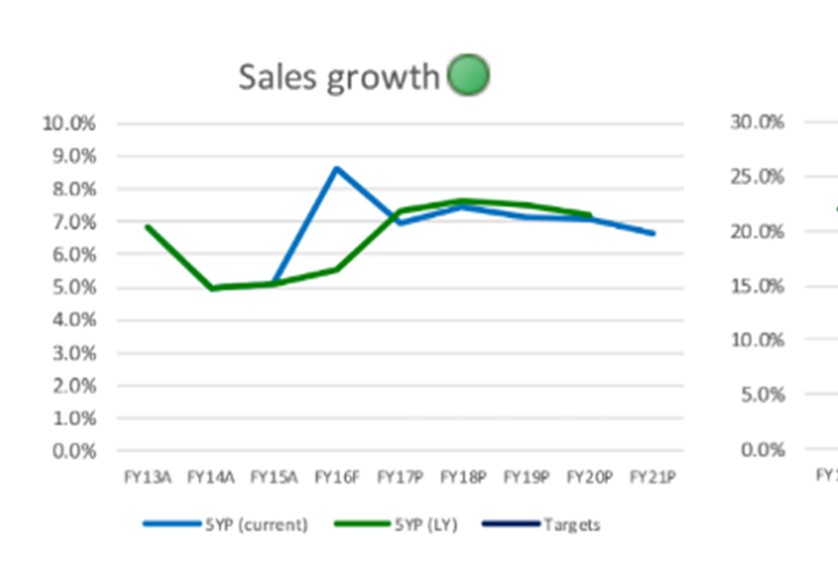
(b) Martin testified that when the US Pooled 5YP was being developed, FY16 was looking like an “exceptional year” of sales growth relative to FY14 and FY15. At another point in his evidence Martin agreed that at the time he was starting to develop the FY17 sales budget, US Pooled had had a “good year” of sales. He said that, by reference to the large number of “blue sheets” in the FY16 sales funnel, FY16 was a “very good year” for sales;
(c) Kennett accepted that FY16 was an “exceptional” year for Brambles; and
(d) a presentation titled “Key FY16 Messages - CHEP North America Pallets” dated 4 August 2016 shows that revenue growth for US Pooled in FY16 was 8.2% on a constant currency basis, which it described as “very strong revenue growth”.
869 Rumph’s Headlines Memo specifically called out a key risk that the revenue growth assumption in the US Pooled FY17 budget was “very aggressive given one-time benefits in FY16 that aren’t likely to repeat”, and that:
(a) US Pooled sales volume was trending lower in FY16 which created a jump-off risk into FY17;
(b) $53 million of unidentified wins was assumed in US Pooled ($90 million total wins versus $78 million in FY16); and
(c) in US Recycled, FY16 exit pricing was forecasted to be below FY17 budget price, creating immediate Underlying Profit risk.
870 For the reasons I have explained, I give weight to the views Rumph expressed at the time. Mackie testified that he had particular trust in Rumph’s judgement and capability as President of CHEP NA, and that she was “extremely adept” in her role.
871 Another reason for US Pooled’s very strong revenue performance in FY16 was the high price of whitewood pallets in that year. Pooled pallets were a higher quality, more durable and more versatile pallet option for customers but were more expensive, whereas whitewood pallets were a lower quality, less durable option and cheaper. The evidence shows that when whitewood pallet prices were high:
(a) US Pooled was able to more easily maintain relatively high prices for pooled pallets, or raise prices, while still remaining price competitive for price-sensitive small to medium enterprise (SME) customers who might otherwise shift from pooled to cheaper whitewood pallets. In FY16 US Pooled was able to take advantage of the narrower gap between whitewood prices and the price for pooled pallets by making “aggressive” pricing increases, thereby achieving increased sales revenue;
(b) the narrower gap between the price for whitewood pallets and the price for pooled pallets meant that US Pooled was able to more easily convert customers from lower quality whitewood pallets to higher quality pooled pallets, thereby achieving increased sales revenue; and
(c) CHEP NA’s sales revenue also increased because US Recycled enjoyed increased revenue from its “aggressive pricing increases” of whitewood pallets.
In the presentation titled “Key FY16 Messages - CHEP North America Pallets” dated 4 August 2016, Brambles estimated that US Pooled earned approximately $5 million in revenue in FY16 “due to customers converting from US Recycled to US Pooled as US Recycled took aggressive price increases”.
872 At the time the US Pooled FY17 budget was set, the prices for “A grade” whitewood pallets had begun to level off, and US Recycled had begun to moderate prices for whitewood pallets. The 25 January 2016 5YP presentation acknowledged that sales revenue in FY16 had been high in part because of a high-priced whitewood pallets market, and with the price in the whitewood pallets market levelling off, expectations for future price increases were reduced.
873 I accept, as Brambles submitted, that while the price difference between pooled pallets and whitewood pallets was an important factor in whether customers converted from whitewood to pooled pallets, it was not the only consideration. As I later explain in more detail, customers converted from whitewood to pooled pallets for a variety of reasons. The likely levelling off in whitewood pallet prices in FY17 did not mean that US Pooled would be unable to earn revenue by converting any whitewood pallet users to pooled pallets in FY17; there were a number of reasons why it would continue to be able to convert customers. But in my view, considered objectively, it was quite unlikely that CHEP NA would enjoy the same level of revenue (in both US Pooled and US Recycled) in FY17 that it had enjoyed in FY16 as a result of higher whitewood pallet prices.
874 It is significant that Mackie accepted that it was going to be difficult for US Pooled to repeat in FY17 the sort of year-on-year growth in new customer “wins” it had achieved in FY16. He was taken to the US Pooled initial budget submission and he testified that it “became obvious” through the budget-setting process that the good progress in growth in new customer “wins” that had happened in FY16 was going to be “difficult to repeat”.
875 I take the same view. The fact that sales growth in US Pooled in FY16 was exceptional compared to prior years, coupled with the fact that:
(a) higher whitewood prices drove that growth in FY16 and they were levelling off in FY17; and
(b) there was expected to be heightened competition from PECO in FY17 which was likely to have an adverse impact on FY17 sales volume and pricing,
lead me to conclude that, considered objectively, it was unlikely that US Pooled would achieve similar sales revenue growth in FY17. Yet the US Pooled FY17 budget projected a $13.5 million increase in revenue from total wins (from $76 million in the FY16 February Forecast to $89.5 million in the FY17 budget).
10.4.2.2 Whether increased asset recovery costs and NPD costs adequately taken into account?
876 The applicants contended that two FY16 specific matters indicate that US Pooled’s strong revenue and Underlying Profit growth in FY16 were unlikely to be repeated in FY17. In their written closing submissions they said:
First, in FY2016 US Pooled outlaid the highest level of capital expenditure on new pallets of any financial year in the previous decade. It purchased approximately 9.3 million new pallets, which required capital expenditure of approximately US$294 million. Under its revenue recognition model, Brambles receives revenue from pallet issues when it issues the pallet, while it incurs the bulk of the costs associated with a pallet issue when the pallet returns to it, including the costs of transporting, sorting, inspecting, repairing and storing the pallet. The increase in the number of new (as opposed to existing) pallets that Brambles issued in FY2016 had the effect that:
(a) US Pooled could recognise the revenue from the increased number of issued pallets in FY2016, while not having to incur the costs of recovering and re-issuing an existing pallet until FY2017; and
(b) the capital expenditure so incurred was excluded from the calculation of its Underlying Profit in FY2016.
Secondly, in FY2016 US Pooled increased significantly the number of pallets that it issued to manufacturers who subsequently transferred those pallets to distributors with whom Brambles did not have a contractual relationship (that is, NPDs). The channels into which Brambles issued such pallets are referred to as NPD channels. Brambles incurs higher costs to service NPD channels because, amongst other things, those channels result in less transparency and control over pallet use, slower cycle times and increased damage to pallets. As a result, Brambles charges what it describes as a ‘NPD surcharge’ to manufacturers who transfer pallets into NPD channels. Again, Brambles receives that additional revenue when the manufacturer transfers the pallet to a distributor, and does not incur costs until the pallet returns to it. In the case of pallets issued into NPD channels in the second half of FY2016, the increased revenue from issuing the pallet might be expected to be earned in one accounting period (namely FY2016), while the bulk of the associated costs could be expected to be incurred in the next (namely FY2017).
877 I understood that as a contention that US Pooled had increased its issue of new pallets in FY16, including pallets distributed into NPD channels, and it had earned the revenue from those pallet issues but had not yet incurred a substantial proportion of the operating costs associated with those increased pallet issues. On that basis (together with the fact that whitewood pallet prices were levelling off) the applicants submitted that it was unlikely that US Pooled would be able to repeat its FY16 results in terms of revenue and Underlying Profit.
878 The evidence shows that:
(a) US Pooled substantially increased its issue of new pallets in FY16, most of the revenue is earned at the pallet issue stage, and the increased pallet flow including into NPD channels was likely to lead to increased costs in FY17; and
(b) a higher level of pallets was transferred into NPD channels in FY16 than were transferred in FY15, and the higher costs associated with pallets in NPD channels would likely lead to increased costs in US Pooled in FY17.
879 Brambles accepted that US Pooled had increased its issue of new pallets in FY16, including pallets distributed into NPD channels which would involve higher costs, but it argued that it recognised those issues and properly accounted for them in the US Pooled FY17 budget.
880 There is some evidence that the US Pooled FY17 budget did not adequately take into account the risk of increased asset recovery costs and NPD costs in FY17. For example, in part of the email exchange between Rumph, Lallatin and Alonso on 12-13 April 2016 in relation to the Second Revised Budget Submission, Lallatin cautioned Rumph to consider additional asset recovery costs before she made that submission to Mackie. He said:
Before we make any decisions, I want to make you aware of one additional risk that surfaced in the MBR discussions Friday. NPD transfers continue to be significantly higher than expected, which will increase Asset Recovery fees in FY17 as many of these flows will not return until then. This could be ~$2M+ of risk that we do not have in the budget. Also, per the R&O slide, we have a lot more risk than opportunity in FY17.
881 Rumph specifically raised this risk with Mackie in the Headlines Memo. She noted in relation to “Direct Costs”:
• US Pooled Asset Recovery: NPD transfer growth higher than anticipated driving $2M+ of recovery fees from FY16 flows not in budget that will hit us in FY17.
882 The weight of the evidence, however, tends to show that Brambles recognised those issues and adequately accounted for them in the US Pooled FY17 budget.
883 First, the evidence shows that US Pooled’s NPD surcharges were structured in an endeavour to reflect the higher damage rate to pallets and higher risk of recovery for pallets in the NPD channel compared to the PD channel, and within the NPD channel, in the Semi-Cooperating Distributor channel compared to the Non-Cooperating Distributor channel. During the FY16 Earnings Call, Todorcevski identified NPD upcharges as an element of Brambles’ price increase in US Pooled and observed that US Pooled was focussed on ensuring that whenever a new contract was executed involving an NPD, the fees charged to the customer offset the costs associated with issuing the pallet in the NPD channel. There is no cogent evidence that US Pooled’s NPD charges would not cover or substantially cover the costs of the greater number of pallets in NPD channels in FY17. Brambles submitted that the costs associated with increased NPD transfers in FY16 were offset by increased revenue from NPD surcharges.
884 Second, the evidence shows that the US Pooled FY17 budget included:
(a) an $8 million increase in volume-related direct costs for NPD volumes;
(b) $8 million in additional “other” costs associated with additional NPD volumes;
(c) an additional $0.5 million budgeted for IPEP expense on account of an increase in NPD transfers; and
(d) an incremental $10 million in additional asset recovery and collections costs expected in FY17.
Alonso’s view, as the head of Supply Chain, was that the expected additional NPD costs, asset recovery and collections costs were properly accounted for in the US Pooled FY17 budget. Mackie deposed that he was confident the NPD costs had been adequately budgeted for.
885 Third, the revenue generated from customers distributing pallets into NPD channels generally accounted for a relatively small proportion of Brambles’ revenue. Transfers to NPDs were approximately 5.7% of the total number of US Pooled pallet transfers in FY15, and approximately 8.5% in FY16. That is, NPD costs did not have the significance to the achievability of the US Pooled budget for which the applicants argued.
886 Fourth, it is unclear whether the $2 million in asset recovery costs which Lallatin said were not in the FY17 budget were in fact covered by the $10 million in additional spending for additional asset recovery and collections costs as Brambles submitted. But those costs were recognised by Rumph, and she stated “we will find a way to mitigate it”.
887 Fifth, much of the growth in the number of pooled pallets transferred into NPD channels in FY16 resulted from the reclassification of pooled pallet recipients from PD to NPD. A presentation titled “CBU Overview: Pallets North America” dated 20 February 2017 shows that in FY16, customers of US Pooled transferred approximately 23 million pallets into NPD channels, approximately 8.5 million more than in FY15. But as a percentage, transfers to NPDs were only approximately 5.7% of the total number of US Pooled pallet transfers in FY15, and approximately 8.5% of the total number in FY16. A review of US Pooled NPD transfers emailed to Kennett and others on 25 January 2017 shows that the growth of NPD transfer volume and corresponding revenue in FY16 was strongly tied to the reclassification of the Home Depot and Nash Finch accounts. 42% of the increase in NPD transfers from FY15 to FY16 was driven by the reclassification of those two large accounts with the balance being strong organic growth. Thus, the growth in NPD transfers in FY16 was not necessarily an indication that the NPD channels were expanding more quickly than the PD channel and, therefore, that recovery costs would significantly increase in FY17.
888 Thus, the applicants did not establish that the US Pooled FY17 budget lacked reasonable grounds for the reason that during the budget-setting process, Brambles failed to recognise and adequately take into account that US Pooled had increased its issue of new pallets in FY16 including into NPD channels, and it had earned the revenue from those pallet issues but had not yet incurred a substantial proportion of the operating costs.
10.4.3 Alleged unreasonable US Pooled budget assumptions
889 The applicants submitted that the US Pooled FY17 budget was based on some assumptions which lacked an objectively reasonable basis, being assumptions regarding:
(a) new wins;
(b) revenue per pallet issued (RPI);
(c) the pallet damage rate; and
(d) asset recovery costs and NPD costs.
890 Brambles argued that to make out this submission the applicants must establish that a particular assumption in the Group FY17 budget had the effect that Brambles’ groupwide FY17 Guidance was unreasonable (or at a certain time ceased being reasonable). It contended that it was insufficient for the applicants to identify that a particular assumption, for example within US Pooled, was unreasonable or became unreasonable to maintain.
891 I accept that the assessment of whether there were reasonable grounds for the August Representations must be assessed at the Group level, rather than at the US Pooled level. But I do not accept that the assessment regarding the existence of reasonable grounds must be undertaken by considering the effect of each alleged unreasonable assumption in isolation, as distinct from considering their effect in combination. The applicants did not put their case on the basis that each of the alleged unreasonable assumptions should be considered in isolation from the others, nor in isolation from the other alleged deficiencies in the US Pooled FY17 budget.
892 The applicants’ case was that, at the time that Brambles made the August Representations, the US Pooled and CHEP NA FY17 budgets lacked reasonable grounds (and therefore the Group FY17 budget lacked reasonable grounds and did not provide reasonable grounds for Brambles to make the August Express Representations). It said that the US Pooled and CHEP NA budgets were based on:
(a) an objectively unrealistic view that the very strong revenue and profit growth US Pooled achieved in FY16 was likely to be repeated in FY17;
(b) four objectively unreasonable assumptions;
(c) a failure to adequately take into account various known and identified risks; and
(d) unreasonable top-down pressure applied to stretch the US Pooled budget into alignment with predetermined management goals.
Whether reasonable grounds existed for Brambles to make the August Express Representations does not fall to be answered by reference to any of those integers considered in isolation of the others.
10.4.3.1 Increased ‘new wins’ assumption
893 The applicants submitted that, during the period the US Pooled FY17 budget was set and at the time Brambles made the August Representations, the US Pooled budget lacked reasonable grounds because it was likely that the assumed customer ‘wins’ in the budget lacked an objectively reasonable basis. They relied on two aspects of that, being:
(a) an assumption of $53 million in “unidentified new wins”; and
(b) an assumption that US Pooled would not lose any major customers in FY17.
894 There were two potential sources for ‘new wins’ for US Pooled in FY17. The first was customers from its pallet pooling competitors, in particular PECO; and the second was converting users of whitewood pallets to pooled pallets. Where US Pooled achieved a ‘win’, the sales revenue that flowed from it was a function of sales volume and sales pricing.
895 For ease of understanding, it is worth reiterating the meaning of some of the relevant terms:
(a) ‘new wins’ was new business with customers, made up of: (i) “new customer contracts”, being contracts that are entered into in the current financial year; and (ii) “lane expansion”, being additional sales volume in the current financial year under a new agreement with an existing customer;
(b) ‘rollover wins’ involved contracts signed in the previous financial year, where the term of the contracts extends into the current financial year. It referred to the portion of the first 12 months of a customer contract that fell within the financial year following the financial year in which the contract was entered into or finalised;
(c) ‘rollover losses’ was the opposite of a rollover win. It referred to the portion of the first 12 months of a customer loss that fell within the financial year following the one in which the loss occurred;
(d) ‘unidentified wins’ or ‘volume stretch’ was the total amount of new business US Pooled expected to win in that financial year but which was not yet allocated to a specific or potential customer;
(e) ‘net new wins’ represents the difference between new wins and new losses;
(f) ‘organic growth’ was growth from existing customers under existing contracts, but where more pallets are issued to customers under the contracts already in place; and
(g) ‘sales funnel’ or ‘sales pipeline’ was the means by which US Pooled organised and tracked potential new customers as they progressed through the sales process. The pipeline or funnel was based on the Miller Heiman sales methodology, which is a sales model that involves the categorisation of potential business into a number of levels depending on how far progressed they were through the sales process, and the stage of the relationship between the seller and the customer.
896 The applicants produced the following table regarding the new wins assumption:
($US million) | FY17 Budget | FY16 Actual | FY16 Forecast |
Rollover wins | $21m | $29.4m | Unknown |
New business in the funnel | $15m | $47.3m | Unknown |
Unidentified | $53m | Unknown | |
TOTAL WINS | $89.5m | $72.2m | $76m |
Wins % of sales | 5.9% | 5.3% | 5.5% |
Rollover losses | $11m | $8.9m | Unknown |
New losses | $17m | $8.6m | Unknown |
TOTAL LOSSES | $(27.9)m | $(17.5)m | $(17.1)m |
Losses % of sales | (1.8)% | (1.3)% | (1.2)% |
TOTAL WINS GROWTH | $61.6m | $54.7m | $58.9m |
897 As is apparent, the US Pooled budget assumed total wins of $89.5 million ($21 million in “rollover wins”, $15 million in “new business in the sales funnel” and $53 million in unidentified wins) which represented a $13.5 million increase in total wins ($76 million in the FY16 February Forecast to $89.5 million in the budget). After providing for $17 million in new losses of ‘run of the mill’ customers (and assuming no major customer loss), the US Pooled FY17 budget assumed net new wins of $61.6 million which represented a $2.7 million increase in net new wins against the $58.9 million in the FY16 February Forecast.
898 The applicants submitted that, at the time the August Express Representations were made, there was no reasonable basis for Brambles to assume it would achieve unidentified wins (being potential sales to unidentified potential customers) of $53 million which represented approximately two thirds of the “total wins” of $89.5 million in FY17. They also submitted that there was no reasonable basis for assuming that US Pooled would not lose any major customer or customers in FY17.
899 In relation to new wins, the applicants submitted that it was unreasonable to forecast that US Pooled would achieve $53 million in unidentified wins in FY17 when:
(a) US Pooled had enjoyed very strong sales revenue growth in FY16, which for the reasons outlined above was unlikely to be repeated in FY17;
(b) US Pooled had faced heightened competitive pressure from PECO in the second half of FY16, and was likely to face continued heightened competitive pressure from it in FY17, yet the budget assumed:
(i) a substantial increase in unidentified wins to $53 million in FY17, contributing to a $13.5 million increase in total wins; and
(ii) US Pooled would not lose any major customers in FY17, contributing to the $61.6 million in net new wins;
(c) at the time the FY17 budget was being formulated, whitewood pallet prices were levelling off, and despite that US Pooled budgeted for a substantial amount of revenue growth in FY17 through whitewood pallet conversions; and
(d) US Pooled’s sales funnel was diminishing, and despite that (and the compounding factors of heightened competition from PECO and declining whitewood pallet prices) the CHEP NA “FY17 Budget Post-Flex Review” (CHEP NA FY17 Post-Flex review) presentation dated 16 September 2016 shows that the budget “assume[d] higher confidence of 75% for new wins to compensate for sales funnel shortfall”.
Before turning to deal with those matters it is convenient to deal with Brambles’ contentions as to why its budget assumptions of $53 million in unidentified wins and no major customer loss in the US Pooled FY17 budget had a reasonable basis (the latter I refer to as the no major customer loss assumption).
Brambles’ contentions
900 First, Brambles argued that the skill and expertise of US Pooled’s dedicated sales and marketing teams meant that the assumed $53 million in unidentified wins had a reasonable basis.
901 The evidence shows that there were around 90 employees in the US Pooled sales teams responsible for new business, whose day-to-day focus was to achieve the new wins assumptions in the budget, including unidentified wins. The sales team included the following three sector teams which dealt with different sizes of customers:
(a) the National Hunters team which was the new business group for large national customers. This team was responsible for winning new national contracted business and did not manage any existing customers. They were allocated either to a specific geographical region, or to a specific customer sector at a national level. It was not a large team. It comprised approximately three people in FY16 and was increased to five people in FY17;
(b) the Business Development Manager (BDM) team, consisting of 38 people who were located across the USA and were responsible for both local and regional customers with annual revenue of between approximately $50,000 and $500,000 each. This team was responsible for winning new business in this sector, and also managed the existing customers. Each member of the BDM team had an annual revenue target of more than approximately $1 million; and
(c) the Inside Sales team, made up of 20 tele-sales representatives, who were responsible for contacting US Pooled’s more than 3,000 SME customers to make new sales in the SME segment, as well as for the lane expansion and account management of those customers in the portfolio. Typically, these were accounts with annual revenue under $400,000 or pallet issues under 200,000, and they totalled approximately $70 million revenue in FY17. Each Inside Sales representative had an annual growth target of around 5-10%.
The sales teams were sales incentive driven. Martin said, and I accept, that approximately 35-40% of the overall remuneration to an employee in each of the above sales teams was contingent on the achievement of individual sales targets.
902 US Pooled also had a marketing team comprising approximately 15 people in FY16 and 17 people in FY17 which was responsible for researching and reviewing customer segments in the US market and identifying segments that were likely to convert from whitewood to pooled pallets, as well as understanding the key drivers of customer conversions, doing customer research and providing that data to the sales teams. Mackie gave evidence that the marketing team played an important role in building the sales pipeline.
903 Martin also testified that the increase in size of the Hunters team from three people in FY16 to five people in FY17 was significant to his confidence in achieving $53 million in unidentified wins, due to the additional resources that would be dedicated to realising those unidentified sales opportunities. As he put it: “Additional salespeople sell additional things”. However, as Martin accepted in cross-examination, the addition of two more sales representatives in the Hunters team in FY17 did not mean that US Pooled was “necessarily going to do better or as well” as it did at securing new wins in the previous year.
904 I have no difficulty in accepting that US Pooled had skilled and expert sales and marketing teams, who worked hard to identify sales opportunities and convert them into executed sales contracts and who fought to retain existing customers who were pursued by PECO. But it does not follow that, at the time Brambles set the US Pooled FY17 budget or when it made the August Express Representations, there existed an objectively reasonable basis for the assumption of $53 million in unidentified wins (which lay behind an assumption of $13.5 million more total wins in FY17 than in an exceptional FY16). Nor does it follow that there existed a reasonable basis for the assumption of no major customer loss in FY17. US Pooled had that same team in FY16 and (as I will explain) it had lost one major customer and a portion of another to PECO in the second half of FY16, and it had only managed to retain several others in that period after a tussle with PECO and by significantly reduced pricing. There was no reasonable basis to think that the addition of two more sales representatives in the Hunters team was likely to significantly change the position.
905 Second, Brambles submitted that the assumption of $53 million in unidentified wins had a reasonable basis because at the time the budget was set US Pooled was pursuing around $147 million in ‘new win’ opportunities, and that there existed reasonable grounds for that assumption because it was based on detailed data and analysis regarding sales opportunities in sales funnel reports.
906 I accept that the sales funnel reports show that at the time the budget was set US Pooled was pursuing around $147 million in ‘new win’ opportunities. The evidence includes detailed sales funnel reports from the Relevant Period which recorded the US Pooled sales teams’ assessment of where sales opportunities sat in the ‘life cycle’ from initial customer contact through to completion of a contract. The positions in the sales funnel to which potential customers were allocated included:
(a) “Top”- which referred to opportunities for which the sales team had made contact with the potential customer and initial meetings or conversations had been scheduled or were ongoing;
(b) “In” - which referred to opportunities for which the sales team had provided prices to the potential customer;
(c) “Best Few” - which referred to opportunities for which the sales team had entered into negotiations with the potential customer regarding contractual terms; and
(d) “Won” - which referred to deals that had been successfully closed.
907 The sales funnel reports relevantly provided that:
(a) as at the end of February 2016, the sales funnel was worth $148.7 million and included $5.7 million “best few” opportunities, $34.5 million “in”, and $108.6 million “top”;
(b) as at the end of March 2016, the sales funnel was worth $147.9 million and included $8.5 million “best few”, $33.5 million “in”, and $105.9 million “top”; and
(c) as at the end of June 2016, the sales funnel was worth $134.9 million and included $26.4 million “best few”, $24.2 million “in”, and $84 million “top”.
The evidence shows that in the three months between March and June 2016, “best few” opportunities had improved by $17.9 million. That shows sales momentum heading into FY17 and provides some support for the budget for unidentified wins in the US Pooled FY17 budget.
908 I do not, though, consider Martin’s evidence - to the effect that the assessment of unidentified wins for the US Pooled budget was a data and analysis driven process - to be reliable and I give it reduced weight. Martin deposed that the assessment was reached having regard to the following elements:
(a) the total identified opportunities at the top of the sales funnel (the level at which new opportunities enter the funnel); and
(b) the total of the Hunters team’s annual targets,
and was a portion of those totals, also having regard to historical data on the percentage of opportunities pursued by the Hunters team that US Pooled typically closed (by entering into a contract with a customer) each year.
909 He said that the sales funnel system had “a lot of rigour and process behind it”. He deposed as to the detailed sales funnel reports and sales funnel analyses which updated the opportunities in the sales funnel on a rolling basis (called ‘bluesheets’), including annual volumes and the proportion of new issues that may be secured in the current year. Martin and Todorcevski said that information was considered when setting budget figures for new wins.
910 The evidence shows that Brambles’ systems generated detailed data and analysis to assist the forecasting of unidentified wins, and that US Pooled took that data and analysis into account when preparing the FY17 sales budget. But it also shows that the FY17 sales budget, in practice, was, at least in part, more akin to a target set in an effort to maximise performance. Martin deposed, correctly in my view, that the unidentified wins were “[i]n effect…a target for sales growth”.
911 Until a contract was signed, the potential customers in the unidentified wins category in US Pooled’s sales funnel were just that. Martin described unidentified wins as wins from the sales funnel which were ‘unidentified’ in the sense that the ‘win’ had not yet been allocated to a specific customer. But I do not consider that to be an appropriate description, as the evidence shows that many of the sales opportunities in the unidentified wins category never eventuated.
912 The evidence shows that, while detailed data and analysis was used in the forecasting of unidentified wins, the revenue forecast to be achieved through unidentified wins was often just a stretch target. Indeed, another term for ‘unidentified wins’ within US Pooled was ‘volume stretch’; that is, a stretch target aimed at optimising performance. In the first draft of the Headlines Memo, Lallatin described the assumed $53 million in revenue from unidentified wins as “unidentified stretch”. I give weight to the views he expressed at the time. He was the CFO for CHEP NA and Brambles made no suggestion that he was anything other than competent in that role.
913 I am satisfied on the evidence that, involving as it did an attempt to assess the revenue to be earned from potential sales to unidentified potential customers, the assessment of unidentified wins was necessarily rubbery, and it was a ready ‘bucket’ in which to place stretch targets. I am satisfied that that occurred in setting the US Pooled FY17 budget.
914 Martin’s affidavits painted a picture of an analytical and data-driven approach to budgeting for unidentified wins in US Pooled, but in cross-examination it became sufficiently clear that in practice the forecast for revenue from unidentified wins was increased or maintained without due regard to sales data or analysis and in a manner which, in my view, merely operated to backfill a revenue gap.
915 One example of that can be seen in the evidence regarding the loss of the Kraft-Heinz account to PECO. On 23 March 2016 it was confirmed that US Pooled had lost that account, which was worth around $9.4 million pa for US Pooled (and $3.3 million pa for CHEP Canada). Immediately before that loss, US Pooled had assumed $43.3 million in revenue from unidentified wins in its FY17 budget. In response to the loss of that business, the US Pooled initial budget submission:
(a) appropriately increased the assumed new losses by $9.4 million (being the value of the Kraft-Heinz contract in FY17); but
(b) also increased its assumed unidentified wins by the same amount (from $43.3 million to $52.6 million), being approximately the amount that was assumed in the US Pooled FY17 budget as ultimately approved.
Thus, despite the loss of a major customer worth $9.4 million revenue pa, the assumption for net new wins in the US Pooled budget remained unchanged, and budgeted revenue remained the same.
916 In his affidavit Martin deposed that he was:
…comfortable with the adjustment to budgeted unidentified wins. Although it would have been preferable not to have the unidentified wins target increased, I considered that it was achievable having regard to the resources available, in particular in the Hunters team, and the identified opportunities in the pipeline.
917 But in cross-examination Martin accepted that by making that adjustment he was “doing nothing more here than increasing unidentified wins by the exact same amount of the losses that [he] just realised [Brambles was] going to experience”.
918 Martin sought to explain that by stating that US Pooled is an asset pooling company, which rents out assets (pallets) that it owns, and upon the loss of an account:
… you immediately have available assets. So it’s natural that you would take those assets and redeploy them some place. It’s - it’s how we budget. We don’t just budget because there’s revenue accounts. You know how many assets you’re going to have. So I didn’t - I didn’t have the exact number of accounts pegged yet, but we knew we would have those assets available to redeploy.
Later in cross-examination, in response to a suggestion that he was just plugging a hole in the budget, he said: “We were plugging a revenue hole with the assets available, yes”.
919 Brambles said that Martin’s explanation was “simple and convincing”. I found his explanation both difficult to understand and unlikely. I do not consider that evidence to be reliable and I do not give it much weight.
920 The loss of the Kraft-Heinz account meant that US Pooled would have approximately 1.8 million pallets available for lease to other customers. The evidence does not show that so many pallets could be readily or immediately leased to another customer. Nor does the evidence show that the Kraft-Heinz account could be replaced with customers leasing pallets at a similar rate of pricing. Heinz was a high-RPI customer because of its pallet usage patterns, including transfer of pallets to NPDs.
921 I accept Martin’s testimony that the US Pooled sales teams were experienced and expert in customer relations and aware of the length of time ordinarily involved in negotiating and onboarding new business, including small accounts and large accounts, which was then factored into the sales funnel reports. But, in relation to the loss of the Kraft-Heinz account, there is no evidence of any assessment within US Pooled as to how long it was likely to take to find sales opportunities sufficient to soak up 1.8 million pallet issues, negotiate agreements in relation to such sales, finalise the terms of such sales, and set up customers so that they could start receiving pallets and hence pay issue fees and associated charges to US Pooled. Instead, as Martin accepted, the approach taken was to increase sales revenue from unidentified wins in the US Pooled budget by the exact same amount of the sales revenue lost by the loss of that account.
922 The evidence indicates that, if Brambles could replace the revenue from that lost account, it was likely to take a significant period of time. Todorcevski deposed that: “Negotiations for large national contracts could take upwards of 12 months while contracts with smaller manufacturers could be closed within a month from the point at which the opportunity was identified and entered the sales funnel”.
923 Martin’s evidence that it was reasonable for US Pooled to budget for no loss of revenue upon the loss of a major customer jarred with other parts of the evidence, and I do not consider it to be reliable. Several matters are material to that conclusion:
(a) the management and sales team emails in the second half of FY16 show that the US Pooled sales team and higher management fought to keep major customer accounts, including by offering terms which provided Brambles a poor financial return, and they reacted with disappointment when a major customer account was lost. Why would they be concerned about the loss of a major customer if the revenue from that contract could be immediately replaced by redeploying the pallets to another customer?;
(b) in the Headlines Memo in April 2016, Rumph expressly called out the assumption of no major customer loss as one of the “big issues / key risks / unidentified stretch” in the CHEP NA FY17 budget. Why would she be so concerned about that assumption if that revenue could be immediately replaced by redeploying the pallets to another customer?; and
(c) in November 2016 US Pooled was facing a risk of losing the large JBS contract to PECO. The “JBS Summary” report Martin sent to Todorcevski, O’Sullivan, Bachtell and others said: “[W]e do not believe we could make up any of this volume near term”. The Court was taken to nothing to show that that was because of particular market circumstances then existing.
924 Another example can be seen in the evidence regarding US Pooled’s termination of its contract with Scotts in April 2016. Scotts was a large customer which leased approximately 3.8 million pallets pa. Brambles terminated the contract because Scotts declined to agree to increased pricing. Martin deposed that he was “not panicked” about the loss of the Scotts business because US Pooled would be able to re-deploy the assets that Scotts would not be using in the future to take advantage of other opportunities. Then in cross-examination he conceded that the 3.8 million pallets pa that became available for lease following termination of the Scotts contract were just left in the sales funnel and spread onto the sales targets for other sales representatives. Nador testified that two million of the lost sales volume was transferred to cheaper whitewood pallets through US Recycled (which I infer would have involved a revenue loss for CHEP NA through lower prices), but she did not explain what happened to the remaining pallet issues.
925 Another example in which the process of setting the US Pooled sales budget was a far cry from an entirely data- and analysis- driven process can be seen in an email exchange which I later detail between Bachtell and Martin on 27-29 September 2016 when they were engaged in preparing a reforecast of the US Pooled sales revenue budget in the September Reforecast following two months of under-budget sales performance.
926 In my view, the evidence shows that the forecasting or projection of unidentified wins within US Pooled was in part data-driven and analytical, but it was sometimes used just to plug a revenue hole, which occurred in relation to the forecast for unidentified wins in the FY17 budget.
927 Third, Brambles submitted that the assumed $53 million in unidentified wins had a reasonable basis because Todorcevski’s and Mackie’s evidence showed that the market for pooled pallets in the US grew each year. I accept that between 2012 and 2017 sales revenue growth in CHEP Global’s mature markets was relatively predictable, consistently tracking at around 4-8%, including 1-2% organic growth, 2-4% from net new wins and 1-2% from price / mix, and that US Pooled operated in a mature market. I also accept that the evidence shows that US Pooled had a large addressable market or ‘white space’ in which it could expand and grow its operations. There were opportunities for US Pooled in FY17 to strengthen its presence in existing sectors and penetrate new parts of the pooled pallets market in the United States. That general evidence regarding the available market provides some support for the assumption regarding unidentified wins, but it did not engage with the specific matters raised by the applicants nor engage with the no major customer loss assumption. It does not take Brambles’ argument far.
928 Fourth, Brambles submitted that the assumed $53 million in unidentified wins had a reasonable basis because the new wins assumption in the US Pooled FY17 budget was $78.8 million, which was only slightly higher than the new wins assumption in the FY16 February Forecast of $76 million. It noted that US Pooled was forecast to achieve approximately $59 million of net new wins in the FY16 February Forecast, which meant that the forecast of $61.6 million of net new wins in the US Pooled FY17 budget represented very modest growth. It said there was nothing unreasonable about forecasting sales revenue growth of that size.
929 I take a different view. The $78.8 million new wins figure was produced in the 26 February US Pooled budget presentation. That assumption was increased by almost $11 million to $89.5 million in the 24 March 2016 initial budget submission, in my view without a reasonable basis. Of that increase, $9.4 million involved little more than backfilling a revenue gap arising from the loss of the Kraft-Heinz account. Neither would I characterise the ultimate $13.5 million increase in total wins as “modest growth”.
930 I accept that the $2.7 million increase in the projected net new wins from the FY16 February Forecast to the budget is modest (from $58.9 million to $61.6 million). But the evidence does not establish that the forecast unidentified wins in the FY16 February Forecast had a reasonable basis; and the forecast for net new wins in the US Pooled FY17 budget was in part based on an unreasonable assumption that US Pooled would not lose any major customers in FY17 (when it had already lost one major customer and a portion of another two accounts in the previous six months, and faced the threat of losing several others). In my view the forecast for net new wins in the US Pooled budget lacked an objectively reasonable basis.
Heightened competition by PECO contention
931 The applicants contended that, in the period when Brambles set the US Pooled FY17 budget and at the time it made the August Express Representations, US Pooled was experiencing heightened competition from PECO, which competition was likely to continue in FY17, and the competition was likely to adversely affect both sales volume and the price at which those sales were made, resulting in materially lower sales revenue. They argued that the heightened competition from PECO and its aggressive pricing strategies had led to US Pooled losing (in whole or in part) two major customers in the second half of FY16, and facing the risk of the loss of several others in that period. On the applicants’ argument, there was no objectively reasonable basis for Brambles’ assumption that US Pooled would not lose any major customer in FY17.
932 The applicants relied upon the following evidence:
(a) on 25 January 2016 Bachtell emailed Lallatin and said that he had talked to Martin who was “definitely concerned” about taking on an additional $10 million for sales revenue in the draft US Pooled FY17 budget, “especially given the large amounts of pressure we’re starting to see PECO put on these deals (Kraft, Mars Niagara, etc.)”. Martin sought to downplay that email exchange as sandbagging but for the reasons previously explained I give little weight to his evidence in that regard;
(b) in March 2016 the US Pooled initial budget submission said the following, under the heading “Competitive Environment”:
PECO strategy appears to have shifted toward pursuit of volume growth, as evidenced by their aggressive pricing strategies in several recent National deals. Further, they appear to be targeting a wider range of potential customers versus their prior strategy focusing on specific geographies and transfer profiles.
(c) on 23 March 2016 it was confirmed that US Pooled had lost the Kraft-Heinz account to PECO, which was worth $9.4 million in sales revenue pa;
(d) on 16 April 2016, Rumph’s Headlines Memo expressly called out competition from PECO as one of the “key risks” facing the US Pooled FY17 budget. She wrote:
Competition
• Increased competition in US Pooled and Canada with leadership changes pending at PECO driving uncertainty around future behaviors, their recent win of Kraft/Heinz in North America, and that they are now accepted at all top 5 Retailers in Canada. Recycler and PECO behaviors related to pallet collections also presents future risk and disruption to the US business model.
Risk: Both Canada and US Pooled assumed low loss rates despite this volatility with PECO. Loss of a major customer is not assumed in the US budget and no loss is assumed in Canada though Mars seems imminent.
(e) on 25 April 2016 there was an email exchange between Martin and Todorcevski in which Martin requested approval for a renewed contract at low rates with Dannon, a large US Pooled customer. Martin wrote:
Dannon is another huge brand that we would not want to lose in the US.… Based on the last 3-4 months of intel, Peco will easily match this rate.… On the heels of Kraft/Heinz, we would not want to send a message to the market that we lost another very large brand like Dannon to Peco.
(Emphasis added.)
Todorcevski said in response:
Agree, we don’t want to lose a major customer Dan. However, we aren’t even treading water with this pricing so we need to recognise this is loss making business.
(Emphasis added.)
US Pooled was able to keep the Dannon account. In cross-examination Martin accepted that it did so by offering rates below its usual required return on capital invested, although he maintained the contract was not actually “loss-making”;
(f) in May 2016, PECO was pursuing Great Lakes Cheese, another large US Pooled customer which contributed 1.1 million in volume and $6 million in revenue as at July 2016. On 28 May 2016 Bachtell emailed Martin and others a presentation which said that PECO had Great Lakes Cheese “interested in flat rate and internally created pressures to ensure maximization of savings with vendors”. Negotiations were ongoing at that time and the evidence does not show whether or not US Pooled ultimately retained that account but, almost a year later, an April 2017 Board Report shows that US Pooled was at that point still waiting for Great Lakes Cheese to sign a revised contract;
(g) Martin accepted that in the period April to June 2016, Brambles was under competitive threat from PECO. He accepted that in June / July 2016, he was aware of “steady and targeted price aggressiveness from PECO”. He denied that the threat was “serious”, but on my view of the evidence it was;
(h) in June 2016 US Pooled lost a portion of its Mars Candy account to PECO. Martin sought to downplay the significance of that loss. He deposed that: “I considered the loss of the Mars Candy business not to be a big deal, as our business with them was small and relatively low-margin. I considered that this loss provided an opportunity to re-deploy the pallets that Mars Candy would have used to other customers with a higher margin, improving US Pooled’s customer mix”. But at the time, in an email on 4 June 2016 to Rumph and others, he described the loss as “[c]learly disappointing”. I consider his contemporaneous email to be the more reliable evidence;
(i) in cross-examination, Nador accepted that in August 2016 “there was considerable competition facing the US business”, “PECO was expanding its footprint and was pursuing customers aggressively” and “the competitive dynamic in the marketplace was getting harder”. I treat that as relevant because Nador can be taken to have been referring, in part, to competition by PECO in August, before 18 August 2016; and
(j) a report titled “JBS Summary” prepared by the US Pooled sales team dated 12 November 2016 stated:
We have seen steady and targeted price aggressiveness from Peco in the past 12 months, which has hurt returns with several large customers.
The report postdates Brambles making the August Express Representations but it is relevant because it records what the US Pooled sales team saw from November 2015, including during the period in which the US Pooled FY17 budget was set.
933 Against those matters, Brambles submitted that, at the time the US Pooled FY17 budget was set and when the impugned August Representations were made, the likelihood of heightened competition from PECO in FY17 did not mean that the assumptions of $53 million in revenue from unidentified wins and no major customer loss lacked an objectively reasonable basis.
934 First, Brambles sought to downplay the significance of heightened competition from PECO to the assumption of $53 million in unidentified wins. Among other things, it submitted that:
(a) the reference to PECO’s aggressive pricing strategies in “several recent National deals” in the US Pooled initial budget submission was a reference to PECO’s pricing strategies in FY16 in connection with the following major customer accounts: Kraft-Heinz, Kellogg’s, Niagara, Mondelez, Dannon and Mars. It submitted that those accounts represented a small portion of US Pooled’s market share, which consisted of over 5,000 customer accounts, and that during the budget-setting period there was not a lot of other competitive pressure from PECO other than for these accounts;
(b) the competition from PECO was not a new phenomenon in FY17, and US Pooled and PECO had been competitors in the same market for 10 to 12 years;
(c) expected competition from PECO was expressly taken into account when preparing the US Pooled sales budget;
(d) while PECO was US Pooled’s biggest competitor, its market share was significantly smaller than US Pooled, it was not national and was instead focussed on particular geographic regions and markets. PECO operated predominantly on the east coast of the USA and, unlike US Pooled, did not have a national footprint;
(e) from FY13 to FY16 US Pooled’s market share grew at a faster rate than PECO’s. PECO’s approximate share of the USA pooled pallet market from FY13 to FY16 was 5% in FY13; 6% in FY14; 7% in FY15; and 7% in FY16. In FY15, PECO had 7% market share compared to US Pooled’s market share of 38%. In FY16, PECO’s market share did not grow, while US Pooled’s market share grew to 40%; and
(f) while it was not uncommon for PECO to win some large customers from US Pooled, I accept that US Pooled also won some large customers from PECO. In FY16, for example, US Pooled won Johnson & Johnson, Kimberly-Clark and Fage USA Dairy Industry from PECO.
935 I accept many of those matters, but I do not accept the thrust of Brambles’ submissions. The following matters are material to my view.
936 First, when the US Pooled initial budget submission was being developed in February 2016, CHEP NA management prepared a diagram titled “Pooled Pricing Review” (reproduced below) to illustrate the effect of competition from PECO on pricing for new wins:
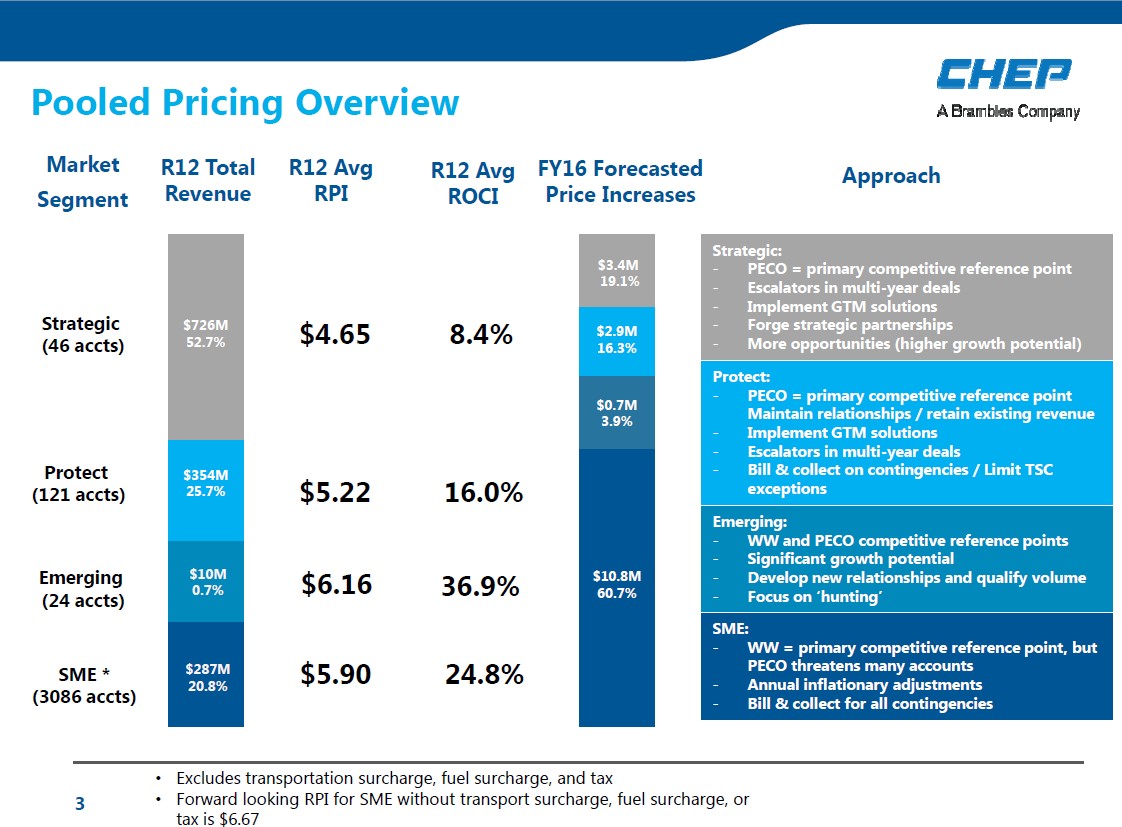
The diagram shows that the forecast price increases in the two market segments in which PECO was the primary “competitive reference point” (“Strategic” and “Protect”), and which made up around 78.4% of “R12 Total Revenue” (being the rolling 12 month average), were projected to make up 35.4 % of revenue from price increases in FY16.
937 Second, it is clear that the reference to “several recent National deals” in the US Pooled initial budget submission was a reference to a handful of major customer accounts, and thus a small percentage of US Pooled’s business. But the “Pooled Pricing Review” listed PECO as the competitive reference point for all US Pooled’s market segments, and as the primary competitor for the two significant market segments I described above. It is plain that the large or major accounts likely to be pursued by PECO in FY17 were important to US Pooled achieving its FY17 budget.
938 Third, Martin deposed that a market-based pricing matrix dated February 2016 (reproduced below) identified the types of accounts, or US Pooled customers, that competitors may go after, and said that was a factor in assessing pricing opportunity. The matrix shows a number of accounts that Brambles treated as being at-risk of poaching by PECO and it rated 182 accounts as having a high “value premium” to US Pooled, which I understood to mean that they were accounts in which US Pooled might be prepared to take a lower price in order to retain the customer.
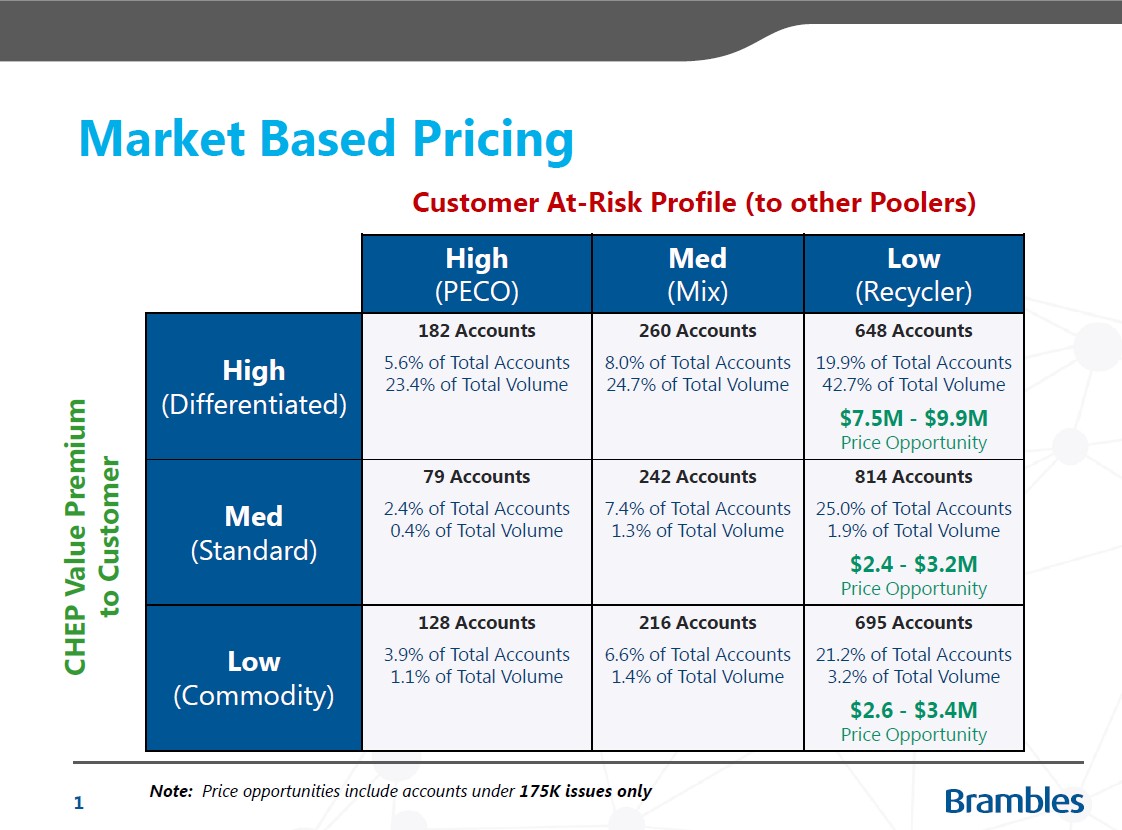
939 Fourth, I accept that competition from PECO was not new in FY16, but the US Pooled initial budget submission recognised a change in PECO’s strategy, in which it had begun to pursue volume growth through aggressive pricing strategies in respect of large national contracts. That is, the competitive threat PECO posed in FY17 was different to earlier years.
940 Fifth, I accept that PECO’s market share was significantly smaller than US Pooled’s, its market share was growing at a slower rate than US Pooled, and it was not national. But, again, the “Strategic” and “Protect” market segments (representing 167 accounts) in which PECO was the primary competitor made up around 78.4% of the rolling 12-month revenue, and the large or major accounts likely to be pursued by PECO in FY17 were important to US Pooled achieving its FY17 budget.
941 While it is true that US Pooled won some large customer contracts from PECO, Todorcevski accepted that it was relatively rare for it to do so. He testified that: “We tended not to win too many customers from PECO. We focused on converting Whitewood. So it would happen occasionally”. He said that was because Brambles, as the dominant and longest standing player in the market, was more likely to lose customers to newcomers like PECO than they were to pick them up from PECO. The fact that Brambles occasionally won a large account from PECO provides little assistance for Brambles’ argument in relation to the competitive threat PECO posed. In any event, the prospect that Brambles might occasionally win a major customer from PECO does not justify a budget assumption that US Pooled would not lose any major customers in FY17.
942 Nor do any of the matters on which Brambles relied show that, in the period when Brambles set the US Pooled FY17 budget or at the time it made the August Representations, there existed an objectively reasonable basis for assuming that US Pooled would not suffer the loss of any major customer in FY17. Brambles made that assumption in circumstances where:
(a) US Pooled had faced heightened competitive pressure from PECO in the second half of FY16. In that period PECO had aggressively pursued US Pooled’s major customers, including Kraft-Heinz, Kellogg’s, Niagara, Mondelez, Dannon and Mars;
(b) in that period US Pooled was at risk of losing several major customers, and it retained those customers by offering reduced terms which were at a level requiring specific approval by either CHEP Global or top-level management. For example, an email exchange between Martin, Mackie and Bachtell in late February 2016 shows that Bachtell sought Mackie’s specific approval for lower contract terms for two large US Pooled customers, Mars and Kellogg’s, following aggressively priced offers from PECO. Martin emailed Mackie on 29 February 2016 and said:
…with Peco being so bullish, I feel that a decision from [Kellogg’s new management] to move this business [away from Brambles] is a real possibility. Peco desperately wants this volume here and in Canada as well to help them continue to build out a global footprint.
(Emphasis added.)
Mackie gave approval for reduced contract terms in both cases. Martin said in an email at the time that PECO “desperately” wanted to win Kellogg’s business and that US Pooled’s offer involved “poor financials” for it. Mackie told Martin that he approved those terms because US Pooled could not allow the Kellogg’s business to fall into PECO’s hands. In cross-examination, Martin accepted that Kellogg’s was a customer that US Pooled could not afford to let go to PECO’s, and that PECO was aggressive on price in pursuit of volume growth which meant that US Pooled had to reduce its price in order to protect its existing market share;
(c) in April 2016 US Pooled was at risk of losing the Dannon account to PECO, which was worth $6.5 million in revenue. To retain that business it offered reduced terms which provided it a return lower than its decided return on capital invested;
(d) on 23 March 2016 US Pooled lost the Kraft-Heinz account to PECO (worth $9.4 million in annual revenue); and
(e) in early June 2016 US Pooled lost the candy portion of the Mars account which contributed to a loss of $200,000 in annual sales revenue to US Pooled.
943 In the Headlines Memo Rumph expressly called out the “key risk” to the US Pooled FY17 budget that the budget assumed no loss of a major customer and assumed low customer loss rates generally. I give weight to her view that that was a key risk. Martin accepted that the US Pooled sales team had identified a 50% risk that US Pooled would lose another major customer, but it had not included that in its assessment of new losses in the budget numbers. It merely acknowledged the risk in the R&O schedule.
944 Brambles also relied upon the following matters to downplay the seriousness of the competitive threat posed by PECO:
(a) Todorcevski and Mackie gave evidence that, in general, PECO was not prone to undercutting its pricing to secure business, with the exception of Kraft-Heinz in March 2016. But Mackie also testified that there was uncertainty about PECO’s marketing strategy after Lee stepped down from the role of PECO’s President and CEO in 2016. Then, whatever may have previously been the case, in the second half of FY16 the evidence shows that PECO was prone to undercutting its pricing to secure business. As noted in the US Pooled initial budget submission, PECO’s strategy “shifted toward pursuit of volume growth, as evidenced by their aggressive pricing strategies in several recent National deals”.
(b) A Brambles document titled “1H16 Result - Key messages and talking points” dated 28 February 2016 stated that: “PECO’s growth with national accounts has remained relatively stagnant since their signing of Kraft in FY14. While PECO has recently signed Heinz, CHEP win-backs of key national customers have minimized the overall impact to PECO’s growth”. In my view, that assessment was overtaken by PECO’s subsequent behaviour in the period from the end of February to 30 June 2016. That is shown by the greater concern expressed in the US Pooled initial budget submission on 24 March 2016 and other contemporaneous documents. Further, the assessment that there had been a significant level of “win-backs” by US Pooled is contrary to Todorcevski’s evidence that US Pooled “focused on converting Whitewood” and would only “occasionally” win back contracts from PECO.
(c) Martin testified that PECO’s pricing strategies in the first half of FY16 were not “extremely aggressive” or “incredibly aggressive” compared to what had occurred in the second half of FY16. That may be so, but the difference between the effect of the “extremely aggressive” or “incredibly aggressive” pricing in around December 2016, and the “steady and targeted price aggressiveness from PECO” that Martin saw to July 2016 is unclear. The evidence shows that in the second half of FY16, and before Brambles made the August Express Representations, PECO had been using aggressive pricing strategies to pursue US Pooled’s major customers, which had resulted in it losing one major customer in whole and another in part, and it had been required to offer low pricing to others in order to retain their accounts. That is, the competitive pressure was having a serious effect on sales volume and pricing.
(d) Martin also deposed that he “believed there was an inherent limit in how quickly PECO could grow its ‘pool’ i.e., the size of the market its pooled pallets business served due to limitations with increasing its supply of pallets”. He said that PECO outsourced its pallet production processes and had a more fragmented network of pallet production than US Pooled did, which resulted in PECO not being able to grow its pool of pallets as quickly as US Pooled could. That may be so, but it means little. There is no evidence that PECO was anywhere near its pallet limit, such that it could no longer compete for major customers. Indeed, its aggressive pursuit of US Pooled’s major customers points firmly away from such a conclusion.
945 Second, Brambles submitted that the evidence showed that US Pooled was aware of PECO’s competitive strategies and it monitored them closely. I accept that. The evidence regarding the competitive threat posed by PECO shows that Brambles kept a close eye on it.
946 Relatedly, Brambles submitted it took the expected competition from PECO into account in developing and setting the US Pooled FY17 sales budget. It relied on the following evidence:
(a) Martin deposed that expected competition from PECO was expressly taken into account in the preparation of the US Pooled budget, and he recalled considering its competitive behaviour in his analysis of projected wins and losses for FY17 in the same way that other risks and opportunities were considered;
(b) at around the time the FY17 budget for US Pooled was finalised, he was satisfied that it was reasonable, realistic and achievable, for various reasons, including his understanding of the market, customer behaviour and competitive pressure;
(c) Mackie deposed that competition was a constant topic of discussion in periodic reviews, including the monthly PPR and CEO BPR meetings, and the US Pooled sales team monitored competitive activity and maintained data detailing US Pooled’s prospects for either winning, retaining or losing each account in the sales funnel. Todorcevski also deposed that during his time at Brambles he observed that competition was carefully monitored, and that the monthly periodic reviews, in which he participated, including the CFO BPR and the CEO BPR, typically included a discussion of developments with the competition across the CHEP business units, and his written reports to the Board identified developments in the competitive landscape; and
(d) Todorcevski deposed that his usual practice was to request information regarding market competition and customer activity during the CFO BPRs, to assist with his role reviewing each new customer contract with revenue above $5 million pa.
947 However, the applicants’ case was not that, in preparing the US Pooled FY17 budget, CHEP NA management had, somehow, entirely overlooked the fact that increased competition from PECO was a threat to achieving the forecast sales revenue growth. Instead, their contention was that the increased competition from PECO meant that the assumptions of $53 million in revenue from unidentified wins and no major customer loss lacked an objectively reasonable basis. And the evidence shows that the assessment of unidentified wins in US Pooled was not as data or analysis driven as Martin stated in his affidavits.
948 I do not accept the thrust of Brambles’ contentions as to the seriousness of the competitive threat PECO was likely to pose in FY17. The evidence provides firm support for an inference that, at the time Brambles set the US Pooled FY17 budget and when it made the August Express Representations, it was likely that US Pooled would face heightened competitive pressure from PECO in FY17 which was likely to adversely impact both the sales volume it would achieve and the pricing at which it did so.
949 The heightened competition that US Pooled was likely to face from PECO in FY17 (in combination with the other matters to which I refer) is material to my view that the US Pooled FY17 budget assumptions of $53 million in unidentified wins and no major customer loss lacked reasonable grounds.
Diminishing sales funnel contention
950 The applicants further contended that the US Pooled FY17 budget assumption of $53 million in revenue from unidentified wins lacked reasonable grounds because the sales funnel was diminishing, which meant that the quantum of new wins was likely to reduce in the near term. They argued that rather than recognising that diminishing sales funnel Brambles instead took the opposite and unreasonable approach of increasing its assumed new wins from unidentified customers when compared with the $47.3 million in new wins achieved in FY16.
951 The applicants relied on the CHEP NA FY17 Post-Flex review (dated 16 September 2016) which included a high-level summary of forecast sales volume, reproduced below:
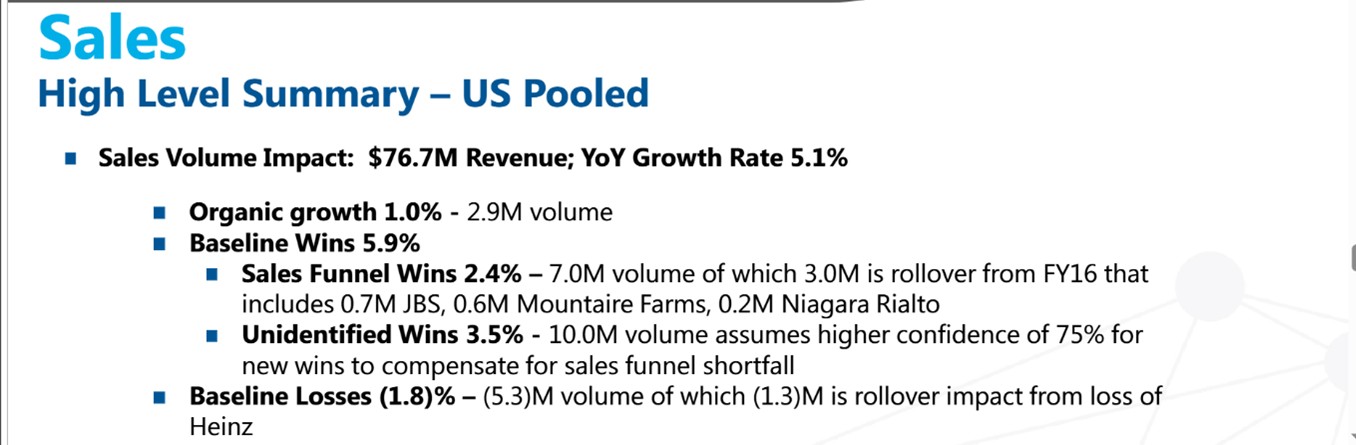
952 The applicants noted the fifth dot point regarding “Unidentified Wins” which said, in terms, that 10 million pallet issues in unidentified wins were based on an “assume[d] higher confidence of 75% for new wins to compensate for [a] sales funnel shortfall” (emphasis added). That presentation post-dates the setting of the US Pooled FY17 budget, but the same dot point appeared in earlier drafts of US Pooled budget presentations. For example:
(a) the 26 February US Pooled budget presentation which went to the CHEP NA leadership meeting, under the heading “Sales-Volume”:
Unidentified Wins 2.8% - 8.0M volume assumes higher confidence of 75% for new wins to compensate for sales funnel shortfall
(b) the US Pooled initial budget submission presentation to CHEP Global management dated 24 March 2016 stated, under the same heading:
Unidentified Wins 3.5% -10.2M volume assumes higher confidence of 75% for new wins to compensate for sales funnel shortfall
953 In cross-examination Martin was asked about the meaning of the dot point as it appeared in the 26 February US Pooled budget presentation. Senior counsel for the applicants suggested to Martin that there was a shortfall in the sales funnel. The following exchange took place:
Edwards: There was a shortfall on sales funnel at this time, Mr Martin?---
Martin: I don’t - I don’t know what perspective you’re talking about. Not in the overall sales funnel, but - - -…It’s not in the first bullet, so it’s in the second bullet. That’s kind of the - it’s the balance. The identified sales funnel was the top bullet, and the shortfall for that is where we build our sales team around to go get, if that makes sense. So it’s not a shortfall. Like, we’re not expecting sales. It’s a shortfall from that, and that’s why you build your sales team for the - for the budgeted year. If that makes sense.
Edwards: I’m not sure if I understand that at all, unfortunately, Mr Martin. I’m sure it’s my fault. But with your perspective at the time, there was a shortfall in the sales funnel, wasn’t there?---
Martin: No…It’s the shortfall from - to get to the number based on what we knew we had coming and what the sales team had to compensate for. And going into the budgeted year, you - sometimes you add sales people because of that shortfall. Sometimes you keep the team the same. So that’s how I looked at it. It’s not a shortfall in my expectation, if that’s what you mean.
954 Martin’s denial that there was an actual shortfall in the sales funnel was clear enough. Martin also testified that there “was not a shortfall compared to other years”. I accept that, but I otherwise found his explanation incomprehensible.
955 Importantly, in cross-examination Martin accepted that in taking the approach described in the dot point he was “bumping up the unidentified wins because [he] had identified a shortfall in the sales funnel”. But he disagreed that in doing so he was assuming a higher confidence level for new wins than was usually the case. He was then taken to an email from Ms Andrea Baseiro-Arenas (Manager, US Pooled S&OP team) to Bachtell and others dated 4 February 2016, under the subject line “FY17 Rev Demand Projections”. Bachtell had forwarded the email to Martin the following day asking for discussion because he wanted “to make sure you’re good with it before we give final blessing on FY17 bottoms up demand forecast”.
956 Baseiro-Arenas’ email said:
Team,
In working with sales finance, I wanted to provide the latest bottom’s up projections into FY17. Targeting a 5.40% [year on year] growth gets us to a 303.13M full year figure. This takes into account our Feb S&OP Rev[enue] Demand forecast of 289.15M and would require a 12.73M ‘go get’ from sales above & beyond what has already been identified (detail provided below). Some opportunities that could fulfil this include Mars, Pilgrim’s Pride, and Constellation Wines ( ~5M net total).
The email included the embedded chart, reproduced below:
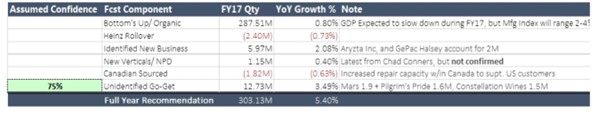
The email went on to state:
We’re leveraging opportunities currently in ‘Top’ [of the sales funnel] to address this go-get. Note that these typically have a confidence of closing of 10-30%. Within the above, we’re assuming we’ll double this with the help [of] our strategic realignment of the Hunters group.
957 It is uncontroversial that:
(a) the terms ‘go-get’ or ‘white space’ were used to refer to stretch items within a budget which were not allocated to a specific action item, project or opportunity; and
(b) the reference in the email to “the strategic realignment of the Hunters group” was a reference to the proposed appointment of two further sales representatives in that team in FY17.
958 Martin accepted that Baseiro-Arenas’ email stated that sales opportunities in the ‘top’ part of the sales funnel were used as sales go-get (being a stretch target), and that typically US Pooled assumed a confidence rate of 10-30% in closing go-get sales opportunities. He also agreed that Baseiro-Arenas’ email said that the probability of being able to close those go-get opportunities was being doubled. But he said that was not the basis upon which the sales team made its projections; that he did not use Baseiro-Arenas’ mathematics to develop the sales budget; and that it was not a calculation he would ordinarily use.
959 Eventually, however, when Martin was taken back to the dot point he agreed that ordinarily the confidence level applied to closing go-get sales opportunities in the top of the sales funnel was 10-30%; that the confidence level was “being more than doubled in order to plug a gap … in the sales funnel”; and that he wanted “to make sure the people who got this presentation also knew that…because of the increased staff that we put in place”.
960 Brambles submitted that the applicants’ contentions were based on a misunderstanding of the meaning of “sales funnel shortfall” and a misapprehension that “confidence rates” were used in developing and setting the US Pooled sales budget for FY17. They submitted two reasons in support of this contention:
(a) First, Brambles submitted that Baseiro-Arenas’ email demonstrates that the “sales funnel shortfall” was a reference to a shortfall to the target volume growth rate of 5.4%, which required 12.7 million in pallet issues of go-get to reach the target. Brambles said that the “sales funnel shortfall” was not a reference to a diminished sales funnel overall. I accept that.
(b) Second, Brambles submitted that the increase in the assumed confidence rate from 10-30% to 75% was due to the recent increased staffing of the Hunters team. Brambles argued that the increased confidence in closing that amount of go-get was reasonable because, as Martin testified: “Additional people sell additional things”.
961 Brambles also contended, as Martin testified, that the bullet point in the presentation and Baseiro-Arenas’ calculations did not represent the way the US Pooled sales team developed the FY17 sales budget. It said that the S&OP team was a separate team within US Pooled to the sales team and had their own metrics with respect to issue volumes, and contended that “confidence” rates were not used by the US Pooled sales team to produce their sales budget.
962 Brambles also reiterated its submission that the detailed sales funnel reports and analysis underpinned the assumed unidentified wins in the US Pooled FY17 budget. For the reasons previously explained, I do not accept that the assessment of unidentified wins was as data or analysis driven as Martin said in his affidavits.
963 Nor I do not accept the contention that there was an actual shortfall in the sales funnel. Martin accepted that by the end of June 2016 the value of sales opportunities at the top of the sales funnel was “significantly lower than what it had been in the months earlier” in terms of its total value, and that by the end of June 2016 the top position in the sales funnel had thinned out. He said that “a lot of things … kind of slow down because we’re pulling deals into the end of the fiscal year to try to close it before the end of the fiscal year”.
964 In light of Martin’s evidence and Baseiro-Arenas’ email it is likely that the reference to a “sales funnel shortfall” in the US Pooled budget presentation was to a shortfall to the target volume growth rate, rather than to an actual shortfall in the sales funnel. Baseiro-Arenas’ email in February 2016 said that to reach the target of 5.4% sales volume growth required (at that point) contracts for 12.7 million pallet issues of go-get sales opportunities to be closed. And the CHEP NA FY17 Post-Flex review dated 16 September 2016 showed that the US Pooled FY17 budget for unidentified wins was based in part on an assumption of it closing 10 million pallet issues in go-get sales opportunities.
965 I otherwise accept the thrust of the applicants’ submissions for two key reasons.
966 First, contrary to Martin’s testimony, it is sufficiently clear from the contemporaneous documentary record that the assumed confidence rates in closing go-get sales opportunities played a role in the budget assumption of $53 million in unidentified wins. Baseiro-Arenas’ email and the CHEP NA FY17 Post-Flex review presentation referred to an increase in the assumed confidence rate in closing contracts for go-get sales opportunities to reach the unidentified wins target in the US Pooled budget. Martin was partly responsible for that presentation, and 10.2 million pallet issues was a significant quantum of pallet issues.
967 I consider the contemporaneous documentary record to be the most reliable evidence, and I give little weight to that part of Martin’s evidence which I consider to be inconsistent with the relevant documents.
968 Second, I do not accept Brambles’ submission that it was “entirely reasonable” for Brambles to assume a confidence rate of 75% in closing contracts for 10 million pallet issues of go-get sales opportunities, because it had employed two further sales representatives in the Hunters team. Martin eventually accepted that the usual confidence rate for the US Pooled team to complete contracts for go-get sales opportunities was 10-30%. Even without Martin’s reluctant concession, that is also clear from Baseiro-Arenas’ email. Using the bottom of the usual confidence range, the decision to assume a confidence rate of 75% was a massive 7.5 times increase, and using the top of the usual range it was approximately 2.35 times.
969 I do not consider that the increase in the Hunters team justified such a substantial increase in the assumed confidence rate. It was just ‘management-speak’ to describe an increase from three sales representatives to five as a “strategic realignment”, and as Martin accepted, just because there were more people in the sales team did not mean that US Pooled was “necessarily going to do better or as well” as it did at securing new wins in FY16. And it should be kept in mind that the go-get sales opportunities were just unidentified stretch, which the sales team were being asked to achieve in FY17 in circumstances including a levelling off of whitewood pallet prices and heightened competition from PECO. As Mackie accepted, it was going to be challenging for US Pooled to achieve similar rates of revenue growth in FY17 to those achieved in FY16.
970 The relative shortfall in the sales funnel in relation to the target growth rate, and the unreasonable assumption of 75% confidence in closing contracts for 10 million of pallet issues of go-get sales opportunities (in combination with the other matters to which I refer) are material to my view that the assumption of $53 million in unidentified wins lacked a reasonable basis.
Declining whitewood prices contention
971 The applicants submitted that, during the period the US Pooled FY17 budget was set and at the time Brambles made the August Representations, the assumption of $53 million in revenue from unidentified wins lacked a reasonable basis, in part because it was based on an assumption that it would continue to achieve substantial whitewood conversions, even though the price of whitewood pallets was levelling off or declining.
972 It is uncontentious that the high price of whitewood pallets in FY16 contributed to US Pooled’s ability to convert whitewood pallet users to pooled pallets in that year. Todorcevski, Mackie, Kennett and Martin each gave evidence as to that. Each of them also accepted that, during the period the US Pooled FY17 budget was being developed, the price of whitewood pallets was levelling off or declining. As at 19 May 2016 Todorcevski said that whitewood pallet prices were not expected to increase in FY17. The “Key FY16 Messages - CHEP North America Pallets” presentation dated 4 August 2016 estimated that US Pooled earned approximately $5 million in revenue in FY16 “due to customers converting from US Recycled to US Pooled as US Recycled took aggressive price increases”.
973 The applicants submitted that, at the time the US Pooled FY17 budget was set, there was no reasonable basis for Brambles to expect that the trend of higher whitewood prices in the US pallets market would continue in FY17, and they argued that the budget was prepared on the assumption that the trend would continue. The draft Board presentation titled “5 Year Plan and FY17 Budget Report” dated 29 May 2016 said the following, under the heading “Key Themes by BU”:
CHEP Pallets
• Core conversion: White Wood conversion remains at the core of our overarching strategy due to the volume of untapped market potential that exists. In the last 5 Years conversion of one-way white-wood solutions to CHEP pooling offerings, across both developed and emerging markets, has delivered more than 80% of the total growth in CHEP Pallets’ business.
(Emphasis added.)
Todorcevski testified that that was the position as Brambles understood it.
974 It is clear on the evidence that, at the time the US Pooled sales budget was set, the sales team considered that whitewood pallet prices were likely to level off or decline in FY17. This conclusion is supported by:
(a) Martin’s evidence that US Pooled monitored whitewood pricing trends, including through insights from the US Pooled marketing and sales teams using information from the US Recycled business, and the US Pooled sales team surveyed customers to gauge trends in pricing;
(b) the 25 January 2016 5YP presentation which acknowledged that US Pooled’s sales revenue in FY16 had been high in part because of a high-priced whitewood pallet market. The presentation expressly stated that, with the price in whitewood pallet markets levelling off, expectations for future price increases of pooled pallets were reduced;
(c) Martin’s evidence that he expected whitewood pallet pricing to level off somewhat in FY17 (i.e., no longer increase at the same pace), which would reduce US Pooled’s ability to continue the same price growth it had realised during FY16; and
(d) the evidence of Todorcevski and Martin that whitewood pricing differed across the United States based on supply and demand in different regional markets for different grades of whitewood pallets. Todorcevski testified that, given that whitewood pallet markets were regionally based, there was no national whitewood pricing index or accepted price across the United States. Instead, the prices for whitewood pallets varied between geographic markets and the grade of the pallet. He said that it was therefore not inevitable that a period of higher whitewood pricing would be followed by a period of lower pricing, either in one regional market or more broadly.
975 Brambles highlighted evidence which shows that the price of whitewood pallets was not the only factor relevant to US Pooled being able to convert customers from whitewood pallets to more expensive pooled pallets. Among other things:
(a) Martin testified that, for some SME customers who could use either whitewood pallets or pooled pallets or a combination of both in their business, pooled pallets competed with whitewood pallets. But he said that, for larger customers, pooled pallets typically did not compete with whitewood pallets as such, and those customers typically had automated and technology-driven supply chains which could not accommodate whitewood pallets and instead required higher-quality pooled pallets;
(b) Todorcevski and Mackie also gave evidence that customers would convert from whitewood pallets to pooled pallets for other various reasons other than price, including because:
(i) some retailers would not accept inferior whitewood pallets;
(ii) for some manufacturers and retailers, developments in automation required pallets of strict dimensions and quality which were only available in pooled pallets;
(iii) whitewood pallets were not or no longer available in their particular area, as whitewood pallets are a local rather than a national market; and
(iv) Todorcevski gave evidence that, particularly for large distributors, the preference of the distributor was one of the most important factors in a customer deciding whether to use pooled pallets or whitewood pallets.
976 Brambles submitted that the evidence shows that the average whitewood pallet price across all US markets and grades remained relatively flat: from $5.96 in July 2016 to $5.90 in October 2016, being a decline of approximately 1%. It said that was not a substantial enough change to significantly impact new wins in US Pooled in FY17.
977 On that basis, Brambles argued that the applicants’ contention that the US Pooled FY17 sales budget was based on an assumption of continued high prices in whitewood prices in FY17 was wrong both as a matter of fact, and also because it failed to appreciate the more nuanced relationship between the price of whitewood pallets and conversions to pooled pallets.
978 I am satisfied that Brambles’ assumption of $53 million in revenue from unidentified wins in the US Pooled FY17 budget was based in part on US Pooled achieving whitewood conversions in FY17. That can safely be inferred from the statements in the “5 Year Plan and FY17 Budget Report” dated 29 May 2016 regarding projected growth in CHEP Global, including that:
(a) “White Wood conversion remains at the core of our overarching strategy due to the volume of untapped market potential that exists” and that more than 80% of growth in CHEP Global in developed and emerging markets had come through whitewood conversions; and
(b) Brambles expected “[s]olid sales growth over the plan period driven by strong growth in emerging markets and net new business in mature business…. New wins predominantly driven by white wood conversions across all CBU’s” (emphasis added).
The reference to new wins being “predominantly driven” by whitewood conversions “across all CBU’s” included CHEP NA and US Pooled.
979 The evidence shows that whitewood pallet pricing was an important driver of whitewood conversions, and that, at the time the US Pooled FY17 budget was set, the expectation of lower whitewood pallet prices in FY17 was likely to mean less conversions from whitewood pallet to pooled pallets in FY17. In my view there was no reasonable basis for Brambles to budget for US Pooled to experience a similar level of such conversions in FY17 to that which it had experienced in FY16. But the evidence does not establish:
(a) the level or dollar value of the whitewood conversions that US Pooled budgeted to achieve in FY17; or
(b) that US Pooled’s expectation that it would continue to achieve conversions from whitewood pallet to pooled pallets in FY17 was based on an assumption of continuing high whitewood pallet prices in that year.
980 The evidence indicates that US Pooled management understood that high whitewood pallet prices were unlikely to continue in FY17, and there is no direct evidence to show that, in setting the US Pooled FY17 budget, management proceeded on the basis of an expectation that high whitewood pallet prices would continue. Further, the evidence shows that customers converted from whitewood pallets to pooled pallets for a variety of reasons, not just price, and the applicants did not establish that it was unreasonable for Brambles to expect US Pooled to achieve some level of whitewood conversions in FY17 on that basis.
981 The applicants did not establish that, at the time the US Pooled FY17 budget was set, the budget of $53 million in unidentified wins lacked a reasonable basis because it was based on an erroneous assumption that whitewood pallet prices would remain relatively high.
Conclusion on new wins assumptions
982 Taking the above matters into account, in combination, I am satisfied that the US Pooled FY17 budget assumptions of $53 million in new wins and no major customer loss lacked objectively reasonable grounds.
983 But that is not to find that US Pooled was unlikely to achieve any of the $53 million in unidentified wins. It had a skilled sales team, a good sales pipeline, a good record of successfully achieving go-get sales targets, and a good record of successfully achieving budgets which included substantial amounts for unidentified wins.
10.4.4 Increased RPI assumption
984 The US Pooled FY17 budget provided for $20 million in increased sales revenue from FY16 through increased pallet pricing (which was up from $17.9 million revenue forecast in FY16). This was based on an increase in RPI from $5.22 in FY16 to $5.30 in the FY17 budget, being an increase of $0.08 per issue.
985 The applicants submitted that, during the period the US Pooled FY17 budget was set and at the time Brambles made the August Representations, the US Pooled budget lacked a reasonable basis because it relied on two matters which meant that the assumption of an increased RPI lacked a reasonable basis. These were:
(a) the likely heightened competitive environment in FY17, particularly from PECO; and
(b) the RPI for US Pooled, which was already behind budget in July 2016 and to meet the revenue budget it had to outperform the average RPI across the balance of FY17.
986 It is worth reiterating some of the relevant terms in relation to pricing:
(a) Revenue Per Issue (RPI) referred to the revenue earned from issuing one pooled pallet, and was calculated by dividing the total revenue in a reporting period by the number of pallets issued in that same reporting period. It indicates the average revenue earned per pallet;
(b) Mix was a term used to describe growth in RPI generated from sources in addition to increasing the price, such as the quantity of pallets shipped by customers to NPDs which resulted in NPD upcharge fees, intercompany pallet transfers, adjustments in cycle time and the ‘customer mix’ (being the variety and combination of prices charged to different customers);
(c) Price / mix growth referred to increased revenue from increasing fees charged to customers over time; and
(d) P-day revenue referred to revenue earned from variable rate customers who were charged a daily rental fee rather than a fixed pallet hire fee. P-day revenue was linked to cycle time, and in general, a higher cycle time was associated with a higher number of P-days, which led to US Pooled receiving higher total daily issue fees. However, daily pallet rental fees were not charged after pallets were transferred by customers to retailers.
987 Turning to the applicants’ first contention, they submitted that at the time the US Pooled FY17 budget was set, having regard to the likely heightened competitive pressure from PECO in FY17, it was reasonable to expect that US Pooled would be required to accept a lower price per pallet from its customers than it otherwise would have done. The applicants submitted that Brambles instead took the opposite and unreasonable approach of budgeting for US Pooled to increase its RPI in FY17. In relation to this contention the parties relied upon essentially the same evidence and submissions as they did in relation to the alleged effect of heightened competition on the budget assumptions of $53 million in unidentified wins, and no major customer loss. I need not set those matters out again.
988 The applicants also relied on some evidence which post-dated the setting of the FY17 sales budget, but which is nonetheless relevant, being:
(a) a PPR dated 16 August 2016 which stated, in “Highlights” for July 2016 under the heading “US Pooled Protect/Expansion”, that in relation to two existing large customers, Premium Water and Great Lakes Cheese, it had to “[p]rotect against PECO”. I infer that to “protect against PECO” meant lower pricing; and
(b) Nador did not commence as head of US Pooled until after the Board approved the FY17 budget in late June 2016. In an email to Rumph dated 10 August 2016 she commented on pallet pricing in the US Pooled FY17 budget following a disappointing result for July 2016. She wrote:
And in terms of price we need to pick it up quickly, as we can’t continue getting a large gap in that line when this is something we can push for. Even if the budget is aggressive in this area, I asked Dan [Martin] to give me a clear plan of how we are going to recover this and ramp it up in the next few months.
(Emphasis added.)
(c) In cross-examination, Nador agreed that she had formed the view at that time that the budget was “pretty aggressive on its price assumption”, and that the assumption was “challenging”. But she said that she was also talking about specific actions to take care of that.
989 As previously explained, I consider the evidence strongly supports a finding that, at the time the US Pooled FY17 budget was set, it was likely that US Pooled would face substantial competitive pressure from PECO in FY17 which would put downward pressure on pallet pricing compared to FY16. I need not set that evidence out again. I am not, however, satisfied that at the time the US Pooled FY17 budget was set, Brambles’ assumption of an increased RPI in FY17 lacked an objectively reasonable basis.
990 First, I accept Brambles’ submission that the assumed RPI increase was only marginally greater than the rate of inflation at the time, and less than the expected inflation in FY17. The assumed RPI increase in the US Pooled budget was 1.5%, whereas inflation in the United States at the time was 1.1% and was expected to increase in FY17 to 1.6%. It also submitted that at the time the RPI assumptions were prepared in February to March 2016, RPI growth from FY15 to FY16 was estimated to be 2.8%, comprising 1.3% from price and 1.5% from mix. It said that the same price growth assumption of 1.3% was applied in the US Pooled initial budget submission, as shown (under the column “Total Price”) in a table from that submission, as reproduced below.
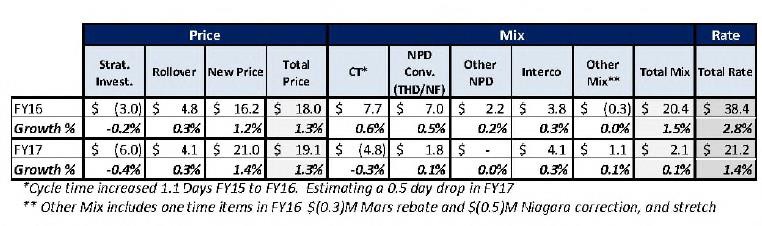
991 Brambles also submitted that the table shows, under the column “Total Rate” that, overall, US Pooled expected RPI growth of 1.4% in FY17, which was only half of the 2.8% growth it expected to achieve in FY16. There is force in Brambles’ contention that the US Pooled FY17 budget thereby appropriately accounted for the likelihood that in FY17 the RPI would not continue to increase at the same rate as it had in FY16. That was why the 3.1% RPI growth achieved at the conclusion of FY16 was adjusted back to just over 1% RPI growth in FY17, and to less than expected inflation.
992 Second, Brambles relied on Martin’s evidence that the RPI increase was based on a sophisticated analysis of RPI, per sales sector, for the FY16 year-to-date. Brambles also went to a “Sales Quarterly Update” prepared by Martin dated 17 March 2016 which included a bar graph that tracked the RPI budget per sales sector against the past year, the budget and the current year. Martin gave evidence that: “The RPI budget assumptions that US Pooled developed were multi-dimensional, and were developed per sales sector, having regard to the market dynamics and factors specific to each sales sector”. For the reasons previously explained, I consider Martin’s evidence about the level of science in the sales budget to be somewhat overblown, but I broadly accept that in setting the RPI the US Pooled management team gave it careful and expert thought.
993 Third, Brambles contended that the assumed RPI increase in the US Pooled FY17 budget had regard to the fact that whitewood prices had been relatively high during FY16 and the US Pooled sales team expected them to level off somewhat in FY17 (that is, no longer increase at the same pace). I accept that. The 25 January 2016 5YP presentation expressly provided for that.
994 Fourth, Brambles submitted that the applicants misunderstood the nature of the One-Off Phasing Issue in seeking to impugn the RPI assumption on the basis that in July 2016 US Pooled earned an average RPI of $5.13 versus a budgeted RPI of $5.27 for that month. It submitted that the RPI shortfall to budget in July was a result of the RPI pricing assumption increase to the US Pooled budget being “front-loaded” into July FY17, rather than spread evenly across FY17. The applicants did not meet this contention, and I accept it.
995 Fifth, Brambles submitted that Martin, Kennett and Mackie each considered the pricing assumptions in the US Pooled FY17 budget to be reasonable and achievable, based on their respective experience in and understanding of the business, customer behaviour and the market, the bottom-up build budget preparation process, as well as the identified risks and opportunities. For reasons previously explained, I do not consider the budget-setting process to have been genuinely bottom-up as Brambles contended, but I accept the other matters.
996 Taking all of those matters into account, the applicants did not establish that, at the time the US Pooled FY17 budget was set, the assumption of increased RPI from $5.22 per issue in FY16 to $5.30 in FY17 lacked an objectively reasonable basis.
10.4.5 Reduced damage rate assumption
997 The applicants submitted that, during the period the US Pooled FY17 budget was set and at the time Brambles made the August Representations, the US Pooled budget lacked reasonable grounds because it was likely that the direct costs that it would incur in FY17, particularly those arising from the proportion of pallets returned to Brambles that were damaged and required repair, would be higher than forecast.
998 In January 2016 the US Pooled FY21 5YP forecast damage rates of 61.3% in FY16, 57.5% in FY17, 56.2% in FY18, 55% in FY19, 54.1% in FY20 and 54.8% in FY21. By assuming a reduction in the damage rate from 61.3% in FY16 to 57.5% in FY17 it assumed a reduction of 3.8 pps. However, as I said earlier, in February and March 2016 Alonso pushed for a more conservative damage rate and to reduce the forecast drop in the damage rate between FY16 and FY17 from 3.8 pps to around two pps. He did so because:
(a) there was a lack of available data on the benefits of the Durability Program at the time;
(b) the Durability Study assumed that the cycle time was fixed, whereas a more conservative assumption was that new and improved pallets would stay longer in the supply chain; and
(c) he was taking into account Walmart’s practice of only returning damaged pallets pursuant to its specific contractual arrangement with US Pooled (which had been a factor adversely impacting the CHEP NA damage rate for more than eight years).
999 Ultimately the US Pooled FY17 budget forecast a two pp reduction in the average damage rate over the course of FY17, from a forecast damage rate of 61.3% in the FY16 February Forecast to the targeted damage rate of 59.3% in the budget. Changes in the damage rate were material to US Pooled’s financial performance. Alonso deposed that, at the time the US Pooled FY17 budget was being prepared, a one pp increase in the damage rate in US Pooled equated to an increase in variable costs of approximately $5 to $6 million. He gave evidence that the forecast drop in the damage rate was worth $11 million in gross benefits to US Pooled, and was a significant contributor to the targeted efficiencies of circa $79 million in the CHEP FY17 budget.
1000 The applicants produced the following chart, which shows the actual damage rate for US Pooled each half year from FY10 to FY16 (the blue coloured line) and then the assumed damage rate in the FY17 budget (the red coloured line). It shows that in the first half of FY12 the damage rate was 53.8%, and that it rose each year thereafter until the end of FY16 by which time it was 61.86%. There are some small differences between the damage rate figures in this chart and the damage rate figures in the other parts of the evidence and submissions, but the differences are not material.
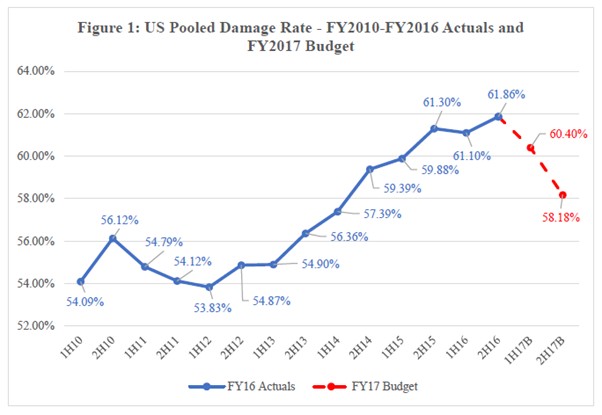
1001 In his report, Mr Samuel referred to another diagram reproduced below (which he took from the CHEP NA September 2016 PPR), which similarly showed that the damage rate had increased year-on-year from 2013 to 2016. It shows that by the end of FY16 the actual damage rate was close to 62%.
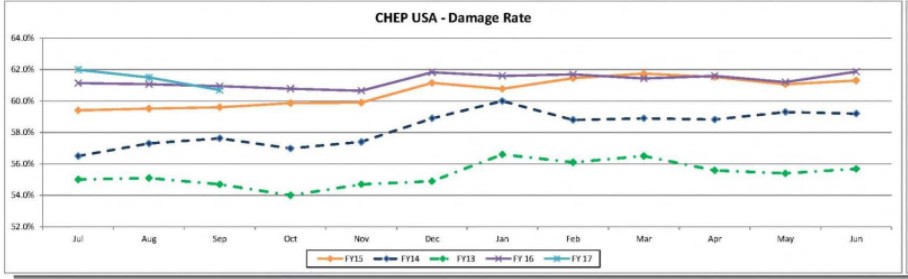
1002 The following chart was included in the final Board papers provided to the Board for the June Board Meeting. The yellow line represented Brambles’ view as to the likely increase in the damage rate if the Durability Program had not been introduced, the blue line represented the business case for the introduction of the Durability Program and the black line represented the damage rate improvements forecast in the 5YP to be achieved through the Durability Program. The presentation noted that each one pp reduction in the damage rate equated to gross savings of $5 to $6 million. It also noted that the actual FY16 damage rate was higher than it was forecast to be in the original business case, i.e., the Durability Program had not had the predicted effect at that point.
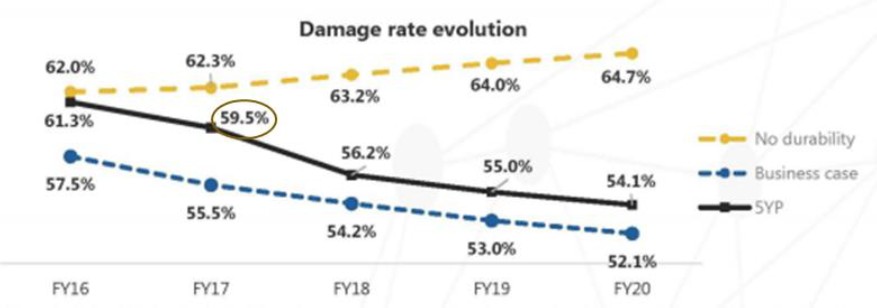
1003 The applicants noted that the US Pooled FY17 budget assumed that Brambles would be able to arrest a damage rate that had increased over the previous four years, and instead enjoy a steady reduction in the damage rate over the course of FY17. They argued that there was no reasonable basis for the assumption that the US Pooled damage rate would fall, whether by an average of two pps, or at all.
1004 Brambles argued that it had reasonable grounds to assume an improved damage rate in US Pooled in FY17. It said (and I accept) that the increasing damage rate trend was the very reason that the Durability Program was implemented by US Pooled in July 2015. The Durability Program, which was based on the Durability Study, involved the rolling introduction of pallet upgrades over a five-year period from FY16 to FY20, which were designed to improve pallet durability. It contended that there was a reasonable basis for the assumption that the Durability Program would begin to show benefits in FY17.
1005 The main points of the Durability Study were captured in a presentation titled “B4840A C-Stock Upgrade Analysis at PTT” dated 9 February 2015 which said that its objectives were to understand the benefits of, among other things:
(a) using clinch nails to repair T3 boards compared to using screws; and
(b) adding nail plates to B2 boards on B4840A pallets of varying ages.
The study involved putting 700 pallets through 21,700 supply chain cycles in an automated impact loop in a pallet testing facility over 12 weeks, which included simulated manual handling, pallet drop testing, and pallet deflection through a deflection tester.
1006 The study reported the following expected improvements in pallet durability from an “instantaneous 100% implementation” of each upgrade to the US Pooled pallet pool. It projected that:
(a) putting clinch nails on T3 boards would reduce the damage rate from 58.8% to 51.7%;
(b) putting nail plates on B2 boards would reduce the damage rate to 47.3%; and
(c) putting clinch nails and nail plates on would reduce the damage rate to 40.1%.
1007 Brambles accepted that, at the time the FY17 budget was set, the Durability Program was unproven, but it contended that the likely effects of the program in FY17 were taken into account by assuming (what it described as) an “intentionally conservative” two pp drop in the damage rate. It said that the (claimed) conservative approach was taken because the Durability Program was still in an early stage, and there was not enough data available at that time to confirm whether it would deliver the projected benefits. I accept Mackie’s evidence that Brambles was aware that there was an element of risk in achieving the damage rate reductions during FY17 given the program was still in its early stages.
1008 Brambles also relied on Alonso’s testimony that the assumed two pp reduction in the damage rate in FY17 was “a conservative assumption of the durability program benefits expected to be realised in FY17”. Alonso gave evidence that the assumed damage rate benefits in the US Pooled FY17 budget were roughly half of the “total opportunity” that was initially identified, which had then been halved again. Brambles submitted that by that, he meant:
(a) the Durability Study projected a 14.99% drop in the damage rate from FY16 to FY20 whereas US Pooled only assumed that the damage rate would drop by half of that; that is, a drop of 7.2 pps from 61.3% in FY16 to 54.1% in FY20; and then
(b) the US Pooled FY21 5YP forecast a drop of 3.8 pps in FY17, whereas US Pooled only assumed that the damage rate would drop by two pps, around half of that.
Brambles also relied on Mackie’s evidence that he was content with the damage rate projection in the US Pooled FY17 initial budget submission, given that it was based on Alonso’s testing and analysis and applied a more conservative assumption than in the 5YP.
1009 I do not see much significance in the fact that the US Pooled 5YP initially assumed a 3.8 pp reduction in the damage rate and that Brambles ultimately assumed a two pp reduction. As Alonso said, that reduction was appropriate because there was not enough data, and because a more conservative assumption of cycle time was appropriate. The fact that it was made does not mean that the proposed two pp reduction had a reasonable basis. For the reasons I explain, in my view the assumed two pp reduction in the damage rate in FY17 cannot reasonably be described as conservative.
1010 Brambles further submitted that by the end of FY16, the Durability Program was beginning to deliver benefits which supported the assumption of a two pp reduction in the damage rate. It noted that:
(a) the average damage rate across the network increased at a rate of 2.2% per year from FY14 to FY15, whereas it only increased by 1.3% from FY15 to FY16;
(b) a reduction in the “repair ratio” for clinch nails and nail plates (calculated as the number of clinch nails / nail plates consumed, divided by the number of repairs conducted);
(c) a reduction in the CPR ratio, which drove $4.2 million of cost reductions over FY16. To recap, CPR means the average expense for consumption of lumber used to repair a pooled pallet; and
(d) Alonso deposed that US Pooled’s damage rate in FY16 would have been higher without the Durability Program. He said that it was predicted that the average damage rate result for FY16 without the Durability Program would have been higher than 62%, whereas it ended up at 61.5%, which he said saved around $3 to $5 million of costs.
1011 I accept that, at the time the US Pooled budget was set, the damage rate had increased by a lower amount from FY15 to FY16 than it had from FY14 to FY15; that there were indications of a slight reduction in the repair ratio and in the CPR ratio in FY16; and that without the Durability Program the damage rate in FY16 would have been higher. However:
(a) the increase in the damage rate in FY16 was above-budget, and occurred notwithstanding that the Durability Program had been running since July 2015; and
(b) the financial benefits of the improved CPR ratio were minor compared to the cost of the increased damage rate.
Those matters provide little support for the proposition that it was objectively reasonable to budget for a two pp reduction in US Pooled’s average damage rate in FY17.
1012 Brambles also relied on Todorcevski’s evidence that the Durability Program “was a long term project, with a material uptick in financial benefits expected to materialise over the longer term, with incremental benefits starting to flow through in FY17”. The table reproduced below formed part of the “Budget and 5 year plan Board presentation” on 29 June 2016. It shows that Brambles expected the most significant benefits to be generated in FY18, FY19 and FY20. The numbers are in millions of US dollars.
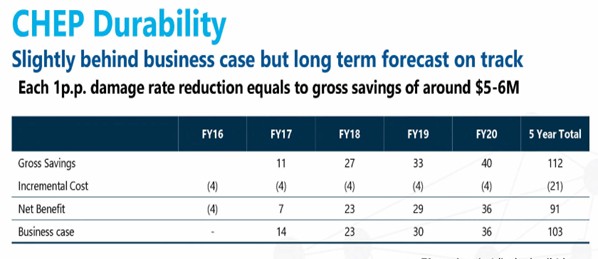
1013 I accept that the Durability Program was a long-term project. That can be seen in the evidence about the rate at which US Pooled’s pallets were upgraded. In the FY16 Earnings Call on 18 August 2016 Todorcevski said that, at that point, approximately 22% of the existing pallet pool had been upgraded in accordance with the Durability Program. Gorman added that by the end of FY17, it was likely that approximately 40% of the existing pallet pool would have been upgraded. Mackie gave evidence that while the Durability Program was anticipated to reduce the damage rate, it was going to take a number of years to implement the initiative across all of US Pooled’s pallets with the financial impact of the program anticipated to be most effective in FY18, FY19 and FY20.
1014 However, the fact remains that at the time the US Pooled budget was set, the projected benefits of the program in FY16 had not materialised. Alonso conceded that, at the time the US Pooled budget was set, although the Durability Program had been running for around nine months, the damage rate was still increasing.
1015 Brambles rejected the applicants’ contention that the reduced damage rate assumption ignored the increasing impact that the Walmart damage rate was having on the network damage rate in US Pooled. It relied upon:
(a) Alonso’s evidence that one of the reasons he asked for a more conservative reduced damage rate assumption in the budget was to factor in “the way in which Walmart was holding onto usable pallets and only returning damaged pallets”; and
(b) the fact that from FY14 to FY15 the Walmart damage rate increased by 3.1 pps, whereas from FY15 to FY16 it increased by only 0.8 pps. That is, the incremental increase in the Walmart damage rate was reducing.
1016 Brambles submitted, in effect, that the evidence shows that it had a strategic plan in place to make progress with Walmart regarding the “asset productivity challenges” for US Pooled, including the high and increasing Walmart damage rate. In support of its contention that there existed a reasonable basis to budget for a two pp reduction in the US Pooled damage rate, Brambles relied on a paper titled “CHEP Pallets North America Review” that Rumph presented to the April Board Meeting. In that paper Rumph identified that one of the “key challenges” facing CHEP NA was its relationship with Walmart and she explained the current actions management was taking to seek to address that challenge. I go to the detail of the paper later in these reasons.
1017 Brambles contended that there was a reasonable basis for Alonso’s view that there was enough data based on the Durability Study, and action plans in place, to assume a two pp drop in the damage rate from FY16.
1018 I do not accept Brambles’ submissions on this issue. I am satisfied on the evidence that, during the period the US Pooled FY17 budget was set and at the time Brambles made the August Representations, the assumption that the damage rate in US Pooled in FY17 would fall by two pps lacked an objectively reasonable basis. The following matters are material to my view.
1019 First, I have no difficulty in accepting that the introduction of the Durability Program on 1 July 2015, which sought to apply the promising results from the Durability Study, was grounds for hope that the ever-increasing damage rate could be turned around over time. But hope is not a reasonable basis upon which to budget in a large publicly listed company. It is significant that:
(a) The Durability Study accepted that one of the risks was that the pallet sample size “may not be large enough to overcome variability in pallets”. It was a study of only 700 pallets when, at the time the study was undertaken, US Pooled had 81.7 million pallets in its pool. There was substantial variability in pallet quality in the US Pooled pallet pool. The study reported that of that pallet pool, two million were of “tear down” quality (which I understand to mean “end-of-life” or requiring replacement), 15.6 million were “late life” quality (which I understood to be the stage approaching end-of-life), 57.1 million were described as “early/mid-life”, and seven million were described as “new”.
(b) The basis for the substantial projected reduction in the damage rate in the Durability Study was an “instantaneous 100%” upgrade of all of US Pooled’s pallets. The Durability Program, however, provided for the pallet upgrades to occur over the five-year period from FY16 to FY20. On 18 August 2016 Todorcevski said that only 22% of the pallet pool had been upgraded at that point, and Gorman said that over the course of FY17 that total would increase to 40% (that is, a further 18% of the pallet pool would be upgraded). That low level of upgrade penetration is significant of itself, but it somewhat misstated the position. By reference to the “FY16 Results Pack”, while clinch nails on T3 boards had been applied to approximately 22% of the pallet pool by the end of FY16, nail plates on B2 boards had only been applied to 5.3% of the pallet pool.
(c) Alonso conceded that the Durability Program had not been the subject of significant testing in a real world environment, and that “everything was based on a laboratory model” (meaning the test track facility). He testified that he knew that it was “too early” to draw any conclusion as to whether the results of the Durability Study would be replicated in the “real world”, since in the “real world” there were not enough upgraded pallets to see results”.
(d) Alonso conceded that, at the time the US Pooled FY17 budget was set, although the Durability Program had been running for nine months the damage rate was still increasing. Its only ascertainable effects were a slight impact on components per repair (CPR), and a view that the damage rate would have increased by more without the Durability Program. Notwithstanding Alonso’s testimony that it was too early to draw any conclusion as to whether the results of the Durability Study would be replicated in the “real world”, that is what he did in approving the assumption of a two pp reduction in the damage rate.
1020 Second, as the applicants submitted, the US Pooled FY17 budget assumed a reduction in the average damage rate of two pps over the course of the year, down to 59.3%. That was an assumption that by the end of FY17, the aggregate of monthly damage rates, divided by 12, would be approximately 59.3%. That meant that, if the damage rate for any given month in FY17 was above 59.3%, to achieve the reduction in the average damage rate to 59.3% other months in that year would have to be below 59.3% to compensate. The FY16 February Forecast projected an average damage rate of 61.3% for FY16, which was the starting point for the assumed two pp reduction in FY17, but the actual average damage rate for FY16 ended up being 61.5%. And the monthly damage rate for June FY16, that being the jump off point for FY17, was approximately 61.9%.
1021 Alonso agreed with the following chart prepared by Mr Lee from Brambles data. It is uncontentious that the chart is accurate; indeed, Brambles relied upon it in closing submissions. I would not otherwise rely upon the chart.
1022 The chart shows that to get to an average monthly damage rate of 59.3% by the end of FY17, the US Pooled budget forecast a monthly damage rate of 58.4% in February 2017, 58.1% in March 2017, 58% in April 2017, 57.7% in May 2017 and 57.8% in June 2017. Thus, to achieve the budgeted average damage rate, the budget forecast that the monthly damage rate would be substantially below 59.3% from February 2017 and the effective reduction in the monthly damage rate from the end of FY16 to the end of FY17 would be approaching four pps. In my view there was no reasonable basis to assume that would occur.
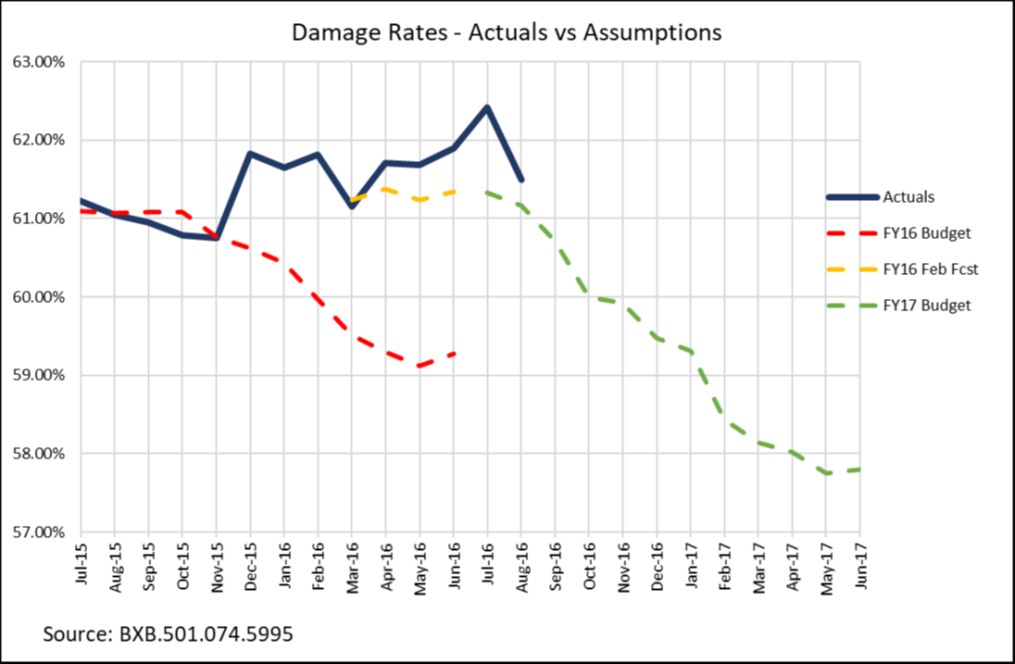
1023 Third, at the time the assumption of a two pp reduction in the damage rate was made, the damage rate was still increasing and was above-budget. Alonso agreed that the FY16 February Forecast of a 61.3% damage rate in FY16 was almost one pp higher than US Pooled had budgeted for in FY16. That was happening notwithstanding the introduction of the Durability Program in July 2015. A presentation titled “Damage Rate Review” dated 7 May 2016, stated that “[d]urability improvements were expected to begin driving Damage Rate improvements in Q4, but this never materialized”.
1024 Fourth, the damage rate in US Pooled had risen every year from FY11 to FY16, notwithstanding the attempts of CHEP NA management to rein it in. The “FY16 Results Pack” dated September 2016 set out the actual US Pooled damage rates for the three years from FY13 to FY16 in the table reproduced below:

1025 The damage rate had increased by almost six pps in three years. That was no small matter for US Pooled’s profitability. It was overly optimistic to assume that US Pooled would be able to immediately turn around a damage rate that had been increasing since 2011 and had continued to increase in FY16 at an above-budget rate despite the Durability Program; and that it would achieve a steady two pp reduction in the average damage rate over the course of FY17, which involved an almost four-pp reduction in the monthly damage rate by June 2017.
1026 Fifth, in cross-examination Alonso accepted that the assumed two pp reduction in the damage rate was an aggressive assumption. He said: “[Y]es, it was an aggressive assumption, yes… But achievable”. He further testified that “we knew from the very beginning” that the damage rate “was the most risky initiative that we had”. I see that as an important concession.
1027 Further, in response to the suggestion that “at March 2016, you wanted to believe the Durability Program was working, but there was just no evidence that it was”, Alonso said, tellingly, “[a]nd there were not evidence that it was not either”. The absence of evidence that the Durability Program was not working was not a reasonable basis for assuming a significant reduction in the damage rate.
1028 Sixth, there is no force in Brambles’ contentions regarding the likelihood of improvements in the Walmart damage rate. Walmart was the largest retailer in the United States and a Board presentation in February 2017 said that it accounted for 25% of US Pooled’s pallet flows. As the applicants submitted, US Pooled had an agreement with Walmart, which allowed it “unrestricted re-use” of pallets delivered to it by manufacturers, and it used those pallets for its own purposes in its own supply chain. Walmart’s practice was to hold the pallets for substantially longer than other US Pooled customers, and only return them when damaged. That resulted in a damage rate of approximately 83.8% for pallets that were transferred to Walmart in FY16, which was 33 pps higher than the damage rate of approximately 50.9% for pallets not transferred to Walmart.
1029 Rumph set out her view of the Walmart problem in her April 2016 Board paper titled “CHEP Pallets North America Review”. Her paper identified the “Key Challenges” facing CHEP NA, the second of which was the relationship with Walmart. She described the key challenges as follows:
For more than eight years our commercial relationship with Walmart has presented material challenges for the US Pooled business related to asset productivity. This stems largely from our contractual agreement to allow Walmart unrestricted reuse of CHEP assets. This has resulted in extremely high cycle time and damage rates from the Walmart network. This coupled with the loss of benefits CHEP enjoyed when operating Walmart Total Pallet Management (TPM) operations in their Distribution Centers (DCs), has created a compelling case for change.
1030 The reference to “Total Pallet Management” or “TPM” was to an arrangement under which CHEP had previously operated a program at Walmart retail locations. Mackie described that as involving CHEP staff working at Walmart retail locations. He said that following the unloading of goods from the pallets and the pallets being “free of use”, CHEP staff would sort the pallets into their different types (e.g., whitewood or pooled), different pallet poolers (e.g., CHEP, PECO or iGPS), and in some instances into different levels of quality. Walmart would then reuse some of the pallets for their own benefit and return the rest back to the relevant pallet pooler. Mackie testified that some years prior to FY17, Walmart decided that it no longer wanted CHEP to operate those facilities and instead engaged a third party. The result was that because the third-party did not have a commercial incentive to return pallets to CHEP as soon as possible, cycle times and damage rates for CHEP pallets transferred to Walmart increased.
1031 Brambles relied upon the next part of Rumph’s presentation in which she said:
We have made significant progress against our Walmart strategic plan agreed with the Board. This approach, centered around first creating value for Walmart and supporting their strategic priorities in order to earn the right to engage them in developing a plan that addresses our asset productivity challenges, is proving to be the right one. We are demonstrating to Walmart that we can help them achieve their corporate goals by bringing CHEP’s supply chain know-how to the table to support them. Last year we presented 13 tactics to them as part of a Joint Business Plan (JBP), and we set out to establish relationships with the Walmart organization that would support us in delivering on those opportunities.
We have gained significant traction through supporting Walmart in three key areas within their strategic agenda: Win with Fresh, In-Stock and Improved Stores.
1032 The report went on to state:
Positive Breakthrough with Senior Leadership at Walmart
As a result of our progress in building relationships with and creating value for Walmart, we engaged with their Executive Vice President of Logistics in January related to CHEP’s asset productivity challenge. The response from Walmart was outstanding and collaborative. They acknowledged the behavioral changes we have made as a company and the positive experience they are having with us as we strive to create value for them. As a result, they agreed to work with us to address our asset productivity challenges and thanked us for not ‘handing them a bill’ as we would have done in the past. In a private, on-to-one [sic] meeting between their Executive Vice President and the CHEP North America President, he complemented our leadership team, acknowledged his and Walmart’s support of CHEP North America and reinforced that our approach with them is the right one.
Following this meeting, we are now engaged in a downstream plastic pallet trial in the Florida market in an effort to find a solution to end down streaming of our wooden pallets to Walmart stores. The trial will run through May, with plans to expand the trial if initial data and reaction from Walmart is positive. If this solution proves viable, we will make a significant capital investment with a payback in asset productivity related to reduced cycle time, lower damage rates and decreased new pallet purchases.
1033 But other evidence completely undercut Brambles’ submission that there was a likelihood of a breakthrough in the Walmart damage rate and therefore a reasonable basis for the assumption of a two pp drop in the network damage rate in FY17.
1034 Alonso, who had overall responsibility for supply chain and supervision of those responsible for delivering a reduction in damage rates, agreed that Walmart had a “pretty bad record” in terms of bringing back pallets undamaged, which had been a running problem in terms of controlling costs within the supply chain for “a lot of years”. He accepted that the damage rate problem had not improved since 2013, and instead had deteriorated, and that the rate had begun to significantly climb in the three years before FY17. Remarkably, when it was put to him at trial that he had no reason to believe that that trend would change he replied:
Well, I had as well a hope that there was a limit. So once they would reach the 100 per cent, they could not go any further up. And - and they were close. They were close.
In effect he testified that the limit to how far Walmart’s damage rate could go up was that 100% of the pallets that it returned would require repair.
1035 He accepted that unless US Pooled could find some solution to the very high damage rates experienced for pallets transferred to Walmart, it was going to have a problem significantly improving the overall US Pooled damage rate in FY17. He testified that US Pooled had plans to solve the Walmart problem, but said that it was “something different” as to “how open Walmart was to…implement those plans”, and that the plans came “with a lot of challenges to overcome”.
1036 Further, and directly contrary to Brambles’ submissions, Alonso testified that, at the time the US Pooled FY17 budget was set, he was not planning on a breakthrough in reducing the Walmart damage rate. He said:
At that point, I was not thinking of a breakthrough. But if they were just keeping Walmart as it is or flat, that would have really mean [sic] we could have delivered on the durability problem.
That is, his hope was to keep the Walmart damage rate flat at around 83%, rather than achieve a reduction by some sort of breakthrough.
1037 The fact that there was no plan for an immediate reduction in the Walmart damage rate was confirmed by Mackie. In cross-examination he was taken to the initiatives described in Rumph’s report. He scotched the suggestion that those initiatives indicated a reduction in the Walmart damage rate by stating that CHEP had a “very difficult” and “confronting” relationship with Walmart “over many years”, and describing those initiatives as being “very much about how do we begin to work with Walmart in finding new ways to create some value from Walmart in order to be able to build a relationship with the key people to begin to start improving this performance issue that we had”. He testified that those initiatives were aimed at “relationship building” and conceded that they were not going to improve the Walmart damage rate in FY17.
1038 Seventh, the R&O schedule in the US Pooled initial budget submission presentation assigned a 50% probability that the damage rate would not reduce by an average of two pps across FY17, with a consequential reduction in Underlying Profit of approximately $10 million. The Headlines Memo dated 16 April 2016 similarly noted the US Pooled durability investment was “[a]ssumed to pay off” in the budget, but that if “damage rate improvements do not manifest as planned, we face up to $11M in unbudgeted repair costs”. Yet, other than acknowledging the risk, the FY17 budget did not take it into account in the budgeted Underlying Profit.
1039 I am satisfied that as at 18 August 2016 there was not an objectively reasonable basis for forecasting a two pp reduction in the average US Pooled damage rate over the course of FY17. But that is not to find that US Pooled was unlikely to achieve any of the projected $11 million in savings through a reduction in the average damage rate. There was a reasonable basis for Brambles to expect that the Durability Program would have some effect in FY17. The evidence does not, however, permit a reasonably reliable estimate of the proportion of the $11 million in savings which US Pooled was likely to achieve.
10.4.6 Alleged unreasonable budget stretching
1040 The applicants also contended that, during the period the CHEP NA (including US Pooled) FY17 budget was set, and at the time Brambles made the August Representations, the budget lacked reasonable grounds because it was stretched through unreasonable top-down pressure, aimed at bringing the budget into line with the predetermined goals of Brambles’ senior management.
1041 It is necessary to understand that the only stretch with which the applicants took issue is the stretch that was applied after the CHEP NA (including US Pooled) Initial Budget Submission on 24 March 2016. The applicants contended that following the initial budget submissions from the CHEP CBUs Mackie and Kennett exerted what the Court ought to conclude was unreasonable pressure on CHEP NA management to improve or stretch its budget submission to align with the expectations set out in the ELT Guidance Note, including the FY19 ROCI Target, and that Mackie and Kennett ignored or downplayed the legitimate concerns of Rumph and Lallatin in that regard. Then, the applicants contended that Gorman and Todorcevski exerted what the Court ought to conclude was unreasonable pressure on CHEP Global to improve or stretch its budget submission to align with the expectations set out in the ELT Guidance Note, and ignored or downplayed Mackie’s concerns about such alignment.
1042 Accordingly, the applicants submitted that the result was that the CHEP NA (including US Pooled) budget was excessively stretched, which resulted in a stretched CHEP Global budget, and a Group FY17 budget which did not provide reasonable grounds for the August Representations. On the applicants’ submissions, achievement of the US Pooled and CHEP NA budgets required near perfect execution, with no margin for error, and that a material shortfall in Underlying Profit would mean that Brambles was unlikely to meet the Group FY17 budget or the August Underlying Profit Forecast.
1043 Brambles denied that there was any unreasonable top-down management pressure to meet predetermined management goals. As I have said, it characterised the ELT Guidance Note as just “guidance” to the CBUs which merely set out what Brambles’ ELT “would like” each CBU to deliver, which was not binding, compulsory or required to be delivered. Brambles noted that the FY21 5YP for each CBU (the first year of which being FY17) was agreed with that CBU before the FY17 budget was set. It reiterated that the CHEP NA (including US Pooled) Initial Budget Submission was the result of a bottom-up process, and that the budget stretches resulted from a process in which higher-level management analysed, tested and challenged the budget and budget assumptions and proposed budget improvements until an agreed budget was reached. As I have said, Mackie, Kennett and Todorcevski described their involvement in the respective budget review processes as being directed to optimising performance through purging any pessimism or conservatism from the budget, rooting out any sandbagging and setting “challenging but achievable” budgets. They said that they did not seek to set budgets which were not achievable, as that would be entirely counterproductive.
1044 For the reasons previously explained, I do not accept that the guidance in the ELT Guidance Note was merely an indication of what Gorman and Todorcevski would “like” each business unit to achieve, nor that the budget-setting process was genuinely bottom-up. The US Pooled, CHEP NA and CHEP Global budget-setting process in FY17 was informed by management expectations set at the outset through the ELT Guidance Note and higher-level management showed a focus aimed at bringing those budgets as near as possible into alignment with that guidance. I am satisfied on the evidence that substantial top-down management pressure was applied to stretch the US Pooled and CHEP NA FY17 budgets.
1045 At the risk of repetition, I note the following key parts of the contemporaneous emails and memos:
(a) At the CHEP NA budget review meeting on 31 March 2016 Mackie told Rumph and Lallatin that they should get ROCI “as close as possible” to 20.4%, notwithstanding that Rumph and Lallatin said it would be a “major stretch” and “incredibly difficult” to do. The internal email exchange between Rumph and Lallatin that followed on 4 April 2016 reaffirmed their concerns before they submitted a First Revised Budget Submission.
(b) In the email exchange between Rumph, Lallatin and Alonso on 12-13 April 2016 they agreed that the CHEP NA budget involved a “huge stretch” and that CHEP NA should not offer any further budget improvements. The stretches in the Second Revised Budget Submission totalled $11 million of additional Underlying Profit, $29 million of reduced capex and $40 million of cash flow improvement. Alonso was so concerned about that level of stretch that he volunteered to speak at the PLT meeting the following day to reinforce any message Rumph would like “on how stretch[ed] this budget is already”.
(c) In her email to Mackie on 12 April 2016 Rumph said that overall, the CHEP NA Second Revised Budget Submission represented “huge improvements” since the CHEP NA Initial Budget Submission and “we…are getting very concerned about the level of stretch here”. In cross-examination, Alonso agreed that Rumph was “pretty concerned actually” about the level of stretch, and that he was concerned too. He understood Rumph to be saying that the budget “was close to the limit of what was achievable”, and he agreed with that view. He said that he thought the CHEP NA budget was “a stretched budget but still achievable” but that CHEP NA “could not go beyond that”. He said that if any additional stretch was imposed, it would put US Pooled “in a very difficult position to achieve any target”.
(d) In her Headlines Memo on 16 April 2016 Rumph noted the “big issues / key risks / unidentified stretch” as including that the US Pooled budget was based on assumptions including the following:
(i) despite increased competition from PECO, US Pooled would have a low customer loss rate, and US Pooled would not suffer the loss of any major customer;
(ii) “very aggressive” growth in sales revenue having regard to one-time benefits in FY16 that were not likely to be repeated in FY17;
(iii) $53 million of unidentified wins assumed in US Pooled ($90 million total wins versus $78 million in FY16);
(iv) a pricing stretch of approximately $6 million for US Pooled to compensate for lower volume due to drop in FY16 demand and fewer B days in FY17; and
(v) a two pp reduction in the damage rate which meant that there was up to $11 million in unbudgeted repair costs if the damage rate improvements did not manifest as planned. She also noted aggressive assumptions on CPR, a $2 million asset recovery risk, and $3 million of cost savings through unidentified supply chain initiatives.
(e) Alonso’s Risks Email on 14 April 2016 said that:
(i) the US Pooled budget had “the most aggressive and stretched [Underlying Profit]” with “risks in all line items, sales, direct cost, overheads and capex”;
(ii) the $48 million in budgeted efficiencies in US Pooled involved a “big stretch” with over $5 million being in ‘white space’;
(iii) the initiatives in the CHEP Global budget for cutting direct costs involved a “huge stretch” noting that usually they were ascribed a 75% probability, so as to provide a buffer against downsides, but in FY17 the initiatives were ascribed “a +95% probability, so no margin for error at all”. In cross-examination he described achieving the supply chain aspects of the CHEP Global budget as requiring “perfect execution” if they were to be achieved; and
(iv) that overall the CHEP Global budget “is full of risks and I do not see any major opportunity that could help us”.
1046 Despite the concerns expressed by Rumph, Lallatin and Alonso about the aggressive assumptions and stretch (and hence risk to achievability) in the US Pooled, CHEP NA and CHEP Global budgets, they were then stretched further in the CHEP Global budget review process. In emails at the time to Gorman and Todorcevski, Mackie expressed concerns about the aggressiveness of the assumptions and stretch in the proposed CHEP Global budget. To recap:
(a) in an email to Gorman on 19 April 2016, Mackie said the stretch in the numbers in the CHEP Global budget was “excessive”, the gross margin stretch on the FY16 February Forecast was “significant”, the budget contained “very aggressive assumptions on volume as always”, and that every aspect of ACI had been stretched “to get the ROCI in the right place”; and
(b) in emails to Todorcevski between 10-11 May 2016, Mackie described the CHEP Global budget as “very stretched”, and in relation to ROCI he said Todorcevski needed to look at performance excluding US Recycled “to understand how aggressive the pallets budget is and we have played lever[age] to get ROCI to guidance overall”.
1047 Despite Mackie’s expression of those concerns the CHEP NA and CHEP Global budgets were ultimately stretched further by Todorcevski who achieved further stretch although he did not get everything he asked for. That was a stark example of top-down management pressure.
1048 And as I will later explain, in early October 2016 well after the CHEP NA budget was set, a further $15 million of cash flow stretch was imposed in CHEP NA over Rumph’s strenuous objections. That is a particularly stark example of top-down management pressure in which Brambles dictated a budgetary change over the express objection of the management team primarily responsible for preparation and achievement of the budget. It was completely contrary to Mackie’s and Kennett’s evidence that the budgets for US Pooled and CHEP NA were the result of a bottom-up process, which was subject to challenge or testing but was not dictated from above.
1049 The contemporaneous emails show that by the end of the budget-setting process, the CHEP NA (including the US Pooled) budget was based on some aggressive assumptions and had been stretched to the point that Rumph, Lallatin and Alonso saw it as involving “huge stretch”, and having been stretched to near the limit of achievability. In his contemporaneous emails, Mackie made similar statements in relation to the CHEP Global budget. Mackie denied that Rumph and Alonso’s emails and memos reflected their true concerns, but I give little weight to that evidence for the reasons explained. He also denied that his emails expressed his true concerns about the aggressiveness of the assumptions and level of stretch (and hence risk) in the CHEP Global budget, but I give little weight to that evidence for the reasons explained. Alonso tried to walk back his remarks to an extent, but I consider his and Mackie’s contemporaneous emails to be the most reliable evidence of what they thought at the time. The stretching of the US Pooled and CHEP NA budgets was substantially the result of top-down management pressure from Mackie and Kennett, followed by pressure from Gorman and Todorcevski.
1050 That is not, however, to find that any of those executives considered, as at 18 August 2016, that the budgets were not achievable. Their emails did not say that, and I am not persuaded that they did think that.
1051 Further, I balk at the applicants’ description of the top-down management pressure as “unreasonable”. Conceptually, it is not unreasonable for:
(a) CHEP Global management to review the proposed CHEP NA (including US Pooled) budget and put pressure on CHEP NA management to do better; or
(b) Brambles’ top-level management to review the proposed CHEP Global budget and put pressure on CHEP Global management to do better.
It was ultimately a matter for CHEP Global management to decide what constituted challenging but achievable budgets for US Pooled and CHEP NA, and it was ultimately a matter for Brambles’ top-level management to decide what constituted a challenging but achievable budget for CHEP Global. It is a common or usual part of a budget-setting process in a large business that there are early budget submissions made by or with input from line management, with review and revisions by mid-level management, and then review and revisions by top-level management, which may involve disagreement and push-back between different management levels, until a budget is set.
1052 Mr Samuel testified he was “very happy…conceptually with the process” noting that “instructions went out to the business units, they put in some initial submission, there was oversight from head office” and then there was “to and fro”. He said that “can produce a robust budget. I have no problem with the process”. I take the same view, and the applicants’ allegation about unreasonable top-down pressure from management must be considered in that context.
1053 The quantum of the stretch achieved is also relevant to an assessment of whether it is appropriate to characterise management pressure to stretch a budget as “unreasonable”. After all, that is the whole point of the pressure.
1054 The applicants produced the following table of the stretch from the initial budget submissions to the post-flex FY17 budget at each relevant level:
($US million) | Initial Budget Submission | FY17 Pre-Flex Budget | FY17 Post-Flex Budget |
Sales Revenue (USD $M) | |||
US Pooled | 1,606.0 | 1,609.5 | 1,616.0 |
CHEP NA | 2,372.9 | 2,376.3 | 2,374.6 |
CHEP Global | 4,618.2 | 4,625.5 | 4,474.6 |
Group | [Not known] | 6,037.0 | 5,848.4 |
Underlying Profit (USD $M) | |||
US Pooled | 347.6 | 360.9 | 363.5 |
CHEP NA | 443.4 | 455.3 | 459.0 |
CHEP Global | 1,013.6 | 1,042.3 | 997.3 |
Group | [Not known] | 1,111.01 | 1,061.5 - 1,063 |
ROCI | |||
US Pooled | 19.2% | 21.9% | 22.2% |
CHEP NA | 19.2% | 21.1% | 21.5% |
CHEP Global | 22.5% | 23.5% | 23.8% |
Group | [Not known] | 15.8% (16.9% on FY19 Target basis) | 5,848.4 (17.3% on FY19 Target basis) |
1055 As is apparent from the table, the quantum of the adjustments (or stretch) from the US Pooled initial budget submission to the US Pooled budget in the Group FY17 Pre-Flex budget approved by the Board on 29 June 2016 was:
(a) $3.4 million ($1,606.1 million to $1,609.5 million) in sales revenue, being an increase of 0.21%; and
(b) $13.3 million ($347.6 million to $360.9 million) in Underlying Profit, being an increase of 3.83%.
The Group FY17 Pre-Flex budget forecast that Brambles would earn sales revenue of $6,037 million and Underlying Profit of $1,111 million in FY17. As a percentage of the Group FY17 budget the increase in sales revenue in US Pooled was only 0.06% and the increase in Underlying Profit was only 1.20%.
1056 The same picture can be seen at CHEP NA and CHEP Global levels. The quantum of the stretch from initial budget submissions to Board approval of the Group FY17 Pre-Flex budget was:
(a) in the CHEP NA budget:
(i) $3 million ($2,373 million to $2,376 million) in sales revenue, being an increase of 0.13%; and
(ii) $12 million ($443 million to $455 million) in Underlying Profit, being an increase of 2.71%.
As a percentage of the Group FY17 budget the increase in sales revenue was only 0.05% and the increase in Underlying Profit was only 1.08%; and
(b) in the CHEP Global FY17 budget:
(i) $7.8 million ($4,618.2 million to $4,626 million) in sales revenue, being an increase of 0.17%; and
(ii) $28.6 million ($1,013.4 million to $1,042 million) in Underlying Profit, being an increase of 2.82%.
As a percentage of the Group FY17 budget the increase in sales revenue was only 0.13% and the increase in Underlying Profit was only 2.57%.
1057 Brambles relied upon this for a submission that the relevant budgets could not be seen as unreasonably stretched. The applicants accepted that the quantum of the stretch to the US Pooled and CHEP Global FY17 budgets during the budget-setting process was small in absolute terms, particularly when considered in the context that the Group FY17 budget forecast Underlying Profit of $1,063 million.
1058 In my view, the $13.3 million stretch in Underlying Profit in the US Pooled budget is properly described as modest when considered in the context of a business Brambles’ size. The same is true of the quantum of the stretch to the CHEP NA budget. As Mr Samuel accepted, considered in isolation, that quantum of stretch is insufficient to support a conclusion that the Group FY17 budget had been stretched to the point where it was no longer reasonable.
1059 However, and importantly, it was not the applicants’ case that the relevant budgets lacked reasonable grounds because, considered in isolation from other matters, the quantum of the stretch in the CHEP NA (including US Pooled) budget was unreasonable. Their case was that the US Pooled and CHEP NA budgets lacked reasonable grounds (and as a result the CHEP Global and Group FY17 budgets lacked reasonable grounds) because the US Pooled and CHEP NA budgets were based on:
(a) an unreasonable view that the very strong FY16 sales revenue and Underlying Profit growth in US Pooled was likely to be repeated in FY17;
(b) some unreasonable assumptions in the US Pooled budget;
(c) a failure to adequately account in the CHEP Global FY17 budget (and therefore in the Group budget) for various known and identified risks in the US Pooled and CHEP NA budget submissions; and
(d) unreasonable top-down pressure being applied to stretch the US Pooled and CHEP NA budgets into alignment with predetermined goals of senior management.
1060 The budget concerns expressed by Rumph, Lallatin, Alonso and Mackie in their contemporaneous emails were not concerns about the level of stretch divorced from the other matters to which they referred, including the aggressiveness of the budget assumptions. And Mr Samuel was at pains to explain that the level of stretch in the Group FY17 budget needed to be considered together with Brambles’ failure to adequately account for known and identified risks.
1061 In my view, having regard to the matters discussed in this section, it was objectively unlikely that US Pooled would achieve the forecast $13.3 million in increased Underlying Profit, which came into its FY17 budget through the budget stretching that occurred. But that is not to find that US Pooled was unlikely to achieve any of that projected increase. It had a good record of meeting stretched Underlying Profit targets and there was a reasonable basis for Brambles to expect that US Pooled would achieve some of it. The evidence does not permit a reasonably reliable estimate of the proportion of the stretch to Underlying Profit which US Pooled was likely to achieve.
10.4.7 Alleged failure to adequately account for known and identified risks
1062 The applicants’ contention that the Group FY17 budget failed to adequately account for known and identified risks was based on Mr Samuel’s evidence. I previously set that evidence out, and my view in regard to it. I will not reiterate those matters.
1063 For the reasons I have explained, I give weight to Mr Samuel’s opinion that a significant quantum of net risks that had been identified in the CHEP NA (including US Pooled) Initial and Revised Budget Submissions were not adequately taken into account in the CHEP Global budget, and as a result in the Group budget. I accept Mr Samuel’s opinion that the CHEP NA budget was more in the nature of a target than a best estimate of the likely outcome.
1064 But as I have said, I do not accept Mr Samuel’s opinions that:
(a) had the aggressive assumptions and stretch not been included in the CHEP NA budget, and had the probability-adjusted net risks for CHEP NA been adequately taken into account, projected Group FY17 Underlying Profit would have been below the bottom end of the range in the FY17 Guidance; nor
(b) as at 18 August 2016, the combined effect of including the probability-adjusted net risks and removing the budget stretch in the Group FY17 budget (which applied to Underlying Profit only) would have resulted in:
(i) sales revenue of $5,802.8 million, which represented revenue at the lower end of the guidance range in the FY17 Guidance; and
(ii) Underlying Profit of $1,013.8 million ($1,019.8 million if he accounted for what he considered to be potential double counting), which would have been significantly below the bottom end of the guidance range in the FY17 Guidance (being $1,055 million).
1065 I consider Mr Samuel’s analysis of the changes to the risks and opportunities in the R&O schedules and the failure to account for some net risks to be an inadequate basis from which to draw a sufficiently reliable alternative forecast of Group FY17 Underlying Profit at the time the Group budget was made and as at 18 August 2016. But I accept that, at this time, the FY17 Group budget contained appreciable net downside risks.
10.4.8 The July 2016 results
1066 The July 2016 results and YTD position for US Pooled were:
(a) sales revenue of $153.1 million, which was $(2.9) million under-budget; and
(b) Underlying Profit of $27.8 million, which was approximately $(4) million under-budget.
1067 The July and YTD results for CHEP Global were similar. CHEP Global was $3 million under-budget in sales revenue, and $3 million under-budget in Underlying Profit.
1068 The Group was, though, ahead of budget for July and YTD in:
(a) sales revenue, at $555 million, which was $6 million ahead of budget; and
(b) Underlying Profit, at $108 million, which was $1 million ahead of budget.
1069 Thus, while US Pooled’s results for July were slightly below-budget, the Group was tracking ahead of budget. The applicants argued that the underperformance against budget by US Pooled in July 2016 was an important sign that the US Pooled budget was stretched to the point that it did not have reasonable grounds, and that as a result the Group budget lacked reasonable grounds and did not provide a reasonable basis for the FY17 Guidance and FY19 ROCI Target. On their argument, the results in the first month of the financial year should have been an early warning sign of a problem that would plague Brambles throughout the first half of FY17, namely its inability to identify, understand and address the underlying causes of direct costs overruns in US Pooled.
1070 On my view of the evidence, the reason Todorcevski took a close interest in a relatively small shortfall to the CHEP NA budget following the July results was that the causes of the direct costs overruns had not been identified, and it was therefore not known whether they might continue to cause under-budget performance through FY17. He understood that underperformance in US Pooled and CHEP NA could be significant to the Group. In my view that was obvious when in FY16 CHEP NA accounted for approximately 39% of Group revenue and Group Underlying Profit, and it was forecast to generate approximately 41% of Group Underlying Profit in FY17.
1071 It is likely too, that CHEP NA missing budget in the first month of FY17, immediately before the Board was to be asked to approve the FY17 Guidance, made Todorcevski concerned about where to position the guidance that would be set at the August Board Meeting. That inference finds support in Kennett’s 12 August 2016 email to Lallatin asking him to undertake some urgent analysis over the weekend. In his email, Kennett said: “They are trying to pin down guidance / positioning for the market, and they are fine with the [rest of the world], but with [US Pooled] they are feeling very edgy because of the result in [July 2016]”.
1072 In my view the fact that CHEP NA’s July results were below-budget was not, at that point, a matter of significance. As Brambles submitted, in the first month of FY17, at a point when the Group was ahead of budget, it would be curious to find that the Group budget lacked reasonable grounds or did not provide reasonable grounds for Brambles to make the August Express Representations.
10.4.9 Conclusion on whether there existed reasonable grounds for one or more of the August Representations
1073 For the reasons explained above, I am satisfied that, viewed objectively, when the Group FY17 budget was approved by the Board in June 2016, and when it made the August Representations on 18 August 2016:
(a) it was unlikely that the very strong year of sales revenue growth US Pooled enjoyed in FY16 would be repeated in FY17;
(b) some of the assumptions in the US Pooled budget lacked a reasonable basis;
(c) the US Pooled and CHEP NA budgets had been stretched to near the limit of achievability; and
(d) a significant quantum of probability-adjusted net risks which had been identified in the US Pooled and CHEP NA budget submissions were not adequately taken into account in the CHEP Global budget, and as a result in the Group budget.
1074 Consistently with Mr Samuel’s opinion, I consider that the information available to Brambles at the time it prepared the US Pooled and CHEP NA budgets did not provide a reasonable basis for the projected increase in Underlying Profit, and those budgets were more in the nature of a target than a best estimate of the likely outcome.
1075 But for the reasons I explain below, the applicants did not establish that, as at 18 August 2016, there were not reasonable grounds for the Group FY17 budget, nor that the Group budget did not provide reasonable grounds for the August Representations. The following reasons are material to my view.
1076 First, as Brambles submitted, a reasonable starting point for the analysis as to whether it had reasonable grounds for the Group FY17 budget is to have regard to its track record in achieving the earnings guidance it provided to the market. From FY12, Brambles had an unblemished record of meeting such earnings guidance. Brambles’ past success in meeting the earnings guidance it gave to the market is indicative of a capability to accurately plan and effectively implement those plans. Its past success in meeting or exceeding the Group budget, and meeting earnings guidance was a reason for the Board to have confidence in the achievability of the FY17 Guidance, at least as at 18 August 2016. But I do not see this as a consideration which weighs heavily on whether the Group FY17 budget provided reasonable grounds for the August Representations. That falls primarily to be assessed by reference to the evidence in the Relevant Period rather than by reference to Brambles’ past performance in different circumstances.
1077 Second, the assessment of whether there were reasonable grounds for the August Representations must be assessed at the Group level. Accepting as I do that the concerns expressed by Rumph, Lallatin, Alonso or Mackie in their emails in April and May 2016 regarding the aggressive assumptions and excessive stretch in one or other of the US Pooled, CHEP NA and / or CHEP Global FY17 budgets expressed their genuine views, the applicants did not establish, as at 18 August 2016, the likely effect of any such underperformance against budget at the Group level, so as to show that it was likely that Brambles would not meet the FY17 Guidance.
1078 Third, I accept Mr Samuel’s opinion that a significant quantum of net risks that had been identified in the US Pooled and CHEP NA FY17 budgets were not adequately taken into account in the Group budget. I consider the information available to Brambles as at 18 August 2016 did not provide a reasonable basis for the projected increase in Underlying Profit in the CHEP NA budget, and it was more in the nature of a target than a best estimate of the likely outcome. I also accept Mr Samuel’s opinion that had the aggressive assumptions and the stretch not been included in the CHEP NA budget, and had the probability-adjusted net risks for US Pooled and CHEP NA been adequately taken account of in the CHEP Global budget, it is likely that the forecast Group Underlying Profit would have been lower.
1079 But while I found Mr Samuel’s analysis to be a useful check on the reasonableness of the basis for the US Pooled and CHEP NA budgets (and thus on the Group budget), his analysis does not permit a sufficiently reliable estimate, as at 18 August 2016, of the quantum (or the range) of likely Group Underlying Profit. The evidence does not establish that the likely lower Underlying Profit meant that there were not objectively reasonable grounds for the FY17 Guidance, which conveyed the August Underlying Profit Forecast. To illustrate, I have found that:
(a) the unidentified new wins assumption in the US Pooled FY17 budget lacked objectively reasonable grounds, but that is not a finding that US Pooled was objectively unlikely to achieve any of the budgeted $53 million in unidentified wins; and
(b) it was unlikely that US Pooled would achieve the forecast $13.3 million in Underlying Profit that was brought into the US Pooled budget through the budget stretching that occurred, but that is not a finding that US Pooled was objectively unlikely to achieve any of that stretch.
At this stage of FY17 the evidence does not permit an estimate of the quantum by which US Pooled was likely to fall short of its budgets for the year.
1080 Fourth, it is relevant that, as at 18 August 2016, Brambles was on budget in sales revenue and Underlying Profit at the Group level. But the question as to whether Brambles had reasonable grounds for making the August Representations at the time that it did is not whether it was below the FY17 guidance range YTD, but whether over the course of FY17 there existed reasonable grounds or a reasonable pathway for it to meet the August Representations. The applicants did not establish that, as at 18 August 2016, there was no reasonable pathway for Brambles to meet the FY17 Guidance for sales revenue and Underlying Profit growth (including because of the $18 million in headroom in relation to Underlying Profit).
1081 As at that date Brambles had almost 11 months to take steps to turn around any under-budget performance in US Pooled and CHEP NA, and / or to take steps to cover any Underlying Profit shortfall to budget in those businesses by over-budget performance in other CHEP CBUs. The applicants did not establish that it was likely that, by the end of FY17, US Pooled, CHEP NA and CHEP Global management would be unable to address the causes for the Underlying Profit shortfalls in US Pooled and CHEP NA and recover the position. As at 18 August 2016, it was too early in the financial year to know whether or not that was likely. Nor did the applicants establish that it was likely that, by the end of FY17, US Pooled, CHEP NA and CHEP Global management would be unable to replace the likely (but unquantified) shortfall to budget in Underlying Profit in US Pooled and CHEP NA by over-budget performance in other CHEP CBUs. Mackie’s evidence was that such offsetting between CHEP CBUs was common, and he did not recall a single year where “every part of the business delivered for the full-year precisely as forecast in the budget”. Again, as at 18 August 2016, it was too early in the financial year to know whether or not that was necessary or likely in FY17.
1082 Fifth, Brambles centrally relied on the evidence of its executives, Martin, Alonso, Kennett, Mackie and Todorcevski. They largely spoke of their grounds for their confidence in the achievability of the budget for the level they held in Brambles’ management structure. In one way or another they said that, as at 18 August 2016, they considered the budgets for which they were accountable to be realistic and achievable and they provided a variety of reasons for that. Taken individually and together their evidence on affidavit was to the effect that, as at 18 August 2016, on the information then available, reasonable grounds existed for the US Pooled, CHEP NA, CHEP Global and Group budgets respectively and, by extension, for the FY17 Guidance.
1083 I accept that Todorcevski, Mackie, Kennett, Martin and Alonso were experienced and competent senior executives. Their evidence as to the prospects of US Pooled, CHEP NA or CHEP Global meeting the budgeted sales revenue and Underlying Profit targets should ordinarily carry real weight.
1084 But two things should be noted.
(a) First, for reasons I have explained, on some important issues their evidence carries substantially less weight than Brambles argued to be appropriate.
(b) Second, their subjective views as to the reasonable achievability of the respective budgets for which they were accountable are relevant but not determinative as to whether, as at 18 August 2016, there existed reasonable grounds for the August Representations. That issue is a question of fact which is to be judged objectively: James Hardie at [349], [454].
1085 As I said earlier, in assessing the weight to give Brambles’ lay witness evidence I start from a general premise that when determining contested factual issues in commercial litigation such as this, the better approach is to base factual findings on inferences drawn from any contemporaneous emails and documents and known or probable facts, and to place little, or at least lesser, reliance on witnesses’ recollections of what was said in meetings and conversations.
1086 In the present case, that is particularly so because I came to the view that Brambles’ lay witness affidavits did not manifest the witnesses’ unassisted recollection of the relevant events, and as I have said, they were the product of significant drafting, refinement and polishing in lawyers’ offices. Mackie almost said as much in relation to his affidavits. He described the process that he went through with Brambles’ lawyers as: “[T]hey sent me all the documents. They asked me to review the documents. I reviewed all the documents, and they used my words to build the affidavit, which I reviewed and signed off”. I reached the view that each of the affidavits was largely a reconstruction after the witness had pored over the emails and management accounts from FY16 and FY17 and then worked closely with lawyers to put the affidavits together. I have real doubts as to whether any of them are an authentic, unvarnished or unassisted account of the witnesses’ recollections and I am not confident as to the reliability of their contents.
1087 It is significant that Brambles’ lay evidence centrally concerned an otherwise mundane budget-setting process in the first six months of calendar year 2016, and the performance of US Pooled against that budget in the second six months of calendar year 2016 (the first half of FY17). The relevant witnesses had been involved in numerous Brambles budget-setting processes over the years; they offered no particular reason as to why they could remember the details of the FY17 budget-setting process; and they gave evidence around six years after the relevant events.
1088 As the hearing continued, I developed concerns about how much each of them was genuinely able to recall about unremarkable business events from so long ago. Some accepted the difficulties that presented for them. For example, Mackie accepted that “it’s a long time ago now for me to recall all of the specific items that I was thinking about at the time”. Others did not, but their testimony showed that their confidence in the accuracy of their (often reconstructed) recollection was misplaced. For example, on several occasions Kennett’s confidence in his recollection was shown to be wrong.
1089 I do not have much faith in the reliability of the recollection of any of the lay witnesses regarding the minutiae of the budget-setting process, and what they were thinking at different points in time more than six years earlier, when in most cases there was no reason for them to remember those matters. At the least, I have substantially less confidence in their recollections compared to statements in or inferences open to be drawn from contemporaneous documents.
1090 Further, as I explained in section 10.4.6, the evidence of Todorcevski, Mackie, Kennett, Martin and Alonso regarding their confidence in the US Pooled, CHEP NA or CHEP Global budgets at the time they were approved and as at 18 August 2016 must be considered in light of the statements of Rumph, Lallatin, Alonso and Mackie in contemporaneous emails and memos. In their contemporaneous emails Rumph, Lallatin, Alonso or Mackie described the US Pooled, CHEP NA or CHEP Global budgets as based on some aggressive assumptions, being heavily stretched, and, as I infer, carrying real risks as to achievability.
1091 The contemporaneous emails and memos indicate that Rumph, Lallatin and Alonso considered the US Pooled and CHEP NA budgets at that time, and in Alonso’s case also the supply chain aspects of the CHEP Global budget, to be based on some aggressive assumptions, to be heavily stretched such that they should not be stretched further, and as I infer, hence carried real risks to achievability. The thrust of the evidence of Todorcevski, Mackie, Kennett, Martin and Alonso regarding their confidence in the budgets at the time they were approved, or as at 18 August 2016, is inconsistent with, or at least jars with, the contemporaneous emails and memos.
1092 Rumph and Lallatin were experienced members of Brambles’ management, in charge of a large and complex business, and directly responsible for delivering the CHEP NA (including US Pooled) budget. Alonso was an experienced member of Brambles’ management, in charge of global supply chain, and directly responsible for delivering the supply chain savings and efficiencies across CHEP Global. He was Brambles’ supply chain expert and a member of Mackie’s budget review team for each CHEP CBU’s budget. It is appropriate to infer that they were experts in those parts of the business for which they were responsible. Mackie had particular trust in Rumph’s judgement and capability, and said that she was “extremely adept” in her role as President of CHEP NA. It is appropriate to give weight to the views they expressed in their emails.
1093 Although he tried to an extent to walk back his emails, Alonso did not say that they did not express his true concerns about the relevant budgets. In my view his contemporaneous emails, and the inferences to be drawn from them, are generally more reliable than his testimony.
1094 It is noteworthy that Alonso gave evidence that one reason he considered the CHEP Global budget to be realistic and achievable at the time it was approved was because the budget incorporated his feedback on the supply chain assumptions, risks and opportunities in FY17. I accept that many of Alonso’s views were incorporated into the CHEP Global budget, but it is plain on the evidence that the concerns he expressed in his Risks Email about the aggressiveness, stretch and risk in the US Pooled, CHEP NA and CHEP Global budgets were not rectified or addressed. Instead, the US Pooled, CHEP NA and CHEP Global budgets were stretched further by Gorman and Todorcevski. It is noteworthy too that he said that his view in April 2016 was that the US Pooled and CHEP NA budgets could not be stretched any further, but they were, and yet he continued to testify that they were achievable. That is not to find that he was not being honest in his evidence, or not doing his best to assist the Court. It is simply to prefer the contemporaneous documentary record in circumstances where he gave evidence about otherwise unremarkable business events more than six years after those events.
1095 Mackie was also an experienced and competent member of Brambles’ senior management team, and in charge of the huge CHEP Global division, and directly responsible for delivering the CHEP Global budget. He was considered sufficiently competent to be in the running for the position of Brambles’ CEO. It is appropriate to infer that he was an expert in CHEP Global’s business. He said that his emails to Gorman and Todorcevski deliberately exaggerated the aggressiveness of the assumptions and the level of stretch and risk in that budget as part of the budget negotiations. He even said that he had left some room to move (which I understood as ‘fat’) in the CHEP Global budget he submitted. For the reasons I have explained, I give little weight to that evidence. I consider his statements in his emails to be the most reliable evidence of what he thought regarding the aggressiveness of the assumptions, the level of stretch, and hence the risk to achievability of the CHEP Global budget at the time.
1096 It is also worth noting that one of the reasons Mackie said that he considered the CHEP Global budget to be realistic and achievable was because he had hired and worked with each of the CBU Presidents for a number of years and trusted their judgment and capability, particularly that of Rumph who he saw as “extremely adept”. That provides little support for Mackie’s stated confidence in the budget when Rumph’s contemporaneous emails and memo show that she considered the CHEP NA budget to be stretched close to the limit of achievability and hence to carry serious risks that it could not be delivered. The thrust of Mackie’s testimony was that he paid no heed to those concerns because he thought her stated concerns were deliberately exaggerated as part of a budget negotiation, or because she was expressing deliberately pessimistic views at his request.
1097 While I give weight to the concerns Rumph, Lallatin, Alonso and Mackie expressed about the aggressive assumptions and the level of stretch in the relevant budgets in their contemporaneous emails, it is important to keep in mind that in those emails none of them said that at the time that the US Pooled, CHEP NA or CHEP Global or Group FY17 budgets were approved, or as at 18 August 2016, that they were unlikely to be achieved.
1098 While the evidence of Brambles lay witnesses as to the reasons for their confidence, as at 18 August 2016, in the achievability of the US Pooled, CHEP NA, CHEP Global or Group FY17 budgets has the deficiencies I have just explained, there is little to support a finding that, at the time that the US Pooled, CHEP NA or CHEP Global budgets were approved, or as at 18 August 2016, that they were unlikely to be achieved.
1099 More fundamentally, including because of the $18 million Underlying Profit headroom, as at 18 August 2016, the evidence is insufficient to conclude that it was more likely than not likely that the Group would not by the end of FY17 meet the August Underlying Profit Forecast.
1100 Sixth, I accept Brambles’ submission that there was no incentive, and in fact there were financial disincentives, for CHEP NA or CHEP Global management executives to submit or propose a US Pooled, CHEP NA or CHEP Global budget that was not achievable given that their STI benefits were predicated on achieving and exceeding budget. That does not, however, take Brambles’ argument far because:
(a) as I have said, while the emails of Rumph, Lallatin, Alonso and Mackie in April and May 2016 expressed concerns about the aggressiveness of the assumptions and the level of stretch (and hence risk to achievability) of one or other of the US Pooled, CHEP NA or CHEP Global FY17 budgets they did not say that they thought those budgets were not achievable; and
(b) the applicants did not contend that Gorman, Todorcevski, Mackie or Kennett deliberately sought to impose budgets for US Pooled, CHEP NA or CHEP Global which were not achievable. On my view of the evidence, they were part of a hardworking and driven senior management team in a large and complex group of businesses, who were endeavouring to optimise Brambles’ performance by setting “challenging but achievable” budgets. In the FY17 budget-setting process, their determined efforts led them to sail too close to the wind, and they set the bar too high. That resulted in US Pooled and CHEP NA budgets (and as a result a CHEP Global and Group budget) which were based on some overly aggressive assumptions which lacked an objectively reasonable basis, budgets that failed to adequately account for some known or identified risks, and US Pooled and CHEP NA budgets that had been excessively stretched in all the circumstances.
That is, there was no attempt to set budgets that would not be achievable.
1101 Seventh, I do not give much weight to Brambles’ submission that it had reasonable grounds for the FY17 Guidance because it was the outcome of a sophisticated, rigorous and robust budgeting process at the US Pooled, CHEP NA, CHEP Global and Group levels. I accept that the budget-setting process for the US Pooled, CHEP NA and CHEP Global budgets was reasonable at a conceptual level, but I do not consider that, in practice, the budget-setting process operated in accordance with its apparent intention. I do not characterise the process as rigorous or robust when the US Pooled, CHEP NA and/or CHEP Global budgets did not recognise that the very strong US Pooled sales revenue growth in FY16 was unlikely to be repeated in FY17; the US Pooled budget was based on some assumptions which lacked an objectively reasonable basis; the CHEP Global budget did not adequately take into account some known and identified risks; and the US Pooled, CHEP NA and/or CHEP Global budgets were further stretched notwithstanding the concerns expressed by Rumph, Lallatin and Alonso in emails and memos in April 2016, and then by Mackie in April and May 2016, that one or other of them involved aggressive assumptions, and “huge” or “excessive” stretch, and as I infer, should not be stretched further.
1102 Relatedly, I found little force in Brambles’ contention that it had reasonable grounds for the Group FY17 budget; and that the Group budget provided reasonable grounds for the August Representations, because the preparation of the US Pooled, CHEP NA and CHEP Global budgets (and thus the Group budget) was a genuinely bottom-up process that involved each CBU preparing its own budget. For the reasons previously explained, I do not consider that for FY17 the budget-setting process for the US Pooled, CHEP NA and CHEP Global budgets was a genuinely bottom-up process. I need not reiterate those reasons.
1103 In any event, as Jagot J explained in Iluka at [669]-[670] in relation to whether there existed reasonable grounds for a profit forecast:
The issue is ultimately one of substance, not merely process. As a matter of substance, a statement made as a result of a reasonable process, may be one made without reasonable grounds. Equally, as a matter of substance, a statement made as a result of an unreasonable process may be one made with reasonable grounds.
However, if the evidence establishes that a reasonable process exists for the setting of a forecast, there needs to be something in the evidence before it would be concluded that the forecast produced by that process lacked reasonable grounds. Here, notwithstanding my doubts regarding the reasonableness of the budget-setting process, my conclusions regarding the relevant budgets are centrally based on findings about deficiencies in the budgets rather than in findings about the reasonableness of the process.
1104 Eighth, another reason why Brambles submitted that it had reasonable grounds for confidence in the revenue side of the US Pooled budget was because, at a high level, each of the elements comprising the sales revenue growth projections were reasonable based on the expected annual growth rates for CHEP mature market businesses, including the rates for organic growth, pricing growth and growth in new wins. In one way or another, Mackie, Kennett, Martin and Todorcevski each said that they were confident in the ability of the US Pooled sales team to achieve its sales revenue targets, including the $53 million of unidentified wins, based on matters including the US Pooled’s sales momentum heading into FY17, the sales team’s track record of delivering volume growth through new business wins, and the sales funnel methodology and data underpinning the budget assumption of $53 million of unidentified wins.
1105 Martin deposed that he was satisfied that the US Pooled sales budget was realistic and achievable having regard to:
(a) the iterative, bottom-up budget preparation process including the testing of assumptions and proposals;
(b) the sales funnel methodology and analysis of opportunities;
(c) the discussions he had had with his direct reports, their teams and other colleagues, and the confidence he had in those people based on his experience working with them;
(d) his understanding of the market, customer behaviour and competitive pressure;
(e) the sales momentum from FY16; and
(f) the identified budget risks and opportunities.
1106 Some of those matters were reasons for confidence in the US Pooled and CHEP NA budgets as at 18 August 2016, and thus for confidence in the CHEP Global and Group FY17 budgets. For example, I accept that the US Pooled sales teams had a strong record of achieving sales budgets; that it was reasonable for Martin to rely upon the discussions he had with his direct reports and their teams and to have confidence in those people. I accept that US Pooled had enjoyed very strong sales growth in FY16, and management had grounds to think that the business had good sales momentum going into FY17.
1107 Having said that, for the reasons previously explained, viewed objectively, Brambles’ witnesses overstated some of the other reasons for their confidence. For example:
(a) I accept that the sales revenue growth in FY16 indicated that US Pooled had positive sales momentum moving into FY17, but CHEP NA’s management’s view was more cautious. Rumph (in whose judgement and capability as President of CHEP NA Mackie said he had particular trust and whom he said was “extremely adept” in her role) warned that the CHEP NA budget forecast was based on “very aggressive” revenue growth “given one time benefits in FY16 that aren’t likely to repeat”. Lallatin and Alonso expressed similar views. Mackie recognised that it would be difficult to achieve similar year-on-year sales revenue growth from the very strong FY16 year;
(b) I do not accept Martin’s view that the US Pooled sales budget in FY17 was entirely the result of an “iterative, bottom-up budget preparation process”. I accept that it started with bottom-up submissions but, as with the costs side of the budget, it was then subjected to substantial top-down pressure to stretch revenue to meet predetermined management goals. In part, the US Pooled sales team relied on sales funnel data and analysis in forecasting $53 million of unidentified wins in FY17, but the reality was that that forecast was far from entirely scientific or data-driven. At least in part, the assessment of unidentified wins was akin to a sales target set in an effort to maximise performance and it was necessarily rubbery and was used to plug revenue holes and offset customer losses. In my view the budget assumption of $53 million of unidentified wins in the US Pooled budget lacked an objectively reasonable basis. The assessment of unidentified wins also included an unreasonable assumption of 75% confidence in closing contracts for 10 million of pallet issues of go-get sales opportunities, and there was no reasonable basis for US Pooled to assume it would not lose any major customer in FY17.
1108 Ninth, the applicants argued that because Brambles had not achieved the improvements in ROCI that it forecast in the first three years of the FY13 5YP, as at 18 August 2016, it lacked reasonable grounds to maintain the FY19 ROCI Target. I am not persuaded as to that. The evidence tends to show that if reasonable grounds existed for the FY17 Guidance (particularly the forecast of 9-11% growth in Underlying Profit in FY17) then there were reasonable grounds for the FY19 ROCI Target. The applicants did not establish that the FY17 Guidance lacked reasonable grounds, and as a result they did not establish that Brambles lacked reasonable grounds for the August ROCI Forecast.
1109 The applicants did not establish that, as at 18 August 2016, there were not reasonable grounds for Brambles to announce to the market the FY17 Guidance in relation to sales revenue or Underlying Profit growth in FY17 or the FY19 ROCI Target. The applicants therefore did not establish that there were not reasonable grounds for Brambles to make the August Express Representations.
1110 It follows that the applicants did not establish that, in fact, Brambles failed to conduct all necessary and reasonable investigations before making the August Express Representations, nor that it failed to satisfy itself on reasonable grounds following those investigations as to the substantial accuracy of those representations. Thus, the applicants did not establish the falsity of the August All Reasonable Investigations Implied Representation.
10.5 Whether Brambles, by making the August Representations, contravened s1041H of the Corporations Act, s12DA of the ASIC Act or s 18 of the ACL?
1111 I have found that, as at 18 August 2016, the applicants did not establish that Brambles’ conduct in making the August Representations contravened s 1041H of the Corporations Act or its statutory analogues.
11. ALLEGED AUGUST CONTINUOUS DISCLOSURE CONTRAVENTIONS
11.1 Whether the August Information was information that: (a) existed; (b) Brambles had (within the meaning of s 674(2) of the Corporations Act) by no later than 18 August 2016; (c) was generally available within the meaning of s 674(2)(c)(i) of the Corporations Act; (d) a reasonable person would expect, if it were generally available, to have a material effect on the price or value of Brambles Shares, within the meaning of s 674(2)(c)(ii) of the Corporations Act; and (e) by reason of the matters in (a) to (d), Brambles was obliged to tell the ASX by no later than 18 August 2016?
11.2 Whether the August Information was information that existed?
1112 The first matter that the applicants must show is that, as at 18 August 2016, there was in existence “information” concerning Brambles.
1113 The applicants alleged that the following information (defined as the “August Information”) existed as at and from 18 August 2016:
(a) in respect of sales revenue growth, Brambles’ performance in CHEP NA since 1 July 2016 meant it was likely or there was at least a material risk that Brambles would not achieve year-on-year sales revenue growth of between 7% and 9% in FY17, or its medium-term target of constant currency sales revenue growth in the high single digits; and an integral reason for this was that revenue in US Pooled would likely not meet budget in FY17; and
(b) in respect of Underlying Profit, Brambles’ performance in CHEP NA since 1 July 2016 meant it was likely or there was at least a material risk that Brambles would not achieve year-on-year Underlying Profit growth of between 9% and 11% in FY17, its medium-term target of Underlying Profit growth exceeding sales revenue growth or its ROCI target of 20% by FY19; and integral reasons for this were that revenue in US Pooled would likely not meet budget in FY17 and direct costs were going up.
1114 As I previously explained in relation to the August No Material Risk Implied Representation, it is unclear to me what is meant by the phrase “or there was at least a material risk” in the alleged August Information. In context, the words “a material risk” denote a risk that falls short of something which is “likely”, and the Oxford English Dictionary defines the meaning of the adjective “material” as ranging from “pertinent” and “relevant” to “[o]f serious or substantial import; significant, important, of consequence”. The Macquarie Dictionary defines it as ranging in its meaning from “pertinent” to “essential”.
1115 Risk is inherent in business and in business budgeting and forecasting and that is the problem with the pleaded phrase “or there was at least a material risk”. In my view that part of the pleaded August Information is impermissibly vague. It lacks a sufficiently clear meaning and leaves too uncertain what the applicants allege was the “information” which existed (and of which Brambles was “aware”) which Brambles was obliged to disclose to the ASX pursuant to the continuous disclosure regime. What precisely did the applicants allege that Brambles had an obligation to disclose? For example, did the applicants contend that Brambles was obliged, under pain of statutory contravention, to disclose to the ASX a risk to the achievement of the FY17 Guidance that was “relevant” or “pertinent” but did not reach the level of “significant”, or that was relevant but well under, say, a 50% likelihood? As Brambles contended, the meaning of “a material risk” in this context is too unclear.
1116 For the purposes of the liability inquiry, I consider it appropriate to excise the phrase “or there was at least a material risk” from the August Information for consideration by the Court. I take the same approach to the analogous pleaded October Information and November Information. Further, for the reasons I have explained, I consider it unnecessary to deal with that part of the August Information that pleads that it was likely that Brambles would not achieve its medium-term targets of constant currency sales revenue growth in the high single digits and of Underlying Profit growth exceeding sales revenue growth. I approach the August Information on that basis.
1117 The applicants submitted that the lack of reasonable grounds, as at 18 August 2016, for the August Representations meant that the August Information existed as at and from that date. Brambles took the same approach. It submitted that the reasons why Brambles had reasonable grounds for making the August Representations (if the Court found those representations were made) also meant that the August Information did not exist.
1118 I found that, as at 18 August 2016, among other things:
(a) it was unlikely that US Pooled would achieve similar sales growth in FY17 as it had experienced in FY16;
(b) the budget assumption that US Pooled would achieve $53 million in new wins in FY17 lacked reasonable grounds;
(c) the budget assumption of a two pp reduction in the average US Pooled damage rate over the course of FY17 lacked reasonable grounds;
(d) the budget assumption of low levels of customer loss and no major customer loss by US Pooled in FY17 lacked reasonable grounds;
(e) a significant quantum of net risks that had been identified in the CHEP NA (including US Pooled) Initial and Revised Budget Submissions were not adequately taken into account in the CHEP Global budget, and as a result in the Group budget;
(f) the US Pooled FY17 budget was based on aggressive growth assumptions and had been stretched to near the limit of deliverability; and
(g) the US Pooled and CHEP NA budgets were more in the nature of a target than management’s best estimate of the likely outcome in FY17.
1119 But I was not satisfied, as at 18 August 2016, that there were not reasonable grounds for the August Sales Revenue Forecast, the August Underlying Profit Forecast or the FY19 ROCI Target. That is, I was not satisfied that, as at that date, it was likely that Brambles would not achieve:
(a) year-on-year sales revenue growth of between 7% and 9% in FY17;
(b) year-on-year Underlying Profit growth of $1,055 million to $1,075 million equating to growth of between roughly 9% and 11% in FY17, or
(c) its FY19 ROCI Target by FY19.
It follows that I am not satisfied that, as at and from 18 August 2016, the August Information existed.
1120 Given my finding that the August Information did not exist as at 18 August 2016 it is unnecessary to address any of the other elements of the alleged August Continuous Disclosure Contraventions. The alleged August Continuous Disclosure Contraventions were not made out.
11.3 The Alternative August Information case
1121 The applicants abandoned this case in closing submissions, and it is unnecessary to decide those questions.
B. THE ALLEGED OCTOBER 2016 CONTRAVENTIONS
12. THE OCTOBER FACTS
12.1 The August results
1122 As previously noted, in July 2016 US Pooled underperformed against budget in both sales revenue and Underlying Profit. The shortfall in sales revenue was not a major concern because much of it was attributed to the One-Off Phasing Issue, but the direct costs overruns were of real concern to Todorcevski, and Brambles was unable at that point to determine the cause of the overruns.
1123 On around 9 September 2016 the flash results for CHEP NA for August 2016 were put into BRACS. The same day, Rumph, Lallatin and Nador were sent a presentation titled “CHEP USA Pooled Close Meeting August FY17” also dated 9 September 2016, which included a detailed breakdown of the August flash results for US Pooled. The following day, they received the August 2016 flash results for CHEP NA (including US Pooled). On 12 September 2016 Gorman and Todorcevski received the August flash results for Brambles, including for CHEP NA. On 13 September 2016, Kennett sent the August 2016 flash results for CHEP Global to Mackie and Alonso (copied to Scaiff and Moreno).
1124 Brambles produced the following table showing the August revenue and Underlying Profit results for August and YTD.
August revenue | YTD revenue | August ULP | YTD ULP | |
Brambles | $432 million - $(3) million under-budget or 7% growth. | $988 million - $3 million ahead of budget or 7% growth. | $70 million - $4 million ahead of budget or 8% growth. | $178 million - $5 million ahead of budget or 25% growth. |
CHEP Global | $330 million - In line with budget. | $756 million - $(3) million under-budget. | $66 million - $2 million ahead of budget. | $164 million - $(1) million under-budget. |
US Pooled | $121.3 million - $(0.2) million under-budget. | $274.5 million - $(3.1) million under-budget | $23.4 million - In line with budget. | $51.4 million - $(3.9) million under-budget. |
1125 The applicants produced the following table showing some further detail in relation to the position in US Pooled:
August Results: US Pooled Additional Detail | ||
($US million) | Month (vs Budget) | Year-to-date (vs Budget) |
Sales revenue | (0.2) | (3.1) |
Volume | (1.3) | (0) |
Price | (0.5) | (1.0) |
Direct costs | (0.9) | (2.6) |
Underlying Profit | 0 | (3.9) |
1126 Thus, in August, US Pooled achieved Underlying Profit in line with its budget for the month, and the Group was ahead of budget in Underlying Profit. There are two matters worth noting in relation to the US Pooled results.
1127 First, US Pooled was over-budget by $(0.9) million in direct costs, which meant that it was by then $(2.6) million above-budget YTD. Todorcevski was concerned that the August results represented a deterioration of the same problem with direct costs that US Pooled had experienced in July 2016.
1128 Second, US Pooled sales revenue in August was (only) $200,000 under-budget, but its sales revenue performance was actually worse than that. A presentation titled “Pallets Performance Review North America August FY17”, which was emailed to Mackie, Kennett and Alonso on 15 September 2016 in preparation for PPR meetings scheduled for 19 September 2016 (CHEP NA August PPR), noted that the $(0.2) million adverse to budget in sales revenue had been “offset by $2.5M benefit related to budget flex adjustment for phasing”. In cross-examination Kennett accepted that that showed that the $2.5 million of phasing that could not occur during the budget flex period before July 2016 had now occurred. Thus, while the One-Off Phasing Issue had made the July results appear worse than what they were, the correction of that issue made the August results appear more positive than they otherwise would have been, effectively reducing the revenue shortfall by $2.5 million down to $(0.2) million.
1129 CHEP NA was:
(a) in sales revenue, $(0.8) million below-budget for August, and $(5.8) million under-budget YTD; and
(b) in Underlying Profit, $(0.5) million below-budget for August, and $(4.7) million under-budget YTD.
CHEP LATAM and CHEP Europe were, however, ahead of budget on sales revenue and Underlying Profit which was partially offsetting the underperformance in CHEP NA.
1130 Thus, following the August results, while US Pooled and CHEP NA were under-budget on sales revenue and Underlying Profit growth YTD, Group revenue and Underlying Profit growth YTD were within or ahead of the FY17 Guidance.
1131 Todorcevski deposed, and I accept, that following his receipt of the August flash results he was comfortable with the overall performance of the Group. He said that the YTD results for the Group gave him confidence in the Group’s trajectory towards delivering budget. He also said that he was encouraged by the improvement in CHEP Global’s results in the month of August, particularly the results in CHEP Europe and LATAM. But as I will explain, Todorcevski had serious concerns about the direct costs overruns in US Pooled.
12.2 Management reaction to the August results
1132 It is clear from the contemporaneous emails that, although the quantum of the YTD shortfall to budget in US Pooled and CHEP NA was modest for a business of Brambles’ size, and although the Group was ahead of budget in sales revenue and Underlying Profit, the under-budget performance in US Pooled and CHEP NA was of significant concern to US Pooled, CHEP NA and Brambles’ management.
1133 On 12 September 2016, shortly after receiving the August 2016 flash results, Todorcevski emailed the CHEP Global FP&A team and described the performance in US Pooled and US Recycled as “poor” in relation to direct costs, which he noted was a continuing trend from July. Todorcevski identified items that he wanted the FP&A team to investigate as soon as possible, including the causes of that poor performance. He said that although an improvement in indirect costs had helped: “[W]e can’t rely on those to save the business and we need to show improvement”. Todorcevski asked Alonso to undertake a “deep dive” into the underlying causes of the supply chain results and high direct costs YTD, and into what efficiencies could be implemented to offset them.
1134 In an email to Mackie and Alonso on 13 September 2016, Kennett echoed Todorcevski’s concerns about overruns in direct costs in CHEP NA. He said: “We need to dig into the direct costs area, because their sales / volume was pretty much on target in the month, and it is the direct costs that are causing the dilution in [gross profit]”.
1135 Rumph also recognised that the underperformance against budget in US Pooled needed to be addressed. In September 2016, she instituted weekly Walk to MOP (or WTM) meetings (MOP being an acronym for monthly operating profit) in US Pooled to identify the drivers of the over-budget direct costs and the lower sales conversion rate, focussing on reviewing the sales pipeline to advance deals, reduce pallet purchases, reduce costs, and improve network optimisation. As part of the Walk to MOP process the US Pooled team prepared a weekly WTM file, which included a risk and opportunity analysis and set out initiatives that were intended to deliver higher sales revenue or a better gross margin, or to mitigate costs for the business. By 19 October 2016, weekly Walk to MOP meetings commenced across all CHEP NA business units.
1136 On 7 September 2016, US Pooled management held a meeting to “deep dive” into the risks and opportunities for that business. In relation to a slide deck presentation discussed at that meeting, Nador testified that:
(a) risks in US Pooled that were certain to occur were factored into the US Pooled MBR;
(b) there was a sales volume risk of 3.8 million pallet issues which arose because of the loss of the Scotts contract in July, but she considered there was plenty of time to redeploy those assets, and around 2 million of the 3.8 million pallet issues from Scotts were moved to US Recycled such that Brambles still received revenue from that;
(c) P-days were shorter than expected, but that risk could be reversed, as it had in prior years; and
(d) the risk “A-stock moves from Recycled locations” was given a probability of 75% but was not included in the MBR, as that risk was not expected to have an impact until H2 and US Pooled had a lot more control over this risk, and could eliminate the risk by optimising the moves within its network.
1137 Nador gave evidence that the under-budget sales growth in US Pooled was occurring for reasons including that the United States was in the midst of a Presidential election so there was a lot of market volatility; companies were engaging procurement organisations to help them negotiate which created delays; and companies were trying to drive harder deals and squeeze US Pooled on price. She said, however, that compared to FY16 the sales pipeline was not weak, US Pooled had approximately the same dollar value in opportunities in the sales funnel, and some large sales deals were in advanced stages. In her view, the sales deals were going to happen, but they were taking longer. She thought that the delays could shift revenue that US Pooled expected to earn in 1H17 into 2H17.
1138 Martin accepted that the August and YTD sales results for US Pooled were a problem. He testified that in response to the under-budget results he asked the US Pooled sales team to conduct a detailed investigation into the underlying causes of the lower-than-expected conversion rate (that being the value of customer ‘wins’ as a percentage of the total value of the sales funnel) and instituted weekly sales pipeline meetings. But he minimised his concerns by stating that in prior years, including in FY16, the conversion rate had dipped in the same way and had recovered within a couple of months. Although the sales funnel had weakened from the previous month, he said he was confident in the US Pooled sales budget by reference to his discussions with many customers that he expected to close deals, the “line of sight” of the Hunters sales team, and the historic close rates he had observed.
1139 Martin gave evidence that in this period the US Pooled sales team developed an action plan that targeted approximately $9 million in sales across a few dozen customers, some of which would need until Q4 (1 April - 30 June 2017) to work their way through the sales cycle. He accepted that the later in FY17 a deal with a new customer closed, the greater the risk that the revenue from that deal would not flow until the following financial year. I take the same view.
1140 On 15 September 2016, as an initial response to the request for a deep dive into the cause of the direct costs overruns, Alonso emailed a high-level summary of what he considered to be the most relevant drivers of over-budget direct costs to Gorman, Todorcevski, Mackie and Kennett. He said, among other things, that:
(a) overall, direct costs were $2 million worse than budget YTD;
(b) US Pooled was $2.5 million worse than budget and CHEP Europe was $1 million worse than budget, but that was partially offset by other CHEP CBUs; and
(c) the US Pooled damage rate was 0.6 pps unfavourable to budget, which was partially offset by lower raw material costs and CPR.
1141 On 15 September 2016, Gorman responded to Alonso and Mackie in relation to Alonso’s high-level summary of the causes of the direct costs overruns. Importantly, he said that there were “a number of developments that appear to have full-year implications”, and that it “would be good to focus on the risks and opportunities to the full-year commitments and, if necessary, we have a set of possible actions we can initiate across the Pallets Business to offset the risks”. He then said:
I want to make sure we hand the business to Chipchase in February in a position to deliver the FY17 Budget.
1142 Gorman’s reference to “hand[ing] the business to Chipchase” was a reference to the Board’s decision to appoint Graham Chipchase as CEO upon Gorman’s planned departure on 20 February 2017. It is plain from Gorman’s remark that he understood the importance of getting the direct costs overruns under control to the achievability of the Group FY17 budget.
1143 At this time Mackie knew that he had been unsuccessful in being appointed as CEO. Chipchase’s appointment had not yet been formally announced, but emails at the time show that Mackie had informed Gorman and Todorcevski that he intended to leave Brambles, and had also told some members of his team. Mackie testified there was “a lot of tension” at the time because Gorman was leaving and the Board had selected an external candidate rather than an internal candidate to replace him as CEO.
1144 Todorcevski’s direct request to Alonso prompted a complaint by Mackie to Gorman about urgent demands from finance “bypassing me and my team” when in Mackie’s view he and his team knew “how to recognise and run recovery actions”. It is clear that Mackie knew that US Pooled and CHEP NA needed to recover to alignment with budget. Gorman responded to Mackie’s complaint by email on 15 September 2016 in which he emphasised his negative view of the CHEP Global results for July and August. Among other things, Gorman said:
• you are pissed at me for asking questions after a very bad start to the year.
Somehow, what was once a well performing team is now pretty useless. Let’s hit the re-set button. I suggest you perform your normal reviews and then come back to me ASAP when you are ready for a deep-dive review.
I have been pushing Zlatko [Todorcevski] for answers and was not sure where your head was at re: running the business thru the finish line. It’s clear now that you are engaged (and pissed off) so I will wait for you to do your reviews and then notify me when you are ready to discuss.
(Emphasis added.)
Mackie’s affidavit exhibited the initial email from Alonso and Gorman’s response, but his affidavit did not refer to the subsequent exchanges. Mackie did not explain why he did not include those exchanges.
1145 The penultimate sentence in that extract expressed Gorman’s concern that the “very bad start to the year”, and the inability to get answers as to why the direct costs overruns and sales revenue shortfall were occurring, was due to Mackie having lost focus. On 16 September 2016 Gorman forwarded his 15 September email to Todorcevski and said: “Let’s see how [Mackie] responds and let him set timing for review. A few too many red flags to wait too long”. I infer that Gorman thought that the poor results showed that a decision needed to be speedily made about whether to leave Mackie in charge of the recovery effort.
1146 Later the same day Todorcevski emailed Gorman and complained strongly about Mackie’s performance. Among other things, he said:
Have to say I’m pissed as well. I don’t believe he is engaged and his team have provided a bunch of BS responses on why the results weren’t hit and what the implications are. So they might not be happy about the questions but no one’s going around them, they just don’t seem to have the answers, which is why we all agreed to go straight to Carmelo [Alonso].
….
Sorry for dumping but I believe [Mackie] has mentally gone. He’s not running the business, his CBU leads are doing what they want and [Mackie’s] showing some Johns-esque Alzheimer qualities, which is worrying….
(Emphasis added.)
Perhaps to state the obvious, Todorcevski’s reference to “BS responses” was him saying that Mackie and his team had been providing “bullshit responses” in relation to why the budgets were not met, and what the full-year implications were. The reference to “Johns” was a reference to Brambles’ Chairman: Paul Johns.
1147 Gorman responded to Todorcevski by email the same day. He said that he had just spoken to Mackie and had told him that he “was concerned his head was not in the game and he wasn’t doing his job”, and that Mackie disputed that. Todorcevski, however, doubled down on his frustration with Mackie’s (asserted) inadequate management of the situation. He said:
Tom - sorry for venting but been quite frustrating. We had a BPR call with Buster [Kennett] this morning and, 16 days into the month, he’s still struggling to get decent insights into the performance.
We covered some of the stuff in Carmelo’s note which doesn’t make sense (eg FX impact should be negligible because we ran the flex in Aug so should be very minimal impact post Brexit, depreciation can’t be higher due to write-offs being lower in the US because the IPEP charge was to budget last year, etc).
They have much more work to do and we don’t really have good insights into performance.
I’m pushing the finance teams hard on this so that’s probably what Pete is seeing but the process and timing is exactly the same as every other month. What’’ different is quality of explanations coming back is pretty weak.
…
Apologies for seeming precious but I am concerned we aren’t in a strong performance position and we don’t seem to understand it.
(Emphasis added.)
1148 The following all go to show that (notwithstanding their modest size) Gorman and Todorcevski had a high level of concern about the under-budget US Pooled and CHEP NA YTD results, and management’s inability to get to the bottom of the reason for the costs overruns:
(a) Todorcevski requested the CHEP Global FP&A team investigate the causes of US Pooled and CHEP NA’s underperformance against budget;
(b) Todorcevski requested Alonso undertake a deep dive into the causes of the continuing deterioration in direct costs against budget;
(c) Gorman noted that some of the causes of direct costs overruns listed by Alonso “appear to have full-year implications”; and
(d) Todorcevski and Gorman expressed concerns that Mackie was not giving sufficient attention to or properly addressing the budget misses in US Pooled and CHEP NA.
1149 On 14 September 2016 Linderman emailed Rumph, Lallatin and Nador enclosing a list of questions about US Pooled’s and CHEP NA’s August under-budget performance that Kennett wanted answered before a pending meeting with Todorcevski. Linderman, Rumph, Lallatin and Nador each contributed to a document titled “NA Pallet Responses to Global - P2 Questions from Brambles” which was then distributed. One of the questions asked:
Damage rate continues to rise. YTD 61.6% vs FY16 61.1% and Budget 61.2%; Components per repair is favourable. Latest view on durability?
The response was: “Please see durability chart in PPR. Damage rate is not rising. It is down from July to August but not at budgeted levels yet”.
12.3 Damage rate - Alonso’s 20 September Deep Dive Presentation
1150 Gorman requested Alonso and Mackie conduct a deep dive into the supply chain direct costs, with a focus on the “risks and opportunities to the full-year commitments”. On 20 September Alonso emailed the results of his deep dive to Gorman, Todorcevski, Mackie, Kennett and Callaway in a presentation titled “CHEP Global Pallets - YTD Direct Cost Deep Dive” (Alonso’s 20 September Deep Dive Presentation) in which he noted many of the same matters he had raised in his high-level summary dated 15 September 2016, including that:
(a) total direct costs were $2 million higher than budget largely driven by US Pooled (+$2.5 million) and Europe (+$1 million), which were partially offset by other CBUs;
(b) the supply chain team had achieved $10 million in initiatives or efficiencies for the financial YTD, meaning that the $15 million ‘go-get’ or stretch in supply chain efficiencies in the FY17 budget had been reduced to $5 million;
(c) inflation was in line with the FY17 budget; and
(d) the $2 million overspend in direct costs included an additional volume impact of $0.8 million, driven by a stronger control ratio in US Pooled and Europe.
1151 Todorcevski deposed that Alonso’s 20 September Deep Dive Presentation did not identify any individual issue that he considered material or that stood out as a particular concern, and he thought the identified items were not of a level of magnitude that made a material impact on the Group’s results. He said that he did not think there was a need for immediate action in relation to the cost items identified in the paper (based on the low financial impact of each of the items identified), but he thought it was important to closely monitor these costs over the coming months, particularly in US Pooled. I give that evidence little weight in light of the concerns that Gorman and Todorcevski were expressing about direct costs in emails at the time.
1152 With respect to the damage rate, Alonso’s 20 September Deep Dive Presentation included a high-level R&O schedule for US Pooled headed:
USP: $11M net risk including a conservative 75% likelihood of missing DR target ($9M)
The R&O schedule sitting beneath that heading quantified the damage rate risk at $9 million alongside a note stating that there was a “75% likelihood of damage rate does not reduce from today”. There, Alonso, the head of CHEP Global supply chain, who introduced the Durability Program and who was directly accountable for achieving the budgeted damage rate reduction, assessed that there was a 75% likelihood that the damage rate would not further reduce from 20 September 2016.
1153 In his affidavit Alonso deposed that:
The key takeaway was that I saw a net risk in US Pooled of $11 million, which included a conservative 75% likelihood of missing the damage rate target, adding $9 million of risk. I said 75% because we were starting to see the damage rate trend in the right direction, so I judged it a 25% chance we would hit the damage rate target.
He said that he took a “conservative and pessimistic approach” in making that assessment because he wanted to remind Gorman and Todorcevski that there was more risk than opportunity in the budgeted supply chain efficiencies. I accept that there was, in fact, more risk than opportunity in the budgeted supply chain efficiencies. Alonso’s Risks Email said that the targeted costs efficiencies in the CHEP Global FY17 budget were the highest ever and CHEP Global had budgeted on achieving close to the full amount of all the supply chain cost savings initiatives leaving “little buffer for misses”.
1154 In cross-examination, Alonso had the following exchange with senior counsel for the applicants:
Edwards: I suggest to you that at this point in time you thought that there was only a 25 per cent chance of achieving the damage rate benefit that was in the budget?
Alonso: --- No, I was not thinking that it was only 25 per cent chance. I was thinking that the risk is still very high. So that’s why I put a 75 per cent likelihood of missing the target. I was expressing the level of risk more than what it was secure we could deliver.
Edwards: But isn’t that the same thing, Mr Alonso, as saying, “Well, if we quantify the benefit at $11 million, in fact, we’re only likely to get [$2 million] of that”?
Alonso: --- No, it’s - no, it’s not the same. Because if I was certain at that time that we were going to only get 25 per cent of that, that’s what I would have reflected in the forecast and not in the risk and opportunity list.
Edwards: Right?
Alonso: --- It was just making an indication to the top management, these are the risks that are still around. Some of them are more severe than others, so keep that in mind. That was all.
…
Edwards: But you didn’t think at this time, did you, that you were going to deliver $11 million worth of benefits from the damage rate?
Alonso: --- At that - at that point in time, by the end of August, I was still on the view that we could deliver the number, yes. It was coming with a huge risk, as I said, but still I was convinced we could - we could deliver the number. Otherwise, I would have changed the forecast.
Edwards: If there’s a huge risk, doesn’t that mean that it’s possible, yes, but it ‘s unlikely?
Alonso: --- It’s - it’s risky, yes, but it’s possible.
Edwards: It’s possible but unlikely, Mr Alonso?
Alonso: --- But possible.
Edwards: You’re agreeing with me, possible but unlikely, aren’t you?
Alonso : --- Possible but risky.
Edwards: It’s possible but unreasonable to assume it’s going to happen, Alonso?
Alonso: --- No. Unreasonable, no. Not at the end of August.
1155 I found Alonso’s evidence as to what he meant difficult to understand. Brambles argued that Alonso was expressing the “level of risk” associated with achieving the damage rate reduction, rather than the dollar amount he thought US Pooled could deliver.
1156 In his affidavit Alonso deposed that, as at 20 September 2016, he assessed a “conservative 75% likelihood of missing the damage rate target, adding $9 million of risk” and accordingly that he “judged it a 25% chance we would hit the damage rate target”. To my mind that was evidence that he thought there was only a 25% chance that the average damage rate would reduce by two pps by the end of FY17. It follows that he was saying that there was only a 25% chance that the assumed $11 million in cost savings from the damage rate reduction would eventuate. In cross-examination, however, he said that he was not saying that. Instead, as set above, he said that he was “thinking that the risk is still very high” and that he was “expressing the level of risk more than what it was secure we could deliver”; whatever that meant.
1157 Alonso’s evidence about what he meant in his 20 September Deep Dive Presentation in relation to the damage rate risk jarred with his evidence about a later R&O schedule in a presentation titled “CHEP North America Pallets FY17 September Forecast Review” (CHEP NA September Forecast Review Presentation) dated 4 October 2016. That presentation was prepared for a “speed date” review discussion regarding the proposed CHEP NA September Reforecast in which Kennett, Mackie, Scaiff, Moreno, Alonso, Rumph and Lallatin participated. The R&O schedule set out the risks and opportunities which had been included in the September Reforecast for US Pooled and also the risks and opportunities that had been excluded from it. I discuss and define the various iterations of the September Reforecast in sections 12.5, 12.10, and 16.1 below.
1158 Importantly, the R&O schedule stated the following risk that had been excluded from the September Reforecast for US Pooled, and quantified that risk at $12 million:
Damage Rate: $(12.0) damage rate does not reduce from today
1159 In his affidavit, Alonso deposed that CHEP NA management made the decision not to have the September Reforecast include the risk that the projected two pp reduction in the damage rate would not materialise in FY17. He said management did so based on the damage rate trends observed YTD and the projections for the remainder of the year as the durability initiatives were progressively implemented across the US. Importantly, he testified that he thought that was a “reasonable decision”.
1160 However, in cross-examination, that evidence completely fell away and I give no weight to it. In cross-examination Alonso testified that, as at 4 October 2016:
(a) His assessment was that there was, at best, only a 25% chance of the forecast two pp reduction in the US Pooled damage rate being achieved.
(b) He knew that US Pooled still had the remaining risk of a 75% likelihood that the forecast two pp reduction in the damage rate would not be achieved. He said that was why he “kept talking about that risk everywhere”.
(c) He said that had it been his decision, he would have included the damage rate risk in the September Reforecast for US Pooled, rather than merely noting the risk but excluding it from the reforecast.
(d) He “probably” warned Todorcevski and Mackie about that risk because he “was talking about that risk almost every time I met them”.
1161 That is, Alonso’s assessment had not changed from the 75% prospect of the damage rate not reducing after the end of 1Q17 which he had described in his 20 September Deep Dive Presentation.
1162 As at 4 October 2016 there had been no updated information since 20 September 2016 in relation to the damage rate risk, and the R&O schedule in the CHEP NA September Forecast Review Presentation used the same words as the R&O schedule in Alonso’s 20 September Deep Dive Presentation. I infer that the same words regarding the damage rate risk, used two weeks apart in Brambles’ management reports, meant the same thing.
1163 The words of the R&O schedule in Alonso’s 20 September Deep Dive Presentation speak for themselves, and their natural meaning finds support in the evidence regarding a similar R&O schedule about two weeks later. The contemporaneous documentary record is the most reliable evidence. The R&O schedule does not require Alonso’s (or Brambles’) interpretation, and I give little weight to Alonso’s evidence about what he meant at the time.
1164 I also found his evidence on this issue difficult to understand. The R&O schedule records Alonso’s assessment, as at 20 September 2016, that there was a 75% likelihood that the damage rate would not reduce from that point through to the end of the year, which he quantified on a probability-adjusted basis as a $9 million risk. That was also how Mackie understood Alonso’s meaning regarding the damage rate risk in Alonso’s R&O schedule. To my mind, saying there is a 75% likelihood that the assumed damage rate reduction will not be achieved is effectively the same as saying that there is only a 25% probability or chance that the approximately $11 million of cost savings through the assumed damage rate reduction would in fact eventuate.
1165 Alonso deposed that, as at 20 September 2016, he considered “the FY17 budget guidance on direct costs and efficiencies remained reasonable and achievable”. In cross-examination he said that at that time he was still “convinced” CHEP NA could “deliver the number”. He said that was because
…the miss on direct costs was relatively small and partially driven by higher than budgeted volumes; (ii) we had identified at least $10-12 million of the budgeted $15 million stretch in supply chain efficiencies, with 10 months in hand to identify how to achieve the remaining $3-5 million of stretch; and (iii) inflation was in line with the FY17 budget.
1166 I give little weight to that evidence. On his own evidence there was only a one in four chance that the forecast $11 million in direct cost savings in US Pooled would be achieved, and in cross-examination he accepted that the forecast savings through the assumed damage rate reduction were “coming with a huge risk”. I give little weight to Alonso’s view that as at 20 September 2016, he thought the US Pooled budget for direct costs was achievable when:
(a) in the Alonso Risks Email he described the budget when it was made as “the most aggressive and stretched” with “risks in all line items” including direct costs and later said that the damage rate reduction required “perfect execution” for the cost savings initiatives to be achieved;
(b) he testified that he thought the CHEP NA budget was “a stretched budget but still achievable” but that “we could not go beyond that” and that if any additional stretch was imposed, it would put US Pooled “in a very difficult position to achieve any target”;
(c) he assessed there was a 75% likelihood that the forecast $11 million in direct cost savings in US Pooled would not be achieved; and
(d) about two weeks later, on 4 October 2016, his assessment was that there was, at best, only a 25% chance of the forecast two pp reduction in the US Pooled damage rate being achieved, that had it been his decision, he would have included the damage rate risk in the September Reforecast for US Pooled, rather than merely noting the risk but excluding it from the reforecast, and that he “probably” warned Todorcevski and Mackie about that risk because he “was talking about that risk almost every time I met them”.
1167 On the basis of the R&O schedules in Alonso’s 20 September Deep Dive Presentation and the CHEP NA September Forecast Review Presentation, together with Alonso’s evidence in cross-examination, I consider that the best estimate of the risk that the US Pooled damage rate would not reduce from 20 September 2016 (and therefore the risk that the projected two pp reduction in the damage rate would not eventuate in FY17) was 75% rather than 50%, and that it carried with it a risk to Underlying Profit of $11 million; which risks ought to have been included in the September Reforecast. In my view, given the three in four chance that the risk would come to pass, the damage rate risk should have been “baked into” or integrated into the reforecast rather than excluded from the reforecast.
1168 Alonso was the head of global supply chain, and Brambles’ in-house expert on supply chain costs. He had driven the introduction of the Durability Program and yet his views in respect of the damage rate were not followed by Brambles. I conclude that there were not reasonable grounds for not including the damage rate risk in the September Reforecast.
1169 Todorcevski accepted that, following Alonso’s deep dive, Brambles did not properly understand the key causes of the direct costs problem and, therefore, he did not know whether that problem was going to be ongoing or not at that stage. He also accepted that he did not know the reason for Alonso’s assessment of the damage rate risk. He accepted that if the 75% likelihood of the damage rate not reducing from that point in time came to fruition, then there would be a $9 million overrun in direct costs in US Pooled, which translated to a $9 million shortfall on Underlying Profit, “unless there [were] any offsets”. He also accepted that if that occurred it would flow-through to the bottom line of the Group, and would use most of the $10 million contingency. That was an important concession.
12.4 September Board meeting
1170 The September 2016 Board meeting was held by teleconference on 20 September 2016. The Board pack included the “August 2016 Finance and Trading Update” presentation, presented by Todorcevski. The presentation noted that in August the Group had:
(a) sales revenue of $432 million (which was $3 million under-budget and represented 7% growth year-on-year); and
(b) Underlying Profit of $70 million (which was $4 million over-budget and represented 8% growth year-on-year).
YTD, the Group was ahead of budget on sales revenue by $3 million (which represented 7% year-on-year growth) and on Underlying Profit by $5 million (which represented 25% year-on-year growth). Todorcevski reported to the Board meeting that Brambles was on track to meet the sales revenue and Underlying Profit guidance provided to the market on 18 August 2016.
12.5 The Initial September Reforecast
1171 It was a usual part of Brambles’ business planning processes for CHEP Global to undertake quarterly reforecasts in September (towards the end of Q1), around December (towards the end of Q2) and around February (towards the end of Q3), in which each CHEP CBU and CHEP Global overall assessed current and projected results against both the budget and earnings guidance that had been given to the market. The process required each CHEP CBU to submit a revised estimate of its financial projections for the balance of the financial year, which was reviewed at the CHEP Global level in a meeting known as a “speed date” held between Mackie, Kennett and Alonso, among others, and the President and CFO of each CBU. The reforecasts were then rolled up or consolidated at the CHEP Global level and submitted to Gorman and Todorcevski, and a Group quarterly reforecast was then presented to the Board.
1172 Not long after Brambles received the August FY17 trading results, the 1Q17 reforecasting process for CHEP Global and its CBUs began (which I have called the September Reforecast). The process for the September Reforecast involved a process of initial reforecast submissions by CHEP CBUs, review by CHEP Global management including requests for stretch and push back, consolidation of the CBU submissions into a CHEP Global September Reforecast and then review by Brambles’ management which could also involve requests for stretch and push back. Brambles again submitted that the quarterly reforecasts involved each CBU adopting a ‘bottom-up’ approach followed by ‘top-down’ review by CHEP Global management.
1173 The key dates in the preparation of the CHEP NA September Reforecast were as follows:
(a) on around 19 September 2016, each CHEP NA business unit (including US Pooled) was to load its first submission of the September Reforecast into BRACS;
(b) between 19 September 2016 and 23 September 2016, the first submissions of each CHEP NA business unit (including US Pooled) were reviewed and subsequently consolidated at the CHEP NA level;
(c) on around 23 September 2016, each CHEP Global CBU (including CHEP NA) submitted a September Reforecast into BRACS (Initial September Reforecast submission). Because the Initial September Reforecast was prepared before the actual September results became available in early October, the Initial September Reforecast submissions only took into account the actual results for July and August and the month-to-date results for September;
(d) on around 4 October 2016, each CHEP Global CBU (including CHEP NA) had a “speed date” meeting with Mackie, Kennett and Alonso, in which its Initial September Reforecast submission was reviewed and accepted (which I call the Initial September Reforecast);
(e) on 5 October 2016, Todorcevski, through Kennett, imposed a $14.7 million cash flow stretch for CHEP NA which had the effect of a further forecast revision (October Cash Flow Stretch);
(f) on around 13 October 2016, following Brambles’ receipt of very poor September results for US Pooled and CHEP NA (on around 7 October 2016), the phasing of the Underlying Profit in US Pooled and CHEP NA was revised to phase more of it into 2H17 (which I call the Revised September Reforecast); and
(g) on 24 October 2016, Scaiff emailed Todorcevski a Group-wide preliminary September Reforecast dated 21 October 2016, which consolidated the reforecasts for each business in the Group (the Preliminary Group September Reforecast).
1174 The Preliminary Group September Reforecast was essentially a consolidation or “roll-up” of the September Reforecasts for each CHEP CBU and the other Group businesses. Callaway informed Todorcevski on 21 October 2016 that the Preliminary Group September Reforecast was now “complete and in the system”. It is appropriate to infer that the information in the finalised Preliminary Group September Reforecast was known to Brambles’ management as at 20 October 2016.
1175 US Pooled prepared its Initial September Reforecast submission in preparation for a meeting scheduled for 20 September 2016, to be attended by the business units within CHEP North America. On 19 September 2016 Rumph emailed the CHEP NA leadership team, including Lallatin and Nador, providing an agenda for the meeting. The email said:
Just a few thoughts on the Sept FC [Forecast] meeting set for Tuesday. I’d like the meeting to be largely focused on the below areas by P&L. Don’t scramble around to make new slides for this request but be prepared to discuss with these things in mind.
1. Current run rate for P&L versus budget (top line, direct cost, overheads)
2. Key gap drivers if run rate is not tracking to budget or areas where you have hockey sticks in 2H (example would be damage rate in US Pooled)
3. Other key risks to budget that have not happened but have moderate or high likelihood of occurrence
4. Gap closure plan to get to budget or realistically how close can you get to budget
5. Other opportunities to close full gap but ones you would classify as more difficult to commit to but possible
(Emphasis added.)
1176 That email, by the President of CHEP NA to her management team, acknowledged the “gap” to alignment with budget in CHEP NA, and that some of the “key gap drivers” giving rise to the under-budget performance were unlikely to be fixed in FY17. That is, Rumph foresaw a likelihood that some aspects of the budget “gap” in CHEP NA could not be closed. She said that in those cases her team should put forward “gap closure plans” to get “realistically” as close as possible to budget. The reference to “hockey sticks in 2H” was a reference to a situation where the required recovery trajectory to return to alignment with budget in 2H17 created the shape of a hockey-stick.
1177 Rumph described the forecast recovery in the US Pooled damage rate as requiring a ‘hockey stick’ recovery.
1178 On 20 September 2016 CHEP NA (including US Pooled) management held a half-day review meeting for the purpose of reviewing the proposed CHEP NA Initial September Reforecast submission. Rumph, Linderman, Lallatin, Nador, Young and Adam Holzman (Director, Supply Chain Finance, US Pooled), among others, attended the meeting. The US Pooled presentation for that meeting showed that its Underlying Profit was projected to be:
(a) $(9.7) million behind budget in 1H17; and
(b) $13.1 million ahead of budget in 2H17.
Thus, the Initial September Reforecast submission forecast, in my view, a remarkable ‘hockey-stick’ recovery in the second half of FY17. The presentation did not explain the basis on which it was expected that the under-budget performance in 1H17 would be caught up (and indeed overcompensated) in 2H17.
1179 The US Pooled Initial September Reforecast submission included net opportunities of $3.4 million, described as those included in the reforecast, but excluded net risks of $22.5 million, including a risk that the “damage rate would not reduce from today” (being the day of the meeting) quantified at $12 million. That was the largest single risk listed.
1180 On 22 September 2016 Linderman emailed Nador (copied to Lallatin) circulating a revised Initial September Reforecast submission in relation to US Pooled, amended to incorporate the changes arising from the review meeting on 20 September. In this draft presentation the forecast Underlying Profit was adjusted down to being “flat to budget” to reflect the removal of the “Canadian intercompany revenue point”, which was instead treated as an “opportunity” in FY17.
1181 The Initial September Reforecast submission did not project that US Pooled or CHEP NA would speedily recover their relatively modest YTD shortfalls to budget in sales revenue and Underlying Profit. Instead, it projected that the under-budget sales revenue and Underlying Profit performance YTD would continue through 2Q17 such that the sales revenue and Underlying Profit shortfalls to budget would be significantly greater by the end of 1H17.
1182 But it projected that those increased US Pooled shortfalls to budget in sales revenue and Underlying Profit by the end of 1H17 would be recovered through a ‘hockey-stick’ recovery in 2H17. The draft presentation on 22 September 2016 showed that Underlying Profit in US Pooled was forecast to be $(7.5) million under-budget at the end of 1H17, which would be caught up by a remarkable and symmetrical $7.5 million in Underlying Profit overperformance against budget in 2H17. That was then revised so that US Pooled Underlying Profit was forecast to be $(7.8) million under-budget at the end of 1H17, which shortfall would be caught up by a similarly remarkable and symmetrical $7.9 million in Underlying Profit overperformance against budget in 2H17.
1183 Achieving that outcome would require:
(a) substantially improved sales revenue and Underlying Profit in 2H17 compared to actual and projected sales revenue and Underlying Profit in 1H17;
(b) monthly sales revenue and Underlying Profit performance in 2H17 which was substantially in excess of the projected monthly performance in the US Pooled budget; and
(c) better performance in respect of the direct costs overruns. Yet at that point Brambles did not know the causes of the overruns experienced in July and August, and it therefore could not rectify them.
1184 The CHEP NA Initial September Reforecast submission for US Pooled was loaded into BRACS on or around 22 September 2016, for review by CHEP Global management.
1185 On 30 September 2016, Scaiff emailed Kennett a summary of the Initial September Reforecast submissions of the CHEP CBUs, titled “FY16 [sic] full year forecast - September 2016” dated 27 September 2016. The applicants produced several tables, which summarised the variations in the Initial September Reforecast submissions to the existing budgets for CHEP Global and the CHEP CBUs, drawn from the “Global Pallets FY17 Sept Fcst Data Sheet” that Scaiff sent to Kennett on or around 30 September 2016 in preparation for the “speed date” September Reforecast meetings to be held.
1186 Reproduced below is the applicants’ table summarising the Initial September Reforecast submissions for CHEP Global and its CBUs:
CHEP Global Initial September Reforecast (vs budget) | |||||||||
Sales revenue | Direct costs | Underlying Profit | |||||||
($US million) | 1H | 2H | FY17 | 1H | 2H | FY17 | 1H | 2H | FY17 |
US Pooled | (4.4) | 5.7 | 1.3 | (7.5) | 2.1 | (5.4) | (7.8) | 7.9 | 0.1 |
CHEP NA | (16.3) | (8.0) | (24.2) | 1.6 | 17.2 | 18.8 | (9.4) | 9.4 | 0 |
LATAM | (1.0) | 1.6 | 0.6 | 0.5 | 0 | 0.5 | (0.3) | 0.3 | 0 |
Europe | 2.5 | (2.5) | 0 | (1) | 1 | 0 | 1.9 | (1.9) | 0 |
AIME | (4.4) | 0.6 | (3.8) | 1.3 | 1.3 | 2.7 | (2.6) | 2.6 | 0 |
ANZ | 0.7 | (0.6) | 0.1 | (0.4) | 0.2 | (0.2) | 0.4 | (0.4) | 0 |
Asia | (0.8) | 0.8 | 0 | 0.2 | (0.2) | 0 | (1.1) | 1.1 | 0 |
CHEP Global | (19.3) | (8.2) | (27.4) | 2.3 | 19.5 | 21.8 | (10.8) | 11.3 | 0.5 |
1187 Reproduced below is the applicants’ table setting out the relevant metrics regarding the Initial September Reforecast for US Pooled on a quarterly and half year basis:
($US million) | Q1 | Q2 | Q3 | Q4 | 1H | 2H | FY17 |
Sales revenue | (5.8) | 1.4 | 0.7 | 5.0 | (4.4) | 5.7 | 1.3 |
Direct costs | (3.7) | (3.9) | 1.6 | 0.5 | (7.5) | 2.1 | (5.4) |
Underlying Profit | (8.4) | 0.7 | 2.4 | 5.5 | (7.8) | 7.9 | 0.1 |
1188 As the applicants submitted, the summaries show that Brambles expected material underperformance by US Pooled against budget in sales revenue, direct costs and Underlying Profit in 1H17. More specifically:
(a) sales revenue was forecast to be compensated for by material overperformance to budget in 2H17 resulting in overperformance for the full-year. The $(5.8) million shortfall in sales revenue as at 30 September 2016 was forecast to be slightly caught up by overperformance in the periods 1 October to 31 December 2016 and 1 January to 31 March 2017, but the bulk of the shortfall would not be caught up until $5 million of overperformance in the period 1 April to 30 June 2017;
(b) direct costs were forecast to be only partly offset by the projected material overperformance in 2H17, and US Pooled direct costs would not return to alignment with budget by the end of the year; and
(c) Underlying Profit was forecast to be offset entirely by almost equivalent material overperformance in 2H17, such that Underlying Profit for the full-year was anticipated to be marginally ahead of budget. That is, the $(8.4) million shortfall in Underlying Profit as at 30 September 2016 would be partially caught up in 2Q17 and 3Q17, but the bulk of the shortfall would not be caught up until $5.5 million of overperformance in Underlying Profit in 4Q17.
The projected turnaround in US Pooled Underlying Profit in 2H17 was a remarkable ‘hockey-stick’ recovery from what had actually taken place in 1Q17 (and what was projected to occur in 2Q17).
1189 The Initial September Reforecast submissions projected a similar ‘hockey-stick’ recovery for CHEP NA Underlying Profit, which was reforecast to be:
(a) $(9.4) million behind budget in 1H17; and
(b) $9.4 million ahead of budget in 2H17,
and thus to neatly return to alignment with budget by the end of the year. The projected CHEP NA Underlying Profit recovery in 2H17 was not forecast to be based on increased sales revenue, which was forecast to be $(24.2) million under-budget for the year; that shortfall was offset by substantially lower direct costs. As with US Pooled, the projected turnaround in CHEP NA Underlying Profit in 2H17 was a remarkable turnaround from actual performance in 1Q17 (and what was projected to occur in 2Q17).
1190 The projected underperformance in US Pooled and CHEP NA in 1H17 was forecast to lead to material underperformance in CHEP Global in 1H17. CHEP Global Underlying Profit was forecast to be $(10.8) million under-budget in 1H17, centrally due to $(9.4) million under-budget Underlying Profit in CHEP NA, which was itself centrally due to $(7.8) million under-budget Underlying Profit in US Pooled. Contrary to the thrust of Brambles’ submissions, the reforecast shows the sensitivity of CHEP Global Underlying Profit (and thus Group Underlying Profit) to Underlying Profit in US Pooled and CHEP NA. Consistently with the projected turnaround in Underlying Profit in US Pooled and CHEP NA in 2H17, the reforecast projected that the $(10.8) million CHEP Global Underlying Profit shortfall to budget in 1H17 would be caught up, indeed overcompensated, by $11.3 million in overperformance in 2H17.
1191 Importantly, the forecast turnaround in CHEP Global Underlying Profit in 2H17 was not projected to be centrally based on overperformance in other CHEP CBUs. It was projected to be centrally based on Underlying Profit overperformance in US Pooled and CHEP NA. Except for CHEP AIME which was forecast to be $2.6 million above-budget, and CHEP Europe and CHEP Asia $(1.9) million and $(1.1) million respectively under-budget in 2H17, the Initial September Reforecast projected mixed Underlying Profit in the other CHEP CBUs in 2H17, which were each projected to be either just over or just under-budget. They were all forecast to be flat to budget for the full-year.
1192 In his 30 September 2016 email to Kennett, Scaiff raised a series of questions in relation to the Initial September Reforecast in respect of each CHEP CBU. In relation to US Pooled he asked three questions:
1. Very strong 2H wins - How is this going to be achieved? Need to understand risks
2. Sales price increases strongly in 2H vs budget. Was this a budget phasing error?
3. Q4 direct costs reduce substantially. Assuming this is Durability benefits. Need to understand achievability.
They were good questions, which reflected the remarkability of the projected ‘hockey-stick’ recovery. In my view, the evidence does not show reasonable grounds for the very strong 2H17 sales volume or for the substantial reduction in direct costs in 4Q17.
1193 On 1 October 2016, Kennett emailed Mackie and Alonso attaching the documents that he had been provided by Scaiff, including the summary of the Initial September Reforecast submissions from the CBUs, and the questions Scaiff had asked each CBU in response to their initial submissions. In his email, Kennett said, among other things:
High-level:
• ULP on budget - short of budget by $(11)M in 1H due to Nth Am and AIME ytd performance but all caught back in 2H. 1H17 forecast has no yr o yr margin improvement - declines in LatAm, Europe and Canada. Looks like some opportunity to improve in these 3 regions to partially offset 1H shortfall but risks apparent in 2H forecast.
• Sales down on budget, 6.1% yr on yr growth- mainly due to reduced Recycled volumes and AIME Middle East growth.
• 1H sales growth of 4.6% is relatively weak (5% ex Recycled) - low Recycled growth drives 4.6% in Nth America and AIME intercompany error in FY16 (c.$6M of sales c.0.3% of growth).
• Very strong sales growth in NthAm, Asia and AIME in 2H looks like a risk. Pallets has 7.6% 2H growth (partially assisted by 0.3% AIME error correction in 2H16).
…
(Emphasis added.)
There, Kennett accepted that the projected recovery in sales revenue and Underlying Profit in 2H17 in CHEP NA came with risks. That was stating the obvious.
1194 Scaiff requested that Lallatin and Linderman prepare answers to the questions relating to US Pooled. By email dated 3 October 2016 Bachtell provided the following draft answers to Martin, in relation to sales revenue, asking whether Martin was “good with these comments?”:
Very strong 2H wins - How is this going to be achieved? Need to understand risks
The sales team has aligned themselves so that there is a VP [Vice President] responsible for nearly all new growth through the Hunter, Inside Sales, BDM’s, and Produce teams. This team has developed an action plan that targets ~9M in volume across a few dozen customers. The timing of these wins are accounted for in the latest forecast with some of these wins beginning in late Q1 and others needing until Q4 to work their way through the sales cycle.
Sales price increases strongly in 2H vs budget. Was this a budget phasing error?
This is more a function of budget timing than pricing timing. Forecasted [US Pooled] price increase for 1H and 2H are both ~1%.
Martin made no material amendments to Bachtell’s draft responses, and they were included in the responses to Scaiff’s questions, which Lallatin sent to Mackie, Kennett and Alonso on 4 October 2016.
1195 In relation to Scaiff’s third question relating to assumed cost savings through a reduction in the US Pooled damage rate, Lallatin provided the following answer:
Q4 direct costs reduce substantially. Assuming this is Durability benefits. Need to understand achievability
We are not sure what periods are being compared exactly, but here is what is occurring in Q4.
• If the comparison point is prior year. Q4 repairs are reduced compared to prior periods driven by a change in reuse repair needs and a reduction in damage rate. Damage Rate in Q4 is 57.9%, vs 60.6% in 1H; which is worth ~$4M in Q4, and if we include the reuse repair reduction, it is ~$5M in the quarter. We also have some additional initiatives expected.
• If the comparison point is vs. Budget, the benefit is driven by increased initiatives without negative offset seen in prior periods (like reuse repairs, fuel, and low inventory positioning costs)
1196 On 4 October 2016, Mackie, Kennett and Alonso were scheduled to have a “speed date” meeting with CHEP NA management to review the CHEP NA Initial September Reforecast submission. In the case that he could not join that meeting Alonso sent Kennett an email on 4 October 2016 in which he provided his views in relation to the CHEP Global rolled-up Initial September Reforecast submissions. Alonso provided a “back of the envelope forecast” in which he said that there was a “real risk” to CHEP Global of around $10 million, with the risk in CHEP NA being “close to $15 million” (emphasis added). He said:
(a) issue volume (and to a point price) was “very challenging”, and he estimated CHEP Global could be short around 2 million pallet issues;
(b) damage rate savings would go half way to covering the risk and the other half would be partially or entirely covered by CPR savings;and
(c) there was a $5 million risk on other targeted direct cost efficiencies.
He expressed the view that the $15 million risk to the CHEP NA budget was partially offset by CHEP Europe (which he estimated had a $4-5 million upside) and LATAM (which he estimated had a $2-3 million upside). Kennett responded by email on 5 October 2016 saying that his and Scaiff’s views were not much different.
1197 The “speed date” meetings in relation to CHEP NA went ahead on 4 October 2016, and the CHEP NA Initial September Reforecast submission (including that for US Pooled) was approved.
12.5.1 Risks and opportunities not included in the Initial September Reforecast
1198 On 3 October 2016, Kennett emailed Mackie and Alonso (copied to Scaiff) attaching a document titled “Risks Opps Summary” (3 October Risks / Opps Spreadsheet) which listed the risks and opportunities not included in the Initial September Reforecast for CHEP Global.
1199 Mr Samuel considered that the attached R&O schedule listed risks and opportunities on both a net unadjusted and probability-adjusted basis, and expressed an opinion as to what that meant for the achievability of the US Pooled budget.
1200 Mr Samuel calculated the following in relation to excluded unadjusted risks and opportunities (as tabulated by the applicants):
($US million) | Sales revenue | Underlying Profit | ||||
Opps | Risks | Net | Opps | Risks | Net | |
US Pooled | 6.4 | (27.0) | (20.6) | 12.8 | (35.0) | (22.2) |
CHEP NA | 20.9 | (45.9) | (25.0) | 24.1 | (48.5) | (24.4) |
CHEP Global | 44.0 | (56.1) | (12.1) | 38.6 | (67.2) | (28.6) |
1201 And the following in relation to excluded probability-adjusted risks and opportunities:
($US million) | Sales revenue | Underlying Profit | ||||
Opps | Risks | Net | Opps | Risks | Net | |
US Pooled | 4.0 | (8.5) | (4.5) | 7.9 | (17.1) | (9.2) |
CHEP NA | 11.3 | (19.6) | (8.3) | 13.5 | (24.9) | (11.4) |
CHEP Global | 24.8 | (27.6) | (2.8) | 22.5 | (40.4) | (28.6) |
1202 The largest single (excluded) risk for US Pooled that was identified in the Risks / Opps Spreadsheet was the damage rate risk, which was assessed at a 50% probability and an unadjusted value of $(12) million on Underlying Profit. As I have said, Alonso testified that as at 4 October 2016 he assessed that there was a 75% probability that the damage rate would not reduce below where it was at the end of 1Q17. He also testified that, had it been his decision, he would have included the damage rate risk in the September Reforecast for US Pooled, rather than merely noting the risk but excluding it from the reforecast.
12.6 Brambles lay evidence - Initial September Reforecast
1203 Brambles commenced its routine quarterly reforecast process in the form of the Initial September Reforecast, which in CHEP NA followed two and a half months of underperformance against budget in sales revenue and Underlying Profit. The ‘hockey-stick’ type recovery in the Initial September Reforecast projected that US Pooled and CHEP NA (and as a result CHEP Global) would return to alignment with budget in Underlying Profit over the balance of FY17.
1204 The thrust of the evidence of Brambles’ executives in relation to the Initial September Reforecast, and of Brambles’ submissions, was that the reforecasting process in US Pooled and CHEP NA was a bottom-up process in which US Pooled and CHEP NA management made the Initial September Reforecast submission, which submission was reviewed by CHEP Global management and accepted at a “speed date” meeting. Brambles submitted that there were reasonable grounds for Brambles’ management at the US Pooled, CHEP NA, CHEP Global and Group levels to have confidence in the achievability of the Initial September Reforecast and budgets for those businesses. It said that the Initial September Reforecast did not just represent a rephasing of revenue and Underlying Profit into 2H17 in order to fill a sales revenue and Underlying Profit hole arising from the underperformance YTD against budget in US Pooled and CHEP NA in the first two months of FY17.
1205 Some of Brambles’ witnesses noted that in prior years when a CHEP CBU had fallen behind budget it had always been able to turn it around, and said that they believed that US Pooled and CHEP NA could recover to alignment with budget in those businesses (and in CHEP Global) through the Initial September Reforecast. Those witnesses that gave evidence as to the Group-wide position said that, for the reasons they explained, they had confidence in the achievability of the Initial September Reforecast in respect of the Group, and in the achievability of the FY17 Guidance and FY19 ROCI target.
1206 I now turn to set out the salient parts of the evidence of Brambles’ executives in relation to this period.
1207 Martin deposed that, as at the end of September 2016, he considered the sales projections in the Initial September Reforecast in respect of US Pooled and its sales budget for the year were realistic and achievable, having regard to:
(a) the resources available, in particular in the Hunters team;
(b) the large value of opportunities in the sales funnel, being $137 million as of the end of August;
(c) his understanding of the market, customer behaviour and competitive pressure; and
(d) the identified budget risks and opportunities.
1208 In cross-examination he said that because US Pooled had low sales “close rates” in July and August he expected to see “very high” close rates in the subsequent months, as that was historically the position. He also said he had discussions with “a lot of those customers” so that he “knew” that it was reasonable to expect US Pooled sales to get back on track. He said that the Hunters team had a “line of sight” to about six potential customers that, as at the end of September 2016, they thought they would close. He accepted that, as it eventuated, they were wrong about that, but that was their view at the time.
1209 In my view the evidence tends to show that the rephased sales forecast in the Initial September Reforecast for US Pooled was more akin to a target than a best estimate of the likely outcome. The projected recovery in sales revenue in US Pooled in 2H17 represented a remarkable turnaround in comparison to its actual performance in 1Q17.
1210 I accept that the Initial September Reforecast for US Pooled and CHEP NA was based on submissions made by US Pooled and CHEP NA management, but I would not describe it as genuinely ‘bottom-up’. The evidence tends to show an expectation that US Pooled would submit an Initial September Reforecast submission that projected a recovery of the sales revenue and Underlying Profit shortfall to budget. The completed template used in the preparation of the US Pooled September Reforecast shows that it was assumed that the expected underperformance in US Pooled would be entirely compensated for by overperformance in 2H17. And the contemporaneous documents indicate that Mackie and Kennett expected a US Pooled and CHEP NA reforecast that projected a return to alignment with budget.
1211 Further, the evidence tends to show that the Initial September Reforecast submission for US Pooled was adjusted or manipulated to ensure that it projected a recovery of the sales revenue shortfall to budget. That can be seen in an email exchange between Bachtell and Martin on 27 to 29 September 2016 in relation to the development of the US Pooled sales budget for the Initial September Reforecast submission.
1212 On 27 September 2016 Bachtell emailed Martin, attaching a first pass of roll-up of sales revenue numbers for the different sectors for the September Reforecast. Bachtell noted two matters:
(a) First, if he had taken what everybody in the US Pooled sales team gave him for guidance “we would have rolled up~$30 million under budget”. He said:
Obviously I’m not going to send you a roll-up that doesn’t even have us getting to the Brambles budget, so I’ve added in where I felt it was appropriate to each sector to at least get us back to the Brambles budget.
(b) Second, that the first pass of the budget he had prepared, which included stretch which Martin proposed, resulted in a budget which was $21 million more than the Brambles budget.
1213 In cross-examination, Martin agreed that Bachtell was telling him that the bottom-up submissions from the sales sectors had come in at circa $30 million under-budget, and that rather than proposing that as the Initial September Reforecast sales revenue number Bachtell had included some stretch that Martin had proposed which resulted in sales revenue that was approximately $21 million above-budget.
1214 On 28 September 2016 Martin responded and suggested that: “Based on your insight and knowledge of sand can you add back in enough to get us $10 million over Budget and send it back to me” (emphasis added). In cross-examination Martin explained that his reference to “sand” was a reference to sandbagging, and that in his view the bottom-up submissions for the Initial September Reforecast reflected the same sort of sandbagging that he asserted went on during the original budget-setting process. For the reasons previously explained, I give little weight to Martin’s evidence about sandbagging.
1215 Bachtell reworked the US Pooled sales revenue budget numbers in accordance with Martin’s direction. By reply email on 28 September 2016 he said:
Ok drumroll…
All of the changes you suggested below Dan got us to about $8M over the budget. So I spread the remaining $2M across everybody.
See below for the stretched budget that gets us to plus $9.97M v Bud[get].
(Emphasis added.)
1216 That exchange showed a recognition by Martin (and Bachtell) that the Initial September Reforecast submission was expected to recover the revenue shortfall to budget. That approach to reforecasting the sales budget was a far cry from the entirely sales funnel data- and analysis-driven process which Martin testified was the basis of the sales forecasts that he and his team set. It was more akin to setting a sales target to achieve the required performance rather than a data and analysis driven approach. To an extent, this exchange shows Martin just projecting revenue numbers to plug the shortfall from the under-budget sales in 1Q17.
1217 The resultant disproportionate sales projections in the US Pooled Initial September Reforecast can be seen from a Brambles spreadsheet titled “Walk: Budget - September Reforecast” for US Pooled, which shows the following:
($US million) | Q1 | Q2 | Q3 | Q4 | 1H | 2H | FY17 |
Wins | (3.6) | 6.5 | 2.6 | 7.4 | 2.9 | 10 | 12.9 |
The spreadsheet provided for over-budget ‘wins’ of $2.9 million in 1H17, with a remarkable surge of $10 million in over-budget ‘wins’ in 2H17, $7.4 million of which would not come until the final quarter of the year.
1218 The projected over-budget revenue from new ‘wins’ in combination with the other types of revenue was as follows:
($US million) | Q1 | Q2 | Q3 | Q4 | 1H | 2H | FY17 |
Wins | (5.8) | 1.4 | 0.7 | 5.0 | (4.4) | 5.7 | 1.3 |
Thus, the $(5.8) million shortfall to budget in sales revenue in Q1 was forecast to be caught up (indeed overcompensated) by projected overperformance in sales revenue of $1.4 million in Q2, $0.7 million in Q3, and $5.0 million in Q4. It projected a remarkable recovery through overperformance against a budget which was already based on some aggressive assumptions, failed to adequately account for some known and identified risks, and had been stretched to near the limit of achievability.
1219 Another example of the stretching of the Initial September Reforecast can be seen in an email exchange between Kennett, Alonso and Scaiff on 5 October 2016. In that exchange Kennett said he and Scaiff had been “looking at the optics” of FY16 compared to 1H17 and 2H17, and they considered that “we should try to squeeze $3 million additional into H1 for LATAM and Europe… but reverse this in H2, so they still come back to their forecast… Small numbers but makes a difference”. There, Kennett said that the forecasts for CHEP LATAM and CHEP Europe should be manipulated so that the appearance (but not the substance) of the CHEP Global budget looked better in 1H17. That was to be achieved by putting $6 million more sales revenue into Europe and LATAM in 1H17, which resulted in $3 million more Underlying Profit in the first half year, and then immediately reversing those entries in the second half year.
1220 Consistently with that proposal, on 5 October 2016 Scaiff sent Kennett and Alonso an email in which he provided a “summary of the current forecast position and some proposed adjustments to Europe and [LATAM]”. An embedded spreadsheet showed that forecast sales revenue in Europe and LATAM had each been increased by $3 million in 1H17. Those increases were then forecast to be reversed in 2H17, accompanied by an identical rephasing of $3 million of Underlying Profit in Europe and LATAM. Kennett’s preparedness to improve the optics of the CHEP Global FY17 budget by artificially jacking up the sales results for Europe and LATAM for 1H17 by $6 million, and then reversing that in 2H17, also affected my view as to the weight to give his evidence regarding the achievability of the Initial September Reforecast.
1221 That manoeuvre operated to reduce the disparity between CHEP Global sales revenue and Underlying Profit in 1H17 compared to 2H17, so that the required recovery in 2H17 looked less. Importantly, notwithstanding Kennett’s apparent concern about what he described as the “significant improvement” in 2H17, the Initial September Reforecast did not project that the shortfall to budget in sales revenue and Underlying Profit in US Pooled and CHEP NA would be offset by full-year overperformance against budget in other CHEP CBUs.
1222 As it eventuated in the Revised September Reforecast following the receipt of the September results, the adjustment was in fact only made to CHEP Europe, which was projected to overperform in 1H17 on sales revenue by $7 million and on Underlying Profit by $3.8 million. These were then to be followed by near-identical underperformance in 2H17 such that CHEP Europe would be flat to budget for the year.
1223 In cross-examination Martin said that he understood the concept of a ‘hockey-stick’ forecast as a forecast in which there was the strong recovery in the second half of the year, and he agreed that description applied to the 2H17 recovery in US Pooled. He also accepted that “the longer things go on if you are experiencing a shortfall”, the “more you have to push”. He accepted that the rephasing increased the risk of not achieving the budget, although he maintained that he thought that the sales budget as reforecast was achievable. I accept that that was his view, but as I later explain I consider that optimistic view, in relation to a budget which Rumph and Alonso had described as based on aggressive sales revenue assumptions and having been stretched to near the limit of achievability, lacked reasonable grounds.
1224 Part of Martin’s confidence in the rephased sales revenue was that the US Pooled sales team “has developed an action plan that targets ~9M in volume across a few dozen customers”, and that some of those sales deals would need “until Q4 to work their way through the sales cycle”. Martin testified that the projection that certain deals would not close until Q4 was part of formulating the phasing in the Initial September Reforecast.
1225 In cross-examination, though, Martin accepted the obvious: that the later in FY17 that US Pooled landed a customer, the more likely it was that the projected pallet issues that were to be made to that customer might fall in the following financial year, such that the revenue earned from those pallet issues would not be accounted for in FY17. It is noteworthy that $5 million of the $5.7 million of over-budget sales revenue in US Pooled projected in the rephased forecast was not expected to be achieved until 4Q17. Given the delays that US Pooled was experiencing in sales conversions, there was a substantial risk that the revenue from a significant proportion of large sales deals in 4Q17 would end up so late that the revenue fell outside FY17.
1226 I do not give much weight to Martin’s evidence regarding the achievability of the projections in the Initial September Reforecast in respect of US Pooled or of US Pooled sales revenue budget by the end of FY17.
1227 Nador deposed that, at 16 September 2016, she thought US Pooled was performing well and she was confident in the business’ ability to achieve budget over the course of FY17, having regard to:
(a) her understanding of the US Pooled business (in light of her experience across CHEP Global), including year-on-year trends and a record of good performance and delivering on budgets and forecasts;
(b) what she described as the “strong year to date performance of US Pooled”, particularly on a year-on-year growth basis, with sales growth of 13.6% (or 5.8% on a days-adjusted basis) and Underlying Profit growth of 14% YTD versus prior year;
(c) the ongoing business reviews, in particular the MBR and R&O analyses being undertaken regularly; and
(d) what she considered was a robust sales pipeline and business plan for FY17.
1228 She deposed in relation to the Initial September Reforecast submission for US Pooled that she thought that the forecast Underlying Profit “walk” back to alignment with budget was “in line with [her] expectations in terms of expected performance, and it was reflective of the conditions at the time based on the R&O analysis and Walk to MOP reviews the US Pooled team had been undertaking”. She said that at the time she thought that the US Pooled Initial September Reforecast and budget was “challenging but achievable, having regard to the review and business planning processes the team had been undertaking throughout July to September 2016”.
1229 However, the contemporaneous documentary record is the most reliable evidence of Nador’s view, at the time, as to whether the Initial September Reforecast and the US Pooled Underlying Profit budget were realistically achievable. As I later explain in more detail, on 6 October 2016 Nador sent Alonso an email in which she described the US Pooled budget as “impossible” from the start, and said that it was going to be a “disaster”. Alonso replied: “Absolutely”. I see those unguarded remarks to trusted senior colleagues as reliable evidence of what they thought about the achievability of the projections in the Initial September Reforecast in respect of US Pooled and of its Underlying Profit budget at that time.
1230 Alonso deposed that his role in the September Reforecast process was to review the reforecast submissions of the CBUs from a global supply chain perspective. He said that while he was not preparing the submissions himself, he was involved from an early stage in discussions about the assumptions to ensure that the numbers eventually submitted were reasonable and achievable from a supply chain perspective. He participated in the 4 October 2016 “speed date” discussion regarding the Initial September Reforecast for CHEP NA with Kennett, Mackie, Scaiff, Moreno, Rumph and Lallatin, in which the CHEP NA Initial September Reforecast submission was agreed.
1231 In cross-examination he said that, at the time, he thought the Initial September Reforecasts in respect of US Pooled and CHEP NA were achievable. But, consistent with his remarks in the Alonso Risks Email, in cross-examination he said that he thought that the US Pooled and CHEP NA budgets involved a “huge stretch” from the start and were “very, very stretched”. He said about the US Pooled budget: “I didn’t think it was impossible. I thought it was very stretched, it was stressful, it had risk, but it was achievable. That’s what I thought when we made the budget” (emphasis added). He also testified that he thought the US Pooled budget, as made, had been stretched to a point that it could not be stretched further, and if it was stretched further US Pooled was unlikely to achieve it. The US Pooled budget was then stretched further through the CHEP Global Revised Budget Submission.
1232 Alonso did not explain how there could be a reasonable basis for the projections in the Initial September Reforecast in respect of US Pooled, which operated similarly to a budget stretch in 2H17, when he considered those budgets were already “very, very stretched”, “stressful” and risky, nor when he agreed with Nador’s remark that the US Pooled budget was going to be a “disaster”.
1233 Kennett deposed that on around 27 September 2016 he received an email from Scaiff (copied to Limpanatevin) providing the latest view of the full-year CHEP Global forecast, based on the CHEP CBUs Initial September Reforecast submissions. He said that Scaiff and Limpanatevin were compiling information, identifying potential risks and opportunities, and developing a draft analysis, in order for him to review prior to preparing an initial forecast roll-up for CHEP Global and accompanying analysis to send to Mackie and Alonso. The following day, Kennett responded to Scaiff’s email and noted that he thought that the forecasts for Europe and LATAM looked quite pessimistic given the then current performance of those regions.
1234 Kennett deposed that the bulk of the sales shortfall versus budget in the CHEP NA Initial September Reforecast submission was driven by US Recycled, and that Underlying Profit was “still on track to budget”. He accepted, however, that compared to FY16, the forecast sales revenue and Underlying Profit growth in 2H17 in CHEP NA was a “significant improvement” on 1H17. In light of the “significant improvement”, Kennett said that he decided to prepare a “bridge” that demonstrated where the significant improvement in Underlying Profit was going to come from in 2H17.
1235 In cross-examination Kennett was pressed on what he had available to him to assure him that there was some substance to the projected recovery in Underlying Profit in CHEP NA in 2H17. He said that it was the Walk to MOP process, the ongoing investigation into direct costs and the causes of them in US Pooled, analysis of the net new wins that had been expected but not obtained yet, in addition to looking at the risks and opportunities. For the reasons I later explain, I found little force in that evidence.
1236 Importantly, as Kennett accepted, Brambles had not at that stage been able to get to the bottom of the causes of the direct costs overruns in US Pooled, which were important drivers of the Underlying Profit under-budget performance, and Brambles could not address the overruns until it understood their causes. Yet the Initial September Reforecast projected a remarkable 2H17 recovery in Underlying Profit in US Pooled. I find it difficult to see how Kennett could have had reasonable grounds for confidence in achieving the projections in the Initial September Reforecast in respect of US Pooled (and thereby its Underlying Profit budget for the year) when he did not know the causes of the direct costs overruns, whether they were systemic, or whether they were rectifiable, and if so when. At this point management could not know whether the costs overruns would continue to have a material effect on US Pooled Underlying Profit.
1237 In relation to the Initial September Reforecast for CHEP Global (based on the consolidated CBUs’ initial submissions), Kennett deposed that he thought that the CHEP Global Initial September Reforecast and the CHEP Global FY17 budget were achievable and reasonable, having regard to:
(a) the R&O analysis of the CHEP CBU forecasts developed by Limpanatevin and Scaiff, which he reviewed as well as the R&O analyses included by the CHEP CBUs;
(b) his review of the CHEP CBU forecast submissions;
(c) the meetings held with each of the CBUs in connection with the September Reforecast process;
(d) his understanding of, and familiarity with, the CHEP Global FY17 budget and numbers, having been closely involved in the FY17 budget planning process;
(e) his understanding of the CHEP business, including its year-on-year trends and strong track record against budget each year and his understanding that the business always involved risks;
(f) the YTD performance of the CHEP business, across the portfolio of CHEP CBUs; and
(g) the existence of the $10 million contingency.
1238 Mackie deposed that the Initial September Reforecast submissions from the CHEP CBUs indicated that the Underlying Profit shortfall to budget in CHEP Global (which was primarily driven by CHEP NA) was going to increase between September and December, but improve in 2H17. He said that the primary reasons identified as impacting the 1H17 results included lower pricing growth and volume growth, while the better 2H17 results benefited from “lower direct costs, core costs and initiatives”. He also said that during his time as President of CHEP Global, “there were multiple times where the business was tracking behind budget and successfully implemented plans, including through reducing costs and implementing sales and marketing initiatives to catch-up and deliver budget”. He deposed that his understanding, based on the information he received in connection with the Initial September Reforecast submissions, was that the sales volume growth in US Pooled was expected to increase towards the end of 1H17 and early in 2H17, when a number of larger sales deals were expected to close. He was not expecting the volume growth of US Pooled to increase significantly in the September-October FY17 results.
1239 That evidence, however, stands in contrast to his 19 April 2016 email to Gorman, in which he described the proposed CHEP Global budget as being based on “very aggressive assumptions on volume”, and said that the budget was “close” to the guidance in the ELT Guidance Note but the stretch in the numbers to get there was “excessive”. It also stands in contrast to his 9-11 May 2016 emails to Todorcevski, when he said that the proposed stretch to the CHEP Global did “not make sense”, that the budget was already “aggressive”, and that the stretch that was sought “won’t be delivered on top of a very stretched 1st submission”. He said that he saw “little point in writing down a [budget] number I know won’t be delivered”.
1240 Todorcevski did not get all the stretch that he sought, but that stretching process achieved some further “improvements” to the CHEP NA budget by reducing capex by an additional $10 million and reducing costs (and thereby increasing the Underlying Profit budget) by $4 million. The reduced capex budget meant that there was less money for the supply chain initiatives aimed at reducing direct costs. Alonso told Rumph in his 19 May 2016 email: “I think we all realize how stretch[ed] the direct cost budget is now with limited capital”.
1241 Treating Mackie’s emails as expressing his true concerns about the aggressiveness of the assumptions and level of stretch attaching to the US Pooled and CHEP NA budgets as I do (rather than just pantomime as he implied), it is difficult to see how Mackie could have had reasonable grounds for confidence in achieving the projections in the Initial September Reforecast in respect of US Pooled or its Underlying Profit budget for the year, particularly when a direct costs problem in US Pooled had emerged (which was not contemplated when the budget was set) and the causes of those direct costs overruns were not understood and therefore could not be rectified.
1242 As it eventuated, just over a week after the Initial September Reforecast was made, Brambles received the actual September results. They showed that the sales revenue and Underlying Profit projections for US Pooled and CHEP NA in the Initial September Reforecast were seriously off the mark.
12.7 The September results
1243 In parallel to the Initial September Reforecast process, the September actual results were coming in. The flash results for September 2016 were submitted into BRACS and made available on around 6 or 7 October 2016. The US Pooled and CHEP NA sales revenue and Underlying Profit performance against budget for that month was very poor.
1244 The two central elements of the under-budget performance in September by US Pooled and CHEP NA were the same as in August; under-budget sales revenue and over-budget direct costs. In September, direct costs overruns in US Pooled increased significantly and sales revenue in US Pooled and CHEP NA was again under-budget. US Pooled and CHEP NA sales revenue and Underlying Profit for the month were also under the recently completed Initial September Reforecast.
1245 Brambles produced the following tables providing a high-level summary of the results for September and YTD for US Pooled, CHEP Global and the Group, which I have amended to include the CHEP NA results as well. I do not understand there to be any dispute as to the material accuracy of the tables as compared to those produced by the applicants, notwithstanding that the materials show some slightly different figures for US Pooled Underlying Profit for September and YTD.
Sept revenue | YTD revenue | Sept ULP | YTD ULP | |
Brambles | $432 million - $(11) million under-budget or 6% growth. | $1,419 million - $(8) million under-budget or 7% growth. | $61 million - $(13) million under-budget or 3% growth. | $239 million - $(8) million under-budget or 8% growth. |
CHEP Global | $329 million - $(8) million under-budget. | $1,085 million - $(11) million under-budget. | $58 million - $(12) million under-budget. | $222 million - $(13) million under-budget. |
CHEP NA | $171.1 million $(8.5) million under-budget | $570.6 million $(14.3) million under-budget | $21.2 million $(12.3) million under-budget | $88.8 million $(17) million under-budget |
US Pooled | $116.4 million - $(5.5) million under-budget. | $390.9 million - $(8.5) million under-budget. | $15.8 million - $(9.8) million under-budget. | $67.1 million - $(13.7) million under-budget. |
1246 The September and YTD results showed CHEP NA was under-budget on sales revenue and Underlying Profit. All other CHEP CBUs were on track or outperforming budget in that month. CHEP LATAM and Europe were ahead of budget on sales revenue and Underlying Profit in September.
1247 The applicants also produced the following table showing some of the key metrics for US Pooled for September and YTD. I do not understand there to be any dispute as to the material accuracy of the table, but the figures for US Pooled’s underperformance against budget in Underlying Profit differ somewhat from a similar table prepared by Brambles. One of Brambles’ tables put US Pooled’s Underlying Profit underperformance against the FY17 budget slightly higher - at $(10.4) million under-budget in September and $(14.3) million under-budget YTD. For clarity, I will use the applicants’ lower numbers of $(9.8) and $(13.7) million respectively, which were also included in one of Brambles’ tables. In any event, the differences are not material.
September Results: US Pooled Additional Detail | ||
($US million) | Month (vs Budget) | YTD (vs Budget) |
Sales revenue | (5.5) | (8.6) |
Volume | (4.3) | (4.3) |
Price | (0.2) | (1.2) |
Direct costs | (4.2) | (6.8) |
Underlying Profit | (9.8) | (13.7) |
1248 The parties’ tables show that following the September results, the position was that:
(a) US Pooled was:
(i) in sales revenue, $(5.5) million under-budget in September, and $(8.5) million under-budget YTD; and
(ii) in Underlying Profit, $(9.8) million under-budget in September, and $(13.7) million under-budget YTD;
(b) CHEP NA was:
(i) in sales revenue, $(8.5) million under-budget for September and $(14.3) million under-budget YTD; and
(ii) in Underlying Profit, $(12.3) million under-budget for September and $(17.0) million under-budget YTD;
(c) CHEP Global was:
(i) in sales revenue, $(8) million under-budget in September, and $(11) million under-budget YTD; and
(ii) in Underlying Profit, $(12) million under-budget in September, and $(13) million under-budget YTD; and
(d) the Group was:
(i) in sales revenue, $(11) million under-budget in September, and $(8) million under-budget YTD; and
(ii) in Underlying Profit, $(13) million under-budget in September, and $(8) million under-budget YTD.
1249 At that point:
(a) Group sales revenue growth was 7%, which aligned with the bottom of the range in the FY17 Guidance provided to the market; and
(b) Group Underlying Profit growth was 8%, which was one pp below the bottom of the 9-11% range in the FY17 Guidance provided to the market.
1250 Mr Samuel said, and I accept, that one pp of Underlying Profit equated to approximately $10.6 million, that being 1% of the Group FY17 Underlying Profit budget of $1,063 million. Table 8 in Mr Samuel’s report shows that actual Group Underlying Profit in FY16 totalled $970 million. One pp of growth from FY16 therefore equates to approximately $9.7 million.
1251 The September YTD Group results are important in the case. They showed, after just one quarter of underperformance against budget in US Pooled and CHEP NA, that sales revenue growth for the Group was sitting at the bottom of the FY17 Guidance range and Group Underlying Profit growth had fallen one pp below the bottom of the guidance range. Contrary to the thrust of Brambles’ submissions, those results show that:
(a) the underperformance against budget in US Pooled and CHEP NA was weighing on Group results; and
(b) any overperformance against budget in other CHEP CBUs was not compensating for or offsetting the underperformance in US Pooled and CHEP NA.
12.8 October Cash Flow Stretch
1252 On 6 October 2016, Kennett emailed Rumph and Lallatin (copying in Mackie, Alonso and Scaiff among others) and said that an “additional stretch” was being sought to the CHEP NA FY17 budget, this time in cash flow. Kennett gave evidence that the cash flow stretch followed an instruction from Todorcevski that he wanted CHEP Global to “deliver some more cash for the year”. In the email Kennett said that management’s intention was to keep the CHEP NA Underlying Profit forecast as submitted at $459 million, but he proposed a cash flow stretch for the full-year, to consist of:
(a) $1.2 million, he described as being “to come back to original budget”; and
(b) $14.2 million, he described as “in accounts receivable”.
I refer to this as the October Cash Flow Stretch.
1253 Todorcevski, through Kennett, sought to impose that cash flow stretch notwithstanding that CHEP NA was already behind budget and projected to continue to be behind budget in 1H17, and was forecast to return to alignment with budget only through a ‘hockey-stick’ recovery in 2H17. The evidence indicates that notwithstanding that Rumph was responsible for delivering the budget, the proposal had not been discussed with her.
1254 The proposal was not well received by Rumph. She responded by email on 6 October 2016, and she said that CHEP NA could not meet the October Cash Flow Stretch without putting a hold on payments to creditors, and that she was “not comfortable” with putting it in the CHEP NA forecast. She also complained that:
We can’t keep layering in new targets like $3M in Overheads and now Cash after we stretched our budget submittal multiple times and are already in Q2.
(Emphasis added.)
1255 Kennett responded by email on 6 October 2016. There he said that while he understood where Rumph was “coming from” there would be no “further discussion on the top-down stretch that we have been given”, and it needed to go into the CHEP NA Initial September Reforecast. He said that the stretch would be called out as a “very clear risk in the upcoming BPR” and over the next few months they could look for a “path” to achieve the stretch.
1256 Rumph was adamant that she would not accept the stretch. In an email response she said:
Brambles will need to override my [forecast] and put it in BRACS. We are not entering a [forecast] we know we can’t hit. Feel free to do what you need to do to top of our [forecast], but we are not entering it in the system.
(Emphasis added.)
1257 Mackie, who had been copied into the exchange, responded by email and tried to take the heat out of it. He told Kennett that CHEP Global should review its position the following day, as the challenge arising from the October Cash Flow Stretch was not unique to CHEP NA, and he wanted to present it as a “team issue” rather than just “single out” CHEP NA.
1258 In submissions, Brambles highlighted that Rumph had successfully resisted the full $14.2 million October Cash Flow Stretch in US Pooled, noting that ultimately $9.7 million in cash flow stretch in US Pooled was agreed. It relied on this in support of a submission that Rumph had agency in relation to the CHEP NA budget, and it was not a top-down budget. Relatedly, Brambles highlighted that Rumph did not comment on or raise any disagreement in relation to the CHEP NA Underlying Profit forecast, from which it may be inferred that she supported (or at least did not resist) that forecast.
1259 I do not accept Brambles’ submission.
1260 First, while Brambles was correct in noting that the October Cash Flow Stretch was reduced for US Pooled so that it was required to meet $9.7 million of cash flow stretch rather than $14.2 million, the position for CHEP NA remained essentially the same. On top of $9.7 million of stretch in US Pooled, cash flow stretches of $3.7 million in US Recycled and $1.3 million in Canada were imposed. The total October Cash Flow Stretch for CHEP NA remained around $14.2 million, as initially sought.
1261 Second, the suggestion that Rumph agreed with or was at least content with the October Cash Flow Stretch after it was divided between the three business units is inconsistent with the contemporaneous documentary record. On 10 October 2016, when the division of the $14.2 million stretch between US Pooled, US Recycled and Canada came through from CHEP Global, she instructed Linderman by email:
Do not change anything in the system regarding our Budget or [Initial September Reforecast] or numbers. If they override, that’s on them.
You need to put this on though when you push back, tell them I told you not to change anything. We are not willingly signing up for this.
(Emphasis added.)
1262 Thus, the evidence shows that Rumph refused to enter the cash flow stretch into the recently completed CHEP NA Initial September Reforecast in BRACS. In cross-examination, Kennett accepted that he instructed that around $15 million in additional cash flow be written into the CHEP NA Initial September Reforecast on BRACS, notwithstanding the refusal of Rumph to agree, or even cooperate, with that. He accepted that he did so notwithstanding that Rumph told him that it would not be possible to meet the cash flow stretch without withholding payments to creditors.
1263 Third, it is not appropriate to infer from this email exchange that Rumph supported or at least did not resist the projected sales revenue and Underlying Profit in the Initial September Reforecast. Rather, having regard to the following:
(a) her emails in April 2016 expressed concern about the “huge stretch” and the aggressive assumptions in the CHEP NA budget before it was stretched further through the CHEP Global Revised Budget Submission;
(b) US Pooled and CHEP NA had missed the Initial September Reforecast projections just over a week after it had been made;
(c) at the time of this email exchange US Pooled had fallen $(13.7) million below-budget in Underlying Profit after just one quarter of operations; and
(d) Brambles’ top-level management had just entered a $14.2 million cash flow stretch into the Initial September Reforecast.
In my view, it is more likely than not that Rumph’s concerns about the aggressiveness of the assumptions and the level of stretch and risk associated with the achievability of the CHEP NA Underlying Profit budget had worsened, rather than improved. In her email she said that Brambles could not keep “layering in” new targets into the CHEP NA budget after management had already “stretched our budget submittal multiple times”, and when it was already into the second quarter of the financial year.
1264 In my view, the imposition of an approximately $14.7 million cash flow stretch in CHEP NA, including almost $10 million in US Pooled, notwithstanding the difficulties US Pooled and CHEP NA already faced in achieving their budgets, is a stark example of top-down management pressure. Brambles dictated that change to the budget over the express objection of CHEP NA management, who were directly responsible for achievement of the budget. What transpired with the October Cash Flow Stretch is completely contrary to the evidence of Brambles’ lay witnesses to the effect that the budgets and forecasts for US Pooled, CHEP NA and/or CHEP Global in FY17 were the result of a bottom-up process, which was subject to challenge or testing from above, but was not dictated from above.
12.9 Management reaction to the September results
1265 The contemporaneous emails show that the September results for US Pooled and CHEP NA were met with shock and dismay by Brambles’ management. I give greater weight to the contemporaneous emails than to the more muted responses to the results described in the affidavits of Brambles’ executives. Their contemporaneous emails are material to my view regarding the significance of the results in US Pooled and CHEP NA for CHEP Global, and thus for the Group.
1266 Todorcevski’s reaction to the US Pooled and CHEP NA September results was one of surprise and dismay. On 7 October 2016 Harry Sahagian (Commercial Analyst, Brambles) emailed Todorcevski and Gorman attaching the September flash results for CHEP Global. Todorcevski deposed that he was so surprised by the results for CHEP NA that he wanted to double-check whether they were caused by an error in the calculations. He replied to the email by asking that the results not be shared “too broadly” until it could be confirmed whether there was an error. He also said that while the CHEP NA results were partially offset by the results in CHEP LATAM and Europe, and in IFCO, he thought it was important to undertake a deep dive into the drivers of the CHEP NA results and, in particular the US Pooled results for September.
1267 Two emails that Todorcevski sent on 7 October 2016 show his visceral reaction to the September results. He described the US Pooled results as “just terrible”; “as poor an outcome in a month in US Pooled” as he had seen, and overall, as “one of the worst results we have ever seen”:
(a) In an email to Gorman he said:
Tom - I don’t think we will know more until next week when the hurricane clears but this is about as poor an outcome in a month in US pooled as I’ve seen. Top line is only part of the story but costs continue to worsen and fast.
I know we punted the [Alonso] call 2 weeks ago but we need to go through this in detail with them. The fact we can’t get a heads up on something so material concerns me. This monthly result means there’s no leverage in the 1Q results based on my quick estimation.
(Emphasis added.)
(b) In an email to Kennett he said:
Have just replied on the results. They are just terrible and I’m not happy Pete [Mackie] cancelled the Carmelo [Alonso] call a few weeks ago. The Sep result suggests we have NFI what’s happening by the fact he has given Tom no heads up on one of the worst results we have ever seen.
(Emphasis added.)
Perhaps to state the obvious, I infer that in using the acronym “NFI” Todorcevski suggested that Mackie had “no fucking idea” what was happening.
1268 Gorman too was shocked and dismayed with the CHEP Global September results. In an email to Mackie on 6 October 2016, copied to Todorcevski, he said:
I have just seen the first glimpse of September performance and I am completely shocked at how poor the results are for your BU. The glimpse I have been shown has total Pallets, compared to Budget, down $10 million top line and down $12 million ULP (US Pooled appears to be the primary driver). We spoke only briefly on this earlier this week and I had no idea after that conversation that performance was going to be so poor. What is happening? I would have appreciated a heads-up.
I will sit on this over the weekend but we will need a real deep-dive next week and I will need to see the recovery plan in detail asap. I will adjust my travel schedule and will now plan to be in Atlanta immediately after the Board week. We are not going to finish our run together with this type of performance.
1269 Todorcevski gave evidence that Gorman’s shocked response to the September results, and his request an immediate deep dive, was similar to his own response to the results. In cross-examination, he agreed that Gorman’s email to Mackie reflected the seriousness of the deterioration in the September results, and that both he and Gorman were “heavily involved and looking hard and very, very concerned”.
1270 On 6 October 2016, Martin emailed members of the US Pooled sales team, alerting them to the underperformance against the Initial September Reforecast in which he described US Pooled as having a “huge hole to dig out of”. He said:
Unfortunately we find ourselves in the very place that we did not want to be at the end of Q1. With another $5.9M ULP miss to Sept forecast now -$15M YTD. Maybe worst of all our ULP is -$7M from 2016. Supply-chain certainly has a big piece of this miss but we have a huge hole to dig out of.
(Emphasis added.)
He nevertheless struck an optimistic tone by noting that US Pooled was now taking effective recovery steps through the Walk to MOP process, and noted that he intended to “institute a[n] [issue] volume recovery cadence and dig into every bluesheet” so he could “understand all of the metrics of conversion rate and sales performance”. He said that it was necessary to “push our team and do everything to push volume and our people”.
1271 Nador did not commence as Senior Vice President and General Manager of US Pooled until 1 July 2016 and she was not responsible for setting the US Pooled FY17 budget. Upon her appointment, however, she had direct responsibility for achieving the budget. She deposed that the US Pooled September results were a “real shock”. She described the extent of the direct costs overruns as a “real surprise” but said that the $(4.3) million shortfall in budgeted wins was not a surprise because she knew there were delays in the sales pipeline. Nevertheless she deposed:
At that time I was confident US Pooled would achieve budget over the full year, but I was also conscious it was going to take a concerted effort on the team’s part in order to achieve the budget.
1272 On 11 October 2016, Nador forwarded an email she had sent to Rumph the previous day to Martin and others in her team, in which she explained what she called the “large variation” in actual results from the reforecast and budget. In the email to her team, she said that she would:
…immediately schedule Walk to MOP sessions every Friday for the next 3 months (or until necessary). Needless to say, it is important to have the right sense of urgency with the teams, as we will need all of their efforts to close the gap, which I am sure we will do. We have full nine months to achieve it!
1273 She deposed that she was focused on ensuring there was an understanding whether there was a misreporting issue in relation to repair volumes, and she asked Holzman to liaise with Bachtell to get an updated view of ‘go-get’ volumes and asked Martin to come to the Walk to MOP meeting with a list of deals and possible new prospects to try and accelerate implementation. The thrust of her evidence on affidavit was that while the September results were poor, she was confident that US Pooled would be able to recover to alignment with budget.
1274 In cross-examination, Nador denied that, having warned management about the risks to achievability of the US Pooled budget, following the September Results she was just trying to do her best to recover the position, while not being confident that US Pooled could recover to alignment with its Underlying Profit budget. She said that she thought that “with the team and [an] appropriate set of actions and discipline, we could make up, if not all, a very good part of [the shortfall to budget], so that was the purpose of the Walk to MOP sessions”. She said that she thought US Pooled could achieve its full-year Underlying Profit budget, but there was an “element of risk” that was “undeniable”.
1275 An email exchange on 6 October 2016 between Nador and Alonso, however, tells quite a different story. In that email, Nador expressed her shock about how poor the US Pooled September results were. She said (originally in Spanish):
I want to let you know that I just got a Heart attack from the closing numbers for September for operations ... they show that there is a gap of around $4M between the month and the forecast made 3 weeks ago, and really it doesn’t add up at all for me in any way. When we also had 400k fewer issues we show 300 or 400k units more for repairs and lots of overtime ... and we’re still going with the relocations of stock A from Recycled plants. We can’t keep paying too much for the rates and on top of that have $300k of re locations because they’re unable to be processed... it’s continuous bleeding.
The truth is that I can’t close the accounts. There’s a lot of disorder and mistakes with the One Finance transition and there are errors in the manual processes and postings everywhere. It seems that there is quite a bit of misreporting for repairs too. Around 250k of repairs paid that don’t have Stock C to reconcile ... anyway, it’s all totally out of control with regard to the numbers [Holzman] explains away many things as forecast errors ... but if I do a comparison with [FY16], it’s also crazy. I’m letting you know because if we don’t correct this between now and Monday all of the alarms are going to go off in Australia. It’s a lot of variation for just one month. Let’s see if Adam and the rest of the team get this cleared up tomorrow or the day after. We’ll let you know.
(Emphasis added.)
1276 There, as well as colourfully describing her reaction to the September results as giving her a “heart attack”, she said that the US Pooled September results were “a lot of variation [from forecast] for just one month”, and that “alarms are going to go off in Australia”, which I infer was a reference to Brambles HQ. Nador’s reference to “correcting” this “between now and Monday” was a reference to her view that the explanation for such poor results might lie with errors in the manual processes and postings rather than the results actually being as bad as they appeared. The evidence shows that Brambles’ processes and reporting systems were in disarray at that time, but it quickly became clear that the September results were actually as poor as they appeared.
1277 On 6 October 2016, Alonso forwarded Nador a copy of Rumph’s email from the same day (in which Rumph refused to accept the proposed October Cash Flow Stretch). The following exchange took place (originally in Spanish):
(a) Alonso said:
Only fyi, don’t circulate this or comment on it please, but things here are starting to heat up …
(b) Nador replied:
But she is right about this ... this budget is already impossible going in, and with everything else on top, it is going to be a disaster!!
(Emphasis added.)
(c) Alonso endorsed that by replying:
Absolutely!
1278 In cross-examination Nador tried to explain away her statements in her email. Among other things, she said in reference to the email that:
(a) it was “emotional”;
(b) she was communicating “frustration”;
(c) US Pooled had just had a bad month with a big gap to close, and then there was additional stretch, so she was “in that moment”;
(d) the Spanish language “is always more dramatic”; and
(e) that it was “a quick-fire email…without much thought”.
1279 In my view the meaning of Nador’s email is clear. It records her unambiguous contemporaneous view in an email to a senior colleague to whom she was close, in which she agreed with Rumph’s refusal to countenance the October Cash Flow Stretch; described the US Pooled budget as “impossible” from the outset; and expressed the view that “with everything else on top”, the US Pooled budget was going to be a “disaster”. Spanish may be a more “dramatic” language than English, but Nador did not suggest that in Spanish the words for “disaster” or “impossible” carry any different meaning. I consider her email to be the most reliable evidence of what she thought at the time, and I give it more weight than her evidence on affidavit which was largely a reconstruction and was heavily ‘lawyered’.
1280 I am comforted in that view by the following exchange in cross-examination between junior counsel for the applicants and Nador:
Edwards: You hadn’t just had a bad month, Ms Nador. You had had a bad quarter?
Nador: ---Well, the initial was $3.9 million. That wasn’t such an enormous challenge. But September was bad.
Edwards: You were three months through the fiscal year?
Nador: ---Yes.
Edwards: And you were in a huge hole; correct?
Nador: ---Yes.
Edwards: You thought you weren’t going to make it. That’s what you thought at the time; correct?
Nador: ---No, I thought it was going to be extremely difficult.
Edwards: Yes. You thought it was unlikely you were going to make it, Ms Nador?
Nador: ---I thought it would be extremely difficult. You’re trying to play with my words. I’m telling you what I felt.
…
Edwards: Obviously you were going to do what you could. Your job was to try and get there?
Nador: ---Correct.
Edwards: But right at this time when you sent this to Mr Alonso, you thought it was unlikely you were going to get there. That’s right, isn’t it?
Nador: ---I thought we had a very difficult mountain to climb, yes. No, I didn’t say that we wouldn’t make it.
(Emphasis added.)
1281 The evidence she gave there about the difficulty US Pooled faced in meeting budget following the poor September results painted a quite different picture of what she said in her affidavit. There she deposed as to her confidence in achieving the budget. In my view, Nador could not have had confidence that US Pooled could dig itself out of (what she accepted was) a “huge hole” and meet what she accepted was an “extremely difficult” challenge to the full-year US Pooled Underlying Profit budget. I do not, though, find that she was being less than frank in giving her evidence. It is just that her contemporaneous emails provide more reliable evidence as to what she thought at the time.
1282 As I will further explain, I give little weight to Nador’s evidence to the effect that, in the period following the September results, she thought that the full-year US Pooled Underlying Profit budget remained achievable.
1283 In relation to Alonso’s views at the time, his contemporaneous emails also stood in contrast to his evidence on affidavit. He deposed that he participated in the “speed date” discussion on 4 October 2016 which approved the CHEP NA Initial September Reforecast.
1284 In relation to Nador’s email stating that she had a “heart attack” on seeing the September results, he deposed:
On 6 October 2016, Nador and I exchanged emails in Spanish regarding the September FY17 results. By way of context to these emails, the September FY17 forecast was submitted around 10 days earlier and did not project the direct cost results of the month. In Nador’s email to me, she referred to having a “heart attack” looking at the September FY17 close numbers in operations and noted that she had asked Young and Holzman to conduct a deep dive review of the results, because they showed a $4 million gap for September FY17 against the September FY17 forecast, and that she could not understand this. Nador noted in particular that, while there were 0.4 million less pallet issues for US Pooled, there were 0.3-0.4 million more repairs and a lot of plant overtime, and we continued to have relocations of A stock from Recycled plants. Nador said she thought this suggested that there was a lack of alignment between the market demand and the activities (ie repairs and relocations) at Recycled plants.
In my reply I stated that I was fine until the night before when I received the numbers from Young; which was intended to emphasise that I was also surprised by the initial September FY17 results. I stated that I wasn’t too concerned about the volume of repairs because it was something we could correct during the course of the year, but the $2.5 million miss driven by rates/mix was something that didn’t add up to me… I remained optimistic because around $1.5 million of the $4 million miss was driven by increased repair activity, which was money that I knew we could get back over the course of the year. However, I did not understand what was driving the $2.5 million rates/mix miss, and if it was related to Recycled pricing increases then I wanted to understand if we were seeing corresponding increases in Recycled revenues to offset this miss.
(Emphasis added.)
1285 In his affidavits, Alonso did not state that he thought that the September results were terrible, and he only said that he was surprised by them. Nor did he state that he considered the results meant that US Pooled faced a very difficult task in meeting its full-year Underlying Profit budget. Instead, he said that he remained optimistic about achieving the budget. But his contemporaneous emails told a different story. In cross-examination Alonso was drawn to accept that the September results were “terrible” and that the results were a “shock” which “we had not been able to explain”.
1286 In an email of 6 October 2016 responding to Nador’s “heart attack” email he said (originally in Spanish):
During the night Chris sent me a note with the numbers and I wasn’t able to sleep. I guess that makes two of us!
The worst of all of this isn’t the number itself, it’s the frustration of not being able to explain why or as you say us having seen it only two weeks ago when the forecast was done. The repairs volume doesn’t worry me so much (if it is right) because it can be corrected, but the nearly $2.5M that there is between rates/mix is something that absolutely doesn’t fit together for me. It is as though all of the volume had been made in Kansas City and with Tracy’s new rates! It makes no sense, just like the $0.5M from last month.
Anyway, let’s hope that in the next 48 hours they can explain a bit of the story to us, otherwise they’re going to be hounding us from Australia, and they’ll have every reason to do so.
(Emphasis added.)
1287 There, Alonso expressed his reaction to the September results in strong terms and noted that US Pooled had fallen substantially short of the reforecast made only two weeks earlier (in fact, finalised only a few days earlier). He said that Brambles HQ would be justified in “hounding” US Pooled unless the poor results could be explained in some way.
1288 On 7 October 2016, Alonso emailed Rumph, stating that Young had shared some “strange” direct costs numbers (in the September results) which Alonso said did “not make any sense at all”. He said:
Let’s see what the team can find out, because right now we are in the worst of the situations, not only failing on numbers but not being able to understand why!
In cross-examination he agreed that it was an important statement and it reflected his mindset at the time.
1289 His affidavit did not reveal the extent of his concern regarding the direct costs overruns in US Pooled and his ongoing inability to understand their causes, but in cross-examination he said that he was frustrated because he could not understand the reasons for the gap to budget. He agreed that, at that point, he had “no idea what was going on” in relation to direct costs, and he thought that the whole costing process was broken, but he could not be sure that was the cause of the results. He also said that his responses in the contemporaneous emails were not just “emotional”. He said that it was based on the “fact of what was happening at that time”, and that “we had that surprise and we couldn’t explain the reality”.He deposed that at this time he became “more convinced” of the need to conduct a deep dive in relation to the US Pooled and CHEP NA results.
1290 Alonso was also taken to his 6 October 2016 email responding to Nador’s statement that “this budget is already impossible going in, and with everything else on top, it is going to be a disaster!!”. As earlier noted, Alonso replied: “Absolutely!” (or in his translation “No doubt!”). In doing so he accepted the correctness of the views expressed by Nador.
1291 In cross-examination, although his evidence shifted around somewhat, Alonso denied that at that point he thought the US Pooled FY17 budget was impossible from the outset. Initially, when senior counsel for the applicant put to him that he agreed with Ms Nador’s view that the budget was impossible from the start, he confirmed that was what he had said. Later, in response to the same proposition he said: “Yes, I was saying, yes, this is super stretch [sic]”. There he seemed to agree that he thought the US Pooled FY17 budget was impossible from the start, although perhaps he just meant that it would be extremely difficult to achieve.
1292 Later in cross-examination when the same question was put to him, he said that he thought that the budget was “very, very stretched” from the start, but expressly denied that he thought it was not achievable. Later again in cross-examination he said: “I didn’t think it was impossible. I thought it was very stretched, it was stressful, it had risk, but it was achievable. That’s what I thought when we made the budget” (emphasis added).
1293 I accept that Alonso did not think the US Pooled Underlying Profit budget was unachievable when it was made. Rather, when the budget was set, he thought it was “very, very, stretched”, “risky” and “stressful”, but it was “achievable”. That is essentially consistent with what he said in the Alonso Risks Email and his testimony in other parts of his cross-examination about his views when the budget was made.
1294 Despite his contemporaneous expression of agreement with Nador’s statement that “with everything else on top, [the US Pooled budget] is going to be a disaster”, Alonso denied that at that time he thought the US Pooled budget was no longer achievable. For the reasons I later explain, I give that evidence little weight. On my view of the evidence, following the results for the first quarter, Alonso thought it was unlikely that US Pooled would be able to achieve the projected rephased sales revenue and Underlying Profit for its full-year US Pooled Underlying Profit budget, and thus unlikely that CHEP NA would be able to achieve its full-year Underlying Profit budget.
1295 On 11 October 2016 Alonso sent Nador an email in which he said:
The Australians have already asked for patience… we’re going to have a few quite difficult months if October doesn’t get better, and a lot.
(Emphasis added.)
In cross-examination he said that his reference to the “Australians” was a reference to Brambles HQ, and that there was an error in the translation of that email, and that in fact his email said that “the Australians have already lost their patience”. He explained that if the October results were not any better “we are going to be in trouble” with Brambles HQ.
1296 A few days later, on 14 October 2016 Alonso had an online exchange with Scott Roberts (Vice President, Logistics for CHEP NA) in which they discussed supply chain issues in US Pooled. The exchange included the following:
scott.roberts@chep.com [10:12 AM]: btw, I’m very calm and my team is calm. We are all in this togeher [sic]
carmelo.alonso-bernaola@chep.com [10:13 AM]: I know...but Brambles is in panic mode at this moment...
scott.roberts@chep.com [10:13 AM]: im sure they are - im scared too, but will do everything i can to keep the ship from sinking
carmelo.alonso-bernaola@chep.com [10:14 AM]: Hope October will be better!
scott.roberts@chep.com [10:14 AM]: Start praying...
(Emphasis added.)
1297 Alonso’s remark that “Brambles is in panic mode at this moment”, and Roberts’ remark “that [I’m] scared too” and that Alonso should “start praying” for better October results, illustrates a high level of concern about the underperformance against budget in US Pooled and CHEP NA, and its effect on CHEP Global Underlying Profit. Alonso said, though, that Roberts’ remark about saving the ship from “sinking” was a reference to more than just the underperformance in US Pooled, and he was describing the “entire environment”.
1298 Alonso, however, denied that by expressing hope that the October results would be better he meant that the October results needed to be better for US Pooled to have any chance of delivering its full-year Underlying Profit budget. He put a more nuanced position by stating that he thought the October results needed to be better if Brambles was to have “more chances” of meeting its budget. For the reasons I later explain I give little weight to that evidence. On my view of the evidence, at this point in time, Alonso thought it was unlikely that US Pooled would be able to achieve its full-year budget.
1299 An email Alonso sent to Young on 12 October 2016 shows that up to that point, although he had heard Rumph described the projected US Pooled recovery as a ‘hockey-stick’ recovery, he did not know what that expression meant. His email to Young said:
According to [Rumph], H2 will be like a jokey [sic] stick… (I am still trying to translate what does it mean :) ).
To which Young replied with the following text and image:
Hockey stick … when translated into a graph it looks like a big challenge!

1300 In cross-examination, Alonso said that, following Young’s explanation of the meaning of ‘hockey-stick’, he understood that Rumph was referring to US Pooled having a “very great success” in 2H17, to make up the shortfall to budget in the 1H17. He said that Rumph’s reference to a ‘hockey-stick’ recovery in 2H17 was an acknowledgement of “the risk in the numbers and the level of stretch that she had to - to fight against in the US”.
1301 Rumph described the US Pooled September results as “really poor” in an email to Mackie on 6 October 2016 and said that “we have a big challenge in front of us”. As earlier noted, she then forwarded that email to Alonso to give him a “heads up” that there were “some really strange” plant operations costs numbers in the September results. Alonso responded on 7 October 2016 by saying: “[R]ight now we are in the worst of the situations, not only failing on numbers but not being able to understand why!”.
1302 Kennett described the September results as “not pretty at all” in an email to Todorcevski on 7 October 2016. Later that day Kennett emailed Mackie, Todorcevski and Alonso (copying in Scaiff and others) and provided an initial summary of the September results for CHEP Global (which Todorcevski then forwarded to Gorman). In that email Kennett said that all CBUs except for CHEP NA were “basically on track and better than budget”, with all CHEP CBUs (other than CHEP NA) coming in on aggregate $4 million ahead of budget on Underlying Profit YTD. He noted that CHEP NA was $(12) million behind budget on Underlying Profit for the month and $(17) million behind budget YTD.
1303 Kennett’s contemporaneous emails, however, indicate that he continued to believe that the CHEP Global budget was achievable by the end of FY17.
1304 Mackie described September as a “bad month”, but he was not as overtly concerned. On 7 October 2016 he responded to Gorman’s email and said:
The performance is mainly US Pooled volume and some as yet unclarified miss in US Supply Chain which the team need[s] time and space to work through.
Kim gave me the heads up earlier today and is prepping for a recovery plan discussion on our PPR call next week.
When we spoke yesterday the USP volume issue was already clear as was the volume upside in Europe and Latam. I also made it clear that the mid month profit flash made no sense and that we were awaiting the full month because the flash has typically be[en] very unreliable.
We have had bad months before and we will work through the specifics with the same level of professional attention that we always have with a full year focus on delivering the numbers.
(Emphasis added.)
1305 Even so, in cross-examination Mackie agreed the result was unexpected and the magnitude of the miss to budget on Underlying Profit was surprising. In cross-examination he accepted that he considered that the seriousness of the shortfalls in September justified Gorman’s involvement, and his desire to see a recovery plan.
1306 In a reply email to Mackie on 7 October 2016, Gorman expressed a concern that this was not a “normal” time, and he raised a concern about a risk of handing over the business to the new CEO (Chipchase) in a poor position against budget. He said:
I recognise your comment; however, we all must recognise that this is not a “normal” time for us or the Company. I guarantee you, all we have accomplished together will be for naught if we hand off the business to the new emperor in poor condition (vs. Budget). This will allow him and the Board to walk away from our FY19 targets. This is why this time is not like previous challenges. I respect the fact that you will attack this but, Pete, don’t be confused that this is business as usual.
(Emphasis added.)
1307 On around 7 October 2016, Lallatin completed his last day of employment as CFO of CHEP NA, having resigned in around mid-September 2016. No replacement had been recruited by that point in time and there were some different views about whether to appoint another CFO. That is a side issue, and there is no need to deal with that email exchange. Brett Hill was ultimately appointed to the position. It suffices to note that Kennett gave evidence that one issue facing CHEP Global at this time was “a lack of getting good information out of the systems”. That problem was compounded by Lallatin’s departure, which Kennett noted left “a large gap to fill in terms of someone to get information off on the ground in US Pooled”. Alonso also testified as to his concern at this time “about some processes in finance and in controls being broken” that it was “very concerning … not really understanding what was happening in the business”.
1308 Between 11 and 12 October 2016, Gorman and Mackie had an email exchange regarding US Pooled’s poor September 2016 performance and Brambles’ inability to understand the underlying causes. In an email on 11 October, Gorman said:
…unfortunately, I do not believe we will find an obvious “rock” in the data. In reality, our performance was just well below expectations in our US (primarily pooled) business.
Gorman proposed that he attend a review meeting with Rumph regarding US Pooled, on 25 October 2016, “to include a detailed assessment of the performance shortfalls and, more importantly, a review of the recovery plan and forecast”.
1309 That clearly upset Mackie, who responded to Gorman on the same day, copying in Nicholas Smith (Brambles’ Senior Vice President of Human Resources), and said:
I appreciate the current period is difficult for both of us but this move makes my position extremely weak with the team and on an ongoing basis I believe untenable. I have managed situations like this successfully for many years and personally the continued questioning of my professional integrity month on month after such a sustained period of performance is disappointing. If you want to proceed in this way I suggest we have a calm, professional discussion about my role in the period between now and the end of March so the team get some clarity.
1310 In cross-examination, Mackie testified that, in his view, Gorman coming to Atlanta for the review meeting “sent the wrong signal” because it might shake the confidence of those who reported to him, and undermine Mackie’s ability to deliver any recovery plan.
1311 Gorman attempted to quell the dispute and responded in an email which included the following:
Wow! No intention to question your professional integrity, I was just questioning (and trying to get answers to) the monthly performance. Not sure how I can confuse your team as I have spoken to no one but you.
I spoke to you last week and tried to explain the importance of this month and our market update due in October and our meeting with the Board. Also, in my e-mail I asked if I could meet with your team and tried to make it easier for you rather than travelling to the US.
Look, relax, I will call you tomorrow. I am happy to take your guidance but I must have a clear explanation to what happened in September (it’s now the 11th of October) and a very specific recovery plan.
There, Gorman explained that he considered the September results important in the context of any earnings guidance he would provide to the market in the October trading update following the October Board Meeting later that month.
1312 Smith was copied into those emails, and he responded directly to Gorman (removing Mackie from the email chain). He said that he was meeting with Mackie that day, and that Mackie had “dug himself a bit of a hole by telling his team” that he was leaving. Gorman replied to Smith on 12 October 2016, and said:
Not sure what is happening here but he is simply not doing his job with enough sense of urgency given the very poor performance in September. I thought I was being overly gentle but he seems to see it differently. May be best to let him go earlier - we should discuss.
(Emphasis added.)
There, Gorman again alluded to his view as to how poor the September results were. Gorman’s email to Smith showed that by then he had so lost confidence in Mackie’s ability to recover the situation in US Pooled and CHEP NA that he raised with Brambles’ head of human resources the idea of removing Mackie from his position earlier than his planned departure date.
12.10 Revised September Reforecast
1313 Almost immediately after the receipt of the poor September results, US Pooled, CHEP NA and CHEP Global management commenced the process of trying to understand what had gone wrong, and to make recovery plans. In parallel, discussions commenced in relation to the preparation of a Revised September Reforecast which would take the US Pooled September results into account. The inquiries into the causes of the poor September and YTD results in US Pooled focused on two matters: the underperformance against budget in sales revenue, and the underperformance against budget in direct costs. The same matters were relevant in the discussions regarding the proposed Revised September Reforecast.
1314 The evidence shows that the development of the Revised September Reforecast was driven by Kennett, and took place quickly, over the period from around 8 October 2016 to 13 October 2016.
12.10.1 Sales revenue concerns
1315 On 8 October 2016, Martin sent Nador an email to which he attached two slides for the month-end September PPR meeting, which sought to capture a discussion he had three days earlier with Nador regarding the reasons for US Pooled’s underperformance against budget in sales revenue. The slides are reproduced below:
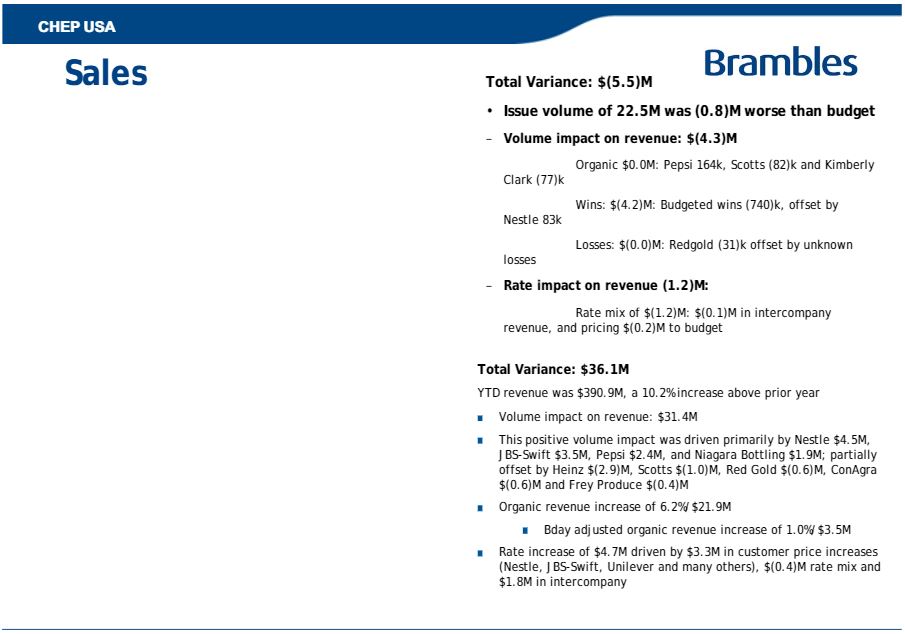
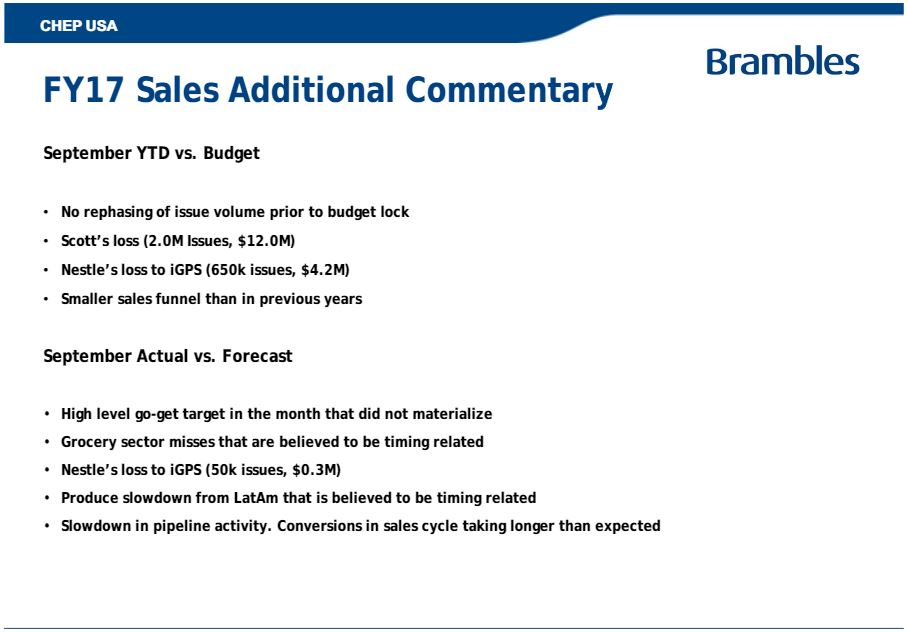
1316 The slides recorded that the reasons for US Pooled’s underperformance against budget in sales revenue included:
(a) the loss of two significant clients worth approximately $16 million to September FY17; the Scotts contract (worth approximately $12 million) and the Nestlé Location contract to iGPS (worth approximately $4.2 million);
(b) the inability to achieve the high level of ‘go-get’ in the budget (that being a stretch target in unidentified wins);
(c) a smaller sales funnel than in previous years; and
(d) a slowdown in sales pipeline activity, with conversions taking longer than expected.
1317 In cross-examination, Nador agreed with Martin’s slides and said that another reason was that for a specific segment of small customer accounts, US Pooled had a reduced ability to increase prices because of lower whitewood pallet prices. She also noted that some of that lost revenue from the Scotts contract was picked up by US Recycled as whitewood pallet purchases.
1318 On 8 October 2016, Nador emailed Rumph and said that the US Pooled sales revenue shortfall in September was “largely driven by the go-get we had assumed that did not materialize in time”. As previously noted, ‘go-get’ refers to a stretch item within a budget that is not allocated to a specific action item, project, or opportunity. Martin testified that in the sales context, whether it was specifically referred to as ‘sales go-get’ or just ‘go-get’, it was generally synonymous with ‘unidentified wins’. Thus, Nador’s reference to ‘go-get’ sales that did not materialise in September was a reference to budgeted unidentified wins which were not made in that month. In cross-examination, Nador accepted that, at that time, she knew that the Hunters team “were going after a very high-level of unidentified wins” in FY17 (emphasis added).
1319 Relatedly, Nador accepted in cross-examination that by this time the market was getting harder for US Pooled in terms of closing deals, and that the market was “hard”. She testified that while competition with other pallet poolers like PECO and iGPS was not new, by September 2016 Brambles was under pricing pressure from PECO and that PECO “was showing some aggressive proposals to go after big customers mainly”. She said that there were also delays because some large potential customers were using procurement agencies to negotiate for them, and they drove harder deals which took longer to settle.
1320 As earlier noted, with heightened competition from PECO for large customers it was sometimes necessary for US Pooled to reduce the price that it was willing to accept, and to make sales at low or lower profitability in order to keep important customers. That had an impact on Underlying Profit and ROCI. Rumph touched on this issue in an email to Nador on 6 October 2016 in relation to the large Cott Beverages account, which was held by PECO, but which US Pooled was trying to win. Rumph told Nador that she should be aware that Cindy Mason, one of the Hunters team, was “extremely focused on volume, and often at the expense of profit”. She recommended that Nador be “very cautious” when Mason was “pushing negative BVA deals” (BVA meaning ‘Brambles Value Added’, which was defined internally as “value generated over and above the cost of the capital used to generate that value”). In cross-examination, Nador described Cott Beverages as a “very cost-conscious customer” which dealt in “low margin product”, and in her reply email to Rumph on 8 October 2016 she noted that “the fight on margin is fierce”.
1321 In her 8 October 2016 email, Nador told Rumph that “I think we will see some of the large [sales] deals happen, just the timing is not what we had wanted”. In cross-examination she agreed that what she was there referring to was the risk that, as sales deals were delayed, they would occur later in FY17 (if made at all) and therefore only a proportion of the annual revenue from those deals would be recognised in FY17. The evidence shows that it took time between negotiating final terms and then transitioning large customers from their existing provider and setting them up to start receiving pallets from US Pooled, and hence pay issue fees and associated charges to US Pooled. US Pooled assumed a “ramp up curve” as the customer transitioned to it, and therefore it could be even later in FY17 (or in the following fiscal year) before the customer would reach “peak” issue volumes.
1322 On 12 October 2016 Mackie attended PPR meetings with each of the CHEP Global CBUs. The same day, after the PPR meetings, he emailed Gorman and Todorcevski (copied to Kennett and Scaiff) providing an update on those discussions and a brief overview of the YTD sales and Underlying Profit results for each CBU. In relation to US Pooled’s sales revenue, Mackie’s email said that the $(5.5) million shortfall in sales revenue against budget in US Pooled was:
(a) “mainly” attributable to a $(4) million miss on new wins; but also
(b) a mix of pricing stretch phased early, hire rate levels from fixed fee customers not being fully compensated, and whitewood prices coming off their peak.
1323 Mackie confirmed this view in his affidavit. He said that higher whitewood pallet prices made it more attractive for a customer to switch from using whitewood to pooled pallets, but it did not appear to him that a 2% decline in the price of whitewood pallets was likely to have a material impact on the rate of new wins. However, in cross-examination he accepted that the fact that whitewood pallet prices had “come off their peak” was slowing down US Pooled’s ability to convert customers from whitewood pallets to pooled pallets in some places because, at least having regard to the price differential, whitewood pallets were becoming a more attractive option.
1324 Another factor which reduced the ability of US Pooled to secure new business in 1Q17 was the decline in the market price for whitewood pallets. As previously noted, whitewood pallet pricing was an important driver of conversions to pooled pallets, and lower whitewood prices were likely to mean a lower level of conversions (although price was not the only customer consideration). The contemporaneous documents show that whitewood conversions were important to forecast US Pooled sales revenue in FY17. The Board presentation titled “5 Year Plan and FY17 Budget Report” dated 30 May 2016 said that “White Wood conversion remains at the core of our overarching strategy due to the volume of untapped market potential that exists” and that more than 80% of growth in CHEP in developed and emerging markets had come through whitewood conversions. US Pooled was a developed market. That presentation also said that Brambles expected “[s]olid sales growth over the plan period driven by strong growth in emerging markets and net new business in mature business” and “[n]ew wins predominantly driven by white wood conversions across all CBU’s”.
1325 Another problem for US Pooled sales revenue was the falling conversion rate. It will be recalled that the ‘conversion rate’ is the value of customer wins as a percentage of the total value of the sales funnel.
1326 On 8 September 2016, Kimberley Moriarty (Manager, Sales and Marketing Operations, CHEP NA) sent Martin and the US Pooled sales team an email under the subject line “Sales Funnel Summary (Pooled, USA) - August FY17”, attaching a summary of the sales opportunities in the sales funnel at that time (August Sales Funnel Report). Martin then emailed Jason Adlam (Vice President, New Business Development, US Pooled) on 9 September 2016 stating that “the wins and conversion rate look particularly low relative to prior year” and asking for someone to “dig into these numbers and identify the [sic] what is going on”. In cross-examination Martin accepted that at that time the trend of the conversion rate - that is, the rate at which US Pooled was winning business in the sales funnel - was “poor”, and low relative to FY16. But he also suggested that in FY16, a forecast in August would also have predicted a budget miss, but that the sales revenue numbers recovered in later months.
1327 Then, on 12 October 2016, Moriarty sent Martin an email (copied to Adlam) which contained two tables (Moriarty’s Conversion Rate Email) which are reproduced below. In cross-examination Martin seemed to accept that Moriarty provided this report at his request. I infer that he requested the report because he was concerned about the falling conversion rate.
1328 As is readily apparent, the first table related to the 12-month period from October FY16 to September FY17:
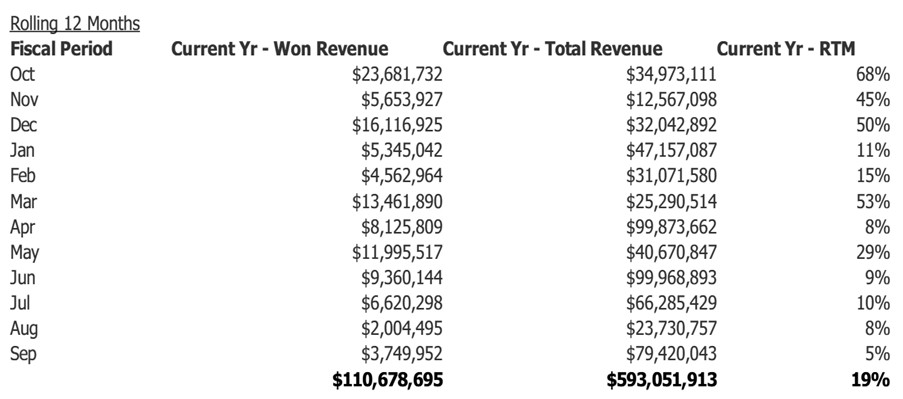
1329 The second table related to the previous 12-month period from October FY15 to September FY16:

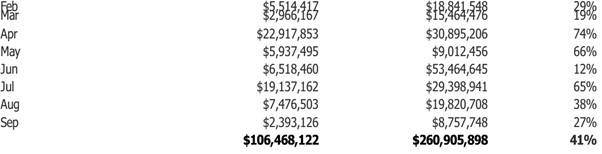
1330 The last column in each table set out the US Pooled conversion rate in each month, and the final figure in the last column set out the rolling 12-month conversion rate (being the average of the monthly conversion rates over the preceding 12 months), recorded as 19% as at September FY17. Little turns on the difference between the figures, but Brambles’ submissions put the rolling 12-month conversion rate at September FY17 at 17%, while the September Sales Funnel Report (distributed 9 October 2016) put it at 18%.
1331 Importantly, the table for the 12-month period from October FY16 to September FY17 showed that there had been a pronounced fall in the conversion rate over the preceding four months. The monthly conversion rates were 9% in June FY16, 10% in July FY17, 8% in August FY17 and only 5% in September FY17. Indeed, the only reason the rolling 12-month conversion rate at the end of September FY17 remained as high as 19% (which was still well below the 25% target conversion rate) was the high conversion rates in earlier months, including 68% in October FY16, 45% in November FY16, 50% in December FY16, 53% in March FY16 and 29% in May FY16. Moriarty’s Conversion Rate Email shows that on a monthly basis, US Pooled had, in July, August and September FY17, suffered some of the worst conversion rates in the preceding 24 months. In September FY17 (the month just passed), the conversion rate had hit a 24-month low of only 5%.
1332 On 4 November 2016, Martin forwarded Moriarty’s Conversion Rate Email to Adlam, Lester Centurion and other members of the US Pooled sales team (Martin’s Conversion Rate Email). This is an important email, and it is worth setting it out in full. Martin said:
Thinking quite a bit about this conversion rate (copying Lester as an additional resource), and copying you in for your insights around my sleepless nights!
The trends from June-Sept are quite alarming and based on what I can see there is no way to over correct to off-set this. Unless some of this is behavioral management and use of blue sheets, (ie a big cleaning or the Hunter groups handling of leads) this is a problem.
I am wonder what this group thinks about this and can we break it down by BDM, RBDM, Mason’s team and IS? Is there a better way to get our head around some predictive drivers of future revenue given the conversion rate trend or movements from Universe to In, Top, Best Few?
I will host a call in the next week to discuss this and whether we have a real problem or a reporting problem.
Thank in advance for your thoughts on this.
(Emphasis added.)
1333 As at that date the sales funnel report for October 2016 (October Sales Funnel Report) had not yet been distributed, and there had been no change in the known facts regarding the conversion rate since well before 20 October 2016. It is appropriate to infer that Martin held the views he expressed from 12 October 2016 when he received Moriarty’s Conversion Rate Email. Indeed, the evidence shows that he had been concerned about the poor conversion rate since early September 2016.
1334 Moriarty and Martin’s Conversion Rate Emails are significant to my view as to the reliability of Martin’s evidence that, following receipt of the US Pooled September results, he thought that the rephased sales revenue in the Initial and then the Revised September Reforecast for US Pooled was realistic and achievable.
1335 On 12 October 2016, Kennett sent an email to Rumph, Nador and Linderman under the subject line “Sales Growth - Additional Perspectives” (Kennett’s 12 October Rephasing Email). It included a table entitled “Growth Phasing” which showed forecast growth rates for sales revenue and Underlying Profit in US Pooled and CHEP NA in the (then) draft Revised September Reforecast which had been submitted into BRACS. The table showed that:
(a) for US Pooled, sales revenue growth was forecast to be 5.9% in 1H17 and 8.2% in 2H17. Those half-yearly sales revenue growth rates were based on the following quarterly growth projections: 7.6% in 2Q17; 9.6% in 3Q17; and 8.0% in 4Q17. In my view that was remarkable forecast growth when actual sales revenue growth in 1Q17 was only 4.9%; and
(b) for CHEP NA, sales revenue growth was forecast to be 4.3% in 1H17 and 8.1% in 2H17. Those half yearly growth rates were based on the following quarterly growth projections: 6.3% in 2Q17; 8.8% in 3Q17; and 8.6% in 4Q17. That too was remarkable forecast growth when actual sales revenue growth in 1Q17 was only 2.9%.
The rephased sales revenue in Kennett’s table became the basis of the Revised September Reforecast, which was finalised by 13 October 2016.
1336 In the covering email Kennett said:
Concentrating for now on the sales, you can see, although Q1 North America Sales grow only 4.1%, Americas (excl. Recycled) grows a more respectable (from a market POV) 5.8%... Overall, [US Pooled] is getting about 1% on price, 1% on organic, and about 3% on [net new wins] …
I’m sure you will have more detail on the shortfall of wins to Budget plans, but more important is to understand the main drivers of the 7.6% growth in Q2 v LY (which will help to deliver a H1 growth of 5.9%. And then the main reasons why we believe we can achieve the 9.6% and 8.0% in Q3 and Q4 respectively. Effectively, we are looking for either key items that drove the comparable down in H2 last year because of x, y, or z (examples), and in H2 this year, we plan to deliver because of a, b, or c (examples). This will help give more comfort (or not) on the delivery for the full year.
Then we obviously need to have a handle on what we perceive the main risks to be, and the level we are looking at.
(Emphasis added.)
1337 On 12 October 2016, Nador forwarded Kennett’s 12 October Rephasing Email to Martin and said:
For our review tomorrow … [I] guess we are all asking the same questions!
Martin replied:
Exactly. This gets incrementally more difficult to rationalize.
(Emphasis added.)
Nador then replied:
I think it would be good to write a couple of paragraphs on how we see the hockey stick in H2, given what we know and have at hand. Can you make the first attempt?
1338 Several things are noteworthy in relation to this email exchange.
1339 First, the email indicates that Kennett proposed the (in my view, remarkable) quarterly sales growth figures and then asked Rumph, Nador and Linderman to explain, and provide examples to show:
(a) the main drivers of the forecast 7.6% sales revenue growth in Q2; and
(b) the main reasons for their belief that US Pooled could achieve 9.6% and 8% sales revenue growth in Q3 and Q4 respectively.
I accept that there are likely to have been communications between Kennett and one or more of Rumph, Nador, Linderman or Martin about the additional rephased sales revenue prior to this email. This proposal will not have come entirely out of the blue. Even so, to my mind, Kennett’s request to Nador smacks of an attempt to obtain post hoc justification for sales revenue rephasing that he had already decided upon.
1340 Second, the only rephasing that Kennett sought examples to justify related to projected sales revenue growth. His email was concerned with sales and not costs. In cross-examination Kennett accepted that the rephasing of US Pooled Underlying Profit in the Revised September Reforecast ignored the fact that management did not yet have oversight or understanding of the persistent direct costs overruns. Kennett also accepted in cross-examination that management could not rectify the direct costs overruns until it understood their causes.
1341 Third, having regard to Nador’s 6 October 2016 email exchange with Alonso about the achievability of the US Pooled budget following the September results, and this email exchange with Martin, it is appropriate to infer that she had serious doubts about the reasonableness of the grounds for the rephased sales revenue in the Revised September Reforecast.
1342 Around 12 to 14 October 2016, Nador worked with the US Pooled team to review responses the team was preparing in response to Kennett’s email. Linderman was responsible for managing the document recording the team’s consolidated responses to go to Kennett, but the responses were prepared by each of the leaders of the respective teams, including Patell (Vice President, Retail Solutions, US Pooled) (retail), Holzman and Young (supply chain) and Martin and Bachtell (sales), and then reviewed by Rumph and Nador.
1343 On 12 October 2016 Todorcevski emailed Mackie (copied to Kennett and Rumph) setting up a call with Mackie and Rumph to prepare for the October Board Meeting and Q1 Trading Update. He told Mackie and Rumph that he would “pull together a short list of the key areas of focus (not a laundry list but the critical areas that we need to position correctly with the market and Board)”. He deposed that due to the ongoing work in CHEP NA to investigate the September results and develop a recovery plan, he wanted to have a discussion with Mackie and Rumph to make sure that he did not misstate the latest CHEP NA position to the Board or in the October trading update to the market.
1344 On 13 October 2016, Kennett sent an email to Rumph, Linderman, and Nador (copied to Scaiff) titled “Initial heads-up of likely questions Thursday pm for call with Tom/Zlatko/Pete”, in which he set out what he thought some of the questions would be at the scheduled telephone call on 14 October 2016. His proposed questions all related to sales revenue, and included the following:
(a) “What were the sales trends through the quarter - did things deteriorate over the quarter or improve?”;
(b) “Any feel for how sales in October are looking?”;
(c) “Were there any timing issues in Net New Wins (i.e., New Wins that were budgeted for 1Q that have slipped into 2Q)?”;
(d) “Did Brambles/US Pooled lose any major customers in 1Q17?”;
(e) “Did any Brambles /US Pooled competitor win a big customer in 1Q17…?”; and
(f) “How meaningful is any switching away from blue to white pallets during 1Q17?”
1345 On 13 October 2016, Todorcevski emailed Mackie, Rumph and Kennett (copied to Gorman, O’Sullivan and Callaway) listing the areas he wanted to focus on during the pending call, including trends in sales, direct costs and cashflow for 1Q17. In relation to sales revenue, he described the following matters, among others, as critical to understand. He said that there was a need for insight into the following elements against both the FY17 budget and FY16, as well as for September and YTD:
(a) organic sales;
(b) pricing, including pricing trends for whitewood pallets against expectations and the impact of NPD upcharges rolling off from FY16’s effort;
(c) wins, rollover wins from FY16 vs expectations, and new wins planned but not realised. In relation to the sales pipeline, a sense of where the outstanding opportunities sat, timing for clarification and a view on the likelihood of capture;
(d) losses; and
(e) the impact on US Pooled of the improving whitewood market.
Todorcevski also asked for any insights that could be provided on the draft Revised September Reforecast and the 1H17 and full-year outlook.
1346 On 14 October 2016, Rumph emailed Todorcevski, Mackie and Kennett (copied to Gorman, Callaway and O’Sullivan) attaching a document titled “North America Pallets: September Actual (P3) Responses for Brambles” dated 14 October 2016 (Rumph’s 14 October Response). In that document she set out CHEP NA management’s responses to Todorcevski’s questions regarding US Pooled and CHEP NA, and a high-level summary of US Pooled performance YTD. The document responded to both Kennett’s and Todorcevski’s questions and included the following observations in relation to sales revenue:
(a) customer destocking - an analysis of Q1 inflows vs Q4 issue volume for FY17 compared to FY16 showed a highly consistent level of inflow performance which did not point to customer destocking;
(b) rollover wins were on track in Q1 and expected to continue to deliver;
(c) new wins in US Pooled had been delayed in Q1, but it was expected that sales volume would recover strongly;
(d) new losses - the Scotts contract was lost to US Recycled and other recyclers in July FY17 (worth $2.4 million in FY17);
(e) rollover losses - four rollover customers had been lost. Red Gold was lost to PECO in March FY16 (worth $0.6 million in FY17), Heinz was lost to PECO in April FY16 (worth $2.7 million in FY17), Ready Pac was lost to PECO in October FY16 (worth $0.3 million in FY17), Sunshine Mills was lost in December FY16 to other recyclers (worth $0.3 million in FY17); and
(f) the effect of declining whitewood pallet prices on US Pooled - while there were rapid pricing declines in the whitewood market US Recycled was not yet seeing rapid movements in sales volume.
12.10.2 Direct costs concerns
1347 It is plain from the contemporaneous emails and from the testimony of Brambles’ executives that the direct costs overruns that US Pooled had been experiencing since July 2016, which had increased significantly in September 2016, were a major concern to Brambles’ management.
1348 On 7 October 2016, shortly after receiving the September results, Kennett emailed Todorcevski and others and said that US Pooled had been “majorly impacted by Direct Costs”, the majority of which occurred in the Service Centres where he estimated direct costs were about $(3.5) million worse than budget. In cross-examination, he accepted that those direct costs problems were a continuation of the issue that US Pooled had had since July FY17, and he said that was one of the reasons why he had asked for additional help with the problem. At that point direct costs had been over-budget by $(1.7) million in July, $(0.9) million in August and $(4.2) million in September. Kennett accepted that the direct costs problem was obviously getting worse in terms of deterioration against budget. He accepted that at that point he did not know what was going on with direct costs, and he did not know what their causes were.
1349 Kennett deposed that as at 8 October 2016 he thought that “direct costs should be the main area of focus” and that his main concern with the position in CHEP Global was that “the margins on that growth in FY17 were being eroded by the transport, plant and depreciation cost trends in US Pooled”. In cross-examination he agreed that what he meant was that the direct costs trends in US Pooled were eroding the growth margin for CHEP Global.
1350 Nador emailed Kennett on 10 October 2016 and told him that:
One point worth mentioning is that with all the changes in finance recently, we’re really struggling to get good visibility of numbers on time and the accuracy is certainly suffering. Many errors and corrections happening constantly. It is far from ideal.
Kennett accepted in cross-examination that at that time there was a gap in leadership and knowledge in respect of the US Pooled’s systems for recording direct costs, and that Nador was struggling with diagnosing the issues in the data needed to understand what was happening with direct costs in US Pooled.
1351 Kennett sent an email to Linderman on 10 October 2016 under the subject line “Period result and impact on forecast” (emphasis added). He asked Linderman for details in relation to US Pooled’s direct costs for September. I infer that he did so for the purposes of understanding the extent of the problem and so as to prepare the Revised September Reforecast.
1352 Linderman responded by email the same day (copied to Nador) and said that US Pooled’s direct costs were $(4.17) million worse than budget in September, with the main variants coming from operating costs $(3.4) million and another $(0.64) million in logistics. He said that the total supply chain cost per pallet issue was $3.38 compared to a budget of $3.10. Linderman then proceeded to explain a suggested “bridge” for US Pooled to recover the situation.
1353 Importantly, Kennett’s email said that “we will obviously need to understand the impact/achievability of the H1 forecast”. On that issue Linderman responded and said that he thought it was unlikely that US Pooled would be able to maintain the 1H17 forecast given its YTD performance through September. Nador responded to Linderman and Kennett the same day. She also said that in her view it was unlikely that US Pooled would be able to achieve the 1H17 Underlying Profit projections in the Initial September Reforecast and she said that she thought the gap would be made up in 2H17 because:
(a) most of the supply chain cost savings initiatives were likely to happen in 2H17; and
(b) based on the sales deals that were currently on the table, sales revenue would not be up to forecast in 2Q17.
Kennett replied on 11 October 2016 and said that he understood Nador’s view about 2H17.
1354 In Mackie’s 12 October 2016 email to Gorman and Todorcevski (copied to Kennett and Scaiff), he said the following about the $(4) million over-budget direct costs in US Pooled:
US Direct costs ($4m) contain multiple issues in the month that are still being worked through at this stage. We do have a clear issue of over repair volumes in the month ($1.4m) which more than countered any benefit from the lack of issue volume. We have been running tight on P stock Vs relocation expense so this was expected to some degree but not at this magnitude. Our retail TPM operations have also seen an increase of pallets into reuse and was particularly high in the month ($1.5m), it will require some tough Retailer discussions and TPM actions but is fixable. The ongoing nature of this still needs to be bottomed out and will require some physical plant visits to test some issues that may be simply reporting issues in the month.
Visibility has been an issue this month with Orlando closed on Friday so the teams are still trying to bucket the numerous ~$0.5m issues for me in a way that helps us understand the one-offs, timing and the full year impact issues. For example SC initiatives are behind but they always are at the end of Q1
However in reality a full US recovery based on this requires a change at Walmart. [Nador] is with Robert 20/10 and will give a polite heads up that [Rumph] is seeking a 1:1 with Sultemeier on a quick win around taking a TPM back or at least getting an immediate quality spec change on reuse pallets.
(Emphasis added.)
1355 There, Mackie explained that the causes of US Pooled’s $(4) million miss to budget in direct costs in September were not yet known. He said there were “multiple issues in the month, which were still being worked through”, although he identified issues around over-budget repair volumes in the month, and an increase in pallets going into reuse through retail TPMs. (which was also likely to lead to higher damage rates).
1356 Mackie also said that Nador was meeting with a Walmart executive (Robert) on 20 October 2016 and would remind him that Rumph was seeking a one-on-one meeting with another Walmart executive (Sultemeier) in which she would seek a “quick win” around taking a Walmart TPM back, or at least getting a change on the quality specifications for Walmart’s reuse of US Pooled pallets. I later explain why I consider there was little prospect of any such “quick win” with Walmart. For the present it suffices to note that as at 20 October 2016 no meeting had been scheduled between Sultemeier and Rumph, no request for a “quick win” had been made, and nothing about the possibility of that future meeting could reasonably affect the reliability of the damage rate assumption as at 20 October 2016.
1357 Mackie deposed that a full US Pooled recovery in relation to direct costs required a change at Walmart. In my view the evidence is clear that there was not going to be any quick fix of the problems arising from Walmart’s pallet reuse arrangement with US Pooled. Among other things, Kennett deposed that he understood Mackie to be referring to long term business planning rather than to recovery in FY17. He said that in his time “as CFO of CHEP Global, achieving change at Walmart had always been very slow and any changes with Walmart were always part of a long-term business strategy, not short-term objectives”.
1358 In Todorcevski’s 13 October 2016 email to Mackie, Rumph and Kennett (listing the areas he wanted to focus on during the pending call), he said that in relation to direct costs it was critical to understand matters including:
(a) the BPR presentation, which suggested that volume related direct costs increases YTD were 9% in FY16 when sales volumes were up far less than that;
(b) what was happening with timing / phasing of repair volumes in September compared to prior and future months; and why the cycle time had increased to 119 days which is substantially above FY16 and budget.
1359 In Rumph’s 14 October Response she stated that:
(a) the volume related direct cost increases of 9% YTD roughly approximated the issue volume increase from FY16;
(b) US Pooled would closely monitor repair volumes as well as capex as the projected increased sales volume manifested through FY17; and
(c) the total cycle time YTD was 116.8 days against the budget of 115.1 days. The vast majority of that increase was coming from retailers driven by Walmart and NPDs.
1360 In his 12 October 2016 email, Mackie said that a full US Pooled recovery in relation to above-budget repair costs required a change at Walmart. In my view the evidence shows that any material improvement in the Walmart damage rate in FY17 was highly unlikely. As earlier discussed, when dealing with the reduced damage rate assumption in the US Pooled budget, the high damage rate in US Pooled was related to the very high damage rate for pallets transferred to Walmart, which accounted for 20% of US Pooled’s pallet flows (though certain internal documents indicate it made up 25% of the flow). US Pooled had an agreement with Walmart, which allowed it “unrestricted re-use” of pallets delivered to it by manufacturers, and Walmart’s practice was to hold the pallets for substantially longer than other US Pooled customers, and only return them when damaged. That resulted in an average damage rate in FY16 of approximately 83.8% for pallets that were transferred to Walmart; 33 pps higher than the damage rate of approximately 50.9% for pallets not transferred to Walmart.
1361 Alonso accepted that the Walmart damage rate problem had not improved since 2013, and instead it had deteriorated, and had begun to significantly climb in the three years before FY17. He accepted that unless US Pooled could find some solution to the very high damage rates experienced for pallets transferred to Walmart, it was going to have a problem significantly improving the overall US Pooled damage rate in FY17. Further, he testified that he was not planning on a breakthrough in reducing the Walmart damage rate. His hope was only to keep the Walmart damage rate flat instead of increasing, rather than achieve a reduction by some sort of breakthrough. In cross-examination, Mackie testified that the initiatives Brambles was working on with Walmart were aimed at “relationship building” in an effort to repair their “very difficult” and “confronting” relationship. He conceded that those initiatives were not going to improve the Walmart damage rate in FY17.
1362 Endeavours to reduce the damage rate (and thereby reduce direct costs associated with repairing or replacing damaged pallets) were an ongoing discussion within Brambles, and were tied up with the introduction of the Durability Program. Many of those discussions involved Alonso because he was Brambles’ supply chain expert and primarily responsible for reducing direct costs through the supply chain cost saving initiatives in the US Pooled FY17 budget. By 20 September 2016, Alonso had assessed that there was only a 25% chance that the average damage rate in US Pooled would reduce below the level it was then sitting.
1363 On 4 October 2016, following his review of a damage rate report relating to US Pooled titled “Bottoms-Up Damage Rate Tool - FY17 FW13 Report”, Alonso emailed James Stubbs (Senior Manager, Supply Chain, US Pooled) and Young and said:
This is showing a quite remarkable improvement, the team is doing a very good job
I have a challenging thought though I would like your views. It looks like we are improving our sort accuracy rather than getting real benefits from durability (expected [damage rate] is quite stable in most sites…)
(Emphasis added.)
In their responses, Stubbs said that his view aligned with Alonso’s view, whereas Young said that while “sort accuracy” was improving, he thought that there was “an element of durability” that was driving down the damage rate. Alonso explained that an improved “sort accuracy” resulted in a more accurate assessment of the damage rate.
1364 On 5 October 2016 Young forwarded to Alonso a 4 October 2016 email with an embedded table setting out the damage rates in US Pooled for the fourth week of September and YTD (4 October Damage Rate Report). The table recorded the damage rates by reference to pallets returned to:
(a) Service Centres operated by US Pooled;
(b) Non-Walmart TPMs, being TPM facilities operated by US Pooled at retailers other than Walmart;
(c) Walmart TPMs, being TPM facilities operated by third parties (not by US Pooled) at Walmart; and
(d) TPM facilities operated at manufacturers (called ETPMs).
1365 The table is reproduced below.
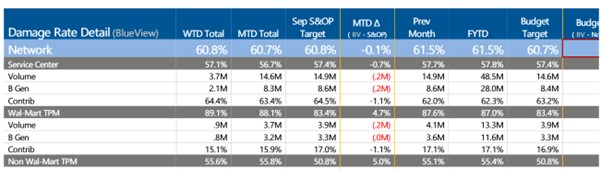

1366 It showed that in September FY17 for the month-to-date:
(a) the Service Centre monthly damage rate was 56.7%, which was 0.7% lower than the September target rate of 57.4%, and one pp lower than the preceding month; and
(b) the monthly damage rates for Walmart TPMs and non-Walmart TPMs were, however, 88.1%, and 55.8% respectively, which were 4.7 and 5 pps respectively higher than the September target rate.
Those results offset each other and the US Pooled network monthly damage rate of 60.7% was broadly on track with the September FY17 budget and 0.8 of a pp lower than the August FY17 damage rate of 61.5%.
1367 The YTD position was less positive. While the damage rate in the ETPMs was on budget and the damage rate in Service Centres was only 0.4 of a pp over-budget YTD, the damage rates for Non-Walmart TPMs and Walmart TPMs were over-budget YTD by approximately 4.6 pps and 3.6 pps respectively. The monthly damage rates for Walmart TPMs over Q1 had been significantly elevated and the high damage rates in Walmart TPMs and non-Walmart TPMs had resulted in the network damage rate being 61.5% YTD, which was 0.8 pps above the target rate. It will be recalled that Alonso testified that a one pp increase in the network damage rate in US Pooled equated to an increase in variable costs of approximately $5 to $6 million.
1368 That was not a particularly positive report, but in a reply to Young’s email the same day, Alonso said that it “looked like” there was an opportunity in Non-Walmart TPMs to reduce the monthly damage rate by half a pp, coupled with an opportunity in Service Centres to reduce it by another half a pp, to target a network damage rate of below 60% by November. Young responded by saying: “Yes, we need to bring them down in order to hit budget”.
1369 Young was correct in stating that the damage rates in Non-Walmart TPMs and Service Centres had to be brought down if US Pooled was to hit budget, and the evidence shows that there was no realistic prospect of reducing the damage rate in Walmart TPMs. But viewed objectively, it was wishful thinking for Alonso to state that the monthly network damage rate could be brought below 60% in November. And, more importantly, even if that could be achieved, it was unlikely to mean that US Pooled would meet the damage rate assumption. Several matters are material to my view in this regard.
1370 First, at that point, US Pooled and CHEP NA had developed no plans or strategies that might drive down the damage rate in Walmart TPMs in FY17, and it would be very difficult to reduce the network damage rate without rectifying the very high damage rates in Walmart TPMs. The only strategies that CHEP had in relation to Walmart were intended to repair their fractured relationship, not to drive a decrease in the damage rate in the short term. In Mackie’s 12 October 2016 email to Gorman and Todorcevski following the PPRs, Mackie updated them on the progress of discussions with Walmart aimed at improving cycle time and lowering the rate of pallet reuse. He said: “In reality a full US recovery based on this requires a change at Walmart”. He deposed that the “change at Walmart” he was referring to was a long-term strategy aimed at improving the relationship between Brambles and Walmart. The evidence shows that no quick fix was possible for the very high damage rate in Walmart TPMs, and the Walmart damage rate was significant to the network damage rate.
1371 Second, as Alonso accepted in cross-examination, the damage rate fluctuated seasonally. It was generally the case, and it had been the position in FY14, FY15 and FY16, that the damage rate went up in November, December and January. That reflected the fact that there were a lot of consumer goods transported on pallets in advance of Thanksgiving and Christmas, and following that period there was a higher level of returns, including of damaged pallets. However, the US Pooled budget and the Initial and Revised September Reforecasts assumed a steady decline in the damage rate. Alonso accepted that the Initial and Revised September Reforecasts did not take into account the usual seasonal increase in damage rates from November to January each year. As a result even if Alonso was correct in thinking that US Pooled might be able to reduce the November network damage rate to below 60%:
(a) it could reasonably be expected that the monthly network damage rate would then go up, or at least cease to decline in December and January; and
(b) in any event, that was unlikely to mean that US Pooled would be able to meet the damage rate assumption in the budget and the Initial and Revised September Reforecasts. In circumstances where the network damage rate had been materially above-budget through Q1, a damage rate just below 60% by November was unlikely to be far enough below-budget to offset the over-budget damage rate in the first three months, so as to permit US Pooled to achieve a full-year average damage rate of 59.3% by the end of FY17.
1372 On 11 October 2016, a presentation titled “Brambles Pallets Performance Review North America September FY17” (CHEP NA September PPR) was distributed to Mackie, Kennett, Alonso, Moreno and Scaiff. It noted a “sharp increase” in the FY17 damage rate YTD for pallets transferred to Walmart, and said that higher reuse was driving the damage rate up. The US Pooled September Monthly Close Report dated 12 October 2016 recorded that the damage rate in September for Walmart TPMs was 84.9%, which was 1.5 pps higher than projected in the budget and Initial September Reforecast.
1373 In relation to direct costs the US Pooled September Monthly Close Report also recorded that:
(a) for September FY17 US Pooled was approximately $4.17 million above-budget for the month (representing a variance of 5% of budget); and
(b) YTD it was $6.8 million above-budget (representing a variance of 2.4% of budget).
1374 The evidence shows that, in this period and as at 20 October 2016, despite its concerns about the issue, Brambles’ management did not understand the causes of the persistent direct costs overruns in US Pooled. Alonso was the head of the supply chain division for CHEP Global and the person directly responsible for setting and achieving the supply chain cost savings initiatives in the CHEP Global budget. He was clear in his testimony that he was very concerned by the direct costs overruns, which had significantly increased in September, and that he did not understand what was causing them. In his 7 October 2016 email to Rumph, he said “right now we are in the worst of situations, not only failing on numbers but not being able to understand why!”. In cross-examination he accepted that at that time his mindset was one of “frustration” because he “could not understand the reasons for [the] gap” to budget. He also agreed that at that time he had “no idea what was going on” in relation to direct costs. He thought that the whole costing process was broken, but he could not be sure that was the cause of the results, and at this point in time he had become “more convinced” of the need to conduct a deep dive in relation to the US Pooled and CHEP NA results.
1375 The contemporaneous emails also show that Alonso was aware that a substantial amount of work would be necessary before Brambles’ management could get a proper understanding of the causes of the continuing deterioration in direct costs. For example:
(a) In an email to Young on 8 October 2016, Alonso said that he was “seriously considering” asking for a deep audit on “all costing and finance process for the last 6 month[s]” so that Brambles could not only understand what had happened, but also understand what was “broken” to avoid these types of surprises happening again. He deposed that at that time there were “difficulties in interpreting the results provided to us by Finance, including for example the benefit from the missed accounting accrual in August FY17 which appeared to be hidden in the CPR and clinched nail benefits”. He said that he was “more convinced of the need to conduct a deep dive into the results coming from CHEP North America to ensure we could understand the key drivers, work out whether they were ongoing or one-time issues, and understand what steps we could take to mitigate any ongoing issues”.
(b) In an email to Nador on 10 October 2016 he said that he had been reviewing the September data for US Pooled and “honestly, there are many things still don’t fit in for me” and that it was clear that there was “a serious problem with forecast and reporting” in US Pooled. On 11 October 2016, in the same email exchange, he told Nador that he intended to ask Kennett for help “to audit all of the activities, and costs of these three months against the same period from last year for everything that they call non demand repair and TPM Handling volumes / missuses”. He said that he did not believe the data, and that he would like to ask Moreno to undertake the proposed audit.
(c) In an email to Mackie on 11 October 2016, he agreed with Mackie’s suggestion that a deep dive be undertaken into the causes of US Pooled’s underperformance. He said, “to be honest I still do not fully understand what has happened”, and that it was also necessary to fix the monthly forecast process and accounting which “looks broken right now”.
1376 In this period Kennett suggested to Todorcevski that Moreno be appointed to get on top of the investigation into the deterioration in direct costs in US Pooled. On 12 October 2016 Todorcevski appointed Moreno to “invest all his time and resources into detailing and understanding what was happening on the direct costs side in the US Pooled business, working remotely from Europe but spending one week of every month in the US”. Kennett agreed that Moreno was seen as “more of a trouble shooter or a more specific trouble shooter in respect of direct cost[s]” and that Todorcevski’s agreement to have Moreno dedicate himself to determining the causes of the direct costs issues in US Pooled was a reflection of the seriousness of that issue. Alonso described Moreno as “an internal expert who provided reporting on supply chain costs in Latin America and Europe”.
1377 Although Moreno was appointed on 12 October 2016 to spend all of his time and resources in investigating the causes of the direct costs overruns in US Pooled, I infer that he did not commence full-time work on the issue until around 13 November 2016. The likelihood that Moreno was not working full-time on the investigation until 13 November 2016 can be seen in an email Kennett sent Moreno on 10 November 2016 asking him to “drop whatever you are doing” to be “parachuted” into the USA along with another expert from the European team to deal the “emergency situation” with direct costs in US Pooled. It can also be seen in another email in that period which shows that in order for Moreno to get to the USA on 13 November 2016 he had to cancel a planned work trip to CHEP LATAM.
1378 Moreno agreed to urgently travel to the USA, and he arrived there on around 13 November 2016, together with three European supply chain and process improvement experts. The only evidence that Moreno worked on the direct costs issue earlier than that was Kennett’s evidence that he received some reports from Moreno in early November 2016. I accept that Moreno did some work on the issue in early November, but the evidence does not establish that he was spending all of his time and resources on the investigation until after 13 November 2016.
1379 In his 12 October 2016 email to Gorman and Todorcevski, Mackie said that the causes of the $(4) million in direct costs overruns in US Pooled in September were still being worked through. In cross-examination he accepted that, as at 12 October 2016, Brambles had not been able to get to the bottom of the causes of the direct costs overruns, nor at that point was there a recovery plan in place, nor had the Walk to MOP been implemented. He accepted that Brambles did not have an understanding of or an answer to the issues that were causing the rise in direct costs and that he did not have a recovery plan to present to Gorman.
1380 In cross-examination, Todorcevski accepted that, around 7 October 2016, notwithstanding that Alonso had undertaken a deep dive and produced a report, the direct costs overruns had “got worse” and Brambles had still not got to the bottom of the cause of the deterioration. He acknowledged that, because Brambles did not understand the cause of the deterioration in direct costs in US Pooled, it might well continue on an adverse trajectory for US Pooled over the balance of FY17. He said that he and Gorman were “both heavily involved in looking hard and very, very concerned” by the continued deterioration in direct costs.
1381 Todorcevski accepted that, as at 14 October 2016 (when the Revised September Reforecast, was finalised) Brambles still needed to understand the causes of the direct costs overruns to ensure that it could get on top of them in 1H17, and to address them and catch up the shortfall in 2H17. He testified that, at that time, he had an understanding of some of the elements causing the direct cost problems in US Pooled, but not “the whole picture”.
1382 I give little weight to Todorcevski’s evidence that he understood some of the elements causing the direct cost problems in US Pooled, albeit not the whole picture. Alonso had more expertise and was much closer to the issue than Todorcevski, and he was clear in his evidence that he did not understand the causes of the direct costs overruns. Kennett was also clear in his evidence that at this time management did not understand the causes of the direct costs overruns, and he was also closer to the issue than Todorcevski.
1383 As I have said, in my view the evidence is clear that, as at 20 October 2016, Brambles’ management did not understand the causes of the direct costs overruns, and that it could not address them without understanding the causes. As at 20 October 2016, Brambles’ management therefore did not know whether or to what extent the direct costs overruns were systemic and therefore likely to continue, and further, whether or to what extent they would continue to materially affect US Pooled’s FY17 Underlying Profit.
12.10.3 Finalisation of the Revised September Reforecast
1384 Kennett deposed that by around 13 October 2016, having regard to the September results for US Pooled, he had made further changes to the phasing of the CHEP Global FY17 forecast for sales and Underlying Profit. The effect of that rephasing was to forecast a miss of $(2.7) million in CHEP Global sales revenue in 1H17 and to rephase that to be achieved in 2H17, and to forecast a $(6.5) million miss in Underlying Profit in 1H17, and to rephase $6.3 million of that to be achieved in 2H17. The Revised September Reforecast in respect of CHEP Global was loaded into BRACS on or around 13 October 2016.
1385 On 14 October 2016, the monthly CHEP Global CFO BPR meeting was held, attended by Todorcevski and the CFO of each of Brambles’ business units. On that day Scaiff sent the participants, which included Todorcevski, Kennett and O’Sullivan, a presentation titled “CHEP Global Pallets September FY17 BPR” (CHEP Global September CFO BPR). The presentation included a slide titled “Forecast ULP H1/H2” which set out the Revised September Reforecast for the CHEP Global CBUs, including CHEP NA.
1386 In relation to the projected growth in sales revenue, the CHEP Global September CFO BPR acknowledged that the rephased budget provided for “stronger” sales revenue in Q2, and “very strong” sales revenue in 2H17, while noting that there were “risks” in CHEP NA in that regard. The presentation also acknowledged that the improvement in 2H17 was forecast to be “driven by new business wins”, with little change forecast in price and organic growth in the remainder of the year.
1387 Kennett deposed as follows, by reference to the CHEP Global September CFO BPR presentation (that he had prepared with Scaiff):
(a) the majority of the shortfall in gross profit for CHEP Global in the YTD had occurred in September and was mainly driven by US Pooled and US Recycled;
(b) the ongoing positive performance of both CHEP LATAM and Europe, who continued to over-deliver, was helping to offset some, but not all, of the underperformance in the US Pooled results for September;
(c) the forecast outlook for the remainder of FY17, reflecting the September Reforecast process and September results. Kennett noted that the Underlying Profit versus budget was $15m lower for 1H17 but increased for 2H17;
(d) the sales growth forecast by CHEP CBUs for 1H17 and 2H17. The growth of US Pooled and US Recycled in 2H17 reflected growth of more than 8% versus the prior year (and compared to the growth of 5.9% and 1.2% respectively for 1H17);
(e) net new wins for US Pooled was weighted towards the second half of FY17 because the sales pipeline was delayed;
(f) the pipeline for US Recycled helped explain the 10.9% NNW in 2H17;
(g) the latest CHEP Global R&O analysis (which was based on the R&O analysis Scaiff circulated on around 7 October 2016, following the September Reforecast review). The R&O analysis identified opportunity in CHEP LATAM and Europe, offsetting some of the risks in CHEP North America, but with risks of $(36.7) million and opportunities of $21.1 million leading to net risk of $(15.6) million on a full-year basis.
1388 Rumph’s 14 October Response was before the CHEP Global September CFO BPR meeting. It said the following about the Revised September Reforecast for CHEP NA and US Pooled:
For the updated forecast, both total North America Pallets and US Pooled remain at Budgeted ULP levels, with significant risks remaining for the full year, and with a shift in the required clawback of ULP in the 2H of the year.
The total NA Pallets revised September forecast reflect a variance to budget of $(17.6)M in H1 with a $17.6M over performance to budget in H2. The US Pooled ULP reflects a $(14.3)M variance to budget in H1 with a $14.3M over performance to budget in H2. The revised September forecast is a shift of ULP performance of $8.1M total North America and $6.5M US Pooled from the original September forecast.
US Pooled continues its Walk to MOP efforts in the year to identify and execute the necessary actions to achieve the re-phased ULP performance. The team is reviewing our pipeline to aggressively advance deals, take additional price where possible, reduce pallet purchases with demand curve and inventory levels, improve network optimization, and reduce cost levels.
In the North America Pallets September PPR R&O schedules, we highlight $(48)M in total identified risks for the year to the September forecast balanced against $23M of total identified opportunities.
(Emphasis added.)
1389 The applicants produced the following two tables to show the changed rephasing of sales revenue and Underlying Profit through the Revised September Reforecast for US Pooled:
US Pooled September Reforecast: Sales revenue Re-phasing | |||||||
($US million) | Q1 | Q2 | Q3 | Q4 | 1H | 2H | FY17 |
Initial September Reforecast | 393.6 | 387.2 | 405.3 | 431.1 | 780.8 | 836.4 | 1,617.2 |
Revised September Reforecast | 390.9 | 387.2 | 407.3 | 431.8 | 778.1 | 839.1 | 1,617.2 |
Re-phasing Adjustment | (2.7) | 0 | 2 | 0.7 | (2.7) | 2.7 | 0 |
US Pooled September Reforecast: Underlying Profit Re-phasing | |||||||
($US million) | Q1 | Q2 | Q3 | Q4 | 1H | 2H | FY17 |
Initial September Reforecast | 72.3 | 83.9 | 91.2 | 116.2 | 156.2 | 207.4 | 363.6 |
Revised September Reforecast | 67.1 | 82.7 | 94.6 | 119.1 | 149.7 | 213.7 | 363.5 |
Re-phasing adjustment | (5.2) | (1.2) | 3.4 | 2.9 | (6.5) | 6.3 | (0.1) |
1390 The applicants produced the following table summarised from the CHEP Global September CFO BPR:
CHEP Global Revised September Reforecast (vs budget) | ||||||
Sales revenue | Underlying Profit | |||||
($US million) | 1H | 2H | FY17 | 1H | 2H | FY17 |
US Pooled | (7) | 8 | 1 | (14.3) | 14.3 | 0.0 |
CHEP NA | (20) | (4) | (24) | (17.4) | 17.5 | 0.2 |
Europe | 7 | (7) | 0 | 3.8 | (3.9) | 0.0 |
Asia-Pacific | 0 | 0 | 0 | (0.4) | 0.5 | 0.1 |
LATAM | 1 | 0 | 1 | 0.6 | (0.6) | 0.0 |
Africa, Middle East and India | (4) | 0 | (4) | (2.3) | 2.3 | 0.0 |
CHEP Global | (17) | (10) | (27) | (15.3) | 15.9 | 0.6 |
1391 In cross-examination Todorcevski accepted the obvious: that the Revised September Reforecast projected that the significant under-budget performance in US Pooled and CHEP NA in 1H17 would be compensated for by significant over-budget performance in US Pooled and CHEP NA in 2H17.
1392 Thus, having regard to the Revised September Reforecast, the position as reported in the CHEP Global September CFO BPR was as follows:
(a) In US Pooled:
(i) Sales revenue was $(8.5) million under-budget YTD, which was forecast to recover to be $(7) million under-budget in 1H17, which shortfall would then be recovered by it achieving $8 million in over-budget performance in 2H17.
(ii) Underlying Profit was $(13.7) million under-budget YTD, which would worsen to $(14.3) million under-budget in 1H17, which shortfall would then be recovered by it achieving $14.3 million in over-budget performance in 2H17.
(b) In CHEP NA:
(i) Sales revenue was $(14.3) million under-budget YTD, which was forecast to worsen to $(20) million under-budget in 1H17, which was forecast to worsen to $(24) million under-budget by the end of 2H17.
(ii) Underlying Profit was $(17) million under-budget YTD, which was forecast to worsen to $(17.4) million under-budget in 1H17, which shortfall was forecast to be recovered by it achieving $17.5 million in over-budget performance 2H17.
(c) In CHEP Global:
(i) Sales revenue was $(10.1) million under-budget YTD, which was forecast to worsen to $(17) million under-budget in 1H17, which was forecast to worsen to $(27) million under-budget by the end of 2H17.
(ii) Underlying Profit was $(12.6) million under-budget YTD, which was forecast to worsen to $(15.3) million under-budget in 1H17, which was forecast to be recovered by it achieving $15.9 million in over-budget performance in 2H17.
Primarily as a result of the underperformance in US Pooled and CHEP NA, at this time the Group was $(8) million under-budget on both sales revenue and Underlying Profit.
1393 Importantly, the Revised September Reforecast for CHEP Global did not forecast Underlying Profit 2H17 overperformance in other CHEP CBUs which would offset the 1H17 underperformance in US Pooled and CHEP NA. The reforecast 2H17 Underlying Profit of the other CHEP CBUs was mixed, with AIME forecast to be $2.3 million above-budget and Europe $(3.9) million under-budget. They were all forecast to be flat to budget for the full-year.
1394 For the reasons I later explain, on my view of the evidence, there was not an objectively reasonable basis for the projected rephasing of sales revenue and Underlying Profit growth in the Revised September Reforecast for US Pooled and CHEP NA.
12.10.4 Recovery actions taken following the September results
1395 In arguing that it had reasonable grounds for confidence that Underlying Profit in US Pooled, CHEP NA and CHEP Global would recover to alignment with budget by the end of FY17, Brambles submitted that it speedily embarked upon a series of steps in US Pooled and CHEP NA to plan and to implement strategies to understand and respond to the issues underlying the underperformance against budget in sales revenue and Underlying Profit. I accept that Brambles did so.
1396 The following list captures the main actions:
(a) Brambles undertook ‘deep dives’ in US Pooled to diagnose issues regarding US Pooled’s performance. The results of those deep dives and the various views as to the causes of the sales revenue shortfalls and direct costs overruns were shared within each business level and fed up the chain to higher levels of management;
(b) in September, Martin asked the US Pooled sales team to conduct a more detailed investigation into the underlying causes of the lower-than-expected sales conversion rate and instituted weekly sales pipeline meetings. Although the sales funnel had weakened from the previous month, he said he was confident in the FY17 sales budget by reference to his discussions with many customers that he expected to close, the line of sight of the Hunters team, and the historic close rates he had observed;
(c) weekly Walk to MOP meetings were instituted in US Pooled from September 2016, and from 19 October 2016 weekly Walk to MOP meetings began across CHEP NA which included the leadership team and key personnel from each constituent CHEP NA business. Mackie testified that during his time as President of CHEP Global it was common for recovery plans such as Walk to MOP to be implemented in order to “claw back” budget shortfalls. For example, the opportunities identified in the US Pooled WTM files in October 2016 included:
(i) an opportunity “Spartan Nash to NCD’” with a potential Underlying Profit impact of $1.8 million and the note: “Higher NCO fees charged to Spartan Nash manufacturers”;
(ii) an opportunity described as “Contingencies”, with a potential Underlying Profit impact of $1 million and the note: “Cycle time increasing at fixed rate customers”;
(iii) an opportunity of “Supply Chain Initiatives / Inflation”, with a potential Underlying Profit impact of $3 million and the note “[Loss of Hire], Flow optimization, Spot Market (dependent on production)”; and
(iv) two new retail channels had been identified, including a new cruise ship channel that US Pooled expected to close in the six to nine months from late October 2016;
(d) by 4 October 2016, US Pooled had developed and was implementing a sales recovery plan which targeted approximately $9 million in sales across a few dozen customers, some of which would need until 4Q17 (1 April - 30 June 2017) to work their way through the sales cycle. Martin accepted that the later in the financial year a deal with a new customer closed, the greater the risk that the revenue from that deal would not flow until the following financial year. The recovery plan to improve sales was expected to generate improved results over 2H17. It was not expected to result in an immediate shift in the performance of US Pooled, but to generate improved results over 2H17;
(e) from around 6 October 2016 US Pooled instituted weekly sales pipeline reviews. At these meetings, Martin and his team discussed ‘bluesheets’, whether it was appropriate to make any price adjustments for particular customers, the causes of delays in finalising any new contracts, and directly approaching executives at potential customers to speed up customer decisions and approvals;
(f) from 19 October 2016, Rumph implemented a Walk to MOP process at the CHEP NA level, which projected a turnaround in financial results in H2. The Walk to MOP process had been successfully implemented by CHEP NA in previous years. Mackie described it as an incredibly rigorous process and said he had confidence in Rumph and her team. From this point onwards, there were dual track WTM meetings at the US Pooled and CHEP NA levels. At the CHEP NA level, the Walk to MOP process was focussed on reviewing the sales pipeline to aggressively advance deals, taking additional price where possible, reducing pallet purchases, improving the network optimisation and reducing costs;
(g) on 12 October 2016, Moreno was appointed to spend all his time detailing and understanding what was happening on the direct costs side in US Pooled; and
(h) Brambles continued to investigate the sources of the shortfalls in preparation for its usual review meetings and to discuss the results with management.
1397 Also, around 11 October 2016, meetings were scheduled to occur on 25 October 2016 to be attended by Gorman, Mackie, Rumph and Nador and other members of the US Pooled management team in which the 1Q17 results for US Pooled, its recovery plans, and its risks and opportunities were to be discussed (US Pooled Status Review Meeting).
1398 Mackie gave evidence in cross-examination that in a recovery year “it’s perfectly normal that the recovery actions deliver in the second half of the year”. He also stated that he had seen rephasing to that extent before, when he turned around the CHEP UK business. He denied that the ability of CHEP Global to meet its budget was dependent on the ability of US Pooled to recover the sales revenue shortfall, and denied that US Pooled’s ability to recover the sales revenue shortfall was “substantially dependent” on its ability to attract new wins in the second half of the year. He said that recovery was dependent on the US Pooled and CHEP NA recovery plans including Walk to MOP, and overperformance against budget in the other CHEP NA business units which were expected to generate improved results over the second half of the year.
1399 As I later explain, while I accept that those recovery steps were taken, I am not persuaded that they provided reasonable grounds to forecast that US Pooled and CHEP NA would overperform against budget in 2H17, as projected in the Revised September Reforecast, and therefore return those businesses to alignment with budget in Underlying Profit.
12.11 Brambles’ lay evidence - Revised September Reforecast
1400 It is plain on the evidence that the poor US Pooled September results meant that CHEP NA and CHEP Global management no longer considered it reasonable to maintain the sales revenue and Underlying Profit projections in the Initial September Reforecast in respect of US Pooled and CHEP NA. In the period from the receipt of the September results until around 13 October 2016, Kennett drove the preparation of the Revised September Reforecast. That reforecast forecast further misses in US Pooled sales revenue and Underlying Profit in 1Q17, and rephased it partly into 2Q17, but mostly into 2H17. This reforecast provided for a greater ‘hockey-stick’ recovery through which US Pooled and CHEP NA (and as a result CHEP Global) were projected to recover to alignment with budget in Underlying Profit over the remainder of FY17.
Nador
1401 The thrust of Nador’s relevant evidence was that, following the under-budget performance by US Pooled in July, August and September, she continued to be confident in the achievability of the US Pooled budget by the end of FY17. In an email she sent her team on 11 October 2016 she said that she was “sure” that she and her team could “close the gap”. She deposed that on around 20 October 2016, she was “confident” US Pooled would “continue to identify more untapped opportunities in the coming weeks and months ahead” to claw back sales revenue in 2H17. In cross-examination she maintained the position that in this period she continued to believe, for the reasons she explained, that the US Pooled Underlying Profit budget was achievable by the end of FY17 - though not without serious difficulty.
1402 For the reasons I later explain, I found little force in her reasons for her stated belief, at this point in time, in the achievability of the US Pooled budget by the end of FY17. I give little weight to her evidence to the effect that, as at 20 October 2016, she believed the projections in the Revised September Reforecast in respect of US Pooled and/or its Underlying Profit budget for the year were achievable. I reached the view that it was more likely than not that, as at 20 October 2016, Nador in fact thought that it was unlikely, or at least very difficult or extremely challenging, for US Pooled to achieve its Underlying Profit budget for the year.
Martin
1403 The thrust of Martin’s evidence was that, in the period up to 20 October 2016, for the reasons he explained, he continued to believe that the US Pooled sales revenue budget was reasonable and achievable.
1404 Martin deposed that, as at the end of September 2016 (before receipt of the very poor US Pooled September results), he thought that the rephased 2H17 sales volume and revenue through the Initial September Reforecast was achievable having regard to the resources available (particularly in the Hunters team); the large value of opportunities in the sales funnel (being $137 million as of the end of August); his understanding of the market, customer behaviour and competitive pressure; and the identified budget risks and opportunities. I have previously explained (in section 12.6) some of the reasons why I do not give much weight to that evidence.
1405 Martin’s testimony was similar after his receipt of the US Pooled September results. In cross-examination Martin described the September results for US Pooled as “another bad lump of results” and accepted that it “for sure” added “more risk” to the Revised September Reforecast, but said that he did not think that was “very large risk”. The thrust of his evidence was that he continued to believe that the US Pooled sales budget was achievable by the end of FY17.
1406 Martin seemed to accept that the projected sales revenue recovery through the Revised September Reforecast, which provided for 8.2% revenue growth in 2H17, was a ‘hockey-stick’ recovery. Indeed, that was how Nador explained the recovery trajectory to him in their 12 October 2016 email exchange. Martin deposed, however, that, as at 25 October 2016, he was of the view that “the full-year revenue target was reasonable, realistic and achievable” and that “the current gap was largely attributable to timing issues and to abnormal business dynamics such as pricing being affected by P-day trends in individual months that did not align with historical experience or our expectations”. It is appropriate to infer that he also held that view as at 20 October 2016.
1407 He accepted that the rephased sales revenue in the Revised September Reforecast exposed US Pooled to an elevated risk of not achieving its sales revenue budget. But he said that he had an “executable plan” to achieve the projected sales revenue, that he had been progressing discussions with customers, and that the sales revenue projections were difficult but achievable. He maintained that position throughout cross-examination, and consistently said that he continued to think that the rephased sales revenue budget in the Revised September Reforecast for US Pooled was achievable.
1408 He deposed that he agreed with Nador’s assessment in her 11 October 2016 email that she was “sure” that US Pooled could “close the gap” to budget, given that there were nine months of FY17 remaining. And he said that, at that time, he agreed with Nador’s assessment that “it was realistic to expect, and likely, that we would be able to make up the variance to budget during FY17” having regard to the relatively small size of the variance, the time remaining in FY17, and the assessment in the October Demand Consensus Report that FY17 pallet issues would be essentially flat to budget. For reference, the Demand Consensus Reports were prepared by the US Pooled S&OP team and constituted a demand projection and assessment of individual customer accounts from the sales pipeline, as well as an assessment of organic growth. It also factored in feedback from customers.
1409 For the reasons I later explain, I found little force in his reasons, at this point in time, for his belief in the achievability of the US Pooled sales budget by the end of FY17, and I give little weight to Martin’s evidence in that regard.
Alonso
1410 Alonso’s evidence-in-chief in relation to this period focused on supply chain issues rather than his views as to the achievability of the US Pooled or CHEP NA budgets. However, in cross-examination, Alonso testified that everyone thought that the Initial September Reforecast in respect of US Pooled was “feasible”, and that in his view Rumph would not have submitted that reforecast unless she thought it was achievable at the time. His evidence was not clear, but it can be understood as evidence that, as at 20 October 2016, he thought that the projections in the Initial and Revised September Reforecasts in respect of US Pooled, and its Underlying Profit budget for the year, were achievable.
1411 But as I later explain, that view of Alonso’s evidence would jar with his 6 October 2016 email exchange with Nador when he replied “[a]bsolutely!” to Nador’s statement that the US Pooled budget was “impossible” from the start, and was going to be a “disaster”. Further, his evidence moved around to an extent, and by the end of cross-examination, he was no longer offering a view as to the achievability of the US Pooled budget by the end of FY17, as he said that his focus was on supply chain issues. And his evidence of his confidence in the achievability of the supply chain budget seemed to waver to the point where he said that, at this time, it was still “possible” to achieve the supply chain budget, but with “significant risk”.
1412 To the extent that Alonso testified (and it is unclear) that, as at 20 October 2016, he thought the projections in the Revised September Reforecast in respect of US Pooled and its Underlying Profit budget for the year continued to be achievable, it is appropriate to give that evidence little weight. For the reasons I later explain, I reached the view that it was more likely than not that, as at that date, Alonso in fact thought that it was unlikely, or at least very difficult or extremely challenging, for US Pooled to achieve its budget for the year.
Kennett
1413 The thrust of Kennett’s evidence was that, following his receipt of the poor US Pooled September results, for the reasons he explained, he continued to think that the projections in the Revised September Reforecast in respect of US Pooled, CHEP NA and CHEP Global were achievable, as were their Underlying Profit budgets for the year. He deposed that those projections were appropriate and reasonable given the state of the sales pipeline and of the identified risks and opportunities. He maintained that view in cross-examination.
1414 In relation to his view following the September results, Kennett deposed:
As CFO of CHEP Global, when results were below expectations, concerns about the achievability of budget and the forecast were always front of my mind. My focus in response to the P3 [September] CHEP North America results was to understand the drivers of the results and make sure that appropriate actions were taken in response. In particular, as a result of the US Pooled results YTD, I was keen to ensure there were appropriate plans in place to achieve the H2 forecast and see where we could claw back to budget elsewhere in the business.
1415 He also deposed:
While the monthly US Pooled results were concerning and needed to be properly understood, the results did not cause me to think the budget could not be achieved across the consolidated CHEP portfolio, because there were other regions performing strongly, ahead of budget, and I felt these regions had room to further over-deliver against their budgets.
1416 There, Kennett acknowledged (but downplayed) the very poor September results for US Pooled and CHEP NA, and said that he “was keen to ensure there were appropriate plans in place to achieve the H2 forecast” in those businesses. In part, Kennett relied on the fact that the further rephasing of sales revenue in the Revised September Reforecast from that in the Initial September Reforecast was not gross. He noted the following adjustments to the sales revenue forecasts in the Revised September Reforecast:
(a) in 1Q17, a reduction to $390.9 million from $393.6 million;
(b) in 2Q17, no change to a projected $387.2 million;
(c) in 3Q17, an increase to $407.3 million from $405.3 million; and
(d) in 4Q17, an increase to $431.8 million from $431.1 million.
And in 2H17, an increase to $839.1 million from $836.4 million.
1417 He deposed that he thought that the rephasing of (just) $2.7 million in forecast sales from 1H17 to 2H17 accurately reflected the sales pipeline and risk profile based on the actual results for US Pooled YTD and that the rephasing was appropriate and reasonable, based on the information known at that time. Similarly, he said that he thought that the rephasing of the $6.5 million in forecast Underlying Profit from 1H17 to 2H17 accurately reflected the sales profile, while accounting for the identified risks and opportunities.
1418 In cross-examination he denied that the additional rephasing in the Revised September Reforecast (on top of the rephasing in the Initial September Reforecast) was even more unrealistic. He also denied that the additional rephasing flew in the face of the performance trajectory of US Pooled to date.
1419 Importantly, he accepted that the Revised September Reforecast ignored the fact that US Pooled did not yet have oversight or understanding of the persistent blowout in direct costs in US Pooled. And he accepted that management could not address the direct costs overruns until it understood their causes.
1420 He prepared a presentation for the CHEP Global October CFO BPR meeting to be held on around 14 October 2016, and he noted by reference to the presentation:
(a) the majority of the shortfall in gross profit for CHEP Global in the YTD had occurred in September and was mainly driven by US Pooled and US Recycled;
(b) the forecast outlook for the remainder of FY17, reflecting the September Reforecast process and September results. He noted that Underlying Profit was $(15) million under-budget for 1H17 which was recovered in 2H17;
(c) the sales growth forecast by CBUs for 1H17 and 2H17. In particular, he noted that the forecast sales revenue growth in US Pooled and US Recycled in 2H17 reflected projected growth of more than 8% against FY16 (and compared to actual growth of 5.9% and 1.2% respectively in 1H17);
(d) the pipeline for US Recycled, which helped explain the 10.9% net new wins in 2H17; and
(e) the latest CHEP Global R&O analysis identified opportunities in CHEP LATAM and Europe, offsetting some of the risks in CHEP North America, but with risks of $(36.7) million and opportunities of $21.1 million leading to net global risk-adjusted Risk and Opportunities of $(15.6) million on a full-year basis.
1421 Kennett also said that there was ongoing over-budget performance by CHEP LATAM and Europe which helped to offset some, but not all, of the underperformance in US Pooled. He deposed that he was keen to see “where we could claw back to budget elsewhere in the business” and he said that “there were other regions performing strongly, ahead of budget, and I felt these regions had room to further over-deliver against their budgets”. He accepted, however, that the Revised September Reforecast did not forecast that the Underlying Profit underperformance by CHEP NA would be compensated by any full-year Underlying Profit overperformance by CHEP LATAM or Europe.
1422 He deposed that at the time of the CHEP Global October CFO BPR meeting (14 October 2016), he considered the CHEP Global budget “remained achievable”, having regard to:
(a) his ongoing monitoring and review of the performance of the CHEP Global businesses;
(b) his review of the CHEP Global and in particular the US Pooled September results, including:
(i) the analysis and review undertaken by the US Pooled and CHEP NA teams;
(ii) the meetings he attended with the CHEP NA, CHEP Global and Brambles teams to discuss the key drivers of the September US Pooled results;
(iii) the explanations given by US Pooled in relation to the September results;
(iv) the commitment from the US Pooled and CHEP NA teams to address the September results, particularly in relation to delivering the sales pipeline for the second half of the year and addressing the direct costs results; and
(v) the subsequent and separate analysis of the September results undertaken by him and the CHEP Global FP&A team, including considering the achievability of the Initial September Reforecast in light of the September results and having regard to the whole of the CHEP business portfolio and the strong performance in other CBUs;
(c) the steps taken by key stakeholders following the September results for US Pooled, including the direct costs analysis and the addition of Moreno to be “on the ground” to ensure any direct costs issues would be swiftly understood and remedied;
(d) his understanding of the CHEP Global business, including year-on-year trends and the track record of strong performance against budget and his understanding that the business always involved risks;
(e) the YTD performance of the CHEP Global business, across the portfolio of CHEP CBUs; and
(f) the existence of the $10 million contingency.
1423 For the reasons I later explain, I give little weight to some important aspects of Kennett’s evidence.
Mackie
1424 Mackie’s evidence was similar to that of Kennett. The thrust of his evidence was that, following receipt of the poor US Pooled September results, he continued to think, for the reasons he explained, that the projections in the Revised September Reforecast in respect of US Pooled, CHEP NA and CHEP Global, and their Underlying Profit budgets for the year, were reasonable or achievable.
1425 He deposed that as at 7 October 2016 he thought that:
(a) the September results for US Pooled and CHEP NA reflected one month of bad results. While there was work to be done to bridge the gap to budget, it was only three months into FY17 and, given the reports he had received on the key drivers of the September results for CHEP NA, he was confident that over the course of the following nine months the shortfall in the results YTD would be recovered by CHEP NA;
(b) he thought there was upside in the results for other CHEP CBUs for the YTD position, including CHEP Europe and CHEP LATAM, which could be further improved to offset the CHEP NA shortfall; and
(c) he was confident, based on his review of the September Reforecast, that there were significant opportunities to improve the financial results of CHEP NA over the course of the year, and recovery plans could be implemented (as they had in the past) to improve the results in US Pooled and CHEP NA.
1426 He deposed that on 12 and 13 October 2016 he agreed with the Revised September Reforecast proposed by Kennett. In his view the impact of the Revised September Reforecast was a rephasing of only $3 million, which it was assumed would be recovered in 2H17. He said that given the opportunities to increase sales and implement efficiency programs in CHEP NA, he thought that an additional $3 million of Underlying Profit could be delivered over 2H17, which was only approximately 0.3% of CHEP Global’s Underlying Profit target.
1427 Mackie also deposed that he thought that if there was any shortfall in CHEP NA, the other CBUs could be called on to assist and offset the results. In particular, he said he was aware that CHEP Europe and CHEP LATAM were both having strong years, exceeding budget, and that if the results for CHEP NA did not improve he was confident that CHEP Europe and CHEP LATAM could deliver results exceeding their September Reforecast submissions, which did not project any overperformance against budget for the year.
1428 In cross-examination Mackie said that the rephasing of sales revenue and Underlying Profit in respect of US Pooled “reflect[ed] reality”. He rejected the suggestion that the rephasing was challenging for CHEP Global, and maintained that it was “perfectly normal” for recovery actions to be delivered in the second half of the year following poor early results. In his view, the rephased US Pooled recovery in 2H17 was not “substantially dependent” on new wins but rather centrally depended on recovery actions (including primarily Walk to MOP) which were expected to more gradually improve performance. He testified that rephasing of a similar magnitude had occurred in previous financial years, although his evidence did not go beyond that assertion and he gave no examples to substantiate that.
1429 Mackie deposed that, as at 20 October 2016, he was confident that the CHEP Global budget was achievable for reasons including:
(a) the sales revenue result for CHEP Global for the YTD at the end of August FY17 was $756.2 million, which was only $2.2 million or approximately 0.3% unfavourable to budget;
(b) the Underlying Profit result for CHEP Global for the YTD at the end of August FY17 was $163.7 million, which was only $1 million or approximately 0.6% unfavourable to budget;
(c) the sales revenue result for CHEP Global for the YTD to the end of Q1 was $1,085.5 million, which was $10.1 million or 1% unfavourable to budget;
(d) the Underlying Profit result for CHEP Global for the YTD to the end of Q1 was $221.7 million, which was $12.6 million or 5% unfavourable to budget;
(e) the shift in CHEP Global’s financial results from August to September FY17 was attributable to the results for CHEP NA, with the aggregate results for all other CBUs ahead of budget for the YTD. Overall, following the September FY17 results, he thought the business was performing well and that there was adequate time in the remaining nine months of the year to recover the shortfall in the September results for CHEP NA and, if necessary, offset the shortfall through other regions where the business was exceeding budget, particularly Europe and LATAM;
(f) the September Reforecast was prepared through a bottom-up process that involved each CBU submitting a revised assessment of their full-year growth projections, which when rolled up showed that CHEP Global would achieve its budget. He discussed the Initial September Reforecast submissions with the President and CFO of each CBU and thought that their projections for the balance of the year were reasonable;
(g) Alonso was continuing a ‘deep dive’ into direct costs for CHEP NA with a view to implementing initiatives to reduce direct costs over the remainder of the year;
(h) the CHEP NA team was developing a recovery plan to improve its financial results; and
(i) during his time as President of CHEP Global, the business had a track record of achieving its budget and effectively implementing recovery plans to improve financial results when there was underperformance for a period of time.
1430 For the reasons I later explain, I give little weight to some important aspects of Mackie’s evidence.
Todorcevski
1431 Todorcevski’s evidence centred on the reasons for his confidence, as at 20 October 2016, in the achievability of the FY17 Guidance. Some of those reasons were based on a belief in the achievability of the projections in the Revised September Reforecast in respect of US Pooled, CHEP NA and CHEP Global and of their Underlying Profit budgets for the year.
1432 Todorcevski deposed that at the end of 1Q17 he was confident that the FY17 Guidance was achievable for reasons including the following:
(a) the Group’s results for the YTD were on course to deliver the FY17 Guidance, with sales growth at 7% and Underlying Profit growth at 8% on a days-adjusted basis;
(b) while there was some underperformance in CHEP NA, it was partially due to a budget phasing error and Mackie was working with US Pooled to identify the reasons driving the results for the YTD and developing a recovery plan, including through the implementation of Rumph’s Walk to MOP process;
(c) the preliminary September Reforecast for CHEP Global that he discussed in the October CFO and CEO BPR calls (held on 14 October 2016) projected CHEP Global delivering its full-year budget for sales revenue and Underlying Profit. Todorcevski must have been referring to the Revised September Reforecast;
(d) there were three quarters remaining in the financial year and the Group’s results and analysis he received did not indicate there were material issues anticipated to have an ongoing impact for the Group’s full-year performance;
(e) each year he worked at Brambles, the Group achieved its earnings guidance, including in circumstances where there was a shortfall against budget for part of the year;
(f) the continued roll-out of cost savings, including the OneBetter program and pallet durability initiatives, were continuing to decrease costs and create efficiencies across the Group; and
(g) the $10 million contingency held at the corporate level could be applied to offset any shortfall in Underlying Profit.
1433 In cross-examination, Todorcevski denied that following the September results he thought that the Revised September Reforecast for US Pooled and its full-year budget were unrealistic, although he said that achieving the budget would require a lot of focus from the US Pooled and CHEP NA teams to deliver it. He said that he believed at the time that management in those businesses were starting to get on top of the issues that had been plaguing sales revenue in US Pooled. He also said that the US Pooled team “were on the ground delivering on the plan. So I had to had faith in their ability, considering what they had done in prior years”.
1434 For the reasons I later explain, I give little weight to some important aspects of Todorcevski’s evidence.
12.12 September BPR presentation
1435 On 14 October 2016, a presentation titled “September FY17 Monthly BPR pack” was emailed to Gorman, Callaway, Todorcevski, O’Sullivan and others (Group September CFO BPR). It consisted of an aggregation of reports across the CHEP CBUs, with each reporting on its YTD performance, and in some instances on risks and opportunities. The Group September CFO BPR was not finalised until 21 October 2016, but this version was circulated on 14 October 2016 and the changes between it and the final document are not material. I proceed on the basis that its contents would have been known as at 20 October 2016. Brambles did not contend otherwise.
1436 The presentation included an email headed “Key Takeaways” dated 7 October 2016 which included statements to the effect that Underlying Profit in CHEP NA was “much lower than expectation”. It said, among other things, that the $(12) million unfavourable Underlying Profit performance for September FY17 in CHEP NA was primarily driven by:
(a) US Pooled $(10) million adverse to budget due to $(5) million “sales flow through effect”;
(b) $(3) million plant costs;
(c) $(1) million higher IPEP expense; and
(d) $(2) sales underperformance in US Recycled.
At the CHEP Global level, it identified that LATAM and Europe were continuing to outperform budget in sales revenue and Underlying Profit.
12.13 The downgrade to the US Pooled Underlying Profit forecast
1437 As noted earlier, on 15 October 2016 (Sydney time, 14 October 2016 in Atlanta time), Linderman emailed Nador and the US Pooled leadership team, attaching a draft US Pooled October MBR for discussion and review during the Walk to MOP meeting scheduled for 14 October 2016. In that draft presentation, Linderman forecast that US Pooled would have a $(7.3) million shortfall to budget against the Revised September Reforecast and FY17 budget in Underlying Profit. The draft presentation was distributed only one day after the Revised September Reforecast for US Pooled was uploaded into BRACS, which projected a quite different result - specifically that US Pooled would meet its FY17 Underlying Profit budget through a strong recovery in 2H17.
1438 Then, on 18 October 2016, Holzman emailed Nador (copied to Martin, Young, Linderman and Bachtell), attaching a profit and loss summary which he had prepared for the pending US Pooled October MBR meeting. The email said:
Overall, we are recommending a miss to [the US Pooled] budget of $5.6M driven by 300k lower volume and $3.5M paid to recycled post budget. Most of the other issues are offset by benefits identified in the MBR and some claw back action discussed on Friday in [Walk to MOP].
In the email Holzman, with Bachtell’s concurrence, recommended a $(5.6) million downgrade of the US Pooled Underlying Profit budget for FY17, and sought Nador’s approval to present the downgrade in the presentation for the pending US Pooled October MBR meeting. Holzman observed that the “miss to budget” represented an improvement from a $(7.3) million miss recommendation proposed a week earlier, due to a $3.4 million upgrade arising from “claw back from supply chain… consistent with some of the [Walk to MOP] items” and a further $(1.7) downgrade arising from a shortfall in operations costs.
1439 The US Pooled October MBR meeting was held on 19 October 2016. The slides presented at the US Pooled October MBR meeting (US Pooled October MBR Presentation) revised the US Pooled Underlying Profit forecast to project a $(5.6) million shortfall to budget for FY17.
1440 The distribution of the draft US Pooled October MBR presentation and the discussion regarding it at the 14 October 2016 Walk to MOP meeting shows that, around the same period that Kennett was preparing and finalising the Revised September Reforecast, there was a separate and, as I infer, more bottom-up process in which US Pooled management was actively discussing (and then forecasting) that US Pooled would not be able to achieve its full-year Underlying Profit budget. Yet while this process was ongoing, Kennett was forecasting that US Pooled would recover to alignment with its Underlying Profit budget in FY17, through a remarkable level of sales revenue and Underlying Profit overperformance in 2H17.
1441 I am not satisfied that the downgraded forecast projecting US Pooled would have a $(5.6) million Underlying Profit shortfall to budget in FY17 was conservative.
1442 First, the downgraded Underlying Profit forecast had been brought back from a projected $(7.3) million shortfall just a week earlier, and $(3.4) million of that projected improvement in Underlying Profit was based on an (unlikely) improvement in direct costs. The evidence in relation to this period does not show the existence of reasonable grounds for Brambles to project a reduction in direct costs in US Pooled. There had been a three-month trend of direct costs overruns, Brambles did not yet understand the causes, and the evidence was that Brambles could not address the overruns until it understood the causes.
1443 Second, in cross-examination Nador said that while US Pooled management saw a $(5.6) million shortfall to budget “as the likely scenario” she accepted that there was “a lot more risk than opportunity” attached to achieving that result. The thrust of her evidence was that it was going to be “challenging” to keep the Underlying Profit shortfall to budget to just $(5.6) million.
1444 Third, the forecast did not take into account Alonso’s assessment that there was a 75% probability that the damage rate would not reduce from that date, and thus a one in four chance that the projected approximately $12 million in savings from the projected reduction would not materialise. Alonso was the head of CHEP Global supply chain, the person responsible for the supply chain budget, and the person who introduced and was responsible for the Durability Program. He testified that, as at 4 October 2016, his view was that the damage rate risk should have been ‘baked’ or integrated into the Revised September Reforecast, rather than the risk merely being noted in the R&O schedule and excluded from the reforecast. The R&O schedule in the presentation instead recorded a risk with a 50% probability that US Pooled would not achieve the forecast two pp reduction in the damage rate. It quantified the potential impact of the risk on Underlying Profit at $(2.5) million in 1H17 and $(9.5) million in 2H17.
1445 Nador explained the decision not to bake the damage rate risk into the Revised September Reforecast, as follows:
…at this point in time our damage rate had been improving and was tracking to budget … and a decision was made to adopt a conservative approach and keep the risk allocation for damage rate in our R&O analysis, even though at that point in time it was fair to assume minimal risk to the damage rate target not being reached in 1H17, based on the year to date actual damage rate for FY17.
She said that when she looked at the trend in the actual damage rate for 1H17 she considered the damage rate risk in 2H17 was low, and for that reason that risk was not ‘baked into’ the forecast. She said that, based on the evolution of the actual damage rate, US Pooled management did not consider the risk was “sufficient enough” to include it in the budget.
1446 That position was inconsistent with Alonso’s position, and he was the internal expert on the damage rate risk. Contrary to Nador’s evidence, the decision to record the damage rate risk with a 50% probability, and to exclude the damage rate risk from the Revised September Reforecast, rather than ‘bake’ it into the reforecast was far from conservative.
1447 I say that because the Revised September Reforecast for US Pooled (and its budget) assumed a reduction in the average damage rate of two pps over the course of FY17, down to 59.3%. That was a forecast that by the end of FY17 the damage rate for all pallets returned to US Pooled over the 12-month period would be approximately 59.3%. The starting point for the assumed reduction in the average damage rate was the FY16 average damage rate of 61.3%, as forecast in the February FY16 Forecast. However, the actual average damage rate for FY16 ended up being 61.5% and the monthly damage rate for June FY16, which was the jump-off point for the damage rate in July FY17, was approximately 61.9%.
1448 Nador was correct in noting that the monthly damage rates from July to September FY17 had declined from the FY16 starting point, but each month was still well above 59.3%. The longer the monthly damage rate was above 59.3%, the longer the monthly damage rate in other months in FY17 had to be below that figure if the average damage rate in FY17 was to get down to 59.3%. The Revised September Reforecast projected that, to achieve an average damage rate of 59.3% by the end of FY17, the monthly damage rates from February to June FY17 would be 58.4%, 58.1%, 58.0%, 57.7% and 57.8% respectively. It projected that the monthly damage rates would be substantially below 59.3% from February 2017 and that the effective reduction in the monthly damage rate from the end of FY16 to the end of FY17 would be approaching four pps.
1449 Contrary to Nador’s evidence, the fact that the damage rate had dropped in 1Q17 and was approaching the target rate did not show that there was a “minimal risk” that the average damage rate target of 59.3% in FY17 would not be reached. Instead, by not accepting the view of Brambles’ internal expert regarding the probability of the damage rate risk materialising i.e., that the risk should be ‘baked into’ the reforecast, Nador took a very optimistic approach, which had a significant effect. It excluded from the Revised September Reforecast the single largest risk (quantified at around $(11) million) to the achievability of the full-year US Pooled Underlying Profit budget.
1450 In an email to Holzman on 19 October 2016 regarding the downgraded forecast to project a $(5.6) million US Pooled Underlying Profit shortfall to budget for the full-year, Nador said “I guess we are being challenging and realistic at the same time”. In cross-examination, she seemed to explain that the downgraded forecast was “challenging” on the basis that, although a lower target, it was nevertheless still challenging for US Pooled to get to that figure. She accepted that there was “a lot more risk than opportunity” attached to achieving that result.
1451 There, Nador accepted the obvious - that the downgraded forecast reflected a lack of confidence in the achievability of the projected Underlying Profit in the Revised September Reforecast for US Pooled and its budget. That undermined her evidence that she continued to believe that the Revised September Reforecast for US Pooled and its full-year Underlying Profit budget were achievable.
1452 The salient factual circumstances had not changed between 13 October and 19 October 2016, but it is clear from her adoption of the recommendation to downgrade the US Pooled Underlying Profit forecast that Nador’s view as to the achievability of the US Pooled budget had changed.
12.14 The Preliminary Group September Reforecast
1453 The September Reforecasting process was still on foot at the date of the October Board Meeting. On 21 October 2016, Todorcevski received an email from Callaway informing him that the Preliminary Group September Reforecast was now “complete and in the system”. Todorcevski deposed that he understood that to mean that each of the business divisions had loaded their forecast submissions into BRACS and that the Group FP&A Team had consolidated the forecasts at the Group level for review by him and Gorman.
1454 On 24 October 2016 Ford sent Todorcevski an email attaching a spreadsheet comprising the Preliminary Group September Reforecast dated 21 October 2016. The applicants produced the following table from the spreadsheet.
Preliminary Group September Reforecast (vs Budget) | ||||||
($US million) | Sales revenue | Underlying Profit | ||||
1H | 2H | FY17 | 1H | 2H | FY17 | |
US Pooled | (7.1) | 8.4 | 1.3 | (14.3) | 14.3 | 0 |
CHEP NA | (19.9) | (3.9) | (23.8) | (17.7) | 17.6 | (0.1) |
Europe | 6.5 | (6.5) | 0 | 3.8 | (3.9) | 0 |
Asia-Pacific | (0.3) | 0.3 | 0.1 | (0.5) | 0.6 | 0.1 |
LATAM | 1.1 | (0.3) | 0.7 | 0.6 | (0.6) | 0 |
Africa, Middle East & India | (4.3) | 0.4 | (3.9) | (2.3) | 2.3 | 0.1 |
CHEP Global | 0.2 | (10) | (9.8) | (15.7) | 15.7 | 0 |
IFCO | 3.1 | 0.4 | 3.5 | 8.1 | (7.4) | 0.6 |
Containers (ex. Oil & Gas and Aerospace) | (2.3) | 4.3 | 2.1 | (2.5) | 3 | 0.5 |
Group (ex. Oil & Gas and Aerospace) | (16.4) | (5.2) | (21.6) | (12.0) | 6.7 | (5.3) |
1455 As is apparent from the table, the projected sales revenue and Underlying Profit in US Pooled, CHEP NA and CHEP Global were generally consistent with the projections in the Revised September Reforecast, and projected the same ‘hockey-stick’ recovery in 2H17 in US Pooled and CHEP NA.
1456 Henceforth, when I refer to Group sales revenue and Underlying Profit results, unless I say otherwise, I mean the Group results excluding Aero and Oil & Gas. On 21 October 2016, Brambles’ Oil & Gas business entered into a joint venture agreement with Hoover Container Solutions (which I have called the HFG Joint Venture) in which both parties had a 50% stake. And on 2 November 2016, Brambles announced that it had come to a binding agreement to divest its CHEP Aerospace business, and that that would have no impact on the FY17 Guidance. Brambles’ submissions proceeded on the basis that the results from those businesses should be excluded from the assessment of Group revenue and Underlying Profit results in relation to the FY17 Guidance and the applicants did not contend otherwise.
12.15 The error in the Preliminary Group September Reforecast
1457 The applicants contended that the spreadsheet comprising the Preliminary Group September Reforecast had a significant error in that it projected $17.1 million in 1H17 sales revenue in the CHEP International unit of CHEP Global. On the applicants’ argument, that resulted in projected 1H17 CHEP Global sales revenue being $0.2 million above-budget in the Preliminary Group September Reforecast, whereas it should have been $(16.9) million under-budget.
1458 I accept that contention for several reasons:
(a) the Revised September Reforecasts did not project $17.1 million in 1H17 sales revenue in CHEP International, and did not show any basis for adding that purported revenue into the Preliminary Group September Reforecast;
(b) when the Preliminary Group September Reforecast is adjusted for the asserted error the 1H17 and 2H17 sales revenue projections line up with the projections in the Revised September Reforecast;
(c) in cross-examination Mackie said that CHEP International was a business unit that included the costs of the overheads and “spend” of his global team, including travel costs. He said that it was “effectively a mini CBU from a financial perspective” but it had no revenue, only cost; and
(d) Brambles did not contend to the contrary.
1459 However, it seems that the erroneous addition of $17.1 million in revenue to CHEP International did not feed through to 1H17 or full-year sales revenue for the Group. This was because of the $(17.3) million downgrade made to Group 1H17 and full-year sales under the heading “Brambles HQ”. Whether intentionally or unintentionally, this served to offset the mistaken addition of $17.1 million in sales revenue to CHEP International.
1460 Accordingly, it is appropriate to deduct the $17.1 million attributed to CHEP International from CHEP Global such that the projection becomes $(16.9) million for the full-year. But it is not appropriate to carry this figure through to the Group level because of the $(17.3) million in Brambles HQ. I consider that the 1H17 sales revenue miss of $(16.4) million (excluding Aero and Oil & Gas) and the full-year $(21.6) million miss provided by the applicants to accurately reflect the Preliminary Group September Reforecast for CHEP Global.
1461 The sales revenue error in the Preliminary Group September Reforecast was not translated into the projected Underlying Profit since CHEP International was projected to have negligible Underlying Profit for the full-year. There was no material difference between the projected CHEP Global 1H17 and full-year Underlying Profit in the Preliminary Group September Reforecast from that in the Revised September Reforecast.
1462 The Preliminary Group September Reforecast in relation to Underlying Profit provided as follows:
(a) CHEP Global Underlying Profit was projected to be $(15.7) million under-budget in 1H17, which was projected to be recovered by $15.7 million in overperformance against budget in 2H17, such that CHEP Global would meet its Underlying Profit budget for the year.
(b) Group Underlying Profit in 1H17 was projected to be $(12.0) million under-budget, which was projected to be partially recovered by $6.7 million in overperformance against budget in 2H17, such that Group Underlying Profit would be $(5.3) million under-budget for the year.
1463 The projected Group sales revenue equated to 7.4% sales revenue growth which was within the FY17 Guidance range, and the projected Group Underlying Profit equated to 8.7% Underlying Profit growth, which Todorcevski rounded up to 9%, which was therefore also within the FY17 Guidance range.
12.16 October Board meeting and Q1 Trading Update
1464 The Board of Brambles met on 18, 19 and 20 October 2016 in Madrid, Spain. Prior to the meeting, the directors were provided with a presentation titled “Board Report September 2016” (September Board Report) and a presentation titled “Brambles Financial Update September 2016” (September Financial Update).
1465 On 18 October 2016, Chiriacescu (Group Manager, Investor Relations) emailed a draft document titled “First Quarter 2017 Sales Revenue - Talking Points and Q&A” (Q1 Trading Update Talking Points) to Gorman, Todorcevski, Mackie, O’Sullivan, Kennett and Rumph. The document proposed that the below-budget sales revenue in US Pooled be explained through the following statement:
USA Pooled: Lower growth since 1Q16 and FY16 reflects: non-repetition of mix benefits associated with NPD upcharges and lower than expected net new business wins due to deferral of customer conversions into the second quarter. Organic growth remained in line with FY16.
1466 The “Executive Summary” in the September Board Report explained it this way:
US Pooled sales volumes were lower than expectation, primarily due to deferral of budgeted current year customer wins (pending customer delays). A recovery plan in place to make this up in the remainder of the year.
1467 The September Financial Update included the following slide:
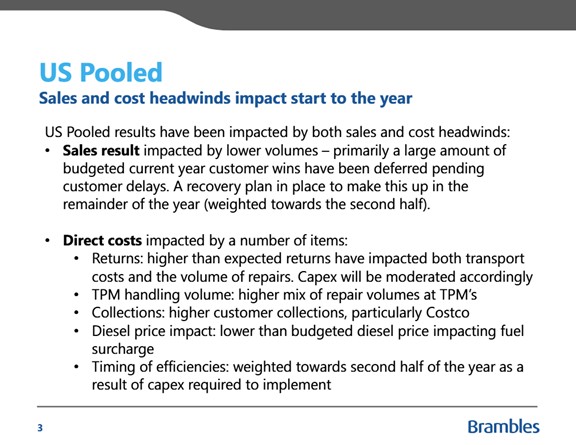
1468 The minutes record that on 19 October 2016 Todorcevski presented the September FY17 sales, Underlying Profit and cash flow results for the Group and each business unit. In relation to that presentation of the September results and the Q1 Trading Update, the minutes record:
Mr Todorcevski presented the September 2016 sales, underlying profit and cash flow from operations results for the Group and each business unit. He reviewed the factors which had impacted on the performance of the US pooled pallet business during September and the steps being taken in response to those factors. He also outlined the sales and underlying profit performance of the Group for the first quarter of FY17 and noted that, notwithstanding the US pooled businesses performance, the Group results were in line with the FY17 sales and underlying profit guidance given to the market on 18 August 2016.
(Emphasis added in bold)
1469 The minutes of the Board meeting on 19 October 2016 also record that Todorcevski tabled a draft Q1 Trading Update to be released to the market on 20 October 2016. They record, and I accept, that the Board approved the draft trading update subject to some minor changes and authorised the company secretary to release it to the market.
1470 The minutes for 20 October 2016 record that Johns reported to the meeting that a revised Q1 Trading Update incorporating the Board’s comments was circulated to himself, Gorman and Todorcevski and had been released to the ASX earlier that day. The Board’s comments did not impact on the statements reaffirming the FY17 Guidance.
12.16.1 The lay evidence regarding the October Board meeting
Todorcevski
1471 Todorcevski deposed that at the Board meeting on 19 October 2016 he provided his “usual monthly overview of the YTD results for the Group, which included growth on a days-adjusted basis of 7% for sales and 8% for ULP”. He deposed that he informed the Board that a US Pooled recovery plan was in place to make up the revenue shortfall, which was weighted towards 2H17. I accept that evidence. I infer that Todorcevski took the Board through the salient parts of the September Financial Update and September Board Report presentations and expressed views in accordance with those presentations.
1472 Todorcevski deposed that, at this point, he remained confident that the FY17 Guidance was achievable for a number of reasons which he listed, including that the Revised September Reforecast that he discussed in the CFO and CEO BPR call on 14 October 2016 projected that CHEP Global would deliver its full-year budget for sales revenue and Underlying Profit. I accept that.
Long
1473 Relevantly, Long confirmed that, at the October Board Meeting, Todorcevski presented the September Financial Update and the September results. He noted that the results for September were (excluding Oil & Gas):
(a) sales of $432 million (which was $11 million behind budget and 6% growth year-on-year); and
(b) Underlying Profit of $61 million (which was $13 million behind budget and 3% growth year-on-year).
He also noted that following the September results, Brambles’ results YTD included 7% sales revenue growth (days-adjusted) and 8% Underlying Profit growth (days-adjusted).
1474 He deposed that he recalled the Board discussing that plant costs and higher repair costs were a driver of the US Pooled results, as well as some acknowledgement that in US Pooled the new wins were not coming through as anticipated. He recalled that there was discussion that an action plan relating to direct costs and sales had been put in place to make up the shortfall in the results for CHEP NA that was weighted towards 2H17.
1475 He further deposed that although he was disappointed with the September results for CHEP NA, he took into account that:
(a) during his time as a director of Brambles, there were occasions when the financial results for at least one business division or business unit within a business division (such as CHEP Europe or CHEP North America) fell below-budget. He also said that it was not unusual for the financial results of a business division or business unit to outperform budget in a given reporting period. He said that one of the strengths of Brambles’ business was its portfolio nature which meant that below-budget results in one part of the business were often offset by better-than-expected results in another part of the business.
(b) during his time as a director of Brambles, although he could not recall specific details, there were occasions when a particular business division or geographic region was tracking below financial projections and then successfully implemented plans to address that underperformance. While he could not recall the detail of the action plan that had been put in place to make up the shortfall in the results for CHEP NA, he recalled that, at the time he thought the plan was a reasonable one.
1476 In light of those matters, he said that the fact that the CHEP NA results were lower than expected was not in and of itself a cause for concern, particularly given there were nine months remaining in the financial year, strong offsetting results across the Group, and an action plan in place to address the shortfall in CHEP NA. Based on his review of the financial results discussed at the October Board Meeting, he said that he considered management’s assertions that Brambles’ results were in line with the FY17 Guidance were reasonable.
1477 Long deposed that in accordance with Brambles’ usual practice, Todorcevski tabled a draft Q1 Trading Update to be released to the market, disclosing the company’s top line results to provide an indication of the sales performance and trajectory of the Group.
Johns
1478 Relevantly, Johns deposed as to what the minutes recorded in relation to Todorcevski’s presentation to the October Board Meeting, rather than stating what he recalled. It became clear in his oral evidence that he had a very poor recollection of what had taken place at the meeting.
1479 He deposed that:
During the time Gorman was CEO of Brambles, the business had a track record of identifying, developing and delivering recovery plans to address any areas of underperformance that may have occurred during the course of a financial year. Todorcevski had explained the factors impacting the September FY17 results and the steps being taken in response to those factors. The drivers of the September results were also set out on slides 2 to 4 of the September Financial Update. I was also aware that Brambles had a diversified portfolio of businesses, in particular by geography but also by operating divisions, such that poorer than expected results in one business division were often offset by better than expected results in another.
For the reasons set out in the previous paragraph I remained confident in the ability of the business to deliver results in line with the FY17 sales and ULP guidance provided to the market on 18 August 2016.
1480 In my view that general evidence was almost entirely a reconstruction from the minutes of the October Board Meeting, and little of it reflected an actual recollection that Johns had of the meeting.
1481 In cross-examination Johns said that he was concerned when he was presented with the September monthly results, which he described as a significant turnaround from the month before and said that “it was the first month when we performed poorly against budget”.
1482 Johns also testified that the minutes regarding Todorcevski’s presentation to the October Board Meeting were inaccurate in recording that he told the Board that, notwithstanding the poor US Pooled results, “the Group results were in line with the FY17 sales and Underlying Profit guidance given to the market on 18 August 2016”. I accept that evidence. That is not because I have faith in Johns’ recollection of the meeting, but because that evidence accords with Todorcevski’s testimony as to what he told the Board and it also accords with the September Financial Update provided to the Board. That document stated that Brambles’ results were:
(a) sales revenue $(8) million below-budget YTD, representing 7% growth from FY16, which was within but at the bottom of the 7-9% guidance range; and
(b) Underlying Profit $(8) million below-budget YTD, representing 8% growth from FY16, which was one pp below the bottom of the 9-11% guidance range.
1483 Johns could not explain why the minutes were inaccurate on the important issue of the FY17 Guidance when they had been reviewed by the Board members, including himself as Chair, and approved by the Board at the following meeting in the usual manner.
1484 On 19 October 2016, a Board member, Scott Perkins emailed Johns, stating that:
Look forward to getting a fuller debrief on the meeting. I sensed great energy in the room around the innovation sessions and I was very impressed with the BXB materials.
…
One specific I would like to discuss is the September result and the basis for the maintenance of guidance. Clearly September US Pallets has been very poor and I am sure the Board considered in detail the underlying issues and the basis for a quick reversal of that trend in order to sustain guidance.
(Emphasis added)
1485 Johns responded in an email on 21 October 2016, and said:
The September trading results were fully reviewed by the Board and particularly the remedial actions which Management will develop to counter any trading downside. The guidance remains relevant and appropriate but, of course, will be reviewed as appropriate during the remainder of the year.
1486 Brambles submitted that the email exchange did not assist the applicants’ case. Rather, it said that that exchange demonstrated that the Board was diligently doing its job. It said that exchange showed that a member of the Board who could not attend the full update followed up on the implications of the September results, and Johns responded that while the Board was satisfied by the remedial actions presented by management, they would continue to monitor the appropriateness of the FY17 Guidance.
1487 To my mind, that submission put a gloss on what is more likely than not to have happened at the October Board Meeting. I doubt that the Board sufficiently considered the underlying issues in US Pooled or gave proper consideration to the basis for the projected quick reversal of the three-month trend of underperformance in that business. But in the finish the Board could only work with what it was told, and I infer that Todorcevski and Gorman were clear in stating that in their view the recovery plans for US Pooled and CHEP NA would be effective and the FY17 Guidance therefore continued to be reasonable or achievable.
1488 That finds a measure of confirmation in an email Kennett sent Rumph on 18 November 2016, in which he reported O’Sullivan’s view that at the October Board Meeting, following the poor September results, the Board had been told that the situation in CHEP NA was “under control”.
12.17 The Impugned Announcement - 20 October 2016
1489 On 20 October 2016, Brambles published to the ASX an announcement in the terms approved by the Board the previous day. The Q1 Trading Update was a two-page document, as follows:
Brambles’ first-quarter trading update: Constant-currency sales revenue growth of 7%; FY17 guidance reaffirmed
Sydney - 20 October 2016: Brambles Limited today reported sales revenue from continuing operations of US$1,420.1 million for the first three months of the financial year ending 30 June 2017, representing a 5% increase on the prior corresponding period.
Constant-currency sales revenue growth of 7% primarily reflected: solid growth with new and existing customers in Pallets Europe, Middle East & Africa; strong conversions with existing customers and the contribution from acquisitions in RPCs; and modest growth in Pallets Americas.
Excluding the contribution from the North American recycled pallet business, growth in Pallets Americas was 6% at constant currency. This reflected strong growth in Latin America and modest growth in the US pooled pallet business reflecting lower customer mix benefits and the deferral of some new business opportunities. The conversion of these opportunities is expected to deliver stronger growth in the second half of the year.
For the financial year ending 30 June 2017, Brambles continues to expect constant-currency sales revenue growth from continuing operations of 7-9% and Underlying Profit of between US$1,055 million to US$1,075 million at 30 June 2016 exchange rates, which reflects growth of 9-11%.
Brambles’ CEO Tom Gorman said: “Our constant-currency sales revenue growth from continuing operations for the first quarter is consistent with our guidance for FY17. Despite a somewhat subdued first-quarter performance in our Pallets segment, we remain confident that phasing of net new business wins, particularly in North America, will drive stronger sales revenue growth in the second half of FY17.”
(Emphasis added.)
1490 The announcement included the following table which reported sales revenue for 1Q17 in various Group business divisions and CHEP CBUs:
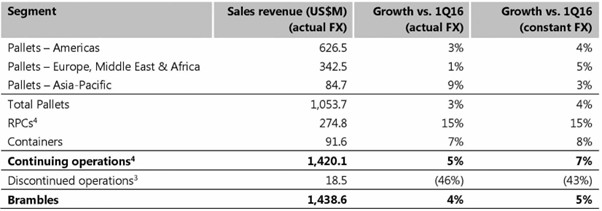
1491 The second page of the Q1 Trading Update set out a disclaimer regarding forward-looking statements. I will set out its terms when considering whether it had the effect for which Brambles contended.
13. MR SAMUEL’S OPINION
13.1 The question
1492 Question 3 of the requested expert opinion from Mr Samuel asked him to opine as to whether the information available to Brambles as at 20 October 2016 provided a reasonable basis to support, relevantly, the August Sales Revenue Forecast, the August Underlying Profit Forecast and the August ROCI Forecast. I should note that Mr Samuel’s report used different descriptions in respect of the various September reforecasts, but for ease of understanding I have used the same descriptions (i.e., Initial September Reforecast, Revised September Reforecast, Preliminary Group September Reforecast).
1493 The applicants relied on Mr Samuel’s analysis and answer to Question 3 to press their submission that, as at 20 October 2016:
(a) the Initial and Revised September Reforecast in relation to US Pooled and CHEP NA failed to account for identified net risks;
(b) the Initial September Reforecast and Revised September Reforecast were overly optimistic in their assumption of a rephased recovery in 2H17; and
(c) ultimately, the Revised September Reforecast did not provide a reasonable basis for the October Representations, which themselves were based on a maintenance of the August Sales Revenue Forecast and the August Underlying Profit Forecast.
1494 I note that Mr Samuel referred to the September Reforecast, without noting it as either the Initial or Revised September Reforecast. In relation to this period, unless the context indicates otherwise, I usually take him to be referring to the Revised September Reforecast as that was the most up-to-date reforecast as at 20 October 2016. Mr Samuel also referred to the Preliminary Group September Reforecast dated 21 October 2016 which was sent to Todorcevski on 24 October 2016, which I infer contained information available to Brambles’ management as at 20 October. Apart from the error in the Preliminary Group September Reforecast to which I earlier referred, it had materially the same figures as the Revised September Reforecast in relation to US Pooled, CHEP NA and CHEP Global.
13.2 Mr Samuel’s approach
1495 To reach his opinion on Question 3, Mr Samuel took a similar approach to the approach he took in Question 2. He proceeded largely by analysing the relevant MBR, PPR and BPR reports to 20 October 2016, including reviewing and comparing the R&O schedules. However, for some calculations, Mr Samuel used the draft US Pooled October MBR dated 15 October 2016 (based on Sydney time) rather than the final US Pooled October MBR dated 19 October 2016. This appears to be a mistake on Mr Samuel’s behalf, and any divergence between the presentations of relevance to his analysis will be noted. The error is not material to my conclusions. In addition to R&O schedules, Mr Samuel considered those results in reaching his opinion as to the existence of reasonable grounds for the relevant forecasts. I now turn to consider the documents Mr Samuel relied upon, his analysis of them, and the extent to which they support the conclusions alleged by the applicants.
13.2.1 The material Mr Samuel relied upon and his analysis
YTD results
1496 Mr Samuel commenced his opinion with an analysis of Brambles’ YTD results to 20 October 2016, in particular the September Financial Update presentation provided to the Board for the October Board Meeting from 18 to 20 October 2016. The September Financial Update included financial results for sales revenue and Underlying Profit in Q1 YTD compared to the budget and to the FY16 results.
1497 First, Mr Samuel set out the Group results for 1Q17. He produced the following table showing Group sales revenue and Group Underlying Profit for Q1, compared to the Group FY17 budget and the Group FY16 results:
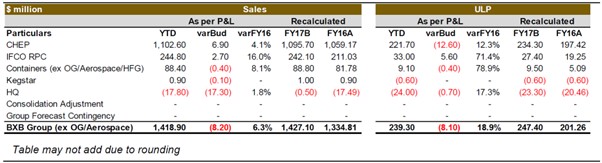
1498 He noted that the September Financial Update showed that for the first quarter of FY17, Group results showed that:
(a) sales revenue was ($8.2) million behind the Group FY17 budget, representing 6.3% growth from FY16;
(b) Underlying Profit was ($8.1) million behind the Group FY17 budget, representing 18.9% growth from FY16. Mr Samuel noted that, despite that significant growth, Underlying Profit was behind the budgeted growth of 23%; and
(c) ROCI was 15.3%, which was (0.6) of a pp behind the Group FY17 budget and 1.5 pps above FY16.
1499 Second, Mr Samuel produced the following table which showed sales revenue and Underlying Profit for 1Q17 for CHEP Global and the CHEP CBUs (including CHEP NA), compared to their respective budgets and their FY16 results:
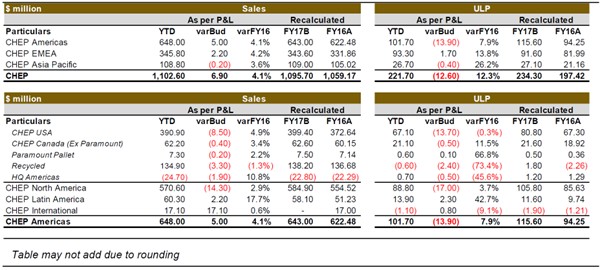
1500 Mr Samuel noted the September Financial Update showed that for 1Q17, CHEP NA was $(14.3) million below-budget in sales revenue and $(17) million below-budget in Underlying Profit. He noted that the September BPR Report stated that the sales revenue shortfall was driven by lower new business win volumes in US Pooled, and lower sales price and sales volume in US Recycled.
1501 Third, Mr Samuel set out the 1Q17 results for US Pooled. For this he relied on a table from the US Pooled September Monthly Close Report dated 12 October 2016, which I have reproduced below.
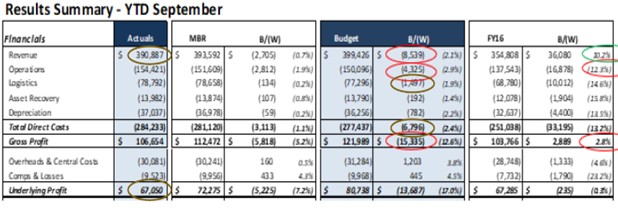
1502 He also relied on a 12 October 2016 presentation titled “Initial USP discussion”, sent by Kennett to Todorcevski and others, which set out what drove the shortfall to budget in sales revenue and Underlying Profit in US Pooled. The presentation showed that in US Pooled:
(a) sales revenue for September was $(2.7) million (or 2.3%) below the Initial September Reforecast and $(5.5) million (or 4.5%) under-budget, and $(8.5) million (or 2.1%) below-budget YTD; and
(b) Underlying Profit for September was $(5.2) million (or (24.8)%) below the Initial September Reforecast and $(9.8) million (or 38.1%) below-budget (7.2% below-budget), and $(13.7) million (or 17.0%) below-budget YTD.
1503 Mr Samuel highlighted that the presentation showed the following:
(a) the miss in sales revenue YTD of $(8.5) million was driven by sales volume ($4.1) million, sales price ($1.2) million and sales mix ($3.2) million;
(b) a decline in the YTD gross profit margin to 27.3% from US Pooled budgeted gross profit margin of 30.5%; and
(c) direct costs overruns YTD to the US Pooled budget of $(6.8) million, most of which was operation costs ($4.3 million) and logistics costs ($1.5 million) with underlying metrics indicating that pallet repair volumes were $1.4 million worse than budget.
Projected results
1504 Mr Samuel then turned to consider the forecasts for US Pooled. He relied on the US Pooled August MBR, and two further US Pooled MBR reports dated 17 September 2016 (US Pooled September MBR) and the draft US Pooled October MBR dated 15 October 2016 (but distributed on 15 October 2016) which set out the latest FY17 forecasts. Mr Samuel produced the following tables in which he summarised the monthly variances to the US Pooled budget for sales revenue and Underlying Profit against both the US Pooled September MBR and the draft US Pooled October MBR forecasts.
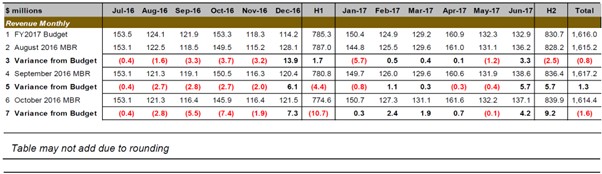
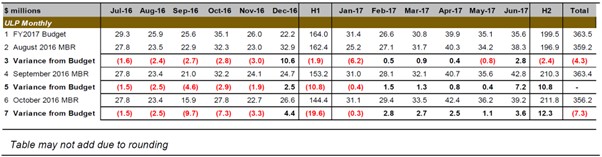
1505 He concluded that the US Pooled September MBR forecast (which took into account actual results up to and including August 2016), projected the following for US Pooled.
(a) sales revenue would be $1.3 million over-budget for the full-year;
(b) an increased Underlying Profit shortfall to budget in 1H17 of $(10.8) million (compared to $(1.9) million in the August MBR); and
(c) Underlying Profit would be in line with budget (compared to a shortfall to budget of $(4.3) million in the August MBR).
He opined that in projecting that US Pooled full-year Underlying Profit would be in line with budget, the September MBR excluded net risks which Mr Samuel quantified on a probability-adjusted basis at $(10.4) million.
1506 Similarly, Mr Samuel noted that the US Pooled draft October MBR forecast (which took into account actual results up to and including September 2016) projected the following for US Pooled:
(a) sales revenue would be $(1.6) million below-budget for the full-year;
(b) an increased Underlying Profit shortfall to budget in 1H17 of $(19.6) million (compared to $(10.8) million in the September MBR); and
(c) Underlying Profit would be $(7.3) million below-budget (compared to in line with budget in the September MBR).
1507 Mr Samuel produced the following charts which summarised the monthly cumulative variance to the US Pooled budget for sales revenue and Underlying Profit, as reported in the August, September and draft October MBR reports. The first chart, reproduced below, shows the monthly cumulative variance in sales revenue to budget:
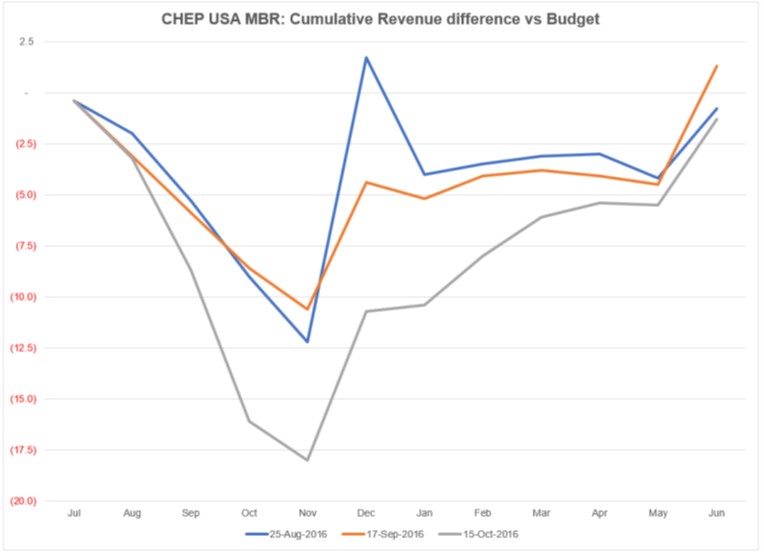
1508 The second chart, reproduced below, shows the monthly cumulative variance in Underlying Profit to budget:
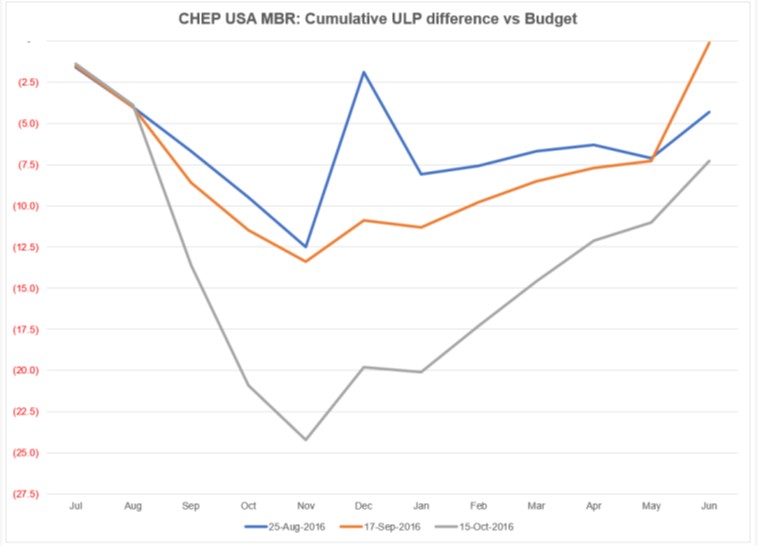
1509 Mr Samuel concluded that the MBR reports reflected an increased adverse variation from the US Pooled budget as the actual results of each month in Q1 came in, but assumed that US Pooled would recover that shortfall from December FY17 and in 2H17 and almost entirely close the gap to budget over the rest of FY17.
1510 Mr Samuel then turned to consider the forecasts for CHEP Global. For this, Mr Samuel relied on the CHEP Global September CFO BPR emailed by Scaiff to Todorcevski, Kennett, O’Sullivan and others on 14 October 2016. He noted that this presentation showed that CHEP Global sales revenue and Underlying Profit YTD were $(10) million and $(13) million behind budget respectively. At the time, CHEP Global forecast:
(a) 1H17 sales revenue $(17) million below-budget, and 2H17 sales revenue $(10) million below-budget, resulting in forecast sales revenue for the whole year of $4,448 million, being $(27) million below-budget; and
(b) 1H17 Underlying Profit $(15) million below-budget which would be caught up by Underlying Profit $16 million over-budget in 2H17, resulting in forecast Underlying Profit for the whole year of $998 million, being $1 million over-budget. Mr Samuel rounded the BPR figures, and on my calculations the resulting forecast would have been $0.6 million over-budget. This does not affect Mr Samuel’s point.
1511 Mr Samuel noted that the CHEP Global FY17 forecast for full-year sales revenue of $4,448 million and Underlying Profit of $998 million were recorded in the Revised September Reforecast that was finalised between 24 October and 15 November 2016. He relied on a slide from the CHEP Global September BPR titled “Forecast ULP H1/H2” which set out the rephased performance for the CHEP Global CBUs (including CHEP NA) in 1H17 and 2H17. That slide stated that CHEP Global forecast sales revenue improvement in 2H17 was to be “driven by new business wins”, with little change in the forecast in relation to price or organic growth in the remainder of the year.
1512 Mr Samuel highlighted that the rephased sales revenue growth forecast in the CHEP Global September CFO BPR projected that:
(a) US Pooled would achieve growth in net new wins of 3.3% in 1H17, increasing to 5.5% in 2H17, to reach an average of 4.4% growth in net new wins for the full-year; and
(b) CHEP NA would achieve growth in net new wins of 2.1% in 1H17, increasing to 6.9% in 2H17, to reach an average of 4.6% growth in net new wins for the full-year.
1513 Mr Samuel concluded that the forecast 2H17 sales revenue performance relied on an increase in net new wins across CHEP NA, which the CHEP Global September BPR had noted as being “at risk”. Mr Samuel also concluded that in order to achieve the Revised September Reforecast, Brambles required an improvement in sales revenue and gross profit margin for 2H17 which was “optimistic relative to the YTD performance”.
1514 Finally, Mr Samuel turned to consider the Group forecast at this time. He relied on the Group September CFO BPR which, as earlier explained, consisted of an aggregation of reports across the CHEP CBUs, with each reporting on its YTD performance, and in some instances on risks and opportunities. Mr Samuel noted that the Group September CFO BPR was not finalised until 21 October 2016 but an earlier draft, which was substantially the same, was circulated to Gorman, Callaway, Todorcevski, O’Sullivan and others on 14 October 2016. He assumed that the information contained in the Group September CFO BPR was known to Brambles’ management before 20 October 2016. That was a reasonable assumption.
1515 As previously noted, the “Key Takeaways” in the Group September CFO BPR included that Underlying Profit in CHEP NA YTD was “much lower than expectation”. It noted that CHEP NA was $(12) million adverse to budget in Underlying Profit which was primarily driven by US Pooled being $(10) million adverse to budget due to a $(5) million “sales flow through effect”, $(3) million in plant costs, and $(1) million in higher IPEP expenses. It also noted, however, that that underperformance in CHEP NA was being partially offset by LATAM and Europe.
1516 Mr Samuel concluded that US Pooled had continued to report a material shortfall to its FY17 budget that was centrally attributed to lower sales and higher direct costs.
The R&O schedules
1517 As with his answers to Questions 1 and 2, Mr Samuel then turned to consider the changes in the relevant R&O schedules over time, and whether they adequately took account of known or identified risks.
1518 First, he relied on an R&O schedule in the draft US Pooled October MBR dated 15 October 2016 from which he prepared the following table:
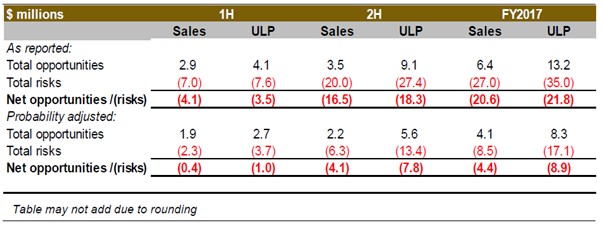
While Mr Samuel used the draft US Pooled October MBR dated 15 October 2016, there were no updates to the R&O schedule in the final US Pooled October MBR dated 19 October 2016.
1519 Mr Samuel concluded, and I accept, that the draft US Pooled October MBR identified net risks to sales revenue and Underlying Profit for US Pooled of $(20.6) million and $(21.8) million respectively. He calculated a net probability-adjusted risk of $(4.4) million to sales revenue and of $(8.9) million to Underlying Profit. He said that he was unable to identify documents which substantiate the nature or validity of each item included in this schedule and whether the issues identified were supported by robust assessment. He noted that the risks included:
(a) a risk of not achieving sales volumes and net new wins which could have a negative impact in FY17 of $(20) million in sales revenue and $(4.3) million in Underlying Profit; and
(b) a damage rate risk which was projected to have a negative impact of $(12) million on Underlying Profit. It was ascribed a 50% probability notwithstanding that at this point Alonso assessed that there was a 75% probability that the two pp reduction in damage rate would not be achieved.
1520 Second, Mr Samuel relied on the CHEP NA September PPR dated 11 October 2016, which was emailed that day to Mackie, Kennett, Alonso, Moreno and Scaiff. It included an R&O schedule titled “FY17 Risks and Opportunities (September Forecast)”. Mr Samuel summarised that R&O schedule in a table reproduced below:
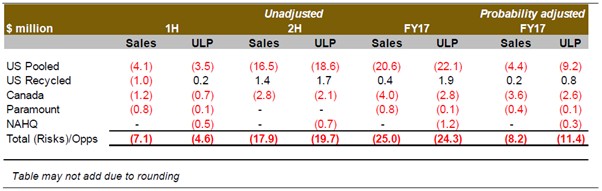
1521 Mr Samuel concluded, and I accept, that the US Pooled risks and opportunities recorded in this R&O schedule were broadly consistent with those recorded in the US Pooled October MBR. He noted that the CHEP NA September PPR identified a net risk to CHEP NA that could have a potential adverse impact on CHEP NA FY17 sales revenue of $(25) million and Underlying Profit of $(24.3) million. Mr Samuel assessed that the probability-adjusted net risk to CHEP NA FY17 sales revenue was $(8.2) million and to Underlying Profit was $(11.4) million.
1522 He noted that the risks and opportunities for US Pooled included:
(a) a damage rate risk that the forecast two pp drop in the US Pooled damage rate would not be achieved, which was quantified at $(12) million. Mr Samuel noted that the impact of this risk was phased so that it had a $(2.5) million impact in 1H17 and a $(9.5) million impact in 2H17; and
(b) a sales volume risk that the forecast sales volumes in US Pooled would not be achieved, with an estimated impact on sales revenue of $(20) million, and an impact on Underlying Profit of $(4.3) million.
1523 Third, Mr Samuel went to the R&O schedule included in the Group September CFO BPR dated 14 October 2016 for CHEP Global. Mr Samuel produced the following table of CHEP Global’s risks and opportunities from that R&O schedule:
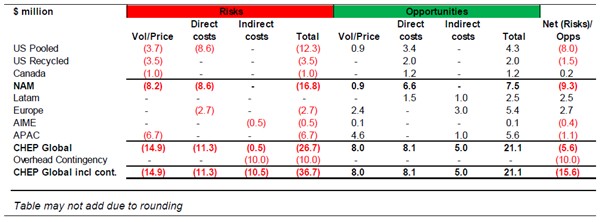
1524 Mr Samuel concluded, and I accept, that this schedule showed net unadjusted risks for CHEP Global of $(15.6) million. It is unclear why the schedule described the $10 million contingency as a risk.
1525 Mr Samuel then noted that Mackie referred to the 3 October Risks / Opps Spreadsheet. This spreadsheet rolled-up the bottom-up CBU R&O schedules and set out risks and opportunities items that were not included in the Revised September Reforecast and which were split between 1H17 and 2H17. The spreadsheet ascribed probabilities to each risk or opportunity materialising, and quantified their potential impact in terms of sales revenue, Underlying Profit, cash flow and capex. In relation to this document, Mackie stated:
On a risk adjusted ULP basis, the schedule identified risks of $40 million and opportunities of $22 million, netting to $18 million of risk across CHEP Global.
As previously noted, this spreadsheet runs counter to Brambles’ contention that it was erroneous for Mr Samuel to net off probability-adjusted risks and opportunities against each other.
1526 Mr Samuel produced the following table from the 3 October Risks / Opps Spreadsheet.
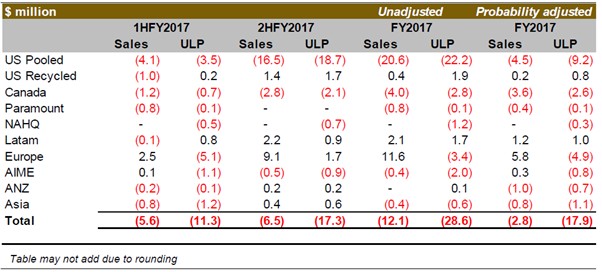
1527 Mr Samuel observed:
(a) the unadjusted risks and opportunities for CHEP NA totalled net risks of $(25) million for sales revenue and $(24.4) million for Underlying Profit in FY17; and
(b) the risk of a significant sales revenue shortfall in US Pooled was partially offset by projected positive revenue variances in CHEP Europe and CHEP LATAM.
I accept that.
1528 He concluded, and I accept, that, based on this R&O assessment conducted on a bottom-up basis by each CHEP CBU, CHEP Global had identified unadjusted potential risks that the following shortfalls to the Revised September Reforecast would occur:
(a) $(12.1) million in reduced sales revenue and $(28.6) million in reduced Underlying Profit; and
(b) $(2.8) million in reduced sales revenue and $(17.9) million in reduced Underlying Profit, after adjusting for the risk probabilities.
1529 He also said, and I accept, that the 3 October Risks / Opps Spreadsheet is the most reliable estimate of Brambles’ view of the risks and opportunities facing CHEP Global at that time. He noted that the risks and opportunities for CHEP NA that are identified are consistent with the subsequent CHEP NA September PPR, and that Mackie relied upon the 3 October Risks / Opps Spreadsheet in his evidence.
1530 Mr Samuel then turned to set out tables from the 3 October Risks / Opps Spreadsheet which summarised the material risks and opportunities, two of which are reproduced below.
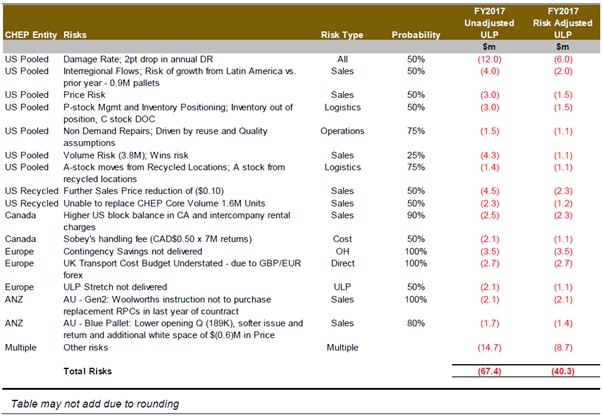
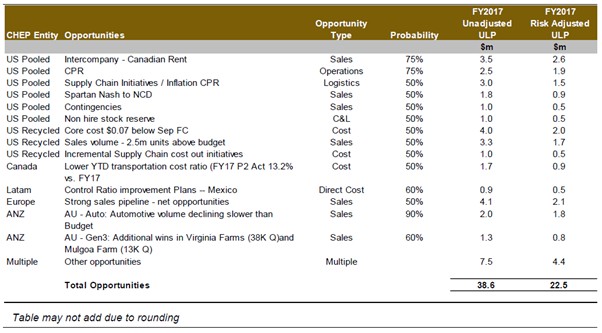
1531 Mr Samuel noted the nature of the items listed in the 3 October Risks / Opps Spreadsheet was not always evident due to the shorthand descriptions that were used, and that several of the risks and one of the opportunities had a probability higher than 75%. He was unable to explain why risks and opportunities with a 100% probability of occurring were omitted from the CHEP Global budget and subsequent reforecasts. He calculated that the risks and opportunities with a greater-than-75% chance of occurring would have reduced forecast Underlying Profit by $(10.5) million.
1532 He also noted that the damage rate risk in US Pooled had the single largest potential impact on CHEP Global Underlying Profit. It was listed at a 50% probability, which carried an unadjusted value of $(12) million, notwithstanding that at this point Alonso had assessed that as at 4 October 2016 there was a 75% probability that US Pooled would not achieve the forecast damage rate reduction.
The September Reforecast Process
1533 Mr Samuel then turned to consider the September Reforecast process which CHEP Global undertook between 23 September and 13 October 2016. He considered the preparation of the reforecast at the US Pooled, CHEP NA, and CHEP Global level. This analysis related to what I have previously referred to as the Initial and Revised September Reforecasts.
1534 First, Mr Samuel relied upon a US Pooled presentation titled “FY17 Sept Fcst RO Bridge” (September Reforecast Risks / Opportunities Bridge), emailed by Bachtell to Martin on 14 October 2016. He reproduced the following chart from that presentation:
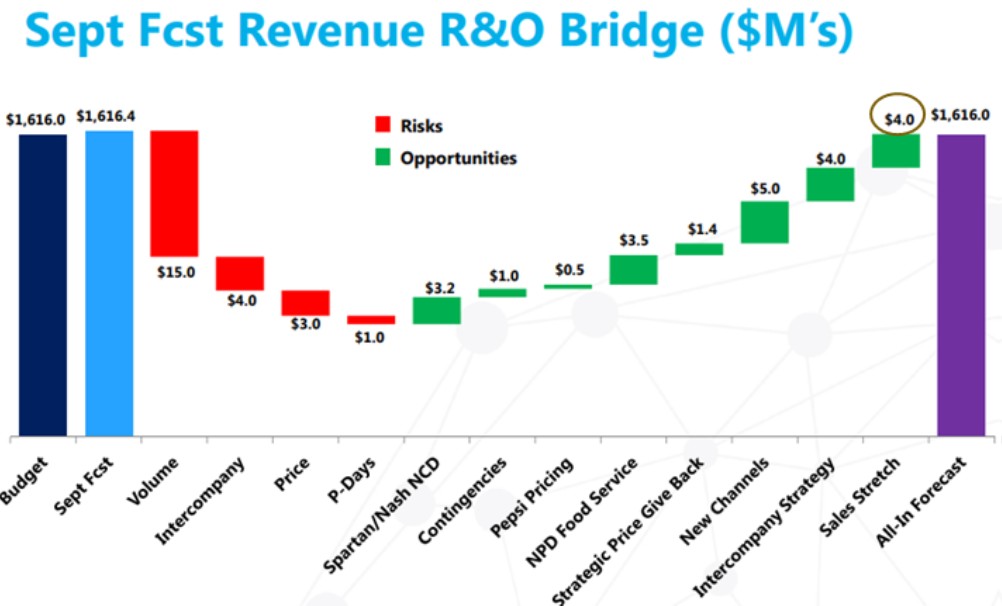
1535 Mr Samuel concluded that the chart indicated that Brambles considered sales volume to be the largest risk, however there were various opportunities that were forecast to offset the total risk, including sales volume. He could not identify the specifics of the opportunities, though he did note a “sales stretch” of $4 million for which he was unable to identify any specific initiatives or support.
1536 Second, Mr Samuel relied upon slides from a US Pooled presentation titled “CHEP Pallets US Pooled FY17 September Forecast Review Final” dated 20 September 2016, which showed the risks and opportunities to Underlying Profit from the US Pooled September MBR which were included in the September Reforecast (as I infer the Initial September Reforecast), and those that were excluded from that reforecast. The slide setting out the “ULP Opportunity & Risk included in September Forecast” recorded that the risks and opportunities balanced out at $25.8 million apiece, and thus no change to Underlying Profit against the US Pooled full-year forecast.
1537 Mr Samuel then turned to summarise the changes to the phasing between 1H17 and 2H17 of sales revenue and Underlying Profit in US Pooled. He relied on a spreadsheet titled “Growth Phasing” (Growth Phasing Spreadsheet) prepared by Kennett and emailed to Mackie on 13 October 2016, from which he prepared the following table.
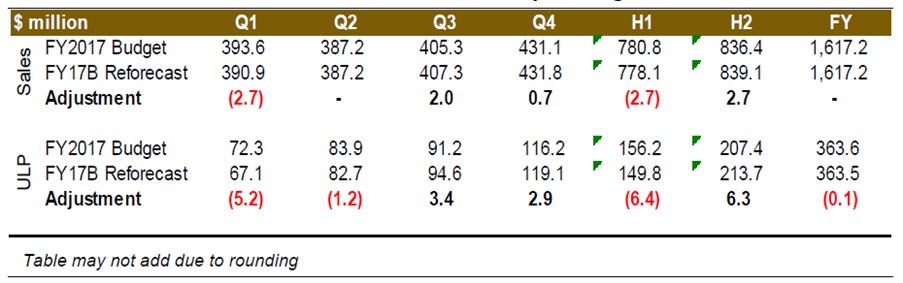
1538 Mr Samuel noted Kennett’s evidence that he “thought the re-phasing of $6.5m in forecast ULP from H1 to H2 [in US Pooled] accurately reflected the sales profile …while accounting for the risks and opportunities”. Mr Samuel disagreed with Kennett’s assessment. He again noted that the US Pooled September MBR identified net risks to sales revenue and Underlying Profit for US Pooled of $(20.6) million and $(21.8) million respectively, and that he had calculated net risks in US Pooled of $(4.4) million to sales revenue and $(8.9) million to Underlying Profit on a probability-adjusted basis.
1539 Mr Samuel concluded that Brambles there recognised that the adjustments it had made to phasing of the US Pooled budget required a “strong performance” in 2H17 if it was to achieve the Group FY17 budget. He noted Mackie’s evidence that the September Reforecast was based on an expectation of volume growth in US Pooled towards the end of 1H17 and early in 2H17.
1540 Third, Mr Samuel referred to the CHEP NA September Forecast Review Presentation dated 4 October 2016, which included comments on the September Reforecast (I infer the Initial September Reforecast) for each CHEP NA business unit, and to an R&O schedule which identified risks that were either included or excluded from the Initial September Reforecast. He noted that the only adjustments that were marked as included in the Initial September Reforecast were limited to US Pooled, and there were no adjustments to US Recycled, CHEP Canada or Paramount. He took that to mean that the other CHEP NA business units had determined that no adjustments to their budgets were necessary as part of the September Reforecasting process.
1541 From that, Mr Samuel prepared the following table which summarised the risks and opportunities which were excluded from the Initial September Reforecast for CHEP NA’s business units:
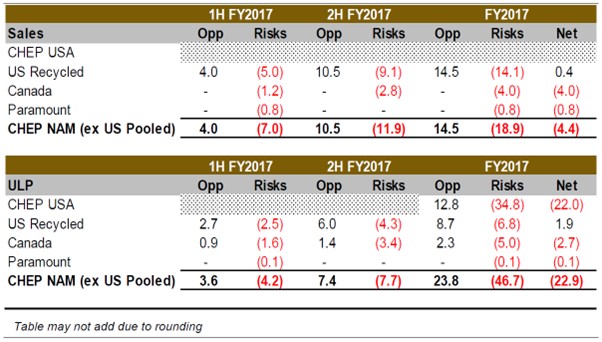
1542 He noted that the CHEP NA September Forecast Review Presentation did not include any sales revenue risks or opportunities for US Pooled, nor did it include any Underlying Profit risks or opportunities for US Pooled in 1H17 or 2H17. He said that the total sales revenue and Underlying Profit risks for all CHEP CBUs were broadly consistent with those that had been identified in the CHEP NA September PPR, and were included in the roll-up or consolidation in the CHEP Global R&O schedule to which he then turned.
1543 Fourth, Mr Samuel referred to a summary of the CHEP Global roll-up of the CHEP CBUs’ September Reforecast submissions, which was emailed by Scaiff to Kennett on 5 October 2016. Kennett deposed that the summary included proposed adjustments to account for pessimism in the forecasts for CHEP LATAM and CHEP Europe. An embedded table supporting the proposed adjustments is reproduced below:
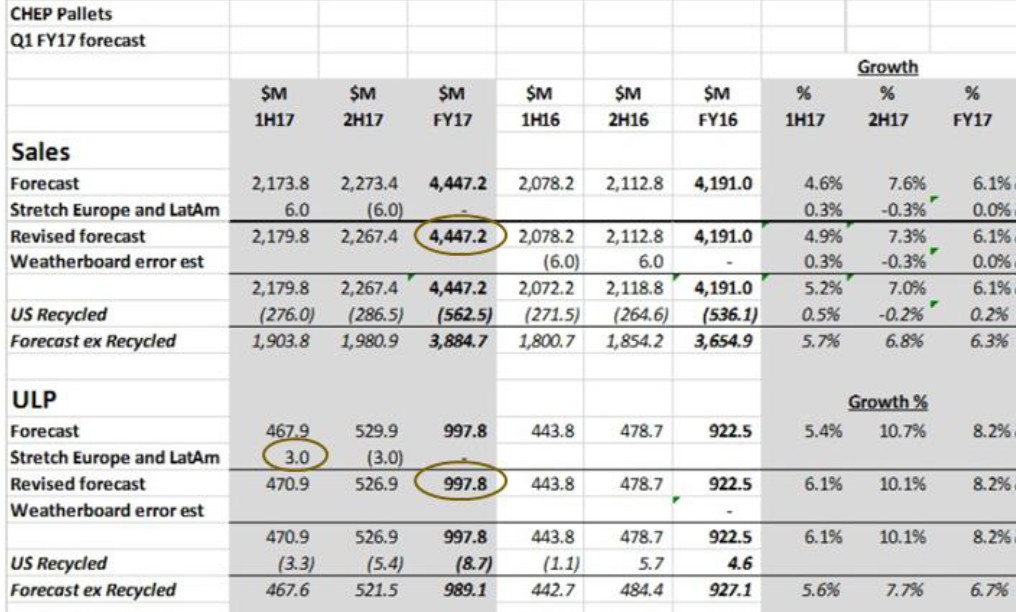
1544 The table showed that the September Reforecast for CHEP Global included $6 million in sales revenue stretch in CHEP LATAM and CHEP Europe in 1H17, which was then to be immediately reversed out in 2H17. That resulted in $3 million in Underlying Profit being added to CHEP LATAM and CHEP Europe in 1H17, but then immediately reversed out in 2H17. As earlier noted, in an email to Alonso on the same day, Kennett said that he and Scaiff proposed those book entries to achieve better “optics” when comparing 1H17 and 2H17 to the corresponding periods in FY16. Kennett said: “[W]e should try to squeeze $3 million additional into H1 for LATAM and Europe… but reverse this in H2, so they still come back to their forecast… Small numbers but makes a difference”.
1545 Mr Samuel opined that sales revenue of $4,447.2 million and Underlying Profit of $997.8 million included in the Revised September Reforecast continued to include “an element of stretch that was more consistent with a ‘target’ rather than a best estimate of the likely outcome(s)”. He noted that no changes were proposed for Underlying Profit in LATAM and Europe notwithstanding that the R&O schedule identified risks for CHEP Europe with a potential Underlying Profit impact of $(6.2) million with a 100% probability attached those risks.
Preliminary Group September Reforecast
1546 Mr Samuel then noted that, while the CHEP CBUs had completed work on the Initial September Reforecast by around 4 October 2016, which was then further rephased in the Revised September Reforecast finalised by 12 October 2016, the roll-up of the reforecast submissions for the Group’s business divisions was still preliminary as at 20 October 2016. He noted that an email from Ford to Todorcevski on 24 October 2016 attached the Preliminary Group September Reforecast dated 21 October 2016. It forecast $1,054 million in Underlying Profit for the full year, of which $494.3 million was to be realised in 1H17, and $559.7 million was to be realised in 2H17. It also forecast $5,745 million in sales revenue, of which $2,810.6 million was to be realised in 1H17, and $2,934.4 million was to be realised in 2H17.
1547 Mr Samuel produced a table setting out the historical position since FY13 regarding the phasing of Group and CHEP Global sales revenue and Underlying Profit between 1H and 2H, as reproduced below. He noted that the total yearly figures should be viewed with caution because of the different exchange rates, but said that the relativities between 1H and 2H were comparable from year-to-year.
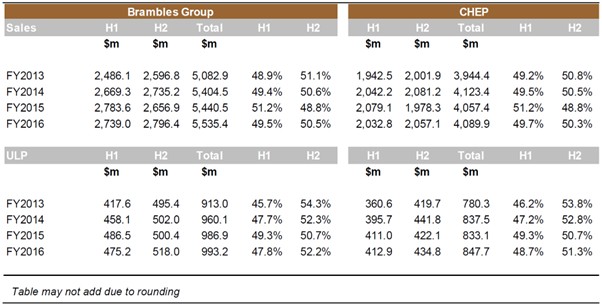
1548 Based on the table Mr Samuel concluded as follows in relation to the period FY13 to FY16:
(a) with the exception of FY15, the sales revenue phasing between 1H and 2H was relatively consistent between FY13 and FY16, with 2H being no more than 2.2 pps higher than 1H for the Group and no more than 1.6 pps higher than 1H for CHEP Global;
(b) in FY15, sales revenue in 1H was 2.4 pps greater than in 2H in both CHEP Global and the Group. That was an unusual outcome compared with the other years; and
(c) Underlying Profit in 2H was always greater than 1H in CHEP Global and the Group, with 2H being 8.6 pps greater than 1H in FY13, but only 0.6 pps higher in FY15.
1549 Mr Samuel compared the phasing in the Group FY17 budget with the reforecasts that were undertaken for CHEP Global and the Group in September 2016 (and December 2016). He set that out in the table reproduced below:
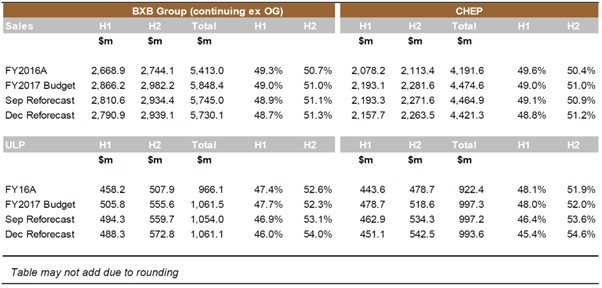
1550 Mr Samuel concluded that the weighting:
(a) for CHEP Global sales revenue in 2H increased from 50.4% in FY16 to 51% in the CHEP Global FY17 budget, and reduced slightly to 50.9% in the September Reforecast;
(b) for Group sales revenue in 2H increased from 50.7% in FY16 to 51% in the Group FY17 budget, and then to 51.1% in the September Reforecast;
(c) for CHEP Global Underlying Profit in 2H increased from 51.9% in FY16 to 52% in the CHEP Global FY17 budget, and increased again to 53.6% in the September Reforecast; and
(d) for Group Underlying Profit in 2H decreased from 52.6% in FY16 to 52.3% in the Group FY17 budget, and then increased to 53.1% in the September Reforecast.
He opined that the financial consequences of the phasing between 1H17 and 2H17 are significant as a 1% change in the total Underlying Profit budget equated to $10.6 million.
1551 Mr Samuel identified that the Preliminary Group September Reforecast assumed that the phasing between 1H17 and 2H17 would be as follows:
(a) sales revenue: 48.9% in 1H17 and 51.1% in 2H17; and
(b) Underlying Profit: 46.9% in 1H17 and 53.1% in 2H17.
1552 Mr Samuel said that the weighting for Group sales revenue and Underlying Profit in 2H17 was higher than had been achieved in any year between FY14 and FY16 inclusive, and was higher than the weighting of sales revenue but lower than the weighting of Underlying Profit relative to FY13.
1553 Mr Samuel then applied the weightings between 1H and 2H in FY16 to the September Reforecast and produced the following table:
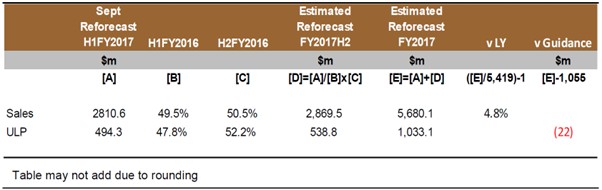
1554 He concluded that if Group FY16 weightings between 1H and 2H, were applied to the FY17 Group results:
(a) the forecast growth in Group sales revenue in 2H17 would be 4.8%, which is a growth rate below the bottom of the FY17 Guidance range; and
(b) the forecast growth in Group Underlying Profit in 2H17 would be $(22) million less than budgeted, which would represent Group Underlying Profit below the bottom of the FY17 Guidance range.
October Board Meeting
1555 Mr Samuel then turned to consider the materials before the Board at the October Board Meeting held between 18 and 20 October. He noted the following extract from the September Board Report.
US Pooled sales volumes were lower than expectation, primarily due to deferral of budgeted current year customer wins (pending customer delays). A recovery plan in place to make this up in the remainder of the year.
1556 He relied on a slide from the September Financial Update which gave additional detail regarding sales revenue performance in 1Q17, as reproduced below, which was included in the September trading update provided to the Board:
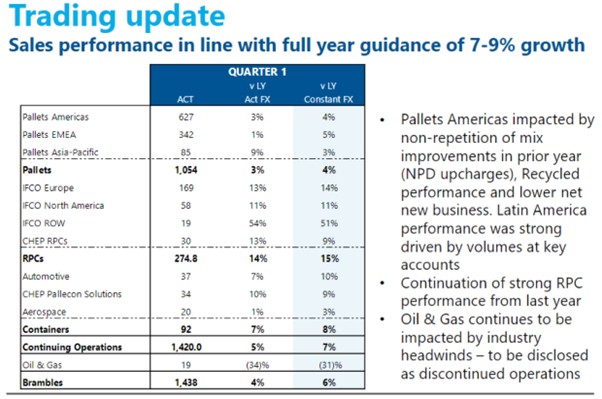
1557 Mr Samuel then referred to the Q1 Trading Update Talking Points document prepared by Chiriacescu for Gorman, Todorcevski, Mackie, O’Sullivan and Rumph in advance of the Board Meeting on 18 October 2016. Based on that document, Mr Samuel concluded that Brambles’ explanations for the Group sales revenue underperformance in 1Q17 included:
(a) 1Q17 growth for CHEP Americas was 4.3%, compared to 6.8% in the corresponding period in 1Q16, and 7.9% in FY16;
(b) negative growth in US Recycled of 3.8%, driven by weak pricing and lower organic growth;
(c) weak US Pooled results in September were due to lower-than-expected net new wins; and
(d) recent years’ results had a small skew in both sales and margins to 2H.
1558 Mr Samuel concluded that the September Board Report continued to report sales revenue and Underlying Profit as forecast by the full-year Group budget, and did not refer to the risks and opportunities that had been identified but excluded from the September Reforecast.
13.2.2 Brambles’ submissions regarding Mr Samuel’s evidence
1559 Brambles noted that, through Mr Samuel’s evidence, the applicants adopted a similar risk and opportunity analysis with respect to the September Reforecast as they did in respect of the existence of reasonable grounds for the Group FY17 budget as at 18 August 2016 under Question 2. It said that the same criticisms that it had made of Mr Samuel’s approach in relation to Questions 1 and 2 also applied to his approach of incorporating the identified net risks into the September Reforecast. I have considered and dealt with those criticisms, and I need not reiterate my views on those matters.
1560 Brambles also made the following additional criticisms.
1561 First, Brambles accepted that the R&O schedule undertaken for CHEP Global had identified net risks and opportunities to the September Reforecast of $(2.8) million for sales revenue and $(17.9) million for Underlying Profit after adjusting for the risk probabilities. It said that:
(a) a $(2.8) million adjustment in sales revenue would have resulted in FY17 sales revenue continuing to meet the FY17 Guidance on sales revenue; and
(b) a $(17.9) million adjustment in Underlying Profit would have resulted in FY17 Underlying Profit failing to meet the FY17 Guidance in relation to Underlying Profit growth.
1562 Second, Brambles submitted that Mr Samuel’s analysis was premised on a review of the US Pooled October MBR, the CHEP NA September PPR and the CHEP Global October CFO BPR. It contended that those reports should not be read in isolation to assess risks and opportunities, as each of them was “contextualised and discussed” in subsequent meetings, and formed only part of Brambles’ approach to analysing risks and opportunities.
1563 It said that the evidence shows that Brambles adequately took account of risks in the September Reforecast process, including by conducting risk and opportunity assessments at all levels of the business. It argued that the information Todorcevski received in relation to risks and opportunities was built on information circulated at lower management levels, and which had filtered up including:
(a) Alonso’s deep dive into direct cost risks and opportunities, drafted in concert with Young at Gorman’s request. Brambles relied on Alonso’s characterisation of this analysis as “conservative and pessimistic”;
(b) R&O schedules submitted by each CBU in late September and provided to Kennett, Mackie and Alonso, among others;
(c) a risk and opportunity analysis prepared by Scaiff and Limpanatevin, reviewed by Kennett and sent to Mackie and Alonso on 3 October 2016;
(d) discussions between Kennett, Mackie and Alonso in early October 2016 regarding risks and opportunities for CHEP North America that had not been included in the forecast; and
(e) the “speed date” meeting with the CHEP NA team on 4 October 2016 and the supporting slide deck, which included a summary of risks and opportunities in CHEP NA.
1564 I accept that the MBRs, PPRs and BPRs should not be read in isolation, and that those reports were the output from discussions of risks and opportunities at line management levels (e.g., CHEP NA), which were discussed again with mid-level management (e.g., CHEP Global) and fed up to Todorcevski. But based on Mr Samuel’s report and his evidence, I am not persuaded that he failed to consider the reports in their context, nor that he did not understand that the risks and opportunities were reviewed and discussed in subsequent meetings, or that he did not understand that the risks and opportunities could evolve over time. It is sufficiently clear from his evidence that he understood that the R&O schedules represented the assessment of risks and opportunities for particular businesses in particular periods of time, which were regularly reviewed, and that he understood that they could evolve over time and were not static.
1565 In any event, this criticism does not go far in addressing Mr Samuel’s central concern that various net risks were identified and quantified in Brambles’ MBR, PPR and BPRs and, without explanation, were not included in the September Reforecast nor taken into account in deciding to maintain the full-year Group FY17 budget forecast for Underlying Profit.
1566 Nor did Brambles adduce evidence to show how the alleged error by Mr Samuel in reading the MBR, PPR and BPRs in isolation would have made any difference to his conclusion. For example, Brambles did not put on evidence to show that there were any records of particular meetings that contextualised the relevant reports in such a way as to indicate Mr Samuel had materially misinterpreted them. Brambles was the only party in a position to put on specific evidence to show why risk items identified and quantified in earlier R&O schedules were not included in the September Reforecast nor taken into account in deciding to maintain the full-year Group FY17 budget forecast for Underlying Profit, and it did not do so. Its contention must be weighed in that context: Blatch v Archer at 970 (Lord Mansfield).
1567 Third, Brambles submitted that Mr Samuel did not consider any of the opportunities outlined in recovery plans or taken into account when he calculated the net risk. It said that despite opportunities being separately identified in the WTM files, they were not considered at all by Mr Samuel, which was important because:
(a) the more opportunities identified, the lower the net risk; and
(b) where the correct question was to determine whether Brambles had reasonable grounds to believe that it would achieve the FY17 Guidance by the end of FY17, an assessment of the recovery plans and Walk to MOP process was critical.
1568 I accept that Mr Samuel did not have regard to the Walk to MOP files, and there is little to indicate that he considered the detail of the US Pooled recovery plans. Rumph’s 14 October Response, however, described the Walk to MOP process as involving the US Pooled team “reviewing our pipeline to aggressively advance deals, take additional price where possible, reduce pallet purchases with demand curve and inventory levels, improve network optimization, and reduce cost levels”. The evidence shows that the Walk to MOP process was centrally concerned with improving sales volume and revenue; it was not centrally aimed at the types of risks and opportunities with which Mr Samuel was concerned.
1569 And Brambles’ contentions were overstated.
(a) First, it is appropriate to infer that Mr Samuel was aware that US Pooled and CHEP NA had recovery plans on foot, and was aware that they included the Walk to MOP process. The affidavits of Brambles’ executives repeatedly referred to the recovery plans and to the Walk to MOP process, and Mr Samuel had a good grasp of the materials with which he was briefed.
(b) Second, the MBR, PPR and BPR meetings occurred at least monthly and the R&O schedules for the MBRs, PPRs and BPRs were updated for the meetings. I infer that those reports captured all or most of the material opportunities. Where a material new opportunity was identified in the Walk to MOP process, or where it was assessed that an existing opportunity had improved prospects of coming to fruition, I infer that that was speedily reported up the line and captured in the relevant MBRs, PPRs and BPRs. Of the four opportunities that Brambles’ submissions noted three of them were identified in 3 October Risks / Opps Spreadsheet, to which Mr Samuel referred. I infer that he did not miss those opportunities.
(c) Third, while I accept that an assessment of Brambles’ recovery plans could be important to deciding whether there were reasonable grounds for Brambles to reaffirm or maintain that it expected to achieve the sales revenue and Underlying Profit forecasts in the FY17 Guidance by the end of FY17, Mr Samuel’s analysis was at a higher level of generality. Mr Samuel’s conclusion was that it was overly optimistic for Brambles to forecast the 2H17 ‘hockey-stick’ recovery that it did, whatever its recovery plans were.
1570 Fourth, Brambles submitted that Mr Samuel erred in using the full damage rate risk of $(12) million from the October MBR to adjust his forecast on the basis that he “could not identify documents supporting the nature or validity of not adjusting the forecast by that $(12) million risk”. It argued that:
(a) that figure should be adjusted for probability, and the damage rate risk had been ascribed a 50% probability. Brambles submitted that, on Mr Samuel’s own methodology, the risk-adjusted figure should have been $(6) million; and
(b) Mr Samuel did not account for the reduction in damage rate “between July and September FY17 at which point the damage rate was back on budget”. He agreed that he would have accounted for, and assumed steeper than budgeted decline in the damage rate if he had been presented with objective evidence as to why the full damage rate risk should not be incorporated into the Revised September Reforecast.
1571 As Mr Samuel accepted in cross-examination, there is merit in this criticism. In my view, it was not appropriate for Mr Samuel to include the full damage rate risk in opining as to whether, as at 20 October 2016, Brambles had reasonable grounds for making the October Underlying Profit Forecast.
13.2.3 Q1 Trading Update
1572 As I set out earlier, the Q1 Trading Update was published to the ASX on 20 October 2016. Mr Samuel noted that the following section of the Q1 Trading Update reaffirmed the FY17 Guidance.
Brambles’ CEO Tom Gorman said: “Our constant-currency sales revenue growth from continuing operations for the first quarter is consistent with our guidance for FY17. Despite a somewhat subdued first-quarter performance in our Pallets segment, we remain confident that phasing of net new business wins, particularly in North America, will drive stronger sales revenue growth in the second half of FY17.”
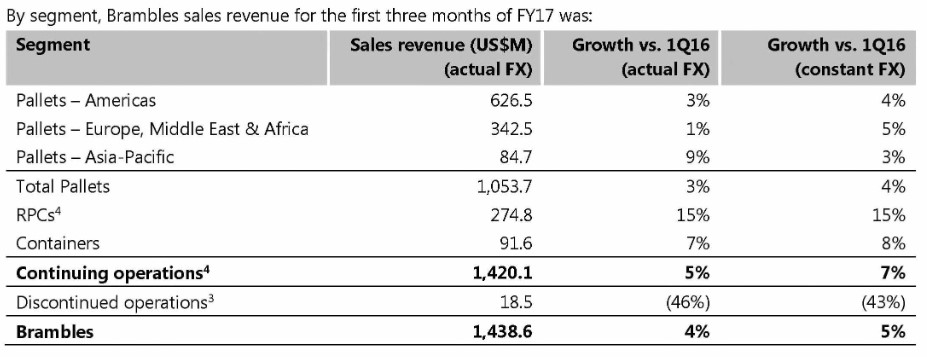
1573 He identified two discrepancies between the YTD figures in the table above and the Q1 Trading Update presented above:
(a) sales revenue from continuing operations disclosed to the market was $1,420.1 million, whereas the amount shown in the table above was $1,418 million.
(b) sales revenue recorded for “Total Pallets” of $1,053.7 million compared to the sales revenue for CHEP Global $1,102.6 million in the September Financial Update, a difference of $48.9 million.
Mr Samuel was unable to explain these discrepancies, and neither party made submissions in relation to them. I need not attempt to resolve the discrepancies as they are not material to my conclusions regarding Mr Samuel’s opinions on Question 3.
13.2.4 Mr Samuel’s answer to Question 3
1574 Question 3 asked Mr Samuel to provide his opinion as to whether the information available to Brambles as at 20 October 2016 provided a reasonable basis to support the August Sales Revenue Forecast, the August Underlying Profit Forecast and the August ROCI Forecast.
1575 Based on his analysis of the documents presented above, Mr Samuel opined as follows.
(a) The September Financial Update presented to the Board at the October Board Meeting on 18 to 20 October 2016 reported that Brambles was behind the Group FY17 budget but that the performance relative to FY16 was within the FY17 Guidance range for sales revenue but not Underlying Profit - though the latter was incorrectly reported. The September Board Report maintained a full-year outlook based on the Group FY17 budget.
(b) In 1Q17, US Pooled performed under-budget. Further, it forecast increased shortfalls to budget in the next two months to and including November 2016, which would be offset by gains beginning in December 2016 and through 2H17. The draft US Pooled October MBR forecast that full-year sales revenue and Underlying Profit would be $(1.6) million and $(7.3) million respectively under-budget. These figures were superseded in the final US Pooled October MBR dated 19 October 2016 and are to be preferred. That final presentation projected a slightly better full-year miss of $(1.3) million on sales revenue and $(5.6) million on Underlying Profit.
(c) CHEP Global forecast full-year sales revenue $(27) million under-budget and full-year Underlying Profit overperformance of $15.9 million to slightly exceed budget. In order to meet its annual FY17 budget, CHEP NA would have to improve its sales revenue performance in 2H17 and its forecast sales revenue was noted as “at risk” in the CHEP Global September BPR.
(d) CHEP Global had completed its Revised September Reforecast, the achievement of which relied on a forecast significant improvement in performance in 2H17, as follows:
(i) actual performance for 1Q17 showed CHEP Global sales revenue $(10) million under-budget and Underlying Profit $(13) million under-budget;
(ii) CHEP Global 1H17 sales revenue was projected to be $(17) million under-budget and Underlying Profit $(15) million under-budget; and
(iii) CHEP Global 2H17 sales revenue was projected to be $(10) million under-budget and Underlying Profit $16 million over-budget for 2H17.
As a result, CHEP Global full-year sales revenue was projected to be $(27) million under-budget and Underlying Profit was projected to be $1 million over-budget.
(e) In order to achieve the Revised September Reforecast, CHEP Global would have required an improvement in sales revenue and gross profit margin for 2H17 which was optimistic relative to the YTD performance.
(f) The Preliminary Group September Reforecast assumed that the weighting or phasing between 1H17 and 2H17 for the Group would be as follows:
(i) sales revenue: 48.9% in 1H17 and 51.1% in 2H17, which Mr Samuel said was a higher weighting in 2H17 than had been achieved in any year between FY13 and FY16 inclusive; and
(ii) Underlying Profit: 46.9% in 1H17 and 53.1% in 2H17, which Mr Samuel said was a higher weighting in 2H17 than had been achieved in any year between FY14 and FY16 inclusive (but not FY13).
(g) In order to illustrate the impact of the weighting in 2H17 through the Preliminary Group September Reforecast, Mr Samuel applied the FY16 weighting to the reforecast and calculated as follows:
(i) When the FY16 sales revenue weighting is applied to the Preliminary Group September Reforecast and used to calculate 2H17 sales revenue, the forecast increase in sales revenue would have been only 4.8% and would therefore not have met the August Sales Revenue Forecast.
(ii) When the FY16 Underlying Profit weighting is applied to the Preliminary Group September Reforecast and used to calculate 2H17 Underlying Profit, the forecast Underlying Profit would have been $(22) million below the lower end of the FY17 Guidance and would therefore not have met the August Underlying Profit Forecast.
1576 The CHEP Global R&O schedule in the 3 October Risks / Opps Spreadsheet had identified potential risks to the Revised September Reforecast regarding CHEP Global as follows:
(a) net risks of $(12.1) million to sales revenue and $(28.6) million to Underlying Profit; and
(b) probability-adjusted net risks of $(2.8) million for sales revenue and $(18) million for Underlying Profit.
1577 Using the probability-adjusted net risks taken from the CHEP Global R&O schedule in the 3 October Risks / Opps Spreadsheet, Mr Samuel opined that:
(a) a $(2.8) million adjustment to sales revenue would have resulted in FY17 sales revenue continuing to meet the August Sales Revenue Forecast; and
(b) an $(18) million adjustment to Underlying Profit would have resulted in FY17 Underlying Profit of $1,036.1 million, which would have caused Brambles to fall short of the August Underlying Profit Forecast.
1578 Mr Samuel opined that this “projected shortfall” to the August Underlying Profit Forecast meant that the information available to Brambles did not provide a reasonable basis to maintain that forecast. He said that Underlying Profit of $1,036.1 million would have been $(18.9) million below the lower end of the August Underlying Profit Forecast of $1,055 million, and only 6.8% above the FY16 Underlying Profit result. Thus, he opined that, as at 20 October 2016, there were not reasonable grounds for Brambles to make, reaffirm or maintain the August Sales Revenue Forecast or the August Underlying Profit Forecast.
1579 Unlike Question 2, while Mr Samuel acknowledged that he could not verify Brambles’ ROCI calculations, he opined that the $(18) million revision to Underlying Profit would further increase the “run rate” required for Brambles to achieve the August ROCI Forecast. He opined that the information available to Brambles as at 20 October 2016 did not provide a reasonable basis for Brambles to make, reaffirm or maintain the August ROCI Forecast.
13.2.5 Conclusion regarding Mr Samuel’s evidence
1580 For principally the same reasons as in relation to the August Representations, I do not accept Brambles’ submission that it is appropriate to accord no or minimal weight to Mr Samuel’s opinion. I found him to be a thoughtful and careful witness who sought to avoid overreaching in his testimony, who made concessions where appropriate, and who gave broadly reliable evidence. Again, however, while I give weight to his evidence I do not accept all of his opinions. In particular, I do not accept that the fact that, after appropriately integrating the probability-adjusted net risks to Underlying Profit, Group Underlying Profit growth was below the bottom of the FY17 Guidance range (and therefore there were not reasonable grounds for that guidance).
1581 But I accept, with relevant qualifications, the following factual matters relied upon by Mr Samuel. As at 20 October 2016:
(a) The September Financial Update showed that Brambles was behind the Group FY17 budget, and sitting at the bottom of the FY17 Guidance range for sales revenue and one pp below the bottom of the range for Underlying Profit.
(b) US Pooled and CHEP NA had performed below-budget in 1Q17 and were projected to have increased shortfalls to budget in the first five months to November 2016, which were forecast to be offset by above-budget performance in December 2016 and 2H17. The draft US Pooled October MBR, which Mr Samuel identified as latest available estimate, forecast that full-year US Pooled sales revenue would be $(1.6) million under-budget and full-year Underlying Profit would be $(7.3) million under-budget. As I explained, Mr Samuel may have erroneously referred to the draft rather than to the final, but in any event the draft and final US Pooled October MBRs, forecast that full-year US Pooled sales revenue would be $(1.3) million under-budget, and full-year Underlying Profit would be $(5.6) million under-budget.
(c) CHEP Global was projecting full-year sales revenue $(27) million under-budget and Underlying Profit in line with budget. In order for CHEP Global to meet its full-year budget, US Pooled sales revenue in 2H17 would have to experience a strong recovery and Underlying Profit in 2H17 would have to be $17.5 million over-budget. Only one other CHEP CBU (CHEP Europe) was forecast to be materially over-budget in sales revenue in 2H17 and therefore able to contribute to covering the sales revenue shortfall in CHEP NA (along with US Pooled). That can be seen in the following table drawn from the presentation for the CHEP Global October CFO BPR call (14 October 2016):
CHEP Global Revised September Reforecast (vs Budget) | ||||||
Sales revenue | Underlying Profit | |||||
($US million) | 1H | 2H | FY17 | 1H | 2H | FY17 |
US Pooled | (7) | 8 | $1 | (14.3) | 14.3 | 0 |
CHEP NA | (20) | (4) | (24) | (17.4) | 17.5 | 0.2 |
Europe | 7 | (7) | 0 | 3.8 | (3.9) | 0.0 |
Asia-Pacific | 0 | 0 | 0 | (0.4) | 0.5 | 0.1 |
LATAM | 1 | 0 | 1 | 0.6 | (0.6) | 0 |
Africa, Middle East & India | (4) | 0 | (4) | (2.3) | 2.3 | 0 |
CHEP Global | (17) | (10) | (27) | (15.3) | 15.9 | 0.6 |
(d) Accordingly, to recover to alignment with budget CHEP Global relied on a significant improvement in performance in the 2H17 because:
(i) actual performance for 1Q showed sales revenue $(10) million behind budget, and at the end of 1H17 it was forecast to be $(17) million under-budget;
(ii) actual performance for 1Q showed Underlying Profit $(13) million under-budget, and at the end of 1H17 it was forecast to be $(15.3) million under-budget;
(iii) forecast performance in 2H17 projected sales revenue worsening by a further $(10) million under-budget, such that full-year sales revenue was forecast be $(27) million below-budget; and
(iv) forecast performance in 2H17 projected Underlying Profit forecast to be $16 million over-budget, and following that second half turnaround full-year Underlying Profit was forecast to be $1 million over-budget.
1582 Mr Samuel provided the following opinions, which I accept.
(a) First, that the forecast recovery by CHEP Global in sales revenue and Underlying Profit was optimistic relative to its YTD performance.
(b) Second, that the weighting of Group revenue and Underlying Profit in the September Reforecast would amount to a phasing or weighting for 2H17 that was:
(i) in relation to sales revenue, higher than had been achieved in any year between FY13 and FY16 inclusive; and
(ii) in relation to Underlying Profit, higher than had been achieved in any year between FY14 and FY16 inclusive, but lower than in FY13.
That supports the conclusion that the forecast recovery by CHEP Global in 2H17 was optimistic relative to its YTD performance.
1583 Mr Samuel also opined that had the 1H17 and 2H17 weightings for Underlying Profit that were achieved in FY16 been applied in the Preliminary Group September Reforecast, and used to calculate 2H17 Underlying Profit, Group Underlying Profit would have been $(22) million below the bottom of the FY17 Guidance. I accept that as a matter of calculation. That again indicates over-optimism in the Group budget. But it does not, of itself, show that the August Underlying Profit Forecast lacked reasonable grounds. Essentially that is because there is no good reason to treat the FY16 1H and 2H weightings for Underlying Profit as the correct or only appropriate weighting.
1584 Mr Samuel also opined that based on the probability-adjusted net risks taken from the CHEP Global R&O schedule in the 3 October Risks / Opps Spreadsheet, an $(18) million adjustment to Underlying Profit would have resulted in FY17 Underlying Profit of $1,036.1 million, which would have meant Brambles fell short of the forecast Underlying Profit growth rate in the FY17 Guidance and the August Underlying Profit Forecast.
1585 I accept that, as a matter of calculation, but I do not consider that that shows that the FY17 Guidance lacked reasonable grounds. While I consider Mr Samuel’s analysis to be a useful check on the reasonableness of the basis for the Revised September Reforecast and the Preliminary Group September Reforecast, it is insufficiently precise to generate a reliable alternative Underlying Profit forecast for the Group so as to demonstrate, of itself, that the FY17 Guidance lacked reasonable grounds, or that the August Underlying Profit Forecast lacked reasonable grounds.
14. ALLEGED OCTOBER MISLEADING OR DECEPTIVE CONDUCT CONTRAVENTIONS
14.1 Whether, on 20 October 2016, at the time of releasing its Q1 Trading Update, Brambles made one or more of the October Representations?
14.1.1 The alleged October representations
1586 As noted above, on 20 October 2016, Brambles published the Q1 Trading Update to the ASX, in which it stated, among other things:
For the financial year ending 30 June 2017, Brambles continues to expect constant-currency sales revenue growth from continuing operations of 7-9% and Underlying Profit of between US$1,055 and US$1,075 at 30 June 2016 exchange rates, which reflects growth of 9-11%.
1587 The applicants alleged that by its conduct in making the impugned announcements on or about 20 October 2016, Brambles conveyed the following express representations:
(a) it expected to earn sufficient revenue from new business in CHEP NA in 2H17 to achieve the August Underlying Profit Forecast (October Revenue Representation); and
(b) it repeated and thereby reaffirmed the August Underlying Profit Forecast (October Underlying Profit Representation)
(defined as the October Express Representations).
1588 It is alleged that by making the October Express Representations, Brambles impliedly made the same implied representations as in August, being the October All Reasonable Investigations Implied Representation and the October No Material Risk Implied Representation (together, the October Implied Representations). The ACSOC defines the October Express and Implied Representations collectively as the October Representations.
1589 The applicants also alleged that the impugned announcements conveyed the October Costs Representation and the October Medium-Term Outlook Representation. At trial, however, the applicants focused on the October Revenue Representation and the October Underlying Profit Representation and gave little or no attention to any other October representations. For the reasons previously explained, I consider it unnecessary to deal with those other alleged representations.
1590 The applicants contended that the October Express Representations, together with the continuing August Express Representations, were representations with respect to future matters within the meaning of s 769C of the Corporations Act and / or its analogues, for which Brambles did not have reasonable grounds. In the premises, the applicants alleged that by making the October Representations and failing to correct the August Representations, Brambles engaged in conduct that was misleading or deceptive or that was likely to mislead or deceive in contravention of s 1041H(1) of the Corporations Act and / or its analogues. In relation to the October Implied Representations, it is alleged that the October Express Representations and the continuing and / or reaffirmed August Express Representations lacked reasonable grounds, those implied representations were also misleading or deceptive or likely to mislead or deceive.
14.1.2 Brambles’ submissions
1591 Brambles submitted, and I accept, that for practical purposes the Court only needs to consider the October Representations if:
(a) the Court finds that the August Representations were made; but
(b) also finds that the applicants did not establish that the August Representations were continuing representations throughout the Relevant Period.
1592 I have found that the August Representations were made, and that they were continuing representations throughout the Relevant Period until Brambles qualified, corrected or withdrew them on either 23 January 2017 or 20 February 2017. It is therefore strictly unnecessary to consider the October Representations.
1593 However, having regard to the fact that the relevant issues were fully argued and the possibility that on appeal I may be found to have been wrong in relation to the August Representations, it is appropriate that I make findings in relation to the October Representations.
1594 Brambles submitted that the October Representations were not conveyed as pleaded, for the same reasons that the August Representations were not conveyed as pleaded, including due to the qualifications and disclaimers disclosed at the time the representations were allegedly made. I do not accept Brambles’ submission for similar reasons to those I gave in relation to the August Representations. It is convenient to deal with Brambles’ submissions as part of the consideration below.
14.1.3 Consideration
1595 The question as to whether, as at 20 October 2016, Brambles’ conduct in publishing the Q1 Trading Update operated to convey the October Representations and with what, if any qualifications, falls to be determined by reference to what the Q1 Trading Update is likely to have conveyed to a hypothetical ordinary or reasonable member of the class of ordinary or reasonable investors or potential investors in Brambles shares: Campomar at [102]-[103]; Google Inc at [7]; Forrest at [36]. That broad class includes large and small, frequent and infrequent, and sophisticated and unsophisticated investors: James Hardie at [79]-[80].
14.1.3.1 The asserted qualifications
1596 Brambles submitted that the October Revenue Representation was qualified by statements in the Q1 Trading Update, such as the statement that:
This reflected strong growth in Latin America and modest growth in the US pooled pallet business reflecting lower customer mix benefits and the deferral of some new business opportunities. The conversion of these opportunities is expected to deliver stronger growth in the second half of the year.
I accept that the October Revenue Representation was made in the context of those words, but Brambles did not explain why or how those words meant that the October Revenue Representation was not conveyed, or how those words operated to qualify the meaning of the October Revenue Representation. I do not accept that the cited passage in the Q1 Trading Update relevantly qualified the October Revenue Representation.
1597 Brambles also submitted that the October Revenue Representation was subject to “the various disclaimers, qualifications and risk factors disclosed at the time those statements were made”. I shortly deal with the express written disclaimer, and that can be put to one side for the moment. In relation to the other asserted qualifications and risk factors to which Brambles referred its submissions, I do not consider that any of them operated to qualify the Q1 Trading Update such that it did not convey the October Revenue Representation. That is for essentially the same reasons as with the August Representations.
14.1.3.2 The express disclaimer
1598 The Q1 Trading Update is a short document, running to only one and a half pages. It contained an express written disclaimer in the same font as the majority of the document, and appeared halfway down the second page, following a general description of Brambles’ business.
1599 The disclaimer took the same form as that which accompanied the FY16 Results Announcement. It said:
Forward-Looking Statements
Certain statements made in this release are “forward-looking statements” - that is, statements related to future, not past, events. Words such as “anticipates,” “expects,” “intends,” “plans,” “believes,” “seeks,” “estimates,” and similar expressions are intended to identify forward-looking statements. These forward-looking statements are not historical facts but rather are based on Brambles’ current beliefs, assumptions, expectations, estimates and projections. Forward-looking statements are not guarantees of future performance, as they address matters that are uncertain and subject to known and unknown risks, uncertainties and other factors that are beyond the control of Brambles, are difficult to predict and could cause actual results to differ materially from those expressed or forecasted in the forward-looking statements. Brambles cautions shareholders and prospective shareholders not to place undue reliance on these forward-looking statements, which reflect the views of Brambles only as of the date of this release. The forward-looking statements made in this release relate only to events as of the date on which the statements are made - Brambles will not undertake any obligation to release publicly any revisions or updates to these forward-looking statements to reflect events, circumstances or events occurring after the date of this release, except as may be required by law or by any appropriate regulatory authority.
1600 The statements in the Q1 Trading Update which are alleged to convey the October Representations are forward-looking statements. They therefore fall within the scope of the disclaimer.
1601 For similar reasons as in relation to the August Representations, I do not consider that the disclaimer had the effect of erasing or neutralising the alleged misleading or deceptive effect of the October Representations for the hypothetical ordinary or reasonable investor (nor did they operate to relevantly qualify, correct or withdraw the August Representations).
1602 First, the disclaimer appeared in the usual font at the end of the Q1 Trading Update, after some unimportant information about Brambles’ business. It was given far less prominence than the heading of the trading update which said, in very large font and in bold, “Brambles’ first-quarter trading update: Constant-currency sales revenue growth of 7%; FY17 guidance reaffirmed”.
1603 Given the placement of the disclaimer at the end of the Q1 Trading Update and after some unimportant information about Brambles’ business, it is likely that many investors or potential investors in Brambles shares will not have seen it. And if the hypothetical ordinary or reasonable investor noticed the disclaimer, it was so far from prominent in comparison to the heading which confirmed the FY17 Guidance, that it is unlikely to have erased or neutralised the alleged misleading or deceptive effect of the October Representations.
1604 Second, the disclaimer was standard-form and generic. To the extent that investors or potential investors are likely to have seen and taken notice of the disclaimer, in my view the hypothetical ordinary or reasonable investor is likely to have seen it as just boilerplate, and is unlikely to have understood it as meaning that the forecasts were effectively neutralised or carried a qualification that it was not appropriate for investors to rely upon it. As earlier explained in relation to the August Representations, it is quite unlikely that the hypothetical ordinary or reasonable investor would regard such a standard form disclaimer as “gutting the opinion or forecast of meaningful content”: Myer at [1153].
1605 Third, the disclaimer cautioned against shareholders and potential shareholders placing “undue reliance” on the forward-looking statements in the trading update. As explained in relation to the August Representations, the meaning of that phrase is uncertain; the disclaimer did not explain what would constitute “undue” reliance; and Brambles did not tell investors or potential investors that they should place no reliance on the forward-looking statements. The hypothetical ordinary or reasonable investor is unlikely to have understood that he or she should not rely at all upon Brambles’ reiteration of its forecasts, including because he or she is likely to have understood that Brambles was under no obligation to make the forecasts and the purposes of the forecasts included persuading investors to acquire Brambles shares and/or to not dispose of their current Brambles’ holdings.
14.1.3.3 The August Representations
1606 It is plain that publication of the Q1 Trading Update operated to reaffirm the FY17 Guidance to the ordinary or reasonable investor. The update stated that Brambles continued to expect year-on-year sales revenue growth of 7-9% and Underlying Profit of $1,055 million to $1,075 million, equating to growth of roughly 9-11%. That said nothing to qualify, correct or withdraw the August Sales Revenue Forecast or the August Underlying Profit Forecast (indeed it reiterated those forecasts), nor did it qualify, correct or withdraw the August All Reasonable Investigations Implied Representation. Those representations therefore remained on foot. The Q1 Trading Update also said nothing to qualify, correct or withdraw the August ROCI Forecast, and that representation also remained on foot.
14.1.3.4 The October Underlying Profit Representation
1607 The Q1 Trading Update expressly stated that Brambles continued to expect Underlying Profit of $1,055 million to $1,075 million equating to growth of roughly 9% to 11% in FY17.
1608 Subject to the qualifications, risk factors and disclaimer accompanying the Q1 Trading Update (which I later discuss), I consider Brambles thereby made the October Underlying Profit Representation as alleged (which repeated and reaffirmed the August Underlying Profit Forecast).
14.1.3.5 The October Revenue Representation
1609 The applicants also alleged that, by its conduct in publishing the Q1 Trading Update, Brambles represented that it expected to earn sufficient revenue from new business in US Pooled in the second half of FY17 to achieve the August Underlying Profit Forecast.
1610 Subject to the qualifications, risk factors and disclaimer accompanying the Q1 Trading Update (which I later discuss), I accept that Brambles’ conduct in publishing the Q1 Trading Update to the ASX conveyed the October Revenue Representation, as alleged. Essentially, that is because the Q1 Trading Update stated that:
(a) constant-currency sales revenue growth for the Group in Q1 was 7%, which primarily reflected solid growth with new and existing customers in CHEP Europe and CHEP EMEA; and strong conversions from existing companies and from RPC, but only modest growth in CHEP Americas;
(b) excluding CHEP Recycled, sales revenue growth in CHEP Americas was 6%, that being below the forecast 7% growth rate for the Group. That lower growth rate reflected strong growth in CHEP LATAM and modest growth in US Pooled, which reflected lower customer mix benefits and the deferral of some new business opportunities in US Pooled. The conversion of the deferred new business opportunities was expected to deliver stronger sales revenue growth for US Pooled in 2H17; and
(c) despite a somewhat subdued Q1 performance in CHEP Global, Brambles remained “confident that phasing of net new business wins, particularly in North America, will drive stronger sales revenue growth in the second half of FY17”.
1611 It is appropriate to impute the following knowledge to the hypothetical ordinary or reasonable investor in Brambles shares:
(a) US Pooled was the largest part of CHEP NA;
(b) CHEP NA was the largest part of CHEP Americas;
(c) that those businesses were forecast to be important contributors to Group sales revenue and Underlying Profit growth in FY17; and
(d) that Brambles had published the FY17 Guidance to the market on 18 August 2016 which forecast Group sales revenue growth of 7-9% and Group Underlying Profit of $1,055 to $1,075 million roughly equating to growth was 9-11%.
1612 In that context, Brambles’ publication of the Q1 Trading Update was likely to convey to the hypothetical ordinary or reasonable investor that:
(a) the “modest growth” in US Pooled in Q1 had resulted in CHEP NA being below the bottom of the range of the forecast 7-9% sales revenue growth (noting the express statement that CHEP Americas, of which CHEP NA was the largest part, achieved only 6% growth in Q1);
(b) Brambles expected that the phasing of “net new business wins” in CHEP NA into 2H17 (through the conversion of new business opportunities that were deferred in Q1), would drive stronger sales revenue growth in 2H17; and
(c) Brambles continued to expect to achieve Group Underlying Profit growth of $1,055 million to $1,075 million equating to growth roughly 9-11% in FY17.
Publication of the Q1 Trading Update therefore conveyed a representation that Brambles expected to earn sufficient revenue from new business in CHEP NA in 2H17 to achieve the August Underlying Profit Forecast.
14.1.3.6 The October Implied Representations
1613 Brambles’ arguments in respect of the October Implied Representations were the same as for the alleged August Implied Representations. For the same reasons I expressed in relation to the alleged August Implied Representations I am persuaded that Brambles’ conduct conveyed the October All Reasonable Investigations Implied Representation, but not the October No Material Risk Implied Representation.
1614 Henceforth, when I refer to the October Representations, I mean the October Express Representations and the October All Reasonable Investigations Implied Representation.
14.2 Whether one or more of the October Express Representations were made in relation to a future matter within the meaning of s 769C of the Corporations Act, s12BB of the ASIC Act, and s4 of the ACL?
1615 The applicants alleged that the October Express Representations were representations in respect of future matters within the meaning of s 769C of the Corporations Act and its analogues.
1616 For similar reasons to its arguments in relation to the August Express Representations, Brambles accepted that the October Express Representations had a forward-looking aspect but contended that they were not properly characterised as representations as to a future matter. It said that the relevant statements constituted no more than:
(a) representations of the fact that Brambles held those forecasts or expectations as at 20 October 2016; and
(b) that those representations were true and not misleading because, in fact, Brambles held those forecasts or expectations (and the applicants did not contend otherwise).
Further, it submitted that the evidence shows that there was a foundation or a basis for Brambles’ expectation.
1617 For the same reasons as I explained in relation to the August Express Representations, I consider the October Express Representations were representations in respect of future matters within the meaning of s 769C of the Corporations Act and its analogues.
14.3 Whether one or more of the October Representations were continuing representations, until 20 February 2017, otherwise 23 January 2017?
1618 The applicants alleged that the October Representations were continuing representations, and continued to operate throughout the Relevant Period until they were qualified, corrected or withdrawn and that they were not qualified, corrected or withdrawn until 23 January 2017 or 20 February 2017. For the same reasons as it submitted in relation to the August Representations, Brambles contended that the October Representations were expressly (by operation of the disclaimer) point in time representations and were therefore not continuing representations.
1619 For essentially the same reasons as I explained in relation to the August Representations, I consider the October Representations were continuing representations until Brambles published information to the market that qualified, corrected or withdrew them. Brambles did not qualify, correct or withdraw the October Representations until either 23 January 2017 or 20 February 2017. The October All Reasonable Investigations Implied Representation was not a representation in respect of a future matter, but while any of the October Express Representations were on foot, they continued to convey that implied representation. Thus, that was also a continuing representation.
1620 The October Representations were therefore continuing representations. If they were not misleading or deceptive at the time that Brambles made them on 20 October 2016, they could be falsified by subsequent events such that they became misleading or deceptive at that time, if the applicants establish an absence of reasonable grounds for one or more of the August Express Representations (or establish the falsity of the October All Reasonable Investigations Implied Representation) at any point in time during which the representations were continuing up to either 23 January 2017 or 20 February 2017.
14.4 Whether as at 20 October 2016 Brambles had reasonable grounds for making one or more of the October Representations?
1621 Brambles adduced some evidence of the existence of reasonable grounds for the October Representations as at 20 October 2016 (which also applied to the August Representations as at that date) and it thereby avoided the deeming provisions of misleading conduct in s 12BB(2) of the ASIC Act and s 4(2) of the ACL: Crowley (FC) at [110] citing Woolworths at [113]. The applicants had the onus to establish that as at 20 October 2016 Brambles did not have reasonable grounds for making the October Representations (or for the August Representations as at that date). Brambles did not have the onus to prove anything. But where it asserted particular factual matters, it had the evidential burden to establish that assertion.
14.4.1 The parties’ submissions
1622 It was common ground between the parties that if the Revised September Reforecast did not have reasonable grounds, as at 20 October 2016, then that bore on the existence of reasonable grounds for the October Representations (or for the August Representations as at that date).
1623 The applicants advanced two broad reasons as to why, as at 20 October 2016, Brambles did not have reasonable grounds for the October Representations (or for the August Representations). They submitted:
(a) First, that by reason of the extent to which the CHEP Global FY17 budget had been stretched between the initial submissions by the CHEP CBUs and its approval by the Board, Brambles’ trading results to the end of September 2016 did not provide objective support for the reiteration of the FY17 Guidance (which conveyed the October Representations, and did nothing to qualify, correct or withdraw the August Representations).
(b) Second, the contemporaneous documents, together with the evidence of Brambles’ executives, demonstrate that CHEP Global, and in particular CHEP NA and US Pooled, was unreasonably committed to maintaining the FY17 budget for Underlying Profit, despite the significant underperformance that was experienced in the period of July to October. As at 20 October 2016, the projected rephased US Pooled and CHEP NA sales revenue and Underlying Profit from 1H17 into 2H17 through the Initial and Revised September Reforecasts in September and October 2016 supported this contention. As at that date, the Revised September Reforecast provided no objectively reasonable basis for the October Representations (or for the August Representations as at that date).
1624 Brambles made two broad submissions:
(a) First, that the Q1 Trading Update did not reveal any material underperformance such that the October Revenue Representation and the October Underlying Profit Representation (or the August Representations) lacked reasonable grounds. Although as at 20 October 2016 Brambles was below the Group FY17 budget on both sales revenue and Underlying Profit growth, it was within the FY17 Guidance on sales revenue and only marginally below the FY17 Guidance for Underlying Profit. And while US Pooled was below-budget for Q1, its results had been offset by other CBUs as revealed in the Q1 Trading Update, and could reasonably be expected to be offset by other CBUs over the remainder of FY17.
(b) Second, that the Revised September Reforecast, upon which achievement of the FY17 Guidance depended, was supported by reasonable grounds in its constituent assumptions including as to the rephasing of sales revenue and Underlying Profit, sales revenue and new wins, pricing, direct costs, damage rate, risks and opportunities and the $10 million contingency. Relatedly, the Revised September Reforecast for US Pooled and CHEP NA were not the product of top-down pressure from Kennett, but rather arose from a bottom-up, informed, and realistic view of what US Pooled and CHEP NA could achieve in 2H17.
14.4.2 My approach
1625 It is useful to commence by analysing whether, as at 20 October 2016, there were reasonable grounds for the sales revenue and Underlying Profit projections in the Revised September Reforecast in respect of US Pooled and CHEP NA, including to project that US Pooled and CHEP NA would recover from their projected Underlying Profit deficits to budget in 1H17 so as to meet their Underlying Profit budgets by the end of FY17.
1626 Then I will turn to consider whether, as at 20 October 2016, there were reasonable grounds for the sales revenue and Underlying Profit projections in the Revised September Reforecast in respect of CHEP Global, including to project that CHEP Global would recover from its projected Underlying Profit shortfall to budget in 1H17 so as to achieve its Underlying Profit budget by the end of FY17.
1627 The resolution of those questions will inform whether, as at 20 October 2016, there were reasonable grounds for the FY17 Guidance and FY19 ROCI Target which were made at the Group level, and thus whether there were reasonable grounds for the October Representations and/or for the continuing August Representations as at that date, which I will then address.
14.4.3 Whether as at 20 October 2016 there were reasonable grounds for the projections in the Revised September Reforecast in respect of US Pooled and/or CHEP NA?
14.4.3.1 The position in US Pooled and CHEP NA as at 20 October 2016
1628 I have found that the US Pooled and CHEP NA FY17 budgets were made in the following context:
(a) it was unlikely that the very strong year of sales revenue growth US Pooled enjoyed in FY16 would be repeated in FY17;
(b) it was unlikely that the assumptions in the US Pooled budget of:
(i) $53 million in unidentified wins in FY17;
(ii) no major customer loss in FY17; and
(iii) a two pp reduction in the damage rate in FY17,
would be achieved;
(c) the US Pooled and CHEP NA budgets had been stretched to near the limit of achievability; and
(d) the budget in respect of US Pooled and CHEP NA did not adequately account for a significant quantum of probability-adjusted net risks which had been identified in US Pooled and CHEP NA.
1629 I concluded, consistent with Mr Samuel’s opinion, that the information available to Brambles at the time it made the US Pooled and CHEP NA budgets did not provide a reasonable basis for the projected increase in Underlying Profit in those budgets, and that those budgets were more in the nature of a target than a best estimate of the likely outcome. I further concluded that the US Pooled and CHEP NA budgets were stretched and challenging when they were made, and there was little or no ‘fat’ in them. As a result, if those businesses fell behind budget in FY17 it would be difficult for them to make up the shortfall by overperformance against an already aggressive budget.
1630 Then, when the results for July FY17 became available in early August 2016, they showed that US Pooled and CHEP NA had underperformed against budget in sales revenue and Underlying Profit. The position for July 2016, and thus YTD was as follows:
(a) US Pooled sales revenue was $(2.9) million under-budget (although that result was affected by the One-Off Phasing Issue, and sales revenue was not as low as it appeared); Underlying Profit was $(4) million under-budget; and direct costs were $(1.7) million over-budget;
(b) CHEP NA sales revenue was $(4.9) million under-budget; and Underlying Profit was $(4.1) million under-budget;
(c) CHEP Global sales revenue was $(3) million under-budget; and Underlying Profit was $(3) million under-budget; and
(d) Group sales revenue was $6 million above-budget; and Underlying Profit was $1 million above-budget.
1631 The sales revenue and Underlying Profit shortfalls to budget in US Pooled and CHEP NA (and consequently in CHEP Global) were small for businesses their size, and the Group was ahead of budget in sales revenue and Underlying Profit.
1632 Then, when management received the flash results for August on 9 September 2016, they showed that US Pooled and CHEP NA had again underperformed against budget in sales revenue and Underlying Profit. As a result, the YTD position was as follows.
(a) US Pooled sales revenue was $(3.1) million under-budget; and Underlying Profit was $(3.9) million under-budget; and direct costs were $(2.6) million over-budget;
(b) CHEP NA sales revenue was $(5.8) million under-budget; and Underlying Profit was $(4.7) million under-budget;
(c) CHEP Global sales revenue was $(3) million under-budget; and Underlying Profit was $(1) million under-budget; and
(d) Group sales revenue was $3 million above-budget; and Underlying Profit was $5 million above-budget.
1633 The sales revenue and Underlying Profit shortfalls to budget YTD in US Pooled and CHEP NA had increased through the August results, but they were still small for businesses their size, and the Group continued to be ahead of budget on sales revenue and Underlying Profit.
1634 That does not, though, mean that the under-budget sales revenue and over-budget direct costs in US Pooled to that point were not seen as matters of importance by management in those businesses, or by Group management. By this point in FY17 US Pooled had experienced two months of under-budget sales revenue and over-budget direct costs leading to an approximately $(4) million Underlying Profit deficit to budget YTD, and CHEP NA had also experienced two months of under-budget sales revenue, and it had a $(4.7) million Underlying Profit deficit to budget YTD.
1635 Brambles attacked the applicants’ case by submitting that their case centrally relied on an Underlying Profit shortfall to budget in one business unit in one CHEP CBU in a global business which could rely on a portfolio of business divisions to meet the Group budget. Strictly speaking that was correct. However, contrary to the thrust of Brambles’ submissions, it is obvious that at that time material underperformance against budget in sales revenue and Underlying Profit in US Pooled and CHEP NA could translate into material underperformance against budget by CHEP Global and the Group.
1636 That was so because in FY16:
(a) US Pooled:
(i) sales revenue accounted for approximately 68% of CHEP NA sales revenue; approximately 34% of CHEP Global sales revenue; and approximately 26% of Group sales revenue; and
(ii) Underlying Profit accounted for approximately 79% of CHEP NA Underlying Profit; approximately 33% of CHEP Global Underlying Profit; and approximately 30.1% of Group Underlying Profit;
(b) CHEP NA:
(i) sales revenue accounted for approximately 50% of CHEP Global sales revenue; and approximately 39% of Group sales revenue; and
(ii) Underlying Profit accounted for approximately 42% of CHEP Global Underlying Profit; and approximately 39% of Group Underlying Profit; and
(c) CHEP Global:
(i) sales revenue accounted for approximately 78% of Group sales revenue; and
(ii) Underlying Profit accounted for approximately 93% of Group Underlying Profit.
1637 Further, the Group FY17 budget provided that:
(a) US Pooled:
(i) sales revenue would account for approximately 67% of CHEP NA sales revenue, approximately 35% of CHEP Global sales revenue, and approximately 27% of Group sales revenue; and
(ii) Underlying Profit would account for approximately 79% of CHEP NA Underlying Profit, approximately 35% of CHEP Global Underlying Profit, and approximately 32% of Group Underlying Profit;
(b) CHEP NA:
(i) sales revenue would account for approximately 51% of CHEP Global sales revenue, and approximately 39% of Group sales revenue; and
(ii) Underlying Profit would account for approximately 44% of CHEP Global Underlying Profit, and approximately 41% of Group Underlying Profit; and
(c) CHEP Global:
(i) sales revenue would account for approximately 77% of Group sales revenue; and
(ii) Underlying Profit would account for approximately 94% of Group Underlying Profit.
1638 The evidence shows that, during this period, even though the US Pooled and CHEP NA sales revenue and Underlying Profit shortfalls to budget were at this point modest, Brambles’ senior management held serious concerns regarding that situation. Gorman and Todorcevski took a close interest in trying to understand their causes and to ensure that US Pooled and CHEP NA management took steps to address the shortfalls and return those businesses to alignment with their respective budgets. They expressed particular concerns in relation to the direct costs overruns. Brambles’ management at each level saw a need to recover the sales revenue shortfalls and get the US Pooled direct costs overruns under control. Gorman’s and Todorcevksi’s emails in this period, including their expressions of concerns about the perceived inadequacy of Mackie’s responses to the budget shortfalls in US Pooled and CHEP NA, show that they were concerned about them for broader reasons than just the effect of those shortfalls on the budget position in US Pooled and CHEP NA.
1639 The fact that Gorman understood that material under-budget sales revenue or Underlying Profit performance by US Pooled and CHEP NA could materially affect Group performance is clear from his emails. For example:
(a) Gorman’s email to Alonso (and Mackie) on 15 September 2016 noted that some of the direct costs issues raised in Alonso’s high-level summary “appear to have full-year implications” and he wanted work done on “a set of possible actions we can initiate across [CHEP Global] to offset the risks”. Then he said that he wanted “to make sure we hand the business to Chipchase in February in a position to deliver the FY17 Budget”; and
(b) an email by Gorman to the Group ELT on 14 November 2016 explicitly recognised that the sales revenue and Underlying Profit underperformance against budget in US Pooled and CHEP NA was seriously affecting the reasonable achievability of the Group FY17 budget. Gorman began casting around for overperformance against budget in other Group business units in an effort to offset or cover the underperformance in US Pooled and CHEP NA.
1640 I infer that Gorman and Todorcevski understood that:
(a) material under-budget sales revenue or Underlying Profit performance by US Pooled and CHEP NA could lead to material under-budget performance by CHEP Global. Indeed, that was obvious given the objective significance of US Pooled and CHEP NA to CHEP Global results; and
(b) material under-budget sales revenue or Underlying Profit performance by CHEP Global could lead to under-budget performance by the Group. Again, that was obvious because the other businesses in the Group (IFCO and Containers) were relatively small compared to CHEP Global.
1641 Gorman’s and Todorcevski’s emails at the time show that they were unhappy with Mackie’s performance in addressing the underperformance in US Pooled and CHEP NA. Gorman and Todorcevksi saw his responses to the budget shortfalls in US Pooled and CHEP NA as inadequate to the point that consideration was given to bringing forward his departure from Brambles. Brambles argued that Gorman’s and Todorcevski’s concerns about Mackie’s performance were not warranted and pointed to the steps he took to address the underperformance against budget. I am persuaded that Mackie did not treat the underperformance in US Pooled and CHEP NA with the urgency it deserved.
1642 Brambles’ management sought to address the under-budget sales, over-budget direct costs and the shortfalls to budget in Underlying Profit in US Pooled and CHEP NA through a number of recovery measures and initiatives in September and October 2016, aimed at US Pooled and CHEP NA recovering to alignment with budget. The actions included ‘deep dives’ in US Pooled to diagnose the causes of the direct costs overruns; the commencement of weekly Walk to MOP meetings in US Pooled in September 2016 (and in CHEP NA from 19 October 2016); an investigation into the underlying causes of the lower-than-expected sales conversion rate by the US Pooled sales team; weekly sales pipeline meetings in US Pooled and a sales recovery plan in US Pooled which targeted approximately $9 million in sales across a few dozen customers.
The Initial September Reforecast
1643 A short time after Brambles’ management received the August results, CHEP Global management and the management of its CBUs began the September Reforecasting process. CHEP NA management prepared the Initial September Reforecast submission for that business which was submitted on around 22 September 2016 and approved on 4 October 2016. At that point, the September results had not been received so the reforecast submission was based on projected rather than actual September results.
1644 CHEP NA and US Pooled management prepared the Initial September Reforecast submission. For the reasons I have explained, I consider it had some ‘bottom-up’ elements and it was generated by operational management, but I am not persuaded that it is appropriate to describe that reforecast as genuinely bottom-up. But whether or not the Initial September Reforecast was genuinely bottom-up is not central. The issue is whether the Initial September Reforecast had reasonable grounds, and a reasonable reforecasting process can nevertheless result in an unreasonable forecast.
1645 The following findings are appropriate in relation to the Initial September Reforecast.
1646 First, the reforecast shows that management recognised that no quick fix was possible for the relatively modest YTD sales revenue and Underlying Profit shortfalls to budget in US Pooled and CHEP NA. The reforecast projected that US Pooled and CHEP NA would continue to perform below-budget in sales revenue and Underlying Profit for the next quarter such that by the end of 1H17 (representing four more months of actual results) the YTD sales revenue and Underlying Profit shortfalls to budget in US Pooled and CHEP NA would have substantially increased. Following the August results US Pooled and CHEP NA had YTD Underlying Profit shortfalls to budget of $(3.9) million and $(4.7) million respectively. The Initial September Reforecast projected that those Underlying Profit shortfalls to budget would almost double by the end of 1H17 to $(7.8) million and $(9.4) million respectively.
1647 Second, the Initial September Reforecast projected that the material sales revenue and Underlying Profit deficits to budget in US Pooled and CHEP NA in 1H17 would be recovered by remarkable and symmetrical overperformances against budget in 2H17. As earlier noted, it projected:
(a) for US Pooled:
(i) sales revenue was forecast to be under-budget by $(4.4) million in 1H17, which was projected to be more than recovered by $5.7 million in overperformance against budget in 2H17;
(ii) Underlying Profit was forecast to be under-budget by $(7.8) million in 1H17, which was forecast to be recovered by $7.9 million in overperformance against budget in 2H17; and
(iii) direct costs were forecast to be $(7.5) million over-budget in 1H17, recovered partially by $2.1 million overperformance against budget in 2H17, leaving direct costs $(5.4) million over-budget for the year;
(b) for CHEP NA:
(i) sales revenue was forecast to be $(16.3) million under-budget in 1H17, which was forecast to worsen by $(8.0) million to be $(24.2) million under-budget by the end of 2H17;
(ii) Underlying Profit was forecast to be $(9.4) million under-budget in 1H17, which was forecast to be recovered to alignment with budget by $9.4 million in overperformance against budget in 2H17; and
(iii) direct costs were forecast to be $1.6 million under-budget in 1H17 and $17.2 million under-budget in 2H17, resulting in direct costs being $18.8 million better than budget for the year. The parties’ submissions did not address the reasons for the very substantial CHEP NA’s under-budget direct costs (outside of US Pooled) in 2H17. I proceed on the assumption that that this was a reasonable projection.
1648 That remarkable reforecast Underlying Profit overperformance against budget by US Pooled in 2H17 (and consequently by CHEP NA) was projected to occur in the following context:
(a) achieving that outcome would require:
(i) substantially improved sales revenue and Underlying Profit in 2H17 compared to actual and projected sales revenue and Underlying Profit in 1H17; and
(ii) monthly sales revenue and Underlying Profit performance in 2H17, which was substantially in excess of the projected monthly performance in the US Pooled budget;
(b) it was unlikely that the very strong year of sales revenue growth US Pooled enjoyed in FY16 would be repeated in FY17;
(c) the $53 million in unidentified wins, the no major customer loss and the damage rate reduction assumptions in the US Pooled budget (which were carried across into the Initial September Reforecast) did not have reasonable grounds;
(d) the required 2H17 overperformance against budget in US Pooled would be against a stretched and aggressive budget;
(e) actual US Pooled sales revenue performance to that point revealed:
(i) a smaller sales pipeline in US Pooled than in previous years; and
(ii) a slower sales conversion rate. Martin had noted the slowing conversion rate on 9 September 2016 and asked Adlam to dig into it to identify what was going on. He accepted in cross-examination that in this period the trend of the conversion rates was “poor”, and low relative to FY16. Subsequently, Moriarty’s Conversion Rate Email on 12 October 2016 showed (again) that the monthly conversion rates were very low, and Martin accepted in cross-examination that he found those conversion rates “alarming” and that he was “concerned” at the time;
(f) the reforecast did not adequately take into account a significant quantum of risks identified in the US Pooled and CHEP NA budgets.
Viewed in that context it was more likely than not that US Pooled (and consequently CHEP NA) would not be able to achieve the reforecast’s projections for significant Underlying Profit overperformance against budget in 2H17.
1649 Third, at the time the Initial September Reforecast was made, Alonso’s deep dive had not provided answers in relation to the causes of the overruns in direct costs in US Pooled, and Brambles’ management did not understand their causes. Kennett accepted that, at this time, Brambles’ management did not know the fundamental causes of the direct costs overruns in US Pooled and that management could not resolve the direct costs overruns without understanding the causes.
1650 The direct costs overruns fundamentally undermine Brambles’ contention that there were reasonable grounds for the Underlying Profit projections in the Initial September Reforecast in respect of US Pooled (and consequently for CHEP NA). How could Brambles management have reasonable grounds to forecast that remarkable Underlying Profit recovery by US Pooled and CHEP NA in 2H17 when it did not know the causes of the direct costs overruns, for how long they would persist, or what their magnitude might be over time?
1651 Fourth, the approach the Initial September Reforecast took to the damage rate risk also undermines Brambles’ contention that there were reasonable grounds for the Underlying Profit projections in the Initial September Reforecast in respect of US Pooled. Alonso, the head of CHEP Global supply chain, and the person who introduced and was responsible for the Durability Program, assessed as at 20 September 2016 that there was a 75% probability that the damage rate would not decline further from that date. To my mind that was an assessment that there was only a 25% chance that the approximately $11 million in forecast direct costs savings through the assumed two pp reduction in the average damage rate in FY17 would in fact eventuate. Alonso also assessed that that risk should have been ‘baked’ or integrated into the Initial September Reforecast and it was not. Instead, the Initial September Reforecast just noted the risk and put it at 50% probability.
1652 To my mind there were not reasonable grounds for the Initial September Reforecast to merely note the damage rate risk and not integrate it into the reforecast. That was the single largest risk facing US Pooled in achieving its Underlying Profit budget for the year. Brambles’ internal expert put it at a 75% likelihood that that risk would crystallise, and yet it was not taken into account in the reforecast projection for Underlying Profit. There were not reasonable grounds for Brambles to take that approach.
1653 Fifth, as the applicants submitted, the symmetry between the projected 1H17 misses to budget and 2H17 recoveries suggests that the Initial September Reforecast was just a rephasing of sales revenue and Underlying Profit to compensate for underperformance.
1654 As previously noted, Mr Samuel prepared charts from the US Pooled August MBR (25 August 2016), September MBR (17 September 2016) and October MBR (drafted on 14/15 October and finalised on 19 October 2016) which provided forecasts of US Pooled sales revenue at each of those points in time. Reproduced below is a chart showing the variance between Brambles’ sales revenue forecasts as provided in the US Pooled August, September and draft October MBRs.
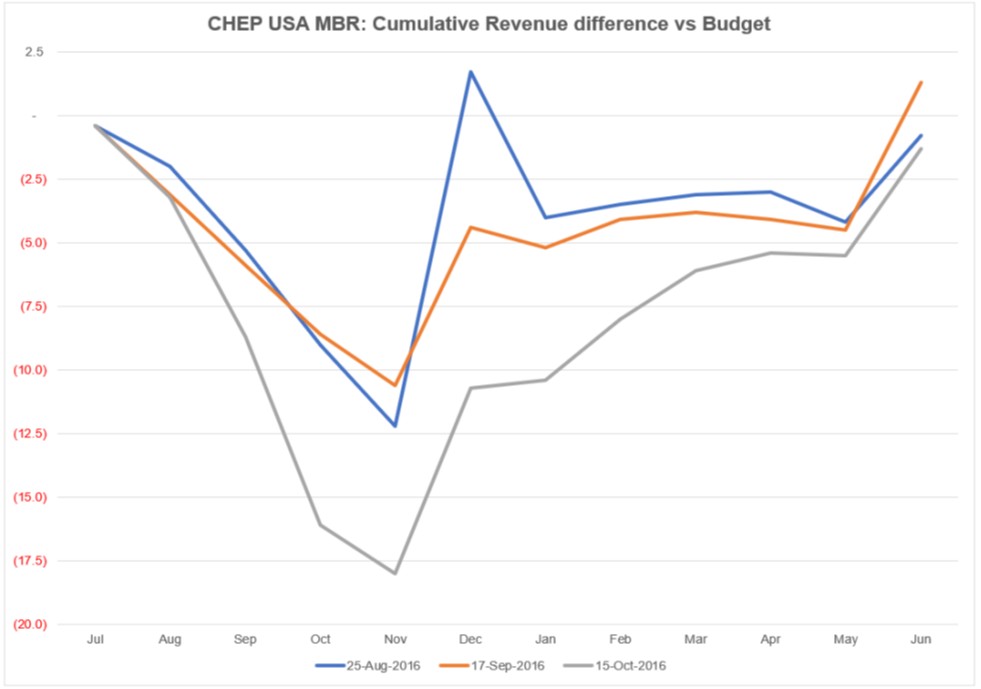
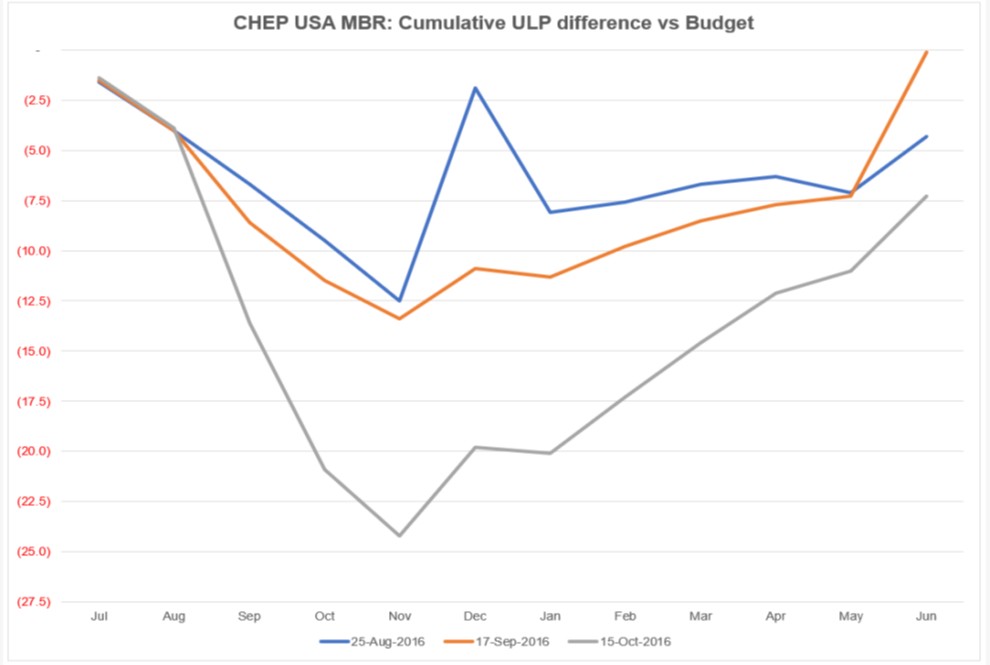
1655 As Mr Samuel opined, the US Pooled MBR reports reflected the increased adverse variation from the US Pooled budget as the actual sales revenue and Underlying Profit results for July, August and September FY17 were received, but assumed that US Pooled would recover that shortfall from December FY17 and through 2H17 and would thereby entirely close or almost close the gap to budget over the remainder of FY17. When one stands back from sales revenue and Underlying Profit forecasts in the charts above, they provide strong support for an inference (which I draw) that as actual US Pooled sales revenue and Underlying Profit increasingly fell behind budget in 1H17, Brambles just assumed an ever greater recovery over the balance of the year. In my view, and consistent with Mr Samuel’s opinion, the projected turnaround in sales revenue and Underlying Profit in US Pooled in the Initial September Reforecast and then the Revised September Reforecast were more targets than a best estimate of the likely budgetary outcome.
1656 The symmetry between the budget shortfalls in sales revenue and Underlying Profit in US Pooled in 1H17, and the forecast recovery in 2H17 also suggests that the Initial and Revised September Reforecasts for US Pooled were just a rephasing of sales revenue and Underlying Profit in US Pooled to compensate for its underperformance against budget in 1H17. In both the Initial and Revised September Reforecasts the projected 2H17 recovery was remarkably similar to the 1H17 shortfall.
1657 The proposition that the symmetrical recovery indicates that the Initial and Revised September Reforecasts for US Pooled were simply a rephasing to plug the revenue and Underlying Profit gap to budget also finds support in the email exchange between Bachtell and Martin on 27 and 29 September 2016. That exchange showed a recognition by Martin (and Bachtell) that the sales revenue budget they put forward for the Initial September Reforecast submission was expected to recover the existing US Pooled sales revenue shortfall to budget. There, Martin effectively instructed Bachtell to return a submission for the Initial September Reforecast with “enough to get us ~$10 [million] over [b]udget”. Bachtell faithfully obliged Martin’s request to make a submission which plugged the sales revenue shortfall.
1658 The weakness of Brambles’ evidence to affirmatively support the projected 2H17 recovery by US Pooled also supports my view that the Initial and Revised September Reforecasts for US Pooled were just targets aimed at plugging the revenue and Underlying Profit gap to budget rather than realistic or reasonable estimates of future performance. I am not satisfied on the evidence that the questions posed by Scaiff on 30 September 2016 in relation to strong 2H17 wins, the rephasing of sales revenue, and the reduction in direct costs in 4Q17 were ever adequately answered.
1659 I accept that, historically, sales revenue and Underlying Profit in US Pooled were weighted to the second half of the year, but that does not provide much support to Brambles’ argument when in my view Brambles’ higher level management had already packed into the US Pooled budget the maximum Underlying Profit in 2H17 which they thought was achievable.
1660 Fifth, the Initial September Reforecast projected that the remarkable recovery by US Pooled in 2H17 (and consequently by CHEP NA) would be the main driver of the strong projected recovery by CHEP Global in 2H17 in which:
(a) sales revenue was forecast to be $(19.3) million under-budget in 1H17, which was projected to worsen by $(8.2) million to be $(27.4) million under-budget by the end of 2H17;
(b) Underlying Profit was forecast to be $(10.8) million under-budget in 1H17, which was projected to be more than recovered by $11.3 million in over-budget performance in 2H17; and
(c) direct costs were forecast to outperform budget by $2.3 million in 1H17 and $19.5 million in 2H17, resulting in a $21.8 million overperformance against budget for the year. Again, the parties’ submissions did not address the reasons for the substantial under-budget direct costs in 2H17. I infer that it arises from the projected under-budget direct costs in CHEP NA (outside of US Pooled). I proceed on the assumption that this was a reasonable projection.
1661 Importantly, the Initial September Reforecast projected mixed Underlying Profit performance by the other CHEP Global CBUs in 2H17, which was not projected to materially contribute to the strong projected Underlying Profit recovery by CHEP Global. Apart from the projected $9.4 million recovery by CHEP NA in 2H17, the largest projected variations to budget by other CHEP CBUs were CHEP AIME and Asia which were projected to be $2.6 million and $1.1 million respectively above-budget in 2H17, and CHEP Europe which was projected to be $(1.9) million under-budget (which in respect of CHEP AIME and Europe did no more than return them to flat with their budgets for the year). Indeed, the projected Underlying Profit performance of each CBU was flat to budget for the full year.
1662 Thus, the Initial September Reforecast projected that the CHEP Global recovery, from its $(10.8) million Underlying Profit shortfall to budget in 1H17 so as to slightly beat its Underlying Profit budget for the year, would be centrally based on the projected Underlying Profit recoveries in US Pooled (and consequently CHEP NA) in 2H17. Performance against budget by CHEP Global was objectively significant to performance against budget by the Group. For example:
(a) in FY16 CHEP Global accounted for approximately 78% of Group sales revenue, and in FY17 it was budgeted to account for approximately 77% of Group sales revenue; and
(b) in FY16 CHEP Global accounted for approximately 93% of Group Underlying Profit, and in FY17 it was budgeted to account for approximately 94% of Group Underlying Profit.
1663 In my view, the Underlying Profit projections for US Pooled in 2H17 in the Initial September Reforecast were excessively optimistic and therefore the reforecast Underlying Profit projections for CHEP NA, CHEP Global and the Group were off the mark, unless some material overperformance against budget could be found in other businesses in the Group. And the Initial September Reforecast did not project material 2H17 overperformance against budget by other CHEP CBUs or other businesses in the Group.
The Revised September Reforecast
1664 The Initial September Reforecast was finalised on 3 October 2016 shortly before management received the September flash results (6 to 7 October 2016). Those results were very poor, and substantially worse than the under-budget performances in July and August. The results showed September sales revenue and Underlying Profit results for US Pooled materially under-budget and also under the recently completed Initial September Reforecast. I consider they showed that the monthly sales revenue and Underlying Profit projections in the Initial September Reforecast were seriously off the mark in respect of US Pooled and CHEP NA. By this point, US Pooled had experienced a three-month trend in under-budget sales revenue and direct costs overruns, leading to materially under-budget Underlying Profit YTD.
1665 Following the September results, the actual YTD sales revenue and Underlying Profit deficits to budget in US Pooled and CHEP NA had materially worsened as follows:
(a) US Pooled sales revenue was $(8.6) million under-budget, Underlying Profit was $(13.7) million under-budget, and direct costs were $(6.8) million over-budget; and
(b) CHEP NA sales revenue was $(14.3) million under-budget, and Underlying Profit was $(17.0) million under-budget.
1666 Those results were the main driver of material actual under-budget performance by CHEP Global YTD, in which sales revenue was $(11) million under-budget and Underlying Profit was $(13) million under-budget.
1667 And that was the main driver of actual under-budget performance by the Group YTD:
(a) Group sales revenue was $(8) million under-budget, which represented sales revenue growth of 7% (which sat at the bottom of the 7-9% range in the FY17 Guidance); and
(b) Group Underlying Profit was $(8) million under-budget, which represented Underlying Profit growth of 8% (which was one pp below the bottom of the 9-11% guidance range in the FY17 Guidance).
1668 Senior management in US Pooled, CHEP NA, CHEP Global and Brambles were understandably dismayed by such performance against budget. To recap some of that evidence:
(a) in an email to the US Pooled sales team on 6 October 2016 Martin referred to the “huge hole” US Pooled was in and said that it was “in the very place that we did not want to be at the end of Q1”;
(b) in an email to Alonso on 6 October 2016 Nador said that she had a “[h]eart attack from the closing numbers” which were “totally out of control”. She accepted that US Pooled was in a “huge hole”; in another email to Alonso on that date she said that the US Pooled budget was “already impossible going in, and with everything else on top, it is going to be a disaster!!”.
(c) Alonso accepted that the September results were “terrible” and that the results were a “shock” which “we had not been able to explain”. He unequivocally affirmed Nador’s 6 October 2016 email that the US Pooled budget was going to be a “disaster”. In an email to Rumph on 7 October 2016 he described CHEP NA’s position at the end of 1Q17 as being the “worst of situations” and said that the numbers did “not make any sense at all”. On 14 October 2016, Alonso messaged Roberts communicating his view that Brambles was “in panic mode”;
(d) Todorcevski deposed that the US Pooled and CHEP NA results were so poor that he initially thought they were caused by an error in calculations. In emails to Gorman and Kennett on 7 October 2016 he described the US Pooled September results as “just terrible”, “as poor an outcome in a month in US Pooled” as he had seen, and as “one of the worst results we have ever seen”; and
(e) in an email to Mackie on 6 October 2016 Gorman said he was “completely shocked” at how poor the CHEP Global results were, with the “primary driver” being US Pooled.
1669 The evidence shows that in a relatively short period of time management understood that the very poor sales revenue performance by US Pooled in September was a result of:
(a) a failure to achieve the forecast level of ‘go-get’ in unidentified wins;
(b) a smaller sales funnel than in previous years;
(c) increased delays in the sales pipeline, that is, a slower conversion rate, and that the conversion rate was very low;
(d) the loss of some large customers; and
(e) less whitewood conversions because whitewood pallet prices had declined.
1670 Shortly after receipt of the very poor September results, Kennett began to develop a Revised September Reforecast. Kennett drove the rapid development of this reforecast for US Pooled and CHEP NA and it was largely a ‘top-down’ creation. The Revised September Reforecast was completed, agreed and uploaded into BRACS on 13 October 2016, around a week after the September results were received.
1671 The Revised September Reforecast projected as follows.
1672 For US Pooled:
(a) the actual $(8.6) million sales revenue deficit to budget YTD was projected to recover to a $(7) million deficit in 1H17, which was projected to be recovered by $8 million in overperformance against budget in 2H17; and
(b) the actual $(13.7) million Underlying Profit deficit to budget YTD was projected to worsen to a $(14.3) million shortfall in 1H17, which was projected to be recovered by a remarkable $14.3 million in overperformance against budget in 2H17.
The projected 1H17 $(7.8) million Underlying Profit deficit to budget in the Initial September Reforecast had almost doubled in the Revised September Reforecast to a projected $(14.3) million Underlying Profit deficit to budget. The Revised September Reforecast increased the remarkable and symmetrical Underlying Profit overperformance against budget in 2H17 from $7.9 to $14.3 million to project that US Pooled would recover to achieve its budget by the end of FY17.
1673 For CHEP NA:
(a) the $(13.7) million sales revenue deficit to budget YTD was projected to worsen to a $(20) million deficit to budget in 1H17, which was forecast to worsen to a $(24) million shortfall to budget in 2H17; and
(b) the $(17) million Underlying Profit deficit to budget YTD, was forecast to worsen to $(17.4) million under-budget in 1H17, which was projected to be recovered by a remarkable $17.5 million in Underlying Profit overperformance against budget in 2H17.
The projected 1H17 $(9.4) million Underlying Profit deficit to budget in the Initial September Reforecast, had almost doubled in the Revised September Reforecast to a projected 1H17 $(17.4) million Underlying Profit deficit to budget. Again, the reforecast increased the Underlying Profit overperformance against budget in 2H17 from $9.4 million to $17.5 million to project that CHEP NA would recover to achieve its Underlying Profit budget by the end of FY17.
1674 For CHEP Global:
(a) the $(11) million sales revenue deficit to budget YTD was forecast to worsen to a $(17) million deficit in 1H17, which was projected to worsen to a $(27) million shortfall to budget in 2H17; and
(b) the $(13) million Underlying Profit deficit to budget YTD was forecast to worsen to a $(15.3) million deficit to budget in 1H17, which was projected to be recovered by a remarkable $15.9 million in overperformance against budget in 2H17.
The projected 1H17 $(10.8) million Underlying Profit shortfall to budget in the Initial September Reforecast had increased in the Revised September Reforecast to a projected 1H17 $(15.3) million Underlying Profit shortfall to budget. The Revised September Reforecast increased the Underlying Profit overperformance against budget in 2H17 from $11.3 million to $15.9 million to project that CHEP Global would recover to nearly achieve its Underlying Profit budget by the end of FY17.
1675 The following findings are appropriate in relation to the Revised September Reforecast.
1676 First, Brambles argued that the quantum of the increase in projected US Pooled and CHEP NA sales revenue and Underlying Profit in the Revised September Reforecast, from the amounts in the Initial September Reforecast, was not substantial, and not material in a business the size of CHEP Global, or in relation to the Group. The reforecast shifted a further $2.7 million in CHEP Global sales revenue, and a further $6.5 million into CHEP Global Underlying Profit, from 1H17 into 2H17.
1677 I accept that the increases were modest in the context of businesses the size of CHEP Global and the Group, but I do not accept the thrust of Brambles’ argument. The decision as to whether there were reasonable grounds for the Underlying Profit projections in the Revised September Reforecast in respect of US Pooled (and consequently for CHEP NA):
(a) does not turn on the increase in those projections from the Initial September Reforecast. Those projections were on top of the rephased sales revenue and Underlying Profit already introduced through the Initial September Reforecast;
(b) must take into account the contextual matters to which I referred in relation to the Initial September Reforecast, including that the further 2H17 rephased sales revenue and Underlying Profit in US Pooled was on top of a budget which was already based on aggressive revenue assumptions and had been stretched near to the limit of achievability. Although the yearly budget totals were unchanged from the US Pooled budget to the reforecast, in a real sense the rephasing involved a further stretch, because the required monthly performance in 2H17 involved overperformance against the previous monthly budgeted targets; and
(c) must be considered in the context that the further rephased 2H17 sales revenue and Underlying Profit figures were introduced following another month of under-budget sales revenue and direct costs overruns, such that there had been a three-month trend, resulting in substantial projected 1H17 Underlying Profit deficits to budget in US Pooled and CHEP NA of $(14.3) million and $(17.4) million respectively. That underperformance showed that the first month of revenue and Underlying Profit projections in the Initial September Reforecast was seriously off the mark.
1678 I will later deal with Brambles’ contention as to the significance of the US Pooled results to the results for the Group. But to the extent that Brambles contended that the quantum of the increase in the Revised September Reforecast’s projected US Pooled and CHEP NA Underlying Profit was insignificant or immaterial for those businesses, I do not accept that that fact negates what is already a tenuous budget and reforecast.
1679 The Revised September Reforecast provided for an even greater projected recovery in US Pooled sales revenue and Underlying Profit in 2H17. As I have said, when one stands back from Mr Samuel’s charts regarding the changing sales revenue and Underlying Profit forecasts over time, they provide strong support for an inference (which I draw) that as actual US Pooled sales revenue and Underlying Profit increasingly fell behind budget in 1H17, Brambles just assumed an ever-greater recovery over the balance of the year. That inference also finds support in the symmetry between the budget shortfalls in sales revenue and Underlying Profit in US Pooled in 1H17, and the forecast recovery in 2H17 in the Revised September Reforecast in respect of US Pooled.
1680 Second, for the Revised September Reforecast to have reasonable grounds (i.e., to be realistic or reasonably achievable) it needed to take into account the fact that the projection for September in the Initial September Reforecast for US Pooled had been shown to be seriously off the mark, almost immediately after it was made. Management should have given fresh consideration to whether the monthly sales revenue and Underlying Profit projections in the Initial September Reforecast were reasonable, and I am not satisfied on the evidence that they did so. Instead, the evidence tends to show that Kennett relied upon the Initial September Reforecast as the base and just extended the projections to catch up the budget misses in September.
1681 I consider the Revised September Reforecast was not much more than an attempt to backfill the increased US Pooled and CHEP NA sales revenue and Underlying Profit shortfalls to budget YTD following the September results. Those results had revealed that the September projection in the Initial September Reforecast was seriously off the mark, and instead of reconsidering the reforecast Kennett ‘doubled down’ and made even more optimistic projections.
1682 Third, it is significant that the contemporaneous documentary record indicates that operational management did not consider the projections in the Revised September Reforecast in relation to US Pooled or its Underlying Profit budget for the year to be realistic or reasonably achievable. As I explain further below, I am satisfied that as at 20 October 2016 Nador and Alonso in fact thought that it was unlikely, or at least very difficult or extremely challenging, for US Pooled to achieve the projections in the Revised September Reforecast, and meet its Underlying Profit budget for the year. It will be recalled that (following receipt of the September Results) Nador described the US Pooled budget as “impossible” from the outset, and said that with everything else on top, it was going to be a “disaster”, to which Alonso replied “Absolutely”.
1683 That conclusion also finds support in Nador’s and Martin’s 12 October 2016 email exchange when they were provided with Kennett’s 12 October Rephasing Email. Kennett’s email (which set out some revised 2Q17, 3Q17 and 4Q17 sales growth projections which became the basis of the Revised September Reforecast) essentially presented US Pooled and CHEP NA management with the revised projections, asked them to answer some questions about the rephasing, and to supply post-hoc reasons to justify the rephasing. The email exchange between Nador and Martin shows that they had serious doubts as to the achievability of the rephased sales growth projections.
(a) Nador said “I guess we are all asking the same questions”. Taken together with her remark in an email a week earlier that the US Pooled budget was “impossible” from the outset, and was going to be a “disaster”, that reflected her evidence in cross-examination that, at that time, she considered the projected rephased sales revenue growth was “more challenged for sure”, “much more aggressive, so much more difficult”, and “extremely challenging”; i.e., very difficult to achieve.
(b) Martin said that the projected rephased US Pooled sales revenue growth rates were “incrementally more difficult to rationalize”. He tried in various ways to walk back that remark, but I give that evidence little weight. At that time Martin knew from Moriarty’s Conversion Rate Email that there had been a four-month trend of very low conversion rates from July FY16 through September FY17, which (as Martin’s Conversion Rate Email shows) he found “quite alarming” and (provided it was a real rather than a reporting error) he could not see a way to overcorrect to offset that.
1684 I consider the remarkable projected Underlying Profit recovery for US Pooled (and consequently for CHEP NA) was so difficult and challenging it could not be described as realistic, reasonable or reasonably achievable. The projected recovery lacked reasonable grounds.
1685 It is relevant too, that in the same period that Kennett was preparing the Revised September Reforecast, the US Pooled management team were giving active consideration to downgrading the full-year US Pooled forecast. Initially the management team proposed a $(7.3) million Underlying Profit downgrade to the full-year forecast. Then, on 19 October 2016, US Pooled management adopted a $(5.6) million Underlying Profit downgrade to the full-year. The downgraded forecast was not conservative, i.e., the downgrade could have been greater. Nador gave evidence that there was “a lot more risk than opportunity” attaching to achieving the downgraded forecast and described it as “challenging”.
1686 I do not accept that the Revised September Reforecast in respect of US Pooled and CHEP NA (which projected that those businesses would recover from their significant projected 1H17 Underlying Profit deficits to budget so as to meet budget for the year) had reasonable grounds when, in the same period, the Revised September Reforecast was developed and approved US Pooled management was discussing downgrading, and then downgraded its Underlying Profit forecast to project that it would miss budget by $(5.6) million for the year. And that projection was not conservative. Nador accepted that there was “a lot more risk than opportunity” attached to achieving that result and that it was going to be “challenging” to keep the Underlying Profit deficit to budget to just $(5.6) million.
1687 Fourth, at the time the Revised September Reforecast was made (13 October 2016) management had received the September results which showed that US Pooled had experienced $(4.2) million in over-budget direct costs, being the worst direct costs overruns were for FY17, and which also showed a three-month trend in that regard. By that point the direct costs overruns YTD were $(6.8) million, which made up just under half of the $(13.7) million Underlying Profit deficit to budget. The direct costs overruns were a serious problem by this point and were recognised as such. Brambles’ two most senior executives were involved in trying to determine the cause of the trend in direct costs overruns in US Pooled, which reflected both the seriousness of the deterioration, as well as the potential importance of costs overruns in US Pooled to CHEP Global and Group results.
1688 It remained the case, as Kennett accepted, that at this time Brambles’ management did not know the fundamental causes of the direct costs overruns in US Pooled and that management could not resolve the direct costs overruns without understanding the causes. Kennett also accepted that the Revised September Reforecast ignored the fact that Brambles’ management did not know the fundamental causes of the direct costs overruns. Again, that fundamentally undermines Brambles’ contention that there were reasonable grounds for the Underlying Profit projections in the Revised September Reforecast in respect of US Pooled (and consequently for CHEP NA). How could Brambles’ management have had reasonable grounds to forecast the remarkable Underlying Profit recovery by US Pooled in 2H17 that it did, when it did not know the causes of the direct costs overruns which made up almost half of the Underlying Profit deficit YTD, for how long the material direct costs overruns would persist, or when they would cease to materially reduce US Pooled Underlying Profit?
1689 Fifth, the same can be said about Brambles’ approach to the damage rate risk in the Revised September Reforecast. Alonso testified that, as at 4 October 2016, his assessment was that there was, at best, only a 25% chance of the forecast two pp damage rate reduction being achieved. He also said that, had it been his decision, he would have included the damage rate risk in the September Reforecast for US Pooled, rather than merely noting the risk but excluding it from the reforecast. It follows that there was only a 25% chance that the assumed approximately $11 million in direct cost savings through the assumed damage rate reduction would be achieved. As earlier noted, that was the single largest risk facing US Pooled in achieving its Underlying Profit budget for the year, Brambles’ internal expert put it at a 75% likelihood that that risk would crystallise, and yet it was not taken into account in the reforecast projection for Underlying Profit. There were not reasonable grounds for Brambles to take that approach.
1690 Sixth, some of Brambles’ lay witnesses sought to rely upon the recovery plans instituted in US Pooled and CHEP NA in September and October 2016 as an explanation for their continued belief in the achievability of the Underlying Profit projections in the Revised September Reforecast in respect of US Pooled and the achievability of its budget for the year (and consequently the achievability of the projections and budget for CHEP NA).
1691 I accept that operational management was making determined efforts to address the underperformance in US Pooled and CHEP NA through implementation of their recovery plans. New initiatives following the September results included the 12 October 2016 decision to appoint Moreno to investigate and report on the direct costs overruns in US Pooled and the extension of the weekly Walk to MOP process to all CHEP NA businesses from 19 October 2016. The setting up of the US Pooled Status Review Meeting between Gorman, Mackie, Rumph, Nador and the US Pooled management team, was another important initiative, but that would not take place until 26 October 2016.
1692 However, as I later explain, Brambles overstated the likelihood that the recovery initiatives would allow US Pooled and CHEP NA to recover to alignment with their full-year Underlying Profit budgets by the end of FY17. I am satisfied that, as at 20 October 2016, the recovery plans did not provide reasonable grounds for the Underlying Profit projections in the Revised September Reforecast in respect of US Pooled and CHEP NA, nor for the projections that they would recover from their projected 1H17 deficits to budget to meet their Underlying Profit budgets by the end of FY17.
1693 Seventh, the Revised September Reforecast continued to project that the main driver of the projected 2H17 Underlying Profit recovery in CHEP Global was the projected Underlying Profit recovery in US Pooled and CHEP NA in 2H17. Apart from the remarkable recovery in CHEP NA, the Underlying Profit performance of the other CHEP CBUs in 2H17 was mixed. Except for CHEP AIME, which was forecast to be $2.3 million above-budget (which just recovered its 1H17 underperformance) and Europe, which was forecast to be $(3.9) million under-budget in 2H17 (which just brought it back to alignment with budget as it was projected to overperform against budget in 1H17), the Revised September Reforecast projected that the other CBUs would be slightly under or slightly over-budget. All CBUs were forecast to be flat to budget for the full-year.
1694 Thus, the Revised September Reforecast projected that the CHEP Global recovery, from its $(15.3) million Underlying Profit shortfall to budget in 1H17, so as to slightly beat its Underlying Profit budget for the year, would be centrally based on the projected Underlying Profit recoveries in US Pooled (and consequently CHEP NA) in 2H17. For the reasons previously explained, performance against budget by CHEP Global was objectively significant to performance against budget by the Group.
1695 In my view, the Underlying Profit projections for US Pooled in 2H17 in the Revised September Reforecast were overblown, lacked reasonable grounds, and therefore the reforecast’s Underlying Profit projections for CHEP NA, CHEP Global and for the Group in 2H17 were off the mark, unless some material overperformance against budget could be found in other businesses in the Group. And the reforecast did not project material overperformance against budget by other CHEP CBUs or other businesses in the Group in 2H17.
The effect on Group performance
1696 As at 20 October 2016, the underperformance against budget in US Pooled and CHEP NA sales revenue and Underlying Profit had dragged Group sales revenue growth to the bottom of the FY17 Guidance range YTD, and Group Underlying Profit growth YTD to one pp below the FY17 Guidance range. It was plain that the underperformance in US Pooled and CHEP NA was seriously dragging on the performance against budget by CHEP Global and the Group, and on the likelihood that Brambles would meet the FY17 Guidance.
14.4.3.2 The lay evidence - US Pooled and CHEP NA budgets
1697 Brambles primarily relied on the evidence of Nador, Alonso, Martin, Kennett, Mackie and Todorcevski regarding their reasons, as at 20 October 2016, for their belief in the achievability of the projections in the Revised September Reforecast in respect of US Pooled and CHEP NA and of their Underlying Profit budgets by the end of FY17.
1698 The evidence of Kennett and Mackie was centrally directed to their reasons for their belief in the achievability of the CHEP Global budget in this period, and Todorcevski’s evidence was centrally directed to his reasons for his belief in the achievability of the FY17 Guidance in this period. But some of the reasons they gave for their beliefs in that regard were based on the reasons underlying their belief in the projections in the Revised September Reforecast in respect of US Pooled and CHEP NA and in the achievability of their Underlying Profit budgets for the year.
1699 I accept that each of the Brambles executives who gave evidence were competent and experienced and most had substantial experience in the business, as well as substantial experience in other businesses. Alonso and Martin were involved in the preparation of the US Pooled and CHEP NA budgets, with Martin’s focus being on sales and Alonso’s on the supply chain. Kennett and Mackie were involved in stretching and setting the US Pooled and CHEP NA budgets and also in the September Reforecasting process for those businesses, as well as in setting the budgets for the other CHEP CBUs and in preparing a consolidated CHEP Global budget. Todorcevski was involved in the stretching and the setting of the CHEP Global budget. I accept that each of them, at their respective levels, and with different levels of direct focus on US Pooled and CHEP NA, considered and analysed the underperformance against budget in US Pooled and CHEP NA in FY17, including the poor September results, and considered whether, as at 20 October 2016, it was likely that US Pooled and CHEP NA could recover from the position they were in so as to achieve their sales revenue and Underlying Profit budgets for the year. I accept that ordinarily it would be appropriate to give weight to their evidence regarding the reasonable achievability of the budgets for which they were accountable within the Group.
1700 I note, however, that Brambles’ lay witnesses often described a relevant budget as “achievable” or “feasible”, other times they used words such as “reasonable” or “realistic”. Where they said a budget was “achievable” or “feasible”, that expression can encompass that it was possible that the budget would be achieved by the end of FY17. Generally speaking, in circumstances where that evidence was directed to showing the existence of reasonable grounds for a budget at particular points in time, I have treated testimony that a budget was “achievable” or “feasible” as evidence of the witness’ view that the budget was “reasonably achievable”, realistic or more likely than not to be achieved, or that there was a reasonable pathway to achieving the budget by the end of FY17. Sometimes, however, the witness’ evidence that the budget was “achievable” or “feasible” came together with evidence of so much risk attached to that asserted achievability that it was apparent that the witness was treating “achievable” as interchangeable with “possible”. Where that occurred, I have tended to give little weight to that evidence of achievability.
1701 Further, for some of the lay witnesses, their evidence as to what they thought about the achievability of a budget at a particular time either jarred with, or was inconsistent with, their emails at the time. I did not reach the view that any of the witnesses were being less than candid, but for the reasons I have explained, I consider the contemporaneous documentary record is the most reliable evidence of their views at the time. Sometimes it appeared that witnesses had a poor recollection in relation to business events that had taken place around six years earlier. Other times the witnesses conceded that they could not remember the detail but nevertheless purported to explain what they would have done. Other times I accepted that the witnesses held the asserted view, but decided that other evidence meant that it was appropriate to give that evidence reduced weight.
1702 It should be kept in mind that the testimony of Brambles’ lay witnesses regarding the achievability of the projections in the Revised September Reforecast in respect of US Pooled and CHEP NA and/or of their Underlying Profit budgets for the year is relevant, but not determinative. They are questions of fact which are to be judged objectively: James Hardie at [349], [454].
1703 For the reasons I explain I was drawn to conclude that little weight should be given to some important parts of their evidence. I was also drawn to conclude that many of the reasons they advanced for their stated belief in the achievability of the US Pooled, CHEP NA and CHEP Global budgets as at 20 October 2016 lacked force.
Nador
1704 As earlier noted, the thrust of Nador’s evidence in relation to the period up to 20 October 2016 was that, for the reasons she explained, she continued to believe that the US Pooled budget remained achievable by the end of FY17. In an email she sent her team on 11 October 2016 she said that she was “sure” that she and her team could “close the gap”. In cross-examination, she maintained that in this period she thought that the projections in the Revised September Reforecast in respect of US Pooled and its Underlying Profit budget for the year were achievable.
1705 As I have said, I found little force in Nador’s reasons for her belief in the achievability of the US Pooled budget by the end of FY17. I give little weight to her evidence to the effect that, as at 20 October 2016, she believed the projections in the Revised September Reforecast in respect of US Pooled and/or its Underlying Profit budget for the year were achievable. I reached the view that it was more likely than not that, as at 20 October 2016, Nador in fact thought that it was unlikely, or at least very difficult or extremely challenging, for US Pooled to achieve its Underlying Profit budget for the year.
1706 In the event that I am wrong in drawing that inference, and as at 20 October 2016 Nador in fact thought that the US Pooled budget was realistically achievable by the end of FY17, I am satisfied having regard to the evidence that there were not objectively reasonable grounds for her to hold that view.
1707 I do not conclude that Nador was being disingenuous or less than candid in her evidence. In my view she seemed to be doing her best to assist the Court. It is largely that I consider the contemporaneous documentary record to be more reliable evidence of what she thought at particular points in time about the achievability of the US Pooled budget, as compared to her evidence, largely a reconstruction prepared with the assistance of lawyers, about business matters around six years after the relevant events. It is also because some of her stated reasons lack force.
1708 The following matters are material to my views.
1709 First, and importantly, in her 6 October 2016 email to Alonso, Nador said: “But [Rumph] is right about this ... this budget is already impossible going in, and with everything else on top, it is going to be a disaster!!”.
1710 In cross-examination, Nador tried to downplay the significance of her remarks. Among other things, she said that the email was “emotional”;that she was communicating “frustration”; that US Pooled had just had a bad month with a big gap to close, and then there was the additional cash flow stretch, so she was “in that moment”; that the Spanish language “is always more dramatic”; and that it was “a quick-fire email…without much thought”.
1711 The meaning of Nador’s email is clear on its face. It records her unambiguous view in an email to a senior colleague to whom she was close, in which she described the US Pooled budget as “impossible” from the outset; and “was going to be a disaster”. I infer that, at the time, following the very poor September results she thought that the projections in the Initial September Reforecast in respect of US Pooled and its Underlying Profit budget for the year were unlikely to be achievable. It may be true that Spanish is a more dramatic language than English, but Nador did not suggest that in Spanish the words for “impossible” or “disaster” carry any different meaning. Nor did Alonso. Nador’s unguarded remarks in her 6 October 2016 email to Alonso are the most reliable evidence of what she thought at the time about the achievability of the US Pooled budget. It carries more weight than her evidence about what she thought about business events around six years after those events, which evidence was largely a reconstruction.
1712 I accept that Nador said something different in her 11 October 2016 email to her team, in which she said that she was “sure” that they would be able to achieve the US Pooled budget. But that was a motivating email to her team, and I give it less credence than her unguarded email to her close senior colleague. Given the budgetary position US Pooled was in, Nador had little choice but to try and motivate her team to get as close as they could to budget.
1713 Second, and at the risk of repeating myself, Kennett’s 12 October Rephasing Email asked Nador to explain and to provide examples in relation to:
(a) the main drivers of the forecast 7.6% sales revenue growth in Q2 (when actual sales revenue growth had been only 4.9% in Q1); and
(b) the main reasons for the belief that US Pooled could achieve 9.6% and 8% sales revenue growth in Q3 and Q4 respectively (the first of which was even higher than the bumper FY16 year).
1714 On 12 October 2016, Nador forwarded that email to Martin and said: “For our review tomorrow … [I] guess we are all asking the same questions!”. In cross-examination it was put to Nador that:
(a) She was asking Martin: “Is it achievable to have this incrementally increasing growth rate between Q1 and Q3?”. She responded by saying “Well, we are - we really were all trying to get there, and, clearly, with the delays, we are more challenged, for sure” (emphasis added).
(b) She was “questioning whether or not those growth rates were achievable”. She responded that “I guess the more, the higher, the steeper the curve, it makes you more nervous about it. That’s kind of what I’m saying there, yes” (emphasis added).
(c) She thought at the time that it was becoming “difficult to rationalise achieving the level of quarter on quarterly growth that was assumed” in Kennett’s email. She responded by saying: “So what I thought was that it was becoming much more aggressive, so much more difficult, yes” (emphasis added).
(d) She thought the forecast sales revenue growth rates from 2Q17 to 4Q17 in Kennett’s table were “irrational”. She denied that and instead said that she thought the growth rates were “extremely challenging” (emphasis added).
1715 Taken together with her remark a week earlier - that the US Pooled budget was “impossible” from the start and “was going to be a “disaster” - I infer that Nador’s remark: “[I] guess we are all asking the same questions” was intimating to Martin her view that the rephased revenue projections in Kennett’s table (which became the basis for the Revised September Reforecast) were “more challenged for sure”, “much more aggressive, so much more difficult”, and “extremely challenging” i.e., very difficult to achieve.
1716 In his reply to Nador, Martin said: “Exactly. This gets incrementally more difficult to rationalize”. In cross-examination, Nador said that she understood Martin to be saying that it was increasingly difficult to rationalise the basis for the projected rephased sales revenue and she said nothing to disagree with that. Instead, she just asked Martin to “write a couple of paragraphs on how we see the hockey-stick in H2”.
1717 Those matters support an inference, which I draw, that as at 20 October 2016 Nador in fact thought it was unlikely that US Pooled would achieve the projected rephased sales revenue in the Revised September Reforecast in respect of US Pooled, or its Underlying Profit budget for the year.
1718 Third, Nador consistently maintained in cross-examination that, following receipt of the September results, she continued to think that the projections in the Initial and then Revised September Reforecasts in respect of US Pooled and its Underlying Profit budget for the year were achievable. The reliability of that evidence was, however, undermined by her testimony about the level of risk that she said was attached to achieving those projections.
1719 In cross-examination the following exchange took place with counsel for the applicants:
Edwards: You hadn’t just had a bad month, Ms Nador. You had had a bad quarter?
Nador: ---Well, the initial was $3.9 million. That wasn’t such an enormous challenge. But September was bad.
Edwards: You were three months through the fiscal year?
Nador: ---Yes.
Edwards: And you were in a huge hole; correct?
Nador: ---Yes.
Edwards: You thought you weren’t going to make it. That’s what you thought at the time; correct?
Nador: ---No, I thought it was going to be extremely difficult.
Edwards: Yes. You thought it was unlikely you were going to make it, Ms Nador?
Nador: ---I thought it would be extremely difficult. You’re trying to play with my words. I’m telling you what I felt.
Edwards: Obviously you were going to do what you could. Your job was to try and get there?
Nador: ---Correct.
Edwards: But right at this time when you sent this to Mr Alonso, you thought it was unlikely you were going to get there. That’s right, isn’t it?
Nador: ---I thought we had a very difficult mountain to climb, yes. No, I didn’t say that we wouldn’t make it.
(Emphasis added.)
1720 Then, a short time later in cross-examination Nador said that “with the team and [an] appropriate set of actions and discipline, we could make up, if not all, a very good part of” what was then a $(13.7) million Underlying Profit shortfall to budget YTD. There, by stating that US Pooled might only make up a “very good part” of the shortfall, she effectively conceded that she was unsure that the budget was achievable.
1721 Later in cross-examination, the following exchanges occurred with counsel for the applicants in relation to the forecast sales revenue growth rates in Kennett’s 12 October Rephasing Email, and Martin’s remark that the projected sales revenue growth was “incrementally more difficult to rationalize”:
Edwards: Ms Nador, the questions that you were asking were, “Is it achievable to have this incrementally increasing growth rate between Q1 and Q3”?
Nador: ---Well, we are - we really were all trying to get there, and, clearly, with the delays, we are more challenged, for sure.
Edwards: You were questioning whether or not those growth rates were achievable; correct?
Nador: ---I guess the more, the higher, the steeper the curve, it makes you more nervous about it. That’s kind of what I’m saying there, yes.
…
Edwards: It was difficult to rationalise achieving the level of quarter on quarterly growth that was assumed in that table; correct?
Nador: ---I think that’s what [Martin] is saying.
Edwards: And that is what you thought at the time too, isn’t it?
Nador: ---So what I thought was that it was becoming much more aggressive, so much more difficult, yes.
Edwards: Well, you thought it was becoming much more unlikely to be achieved; correct?
Nador: ---Much more difficult to be achieved and any - the risk increases with that.
…
Edwards: Well, it’s not only more difficult, Ms Nador, but it might not be rational to continue to expect it; correct?
Nador: ---Might not be rational? The way I would say is there is more risk attached to it. The risk increases that you may not be able to completely achieve it, yes.
Edwards: That’s the same thing, isn’t it, as saying that you’re less likely to get there; correct?-
Nador: ---No. I guess, you are reverting it the other way. So the risk increases that you may not get it complete, yes.
Edwards: You thought at the time, Ms Nador, that it was unlikely you were going to get there, didn’t you?
Nador: ---I thought that there was more risk, because we were dependent on a number of deals falling in the timeframe that we needed them, the large ones.
Edwards: You thought at the time, Ms Nador, that the presumed percentage increases from quarter 1 through to quarter 3 in the table that Mr Kennett had sent?
Nador: ---It was extremely challenging.
Edwards: Extremely challenging, but you also thought that it was irrational; correct?
Nador: ---I didn’t think it was irrational. I thought it was extremely challenging. And the risk of one of them not happening creates a problem, so - - -
…
Edwards: You had a tough budget at the beginning?
Nador: ---Yes.
Edwards: You knew that in July?
Nador: ---And it’s more difficult now, yes.
Edwards: It’s even more difficult now?
Nador: ---Yes.
(Emphasis added.)
1722 In those exchanges, while Nador continued to maintain that she thought the sales revenue growth rates in Kennett’s 12 October Rephasing Email were achievable, she said that:
(a) following the September results, US Pooled was in a “huge hole” and that it would be “extremely difficult” and “a very difficult mountain to climb” for US Pooled to meet budget; and
(b) the sales revenue projections in (what became) the Revised September Reforecast were “more challenged, for sure”, “aggressive”, “much more aggressive, so much more difficult” and “extremely challenging”, and that US Pooled had a “tough budget” from the start which became “even more difficult” following the reforecast.
1723 That painted a quite different picture to her affidavit, which picture she had sought to maintain in cross-examination. In my view, Nador’s testimony described the risks attaching to the achievability of the projections in the reforecast and the US Pooled Underlying Profit budget in terms which meant she could not have thought that the projections or the budget were realistically achievable. Her evidence that, following the September results and the Revised September Reforecast, she continued to think that the projections in the reforecast and the US Pooled Underlying Profit budget continued to be achievable, seemed to be based on a view that it was possible that US Pooled could recover to meet budget, rather than that the projections in the reforecast and its budget for the year were realistically achievable or more likely than not to be achieved.
1724 Fourth, on 14 October 2016 (Atlanta time, 15 October Sydney time), Linderman emailed Nador and the US Pooled leadership team, attaching a draft US Pooled October MBR presentation for discussion and review during the Walk to MOP meeting scheduled for that day. Rather than forecasting that US Pooled would recover to alignment with its Underlying Profit budget, it projected that US Pooled would have a $(7.3) million Underlying Profit shortfall to budget.
1725 Then, on 18 October 2016, Holzman sent Nador an email (copied to Martin, Young, Linderman and Bachtell) setting out a P&L summary he had compiled following the US Pooled Walk to MOP meeting on 14 October 2016. He sent that summary in preparation for the US Pooled October MBR meeting scheduled for the following day. In the email, Holzman said that he and his team were recommending that US Pooled would miss its FY17 Underlying Profit budget for the year by $(5.6) million. On 19 October 2016, Nador accepted that recommendation.
1726 How could it be the case that, as at 20 October 2016, Nador continued to think that the projections in the Revised September Reforecast in respect of US Pooled and its Underlying Profit budget for the year were realistically achievable when:
(a) on 14 October 2016 a draft US Pooled management presentation forecast a $(7.3) million Underlying Profit shortfall to budget for the year; and
(b) on 19 October 2016 her management team recommended, and she accepted, that it was appropriate for US Pooled to revise its Underlying Profit forecast for the year to project a $(5.6) million shortfall to budget?
Martin
1727 As earlier noted, the thrust of Martin’s evidence was that, as at 20 October 2016, for the reasons he explained he continued to believe that the US Pooled sales budget was achievable by the end of FY17. Martin described the September results for US Pooled as “another bad lump of results” and accepted that they “for sure” added “more risk” to the Revised September Reforecast, but he said that he did not think that was a “very large risk”. He deposed that he agreed with Nador’s assessment in her 11 October 2016 email that she was “sure” that US Pooled could “close the gap” to budget, given that there were nine months of FY17 remaining. He said that he agreed with Nador’s assessment that “it was realistic to expect, and likely, that we would be able to make up the variance to budget during FY17” having regard to the relatively small size of the variance, the time remaining in FY17, and the assessment in the October Demand Consensus that FY17 pallet issues would be essentially flat to budget.
1728 As I have said, I found little force in some of Martin’s reasons, at this point in time, for his belief in the achievability of the US Pooled sales budget by the end of FY17, and I give little weight to his evidence in that regard. I am satisfied, having regard to the evidence, that there were not objectively reasonable grounds for him to hold that view.
1729 Again, that is not to find that Martin was not being truthful in his evidence. I accept that he held that view. He seemed to be endeavouring to give a truthful, albeit unfailingly optimistic, account of his view in this period that the US Pooled sales budget continued to be achievable.
1730 The following matters are material to my views.
1731 First, Martin testified that he agreed with Nador’s assessment in her 11 October 2016 email that she was “sure” that US Pooled could “close the gap” to budget. That was not, however, Nador’s true position. In Nador’s unguarded 6 October 2016 email exchange with her close Spanish-speaking colleague Alonso, she described the US Pooled budget as “impossible” from the outset; and said that it was going to be a “disaster”. In cross-examination, Nador described the risk that attached to achieving the revenue projections in (what became) the Revised September Reforecast in terms which showed that she could not have been “sure” that US Pooled would achieve its budget. Instead, her contemporaneous emails in combination with her evidence in cross-examination indicate that she in fact thought that it was more likely than not that US Pooled would fail to achieve the projections in the Revised September Reforecast for US Pooled and its Underlying Profit budget for the year, or at the least that doing so would be very difficult or extremely challenging. In my view Martin’s agreement with Nador’s assessment lacked a sound foundation.
1732 Second, Nador forwarded Kennett’s 12 October Rephasing Email to Martin the same day, undercover of a remark: “For our review tomorrow … I guess we are all asking the same questions!”.Martin responded: “Exactly. This gets incrementally more difficult to rationalize”.
1733 In relation to his remark Martin deposed:
I do not recall making this statement, but I recall my general thinking around the issues and questions described by Kennett. I was analyzing, with assistance from my teams, the US Pooled sales results and the drivers of those results. At the time of this email, that process was ongoing. On that basis, I believe that the reference to something being ‘difficult to rationalize’ is a reference to not being able to provide any further insights, at that point in time, into the drivers of the US Pooled sales performance than we already had.
1734 Martin there said, in effect, that although he could not recall making the remark, it did not show that he held the view that the proposed rephased sales revenue growth was increasingly difficult to rationalise or justify. Rather, it was a reference to his “not being able to provide any further insights” into the drivers of the under-budget sales revenue performance by US Pooled.
1735 However, in cross-examination Martin’s explanation of his remark changed. First, he said that what he meant was that:
It was difficult to rationalise why the pipeline wasn’t closing because we had agreements from customers, and it was difficult to rationalise why we weren’t seeing that - the close rate that we - - -
1736 To similar effect, he later said:
I think the feeling I have now and I had then is that it - it was - didn’t make sense why the - we weren’t seeing the pipeline close like it had for two years prior.
1737 Second, later in cross-examination his explanation changed again. And he said:
I felt like I was saying the plan is difficult to rationalise because it was - it was a difficult plan to … execute on.
1738 Third, later again in cross-examination, Martin’s explanation changed again. Senior counsel for the applicants suggested to Martin that his remark meant that he thought it was difficult to rationalise the idea that sales revenue growth in US Pooled was going to go from actual growth of 4.9% in 1Q17, to 7.6% per cent in 2Q17, to 9.6% in 3Q17, to 8% in 4Q17. The following exchange then occurred:
Martin: ---I knew we would have people who doubted that, yes.
Edwards: Well, Ms Nador doubted it, Mr Kennett doubted it … that’s right, isn’t it?
Martin: ---I don’t know if Ms Nador doubted it. I just know that we’re all asking the same questions means we’re all questioning whether it’s achievable. And [Kennett] hasn’t seen the plan to execute it yet at that point.
(Emphasis added.)
1739 Having regard to Martin’s shifting explanations, I give no weight to his evidence as to what he meant by his remark. I do not, though, find that he was being disingenuous or untruthful. He frankly conceded that he could not recall making that remark, and in my view his shifting explanations most likely reflected his attempts to reconstruct what he thought at the time.
1740 The email itself is the most reliable evidence of what Martin thought at the time, and its meaning is clear on its face. I infer that, as at 12 October 2016, Martin thought the rephased US Pooled sales revenue was becoming increasingly difficult to justify. Indeed, that was how Nador said that she understood Martin’s remark at the time.
1741 Third, Martin’s evidence that, at this time, he continued to believe in the achievability of the US Pooled sales budget was also based on his view in relation to the low conversion rate. He deposed that around September FY17 the ‘close rate’ in US Pooled (which I understood to mean the conversion rate) “had fallen from around 30% (which it had been for several preceding quarters) to around 16.5% or 17% and that [he] wanted to diagnose the cause of that change”.
1742 For the following reasons, I give little weight to that evidence.
1743 First, as Martin accepted in cross-examination, the US Pooled monthly conversion rate had not been at 30% in any part of FY17. That was just incorrect.
1744 Second, Martin also accepted in cross-examination that there had been an observable trend of low conversion rates for several months, which he found “concerning at the time”. Martin had commented on the low conversion rates which were identified in the August Sales Funnel Report (distributed 8 September 2016) and on 9 September 2016 he emailed Adlam to ask his team to look into it. Martin also accepted in cross-examination that in 1Q17 the US Pooled conversion rate had been “massively off” YTD.
1745 Third, the “close rates” to which Martin referred must have been the rolling 12-month average conversion rates. The significance of Moriarty’s Conversion Rate Email was that it showed that the monthly conversion rates in US Pooled for the previous four months had been very low. The monthly conversion rate was 9% in June FY16, 10% in July FY17, 8% in August FY17 and only 5% in September FY17. It also showed that the reason the rolling 12-month conversion rate remained as high as 18% in July FY17 (which was still well below the target rate) was the high monthly conversion rates earlier in the preceding 12 months.
1746 In Martin’s Conversion Rate Email dated 4 November 2016, he said that he had been “[t]hinking quite a bit about the conversion rate” and that he found the four-month trend of very low conversion rates to be “quite alarming” and that he could see “no way to over correct to off-set” it, which provided it was a real rather than a reporting issue, was a “problem”. He sent that email before he had received the October Sales Funnel Report (distributed 9 November 2016). That is, he sent it at a point when he had not been provided any further information regarding the conversion rate since Moriarty’s Conversion Rate Email. It is reasonable to infer that Martin held the same views as at 20 October 2016, which inference is also consistent with his 9 September 2016 email to Adlam.
1747 In cross-examination, Martin attempted in various ways to walk back the significance of his remarks in his email, and to impugn the accuracy of Moriarty’s Conversion Rate Email.
1748 First, he said that he was losing sleep about a lot of things, and he wasn’t necessarily talking about losing sleep because of the low conversion rate. But then he accepted that he was losing sleep about the conversion rate. Then later in cross-examination he reversed that and said that the conversion rate “wasn’t a thing that was causing me to lose sleep”. Then he seemed to accept that it was one of the things that was causing him to lose sleep but that the “confusing nature of the reporting was part of it, as much as anything”. Having regard to its shifting nature I give little weight to that evidence.
1749 Second, he said that his remark that the conversion rate trend from June FY16 to September FY17 was “quite alarming” was “based on [Moriarty’s] report”, and that he was not sure the report was accurate. He said that was why he wanted to understand whether it was a real problem or a reporting problem. However, against that, Martin agreed that he was “concerned” at the time - if the trends were correct.
1750 The following exchange occurred in cross-examination:
Edwards: The question I asked you was the conversion rate trends from June to September at this point in time, you thought, were quite alarming?
Martin: ---This report I thought was alarming, and I wasn’t sure that this was accurate. And that’s why I asked more questions.
Edwards: But nonetheless, you were concerned about the trends, weren’t you?
Martin: ---If this trend was completely accurate, I would be concerned with it, and I was asking my teams to dig in and look at it as well.
Edwards: Well, you asked them some more questions, because you wanted to know whether there was a real problem or a reporting problem?
Martin: ---Correct.
Edwards: But nonetheless, you were concerned about the trends, weren’t you?
Martin: ---If this trend was completely accurate, I would be concerned with it, and I was asking my team to dig in and look at it as well.
Edwards: Well, Mr Martin … It’s the case, isn’t it, that, at 4 November, you were losing sleep and you were seeing that there were alarming trends?
Martin: ---If the reporting was accurate, they are alarming trends.
(Emphasis added.)
1751 I give little weight to Martin’s attempts to throw doubt on the accuracy of the conversion rates in Moriarty’s Conversion Rate Email. I accept their accuracy. In cross-examination Martin seemed to accept that he asked Moriarty for the report which she provided in her email. And he had earlier expressed concern about the low conversion rate and asked Adlam for a report about that. I infer that Martin asked Moriarty for a report because he was concerned about the low monthly conversion rates. She was the person responsible for preparing the monthly Sales Funnel Reports and she was well equipped to provide an accurate report. Further, there is nothing in the contemporaneous documentary record to show that Martin went back to Moriarty to say that the conversion rates she provided were wrong, and the rolling 12-month conversion rate in Moriarty’s Conversion Rate Email approximated the rolling 12-month conversion rate in the September Sales Funnel Report.
1752 Third, Martin said that the conversion rates in FY17 looked completely different to FY16, because in FY16 the marketing department had included a lot more sales leads in the sales funnel. He said the sales funnel needed to be cleaned up, and he wanted more clarity around that data dump and its effect on the conversion rate. The evidence does not, however, establish that the conversion rates in Moriarty’s email were wrong. And Martin’s Conversion Rate Email shows that he was concerned at the time, as he accepted in cross-examination.
1753 Fourth, Martin said that Moriarty’s report was an “anecdotal” report rather than one of the standard reports in relation to the pipeline. But, as he accepted in cross-examination, Moriarty was in charge of the monthly sales funnel reporting and well positioned to report accurate figures.
1754 Fifth, Martin said that he did not know what he meant by his remark that “based on what I can see there is no way to over correct to offset this”. He attempted to frame that as a reference to the conversion rate trend rather than to the FY17 sales budget, although he (inconsistently) accepted that if the conversion rate trend persisted that there would be no way for US Pooled to reach its unidentified wins target in the Revised September Reforecast and so recover to achieve its sales revenue budget for the year.
1755 I found Martin’s various attempts to walk back the significance of his remarks in his Conversion Rate Email and his evidence in relation to Moriarty’s Conversion Rate Email unpersuasive. I do not, though, conclude that Martin was being less than frank in his evidence. He conceded that he could only “vaguely remember” his Conversion Rate Email and in my view his evidence reflected his attempts to reconstruct what he thought at the time about an otherwise mundane business metric, around six years after he sent the email.
1756 Again, Martin’s Conversion Rate Email is the most reliable evidence of what Martin thought at that time regarding the trend of very low conversion rates, and the meaning of the email is plain on its face. I conclude from the email and from Martin’s evidence in cross-examination that, as at 20 October 2016, he found the four-month trend of very low monthly conversion rates in US Pooled “quite alarming”, and his view was that (unless it was a reporting error rather than a real problem) he could not see “how to over correct to offset this”. Martin accepted that if the trend identified in Moriarty’s email persisted that there was no way for US Pooled to reach the projected unidentified wins in the Revised September Reforecast.
1757 Sixth, Martin’s evidence that, at this time, he continued to believe in the achievability of the US Pooled sales budget also lacks force, or should be given reduced weight, having regard to the contents of the slides he emailed to Nador on 8 October 2016. The slides stated Martin’s view that the revenue shortfall to budget in US Pooled was in part due to a “smaller sales funnel than in previous years”, and also to a “slowdown in pipeline activity” because conversions were taking longer than expected. In cross-examination, Martin accepted that US Pooled had experienced a smaller sales funnel, and that it had contributed to the poor September sales revenue results. He also accepted that it presented a “problem in terms of [US Pooled’s] ability to deliver budget”. Those slides show that, at that time, Martin understood that the conversion rate was low (as was confirmed to him by Moriarty’s Conversion Rate Email a few days later) and that the US Pooled sales funnel was smaller compared to previous years. It is difficult to see how Martin could have a reasonable basis to expect that US Pooled would enjoy the remarkable projected recovery in 2H17 to catch up its sales revenue deficit to budget in 1H17 when he knew that there had been a four-month trend of very low conversion rates, PECO was aggressively competing and slowing sales conversions, the US Pooled sales funnel was smaller than in previous years, and the evidence does not show a reasonable basis to expect the sales conversions problem to speedily abate.
Alonso
1758 As earlier noted, Alonso’s evidence-in-chief in relation to this period focused on supply chain issues rather than his views as to the achievability of the US Pooled or CHEP NA budgets.
1759 In cross-examination, Alonso agreed that the purpose of the US Pooled Status Review Meeting was to discuss whether it was “actually possible” for US Pooled to catch up to budget over the rest of FY17. In an email exchange with Young on 12 October 2016, Alonso noted that Rumph had referred to a ‘hockey-stick’ recovery by US Pooled and he asked Young to explain that term to him. Upon having had it explained, Alonso agreed that he then understood that what Rumph’s proposed hockey-stick recovery meant was that US Pooled was forecast to have “very great success in the second half [of FY17] to make up the difference”.
1760 Alonso denied that, when he thought back about his conversation with Rumph about the ‘hockey-stick’ recovery, she was telling him that the Initial September Reforecast was unrealistic and “we’re not going to make this”. But he said that the hockey-stick description acknowledged “the risk in the numbers and the level of stretch that she had to … fight against in the US”.
1761 Alonso accepted that the Initial September Reforecast “assumed that everything went really, really well in the second half”, but he said, “that was feasible for everyone” (emphasis added). He also said that he guessed that Rumph had submitted the reforecast because she thought it was achievable.
1762 The purport of that evidence was not entirely clear to me. It could have been evidence that at the time Rumph and others thought the projections in the reforecast for US Pooled were achievable. But to my mind, by stating that the reforecast “was feasible for everyone” Alonso was stating that, at that time, he thought the projections in the reforecast and the US Pooled Underlying Profit budget continued to be achievable. That view of his evidence is consistent with his evidence over time. For example, he testified that:
(a) as at 12 September 2016 he “remained of the view that our direct costs budget remained reasonable and achievable”;
(b) as at 20 September 2016, he considered the FY17 budget for direct costs and efficiencies “remained reasonable and achievable”;
(c) around 3 October 2016 he was involved in discussions about the assumptions for the September Reforecast, to ensure that the numbers submitted were reasonable and achievable from a supply chain perspective; and
(d) as at 23 November 2016 he “remained confident that the FY17 budget was reasonable and achievable” having regard to a list of matters focused on CHEP NA.
Although those views concerned the supply chain budget, it seems unlikely that Alonso would have thought the US Pooled supply chain budget was achievable as at each of those dates, whereas the US Pooled Underlying Profit budget was not.
1763 That view of his evidence, however, jarred with his 12 October email exchange with Nador in which he responded “Absolutely” to her remark that the US Pooled Underlying Profit budget was “impossible” from the outset and was going to be a “disaster”. That view of his evidence also jarred with his testimony in cross-examination about that email exchange. In cross-examination it was put to Alonso that in replying “Absolutely” to Nador, he was agreeing with her view that the budget was “impossible” from the start. He denied that, but said that the budget was “very, very stretched” and then said “at least on my part on supply chain, it was achievable”. There, Alonso appeared to draw a distinction between his view as to the achievability of US Pooled budget which he described as “very, very stretched” and his view regarding the supply chain aspects of the budget.
1764 Later in cross-examination, Alonso’s evidence of his confidence in the supply chain aspects of the US Pooled budget seemed to waver. He gave evidence that, “I thought it was still possible for the supply chain part. I don’t want to comment on the sales part. That was [Nador’s] responsibility. But on the supply chain part, I - I still believed it was possible” (emphasis added). Later again he denied that in October FY17 he thought that that it was no longer likely that the supply chain initiatives in US Pooled would be delivered and he said that he “thought they were possible still, with significant risk” (emphasis added).
1765 By the end of cross-examination, the gist of his evidence seemed to be that he could not express a view on the achievability of the US Pooled Underlying Profit budget for the year as that was not his responsibility, and in relation to the supply chain aspects of that budget he thought it was still “possible” to achieve those budgets, but “with significant risk”.
1766 I have found that, to the extent that Alonso gave evidence to the effect that, as at 20 October 2016, he thought that the Revised September Reforecast in respect of US Pooled or its Underlying Profit budget remained achievable (which was unclear), it is appropriate to give that evidence little weight. Having regard to his remarks in contemporaneous emails and his evidence in cross-examination, I reached the view that it was more likely than not that, as at 20 October 2016, Alonso in fact thought that it was unlikely, or at least very difficult or extremely challenging, for US Pooled to achieve the projections in the Revised September Reforecast and/or meet its Underlying Profit budget for the year.
1767 In the event that I am held to be wrong in drawing that inference, and as at 20 October 2016 Alonso in fact thought that the US Pooled budget was realistically achievable by the end of FY17, I am satisfied having regard to the evidence that there were not objectively reasonable grounds for him to hold that view.
1768 I do not conclude that Alonso was being less than candid in his evidence. He seemed to be doing his best, and he gave some evidence which was against Brambles’ interests in the case. Largely, I give his relevant evidence little weight, because I consider the contemporaneous documentary record to be more reliable evidence of what he thought at particular points in time about the achievability of the US Pooled budget, as compared to his evidence, largely a reconstruction, about business matters six years after the relevant events. It is also because some of his stated reasons lack force.
1769 The following matters are material to my view.
1770 First, Alonso’s evidence which might be understood as testimony that, as at 20 October 2016, he thought the Initial September Reforecast (and I infer the Revised September Reforecast) and/or or the US Pooled budget were “feasible” was not clear. I have set out that evidence above. Alonso may have been doing no more than stating that that was what Rumph and others thought when they made the Initial September Reforecast submission.
1771 Second, and most importantly, the proposition that, as at 20 October 2016, Alonso thought that the US Pooled budget and the Initial September Reforecast were “feasible” is inconsistent with his 6 October 2016 email exchange with Nador. As earlier noted, in that exchange Nador said that the US Pooled budget was “already impossible going in” and that “with everything else on top, it is going to be a disaster!!”. Alonso replied: “Absolutely!” (or in his translation “No doubt!”).
1772 To state the obvious, in providing that response Alonso accepted the correctness of Nador’s view. That email exchange is the most reliable evidence of what Alonso thought at that time regarding the achievability of the US Pooled budget. It carries substantially more weight than his evidence as to what he meant in that email, given more than six years have passed since the events to which the email related. Alonso tried in several ways to walk back the significance of his response but I found that evidence unpersuasive.
1773 Third, it is appropriate to give little weight to Alonso’s evidence (that might be understood as testimony that he considered the Initial September Reforecast for US Pooled and its Underlying Profit budget to be achievable) because of his evidence as to the level of risk attached to achieving the reforecast and budget. For example, in relation to the position as at 5 October 2016 (before the very poor September results were received) Alonso testified that:
(a) “well, this [budget] is super stretch. And she [Nador] saw a lot of risk in that budget, yes, and she was expressing that in this email” (emphasis added);
(b) in agreeing with Nador that the US Pooled budget was going to be a “disaster”, he meant that he “agreed that it was very challenging. And if we have additional stretches on top, it was going to be very, very difficult to deliver” (emphasis added); and
(c) he agreed that following the September results he thought the forecast for US Pooled was “very, very stretched and very, very difficult” (emphasis added).
That and other evidence tended to show that what Alonso meant was that it was possible that the reforecast and budget were achievable, rather than that they were realistically achievable or more likely than not to be achieved.
1774 Fourth, I also give reduced weight to Alonso’s evidence to the effect that the US Pooled budget was feasible because he put a gloss on Nador’s email, and because of the tentative nature of that evidence. The gloss was Alonso’s suggestion that Nador’s email was talking about the US Pooled budget being a “disaster” if further budget stretches were imposed. That can be seen in the following exchange with counsel for the applicants:
Edwards: And Ms Nador says something else, doesn’t she? She said: With everything else on top, it’s going to be a disaster?
Alonso: ---That’s what she said.
Edwards: And her view was - this is looking forward from this point in time, from October - the budget was unattainable?
Alonso: ---I think she was coming as well with the views, looking at these emails, that potentially she could receive additional stretches.
…
Edwards: You agreed it was going to be a disaster?
Alonso: ---I agreed that it was very challenging. And if we have additional stretches on top, it was going to be very, very difficult to deliver.
Edwards: Mr Alonso, you didn’t respond to Ms Nador by saying, “I agree it’s going to be very challenging, but it’s achievable.” You responded by saying “absolutely” because you agreed with her view it was going to be a disaster; that’s right, isn’t it?
Alonso: ---If we had additional stretches, it could - it could go in the wrong direction. Yes.
(Emphasis added.)
1775 It is plain on the face of Nador’s 6 October 2016 email that she was not referring to the US Pooled budget being a “disaster” if further stretch was imposed. Her email said that “with everything else on top” i.e., what had already occurred, the budget was going to be a “disaster”. Importantly, in her evidence about this email, Nador did not say that she was referring to the possibility of additional stretch being imposed.
1776 Alonso’s evidence in that regard was tentative and plainly a reconstruction rather than a recollection of what he thought Nador’s concerns were at the time. He said that “looking at these emails” he thought that Nador “was coming as well with the views …that potentially she could receive additional stretches” and that was how he was “reading this years later” (emphasis added).
1777 Fifth, in part Alonso’s evidence to the effect that, as at 20 October 2016, he thought that the US Pooled FY17 budget and the Initial September Reforecast were “feasible” (to the extent he stuck to that position) seemed to be based to a significant extent on the proposition that Rumph had submitted that reforecast. That can be seen in the following exchange:
Edwards: So that’s why - at this time, Mr Alonso, in October 2016, 12 October, after Mr Young explained the hockey stick to you, you thought that Ms Rumph believed the budget was going to get missed, didn’t you?
Alonso: ---The budget were?
Edwards: The budget was going to get missed?
Alonso: ---I thought if she had submitted the forecast, it’s because she believe she can achieve that forecast. That’s what I thought.
Edwards: But you also thought, didn’t you, Mr Alonso, that she had submitted the forecast, but it was unlikely to be achieved?
Alonso: ---Well, if she submitted something, it’s because probably she thought she could achieve the forecast. Otherwise, I would - I would guess she should have submit something different.
(Emphasis added.)
1778 The fact that Rumph submitted the Initial September Reforecast is relevant to, but not determinative of, whether it had reasonable grounds. And following receipt of the very poor September results, the Initial September Reforecast had been overtaken by other events. Whatever view Rumph had of the achievability of the Initial September Reforecast at the time it was submitted, her view it is likely to have been different when that reforecast was shown to be seriously off the mark almost immediately after it was made, and the US Pooled Underlying Profit deficit YTD had materially increased.
1779 Relatedly, other parts of Alonso’s evidence in cross-examination tended to show that his view about the US Pooled budget was in part based on the fact that he and Rumph had made a commitment to achieve the budget, and they just had to do their best. That can be seen in the following exchange:
Edwards: Well, you knew at the time, Mr Alonso, that Ms Rumph thought it was impossible, even without additional stretch, didn’t you?
Alonso: ---No, because also when we sign off on the budget - and I think we saw yesterday one of those emails - the two of us were discussing about we are in this together, let’s get around to deliver.
Edwards: Yes. You were in it together to try and do as best you could?
Alonso: ---Yes.
Edwards: That was your mindset?
Alonso: ---And deliver. Because at the end of the day, we had committed to deliver those numbers.
Edwards: But people don’t always meet their commitments. They do their best, and that’s what you were trying to do, wasn’t it, Mr Alonso?
Alonso: ---By keeping in mind that we had committed.
Edwards: Yes. I mean, you had made a commitment. You were going to do your best to achieve it. That’s what your mindset was?
Alonso: ---We made - we made a commitment to deliver those numbers, so let’s - let’s work as best as we can to deliver those numbers because it’s our commitment.
(Emphasis added.)
“Digging in” in an endeavour to meet budget does not necessarily show the existence of reasonable grounds for the budget.
1780 Sixth, Alonso’s evidence that, following the September results, he thought the US Pooled budget continued to be feasible, jarred with his emails and evidence regarding the US Pooled budget at the time it was set. For example:
(a) in an email exchange with Rumph and Lallatin on 12 to 13 April 2016 he agreed that the CHEP NA Second Revised Budget Submission was a “huge stretch”. In cross-examination he said that at that time, he thought the proposed CHEP NA budget was stretched “close to the limit of what was achievable” and “we could not go beyond that”, and that if any additional stretch was imposed, it would put US Pooled “in a very difficult position to achieve any target”. The budget was then stretched further;
(b) in the Alonso Risks Email he sent to Mackie on 14 April 2016, he described the proposed US Pooled budget as having “the most aggressive and stretched” Underlying Profit with “risks in all line items, sales, direct cost, overheads and capex”, that the $48 million of budgeted efficiencies in US Pooled involved a “big stretch”, and should be reduced to a more realistic level and that the initiatives in the CHEP Global budget for reducing direct costs involved a “huge stretch” with “no margin for error”; and
(c) in cross-examination he said in relation to his 6 October 2016 email exchange with Nador that he thought that the US Pooled budget was “very, very stretched” from the start, but that: “I didn’t think it was impossible. I thought it was very stretched, it was stressful, it had risk, but it was achievable. That’s what I thought when we made the budget” (emphasis added).
1781 As I have said, I reached the view that it was more likely than not that, as at 20 October 2016, Alonso thought that it was unlikely, or at least very difficult or extremely challenging, for US Pooled to meet the projections in the Revised September Reforecast and/or meet its Underlying Profit budget for the year.
Kennett and Mackie
1782 Kennett and Mackie’s evidence was centrally directed to their reasons for their belief, in this period, regarding the achievability of the projections in the Revised September Reforecast in respect of CHEP Global and its FY17 Underlying Profit budget. However, some of their reasons for that belief were based on their belief in the achievability of the projections in the reforecast in respect of US Pooled and CHEP NA and of their Underlying Profit budgets for the year.
1783 Relevantly, the gist of their evidence in relation to US Pooled and CHEP NA was that, as at 20 October 2016, for the reasons they explained, they each thought that the projections in the Revised September Reforecast in respect of US Pooled and CHEP NA and their Underlying Profit budgets were achievable.
1784 The reasons Kennett gave as to why, as at 14 October 2016, he continued to think the CHEP Global budget “remained achievable”, included the following matters related to US Pooled and CHEP NA:
(a) his review of the CHEP Global and in particular the US Pooled September results, including:
(i) the analysis and review undertaken by the US Pooled and CHEP NA teams;
(ii) the meetings he attended with the CHEP NA, CHEP Global and Brambles’ teams to discuss the key drivers of the September US Pooled results;
(iii) the explanations given by US Pooled in relation to the September results; and
(iv) the commitment from the US Pooled and CHEP NA teams to address the September results, particularly in relation to delivering the sales pipeline for the second half of the year and addressing the direct costs results;
(b) the subsequent and separate analysis of the September results undertaken by him and the CHEP Global FP&A team, including considering the achievability of the September Reforecast in light of the September results and having regard to the whole of the CHEP Global business portfolio and the strong performance in other CBUs; and
(c) the steps taken by key stakeholders following the September results for US Pooled, including the direct costs analysis and the addition of Moreno to be “on the ground” to ensure any direct costs issues would be swiftly understood and remedied.
1785 The reasons Mackie gave, as at 7 October 2016 and as at 20 October 2016, that were relevant to US Pooled and CHEP NA were as follows:
(a) the September results for US Pooled and CHEP NA reflected one month of bad results. While there was work to be done to bridge the gap to budget, it was only three months into FY17, and given the reports he had received on the key drivers of the September results for CHEP NA he was confident that over the course of the following nine months, the shortfall in the results YTD would be recovered by CHEP NA;
(b) he was confident, based on his review of the Revised September Reforecast, that there were significant opportunities to improve the financial results in CHEP NA over the course of the year and recovery plans could be implemented (as they had in the past) to improve the results in US Pooled and CHEP NA; and
(c) Alonso was continuing a ‘deep dive’ into direct costs in US Pooled and CHEP NA with a view to implementing initiatives to reduce direct costs over the remainder of the year.
1786 For the reasons I now explain, I consider it appropriate to accord little weight to Kennett’s or Mackie’s testimony to the effect that, as at 20 October 2016, for the reasons they explained, they continued to believe that the US Pooled and CHEP NA budgets were achievable by the end of FY17. Their reasons lacked force, and I am satisfied having regard to the evidence that there were not objectively reasonable grounds for them to hold that view.
1787 That is not to find that they were not being candid in their evidence. I accept that they each held that view. But some of their stated reasons lack force and I consider that the contemporaneous documentary record is more reliable evidence of the objective facts.
1788 The following matters are material to my views.
1789 First, Kennett’s confidence in the achievability of the CHEP Global budget was based on the analysis and reviews undertaken by the US Pooled and CHEP NA management teams i.e., that they thought they could turn the situation around. Similarly, Mackie’s confidence was based on his belief in the US Pooled and CHEP NA management teams' ability to turn the situation around.
1790 That confidence, however, lacked a proper foundation. The contemporaneous emails of Nador and Alonso tend to show that they thought that the US Pooled budget was going to be a “disaster”, or at the least it would be very difficult or extremely challenging for US Pooled to achieve the projections in the Revised September Reforecast and its Underlying Profit budget by the end of FY17. That is, they were not confident that they could turn the situation around. Similarly, Martin’s 12 October 2016 email exchange with Nador shows that he thought the rephased US Pooled sales revenue was “incrementally more difficult to rationalize”. Nador did not demur. I see their unguarded remarks in their contemporaneous emails as the most reliable evidence of what operational management thought at the time about the achievability of the projections in the Revised September Reforecast in respect of US Pooled and its Underlying Profit budget by the end of FY17.
1791 Second, Nador and Alonso’s evidence to the effect that, in this period, they thought that the US Pooled Underlying Profit budget continued to be achievable, came with evidence that the projections in the Initial and Revised September Reforecasts were “much more aggressive”, “much more difficult” and “extremely challenging”; that is, very difficult to achieve, “super stretch”, “very challenging”, and “very, very stretched and very, very difficult”; i.e., extremely difficult. In reality, their evidence was to the effect that it was possible that US Pooled would achieve its Underlying Profit budget by the end of FY17, not that that was realistically achievable or more likely than not. Again, Kennett’s and Mackie’s confidence did not have a proper foundation.
1792 Third, Kennett’s and Mackie’s evidence to the effect that, in this period, they thought the US Pooled budget remained achievable jarred with the evidence that shows, from 14 October 2016 US Pooled management was actively discussing a downgrade to its Underlying Profit forecast for the year, and on 19 October 2016 they agreed to downgrade the full-year Underlying Profit forecast by $(5.6) million. Kennett’s and Mackie’s confidence should be given less weight when operational management who were directly accountable for the budget had a different view.
1793 Fourth, I found little force in Kennett’s evidence that he relied on the “commitment” from US Pooled and CHEP NA management to address the September results by delivering the sales pipeline in 2H17 and addressing the direct costs results.
(a) First, in relation to sales revenue, I accept that US Pooled and CHEP NA management and the US Pooled sales team were working hard to improve sales performance against budget, and in that sense, they had made a “commitment” to address the continuing under-budget sales revenue. But at this point, management considered US Pooled was in a “huge hole” and that digging it out would be “extremely challenging”. And the evidence shows that from 14 October 2016, US Pooled management was actively discussing a downgrade to its full-year Underlying Profit forecast, and on 19 October 2016, CHEP NA management approved a $(5.6) million Underlying Profit downgrade to the full-year forecast. How could US Pooled management have made a meaningful “commitment” to rectify the under-budget sales when in the same period that commitment was said to have been made, they were actively discussing and then made a $(5.6) million downgrade to the Underlying Profit forecast for the year?
(b) Second, in relation to direct costs overruns, I accept that US Pooled and CHEP NA management were very concerned about the direct costs overruns, and were keen to rectify them. But I do not accept that US Pooled and CHEP NA management had made any “commitment” to rectify them, nor that if they had promised to rectify them that Kennett could have thought that that promise had any real value.
1794 The evidence is clear that, at this point in time, Brambles’ management did not understand the causes of the direct costs overruns, and therefore could not address them. Alonso was the head of the CHEP Global supply chain division and accountable for supply chain costs. In his 7 October 2016 email to Rumph he said “right now we are in the worst of situations, not only failing on numbers but not being able to understand why!”. In an email to Mackie on 11 October 2016 he agreed with Mackie’s suggestion that a deep dive be undertaken into the causes of US Pooled’s underperformance, and he said, “to be honest I still do not fully understand what has happened”. In cross-examination he accepted that at that time he was frustrated because he “could not understand the reasons for the gap” to budget in respect of direct costs, and he agreed that he had “no idea what was going on” in relation to direct costs. In an email on 11 October 2016, Alonso told Nador that he intended to ask Kennett for help “to audit all of the activities, and costs of these three months against the same period from last year for everything that they call non demand repair and TPM Handling volumes / missuses”. He said that he did not believe the data, and that he would like to ask Moreno to undertake the proposed audit.
1795 Kennett’s evidence was to similar effect. Kennett accepted in cross-examination that as at 10 October 2016, there was a gap in leadership and knowledge in respect of US Pooled’s systems for recording direct costs, and that Nador was struggling with diagnosing the data needed to understand what was happening with direct costs in US Pooled. He gave evidence that, around 12 October 2016, he suggested to Todorcevski that Moreno be appointed to investigate and report on the deterioration in US Pooled direct costs. He said that Todorcevski’s agreement to appoint Moreno was a reflection of the seriousness of that issue.
1796 As at 20 October 2016 Brambles’ management did not yet understand the causes of the direct costs overruns. Moreno was appointed to find out. Kennett accepted in cross-examination that, as at 11 November 2016, Brambles’ management did not have “true visibility” of the fundamental causes of the direct costs overruns in US Pooled and that Brambles could not resolve the issue without further understanding of the causes.
1797 Moreno could be expected to report on his investigation at some point (the timeline for which was unknown at this stage) but at that stage management did not know what Moreno’s investigation would find, and did not know what he would recommend to address the problem. For example, management did not know whether Moreno would be able to identify all the causes of the direct costs overruns or only some of them, whether he would find that all of the causes could be rectified or only some of them, and if he found some or all of the causes could be rectified how long that would take. At that point, management did not know whether, when, or to what extent, the persistent over-budget direct costs would cease to materially reduce US Pooled Underlying Profit in FY17. Kennett could not reasonably think that the persistent direct costs overruns could be fixed on the basis of what he hoped Moreno would find and recommend.
1798 In the circumstances, I cannot see how, as at 20 October 2016, US Pooled management could have made a “commitment” to address the direct costs overruns, and had they done so I cannot see how Kennett could reasonably think that any such “commitment” had any real value.
1799 Further, Kennett accepted that the Revised September Reforecast ignored the fact that management did not yet know the causes of the direct costs overruns in US Pooled. To my mind, that fundamentally undermines the probative value of Kennett’s evidence to the effect that, as at 20 October 2016, he had reasonable grounds to believe that US Pooled and CHEP NA could recover to achieve their FY17 Underlying Profit budgets. How could he have had reasonable grounds when the Revised September Reforecast ignored the fact that management did not yet know the causes of the direct costs overruns and therefore could not, at this stage, rectify them?
1800 Fifth, Kennett’s confidence was also based on steps taken by “key stakeholders” following the September results for US Pooled, “including the direct costs analysis and the addition of Moreno to be ‘on the ground’ to ensure any direct costs issues would be swiftly understood and remedied”. That confidence had no foundation.
1801 Moreno was not, as at 20 October 2016, “on the ground” in the US. He did not arrive in the US and commence to work full-time on the issue until around 13 November 2016. And whether or not he in fact started full-time work earlier than that, the evidence shows that as at 20 October 2016, Brambles was not in a position where management could “ensure any direct costs issues would be swiftly understood and remedied”, as Kennett said. As at 20 October 2016, Moreno had not reached or communicated his conclusions as to the causes of the direct costs overruns or provided recommendations on how to rectify them. He did not do so until 22 November 2016.
1802 Sixth, Mackie was correct in noting that September FY17 was the only very poor month YTD, but to a significant extent that missed the point. As at 20 October 2016, US Pooled had experienced a three-month trend of under-budget sales revenue and over-budget direct costs which had resulted in material Underlying Profit underperformance against budget YTD. Although September FY17 was the only very poor month YTD, the Initial September Reforecast recognised that the sales and Underlying Profit underperformance would continue in the remainder of 1H17.
1803 Further, Mackie’s evidence did not grapple with the fact that, as at 20 October 2016, management did not know what the fundamental causes of the overruns were and could not address the overruns until the causes were understood. How could Mackie be confident that US Pooled could recover so as to achieve its Underlying Profit budget by the end of FY17 when he did not know whether, to what extent, or when, the persistent direct costs overruns would cease to materially reduce US Pooled Underlying Profit?
1804 Seventh, Mackie’s confidence was also based in his view that “recovery plans could be implemented (as they had in the past) to improve the results in US Pooled and CHEP NA”. Of course, recovery plans could be implemented. But the fact was that, as at 20 October 2016, the recovery initiatives in US Pooled and CHEP NA were in the early stages of implementation, they would take some time to have an effect (if they were going to be effective), and it was too early to know at this point whether those initiatives would be sufficient to mean that US Pooled would recover to achieve its budget.
1805 I accept Mackie’s evidence that “[i]n years where the business was travelling slightly behind budget” (emphasis added) recovery initiatives that had been implemented in the first half of the year had delivered results in the second half of the year, and led to stronger results in the second half. But several things should be noted about that evidence.
(a) First, it is one thing for a business to recover to alignment with budget when the budget has a buffer or some ‘fat’, and another to recover when it is stretched or aggressive. If US Pooled was to achieve the rephased sales revenue and Underlying Profit it needed to substantially outperform the existing monthly budgets for 2H17. That was likely to be very difficult given that the US Pooled budget was stretched to near the limit of achievability from the outset, and then actual and projected underperformance against budget left it with a $(14.3) million Underlying Profit deficit to somehow recover.
(b) Second, the evidence does not establish that in previous years the budget challenges that CHEP Global had faced down were similar to those in US Pooled or of similar quantum. Such evidence was solely within Brambles’ power to adduce, and it would have been straightforward for it to do so. Mackie’s evidence must be weighed in that context.
1806 Eighth, there is no force in Mackie’s evidence that his confidence was based on Alonso continuing a ‘deep dive’ into direct costs in US Pooled and CHEP NA with a view to implementing initiatives to reduce direct costs over the remainder of the year. Alonso had previously undertaken deep dives into the direct costs overruns and they had not resulted in Brambles’ management coming to understand their fundamental causes. That was why Todorcevski and Kennett had appointed Moreno on 12 October 2016. Addressing the direct costs overruns required Moreno’s report, and as at 20 October 2016, Moreno had not yet reported. As at 20 October 2016, management did not know whether, or to what extent, or when, the persistent over-budget costs would cease to materially reduce US Pooled Underlying Profit in FY17.
Todorcevski
1807 Todorcevski’s evidence-in-chief was centrally directed to his confidence, at the end of 1Q17, in the achievability of the Group FY17 budget and the FY17 Guidance, some of which was based on his belief that the projections in the Revised September Reforecast with respect to US Pooled and CHEP NA were achievable, as were their budgets for the year.
1808 The thrust of his evidence included that, following receipt of the poor US Pooled September results, for the reasons he explained, he continued to believe that the projections in the Revised September Reforecast with respect to US Pooled and CHEP NA were achievable, as were their Underlying Profit budgets for the year. The reasons Todorcevski gave as to why, as at the end of 1Q17, he was confident that the FY17 Guidance was achievable included the following matters relevant to US Pooled and CHEP NA:
(a) while there was some underperformance in CHEP NA at the end of 1Q17, it was partially due to a budget phasing error and Mackie was working with US Pooled to identify the reasons driving the results for the YTD and developing a recovery plan, including through the implementation of Rumph’s Walk to MOP process;
(b) he denied that, following the September results, he thought the projected rephased US Pooled sales revenue in the Revised September Reforecast was unrealistic. But he said that achieving such sales growth was “a larger task than [US Pooled] had faced for a number of years” and required “a lot of focus” to deliver that; and
(c) he said that he “had to have confidence in [the US Pooled team’s] confidence to deliver the plan”, and that “they were on the ground delivering on the plan. So I had to have faith in their ability, considering what they had done in prior years”.
1809 For the reasons I now explain, I do not give much weight to Todorcevski’s testimony to the effect that, as at 20 October 2016, he continued to believe that the US Pooled and CHEP NA Underlying Profit budgets were achievable by the end of FY17. I found little force in those stated reasons, and I am satisfied, having regard to the evidence, that there were not objectively reasonable grounds for him to hold that view.
1810 That is not to find that Todorcevski was not being truthful in his evidence. I accept that he held those views, and I thought he was trying to give a candid account. It is because his stated reasons lack force and because I consider the contemporaneous documentary record is substantially more reliable evidence of his views of business events and emails from around six years earlier.
1811 The following matters are material to my views.
1812 First, and importantly, Todorcevski sent an email to Gorman on 26 October 2016 (the Massive Growth Email) in which he referred to discussions he had with Kennett, Alonso and Scaiff regarding a proposed additional $50 million cash flow stretch in 1H17. In relation to those discussions he told Gorman:
Where we diverge is in second half … The [US Pooled] business is forecasting an 8% [year on year] volume growth in 2H. Have to say that’s massive and well beyond anything we’ve seen, even with the iGPS win-backs.
(Emphasis added.)
The email postdates 20 October 2016 by six days, but in my view it is appropriate to infer that it reflected the view that Todorcevski had as at 20 October 2016.
1813 In cross-examination, Todorcevski explained that his reference to “iGPS win backs” was a reference to an occurrence in the USA pallet market a number of years earlier, in which iGPS, a new entrant to the market, won a number of customers away from US Pooled, and subsequently collapsed. As a result, US Pooled won those customers back, which gave rise to “significant” US Pooled sales volume growth which Todorcevski said was a “very, very significant input” into Underlying Profit growth by US Pooled in that period.
1814 The meaning of the Massive Growth Email is plain on its face, and to his credit, Todorcevski did not try to walk it back. In cross-examination he agreed that his email told Gorman that the projected US Pooled sales volume growth in 2H17 was “massive” and “well beyond” anything US Pooled had ever seen, including the 13% to 15% volume growth US Pooled experienced following the collapse of iGPS. I infer that the 13% to 15% to which Todorcevski referred was an annualised growth figure over a shorter period. Otherwise, the projected 8% US Pooled growth would not be “well beyond” anything US Pooled had ever seen.
1815 In cross-examination, Todorcevski denied that at that time he thought that the projected sales volume growth rates in US Pooled in 2H17 were unrealistic. I do not give much weight to that denial, and the issue was not further reexplored in re-examination. His contemporaneous email is the most reliable evidence of what he thought at the time, and I give it substantially greater weight than his evidence as to what he thought at the time, given around six years after the email, in relation to an otherwise mundane business metric. I infer from the email that, as at 20 October 2016, Todorcevski thought the projections in the Revised September Reforecast in respect of US Pooled sales revenue growth in 2H17 were unrealistic and unlikely to be achieved.
1816 Second, insofar as Todorcevski’s confidence was based on his view that a “budget phasing error” was significant to CHEP NA’s underperformance against budget YTD, he was wrong. That reference must have been to the One-Off Phasing Issue which arose in July and was corrected in August. The projected $(14.3) million CHEP NA Underlying Profit deficit to budget in 1H17 had little to do with the One-Off Phasing Issue. It was based on continuing actual under-budget sales revenue and over-budget direct costs for a three-month period, and a forecast that the underperformance was going to continue in 1H17.
1817 Third, I give no weight to Todorcevski’s stated confidence based on his view that Mackie was working with US Pooled to identify the reasons driving the results for the YTD and developing a recovery plan. In fact, Todorcevski had no faith in Mackie’s ability to develop and manage a recovery plan. His contemporaneous emails show that he was “pissed” with Mackie’s performance; he did not believe that Mackie was “engaged” in the business; he thought that Mackie’s team had provided “a bunch of [bullshit] responses on why the results weren’t hit and what the implications are”; and that Mackie was “mentally gone”; and was “not running the business”.
1818 Further, while I accept that Brambles had a track record of successfully implementing recovery plans, as at 20 October 2016, the recovery initiatives in US Pooled were new, they had not been fully implemented, and those parts which had been implemented had not yet had time to have material effects (if they were going to do so). For example, the Walk to MOP process in US Pooled had only been going for about one month, and that process did not commence in CHEP NA until around 19 October 2016. A hope that recovery initiatives will work is not a reasonable basis for forecasting to the market in businesses the size and complexity of US Pooled and CHEP NA.
1819 Fourth, I also give little weight to Todorcevski’s evidence that he was confident in the achievability of the US Pooled and CHEP NA budgets because he “had to have confidence in [the US Pooled team’s] confidence to deliver the plan”, and that the US Pooled team “were on the ground delivering on the plan”, and he “had to have faith in their ability, considering what they had done in prior years” (emphasis added). To my mind that confidence did not have a proper foundation. In fact, the US Pooled team were not confident that it could meet budget.
1820 I accept that to a significant extent, the CFO of a major global business like Brambles must rely upon operational management to meet budget targets. Todorcevski was a long way removed from the coalface, and he had to rely on what he was told by operational management, and it was reasonable for him to have faith in their performance where that faith was justified.
1821 However, the emails of Rumph, Lallatin and Alonso when the US Pooled and CHEP NA budgets were made show that they thought the budgets were based on aggressive assumptions and were stretched to near the limit of achievability, and then they were stretched again. Relatedly, once performance in US Pooled fell behind budget, the concerns of operational management about budget achievability became even more pronounced. That can be seen in:
(a) the email exchange between Nador and Alonso on 6 October 2016 to the effect that the US Pooled budget was “impossible from the outset”, and now was going to be a “disaster”;
(b) the email exchange between Martin and Nador in which he described the rephased sales volume projections as “incrementally more difficult to rationalise”, and she did not demur; and
(c) Nador and Alonso’s testimony to the effect that, at around the time of the Initial September Reforecast, the US Pooled forecast and budget was “much more aggressive”, “much more difficult” and “extremely challenging”; “super stretch”, “very challenging”, and “very, very stretched and very, very difficult”; that is, very difficult or extremely challenging.
1822 Todorcevski’s statement that he had to have faith in the US Pooled team to deliver the budget does not carry much weight to show that those budgets were realistically achievable when operational management had said from the start that the budgets were aggressive and very difficult to achieve, and then when US Pooled fell behind budget they described as either a “disaster” or very difficult and extremely challenging.
Long and Johns
1823 Long testified that he recalled that, at the October Board Meeting, there was discussion about an action plan relating to direct costs and sales had been put in place to make up the shortfall in the results for CHEP NA that was weighted towards 2H17. That is uncontentious. He said that it was common for poor results in one business within the Group to be offset by good results in another. I accept that evidence. Johns had little to say. In my view, he had little recollection of the October Board Meeting and his evidence was a reconstruction from the minutes.
1824 The evidence of Long and Johns has little probative value in relation to whether, as at 20 October 2016, there were reasonable grounds for the projections in the Revised September Reforecast in respect of US Pooled and/or CHEP NA or for their Underlying Profit budgets for the year.
14.4.3.3 The Initial and Revised September Reforecasts for US Pooled and CHEP NA
1825 I now turn to analyse whether, as at 20 October 2016, there were reasonable grounds for the projections in the Revised September Reforecast in respect of US Pooled and CHEP NA by reference to a series of matters raised in the parties’ submissions.
1826 Brambles argued that the rephasing projected in the Revised September Reforecast had an objectively reasonable basis, in light of the information available at the time, without the benefit of hindsight. It said that was so for the following reasons:
(a) The budgeted new wins in US Pooled were understood, based on reasonable and diligent enquiries made, to have been delayed to 2H17 rather than lost, with the expectation that the 1Q17 gap to budget would be closed by the end of FY17.
(b) Results in 2H17 were expected to benefit from initiatives including the recovery plan and the Walk to MOP processes that had been put in motion, which plans had previously worked to bridge gaps to budget and resulted in stronger 2H17 results.
(c) There were “abnormal business dynamics” at play in 1H17 in US Pooled and CHEP NA.
(d) The ‘bottom-up’ nature of the Initial and Revised September Reforecasts promoted forecasts that were reasonable and achievable.
(e) The role of CHEP Global management in reviewing the CBU submissions and interrogating reasons for early underperformance to budget in certain CBUs.
1827 I now turn to consider each of those matters, along with some matters advanced by the applicants.
14.4.3.4 The reasonableness of the rephased US Pooled new wins and sales revenue projected in the Revised September Reforecast
Brambles’ submissions
1828 Brambles relied on the Revised September Reforecast as providing reasonable grounds for the projected US Pooled recovery to alignment with its full-year sales revenue budget, in part through substantial rephased new wins in 2H17. It submitted that, as at 20 October 2016, the rephased new wins in US Pooled projected in the Revised September Reforecast were reasonable in light of the information available at the time, and based on reasonable and diligent enquiries regarding the sales pipeline and unexpected delays experienced in closing potential sales in 1H17.
1829 The applicants submitted that, in fact, the rephased new wins projected in the Revised September Reforecast did not have reasonable grounds.
1830 First, Brambles argued that the applicants’ contention was based on Mr Lee’s expert opinion and sought to rely upon some concessions he made in cross-examination. For the reasons I have explained, I found Mr Lee’s opinions to be entirely unreliable. I give no weight to his opinions in support of the applicants’ case, but nor do I treat the various concessions he made under cross-examination as reliable. Brambles did not place much reliance on Mr Lee’s evidence, but to the extent that it did I give that evidence no weight.
1831 Second, Brambles submitted that, as at 20 October 2016, the US Pooled sales pipeline (or funnel) was strong, and it provided a reasonable basis for the rephased US Pooled new wins and sales revenue projected in the Revised September Reforecast. It relied on the September Sales Funnel Report (distributed 7 October 2016) which showed that there were 834 sales “opportunities” being pursued by the US Pooled sales team with a combined value of approximately $133 million in aggregate. Those opportunities were further broken down into:
(a) $91,703,493 in “Top” funnel opportunities;
(b) $29,601,532 in “In” funnel opportunities; and
(c) $11,737,673 in “Best Few” funnel opportunities.
Brambles also relied on the August Sales Funnel Report (distributed 8 September 2016) which showed that the value of opportunities in the sales funnel was $137 million in aggregate, comprised of 820 opportunities being pursued by the US Pooled sales team.
1832 Brambles also relied on the monthly Demand Consensus Reports prepared by the US Pooled S&OP team. It relied on a presentation titled “Brambles CHEP US Demand, August FY17 Consensus” dated 12 August 2016 (August Demand Consensus Report) which stated that:
(a) the S&OP team had achieved 99.3% accuracy in predicting the demand for US Pooled pallets in July FY17 (and that accuracy had been between 98% and 99% in the preceding 12 months); and
(b) there were “additional opportunities” of 8.2 million pallet issues that were not included in the US Pooled budget, which were being targeted in pursuit of unidentified new wins in the budget. Brambles submitted that, assuming a conservative RPI of $5.00, that would amount to approximately $41 million in sales revenue. It said that a degree of conservatism was built into the “additional opportunities” and there were more prospects over and above the 8.2 million pallet issues.
1833 Brambles further relied on the fact that the September Demand Consensus Report dated 10 September 2016 showed that US Pooled sales volumes for FY17 were expected to be essentially on budget.
1834 Third, Brambles submitted that the applicants’ argument that the rephased new wins lacked reasonable grounds relied on a decrease in the US Pooled conversion rate (being the value of ‘won’ sales opportunities in a given period as a percentage of the total value of the sales funnel). Brambles said that the evidence showed that the conversion rate decreased from 19% in July FY17, to 18% in August FY17, to 17% in September FY17 and it said that was only a “slight decrease”. It acknowledged though that those conversion rates were lower than the target US Pooled conversion rate of 25% (that being a guide based on a sales funnel value of $125 million).
1835 Brambles submitted that the lower-than-expected conversion rate was, on the information available to it as at 20 October 2016, attributable to customer wins being delayed not lost, and that these wins were likely to be achieved later in FY17. For that contention it relied on Martin’s and Nador’s evidence.
1836 Fourth, Brambles submitted that the average whitewood pallet prices across all US markets and grades remained relatively flat, and the fall in whitewood pallet prices (from $5.96 in July FY17 to $5.90 in October FY17, being a decline of approximately 1%) was not substantial enough to impact new wins.
1837 It argued that, in light of the foregoing, it was plain that the rephased new wins in US Pooled projected in the Revised September Reforecast had reasonable grounds.
1838 For the reasons I now turn to explain, I am satisfied that the rephased new wins and sales revenue projected in the Revised September Reforecast for US Pooled did not have objectively reasonable grounds. In doing so, I will address each of Brambles’ submissions.
The context in which the US Pooled and CHEP NA budgets were made
1839 It should be recalled that the US Pooled budget was made in the context that I have found that in US Pooled:
(a) the business had enjoyed very strong sales revenue growth in FY16 which was unlikely to be repeated in FY17;
(b) the business was likely to face continued heightened competitive pressure from PECO in FY17, yet the budget assumed a substantial increase in unidentified new wins to $53 million in FY17;
(c) whitewood pallet prices were declining, which reduced the level of whitewood conversions to US Pooled pallets;
(d) the sales funnel was smaller than in previous years, and despite that (and the compounding factors of heightened competition from PECO and declining whitewood pallet prices) the budget assumed a higher confidence rate of 75% for new wins (compared to the usual 10-30%) to compensate for the sales funnel shortfall;
(e) while the forecasting of unidentified new wins did involve detailed data and analysis, it was often just a stretch target. In practice the US Pooled forecast for revenue from unidentified new wins was sometimes increased or maintained without due regard to sales data or analysis and in a manner which merely operated to backfill a revenue gap.
1840 The emails of Rumph, Lallatin and Alonso at the time the US Pooled and CHEP NA budgets were made, and Mackie’s emails to Gorman and Todorcevski when the CHEP Global budget was made, indicate that they thought that the US Pooled budget was based on aggressive sales revenue growth assumptions and was heavily stretched. I need not go through that evidence again. I give little weight to Mackie’s evidence that those emails were all just an elaborate pantomime, and I treat them as reflecting the authors’ genuine views at that time. The Initial and Revised September Reforecasts carried forward the same unreasonable assumptions, but sought to cram the revenue necessary to achieve recovery to alignment with budget largely into 2H17.
1841 In the slides he attached to his 8 October 2016 email to Nador, Martin recognised that the US Pooled sales revenue shortfall in September FY17 was largely driven by the high-level of the ‘go-get’ sales target (a stretch target for unidentified wins) that did not materialise. Nador’s 8 October 2016 email to Rumph recognised the same thing. In cross-examination, Nador accepted that, at that time, she knew that the US Pooled Hunters team “were going after a very high-level of unidentified wins” in FY17 (emphasis added).
The risks associated with achieving the rephased new wins
1842 As at 20 October 2016, US Pooled sales revenue had been below-budget in each of the first three months of FY17, and in September materially below-budget and below the Initial September Reforecast. Sales revenue was $(8.5) million under-budget YTD, but it was forecast to recover slightly to be $(7) million under-budget by the end of 1H17, and then projected to recover that shortfall by $8 million of overperformance in 2H17.
1843 If US Pooled was to achieve the rephased sales revenue in the Initial or Revised September Reforecast, its performance needed to be significantly better than its performance YTD, and it needed to significantly outperform the existing monthly budgets for 2H17 to make up the shortfall, doing so in the context of budgets which were already aggressive and stretched. The September Reforecast Risks / Opportunities Bridge presentation dated 14 October 2016 showed that management recognised that the single largest risk to the US Pooled sales revenue budget was a $(15) million risk to sales volume.
1844 For the reasons I have explained, having regard to their contemporaneous emails and their evidence in cross-examination, I give little weight to the evidence of Nador, Martin and Alonso that in this period, that they continued to believe that US Pooled would meet its full-year sales revenue budget. The evidence of Nador and Alonso was really to the effect that it was possible that US Pooled would achieve its budget, not that it was realistically achievable or more likely than not. And as at 20 October 2016, US Pooled management had forecast that it would miss its Underlying Profit budget by $(5.6) million, doing so in circumstances where Nador thought that there was “a lot more risk than opportunity” attached to achieving that result. Further, Todorcevski’s Massive Growth Email provides strong support for an inference that the projected sales revenue growth in US Pooled in 2H17 was unrealistic and unlikely to be achieved.
1845 Consistent with Mr Samuel’s opinion, as at 20 October 2016, I consider the sales revenue projections in the Revised September Reforecast in respect of US Pooled were more of a target than a best estimate of the likely outcome.
The smaller sales funnel, and the very low conversion rate
1846 The September Sales Funnel Report (distributed 7 October 2016) stated that there were 834 opportunities being pursued by the US Pooled sales team with a value of approximately $133 million in aggregate. The September Sales Funnel Report showed that there were $91,703,493 in “Top” funnel opportunities; $29,601,532 in “In” funnel opportunities; and $11,737,673 in “Best Few” funnel opportunities in the sales pipeline. To be placed into one of those categories required the US Pooled sales team to have contacted the potential customer and scheduled a meeting, or offered a price, or entered into negotiations. Brambles relied upon that to show that there existed objectively reasonable grounds for the rephased US Pooled new wins in the Initial and Revised September Reforecasts.
1847 There is some force in that contention. If US Pooled had been able to finalise contracts with those potential customers, then its sales revenue deficit would have dissipated.
1848 However, the fundamental deficiency in Brambles’ reliance on the size and composition of the US Pooled sales funnel is that argument does not engage with the fact that US Pooled suffered from historically low conversion rates for four consecutive months (June FY16 to September FY17 inclusive). That is, the problem was not with the number of opportunities in the pipeline, but with the fact that in the commercial circumstances in which it was operating (including heightened competitive pressure and price cutting by PECO), not enough potential new customers were signing contracts.
1849 First, Brambles’ submission that there was only a “slight decrease” in the conversion rate between July FY17 (19%), August FY17 (18%) and September FY17 (17%) missed the point. Those conversion rates were the rolling 12-month rates (that is, the average of the monthly conversion rates over the preceding 12 months on a rolling basis) rather than the monthly conversion rates. It avoided the fact that US Pooled had experienced a four-month trend of very low conversion rates.
1850 Second, Moriarty’s Conversion Rate Email shows that the monthly US Pooled conversion rate was only 9% in June FY16, 10% in July FY17, 8% in August FY17 and 5% in September FY17. Thus, the reason the rolling 12-month conversion rate was at 18% at September FY17 (which was still well short of the 25% target rate) was the high conversion rates in earlier months. Sales conversion rates including 68% in October FY16, 45% in November FY16, 50% in December FY16, 53% in March FY16 and 29% in May FY16 had pulled the average rolling 12-month rate up.
1851 Third, on 4 November 2016 Martin forwarded Moriarty’s Conversion Rate Email to his team covered by his Conversion Rate Email. He said that he had been “[t]hinking quite a bit about this conversion rate… and copying you in for your insights around my sleepless nights”. He went on to say that “[t]he trends from June-Sept are quite alarming and based on what I can see there is no way to over correct to off-set this” and, provided it was a real rather than a reporting issue, it was a “problem”.
1852 In cross-examination, Martin tried to walk back the significance of his remarks in his Conversion Rate Email but for the reasons I have explained I give little weight to that evidence. The most reliable evidence is the contemporaneous documentary record. The evidence shows that Martin:
(a) was concerned about the low conversion rate following his receipt of the August Sales Funnel Report (8 September 2016). On 9 September 2016, following his receipt of the August Sales Funnel Report, he emailed Adlam and noted that “the wins and conversion rate look particularly low relative to prior year” and asked him to have someone find out what was going on. In cross-examination, Martin accepted that at that time the trend of the US Pooled conversion rate was “poor” and low relative to FY16;
(b) continued to have concerns about the conversion rate following his receipt of the September Sales Funnel Report (dated 9 October 2016). In cross-examination, he seemed to accept that he asked Moriarty to look into it, which I infer gave rise to the report in Moriarty’s Conversion Rate Email;
(c) in forwarding Moriarty’s Conversion Rate Email to his team he described the trend in the US Pooled conversion rate as “quite alarming” and a “problem”, and provided it was a real rather than a reporting error he said that “based on what I can see, there is no way to over correct to offset this”;
(d) accepted in cross-examination that the trend of very low conversion rates shown in Moriarty’s report was “alarming”and he was “concerned” about it; and
(e) accepted in cross-examination that if the trend identified in Moriarty’s report persisted that there would be no way for US Pooled to achieve the projected unidentified wins in the Revised September Reforecast.
1853 Fourth, I can see no reasonable basis in the evidence for Brambles to contend that US Pooled had experienced only a “slight decrease” in the conversion rate in 1Q17. Moriarty’s Conversion Rate Email shows that from June FY16 to September FY17, US Pooled suffered some of the worst conversion rates in the preceding 24 months.
1854 The four-month trend of very low conversion rates in US Pooled supports a conclusion that the projected rephased new wins in the Revised September Reforecast for US Pooled lacked reasonable grounds. Achieving those new wins would require a substantial improvement in the conversion rate, and the evidence does not show an objectively reasonable basis to forecast that that was likely to occur.
1855 Fifth, Brambles’ reliance on the size and composition of the US Pooled sales funnel also had the difficulty that its evidence about the size and real value of the funnel was unclear. Brambles’ submissions correctly stated the size and composition of the sales opportunities in the sales funnel as reported in the September Sales Funnel Report, but there was other evidence which put the quantum of the sales funnel much higher, and which threw doubt on whether some of the sales leads in the sales funnel had real value. Martin testified that the sales funnel was artificially inflated (and conversion rate artificially depressed) because of the marketing team entering additional ‘bluesheets’ into the pipeline “because of the marketing expansion efforts” and the higher pipeline value was attributable to unconverted leads being included by the “new marketing department”.
1856 Martin said that there had been a “massive data dump … some time in the middle of that year [2016] that skewed the numbers so…the conversion rates looked completely different”. The effect of Martin’s evidence was that he said that the data dump added ‘junk’ additional sales leads into the sales funnel including duplicates, which skewed the conversion rate downwards. In an email to Moriarty on 6 December 2016, Martin asked her whether there was “any way to smooth out the anomaly of 2016 with the mass lead dump showing a major drop off ($340M vs an avg of $76M )?”.
1857 Moriarty, however, responded to Martin’s request by email on 7 December 2016 and she said:
These specific bluesheets would not have impacted historical conversion rates because they are still in Universe, which is excluded from the total opportunities (denominator) of the calculation.
Her view was that the additional sales leads, which entered the sales funnel through the “mass data dump” did not serve to misrepresent or artificially deflate the conversion rate.
1858 In closing submissions, Brambles attempted to explain the issue through an email Adlam sent to Moriarty and Martin (copied to the sales team) on 8 December 2016. In that email Adlam confirmed Moriarty’s explanation that ‘bluesheets’ marked as duplicate or lost were excluded from the conversion rate results, but he said that “categorization still requires investigation by the sales team to validate whether or not an opportunity exists before marking accordingly within the system”. Martin said in re-examination that the issue as to whether the data dump was affecting the conversion rate was still “under investigation” as of early December. He thought that the duplicates were still affecting the conversion rate. In my view, the evidence is unclear as to what effect, if any, “mass data dump” had on the value of the sales funnel and on the conversion rate.
1859 In my view, the “mass data dump” issue does not have much significance. Whether or not there were junk leads in the sales funnel, there were plainly sufficient ‘real’ sales opportunities in the sales funnel for US Pooled to achieve its revenue budget, if it could convert those opportunities. The problem was the four-month trend of very low conversion rates, and Brambles did not establish that the conversion rates in Moriarty’s email were wrong.
1860 Sixth, Martin’s 8 October 2016 slides recorded the following reasons for the under-budget US Pooled sales revenue YTD:
(a) the high-level of ‘go-get’ (a stretch target for unidentified new wins) forecast to be achieved that did not materialise;
(b) a smaller sales funnel than in previous years;
(c) a slowdown in sales pipeline activity, with conversions taking longer than expected; and
(d) the loss of two significant clients in FY17 worth approximately $16 million pa: the Scotts contract in July FY17 (worth approximately $12 million pa) and the Nestlé contract to iGPS in September FY17 (worth approximately $4.2 million pa). And by 20 October 2016, US Pooled had lost more business than that. A presentation titled “Brambles CHEP US Demand, November FY17 Consensus” dated 12 November 2016 (November Demand Consensus Report) records that US Pooled lost the following significant customer accounts in FY17 (up to the end of September FY17):
(i) STKIS in July FY17 (representing 0.13 million pallet issues pa);
(ii) Mars Foods (MARSF) in July FY17 (representing 0.07 million pallet issues pa);
(iii) Continental Mills in July FY17 (representing 0.10 million pallet issues pa);
(iv) Scotts in August FY17 (representing 2.87 million pallet issues pa);
(v) Mars Foods (MARSS) in August FY17 (representing 0.13 million pallet issues pa); and
(vi) Nestlé Danville in September FY17 (representing 0.15 million pallet issues).
That totalled 3.45 million pallet issues pa which, at a conservative RPI of $5.00, represented approximately $17 million in lost sales revenue for US Pooled in FY17 (noting, however, that Scotts transitioned to whitewood pallets and a substantial amount of the pallet usage was taken up by US Recycled, at a lower profit rate).
1861 That is not to suggest that it was all one-way traffic. In the same period US Pooled won far more new business than it lost. Instead, it is to note that the new business that US Pooled won was insufficient for it to meet the aggressive sales revenue targets in the budget and the sales revenue shortfall to budget YTD was worsened by lost large customer accounts which occurred in the context of the budget, and the Revised September Reforecast assuming a low level of customer losses and no loss of a major customer in FY17.
Whether the missed sales were only delayed
1862 Brambles centrally relied on Martin’s and Nador’s evidence to submit that the lower-than-expected conversion rate was, on the information available to Brambles as at 20 October 2016, a result of customer wins being delayed, rather than lost.
1863 Martin gave evidence, in summary, that:
(a) one cause of the (asserted) delayed sales was market uncertainty around the US Presidential election, which was to take place in early November;
(b) in September 2016 he was having discussions with large customers and as a result thought that the customer wins were delayed rather than lost; and
(c) as at the end of September 2016 the Hunters had in their “line of sight” about half a dozen potential customers which they “thought would close” which gave him confidence that the US Pooled FY17 budget could still be achieved, at this point.
1864 From 6 October 2016, Martin held weekly sales pipeline meetings with members of his team in which they discussed customer ‘bluesheets’, and considered issues and possible responses, including whether it was appropriate to make any price adjustments for particular customers, the causes of delays in finalising any new contracts, and whether US Pooled should directly approach executives at potential customers to speed up customer decisions and approvals.
1865 Nador’s evidence was to similar effect. She gave evidence that the delays in closing potential sales were attributable to the US Presidential election, customer use of procurement agencies in negotiations which extended negotiations, and attempts by customers to squeeze US Pooled on price in light of the competitive situation.
1866 I broadly accept that evidence, but in my view it is insufficient to substantiate Brambles’ claim that the missed (actual and forecast) sales in 1H17 were just delayed rather than lost. Among other things, having a “line of sight” to half a dozen large potential customers does not show that there were reasonable grounds for US Pooled to base the Revised September Reforecast on achieving those sales.
1867 First, Brambles did not establish its assertion that there were reasonable grounds for expecting that sufficient of the (asserted) delayed sales would ultimately be finalised in FY17 so that it would meet budget. Nador accepted in cross-examination that in this period US Pooled faced “considerable competition” from PECO, which was “expanding its footprint and…pursuing customers aggressively” and “the competitive dynamic in the marketplace was getting harder”. The JBS Summary (JBS being a customer of US Pooled) prepared by the US Pooled sales team in November 2016 said: “We have seen steady and targeted price aggressiveness from PECO in the past 12 months, which has hurt returns with several large customers”. Having regard to the competition from PECO, I consider there was a lot of hope (as distinct from an objectively reasonable basis) in the prediction that US Pooled would achieve enough of the (asserted) delayed sales to catch up the sales revenue deficit by the end of FY17.
1868 As at 20 October 2016, there had been four months of very low conversion rates which reflected market uncertainty, increased competition with customers trying to squeeze US Pooled on price, and customer use of procurement agencies, which was stretching out negotiations. On my view of the evidence, rather than accept that that was the state of the market, Martin continued to hope that the situation would change and he predicted, in hope, that the (asserted) delayed sales would occur more speedily than it was reasonable to expect in the circumstances. He appeared to give little credence to the prospect that US Pooled might not overcome PECO’s competition in respect of enough of the potential customers such that US Pooled could not claw back the deficit. That approach reflected what I saw as Martin’s optimistic, ‘can-do’ attitude in relation to the potential for sales, but viewed objectively his optimism was excessive and unreasonable.
1869 It was Brambles’ case that there were reasonable grounds for US Pooled to treat the forecast sales to major customers that were not achieved in 1Q17 as delayed rather than lost, and to project that those expected sales would be achieved later in the year in sufficient time to recover the revenue deficit in 2H17. The evidence does not establish that, as at 20 October 2016, a sufficient number of the “major sales funnel opportunities” on which Brambles relied were all just delayed rather than lost, nor that if US Pooled did achieve those sales, they would occur according to the predicted timeline so as to enable US Pooled to catch up the deficit within FY17.
1870 That conclusion finds confirmation in what actually happened. That is, the excessive optimism in Brambles’ estimates as to when it expected contracts with large customers would be signed, and when revenue would start to flow from them, can be seen by comparing Brambles’ internal reports at different times.
1871 A document (the 14 October Overview) was attached to Rumph’s 14 October Response, and included a table which detailed the sales pipeline for 2Q17 and 3Q17 and said that US Pooled expected sales volume to recover strongly. It included the following table:
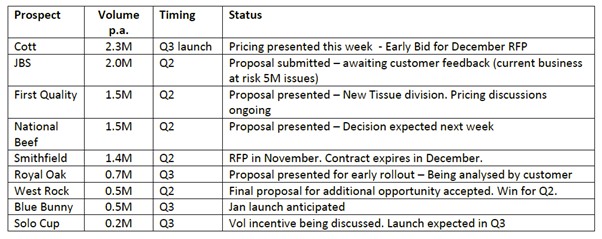
1872 I infer that the list was generated by Martin and his team. The table projected the following timelines for closing the largest of the listed sales deals:
(a) the Cott Beverages account was projected to commence pallet delivery in Q3;
(b) the JBS account was projected to be secured very soon, as pallet issues were expected to commence in Q2;
(c) the First Quality account was projected to be secured very soon, as pallet issues were expected to commence in Q2;
(d) the National Beef Packing account was projected to be secured very soon, as pallet issues were expected to commence in Q2; and
(e) the Smithfield Foods account was also projected to be secured very soon, as pallet issues were expected to commence in Q2.
1873 None of those projected timelines were correct, and I infer that they were proposed more in hope than based on a reasonable expectation.
(a) The Cott Beverages account was stated to represent 2.3 million pallet issues pa (worth, at a conservative RPI of $5.00, approximately $11.5 million in annual revenue). US Pooled announced internally that it had won the Cott Beverages contract back from PECO on 12 December 2016. Subsequently, and according to Martin contrary to its verbal and written agreements, Cott Beverages reopened negotiations, and it did not sign a contract with US Pooled until 3Q17, which by then was projected to give rise to only $1.4 million in revenue in FY17. Even then, an email from Martin dated 12 December 2016 (before negotiations reopened) estimated that it would only contribute $200,000 in Underlying Profit for the full-year.
(b) The JBS account was stated to represent two million pallet issues pa (worth, at the same conservative RPI, approximately $10 million in annual revenue). An analysis of forecast new customer wins in 2H17 prepared by Holzman (Holzman December Demand Forecast) dated 14 December 2016 showed that, two months later, US Pooled did not project that it would secure the JBS account until January 2017. And an email from Bailey Antar to Nador and Martin on 18 November 2016 shows that at that time negotiations were still ongoing, PECO was pressing hard to win the contract, and US Pooled was considering a further improved bid. The evidence shows that negotiations were still ongoing in February 2017. The evidence does not support a conclusion that, as at 20 October 2016, there existed an objectively reasonable basis for Brambles to expect that contract to be secured in the projected timeline, nor to project that revenue would begin to flow in Q2.
(c) The First Quality account was stated to represent 1.5 million pallet issues pa (worth, at the same conservative RPI, approximately $7.5 million in annual revenue). The Holzman December Demand Forecast showed that, two months later, US Pooled did not project that it would secure the account until January 2017. And an email from Bailey Antar to Rumph, Nador, Martin and others on 24 January 2017, under the subject line “Deal re-review -approval needed” (24 January Deal Re-review Email), shows that at that time US Pooled had not secured a contract with First Quality, and it was considering making a further improved bid in an attempt to do so. It was locked in a fight with PECO to hold onto that contract (and was also trying to win the First Quality “Tissue” division work back from PECO). The evidence does not show that, as at 20 October 2016, there existed an objectively reasonable basis for Brambles to expect that contract to be secured in the projected timeline, nor to project that revenue would begin to flow in Q2.
(d) The National Beef Packing account was stated to represent 1.5 million pallet issues pa (worth, at the same conservative RPI, approximately $7.5 million in annual revenue). The Holzman December Demand Forecast shows that, two months later, US Pooled did not expect to secure the account until February 2017. And the 24 January Deal Re-review Email shows that, at that time, US Pooled was still locked in a fight with PECO to win that contract. I infer from the email that National Beef was not close to making a decision at that time. It said that National Beef was tracking the “quality downtime” associated with PECO’s service, and were “reporting back to PECO allowing [PECO] time to correct”. The evidence does not show that, as at 20 October 2016, there existed an objectively reasonable basis for Brambles to expect that contract to be secured in the projected timeline, nor to project that revenue would begin to flow in Q2.
(e) The Smithfield Foods account was stated to represent 1.4 million pallet issues pa (worth, at the same conservative RPI, approximately $7 million in annual revenue). The Holzman December Demand Forecast shows that, two months later, US Pooled was not expected to secure the account until January 2017. The evidence does not show that, as at 20 October 2016, there existed an objectively reasonable basis for Brambles to expect that contract to be secured in the projected timeline, nor to project that revenue would begin to flow in Q2.
1874 Brambles argued that, although those sales were not achieved in the timeline that US Pooled thought they would be, there were reasonable grounds for their belief at the time. It said that the applicants’ attempt to rely upon those delayed sales was mere hindsight. I do not accept that. First, it was Brambles’ contention that, at the time the predicted timeline for those contracts was made, there were reasonable grounds for that belief. The evidence does not establish that. Second, I saw many of those projections as a just a continuation of the excessively optimistic approach that Martin’s team took to sales forecasting. In my view (except in relation to Cott Beverages) the subsequent events throw some light on the overall probability, as at 20 October 2016, that the listed sales were going to be achieved in time to be material to US Pooled clawing back the sales revenue shortfall in 2H17. They operate to buttress the conclusions I have reached based on other evidence: Jazabas at [83].
1875 Second, except in relation to the market uncertainty arising from the US Presidential election, which would occur in early November 2016, the evidence does not show that the forecast rephased sales in 2H17 would avoid similar delays for similar reasons as had occurred in 1H17. The evidence also shows that the increased competition from PECO was likely to continue, and in that context, it was likely that negotiations would stretch out, and that some customers would continue to use procurement agencies to assist them to get the best price from US Pooled. Those matters were likely to continue to cause delays (if they were only delays) in respect of the forecast rephased 2H17 sales. For US Pooled to meet the rephased new wins in the Revised September Reforecast, it had to achieve the missed (actual and forecast) 1H17 sales, and then not have similar delays affect the forecast 2H17 sales.
1876 Third, the projected timing of the rephased new wins in 2H17 is also material to my view that Brambles did not substantiate that the revenue from the missed 1H17 sales was likely to be achieved in 2H17, or at least not all of it. A Brambles spreadsheet titled “Walk: Budget - September Reforecast” for US Pooled, to which I have previously referred, shows that the Initial September Reforecast projected the timetabling of wins as against budget follows:
($US million) | 1Q17 | 2Q17 | 3Q17 | 4Q17 | 1H17 | 2H17 | FY17 |
Wins | (3.6) | 6.5 | 2.6 | $7.4 | 2.9 | 10 | 12.9 |
1877 Thus, the reforecast projected that 74% of the $10 million of the rephased wins in 2H17 would not be achieved until Q4 (1 April - 30 June 2017). Relatedly, the sales recovery plan which US Pooled had developed was targeted at approximately $9 million in sales across a few dozen customers, some of which Martin said would need until Q4 to work their way through the sales cycle.
1878 As Martin accepted, the later in FY17 a sales deal with a new customer closed, the greater the risk that the revenue from that deal would not flow until the following financial year. There was a substantial risk that a significant proportion of the revenue from the projected new wins in Q4 would be delayed enough that the revenue, or a substantial proportion of it, would fall outside of FY17. Notably, Todorcevski gave evidence in cross-examination that the revenue from a sale was booked as soon as the pallets were delivered to the manufacturer. Importantly, he said that the time between signature of a sales contract and revenue starting to flow depended on the size and complexity of the customer. In some cases, it would be a month. In other cases, it could be three or four months.
1879 Those matters also point to a conclusion that the rephased new wins in the Revised September Reforecast for US Pooled lacked an objectively reasonable basis.
1880 Fourth, as Brambles submitted, the August Demand Consensus Report showed that the S&OP team had achieved 99.3% accuracy in predicting the demand for US Pooled pallets in July FY17, and that accuracy had been between 98% and 99% accuracy in the preceding 12 months. And the September Demand Consensus Report showed that US Pooled sales volumes for the full-year were expected to be essentially on budget.
1881 Those matters provide support for the reasonableness of the new wins projection in the Revised September Reforecast. But Brambles’ argument relied on the August Demand Consensus Report rather than the more up-to-date October Demand Consensus Report dated 6 October 2016 which showed that in that month the S&OP team had overestimated pallet demand by 427,000 pallet issues for September FY17. It still had an accuracy of 98.1%, but September FY17 was the first time that year that US Pooled had seriously over-estimated pallet demand and that month was the fourth month in a row of very low conversion rates.
1882 Like the August and September Demand Consensus Reports, the October Demand Consensus Report continued to forecast that US Pooled would meet budget for pallet issues in FY17, but that projection does appear to have taken into account the fact that US Pooled was experiencing a four-month trend of very low sales conversion rates.
1883 Fifth, Nador testified that another reason for the under-budget sales revenue in September 2016 was that, for a specific segment of small customer accounts, US Pooled had a reduced ability to increase prices because of lower whitewood pallet prices. Rumph’s 14 October Response also said one of the factors causing the under-budget sales revenue in US Pooled was the decline in whitewood pallet prices. In cross-examination, Mackie accepted that lower whitewood pallet prices were slowing down US Pooled’s ability to convert customers from whitewood pallets to pooled pallets in some places because, at least having regard to the price differential, whitewood pallets were becoming a more attractive option.
1884 The evidence shows that, as at 20 October 2016, there was no good reason for Brambles to expect that whitewood pallet prices were likely to increase in 2H17 (and no evidence that it had that expectation). It was therefore likely that lower whitewood pallet prices would continue to affect new wins, by slowing down US Pooled’s ability to convert customers from whitewood pallets to pooled pallets (although price was not the only determinant of whitewood conversions). That is also material to my view that the rephasing of US Pooled new wins in the Revised September Reforecast lacked an objectively reasonable basis.
1885 Sixth, the thrust of the affidavit evidence of Brambles’ executives was that the projected rephased 2H17 US Pooled sales revenue through the Revised September Reforecast had reasonable grounds. However, for the reasons I have explained, I reached the conclusion that Nador’s, Martin’s and Alonso’s evidence - to the effect that following the September results they still considered the US Pooled budget to be achievable - should be given little weight.
1886 Taken together, the foregoing matters strongly support a conclusion that, as at 20 October 2016, the rephased new wins and sales revenue projected in the Revised September Reforecast lacked objectively reasonable grounds.
14.4.3.5 The significance of the US Pooled and CHEP NA recovery plans
1887 Brambles submitted that the Revised September Reforecast for US Pooled and CHEP NA had reasonable grounds because, as at 20 October 2016, results in 2H17 were expected to benefit from initiatives including the US Pooled and CHEP NA recovery plans and the Walk to MOP processes. It relied on the fact that weekly Walk to MOP meetings had been running in US Pooled from September and had begun in CHEP NA on 19 October 2016, and that it had taken a series of other recovery initiatives, as previously outlined.
1888 Rumph’s 14 October Response described the Walk to MOP process as involving the US Pooled team “reviewing our pipeline to aggressively advance deals, take additional price where possible, reduce pallet purchases with demand curve and inventory levels, improve network optimization, and reduce cost levels”. The evidence shows that the Walk to MOP process was centrally concerned with improving sales volume and revenue.
1889 I accept Todorcevski’s evidence that in previous years when there was a shortfall against budget in CHEP NA, Rumph’s Walk to MOP process was implemented and made a positive impact on the financial results, bridging the shortfall to budget. I also accept Mackie’s evidence that “[i]n years where the business was travelling slightly behind budget, initiatives implemented in the first half delivered in the second half of the year, leading to stronger results in the second half”. Mackie also said, and I accept, that during his time as President of CHEP Global, it was common for recovery plans to be implemented by those parts of the business, which were behind budget in order to claw back results. He deposed that developing a recovery plan involved “reviewing the sales pipeline to identify opportunities to increase revenue, considering opportunities to reduce costs and deferring expenditure on efficiency programs that may not generate positive financial results in the short term”.
1890 However, as at 20 October 2016, the US Pooled and CHEP NA recovery plans were neither fully developed nor fully implemented. In cross-examination, Mackie accepted that, as at 12 October 2016, the Walk to MOP process in US Pooled had not yet been implemented, and there was not yet a recovery plan in place. I am not sure that Mackie was correct in that evidence as other evidence indicates that the Walk to MOP process started in US Pooled in September, and then in CHEP NA around 19 October 2016. But I am satisfied that at this time the recovery initiatives in US Pooled were new, they had not been fully implemented, and those parts which had been implemented had not had time to have material effects (if they were going to do so).
1891 Further, the evidence shows that the US Pooled recovery plans were largely directed to a sales recovery. The situation was different in relation to direct costs overruns because, at that time, Brambles’ management still did not understand their fundamental causes and management could not address the direct costs overruns until it could understand those causes. Thus, the recovery plans were not going to rectify the direct costs overruns. That had to await Moreno’s report (if his report in fact provided the answers) and at this time it was unknown when Moreno would produce his report.
1892 It was reasonable for Mackie to expect the recovery plans in US Pooled (and later in CHEP NA) to bear some fruit over time, but Brambles’ submissions overstated the extent of the implementation of the recovery plan in this period, and the extent of the recovery that the recovery plan might reasonably be expected to generate.
1893 It is relevant too that, while it was reasonable to expect the Walk to MOP process to generate some further sales opportunities for US Pooled, the opportunities on which Brambles relied were somewhat speculative and inchoate. They were vaguely described as “Contingencies”, or “Spartan Nash to NCD”, or “Supply Chain Initiatives / Inflation”. Brambles’ submissions gave little attention to establishing that those opportunities were, in fact, likely to be achieved, or if they were achieved that the likely revenue would be material in generating the forecast recovery in FY17. It should have been relatively straightforward for Brambles to adduce more explicit evidence in relation to the likelihood of those sales opportunities being achieved in a timely way, and its evidence must be weighed in that context.
1894 It is also noteworthy that Mackie’s evidence referred to recovery initiatives being effective in achieving “stronger results in the second half” where a “business was travelling slightly behind budget” (emphasis added). It is not apt to describe US Pooled or CHEP NA as being “slightly behind budget” given the size of the budget shortfalls, and having regard to the fact that the budgets were based on some aggressive assumptions; had been stretched to near the limit of achievability; and failed to adequately take into account a significant quantum of probability-adjusted net risks in US Pooled. There was no fat in the full-year US Pooled and CHEP NA Underlying Profit budgets, which increased the difficulty for US Pooled or CHEP NA in recovering from their poor (actual and projected) 1H17 performance through substantial Underlying Profit overperformance in 2H17.
1895 Further, Brambles did not adduce evidence to establish that the circumstances when the Walk to MOP process was alleged to have been effective in earlier years were essentially similar to those existing in US Pooled and CHEP NA in this period. Nor did Brambles take the Court to evidence to show the extent of the second half recovery in CHEP NA in those earlier years. Mackie testified that rephasing of a similar magnitude had occurred in previous financial years but his evidence did not go beyond that assertion, and Brambles adduced no evidence to substantiate that. Again, Mackie’s evidence regarding the likely efficacy of the Walk to MOP process in allowing US Pooled to recover to alignment with its full-year Underlying Profit budget must be weighed in the context that it was within Brambles’ power to adduce evidence of that nature and it did not do so.
1896 I consider that, as at 20 October 2016, the development and implementation of the Walk to MOP process and other recovery initiatives does not show that Brambles had objectively reasonable grounds to forecast that US Pooled and CHEP NA would meet their full-year Underlying Profit budgets by the end of FY17. In my view that was more a hope than an objectively reasonable basis upon which to forecast.
14.4.3.6 The no major customer loss assumption in the reforecast
1897 The Revised September Reforecast maintained the budget assumption that US Pooled would have a low level of customer losses, and would lose no major customers in FY17. I have found that the no major customer loss assumption lacked objectively reasonable grounds when it was made. That continued to be the case as at 20 October 2016.
1898 The evidence shows the following matters leading up to the approval of the US Pooled budget:
(a) US Pooled had faced heightened competitive pressure from PECO in the second half of FY16, and PECO had aggressively pursued major customers, including Kraft-Heinz, Kellogg’s, Niagara, Mondelez, Dannon and Mars;
(b) US Pooled attempted to retain customers by offering “strategic price investments” on a case-by-case basis which involved reducing pricing terms to retain volume;
(c) in March 2016, US Pooled lost the Kraft-Heinz account, a ‘major customer’, to PECO (worth $9.4 million pa);
(d) in April 2016, Rumph’s Headlines Memo expressly called out a “key risk” to the US Pooled budget that it assumed no loss of a ‘major customer’, including because the loss of the Mars accounts seemed imminent;
(e) Martin testified that in the period April to June 2016, Brambles was under competitive threat from PECO and that in June / July 2016, he was aware of “steady” and “targeted price aggressiveness from PECO”; and
(f) in June 2016 US Pooled lost the Candy portion of the Mars account to PECO (worth approximately $200,000 pa).
1899 Nador testified that in August FY17 “PECO was expanding its footprint and was pursuing customers aggressively” and “the competitive dynamic in the marketplace was getting harder”. The 14 October Overview showed that US Pooled was competing with PECO for a number of large customers including Cott Beverages, JBS, First Quality and National Beef. The JBS Summary in November FY17 recorded that US Pooled had seen “steady and targeted price aggressiveness from P[ECO]” in the 12 months up to that date.
1900 The slide presentation Martin emailed Nador on 8 October 2016 stated that the under-budget US Pooled sales revenue YTD was partly a result of the loss of two large customers worth approximately $16 million pa; the Scotts contract in July FY17 (worth approximately $12 million pa) and a Nestlé contract to iGPS in September FY17 (worth approximately $4.2 million pa). The evidence as to what constituted a ‘major customer’ within US Pooled is not clear, but it seemed to be accepted that Scotts was a ‘major customer’
1901 The November Demand Consensus Report was slightly inconsistent with Martin’s slide presentation in that it recorded a “Nestle Danville” contract lost in September FY17 at a substantially lower dollar value, but not in a way that is ultimately significant. It showed that up to the end of October FY17, US Pooled had lost six customer accounts, including at least one ‘major customer’, which were worth 3.45 million pallet issues pa, which at a conservative RPI of $5.00 represented approximately $17 million in foregone annualised sales revenue for US Pooled in FY17 (while noting that Scotts transitioned most of its business to US Recycled, albeit at a lower profit rate for CHEP NA).
1902 Having regard to the fact that US Pooled lost two large customers in the six months leading up to FY17 including at least one ‘major customer’; in the first four months of FY17 it lost six customers including at least one ‘major customer’ (worth annualised sales revenue in the order of approximately $17 million); and it was at risk of losing more large and major customers due to the aggressive competition from PECO, it is plain that, as at 20 October 2016, the no major customer loss assumption in the Revised September Reforecast continued to lack objectively reasonable grounds.
14.4.3.7 Whether abnormal business dynamics were at play in 1H17 in US Pooled and CHEP NA
1903 Brambles further submitted that the Revised September Reforecast for US Pooled and CHEP NA had reasonable grounds on the basis that the poor results in those businesses were the result of abnormal business dynamics in US Pooled and CHEP NA in 1H17. It, however, provided only the following examples of “abnormal business dynamics”:
(a) Todorcevski deposed that several potential customer sales expected to close in 1Q FY17 were impacted by delays, slipping into 2Q17 and 3Q17, with the volume of new wins expected to recover over the balance of the year; and
(b) Martin deposed that:
(i) in this period customers were postponing pallet leasing decisions because of general market uncertainty given the US Presidential election that was to occur in early November 2016. He said that he thought this market uncertainty was a cause of the delays he had seen in customers making decisions about whether to enter into contracts with US Pooled; and
(ii) he thought the current shortfall to the US Pooled sales revenue budget was largely attributable to timing issues and to abnormal business dynamics such as pricing being affected by P-day trends in individual months that did not align with historical experience or expectations.
Brambles’ submissions also footnoted the affidavits of Mackie and O’Sullivan but the passages to which they referred related to the December Reforecast rather than the Revised September Reforecast.
1904 I found little force in Brambles’ contention that the existence of “abnormal business dynamics” in 1H17 established that the rephased US Pooled sales revenue and Underlying Profit in US Pooled and CHEP NA had reasonable grounds.
(a) First, Todorcevski’s evidence was a conclusion rather than evidence of abnormal business dynamics.
(b) Second, I accept that there was market uncertainty arising from the US Presidential election, but that is by no means abnormal or unforeseeable in a US Presidential election year. The fact that Donald Trump had secured the Republican presidential nomination was known when the US Pooled and CHEP NA budgets were approved, and it should have been factored into the budget.
(c) Third, the fact that pallet pricing is affected by P-day trends in individual months was known to Brambles when the US Pooled budget was approved, and apart from what Martin said, there is little to show that this represented an abnormal business dynamic.
(d) Fourth, the evidence shows that the September sales revenue shortfall to budget and reforecast in US Pooled was largely driven by the ‘go-get’ or unidentified wins which US Pooled had forecast, but which did not materialise. The risk that US Pooled would be unable to meet the aggressive budget for unidentified wins in FY17 was not an abnormal business dynamic. That risk was identified when the budget was set.
(e) Fifth, another factor in the US Pooled shortfall to budget in sales revenue was the decline in whitewood pallet prices. That was not an abnormal business dynamic. The fact that whitewood pallet prices were likely to be lower in FY17, which was likely to slow down conversions from whitewood pallets to pooled pallets, was noted when the US Pooled budget was made.
1905 On my view of the evidence, it was the aggressiveness of the US Pooled sales growth assumptions that had begun to come home to roost in the Q1 sales revenue results, not purported abnormal business dynamics. Having said that, I accept that the monthly conversion rates in the four months from June FY16 through September FY17 were unusually low, and that can reasonably be described as an abnormal business dynamic. Brambles’ case, however, seemed to be that the conversion rate was not unusually low. And to the extent that Brambles might wish to rely upon the unusually low conversion rate from June FY16 through September FY17 that provides little assistance for its argument because the evidence does not establish a reasonable basis for projecting that those low conversion rates would not continue to similarly afflict forecast sales in 2Q17 and 2H17.
14.4.3.8 The “bottom-up build” of the Initial and Revised September Reforecasts
1906 Brambles submitted that the “bottom-up build” of the Initial and Revised September Reforecasts promoted forecasts that were reasonable and achievable.
1907 I do not accept this contention.
1908 I accept that the Initial September Reforecast was based on submissions made by US Pooled and CHEP NA management, but in my view it is inapt to describe it as genuinely ‘bottom-up’. When push came to shove, higher level management called the shots, and the evidence tends to show that, following the under-budget performance by US Pooled and CHEP NA in July and August FY17, Mackie and Kennett expected an Initial September Reforecast submission that projected a return to alignment with budget. It is noteworthy that the completed template used for the preparation of the US Pooled Initial September Reforecast shows that it was assumed that the expected under-budget performance in those businesses would be entirely compensated for by over-budget performance in 2H17.
1909 The evidence also shows that the Initial September Reforecast submission for US Pooled was stretched to ensure that it projected a recovery of the sales revenue shortfall to budget. That can be seen in the email exchange between Bachtell and Martin on 27 to 29 September 2016 when they were developing the US Pooled sales budget for the Initial September Reforecast submission. Bachtell told Martin if he had used what the sales representatives in the US Pooled sales team gave him for guidance in preparing the Initial September Reforecast Submission, the submission would have been approximately $30 million under-budget. He said:
Obviously I’m not going to send you a roll-up that doesn’t even have us getting to the Brambles budget, so I’ve added in where I felt it was appropriate to each sector to at least get us back to the Brambles budget
1910 Martin effectively instructed Bachtell to prepare an Initial September Reforecast submission with enough sales revenue “to get us ~$10M over budget”. Bachtell reworked the US Pooled sales revenue budget numbers in accordance with Martin’s direction and got it to almost $10 million over-budget which he described in the email as a “stretch[ed] budget”.
1911 The conclusion that the Initial September Reforecast submissions by other CHEP CBUs were not built from the bottom-up also finds support in the email exchange between Kennett, Alonso and Scaiff on 5 October 2016. There, Kennett manipulated the sales revenue figures in CHEP LATAM and CHEP Europe by forecasting $6 million more sales revenue into those businesses in 1H17 (resulting in $3 million more Underlying Profit in CHEP Global in 1H17) and then reversing that forecast in 2H17, which improved the optics (but not the substance) of the 1H17 reforecast for CHEP Global. It should be noted that in the Revised September Reforecast, this stretch and subsequent reversal was only projected to occur in CHEP Europe.
1912 Further, what transpired in relation to the October Cash Flow Stretch in early October 2016 is completely contrary to the evidence of Brambles’ executives, and Brambles’ submissions, that in FY17 the budgets and forecasts for US Pooled, CHEP NA and/or CHEP Global were the result of a bottom-up process, which was subject to challenge or testing from above, but was not dictated from above.
1913 As earlier explained, the evidence shows that the Revised September Reforecast in relation to US Pooled was not built from the bottom-up at all. It was plainly driven by Kennett and essentially unilateral.
1914 In any event, the question as to whether Brambles had reasonable grounds for the Revised September Reforecast “is ultimately one of substance, not merely process”, and as “a matter of substance, a statement made as a result of a reasonable process, may be one made without reasonable grounds”: Iluka at [669]-[670].
14.4.3.9 The role of CHEP Global management
1915 Brambles submitted that the Initial and then the Revised September Reforecast had reasonable grounds because of the role that CHEP Global management played in reviewing the CBU submissions and interrogating the reasons for early underperformance to budget in US Pooled and CHEP NA.
1916 I accept that CHEP Global management maintained oversight over the development of the Initial and Revised September Reforecasts for US Pooled and CHEP NA. In relation to the Initial September Reforecast, that can be seen, for example, in the questions Scaiff posed to Lallatin and Linderman in his 30 September 2016 email, and in the process for approving the Initial September Reforecast after a speed date. In relation to the Revised September Reforecast, Kennett was its main driver.
1917 But there is no force in this submission. On my view of the evidence, the participation of Kennett and Mackie in the Initial and Revised September Reforecasts for US Pooled and CHEP NA was centrally aimed at ensuring that those businesses forecast a return to alignment with budget. Their role does not assist Brambles’ contention that the reforecasts had objectively reasonable grounds.
14.4.3.10 Pallet Pricing
1918 Brambles made several submissions in a pre-emptive defence of the RPI pricing assumptions in the Revised September Reforecast. The applicants, however, said little in closing submissions that was directed to impugning the pricing assumptions in the Revised September Reforecast. They only said, and I accept, that US Pooled was facing significant price competition from PECO in this period. It is clear on the evidence that that reduced the price that US Pooled could achieve on a number of deals with large customers, but the evidence does not establish that that had a substantial effect on overall RPI.
1919 The Revised September Reforecast did not make any material changes to the RPI assumptions in the US Pooled budget. The US Pooled September monthly results showed only minor price underperformance against budget YTD. In September, only $(0.2) million of the $(5.5) million miss to budget in sales revenue (approximately 3.6%) was driven by under-budget performance on price. And only $(1.2) million of the $(8.6) million sales revenue miss to budget YTD (approximately 14%) was driven by under-budget performance on price.
1920 I accept that the rephased sales revenue projections in the Revised September Reforecast for US Pooled had objectively reasonable grounds in relation to pallet pricing, because:
(a) by 20 October 2016, US Pooled had realised an average RPI which was only 1.15% worse than the FY17 budget;
(b) US Pooled RPI results for 1Q17 were impacted by the One-Off Phasing Issue which front-loaded some of the RPI stretch to the beginning of the financial year;
(c) US Pooled had a number of pricing levers available to increase price through FY17 including bringing forward ‘baked-in’ annual price increases for SME accounts and increasing price mid-contract with several large customers; and
(d) while there was some price pressure at the time of the Revised September Reforecast, US Pooled was not focussing on volume retention at the expense of price.
14.4.3.11 Direct costs
1921 The applicants submitted that it was not reasonable for Brambles to forecast that its performance would improve in 2H17 because direct costs in US Pooled had risen from July to October 2016. Brambles made several submissions in support of the reasonableness of the projected recovery and outperformance in direct costs in the Revised September Reforecast for US Pooled and CHEP NA. It categorised the direct costs overruns into “Plant operations costs” and “Damage rate” and “Control ratio costs”. I will follow the same categories, but it should be kept in mind that each is just a category of direct cost.
Plant operations costs
1922 In respect of plant operations costs, Brambles made the following submissions.
(a) Some of the direct costs were driven by one-off items which could be expected to abate in the balance of the year.
(b) Direct costs in US Pooled were not considered material in the context of the Group as a whole.
(c) US Pooled and CHEP NA management had identified and were continuing to identify plans to address the direct costs overruns. Brambles submitted that the identified plans to address direct costs included:
(i) incremental costs of $(4.3) million driven by the higher control ratio were expected to be recouped over the course of the year in line with seasonal trends; and
(ii) a number of initiatives had been identified to reduce the projected CHEP NA supply chain costs miss to budget to around $(5) million, including through a $10 million cost recovery through damage rate reduction driven by the Durability Program, $14.2 million of plant operations initiatives and $4.5 million of logistics initiatives.
1923 Brambles rejected the applicants’ contention that, by 20 October 2016, Gorman and Todorcevski had been informed that US Pooled was $4 million above-budget in direct costs including “because of a clear issue in repair volumes”. For that contention, the applicants relied upon the email from Mackie to Gorman and Todorcevski on 12 October 2016 (copied to Kennett and Scaiff). I have previously set out the relevant parts of that email in relation to direct costs, and I will not do so again. Brambles also relied upon the fact that in this period Alonso was conducting a deep dive into direct costs in US Pooled.
1924 I found little force in Brambles’ submissions in relation to this category of direct costs.
1925 First, I do not accept Brambles’ submissions that the direct costs overruns in US Pooled were not material in the context of the Group as a whole, were readily addressable, or could be readily offset by overperformance in other CBUs.
1926 As at 20 October 2016, US Pooled had suffered a three-month trend of direct costs overruns, with September being the worst month. Notwithstanding that the direct costs overruns in July and August FY17 were modest in the context of a business Brambles’ size, the evidence shows that Gorman and Todorcevski had both a high-level of concern about them, and Brambles’ inability to get to the bottom of the reason for them. Their concern can be seen in:
(a) Todorcevski’s 12 September 2016 request to Alonso to undertake a deep dive into the causes of the deterioration in direct costs against budget;
(b) Gorman’s 15 September 2016 email to Alonso in which he said that some of the causes of direct costs overruns listed by Alonso “appear to have full-year implications”, and that he wanted “to make sure we hand the business to Chipchase in February in a position to deliver the FY17 Budget”; and
(c) Gorman’s and Todorcevski’s pronounced concerns that Mackie was not giving sufficient attention to or properly addressing the budget misses in US Pooled, including the direct costs overruns.
1927 Those management concerns were then elevated by more significant direct costs overruns in September FY17. In September, overall direct costs were $(4.2) million above-budget, and $(6.8) million above-budget YTD. They were also materially worse than as projected in the Initial September Reforecast which had been finalised only a short time earlier.
1928 Brambles’ proposition that the direct costs overruns in US Pooled were not material to the Group does not withstand scrutiny. It can be accepted that, viewed in isolation, $(6.8) million in additional costs is not material in a business budgeted to make Underlying Profit of $1,063 million. But the materiality of the direct costs overruns must be seen in context:
(a) at that time, the $(6.8) million over-budget direct costs made up approximately 49% of the $(13.7) million US Pooled Underlying Profit shortfall to budget YTD, which was itself the main driver of the $(13) million shortfall to budget in CHEP Global YTD. And that was in turn the main driver of the $(8) million Underlying Profit shortfall for the Group YTD; and
(b) further, as I later explain, the question of the materiality of the direct costs overruns must be viewed in the context that the FY17 Guidance as it related to Underlying Profit growth left Brambles little room for underperformance. Putting aside the $10 million contingency, Group Underlying Profit only needed to be a little more than $(8) million below the Group budget before it would fall below the bottom of the FY17 Guidance range. In that context, direct costs overruns of $(6.8) million were potentially quite material.
1929 And contrary to the thrust of Brambles’ submissions on this issue, at that time, both Gorman and Todorcevski recognised the potential significance of the direct costs overruns to Group Underlying Profit:
(a) on 15 September 2016, before the bad September direct costs results were received, Gorman responded to Alonso’s high-level summary of their causes and said that there were “a number of developments that appear to have full-year implications”. He said that he wanted to “focus on the risks and opportunities to the full-year commitments” and then said, somewhat presciently “I want to make sure we hand the business to Chipchase in February in a position to deliver the FY17 Budget”; and
(b) Todorcevski’s email to Gorman on 7 October 2016 said that the US Pooled results were “as poor an outcome in a month” as he had seen. He said that the poor sales were “only part of the story and costs continue to worsen and fast” and expressed concern about the fact that he and Gorman were not given a “heads up on something so material”. In an email to Kennett the same day Todorcevski said that the results suggested that “we have NFI what’s happening” (meaning “no fucking idea”), as shown by the fact that no “heads up” was given on “one of the worst results we have ever seen”.
1930 Management’s concerns about the persistent direct costs blowouts were also elevated by the fact that they still did not know what was causing them. I have previously set out the evidence in relation to that, and I will not reiterate it.
1931 The fact that the direct costs overruns commenced in July FY17 and were still bedevilling US Pooled in September FY17 despite attempts to understand their causes and address them shows that they were not as readily addressable as Brambles argued. CHEP Global FP&A had undertaken an investigation into the overruns at Todorcevski’s request, and Alonso had conducted a ‘deep dive’ into them at Gorman’s request, and the weekly US Pooled Walk to MOP meetings had been trying to understand and mitigate them since September. Those investigations had not resulted in management coming to understand the causes of the overruns. That was why Moreno was appointed on 12 October 2016. Moreno’s appointment itself indicated the intractability of the problem at that stage. Kennett testified that Todorcevski’s decision to appoint Moreno reflected the seriousness of the situation. Brambles could only understand the causes of the direct costs overruns when Moreno provided his report, and as at 20 October 2016 there was no finalised timeline for that. As it eventuated, he did not provide his report to Brambles until 22 November 2016.
1932 Those matters point strongly away from a conclusion that, at the time, Brambles management thought that the direct costs overruns were easily addressable, were not material to the Group, or could be readily offset by overperformance in other CBUs.
1933 Second, Brambles’ submission that some of the direct costs overruns were one-time items had little force. That contention appears to be based on the following passage from the 14 October Overview, which said:
Through Q1, Supply Chain costs are $6M higher than budget (2.4% worse). The primary drivers are repair volume, operational rates, handling, fuel and A-relocations which can be seen in more detail below. Within the quarter, there were many one-time items (rebuilding inventory shortfalls as an example), but they are partially offset by the flinched nail payment and freight cost cleanups.
(Emphasis added.)
1934 However, a table in the 14 October Overview identified the key drivers of the direct costs overruns, as follows:

Those descriptions indicated that they were all ongoing matters rather than one-off items.
1935 Further, Brambles did not adduce any evidence to establish the relative impact that the (asserted) one-off items contributed to the direct costs overruns compared to the ongoing matters. It would have been straightforward for it to do so, and its submissions on this issue must be considered in that context.
1936 Finally, the overwhelming weight of the evidence in relation to this point in time is that US Pooled and CHEP NA management (and Alonso) did not know the causes of the direct costs overruns, and I am not persuaded that management knew whether one-off items were significant to the overruns or not.
1937 Third, there is no force whatsoever in Brambles’ submission that, as at 20 October 2016, Brambles management had identified plans that provided a reasonable basis to project that:
(a) US Pooled could recoup incremental costs of $(4.3) million driven by the higher control ratio; and
(b) a number of initiatives had been identified to reduce the projected supply chain costs miss to budget to around $5 million including through $10 million in damage rate reduction driven by the Durability Program, $14.2 million of plant operations initiatives, and $4.5 million of logistics initiatives.
That submission repeated, almost word for word, some of the matters Moreno identified in his report, which he did not provide to Brambles until 22 November 2016. I was taken to nothing in the evidence to show that those plans had been identified as at 20 October 2016.
1938 As at 20 October 2016, there were not reasonable grounds for the Revised September Reforecast to project that US Pooled would be able to recover from its actual and projected Underlying Profit deficit to budget so as to meet budget for the year when the evidence shows that that time:
(a) the direct costs overruns were having a substantial effect on US Pooled Underlying Profit, making up around 49.6% of the $(13.7) million Underlying Profit shortfall to budget YTD;
(b) Brambles did not understand the causes of the direct costs overruns. Mackie accepted that at this time, management had not been able to get to the bottom of the causes of the direct costs overruns;
(c) Kennett and Mackie accepted in cross-examination that Brambles could not address the direct costs overruns until it understood their causes; and
(d) Kennett accepted in cross-examination that the Underlying Profit projections in the Revised September Reforecast in respect of US Pooled ignored the fact that management did not understand the causes of the continuing direct costs overruns and could not address them until they did.
How could the Revised September Reforecast have reasonable grounds to project that US Pooled would be able to recover to alignment with its Underlying Profit budget for the year, when Brambles did not know what the causes of the direct costs overruns were, nor whether they were rectifiable, and if they were rectifiable, by when? Management did not know whether, or to what extent, or when, the direct costs overruns were likely to cease to materially reduce US Pooled Underlying Profit.
The damage rate assumption
1939 The Revised September Reforecast maintained the assumption in the budget that US Pooled would achieve a two pp reduction in the average damage rate down to an average of 59.3% by the end of FY17. The costs associated with pallet damage were an important component of US Pooled’s direct costs. And the projected costs savings for US Pooled through the assumed reduced pallet damage (through the Durability Program) was the single largest direct costs saving initiative in the US Pooled budget.
1940 The applicants submitted that although the US Pooled damage rate had improved in 1Q17, the improvements were not significant enough to justify maintaining the damage rate assumption. Brambles argued that the improvements in the US Pooled damage rate in 1Q17 showed that the damage rate assumption in the Revised September Reforecast had objectively reasonable grounds.
1941 Brambles contended that, as at 20 October 2016, the damage rate assumption had reasonable grounds. It relied upon a chart prepared by Mr Lee, drawn from Brambles’ data (as reproduced below). Brambles also sought to rely on Mr Lee’s concession, in cross-examination, that the trend in the actual damage rate from July to September supported the reasonableness of the damage rate assumption in the Revised September Reforecast. I am prepared to rely on Mr Lee’s chart as it is common ground between the parties that the chart is accurate. But for the reasons previously explained, I am not prepared to put any weight on Mr Lee’s opinions and I give no weight to his concession.
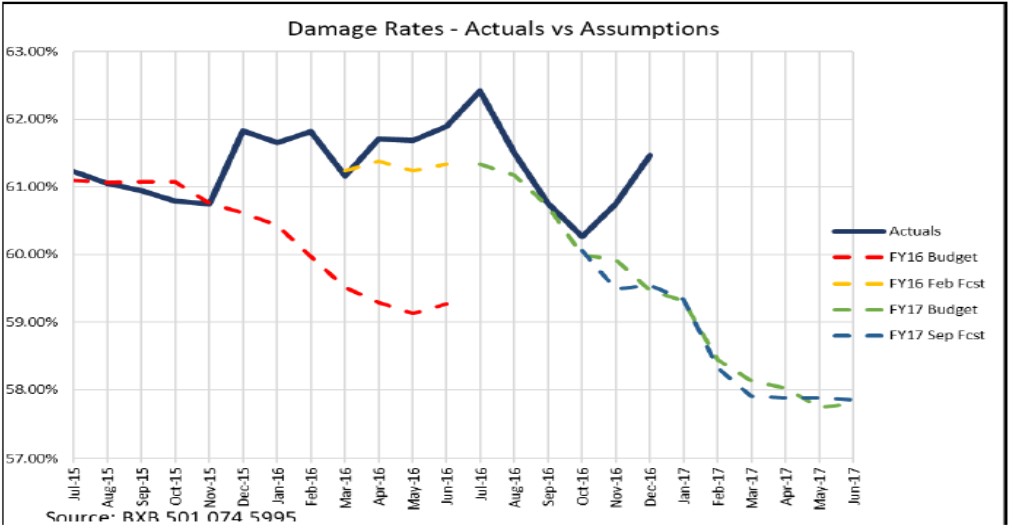
It should be noted that the chart includes data points for the actual damage rate as at November and December FY17, which could not have been known to Brambles as at 20 October 2016.
1942 Brambles submitted, and I accept, that Mr Lee’s chart shows a significant downward trend in the monthly damage rate between July and September FY17. Brambles also relied on other positive metrics in relation to the damage rate. It said, and I accept that:
(a) the Service Centre damage rate for September FY17 was below-budget, and this drove an overall network damage rate of 60.7% for September which was on budget and 0.8% lower than the prior months; and
(b) CHEP NA was 3.7% ahead of budget on CPR by early September 2016, which operated to offset the costs arising from the damage rate to an extent.
1943 Brambles contended that the declining damage rate indicated that, as at 20 October 2016, the Durability Program was starting to work. It relied on an email sent by Young to Alonso and others on 8 November 2016, following his receipt of the October FY17 results. Young said:
While we still came up short for the month vs. budget we have now experienced 4 consecutive months of a declining [Damage Rate] for the first time since we started the Better Every Day program. Keep in mind that this is also being accomplished at the same time Walmart B/C mix is hitting historical highs. This is good progress and I appreciate the effort from you and your teams in making sure we are capturing the durability benefits through the proper process controls.
The damage rate still represents the biggest risk we have for FY17, and we have a hill to climb, but we are seeing positive signs in [Damage Rate] and CPR.
(Emphasis added.)
1944 Brambles also relied on Alonso’s evidence in cross-examination that he had been undertaking deep dives in relation to the damage rate since July 2016, and that what he saw in October was an improving trend in the damage rate. He thought that the reversal of the damage rate trend (that it was declining rather than continuing to go up) was a positive thing (and it plainly was). Alonso accepted that in October 2016 he did not have a basis for thinking that the damage rate for Walmart would improve (representing approximately 20% of volume, as distinct from the Service Centre damage rate, which represented 65% of volume), but he rejected the proposition that he should have worked out that the damage rate at Walmart and Non-Walmart TPMs would more than offset all the benefits from the good progress in damage rate reduction at the Service Centres. He said that he took his decisions based upon the data Brambles had available at that time, and that data showed that the network damage rate was almost on track with budget.
1945 I do not accept the thrust of Brambles’ contentions.
1946 First, as previously noted, Alonso was the head of CHEP Global supply chain, the person responsible for the supply chain budget, and the person who introduced and was responsible for the Durability Program. He assessed, as at 20 September 2016 and as at 4 October 2016, that there was a 75% likelihood that the damage rate would not decline further. That was an assessment by Brambles’ internal expert that US Pooled would not achieve the assumed two pp reduction in the average damage rate by the end of FY17, as projected in the Revised September Reforecast. In my view, it amounted to an assessment that there was only a 25% chance that the approximately $11 million in forecast direct costs savings from the assumed damage rate reduction would in fact eventuate.
1947 Alonso also testified that in his opinion the risk should have been ‘baked’ or integrated into the Revised September Reforecast rather than the reforecast just noting the risk and excluding it from the forecast. However, contrary to Alonso’s view, the Revised September Reforecast identified the risk that US Pooled would not achieve the forecast damage rate with (only) 50% probability and it excluded that risk from the reforecast rather than ‘baking’ it in. The reforecast quantified the potential impact of the risk on Underlying Profit (if it eventuated) at $(2.5) million in 1H17 and $(9.5) million in 2H17.
1948 Nador testified that that approach was taken because when she looked at the trend in the actual damage rate for 1H17 she considered that the damage rate risk in 2H17 was low. She said that, based on the evolution of the actual damage rate, US Pooled management did not consider the risk was “sufficient enough” to include it in the budget. She described that as a “conservative” approach when, for the reasons I have previously explained in section 12.13 it was far from that. In my view, Alonso was correct in assessing that there was a 75% likelihood that US Pooled would not achieve the assumed two pp reduction in the average damage rate by the end of FY17, and that that should have been integrated into the Revised September Reforecast.
1949 Second, another significant problem with the approach that Brambles took to the damage rate risk in the Revised September Reforecast was that the damage rate risk in the reforecast was wrongly based on a projected steady rate of decline in the damage rate. The projected steady decline can be seen in Mr Lee’s chart (reproduced above).
1950 However, it was usually the case that in November, December and January the US Pooled damage rate went up due to high pallet demand in the Thanksgiving and Christmas period, and then a higher level of returns, including of damaged pallets. Alonso testified that that had been the case in each of FY14, FY15 and FY16. A subsequent presentation (15 December PPR Supplemental Presentation) Young emailed to Kennett and Rumph, into which Alonso was copied, explicitly noted that the seasonality in the damage rate was not ‘baked’ into the budget or the Revised September Reforecast. So much was accepted by Alonso in cross-examination. It is evident that Brambles should have integrated that seasonality into the Revised September Reforecast but it did not.
1951 Thus, while the damage rate had declined from July to September FY17, it was likely that it would go up from November to January FY17. As shown in Mr Lee’s chart (reproduced above), that is exactly what happened.
1952 Third, Brambles’ submissions overstated the significance of Young’s 8 November 2016 email. Young correctly noted that the declining monthly damage rate showed “good progress”, but he did not say that he expected that to continue and go substantially further (which was necessary if US Pooled was to achieve a two pp reduction in the average damage rate for the year). Achieving that would require close to a four-pp reduction by the end of FY17. Rather, after correctly noting the good progress Young said, “the damage rate still represents the biggest risk we have for FY17, and we have a hill to climb”.
1953 Fourth, other contemporaneous documents, which unlike Young’s email predate 20 October 2016, tell a somewhat different story:
(a) The 4 October Damage Rate Report set out the damage rate for the fourth week of September FY17 and YTD. Alonso reviewed a damage rate report dated that day and he emailed Stubbs and Young and said that he could not determine whether the damage rate improvements in that report might be accounted for by improved pallet durability, or instead by an improvement in the accuracy with which CHEP was able to sort incoming pallets. He wrote that it looked like US Pooled was improving its “sort accuracy” rather than getting real benefits from the Durability Program.
(b) The 4 October Damage Rate Report set out the damage rate YTD and it recorded that, while the damage rate in ETPMs was on budget and in Service Centres only 0.4 of a pp over-budget, the damage rates for Non-Walmart TPMs and Walmart TPMs YTD were significantly over-budget. The damage rate in Walmart TPMs was 87.0% (approximately 3.6 pps over-budget) and in Non-Walmart TPMs 55.4% (approximately 4.6 pps over-budget). At the end of 1Q17 the network damage rate was at 61.5% and 0.8 of a pp above-budget YTD. The monthly damage rates for Walmart TPMs over 1Q17 had been at historic highs.
(c) The CHEP NA September PPR presentation dated 11 October 2016 recorded the YTD US Pooled damage rate as 64.4%, being 4.1 pps adverse to the budget and reforecast damage rate of 60.3%. It also noted a “sharp increase” in the FY17 damage rate YTD for pallets transferred to Walmart. It said that higher reuse was driving the damage rate up.
(d) The US Pooled September Monthly Close Report dated 12 October 2016 recorded the damage rate in September for Walmart TPMs as 84.9%, which was 1.5 pps higher than projected in the budget and Initial September Reforecast.
Viewed together those records point strongly away from concluding that, as at 20 October 2016, there were objectively reasonable grounds for the Revised September Reforecast to assume a two pp reduction in the US Pooled average damage rate by the end of FY17.
1954 Fifth, the evidence shows that in this period, Walmart represented around 20% of US Pooled pallet volume and the monthly damage rates for Walmart TPMs were at historical highs. No quick fix was possible for the very high damage rate in Walmart TPMs, and its damage rate was significant to the network damage rate. In an email to Gorman and Todorcevski on 12 October 2016 Mackie updated them on the progress of discussions with Walmart aimed at improving cycle time and lowering the rate of pallet reuse. He said: “In reality a full US recovery based on this requires a change at Walmart”. He deposed that the “change at Walmart” he was referring to was a long-term strategy aimed at improving the relationship between Brambles and Walmart.
1955 As at 20 October 2016, the Underlying Profit projections for US Pooled in the Revised September Reforecast did not have objectively reasonable grounds because it:
(a) failed to adequately take into account the assessment of Brambles’ internal expert that there was a 75% likelihood that US Pooled would not achieve the assumed two pp reduction in the average damage rate, and that likelihood should have been integrated into the reforecast rather than just noted at a 50% probability and otherwise excluded from it; and
(b) failed to take into account that the reforecast was based on an assumption of a steady decline in the damage rate when, as had been the case in each of FY14, FY15 and FY16, the damage rate usually went up in November, December and January.
Those matters meant that there was a 75% likelihood that the projected approximately $11 million in savings from the assumed damage rate reduction would not eventuate. That was significant to the reasonableness of the reforecast as it meant that the single largest risk to US Pooled full-year Underlying Profit was not adequately taken into account.
Control ratio costs
1956 At the time of the Initial September Reforecast, US Pooled adjusted its control ratio assumption from 96.3% to 96.4%. A higher control ratio reflects more pallets being returned to Brambles and is a driver of higher supply chain costs. In opening submissions, the applicants submitted that the modest increase in the control ratio was unreasonable in light of higher than anticipated pallet inflows in the first quarter. That is, they contended that the increase to the control ratio should have been greater.
1957 Brambles contended that the increase in the control ratio through the Initial September Reforecast was modest, and not material to the existence of reasonable grounds for the Revised September Reforecast as at 20 October 2016, for the following reasons:
(a) from July to September FY17, the US Pooled control ratio was:
(i) broadly in line with budget in July FY17;
(ii) only 1.4% above-budget in August FY17; and
(iii) had fallen back to 0.9% above-budget in September FY17;
(b) two months of marginally higher control ratios in August and September FY17 were insufficient to materially change the control ratio assumptions in the US Pooled budget in circumstances where other data points, including the budgeted growth expectations and prior years control ratio data, supported the initial control ratio assumption in the budget; and
(c) actual demand for pallet issues and growth forecasts supported the assumed control ratio since the Revised September Reforecast for US Pooled projected pallet demand in the balance of the year ultimately in line with the FY17 budget.
1958 I broadly accept Brambles’ contentions. There is evidence which postdates 20 October 2016 showing that in November the control ratio YTD was substantially higher than budgeted, which drove substantial additional supply chain costs. But the applicants did not establish that the modest increase to the control ratio which Brambles made lacked objectively reasonable grounds as at 20 October 2016.
14.4.3.12 Conclusion - US Pooled and CHEP NA
1959 Having regard to the matters discussed above, I am satisfied that, as at 20 October 2016, it was more likely than not that US Pooled would materially fail to achieve the sales revenue and Underlying Profit projections in the Revised September Reforecast by the end of FY17, and that it would materially miss its Underlying Profit budget for FY17.
1960 In my view that materially lower US Pooled sales revenue and Underlying Profit was likely to translate, reasonably closely, into materially lower sales revenue and Underlying Profit in CHEP NA. US Pooled was by far CHEP NA’s largest business unit and in FY17 it was budgeted to account for 67% of CHEP NA sales revenue and 79% of CHEP NA Underlying Profit. Further, the Revised September Reforecast in fact projected that the sales revenue and Underlying Profit results for US Pooled in FY17 would be highly significant to the results in CHEP NA. Specifically:
(a) in relation to sales revenue, the reforecast did not project that sales revenue overperformance against budget by CHEP NA’s other businesses in 2H17 would offset any failure by US Pooled to achieve the reforecast sales revenue projections or to meet its sales revenue budget in that period. Thus, the likely materially lower US Pooled sales revenue result was likely to materially worsen the projected CHEP NA sales revenue deficit of $(24) million to budget for the full-year; and
(b) in relation to Underlying Profit, the reforecast projected that a remarkable $14.3 million Underlying Profit overperformance against budget by US Pooled in 2H17 would be the main driver of an equally remarkable $17.5 million Underlying Profit overperformance against budget by CHEP NA in that period, and as a result, CHEP NA would recover to meet budget for the year. Thus, the likely materially lower US Pooled Underlying Profit result was likely to materially worsen the projected CHEP NA Underlying Profit for the year, and it was likely to miss its Underlying Profit budget for the full-year by a material amount.
1961 Those projections were the path by which the reforecast projected that US Pooled and CHEP NA would recover so as to meet their Underlying Profit budgets by the end of FY17, and as at 20 October 2016, it was more likely than not that US Pooled and CHEP NA would materially fail to achieve them.
1962 I conclude that, as at 20 October 2016, there were not reasonable grounds for the Revised September Reforecast to make the sales revenue and Underlying Profit projections that it did in respect of US Pooled and CHEP NA, including by projecting that those businesses would recover from their projected 1H17 deficits to budget and achieve their Underlying Profit budgets by the end of FY17.
1963 The conclusion that, as at 20 October 2016, the projections in the Revised September Reforecast for US Pooled and CHEP NA lacked reasonable grounds informs my later conclusions regarding whether there were reasonable grounds for the projections in the Preliminary Group September Reforecast in respect of CHEP Global and the Group, and whether the reforecast provided reasonable grounds for the FY17 Guidance and FY19 ROCI Target.
1964 For the applicants to establish an absence of reasonable grounds for the pleaded representations as at 20 October 2016, it was not necessary for them to prove what alternative sales revenue or Underlying Profit FY17 budget, or FY17 earnings guidance, would have been reasonable. Even so, deciding whether, as at 20 October 2016, the FY17 Guidance and FY19 ROCI Target had reasonable grounds is likely to be assisted by some estimates of the extent of the likely shortfalls to budget at the US Pooled and CHEP NA levels, so as to feed them into an estimate at the Group level. That may also assist in deciding whether Brambles’ utilisation of the $10 million contingency makes a difference to the achievability of the FY17 Guidance regarding Underlying Profit growth. I later make those estimates.
14.4.4 Whether as at 20 October 2016 there were reasonable grounds for projections in the Revised September Reforecast in respect of CHEP Global?
1965 I now consider whether, as at 20 October 2016, there were reasonable grounds for the projections in the Revised September Reforecast in respect of CHEP Global, including to project that it would recover from its significant Underlying Profit deficit to budget in 1H17, through substantial overperformance against budget in 2H17, so as to achieve its budget by the end of FY17.
1966 I found that, as at 20 October 2016, it was more likely than not that by the end of FY17, CHEP NA would have materially lower sales revenue and Underlying Profit than that projected in the Revised September Reforecast, and it would fall materially short of its Underlying Profit budget for FY17. I concluded that, as at that date, the sales revenue and Underlying Profit projections in the Revised September Reforecast for US Pooled and CHEP NA did not have reasonable grounds.
1967 I consider it to be more likely than not that the likely materially lower CHEP NA sales revenue and Underlying Profit results for FY17 would translate, reasonably closely, into materially lower sales revenue and Underlying Profit results in CHEP Global for FY17. CHEP NA was one of the two largest CBUs, and in FY17 it was budgeted to make up approximately 51% of CHEP Global sales revenue, and approximately 44% of CHEP Global Underlying Profit.
1968 Further, the Revised September Reforecast projected that, in fact, the sales revenue and Underlying Profit results for CHEP NA in FY17 would be highly significant to the results for CHEP Global.
(a) In relation to sales revenue, the reforecast projected that:
(i) in 1H17, $(20) million in CHEP NA sales revenue underperformance against budget would be the main driver of the forecast $(17) million CHEP Global sales revenue deficit to budget in that period; and
(ii) in 2H17, the CHEP NA sales revenue deficit to budget was projected to worsen by $(4) million in 2H17 and the reforecast did not project material sales revenue overperformance against budget by other CHEP CBUs for the full-year to offset the CHEP NA underperformance. The other CHEP CBUs were projected to be flat to budget in 2H17 except for CHEP Europe which was projected to be $(7) million under-budget in that period. As a result, CHEP Global was projected to have a $27 million sales revenue deficit to budget for the full-year. Thus, the likely materially lower CHEP NA sales revenue was likely to materially worsen the projected $(27) million CHEP Global sales revenue deficit to budget for the full-year.
(b) In relation to Underlying Profit, the reforecast projected that a remarkable $17.5 million Underlying Profit overperformance against budget by CHEP NA in 2H17 would be the main driver of a strong projected $15.9 million Underlying Profit overperformance against budget by CHEP Global in that period, and as a result, CHEP Global would recover to slightly above-budget for the year. Importantly the reforecast did not project material Underlying Profit overperformance against budget by other CHEP CBUs for the full-year to offset the CHEP NA underperformance. They were each projected to be flat or close to flat to budget in Underlying Profit for FY17. Thus, the likely materially lower CHEP NA Underlying Profit was likely to materially worsen CHEP Global Underlying Profit, and it was likely to materially miss its Underlying Profit budget for the full-year.
1969 In my view, whether as at 20 October 2016 there were reasonable grounds for the Revised September Reforecast to project (as it did) that, by the end of FY17, CHEP Global:
(a) would have a $(27) million sales revenue deficit to budget (rather than a greater deficit); and
(b) would recover from its projected $(15.3) million Underlying Profit deficit to budget in 1H17, through $15.9 million in overperformance against budget in 2H17, so as to exceed its Underlying Profit budget for FY17,
was mainly dependent on two matters.
1970 First, the extent or quantum by which CHEP NA was likely to miss its sales revenue and Underlying Profit budgets by the end of FY17. Second, the likelihood and extent of any offsetting sales revenue and Underlying Profit overperformance by other CHEP CBUs.
14.4.4.1 The lay evidence - CHEP Global budget
1971 Brambles primarily relied on the evidence of Kennett, Mackie and Todorcevski regarding their reasons, as at 20 October 2016, for their belief in the achievability of the CHEP Global Underlying Profit budget by the end of FY17. Again, some of their reasons for their belief in the achievability of the CHEP Global budget were based on their belief in the achievability of the US Pooled and CHEP NA Underlying Profit budgets.
1972 That evidence was supported by the testimony of Nador, Martin and Alonso as to their reasons for their belief, as at 20 October 2016, in the achievability of the US Pooled and CHEP NA Underlying Profit budgets by the end of FY17. I have previously dealt with their evidence in that regard, and I need not do so again.
Kennett
1973 As earlier noted, Kennett deposed that, following receipt of the September results, at the time of the October CFO BPR meeting on 14 October 2016 he considered the CHEP Global budget “remained achievable”, having regard to:
(a) his ongoing monitoring and review of the performance of the CHEP Global businesses;
(b) his review of the CHEP Global and in particular the US Pooled September results, including:
(i) the analysis and review undertaken by the US Pooled and CHEP NA teams;
(ii) the meetings he attended with the CHEP NA, CHEP Global and Brambles’ teams to discuss the key drivers of the September US Pooled results;
(iii) the explanations given by US Pooled in relation to the September results;
(iv) the commitment from the US Pooled and CHEP NA teams to address the September results, particularly in relation to delivering the sales pipeline for the second half of the year and addressing the direct costs results; and
(v) the subsequent and separate analysis of the September results undertaken by him and the CHEP Global FP&A team, including considering the achievability of the Initial September Reforecast in light of the September results and having regard to the whole of the CHEP business portfolio and the strong performance in other CBUs;
(c) the steps taken by key stakeholders following the September results for US Pooled, including the direct costs analysis and the addition of Moreno to be ‘on the ground’ to ensure any direct costs issues would be swiftly understood and remedied;
(d) his understanding of the CHEP business, including year-on-year trends and the track record of strong performance against budget and his understanding that the business always involved risks;
(e) the YTD performance of the CHEP business, across the portfolio of CHEP CBUs; and
(f) the existence of the $10 million contingency.
1974 Kennett deposed that while the monthly US Pooled results were concerning and needed to be properly understood, the results did not cause him to think the CHEP Global budget could not be achieved across the consolidated CHEP portfolio because “there were other regions performing strongly, ahead of budget, and [he] felt these regions had room to further over-deliver against their budgets”.
Mackie
1975 As earlier noted, Mackie deposed that, as at 20 October 2016, he was confident the CHEP Global budget was achievable for reasons including:
(a) the sales revenue result for CHEP Global for the YTD at the end of August FY17 was $756.2 million, which was only $2.2 million or approximately 0.3% unfavourable to budget;
(b) the Underlying Profit result for CHEP Global for the YTD at the end of August FY17 was $163.7 million, which was only $1 million or approximately 0.6% unfavourable to budget;
(c) the sales revenue result for CHEP Global for the YTD to the end of Q1 was $1,085.5 million, which was $10.1 million or 1% unfavourable to budget;
(d) the Underlying Profit result for CHEP Global for the YTD to the end of Q1 was $221.7 million, which was $12.6 million or 5% unfavourable to budget;
(e) the shift in CHEP Global’s financial results from August to September FY17 was attributable to the results for CHEP NA, with the aggregate results for all other CBUs ahead of budget for the YTD. Overall, following the September FY17 results, he thought the business was performing well and that there was adequate time in the remaining nine months of the year to recover the shortfall in the September results for CHEP NA and, if necessary, offset the shortfall through other regions where the business was exceeding budget, particularly Europe and LATAM;
(f) the September Reforecast was prepared through a bottom-up process that involved each CBU submitting a revised assessment of their full-year growth projections, which when rolled up showed that CHEP Global would achieve its budget. He discussed the Initial September Reforecast submissions with the President and CFO of each CBU and thought that their projections for the balance of the year were reasonable;
(g) Alonso was continuing a ‘deep dive’ into direct costs for CHEP NA with a view to implementing initiatives to reduce direct costs over the remainder of the year;
(h) the CHEP NA team were developing a recovery plan to improve its financial results; and
(i) during his time as President of CHEP Global, the business had a track record of achieving its budget and effectively implementing recovery plans to improve financial results when there was underperformance for a period of time.
Todorcevski
1976 Todorcevski’s evidence was centrally directed to his confidence in the achievability of the Group budget and the FY17 Guidance, but some of his reasons were based on his confidence in the projections in the Revised September Reforecast in respect of CHEP Global, and his confidence that CHEP Global would meet its Underlying Profit budget for the year.
1977 Todorcevski deposed that at the end of 1Q17 he was confident that the FY17 Guidance was achievable for reasons including the following matters:
(a) the following reasons relating to US Pooled and CHEP NA which I infer also related to his belief in the achievability of the CHEP Global budget:
(i) while there was some underperformance in CHEP NA at the end of Q1, it was partially due to a budget phasing error and Mackie was working with US Pooled to identify the reasons driving the results for the YTD and developing a recovery plan, including through the implementation of Rumph’s Walk to MOP process;
(ii) he denied that, following the September results, he thought the projected rephased US Pooled sales revenue in the Revised September Reforecast was unrealistic. But he said that achieving such sales growth was “a larger task than [US Pooled] had faced for a number of years” and required “a lot of focus” to deliver that; and
(iii) he said that he “had to have confidence in [the US Pooled team’s] confidence to deliver the plan”, and that “they were on the ground delivering on the plan. So I had to have faith in their ability, considering what they had done in prior years”.
(b) the Revised September Reforecast that he discussed in the October CFO and CEO BPR calls (on 14 October 2016) projected CHEP Global delivering its full-year budget for sales revenue and Underlying Profit;
(c) there were three quarters remaining in the financial year, and the Group’s results and analysis he received did not indicate there were material issues anticipated to have an ongoing impact for the Group’s full-year performance. I infer his evidence in this respect also concerned confidence in the CHEP Global budget; and
(d) the continued roll-out of cost savings, including the OneBetter Program and pallet durability initiatives, were continuing to decrease costs and create efficiencies across the Group, which evidence I infer also related to his belief in the achievability of the CHEP Global budget.
14.4.4.2 Consideration of lay evidence
1978 Brambles’ submissions were centrally reliant on the evidence of Kennett, Mackie and Todorcevski regarding their reasons, as at 20 October 2016, for their belief in the achievability of the projections in the Revised September Reforecast in respect of CHEP Global and of its Underlying Profit budget for the year. I found little force in their evidence. The following matters are material to my view.
1979 First, to a significant extent the evidence of Kennett, Mackie and Todorcevski as to their belief in the achievability of the projections in the Revised September Reforecast in respect of CHEP Global and of its Underlying Profit budget for the year, was based on their reasons concerning the achievability of the projections in the reforecast in respect of US Pooled and CHEP NA and of their Underlying Profit budgets for the year. I have previously considered those reasons, and, by and large, I found little force in them. It is unnecessary to reiterate my reasoning in that regard.
1980 I concluded that it was more likely than not that US Pooled and CHEP NA would finish FY17 with sales revenue and Underlying Profit deficits to budget materially greater than the projections in the Revised September Reforecast; that US Pooled would materially miss its sales revenue budget for the year; that CHEP NA’s sales revenue shortfall to budget for the year would be materially worse than projected in the Revised September Reforecast; and that both US Pooled and CHEP NA would materially fail to meet their Underlying Profit budgets for the year. I found that, as at 20 October 2016, there were not reasonable grounds for the reforecast to make the sales revenue and Underlying Profit projections that it did in respect of US Pooled and CHEP NA.
1981 Second, Todorcevski was wrong in stating that the Revised September Reforecast that he discussed in the October CFO and CEO BPR calls projected that CHEP Global would deliver its full-year budget for sales revenue. In fact, the Revised September Reforecast projected that CHEP Global would have a $(17) million sales revenue deficit to budget in 1H17, which would worsen by $(10) million in underperformance against budget in 2H17, such that it would have a $(27) million sales revenue deficit to budget for the year. To that extent, Todorcevski’s confidence in the achievability of the CHEP Global Underlying Profit budget for the year lacked a proper foundation.
1982 Third, Kennett’s reasons for his belief in the achievability of the CHEP Global budget were based on the Revised September Reforecast.
1983 In relation to sales revenue, the position was straightforward. The Revised September Reforecast did not project that CHEP Global would meet its sales revenue budget for the year. Instead, it projected that it would have a substantial deficit to budget for the year. It was $(11) million under-budget YTD, and was projected to be $(17) million under-budget in 1H17, the main driver of which was the projected $(20) million CHEP NA sales revenue shortfall to budget in that period (of which US Pooled made up $(7) million and the balance arose from underperformance primarily in US Recycled ($(7) million) and Eliminations / HQ ($(5) million)).
1984 Outside of the projected under-budget sales revenue performance in CHEP NA in 1H17 and 2H17, the projected sales revenue performance in other CHEP CBUs in 1H17 was mixed. And their performance for the year was projected to be mixed. CHEP Europe and CHEP APAC were forecast to be flat to budget for the year, CHEP LATAM slightly over-budget for the year, and CHEP AIME $(4) million under-budget for the year. The evidence regarding sales revenue performance does not show a reasonable basis for Kennett’s belief in the achievability of the CHEP Global Underlying Profit budget for the year.
1985 In relation to Underlying Profit, the Revised September Reforecast provided that:
(a) at the end of 1Q17 CHEP Global Underlying Profit was $(12) million under-budget YTD, and the reforecast projected that to worsen to be $(15.3) million under-budget by the end of 1H17;
(b) the main driver of that shortfall to budget in 1H17 was $(14.3) million and $(17.4) million Underlying Profit shortfalls to budget in US Pooled and CHEP NA respectively in that period;
(c) outside of the under-budget Underlying Profit performance in CHEP NA in 1H17, Underlying Profit performance in other CHEP CBUs was projected to be mixed in that period. CHEP Europe was forecast to be $3.8 million above-budget, CHEP Asia-Pacific slightly under-budget, CHEP LATAM slightly above-budget, and CHEP AIME $(2.3) million under-budget. That did not disclose a basis for expecting material offsetting Underlying Profit overperformance against budget by other CHEP CBUs in 1H17; and
(d) the main driver of the projected CHEP Global $15.9 million Underlying Profit recovery in 2H17 was the projected $17.5 million Underlying Profit recovery in CHEP NA (which was itself largely the result of the projected $14.3 million Underlying Profit recovery in US Pooled). For the reasons I have explained, there were not reasonable grounds to forecast that the remarkable hockey-stick recoveries in those businesses would eventuate.
The evidence regarding the Underlying Profit performance by CHEP Global YTD does not show a reasonable basis for Kennett’s belief in the achievability of its budget for the year.
1986 Fourth, Kennett’s and Mackie’s evidence as to their belief in the achievability of the CHEP Global budget for the year was partly based on their view regarding the possibility of overperformance against budget by other CHEP CBUs to offset any underperformance against budget by CHEP NA. For example, Kennett deposed that he was keen to see “where we could claw back to budget elsewhere in the business” and he said that “there were other regions performing strongly, ahead of budget, and I felt these regions had room to further over-deliver against their budgets”. Mackie said that he thought that if there was any shortfall in CHEP NA, the other CBUs could be called on to assist and offset the results. In particular, he said he was aware that CHEP Europe and CHEP LATAM were both having strong years, exceeding budget, and that if the results for CHEP NA did not improve he was confident that CHEP Europe and CHEP LATAM could deliver results exceeding their September Reforecast submissions (which did not project any overperformance against budget for the year).
1987 I found little force in their evidence in that regard.
1988 First, the contemporaneous documentary record does not support a finding that, as at 20 October 2016, they considered that other CHEP CBUs had room to over-deliver against their Underlying Profit budgets for the year. Their testimony concerned the period following the September results in which Kennett was driving the preparation of the Revised September Reforecast in respect of US Pooled and CHEP NA. Kennett prepared and Mackie approved a reforecast that projected that CHEP Global would recover from its substantial projected $(15.3) Underlying Profit deficit to budget in 1H17, largely through a remarkable ‘hockey-stick’ recovery in US Pooled and CHEP NA in 2H17. If, as at 20 October 2016, Kennett and Mackie actually thought that there was room for other CHEP CBUs to overperform against their budgets, so as to offset the materially under-budget performance by CHEP NA in 1H17, I expect the reforecast would have projected that rather than forecasting the remarkable US Pooled and CHEP NA recoveries that it did.
1989 It is significant too that the whole point of the September Reforecasting process was to reflect any projected underperformance or overperformance in CHEP CBUs, so as to better align the Group forecast with actual Group quarterly performance. I infer that as part of that process each CHEP CBU revised their forecasts as appropriate to their circumstances. And it is appropriate to infer that those reforecasts were aimed at being “challenging but achievable” in accordance with usual Brambles’ practice. There is nothing in the evidence to show that there was a material level of ‘fat’ in the reforecasts of the other CHEP CBUs, and the Revised September Reforecast projected that each of the CHEP CBUs would be flat or close to flat to budget in Underlying Profit for the year.
1990 The evidence does not show, and it is quite unlikely, that Kennett or Mackie saw opportunities for material Underlying Profit overperformance against budget in other CHEP CBUs, but did nothing about it and instead left those businesses with ‘fat’ in their September Reforecasts. The evidence shows that was not how they operated.
1991 Second, the foundation of Kennett’s and Mackie’s evidence was the suggestion that other CHEP CBUs were performing strongly and they could be expected to offset the poor CHEP NA results. That suggestion was seriously overstated.
1992 Mackie referred specifically to overperformance against budget by CHEP Europe and CHEP LATAM, but that overperformance was relatively minor. At this time, Underlying Profit in CHEP Europe was $2.5 million over-budget YTD, and in CHEP LATAM it was $2.3 million over-budget YTD.
1993 Mackie and Kennett did not explain how overperformance at that level could be expected to materially offset the $(17.5) million Underlying Profit underperformance against budget by CHEP NA. Further, and more importantly, the reforecast showed that the projected $3.8 million in Underlying Profit overperformance against budget by CHEP Europe in 1H17 was forecast to be offset by $(3.9) million in Underlying Profit underperformance against budget in 2H17. And the position was the same in CHEP LATAM, except that it was projected to be over-budget in 1H17 and under-budget in 2H17 by immaterial amounts.
1994 Further, unless Kennett and Mackie ‘cherry-picked’ the well performing CBUs and ignored the poorly performing ones it was not the case that the CHEP CBUs other than CHEP NA were performing “strongly” ahead of budget in 1H17. The Revised September Reforecast projected that some CHEP CBUs would be above-budget, some would be under-budget, and to a large extent they offset each other. For example, the reforecast projected that in 1H17 CHEP Europe would be $3.8 million above-budget, while AIME was forecast to be $(2.3) million under-budget, and the others were forecast to be over-budget or under-budget by immaterial amounts. The same was true in 2H17. In that period CHEP AIME was forecast to be $2.3 million over-budget, while Europe was forecast to be $(3.9) million under-budget, while CHEP LATAM and CHEP APAC were forecast to be under-budget and over-budget respectively, by similar amounts.
1995 And Kennett and Mackie could not, for example, rely on the projected $3.8 million Underlying Profit overperformance against budget by CHEP Europe in 1H17 to offset any CHEP NA underperformance in that period, when CHEP Europe was projected to be $(3.9) million under-budget in Underlying Profit in 2H17. Similarly, they could not legitimately rely on the projected $2.3 million Underlying Profit overperformance against budget by CHEP AIME in 2H17 to offset any CHEP NA underperformance when that overperformance just brought CHEP AIME back to alignment with budget for the year. Importantly, the reforecast projected that Underlying Profit in all CHEP CBUs other than CHEP NA would be flat or near flat to budget for the full-year.
1996 As at 20 October 2016, there were not reasonable grounds for Kennett or Mackie to believe that Underlying Profit overperformance against budget by other CHEP CBUs could materially offset the substantial actual and projected Underlying Profit underperformance by US Pooled and CHEP NA.
1997 Fifth, I accept Mackie’s evidence that CHEP Global had a track record of achieving its budget and effectively implementing recovery plans to improve financial results when there was underperformance for a period of time, and I accept that that gave him some confidence in the achievability of its budget in FY17. But the question as to whether there were reasonable grounds for the CHEP Global budget as at 20 October 2016 cannot be answered by reference to CHEP Global’s past performance in different circumstances. It primarily falls to be assessed by reference to the evidence in relation to this period. The past performance by CHEP Global does not show the existence of objectively reasonable grounds for the CHEP Global budget as at 20 October 2016.
1998 Sixth, Mackie was correct in noting that at the end of August, CHEP Global was behind budget on sales revenue and Underlying Profit by immaterial amounts. And he was correct in noting that at the end of 1Q17, CHEP Global:
(a) had achieved sales revenue of $1,085.5 million, but was below-budget YTD in sales revenue by $10.1 million, which was only 1% unfavourable to budget; and
(b) had achieved Underlying Profit of $221.7 million but was below-budget YTD in Underlying Profit which was $12.6 million or 5% unfavourable to budget.
That evidence, however, eluded the point.
1999 First, the more important issue was not where CHEP Global sales revenue and Underlying Profit sat as at 16 August 2016 or 20 October 2016, but where it was likely to be as at the end of FY17. One of Brambles’ mantras was that, as at 20 October 2016, there were nine months of FY17 results to go, and thus time for the relevant business unit to recover the shortfall in sales revenue or Underlying Profit.
2000 That was a gloss. The Revised September Reforecast projected that the CHEP Global sales revenue and Underlying Profit shortfalls to budget YTD would in aggregate worsen over the next three months of results, such that by the end of 1H17 the shortfalls would be greater than they were at the end of 1Q17. Thus, CHEP Global did not have nine months in which to achieve its recovery; the projected recovery was forecast to occur mainly in the six months of 2H17.
2001 Second, it is plain that CHEP Global had achieved a substantial quantum of the sales revenue and Underlying Profit in 1Q17, but it was not the applicants’ case that Brambles was some sort of failing business. It was plainly a large and successful global company; it had earned Underlying Profit of $970 million in FY16 and it had budgeted to achieve Underlying Profit of $1,063 million in FY17. The question is whether, as at the different pleaded points in time, there existed reasonable grounds for Brambles to forecast to the market that by the end of FY17 it expected to achieve Group sales revenue growth of between 7% and 9% on FY16, and Group Underlying Profit growth of $1,055 to $1,075 million equating to growth of between approximately 9% and 11% on FY16. As I will explain, an inconvenient truth for Brambles is that it could achieve very substantial sales revenue and Underlying Profit in FY17 and yet fail to meet the FY17 Guidance it gave to the market.
2002 Seventh, Todorcevski’s 24 October 2016 email to Gorman noted in relation to the Preliminary Group September Reforecast (which was materially the same as the Revised September Reforecast after correction of the error) that it assumed that CHEP Global would meet its budget. And he said that there were “clearly” some risks to that outcome “unless we turn the US [Pooled] around and quickly”. It is plain from the email that Todorcevski understood that for CHEP Global to recover in 2H17 from its projected $(15.3) million Underlying Profit deficit to budget in 1H17 and meet its budget for the year, US Pooled needed to achieve the reforecast $14.3 million Underlying Profit overperformance against budget in 2H17. US Pooled was not, however, forecast to recover quickly. Instead, its Underlying Profit shortfall to budget was projected to worsen over the next three months of results to a $(14.3) million Underlying Profit deficit to budget by the end of 1H17.
2003 Eighth, I see little force in Todorcevski’s evidence that he was confident in the achievability of the CHEP Global budget because the continued rollout of cost savings, including the OneBetter program and pallet durability initiatives, were continuing to decrease costs and create efficiencies across the Group. I say that because:
(a) there was little in the evidence to show the quantum of the cost savings that CHEP Global management reasonably expected would be generated by the OneBetter program in FY17, and even less to show the extent to which those savings had not already been taken into account in the CHEP Global budget. I can draw no conclusions about that; and
(b) the only evidence in relation to pallet durability initiatives was the evidence concerning the Durability Program in US Pooled. That evidence did not show that pallet durability initiatives were likely to reduce costs in FY17 as had been assumed in the budget and Revised September Reforecast. Instead, the evidence shows that, as at 20 October 2016, it was unlikely that US Pooled would achieve the projected two pp reduction in the average damage rate by the end of FY17, and therefore unlikely that the associated $11 million of cost savings would eventuate. In combination with other matters that was likely to be material to CHEP Global Underlying Profit for the year.
2004 Ninth, the evidence of Kennett, Mackie and Todorcevski regarding their belief, in this period, in the achievability of the Underlying Profit projections for CHEP Global in the Revised September Reforecast, and/or in the achievability of its budget for the year, did not adequately grapple with the direct costs problem in US Pooled in this period. As at 20 October 2016, the direct costs overruns YTD in US Pooled were $(6.8) million, which made up just under half of its actual $(13.7) million Underlying Profit deficit. That deficit was the main driver of the actual $(13) million Underlying Profit deficit to budget in CHEP Global YTD. The Revised September Reforecast ignored the fact that Brambles’ management did not know the fundamental causes of the direct costs overruns and could not rectify them until they did.
2005 Neither Kennett, Mackie nor Todorcevski adequately explained how they could have had reasonable grounds for their belief in the achievability of the CHEP Global Underlying Profit budget for the year when they did not know the causes of the direct costs overruns in US Pooled, for how long the material direct costs overruns would persist, or when they would cease to materially reduce Underlying Profit in US Pooled.
2006 Further, their evidence did not adequately grapple with the fact that the damage rate risk, the single largest risk facing US Pooled in achieving its Underlying Profit budget for the year, had been assessed by its internal expert at a 75% likelihood that that risk would crystallise, and there was therefore only a 25% chance that the projected $11 million in costs saving would eventuate. And that was not accounted for in the projection for Underlying Profit in the Revised September Reforecast for US Pooled and therefore CHEP NA (or for CHEP Global into which the CHEP NA results would flow).
2007 Those direct costs matters were material to the achievability of the projections for Underlying Profit in respect of CHEP Global, and to the achievability of its budget for the year.
14.4.4.3 Mr Samuel’s opinions
2008 My views in relation to the reasonableness of the grounds for the sales revenue and Underlying Profit projections in the Revised September Reforecast regarding CHEP Global find support in Mr Samuel’s opinions.
2009 First, Mr Samuel noted that to recover to alignment with budget CHEP Global relied on a significant improvement in performance in the 2H17 since:
(a) actual performance for 1Q17 showed sales revenue $(10) million below-budget, and at the end of 1H17 it was forecast to be $(17) million under-budget;
(b) actual performance for 1Q17 showed Underlying Profit $(13) million under-budget, and at the end of 1H17 it was forecast to be $(15.3) million under-budget;
(c) forecast performance in 2H17 projected sales revenue worsening by a further $(10) million under-budget, such that full-year sales revenue was forecast to be $(27) million under-budget; and
(d) forecast performance in 2H17 projected Underlying Profit forecast to be $16 million over-budget, and following that second half turnaround full-year Underlying Profit was forecast to be $1 million over-budget.
2010 He opined, and I accept, that to achieve the Revised September Reforecast by the end of FY17, it was necessary for CHEP Global to improve its sales revenue and gross profit margin in 2H17 to an extent which was optimistic relative to its YTD performance.
2011 Second, I accept Mr Samuel’s opinion (as did Brambles) that the R&O analysis undertaken in relation to CHEP Global and recorded in the 3 October Risks / Opps Spreadsheet identified probability-adjusted net risks to the Revised September Reforecast of $(2.8) million for sales revenue and $(17.9) million for Underlying Profit. To my mind, Mr Samuel’s analysis indicated that there were material net downside risks to achieving the sales revenue and Underlying Profit projections in the Revised September Reforecast for CHEP Global and its Underlying Profit budget.
14.4.4.4 Conclusion - CHEP Global
2012 For the reasons I have explained, I do not accept Brambles’ contentions in respect of the likelihood of overperformance against budget by other CHEP CBUs, principally CHEP LATAM and CHEP Europe, to offset the poor CHEP NA results. In summary, as at 20 October 2016, sufficient material offsetting overperformance by other CHEP CBUs was not what the reforecast projected and it was unlikely having regard to the evidence. Having regard to the matters discussed above, I am satisfied that, as at 20 October 2016, it was more likely than not that CHEP Global would achieve materially less sales revenue and Underlying Profit than the projections in the Revised September Reforecast, and it was likely to materially miss its Underlying Profit budget for the full-year.
2013 I conclude that, as at 20 October 2016, there were not reasonable grounds for the sales revenue and Underlying Profit projections in the Revised September Reforecast in respect of CHEP Global, including the projection that it would recover to achieve its Underlying Profit budget for FY17. I note that those projections were the path by which Brambles projected that CHEP Global would recover so as to meet its Underlying Profit budget by the end of FY17.
2014 That conclusion informs my later conclusions regarding whether, as at that date, there were reasonable grounds for the projections in the Preliminary Group September Reforecast in respect of the Group, and whether the reforecast provided reasonable grounds for the FY17 Guidance. I will later make some estimates of the extent of the likely shortfalls to budget at the CHEP Global levels so as to feed them into an estimate at the Group level.
14.4.5 Whether as at 20 October 2016 there were reasonable grounds for the October Representations?
2015 I now turn to consider whether, as at 20 October 2016, there were reasonable grounds for Brambles to make the October Representations (and / or maintain the continuing August Representations). In essence, that involves deciding, whether as at that date, there were reasonable grounds for Brambles to announce the FY17 Guidance and FY19 ROCI Target to the market.
2016 I found that, as at 20 October 2016, it was more likely than not that by the end of FY17, CHEP Global would have materially lower sales revenue and Underlying Profit than that projected in the Revised September Reforecast, and it would fall materially short of its Underlying Profit budget for FY17. I concluded that, as at that date, the sales revenue and Underlying Profit projections in the Revised September Reforecast for CHEP Global did not have reasonable grounds.
2017 I consider it to be more likely than not that the likely materially lower CHEP Global sales revenue and Underlying Profit results for FY17 would translate, reasonably closely, into materially lower sales revenue and Underlying Profit results in the Group for FY17. CHEP Global was by far the largest business in the Brambles Group, and its sales revenue and Underlying Profit results in FY17 were budgeted to be significant to Group sales revenue and Underlying Profit results. In FY17, CHEP Global was budgeted to account for approximately 77% of Group sales revenue, and approximately 94% of Group Underlying Profit.
2018 The other businesses in the Group historically made, and in FY17 were budgeted to make, much smaller contributions to Group Underlying Profit. In FY17, IFCO and Containers were budgeted to account for approximately 10% and 5% respectively of Group Underlying Profit. (The proportionate contributions of CHEP Global, IFCO and Containers do not sum to 100% because of accounting adjustments made in the final results and the FY17 budget.)
2019 Further, the Preliminary Group September Reforecast projected that CHEP Global sales revenue and Underlying Profit results for FY17 would, in fact, be highly significant to Group sales revenue and Underlying Profit results for FY17.
(a) In relation to sales revenue, the Preliminary Group September Reforecast projected that:
(i) in 1H17, the projected $(16.9) million CHEP Global sales revenue deficit to budget in 1H17 would be the main driver of a $(16.4) million Group sales revenue deficit to budget in that period; and
(ii) in 2H17, the CHEP Global sales revenue deficit would worsen to $(26.9) million and the Group sales revenue deficit to budget would worsen by $(5.2) million so that the Group would have a $(21.6) million sales revenue deficit for FY17.
Importantly, the reforecast did not project sales revenue overperformance against budget by other Group businesses sufficient to materially offset the likely sales revenue underperformance by CHEP Global for the full-year. It projected that in sales revenue IFCO would be $(3.1) million under-budget and Containers (excluding Oil & Gas and Aero) would be $(2.3) million under-budget. Thus, the likely materially lower CHEP Global sales revenue for the year was likely to materially worsen the projected $(21.6) million Group sales revenue deficit to budget for the year.
(b) In relation to Underlying Profit, the reforecast projected that a strong $15.7 million Underlying Profit overperformance against budget by CHEP Global in 2H17 would be the main driver of a projected $6.7 million Underlying Profit overperformance against budget by the Group, and as a result the Group would partially recover from its 1H17 deficit to budget to have a $(5.3) million Underlying Profit deficit to budget for the full-year. Importantly, the reforecast did not project material Underlying Profit overperformance against budget by other Group businesses sufficient to offset the Underlying Profit underperformance by CHEP Global. Thus, the likely materially lower CHEP Global Underlying Profit for the year was likely to materially worsen Group Underlying Profit, and the Group was likely to have a materially greater Underlying Profit deficit to budget for the full-year.
2020 The reforecast projected that IFCO would be $8.1 million over-budget in Underlying Profit in 1H17, but $(7.4) million under-budget in Underlying Profit in 2H17, so as to be only slightly over-budget ($0.6 million) for FY17. Containers (excluding Aero and Oil & Gas) was projected to have a $(2.5) million Underlying Profit deficit to budget in 1H17, and to overperform against budget by $3 million in 2H17, so as to be marginally over-budget ($0.5 million) in Underlying Profit for the year.
2021 Again, whether as at 20 October 2016, there were reasonable grounds for the Revised September Reforecast to project (as it did) that, by the end of FY17, the Group:
(a) would have a $(21.6) million sales revenue deficit to budget (rather than a greater deficit); and
(b) would partially recover from its projected $(12) million Underlying Profit deficit to budget in 1H17, so as to have a $(5.3) million Underlying Profit deficit to budget for FY17(rather than a greater deficit),
was mainly dependent on two matters.
2022 First, the extent or quantum by which CHEP Global was likely to miss its sales revenue and Underlying Profit budgets by the end of FY17. Second, the likelihood and extent of any offsetting sales revenue and Underlying Profit overperformance by other businesses in the Group.
14.4.5.1 The lay evidence - FY17 Guidance and FY19 ROCI Target
2023 Brambles primarily relied on the evidence of Todorcevski regarding his reasons, as at 20 October 2016, for his confidence in the achievability of the FY17 Guidance and the FY19 ROCI target. That evidence was supported by the testimony of Nador, Martin, Alonso, Kennett, and Mackie as to the reasons for their belief, as at 20 October 2016, in the achievability of, respectively, the US Pooled, CHEP NA and/or CHEP Global Underlying Profit budgets by the end of FY17. I have previously dealt with their evidence in that regard, and I need not do so again.
2024 Todorcevski’s evidence was also supported by the evidence of Johns and Long, but their evidence was of little probative value. Their evidence concerned the consideration at the October Board Meeting as to whether the FY17 Guidance had reasonable grounds. That evidence was very general in nature, and in any event, it was based on the Board Pack for the meeting, and what they were told at the meeting by Todorcevski and Gorman. Their evidence added little.
2025 On one view, Todorcevski’s evidence was also supported by O’Sullivan’s evidence. But she deposed that at the time of the October Board Meeting, she had been in the role of CFO-Designate for less than a week and she was developing her understanding of Brambles’ business. Her role at the October Board Meeting was to observe the discussions and, in particular, Todorcevski’s presentation of the CFO financial update, and she testified that she did not participate in any of the discussions at the meeting. Her evidence as to the position as at 20 October 2016 has little probative value when she had only been working in the business for such a short time. I will not refer to it.
Todorcevski
2026 It is useful to again set out Todorcevski’s relevant evidence. He deposed that at the end of 1Q17 he was confident that the FY17 Guidance was achievable for reasons including the following:
(a) the Group’s results for the YTD were on course to deliver the FY17 Guidance, with sales growth at 7% and ULP growth at 8% on a days-adjusted basis;
(b) while there was some underperformance in CHEP NA, it was partially due to a budget phasing error and Mackie was working with US Pooled to identify the reasons driving the results for the YTD and developing a recovery plan, including through the implementation of Rumph’s Walk to MOP process. Under cross-examination, Todorcevski stated that he “didn’t just believe [US Pooled]. We were trying to validate some of the data, but they were on the ground delivering on the plan. So I had to have faith in their ability, considering what they had done in prior years”;
(c) the CHEP NA results were partially offset by the results in CHEP LATAM, CHEP Europe and IFCO;
(d) the Revised September Reforecast that he discussed in the October CFO and CEO BPR calls on 14 October 2016 projected that CHEP Global would deliver its full-year budget for sales and ULP;
(e) there were three quarters remaining in the financial year and the Group’s results and analysis he received did not indicate there were material issues anticipated to have an ongoing impact for the Group’s full-year performance;
(f) each year he worked at Brambles, the Group achieved its earnings guidance, including in circumstances where there was a shortfall against budget for part of the year;
(g) the continued roll-out of cost savings, including the OneBetter Program and pallet durability initiatives, were continuing to decrease costs and create efficiencies across the Group; and
(h) the $10 million contingency held at the corporate level could be applied to offset any shortfall in Underlying Profit.
2027 In relation to the FY19 ROCI Target, Todorcevski deposed that in late October 2016 he had a meeting with O’Sullivan in which he presented a slide deck relating to the FY19 Targets, and the building blocks required to achieve the targets through to FY19. On 30 October 2016, he sent Gorman a copy of the presentation. In his view the initiatives that Brambles had in place had the Group on track to achieve the FY19 Targets, and if any of the budgeted initiatives did not perform as projected there were alternative pathways to achieve the FY19 Targets. In an email to Gorman on 30 October 2016 he said that the key message of the presentation was that the FY19 ROCI Target was achievable, and that “the sensitivities show that there’s ample opportunity to cover a slight miss in any single part of the business through overperformance elsewhere or more aggressive cost reductions”, and that “there are multiple levers that can be pulled to deliver the outcome”.
Long
2028 As earlier noted, Long deposed that he recalled the October Board Meeting discussing that plant costs and higher repair costs were a driver of the US Pooled results, as well as some acknowledgement that in US Pooled the new wins were not coming through as anticipated. He recalled that there was discussion that an action plan relating to direct costs and sales had been put in place to make up the shortfall in the results for CHEP NA that was weighted towards 2H17. While he could not recall the detail of the action plan that had been put in place to make up the shortfall in the results for CHEP NA, he recalled that at the time he thought the plan was a reasonable one.
2029 He further deposed, and I accept, that during his time as a director of Brambles, it was not unusual for poor results in one division or business unit to be offset by good results in another division or business unit which he said was one of the strengths of Brambles’ business. In light of those matters, he said that the fact that the CHEP NA results were lower than expected was not in and of itself a cause for concern, particularly given:
(a) there were nine months remaining in the financial year;
(b) there were strong offsetting results across the Group; and
(c) an action plan in place to address the shortfall in CHEP NA.
Based on his review of the financial results discussed at the October Board Meeting, he said that he considered management’s assertions that Brambles’ results were in line with the FY17 Guidance were reasonable.
Johns
2030 Johns gave very general evidence which in my view was almost entirely a reconstruction from the minutes of the October Board Meeting. In my view little of it reflected an actual recollection that he had of the meeting. But he said, and I accept, that he was aware that Brambles had a track record of developing and delivering recovery plans to address any areas of underperformance and a diversified portfolio of businesses such that poorer than expected results in one business division were often offset by better-than-expected results in another. He said that by reason of that and having regard to the drivers of the September results set out in the September Financial Update, he remained confident in the ability of the business to deliver results in line with the FY17 Guidance provided to the market on 18 August 2016.
14.4.5.2 Brambles’ submissions
2031 Brambles’ submissions were largely based on the evidence of its executives, and it is useful to address them through that prism.
2032 I found little force in most of Todorcevski’s evidence regarding his reasons, as at 20 October 2016, for his confidence in the achievability of the FY17 Guidance.
2033 First, Todorcevski was correct in noting where Group sales revenue and Underlying Profit growth sat against the FY17 Guidance YTD but that did not show that Brambles was “on course to deliver the FY17 Guidance” as he stated. The true position was that, after just one quarter of poor results (largely) in US Pooled and CHEP NA:
(a) in CHEP Global:
(i) sales revenue was $(11) million under-budget YTD, and that deficit was projected to worsen to $(17) million under-budget by the end of 1H17; and
(ii) Underlying Profit was $(13) million under-budget YTD, and that deficit was projected to worsen to $(15.3) million under-budget by the end of 1H17.
(b) in the Group:
(i) sales revenue was $(8) million under-budget YTD, and that deficit was projected to worsen to $(16.4) million under-budget by the end of 1H17; and
(ii) Underlying Profit was $(8) million under-budget YTD, and that deficit was projected to worsen to $(12) million under-budget by the end of 1H17.
2034 I cannot understand how Todorcevski could reasonably describe such results as the Group being “on course to deliver the FY17 Guidance”. That was far from the case. Rather, after just one quarter of poor results in one CHEP CBU, Group sales revenue growth had fallen to the bottom of the FY17 Guidance range, and Group Underlying Profit growth had fallen one pp below the bottom of the FY17 Guidance range. Further, and importantly, the Preliminary Group September Reforecast projected that Group Underlying Profit would fall to $(12) million under-budget in 1H17, which would take Brambles further below the FY17 Guidance range for Underlying Profit growth on a days-adjusted basis.
2035 One pp of Group Underlying Profit growth equated to approximately $9.7 million. Putting the $10 million contingency to one side, the Group budgeted for full-year Underlying Profit of $1,063 million (which represented approximately 9.6% growth from FY16), and its FY17 Guidance forecast to the market that it expected full-year Group Underlying Profit in the range of $1,055 million (approximately 9% growth) to $1,075 million (approximately 11% growth).
2036 Without the $10 million contingency, Brambles would fail to achieve the FY17 Guidance in relation to Underlying Profit growth if Group Underlying Profit for the year was more than $(8) million below-budgeted Group Underlying Profit. In relative terms, that would be a slight level of underperformance viewed in the context of budgeted Underlying Profit of more than $1 billion. As noted above, it was already the case that the Preliminary Group September Reforecast projected that Group Underlying Profit would be $(12) million under-budget in 1H17.
2037 The way that the Preliminary Group September Reforecast projected that Group Underlying Profit would recover so that the Group achieved the FY17 Guidance regarding Underlying Profit growth was through remarkable projected ‘hockey-stick’ Underlying Profit recoveries by US Pooled and CHEP NA in 2H17, in which they were forecast to overperform against budget by $14.3 million and $17.4 million respectively. For the reasons I have explained, that was quite unlikely.
2038 In my view, there were not reasonable grounds for Todorcevski to consider that the Group was on course to deliver the FY17 Guidance.
2039 Second, I give little weight to Todorcevski’s evidence that, as at 20 October 2016, he had confidence in the achievability of the FY17 Guidance because while there was some underperformance in CHEP NA, it was partially due to a budget phasing error; and Mackie was working with US Pooled to identify the reasons driving the results YTD and developing a recovery plan, including through the implementation of the Walk to MOP process.
2040 I have previously dealt with this evidence, and I give it little weight. As I have said:
(a) Todorcevski was wrong in stating that a budget phasing error was significant to CHEP NA’s underperformance against budget YTD. It was not;
(b) any confidence that Todorcevski had in the achievability of the projected recovery in CHEP NA was not based on the fact that Mackie was working with US Pooled to identify the reasons driving the results for the YTD and developing a recovery plan. In fact, Todorcevski had little faith in Mackie’s ability to develop and manage a recovery plan and he thought that Mackie had mentally checked out of Brambles; and
(c) Todorcevski had no reasonable grounds on which to base his confidence in the recovery initiatives in US Pooled when, at this time, the recovery initiatives were new, they had not been fully implemented, and those parts which had been implemented had not had time to have material effects (if they were going to do so). I accept that Brambles had a track record of developing and implementing recovery plans, but confidence in a forecast to the market in businesses the size and complexity of US Pooled and CHEP NA and in the position they were in, could not reasonably be based on a hope that a recovery plan would work.
2041 For similar reasons, Long’s confidence in the recovery initiatives in US Pooled was misplaced or overstated. Johns’ recollection of the October Board Meeting was very poor, and his evidence had little probative value. But to the extent his evidence shows that he relied upon the recovery initiatives in US Pooled and CHEP NA his confidence in those initiatives was also misplaced.
2042 Third, I accept the evidence of Todorcevski, Long and Johns to the effect that it was not unusual for poor results in one Brambles’ divisions or business units to be offset by good results in another division or business unit. But I do not consider that there were reasonable grounds for Todorcevski, Long and Johns to partly base their confidence in the achievability of the FY17 Guidance on the prospect of overperformance against budget in other Brambles’ divisions or business units so as to offset CHEP NA’s very poor results YTD:
(a) First, Long was wrong to state that as at 20 October 2016 there were “strong offsetting results across the Group”. That was not the case. Underlying Profit in CHEP Europe YTD was $2.5 million above-budget, CHEP LATAM Underlying Profit YTD was $2.3 million above-budget, and IFCO Underlying Profit YTD was $5.6 million above-budget. Considered in isolation those results were capable of offsetting only part of the $(17) million Underlying Profit deficit to budget in CHEP NA YTD, not all of it. But those overperforming businesses could not realistically be treated as giving rise to offsetting overperformance in isolation from other underperforming parts of the business. Todorcevski and Long could not ‘cherry-pick’ the good results and ignore the poor ones. It is also significant that the Revised September Reforecast in fact projected that Europe would overperform its 1H17 Underlying Profit budget by $3.8 million before missing it by $(3.9) million in 2H17 so as to be flat for the year. So, in a very real way, such overperformance in 1H17 could not realistically be expected to offset underperformance in 2H17.
(b) Second, it was not realistic to consider the YTD Underlying Profit performances of CHEP Europe, CHEP LATAM and IFCO divorced from the projections in the Revised September Reforecast in relation to their performance for the whole of FY17. I cannot see how the actual $2.5 million in Underlying Profit overperformance against budget by CHEP Europe in 1Q17, or its projected $3.8 million Underlying Profit overperformance against budget in 1H17, could be utilised to materially offset the actual and projected Underlying Profit underperformance against budget by CHEP NA, when Underlying Profit in CHEP Europe was projected to be $(3.9) million under-budget in 2H17. That is, it was projected to be flat to the budget for the year. The same was true of CHEP LATAM which was projected to be flat to the budget for the year. And the same was true in relation to IFCO Underlying Profit which was projected to be $(7.4) million under-budget in Underlying Profit in 2H17, to finish the year slightly under-budget.
2043 Fourth, Todorcevski was wrong to state that the Revised September Reforecast that he discussed in the October CFO and CEO BPR calls on 14 October 2016 projected CHEP Global delivering its full-year budget for sales revenue. In fact, the Revised September Reforecast projected that CHEP Global would have a $(17) million sales revenue deficit to budget in 1H17, which would worsen by $(10) million in underperformance against budget in 2H17, such that it would have a $(27) million sales revenue deficit to budget for the year. To that extent, Todorcevski’s confidence in the achievability of the FY17 Guidance lacked a proper foundation.
2044 More fundamentally, for the reasons I have explained, the projection in the Revised September Reforecast that CHEP Global would recover from its projected $(15.3) million Underlying Profit deficit to budget in 1H17 relied upon remarkable projected recoveries in Underlying Profit by US Pooled and CHEP NA in 2H17. For the reasons I have explained, there were not objectively reasonable grounds to expect that to occur.
2045 Fifth, Long and Todorcevski were wrong to base their confidence in the achievability of the FY17 Guidance on the fact that there were nine months remaining in the financial year, and therefore time for the Group to recover to alignment with its Underlying Profit budget for the year. As I have said, it was correct that there were nine months remaining in the financial year, but that failed to acknowledge that the Preliminary Group September Reforecast projected that the YTD US Pooled and CHEP NA sales revenue and Underlying Profit shortfalls to budget (which were driving the poor results for the Group) would worsen over the next three months of results, such that by the end of 1H17 the shortfalls to budget would be greater than they were at that time.
2046 Sixth, I give little weight to Todorcevski’s conclusory statement that the Group’s results and analysis he received did not indicate there were material issues anticipated to have an ongoing impact for the Group’s full-year performance. The Revised September Reforecast and Preliminary Group September Reforecast projected that:
(a) largely by reason of the Underlying Profit underperformance against budget by US Pooled and CHEP NA in 1H17, CHEP Global would have a $(15.3) million Underlying Profit deficit to budget in that period; and
(b) largely by reason of the Underlying Profit underperformance against budget by CHEP Global in 1H17, the Group would have a $(12) million Underlying Profit deficit to budget in that period.
And the reforecast projected that, absent the remarkable Underlying Profit overperformance against budget by US Pooled and CHEP NA in 2H17, CHEP Global would not recover to meet its Underlying Profit budget for the year, and the Group would not recover to a $(5.3) million Underlying Profit deficit to budget for the year.
2047 Todorcevski’s evidence that there were no material issues that he anticipated would have an ongoing impact on the Group’s full-year performance also jarred with his contemporaneous emails. For example:
(a) Todorcevski’s 24 October 2016 email to Gorman noted that the Preliminary Group September Reforecast projected that CHEP Global would meet its Underlying Profit budget for the year. He said that there were “clearly” some risks to that outcome “unless we turn the US [Pooled] around and quickly”. It is plain from the email that Todorcevski understood that for CHEP Global to recover in 2H17 from its projected $(15.3) million Underlying Profit deficit to budget in 1H17 and meet its budget for the year, US Pooled needed to achieve the Revised September Reforecast of $14.3 million Underlying Profit overperformance against budget in 2H17;
(b) I do not accept that Todorcevski could think that there were no material issues anticipated to affect Group performance when in his view the reforecast 2H17 US Pooled sales volume growth (upon which the projected US Pooled recovery in 2H17 was partly based was “massive” and “well beyond” anything US Pooled had ever seen i.e., unrealistic and unlikely to be achievable); and
(c) the Revised September Reforecast did not take into account the persistent over-budget direct costs in US Pooled and the evidence shows that in the period up to and including 20 October 2016, Brambles’ management still did not understand their causes and could not rectify them without such an understanding. As at 20 October 2016, the $(6.8) million in actual over-budget direct costs made up approximately 49% of the actual $(13.7) million US Pooled Underlying Profit shortfall to budget YTD, which was itself was the main driver of the actual $(13) million CHEP Global shortfall to budget YTD.
2048 Seventh, I accept Todorcevski’s evidence that the Group had an unblemished track record of achieving its earnings guidance, including in circumstances where there was a shortfall against budget for part of the year, and I accept that that gave him some confidence in the achievability of its FY17 Guidance. But the question as to whether there were reasonable grounds for the FY17 Guidance as at 20 October 2016 cannot be answered by reference to the Group’s past performance in different circumstances. It primarily falls to be assessed by reference to the evidence in relation to this period. The past performance of the Group does not show the existence of objectively reasonable grounds for the FY17 Guidance.
2049 Eighth, Todorcevski’s evidence that he was confident in the achievability of the FY17 Guidance because of the continued rollout of cost savings, including the OneBetter Program and pallet durability initiatives, should be given little weight. I say that because:
(a) there was little in the evidence to show the quantum of the cost savings that Brambles’ management reasonably expected would be generated by the OneBetter Program in FY17, and even less to show the extent to which those savings had not already been taken into account in the Group budget. I can draw no conclusions about that; and
(b) the only evidence in relation to pallet durability initiatives was the evidence concerning the Durability Program in US Pooled. That evidence did not show that pallet durability initiatives were likely to reduce costs in FY17 as had been assumed in the budget and Revised September Reforecast. Instead, the evidence shows that, as at 20 October 2016, it was unlikely that US Pooled would achieve the projected two pp reduction in the average damage rate by the end of FY17, and therefore unlikely that the associated $11 million of cost savings would eventuate. In combination with other matters that was likely to be material to the FY17 Guidance.
2050 Ninth, as at the end of 1Q17, one of the reasons Kennett and Todorcevski were confident in the achievability of the CHEP Global budget and the FY17 Guidance, was the $10 million contingency held at Brambles HQ. I accept that that could be deployed by Brambles as an offset in the event of a shortfall in Underlying Profit to the FY17 Guidance. As at 20 October 2016 Group Underlying Profit YTD was $(8) million - or approximately one pp below - the FY17 Guidance range for year-on-year Underlying Profit growth. Should Brambles management have wished to, they could have deployed the $10 million contingency as a buffer, which would have brought it back within the FY17 Guidance YTD.
2051 Having said that, it is important to keep in mind that the relevant question is not where Group Underlying Profit growth sat vis-à-vis the FY17 Guidance as at 20 October 2016, but where it was likely to sit by the end of FY17.
2052 Tenth, Brambles submitted that the October Representations (to the extent they were made) were made in the context of updating the market about Brambles’ performance for 1Q17, which showed Brambles meeting the FY17 Guidance with respect to sales revenue growth (and with Underlying Profit growth only one pp below guidance). It argued that:
(a) the applicants could not sensibly maintain that Brambles lacked reasonable grounds for its FY17 Guidance in relation to sales revenue growth in circumstances where the Group’s results and forecasts after 1Q17 were in line with that guidance; and
(b) in 1Q17 Group Underlying Profit growth was only one pp below the FY17 Guidance range and, with nine months to run in FY17 there was ample time for it to recover that pp (with recovery plans already in place).
I have previously dealt with those contentions in the context of Todorcevski’s evidence and I need not reiterate my reasons in that regard. I do not accept this submission.
2053 Eleventh, Brambles submitted that the Revised September Reforecast had recently been performed pursuant to a bottom-up process that had been tested at various levels of the business, and projected that the Group would achieve the FY17 budget. It argued that, while various assumptions within that reforecast are challenged by the applicants (or the applicants maintained their challenge in relation to assumptions made in the FY17 budget), the applicants had not made good those challenges.
2054 I do not accept this contention. I have previously explained why I consider it to be inapt to describe the Initial and Revised September Reforecasts as genuinely bottom-up (in section 14.4.3.8 above). The Initial September Reforecast had some bottom-up elements as it came up from CHEP NA management, but it had to reflect Kennett and Mackie’s view that US Pooled and CHEP NA would recover to meet their budgets for the year. And the email exchange between Martin and Bachtell on 27-29 September 2016 showed that the Initial September Reforecast was stretched to ensure that US Pooled projected a recovery of the sales revenue shortfall to budget. Further, the October Cash Flow Stretch belied the notion that forecasting in Brambles was a bottom-up process, which was subject to challenge or testing from above, but was not dictated from above.
2055 In my view, the Revised September Reforecast was not built from the bottom-up. It was driven by Kennett and to a significant extent, unilateral. In any event, as I have said, the question as to whether there were reasonable grounds for the sales revenue and Underlying Profit projections in the Revised September Reforecast regarding the Group is ultimately a question of substance, not just process. And as a matter of substance, a projection made as a result of a reasonable process may nevertheless lack reasonable grounds: Iluka at [669]-[670].
2056 I accept that the Preliminary Group September Reforecast projected that the Group would achieve the FY17 Guidance, but that does not show the existence of reasonable grounds for the guidance. For the reasons I have explained, I consider the sales revenue and Underlying Profit projections in the Revised September Reforecast in respect of US Pooled (and consequently for CHEP NA and CHEP Global) lacked reasonable grounds, and the sales revenue and Underlying Profit those businesses achieved in FY17 was likely to be materially less than the reforecast and materially less than their budgets for the year. The foundations for the reforecast in relation to Group sales revenue and Underlying Profit for the year were therefore faulty.
2057 Twelfth, Brambles submitted that a comprehensive analysis and review of the September results had been undertaken into the underperformance of certain aspects of US Pooled’s performance, and recovery actions were commenced which were projected to lead to improved performance in the second half of the financial year. It said that the performance of US Pooled had the attention of Gorman and Todorcevski and the US Pooled and CHEP NA teams were committed to addressing the underperformance, particularly in relation to delivering the sales pipeline for 2H17 and cauterising rising costs, among other recovery actions. It noted that recovery actions had been successfully implemented in previous years to claw back shortfalls to budget, and it reiterated that, as at 20 October 2016, there were nine months of results remaining in FY17 within which to address such shortfalls.
2058 I have previously addressed these arguments in the context of Brambles’ lay witness evidence regarding their confidence in the projections in the Revised September Reforecast in respect of US Pooled and CHEP NA. I gave little weight to that evidence, and I found little force in this submission for the reasons previously explained. I need not set out those reasons again.
14.4.5.3 Mr Samuel’s opinions
2059 My views in relation to the reasonableness of the grounds for the sales revenue and Underlying Profit projections in the Revised September Reforecast regarding the Group find support in Mr Samuel’s opinions.
2060 First, as I have said, I accept Mr Samuel’s opinion that to achieve the Revised September Reforecast by the end of FY17, it was necessary for CHEP Global to improve its sales revenue and gross profit margin in 2H17 to an extent which was optimistic relative to its YTD performance. And as I have said, the optimistic projections in relation to Underlying Profit in CHEP Global translated, in almost a linear fashion, into optimism in relation to Group Underlying Profit. That was so centrally because in FY17 CHEP Global was budgeted to account for 94% of Group Underlying Profit.
2061 Second, I accept Mr Samuel’s opinion that the Preliminary Group September Reforecast assumed that the weighting or phasing between 1H17 and 2H17 for the Group would be as follows:
(a) sales revenue in FY17 would be phased 48.9% in 1H17 and 51.1% in 2H17. As Mr Samuel opined, that was a higher weighting in 2H17 than had been achieved by the Group in any year between FY13 and FY16; and
(b) Underlying Profit in FY17 would be phased 46.9% in 1H17 and 53.1% in 2H17. As Mr Samuel also opined, that was a higher weighting in 2H17 than had been achieved by the Group in any year between FY14 and FY16 (but not for FY13).
2062 Having regard to all the matters I have addressed above in relation to the challenges facing US Pooled and CHEP NA in achieving the rephased 2H17 sales revenue and Underlying Profit projections in the Revised September Reforecast (and how that was likely to translate into challenges for CHEP Global and for the Group) it is unlikely that in FY17:
(a) the Group would achieve the highest sales revenue weighting in 2H17 that had been achieved in any of the four prior years; or
(b) the Group would achieve a higher Underlying Profit weighting in 2H17 than had been achieved in three out of the four prior years.
That is not to find that it was impossible. It is to say that it was more likely than not that that weighting would not be achieved.
2063 Relatedly, I accept Mr Samuel’s opinions:
(a) in relation to Group sales revenue that, if the FY16 sales revenue weighting is applied to the Preliminary Group September Reforecast and used to calculate 2H17 sales revenue, the forecast increase in sales revenue would have been only 4.8% and would therefore not have met the FY17 Guidance range for sales revenue growth; and
(b) in relation to Group Underlying Profit, if the FY16 Underlying Profit weighting is applied to the Preliminary Group September Reforecast and used to calculate 2H17 Underlying Profit, the forecast increase in Underlying Profit would have been $(22) million below the lower end of the FY17 Guidance and would therefore not have met the FY17 Guidance range for Underlying Profit growth.
2064 Those matters are far from determinative, but they also tend to support a conclusion that the sales revenue and Underlying Profit weightings for 2H17 in the Preliminary Group September Reforecast lacked a reasonable basis.
2065 Third, as I have said, I accept Mr Samuel’s opinion (as did Brambles) that the R&O analysis undertaken in relation to CHEP Global and recorded in the 3 October Risks / Opps Spreadsheet identified a probability-adjusted net risk to the Underlying Profit in the Revised September Reforecast of $(17.9) million. I do not accept his opinion that that “projected shortfall” in Underlying Profit meant that, as at 20 October 2016, the information available to Brambles did not provide a reasonable basis to maintain the FY17 Guidance in relation to Underlying Profit growth. But to my mind, Mr Samuel’s analysis indicated that there were appreciable net downside risks to the CHEP Global budget, which had the potential to materially impact the ability of the Group to deliver Underlying Profit growth within the range of the FY17 Guidance. And those risks to projected CHEP Global Underlying Profit growth existed in circumstances where YTD Brambles was already below the FY17 Guidance range for Group Underlying Profit growth, and it was projected to be further below the guidance range by the end of 1H17.
2066 Mr Samuel’s opinions do not of themselves establish an absence of reasonable grounds for the FY17 Guidance in relation to Underlying Profit growth, as at 20 October 2016, but in combination with the other matters to which I have referred they support a finding that the projections in the Preliminary Group September Reforecast for Group FY17 sales revenue and Underlying Profit represented a Panglossian approach to forecasting.
14.4.5.4 Conclusion - the Group
The FY17 Guidance
2067 As at 20 October 2016, Brambles was approaching the precipice in relation to whether it would achieve the FY17 Guidance in relation to Underlying Profit growth. At that point there had been a three-month trend in under-budget sales and over-budget direct costs in US Pooled which had left US Pooled and CHEP NA with material sales revenue and Underlying Profit deficits to budget YTD. Brambles did not expect that underperformance against budget to speedily recover and the Revised September Reforecast projected that the position would largely not recover until 2H17.
2068 The actual and projected underperformance against budget by US Pooled and CHEP NA was the main driver of the position in which:
(a) in CHEP Global:
(i) sales revenue was $(11) million under-budget YTD, and the Preliminary Group September Reforecast projected that deficit to budget would worsen to $(16.9) million in 1H17; and
(ii) Underlying Profit was $(13) million under-budget YTD, and the reforecast projected that deficit would worsen to $(15.7) million in 1H17.
(b) in the Group:
(i) sales revenue was $(8) million under-budget YTD, and the reforecast projected that deficit would worsen to $(16.4) million in 1H17; and
(ii) Underlying Profit was $(8) million under-budget YTD, and the reforecast projected that deficit would worsen to $(12) million in 1H17.
2069 As a result for the Group YTD, actual sales revenue growth had fallen to the bottom of the FY17 Guidance range, and actual Underlying Profit growth had fallen approximately one pp below the bottom of the FY17 Guidance range. Further, the reforecast projected that Group Underlying Profit in 1H17 would reduce to $(12) million under-budget in 1H17, which would take the Group further below the FY17 Guidance range for Underlying Profit growth.
2070 The Preliminary Group September Reforecast projected a partial recovery in Group Underlying Profit by $6.7 million in Underlying Profit overperformance against budget in 2H17. But that was reliant upon the remarkable US Pooled and CHEP NA Underlying Profit overperformance against budget of $14.3 million and $17.6 million respectively which was the driver of the strong projected $15.7 million in Underlying Profit overperformance against budget by CHEP Global in 2H17. And that projected overperformance was unlikely to occur.
2071 For the reasons I have explained, it was more likely than not that the probable material sales revenue and Underlying Profit deficits to budget in CHEP Global for the full-year would translate, reasonably closely, into sales revenue and Underlying Profit deficits to budget in the Group for the full-year. Indeed, it was likely that the CHEP Global Underlying Profit shortfall to budget would translate in approaching a linear fashion into an Underlying Profit shortfall in the Group, as CHEP Global was budgeted to account for approximately 94% of Group Underlying Profit.
(a) In relation to sales revenue, it was unlikely that the other Group businesses would materially overperform against budget in sales revenue in 2H17 to offset the likely sales revenue underperformance by CHEP Global for the full-year. That was not what the Preliminary Group September Reforecast projected, and it is not what the evidence shows.
(b) In relation to Underlying Profit, it was unlikely that the other Group businesses would materially overperform against budget in Underlying Profit in 2H17 to materially offset the likely Underlying Profit underperformance by CHEP Global for the full-year. Again, that was not what the Preliminary Group September Reforecast projected and it is not what the evidence shows.
2072 I am satisfied that, as at 20 October 2016, it was more likely than not that the Group would achieve materially less sales revenue and Underlying Profit than as projected in the Preliminary Group September Reforecast. And those projections were the path by which it was forecast that the Group would in 2H17 partially recover from its 1H17 $(12) million Underlying Profit deficit to budget so as to have (only) a $(5.3) million Underlying Profit deficit by the end of FY17. I conclude that, as at that date, there were not reasonable grounds for the sales revenue and Underlying Profit projections in the reforecast for the Group, including the projection that the Group would recover to have a $(5.3) million Underlying Profit deficit to budget for the full-year.
2073 That conclusion informs my view as to whether there were reasonable grounds for the FY17 Guidance in relation to sales revenue and Underlying Profit growth. However, the Group had $18 million in “headroom” between the budgeted Underlying Profit in the Group FY17 budget and the bottom of the FY17 Guidance range for Underlying Profit growth.
2074 That was not, though, a generous amount of headroom. The FY17 Guidance Brambles gave to the market left it with little room for underperformance. A miss of less than 1% of budgeted Underlying Profit was enough for Brambles to miss the FY17 Guidance on Underlying Profit growth. For example, Brambles could earn $1,053.4 million in Underlying Profit in FY17, placing it among the ranks of some of Australia’s most successful companies, but it would nevertheless have failed to meet the FY17 Guidance. It was unwise for Brambles to set itself that hurdle, but it did.
2075 I am satisfied that the Group was likely to achieve materially less Underlying Profit for the full-year than the $(5.3) million Underlying Profit deficit to budget projected in the Preliminary Group September Reforecast, and that the reforecast lacked reasonable grounds. But the question remains as to whether, as at 20 October 2016, it was more likely than not that the Group would end FY17 with an Underlying Profit deficit to budget of more than $(18) million.
2076 For the applicants to establish an absence of reasonable grounds, as at 20 October 2016, for the October Representations or the continuing August Representations, it was not necessary for them to prove what alternative Group FY17 budget would have been reasonable, or what alternative FY17 earnings guidance would have been reasonable, at that date. But for the applicants to establish that, as at that date, there were not reasonable grounds for the FY17 Guidance (and thus for the pleaded representations), it was necessary for them to establish that it was more likely than not that:
(a) Group sales revenue would be less than $5,799 million for the full-year, that being $(49) million under the budgeted Group FY17 sales revenue of $5,848 million; and/or
(b) Group Underlying Profit would be less than $1,055 million for the full-year, that being $18 million below the budgeted Group FY17 Underlying Profit of $1,063 million after application of the $10 million contingency.
2077 This is captured in the following table produced by Mr Samuel.
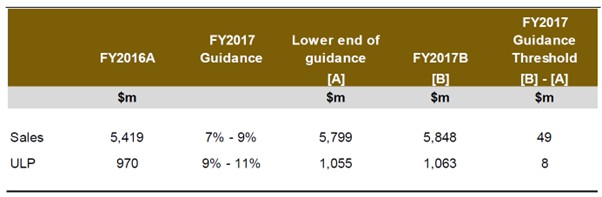
2078 Reaching a conclusion as to whether, as at 20 October 2016, it was likely that Group sales revenue and Underlying Profit growth by the end of FY17 would be below the FY17 Guidance range will be assisted by the Court making some estimates, as at that date, of the likely sales revenue and Underlying Profit shortfalls to budget in US Pooled and CHEP NA for the full-year, and then some estimates of whether or to what extent those shortfalls were likely to translate into shortfalls to budget for CHEP Global and then the Group for the full-year. Such estimates are necessarily approximate.
2079 In relation to likely US Pooled sales revenue for the full-year, having regard to the actual US Pooled sales revenue performance YTD and its projected performance to the end of FY17, including that:
(a) the sales revenue projections were based on unreasonable assumptions of $53 million in unidentified wins and no major customer losses;
(b) the sales revenue targets in the original budget, upon which the reforecast was based, had been stretched to near the limit of achievability;
(c) it had not met its sales revenue budget in any month of 1Q17 and it was materially under-budget and under-reforecast in September;
(d) it was unlikely that US Pooled would achieve the massive projected 2H17 sales growth;
(e) it was facing heightened competition from PECO;
(f) it was experiencing a four-month trend of alarmingly low conversion rates;
(g) it had a smaller sales funnel than in previous years; and
(h) the reforecast failed to adequately take into account identified risks to sales.
I doubt that US Pooled could meet its monthly sales revenue targets, as originally budgeted, over the remainder of FY17. But taking a generous view for Brambles, for the purpose of the estimate I assume that US Pooled would be able to meet the original budgeted monthly sales revenue targets for the rest of the year.
2080 There were not, however, reasonable grounds for Brambles to expect that US Pooled would achieve the necessary overperformance against budget to recover any of the projected 1H17 $(7) million sales revenue deficit to budget. It was more likely than not that by the end of FY17 the US Pooled sales revenue deficit to budget would be, at the least, approximately $(7) million greater than as projected. As a result it was more likely than not that CHEP NA would have a sales revenue deficit to budget for FY17 which was approximately $(7) million greater than the projected $(24) million deficit projected in the Revised September Reforecast i.e., approximately $(31) million.
2081 In relation to likely US Pooled Underlying Profit for the full-year, having regard to the actual US Pooled Underlying Profit performance YTD and its projected performance to the end of 1H17, including that:
(a) US Pooled was unlikely to achieve the projected sales revenue having regard to the matters referred to above;
(b) the Underlying Profit targets in the original budget, upon which the reforecast was based, had been stretched to near the limit of achievability;
(c) the Underlying Profit forecast was based on an unreasonable assumption of a two pp reduction in the damage rate;
(d) there had been a three-month trend of direct costs overruns, and it was unknown whether, when or to what extent that could be rectified;
(e) the budget failed to adequately take into account identified risks to Underlying Profit; and
(f) it had not met its Underlying Profit budget in two of the last three months and had been materially under-budget and under-reforecast in September.
2082 I doubt that US Pooled could meet its monthly Underlying Profit targets, as originally budgeted, over the remainder of FY17. But, taking a generous view for Brambles, for the purpose of the estimate I assume that, as at 20 October 2016, US Pooled was likely to meet the original budgeted monthly Underlying Profit targets for the rest of the year.
2083 There were not, however, reasonable grounds for Brambles to expect that US Pooled would achieve the necessary overperformance against budget to recover any of the projected 1H17 $(14.3) million Underlying Profit deficit to budget. It was more likely than not that by the end of FY17 the US Pooled Underlying Profit deficit to budget would be approximately $(14.3) million. As a result it was more likely than not that CHEP NA would have an Underlying Profit deficit to budget for FY17 of approximately $(14.3) million on top of the $0.2 million in full-year overperformance projected in the Revised September Reforecast.
2084 The next question is whether, and if so to what extent, those likely CHEP NA sales revenue and Underlying Profit deficits to budget were likely to translate into deficits to budget in CHEP Global for the full-year. Put another way, as at 20 October 2016, what was the likelihood of offsetting overperformance against budget by other CHEP CBUs over the remainder of FY17, to offset the likely underperformance against budget by CHEP NA?
2085 For the reasons I have explained, the likely CHEP NA deficits to budget for the full-year were likely to translate reasonably closely into deficits to budget for CHEP Global for the full-year. I do not accept Brambles’ contentions regarding the likelihood of material offsetting overperformance by other CHEP CBUs.
2086 The estimate is made in accordance with my view of the evidence that it is more likely than not that over the remainder of FY17 the other CHEP CBUs would perform roughly in line with the projections in the reforecast:
(a) In relation to sales revenue, the Revised September Reforecast did not project material sales revenue overperformance against budget by other CHEP CBUs for the full-year. They were each projected to be flat to budget in 2H17 or in CHEP Europe $(7) million under-budget in that period. Nor do I consider that, as at 20 October 2016, any material sales revenue overperformance by other CHEP CBUs was likely. As a result, the likely materially lower US Pooled sales revenue was likely to flow-through CHEP NA so as to worsen the projected $(27) million CHEP Global sales revenue deficit to budget for the year by the approximately $(7) million - resulting in a full-year deficit to budget of $(34) million.
(b) In relation to Underlying Profit, the reforecast did not project any material Underlying Profit overperformance against budget by other CHEP CBUs for the full-year. They were each projected to be flat or close to flat to budget in Underlying Profit for FY17. Nor do I consider that, as at 20 October 2016, material Underlying Profit overperformance by other CHEP CBUs for the full-year was likely. As a result, the likely materially worse US Pooled Underlying Profit was likely to flow-through CHEP NA so as to worsen the projected CHEP Global Underlying Profit performance for the full-year by approximately $(14.3) million - resulting in a full-year Underlying Profit result of $(13.7) million after accounting for the $0.6 million in overperformance projected at the CHEP Global level in the Revised September Reforecast.
2087 I therefore estimate that, as at 20 October 2016, it was more likely than not that for the full year CHEP Global would have:
(a) a sales revenue deficit to budget of approximately $(34) million; and
(b) an Underlying Profit deficit to budget of approximately $(13.7) million.
2088 The next question is whether, and if so to what extent, those likely CHEP Global sales revenue and Underlying Profit deficits to budget were likely to translate into deficits to budget in the Group for the full-year. Put another way, as at 20 October 2016, what was the likelihood of sufficient overperformance against budget by other Group businesses over the remainder of FY17, to offset the likely underperformance against budget by CHEP Global?
2089 For the reasons I have explained, the likely CHEP Global sales revenue and Underlying Profit deficits to budget for the full-year were likely to translate reasonably closely into deficits to budget for the Group for the full-year. I do not accept Brambles’ contentions regarding the likelihood of offsetting overperformance by other Group businesses. The estimate is made in accordance with my view of the evidence that it is more likely than not that the other Group businesses would perform roughly in line with the projections in the reforecast over the remainder of FY17.
(a) In relation to sales revenue, the Preliminary Group September Reforecast did not project material sales revenue overperformance against budget by other Group businesses for the full-year. Together, IFCO and Containers were projected to be $5.6 million over-budget for the full-year, which I accept. As a result, the likely materially lower full-year CHEP Global sales revenue, flowing through US Pooled and CHEP NA, was likely to worsen the projected $(21.6) million Group sales revenue deficit to budget for the year by approximately $(7) million in under-budget sales revenue.
(b) In relation to Underlying Profit, the reforecast did not project material Underlying Profit overperformance against budget by other Group businesses for the full-year. Together, IFCO and Containers were projected to be $1.1 million over-budget for the full-year, which I accept. I do not consider that, as at 20 October 2016, material Underlying Profit overperformance by other Group businesses for the full-year was likely. As a result, the likely materially worse full-year CHEP Global Underlying Profit, flowing through US Pooled and CHEP NA, was likely to worsen Group Underlying Profit, which was likely to increase its projected $(5.3) million Underlying Profit deficit to budget for the full-year by approximately $(14.3) million in under-budget Underlying Profit flowing from US Pooled.
2090 I therefore estimate that, as at 20 October 2016, it was more likely than not that for the full year the Group would have:
(a) a sales revenue deficit to budget of approximately $(28.6) million; and
(b) an Underlying Profit deficit to budget of approximately $(19.6) million.
2091 A Group sales revenue deficit to budget of approximately $(28.6) million for the full-year would mean that the Group would have sales revenue of approximately $5,819.8 million for FY17. That would still be above the lower end of the FY17 Guidance range for sales revenue growth ($5,799 million) representing year-on-year sales revenue growth of approximately 7.4%. I conclude that the applicants did not establish that, as at 20 October 2016, there were not reasonable grounds for the FY17 Guidance in relation to Group sales revenue growth in FY17. Therefore, the applicants did not establish that, as at that date, there were not reasonable grounds for the continuing August Sales Revenue Forecast or, for related reasons, the October Revenue Representation.
2092 A Group Underlying Profit deficit to budget of approximately $(19.6) million for FY17 would mean that the Group would have Underlying Profit of approximately $1,043.4 million for the year. That would be approximately $(11.6) million under the bottom of the FY17 Guidance range for Underlying Profit growth ($1,055 million); representing year-on-year Underlying Profit growth of 7.6%; below the bottom of the 9%-11% FY17 Guidance range. However, if Brambles chose to utilise the $10 million contingency (which I infer it would, given its purpose was “to offset any potential underperformance throughout the year”), that would bring Group Underlying Profit up to $1,053.4 million, which would be only marginally ($(1.6) million) below the bottom of the FY17 Guidance range for Underlying Profit growth, representing approximately 8.6% growth on FY16.
2093 I note here that using $970 million (the FY16 Underlying Profit result excluding Oil & Gas and Aero) as the baseline for the calculation of the FY17 Guidance and applying 9-11% growth produces guidance thresholds which are marginally higher than those expressly announced by Brambles in the FY17 Guidance of $1,055 to $1,075 million. 9% growth on $970 million produces a figure of $1,057.3 million, and 11% growth produces a figure of $1076.7 million. However, because the FY17 Guidance was given in terms of both percentage growth and express monetary figures, it is appropriate to treat $1,055 million, the lower of the two figures, as the bottom end of the FY17 Guidance range for Underlying Profit growth.
2094 After accounting for the likely use of the $10 million contingency, the estimate of Group Underlying Profit is below the bottom of the FY17 Guidance range by only the barest of margins. Having regard to the unavoidable imprecision in assessing the amount by which the Group was likely to miss its Underlying Profit budget for the year, I am not satisfied to the requisite standard that, as at 20 October 2016, there were not reasonable grounds for the FY17 Guidance on Underlying Profit growth.
2095 The applicants did not establish that, as at 20 October 2016, there were not reasonable grounds for the October Express Representations. It follows that the applicants did not establish that, in fact, Brambles failed to conduct all necessary and reasonable investigations before making the October Express Representations, nor that it failed to satisfy itself on reasonable grounds following those investigations as to the substantial accuracy of those representations. Thus, the applicants did not establish the falsity of the October All Reasonable Investigations Implied Representation.
The FY19 ROCI Target
2096 In relation to the FY19 ROCI target, the thrust of the applicants’ case was that, because there were not reasonable grounds for the sales revenue and Underlying Profit projections in the September Reforecast for the Group, and not reasonable grounds for the FY17 Guidance, there were not reasonable grounds for Brambles to maintain the August ROCI Forecast.
2097 Brambles, however, relied on Todorcevski’s evidence that the FY19 ROCI Target was achievable, even if there were misses to budget in one business as they could be covered by overperformance in another business or by more aggressive cost reductions, and that there were “multiple levers that [could] be pulled” to allow Brambles to meet the FY19 ROCI Target. Brambles denied that achieving the FY19 ROCI Target was dependent upon the Group achieving the FY17 Guidance.
2098 I have found that applicants did not establish that, as at 20 October 2016, there were not reasonable grounds for the FY17 Guidance in relation to sales revenue and Underlying Profit growth in FY17, and that was their first argument in relation to the lack of reasonable grounds for the FY19 ROCI Target. Nor did they adequately rebut Todorcevski’s evidence that Brambles had “multiple levers” that could be used to enable it to meet the FY19 ROCI Target even if it did not meet its Group FY17 budget or the FY17 Guidance. The applicants therefore did not establish that, as at that date, there were not reasonable grounds for the continuing August ROCI Forecast.
14.5 Whether, as at 20 October 2016, Brambles contravened s1041H of the Corporations Act, s12DA of the ASIC Act or s 18 of the ACL.
2099 I have found that, as at 20 October 2016, the applicants did not establish that Brambles’ conduct in making the October Representations contravened s 1041H of the Corporations Act or its statutory analogues.
15. ALLEGED OCTOBER CONTINUOUS DISCLOSURE CONTRAVENTIONS
15.1 Whether the October Information was information that: (a) existed; (b) Brambles had (within the meaning of s 674(2) of the Corporations Act) by no later than 20 October 2016; (c) was generally available within the meaning of s 674(2)(c)(i) of the Corporations Act; (d) a reasonable person would expect, if it were generally available, to have a material effect on the price or value of Brambles Shares, within the meaning of s 674(2)(c)(ii) of the Corporations Act; and (e) by reason of the matters in (a) to (d), Brambles was obliged to tell the ASX by no later than 20 October 2016.
2100 The applicants alleged that the following “information”, defined as the October Information, existed as at and from 20 October 2016:
(a) in respect of sales revenue, Brambles’ performance in CHEP NA since 1 July 2016 meant it was likely or there was at least a material risk that Brambles would not achieve year-on-year sales revenue growth of between 7% and 9% in FY17, or its medium-term target of constant currency sales revenue growth in the high single digits; and an integral reason for this was that revenue in US Pooled would likely not meet budget in FY17; and
(b) in respect of Underlying Profit, Brambles’ performance in CHEP NA since 1 July 2016 meant it was likely or there was at least a material risk that Brambles would not achieve year-on-year Underlying Profit growth of between 9% and 11% in FY17, its medium-term target of Underlying Profit growth exceeding sales revenue growth or its ROCI target of 20% by FY19; and integral reasons for this were that revenue in US Pooled would likely not meet budget in FY17 and direct costs were going up.
2101 For the reasons previously explained in relation to the August Information, for the purposes of the liability inquiry, it is appropriate to excise the phrase “or there was at least a material risk” from the pleaded October Information. Further, for the reasons I have explained, I consider it unnecessary to deal with that part of the October Information that pleads that it was likely that Brambles would not achieve its medium-term targets of constant currency sales revenue growth in the high single digits and of Underlying Profit growth exceeding sales revenue growth.
2102 The applicants submitted that the lack of reasonable grounds, as at 20 October 2016, for the Revised September Reforecast and the October Representations meant that the October Information existed. Brambles took an identical approach to its approach to August Information. It rehashed its submission that despite “some underperformance” in US Pooled in 1H17, the Group results in 1Q17 together with the September Reforecasting process led to the conclusion that the October Information did not exist.
2103 I found that, as at 20 October 2016, among other things:
(a) it continued to be the case that it was unlikely that US Pooled would achieve similar sales growth in FY17 as it had experienced in FY16;
(b) it continued to be the case that the budget assumption that US Pooled would achieve $53 million in new wins in FY17 lacked reasonable grounds;
(c) it continued to be the case that the budget assumption of a two pp reduction in the average US Pooled damage rate over the course of FY17 lacked reasonable grounds;
(d) the budget assumption of low levels of customer loss and no major customer loss by US Pooled in FY17 continued to lack reasonable grounds;
(e) it continued to be the case that a significant quantum of net risks that had been identified in the CHEP NA Initial and Revised Budget Submissions were not adequately taken into account in the CHEP Global budget, and as a result in the Revised September Reforecast;
(f) it continued to be the case that the US Pooled FY17 budget was based on aggressive growth assumptions and had been stretched to near the limit of deliverability;
(g) it continued to be the case that the US Pooled and CHEP NA budgets were more in the nature of a target than management’s best estimate of the likely outcome in FY17, and the Revised September Reforecast was made from that base;
(h) the Revised September Reforecast which rephased a significant quantum of US Pooled sales revenue and Underlying Profit from 1H17 to 2H17 (on top of a stretched budget with unreasonable assumptions) lacked reasonable grounds;
(i) the likely materially under-budget sales revenue and Underlying Profit in US Pooled for the full-year would translate through into materially lower CHEP Global and then Group sales revenue and Underlying Profit for the full-year; and
(j) it was likely that the Group would achieve materially less sales revenue and Underlying Profit than as projected in the Preliminary Group September Reforecast;
2104 I was not, however, satisfied, as at 20 October 2016, that there were not reasonable grounds for the October Representations and / or the continuing August Representations. That is, I was not satisfied that, as at that date, it was likely that Brambles would not achieve:
(a) year-on-year sales revenue growth of between 7% and 9% in FY17;
(b) year-on-year Underlying Profit growth of between 9% and 11% in FY17, or
(c) its FY19 ROCI Target by FY19.
It follows that I am not satisfied, as at and from 20 October 2016, that the October Information existed.
2105 Given my finding that the October Information did not exist as at 20 October 2016 it is unnecessary to address any of the other elements of the alleged October Continuous Disclosure Contraventions. The alleged October Continuous Disclosure Contraventions were not made out.
15.2 The Alternative October Information case.
2106 The applicants abandoned this case in closing submissions and it is unnecessary to decide these questions.
C. THE ALLEGED NOVEMBER 2016 CONTRAVENTIONS
16. THE NOVEMBER FACTS
16.1 Preliminary Group September Reforecast
2107 As previously noted, on 24 October 2016, Ford sent Todorcevski an email attaching the Preliminary Group September Reforecast spreadsheet dated 21 October 2016.
2108 The same day, Todorcevski forwarded Ford’s email and the Preliminary Group September Reforecast to Gorman with a preface that it was “very much still a work in progress”. He noted the reforecast projected full-year Group Underlying Profit of $1,054 million, and said:
… still has a few tweaks to go that will get us back on or slightly above budget. However, that assumes [CHEP Global] hold, which is what they’ve submitted. Clearly will be some risks to that outcome unless we turn the US [Pooled] around and quickly, but we’re still carrying the original $10m contingency as a buffer.
(Emphasis added)
Gorman stated in response that he would “focus on the validity/deliverability of the forecast” in the pending US Pooled Status Review Meeting scheduled for 25-26 October 2016.
2109 Several things are noteworthy about this email.
2110 First, it is appropriate to infer from the email that Todorcevski understood that achieving the full-year Group Underlying Profit budget depended upon CHEP Global meeting its Underlying Profit budget. Indeed, that fact was obvious when CHEP Global was projected to comprise 94% of Group Underlying Profit for the year.
2111 Second, it is appropriate to infer that Todorcevski understood that, for CHEP Global to recover to meet its full-year Underlying Profit budget, US Pooled needed to recover to meet its Underlying Profit budget. In this context, it is significant that Todorcevski sent his Massive Growth Email to Gorman the following day. In that email he described the projected sales volume growth in US Pooled in 2H17 in terms that can only be understood to show that he thought the projected sales growth was unrealistic and unlikely to be achieved.
2112 Third, Todorcevski’s email indicated that he thought that CHEP Global meeting its full-year Underlying Profit budget was risky unless management could “turn the US [Pooled] around and quickly”. US Pooled did not, however, recover quickly (or at all). The October results, received just over two weeks later (11 November 2016), showed a significant deterioration for US Pooled and the Group.
2113 Fourth, it is worth reiterating that Todorcevski’s view (in his Massive Growth Email) that the projected sales growth in US Pooled in 2H17 was unrealistic finds support in Mr Samuel’s opinion (which I accept) that:
(a) the projected full-year Group Underlying Profit in the Preliminary Group September Reforecast was weighted to be achieved 46.9% in 1H17 and 53.1% in 2H17, which was a higher weighting for the second half of the year than had been achieved in any of the past three fiscal years (although lower than had been achieved in FY13); and
(b) had equivalent 1H and 2H weightings to those achieved in FY16 been applied to the Group Underlying Profit in FY17 then Group Underlying Profit would have been forecast to be $(22) million below the bottom end of the FY17 Guidance range.
2114 Fifth, it is significant that Todorcevski acknowledged that Brambles might need to rely on the $10 million contingency in order to meet its FY17 Guidance for Underlying Profit. That shows how tight the position was for Brambles; that is, how close it was to the precipice even before the October results. Brambles was a company which was budgeted to achieve $1,063 million in Underlying Profit in FY17. Yet Todorcevski acknowledged that in order for the Group to meet its FY17 Guidance in respect of Underlying Profit, Brambles might be forced to rely on a $10 million contingency it had set aside, which represented less than 1% of budgeted Group Underlying Profit in FY17.
16.2 US Pooled Status Review Meeting - 25-26 October 2016
2115 On 25-26 October 2016, Gorman met with Mackie, Rumph and Nador in Atlanta, USA for the US Pooled Status Review Meeting, which related to “US Pooled Supply Chain Actions” and “US Pooled Commercial Actions”. The meeting reviewed the 1Q17 underperformance against budget in US Pooled in sales revenue, direct costs and Underlying Profit, and discussed the recovery plans aimed at getting the business back on track.
2116 A presentation for the meeting, titled “Brambles FY17 ULP Status Review - US Pooled” dated 25 October 2016(US Pooled Status Review Presentation) summarised the issues confronting US Pooled and included a recovery plan to bridge the gap on Underlying Profit by reference to various “Focus Areas”, including “Gap Closure Actions” on revenue, “FY17 Revenue Actions” on sales volume, price, supply chain, procurement, IPEP and overheads, each being assigned to a specific staff member. Nador deposed that she and her team, including Young, Holzman, Martin and Bachtell made presentations to the meeting, and:
(a) she provided an overview of the then-current state of play in US Pooled, including market conditions and large contract negotiation highlights, volume trends and pricing, as well as an overview of the supply chain challenges that they were facing. That overview included the YTD performance “as well as the identified $(5.6)m gap to full-year budget that we had estimated through our MBR process”;
(b) Young presented the slides relating to supply chain, including details of YTD performance and year-to-go (or YTG) expectations, as well as supply chain actions to improve;
(c) Holzman presented the supply chain financials in detail;
(d) Martin presented the revenue slides (YTD and YTG), as well as the commercial actions to claw back revenue; and
(e) Bachtell provided details around CT and rental revenue evolution against budget and historic trends, as well as growth trends and pricing by customer segment.
Todorcevski did not attend the meetings, but he deposed that he reviewed the presentation and also sent it to Callaway and Ford to obtain their views on the recovery plan.
2117 Martin prepared a summary of recovery actions the sales team proposed to take to close the potential gap to the FY17 forecast, including:
(a) enforcing existing contractual rights to charge higher prices in certain circumstances, where this was not likely to result in the loss of the customer;
(b) considering and implementing opportunities to increase prices mid-contract for customers with lower-than-average RPIs; and
(c) pursuing a $5 million (representing about 1 million pallet issues) opportunity in new channels, which had not yet been factored into the budget or September Reforecast.
In cross-examination, he testified that he was confident in each of these opportunities, although he agreed that the competitive pressure facing US Pooled could require it to reduce prices.
2118 The US Pooled Status Review Presentation and Nador’s affidavit record the variety of issues confronting US Pooled at that time. Among other things:
(a) Sales volume - organic growth was in line with budget (1.1% actual versus 1% budget), but on new wins US Pooled was seeing longer cycles to convert deals. As a result, net new wins were at 2.5% instead of 4.1% as budgeted. The total pipeline was approximately the same value. However, conversion time was longer due to the US presidential election, consumers holding on to purchases until late November, a slowdown in retail activity in August and September, and changes at the Vice President and executive level of customers which were stalling contract negotiations. Monthly and quarterly reports to which Brambles subscribed showed a slowdown in retail activity in August and September 2016. The reports also showed an expectation of only modest growth in the holiday season (with reports predicting around 2% growth year-on-year in in-store retail sales versus a five-year average of 2.9%, and for food 2% growth). Rollover sales were in line with expectations.
(b) Pricing - Nador deposed that she discussed the fact that there was “pressure on pricing as a result of a decline in P-days, interregional underperformance, whitewood price trends, as well as the pricing stretch in the budget, which together were creating risk to US Pooled achieving its pricing budget”. US Pooled was taking an additional $4.7 million on price compared to FY16, but that was still short of budget.
(c) Supply chain costs:
(i) at a high level, US Pooled had seen the impact of higher volume of activity at plants due to inventory build-up to recover a “C Stock” position that was too low at the end of FY16 (C Stock being pallets that had been inspected and repaired by retailers at TPMs); and also
(ii) incremental activity at TPMs driven by higher levels of pallet re-use by distributors - which was not new - had increased pallet re-use levels over the past couple of years. The presentation said that US Pooled was taking some specific immediate action to address this with retailers (either a lower specification was to be given for re-use, or whitewood pallets replacements, or higher charges where appropriate).
(d) Damage Rate - the presentation included an R&O schedule which quantified (probability-adjusted) risks of $22 million (albeit that the slide has a typo reversing the risks and opportunities) including a risk that “[d]amage rate does not improve” quantified at $10 million, that being the largest risk by a significant margin.
(e) Unbudgeted losses:
(i) New losses - US Pooled had lost the Scotts contract in FY17 (worth $2.4 million in FY17 and $0.2 million in Q1); and
(ii) Rollover losses - there were four rollover customers lost. US Pooled had lost: Heinz in April FY16 (worth 2.7 million issues in FY17 and 0.2 million in 1Q17); RedGold in March FY16 (worth 0.6 million issues in FY17, and 0.15 million in 1Q17); Ready Pac in October FY16 (worth 0.3 million issues in FY17, and 0.08 million in 1Q17); and Sunshine Mills in December FY16 to other recyclers (worth 0.3 million issues in FY17, and 0.08 million in 1Q17).
2119 Nador presented a slide showing the “bridge” for US Pooled to return to alignment with its full-year Underlying Profit budget. She deposed that the slide was based on the US Pooled Walk to MOP, and included a high-level overview of the “gap closure actions” which were then further detailed in the revenue and supply chain sections of the presentation. As an example, she stated that one of the sales team’s “key growth acceleration initiatives was the ‘Project Accel’ win back strategy”, which she described as a “targeted strategy to win the most profitable work from our competitors, in order to disrupt our competitor’s network map and strategically increase the US Pooled network map”.
2120 The presentation included the following slides regarding recovery actions relevant to sales revenue:
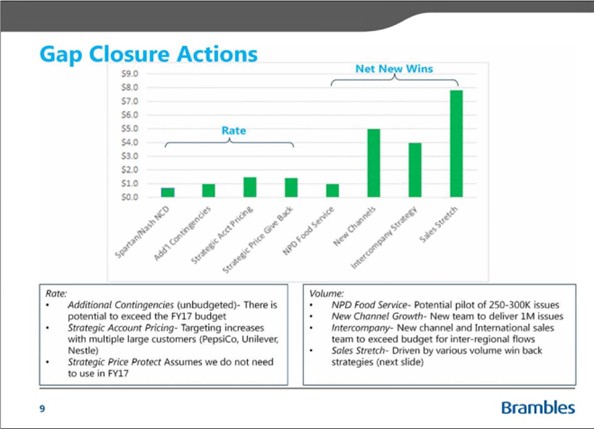
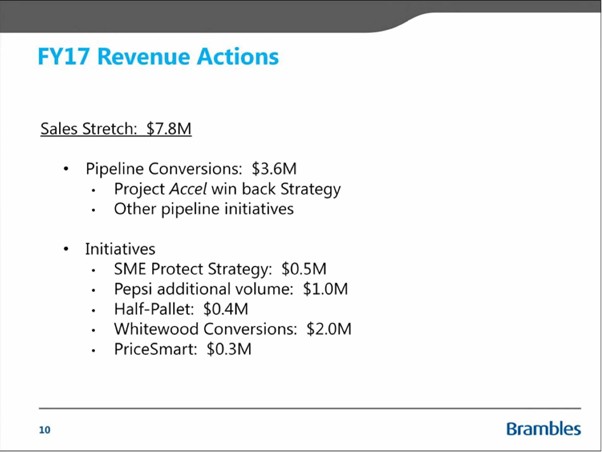
2121 In cross-examination, Nador gave evidence regarding the US Pooled Status Review Meeting, specifically that:
…we flagged the $5.6 million and we discussed with Mr Mackie and Mr Gorman all of the challenges that we were facing. We discussed the risks that we had in front of us. We had discussed all of the initiatives as well. So it was a very good two-way conversation, and we felt that they were very supportive…The team felt very supported and motivated.
I infer that Nador was there referring to the 19 October 2016 recommendation, which she accepted, revising the US Pooled Underlying Profit forecast to project a $(5.6) million Underlying Profit shortfall to budget for FY17.
2122 It is unclear what Nador meant by testifying that “we flagged the $5.6 million” to Mackie and Gorman. By “we” she was referring to the US Pooled management team, many of whom were presenting at the US Pooled Status Review Meeting. The final US Pooled October MBR Presentation dated 19 October 2016 showed that by that point US Pooled management had revised its forecast to project that US Pooled would miss its Underlying Profit budget by $(5.6) million in FY17. But that does not appear to be what Nador and other members of the US Pooled management team told Mackie and Gorman at the meeting.
2123 The following matters are material to my view in this regard.
2124 First, the US Pooled Status Review Presentation did not state that US Pooled had actually forecast a $(5.6) million Underlying Profit shortfall to budget in FY17. Instead, the relevant slide (reproduced below) characterised the $(5.6) million as “Go-get initiatives in all areas”: sales, supply chain, overheads, procurement and IPEP.
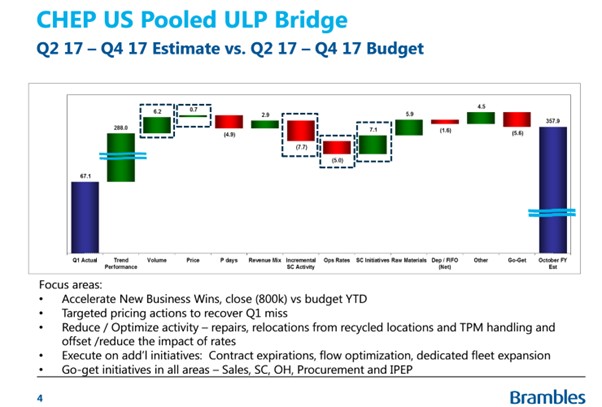
I can see no reason for the presentation to describe the $(5.6) million as “go-get initiatives” (meaning stretch targets) if Nador and others had informed Mackie and Gorman that US Pooled had actually revised its forecast to project a $(5.6) million Underlying Profit shortfall to budget for the year. It is also significant that ‘go-get’ in the slide was presented as a negative for Underlying Profit, whereas in previous management presentations it had been presented and understood as a stretch target and therefore as a net positive to Underlying Profit.
2125 Second, in cross-examination, in relation to the likelihood of achieving the US Pooled budget, Nador said only that “we flagged the $5.6 million”, and she accepted that she “thought” that Gorman and Mackie “understood that there was a risk you mightn’t get there [i.e., reach budget], but you were going to do your best”. I understood from Nador’s testimony that she said she told Gorman and Mackie of a risk that US Pooled would miss its full-year Underlying Profit budget by $(5.6) million, not that she told them that US Pooled management had actually revised its forecast to project a $(5.6) million Underlying Profit miss to budget for the year.
2126 Third, it is significant that, in cross-examination, Todorcevski testified that he and Gorman did not become aware until after the November Board Meeting (15 and 16 November 2016) of the fact that US Pooled had revised its forecast to project that it would miss its full-year Underlying Profit budget.
2127 Following the US Pooled Status Review Meeting, on 26 October 2016, Nador sent the presentation from the meeting to Gorman and Todorcevski (copied to Mackie and Rumph) under cover of an email in which she said:
Dear Tom and Zlatko,
Please see attached soft copy of the slides we used today during our review.
Tom and Pete,
It was great to have you with us today. The whole team left room very motivated and convinced we can count on your support.
We feel we are all in this together. We have faced tough challenges before, and are confident we can overcome this one too.
(Emphasis added.)
2128 In terms, that email was ambiguous as to whether Nador thought US Pooled could recover to alignment with its Underlying Profit budget for the full-year. In cross-examination, Nador testified that while she considered a $(5.6) million Underlying Profit shortfall to budget to be “the likely scenario”, there was “a lot more risk than opportunity” attached to achieving that result. In effect, she testified that she thought it would be challenging to keep the full-year US Pooled Underlying Profit shortfall to budget to just $(5.6) million.
2129 On 3 November 2016, Bachtell emailed Martin and expressed concerns about the achievability of the US Pooled budget. His email attached some documents including a Walk to MOP spreadsheet and said:
We should discuss WTM items before tomorrow’s meeting if you have a minute. See the attached from Adam. He and I went through this list and most of these actions will be needed to hit the “volume” and “price” plugs we have in the MBR just to get to Budget.
…
Bottom line for me is that we’re going to need to scratch and claw just to get to budget because of how much go-get is in the MBR so a lot of these actions won’t allow us to get “better” than MBR, but simply give us line of sight to hitting MBR.
(Emphasis added.)
2130 Martin said, and I accept, that the US Pooled sales team used the term “plug” to refer to an expectation of improved financial results to cover a shortfall, doing so in situations where specific customer details were still being finalised. By that comment, I understood him to mean that “plug” was similar to sales ‘go-get’ or ‘unidentified wins’.
2131 In that email, Bachtell referred to the “‘volume’ and ‘price’ plugs we have in the MBR” and “how much go-get is in the MBR”. I infer that he was referring to the US Pooled October MBR on 19 October 2016 (that being the most recent), in which US Pooled management revised the forecast to project a $(5.6) million Underlying Profit shortfall to budget in FY17.
2132 It is significant that Bachtell said in the email that US Pooled would have to “scratch and claw just to get to budget” because of how much ‘go-get’ was in the MBR. He also said that a lot of the recovery initiatives referred to in the Walk to MOP spreadsheet would not mean that US Pooled would do better than the forecast $(5.6) million Underlying Profit shortfall to budget in the final US Pooled October MBR, and would just get it to “a line of sight” of achieving that. In essence, he was saying the same thing as what I understood Nador to say. That is, US Pooled management had forecast a $(5.6) million Underlying Profit shortfall to budget for the full-year. To use Nador’s words, that outcome was the “likely scenario” but achieving that carried “a lot more risk than opportunity” and would be “challenging”. To use Bachtell’s word, achieving a lot of the recovery initiatives in the Walk to MOP plan would do no more than get US Pooled within “a line of sight” of achieving a $(5.6) million Underlying Profit shortfall to budget for the year, and would not allow it to do better than that.
2133 Martin deposed that he met with Bachtell in relation to that email. He said that he could not recall the contents of the discussion he had, but he recalled that he did not share Bachtell’s view that all of the listed actions in the Walk to MOP spreadsheet needed to be achieved in order to close the gap to budget, having regard to his experience in previous years, including the performance of US Pooled in FY14 to FY16. He also said that in his experience, it was relatively common to be able to achieve large wins which contributed significantly to closing any gaps to budget. He said that “it had been relatively common in previous years…to observe large swings in sales results, for example dropping 12% or 14% in a month but then bouncing back with 37% growth in the following month”.
2134 I do not consider Martin’s evidence in that regard to be reliable, and I give it little weight. The following matters are material to my view:
(a) First, the contemporaneous documentary record is the most reliable evidence. Bachtell’s email shows that he thought that the forecast $(5.6) million Underlying Profit shortfall to budget would be difficult to achieve and would require US Pooled to “scratch and claw” to get within “line of sight” of achieving it. That view is consistent with Nador’s evidence that achieving that forecast carried “a lot more risk than opportunity” and would be “challenging”. It is also consistent with the fact that the downgraded Underlying Profit forecast had been brought back from a projected $(7.3) million deficit just a week earlier, and (after accounting for further downgrades) $3.4 million of that projected improvement in Underlying Profit was based on an (in my view unlikely) improvement in supply chain costs.
(b) Second, Martin gave evidence that he could not recall the contents of his discussion with Bachtell, but then he purported to recall its salient elements. That conversation was about an otherwise routine business matter, and Martin prepared his affidavit more than five years after the conversation. I see Martin’s purported recollection as most likely a reconstruction.
(c) Third, Martin knew at that time, including from Moriarty’s Conversion Rate Email (12 October 2016), that there were not at that time “large swings in sales results, for example dropping 12% or 14% in a month but then bouncing back with 37% growth in the following month”. Martin’s Conversion Rate Email (4 November 2016) shows that he knew that there had been a four-month trend of very low monthly conversion rates, which he described as “quite alarming” and a “problem” to his team, in an email he sent the day after his meeting with Bachtell.
(d) Fourth, the thrust of Martin’s evidence regarding Bachtell’s email is that he thought Bachtell was being too conservative in his approach to the possibility of US Pooled recovering to alignment with budget through the various recovery initiatives in the Walk to MOP plan. I do not accept that Bachtell was being too conservative in his approach. For the reasons previously explained, since no later than 20 October 2016 each of Nador, Martin and Alonso, in fact, thought that it was unlikely that US Pooled (and as a result CHEP NA) would be able to achieve the projected rephased sales revenue and Underlying Profit in the Revised September Reforecast and their full-year budgets. Alternatively, Martin thought that it would be, at least, very difficult for US Pooled to achieve its full-year sales budget.
2135 I conclude that, at this point in time, prior to receipt of the actual October results, it would be necessary for US Pooled to “scratch and claw” to even get within “line of sight” of achieving the projected $(5.6) million US Pooled Underlying Profit shortfall to budget for the year. Achieving that result would be challenging, and US Pooled was not going to do better than that. In my view, at that time it was more likely than not that US Pooled would miss its full-year Underlying Profit budget by more than that.
16.3 Brambles CHEP Aerospace ASX announcement - 2 November 2016
2136 On 2 November 2016, Brambles announced to the ASX that it had come to a binding agreement to divest its CHEP Aerospace business (the Aero Announcement). The announcement relevantly stated that:
The operating results for CHEP Aerospace Solutions will be recognised within discontinued operations in Brambles’ accounts for the financial year ending 30 June 2017 (FY17). After adjusting for debt, working capital, and transaction costs, Brambles expects to recognise a small profit on sale which will be treated as a Significant Item. Cash proceeds from the transaction will be used to reduce outstanding debt.
The divestment of CHEP Aerospace Solutions has no impact on Brambles’ FY17 guidance for constant-currency sales revenue growth of 7% to 9% and Underlying Profit growth of between US$1,055 million to US$1,075 million (at 30 June 2016 exchange rates), which reflects growth of 9% to 11%.
(Emphasis added.)
2137 Mr Samuel opined that the Aero Announcement had an effect on the way that the FY17 Guidance should be understood. In his view, the Aero Announcement meant the following:
(a) to meet the FY17 Guidance for sales revenue growth, FY17 sales revenue would need to be 7-9% above the revised FY16 baseline amount excluding Aero. That would upwardly revise the required miss to the Group FY17 budget in sales revenue (before sales revenue growth fell below the bottom of the FY17 Guidance range) from $(49) million to $(58) million; and
(b) the range in the FY17 Guidance for Underlying Profit growth was unchanged at $1,055 million to $1,075 million, as (unlike for sales revenue) that was the range specifically stated in the Aero Announcement. That would downwardly revise the budgeted Underlying Profit excluding Aero, and therefore the required miss to the Group FY17 budget in Underlying Profit (before Underlying Profit growth fell below the bottom of the FY17 Guidance range), from $(8) million to $(4) million. In other words, budgeted Underlying Profit fell to $1,059 million with the exclusion of Aero.
In Mr Samuel’s view, from 2 November 2016, those should have been the applicable thresholds for achievement of the FY17 Guidance.
2138 Mr Samuel produced the following table to show the effect of adjusting the FY16 baseline and the FY17 Guidance range for sales revenue growth:
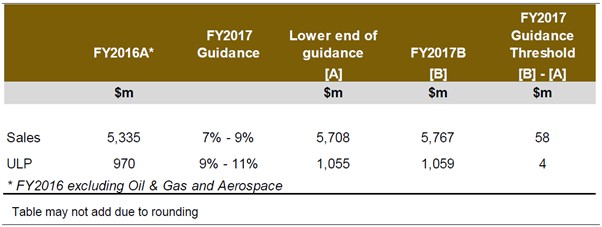
2139 In my view, there is force in Mr Samuel’s approach. His analysis meant that the Group had just $(4) million of headroom between the budgeted Underlying Profit that was within the FY17 Guidance range, and Underlying Profit growth which fell below the guidance range. However, although the parties’ submissions did not specifically address Mr Samuel’s approach, it was common ground that Group Underlying Profit would need to be more than $(8) million below-budget before it was below the bottom of the FY17 Guidance range. The applicants did not submit that position changed with the Aero Announcement. I therefore proceed on the basis that the threshold for Underlying Profit growth that would be below the FY17 Guidance range was $(8) million.
16.4 October results
2140 The flash results for October FY17, including results up to 5 November 2016, became available on 11 November 2016. Over the course of that day:
(a) Gorman, Todorcevski, Callaway and O’Sullivan received the October results for the Group;
(b) Kennett received the October results for CHEP Global and he emailed a summary to Todorcevski, O’Sullivan, Mackie and Alonso;
(c) Rumph and Nador received the October flash results for CHEP NA, including US Pooled; and
(d) Kennett, Rumph, Nador and Martin received the US Pooled October Monthly Close Report, which included a detailed breakdown of the October results for US Pooled.
2141 The US Pooled and CHEP NA monthly sales revenue and Underlying Profit results were, again, very poor. The applicants produced the following table summarising some of the key metrics for US Pooled emerging from the October 2016 results:
October Results: US Pooled Additional Detail | |||
($US million) | Month | Year-to-date | |
vs September Reforecast | vs Budget | vs Budget | |
Sales revenue | (4.6) | (7.3) | (15.9) |
Volume | (2.4) | (4.2) | (8.5) |
Price | (0.2) | (0.2) | (1.4) |
Direct costs | (4.4) | (4.8) | (11.6) |
Underlying Profit | (8.4) | (11.6) | (25.3) |
2142 Following the October results, the position for US Pooled was that:
(a) in sales revenue, $(7.3) million under-budget (and $(4.6) million below the September Reforecast) for October, and $(15.9) million under-budget YTD;
(b) in Underlying Profit, $(11.6) million under-budget (and $(8.4) million below the September Reforecast) for October, and $(25.3) million under-budget YTD; and
(c) in direct costs, $(4.8) million under-budget (and $(4.4) million below the September Reforecast) for October, and $(11.6) million under-budget YTD.
2143 The applicants also produced the following table summarising the variances to budget and September Reforecast at the US Pooled, CHEP NA, CHEP Global and Group levels, drawn from two presentations, the Board financial update dated 14 November 2016 and the CHEP Global October BPR dated 16 November 2016 (discussed below). I assume that the September Reforecast figures in this table are based on the Preliminary Group September Reforecast, as that was the most recent reforecast. Apart from the $17.1 million error in sales revenue in CHEP Global in 1H17, the differences between the projections in the Revised September Reforecast and the Preliminary Group September Reforecast are not material for present purposes.
October Results Summary | ||||
($US million) | Month (vs September Reforecast) | Year-to-date (vs Budget) | ||
Sales revenue | Underlying Profit | Sales revenue | Underlying Profit | |
US Pooled | (4.6) | (8.4) | (15.9) | (25.3) |
CHEP NA | (10) | (9) | (28) | (29) |
CHEP Global | (6) | (9) | (23) | (26) |
Brambles | (2) | (4) | (15) 6% growth | (18) 7% growth |
2144 Following the October results, the position was that:
(a) largely as a result of the US Pooled results, CHEP NA was:
(i) in sales revenue, $(10) million below the September Reforecast for October, and $(28) million under-budget YTD; and
(ii) in Underlying Profit, $(9) million below the September Reforecast for October, and $(29) million under-budget YTD.
(b) largely as a result of the CHEP NA results, CHEP Global was:
(i) in sales revenue, $(6) million below the September Reforecast for October, and $(23) million under-budget YTD; and
(ii) in Underlying Profit, $(9) million below the September Reforecast for October, and $(26) million under-budget YTD.
(c) the Group (excluding Aero and Oil & Gas) was:
(i) in sales revenue, $(2) million below the September Reforecast for October, and $(15) million under-budget YTD; and
(ii) in Underlying Profit, $(4) million below the September Reforecast for October, and $(18) million under-budget YTD.
2145 As a result, the position in relation to the FY17 Guidance was as follows:
(a) Group sales revenue growth was 6%, being one pp below the bottom of the 7-9% range in the FY17 Guidance;
(b) Group Underlying Profit growth was 7%, being two pps below the bottom of the 9-11% range in the FY17 Guidance.
16.5 Poor visibility in relation to financial results
2146 In this period, Brambles’ management at various levels expressed frustration with the inability of Brambles’ systems to generate accurate and timely financial reports for US Pooled. As earlier noted, management expressed similar concerns in September and October. The evidence in this period shows that those reporting deficiencies had not been fixed. The following examples suffice:
(a) On 8 November 2016, Linderman emailed Rumph, Nador and others informing them that CHEP Global FP&A sought a “high level commentary” regarding any sales revenue and Underlying Profit variances of more than $0.5 million in the October results, to be sent when the results were received, so as to assist in the preparation for the Brambles AGM the following week. In response, on the morning of 9 November 2016, shortly before the October results were due, Nador emailed Rumph flagging a possible delay to the required commentary on the US Pooled results due to possible accuracy problems. She said:
We need to ensure the [monthly] close set is fully revised before sending anything even if it means delaying this request. I have not seen numbers yet (will do this afternoon) but the comments I received are very concerning in terms of possible accuracy problems that the teams are investigating right now. Will keep you posted later today.
(b) On the evening of 9 November 2016, Nador emailed Rumph following her “rough” first pass review of the October results. She said that the sales revenue numbers appeared to be aligned with the US Pooled October MBR, but “[t]here seems to be another bomb on direct costs”. She expressed frustration at not having “visibility and ability to predict month[ly] trends more accurately”. She said: “Right now, we see the post mortem, and it is too late”. Nador said that she had asked a member of her team to work with Holzman to establish the weekly reporting cadence of “direct cost run rates”, and to work on the costs “items that could be managed/predicted so we put checks and controls during the month and give visibility, so as to get “a sense of whether we have a process gap, a people / competence gap, a learning curve problem or all of it”.
(c) On 9 November 2016, Young emailed Alonso, noting the poor US Pooled October results and expressing frustration with the reporting systems. He said:
I’m quite concerned that we have zero visibility into this until post close and I’m still awaiting bridges and explanations but I believe Finance is also struggling.
(d) Alonso responded the same day. He agreed with Young and said, “I agree we cannot keep waiting until month end to have a surprise”.
(e) Between 9 and 10 November 2016, Rumph, Kennett and Alonso exchanged emails about the continuing lack of visibility regarding US Pooled’s results. On 9 November 2016, Rumph emailed Kennett in which she expressed her concerns in that regard, and said that Nador and Young were both “extremely frustrated”. She said:
Buster - while you have likely heard from [Nador] and [Young] about the serious issues with the [US Pooled] monthly close, I want to also inform you and express my concern.
The team keeps pointing to One Finance as the root cause of our close challenges in Sept and Oct. I’m not exactly sure what is happening or what is driving the lack of visibility for my leaders, but I am seeking your help. We need these leaders focused on closing gaps - not trying to figure out where they have gaps.
(f) On 10 November 2016, Rumph forwarded her email to Alonso, and he responded later that day as follows:
I was yesterday talking with [Young] on the possibility to have someone in Supply Chain to produce for us some basic visibility on a weekly [basis] until Finance figures out how to do it. We cannot keep working like this, waiting every month to the last minute surprise and then spending the next 2 or 3 weeks trying to understand why and if it is real instead of focusing on improving performance.
(Emphasis added.)
(g) On 10 November 2016, Kennett emailed Moreno asking whether he could drop everything and be parachuted into the USA to deal with what he termed “an emergency situation” in the US Pooled supply chain in that “[w]e lack visibility and I’m lacking confidence in what is being reported”. The following day, Kennett emailed Callaway and said that “I believe there is a fundamental issue lurking under this, and it is nothing to do with the new structure”. In cross-examination, Kennett agreed that he was there referring to a diagnostic problem within US Pooled in respect of the ability to ascertain what was happening with its direct costs.
16.6 Management reaction to the October results
2147 The October FY17 results for US Pooled and CHEP NA were significantly adverse to the September Reforecast and to the FY17 budget. They gave rise to a further material deterioration in the sales revenue and Underlying Profit position in CHEP NA and CHEP Global, and marked the fourth month in a row in which those businesses had been under-budget. October was the second consecutive month in which the shortfall to budget in sales revenue and Underlying Profit in those businesses had been substantial.
2148 The contemporaneous emails show that Brambles’ management variously described the US Pooled, CHEP NA and/or CHEP Global October results as “bad”, “poor”, “surprising”, “significantly off”, “weak” and “extremely ugly”. The results caused Mackie to wonder whether the US Pooled recovery plan was “still the right one”, and Chipchase to wonder whether the US Pooled recovery plan was now “unachievable”.
2149 The reactions of Brambles’ management included the following:
(a) on 10 November 2016 Mackie emailed Gorman about the October results, and said: “Numbers in US are still moving around but it doesn’t look good”;
(b) Gorman responded the same day asking whether Mackie yet knew by how much CHEP NA had missed budget, and enquired about the root cause of the problems in US Pooled. He said:
It sounds like we will need to talk about US and I would appreciate your thoughts on root cause of problems. Perhaps we have to think about getting additional resources (from Europe?) to help the team?
(Emphasis added.)
(c) on 11 November 2016, Mackie responded to Gorman and wondered whether the US Pooled recovery plan was the right one. He said:
We expected H1 to be challenged in US with recovery in H2 but need to see numbers to understand if issues are the same and [the] plan we discussed is still the right one.
(d) Mackie deposed that he had anticipated that October FY17 performance in CHEP NA would be “challenging”, but he was not expecting the extent of the shortfall in that month.
(e) on 10 November 2016, Kennett emailed Mackie, Alonso, Scaiff and Moreno and described the October FY17 results for CHEP Global as “bad”. He said that US Pooled was “significantly off on direct costs (more in logistics and relocations)”, and that the Underlying Profit shortfall in CHEP Global YTD was approximately $25.8 million, which was “all basically” the result of underperformance in US Pooled;
(f) on 11 November 2016, Kennett emailed Mackie, Todorcevski, O'Sullivan and Alonso (copied to Ford, Callaway and Scaiff) and described the October results for CHEP Global as “poor”, and noted that the poor result was mainly coming from US Pooled, and that except for CHEP NA. The rest of the business was delivering at or above forecast and budget on both sales and Underlying Profit for the period and YTD;
(g) Kennett deposed that he was “surprised” by the October results for US Pooled, which he said were the main driver of the below-budget performance in CHEP Global;
(h) on 11 November 2016, Gorman emailed Johns and Chipchase and said: “Unfortunately, the solid performance in RPC’s and Containers did not offset the weakness in Pallets performance in the month. Similar to last month, the challenge remains in US Pallets”. Chipchase responded the same day, copying Todorcevski and O’Sullivan into the email chain. Importantly, he questioned whether the October results indicated that the recovery plans for US Pooled were “now unachievable” and asked for more granularity in relation to the projected new business wins to see whether it was really a short-term problem as suggested. He also queried whether there would be enough overperformance elsewhere in the Group to offset the US Pooled underperformance against the full-year forecast. The email said:
It will be interesting to understand whether this signals that the recovery plans the US team told you about last month are now unachievable and thus is there enough outperformance elsewhere in the Group to offset re FY forecast or whether there is a potential H1/FY shortfall.
Also, I know some of the issue is phasing re new business being won, but it would be good to see some granularity around their plan to get the new business so that we can assure ourselves whether this really is a short term issue or not.
(Emphasis added.)
(i) Gorman forwarded Chipchase’s email to Todorcevski. On 12 November 2016, Todorcevski responded to and noted that none of the prospective big sales opportunities had come in, and that if none of them came in in November there would be insufficient sales volume to, as I infer, achieve budget. He said:
We will revisit new business wins but none of the big ones came through in October based on feedback during the week. We need a few of them in Nov or we just won’t see the vol[ume].
2150 The contemporaneous emails at this point showed that Mackie and Kennett were very concerned regarding the Underlying Profit shortfall to budget in CHEP Global. They began casting around to fill that hole by asking other CHEP Global CBUs to squeeze more out of their businesses. On 12 November 2016, Mackie emailed Mr Arturo Cabrera (President of CHEP LATAM) and described the October results in US Pooled as “extremely ugly”. He said that the Underlying Profit shortfall looked “impossible” for US Pooled to recover by 1H17, and asked for a contribution from LATAM to fill the gap. The same day Kennett forwarded Mackie’s email to Mr Santiago De Rivas (CFO of CHEP LATAM) and reiterated the importance of his looking “everywhere you can” for a contribution to fill the gap to budget.
2151 Gorman was also plainly very concerned. On 14 November 2016, he emailed Brambles’ ELT, comprised of Todorcevski, Mackie, Wolfgang Orgeldinger (President of IFCO), Jason Rabbino (President of Containers), Nick Smith (Group Senior Vice President, Human Resources), Jean Holley (Group Executive Vice President and Chief Information Officer) (copied to O’Sullivan) under the subject line: “The flight has been great but we still need to land the plane” (Gorman’s Landing the Plane Email). In that email he relevantly wrote:
Through the first four months of this year, our business is facing some challenges -- specifically the financial performance of the US Pallets business. Although we have faced many challenges together over the years, we have now had two particularly weak months in a row and the task ahead is sizeable.
What we are faced with is now one of those moments in business when we get to see how good we are. My ask of you is that we pull together again, as we always have, to find performance improvement opportunities in each area of your business. Pete and his team are incredibly focused but he cannot do this alone.
In total, we need to develop opportunities to improve Underlying Profit by $15-$20 million compared with our present forecast. For some businesses this about holding the strong performance achieved since the start of the year while for others it’s about developing additional opportunities.
Each of your finance teams will shortly be review the December forecast with you. I ask that you review this carefully with a focus on improvement as mentioned above and a specific request for First Half improvement.
(Emphasis added.)
2152 There, Gorman told Brambles most senior executives that the Group “needed” to find an additional $15-20 million in Underlying Profit overperformance from the businesses other than CHEP NA. He described the challenge facing the Group as “sizeable” and “one of those moments in business when we really get to see how good we are”.
16.7 The proposed recovery actions
2153 In this period Brambles management embarked upon a series of initiatives to understand and respond to the issues underlying the underperformance against budget in sales revenue and Underlying Profit in US Pooled.
2154 The following captures the main recovery actions taken by Brambles prior to the AGM on 16 November 2016 (at which the impugned announcement was made):
(a) Personnel at various levels of Brambles investigated the results, in an effort to diagnose the problems. The most significant of those was the decision by Todorcevski and Kennett on 12 October 2016 to appoint Moreno to “invest all his time and resources” into US Pooled direct costs, working remotely from Europe but spending one week of every month in the USA. As at 16 November 2016, US Pooled did not have the results of Moreno’s investigation.
(b) CHEP Global continued to implement recovery strategies, which were continuing and not expected to have an immediate effect, such as the US Pooled recovery plan and the dual track Walk to MOP process in US Pooled and CHEP NA.
(c) Brambles undertook work aimed at identifying potential areas to reduce costs. For example, in mid-November 2016, a cost management guidance document from FY14, aimed at reducing spending on non-essential costs including travel and entertainment, was updated for distribution to each of the business divisions.
(d) CHEP NA continued to undertake updated risk and opportunity analyses.
16.7.1 The search for overperformance from other CHEP CBUs and Brambles’ businesses
2155 In the period between 12 November and 16 November 2016, Mackie and Kennett took some early steps to seek Underlying Profit overperformance from other CHEP CBUs, so as to offset the Underlying Profit deficit to budget in US Pooled and CHEP NA. Gorman’s Landing the Plane Email broadened that search to include the other Group businesses.
2156 On 12 November 2016, Mackie emailed Cabrera, copied to Kennett and another, and said:
Returned home yesterday feeling very good about Latam but walked into some extremely ugly results in [US Pooled] which look impossible for them to overturn by H1. [Pooley] is going to push a number of areas in Europe to squeeze out more but it wont do much for the reporting entity of “Americas”. Can you have a discussion with your team next week to:
1. Keep the excellent start going and identify key opportunities to accelerate
2. Close scrub of all balance sheet items
3. Dedicated focus on accelerating all export potentials to US
4. ????
Lets catch up on the phone towards the end of next week once you have had a chance to touch base with them.
2157 There, Mackie asked CHEP LATAM to identify any “key opportunities to accelerate” so as to provide Underlying Profit overperformance to offset CHEP NA’s underperformance. He deposed that the reference in his email to “????” was a request for Cabrera to turn his mind to whether there were any opportunities to improve the results for LATAM that he had not identified. The email said that CHEP Europe had agreed “to push a number of areas” and “to squeeze out more” but said that would not assist in relation to the CHEP Americas reporting entity. On 12 November 2016 Kennett forwarded Mackie’s email to De Rivas and said “I cannot over-emphasise the importance of this, so please look everywhere you can”. Kennett’s comment that he could not “over-emphasise the importance of this” indicated that, by that date, he understood that it was highly unlikely that US Pooled and CHEP NA would be able to achieve their full-year Underlying Profit budgets.
2158 On 14 November 2016, Gorman sent his Landing the Plane Email to Brambles’ ELT.
2159 On 15 November 2016, Mackie emailed Gorman and said that Mr Mike Pooley (President, CHEP Europe) and Cabrera were “both reviewing additional actions in their regions to compensate” at the CHEP Americas and CHEP Global levels. In cross-examination, Mackie said that he had discussed the likely performance of the LATAM and Europe businesses with each of their CEOs, and each felt their business could exceed budget.
2160 Contrary to the thrust of Mackie and Kennett’s evidence, it is clear from Gorman’s Landing the Plane Email that he saw the task of squeezing sufficient Underlying Profit overperformance against budget from other CHEP CBUs and other Group businesses as challenging.
2161 Mackie testified that in his view, Gorman asked for $15-20 million, because the practice in Brambles when putting together a recovery plan was to target in excess of what was needed, knowing that some of the initiatives may not come off, or may not come off as quickly as necessary. He said that “if you’re trying to close a gap, you try and target something that’s more than the gap”.
2162 On 15 November 2016, Mackie emailed the President of each CHEP Global CBU and said:
Following on from a tough two months trading we now need to understand where we are with all the recovery actions that are either in place or the upside plans that [Pooley] and [Cabrera] are now working up. Given the size of the hole the challenge is going to be shared group wide and Nessa is going to take the lead in getting a first view on what is already in place and where some potential opportunities might sit. … If you have any ideas across the group please channel them through your CFOs, we are on the hunt for around $20m of ULP.
(Emphasis added.)
2163 The requests by Mackie to the CHEP CBUs subsequently appeared to bear some fruit, but not until after the November Board Meeting and AGM. As at 16 November 2016, Brambles’ evidence as to the likelihood of offsetting overperformance by other CHEP CBUs and other businesses in the Group did not rise much higher than the fact that the requests for offsetting performance outlined above had been made, and that Mackie testified that he had discussed the likely performance of LATAM and Europe with their CEOs, and each felt their business could exceed budget.
16.8 Direct costs concerns
2164 Some of the management concerns in this period reflected the persisting problem of direct costs overruns in US Pooled.
2165 As earlier noted, the evidence shows that in August and September FY17 Gorman and Todorcevski held serious concerns about the direct costs overruns in US Pooled. On 12 September 2016, shortly after receiving the August 2016 flash results, Todorcevski emailed the CHEP Global FP&A team. He described US Pooled performance in relation to direct costs as “poor” and asked the FP&A team to investigate that and other issues as soon as possible. He also asked Alonso to undertake a “deep dive” into the underlying causes of the supply chain results and high direct costs YTD, and into what efficiencies could be implemented to offset them. In an email to Mackie and Alonso on 13 September 2016, Kennett echoed Todorcevski’s concerns about the direct costs overruns, and said that: “We need to dig into the direct costs area, because their sales / volume was pretty much on target in the month, and it is the direct costs that are causing the dilution in [gross profit]”.
2166 On 15 September 2016, Alonso emailed Gorman, Todorcevski, Mackie and Kennett an initial high-level summary of what he saw as the relevant drivers of the over-budget direct costs. As earlier noted, Gorman responded by email the same day and said that there were “a number of developments” in Alonso’s summary that appeared to “have full-year implications”. He said that it “would be good to focus on the risks and opportunities to the full-year commitments and, if necessary, we have a set of possible actions we can initiate across the Pallets Business to offset the risks”. He then said he wanted to “make sure we hand the business to Chipchase in February in a position to deliver the FY17 Budget”, which indicated that he understood the importance of getting direct costs under control to the achievability of the full-year Group budget.
2167 Alonso’s high-level summary was not, though, an analysis of the underlying causes of the costs overruns or how to rectify them, and it is sufficiently clear that any work undertaken by the FP&A team did not provide the necessary answers. Moreno was not appointed until 12 October 2016, by which time US Pooled had experienced another month of direct costs overruns. And as I have explained in section 12.10.2, I infer that Moreno did not work full-time on the issue until 13 November 2016, by which time US Pooled had experienced a further month of direct costs overruns.
2168 Nador deposed that in the period immediately following her receipt of the October results the direct costs overruns were her “biggest concern” and that she was focussed on “addressing the direct costs metrics, and reducing the direct costs for US Pooled”. Nador deposed that she planned for the US Pooled team to undertake a deep dive into direct costs and to improve the systems and processes on the direct costs side to ensure the issues that had arisen in October FY17 did not reoccur.
2169 I have no difficulty in accepting that Nador wished to identify and address the reasons for the persisting direct costs overruns, but I do not accept that US Pooled was about to commence its own “deep dive” into the causes of the direct costs when Moreno had been appointed for that very purpose on 12 October 2016. Nador could not address what she described as her “biggest concern” until the causes of the direct costs overruns were established, and that required Moreno’s report.
2170 Kennett testified that Moreno was appointed on 12 October 2016 to “invest all his time and resources” into US Pooled direct costs, working remotely from Europe but spending one week of every month in the USA. He gave evidence that Moreno was seen as “a troubleshooter” in respect of direct costs and he said that Todorcevski’s agreement to have Moreno dedicate himself to determining the causes of the direct costs overruns in US Pooled was a reflection of the seriousness of that issue.
2171 However, notwithstanding the accepted seriousness of the above-budget direct costs, to my mind, Brambles did not move to address the direct costs overruns with much urgency.
2172 Moreno was appointed on 12 October 2016, but the only evidence about when he actually started full-time work was Kennett’s evidence that “[d]uring early November 2016, Moreno was working on the US Pooled supply chain deep dive, together with his team, and provided [Kennett] with regular updates on the progress of his review”. I accept that Moreno and his team started their investigations into the US Pooled direct costs overruns in early November 2016, but it is sufficiently clear from emails at the time that he was not working full-time on that problem until around 13 November 2016.
2173 That can be inferred from Kennett’s 10 November 2016 email to Moreno asking him to agree to being “parachuted” into the USA to deal with the “emergency situation” regarding US Pooled supply chain costs. The email said:
Let’s discuss Thursday, but if I said to you that we had (what I call) an emergency situation on the supply chain in US Pooled (ie. We lack visibility and I’m lacking confidence in what is being reported), then would you be able to drop whatever you are doing next week and parachute yourself over here (with another expert from the European team - because they are running well and on-top of things?).
This would become a priority over anything else - I think USP could be another $6 or 7 million off on their direct costs versus budget (for the period). It is a very serious issue.
(Emphasis added.)
2174 Moreno agreed to urgently travel to the USA, and he arrived there on or around 13 November 2016, together with three European supply chain and process improvement experts. The fact that, as at 10 November, Moreno was not working full-time on the US Pooled direct costs issue can be seen in Kennett asking him to “drop” whatever he was doing so as to be parachuted into the USA. It can also be seen in another email in that period which shows that in order for Moreno to get to the USA on 13 November 2016 he had to cancel a planned work trip to CHEP LATAM.
2175 Kennett’s description of the position in respect of over-budget direct costs as an “emergency situation” represented a belated acceptance of the materiality of the direct costs overruns to Underlying Profit. His email shows that at that time he said that the issue should have “priority over anything else” for Moreno and was a “very serious issue”.
2176 It should also be understood that, although US Pooled and CHEP NA management experienced real difficulties in obtaining accurate and timely reports in relation to US Pooled performance, which reduced their capacity to address the underperformance, it is plain on the evidence that the direct costs overruns in US Pooled fundamentally reflected an underlying “physical” problem rather than just reporting inaccuracies. For example, on 11 November 2016 Mackie emailed Kennett and said:
Just to be clear, I agree this is not a oneFinance issue, there is something wrong in the physicals and I fully support the swat team [Moreno and his team] to get to the bottom of it.
2177 The evidence shows that, as at 16 November 2016, Moreno had not reported on the causes of the direct costs overruns or made recommendations on how to address them, but he had found some reporting errors. On or around that date, Moreno identified an error in the posting of $2.3 million of costs in September, which explained some of the variance to budget in that month. He did not produce his substantive report until 22 November 2016.
2178 The October results showed that direct costs overruns had persisted for four months, and US Pooled was $(4.8) million over-budget in direct costs in October (and $(4.4) million over the Revised September Reforecast). As a result, direct costs were $(11.6) million over-budget YTD. Direct costs were, however, tracking close to budget for CHEP Global YTD. To my mind, the October results showed that the direct costs overruns were a continuing problem in US Pooled, and there had been no improvement to date despite the various attempts to understand and address the problem.
2179 Alonso said the following in relation to direct costs.
2180 First, he deposed that between 11-15 November 2016 he exchanged emails about the main cost drivers YTD with Young, Moreno and Roberts, doing so in the context that he was conducting an analysis of the results to try and understand what was driving the direct costs overruns in US Pooled. The emails show that in this period, Alonso (and thus Brambles’ management) still did not know the causes of the direct costs overruns. Todorcevski suggested that management had some idea of the causes at this stage. I do not accept that. The weight of the evidence runs strongly the other way.
2181 Second, Alonso undertook some work aimed at trying to determine how much of the US Pooled direct costs shortfall to budget could reasonably be expected to be recovered over the course of FY17. In an email to Scott on 13 November 2016, Alonso asked:
… how much from that miss do you think (a realistic number, not a kind of go get…) we can recover first from now to the end of December and then during the entire year.
Scott replied the following day and said that, apart from what he had “already committed” (I infer through the September Reforecast process), he could not project a further recovery in the direct costs position in US Pooled without “properly vetting” the proposal, as it would just be “a weak go-get”.
2182 Thus, as at 16 November 2016, Alonso (and Brambles’ management) did not know how much, if any, of the existing $(11.6) million shortfall to budget in direct costs could be recovered in the remainder of FY17.
2183 Kennett accepted that the September Reforecast did not take into account the fact that Brambles’ management did not understand the causes of the persistent direct costs overruns in US Pooled. He also accepted that management could not address the overruns until it understood their causes.
2184 As at 16 November 2016, the position in relation to the continuing direct costs overruns was as follows:
(a) following the October results, direct costs overruns made up approximately 46% of the $(25.3) US Pooled Underlying Profit shortfall to budget YTD;
(b) Kennett accepted that at that time there was a fundamental diagnostic problem within US Pooled in respect of the ability to ascertain what was happening with its direct costs;
(c) Kennett accepted that Brambles could not resolve the direct costs overruns without understanding the causes, and it did not understand the causes at that time; and
(d) Moreno’s investigation was well underway, and he was expected to deliver his report shortly, but he had not yet reported.
2185 In circumstances where Brambles did not know the causes of the direct costs overruns in US Pooled it could not know whether, or to what extent, or when, the persistent over-budget costs would cease to materially reduce US Pooled Underlying Profit.
2186 The damage rate was one part of the direct costs picture. Brambles noted that the 60.3% damage rate in US Pooled in October was slightly higher than budget, but it was continuing to trend down from the 62% damage rate in July. It relied on Young’s 8 November 2016 email to Alonso in which he said:
While we still came up short for the month vs. budget we have now experienced 4 consecutive months of a declining [Damage Rate] for the first time since we started the Better Every Day program. Keep in mind that this is also being accomplished at the same time Walmart B/C mix is hitting historical highs. This is good progress…
The damage rate still represents the biggest risk we have for FY17, and we have a hill to climb, but we are seeing positive signs in [Damage Rate] and CPR.
(Emphasis added.)
2187 Brambles produced the following table regarding the monthly damage rates US Pooled experienced from July to October 2016:
US Pooled Damage Rates to October FY17 | |||||
Month | Service Centre | Walmart TPM | Non-Walmart TPM | ETPM | Total USP Damage Rate |
July | - | - | - | - | 62.0% |
August | 57.7% | 87.6% | 55.1% | 44.9% | 61.5% |
September | 56.7% | 88.1% | 55.8% | 47.5% | 60.7% |
October | 56.6% | 88.1% | 53.9% | 51.6% | 60.3% |
2188 As is apparent from the chart, the Service Centre damage rate had dropped in each of the last three months, the Non-Walmart TPM damage rate had risen in September but then dropped significantly in October, and the Walmart TPM damage rate was stable in September and October (although it remained at a very high rate). The presentation for the CHEP NA October PPR meeting, titled “Pallets Performance Review, North America, October FY17”, which was emailed to Alonso, Mackie and Kennett on 16 November 2016, showed that US Pooled had experienced a YTD average damage rate of approximately 61.1%, which Brambles noted was only 0.4% worse than the FY17 budget.
2189 Brambles also relied upon the following chart (prepared by Mr Lee) to show the decline in the network damage rate in the first four months of FY17 (July to October 2016). It shows that the damage rate trend in FY17 was different to the same period in prior years; the damage rate was significantly declining.
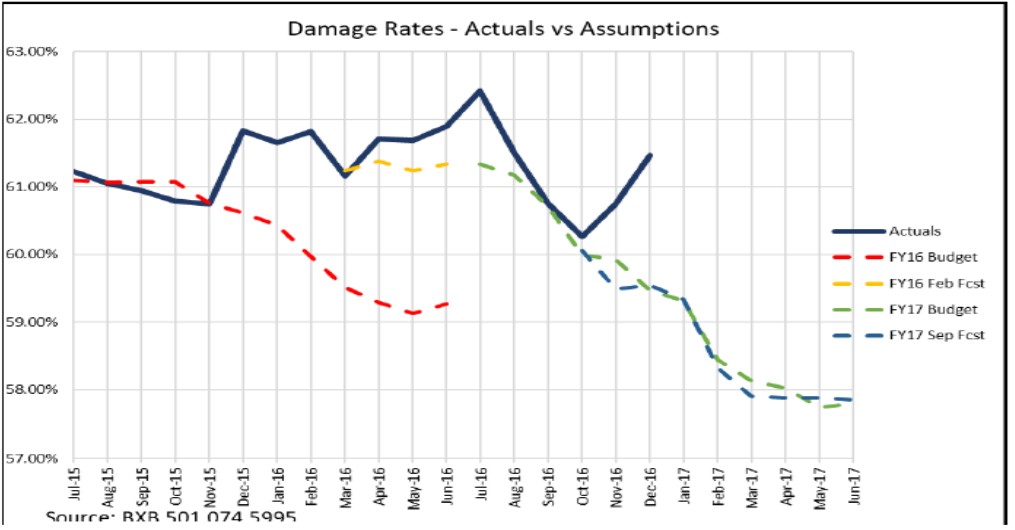
2190 I accept that the chart showed progress in reducing the damage rate, but as previously discussed, that did not mean that US Pooled was likely to achieve the forecast two pp reduction in the average damage rate by the end of FY17.
2191 First, while Young’s email was positive about the declining monthly damage rate, he did not say that he expected that to continue and go further (which was necessary if US Pooled was to achieve a two pp reduction in the average damage rate in FY17, as assumed in the Revised September Reforecast). Instead, Young said that while there were positive signs in relation to the damage rate and CPR, “the damage rate still represents the biggest risk we have for FY17, and we have a hill to climb”.
2192 Second, as earlier noted, the Revised September Reforecast assumed a reduction in the average damage rate of two pps over the course of FY17, down to 59.3%. Brambles’ data showed the jump-off point for July FY17 was a damage rate of approximately 61.9%, to get down to an average damage rate of 59.3% for FY17. The Revised September Reforecast assumed monthly damage rates of 58.4% in February 2017, 58.1% in March 2017, 58.0% in April 2017, 57.7% in May 2017 and 57.8% in June 2017. There was little or nothing in the evidence to indicate that was likely at this time.
2193 Third, and importantly, although the damage rate had declined from July to October FY17, as Alonso accepted, it was usually the case that the US Pooled damage rate went up in November, December and January. That arose as a result of high pallet demand to shift consumer goods in the Thanksgiving and Christmas period, and then the return of larger numbers of pallets, including damaged pallets.
2194 Fourth, Walmart represented around 20% of US Pooled pallet volume and the monthly damage rates for Walmart TPMs remained stubbornly high. There is nothing in the evidence to indicate that there was any realistic prospect of that materially coming down in FY17.
16.9 Sales revenue concerns
2195 On 26 October 2016, Todorcevski sent his Massive Growth Email to Gorman in which he said that the projected US Pooled 2H17 sales volume growth was “massive” and beyond anything Brambles had ever seen, including, as he further explained in cross-examination, the 13% to 15% sales volume growth US Pooled experienced following the collapse of iGPS.
2196 The US Pooled October Sales Funnel Report, which was distributed by Moriarty on 9 November 2016, stated that the value of the then-current opportunities in the US Pooled sales funnel was more than $160 million in aggregate, comprised of 888 sales opportunities being pursued by the US Pooled sales teams with:
(a) $113.9 million worth of opportunities classified as ‘Top’ (comprised of 636 bluesheets);
(b) $34.3 million classified as ‘In’ (comprised of 157 bluesheets); and
(c) $16.2 million classified as ‘Best Few’ (comprised of 95 bluesheets).
2197 The US Pooled October Sales Funnel Report also stated that the rolling 12-month conversion rate at the end of October was languishing at 15%, further reduced from September by nearly 3% (and half the usual ‘close rate’). As earlier noted, Martin did not forward Moriarty’s Conversion Rate Email (which showed a four-month trend of very low monthly conversion rates from June FY16 through September FY17) to his team until 4 November 2016. In forwarding Moriarty’s email to his team, Martin said that he had been “[t]hinking quite a bit about this conversion rate… and copying you in for your insights around my sleepless nights”. He went on to say that “[t]he trends from June-Sept are quite alarming and based on what I can see there is no way to over correct to off-set this” and that, provided it was a real rather than a reporting issue, it was a “problem”.
2198 In cross-examination, Martin attempted in multiple responses to walk back the significance of his remarks in his Conversion Rate Email, and to impugn the accuracy of Moriarty’s Conversion Rate Email. For the reasons earlier explained, I reached the view that his evidence in relation to Moriarty’s email and on the issue of the conversion rates should be given little weight. As I said earlier, Martin’s Conversion Rate Email is the most reliable evidence of his concerns at that time regarding the trend of very low conversion rates, and the meaning of his email is plain on its face. I conclude from the email that, as at 4 November 2016, Martin found the four-month trend of very low monthly conversion rates in US Pooled “quite alarming”, and his view was that (unless it was a reporting error rather than a real problem) he could not see “how to over correct to offset this”.
2199 In cross-examination, Martin accepted that if the trend in the conversion rate persisted, he could see no way for US Pooled to reach the projected unidentified wins in the Revised September Reforecast. That was stating the obvious.
2200 Brambles highlighted that the November Demand Consensus Report for US Pooled, distributed on 12 November 2016, stated that:
(a) major sales funnel opportunities amounting to 3.6 million issues were expected by the end of FY17;
(b) there were additional sales opportunities of 6.2 million issues; and
(c) for October FY17, the S&OP team had achieved over 98.6% accuracy in predicting the demand for US Pooled pallets.
2201 That provides some support for the proposition that, as at 16 November 2016, there were reasonable grounds for the achievability of the projected full-year US Pooled sales revenue and Underlying Profit budgets. But, by 16 November 2016, with four and a half months of FY17 already passed and with much of the rephased US Pooled 2H17 sales not projected to occur until 4Q17, the Demand Consensus Reports did not provide reasonable grounds for management to expect that the projected revenue would arrive sufficiently in FY17.
2202 A slide in the November Demand Consensus Report (8 November 2016) headed “Major Sales Funnel Opportunities” identified a series of large potential customers and predicted when US Pooled would “close” that potential sale and when pallet issues would commence. Again, the evidence does not establish that, as at 16 November 2016: (a) all the “Major Sales Funnel Opportunities” and “Major ‘Top’ Opportunities” on which Brambles relied were delayed sales rather than lost; or that (b) if US Pooled did achieve those sales, they would occur according to the predicted timeline, and therefore materially assist US Pooled to meet the sales revenue projections in the Preliminary Group September Reforecast.
2203 For example, the November Demand Consensus Report identified the following major opportunities:
(a) the First Quality Retail account which was expected to close (that is, a contract was expected to be signed) on 30 December 2016;
(b) the National Beef Packing which was expected to close on 1 December 2016;
(c) the Smithfield Foods account which was expected to close on 18 December 2016; and
(d) the Cott Beverages account which was expected to close on 2 January 2017.
2204 However, as I also explained in relation to the 14 October Overview document, none of those projected close dates were accurate:
(a) The First Quality Retail account involved 1.5 million pallet issues pa (which, at a conservative $5.00 RPI, was worth $7.5 million in sales revenue), and pallet issues were expected to commence in January 2017. The 24 January Deal Re-review Email showed that as that date US Pooled had not secured a contract with First Quality, and it was considering making a further improved bid in an attempt to secure that sale. It was locked in a fight with PECO to hold onto that contract and a resolution was not close.
(b) The National Beef Packing account involved 1.2 million pallet issues pa (worth approximately $6 million in sales revenue), and pallet issues were expected to commence in December 2016. However, the Holzman December Demand Forecast (14 December 2016) shows that US Pooled did not expect to secure the account until February 2017. And then the 24 January Deal Re-review Email shows that as at that date US Pooled was still locked in a contest with PECO to win that contract and National Beef was not close to making a decision.
(c) The Smithfield Foods account involved 1.4 million pallet issues pa (worth approximately $7 million in sales revenue) and pallet issues were expected to commence in Q2. However, the Holzman December Demand Forecast shows that US Pooled was not expected to secure the account until January 2017.
(d) The Wells Enterprises account involved 0.6 million pallet issues pa (worth around $3 million in sales revenue), which the November Demand Consensus Report said US Pooled expected to close at the beginning of Q3.
(e) The Cott Beverages account involved 2.9 million pallet issues pa. Cott Beverages did not sign a contract with US Pooled until later in 3Q17 by which time the contract was projected to give rise to only $1.4 million in sales revenue in FY17. An email from 13 December 2016 shows that it was estimated to give rise to only $200,000 in Underlying Profit in FY17. In relation to this contract Brambles contended that it had reasonable grounds to believe that this sale had been agreed, but that Cott Beverages then reneged in order to further renegotiate on price. Martin’s emails at the time support that contention.
2205 In my view, it is not hindsight to consider those later developments. First, it was Brambles’ contention that, at the time that the predicted timeline for those contracts was set out, the US Pooled sales team had reasonable grounds for that belief. The evidence does not establish that. Second, I saw many of those projections as just a continuation of the excessively optimistic approach that Martin’s team took to sales forecasting. In my view (except in relation to Cott Beverages), the subsequent events throw some light on the overall probability, as at 16 November 2016, that the listed sales were going to be achieved in time to be material to US Pooled meeting the revenue projections in the Preliminary Group September Reforecast. They operate to buttress the conclusions I have reached based on other evidence: Jazabas at [83].
2206 That is not to suggest that US Pooled did not secure any of the potential sales listed as a “Major Sales Funnel Opportunity” in the November Demand Consensus Report. A presentation titled “Brambles Board Report March 2017”, dated 1 March 2017 (March FY17 Board Report) and prepared for the March Board Meeting shows that US Pooled had indeed eventually secured the Cott Beverages, Wells Enterprises and “Smithfield - Denison” (which I infer was part of the Smithfield Foods account) accounts. The CHEP NA October PPR dated 16 November 2016 showed that US Pooled had in fact secured the “Smithfield - Denison” account in July FY17 to the tune of $1.4 million in annualised revenue. The CHEP NA October PPR also identified that YTD US Pooled had also secured:
(a) Lagunitas Brewing in July FY17 with an annualised impact of $1.4 million in sales revenue;
(b) lane expansion in “Premium Water - Las Vegas” in July FY17 with an annualised impact of $0.4 million in sales revenue;
(c) Polar Beverage in October FY17 with an annualised impact of $0.8 million in sales revenue; and
(d) lane expansion in International Paper in October FY17 with an annualised impact of $0.8 million in sales revenue.
2207 US Pooled had, though, lost large customers in this period, including at least one ‘major customer’. As previously noted, the slide presentation Martin emailed Nador on 8 October 2016 stated that the under-budget US Pooled sales revenue YTD was partly a result of the loss of two significant clients in FY17 worth approximately $16 million pa; the Scotts contract (worth approximately $12 million pa) and the Nestlé Location contract to iGPS in September (worth approximately $4.2 million pa).
2208 The November Demand Consensus Report (distributed 12 November 2016) recorded that by that date, US Pooled had lost the following large customer accounts in FY17:
(a) STKIS in July FY17 (representing 0.13 million pallet issues pa);
(b) Mars Foods (MARSF) in July FY17 (representing 0.07 million pallet issues pa);
(c) Continental Mills in July FY17 (representing 0.10 million pallet issues pa);
(d) Scotts in August FY17 (representing 2.87 million pallet issues pa);
(e) Mars Foods (MARSS) in August FY17 (representing 0.13 million pallet issues pa);
(f) Nestlé Danville in September FY17 (representing 0.15 million pallet issues); and
(g) Nestlé Anderson in November FY17 (0.85 million pallet issues)
1899 Relying on that list, the total large customer accounts US Pooled lost in FY17 represented 4.3 million pallet issues pa, which at a conservative RPI of $5.00, represented approximately $21.5 million in lost annualised sales revenue for US Pooled in FY17 (while noting that the largest lost customer (Scotts) largely transitioned to US Recycled at a lower profit rate).
1900 The CHEP Global weekly volumes report for week 5 of October FY17, circulated on 8 November 2016, showed that issue volumes were above both the FY17 budget and the Revised September Reforecast for most of October, although issue volumes for US Pooled were under the September Reforecast by 444 pallet issues.
1901 The US Pooled October Monthly Close Deck (dated 11 November 2016) showed US Pooled sales revenue was $(7.3) million under-budget for the month (and $(4.6) million below the September Reforecast), largely driven by $(4.2) million of under-budget and under-reforecast sales volume. Importantly, the $(4.2) million in under-budget and under-reforecast sales volume was driven by a $(4.6) miss in “Budgeted Wins”, and $(1.2) million in lost sales revenue through the loss of the Scotts account. Thus, as with the September results, a failure to achieve budgeted new wins lay at the heart of the sales revenue shortfall. Following the September results, sales revenue was $(15.9) million under-budget YTD.
2212 Nador deposed that her “biggest concern” was the direct costs overruns (because she knew there was “a delay in the sales pipeline” at that time) but she also said that her focus at that time included “accelerating the new wins”.
2213 On 12 November 2016, Linderman emailed Nador a draft spreadsheet the US Pooled team was preparing for Kennett for her review. The spreadsheet was a review of the September and October variances to budget. It put the revenue and costs items into categories, and explained against each item within those categories whether the item was a one-off, ongoing operations or timing issue, as well as setting out key commentary to explain each item. The top four categories were as follows:
(a) issue volume impact (net): with a total variance to budget for the two months of $(4.3) million, with $(1.9) million in September and $(2.4) million in October;
(b) sales: with a total variance to budget for the two months of $(4.4) million, with $(1.3) million in September and $(3.1) million in October;
(c) operations: with a total variance to budget for the two months of $(8.5) million, with $(4.8) million in September and $(3.7) million in October; and
(d) logistics: with a total variance to budget for the two months of $(3.6) million, with $(1.3) million in September and $(2.3) million in October.
2214 Importantly, Nador deposed that she made some edits to the commentary in the spreadsheet. Relevantly, she changed the commentary in relation to the “issue volume impact” category to state her view that: “[We] expect YTD volume miss to be difficult to claw-back as holiday period kicks in and large deals still in nego[tiation], but volume v Bud[get] for remaining 8 months will be flat”. I understood Nador there to accept that it was unlikely that the shortfall on pallet issue volume would be recovered, but it was unlikely to worsen.
16.10 The further downgrade to the US Pooled and CHEP NA Underlying Profit forecasts
2215 On 11 November 2016, US Pooled management held their usual weekly Walk to MOP meeting. Nador participated in the meeting. On 12 November 2016, Holzman emailed Nador the Walk to MOP file from that meeting. That file showed that the forecast Underlying Profit shortfall to budget had increased from $(5.6) million to $(10.1) million. It is appropriate to infer that the Walk to MOP file reflected the views of US Pooled management at the meeting. Nador testified that at this time she considered a $(10) million US Pooled Underlying Profit miss to budget for FY17 represented a “realistic outlook”.
2216 On 11 November 2016 Rumph emailed Mackie (Rumph’s 11 November Email) and told him that while CHEP NA management had been “aggressively working” to close the CHEP NA “budget gaps”, following a review by the CHEP NA leadership team, she projected that CHEP NA would miss its full-year Underlying Profit budget by around $(15) million “if nothing materially erodes from our plan in November”. She broke down the forecast $(15) million Underlying Profit miss to budget into a $(10) million miss in US Pooled and a $(2.5) million miss to budget in each of US Recycled and Canada.
2217 Nador was a member of US Pooled ELT. She inferred that the meeting to which Rumph’s 11 November Email referred was the CHEP NA weekly Walk to MOP meeting held that day, in which Nador participated. I consider that inference to be appropriate.
2218 The email said:
Pete - Just a heads up that we have been aggressively working to close budget gaps in [CHEP NA]. Weekly my ELT sizes up our consolidated gap closure plans and quantifies how we are tracking.
After today’s review, my projection is we will miss budget for the full year by ~$15M (if nothing materially erodes from our plan in November).
• NA - ~($15M) miss vs. budget (with no IPEP benefits other than $3M FIFO)
• Pooled - ~($10M)
• Recycled - ~($2.5M)
• Canada - ~($2.5M)
• Paramount - on budget
(Emphasis added.)
2219 In cross-examination, Mackie accepted that he understood Rumph to be telling him that:
(a) it was going to be impossible for CHEP NA Underlying Profit to recover to alignment with budget in FY17, after taking into account the recovery plans in place;
(b) CHEP NA would have a $(15) million Underlying Profit shortfall to budget for the year; and
(c) US Pooled Underlying Profit was projected to be $(10) million under-budget for the year, after taking account of its recovery plans.
That evidence accords with the plain meaning of the email, and I accept it.
2220 On 12 November 2016, Rumph forwarded her 11 November Email to Nador and Young, among others. Young promptly forwarded Rumph’s 11 November Email to Alonso:
(a) Nador testified that she understood Rumph’s 11 November Email in the same way as Mackie. She deposed that following a review held on 11 November 2016 (which Nador understood to be a reference to the CHEP NA Walk to MOP meeting), Rumph forecast that CHEP NA would miss its full-year Underlying Profit budget by approximately $(15) million after its recovery plan was implemented (provided nothing materially eroded from the CHEP NA plan in November).
(b) Alonso also testified that he understood Rumph’s 11 November Email as stating that CHEP NA management projected that it would miss its Underlying Profit budget by $(15) million in FY17.
2221 Nador deposed that when she received Rumph’s 11 November Email, she saw it as a “realistic outlook for the full year for US Pooled”. She said that although she was not as familiar with the other CHEP NA businesses, that forecast was consistent with what had been discussed during the CHEP NA Walk to MOP meeting on 11 November 2016.
2222 Mackie deposed that Rumph’s 11 November Email was the first time he had received a report from CHEP NA management downgrading its forecast for the full-year. He said that upon receipt of the email, his thoughts immediately turned to how the results in CHEP NA could be improved; and how to offset the poor results by over-budget performance in other CHEP CBUs.
2223 Through Rumph’s 11 November Email, Mackie, Nador and Alonso were told that the CHEP NA leadership team projected (i.e., considered it more likely than not) that, after taking into account its recovery plans (which included the dual track Walk to MOP process in US Pooled and CHEP NA), and provided there was no material deviation from plan in November, CHEP NA would miss its full-year Underlying Profit budget by $(15) million, of which $(10) million was to arise in US Pooled.
2224 The fact that the $(15) million downgrade to the full-year CHEP NA Underlying Profit forecast was after taking into account implementation of its recovery plan was confirmed in a presentation Rumph emailed to O’Sullivan and Kennett on 20 November 2016 titled “Nessa NAM Recovery Plan Review November 20” (the 20 November CHEP NA Recovery Deck). It stated that management’s “current view” was that CHEP NA would miss its Underlying Profit budget by $(15) million for the year “with all reasonable actions included”.
2225 Slide 10 of that presentation recorded that CHEP NA was $(29.3) million under-budget in Underlying Profit YTD, made up of $(25.3) million in US Pooled, $(0.9) million in CHEP Canada, $(2.7) million in US Recycled, $(0.7) million in CHEP NA HQ and $0.3 million in Paramount.
2226 Although that presentation was dated 20 November 2016, the fact that CHEP NA had an actual $(29) million Underlying Profit shortfall to budget YTD was known on 11 November 2016 when the October results were received. That sat behind Rumph’s forecast that, through implementation of the US Pooled and CHEP NA recovery plans (and provided there was no further deviation from the plan in November), that shortfall could be brought back to a $(15) million Underlying Profit deficit by the end of FY17.
2227 Curiously, slide 10 also identified that, in fact, after taking into account the risks and opportunities, CHEP NA anticipated having a $(17.8) million Underlying Profit deficit to budget for FY17, not $(15) million as Rumph had forecast. The reason for that difference was not explained.
2228 On 14 November 2016, the day before the November Board Meeting, Mackie emailed Gorman (Mackie’s 14 November Email), including a table with a breakdown of the CHEP Global October results. Gorman forwarded the email to Todorcevski the same day, with an “FYI”. Relevantly to CHEP NA and US Pooled, the email said:
Apologies for our start to the year which is mixed across global pallets.
…
The US pooled business is our biggest challenge driven by a softer top line than budgeted plus a significant additional drag from direct costs. The recovery plan we reviewed with the team in Atlanta is already underway but unfortunately we had an unexpected additional shortfall in direct costs this month, which we now have our best [supply chain] finance people getting to the root cause on. It is important we get a clear understanding of the physicals for [Alonso] to get the right corrective actions in place.
At the end of last month we identified specific actions to cover the YTD shortfall in [US Pooled] and were working new ideas to close the remaining $5.6m gap to budget. We felt we had enough ideas in the hopper to get this done. Our latest view after October performance is a gap of $10m to close after identified recovery actions. The team are on all aspects of the controllables to bring this back on track but we are in for a tough H1 relative to budget. Key focus areas are:
• Accelerate New Business Wins, close (800k) vs budget YTD
• Targeted pricing actions to recover Q1 miss
• Reduce / Optimize activity - repairs, relocations from recycled locations and TPM handling and offset /reduce the impact of rates
• Execute on add’l initiatives: Contract expirations, flow optimization, dedicated fleet expansion
• Go-get initiatives in all areas - Sales, SC, OH, Procurement and FIFO correction
In addition to these I think offsetting the $10m is going to require a more balanced scrub of our assumptions on IPEP and a short term win(s) out of Kim’s meeting with Walmart 16th Dec.
[Europe] and [LATAM] are now both reviewing additional actions in their regions to compensate at the Americas and total Pallets level. This includes a dedicated intercontinental team to drive inbound US flows harder. [Europe] already had a number of overhead restructuring ideas in development which we will now pull forwards along with a very close scrub of the balance sheet where Mike [Pooley] and I both feel there is opportunity.
Please be assured we take the delivery of our budget commitment every year seriously and this transition year will be no different
(Emphasis added.)
2229 In passing, I note two things.
2230 First, as I later explain, it does not appear that Gorman and Todorcevski understood from Mackie’s email that CHEP NA management had actually downgraded its forecast to project that, after implementation of its recovery plan and that provided there was no deviation from plan in November, US Pooled would have a $(10) million Underlying Profit shortfall to budget for FY17.
2231 Second, it will be recalled that Mackie’s 12 October 2016 email to Gorman and Todorcevski said that Nador was to meet a Walmart executive (Robert) on 20 October 2016, and was to tell him that Rumph wanted a one-on-one meeting with another Walmart executive (Sultemeier) in relation to a proposed quick win around “taking a TPM back or at least getting an immediate quality spec[ification] change on reuse pallets”. I infer that Rumph’s 16 December 2016 meeting (to which Mackie’s 14 November Email referred) was that meeting, and that those matters were the “short term win(s)” to which his email referred.
2232 For the following reasons, I am satisfied on the evidence that there were not reasonable grounds for Mackie to expect that the projected US Pooled $(10) million Underlying Profit shortfall to budget for the year could be offset by getting some “short term win(s)” from Rumph’s scheduled 16 December 2016 meeting with Walmart. In my view Mackie was underplaying the Walmart problem in an example of what O’Sullivan later described in a memo to Chipchase as Brambles’ “good news culture”.
2233 First, Mackie’s reference to taking back control of a Walmart TPM was a reference to attempting to persuade Walmart to agree that US Pooled should run the TPM rather than the third-party that had been operating it since the souring of the relationship between Walmart and US Pooled some years earlier. There is no evidence to indicate that Walmart was likely to agree to that. Walmart was quite unlikely to agree to transferring control back to US Pooled because, as Mackie accepted in cross-examination, further work was needed before the US Pooled / Walmart relationship could be repaired.
2234 As should have been expected, that was what eventuated. On 17 December 2016, Rumph emailed Mackie to report on the result of her meeting with Walmart. She explained that Walmart clearly understood what it was getting from being able to re-use US Pooled’s pallets and the negative impact it was having on US Pooled. Even though Rumph told Walmart’s representative that US Pooled was only looking for “a stop gap that has no negative impact” on Walmart, she reported that there was “no conclusion on short-term relief to enter the TPMs”.
2235 Second, Mackie’s reference to getting an immediate quality specification change on re-use pallets was a reference to attempting to persuade Walmart to change the quality specifications regarding its re-use of pallets. There is nothing in the evidence to show that, in this period, there was any likelihood that Walmart would agree to change its arrangements with US Pooled by reducing its right to re-use US Pooled pallets. Indeed, on my view of the evidence it was substantially more likely than not that Walmart would refuse. It derived a significant commercial benefit from having the ability to re-use US Pooled’s pallets before it returned them. In this period, 88% of pallets returned at Walmart TPMs were damaged. As should have been expected, when Rumph reported back to Mackie on 17 December 2016, she said nothing to indicate that Walmart had or was likely to agree to any change to the quality specifications for reuse.
2236 Third, nothing did change. In an email to Alonso on 14 December 2016 Young said while the Service Centre damage rate was low and trending down: “Unfortunately Walmart is [at] an all-time high”. In December 2016, the Walmart damage rate was 90%. O’Sullivan deposed that, in a meeting between her and the CHEP NA management team on 5 January 2017, Patell presented on CHEP NA’s relationship with Walmart. He said that the rate of pallet reuse at Walmart was the result of historical factors that had impacted CHEP NA for a number of years, and that improving the rate of re-use at Walmart was unlikely to be achieved in the short-term. On 30 January 2017, O’Sullivan sent Chipchase an email in which she doubted the impact of the Durability Program in Walmart because “if Walmart get better pallets won’t they just hold onto them for longer…and ultimately end up with more of our pallets in their system. With a higher year-on-year damage rates almost at 90% they only give pallets back to us when they are broken”.
2237 On my view of the evidence, there were not reasonable grounds for Mackie to forecast an offset or a recovery in US Pooled Underlying Profit in FY17 on the basis that Walmart would agree to change the terms and conditions of its pallet re-use, from which it derived a significant commercial benefit. That was little more than a hope and not a proper basis for forecasting in a large and complex business like US Pooled.
16.11 The Group September Reforecast
2238 The Preliminary Group September Reforecast was approved, without material changes, by the Board at the November Board Meeting on 15-16 November 2016. Henceforth, I will call it the Group September Reforecast.
16.12 Brambles’ lay evidence
Nador
2239 Nador’s evidence in relation to the period up to and including 16 November 2016 was different from her evidence in relation to the period up to 20 October 2016. She no longer expressly testified that she thought the US Pooled Underlying Profit budget for the year was reasonable or achievable, although there were parts of her evidence where she seemed to intimate that.
2240 For example, she gave evidence that in the US Pooled Status Review Meeting on 25-26 October she “flagged” to Gorman and Mackie the revised forecast of a $(5.6) million Underlying Profit miss to budget for the year, and following those meetings, she emailed Gorman and Todorcevski on 26 October 2016 and said: “We feel we are all in this together. We have faced tough challenges before, and are confident we can overcome this one too”. Nador’s email might be understood as her telling Gorman and Todorcevski that she was confident US Pooled could close the projected $(5.6) million gap to budget over the remainder of FY17.
2241 I do not, however, understand her evidence in that way. First, in cross-examination Nador did not try to walk away from her evidence that US Pooled had revised its forecast to project a $(5.6) million Underlying Profit miss to budget for the year. She described a $(5.6) million Underlying Profit miss to budget as the “most likely scenario”. And she also said that there was “a lot more risk than opportunity” attached to limiting the shortfall to one of that magnitude. Her evidence was that the projected $(5.6) million shortfall was a “challenging” target; i.e., it was going to be difficult to keep the Underlying Profit deficit to $(5.6) million. I understand the remark in Nador’s email as a statement that US Pooled management would be trying to hold the line at a $(5.6) million miss to budget, not that she thought it was likely that US Pooled would be able to recover the forecast deficit over the remainder of FY17. Second, whatever the position as at 20 October 2016, it was different as at 16 November 2016 because by then US Pooled had received the very poor October results and its Underlying Profit deficit to budget YTD had substantially increased.
2242 But even after the October results, there were some examples in Nador’s evidence which might be understood as her saying that she still considered the US Pooled budget to be achievable by the end of the year. For example, she testified that:
(a) following her “rough” first pass review of the October results she was “committed to closing the delta to budget over the full year, and that [she] did not want to leave any stone unturned in identifying the reasons for the issues that had arisen in the month”. She deposed that her “biggest concern” was the direct costs overruns, because she knew at that point in time that there was a delay in the sales pipeline. She said that her focus at that point of time was on “accelerating the new wins”, and that the planned recovery actions were captured in the Walk to MOP plans; and
(b) on 11 November 2016, she attended Walk to MOP meetings for US Pooled and CHEP NA at which $6 million of “additional opportunities” were identified, which she described as:
(i) budget adjustment for interregional with LATAM: $3 million of opportunity due to LATAM over-backed budget, to be adjusted with CHEP Global;
(ii) retail: $1.3 million of opportunity for “LENs”, and pricing opportunities;
(iii) operations: $0.9 million of opportunity in contracts, activity based refunds;
(iv) sales: $0.5 million of opportunity in NPDs and pricing; and
(v) logistics: $0.3 million of opportunity in additional initiatives.
She said that she thought those opportunities were a good example of the “whitespace” or untapped opportunity, which the team was digging into to try and “close the delta to budget”.
2243 I do not understand that as evidence that, as at 16 November 2016, Nador thought it was likely that US Pooled would actually “close the delta to budget” and achieve its Underlying Profit budget for the year. I understood that as evidence that she and her team were striving to keep the Underlying Profit deficit to budget for the year as low as possible. Essentially, that is because:
(a) unlike earlier periods, following the October results, Nador did not state that she still considered the US Pooled budget to be achievable;
(b) the 12 November 2016 Walk to MOP file shows that US Pooled management revised its forecast to project that US Pooled would miss its Underlying Profit budget for the year by $(10.1) million; and
(c) Rumph’s 11 November Email shows that, following a meeting of the CHEP NA ELT (which Nador attended) Rumph forecast that, after taking into account the recovery plan, and that provided there was no material deviation from plan in November, CHEP NA would have a $(15) million Underlying Profit deficit to budget for the year, including a $(10) million deficit to budget in US Pooled for the year. Nador testified that the forecast US Pooled miss to budget was a “realistic outlook” for the year.
Martin
2244 The thrust of Martin’s evidence was that, as at 16 November 2016, he thought the US Pooled sales budget continued to be achievable, but with the rider that the monthly results for December and January FY17 would determine the ability of US Pooled to meet budget for the year. He said that was because those two months in combination were usually a busy time for US Pooled and typically, approximately 30% of annual contract renewal dates fell on 31 December, and there were a large number of contracts which he expected to close in or around December FY17.
2245 He said that it was necessary to consider the December and January results together to develop a clearer view of what 2H17 would look like and “if we progressed past January and had not seen signs of improvement, it would be difficult to recover from budget misses in previous months, given the time remaining in the financial year”.
2246 He deposed that, as at 25 October 2016, he thought the full-year US Pooled sales revenue budget was “reasonable, realistic and achievable”. In his view, at that time the sales revenue shortfall to budget was “largely attributable to timing issues and to abnormal business dynamics such as pricing being affected by P-day trends in individual months that did not align with historical experience or our expectations”.
2247 He also deposed that, as at 8 November 2016, he was optimistic about the US Pooled sales volume predictions for the full-year given that the pallet issues for October exceeded the September Reforecast. He deposed that he “remained confident that given the large number and types of opportunities in the pipeline, it was likely that we would be able to recover the previous budget misses in revenue”.
2248 Then, following receipt of the very poor October results (11 November 2016), he said that he thought the sales results were “mediocre”, but he thought that “they were driven in large part by the delays in potential new business from large customers progressing through the pipeline”.
2249 Martin was unfailingly optimistic about his view of sales future performance. For example, on 12 November 2016, he received the November Demand Consensus which showed that Brambles projected that US Pooled would be 1.5 million pallet issues under-budget for the year. On a conservative RPI of $5.00, that shortfall to budget was worth approximately $7.5 million in annualised sales revenue. But the thrust of Martin’s evidence was that he was not overly concerned. He said that he was “not happy being in the position we were in at that point in time and would have preferred not to have had a potential volume gap of that size” but he described that shortfall to budget as “large but not insurmountable”. He also said that he “considered that we would need to work hard to be able to achieve the budget for the full year” i.e., that he continued to think the sales budget for the year was achievable.
2250 The same unfailing optimism can be seen in his approach to the US Pooled November MBR, a presentation titled “November MBR CHEP USA Pooled FY17” dated 19 November 2016 which he received on 19 November 2016 (i.e., after 16 November 2016). The MBR set out the projected US Pooled sales figures for FY17, taking into account the actual sales results YTD, including those up to that time in November. It showed that US Pooled was projected to have a sales revenue shortfall to budget of $(10.3) million, being a further deterioration from the position in the November Demand Consensus. Even then Martin’s evidence was that he considered US Pooled could still achieve its sales revenue budget for the year. He deposed:
I considered the increased projected miss to be less than ideal, but still something that could be offset by the potential large wins that we had seen in previous years but had not yet seen materialize in FY17, given the large volume of opportunities in the pipeline.
Alonso
2251 Alonso’s evidence in this period was focused on supply chain issues and direct costs, and some of that is already captured above.
2252 Alonso’s evidence in relation to the achievability of the US Pooled and CHEP NA budgets in the period up to and including 16 November 2016 was different from his evidence in relation to the period up to 20 October 2016. In relation to November, he did not testify that everyone thought that the reforecast for US Pooled and its Underlying Profit budget was “feasible”, as he did for October. He also did not state, as he did regarding October, that although the reforecast and budget were a “super stretch”, “very challenging”, and “very, very stretched and very, very difficult”, he thought they were achievable.
2253 He accepted that Rumph’s 11 November Email informed him that CHEP NA had forecast that it would have a $(15) million Underlying Profit deficit to budget for the year, including a $(10) million Underlying Profit deficit in US Pooled. He testified that he understood that Rumph’s view was that, after taking into account CHEP NA’s recovery plans, the CHEP NA full-year Underlying Profit budget was unachievable. He said nothing in his evidence to indicate that he disagreed with that assessment.
Kennett
2254 In cross-examination, Kennett denied that, as at 26 October 2016, he considered the projections in the Revised September Reforecast in respect of CHEP Global were unachievable. However, that does not add much about the position as at 16 November 2016, given that in the interim, the very poor October results were received.
2255 Kennett said that when he received the October results (11 November 2016) he was surprised and disappointed by US Pooled’s results, which were again driven by under-budget sales revenue and over-budget direct costs. He noted that the sales revenue and Underlying Profit results for CHEP Global in October were materially under-budget and under-reforecast. But he found some positives for CHEP Global in that. He said that CHEP LATAM and CHEP Europe “continued their positive momentum” and taken together their sales revenue was $3.5 million ahead of budget and $3.2 million ahead of the Revised September Reforecast.
2256 Kennett deposed that, at that time, he considered that Moreno needed to dig into the data to help develop and / or challenge action plans to address the issues on the direct costs side of the US Pooled business. He considered the “direct costs deep dive” to be undertaken by Moreno to “be necessary to understand the real physical drivers of the supply chain costs and any core changes in the past two months compared to the previous six months in the US Pooled business”. I accept that evidence.
2257 On 16 November 2016, Kennett received an email from Limpanatevin circulating the CHEP Global October PPRs for each CHEP CBU, including the CHEP NA October PPR. It is appropriate to infer that the information in the CHEP NA October PPR was available to Brambles’ management prior to the date the presentation was distributed (16 November 2016).
2258 Kennett noted the following matters regarding the CHEP NA October PPR:
(a) the headline variances to budget were in line with what he had seen in the flash report on the US Pooled Close Deck;
(b) despite lower than forecast sales volumes, US Pooled reported two new wins (Polar Bear and International Paper, with combined annualised sales revenue of $1.6 million) and it also reported some positive contract expansions that had been secured and contract negotiations being progressed. He said that the First Quality, Cott Beverages, National Beef and Blue Bunny businesses would deliver 5.9 million pallet issues on an annualised basis, which at approximately $5.00 RPI was the equivalent of $29.5 million of additional revenue. He noted that, if secured, the JBS contract was equivalent to an incremental $16.5 million. Apparently on that basis, Kennett described US Pooled YTD sales as “strong” and said that they represented 8.1% growth from FY16. I give little weight to Kennett’s description of US Pooled YTD sales as “strong” when they were materially under-budget and under-reforecast; and
(c) it contained an updated R&O schedule for US Pooled (reproduced below) (US Pooled October R&O Schedule).
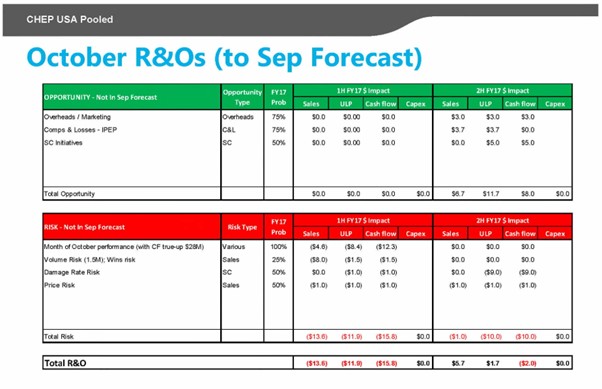
2259 In evidence-in-chief and cross-examination, Kennett agreed that the US Pooled October R&O Schedule provided for:
(a) a total of $(11.9) million in risks to US Pooled Underlying Profit in 1H17 (which were excluded from the Revised September Reforecast). On a probability-adjusted basis that equated to $(9.7) million in risks to 1H17 Underlying Profit; and
(b) a total of $(13.6) million in risks to US Pooled sales revenue in 1H17 (which were excluded from the reforecast). On a probability-adjusted basis that equated to $(7.1) million in risks to 1H17 sales revenue.
The risks included an $(8.4) million risk to US Pooled 1H17 Underlying Profit, which was identified as “Month of October Performance”. That was given a probability of 100% as that risk had actually eventuated. Kennett explained that the October actual results were recorded as a risk with a 100% probability in 1H17 because they would not be integrated into the forecast until the December Reforecast. Kennett said that, at that time, based on the analysis undertaken in connection with the Revised September Reforecast and the US Pooled Walk to MOP process and recovery plans that were “largely in line” with what he expected to see.
2260 For the reasons I later explain, I consider the US Pooled October R&O Schedule materially understated the risks to US Pooled FY17 Underlying Profit.
2261 Curiously, in his evidence-in-chief, Kennett did not expressly depose as to whether, as at 16 November 2016, he continued to believe in the achievability of the projections in the Group September Reforecast in respect of US Pooled and CHEP NA or of their Underlying Profit budgets for the year. His affidavits were silent as to that.
2262 That was an unsatisfactory approach to his evidence, as it tended to obscure his view, as at 16 November 2016, regarding the achievability of the September Reforecast and of the US Pooled and CHEP NA Underlying Profit budgets for FY17. Specifically, it tended to obscure the reasons for his view at that point in time. I infer that was a forensic choice, given that for other important dates in the case, Kennett set out his view regarding budget achievability by reference to a list of reasons.
2263 Even so, for the following reasons it is appropriate to infer that, as at 16 November 2016, Kennett considered it to be more likely than not that US Pooled and CHEP NA would fail to achieve the projections in the Group September Reforecast and their Underlying Profit budgets by the end of FY17.
2264 First, to a significant extent, that was obvious when, as at that date, US Pooled and CHEP NA had Underlying Profit deficits to budget of $(25.3) million and $(29) million respectively YTD.
2265 Second, he was copied into Mackie’s 11 November 2016 email to Cabrera informing him of the “extremely ugly” US Pooled results, and his view that the results “look impossible for them to overturn by H1”. Mackie’s email told Cabrera that CHEP Europe was going to try to “squeeze out more” and asked Cabrera to have a discussion with his team to “identify key opportunities to accelerate”. Kennett’s 12 November 2016 email to De Rivas, forwarding him a copy of Mackie’s email to Cabrera, had a desperate tone. He said:
See below - I cannot over-emphasise the importance of this, so please look everywhere you can.
That evidence tends to show that Kennett understood that it was vital to obtain Underlying Profit overperformance against budget from other CHEP CBUs so as to fill a large Underlying Profit gap to budget in CHEP Global, arising from the underperformance by US Pooled and CHEP NA.
2266 Third, and most importantly, Rumph emailed Kennett on 16 November 2016 and told him that she projected that CHEP NA would miss its Underlying Profit budget by $(15) million for the year, provided CHEP NA was where it predicted it would be following the November results, and that the downgraded forecast would be shown in the December Reforecasting process. Kennett did not testify that he disagreed with that assessment. Rather, on 17 November 2016, Kennett emailed Rumph in response to her email and told her that “we” (I infer, Kennett and the CHEP Global FP&A team) agreed with Rumph’s downward revision. He said that the R&O schedules from the CHEP NA October PPR were “more or less indicating that likely net risk was about $15 million”, and noted that Rumph was saying that that would become a “reality or crystallise in the next forecast”. In relation to that exchange, Brambles submitted that the thrust of Kennett’s evidence was that he understood Rumph’s position to be that all of the likely net risk of $(15) million was now reality, or would crystallise in the next forecast. However, he still did not have some of the documents that would clarify the position. He said he would rather not present anything further to O’Sullivan until he had more clarification on the explanations for the current situation and the recovery plans that were in place (and who owned them).
2267 Fourth, in the period immediately following 16 November 2016, Kennett proceeded on the basis that a $(15) million downgrade to the CHEP NA Underlying Profit forecast was appropriate. A presentation he prepared for O’Sullivan on or around 18 November 2016 adopted that downgraded forecast as the basis for a proposed CHEP NA recovery plan going forward.And on 19 November 2016, when Kennett was looking for sales revenue and Underlying Profit overperformance against budget from other CHEP CBUs to offset CHEP NA’s underperformance, he emailed Rumph and said that he was not expecting any overperformance from CHEP NA as it had already given its “estimate of a $15m shortfall for the forecast”.
2268 Fifth, Kennett informed O’Sullivan of the $(15) million Underlying Profit projected shortfall in CHEP NA in a phone call on or around 18 November 2016.
2269 Curiously again, in his evidence-in-chief Kennett did not expressly depose as to whether, as at 16 November 2016, he continued to believe in the achievability of the projections in the Group September Reforecast in respect of CHEP Global or of its FY17 Underlying Profit budget. His affidavits were silent as to that.
2270 That was, again, an unsatisfactory approach to his evidence as it tended to obscure his view, as at 16 November 2016, regarding the achievability of the September Reforecast and of the CHEP Global Underlying Profit budget by the end of FY17. More particularly, it tended to obscure his reasons for his view as at that time. Again, I infer that was a forensic choice as, in respect of other important dates in the case, Kennett deposed as to why, at that point in time, he considered the CHEP Global budget was achievable and listed the reasons for his view. He did that, for example, as at 14 October, 25 November, and 20 December 2016.
2271 Even so, for the following reasons, it is appropriate to infer that, as at 16 November 2016, Kennett continued to believe that the CHEP Global Underlying Profit budget for FY17 was achievable. I make that conclusion for the following reasons.
2272 First, as above, Kennett testified that he believed in the achievability of the CHEP Global budget as at the dates indicated above. He did so notwithstanding that throughout that time period the US Pooled and CHEP NA Underlying Profit deficits to budget continued to worsen. At no stage in 1H17 did Kennett testify that he no longer believed the CHEP Global budget was achievable by the end of the year. It is very unlikely that as at 14 October, 25 November and 20 December 2016, Kennett believed in the achievability of the CHEP Global budget whereas as at 16 November 2016 he did not.
2273 Second, Kennett deposed, and I accept, that following receipt of the October results (11 November 2016) the focus of the CHEP Global leadership team was “on harnessing the CBUs as a collective to deliver as much as possible to assist the business overall to deliver on its budget for the year, while also ensuring that we could still deliver a reasonable H1 on a comparable basis to last year”. The evidence shows that in this period Mackie telephoned and sent emails to the Presidents of CHEP LATAM and CHEP Europe asking them to look for opportunities to improve Underlying Profit in those CBUs so as to offset the Underlying Profit deficit arising from underperformance in US Pooled and CHEP NA. The evidence shows that Kennett was sometimes copied into the emails, and that he was aware of Mackie’s activities.
2274 Kennett emailed De Rivas on 12 November 2016 reiterating the importance of looking everywhere for additional Underlying Profit. On 16 November 2016, Kennett emailed Mackie and said that CHEP Europe and CHEP LATAM appeared to have an opportunity to improve their results YTG having regard to their current gross profit performance, which was $8.1 million better than budget YTD. To my mind, the evidence shows that he and Mackie were looking for some overperformance against budget from other CBUs but did not yet know whether they could get it, although there were some positive signs.
2275 Third, Kennett deposed that on 17 November 2016, he attended the CHEP Global November CFO BPR meeting, and prior to the meeting he presented to O’Sullivan by reference to the CHEP November CFO BPR slide deck. He said that he emphasised a series of matters which were positive matters in relation to the achievability of the CHEP Global budget. I later set out those matters.
2276 Fourth, some of the lengthy list of reasons Kennett gave as at 25 November 2016 for his belief at that time that the CHEP Global budget remained “achievable and reasonable” are also likely to have applied as at 16 November 2016 (although some plainly could not). I later set out those matters.
Mackie
2277 In his evidence, Mackie noted Kennett’s 11 November 2016 email which described the October results as “bad”, and said that CHEP Global had a $(25.8) million Underlying Profit deficit to budget YTD, which was “all basically” due to underperformance in US Pooled. Mackie testified that he anticipated that the performance in CHEP NA in October would be “challenging” but he was not expecting the extent of the shortfall that occurred, and he also queried whether “one-time” direct costs were impacting the results for CHEP Europe.
2278 However, in an email exchange he had with Gorman, Mackie said that he expected “to see some good offset” from CHEP Europe and CHEP LATAM, and Gorman responded by noting that:
It’s a portfolio so obviously offsets elsewhere are appreciated but long-term needs an improving US.
Gorman also noted that the Containers division was slightly ahead of budget and IFCO’s sales volume was strong. In cross-examination, Mackie accepted that the October results were “much worse than anticipated” and described them as “concerning”. But he said that LATAM and Europe were “doing well” and other businesses in the Group might also assist to offset the results in US Pooled.
2279 Mackie also noted, and I accept, that the results for the rest of CHEP Global were delivered at or above forecast and budget on both sales and Underlying Profit for both October and YTD.
2280 Mackie testified that, upon his receipt of Rumph’s 11 November Email in which she downgraded the Underlying Profit forecast for CHEP NA for the year, his thoughts “immediately turned to how the results in CHEP NA could be improved and also as to how to offset through the results of other CBUs”. I accept that evidence. Upon receipt of the October flash results, Mackie quickly embarked on a course of seeking over-budget Underlying Profit performance from other CHEP CBUs. On or around 11 November 2016, he spoke to Pooley (CHEP Europe) and to Cabrera (CHEP LATAM) about assistance to close the revenue and Underlying Profit gaps to budget in CHEP Global, and he said that he intended to speak to Agatha De Marquez, Director of Operations in CHEP NA, about assistance from “International” as soon as possible.
2281 On 12 November 2016, Mackie emailed Cabrera and asked him to consider whether there were any opportunities in CHEP LATAM to assist with offsetting the underperformance in CHEP NA. He deposed that at that time CHEP LATAM was tracking ahead of budget and the Revised September Reforecast, and that it was not unusual for him to ask whether there were opportunities for CBUs to improve results so as to offset results in other parts of the business. I accept that evidence.
2282 Mackie’s 14 November Email to Gorman said:
(a) CHEP Europe and CHEP LATAM had started the year well with momentum in relation to sales and direct cost efficiencies which look set for the balance of the year, and will provide some offset to the results in CHEP NA;
(b) CHEP AIME has been struggling from the start of the year, and was in recovery mode, but was expected to get back to budget;
(c) CHEP Asia Pacific was similar to AIME, with softness in Australia and weak volumes in Asia. A recovery plan had been developed which was expected to deliver budget;
(d) in CHEP NA:
(i) US Recycled was improving. It would not meet budget, but that was not the main problem in CHEP NA;
(ii) the biggest challenge was US Pooled, which was driven by softer sales than budgeted plus “a significant additional drag from direct costs”;
(iii) the recovery plan that Mackie and Gorman had reviewed at the US Pooled Status Review Meeting was underway, but unfortunately US Pooled had “an unexpected additional shortfall in direct costs this month”. Mackie said that we now have our best supply chain finance people getting to the root cause of the direct costs overruns, and it was important to get a clear understanding of the “physicals” so that Alonso could get the right corrective actions in place;
(iv) at the end of October, management thought that they had identified specific actions to cover the YTD shortfall in US Pooled, and were working in new ideas to close the remaining $(5.6) million gap to the US Pooled Underlying Profit budget for the year. In their view, they had enough ideas “in the hopper to get this done”. However, management’s “latest view” was an Underlying Profit gap of $(10) million to close “after identified recovery actions”; and
(v) in addition to a list of specified recovery steps in US Pooled, Mackie thought that offsetting the $(10) million gap to budget was going to require a “more balanced scrub of our assumptions on IPEP” and “short term win(s)” from Rumph’s meeting with Walmart scheduled for 16 December 2016; and
(e) the Presidents of CHEP Europe and CHEP LATAM were both reviewing additional actions in their regions to compensate for the poor CHEP NA results, both at the CHEP Americas level and the CHEP Global level. He said that CHEP Europe already had a number of ideas around restructuring overheads in that business, which were to be pulled forward, together with a “very close scrub” of the CHEP Europe balance sheet where both Mackie and Pooley considered there was an opportunity to do so.
Mackie finished by noting that CHEP Global management took delivery of its budget commitments “seriously” and this year would be no different.
2283 On 14 November 2016, Mackie received Gorman’s Landing the Plane Email. It showed Brambles’ CEO looking for over-budget performance from other parts of the Group in an effort to offset the under-budget results in US Pooled and CHEP NA.
2284 On 15 November 2016, Mackie emailed the Presidents of each CHEP CBU asking them to look for potential opportunities to improve their financial results to offset the shortfall in US Pooled. Mackie’s email said that given “the size of the hole” the “challenge” was going to be shared Group-wide, and that the Group was “on the hunt” for around $20 million of Underlying Profit. Mackie deposed that he sent the email because he wanted to make sure that the December Reforecast submissions of each CBU were prepared with a view to identifying opportunities to enhance Underlying Profit.
2285 Mackie further said that on 16 November 2016 he received an email from Kennett, which informed him that Europe and LATAM looked to have opportunities for improvement in the balance of the year given their current gross profit performance, and that US Recycled had identified opportunities to achieve its September Reforecast. Mackie said that he was pleased by those opportunities as he was focused on looking for ways to improve CHEP NA’s financial results, including to identify opportunities, and / or other CBUs to assist, to offset the CHEP NA results.
2286 Mackie also referred to the CHEP Global October PPR presentations for each CHEP CBU, including the CHEP NA October PPR that he received on 16 November 2016. Similar to Kennett, he noted the poor October results for CHEP NA which were materially under-budget and also under September Reforecast, but found some positives in the report. He noted that the CHEP NA October PPR indicated that there were a number of significant customer accounts that were in their final stages of negotiations and that a new contract had been executed with Blue Bunny (set to commence at the end of December 2016) and contract renewals had been executed with Campbell Soup Company and Lamb Weston. Similarly to Kennett, he noted that the damage rate for US Pooled was slightly higher than budget, but it was continuing to trend down. Mackie also noted that on 16 November 2016 Kennett told him that Moreno’s report would be received “shortly”, which Mackie welcomed because he “expected Moreno to provide recommendations for improvements that could be applied to reduce costs for US Pooled”.
2287 Curiously, as with Kennett’s evidence, in his evidence-in-chief Mackie did not expressly depose as to whether, as at 16 November 2016, he believed in the achievability of the projections in the Group September Reforecast for US Pooled and CHEP NA or of their Underlying Profit budgets by the end of FY17. His affidavits were silent as to that. I infer that was a forensic choice, as in respect of other important dates in the case he set out his view as to budget achievability by reference to a list of reasons. That was an unsatisfactory approach to his evidence, as it tended to obscure his view regarding the achievability of the US Pooled and CHEP NA Underlying Profit budgets by the end of FY17 as at 16 November 2016, and in particular, his reasons for that view.
2288 Even so, for the following reasons, it is appropriate to infer that, as at 16 November 2016, Mackie considered it to be more likely than not that US Pooled and CHEP NA would fail to achieve the projections in the Group September Reforecast and their Underlying Profit budgets by the end of FY17:
(a) First, in cross-examination Mackie accepted that he understood from Rumph’s 11 November Email that after taking account of the implementation of the US Pooled and CHEP NA recovery plans, it was going to be impossible for CHEP NA to recover to meet its Underlying Profit budget for the year. He understood that instead CHEP NA would have a $(15) million Underlying Profit shortfall to budget for the year, including that US Pooled would have a $(10) million Underlying Profit shortfall to budget for the year. He did not testify that he disagreed with that assessment, and his 14 November Email informed Gorman that management’s “latest view” was that US Pooled would have a $(10) million Underlying Profit gap to budget for the year.
(b) Second, Mackie’s email to Cabrera on 12 November 2016 described the US Pooled results as “extremely ugly” and said that it looked “impossible” for US Pooled to overturn those results by 1H17.
(c) Third, in cross-examination, Mackie accepted that he knew from Rumph’s 11 November Email, as he had been directly told, that US Pooled was not going to be able to get back to alignment with budget in FY17. The same must be true in relation to what Rumph’s November Email said in relation to the achievability of the CHEP NA budget.
2289 Curiously again, Mackie did not expressly depose as to whether, as at 16 November 2016, he continued to believe in the achievability of the projections in the Group September Reforecast in respect of CHEP Global or its Underlying Profit budget by the end of FY17. That was, again, an unsatisfactory approach to his evidence as it tended to obscure his view as to the position as at 16 November 2016, and more particularly his reasons for that position.
2290 I again infer that was a forensic choice, as Mackie deposed, in respect of other important dates in the case as to why, at that point in time, he considered the CHEP Global budget was achievable and listed the reasons for his view. He did that, for example as at 20 October and 20 December 2016.
2291 Even so, for the following reasons it is appropriate to infer that, as at 16 November 2016, Mackie continued to believe in the achievability of CHEP Global’s Underlying Profit budget by the end of FY17.
2292 First, as stated, Mackie testified that as at the dates specified above he believed the CHEP Global FY17 budget remained achievable and provided a list of reasons for that belief. He also said that on 25 November 2016, he approved a plan for CHEP Global to recover to meet its FY17 Underlying Profit budget that Kennett emailed him that day (which I later refer to as the CHEP Global Recovery Plan). He did so notwithstanding that throughout that period, US Pooled and CHEP NA’s Underlying Profit deficits to budget continued to worsen. At no stage in 1H17 did Mackie testify that he no longer believed the CHEP Global FY17 budget was achievable in that period. It is unlikely that as at 20 October, 25 November and 20 December 2016, Mackie believed in the achievability of the CHEP Global budget, whereas as at 16 November 2016 he did not.
2293 Second, Mackie’s 14 November Email to Gorman shows that he understood that US Pooled had a $(10) million Underlying Profit gap to budget in US Pooled for the year and referred to efforts he was making to offset that shortfall by seeking overperformance against budget from CHEP LATAM and Europe. To my mind, the evidence shows that Mackie and Kennett were looking for some overperformance against budget from other CBUs but did not yet know whether they could get it, although there were some positive signs.
2294 Third, and importantly, in cross-examination Mackie denied, as at 12 November 2016, that he knew that it was not going to be possible for CHEP Global to achieve its Underlying Profit budget for the year. He said that he believed that it would do so through “ongoing improvement in performance in other areas of the business”, which I understood as a reference to improved performance by other CHEP CBUs.
Todorcevski
2295 The thrust of Todorcevski’s evidence was that, for the reasons he explained, as at 16 November 2016, he continued to have confidence in the achievability of the FY17 Guidance. Some of his reasons for that were based on a belief that the US Pooled, CHEP NA and CHEP Global Underlying Profit budgets for the year continued to be achievable.
2296 In relation to the achievability of the US Pooled budget, Todorcevski relevantly testified that while he was unable to attend the US Pooled Status Review Meeting on 25-26 October 2016, he was provided with the US Pooled Status Review Presentation, which he reviewed and shared with Callaway and Ford to obtain their views on the recovery plan. He deposed that he considered that presentation reflected that Nador and her team had a “firm grasp” of the issues in relation to US Pooled’s underperformance YTD, and had developed a plan to improve the results for the balance of FY17, including:
(a) a combination of specific initiatives designed to improve pricing or rate growth and to increase new wins; and
(b) a list of specific actions to reduce direct costs and improve the supply chain performance of the business.
2297 He said, following receipt of the poor US Pooled and CHEP NA October results, that he was not surprised by the lower sales volume results for CHEP NA given the September sales results, and that he had not anticipated that the results in US Pooled would have immediately rebounded in October, as the recovery plans required time to mature and sales growth was expected to accelerate in 2H17. In his evidence-in-chief, Todorcevski did not expressly depose that, as at 16 November 2016, he believed the US Pooled Underlying Profit budget (as distinct from the FY17 Guidance) continued to be achievable by the end of FY17. However, in cross-examination, Todorcevski expressly rejected the proposition that, as at 14 November 2016, regardless of the implementation of its recovery plan, US Pooled was not going to be able to recover to meet its Underlying Profit budget by the end of FY17.
2298 Following the October flash results, Todorcevski noted that Group sales revenue and Group Underlying Profit for the month were (only) $(2) million and $(3.8) million (respectively) below the September Reforecast, largely caused by underperformance in CHEP NA. The other CHEP CBUs, IFCO and Containers, performed in line or ahead of the September Reforecast. That was true, but it eluded the point. The more important point was that largely as a result of another materially under-budget and under-reforecast month in US Pooled, there were actual YTD Underlying Profit deficits to budget of $(25.3) million in US Pooled, $(29) million in CHEP NA, $(26) million in CHEP Global and $(18) million in the Group.
2299 On 14 November 2016, Todorcevski exchanged emails with Gorman regarding Mackie’s 14 November Email (which Gorman had forwarded to Todorcevski) in relation to CHEP Global’s YTD performance. He noted that Mackie’s email described the start of the year for CHEP Global as “mixed” with strong results in CHEP Europe, LATAM, AIME and Asia-Pacific, offset by “challenges” in CHEP Recycled and US Pooled. Mackie’s email also stated that US Recycled was improving, but he did not anticipate it would make it back to budget. Todorcevski said that he was not too concerned with the performance of US Recycled given its very low impact on Group overall profitability. Todorcevski also noted that Mackie’s email referenced the recovery plan that was in place following the US Pooled Status Review Meeting but said there was additional work required to look further at issues with US Pooled direct costs.
2300 To the extent that Todorcevski endorsed Mackie’s statements in his 14 November Email, or put them in support of his belief in the achievability of the CHEP Global Underlying Profit budget by the end of FY17, I see little force in that evidence.
(a) First, while it was true that CHEP LATAM and CHEP Europe were over-budget in sales revenue and Underlying Profit in October and YTD, they were only over by (collectively) $5 million in Underlying Profit YTD. That would not go close to offsetting the actual $(29) million CHEP NA Underlying Profit deficit to budget YTD; and
(b) Second, the results in CHEP AIME and Asia-Pacific were not “strong”. CHEP AIME was above-budget in sales revenue for October and YTD, and missed its Underlying Profit budget for October while remaining flat to budget YTD. CHEP Asia-Pacific was under-budget in both sales revenue and Underlying Profit in October and YTD.
2301 On 14 November 2016, Todorcevski received Gorman’s Landing the Plane Email requesting the heads of each Group business to look for opportunities to improve Underlying Profit by $15-$20 million. He deposed that in his experience as Brambles’ CFO:
[I]t was not uncommon for further stretch to be requested from the business divisions through the financial year to offset underperformance in one part of the business. In circumstances where there was a risk that an underperforming part of the business was not going to recover and bridge its shortfall to budget, the next step was to request assistance more broadly across the Group.
He said, and I accept, that after the October results he considered it necessary to request assistance and look for stretch in other business divisions to offset the poor performance in US Pooled.
2302 As I briefly outlined above, Todorcevski said that, given what he described as the “strong results” in other parts of the Group YTD, he had confidence the Group was going to respond positively to Gorman’s request and enhance their forecast projections for the balance of FY17. For the reasons I later explain, I give little weight to that evidence. He also said that, given the strong YTD results in CHEP Europe and LATAM, without them contributing any additional stretch, he was confident there was going to be further upside from those business units to assist in bridging the gap to the budget.
2303 Todorcevski deposed that, as at 15 November 2016, together with the analysis of Group performance for the first four months of FY17, he was confident Brambles was going to achieve the FY17 Guidance for reasons including:
(a) there were eight months remaining in the year, and aside from CHEP NA, the Group was on track or ahead of budget for the YTD;
(b) the Revised September Reforecast figures had been analysed and a recovery plan had been developed and implemented in CHEP NA, which projected results for the balance of the year in line with budget;
(c) the recovery measures and initiatives in US Pooled required time to be implemented and he did not expect to see results immediately. He had confidence in the CHEP leadership team’s ability to implement these measures and initiatives over the remaining eight months of the year;
(d) the CHEP NA leadership team had implemented Walk to MOP discussions to improve financial performance for the balance of the year under the oversight of Rumph;
(e) the continued operation and roll out of cost saving initiatives across the Group, including the OneBetter program and Durability Program, were continuing to decrease costs and create efficiencies across the Group; and
(f) the $10 million contingency held at the Group level.
2304 In relation to the FY19 ROCI Target, Todorcevski deposed that as part of his handover of the CFO role to O’Sullivan, he met with her in late October 2016 and presented a slide deck relating to the FY19 Targets (FY19 Targets Presentation). His presentation outlined the process of setting the FY19 Targets and the building blocks required to achieve the targets through to FY19. He noted that the slides in the presentation included:
(a) the background and purpose, explaining why the FY19 Targets were established;
(b) a walkthrough of the components of Group performance from FY13 to FY19 required to achieve the FY19 Targets, including the revenue growth across the Group and the impact of benefits from various efficiency programs including the Durability Program in US Pooled and the OneBetter program;
(c) highlighting the importance of the growth of US Pooled in achieving the FY19 Targets; and
(d) setting out a list of sensitivities or variables that would impact Underlying Profit or ROCI.
2305 He deposed that he was aware of sentiment, including in analyst reports, that suggested the FY19 Targets were not achievable, but he said that he was of the view that the initiatives in place had the Group on track to achieve the targets. Further, in his view, if any of the initiatives did not perform as projected, there were alternative pathways to achieve the FY19 Targets, which he summarised in the presentation.
2306 The presentation noted that the FY19 ROCI Target was reliant on improvement in CHEP Americas, and particularly in US Pooled. It described US Pooled as the “key driver” of the planned improvement and said that was “consistent with market expectations, and hence it will remain the key focus for Investors/Analysts”.
2307 On 30 October 2016, Todorcevski provided Gorman with a copy of the FY19 Targets Presentation, under cover of an email in which he said the following:
Tom - as I mentioned in my text message, we took Nessa through the 5 year targets, history and current status. We used the attached deck where we tried to balance enough detail to get comfortable while not giving her every number that’s been compiled over the years.
In short, key message was it’s achievable and, if you look at slide 13, the sensitivities show that there’s ample opportunity to cover a slight miss in any single part of the business through over performance elsewhere or more aggressive cost reductions. Let’s discuss this pack when you’re back but it might be worth also using this with Stephen at some stage because it shows there are multiple levers that can be pulled to deliver the outcome.
(Emphasis added.)
2308 On 9 November 2016, Todorcevski provided an updated version of the FY19 Targets Presentation to Brambles’ ELT which had some minor changes to the sensitivities in the earlier version.
2309 On 15 November 2016, Todorcevski provided the participants in the November Board Meeting an updated but similar version of the FY19 Targets Presentation, titled “FY19 Targets” dated 9 November 2016” (Board FY19 Targets Presentation) (as part of the Board pack).
2310 The presentation included the following slides relating to:
(a) the YTD position:
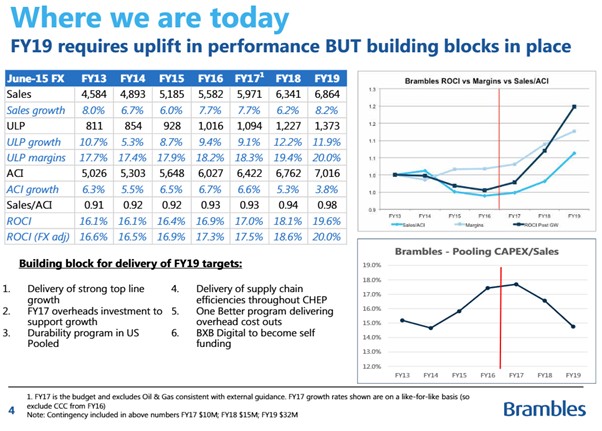
(b) a sensitivity analysis:
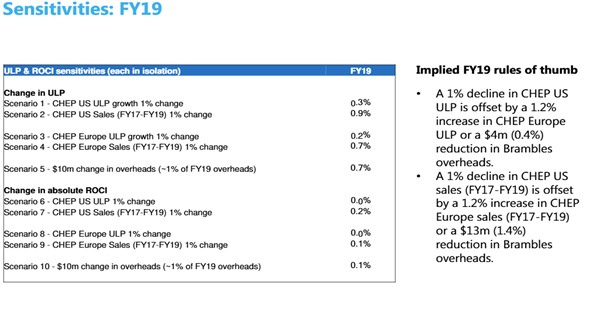
(c) the position if US Pooled did not achieve budget:
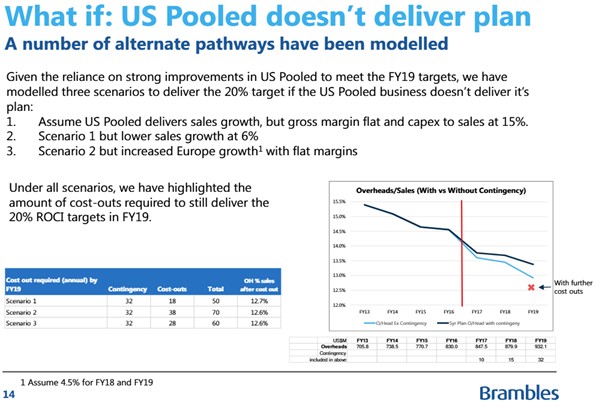
(d) Key messages:
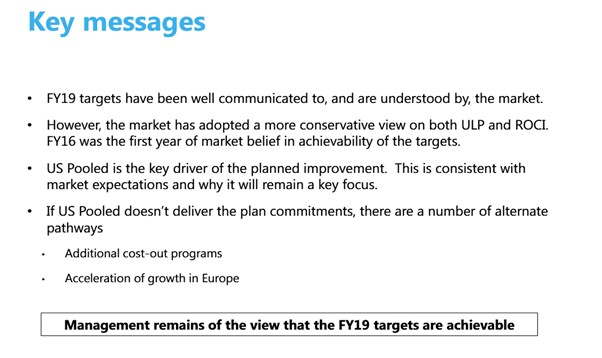
O’Sullivan
2311 O’Sullivan commenced as CFO-Designate on 10 October 2016, and she took over from Todorcevski as CFO on 17 November 2016. As at 16 November 2016, she had only been working in the business for around one month, but she gave some limited evidence as to her belief in the achievability of the FY17 Guidance.
2312 She deposed that, after receiving the October flash results, she wanted to understand why the shortfall in US Pooled had occurred and how the CHEP NA team anticipated rectifying its performance. She was preparing to commence as CFO following the AGM on 16 November 2016 and she wanted to make sure that she understood the issues impacting the financial results in US Pooled and what was being done to address them.
2313 On 15 November 2016, she emailed Kennett setting out some questions she had relating to aspects of the financial results for CHEP NA and the development of a recovery plan to improve performance. In the email, O’Sullivan sought a discussion regarding the YTD miss to forecast by US Pooled “to get an understanding of what’s going on and what actions need to happen to shore up the outcomes we want to deliver”. Kennett responded in a short email on 16 November 2016 in which he said, among other things, that he was looking to the recovery plan to see how much CHEP Global should be expecting CHEP LATAM and Europe to overdeliver.
2314 O’Sullivan deposed that she was experienced in implementing cost controls to limit discretionary spending and in mid-November she asked Callaway and Todorcevski about cost management initiatives previously applied by Brambles. On 15 November 2016, she received an email from Callaway, attaching some cost management guidance issued in December 2014, which Callaway was updating for distribution to ELT and each of the business divisions.
2315 She was copied into Gorman’s Landing the Plane Email on 14 November 2016 and she deposed that, based on the September and October results, she was not surprised by the email, as throughout her career she had observed many instances where parts of businesses were underperforming against budget for successive months and management responded through asking for better performance from other parts of the business.
2316 O’Sullivan deposed that she planned to contact each of the divisional CFOs to progress the Group-wide review of opportunities and cost-out initiatives to deliver the additional Underlying Profit that Gorman was seeking. On 15 and 17 November 2016 she emailed the Presidents of the Group businesses and told them she would be contacting their CFOs. On 17 November 2016, she sent an email to the CFOs of the Group businesses in which she stated:
In advance of the upcoming ELT we need to get a group wide view of opportunities to shore up the shortfall in the current run rate to ensure that we deliver on the full year forecast for the Group (we are looking to identify $20m - which has [sic] communicated to the Group Presidents by [Gorman]).
Please can you provide a list of opportunities in slide deck format to [Callaway] and [Ford) before Friday 25th of November (close of business).
2317 In cross-examination, she was taken to her email exchange with Chipchase on 11 November 2016. In relation to US Pooled performance, O’Sullivan wrote in her response:
Re the cycle time increase- for North America it appears that increased cycle times may be due to increase in NPD (non participating distributors) as well as some retailer stocking. The increase in NPD adds risk to recovering pallets and extends length of time of pallet in market - also growth of Walmart who use our pallets to redirect loads to stores and increased cycle times.
Last year both Home Depot and Nash Finch became NPDs. Which increased cycle time and risk for pallets.
Key point here is - not one off and Potential for increased losses yet to be reflected in P&L.
She accepted that her reference to “North America” was a reference to US Pooled. She agreed she was informing Chipchase that those problems were not “one off” isolated problems, and that they were likely to be issues or problems that would be ongoing and would need management, otherwise there was potential for increased losses in US Pooled that was yet to be reflected in the results.
2318 Later in the email, O’Sullivan said:
In the meantime, very low returning contracts are being approved to drive volume - which will b[e] dilutive to returns.
In cross-examination, she said that she was there referring to price cutting that US Pooled was engaging in in order to maintain sales volume, which was diluting returns (relevantly to the FY19 ROCI Target). She did not, however, offer a personal view about the achievability of the FY19 ROCI Target. She said that at that time she had a lot of work to do before she could reach a view in relation to that.
2319 In relation to the FY17 Guidance, she agreed that, at that time, she had concerns about the achievability of those targets, but not to an “unreasonable level”. She said that she felt that they could reasonably be achieved, but doing so required material improvement in 2H17 and was dependent on trading results through to the end of January FY17.
2320 In cross-examination, O’Sullivan was taken to an email sent by Chipchase to Gorman on 17 November 2016, in which he queried the achievability of the FY17 Guidance. She said that Chipchase’s “exact wording” did not reflect her concerns at that time. She preferred to say that “the current run rate needed to see improvement in the second half” of FY17, and that she “was concerned to see what the January performance was like, whether it could actually support …the rate of improvement needed to deliver on the guidance”.
2321 She also said that in this period Gorman, Mackie, Rumph and Martin, and a whole range of operational people in the business “felt strongly that the guidance and turnaround plan” could be delivered. She agreed that, on the other hand, Chipchase was expressing doubts about the achievability of the FY17 Guidance to her and to Gorman.
2322 She said that her own position was that she “continued to challenge and pressure test to get as much information as possible” but at that point, she thought there was a plan that operational management believed could be delivered, and she thought it was appropriate to keep the FY17 Guidance in place at that point.
2323 O’Sullivan attended the November Board Meeting as an observer and she recalled that Todorcevski was asked questions by the Board about the performance of CHEP NA, and that Todorcevski and Gorman confirmed that the Group was on track to meet its FY17 Guidance. She also recalled that Todorcevski and Gorman informed the Board that they were confident the Group would achieve the FY19 ROCI Target of 20%, and that there were various scenarios to achieve the FY19 ROCI Target if the performance of US Pooled did not go exactly as planned.
16.13 The November Board Meeting
2324 The November Board Meeting was held on 15 and 16 November 2016 in Sydney, the second day of which was the same day as Brambles’ Annual General Meeting. In preparation for that meeting, the directors were provided with presentations titled “Brambles Board Report October 2016” (October Board Report) and “Brambles Financial Update October 2016” (October Financial Update), with all numbers preliminary as at 14 November 2016. The Board papers included the Group September Reforecast, which was materially the same as the Preliminary Group September Reforecast (after correcting for the 1H17 sales revenue error in CHEP Global).
2325 The minutes record, and I accept, that on 15 November 2016 the Board reviewed, and following some changes, approved the scripts for the Chairman’s and CEO’s addresses to the AGM.
2326 The October Financial Update included a slide setting out the October and YTD results. It recorded:
(a) for October, CHEP Global Underlying Profit was $(9) million below the Group September Reforecast. For the Group (excluding Aerospace), that was partially offset by IFCO and Containers, resulting in a Group Underlying Profit shortfall of $(5) million for the month; and
(b) YTD, CHEP Global Underlying Profit was $(26) million under-budget, which was entirely accounted for by the Underlying Profit shortfall in CHEP Americas (which was itself accounted for by the shortfall in US Pooled). For the Group (excluding Aerospace), that was partially offset by Underlying Profit overperformance in IFCO in particular, resulting in a Group Underlying Profit shortfall to budget of $(17) million (representing 7% growth on FY16).
2327 The commentary stated that the October shortfall in Underlying Profit was due to $(9) million in sales volume shortfall and unfavourable plant costs in US Pooled, with the unfavourable plant costs primarily driven by additional repair costs and higher logistics and relocation costs, partially offset by $1 million in over-budget sales revenue in LATAM, and also by IFCO sales as well as direct costs performance in Europe and CHEP NA.
2328 The October Financial Update included a slide (reproduced below) setting out the projected Group FY17 performance under the Group September Reforecast:
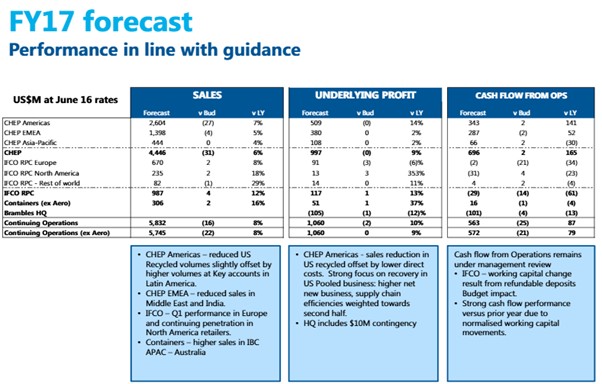
2329 That slide reported the projections in the Group September Reforecast that:
(a) although CHEP Americas was $(26) million under-budget in Underlying Profit YTD, it was projected that CHEP Americas Underlying Profit would recover in 2H17;
(b) although Group Continuing Operations (including Aero) was $(18) million under-budget in Underlying Profit YTD, it was projected that Group Underlying Profit (including Aero) would recover to be $(2) million below-budget by the end of FY17 (which would represent 10% growth on FY16); and
(c) although Group Continuing Operations (excluding Aero) was $(17) million under-budget in Underlying Profit YTD, it was projected that Group Underlying Profit (excluding Aero) would recover to be flat to budget by the end of FY17 (which would represent 9% growth on FY16).
The projected Group Underlying Profit growth results (both inclusive and exclusive of Aero) were in line with the FY17 Guidance.
2330 Another slide in the October Financial Update (reproduced below) set out the projected Group performance (including Aero) under the Group September Reforecast, broken down into YTD, YTG, and full-year projections. It stated the $(18) million Group Underlying Profit shortfall to budget YTD, and projected that it would be largely recovered by $16 million of Underlying Profit performance in 2H17, so that the Group (including Aero) would be under-budget in Underlying Profit by only $2 million for the full-year.
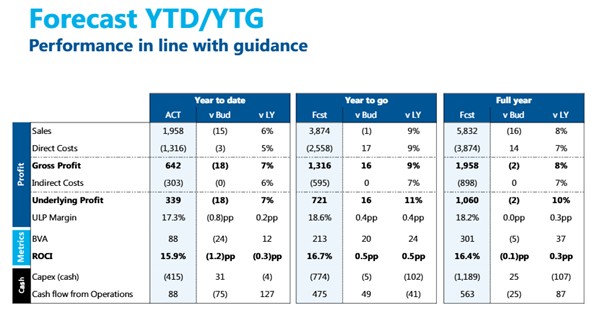
2331 The October Financial Update included an R&O schedule (14 November R&O Schedule), reproduced below, which purported to identify the risks and opportunities to the Group September Reforecast, and then to account for the risks on a net basis.
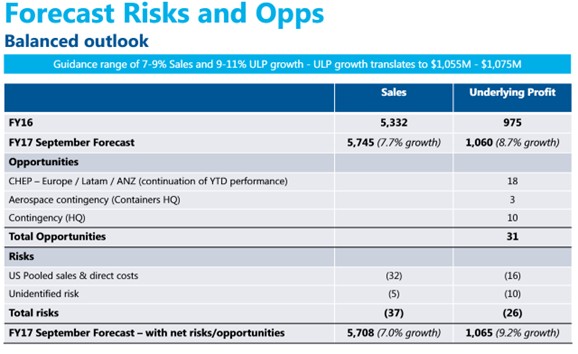
2332 As is apparent, the 14 November R&O Schedule recorded total risks to Group Underlying Profit of $(26) million, which, if netted off against the $31 million in total opportunities to Group Underlying Profit, resulted in a $5 million net opportunity. As I later explain, in my view there were several deficiencies with the 14 November R&O Schedule, and it materially understated the risks to CHEP Global and Group Underlying Profit.
16.13.1 The lay evidence about the Board meeting
Todorcevski
2333 Todorcevski deposed that he attended the November Board Meeting in Sydney on 15 and 16 November 2016 and presented the October Financial Update. The minutes of the meeting record that he presented the Group’s preliminary October 2016 results for sales, Underlying Profit and cash flow from operations, and that he reviewed the factors impacting on the performance of the US Pooled and US Recycled during October. He also reviewed the FY17 year-to-date sales revenue and Underlying Profit results. I accept that evidence.
2334 Todorcevski also deposed that although he could not recall the precise terms of the discussion at the meeting, during his presentation of the October Financial Update he remembered being questioned by the Board about the Group’s performance, with a focus on US Pooled, and the prospect of a potential revision to the FY17 Guidance. Although he could not recall the specific words he used, he said that he remembered informing the Board that, in his view, a downgrade to the FY17 Guidance was not necessary. He also recalled explaining the reasons why he was comfortable maintaining the FY17 Guidance, as previously noted. In order to provide the Board with added comfort in relation to the position in US Pooled, he proposed that future financial updates to the Board include a report on the status of the recovery actions in US Pooled. I accept that evidence.
2335 The minutes also record that Todorcevski presented an update on the five-year plan to FY19 to the Board, including the current status of, and the steps and actions necessary to achieve the FY19 Targets. He told the meeting that management remained of the view that the FY19 Targets were still achievable.
2336 Todorcevski deposed that he recalled that the FY19 Targets were discussed with the Board and there was a question about whether the FY19 ROCI Target was achievable. He said that he was confident that the FY19 Targets would be achieved and that he told the Board that they would be achieved based on the opportunities detailed in his presentation and a sensitivity analysis that accommodated underperformance in parts of the business. I accept that evidence.
2337 On 17 November 2016 (the day after the November Board Meeting), Todorcevski received a report from PwC in which it advised that Brambles’ approach to calculating ROCI in the FY19 ROCI Target (i.e., adjusting for acquisitions since Dec 2013 and FX impacts) was correct. Todorcevski deposed that the PwC opinion reassured him about the achievability of the FY19 ROCI Target. I accept that evidence.
Long
2338 Long deposed that Todorcevski presented the October Financial Update to the meeting and noted that the October results (excluding Oil and Gas) were:
(a) sales of $539 million (which was $(2) million behind the September Reforecast and 5% growth year-on-year); and
(b) Underlying Profit of $99 million (which was $(4) million behind the FY17 September Reforecast and a 3% decline year-on-year).
2339 He also deposed that on a YTD basis, Brambles had delivered 6% sales growth on a days-adjusted basis ($(15) million behind budget); and 7% Underlying Profit growth on a days-adjusted basis ($(18) million behind budget). Notably, that was evidence as to the actual results not as to what Long recalled Todorcevski presenting to the Board meeting.
2340 Then, Long deposed that Todorcevski presented:
(a) The CFO Financial Update to the Board, and that in his presentation Todorcevski described the monthly results as impacted by headwinds in US Pooled and the YTD results as impacted by the performance of CHEP NA.
(b) The FY17 September Reforecast in the Board papers as part of the October 2016 Financial Update, and he noted the contents of slides 5 and 7 of the presentation and repeated them.
Again, that evidence repeated the words of the October Financial Update, and it was not evidence as to what Long recalled Todorcevski presenting to the Board meeting.
2341 He deposed as to an actual recollection of the November Board Meeting in two ways, which he supported in his oral testimony. That evidence was, however, quite general. He deposed:
The directors questioned management as to why the October year to date results were below expectations. The nature of the conversation with Gorman and Todorcevski was to the effect of: ‘how do we read this?’; ‘what does this mean?’; and ‘what does it mean in particular for the balance of the year and for the rest of this current financial half?’ I recall Gorman and Todorcevski acknowledged head winds facing certain parts of the business, but they were addressing the issues impacting the underperformance through an action plan. I recall that… Gorman and Todorcevski were looking across the Group to deliver the full year guidance.
And
My general recollection of the conversation at the November 2016 Board meeting regarding the financial results and the FY17 September forecast was that the directors were focused on determining whether the issues impacting the results were likely to continue and whether the FY17 guidance remained achievable. This involved discussing the pathway to achieving the guidance and asking Gorman and Todorcevski to explain why the pathway remained reasonable and logical. While I cannot recall the detail of the responses to those questions, I recall that I was satisfied with the responses Gorman and Todorcevski provided at the November Board Meeting, including in relation to providing me with confidence that the FY17 guidance remained reasonably based having regard to the risks and opportunities known to the business at that time. On that basis, and given the track record of the business in delivering budget and forecasts, including through implementing recovery actions where necessary, I thought the projections and analysis presented by Gorman and Todorcevski were reasonable and credible, and that therefore having regard to the year to date performance and updated full year forecast, there was no reason to believe that Brambles would not meet its full year guidance in all material respects.
2342 As is apparent, Long expressed that evidence as a “general recollection”, and he said that he could not recall Gorman’s and Todorcevski’s responses to the stated questions as to whether the poor performance YTD meant that the FY17 Guidance continued to be achievable.
Johns
2343 Johns did not depose as to any actual recollection of the meeting, although he offered some general evidence of a recollection in his oral testimony. He deposed that Todorcevski presented the October Financial Update and October results (excluding Oil and Gas) to the meeting, and the latter included:
(a) sales of $539 million (which was $(2) million behind the September Reforecast and 5% growth year-on-year); and
(b) Underlying Profit of $99 million (which was $(4) million behind the FY17 September Reforecast and a 3% decline year-on-year).
He also deposed that on a YTD basis, Brambles had delivered 6% sales growth on a days-adjusted basis ($(15) million behind budget); and 7% Underlying Profit growth on a days-adjusted basis ($(18) million behind budget). Like Long, that was evidence as to the actual results not as to what Johns recalled Todorcevski presenting to the Board meeting.
2344 Then, Johns deposed that Todorcevski presented:
(a) the CFO Financial Update to the Board, and that in his presentation Todorcevski described the monthly results as impacted by headwinds in US Pooled and the YTD results as impacted by the performance of CHEP NA; and
(b) the September Reforecast in the Board papers as part of the October 2016 Financial Update, and he noted the contents of slides 5 and 7 of the presentation.
Again, like Long, that evidence repeated the words of the October Financial Update, and it was not evidence as to what Johns recalled Todorcevski presenting to the Board meeting.
2345 Johns then went on to depose that during his time as Chair of the Board the “invariable practice” of the directors was to “ask questions concerning the assumptions and planning behind the forecast” and that “the directors would also discuss the pathway to achieving the forecast”. Notably, he did not depose that he had a recollection of what questions the directors asked at the November Board Meeting. He said that he was “satisfied with the information Gorman and Todorcevski provided at the November Board Meeting in connection with the forecast”, and the forecast was reasonably achievable having regard to:
(a) the track record of the business in delivering budgets and forecasts, including through implementing recovery plans where necessary;
(b) recovery plans had been developed and were being implemented in 2H17 to address the issues impacting the performance of US Pooled YTD; and
(c) his views about the achievability of the Group FY17 budget when it was made and the reasons for approving the FY17 Guidance when it was made.
2346 Johns then conceded that he could not recall the specific conversations that occurred at the November Board Meeting, but he recalled that the Board discussed and considered the FY17 Guidance. He said that the Board agreed that it was reasonable to consider that the FY17 Guidance in relation to Underlying Profit growth would be met.
2347 In relation to the FY19 ROCI Target, Johns (again) did not testify that he recalled Todorcevski’s presentation, but by reference to the Board FY19 Targets Presentation he noted the “key messages” slide in that presentation. He conceded that he could not recall any discussion about those messages, but he accepted that those key messages were reasonable. Again, I have no difficulty in accepting that Johns became satisfied as to that, but that general evidence does not take things very far.
16.13.2 Whether the minutes of the November Board Meeting accurately reflect what occurred at the meeting?
2348 The minutes of the November Board Meeting recorded the following:
CFO’s Report:
Trading and Financial Update
Mr Todorcevski presented the Group’s preliminary results for October 2016 for sales, underlying profit and cash flow from operations. He reviewed the factors impacting on the performance of the US Pooled and Recycling businesses during October. He also reviewed the FY17 year-to-date sales revenue and underlying profit results and noted that sales were marginally below guidance released to the market on 18 August 2016 (“guidance”) at this stage whilst underlying profit was at the lower end of guidance. Mr Gorman reported that the Pallets Americas team was focussed on finalising an action plan to improve its performance for the balance of FY17.
Mr Todorcevski reviewed the FY17 forecast, including a “year-to-go” forecast and the risk and opportunities in the forecast. He noted that the forecast, taking into account the risk and opportunities was in line with guidance.
The Secretary advised that guidance would need to be updated if forecast FY17 sales or underlying profit was materially different to that in the guidance. Based on FY17 results to date (i.e. sales revenue only marginally below guidance and underlying profit within guidance), the FY17 forecast, the risks and opportunities and the proposed Pallets Americas action plan, he noted that the Board had reasonable grounds to believe that guidance would be met. The Board reviewed and discussed the FY17 forecast and year-to-go analysis and agreed with the Secretary’s analysis but noted that trading performance would be closely monitored and that the position be reviewed going forward.
Five Year Plan Update
Mr Todorcevski presented an update on the five year plan to FY19 and the current status of, and the steps and actions necessary to achieve the FY19 targets. He noted that management remained of the view that the FY19 targets remained achievable.
The Board reviewed and discussed the updated five year plan and requested that management provide Mr Todorcevski presentation to Mr Chipchase and continue to provide regular updates on the plan to the Board.
(Emphasis added.)
2349 In my view, the minutes of the November Board Meeting do not reflect what occurred at the meeting in several important respects.
2350 First, I am satisfied on the evidence that the minutes do not accurately record Todorcevski’s presentation to the meeting in relation to the FY17 Guidance. The minutes record that, in presenting the CFO’s Report, Todorcevski:
…reviewed the FY17 year-to-date sales revenue and underlying profit results and noted that sales were marginally below guidance released to the market on 18 August 2016 (“guidance”) at this stage whilst underlying profit was at the lower end of guidance. Mr Gorman reported that the Pallets Americas team was focussed on finalising an action plan to improve its performance for the balance of FY17.
Mr Todorcevski reviewed the FY17 forecast, including a “year-to-go” forecast and the risk and opportunities in the forecast. He noted that the forecast, taking into account the risk and opportunities was in line with guidance.
(Emphasis added.)
2351 In fact, as noted in the October Financial Update, while sales revenue growth was “marginally below guidance” as the minutes recorded, Underlying Profit growth was not “at the lower end of guidance”. At that time, the YTD position was as follows:
(a) Group sales revenue growth was 6%, being one pp below the bottom of the 7-9% range in the FY17 Guidance; and
(b) Group Underlying Profit growth was 7%, being two pps below the bottom of the 9-11% range in the FY17 Guidance.
2352 Todorcevski gave evidence that he told the Board that Underlying Profit was below the range in the FY17 Guidance, and that the minutes were wrong in that respect. Long gave evidence that he did not have a recollection of what Todorcevski told the Board, but he said that he “certainly” had in his mind at the time that both sales revenue and Underlying Profit were below guidance at that point in time. Johns gave evidence that the minutes of the November Board Meeting were wrong in recording that Todorcevski told the Board that Underlying Profit was within guidance. Their evidence was corroborative and I conclude that the minutes do not accurately record what Todorcevski told the Board in respect of whether Underlying Profit growth was within the FY17 Guidance range.
2353 It is startling that the minutes of a public company of Brambles’ size could be wrong on such an important matter as performance against the FY17 Guidance at successive Board Meetings, but that was the unchallenged evidence.
2354 Second, I am satisfied that the minutes do not accurately record what Gerrard (Chief Legal Officer and Company Secretary) advised the meeting in relation to the achievability of the FY17 Guidance. The minutes record that Gerrard:
…advised that guidance would need to be updated if forecast FY17 sales or underlying profit was materially different to that in the guidance. Based on FY17 results to date (i.e. sales revenue only marginally below guidance and underlying profit within guidance), the FY17 forecast, the risks and opportunities and the proposed Pallets Americas action plan, he noted that the Board had reasonable grounds to believe that guidance would be met.
(Emphasis added.)
2355 It follows from my acceptance that Todorcevski told the Board meeting that Underlying Profit growth was below the FY17 Guidance, and that the October Financial Update correctly noted that Underlying Profit growth was below the FY17 Guidance, that it is more likely than not that Gerrard did not tell the meeting that Underlying Profit growth was within the FY17 Guidance range.
2356 In those circumstances, I do not treat the Board minutes as an accurate record of what took place at the November Board Meeting.
16.13.3 Was the Board informed that CHEP NA had downgraded its FY17 Underlying Profit forecast by $(15) million?
2357 Rumph’s 11 November Email expressly told Mackie that following a CHEP NA executive leadership team meeting, she projected that after implementation of its recovery plans and provided there was no further deterioration from plan in November, CHEP NA would have a full-year $(15) million Underlying Profit shortfall to budget, made up of a $(10) million shortfall in US Pooled, and a $(2.5) million Underlying Profit shortfall to budget in each of US Recycled and Canada. In cross-examination, Mackie accepted that Rumph’s email told him that it was going to be “impossible” for CHEP NA Underlying Profit to recover to alignment with budget in FY17 “with the recovery plans she had in place”, that CHEP NA would have a $(15) million Underlying Profit shortfall to budget for the year; and that US Pooled was going to be $(10) million under-budget for the year after taking account of its recovery plan.
2358 Mackie’s 14 November Email to Gorman (forwarded to Todorcevski) was not as clear. Within that long email Mackie relevantly said:
At the end of last month we identified specific actions to cover the YTD shortfall in [US Pooled] and were working new ideas to close the remaining $5.6m gap to budget. We felt we had enough ideas in the hopper to get this done. Our latest view after October performance is a gap of $10m to close after identified recovery actions.
(Emphasis added.)
2359 Mackie’s 14 November Email was not as clear as it could have been:
(a) it did not mention that Rumph had downgraded the CHEP NA forecast to project that it would miss its full-year Underlying Profit budget by $(15) million. It only mentioned the $(10) million “gap” to close in US Pooled; and
(b) the email said that the team was endeavouring “to bring this back on track” and spoke of “a gap of $10m to close after identified recovery actions”. The actual position was that CHEP NA management had downgraded its forecast to project a $(15) million Underlying Profit deficit to budget for FY17, including a $(10) million deficit in US Pooled Underlying Profit. The expression “gap to close” was ambiguous and could have been understood by Gorman and Todorcevski as akin to ‘go-get’ or ‘white space’ that Mackie thought could be closed over the remaining months of FY17.
It did not clearly state what Mackie said he had understood from Rumph’s email: that Rumph had determined that it was impossible to recover to achieve the CHEP NA budget with the recovery plans they had in place, and that CHEP NA would have a $(15) million Underlying Profit shortfall to budget for FY17, including a $(10) million deficit in US Pooled, after implementation of its recovery plan and provided November went according to plan.
2360 For the reasons I shortly turn to explain, I am satisfied on the evidence of the following matters that:
(a) it was not until after the November Board Meeting and AGM that either Gorman or Todorcevski were told that CHEP NA management had forecast that, after implementation of the CHEP NA and US Pooled recovery plans, and provided there was no further deterioration from plan in November, CHEP NA would have a $(15) million Underlying Profit deficit to budget for the year, including a $(10) million Underlying Profit deficit to budget in US Pooled;
(b) although Gorman and Todorcevski were told prior to the November Board Meeting and AGM that US Pooled had “a gap of $10 m[illion] to close after identified recovery actions” it does not appear that they actually understood that CHEP NA management had downgraded the full-year US Pooled Underlying Profit forecast by that amount; and
(c) the Board was not told, prior to or at the November Board Meeting, that CHEP NA management had forecast that, after implementation of the CHEP NA and US Pooled recovery plans, and provided there was no further deterioration from plan in November, CHEP NA would have a $(15) million Underlying Profit deficit to budget for the year, including a $(10) million Underlying Profit deficit to budget in US Pooled.
2361 The following evidence supports those findings.
2362 First, Todorcevski gave unchallenged evidence that it was not until after the November Board Meeting and AGM that he and Gorman were informed that CHEP NA management had downgraded its forecast to project that CHEP NA would have a $(15) million Underlying Profit shortfall to budget for FY17, including by $(10) million in US Pooled. He testified that, as a result, he did not inform the Board of that.
2363 Second, Johns was taken in cross-examination to the October Financial Update that Todorcevski presented on at the November Board Meeting. He denied that at the time of the November Board Meeting he had been told that CHEP NA or US Pooled management had downgraded their Underlying Profit forecasts for FY17. That corroborates Todorcevski’s evidence that he did not inform the Board of that.
2364 Third, Todorcevski’s contemporaneous emails upon subsequently being informed that CHEP NA had downgraded its full-year Underlying Profit forecast by $(15) million provide strong contextual support for a finding that neither he nor Gorman understood that until after the November Board Meeting and AGM.
2365 Todorcevski testified, and I accept, that he came to know that CHEP NA management had downgraded its forecast to project that CHEP NA would have a $(15) million Underlying Profit shortfall to budget for FY17, including a $(10) million shortfall in US Pooled, in the following circumstances:
(a) O’Sullivan became the CFO immediately after the November Board Meeting. Shortly after the November Board Meeting, a series of review meetings were scheduled to take place between O’Sullivan and the CFO of each CHEP CBU as part of onboarding her into her new role. Because Lallatin had recently left CHEP NA, Kennett was standing in for him and was preparing the CHEP NA presentation for that meeting.
(b) Kennett prepared a presentation for the review meeting which provided a high-level analysis of the CHEP NA outlook and recovery plan at that point. The presentation reworked an old CHEP NA PPR presentation, but it carried the electronic file name “NAM High level (for Nessa)” (18 November O’Sullivan Presentation). On 18 November 2016, in advance of the meeting, Kennett emailed that presentation to O’Sullivan (copied to Callaway, Marshall and Scaiff).
(c) Slide three of that presentation said the following:
YTD we are $29M behind budget;
Latest view from the [CHEP NA] team is that we will be $27 million behind budget for the full year (before corrective actions).
The revised September Forecast process has now kicked-off and will include:
- Identified Actions (Opportunities) of plus $28 million
- Additional headcount actions of plus $4 million
- Less further identified risks of minus $24 million; and
[CHEP NA] therefore plan on bringing down their Latest Forecast by $15M, ($10M USP [US Pooled], $2.5M on each of USR [US Recycled] and Canada)
But will push after additional opportunities of $10M
(Emphasis added.)
Although that slide said that CHEP NA “plan[ned] on bringing down” its latest forecast by $(15) million, a table on the same slide stated that the projected “gap” to close for CHEP NA to recover to alignment with its Underlying Profit budget was $(17.8) million.
(d) Upon receiving the 18 November O’Sullivan Presentation, Callaway promptly emailed it to Todorcevski and drew his attention to slides three and nine.
2366 Having read the presentation Todorcevski emailed Callaway and said:
For whatever reason, neither [Mackie] or [Rumph] felt the need to tell [Gorman] their view of forecast changed. For Christ’s sake, we told the Board and the market 2 days ago we were on track to deliver guidance and then this pile comes out. Very poor….
(Emphasis added.)
2367 That email provides strong support for an inference that at the time of the November Board Meeting neither Todorcevski nor Gorman actually understood that CHEP NA management had downgraded its full-year forecast to project that CHEP NA would miss its Underlying Profit budget for the year by $(15) million, including by $(10) million in US Pooled.
2368 Further, Todorcevski gave evidence in cross-examination that until he saw slide three of Kennett’s presentation he was not aware that CHEP NA had forecast that it would miss its full-year Underlying Profit budget by $(15) million, after implementation of its recovery plans. He also testified that the Board would not have been aware of that either. I accept that evidence.
2369 It is clear from Todorcevski’s email to Callaway that he was upset and angry that neither he nor the Board had been told of that. He said that his sentiments at the time were best captured by the words in his email, but he accepted in cross-examination that he was “outraged” by what had occurred, and he described it as “unacceptable”.
2370 The evidence shows that Todorcevski then telephoned Gorman, who told Todorcevski that he had just met with O’Sullivan, and she had shown him slide nine (which Todorcevski called a “laundry list” of recovery actions) but not slide three. Todorcevski then sent Gorman the whole slide deck. Todorcevski then emailed Callaway commenting on O’Sullivan’s failure to show Gorman slide three:
Mmmmhh - she showed him the laundry list slide but made no mention of the forecast change. Not sure what she’s playing at so I told him, and have shared the deck. Sorry, but we have the CEO flying blind and that’s just unacceptable…
(Emphasis added.)
2371 Todorcevski testified that, until he spoke to Gorman on 18 November 2016, Gorman was not aware that US Pooled had forecast a full-year $(10) million Underlying Profit shortfall to budget. I accept that evidence.
2372 Fourth, Todorcevski’s and Gorman’s failure to require an amendment to the Board papers provides further contextual support for an inference that neither of them actually understood that CHEP NA management had downgraded its Underlying Profit forecast for FY17 until after the November Board Meeting.
2373 On 13 November 2016, Todorcevski emailed Gorman, attaching a draft October Financial Update presentation for the pending November Board Meeting. The presentation included a draft R&O schedule which identified a risk - “US Pooled sales & direct costs” - quantified at a $(32) million risk to sales revenue and $(16) million risk to Underlying Profit. The US Pooled October R&O Schedule did not reflect the fact that CHEP NA management had forecast a full-year $(15) million Underlying Profit deficit to budget including a $(10) million deficit in US Pooled.
2374 Following their receipt of Mackie’s 14 November Email, neither Gorman nor Todorcevski required that the draft R&O schedule be updated to reflect that a full-year $(16) million Underlying Profit shortfall to budget in US Pooled was no longer just a risk, as CHEP NA management had actually downgraded its full-year forecast and projected that CHEP NA would miss its Underlying Profit budget for the year by $(15) million, including by $(10) million in US Pooled. The R&O schedule in the October Financial Update, presented to the Board papers for the November Board Meeting, was in relatively the same form as the draft.
2375 It is appropriate to infer that Gorman or Todorcevski would have required an amendment to the R&O schedule in the October Financial Update had they understood that the true position was that there was not merely a $(16) million risk to Underlying Profit in US Pooled, and that instead CHEP NA management had actually downgraded its FY17 Underlying Profit forecast.
2376 Fifth, another contextual matter which supports the inference that, until after the AGM, neither Gorman nor Todorcevski understood that CHEP NA management had downgraded its Underlying Profit forecast for the year, is an email exchange between Rumph and Kennett on 16 November 2016. At that time Kennett was preparing the CHEP NA presentation for the review meeting with O’Sullivan and he sought some information from CHEP NA management. On 16 November 2016 Rumph emailed him and said:
Buster - It seems we are not prepared for this. I’m in DC and will not be able to do much to assist at this point.
The messaging is we project [CHEP North America] to miss budget by $15M for the full year and that is what they will see in our [December reforecast] assuming we are where we predict for November.
2377 As the applicants submitted, it is appropriate to infer that the “this” in Rumph’s email was a reference to the proposed review meeting with O’Sullivan. In cross-examination Kennett gave evidence that Rumph’s email was the first time he had become aware that CHEP NA was projecting that it would miss its Underlying Profit budget by $(15) million. I accept that evidence.
16.13.4 Chipchase’s view
2378 Chipchase did not give evidence. He did not formally commence as CEO-Designate until 1 January 2017 and did not commence as CEO and Executive Director until 20 February 2017. But the evidence shows that in the period leading up to the November Board Meeting Gorman kept him updated about important issues as part of an onboarding process, and he exchanged emails with Gorman, Todorcevski and O’Sullivan regarding Group performance and its FY17 outlook.
2379 In an email to Gorman on 11 November 2016 (copied to Todorcevski and O’Sullivan) Chipchase questioned whether the October results indicated that the recovery plans for US Pooled were “now unachievable” and asked for more granularity in relation to the projected new business wins to see whether it was really a short-term problem as suggested. He also queried whether there would be enough overperformance elsewhere in the Group to offset the US Pooled underperformance against the full-year forecast.
2380 He echoed those concerns in an email to O’Sullivan on 11 November 2016, in which he said:
Need to keep a close eye not only on FY forecast, but also H1 out-turn....if H1 is going to be a disappointment then we may want Tom to be front and centre, rather than you and I! We also need to be mindful if H1 is being squeezed at expense of H2 - but am sure you will get a feel post your upcoming CFO chats.
2381 Then, in an email to Gorman (copied to O’Sullivan) on 17 November 2016, the day after the AGM, Chipchase said:
On performance, I am concerned with ability to meet [full-year forecast] and of course the knock-on impact this might have, if caused by an underlying systemic issue, on longer term targets. As you would expect, I don't want messages to be given to the market saying everything is ok only for us to decide in March-May that it is not, if we really have serious doubts already...
(Emphasis added.)
2382 I infer that at this point Chipchase had serious concerns about the achievability of the US Pooled Underlying Profit budget for the year, and the risk that underperformance in US Pooled might mean that the FY17 Guidance was not achievable. As it eventuated, he was prescient in that view.
16.14 The AGM - the Impugned Announcement
2383 On 16 November 2016, Brambles held its Annual General Meeting. Johns and Gorman each made addresses to the AGM. On the same day, Brambles released to the ASX:
(a) the text of the addresses to be delivered by Johns (Chairman’s Address) and Gorman to the AGM; and
(b) the accompanying PowerPoint presentation (AGM Presentation).
(Together, the AGM Announcement).
2384 Relevantly:
(a) the Chairman’s Address stated:
As noted in our recent first-quarter trading update, our FY17 guidance for sales revenue growth of 7-9% and Underlying Profit growth of 9-11%, both on a constant-currency basis, remains unchanged. We remain committed to the five-year targets we set in December 2013 and our ongoing business strategy.
(b) the AGM Presentation included the following slide:
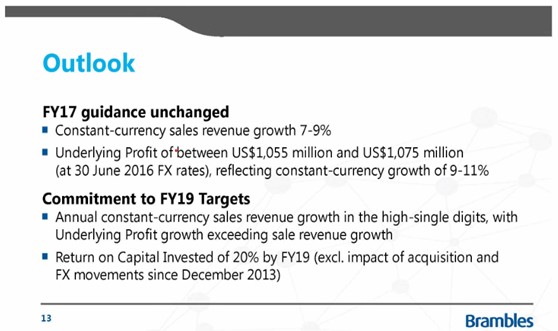
(c) the final page of the AGM Presentation set out a disclaimer. I will deal with that when considering whether the impugned announcements conveyed the alleged representations.
Those matters are uncontroversial.
2385 In preparation for the Chairman’s Address, Johns had emailed a draft of the address to Gerrard and Chiaracescu on 3 November 2016. He noted that he had intentionally deleted references to the FY19 forecasts as in his view that was “better left to Tom’s speech”. Gerrard forwarded the draft to Gorman on 4 November 2016, who forwarded it to Todorcevski the same day, under cover of the following email:
Zlatko,
I forward this to you FYI. Clearly further evidence that Johns does not intend to stand behind comments made in August. We will have to spend some time on this issue as his silence will be interpreted extremely negatively.
(Emphasis added.)
There, Gorman expressed similar concerns to those Todorcevski expressed on 16 November 2016, regarding the potential that Brambles’ incoming new management would not maintain the FY17 Guidance.
17. MR SAMUEL’S OPINION
2386 By Question 4, Mr Samuel was asked to opine on whether the information available to Brambles as at 16 November 2016 provided a reasonable basis to support, relevantly, the August Sales Revenue Forecast, the August Underlying Profit Forecast and the August ROCI Forecast. I have already laid out the general approach taken by Mr Samuel to these questions and I need not repeat it here.
2387 In brief, Mr Samuel opined that, as at 16 November 2016:
(a) the reported sales revenue growth of 5.8% in the most recent Group results in the October Financial Update was well below the August Sales Revenue Forecast of 7%. Consequently, without a significant improvement in 2H17, the FY17 Guidance would not be met;
(b) the reported shortfall for October YTD of $(17) million combined with the unreported probability-adjusted net risks meant “that Brambles was likely to fall significantly short” of the FY17 Guidance for the full-year, and that the information available to Brambles “did not support” the August Underlying Profit Forecast; and
(c) the shortfall in Underlying Profit would further detract from Brambles’ ability to achieve the August ROCI Forecast, which was already behind the Group FY17 budget. Mr Samuel did not, however, offer an opinion as to whether Brambles had a reasonable basis for the August ROCI Forecast.
2388 The applicants relied on Mr Samuel’s opinion, and submitted that Brambles lacked reasonable grounds for the November Representations because the representations did not adequately account for known or identified risks and were not supported by information and projections available to 16 November 2016, in particular the YTD trading results and the Group September Reforecast.
2389 I now turn to consider the material Mr Samuel relied on and his analysis in coming to the above conclusions.
17.1 The material Mr Samuel relied upon and his analysis
17.1.1 YTD results
2390 Mr Samuel commenced by considering the October Financial Update prepared for the November Board Meeting, which included YTD results to 31 October 2016 and preliminary figures correct as at 14 November 2016.
2391 First, he set out the Group results for the four months to 31 October 2016 as follows:
(a) sales revenue of $1,931 million (which was $(15.8) million behind the Group FY17 budget and represented 5.8% growth on FY16); and
(b) Underlying Profit of $339 million (which was $(17.9) million behind the Group FY17 budget and represented 7% growth on FY16).
2392 He noted that the October Board Report recorded the same information for sales revenue and Underlying Profit, and also recorded:
(a) ACI of $6,289 million, which was $150 million ahead of the Group FY17 budget and 9% growth on FY16; and
(b) ROCI of 16.2% which was (1.3) pps behind the Group FY17 budget and (0.3) pps behind the FY16 results.
2393 Mr Samuel noted the “Market Commitments” slide in the October Board Report, which reported on progress towards the FY17 Guidance and used a traffic light system. He noted that for the first time an amber traffic light had been recorded against sales revenue growth targets in “CHEP Pallets mature markets” and “CHEP Pallets emerging markets”. The note recorded against “CHEP Pallets mature markets” stated:
Recovery plan being finalised for North America - requires increase in net new business wins in H2 vs H1 to achieve target
Mr Samuel noted Todorcevski’s affidavit in which he said that an amber traffic light indicated “performance close but slightly off the market commitments” which Mr Samuel considered indicated that Brambles considered those targets were at risk.
2394 Mr Samuel produced the following table showing sales revenue and Underlying Profit recorded for the four months to 31 October 2016 compared with the Group FY17 budget and the FY16 results:
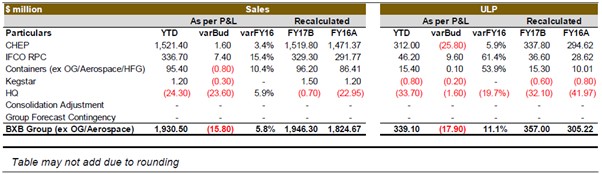
2395 He identified that the YTD sales revenue growth of 5.8% (rounded to 6% in the October Board Report) was below the August Sales Revenue Forecast. He also noted that the YTD Underlying Profit growth was recorded at 11.1% in the Board Report, which differed from the 7% growth reported in the October Financial Update. He was unable to explain that discrepancy. In my view the discrepancy is not important as it is not contentious that, as at 16 November 2016, Group Underlying Profit growth was 7%.
2396 He also produced the following table showing sales revenue and Underlying Profit for CHEP Global and CHEP Americas:
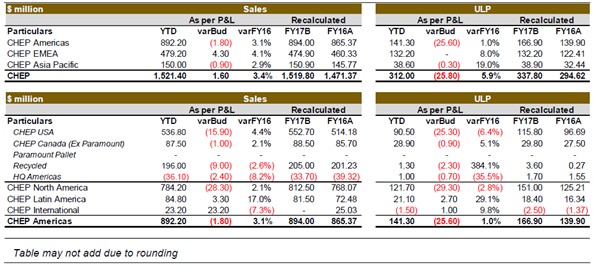
2397 Mr Samuel highlighted that CHEP NA recorded:
(a) sales revenue $(28.3) million under-budget, which was double the $(14.3) million shortfall to budget at the end of Q1; and
(b) Underlying Profit $(29.3) million under-budget, a shortfall to budget which had increased from $(17) million at the end of Q1.
He noted that US Pooled continued to be the largest driver of the Underlying Profit shortfall to the Group FY17 budget.
17.1.2 Projected results
2398 Mr Samuel then turned to consider the YTD results in conjunction with the projected results for US Pooled. For that he relied on the US Pooled November MBR. He assumed that the financial information contained therein would have been known to Brambles as at 16 November 2016. In my view, that is a reasonable assumption.
2399 Mr Samuel considered a slide from the US Pooled November MBR titled “1H/2H MBR versus September Forecast” which compared the figures in the US Pooled November MBR against the Group September Reforecast. He noted that the US Pooled November MBR projected:
(a) 1H17 sales revenue of $768.9 million, which was $(9.2) million less than the reforecast of $778.1 million;
(b) 1H17 Underlying Profit of $137.4 million, which was $(12.5) million less than the reforecast of $149.8 million;
(c) 2H17 sales revenue of $838 million, which was just below the reforecast of $839.1 million;
(d) 2H17 Underlying Profit of $212.8 million, which was just below the reforecast of $213.7 million;
(e) FY17 sales revenue of $1,606.9 million, which was $(10.3) million less than the reforecast of $1,617.2 million; and
(f) FY17 Underlying Profit of $350.2 million, which was $(13.3) million less than the reforecast of $363.5 million.
2400 Mr Samuel concluded, and I accept, that expected performance in US Pooled in 1H17 had further deteriorated since the finalisation of the Revised September Reforecast.
2401 Mr Samuel then turned to consider further slides from the US Pooled November MBR and he noted the following projected outcomes for FY17:
(a) sales revenue was forecast to be $(9) million lower than the US Pooled FY17 budget with customer losses ($(14.3) million) forecast to outstrip wins ($11.2 million) and a $(7.7) million change in the sales mix largely driven by a change in P-days;
(b) repair costs were $(7.6) million higher than US Pooled budget mainly due to non-demand repair volume;
(c) increased costs were partially offset by reduced raw material costs of $5.5 million; and
(d) overhead costs were expected to be better than the US Pooled FY17 budget by $3 million; and
(e) the IPEP provision was reduced by $3.2 million.
2402 Mr Samuel also considered the CHEP NA October PPR which recorded that the YTD damage rate for US Pooled was 61.1% which was 0.9 pps higher than budget. Mr Samuel emphasised that this showed a continued disparity to the budgeted damage rate in the US Pooled budget.
2403 Mr Samuel then turned to consider a Brambles slide deck presentation which he referred to as “CHEP NAM PPR Report”. He referred to the presentation by that name because it carried the title “Pallets Performance Review, North America, November 19 2017 [sic]”. The presentation carried the electronic file name “Nessa NAM Recovery Plan Review November 20.pptx” and it was emailed by Rumph to O’Sullivan (copied to Kennett) on 21 November 2016, in preparation for a CHEP NA review discussion to happen that evening. I infer Mr Samuel referred to it by the name “CHEP NAM PPR Report” because it was reworked by Rumph or her team from a previous CHEP NA PPR presentation. I have previously called this presentation the 20 November CHEP NA Recovery Deck.
2404 Slide 9 of the 20 November CHEP NA Recovery Deck stated:
Current view is a ($15M) miss versus budget for NAM with all reasonable actions included (“in the bank”)
• $10M miss in USP
• $2.5M miss in Recycled
• $2.5M miss in Canada
• On budget for Paramount
Actions not mature enough to include in forecast are referred to as “check’s in the mail” and have the potential to close the budget gap to a miss of ~($6M).
2405 I note here that this information was not new. Rumph’s 11 November Email to Mackie said that:
After today’s review, my projection is we will miss budget for the full year by ~$15M (if nothing materially erodes from our plan in November).
• NA - ~($15M) miss vs. budget (with no IPEP benefits other than $3M FIFO)
• Pooled - ~($10M)
• Recycled - ~($2.5M)
• Canada - ~($2.5M)
• Paramount - on budget
The revised forecast in Rumph’s 11 November Email was on the basis that CHEP NA would have a shortfall of $15 million in Underlying Profit to budget after executing its recovery plans.
2406 Given the title it carried Mr Samuel was not to know that the 20 November CHEP NA Recovery Plan Deck he reviewed was not a CHEP NA PPR presentation, but little turns on that. The important thing is that it is a Brambles document, and part of a suite of documents which allow inferences to be drawn as to what information was known to Brambles when it made the impugned announcement on 16 November 2016.
2407 The evidence shows that as at 11 November 2016, CHEP NA management had downgraded its forecast to project that CHEP NA would have a $(15) million Underlying Profit deficit to budget for the full-year. Mr Samuel seems to have assumed that the information in the 20 November CHEP NA Recovery Deck was available to Brambles at the time of the impugned announcement. That was a reasonable assumption in respect of the $(15) million downgrade to the CHEP NA full-year forecast, but it is appropriate to infer that the CHEP NA recovery plans had some further massaging between 11 November and 20 November 2016.
2408 Mr Samuel noted that the 20 November CHEP NA Recovery Deck provided an analysis of sales, gross margin, overheads and Underlying Profit for all CHEP NA business units, and that US Pooled was the largest driver of a $(29.3) million Underlying Profit shortfall to budget in CHEP NA. That was largely not post-16 November 2016 information. Upon receipt of the October flash results (11 November 2016) Brambles’ management was aware that US Pooled had a $(25.3) million Underlying Profit deficit to budget YTD.
2409 Mr Samuel concluded, based on the accompanying explanations of CHEP NA performance that in US Pooled:
(a) net new wins were lower than the budget;
(b) direct costs were higher than budget, largely driven by incremental repair volume, logistics relocations and fuel pricing impacts leading to “gross margin erosion”; and
(c) overhead costs expressed as a percentage of sales were in line with budget.
That was not largely post-16 November 2016 information; Brambles’ management was aware of that upon or shortly after receipt of the October flash results.
2410 Mr Samuel noted that the 20 November CHEP NA Recovery Deck referred to a “recovery plan and process” to address the shortfall, and that it explicitly stated that the then-current view was a $(15) million shortfall to the CHEP NA budget, after all reasonable recovery actions had been taken; i.e., treating those actions as “in the bank”. He noted that the presentation provided that the recovery actions which were not mature enough to be included in the forecast $(15) million shortfall are referred to as “checks in the mail but not banked” which totalled $11 million which had the “potential” to close the budget gap to a miss of around $(6.8) million after accounting for “all” risks and opportunities. Some of that was post-16 November 2016 information. The information about recovery actions which were not mature enough to be included in the forecast $(15) million CHEP NA Underlying Profit deficit to budget for the year was not part of the information conveyed by Rumph’s 11 November Email, although I expect those matters were known by CHEP NA management prior to 16 November 2016. Little, however, turns on that.
2411 Based on that information Mr Samuel concluded that, considering that budget adjustment in isolation and assuming performance in other CHEP CBUs was in line with the Group FY17 budget, the shortfall in Underlying Profit in CHEP NA would take Group Underlying Profit below the bottom of the FY17 Guidance range.
2412 Mr Samuel then turned to consider the position for CHEP Global. For this he relied upon a presentation titled “Brambles Business Performance Review October 2016” dated 22 November 2016 (Group October BPR), which aggregated various CHEP CBU reports including a presentation titled “CHEP Global Pallets, October FY17 BPR” dated 16 November 2016 (CHEP Global October BPR). Within the CHEP Global October BPR Mr Samuel relied upon the following slide, and he noted that the Underlying Profit shortfall to budget in US Pooled of $(25.3) million was attributed as recorded in the slide.
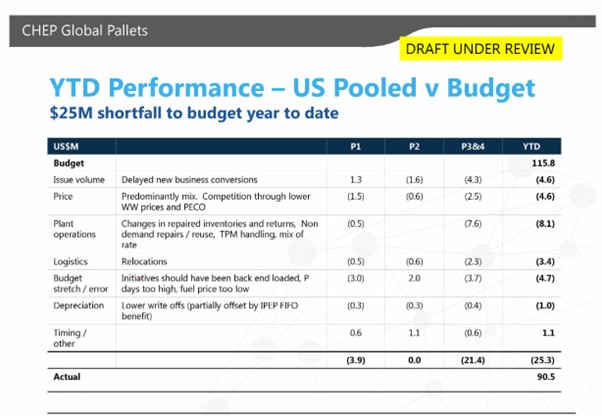
2413 Mr Samuel then identified that the variance in Underlying Profit to budget in US Pooled had increased markedly in “P3&4” (September and October 2016). He noted that the reasons cited for the shortfall continued to be lower sales volumes, a reason that had already been identified in the previous month, and also increased plant operation costs due to “changes in repaired inventories and returns” and “[n]on demand repairs/ reuse”.
2414 He said that despite the deterioration in performance in October 2016, CHEP Global continued to report a full-year Underlying Profit forecast and 1H17 and 2H17 performance consistent with the previous month.
17.1.3 The R&O schedules
2415 Mr Samuel then turned to consider the changes in the risk and opportunity schedules up to 16 November 2016. First, he relied upon the R&O schedule in the US Pooled November MBR dated 19 November 2016, from which he prepared the following table.
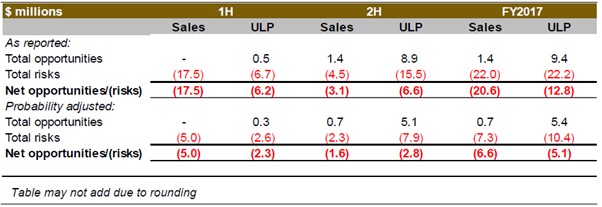
2416 Consistent with the above table, Mr Samuel noted that US Pooled had identified net risks of $(20.6) million to sales revenue and net risks of $(12.8) million to Underlying Profit, which he noted was a reduction from the $(21.8) million in the US Pooled November MBR. Mr Samuel appears to have assumed that this information was available to Brambles as at 16 November 2016. That is a reasonable assumption. Mr Samuel calculated, on a probability-adjusted basis, that there were net risks of $(6.6) million to sales revenue (increased from $(4.4) million in the draft US Pooled October MBR) and net risks of $(5.1) million to Underlying Profit (down from $(8.9) million in the draft US Pooled October MBR).
2417 He said that he was unable to identify documents that explained the apparent improvement in the net Underlying Profit risk given the further deterioration in business performance in October and the commentary in the US Pooled November MBR and Board Reports. He opined that the net Underlying Profit risk in the US Pooled November MBR “may be understated”.
2418 Mr Samuel also relied upon an R&O schedule in the CHEP Global October BPR. From that R&O schedule he prepared the following table for each CHEP CBU:
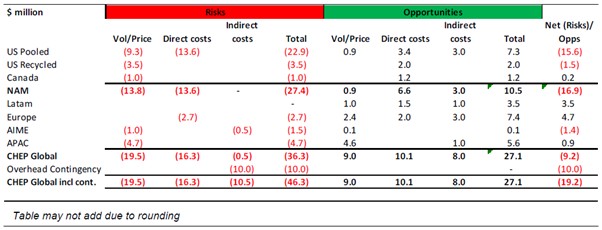
2419 Based on this schedule, he identified a net risk to Underlying Profit of $(19.2) million for CHEP Global. He prepared the following table comparing the risks and opportunities by CBU:
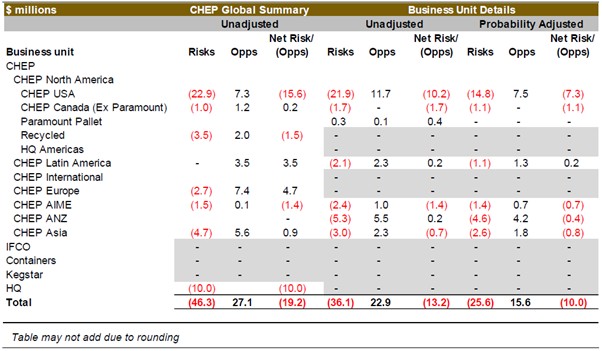
2420 Mr Samuel identified that there were material inconsistencies between the unadjusted risks included in the “Group Summary” (which I understood to mean the CHEP Global October BPR) and the CBU schedules. He provided the following examples:
(a) the net unadjusted risks for US Pooled were $(15.6) million, which compared with net unadjusted risks to Underlying Profit of $(10.2) million in the underlying CHEP Global October BPR in relation to US Pooled, which was included within the same document and net risks of $(12.8) million to Underlying Profit in the US Pooled November MBR;
(b) the CBU information for CHEP Recycled and CHEP Europe did not include risks and opportunities; and
(c) no information was included in the CHEP Global October BPR pack on the risks and opportunities for IFCO or Containers.
17.1.4 Group September Reforecast
2421 Mr Samuel noted that the Group September Reforecast was made between 24 October and 15 November 2016. He referred to Kennett’s affidavit in relation to the rephasing of sales revenue and Underlying Profit in the CHEP Global forecast and to a Brambles spreadsheet, which I have previously called the Growth Phasing Spreadsheet, emailed by Mackie to Kennett on 13 October 2016 (which is when the Revised September Reforecast was made). An earlier version of this table was attached to Kennett’s 12 October Rephasing Email. Mr Samuel prepared the following table showing the phasing changes:
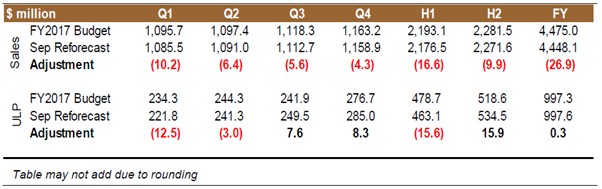
2422 In respect of the rephasing, Mr Samuel concluded that:
(a) the shortfall in sales revenue to budget was largest in 1Q17 ($(10.2) million), and noted that the Group September Reforecast projected that these shortfalls would continue for the remaining quarters of FY17 at decreasing rates. Sales revenue in CHEP Global was projected to be $(26.9) million under-budget by the end of FY17; and
(b) the shortfall in Underlying Profit to budget in 1Q17 was $(12.5) million, which contributed to a $(15.6) million shortfall in Underlying Profit in 1H17, which would then be entirely offset by over-budget Underlying Profit in 2H17, such that by the end of FY17 Underlying Profit would align with the CHEP Global budget.
2423 Mr Samuel concluded that the full-year forecast amounts in the Growth Phasing Spreadsheet, which showed CHEP Global sales revenue of $4,448.1 million and Underlying Profit of $997.6 million, were consistent with the forecast amounts included in the October Board Report.
2424 Mr Samuel then prepared the following table summarising the Group FY17 budget and Group September Reforecast by business unit:
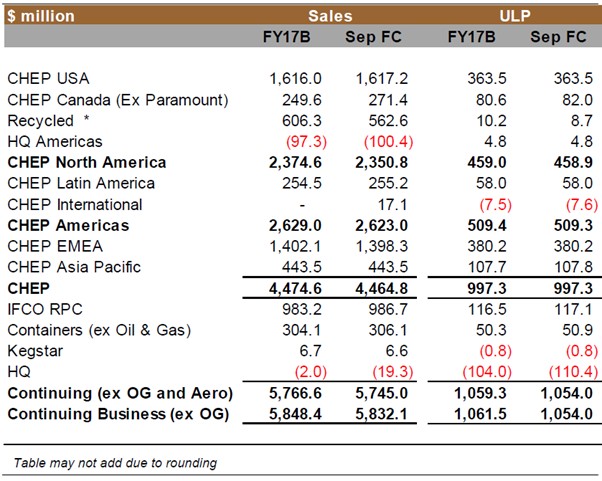
2425 He concluded that the Group September Reforecast projected sales revenue reduced by $(21.6) million to $5,745 million, with the decrease driven by:
(a) CHEP Global’s sales revenue being reduced by $(9.8) million from $4,474.6 million in the Group FY17 budget to $4,464.8 million. Mr Samuel noted that the Preliminary Group September Reforecast included $17.1 million in sales revenue for CHEP Global with an offsetting entry in HQ. He said that, if CHEP Global sales are excluded, projected CHEP Global FY17 sales revenue would be reduced by a further $17.1 million or a total of $27.0 million. As I have said, I consider the projected $17.1 million in 1H17 sales revenue for CHEP Global was an error in the Preliminary Group September Reforecast;
(b) IFCO RPC sales revenue being increased by $3.5 million, to $986.7 million; and
(c) Containers sales revenue being increased by $2.0 million, to $306.1 million.
2426 Mr Samuel concluded the September Reforecast resulted in Group Underlying Profit being largely unchanged from the Group budget (post-Aero divestment) at $1,054 million, and identified that despite the significant decrease in sales revenue in the YTD to October, Underlying Profit for CHEP Global was left unchanged in the September Reforecast at $997.3 million.
17.1.5 FY2019 Targets
2427 Mr Samuel then turned to consider the primary documents which concerned the FY19 Targets including the FY19 ROCI Target. I need not set that material out as the applicants gave no attention to the Medium Term Targets, and Mr Samuel did not provide an opinion as to whether reasonable grounds existed for the FY19 ROCI Target.
17.1.6 October Financial Update
2428 Mr Samuel then noted that the October Financial Update before the Board for the November Board Meeting on 15 and 16 November 2016 was the first time that the Board had been taken to the revision to the Group FY17 forecast through the September Reforecasting process. He identified that the September Reforecast (excluding Aero) projected that the Group would achieve:
(a) sales revenue of $5,745 million (7.7% growth over FY16 results, rounded up to 8% in the October Financial Update); and
(b) Underlying Profit of $1,060 million (8.7% growth over FY16 results, rounded up to 9% in the October Financial Update).
2429 Mr Samuel reproduced the following slide from the October Financial Update which showed the YTD actual results for the 4 months to October 2016, the YTG forecast for the remaining 8 months of FY17, and the full-year forecast based on the September Reforecast.
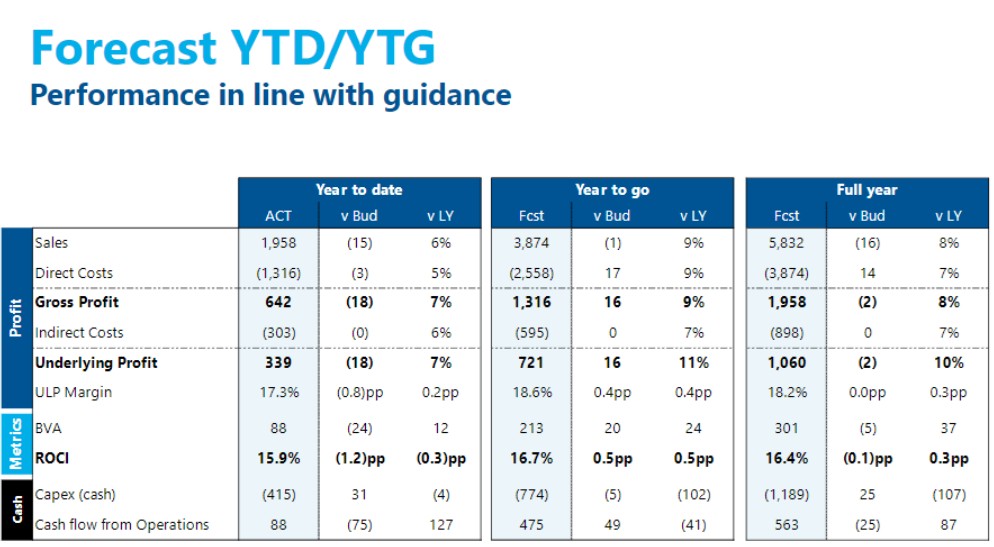
2430 Mr Samuel noted that based upon the YTD and YTG information in that slide:
(a) Group sales revenue was $(15) million under-budget YTD, but would improve in line with the September Reforecast with sales revenue projected to be behind budget by $(1) million YTG, such that the reforecast sales revenue of $5,832 million (including Aero) would be achieved;
(b) Underlying Profit was $(18) million under-budget YTD, and would need to be better than budget by $16 million YTG, such that the September Reforecast Underlying Profit of $1,060 million would be achieved; and
(c) ROCI was (1.2) pps behind budget and would need to be better than budget by 0.5 pps for the year to go in order to meet the September Reforecast ROCI of 16.4%.
2431 Mr Samuel also reproduced the following R&O schedule from the October Financial Update, which I have called the 14 November R&O Schedule.
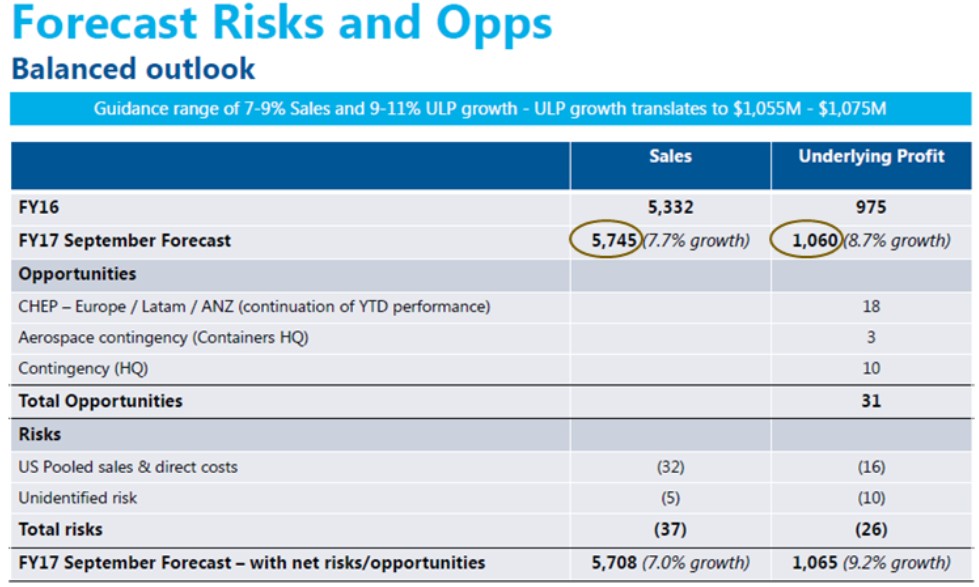
2432 Mr Samuel noted that the second line of the table was based on the September Reforecast (excluding Aero), reflecting sales revenue of $5,745 million and Underlying Profit of $1,060 million. He said that he was unable to reconcile the risks and opportunities included in this R&O schedule with the risk and opportunity analysis undertaken by the CHEP CBUs, and in particular the draft US Pooled October MBR which showed total risks of $(46.3) million and opportunities of $27.1 million.
2433 Mr Samuel identified that the 14 November R&O Schedule recorded opportunities of $18 million for CHEP Europe, LATAM and ANZ whereas the CHEP Global October BPR presentation in the same Board pack provided that total net opportunities for those CBUs was only $9.1 million (Europe $4.7 million, LATAM $3.5 million and APAC $0.9 million). I understood Mr Samuel to be stating, and I accept, that the 14 November R&O Schedule listed the opportunities for Underlying Profit in Europe, LATAM and ANZ, but erroneously did not include the identified risks to Underlying Profit in those CBUs as recorded in the CHEP Global October BPR. Having regard to the CHEP Global October BPR those risks appear to total approximately $(7.4) million.
2434 Mr Samuel also identified that the 14 November R&O Schedule recorded that “US Pooled sales and direct costs” represented a $(32) million risk to sales revenue and a $(16) million risk to Underlying Profit. This contrasted with the US Pooled November MBR dated 19 November 2016 which recorded total full-year risks to sales revenue of $(22) million, and total full-year risks to Underlying Profit of $(22.2) million for US Pooled. Once netted against opportunities, it recorded a full-year sales revenue risk of $(20.6) million to sales revenue and of $(12.8) million to Underlying Profit.
2435 Accordingly, net risks to sales revenue and Underlying Profit in US Pooled were reported at higher levels in the 14 November R&O Schedule than in the US Pooled November MBR (19 November 2016). Thus the 14 November R&O Schedule put US Pooled full-year risks to Underlying Profit at $3.2 million higher than the assessment made in the US Pooled MBR three days later. The evidence does not show a basis for that difference. (Mr Samuel also noted that the Underlying Profit risk of $(16) million was broadly consistent with that reported in the CHEP Global October BPR of $(15.6) million).
2436 Then Mr Samuel identified that the 14 November R&O Schedule recorded the $10 million contingency as an opportunity; and included unidentified risks of $(5) million to sales revenue and $(10) million to ULP for which Mr Samuel was unable to identify documentary support.
2437 Mr Samuel disagreed with Long’s evidence that he was satisfied with the September Reforecast “having regard to the risks and opportunities known to the business at the time”. He said that in his opinion the financial information at that time reflected that “a significant improvement in performance was required in order to meet the September [Ref]orecast” and that he was unable to identify documents which supported the net risks and opportunities that were reported in the October Financial Update.
17.1.7 Mr Samuel’s answer to Question 4
2438 Question 4 asked Mr Samuel to provide an opinion as to whether the information available to Brambles as at 16 November 2016 provided a reasonable basis to support the August Sales Revenue Forecast, August Underlying Profit Forecast and (relevantly) the August ROCI Forecast.
2439 Based on the documents he had analysed, Mr Samuel concluded that the October Financial Update presented to the Board at the November Board Meeting reported that YTD (with actual results to 31 October 2016, and preliminary figures up to 14 November 2016):
(a) Group sales revenue totalled $1,930 million, which was $(16) million behind the Group FY17 budget; and
(b) Group Underlying Profit totalled $340 million, which was $(17) million behind the Group FY17 budget.
2440 Mr Samuel then concluded that:
(a) The Group sales revenue growth YTD was 5.8% (rounded to 6% in the October Financial Update) which was below the lower end of the August Sales Revenue Forecast of 7% year-on-year growth. Therefore, unless there was an improvement in 2H17 over the projected 1H17 results, and over the Group FY17 budget, Brambles would not meet the August Sales Revenue Forecast.
(b) The October Board Report reflected that the sales revenue growth target for CHEP Global was at risk.
(c) The YTG analysis in the October Financial Update (4 months actual and 8 months forecast) showed that a significant improvement in performance was required in order to meet the sales revenue projected in the September Reforecast.
2441 In relation to the Group Underlying Profit position, Mr Samuel reiterated that Group Underlying Profit was $(18) million behind budget and would need to be better than budget by $16 million over the balance of FY17 in order to meet the projection in the September Reforecast of $1,060 million in Underlying Profit.
2442 Mr Samuel said that Brambles performed various analyses of the risks and opportunities to its Underlying Profit projection in the September Reforecast. While the documents with which he was briefed did not allow him to quantify the impact of risks and opportunities on sales revenue, he did consider the ability of Brambles to meet the lower band of the FY17 Guidance for Underlying Profit of $1,055 million. In particular, as discussed above, Mr Samuel relied on the following matters.
(a) The reported shortfall in Group Underlying Profit YTD of $(17) million;
(b) The slide in the October Financial Update titled “Forecast Risks and Opps” showed Underlying Profit of $1,065 million, but that included the $10 million contingency as an opportunity. In Mr Samuel’s opinion the basis for treating that as an opportunity is not clear. He said that, excluding the $10 million contingency, the Underlying Profit in the September Reforecast would have been $1,055 million, and therefore Brambles would only meet the FY17 Guidance with the significant level of improvement assumed in the September Reforecast;
(c) Having regard to the CHEP Global October BPR, there existed net unadjusted risks of $(19.2) million to Underlying Profit. Mr Samuel considered that that analysis suggested that the Underlying Profit range “could be as low as $1,040.8 million, which would fall significantly below the low end of the FY17 Guidance of $1,055 million”; and
(d) Having regard to the risks and opportunities reported by the CHEP CBUs, Mr Samuel calculated that the net unadjusted risk to Underlying Profit totalled $(13.1) million or $(10) million when probability-adjusted. He opined that that calculation was “likely an understatement” as he was unable to identify documents that explained the apparent reduction in net risks to Underlying Profit in US Pooled between the US Pooled October and November MBRs and Board Reports.
2443 Mr Samuel then went on to provide the following opinion:
As a shortfall against FY2017 Budget for [Underlying Profit] of only ($8) million was sufficient for Brambles to fail to meet the FY2017 Guidance, in my opinion the reported shortfall for YTD October of ($17) million and the unreported probability adjusted net risks of a further ($10) million meant that Brambles was likely to fall significantly short of that guidance for the full year. In order to meet the FY2017 Guidance [Underlying Profit], Brambles was reliant on a very significant improvement in performance in 2H2017. In my opinion, the information available to Brambles did not justify the significant improvement assumed in the September Reforecast, and therefore did not support the August [Underlying Profit] Forecast as at 16 November 2016.
2444 By providing that opinion, I understood Mr Samuel to conclude that Brambles did not have a reasonable basis for the August Underlying Profit Forecast.
2445 Mr Samuel then turned to opine that a shortfall in Underlying Profit would negatively impact Brambles’ ability to achieve its FY19 ROCI Target, but he did not provide an opinion as to whether Brambles had a reasonable basis for the August ROCI Forecast.
18. ALLEGED NOVEMBER MISLEADING OR DECEPTIVE CONDUCT CONTRAVENTIONS
18.1 Whether, on 16 November 2016, at the time of its AGM, Brambles made the November Representations?
18.1.1 The alleged November AGM Representations
2446 On 16 November 2016, Brambles made the AGM Announcement, both directly to the shareholders who attended the AGM, in person or online, and by publishing the AGM Announcement to the ASX.
2447 As earlier noted, the Chairman’s Address expressly stated:
As noted in our recent first-quarter trading update, our FY17 guidance for sales revenue growth of 7-9% and Underlying Profit growth of 9-11%, both on a constant-currency basis, remains unchanged. We remain committed to the five-year targets we set in December 2013 and our ongoing business strategy.
2448 The AGM Presentation stated:
Outlook
FY17 guidance unchanged
Constant-currency sales revenue growth 7-9%
Underlying Profit of between US$1,055 million and US$1,075 million (at 30 June 2016 FX rates), reflecting constant-currency growth of 9-11%
Commitment to FY19 Targets
Annual constant-currency sales revenue growth in the high-single digits, with Underlying Profit growth exceeding sales revenue growth
Return on Capital Invested of 20% by FY19 (excluding impact of acquisition and FX movements since December 2013)
(Emphasis in original.)
2449 The applicants alleged that by making the Chairman’s Address and publishing the AGM Presentation, Brambles repeated and thereby reaffirmed:
(a) the August Underlying Profit Forecast;
(b) the August Sales Revenue Forecast; and
(c) the August ROCI Forecast,
which I have defined together as the November AGM Representations.
2450 The applicants also alleged that Brambles made some further express representations, namely that Brambles repeated and reaffirmed the August Costs Representations and the Medium-Term Targets. For the same reasons I explained in relation to the August Representations it is unnecessary to deal with them.
2451 It is alleged that the November AGM Representations conveyed the same implied representations as those alleged to have been conveyed by the August Express Representations; being the November All Reasonable Investigations Implied Representation, and the November No Material Risk Implied Representation (which I have defined together as the November Implied Representations). The ACSOC defined the November AGM Representations and November Implied Representations collectively as the November Representations.
2452 The applicants contended that the November AGM Representations, together with the continuing August and October Express Representations, were representations with respect to future matters within the meaning of s 769C of the Corporations Act and/or its statutory analogues, for which Brambles did not have reasonable grounds. In the premises, the applicants alleged that by making the October Representations and failing to correct the August and October Representations, Brambles engaged in conduct that was misleading or deceptive or that was likely to mislead or deceive in contravention of s 1041H(1) of the Corporations Act and/or its analogues. In relation to the November Implied Representations, the applicants’ pleading is structured to allege that in the premises that the November AGM Representations, the continuing / reaffirmed August Express Representations and the continuing / reaffirmed October Express Representations, individually or together, lacked reasonable grounds, the November Implied Representations were also misleading or deceptive or likely to mislead or deceive (which I have defined above as the November Misleading Conduct Contraventions).
2453 Brambles again submitted, and I accept that, for practical purposes, the Court only needs to consider the November Representations case if:
(a) the Court is satisfied that the August Representations were made; but
(b) also finds that the applicants did not establish that the August Representations were continuing representations throughout the Relevant Period.
2454 I have found that the August Representations were made, and that they were continuing representations throughout the Relevant Period. Strictly speaking, it is therefore unnecessary to consider the November Representations. However, having regard to the fact that the relevant issues were fully argued and the possibility that on appeal I may be found to have been wrong in relation to the August Representations, it is appropriate that I make findings in relation to the November Representations.
2455 It is convenient to deal with Brambles’ submissions as part of the consideration below.
18.1.1.1 The asserted qualifications
2456 Brambles submitted that the November Representations were not conveyed as pleaded, for the same reasons that the August and October Representations were not conveyed as pleaded, including due to the qualifications disclosed at the time the representations were allegedly made. It also submitted that the November Implied Representations fail to construe the announcements made on 16 November 2016 as a whole. It said (and I accept) that the impugned announcement was not limited to the Chairman’s Address, and included the accompanying presentation, which contained an express written disclaimer that contradicted the November Implied Representations. On that basis, it said that the November Implied Representations were not made.
2457 In relation to the asserted qualifications and risk factors outside of the express disclaimer, I accept that the impugned announcements were not limited to the Chairman’s Address, and that they included the accompanying presentation. However, for essentially the same reasons as with the August Representations I am not persuaded that any of the qualifications and risk factors to which Brambles referred in its submissions operated to qualify the Chairman’s Address or the AGM Announcement, such that they did not convey the November Representations.
18.1.1.2 The express disclaimer
2458 The final page of the presentation accompanying the Chairman’s Address, and thus the final page of the AGM Announcement, set out an express written disclaimer in the following terms (that being materially the same form as the disclaimer which accompanied the FY16 Investor Presentation relevant to the August Representations).
Disclaimer
The release, publication or distribution of this presentation in certain jurisdictions may be restricted by law and therefore persons in such jurisdictions into which this presentation is released, published or distributed should inform themselves about and observe such restrictions.
This presentation does not constitute, or form part of, an offer to sell or the solicitation of an offer to subscribe for or buy any securities, nor the solicitation of any vote or approval in any jurisdiction, nor shall there be any sale, issue or transfer of the securities referred to in this presentation in any jurisdiction in contravention of applicable law.
Persons needing advice should consult their stockbroker, bank manager, solicitor, accountant or other independent financial advisor. Certain statements made in this presentation are forward-looking statements.
These forward-looking statements are not historical facts but rather are based on Brambles' current expectations, estimates and projections about the industry in which Brambles operates, and beliefs and assumptions. Words such as “anticipates,” “expects,” “intends,” “plans,” “believes,” “seeks,” “estimates,” and similar expressions are intended to identify forward-looking statements.
These statements are not guarantees of future performance and are subject to known and unknown risks, uncertainties and other factors, some of which are beyond the control of Brambles, are difficult to predict and could cause actual results to differ materially from those expressed or forecasted in the forward-looking statements. Brambles cautions shareholders and prospective shareholders not to place undue reliance on these forward-looking statements, which reflect the view of Brambles only as of the date of this presentation.
The forward-looking statements made in this presentation relate only to events as of the date on which the statements are made. Brambles will not undertake any obligation to release publicly any revisions or updates to these forward-looking statements to reflect events, circumstances or unanticipated events occurring after the date of this presentation except as required by law or by any appropriate regulatory authority.
2459 Brambles submitted that the November Representations were not conveyed as pleaded, for the same reasons that the August and October Representations were not conveyed as pleaded, including due to the express written disclaimer in the presentation which accompanied the Chairman’s Address.
2460 For the same reasons as explained in relation to the August Representations, I consider that the statements in the Chairman’s Address and accompanying presentation (and thus in the AGM Announcement) which are alleged to convey the November Representations were forward-looking statements. They therefore fall within the scope of the disclaimer.
2461 As previously noted, for the express disclaimer to have the effect for which Brambles contended, it was necessary for Brambles to establish that it operated to erase or neutralise the alleged misleading or deceptive effect of the impugned announcements on those to whom the representations were directed: Relevant considerations in that regard include the prominence and clarity of the disclaimer and its placement in relation to the alleged misleading statements. Ultimately, the question is one of the overall assessment of the publication or communication in the context it was made.
2462 For similar reasons as in relation to the August and October Representations, I do not consider that the disclaimer in the presentation accompanying the Chairman’s Address had the effect of erasing or neutralising the alleged misleading or deceptive effect of the November Representations for the hypothetical ordinary or reasonable investor.
2463 First, that is because the Chairman’s Address was four pages and the accompanying presentation ran to 53 slides, in which the disclaimer appeared as the last slide of the presentation. The disclaimer carried a prominent heading, but was otherwise in much smaller font than the rest of the presentation. In comparison, Brambles’ reiteration and reaffirmation of its FY17 Guidance, and of its commitment to the FY19 ROCI Target, appeared on slide 12 and was in a larger font, under a prominent heading in large font “Outlook”, and two prominent subheadings “FY17 guidance unchanged” and “Commitment to FY19 Targets”.
2464 The placement of the disclaimer in the final slide of the presentation means that it is likely that many members of the class of hypothetical investors or potential investors in Brambles shares will not have seen it. And if they noticed the disclaimer, it was so far from prominent in comparison to the page which reiterated and reaffirmed that the FY17 Guidance and FY19 ROCI Target, it was unlikely to have erased or neutralised the alleged misleading or deceptive effect of the November Representations.
2465 Second, as with the disclaimer accompanying the August and October announcements, the disclaimer was standard-form and generic. To the extent that many of the class of hypothetical investors or potential investors in Brambles shares are likely to have seen and taken notice of the disclaimer, in my view the hypothetical ordinary or reasonable class member is likely to have seen it as just boilerplate, and is unlikely to have understood it as meaning that the forecasts were effectively neutralised or carried a qualification that it was not appropriate for investors to rely upon it.
2466 Third, as with the disclaimer accompanying the August and October announcements, it cautioned against shareholders and potential shareholders placing “undue reliance” on the forward-looking statements in the trading update. As explained in relation to the August Express Representations, the meaning of that phrase is uncertain; the disclaimer did not explain what would constitute “undue” reliance. Brambles did not tell the class of hypothetical investors or potential investors that they should place no reliance on the forward-looking statements. In my view it is unlikely that the hypothetical ordinary or reasonable investor will have understood that he or she should not rely at all upon Brambles’ reiteration and reaffirmation of its FY17 Guidance, and of its commitment to the FY19 ROCI Target.
18.1.1.3 The November AGM Representations
2467 The question as to whether Brambles’ conduct on 16 November 2016, by:
(a) its Chairman making the AGM Address accompanied by a PowerPoint presentation to the AGM; and
(b) Brambles releasing the AGM Address and accompanying presentation to the ASX, through the AGM Announcement,
conveyed the November AGM Representations and with what if any qualifications, falls to be determined by reference to what that conduct is likely to have conveyed to a hypothetical ordinary or reasonable member of the class of ordinary or reasonable investors or potential investors in Brambles shares.
2468 In publishing the AGM Announcement, Brambles expressly stated to the market that:
(a) its “FY17 guidance for sales revenue growth of 7-9% and Underlying Profit growth of 9-11%, both on a constant-currency basis, remains unchanged”;
(b) it remained “committed to the five-year targets we set in December 2013 and our ongoing business strategy”;
(c) its “FY17 Guidance [was] unchanged”, and it reiterated that guidance as being “constant-currency sales revenue growth 7-9%”; and “Underlying Profit of between US$1,055 million and US$1,075 million (at 30 June 2016 FX rates), reflecting constant-currency growth of 9-11%”; and
(d) Brambles maintained its “[c]ommitment to [its] FY19 Targets” including “Return on Capital Invested of 20% by FY19 (excl. impact of acquisition and FX movements since December 2013)”.
In making those statements Brambles expressly repeated and reaffirmed the August Underlying Profit Forecast, the August Sales Revenue Forecast, and the August ROCI Forecast.
2469 I conclude that Brambles thereby repeated and reaffirmed the August Underlying Profit Forecast, the August Sales Revenue Forecast, and the August ROCI Forecast, and made the November AGM Representations.
18.1.1.4 The November Implied Representations
2470 For the same reasons as with the August Implied Representations, I am satisfied that Brambles’ conduct in making the November AGM Representations conveyed the November All Reasonable Investigations Implied Representation; but did not convey the November No Material Risk Implied Representation. It is unnecessary to reiterate my reasoning in that regard. Henceforth when I refer to the November Representations, I mean the express November Representations and the November All Reasonable Investigations Implied Representation.
18.2 Whether one or more of the November AGM Representations were made in relation to future matters within the meaning of s 769C of the Corporations Act, s 12BB of the ASIC Act, and s 4 of the ACL?
2471 Brambles submitted that the arguments it made as to why the August and October Express Representations were (to the extent they were made) representations of present and existing fact applied with equal force to the November AGM Representations regarding:
(a) the characterisation of those representations as representations of present and existing fact, including those with a forward-looking aspect outlining Brambles’ forecasts or expectations. It said that these statements constituted no more than a representation of the fact that Brambles continued to hold those forecasts or expectations as at 16 November 2016; and
(b) those representations of present and existing fact were true and not misleading (i.e., Brambles did hold those forecasts or expectations).
2472 For the same reasons as I explained in relation to the August Express Representations, I consider the November AGM Representations were representations as to future matters within the meaning of s 769C of the Corporations Act and its statutory analogues.
18.3 Whether one or more of the November Representations were continuing representations until 20 February 2017, otherwise 23 January 2017?
2473 The applicants alleged that the November Representations were continuing representations, and that they continued to operate throughout the Relevant Period until they were qualified or withdrawn by Brambles and that they were not qualified or withdrawn until 20 February 2017, and otherwise until 23 January 2017. For the same reasons as it submitted in relation to the August and October Representations, Brambles contended that the November Representations were, by operation of the disclaimer, expressly point in time representations and were therefore not continuing representations.
2474 For the same reasons as I explained in relation to the August Representations, I consider the November Representations were continuing representations, until Brambles published information to the market that qualified, corrected or withdrew them. As previously explained, the November All Reasonable Investigations Implied Representation was not in respect of a future matter, but while any of the November AGM Representations were on foot they continued to convey that implied representation. Thus, that was also a continuing representation. I do not accept that the disclaimers operated as Brambles contended.
2475 It is uncontentious that Brambles did not qualify, correct or withdraw the November Representations until it withdrew the FY17 Guidance on 23 January 2017 or until it withdrew the FY19 ROCI Target on 20 February 2017.
2476 Because the November Representations were continuing representations, if they were not misleading or deceptive at the time that Brambles made them, they could be falsified by subsequent events such that they became misleading or deceptive at that time, if the applicants establish an absence of reasonable grounds for the representations (or its falsity in relation to the November All Reasonable Investigations Implied Representation) at any point in time during which the representations were continuing up to either 23 January 2017 or 20 February 2017.
18.4 Whether as at 16 November 2016 Brambles had reasonable grounds for making one or more of the November Representations?
2477 Again, Brambles adduced some evidence of the existence of reasonable grounds for the November Representations (which reiterated and reaffirmed the August Express Representations), and it thereby avoided the deeming provisions of misleading conduct in s 12BB(2) of the ASIC Act and s 4(2) of the ACL. The applicants had the onus to establish that as at 16 November 2016 Brambles did not have reasonable grounds for the November Representations. Brambles did not have the onus to prove anything. But where it asserted particular factual matters, it carried an evidential burden to establish that assertion.
18.4.1 The parties’ submissions
2478 It was common ground between the parties that if the Group September Reforecast did not have reasonable grounds as at 16 November 2016, then that bore on the existence of reasonable grounds for the November Representations (or for the continuing August Representations as at that date).
2479 The applicants advanced two broad reasons as to why, as at 16 November 2016, there were no reasonable grounds for the November Representations. Those reasons were similar to the reasons relied on as at 20 October 2016, except that they took into account the deterioration in Brambles’ trading results since then. They submitted:
(a) First, that as with the October Representations, Brambles relied on the Group September Reforecast (which was materially the same as the Revised September Reforecast) as the basis for it having reasonable grounds for the November Representations. For similar reasons to those as at 20 October 2016, Brambles’ trading results to the end of October 2016 did not provide reasonable grounds for the Group September Reforecast or the November Representations.
(b) Second, that by the time Brambles made the November Representations, it had not adjusted the Group September Reforecast to account for the decision by CHEP NA management on about 11 November 2016 to downgrade its Underlying Profit forecast by $(17.8) million for the year.
2480 Brambles submitted that the applicants did not establish that Brambles did not have reasonable grounds for the November Representations. To avoid repetition, I will set out its submissions when I later deal with them.
18.4.2 My approach
2481 Again, I consider it useful to commence by analysing whether, as at 16 November 2016, there were reasonable grounds for the sales revenue and Underlying Profit projections in the Revised September Reforecast in respect of US Pooled and CHEP NA, including to project that US Pooled and CHEP NA would recover from their projected Underlying Profit deficits to budget in 1H17 so as to meet their Underlying Profit budgets by the end of FY17.
2482 Then I will turn to consider whether, as at 16 November 2016, there were reasonable grounds for the sales revenue and Underlying Profit projections in the Revised September Reforecast in respect of CHEP Global, including to project that CHEP Global would recover from its projected Underlying Profit shortfall to budget in 1H17 so as to achieve its Underlying Profit budget by the end of FY17.
2483 The resolution of those questions will inform whether, as at 16 November 2016, there were reasonable grounds for the FY17 Guidance and FY19 ROCI Target, and thus whether there were reasonable grounds for the November Representations which I will then address.
18.4.3 Whether as at 16 November 2016 there were reasonable grounds for projections in the Group September Reforecast in respect of US Pooled and CHEP NA?
2484 I found that, as at 20 October 2016, there were not reasonable grounds for the sales revenue and Underlying Profit projections in the Revised September Reforecast in respect of US Pooled and CHEP NA, nor to project that US Pooled and CHEP NA would recover from their projected Underlying Profit deficits to budget in 1H17 so as to meet their Underlying Profit budgets by the end of FY17.
2485 For the reasons I now explain, that continued to be the case in relation to the Group September Reforecast (which was substantially the same as the Revised September Reforecast) as at 16 November 2016. Indeed the position was clearer as at 16 November 2016 given the further deterioration in the position of US Pooled and CHEP NA against their budgets.
18.4.3.1 Brambles’ submissions
2486 In relation to US Pooled, Brambles submitted that:
(a) while it was tracking behind budget and the Group September Reforecast, the results were not expected to bounce back immediately given that recovery actions were not expected to have effect until 2H17. It also contended that some important costs measures were, by October FY17, tracking in line with budget, including the control ratio and the damage rate;
(b) the continued underperformance by US Pooled in October was not a surprise, as the recovery plans required time to implement and to have effect; and
(c) the recovery measures for US Pooled were carefully considered for the purposes of assessing the risks and opportunities of achieving the Group September Reforecast at the time the reforecast was presented to the Board for the November Board Meeting.
2487 However, as at 16 November 2016, CHEP NA management (Rumph) had downgraded its forecast to project that CHEP NA would have a $(15) million Underlying Profit deficit to budget for FY17, including a $(10) million Underlying Profit deficit to budget in US Pooled, even after implementation of the recovery plans (provided there was no deviation from plan in November). Nador agreed with that assessment in relation to US Pooled. CHEP Global management (Mackie) had accepted that assessment.
2488 As a result, it is not entirely clear to me what Brambles’ submissions in relation to US Pooled meant. That is, did Brambles argue that there were reasonable grounds for the projections in the Group September Reforecast in respect of US Pooled and CHEP NA, including to project that they would meet their Underlying Profit budgets by the end of FY17? Or did Brambles accept, in accordance with the evidence, that as at 16 November 2016, US Pooled, CHEP NA and CHEP Global management thought that it was more likely than not that US Pooled and CHEP NA would fail to meet their Underlying Profit budgets for the year? Or was Brambles accepting that US Pooled and CHEP NA were unlikely to achieve the projections in the Group September Reforecast or meet their Underlying Profit budgets for the year, but their performance would not be as bad as the applicants contended?
2489 Brambles could have expressly submitted that, as at 16 November 2016, the Underlying Profit projections in the Group September Reforecast in respect of US Pooled and CHEP NA continued to be achievable and that their Underlying Profit budgets were achievable by the end of FY17. But it did not do so. Brambles did not suggest that Rumph’s 11 November 2016 decision to downgrade the Underlying Profit forecasts for CHEP NA and US Pooled was wrong; but its submissions did not make clear whether it accepted that the US Pooled and CHEP NA Underlying Profit budgets were no longer achievable by the end of FY17.
2490 Given the lack of clarity in Brambles’ submissions, it is appropriate to proceed on the assumption that its submissions are to the effect that, as at 16 November 2016, the projections in the Group September Reforecast in respect of US Pooled and CHEP NA and their FY17 Underlying Profit budgets, continued to be reasonable and achievable.
2491 To the extent that Brambles made that submission I do not accept it. The following exploration of the lay evidence is material to my view.
18.4.3.2 The lay evidence - US Pooled and CHEP NA budgets
2492 Brambles primarily relied on the evidence of Nador, Alonso, Martin, Kennett, Mackie and Todorcevski regarding their reasons, as at 16 November 2016, for their belief in the achievability of the US Pooled and CHEP NA Underlying Profit budgets by the end of FY17. The evidence of Kennett and Mackie was centrally directed to their reasons for their belief in the achievability of the CHEP Global budget in this period, and Todorcevski’s evidence was centrally directed to his reasons for his belief in the achievability of the FY17 Guidance in this period. But some of their reasons for those beliefs were based on their reasons for belief in the achievability of the US Pooled and CHEP NA Underlying Profit budgets.
2493 I did not refer above to the evidence of Brambles’ lay witnesses as to their reasons for their belief, as at 16 November 2016, in the achievability of the sales revenue and Underlying Profit projections in the Group September Reforecast in respect of US Pooled and CHEP NA. I did not do so because, by this date, Brambles’ lay witnesses no longer testified that they considered that the monthly projections in the reforecast in respect of US Pooled and CHEP NA were reasonable or achievable. Further, as I shortly turn to explain, most of Brambles’ lay witnesses accepted that, as at 16 November 2016, in fact it was more likely than not that US Pooled and CHEP NA would fail to achieve their Underlying Profit budgets in FY17. In those circumstances, they could not have considered that there were reasonable grounds for the projections in the Group September Reforecast in respect of US Pooled and CHEP NA.
2494 I continue to accept that each of the Brambles executives who gave evidence were competent and experienced and most had substantial experience in the business, as well as substantial experience in other businesses. Again, ordinarily, it would be appropriate to give weight to their evidence regarding the reasonable achievability of the budgets for which they were accountable within the Group. But for similar reasons to those explained as at 20 October 2016, my review of their evidence drew me to conclude that little weight should be afforded to some important parts of their evidence. Also, many of the reasons that they advanced for their stated belief in the achievability of the US Pooled and CHEP NA Underlying Profit budgets as at 20 October 2016 (and consequently the CHEP Global budget) lacked force.
2495 Again, it should be kept in mind that their testimony as to the achievability of the projections in the Revised September Reforecast and of the US Pooled and CHEP NA Underlying Profit budgets for the year is relevant, but not determinative. Whether, as at 16 November 2016, the projections in the Revised September Reforecast in respect of US Pooled and CHEP NA, and/or their budgets for the year, had reasonable grounds is a question of fact which is to be judged objectively: James Hardie at [349], [454].
Nador
2496 The thrust of Nador’s evidence in relation to the achievability of the US Pooled Underlying Profit budget in the period up to 20 October 2016 was that, in that period she continued to believe that the reforecast for US Pooled and its budget were achievable. In an email she sent her team on 11 October 2016 following receipt of the very poor September results she said that she was “sure” that she and her team could “close the gap”. She deposed that on or around 20 October 2016, she was “confident” US Pooled would “continue to identify more untapped opportunities in the coming weeks and months ahead” to claw back sales revenue in 2H17.
2497 However, having regard to her emails at the time, and her evidence in cross-examination (as explained in section 14.4.3.2) I concluded that it was more likely than not that, as at 20 October 2016, Nador in fact thought that it was unlikely, or at least very difficult and extremely challenging, for US Pooled to achieve the projections in the Revised September Reforecast or to achieve its Underlying Profit budget for the year.
2498 Nador’s evidence in relation to the position was different. In relation to this period, Nador did not give evidence that she believed that the Revised or Group September Reforecast for US Pooled or its Underlying Profit budget were achievable. Instead, she said that she attended the CHEP NA ELT meeting on 11 November 2016 and that she considered that the revised forecast that US Pooled would have a $(10) million Underlying Profit deficit to budget represented a “realistic outlook” for the year. Further, the US Pooled Walk to MOP dated 12 November 2016 shows that US Pooled had revised the forecast Underlying Profit deficit to budget for the year to $(10.1) million.
2499 It is appropriate to conclude that, as at 16 November 2016, Nador thought that it was more likely than not that US Pooled would fail to achieve its Underlying Profit budget for the year. It follows that, as at 16 November 2016, she did not consider that the projections in the reforecast for US Pooled and CHEP NA or their Underlying Profit budgets for the year had reasonable grounds.
Martin
2500 In relation to the position as at 20 October 2016, the thrust of Martin’s evidence was that it was “realistic to expect, and likely” that US Pooled would be able to make up the shortfall to the revenue budget having regard to the relatively small size of the shortfall, the time remaining in the year, and the October Demand Consensus Report that FY17 pallet issues would be essentially flat to budget. For the reasons I explained (in section 14.4.3.2) I concluded that it was appropriate to give that evidence little weight.
2501 Martin’s evidence in relation to the position as at 16 November 2016 was similar. He continued to testify that he believed the US Pooled sales budget was achievable by the end of FY17, although in this period that came with the rider that the sales revenue results for December and January FY17 would determine the ability of US Pooled to meet its sales budget. He said that it was necessary to wait until January because those two months in combination were usually a busy time for US Pooled, that typically around 30% of annual contract renewal dates fell on 31 December and that there were a large number of contracts which he expected to close in or around December.
2502 For the reasons I now explain, I found little force in Martin’s reasons, at this point in time, for his continued belief in the achievability of the US Pooled sales revenue budget by the end of FY17, and I give little weight to his evidence in that regard. I am satisfied having regard to the evidence that there were not objectively reasonable grounds for him to hold that view. The following matters are material to my view.
2503 First, and importantly, Martin’s evidence that he continued to think that the US Pooled sales budget was achievable by the end of FY17 is incompatible with the decisions of US Pooled and CHEP NA management on or around 11 November 2016 to downgrade their forecasts to project that US Pooled would have a $(10) million Underlying Profit shortfall to budget for the year. Those downgraded forecasts must have been, at least in part, based on an assessment that US Pooled was unlikely to achieve its sales budget for the year. Martin was a member of the US Pooled management team and there is nothing in the contemporaneous documentary record to indicate that he disagreed with the downgraded forecast. Nor did he expressly testify that he disagreed with the downgraded forecast.
2504 Nador gave evidence that she attended the CHEP NA management meeting at which the decision was made to downgrade the budget, and she said that the forecast $(10) million Underlying Profit miss to budget represented a “realistic outlook” for US Pooled for the year. Martin’s view that, as at 16 November 2016, he continued to think that the US Pooled sales revenue budget was achievable was a minority management view. It is appropriate to accord it little weight.
2505 Second, Martin’s evidence that he would not know whether US Pooled was more likely than not to achieve its full-year sales revenue budget until after he had seen the sales results for December and January FY17 jarred with the decisions of US Pooled and CHEP NA management to revise their forecasts. Had Nador or Rumph shared Martin’s view, I expect that they would have waited until January to revise their forecasts.
2506 Third, on 3 November 2016 (before the October flash results were received) Bachtell emailed Mackie and said US Pooled would have to “scratch and claw” just to get to “a line of sight to hitting MBR” (which at that point forecast a $(5.6) million Underlying Profit gap to budget for the year). That is, at that point Bachtell thought it would be difficult for US Pooled to limit the Underlying Profit deficit to budget to $(5.6) million.
2507 Martin gave evidence that he met Bachtell to discuss that while he could not recall the contents of that discussion, he recalled that he did not share Bachtell’s view. He said that he did not consider that all of the recovery actions listed by Bachtell “needed to be achieved in order to close the gap to budget”. He also deposed that in his experience that “it was relatively common to be able to achieve large wins which contributed significantly to closing any gaps to budget”.
2508 I do not give that evidence much weight.
(a) First, Martin accepted that he could not recall the contents of his discussion with Bachtell, yet he purported to recall that he did not share Bachtell’s view. It is likely that Martin’s evidence was just a reconstruction, i.e., what Martin thought he would have said to Bachtell after his review of the documentary record.
(b) Second, the contemporaneous documentary record points away from accepting Martin’s evidence. On the following day, 4 November 2016, Martin’s Conversion Rate Email told his team that the very low conversion rates over the last four months were “quite alarming” and (provided they were real rather than a reporting error) based on what he could see “there is no way to over correct to off-set this”. That is consistent with the view Bachtell expressed that US Pooled would have to “scratch and claw” just to get to “a line of sight to hitting MBR”.
2509 Fourth, Martin testified that he was not overly concerned in relation to the materially under-budget and under-reforecast October sales revenue results, because they were in large part caused by “delays in potential new business from large customers progressing through the pipeline”. That suggestion jarred with Martin’s Conversion Rate Email in which he said that the four-month trend of very low conversion rates was “quite alarming” and (provided that was real rather than a reporting error) based on what he could see “there is no way to over correct to off-set this”. It also jarred with his acceptance that, if the conversion rates in Moriarty’s Conversion Rate Email were correct, there was no way that US Pooled would achieve its sales revenue budget for the year. I accept the correctness of the monthly conversion rates specified in Moriarty’s Conversion Rate Email.
2510 Fifth, on my view of Martin’s evidence as to the likelihood that US Pooled would achieve its sales budget for the year went beyond mere optimism and it lacked objectively reasonable grounds. For example, he testified that, as at 8 November 2016, he was optimistic about the US Pooled sales volume predictions for the full-year given that the pallet issues for October FY17 exceeded the September Reforecast. He deposed that he “remained confident that given the large number and types of opportunities in the pipeline, it was likely that we would be able to recover the previous budget misses in revenue”. I see that evidence as quite unlikely. As at that date Martin had not received the very poor October flash results, but he would have known through conversations with his sales team and with potential customers that October had been another month of materially under-budget and under-reforecast sales. At that point he must have known that the major sales opportunities his sales team had been chasing in October had not landed.
2511 When one stands back from Martin’s testimony to the effect that, as at 16 November 2016, he continued to think that the US Pooled sales budget was achievable by the end of FY17, he took that position in circumstances where:
(a) the actual position was that the sales revenue deficit to budget had ballooned from a projected $(7) million deficit at the end of 1H17 (31 December 2016) in the Revised September Reforecast, to an actual deficit of $(15.9) million as at 31 October 2016;
(b) he was out of step with the 11 November 2016 assessments by Nador, who had separately assessed that US Pooled would miss its Underlying Profit budget for the year by $(10) million;
(c) he was out of step with Bachtell (a member of Martin’s team) who thought (before the very poor October results) that US Pooled would have to “scratch and claw” to even get within a line of sight of a $(5.6) million Underlying Profit shortfall to budget for the year;
(d) he was out of step with the assessment of the CHEP Global FP&A team in the November Demand Consensus (dated 12 November 2016), that US Pooled would be 1.5 million pallet issues under-budget for the year (worth approximately $7.5 million in annualised sales revenue); and
(e) he was out of step with Todorcevski who, in his Massive Growth Email on 26 October 2016, described the projected US Pooled sales volume growth in 2H17 as unrealistic and unlikely to be achieved.
2512 And he expressed that view, when, just over a month earlier and before US Pooled had suffered another month of materially under-budget and under-reforecast sales, he had described the 2H17 sales growth projections for US Pooled as “incrementally more difficult to rationalize”.
2513 It is noteworthy too that notwithstanding the assessment of US Pooled management in the US Pooled November MBR (dated 19 November 2016), that US Pooled would have a sales revenue shortfall to budget of $(10.3) million, Martin testified that he continued to think that US Pooled would achieve its sales revenue budget for the year. He said that he thought that shortfall “could be offset by the potential large wins that we had seen in previous years but had not yet seen materialize in FY17” but which might materialise “given the large volume of opportunities in the pipeline”.
2514 In reality, that was testimony that it was possible that US Pooled would achieve its sales budget by finally landing some of the large potential customers that the sales team had been chasing for months. Of course, that was possible. That tended to show that Martin’s evidence that the US Pooled sales budget remained “achievable” was evidence that it remained “possible” rather than that the sales budget was realistically achievable or more likely than not to be achieved.
Alonso
2515 Alonso’s evidence in this period was focused on supply chain issues and direct costs, and I deal with that separately.
2516 In relation to the achievability of the US Pooled Underlying Profit budget in the period up to 20 October 2016, in my view his evidence was not entirely clear. He accepted that the Initial September Reforecast “assumed that everything went really, really well in the second half”, but he said “that was feasible for everyone” and that Rumph had submitted the reforecast and that he guessed that she had done so because she thought it was achievable. That can be understood as testimony that, at that time, he thought the projections in the reforecast for US Pooled and its Underlying Profit budget for the year continued to be achievable, which is consistent with his evidence over time. However, that view of his evidence jarred with his agreement with Nador’s remark that the US Pooled budget was going to be a “disaster” in their 12 October 2016 email exchange. It is also relevant that his evidence changed to an extent over the course of cross-examination, and by the end of cross-examination he was not prepared to state an opinion as to the achievability of the US Pooled budget, and his evidence in relation to the achievability of the supply chain budget was that it was still “possible” to achieve the budget but “with significant risk”.
2517 I found that, to the extent that Alonso gave evidence to the effect that, as at 20 October 2016, he thought that the Revised September Reforecast in respect of US Pooled or its Underlying Profit budget remained achievable (which was unclear), it is appropriate to give that evidence little weight. I reached the view that it was more likely than not that, as at 20 October 2016, Alonso in fact thought that it was unlikely, or at least very difficult or extremely challenging, for US Pooled to achieve the projections in the Revised September Reforecast and/or meet its Underlying Profit budget for the year.
2518 Alonso’s evidence in relation to the position as at 16 November 2016 was different. In relation to this period he no longer said that, although he considered the reforecast for US Pooled and its Underlying Profit budget to be “super stretch”, “very challenging” and “very, very stretched and very, very difficult”, he thought that it was achievable.
2519 In cross-examination, he accepted that he understood from Rumph’s 11 November Email that she forecast that CHEP NA would have a $(15) million Underlying Profit deficit to budget for the year, including a $(10) million Underlying Profit deficit in US Pooled. He did not testify that he disagreed with that assessment. Given Rumph’s position as President of CHEP NA and the obvious respect Alonso had for Rumph’s acumen in relation to CHEP NA, in my view it is appropriate to infer that he agreed with Rumph’s assessment (or at least did not disagree with it).
2520 I infer that, as at 16 November 2016, Alonso thought that it was more likely than not that US Pooled would fail to achieve its Underlying Profit budget for the year. It follows that, at that time, he did not consider that the projections in the reforecast in respect of US Pooled and CHEP NA or their Underlying Profit budgets for the year had reasonable grounds.
Kennett
2521 The thrust of Kennett’s evidence in relation to the position as at 20 October 2016 was that he thought the projections in the Revised September Reforecast for US Pooled and CHEP NA and their Underlying Profit budgets for the year were achievable. He set out a number of reasons for his belief in that regard. For the reasons I explained (in section 16.12 above) I concluded that there were not reasonable grounds for Kennett to hold that view.
2522 Kennett’s evidence in relation to the position as at 16 November 2016 was different. In his evidence-in-chief he chose not to depose as to whether, as at that date, he continued to believe in the achievability of the projections in the Group September Reforecast for US Pooled and CHEP NA or of their Underlying Profit budgets by the end of FY17. Instead of expressing a view he deliberately stayed silent on those issues.
2523 For the reasons I have previously explained (in section 16.11-16.12 above) I infer that as at 16 November 2016, Kennett considered it to be more likely than not that US Pooled and CHEP NA would fail to achieve their Underlying Profit budgets by the end of FY17. It follows that, as at that time, he did not consider that the projections in the Group September Reforecast for US Pooled and CHEP NA or their Underlying Profit budgets for the year had reasonable grounds.
Mackie
2524 The thrust of Mackie’s evidence in relation to the position as at 20 October 2016 was that he thought the projections in the Revised September Reforecast for US Pooled and CHEP NA and their Underlying Profit budgets for the year were achievable. He set out a number of reasons for his belief in that regard. For the reasons I explained (in sections 14.4.4.1 and 16.12) I concluded that there were not reasonable grounds for Mackie to hold that view.
2525 Like Kennett, Mackie’s evidence in relation to the position as at 16 November 2016 was different. In his evidence-in-chief he chose not to depose as to whether, as at that date, he continued to believe in the achievability of the projections in the Group September Reforecast for US Pooled and CHEP NA or of their Underlying Profit budgets by the end of FY17. Instead of expressing a view, he deliberately stayed silent on those issues.
2526 However, for the reasons I have previously explained (at in section 16.12 above) I infer that, as at 16 November 2016, Mackie considered it to be more likely than not that US Pooled and CHEP NA would fail to achieve their Underlying Profit budgets by the end of FY17. It follows that, as at that time, he did not consider that the projections in the Group September Reforecast in respect of US Pooled and CHEP NA or their Underlying Profit budgets for the year had reasonable grounds.
Todorcevski
2527 In relation to the position as at 20 October 2016, the gist of Todorcevski’s evidence was that he continued to have confidence in the achievability of the FY17 Guidance, for reasons that included his belief that the US Pooled, CHEP NA and CHEP Global Underlying Profit budgets continued to be achievable. But he said that achieving the reforecast sales in US Pooled was “a larger task than [US Pooled] had faced for a number of years” and required “a lot of focus” to deliver that. And he said that he “had to have confidence in [the US Pooled team’s] confidence to deliver the plan”, and that “they were on the ground delivering on the plan. So I had to have faith in their ability, considering what they had done in prior years”. For the reasons I explained (in section 14.4.4.1 above) I gave little weight to that evidence.
2528 Todorcevski’s evidence in relation to the position as at 16 November 2016 was similar. The thrust of his evidence was that he continued to have confidence in the achievability of the FY17 Guidance, for reasons that included his belief in the recovery plans in US Pooled and CHEP NA. He deposed that the reasons for his confidence in the achievability of the FY17 Guidance included the following matters related to US Pooled and CHEP NA:
(a) the Group September Reforecast figures had been analysed and a recovery plan had been developed and implemented in CHEP NA, which projected results for the balance of the year in line with budget;
(b) the recovery measures and initiatives in US Pooled required time to implement and he did not expect to see results immediately. He had confidence in the CHEP leadership team to implement these measures and initiatives over the remaining eight months of the year; and
(c) the CHEP NA leadership team had implemented Walk to MOP discussions to improve financial performance for the balance of the year under the oversight of Rumph.
2529 In cross-examination, Todorcevski rejected the suggestion that, as at 14 November 2016, regardless of the implementation of its recovery plan, US Pooled was not going to be able to recover to meet its Underlying Profit budget by the end of FY17.
2530 For the reasons I now explain, I found little force in Todorcevski’s reasons, at this point in time, for his stated continued belief in the achievability of the US Pooled and CHEP NA Underlying Profit budgets by the end of FY17, and I give little weight to his evidence in that regard. I am satisfied having regard to the evidence that there were not reasonable grounds for him to hold that view.
2531 That is not a conclusion that I found Todorcevski to be less than candid in his evidence. He seemed to be doing his best to give a truthful account, including by occasionally making some concessions against interest and giving some evidence contrary to elements of Brambles’ case. Largely my conclusion is based on the fact that the contemporaneous documentary record is the most reliable evidence, and more reliable than his testimony about mundane business events around six years after the event, much of which evidence was a reconstruction. It is also because some of his stated reasons lack force. The following matters are material to my view in this regard.
2532 First, in his Massive Growth Email on 26 October 2016, Todorcevski said that the projected US Pooled sales volume growth in 2H17 was “massive” and “well beyond” anything US Pooled had ever seen. Notwithstanding his testimony to the contrary, I infer that, at that time, Todorcevski thought the projected US Pooled sales volume growth in the Group September Reforecast was unrealistic and unlikely to be achieved. The reforecast was the pathway by which management projected that US Pooled would recover in 2H17 from its actual and projected sales revenue shortfall to budget in 1H17, so as to meet its budget for the year. If the reforecast sales volume growth was unrealistic and unlikely to be achieved, then clearly, the sales revenue budget for the year was unlikely to be achieved.
2533 Second, there is little force in Todorcevski’s reliance on the fact that the Group September Reforecast figures had been analysed and a recovery plan in CHEP NA had been developed and implemented which projected results for the balance of the year in line with budget.
2534 The US Pooled and CHEP NA recovery plan, which included the Walk to MOP, could not provide reasonable grounds for his belief in the achievability of the US Pooled and CHEP NA budgets when, as at 11 November 2016, Rumph had forecast (and Mackie had accepted) that, after implementation of the recovery plans and provided there was no deviation from plan in November, CHEP NA would have a $(15) million Underlying Profit deficit to budget for FY17 including a $(10) million deficit in US Pooled. As at 16 November 2016 Nador, Rumph, Mackie and Kennett each considered that, after implementation of the US Pooled and CHEP NA recovery plans, it was more likely than not that US Pooled and CHEP NA would fail to achieve the Underlying Profit projections in the Group September Reforecast.
2535 Todorcevski was correct in noting that the Group September Reforecast projected that CHEP NA would recover in 2H17 so as to meet its Underlying Profit budget by the end of the year. But that eluded the point, given:
(a) CHEP NA had not met the projections in any version of the September Reforecast since it was first made and it was materially under-budget and under-reforecast in both September and October 2016;
(b) the Group September Reforecast did not contemplate that CHEP NA would have an actual Underlying Profit deficit of the magnitude of $(29) million as at 31 October 2016, and it did not plot a pathway to recovery from that. Its predecessor was made on 13 October 2016 when the actual CHEP NA Underlying Profit deficit to budget YTD was $(17) million, and was projected to grow to $(17.4) million by the end of 1H17 (31 December 2016); and
(c) as at 16 November 2016, the Group September Reforecast had not been updated to reflect the fact that CHEP NA management had downgraded its forecast to project that it would have a $(15) million Underlying Profit deficit to budget for FY17.
2536 In those circumstances, I cannot see how the reforecast could provide reasonable grounds for Todorcevski’s belief in the achievability of the US Pooled and CHEP NA budgets by the end of FY17. He must have known that it would be necessary to undertake further analysis and another reforecast before a reasonable conclusion could be reached as to whether the US Pooled and CHEP NA Underlying Profit budgets continued to be achievable.
2537 Third, there is little force in Todorcevski’s evidence that he “had to have confidence in [the US Pooled team’s] confidence to deliver the plan”, and that he “had to have faith in their ability, considering what they had done in prior years”. I accept that Todorcevski was to a significant extent reliant on what he was told by US Pooled, CHEP NA and CHEP Global management regarding the prospects of recovery of those businesses. He was a long way from the coalface. But, as at 16 November 2016, the fact was that US Pooled, CHEP NA and CHEP Global management did not consider that US Pooled and CHEP NA would recover from the position they were in YTD so as to meet their budgets for the full-year.
O’Sullivan
2538 O’Sullivan commenced as CFO-Designate on 10 October 2016, and she did not take over as CFO until 17 November 2016. As at 16 November 2016, she had only been working in Brambles for just over a month, and she was still learning about the business.
2539 Her 15 November 2016 email to Kennett shows that, as at that date, she did not yet understand the reasons for the US Pooled miss to budget and forecast in October 2016, and did not yet understand the basis for any planned recovery. She did not state that, at that time, she was aware that Rumph had downgraded the CHEP NA forecast to project that it would have a $(15) million Underlying Profit deficit to budget for FY17. In circumstances where, at that time, neither Kennett nor Todorcevski knew that, it is appropriate to infer that she did not know either. She did not depose as to any personal belief in the achievability of the US Pooled and CHEP NA Underlying Profit budgets, as at 16 November 2016.
2540 There was only one part of O’Sullivan’s evidence which related to the achievability of the US Pooled and CHEP NA budgets, and then not directly. As could be expected, O’Sullivan did not offer a strong personal view regarding the achievability of the FY17 Guidance, but she said that in this period, Gorman, Mackie, Rumph and Martin and other operational management strongly felt that the FY17 Guidance and “turnaround plan” could be delivered. She testified that there was a recovery plan in place in US Pooled and CHEP NA, which operational management believed in, and on that basis she thought it was appropriate to maintain the FY17 Guidance.
2541 To the extent that O’Sullivan meant by that testimony to convey that, as at 16 November 2016, operational management believed that the recovery plans in US Pooled and CHEP NA meant that it was likely that those businesses would recover to meet budget by the end of FY17, I give that evidence little weight. The following matters are material to my view in that regard.
2542 First, it is appropriate to give her evidence of views held by other managers reduced weight given its hearsay nature.
2543 Second, it is unclear what “turnaround plan” O’Sullivan was referring to, as there were several of them. As at 16 November 2016, the only CHEP NA recovery plan in existence was the recovery measures and initiatives in US Pooled and CHEP NA which had been developed and implemented.
2544 Importantly, Rumph’s 11 November Email shows that, at that time, CHEP NA management did not consider that implementation of those recovery plans would allow US Pooled and CHEP NA to recover to meet budget. Mackie accepted that in his 14 November Email. At that point, the actual CHEP NA Underlying Profit deficit to budget was $(29) million and Rumph’s 11 November Email informed Mackie of her view that the recovery plans, if successfully implemented, were likely to bring the CHEP NA Underlying Profit deficit to budget back to $(15) million, including a $(10) million deficit in US Pooled, over the remainder of FY17.
2545 It cannot have been the case that, at that time, Rumph and Mackie thought that the recovery plans in US Pooled and CHEP NA meant that it was likely that those businesses would recover to meet budget by the end of FY17.
Long
2546 For the reasons I later explain, I consider Long’s evidence in relation to the November Board Meeting was largely a reconstruction, and that he had only a limited recall of the meeting. But the more salient point is that his evidence was directed to his belief, at the time of the November Board Meeting, in the achievability of the FY17 Guidance. He did not offer evidence as to his view regarding the achievability of the projections in the Group September Reforecast in respect of US Pooled and CHEP NA or of their Underlying Profit budgets for the year to be achievable. His evidence is not material to this issue.
Johns
2547 Like Long, for the reasons I later explain I consider Johns’ evidence in relation to the November Board Meeting was almost entirely a reconstruction, and that he had little recollection of the meeting. But, again, the more salient point is that his evidence was directed to his belief, at the time of the November Board Meeting, in the achievability of the FY17 Guidance. He did not offer evidence as to his view regarding the achievability of the projections in the Group September Reforecast in respect of US Pooled and CHEP NA or of their Underlying Profit budgets for the year to be achievable. His evidence is not material to this issue.
18.4.3.3 The position in US Pooled and CHEP NA as at 16 November 2016
2548 Having regard to the following matters, I am satisfied that, as at 16 November 2016, there were not reasonable grounds for the projections in the Group September Reforecast in relation to US Pooled or CHEP NA, nor for the projection that US Pooled and CHEP NA would achieve their Underlying Profit budgets for the year.
2549 As at 16 November 2016 it continued to be the position that the US Pooled and CHEP NA budgets for FY17 were made in the following context.
(a) it was unlikely that the very strong year of sales revenue growth US Pooled enjoyed in FY16 would be repeated in FY17;
(b) it was unlikely that the assumptions in the US Pooled budget of:
(i) $53 million in unidentified wins in FY17;
(ii) no major customer loss in FY17; and
(iii) two pp reduction in the damage rate in FY17,
would be achieved;
(c) the US Pooled and CHEP NA budgets had been stretched to at or near the limit of deliverability;
(d) the Group budget did not adequately take into account a significant quantum of probability-adjusted net risks which had been identified in US Pooled and CHEP NA; and
(e) the Initial and Revised September Reforecasts had been made in the context previously described, and they carried forward the same budget assumptions. In a real sense the rephased sales revenue and Underlying Profit for US Pooled in 2H17 projected by the Group September Reforecast operated as a stretch. Although the full-year budget targets were unchanged, if US Pooled was to achieve the rephased sales revenue and Underlying Profit it needed to materially outperform the existing monthly budgets in 2H17. That was unlikely.
2550 Further, it continues to be my view that, consistently with Mr Samuel’s opinion, the information available to Brambles at the time it made the US Pooled and CHEP NA budgets did not provide a reasonable basis for the projected increase in Underlying Profit in those budgets, and that those budgets were more in the nature of a target than a best estimate of the likely outcome. I further concluded that the US Pooled and CHEP NA budgets were stretched and challenging when they were made, and there was little or no ‘fat’ in them. As a result, if those businesses fell behind budget in FY17 it would be difficult for them to make up the shortfall by overperformance against an already aggressive budget.
2551 Further again, when setting out my view regarding the position as at 20 October 2016, I detailed the developments between the time the budget was made and the Q1 Trading Update. I concluded that as at that date, for the reasons I explained, it was more likely than not that US Pooled and CHEP NA would finish FY17 with sales revenue and Underlying Profit deficits to budget materially greater than the projections in the Revised September Reforecast; that US Pooled would materially miss its sales revenue budget for the year; that CHEP NA’s sales revenue shortfall to budget for the year would be materially worse than projected in the Revised September Reforecast; and that both US Pooled and CHEP NA would materially fail to meet their Underlying Profit budgets for the year. I concluded that, as at that date, there were not reasonable grounds for the Revised September Reforecast to make the sales revenue and Underlying Profit projections that it did in respect of US Pooled and CHEP NA.
2552 All of the matters underpinning those conclusions continue to apply, except that by 16 November 2016 the budgetary position for US Pooled and CHEP NA had materially worsened.
The Group September Reforecast for US Pooled and CHEP NA no longer reflected the reality
2553 The Group September Reforecast in relation to US Pooled projected that:
(a) the forecast $(7.1) million sales revenue deficit to budget in 1H17 would be more than recovered by $8.4 million in sales revenue overperformance against budget in 2H17; and
(b) the forecast $(14.3) million Underlying Profit deficit to budget in 1H17 would be recovered by a remarkable $14.3 million in Underlying Profit overperformance against budget in 2H17.
2554 In relation to CHEP NA, it projected that:
(a) the forecast $(19.9) million sales revenue deficit to budget in 1H17 would not be recovered in 2H17, and would instead worsen by $(3.9) million in 2H17 such that CHEP NA would have a $(23.8) million deficit to budget for the year. The projected worsening deficit in sales revenue in 2H17 was largely because US Recycled ($(7.9) million) and Elimination / HQ ($(4.7) million) were projected to underperform against budget which more than offset the overperformance in US Pooled; and
(b) the forecast $(17.7) million Underlying Profit deficit to budget in 1H17 would be almost recovered by a remarkable $17.6 million in Underlying Profit overperformance against budget in 2H17.
2555 It was upon the basis of that reforecast that Brambles argued that it had reasonable grounds for the FY17 Guidance. To my mind, for the sales revenue and Underlying Profit projections in the Group September Reforecast for US Pooled and CHEP NA to have reasonable grounds they needed, at a minimum, to represent management’s best estimate of the outlook for those businesses in FY17, based on all available information.
2556 That was not, however, the case as at 16 November 2016. By that time the Group September Reforecast no longer reflected the reality of the positions of US Pooled and CHEP NA vis-à-vis their budgets for the year. As at that date:
(a) for US Pooled, the sales revenue deficit to budget had more than doubled to an actual $(15.9) million deficit YTD; and the Underlying Profit deficit to budget had substantially increased to an actual $(25.3) million deficit YTD; and
(b) for CHEP NA, the sales revenue deficit to budget had almost doubled to an actual $(28) million deficit YTD; and the Underlying Profit deficit to budget had substantially increased to an actual $(29) million deficit YTD.
The reforecast did not contemplate, and it was not aimed at plotting a pathway to recovery from, actual sales revenue and Underlying Profit deficits to budget in US Pooled and CHEP NA of the magnitude of $(25.3) million and $(29) million respectively.
2557 Nor did the reforecast reflect the reality that on or around 11 November 2016 US Pooled and CHEP NA management had separately decided to downgrade their Underlying Profit forecasts to project that CHEP NA would have a $(15) million Underlying Profit deficit to budget for the year, including a $(10) million Underlying Profit deficit to budget in US Pooled. That can be seen in the fact that:
(a) the US Pooled Walk to MOP file dated 12 November 2016 shows that, at their weekly Walk to MOP meeting on 11 November 2016, US Pooled management revised its forecast to project that US Pooled would have a $(10.1) million Underlying Profit gap to budget for the year.
(b) Rumph’s 11 November Email informed Mackie that, following a meeting of the CHEP NA executive leadership team, Rumph forecast that after taking into account the recovery plan and provided there was no material deviation from plan in November, CHEP NA would have a $(15) million Underlying Profit shortfall to budget for the year, including an Underlying Profit shortfall to budget of $(10) million in US Pooled, $(2.5) million in CHEP Canada, and $(2.5) million in US Recycled. Nador attended that meeting of the CHEP NA ELT and she testified that the forecast $(10) million Underlying Profit shortfall to budget represented a “realistic outlook” for US Pooled for the year.
(c) Mackie’s 14 November Email to Gorman did not cavil at Rumph’s assessment, and informed him that management’s “latest view” was that US Pooled would have a $(10) million Underlying Profit gap to budget to close for the year. Nor did Mackie cavil at Rumph’s assessment in his testimony.
2558 Those management assessments provide compelling support for an inference that the projections in the Group September Reforecast in respect of US Pooled and CHEP NA no longer had reasonable grounds. How could the sales revenue and Underlying Profit projections in the Group September Reforecast in respect of US Pooled and CHEP NA have reasonable grounds when operational management at the US Pooled, CHEP NA and CHEP Global levels had all assessed that those businesses could not meet their Underlying Profit budgets for the year?
2559 In circumstances where the sales revenue and Underlying Profit projections in the Group September Reforecast for US Pooled and CHEP NA were:
(a) not rooted in the actual YTD performance of those businesses against budget for the year; and
(b) not based in the actual views of operational management regarding the achievability of those projections,
I do not accept that the projections in the Group September Reforecast in respect of US Pooled and CHEP NA had reasonable grounds. Management needed to undertake further analysis and reforecasting before it could have reasonable grounds to project that US Pooled and CHEP NA could claw their way out of the budget holes into which they had fallen.
2560 The Board was placed in an unfortunate position at the November Board Meeting. It was not told, either before or at the November Board Meeting, that US Pooled, CHEP NA and CHEP Global management had forecast that US Pooled and CHEP NA would not meet the sales revenue and Underlying Profit projections in the Group September Reforecast, and would not meet their budgets, and would instead finish the year with Underlying Profit deficits to budget of $(10) million and $(15) million respectively after identified recovery actions.
2561 The Board’s consideration as to whether to authorise the publication of the AGM Announcement to the ASX can only have been undertaken on the basis that the Board members understood the Group September Reforecast to be management’s best estimate or forecast of the likely financial performance of the Group and its constituent businesses in FY17. Unfortunately, that was not the case because management had downgraded the Underlying Profit forecasts for US Pooled and CHEP NA for the year, and the Board was not told.
The failure to achieve sufficient new wins was central to the sales revenue deficit
2562 The unreasonable budget assumption that US Pooled would achieve $53 million in unidentified wins in FY17 lay at the heart of the material sales revenue shortfalls that US Pooled suffered in September and October FY17. The evidence shows that:
(a) the September sales revenue miss to budget and reforecast in US Pooled was largely driven by the ‘go-get’ or unidentified wins which US Pooled had forecast, but which did not materialise; and
(b) the US Pooled October Monthly Close Deck attributed $(4.2) million of the October under-budget and under-reforecast sales revenue to a $(4.6) million miss in “Budgeted Wins” (and $(1.2) million in lost sales volume through the loss of the Scotts account, offset slightly by some sales volume gains).
To recover the budget deficit US Pooled had to recover to achieve an aggressive unidentified wins target, most of which it would have to achieve in 2H17. That was unlikely.
The sales pipeline was smaller and the conversion rate was very low
2563 Although there were a lot of apparently good-quality sales opportunities in the US Pooled sales funnel, the funnel was smaller than in previous years. The more significant problem was not the size of the pipeline but that (as shown by Moriarty’s Conversion Rate Email) US Pooled had experienced a four-month trend (June FY16 - September FY17) of very low conversion rates. Martin’s Conversion Rate Email shows that he found the four-month trend of very low monthly conversion rates in US Pooled “quite alarming”, and his view was that (unless it was a reporting error rather than a real problem) he could not see “how to over correct to offset this”. Notwithstanding Martin’s evidence to the contrary, in my view the evidence does not show a reasonable basis for Martin to forecast on the basis that the very low conversion rate would speedily turn around. The November Demand Consensus (distributed 12 November 2016) showed that US Pooled was projected to be 1.5 million pallet issues under-budget for FY17. Assuming a conservative RPI of $5.00 per issue, that equated to $7.5 million less sales revenue than projected for the full-year.
2564 Contrary to Martin’s evidence, there were not reasonable grounds to forecast on the basis that those matters would speedily turn around.
The estimates as to when major sales opportunities would be finalised lacked reasonable grounds
2565 Brambles argued that the “missed” sales in 1H17 were only delayed rather than lost. No doubt that was true of many sales opportunities, but it was Brambles’ contention that the sales were delayed rather than lost, and the evidence does not establish that the requisite quantum of the sales that was only delayed. Further, to the extent that the missed 1H17 sales opportunities were delayed rather than lost the evidence does not show (except in relation to the market uncertainty arising from the US Presidential election) that there were reasonable grounds to forecast on the basis that the factors which gave rise to the delayed sales YTD were unlikely to continue for at least some period.
2566 The Demand Consensus Reports show that many of the estimates made by the US Pooled sales team as to when they were likely to finalise the (as asserted) delayed major sales opportunities were excessively optimistic and lacked reasonable grounds. The longer the (asserted) delays went on the more of the annualised revenue from those finalised contracts would fall outside FY17. There were not objectively reasonable grounds for Brambles to forecast that sufficient of the (asserted) delayed sales would be finalised and revenue would flow to US Pooled in sufficient time for US Pooled to recover the sales revenue deficit and its full-year sales revenue and Underlying Profit budget by the end of FY17.
The projected 2H17 US Pooled sales growth was unrealistic and unlikely to be achieved. It was more of a target than a budget
2567 For US Pooled to recover the actual $(15.9) million sales revenue deficit to budget YTD, the required sales volume growth in 2H17 would have to be even greater than the growth which Martin described as incrementally more difficult to rationalise and that Todorcevski described as unrealistic and unlikely to be achieved. Performance against budget would need to be substantially better than a budget which Nador described as “impossible” from the outset, and with everything else on top, likely to be a “disaster”. That was quite unlikely.
2568 It is worth looking again at Mr Samuel’s charts which show the variances between the sales revenue and Underlying Profit projected in the US Pooled August MBR (dated 25 August 2016), US Pooled September MBR (dated 17 September 2016) and draft US Pooled October MBR (dated 15 October 2016).
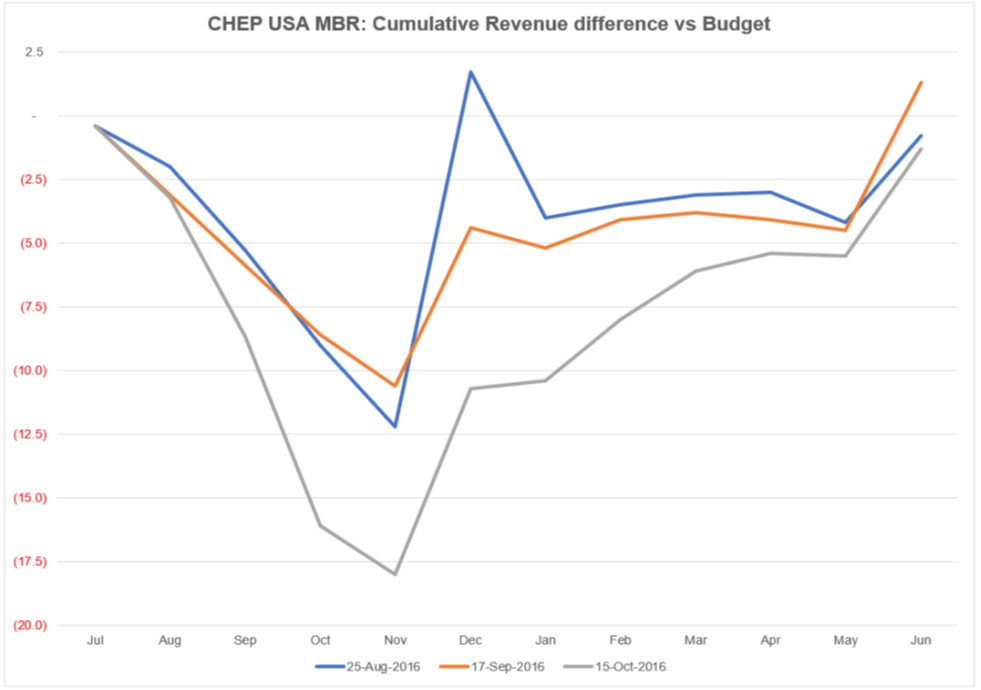
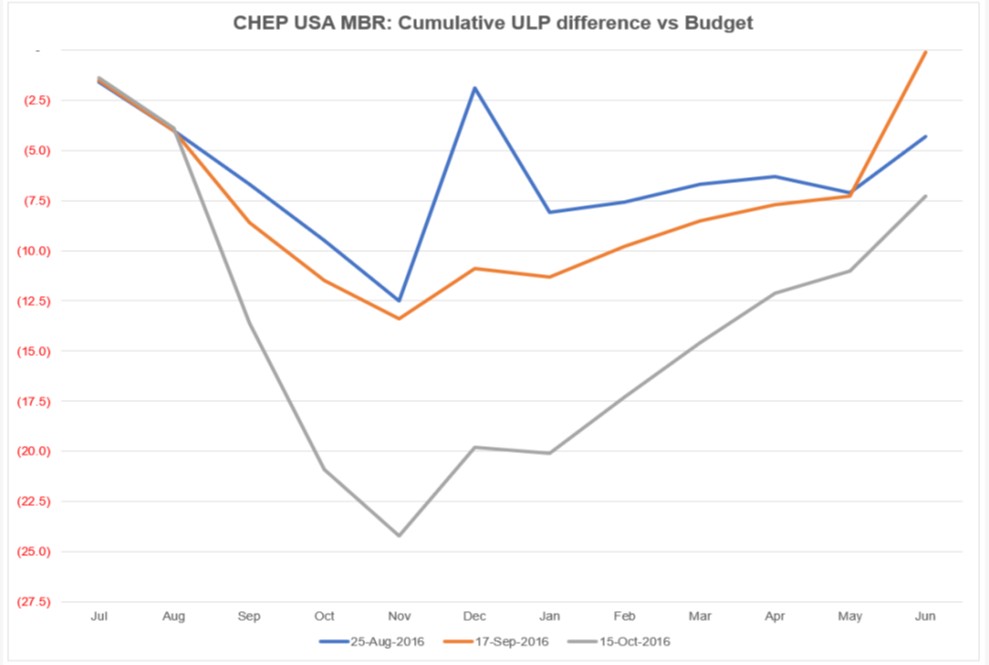
2569 As noted earlier, those charts show that as actual US Pooled sales revenue and Underlying Profit increasingly fell behind budget in 1H17, Brambles just assumed an ever-greater recovery over the balance of the year. Those charts do not include the October results and thus do not plot the necessary trajectory for US Pooled to recover to meet budget from the actual YTD sales revenue and Underlying Profit deficits at that point. But it is obvious that following the October results the necessary hockey-stick trajectory in 2H17 would be even more pronounced. As at 16 November 2016, there were not objectively reasonable grounds to forecast such a recovery. Doing so would just assume an ever-greater recovery over the balance of the year as the YTD deficits to budget in sales revenue and Underlying Profit increased as actual results came in.
The no major customer loss assumption continued to be unreasonable
2570 The Group September Reforecast maintained the budget assumption that US Pooled would have a low level of customer losses in FY17 and no major customer losses. I have found that the no major customer loss assumption lacked objectively reasonable grounds when it was made and that remained the case as at 20 October 2016. I consider that it continued to be the case as at 16 November 2016.
2571 It will be recalled that Rumph’s Headlines Memo had called out one of the “key risks” in the US Pooled budget was that, notwithstanding likely increased competition from PECO, it assumed that US Pooled would have a low customer loss rate, and that US Pooled would not suffer the loss of any major customer. The evidence as to what constituted a ‘major customer’ within US Pooled is not, however, clear.
2572 The November Demand Consensus Report (distributed 12 November 2016) shows that, over the first four months of FY17, US Pooled had lost seven large customers, including at least one ‘major customer’, representing around 4.3 million pallet issues pa, which at a conservative RPI of $5.00 represented approximately $(21.5) million in foregone annualised sales revenue. The lost ‘major customer’ Scotts had transitioned most of its business to US Recycled, but profitability for CHEP NA in that business was materially lower than in US Pooled.
2573 Further, as at 16 November 2016, US Pooled was at risk of losing further large customers. At that point, it was locked in competition for a number of large customers (including Cott Beverages, JBS, First Quality, National Beef and Smithfield) and PECO was being increasingly aggressive on price.
2574 Having regard to the fact that US Pooled lost two large customers including at least one ‘major customer’ in the six months leading up to FY17; in the four and a half months of FY17 to date (up to around mid-November) it had lost seven large customers, including at least one ‘major customer’ (worth annualised sales revenue in the order of $21.5 million); and it was at risk of losing more large customers due to aggressive competition from PECO, it is plain that, as at 16 November 2016, the no major customer loss assumption in the Group September Reforecast did not have reasonable grounds.
2575 That is material to my view that there were not reasonable grounds for the Group September Reforecast to project that US Pooled and CHEP NA would recover to achieve their Underlying Profit budgets by the end of the year.
The continuing direct costs overruns
2576 The persistent direct costs overruns in US Pooled are significant to my view that, as at 16 November 2016, there were not reasonable grounds for the Group September Reforecast to project that US Pooled and CHEP NA would recover to achieve their Underlying Profit budgets by the end of FY17.
2577 First, contrary to Brambles’ submissions, the persistent direct costs overruns were plainly material. Following the October results, US Pooled had experienced a four-month trend of over-budget direct costs. They had been over-budget by $(1.7) million in July, $(0.9) million in August, $(4.2) million in September, and $(4.8) million in October (and $(4.4) million over-reforecast). As a result, direct costs YTD were $(11.6) million over-budget.
2578 Second, contrary to Brambles’ submissions, the direct costs overruns were not easily or readily rectified. Kennett accepted in cross-examination that at that time there was a fundamental diagnostic problem within US Pooled in respect of the ability to ascertain what was happening with its direct costs. On 10 November 2016, Alonso expressed his frustration with the diagnostic problems in the following terms:
We cannot keep working like this, waiting every month to the last minute surprise and then spending the next 2 or 3 weeks trying to understand why and if it is real instead of focusing on improving performance
Kennett accepted that the diagnostic issue regarding direct costs was “a very serious issue”, and he said that the reason he was urgently bringing Moreno to the USA was because it was an “emergency situation”.
2579 At that point, notwithstanding a four-month trend of direct costs overruns, and a high level of management concern regarding the overruns, with repeated deep dives by Alonso, and attention given to the issue at weekly Walk to MOP meetings, management still did not understand their fundamental causes.
2580 Third, it is plain on the evidence that the direct costs overruns could not be addressed until Moreno completed his investigation and reported to management. Kennett was clear in his evidence that, as at 16 November 2016, Brambles’ management did not understand the causes of the direct costs overruns, and that Brambles could not address the overruns until their causes were understood.
2581 Moreno was appointed on 12 October 2016 but it seems that he did not work full-time on the issue until around 13 November 2016. However, the date when Moreno started full-time work on the issue is not central. What is critical is that he did not provide his report to management until 22 November 2016. The only evidence of results from his investigations prior to that were in an email Moreno sent to Kennett on 16 November 2016, in which he referred to some of the issues he had been looking at. Specifically, he identified an error in the posting of $(2.3) million of costs in September.
2582 Fourth, Brambles’ evidence on this issue was weak. For example, Mackie gave evidence that when he was told on 16 November 2016 that Moreno’s report should be available “shortly”, that gave him confidence that Moreno was close to providing his views and he expected Moreno to provide recommendations for improvements which could be applied to reduce direct costs in US Pooled. I accept that Mackie being told that Moreno’s report should be available “shortly” was grounds for confidence that the report was not far away. But Mackie (and Brambles) could not know what Moreno would find, or recommend, until Moreno provided his report.
2583 As at that point Brambles’ management did not know whether Moreno’s report would identify all the fundamental causes of the direct costs overruns or only some of them, whether all of the causes could be rectified, or whether (if the causes could be rectified) how long that would take. Taking a positive view, if the report showed that Moreno had ascertained the causes of the direct costs overruns, and that Brambles could then address them, there was likely to be at least one or two more months of over-budget direct costs (which had averaged $(4.5) million in September and October). Taking a conservative view, if the report showed that Moreno was unable to ascertain the causes of the direct costs overruns or not all of them, or not all of them could be speedily rectified, then there was likely to be some continuing over-budget direct costs.
2584 Until Moreno’s report was received, Mackie (and Brambles) could not know whether, to what extent, or when the persistent direct costs overruns would cease to materially reduce US Pooled Underlying Profit in FY17. And Brambles could not reasonably forecast on the basis of a hope as to what Moreno would find.
2585 Sixth, the weakness in Brambles’ position on this issue can also be seen in its erroneous reliance on some of Moreno’s conclusions in his final report. In closing submissions, it argued that US Pooled and CHEP NA management had identified and were continuing to identify plans to address the direct costs overruns, and then referred directly to some of Moreno’s conclusions. Perhaps to state the obvious, those conclusions were not known as at 16 November 2016.
2586 Seventh, in cross-examination, Kennett accepted that the rephasing in the Group September Reforecast “ignored the fact that [Brambles] did not know what was causing the direct cost underperformance to budget in US Pooled”. I find it astonishing that Kennett prepared and relied on a reforecast which ignored that fact, when he accepted that Brambles could not resolve the direct costs overruns without understanding their causes, and that Brambles did not understand the causes of the direct costs overruns at the time the reforecast was made (and as at 16 November 2016).
2587 As at 16 November 2016, the position in relation to the continuing direct costs overruns in US Pooled was as follows:
(a) following the October results, direct costs overruns YTD were $(11.6) million and they contributed approximately 46% of the $(25.3) Underlying Profit shortfall to budget in US Pooled YTD;
(b) Kennett accepted that at that time there was a fundamental diagnostic problem within US Pooled in respect of the ability to ascertain what was happening with its direct costs;
(c) Kennett accepted that at that time Brambles management did not understand the fundamental causes of the direct costs overruns, and it could not address them until it understood the causes; and
(d) while Moreno’s investigation was underway and his report was expected shortly, he had not as yet reported his conclusions, and the evidence shows that it was not known what he would conclude.
2588 How could there be reasonable grounds for the Group September Reforecast to project that US Pooled (and consequently CHEP NA) would recover to achieve their Underlying Profit budgets when, at that time, Brambles’ management did not know whether, to what extent, or when, the persistent direct costs overruns would cease to materially reduce US Pooled Underlying Profit in FY17?
The damage rate assumption continued to be unreasonable
2589 The fact that the Group September Reforecast maintained the assumption in the budget that US Pooled would achieve a two pp reduction in the average damage rate, and did not integrate Alonso’s assessment into the reforecast, is also significant to my view that the projections in the reforecast in relation to US Pooled Underlying Profit lacked reasonable grounds.
2590 I found that that assumption lacked objectively reasonable grounds when it was made and that remained the case as at 20 October 2016. I do not accept Brambles’ contention that, as at 16 November 2016, the damage rate assumption had reasonable grounds.
2591 As at that date, it continued to be the case that Alonso had assessed, as at 4 October 2016, that there was a 75% likelihood that projected two pp reduction in the average damage rate would not be achieved. He testified that, had it been his decision, he would have integrated the damage rate risk into the Revised September Reforecast, rather than merely noting the risk but otherwise excluding it from the reforecast. In my view that meant that was only a 25% chance that the projected approximately $11 million in cost savings related to the assumed reduction in the average damage rate would eventuate. For the reasons I explained in relation to the position as at 20 October 2016, I consider that Alonso’s assessment was correct.
2592 It is true, as Brambles argued, that the damage rate had continued to decline in October, as it had since July. I accept Alonso’s evidence that, as at 8 November 2016, US Pooled was showing good progress in relation to the damage rate. Even so, at that point US Pooled was still a long way from achieving an average damage rate for the year of 59.3%. Young’s email to Alonso on 8 November 2016 recognised that by stating “the damage rate still represents the biggest risk we have for FY17, and we have a hill to climb”.
2593 It continued to be the case, as Alonso accepted, that the Group September Reforecast was based in an assumption of a steady decline in the damage rate. That was an erroneous assumption. As had been the case in each of FY14, FY15 and FY16, the damage rate usually went up in November, December and January. Brambles should have integrated that seasonality into the Group September Reforecast but it did not.
2594 As Brambles management should have expected, the damage rate did go sharply up again in November and December, as shown by Mr Lee’s chart (reproduced below).
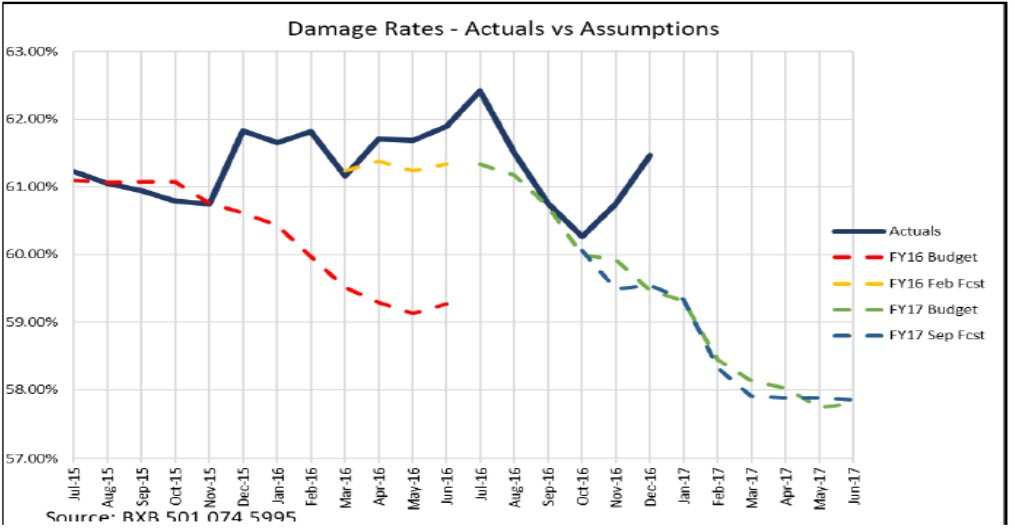
2595 Further, as at 16 November 2016, it continued to be the case that the Underlying Profit projections for US Pooled in the Group September Reforecast did not have reasonable grounds because the reforecast failed to integrate Alonso’s assessment that there was a 75% likelihood that US Pooled would not achieve the assumed two pp reduction in the average damage, and thus a 75% likelihood that the projected approximately $11 million in savings from the assumed damage rate reduction would not eventuate. Instead, it recorded that risk at 50% probability, and did not ‘bake’ it into the reforecast numbers.
2596 That was significant to the reasonableness of the grounds for the projected US Pooled Underlying Profit in the reforecast as it meant that the single largest risk to its full-year Underlying Profit was not adequately taken into account.
The US Pooled and CHEP NA recovery plans
2597 I accept Brambles’ submission that the results in US Pooled were not expected to rebound immediately in October, as the recovery actions required time to implement and then to take effect. The projected recovery in US Pooled was not forecast to occur until later in 1H17 and in 2H17. But there is no merit in Brambles’ submission that the “recovery measures [in US Pooled] were carefully considered for the purposes of assessing the risks and opportunities of achieving the September Reforecast at the time it was presented to the Board for its November 2016 meeting”.
2598 That cannot have been the case when US Pooled and CHEP NA management had decided, before the November Board Meeting, that the planned recovery measures and initiatives were insufficient for US Pooled and CHEP NA to recover from their YTD shortfalls and achieve their Underlying Profit budgets by the end of the year. They forecast that they would miss their full-year Underlying Profit budgets by $(15) million and $(10) million respectively, but the Board was not told that. Considered objectively, it cannot reasonably be said that Gorman, Todorcevski and the Board gave careful consideration to whether the recovery plan for US Pooled meant that it was likely to recover to achieve its full-year Underlying Profit budget. The evidence shows that, as at 16 November 2016, Gorman and Todorcevski did not understand that CHEP NA management had accepted that it would not recover to meet its Underlying Profit budget for the year, and the Board had not been told that.
2599 I accept that the results in US Pooled were not expected to rebound immediately in October, and that the recovery plans needed time to mature, but it is plain that the October results were worse than expected and that higher level management was taken by surprise by the extent of the deficit to budget and reforecast.
2600 I accept that Rumph was not taken by surprise. On 18 November 2016 Kennett emailed Rumph and, among other things, passed on that O’Sullivan had told him that management had told the Board after the September results that “we were under control” and then the October results were another miss to budget “which was not considered normal”, and although the Board had reconfirmed the FY17 Guidance there was a lot of nervousness from the market, in particular with a new CEO and CFO. Rumph responded:
Buster - I have always known we would also miss October by a large amount. Who communicated P4 would be on target?
Kennett responded:
I have no idea on that point - I certainly didn’t, but unfortunately that is obviously the perception. I can only imagine that this is when compared to the Budget.
2601 The Revised September Reforecast was supposed to represent management’s best estimate of future financial performance for FY17, a monthly basis. On Brambles’ submissions, the re-forecast was the result of careful analysis and detailed consideration, including from the bottom-up. Rumph may have expected the October results to be poor but for higher management it was plainly a surprise when US Pooled sales revenue and Underlying Profit for October came in $(4.6) million and $(8.4) million respectively under the recently completed reforecast.
2602 Kennett testified that he was surprised and disappointed by the October results for US Pooled, and Mackie testified that he had anticipated that the October performance in CHEP NA would be “challenging” but he said he was not expecting the extent of the shortfall in that month. The October results for US Pooled were plainly a surprise to Brambles management, and an unpleasant one.
The material understatement of risks to US Pooled sales and Underlying Profit for FY17
2603 As earlier noted in respect of Kennett’s testimony, the CHEP NA October PPR (dated 16 November 2016) contained an R&O schedule relating to US Pooled (which I have called the US Pooled October R&O Schedule) which set out the risks and opportunities to the reforecast US Pooled sales revenue and Underlying Profit. It provided:
(a) a total of $(11.9) million in risks to US Pooled Underlying Profit in 1H17 (which were excluded from the Revised September Reforecast). On a probability-adjusted basis that equated to $(9.7) million risk to 1H17 Underlying Profit;
(b) a total of $(13.6) million in risks to US Pooled sales revenue in 1H17 (which were excluded from the reforecast). On a probability-adjusted basis that equated to a $(7.1) million risk to 1H17 sales revenue;
(c) no risks to US Pooled sales volume in 2H17; and
(d) no “opportunities” in 1H17, they were all listed as arising in 2H17.
The risks included an $(8.4) million risk to US Pooled Underlying Profit in 1H17 identified as “Month of October Performance”, which was given a probability of 100% as that risk had actually eventuated.
2604 Kennett deposed that, at that time, based on the analysis undertaken in connection with the Revised September Reforecast and the US Pooled Walk to MOP process and recovery plans that was “largely in line” with what he expected to see.
2605 However, the US Pooled October R&O Schedule did not mention or understate the following risks to US Pooled Underlying Profit in FY17, each of which I consider to be obvious:
(a) First, the R&O schedule assessed only a 25% risk that US Pooled would not achieve the reforecast new wins in 1H17. It did so in circumstances where it had missed its sales budget for four consecutive months and was materially under-budget and reforecast for the preceding two months. There was an obvious risk, and it was substantially more than 25% that US Pooled would again fail to achieve the sales reforecast in November and December FY17. I should note that Kennett said that this was a mistake and that he was confident what the sales volume risk should have been in 2H17, and that it would have been corrected. He said that the risk was given only a 25% probability because of US Pooled’s confidence in achieving the rephased 2H17 sales. I was not, though, taken to a document to show that this error was corrected.
(b) Second, the R&O schedule assessed that there was no risk that US Pooled would not achieve the reforecast new wins in 2H17. Again, it did so in circumstances where it had missed its sales budget for four consecutive months, and was materially under-budget and reforecast for the last two months. There was an obvious risk that US Pooled would not achieve the sales in 2H17 that Todorcevski had described as “massive” and beyond anything we have ever seen, and Martin had described as “incrementally more difficult to rationalise”. If Kennett was correct, and sales volume risk should have been in 2H17, in my view the risk of not achieving those sales was substantially more than 25%. For the reasons I have explained it was more likely than not that US Pooled would not achieve that level of sales.
(c) Third, the R&O schedule assessed that there were no risks to US Pooled Underlying Profit in 2H17 other than a damage rate risk of $(9) million and a price risk of $(1) million. That is, it did not identify any risk to Underlying Profit from the persistent direct costs overruns which US Pooled had experienced for four consecutive months, and which had been materially over-budget and over-reforecast for the preceding two months. Nor did it identify any such risk in the remainder of 1H17. There was an obvious risk that US Pooled would continue to experience material direct costs overruns in the balance of 1H17, and into 2H17, noting that YTD the overruns totalled $(11.6) million which was approximately 46% of its Underlying Profit deficit to budget YTD.
2606 As noted, the chedule did identify a damage rate risk in 2H17, giving it a probability of 50% of eventuating. In relation to that, Kennett said that he thought the US Pooled team may have been pessimistic or overly conservative in their assessment given the positive damage rate trend for the year-to-date, which was trending on course with the budget expectations. For the reasons I have explained, I do not accept that represented a conservative or reasonable approach. That resulted in the single largest risk to US Pooled Underlying Profit, which Alonso assessed at a 75% probability of eventuating, not being properly taken into account in the reforecast.
2607 In cross-examination Kennett accepted that the US Pooled October R&O assumed that in the remaining two months of 1H17, and in 2H17, US Pooled would not experience any under sales volume or Underlying Profit underperformance against the Group September Reforecast. When questioned about the reasonableness of that approach Kennett was unable to explain how, given its performance YTD, it made sense or was “logical” for the CHEP NA October PPR:
(a) not to record any risk to US Pooled Underlying Profit through underperformance against reforecast in the next two months of 1H17; and
(b) not to record any risk to US Pooled sales revenue or Underlying Profit through underperformance against reforecast in 2H17.
2608 Kennett conceded that the approach in the US Pooled October R&O of not ascribing any underperformance risk in 2H17 was illogical. In my view, by taking that approach the US Pooled October R&O materially understated the risks to US Pooled sales revenue and Underlying Profit from further underperformance in the remainder of 1H17 and in 2H17.
2609 The material understatement of risk in the US Pooled October R&O Schedule can also be seen by comparing the risks in the US Pooled October R&O Schedule to the risks identified in the R&O schedule for CHEP NA (CHEP NA September R&O Schedule) in the earlier CHEP NA September PPR (11 October 2016). The CHEP NA September R&O Schedule listed the risks and opportunities to CHEP NA Underlying Profit in 2H17, and identified risks to Underlying Profit that were not included in the Revised September Reforecast in a total of $(36.2) million (of which $(27.4) million were in US Pooled). In cross-examination Kennett understandably accepted that a very substantial part of that risk would have been attributable to US Pooled.
2610 The later US Pooled October R&O Schedule identified risks to US Pooled Underlying Profit (excluded from reforecast) in a total of only $(10) million. It identified those risks as a damage rate risk ($(9) million) and a price risk ($(1) million). Apart from “Price Risk” (recorded as a $1 million risk to 1H17 and 2H17 Underlying Profit in the US Pooled October R&O Schedule, and as a $(1.5) million risk to 1H17 and 2H17 Underlying Profit in the CHEP NA September R&O Schedule), it did not mention the other risks to US Pooled Underlying Profit that had been listed in the CHEP NA September R&O Schedule.
2611 In cross-examination, Kennett was unable to adequately explain how the (excluded from reforecast) risks to Underlying Profit in CHEP NA in 2H17 recorded as $(36.2) million in the CHEP NA September R&O Schedule (of which $(27.4) million were in US Pooled), could legitimately have reduced to (excluded from reforecast) risks to Underlying Profit in US Pooled in 2H17 of only $(10) million in the US Pooled October R&O Schedule. If anything another month of materially under-budget performance by US Pooled in October should have increased the risks to Underlying Profit in 2H17.
2612 Then, Kennett sought to explain the discrepancy on the basis that the total risk to Underlying Profit of $(10) million identified in the US Pooled October R&O Schedule had taken account of the risks associated with the poor October results. He accepted that Brambles had assumed that the October under-budget performance had absorbed that risk, and stated that there was no risk that the under-budget performance would continue in the balance of FY17.
2613 I do not consider that the approach the US Pooled October R&O Schedule took in relation to identifying risks to US Pooled’s FY17 Underlying Profit was reasonable or realistic. As at 16 November 2016, there were not reasonable grounds to assume that there was no risk that the materially under-budget performance by US Pooled in sales revenue and Underlying Profit YTD would not continue into November and December 2016, or into the second half of FY17. Nor were there reasonable grounds to assume that there was no risk that, even if US Pooled could start to meet the budget or reforecast sales revenue and Underlying Profit targets, that it would not be able to overperform against budget over the remainder of FY17 so as to catch up the actual $(25.3) million Underlying Profit deficit to budget YTD.
18.4.3.4 Conclusion - US Pooled and CHEP NA
2614 The situation for US Pooled and CHEP NA as at 16 November 2016 was similar to that as at 20 October 2016, but worse. Accordingly my reasoning is similar to that as at 20 October 2016, but the likely deficits to budget by the end of FY17 are greater.
2615 As I have said, as at 16 November 2016 the Group September Reforecast had not been updated to take into account the actual October results and as a result it was out of date. However, putting that issue to one side for the moment, the reforecast projected that in 2H17:
(a) US Pooled would:
(i) recover from its projected $(7.1) million sales revenue deficit to budget in 1H17, through $8.4 million in overperformance against budget in 2H17, to be over-budget by $1.3 million in sales revenue to budget for the full-year; and
(ii) recover from its $(14.3) million Underlying Profit deficit to budget in 1H17, through $14.3 million in overperformance against budget in 2H17, to be flat to budget in Underlying Profit for the full-year; and
(b) CHEP NA would:
(i) not recover from its projected $(19.9) million sales revenue deficit to budget in 1H17, and the deficit would worsen in 2H17 to a $(23.8) million sales revenue deficit to budget for the full-year; and
(ii) recover from its projected $(17.7) million Underlying Profit deficit to budget in 1H17, through a remarkable $17.6 million in overperformance against budget in 2H17, to be almost flat to budget in Underlying Profit for the full-year.
2616 Having regard to the matters discussed above, I am satisfied that, as at 16 November 2016, it was more likely than not that US Pooled would materially fail to achieve the sales revenue and Underlying Profit projections in the Group September Reforecast, and it would materially miss its Underlying Profit budget for FY17.
2617 In my view for the same reasons explained as at 20 October 2016 that materially lower US Pooled sales revenue and Underlying Profit was likely to translate, reasonably closely, into materially lower sales revenue and Underlying Profit in CHEP NA. Again:
(a) the likely materially worse sales revenue results by US Pooled was likely to materially worsen the projected $(23.8) million CHEP NA sales revenue deficit to budget for the full-year; and
(b) the likely materially lower US Pooled Underlying Profit result was likely to materially worsen CHEP NA Underlying Profit, and it was likely to materially miss its Underlying Profit budget for the full-year.
2618 Those projections were the path by which the reforecast projected that US Pooled and CHEP NA would recover so as to meet their Underlying Profit budgets by the end of FY17 and, as at 16 November 2016, it was more likely than not that US Pooled and CHEP NA would materially fail to achieve them.
2619 By 16 November 2016, it was pellucid that the sales revenue and Underlying Profit projections in the Group September Reforecast in respect of US Pooled and CHEP NA lacked reasonable grounds. By then, the reforecast no longer reflected the actual position of those businesses vis-à-vis their FY17 budgets. Nor did it any longer represent management’s best estimate of likely future performance. That can be seen in the following matters:
(a) Even if US Pooled could achieve the remarkable 2H17 sales revenue recovery projected in the Group September Reforecast, it would not meet the projection that it would achieve its sales revenue budget for FY17. As at that date the projected $(7.1) million sales revenue deficit to budget in US Pooled for 1H17 had more than doubled to an actual $(15.9) million deficit to budget YTD. The Group September Reforecast projected that CHEP NA would have a 1H17 sales revenue deficit to budget of $(19.9) million, whereas its actual sales revenue deficit to budget YTD was $(28) million.
(b) Even if US Pooled and CHEP NA could achieve the remarkable 2H17 Underlying Profit recoveries projected by the Group September Reforecast, they would not meet the projection that they would each meet their Underlying Profit budgets for FY17. As at that date, the projected US Pooled $(14.3) million Underlying Profit deficit to budget in 1H17 had ballooned to an actual $(25.3) million deficit to budget YTD. And the projected CHEP NA $(17.7) million Underlying Profit deficit to budget in 1H17 had ballooned to an actual $(29) million deficit to budget YTD. The Group September Reforecast did not contemplate or project that US Pooled or CHEP NA could recover to alignment with budget from YTD Underlying Profit deficits of those magnitudes.
2620 The Group September Reforecast had not been updated to take into account the fact that CHEP NA management, with the concurrence of CHEP Global management, had downgraded its forecast to project that CHEP NA would have a $(15) million Underlying Profit deficit to budget for FY17, including a $(10) million deficit to budget in US Pooled. Brambles’ relevant management no longer considered the projections in the Group September Reforecast in respect of US Pooled and CHEP NA had reasonable grounds.
2621 I conclude that, as at 16 November 2016, there were not reasonable grounds for the Group September Reforecast to make the sales revenue and Underlying Profit projections that it did in respect of US Pooled and CHEP NA, including by projecting that those businesses would recover from their projected 1H17 deficits to budget to achieve their Underlying Profit budgets by the end of FY17. I note that they were projections of recovery from 1H17 deficits which were likely to be much greater because of the deterioration in actual results.
2622 The conclusion that, as at 16 November 2016, the projections in the Group September Reforecast for US Pooled and CHEP NA lacked reasonable grounds informs my later conclusions regarding whether there were reasonable grounds for the projections in the Group September Reforecast in respect of CHEP Global and the Group, and whether the reforecast provided reasonable grounds for the FY17 Guidance.
2623 Again, the applicants are not required to prove what alternative sales revenue or Underlying Profit FY17 budget, or FY17 earnings guidance, would have been reasonable. However, deciding whether, as at 16 November 2016, the FY17 Guidance had reasonable grounds is likely to be assisted by some estimates of the extent of the likely shortfalls to budget at the US Pooled and CHEP NA levels, so as to feed them into an estimate at the Group level. I later make those estimates, which are unavoidably approximate.
18.4.4 Whether as at 16 November 2016 there were reasonable grounds for the projections in the Group September Reforecast in respect of CHEP Global?
2624 I now consider whether, as at 16 November 2016, there were reasonable grounds for the projections in the Group September Reforecast in respect of CHEP Global, including to project that it would recover from its significant projected Underlying Profit deficit to budget in 1H17 so as to achieve its Underlying Profit budget by the end of FY17.
2625 I found that as at 16 November 2016, it was more likely than not that by the end of FY17, CHEP NA would have materially lower sales revenue and Underlying Profit than that projected in the Group September Reforecast, and it would fall materially short of its Underlying Profit budget for FY17. I concluded that, as at that date, the sales revenue and Underlying Profit projections in the Group September Reforecast for CHEP NA did not have reasonable grounds.
2626 For the same reasons as at 20 October 2016, I consider it to be more likely than not that the likely materially lower CHEP NA sales revenue and Underlying Profit results for FY17 would translate, reasonably closely, into materially lower sales revenue and Underlying Profit results in CHEP Global for FY17. I need not set out those reasons again. Again, the reforecast did not project:
(a) material sales revenue overperformance against budget by other CHEP CBUs for the full-year to materially offset the CHEP NA underperformance. The other CHEP CBUs were projected to be close to flat to budget in 2H17 except for CHEP Europe which was projected to be $(6.5) million under-budget in that period, but flat to budget for the full-year; or
(b) material Underlying Profit overperformance against budget by other CHEP CBUs for the full-year to materially offset the CHEP NA underperformance. The other CHEP CBUs were projected to be flat or close to flat to budget in Underlying Profit for the full-year.
2627 As a result:
(a) the likely materially worse CHEP NA sales revenue was likely to materially worsen the projected $(26.9) million CHEP Global sales revenue deficit to budget for the full-year; and
(b) the likely materially worse CHEP NA Underlying Profit was likely to materially worsen CHEP Global Underlying Profit, and it was likely to materially miss its Underlying Profit budget for the year.
2628 In my view, whether as at 16 November 2016 there were reasonable grounds for the Group September Reforecast to project (as it did) that, by the end of FY17, CHEP Global:
(a) would have a $(26.9) million sales revenue deficit to budget (rather than a greater deficit); and
(b) would recover from its projected $(15.7) million Underlying Profit deficit to budget in 1H17, through $15.7 million in overperformance against budget in 2H17, so as to meet its Underlying Profit budget for FY17,
was mainly dependent on two main matters. The extent or quantum by which CHEP NA was likely to miss its sales revenue and Underlying Profit budgets by the end of FY17, and the likelihood and extent of any offsetting sales revenue and Underlying Profit overperformance by other CHEP CBUs.
18.4.4.1 The lay evidence - CHEP Global budget
2629 Brambles centrally relied on the evidence of Kennett, Mackie and Todorcevski regarding their reasons, as at 16 November 2016, for their belief in the achievability of the CHEP Global Underlying Profit budget by the end of FY17. I should note in this context that, curiously, in their evidence-in-chief Kennett and Mackie did not expressly state that as at 16 November 2016 they considered the CHEP Global budget to be achievable by the end of FY17. However, for the reasons I explain, it is appropriate to infer that that was their view. That evidence was supported by the testimony of Nador, Martin and Alonso regarding their reasons for their belief in the achievability of the US Pooled and CHEP NA Underlying Profit budgets for the year. I have previously dealt with their evidence in that regard, and I need not do so again.
Kennett
2630 As at 16 November 2016, Kennett knew from Rumph’s 16 November 2016 email that CHEP NA forecast that it would have a $(15) million Underlying Profit deficit to budget for the year, and he accepted the correctness of that assessment in his email in response to Rumph on 17 November 2016. I have found that, as at 16 November 2016, Kennett considered it to be more likely than not that US Pooled and CHEP NA would fail to achieve the projections in the Group September Reforecast and their Underlying Profit budgets by the end of FY17. It follows that, as at 16 November 2016, Kennett did not consider that the projections in the Group September Reforecast in respect of US Pooled and CHEP NA or their Underlying Profit budgets for the year had reasonable grounds.
2631 As I have said, in his evidence-in-chief Kennett made a choice not to expressly state whether, as at 16 November 2016, he considered the projections in the Group September Reforecast for CHEP Global and its Underlying Profit budget for the year continued to be achievable. But for the reasons I explained (in section 18.4.3.2 above), I infer that at that time he continued to think that the CHEP Global Underlying Profit budget was achievable by the end of FY17 (although not that the projections in the Group September Reforecast for CHEP Global continued to be achievable).
2632 Because of Kennett’s decision not to state his view, it is not entirely straightforward to discern the reasons for his (inferred) view that, as at 16 November 2016, he considered the CHEP Global Underlying Profit budget continued to be achievable by the end of FY17. His reasons though, can be seen in the following evidence.
2633 First, the evidence shows that Kennett understood that the Underlying Profit underperformance against budget by CHEP NA YTD was likely to translate, reasonably closely, into Underlying Profit underperformance by CHEP Global against budget, unless other CHEP CBUs could overperform against budget to compensate for that. Upon receipt of the October results, he and Mackie immediately began to seek Underlying Profit overperformance against budget from other CHEP CBUs. The evidence indicates that in this period Kennett thought there was a prospect of obtaining some offsetting overperformance from CHEP LATAM and CHEP Europe.
2634 Second, as earlier noted, on 17 November 2016 Kennett made a presentation to O’Sullivan by reference to the CHEP November CFO BPR slide deck, and he emphasised the following matters:
(a) the strong October performance of CHEP LATAM and CHEP Europe;
(b) the main drivers of the variance in US Pooled’s results to budget, and that the issues in US Pooled’s performance had arisen in September to October (not July and August) and were being investigated and audited by Moreno and his team;
(c) the damage rate for US Pooled was continuing to remain on track with budget;
(d) the existing full-year analysis and outlook, which assumed the achievement of the September Reforecast (until the December Reforecast update, which was in progress at that time), with the full-year remaining on budget (across 1H17 to 2H17 inclusive); and
(e) an updated full-year R&O analysis which netted to risks of $(19.2) million and included the potential offsetting effect of CHEP Europe and CHEP LATAM’s ongoing strong performance.
It is appropriate to infer that Kennett held the same views on 16 November 2016.
2635 Third, Kennett deposed that, on 25 November 2016, he sent an email to O’Sullivan and Mackie, circulating a presentation he had recently prepared, outlining a plan to get CHEP Global back to budget for the year (which I have defined above as the CHEP Global Recovery Plan). Mackie approved the plan on or around that date. The presentation included a high-level overview of the recovery plan initiatives, as follows:
Recovery plans put in place by CBUs will deliver actions that bring us back to budget on ULP for the full year:
• NAM will reduce current YTD deficit from $29M to $15M;
• Latam deliver $7M additional ULP (mainly run-rate);
• Europe delivers $7M additional ULP (mainly run-rate);
• AIME already had plan in place to offset current challenge & will achieve Budget;
• APAC challenge in Asia will be offset by ANZ, but no additional upside at this point;
• Balance plugged in International (+$1M).
2636 As is apparent, the basis of that plan for CHEP Global to recover to alignment with its Underlying Profit budget for FY17 was that:
(a) CHEP NA would hold its Underlying Profit deficit to budget for the year to $15 million (as forecast by Rumph);
(b) CHEP LATAM and Europe would each deliver an additional $7 million in Underlying Profit, mainly through increased sales volume; and
(c) CHEP AIME and APAC would both achieve budget but without any additional upside.
If that plan was executed, CHEP Global would have (only) a $(1) million Underlying Profit deficit to budget for FY17, which would be “plugged” by a $1 million book-entry in CHEP Global.
2637 Kennett further deposed that, as at 25 November 2016, he considered the CHEP Global FY17 budget “remained achievable and reasonable” having regard to the following matters:
(a) the CHEP Global Recovery Plan developed during the course of November 2016;
(b) the supply chain costs YTD deep dive analysis and reporting undertaken by Moreno, and the subsequent improvements in the reporting capability and visibility over the supply chain costs of the US Pooled business, as well as the US Pooled supply chain initiatives developed by the US Pooled team to recover the additional supply chain costs;
(c) the matters and correspondence he described in paragraphs 706 to 738 of his first affidavit, which included:
(i) Rumph’s 16 November 2016 email telling him that CHEP NA would miss budget by $(15) million for the year;
(ii) his review of the US Pooled Walk to MOP sales opportunities on or around 18 November 2016;
(iii) a presentation and high level CHEP NA recovery plan he prepared for O’Sullivan for the CHEP NA review meeting on 18 November 2016, and what he told O’Sullivan about it in that meeting;
(iv) an email from Mackie on 18 November 2016 setting out that he had a good catch up with the President of CHEP LATAM and stating that it looked like CHEP LATAM would have upside of $10 million in revenue and $7 million in Underlying Profit;
(v) an email he sent to the Presidents of each CHEP CBU on 19 November 2016 seeking that they dig as deep as possible to identify upside opportunity in those businesses;
(vi) an email he sent to Mackie on 19 November 2016 stating that he was anticipating receiving adjusted Underlying Profit projections against budget of CHEP NA $(15) million, CHEP Europe $8 million and CHEP LATAM $6 million, which would leave CHEP Global at (only) $(1) million to budget for the year;
(vii) the presentation prepared by CHEP NA titled “Nessa NAM Recovery Plan Review November 20” presented by Rumph in a call between Rumph, Kennett and O’Sullivan on 20 November 2016, which set out CHEP NA’s recovery plans (which I later refer to as the 20 November CHEP NA Recovery Deck);
(viii) Moreno’s detailed report received on 22 November 2016 providing the outcome of his investigation into direct costs overruns in US Pooled;
(ix) an email he received from Barry Sevriens (CFO, CHEP Europe) on 23 November 2016 stating that CHEP Europe could deliver $6.9 million of over-budget Underlying Profit for the year;
(x) an email he received from De Rivas on 23 November 2016, attaching a stretch plan for CHEP LATAM to achieve $7 million of over-budget Underlying Profit for the year;
(xi) the CHEP Global Recovery Plan he finished on 24 November 2016, emailed to Mackie for approval, and then finalised on 25 November 2016.
(d) his ongoing monitoring and review of the performance of the CHEP Global businesses;
(e) his review of the CHEP Global and in particular the US Pooled October results, including:
(i) the analysis and review undertaken by the US Pooled and CHEP NA teams;
(ii) the meetings he attended with the CHEP NA, CHEP Global and Brambles’ teams to discuss the key drivers of the October US Pooled results;
(iii) the explanations given by US Pooled in relation to its results;
(iv) the commitment from the US Pooled and CHEP NA teams to address the poorer than expected results, particularly in relation to direct costs;
(v) the subsequent and separate analysis of the October results undertaken by him and the CHEP Global FP&A team, including considering the achievability of the Group September Reforecast in light of the October results and having regard to the whole of the CHEP business portfolio and the strong performance in other CBUs;
(f) the steps taken by key stakeholders following the October results for US Pooled, including the direct costs analysis and the addition of Moreno to be ‘on the ground’ to ensure any direct costs issues would be swiftly understood and remedied.
(g) his understanding of the CHEP Global business (including year-on-year trends), the strong track record against budget each year, and that the business always involved risks and that that was just part of doing business; and
(h) taking account of the YTD performance of the CHEP Global business, across the portfolio of CHEP CBUs, combined with the additional efforts from other CHEP CBUs to overdeliver against budget for the full-year.
2638 As is apparent from the list above, Kennett relied upon a series of matters which postdated 16 November 2016. The three most salient of those matters were:
(a) Moreno’s report dated 22 November 2016, which Kennett said gave rise to improvements in the reporting capability and visibility over US Pooled supply chain costs;
(b) the emails Kennett received from the CFOs of CHEP Europe and CHEP LATAM on 23 November 2016, which he understood as telling him that each CBU could deliver approximately $7 million of over-budget Underlying Profit for the year;
(c) the 20 November CHEP NA Recovery Deck; and
(d) the CHEP Global Recovery Plan, which Kennett finalised on 25 November 2016.
Those four matters were not known by Kennett as at 16 November 2016, and they could not form the basis of any belief he had, as at that date, in the achievability of the CHEP Global Underlying Profit budget by the end of FY17. Accordingly, I will address the reasons Kennett gave as at 25 November 2016 after filleting out those matters.
Mackie
2639 Mackie knew from Rumph’s 11 November Email that, following a meeting of the CHEP NA ELT, Rumph forecast that CHEP NA would have a $(15) million Underlying Profit deficit to budget for FY17 including a $(10) million Underlying Profit deficit to budget in US Pooled for the year, after implementation of their recovery plan and provided there was no deviation from plan in November. He said nothing to disagree with that assessment, and in his 14 November Email to Gorman he said, management’s “latest view” was that US Pooled would have a $(10) million Underlying Profit gap to close for the year, after implementation of its recovery plan.
2640 I have found that, as at 16 November 2016, Mackie considered it to be more likely than not that US Pooled and CHEP NA would fail to achieve the projections in the Group September Reforecast and their Underlying Profit budgets by the end of FY17. It follows that, as at that date, he did not consider that the projections in the Group September Reforecast for US Pooled and CHEP NA or their Underlying Profit budgets for the year had reasonable grounds.
2641 As I have said, in his evidence-in-chief, Mackie made a choice not to expressly state whether, as at 16 November 2016, he considered the projections in the Group September Reforecast for CHEP Global and its Underlying Profit budget for the year continued to be achievable. But for the reasons I explained (in section 18.4.3.3 above), I infer that at that time he continued to think that the CHEP Global Underlying Profit budget was achievable by the end of FY17 (although not that the projections in the Group September Reforecast for CHEP Global continued to be achievable).
2642 Because of Mackie’s decision not to depose as to his view, it is not as straightforward as it should be to discern the reasons for that view, but his reasons can be seen in the following matters.
2643 First, the evidence shows that Mackie understood that the Underlying Profit underperformance against budget by CHEP NA YTD was likely to translate, reasonably closely, into Underlying Profit underperformance by CHEP Global against budget, unless other CHEP CBUs could overperform against budget to compensate for that. Upon receipt of the October results he immediately began to seek Underlying Profit overperformance against budget from other CHEP CBUs. He contacted the CEOs of CHEP LATAM and Europe by telephone and by email asking them to look for opportunities to improve their sales revenue and Underlying Profit. He said, and I accept, that one of his focuses was on identifying opportunities in other CHEP CBUs to assist offsetting the CHEP NA results.
2644 He also said, and I accept, that he was pleased when, on 16 November 2016, Kennett informed him that CHEP LATAM and Europe “really look to have opportunity” for improved performance given their current gross profit performance. The evidence indicates that in this period Mackie thought there was a prospect of obtaining some offsetting overperformance from CHEP LATAM and Europe.
2645 Second, in cross-examination Mackie denied that, as at 12 November 2016, that he must have known that it was not going to be possible for CHEP Global to achieve its Underlying Profit budget for the year. He said that he believed that it would do so through “ongoing improvement in performance in other areas of the business”, which I understood as a reference to improved performance by other CHEP CBUs.
2646 Third, the CHEP Global Recovery Plan, which Mackie signed off on 25 November 2016, was centrally based in a plan whereby:
(a) CHEP NA would hold its Underlying Profit deficit to budget for the year to $(15) million (as forecast by Rumph);
(b) CHEP LATAM and Europe would each deliver an additional $7 million in Underlying Profit, mainly through increased sales volume; and
(c) CHEP AIME and APAC would both achieve budget but without any additional upside.
That is, the plan was centrally based on obtaining some offsetting overperformance from CHEP LATAM and Europe.
2647 Fourth, Mackie also suggested that his belief in the achievability of the CHEP Global budget was based in a view that the US Pooled direct costs overruns would be curtailed. Mackie said that he was pleased when he was told on 16 November 2016 that Moreno was expected to deliver his report “shortly”, because he “expected Moreno to provide recommendations for improvements that could be applied to reduce costs for US Pooled”.
Todorcevski
2648 I have previously noted Todorcevski’s evidence as to his reasons, as at 15 November 2016, for his confidence that Brambles was going to achieve the FY17 Guidance. Some of those reasons were based in his belief in the achievability of the US Pooled and CHEP NA Underlying Profit budgets by the end of FY17, which I infer also relate to his belief in the achievability of the CHEP Global Underlying Profit budget by the end of FY17.
2649 I previously considered those reasons in the context of the achievability of the US Pooled and CHEP NA Underlying Profit budgets, and I address them below in the context of the achievability of the CHEP Global Underlying Profit budget.
Consideration regarding lay evidence
2650 I found little force in the evidence of Kennett, Mackie and Todorcevski to the effect that, as at 16 November 2016, for the reasons they explained they continued to believe in the achievability of the CHEP Global Underlying Profit budget by the end of FY17.
2651 The following matters are material to my view.
2652 First, Mackie’s and Kennett’s belief in the achievability of the CHEP Global Underlying Profit budget by the end of FY17 was partly based in the proposition that CHEP LATAM and Europe had enjoyed “strong” October performances. Based on that, Brambles argued that it was reasonable to expect that material Underlying Profit overperformance against budget could be squeezed from those businesses, to offset the underperformance by CHEP NA.
2653 However, several things should be noted about that.
2654 First, while it was true that CHEP LATAM and Europe were over-budget in sales revenue and Underlying Profit in October and YTD, they were only over-budget in Underlying Profit YTD by $4.8 million (collectively). That would not go close to offsetting the actual $(29) million Underlying Profit deficit to budget in CHEP NA YTD.
2655 Second, it was true that CHEP Europe was $2.2 million over-budget in Underlying Profit YTD following the October results, but that did not show the availability of additional Underlying Profit to offset the underperformance in CHEP NA. The Group September Reforecast projected that CHEP Europe would be $3.8 million over-budget in Underlying Profit in 1H17, but $(3.9) million under-budget in Underlying Profit in 2H17. Unless the Group September Reforecast was wrong, there were not reasonable grounds for Mackie and Kennett to treat CHEP Europe’s Underlying Profit overperformance against budget in 1H17 as available to offset the underperformance by CHEP NA. All that would do would cover the projected underperformance in 2H17.
2656 Third, and relatedly, the proposition that CHEP Europe had enjoyed a “strong” October performance and therefore it could be relied upon for additional Underlying Profit to offset the poor CHEP NA results does not make sense when, at that point, CHEP Europe Underlying Profit was still under the Group September Reforecast. I do not understand how CHEP Europe could be said to be producing additional Underlying Profit to offset the poor CHEP NA results when, at that point, it had not even reached the over-budget target it had agreed to in the September Reforecast. And at this point, CHEP LATAM Underlying Profit YTD was a mere $1.4 million over the Underlying Profit target it had agreed to in the September Reforecast, which was hardly material.
2657 Fourth, CHEP LATAM and Europe had just gone through the September Reforecast process in which, as I infer, management had determined that they would not be able to overperform their Underlying Profit budgets for FY17 except to the extent recognised in the Group September Reforecast. The evidence shows that Brambles’ practice was to set (what it described as) “challenging but achievable” budget and reforecast targets. It was not Mackie’s and Kennett’s practice to leave ‘fat’ in a reforecast. I infer that CHEP LATAM and Europe management, with the concurrence of Kennett and Mackie, had only recently decided that the overbudget performance projections they agreed to in the September Reforecast were the best that they could do. That points strongly away from concluding that it was likely that they could overperform against the reforecast sufficiently to provide additional Underlying Profit capable of materially offsetting the underperformance by CHEP NA.
2658 Fifth, it is important to understand that the prospect of obtaining sufficient offsetting Underlying Profit overperformance against budget from CHEP LATAM and Europe was, as at 16 November 2016, just a hope on Mackie’s and Kennett’s behalf, and that could not reasonably form the basis of a forecast in a large and complex business.
2659 As at 16 November 2016, Mackie and Kennett had started the process of looking for offsetting overperformance against budget by CHEP LATAM and Europe; they had received some responses which they testified that they saw as encouraging, but it was far from certain what, if any, additional Underlying Profit performance could be achieved. At that time their enquiries were at an early stage, the responses were tentative, and they did not know whether their efforts would be successful.
2660 That uncertainty of the position, at that time, can be seen in the contemporaneous emails.
2661 On Saturday, 12 November 2016 Mackie emailed Cabrera and told him of the “extremely ugly” results in US Pooled. He told him that Pooley intended to “push a number of areas” in CHEP Europe to “squeeze out more” and asked him to have a discussion with his team next week to identify any “key opportunities to accelerate” so as to provide Underlying Profit overperformance to offset CHEP NA’s underperformance. He asked Cabrera to catch up on the telephone with him “towards the end of next week once he had a chance to have a discussion with his team”.
2662 That shows that Cabrera was not expected to tell Mackie whether CHEP LATAM could provide additional Underlying Profit to offset CHEP NA’s underperformance until around 17 or 18 November 2016. Thus, Brambles would not know whether that was likely until after the November Board Meeting.
2663 On 14 November 2016, Gorman sent his Landing the Plane Email to Brambles’ ELT. In that email, he told Brambles’ most senior executives that the Group “needed” to find an additional $15-20 million in Underlying Profit overperformance. He described the challenge facing the Group as “sizeable”. It is clear from his email that Gorman saw the task of squeezing sufficient Underlying Profit overperformance against budget from other businesses in the Group as a challenging one; indeed, he described it as “one of those moments in business when we really get to see how we good we are”.
2664 The way Gorman described the challenge shows that he did not consider it to be a foregone conclusion that the other businesses in the Group would be able to deliver the necessary additional Underlying Profit to offset the very poor CHEP NA results. That was particularly so when, through the September Reforecast process, the other businesses had recently determined that they would not be able to overperform against budget beyond any amounts that had been agreed in the Group September Reforecast.
2665 On 15 November 2016, Mackie emailed the President of each CHEP Global CBU and informed them that the search for additional Underlying Profit had been expanded from a search within CHEP Global to a search across the Group as a whole. Mackie said that:
Given the size of the hole the challenge is going to be shared group wide and [O’Sullivan] is going to take the lead in getting a first view on what is already in place and where some potential opportunities might sit. …If you have any ideas across the group please channel them through your CFOs, we are on the hunt for around $20m of ULP.
(Emphasis added.)
Contrary to the thrust of Mackie’s testimony, that email did not indicate confidence on his behalf that sufficient additional Underlying Profit could be squeezed out of CHEP LATAM and CHEP Europe. If Mackie had been confident of that there would have been no need for him to look beyond CHEP Global to offset the underperformance by CHEP NA.
2666 On 15 November 2016 (the day the Board approved the impugned AGM Announcement) Mackie emailed Gorman and said that Pooley and Cabrera were “both reviewing additional actions in their regions to compensate” at the CHEP Americas and CHEP Global levels. In cross-examination Mackie said that he had discussed the likely performance of the CHEP LATAM and Europe businesses with each of their CEOs, and they each felt their business could exceed budget.
2667 Mackie’s testimony was that, at this time, he expected CHEP Global to recover to achieve its Underlying Profit budget for FY17 through “ongoing improvement in performance in other areas of the business”, which I understood as a reference to improved performance by other CHEP CBUs.But as at that time he did not have a reasonable basis for that belief, which in my view is more aptly described as a hope.
2668 It is telling that, at this time, Mackie did not testify that Pooley and Cabrera had made a commitment that CHEP Europe and CHEP LATAM could generate additional Underlying Profit in an amount likely to be material to offsetting the substantial Underlying Profit underperformance by CHEP NA. I infer that they did not make any such commitment. Indeed, it is telling that Mackie did not testify that Pooley and Cabrera made any commitment for any amount whatsoever. His email said only that they were “reviewing additional actions in their region” in an effort to compensate for the CHEP NA underperformance. I infer that at that point they had not made any commitment for any particular amount.
2669 On 17 November 2016 (the day after the November AGM) O’Sullivan sent an email to the CFOs of the Group businesses in which she told them they were each required to send in a “list of opportunities” by 25 November 2016, noting that she was looking to identify $20 million of opportunities aimed at ensuring that the Group could “deliver on the full year forecast”.
2670 That shows that O’Sullivan did not expect to know what the Group could deliver in additional Underlying Profit until 25 November 2016. It also shows that Brambles’ management would not know, until 10 days after it put the Group September Reforecast before the Board Meeting on 15 November 2016, whether the projection in the reforecast that CHEP Global would recover to alignment with its budget for the year was reasonably based.
2671 The fact that, as at 16 November 2016, Mackie and Kennett did not know whether, or if so by how much, the other CHEP CBUs could deliver additional Underlying Profit to offset the underperformance by CHEP NA can also be seen in their emails after that date. On Friday 18 November 2016 Kennett sent an email to the Presidents of each CHEP CBU, in which he noted that he and Mackie had been in contact and they were “trying to put together additional actions / recovery plans”. He said that:
I know your CFOs are sending in some high level indications of top-line/ULP actions early next week (prior to the upcoming forecast process), but this is so that the ELT can assess the overall position in the week of the BSR.
That timeline lines up with O’Sullivan’s email. Kennett did not expect “high level” indications from the other CHEP CBUs, regarding the actions they could take to achieve additional sales revenue and Underlying Profit, until around 21-22 November 2016.
2672 As I later explain, on 18 November 2016, Mackie emailed Kennett and said that he had spoken to Cabrera, who had gone through a “country exercise” and had prepared a list of items showing “upside to budget”. At that time the list was $10 million in revenue and $7 million in Underlying Profit, but Mackie asked Cabrera and his CFO to reach a view regarding the probability on each item and advise Kennett by no later than 22 November 2016.
2673 On 19 November 2016, Kennett replied by email to Mackie telling him that he had asked the CFOs to come back to him by 22 November 2016. But, at a high level, he estimated that CHEP Europe and CHEP LATAM would be able to provide $8 million and $6 million respectively in additional ULP, which would almost offset the estimated $(15) million CHEP NA Underlying Profit shortfall for FY17. That was a high level estimate by Kennett, not a commitment by the CFOs of CHEP Europe or CHEP LATAM which was not expected until 22 November 2016.
2674 It was not until 23 November 2016 that Kennett received emails from the CFOs of CHEP LATAM and Europe which he understood as telling him that they could each deliver approximately $7 million of additional Underlying Profit in FY17.
2675 Second, as I later explain, although no CHEP Global Recovery Plan existed as at 16 November 2016, when it was approved by Mackie on 25 November 2016 it was based on two main elements:
(a) First, that CHEP LATAM and Europe would be able to overperform against budget in Underlying Profit budgets for the year by around $7 million each
(b) Second, that CHEP NA, which at that point had an actual $(29) million Underlying Profit deficit to budget could reduce it to a deficit of $(15) million by the end of FY17.
I have dealt with the first proposition. As at 16 November 2016 that prospect was inchoate. In relation to the second proposition, for the reasons I explain, as at 16 November 2016, there were not reasonable grounds for Mackie and Kennett to forecast on the basis that CHEP NA would recover any of its actual $(29) million Underlying Profit deficit to budget YTD.
2676 Third, Kennett’s evidence as to his belief in the achievability of the CHEP Global Underlying Profit budget by the end of FY17, was partly based on matters concerning the achievability of the US Pooled Underlying Profit budget for the year. For example, in his 17 November 2016 presentation to O’Sullivan (in which Kennett highlighted the reasons for his belief in the achievability of the CHEP Global budget) he referred to:
the main drivers of the variance in US Pooled’s results to budget, and that the issues in US Pooled’s performance had arisen in [September] to [October] (not [July] and [August]) and were being investigated and audited by Moreno and his team
2677 Kennett’s reference to the “main drivers” of the underperformance by US Pooled can only have been a reference to the four-month trend of under-budget sales revenue and over-budget direct costs. Moreno did not deliver his report until 22 November 2016. I cannot see how that could provide objectively reasonable grounds for Kennett’s belief in the achievability of the CHEP Global budget. It is notable that Mackie did not rely upon a similar reason.
2678 Fourth, Kennett said that one of his reasons, as at 25 November 2016, for his belief that the CHEP Global budget “remained achievable and reasonable” was the “commitment” from the US Pooled and CHEP NA teams to address the poor results, particularly in relation to direct costs. I found little force in that argument.
2679 In relation to sales revenue, I accept that the US Pooled and CHEP NA teams were working hard to improve sales performance against budget, and in that sense they had made a “commitment” to address the continuing under-budget sales revenue. But for all the reasons previously explained (in section 18.4.3.3 above), US Pooled FY17 sales revenue had been under-budget for four consecutive months largely as a result of a failure to achieve the forecast new wins, and materially under-reforecast in September and October, such that it had a $(15.9) million sales revenue deficit to budget YTD. Despite the efforts to rectify that underperformance sales performance had continued to deteriorate and there had been an alarming four-month trend of very low monthly conversion rates. The evidence indicates that there were not reasonable grounds to expect, or more importantly to forecast on the basis, that the very low conversion rates would speedily resolve. And Martin and his sales team kept making excessively optimistic estimates of when they thought the large potential customers they were chasing would enter into contracts, and then kept pushing those dates back as they were not met.
2680 Martin’s evidence was that he could not know whether the US Pooled sales budget would be achieved until he saw the sales results for December and January, but that was not a position with which either Nador or Rumph agreed. On 11 November 2016 they made their call and downgraded the US Pooled Underlying Profit forecast for the year by $(10) million, after taking into account its recovery plan. That showed that Martin’s view was an outlier, and the heads of US Pooled and CHEP NA accepted that US Pooled was unlikely to meet its sales budget and adjust their full-year forecast accordingly.
2681 In the circumstances US Pooled and CHEP NA management could not reasonably have provided a “commitment” to Kennett to rectify the US Pooled sales revenue underperformance. And had they done so I do not accept that that asserted “commitment” had real value, and could be relied upon as one of the grounds to forecast that CHEP Global would recover from its substantial Underlying Profit deficit YTD to meet its budget for the year. Consistently with Mr Samuel’s opinion, the US Pooled sales budget was more of a target than management’s best estimate of likely future performance.
2682 In relation to Underlying Profit, I accept that US Pooled and CHEP NA management (and higher management) were concerned to try to fix the direct costs overruns in US Pooled. But there is little force in Kennett’s statement that “the issues in US Pooled’s performance had arisen in [September] to [October] (not [July] and [August]) and were being investigated and audited by Moreno and his team”.
(a) It was incorrect for Kennett to suggest that the direct costs overruns only occurred in September and October. In fact, US Pooled direct costs were over-budget by $(1.7) million in July, by $(0.9) million in August, by $(4.2) million in September and by $(4.8) million in October. There had been a four-month trend in direct costs overruns and at that point they totalled $(11.6) million YTD, which made up around 46% of the $(25.3) million Underlying Profit deficit YTD.
(b) Kennett was correct in stating that the direct costs overruns were being investigated and audited by Moreno and his team and that Moreno was due to report shortly. And it was reasonable for Mackie to expect Moreno to provide recommendations aimed at reducing direct costs. However, as at 16 November 2016, the fact remained that Brambles’ management did not know what Moreno’s investigation would find, nor did they know whether Moreno would find that the direct costs overruns were rectifiable. If he did indeed find that they (or at least some of them) were rectifiable, management did not know by when that could occur. Thus, it continued to be the case that management did not know whether, to what extent, or when, the direct costs overruns would cease to materially reduce US Pooled Underlying Profit.
2683 In the circumstances US Pooled and CHEP NA management could not reasonably have provided a “commitment” to Kennett to rectify the direct costs overruns in US Pooled. And had they done so I do not accept that asserted “commitment” could be relied upon as one of the grounds to forecast that CHEP Global would recover from its substantial Underlying Profit deficit YTD to meet its budget for the year.
2684 Fifth, in his 17 November 2016 presentation to O’Sullivan, Kennett highlighted that another reason for his belief in the achievability of the CHEP Global budget was that the damage rate for US Pooled was on track with budget. He was correct in noting that the damage rate was tracking close to budget, but for the reasons previously explained that did not provide reasonable grounds for a belief in the achievability of the approximately $11 million in assumed cost savings in US Pooled.
2685 None of Kennett, Mackie or Todorcevski adequately grappled with the fact that the damage rate risk, the single largest risk facing US Pooled in achieving its Underlying Profit budget for the year, had been assessed by Alonso, Brambles’ internal expert, as having 75% likelihood that the risk would eventuate, and there was therefore only a 25% chance that the projected $11 million in cost saving would materialise. And that was not taken into account in the Revised September Reforecast (or the Group September Reforecast).
2686 Sixth, Kennett deposed that one of his reasons, as at 25 November 2016, for his belief that the CHEP Global budget remained reasonable and achievable was “the analysis and reviews undertaken by the US Pooled and CHEP NA teams”, and the meetings he had with US Pooled and CHEP NA management. Relatedly, Kennett said that another of his reasons, at that time, was based on the steps taken by “key stakeholders” following the US Pooled October results.
2687 Those matters might properly be understood as a reference to analysis, reviews, meetings and steps by “key stakeholders” that occurred after 16 November 2016. But to the extent that Kennett was there referring to events prior to 16 November 2016, I give his evidence little weight. There were only four days between management’s receipt of the very poor October results and the November Board Meeting. The Court was not taken to evidence to show much by way of substantive analysis, reviews or meetings in that period, or that any steps were taken by “key stakeholders” in that period that might provide reasonable grounds for a continued belief in the achievability of the CHEP Global Underlying Profit budget. Kennett did not even know until 16 November 2016 that Rumph had downgraded the CHEP NA Underlying Profit forecast.
2688 Seventh, some of Todorcevski’s reasons as to why, as at 15 November 2016, he considered the FY17 Guidance was achievable concerned his belief in the achievability of the CHEP NA Underlying Profit budget, which I infer also relates to his belief in the achievability of the CHEP Global budget. Relevantly, Todorcevski referred to the following matters as a basis for his belief in the achievability of the FY17 Guidance:
(a) the Group September Reforecast figures had been analysed and a recovery plan had been developed and implemented in CHEP NA, which projected results for the balance of the year in line with budget;
(b) the recovery measures and initiatives in US Pooled required time to implement and he did not expect to see results immediately. He had confidence in the CHEP leadership team to implement these measures and initiatives over the remaining eight months of the year; and
(c) the CHEP NA leadership team had implemented Walk to MOP discussions to improve financial performance for the balance of the year under the oversight of Rumph.
2689 I have previously explained (in section 18.4.3.2) why, as at 16 November 2016, those matters did not provide reasonable grounds for Todorcevski to have faith in the achievability of the CHEP NA Underlying Profit budget. For similar reasons they could not be relied upon as grounds to forecast that CHEP Global would recover from its substantial Underlying Profit deficit YTD to meet its budget for the year.
2690 I found little force in Todorcevski’s belief based in his confidence in the CHEP Global leadership team to implement the recovery measures and initiatives over the remaining eight months of the year, such that CHEP Global would recover to alignment with budget. As at 16 November 2016, CHEP NA had an actual $(29) million Underlying Profit deficit to budget YTD, and largely as a result CHEP Global had an actual $(26) million Underlying Profit deficit to budget YTD. At that time there was no plan by the CHEP Global leadership team which forecast a recovery by CHEP Global to achieve its budget for FY17. The Revised September Reforecast was made at a time (13 October 2016) when the actual CHEP Global Underlying Profit deficit YTD was $(13) million (which the Group September Reforecast projected would increase to $(15.7) million in 1H17), and the reforecast projected that CHEP Global would recover to alignment with budget for FY17 by $15.7 million in Underlying Profit overperformance against budget in 2H17.
2691 At that time, there was no plan on foot which forecast that CHEP Global would recover from a $(29) million Underlying Profit deficit to budget YTD, through overperformance against budget in 2H17, so as to meet budget for FY17. The Group September Reforecast did not contemplate, nor contemplate recovery from, an Underlying Profit deficit of that magnitude.
2692 Further, not only was there no plan at that point for CHEP Global to recover from a $(29) million Underlying Profit deficit to budget YTD, the only recovery plan that existed at that point was Rumph’s ongoing Walk to MOP and she had already factored the implementation of all reasonable recovery actions into the downgraded CHEP NA forecast, and had assessed that CHEP NA would be left with a $(15) million Underlying Profit deficit for FY17.
2693 I give little weight to Todorcevski’s evidence that he did not expect to see results immediately, or to the inherent suggestion that there was plenty of time for CHEP Global to recover. Todorcevski’s 24 October 2016 email to Gorman noted that the Preliminary Group September Reforecast assumed that CHEP Global would meet its budget, but he said there were “clearly” some risks to that outcome “unless we turn the US [Pooled] around and quickly”. I consider Todorcevski’s 24 October 2016 email is the most reliable evidence of his view at the time, and he made it clear in that email that he considered there were risks to the achievability of the CHEP Global budget unless US Pooled could be quickly turned around.And it was not quickly turned around By 16 November 2016 it had experienced another month of materially under-budget and under-reforecast sales.
2694 Similarly, on 12 November 2016, Todorcevski emailed Gorman and noted that none of the potential big sales opportunities in US Pooled had been realised in October. He said:
We will revisit new business wins but none of the big ones came through in October based on feedback during the week. We need a few of them in Nov or we just won’t see the vol[ume].
There he said that if none of the big sales opportunities were realised in November there would be insufficient sales volume for, as I infer, CHEP Global to achieve its Underlying Profit budget. That also shows that Todorcevski thought that there were serious risks to the achievability of the CHEP Global budget unless sales revenue underperformance in US Pooled was speedily turned around.
2695 Eighth, I can see little force in Todorcevski’s reliance on the fact that, as at 15 November 2016, the Group September Reforecast figures had been analysed and a recovery plan had been developed and implemented in CHEP NA, which projected results for the balance of the year in line with budget. He was correct in noting that the Group September Reforecast projected that CHEP NA would recover to meet its Underlying Profit budget through $17.6 million in Underlying Profit overperformance against budget in 2H17. But to my mind it is plain that the reforecast had been overtaken by events and could not provide reasonable grounds for Todorcevski’s belief in the achievability of the CHEP Global budget:
(a) the reforecast did not contemplate that CHEP NA would have an actual Underlying Profit deficit of the magnitude of $(29) million as at 31 October 2016, and it did not plot a pathway to recovery from a deficit of that magnitude. At this point in time there was not in existence a forecast or recovery plan which was aimed at CHEP NA recovering from a deficit of that size.
(b) as at 16 November 2016 the reforecast had not been updated to reflect the fact that CHEP NA management had downgraded its forecast to project that it would have a $(15) million Underlying Profit deficit to budget for FY17.
2696 It will be recalled that the September results showed that the rephased sales revenue and Underlying Profit projections in the Initial September Reforecast were seriously off the mark, and Kennett rejigged that rephasing (rather than properly revisiting it) in the Revised September Reforecast. Then, the October results showed that the rejigged rephasing continued to be seriously off the mark. How could Kennett, Mackie and Todorcevski reasonably have faith in a reforecast which had been missed in each month since it had been made and revised?
2697 Further, Kennett and Mackie’s subsequent actions show that they no longer had faith in the projections in the Group September Reforecast in respect of CHEP Global. In the period up to 24 November 2016 Kennett developed a draft CHEP Global Recovery Plan and it was on the basis of that recovery plan (which Mackie approved on 25 November 2016) rather than on the basis of the projections in the Group September Reforecast, that Kennett and Mackie testified that they continued to be confident in the achievability of the CHEP Global Underlying Profit budget.
2698 Ninth, for the same reasons as at 20 October 2016 (see section 14.4.4.2 above) I see little force in Todorcevski’s evidence that he was confident in the achievability of the CHEP Global budget because the continued roll out of cost savings, including the OneBetter program and pallet durability initiatives, were continuing to decrease costs and create efficiencies across the Group.
18.4.4.2 Mr Samuel’s opinions
2699 My views in relation to the reasonableness of the grounds for the sales revenue and Underlying Profit projections in the Group September Reforecast regarding CHEP Global find support in Mr Samuel’s opinions. I reiterate the matters set out in relation to the position as at 20 October 2016.
2700 In relation to the position as at 16 November 2016, I accept Mr Samuel’s opinion in relation to the CHEP Global October BPR dated 16 November 2016, which identified a net risk of $(19.2) million. I note that there were material inconsistencies between the CBU R&O schedules and the CHEP Global R&O schedule such that the net risk on the CBU level became $(13.2) million when the CBU schedules were used, and then fell to $(10) million after probability-adjustment.
2701 I accordingly accept that there were appreciable net probability-adjusted downside risks to CHEP Global Underlying Profit for FY17.
18.4.4.3 Conclusion - CHEP Global
2702 Having regard to the matters discussed above, I am satisfied that, as at 16 November 2016, it was more likely than not that CHEP Global would achieve materially less sales revenue and Underlying Profit than the projections in the Group September Reforecast, and those projections were the path by which it was forecast that CHEP Global would recover so as to meet its Underlying Profit budget by the end of FY17.
2703 For the reasons I have explained, I do not accept Brambles’ contentions in respect of the likelihood of overperformance against budget by CHEP LATAM and Europe so as to offset the CHEP NA sales revenue and Underlying Profit underperformance against budget, either actual or as forecast. In summary, as at 16 November 2016, sufficient material offsetting overperformance by other CHEP CBUs was not what the reforecast projected and it was unlikely having regard to the evidence.
2704 Further, as at 16 November 2016, the fact that the projections in the Group September Reforecast for CHEP Global lacked reasonable grounds is crystal clear. By this time, the reforecast had been overtaken by events; it no longer reflected the actual position of CHEP Global vis-à-vis its FY17 budget. Nor did it any longer represent management’s best estimate of likely future performance. That can be seen in the following matters (previously noted in the context of US Pooled and CHEP NA):
(a) (Even if CHEP Global could achieve the sales revenue performance projected in the Group September Reforecast it was unlikely to meet the projection of a $(26.9) million sales revenue deficit to budget for FY17. As at 16 November 2016 the projected 1H17 CHEP Global $(16.9) million sales revenue deficit to budget had already become an actual $(23) million deficit to budget YTD.
(b) Even if CHEP Global could achieve the remarkable 2H17 $15.7 million Underlying Profit overperformance against budget projected in the Group September Reforecast it would not meet the projection that it would meet its Underlying Profit budget for FY17. As at 16 November 2016, the projected 1H17 $(15.7) million deficit to budget had ballooned to an actual $(26) million Underlying Profit deficit to budget YTD.
2705 The Group September Reforecast had not been updated to take into account the fact that CHEP NA management, with the concurrence of CHEP Global management, had downgraded its forecast to project that CHEP NA would have a $(15) million Underlying Profit deficit to budget for FY17. That would translate into an Underlying Profit deficit to budget in CHEP Global unless it could be offset by material Underlying Profit overperformance against budget by other CHEP CBUs in the remainder of FY17. The reforecast did not project such material overperformance by other CHEP CBUs and such overperformance was, on the evidence, unlikely.
2706 I conclude that, as at 16 November 2016, there were not reasonable grounds for the sales revenue and Underlying Profit projections in the Group September Reforecast in respect of CHEP Global, including the projection that CHEP Global would recover to meet its Underlying Profit budget for the full-year.
2707 That conclusion informs my later conclusions regarding whether, as at that date, there were reasonable grounds for the projections in the Group September Reforecast in respect of the Group, and whether the reforecast provided reasonable grounds for the FY17 Guidance. I will later make some estimates of the extent of the likely shortfalls to budget at the CHEP Global levels so as to feed them into an estimate at the Group level.
18.4.5 Whether as at 16 November 2016 there were reasonable grounds for the November Representations?
2708 I now consider whether, as at 16 November 2016, there were reasonable grounds for Brambles to make the November Representations. Again, that involves deciding whether as at that date there were reasonable grounds for Brambles to reiterate the FY17 Guidance and FY19 ROCI Target to the market. My reasoning follows the same path as at 20 October 2016, but by this stage of FY17 the position of CHEP NA, and as a result CHEP Global and the Group, had further deteriorated.
2709 I found that, as at 16 November 2016, it was more likely than not that by the end of FY17, CHEP Global would have materially lower sales revenue and Underlying Profit than that projected in the Group September Reforecast, and it would fall materially short of its Underlying Profit budget for FY17. I concluded that, as at that date, the sales revenue and Underlying Profit projections in the Group September Reforecast for CHEP Global did not have reasonable grounds.
2710 For similar reasons to those explained as at 20 October 2016, I consider it to be more likely than not that the likely materially lower CHEP Global sales revenue and Underlying Profit results for the full-year would translate, reasonably closely, into materially lower Group sales revenue and Underlying Profit for the full-year. CHEP Global continued to be by far the biggest business in the Group, and it was budgeted to account for approximately 77% of Group sales revenue, and approximately 94% of Group Underlying Profit in FY17. The Group September Reforecast continued to project that the sales revenue and Underlying Profit results for CHEP Global for FY17 would, in fact, be highly significant to the sales revenue and Underlying Profit results for the Group for FY17. The other Group businesses were small in comparison.
2711 It continued to be the case that:
(a) the reforecast did not project sales revenue overperformance against budget by other Group businesses sufficient to materially offset the likely sales revenue underperformance by CHEP Global for the full-year. Thus, the likely materially lower CHEP Global sales revenue for the year was likely to materially worsen the projected $(21.6) million Group sales revenue deficit to budget for the year; and
(b) the reforecast did not project material Underlying Profit overperformance against budget by other Group businesses sufficient to offset the Underlying Profit underperformance by CHEP Global. Thus, the likely materially lower CHEP Global Underlying Profit for the year was likely to materially worsen Group Underlying Profit, and the Group was likely to have a materially greater Underlying Profit deficit to budget for the full-year.
2712 Again, in my view, whether as at 20 October 2016 there were reasonable grounds for the Group September Reforecast to project (as it did) that, by the end of FY17, the Group:
(a) would have a $(21.6) million sales revenue deficit to budget (rather than a greater deficit); and
(b) would partially recover from its projected $(12) million Underlying Profit deficit to budget in 1H17, so as to have a $(5.3) million Underlying Profit deficit to budget for FY17(rather than a greater deficit),
was dependent on two main matters The extent or quantum by which CHEP Global was likely to miss its sales revenue and Underlying Profit budgets by the end of FY17, and the likelihood and extent of any offsetting sales revenue and Underlying Profit overperformance by other businesses in the Group.
2713 The extent or quantum by which CHEP Global was likely to miss its sales revenue and Underlying Profit budgets by the end of FY17 must be understood having regard to its actual position YTD, rather than the position projected in the out-of-date Group September Reforecast. The reforecast:
(a) projected that CHEP Global would have a 1H17 Underlying Profit deficit to budget of $(15.7) million (which was projected to worsen in 2H17), whereas its actual Underlying Profit deficit to budget YTD was $(29) million; and
(b) projected that the Group would have a 1H17 Underlying Profit deficit to budget of $(12) million (from which it was projected to only partially recover in 2H17), whereas its actual Underlying Profit deficit to budget YTD was $(18) million.
2714 Further, the extent or quantum by which CHEP Global was likely to miss its sales revenue and Underlying Profit budgets by the end of FY17 must be understood having regard to the fact that CHEP NA management had forecast, and CHEP Global management had accepted, that CHEP NA would not recover to meet budget and it would have a $(15) million Underlying Profit deficit to budget for FY17, after implementation of its recovery plan, and provided there was no further deviation from plan in November. It was to be expected that that likely further Underlying Profit shortfall to budget would translate, reasonably closely, into lower Underlying Profit in CHEP Global and in the Group for the full-year.
18.4.5.1 The lay evidence - FY17 Guidance and FY19 ROCI Target
2715 Again, Brambles primarily relied on the evidence of Todorcevski regarding his reasons, as at 16 November 2016, for his confidence in the achievability of the FY17 Guidance and the FY19 ROCI Target. That evidence was again supported by the testimony of Nador, Martin, Alonso, Kennett, Mackie as to their reasons for their belief, as at 16 November 2016, in the achievability of, respectively, the US Pooled, CHEP NA and/or CHEP Global Underlying Profit budgets by the end of FY17. I have previously dealt with their evidence in those regards, and I need not do so again. The evidence of Kennett and Mackie regarding the achievability of the CHEP Global Underlying Profit budget is of significance to the achievability of the FY17 Guidance because of the objective significance of CHEP Global results to Group results.
2716 Todorcevski’s evidence was supported by:
(a) O’Sullivan’s evidence, but I continue to consider that her evidence has limited probative value when she had only been working in the business for just over a month; and
(b) the evidence of Johns and Long, but for the reasons I explain their evidence was of little probative value.
Todorcevski
2717 It is useful to again set out Todorcevski’s relevant evidence. He deposed that, as at 15 November 2016, he was confident that Brambles was going to achieve the FY17 Guidance for reasons including:
(a) there were eight months remaining in the year, and aside from CHEP NA, the Group was on track or ahead of budget for the YTD;
(b) the Group September Reforecast figures had been analysed and a recovery plan had been developed and implemented in CHEP NA, which projected results for the balance of the year in line with budget;
(c) the recovery measures and initiatives in US Pooled required time to implement and he did not expect to see results immediately. He had confidence in the CHEP leadership team to implement these measures and initiatives over the remaining eight months of the year;
(d) the CHEP NA leadership team had implemented Walk to MOP discussions to improve financial performance for the balance of the year under the oversight of Rumph;
(e) the continued operation and roll out of cost saving initiatives across the Group, including the OneBetter program and Durability Program, were continuing to decrease costs and create efficiencies across the Group; and
(f) the $10 million contingency held at the Group level.
2718 In relation to the FY19 ROCI Target, the thrust of Todorcevski’s evidence was in line with the FY19 Targets Presentation he made to O’Sullivan in late October 2016, and his similar presentations to Brambles’ ELT on 9 November 2016 and the Board FY19 Targets Presentation he made to the November Board Meeting. As outlined in those presentations, he considered that the initiatives in place had the Group on track to achieve the FY19 ROCI Target. Further, in his view, if any of the initiatives did not perform as projected, the sensitivity analysis showed that there were alternative pathways to achieve the FY19 ROCI Target, which were summarised in the presentations. Notably, the presentation described US Pooled as the “key driver” of the planned improvement.
O’Sullivan
2719 O’Sullivan commenced as CFO-Designate on 10 October 2016, and she became the CFO on 17 November 2016; the day after the AGM.
2720 She attended the November Board Meeting as an observer and she recalled that Todorcevski was asked questions by the Board about the performance of CHEP NA, and that Todorcevski and Gorman confirmed that the Group was on track to meet its FY17 Guidance. I accept that evidence.
2721 She deposed that Gorman’s Landing the Plane Email was not unusual. She said that throughout her career she had observed many instances where parts of businesses were underperforming against budget for successive months and management responded through asking for better performance from all parts of the business. I accept that evidence.
2722 In cross-examination she accepted that in an 11 November 2016 email exchange with Chipchase she noted that US Pooled was engaging in price cutting in order to keep sales volume which would dilute returns. I accept that evidence. O’Sullivan made that remark in relation to the FY19 ROCI Target but it applies equally to FY17 returns.
2723 O’Sullivan recalled that Todorcevski and Gorman informed the Board that they were confident the Group would achieve the FY19 ROCI Target of 20%, and that there were various scenarios to achieve the FY19 ROCI Target if the performance of US Pooled did not go exactly as planned. That evidence was consistent with the Board FY19 Targets Presentation, and I accept it. O’Sullivan did not offer her own view as to the achievability of the FY19 ROCI Target. She testified that at that point that she had a lot of work to do before she could reach a view in relation to that.
2724 O’Sullivan gave some tentative evidence regarding her own view as to the achievability of the FY17 Guidance at this time, but she said that in this period Gorman, Mackie, Rumph and Martin and other operational management strongly felt that the FY17 Guidance and turnaround plan could be delivered. I deal with those matters below.
Long
2725 In my view Long had only a limited recollection of what took place at the November Board Meeting, and his evidence about the meeting was largely a reconstruction from the Board pack and the minutes of the meeting.
2726 His poor recollection of the meeting can be seen in his affidavit, and in parts of his oral testimony. He deposed that:
(a) (as the minutes record and as was usual practice) Todorcevski presented the October Financial Update to the meeting and noted that the October results by reference to the October Financial Update. His evidence was as to the results in that document not as to what he recalled Todorcevski presenting to the Board meeting;
(b) he had only a “general recollection” of the conversation at the November Board Meeting, but he recalled that the directors questioned Gorman and Todorcevski as to why the October year-to-date results were below expectations. The nature of the conversation was to the effect of: “how do we read this?”; “what does this mean?”; and “what does it mean in particular for the balance of the year and for the rest of this current financial half?”. They were general questions that directors would ask at any Board meeting rather than questions that showed Long had an actual recollection of the meeting;
(c) he recalled Gorman and Todorcevski stating that “certain parts of the business” were facing “head winds” but they said that they were addressing the issues impacting the underperformance through an action plan. That was just a restatement of the contents of the October Financial Update;
(d) he recalled that Gorman and Todorcevski were looking across the Group to deliver the FY17 Guidance, but not which parts they were looking to, e.g., CHEP LATAM and Europe. That was also just a restatement of the contents of the October Financial Update; and
(e) Todorcevski presented the FY17 September Reforecast to the meeting. Long’s evidence went to what the slides in that presentation said, not as to what he recalled Todorcevski presenting to the Board meeting.
2727 Long’s poor recollection of the Board Meeting can also be seen in the fact that he did not have a recollection of the nature of the “headwinds” that were discussed; nor a recollection of discussions about the continuation of direct costs being higher than budget for US Pooled, and other than recalling that there was commentary about timing of new wins and that they were lower than expected and that there was higher competition, he could not recall the discussion about the extent of projected new wins. He could not specifically recall questions about the achievability of new wins in 2H17 other than a “broad discussion” about the current state of the business and what the future held. He recalled the discussion about competition for US Pooled but could not recall whether PECO’s name came up. Nor could he recall whether Todorcevski told the Board that Underlying Profit growth was below the FY17 Guidance range, or whether the minutes were accurate in recording that he told the Board that Underlying Profit growth was at the lower end of the FY17 Guidance range. Nor did he recall the Board actively discussing a downgrade to the FY17 Guidance when I am satisfied by other evidence that that occurred.
2728 Although he had only a “general recollection” of the discussions at the Board meeting, Long said that:
(a) the directors were focused on determining whether the issues impacting the results were likely to continue and whether the FY17 Guidance remained achievable, which involved asking questions as to whether the FY17 Guidance remained achievable; and
(b) he recalled being satisfied by the responses that Gorman and Todorcevski provided at the Board meeting (but could not recall what Gorman and Todorcevski said) which left him confident that the FY17 Guidance remained reasonably based having regard to the risks and opportunities known at that time (which he did not state and I infer he could not recall).
2729 Long said that it was on that basis, and on the basis that:
(a) the track record of the business in delivering budget and forecasts, including through implementing recovery actions where necessary;
(b) his view that the projections and analysis presented by Gorman and Todorcevski (the relevant features of which he did not state and I infer he could not recall) were reasonable and credible having regard to the YTD performance (the relevant features of which he did not state and I infer he could not recall; and
(c) having regard to the updated full-year forecast (the relevant features of which he did not state and I infer he could not recall),
there was no reason to believe that Brambles would not meet the FY17 Guidance.
2730 I have no difficulty in accepting that Long was satisfied that it was appropriate to maintain the FY17 Guidance, by the Board papers and the responses he received from Gorman and Todorcevski in the Board meeting, but he could not recall what they said, and his general evidence does not take things very far. In my view Long’s evidence had limited probative value. He had only a limited recall of the meeting, he did not state what the Board was told except in a general way (which was largely a reconstruction from documents), and he did not explain why he was satisfied that Brambles would meet the FY17 Guidance except in the high level and general way described above, which was also largely a reconstruction.
2731 Even so, the minutes record that there was a discussion as to whether to maintain the FY17 Guidance, that Gerrard advised the Board in relation to that issue, and each of Long, Johns and Todorcevski testified that there was a discussion regarding that issue. And, as I later explain, there is evidence to show that the Board gave active consideration to downgrading the FY17 Guidance which to my mind indicates that the Board engaged with that issue, questioned management about it, and was satisfied that it was appropriate to reiterate the FY17 Guidance. I accept that.
Johns
2732 In my view Johns’ recollection of the November Board Meeting was even more limited than Long’s recollection. I consider his evidence about the meeting was almost entirely a reconstruction from the Board Pack and the minutes of the meeting, and little of it reflected an actual recollection of the meeting.
2733 His poor recollection of the meeting can be seen in his affidavit, and in parts of his oral testimony. Johns deposed that:
(a) as the minutes record and as was usual practice, that Todorcevski presented the October Financial Update to the meeting and he noted the October results by reference to the October Financial Update. His evidence was as to the results in that document not as to what Johns recalled Todorcevski presenting to the Board meeting;
(b) as the minutes record and as was usual practice, that Todorcevski presented the CFO Financial Update to the Board, and that in his presentation Todorcevski described the monthly results as impacted by “headwinds” in US Pooled and the YTD results as impacted by the performance of CHEP NA. That evidence just repeated the words of the October Financial Update, and it was not evidence as to what Johns recalled Todorcevski presenting to the Board meeting;
(c) as the minutes record and as was usual practice, that Todorcevski presented the Group September Reforecast. He noted the contents of slides 5 and 7 of the October Financial Update, rather than stating what he recalled Todorcevski telling the Board. He set out the headline figures from the Group September Reforecast from the document rather than from any recollection; and
(d) that the asserted “invariable practice” of the directors was to “ask questions concerning the assumptions and planning behind the forecast” and that “the directors would also discuss the pathway to achieving the forecast” (emphasis added). Notably, he did not depose that he had a recollection of what questions the directors actually asked at the November Board Meeting.
2734 It was in the context of the directors “invariable practice” that Johns stated that he was satisfied with the information Gorman and Todorcevski provided at the November Board Meeting in connection with the forecast, and that he thought the quarterly forecast presented by Gorman and Todorcevski was reasonably achievable having regard to:
(a) the track record of the business in delivering budgets and forecasts, including through implementing recovery plans where necessary;
(b) recovery plans had been developed and were being implemented in 2H17 to address the issues impacting the performance of US Pooled YTD; and
(c) his views about the achievability of the Group FY17 budget when it was made and the reasons for approving the FY17 Guidance when it was made.
2735 Johns’ limited recall of the Board meeting can also be seen in his evidence in cross-examination that he could not recall any “specific discussions” about additional repair costs although he was sure they were discussed, he could not recall whether there were any discussions with respect to the higher direct costs or the reasons why there were higher direct costs, he could not state what he understood at the time about the risks facing US Pooled, and he could not recall the Board actively discussing a downgrade to the FY17 Guidance when I am satisfied by other evidence that that occurred.
2736 I do not accept that Johns’ testimony above was from a recollection of his actual thinking or reasoning at the meeting. He conceded that he could not recall the specific conversations that occurred at the November Board Meeting. In my view it was almost entirely a reconstruction. I accept though that he recalled that the Board discussed and considered the FY17 Guidance.
2737 His evidence about the Board’s consideration of the FY19 ROCI Target was the same. Again, Johns did not testify that he actually recalled Todorcevski’s presentation, and by reference to the Board FY19 Targets Presentation he noted the “key messages” slide in that presentation. He conceded that he could not recall any discussion about those messages, but he accepted that those key messages were reasonable.
2738 Again, I have no difficulty in accepting that Johns was satisfied by the Board papers and the responses he received from Gorman and Todorcevski in the Board meeting, that it was appropriate to maintain the FY17 Guidance. But he could not recall what they said, and his general evidence does not take things very far. In my view, Johns’ evidence had little probative value. He had little actual recall of the meeting, he did not state what the Board was told except in a general way (which was largely a reconstruction from documents), and he did not explain why he was satisfied that Brambles would meet the FY17 Guidance except in the high level and general way described above, which was also a reconstruction.
2739 Even so, for the same reasons as with Long, I accept that the Board engaged with whether to maintain the FY17 Guidance, questioned management about it, and was satisfied that it was appropriate to reiterate the FY17 Guidance.
18.4.5.2 Consideration of lay evidence
Todorcevski and O’Sullivan
2740 I found little force in Todorcevski’s evidence regarding his reasons, as at 16 November 2016, for his confidence in the achievability of the FY17 Guidance. O’Sullivan said little about the issue and her evidence was (appropriately) tentative.
2741 First, Todorcevski was correct in stating that there were eight months remaining in the year, and aside from CHEP NA, the Group was on track or ahead of budget for the YTD. But that evidence missed the point. As at 16 November 2016, largely because of the Underlying Profit underperformance against budget by CHEP NA, CHEP Global had an actual $(26) million Underlying Profit deficit to budget YTD.
2742 For the reasons I have explained there were not, at that time, reasonable grounds to forecast on the basis that the underperformance in CHEP NA would be offset by CHEP LATAM and Europe such that CHEP Global would recover from its actual $(26) million Underlying Profit deficit to budget YTD and meet budget for the year. I have found that it was more likely than not that CHEP Global would have an Underlying Profit deficit to budget by the end of FY17 in the order of $(29) million in FY17.
2743 That deficit was likely to translate, in almost a linear fashion, into an Underlying Profit deficit to budget in the Group for FY17. That was so because CHEP Global was far and away the largest business in the Group, and it was budgeted to make up approximately 94% of Group Underlying Profit for FY17. It was also because the Group September Reforecast projected that Underlying Profit overperformance against budget by CHEP Global in 2H17 would be the main driver of a partial recovery by the Group from a 1H17 $(12) million Underlying Profit deficit to budget, to a $(5.3) million Underlying Profit deficit to budget for the full-year. Without the Underlying Profit recovery by CHEP Global, the Group would not have the projected partial Underlying Profit recovery.
2744 Second, many of Todorcevski’s reasons as to why, as at 15 November 2016, he was confident in the achievability of the FY17 Guidance were based in his belief in the achievability of the US Pooled and CHEP NA Underlying Profit budgets by the end of FY17. Relevantly, he deposed that, at that time, he believed the FY17 Guidance was going to be achieved for reasons including:
(a) that the Group September Reforecast figures had been analysed and a recovery plan had been developed and implemented in CHEP NA, which projected results for the balance of the year in line with budget;
(b) the recovery measures and initiatives in US Pooled required time to implement and he did not expect to see results immediately. He had confidence in the CHEP leadership team to implement these measures and initiatives over the remaining eight months of the year; and
(c) the CHEP NA leadership team had implemented Walk to MOP discussions to improve financial performance for the balance of the year under the oversight of Rumph.
2745 Todorcevski was correct in noting that the Group September Reforecast projected that CHEP NA would recover to meet its Underlying Profit budget, but for all the reasons I have explained there were not reasonable grounds to expect that the CHEP NA recovery plan would achieve that outcome.
2746 First, for all the reasons I have explained, I am satisfied that, as at 16 November 2016, it was more likely than not that CHEP NA would materially miss its Underlying Profit budget for FY17. That is, the recovery plan would not bring CHEP NA back into alignment with budget. Indeed, on my view of the evidence, at that time Nador, Alonso, Mackie and Kennett, in fact thought that US Pooled and CHEP NA were unlikely to achieve their Underlying Profit budgets for FY17. They either agreed with Rumph’s downgrade of the CHEP NA FY17 forecast to project that it would have a $(15) million Underlying Profit deficit for FY17, after implementation of the recovery plan (and provided there was no further deviation from plan in November), or they acknowledged through their conduct that they accepted that the downgrade was appropriate.
2747 Second, I cannot accept Todorcevski’s contention that the Group September Reforecast figures had been properly analysed, and that it was reasonable to rely upon its projections in relation to CHEP NA, when the reforecast was not made in contemplation of CHEP NA having an actual Underlying Profit deficit of $(29) million YTD. At the time the Revised September Reforecast was made (13 October 2016) the actual CHEP NA Underlying Profit deficit to budget YTD was $(17) million (which was projected to increase to $(17.4) million by the end of 1H17). The reforecast did not plot a pathway to recovery for CHEP NA from an Underlying Profit deficit of $(29) million YTD.
2748 Todorcevski’s contention that the figures had been analysed and a CHEP NA recovery plan developed and implemented which projected a return to alignment with budget shows that he understood the importance of recovery in CHEP NA to achievement of the FY17 Guidance. He knew that absent the projected Underlying Profit recovery by CHEP NA (and the resultant Underlying Profit recovery by CHEP Global) it was unlikely that the Group would recover to have (only) a $(5.3) million Underlying Profit deficit to budget for the year. And for all the reasons I have explained (and as Brambles’ operational management accepted) it was unlikely that CHEP NA would recover to meet its Underlying Profit budget.
2749 I have previously explained (in section 18.4.3.2) why, as at 16 November 2016, the US Pooled and CHEP NA matters on which Todorcevski relied for his belief in the FY17 Guidance did not, in fact, provide reasonable grounds for belief that they would achieve their budgets for FY17. For similar reasons they did not provide reasonable grounds for Todorcevski to be confident of the achievability of the FY17 Guidance.
2750 Third, Todorcevski’s email to Gorman on 24 October 2016, by which he forwarded Ford’s email with the draft Preliminary Group September Reforecast, said that with a few tweaks the draft budget would get the Group “back on or slightly above budget”. But Todorcevski expressed the proviso: “However, that assumes [CHEP Global] hold….Clearly will be some risks to that outcome unless we turn the US [Pooled] around and quickly, but we’re still carrying the original $10m contingency as a buffer”.
2751 Todorcevski plainly understood that achieving the full-year Group Underlying Profit budget depended upon CHEP Global meeting its Underlying Profit budget. And he must have understood that, as the Preliminary Group September Reforecast projected, for CHEP Global to recover to meet its full-year Underlying Profit budget, US Pooled needed to achieve a significant 2H17 turnaround to meet its Underlying Profit budget. Yet the Massive Growth Email he sent to Gorman the following day shows that he thought the projected 2H17 US Pooled sales volume growth was unrealistic and unlikely to be achieved. And he sent that email around two weeks before the October results showed a further significant deterioration in the US Pooled and Group position.
2752 Todorcevski’s email also acknowledged how tight the situation was for Brambles vis-à-vis its FY17 Guidance in respect of Underlying Profit. It recognised that, in a company budgeted to achieve $1,063 million in Underlying Profit in FY17, Brambles might be forced to rely on a $10 million contingency it had set aside; which represented less than 1% of budgeted Group Underlying Profit in FY17.
2753 Fourth, for the same reasons as at 20 October 2016 (see section 14.4.5 above) I see little force in Todorcevski’s evidence that he was confident in the achievability of the FY17 Guidance because the continued roll-out of cost savings, including the OneBetter Program and pallet durability initiatives, was continuing to decrease costs and create efficiencies across the Group.
2754 Fifth, O’Sullivan’s evidence in relation to the achievability of the FY17 Guidance was (appropriately) tentative given that she had only been working in the business for just over a month. In cross-examination she accepted that she had concerns about the achievability of the FY17 Guidance, although not to an “unreasonable level”. In her view the FY17 Guidance could reasonably be achieved, but doing so required material improvement in 2H17 and was dependent on trading results through to the end of January FY17. I accept that that was her view, but I give it little weight since she had only been working in the business for just over a month.
2755 Sixth, in cross-examination O’Sullivan said that, in this period, Gorman, Mackie, Rumph and Martin and other operational management strongly felt that the FY17 Guidance and turnaround plan could be delivered. I give that evidence little weight for several reasons:
(a) First, it is appropriate to give her evidence of views held by other managers reduced weight given its hearsay nature.
(b) Second, it is unclear what “turnaround plan” O’Sullivan was referring to, as there were a number of them. As at 16 November 2016, the only CHEP NA recovery plans in existence were the recovery measures and initiatives in US Pooled and CHEP NA which had been developed and implemented. Importantly, Rumph’s 11 November Email shows that, at that time, CHEP NA management did not consider that implementation of those recovery plans would allow US Pooled and CHEP NA to recover to meet budget. Mackie accepted that in his 14 November Email. At that point, the actual CHEP NA Underlying Profit deficit to budget was $(29) million and Rumph’s 11 November Email informed Mackie of her view that the recovery plans, if successfully implemented, were likely to bring the CHEP NA Underlying Profit deficit to budget back to $(15) million, including a $(10) million deficit in US Pooled, over the remainder of FY17. It cannot have been the case that, at that time, Rumph and Mackie thought that the recovery plans in US Pooled and CHEP NA meant that it was likely that those businesses would recover to meet budget by the end of FY17.
(c) Third, I infer that O’Sullivan was mistaken in her evidence and she was referring to the CHEP Global Recovery Plan. That was not created until around 25 November 2016 and it cannot have been the basis of a belief in the “turnaround plan” as at 16 November 2016.
Long and Johns
2756 As I understand it, the evidence of Long and Johns was directed to showing that, at the November Board Meeting on 15 November 2016, the Board gave proper consideration to whether or not to maintain the FY17 Guidance and the FY19 ROCI Target.
2757 I have already explained my view in relation to the evidence of Long and Johns, and I need not repeat it. Their evidence has limited probative value, and it establishes little in relation to the quality, nature or extent of the Board’s consideration as to whether to reiterate or maintain the FY17 Guidance or the FY19 ROCI Target. I accept, however, that the Board engaged with whether to reiterate or maintain the FY17 Guidance, questioned management about that, and was satisfied that it was appropriate to reiterate and maintain the FY17 Guidance.
2758 In part my view in that regard is based on my satisfaction that the Board gave active consideration to downgrading the FY17 Guidance, which shows an appropriate level of engagement with the issue. I later deal with the evidence that establishes that.
18.4.5.3 Mr Samuel’s opinions
2759 I continue to accept each of Mr Samuel’s opinions to which I referred when dealing with the position as at 20 October 2016 (in sections 13.2.5 and 14.4.4.1 above). To reiterate in brief, I consider that:
(a) To achieve the Group September Reforecast by the end of FY17 it was necessary for CHEP Global to improve its sales revenue and gross profit margin in 2H17 to an extent which was optimistic relative to its YTD performance, and the optimism in the reforecast in respect of CHEP Global would translate into optimism in the reforecast for the Group.
(b) Having regard to the challenges facing US Pooled and CHEP NA, it was inherently unlikely that in FY17, the Group would achieve a higher sales revenue weighting in 2H17 than had been achieved in any of the four prior years, and a higher Underlying Profit weighting in 2H17 than had been achieved in three out of the four prior years.
(c) The R&O analysis undertaken in relation to CHEP Global and recorded in the 3 October Risks / Opps Spreadsheet identified a probability-adjusted net risk to the Revised September Reforecast of $(17.9) million for Underlying Profit. That showed that there were appreciable net downside risks to the CHEP Global budget, which had the potential to materially impact the ability of the Group to deliver Underlying Profit growth within the range of the FY17 Guidance.
2760 These findings as at 20 October 2016 necessarily inform my view of Mr Samuel’s evidence as at 16 November 2016. In relation to the position as at 16 November 2016, and as I detail later on, I accept the following opinions of Mr Samuel:
(a) The year-to-go analysis showed that a significant improvement in performance was required to meet the Group September Reforecast for sales revenue and Underlying Profit which respectively sat $(15) million and $(18) million below-budget.
(b) There were net unadjusted risks of $(19.2) million to Underlying Profit identified in the Group October BPR (dated 22 November 2016 but which included information I infer was available as at 16 November 2016).
(c) There were net risks to Underlying Profit of $(13.1) million or $(10) million adjusting for risk probabilities, though these were likely an understatement given the omission of risks between the US Pooled October BPR and US Pooled November BPR.
(d) In order to meet the FY17 Guidance for Underlying Profit, Brambles was reliant on a very significant improvement in 2H17.
2761 Mr Samuel’s opinions do not of themselves establish an absence of reasonable grounds for the FY17 Guidance in relation to Underlying Profit growth, as at 16 November 2016. In particular, I do not accept Mr Samuel’s opinion that it is appropriate to ‘bake’ in the probability-adjusted net risks into the Underlying Profit results as at 16 November 2016 and that this - combined with the YTD Underlying Profit results - is sufficient to generate an alternative estimate and to find that there were not reasonable grounds to support the August Underlying Profit Forecast reaffirmed in the November AGM Representations.
2762 However, in combination with the other matters to which I have referred, they support a finding that the projections in the Group September Reforecast for Group sales revenue and Underlying Profit for FY17 were unreasonably optimistic and were fraught with appreciable material downside risks.
2763 Mr Samuel also opined as to other ways in which the Group September Reforecast failed to adequately take into account other identified risks to Group Underlying Profit, and I deal with them separately below.
18.4.5.4 The material understatement of risk to the Group Underlying Profit
2764 Neither Brambles’ lay witnesses nor its submissions adequately addressed the evidence which tends to show that the Group September Reforecast did not adequately take into account the risks facing achievement of Group Underlying Profit in FY17:
(a) (as explained in section 18.4.3.3 above) the US Pooled October R&O Schedule either failed to mention or materially understated a series of risks to US Pooled Underlying Profit as at 16 November 2016. That failure was likely to mean that the risks to Group Underlying Profit were also materially understated; and
(b) as I now turn to explain the 14 November R&O Schedule in the October Financial Update materially understated the risks to Group Underlying Profit.
2765 It will be recalled that the October Financial Update included the 14 November R&O Schedule which purported to identify the risks and opportunities to the Group September Reforecast, and then to account for the risks on a net basis. For convenience I reproduce it again, below.
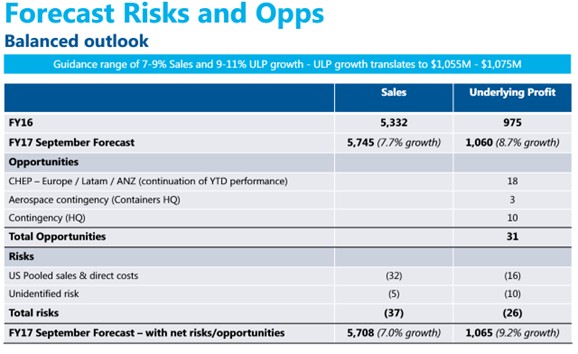
2766 In my view, the 14 November R&O Schedule had several material deficiencies, each of which operated to either understate risks to Underlying Profit or overstate opportunities to improve Underlying Profit.
2767 First, it identified “US Pooled sales & direct costs” as a risk to Group Underlying Profit which it quantified at $(16) million. That was wrong because, in fact, CHEP NA management (Rumph) had forecast, and CHEP Global management (Mackie) had accepted, that after implementation of the US Pooled and CHEP NA recovery plan and provided there was no material deviation to plan in November, CHEP NA would have a $(15) million Underlying Profit deficit to budget for FY17, including a $(10) million Underlying Profit deficit in US Pooled. That should have been integrated into the Group September Reforecast rather than recorded merely as a risk to Underlying Profit. That risk had already crystallised.
2768 I conclude that the Group September Reforecast before the Board wrongly failed to take that into account, and it therefore understated the risks to Group Underlying Profit. The Board was misinformed as to the true level of the risks facing Group Underlying Profit.
2769 Second, the evidence does not reveal the source of the risks and opportunities set out in the 14 November R&O Schedule, and the quantum of the risks and opportunities there set out is inconsistent with the risks described in the earlier CHEP Global September BPR (contained in the Group September BPR dated 21 October 2016), which was prepared prior to Brambles receiving the very poor October results.
2770 Mr Samuel identified, and I accept, that the CHEP Global September BPR recorded risks to CHEP Global Underlying Profit totalling $(36.7) million and net risks to Underlying Profit (i.e., after deducting opportunities) totalling $(15.6) million. The evidence does not explain how the total risks to Underlying Profit for CHEP Global in the (earlier) CHEP Global September BPR could have been $(36.7) million, and yet following very poor results in October the risks to Underlying Profit for the entire Group could have reduced in the later 14 November R&O Schedule to the point that they totalled (only) $(26) million.
2771 Nor does the evidence explain how, notwithstanding the very poor results in October, the opportunities for increased Underlying Profit somehow improved over the same period such that instead of there being a $(15.6) million net risk to Underlying Profit for CHEP Global alone, opportunities had increased such that there was a $5 million net opportunity to improve Underlying Profit for the entire Group.
2772 In my view, the risks to CHEP Global and Group Underlying Profit must have increased in that period, and that points strongly to an inference, which I make, that the 14 November R&O Schedule materially understated the risks to CHEP Global and Group Underlying Profit. I conclude that the Group September Reforecast before the Board wrongly failed to take that into account, and it therefore understated the risks to Group Underlying Profit. Again, the Board was misinformed as to the true level of the risks facing Group Underlying Profit.
2773 Third, the 14 November R&O Schedule also overstated the opportunities in respect of CHEP Global and Group Underlying Profit. The schedule identified opportunities for improved Underlying Profit, quantified at $18 million in CHEP Europe, LATAM and ANZ. The evidence does not establish that there were reasonable grounds for thinking there was an opportunity for that level of improved Underlying Profit in those CBUs. But putting that to one side for the moment, that quantum of opportunity roughly aligned with the $16.5 million in opportunities identified in Europe, LATAM and APAC in the CHEP Global October BPR dated 16 November 2016.
2774 Importantly, however, what the 14 November R&O Schedule did not identify for the Board was that the “opportunities” in Europe, LATAM and APAC in the CHEP Global October BPR were partially offset by identified risks totalling $(7.4) million. Mr Samuel opined, and I accept, that the CHEP Global October BPR provided that total net opportunities for these CBUs was $9.1 million (Europe $4.7 million, LATAM $3.5 million and APAC $0.9 million). In my view it is more likely than not that those identified risks to Europe, LATAM and APAC Underlying Profit were not captured within the $10 million of “unidentified risks” in the 14 November R&O Schedule.
2775 Thus, the Board was misinformed as to the true level of the opportunities for improved Group Underlying Profit, which gave it a false view that opportunities outweighed risks.
18.4.5.5 Brambles’ submissions
2776 It was common ground between the parties that if the Group September Reforecast (which itself stemmed from the Revised September Reforecast) did not have reasonable grounds, as at 16 November 2016, then that bore on the existence of reasonable grounds for November Representations.
2777 First, Brambles contended that the Group September Reforecast informed the November Representations (and the FY17 Guidance), and that the assumptions underpinning that reforecast were reasonable and expressly incorporated identified risks and opportunities. It noted that the Group September Reforecast projected that the Group (excluding Aero) would:
(a) achieve 9% sales revenue growth for the balance of the year, resulting in 8% sales revenue growth for FY17 (that being $(16) million under-budget); and
(b) exceed its Underlying Profit budget by 11% for the balance of the year, resulting in 10% Underlying Profit growth ($(2) million under-budget),
both of which were within the FY17 Guidance range.
2778 Brambles was, of course, correct in noting that the Group September Reforecast projected that Group sales revenue and Underlying Profit growth for FY17 would be within the FY17 Guidance range. But for the reasons I have explained I do not accept its contention that the assumptions underpinning that reforecast were reasonable nor that they adequately incorporated all identified risks and opportunities.
2779 For the reasons I have previously explained, the assumptions that US Pooled would achieve $53 million of unidentified wins in FY17, that US Pooled would experience a low level of customer loss and no major customer losses in FY17, and that it would achieve a two pp reduction in the damage rate in FY17 all lacked reasonable grounds. The US Pooled and CHEP NA budgets were stretched to near the limit of achievability. Nor, for the reasons I have explained, do I accept that the Group September Reforecast adequately incorporated the identified risks to US Pooled and Group Underlying Profit. I have previously set out my view that the US Pooled October R&O Schedule either failed to mention or materially understated a series of risks to US Pooled Underlying Profit as at 16 November 2016, and that the 14 November R&O Schedule in the October Financial Update before the Board for the November Board Meeting materially understated the risks to Group Underlying Profit as at that date.
2780 Second, a fundamental difficulty with Brambles’ contention that the Group September Reforecast had reasonable grounds is that, as at 16 November 2016, the reforecast did not reflect the reality of the Group’s position vis-à-vis its FY17 budget. Nor did the reforecast any longer represent management’s best estimate of likely FY17 performance. The reforecast needed to be updated or revised before it could be relied upon as providing reasonable grounds for the FY17 Guidance and it had not been.
2781 That can be seen in the following cascading matters. As at 16 November 2016, the Group September Reforecast projected that:
(a) US Pooled would recover from a $(14.3) million Underlying Profit deficit to budget in 1H17, through a remarkable $14.3 million Underlying Profit overperformance against budget in 2H17, so as to meet its budget for FY17. But even if it could achieve that remarkable 2H17 recovery it would not meet budget for the full-year because by then it had an actual $(25.3) million Underlying Profit deficit to budget YTD;
(b) CHEP NA would recover from a $(17.7) million Underlying Profit deficit to budget in 1H17, through a remarkable $17.6 million Underlying Profit overperformance against budget in 2H17, so as to be immaterially under-budget for FY17. But even if it could achieve that remarkable 2H17 recovery it would not meet budget for the full-year because by then it had an actual $(29) million Underlying Profit deficit to budget YTD;
(c) CHEP Global would recover from a $(15.7) million Underlying Profit deficit to budget in 1H17, through a remarkable $15.8 million Underlying Profit overperformance against budget in 2H17, so as to meet its budget for FY17. But even if it could achieve that remarkable 2H17 recovery it would not meet budget for the full-year because by then it had an actual $(26) million Underlying Profit deficit to budget YTD; and
(d) the Group would partially recover from a $(12) million Underlying Profit deficit to budget in 1H17, through a $6.7 million Underlying Profit overperformance against budget in 2H17, to have a $(5.3) million Underlying Profit deficit to budget for the full-year. But even if the Group could achieve that 2H17 recovery it would not finish the year with (only) a $(5.3) million Underlying Profit deficit to budget because by then it had an actual $(18) million Underlying Profit deficit to budget YTD.
The Group September Reforecast did not contemplate, or plot a path to recovery from, YTD Underlying Profit deficits of those magnitudes.
2782 Further, the Group September Reforecast was based in the proposition that CHEP NA would in 2H17 claw back from its projected 1H17 $(17.7) million Underlying Profit deficit to budget, so as to meet its budget for the year, which was projected to translate through into CHEP Global clawing back in 2H17 to meet its budget, and the Group partially recovering its shortfall to budget in 2H17. But it had not been updated to take into account the fact that CHEP NA management, with the concurrence of CHEP Global management, had downgraded its forecast to project that CHEP NA would have a $(15) million Underlying Profit deficit to budget for FY17, after implementation of its recovery plan.
2783 Having regard to those matters, it was plainly necessary for Brambles to undertake further analysis and another reforecast before it would have reasonable grounds for a conclusion that it was appropriate to reiterate the FY17 Guidance to the market as it did on 16 November 2016.
2784 Indeed, preparing a fresh plan and reforecast for CHEP Global was precisely what Brambles’ management embarked upon in the period from around 16 November 2016. In the period from around 16 November until 24 November 2016 Kennett worked on a detailed CHEP Global Recovery Plan and concomitant reforecast. On 18 November 2016 Kennett emailed Rumph and explained that, at O’Sullivan’s request, he was “working through a process to deliver a detailed forecast”. Kennett produced a draft CHEP Global Recovery Plan, which included a CHEP NA recovery plan, on 24 November 2016 which he sent to Mackie for approval. The plan was approved and finalised on 25 November 2016.
2785 The evidence shows that there was no revised CHEP NA recovery plan or further reforecast in existence as at 16 November 2016. I do not accept that the CHEP Global Recovery Plan, which did not exist as at 16 November 2016, can be relied upon to show the existence of reasonable grounds for the FY17 Guidance at that time.
2786 Third, and relatedly, Brambles submitted that the October results provided US Pooled with a second month of data to understand the cause of its results and reassess its projections, which it promptly did. That submission does not capture the depth of the difficulty into which those results had tipped CHEP NA and therefore CHEP Global. It suggests that following the October results, it was just business as usual and Brambles could reassess the situation and then plot a path to recovery. Gorman’s Landing the Plane Email was explicit that this was not business as usual. And Brambles’ submission that, following the October results, it “promptly” reassessed the position, illustrates the fundamental difficulty with its contention that, as at 16 November 2016, there were reasonable grounds for the projections in the Group September Reforecast. In fact, the evidence shows that Brambles’ management did not reassess the position until 25 November 2016 after it had received Moreno’s report regarding direct costs overruns (22 November 2016), after receiving responses from CHEP LATAM and CHEP regarding the provision of additional offsetting Underlying Profit (23 November 2016), and after Mackie approved Kennett’s draft CHEP Global Recovery Plan (25 November 2016).
2787 For the reasons I later explain I do not accept that the CHEP Global Recovery Plan provided reasonable grounds for maintaining the November Representations as at 25 November 2016. But for the present, it suffices to note that that subsequent plan cannot be relied upon to show the existence of reasonable grounds for the projections in the Group September Reforecast as at 16 November 2016.
2788 It is worth noting in this context that Brambles sought to side-step this fundamental difficulty by a stratagem which, to my mind, points to the weakness of its argument. In their evidence-in-chief, neither Kennett nor Mackie chose to depose as to whether, as at 16 November 2016, they continued to believe in the achievability of the projections in the Group September Reforecast as to CHEP Global or its FY17 Underlying Profit budget. That was deliberate, as in respect of other important dates, they each set out their views on that topic. This stratagem can be seen clearly in Kennett’s evidence. He did not opine as to whether he considered the CHEP Global budget remained achievable until 25 November 2016, at which point he had received the Moreno Report, commitments from CHEP LATAM and CHEP Europe to provide additional offsetting Underlying Profit, and had finalised the CHEP Global Recovery Plan.
2789 That evidentiary stratagem tended to obscure the fact that, as at 16 November 2016, Brambles’ position was in a state of flux. The October results had left the Group in a poor position vis-à-vis the FY17 Guidance, and Brambles’ management had not yet worked out whether the position was recoverable. That was what Gorman’s Landing the Plane Email was about; a search throughout the Group for enough additional Underlying Profit to offset the very poor CHEP NA performance so that the FY17 Guidance could be delivered. In my view, as at 16 November 2016, management did not know whether CHEP NA could claw back from its actual $(29) million Underlying Profit shortfall to budget YTD to a $(15) million shortfall, nor whether the other businesses in the Group would be able to produce sufficient additional Underlying Profit so as to materially offset the substantial CHEP NA Underlying Profit underperformance.
2790 Gorman’s email described the challenge facing the Group as “sizeable” and it is clear that he saw the task of squeezing sufficient Underlying Profit overperformance against budget from other businesses in the Group as a challenging one; indeed, he described it as “one of those moments in business when we really get to see how good we are”. I infer that he was far from confident that the other businesses in the Group would be able to deliver the necessary additional Underlying Profit to offset the very poor CHEP NA results. It was wrong for Brambles to make an announcement to the market on 16 November 2016 based in a hope that it could turn things around. It did not at this point have an up-to-date recovery plan.
2791 Fourth, Brambles submitted that the Group September Reforecast continued to have reasonable grounds because other businesses within Brambles were exceeding forecast, and Mackie was investigating further opportunities in CHEP LATAM and CHEP Europe to offset the results in CHEP NA. Relatedly, Brambles’ argued that CHEP LATAM and CHEP Europe had “positive momentum” in this period and that the sales revenue for both were ahead of budget. It argued that there were opportunities in both CBUs to offset the results in CHEP NA, and that CHEP Recycled had identified opportunities to deliver its September Reforecast.
2792 I found little force in those submissions.
2793 The thrust of Mackie’s evidence was that, following the October results, he initially thought that CHEP Global would be able to meet its Underlying Profit budget for the year by squeezing out additional offsetting Underlying Profit performance from other CHEP CBUs, principally CHEP LATAM and CHEP Europe. Then, following Gorman’s Landing the Plane email, he endorsed the proposition that the search for additional Underlying Profit would extend further than CHEP Global, and the search would take in the whole Group.
2794 As previously explained in the context of the evidence of Brambles’ executives on this issue, it was true that CHEP LATAM and CHEP Europe were over-budget in sales revenue and Underlying Profit in October and YTD. The propositions that CHEP LATAM and CHEP Europe had “positive momentum” in this period and that the sales revenue for both were ahead of budget is true, but it has little force. Together they were only over-budget in Underlying Profit YTD by $4.5 million. That would not go close to materially offsetting the actual $(29) million Underlying Profit deficit to budget in CHEP NA YTD.
2795 Further, and contrary to the thrust of Brambles’ argument, while CHEP Europe was $2.2 million over-budget in Underlying Profit YTD, that did not show the availability of additional Underlying Profit to offset the underperformance by CHEP NA. The Group September Reforecast projected CHEP Europe would be $6.5 million over-budget in Underlying Profit in 1H17 but $(6.5) million under-budget in 2H17, so that it was flat to budget for the full-year. Brambles did not explain how the fact that CHEP Europe was above-budget in 1H17 when that was as projected, and the same reforecast said that it would be under-budget in 2H17, would provide additional Underlying Profit for CHEP Global so as to offset the underperformance by CHEP NA.
2796 It was correct that Mackie was investigating further opportunities in CHEP LATAM and CHEP Europe to offset the results in CHEP NA, but as at 16 November 2016, the possibility of sufficient offsetting overperformance was only a hope. That can be seen in the contemporaneous emails (set out in section 18.4.4 above). At that time Mackie’s and Kennett’s enquiries were at an early stage, the responses were tentative, and neither Mackie nor Kennett knew whether their efforts would be successful. Mackie spoke of his confidence in achieving some additional Underlying Profit, but neither he nor Kennett gave evidence that, as at 16 November 2016, they had received a commitment from CHEP LATAM and CHEP Europe to provide additional Underlying Profit that might materially offset the CHEP NA results, and neither testified as to any particular amount.
2797 Further, as previously noted, CHEP LATAM and CHEP Europe had just gone through the September Reforecast process in which, as I infer, management in those businesses with Mackie’s and Kennett’s concurrence had determined that those businesses would not be able to perform better except to the extent recognised in the reforecast. Brambles’ practice was to set (what it described as) “challenging but achievable” budgets and reforecasts, and it was not Mackie’s and Kennett’s practice to leave ‘fat’ in a reforecast. I infer that CHEP LATAM and CHEP Europe management had recently agreed with Mackie and Kennett that the projections in the September Reforecast were the best that they could do. That points strongly away from concluding that it was likely that their businesses could overperform against the reforecast sufficiently to provide additional Underlying Profit capable of materially offsetting the underperformance by CHEP NA.
2798 This submission also exposed one of the inconsistencies in Brambles’ argument. On the one hand, Brambles submitted that (like the earlier versions of the reforecast) the Group September Reforecast was a “bottom-up” forecast which reflected detailed consideration and review at different levels of the business, and the Court should treat the projections in the reforecast as reliable. Brambles accepted that it was management practice to stretch the budgets and reforecasts that were made so that they were “challenging”, while maintaining that they were nevertheless achievable. Yet, in relation to the likelihood of overperformance against budget by the other CHEP CBUs in this period Brambles took a completely different position. In effect, it argued that the Court should accept that projections in the reforecast for the other CHEP CBUs should be ignored, and the Court should find that those other businesses could materially outperform those projections. And it made this submission with very little by way of evidence to back up its contention that those other business units could do so.
2799 I am satisfied that, as at 16 November 2016, there were not reasonable grounds to expect, nor to forecast, that CHEP Global would meet its Underlying Profit budget for FY17 through substantial Underlying Profit overperformance against budget by CHEP LATAM and CHEP Europe. That is not what the Group September Reforecast projected and it is not what the evidence shows.
2800 Relatedly, Brambles submitted that the applicants’ opening submissions were wrong in contending that the Group September Reforecast assumed no overperformance by other CHEP Global CBUs, or by Brambles’ IFCO or Containers businesses. It argued that, in fact, the Group September Reforecast projected overperformance in both sales revenue and Underlying Profit against budget by IFCO and Containers.
2801 This submission is strictly correct, but it is without substance. The Group September Reforecast projected that:
(a) IFCO would be $8.1 million over-budget in Underlying Profit in 1H17, but $(7.4) million under-budget in Underlying Profit in 2H17, so as to only $0.6 million over-budget for the full-year.
(b) Containers (excluding Aero and Oil & Gas) would be $(2.5) million under-budget in Underlying Profit in 1H17, but $3 million over-budget in Underlying Profit in 2H17, so as to be only $0.5 million over-budget for the full-year.
Thus, the reforecast projected Underlying Profit overperformance against budget by IFCO and Containers for the full-year of only $1.1 million collectively. That level of projected overperformance would not go close to providing material assistance to offset the actual $(29) million Underlying Profit deficit to budget in CHEP NA YTD, and when the Group had an actual Underlying Profit deficit to budget of $(18) million.
2802 Relatedly, Brambles argued that the practical reality was that Brambles could request, and was in fact requesting, other business divisions and CBUs to find additional opportunities to offset the shortfall in sales revenue and Underlying Profit performance in US Pooled and CHEP NA. I accept that Brambles’ management was requesting, indeed desperately seeking, offsetting Underlying Profit overperformance against budget from anywhere they could find it. But for the reasons I have explained, as at 16 November 2016, it was not much more than a hope that other CHEP CBUs or other Group businesses would be able to materially offset the Group Underlying Profit deficit YTD that had developed over four months of US Pooled and CHEP NA underperformance against budget.
2803 I am satisfied that, as at 16 November 2016, there were not reasonable grounds for Brambles to expect that the actual $(18) million Group Underlying Profit deficit YTD would be materially offset by overperformance against budget by CHEP CBUs other than CHEP NA, or by other Group businesses.
2804 Fifth, Brambles submitted that the Group September Reforecast had weighted recovery to 2H17 because the results were not expected to bounce back immediately. I do not accept that. I will not again reproduce Mr Samuel’s charts showing the variances between the sales revenue and Underlying Profit projected in the US Pooled August MBR (25 August 2016), September MBR (17 September 2016) and draft October MBR (15 October 2016). Having regard to the evidence I consider to be clear that, as actual US Pooled sales revenue and Underlying Profit increasingly fell behind budget in 1H17, Brambles just assumed an ever-greater recovery over the balance of the year, largely by pushing sales revenue and Underlying Profit into 2H17. Mr Samuel’s charts do not include the October results and thus do not plot the necessary trajectory, as at 16 November 2016, for US Pooled to recover in 2H17 to meet its sales revenue and Underlying Profit budgets. But it is obvious that following the October results the necessary ‘hockey-stick’ recovery in 2H17 was required to be even more pronounced. I agree with Todorcevski’s view that the projected 2H17 US Pooled sales growth was unrealistic and unlikely to be achieved.
2805 To my mind, rather than accept the unhappy reality that, as at 16 November 2016, it was more likely than not that four months of underperformance against budget by US Pooled and CHEP NA meant that CHEP Global, and therefore the Group, would finish FY17 materially under-budget in sales revenue and Underlying Profit, Brambles’ management doubled down and projected increasingly more unlikely recoveries. Having regard to the challenges facing US Pooled and CHEP NA in achieving the rephased 2H17 sales revenue and Underlying Profit projections in the Group September Reforecast, such recoveries were highly unlikely.
2806 Sixth, for the reasons earlier discussed in relation to Mr Samuel’s opinions, Brambles submitted that the Court should give no weight to Mr Samuel’s opinions that:
(a) Brambles did not adequately account for the risks and opportunities known as at 16 November 2016;
(b) the probability-adjusted net risks to the Group Underlying Profit forecast indicated that, in reality, Brambles was likely to fall significantly short of the FY17 Guidance in relation to Underlying Profit if performance did not significantly improve in 2H17;
(c) that the information available did not justify the assumed 2H17 improvements; and
(d) that having regard to the risks the Underlying Profit reforecast should have been $1,033 million. Brambles did so for the reasons previously canvassed.
2807 I do not accept Mr Samuel’s opinion that, after appropriately integrating the probability-adjusted net risks to Underlying Profit, the fact that Group Underlying Profit growth would be below the bottom of the FY17 Guidance range and that this meant that the November Representations were not supported. Nor do I accept his opinion that, based on FY16 weightings, Group Underlying Profit the Group September Reforecast should have been $1,033 million. While I found Mr Samuel’s analysis to be a useful check on the reasonableness of the grounds for the Group September Reforecast, I consider it is insufficiently precise to generate a reliable alternative Underlying Profit forecast for the Group, or to demonstrate, of itself, that the FY17 Guidance lacked reasonable grounds.
2808 Nor are Mr Samuel’s opinions critical to the conclusions that I have reached. I have reviewed the relevant R&O Schedules for myself. But I found Mr Samuel’s analysis useful and it supports the finding I have made that the relevant R&O Schedules materially understated the appreciable net risks to US Pooled and Group Underlying Profit, with the result that on 16 November 2016 the Board was misinformed as to the true level of risk facing the achievability of the FY17 Guidance. As previously noted:
(a) (in sections 18.4.3.3 above), the US Pooled October R&O Schedule did not mention or did understate a series of risks to US Pooled Underlying Profit in FY17, as at 16 November 2016. Those missed or understated risks were more likely than not to have led to a material understatement of risks to Group Underlying Profit in FY17; and
(b) (in section 18.4.5.4 above), the 14 November R&O Schedule materially understated the risks to Group Underlying Profit in FY17, as at 16 November 2016.
2809 Seventh, Brambles submitted that notwithstanding the underperformance by US Pooled, the financial information available to the Board as at 16 November 2016 indicated that Brambles’ sales revenue and Underlying Profit growth for the year were only tracking marginally below the bottom end of its FY17 Guidance range. It said, and I accept, that YTD sales revenue showed 6% growth and YTD Underlying Profit showed 7% growth. It also described the Group November 2016 flash results as an important benchmark, as Brambles achieved Underlying Profit for the month that was $2 million above the September Reforecast.
2810 Brambles’ submission that its Underlying Profit growth for the year was only tracking marginally below the bottom end of the FY17 Guidance range misunderstands the position that it was in. As at 16 November 2016, after just four months of actual results in FY17, Group Underlying Profit was $(18) million below-budget YTD, and two pps below the bottom of the FY17 Guidance range for Underlying Profit growth YTD. That was a terrible position for Brambles to be in, particularly given the very small margin for Underlying Profit underperformance against budget which the FY17 Guidance left it.
2811 Brambles was correct to submit that apart from CHEP NA, the Group was on track or ahead of budget for FY17, but that does not take Brambles far. It is not really to the point that CHEP NA was the only badly performing Group business when it had an actual $(29) million Underlying Profit deficit to budget YTD and it was budgeted to account for 41% of Group Underlying Profit in FY17, and the other CHEP CBUs and Group businesses were not forecast to outperform budget in Underlying Profit to an extent that would be sufficient to (even nearly) offset that deficit. Contrary to the point of Brambles’ submission, the Group was not on track to meet its Underlying Profit budget for the year, and it was not on course to deliver the FY17 Guidance in respect of Underlying Profit growth.
2812 The weakness of Brambles’ argument can be seen in its submission that the November flash results were an “important benchmark” because Group Underlying Profit in November was $3 million above the reforecast (Brambles’ submissions mistakenly said $2 million). I note three things about that submission:
(a) as at 16 November 2016 it was not known what the November results would be. They were not received until 8-9 December 2016. The monthly Underlying Profit results that Brambles received at that date cannot reliably be used to show that the Group September Reforecast for the Group had reasonable grounds three weeks earlier, as at 16 November 2016.
(b) contrary to the suggestion inherent in that submission, the November results did not herald some new dawn of recovery. US Pooled and CHEP NA were, again, materially under-budget and under-reforecast in sales revenue and Underlying Profit for the month. As a result the YTD sales revenue and Underlying Profit deficits to budget in those businesses increased further. The results for US Pooled and CHEP NA were as follows:
November Results Summary | ||||||
($US million) | Month (vs September Reforecast) | Month (vs Budget) | YTD (vs Budget) | |||
Sales revenue | Underlying Profit | Sales revenue | Underlying Profit | Sales revenue | Underlying Profit | |
US Pooled | (3.6) | (2.6) | (5.6) | (4.8) | (21.5) | (30.2) |
CHEP NA | (8) | (4) | (12) | (6) | (41) | (35) |
(c) Group Underlying Profit was above September Reforecast by $3 million, but that was only above-budget by $1 million, which was not material considered in the context of the $(18) million Underlying Profit deficit it had. Calling that slight over-budget performance an “important benchmark” completely overstated the position.
2813 Eighth, Brambles contended that while US Pooled was tracking behind budget and the Group September Reforecast in sales revenue and Underlying Profit, as Todorcevski testified, the recovery measures and initiatives in US Pooled required time to implement, the sales recovery was projected to be in 2H17, and results were not expected to bounce back immediately. It said that, as a result, the continued underperformance by US Pooled in October was not a surprise.
2814 I accept that US Pooled results were not expected to bounce back immediately given that many of the recovery actions would take time to have an effect. However, the fact remained the different versions of the September Reforecast projected that some of the US Pooled recovery would occur from 1 September to 31 December 2016, and the September and October results showed that those projections were materially optimistic almost immediately after they were made. And just a few weeks earlier CHEP NA management had forecast that it would meet its full-year budget, and following the October results they had reluctantly accepted that it would miss its Underlying Profit budget for the year by $(15) million.
2815 In any event, I do not accept the submission. As I will explain, I do not consider that there were reasonable grounds to expect that US Pooled would achieve the necessary overperformance against budget in 2H17 to recover any of the actual $(25.3) million Underlying Profit deficit to budget YTD, and it was more likely than not that by the end of FY17 it would, at the least, have a deficit in that order. As a result, it was more likely than not that by the end of FY17 CHEP NA would have an Underlying Profit deficit to budget for FY17 of approximately $(29) million.
2816 Ninth, Brambles submitted that the US Pooled and CHEP NA recovery initiatives were carefully considered for the purposes of assessing the risks and opportunities of achieving the Group September Reforecast at the time the reforecast was presented to the November Board Meeting. This submission misstated the evidence.
2817 It was true that US Pooled and CHEP NA had a recovery plan, which was before the Board at the November Board Meeting. But the Board was not told that CHEP NA management had determined, nor that CHEP Global management had accepted, that the recovery plan was not going to be sufficient for US Pooled and CHEP NA to recover from their Underlying Profit deficits to budget YTD so as to meet their Underlying Profit budgets for the full-year. Instead, after implementation of the US Pooled and CHEP NA recovery plans and provided there was no further deviation from plan in November, CHEP NA and US Pooled were forecast to have Underlying Profit deficits to budget of $(15) and $(10) million respectively.
2818 There was no reasonable basis for Brambles to submit that the US Pooled and CHEP NA recovery plans were “carefully considered” for the purposes of assessing the risks and opportunities of achieving the Group September Reforecast when the Group September Reforecast was based in an acceptance that the recovery plans would be sufficient for those businesses to meet their Underlying Profit budgets for the year, and that was no longer management’s view. The Board could not have “carefully considered” the US Pooled and CHEP NA recovery plans for the purposes of assessing the risks and opportunities to the Group September Reforecast. Instead, the Board was misinformed because (as I infer) it proceeded on the basis that the recovery plans were expected to return US Pooled and CHEP NA to alignment with budget.
2819 Tenth, Brambles submitted that the applicants’ submissions relied on cherry-picked emails, taken out of context, which had limited relevance to the objective test required to be undertaken by the Court. It said that those emails did not withstand scrutiny of the actual information available to Brambles at the time and a holistic reading of the relevant communications. I do not accept that. As I have said, this is not a case where the applicants cherry-picked some internal emails regarding the achievability of the relevant budgets and misconstrued or took those communications out of context, in an effort to undermine the testimony of Brambles’ lay witnesses. Here, a number of contemporaneous emails or memos ran counter to some important aspects of Brambles’ lay witness evidence. In the main I concluded that the contemporaneous emails and documents were the most reliable evidence of what a witness thought, or what the true position was, at that point in time. At the least it was more reliable than their testimony, largely a reconstruction, about otherwise ordinary business events, given around six years after those events.
2820 Eleventh, Brambles submitted that the minor extent to which Brambles’ YTD performance had dipped under the bottom end of the FY17 Guidance was not determinative, and the correct lens through which to assess the existence of reasonable grounds is whether Brambles had reasonable grounds to believe it would make up the shortfall before the end of FY17. I accept that the extent to which Brambles’ YTD performance had dipped under the bottom end of the FY17 Guidance is not determinative. The proper question is whether or not there were reasonable grounds for Brambles to believe that it was more likely than not that it would meet the guidance by the end of FY17, or that there was a reasonable pathway for it to do so. But I do not accept that it is appropriate to treat the amount by which Brambles’ YTD performance had dipped below the FY17 Guidance as “minor” having regard to the very small margin for underperformance against budget which the FY17 Guidance left for Brambles.
2821 Brambles’ submission that Underlying Profit growth was tracking only “marginally below” the FY17 Guidance for Underlying Profit growth, and its reliance on the $10 million contingency, failed to take into account the very narrow margin for underperformance against budget which Brambles had left itself when it provided the FY17 Guidance to the market.
2822 Absent application of the $10 million contingency, Brambles would fall below the bottom of the FY17 Guidance range for Underlying Profit growth if Group Underlying Profit was more than $(8) million below-budget. As at 16 November 2016, the Group already had an $(18) million Underlying Profit deficit to budget YTD.
18.4.5.6 The Board’s consideration at the November Board Meeting
Whether the Board gave active consideration to downgrading the FY17 Guidance?
2823 The minutes of the November Board Meeting state:
The Board reviewed and discussed the FY17 forecast and year-to-go analysis and agreed with the Secretary’s analysis but noted that trading performance would be closely monitored and that the position be reviewed going forward.
(Emphasis added.)
2824 The minutes there briefly record a discussion of:
(a) Todorcevski’s report to the meeting regarding the Group September Reforecast (including that Group sales revenue YTD was marginally below guidance and (inaccurately) that Underlying Profit growth YTD was within guidance); and
(b) Gerrard’s advice to the meeting that the FY17 Guidance would need to be updated if forecast sales revenue or Underlying Profit was projected to be materially different to that in the FY17 Guidance. The minutes later record Gerrard’s advice on the following terms:
Based on FY17 results to date (i.e. sales revenue only marginally below guidance and underlying profit within guidance), the FY17 forecast, the risks and opportunities and the proposed Pallets Americas action plan, he noted that the Board had reasonable grounds to believe that guidance would be met.
As previously noted, I accept that the minutes are inaccurate in recording that Gerrard told the meeting that Underlying Profit growth YTD was within the FY17 Guidance.
2825 Todorcevski deposed that although he could not recall the precise terms of the discussion at the Board meeting, during his presentation of the October Financial Update he remembered the Board questioning him about the Group’s performance, focussing on US Pooled, and the prospect of a potential revision to the FY17 Guidance. Although he could not recall the specific words he used, he said that he remembered informing the Board of his view that an earnings guidance downgrade was not necessary and explained why he was comfortable maintaining the FY17 Guidance.
2826 In cross-examination, Todorcevski was taken to an email he sent Kennett on 16 November 2016, following the November Board Meeting. In the email Todorcevski said:
Buster - thought I’d drop you a note after the Board meeting yesterday. With performance in Sep and Oct, the Board are very skittish. To the point yesterday where they were actively talking about a guidance downgrade.
We talked them off the ledge but it wasn’t a pleasant conversation. One of the things we committed to doing was giving them a periodic download on how recovery actions are playing out.
With the team we’ve parachuted into the US, would be very helpful if you could give me a download on what they're finding every few days.
(Emphasis added.)
2827 In cross-examination Todorcevski testified that while he could not recall which Board members raised the possibility of a downgrade to the FY17 Guidance, he recalled that it was a question from a number of the directors. He said that the directors were questioning the US Pooled and CHEP NA recovery plans and their timing, which Todorcevski said was why he offered to provide the Board a periodic review of those plans. He said that the discussion occurred while he and Gorman were in the room, and was led by Gorman. He agreed that he and Gorman persuaded the Board not to downgrade the FY17 Guidance, doing so “on the basis of our recovery plans”.
2828 Johns’ evidence was different. He denied that members of the Board raised the possibility of a downgrade to the FY17 Guidance. He said that was not his recollection and that he did not recall Gorman and/or Todorcevski having to talk the Board out of downgrading the FY17 Guidance.
2829 Long also denied that any member of the Board actively discussed a guidance downgrade. He said:
My recollection is that we were discussing the point at which a downgrade might be required and whether or not we had reached that point. I don’t consider that discussing a downgrade. There wasn’t anything to downgrade at that point. We had not gotten to the point where that conversation would take place.
In cross-examination he stated that the Board was alert to the fact that Brambles’ ability to meet the FY17 Guidance needed to be closely monitored, but he disagreed that the Board was “concerned”.
2830 I consider Todorcevski’s contemporaneous email to be the most reliable evidence of what took place at the November Board Meeting, and I give substantially greater weight to that contemporaneous written record than to the recollections of Johns and Long more than six years after the Board meeting, particularly when their recollection of the meeting was poor. While they each denied there was a discussion at the Board meeting about downgrading the FY17 Guidance, they each accepted in their testimony that they could not recall the detail of the conversations that occurred at the November Board Meeting, and the generality of their evidence showed that their actual recollections were quite limited.
2831 I can see no good reason for Todorcevski to misrepresent the tone or content of the Board meeting to Kennett in an account given when his recollection was fresh, nor any basis in the evidence to reach the conclusion that his email misrepresented the position. He affirmed the content of his email in cross-examination, and he testified that he and Gorman persuaded the Board not to downgrade the FY17 Guidance. Also, Todorcevski was the one of the two people who recommended maintenance of the FY17 Guidance to the Board, and (on his account) one of the two people who had to talk the Board out of rejecting that recommendation. He had good reasons to recall doing so, and he gave clear evidence.
2832 I infer that at the November Board Meeting some directors were concerned about whether it was appropriate to maintain the FY17 Guidance and that the Board gave active consideration to downgrading that guidance. Gorman and Todorcevski persuaded the relevant Board members away from their concerns, including by agreeing to give the Board periodic reports on how the recovery plans in US Pooled and CHEP NA were progressing.
The position of the Group at that time
2833 At the time of the Board’s consideration regarding the FY17 Guidance on 15 November 2016, the position for the Group was as follows:
(a) US Pooled had an actual $(25.3) million Underlying Profit deficit to budget YTD, which was the main driver of the CHEP NA $(29) million deficit to budget YTD, which was the main driver of the CHEP Global $(26) million deficit to budget YTD. Largely as a result the Group had an actual $(18) million Underlying Profit deficit to budget YTD.
(b) US Pooled and CHEP NA had developed and were implementing recovery plans, and on the basis of those recovery plans each version of the September Reforecast had projected that US Pooled and CHEP NA would recover to achieve their Underlying Profit budgets for FY17. The September Reforecast projected that a remarkable Underlying Profit recovery by US Pooled and CHEP NA in 2H17 would be the main driver of a strong Underlying Profit recovery by CHEP Global in 2H17, so that CHEP Global met its Underlying Profit budget for FY17.
(c) Neither the Initial nor Revised September Reforecast projected that the recovery by CHEP Global to meet its Underlying Profit budget in 2H17 would be materially contributed to by Underlying Profit overperformance against budget by other CHEP CBUs. On my view of the evidence, management did not know whether sufficient overperformance against budget could be squeezed out of other CHEP CBUs to materially offset the serious underperformance by CHEP NA.
(d) There were good reasons for the Board to have little faith in the correctness of the US Pooled, CHEP NA and CHEP Global FY17 budgets and the projections in the Group September Reforecast for the US Pooled, CHEP NA and CHEP Global (which was far and away the largest business in the Group):
(i) there had been a four-month trend of under-budget sales revenue and over-budget direct costs in US Pooled. It had been under-budget in sales for each of the four months of FY17, and in Underlying Profit for three of those four months, and also materially under the September Reforecast in September and October;
(ii) when the September results were received in early October the sales revenue and Underlying Profit projections in the Initial September Reforecast for US Pooled, CHEP NA and CHEP Global were shown to be materially optimistic. Following the September results, the Revised September Reforecast was made. At the October Board Meeting the Board was told that the situation in CHEP NA was “under control”; and
(iii) when the October results were received in early November, the sales revenue and Underlying Profit projections in the Revised September Reforecast for US Pooled, CHEP NA and CHEP Global were again shown to be materially optimistic.
(e) On 11 November 2016 Rumph informed Mackie, and Mackie accepted, that following a meeting of the CHEP NA ELT, she forecast that CHEP NA would have a $(15) million Underlying Profit deficit to budget for FY17, including a $(10) million Underlying Profit deficit in US Pooled, after implementation of the CHEP NA and US Pooled recovery plans and provided there was no further deterioration from the November plan.
(f) The Board was not told that. That is, at the November Board Meeting, the Board was not told that the projection in the Group September Reforecast that through their recovery plans US Pooled and CHEP NA would recover to meet their budgets for the full-year (which was projected to be the main driver of CHEP Global recovering to meet its budget) was no longer management’s view.
(g) The Group September Reforecast was not updated to reflect that the actual Underlying Profit deficits to budget for CHEP NA, CHEP Global and the Group YTD were materially greater than the projected deficits in the reforecast, nor to reflect management’s view that CHEP NA would not recover to meet its Underlying Profit budget for the full-year. Management instead forecast that CHEP NA would have a $(15) million Underlying Profit deficit to budget for FY17.
Gerrard’s advice to the Board
2834 The Board’s consideration regarding whether to maintain the FY17 Guidance was undertaken on a number of mistaken premises. That can be seen in the fact that each of the four stated grounds for Gerrard’s advice to the Board that it had reasonable grounds to consider that the FY17 Guidance would be met, were either wrong or lacked reasonable grounds.
2835 It will be recalled that the minutes recorded Gerrard’s advice to the Board, as follows:
The Secretary advised that guidance would need to be updated if forecast FY17 sales or underlying profit was materially different to that in the guidance. Based on FY17 results to date (i.e. sales revenue only marginally below guidance and underlying profit within guidance), the FY17 forecast, the risks and opportunities and the proposed Pallets Americas action plan, he noted that the Board had reasonable grounds to believe that guidance would be met. The Board reviewed and discussed the FY17 forecast and year-to-go analysis and agreed with the Secretary’s analysis but noted that trading performance would be closely monitored and that the position be reviewed going forward.
2836 First, Gerrard advised the Board that there were reasonable grounds to maintain the FY17 Guidance because the YTD sales revenue growth was only marginally below the FY17 Guidance and Underlying Profit growth was within guidance. As previously discussed, in respect of Underlying Profit that was not the case. I accept, though, that that was just an error in the minutes and that Todorcevski and Gerrard actually informed the meeting that Underlying Profit growth YTD was below the FY17 Guidance range.
2837 Second, Gerrard’s second basis for advising that there were reasonable grounds to maintain the FY17 Guidance was because of the FY17 forecast (which I understand to mean the Group September Reforecast). It was true that the Group September Reforecast projected that in 2H17 each of US Pooled, CHEP NA and CHEP Global would recover from their projected 1H17 Underlying Profit deficits to budget, so as to achieve their Underlying Profit budgets for FY17, and that largely as a result the Group was projected to have only a $(5.3) million Underlying Profit deficit to budget for FY17.
2838 But this part of Gerrard’s advice was objectively wrong for several reasons.
2839 CHEP NA management had in fact forecast (and CHEP Global management had accepted) that, after implementation of its recovery plans and provided there was no further deviation from plan in November, CHEP NA would have a $(15) million Underlying Profit deficit to budget for FY17. The Group September Reforecast should have been updated to reflect that and it was not.
2840 Further, the Group September Reforecast had been overtaken by events and it no longer reflected the reality of the position of the Group vis-à-vis its FY17 Underlying Profit budget. It projected that the Group would have a $(12) million Underlying Profit deficit to budget as at 31 December 2016, which it would only partially recover through $6.7 million in Underlying Profit overperformance against budget in 2H17. But as at 16 November 2016, the Group already had an actual $(18) million Underlying Profit deficit to budget YTD, and the forecast did not contemplate recovery from a deficit of that magnitude. The Group September Reforecast should have been updated to reflect those actual results and it was not.
2841 Third, Gerrard’s next basis for advising that the FY17 Guidance had reasonable grounds was by reference to the risks and opportunities identified in the October Financial Update. It was true that the 14 November R&O Schedule in the October Financial Update stated that the opportunities for improved Group Underlying Profit in FY17 were greater than the risks to Group Underlying Profit, such that there was a $5 million net opportunity to improve Underlying Profit. Gerrard’s advice was, though, objectively incorrect because the 14 November R&O Schedule lacked reasonable grounds, and it materially understated the risks to Group Underlying Profit for the reasons I explained above.
2842 Fourth, the final stated basis for Gerrard’s advice that the FY17 Guidance had reasonable grounds was the “proposed Pallets Americas action plan”. It is not clear on the evidence what Gerrard was there referring to. The Court was not taken to a “proposed Pallets Americas action plan” that existed at the time of the November Board Meeting or that was put before the Board. I infer that there was no finalised Pallets Americas plan at that point.
2843 At that time the only relevant recovery plan in existence was the CHEP NA recovery plan, comprising the various recovery measures and initiatives developed and implemented within US Pooled and CHEP NA. It was based on that recovery plan that the Group September Reforecast projected that through a remarkable $17.6 million Underlying Profit overperformance against budget in 2H17, CHEP NA would recover from its projected 1H17 $(17.7) million Underlying Profit deficit to budget, so as to be just under-budget ($(0.1) million) for the full-year. The reforecast projected that that projected CHEP NA overperformance against budget in 2H17 would be the main driver of the projected CHEP Global Underlying Profit overperformance against budget, and by the Group, in 2H17. However, by the time of the November Board Meeting, that CHEP NA recovery plan was no longer current and management had accepted that CHEP NA would only claw back to a $(15) million Underlying Profit deficit to budget for the full-year, after implementation of the CHEP NA recovery plan and provided the November results were on plan.
2844 It is significant that the Board gave active consideration to downgrading the FY17 Guidance, and had to be persuaded away from doing so, when the evidence shows that the Board was not told that CHEP NA and CHEP Global management no longer considered that CHEP NA would recover to meet its budget for the full-year and would instead have a $(15) million Underlying Profit deficit for the full-year. The Board’s discussion regarding the reasonableness of the grounds for the FY17 Guidance must have been undertaken on the basis that the Group September Reforecast represented management’s best estimate of the likely performance of the Group and its constituent businesses in FY17, when, in fact, it did not.
2845 Brambles relied on the Board’s consideration at the November Board Meeting regarding whether to reaffirm the FY17 Guidance in support of its contention that, as at that date, there were reasonable grounds for the FY17 Guidance (and for the November AGM Representations). It relied on the Board minutes and the evidence of Todorcevski, Long and Johns in that regard. The gist of its argument was that, having regard to the October Financial Update and the Group September Reforecast, the presentations made by Gorman and Todorcevski, and the discussions at the meeting, the Board had reasonable grounds to believe that the FY17 Guidance would be met. Therefore, the Board had reasonable grounds for authorising the AGM Announcement to be made on 16 November 2016.
2846 The evidence of the Board’s consideration at the November Board Meeting provides little support for a finding that, as at that date, there were reasonable grounds for the FY17 Guidance (or for the November AGM Representations). Rather, to the extent the evidence is probative, it points away from that conclusion. It is impossible to know what would have happened had the Board been properly informed, but:
(a) sales revenue and Underlying Profit underperformance by US Pooled and CHEP NA lay at the heart of Group underperformance against budget;
(b) the proposition that the US Pooled and CHEP NA recovery plans would enable them to claw back to alignment with budget is likely to have been central to the Board’s consideration; and
(c) I accept Todorcevski’s evidence that the Board had to be talked “off the ledge” from downgrading the FY17 Guidance.
That was so even though the Board (mistakenly) thought that CHEP NA and CHEP Global management continued to believe that the US Pooled and CHEP NA recovery plans meant that CHEP NA would recover to meet budget for the full-year.
2847 Even so, the question as to whether, as at 16 November 2016, there existed reasonable grounds for Brambles to reaffirm the FY17 Guidance cannot be answered by reference to the quality of the Board’s consideration of the issue. It is an objective question.
18.4.5.7 Conclusion - the Group
The FY17 Guidance
2848 As I have said, as at 20 October 2016, Brambles was approaching a precipice in relation to whether it would achieve the FY17 Guidance. I found that at that time it was more likely than not that the Group would achieve materially less sales revenue and Underlying Profit growth in FY17 than as projected in the Preliminary Group September Reforecast (which substantially reflected the Revised September Reforecast), and that the projections in the reforecast lacked reasonable grounds. At that time, the reforecast projected that the Group would have:
(a) a $(21.6) million sales revenue deficit to budget for FY17. I found it would be materially worse than that, and estimated that the Group sales revenue deficit to budget for the full-year would be approximately $(28.6) million; and
(b) a $(5.3) million Underlying Profit deficit to budget for FY17. I found it would be materially worse than that and estimated that the Group Underlying Profit deficit to budget for the full-year would be approximately $(19.6) million.
2849 By 16 November 2016, the position for the Group was markedly worse. By then US Pooled and CHEP NA (and consequently CHEP Global and the Group) had experienced another month of materially under-budget sales revenue and Underlying Profit.
2850 In relation to sales revenue, US Pooled and CHEP NA had experienced four consecutive months of under-budget sales revenue, and were materially under-budget and under-reforecast for the last two months. They had not met their sales revenue budget in any month of FY17 to date, and the CHEP NA sales revenue deficit was projected to worsen over 2H17 notwithstanding the projected recovery by US Pooled. That continued failure had occurred in circumstances where the US Pooled budget was based in unreasonable assumptions of $53 million in unidentified wins, a low level of customer losses and no losses of major customers. The reforecast carried on those assumptions in circumstances where those assumptions had been confirmed as unreasonable by the failure to meet the budget for new wins in any month of FY17 to date. Those assumptions did not adequately take into account the increasingly aggressive competition from PECO, which was causing prolonged delays in achieving sales and had led to the loss of some large customers; the very low conversion rates over the previous five months; aggressive price negotiations by PECO, that had forced US Pooled to lower prices to maintain market share; and higher whitewood pallet prices were reducing opportunities for sales through whitewood conversions, and the sales funnel was smaller than in previous years.
2851 In relation to Underlying Profit, US Pooled had not met its Underlying Profit budget in three of the last four months and it was materially under-budget and under-reforecast for the last two months, largely as a result of a failure to achieve budgeted new wins and over-budget direct costs. Largely as a result of the US Pooled underperformance, CHEP NA had not met its Underlying Profit budget in any month of FY17 to date. Brambles management did not understand the fundamental causes of the direct costs overruns and it could not begin to address them until it did. It did not know whether or when the direct costs overruns would cease to materially reduce US Pooled and CHEP NA Underlying Profit, although it was looking forward to receiving the Moreno Report. Alonso had forecast that there was a 75% likelihood that US Pooled would not achieve the assumed two pp reduction in the average damage rate, which meant that there was only a 25% chance that the assumed $11 million in associated direct costs savings would eventuate. That risk, and a series of other risks to US Pooled Underlying Profit in FY17, were not adequately taken into account in the projected YTG Underlying Profit.
2852 Brambles’ mantra was that the applicants’ case was destined to fail because it focused on underperformance in US Pooled, which was just one business within one CHEP CBU, in circumstances where Brambles was a huge global business with a portfolio of businesses. I do not accept that. For the reasons I have explained I am satisfied that, as at 16 November 2016, it was more likely than not that the likely materially under-budget US Pooled and CHEP NA sales revenue and Underlying Profit performance by the end of FY17 was likely to translate, reasonably closely, into materially under-budget sales revenue and Underlying Profit by CHEP Global and the Group by the end of FY17.
2853 The continued underperformance against budget by US Pooled had led to the position where Group sales revenue growth and Underlying Profit growth YTD were 6% and 7% respectively, both below the FY17 Guidance range YTD. That situation was projected to be recovered through the Group September Reforecast. The reforecast projected that, in 2H17, US Pooled would:
(a) recover from its projected $(7.1) million sales revenue deficit to budget in 1H17, through $8.4 million in overperformance against budget in 2H17, to be over-budget by $1.3 million in sales revenue to budget for the full-year. But even if US Pooled could achieve that remarkable 2H17 sales revenue recovery, it would not meet its sales revenue budget for the full-year as the projected $(7.1) million sales revenue deficit to budget in US Pooled for 1H17 had more than doubled to an actual $(15.9) million deficit to budget YTD; and
(b) claw back from its $(14.3) million Underlying Profit deficit to budget in 1H17, through $14.3 million in overperformance against budget in 2H17, to be flat to budget in Underlying Profit for the full-year. But even if US Pooled could achieve that remarkable 2H17 Underlying Profit recovery it would not meet its budget for the full-year as the US Pooled Underlying Profit deficit to budget in 1H17 had almost doubled to an actual $(25.3) million deficit to budget YTD.
2854 The reforecast projected that, in 2H17, CHEP NA would:
(a) not recover from its projected $(19.9) million sales revenue deficit to budget in 1H17, and the deficit would worsen in 2H17 to a $(23.8) million sales revenue deficit to budget for the full-year. However, the sales revenue deficit for the full-year was likely to be materially worse because CHEP NA had an actual $(28) million sales revenue deficit to budget YTD; and
(b) claw back from its projected $(17.7) million Underlying Profit deficit to budget in 1H17, through $17.6 million in overperformance against budget in 2H17, to be almost flat to budget in Underlying Profit for the full-year. But even if CHEP NA could achieve that remarkable 2H17 Underlying Profit recovery it would not meet its budget for the full-year as the CHEP NA Underlying Profit deficit to budget in 1H17 had ballooned to an actual $(29) million deficit to budget YTD.
2855 The reforecast further projected that, in 2H17, CHEP Global would:
(a) not recover from its projected $(16.9) million sales revenue deficit to budget in 1H17, and the deficit would worsen in 2H17 to a $(26.9) million sales revenue deficit to budget for the full-year. However, the sales revenue deficit for the full-year was likely to be materially worse because CHEP Global already had an actual $(23) million sales revenue deficit to budget YTD; and
(b) recover from its projected $(15.7) million Underlying Profit deficit to budget in 1H17, through $15.7 million in overperformance against budget in 2H17, to meet its Underlying Profit budget for the full-year. But even if CHEP Global could achieve that remarkable 2H17 Underlying Profit recovery it would not meet its budget for the full-year as the CHEP Global Underlying Profit deficit to budget for 1H17 had ballooned to an actual $(26) million deficit to budget YTD.
2856 I have found that, as at 16 November 2016, it was more likely than not that US Pooled, CHEP NA and CHEP Global would earn materially lower sales revenue and Underlying Profit in FY17 than as projected in the Group September Reforecast, and that there were not reasonable grounds for the projections for those businesses, including the projections that those businesses would recover to achieve their Underlying Profit budgets by the end of FY17.
2857 Again, for the reasons I have explained, it was more likely than not that the likely material sales revenue and Underlying Profit deficits to budget in CHEP Global for the full-year would translate, reasonably closely, into sales revenue and Underlying Profit deficits to budget in the Group for the full-year. In relation to Underlying Profit, it was likely to translate in almost a linear way.
2858 Again:
(a) in relation to sales revenue, it was unlikely that the other Group businesses would materially overperform against budget in sales revenue in 2H17 to materially offset the likely sales revenue underperformance by CHEP Global for the full-year. That was not what the Group September Reforecast projected and it is not what the evidence shows; and
(b) in relation to Underlying Profit, it was unlikely that the other Group businesses would materially overperform against budget in Underlying Profit in 2H17 to materially offset the likely Underlying Profit underperformance by CHEP Global for the full-year. Again, that was not what the Preliminary Group September Reforecast projected and it is not what the evidence shows.
2859 The Group September Reforecast projected that in 2H17, the Group would:
(a) not recover from its projected $(16.4) million sales revenue deficit to budget in 1H17, and the deficit would worsen in 2H17 to a $(21.6) million sales revenue deficit to budget for the full-year. However, the sales revenue deficit for the full-year was likely to be materially worse than that because the Group already had an actual $(18) million sales revenue deficit to budget YTD; and
(b) partially recover from its projected $(12) million Underlying Profit deficit to budget in 1H17, through $6.7 million in overperformance against budget in 2H17, to have a $(5.3) million Underlying Profit deficit to budget for the full-year. But even if the Group could achieve that 2H17 Underlying Profit partial recovery it would not get back to a deficit of that size as the projected $(12) million Group Underlying Profit deficit to budget for 1H17 had grown to an actual $(18) million deficit to budget YTD.
2860 I am satisfied that, as at 16 November 2016, it was more likely than not that the Group would achieve materially less sales revenue and Underlying Profit than as projected in the Group September Reforecast. And those projections were the path by which it was forecast that the Group would in 2H17 partially recover to have (only) a $(5.3) million Underlying Profit deficit by the end of FY17. I conclude that, as at that date, there were not reasonable grounds for the Group sales revenue and Underlying Profit projections in the reforecast, including the projection that the Group would recover to have a $(5.3) million Underlying Profit deficit to budget for the full-year.
2861 Again, that conclusion informs my view as to whether there were reasonable grounds for the FY17 Guidance in relation to sales revenue and Underlying Profit growth, but it is necessary to keep in mind that the Group had $18 million in “headroom” between the budgeted Underlying Profit and the bottom of the FY17 Guidance range for Underlying Profit growth.
2862 I am satisfied that the Group was likely to achieve materially less Underlying Profit for the full-year than the $(5.3) million Underlying Profit deficit to budget projected in the Group September Reforecast, and I am satisfied that that reforecast lacked reasonable grounds. But the question remains as to whether, as at 16 November 2016, it was more likely than not that the Group would end FY17 with an Underlying Profit deficit to budget of more than $(18) million.
2863 For the applicants to establish that, as at that date, there were not reasonable grounds for the FY17 Guidance (and thus for the November AGM Representations), it was necessary for them to establish that it was more likely than not that:
(a) Group sales revenue would be less than $5,799 million for the full-year, that being $(49) million under the budgeted Group FY17 sales revenue of $5,848 million; and/or
(b) Group Underlying Profit would be less than $1,055 million for the full-year, that being $(18) million below the budgeted Group FY17 Underlying Profit of $1,063 million after having accounted for the availability of the $10 million contingency.
2864 Again, reaching a conclusion as to whether, as at 16 November 2016, it was likely that Group sales revenue and Underlying Profit by the end of FY17 would be below the FY17 Guidance range will be assisted by the Court making some approximate estimates, as at that date, of the likely sales revenue and Underlying Profit shortfalls to budget in US Pooled and CHEP NA for the full-year, and then some approximate estimates of whether or to what extent those shortfalls were likely to translate into shortfalls to budget for CHEP Global and then the Group for the full-year. I now turn to make those estimates.
2865 In relation to likely US Pooled sales revenue for the full-year, the US Pooled budget was based in unreasonable assumptions of $53 million in unidentified new wins, a low level of customer losses and no losses of major customers, and where the budget was stretched to near the limit of achievability. The Group September Reforecast carried on those assumptions, and projected significant overperformance against budget by US Pooled, in circumstances where:
(a) it had failed to meet the budget for new wins in the four completed months of FY17 to date;
(b) it had been materially under-budget and under the September Reforecasts in sales revenue in September and October;
(c) it was experiencing a five-month trend of very low conversion rates and there were not reasonable grounds to expect that to speedily abate;
(d) it was facing increasingly aggressive competition from PECO for large customers which was causing prolonged delays in achieving sales and had led to the loss of some large customers;
(e) it was projected to have massive sales growth in 2H17 which was unrealistic and unlikely to be achieved;
(f) it had lower opportunities for sales through whitewood conversions because whitewood pallet prices were reducing;
(g) it had a smaller sales funnel than in previous years;
(h) the reforecast failed to adequately take into account identified risks to 2H17 sales revenue; and
(i) management had recently determined that its recovery plan would be inadequate to allow US Pooled to recover to meet its sales revenue budget for the year.
2866 In the circumstances I consider it to be more likely than not that US Pooled:
(a) would be unable to achieve the necessary overperformance against budget to recover any of the existing sales revenue deficit by the end of FY17; and
(b) would continue to underperform, to some extent, in sales revenue against budget over the remainder of FY17. That is, it would be unable to meet its monthly sales revenue targets, as originally budgeted, over the rest of the year.
2867 As at 16 November 2016, US Pooled had an actual $(15.9) million sales revenue deficit to budget YTD. I estimate, taking a generous view for Brambles, that its likely further sales revenue underperformance against budget for the remainder of FY17 would be at least a further approximately $(10) million. I therefore estimate that the US Pooled sales revenue deficit to budget for the full-year would be approximately $(25.9) million for the full-year, or $(24.6) million worse than the projected $1.3 million over-budget result in the Group September Reforecast.
2868 As a result, accepting the correctness of the Group September Reforecast projections for the other businesses in CHEP NA, I estimate that CHEP NA would have a sales revenue deficit to budget for the full-year, which was approximately $(24.6) million greater than the $(23.8) million projected in the Group September Reforecast; i.e., approximately $(48.4) million.
2869 In relation to likely US Pooled Underlying Profit for the full-year, the US Pooled budget was based in the same unreasonable revenue assumptions and also unreasonably assumed a two pp reduction in the damage rate, and the Underlying Profit budget was stretched to near the limit of achievability. The Group September Reforecast carried on those assumptions, and projected significant 2H17 overperformance against budget by US Pooled, in circumstances where:
(a) it was unlikely to achieve the projected sales revenue having regard to the matters referred to above;
(b) it had not met its Underlying Profit budget in three of the last four months of FY17 and had been materially under-budget and under-reforecast in September and October;
(c) Alonso had advised (but the reforecast did not take into account) that there was a 75% likelihood that the assumed two pp reduction in the damage rate would not be achieved, which equated to approximately $(10) million in Underlying Profit;
(d) there had been a four-month trend of materially over-budget direct costs ($(11.6) million over-budget YTD), and it was unknown whether, when or to what extent the continuing overruns could be rectified;
(e) the reforecast failed to adequately take into account identified risks to Underlying Profit; and
(f) CHEP NA management had recently determined that its recovery plan would be inadequate to allow CHEP NA to recover to meet its Underlying Profit budget for the year, and it would have a $(15) million Underlying Profit deficit to budget, provided November went according to plan.
2870 In the circumstances I consider it to be more likely than not that US Pooled:
(a) would be unable to achieve the necessary overperformance against budget to recover any of the existing Underlying Profit deficit by the end of FY17; and
(b) would continue to underperform, to some extent, in Underlying Profit against budget over the remainder of FY17. That is, it would be unable to meet its monthly Underlying Profit targets, as originally budgeted, over the rest of the year.
2871 As at 16 November 2016, US Pooled had an actual $(25.3) million Underlying Profit deficit to budget YTD. I estimate that its likely further Underlying Profit underperformance against budget for the remainder of FY17 would be at least a further approximately $(10) million. I therefore estimate that the likely US Pooled Underlying Profit deficit to budget for the full-year would be approximately $(35.3) million.
2872 As a result, accepting the correctness of the Group September Reforecast projections for the other businesses in CHEP NA, I estimate that CHEP NA would have an Underlying Profit deficit to budget for the full-year which was approximately $(35.3) million greater than the flat to budget projection in the Group September Reforecast; i.e., approximately $(35.3) million.
2873 I am buttressed in my view regarding likely future US Pooled performance against budget by the November flash results. They were received on 8-9 December 2016, roughly three weeks after the November Board Meeting. They showed that, again, the projections in the Group September Reforecast for US Pooled were materially optimistic and lacked reasonable grounds. In US Pooled:
(a) sales revenue was $(5.6) million under-budget (and $(3.6) million under-reforecast) for the month, resulting in an increased sales revenue deficit to budget of $(21.5) million YTD; and
(b) Underlying Profit was $(4.8) million under-budget (and $(2.6) million under-reforecast) for the month, resulting in an increased Underlying Profit deficit to budget of $(30.2) million YTD.
That is not hindsight. For the reasons I have explained, perhaps ad nauseam, Brambles management should have expected continuing sales revenue and Underlying Profit underperformance against budget.
2874 The next question is whether and, if so, to what extent those likely CHEP NA sales revenue and Underlying Profit deficits to budget were likely to translate into deficits to budget in CHEP Global for the full-year. Put another way, as at 16 November 2016, what was the likelihood of offsetting overperformance against budget by other CHEP CBUs over the remainder of FY17, to offset the likely underperformance against budget by CHEP NA?
2875 For similar reasons to those I expressed as at 20 October 2016, the likely US Pooled deficits to budget for the full-year were likely to translate reasonably closely into increased deficits to budget for CHEP NA and CHEP Global for the full-year. I do not accept Brambles’ contentions regarding the likelihood of material offsetting overperformance by other CHEP CBUs. The estimate is made in accordance with my view of the evidence that over the remainder of FY17 the other CHEP CBUs would perform roughly in line with the projections in the Group September Reforecast. Accordingly:
(a) the likely materially lower US Pooled sales revenue flowing through CHEP NA was likely to worsen the projected $(26.9) million CHEP Global sales revenue deficit to budget for the full-year by the approximately $(24.6) million lower sales revenue flowing through from US Pooled; and
(b) the likely materially worse US Pooled Underlying Profit flowing through CHEP NA was likely to worsen CHEP Global Underlying Profit - which was expected to be flat to budget for the full-year - by approximately $(35.3) million.
2876 I therefore estimate that, as at 16 November 2016, for the full-year, CHEP Global was likely to have:
(a) a sales revenue deficit to budget of approximately $(51.5) million; and
(b) an Underlying Profit deficit to budget of approximately $(35.3) million.
2877 The next question is whether, and if so to what extent those likely CHEP Global sales revenue and Underlying Profit deficits to budget were likely to translate into deficits to budget in the Group for the full-year. Put another way, as at 16 November 2016, what was the likelihood of offsetting overperformance against budget by other Group businesses over the remainder of FY17, to offset the likely underperformance against budget by CHEP Global?
2878 For the reasons I have explained, the likely CHEP Global sales revenue and Underlying Profit deficits to budget for the full-year were likely to translate reasonably closely into deficits to budget for the Group for the full-year. I do not accept Brambles’ contentions regarding the likelihood of offsetting overperformance by the other businesses in the Group (IFCO and Containers). The estimate is made in accordance with my view of the evidence that it is more likely than not that the other businesses in the Group would perform roughly in line with the projections in the reforecast over the remainder of FY17. Accordingly:
(a) the likely materially lower US Pooled sales revenue for the full-year was likely to flow through CHEP NA and CHEP Global so as to worsen the projected $(21.6) million Group sales revenue deficit to budget for the year to $(46.2) million.
(b) the likely materially lower US Pooled Underlying Profit for the full-year was likely to flow through CHEP NA and CHEP Global so as to worsen the projected $(5.3) million Group Underlying Profit deficit to budget for the year to $(40.6) million.
2879 I therefore estimate that, as at 16 November 2016, for the full-year, the Group was likely to have:
(a) a sales revenue deficit to budget of approximately $(46.2) million; and
(b) an Underlying Profit deficit to budget of approximately $(40.6) million (an additional $(35.3) million plus the projected $(5.3) million).
2880 A Group sales revenue deficit to budget of approximately $(46.2) million for the full-year would mean that the Group would have sales revenue of approximately $5,801.2 million for FY17. That would be at the bottom end of the FY17 Guidance range for sales revenue growth ($5,799 million), representing year-on-year sales revenue growth of approximately 7.1%, and within the FY17 Guidance range. I therefore conclude that the applicants did not establish that, as at 16 November 2016, there were not reasonable grounds for the FY17 Guidance in relation to Group sales revenue growth. Therefore, the applicants did not establish that, as at that date, there were not reasonable grounds for the continuing August Sales Revenue Forecast or, for related reasons, the October Revenue Representation.
2881 A Group Underlying Profit deficit to budget of approximately $(40.6) million for the full-year would mean that the Group would have Underlying Profit of approximately $1,022.4 million for FY17. That would be approximately $(32.6) million under the bottom of the FY17 Guidance range for Underlying Profit growth ($1,055 million); representing 5.4% Underlying Profit growth; well below the bottom of the 9%-11% FY17 Guidance range.
2882 If Brambles chose to utilise the $10 million contingency (which I infer it would), that would bring Group Underlying Profit up to $1,032.4 million, which would be $(22.6) million below the bottom of the FY17 Guidance range for Underlying Profit growth, representing approximately 6.4% growth on FY16; still well below the bottom of the FY17 Guidance range.
2883 Further, assuming (contrary to my view) that the US Pooled Underlying Profit deficit to budget would not increase by a further approximately $(10) million over the remainder of FY17, that does not change the outcome. Whatever view one takes about the likelihood of further Underlying Profit underperformance against budget by US Pooled over the remainder of FY17, to my mind it is plain on the evidence that there were not reasonable grounds to expect US Pooled to claw back any part of the actual $(25.3) million Underlying Profit deficit it had run up YTD.
2884 Given the aggressive assumptions and stretched nature of the US Pooled budget, and the challenges shown up by four months of underperformance against budget YTD, US Pooled would be doing well if it could just meet the monthly Underlying Profit targets, as originally budgeted, over the balance of FY17. It had done so in only one month of FY17 to date. To my mind it was very unlikely that US Pooled could actually outperform budget over the remainder of FY17.
2885 On the assumption (contrary to my view) that US Pooled would not experience, at least, a further $(10) million deterioration in Underlying Profit over the remainder of FY17, the actual US Pooled Underlying Profit deficit to budget as at 16 November 2016 of $(25.3) million was likely to flow through to CHEP NA, CHEP Global and then the Group for the reasons previously explained. That would mean the Group was likely to have an Underlying Profit deficit to budget of approximately $(30.6) million (an additional $(25.3) million plus the $(5.3) million projected in the reforecast).
2886 A Group Underlying Profit deficit to budget of approximately $(30.6) million for the full-year would mean that the Group would have Underlying Profit of approximately $1,032.4 million for FY17. That would be approximately $(22.6) million under the bottom of the FY17 Guidance range for Underlying Profit growth ($1,055 million); representing Underlying Profit growth of 6.4%, below the bottom of the 9%-11% FY17 Guidance range.
2887 If Brambles chose to utilise the $10 million contingency (which I infer it would), that would bring Group Underlying Profit up to $1,042.4 million, which would be $(12.6) million below the bottom of the FY17 Guidance range for Underlying Profit growth, representing approximately 7.5% growth on FY16; still below the bottom of the FY17 Guidance range.
2888 The position that Brambles found itself in vis-à-vis the FY17 Guidance for Underlying Profit growth (or more accurately the position that Brambles put itself in) was not because it was some sort of failing company. It was a huge and successful global business which had earned Underlying Profit of $970 million in FY16 and, on my estimate as at 16 November 2016, it was likely to achieve Underlying Profit of $1,022.4 million in FY17. Instead, it was because, in attempting to maximise operational performance, Brambles set a stretched and aggressive budget for US Pooled in FY17. Then, in attempting to optimise its share price Brambles provided earnings guidance to the market which left it with little room for underperformance against budget. Brambles’ earnings guidance to the market was so tight that a miss of less than 1% of budgeted Group Underlying Profit was enough for it to miss the FY17 Guidance in respect of Underlying Profit growth.
2889 I am accordingly satisfied that, as at 16 November 2016, there were not reasonable grounds for Brambles to reiterate and reaffirm the FY17 Guidance in relation to Underlying Profit growth, as it did in the AGM Announcement. It follows that there were not reasonable grounds, as at that date, for Brambles to make the November AGM Representation which reiterated and reaffirmed the August Underlying Profit Forecast.
2890 I am also satisfied on the evidence that, as at 16 November 2016, Brambles had not undertaken all necessary and reasonable investigations before making the November AGM Representation regarding Underlying Profit growth, and had not satisfied itself on reasonable grounds following those investigations that that November AGM Representation was substantially accurate and not misleading or deceptive in any way. Thus the applicants established that the November All Reasonable Investigations Implied Representation was misleading or deceptive or likely to mislead or deceive.
2891 I am not, though, satisfied that, as at 16 November 2016, there were not reasonable grounds for Brambles to reiterate and reaffirm the August Sales Revenue Forecast.
The FY19 ROCI Target
2892 The applicants did not establish that, as at 16 November 2016, there were not reasonable grounds for Brambles to reiterate and reaffirm the FY19 ROCI Target. It follows that the applicants did not establish there were not reasonable grounds, as at that date, for Brambles to make the November AGM Representation (which reiterated and reaffirmed the August ROCI Forecast).
2893 The evidence shows that US Pooled performance was important to achieving the FY19 ROCI Target and I consider the likely materially lower US Pooled Underlying Profit growth in FY17 was likely to make it more difficult to achieve the FY19 ROCI Target. However:
(a) Brambles had two years from the end of FY17 to the end of FY19 to turn things around in order to meet the FY19 ROCI Target;
(b) Todorcevski’s evidence was that there were “multiple levers” that could be used to allow Brambles to meet the FY19 ROCI Target even if US Pooled did not meet its FY17 budget. The applicants did not adequately rebut that evidence;
(c) the evidence shows that there were numerous important inputs into the calculation of ROCI and there was little in the evidence about many of those inputs, and how they could be manipulated so that the FY19 ROCI Target was met even if US Pooled or Group FY17 performance was poor; and
(d) there were many businesses in the Brambles group and the evidence in the case largely only went to the US Pooled and CHEP NA businesses. The applicants did not establish that there were not “levers” in those businesses which could be manipulated so that the FY19 ROCI Target was met even if US Pooled or Group FY17 performance was poor.
18.5 Whether, as at 16 November 2016, Brambles contravened s1041H of the Corporations Act, s12DA of the ASIC Act or s 18 of the ACL?
2894 I have found that, as at 16 November 2016, the applicants established that Brambles’ conduct in making the November AGM Representation that reiterated and reaffirmed the August Underlying Profit Forecast, and in making the November All Reasonable Investigations Implied Representation, contravened s 1041H of the Corporations Act and/or its statutory analogues.
2895 The other alleged representations are not made out.
19. ALLEGED NOVEMBER CONTINUOUS DISCLOSURE CONTRAVENTIONS
2896 I earlier set out the relevant principles regarding the continuous disclosure regime. I now turn to consider whether the applicants established that, as at 16 November 2016, Brambles breached the continuous disclosure regime by failing to immediately disclose the November Information to the ASX.
2897 Before doing so, it is necessary to consider Brambles’ contention that Rumph, Kennett and Alonso were not officers of Brambles within the meaning of s 9 of the Corporations Act.
19.1 Were any or all of Rumph, Kennett or Alonso officers of Brambles within the meaning of s 9 of the Corporations Act and ASX Listing Rule 19.12 during the Relevant Period?
19.2 Meaning of an “officer”
2898 To understand whether a company is ‘aware’ of or ought reasonably to have been aware of “information”, it is necessary to know which persons were ‘officers’ of the company during the relevant period.
2899 Brambles admitted that Gorman, Todorcevski, Mackie, Johns and O’Sullivan (from the date she commenced as CFO on 17 November 2016 until the end of the Relevant Period) were officers of Brambles within the meaning of s 9 of the Corporations Act and Rule 19.12 of the Listing Rules. The applicants contended that Rumph, Kennett and Alonso were also “officers” in the Relevant Period, which Brambles denied.
2900 The term “officer” is not defined in the ASX Listing Rules but at all material times Listing Rule 19.3(a) provided that expressions that are not specifically defined in the Listing Rules, but are given a particular meaning in the Corporations Act, have the same meaning in the Listing Rules.
2901 At all material times the definition of “officer” (as it then was) in s 9 of the Corporations Act relevantly provided that an “officer” of a corporation includes:
…
(b) a person:
(i) who makes, or participates in making, decisions that affect the whole, or a substantial part, of the business of the corporation; or
(ii) who has the capacity to affect significantly the corporation's financial standing; or
(iii) in accordance with whose instructions or wishes the directors of the corporation are accustomed to act (excluding advice given by the person in the proper performance of functions attaching to the person's professional capacity or their business relationship with the directors or the corporation);
2902 In ASIC v King [2020] HCA 4; 270 CLR 1 at [88], Nettle and Gordon JJ approved Grimaldi v Chameleon Mining NL [No 2] [2012] FCAFC 6; 200 FCR 296 at [45] (Finn, Stone and Perram JJ), in which the Full Court explained that para (b) of the definition of “officer” is “essentially functional in character, its concern being with the stipulated quality of a person's actions or capacity and their effects”. Justices Nettle and Gordon said that sub-paras (i) and (ii) are “concerned with identifying persons who are involved in management of the corporation” - that is, people “involved in policy making and decisions that affect the whole or a substantial part of the business of the corporation”: quoting ASIC v Citigroup Global [2007] FCA 963; 160 FCR 35 at [483], [490].
2903 Justices Nettle and Gordon further explained (at [93]-[95]) that the extension of the statutory definition of “officer” beyond directors and named officeholders recognises that in large public companies the board of directors sits at the apex of the managerial pyramid, often providing only broad direction such as setting strategy, approving business plans, making key management decisions including major expenditure and monitoring the performance of management and business returns. Below that there will be management consisting of executive employees of the company (senior, middle and junior, perhaps in various divisions of business units) and then the general personnel employed by the company.
2904 In Shafron v ASIC [2012] HCA 18; 247 CLR 465 at [25] French CJ, Gummow, Hayne, Crennan, Kiefel and Bell JJ held that persons “identified in para (b) are identified by what they do (subpara (i))” or “what capacity they have (subpara (ii))”. Their Honours explained that the inquiry under subpara (b)(i) of the definition must be directed to what role the person in question plays in the corporation, and whether the person makes, or participates in making decisions that affect “the whole, or a substantial part, of the business of the corporation” (at [23], [27]). It is not an inquiry confined to the role that the person played in relation to that particular issue in dispute. Thus, in the present case, the inquiry as to whether Rumph, Kennett or Alonso were officers of Brambles during the Relevant Period is not confined to the role they played in Brambles’ budgeting and forecasting processes. The plurality made it clear that for a person to fall within para (b) of the definition of “officer” the person need not be in “substantially the same position” as a director (at [25]).
2905 In the present case sub-para (b)(i) of the definition is significant. In Shafron (at [26]) the plurality said:
[S]ubpara (i) of para (b) distinguishes between making decisions of a particular character and participating in making those decisions. … [P]articipating in making decisions should not be understood as intended primarily, let alone exclusively, to deal with cases where there are joint decision makers. The case of joint decision making would be more accurately described as “making decisions (either alone or with others)” than as one person “participating in making decisions”. Rather ... the idea of “participation” directs attention to the role that a person has in the ultimate act of making a decision, even if that final act is undertaken by some other person or persons. The notion of participation in making decisions presents a question of fact and degree in which the significance to be given to the role played by the person in question must be assessed.
(Emphasis added. Citations omitted.)
2906 Even so, as the plurality explained (at [27]), demonstrating that a person’s contribution to a decision can properly be described as a “real contribution” would not be sufficient to show that the person concerned had participated in making the decision. The focus must be on what is necessary to constitute participation. Further, participation in any decision of a corporation does not make a person an “officer” - the decisions in which the person participates must have the significance for the business of the corporation which subpara (b)(i) prescribes.
19.2.1 Brambles’ submissions
2907 Brambles submitted, and I accept, that the inquiry required by para (b)(i) of the definition of “officer” in s 9 of the Corporations Act is directed to what role the person in question played in the corporation, being Brambles. It is not an inquiry confined to the role that the person played in relation to the particular issue alleged, here being the budgeting and forecasting process. It noted the following factual matters in relation to Rumph, Kennett and Alonso, which I accept:
(a) Rumph was the President of CHEP NA, one of five CBUs within one of three business divisions within the Group, and she reported to Mackie, who reported to Gorman. Consequently, she was three levels below the Board on a reporting structure basis;
(b) Kennett was the CFO and Senior Vice President of CHEP Global, one of three business divisions within the Group, and he reported directly to Mackie, who reported to Gorman. Like Rumph, Kennett was three levels below the Board on a reporting structure basis; and
(c) Alonso was Senior Vice President, Supply Chain, of CHEP Global, and he reported directly to Mackie, who reported to Gorman and was therefore three levels below the Board on a reporting structure basis.
2908 Brambles contended that the evidence shows that Rumph did not have ultimate decision-making power, even in setting the CHEP NA budget. It submitted that a big plank in the applicants’ criticisms of Brambles in the case was that Rumph could not even set her own budget and that higher level management, Mackie and Todorcevski, overbore her will in that regard. It submitted that that sits uneasily with the applicants’ contention that she made or participated in making decisions that affected the whole, or a substantial part, of the business of Brambles.
2909 In relation to Alonso, Brambles submitted that his participation in decisions that affect the whole, or a substantial part, of the Brambles business was even more limited. It contended that the evidence shows that he even had to rely on people such as Mackie to go and negotiate in relation to the stretch that was to be applied to the CHEP NA and CHEP Global budgets, and that he did not in any meaningful sense participate in the decisions around those budgets.
19.2.2 Consideration
2910 For the reasons I now turn to explain, I do not accept Brambles’ submissions. I consider that at all material times each of Rumph, Kennett and Alonso was a person who made and participated in decisions that affected a substantial part of the business of Brambles and was therefore an “officer” of Brambles.
19.2.2.1 Rumph
2911 At all material times Rumph was President, and thus the head, of CHEP NA, which was a very substantial part of Brambles’ business. In FY16 it earned $2,224.8 million in sales revenue and earned $398.1 million in Underlying Profit, which accounted for approximately 39% of Brambles’ total revenue and 39% of Brambles’ Underlying Profit. Brambles FY17 budget projected that it would generate approximately 41% of Group Underlying Profit in FY17. CHEP NA formed a substantial part of Brambles’ business having regard to the sales revenue and Underlying Profit contributions it made in FY16, and was projected to make in FY17.
2912 Rumph had primary responsibility for the preparation of the CHEP NA Initial Budget Submission, and she was directly responsible for putting CHEP NA’s position in the budget review meeting with Mackie, Kennett and Alonso, and subsequent budget review discussions with Mackie. She was also primarily responsible for the preparation of the initial quarterly reforecast submissions that CHEP NA undertook in September and December 2016. It is plain that the decision to set the CHEP NA FY17 budget at $2,376 million (or $2,375 million Post-Flex) for sales revenue, and $455 million (or $459 million Post-Flex) for Underlying Profit was a decision of significance for Brambles’ business.
2913 Brambles’ submission that Rumph was not an “officer” sits uneasily with its evidence and its repeated submission that the CHEP NA budget was the result of a genuinely bottom-up process, driven by CHEP NA management, and by Rumph in particular. As I have said, I do not consider the CHEP NA budget was the result of a genuinely bottom-up process, but the evidence shows that she participated in the budget-setting decisions for CHEP NA, making an important contribution, without having the final say. And I am satisfied that the budget-setting decisions for CHEP NA were decisions of significance for Brambles overall.
2914 The decisions in Shafron and King establish that to decide whether a person meets the definition of “officer” under subpara (b)(i) one must look to what the person does and their role in the company generally, not just in respect of matters the subject of litigation but in general day-to-day responsibilities. Thus, the consideration in relation to whether Rumph was an “officer” is not restricted to her role in the budget-setting process, and must take into account what she did and her role in Brambles generally.
2915 As President of CHEP NA, Rumph was primarily responsible for the running of CHEP NA, both day-to-day and in matters of medium-term and long-term planning. She had authority to make significant decisions which affected CHEP NA and Mackie had particular trust in her judgement and capability. She made or participated in significant decisions regarding CHEP NA either on her own, in meetings with other members of CHEP NA management, or in meetings with Kennett and/or Mackie.
2916 As the applicants submitted, the evidence shows that Rumph:
(a) made the decision to institute weekly Walk to MOP meetings in US Pooled and the CHEP NA aimed at identifying, and then following through on, initiatives to “walk back” CHEP NA performance into alignment with its FY17 budget. Rumph’s decision to undertake a Walk to MOP process in CHEP NA was an important part of the attempt to return CHEP NA to alignment with its budget, and significant to the confidence expressed by Kennett, Mackie, Gorman, and Todorcevski that CHEP NA and CHEP Global would meet their FY17 budgets. The decision to undertake a Walk to MOP process in CHEP NA was a decision which affected a substantial part of Brambles’ business. Indeed, having regard to the objective significance of CHEP NA to the Group it might be said that the decision was one which affected the whole of Brambles’ business;
(b) attended and participated in the monthly close meeting for CHEP NA, also attended by Lallatin, Alonso and Nador, among others. In those meetings the performance of CHEP NA was reviewed, and decisions were made as to actions to be taken. I infer that, as the President of CHEP NA, she had the final say in relation to decisions made in this forum, which were sometimes decisions which affected a substantial part of Brambles’ business;
(c) attended and participated in the monthly PPR meeting with Mackie, Kennett and Alonso and the President and CFO of each CHEP CBUs, in which the performance of each CHEP CBU was reviewed, risks and opportunities were discussed and decisions were made as to actions to be taken. This forum made decisions regarding CHEP Global in which she participated, which decisions necessarily affected a substantial part of Brambles’ business. CHEP Global was a substantial part of Brambles’ business, it being by far the biggest business in the Group, and budgeted to account for approximately 77% of Group sales revenue, and approximately 94% of Group Underlying Profit in FY17;
(d) attended, and participated in the quarterly meetings of the Pallets Leadership Team, comprising Mackie, Kennett, Alonso and the President of each of the CHEP CBUs, which (as Mackie testified) discussed the global performance and strategic direction of CHEP Global, including the financial results, latest budget or forecast, and any specific projects pursued by CHEP Global. This forum made decisions regarding CHEP Global in which she participated, which decisions necessarily affected a substantial part of Brambles’ business; and
(e) sometimes presented reports to the Brambles Board with respect to CHEP NA. For example, she presented a report titled “CHEP Pallets North America Review” to the April Board meeting, in which she set out CHEP NA’s progress against its FY16 budget, projected its sales revenue and ROCI to FY20 and explained the major challenges facing the business. She did not participate in Board decisions made about CHEP NA budget. The evidence shows that most of the important decisions relating to CHEP NA did not rise to the Board level.
2917 Overall, I am satisfied that Rumph was an “officer” within the meaning of s 9 of the Corporations Act (as it was there defined during the Relevant Period). I find that she was involved in the management of Brambles, and in policy making and decisions that affected a substantial part of Brambles’ business.
19.2.2.2 Kennett
2918 At all material times Kennett was the CFO and SVP of CHEP Global, which was a very substantial business, and by far the largest in the Group. In FY16 CHEP Global earned $4,425.3 million in sales revenue and made $957.6 million in Underlying Profit, which accounted for approximately 78% of Brambles’ total revenue and 93% of Brambles’ Underlying Profit in FY16. As I have said, in FY17 it was budgeted to generate approximately 94% of Group Underlying Profit. It is plain that CHEP Global formed a substantial part of Brambles’ business having regard to the sales revenue and Underlying Profit contributions it made in FY16, and was projected to make in FY17.
2919 Kennett deposed, and I accept, that his role as CFO and SVP of CHEP Global:
…involved executive responsibility for all financial management, information technology and contract management aspects of CHEP. I was responsible for leading and coordinating the accounting, budgeting, financial reporting and analysis functions at the CHEP Global level, as well as overseeing the financial performance of the businesses of each regional division (or country business unit (CBU)) and providing leadership to the CFOs of the regional divisions. I was also responsible for driving the strategic and financial direction of the CHEP Global business and delivering operational goals, including the CHEP Global growth strategy.
As CFO and SVP of CHEP Global, the responsibilities referred to in paragraph 19 above included, on a day-to-day basis:
(a) leadership and coordination of the accounting and financial management functions, including financial reporting and analysis, at the CHEP Global level;
(b) coordination and oversight of the financial reporting and analysis for CHEP Global, including:
i. coordinating the preparation of financial statements, financial reports, and information;
ii. reviewing and approval of financial results and business unit finance director's reports for each business unit of CHEP Global;
iii. presenting CHEP Global financial results to the CHEP Global and Brambles executive teams;
iv. coordinating completion of financial plans for quarterly reviews, including presenting financial results and quarterly reviews with the Pallets leadership team and Brambles;
(c) preparation, monitoring and regular review of annual budgets, financial forecasts and long term financial plans at the CHEP Global level, including monitoring and regular review of annual budgets and financial forecasts of the CHEP Global businesses within each CBU;
(d) review and, where appropriate, approval of capital expenditure requests and new program requests;
(e) management of financial risk across the CHEP Global businesses;
(f) developing and deploying strategies for cost efficiencies;
(g) development of strategic financial plans, efficiencies and long term growth strategies;
(h) providing strategic leadership and direction to CHEP Global; and
(i) contributing to the business planning efforts of CHEP Global.
2920 He deposed that although he reported to Mackie, he also had a functional dotted-line reporting structure to Todorcevski, (until around 16 November 2016) and then (from around 17 November 2016) to O’Sullivan.
2921 The evidence shows that Kennett participated in many important decisions regarding the business of CHEP Global, which affected a substantial part of Brambles’ business. He usually made such decisions in consultation with Mackie, but he often communicated directly with Todorcevski regarding decisions to be made in relation to CHEP Global, he reported to Todorcevski in a functional sense. He had an important role in the preparation, monitoring and regular review of annual budgets, financial forecasts and long term financial plans at the CHEP Global level. He attended and participated in the following regular meetings at which important decisions were made regarding the business of CHEP Global:
(a) the initial budget review meetings in late March and early April 2016, with Mackie and Alonso and the management of each CHEP CBU, in relation to their annual initial budget submissions, and then review meetings in relation to their initial quarterly reforecast submissions;
(b) in the monthly PPR meeting with Mackie and Alonso and the President and CFO of each CHEP CBU, in which the performance of the CHEP CBUs was reviewed, in which risks and opportunities were discussed and decisions made as to actions to be taken. This forum made decisions regarding CHEP Global in which he participated, which decisions necessarily affected a substantial part of Brambles’ business; and
(c) the quarterly meetings of the Pallets Leadership Team with Mackie, Alonso and the President of each of the CHEP CBU, which discussed the global performance and strategic direction of CHEP Global, including the financial results, latest budget or forecast, and any specific projects pursued by CHEP Global. This forum made decisions regarding CHEP Global in which he participated, which decisions necessarily affected a substantial part of Brambles’ business
2922 Kennett was instrumental in the September Reforecasting process, especially in early October. Three examples events serve to illustrate the considerable involvement and influence which Kennett had in relation to decisions affecting CHEP Global.
2923 First, on 5 October 2016, Kennett said that CHEP Europe and LATAM should collectively frontload $6 million in sales revenue and $3 million in Underlying Profit into 1H17 which would then be reversed out in 2H17 so as to improve the optics of the CHEP NA’s projected ‘hockey-stick’ recovery. That ultimately eventuated through frontloading in the CHEP Europe and LATAM reforecasts.
2924 Second, after the receipt of the September results which showed that the Initial September Reforecast for US Pooled and CHEP NA had been missed almost immediately after it was made, Kennett drove the process of developing the Revised September Reforecast. That reforecast was substantially his creation. In his 12 October Rephasing Email to Rumph, Nador and Linderman he effectively imposed further 2H17 rephasing of US Pooled sales revenue and sought a post-hoc justification.
2925 Third, Kennett was pivotal in orchestrating the CHEP Global Recovery Plan in late November 2016, particularly in securing promises of approximately $14 million in overperformance against budget by CHEP LATAM and CHEP Europe.
2926 Although Kennett served as CFO of CHEP Global, rather than of the Group, his role saw him exercise appreciable control over the Group’s fortunes.
2927 Overall, I am satisfied that Kennett was an “officer” within the meaning of s 9 of the Corporations Act (as it was there defined during the Relevant Period). I find that he was involved in the management of Brambles, and in policy making and decisions that affected a substantial part of Brambles’ business.
19.2.2.3 Alonso
2928 At all material times Alonso was the Senior Vice President, Supply Chain, CHEP Global. As previously described, CHEP Global was by far the largest part of Brambles’ business having regard to its actual FY16 and projected FY17 sales revenue and Underlying Profit contributions. The supply chain aspects of CHEP Global were critical to its proper functioning and its profitability.
2929 Alonso deposed, and I accept, that in his role as Senior Vice President, Supply Chain, CHEP Global, since September 2015, he:
(a) was responsible for coordinating and providing oversight of the supply chain functions across CHEP, including:
(i) sourcing raw materials for new pallets and for repairing existing pallets;
(ii) capital expenditure on new pallets and other hire stock platforms;
(iii) capital expenditure on items which are not pallets, for example plant equipment, stackers and robots;
(iv) the operation of CHEP's plants, including washing, sorting and repairing pallets and plastic containers;
(v) coordinating arrangements with third party plant operators to process pallets and plastic containers;
(vi) pallet transportation and logistics;
(vii) planning and implementing projects to improve efficiencies and reduce costs in the supply chain; and
(viii) overseeing the design of, and the sourcing and incorporation of new materials in, new pallets and plastic containers (which is known within Brambles as “Product and Process Development”)
(b) assisted with:
(i) preparing the annual CHEP budget and five-year plan, with a focus on inputs and assumptions relevant to supply chain functions and delivering efficiency programs to offset inflation costs across CHEP;
(ii) analysing CHEP's financial results regarding matters relevant to the supply chain functions; and
(iii) as necessary, analysing recovery plans and the progress of efficiency programs such as the Durability Program; and
(c) participated in setting the annual CHEP Global budget, in which his role involved:
(i) setting guidance for supply chain inputs and assumptions to be applied by the CBUs relating to inflation costs;
(ii) developing efficiency programs and other initiatives to offset the inflation costs across CHEP; and
(iii) working with the CBUs and their respective procurement and finance teams to develop and assess the reasonableness of operational metrics incorporated in the budget, including in relation to cycle time, the control ratio and damage rate.
2930 He deposed, and I accept, that from around January 2016 he assisted the supply chain team in each CBU with the development of their initial FY17 budget and FY21 5YP submissions through providing guidance on, debating, and questioning key supply chain assumptions such as control ratio, cycle time, damage rate and inflation. The evidence shows that he was heavily involved in relation to budget preparation and setting for CHEP NA and CHEP Global, at a senior management level.
2931 He attended and participated in the following regular meetings at which important decisions were made regarding the business of CHEP Global:
(a) the initial budget review meetings in late March and early April 2016, with Mackie and Kennett and the management of each CHEP CBU, in relation to their initial budget submissions, and at the speed date meetings in relation to their initial quarterly reforecast submissions. He participated in the budget and reforecast review meetings with CHEP CBU management, but said that he had already seen, challenged and approved many of the assumptions built into the budget and reforecast submissions, particularly those relevant to the supply chain;
(b) the monthly PPR meeting, with Mackie and Kennett and the President and CFO of each CHEP CBU, in which the performance of the CHEP CBUs was reviewed, in which risks and opportunities were discussed and decisions made as to actions to be taken. This forum made decisions regarding CHEP Global in which he participated, which decisions necessarily affected a substantial part of Brambles’ business; and
(c) the quarterly meetings of the Pallets Leadership Team with Mackie, Kennett and the President of each of the CHEP CBUs, which discussed the global performance and strategic direction of CHEP Global, including the financial results, latest budget or forecast, and any specific projects pursued by CHEP Global. This forum made decisions regarding CHEP Global in which he participated, which decisions necessarily affected a substantial part of Brambles’ business.
2932 Alonso recommended, and achieved, a reduction in the projected damage rate in the US Pooled FY17 budget from an approximately 3.8 pp reduction in the US Pooled 5YP, to a more conservative two pp reduction. Alonso’s Risks Email provided detailed views to Mackie regarding the aggressiveness of the assumptions and the level of stretch and risk in the US Pooled, CHEP NA and CHEP Global budgets.
2933 It is true, as Brambles submitted, that Alonso did not have authority to himself impose stretch targets, and if he sought stretch in the budget of a CHEP CBU that task would need to be undertaken by Kennett or Mackie. But he participated in important decisions regarding the formation of the CHEP Global budget, and it is unquestionable that those decisions had the capacity to affect a substantial part of Brambles’ business.
2934 The evidence shows that, as the global head of Supply Chain, Alonso had primary responsibility for and substantial authority in relation to supply chain matters, which were a critical part of the profitable operation of CHEP Global. It is plain that the decisions he made as the global head of Supply Chain had the capacity to affect a substantial part of Brambles’ business.
2935 Overall, I am satisfied that Alonso was an “officer” within the meaning of s 9 of the Corporations Act (as it was there defined during the Relevant Period). I find that he was involved in the management of Brambles, and in policy making and decisions that affected a substantial part of Brambles’ business.
19.3 Whether the November Information was information that existed?
2936 The first matter that the applicants must show to establish that Brambles contravened s 674(2) is that, as at 16 November 2016, there was in existence “information” concerning Brambles.
2937 The applicants alleged that the following information (defined as the “November Information”) existed as at and from 16 November 2016:
(a) in respect of sales revenue, Brambles’ performance in CHEP NA since 1 July 2016 meant it was likely or there was at least a material risk that Brambles would not achieve year-on-year sales revenue growth of between 7% and 9% in FY17, or its medium term targets of constant currency sales revenue growth in the high single digits; and an integral reason for this was that sales revenue in US Pooled would not likely meet budget in FY17; and
(b) in respect of Underlying Profit, Brambles’ performance in CHEP NA since 1 July 2016 meant it was likely or there was at least a material risk that Brambles would not achieve year-on-year Underlying Profit growth of between 9% and 11%, or its medium term target of Underlying Profit growth exceeding sales revenue growth, or its ROCI target of 20% by FY19; and integral reasons for this were that sales revenue in US Pooled would likely not meet budget in FY17 and direct costs were going up.
2938 For the reasons previously explained in relation to the August Information, for the purposes of the liability inquiry, it is appropriate to excise the phrase “or there was at least a material risk” from the pleaded November Information. Further, for the reasons I have explained, I consider it unnecessary to deal with that part of the November Information that pleads that it was likely that Brambles would not achieve its medium-term targets of constant currency sales revenue growth in the high single digits and of Underlying Profit growth exceeding sales revenue growth.
2939 The applicants’ submissions were brief, and substantially piggy-backed on their submissions that the lack of reasonable grounds, as at 16 November 2016, for the November Representations meant that the November Information existed. In brief, they submitted that by reason of the financial underperformance to 31 October 2016, the unreasonable assumptions adopted in the September Reforecast, and the downgraded forecast in US Pooled and CHEP NA, the November Information existed by no later than 16 November 2016. Brambles took the same approach. It submitted that its analysis in relation to the November AGM Representations demonstrated that, as at 16 November 2016, the November Information did not exist.
2940 In relation to limb (b) of the pleaded November Information, for the reasons I explained in relation to the misleading conduct claim:
(a) I am satisfied that, as at 16 November 2016, there were not reasonable grounds for the FY17 Guidance in respect of Underlying Profit growth, and that integral reasons for that were that it was unlikely that US Pooled would meet its FY17 sales revenue budget, and direct costs were rising. I am therefore satisfied that the primary part of limb (b) of the November Information existed as at that date;
(b) I am not satisfied that, as at 16 November 2016, there were not reasonable grounds for the FY19 ROCI Target. I am therefore not satisfied that that part of limb (b) of the November Information existed as at that date; and
(c) it is unnecessary to deal with that part of limb (b) which alleged that as at 16 November 2016, there were not reasonable grounds for Brambles’ medium term target of Underlying Profit growth exceeding sales revenue growth.
2941 In relation to limb (a) of the November Information, for the reasons I explained in relation to the misleading conduct claim:
(a) I am not satisfied that, as at 16 November 2016, there were not reasonable grounds for the FY17 Guidance in respect of sales revenue growth. I am therefore not satisfied that the main part of limb (a) of the November Information existed as at that date; and
(b) it is unnecessary to deal with that part of limb (a) which alleged that as at 16 November 2016, there were not reasonable grounds for Brambles’ medium term target of constant currency sales revenue growth in the high single digits.
2942 Henceforth when I refer to the “November Information” in this section, I mean the “information” that as at 16 November 2016, Brambles’ performance in CHEP NA since 1 July 2016 meant it was likely that in FY17 Brambles would not achieve year-on-year Underlying Profit growth of between 9% and 11%, and integral reasons for this were that sales revenue in US Pooled would likely not meet budget in FY17 and direct costs were going up.
19.4 Whether the November Information was information that Brambles had (within the meaning of s 674(2) of the Corporations Act) by no later than 16 November 2016?
2943 The second matter that the applicants must show to establish that Brambles contravened s 674(2) of the Corporations Act is that Brambles had the “information”, in the sense that it was “aware” of it.
2944 Whether at any particular time the company had the relevant “information” falls to be determined by reference to Listing Rule 3.1 which provided that an entity had the information “[o]nce an entity is or becomes aware of” the “information” (emphasis added). Listing Rule 19.12 provided that: “An entity becomes aware of information if, and as soon as, an officer of the entity has, or ought reasonably to have, come into possession of the information in the course of the performance of their duties as an officer of that entity”. Thus ‘awareness’ contemplates an officer’s or an entity’s actual or constructive knowledge of the relevant “information”: Masters v Lombe at [274] citing Grant-Taylor (FC) at [185].
2945 The applicants submitted that Brambles had the November Information (in the sense it was “aware” of it within the meaning of Listing Rule 3.1 and s 674(2)) by no later than 16 November 2016 because its officers including Gorman, Todorcevski, Mackie and Kennett ought reasonably to have formed that opinion by no later than that date. They did not submit that the November Information constituted opinions that were actually held by Brambles’ offices. Rather, they submitted that, at and from 16 November 2016, Brambles’ officers ought reasonably to have formed the opinion constituting the November Information; i.e., an allegation of constructive knowledge.
2946 In terms of constructive knowledge, the Full Court in Zonia (FC) at [225] explained that an officer “ought reasonably to have come into possession of the information” when, viewed objectively in light of the officer’s role and the surrounding circumstances (including the information to which the officer had access) the “information” is information that a reasonable person would expect the officer to have. In Crowley (FC) at [160] the Full Court (Jagot and Murphy JJ) explained that “the information that a corporation ought reasonably to have includes opinions that an officer ought to have held by reason of facts known to the officer”.
2947 Thus, the relevant question is whether, as at 16 November 2016, one or more of Brambles’ officers ought reasonably to have come into possession of information which, viewed objectively in light of the officer’s role and the surrounding circumstances, was information that a reasonable person would expect the officer to have, from which the officer ought reasonably to have formed the opinion that it was likely that Brambles would miss the FY17 Guidance with respect to Underlying Profit, and that integral reasons for this were that sales revenue in US Pooled would likely not meet budget in FY17 and direct costs were going up.
2948 Whether the requisite information ought to have reached the Brambles officer(s) is an objective one, and turns significantly on whether “reasonable information systems or management procedures ought to have brought the information to the attention of [the] relevant company officer”: Crowley (FC) at [178]. This inquiry extends to whether, and the extent to which, company officers were “under a duty” to pass information up: Crowley (FC) at [164], [182].
2949 Both parties approached the issue of “awareness” of the November Information by piggy backing on their submissions in relation to the existence of reasonable grounds for the November Representations. Neither party made submissions directed at taking the Court to specific parts of the evidence which showed that facts said to be significant to the existence of reasonable grounds for the FY17 Guidance as at 16 November 2016 had, or had not, found their way up the management chain, such that one or more Brambles’ officers were, or were not, aware of those facts.
2950 The applicants’ submissions went not much further than to say that by reason of its financial underperformance to 31 October 2016, the unreasonable assumptions adopted in the September Reforecast, and the downgraded forecast for CHEP NA (of which Rumph and Mackie were aware), or for US Pooled (of which Gorman, Todorcevski, Mackie and Rumph were, or ought to have been, aware), by no later than 16 November 2016, Brambles was aware that the performance in CHEP NA since 1 July 2016 meant it was likely that Brambles would not achieve its year-on-year Underlying Profit growth in line with the FY17 Guidance. The applicants submitted that the November Information was information that Brambles had within the meaning of Listing Rule 3.1 by no later than 16 November 2016, because its officers including Gorman, Todorcevski, Mackie and Kennett ought reasonably to have formed that opinion by no later than that date.
2951 Brambles took the same approach. It submitted that the applicants’ constructive knowledge case as at 16 November 2016 turned on the same analysis as governed the question of whether reasonable grounds existed for the November Representations. It submitted, and I accept, that the applicants bore the onus of proving that the opinions held by Brambles officers that the FY17 Guidance in respect of Underlying Profit growth was likely to be met was held unreasonably. In other words, the applicants must show that, based on the information available to Brambles’ officers at 16 November 2016, those officers ought reasonably to have formed the opinion that it was likely that Brambles would not achieve the FY17 Guidance in respect of Underlying Profit growth, and that integral reasons for this were that US Pooled sales revenue would not likely meet budget in FY17 and direct costs were going up.
2952 I have found that the November Information in respect to FY17 Underlying Profit growth existed on and from 16 November 2016. In relation to whether Brambles had that information, it should be understood that this not a case involving poor information or reporting systems which meant that information held by operational management was not passed up the management chain to officers of the company. Brambles had sophisticated reporting and business monitoring structures (see section 2.6 above), and the evidence shows that any significant issues and concerns relating to US Pooled and CHEP NA Underlying Profit performance were passed up the management chain to Brambles’ officers by reports and presentations, including the following.
2953 At the US Pooled and CHEP NA levels, the CHEP NA ELT including Rumph and Lallatin (or Hill) received:
(a) the monthly MBR report, being a month-in-progress business review of the results for the first two to three weeks of month end, sales pipeline review and an R&O schedule. The MBR meeting was generally held during the third week of each reporting period, attended by the CHEP NA ELT, as well as the key functional leaders of the CHEP NA businesses (including Nador as SVP and General Manager of US Pooled);
(b) the US Pooled Close Deck presentation was a monthly review of the results for US Pooled for each reporting period. The close deck meeting was held approximately one week after month end, at which the US Pooled team, together with senior members of the CHEP NA team, discussed the presentation;
(c) Monthly Sales Funnel Reports, which set out and updated on a rolling basis the sales opportunities in the US Pooled sales funnel;
(d) Monthly Demand Consensus Reports which constituted a demand projection and assessment prepared from the sales pipeline and through organic growth; and
(e) Monthly flash results and final results for US Pooled and CHEP NA. The flash results were sent via BRACS usually around four days following month end. The report typically provided details of the sales revenue and Underlying Profit results from the preceding month and some breakdown of costs.
2954 Rumph was the President of CHEP NA and there was little or nothing about the operations and performance of US Pooled and CHEP NA which she did not know. She was aware of all of the factual matters relevant to the sales revenue and Underlying Profit underperformance against budget by US Pooled and CHEP NA as at 16 November 2016, and all of the factual matters in relation to their projected sales revenue and Underlying Profit performance for the remainder of FY17, upon which I relied to conclude that, as at 16 November 2016, there were not reasonable grounds for the FY17 Guidance in respect of Group Underlying Profit growth. If, as I have found, Rumph was an officer of Brambles during the Relevant Period, then Brambles must be taken to be “aware” of those factual matters. She could not, however, be reasonably expected to have formed an opinion about the likelihood that Brambles would meet the FY17 Guidance in respect of Underlying Profit growth because I am not satisfied that she was privy to sufficient information about projected performance for the remainder of FY17 by other CHEP CBUs or other Group businesses.
2955 Little, however, turns on whether or not Rumph was an officer of Brambles during the Relevant Period. That is so because the evidence shows that any significant issues and concerns regarding sales revenue and Underlying Profit underperformance by US Pooled and CHEP NA were passed up the management chain to other more senior Brambles’ officers. Formally, this occurred through the following reporting and business monitoring structures:
(a) As noted above, monthly flash reports were sent via BRACS usually around four days following month end. The report typically provided details of the revenue and Underlying Profit results from the preceding month and some breakdown of costs. Relevantly to US Pooled and CHEP NA, the evidence shows that the monthly flash reports were usually also distributed promptly by email to Gorman, Todorcevski (and later O’Sullivan), Mackie, Kennett and Alonso, among others. A consolidated flash report for CHEP Global was also speedily prepared and circulated by the CHEP Global FP&A team to Gorman, Todorcevski, Mackie and Kennett, among others;
(b) A monthly CHEP NA PPR report was prepared, usually around six days after month end, and emailed to Mackie, Kennett, Alonso and others. It was prepared pursuant to a template which set out CHEP NA (including US Pooled) sales revenue, Underlying Profit and costs for the month and YTD, measured against budget, reforecast and the prior year. A monthly CHEP NA PPR meeting then took place (usually around two weeks into the month) at which Rumph and Lallatin (or Hill) would discuss the results with Mackie, Kennett, Alonso and others. The CHEP NA PPR meeting typically included a discussion of the monthly results including the status of customer negotiations, competitive environment and an analysis of current and future projected CHEP NA and US Pooled performance;
(c) A monthly CFO BPR report was prepared for each division of the Group, relevantly CHEP Global, and emailed to Gorman, Todorcevski (or O’Sullivan) Mackie, Alonso and others. The CHEP Global CFO BPR report typically set out sales revenue, Underlying Profit and costs for the month and YTD, including by reference to each CHEP CBU, and commonly measured against budget, reforecast and the prior year. This was followed by a monthly CHEP Global CFO BPR meeting (usually around 10 business days into the month) at which Kennett would discuss the results with Gorman, Todorcevski (and later O’Sullivan), Mackie, Alonso and members of the Group FP&A team, typically including a discussion of the results, including market conditions, competition and current and future projected performance;
(d) A monthly CEO BPR report was prepared for each division, relevantly CHEP Global. The CHEP Global CEO BPR report typically set out sales revenue, Underlying Profit and costs for the month and YTD, including by reference to each CHEP CBU. A monthly CEO BPR meeting then took place (usually around the third week of each month) at which Mackie and Kennett would discuss the results with Gorman, Todorcevski (or O’Sullivan), Alonso and members of the Group FP&A team, typically including a discussion of financial performance, customers and competition, strategy and business initiatives, including the outlook for the balance of the financial year;
(e) Relevantly to US Pooled and CHEP NA, preparation of the Initial September Reforecast began in September through an initial reforecast submission from CHEP NA management, and the reforecast was reviewed and approved by Mackie, Kennett and Alonso on or around 4 October 2016. That process required Brambles’ officers to consider US Pooled and CHEP NA performance YTD against budget and projected financial results for the balance of FY17, and considering the risks and opportunities known at the time. When the September results showed that reforecast was off the mark, the Revised September Reforecast was prepared, largely by Kennett, between 7 October and 13 October 2016. When the reforecast submissions for each CBU were approved they were combined into a reforecast for CHEP Global, which involved top-down review and approval by Todorcevski. That process too required Brambles’ officers to consider US Pooled and CHEP NA performance against budget and reforecast YTD and the projected results for the balance of FY17, and to consider the risks and opportunities known at the time;
(f) The CHEP Global PLT met to discuss the business performance and strategic direction of CHEP Global each quarter. Given the significance of US Pooled and CHEP NA underperformance against budget to CHEP Global performance, the underperformance issues within US Pooled and CHEP NA were discussed at the CHEP Global PLT meeting on 14 September 2016.
(g) On 25 and 26 October 2016 Gorman and Mackie met with the US Pooled management team, including Rumph, Nador and Martin, at the US Pooled Status Review Meeting. The meeting reviewed the 1Q17 underperformance against budget by US Pooled in sales revenue, direct costs and Underlying Profit, and discussed the recovery plans aimed at getting the business back on track.. In cross-examination, Alonso agreed that the purpose of the US Pooled Status Review Meeting was to discuss whether it was “actually possible” for US Pooled to catch up to budget over the rest of FY17. Nador’s evidence and the US Pooled Status Review Presentation show that Gorman and Mackie were taken through the issues confronting US Pooled which included:
(i) a more competitive sales environment;
(ii) longer sales conversion times;
(iii) materially under-budget sales volumes;
(iv) pressure on pricing as a result of a decline in P-days, interregional underperformance, whitewood price trends, as well as the pricing stretch in the budget, which together were creating risk to achieving the pricing budget;
(v) over-budget direct costs, including costs from incremental activity at TPMs, driven by higher levels of pallet re-use by distributors, which was not a new problem; and
(vi) unbudgeted losses of large customers including new and rollover losses.
2956 Todorcevski did not attend the US Pooled Status Review Meeting, but he deposed that he reviewed the presentation and also sent it to Callaway and Ford to obtain their views on the recovery plan.
2957 Informally, information about sales revenue and Underlying Profit underperformance by US Pooled and CHEP NA was passed up to officers such as Gorman, Todorcevski, Mackie or Kennett through conversations and emails between them. The evidence is replete with contemporaneous emails which show that information regarding all of the significant matters which adversely impacted on US Pooled sales revenue and Underlying Profit against budget found their way up the management chain to persons about whom there is no dispute were Brambles’ officers, being Gorman, Todorcevski and Mackie.
2958 For example, the information that the US Pooled and CHEP NA FY17 budgets were based in some aggressive assumptions, and had been heavily stretched, was passed up the management chain in the following contemporaneous emails:
(a) In an email exchange between Rumph, Lallatin and Alonso around 12-3 April 2016 in relation to the CHEP NA budget Rumph agreed with Lallatin’s assessment that the budget was “a huge stretch”. Alonso agreed and offered to reinforce any message Rumph would like on how “stretch [sic] this budget is already” at the CHEP Global PLT meeting the following day. Rumph replied: “Thank you!!! It is a HUGE stretch - I am pretty concerned actually”. It is reasonable to infer that Alonso told the PLT meeting. the attendees of which included Mackie and Kennett, his views regarding the level of stretch in the budget.
(b) On 12 April 2016 Rumph emailed Mackie stating that her team had “scrubbed our [CHEP] NA budget and are getting very concerned about the level of stretch here”;
(c) In her Headlines Memo to Mackie (copied to Alonso and Kennett) on 16 April 2016, Rumph noted a number of “big issues / key risks / unidentified stretch” in the US Pooled FY17 budget including:
(i) that notwithstanding increased competition from PECO, US Pooled would have a low customer loss rate and it would not suffer the loss of any major customer;
(ii) “very aggressive” revenue growth having regard to:
(A) one-time benefits in FY16 that were not likely to be repeated;
(B) sales volume was trending lower in FY16 which created a jump-off (or starting point) risk into FY17;
(C) around $53 million budgeted for unidentified wins; and
(D) a pricing increase of around $6 million had been factored in to compensate for lower sales volume;
(iii) In relation to direct costs:
(A) assumed two pp reduction in damage rate which if it did not manifest would leave US Pooled with $(11) million in unbudgeted repair costs; and
(B) $28 million of budgeted supply chain savings, around $3 million of which were unidentified.
(d) In his Risks Email to Mackie on 14 April 2016 Alonso painted a stark picture of the stretch and risk in the CHEP NA and CHEP Global FY17 budgets at that time. He said that:
(i) $48 million in supply chain efficiencies in US Pooled of which $5 million were unidentified was a “big stretch” and should be reduced to a more realistic level;
(ii) the US Pooled budget had “the most aggressive and stretched” Underlying Profit with “risks in all line items, sales, direct costs, overheads and capex”;
(iii) the $81 million in direct cost-cutting initiatives in the CHEP Global FY17 budget involved a “huge stretch” which assumed a “+95%” probability of success and left “no margin for error at all”;
(iv) overall the CHEP Global supply chain budget was “full of risks” and he could not see “any major opportunity that could help us”
(e) In an email to Gorman on 19 April 2016 Mackie said the stretch in the CHEP Global budget was “excessive”, the gross margin stretch on the FY16 February Forecast was “significant”, the budget contained “very aggressive assumptions on volume”, and that every aspect of ACI had been stretched “to get the ROCI in the right place”; and
(f) In emails to Todorcevski between 10-11 May 2016, Mackie described the CHEP Global budget as “very stretched” and in relation to ROCI he said Todorcevski needed to look at performance excluding US Recycled “to understand how aggressive the [CHEP Global] budget is and we have played lever[age] to get ROCI to guidance overall”.
2959 Another example can be seen in relation to US Pooled sales revenue:
(a) the Headlines Memo specifically told Mackie, Kennett and Alonso that Rumph considered that a key risk to the achievability of the US Pooled budget was the projected “very aggressive” revenue growth, due to one-time benefits in FY16 that were not likely to be repeated; sales volume trending lower in FY16 which created a jump-off (or starting point) risk into FY17, and because of the projected $53 million in unidentified new wins;
(b) Gorman, Todorcevski, Kennett, Mackie, Alonso knew from the US Pooled monthly sales revenue results in July, August, September and October that it had failed to meet its sales revenue budget in any month, and had been materially under the Initial and then Revised September Reforecasts in September and October. At that point US Pooled and CHEP NA were respectively $(15.9) million and $(28) million under-budget YTD. They knew from the results that the main driver of the under-budget revenue was a failure to achieve the budgeted new wins. The contemporaneous emails and evidence of Kennett, Mackie and Todorcevski made it clear that they understood that;
(c) to address the sales revenue shortfall management prepared the Initial September Reforecast, and when that was missed the Revised September Reforecast, which projected a ‘hockey-stick’ sales recovery by US Pooled in 2H17. Brambles’ witnesses, Nador, Alonso and Martin described that projected recovery by terms such as “challenging”, “very challenging”, “extremely challenging”, “much more aggressive, so much more difficult” or “incrementally more difficult to rationalize”. The evidence does not show that they communicated those concerns to Mackie or Todorcevski, but they had a duty to do so (Crowley (FC) at [164], [182]), and Brambles is accordingly taken to be “aware” of that information too.
(d) the US Pooled Status Review Presentation to Gorman and Mackie on 25 October 2016 told them that the sales pipeline was similar to earlier years but sales conversions were delayed by a number of factors, and as a result new wins were well below-budget. Todorcevski was emailed that presentation too; and
(e) the Massive Growth Email Todorcevski sent to Gorman on 26 October 2016 shows that he considered the Revised September Reforecast projection of 8% year-on-year sales volume growth by US Pooled in 2H17 was unrealistic and unlikely to be achieved.
2960 Heightened competition by PECO is another example. In the period up to 16 November 2016, it was repeatedly identified to Brambles’ officers as a key risk in respect of FY17 sales revenue through both delayed sales to large customers and the risk (and actuality) of losing large customers:
(a) In March 2016 the US Pooled initial budget submission, sent to Mackie, Kennett, Alonso and others told them that:
PECO strategy appears to have shifted toward pursuit of volume growth, as evidenced by their aggressive pricing strategies in several recent National deals. Further, they appear to be targeting a wider range of potential customers versus their prior strategy focussing on specific geographies and transfer profiles.
(b) In March 2016 US Pooled had lost the Kraft-Heinz account to PECO, which was worth $9.4 million in sales revenue pa. PECO won the contract by offering pricing which Martin described as “extremely low” and as an example of very aggressive competition.
(c) On 25 April 2016 Martin emailed Todorcevski and others and sought approval for a renewed contract with Dannon, a large US Pooled customer, at low pricing because “we would not want to send a message to the market that we lost another very large brand like Dannon to P[ECO]”. Todorcevski agreed that Brambles did not want to lose another major customer and approved the low pricing notwithstanding that meant it was “loss making business”.
(d) In June 2016 US Pooled lost the Candy portion of the Mars account to PECO (worth approximately $200,000 pa).
(e) On 14 October 2016, Rumph emailed her 14 October Response and 14 October Overview to Todorcevski, Mackie, Kennett and others for the CHEP Global September CFO BPR meeting. Those reports noted that US Pooled had lost the Scotts contract to US Recycled and other recyclers in July FY17 (worth $2.4 million in FY17); Red Gold was lost to PECO in March FY16 (worth $0.6 million in FY17), Heinz was lost to PECO in April FY16 (worth $2.7 million in FY17), Ready Pac was lost to PECO in October FY16 (worth $0.3 million in FY17), Sunshine Mills was lost in December FY16 to other recyclers (worth $0.3 million in FY17). They also showed that US Pooled was locked in competition with PECO for a number of large customers including Cott Beverages, JBS, First Quality and National Beef.
(f) On 12 November 2016 Martin emailed Todorcevski, O’Sullivan and others and sought approval for a contract offer to JBS with a very low Underlying Profit margin. US Pooled was competing with PECO to win that contract and its bid was $2.8 million lower. The attached memo told Todorcevski:
We have seen steady and targeted price aggressiveness from [PECO] in the past 12 months, which has hurt returns with several large customers. The JBS pricing is an extreme case and similar to what they did with Kraft.
(g) The evidence shows that US Pooled:
(i) lost two large customers including at least one ‘major customer’ in the six months leading up to FY17;
(ii) lost seven large customers, including at least one ‘major customer’ (worth annualised sales revenue in the order of $21.5 million) in the four and a half months of FY17 up to around mid-November; and
(iii) was at risk of losing more large customers due to aggressive competition from PECO. And it shows that the increasingly aggressive competition from PECO for large customers was a cause of prolonged delays in achieving sales.
Mackie and Kennett were aware of that from presentations sent to them.
2961 Another example is the risk that the assumed two pp reduction in the damage rate risk would not be achieved (and therefore the assumed $(11) million in cost savings would not be achieved):
(a) The Headlines Memo specifically told Mackie, Kennett and Alonso that Rumph considered the assumed damage rate reduction to be a key risk to achievability of the US Pooled budget.
(b) Alonso’s Risks Email told Mackie that the projected $11 million in cost savings from the assumed damage rate reduction was one of the $81 million in initiatives in CHEP Global, which were a “huge stretch”. Alonso testified that “we knew from the very beginning” that the assumed damage rate reduction “was the most risky initiative that we had”;
(c) The R&O schedule in Alonso’s 20 September Deep Dive Presentation sent to Gorman, Todorcevski, Mackie and others specifically told them that he considered there was a 75% likelihood that the US Pooled damage rate would not reduce from that day, which he assessed at $(9) million.
(d) The R&O schedule in CHEP NA September Forecast Review Presentation dated 4 October 2016 sent to Mackie, Kennett, Alonso and others told them that there was a risk, quantified at $(12) million that the damage rate would not reduce further from that date, which risk had been excluded from the September Reforecast.
(e) In cross-examination, Alonso said that, at the time of the CHEP NA September Forecast Review Presentation he knew that there was, at best, only a 25% chance of the forecast two pp reduction in the US Pooled damage rate being achieved; that US Pooled had the remaining risk of a 75% likelihood that the assumed damage rate reduction would not be achieved, and that was why he “kept talking about that risk everywhere”. He said that he “probably” warned Todorcevski and Mackie about that risk because he “was talking about that risk almost every time I met them”.
(f) The R&O schedule in the US Pooled Status Review Presentation dated 25 October 2016 made to Gorman and Mackie, and sent to Todorcevski included a risk that “[d]amage rate does not improve” quantified at $10 million, that being the largest risk to the US Pooled budget by a significant margin.
2962 Another example is the continuing direct costs overruns in US Pooled which comprised roughly 46% of the $(25.3) million Underlying Profit deficit to budget YTD:
(a) Direct costs were over-budget in July and August, and materially over-budget and over the Initial and then Initial and Revised September Reforecasts in September and October. Gorman and Todorcevski were concerned about that, and they requested a deep dive by Alonso into the causes, among other investigations.
(b) On 15 September 2016 Gorman responded to Alonso and Mackie in relation to Alonso’s high-level summary of the causes of the direct costs overruns. Importantly, he said that there were “a number of developments that appear to have full-year implications”. He went on to say “I want to make sure we hand the business to Chipchase in February in a position to deliver the FY17 Budget”. It is plain from Gorman’s remark that he understood the importance, to the achievability of the Group FY17 budget, of getting the direct costs overruns under control.
(c) On 7 October 2016, shortly after receiving the September results, Kennett emailed Todorcevski and others and said that US Pooled had been “majorly impacted by Direct Costs”. In cross-examination, he accepted that those direct costs problems were a continuation of the issue that US Pooled had had since July FY17, and he said that was one of the reasons why he had asked for additional help with the problem. He accepted that at that point he did not know what was going on with direct costs, and he did not know what their causes were.
(d) Alonso testified that he was very concerned by the direct costs overruns, which had significantly increased in September, and that he did not understand what was causing them. In his 7 October 2016 email to Rumph, he said “right now we are in the worst of situations, not only failing on numbers but not being able to understand why!”. In cross-examination he agreed that at that time he had “no idea what was going on” in relation to direct costs.
(e) Kennett accepted in cross-examination that at that time there was a gap in leadership and knowledge in respect of the US Pooled’s systems for recording direct costs, and that Nador was struggling with diagnosing the issues in the data needed to understand what was happening with direct costs in US Pooled.
(f) On 12 October 2016 Mackie emailed Gorman, Todorcevski and Kennett said that there was a “clear issue” of over-budget repair volumes, and higher levels of pallet re-use at TPMs, but a full US Pooled recovery in relation to above-budget repair costs required a change at Walmart.
(g) On 12 October 2016 Todorcevski appointed Moreno to “invest all his time and resources into detailing and understanding what was happening on the direct costs side in the US Pooled business”. Kennett accepted in cross-examination that Todorcevski’s agreement to have Moreno dedicate himself to determining the causes of the direct costs issues in US Pooled was a reflection of the seriousness of that issue.
(h) On 10 November 2016 Kennett emailed Moreno asking him to “drop whatever you are doing” to be “parachuted” into the USA along with another expert from the European team to deal the “emergency situation” with US Pooled direct costs.
2963 The evidence shows that information regarding all the significant matters underpinning the sales revenue and Underlying Profit underperformance against budget by US Pooled, and the likelihood of the projected ‘hockey-stick’ recovery in 2H17 was passed up the management chain. Given the very small margin for underperformance that Brambles had left itself by announcing the FY17 Guidance to the market, the underperformance by US Pooled had left the Group in a parlous position vis-à-vis that guidance in respect of Underlying Profit growth in FY17. Following receipt of the October results, the underperformance in US Pooled was the primary driver of the following Underlying Profit results YTD:
(a) US Pooled was $(25.3) million under-budget;
(b) CHEP NA was $(29) million under-budget;
(c) CHEP Global was $(26) million under-budget; and
(d) the Group was $(18) million under-budget.
Those results were available to all Brambles’ officers.
2964 Todorcevski understood the risks. Even before the very poor October results were received he emailed Gorman the Preliminary Group September Reforecast which he said “with a few tweaks” would get the Group “back on or slightly above budget”. But he accompanied that with an important proviso:
However, that assumes [CHEP Global] hold…. Clearly will be some risks to that outcome unless we turn the US [Pooled] around and quickly, but we’re still carrying the original $10m contingency as a buffer.
2965 US Pooled performance did not turn around quickly. Its position and the Group’s position significantly worsened with the receipt of the October results. Todorcevski’s email acknowledged (even before the very poor October results) that Brambles might need to rely on the $10 million contingency it had set aside if it was to meet its FY17 Guidance for Underlying Profit, which shows that he understood how tight the position was, even before receipt of the October results.
2966 Although, as at 16 November 2016, Mackie and Kennett were casting around looking for overperformance against budget by other CHEP CBUs, principally CHEP LATAM and CHEP Europe, there was nothing firm in place in that regard. There were not, at that time, reasonable grounds for confidence in the achievability of the CHEP Global budget based on that potential future overperformance of uncertain quantum and reliability. The Preliminary Group September Reforecast, distributed on 24 October 2016 and which was substantially unchanged when it was finalised, did not project any material full-year overperformance against budget by other CHEP CBUs nor by other businesses in the Group (IFCO and Containers).
2967 Nor did that reforecast plot a path to recovery from the actual YTD Underlying Profit deficits to budget that existed at that point, as Gorman, Todorcevski, Mackie and Kennett must have known. It is telling that Mackie and Kennett sought to avoid testifying as to their view, as at 16 November 2016, regarding the achievability of the CHEP Global budget for the full-year.
2968 Further, the evidence shows that, as at 16 November 2016 the information that CHEP NA management had revised its full-year forecast and projected that it would have a $(15) million Underlying Profit deficit to budget in FY17 was known to Mackie, a Brambles officer. He did not, however, clearly communicate that to Gorman and Todorcevski and as a result they did not inform the Board of that. Mackie had a duty to adequately communicate that downgrade to Gorman and Todorcevski, and they both had a duty to communicate that information to the Board, and the directors are taken to be “aware” of that information: Crowley (FC) at [164], [182].
2969 For the reasons I explained in concluding that, as at 16 November 2016, there were not reasonable grounds for the November Representation that reiterated and reaffirmed the August Underlying Profit Forecast I am satisfied that, as at that date, Gorman, Todorcevski and Mackie had available to them factual information from which they ought reasonably to have formed the opinion that the basis of the alleged November Information - that it was likely Brambles would not achieve the FY17 Guidance with respect to Underlying Profit growth and that integral reasons for this was that US Pooled would not likely meet its sales revenue budget, and direct costs were rising. At all relevant times, Listing Rule 19.12 provided that Brambles became “aware” of that “information” and as soon as an officer became “aware” of that “information”.
2970 I am therefore satisfied that Brambles had the November Information.
19.5 Whether the November Information was information that was generally available within the meaning of s 674(2)(c)(i) of the Corporations Act?
2971 The third matter that the applicants must show to establish that Brambles contravened s 674(2) of the Corporations Act is that the November Information was not “generally available”.
2972 At all material times, s 676 of the Corporations Act provided that for the purposes of s 674 the “information” is “generally available” if it consists of a “readily observable matter”; has been made known in a manner likely to bring it to the attention of those who commonly invest in the relevant securities; and a reasonable period for the information to be disseminated to such people has elapsed; or it consists of deductions, conclusions or inferences from such information.
2973 Brambles submitted that the November Information was generally available including because the disclaimers accompanying the FY17 Guidance expressly stated that “risk attended forward-looking statements of this character”. Brambles contended:
The fact that a company may not meet its guidance for a financial year is always a risk. Further, Brambles expressly stated, in the documents in which it gave the impugned guidance the subject of the Primary Information case, that risk attended forward-looking statements of this character.
2974 It rejected Professor da Silva Rosa’s opinion that the Alternative August Information and Alternative November Information (comprising a series of alleged facts relating to US Pooled and CHEP NA underperformance in the period up to 16 November 2016) were not “generally available”. Professor da Silva Rosa said that those asserted factual matters:
…were, individually and collectively, items of information relating to operational matters, internal management accounting matters, and beliefs held by senior management that were not available to investors outside the company in a timely, credible and cost-effective way.
2975 Brambles also rejected Professor da Silva Rosa’s opinion that the November Information comprised:
…information that related to the operations of US Pooled that was not released by Brambles and therefore not Generally Available to persons who commonly invest in shares such as Brambles Shares in a timely, credible and accessible way
2976 Brambles submitted that insofar as the November Information concerned a “material risk” to the FY17 Guidance the fact that risk is inherent in any forecast is notorious and therefore “generally available”. That submission is not without force but I need not deal with it because I have treated the November Information as not including information relating to a “material risk” that Brambles would not achieve the FY17 Guidance in respect of Underlying Profit growth.
2977 I do not accept Brambles’ submissions. I find that the November Information was not “generally available” as at 16 November 2016.
2978 First, Brambles told the market that it expected to achieve the FY17 Guidance on 18 August 2016, it reaffirmed that on 20 October 2016, and it reaffirmed that again on 16 November 2016. It cannot reasonably be said that it was a “readily observable matter” that had been made known to those who commonly invest in Brambles’ securities that, in fact, it was likely that Brambles would not achieve its FY17 Guidance with respect to Underlying Profit growth and that integral reasons for this were that US Pooled would not likely meet its sales revenue budget, and direct costs were rising.
2979 Second, as Professor da Silva Rosa opined, the factual matters which lay beneath the opinion comprising the Alternative August Information (and I infer the November Information) was “information relating to operational matters, internal management accounting matters, and beliefs held by senior management that were not available to investors outside the company”. Those persons who commonly invest in shares had not been given information from which they might have formed the opinion comprising the November Information that it was likely Brambles would not achieve its FY17 Guidance with respect to Underlying Profit growth.
2980 Third, in light of Brambles’ repeated affirmations of its FY17 Guidance none of the expert witnesses, including Brambles’ witnesses, opined that, as at 16 November 2016, the information that it was likely Brambles would not achieve its FY17 Guidance with respect to Underlying Profit growth was “generally available”.
2981 Fourth, the market reaction to the Brambles withdrawal of the FY17 Guidance on 23 January 2017 supports an inference that it was not a “readily observable matter” to persons who commonly invest in shares, that it was likely Brambles would not achieve its FY17 Guidance with respect to Underlying Profit growth.
2982 The applicants supported this view - that the FY17 Guidance was believed by the market - with the below compilation of analysts’ Underlying Profit growth expectations before and after the January Trading Update, from the Voetmann Report (explained below).
2983 I consider that, had the November Information been “generally available”, it would have been priced into analyst expectations for Underlying Profit. The following table from the Voetmann Report demonstrates that the expectations of share market analysts for Brambles’ Underlying Profit growth in FY17 were not downgraded between August FY17 and November FY17:
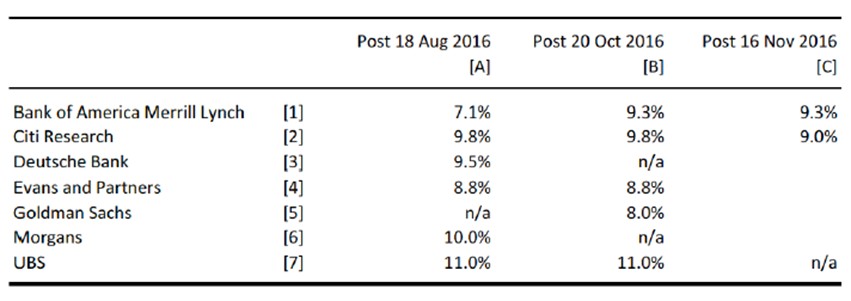
2984 Then, the market reaction to the Brambles withdrawal of the FY17 Guidance on 23 January 2017 strongly supports an inference that it was not a “readily observable matter” to persons who commonly invest in Brambles’ securities, that it was likely Brambles would not achieve its FY17 Guidance with respect to Underlying Profit growth.
2985 Dr Voetmann opined, and I accept, that the reaction of analysts to the withdrawal of the FY17 Guidance shows that (contrary to the November Information being “generally available”) they thought it was likely that Brambles would achieve the FY17 Guidance. Dr Voetmann noted that following the January Trading Update on 23 January 2017 the range of analysts’ forecasts for Brambles’ FY17 Underlying Profit growth fell from approximately 8-10% to 0-4%. The applicants relied on the following table from the Voetmann Report:
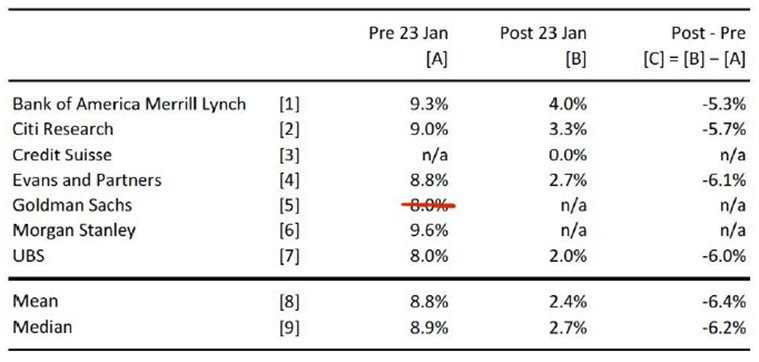
2986 The Voetmann Report shows that analysts’ expectations in respect of Underlying Profit growth were uniformly elevated, before uniformly collapsing after the January Trading Update. Brambles provided no credible alternative explanation for such a stark and uniform drop in analysts’ expectations for Brambles’ FY17 Underlying Profit growth other than that analysts had believed that it was likely that Brambles would achieve the FY17 Guidance in respect of Underlying Profit growth.
2987 I am therefore satisfied that the November Information was not “generally available” within the meaning of s 674(2).
19.6 Whether the November Information was information that a reasonable person would expect, if it were generally available, to have a material effect on the price or value of Brambles Shares, within the meaning of s 674(2)(c)(ii) of the Corporations Act?
2988 The fourth matter which the applicants must show to establish that Brambles contravened s 674(2) of the Corporations Act is that a reasonable person would expect the November Information, if it were generally available, to have a material effect on the price or value of Brambles shares.
19.6.1 The evidence
2989 The applicants relied on two expert witnesses in relation to the materiality of the alleged undisclosed “information”:
(a) Professor Raymond da Silva Rosa, Professor of Finance at the University of Western Australia (UWA) Business School, and Chair of the UWA’s Academic Board and Council. He provided reports dated 2 March 2022 (da Silva Rosa Report), which centrally went to the materiality of the alleged undisclosed “information”, and 15 July 2022 (da Silva Rosa Response Report) in which he responded to criticisms by Brambles’ experts.
(b) Dr Torben Voetmann, Adjunct Professor at the University of San Francisco’s School of Management, and a principal at The Brattle Group, a financial and economic consulting firm. He provided reports dated 2 March 2022 (Voetmann Report) which centrally relied on an event study methodology to show and quantify the alleged causally related loss and 15 July 2022 (Voetmann Response Report) in which he responded to criticisms by Brambles’ experts.
2990 Brambles relied on the reports and testimony of two expert witnesses in relation to the materiality of the alleged undisclosed “information”.
(a) Mr John Holzwarth, CFA, a partner in OSKR, LLC, a consulting firm specialising in economic and financial analysis in litigation proceedings, who provided a report dated 7 June 2022 (Holzwarth Report); and
(b) Dr Sanjay Unni, Managing Director of the Berkeley Research Group, an expert services firm specialising in economics and financial analysis, who provided a report dated 9 June 2022 (Unni Report).
2991 The expert witnesses attended an experts’ conclave and produced a Joint Expert Report dated 5 August 2022, upon which the parties also relied. They gave their evidence in a concurrent session. I will not go to the curriculum vitae or experience of the expert witnesses. I am satisfied that they are all experts in relevant fields of expertise.
19.6.2 Brambles’ submissions
2992 Brambles denied that the November Information was material information within the meaning of ss 674(2) and 677 of the Corporations Act.
2993 First, Brambles relied on the opinions of its expert witnesses, Mr Holzwarth and Dr Unni.
2994 Mr Holzwarth opined that in order to determine whether earnings related information is material, one must ascertain whether the magnitude of the difference between actual expected earnings and earnings expected on the counterfactual disclosure of the November Information is materially different. Brambles argued that Professor da Silva Rosa acknowledged that by noting that Listing Rule 3.1 describes how:
…the list of non-exhaustive examples of the type of information that, depending on the circumstances could require disclosure by an entity under this rule includes: ... the fact that the entity's earnings will be materially different from market expectations.
It also noted that Professor da Silva Rosa referred to investors needing to “calibrate” their estimates of Brambles’ expected earnings following the disclosure of FY17 earnings guidance. It said that the implication of his opinion is that, in order to assess the value of any adjustment in Brambles’ earnings, market participants required clear quantitative guidance. And it submitted that no such quantitative guidance was offered, nor was capable of being discerned, from the November Information.
2995 Dr Unni provided a similar opinion, by stating as follows:
When evaluating the materiality of the Primary Information, Prof. da Silva Rosa does not provide any detail regarding the expected magnitude by which Brambles would fall short of its FY17 Guidance (and FY19 Targets), or the likely shortfall in the US Pooled business. Prof. da Silva Rosa does not provide any detail regarding the magnitude of the shortfall in US Pooled which Brambles was in a position to disclose and does not analyze the possibility that other regions or other business units could alleviate the shortfall partially or wholly, on the strength of a stronger than anticipated economic performance.
2996 Brambles submitted that the applicants had fundamentally failed to provide any analysis as to the magnitude of the difference between actual expected earnings, and earnings expected on the counterfactual disclosure of the November Information, and had thereby failed to establish the “materiality” of that “information”.
2997 Dr Unni also criticised the probabilistic and uncertain nature of the term “likely” in the November Information. He said:
Prof. da Silva Rosa provides no detail regarding the probability associated with “likely”, without which there is no basis to evaluate the materiality of the statement that it was “likely” that Brambles would not meet its guidance. In common parlance, “likely” signifies “more often than not”, but the word is ambiguous and cannot be evaluated without assigning precision to it. Given the inherent ambiguity surrounding words such as “likely”, any conclusion drawn regarding the economic impact of such a disclosure to investors, would lack a sufficient economic basis. If “likely” means a probability of failure to meet guidance that is greater than 50%, he needs to provide detail regarding the incremental probability (in excess of 50%), since this would provide value relevant information to investors.
2998 Second, Brambles noted that ASX Guidance Note 8 discussed thresholds at which ASX-listed entities should treat earnings related information as material. The Guidance Note provided that companies should treat an equal or greater than 10% change as material, a 5% to 10% change as potentially material, depending upon the firm’s size and variability of earnings, and treat an equal to or less than 5% change as not material. For companies such as Brambles (i.e., in the ASX300), the ASX Guidance Note suggested a threshold closer to 5%.
2999 Having regard to ASX Guidance Note 8 and the application of a 5% threshold in Myer at [1166] and Crowley v Worley Ltd [2020] FCA 1522 at [86]-[87] (Gleeson J) (Crowley) Brambles seemed to accept that a change of 5% to expected earnings would be material to a business of its size. It submitted that ASX Guidance Note 8 provides an “instructive rule of thumb” as to the magnitude by which an entity’s earnings must decline from those in a prior statement in order for the decline to be material. Applying that as a rule, Brambles submitted that there is no basis in the evidence for the Court to conclude that, as at 16 November 2016, it was likely that Brambles’ full-year Underlying Profit would be more than 5% lower than $1,055 million, that being the lower end of the FY17 Guidance range. It submitted that, accordingly, the Court cannot be satisfied that the November Information is “material” within the meaning of the s 677 of the Corporations Act.
3000 Relatedly, Brambles submitted that Mr Samuel’s analysis is fatal to the applicants’ case on materiality. It noted, and I accept, that the difference between Mr Samuel's counterfactual analysis and Brambles’ projections in its Group FY17 budget are all within the 5% materiality threshold referred to in ASX Guidance Note 8. It noted, and I accept, that in cross-examination, Mr Samuel accepted several propositions relating to the August Information and to the November Information - being that:
(a) as at 16 November 2016, he calculated an $(18) million Underlying Profit shortfall to budget with an additional $(10) million of probability-adjusted net risks, resulting in a conclusion that Brambles would be $(28) million behind-budget;
(b) this would be less than 3% below the lower end of the FY17 Guidance for Underlying Profit and fall short of the 5% threshold advanced by Brambles; and
(c) it was not his opinion that there was unreasonableness in the Group September Reforecast to an extent which would have required disclosure.
19.6.3 Consideration
3001 Brambles’ submissions on materiality have little force.
3002 First, I found the expert evidence on the question of the materiality of the November Information to be of limited utility. As Justice Lee observed in Parkin v Boral Limited (Materiality Evidence Ruling) [2025] FCA 70 at [9] expert evidence on materiality often “over-intellectualises something which is supposed to be a matter of judgement assessed by reference to the realities of the business world and on an ex ante basis. Put another way, it is an evaluative assessment informed by commercial common sense”. While materiality is often addressed by expert evidence in continuous disclosure cases it is not essential and in many cases the assessment of materiality will be a matter of commercial common sense: In the matter of Mayne Pharma Group Limited [2025] NSWSC 1204 at [388] (Black J).
3003 The intent of Listing Rule 3.1 and s 674(2) is to ensure that companies disclose market-sensitive information in a timely way. That requires company management to make sensible, timely, forward-looking judgements informed by commercial common sense and assessments of likely investor behaviour, regarding what “information” would or would be likely to influence the market. The objective question of materiality posed by 674(2)(c) is required to be answered by regard to what information would or would be likely to influence a hypothetical class of persons namely “persons who commonly invest in securities”: Grant-Taylor (FC) at [116].
3004 Undertaking the predictive exercise that is required can sometimes be assisted by expert evidence, but in a case like the present the expert evidence, particularly that of Mr Holzwarth and Dr Unni, tended to over-complicate rather than elucidate.
3005 Second, Mr Holzwarth and Dr Unni not only over-intellectualised the question as to whether the November Information would or would be likely to influence the hypothetical class of persons in their decisions whether to buy or dispose of Brambles shares, their approaches to the question involved an impermissible gloss on the statutory language. They opined that in order to establish that earnings related “information” is material, a claimant must show that the magnitude of the difference between actual expected earnings and earnings expected on the counterfactual disclosure of the information is materially different. That purported requirement goes beyond the language of the statute.
3006 Section 674(2)(c) of the Corporations Act requires that, for a contravention to be established, the relevant “information” be information that a reasonable person would expect, if it were generally available, to have a material effect on the price or value of a disclosing entity’s shares. Section 677 of the Corporations Act operates as a deeming provision which describes a sufficient, but not a necessary foundation for establishing the materiality requirement under s 674(2)(c)(ii): Australian Securities and Investments Commission v Vocation (in liq) [2019] FCA 807; 371 ALR 155 at [516] (Nicholas J). The section provides that a reasonable person would be taken to expect the “information” to have a material effect on the price or value of the disclosing entity’s securities if the information “would, or would be likely to, influence persons who commonly invest in securities in deciding whether to acquire or dispose of” the disclosing entity’s securities.
3007 Making an ex ante determination as to whether earnings related “information” would or would be likely to influence the hypothetical class of persons in their decisions whether to buy or dispose of Brambles shares does not require identification, with specificity, of the quantitative difference between what actual expected earnings are and what earnings would be on a counterfactual disclosure of the earnings information in a timely way. As Lee J noted in ANZ v ASIC at [78], “[t]he contention the materiality test requires the information to have an established economic value effect is a gloss”.
3008 Third, Mr Holzwarth’s approach elides different stages of the relevant inquiry. As Lee J explained in ANZ v ASIC at [58]-[63], an applicant is required to identify the “information” that is alleged: (a) existed; (b) that entity “had”, and of which, the entity was “aware”; (c) was not “generally available”; and (d) that a reasonable person would expect, if the information were generally available, to have a “material effect” on the price or value of Brambles shares. That is the end of the liability inquiry. It is not until the Court comes to questions of causation and loss, that attention is directed to the counterfactual “but for” world upon which Mr Holzwarth’s opinion relies. Mr Holzwarth’s approach erroneously brought forward, into the liability enquiry, the type of counterfactual analysis that can be appropriate as part of the causation and loss enquiry. Lee J’s approach to deciding the question of “materiality” was approved in Zonia (FC) at [364].
3009 Fourth, standing back from the November Information and considering it in context, it is perspicuous that it is information which “would, or would be likely to, influence” the hypothetical class of persons who commonly invest in shares (which includes both sophisticated institutional investors and unsophisticated retail investors) in deciding whether to acquire or dispose of” Brambles shares. Therefore, pursuant to s 677, the November Information is taken to be “material” information.
3010 I say that because, on 16 August 2016, Brambles first announced to the market of investors and potential investors in Brambles shares that it expected to achieve Underlying Profit growth in FY17 of between 9% to 11%, equating roughly to a range of between $1,055 million and $1,075 million. Then, Brambles reaffirmed that guidance on 20 October 2016, and then it again reiterated and reaffirmed the guidance on 16 November 2016.
3011 That type of information, forecasting future company earnings, is precisely the type of information which a rational investor would be likely to consider relevant to the price of Brambles shares on the ASX, and thus would or would be likely to influence their decision whether to acquire or dispose of Brambles shares. And Brambles’ reiteration of that information to the market tended to confirm its significance to the market.
3012 Further, in my view it is appropriate to infer that Brambles understood that. It was not obliged to provide earnings guidance to the market, and it is reasonable to infer that it did so in an effort to maximise its share price. Why else would Brambles have continued to make and reiterate the FY17 Guidance unless it understood that it was likely to influence persons who commonly invest in shares in deciding whether to acquire or dispose of Brambles shares?
3013 Further, as could be expected, the contemporaneous documentary record shows that Brambles’ officers understood that withdrawing the FY17 Guidance was likely to cause a material decline in Brambles’ share price, which they were very keen to avoid. For example:
(a) on 18 November 2016, having received the 18 November O’Sullivan Presentation which confirmed CHEP NA had downgraded its full-year Underlying Profit by $(15) million, Todorcevski emailed Callaway expressing dismay at its implications for the delivery of the FY17 Guidance:
For whatever reason, neither Pete [Mackie] or Kim [Rumph] felt the need to tell [Gorman] their view of forecast changed. For Christ’s sake, we told the Board and the market 2 days ago we were on track to deliver guidance and then this pile comes out. Very poor….
(Emphasis added.)
(b) as I canvass later in these reasons, on 19 November 2016, Kennett wrote to Sevriens (CFO of CHEP Europe):
We can’t afford to hold back at the moment - the last thing we would want to do, is to the market and give a profit guidance down call.
(Emphasis added.)
(c) on 16 December 2016 Chipchase wrote to Gorman (copied to O’Sullivan):
I am not at all comfortable assuming everything miraculously comes good in H2 then finding that heroic assumptions have been made so that we disappoint the market in April/May ….. far better to fix in Jan/Feb.
(Emphasis added.)
3014 Fifth, the opinions of Dr Unni and Mr Holzwarth reveal the artificial or unrealistic results that can spring from over-intellectualising the necessary ex ante assessment as to what would or would be likely to influence the hypothetical class (both sophisticated and unsophisticated) of persons who commonly invest in shares.
3015 For example, Dr Unni opined that the November Information was not “material” because it did not provide any detail regarding:
(a) the expected magnitude by which Brambles would fall short of its FY17 Guidance;
(b) the magnitude of the shortfall in US Pooled which Brambles was in a position to disclose; or
(c) the possibility that other CHEP CBUs or other businesses in the Group could alleviate the shortfall partially or wholly, on the strength of a stronger than anticipated economic performance.
If that level of detail is required before a person can decide that earnings related information is material, one wonders when persons who commonly invest in shares would be in a position to make such an assessment.
3016 Then Dr Unni went as far as to opine that there is an “inherent ambiguity” in the word “likely” in the November Information, which states that “it was likely that Brambles would not achieve year-on-year Underlying Profit growth of between 9% and 11% in FY17”. Dr Unni accepted that in common parlance “likely” signifies “more often than not”, but he went on to opine that it “is ambiguous and cannot be evaluated without assigning precision to it”. Then, in cross-examination Dr Unni accepted that the November Information was “negative in the sense that it’s pointing to probabilities of missing guidance that is greater than 50 per cent” but maintained that in the absence of information about the “degree of likelihood” he did not “have a basis” to conclude that the information would have made prospective purchasers of Brambles shares less likely to buy.
3017 In my view that was just semantics, and contrived; it had a strong air of unreality. The meaning of that phrase in the November Information is plain. It would be readily understood by the hypothetical class of persons who commonly invest in shares as meaning that it was more likely than not that in FY17 Brambles would not achieve the 9% and 11% Underlying Profit growth that it had repeatedly communicated to the market. And such negative information would or would be likely to influence members of that hypothetical class in deciding whether or not to purchase or dispose of Brambles shares.
3018 Sixth, Brambles’ reliance on ASX Guidance Note 8 was misplaced. At all material times Guidance Note 8 provided:
…for those cases where an entity has published earnings guidance for the current reporting period, ASX would recommend that the entity carefully consider updating its published guidance if and when it expects there to be a material difference between its actual or projected earnings for the period and the guidance it has given to the market. For these purposes, ASX would suggest that entities apply the guidance on materiality that formerly appeared in the Australian Accounting Standards, that is:
• treat an unexpected variation in earnings compared to its published guidance equal to or greater than 10% as material and presume that its guidance needs updating; and
• treat an expected variation in earnings compared to its published guidance equal to or less than 5% as not being material and presume that its guidance therefore does not need updating,
unless, in either case, there is evidence or convincing argument to the contrary. Where the expected variation in earnings compared to its published earnings guidance is between 5% and 10%, the entity needs to form a judgment as to whether or not it is material. Smaller entities or those that have relatively variable earnings may consider that a materiality threshold of 10% or close to it is appropriate. Very large entities or those that normally have very stable or predictable earnings may consider that a materiality threshold that is closer to 5% than to 10% is appropriate.
This recommendation is purely a suggestion to assist entities in determining if and when they should update their published earnings guidance. The mere fact that an entity may expect its actual or projected earnings to differ from its published guidance by more (or less) than a particular percentage will not necessarily mean that its guidance is (or is not) misleading.
(Emphasis added.)
3019 It is uncontroversial that Brambles is a very large entity which normally had very stable or predictable earnings.
3020 In Myer, Beach J said (at [1166]):
In my view, materially lower in this context means at least 5% lower, although Myer contended for closer to 10% lower, a submission which I should say now I reject. ASX Guidance Note 8 discusses the concept of materiality when considering changes to earnings guidance as generally falling somewhere within a range of a variation of 5 to 10%. In my view, equal to or greater than 5% is and should have been the relevant standard in the present context.
In Crowley, Gleeson J adopted that approach (at [86]-[87]).
3021 Mr Holzwarth’s opinion relied on Guidance Note 8, but in cross-examination he said he was not saying that a 5% materiality threshold was necessarily the appropriate threshold in the circumstances of the case, and he was saying only that this was an issue that needed to be addressed. Importantly, he accepted in cross-examination that in circumstances where earnings guidance had been given to the market, and then the market was told that it is likely that the company was not going to achieve the guidance, that information, “would likely be material to the price” of the company’s shares.
3022 Guidance Note 8 provides, in terms, that a materiality threshold of 5% in a company like Brambles is “purely a suggestion” and not a mandatory criterion. It states that the “mere fact” that an entity may expect its actual or projected earnings to differ from its published guidance by more or less than, relevantly, 5%, will not necessarily mean that its guidance is or is not misleading. There is no hard and fast rule that a 5% threshold of materiality applies to a very large company, with stable earnings, like Brambles.
3023 The Court’s task is to make an ex ante assessment as to whether the hypothetical class of persons who commonly invest in shares would or would be likely to be influenced in deciding whether to acquire or dispose of Brambles shares by the “information” - that it is likely that Brambles would not achieve the thrice-repeated guidance that it expected to achieve Underlying Profit growth in FY17 of between 9% to 11%, equating to a range of between $1,055 million and $1,075 million. That task is inevitably highly evaluative, and fact and context dependent. The decisions in Myer and Crowley were made in the different factual contexts of those cases and cannot just be applied across as Brambles proposed. It is worth noting that in Myer, Beach J was careful to state he considered a threshold of equal to or greater than 5% to be “the relevant standard in the present context” (emphasis added).
3024 Further, ASX Guidance Note 8 was accompanied by the proviso that the suggestion regarding percentage thresholds should be applied unless “there is evidence or convincing argument to the contrary” contributes to my view. In the present case, there are several matters pointing away from concluding that a 5% threshold is appropriate.
3025 First, the November Information that it was likely that Brambles would not achieve year-on-year Underlying Profit growth of between 9% and 11% in FY17, was accompanied by the information that integral reasons for this were that it was likely that US Pooled would not meet its sales revenue budget in FY17, and that direct costs in US Pooled were going up. This part of the November Information is important because of the significance of US Pooled’s performance to the perceived value of Brambles shares.
3026 In her Early Observations O’Sullivan noted that “[c]urrently the US Performance is seen as a proxy for enterprise value” by the share market. That view is supported by a document titled “Discussion Paper: FY16 Results Communications Considerations” dated 23 June 2016 emailed by Hall to Todorcevski and others. The paper outlined Hall’s view regarding the “communication challenges” facing Brambles at the upcoming FY16 results presentation. It said that Brambles faced two “acute challenges” in that regard, the first of which was as follows:
The poor second-half performance of CHEP North America, which will be perceived as a negative surprise by the market, relating as it does to the company’s “bellwether” business unit, has the potential to turn prevailing sentiment against the company
(Emphasis added.)
3027 It follows that information regarding underperformance by US Pooled in sales revenue and direct costs in FY17 would be likely to influence the decisions of the hypothetical class of persons who commonly invest in shares to acquire or dispose of Brambles shares.
3028 Second, Brambles had an unblemished track record of achieving its earnings guidance, and it had three times announced or reaffirmed that it expected to achieve year-on-year Underlying Profit growth of between 9% and 11% in FY17. I accept Professor da Silva Rosa’s opinion that Brambles’ first failure to meet the earnings guidance it gave to the market, was likely to have a greater effect on the price or value of Brambles shares because of the higher level of trust previously reposed in the company. In those circumstances, a miss to guidance of less than 5% might nevertheless be likely to influence the hypothetical class of persons who invest in shares in their decisions as to whether to purchase or dispose of Brambles shares.
3029 Third, although Professor da Silva Rosa also over-intellectualised the question, and made the question more complex than necessary, I broadly accept his evidence. As he stated:
…investors’ decisions to acquire or dispose of securities are usually based on their estimates of the securities’ expected cash flows, their estimates of the securities’ level of risk, and their level of risk aversion.
3030 And that:
[T]he price of a security is a function of its expected cash flows discounted at a rate that reflects perceived risk and the time value of money and investors’ aversion to risk … Change in expected cash flows, in the discount rate, and in investors’ risk aversion therefore influence the price of a share. Information relevant to investors … is therefore any news that leads them to revise their estimates of expected cash flows - the first channel of influence - and/or discount rate - the second channel of influence.
3031 That was obvious. It was on that basis that I noted earlier that the November Information which concerned expected future Brambles’ earnings, was precisely the type of information which a rational investor would likely think was relevant to the price of Brambles shares on the ASX, and thus would or would be likely to influence their decision whether to acquire or dispose of Brambles shares.
3032 Professor da Silva Rosa was asked:
Do you consider that the [November] Information would influence or be likely to influence persons who commonly invest in securities in deciding whether to buy or sell Brambles Shares and if so, why?
3033 To which he relevantly responded that: (a) if investors were informed that it was likely that Brambles would not achieve year-on-year Underlying Profit growth of between 9% and 11% in FY17; and (b) integral reasons for this were that it was likely that US Pooled would not meet its sales revenue budget in FY17, and its direct costs were going up, then:
…both items would individually and together be regarded as value relevant in the sense of being sufficiently material in import to lead them (investors) to downwardly revise their estimates of Brambles’ expected revenues, upwardly revise their estimates of Brambles’ expected expenses and consequently downwardly revise their estimates of Brambles’ future expected earnings.
I agree.
3034 Specifically with respect to limb (a) above, Professor da Silva Rosa opined in relation to the August Information - which I consider also to be applicable here - that other things being equal, the information that it was likely that Brambles would not achieve year-on-year Underlying Profit growth of between 9% and 11% in FY17, would:
…lead investors to infer that either revenue was not growing at the pace predicted in earlier forecasts by Brambles management and/or expenses were increasing at a higher rate - or not falling as fast - than predicted by Brambles management when they set out their earlier earnings forecasts. The combination of lower expected revenues and higher expected expenses in the future would lead investors to infer a material decline in expected earnings in FY2017.
Again, I agree that the November Information would be likely to cause the hypothetical class of persons who commonly invest in shares to infer a material decline in Brambles’ expected earnings in FY17, which would, or would be likely to, influence their decisions on whether to purchase or dispose of Brambles shares.
3035 Fourth, I am confirmed in my view regarding the materiality of the November Information by what actually happened to the price of Brambles shares following the January Trading Update on 23 January 2017. When Brambles withdrew the FY17 Guidance its share price fell by 15.8% which is a strong indicator, some might say the best indicator, that persons who commonly invest in shares considered the November Information to be material to the price or value of Brambles shares. It is well established that it is permissible to look to how the market in fact reacted to a disclosure as a “cross-check” of the ex ante materiality of the information: Grant-Taylor at [64]; R&B Investments Pty Ltd (Trustee) v Blue Sky Alternative Investments Limited (in liq) (Separation of Issues) [2025] FCA 1097 at [47]-[48] (Lee J).
19.7 Whether the November Information was information that by reason of the matters in (a) to (d), Brambles was obliged to tell the ASX by no later than 16 November 2016?
3036 For the reasons explained above, I am satisfied that, as at 16 November 2016:
(a) the November Information (regarding FY17 Underlying Profit growth) existed;
(b) the November Information was information that Brambles had within the meaning of s 674(2) of the Corporations Act;
(c) the November Information was not generally available within the meaning of s 674(2)(c)(i) of the Corporations Act; and
(d) the November Information was information that a reasonable person would expect, if it were generally available, to have a material effect on the price or value of Brambles shares within the meaning of s 674(2)(c)(ii) of the Corporations Act.
3037 By reason of the matters above, it follows that I am satisfied that Brambles was obliged to tell the ASX that information by no later than 16 November 2016.
19.8 If the November Information existed, and was information that a reasonable person would expect to have a material effect on the price or value of Brambles Shares, whether it was information to which the exception in Listing Rule 3.1A applied?
3038 Listing Rule 3.1A operates a carve-out of liability from Listing Rule 3.1. In their closing submissions Brambles no longer pressed the application of Listing Rule 3.1A to the November Information.
19.9 If the November Information existed, whether by failing to tell the ASX the November Information (in regard to FY17 Underlying Profit growth) before 23 January 2017 Brambles contravened ASX Listing Rule 3.1 and s 674(2) of the Corporations Act?
3039 The applicants established that by failing to inform the ASX of the November Information (regarding FY17 Underlying Profit growth) before 23 January 2017 Brambles contravened ASX Listing Rule 3.1 and s 674(2) of the Corporations Act.
19.10 Whether the Court ought in its discretion relieve Brambles from liability for such contravention, pursuant to s 1317S of the Corporations Act?
3040 Brambles relied on s 1317S(2) of the Corporations Act to argue that it ought to be relieved form liability for its contravention of the Act.
19.10.1 Relevant principles
3041 At all material times s 674(2) of the Corporations Act was a civil penalty provision for the purposes of s 1317E(1) of that Act. An entity that is found to have breached its continuous disclosure obligations may ask a court to exercise its discretion to relieve it from liability found pursuant to s 1317S of the Corporations Act.
3042 At all material times s 1317S(2) provided that the Court may relieve an entity either wholly or partly from liability for, relevantly, breach of its continuous disclosure obligations, if it appears to the court that:
(a) the entity acted honestly; and
(b) having regard to all the circumstances of the case, the entity ought fairly to be excused for the contravention.
The provision allows the Court a wide discretion to relieve in whole or in part: MacDonald v ASIC [2007] NSWCA 304; 65 ACSR 299 at [22] (Spigelman CJ).
3043 In the context of an application for relief under s 1317S, a person acts honestly if that person’s conduct was without “moral turpitude”, meaning, as I explained in ASIC v Australian Property Custodian Holdings Ltd [2014] FCA 1308; 322 ALR 45 at [69]:
(a) without deceit or conscious impropriety;
(b) without intent to gain an improper benefit or advantage; and
(c) without carelessness or imprudence to such a degree that it negated the performance of the duty in question.
3044 In ASIC v MacDonald (No 12) [2009] NSWSC 714; 259 ALR 116 at [22], Gzell J said that a person (which must include a company) acts honestly for the purposes of s 1317S if:
… that person’s conduct is without moral turpitude in the sense that it is without deceit or conscious impropriety, without intent to gain improper benefit or advantage and without carelessness or imprudence at a level that negates the performance of the duty in question. That conclusion may be drawn from evidence of the person's subjective intent. But a lack of such subjective intent will not lead the court to conclude that a person has acted honestly if a reasonable person in that position would regard the conduct as exhibiting moral turpitude.
3045 Gzell J went on to say (at [26]), and I agree, that there is no requirement that evidence of honesty must be given by a person before a finding of honesty under s 1317S(2) can be made: His Honour said that it is conceivable that a court might be able to make that finding based upon an examination of the circumstances surrounding the contravention or from other evidence.
3046 But a finding that a company acted honestly does not automatically follow from the absence of an allegation that it acted dishonestly: MacDonald (No 12) at [30]. As Santow J observed in ASIC v Adler [2002] NSWSC 483; 42 ACSR 80 at [166], [168], approved in MacDonald (No 12) at [24]:
It would, however, be putting matters rather too high to say that there is no onus on a defendant to positively show honesty, in order to persuade the court to be positively satisfied that the person has acted honestly and to exercise its discretion favourably, if otherwise satisfied to do so.
…
Sensing the impropriety of another falls short, by itself, of a finding of dishonesty. But that is not the same as the court reaching a positive satisfaction that the person concerned ‘has acted honestly’, s 1317S(2)(b)(i)…. If the court is unable to reach a conclusion as to the appearance of honesty, but is not prepared to make the grave finding of dishonesty, more especially in circumstances where no evidence has been given directly by [the person seeking dispensatory relief], the better view is that the jurisdiction to give dispensatory relief simply does not arise; indeed if it did arise, it would hardly be exercised favourably in the absence of demonstration of acting honestly, though that may not necessarily be enough.
(Emphasis in original.)
See also ASIC v Healey (No 2) [2011] FCA 1003; 196 FCR 430 (at [87]).
3047 The applicants did not allege that Brambles acted dishonestly in failing to immediately disclose to the ASX that it was likely, or at least there was a material risk, that it would not achieve the FY17 Guidance. It was not necessary for the applicants to make such an allegation, lead evidence in support of it, or prove that Brambles acted dishonestly. The question of honesty was raised by Brambles’ reliance on s 1317S and Brambles has the onus to establish that: Morley v ASIC (No 2) [2011] NSWCA 110; 83 ACSR 620 at [27] (Spigelman CJ, Beazley and Giles JJA).
3048 And even if Brambles acted honestly, that does not necessarily mean that it should fairly be excused, and doing so involves the exercise of the discretion. Along with an objective assessment of Brambles’ honesty, other relevant considerations in the assessment of whether, having regard to all the circumstances of the case, a contravention ought to be excused under s 1317S(2)(b)(ii) include, as I explained in Australian Property Custodian Holdings at [73]:
(a) That a defendant acted honestly does not mean that they should be relieved from liability. The limbs of inquiry under s 1317S are successive and in persuading the court in the evaluative judgement and then in the exercise of the discretion, more issues may arise beyond whether the defendant acted honestly such as the degree to which an entity’s conduct fell short of the required standard of care and diligence, the seriousness of the contravention and potential consequences, impropriety, contrition, and general deterrence: Morley at [44], [49], and [50].
(b) It will be appropriate to excuse a defendant from liability in circumstances where they have “acted honourably, fairly, in good faith and in a common sense manner as judged by the standards of others of a similar professional background”: ASIC v Edwards (No 3) [2006] NSWSC 376; 57 ACSR 209 at [10]; Maelor Jones Investments (Noarlunga) Pty Ltd and Others v Heywood-Smith (1989) 54 SASR 285 at 295.
(c) A defendant may be excused from liability even though the contravening conduct has been found to be unreasonable: ASIC v Vines [2005] NSWSC 1349; 65 NSWLR 281 at [41].
(d) In cases involving negligence or breach of duty, in which there is an element of “unreasonableness” in the contravention, the extent of the defendant’s departure from the required standard of behaviour or the “degree of unreasonableness” is a relevant consideration in making the evaluating judgement and exercising the residual discretion: Healey (No 2) at [90]; Vines at [39].
(e) Whether a defendant obtained and followed competent expert advice may be relevant to whether the contravening conduct can be regarded as reasonable in the circumstances: Vines at [41]; Maelor Jones at 293.
(f) The seriousness of the contravention is important in the evaluative judgement and the exercise of the subsequent discretion to relieve. Establishing whether the contravention is serious includes considering the importance of the provision contravened in terms of public policy, the degree of flagrancy of the contravention, and the consequences of the contravention in terms of harm to others: Vines at [52]; Morley at [50]-[52].
(g) The seriousness of the potential consequences may be taken into account: Healey (No 2) at [89]. It is unnecessary to make specific findings about causation of loss for the purpose of exercising the discretion. It is sufficient to consider the degree of plausibility, in a general sense, of the contention that the contravening conduct caused or did not cause loss. The stronger the likelihood that losses have been caused the more powerfully this fact is against a grant of relief, and the weaker the likelihood that the contravening conduct caused loss, the weaker is the factor concerning the seriousness of the contravention: Vines at [56];
(h) Relief should not be granted where it would do serious disservice to the administration of company law in the commercial community: Vines at [54]; Commonwealth Bank of Australia v Friedrich (1991) 5 ACSR 115 at 199.
(i) The presence or absence of contrition after the event may be relevant to the exercise of the Court’s discretion to relieve a party from liability: Vines at [51]; ASIC v Whitlam (No 2) [2002] NSWSC 718; 42 ACSR 515 at [15]; and
(j) Unreasonableness in post-contravention conduct may be taken into account: Vines at [41]; Pacific Corporation Ltd v Forsyth (1970) 92 WN (NSW) 29 at 119.
3049 The Court is bound to consider all of the circumstances when determining whether the defendant ought fairly to be excused and whether to exercise the discretion: Morley at [50]; Maelor Jones at 292.
19.10.2 Brambles’ submissions
3050 Brambles submitted that it ought to be excused from liability under s 1317S because the evidence it led as to the substantial work it undertook to prepare, monitor and analyse the FY17 Guidance, including the work to prepare, monitor and analyse its FY17 budget and reforecasts, shows that it at all times acted honestly. It said that there is no evidence of any deceit, conscious impropriety, intent to gain improper benefit or advantage. It noted that the applicants did not allege any impropriety.
3051 Brambles further submitted that it had not been shown to have been so careless or imprudent as to demonstrate that no genuine attempt at all had been made to carry out its duties under the Corporations Act, or the ACL. It relied on the decision in Hall v Poolman [2007] NSWSC 1330; 215 FLR 243 at [325] as authority for the proposition that if failure to consider the interests of the company as a whole is a result of error of judgement, no finding of failure to act honestly should be made.
3052 It also submitted that it ought fairly be excused from any contravention with respect to the November Information, having regard to the fact that:
(a) the evidence at trial was that tens of employees at all levels of the business, from the business unit to the CBU to the business division to the Group level, were acting thoroughly, judiciously and in good faith when preparing the FY21 5YP, FY17 budget and quarterly reforecasts;
(b) the process of preparing each of these forecasts was the same process as had been adopted in all previous years when guidance had been achieved (since FY12), and so it was reasonable for Brambles to adopt that process again in FY17;
(c) there were two unexpected events (being IPEP allocation and the booking of a loss attributable to the HFG Joint Venture) which arose just 48 hours before the January Board Meeting which had a material impact on the achievability of the FY17 Guidance, and which the applicants did not allege was foreseeable;
(d) as soon as Brambles considered that there were no longer any reasonable grounds to maintain the FY17 Guidance, they were withdrawn. There is no evidence of Brambles trying to hide such information from the market. Further, Brambles’ actions in properly notifying the market were despite the fact that the information was not “material”;
(e) Brambles issued disclaimers to the market which expressly warned investors about the risks of relying on forward-looking statements, and Professor da Silva Rosa acknowledged that there is always a risk that the company will not achieve its guidance or targets; and
(f) given the inherent risk attaching to earnings guidance and targets issued to the market, and in light of Brambles at all times acting in good faith and with best efforts, a civil liability finding would set a precedent where any drop in the share price of a listed entity would be met with a shareholder class action.
19.10.3 Consideration
3053 I have no difficulty accepting that Brambles acted honestly, within the meaning of s 1317S(2)(b)(i), in its failure to disclose the November Information to the ASX on or around 16 November 2016. The applicants did not allege that Brambles acted dishonestly, and the evidence does not indicate that its officers acted with any “moral turpitude” so as to render Brambles’ conduct positively dishonest: Macdonald (No 12) at [22].
3054 I am not, though, persuaded that having regard to all the circumstances of the case, Brambles’ contravention ought fairly to be excused. Many considerations, beyond honesty, are relevant in deciding whether its contravention ought fairly be excused pursuant to s 1317S(2)(b)(ii). I consider those considerations point away from excusing Brambles from the contravention.
3055 First, I accept that Brambles’ officers were acting in good faith in reaching the opinion that, as at 16 November 2016, it was likely that Brambles would meet the FY17 Guidance in respect of Underlying Profit growth. But I do not accept its contention that in making the FY17 budget and the September Reforecasts (both Initial and Revised), and in reaching the opinion that Brambles would meet the FY17 Guidance in respect of Underlying Profit growth, it was acting “thoroughly and judiciously”.
3056 The evidence shows that Brambles’ officers acted in a manner which I would not describe as thorough, judicious or sufficiently careful. Mackie dismissed the serious concerns about the aggressive budget assumptions and level of stretch expressed by Alonso and Rumph during the budget-setting process for the US Pooled and CHEP NA budgets. Todorcevski dismissed the serious concerns expressed by Mackie about the aggressive budget assumptions and level of stretch during the budget-setting process for the CHEP Global budget. The budget-setting process resulted in a CHEP NA budget which Alonso and Rumph considered to be based in aggressive revenue assumptions and to have been stretched to near the limit of deliverability. And then more stretch was added.
3057 And as US Pooled performance fell further below-budget in each month of 1H17 the response of Brambles’ officers was just to load more and more of the missed 1H17 sales revenue and Underlying Profit into 2H17, which led to an increasingly unlikely ‘hockey-stick’ recovery trajectory as 1H17 results continued to deteriorate. This was plain when Kennett drove the making of the Revised September Reforecast which Nador and Alonso described in terms such as “challenging”, “very challenging”, “extremely challenging”, “much more aggressive, so much more difficult” and in Martin’s case as “incrementally more difficult to rationalize”. I concluded that, as at 20 October 2016, Nador and Alonso in fact thought that it was unlikely, or at least very difficult or extremely challenging, for US Pooled to achieve the projections in the Revised September Reforecast and/or meet its Underlying Profit budget for the year. And following the very poor October results, the position was worse, and CHEP NA management gave up on achieving its full-year budget. Kennett and Mackie, however, continued to maintain that the CHEP Global full-year budget was achievable, and began to cast around looking for overperformance against budget from CHEP LATAM and CHEP Europe, notwithstanding that those businesses had just gone through the September Reforecast process and management in those CBUs, and Kennett and Alonso, had agreed that their reforecasts were, as I infer challenging but achievable. That behaviour was not thorough, judicious or careful.
3058 Similarly, I would not describe as judicious or careful the conduct of Brambles’ officers in failing to reach the opinion that as at 16 November 2016 Brambles was likely to miss its FY17 Guidance in respect of Underlying Profit growth. As I said in dealing with the misleading conduct case, as at 15 November 2016, the position for the Group was as follows:
(a) The Revised September Reforecast projected that CHEP Global would recover to meet its budget in 2H17, largely through a remarkable Underlying Profit recovery by US Pooled and CHEP NA in 2H17. Neither the Initial nor Revised September Reforecast projected that the recovery by CHEP Global to meet its Underlying Profit budget in 2H17 would be materially contributed to by Underlying Profit overperformance against budget by other CHEP CBUs. On my view of the evidence, management did not know whether sufficient overperformance against budget could be squeezed out of other CHEP CBUs to materially offset the serious underperformance by CHEP NA.
(b) There were good reasons for Todorcevski, Gorman and the Board to have little faith in the correctness of the US Pooled, CHEP NA and CHEP Global (which was by far the and away the largest business in the Group) FY17 budgets and the projections in the Group September Reforecast for the US Pooled, CHEP NA and CHEP Global including:
(i) there had been a four-month trend of under-budget sales revenue and over-budget direct costs in US Pooled. It had been under-budget in sales for each of the four months of FY17, and in Underlying Profit for three of those four months, and also materially under the September Reforecast in September and October;
(ii) when the September results were received in early October the sales revenue and Underlying Profit projections in the Initial September Reforecast for US Pooled, CHEP NA and CHEP Global were shown to be materially optimistic. Following the September results, the Revised September Reforecast was made. At the October Board Meeting the Board was told that the situation in CHEP NA was “under control”;
(iii) when the October results were received in early November, the sales revenue and Underlying Profit projections in the Revised September Reforecast for US Pooled, CHEP NA and CHEP Global were again shown to be materially optimistic, and the YTD deficits to budget had blown out further;
(iv) by then US Pooled had an actual $(25.3) million Underlying Profit deficit to budget YTD, which was the main driver of the CHEP NA $(29) million deficit to budget YTD, which was the main driver of the CHEP Global $(26) million deficit to budget YTD. As a result, the Group had an actual $(18) million Underlying Profit deficit to budget YTD; and
(v) neither the Revised September Reforecast (nor the Group September Reforecast) projected a recovery from deficits of that magnitude.
(c) Yet Todorcevski, Gorman and the Board uncritically continued to believe in the achievability of the CHEP Global and Group budgets. In Todorcevski’s case he did so, notwithstanding that his Massive Growth Email described the projected US Pooled 2H17 sales growth in terms that can only have meant that he considered it to be unrealistic and unlikely to be achieved.
3059 The most blatant example of conduct by Brambles’ officers which was not judicious or careful was the failure to inform the Board before the November Board Meeting, that CHEP NA had downgraded its forecast and now projected that it would have a $(15) million Underlying Profit deficit to budget for FY17, after implementation of the CHEP NA and US Pooled recovery plans and provided there was no further deterioration from the November plan. I do not consider their failure to have been deliberate, but between them Mackie, Gorman and Todorcevski created the position that the Board was not informed of the projection in the Group September Reforecast - that through their recovery plans US Pooled and CHEP NA would recover to meet their budgets for the full-year - was no longer management’s view.
3060 That was important when sales revenue and Underlying Profit underperformance by US Pooled and CHEP NA lay at the heart of Group underperformance against budget, and the proposition that the US Pooled and CHEP NA recovery plans would enable them to claw back to alignment with budget were likely to have been central to the Board’s consideration. As I have said, it is impossible to know what would have happened had the Board been properly informed, but I accept Todorcevski’s evidence that the Board had to be talked “off the ledge” from downgrading the FY17 Guidance even though the Board (mistakenly) thought that CHEP NA and CHEP Global management continued to believe that CHEP NA would recover to achieve its Underlying Profit budget for the full-year.
3061 Nor do I consider it to have been judicious for Brambles to set earnings guidance in relation to Underlying Profit which was less than 1% below-budgeted Underlying Profit. It was not obliged to provide earnings guidance to the market at all, and providing earnings guidance which left it with so little room for underperformance was quite imprudent.
3062 All in all, I am not satisfied consider that Brambles’ officers acted judiciously, carefully, and in a commonsense manner as judged by the standards of others of a similar professional background: Maelor Jones at 295.
3063 Second, as I explain when dealing with causation and loss, I consider Brambles’ contraventions are likely to have given rise to very substantial losses by shareholders. The seriousness of the consequences in terms of harm to others is an important consideration in the exercise of the discretion: Vines at [52]; Morley at [50]-[52].
3064 Third, in my view granting relief to Brambles in the present context might do a serious disservice to the administration of company law into the commercial community: Vines at [54]; Friedrich at 199. This case involves an ASX300 company and relieving Brambles from liability would send entirely the wrong message about the importance of the continuous disclosure regime to the proper functioning of the Australian share market.
3065 Fourth, there is little merit in Brambles’ submission that, as soon as it considered there were no longer reasonable grounds to maintain the FY17 Guidance, it withdrew the guidance. I have found that Brambles should have withdrawn or downgraded the FY17 Guidance as at 16 November 2016, but it should be understood that the evidence shows that Brambles continued to maintain the guidance even when the position of CHEP NA, CHEP Global and the Group materially deteriorated.
3066 The evidence shows that Brambles held onto the FY17 Guidance for far too long. As I later explain, the November results for US Pooled and CHEP NA were again materially under-budget and under-reforecast, yet Brambles maintained the FY17 Guidance. Then the December results for US Pooled and CHEP NA (received 10 January) were again materially under-budget and under-reforecast, yet Brambles continued to maintain the FY17 Guidance. By that point CHEP Global had a $(51.5) million Underlying Profit deficit to budget YTD, and the Group had a $(37.9) million Underlying Profit deficit to budget YTD. In the face of six consecutive months of under-budget performances by US Pooled and CHEP NA, leading to the Group having an almost $(38) million Underlying Profit deficit to budget, management continued to maintain the FY17 Guidance until the January Board Meeting on 23 January 2017. Long and Johns sought to point to two relatively minor recent occurrences in the lead up to the January Board Meeting (IPEP provision and HFG Joint Venture loss) as significant to the Board’s change of heart, when in my view that was already obvious.
3067 I consider that Brambles doggedly held on to the FY17 Guidance in respect of Underlying Profit growth notwithstanding that its position became even more untenable, as performance continued to deteriorate. In my view Brambles’ post-contravention conduct was unreasonable: Vines at [41]; Pacific Corporation at 119.
3068 Fifth, I found little force in Brambles’ submission that it ought fairly to be excused from the contravention because it issued disclaimers expressly warning investors about the risks of relying on forward-looking statements. As I have said, the disclaimers were sometimes so inconspicuous that the hypothetical ordinary or reasonable investor is likely to have entirely missed the disclaimer, and if he or she had noticed the disclaimer some were so far from prominent it would not have erased or neutralised the alleged misleading effect of the impugned announcement.
3069 Importantly, the disclaimers were also standard form and generic, and were not addressed specifically to the FY17 Guidance. Had Brambles wished to state in clear terms, prominently and nearby to the FY17 Guidance, that potential investors in Brambles shares should not rely upon that guidance it would have been straightforward to do so. But that would have been self-defeating for Brambles. It is more likely than not that Brambles provided the FY17 Guidance in an effort to be seen by the market as an attractive investment and thereby to optimise its share price. Then, when the FY17 Guidance turned out to lack reasonable grounds, Brambles argued that the market should have understood that such guidance should not have been relied upon by investors and potential investors in Brambles shares because Brambles had placed standard form and generic disclaimers elsewhere in the impugned announcement. I found little merit in that argument.
3070 Sixth, I do not accept Brambles’ submission that given the “inherent risk” in earnings guidance issued to the market, and that it acted in good faith and with best efforts, a civil liability finding would set a precedent whereby any drop in the share price of a listed entity would be met with a shareholder class action.
3071 First, what gave rise to Brambles’ contravention was not the asserted “inherent risk” in earnings guidance issued to the market. It was under no obligation to give earnings guidance to the market. As mentioned above, it chose to do so for its own reasons, as I infer, in an effort to be seen by the market as an attractive investment and thereby to optimise its share price.
3072 Second, there is little merit in the in terrorem submission that what will inevitably follow from a failure to excuse Brambles’ contravention is a rash of shareholder class actions. One cannot, of course, stop hopeful applicants and litigation funders from commencing such proceedings, but on my rough count the last five to go to trial were unsuccessful. The applicants were required to establish before the Court, on the balance of probabilities, that as at 16 November 2016 it was likely that Brambles would not achieve the FY17 Guidance it gave to the market; that is, that there were not reasonable grounds for the FY17 Guidance as at that date. They did so only in part and after a long, hard fought and expensive trial. That does not indicate that any drop in the share price of a listed entity would be met with a successful shareholder class action.
3073 Seventh, I can accept that Brambles’ process in preparing the FY17 budget was similar to the process it had adopted in previous years, when the earnings guidance it provided the market was achieved. But I do not give this consideration much weight because the evidence did not descend into the detail about the particularity of the way in which the Group or CHEP NA budgets were set in previous years. As noted above, in FY17, Mackie was expressly told by Rumph and Alonso that the US Pooled and CHEP NA budgets had aggressive revenue and direct costs assumptions and had been stretched to a concerning level. Mackie effectively ignored those concerns. It seems doubtful that Brambles would have an impeccable record of meeting its earnings guidance if the Group budget was always set with such an approach. It seems more likely that in FY17 some hubris crept in, and that management set a more aggressive and stretched budget than in previous years, and then set the earnings guidance too close to the budget.
3074 Eighth, there is no basis for Brambles’ submission that two distinct events in January 2017 had a material impact on its ability to achieve FY17 Guidance. I have concluded that it contravened the continuous disclosure regime as at 16 November 2016. The events in January 2017 upon which it sought to rely have no bearing on whether Brambles ought fairly to be excused.
3075 Having regard to all the circumstances of the case I do not consider Brambles ought fairly to be excused for its continuous disclosure contraventions.
19.11 The Alternative November Information case.
3076 The applicants abandoned this case in closing submissions, and it is unnecessary to decide those questions.
D. THE ALLEGED CONTINUING NOVEMBER MISLEADING CONDUCT AND CONTINUOUS DISCLOSURE CONTRAVENTIONS
3077 The ACSOC pleaded that the August, October and November Representations were continuing representations from the date they were made until 20 February 2017, and otherwise until 23 January 2017. The August and November Representations are relevantly interchangeable because the November AGM Representations repeated and reaffirmed the August Express Representations, and both sets of representations carried the same implied representation. For convenience, I will refer only to the continuing November Representations and the period on and from 16 November 2016.
3078 Sensibly, rather than pointing to that period as a whole, the applicants relied on Brambles’ forecasts on different dates in the Relevant Period in an effort to show that there were not reasonable grounds for Brambles to maintain (i.e., to leave on foot by not correcting, qualifying or withdrawing) the FY17 Guidance and FY19 ROCI Target (and therefore maintain the continuing November Representations). The applicants referred to:
(a) 25 November 2016, when Brambles’ management approved a recovery plan for CHEP Global (the CHEP Global Recovery Plan);
(b) 21 December 2016, when the Board approved the December Reforecast at the December Board Meeting;
(c) 5 January 2017, when Brambles received the December flash results until Brambles withdrew the FY17 Guidance on 23 January 2017; and
(d) in the period from 23 January 2017 until Brambles withdrew the FY19 ROCI Target on 20 February 2017.
3079 The thrust of Brambles’ case was that until the January Board Meeting on 21 January 2017, there continued to be reasonable grounds for Brambles to maintain the FY17 Guidance and FY19 ROCI Target (and therefore there continued to be reasonable grounds for the continuing November Representations). More specifically, Brambles contended that there were reasonable grounds for the December Reforecast approved on 21 December 2016 (and which encompassed the CHEP Global Recovery Plan) when it was made and that the reforecast provided reasonable grounds for Brambles to maintain the FY17 Guidance and FY19 ROCI Target. Then, following receipt of the very poor December results on 5 January 2017, Brambles contended there were aspects of the results that required investigation and analysis and that it was necessary to see what the January results showed before deciding whether Brambles could maintain the FY17 Guidance. Brambles contended that in the run-up to the January Board Meeting, information became available to management regarding losses from Brambles’ HFG Joint Venture and the requirement for US Pooled to increase its IPEP provision, that taken together with the December and YTD results, led the Board to conclude that it was appropriate to withdraw the FY17 Guidance. The Board decided to withdraw the FY17 Guidance at that meeting and the decision was announced to the ASX on 23 January 2017.
3080 Then in the period from 23 January 2017 the gist of Brambles’ submissions was that there remained reasonable grounds for Brambles to maintain the FY19 ROCI Target until 20 February 2017.
3081 Thus, whether there existed reasonable grounds for the FY17 Guidance and the FY19 ROCI Target (and therefore reasonable grounds for the continuing November AGM Representations) over the period from 16 November 2016 to 23 January 2017 and/or 20 February 2017 was “in the ring”.
3082 Having found that, as at 16 November 2016, there were not reasonable grounds for the FY17 Guidance in respect of Underlying Profit growth, it is strictly unnecessary to consider that issue at any of the later dates referred to by the parties. But the decision in relation to the FY17 Guidance in respect of sales revenue growth and the FY19 ROCI Target was negative, and there is a possibility that on appeal I may be found to have been wrong in the decision regarding the position as at 16 November 2016. It is accordingly appropriate to make findings in relation to the existence of reasonable grounds for the continuing November AGM Representations at appropriate later points in time in the Relevant Period.
3083 I have found that the August Express Representations and the November AGM Representations were continuing representations in respect of future matters, and that the August and November All Reasonable Investigations Implied Representations were continuing representations. Those representations remained on foot and had a continuing effect until Brambles withdrew them on 23 January 2017 or alternatively on 20 February 2017.
3084 As continuing representations, if the November Representations were not misleading or deceptive at the time that Brambles made them, they could be falsified by subsequent events such that they became misleading or deceptive at that time, if the applicants establish an absence of reasonable grounds or the falsity of the representation at any point in time during which the representations were continuing.
3085 In an effort to best align with the parties’ submissions, and as I outlined above, I will make determinations as to whether there existed reasonable grounds for the FY17 Guidance and the FY19 ROCI Target (and therefore for the relevant continuing November AGM Representations) for the following dates and periods:
(a) 25 November 2016 when the CHEP Global Recovery Plan was approved;
(b) 21 December 2016 when the December Reforecast was made. The result as at 21 December 2016 will determine the position prior to management’s receipt of the December flash results on 5 January 2017;
(c) on and from 5 January 2017 when the December flash results were received until 23 January 2017 when the FY17 Guidance was withdrawn; and
(d) on and from 23 January 2017 to 20 February 2017 when the FY19 ROCI Target was withdrawn.
3086 As I previously explained, the applicants alleged that the following November Information existed at and from 16 November 2016:
(a) in respect of sales revenue, Brambles’ performance in CHEP NA since 1 July 2016 meant it was likely or there was at least a material risk that Brambles would not achieve year-on-year sales revenue growth of between 7% and 9% in FY17, or its medium term targets of constant currency sales revenue growth in the high single digits; and an integral reason for this was that sales revenue in US Pooled would not likely meet budget in FY17; and
(b) in respect of Underlying Profit, Brambles’ performance in CHEP NA since 1 July 2016 meant it was likely or there was at least a material risk that Brambles would not achieve year-on-year Underlying Profit growth of between 9% and 11% in FY17, or its medium term targets of constant currency sales revenue growth in the high single digits; and an integral reasons for this was that sales revenue in US Pooled would not likely meet budget in FY17 and direct costs were going up.
3087 For the reasons I explained, I found that the November Information in respect of FY17 Underlying Profit growth existed as at 16 November 2016; that Brambles had that information within the meaning of Listing Rule 19.12 and s 674(2) of the Corporations Act; and that that was information that a reasonable person would expect, if it were generally available, to have a material effect on the price or value of Brambles shares. I did not find that the November Information in respect of FY17 sales revenue growth existed.
3088 Unlike the August Express Representations and November AGM Representations, the parties did not make submissions as to whether the November Information continued to exist between the period of 16 November 2016 and 23 January 2017. That said, the ACSOC pleads that the November Information existed at and from 16 November 2016, and that Brambles was obliged to disclose the November Information to the ASX by no later than 16 November 2016. It also expressly pleaded that a constituent element of the November Continuous Disclosure Contravention was that Brambles “did not tell the ASX the November Information any time prior to 23 January 2017”.
3089 Given the applicants’ pleading, the fact that both parties made submissions on events after 16 November 2016 - sometimes expressly addressed to whether there remained reasonable grounds to maintain the November Representations - and the fact that their submissions on the November Continuous Disclosure contraventions essentially piggy-backed on their submissions regarding reasonable grounds, it is necessary to also consider the alleged November Continuous Disclosure Contraventions in the period from 16 November 2016 to 23 January 2017. Those matters are certainly “in the ring”. Accordingly, in addition to deciding whether there were reasonable grounds for the continuing November Representations in the period between 16 November 2016 and 23 January 2017, it is appropriate to consider the alleged November Continuous Disclosure Contraventions at each of 25 November 2016, 21 December 2016, and the period on and from 5 January 2017 until 23 January 2017.
20. THE FACTS: CHEP GLOBAL RECOVERY PLAN - 25 NOVEMBER 2016
3090 The CHEP Global Recovery Plan forecast that CHEP Global would recover to achieve its Underlying Profit budget for FY17. It was predicated on four main matters:
(a) CHEP NA reducing its actual $(29) million Underlying Performance deficit to budget YTD to a $(15) million deficit by the end of FY17.
(b) CHEP LATAM and CHEP Europe delivering approximately an additional $14 million in Underlying Profit in FY17.
(c) CHEP AIME and CHEP APAC meeting budget for the year.
(d) CHEP International “plugging” the remaining $(1) million shortfall by reducing expenses by that amount.
3091 I commence by dealing with the projected overperformance by CHEP LATAM and CHEP Europe.
20.1 The search for overperformance against budget from CHEP LATAM and CHEP Europe
3092 As earlier noted, in September and October 2016, sales revenue and Underlying Profit in US Pooled and CHEP NA were materially under-budget and under-reforecast. Largely as a result, CHEP NA was under-budget YTD in sales revenue and Underlying Profit by $(28) million and $(29) million respectively, and CHEP Global was under-budget YTD in sales revenue and Underlying Profit by $(23) million and $(26) million respectively. Largely as a result, the Group was under-budget YTD in sales revenue and Underlying Profit by $(15) million and $(18) million respectively.
3093 In an effort to find additional Underlying Profit to offset the very poor results in CHEP NA and to bring CHEP Global back into alignment with budget, Mackie and Kennett began looking for opportunities for additional sales revenue and Underlying Profit from other CHEP CBUs, with a focus on CHEP LATAM and CHEP Europe. Then, following Gorman’s Landing the Plane Email, the search for additional Underlying Profit was broadened to other businesses in the Group.
3094 As earlier noted, on 18 November 2016 Kennett emailed the Presidents of each of the CHEP CBUs seeking additional stretch and recovery actions aimed at clawing back CHEP Global to alignment with budget, following the downgrade in CHEP NA. Kennett said that he sent the email because he thought it was important for the Presidents of the other CHEP CBUs to understand the shortfall in CHEP NA, as that would help speed up the process of identifying additional Underlying Profit opportunities to bring CHEP Global back to budget.
3095 On 18 November 2016 Mackie emailed Kennett reporting that he had just met with Cabrera and that, notwithstanding CHEP LATAM’s projection in the September Reforecast that it would be flat to budget in sales revenue and Underlying Profit for the remainder of FY17, he said that CHEP LATAM had gone through “a country exercise” and had produced a list of countries with “upside to budget”. He reported that Cabrera estimated that would be $10 million in revenue and $7 million in Underlying Profit, but he had asked Cabrera and De Rivas to reach a view regarding “probability against each item”.
3096 On 19 November 2016, following his email to the Presidents of the other CHEP CBUs, Kennett forwarded his email to the CFOs of the CHEP CBUs, except the CHEP NA CFO (at this time, Bret Hill). Kennett deposed in relation to these emails that it was important for the CFOs of the other CBUs to “understand the extent of the shortfall in the CHEP NA business” and that he “wanted them to dig as deep as possible and identify additional upside opportunity to help drive the performance of… CHEP Global”. He said, and I accept, that his request was squarely aimed at seeking recovery actions “to make up” the shortfall in CHEP NA.
3097 On 19 November 2016, although he had not yet had formal responses, Kennett made a high-level estimate that CHEP Europe and CHEP LATAM would be able to provide $8 million and $6 million respectively in additional Underlying Profit. If that came about, it would almost completely offset the projected $(15) million Underlying Profit shortfall in CHEP NA for FY17.
20.2 Promised overperformance by CHEP LATAM and CHEP Europe
3098 On 23 November 2016, Kennett received emails from each of Sevriens and De Rivas (CFOs of CHEP Europe and CHEP LATAM) responding to his requests and advising of the projected full-year overperformance against budget in sales revenue and Underlying Profit by those businesses. As Kennett had predicted, the CFOs each advised that their business would be able to achieve approximately $7 million in additional Underlying Profit.
3099 The existence of reasonable grounds for the promised additional $7 million in Underlying Profit from CHEP LATAM and CHEP Europe is contested, and it is necessary to go to the detail of the communications between Kennett and the CFOs.
20.2.1 CHEP LATAM
3100 On 18 November 2016, Kennett emailed De Rivas (CFO, CHEP LATAM) and said:
Speaking with [Mackie] today, I understand that [Cabrera] has indicated that you have potential upside to the Budget of about $10M Revenue and $7M on ULP, but that you would be reviewing this over the course of the day. Could you please send your confirmation by Tuesday next week, so that I can pull together a summary of potential recovery actions by CBU. It would be helpful if you could give a rough indication of where the actions are coming from. If you could split into buckets: Sales / GP / Indirects / ULP / Capex, it would be helpful.
3101 On 22 November 2016, De Rivas replied under the subject heading “LatAm Stretch plan FY17”, attaching a presentation titled “LatAm Stretch, Latin America, December FY17” (LATAM Stretch Plan). The presentation projected that CHEP LATAM would achieve $10 million in above-budget sales revenue and $7.25 million in above-budget Underlying Profit over the remainder of FY17.
3102 Slide 2 of the presentation (reproduced below) identified proposed initiatives in several Latin American countries and their impact on sales and Underlying Profit over the full-year. The most significant action listed was “Better KA’s and Large Performance (volume and RPI)” in Mexico, which was anticipated to deliver $7.7 million in additional sales revenue and $4.7 million in additional Underlying Profit for the full-year.
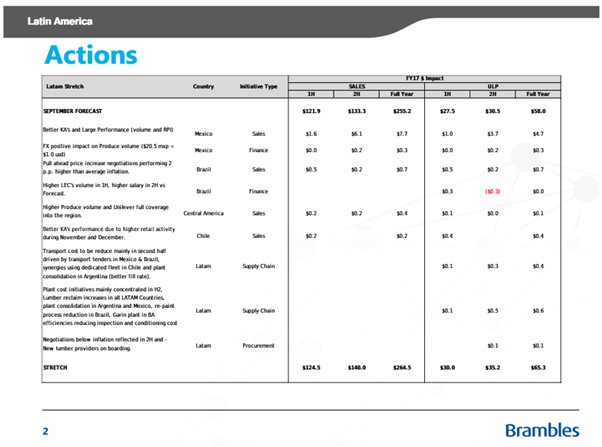
3103 Slide 3 of the presentation (reproduced below) broke down the above-budget performance by country. Consistently with the actions identified on Slide 2, the vast majority of overperformance was projected to come from CHEP Mexico. The Underlying Profit overperformance was projected to be relatively balanced between 1H17 ($3.13 million) and 2H17 ($4.12 million).
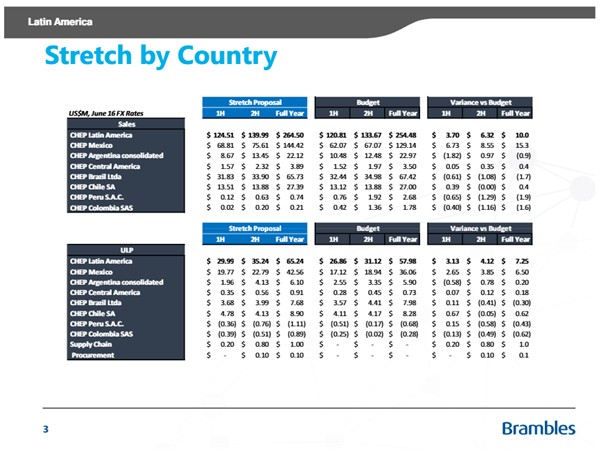
3104 On 23 November 2016, Kennett replied to De Rivas thanking him for delivering as anticipated:
Santiago,
Thanks for sending through this comprehensive and transparent explanation - very helpful - but especially for helping with more than $7M of ULP recovery actions for the total business.
(Emphasis added.)
3105 Kennett deposed that, upon reviewing the LATAM Stretch Plan and the detail therein, and CHEP LATAM’s performance over recent years and its YTD performance, he was confident that CHEP LATAM would achieve the amounts identified.
20.2.2 CHEP Europe
3106 On 19 November 2016, Kennett emailed Sevriens (CFO, CHEP Europe) and said:
Speaking with [Pooley] earlier today, I understand that you have potential upside to the Budget of about $15-$20M Revenue and $8M on ULP. Could you please send your confirmation of this through by Tuesday next week, so that I can pull together a summary of potential recovery actions by CBU. It would be helpful if you could give a rough indication of what (say) 5 actions are driving this, unless it is mainly current volume trends (in which case it would be good to understand which countries/regions are likely to deliver this). If you could then split into buckets: Sales/GP/Indirects/ULP/Capex, it would be helpful.
High level is good - no need for lots of detail.
(Emphasis added.)
3107 Sevriens replied the same day and said:
$20M is a number I really cannot substantiate.
The regions came back with a low number of around $9M due to risks they foresee in 2H, I pushed back and I think we will land around $14M - $15M (this is what I discussed with [Pooley] on Friday).
$14M would lead to $3.5M - $4M ULP. Fx is the big uncertainty impacting our profit substantially.
With some [balance sheet] clean up I think we can land $6M (perhaps $7M) above budget.
The team is working on it, and we will come back to you ASAP, but this gives you come guidance [on] what we think is possible.
3108 Kennett responded:
I was just going off of what Mike told me on the phone. But if you could get to 7M, it would be helpful. We cant afford to hold back at the moment - the last thing we would want to do, is go to the market and give a profit guidance down call; so where we know we can collectively make up for current US position, then we must.
(Emphasis added.)
3109 On 23 November 2016 Sevriens emailed Kennett and said:
We can deliver $6.9M more profit to Budget for the full year.
$17.6M more sales above budget
$15.6 more volume
$2.0M unallocated price stretch
$(8.8)M more direct costs:
$5.3M savings in operations
$(7.4)M more costs in logistics (Fx impact, delay Tescos TPMs, stretch to budget)
$(0.7)M more retailer payment (due to higher volume)
$1.5M unallocated stretch in to Supply Chain
$1.8M balance sheet clean up
So the $6.9M uplift to budget is mainly one-off related or not yet allocated (in Bold and Italic)
(Emphasis in original.)
3110 The email attached a spreadsheet containing a table (reproduced below) outlining the initiatives expected to drive the overperformance:
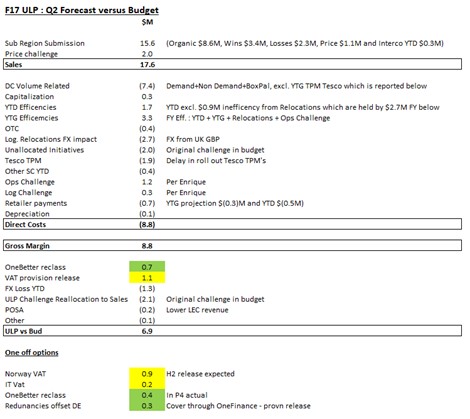
3111 Kennett deposed that, having reviewed the email and its attachment, he was confident, based on the detail provided by Sevriens and based on the performance by CHEP Europe YTD, that it would achieve the additional Underlying Profit.
20.2.3 CHEP APAC and CHEP AIME
3112 Kennett also sought additional sales revenue and Underlying Profit from CHEP APAC and CHEP AIME, but no promises were forthcoming from those CBUs. On 21 November 2016, Craig Green (CFO, CHEP APAC) emailed Kennett and said that “[o]n the stretch it will be challenging for us to maintain the budget number at this stage” and because of uncertainty in the Australian business they were “unable to call out any potential upside for the full-year at this stage”. Kennett also emailed Murray Dand (CFO, CHEP AIME) seeking additional sales revenue and Underlying Profit, but the evidence does not show a reply. CHEP AIME did not contribute additional sales revenue or Underlying Profit for the proposed CHEP Global Recovery Plan.
20.3 Preparation of the CHEP NA Recovery Deck
3113 In the same time period that Mackie and Kennett were pursuing CHEP LATAM and CHEP Europe for additional sales revenue and Underlying Profit, Rumph prepared a presentation for O’Sullivan to explain the basis of Rumph’s forecast that CHEP NA would recover from its actual $(29) million Underlying Profit deficit to budget YTD to finish the year with a $(15) million Underlying Profit deficit by the end of FY17.
3114 On 18 November 2016, Kennett emailed Rumph and told her that he had been speaking to O’Sullivan. The email said:
In a one-on-one with me, [O’Sullivan] advised me that we had told the board that after P3 we were under control, but then in P4 we had another miss (which was not considered normal), and although the Board re-confirmed the guidance at the AGM, there is a lot of nervousness (from the market, in particular with a new CEO and CFO). She said that we need to manage the board here, and therefore we should be looking at:
1. Here is what happened; and
2. Here is what we are doing to fix it (WTM);
3. And this is the critical path (we are working through a process to deliver a detailed Forecast)
We have the detail for (1), but on (2), she would like to understand this in more detail (I did not give her the detail as you requested), and ensure it has been risk reviewed, and that we are confident of delivering the revised numbers (ie. The $15M shortfall), as long as they are the right long term decisions for the business (she really emphasised this latter point).
I think it would ease her concerns if she spoke directly with you on this, and I can help pull together a presentation for you through the course of next week if you like (I am on vacation, but I will be pulling together a number of items for the other CBUs).
(Emphasis added.)
3115 On 21 November 2016, Rumph attended a call with O’Sullivan and Kennett, and made a presentation titled “Pallets Performance Review North America November 19, 2017 [sic]” (which I have previously called the 20 November CHEP NA Recovery Deck). It contained elements of the presentation sent to Kennett by Linderman on 16 November 2016, and later modified and distributed by Kennett to O’Sullivan on 18 November 2016.
3116 Slide 2 of the 20 November CHEP NA Recovery Deck carried the heading “NAM Key Challenges in FY17”. Relevantly, it recited that CHEP NA had an Underlying Profit miss to budget of $(29.3) million YTD, which had been driven by:
(a) US Pooled missing new business wins and direct costs being higher than expected, largely driven by incremental repair volume, logistics relocations and fuel pricing impacts;
(b) Canada working to recover some customer losses in FY16 and in 1Q17 with cost in control but rental on US block volumes higher than budgeted;
(c) US Recycled Underlying Profit performance improving but growth lagging budget due to market dynamics relating to pricing and raw material costs and a large headwind in unbudgeted insurance costs; and
(d) Paramount meeting budget.
3117 Slide 3 (reproduced below) provided a breakdown of the Underlying Profit shortfalls to budget by business division, and included the following table, which identified that the great majority (approximately 86%) of the $(29.3) million CHEP NA Underlying Profit shortfall to budget YTD arose from US Pooled:
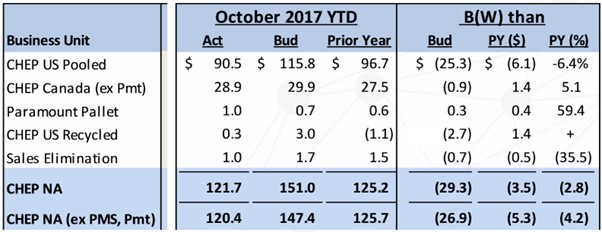
3118 Slide 4 (reproduced below) provided a similar breakdown on sales revenue. It identified that, again, the majority (approximately 56%) of the $(28.3) million sales revenue shortfall to budget YTD arose from US Pooled:
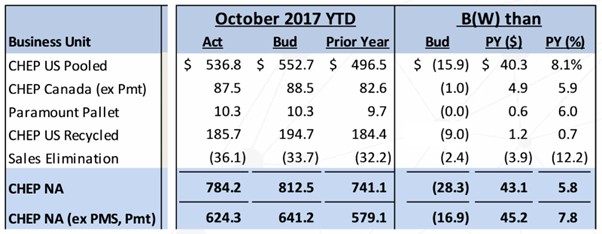
3119 Slide 9 was headed “Recovery Plan and Process”. It provided that management’s “current view” was that CHEP NA would have a $(15) million Underlying Profit shortfall to budget for FY17 (including a $10 million miss in US Pooled, a $(2.5) million miss in US Recycled and a $(2.5) million miss in Canada). That forecast was made “with all reasonable actions included”, which meant after implementation of all reasonable recovery initiatives.
3120 This slide also referred to “actions not mature enough to include in the forecast”, which it called “check’s in the mail” (and at another point “check’s [sic] in the mail but not banked”). It said that those additional items had the “potential to close the budget gap” to a shortfall to budget of circa $(6) million. The same slide provided the following broad recovery initiatives:
(a) “Weekly P&L Walk to MOP sessions led by P&L leaders”;
(b) “Weekly North America Walk to MOP sessions led by [Rumph] with all P&L leaders”; and
(c) “Process includes brainstorming ideas and reporting out on key actions to close the gap back to budget while also refreshing the gap number to ensure alignment”.
3121 Slide 11 identified the “Key Focus Areas” to recover from the actual $(29.3) million CHEP NA Underlying Profit shortfall to budget to the projected $(15) million shortfall by the end of FY17. I later go into detail on this slide.
3122 Slide 10 (reproduced below) set out the following table which showed CHEP NA full-year Underlying Profit by business division for FY17 after identified recovery actions and accounting for risks and opportunities:
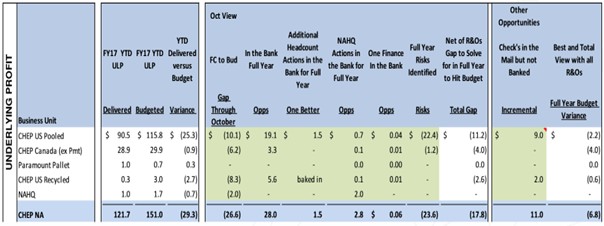
3123 As previously noted, this slide identified a projected $(17.8) million in Underlying Profit shortfall to budget in CHEP NA after identified recovery actions which differed from the $(15) million Underlying Profit shortfall identified in the earlier slide. The evidence does not explain the divergence between these two figures. I accept that, at this time, the consensus position of management was that CHEP NA would recover to a $(15) million Underlying Profit shortfall to budget by the end of FY17, rather than recover to a $(17.8) million shortfall.
3124 This table also referred to “check’s [sic] in the mail”. O’Sullivan deposed, and I accept, that the phrase meant additional opportunities which had the potential to reduce the Underlying Profit shortfall but which management considered to be “less certain”. The table identified that if those additional opportunities were achieved the CHEP NA Underlying Profit shortfall to budget would reduce to approximately $(6.8) million.
3125 Kennett deposed that the 20 November CHEP NA Recovery Deck showed that Rumph had taken a methodical approach to the CHEP NA recovery plan. He said that, based on the content of the plan and Rumph’s presentation, he had confidence in the plan and in Rumph’s ability to manage and oversee its implementation.
3126 O’Sullivan also expressed confidence in Rumph’s ability to achieve the CHEP NA recovery plan. She said that Rumph’s presentation and ability to answer her questions relating to CHEP NA’s results YTD, and relating to actions to address the shortfall in the budget, gave her confidence that the recovery plans were sufficiently detailed and were being run effectively.
3127 On 22 November 2016, following her call with Kennett and Rumph, O’Sullivan sent an email to her team attaching the 20 November CHEP NA Recovery Deck. She told them that she had a call with Rumph and Kennett, and that Rumph walked her through the presentation. Her conclusion was that:
More work to be done but looks like updated forecast will be circa $10m short. Given upsides in other markets and savings plans elsewhere top line it looks like we can get there.
Given the content of the slides, I infer that “$10m short” was a reference to the Underlying Profit shortfall in US Pooled rather than to the shortfall for CHEP NA.
20.4 The Moreno Report
3128 On 22 November 2016 Moreno submitted his report (Moreno Report). The Executive Summary stated:
Over the 4 day period we identified the data sources for the reports, reconciled the raw data from the different systems to the ABCs reported, constructed the 2 main reports and a detail analysis file based on the report with all the analytics vs. Last Year & Budget. The data used comes from SAP and BW from the Stock & Flows, FI & Co modules.
3129 On the persistent inability of CHEP NA management to make sense of the direct costs overruns each month, the report concluded that:
… the lack of automated and standard tools to run month end analytics reduce[d] the capability of the [CHEP] NA Finance team to quickly provide strong explanations on reasons of deviations and future risks.
3130 The Executive Summary stated that the main items driving the over-budget supply chain costs in US Pooled YTD were:
(a) $(11.4) million in additional Variable (Volume) costs driven by:
(i) $(5.6) million in higher pallet re-use at TPMs, which the report identified as an item which might continue through FY17 and (based on current run rates) had the potential to give rise to $(16.1) million of over-budget direct costs for the full-year;
(ii) $(4.3) million from the higher control ratio;
(iii) $(6.8) million from higher delivery, collection, and relocation ratios (collectively the transportation ratios), which the report identified as an item which might continue through FY17 and (based on current run rates) had the potential to give rise to $(20.3) million of over-budget direct costs for the full-year;
(iv) $(1.2) million from an increase in C Stock coverage; and
(v) $6.3 million in savings from lower demand;
(b) $3.8 million in Variable (Cost) savings driven by:
(i) $(1.4) million in third party fees;
(ii) $2.3 million in raw material savings; and
(iii) $2.8 million in transport-related savings, which the report identified as an item which may continue through FY17; and
(c) $(3.0) million in One-Offs and Corrections costs driven by:
(i) $(2.3) million in costs arising from the APE Error (Operations);
(ii) $(0.5) million in costs from overtime and the FY16 bonus provision; and
(iii) $(0.2) million in costs from raw materials freight catch up.
3131 The report identified the following key items that had driven the over-budget supply chain costs for CHEP NA YTD, as follows:
(a) the control ratio for the year-to-date had been over-budget by close to 4.1%, which had driven additional supply chain costs of $(9.9) million. This was driven by a combination of:
(i) higher pallet collection combined with lower demand giving rise to additional costs of $(4.3) million attributable to a higher control ratio; and
(ii) higher re-use of C Stock by retailers at TPMs, which drove additional costs of $(5.7) million. These additional costs were expected to continue through the year with a potential full-year impact of $(16) million;
(b) increased transportation ratios, which had driven additional logistics costs of $(6.8) million compared to the FY17 budget and FY16. These increased ratios were primarily driven by three items identified in the report:
(i) 1.8% higher delivery ratio than budgeted contributing to $(1.2) million of additional costs;
(ii) 6.8% higher collection ratio than budgeted, which drove $(3.2) million of additional costs;
(iii) 6.6% higher relocation ratio than budgeted, which drove $(2) million of additional costs;
(c) increased C Stock coverage which had driven $(1.2) million in additional operations costs;
(d) increased third party activity fees which drove $(1.4) million in additional operations costs; and
(e) one-off costs and double counting errors. The most significant of these was the “APE Error” (identified in Moreno’s 16 November 2016 email) which resulted in a $(2.3) million impact on Underlying Profit in the October results.
3132 The report included the following table, which listed the projected YTD, YTG, and full-year costs of the different items. The two largest items were:
(a) higher pallet re-use at TPMs had given rise to $(5.7) million in increased costs YTD, and had the potential to give rise to increased costs of approximately $(16.1) million for the full-year. That was a reference to costs associated with the re-use of pallets at TPM facilities. US Pooled had arrangements with some retailers which permitted the re-use of pallets within their own supply chains, which had the effect of increased cycle times, damage rates, and repair costs; and
(b) higher transportation ratios had given rise to $(6.7) million in increased costs YTD, and had the potential to give rise to increased costs of approximately $(20.3) million for the full-year.
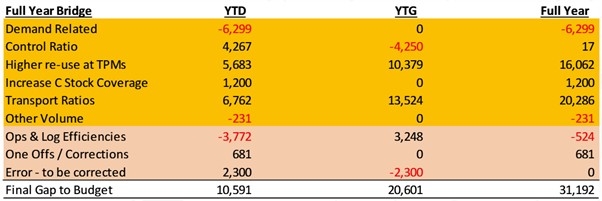
3133 Moreno concluded that, based on current run rates, the potential over-budget direct costs for the full-year could be up to approximately $(31.2) million.
3134 Slightly offsetting those costs were several items the Moreno Report identified which had a downward impact on CHEP NA’s supply chain costs. The impact of lower demand on logistics had contributed to a saving of $2.2 million, and the impact of lower demand on plant operations had contributed to a saving of $4.1 million. The report noted, however, that these trends would revert if demand were to increase over the balance of FY17 - as had been forecast.
3135 Moreno also noted that there were several initiatives identified by CHEP NA to potentially reduce the impact of over-budget costs on Underlying Profit to $(5) million, including:
(a) $10 million in damage rate reduction through the Durability Program;
(b) $14.2 million in plant operations initiatives; and
(c) $4.5 million in logistics initiatives.
The report did not include further detail on these initiatives or the extent to which they were reasonably achievable.
3136 I later explain my view in relation to the Moreno Report.
20.4.1 Lay evidence - Moreno Report
Nador
3137 Nador did not say much of significance in relation to the Moreno Report. She deposed that she thought the work Moreno had done was “really good” but she had some questions and points to clarify, and there were areas where she wanted to refine things.
Alonso
3138 Having reviewed the findings in the Moreno Report, Alonso engaged in detailed email communications with Moreno about key technical aspects of the report. It is unnecessary to descend into the minutiae of that.
3139 Having satisfied himself about the conclusions in the Moreno Report through his email exchanges with Moreno, Alonso deposed that he “remained confident” that the FY17 supply chain budget was “reasonable and achievable” because:
(a) Moreno’s analysis provided the insights necessary to understand what was driving incremental costs in the CHEP NA supply chain, which of those incremental costs had the potential for ongoing impacts in FY17, and therefore what actions were required to take to mitigate those costs;
(b) the incremental YTD costs of $(4.3) million driven by the higher control ratio were expected to be recouped over the course of the year as the higher control ratio was considered to be seasonal, in line with historical control ratio fluctuations, and therefore expected to return to long-term averages;
(c) there were a number of reasons why Alonso expected that CHEP NA would be able to recoup a large part of the incremental financial costs of $5.7 million YTD driven by higher re-use at TPMs and mitigate their ongoing effects in the financial YTG, including that:
(i) CHEP NA had the ability to apply chargebacks for additional re-use at TPMs;
(ii) with better forecasting for TPM re-use, CHEP NA would mitigate a large proportion of additional re-use costs by charging corresponding fees for re-use at the time the re-use occurred; and
(iii) the retailer-by-retailer review conducted by Nador’s team had found that, where retailers were being charged appropriately for additional re-use of pallets at TPMs, there was a net positive effect between what the business generated from the sales of whitewood pallets, the impact of re-use on logistics and the revenue earned per pallet re-use;
(d) there were no further incremental costs impacts expected from C Stock coverage increases, and the costs incurred in relation to this for the financial year-to-date were incurred to reduce service and logistics costs;
(e) while Moreno’s analysis showed that transport ratios had driven incremental costs of $6.7 million for the financial year-to-date and were expected to deliver incremental costs of $20.3 million for the full financial year, it hadn’t accounted for the $5 million of additional costs which had been budgeted for CHEP transport returns in FY17. When adjusted for these budgeted costs, the incremental costs impact of the transport ratios reduced to $5.1 million for the financial YTD and $15.3 million for the full financial year. In addition, the unit costs of pallet delivery, collection and relocation were reducing, and the trend was expected to continue throughout FY17. Moreno had also commented that the increase in the delivery ratio could be compensated by increased transport revenue, and that there was potential to implement compensating activities for collection ratio increases. There was also potential that the retailer-by-retailer negotiations being conducted by Nador’s team could reduce the impact of relocation ratio increases, by getting retailers to agree to use more ‘B’ stock (that being a term to describe pallets that had been inspected but not yet repaired);
(f) there were a number of initiatives that had already been identified by the CHEP NA team to reduce the projected supply chain costs miss to budget to around $(5) million, including through $10 million in damage rate reduction driven by the Durability Program, $14.2 million of plant operations initiatives and $4.5 million of logistics initiatives; and
(g) if US fuel prices returned to budgeted levels, which were based on fuel price indices and forecasts, there was the potential for significant upside for CHEP NA from the US fuel transportation surcharge.
3140 Alonso also deposed that in terms of the next steps arising from Moreno’s analysis, CHEP NA now had a clearer idea of where incremental costs needed to be mitigated, particularly by:
(a) reducing re-use at TPMs;
(b) recouping and ensuring corresponding revenues were charged for re-use at TPMs;
(c) implementing compensatory activities and revenues for increased transportation ratios; and
(d) negotiating with retailers for higher re-use of B stock to reduce the relocation ratio.
Alonso said that those were actions that needed to be implemented by the commercial side of CHEP NA, and accordingly his next steps were to “socialise” Moreno’s analysis with them so they could begin planning mitigation actions and engaging in discussions with customers to recoup corresponding revenues for higher re-use at TPMs and higher transportation costs (those being the two major additional direct costs items).
3141 In cross-examination, Alonso accepted that before receiving the Moreno Report he did not understand the causes of the direct costs overruns in US Pooled. He also accepted that Moreno’s analysis showed a large number of matters that had the potential to “blow out” significantly over the remainder of FY17.
3142 He also confirmed that the conclusions in the Moreno Report were consistent with his own view at the time that there were fundamental issues in the reporting processes for US Pooled, which had coloured Alonso’s view of the reliability of the US Pooled results coming through since at least August.
Kennett
3143 Kennett deposed that he felt confident that with Moreno’s report both the CHEP NA and CHEP Global teams would have greater insight into the progress of monitoring and improving the supply chain costs for the US Pooled business. In cross-examination, he agreed that it was not until he received the Moreno Report that he had a clear understanding of the direct costs overruns in US Pooled, or how US Pooled might go about fixing the issues Moreno had identified. Kennett said that one of the reasons for his belief in the achievability of the CHEP Global FY17 budget was the Moreno Report and the subsequent improvements in the reporting capability and visibility over the US Pooled supply chain, and in the initiatives developed by US Pooled to recover the excess supply chain costs YTD. Unlike Alonso, he did not go into the detail of the Moreno Report.
20.4.2 Analysis regarding Moreno Report
3144 Brambles relied on the evidence of Nador, Alonso and Kennett in relation to the Moreno Report, and on the report itself in support of a contention that the report was useful in providing greater insight into the causes of the direct costs overruns and that it was likely to be useful in assisting US Pooled to go about seeking to rectify the problems. It also relied on the fact that the report noted that there were several initiatives identified by CHEP NA which had the potential to bring the impact of the over-budget costs on Underlying Profit back to $(5) million, including through $10 million in direct costs saving through the Durability Program.
3145 I accept that the Moreno Report gave management greater insight into the causes of the direct costs overruns and that it was likely to be useful in assisting US Pooled to seek to rectify the problems. I accept that Alonso’s consideration of the report was comprehensive, and I accept his expertise in relation to supply chain costs. But having regard to the matters which I now turn to explain, I find that many of Alonso’s reasons for his stated confidence in the recoverability of the direct costs overruns incurred YTD and the achievability of the supply chain budget have little force or should be given little weight.
The shift in Alonso’s evidence
3146 It is to be recalled that:
(a) Alonso’s Risks Email described the direct cost-cutting initiatives in the CHEP Global supply chain budget, as a “huge stretch” in FY17, including the $11 million in projected costs savings from the assumed reduction in the damage rate in US Pooled. He noted that ordinarily savings were budgeted at a 75% probability to provide a buffer, but in FY17 they had budgeted for a +95% probability, which left “no margin for error at all”. He described the US Pooled budget as having the most aggressive and stretched Underlying Profit with risks in all line items, including direct costs. Nevertheless his evidence was that, at the time the budget was made, he considered the supply chain aspects of the budget to be achievable; and
(b) following the September results Alonso’s confidence in the achievability of the supply chain budget for US Pooled had reduced. In relation to the period up to 20 October 2016 he testified that it was still “possible” to achieve the supply chain budget but “with significant risk”. He described the overall US Pooled budget in this period as achievable, but “super stretch”, “very challenging” and “very, very stretched and very, very difficult”.
3147 Alonso deposed that having read and considered the Moreno Report he “remained confident” that the FY17 supply chain budget was “reasonable and achievable”. That showed a change in his evidence from just a month earlier where he described the supply chain budget as being still “possible” to achieve but “with significant risk”.
3148 However, the October results (received 11 November 2016) showed that US Pooled had experienced another month of materially over-budget and over-reforecast direct costs. By this point direct costs in US Pooled were $(11.6) million over-budget YTD, which made up approximately 46% of the US Pooled Underlying Profit shortfall to budget YTD.In circumstances where direct costs in October had again been materially over-budget and over-reforecast, I find it difficult to see how there could be reasonable grounds for Alonso to alter his view from a position where he thought it was still “possible” to achieve the supply chain budget but “with significant risk”, to a position where he “remained confident” that the FY17 supply chain budget was “reasonable and achievable”.
3149 It could be argued that the reason why Alonso’s confidence in the achievability of the supply chain budget was somehow renewed was because of his receipt of the Moreno Report. But, as I shortly turn to explain, when one reviews the report it was far from a panacea for the directs cost overruns that had afflicted US Pooled and it did not provide objectively reasonable grounds for the stated change in Alonso’s view.
3150 Further, Alonso’s evidence as to his confidence in the achievability of the FY17 supply chain budget changed in cross-examination. In cross-examination, it was put to Alonso that the various reasons he gave for his confidence in the achievability of the FY17 supply chain budget did not, in fact, provide a proper basis for him to think that it was reasonable and achievable. In response he said only: “For me, at that time, it gave me that kind of thought” (emphasis added). Even taking into account that English was not Alonso’s first language, that was not a persuasive answer. Then, in further cross-examination Alonso accepted that he was probably not 100% confident in the achievability of the supply chain budget. Then, when he was pressed further on that, Alonso said that he was “confident that we could be close or close enough to that number”. I am not sure what Alonso meant by saying that we could get “close enough” to budget.
Both good news and bad news
3151 As Alonso accepted in cross-examination, the Moreno Report contained both good news and bad news. One part of the good news for Brambles was that the report gave greater insight into the causes of the direct costs overruns, which was of assistance in understanding what needed to be done to rectify those overruns. I accept that.
3152 Another part of the good news, upon which Alonso and Kennett relied, was that the report stated:
There are a number of initiatives already identified by the [CHEP] NA to reduce such deviation to $5M, including: 10.0M Damage rate reduction (Pallet Durability), $14.2M Plant [Operations] initiatives and $4.5M Logistics Initiatives. Details not included in this document.
That part of the asserted good news was in a different category. Alonso’s and Kennett’s evidence that there was potential for those already incurred direct costs overruns to be recovered was a reference to initiatives put forward by US Pooled, which Moreno appeared to agree with, but about which the Moreno Report said nothing. And as I shortly turn to explain, when properly examined, the proposition that there was potential to do so does not stand up to examination. Brambles could have adduced evidence to make out this proposition, but it did not put on anything cogent to show that the direct costs overruns already incurred had been, or were likely to be, recovered in FY17. The evidence must be weighed in that context.
3153 The main bad news for Brambles was that, unless rectified, the matters giving rise to the direct costs overruns had the potential to give rise to a $(31.2) million hole in the US Pooled supply chain budget for FY17. Alonso accepted in cross-examination that the Moreno Report showed that direct costs could “blow out massively” in FY17.
3154 It was also very much bad news that Brambles’ management had allowed the direct costs position to deteriorate so badly. In an email to Kennett regarding the Moreno Report on 23 November 2016, Todorcevski said:
… I’m not sure where to start. There’s so much in here that needs work it’s not funny….the US processes are not up to scratch and have been ineffective in identifying trends and issues.…How we weren’t all over the higher third party fees on day one of FY17 is beyond me, why we’re paying so much more for storage yet maintaining a high level of capex with much lower volume growth, etc. This is not a good read.
(Emphasis added.)
The damage rate
3155 It will be recalled that the Moreno Report said that a number of initiatives that had already been identified by the CHEP NA team to reduce the projected supply chain costs miss to budget to around $(5) million, including the $10 million in costs savings through a damage rate reduction driven by the Durability Program, $14.2 million of plant operations initiatives and $4.5 million of logistics initiatives.
3156 However, other than noting that those initiatives had been identified by the CHEP NA team, the Moreno Report did not address those initiatives at all. Alonso accepted in cross-examination that Moreno’s work was not related to the damage rate at all.
3157 Nor, except to the extent that it falls under the headings addressed below (and it is not clear that it does), did Brambles adduce detailed evidence as to why as at 23 November 2016 there was a reasonable basis to conclude that CHEP NA could reduce the projected supply chain costs miss to budget to around $(5) million through $10 million in costs savings through a damage rate reduction driven by the Durability Program, $14.2 million of plant operations initiatives and $4.5 million of logistics initiatives. That never rose much higher than an assertion.
3158 It was Brambles’ case that those initiatives had the potential for Brambles to claw back all but $(5) million of the direct costs overruns YTD. It could have adduced evidence to make out the proposition that it was more likely than not that CHEP NA could claw back $14.2 million of costs associated with plant operations initiatives and $4.5 million of costs associated with logistics initiatives, except to the extent addressed below. The evidence must be weighed in that context.
3159 Brambles did, though, put on a great deal of evidence about the damage rate. Having regard to all the evidence regarding the damage rate I am well satisfied that there were not reasonable grounds to expect that US Pooled would achieve a reduction in the average damage rate through the Durability Program, giving rise to approximately $10 million in cost savings. And the evidence shows that at that point in time Alonso knew that.
3160 First, in cross-examination, Alonso accepted that the suggested $10 million in savings to which Moreno referred was dependent on US Pooled achieving the assumed two pp reduction in the average damage rate by the end of FY17. And the evidence shows that, as at 25 November 2016, based on performance from July through October 2016:
(a) the damage rate was coming down, but at that time US Pooled had not yet met the budgeted damage rate in any month (although it was getting close);
(b) YTD, US Pooled was behind the trajectory to achieve the average damage rate;
(c) if US Pooled was to achieve the assumed two pp reduction in the average damage rate, it required significant overperformance against budget in the remaining months of FY17; and
(d) as Alonso knew, it was likely that in November the damage rate had gone up again in accordance with usual seasonal fluctuations.
3161 Second, in cross-examination Alonso was asked about whether the damage rate was going to improve anywhere near enough to get to the assumed two pp reduction in the average damage rate. He avoided directly answering that question, but then accepted that while the damage rate trend was improving, it was unlikely to sufficiently improve for US Pooled to achieve the damage rate reduction assumption in the budget. That can be seen in the following exchange:
Edwards: Mr Alonso, it wasn’t improving enough to get nearly anywhere near the average that you were wanting to get by the end of the year, was it?
Alonso: ---It was improving versus - versus year. That was a good sign for me.
Edwards: It wasn’t improving enough, Mr Alonso, and you knew that?
Alonso: ---If it was improving enough or not, yes, you may be right. But it was improving. That, for me, was a real change on the - on the previous year’s pattern.
(Emphasis added.)
3162 Third, it will be recalled that in his 20 September Deep Dive Presentation Alonso produced an R&O schedule which assessed that there was a 75% likelihood that the damage rate would not further reduce from that date, quantified at $(9) million. In cross-examination he accepted that he was expressing a 75% risk that the budgeted two pp reduction in the damage rate would not be achieved.
3163 Then on 4 October 2016, Alonso participated in the CHEP NA September Forecast Review. The R&O schedule for that presentation again stated that there was a 75% likelihood that the damage rate would not further reduce from that date, quantified at $(12) million. In cross-examination Alonso testified that, as at 4 October 2016, his assessment was that there was, at best, only a 25% chance of the assumed two pp reduction in the US Pooled damage rate being achieved, that had it been his decision, he would have included the damage rate risk in the September Reforecast for US Pooled, rather than merely noting the risk but excluding it from the reforecast, and that he “probably” warned Todorcevski and Mackie about that risk because he “was talking about that risk almost every time [he] met them”.
3164 Fourth, in cross-examination Alonso accepted that in mid-December 2016, he recommended to Rumph that she should include a $(7) million miss to budget in relation to the damage rate in the CHEP NA December Reforecast because he was “not sure” that the assumed $10 million of costs savings from an improvement in the damage rate in 2H17 was deliverable. He said that he thought CHEP NA could commit to delivering $3-4 million of that assumed improvement but described the likelihood, at this point in time, of achieving the assumed costs savings through a reduction in the damage rate as having “a lot of risk” and being “quite challenging to achieve”. I infer that he thought that $(7) million of the assumed costs savings were unlikely to be achieved.
3165 Alonso was the head of the CHEP Global supply chain division, Brambles’ internal expert on supply chain costs, the person who introduced the Durability Program, and he was directly accountable for achieving the cost savings associated with the assumed two pp reduction in the average damage rate over the course of FY17. I prefer his evidence regarding the likelihood that Brambles would achieve those projected cost savings to the evidence of Brambles’ other witnesses.
3166 I conclude that, as at 25 November 2016, there were not reasonable grounds for Brambles to expect that CHEP NA would achieve $10 million in cost savings through a reduction in the damage rate driven by the Durability Program. Further, except to the extent that it falls under the headings below, Brambles did not adduce cogent evidence to make out its argument that there were reasonable grounds for Brambles to expect that the projected supply chain costs miss to budget could be reduced to around $(5) million, including through $14.2 million of costs savings associated with plant operations initiatives, and $4.5 million of costs savings associated with logistics initiatives.
Incremental costs from pallet re-use at TPMs
3167 Alonso deposed that there were a number of reasons why he expected that CHEP NA would be able to recoup a large part of the incremental financial YTD costs of $(5.7) million driven by higher pallet re-use at TPMs and mitigate their ongoing effects YTG which (based on the current run-rate), Moreno found had the potential to give rise to $(16.1) million of over-budget direct costs for the full-year. Moreno’s reference to higher pallet re-use at TPM facilities was a reference to the fact that retailers were retaining pallets for use in their own supply chains, which increased cycle times, and therefore damage rates.
3168 Alonso said that a large part of the YTD costs could be recovered, and the YTG costs mitigated, because:
(a) CHEP NA had the ability to apply chargebacks for additional pallet re-use at TPMs;
(b) with better forecasting for TPM re-use, CHEP NA could mitigate a large proportion of the additional re-use costs by charging corresponding fees for re-use at the time the re-use occurred; and
(c) the retailer-by-retailer review conducted by Nador’s team had found that, where retailers were being charged appropriately for additional re-use of pallets at TPMs, there was a net positive effect between what CHEP NA generated from sales of whitewood pallets, the impact of re-use on logistics and the revenue earned per pallet re-use.
3169 Having regard to other evidence, I consider it appropriate to give that evidence little weight. It should be recalled that pallet re-use at TPMs was the second largest item in Moreno’s schedule which had given rise to $(5.7) million in direct costs overruns YTD and had the potential to give rise to approximately $(16.1) million in over-budget direct costs for the full-year.
3170 First, the fact that higher levels of pallet re-use at TPMs were causing increased direct costs for US Pooled was not a discovery made by Moreno, and the proposition that it needed to be addressed was not new. For example:
(a) Mackie’s 12 October 2016 email to Gorman and Todorcevski said in relation to $(4) million of over-budget US Pooled direct costs in September, that “we do have a clear issue of over repair volumes in the month ($1.4m)” and “our retail TPM operations have also seen an increase of pallets into re-use and was particularly high in the month ($1.5m), it will require some tough retailer discussions and TPM actions but is fixable”; and
(b) the US Pooled Status Review Presentation (25 October 2016) noted that incremental activity at TPMs, driven by higher levels of pallet re-use by distributors which was not a new thing, had seen pallet re-use levels increase over the past couple of years (emphasis added). The presentation said that US Pooled was taking some specific immediate action to address this with retailers (either lower specification given for re-use, or using whitewood pallets instead, or imposing higher charges where appropriate).
3171 Those contemporaneous documents indicated some similar suggestions to those advanced by Alonso as to the ways in which the incremental costs incurred YTD from a higher level of pallet re-use could be clawed back, and how the likely incremental costs YTG could be mitigated going forward. Several things should be noted about that:
(a) this was not a new problem; it had been around for several years. In my view if it was easy to rectify, it would have been;
(b) Mackie said it involved some tough retailer discussions. As I will explain, that partly captured the difficulty with rectifying the problem in FY17; and
(c) as Alonso said, delivery of this improved supply chain outcome was not in his remit. It was up to the commercial arm of CHEP NA to bring in the additional fees or chargebacks for pallet re-use, or to somehow change retailer behaviour through ‘tough’ discussions.
3172 I have no difficulty in accepting that some of the solutions suggested in Mackie’s 12 October 2016 email, the US Pooled Status Review Presentation and by Alonso in his evidence had some prospects of success over time. But those that were achievable were difficult, and they would take time such that direct costs overruns would continue albeit at a lower rate. The effect of the changes that could be significantly introduced, in FY17, was unlikely to materially assist the projected claw back of the CHEP NA Underlying Profit deficit from $(29) million to $(15) million.
3173 The evidence shows that there were at least two major difficulties with Alonso’s suggested solutions to the increased repair costs associated with pallet re-use at TPMs, each of which indicates that there were not reasonable grounds to expect those suggested initiatives to mark a significant turnaround in the direct costs overruns in US Pooled in FY17.
3174 The first problem was Walmart. Moreno identified the problem of pallet re-use at TPMs but he did not break the issue down into Walmart TPMs and Non-Walmart TPMs. Brambles produced the following table showing the damage rate from August through October 2016 broken down into Service Centres, Walmart TPMs, Non-Walmart TPMs, and ETPMs.
US Pooled Damage Rates to October FY17 | |||||
Month | Service Centre | Walmart TPM | Non-Walmart TPM | ETPM | Total USP Damage Rate |
July | - | - | - | - | 62.0% |
August | 57.7% | 87.6% | 55.1% | 44.9% | 61.5% |
September | 56.7% | 88.1% | 55.8% | 47.5% | 60.7% |
October | 56.6% | 88.1% | 53.9% | 51.6% | 60.3% |
3175 As shown by the table, the damage rate in the Walmart TPMs was markedly greater than the damage rate in Non-Walmart TPMs, Service Centres (which represented 65% of US Pooled pallet flows) and ETPMs. Walmart represented approximately 20% of US Pooled pallet flows and its damage rate was therefore significant to the average network damage rate. In FY16 the average damage rate for pallets transferred to Walmart was 83.8%, which was 33 pps higher than the average damage rate for pallets of approximately 50.9% for pallets not transferred to Walmart.
3176 The US Pooled November Month End Package (8 December 2016) identified that for November:
(a) the Service Centre damage rate was 57.2%, or 1.1% above the FY17 budget;
(b) the Walmart TPM damage rate was 85.5%, or 3.4% above the FY17 budget; and
(c) the Non-Walmart TPM damage rate was 49.5%, or 0.3% below the FY17 budget.
Those figures translated into an overall damage rate for November of 60.7% or 1.2% higher than the 59.5% assumed in the Group September Reforecast, and 0.8% higher than the 59.9% assumed in the FY17 budget. This contributed to a YTD damage rate of 61%, which sat 0.2% above the September Reforecast, and 0.4% above the FY17 budget. As previously noted, each pp of the damage rate equated to approximately an additional $(5)-(6) million in variable costs.
3177 Mackie’s 12 October 2016 email said that the problem of pallet re-use at TPMs was “fixable” but went on to say: “However, in reality a full US recovery based on this requires a change at Walmart”. That view was echoed in the testimony of Brambles’ executives. Mackie deposed that, when he referred to a “change at Walmart”, he was referring to a long-term strategy aimed at improving the relationship between Brambles and Walmart. Kennett said the same thing. He deposed that in his time “as CFO of CHEP Global, achieving change at Walmart had always been very slow and any changes with Walmart were always part of a long-term business strategy, not short-term objectives”. Alonso also testified that he was not planning on a breakthrough in reducing the Walmart damage rate. His hope was only to keep the Walmart damage rate flat rather than increasing.
3178 Alonso accepted in cross-examination that, unless US Pooled could find some solution to the very high damage rates experienced for pallets transferred to Walmart it was going to have a problem significantly improving the overall damage rate in FY17. None of Mackie, Kennett or Alonso suggested that it was likely that the problem of incremental costs associated with pallet re-use at Walmart TPMs would be rectified in FY17. In my view there was no prospect of that.
3179 Alonso’s evidence, however, went further than suggesting that the problem of pallet re-use could be addressed going forward in FY17, i.e., for the YTG. He said that he expected that CHEP NA would be able to recoup a large part of the incremental financial YTD costs of $(5.7) million driven by higher re-use at TPMs.
3180 In relation to pallet re-use at Walmart TPMs, that suggestion is contrary to the contemporaneous documentary record, and other evidence which I prefer. I give it no weight. The current arrangement was strongly to Walmart’s commercial benefit, and as Mackie accepted in cross-examination, US Pooled and Walmart had a “very difficult” and “confronting” relationship. There was no proper basis to expect Walmart to agree to change the current arrangement.
3181 Indeed, when Rumph subsequently met with a senior Walmart executive (Sultemeier) on 16 December 2016 she sought a “quick win” around taking back a TPM from Walmart or getting an immediate quality specification change in relation to pallet re-use. She told Sultemeier that US Pooled was only looking for “a stop gap” that had “no negative impact” on Walmart. That is, she sought a solution which did not cost Walmart anything. Despite that, Walmart did not agree to change the current arrangement. Rumph reported back to Mackie and said that Walmart clearly understood what it was getting from being able to re-use US Pooled pallets and the negative impact it was having on US Pooled, but (although the meeting was a good first step) Walmart did not agree to let US Pooled re-enter the Walmart TPMs. Nor did Rumph say anything to indicate that Walmart had or was likely to agree to any change to the quality specifications for pallet re-use.
3182 It was quite unlikely that there would be any fix to the incremental costs associated with pallet re-use at Walmart TPMs that would be material to Underlying Profit in FY17, and there were not objectively reasonable grounds to forecast on the basis that there would be.
3183 Turning now to consider the position for Non-Walmart TPMs, I accept, for the period YTG, it was open to US Pooled to seek to impose additional charges for pallet re-use, and if it set those charges appropriately, they would mitigate the incremental costs going forward. However, there were, again, some major difficulties with Alonso’s evidence in this regard, and I give it little weight:
(a) as Alonso accepted in cross-examination, chargebacks for pallet re-use required negotiations with customers. They could not just be unilaterally imposed, and the outcome of any such negotiations was therefore uncertain;
(b) importantly, in circumstances where, at this point there was only seven months of FY17 remaining, the task of (successfully) renegotiating with enough large customers for it to make a material difference to the quantum of direct costs overruns in FY17 was going to take an appreciable amount of time; and
(c) there was an inherent risk for US Pooled in attempting to levy additional charges, particularly when it was under heightened competitive pressure from PECO. It faced a risk of losing customers which mitigated against having the “tough retailer discussions” to which Mackie referred.
3184 Alonso’s proposal that a large part of the $(5.7) million in incremental costs associated with pallet re-use at TPMs YTD could be recouped, and that the projected $(11.4) million incremental costs YTG could be mitigated, failed to adequately account for those facts. Consequently, US Pooled could not be assumed or forecast on the basis that, the incremental costs already incurred in non-Walmart TPMs could be recouped through additional charges or that the future incremental costs YTD could be mitigated through charges.
3185 Relatedly, Alonso’s suggestion that retailers could be required to use more B Stock pallets was a suggestion that the number of pallets returned to US Pooled that had to be transported to another location could be reduced by asking retailers to employ unrepaired pallets in their own supply chain. But, unless that was already a term of the customer’s contract, that too would require renegotiation with customers.
3186 In my view, there was, again, little or no prospect that Walmart would agree to change its arrangements at Walmart TPMs. In relation to Non-Walmart TPMs, the prospects were better but Brambles had the same problem as it had in relation to imposing additional charges. Introducing that new requirement required renegotiation, the outcome was uncertain, and the renegotiations would take time.
3187 I am satisfied that there were not reasonable grounds for Brambles to expect, nor to forecast on the basis that much of the $(5.6) million in incremental costs associated with pallet re-use at TPMs YTD could be recouped through additional charges, nor that much of the projected $11.4 million in such costs YTG could be mitigated, such as to make a material difference to CHEP NA Underlying Profit in the balance of FY17.
US fuel prices
3188 Another of the reasons why Alonso said that he was confident that the supply chain aspects of the FY17 budget remained achievable was that if US fuel prices returned to budgeted levels, which were based on fuel price indices and forecasts, there was the potential for significant upside for CHEP NA from the US fuel transportation surcharge.
3189 In cross-examination, that proposition was exposed as having little force. Alonso accepted that all he was saying there was that “if the fuel price got better, then that would help with the supply chain”. Three things can be noted about this concession. First, the state of US fuel prices had little or nothing to do with the Moreno Report. Second, US fuel prices were not something over which US Pooled had any control. Third, Alonso testified that the “facts and market indexes were telling [him] that prices could potentially go up.” In the context of fuel prices that, on the available information, were likely to rise, I do not see how this is a reason for confidence in the achievability of the supply chain budget.
Control ratio costs
3190 It is to be recalled that the control ratio refers to the number of pallets recovered in a given time period as against the number issued (expressed as a percentage). This provides primary information on how effectively the pool is operating. The extent to which the control ratio falls below 100% indicates the degree to which pallets are not being returned to CHEP Global. A higher control ratio than budgeted means that more pallets are being returned than expected, which contributes to higher inventories and higher direct costs. Since the control ratio is determined partially by the number of pallets being issued, it is related to projected sales volumes.
3191 The Moreno Report identified that, as at 22 November 2016, the control ratio was higher than budget by close to 4.1 pps, which had given rise to incremental costs of $(4.3) million YTD through higher pallet collections in comparison with lower demand, and higher re-use of C Stock by retailers.
3192 Alonso deposed that another of his reasons for confidence in the achievability of the supply chain budget was that higher costs driven by the higher control ratio were expected to be recouped over the course of the year because the elevated control ratio was expected to come down in 2H17 to align with long-term averages.
3193 This proposition fell away in cross-examination in two ways.
3194 First, Alonso accepted in cross-examination that his assumption of a lower control ratio in 2H17 depended on increased sales volume in US Pooled, which was projected to be “very significant”. Alonso’s assumption of a lower control ratio was not, though, grounded in reality because, for the reasons I have explained, as at 20 October 2016 and as at 16 November 2016, there were not reasonable grounds for Brambles to forecast that US Pooled would achieve the rephased sales volume projected for 2H17. It was more likely than not that US Pooled would have materially lower sales volume than projected. Thus, there were not reasonable grounds for Alonso to project that the incremental YTD costs of $(4.3) million driven by the higher control ratio would come down because the control ratio would come down.
3195 Second, I give no weight to Alonso’s evidence that at the time of the Moreno Report he thought the control ratio was going to come down because it is inconsistent with concessions he made in cross-examination. In cross-examination he said that by the end of November:
(a) he thought that the 96.5% control ratio assumed in the US Pooled FY17 budget no longer had a reasonable basis and should go up; and
(b) for 2H17 he had to plan the control ratio based on the growth expected by the business, which was “very significant”. For that assessment of growth he had to rely upon the assessments of others.
3196 Importantly, he testified that management was forecasting to keep the control ratio the same as per the budget, but he was challenging that assumption and telling them that he thought the control ratio should be higher based on the strong pallet collections that had been seen in November. Further, Alonso testified that by around 1 December 2016, he had formed the view that the control ratio should be increased to at least 97.5% from early December 2016 for the remainder of FY17.
3197 It cannot be the case that, as at 23 November 2016, Alonso thought that the control ratio was likely to come down in 2H17 to align with long-term averages, when in late November he said he was recommending to management that the control ratio should be increased, and by around 1 December 2016 he thought it should be increased to at least 97.5% from early December for the remainder of FY17.
3198 Alonso’s evidence was that a one pp increase in the control ratio equated to $(9) million in direct costs pa. His evidence that the control ratio should have been increased to at least 97.5% from early December for the remainder of FY17 was worth around $(4.5) million in additional direct costs. In combination with Alonso’s evidence to the effect that it was unlikely that $7 million of the assumed cost savings associated with the assumed reduction in the damage rate would be achieved, this was evidence of another $(11.5) million hit to the bottom line for US Pooled.
Transportation ratio costs
3199 The Moreno Report included the following slide, which showed that YTD in FY17 US Pooled had experienced significantly elevated transportation ratios. They had contributed to an additional $(6.8) million in direct costs YTD and were projected to give rise to an additional $(13.4) million in such costs YTG, which made it the largest increased direct costs item in Moreno’s schedule. I infer that the delivery, collection, and relocation ratios referred to the proportion of pallets which were required by US Pooled to be delivered, collected at the end of the cycle, or relocated mid-cycle, and that higher ratios had a positive and variable relationship with direct costs.
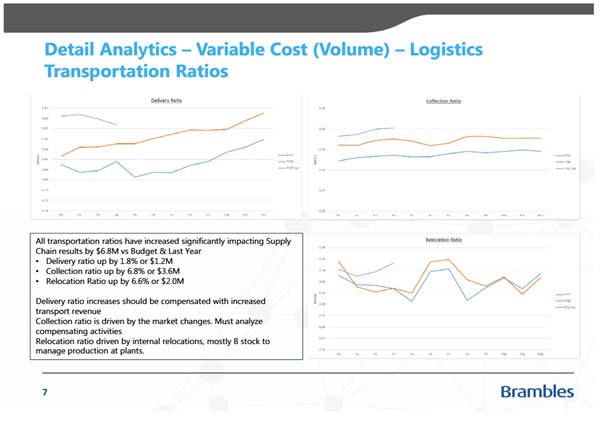
3200 The Moreno Report stated that there was a need to analyse “compensating activities”. Alonso deposed that another of his reasons for his confidence in the achievability of the supply chain budget was that compensatory activities and revenues for increased transportation ratios could be implemented.
3201 That proposition carried the same difficulties as Alonso’s suggestion that additional charges be imposed for incremental pallet re-use at TPMs. Introducing new charges in relation to transportation costs required renegotiation with customers, the outcome was uncertain, and the renegotiations with enough customers to make a material difference to direct costs overruns would take appreciable time. Again, any such renegotiations did not fall to Moreno or to Alonso; they fell to the “commercial” arm of CHEP NA. It is telling that Moreno’s later analysis of supply chain costs, which I canvass later in these reasons, showed that elevated transportation ratios continued to put pressure on meeting the direct costs budget.
3202 I am satisfied that, as at 25 November 2016, there were not reasonable grounds for Alonso to expect, nor to forecast on the basis that, much of the $(6.8) million in additional transportation costs YTD could be recouped by additional charges, nor that much of the projected $(13.4) million in additional transportation costs YTG could be mitigated in the remaining eight months of FY17.
3203 Thus, contrary to the thrust of Alonso and Kennett’s evidence, while the Moreno Report was a useful start to addressing the direct costs overruns in US Pooled, there was unlikely to be a quick fix to the overruns which would materially turn things around in FY17. Where the direct costs overruns were capable of mitigation through additional charges or directed changes to customer behaviour that required renegotiation with customers, the outcome of the renegotiations was uncertain, and the process of (successfully) renegotiating with enough large customers for it to make a material difference was likely to take appreciable time. In the meantime, the overruns were likely to continue, although most likely at a reduced rate.
20.5 Preparation of the CHEP Global Recovery Plan
3204 In reliance on the CHEP NA Recovery Deck, and having regard to the promised overperformance by CHEP LATAM and CHEP Europe, Kennett prepared a draft of the CHEP Global Recovery Plan which he emailed to Mackie (copied to Scaiff) on 24 November 2016. Mackie approved the plan by email on 25 November 2016, but asked Kennett to have the executive summary highlight that CHEP NA was working on $11 million of “additional actions” (or “checks in the mail”) to reduce the Underlying Profit shortfall to budget in CHEP NA to circa $(6) million.
3205 Kennett emailed the finalised CHEP Global Recovery Plan to Mackie and O’Sullivan (copied to Scaiff, Callaway, and Moreno) on 25 November 2016 under cover of an email which extracted the executive summary from that plan. That said:
In summary:
Current recovery actions will deliver Budget for full year ULP, and YOY sales and ULP growth of 7% and 8%, with ROCI up +10bps.
• P4 YTD ULP behind Budget by $26M, driven by USP shortfall;
• Process in place for December Forecast update;
• Recovery plans put in place by CBUs will deliver actions that bring us back to budget on ULP for the full year:
o NAM will reduce current YTD deficit from $29M to $15M; Currently NA working $11m list to continue to close gap to USP budget. Not included above; best estimate is $6m additional offset to $15m;
o (NAM will grow ULP +$48M (+18%) versus LY, with ROS +110bps);
o Latam deliver $7M additional ULP (mainly run-rate);
o Europe delivers $7M additional ULP (mainly run-rate);
o AIME already had plan in place to offset current challenge & will achieve Budget;
o APAC challenge in Asia will be offset by ANZ, but no additional upside at this point
o Balance plugged in International (+$1M).
• Capex and Cash Flow to be further worked on.
(Emphasis added.)
This was the first occasion in FY17 that there had been a consolidated set of recovery actions across CHEP Global.
3206 As Mackie had requested, the plan identified $11 million of additional opportunities that were stated to have the potential to reduce the Underlying Profit shortfall to circa $(6) million. Even so, slide 7 confirmed that the consensus management view remained that CHEP NA would have a $(15) million Underlying Profit shortfall to budget for FY17.
3207 Slide 6 of the plan set out a series of “Key focus areas” for the CHEP NA recovery to reduce the Underlying Profit shortfall to budget to $(15) million. Kennett explained that this slide of the CHEP Global Recovery Plan was put at a high level, as the CHEP NA part of the CHEP Global Recovery Plan was as set out in the CHEP NA Recovery Deck. I will later deal with these key focus areas.
3208 Slide 4 of the plan (reproduced below) set out the promised $7.3 million Underlying Profit overperformance against budget by CHEP LATAM, in a slide taken from the LATAM Stretch Plan.
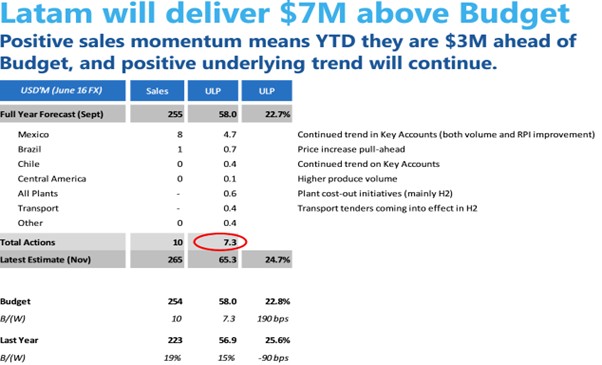
3209 Slide 5 of the plan (reproduced below) set out the promised $6.9 million in Underlying Profit overperformance against budget by CHEP Europe.
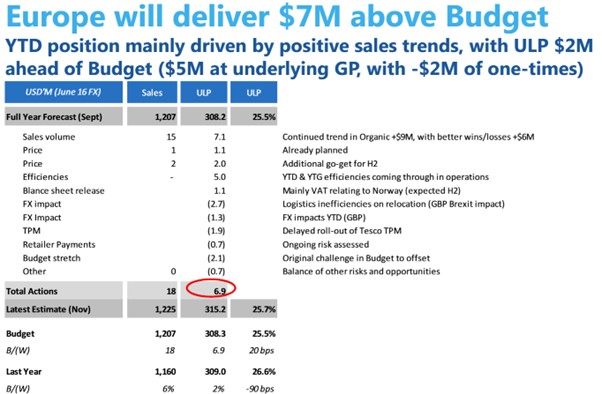
3210 Slide 8 identified the projected performance by CHEP Global and its constituent CBUs against budget and reforecast for FY17. It projected that sales revenue and Underlying Profit overperformance against budget by CHEP LATAM and CHEP Europe would offset the forecast $(14.6) million CHEP NA Underlying Profit shortfall to budget for FY17, such that Global would recover from its actual $(26) million Underlying Profit shortfall to budget YTD to meet budget by the end of FY17.
20.5.1 The lay evidence - CHEP Global Recovery Plan
3211 Brambles relied on the evidence of Kennett, Mackie and O’Sullivan regarding their reasons for their belief, as at 25 November 2016, in the achievability of the CHEP Global Recovery Plan and of the CHEP Global Underlying Profit budget by the end of FY17. It centrally relied on Alonso’s evidence in relation to the supply chain aspects of the budget and the Moreno Report.
3212 In circumstances where CHEP Global was by far the biggest business in the Group and it was budgeted to account for approximately 94% of Group Underlying Profit in FY17, their evidence was also relevant to the existence of reasonable grounds for the continuing November Representations.
Kennett
3213 Kennett deposed that, as at 25 November 2016, he considered that the CHEP Global FY17 budget “remained achievable and reasonable” having regard to the same reasons which I considered as at 16 November 2016, but with the addition of the receipt of the Moreno Report, the CHEP NA Recovery Deck, the promises of sales revenue and Underlying Profit overperformance by CHEP LATAM and CHEP Europe, and his development of the CHEP Global Recovery Plan. He relied on the following reasons:
(a) the supply chain costs year-to-date deep dive analysis and reporting undertaken by Moreno, and the subsequent improvements in the reporting capability and visibility over the supply chain costs of the US Pooled business;
(b) the US Pooled supply chain initiatives developed by the US Pooled team to recover the additional supply chain costs;
(c) his ongoing monitoring and review of the performance of the CHEP Global businesses;
(d) his review of the CHEP Global and in particular the US Pooled October results, including:
(i) the analysis and review undertaken by the US Pooled and CHEP NA teams;
(ii) the meetings he attended with US Pooled, CHEP NA, CHEP Global and Brambles’ teams to discuss the key drivers of the October US Pooled results;
(iii) the explanations given by US Pooled in relation to its results;
(iv) the commitment from the US Pooled and CHEP NA teams to address the poorer than expected results, particularly in relation to addressing the direct costs results;
(v) the subsequent and separate analysis of the October results undertaken by him and the CHEP Global FP&A team, including considering the achievability of the September forecast in light of the October results and having regard to the whole of the CHEP Global portfolio and the strong performance in other CBUs;
(e) the steps taken by key stakeholders following the October results for US Pooled, including the direct costs analysis and the addition of Moreno to be ‘on the ground’ to ensure any direct costs issues would be swiftly remedied;
(f) his understanding of the CHEP Global business, including year-on-year trends and the strong track record against budget each year and his understanding that the business always involved risks, and that was just part of doing business; and
(g) taking account of the YTD performance of the CHEP business, across the portfolio of CHEP CBUs, combined with the additional efforts from CBUs to overdeliver against budget for the full-year.
3214 Kennett also noted that CHEP NA continued to undertake updated R&O analyses, including (as Brambles submitted):
(a) the CHEP Global October PPR (16 November 2016) contained an updated R&O schedule to the Group September Reforecast, which indicated an $(11.9) million risk to the 1H17 September Reforecast, which, on a risk-adjusted basis, equated to $(9.7) million because it included the 100% assumption that the October Underlying Profit performance variance of $(8.4) would remain. That PPR reduced the damage rate risk from $(12) million to $(10) million, with a risk of $(1) million in 1H17 and $(9) million in 2H17 at a probability of 50%. Kennett thought that this assessment was conservative given that the damage rate was trending down. The CHEP Global October PPR also reported that US Pooled had obtained two new wins, and that a number of large customer accounts were in their final stages of negotiations;
(b) the CHEP CFO BPR meeting was held (16 November 2016) which included an overview of the October results and focussed on the status of the recovery plans to improve Underlying Profit for the balance of the year, closing the gap to budget in CHEP NA, and further enhancing performance in CBUs which were outperforming budget such as CHEP Europe and LATAM;
(c) the US Pooled WTM file dated 19 November 2016 identified $31.5 million in sales opportunities for FY17, with each recovery action assigned to a specific owner; and
(d) the US Pooled MBR presentation dated 21 November 2016 also included an R&O schedule for November, which continued to assess the damage rate risk at $10 million.
3215 In cross-examination, Kennett denied that Sevriens’ offer of $6.9 million in additional Underlying Profit was unachievable on account of the significant amount of unallocated stretch and the “clean up” of the CHEP LATAM balance sheet. He denied that he had asked Sevriens for $7 million in Underlying Profit.
3216 He accepted “to some extent” that he did not know whether there was a foundation for the recovery actions identified by CHEP Europe to be delivered. In relation to CHEP LATAM, he disagreed that he lacked a reasonable basis to believe that it could deliver the overperformance outlined in the LATAM Stretch Plan.
Mackie
3217 In relation to the projected sales revenue and Underlying Profit overperformance by CHEP LATAM and CHEP Europe, Mackie testified that following conversations with senior leadership of those businesses his sense “was that they would deliver better performance”. In cross-examination, it was put to Mackie that the annotation of “mainly run-rate” for CHEP LATAM and CHEP Europe in the Executive Summary of the CHEP Global Recovery Plan was “simply an expectation that a rate of overperformance that had been demonstrated would be continued for the rest of the year”. Mackie accepted that. He said that he was confident that those businesses were “travelling well” and he expected them to continue to “travel well”.
3218 Mackie denied that he asked Cabrera and Pooley for $7 million in additional Underlying Profit from CHEP LATAM and CHEP Europe for the pending reforecast. In cross-examination he said that it was not his practice to tell business units what to deliver in terms of a reforecast, because he wanted them to “own their reforecast”. The following exchange took place:
Quinn: Mr Mackie, you said you didn’t ask [Cabrera] for $7 million. Did he offer you $7 million for ULP?
Mackie: ---I don’t - I don’t recall. What I recall is having a conversation with him about the performance of his business
Quinn Is the position - -?
Mackie - - and whether it was going to be better than his forecast. …
Quinn: Is the position you don’t recall the content of the conversation, but at the end of it there was a $7 million figure agreed to be provided by Latin America by way of reforecast ULP for 2017?
Mackie: ---So I had a conversation with him about the performance of his business, that it would exceed that performance and to agree on - and to agree on where we thought the Latin American business would end up.
Quinn: Okay?
Mackie: Yes.
Quinn: And $7 million was the agreed figure?
Mackie: ---Yes, it looks like it….
3219 Mackie similarly denied that he had asked Pooley for $7 million from CHEP Europe, and suggested that he had “reached agreement” with him on a figure.
O’Sullivan
3220 O’Sullivan deposed that, having reviewed the CHEP Global Recovery Plan on 25 November 2016, she was confident that the recovery plans for CHEP LATAM and CHEP Europe were “achievable” for reasons including that:
(a) CHEP LATAM was $3 million ahead of budget in Underlying Profit YTD at the time the recovery plan was prepared;
(b) CHEP Europe was $2 million ahead of budget in Underlying Profit YTD at the time the recovery plan was prepared;
(c) CHEP LATAM and CHEP Europe YTD were outperforming their budgets, mainly due to strong sales volumes, without having been asked to deliver additional growth. O’Sullivan also expected that there were sales, cost-cutting and efficiency measures that could be targeted or implemented to further improve financial performance over the balance of FY17 in both CBUs. She said that the specific actions listed on slides 4 and 5 gave her confidence that the recovery plans were credible and that there were granular plans underpinning the projections in CHEP LATAM and CHEP Europe; and
(d) the recovery plan presented a balanced view, with CHEP Europe identifying factors that were going to have both a positive and negative impact on the ULP growth for the balance of the year.
3221 O’Sullivan also gave evidence of the work being undertaken to reduce expenses across the Group. She said that in her experience, reducing spending on non-essential costs, including travel and entertainment, team events, training programs and consultants could be implemented almost immediately and improve financial results to allow for revenue recovery, de-risk revenue shortfalls and offset higher costs. In mid-November, she enquired about the cost management initiatives previously applied by Brambles, and following that enquiry, a cost management guidance document from 2014 was updated for distribution to the ELT and each of the business divisions.
3222 In cross-examination, O’Sullivan maintained her view that the projected sales revenue and Underlying Profit overperformance in both CHEP LATAM and CHEP Europe was deliverable.
20.6 Whether there were reasonable grounds for the CHEP Global Recovery Plan?
3223 I will deal with each of the three main components to the CHEP Global Recovery Plan in turn. These were the:
(a) CHEP NA reducing its actual $(29) million Underlying Performance deficit to budget YTD to a $(15) million deficit by the end of FY17, through $14.3 million in Underlying Profit overperformance against budget in the remainder of FY17 (as projected in the CHEP NA Recovery Deck).
(b) CHEP LATAM delivering an additional $7.3 million in Underlying Profit in FY17.
(c) CHEP Europe delivering an additional $6.9 million in Underlying Profit in FY17.
20.6.1 The CHEP NA Recovery Deck
3224 The projected recovery by CHEP NA was forecast to occur through the initiatives set out in the 20 November CHEP NA Recovery Deck, which were summarised in the CHEP Global Recovery Plan.
20.6.1.1 The key focus areas for the projected CHEP NA recovery
3225 Slide 6 of the CHEP Global Recovery Plan set out the following “key focus areas” for the projected CHEP NA recovery:
Many items already on-going; weekly P&L Walk to MOP sessions led by P&L leaders
• Volume for USP and Recycled (catch up on run rate but not to budget)
• Recycled funnel strong
• Pooled deals closing too slowly, but in the queue (and phased accordingly)
• Manage Pooled CAPEX and repairs in line with demand
• Must deal with incremental TPM re-use that is driving repairs in USP
• Expedite and over deliver on planned Supply Chain Initiatives for USP and Plant Cost Out for Recycled
• Offset fuel and lumber impacts and catch up on timing in USP
• Sales Clean Up in Canada - rental charges, contingency pricing, IFCO, etc.
• IPEP volume opportunity for US Pooled beyond FIFO
• Incremental OH actions across NAM ($3M) (Complete / One Better)
• Balance Sheet Clean-up for USP
• Recycled insurance costs
3226 No monetary figure was attached to each item, but having regard to the fact that US Pooled was projected to make up 79% of CHEP NA Underlying Profit in FY17, I infer that the proposed recovery actions relating to US Pooled were of significantly greater importance than those in other CHEP NA businesses. I should also note that there was little detail about those items in the evidence and some of them were not the subject of submissions by the parties. But where the evidence permits it, I now turn to consider those “key focus areas” for CHEP NA.
Key Focus Area 1 - Volume for US Pooled and Recycled (catch up on run rate but not to budget)
3227 I understood this item to mean that US Pooled and US Recycled were projected to recover their respective shortfalls in sales revenue, which had been driven significantly by under-budget volume.
3228 Following the October results, US Recycled was $(9) million under-budget in sales revenue YTD, and the Group September Reforecast projected that it would be $(14.4) million under-budget in sales revenue for the full-year. Todorcevski testified that, as at 14 November 2016, that he was not too concerned with the performance of US Recycled given its very low impact on Group profitability. I take the same view. It is unnecessary to descend into the minutiae of the prospects of a sales volume recovery by US Recycled.
3229 In my view, there were serious difficulties facing US Pooled in rectifying the sales volume underperformance against budget YTD, and in achieving the rephased sales volume in 2H17 projected by the Group September Reforecast, and carried forward through the CHEP Global Recovery Plan.
3230 The CHEP Global November BPR (17 November 2016) identified that US Pooled sales revenue was $(16) million under-budget YTD, and that one of the “headwinds limiting growth” for CHEP Global was the shortfall in volume in US Pooled. It identified that the under-budget issue volume alone had contributed $(4.6) million of the $(25.3) million US Pooled Underlying Profit deficit to budget YTD. The US Pooled November MBR (19 November 2016) identified that almost 30% of the US Pooled sales revenue shortfall to the Group September Reforecast YTD had been driven by a miss on “Unidentified Wins”.
3231 The CHEP Global November BPR stated that the below-budget sales volume was due to “delayed new business conversions”, but that was just a reiteration of the same argument that Martin had been making since August. His view, as he consistently testified (supported by Nador), was that the missed sales in 1H17 were delayed rather than lost and that the revenue would come through. However, for the reasons I have previously explained in relation to the position as at 16 November 2016 (in section 18.4.3.3 above), I am satisfied that there were not reasonable grounds for that view as at 25 November 2016. Nothing material had changed in the interim.
Key Focus Area 3 - US Pooled sales deals closing too slowly, but in the queue (and phased accordingly)
3232 This item is essentially the same as the item dealt with immediately above. For the same reasons there were not reasonable grounds, as at 25 November 2016, for Brambles to believe, nor to forecast on the basis that, there was likely to be a sufficiently material improvement in the conversion rate in FY17 to materially assist CHEP NA to recover from its $(29) million Underlying Profit deficit to budget YTD to a $(15) million deficit by the end of FY17.
Key Focus Area 4 - Must deal with incremental TPM re-use that is driving repairs in US Pooled
3233 I dealt with this item when discussing the lay evidence regarding the Moreno Report. For the reasons I explained, I am satisfied that there were not reasonable grounds for Brambles to expect, nor to forecast on the basis that, a sufficient amount of the $(5.6) million in incremental costs associated with pallet re-use at TPMs YTD could be recouped through additional charges. Nor do I consider that a sufficient amount of the projected $11.4 million in such costs YTG could be mitigated, to materially assist CHEP NA to recover from its $(29) million Underlying Profit deficit to budget YTD to a $(15) million deficit to budget by the end of FY17.
Key Focus Area 6 - Expedite and over deliver on planned Supply Chain Initiatives for US Pooled and Plant Cost Out for US Recycled
3234 In relation to US Recycled, the evidence is insufficient to analyse this planned initiative. But given the low profitability of that business it was unlikely to be material to the projected recovery for CHEP NA Underlying Profit in FY17.
3235 In relation to US Pooled, the CHEP Global Recovery Plan did not identify the supply chain initiatives in US Pooled which it forecast could be expedited and over delivered, nor did it put a dollar amount on this suggested initiative.
3236 It should, however, be recalled that Alonso’s Risks Email said that, as originally made, the direct cost-cutting initiatives in the CHEP Global supply chain budget involved a “huge stretch”, and that “[w]e normally go with actions at a 75% probability to have some buffers to cover downsizes during the year but this year we go with +95% probability, so no margin for error at all”. In cross-examination Alonso accepted that achieving those savings initiatives required “perfect execution”. He described the cost efficiencies in the US Pooled supply chain budget, as involving a “big stretch”, and said that the US Pooled budget “is the most aggressive and stretched ULP. It comes with risks in all line items, sales, direct cost, overheads and capex”.
3237 US Pooled had been over-budget in supply chain costs each month of FY17 to date. It had received the Moreno Report which had explained the causes of the direct costs overruns, but rectifying the two largest categories of overruns was difficult, and where they could be mitigated by additional charges or changed customer practices, it required renegotiation which, even if successful, would take appreciable time. The damage rate reduction was unlikely to be achieved and the higher direct costs associated with the control ratio were unlikely to come down because the control ratio was unlikely to come down. It is more likely than not that the “key focus area” of expediting and overdelivering on supply chain costs was just another example of optimistic stretch.
3238 That inference finds some support in a later email. On 20 January 2017 Rumph emailed Mackie, Gorman, O’Sullivan, Kennett, Alonso and Hill, attaching a presentation to aid a discussion of the FY17 outlook for CHEP NA later that day. The presentation included a R&O schedule which identified a $3 million opportunity for over-delivery in supply chain efficiencies which was not linked to any specific program or type of cost.
3239 Further, the evidence shows that the main risk to achieving the supply chain budget was the damage rate. As I have explained, perhaps ad nauseam, there were not reasonable grounds to expect that the assumed two pp reduction in the average damage rate would be achieved. At this point in time, approaching the end of 1H17, only $2 million of the assumed $12 million in associated cost savings had been achieved. By mid-December 2016 Alonso had recommended to Rumph that she should include a $(7) million miss to budget on damage rate in the CHEP NA December Reforecast because he was “not sure” that CHEP NA could deliver the forecast improvement in the damage rate in 2H17 (although he did think CHEP NA could commit to delivering $3-4 million of that improvement). I infer that he thought that the assumed $(7) million in costs savings were unlikely to be achieved.
3240 Alonso accepted in cross-examination that, around this point in time, $(7) million of the assumed cost savings from the assumed reduction in the damage rate were unlikely to eventuate, and that the control ratio should have been increased by one pp (worth approximately $(9) million for a year), which would increase direct costs by $(11.5) million in FY17.
3241 I do not accept that there were reasonable grounds for Brambles to expect that the supply chain cost savings initiatives could be “expedited or over delivered” sufficiently to materially assist CHEP NA to claw back from a $(29) million Underlying Profit deficit to budget YTD to a $(15) million deficit to budget by the end of FY17. To my mind that was just another example of the excessive optimism which infected the recovery projections for CHEP NA. Forecasts in a large and complex business like that could not reasonably be undertaken on the basis of hope.
Key Focus Area 10 - Incremental Overhead actions across CHEP NA ($3M) (Complete / OneBetter)
3242 The OneBetter program was introduced in April 2014 for the purpose of reducing overhead costs across the Brambles Group, with a focus on centralising functions globally on issues such as finance, IT, human resources and procurement, and it was intended to generate savings through leveraging the scale of Brambles’ global operations to procure goods and services at cheaper rates. OneBetter was a long-term initiative which, at the time it was introduced, was expected to generate a total benefit of approximately $100 million across the Group by 2020.
3243 It should, however, be recalled that the projected cost savings through the OneBetter program were already priced into the FY17 budget. They were the subject of strong exchanges between Todorcevski and Mackie during its development - with Todorcevski pressuring Mackie to “stretch” the OneBetter savings at the individual CBU level.
3244 Absent specific cost-cutting measures, I fail to see how a long-term and multi-year program targeted at indirect costs - which had already been priced into projected Underlying Profit for FY17 - could materially assist CHEP NA to recover from its $(29) million Underlying Profit deficit to budget YTD to a $(15) million deficit to budget by the end of FY17. I infer that this was just one more stretch target.
Key Focus Area 11 - Balance Sheet Clean-up in US Pooled
3245 I was not taken to evidence to show what a “balance sheet clean-up” for US Pooled would mean in terms of material improvements to Underlying Profit. Nor was I taken to any evidence to show that there was a “balance sheet clean-up” for US Pooled after the CHEP Global Recovery Plan came into existence. I do not consider that this would materially assist CHEP NA to recover from its $(29) million Underlying Profit deficit to budget YTD to a $(15) million deficit to budget by the end of FY17.
20.6.2 Brambles’ submissions regarding the CHEP NA Recovery Deck
3246 Brambles’ submissions in relation to the CHEP NA recovery plan as at 25 November 2016 were based on the reasons given by its executives, centrally Kennett, Mackie and O’Sullivan, and also by Alonso in relation to the Moreno Report and the achievability of the supply chain budget. I have previously considered some of these submissions as at 16 November 2016 and in respect of them little had changed in the interim. In respect of other submissions, I considered them in my analysis regarding the Moreno Report and regarding the key focus areas in the CHEP NA Recovery Deck.
3247 First, Mackie’s evidence in relation to this period was brief. For reasons he did not explain, he accepted Rumph’s forecast that CHEP NA would recover from its existing $(29) million Underlying Profit deficit to a $(15) million deficit by the end of FY17. He did not, at this point in time, descend to detail the basis for his belief in the achievability of Rumph’s forecast.
3248 Second, Alonso expressed detailed views in relation to the Moreno Report (as discussed above), and he opined that having reviewed Moreno’s analysis he remained confident that the FY17 supply chain budget was reasonable and achievable. For the detailed reasons I have set out above (in section 20.4.2), I give little weight to that evidence.
3249 Third, many of Kennett’s reasons for his confidence in the achievability of the CHEP Global budget as at 25 November 2016 were based on his view regarding the prospects for US Pooled and CHEP NA in FY17. For example, he deposed that his confidence was based on:
(a) the analysis and reviews undertaken by the US Pooled and CHEP NA teams, the various meetings he attended to discuss the key drivers of the October US Pooled results, the explanations given by US Pooled in relation to its results the commitment from the US Pooled and CHEP NA teams to address the poorer than expected results, particularly in relation to addressing the direct costs results, and the subsequent and separate analysis of the October results undertaken by him and the CHEP Global FP&A team;
(b) the steps taken by key stakeholders following the US Pooled October results, including the direct costs analysis and the addition of Moreno to be ‘on the ground’ to ensure any direct costs issues would be swiftly remedied;
(c) that CHEP NA continued to undertake updated R&O analyses, including the US Pooled October R&O Schedule in the CHEP Global October PPR (16 November 2016); and
(d) that the US Pooled WTM file (19 November 2016) identified $31.5 million in sales opportunities in the sales pipeline.
3250 For the following reasons, I do not give much weight to those reasons.
3251 First, for the reasons previously explained, I found that as at 16 November 2016:
(a) the Group September Reforecast for US Pooled and CHEP NA no longer reflected the reality;
(b) the assumption of $53 million in unidentified wins continued to be unreasonable and it was unlikely that US Pooled could overachieve in 2H17 against the aggressive unidentified wins target;
(c) the US Pooled sales pipeline was smaller and the conversion rate was very low;
(d) the estimates as to when major sales opportunities for US Pooled would be finalised lacked reasonable grounds;
(e) the projected 2H17 US Pooled sales growth was unrealistic and unlikely to be achieved, it being more of a target than a budget;
(f) the no major customer loss assumption continued to be unreasonable;
(g) the direct costs overruns were likely to continue for some period (and were unlikely to be sufficiently rectified as a result of the Moreno Report);
(h) the damage rate assumption continued to be unreasonable and those projected cost savings were unlikely to be realised; and
(i) the Group September Reforecast was based on a material understatement of risks to US Pooled sales and Underlying Profit for FY17.
3252 As a result, by 25 November 2016, YTD, US Pooled Underlying Profit was $(25.3) million under-budget, and CHEP NA Underlying Profit was $(29) million under-budget. For US Pooled and CHEP NA, the position for the remainder of FY17 was likely to be as follows:
(a) US Pooled sales revenue performance was likely to continue to be poor, with a resultant continuing drag on profitability;
(b) although the Moreno Report provided greater visibility in relation to direct costs and identified those which most urgently required rectification, there was a lot of work to be done to rectify the problems, and the outcome was uncertain. Many of the problems were likely to be difficult to rectify, and if they could be rectified that would take appreciable time such that it was doubtful to make a material difference in FY17. The direct costs overruns were likely to continue, albeit at a lower rate;
(c) the Underlying Profit budget had an approximately $7 million hole based on an unreasonable assumption of a two pp drop in the damage rate; and
(d) the budget failed to adequately take into account other identified risks to US Pooled Underlying Profit. That is, it materially understated the risks.
3253 For the reasons previously explained, I found that, as at 16 November 2016, there were not reasonable grounds for Brambles to expect, nor to forecast, that US Pooled would achieve the necessary overperformance against budget to recover any of the actual $(25.3) million Underlying Profit deficit to budget YTD by the end of FY17. It would be doing well if it could just meet the monthly Underlying Profit budget targets, as originally set, for the remainder of FY17. Nor were there reasonable grounds to expect the other businesses in CHEP NA (principally CHEP Canada and US Recycled) to recover any of its actual $(29) million Underlying Profit deficit to budget YTD by the end of FY17. Those two businesses were each forecast to finish FY17 $(2.5) million under-budget in Underlying Profit for the year, and their performance was deteriorating. I estimated that, as a result, it was more likely than not that CHEP NA would have an Underlying Profit deficit to budget for FY17 of at least approximately $(29) million.
3254 Except for the reliance on the Moreno Report (which I have dealt with above) the CHEP NA recovery plan had not changed since 11 November 2016 when Rumph had forecast that, through implementation of its recovery initiatives particularly the Walk to MOP process, CHEP NA would recover from its actual $(29) million Underlying Profit deficit to budget to a $(15) million deficit by the end of FY17. That continued to be Rumph’s plan as at 25 November 2016, as captured in the 20 November CHEP NA Recovery Deck. The recovery initiatives, as at 27 November 2016, were essentially the same as those as at 16 November 2016.
3255 Nothing material had changed between 16 November and 25 November 2016. There were not objectively reasonable grounds for Kennett to reach a different view based upon the analysis and reviews he, and/or the US Pooled and CHEP NA teams undertook. Nor, for the reasons previously explained, was there a reasonable basis for Kennett to rely upon the “commitment” from the US Pooled and CHEP NA teams to address the poorer than expected results, particularly in relation to addressing the direct costs results. Those teams were of course “committed” to addressing the direct costs results, but their hope to mitigate the direct costs and their ability to be able to do so sufficiently to make a material difference to the direct costs results in the remaining months of FY17 were two different things.
3256 Second, the fact that Moreno would remain ‘on the ground’ in the US to assist US Pooled with direct cost problems was a good development which was likely to assist in reducing direct costs overruns over time. However, that development is only a basis for confidence in the achievability of the CHEP Global budget to the extent that it produced realistically actionable insights to drive down direct costs in US Pooled. As I have explained, some of the causes of the direct costs overruns which the Moreno Report identified or re-identified were very difficult to rectify, and things were quite unlikely to change in FY17 (e.g., incremental costs from pallet re-use and increased transportation costs at Walmart TPMs). Other causes of the direct costs overruns might have been capable of being fixed, but would require customer renegotiation and (if renegotiation was successful) would take appreciable time to make a material difference (e.g., incremental costs from pallet re-use and increased transportation costs at Non-Walmart TPMs). Some were entirely out of US Pooled’s hands (e.g., US fuel costs). Those matters did not provide objectively reasonable grounds for Kennett to believe that it was more likely than not that CHEP NA could claw back to a $(15) million Underlying Profit shortfall to budget by the end of FY17.
3257 Third, the 20 November CHEP NA Recovery Deck and the recovery plan that it set out was not a new plan with new initiatives. Rumph had forecast on 11 November 2016 that the CHEP NA and US Pooled recovery plans, particularly the dual track Walk to MOP processes, would get CHEP NA back to a $(15) million Underlying Profit deficit to budget for the year. The CHEP NA Recovery Deck centrally relied on the same or similar initiatives and the Walk to MOP process Rumph and her team had been pursuing since September to try and drag US Pooled and CHEP NA back into alignment with budget.
3258 Fourth, Kennett’s confidence in the updated R&O analyses in relation to US Pooled was misplaced. As previously explained, the US Pooled October R&O Schedule (16 November 2016) materially understated the risks to US Pooled Underlying Profit in FY17 and there were material inconsistencies between the CBU R&O schedules and the CHEP Global R&O schedule such that the net risk on the CBU level became $(13.2) million when the CBU schedules were used, and then fell to $(10) million after probability-adjustment. The updated R&O analyses in relation to US Pooled and CHEP NA were a reason to doubt the existence of reasonable grounds for the projections in the Group September Reforecast in respect of CHEP Global, not reasons for confidence in the achievability of the CHEP Global budget.
3259 Relatedly, Kennett specifically relied on the R&O schedule in the US Pooled MBR presentation (21 November 2016) which continued to assess the damage rate risk at $(10) million. There were not, however, objectively reasonable grounds for that assessment. Alonso was Brambles’ internal expert in relation to the Durability Program and the damage rate, and his view, as at 4 October 2016, was that there was a 75% likelihood that the average US Pooled damage rate would not reduce by two pps over the course of FY17, and that that risk should have been integrated into the Group September Reforecast (instead of merely been listed as a risk). It follows that there was only a 25% chance that the assumed $10 million in costs savings would eventuate. That position had not changed as at 27 November 2016.
3260 That conclusion finds support in Alonso’s evidence that in mid-December 2016 he recommended to Rumph that she should include a $(7) million miss to budget on damage rate in the CHEP NA December Reforecast because he thought that the assumed $(7) million of costs savings from the forecast reduction in the damage rate were unlikely to be achieved.
3261 Further, Kennett was correct in noting that there were a substantial quantum of sales opportunities in the US Pooled sales pipeline, but that contention somewhat missed the point. The sales funnel was smaller than in previous years, but the greater reason for the low sales was a five-month trend of very low monthly conversion rates. For the reasons previously explained, there were not reasonable grounds to expect the very low monthly conversion rates to speedily abate, and the longer the delay went, the more likely it was that a significant proportion of the forecast sales revenue would fall outside FY17, particularly when the greatest proportion of the rephased sales were not projected to occur until 4Q17.
3262 Having regard to those matters, there were not objectively reasonable grounds for Kennett to believe that it was more likely than not that CHEP NA could fight back from its actual $(29) million Underlying Profit shortfall to budget YTD to a $(15) million shortfall by the end of FY17. It continued to be more likely than not that CHEP NA would have an Underlying Profit deficit to budget for FY17 of at least approximately $(29) million.
3263 Fifth, Kennett’s confidence in the achievability of the CHEP Global budget was also based on his understanding of that business, including year-on-year trends and the strong track record against budget each year, as well as his understanding that the business always involved risks, which was just part of doing business. I accept that Kennett had a strong understanding of CHEP Global’s business and he was in a very good position to reach an informed view about its likely performance against budget for FY17. However, I consider that by 25 November 2016, he had taken a myopic view in relation to the achievability of the CHEP Global budget. He was displaying a blinkered approach to the hole into which CHEP NA had fallen, and to the prospect of it getting out of that hole. His approach to the achievability of the CHEP Global budget was infected by his concern that Brambles might have to downgrade the FY17 Guidance if it did not. That is sufficiently clear from his 19 November 2016 email to Sevriens in which he said:
We can’t afford to hold back at the moment - the last thing we would want to do, is go to the market and give a profit guidance down call; so where we can collectively make up for current US position, then we must.
(Emphasis added.)
3264 Concern about the possible market reaction to a downgrade to the FY17 Guidance should not have been a factor in Kennett’s forecasting for CHEP Global. Kennett (and Brambles) was obliged to forecast for CHEP Global on the basis of management’s best estimate of likely future financial performance, not to forecast on the basis of heroic plans around not “holding back” anything which might assist I offsetting the disastrous Underlying Profit performance against budget by CHEP NA.
3265 I accept that CHEP Global had a strong track record of achieving its budget, but whether, as at 27 November 2016, there were reasonable grounds for the CHEP Global budget cannot be answered by reference to CHEP Global’s past performance in different circumstances. It primarily falls to be assessed by reference to the evidence in relation to this period. The past performance by CHEP Global does not show the existence of objectively reasonable grounds for the CHEP Global budget as at 27 November 2016.
3266 Fourth, I do not give much weight to O’Sullivan’s evidence regarding the new guidelines seeking a reduction in spending on non-essential items. Other than the circulation of the revised 2014 guidelines, there was little in the evidence to show that this initiative was likely to be material to CHEP Global achieving its Underlying Profit budget in FY17. For example, there was no evidence as to the quantum of the likely expense savings through this initiative and there was no evidence that the new guidelines were ever brought to life or enforced.
3267 For the reasons previously explained, I found that, as at 16 November 2016, there were not objectively reasonable grounds to forecast that CHEP NA would recover to a $(15) million Underlying Profit deficit to budget by the end of FY17. At that time it was more likely than not that CHEP NA would have an Underlying Profit deficit to budget for FY17 of at least approximately $(29) million. That remained the position as at 25 November 2016.
20.6.3 The projected overperformance by CHEP LATAM and CHEP Europe
3268 The second and third main elements of the CHEP Global Recovery Plan were the promised sales revenue and Underlying Profit overperformance against budget by CHEP LATAM and CHEP Europe.
3269 For the reasons I now turn to explain, I am satisfied that, as at 25 November 2016, there were not reasonable grounds for Brambles to forecast that CHEP LATAM and CHEP Europe would overperform in Underlying Profit against budget by $7.3 million and $6.9 million respectively. As I explain, I consider the projected overperformance by each business was more akin to a stretch target than management’s best estimate of likely outcome for CHEP LATAM and CHEP Europe for FY17.
3270 First, it is noteworthy that Mackie denied that he directly asked the CEOs of CHEP LATAM and CHEP Europe for around $7 million each in additional Underlying Profit from CHEP LATAM to offset the shortfall in CHEP NA. In cross-examination he said that it was not his practice to tell business units what to deliver in terms of a reforecast, because he wanted them to “own their reforecast.” He typified the promised overperformance as agreements he reached with Cabrera and Pooley while he was discussing the performance of those CBUs with each of the CEOs.
3271 Having regard to the contemporaneous emails, to which I have previously gone, I give little weight to that evidence. It is plain on the face of the emails that Mackie understood the trouble that CHEP Global was in, and he reached out to CHEP LATAM and CHEP Europe to see whether he could squeeze additional sales revenue and Underlying Profit out of those businesses. I infer that Mackie procured promises of overperformance of around $7 million from each of CHEP LATAM and CHEP Europe, doing so with the assistance of Kennett.
3272 First, Mackie’s 12 November 2016 email to Cabrera said that he had already spoken to Pooley who had agreed to “squeeze out more”. There is no reason to disbelieve that contemporaneous account of what Mackie asked the CEO of CHEP Europe to do. And his email to Cabrera reiterated that request.
3273 Second, on 12 November 2016 Kennett forwarded Mackie’s email to De Rivas and said: “I cannot over-emphasise the importance of this, so please look everywhere you can”. The necessary overperformance by other CHEP CBUs to compensate for the underperformance by CHEP NA was important to Kennett.
3274 Third, the procurement of the $7 million in overperformance from CHEP Europe is clear from the email exchange between Kennett and Sevriens (CFO, CHEP Europe) beginning on 19 November 2016. On that date Kennett emailed Sevriens and said that after speaking with Pooley he had “come to understand” that CHEP Europe had a potential upside to the budget of about $15-$20 million in sales revenue and $8 million in Underlying Profit. Kennett sought a rough “high level” indication of what five actions would drive that growth, and which countries/regions were likely to deliver it.
3275 Sevriens responded by email the same day, stating as follows:
$20M is a number I really cannot substantiate.
The regions came back with a low number of about $9M due to risks they foresee in H2, I pushed back and I think we will land around $14M - $15M (this is what I discussed with Mike on Friday).
$14M would lead to $3.5M - $4M ULP. [Foreign exchange] is the big uncertainty impacting our profit substantially.
With some [balance sheet] clean up I think we can land $6M (perhaps $7M) above budget.
The team is working on it, and we will come back to you ASAP, but this gives you some guidance what we think is possible.
3276 Kennett continued to push and in an email to Sevriens the same day he said:
But if you could get to 7M, it would be helpful. We can’t afford to hold back at the moment - the last thing we would want to do, is go to the market and give a profit guidance down call; so where we know we can collectively make up for the current US position, then we must.
(Emphasis added.)
3277 Thus, the contemporaneous emails show that Mackie asked Pooley to “squeeze out more” from CHEP Europe; Kennett then followed up with Sevriens suggesting that Pooley had agreed that CHEP Europe could overperform against budget in Underlying Profit by $8 million; Sevriens said that was wrong, and that the regions / countries making up CHEP Europe had only agreed to provide $9 million in additional sales revenue in 2H17 due to the risks they foresaw. Sevriens then pushed back against that, and he thought that he could push the regions/countries to around $14 million in additional sales revenue, which would give rise to $3.5 - $4 million in additional Underlying Profit. The balance of what Sevriens offered was a “balance sheet clean up” which he thought would bring Underlying Profit to $6 million (perhaps $7 million) over-budget. Kennett then followed up again and pressured Sevriens to get to $7 million in additional Underlying Profit. As it eventuated, Sevriens promised $6.9 million in additional Underlying Profit.
3278 That promised Underlying Profit overperformance was plainly procured, rather than offered. And it was procured in circumstances where Kennett pressured Sevriens, even raising the spectre that if CHEP Europe did not come to the party there was a risk that Brambles would have to downgrade the FY17 Guidance. To my mind, it was not just a coincidence that the promised overperformance by CHEP LATAM and CHEP Europe came in at almost exactly what was needed to get CHEP Global back to alignment with budget by the end of FY17, provided that CHEP NA could claw back its $(29) million Underlying Profit deficit to budget to $(15) million by the end of the year.
3279 Second, the central basis of the evidence of Mackie, Kennett and O’Sullivan that it was reasonable to expect CHEP LATAM and CHEP Europe to significantly overperform against budget in sales revenue and Underlying Profit for FY17 (so as to offset the underperformance by CHEP NA) was that their performance in October and YTD was “strong”. That evidence was, though, overstated:
(a) CHEP LATAM was over-budget in Underlying Profit in October and YTD, but YTD, it was only $1.6 million over the Underlying Profit projected in the Group September Reforecast and $2.7 million over-budget; and
(b) CHEP Europe was under-budget and under the Group September Reforecast in Underlying Profit for October, and sat $(0.8) million under the Underlying Profit projected in the Group September Reforecast and $2.2 million over-budget.
Those amounts would not go close to offsetting the $(29) million Underlying Profit shortfall in CHEP NA YTD.
3280 Further, at this point in time, when CHEP Europe had not yet reached the Group September Reforecast projection of $3.8 million in over-budget Underlying Profit in 1H17, it is unclear how that overperformance could be said to be available to offset the continuing underperformance in CHEP NA. At that point CHEP Europe had not even reached the amount that the reforecast projected it would achieve.
3281 And the fact that CHEP Europe was $2.2 million over-budget in Underlying Profit YTD did not show the availability of additional Underlying Profit to offset the underperformance in CHEP NA. The Group September Reforecast projected that CHEP Europe would be $3.8 million over-budget in Underlying Profit in 1H17, but $(3.9) million under-budget in Underlying Profit in 2H17. Unless the reforecast was wrong, the projected CHEP Europe overperformance in 1H17 would only operate to cover its projected underperformance in 2H17.
3282 Third, and relatedly, following the September results, CHEP LATAM and CHEP Europe were $2.7 million and $2.2 million respectively over-budget in Underlying Profit YTD. At that time Kennett was looking for overperformance to plug the hole created by CHEP NA’s underperformance, but the Revised September Reforecast did not project that CHEP LATAM or CHEP Europe would overperform against budget for the year. Instead, the reforecast projected that Underlying Profit in both businesses would be flat to budget for the full-year. It is appropriate to infer that, at that time, CHEP LATAM and CHEP Europe management, with the concurrence of Kennett and Mackie, decided that the projections in the Revised September Reforecast were the best that those businesses could do. Brambles’ practice was to set (what it described as) “challenging but achievable” budget and reforecast targets, and it was not Mackie’s and Kennett’s practice to leave ‘fat’ in a reforecast.
3283 Brambles’ case was that the projections in the Group September Reforecast were the product of detailed and careful analysis, including from the bottom-up. It contended that the reforecast provided reasonable grounds for the Group FY17 budget and the FY17 Guidance. Brambles did not adduce cogent evidence to show why, at this point, the projections in the reforecast for CHEP LATAM and CHEP Europe were wrong so soon after they were made.
3284 Fourth, the contemporaneous documentary record shows that the LATAM Stretch Plan was just that; a stretch target rather than CHEP LATAM management’s best estimate of likely FY17 performance:
(a) it is telling that the email and presentation that De Rivas sent to Kennett on 22 November 2016 setting out the promised CHEP LATAM overperformance was titled “LatAm Stretch plan FY17”.
(b) it is clear from an email De Rivas sent to Kennett (copied to Scaiff) on 5 December 2016 that he understood the promised overperformance to be a stretch plan rather than a replacement for the existing forecast. In his email (which concerned the initial CHEP LATAM submission for the December Reforecast). He wrote:
It was our understanding that the Stretch and the forecast were 2 different exercises, where the difference between the forecast and the stretch was going to be included as opportunities.
From your comment and the ones we received from [Scaiff] I now see that you were expecting the Stretch to be the same as the forecast.
Do you want us to load BRACS with the Stretch as the official forecast?
(Emphasis added.)
(c) in replying to De Rivas’ email the following day (copied to Kennett), Scaiff said that the sales revenue and Underlying Profit stretch in the LATAM Stretch Plan was to be loaded into BRACS as the December Reforecast submission by CHEP LATAM. Scaiff told De Rivas: “Yes, please can you load the stretch as the forecast. We would then like to understand the risks associated in achieving the forecast” (emphasis added).
3285 I infer from that exchange that De Rivas, Kennett and Scaiff understood that the LATAM Stretch Plan was not a genuine forecast. That is, it was not management’s best estimate of CHEP LATAM’s likely FY17 performance.
3286 Fifth, it is appropriate to infer that the way that CHEP LATAM got to the level of projected overperformance against budget in the LATAM Stretch Plan was by minimising the risks to sales revenue and Underlying Profit and taking an expansive view of the opportunities:
(a) First, that can be seen in De Rivas’ remark that he thought that the difference between the (real) forecast and the LATAM Stretch Plan was going to be included in the forecast as “opportunities”.
(b) Second, it can be seen in the fact that the largest initiative in the LATAM Stretch Plan (projected to deliver $4.7 million Underlying Profit overperformance) was a sales initiative in CHEP Mexico titled “Better KA’s and Large Performance (volume and RPI)”. I understood this as a projected continuation of CHEP Mexico overdelivering on issue volume and on price. That the plan involved minimising risks is obvious when:
(i) on 22 November 2016, the R&O schedule in the CHEP LATAM October BPR included a risk (quantified at $1.2 million for the full-year) that instead of sales growing by $10 million in FY17 (as projected in the LATAM Stretch Plan), the market for pallets in CHEP Mexico would contract by 300,000 pallet issues in 2H17;
(ii) on 23 November 2016, the following day, the LATAM Stretch Plan somehow managed to halve the likelihood of a market contraction in Mexico from 60% to 30%; and
(iii) on 13 December 2016z, the CHEP LATAM November PPR reinstated the risk of market contraction in Mexico to 60%.
3287 Sixth, while not as obvious as with the LATAM Stretch Plan, I am also satisfied that the promised overperformance by CHEP Europe was more akin to a stretch target than management’s best estimate of likely FY17 performance. The elements of the promised over-budget performance by CHEP Europe can be seen in Sevriens’ email to Kennett on 25 November 2016, which described the elements as follows:
We can deliver $6.9M more profit to Budget for the full year.
$17.6M more sales above budget
$15.6M more volume
$ 2.0M unallocated price stretch
$(8.8)M more direct costs:
$5.3M savings in operations
$(7.4)M more costs in logistics (Fx impact, delay Tesco’s TPM’s, stretch to budget)
$(0.7)M more retailer payment (due to higher volume)
$1.5M unallocated stretch to Supply Chain
$1.8M balance sheet clean up
So the $6.9M uplift to budget is mainly one-off related or not yet allocated (in Bold and Italic)
3288 The email breaks down the projected $6.9 million in Underlying Profit overperformance: $2.0 million of it was “unallocated stretch” to pricing, $1.5 million was “unallocated stretch” in supply chain costs, and $1.8 million was “balance sheet clean up”. Sevriens also attached a spreadsheet which, among other things, referred to $3.3 million in projected “YTG Efficiencies” directed at reducing direct costs, without any further specification.
3289 Seventh, the CHEP Global Recovery Plan stated that CHEP LATAM and CHEP Europe would achieve the projected overperformance against budget mainly by improvements to the sales “run rate”. Mackie gave evidence that the projected overperformance was achievable because he thought the two businesses would “continue to travel well” and maintain that level of overperformance, rather than by reliance on specific initiatives. Mackie expected a “continued trend” in the sales growth the businesses experienced in 1H17, notwithstanding that the Group September Reforecast identified no such overperformance (and projected a 2H17 reversal for CHEP Europe).
3290 There was, however, little in the evidence to substantiate the assertion that, contrary to the recently completed reforecast, CHEP LATAM and CHEP Europe would materially overperform in sales revenue and Underlying Profit in 2H17. Brambles did not call any witnesses from either business, nor did it tender any documents demonstrating how realistic the projected overperformance was.
3291 It was Brambles’ contention that the promised overperformance by CHEP LATAM and CHEP Europe had reasonable grounds. I am not satisfied as to that. Brambles’ evidence is to be weighed according to the proof which it was its power to have produced, and in the power of the applicants to contradict: Blatch v Archer at 970 (Lord Mansfield). I infer that Brambles had the ability to put on substantially more cogent evidence to show the reasonableness of the grounds for the projected overperformance by CHEP LATAM and CHEP Europe, and it did not.
3292 The LATAM Stretch Plan and the CHEP Europe plan that became the basis of that aspect of the CHEP Global Recovery Plan did not provide substantive detail as to the basis for the projected overperformance. O’Sullivan gave evidence that the specific actions listed in the CHEP Global Recovery Plan were a basis for confidence that the recovery plans were credible, and that there were granular plans underpinning the projections. The Court was not, however, taken to any granular plans. I do not accept that it is appropriate to characterise the detail in the plans provided by the CFOs or in the CHEP Global Recovery Plan as “granular”, and they are better described as lacking in particulars and vaguely defined. The plans, and the circumstances in which they were created, carried the hallmarks of being just further stretch targets.
3293 Eighth, it will be recalled that Kennett justified his confidence in the projected overperformance by CHEP LATAM and CHEP Europe in part on the basis that, in his experience, those teams attempted to underestimate their outlook, or ‘sandbag’, their budgets and forecasts in order to make their budget more achievable or even overachieve it. For similar reasons to those explained in relation to other occasions where Kennett referred to sandbagging of budgets or forecasts, I give little weight to his evidence in that regard.
3294 It is important to understand that Kennett did not testify that, in his view, CHEP LATAM or CHEP Europe management had actually sandbagged either their FY17 budgets, their September Reforecast submissions, or their December Reforecast submissions. His evidence was as to past experience, and the possibility of sandbagging at this time. And in cross-examination Kennett denied that he was suggesting that there was sandbagging in respect of the FY17 budget by any business unit. His evidence rose no higher than that it was necessary to test the numbers and assumptions in CHEP CBU initial budget submissions as they might be sandbagged. There was little evidence about the FY17 budgets for CHEP LATAM and CHEP Europe and no proper basis to infer that they were sandbagged.
3295 Ninth, Kennett deposed that he was confident in the achievability of the projected overperformance by CHEP LATAM and CHEP Europe. But, at least in relation to $3 million of the projected Underlying Profit overperformance by CHEP LATAM, I find it difficult to see how he could have had confidence that that was achievable. He knew from the email exchange between De Rivas, Scaiff and himself that De Rivas formulated the LATAM Stretch Plan as just that, rather than as a genuine submission for the December Reforecast. The CHEP LATAM December Reforecast submission De Rivas put forward was $3 million less than the LATAM Stretch Plan.
3296 Further, such evidence as there is points away from concluding that, as at 25 November 2016, there was any ‘fat’ in the existing projections in respect of CHEP LATAM and CHEP Europe. As previously noted, following the September results CHEP LATAM and CHEP Europe were $2.7 million and $2.2 million respectively over-budget in Underlying Profit YTD. At that time Kennett was looking for overperformance to plug the hole created by CHEP NA’s underperformance, but the Revised September Reforecast did not project that CHEP LATAM or CHEP Europe would overperform against budget for the year. Instead, the reforecast projected that Underlying Profit in both businesses would be flat to budget for the full-year. Brambles’ practice was to set (what it described as) “challenging but achievable” budget and reforecast targets and it was not Mackie’s and Kennett’s practice to leave ‘fat’ in a reforecast.
3297 I am satisfied that, as at 25 November 2016, there were not objectively reasonable grounds to expect, nor to forecast, that CHEP LATAM and CHEP Europe would overperform in Underlying Profit against budget by $7.3 million and $6.9 million respectively. Having said that, it seems likely that they would be able to achieve some proportion of that overperformance. Any estimate is fraught with difficulty, but in my view those businesses would be doing well if they could achieve approximately $10 million of the projected $14.2 million Underlying Profit overperformance.
20.6.4 Projected costs reduction in CHEP International
3298 The final component of the CHEP Global Recovery Plan was a projected $1 million in additional Underlying Profit attributable to a reduction in costs in CHEP International. That was nothing more than a “plug” to ensure that the $14 million projected Underlying Profit overperformance by CHEP LATAM and CHEP Europe exactly matched the projected $(15) million Underlying Profit deficit to budget which CHEP NA was projected to claw back to by the end of FY17. The following exchange took place in cross-examination of Mackie:
Quinn: And the balance was plugged into International, it says down the bottom, $1 million?
Mackie: ---Yes.
Quinn: And what does that mean?
Mackie: ---So International was our - well, International is the CHEP Global Pallets - what would I call it? It’s - so I had a - I had a - if you consider it a business unit that included the costs of the overheads of my global team, the spend of my global team, my spend - my travel costs, all those sorts of things. So it was effectively a mini CBU from a financial perspective, and it was a place that we put a challenge in there of a million dollars. But it was a small number because I didn’t - because the outcome of my conversations with [Cabrera] and [Pooley] left a shortfall.
Quinn: Did you need clearance from anyone else to take that $1 million to plug the gap from International? Is that something you had to discuss with Mr Gorman?
Mackie: ---No, no. It’s a conversation between Buster and I. It was my - it was essentially my P&L, but there wasn’t any P in it.
Quinn: I’m sorry. I missed that last bit?
Mackie: ---But there wasn’t any P in it. It had no revenue. So it only had cost. Sorry I was porky in that probably.
(Emphasis added.)
By “porky”, I understood Mackie to mean that the proposition that costs would reduce in International was a fib or a white lie.
3299 Nor was there any later evidence of any cost savings in International, and the projected costs savings in International did not feature in the December Reforecast. I infer that this was just a book entry or “plug”. That is, it had no proper basis.
20.6.5 Conclusion - CHEP Global Recovery Plan
3300 For the reasons outlined above, I am satisfied that, as at 25 November 2016, there were not reasonable grounds for the projections in the CHEP Global Recovery Plan. It was more likely than not that:
(a) CHEP NA would not recover from its actual $(29) million Underlying Profit deficit to budget YTD to a $(15) million deficit by the end of FY17. Instead, CHEP NA was more likely than not to have at least an approximately $(29) million Underlying Profit deficit to budget for the full-year;
(b) between them CHEP LATAM and CHEP Europe would not overperform against budget in Underlying Profit by $14.2 million. That was, in reality, just additional stretch to the projections in the Group September Reforecast in respect of CHEP LATAM and CHEP Europe, the purpose of which was to make up for the shortfall in CHEP NA, after management had belatedly determined that it could no longer just rephase all of the CHEP NA 1H17 underperformance against budget into 2H17. Even so, I accept that CHEP LATAM and CHEP Europe were likely to achieve some of that overperformance; and
(c) CHEP International would reduce expenses by $1 million.
3301 As at 25 November 2016, the CHEP Global Recovery Plan did not provide reasonable grounds for Brambles to maintain the FY17 Guidance, which it had reiterated and reaffirmed on 16 November 2016. I will not again set out all the reasoning that underpins that conclusion or make estimates at each level of the Group. The reasoning in relation to the position as at 16 November 2016 (just nine days earlier) continues to apply. This is so for both the November Misleading Conduct Contraventions, as well as the November Continuous Disclosure Contraventions. As 25 November 2016 the November Information in respect of FY17 Underling Profit growth existed; Brambles had the November Information in the sense that it was “aware” of it pursuant to Listing Rule 19.12; the November Information was not “generally available”; and a reasonable person would expect the November Information, if it were generally available, to have a material effect on the price or value of Brambles shares. To the extent that the above does not sufficiently explain my view, that is made clear in my analysis as at 21 December 2016 when the Board approved the December Reforecast.
21. THE FACTS: THE DECEMBER REFORECAST - 21 DECEMBER 2016
21.1 Early warning of further Underlying Profit downgrade
3302 On 4 December 2016, three days before the November flash results became available, Nador emailed Rumph a set of slides for a planned meeting between O’Sullivan and the CHEP NA leadership team the following day. Her email referred to the “gap” to budget that US Pooled had in “October and especially the last two weeks of November, which were surprisingly low despite starting the month in line with the [projection in the MBR]” (emphasis added).
3303 Nador then referred to a review that had been undertaken by Martin and Bachtell of the “full list” of sales prospects which US Pooled had “on the table and progressing”. She said that “being realistic” as to when those sales may close (i.e., a contract entered) and ramp up (i.e., revenue start to flow) it was unlikely that US Pooled would recover the 400,000 pallet issues that had been “lost” in the last two weeks of November on top of all of the growth already projected in 2H17. She said that meant US Pooled would “probably” be a total of 600,000 pallet issues under-budget for the year, which would mean that US Pooled would have a $(13) million Underlying Profit shortfall to budget for FY17.
3304 In cross-examination, to her credit, Nador did not try to back away from the significance of her email. She accepted that the data in the review by Martin and Bachtell suggested that US Pooled was “probably” an extra 600,000 pallet issues down versus the assessment in the most recent Monthly Business Review. She accepted that if that additional shortfall was taken into account, the forecast for US Pooled would be a $(13) million Underlying Profit shortfall to budget for FY17 (rather than the $(10) million US Pooled shortfall in Rumph’s 11 November Email, which was the basis of Rumph’s 20 November CHEP NA Recovery Deck).
3305 Nador told Rumph that she was aware that “we had been talking about the $10 million miss with Brambles” and that one of the slides in the presentation was projecting a $(10)-$(13) million Underlying Profit miss to budget. She asked Rumph whether the presentation should stick to the projected $(10) million miss or open up a conversation with O’Sullivan about the increased miss shown by the review. The effect of that communication was that, before the November results were received, US Pooled management thought it was appropriate to further downgrade its forecast Underlying Profit for FY17.
3306 By reply email on 5 December 2016, Rumph instructed Nador that the presentation needed to “stick to the $10 [million]” projection until she told Mackie otherwise. She said that O’Sullivan could be told after the November results were received at which point they could relook at the projected $(10) million Underlying Profit miss to budget, and either confirm it or modify it. In cross-examination Nador said that had it been her decision she would have told O’Sullivan the actual (truthful) position.
3307 On 5 December 2016, O’Sullivan flew from Australia to Atlanta, Georgia to meet with the CHEP NA management team, who were to provide O’Sullivan with an overview of the US Pooled business, including its competitors, strategic initiatives, financial performance,e and projections for FY17. One of those meetings, on 6 December 2016, was with Nador, at which Nador presented a slide deck regarding the recovery plans for US Pooled, including the supply chain initiatives to reduce costs and the status of the Walk to MOP process. O’Sullivan deposed that the presentation from Nador reconfirmed her understanding of the US Pooled recovery plan, which projected a $10 million Underlying Profit shortfall to budget for the full-year (subject to the November FY17 close). Notwithstanding that it was an important meeting, for which O’Sullivan had travelled a long way, Nador did not tell her that US Pooled management had reached the view (before receipt of the November results) that the forecast Underlying Profit miss to budget for US Pooled should be increased to circa $(13) million.
3308 For the planned meetings, O’Sullivan was provided with two presentations titled “USA Pooled Deck for CFO Review” and “USA Pooled FY17 Recovery Plan Review” dated 5 December 2016. She described the meeting as important for her to learn about US Pooled and its recovery plan, and she met with Rumph, Nador, Martin, Young and Patell.
3309 The presentation included slides going to the following key points:
(a) FY17 challenges for US Pooled, including volume challenges, the delay to the sales pipeline, rate erosion from P-day decline and interregional volumes and rates;
(b) YTD and YTG sales revenue for US Pooled broken down into 1Q17 YTD, 2Q17 estimate and 2H17 gap closure for revenue;
(c) FY17 sales pipeline items and the YTG estimated volumes; and
(d) FY17 revenue recovery actions, based on the Walk to MOP processes undertaken to date, with $8.7 million of additional sales initiatives identified.
3310 O’Sullivan deposed that Martin presented on the sales pipeline estimates for the remainder of FY17 and the initiatives that the sales team were pursuing. She reported that in relation to the timing of new wins, and when the sales results were expected to improve, Martin said that US Pooled was not losing any customer accounts, but new wins were taking longer to convert. He said that he expected the rate of new wins to increase throughout 2H17, but if some of the large accounts in the sales pipeline did not come through in early 2017 the recovery plan would require a review. One of the slides Martin presented said that the sales volume “challenges” experienced by US Pooled in FY17 were due to a delayed pipeline and loss of the Scott’s and Nestlé Location accounts:
(a) decisions on hold because of an election year slowdown. In relation to this, Nador deposed that, although at this time President Trump had been elected, customers had been reporting that the election was the reason that they had put decisions on hold and it, at least partly, explained the uncertainty US Pooled had seen in the market and delay in the conversion of sales;
(b) US Recycled pallet prices in rapid decline;
(c) behaviour by US Pooled competitors particularly PECO; and
(d) increased ROCI expectations.
3311 Nador deposed that at this point in time, she thought that in relation to sales decisions that had been put on hold by customers, not much would happen in terms of new deals and sales expansion conversions until after Christmas, given there were only a few more trading weeks before the Christmas and New Year holiday season.
3312 O’Sullivan also deposed that Patell presented on CHEP NA’s relationship with Walmart and noted that the cycle time with pallets issued to Walmart was higher than other retailers in the US, mainly due to higher rates of pallet re-use. He said that the rate of pallet re-use at Walmart was the result of historical factors that had impacted CHEP NA for a number of years, and that improving the rate of re-use and cycle time at Walmart were unlikely to be achieved in the short term. O’Sullivan said that she understood from the presentation that the recovery plans in CHEP NA in FY17 were not dependent on improvements in the rate of pallet re-use or cycle time in Walmart.
21.2 November results
3313 The flash results for November FY17 were submitted into BRACS and made available to Brambles’ management between 8 and 9 December 2016.
3314 The US Pooled and CHEP NA monthly sales revenue and Underlying Profit results were, again, very poor. Brambles produced the following table showing the results for US Pooled.
November Results: US Pooled Additional Detail | |||
(USD $m) | Month | Year-to-date | |
vs September Reforecast | vs Budget | vs Budget | |
Sales revenue | (3.6) | (5.6) | (21.5) |
Volume | (5.0) | (5.8) | (14.0) |
Price | 0 | 0 | (1.4) |
Direct costs | (0.1) | (0.2) | (11.8) |
Underlying Profit | (2.6) | (4.8) | (30.2) |
3315 US Pooled was, again, materially under-budget and under-reforecast in sales revenue and Underlying Profit. US Pooled direct costs were, again, adverse to budget and reforecast but not materially so. The result was that the US Pooled sales revenue deficit to budget increased to $(21.5) million YTD and its Underlying Profit deficit to budget increased to $(30.2) million YTD. Largely as a result, the CHEP NA sales revenue deficit to budget increased to $(41) million and its Underlying Profit deficit to budget increased to $(35) million YTD.
3316 The November results were a continuation of the same trends that US Pooled experienced in the preceding four months:
(a) in relation to sales revenue, US Pooled was under recently completed September Reforecast by 3.1%, even after the rephasing of expected volume growth to 2H17. That represented a 5.1% shortfall to budget; and
(b) in relation to direct costs, the overruns were continuing (although in November they were not material). The reduction in the overruns was not because of anything to do with the Moreno Report. The report was only received on 22 November 2016 and nothing had been actioned in time to have an effect on the November results.
3317 Brambles produced the following table providing a high-level summary of the results for November and YTD for US Pooled, CHEP NA, CHEP Global and the Group.
November Results Summary | ||||||
(USD $m) | Month (vs September Reforecast) | Month (vs Budget) | Year-to-date (vs Budget) | |||
Sales revenue | Underlying Profit | Sales revenue | Underlying Profit | Sales revenue | Underlying Profit | |
US Pooled | (3.6) | (2.6) | (5.6) | (4.8) | (21.5) | (30.2) |
CHEP NA | (8) | (4) | (12) | (6) | (41) | (35) |
CHEP Global | (5) | 1 | (10) | (2) | (32) | (28) |
Brambles | (8) | 3 | (14) | 1 | (28) 6% growth | (17) 10% growth |
3318 The monthly and YTD positions for CHEP Global and the Group were better than in CHEP NA. Although CHEP NA was, again, materially under-budget and under-reforecast in sales revenue and Underlying Profit, those shortfalls were largely offset by other CHEP CBUs - particularly CHEP LATAM and CHEP Europe - which meant CHEP Global had an Underlying Profit shortfall to budget for the month of (only) $(2) million. As a result, the CHEP Global sales revenue deficit to budget increased to $(32) million YTD and its Underlying Profit deficit to budget increased to $(28) million YTD.
3319 Following the November results, the Underlying Profit results for the other CHEP CBUs were as follows for Underlying Profit:
(a) CHEP LATAM was $1.6 million above the Group September Reforecast for November, with the result that it was $3 million above-reforecast and $4.5 million above-budget YTD;
(b) CHEP Europe was $2.3 million above-reforecast for November, with the result that it was $1.5 million above-reforecast and $4.9 million above-budget YTD;
(c) CHEP AIME was flat to the reforecast for November, with the result that it was $(0.7) million under-reforecast and $(2.5) million under-budget YTD; and
(d) CHEP Asia Pacific was $(0.2) million under-reforecast for November, with the result that it was $(0.1) million under-reforecast and $(0.6) million under-budget YTD.
3320 The November results showed that at the Group level YTD, the sales revenue deficit to budget increased slightly to $(28) million and its Underlying Profit deficit to budget decreased slightly to $(17) million. On a days-adjusted basis, Brambles was tracking in the middle of the FY17 Guidance range for Underlying Profit at 10% growth and slightly below the FY17 Guidance range for sales revenue at 6% growth.
21.3 Further downgrade to the CHEP NA forecast
3321 On 8 December 2016, the day Rumph received the November flash results, she emailed O’Sullivan and informed her that in the December Reforecast, CHEP NA intended to downgrade its forecast for FY17 from a $(15) million Underlying Profit shortfall to a $(16.7) million Underlying Profit shortfall, comprised of:
(a) $(11.8) million in US Pooled;
(b) $(2.5) million in US Recycled;
(c) $(2.5) million in CHEP Canada; and
(d) an improvement of $0.1 million in Paramount.
21.4 Management reaction to the November results
3322 On 8 December 2016, Rumph emailed Mackie and gave him a heads-up on the potential CHEP NA November results. She described the US Pooled results as “not awful” but said they might increase the projected $(10) million Underlying Profit shortfall to budget in US Pooled up to a $(11.8) million shortfall in the December Reforecast, which she said she would confirm the following day. US Pooled was, of course, just part of the increased CHEP NA Underlying Profit deficit to budget following the November results.
3323 On 8 December 2016 Mackie emailed Kennett and said the following:
Would be really helpful to wake up to a summary of the key movers and shakers this month that I can use to buy some time with [Gorman]
Must haves:
Any New surprises on US P[ooled]?
Recycled recovery continues?
Europe+LATAM variance offset [CHEP] NA? Do their full year forecasts look conservative?
AIME + APAC on track Vs full year forecast to budget?
Overall have we stopped the bleeding - i.e. Reduced YTD ULP negative variance Anything you have would be helpful
There Mackie asked Kennett to provide a summary of the key drivers of the November results, which he could use “to buy some time” from Gorman.
3324 On 9 December 2016 Kennett emailed the following summary of the November results to Mackie and O’Sullivan (copied to Alonso and Scaiff). He wrote:
The results are in BRACS now, and the high level is that on an ULP basis, Total Pallets in the period are +$1M better versus the Sept Forecast, but still -$2M versus Budget.
Good news is that at ULP versus Forecast, both Europe (+2) and Latam (+2) were able to offset the NAM shortfall (-3.5).
The [CHEP NA] shortfall was once again driven by [US Pooled] (-2.5M):
- revenue shortfall of about -3.5M (caused mainly by volume -900k, with some positive customer rate/mix)
- underlying volume GP of about 2.5M
- offset by the +2.3M correction of the previous periods APE error; with a couple of other items that came though namely:
- the impact of the control ration (-1.4M) and
- further logistics inefficiencies (-1.6M) which were mainly length of haul and rate impacts;
- with some other pluses and minuses (net +0.7M)
US recycled was -1M versus Forecast, and appears to be a miss on blue repair allocations (but need to dig into this).
3325 Kennett noted that the CHEP LATAM and CHEP Europe results supported the overperformance projected in the CHEP Global Recovery Plan. He said:
Based on a high level review of the Latam and Europe run-rates, I would say their Recovery Action plans from last week look reasonable/realistic, but not conservative. Europe would have been a further +0.5M better but for the forex impact again.
AIME and APAC still look on-track, and their forecasts also look reasonable.
(Emphasis added.)
3326 Mackie forwarded Kennett’s email to Gorman and said:
Not stopped the bleeding Vs budget which we expected given the H2 nature of the [CHEP NA] recovery actions but marginally ahead of the current forecast.
I expect when we recast the USP performance the total pallets forecast will worsen by 1-2m but nothing that would suggest we can’t still get this back to our budget commitment.
There, Mackie accepted that management had not stopped the bleeding against budget in CHEP Global. But he sought to minimise that by telling Gorman that that was “expected” given the CHEP NA recovery actions were largely allocated for 2H17.
3327 I do not understand the basis for Mackie’s statement that there was nothing to suggest that CHEP Global could not recover to meet budget for FY17. The CHEP Global Recovery Plan was based on:
(a) $14 million in Underlying Profit overperformance against budget by CHEP LATAM and CHEP Europe; and
(b) stopping CHEP NA from continuing to go backwards in Underlying Profit against budget YTD, and then clawing back from the actual $(29) million Underlying Profit deficit to budget YTD to a $(15) million deficit to budget by the end of FY17. What the November results showed was that, instead of reducing, the CHEP NA Underlying Profit deficit to budget YTD had increased by almost $5 million to $(35) million.
3328 Gorman replied to Mackie’s email a short time later, and described the results as “a step in the correct direction but still a long way to go”.
3329 On 9 December 2016 Sahagian sent an email to Gorman and O’Sullivan, attaching the November FY17 Group flash results, in which he said that Group Underlying Profit for November was around $2 million ahead of the September Reforecast, driven by CHEP LATAM, CHEP Europe and Automotive which was “offsetting continued challenges in CHEP North America” (emphasis added). He noted that for the Group the monthly result was in line with budget so there was no change to Group performance against budget YTD.
3330 On 11 December 2016, Gorman sent a high-level summary of the results to Chipchase (copied to O’Sullivan) to which Chipchase responded:
Many thanks Tom - good to see November coming in ahead of forecast and hope due to better performance in US……
3331 On 13 December 2016 O’Sullivan replied to Chipchase’s email. She told him that the slightly above forecast result in November was not attributable to better performance by US Pooled or CHEP NA - both of which had missed both the reforecast and budget. O’Sullivan explained:
US business still below forecast and budget. Not yet seeing improvement in US business. Improvement planned for H2 with increase in net new wins and other savings planned
…
[M]onth
Chep North America was $3.6 below forecast for month..(made up of US Pallets $2.6m below forecast, Chep Canada $0.4m below forecast, Recycled $0.8m below forecast and US HQ +$0.1m favourable forecast)
Year to date
CHEP NA $$12.6m [sic] below forecast and $35.3 below budget ..(largely driven by CHEP USA CHEP USA [sic] $11m below forecast and $30.2m below budget).
3332 Later that same day, Chipchase replied to O’Sullivan’s email and said that:
Thx N - presume [Gorman] will say that H2 improvement in US is guaranteed so “don’t panic”?!
Has recovery in US always been forecast from January/later in H2 or did they forecast recovery later part of H1..... am just wondering when/if we can say we don’t think the recovery will happen …. will be interesting to see what Kim says about Nov/rest of year. Hope she realises that if she continues to say “trust me it will recovery in H2” and then lets us down, it will be far worse than being realistic now.
Also, if pattern of November were to repeat for rest of year, I presume we would beat “forecast” but just miss budget? What are absolute numbers for current (ie before imminent reforecast) forecast ULP and budget ULP?
(Emphasis added.)
It is clear from this exchange that Chipchase continued to have serious concerns about the achievability of the FY17 Guidance, and he thought that the projected recovery in US Pooled was unrealistic. In cross-examination O’Sullivan accepted that Chipchase expressed a concern about the achievability of the projected recovery given the rate of improvement required in 2H17, and that he was sceptical that the recovery could be achieved.
3333 Notwithstanding that the CHEP NA results had continued to deteriorate, Brambles’ witnesses continued to testify that they remained confident in the CHEP Global Recovery Plan.
3334 Kennett deposed as follows in relation to the US Pooled November results:
As against the September forecast, the November [Underlying Profit] results were $(2.6)m worse than forecast, which I thought was a big improvement on the [October] variance. Compared to budget, the [Underlying Profit] results were $(4.8) million worse than budget. The results were largely driven by the volume and sales shortfall, but given what I knew about the delays in budgeted wins, overall, I thought this was an improvement for US Pooled and a signal that the US Pooled WTM processes were having a positive impact, and the supply chain deep dive by Moreno would deliver further improvements.
(Emphasis added.)
3335 He further deposed that:
In considering the [October] results for the US Pooled business and assessing their impact on the full year outlook, I had regard to the November recovery plans and WTM processes in place, the sales pipeline expectations moving forward and stronger H2 outlook for US Pooled, as well as my knowledge and understanding of the US Pooled business. I remained confident that the US Pooled business would continue to improve its performance and achieve the outlook identified in the November recovery plans.
(Emphasis added.)
3336 In cross-examination, Kennett said that the November results were an “improvement” on the poor September and October results and that the business was now “basically on track”. He maintained that the Moreno Report gave him confidence that direct costs would improve in the US Pooled and in turn feed through to the Underlying Profit result.
3337 Notwithstanding that in November Underlying Profit in CHEP NA continued to materially deteriorate, and CHEP Global sales revenue and Underlying Profit were under-budget and sales revenue was under the Group September Reforecast (with Underlying Profit slightly ahead of reforecast), Mackie deposed that “there were no surprises” in the CHEP Global results. In cross-examination, Mackie accepted that the Underlying Profit overperformance by CHEP Europe and CHEP LATAM in November had “neutralised” the Underlying Profit shortfall in CHEP NA for the month. That was not correct. While CHEP Global had outperformed the Group September Reforecast by $1 million on Underlying Profit, the shortfall to budget had increased by $(2) million, and the worrying development was that Underlying Profit in CHEP NA continued to deteriorate. For the CHEP Global Recovery Plan to be effective in clawing back the existing deficit, the bleeding in CHEP NA had to be staunched.
3338 Mackie deposed that he saw nothing in the November results, which suggested that CHEP Global would not ultimately get back to meet its Underlying Profit budget for FY17. I do not understand the basis for that view. For the reasons I later turn to explain, in my view, the appropriate answers to the questions Mackie asked Kennett on 8 December 2016 were as follows (in italics):
(a) Any new surprises in US Pooled?
No. US Pooled continued to perform materially under-budget and under-reforecast. It had not met the sales revenue and Underlying Profit projections in the September Reforecast in any of the three months since the reforecast had been made.
(b) Whether the US Recycled recovery was continuing?
No. US Recycled Underlying Profit YTD was under-reforecast by $(0.9) million and under-budget by $(3.2) million.
(c) Whether the overperformance by CHEP Europe and CHEP LATAM offset the underperformance by CHEP NA?
No. The Underlying Profit figures in CHEP Europe and CHEP LATAM were over-forecast by $2 million in each business. Underlying Profit in those two CBUs would fall short of offsetting the underperformance in CHEP NA, which was $(6) million under-budget in Underlying Profit. And that was on the basis of the monthly results. YTD results showed that CHEP NA had a $(35) million Underlying Profit shortfall to budget YTD, and CHEP Europe and CHEP LATAM were over-budget in Underlying Profit by $9.3 million, collectively.
(d) Whether (having regard to their results) the full-year forecasts for CHEP Europe and CHEP LATAM look conservative?
No. Their budgets were not conservative. Rather, they were stretched.
(e) Whether CHEP AIME and CHEP APAC were on track against their full-year forecast to budget?
No. CHEP AIME Underlying Profit was $(0.7) million under-reforecast, and $(2.5) million under-budget YTD. CHEP APAC Underlying Profit was effectively flat to the reforecast, and $(0.6) million under-budget YTD.
(f) Overall, whether we have “stopped the bleeding” in CHEP Global, and reduced the Underlying Profit shortfall to budget?
No. The CHEP Global Underlying Profit deficit YTD increased to $(28) million, but the deterioration was materially lower than in September and October due to overperformance against budget by CHEP Europe and CHEP LATAM.
21.5 Moreno’s 12 December Supply Chain Report
3339 Nador gave evidence that one of the reasons she was confident in the December Reforecast was because of “improvements on direct costs and the damage rate being on budget”. Neither of those statements had a reasonable basis at the time the December Reforecast was made.
3340 The November results saw a monthly damage rate result of 60.7% as compared to the September Reforecast rate of 59.5%, and a YTD damage rate result of 61.0% as compared to the September Reforecast rate of 60.8%. That is, the damage rate was not on budget. And as earlier noted, the damage rate had gone up in November, as should have been expected, and was in fact moving away from the budget rate.
3341 In relation to direct costs, the November results saw direct costs sitting only $(0.1) million above the September Reforecast and $(0.2) million above-budget for the month, (although still sitting $(4.4) million abov- reforecast and $(11.8) million above-budget YTD). But the reduced direct costs miss to budget for November did not, in my view, accurately reflect the nature or magnitude of the direct cost challenges facing US Pooled at the time.
3342 On 12 December 2016 Moreno sent an email to Alonso attaching a report titled “Supply Chain reports - P5 YTD” (Moreno’s 12 December Supply Chain Report). That email included the following tables (reproduced below) which unfortunately are only available in poor resolution:
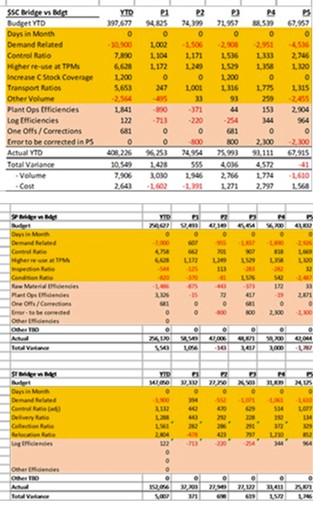
3343 Those input tables reveal that the drivers of US Pooled’s direct costs woes persisted. They also show that the November performance on direct costs was not a reasonable basis for confidence in the costs projections in the December Reforecast for US Pooled. For example, the main drivers of higher costs were:
(a) higher re-use at TPMs, costs which had plagued US Pooled since the beginning of FY17, had driven an additional $(1.3) million in direct costs and barely budged since the October results and the Moreno Report;
(b) an additional $(2.7) million attributable to an elevated control ratio - meaning more pallets than expected in the budget were being held in storage. In November FY17, this contributed to the highest over-budget direct cost of any single month YTD; and
(c) elevated transportation ratios drove $(1.3) million in above-budget direct costs, a figure of similar magnitude to the September results.
3344 The main drivers of the better direct costs performance in November were:
(a) “Demand Related” costs which referred to below-budget direct costs incurred due to shortfalls in sales revenue, which drove $4.5 million of under-budget direct costs in November;
(b) the correction of an $(2.3) million error included in the October results, which accounted for $2.3 million of under-budget direct costs in November; and
(c) a lower “Condition Ratio” (which was calculated as the number of pallets repaired divided by the number of pallets that were generated for repair) accounted for $2.5 million of under-budget directs costs in November. I assume this translated into “Other Volume” on the uppermost chart. Alonso deposed that this could be a consequence of business doing less repairs such that costs would be incurred later in the financial year, or the consequence of a falling damage rate meaning there were fewer repairs to do. Given the damage rate November YTD remained above-budget and it was going up in November, it is reasonable to infer that the lower condition ratio arose as a result of doing less repairs to save costs.
3345 Thus, the reduced direct costs miss to budget in November was not a cause for comfort, or confidence that the direct costs problems were behind US Pooled. The main drivers of above-budget direct costs that had been identified in the Moreno Report, such as higher levels of re-use at TPMs, an elevated control ratio, and elevated transportation ratios, all persisted. Two of the drivers, higher levels of re-use at TPMs and an elevated condition ratio, were directly related to the damage rate which was above-budget and going up. The drivers of lower direct costs were associated with under-budget demand and sales revenue in US Pooled (which was not good news), the correction of an accounting error, and a falling condition ratio (which likely signalled elevated repair costs later in FY17).
21.6 The US Pooled 5YP
3346 On 13 December 2016 Alonso and Nador had an instant message exchange in which, among other things, they discussed their view about O’Sullivan who had recently joined the business as CFO-Designate. Nador described her as “very pragmatic and sensible” and said that she “listened a lot”. Alonso said that O’Sullivan was “clever too” and “quick to understand things.” Then, they had the following exchange:
Nador: And she understands that the 5YP for the US is inflated beyond what is possible.
Alonso: Yes, it’s unreachable.
Nador: She looked at the charts and asked how it had arrived at this.
Alonso: With a P&L that’s so cleaned up it doesn’t make sense to put it at the stretch level.
3347 In cross-examination, Alonso accepted that the US Pooled 5YP was “impossible” and “unreasonable over the five-year period”. He said that his reference to “stretch” was a reference to CHEP Global and, in effect, that he did not consider it was prudent to “put that much stretch on CHEP overall” and it was better to leave some room “to compensate for the other business units that are not delivering as expected.”
21.7 CHEP Global December Reforecast
3348 Between November and December 2016, CHEP Global undertook the second quarterly reforecast for FY17 (December Reforecast). The key dates for the December Reforecast were as follows:
(a) 2 December 2016: All CHEP CBUs other than CHEP NA to submit their Initial December Reforecast Submission into BRACS;
(b) 9 December 2016: CHEP NA to submit its initial reforecast submission into BRACS. Kennett and Rumph agreed that it was safer for CHEP NA to use the November results as the base for its reforecast submission and it was permitted to hold off until 9 December 2016 to give the business sufficient time to close off November and analyse its forecast before loading its reforecast submission into BRACS;
(c) 15 December 2016: Reforecast review meetings between CHEP Global management and CBU management; and
(d) 16 December 2016: Revised reforecast submissions were loaded into BRACS subject to any outcomes from the 15 December 2016 review.
Up to 25 November 2016, there were two interrelated processes occurring within CHEP Global, the preparation of the CHEP Global Recovery Plan, and the preparation of the December Reforecast submissions by the CHEP CBUs.
3349 On 2 December 2016, all CBUs except CHEP NA submitted their initial forecasts in BRACS. Kennett reviewed the initial forecasts soon after the CBUs submitted them.
3350 I have previously set out the relevant evidence in relation to the projected overperformance by CHEP LATAM and CHEP Europe. The December Reforecast projected that CHEP LATAM and CHEP Europe would overperform in Underlying Profit against budget by $7.3 million and $6.9 million respectively in 2H17. That projected approximately $14 million in Underlying Profit overperformance was significant to the projected recovery by CHEP Global from its actual $28 million Underlying Profit deficit to budget YTD to be just under-budget (by $(2.6) million) for the full-year.
3351 Between 2 December 2016 and 9 December 2016, US Pooled developed its December Reforecast submission. Weaker pallet volumes in the final two weeks of November contributed to US Pooled reducing volumes in the draft December Reforecast by 400,000 issues on the request of Nador, who was of the view that it was unlikely those issues would be recovered in the balance of the month. As previously explained, on 4 December 2016 Nador informed Rumph that the data in a review by Martin and Bachtell suggested that US Pooled was “probably” an extra 600,000 pallet issues down versus the assessment in the most recent MBR. Nador told Rumph that if account were taken of that additional shortfall, the forecast for US Pooled would be a $(13) million Underlying Profit shortfall to budget for FY17. And as it eventuated, in the November results, there was even greater underperformance against budget in issue volume. The results recorded 965,000 fewer pallets issued than projected in the Group September Reforecast, and 1.1 million fewer than assumed in the CHEP NA budget.
3352 On 6 December 2016 US Pooled completed a first draft of its Initial December Reforecast Submission. Linderman circulated a “strawman” draft which produced an estimated $(16.2) million Underlying Profit shortfall to budget. Nador deposed that her view at that time was that this draft reforecast overestimated costs by at least $(3) million, and she told Young that she wanted to include a list of the costs saving initiatives that US Pooled was “counting on delivering” in order to “make our numbers”. She asked her team to review cost items and resubmit the draft Initial December Reforecast Submission.
3353 On 8 December 2016, Nador emailed her team upon receipt of the draft US Pooled November Close Deck. There, she instructed her team (including Martin, Linderman, and Young) to make the US Pooled Initial December Reforecast Submission on the basis of the following “Revenue High Level Assumptions”:
• We assume we will recover 1.3M issues from the GAP YTD to [November] in the second half, and that includes winning all of the deals listed in [Bachtell’s] slide with that timeline plus the notes at the bottom of the slide. (The delay to after the holiday makes it very unlikely to be able to recovery to be able to recover full gap). This requires xx% growth in H2, to get to the 6.2% for FYE.
• We assume full delivery of half pallet budget (based on positive signals from WM trial and expansion)
• We include pricing actions starting to deliver Jan 1st and full implementation of SCD surcharges at agreed Ds
• We assume successful delivery of the additional volume from LATAM (interregional flows). Otherwise this will be a risk
3354 It should be recalled that on the same day that Nador provided those assumptions, Rumph flagged with O’Sullivan that the Initial December Reforecast Submission for CHEP NA would project that CHEP NA would have a $(16.7) million Underlying Profit shortfall to budget for FY17.
3355 On 14 December 2016 Scaiff forwarded to Kennett an email from Holzman which attached two slides, the first of which explained the projected timing of US Pooled sales demand growth and the key customers underpinning that growth. The key customers were set out on that slide, as below. I have previously called this document the Holzman December Demand Forecast.
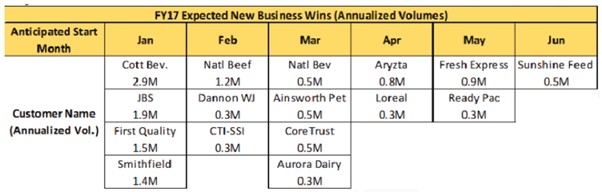
3356 Kennett deposed that he it thought it was important and helpful to see these key customer win expectations by month. He made a rough estimate for the impact of these customers in terms of revenue delivery by taking the volumes for each month and multiplying them by the $5.00 proxy for RPI to determine an annualised revenue, and then using that equivalent revenue for the remainder of the year (e.g., if the account closed in January, the assumption was 6 months). By that route, he calculated that these key customers alone would deliver new wins of approximately $28 million in 2H17 and he calculated that these key customers comprised approximately 61% of the projected $46 million in net new wins in 2H17. Kennett concluded that that helped support the projected sales growth increase in 2H17.
3357 On 14 December 2016, US Pooled produced its December Reforecast submission. Brambles produced tables comparing the key outputs of the US Pooled December Reforecast submission with the US Pooled Revised September Reforecast and budget which I have integrated into one table below:
($US million) | US Pooled FY17 Budget | US Pooled September Reforecast | US Pooled December Reforecast |
Sales revenue | 1,616 | 1,617.2 | 1,603.8 |
RPI ($/unit) | 5.30 | 5.30 | 5.29 |
Damage rate | 59.3% | 59.4% | 59.6% |
Control ratio | 96.3% | 96.4% | 96.6% |
Direct costs | (1091.7) | (1097.1) | (1099.3) |
Overheads | (126.2) | (125.4) | (122.6) |
Underlying Profit | 363.5 | 363.5 | 351.7 |
Capex | (322.3) | (331.1) | (343.4) |
3358 The US Pooled December Reforecast Submission:
(a) forecast Underlying Profit of $351.7 million, which represented revenue growth of 6.2% and Underlying Profit growth of 11.3%. In relation to the FY17 budget, however, Underlying Profit was $(11.8) million below-budget. This represented a significant improvement over the $(16.2) million Underlying Profit shortfall in Linderman’s draft submission, which was reduced by US Pooled management through a projected reduction in costs and overheads;
(b) represented revenue growth of $93 million (+6.2%) which was $(12.2) million unfavourable to budget. The miss was driven by 1.6 million fewer issues, which was $(8.5) million unfavourable to budget;
(c) assumed that US Pooled would recover 1.0 million pallets of the 2.6 million YTD gap in the second half of the financial year, which included winning all of the key customer deals listed in the presentation, including Cott Beverages, JBS, First Quality and Smithfield in January 2017;
(d) said that total opportunities in the current US Pooled sales funnel represented ~$31 million in annualised volume. The total volume pa of the opportunities in the sales funnel expected to close in 2H17 was ~$21-22 million, with another ~$9-10 million in the longer-term sales funnel;
(e) said that the delay in new wins as well as the pending holiday period made it unlikely that the YTD gap to budget in new wins would be closed; and
(f) said that US Pooled was holding the damage rate to budget despite the H1 forecast, and the control ratio was roughly flat for the year. New pallet purchases were forecasted to remain flat to budget, even with lower issues, driven by reduction in inflows and the timing of new wins.
3359 The forecast $(11.8) million Underlying Profit shortfall to budget in US Pooled for the full-year was made up of:
(a) a $(26.8) million Underlying Profit shortfall to budget in 1H17. Following the November results, US Pooled had an actual $(30.2) million Underlying Profit shortfall to budget YTD, so the reforecast submission required that US Pooled outperform budget by $3.4 million in Underlying Profit in December; and
(b) a clawback from the forecast $(26.8) million Underlying Profit shortfall to budget as at 31 December 2016, by $15 million in Underlying Profit overperformance against budget in 2H17.
3360 On 15 December 2016, Linderman emailed a presentation for the Leadership Review Meeting in relation to the US Pooled December Reforecast to Rumph, Hill, Nador, Martin, Young (copied to Bachtell, Holzman and another) titled “CHEP Pallets, US Pooled FY17 December Reforecast Review Meeting Updates” dated 15 December 2016 which I will call the December Reforecast Review Meeting Presentation.
3361 The presentation started by reviewing the key financial data for US Pooled for the month of November and November YTD, including US Pooled performance against the September Reforecast and against budget. Then, the presentation reviewed the December Reforecast in respect of US Pooled over a series of slides.
3362 A slide titled “Revenue High Level Summary” said that the December Reforecast:
(a) represented revenue growth of $93 million (being 6.2% growth for the year), which was $(12.2) million under-budget. It said that the miss to budget was driven by:
(i) 1.6 million fewer pallet issues (which was $(8.5) million under-budget); and
(ii) in addition, $3.6 million under-budget in rate/mix, primarily driven by P-Day decreases for variable-rate customers against budget; and
(b) was based on the following four assumptions underpinning the revenue projections (which closely followed Nador’s email referred to above).
3363 First, an assumption that US Pooled would recover 1 million pallet issues of the 2.6 million sales volume gap YTD in 2H17, which included winning all of the sales deals listed in the following slide (reproduced below), which was drawn from the Holzman December Demand Forecast.
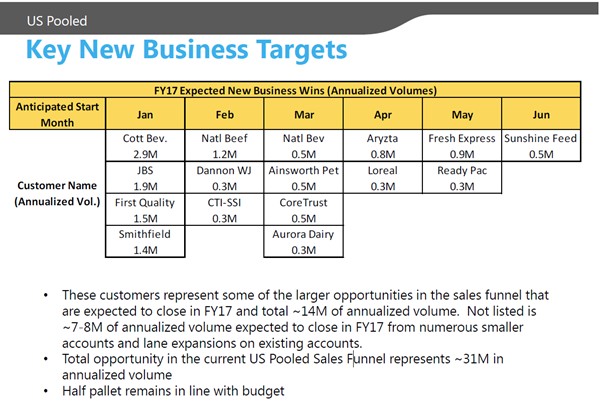
3364 The reforecast accepted that the delay in new wins, as well as the pending holiday period, made it unlikely that the sales volume gap YTD would be closed. The presentation noted that achieving that outcome required 8.1% revenue growth in 2H17, to get to 6.2% revenue growth for the full-year.
3365 Kennett estimated, and I accept, that based upon a $5.00 per issue estimate for RPI, these key customers would deliver new wins worth approximately $28 million for the remainder of the year (e.g., if January, the assumption was 6 months). He estimated and I accept that these key customers amounted to approximately 61% of the reforecast $46 million growth in net new wins in 2H17. Martin’s evidence was that the under-budget sales volume was not attributable to lost business or failed attempts to win business, but rather to potential new deals moving through the pipeline slowly. For that reason, he said that he was comfortable that US Pooled had good prospects of closing the gap to budget in the coming months.
3366 Second, an assumption that there would be full delivery of the “half pallet budget” (300,000 pallet issues) based on positive signals from the Walmart trial and expansion.
3367 Third, an assumption that all pricing actions (i.e., increased charges) would begin on 1 January 2017 “and full implementation of SCD upcharges to [small and medium enterprises], Nestlé, Pepsi, Contingencies etc”. (An SCD is a Semi-Cooperating Distributor, being a Non-Participating Distributor (NPD) with a flow-through ratio (the volume of pallets flowing to a distributor compared with the volume recovered from that distributor) of 70% or higher.) The reference to “SCD upcharges” was a reference to additional compensatory charges to cover the costs to US Pooled of recovering pallets, including the increased damage rate and the rate of lost pallets.
3368 Fourth, an assumption that US Pooled would receive successful delivery of interregional flows from CHEP LATAM, notwithstanding that “this area is still at risk”.
3369 In relation to supply chain costs, the presentation stated that the December Reforecast for US Pooled:
(a) held damage rate to budget despite the 1H17 forecast, and the damage rate forecast was “not seasonally adjusted for surge”. That was an acknowledgement that the damage rate projections in the December Reforecast did not take into account the usual seasonal increase in the damage rate in November and December. Instead, and like the budget and September Reforecast which preceded it, the December Reforecast projected a steady decline in the damage rate over the course of FY17;
(b) projected a control ratio roughly flat for the year. It said that the control ratio from February to June 2017 was forecast to be approximately 92.3%, which was ~2.0+ pps lower than any year back to FY13 in the same time period; and
(c) projected that the December Reforecast for US Pooled was $(11.7) million unfavourable to budget for the full-year.
3370 The presentation included an R&O schedule of risks and opportunities to Underlying Profit excluded from the December Reforecast. The excluded risks included:
(a) a risk that the damage rate would not reduce from that date, quantified at $(10) million;
(b) a risk to sales volume (2.5 million pallet issues) that there would be a further delay in sales deals or some deals were lost, quantified at $(5) million; and
(c) a risk of higher levels of pallet re-use at TPMs, quantified at $(1) million.
The total risks to Underlying Profit excluded from the December Reforecast outweighed the total opportunities excluded from the reforecast by $(23.3) million.
3371 On 15 December 2016, CHEP NA produced its Initial December Reforecast Submission which projected Underlying Profit of $442.4 million, which represented a $(16.6) million Underlying Profit shortfall to budget and to the Group September Reforecast for the full-year. The submission projected that CHEP NA would have a $(33.1) million Underlying Profit deficit to budget in 1H17, but would recover by $16.5 million Underlying Profit overperformance against budget in 2H17. As a result, CHEP NA would have a $(16.7) million deficit to budget for the full-year which matched the downgrade Rumph flagged in her 8 December 2016 email.
3372 On 8 December 2016, prior to receipt of the CHEP NA December Reforecast Submission, Scaiff circulated an email attaching a breakdown of the Initial December Reforecast Submissions from the other CHEP CBUs. Those submissions, extracted below, were consistent with the CHEP Global Recovery Plan in that CHEP Europe and CHEP LATAM were together projected to be approximately $14 million above-budget in Underlying Profit for the full-year.
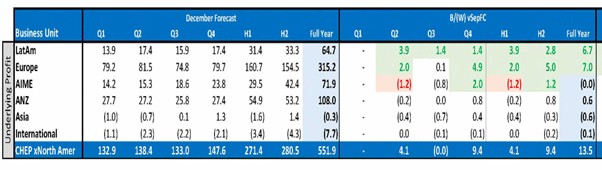
3373 Kennett deposed that, on or around 8 December 2016, his thinking was that:
…everything looked in-line with expectations except for International, which should have been $1m better than both budget and prior forecast, because I was expecting the total improvement versus budget to be $14.6m (rather than $13.6m) for these combined business units. Nonetheless, my confidence in the achievability of the CHEP Global budget overall remained strong, because the expected shortfall in CHEP [NA] would be offset by the strong and sustained performance trend in CHEP LATAM and CHEP Europe.
(Emphasis added.)
3374 Kennett justified his confidence in the projected CHEP LATAM and CHEP Europe Underlying Profit overperformance in the December Reforecast in part on the basis that, in his experience, the teams in CHEP LATAM and CHEP Europe attempted to underestimate their outlook, or ‘sandbag’, their budgets and forecasts in order to make their budget more achievable or even overachieve it. Having regard to that and to the YTD performance of those two businesses, he deposed that, as at 13 December 2016, he considered it was likely that both businesses would outperform their budgets for the full-year in line with the CHEP Global Recovery Plan and the December Reforecast projections.
3375 On 13 December 2016, CHEP Global produced a draft December Reforecast (13 December Reforecast) which projected that sales revenue would grow 7.1% in 2H17 compared to 3.8% in 1H17. Kennett gave evidence that the strong 2H17 growth in the 13 December Reforecast was achievable and consistent with his experience, but “represented a challenge for the business”.
3376 After the finalisation of the CHEP NA December Reforecast submission, on 15 and 16 December 2016, Kennett, Mackie and Alonso held reviews of the submissions with management of each of the CHEP CBUs.
3377 Kennett deposed that on 16 December 2016, he received an email from Limpanatevin (copied to Scaiff) attaching the CHEP Global R&O analysis for the December Reforecast (16 December CHEP Global R&O Analysis). The R&O analysis was a spreadsheet that contained three tabs:
(a) a risk-adjusted table showing the risks and opportunities in volume and price (after accounting for sales and direct costs), direct cost efficiencies and indirect costs for each CHEP Global CBU (with CHEP NA also broken down into US Pooled, CHEP Recycled and CHEP Canada);
(b) a tab titled ‘detail’, containing a more detailed breakdown of the risks and opportunities contained in the R&O table (contained in the first tab); and
(c) a ‘tornado’ chart, showing the risk-adjusted R&Os per CBU in a diagrammatic form, with the risk-adjusted R&O per CBU including, relevantly in CHEP NA: risk of $(19) million and opportunity of $11 million, with net risk of $(8) million. That analysis assumed a net risk to CHEP Global Underlying Profit of $(9.7) million which included a risk allocated to the US Pooled damage rate of $(5) million.
3378 On 16 December 2016, CHEP Global produced its December Reforecast Submission. Kennett deposed that because the review meeting with O’Sullivan regarding the CHEP Global December Reforecast Submission was scheduled to occur directly after the November CFO BPR meeting on 19 December 2016, the presentation of the CHEP Global December Reforecast Submission was included in the CFO BPR Presentation.
3379 The CHEP Global FP&A team prepared a presentation titled “CHEP Global Pallets November FY17 CEO BPR” dated 19 December 2016 (November CFO BPR Presentation) which included the CHEP Global December Reforecast Presentation. Kennett reviewed and approved the presentation and Scaiff emailed the November CFO BPR Presentation to O’Sullivan, Callaway, Ford, Kennett, Patel and others.
3380 The November CFO BPR Presentation showed that, YTD:
(a) US Pooled was $(21) million under-budget in sales revenue and $(30) million under-budget in Underlying Profit. It stated that US Pooled direct costs were up $(27.6) million from FY16 made up of a higher control ratio ($(7) million), transportation ratio ($(8) million) and higher pallet re-use at TPMs ($(5) million) which had driven $(20) million of non-demand related expense;
(b) CHEP NA was $(41) million under-budget in sales revenue and $(35) million under-budget in Underlying Profit; and
(c) CHEP Global was $(31) million under-budget in sales revenue, and $(28) million under-budget in Underlying Profit.
3381 Then the CHEP Global December Reforecast Presentation projected that:
(a) CHEP Global would be “slightly below budget” in Underlying Profit for FY17 ($(2.6) million) under-budget and under the September Reforecast for the full-year, representing year-on-year growth of 7.8%;
(b) sales revenue would be $(53) million under-budget and $(27) million under the September Reforecast, representing year-on-year growth of 5.5%;
(c) sales and Underlying Profit growth would have a pronounced 2H17 weighting with year-on-year:
(i) sales growth of 3.8% in 1H17 and 7.1% in 2H17; and
(ii) Underlying Profit growth of 1.8% in 1H17 and 13.4% in 2H17;
(d) to achieve the projected Underlying Profit:
(i) CHEP NA would recover its $(35) million Underlying Profit shortfall to budget YTD to a $(17) million deficit for the full-year, which was forecast to occur by “delivering significant New Business in H2 & improved direct costs”. That was described as carrying a net risk of $(15) million (mostly sales pipeline delivery and control of direct costs in US Pooled) but also including a $(5) million risk in relation to the damage rate;
(ii) CHEP LATAM and CHEP Europe would overperform against budget in Underlying Profit by $7.3 million and $6.9 million respectively for the full-year (which was broadly consistent with the CHEP Global Recovery Plan); and
(iii) CHEP AIME and CHEP APAC would meet budget;
(e) CHEP International would have a $(0.2) million Underlying Profit shortfall to budget (which was not consistent with the CHEP Global Recovery Plan); and
(f) the improvement in 2H17 would be driven by “new business wins - little change forecasted in price and organic growth in the remainder of the year”.
3382 The executive summary of the CHEP Global December Reforecast Presentation in the November CFO BPR Presentation stated, in terms, that delivery of the US Pooled recovery plan was ‘key’ to the projected recovery by CHEP Global. Kennett confirmed that in his evidence. He deposed that “the recovery plans for US Pooled were key, with CHEP North America working on recovery actions to reduce its year-to-date ULP deficit from $35m to $17m”.
3383 The CHEP Global December Reforecast Presentation included the following figures, which I have tabulated below to show the projected sales revenue and Underlying Profit deviation from budget for 1H17, 2H17, and the full-year.
CHEP Global December Reforecast (vs Budget) | ||||||
Sales revenue | Underlying Profit | |||||
($US million) | 1H | 2H | FY17 | 1H | 2H | FY17 |
US Pooled | (20) | 8 | (12) | (27.0) | 15.2 | (11.8) |
CHEP NA | (45) | (24) | (70) | (33.1) | 16.5 | (16.6) |
LATAM | 5 | 5 | 9 | 4.5 | 2.2 | 6.7 |
Europe | 13 | 4 | 18 | 5.8 | 1.1 | 6.9 |
AIME | (6) | 0 | (6) | (3.5) | 3.5 | 0 |
APAC | (2) | (2) | (4) | (1) | 1.5 | 0.5 |
CHEP Global | (35) | (18) | (53) | (26.9) | 24.3 | (2.6) |
3384 US Pooled, CHEP NA, and CHEP Global had each missed the Group September Reforecast, and then the December Reforecast only projected a deeper ‘hockey-stick’ recovery in Underlying Profit compared to the Group September Reforecast and the FY17 budget.
3385 Unlike the September Reforecast, the December Reforecast for CHEP Global downgraded the projected US Pooled and CHEP NA Underlying Profit for the full-year, but at the CHEP Global level the downgrade was minimal. That was because the December Reforecast projected that the Underlying Profit deficit to budget in US Pooled and CHEP NA for the full-year would be offset by overperformance against budget in CHEP LATAM and CHEP Europe.
21.8 Group December Reforecast
3386 Following finalisation of the CHEP Global December Reforecast, on 16 December 2016 Ford circulated the following ‘preliminary flash’ of Brambles’ Group December Reforecast.
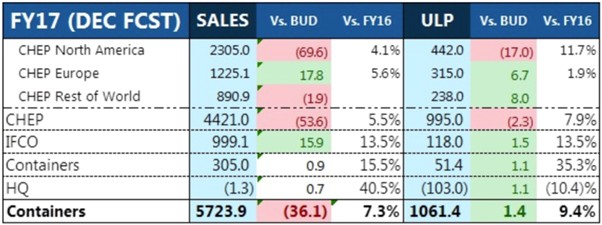
The description “Containers” in the last line was a mistake. It should have said “Group”.
3387 The Group December Reforecast projected that the Group would:
(a) have a $36.1 million sales revenue deficit to budget for the full-year representing year-on-year sales revenue growth of 7.3%. That was projected to be almost entirely driven by a $(53.6) million sales revenue deficit to budget in CHEP Global, partially offset by $15.9 million in sales revenue overperformance by IFCO; and
(b) be $1.4 million over-budget in Underlying Profit for the full-year, representing year-on-year Underlying Profit growth of 9.4%. That was projected to be driven by CHEP NA clawing back to a $(17.0) million Underlying Profit deficit to budget offset by overperformance against budget in CHEP Europe ($6.7 million) and CHEP Rest of World ($8 million, most of which I infer was projected to come from CHEP LATAM), and slight overperformance against budget in IFCO, Containers and HQ.
3388 At this point in time, Gorman continued to believe that Brambles would meet the FY17 Guidance. On 16 December 2016 he emailed Chipchase, and relevantly said:
FY17 Forecast: Although the team will finalize the details early next week, based on the data we have received, I expect the FY17 Forecast to be finalized in line with the prior Forecast and within market guidance.
3389 Chipchase’s email response the same day (copy to O’Sullivan) was clear in stating that he was not comfortable in forecasting on the basis that “everything miraculously comes good” in 2H17. I infer that Chipchase was seriously sceptical that the Group could meet the FY17 Guidance. He said:
Based on the YTD shortfall I am surprised that the business expects to maintain forecast. What one-off credits are you assuming in H2, as clearly they will impact our ability to improve FY18 over FY17? Also, to what extent are you counting on new business wins in the US pallets business, and when will we know for sure we have won the business?
I am not at all comfortable assuming everything miraculously comes good in H2 then finding that heroic assumptions have been made so that we disappoint the market in April/May….. far better to fix in Jan/Feb.
(Emphasis added.)
3390 Gorman replied on 16 December 2016 (copied to O’Sullivan), and attempted to assuage Chipchase’s concerns about the projected 2H17 CHEP NA recovery and the achievability of the FY17 Guidance:
Graham, all good questions and we are aligned on your concerns. We will be going through the forecast in much more detail next week and will address risks/opportunities and the 2H[17] roadmap as part of these reviews.
It is not my intent to leave in February with a forecast that is not deliverable and, of course, the outlook we provide in February will be your call. The issues are all in the pallets business and, more specifically, in the US. Right now we have a management forecast that gets us home on a full-year basis. We will benefit from 2 1/2 months of additional performance before the earnings release in February 20 and will continue to monitor all metrics, especially new wins and US cost performance, closely.
I believe [O’Sullivan] is on top of this as well and she went through quite a bit of detail in Madrid and Atlanta
(Emphasis added.)
3391 On 17 December 2016, O’Sullivan forwarded Gorman’s response to her team (Marshall and Ford) and said:
Please do not forward. Given h2 upswing in forecast we need to ensure we cover key assumptions & risks. That will be a key part of discussion. I will note that businesses do appear confident they can deliver - however we should further pressure test US pallets - hard to judge if they are being overly optimistic.
…
Specifically we need to cover key components of material step up in US pallets performance. I gather key components to h2 are net new wins and damage rate improvements. We need to also look for January indicators for key assumptions.
(Emphasis added.)
3392 On 19 December 2016, Kennett emailed two slides (reproduced below)comprising an updated CHEP Global R&O analysis to O’Sullivan and Mackie (19 December CHEP Global R&O Analysis). In the covering email, he noted a net risk to CHEP Global Underlying Profit in 2H17 of $(15) million, the bulk of which he said was in US Pooled. The second slide captured the magnitude of the net risks to Underlying Profit in CHEP NA compared to the risk in other CHEP CBUs.
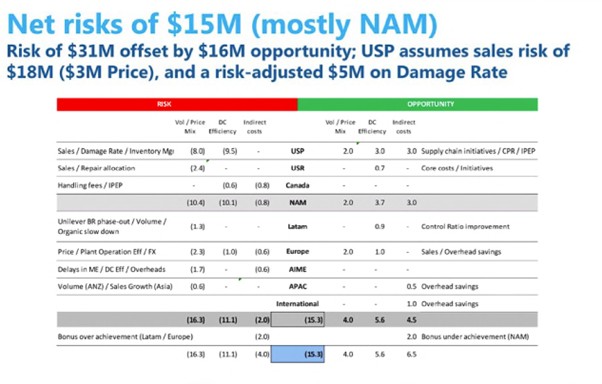
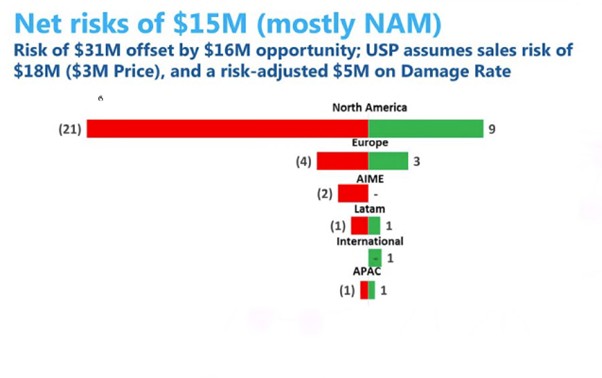
3393 In that email Kennett also outlined the main drivers of the projected CHEP Global recovery in 2H17. He said:
In essence, the main story of the second half is 5 items, but I have also tried to show these in a 1 pager (attached), that I can take you through.
Obviously we need to dig into much more detail for H1 comps, but I wanted to give you the main drivers for the significant improved performance that we see in the second half.
In H1 our ULP will grow only $8M (1.8%) versus H1 LY, while in H2 we will grow $64M (13.4%) - the movement between these two is $56M and $53M of this is explained by the following:
- Delivery of new wins in USP pipeline ($18M);
- Damage rate improvement ($8M);
- Fuel benefit coming through in USP ($8M);
- Depreciation in USP ($6M);
- US Recycled deliver $6M profit in H2 (making a comp versus F16 of $12M because of all the one-time costs last year H2).
3394 There, Kennett identified five main drivers of the remarkable 13.4% projected growth in CHEP Global Underlying Profit in 2H17 compared to 2H16, being:
(a) delivery of new wins in US Pooled pipeline ($18 million);
(b) damage rate improvement in US Pooled ($8 million);
(c) fuel benefit coming through in US Pooled ($8 million);
(d) depreciation in US Pooled ($6 million); and
(e) US Recycled delivering $6 million in Underlying Profit in 2H17.
That showed that four out of the five main drivers of the projected CHEP Global recovery were based on US Pooled performance. The fifth of the five main drivers was based on another division of CHEP NA.
3395 It is important to understand that the delivery of $18 million in US Pooled new wins to which Kennett referred was not a reference to revenue. It was a reference to Underlying Profit derived from new wins. In cross-examination, Kennett accepted that to achieve $18 million of Underlying Profit from new wins US Pooled would have to achieve approximately $90 million in sales revenue growth from new wins. Kennett denied that that was completely unachievable.
3396 Kennett deposed that the purpose of the 19 December CHEP Global R&O Analysis was to provide an additional lens and overlay to the December Reforecast review so that during the December Reforecast review scheduled to occur with O’Sullivan, there would be an opportunity for a transparent and frank discussion about the reforecast and its achievability. He said that based on that analysis, he considered that $(15) million net risk to CHEP Global Underlying Profit was an appropriate weighted level of net risk, having regard to the risks and opportunities across the business, and the possibility of each R&O coming to fruition.
3397 On 20 December 2016 Kennett emailed a presentation titled “CHEP Global Pallets November FY17 CEO BPR” dated 19 December 2016 (November CEO BPR Presentation) to Gorman, O’Sullivan, Mackie, Alonso (copied to Marshall, Callaway, Ford and Scaiff) for the November CEO BPR meeting that day. That presentation was materially the same as the November CFO BPR Presentation circulated by Scaiff on 16 December 2016, and it included the same CHEP Global December Reforecast Presentation.
3398 In his covering email Kennett noted that the December Reforecast was “heavily reliant on US Pooled delivering on the new business in H2”. The executive summary in the presentation regarding the CHEP Global December Reforecast stated:
Recovery plans put in place by CBUs will bring us close to budget on ULP for the full year:
• [CHEP NA] will reduce current YTD ULP deficit from $35M to $17M; delivering significant New Business in H2 & improved direct costs
• Europe & Latam each deliver $7M additional ULP (mainly run-rate);
• AIME & APAC already challenged but will deliver on plan;
• Net Risk of $15M (mostly sales pipeline delivery & control of direct costs in [US Pooled], but also includes $5M for [damage rate])
(Emphasis in original.)
3399 Upon receiving the November CEO BPR Presentation Alonso forwarded it to Fernando Rodriguez (Vice President, Process Development, CHEP Global Supply Chain). Rodriguez replied by querying Alonso as to whether he believed the 2H17 December Reforecast for US Pooled, to which Alonso responded:
No, no way in hell. I think we’re going to fail in the US by an extra $10m, but I also think that [US Recycled] is conservative.
(Emphasis added.)
3400 Brambles produced the following table, which compared the forecasts in the FY17 budget, September Reforecast, and December Reforecast. I have divided into table into three sections in the interests of readability.
US Pooled | |||
($US million) | Budget | September Reforecast | December Reforecast |
Revenue ($M) | 1,616 | 1,617.2 | 1,603.8 |
RPI ($/unit) | 5.30 | 5.30 | 5.29 |
Damage rate | 59.3% | 59.4% | 59.6% |
Control ratio | 96.3% | 96.4% | 96.6% |
Direct costs ($M) | (1,019.7) | (1,097.1) | (1,099.3) |
Overheads ($M) | (126.2) | (125.4) | (122.6) |
Underlying Profit ($M) | 363.5 | 363.5 | 351.7 |
Capex ($M) | (322.3) | (331.1) | (343.4) |
CHEP Global | |||
($US million) | Budget | September Reforecast | December Reforecast |
Revenue ($M) | 4,474.6 | 4,447.8 | 4,421.3 |
RPI ($/unit) | - | - | - |
Damage rate | - | - | - |
Control ratio | - | - | - |
Direct costs ($M) | (2,846.8) | (2,825.7) | (2,804.0) |
Overheads ($M) | (549.6) | (548.1) | (544.4) |
Underlying Profit ($M) | 997.3 | 997.3 | 994.7 |
Capex ($M) | (850.4) | (829.4) | (868.9) |
Brambles | |||
($US million) | Budget | September Reforecast | December Reforecast |
Revenue ($M) | 5,848 | 5,745 | 5,723 |
RPI ($/unit) | - | - | - |
Damage rate | - | - | - |
Control ratio | - | - | - |
Direct costs ($M) | (3,888) | - | (3,783) |
Overheads ($M) | (843) | - | (801) |
Underlying Profit ($M) | 1,061 | 1,060 | 1,060 |
Capex ($M) | (1,214) | - | (1,169) |
21.9 The December Board Meeting
3401 On 21 December 2016, Brambles held its December Board Meeting via teleconference. The papers circulated prior to the meeting included the November Financial Update which contained the most up-to-date YTD results, correct as at 19 December 2016.
3402 The minutes of the December Board meeting record that O’Sullivan presented the preliminary financial results for November and FY17 YTD and the FY17 half and full-year forecasts for the Group and each business unit. This was O’Sullivan’s first Board meeting as CFO. The minutes record, and I accept, that O’Sullivan reported that YTD, the Group had sales growth of 6% and Underlying Profit growth of 10% for continuing operations on a days-adjusted basis; she reviewed the preliminary December Reforecast which showed the November results and noted sales growth of 6% and Underlying Profit growth of 7% which was lower than expected and principally due to challenges in US Pooled. She outlined the December Reforecast which showed the Group meeting its FY17 Guidance to the market and noted that the biggest challenge for the balance of FY17 related to US Pooled. She reviewed the issues facing US Pooled which principally related to its sales pipeline, competitive pressure, and lower whitewood prices.
3403 The minutes record that Gorman then told the Board that the December Reforecast:
… had been prepared by the business units and was, therefore a “bottom up forecast”. He confirmed management was confident that the forecast would be achieved. He noted that many of the challenges facing the Pallets USA business were “one-offs” and he outlined the steps which were being taken to initiate a recovery plan for that business.
(Emphasis added.)
3404 The minutes record that Gerrard reviewed Brambles’ continuous disclosure obligations in the context of the December Reforecast. He outlined the factors relevant to that issue (including those set out in ASX Guidance Note 8) and concluded that no disclosure obligation had arisen to date. The minutes record that the Board:
…reviewed and discussed in detail the Group’s financial results and its disclosure obligations. The Board noted that whilst no disclosure obligation had currently arisen, once the November 2016 results analysis had been completed and the December 2016 results have been reviewed and analysed, there would be a clearer view of the forecast FY17 half and full-year results. The Board requested management to keep it informed of any developments in the November and December 2016 results so that it would be in a position to determine whether it would be appropriate to issue a revised earnings forecast with the ASX prior to the scheduled announcement date of the FY17 half-year results. Mr Gorman reported that management should be in a position to provide that information at its scheduled January 2017 Board call.
3405 The November Financial Update included the following slide, which summarised the YTD results, in addition to YTG and full-year projections as per the December Reforecast. The “Full Year” column showed projected Group sales revenue growth of 7.3% for the full-year (which was marginally above the bottom end of the FY17 Guidance range), and projected Group Underlying Profit growth of 8.9% (marginally below the bottom end of the FY17 Guidance range). The “Year to Date” column showed that to that point Brambles had achieved 5.9% sales growth on FY16, and 9.5% Underlying Profit growth on FY16 on a days-adjusted basis.
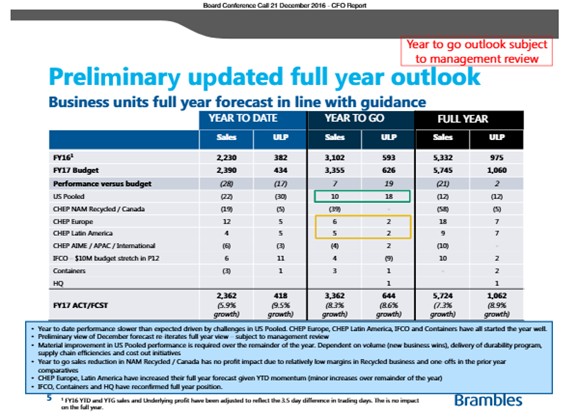
3406 As the applicants submitted, the evidence does not include a version of the Group FY17 budget broken down by month, or a description of the assumed monthly Underlying Profit growth rates in FY17. The applicants, however, sought to calculate the rate of growth that it was assumed in the budget Brambles would achieve by a particular point in the year from the data in the Financial Updates. The applicants referred to the November Financial Update presented to the December Board Meeting which reported that, to the end of November, Brambles’ continuing operations had:
(a) earned Underlying Profit of $417 million, which was $(17) million below-budget. The applicants said that meant that the Group budget must have assumed that its YTD Underlying Profit to the end of November would be $434 million ($417 + 17);
(b) experienced Underlying Profit growth, on a non-days-adjusted basis of 13%, which meant that Brambles must have to the same point in the previous financial year earned Underlying Profit of approximately $369 million ($417 - (417/1.13)).
3407 On that basis the applicants submitted that Group FY17 budget must therefore have assumed that, to the end of November 2016, its Underlying Profit growth compared with the prior corresponding period on a non-days-adjusted basis would have been approximately 17.6% (being the difference between $434 million and $369 million (namely $65 million), expressed as a percentage of $369 million).
3408 Thus, the rate of Underlying Profit growth shown in the November Financial Update was well below the rate of growth assumed in the budget. That goes some way to explaining how, for Underlying Profit YTD, Brambles had achieved an Underlying Profit growth rate of 9.5% YTD but was under-budget in Underlying Profit by $(17) million.
21.9.1 Brambles’ lay evidence regarding Board Meeting
Long
3409 Again, in my view Long had only a limited recollection of what took place at the December Board Meeting, and his evidence in relation to the meeting was largely a reconstruction from the Board pack and the minutes of the meeting.
3410 His evidence followed the same format as his evidence in relation to the earlier Board meetings, and his poor recollection of the meeting can be seen in his affidavit and in parts of his oral testimony. He deposed that:
(a) as the minutes record and as was usual practice, O’Sullivan presented the November Financial Update to the meeting and noted the November results by reference to the October Financial Update. His evidence was as to the results in that document, not as to what he recalled O’Sullivan telling the Board;
(b) the CHEP Global results for November showed an improvement from September and October, with CHEP Global Underlying Profit ahead of reforecast by $1 million for the month and CHEP Americas (including US Pooled) $(1) million under-reforecast for the month. He said that conveyed to him that at this time there was no reason to believe that Brambles would not meet its FY17 Guidance in all material respects, although in all the circumstances close monitoring was appropriate; and
(c) he thought the Board’s request to be kept abreast of developments was “key” because while he formed the view that there was no obligation to revise the FY17 Guidance (as did the rest of the Board), he wanted to reassess the position in light of the December results, which would provide a clearer view of the 1H17 outcome and the achievability of the December Reforecast;
(d) he had only “general recollections” of the December Board Meeting and could not recall the specific details of the conversations held. Nor could he recall the specific “one off challenges” that were said to be facing US Pooled. But he said that he did recall Gorman saying that US Pooled management was aware of what was needed to be done in order to deliver the 2H17 improvement required to meet the FY17 Guidance and that it was achievable; and
(e) his view at that point in time was that the results for the Group had not yet reached a tipping point, particularly in light of the stronger November results. He recalled that Gorman and O’Sullivan told the Board, while they were considering the December results, they needed to keep the Board informed because it needed to know whether there were any material developments arising from the results which would or could impact the full-year projections.
3411 Long’s poor recollection of the December Board Meeting can also be seen in the fact that he did not have “specific details” of whether the Board discussion included the underperformance in US Pooled direct costs, although he had a “general recollection” that was one of the challenges raised and discussed. He could not recall the specific “one-off” challenges facing US Pooled to which Gorman referred, and he could not recall Chipchase actively participating in the discussions at the Board meeting and pressing for a downgrade to the FY17 Guidance when I am satisfied by other evidence that that occurred.
3412 Again, I have no difficulty in accepting that Long was satisfied by the Board papers and the information provided by Gorman and O’Sullivan in the Board meeting that it was appropriate to maintain the FY17 Guidance. But he could not recall the specifics of what the Board was told and he had only “general recollections” of the discussions at the meeting. Long’s evidence had limited probative value. He had a limited recall of the meeting, he did not state what the Board was told except in a general way which was largely a reconstruction from documents, and he did not explain why he was satisfied that Brambles would meet the FY17 Guidance except in the high-level and general way described above, which was also a reconstruction.
3413 The minutes, however, record that the Board reviewed and discussed in detail the Group’s financial results and its disclosure obligations, and that the Board noted that whilst no disclosure obligation had currently arisen, once the analysis of the November results had been completed and the December 2016 results had been received and analysed, there would be a clearer view of the forecast 1H17 and full-year results. The Board requested management to keep it informed of any developments in the November and December results so that it would be in a position to determine whether it would be appropriate to issue a revised earnings forecast to the ASX prior to the scheduled announcement date of the FY17 half-year results, which Gorman indicated would happen at the January Board Meeting. Having regard to that, and that Gerrard advised the Board in relation to its disclosure obligation, and each of Long, Johns and O’Sullivan testified that there was a discussion regarding maintenance of the FY17 Guidance, I am satisfied that that occurred. And, as I shortly turn to explain, there is again evidence to show that the Board gave active consideration to downgrading the FY17 Guidance which indicates that the Board engaged with that issue, questioned management about it, and was satisfied that it was appropriate to reiterate the FY17 Guidance. I accept that.
Johns
3414 Again, in my view Johns’ recollection of the December Board Meeting was very limited and almost entirely a reconstruction from the Board pack and the minutes of the meeting. In my view, little of it reflected an actual recollection of the meeting.
3415 His evidence also followed the same format as his evidence in relation to the earlier Board meetings, and his poor recollection of the meeting can be seen in his affidavit, and in parts of his oral testimony. Unlike the November Board Meeting he did not state that he had even a general recollection of the meeting. Johns deposed that:
(a) as the minutes record and as was usual practice, O’Sullivan presented the November Financial Update to the meeting, and Johns noted the November results by reference to the November Financial Update. His evidence was as to the results in that document, not as to what he recalled O’Sullivan telling the Board;
(b) as the minutes record and as was usual practice, O’Sullivan presented the half and full-year forecasts for the Group and each business unit. He noted the contents of slides 5 and 6 of the November Financial Update, rather than stating what he recalled O’Sullivan telling the Board. He set out the headline figures from the December Reforecast document rather than from any recollection; and
(c) as the minutes record, the Board discussed the FY17 Guidance and Brambles’ continuous disclosure obligations in light of the December Reforecast. He noted, as the minutes record, that the Board agreed that no disclosure obligation had arisen to date but that it requested management to keep it informed of any developments in the November and December 2016 results which would provide it with a clearer view of the full-year forecast, which would become available in around the second week of January.
3416 Johns’ limited recall of the Board meeting can also be seen in his evidence in cross-examination that he could not recall any discussion at the December Board Meeting with respect to the volume shortfall in US Pooled, he could not “specifically” recall any discussion with respect to the higher control ratio for US Pooled, and he could not recall any discussion with respect to the lower sales and higher direct costs in US Pooled. It may of course, have been the position that those things were not discussed. But Johns did not state that. He said only that he could not recall any such discussions. And he did not recall Chipchase participating in the meeting and pressing for a downgrade to the FY17 Guidance when I am satisfied by other evidence that that occurred.
3417 He said that following the presentation and the ensuing discussions he formed the view that the December Reforecast was “reasonably achievable” because:
(a) the December Reforecast showed Brambles was on track to deliver the FY17 Guidance;
(b) Gorman confirmed that the business divisions were confident that the updated full-year forecasts for the respective divisions would be achieved, and that Gorman had a strong track record in meeting budgets;
(c) the December Reforecast had regard to “prevailing business performance” and had adjusted the full-year projections for all parts of the business based on the YTD results and projections for YTG; and
(d) the “improvement” in the financial results in November, with the Group delivering 10% Underlying Profit growth YTD.
3418 I do not accept that Johns’ testimony above was from a recollection of his actual thinking or reasoning at the meeting. I accept, though, that he recalled that the Board discussed and considered the FY17 Guidance.
3419 I have no difficulty in accepting that Johns became satisfied by the information provided by Gorman and O’Sullivan in the Board meeting, but I do not accept that he could recall what they said, and his general evidence does not take things very far. His evidence had little probative value. He did not recall much about the meeting, he did not state what the Board was told except in a general way which was mostly a reconstruction, and he did not explain why he was satisfied that Brambles would meet the FY17 Guidance except in the high-level and general way described above, which was also a reconstruction.
3420 Even so, for the same reasons as with Long, I accept that the Board engaged with whether to maintain the FY17 Guidance, questioned management about it, and was satisfied that it was appropriate to reiterate the FY17 Guidance.
O’Sullivan
3421 O’Sullivan deposed that on 21 December 2016 she attended the December Board Meeting in person, at Brambles’ Sydney office, where some directors and Gerrard were present, while others dialed in from separate locations. She said, and I accept, that she presented the November Financial Update including the outlook for the remainder of FY17, and that the December Reforecast was subject to management review as it had not yet been reviewed by the financial controllers in the Group FP&A team.
3422 She testified that she did not recall any Board members or other attendees asking any questions during her presentation, including questions on the Group’s financial results or FY17 outlook. But she deposed that following her presentation, Chipchase and Christine Cross, a non-executive director, queried and ‘pressure tested’ whether the FY17 Guidance was going to be achieved based on the results for CHEP NA YTD and the projections for 2H17. O’Sullivan said, though, that she did not recall either Chipchase or Cross requesting the withdrawal of the FY17 Guidance.
3423 She deposed that Gorman told the Board that he was confident that the Group would achieve the FY17 Guidance and that Rumph and her team would deliver the performance growth in 2H17 required to achieve the projected outlook. She recalled that Gorman said it was too early to withdraw the FY17 Guidance and its achievability would be clear following the December and January FY17 results. That evidence is consistent with the minutes set out above and I accept it. In cross-examination she said that the Board independently came to the decision not to withdraw the FY17 Guidance, and that it did not just swing on the comments of Gorman.
3424 O’Sullivan said that the Board discussed Brambles’ continuous disclosure obligations and agreed that no disclosure was required based on the YTD performance and projections in the December Reforecast. However, the Board requested to be kept informed of the final 1H17 results and any other incremental issues that either she or Gorman thought would have impacted the decision to maintain the FY17 Guidance.
21.9.2 Whether the Board gave active consideration to downgrading the FY17 Guidance?
3425 The minutes indicate that the Board discussed whether, having regard to the financial results YTD, it was appropriate to maintain the FY17 Guidance, and that the Board determined that it would have a clearer view as to whether that was appropriate following analysis of the November results and receipt of the December results. It requested management to keep it informed of any significant developments.
3426 But in cross-examination, O’Sullivan, Johns and Long denied that Chipchase pressed for a withdrawal of the FY17 Guidance:
(a) Long and Johns both said that they had no recollection of Chipchase actively participating in the meeting or pressing for a downgrade to the FY17 Guidance; and
(b) O’Sullivan said that Chipchase and Cross queried and ‘pressure tested’ whether the FY17 Guidance was going to be achieved based on the results for CHEP NA YTD and the projections for 2H17. However, she said that she did not recall either Chipchase or Cross seeking withdrawal of the FY17 Guidance.
3427 Then, O’Sullivan was taken to an email Gorman sent to Todorcevski on 22 December 2016, the day after the December Board Meeting. The email said:
Well my friend, you missed a very fun Board call last night. [Chipchase] pushed hard for [a] guidance downgrade ASAP and the tide turned negatively quickly. I remained calm and sanity eventually prevailed. The Board will have its hands full going forward.
(Emphasis added.)
3428 At that point, O’Sullivan’s evidence about Chipchase’s intervention changed. She continued to state that she could not recall Chipchase pushing for a downgrade to the FY17 Guidance, but she did not deny that it had happened. Instead, she said the relevant meeting was six years ago and she could not remember.
3429 Then, on the evening of the December Board Meeting, Cross emailed Johns and said the following about the Board meeting:
Hi Stephen,
I know that you are all over this, as clearly is [O’Sullivan] (thankfully). However, for [Gorman] to say that the H1 forecasts have driven bottom up, without him giving any pushback is abdicating responsibility. It has clearly irked [Chipchase] and it would be a pity to start off on the wrong footing between him and the board when Tom’s estimates are heroic.
Apologies, but I think a number of my board colleagues were quiet on the call when they should have spoken up. I hope miracles do happen, but otherwise its looking like a restatement in January.
(Emphasis added.)
3430 A later email exchange between Gorman and Mackie beginning on 28 December 2016 is also relevant. On that date Gorman emailed Mackie in relation to poor US Pooled results in the last two weeks of December and said:
I know the ‘flash’ [result] isn’t due until January 9 but, based on the numbers shown below, it looks like we might limp across the H1 finish line? Tough Board call last week - Chipchase pushing to accelerate a guidance downgrade.
On 29 December 2016 Mackie replied and said:
At the moment I don’t see the reason to downgrade but the Board are further from the business than I thought they were and I guess will go with [Chipchase].
That exchange tends to confirm that Chipchase pressed for a downgrade to the FY17 Guidance at the December Board meeting.
3431 I can see no good reason for Gorman to misrepresent what occurred at the Board meeting in his emails to Todorcevski and Mackie, in accounts given when his recollection was fresh. Nor is there any other basis in the evidence to conclude that his emails misrepresented the position. The contemporaneous documentary record is the most reliable evidence, particularly when Long and Johns had only a limited recall of the meeting, and O’Sullivan was not prepared to deny the correctness of the account in Gorman’s email to Todorcevski.
3432 The inference that, at the December Board Meeting, the Board gave active consideration to downgrading the FY17 Guidance also finds support in an email Gorman sent O’Sullivan on 25 December 2016. Gorman said:
I spoke with Johns late last night after he left a message for me, the previous night. He seems particularly nervous (called me 4 times before we connected) and wants to get prepared for a January announcement if needed….
3433 In cross-examination, Johns said that he did not recall being concerned about meeting the FY17 Guidance at this point in time, nor did he recall asking to be prepared for a January announcement. But Johns’ recollection was generally poor, and the contemporaneous documentary record is the most reliable evidence. Contrary to Brambles’ submission, there is no proper basis to infer that Gorman was being “emotive” or overstating the position in his email. I infer that Johns and Gorman had a conversation which left Gorman with the impression that Johns was “particularly nervous” about meeting the FY17 Guidance.
3434 Having regard to the contemporaneous emails, I infer that Chipchase pressed for a downgrade of the FY17 Guidance at the December Board Meeting, and that some members of the Board gave active consideration to downgrading the FY17 Guidance. It is also appropriate to infer that Gorman strongly defended maintenance of the FY17 Guidance, and persuaded the relevant Board members away from their concerns. In part Gorman did so, as the minutes record, by telling the Board that some of the issues giving rise to the underperformance by US Pooled in FY17 were “one-off” issues.
21.10 Brambles’ lay evidence - December Reforecast
3435 Brambles primarily relied on the evidence of Nador, Alonso, Martin, Kennett, Mackie and O’Sullivan regarding their reasons, in the period leading up to 20 December 2016, for their respective beliefs in the achievability of the projections in the December Reforecast in respect of US Pooled, CHEP NA, CHEP Global or the Group. The evidence of Kennett and Mackie regarding the achievability of the CHEP Global Underlying Profit budget is of significance to the achievability of the FY17 Guidance because of the objective significance of CHEP Global results to Group results.
Nador
3436 Nador deposed:
I was comfortable with the US Pooled December quarterly forecast presentation and outlook for the full year, even though I recognised that it was challenging and would require the collective effort of the team to deliver it. I was confident the outlook was achievable. My confidence was bolstered by the positive news the business had been receiving about the conversion of the sales pipeline (anticipating a change for the better in new wins volume), as well as improvements on direct costs and the damage rate being on budget.
(Emphasis added.)
3437 She said that when she reviewed the US Pooled November Close Deck she understood that the main driver of below-reforecast results continued to be the delay in new wins, although she took some positives from the fact that direct costs had improved to meet forecast and were only slightly above-budget.
Martin
3438 Martin gave evidence that, as at 15 December 2016, he remained confident in the ability of US Pooled to achieve the sales revenue projections in the December Reforecast having regard to:
(a) his personal involvement in discussions with a large number of prospective customers about their business, and his confidence that a large number of the “key new business targets” listed in the December Reforecast Review Meeting Presentation would materialise in 2H17;
(b) the robust pipeline of sales opportunities, including several opportunities that appeared to Martin to be delayed in closing; and
(c) the fact that the December Reforecast had called down the sales revenue that was originally budgeted.
Alonso
3439 First, it will be recalled that Alonso deposed that, as at 25 November 2016, following his receipt of the Moreno Report he was confident in the achievability of the supply chain budget for US Pooled and CHEP NA. For the reasons I explained, I found little force in and/or I gave little weight to his evidence regarding the likelihood of recovering much of the additional costs incurred YTD, and of materially mitigating the additional costs of pallet re-use at TPMs or the additional costs associated with increased transportation ratios. I also gave little weight to his evidence that the costs associated with the increased control ratio were likely to reduce because the control ratio was likely to come down.
3440 Second, in relation to the US Pooled damage rate Alonso deposed that between 22 November and 2 December 2016 he had an email exchange with Stubbs (copying in Young) regarding the damage rate results in Service Centres which had been provided in an email from Raguram Thyagarajan (Analyst, S&OP) on 22 November 2016. Thyagarajan’s analysis showed that the month-to-date damage rate for Service Centres in November was 57.4%, which was almost 1% higher than the previous month figure of 56.6%.
3441 In an email to Stubbs, Alonso commented that it looked like: “[W]e are losing a bit [of] momentum at Service [C]enters and going up again by almost a point”. Alonso asked Stubbs what his views were on this development and if there were any actions we could take to address it. Stubbs provided a detailed response on 23 November 2016.
3442 Alonso went on to depose that, “while the increase in the damage rate at Service Centres wasn’t ideal, [he] continued to think the budgeted FY17 damage rate result was reasonable and achievable” for reasons including:
(a) the Service Centre damage rate had dropped around 2.5% from the beginning of FY17 up until around financial weeks 15-16. This was in contrast to FY15 and FY16 where the damage rate increased over the same period;
(b) while the Service Centre damage rate had increased in recent weeks, this was a very short period over which to make any assessment of longer-term trends, and, as Stubbs noted in his email, it was usual for there to be a “large amount of noise to [Service Centre damage rate] just before the Surge Season”;
(c) there was a range of work underway putting upwards pressure on the damage rate results, and this work was expected to be completed within the coming weeks;
(d) the Service Centre damage rates for FY15 and FY16 over the period from around financial week 21 to financial week 30 had seen downwards trends, and this was the period US Pooled was heading into; and
(e) Stubbs noted in his email that “definite plans are in place and are being added to address” the increase in the damage rate.
3443 Alonso essentially reiterated that evidence as at 19 December 2016. He deposed that on that date Kennett emailed him and others the November CEO BPR Presentation in which slide 15 summarised the key contributors to a net risk of $(15) million in the CHEP Global December Reforecast for 2H17, including a $(5) million risk contribution from damage rate / Durability Program in CHEP NA. Slide 22 provided an overview of the key pallet Durability Program metrics. He said that these metrics showed that the program was tracking largely to budget, including:
(a) pallets clinched as a percentage of the pool tracking only 1% behind budget;
(b) pallets plated as a percentage of the pool tracking only 0.1% behind the budget;
(c) capital expenditure tracking ~$1.8 million ahead of budget;
(d) operating expenditure tracking ~$1.5 million ahead of budget;
(e) the damage rate tracking 1.1% behind budget off the back of the holiday surge; and
(f) CPR ratio tracking 0.02 ahead of budget.
3444 Alonso deposed that on the basis of that information, he thought a $(5) million risk allocation for the damage rate / Durability Program was reasonable, given:
(a) the damage rate was trending down; and
(b) the lower than budgeted CPR ratio was offsetting some of the miss on damage rate; and
(c) the Durability Program was largely on track.
3445 In cross-examination, however, Alonso’s evidence as to his confidence in the achievability of the assumed two pp reduction in the average damage rate over the course of FY17, and his confidence in the projections in the December Reforecast in relation to the damage rate, completely fell away. I give no weight to Alonso’s evidence-in-chief regarding his confidence in the achievability of the budgeted damage rate in late November/early December or as at 19 December 2016.
3446 The following matters are material to my view.
3447 First, on 20 September 2016 Alonso emailed his 20 September Deep Dive Presentation to Gorman, Todorcevski, Mackie, Kennett and Callaway, which included a high-level R&O schedule for US Pooled headed:
USP: $11M net risk including a conservative 75% likelihood of missing DR target ($9M)
The R&O schedule sitting beneath that heading quantified the damage rate risk at $9 million alongside a note stating that there was a “75% likelihood of damage rate does not reduce from today”. There, Alonso, the head of CHEP Global Supply Chain, and who introduced the Durability Program and was directly accountable for achieving the budgeted damage rate reduction, assessed that there was a 75% likelihood that the damage rate would not further reduce from 20 September 2016. In cross-examination he accepted that he was expressing a 75% risk that the budgeted two pp reduction in the damage rate would not be achieved.
3448 Second, on 4 October 2016 Alonso participated in a “speed date” discussion regarding the CHEP NA September Reforecast with Kennett, Mackie, Scaiff, Moreno, Rumph and Lallatin. The CHEP NA September Forecast Review Presentation for that meeting included a R&O schedule which stated the following risk that had been excluded from the September Reforecast for US Pooled, and quantified that risk at $12 million:
Damage Rate: $(12.0) damage rate does not reduce from today
3449 In his affidavit Alonso deposed that CHEP NA management made the decision not to have the September Reforecast include the risk that the projected two pp reduction in the damage rate would not materialise in FY17. He said they did so based on the damage rate trends observed YTD and the projections for the remainder of the year as the durability initiatives were progressively implemented across the US. Importantly, he testified that he thought that was a “reasonable decision”.
3450 However, in cross-examination, that evidence completely fell away and I give no weight to it. In cross-examination Alonso testified that, as at 4 October 2016 his assessment was that there was, at best, only a 25% chance of the forecast two pp reduction in the US Pooled damage rate being achieved, and that had it been his decision, he would have included the damage rate risk in the September Reforecast for US Pooled, rather than merely noting the risk but excluding it from the reforecast, and that he “probably” warned Todorcevski and Mackie about that risk because he “was talking about that risk almost every time I met them”.
3451 How could Alonso think, in the period 22 November to 2 December 2016, that the budgeted US Pooled FY17 damage rate was “reasonable and achievable” when, as at 20 September 2016 and again on 4 October 2016, he assessed that there was a 75% risk that the budgeted damage rate reduction would not be achieved, he was repeatedly warning management of that risk, and in November the damage rate was going up, not down?
3452 Third, by around 1 December 2016, he had reached the view that the budget and reforecast assumption regarding the control ratio was wrong, and it should have been increased to at least 97.5% from early December 2016 for the remainder of FY17. His evidence was that a 1% increase in the control ratio equated to approximately $(9) million in operating costs (and consequently reduced Underlying Profit).
3453 Fourth, in an email exchange on 14 December 2016, Young sent Alonso a chart which showed that the Service Centre damage rate was lower than it had been since FY15 and was trending down:
While the network [damage rate] certainly isn’t where we need it to be, note that the [Service Centre damage rate] is 56% is the lowest it is been since FY 15 and significantly lower than last year. Unfortunately Walmart is an all-time high.
In his response, Alonso was clear in noting that the reduction in the Service Centre damage rate did not mean much. He said that it was indeed very good progress in the Service Centre damage rate but that the damage rate in Walmart and Non-Walmart TPMs was “more than offsetting all benefits”.
3454 Fifth, in cross-examination Alonso said that in mid-December 2016 he recommended to Rumph that she should include a $(7) million miss to budget on damage rate in the December Reforecast for CHEP NA. He did so because he was “not sure” that CHEP NA could deliver the forecast improvement in the damage rate in 2H17 (although he did think CHEP NA could commit to delivering $3-4 million of the forecast $10 million in cost savings through the forecast improvement). Importantly, his evidence was that this risk should be ‘baked into’ the reforecast, not just recorded as a risk. That showed that he considered it to be significantly more likely than not that CHEP NA would not achieve the assumed damage rate reduction in FY17.
3455 Sixth, in cross-examination Alonso testified that as at 19 December 2016 he did not consider it to be reasonable for the December Reforecast to project that CHEP NA would achieve $8 million in additional Underlying Profit through an improvement in the damage rate. He also described that as “coming with a lot of risk” and “quite challenging to achieve”.
3456 Third, in his evidence-in-chief Alonso did not depose as to his view regarding the achievability of the US Pooled Underlying Profit budget at the time of the December Reforecast. However, in cross-examination he was taken to his email exchange with Rodriguez on 20 December 2016, in which he said that there was “no way in hell” that US Pooled was going to achieve the Underlying Profit in the December Reforecast and that he thought US Pooled was going to miss budget by an additional $10 million. In cross-examination Alonso confirmed that was his view at that time. I accept that.
Kennett
3457 Kennett gave evidence that the strong 2H17 growth in the 13 December Reforecast was achievable and consistent with his experience, but “represented a challenge for the business”.
3458 Kennett considered that the key aspects of the CHEP Global December Reforecast as finalised in the November CFO BPR Presentation were that:
(a) CHEP Global would deliver Underlying Profit slightly below-budget, with 5.5% sales growth year-on-year (6.4% excluding US Recycled), and approximately 8% Underlying Profit growth versus prior year, with recovery plans in place with other CBUs to help offset the full-year $(17) million Underlying Profit shortfall to budget in CHEP NA;
(b) mature and emerging markets growing 4% and 14% year-on-year respectively (across the full-year);
(c) ROCI was expected to be flat at 22.8% year-on-year, or 24% excluding US Recycled; and
(d) the “recovery plans for US Pooled were key” (emphasis added) with CHEP NA working on recovery actions to reduce its Underlying Profit deficit to budget YTD from $(35) million to $(17) million.
He noted that the US Recycled sales were projected to be $(44) million lower than budget but he did not consider that to be material because of the low margins and profitability of that business. In relative terms that result would mean that US Recycled would have a $(4) million Underlying Profit deficit to budget for the full-year.
3459 Kennett also deposed that he considered the $(15) million net risk to CHEP Global Underlying Profit, as set out in the 19 December CHEP Global R&O Analysis, was “an appropriate, weighted level of net risk, having regard to the risks and opportunities across the business, and the possibility of each R&O coming to fruition”.
3460 Kennett deposed that at the time he presented the November CEO BPR Presentation at the CEO BPR meeting on 20 December 2016 he considered the CHEP Global December Reforecast to be “realistic and achievable” primarily as a result of the strong CHEP Europe and CHEP LATAM YTD performance, which was offsetting the poorer than expected CHEP NA YTD performance. He said that a number of factors underpinned his view that CHEP Global would meet the December Reforecast, reasons which he maintained in cross-examination:
(a) the updated R&O analysis in the December Reforecast submissions for the CHEP CBU;
(b) his review of the December Reforecast submissions for the CHEP CBU;
(c) the meetings he held with each of the CHEP CBUs in connection with the November PPR and the December Reforecast process;
(d) the CHEP NA recovery plan and the CHEP Global Recovery Plan, including the strong performance of CHEP LATAM and CHEP Europe to offset the poorer than expected performance in CHEP NA;
(e) his understanding of the CHEP business, including its year-on-year trends and its strong track record against budget each year and his understanding that the business always involved risks; and
(f) the YTD performance of the CHEP business across the portfolio of CHEP CBUs.
Mackie
3461 Mackie deposed that, as at 20 December 2016, he was confident that the CHEP Global December Reforecast was achievable for reasons including:
(a) the sales results for CHEP Global YTD at the end of November FY17 were $1,831 million, which was $12 million or approximately 0.6% unfavourable to the September Reforecast;
(b) the Underlying Profit result for CHEP Global YTD at the end of November FY17 was $385 million, which was $8 million or approximately 2% unfavourable to the September Reforecast;
(c) the results for CHEP Global for the YTD at the end of November FY17 did not indicate a trend requiring a larger adjustment to the full-year sales or Underlying Profit projections in the December Reforecast. Following the November results, as a portfolio of business units, Mackie thought CHEP Global was performing well and that there was adequate time in the second half of the year to recover the shortfall in the results YTD;
(d) the December Reforecast was prepared through a process that involved each CBU submitting a revised assessment of their full-year growth projections that was rolled up to CHEP Global achieving its budget. Mackie discussed the December Reforecast submissions with the President and CFO of each CBU and thought their projections for the balance of the year were reasonable;
(e) Mackie’s expectation was that the recovery initiatives being pursued by US Pooled and the ongoing outperformance against budget for CHEP LATAM and CHEP Europe provided a reasonable basis for achieving the full-year projections in the December Reforecast. While the December Reforecast required an increase in new wins for US Pooled in 2H17, given the reports Mackie had received relating to the progression of customer accounts in the sales process and the expected timing of new customer wins in the November CEO BPR Presentation, he was confident that the new business wins were going to be delivered. Mackie said that if the projected new wins for US Pooled in early 2017 were not delivered he thought there may be a need to reassess the forecast, but I did not think that would be clear until the January and February results were known; and
(f) during his time as President of CHEP Global, the business had a track record of achieving its budget and effectively implementing recovery plans to improve financial results when there was underperformance for a period of time, with underperformance against budget in some business units offset by outperformance against budget across the portfolio of CHEP Global business units.
3462 In his second affidavit, Mackie said that he did not experience any pressure from Brambles management to prepare a December Reforecast which allowed the Group to maintain the FY17 Guidance, and that as President of CHEP Global it was normal for underperformance in one CBU to be offset by overperformance in another.
O’Sullivan
3463 O’Sullivan deposed that when she was sent the November flash results for CHEP Global (8 December 2016) she had “confidence” that the December Reforecast was “realistic” and “achievable”. She said:
The November FY17 flash results indicated to me that while it was unlikely the forecast was going to be exceeded, it was a realistic target. As the recovery plans in US Pooled were implemented over the coming months, I expected CHEP North America’s financial results to improve, particularly as more potential customers reached a decision point with entering new contracts and the growth in new wins increased. The improved monthly results in CHEP North America, coupled with the ongoing outperformance against budget in CHEP Europe and CHEP LATAM (which were each $5 million ahead of budget for ULP for the YTD), gave me confidence that the December Reforecast was achievable.
(Emphasis added.)
3464 She also deposed, in relation to the November flash results for the Group, that the results gave her “confidence in the ability of the Group to prepare reasonable and achievable forecasts and deliver on them”. She deposed that:
…the Group’s November FY17 flash results were an important benchmark for me, as the Group had achieved Underlying Profit for the month that was $2 million above the September reforecast. That gave me confidence in the ability of the Group to prepare reasonable and achievable forecasts and deliver on them.
3465 When asked in cross-examination whether around the time of the December Board Meeting she considered the FY17 Guidance was likely to be met, O’Sullivan testified:
---My answer isn’t going to change. At the time of the December review, we believed there was a plan in place that included new sales in January and included delivery of the action plan to get us back on to guidance.
3466 Importantly, however, in her affidavit O’Sullivan deposed that the CHEP Global December Reforecast projected an acceleration of sales revenue and Underlying Profit growth in the second half of the year. She said that:
While I had some concern about the shape of the earnings profile given the emphasis on the delivery of growth in H2 FY17 when compared to H1 FY17, I had not worked in the business long enough to form a reasoned view on whether the proposed sales and ULP growth for H2 FY17 were achievable. In conversations with Gorman and Rumph regarding the CHEP [Global] December reforecast, both had expressed to me a high degree of confidence in achieving the proposed improvement in results in H2 FY17 based on: (i) the delays with customer new wins in the United States that were expected to start flowing through in early 2017; (ii) the ongoing outperformance against budget in CHEP Europe and CHEP LATAM; and (iii) the implementation of efficiencies and cost recovery measures in the recovery plans. Given that Gorman and Rumph had significant experience running the business I relied on their judgement regarding the achievability of the earnings projections in H2 FY17.
3467 That was evidence that O’Sullivan did not have her own “reasoned view” of the achievability of the 2H17 sales revenue and Underlying Profit projections for CHEP Global in the December Reforecast, which included the projected 2H17 new wins in US Pooled and the projected 2H17 overperformance by CHEP LATAM and CHEP Europe. Due to her inexperience in the business, she instead relied on the views of Gorman and Rumph.
The Early Observations Memo
3468 Further, O’Sullivan was taken in cross-examination to a memo she sent to Chipchase on 28 December 2016, in the week after the December Board Meeting, titled “Early observations and perspectives” (Early Observations Memo). It is reasonable to infer that at the time of the December Board Meeting, seven days earlier, on 21 December 2016, O’Sullivan held the same views as those expressed in the memo. In the interim there had been no significant developments in the Group, CHEP Global or CHEP NA businesses and the memo would have taken some days to prepare.
3469 O’Sullivan sent the Early Observations Memo under cover of an email in which she said:
Graham,
I have put together some confidential thinking on the business - these are my initial perspectives and observation and all open to discussion and debate. I am sure the thinking will evolve over time and frankly better to do this jointly with Leadership team.
…
The focus on this paper is around framing what would I think needs to change/what we need to do to/areas of focus to improve outcomes in the business.
When you get a chance to read… Let me know your thoughts.
3470 In the memo, O’Sullivan first identified and listed the “strong foundations” of Brambles’ business which included its high returns, growth opportunities, strong balance sheet, growth objectives, progress and focus on safety, hardworking and engaged teams, and recent strategic transactions. Then she turned to identify four areas which she considered required change and improvement in the short to medium term.
3471 The first of the areas O’Sullivan identified as requiring change in the short to medium term was “Culture change to support objectives”. Under this heading O’Sullivan wrote:
Culture - culture changes to support next 5 year period of growth
From: Good News Culture
To: Defining Reality culture
There is a need to move from a Good news culture to a defining reality one -to accelerate the identification and resolution of issues. Eg: The hockey stick in current year forecast and FY19 targets, timber savings signaled [sic], Walmart DR underplayed - all highlight this good news culture.
(Emphasis added.)
3472 The second area which O’Sullivan highlighted as requiring change in the short to medium term was “Revisit existing targets and develop appropriate stretch targets”. Under this heading O’Sullivan wrote:
Revisit Existing Targets & Develop Appropriate stretch targets.
Targets to be consistent with our high performance and sustainable value creation objectives and reflecting the realities of the business including current business performance, competitive environment and cost of capital as reference point for return objectives which ensure investments are highly accretive for shareholders.
US pooled, US recycling and Canada businesses all require a review given level of improvement built into current targets. The current targets assume the US business will over the short term (to FY19) deliver high growth, a material step up in returns and margins. The (“Europe like margins”).
[Aside Note Europe year to date ULP to sales margin 27% and full year forecast just under 26 pct, In comparison the US pooled year to date margin is under 16% and even if full year outlook is delivered US Pooled full year margins would be 22% (1 pt increase over prior year.) requiring a 4 to 5 point margin improvement over 2 years to reach Europe margins by FY19.]
Why targeting Europe margins in US appears challenging
• White Wood Low cost Alternative -US has large White wood market - low pricing/ low margin highly competitive space. Growth required conversion of white wood customers to pooling - low pricing of white wood limits the ability to convert.
• Aggressive well capitalized Competitor - Peco -with better quality pallets. Limits ability to maintain pricing with most accounts securing a reduction in pricing on renewal. High margins have attracted competitors and with cost of borrowing at historic lows the business model at lower margins is sustainable. Hence assumption of margin growth and sales growth challenging. Lack of net new wins a year to date in US and lower pricing /below cost of capital -on new business won (Cott) reflects this new reality.
• NPDs -Increase in non participating distributors. The impact of this is that this drives higher losses and higher cost of collection whilst there are increased fees associated with these accounts they increase the need for higher capex to sales ratios.
• US Pallet Damage Rates (DR) materially higher than Europe - Overall US DR ~60per cent compared to ~30pct DR in Europe. Key reason for this is Walmart & NPD. Walmart has a 90 pct damage rate and accounts for 20 to 25 pct all pallets.
• US Market Less complex than European market - there are over 10 time the number of distribution points in Europe relative to US. It is less obvious why the US business should command margins similar to Europe and reasons to convert from cheaper whitewood less obvious in the US market. US Chep pooling is not differentiated from competitors and US Chep pallets are Lower quality pallets both vs rest of Chep world and US competitors.
• US retailers more aggressively seeking fees for pallet sorting/handling. Eg Costco now charging 15c a pallet
• US business run rate performance is inconsistent with delivering hockey stick outlook for FY19.
(Emphasis added.)
3473 As I later explain, O’Sullivan’s observations in the Early Observations Memo, her evidence in cross-examination regarding the memo and the achievability of the projections in the December Reforecast in respect of CHEP NA and CHEP Global, do not assist Brambles’ argument that it had reasonable grounds for confidence in the achievability of those projections. First, she expressly said that she had not formed her own reasoned view and instead relied upon Gorman and Rumph’s view, and neither Gorman nor Rumph gave evidence as to the basis of their view. Second, when one considers the memo and her evidence it is appropriate to infer that at that time she thought the projections in the December Reforecast in respect of CHEP NA and CHEP Global were “inherently risky”, “very challenging” but possible to achieve.
21.11 Whether there were reasonable grounds for the December Reforecast?
3474 I now turn to consider whether, as at 21 December 2016, there were reasonable grounds for the December Reforecast. If the December Reforecast did not have reasonable grounds as at 21 December 2016, then that bore on the existence of reasonable grounds for the FY17 Guidance, and the continuing November Representations which reiterated and reaffirmed the August Underlying Profit Forecast, the August Sales Revenue Forecast and the August ROCI Forecast.
3475 Brambles submitted that the December Reforecast gave senior management confidence the Group would meet the FY17 Guidance and therefore provided reasonable grounds to maintain the November Representations. The applicants submitted that there were not objectively reasonable grounds for the projections in the December Reforecast and it could not provide reasonable grounds for maintaining the FY17 Guidance and FY19 ROCI Target, and therefore the continuing November Representations.
3476 To a significant extent my conclusion as to the existence of reasonable grounds, as at 21 December 2016, for the December Reforecast and for the continuing November Representations flows from my conclusion as at 16 November 2016. By 21 December 2016 the financial position of US Pooled and CHEP NA, and consequently CHEP Global and the Group, had further deteriorated and the likelihood that the Group could achieve the FY17 Guidance by the end of FY17 was even lower.
3477 In context, the December Reforecast should be understood as another revised forecast, from the base of a US Pooled budget which was based on aggressive revenue assumptions and was then stretched to near the limit of deliverability, which US Pooled had been unable to achieve since the start of FY17 and had progressively fallen further and further below-budget YTD. And as US Pooled and CHEP NA fell increasingly behind budget, dragging CHEP Global down with them, management’s response was to continue to make overly optimistic projections, initially in the hope of getting back to alignment with budget, and more recently in an attempt to claw back as much as possible of the Underlying Profit deficits to budget in those businesses.
3478 The December Reforecast was the fourth revised forecast for CHEP NA and CHEP Global in FY17, each of which was made as a result of sales revenue and Underlying Profit underperformance against budget in US Pooled and CHEP NA:
(a) The initial CHEP Global forecast was made when the FY17 budget received Board approval at the August Board Meeting on 16 August 2016.
(b) Then, when in mid to late September 2016 management concluded that actual and projected sales revenue and Underlying Profit underperformance against budget by US Pooled and CHEP NA meant that those businesses were likely to be materially under-budget in 1H17. Management made the Initial September Reforecast which projected a recovery by those businesses, and consequently by CHEP Global, in December 2016 and 2H17, and which reforecast rephased the missed US Pooled 1H17 sales revenue and Underlying Profit largely into 2H17.
(c) Then, when the September results were received in early October 2016, further sales revenue and Underlying Profit underperformance against budget by US Pooled and CHEP NA in 1H17 showed that the projections in the Initial September Reforecast for CHEP Global were materially off. Management made the Revised September Reforecast which projected a recovery by those businesses, and consequently by CHEP Global, in December 2016 and 2H17, which reforecast rephased more missed US Pooled 1H17 sales revenue and Underlying Profit largely into 2H17.
(d) Then, when the October results were received in early November 2016, further sales revenue and Underlying Profit underperformance against budget by US Pooled and CHEP NA in 1H17 showed that the projections in the Revised September Reforecast (and integrated into the Group September Reforecast) were materially off. By this point CHEP NA had an actual $(29) million Underlying Profit deficit to budget YTD, and largely as a result CHEP Global had an actual $(26) million deficit to budget YTD. Management made the CHEP Global Recovery Plan which projected that CHEP NA would recover to a $(15) million Underlying Profit deficit to budget for the year, and CHEP Global would recover to meet budget for the year. This projected recovery was again based on rephasing missed US Pooled 1H17 sales revenue and Underlying Profit largely into 2H17, together with projected overperformance by CHEP LATAM and CHEP Europe.
(e) Then, when the November results were received in early December 2016, they showed further sales revenue and Underlying Profit underperformance against budget by US Pooled and CHEP NA in 1H17, which indicated that the projections in the CHEP Global Recovery Plan for a recovery by CHEP NA were seriously off. By this point CHEP NA had an actual $(35) million Underlying Profit deficit to budget YTD and consequently, CHEP Global had an actual $(28) million Underlying Profit deficit to budget YTD. Management made the December Reforecast which projected that CHEP NA would recover to a $(16.7) million Underlying Profit deficit to budget for the year, and CHEP Global would recover to just under-budget for the year. This projected recovery was based on rephasing more missed US Pooled 1H17 sales revenue and Underlying Profit into 2H17, together with projected overperformance by CHEP LATAM and CHEP Europe.
3479 It will be recalled that Kennett’s 19 December 2016 email to O’Sullivan and Mackie said that the five main drivers of the remarkable 13.4% projected growth in CHEP Global Underlying Profit in 2H17 from 2H16 were forecast to be:
(a) delivery of new wins in US Pooled pipeline ($18 million). As earlier explained, this was not $18 million in revenue from new wins. It was $18 million in Underlying Profit from new wins, which Kennett accepted in cross-examination represented approximately $90 million in sales revenue growth;
(b) damage rate improvement in US Pooled ($8 million);
(c) fuel benefit coming through in US Pooled ($8 million);
(d) depreciation in US Pooled ($6 million); and
(e) US Recycled deliver $6 million profit in 2H17.
Those five main drivers came to a total of $64 million in Underlying Profit in 2H17. As noted earlier, four out of the five main drivers related to performance by US Pooled.
3480 The applicants’ submissions focussed on the projected $18 million in Underlying Profit from new wins in US Pooled in 2H17, and the $8 million in Underlying Profit through the forecast damage rate improvement in 2H17. Together those two items made up almost 40% of the projected $64 million 2H17 recovery in Underlying Profit by CHEP Global. I will deal with them first.
21.11.1 The projected $18 million in Underlying Profit from new wins in US Pooled
3481 It is uncontroversial that the projected recovery by CHEP Global in the December Reforecast was substantially dependent on a substantial sales recovery by US Pooled in 2H17. It will be recalled that the November CFO BPR Presentation regarding the December Reforecast described delivery of the US Pooled recovery plan as “key” to the projected recovery by CHEP Global.
3482 Brambles made several submissions aimed at showing that, at the time the December Reforecast was made, there were reasonable grounds for the projected $18 million in US Pooled Underlying Profit from new wins in 2H17.
3483 Brambles highlighted O’Sullivan’s evidence in cross-examination regarding her Early Observations Memo in which she accepted that the ‘hockey-stick’ 2H17 recovery in US Pooled made the December Reforecast and various recovery plans “inherently a lot more risky”. She thought the reforecast in relation to CHEP NA was “optimistic” but not “unrealistic”. She testified that the forecast 2H17 sales recovery was “very challenging” but not “unattainable”. Brambles also highlighted the following exchange in cross-examination in which O’Sullivan said that management considered the required 2H17 US Pooled sales growth to achieve the December Reforecast was deliverable:
Quinn: Ms O’Sullivan, it was extremely unlikely to be achieved, wasn’t it? Looking at the figures that had been achieved in FY16, it was extremely unlikely that would occur; isn’t that right?
O’Sullivan: ---No, because there was a pipeline they had set out vis-a-vis accounts we expected to win to be able to deliver on that level of growth. And while you are right, looking at it … is a big step up and hence there was appropriate pressure testing of what is in the pipeline, and the general view from both the US management and from the central management we really need to see what happens in January to know whether that is deliverable.
3484 Brambles also submitted that the US Pooled sales team was continuing to take steps to assess the sales funnel and to take steps to accelerate wins including that:
(a) the status of negotiations with potential customers was reviewed and discussed on a rolling basis and reflected in the sales funnel. Brambles relied on Martin’s assessment that the under-budget sales YTD was not attributable to lost business but rather to potential new deals moving slowly through the sales funnel;
(b) in December 2016, Martin and his team were meeting with senior stakeholders in prospective companies, and at this point in time US Pooled was extremely close in several negotiations but many had been delayed at the very last stage; and
(c) by 10 January 2017, Martin had been personally involved in discussions with each of Cott Beverages, JBS, National Beef, WestRock, CTI-SSI, Riceland, First Quality, National Beverage, Ainsworth Pet, Coretrust, Smithfield, Aryzta, DFA and Assemblers.
3485 Brambles noted that it was around this time that Martin observed PECO becoming more unusually aggressive in its attempts to win business, which competitive behaviour he considered to be irrational, unsustainable, and short-lived. Brambles pointed to Martin’s email dated 10 January 2017 which observed, among other things, that major deals continued to be pushed out because PECO was “continuing to be more aggressive slowing progress of conversions”. Nador understood the email to be in reference to PECO engaging in aggressive counter-offer tactics to retain their existing customers.
3486 Brambles further submitted that despite the competitive behaviour from PECO, over the course of December 2016, US Pooled continued to win “significant business from within the sales funnel”. It said that:
(a) on 7 December 2016, it was announced that Walgreens had signed a PD agreement with CHEP;
(b) on 13 December 2016, it was announced that CHEP NA had won back Cott Beverage from PECO. Brambles conceded that at that time a contract had not yet been signed between Cott Beverages and CHEP but:
(i) Cott Beverages had given verbal confirmation to PECO that it was moving to CHEP; and
(ii) Cott Beverages had given verbal and written commitments to CHEP in December 2016.Cott Beverages later sought a last-minute change on price which required more negotiation, and a formal contract was only signed in March 2017;
(c) on 20 December 2016, it was announced that CHEP had won back business from Arcadia Dairy Farms from PECO; and
(d) on 20 December 2016, US Foods announced it would be moving forward with a pallets self-return program, worth $0.89 million in annual transport savings.
3487 US Pooled remained in pricing negotiation with JBS as at November 2016, and Martin accepted that this was an example of serious pressure from PECO at this time. He said, however, that even with adjustments, the pricing of the proposed JBS contract was consistent with achieving the US Pooled FY17 sales budget.
3488 Finally, Brambles noted that O’Sullivan met with the US Pooled team on 5 and 6 December 2016 during which time she learned more about the business, and about the recovery plan including timing of new wins, the Walk to MOP process, and when financial results were expected to improve. In cross-examination O’Sullivan said that her experience with the US Pooled team gave her confidence that they could secure the new wins required. After a presentation from Nador, O’Sullivan said she was reassured as to the capacity of the US Pooled team to secure the required new wins in 2H17.
3489 I found little force in Brambles’ submissions. I am satisfied that there were not reasonable grounds for the December Reforecast to project that US Pooled would achieve approximately $90 million in sales revenue from new wins in 2H17, which was projected to give rise to $18 million in Underlying Profit.
3490 First, the December Reforecast was not, of course, the first time that US Pooled, CHEP NA and CHEP Global management had forecast a recovery based on rephasing a significant quantum of missed 1H17 new wins by US Pooled into 2H17. Brambles had projected such recoveries in the Initial September Reforecast (3 October 2016), the Revised September Reforecast (13 October 2016), and the CHEP NA recovery plan (21 November 2016) and on each occasion those sales revenue projections had been shown to be materially optimistic upon receipt of the actual monthly results immediately thereafter.
3491 For the reasons I explained, I found that as at 20 October 2016 and 16 November 2016 the projected US Pooled new wins in the Revised and then Group September Reforecasts lacked objectively reasonable grounds. The only thing that had changed since 16 November 2016 was the receipt of another month of actual US Pooled sales results which were materially under-budget and under-reforecast. The US Pooled November Close Deck (15 December 2016) showed that US Pooled had a $(21.5) million sales revenue deficit YTD, of which $(19.3) million, almost 90%, had been driven by under-budget new wins. The reasons for my conclusion as at 20 October 2016 and 16 November 2016 continue to apply. I need not reiterate them.
3492 New wins in US Pooled had been materially under-budget and under-reforecast in each of September, October and November 2016, and following the November results, US Pooled and CHEP NA management belatedly accepted that US Pooled and CHEP NA would no longer meet budget in FY17. By the time of the December Reforecast the efforts of the US Pooled sales team, and of the US Pooled and CHEP NA management teams, were focussed on sales overperformance by US Pooled against budget in 2H17 which would return those businesses to alignment with budget, but would enable them to claw back sufficiently for US Pooled and CHEP NA to recover to Underlying Profit deficits to budget for the year of $(11.8) million and $(17) million respectively. That required a level of overperformance by US Pooled in 2H17 that was quite unlikely.
3493 Kennett undertook an analysis of the sales growth and Underlying Profit trends over 1H and 2H for the period from FY13 to FY16 in respect of US Pooled, CHEP NA and CHEP Global and compared that to the projections in the December Reforecast for 1H17 and 2H17. He noted that in each of those previous financial years the growth in H2 had been higher than in 1H, and he relied upon that as part of the basis for his conclusion that the projected 2H17 CHEP NA and CHEP Global growth rates in the December Reforecast were reasonable. Here I am only concerned with the US Pooled sales revenue growth rate. Kennett’s spreadsheet in relation to US Pooled is set out below. I will later deal with the Underlying Profit part of the analysis.
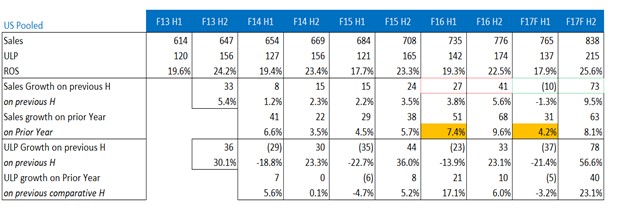
3494 The spreadsheet shows that the December Reforecast for US Pooled projected that sales revenue growth in 2H17 from the same period in FY16 would be almost 4 pps higher than the sales revenue growth in 1H17 from the same period in FY16. That was to be expected as stronger second-half revenue growth had been the case in each of FY14, FY15 and FY16.
3495 However, Kennett’s reliance upon that as one of the grounds for his conclusion that the projected 2H17 sales growth in the December Reforecast for US Pooled had a reasonable basis was misplaced. That conclusion did not grapple with the fact that the December Reforecast projected:
(a) sales revenue growth in 2H17, which was 9.5% better than its actual sales revenue growth in 1H17. This was the highest growth rate compared to the previous half since 2H16 which recorded growth of 5.6% on 1H16;and
(b) sales revenue growth in 2H17 of 8.1% (compared to 2H16), which was from a base of the highest 2H sales revenue figures in the previous three fiscal years ($776 million).
That was, in the circumstances, unrealistic projected growth which was objectively unlikely to be achieved.
3496 The December Reforecast for US Pooled new wins should be understood for what it was: a continuation of the forecasts for new wins in the Initial and then Revised September Reforecasts and in the CHEP NA recovery plan which were shown to be materially optimistic upon receipt of the actual US Pooled monthly results immediately thereafter. And each of those reforecasts was grounded in a US Pooled FY17 budget which was based on aggressive sales assumptions and had been stretched to near the limit of achievability. I will not reiterate the remarks of Rumph, Alonso and Lallatin in their contemporaneous emails and memos when the US Pooled and CHEP NA budgets were made, but they should be kept in mind.
3497 As the poor monthly US Pooled sales results came in, the contemporaneous emails of Rumph, Nador, Alonso, Martin and Todorcevski are revealing. It is to be recalled that:
(a) on 6 October 2016, following receipt of the September results, Nador told Alonso in relation to the US Pooled budget “this budget is already impossible going in, and with everything else on top, it is going to be a disaster!!”. Alonso replied “Absolutely”;
(b) on 12 October 2016, in relation to the 2H17 sales growth projections proposed by Kennett for the Revised September Reforecast, Martin told Nador: “This gets incrementally more difficult to rationalize”. In cross-examination Nador described the projected sales growth in this reforecast as “more challenged, for sure”, “much more aggressive, so much more difficult” and “extremely challenging”;
(c) on 26 October 2016 Todorcevski told Gorman that in his view the projected US Pooled sales growth in 2H17 was “massive” and “well beyond anything we’ve seen”, by which I infer he meant unrealistic and unlikely to be achieved;
(d) on 11 November 2016, following receipt of the October results, Rumph belatedly accepted that US Pooled and CHEP NA could not meet budget for the year, and she forecast that they would have $(10) million and $(15) million Underlying Profit deficits for the year respectively, after implementation of their recovery plans. Their actual Underlying Profit deficits to budget YTD at that point were $(25.3) million and $(29) million respectively; and
(e) on 8 December 2016, following receipt of the November results, Rumph accepted that US Pooled and CHEP NA would have $(11.8) million and $(17) million Underlying Profit deficits for the year, after implementation of their recovery plans. Their actual Underlying Profit deficits to budget YTD at that point were $(30.2) million and $(35) million respectively.
3498 I consider that the December Reforecast was just a continuation of the same forecasting by Brambles management, which had previously lacked reasonable grounds. That is not to find that the December Reforecast for US Pooled new wins was unattainable. Instead, it is to find that there were not objectively reasonable grounds for Brambles’ management to expect that US Pooled sales performance would so significantly turn around. I consider it was substantially more likely than not that US Pooled would fail to meet the sales projections in the December Reforecast.
3499 Second, Brambles’ submissions on this issue substantially relied on the evidence of its executives who continued to testify as to why they expected a significant turnaround by US Pooled in new wins in 2H17, or at least that management would not know until after the December and January sales results whether US Pooled could meet the sales revenue projections in the December Reforecast. In summary:
(a) Nador deposed that she was “anticipating a change for the better on new wins volume”. She gave evidence of a conversation she had with Martin in this period, in which he assessed that, despite regular meetings with stakeholders, sales were moving slowly due to customer reactions to competitors’ attempts to retain customers. Much of the competitive pressure had come from PECO, and Martin considered PECO to be engaging in irrational and unsustainable tactics. She recalled that as a result Martin said that customer sales decisions may be delayed until after Christmas.
(b) Martin continued to testify that the under-budget sales YTD were not attributable to lost business or failed attempts to win business, but rather to potential new deals moving through the pipeline slowly. He deposed that he was confident in the ability of the US Pooled sales team to achieve the sales target in the December Reforecast having regard to his personal involvement in discussions with a large number of prospective customers and the robust pipeline of opportunities, including those sales deals that appeared close to closing. He said that he was comfortable that US Pooled had good prospects of closing the sales gap to budget in the coming months.
(c) Mackie deposed that the reports he had received and the projected timing of new wins in the November CEO BPR Presentation made him confident that the new business wins were going to be delivered.
3500 Brambles also relied on O’Sullivan’s evidence for its argument. However, in my view her evidence undercuts rather than supports Brambles’ contentions.
3501 In her evidence-in-chief O’Sullivan deposed that in her conversations with Gorman and Rumph both had expressed a high degree of confidence in the 2H17 recovery based on the delays in customer new wins that were expected to start flowing in 2H17. She said that there was a sales pipeline which “we expected to win to be able to deliver on that level of growth” but that it was necessary to wait until January to know whether it would be achievable.
3502 It is, though, important to keep in mind that O’Sullivan deposed that when the December Reforecast was made she had some concern about the shape of the earnings profile in the reforecast given the emphasis on the delivery of growth in 2H17 when compared to 1H17, but she:
…had not worked in the business long enough to form a reasoned view on whether the proposed sales and Underlying Profit growth for 2H17 were achievable.
She went on to say that she relied upon the views of Rumph and Gorman both of whom had expressed a high degree of confidence in the recovery in 2H17 based on, among other things, the delays with customer new wins in US Pooled that were expected to start flowing in 2H17. She said that she relied on their judgement regarding the achievability of the earnings projections in 2H17.
3503 O’Sullivan taking the approach that she did was understandable given the short time that she had been in the business, but several things should be noted.
3504 First, the positive views that O’Sullivan expressed about the achievability of the US Pooled sales growth in 2H17 were not her own. They were the views she said were expressed to her by Rumph and Gorman, upon which she relied. There was no objection to that hearsay evidence, but I give it less weight.
3505 Second, Brambles did not call either Rumph or Gorman. Gorman was a long way from the coal face, and I infer that his views about the achievability of the rephased 2H17 sales revenue projections for US Pooled were largely based on what he was told by Rumph and Mackie. He could not place much reliance on US Pooled performance in prior years because the projected 2H17 sales performance in the December Reforecast was unprecedented. I can accept that both Rumph and Gorman considered the sales projections in the December Reforecast for US Pooled were achievable, but their views in that regard were not able to be tested, and I have less confidence in the existence of a reasonable basis for them.
3506 Third, Nador was new to the US Pooled business. She did not start with US Pooled until July 2016, and her evidence about the likelihood that the business could meet the rephased 2H17 sales revenue projections seemed to be based on Martin’s view in that regard.
3507 As a result, Brambles’ primary lay witness in relation to the likelihood of substantial US Pooled sales overperformance in 2H17 was Martin. I found him to be unfailingly optimistic in his evidence and by this stage of FY17, there was a strong air of unreality in his evidence. It will be recalled that:
(a) in early October 2016 Nador was describing the US Pooled budget as “impossible” from the outset; and that it was going to be a “disaster”, Martin said that he was sure that US Pooled could “close the gap” to budget.
(b) at each relevant point in September, October and November 2016 Martin testified that he remained confident that it was realistic to expect, and likely, that US Pooled would meet its sales budget for the year.
(c) it is appropriate to infer that the sales projections in both the Initial and Revised September Reforecasts bore his imprimatur, and that those projections had been shown to be materially optimistic immediately they were made.
(d) in early October 2016, following receipt of the September results, he described the 2H17 US Pooled sales growth projections in what became the Revised September Reforecast as “incrementally more difficult to rationalize”. If (as I infer) Martin found the sales growth projections in the Revised September Reforecast difficult to rationalise, how could he find the even greater 2H17 sales growth projections in the December Reforecast reasonably achievable?
(e) even from 11 November 2016 when Rumph and Nador had given up on achieving the US Pooled budget (which must have, at least in part, been based on their view regarding the achievability of the sales revenue budget) he continued to maintain that the sales revenue budget for US Pooled was achievable.
3508 Further, in cross-examination, O’Sullivan’s evidence changed. She did not walk away from her evidence (based on Rumph and Gorman’s view) that she considered the projected 2H17 US Pooled sales revenue in the December Reforecast to be achievable, but she conceded there was a lot more risk attaching to that than she had in her evidence-in-chief. In cross-examination she accepted that the forecast US Pooled sales recovery in 2H17 was:
(a) “a big step up”;
(b) the projected recovery was “inherently a lot more risky than you would ideally like to position yourself to be”;
(c) “running the business just waiting for sales conversion[s] isn’t a great way to be. It may have come to pass, may have delivered the outcomes, but it presents you a hockey stick that isn’t a great place to be”; and
(d) the projected recovery was “optimistic” and “very challenging” (although denying it was “unrealistic”).
3509 Then, in her Early Observations Memo on 28 December 2016 O’Sullivan told Chipchase that the ‘hockey-stick’ recovery in CHEP NA was an example of a “good news culture” at Brambles, as compared to a culture which “defined reality”. I infer from O’Sullivan’s evidence in cross-examination and her remarks in that memo that she considered the forecast 2H17 sales recovery by US Pooled was optimistic and risky rather than realistic.
3510 I accept Brambles’ submission that the US Pooled sales team was “continuing to take steps to assess the sales funnel and to take steps to accelerate wins”. The evidence shows that the US Pooled sales and management teams were working hard to try to turn the situation around and they had some success. For example, Brambles pointed to the fact that on 13 December and 20 December 2016, US Pooled announced that it had won back the Cott Beverages and the Arcadia Dairy Farms business, both from PECO. But as I later explain, there was not much significance in those two new wins.
3511 I also accept that the US Pooled sales pipeline was strong with many tens of millions of dollars of sales opportunities including a sizeable number of sales opportunities in the ‘Best Few’ category. I also accept that the Monthly Demand Consensus Reports prepared by the US Pooled S&OP team usually had a high level of accuracy. Those matters gave US Pooled management some reasons for confidence that US Pooled could turn around its sales underperformance in 2H17.
3512 I accept that Martin had been personally involved in discussions with each of the customers listed on the slides: Cott Beverages, JBS, National Beef, WestRock, CTI-SSI, Riceland, First Quality, National Beverage, Ainsworth Pet, Coretrust, Smithfield, Aryzta, DFA and Assemblers. He assessed that US Pooled would, in time, win those contracts and they were not failed attempts to win business, but rather potential new deals moving through the pipeline slowly. I accept that they were potential new deals but Martin was dealing with a new business dynamic. He said that in December 2016 PECO was becoming more aggressive and irrational to win business, for example by offering large sign-on bonuses to customers. He accepted that was further delaying sales conversions. The problem for Martin was that US Pooled was running out of time to achieve the very substantial sales that were forecast to occur in 2H17, and he could not know what PECO would do to win market share.
3513 The evidence points strongly towards a conclusion that, as at 21 December 2016, it was much more likely than not that US Pooled would be unable to achieve the aggressive rephased sales revenue projections in the December Reforecast.
3514 First, the most reliable indicator of likely 2H17 US Pooled sales performance against budget was the actual 1H17 sales performance. Instead of acknowledging the factors which had given rise to a very poor 1H17 sales performance, approximately 90% of which was due to under-budget new wins, management continued to forecast a remarkable recovery in 2H17, against all odds.
3515 Second, another reliable indicator of likely US Pooled sales performance against budget in 2H17 was how US Pooled had performed against earlier reforecasts, which (like the December Reforecast) had forecast a US Pooled sales revenue recovery. Each of the US Pooled sales revenue reforecasts that management had made to date (the Initial September Reforecast (3 October 2016), the Revised September Reforecast (13 October 2016), and the CHEP NA Recovery Deck (20 November 2016)) had proven to be materially optimistic.
3516 Third, the US Pooled sales team, US Pooled management and CHEP NA management, had been trying to recover from the sales underperformance against budget since the August flash results were received in early September 2016. The sales underperformance against budget at that point was relatively modest but management nevertheless introduced and implemented a range of measures aimed at turning US Pooled sales revenue around. No doubt that was in part because the September Reforecasting process revealed that the sales underperformance was expected to continue through 1H17:
(a) In September 2016 Martin asked the US Pooled sales team to conduct a detailed investigation into the lower-than-expected conversion rate, and he and the sales team developed a sales recovery plan that targeted approximately $9 million in sales revenue across a few dozen customers. Martin commenced weekly sales pipeline meetings. Rumph directed the commencement of weekly Walk to MOP meetings to, among other things, identify the drivers of the lower sales conversion rate and to focus on reviewing the sales pipeline to advance deals. Martin asked Adlam to look into the reasons for the low conversion rate.
(b) Despite those efforts, the US Pooled September sales results, received in early October, were materially under-budget and under-reforecast. The recovery initiatives continued in October 2016, including through targeted actions directed at identified key customers. The evidence indicates that in this period the US Pooled sales team and US Pooled and CHEP NA management were attacking the problem of very low new wins with vigour. They had little choice when Todorcevski was describing the US Pooled September results as “just terrible”; “as poor an outcome in a month in US Pooled” as he had seen, and overall as “one of the worst results we have ever seen”. Martin recognised that US Pooled sales had a “huge hole to dig out of” and that it was necessary to “push our team and do everything to push volume and our people”. He instituted an issue volume recovery cadence and dug into every customer bluesheet so that he could understand all of the metrics of the conversion rate and sales performance. US Pooled continued the Walk to MOP process which Martin described as an effective sales recovery action. Martin asked Moriarty to look into the low US Pooled conversion rate (which led to his receipt of Moriarty’s Conversion Rate Email on 12 October 2016). In this period Gorman and Mackie checked on the US Pooled recovery plan in the US Pooled Status Review Meeting on 25 October 2016. I accept that the US Pooled sales team and management were doing everything they could to achieve a recovery in US Pooled new wins.
(c) Despite those efforts, the US Pooled October sales results, received in early November, were again materially under-budget and under-reforecast. Achievement of budgeted new wins was not materially improving. Instead, the sales revenue deficit was increasing. In November 2016, the sales recovery initiatives by the US Pooled sales team and by US Pooled and CHEP NA management continued, including targeted actions directed at identified key customers. Martin gave evidence that was “not happy being in the position we were in at that point in time and would have preferred not to have had a potential [sales] volume gap of that size” but he described that shortfall to budget as “large but not insurmountable”. He said that he “considered that we would need to work hard to be able to achieve the budget for the full year”. Again, I accept that the US Pooled sales team and management were doing everything they could to achieve a recovery in US Pooled new wins.
(d) Despite those efforts, the US Pooled November sales revenue results, received in early December, were again materially under-budget and under-reforecast. Again, the sales revenue deficit to budget was increasing rather than decreasing. In this period O’Sullivan checked on the US Pooled recovery plan in meetings on 5 and 6 December 2016. Management concern at this stage was such that no stone was being left unturned in the efforts to recover US Pooled new wins. In December, the US Pooled sales recovery actions continued, including Walk to MOP and targeted actions directed at identified key customers. The Holzman December Demand Forecast identified a list of key new business targets who were expected to enter contracts in 2H17.
(e) Despite those efforts, in the period up to 21 December 2016 US Pooled new wins were still not improving at the necessary rate, which I infer that Martin knew. Martin testified that he had regular conversations with his sales team and large potential customers; he relied upon those conversations as one of the grounds for his confidence that the missed sales were merely delayed rather than lost. As at 21 December 2016, the US Pooled sales team would have known that not enough of the key customer accounts had been entered into for a sufficient uptick in new wins.
3517 As management should have expected, the December sales revenue results, received in early January 2017, were again materially under both the budget and the December Reforecast. As a result, the US Pooled sales revenue deficit to budget increased again to $(25) million YTD.
3518 That is a long way of saying that at the time the December Reforecast was made, despite almost four months of increasingly desperate efforts by the US Pooled sales team and the US Pooled and CHEP NA management teams to turn US Pooled new wins around, the needle had not moved anywhere near sufficiently in Brambles’ favour. The US Pooled sales revenue deficit to budget YTD just continued to grow.
3519 That was because of the matters I have previously identified. Optimism and effort were not enough to overcome the position that US Pooled was in. There is a fundamental weakness in Brambles’ contention that there were reasonable grounds for the December Reforecast to project that US Pooled would achieve approximately $90 million in revenue from new wins in 2H17 (giving rise to $18 million in Underlying Profit).
3520 Third, another weakness in Brambles’ contention that there were reasonable grounds for it to forecast on the basis that US Pooled would achieve approximately $90 million in revenue from new wins in 2H17 was that by this point US Pooled had experienced a six-month trend of very low conversion rates. The very low conversion rates were, of course, an outcome rather than a cause, but as Martin accepted in cross-examination, unless the very low conversion rates could be substantially turned around (and quickly), there was no way that US Pooled could meet its sales budget.
3521 To the extent that the “missed” 1H17 US Pooled sales were delayed rather than lost, the evidence does not show (except in relation to the market uncertainty arising from the US Presidential elections) that there were reasonable grounds for Brambles to forecast on the basis that the factors which gave rise to the delayed sales YTD were unlikely to continue, at least for some period. For example, the heightened competition from PECO was only becoming more aggressive, and in that context it was likely that negotiations would continue to stretch out, that some customers would continue to use procurement agencies to assist them to get the best price from US Pooled, and that some customers would be won by PECO and not by US Pooled. The evidence does not show an objectively reasonable basis to conclude that the six-month trend of very low US Pooled monthly conversion rates was likely to speedily abate, such that the new wins would markedly increase in 2H17 and US Pooled would achieve the projected approximately $90 million in sales revenue from 2H17 new wins. It is, of course, relevant that Martin expected the sales pipeline to open up. He was an experienced sales executive. But his view is not determinative and I am persuaded that on the information available at the time there were not objectively reasonable grounds for his opinion in that regard.
3522 Fourth, Brambles’ submission that the missed 1H17 US Pooled new wins were delayed rather than lost was in support of an argument that there were reasonable grounds for Brambles’ management to believe that the new wins projected in the December Reforecast would arrive at some point in FY17. But the problem with that was one of timing. Six months of FY17 had almost passed, and there could be several months between a large customer entering a contract and revenue starting to flow to US Pooled, and the longer customers delayed in entering contracts, the more of the revenue from those contracts was likely to fall outside FY17. Todorcevski gave evidence, and I accept, that revenue from a contract was booked when pallets were delivered to the manufacturer, and that the time between entering into a contract and revenue starting to flow depended on the size and complexity of the customer. In some cases, it would be a month. In other cases, it could be three or four months. The evidence shows that, for large customers, it could take several months from entering the contract to transitioning the customer from their existing provider to start to use US Pooled pallets, and hence begin to pay issue fees and associated charges to US Pooled. US Pooled assumed a “ramp up curve” as the customer transitioned to it, and as a result it would be even later in a fiscal year (or in the following fiscal year) before the customer would reach “peak” issue volumes.
3523 It was highly important to the achievability of the December Reforecast for CHEP Global that US Pooled secured the projected new wins in a timely fashion so as to ensure the projected $18 million of Underlying Profit from the new wins was sufficiently realised in FY17.
3524 The substantial risk of delayed sales revenue falling outside FY17 can be seen in a Brambles spreadsheet titled “Walk: Budget - September Reforecast” (reproduced below) which shows the projected timetabling of rephased new wins for US Pooled in the Initial September Reforecast. It shows that 74% of the $10 million of the rephased new wins in 2H17 (at that time) were not projected to be achieved until 4Q17 (1 April - 30 June 2017).
($US million) | 1Q17 | 2Q17 | 3Q17 | 4Q17 | 1H17 | 2H17 | FY17 |
Wins | (3.6) | 6.5 | 2.6 | 7.4 | 2.9 | 10 | 12.9 |
3525 In relation to this Brambles argued that the sales projections for US Pooled in the December Reforecast were supported by expected new wins from identified “key customer targets”, according to the timetable in the Holzman December Demand Forecast. One of the assumptions in the December Reforecast was that US Pooled would win all of the sales deals listed in the following table (from the US Pooled December Reforecast Presentation).
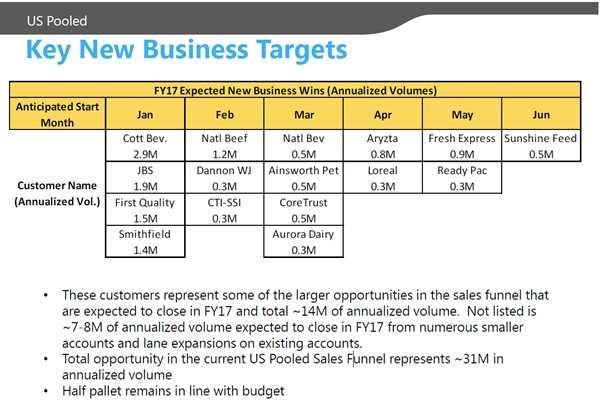
3526 As previously noted, Kennett considered this to be important information for the December Reforecast. He used it to make a rough estimate of the revenue impact for US Pooled in 2H17 (and consequently for CHEP Global) of securing the listed key customer targets. He took the projected pallet issue volumes for each month and multiplied them by a $5.00 proxy for RPI to determine annualised revenue for each contract, and then took the equivalent revenue for what remained of FY17 (e.g., if the contract was expected to start in January, the assumption was 6 months of FY17 revenue from that contract). He calculated that these key customers alone would deliver new wins of approximately $28 million in 2H17 which would be approximately 61% of the projected $46 million in net new wins in 2H17. Kennett concluded that that helped support the projected US Pooled sales growth in 2H17.
3527 There is no controversy about Kennett’s arithmetic, but there were not reasonable grounds for his conclusions. As previously noted, some of the same key customer targets had earlier been set out in the 14 October Overview (reproduced below):
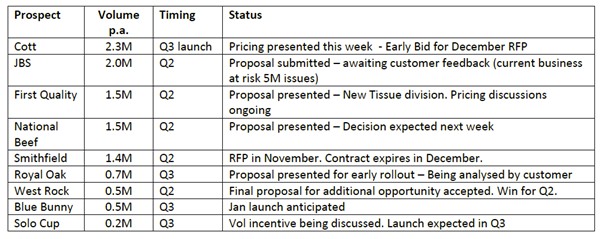
3528 And a later presentation, titled “Leadership Review - Sales Commentary” (January Sales Commentary Presentation) and dated 10 January 2017, again set out some of the same key customer targets (as reproduced below):
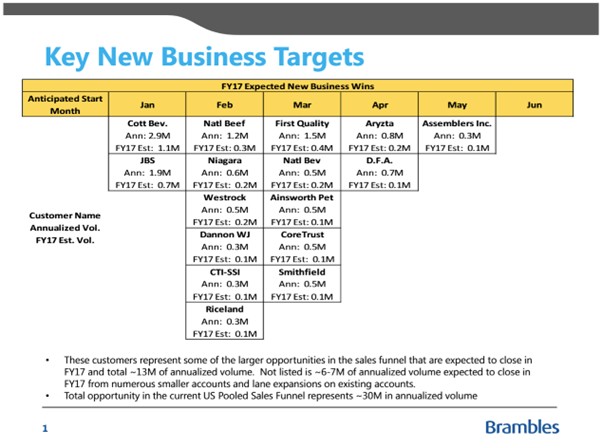
3529 Comparing the “key customer targets” over the period from the 14 October Overview to the January Sales Commentary Presentation shows the following in relation to the five largest potential customers identified in the tables:
14 October Overview (14 October 2016) | Holzman December Demand Forecast (14 December 2016) | January Sales Commentary Presentation (10 January 2017) | |
Cott Beverages | 2.3 million Q3 (1 Jan - 31 March) | 2.9 million January | 2.9 million January |
JBS | 2.0 million Q2 (1 Sept - 31 Dec) | 1.9 million January | 1.9 million January |
First Quality | 1.5 million Q2 | 1.5 million January | 1.5 million March |
National Beef | 1.5 million Q2 | 1.2 million February | 1.2 million February |
Smithfield | 1.4 million Q2 | 1.4 million January | 0.5 million March |
3530 As is apparent, over that three-month period, all but one (Cott Beverages) of the five largest “key customer targets” relied on by Kennett as supporting the achievability of the projected approximately $90 million in new wins in 2H17 in the December Reforecast were either downgraded in volume and/or delayed, and sometimes both. For example, Kennett’s calculations to the December Reforecast regarding the expected value of the revenue from the key customer targets assumed that:
(a) sales revenue from the First Quality and Smithfield accounts would commence to flow in January 2017, but by January those dates were both pushed out until March. Those potential contracts appear to have been further delayed either just before or immediately after the December Reforecast was finalised. As a result, if those sales were achieved, only approximately three months of the revenue from those contracts would fall within FY17.
(b) revenue from the National Beef account would commence to flow in February 2017. However, the 24 January Deal Re-review Email shows that as at that date US Pooled was still locked in a contest with PECO to win that contract and National Beef was not close to making a decision.
(c) revenue from the Smithfield account was based on an estimate of 1.4 million pallet issues which, using Kennett’s $5.00 RPI proxy equated to $7 million in annualised revenue representing $3.5 million for the remaining six months of FY17. However, the 10 January Sales Commentary shows that account carried an estimate of 0.5 million pallet issues, which equated to $2.5 million in annualised revenue and therefore $1.25 million for the remaining six months of FY17 (had the contract started in January). If, in fact, that sale was actually achieved, it would be worth much less sales revenue in FY17 than Kennett estimated.
(d) sales revenue from the Cott Beverages account was based on an estimate of 2.9 million pallet issues (which on Kennett’s calculations equated to $14.5 million in annualised revenue representing $7.25 million in FY17) but the January Sales Commentary Presentation estimated it at 1.1 million pallet issues for FY17 (which equated to $5.5 million in annualised sales revenue, representing $2.75 million in FY17) i.e., much less.
3531 It is also appropriate to infer that Kennett approached his estimates for the December Reforecast on the basis that securing the sales on the key customer target lists would generate normal profit ratios, so as to contribute to a projected $18 million in Underlying Profit. But that is not always the case. For example:
(a) an email Martin sent Rumph on 13 December 2016 shows that the Cott Beverages account was estimated to only give rise to $200,000 in Underlying Profit in FY17, and that was before Cott Beverages reneged on the deal and drove an even harder bargain on price. O’Sullivan’s Early Observations Memo gave the Cott Beverages account as an example of the “new reality” that it was priced at below the cost of capital. Thus, the Cott Beverages account, the single largest contract on the key customer targets list that underpinned Kennett’s revenue estimates for the December Reforecast would not make a material contribution to US Pooled Underlying Profit in FY17; and
(b) an email Kennett sent Bailey Antar on 24 January 2017 shows that the Aryzta account (which was on the key customer target list) was expected to generate $4.8 million in additional annual revenue, but no additional Underlying Profit. Antar agreed with that and said “we are paying to grow at this point and the only upside is more volume”. Hill described it to Kennett as being largely “a defensive play” i.e., to keep PECO from securing Aryzta.
3532 It is also telling that, on 16 January 2017, US Pooled circulated another table which largely replicated the slide in the January Sales Commentary Presentation, but attached probability weightings to the wins. This table (reproduced below) shows that, notwithstanding the December Reforecast projected $90 million in new wins in the US Pooled pipeline the US Pooled sales team attributed (only) a 50% - 75% probability to closing the National Beef and Smithfield Accounts: That is, notwithstanding the assumption in the reforecast, Brambles knew that those sales were not certain.
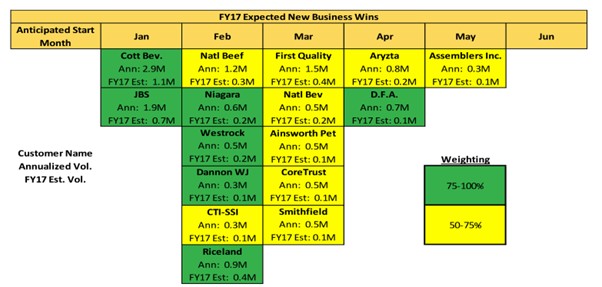
3533 Again, in my view it is not hindsight to consider the later developments. First, it was Brambles’ contention that, at the time the predicted timeline for those contracts was made, there were reasonable grounds for that belief. The evidence does not establish that. Second, I saw many of those projections as just a continuation of the excessively optimistic approach that Martin’s team took to sales forecasting. In my view (except in relation to Cott Beverages) the subsequent events throw some light on the overall probability, as at 21 December 2016, that the listed sales were going to be achieved in time to be material to US Pooled meeting the revenue projections in the December Reforecast. They operate to buttress the conclusions I have reached based on other evidence: Jazabas at [83].
3534 I am persuaded that there were not reasonable grounds to base the sales revenue projections in the December Reforecast:
(a) on an assumption that the sales to listed key customer targets would be achieved;
(b) on an assumption that the sales would occur according to the predicted timelines so as to give rise to material revenue in FY17;
(c) on an expectation that if those sales were achieved the sales would be of the magnitude listed in terms of pallet issues; and/or
(d) on an expectation that if those sales were achieved, they would make a material contribution to Underlying Profit in FY17.
3535 Kennett did not have sufficient information to have reasonable grounds to conclude that the projected sales in the table would alone deliver new wins worth approximately $28 million in 2H17, thereby materially contributing to meeting the December Reforecast projection that US Pooled would achieve $18 million in Underlying Profit through $90 million of 2H17 new wins.
3536 Fifth, Brambles relied on Martin’s evidence that in this period PECO was becoming unusually aggressive and irrational to win business, for example by offering large sign-on bonuses to customers, including a rebate of around $1 million to Hershey which was provided by way of the PECO CEO flying on a private jet to meet the customer and offer the rebate. Martin considered PECO’s competitive behaviour to be commercially irrational and unsustainable, and that its aggression would be short-lived. He accepted that this irrational behaviour was further slowing sales conversions.
3537 Several things can be noted about that evidence.
3538 First, given PECO’s behaviour, how could Martin have had reasonable grounds to think that the pipeline of (asserted) delayed sales conversions was going to speedily unblock? PECO was obviously throwing everything at winning large customers from US Pooled and, as could be expected, the customers were playing PECO and US Pooled off against each other.
3539 Second, PECO’s behaviour may or may not have been commercially unsustainable. Whether that was so depended to a significant extent on whether it had a lower costs base than US Pooled and/or how well-capitalised it was to pursue low or no margin deals in the short term in order to win market share from US Pooled. O’Sullivan’s Early Observations Memo described PECO as being “well capitalised” and as having better quality pallets. Martin could not know whether PECO’s unusually aggressive competitive behaviour was unsustainable and would be short-lived.
3540 Third, what did Martin mean by “short-lived”? There were only six months remaining in FY17 and for US Pooled sales to recover as projected in 2H17 it had to achieve $90 million in new wins in that period. If PECO’s unusually aggressive behaviour continued for even three months of 2H17 US Pooled could not possibly achieve the reforecast target.
3541 Fourth, Brambles’ submission in this regard carried a suggestion that the sales projections for US Pooled in the December Reforecast had reasonable grounds because management could not be expected to have foreseen such fierce competition from PECO. That submission has little force.
3542 I accept Martin’s evidence that in this period PECO had become even more aggressive in its pursuit of large customers, but this was just a continuation of behaviour that US Pooled had known about since before the start of FY17. The evidence shows that:
(a) PECO had been aggressively pursuing some of US Pooled’s major customers in the second half of FY16, including Kellogg’s, Niagara and Mondelez;
(b) on 25 January 2016 Bachtell emailed Lallatin and referred to “the large amounts of pressure we’re starting to see PECO put on these deals (Kraft, Mars, Niagara, etc.)”;
(c) in March 2016 the US Pooled initial budget submission said that “PECO strategy appears to have shifted toward pursuit of volume growth, as evidenced by their aggressive pricing strategies in several recent National deals”;
(d) on 23 March 2016 it was confirmed that US Pooled had lost the large Kraft-Heinz account to PECO, which was worth $9.4 million per year. Brambles accepted that PECO’s behaviour in pursuit of that deal was unusually aggressive;
(e) on 16 April 2016, Rumph’s Headlines Memo expressly called out competition from PECO as one of the “key risks” facing the US Pooled FY17 budget
(f) Martin accepted in cross-examination that he was aware of “steady and targeted price aggressiveness from PECO” in June/July 2016. He denied that the threat was “serious”, but on my view of the evidence it was;
(g) in June 2016 US Pooled lost a portion of its Mars-Candy account to PECO, which Martin described in an email at the time as “[c]learly disappointing”;
(h) Nador accepted in cross-examination that in August 2016 US Pooled was facing “considerable competition”, that “PECO was expanding its footprint and was pursuing customers aggressively” and that “the competitive dynamic in the marketplace was getting harder”;
(i) Nador accepted in cross-examination that by September 2016 Brambles was under pricing pressure from PECO and that PECO “was showing some aggressive proposals to go after big customers mainly”;
(j) Rumph’s 14 October Response shows that at that point three rollover customers had been lost to PECO. Red Gold had been lost in March FY16 (worth 0.6 million issues in FY17), Heinz had been lost in April FY16 (2.7 million issues in FY17), and Ready Pac was lost in October FY16 (worth 0.3 million issues in FY17);
(k) the “JBS Summary” prepared by the US Pooled sales team dated 12 November 2016 stated: “We have seen steady and targeted price aggressiveness from P[ECO] in the past 12 months, which has hurt returns with several large customers”;
(l) as at 16 November 2016, US Pooled was at risk of losing further significant customers. At that point it was locked in competition for a number of large customers (including Cott Beverages, JBS, First Quality, National Beef and Smithfield) and PECO was being increasingly aggressive on price;
(m) in the US Pooled Recovery Plan meetings on 5 and 6 December 2016, Martin told O’Sullivan that one of the challenges for achieving the necessary sales volume was behaviour by US Pooled competitors particularly PECO; and
(n) O’Sullivan’s Early Observations Memo recognised the significance of the heightened competition by PECO. She said that PECO was aggressive and well capitalised and it had better quality pallets. As a result she said that US Pooled was finding it difficult to maintain pricing and that the assumed medium term margin growth and sales growth in US Pooled was “challenging”. In cross-examination she accepted that at this point she knew that competitive pressure from PECO had been a substantial factor in delaying the consummation of new wins in US Pooled in 1H17, and she agreed that there could be no realistic expectation that the competition from PECO was going to dissipate in 2H17.
3543 The competitive behaviour by PECO in this period should have been expected by US Pooled management, and the December Reforecast should have been prepared on the basis of continued, or even ramped-up, competitive pressure from PECO. Competition from PECO had been fierce from the beginning of the year and Martin had consistently underestimated its effects. During periods of prolonged negotiations with large prospective customers who apparently had competitive offers from PECO, Martin seemed to regularly, but unreasonably, consider that US Pooled was on the cusp of securing the contract when it was not. There were not reasonable grounds for Martin’s views.
3544 Sixth, Brambles further contended that despite the competitive behaviour from PECO, over the course of December 2016, US Pooled continued to win “significant business from within the sales funnel”.
3545 That contention has little force. Brambles referred to four developments in support of its contention. The first two developments were the announcements by US Pooled that it had entered sales contracts with Cott Beverages and Arcadia Dairy Farms. As previously noted:
(a) the Underlying Profit in FY17 from the Cott Beverages contract was put at only $200,000; and
(b) the Arcadia Dairy Farms account was identified in a 19 October 2016 document as worth approximately $0.15 million in Underlying Profit in FY17.
It was inaccurate for Brambles to describe either of those accounts as “significant business”.
3546 The other two developments on which Brambles relied were not new wins from “within the sales funnel” at all:
(a) the Walgreens contract identified by Brambles was not a new win, but rather the entry into a participating distributor contract. This meant that Walgreens now had an agreement with US Pooled governing the return of their pallets - not that new business had been won, or that there had been a lane expansion; and
(b) the announcement by US Foods that it would be moving forward with a pallets self-return program was not a new win - it was a saving on transport costs.
3547 Brambles also highlighted that the CHEP Global December BPR identified that US Pooled had secured another new win, DS Water, worth 1 million pallet issues per year. That was incorrect. As shown by an email from Martin to Rumph and Nador on 12 December 2016, DS Water was not a new win. DS Water was already contracted to US Pooled, but it was a subsidiary of Cott Beverages. Had US Pooled lost Cott Beverages it would likely have lost DS Water when that contract came to an end.
3548 Brambles’ submission that despite the competitive behaviour from PECO, over the course of December 2016, US Pooled had continued to win “significant business from within the sales funnel” was overblown.
3549 Seventh, the projection in the December Reforecast that US Pooled would achieve $90 million in increased revenue from new wins must also be measured against the potential for customer losses. I accept the applicants’ submission that the US Pooled new wins projection in the December Reforecast failed to account for the reality that the competitive environment meant that it was likely to lose some large customers in the remainder of FY17, as it had YTD. It is noteworthy that (after the December Reforecast was made) the December Demand Consensus Review dated 7 January 2017 shows that US Pooled had lost Taylor Fresh Farms (contributing to an annualised loss of 0.68 million issues) and expected to lose Foster Dairy in February 2017 (contributing to an annualised loss of 1 million issues).
3550 For the foregoing reasons, I am well satisfied that the projection in the December Reforecast that US Pooled would achieve $18 million in Underlying Profit from new wins in 2H17 lacked an objectively reasonable basis. In my view it was unlikely that US Pooled would achieve much of that forecast Underlying Profit growth. US Pooled would be doing well in 2H17 if it could just achieve its monthly Underlying Profit targets, as originally budgeted, keeping in mind that it had failed to meet its Underlying Profit monthly budget in four out of the last five months and materially so in the last three months.
21.11.2 The assumed improvement in the US Pooled damage rate
3551 It is to be recalled that Kennett described the assumed improvement in the US Pooled damage rate as the second “main driver” of the projected CHEP Global recovery in the December Reforecast. The reforecast projected that the assumed improvement in the damage rate would give rise to $8 million in US Pooled Underlying Profit in 2H17.
3552 In relation to the damage rate, Brambles submitted that:
(a) While the November results were not in line with the US Pooled budget, they occurred in a month where the damage rates typically rise, and this contributed to what Alonso called “noise” in the data which made it difficult to understand the reasons for the damage rate miss to budget.
(b) Alonso’s and Young’s damage rate presentation on 15 December 2016 revealed that the Service Centre damage rates had dropped around 2.5% from the beginning of FY17 up until financial year weeks 15-16 and this stood in contrast to FY15 and FY16 where damage rates had increased over the same period. Brambles said that was significant given that Service Centre damage rate was a key driver of the overall network damage rate, representing at that time around 65% of the volume of total usage. It noted Young’s remark in an email that he wanted to “highlight the positive trend we are seeing in the service centres which can be attributed to actions around durability and controls”.
(c) On 21 December 2016 O’Sullivan and Mackie received information from Kennett which was said to show that the damage rate trends for the 80% of pallets not issued to Walmart were decreasing, while the damage rate trend for pallets issued to Walmart, which represented 20% of the volume of US Pooled was increasing. Brambles said that at that time, Rumph was continuing to have discussions with Walmart to limit the damage rate and reuse of pallets returned from them.
(d) Mackie deposed that he thought the damage rate represented a risk that was important to continuing monitoring. He wanted to see whether the uptick in the damage rate in November was a one-off, as he thought that good progress had been made over the period July to October 2016. While he was confident that the damage rate would continue to decline as the Durability Program initiatives were progressively implemented across the pallet pool in the US, he thought the results for the next few months would provide a clearer indication whether the damage rate projections for the full-year would be delivered.
(e) Around 20 December 2016 O’Sullivan requested further information on the projected damage rate trends for 2H17 to understand whether the November uptick was anomalous or might repeat given that the projected improvement in the 2H17 results included ongoing reductions in the damage rate.
3553 In effect Brambles submitted that on the information available at the time the December Reforecast was made and without the benefit of hindsight, there were reasonable grounds for the reforecast to maintain the assumed two pp reduction in the average damage rate over the course of FY17.
3554 Those submissions have little merit. In my view Brambles cherry-picked the evidence looking for the few parts which supported its argument, and it tried to downplay Alonso’s evidence. It was wrong to take the approach that it did to Alonso’s evidence. He was head of the CHEP Global Supply Chain division, Brambles’ internal expert on supply chain costs, he introduced and supervised the Durability Program, and he was accountable for achieving the assumed two pp reduction in the damage rate.
3555 In his evidence-in-chief, in relation to several relevant points in time, Alonso said that he considered the budgeted two pp reduction in the average damage rate to be achievable by the end of FY17. However, in cross-examination his evidence changed significantly. He testified that, as at 20 September 2016 and 4 October 2016, there was a 75% likelihood that the damage rate would not reduce further from that date. Then, he testified that, as at mid-December 2016, in the period the December Reforecast was made, he recommended that CHEP NA downgrade its forecast Underlying Profit for FY17 by $(7) million as he doubted that US Pooled could achieve the assumed improvement in the damage rate in 2H17. He said that it was not reasonable to expect that US Pooled could achieve the December Reforecast projection of $8 million in Underlying Profit through an improvement in the damage rate.
3556 I now turn to address Brambles’ specific contentions.
3557 First, there is little force in Brambles’ contention thatwhile the November results were not in line with the US Pooled budget, they occurred in a month where the damage rates typically rise, and it was difficult to understand the reasons for the damage rate miss to budget. Alonso’s evidence about the cause of the November miss to budget on damage rate is not central. The importance of his evidence, at the time the December Reforecast was made, was that he considered it was not reasonable to expect that US Pooled would achieve the projected $8 million in savings through the assumed damage rate improvement. He did not consider the damage rate improvement was going to be delivered.
3558 Second, Brambles’ next point was that Young’s 15 December 2016 presentation identified that Service Centre damage rates had dropped around 2.5% from the beginning of FY17 until weeks 15-16, and this contrasted with FY15 and FY16, where damage rates had risen over the same period. That was so, but it does not take Brambles’ argument far.
3559 The US Pooled November Close Deck dated 15 December 2016 included the following table for the month of November against the September Reforecast:
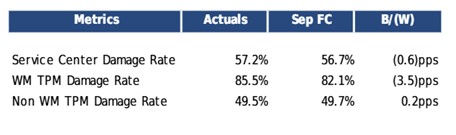
3560 And it included the following table for November YTD as against the FY17 budget:
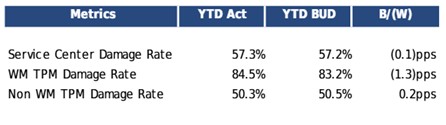
3561 As the tables above show, Service Centres were still experiencing damage rates above-budget for November and November YTD. In other words, despite falling from July to October 2016, the Service Centre damage rate was still slightly adverse to budget. That is, at that point:
(a) the network damage rate was coming down, but US Pooled had not yet met the budgeted damage rate in any month;
(b) YTD, US Pooled was behind the necessary trajectory to achieve the average damage rate; and
(c) if US Pooled was to achieve the assumed two pp reduction in the average damage rate it required significant overperformance against budget in the remaining months of FY17.
3562 Further, and importantly, the November CEO BPR Presentation (dated 19 December 2016) showed that in November the damage rate had gone back up again, as Brambles should have expected in accordance with usual seasonal fluctuations. And it was likely to go up further in December 2016 in accordance with usual seasonal fluctuations, and unlikely to begin to come down again until January 2017. The presentation included the following slide (reproduced below).
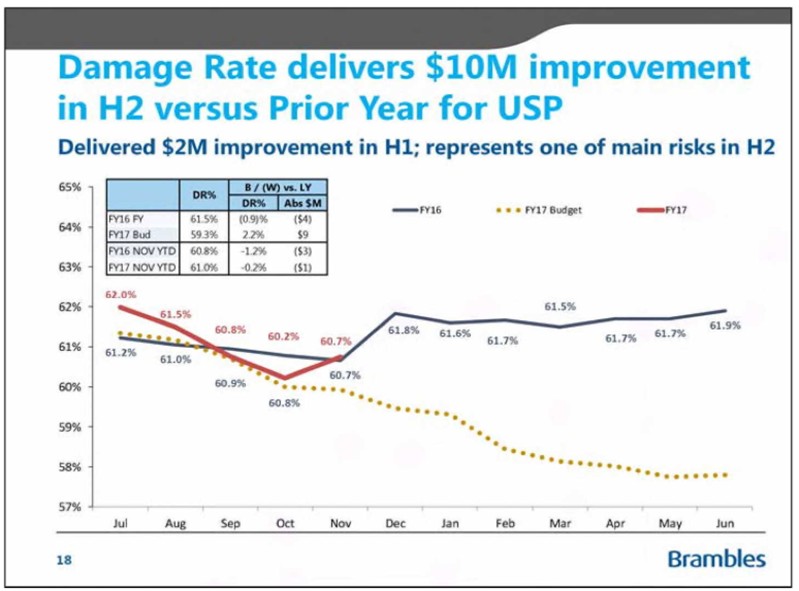
3563 Because the FY17 budget projection (broadly maintained in the September and December Reforecasts) wrongly assumed a steady decline in the damage rate (as shown by the yellow line in the chart above), it was quite unlikely that (after going up in November and again in December) the damage rate would come down enough for the assumed two pp reduction in the average damage rate to be achieved. Brambles did not adequately explain why the December Reforecast assumed a steady reduction in the damage rate when, as Alonso accepted in cross-examination, experience showed that the damage rate went materially up in November and December each year because the heavy pallet usage for consumer goods in the Thanksgiving and Christmas period meant higher pallet returns and higher damage rates. Again, each one pp growth in the damage rate was equivalent to about $(5) to $(6) million in variable costs, which fed through in a near-linear way to Underlying Profit.
3564 The same slide also shows that the reduction in the US Pooled damage rate had given rise to only $2 million in cost savings in 1H17, and that achieving the $10 million remainder of the assumed costs savings was forecast to be one of the main risks in 2H17. Yet that risk was not ‘baked’ or integrated into the September Reforecast.
3565 Brambles’ reliance on Young’s 15 December 2016 presentation was misplaced. It does little to show that there were reasonable grounds for the December Reforecast to project that US Pooled would achieve $8 million in Underlying Profit in 2H17 through an improvement in the damage rate.
3566 Third, Brambles’ next point was that at the time the December Reforecast was made the damage rate trend for the 80% of pallets not issued to Walmart was decreasing, while the damage rate trend for the 20% of pallets issued to Walmart was increasing. That was true, but that avoided the inconvenient truth that the damage rate at Walmart TPMs was so high it was driving an elevated network damage rate, and the November YTD damage rate miss to budget. In his 14 December 2016 email exchange with Young, Alonso noted that the reduction in the Service Centre damage rate in November showed very good progress but that did not mean much because the damage rate in Walmart and Non-TPMs was “more than offsetting all benefits”.
3567 Further, as O’Sullivan noted in her Early Observations Memo, the key reason why the US damage rate was circa 60% was the damage rate from Walmart and NPDs. She described Brambles’ underplaying of the significance of the Walmart damage rate as one of the examples of Brambles’ “good news culture”, as distinct from a culture which “defined reality”. O’Sullivan’s view in relation to the Walmart damage rate and its significance for the Network damage rate was also made clear in a later email to Chipchase on 30 January 2017. In that email she gave Chipchase a warning about expecting an improvement in the Walmart damage rate through the Durability Program. She said (and I agree):
I also have doubts about durability potential upside impact…if Walmart get better pallets won’t they just hold onto them for longer…and ultimately end up with more of our pallets in their system. With a higher year on year damage rates almost at 90% they only give pallets back to us when they are broken. The business is declaring a win from the program despite damage rates at exactly the same level as last year…
3568 Fourth, and most importantly, the arc of Alonso’s evidence over time makes it abundantly clear that, at the time the December Reforecast was made, he did not consider it was reasonable to project that US Pooled would achieve $8 million in Underlying Profit in 2H17 through an improvement in the damage rate:
(a) In his 20 September Deep Dive Presentation Alonso produced an R&O schedule which assessed that there was a 75% likelihood that the damage rate would not further reduce from that date, quantified at $(9) million. In cross-examination he accepted that he was expressing a 75% risk that the assumed two pp reduction in the damage rate would not be achieved.
(b) On 4 October 2016 Alonso participated in the CHEP NA September Forecast Review. The R&O schedule for that presentation again stated that there was a 75% likelihood that the damage rate would not further reduce from that date, quantified at $(12) million. In cross-examination, Alonso testified that, as at 4 October 2016 his assessment was that there was, at best, only a 25% chance of the assumed two pp reduction in the average US Pooled damage rate being achieved in FY17. Importantly, he said that had it been his decision, he would have included the damage rate risk in the September Reforecast rather than excluding it from the reforecast, and that he “probably” warned Todorcevski and Mackie about that risk because he “was talking about that risk almost every time [he] met them”.
(c) In cross-examination Alonso was asked whether, as at 25 November 2016, he thought the damage rate was going to improve anywhere near enough to get to the assumed two pp reduction in the average damage rate. He avoided directly answering that question, but then accepted that while the damage rate trend was improving, it was unlikely to sufficiently improve for US Pooled to achieve the damage rate reduction assumption in the budget.
(d) In cross-examination Alonso accepted that in mid-December 2016 he recommended to Rumph that she should include a $(7) million miss to budget in relation to the damage rate in the CHEP NA December Reforecast because he was “not sure” that the assumed $10 million of costs savings from an improvement in the US Pooled damage rate in 2H17 was deliverable, although $3-$4 million of it was. That is, he recommended to Rumph to project that CHEP NA would achieve $3 million of the projected costs savings, but not the $7 million balance. Importantly, that was not a recommendation that CHEP NA should merely note that risk. It was a recommendation that the risk be ‘baked into’ or integrated into the reforecast, which would have had the effect of reducing projected CHEP NA Underlying Profit by $(7) million. There were not reasonable grounds for management to decline to take up that recommendation in the December Reforecast.
(e) In cross-examination Alonso was taken to the following slide in the CHEP Global December Reforecast Presentation which identified the projection that an improvement in the US Pooled damage rate would drive an additional $8 million of Underlying Profit in 2H17.
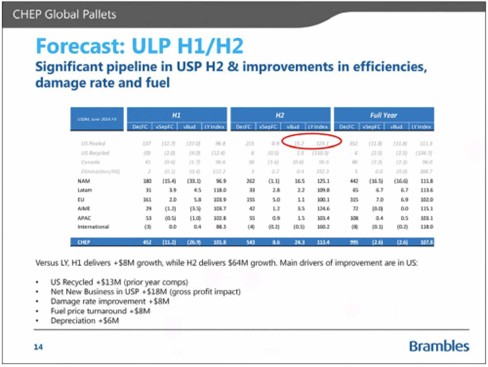
He accepted that, at that time, it was not reasonable for the December Reforecast to assume that CHEP NA would achieve $8 million in cost savings in 2H17 (and thus $8 million in Underlying Profit) through an improvement in the US Pooled damage rate.
3569 Fifth, Brambles submitted that Alonso’s evidence about the damage rate ought to be rejected or given little weight because it was discordant with evidence of other Brambles’ executives. In particular, Brambles sought to rely on Mackie’s evidence that, while he thought the damage rate represented a risk that was important to continue monitoring, he wanted to see whether the elevated damage rate in the November results was a one-off because good progress had been made between July and October 2016. He also deposed that he was “confident that the damage rate would continue to decline as the durability initiatives were progressively implemented across the pallet pool”.
3570 I accept that Alonso’s evidence was discordant with the evidence of Nador and Mackie but I found little force in this submission. Alonso was Brambles’ internal supply chain expert, he introduced and supervised the Durability Program, and he was accountable for the supply chain budget including the damage rate. He was much more qualified to offer an expert view on the likelihood of a reduction in the damage rate than Mackie or Nador, and I give greater weight to his evidence. Further, Mackie did not actually say that he thought the assumed improvement in the damage rate was achievable in 2H17; instead, his evidence was that the next few months would provide the answer. I do not accept that there was any need for Brambles’ management to wait for the answer. Having regard to Alonso’s view, it was already clear enough. Further, Alonso’s view was not discordant with O’Sullivan’s view. As noted above, she gave the assumed two pp reduction in the damage rate as an example of Brambles’ “good news culture”.
3571 Sixth, I do not accept Brambles’ submission that Alonso’s evidence can in any way be contextualised in its favour by the fact that Brambles was conducting ‘deep dives’ into costs each month. The contemporaneous documentary record shows that higher levels of pallet re-use at TPMs, particularly at Walmart TPMs, was driving an increased damage rate, and that that problem had been known for several years. When management received the Moreno Report on 22 November 2016 it quantified the direct costs driven by higher pallet re-use at TPMs at $(5.7) million YTD and estimated that (based on current run rates) it had the potential to give rise to $(16.1) million of over-budget direct costs for the full-year. Then Moreno’s 12 December Supply Chain Report confirmed that in November 2016 higher levels of re-use at TPMs had continued to drive a higher damage rate and associated increased direct costs.
3572 Brambles already knew that higher levels of pallet re-use at TPMs were causing an elevated network damage rate. The deep dives Brambles were conducting were not material to this issue. The problem, as I explained when analysing the Moreno Report, was that it was difficult to rectify the higher levels of pallet re-use at TPMs, particularly at Walmart TPMs. For the reasons I have explained, there were not reasonable grounds to expect that US Pooled could sufficiently address the higher levels of re-use at TPMs in the remainder of FY17 so as to materially reduce the damage rate, and thereby achieve the projected cost savings and Underlying Profit.
3573 Seventh, the 16 December CHEP Global R&O Analysis assumed a net risk to CHEP Global Underlying Profit of $(9.7) million, part of which was based on a $(5) million risk allocated to the US Pooled damage rate.
3574 It will be recalled that the R&O schedule in the Revised September Reforecast quantified the potential impact of the damage rate risk on Underlying Profit at $(2.5) million in 1H17 and $(9.5) million in 2H17. Similarly, the CHEP Global December Reforecast Presentation quantified the projected cost savings in 2H17 through a reduction in the damage rate of $(10) million.
3575 Yet the 16 December CHEP Global R&O Analysis, which underpinned the December Reforecast, reduced the damage rate risk to $(5) million on a risk-adjusted basis. I infer that the risk adjustment reflected as asserted 50% probability that the risk would come to pass. That probability assessment lacked reasonable grounds. Alonso testified that, as at 4 October 2016, at best, there was only a 25% chance that the budgeted damage rate reduction would be achieved. And, in mid-December 2016 he recommended to Rumph that she should include a $(7) million miss to budget in the CHEP NA December Reforecast because he doubted that the assumed costs savings from an improvement in the damage rate in 2H17 were deliverable.
3576 Further, as the applicants submitted, the December Reforecast assumed a greater improvement in the damage rate than had been assumed in either the FY17 budget or the Initial or Revised September Reforecasts. In the December Reforecast, it was projected that the actual damage rate would decline by almost five pps over the financial year, from 62.0% in July 2016 to 57.5% in June 2017. In circumstances where US Pooled had not, to that point, achieved its budgeted damage rate in any month in FY17, the damage rate had gone up significantly in November, management had not rectified the higher levels of pallet re-use at TPMs, and Walmart had recently declined to even offer a quick fix to the problem at Walmart TPMs at no cost, the assumed further reduction in the damage rate in the December Reforecast plainly lacked reasonable grounds.
3577 There were not reasonable grounds for the December Reforecast to project that US Pooled would achieve an additional $8 million in Underlying Profit through an improvement in the damage rate in 2H17. In my view, it was unlikely to achieve any of those projected costs savings.
3578 Eighth, I do not accept Brambles’ contention that the projection in the December Reforecast that US Pooled would achieve $8 million in Underlying Profit in 2H17 through cost savings from an improvement in the damage rate was not material in a business Brambles’ size. The applicants established a series of matters which have led me to conclude that the December Reforecast materially overestimated the likely US Pooled and CHEP NA Underlying Profit in 2H17 (and consequently for CHEP Global and the Group). The projected $8 million in Underlying Profit through an improvement in the damage rate was just one of them. Brambles’ contention also ignores the very narrow margin for underperformance which it left itself in maintaining the FY17 Guidance as at 21 December 2016.
21.11.3 The extent of the rephasing of sales revenue and Underlying Profit into 2H17 in CHEP NA and CHEP Global
3579 As the applicants submitted, the December Reforecast further increased the level of growth in US Pooled, CHEP NA and CHEP Global assumed in 2H17 relative to 1H17, compared to the FY17 budget and the Initial and then Revised September Reforecasts. Again, as actual US Pooled and CHEP NA sales revenue and Underlying Profit increasingly fell behind budget and behind reforecast in 1H17, Brambles just assumed an ever-greater recovery in 2H17. Following the November results, the necessary ‘hockey-stick’ trajectory for US Pooled and CHEP NA to partially recover from their actual Underlying Profit deficits YTD would be even more pronounced.
3580 Kennett gave evidence that having reviewed the submissions of the CHEP CBUs he considered the projected 2H17 growth for CHEP Global was achievable, although it represented “a challenge”. As previously noted he undertook an analysis of the sales growth and Underlying Profit trends over 1H and 2H for the period from FY13 to FY16 in respect of US Pooled, CHEP NA and CHEP Global and compared that to the projections in the December Reforecast for 1H17 and 2H17. He noted that in each of those previous financial years the growth in H2 had been higher than in 1H, and he relied upon that as part of the basis for his conclusion that the projected 2H17 CHEP NA and CHEP Global growth rates in the December Reforecast were reasonable.
3581 I do not accept that Kennett’s analysis provided reasonable grounds for the projected 2H17 CHEP NA and CHEP Global growth rates.
3582 It will be recalled that the September Reforecast projected sales revenue and Underlying Profit growth rates in 2H17 compared to 1H17 higher than in any of the last three years (FY14, FY15 and FY16). That was one of the matters which underpinned the finding that, as at 16 November 2016, the projections in the September Reforecast for US Pooled, CHEP NA and CHEP Global lacked reasonable grounds. The December Reforecast projected an even greater increase in the growth rates in 2H17 compared to 1H17 at each of those levels. That is material to my conclusion that the projections in the December Reforecast for those businesses lacked reasonable grounds.
I earlier set out Kennett’s spreadsheet in relation to US Pooled but it is worth doing so again. 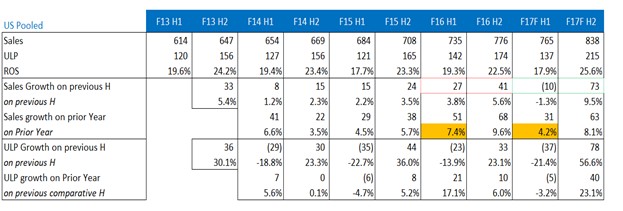
3583 In relation to sales revenue, as previously explained, Kennett’s reliance upon the fact that US Pooled sales revenue growth from the same period in the previous year was usually greater in H2 than in H1 was misplaced. That conclusion did not grapple with the fact that the December Reforecast projected:
(a) sales revenue growth in 2H17, which was 9.5% better than its actual sales revenue growth in 1H17. The projected 2H17 growth rate was the highest growth rate compared to the first half in the previous three financial years. The nearest comparator was 2H16, which recorded growth of 5.6% on 1H16, and that had been an exceptional year; and
(b) sales revenue growth in 2H17 of 8.1% compared to 2H16, which was from a base of the highest 2H sales revenue figures in the previous three fiscal years ($776 million).
That was massive and, in my view, unrealistic sales revenue growth.
3584 In relation to Underlying Profit, Kennett’s reliance upon the fact that US Pooled Underlying Profit growth from the same period in the previous year was usually greater in H2 than in H1 was, to my mind, completely erroneous. Kennett did not engage with the fact that the December Reforecast for US Pooled projected:
(a) Underlying Profit growth in 2H17 which was 56.6% better than its Underlying Profit growth in 1H17, which was a much greater difference than in any of the years from FY13-FY16 where the difference ranged from 23.1% to 36.0%. Thus, the reforecast projected that for US Pooled to claw back from its actual $(30.2) million Underlying Profit deficit to budget YTD to an $(11.8) million deficit by the end of FY17, its 2H17 performance would have to be a staggering 56.6% better than its actual performance in 1H17; and
(b) Underlying Profit growth in 2H17 of 23.1% compared to 2H16, which was from a base of the highest 2H Underlying Profit growth in the previous four fiscal years (23.1%). That projected growth was massively more than the 2H growth from the previous comparative half in any of the previous three fiscal years, which ranged from 0.1% to 6%.
That was massive and, in my view, unrealistic Underlying Profit growth.
3585 The picture was the same in CHEP NA. The December Reforecast projected that for CHEP NA to meet the projections in the December Reforecast, it would have to earn an astounding 45.6% more Underlying Profit in 2H17 than it did in 1H17. Given all the difficulties which US Pooled and CHEP NA faced in relation to sales revenue and Underlying Profit (as discussed in detail in relation to the position as at 20 October 2016 and 16 November 2016) there were not reasonable grounds to expect CHEP NA to do so.
3586 The picture was similar in CHEP Global. Reproduced below is the spreadsheet Kennett prepared in relation to CHEP Global.
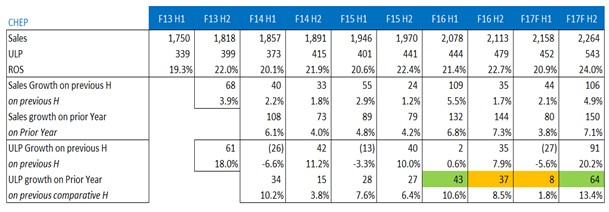
3587 The table confirms Kennett’s evidence that CHEP Global Underlying Profit was usually less in 1H than in 2H. But his reliance upon that as part of the basis for his conclusion that the projected 2H17 CHEP Global growth rates in the December Reforecast were reasonable was, again, misplaced. Kennett did not engage with the fact that the December Reforecast projected:
(a) Underlying Profit in 2H17 which was 20.2% more than its actual Underlying Profit in 1H17, which was a much greater difference than in the years from FY14-FY16 where the difference ranged from 7.9% to 11.2%.; and
(b) Underlying Profit growth in 2H17 of 13.4% compared to 2H16, which growth was much higher than the 2H growth from the previous corresponding period in any of the previous three fiscal years, which ranged from 3.8% to 8.5%.
3588 To meet the December Reforecast, CHEP Global was required to achieve 20.2% growth in Underlying Profit from 1H17 in 2H17 which was unprecedented, and would itself require 13.4% growth from FY16 (which had been a very strong year). There is a strong air of unreality about those projections, and I am satisfied that they lacked reasonable grounds.
3589 The extent of the projected sales revenue and Underlying Profit recoveries in the December Reforecast for US Pooled, CHEP NA and CHEP Global in 2H17 as compared to 1H17 can be seen in the following tables.
($US million) | 1H17 Sales Revenue | 2H17 Sales Revenue | 2H17 Growth from 1H17 |
US Pooled | 765 | 838 | 9.5% |
CHEP NA | 1,114 | 1,190 | 6.8% |
CHEP Global | 2,158 | 2,264 | 4.9% |
($US million) | 1H17 Underlying Profit | 2H17 Underlying Profit | 2H17 Growth from 1H17 |
US Pooled | 137 | 215 | 56.9% |
CHEP NA | 180 | 262 | 45.6% |
CHEP Global | 452 | 543 | 20.1% |
3590 Alonso gave evidence in cross-examination that as at 20 December 2016 he thought it was likely that US Pooled would miss its Underlying Profit budget by $(10) million more than as projected in the December Reforecast. If that occurred, it would take CHEP NA to an approximately $(27) million Underlying Profit deficit to budget for the full-year. In my view the risks facing CHEP NA in achieving the December Reforecast were such that Alonso’s view of the likely US Pooled Underlying Profit deficit for the full-year was an optimistic one.
3591 Given all the difficulties and risks facing US Pooled and CHEP NA in recovering from their actual sales revenue and Underlying Profit deficits to date (as discussed in detail in relation to the positions as at 20 October 2016 and 16 November 2016), there were not reasonable grounds for the December Reforecast to project that CHEP NA would claw back to an Underlying Profit deficit to budget of $(16.7) million by the end of FY17. I consider that CHEP NA would be doing well if it could just meet its monthly sales revenue and Underlying Profit targets, as originally budgeted, in 2H17, keeping in mind that:
(a) it had not met its sales revenue budget in any of the five months of FY17 to date and it had been materially under-budget and under-reforecast for three consecutive months; and
(b) it had not met its Underlying Profit budget in four of the last five months of FY17 and had been materially under-budget and under-reforecast for three consecutive months.
21.11.4 The projected overperformance by CHEP LATAM and CHEP Europe
3592 As previously noted, the December Reforecast projected that CHEP LATAM and CHEP Europe would overperform in Underlying Profit against budget by $7.3 million and $6.9 million respectively in 2H17, mainly based upon a continuation of their sales run rates. The projections for CHEP LATAM and CHEP Europe in the December Reforecast were almost identical to those in the CHEP Global Recovery Plan. That projected overperformance was part of the projected CHEP Global recovery by which it would claw back from its actual $(28) million Underlying Profit deficit to budget YTD to a $(2.6) million deficit for the full-year. It is, though, necessary to understand that the projected overperformance by CHEP Europe and CHEP LATAM was not the major driver of the December Reforecast. The projected CHEP Global recovery was still substantially dependent on a strong Underlying Profit recovery by US Pooled and CHEP NA.
3593 For the reasons previously explained in relation to the CHEP Global Recovery Plan, there were not reasonable grounds for Brambles to forecast that CHEP LATAM and CHEP Europe would overperform in Underlying Profit against budget by $7.3 million and $6.9 million respectively. I consider the projected overperformance by each business was more akin to a stretch target than management’s best estimate of likely outcome for CHEP LATAM and CHEP Europe for FY17. Even so, I consider it more likely than not that those businesses would achieve some of their stretch targets.
21.11.5 Control ratio
3594 The applicants submitted that one of the reasons why the December Reforecast lacked reasonable grounds was that the US Pooled control ratio assumed in the reforecast for 2H17 was set too low, which underestimated the direct costs that would be associated with the higher actual existing control ratio, and which was likely to persist.
3595 It is uncontentious that a higher control ratio meant higher direct costs, and also uncontentious that the elevated control ratio in November and December 2016 was driving higher direct costs. The Moreno Report (22 November 2016) told management that the control ratio was 4.4 pps above-budget and the higher control ratio had given rise to additional costs of $(4.3) million YTD. Alonso described the 4.1 pp increase in the control ratio as “very significant”. Between 1 and 2 December 2016 Young and Alonso had an email exchange in which, among other things, Young commented on the control ratio which was 110.6% for the week-to-date, 99.0% month-to-date and 98.4% YTD. In cross-examination Alonso accepted that at this time the control ratio had “skyrocketed” and that he had never seen a worse US Pooled control ratio in his time with Brambles. Moreno’s 12 December Supply Chain Report told management that in November the elevated control ratio had given rise to the biggest single month of above-budget additional costs of that type ($(1.7) million).
3596 The December Reforecast assumed a control ratio of 96.6% (which was an increase from 96.4% in the September Reforecast), which was almost two pps below where the actual control ratio was sitting at that point in time.
3597 Brambles accepted that, compared to previous months, the control ratio in November and December was significantly elevated. But it noted that in the email exchange between Young and Alonso on 1 and 2 December 2016, Young said: “I don’t recall seeing [the control ratio] this high midweek”. Alonso responded: “Wow! It looks like something else could be happening, destocking? Although we are down on issue volume to budget, we are still growing vs [last year] so such an strong [control ratio] doesn’t make sense!”. Young responded: “[T]hat’s exactly my fear but still too early to tell”. In his first affidavit, Alonso deposed that he agreed with Young’s view, which he understood to be that there was inconclusive data to determine whether customer destocking was occurring.
3598 Brambles submitted that management considered whether the higher control ratio pointed to customer destocking, and they found the data was not clear. It noted that the factors pointing away from destocking included longer cycle times, customers not declaring destocking, growing demand for pallets, and CHEP NA being below forecast P-stock levels at the end of December FY17 (meaning more pallets were out with customers than forecast). It said, however, that management assessed that, given there were only two weeks of data indicating a rising control ratio, and given the control ratio typically surged in the second half of December, as pallets began to return from retailers after they had stocked up for the Thanksgiving through to Christmas shopping season, it was too early to tell if the high control ratio at the time the December Reforecast was made signalled anything other than that seasonal surge. Management therefore decided it was necessary to wait to assess trends until after the seasonal surge, in January 2017. Brambles submitted that it was not clear whether customer destocking was occurring, and that justified the delay in making a decision about whether to increase the assumed control ratio in the December Reforecast.
3599 In effect, Brambles argued that on the information available at the time the December Reforecast was made, and without the benefit of hindsight, there were reasonable grounds for management to set the full-year control ratio at 96.6% in the December Reforecast, rather than at a higher rate.
3600 I do not accept that submission.
3601 First, Alonso’s query regarding destocking was as at 1-2 December 2016. In cross-examination, Alonso said that there was a “working theory” across Brambles that customer destocking might be occurring. But he accepted that Brambles did not have enough information at that time to work out whether that was the case. He accepted, for example, that the high level of pallet returns could simply have been the return of the very large number of pallets issued in FY16, which were coming back at the end of the cycle.
3602 But by the time the December Reforecast was approved, Alonso did not consider the high level of pallet returns represented customer destocking. In his second affidavit he said in relation to an email exchange he had with Scaiff on 19-21 December 2016. He deposed that the high level of pallet returns:
… in November / early December FY17 was not a destocking event, but more likely to be a result of the increased stocking in the field that had occurred over the previous two years’ coming to an end.
In cross-examination Alonso said that was his view at that point in time.
3603 Second, the control ratio was the domain of Alonso and the supply chain team but his recommendations were not followed. As previously noted, in cross-examination Alonso testified that by the end of November:
(a) he thought that the control ratio assumed in the US Pooled FY17 budget no longer had a reasonable basis and should go up; and
(b) for 2H17 he had to plan the control ratio based on the growth expected by US Pooled, which was “very significant”. For that assessment of growth he had to rely upon the assessments of others.
Importantly, he testified that management were forecasting to keep the control ratio the same as per the budget, but he was challenging that assumption and telling them that he thought the control ratio should be higher based on the strong pallet collections that had been seen in November.
3604 Further, Alonso testified that by around 1 December 2016, he had formed the view that the control ratio should be increased to at least 97.5% from early December 2016 for the remainder of FY17. As previously noted, Alonso testified that a one pp increase in the control ratio represented about $(9) million in additional costs for US Pooled. Had Alonso’s recommendation been accepted, the December Reforecast would have projected approximately $(4.5) million in additional costs and therefore $(4.5) million in reduced Underlying Profit.
3605 Third, Brambles submitted that Alonso’s view that the control ratio should be increased must in part have depended on his view regarding US Pooled sales volumes in 2H17, and he was not in a position to second-guess what US Pooled sales volumes would be in 2H17. I accept that Alonso had to rely on others for the projected 2H17 US Pooled sales volume, but this submission goes nowhere. Alonso testified that he “had to plan my control ratio based on the growth expected by the business” and he accepted that the projections were for “very significant” growth. Notwithstanding that, Alonso recommended that the control ratio should be increased. The evidence does not show that Alonso rejected the sales volume projections provided to him.
3606 Further, in cross-examination Alonso said that had he been told that the projected US Pooled new wins in 2H17 were not going to be as had been projected he would have factored that into his decision regarding the control ratio. I infer that had Alonso understood that the projected US Pooled new wins in 2H17 lacked reasonable grounds his recommendation in relation to the control ratio would have involved a greater increase.
3607 For reasons which the evidence did not adequately explain, Alonso’s recommendations to increase the control ratio to at least 97.5% were not taken up in the December Reforecast. As a result, the December Reforecast was wrongly based on an assumption of lower control ratio costs, and in that regard it lacked reasonable grounds.
3608 Finally, I do not accept Brambles’ submission that an additional $(4.5) million in direct costs due to the increased control ratio was not material in a business of Brambles’ size. The applicants established a series of matters which have led me to conclude that the December Reforecast materially overestimated the likely US Pooled and CHEP NA Underlying Profit in 2H17 (and consequently for CHEP Global and the Group). The $(4.5) million in additional costs associated with an increased control ratio was just one of them. Brambles’ contention also ignores the very narrow margin for underperformance which it left itself in maintaining the FY17 Guidance as at 21 December 2016.
21.11.6 Other unreasonable assumptions
3609 It will be recalled that another of the assumptions underpinning the December Reforecast for CHEP Global was an assumption that all pricing actions (i.e., increased charges) would begin on 1 January 2017, which would include and full implementation of SCD upcharges “to [small and medium enterprises], Nestlé, Pepsi, Contingencies etc”.
3610 The projected recovery in new wins in 2H17 was much more significant to the reforecast than the proposed pricing actions, but the evidence does not show an objectively reasonable basis for US Pooled to assume that all of its proposed increased charges would come into effect in just over 10 days. For many US Pooled customers there was no agreement or contractual relationship in place between US Pooled and those companies which would allow an increase in SCD upcharges. Obtaining higher prices or charges would require negotiation, the outcome of such negotiations was uncertain, and it was likely to take an appreciable amount of time before such pricing actions would be material to Underlying Profit.
3611 Another assumption underpinning the December Reforecast for CHEP Global was the assumption that US Pooled would receive successful delivery of interregional flows from CHEP LATAM. Again, the evidence does not show an objectively reasonable basis for US Pooled to assume this. The only basis Nador advanced for that assumption in her 8 December 2016 email was that, if the assumption was not made, this would be a risk. And the relevant slide in the December Reforecast for CHEP Global stated that successful delivery of interregional flows was “still at risk”. This should not have been assumed.
21.11.7 Brambles’ submissions
3612 Brambles’ submissions trumpeted the November results as a “stark improvement” in Underlying Profit, and as a credible indicator that the recovery actions to address the underperformance issues in US Pooled and CHEP NA were starting to have their intended effect. It argued that the November results signalled that the Walk to MOP process in US Pooled was having a positive impact, and it argued that the Moreno Report would deliver further improvements.
3613 It said that the November results gave senior management confidence in the achievability of the December Reforecast. It relied on O’Sullivan’s evidence that, following receipt of the November flash results, the improved monthly results in CHEP NA coupled with the overperformance by CHEP LATAM and CHEP Europe, gave her confidence that the December Reforecast was achievable.
3614 I found little force in that submission. I cannot see a reasonable basis for treating the November results for US Pooled as a reliable basis, or as Brambles put it, a “credible indicator”, that US Pooled and CHEP NA were turning the corner. Properly understood the results for US Pooled and CHEP NA were poor, and more of the same.
3615 In US Pooled:
(a) sales revenue was $(5.6) million under-budget (and $(3.6) million under-reforecast) for the month, resulting in an increased sales revenue deficit to budget of $(21.5) million YTD; and
(b) Underlying Profit was $(4.8) million under-budget (and $(2.6) million under-reforecast) for the month, resulting in an increased Underlying Profit deficit to budget of $(30.2) million YTD.
The key driver of the Underlying Profit shortfall to budget was a failure to achieve budgeted new wins. That was the same problem that US Pooled had experienced in every month of FY17 to date, and materially so in each of the past three months.
3616 In CHEP NA:
(a) sales revenue was $(12) million under-budget (and $(8) million under-reforecast) for the month, resulting in an increased sales revenue deficit to budget of $(41) million YTD; and
(b) Underlying Profit was $(6) million under-budget (and $(4) million under-reforecast) for the month, resulting in an increased Underlying Profit deficit to budget of $(35) million YTD.
3617 I do not accept that such results can reasonably be described as representing a stark improvement. Indeed, standing back from the results, and recognising that this was the fourth reforecast for US Pooled and CHEP NA in three months (Initial September Reforecast, Revised September Reforecast, CHEP Global Recovery Deck and December Reforecast), the fact that US Pooled and CHEP NA had again failed to meet the reforecast almost immediately after it was made should have been chastening for management.
3618 Further, the reason why the November Underlying Profit results for US Pooled were not even worse was because of a better direct costs performance overall. But, while direct costs in November were only slightly above-budget, that was not because of any improvement in the underlying problem. Moreno’s 12 December Supply Chain Report showed that three major causes of the direct costs overruns YTD that were identified in the Moreno Report continued to be materially over-budget in November. For the month, costs associated with:
(a) higher pallet re-use at TPMs was driving costs $(1.3) million over-budget;
(b) a higher control was driving costs $(2.7) million over-budget; and
(c) higher transportation ratio was driving costs $(1.3) million over-budget.
But that $(5.3) million in direct costs overruns was offset by $4.5 million in lower costs because of lower pallet demand (which was not a good thing for the business) and a $2.3 million correction for an error in the October results. The fact that the direct costs overruns were continuing did not bode well for US Pooled materially clawing back its ever increasing $(30.2) million Underlying Profit deficit YTD.
3619 Brambles also trumpeted that Group results YTD showed sales revenue growth at 6% only slightly below the FY17 Guidance range of 7% to 9%, and Underlying Profit of 10%, in the middle of the FY17 Guidance range of 9% to 11%. It submitted that it was, to say the least, difficult for the applicants to reconcile those results with their case theory.
3620 That submission was seriously overstated. First, the more important thing was not where sales revenue and Underlying Profit growth sat YTD, but where it was likely to be by the end of FY17. As I later explain, I consider it was more likely than not that Group sales revenue and Underlying Profit growth would be below the FY17 Guidance, by the end of FY17. Second, as the applicants submitted, the evidence does not explain the basis upon which the days-adjusted growth rates were calculated YTD, and one should be cautious before drawing too much from them.
Nador
3621 Nador did not give much evidence about the position for US Pooled at the time of the December Reforecast. She deposed that she was “comfortable” with the December Reforecast even though it was “challenging” and would require a collective team effort to achieve it. She also deposed that she was “confident” it was achievable and said that her confidence was bolstered by:
… the positive news the business had been receiving about the conversion of the sales pipeline (anticipating a change for the better in new wins volume), as well as improvements on direct costs and the damage rate being on budget.
3622 None of the matters to which Nador referred had a reasonable basis, and I give little weight to her evidence.
3623 First, Nador did not explain what positive news US Pooled had received about the conversion rate, and the evidence does not indicate any material change. Sales revenue had been under-budget for every month of FY17, and materially under-budget and under-reforecast in each of the last three months. The November results did not show any turnaround in sales conversions. In November, US Pooled had been $(5.6) million under-budget and $(3.6) million under the Group September Reforecast in sales revenue.
3624 Second, it was true that November was a better month for US Pooled direct costs overruns, but as noted above that was not because of any turnaround in the underlying causes which were continuing and were likely to continue to afflict US Pooled.
3625 Third, Nador was wrong in stating that the damage rate was on budget. The damage rate assumption in the December Reforecast projected a two pp reduction in the average damage rate over the course of FY17. US Pooled was nowhere near achieving that.
3626 Further, although the network damage rate had decreased over the period from July to October 2016 and had been getting close to the target rate, it had gone up again in November and again in December. Alonso had recommended to Rumph in mid-December 2016 that she should forecast on the basis that US Pooled would not achieve the assumed $10 million in Underlying Profit from an improvement in the damage rate, and should downgrade the full-year Underlying Profit projection by $(7) million because he was concerned that the assumed costs savings were not deliverable.
Martin
3627 I sufficiently dealt with Martin’s evidence when dealing with the projected $18 million in Underlying Profit from US Pooled new wins in 2H17. I give little weight to that evidence.
Alonso
3628 I sufficiently dealt with Alonso’s evidence when dealing with the Moreno Report and his evidence that the direct costs overruns could be readily mitigated or recovered, and also under the headings “[t]he assumed improvement in the US Pooled damage rate” and “[c]ontrol ratio” (in sections 21.11.2 and 21.11.5 above). I need not deal with it further.
3629 It suffices to note that Brambles attempted to qualify two pieces of Alonso’s evidence in cross-examination. First, his evidence that the control ratio should have been revised upwards to 97.5% from 1 December 2016, and secondly his evidence that Rumph should have downgraded the CHEP NA Underlying Profit submission for the December Reforecast by $(7) million because it was unlikely to achieve the projected improvement in the damage rate. Brambles submitted that that evidence should not be taken at face value, and instead it needs to be understood in its proper context including that:
(a) an increase to the control ratio by 1% from 1 December 2016 would contribute to approximately $(4.5) million in additional costs for 2H17, and, when combined with a $(7) million increase to damage rate costs would contribute to only $(11.5) million in aggregate, or 1% of Brambles ULP FY17 budget of $1,063 million or 1.1% of the bottom end of the FY17 Guidance range of $1,055 million;
(b) the control ratio is by definition a function of sales volume, and sales volume was a variable which Alonso acknowledged in cross-examination he was not in a position to speculate on - particularly given Martin’s confidence in the forecast;
(c) granular reporting and ‘deep dives’ were conducted on costs each month to determine which aspects of business performance were driving these costs higher; and
(d) Alonso’s comments reflected his view as at December 2016 after deep-dives had been conducted, and cannot be used to retrospectively deduce what would have been reasonable at any point before this.
3630 For the reasons I explained in relation to the assumed improvement in the damage rate, and in relation to the control ratio, I found little force in these submissions.
3631 Brambles also attempted to qualify Alonso’s email to Rodriguez on 20 December 2016 in which he said he expected US Pooled to miss budget by an additional $(10) million. It submitted that the email should be situated in its “proper context” including that:
(a) his evidence related only to the supply chain and does not accord with the views expressed by other witnesses as to the achievability of the December Reforecast;
(b) Alonso could not recall if he communicated this view at the time; and
(c) the extent to which Alonso held doubts about the supply chain components of the budget (e.g., damage rate and control ratio) as at December 2016 were “immaterial” in the scheme of Brambles’ earnings guidance.
I understood Brambles’ submission as a contention that Alonso’s evidence that, as at 20 December 2016, he thought US Pooled was likely to miss its Underlying Profit budget by an additional $10 million should be given little weight.
3632 I found little force in Brambles’ submissions.
3633 First, Brambles’ submission that Alonso’s evidence concerned the supply chain budget rather than the general budget was a misunderstanding of the evidence. He was clear in stating that his remark was about the overall US Pooled budget, not just the supply chain budget.
3634 Second, I accept that Alonso’s evidence that US Pooled was likely to miss its Underlying Profit budget by $(10) million more than as projected in the December Reforecast did not accord with the views expressed by Brambles’ other witnesses. But it does not follow, and in my view it is appropriate to give it little weight.
3635 I infer that Alonso’s view was largely based on his view about supply chain matters as that was his area of expertise. In cross-examination he gave evidence that:
(a) US Pooled was not going to entirely make up the $27 million blowout in direct costs YTD;
(b) the control ratio had “skyrocketed” (and each pp increase in the control ratio equated to approximately $(9) million in increased annual costs). He recommended to management that the assumed control ratio in the December Reforecast be increased to at least 97.5%;
(c) in mid-December 2016 he recommended to Rumph that she forecast $(7) million in reduced Underlying Profit, because he doubted that the assumed damage rate improvement could be achieved.
3636 Taken together, those items add up to substantially more than Alonso’s estimate of the likely $(10) million additional miss to budget. I give greater weight to Alonso’s view in relation to supply chain matters than I do to the evidence of Brambles’ other lay witnesses.
3637 Further, for the reasons I have explained, I gave little weight to the evidence of Brambles’ other lay witnesses in relation to the achievability of the projections in the December Reforecast for US Pooled. The fact that Alonso’s evidence did not accord with their evidence is not a reason to give it less weight.
3638 Third, Brambles’ submission that Alonso could not recall if he communicated his view at the time misstated the evidence. The exchange Brambles relied on for its submission referred to Alonso’s concession that he could not remember whether he communicated his view to Gorman. However, Alonso went on to state that he was normally very open with Gorman in expressing his views about the risks that he saw. Most importantly, he said that he “probably” shared that view with Gorman, although he could not remember whether he was so specific about the size of the estimated miss to forecast. And even if Alonso had not passed on that view to Gorman, he was clear in stating that in mid-December 2016 he recommended to Rumph that she should incorporate a damage rate risk of $(7) million to Underlying Profit into the CHEP NA budget.
3639 I give weight to Alonso’s evidence that, as at 20 December 2016, he considered US Pooled was likely to miss its Underlying Profit forecast by an additional $(10) million (which would take it to an Underlying Profit deficit to budget for the full-year of $(21.8) million). If that estimate is accepted it would mean that it was necessary for CHEP NA to claw back $28 million in Underlying Profit to meet the December Reforecast projection of a $(17) million Underlying Profit deficit to budget for the full-year. I do not, though, accept the estimate because I consider it to be overly conservative. In my view, as at 21 December 2016, it was substantially more likely than not that US Pooled would have a materially greater Underlying Profit deficit to budget than that for the full-year.
Kennett and Mackie
3640 The evidence of Kennett and Mackie in relation to this period was weak and unpersuasive.
3641 First, Kennett deposed that at the time he presented the November CEO BPR Presentation at the CEO BPR meeting on 20 December 2016 he considered the December Reforecast for CHEP Global to be “realistic and achievable” primarily as a result of the strong CHEP LATAM and CHEP Europe YTD performance, which was offsetting the poorer than expected CHEP NA YTD performance. Mackie also deposed that the ongoing outperformance against budget by CHEP LATAM and CHEP Europe provided a reasonable basis for achieving the full-year projections in the December Reforecast.
3642 For the reasons I have explained, I found that there were not reasonable grounds for the projected overperformance against budget by CHEP LATAM and CHEP Europe in 2H17. Essentially, that was because I consider the projected overperformances by those businesses were not management’s best estimate of the most likely outcome in 2H17. They were more akin to stretch targets and the result of pressure from Mackie and Kennett. The clearest example of that was the CHEP LATAM Stretch Plan which forecast an additional $7 million in Underlying Profit, whereas the initial CHEP LATAM December Reforecast submission forecast an additional $4 million in Underlying Profit. In his email De Rivas drew a clear distinction between the CHEP LATAM Stretch Plan and what CHEP LATAM put forward as its December Reforecast submission. Notwithstanding that, De Rivas was instructed to load the stretch target as the forecast.
3643 Even so, I accept that there were reasonable grounds to expect some overperformance against budget by CHEP LATAM and CHEP Europe in 2H17. I later estimate how much of that I consider had reasonable grounds.
3644 But the more important point is that the projected overperformance by CHEP LATAM and CHEP Europe was something of a distraction. If it occurred, that overperformance could only bring CHEP Global Underlying Profit back to just under-budget for FY17 if:
(a) management could staunch the bleeding in US Pooled and CHEP NA so that the ever-increasing Underlying Profit deficit to budget stopped growing; and
(b) CHEP NA achieved the remarkable projected 2H17 turnaround and clawed back $18 million of the actual $(35) million Underlying Profit deficit to budget it had run-up in 1H17.
For the reasons I have explained, there were not reasonable grounds to expect either that the bleeding could be stopped nor that CHEP NA could claw back any of the actual Underlying Profit deficit YTD.
3645 As a result, even if CHEP LATAM and CHEP Europe could meet the stretch targets to which they had agreed, that level of projected overperformance against budget could not compensate for Underlying Profit shortfalls of the magnitude that CHEP NA had YTD, which were likely to increase.
3646 Mackie described November as an “encouraging month” and said that he expected the good results in November to continue, in part due to the recovery initiatives being pursued by US Pooled. He said that while the US Pooled growth rates projected for 2H17 were a significant improvement on the results YTD, he thought the increase in sales was achievable by reference to the delays in new customer wins, and the large customer deals expected to close in late 2016 and early 2017.
3647 Apart from the results in CHEP LATAM and CHEP Europe, I do not accept that there was a reasonable basis for Mackie to describe November as an “encouraging month”. The December Reforecast was the fourth reforecast for US Pooled and CHEP NA that he and Kennett had made in the last three months, and not one of them had been met. The key driver of the US Pooled Underlying Profit shortfall to budget in November was its continuing failure to achieve budgeted new wins. That was the same problem that US Pooled had experienced in every month of FY17 to date, and materially so in each of the past three months. Each of those reforecasts was based on the proposition that US Pooled was going to land some big sales and/or the (asserted) delayed new sales were going to be achieved. For the reasons I have explained, there were not reasonable grounds to expect that the extremely low conversion rate was going to speedily abate. And if it did not speedily unclog, there was no chance that US Pooled could achieve the projected $90 million in new wins in 2H17.
3648 Second, Kennett deposed that the 19 December CHEP Global R&O Analysis supported his view that CHEP Global would meet the reforecast. I do not see how the 19 December CHEP Global R&O Analysis could support Kennett’s belief in the achievability of the reforecast.
3649 It showed a net $(15) million risk to CHEP Global Underlying Profit, most of which arose from CHEP NA. Even if (contrary to my view), the 19 December CHEP Global R&O Analysis is accepted as having reasonable grounds it could not be a reason for confidence in the achievability of the December Reforecast. It showed a significant net risk, and achieving the December Reforecast projections for CHEP Global required CHEP NA to claw back the actual substantial Underlying Profit deficit.
3650 Further, to my mind, it is plain that the 19 December CHEP Global R&O Analysis lacked reasonable grounds:
(a) for reasons left unexplained by Brambles, the analysis incorrectly downgraded the damage rate risk to $(5) million on a risk-adjusted basis. That risk adjustment lacked reasonable grounds given Alonso’s recommendation to Rumph in mid-December 2016 that a $(7) million damage rate risk should have been ‘baked into’ the reforecast. Doing so would have reduced the projected Underlying Profit in the December Reforecast for US Pooled by approximately $(7) million in 2H17, rather than just noting an (underestimated) risk of $(5) million;
(b) the R&O analysis failed to take into account Alonso’s recommendation that control ratio costs would be at least one pp higher than as reforecast, which would decrease Underlying Profit by at least $(4.5) million in 2H17; and
(c) the R&O analysis seemed to assess only an $(8) million risk to sales revenue, but the subtitle to that slide said that “USP assumed a sales risk of $18M” in 2H17. On either view, that assessment lacked reasonable grounds when Kennett had described the projected US Pooled 2H17 sales growth as “challenging”; Todorcevski described an earlier (lower) level of 2H17 rephasing as “massive” and “well beyond anything we’ve seen”; and O’Sullivan described the projected 2H17 sales revenue growth as “a big step up”, “inherently a lot more risky” than was ideal, “optimistic” and “very challenging”. To my mind it was foolhardy to ascribe such a low level of risk to achieving that challenging and risky sales revenue recovery, in circumstances where US Pooled had not achieved its sales budget in any month of FY17 to date, and had been materially under-budget and under-reforecast in each of the last three months.
3651 Third, both Kennett and Mackie deposed that another factor underpinning their belief in the achievability of the December Reforecast for CHEP Global was their review of the December Reforecast submissions for the CHEP Global CBU and their meetings with the President and CFO of each CBU in connection with the December Reforecast process. Relatedly, Kennett deposed that his confidence in the achievability of the December Reforecast for CHEP Global was also based on the performance of the CHEP Global business, across the portfolio of CHEP CBUs. I accept that Kennett and Mackie undertook those reviews and meetings in relation to all CHEP Global CBUs, but the only reviews of relevance were those in relation to CHEP LATAM and CHEP Europe and of CHEP NA. The other CBUs were only expected to perform in alignment with budget, and they would not offset the underperformance by CHEP NA. Insofar as Kennett relied on the overperformance by CHEP LATAM and CHEP Europe in 2H17, I have explained my views. In relation to CHEP NA, I explain it below.
3652 Fourth, Kennett deposed that another of the factors underpinning his belief in the achievability of the December Reforecast was the CHEP NA recovery plan and the CHEP Global Recovery Plan. Relatedly, Mackie deposed that although the December Reforecast required an increase in new wins for US Pooled in 2H17, given the reports he had received relating to the progression of customer accounts in the sales process and the expected timing of new customer wins in the November CEO BPR Presentation, he was confident that the US Pooled new wins were going to be delivered. And he said that if the projected US Pooled new wins in early 2017 were not delivered he thought there may be a need to reassess the forecast, but that would not be clear until the January and February results were known.
3653 Those CHEP NA and CHEP Global recovery plans were interrelated. As acknowledged in the December Reforecast for CHEP Global, the projected 2H17 recovery by US Pooled was “key” to the projected recovery by CHEP Global to be just under-budget by the end of FY17. I consider the December Reforecast for CHEP Global lacked reasonable grounds, largely because the projected recovery by CHEP NA lacked reasonable grounds. Having regard to my conclusions as to the position of US Pooled and CHEP NA as at 20 October 2016 and 16 November 2016, and the further deterioration in the position of those businesses through to 21 December 2016, when the December Reforecast was approved (subject to management review), it was highly unlikely that, in 2H17 Brambles’ management could staunch the bleeding of Underlying Profit in US Pooled and CHEP NA or claw back $18 million of the actual CHEP NA $(35) million Underlying Profit deficit to budget. Among other things, there were not reasonable grounds for the December Reforecast to project:
(a) that in 2H17 US Pooled would achieve:
(i) $18 million in Underlying Profit through $90 million in sales revenue from new wins;
(ii) $8 million in Underlying Profit from an improvement in the damage rate; or
(iii) $4.5 million in Underlying Profit through a lower control ratio; or
(b) the unprecedented 2H17 sales revenue growth by US Pooled. To meet the projections in the reforecast CHEP NA’s projected 2H17 performance would have to be almost 50% better than its actual performance in 1H17.
3654 Fifth, both Kennett and Mackie based their belief in the achievability of the December Reforecast for CHEP Global on their understanding of the CHEP Global business, including its year-on-year trends and its strong track record against budget each year and their understanding that the business always involved risks.
3655 I accept that CHEP Global had a track record of achieving its budget, and that that gave Kennett and Mackie some confidence in the achievability of its budget in FY17. But the question as to whether there were reasonable grounds for the December Reforecast cannot be answered by reference to CHEP Global’s past performance in other years and in different circumstances. It primarily falls to be assessed by reference to the evidence in relation to this period.
3656 I accept too that both Kennett and Mackie were competent and experienced senior executives with substantial experience in the business, and ordinarily it would be appropriate to give their views real weight. However, while their views are relevant, they are not determinative. The question is an objective one. For the reasons I have previously explained I give little weight to some important parts of their evidence. I prefer the contemporaneous documentary record and to a significant extent that record, together with some of the evidence in cross-examination, has drawn me to conclude that there were not objectively reasonable grounds for their belief in the achievability of the December Reforecast. Among other things, from the time of the September Reforecasting process both had on several occasions signed off on sales revenue and Underlying Profit projections for US Pooled and CHEP NA which were shown to be excessively optimistic. I consider that their approach to the achievability of the CHEP NA and CHEP Global budgets was part of the “good news culture” to which O’Sullivan referred and a concern to avoid facing the inconvenient truth that there was a substantial risk that CHEP Global would materially miss budget for the full-year and Brambles would have to downgrade its FY17 Guidance on sales revenue and Underlying Profit growth. I do not give much weight to their evidence regarding their belief in the achievability of the CHEP Global budget.
3657 Sixth, Mackie deposed that the results for CHEP Global YTD at the end of November FY17 did not indicate a trend requiring a larger adjustment to the full-year sales or Underlying Profit projections in the December Reforecast. Following the November results, as a portfolio of business units, Mackie thought CHEP Global was performing well and that there was adequate time in the second half of the year to recover the shortfall in the results YTD.
3658 There was no force in that evidence. There was not a reasonable basis for Mackie to testify that CHEP Global was “performing well” at the end of November FY17. At that point, despite increasingly desperate efforts to turn the situation around, US Pooled and CHEP NA had materially underperformed against budget and reforecast and had brought CHEP Global to the position that, YTD, it had a $(32) million sales revenue deficit to budget and a $(28) million Underlying Profit deficit to budget. How that could be described as “performing well” defies explanation. Those results could not reasonably be a basis for confidence in the achievability of the December Reforecast.
3659 Nor did Mackie explain why it was not appropriate for the December Reforecast to make a larger adjustment to the sales or Underlying Profit projections for CHEP Global when the key to the projected CHEP Global recovery was a recovery by US Pooled and CHEP NA. And the projected 2H17 recovery by CHEP NA was described by Kennett as “challenging” and by O’Sullivan as “inherently a lot more risky” than was ideal, “optimistic” and “very challenging”.
O’Sullivan
3660 Brambles sought to rely upon aspects of O’Sullivan’s evidence. For the reasons I now explain I consider her evidence provides little support for the existence of reasonable grounds for the projections in the December Reforecast in respect of CHEP NA and CHEP Global.
3661 First, O’Sullivan gave evidence that at the time of the CHEP Global December Reforecast, while she had some concern about the shape of the earnings profile in the December Reforecast given the emphasis on the delivery of growth in 2H17 when compared to 1H17, she deposed that she “had not worked in the business long enough to form a reasoned view on whether the proposed sales and Underlying Profit growth for 2H17 were achievable”.
3662 She deposed that in conversations with Gorman and Rumph regarding the CHEP Global December Reforecast both had expressed a high degree of confidence in the recovery in 2H17 based onthe delays with customer new wins in the US that were expected to start flowing in 2H17; the ongoing outperformance against budget in CHEP Europe and CHEP LATAM; the implementation of efficiencies and cost recovery measures in the recovery plans. She said that because of their significant experience in running the business, she “relied on their judgment regarding the achievability of the earnings projections” in 2H17 (emphasis added).
3663 Thus, when O’Sullivan said she had “confidence” that the December Reforecast was “achievable”, that was not evidence of her own reasoned view regarding the achievability of the 2H17 sales revenue and Underlying Profit projections for CHEP NA, or the projected 2H17 overperformance by CHEP LATAM and CHEP Europe. It was evidence that, because of their significant experience, she accepted the views of Gorman and Rumph in that regard.
3664 Second, O’Sullivan did not in cross-examination deviate from her evidence that she considered the December Reforecast in respect of CHEP NA and CHEP Global to be achievable, but she expressed her views about the achievability of the reforecast in terms which show that she considered the projected recovery to be overly optimistic and extremely challenging.
3665 That became apparent in two ways. First, O’Sullivan was taken in cross-examination to Chipchase’s email to her on 13 December 2016 in which he wondered “when/if we can say we don’t think the recovery will happen”. He also suggested that Rumph was not being realistic about the projected 2H17 recovery by CHEP NA. O’Sullivan accepted that Chipchase was sceptical about the projected recovery by CHEP NA. Then senior counsel for the applicants asked O’Sullivan whether she had discussed with Chipchase her doubts about Rumph’s ability to turn around performance in US Pooled.
3666 The following exchange took place:
O’Sullivan: I don’t recall the specifics, but I do recall expressing concerns about the level of improvement to be delivered in the second half relative to the first half.
Quinn: Because it was a massive turn around, wasn’t it?
O’Sullivan: ---It required basically unlocking a sales pipeline that hadn’t been moving for the last few months and required making savings, and it was a step up, definitely, from the first half.
Quinn: It was fair to say that it was really extremely unlikely to be achieved; correct?
O’Sullivan: ---No, I didn’t think at that time it was unlikely to be achieved. I thought it was very challenging, and based on all the advice I got from all the operators, it was we needed to see through January at least to see whether we would deliver on the savings and on the sales pipeline which were fundamental to achieving the full year guidance.
3667 That evidence - that the projected 2H17 recovery in the December Reforecast was a “step up, definitely” from 1H17, and was “very challenging”- was quite different to her evidence-in-chief.
3668 Second, it became apparent when O’Sullivan was taken in cross-examination to the Early Observations Memo she sent Chipchase on 28 December 2016. In cross-examination O’Sullivan sought to walk back the significance of her remarks in that memo. She described the observations as “initial”, coming from a “helicopter view” and said that the opinions she expressed were:
…very much preliminary thinking and the thoughts evolved over the months through January and February, and I think it’s pretty crucial that we recognise that there was a lot of fact finding, otherwise it’s like we reached a conclusion when we hadn’t.
3669 I accept that the observations in the Early Observations Memo were at a high-level, and O’Sullivan expressly said that they were her “initial perspectives and observation” which were open to discussion and debate. I accept that O’Sullivan’s views might change as she learned more about Brambles’ business, and the memo only represented her view at that point in time.Even so, I consider it appropriate to give real weight to the concerns O’Sullivan expressed. The following reasons are material.
(a) At this point in time O’Sullivan was still new in Brambles, but she had had enough time to reach some informed views. As she accepted in cross-examination, she had come into Brambles halfway through the September Reforecast and had seen the outcome of that process; she had met with the CHEP NA team in Atlanta, Georgia on 5-6 December 2016, and she felt that she had a good grasp of how US Pooled and CHEP NA were operating; she had undertaken the December Reforecast as Brambles’ CFO; and she had presented the November Financial Update as Brambles’ CFO at the December Board Meeting.
(b) It is clear from the memo that O’Sullivan gave careful thought to it. The observations she made were considered and ran over six pages. In cross-examination O’Sullivan said that she had been “sanity checking” the views in the memo with a number of people within Brambles. And O’Sullivan sent the memo in the context that she was the newly appointed CFO setting out her early views about Brambles’ business to the incoming CEO. O’Sullivan was plainly intelligent and she would have understood that the memo was an important step in obtaining Chipchase’s trust. The observations she made were high-level and initial, but I am satisfied they were well thought through.
(c) As I have said, I consider the contemporaneous documentary record to be the most reliable evidence of what O’Sullivan thought at the time, and substantially more reliable than her recollection of what she thought at the time about routine business matters more than six years after the event.
(d) The evidence shows that there was a sound basis for O’Sullivan’s observations. The concerns she expressed may have been initial, but on my view of the evidence most of them were correct.
3670 Third, in relation to the ‘hockey-stick’ recovery that the December Reforecast projected for US Pooled and CHEP NA in 2H17, O’Sullivan’s Early Observations Memo belied her evidence-in-chief that she thought that ‘hockey-stick’ recovery was “achievable”.
3671 In the memo O’Sullivan described the ‘hockey-stick’ recovery in the FY17 forecast as an example of Brambles’ “good news culture” which she said needed to be changed to a culture of “defining reality”. In cross-examination, O’Sullivan was asked what she meant by that observation, and what her view was about the achievability of the December Reforecast in this period. The following exchanges are germane:
(a) O’Sullivan was asked whether, looking at the comparative US Pooled sales revenue performance in 1H17 compared to the projected performance in 2H17 in the December Reforecast, she thought the projected full-year result was “unattainable”. She responded:
It looked very challenging. Not unattainable. It looked very challenging
(b) O’Sullivan was asked whether she thought the projections in the December Reforecast were overly optimistic and reflective of a good news culture. She responded:
I felt that there was a big step up in the second half, and I think managing a business to be reliant on it all to come good in the last six months is not how ideally you want to run the business. So having more, you know, having more contingency in the run up to where you are dependent on something to deliver, whereas this plan required delivery of a step up in the second half to deliver to guidance.
(Emphasis added.)
(c) O’Sullivan was asked whether she thought there was insufficient acknowledgement within CHEP NA about the risks involved in delivering the projected 2H17 results. She replied:
So I thought their reliance on winning all the accounts in the second half made the plan inherently a lot more risky than you would ideally like to position yourself to be, so hence my view that we should have pushed earlier in the year for more contingency to be in place ideally, and, you know, running the business just waiting for sales conversion isn’t a great way to be. It may have come to pass, may have delivered the outcomes, but it presents you a hockey stick that isn’t a great place to be.
(Emphasis added.)
(d) O’Sullivan was then asked whether she was intimating to Chipchase that the objectives and targets that were being set by CHEP NA were unrealistic. She responded by stating:
Optimistic. For FY17 at this point, not unrealistic, but I felt that they hadn’t started early enough to get a plan B in place to de-risk themselves.
(Emphasis added.)
(e) In relation to de-risking the CHEP NA recovery plan O’Sullivan said:
So they got an action plan that got them back to guidance. I’m saying in an ideal world, which is communicated here, in an ideal world I have additional buffer in place so you are not reliant on specific things to occur in the second half. Ideally, you have more things happening earlier in the year so you are not reliant on a big step up in the second half.
(Emphasis added.)
(f) O’Sullivan testified that she was “definitely” sceptical about the CHEP NA recovery plan at this point but said:
However, there was a plan that still got us back on guidance at this point, and it was too early to call they would not deliver that. But it was dependent on outcomes in January to be able to feel confident that they could deliver on that.
And that:
The forecast was, at that point, still achievable dependent on delivery of the action plan and the pipeline of the new sales wins. That was my perspective.
3672 The Early Observations Memo itself is the most reliable evidence of what O’Sullivan thought at the time about the projected 2H17 ‘hockey-stick’ recovery by US Pooled and CHEP NA. It is substantially more reliable than her evidence as to her recollection regarding what she thought at that time, more than six years after the event. In that memo O’Sullivan said that the projected ‘hockey-stick’ recovery in CHEP NA was an example of a “good news culture” at Brambles, as compared to a culture which “defined reality” i.e., one that would accelerate the identification and resolution of issues.
3673 I infer that O’Sullivan’s view at the time was that the projected ‘hockey-stick’ recovery by CHEP NA in the December Reforecast was an example of management pushing good news up the management chain, rather than recognising reality. Her Early Observations Memo shows that she considered the projected 2H17 recovery by CHEP NA, which the November CFO BPR Presentation said was “key” to CHEP Global recovering to be just under-budget for FY17, was optimistic and risky rather than realistic.
3674 That inference also finds support in other parts of the Early Observations Memo where O’Sullivan said:
(a) the US Pooled run rate was “inconsistent with delivering hockey stick outlook for FY19”. That remark was about Brambles’ Medium-Term Targets rather than the FY17 Guidance but it confirms O’Sullivan considered the projected ‘hockey-stick’ recovery was optimistic rather than realistic; and
(b) the US Pooled business required a review because of the level of growth that had been built into the current year targets, which assumed that CHEP NA would over the period to FY19 achieve a material step up in returns and margins to produce returns similar to those in CHEP Europe. O’Sullivan then set out various reasons why she thought it was unlikely that CHEP NA could reach similar returns to those in CHEP Europe, including that:
(i) whitewood pallets were a low cost alternative to US Pooled pallets, and (unlike Europe) the US had a large whitewood pallet market which had low pricing/low margins and was highly competitive. O’Sullivan said that growth in US Pooled required conversion of whitewood customers to pooled pallets and the low pricing of whitewood pallets limited conversions.
(ii) US Pooled had an aggressive and well-capitalised competitor in PECO which had better quality pallets. O’Sullivan said that limited the ability to maintain pricing, and that most customers secured a reduction in pricing on renewal. She said that meant the assumed margin growth and sales growth in US Pooled was “challenging”. She also said that the lack of net new wins YTD in US Pooled and lower pricing, indeed pricing which was below the cost of capital on new business reflected “this new reality”, giving the Cott Beverages account as an example of that.
(iii) US Pooled had experienced an increase in NPDs which “drives higher losses and higher cost of collection whilst there are increased fees associated with these accounts they increase the need for higher capex to sales ratios”.
(iv) US Pooled experienced materially higher pallet damage rates than CHEP Europe, as overall the US Pooled damage rate was circa 60% compared to circa 30% in CHEP Europe and the key reason for this was Walmart & NPDs. O’Sullivan noted that Walmart accounted for 20% to 25% of all US Pooled pallet flows and it had a 90% damage rate.
(v) US Pooled was experiencing retailers more aggressively seeking fees for pallet sorting/handling, and O’Sullivan gave the example of Costco which was charging $0.15 per pallet.
3675 Those observations confirm that O’Sullivan held serious concerns about the achievability of the CHEP NA recovery plan set out in the December Reforecast.
3676 The inference that O’Sullivan considered the projected 2H17 recovery by CHEP NA to be optimistic and risky rather than realistic also finds support in her evidence in cross-examination. She testified that:
(a) the projected CHEP NA sales overperformance against budget in 2H17 was “a big step up”;
(b) the CHEP NA projected recovery was “inherently a lot more risky than you would ideally like to position yourself to be”;
(c) “running the business just waiting for sales conversion[s] isn’t a great way to be. It may have come to pass, may have delivered the outcomes, but it presents you a hockey stick that isn’t a great place to be”; and
(d) the projected recovery was “optimistic” and “very challenging” (although denying it was “unrealistic”).
(Emphasis added in italics.)
3677 In passing, I also note that O’Sullivan’s observation about the projected 2H17 ‘hockey-stick’ recovery by CHEP NA not being “a great place to be” jarred to an extent with her evidence that, because she had not been in the business long enough to form her own reasoned views, she relied on the views and significant experience of Gorman and Rumph regarding that projected recovery. It indicates that she was sceptical of their view.
3678 Fourth, O’Sullivan’s observations in the Early Observations Memo about the US Pooled damage rate also jarred with her evidence that she thought that the projected ‘hockey-stick’ recovery by US Pooled was “achievable”.
3679 In that memo O’Sullivan said that the way management “underplayed” the Walmart damage rate was another example of Brambles’ “good news culture”, as compared to a culture which “defined reality”. O’Sullivan described the US Pooled damage rate, including the damage rate at Walmart, as one of the reasons why she considered it unlikely that CHEP NA could achieve similar returns and margins as CHEP Europe. She observed that in her view the key reason why the US Pooled damage rate was circa 60% was the damage rate from Walmart and NPDs. I infer that O’Sullivan meant that the way US Pooled and CHEP NA management underplayed the Walmart damage rate was another example of management pushing good news up the management chain, rather than recognising reality.
3680 Fifth, in cross-examination the following exchange with O’Sullivan took place in relation to US Pooled direct costs:
Quinn: You knew, didn’t you, that there were no reasons that were absolutely clear that allowed people to understand in North America what the causes of the direct costs underperformance was?
O’Sullivan: ---No. I think we - that there was. There - there was insights or there were insights as to what was driving increased costs. The challenge was, was there enough actions to offset those costs and deal with those costs in the second half.
(Emphasis added.)
3681 There O’Sullivan said, and I accept, that by the time the December Reforecast was made Brambles had some insight in relation to the causes of the direct costs overruns. She identified, correctly in my view, that the challenge for Brambles was whether there were enough “actions” management could take in 2H17 to mitigate the direct costs overruns, sufficiently to make a material difference.
3682 Moreno estimated that unless the US Pooled direct costs overruns were addressed they could be as much as $(31.2) million over-budget by the end of FY17. In my view, as previously explained (in section 20.4.2 above), rectifying the costs overruns was difficult and it would take time. Where they could be mitigated by additional charges or by directing changes to customer practices, that often required renegotiation of contractual terms, the outcome of which was necessarily uncertain, and it would take significant time to conduct renegotiations with enough customers to make a material difference.
3683 Sixth, O’Sullivan’s observations in the Early Observations Memo regarding competition by PECO also jarred with her evidence that she thought that the projected ‘hockey-stick’ recovery by US Pooled was “achievable”.
3684 In the memo O’Sullivan said that PECO was aggressive and well-capitalised and it had better quality pallets, and that as a result US Pooled was finding it difficult to maintain pricing and that most customers managed to secure a reduction in pricing on renewal. In her view that meant the assumed medium-term margin growth and sales growth in US Pooled was “challenging”. She also said that the lack of net new wins YTD in US Pooled, and lower pricing including pricing which was below the cost of capital on new business reflected “this new reality”, giving the Cott Beverages account as an example of that.
3685 In cross-examination O’Sullivan accepted that at this point she knew that competitive pressure from PECO had been a substantial factor in delaying the consummation of new wins in US Pooled in 1H17. And she agreed that there could be no realistic expectation that the competition from PECO was going to dissipate in 2H17. But she did not accept that there could be no realistic assumption that the projected new wins in 2H17 would be secured.
3686 That evidence tends to show that O’Sullivan thought that the projected 2H17 sales revenue growth by US Pooled in the December Reforecast was optimistic and risky. If the “lack of new wins” by US Pooled YTD was the “new reality”, how was it reasonable to forecast that US Pooled would achieve approximately $90 million in new wins in 2H17? And if the competition with PECO was so fierce that US Pooled was doing sales deals below the cost of capital in order to keep PECO out or to maintain sales volume, how was it reasonable to expect US Pooled to achieve the 2H17 sales revenue and Underlying Profit projections in the December Reforecast?
3687 Seventh, in cross-examination O’Sullivan denied that in accepting that CHEP LATAM and CHEP Europe would contribute approximately $14 million in Underlying Profit overperformance in 2H17 she was merely putting “faith” in that continued sales overperformance and denied that it was mere “hope”. She said in cross-examination that:
I formed a view based on the reviews that I had done with the business units, the CFOs and my understanding of the business. It wasn’t some vague idea I hoped it might be delivered. It was based on the information I had at the time and a lot of reviews and discussions with people in the business and across the business.
3688 I give that evidence little weight.
3689 First, that evidence was directly inconsistent with her evidence-in-chief and O’Sullivan cannot have it both ways. In her evidence-in-chief she said that she had not worked in Brambles long enough to form her own “reasoned view on whether the projected CHEP Global sales and Underlying Profit growth for 2H17 in the December Reforecast was achievable”. But she said that Gorman and Rumph had both expressed a high degree of confidence in the CHEP Global recovery based on, among other things, the ongoing outperformance against budget by CHEP LATAM and CHEP Europe and she “relied on their judgment regarding the achievability of the earnings projections” in 2H17.
3690 Second, O’Sullivan described the specific actions listed in the CHEP Global Recovery Plan in respect of the projected overperformance by CHEP LATAM and CHEP Europe as “granular” and as a basis for confidence that the recovery plans were credible. To my mind that indicated that O’Sullivan had not engaged with those plans in any depth, because (unless there were more detailed plans to which the Court was not taken) the plans that were in evidence were far from granular; they are better described as lacking in particulars and vaguely defined.
3691 Eighth, in cross-examination O’Sullivan sought to characterise the delayed new wins in US Pooled and the lack of sufficient improvement in the damage rate as “timing” issues. In my view that was an attempt to minimise their significance to the achievability of the projections in the CHEP Global December Reforecast. I understood the gist of that evidence to be that, over time, the Durability Program was likely to lead to an improvement in the US Pooled damage rate, and that, over time, US Pooled was likely to achieve the delayed sales. That can be accepted, but it missed the point.
3692 As O’Sullivan well knew, the difficulty that Brambles’ senior management faced in this period was whether or not (given the continuing underperformance against budget by US Pooled and CHEP NA) Brambles could maintain the FY17 Guidance. That issue was the subject of active consideration at the November Board Meeting and again at the December Board Meeting. Describing those issues as “timing” issues did not grapple with the fact that, unless US Pooled could achieve the projected $18 million in Underlying Profit through approximately $90 million in new wins in 2H17, and $8 million in Underlying Profit through an improvement in the damage rate in 2H17, CHEP Global would not meet the Underlying Profit projections in the December Reforecast and the Group would not meet the FY17 Guidance.
3693 That is, achieving the new wins and achieving the improvement in the damage rate were critical, and there were only six months left in FY17. The trajectory of the projected 2H17 recovery was necessarily steep and as O’Sullivan herself described it, “inherently a lot more risky” and “very challenging”.
21.11.8 The Board’s consideration
3694 It will be recalled that the minutes of the December Board Meeting record that O’Sullivan reviewed the December Reforecast and noted that it showed sales growth of 6% and Underlying Profit growth of 7% which was lower-than-expected and principally due to challenges in US Pooled. She outlined the December Reforecast which showed the Group meeting its FY17 Guidance to the market and noted that the biggest challenge for the balance of FY17 related to US Pooled. She then reviewed the issues facing US Pooled which principally related to its sales pipeline, competitive pressure, and lower whitewood prices.
3695 Then the minutes record that Gorman told the Board that the December Reforecast was a “bottom up” reforecast and (as I infer) therefore reliable. He told the Board that management was confident that the December Reforecast would be achieved, and said that many of the “challenges” facing US Pooled were “one-offs” and outlined the steps which were being taken to initiate a US Pooled recovery plan.
3696 The minutes record that the Board reviewed and discussed in detail the Group’s financial results and its disclosure obligations, and the Board noted that whilst no disclosure obligation had currently arisen, once the analysis of the November results had been completed and the December 2016 results had been received and analysed, there would be a clearer view of the forecast for 1H17 and full-year results. The Board requested management to keep it informed of any developments in the November and December results so that it would be in a position to determine whether it would be appropriate to issue a revised earnings forecast with the ASX prior to the scheduled announcement date of the FY17 half-year results, which Gorman indicated would happen at the January Board Meeting. Having regard to that, and Gerrard’s advice to the Board in relation to its disclosure obligation, and each of Long, Johns and O’Sullivan evidence that there was a discussion regarding maintenance of the FY17 Guidance, I am satisfied that that occurred.
3697 As earlier noted, I infer that Chipchase pressed for a downgrade of the FY17 Guidance at the December Board Meeting, and that some directors, including Cross, gave active consideration to downgrading the FY17 Guidance. I infer that Gorman strongly defended maintenance of the FY17 Guidance, and persuaded the relevant Board members away from their concerns. In part he did so, as the minutes record, by telling the Board that some of the issues giving rise to the underperformance by US Pooled in FY17 were “one-off” issues.
3698 This was the second occasion upon which the Board gave active consideration to downgrading the FY17 Guidance. I infer it was considered due to concern among some Board members that the continued very poor results in US Pooled and CHEP NA which had flowed through to CHEP Global and the Group, and the remarkable nature of the projected 2H17 recovery, meant it was unlikely that the Group would achieve the FY17 Guidance.
3699 The evidence shows that at the November Board Meeting Gorman and Todorcevski persuaded the relevant Board members away from their concerns in circumstances where the Board was misinformed. The discussion regarding the reasonableness of the grounds for the FY17 Guidance at that meeting must have been undertaken on the basis that the Group September Reforecast represented management’s best estimate of the likely performance of the Group and its constituent businesses in FY17, when it was not. The Board was not told that CHEP NA and CHEP Global management no longer considered that CHEP NA would claw back to meet its Underlying Profit budget for the full-year and would instead have a $(15) million deficit for the full-year.
3700 Notwithstanding that the Board (mistakenly) thought that CHEP NA and CHEP Global management continued to believe that the CHEP NA recovery plan meant that CHEP NA would meet budget, the Board still had to be talked “off the ledge” from downgrading the FY17 Guidance.
3701 The position was similar at the December Board Meeting. I infer that having regard to the continuing US Pooled underperformance against budget, the growing sales revenue and Underlying Profit deficits to budget at the CHEP Global and Group levels, and (as Chipchase put it), the assumption that “everything miraculously comes good in H2”, Chipchase pushed hard for a downgrade of the FY17 Guidance.
3702 Gorman staunchly opposed a downgrade. The minutes record, and both Long and O’Sullivan accepted, that in doing so Gorman told the Board that many of the challenges facing US Pooled were “one-off” issues. In cross-examination O’Sullivan was reluctant to concede that it was misleading for Gorman to describe the difficulties that had led to the underperformance by US Pooled YTD and the challenges it was facing in 2H17 as “one-offs”. She described the ongoing failure by US Pooled to achieve the budgeted new wins, and the continuing US Pooled direct costs overruns as “timing issues”, by which I understood her to mean that because they could be caught up on in the future she did not consider them to be ongoing issues. That was a semantic and erroneous distinction. Such continuing problems could not reasonably be described as “one off” issues, as O’Sullivan eventually seemed to accept.
3703 To my mind it was plainly misleading for Gorman to tell the Board that “many” of the challenges facing US Pooled were “one-off” issues. In relation to direct costs, they had been ongoing for four months and the Moreno Report acknowledged the real prospect that elevated supply chain costs in US Pooled could continue for the remainder of FY17, with potentially serious impacts on full-year Underlying Profit. In relation to the failure to achieve budgeted new wins, the evidence shows that US Pooled had experienced very low conversion rates for six months, and it does not show reasonable grounds to expect that problem to speedily abate.
3704 Long gave evidence in cross-examination that he did not consider Gorman’s reference to “one-offs” would have included direct costs, but he had little recall of what was said at the meeting, and I give little weight to that evidence. Further, I cannot see which of the material challenges US Pooled was facing at that time that Gorman could reasonably have described as “one-off” issues. It was misleading for Gorman to characterise any of the significant issues that gave rise to underperformance by US Pooled in 1H17, and were likely to continue to be challenges in 2H17, as “one off” issues.
3705 In cross-examination O’Sullivan said that she did not believe the Board decision to maintain the FY17 Guidance hinged on Gorman’s comments that issues in US Pooled were “one-offs”. There is no basis in the evidence to infer that O’Sullivan had insight into what lay behind the individual deliberations of the Board members, and I give no weight to that evidence.
3706 The minutes also record that Gorman outlined to the Board “the steps which were being taken to initiate a recovery plan for US Pooled”. There is no evidence that Gorman explained to the Board how many projections of the US Pooled recovery there had been, as US Pooled had repeatedly failed to meet budget targets. There is no evidence that Gorman told the Board that US Pooled and CHEP NA had missed the projections made by management in each of the Initial September Reforecast (4 October), the Revised September Reforecast (13 October) (which later became the Preliminary Group September Reforecast) and the CHEP NA Recovery Deck (20 November) almost immediately after they were made. And there is no evidence that the Board was told that for US Pooled to claw back from its actual $(30.2) million Underlying Profit deficit to budget YTD to an $(11.8) million deficit by the end of FY17, its 2H17 performance would have to be an astonishing 56.6% better than its actual performance in 1H17.
3707 Brambles relied on the Board’s consideration at the December Board Meeting regarding whether to reaffirm the FY17 Guidance in support of its contention that, as at that date, there were reasonable grounds for the FY17 Guidance (and for the continuing November Representations). It relied on the Board minutes and the evidence of O’Sullivan, Long and Johns in that regard. The gist of its argument was that, having regard to the November Financial Update and the December Reforecast, the presentation made by O’Sullivan and Gorman’s remarks, and the discussions at the meeting, the Board had reasonable grounds to believe that the FY17 Guidance would be met, and therefore the Board had reasonable grounds for maintaining the FY17 Guidance as at 21 December 2016.
3708 I consider the evidence of the Board’s consideration at the December Board Meeting provides little support for a finding that, as at that date, there were reasonable grounds for the FY17 Guidance (or for the continuing November Representations). Rather, to the extent the evidence is probative it points away from that conclusion because the Board was not properly informed.
3709 It is significant that in both the November and the December Board Meetings, when the Board decided to maintain the FY17 Guidance, the Board was not in my view properly informed. But the evidence of the Board’s consideration is not central to the decision. The question as to whether, as at 21 December 2016, there were reasonable grounds for Brambles to maintain the FY17 Guidance cannot be answered by reference to the quality of the Board’s consideration of the issue. It is an objective question.
21.11.9 Conclusion
The FY17 Guidance
3710 The position of US Pooled and CHEP NA as at 21 December 2016 was similar to that as at 16 November 2016, but worse.
3711 Having regard to the matters explained above, I am satisfied that, as at 21 December 2016, it was more likely than not that US Pooled would materially fail to achieve the sales revenue and Underlying Profit projections in the December Reforecast.
3712 For the same reasons as at 16 November 2016, the likely materially lower US Pooled sales revenue and Underlying Profit results for FY17 were likely to translate, reasonably closely, into materially lower results in CHEP NA:
(a) In relation to sales revenue, the December Reforecast did not project that sales revenue overperformance against budget by CHEP NA’s other businesses in 2H17 would offset any failure by US Pooled to achieve the reforecast sales revenue projections. Thus, the likely material failure by US Pooled to achieve the reforecast sales revenue projections was likely to worsen the projected $(70) million CHEP NA sales revenue deficit to budget for the full-year.
(b) In relation to Underlying Profit, the December Reforecast projected that a remarkable $15.2 million Underlying Profit overperformance against budget by US Pooled in 2H17 would be the main driver of a remarkable recovery by CHEP NA to a $(16.6) million deficit to budget for the full-year. Thus, the likely material failure by US Pooled to achieve the reforecast Underlying Profit projections was likely to mean that CHEP NA would have a greater Underlying Profit deficit to budget for the full-year.
3713 Those projections were the path by which the reforecast projected that US Pooled and CHEP NA would claw back to partially recover their respective Underlying Profit deficits by the end of FY17. As at 21 December 2016, it was substantially more likely than not that US Pooled and CHEP NA would materially fail to achieve those projections, and I consider it to be plain that there were not reasonable grounds for the December Reforecast to make the sales revenue and Underlying Profit projections that it did in respect of those businesses.
3714 That conclusion informs my view as to the existence of reasonable grounds for the FY17 Guidance as at 21 December 2016. I reiterate that, in my view, for the applicants to make out an absence of reasonable grounds for the continuing November Representations as at 16 November 2016, it was not necessary for them to prove what alternative sales revenue or Underlying Profit forecasts for FY17 would have been reasonable at that time. But for the reasons I have explained, I see some utility in making some approximate estimates.
3715 I now turn to make those estimates. My reasoning is the same as at 16 November 2016.
3716 In relation to likely US Pooled sales revenue for the full-year, the US Pooled budget was based on unreasonable assumptions of $53 million in unidentified new wins, a low level of customer losses and no losses of major customers, and the budget was stretched to near the limit of achievability. The December Reforecast carried on those assumptions, and projected significant overperformance against budget by US Pooled, in circumstances where:
(a) it had failed to meet budget for new wins in any of the five months of FY17 to date;
(b) it had been materially under-budget and under the September Reforecasts in sales revenue in September, October and November;
(c) it was experiencing a six-month trend of very low conversion rates and there were not reasonable grounds to expect that to speedily abate;
(d) the competition from PECO for customers was even more aggressive in December, to the point that Martin described it as being unusually aggressive, irrational and ultimately unsustainable. It was further slowing conversions, and had led to the loss of some large customers;
(e) it had lower opportunities for sales through whitewood conversions because whitewood pallet prices were reducing;
(f) it had a smaller sales funnel than in previous years; and
(g) the reforecast failed to adequately take into account identified risks to 2H17 sales revenue.
In those testing circumstances the December Reforecast projected that US Pooled would have sales revenue growth in 2H17 which was 9.5% better than its actual sales revenue growth in 1H17 (that being the highest growth rate compared to the previous half in the last three financial years), and sales revenue growth of 8.1% in 2H17 compared to 2H16, which was growth from an exceptional year. That was massive sales growth which was unrealistic and unlikely to be achieved.
3717 In the circumstances, I consider it to be more likely than not that US Pooled:
(a) would be unable to achieve the necessary overperformance against budget to recover any of the existing sales revenue deficit by the end of FY17; and
(b) would continue to underperform, to some extent, in sales revenue against budget over the remainder of FY17. That is, it would be unable to meet its monthly sales revenue targets, as originally budgeted, over the rest of the year.
3718 As at 21 December 2016, US Pooled had an actual $(21.5) million sales revenue deficit to budget YTD. I estimate, taking a generous view for Brambles, that its likely further sales revenue underperformance against budget for the remainder of FY17 would be at least a further approximately $(10) million. I therefore estimate that the US Pooled sales revenue deficit to budget for the full-year would be approximately $(31.5) million, or $(19.5) million greater than the projected $(12) million in the December Reforecast.
3719 As a result, accepting the correctness of the December Reforecast projections for the other CHEP NA businesses, I estimate that CHEP NA would have a sales revenue deficit to budget for the full-year which was approximately $(19.5) million greater than the projected $(70) million in the December Reforecast; i.e., approximately $(89.5) million.
3720 In relation to likely US Pooled Underlying Profit for the full-year, the US Pooled budget was based on the same unreasonable revenue assumptions and also unreasonably assumed a two pp reduction in the damage rate, and it was stretched to near the limit of achievability. The December Reforecast carried on those assumptions, indeed required significant 2H17 overperformance against budget by US Pooled, in circumstances where:
(a) it was unlikely to achieve the projected sales revenue having regard to the matters referred to above;
(b) it had not met its Underlying Profit budget in four of the last five months of FY17 and had been materially under-budget and under-reforecast in September, October and November;
(c) it had experienced an increased damage rate in November and December and Alonso had recommended (but the reforecast did not take into account) a $(7) million reduction in forecast Underlying Profit in 2H17 out of a concern that the assumed damage rate reduction was not deliverable;
(d) it was experiencing historically high control ratio costs, and Alonso had recommended (but the reforecast did not take into account) an increase in the control ratio to 97.5% which equated to $(4.5) million in Underlying Profit in 2H17;
(e) there had been a four-month trend of materially over-budget direct costs, and it was unknown whether, when or to what extent that could be rectified. The Moreno Report concluded that, based on current run rates, the potential over-budget direct costs for the full-year could be up to approximately $(31.2) million. Through that report Brambles had obtained an understanding of the causes of the direct costs overruns but rectifying them was difficult and was likely to take appreciable time. As previously noted, three major causes of the direct costs overruns YTD were again materially over-budget in November, being costs from higher pallet re-use at TPMs ($(1.3) million), higher control ratio costs ($(2.7) million) and higher transportation ratio costs ($(1.3) million). Overall direct costs had not been over-budget in November, but much of that better performance ($4.5 million) was due to lower pallet demand which was not a good thing; and
(f) the budget failed to adequately take into account identified risks to Underlying Profit.
3721 In those challenging circumstances, the December Reforecast projected US Pooled Underlying Profit growth of 23.1% in 2H17 compared to 2H16, from a base of the highest 2H Underlying Profit growth in the previous four fiscal years. That projected growth was massively more than the 2H growth from the previous comparative half in any of the previous three fiscal years which ranged from 0.1% to 6%. For US Pooled to claw back from its actual $(30.2) million Underlying Profit deficit to budget YTD to an $(11.8) million deficit by the end of FY17, the reforecast projected that its 2H17 performance would be an astonishing 56.6% better than its actual performance in 1H17.
3722 In the circumstances, I consider it to be more likely than not that US Pooled:
(a) would be unable to achieve the necessary overperformance against budget to recover any of the existing Underlying Profit deficit by the end of FY17; and
(b) US Pooled would continue to underperform, to some extent, in Underlying Profit against budget over the remainder of FY17. That is, it would be unable to meet its monthly Underlying Profit targets, as originally budgeted, over the rest of the year.
3723 As at 21 December 2016, US Pooled had an actual $(30.2) million Underlying Profit deficit to budget YTD. I estimate that its likely further Underlying Profit underperformance against budget for the remainder of FY17 would be at least a further approximately $(10) million. I therefore estimate that the likely US Pooled Underlying Profit deficit to budget for the full-year would be approximately $(40.2) million; i.e., approximately $(28.4) million greater than the $(11.8) million projected in the December Reforecast.
3724 As a result, accepting the correctness of the December Reforecast projections for the other CHEP NA businesses, it was more likely than not that CHEP NA would have an Underlying Profit deficit to budget which was approximately $(28.4) million greater than the $(16.6) million projected in the December Reforecast; i.e., approximately $(45.0) million for the full-year.
3725 I am buttressed in my view regarding likely future US Pooled performance against budget by the December flash results. They were received on 5 January 2017, less than two weeks after the December Reforecast was approved. They showed that, again, the projections in the Group September Reforecast for US Pooled were materially optimistic and lacked reasonable grounds. As previously stated, in US Pooled:
(a) sales revenue was $(5.2) million under-forecast for the month (and $(3.6) million under-budget), and the sales revenue deficit to budget increased to $(25) million YTD;
(b) Underlying Profit was $(3.2) million under-budget for the month (and $(6.4) million under-reforecast), and the Underlying Profit deficit to budget increased to $(33.3) million YTD.
Again, that is not hindsight. Brambles management should have expected results in that order. Rather than US Pooled clawing back its substantial sales revenue and Underlying Profit deficits, the deficits continued to grow.
3726 The position of CHEP Global as at 21 December 2016 was similar to that as at 16 November 2016, but worse.
3727 For similar reasons to those expressed as at 16 November 2016, the likely materially lower CHEP NA sales revenue and Underlying Profit results for FY17 were likely to translate, reasonably closely, into materially lower results in CHEP Global, to the extent they were not offset by Underlying Profit overperformance in other CHEP CBUs.
3728 The December Reforecast did not project material sales revenue or Underlying Profit overperformance by any CHEP CBUs other than CHEP LATAM and CHEP Europe. It projected that CHEP LATAM and CHEP Europe would together achieve:
(a) $27 million in sales revenue overperformance against budget for the full-year; and
(b) $13.6 million in Underlying Profit overperformance against budget for the full-year.
I found that, as at 21 December 2016, this projection was more akin to a stretch target than management’s best estimate of the likely outcome and it therefore lacked reasonable grounds. But I accept that it was likely that those businesses would achieve some of that sales revenue and Underlying Profit overperformance.
3729 For the purpose of the estimate, I am prepared to accept that between them, for the full-year, CHEP LATAM and CHEP Europe were likely to achieve:
(a) approximately $18 million of the projected $27 million sales revenue overperformance; and
(b) approximately $8-$10 million of the projected $13.6 million Underlying Profit overperformance.
3730 For the purposes of the estimate, accepting that CHEP LATAM and CHEP Europe were likely to achieve $18 million in sales revenue overperformance against budget and $10 million in Underlying Profit overperformance against budget, and accepting the correctness of the December Reforecast projections for the other CHEP CBUs, as at 21 December 2016 it was likely that for the full-year CHEP Global:
(a) would have a sales revenue deficit to budget for the full-year that would be approximately $(28.5) million greater than the $(53) million sales revenue deficit for the full-year projected in the December Reforecast; i.e., an approximately $(81.5) million sales revenue deficit for the full-year.
(b) would have an Underlying Profit deficit of approximately $(34.7) million for the full-year, that representing the $(45) million deficit carried through from CHEP NA, with $(10) million in collective Underlying Profit overperformance from CHEP LATAM and CHEP Europe, and assuming the correctness of the projections in the December Reforecast for the other CHEP CBUs.
3731 For the reasons I have explained, it is more likely than not that the likely materially lower CHEP Global sales revenue and Underlying Profit results for FY17 would translate, reasonably closely, into materially lower Group sales revenue and Underlying Profit in FY17. As I have said, CHEP Global was by far the biggest business in the Group and it was budgeted to account for approximately 77% of Group sales revenue, and approximately 94% of Group Underlying Profit in FY17.
3732 The Group December Reforecast projected that the Group would have a $(36.1) million sales revenue deficit to budget for the full-year. That was projected to be almost entirely driven by a $(53.6) million sales revenue deficit to budget in CHEP Global, partially offset by $15.9 million in sales revenue overperformance by IFCO and a small amount of overperformance in Containers and Brambles HQ.
3733 On the basis of my earlier estimates, the CHEP Global sales revenue shortfall to budget for the full-year was likely to be $(81.5) million, rather than the $(53.6) projected in the Group December Reforecast, while the CHEP Global Underlying Profit shortfall to budget for the full-year was likely to be $(34.7) million, rather than the $(2.3) million projected in the Group December Reforecast.
3734 Accepting the correctness of the projections in the December Reforecast for the other Group businesses (IFCO, Containers and Brambles HQ), but bringing forward the estimated lower CHEP Global sales revenue and Underlying Profit (flowing from the US Pooled results), I estimate that, as at 21 December 2016, for the full-year the Group was likely to have:
(a) a sales revenue deficit to budget of approximately $(64) million; and
(b) an Underlying Profit deficit to budget of approximately $(31) million.
3735 A Group sales revenue deficit to budget of approximately $(64) million for the full-year would mean that the Group would have sales revenue of approximately $5,784.4 million for FY17. That would represent year-on-year sales revenue growth of approximately 6.7%; being below the FY17 Guidance for sales revenue.
3736 A Group Underlying Profit deficit to budget of approximately $(31) million for the full-year would mean that the Group would have Underlying Profit of approximately $1,032 million for FY17. That would be approximately $(23) million under the bottom of the FY17 Guidance range for Underlying Profit growth ($1,055 million); representing year-on-year Underlying Profit growth of 6.4%, being below the bottom of the 9%-11% FY17 Guidance range.
3737 If Brambles chose to utilise the $10 million contingency (which I infer it would), that would bring Group Underlying Profit up to approximately $1,042 million, which would be $(13) million below the bottom of the FY17 Guidance range for Underlying Profit growth, representing year-on-year growth of 7.4%, still well below the FY17 Guidance range.
3738 I am accordingly satisfied that, as at 21 December 2016, there were not reasonable grounds for Brambles to maintain (i.e., fail to qualify, correct or withdraw) the FY17 Guidance. There were not reasonable grounds for the continuing November Representations which reiterated and reaffirmed the August Underlying Profit Forecast and the August Sales Revenue Forecast.
3739 I am also satisfied on the evidence that, as at 21 December 2016, Brambles had not undertaken all necessary and reasonable investigations when it made the November AGM Representations which reiterated and reaffirmed the August Underlying Profit Forecast and the August Sales Revenue Forecast, and it had not satisfied itself on reasonable grounds following those investigations that the relevant November AGM Representations were substantially accurate and not misleading or deceptive in any way. The continuing November All Reasonable Investigations Implied Representation remained on foot as at 21 December 2016 and the applicants established that it was false, and thereby misleading or deceptive or likely to mislead or deceive.
The FY19 ROCI Target
3740 For substantially the same reasons as I expressed in relation to the November Representations, the applicants failed to prove to the requisite standard that Brambles lacked reasonable grounds for the FY19 ROCI Target.
21.12 Whether, as at 21 December 2016, Brambles contravened s 1041H of the Corporations Act, s 12DA of the ASIC Act or s 18 of the ACL?
3741 I have found that, as at 21 December 2016, the applicants established that Brambles’ conduct in relation to the continuing November Representations that reiterated and reaffirmed the August Underlying Profit Forecast and the August Sales Revenue Forecast, and in relation to the continuing November All Reasonable Investigations Implied Representation, contravened s 1041H of the Corporations Act and/or its statutory analogues.
3742 The other alleged representations were not made out.
21.13 Whether, if the November Information existed, as at 21 December 2016, by failing to tell the ASX the November Information (in regard to FY17 sales revenue and Underlying Profit growth) before 23 January 2017 Brambles contravened ASX Listing Rule 3.1 and s 674(2) of the Corporations Act?
3743 As I previously explained, the parties did not make submissions in relation to the November Continuous Disclosure Contraventions as at and from 21 December 2016, but that allegation is in the ring and requires to be decided.
3744 The position on and from 21 December 2016 was that the Group’s FY17 outlook had materially worsened from 16 November 2016. On top of the information available to Brambles’ officers as at 16 November 2016:
(a) the November results were made available to Brambles’ officers from at least 9 December 2016;
(b) Moreno’s 12 December Supply Chain Report was made available to Alonso from 12 December 2016, and was available to other Brambles’ officers, particularly Kennett and Mackie, from that date; and
(c) the December Reforecast - which I have found lacked reasonable grounds - was substantially developed by Kennett and Mackie from late November 2016, was available to O’Sullivan and Gorman from mid-December 2016, and was presented to the Board on 21 December 2016.
3745 For the same reasons as in relation to the absence of reasonable grounds for the November Representations as at 21 December 2016, I find that as at that date:
(a) in respect of sales revenue, Brambles’ performance in CHEP NA since 1 July 2016 meant it was likely that in FY17 Brambles would not achieve year-on-year sales revenue growth of between 7% and 9% in FY17, and an integral reasons for this was that sales revenue in US Pooled would not likely meet budget in FY17; and
(b) in respect of Underlying Profit, Brambles’ performance in CHEP NA since 1 July 2016 meant it was likely that in FY17 Brambles would not achieve year-on-year Underlying Profit growth of between 9% and 11%, and integral reasons for this were that sales revenue in US Pooled would not likely meet budget in FY17, and direct costs were going up.
3746 I am satisfied that on and from 21 December 2016 the November Information in respect of FY17 sales revenue and Underling Profit growth existed; Brambles had the November Information in the sense that it was “aware” of it pursuant to Listing Rule 19.12 and s 674(2); the November Information was not “generally available”; and a reasonable person would expect the November Information, if it were generally available, to have a material effect on the price or value of Brambles shares. Brambles failed to tell the ASX the November Information until 23 January 2017, and by failing to do so it contravened s 674(2) of the Corporations Act. For the same reasons as at 16 November 2016, I consider the Court ought not relieve Brambles from liability under s 1317S.
22. THE FACTS: THE POSITION FROM 21 DECEMBER 2016 TO 23 JANUARY 2017
22.1 The position from 21 December 2016 to 5 January 2017
3747 The applicants submitted that there were not reasonable grounds for the November Representations prior to management receiving the December flash results on 5 January 2017. For the reasons I explained in relation to the December Reforecast, I accept that. There was no material change in the financial position of the Group between 21 December 2016 and management’s receipt of the December flash results on 5 January 2017, and throughout that period it remained the case that there were not reasonable grounds for the December Reforecast, and not reasonable grounds for Brambles to maintain the FY17 Guidance (and therefore not reasonable grounds for the continuing November Representations that reiterated and reaffirmed the August Underlying Profit Forecast and the August Sales Revenue Forecast).
22.2 The position at and from 5 January 2017 to 21 January 2017
3748 I now turn to consider Brambles’ argument that from 5 January 2017 until the January Board Meeting on 21 January 2017 there continued to be reasonable grounds for Brambles to maintain the FY17 Guidance and FY19 ROCI Target (and continued to be reasonable grounds for the continuing November Representations).
3749 As I have said, Brambles submitted that following receipt of the very poor December results on 5 January 2017 there were aspects of those results that required investigation and analysis and that it was necessary to see what the January results showed before deciding whether Brambles could meet the December Reforecast and maintain the FY17 Guidance. Then it said that in the run-up to the January Board Meeting, information became available to management regarding losses from Brambles’ HFG Joint Venture and the requirement for US Pooled to increase its IPEP provision, that taken together with the December and YTD results, led the Board to conclude that it was appropriate to withdraw the FY17 Guidance. The Board decided to withdraw the FY17 Guidance at that meeting and the decision was announced to the ASX on 23 January 2017.
22.3 Early pallet issue volume results
3750 On 27 December 2016, just a week after the December Reforecast was approved, Mackie, Kennett, Gorman, and O’Sullivan (and others) were emailed the weekly pallet issue volumes report for week three of December FY17. This report showed that for December to date:
(a) US Pooled issue volumes were 16,430,000, which was 591,000 less than the December Reforecast;
(b) Canada issue volumes were 3,006,000, which was 36,000 less than the reforecast;
(c) CHEP LATAM issue volumes were 3,847,000, which was 19,000 less than the reforecast; and
(d) CHEP Europe issue volumes were 20,925,000, which was 202,000 less than the reforecast.
3751 Those results did not escape the attention of Brambles’ senior management. Upon receipt of the figures, Gorman forwarded the results to Mackie on 28 December 2016 and (as previously noted) said:
I know the “flash” isn’t due until January 9 but, based on the numbers shown below, it looks like we might limp across the H1 finish line? Tough Board call last week - Chipchase pushing to accelerate a guidance downgrade.
On 29 December 2016 Mackie replied and said:
At the moment I don’t see the reason to downgrade but the Board are further from the business than I thought they were and I guess will go with [Chipchase]
That exchange shows how front of mind the prospect of a downgrade to the FY17 Guidance was for Mackie and Gorman. It also supports Brambles’ contention that at this point in time, Mackie and Gorman continued to think that the FY17 Guidance was achievable.
3752 On 3 January 2017, Mackie, Kennett, Gorman, and O’Sullivan (and others) were emailed the weekly pallet issue volumes report for week four of December FY17. That showed further deterioration in the pallet issue volume against the December Reforecast. They showed that:
(a) US Pooled volumes were 20,601,000, which was 1,137,000 less than the December Reforecast;
(b) CHEP Canada volumes were 3,492,000, which was 157,000 less than the December Reforecast;
(c) CHEP LATAM volumes were 4,329,000, which was 361,000 less than the December Reforecast; and
(d) CHEP Europe volumes were 24,822,000, which was 1,135,000 less than the December Reforecast.
Applying a conservative US Pooled RPI of $5.00, the under-reforecast pallet issue volumes equated to approximately $(13.95) million in under-reforecast revenue for the month in CHEP Global.
3753 The failure by CHEP LATAM and CHEP Europe to achieve the projected pallet issue volumes confirms my view regarding the level of stretch in the CHEP Global Recovery Plan and the December Reforecast projections of sales revenue and Underlying Profit overperformance against budget by those businesses. CHEP Europe missed the December Reforecast by more than one million pallet issues which, on a conservative RPI estimate, equated to a sales revenue shortfall to reforecast of approximately $(5) million. As I later note, the December flash results which were received a few days later showed that CHEP Europe was under-reforecast by $(6) million in sales revenue, and $(3) million in Underlying Profit.
3754 The contemporaneous emails show that Brambles’ management found the lower-than-forecast pallet issue volumes for December concerning:
(a) on 3 January 2017 Gorman emailed Mackie and said:
Tough finish to the First Half. It will be interesting to see how the “days adjusted” figures shake out, and, of course, cost performance in the US will be critical.
Mackie responded the same day and said:
Looks ugly, Europe was the surprise - hopefully we will get some insight this week.
Gorman replied to Mackie on 4 January 2017, in reference to his impending departure, and said:
It’ll be a tough end to a great run.
(b) on 3 January 2017 Mackie emailed Kennett and said:
Ouch - terrible close, any insights?
Kennett responded the next day and said “Not yet. This was a real surprise”. He went on to note:
Not yet. This was a real surprise … Hoping this is more a timing issue (although it won’t help H1, and people will become even more sceptical about H2).
3755 I infer that Kennett’s remark about people becoming “even more sceptical about H2” was a reference to the sceptical views of Chipchase and some directors regarding the remarkable CHEP Global recovery in 2H17 projected in the December Reforecast.
3756 Mackie deposed that the results came as a “shock” to him given the work that had recently been undertaken on the December Reforecast. Kennett deposed that, at the time, he “hoped” the December issue results were more of a “timing issue” attributable to holiday spacing, and that an “over forecast” in December would be offset by an under forecast in January. He referred to an email exchange between Mackie and Moreno which identified that the issue volume (and sales revenue) shortfall would not feed directly through to Underlying Profit and the $(6) million sales revenue shortfall in CHEP Europe would be offset by $3.7 million in supply chain efficiencies. Nador deposed that, at that time, she understood that the fewer pallets issued by US Pooled in weeks 3 and 4 of December was at least partially attributable to the timing of the holiday season in FY17.
22.4 December results
3757 The December flash results for CHEP Global and its constituent businesses were submitted into BRACS and became available to Brambles’ management on around 5 January 2017. The results for US Pooled, CHEP NA and CHEP Global were, again, very poor.
3758 On 6 January 2017, Nador, Hill and Martin received the US Pooled December Monthly Close Meeting presentation. On 7 January 2017 Kennett, Rumph and Hill received the December flash results for CHEP NA, including US Pooled. On 8 January 2017, Kennett sent O’Sullivan, Mackie and Alonso the December flash results for CHEP Global. On 9 January 2017, O’Sullivan, Gorman and Chipchase received the preliminary December flash results for the Group. On 10 January 2017, Hill emailed Kennett a high-level summary of the December results for US Pooled as against the December Reforecast. Hill set out the key drivers of the very poor US Pooled sales revenue and Underlying Profit results. On 11 January 2017, Gorman and O’Sullivan received updated flash results for Brambles.
3759 The applicants produced the following table showing the final December results for the Group which did not materially differ from the earlier flash results.
December Results Summary | ||||
($US million) | Month (vs December Reforecast) | Year-to-date (vs Budget) | ||
Sales revenue | Underlying Profit | Sales revenue | Underlying Profit | |
US Pooled | (5.2) | (6.4) | (25) | (33.3) |
CHEP NA | (7) | (8) | (52) | (41) |
CHEP Global | (14) | (8) | (51) | (33) |
Brambles | (22) | (18) | (58) | (34) |
3760 The applicants also produced the following table showing a more granular breakdown of the US Pooled results.
December Results: US Pooled Additional Detail | |||
($US million) | Month | Year-to-date | |
vs December Reforecast | vs Budget | vs Budget | |
Sales revenue | (5.2) | (3.6) | (25) |
Volume | (6.1) | (4.3) | (18.3) |
Price | 0 | 0.1 | (1.3) |
Direct costs | (1.5) | (3.3) | (15.1) |
Underlying Profit | (6.4) | (3.2) | (33.3) |
3761 The US Pooled results included that:
(a) lower pallet issue volume had contributed to $(6.1) million in under-reforecast sales revenue impact and $(1.9) million in under-reforecast Underlying Profit;
(b) higher pallet repair volumes had given rise to $(3.1) million in under-reforecast Underlying Profit impact; and
(c) higher transportation costs had given rise to $(1.2) million in under-reforecast Underlying Profit.
Again, the very poor US Pooled December performance against budget had been driven by materially under-budget sales volume and materially over-budget direct costs.
3762 The results for CHEP LATAM and CHEP Europe were as follows:
(a) CHEP LATAM:
(i) sales revenue was $(0.2) million under the December Reforecast for the month, and $3.9 million above-budget YTD;
(ii) Underlying Profit was $(2.1) million under the December Reforecast for the month, but $2.6 million ahead of budget YTD;
(b) CHEP Europe was:
(i) in sales revenue, $(6.1) million under the December Reforecast for the month, and $8.5 million ahead of budget YTD;
(ii) in Underlying Profit, $(3.1) million under the December Reforecast for the month, and $3.1 million ahead of budget YTD.
3763 As shown by the table above, the very poor December results for US Pooled and CHEP NA were the main drivers of the very poor results for CHEP Global and the Group, but some of the shortfall to reforecast in CHEP Global was contributed to by the failure of CHEP Europe to achieve the projected overperformance against budget in December. At this point in time:
(a) CHEP Global results showed:
(i) sales revenue $(14) million under the December Reforecast for the month, and it had a $(51) million sales revenue deficit to budget YTD; and
(ii) Underlying Profit $(8) million under the December Reforecast for the month, and it had a $(33) million Underlying Profit deficit to budget YTD;
(b) the Group results showed:
(i) sales revenue was $(22) million under the December Reforecast for the month, and it had a $(58) million sales revenue deficit to budget YTD; and
(ii) Underlying Profit was $(18) million under the December Reforecast for the month, and it had a $(34) million Underlying Profit deficit to budget YTD.
3764 Brambles calculated that Group year-on-year growth from FY16 was 5% in sales revenue, and 3% in Underlying Profit, both of which were materially below the FY17 Guidance range. Again, that is relevant, but it is appropriate to be cautious in relation to the YTD sales revenue and Underlying Profit growth rates, as the evidence shows some curious results.
22.5 Management reaction and review
3765 Following her receipt of the CHEP NA flash results on 6 January 2017, Rumph emailed Mackie and said:
Pete - just a heads up on US Pooled results. Things are not improving fast enough. First view of close looks like a $(6.5) ULP miss v Fcst and $(3.4)M vs budget. Volume dropped dramatically in the last two weeks of Dec. and supply chain costs are not tracking down in line with demand
(Emphasis added.)
3766 On 7 January 2017 Hill emailed Kennett, attaching the CHEP NA flash results, in which he said:
Our miss to forecast is substantial, driven primarily by volume in US Pooled and Recycled. Costs within pooled were higher than forecast reflecting continued challenges in our supply chain. We are still digging thru that so we have a more cogent explanation. Recycled had forecast the walterboro sale in December and that hurt ULP by about $600k.
We have a lot of work over the upcoming week to understand this in the context of 1H vs 2H. I believe the volume loss will not be recovered as I think the forecast for 2H is already on the high end….
(Emphasis added.)
3767 It is significant that Hill told Kennett that he did not consider the missed sales volume in December could be recovered in 2H17 and that he considered the December Reforecast for 2H17 was already on “the high end”. To my mind, the proposition that the projected 2H17 CHEP Global recovery (which represented 13.4% growth from FY16 and unprecedented 20.2% better performance in 2H17 than its actual 1H17 performance) was on the “high end” was a significant understatement.
3768 Kennett replied to Hill the same day. He said that 1H17 was “really not good”, noting that CHEP Europe had a similar miss to budget to US Pooled. Importantly, he noted:
[O’Sullivan] is obviously already questioning the achievability of the latest Forecast and we will have to get out arms around that in the next few days.
3769 Kennett accordingly deposed that, at this time, he:
…thought that the CHEP Global team, together with the leaders of each CHEP CBU, needed to revisit the December forecast and assess whether the forecast remained achievable in light of the December results.
3770 Mackie gave evidence that he was “very disappointed with the results” but thought it necessary to see the monthly breakdown in performance before drawing any conclusions. Kennett deposed that the December results came as a “shock” to him and were “totally unexpected” and he was surprised that across CHEP Global (with the exception of CHEP APAC) results were “poorer than expected” and not in line with the reforecast, with a key driver being volume shortfall across the business. Even so, he said that:
December was a difficult month to predict, and my usual practice was to assess December and January together.
3771 On 9 January 2017, following a call with Gorman, O’Sullivan emailed Chipchase in relation to the December results and said the following:
Graham - just spoke to [Gorman] and he asked that I brief you on the flash - with key messaging on the flash Dec/ H1 results as follows:
1. Flash results for month of December poorer than expected ~$11m below the forecast we reviewed at Dec Board (see draft flash attached)
2. All miss is in Pallets - largely in US with some softness in Europe
3. Not sufficient data/insights at this point to draw full year conclusions but recognise was not expecting to be in this position. (he described this prelim miss as “unchartered territory”)
4. He will speak to Stephen to give him the preliminary update - with the caution that analysis not yet done - too early to confirm view and at least need rest of week to do initial analysis.
3772 In a follow-up email to Chipchase on the same day O’Sullivan said that once a better view of the December results was received, Brambles would have to review the 2H17 outlook given the shortfall to the December Reforecast raised concerns about “H2 forecast credibility”. She deposed that, given the miss in December, she thought it was important for CHEP NA to start work in January preparing an updated forecast for the balance of the year.
3773 On 10 January 2017, Mackie wrote to Gorman and O’Sullivan (copied to Kennett) that:
It’s going to take a few days to get to the bottom of the Dec forecasting issue and US supply chain cost variances to forecast although neither [Pooley], [Rumph] or myself are ready to bring down the current outlook. The key drivers of any change to this position will be if the Europe organic variance is more than just errors created by shift to the new FP&A structure and if the new volume in the US recovery plan does not come through in January and February. It is worth noting that Cott starts in January and we have some major deals close to closure in the coming two weeks.
(Emphasis added.)
There, Mackie said that neither he, nor the heads of CHEP Europe or CHEP NA, were ready to revise their forecasts for the full-year. He also said that he wanted to see whether the miss to reforecast in CHEP Europe organic growth was just an error, and whether the projected new wins in the US Pooled recovery plan came through in January and February.
3774 Mackie deposed that, having reviewed the December results:
I did not think there was any need to revise the December reforecast for CHEP North America or CHEP Global until there was clarity on the results for January and February FY17. The December FY17 results did not indicate to me that US Pooled had lost any of the large accounts factored in the December reforecast. December was a very difficult month to accurately forecast, and I wanted to see whether the shortfall in the December FY17 results was recovered in January FY17 before considering any revision to the forecast.
(Emphasis added.)
3775 I do not accept that the fact that Brambles would commence to issue pallets to Cott Beverages in January had any real significance. The evidence indicates that the Cott Beverages contract was only going to contribute $200,000 to US Pooled Underlying Profit in FY17, and O’Sullivan’s Early Observations Memo said that the contract was priced at below the cost of capital. Nor can I see any reasonable basis for Mackie to wait until after receipt of the US Pooled results for January and February 2017 before deciding whether CHEP Global was more likely than not to achieve the December Reforecast. To my mind ‘Blind Freddy’ could see that.
3776 Kennett deposed that he agreed with the sentiments in Mackie’s 10 January 2017 email. He deposed that, at that time, and having regard to the fact that it was inherently difficult to predict results in the December holiday season:
I held the view that the CHEP Global forecast was achievable, and until there was a clear indication that it was not, I did not consider it appropriate or reasonable to bring down the current outlook.
3777 He further deposed:
In my experience as CFO of CHEP Global, I thought that the PLT (including the CHEP Global CBU Presidents) would not be doing our jobs if we made the call that we could no longer meet our forecast, without first ensuring that we had made all available inquiries to identify how we could pull the levers in the business to achieve our forecast. My thinking at this time was that as a business we (the CHEP Global leadership team) needed to push and ensure we had considered all available options and dug as hard as we could to drive the performance of the business to meet forecast. Otherwise, I do not believe we would have been doing our job properly.
I had confidence in Mackie’s leadership and abilities to lead the performance of CHEP Global business and I also had confidence in the abilities of Pooley and Rumph, as well as the other leaders of the CHEP Global CBUs.
3778 The view that no revision was required to the December Reforecast for US Pooled, at least until after the January results were received, was shared by Rumph. On 13 January 2017, O’Sullivan wrote to Rumph and told her that there would be a Board call that week and she expected to be asked for an opinion in relation to the 2H17 outlook for CHEP NA. She asked Rumph to let her know when she would be in a position to provide an updated view on the forecast for 2H17 relative to the December Reforecast. Rumph replied the next day:
Nessa - I feel strongly that to give a proper view we need to get through January to see how volume trends as well as the outcome on a few pending deals. I understand in talking with [Gorman] that may be too late to make a call.
(Emphasis added.)
3779 On around 6 January 2017 Nador was copied into an email from Bachtell to Hill in which Bachtell circulated an analysis showing the FY12 December and January pallet issue volumes against the December FY17 volumes. She deposed that she understood the reason for the analysis was because FY12 was the last year when Christmas had fallen on a Sunday. She said that Bachtell’s analysis showed a very similar trend in volumes for weeks three to four of the December reporting period in FY12 and FY17. Nador also said that in FY12, there was an uptick in the January volumes which offset the lower volumes in the second half of December FY12.
3780 Nador thought that it was significant that in both FY12 and FY17, Christmas Eve and Christmas Day fell on Saturday and Sunday respectively. She said that because week four of December began on Sunday, 25 December 2016, the Friday prior to Christmas (which fell in week three), was effectively Christmas Eve from a business and trading point of view, even though it was 23 December 2016. She deposed that because of how the Christmas holidays fell in FY17, many businesses closed early on Friday, 23 December 2016, which impacted pallet issue volumes in week three of December FY17, creating a shortfall of 312,938 pallets against budget. She thought that this explained the shortfall in the lead-up to Christmas because, on average, US Pooled would issue approximately one million pallets per business day, and half a day of business would approximate to 500,000 pallet issues.
3781 On 13 January 2017 Mackie emailed Kennett and said that he had committed to Gorman that Kennett would collate two slides showing:
(a) the key variances to the December Reforecast, and why CHEP Global did not forecast those misses to reforecast, and whether they were ongoing or “one off”; and
(b) the revised CHEP Global outlook for the full-year.
3782 Kennett looked into the data regarding the forecasting of pallet issues in December 2016, and on 14 January 2017 he responded to Mackie’s email. The upshot of Kennett’s analysis was that CHEP NA and CHEP Europe had been “spot on” with their daily forecasts of pallet issues up until 23 and 24 December 2016. Importantly, Kennett told Mackie that the forecasting problem was a “one off” issue. Kennett’s email also said that it was “probably over optimistic” for US Pooled to estimate that pallet issues would pick up to 1 million per day in the few days after Christmas but that appeared to be what happened.
3783 Kennett’s email contained the following graph showing daily pallet issue volume variance to reforecast in US Pooled.
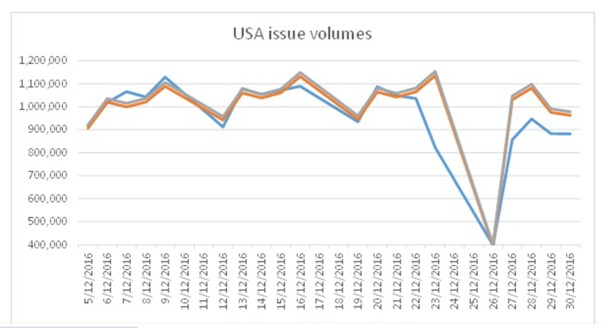
22.6 Further downgrades to the CHEP Global and CHEP NA forecasts
3784 In a further response to Gorman’s request, Kennett and Scaiff developed a presentation providing an initial CHEP Global 2H17 outlook, titled “CHEP Pallets - Periodic Performance & Initial Outlook” (CHEP Performance and Outlook Update). On 17 January 2017 Scaiff emailed the December CFO BPR Presentation and the CHEP Performance and Outlook Update to O’Sullivan, Kennett and others, before the December CFO BPR meeting. Importantly, it indicated that CHEP Global Underlying Profit was likely to be between $(5) million and $(8) million lower than the December Reforecast, but that was subject to the outcome of the updates Rumph would provide. The presentation said that:
(a) CHEP NA was anticipated to be $(3)-$(5) million under the December Reforecast in Underlying Profit for the full-year, with more work to be done on issues, including the review of new wins timing and the assessment of the damage rate trend, particularly given the uptick in December;
(b) CHEP Europe was anticipated to be $(2)-$(3) million under the December Reforecast in Underlying Profit for the full-year; and
(c) other CBUs would remain flat to the reforecast.
3785 The CHEP Performance and Outlook Update also provided an overview of the causes of the December miss to the December Reforecast. It said:
(a) in US Pooled there were:
(i) missed sales revenue of $(5.2) million, of which $(6.1) million was sales volume (1.1 million pallet issues) with a net impact of $(1.9) million on Underlying Profit based on volume alone. It noted that in FY12, the December holidays fell on the same days as FY17 and had a similar percentage drop-off, some of which came back in January. The miss to reforecast in sales volume was said to be a mix of a forecasting assumption error and a drop-off in organic volumes with existing customers;
(ii) higher direct costs (excluding volume-related costs) by $(5.4) million of which $(2)-$(2.5) million “should be timing”; and
(iii) those results were slightly offset by positive price / mix by $0.9 million; and
(b) in CHEP Europe the $(3.1) million Underlying Profit miss to reforecast was mainly due to a $(6.1) million miss on sales revenue (composed of a ($(6.7) million miss on volume and $0.6 million on price /mix), with net impact of $(2.7) million on gross profit. And similar to US Pooled, some of this would be timing-related, with anticipated volume of $2.2 million coming back in France in January, equating to approximately $1.5 million in Underlying Profit.
3786 Kennett deposed that having reviewed the CHEP Performance and Outlook he thought CHEP Global management needed to wait and assess the December and January performance together for two reasons:
(a) First, given the holiday season had impacted a whole week of December and given the first three weeks had been on forecast, he did not consider it appropriate to assess the full-year outlook on what was effectively one week or 25% of one reporting period, and December was known to be a notoriously difficult period to forecast because of the holiday season; and
(b) Second, the December week four drop-off had been seen previously in FY12 and, when that happened, there was an uptick in demand in January of FY12. Kennett was keen to see whether this also repeated in FY17.
3787 Following the CHEP CFO BPR meeting, Kennett emailed the CHEP Performance and Outlook Update to Gorman and O’Sullivan (copied to Mackie, Alonso, Marshall and Scaiff). His covering email recited the headline result that the CHEP Global Underlying Profit outlook for the full-year would be between $(5) and $(8) million below the December Reforecast, but that CHEP NA was “currently working on a number of items during the course of this week to give better direction”.
3788 O’Sullivan deposed that at this time she understood that, like FY12, some of the lost sales volume would be recovered in January FY17. She deposed that she understood Kennett’s email as forecasting a further shortfall to the December Reforecast, and that subject to the review by CHEP NA there could be a need to further adjust the forecast Underlying Profit for the Group for the full-year.
3789 On 20 January 2017, Rumph emailed a presentation titled “NAM Latest View FY17” (CHEP NA January Reforecast) to Mackie, Gorman, Alonso, O’Sullivan, Kennett and Hill. The presentation indicated that CHEP NA Underlying Profit for the full-year would be under the December Reforecast by $(8) million (i.e., $(3)-$(5) million more than in the CHEP Performance and Outlook Update), which meant that CHEP NA would have a $(24.8) million deficit to budget for the full-year, $(18.8) million of which was projected to arise in US Pooled.
3790 The following slide provided “Key Explanations” for the further downgrade:
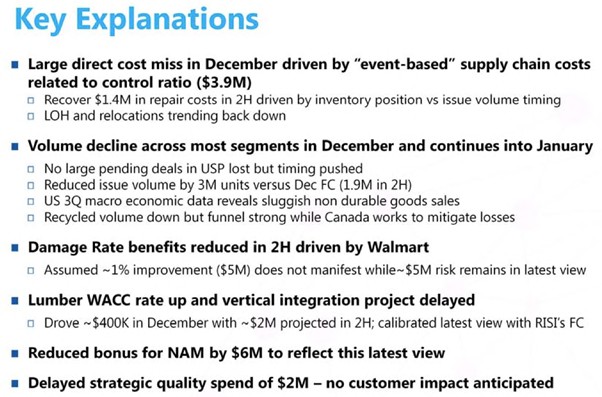
22.7 Discrete issues in the run-up to the January Board Meeting
3791 Brambles highlighted two discrete issues which arose in the run-up to the January Board Meeting on 21 January 2017, being:
(a) a downgrade to Group Underlying Profit attributable to the HFG Joint Venture; and
(b) an increase to the IPEP allocation.
3792 It is first necessary to explain the two issues.
22.7.1 The HFG Joint Venture
3793 The HFG Joint Venture was a joint venture between Brambles’ oil & gas container solutions businesses (the Ferguson Group and CHEP Catalyst & Chemical Containers) and Hoover Container Solutions to create the HFG Joint Venture. The HFG Joint Venture was completed on 21 October 2016, and was owned 50/50 by Brambles and Hoover.
3794 O’Sullivan deposed that on around 9 January 2017 it became apparent that the 1H17 results for the HFG Joint Venture required Brambles to book a $(3.5) million loss in Underlying Profit in its 1H17 accounts. The full-year Underlying Profit impact was in fact (and in January 2017 expected to be) $10 million. O’Sullivan deposed that she did not expect the financial loss associated with the HFG Joint Venture.
3795 It will be recalled that the FY16 Results Announcement on 18 August 2016, in which Brambles first announced the FY17 Guidance to the market, included footnote 6, which said:
FY17 guidance is based on FY16 results from continuing operations but excluding the Oil & Gas business which will be deconsolidated and equity accounted upon the creation of the HFG Oil and Gas JV in FY17. As 30 June 2016 FX rates, this translates to FY16 sales revenue of US$5,419M and Underlying Profit of US$970M.
22.7.2 The IPEP Provision
3796 Kennett deposed, and I accept, that not all pallets leased to CHEP customers found their way back to a CHEP Service Centre. The rate of lost or “irrecoverable pallets” was higher in the NPD channel, and within the NPD channel, higher again in the NCD channel. To account for this, Brambles had a policy for managing and accounting for lost or irrecoverable pallets, known as the irrecoverable pooling equipment provision (IPEP) policy.
3797 The IPEP provision in Brambles’ accounts represented pallets which CHEP Global could not account for at a particular point in time and for which compensation would not be received from customers. Kennett deposed, and I accept, that this provision was considered a “matter of judgment” and was discussed with the Group Controller, the Group CFO and Brambles’ external auditors. It was reflected in the balance sheet within accumulated depreciation. An expense was calculated by CHEP by considering the results of asset audits, monitoring of performance indicators, as well as historical statistical data and estimates by management.
3798 I also accept Kennett’s evidence that during his time as CFO of CHEP Global, all material “matters of judgement”, such as IPEP, required approval of the Board of Directors at the half- and full-year marks. Prior to this, initial estimates were reviewed in November and May with the Group Financial Controller, Kennett, the CBU CFO and external auditors performing their own independent assessment prior to any information on IPEP being provided by the CHEP Global team to Brambles. These reviews were called ‘Stewardship Reviews’, which occurred on a half-yearly basis in November (to include adjustments at that time) and May (to include adjustments at that time) each year.
3799 O’Sullivan deposed that on around 19 January 2017 she had a discussion with Michael Marshall (Group Financial Controller) relating to the IPEP charge for CHEP NA and CHEP Europe. Marshall had formally commenced in that role on 1 January 2017, although he had been transitioning into the role from late 2016. He was one of O’Sullivan’s direct reports.
3800 Following that discussion, on 19 January 2017, O’Sullivan received an email from Marshall proposing an increase in the IPEP charge for US Pooled.
3801 In his email, Marshall stated:
There is currently no head room within the provision for the US business.
However there remain a number of areas of concern in the IPEP calculation:
• The majority of audits are performed in the second half (audit completion was 12.7% in 1H17)
• Flows into the NPD channel are increasing and the loss rate has also increased
• Cycle times in the US are increasing which results in a higher risk of loss , with assets in the field for longer
• There have been concerns over the accuracy of third party counts performed in recent years at Walmart
We also have considered the trends in the IPEP expense and considered the following factors:
• A FIFO release of circa $1.5m was taken during the first half which reduced the IPEP expense below the budgeted charge - this was part of the proposed $3.2m reduction in the forecast which was agreed in December 2016.
• There was an approved change to the Unaudited Methodology made during FY17 to calculate cycle times based on the size of the customer (small, medium, large) which resulted in a lower provision of $3.8m compared to the previous methodology.
• In FY16 there was headroom of some 1.4m pallets within the provision which provided some comfort on a number of risks. Based on the IPEP charge during 1H17 there is no longer any headroom in the provision.
3802 Marshall noted in his email that he considered it would be consistent with Brambles’ IPEP methodology to increase the provision by $(6.2) million.
3803 On 19 January 2017, O’Sullivan forwarded Marshall’s analysis to PwC, Brambles’ auditors, who agreed with Marshall’s approach.
3804 The evidence shows that O’Sullivan agreed with Marshall’s suggested increase to the IPEP charge, but Gorman took a different view. Following that disagreement, a meeting was held with Long in his capacity of chair of Brambles’ Audit Committee on 20 January 2017. The meeting was attended by Gorman and O’Sullivan, and they each presented their views on the IPEP calculation. O’Sullivan provided her view that the IPEP charge needed to be increased, while Gorman proposed that an increase was not justified and that instead the IPEP charge should be reduced.
3805 The meeting resolved that the proposed increase to the IPEP charge would be reviewed and discussed at the January Board Meeting to be held the following day. At the January Board Meeting, the Board resolved that the IPEP charge would be increased for 2H17 by $(6.2) million.
22.8 January Board meeting
22.8.1 The December Financial Update and Revised January Preliminary Outlook
3806 Brambles held its January Board meeting on 21 January 2017. At the meeting O’Sullivan and Gorman presented the December Financial Update which included both updated December monthly and preliminary 1H17 results.
3807 The results showed that, for December, Brambles had achieved:
(a) for the month of December (excluding Oil & Gas):
(i) sales of $407 million which represented a $(22) million miss to the December Reforecast, and 2% growth over FY16 on a days-adjusted basis; and
(ii) Underlying Profit of $54 million, which represented an $(18) million miss to the December Reforecast and a 31% decline over FY16 on a days-adjusted basis; and
(b) for December YTD (excluding Oil & Gas):
(i) sales revenue of $2,769 million which represented a $(58) million miss to budget, and 5% growth over FY16 which was well below the bottom of the FY17 Guidance range of 9%; and
(ii) Underlying Profit of $472 million (excluding the HFG Joint Venture) which represented a $(34) million miss to budget, and 3% growth over FY16 which was well below the bottom of the FY17 Guidance range of 7%.
3808 The presentation provided that the significant shortfall to forecast in Group Underlying Profit had been impacted by the following factors including weaker issue volumes contributing to an Underlying Profit impact of $(5) million, direct cost challenges in US Pooled contributing to an impact of $(5) million, the proposed increase to the IPEP (which the Board accepted at the meeting) contributing to an impact of $(6.2) million, and the performance in the HFG Joint Venture contributing to an impact of $(3.5) million.
3809 O’Sullivan’s presentation included a “Revised Preliminary Outlook” (Revised January Preliminary Outlook) for FY17 in advance of the March Reforecast which O’Sullivan had brought forward because of the December results. The Revised January Preliminary Outlook considered the December Reforecast, net of two items:
(a) “December performance (ex HFG)” of $(14) million, which was the amount of variance in the December results against the December Reforecast excluding the impact of losses associated with the HFG Joint Venture; and
(b) “HFG assumed breakeven in forecast” of $(10) million, which included the projected full-year losses related to the HFG Joint Venture.
The Revised January Preliminary Outlook did not factor in the CHEP Performance and Outlook Update or the CHEP NA January Reforecast.
3810 Including the HFG Joint Venture losses, the Revised January Preliminary Outlook for sales and Underlying Profit projected that, for the full-year, the Group would achieve:
(a) sales revenue of $5,701 million, being $(66) million under-budget, representing year-on-year sales revenue growth of 6.9%; and
(b) Underlying Profit of $1,036 million, being $(23) million under-budget, representing year-on-year Underlying Profit growth of 6.8%.
3811 Excluding the HFG Joint Venture losses, the Revised January Preliminary Outlook projected Group Underlying Profit of $1,046 million, being $13 million under-budget, representing year-on-year Underlying Profit growth of 7.8%.
3812 It is worth mentioning again that, following the Aero Announcement, Mr Samuel opined and I accept that the FY17 budgeted Underlying Profit fell from $1,063 to $1,059 million. That seems to be reflected in the Revised January Preliminary Outlook which puts December Reforecast Underlying Profit at $1,060 million. On Mr Samuel’s view, the divestment of Aero reduced the shortfall to Underlying Profit required to miss the FY17 Guidance from $(8) million to just $(4) million. The applicants did not submit that the position changed following the Aero Announcement, and I proceed on the basis that budgeted Underlying Profit remained $1,063, and the lower end of FY17 Guidance range for Underlying Profit growth accordingly remained $(8) million below-budget.
3813 That information was captured in the following slide from the Revised January Preliminary Outlook:
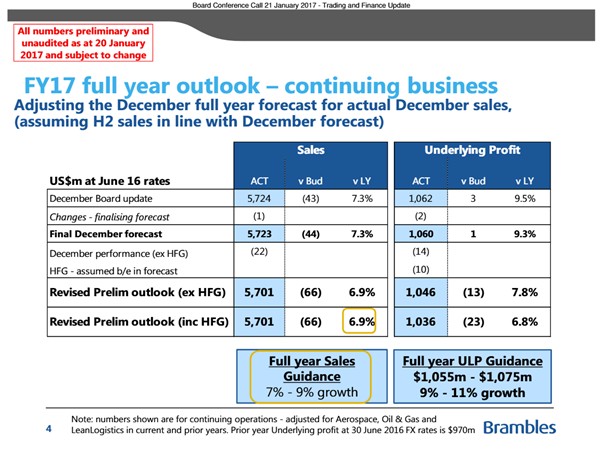
3814 The minutes of the January Board Meeting record that the Board resolved to increase the IPEP charge in line with PwC’s recommendation. The minutes said:
Mr Gorman and Ms O’Sullivan reviewed the circumstances relating to the possible $6million [sic] charge to the irrecoverable pooling equipment provision (IPEP) for 1H17. They reported that this issued [sic] had arisen within the previous 48 hours and outlines the reasons management had considered for taking, and not taking, that charge for 1H17. The Chairman reported that he and the Chairman of the Audit Committee had met with management the previous evening to review the issue. Mr Long reported that the Company’s auditors had indicated that if the additional IPEP charge were not taken up it may result in an unadjusted audit difference.
The Board reviewed and discussed the IPEP charge issue and determined that it should be taken up in full at 1H17.
22.8.2 The decision to withdraw the FY17 Guidance
3815 Long and Johns gave evidence to the effect that the unexpectedly poor December results, combined with the hit to Underlying Profit through the HFG Joint Venture and the increased IPEP charge meant that they were no longer able to maintain their confidence in the ability of Brambles to meet the FY17 Guidance.
3816 Johns deposed that at the December Board Meeting the Board considered that the question as to whether to maintain the FY17 Guidance needed to be reassessed in light of the unexpectedly poor December results and the matters described in the December Financial Update before the Board, which included an IPEP provision of $(6) million; and the performance of the HFG Joint Venture contributing to a loss of approximately $(3.5) million for 1H17, and a total projected full-year loss of $(10) million. He deposed that those matters (which in the case of the IPEP charge had only arisen in the days leading up to the January Board Meeting), meant that he:
…was no longer able to maintain my confidence in the ability of the business to achieve the full year guidance. In light of these factors, I formed a provisional view by late in the week leading up to the Board meeting that it was necessary to withdraw the guidance to the market. I was reinforced in that view by the report from management at the Board Meeting and the discussion at the Board Meeting. The Board resolved to withdraw the guidance.
3817 Long also testified that those two issues were material to the formation of his view that Brambles was no longer able to achieve the FY17 Guidance. He deposed:
I thought it was appropriate at the January Board meeting to agree to withdraw Brambles’ FY17 guidance due to the combination of the shortfall to the December forecast in the December FY17 results, the additional IPEP charge that had only arisen 36 to 48 hours before the Board meeting, and the potential HFG impairment charge which had also only arisen in January 2017. As a result of these developments, I formed the view that Brambles was no longer able to achieve its FY17 guidance. It was not until this point in time that I considered the guidance was no longer maintainable. At the meeting, the Board agreed to withdraw the FY17 guidance.
3818 The minutes record the following discussion after the presentation of the December Financial Update:
The Secretary reported that the Company had obtained advice from Allens and UBS on the Company’s disclosure obligations relating to the preliminary unaudited 1H17 results and providing updated Guidance to the market. He reviewed the content of the advice.
The Board reviewed and discussed that advice and determined that the Company should disclose to the ASX its preliminary unaudited sales and underlying profit for 1H17 and that, based on those results, it would not achieve its current Guidance. Having regard to the uncertainty surrounding the Outlook, the Board also determined that there was not a reasonable basis for providing the market with updated Guidance at this stage and noted that management should be in a position to provide an updated Outlook at its February 2017 meeting.
(Emphasis added).
3819 The Board reviewed a draft ASX release providing that information to the market, and resolved that the Secretary be authorised to lodge the release with the ASX. O’Sullivan deposed that the Board’s decision not to provide updated earnings guidance was consistent with her view that the FY17 Guidance would not be achieved, but that it was too early to quantify the revised position for FY17.
22.8.3 Withdrawal of the FY17 Guidance
3820 On 23 January 2017, Brambles published a trading update to the ASX (January Trading Update) regarding Group 1H17 results. The ACSOC defined this as the “January Partial Disclosure” as the statement informed the market that Brambles expected revenue and Underlying Profit growth to be below the guidance range of 7-9% for revenue growth and 9-11% for Underlying Profit, but said nothing about the FY19 Targets, including the FY19 ROCI Target. I have defined it above as the January Disclosure.
3821 The January Trading Update stated, as follows:
Sydney - 23 January 2017: Brambles today announced that based on preliminary, unaudited financial accounts for the six months ended 31 December 2016, it expects first-half constant-currency sales revenue growth of approximately 5% and constant-currency Underlying Profit growth of approximately 3%.
In light of this first-half performance, Brambles expects constant-currency sales revenue and Underlying Profit growth for the year ending 30 June 2017 to be below its current guidance range for constant-currency sales revenue growth of between 7% and 9% and Underlying Profit growth of between 9% and 11%.
Brambles’ CEO, Tom Gorman, said: “In the first half, we delivered sales revenue growth in every operating segment and, with the exception of our North America pallets business, we delivered Underlying Profit growth across the Group.
“In our North America pallets business, we experienced some revenue and cost pressures during the back end of the first half. These pressures were partly due to US retailer destocking which impacted volumes and resulted in increased transport and plant costs associated with higher-than-expected pallet returns. In addition, we have continued to see a deferral of potential customer conversions to pooling in North America and pricing pressure across our recycled pallet operations.
“Our first-half result also includes a small loss arising from our investment in the HFG joint venture, which continues to operate in challenging market conditions. Due to its recent financial performance an impairment review of our investment in HFG is underway.
“Notwithstanding these challenges, the fundamentals of our business remain strong and we are focused on driving improvement actions in the second-half of the year. We will provide updated full-year guidance as part of our half- year result announcement on 20 February 2017, which will take into account our final half-year results and an assessment of January trading volumes.”
(Emphasis added.)
3822 It included the same disclaimer regarding forward-looking statements that appeared on the impugned announcements to the ASX in August, October and November 2016.
3823 On 23 January 2017, following release of the January Trading Update, Brambles held an analyst briefing telephone call (January Briefing Call). At the beginning of that call Chiriacescu stated that Brambles was currently in a “blackout” period pending the finalisation of its half-year results, and that it was limited in the information it could provide to the market in relation to its outlook and expectations for the rest of the year. But she noted that more details about Brambles half-year performance and updated guidance for FY17 would be provided on 20 February 2017.
3824 Gorman prefaced the January Briefing Call with an extended commentary on the January Trading Update. Relevantly, he stated:
Now earlier this morning we announced to the ASX that based on preliminary unaudited accounts for the six months ended 31 December 2016 we now expect constant currency sales revenue growth of approximately 5% and underlying profit growth of approximately 3%. While at the Group level this result is well below our expectations, it is important to note that we delivered sales revenue growth in every operating segment, and with the exception of North America, we delivered underlying profit growth across the Group.
Our pallets North America business experienced some revenue and cost challenges which really fell into three broad categories. Firstly, in the US market we saw signs of retailer destocking particularly in the backend of the half-year period. As many of you can appreciate, destocking not only impacts issue volumes but also results in higher levels of pallets being returned which drives increased transportation and plant costs in the period when they are returned.
Secondly, in our pooled pallets business in North America the trend of customer conversion delays that we noted in our first quarter trading update continued into the second quarter. We were expecting to sign some of these customers during the second quarter. Now despite these delays, we continue to have a very good pipeline of new business and we are in continuing discussions with potential customers in the region.
The third and last issue we faced is in our recycled pallets business which experienced pricing pressure during the half.
…
In light of this first half performance, it’s disappointing for me to say that we expect constant currency sales revenue and underlying profit growth for the full year ending 30 June 2017 to be below our current guidance range, and to remind you that our initial guidance was for sales revenue growth of between 7% and 9% and underlying profit growth of between 9% and 11%.
Now while I appreciate it is frustrating that we have not provided you with updated full-year guidance at this time, we feel it is prudent to wait for the final audit review of our half-year results and also to get a full read of our January trading before providing updated outlook for the rest of financial year 2017.
Now in closing, I would like to add that the fundamentals of our business remain strong and I would also like to reiterate that we have delivered sales revenue growth in every operating segment, and with the exception of our pallets North America business, we delivered underlying profit growth across the group.
3825 Brambles highlighted that Gorman gave a number of responses to questions from the analysts which coloured the content of the January Briefing Call, including:
(a) further detail and qualifications on destocking and customer deferrals, including that it was premature to definitively comment on whether destocking was occurring;
(b) that Brambles would provide more detail in February 2017 once it had the benefit of the January results, and had the results from US customers in 2Q17; and
(c) that the sales pipeline and demand funnel were still robust.
22.9 Whether there were reasonable grounds to maintain the FY17 Guidance on and from receipt of the December Results?
22.9.1 Brambles’ submissions
3826 Brambles did not explicitly address the December results in terms of whether, following those results, there continued to be reasonable grounds for it to maintain the continuing November Representations. Rather, it identified several pieces of analysis and investigations which it said that it “promptly and prudently” undertook following those results. I infer that was for the purpose of contending that, following the December results, there continued to be reasonable grounds to maintain the November Representations up until the point that the Board decided to withdraw the FY17 Guidance at the January Board Meeting on 21 January 2017.
3827 First, Brambles emphasised that it continued the Walk to MOP and CHEP Global Recovery Plan processes, and that from 18 January 2017 US Pooled began holding daily Walk to MOP meetings to “optimise the identification and review of additional strategies to claw back the delta to budget and accelerate new opportunities”.
3828 Second, it submitted that while it was usual practice for a Group-wide quarterly reforecast to be prepared around February each year, given the variance between the December results for CHEP NA and the December Reforecast, O’Sullivan instructed CHEP NA to start work preparing an updated forecast.
3829 Third, Brambles noted that CHEP Global and CHEP NA undertook further analysis and investigation of the pallet issue shortfalls in weeks 3 and 4 of December FY17. In particular, as set out above, it relied on Kennett’s analysis in relation to the causes of the considerable drop-off in pallet issues from 23 December 2016 and the timing impacts of the holiday period on issue volume and Underlying Profit. It noted that in FY12, there had been an uptick in the January volumes which offset the lower volumes in the second half of December FY12. It relied on Mackie’s evidence that what happened in relation to volumes in the final week of December was an “unusual event” and the evidence of Kennett, Mackie and Nador that it was necessary to consider the December FY17 results together with the January and February FY17 results to see if an uptick similar to FY12 occurred in FY17, which would offset the lower pallet issue volumes for the second half of December.
3830 Fourth, Brambles noted that CHEP Global and CHEP NA personnel continued to assess whether the increase in the control ratio from November FY17 to December FY17 indicated that customer destocking was occurring. In January, Alonso and Nador each came to the view that there was neither retailer destocking nor manufacturer destocking occurring. Nador said that she considered the shift in the control ratio from November to December was consistent with what she would ordinarily expect to see in the “surge” season.
3831 Fifth, it submitted that CHEP NA continued to interrogate the rate of new wins. More specifically, Brambles noted that:
(a) on 10 January 2017, Martin circulated the January Sales Commentary Presentation providing an analysis of the progression of US Pooled net new wins and stated that US Pooled was “continuing to see major deals pushed out in forecast for a variety of reasons, including holiday-related issues with availability of contacts, difficulty for customers to transition suppliers during holiday ramp, and PECO continuing to be more aggressive which was slowing progress of conversions”;
(b) Martin deposed that it was not until mid-January that it became clear to him “that there was a more widespread trend of new business delays” rather than it having been isolated incidents of some new business in December, that had not closed as expected;
(c) as previously noted, Mackie’s 10 January 2017 email to Gorman and O’Sullivan (copied to Kennett) noted that the contract with Cott Beverages was due to start in January, and that CHEP Global had some major deals to close in the coming two weeks. On 13 January 2017, it was reported that US Pooled had won new business from Riceland;
(d) on 16 January 2017, Martin sent to Nador a deep dive report which set out the reasons for the revenue variances to the December Reforecast (the December Revenue Response). It said that the miss was “largely driven by higher than anticipated negative impacts from holiday season”, and that the issue volume miss was largely driven by a failure to attain sufficient new business wins; and
(e) on 30 January 2017, it provided a response to questions raised by O’Sullivan (O’Sullivan Questions Response Document). The document indicated that, over FY16 and through FY17 YTD, in head-to-head negotiations US Pooled was “successfully competing” with PECO and remained the “net winner”. The analysis showed that accounts both won from and lost to PECO contributed, on a net basis, to Underlying Profit growth. The flipside was that losses to PECO were having a negative impact on sales revenue.
3832 Sixth, with respect to the damage rate and supply chain performance Brambles submitted that CHEP NA’s analysis indicated that some elements of the damage rate were continuing to trend in a positive direction; however, other elements were still concerning. That submission was in reference to an analysis by Young on 6 January 2017, which indicated that the Service Centre damage rate was trending down, though non-Service Centre damage rates remained elevated and contributed to a significant miss on the network damage rate target.
3833 Brambles also submitted that CHEP Global’s supply chain analysis indicated that the Durability Program was reducing the damage rate but improvement in the benefits from the program relied, in part, on increasing the rate of new pallet issues and improving the asset recovery of new pallets, particularly from Walmart. That submission was in reference to an email and attached presentation Alonso sent to O’Sullivan on 29 January 2017. Alonso indicated to O’Sullivan that, based on his analysis, the Durability Program had been making an impact on the non-Walmart damage rate, but that its ongoing efficacy would depend on increasing the rate of new issues and improving the asset recovery of new pallets, particularly from Walmart. In relation to the significance of the damage rate at Walmart to the network damage rate, Alonso said that, looking at the trends over the past five years, FY17 was the first year where the network damage rate had been kept flat despite the Walmart damage rate increasing by around four to five pps. Importantly, Alonso noted that every pp in the Walmart damage rate meant 0.2 pps in the overall damage rate, such that in the last 12 months, Walmart had driven almost one pp of the overall damage rate, representing around $(5)-(6) million in additional costs.
3834 In response to that email, O’Sullivan said:
I just wonder if our expectations of step change in US damage rates are realistic and even if there is, that the benefits will be limited by increasing numbers of pallets in Walmart.
3835 Brambles also relied on Rumph’s CHEP NA January Reforecast on 20 January 2017 (in which she again downgraded the CHEP NA full-year Underlying Profit forecast). The presentation included a slide which set out the key drivers for the expected miss in the December FY17 forecast. It concluded that, on the basis of current trends, it was unlikely that the full FY17 budgeted damage rate reduction of two pps would be achieved, and the assumed damage rate reduction was adjusted to one pp.
3836 Seventh, Brambles said that it continued to undertake its usual business monitoring procedures including Mackie’s December FY17 PPR discussions with each CBU on 16 January 2017, and a CHEP Global CFO BPR meeting on 17 January 2017.
3837 Eighth, Brambles noted that O’Sullivan commenced further analysis of the business between December 2016 and February 2017 including with respect to the achievability of the FY19 ROCI Targets which I canvass in more detail later in these reasons. It noted O’Sullivan’s evidence, in cross-examination, that upon receipt of the December flash results for CHEP Global, it was not the case that there was “no prospect” of the Group recovering to achieve the budget, or the December Reforecast or the FY17 Guidance for the full-year. She said: “We didn’t have the certainty to know that at the time”. It noted that following the December results, O’Sullivan sought an updated 2H17 outlook from Rumph on around 13 January 2017, in order to assist with O’Sullivan’s preparation of the January Financial Update to be presented to the Board. Rumph responded by saying that she felt strongly that to “give a proper view” CHEP NA needed to get through January “to see how volume trends as well as the outcome on a few pending deals”.
3838 In relation to O’Sullivan’s work, Brambles noted the following:
(a) On 28 December 2016, O’Sullivan sent Chipchase the Early Observations Memo. I have previously discussed that memo in detail, and I will not do so again.
(b) In December 2016 O’Sullivan began to conduct a review into the FY19 Targets. In an email exchange with Chipchase on 4 January 2017 in relation to that review, O’Sullivan stated that when the FY19 ROCI target was presented to the market in December 2013, fundamental to it an ACI CAGR of 5%, which by itself was worth 1.3% of ROCI. Chipchase responded that any new ACI rate would be largely due to lower expectations of external growth or inability to manage ‘internal’ processes (e.g., damage rates), but as the latter might still be deemed fixable by the markets it would “need some consideration before we disclose”. O’Sullivan replied:
I think we need a longer face to face to agree how we want to play it .. however they were overly optimistic about returns on IFCO and Recycled, they assume better asset efficiency (not factoring in Walmart and TPMs).. and as realities hit they assumed Europe like margins in US and put v optimistic assumptions in on growth across the group to make up the difference.
Margin pressure in US is v real and the Walmart issue is not new .. emperor has no clothes!
(c) As earlier noted, on 13 January 2017, O’Sullivan sought an updated 2H17 outlook from Rumph to assist with her preparation for the January Financial Update.
(d) In around mid-January 2017, O’Sullivan started work with Ford to prepare a de-risk analysis for the next CHEP NA quarterly reforecast. The intention of that work was to identify the amount of financial risk to CHEP NA’s outlook for the full-year, and then overlay it onto the quarterly reforecast to “de-risk” the outlook.
(e) As earlier noted, on 17 January 2017, O’Sullivan received the CHEP Performance and Outlook Update from Scaiff (which suggested a downgrade to the CHEP Global forecast), and on 20 January 2017 she received the CHEP NA January Reforecast from Rumph which provided for an $(8) million downgrade to the CHEP NA full-year forecast.
22.9.2 Consideration
FY17 Guidance
3839 The US Pooled and CHEP NA under-budget performance in sales revenue and Underlying Profit in September, October and November 2016 had resulted in increasingly substantial CHEP NA deficits to budget YTD. At the time of the December Reforecast CHEP NA had deficits to budget of $(41) million in sales revenue and a $(35) million in Underlying Profit deficit to budget YTD. CHEP Global had deficits to budget of $(32) million in sales revenue and $(28) million in Underlying Profit YTD, and the Group had deficits to budget of $(28) million in sales revenue and $(17) million in Underlying Profit YTD.
3840 For the reasons I have explained, I concluded that, as at 21 December 2016, it was more likely than not that:
(a) US Pooled would be unable to achieve the necessary overperformance against budget to recover any of its existing sales revenue or Underlying Profit deficits to budget by the end of FY17; and
(b) US Pooled would continue to underperform, to some extent, in sales revenue and Underlying Profit against budget over the remainder of FY17. That is, it would be unable to meet its monthly sales revenue and Underlying Profit targets, as originally budgeted, over the rest of the year.
3841 I concluded that the likely materially lower US Pooled sales revenue and Underlying Profit in FY17 were likely to translate, reasonably closely, into materially lower CHEP Global and Group sales revenue and Underlying Profit for the full-year. I concluded that there were not reasonable grounds for the projections in the December Reforecast for CHEP Global or the Group, and there were not reasonable grounds for Brambles to maintain the FY17 Guidance in relation to sales revenue or Underlying Profit.
3842 Following management’s receipt of the December results on 5 January 2017 the financial position of US Pooled, CHEP NA, CHEP Global and the Group was materially worse. In submissions, Brambles accepted that those results were “shocking” and represented one of the largest negative monthly variances to budget ever seen by its officers. In an email at the time O’Sullivan said that Gorman described the Underlying Profit shortfall in the December results as “unchartered [sic] territory”. Following those results, the deficits to budget in CHEP NA had further increased to $(52) million in sales revenue and $(41) million in Underlying Profit YTD, and they were a strong driver of a result in which the deficits to budget for CHEP Global had blown out to $(51) million in sales revenue and $(33) million in Underlying Profit YTD, and for the Group to $(58) million in sales revenue and $(34) million in Underlying Profit YTD.
3843 In my view, it is abundantly clear on the evidence that from 5 January 2017, until Brambles withdrew the FY17 Guidance through publication of the January Trading Update on 23 January 2017, Brambles did not have reasonable grounds to maintain the FY17 Guidance in relation to sales revenue growth or Underlying Profit growth. Upon receipt of the flash results, and allowing management a few days to understand them, Brambles should have immediately withdrawn the FY17 Guidance.
3844 I note, in the context of my earlier finding that Brambles was in breach of its continuous disclosure obligation in the period from 16 November 2016 until 23 January 2017, that Brambles did not have the luxury of waiting for further analysis or further results to obtain more certainty. As Lee J explained in ANZ v ASIC at [66]: “Once an entity is aware of material information, it must announce the extent of that information immediately. An entity cannot adopt a “wait and see” approach in the hope of obtaining some greater qualitative or quantitative specificity”.
3845 My conclusion in this regard follows from my findings as at 16 November 2016 and 21 December 2016, and it is unnecessary to again set out the path of analysis so painstakingly. My analysis follows the same path, but in circumstances where the Group financial position vis-à-vis the FY17 Guidance was markedly worse.
3846 It is though, necessary to deal with the specific submissions Brambles advanced.
3847 First, Brambles did not expressly make this submission but the thrust of the evidence it adduced was that the December results came as a terrible surprise, but that it was not clear to management that CHEP Global and the Group would not achieve the December Reforecast, and that Brambles would not achieve the FY17 Guidance by the end of FY17. Brambles investigated aspects of the results, including a drop-off in pallet issue volumes in week three and week four of December, in an effort to understand whether or to what extent the very poor results were likely to be a one-off forecasting error or a continuing failure to achieve sufficient new wins. The evidence shows that Nador thought that, before it could be decided what the US Pooled 2H17 outlook looked like, it was appropriate to wait until after the January results. Rumph said the same in relation to CHEP NA in her 20 January 2017 email to O’Sullivan. Kennett, Mackie and O’Sullivan each said that in their view, before it could be decided what the CHEP Global 2H17 outlook was, it was appropriate to wait until after the January results. Indeed, Mackie suggested it was necessary to wait until after the February results.
3848 In cross-examination, O’Sullivan denied that upon receipt of the December flash results for CHEP Global there was “no prospect” of the Group recovering to achieve the budget, or the December Reforecast or the FY17 Guidance for the full-year. She disagreed with that suggestion and said: “We didn’t have the certainty to know that at the time”. Brambles highlighted O’Sullivan’s evidence in that regard.
3849 For all the reasons I previously explained as at 16 November and 21 December 2016, which were crystal clear following the disastrous December results, there was no need to wait for more information to see whether CHEP Global would meet budget for the full-year, and whether the Group could achieve the FY17 Guidance. The proposition that at this point in time the FY17 Guidance continued to be achievable reminds me of the scene in Monty Python and the Holy Grail when the Black Knight continued to refer to his fatal injuries as “just a flesh wound”. I give little weight to the evidence of Brambles executives regarding the need for more time and more results before a decision could be made.
3850 Second, O’Sullivan’s evidence was that “we didn’t have the certainty” to know whether the FY17 Guidance was no longer achievable. That was not the appropriate test. It was only appropriate for Brambles to maintain the FY17 Guidance if (on objectively reasonable grounds) the Board considered it to be more likely than not that Brambles would achieve that guidance, or there was a reasonable pathway for it to do so. That did not involve “certainty”; rather, it involved the Board’s best estimate of what was more likely than not. Brambles should not have maintained the FY17 Guidance on the basis that the guidance should not be withdrawn unless or until it was “certain” to miss guidance.
3851 In any event, were the test one of “certainty”, for the reasons I previously explained, I am well satisfied that upon receipt of the December results it was certain that Brambles was going to miss the FY17 Guidance on sales revenue and Underlying Profit growth.
3852 Third, the question as to whether to maintain the FY17 Guidance was not a decision for Gorman or O’Sullivan. It was a matter for the Board. That was particularly so when there was plainly a disconnection between Gorman’s view and the views of some Board members. The Board had given active consideration to downgrading the FY17 Guidance at the November Board Meeting, and in an email at the time Todorcevski said that he and Gorman had talked the Board “off the ledge”. Then, at the December Board Meeting, Gorman’s 22 December 2016 email to Todorcevski shows that Chipchase “pushed hard” for a downgrade to the FY17 Guidance as soon as possible, and the Board gave active consideration to doing so. I infer that Gorman persuaded the Board away from downgrading the guidance by, among other things, wrongly referring to the challenges that were facing US Pooled as “one-off” issues. The minutes record that Gorman agreed to keep the Board updated about the December results.
3853 When the “shocking” December flash results were received, Gorman should have immediately contacted the Chair, Johns, and sought an urgent Board meeting. There was no need for further reviews or analysis at this time when it was obvious that following another month of very bad results, it was plain that the Board was going to revise or withdraw the FY17 Guidance.
3854 Fourth, the gist of Long’s and Johns’ evidence was that it was a combination of:
(a) the unexpectedly poor December results;
(b) the matters described in the December Financial Update;
(c) the additional IPEP charge; and
(d) the HFG Joint Venture impairment,
which meant that they no longer had confidence in the achievability of the FY17 Guidance, and it should be withdrawn. They did not break down their thinking into the component parts or give weightings to them, and they did not, for example, say that either or both of the additional IPEP charge and / or the HFG Joint Venture impairment were a “straw that broke the camel’s back”.
3855 I consider it appropriate to infer that the major considerations for Long and Johns, and the Board more generally, were the continuing underperformance against budget by US Pooled and CHEP NA in sales revenue and Underlying Profit, and the resultant substantial deficits to budget at the Group level. The Board had given active consideration to downgrading the FY17 Guidance at points in time when the Group Underlying Profit deficits to budget YTD were $(18) million and $(17) million respectively. Following the December results the Group deficits to budget had blown out to $(58) million in sales revenue and $(34) million in Underlying Profit YTD. It is substantially more likely than not that those continuing deficits to budget, the substantial increase in the Group deficits, and the fourth month in a row in which (despite all the promises) US Pooled had again fallen materially short of budget and the reforecast were the main drivers of the Board decision.
3856 An additional $(6) million IPEP charge, and/or the booking of a $(3.5) million loss from the HFG Joint Venture, pale into insignificance in comparison to the serious and continuing US Pooled and CHEP NA underperformance, and resultant Group underperformance, at this point in time.
3857 Fifth, Long and Johns seemed to suggest that the additional IPEP charge was something new that somehow “came out of the blue” in the lead up to the January Board Meeting, which justified their change of position in relation to the FY17 Guidance. That evidence was incorrect.
3858 Kennett was clear in his evidence that all material “matters of judgement”, such as the IPEP charge, required approval of the Board at the half and full-year marks. Accordingly, initial estimates were reviewed in November and May with the Group Financial Controller, Kennett, the CBU CFO and external auditors performing their own independent assessment prior to that information being provided to the Board. Long and Johns must have known that as long-serving Board members.
3859 Thus, the appropriate IPEP charge was always going to be assessed at the end of 1H17, and whatever that charge was to be needed to be included in the December Reforecast. It appears that for reasons internal to Brambles, the review happened later than it should, but that does not change the fact that any additional charge should have been included in the December Reforecast. Relatedly, O’Sullivan gave evidence in cross-examination, and I accept, that she formed the view about the correct way in which the IPEP provisioning should occur from her very early analysis of the IPEP provision and how it worked. The fact that an additional IPEP charge might be appropriate was not something that came as a surprise to the relevant Brambles officer.
3860 There is also a suggestion in the evidence that the failure to include the IPEP charge in the December Reforecast was a deliberate strategy to underplay costs. In an email exchange between O’Sullivan and Chipchase on 30 January 2017, O’Sullivan referred to the dispute between her and the CHEP NA team regarding the IPEP charge. She said that:
The US team - no doubt egged on by [Gorman] keep raising that we can’t explain the increase in IPEP charge to the market - (which is what Tom told them)...which is bullshit
Later in the exchange, O’Sullivan said to Chipchase:
…even if they had got their dodgy accounting agreed to the [ROCI] margin would still only be 17.4%... more that 5 pts below where they are meant to be to deliver FY19!
3861 In cross-examination O’Sullivan said that her reference to “dodgy accounting” referred to CHEP NA management seeking to reverse the IPEP provision back out of their reforecast, and that she had insisted that the IPEP provision had to go back in for 1H17 because of the higher risks facing CHEP NA and CHEP Global at that time. She said that she had pushback from Gorman, Rumph and Mackie on this, but the auditors agreed with her.
3862 I accept O’Sullivan’s evidence in this regard. It is unnecessary to decide whether there was “dodgy accounting” going on, but this email exchange fortifies me in the conclusion that the additional IPEP charge was not a surprise. Senior management knew about the significance of the IPEP charges to Underlying Profit all along, and they were assessed every six months. The only surprise, as I infer, was that the new CFO took a different view to the old CFO as to the legitimacy of backing the IPEP charge out of the US Pooled Underlying Profit forecast.
3863 Sixth, Long also seemed to suggest that the fact that Brambles was required to book a $(3.5) million loss in Underlying Profit from the HFG Joint Venture was something new that also came out of the blue in January and which justified his change of position in relation to the FY17 Guidance. I found no force in that. The HFG Joint Venture was owned 50/50 by Brambles and Hoover was dissolved on 21 October 2016. Brambles management knew from its accounts that prior to its dissolution the HFG Joint Venture was operating at a loss. The September flash results (7 October 2016) reported that Oil & Gas had recorded a $(3.5) million miss on Underlying Profit for September YTD. The Preliminary Group September Reforecast (24 October 2016) (just after the HFG Joint Venture was dissolved) projected that Oil & Gas would finish the full-year with a $(11.5) million Underlying Profit shortfall to budget.
3864 It appears that O’Sullivan was not aware that the Group would have to book a 1H17 loss from the HFG Joint Venture, but it is equally plain that she should have been. One might ask where the operating loss from the HFG Joint Venture (prior to its dissolution) would be accounted for, other than by the 50% attribution to each of the joint venturers?
3865 Seventh, Brambles’ submission, in effect, that the fall in US Pooled pallet issue volumes in December came as a complete surprise and could not have been foreseen was overstated. The weekly pallets volume report for week four of December 2016, which was emailed to Mackie, Kennett, Gorman and O’Sullivan on 3 January 2017 included a chart (reproduced below) which showed that Brambles had forecast a significant drop-off in pallet issue volume commencing in week three and further deteriorating into week four of December.
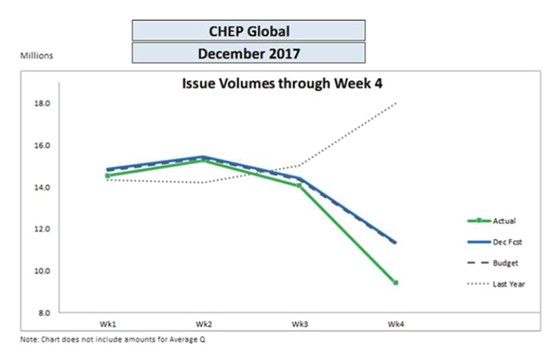
3866 Contrary to the thrust of Brambles’ submission that December issue volumes were notoriously difficult to forecast, Brambles forecast up to 23 December was “spot on” and after that Brambles predicted the decline but not quite its extent. In any event, it is not clear to me where this submission goes. It is clear on the evidence that Brambles had the information which would have permitted it to make a more accurate forecast. A short time after the results were received Bachtell noted that the positioning of the holidays in FY12 was the same as in FY17, and Nador said that that explained what had happened. I am not persuaded that that analysis was not available prior to receipt of the December results and it is reasonable to expect a large and sophisticated company like Brambles to have done that work when preparing the December Reforecast.
3867 Eighth, contrary to Brambles’ submissions, I do not accept that the fact that:
(a) in this period Brambles was continuing the US Pooled and CHEP NA Walk to MOP and CHEP Global Recovery Plan processes;
(b) from 18 January 2017 US Pooled began holding daily Walk to MOP meetings to “optimise the identification and review of additional strategies to claw back the delta to budget and accelerate new opportunities”;
(c) Brambles continued its usual business monitoring procedures through January 2017; or
(d) O’Sullivan brought forward the March Reforecasting process to January/February,
provided reasonable grounds for it to maintain the FY17 Guidance.
3868 I am satisfied that in the period from 5 January 2017 to 21 January 2017 there were not reasonable grounds for Brambles to expect that any of those things could bring the Group back from the brink. Brambles had begun the Walk to MOP process in US Pooled in September and had begun that process in CHEP NA in October. The US Pooled sales team had worked hard and diligently trying to convert the numerous sales opportunities in the sales pipeline, but with insufficient results. Brambles had projected since September (I infer based on information provided by Martin), that the US Pooled sales pipeline was about to unclog. And every month that projection proved to be materially optimistic as the forecast new wins failed to eventuate. On Martin’s unfailingly optimistic view, that sales nirvana was always just around the corner, but for the reasons previously explained, there were not reasonable grounds for that view.
3869 Relatedly, I am persuaded that O’Sullivan requiring CHEP NA to produce an earlier March Reforecast could not make any difference to the outcome. The business fundamentals remained the same. All another reforecast (the fifth in four months) could do would be to repackage Brambles’ hope of achieving the FY17 Guidance through what would necessarily be an even more aggressive 2H17 sales revenue and Underlying Profit trajectory. There were not reasonable grounds to expect any such recovery to be reasonably achievable.
3870 Ninth, Brambles relied on the January Sales Commentary Presentation circulated by Martin on 10 January 2017. It submitted that the presentation showed that US Pooled was “continuing to see major deals pushed out in forecast for a variety of reasons, including holiday-related issues with availability of contacts, difficulty for customers to transition suppliers during holiday ramp, and PECO continuing to be more aggressive which was slowing progress of conversions”.
3871 That submission misstated the contents of the January Sales Commentary Presentation. The presentation did not refer to “holiday related issues with availability of contacts”, nor did it refer to “difficulty for customers to transition suppliers during holiday ramp”. What it did state was that sales conversions were being delayed, and this was primarily due to competition from iGPS and PECO. That was not a reason for Brambles to have confidence that the projected new wins in the December Reforecast continued to be achievable. It was the reverse.
3872 As previously noted, the table in that presentation (reproduced below) provided:
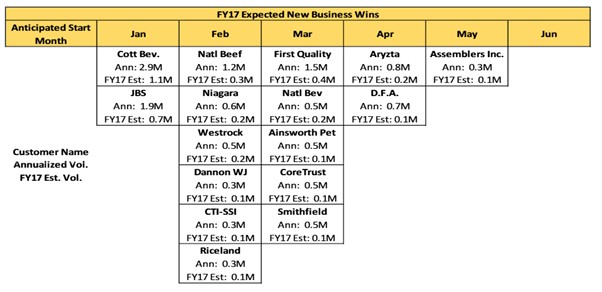
3873 As previously explained, what that table showed by comparison with the Holzman December Demand Forecast (14 December 2016), and having regard to the 24 January Deal Re-review Email (24 January 2017), was that the US Pooled sales team continued to be unreasonably optimistic when projecting the timelines for the closure of sales deals with large customers.
3874 Tenth, Brambles’ submissions relied on Martin’s evidence that in mid-January 2017, having regard to the December results, in combination with the results of previous months, he thought a trend may have begun to form in relation to a more prolonged period of new business delays. He said:
I formed the view that in developing forecasts or projections going forward in FY17, we would need to adopt a more conservative approach in response to what now appeared to be a broad shift in the market. I had not formed this view earlier because, based on my experience, it was not possible to form views about potential trends until several months had passed. My understanding of the position through mid-December was that although there was some new business that had not closed as expected, there was not yet a trend or an insurmountable issue. By mid-January, it was clear to me that there was a more widespread trend of new business delays.
(Emphasis added.)
3875 Up to mid-January 2017, the thrust of Martin’s evidence was that the new wins that US Pooled had failed to achieve YTD were just delayed, and consummation of those sales deals was just around the corner. However, as extracted above, his evidence changed as at mid-January 2017. He accepted that there had been “a broad shift in the market” by mid-January 2017, and that henceforth Brambles needed to forecast on the basis that there would be more prolonged delays in sales conversions.
3876 Again, that was not a reason for Brambles to have confidence that the projection in the December Reforecast that in 2H17 US Pooled would achieve $90 million in new wins (and associated $18 million in Underlying Profit) was achievable. It was the reverse.
3877 Eleventh, Brambles did not expressly make this submission, but Martin’s evidence carried a suggestion that, until mid-January 2017, he (and therefore Brambles’ management more generally) could not have understood that the delays in US Pooled sales conversions were likely to be more prolonged. I do not accept that. One of the major reasons for the delays was aggressive competition by PECO for large customers. As I said earlier, I accept that PECO’s competition became more aggressive in December, but its competitive behaviour should have been expected by US Pooled management. Competition from PECO had been fierce from the beginning of FY17 and Martin had consistently underestimated its effects. Martin’s Conversion Rate Email dated 4 November 2016 identified that there had been a trend of very low conversion rates between June and September 2016 which Martin accepted that he found “alarming” and (provided it was real rather than a reporting error) expressed the view that there was “no way to over correct to off-set this”.
3878 The December Reforecast should have been prepared on the basis of continued, or even ramped-up, competitive pressure from PECO. Instead, despite periods of prolonged negotiations with large prospective customers who had competitive offers from PECO, Martin seemed to consistently and unreasonably consider that US Pooled was on the cusp of securing the contract when it was not. There were not reasonable grounds for Martin’s view.
3879 I note also that on 16 January 2017, Martin circulated the December Revenue Response which set out the reasons for the revenue variances to the December Reforecast. The presentation said that “larger deals” were being delayed due to the following “market factors”:
(a) more aggressive competitive posture from PECO, including interest in non-typical deals (high NPD business) has had a greater impact than expected;
(b) declines in whitewood pallet prices continue to erode opportunities, which were a large part of 2016 wins (JBS, MountAire, Hormel, Delmonte Fresh, Mott, Smithfield); and
(c) volatility in corporate decisions due to uncertainty in election year as well as reorganisations/mergers and acquisitions activities (Aryzta, Cott Beverages, JBS, Dole and 3G).
3880 Those matters were further reasons why, in the period from 5 January to 21 January 2017, there were not reasonable grounds for Brambles to expect that US Pooled could achieve the $90 million of new wins in 2H17 (and associated $18 million in Underlying Profit) projected in the December Reforecast.
3881 Twelfth, Hill’s 10 January 2017 email set out the main drivers of the US Pooled Underlying Profit shortfall to budget in December. The second largest driver was higher than expected repair volumes which contributed to an additional $(3.1) million miss in Underlying Profit. This volume of repairs was attributable to the damage rate in December which was 61.5% compared to the December Reforecast rate of 60.5% and FY17 budget rate of 59.5%. That was consistent with Rumph’s 6 January 2017 email to Mackie in which she said that while pallet volumes dropped “dramatically”, “supply chain costs [were] not tracking down in line with demand”. As the applicants submitted, the higher direct costs from higher-than-expected repair volumes were a different issue from the decline in pallet issue volumes in week four of December. It simply represented the persistence of an issue which had plagued US Pooled from the beginning of FY17, and which as I have found, ought to have been incorporated into the December Reforecast. It was just another example of overly optimistic forecasting.
3882 It is noteworthy that in the CHEP NA January Reforecast Rumph (belatedly) called down the projected reduction in the US Pooled average damage rate for FY17 from two pps to one pp. It is unsurprising that she did so. What is surprising is that it took so long for Brambles to accept what had been told by Alonso, its internal supply chain expert, since 20 September 2016.
3883 Thirteenth, as previously noted, O’Sullivan’s evidence that the direct costs overruns, and the failure to achieve the budgeted savings were just “timing issues” (because at some point those issues were going to be resolved) missed the point. For Brambles to meet the FY17 Guidance it had to achieve a fixed amount of sales revenue and Underlying Profit in FY17. It would not be assisted by sales revenue or Underlying Profit which came in FY18. That was obvious and the evidence shows that Brambles’ senior management understood that.
3884 It will be recalled that on 24 October 2016 Todorcevski forwarded to Gorman an email he received from Ford that day, attaching the Preliminary Group September Reforecast. As previously noted, Todorcevski said:
…still has a few tweaks to go that will get us back on or slightly above budget. However, that assumes [CHEP Global] hold, which is what they’ve submitted. Clearly will be some risks to that outcome unless we turn the US [Pooled] around and quickly, but we’re still carrying the original $10m contingency as a buffer.
(Emphasis added)
3885 Todorcevski plainly understood that achieving the full-year Group Underlying Profit budget depended upon CHEP Global meeting its Underlying Profit budget, and he understood that CHEP Global meeting its full-year Underlying Profit budget was unlikely unless management could “turn the US [Pooled] around and quickly”. O’Sullivan was wrong in seeking to minimise those direct costs overruns and the failure to achieve budgeted new wins.
3886 Further, it is obvious that those so-called “timing issues” were having a serious effect on the likelihood that CHEP Global could achieve the projections in the Group December Reforecast and meet the FY17 Guidance. Largely because of those issues:
(a) on 17 January 2017, Kennett and Scaiff prepared and distributed the CHEP Performance and Outlook Update which made an initial projection that CHEP Global Underlying Profit was likely to be between $(5) million to $(8) million lower than the December Reforecast (in part based on the assessment that CHEP NA would be a further $(3)-$(5) million under-budget for the full-year) subject to the outcome of a CHEP NA update that Rumph would provide; and
(b) on 20 January 2017, Rumph prepared and distributed the CHEP NA January Reforecast, which projected that CHEP NA would actually be a further $8 million under-budget for the full-year.
3887 Fourteenth, Brambles’ reliance on the O’Sullivan Questions Response Document on 30 January 2017 was misplaced. In that document, Rumph said that:
The helicopter question we need to land with you is - is the H1 /q4 representative of what we should assume going forward / are there structural changes in the market that investors need to factor into their thinking as we consider outlook top-line growth and margin expansion expectations.
3888 First, it was prepared at O’Sullivan’s request in order to respond to questions following the analyst briefing session on 23 January 2017, when the Board decided to withdraw the FY17 Guidance. It is unclear to me how this document assists Brambles to show that it continued to have reasonable grounds for the FY17 Guidance until it decided to withdraw the guidance at the January Board Meeting.
3889 Second, the O’Sullivan Questions Response Document did not provide much by way of a substantive answer to the “helicopter question” that it asked. In large part it put off answering the question until a review scheduled to be held on 7-8 February 2017. The O’Sullivan Questions Response Document was, however, clear in stating that US Pooled could no longer count on sufficient new wins in the balance of FY17 to meet the December Reforecast. Rumph said:
The slowing of organic growth and the lack of significant wins YTD means that it will be necessary to revise our H2 outlook … down which will be provided in the detailed view on Feb 7/8.
This document does not assist Brambles to show that in the period from 5 January 2017 to 21 January 2017, Brambles had reasonable grounds to maintain the FY17 Guidance.
3890 I will not again set out my analysis underpinning an estimate as to where, as at 5 January 2017, Group sales revenue and Underlying Profit was likely to sit by the end of FY17. I rely upon the analysis as at 21 December 2016, but carrying through the more substantial actual US Pooled sales revenue and Underlying Profit deficits to budget YTD, as at that point. The result is that the application of the $10 million contingency would not save Brambles from being under the FY17 Guidance range on both sales revenue and Underlying Profit growth for the full-year.
3891 I am accordingly satisfied that, in the period from 5 January 2017 to 23 January 2017, there were not reasonable grounds for Brambles to maintain (i.e., fail to qualify, correct or withdraw) the FY17 Guidance. There were not reasonable grounds for the continuing November Representations which reiterated and reaffirmed the August Underlying Profit Forecast and the August Sales Revenue Forecast.
3892 I am also satisfied on the evidence that, in that period, Brambles had not undertaken all necessary and reasonable investigations before leaving on foot the relevant November Representations, and had not satisfied itself on reasonable grounds following those investigations that the relevant November Representations were substantially accurate and not misleading or deceptive in any way. Thus the applicants established that the November All Reasonable Investigations Implied Representation was misleading or deceptive or likely to mislead or deceive.
The FY19 ROCI Target
3893 Except for the further deterioration in the FY17 trading position for US Pooled, CHEP NA and the Group, the position in relation to the existence of reasonable grounds for the FY19 ROCI Target was unchanged in the period from 21 December 2016 as compared from the position as at 16 November 2016.
3894 As I have explained, the FY17 position of US Pooled was materially worse at this point and the evidence shows that US Pooled performance was important to achieving the FY19 ROCI Target. I have no difficulty in accepting that the likely materially lower US Pooled Underlying Profit growth in FY17 was likely to make it more difficult to achieve the FY19 ROCI Target.
3895 Again, however:
(a) at this point Brambles had around two and a half years to the end of FY19 to turn things around in order to meet the FY19 ROCI Target;
(b) Todorcevski gave evidence, and the applicants did not adequately rebut, that there were “multiple levers” available to Brambles to meet the FY19 ROCI Target even if US Pooled did not meet its FY17 budget;
(c) the evidence shows that there were numerous important inputs into the calculation of ROCI and there was little in the evidence about many of those inputs, and how they could be manipulated so that the FY19 ROCI Target was met even if US Pooled or Group FY17 performance was poor; and
(d) there were many businesses in the Brambles group and the evidence in the case largely only went to the US Pooled and CHEP NA businesses. The applicants did not establish that there were not “levers” in those businesses which could be manipulated so that the FY19 ROCI Target was met even if US Pooled or Group FY17 performance was poor.
3896 O’Sullivan’s Early Observations Memo on 28 December 2016 shows that she was sceptical about the achievability of the FY19 ROCI Target. But, I accept her evidence in cross-examination that she had not at that point formed a final view regarding the achievability of the target as at 28 December 2016 and that her initial views needed to be “validated, verified [and] reviewed” and a lot of work undertaken before she could be sufficiently certain to make a recommendation to the Board. The evidence (to which I later go) shows that O’Sullivan undertook further analysis in January in relation to the achievability of the target, and also its utility. By 9 February 2017 she had concluded that the target had little utility and was difficult to achieve.
3897 The applicants did not establish that, in the period from 21 December 2016 to 23 January 2017 that there were not reasonable grounds for the FY19 ROCI Target.
22.10 Whether, in the period from 5 January 2017 to 23 January 2017 Brambles contravened s 1041H of the Corporations Act, s 12DA of the ASIC Act or s 18 of the ACL?
3898 I have found that, in the period from 5 January 2017 to 21 January 2017, the applicants established that Brambles’ conduct in relation to the continuing November Representations that reiterated and reaffirmed the August Underlying Profit Forecast and the August Sales Revenue Forecast, and in relation to the continuing November All Reasonable Investigations Implied Representation, contravened s 1041H of the Corporations Act and/or its statutory analogues.
3899 The other alleged representations were not made out.
22.11 Whether, if the November Information existed, in the period from 5 January 2017 to 23 January 2017, by failing to tell the ASX the November Information (in respect to both FY17 sales revenue and Underlying Profit growth) before 23 January 2017 Brambles contravened ASX Listing Rule 3.1 and s 674(2) of the Corporations Act?
3900 Again, the parties did not make submissions in relation to the November Continuous Disclosure Contraventions as at and from 5 January 2017, but that allegation is in the ring and requires to be decided.
3901 The position on and from 5 January 2017 was that the Group’s financial position had materially worsened from 16 November 2016 and 21 December 2016. On top of the information available to Brambles’ officers as at 21 December 2016 they also had the December results from 5 January 201, which showed that rather than recovering US Pooled had again materially missed budget on sales revenue and Underlying Profit and had missed the December Reforecast immediately after it was made. As a result the Group sales revenue and Underlying Profit deficits to budget YTD had grown materially and were not recoverable.
3902 For substantially the same reasons as in relation to the absence of reasonable grounds for the November Representations on and from 16 November 2016 and 21 December 2016, I find that on and from 5 January 2017:
(a) in respect of sales revenue, Brambles’ performance in CHEP NA since 1 July 2016 meant it was likely that in FY17 Brambles would not achieve year-on-year sales revenue growth of between 7% and 9% in FY17, and an integral reason for this was that sales revenue in US Pooled would not likely meet budget in FY17; and
(b) in respect of Underlying Profit, Brambles’ performance in CHEP NA since 1 July 2016 meant it was likely that in FY17 Brambles would not achieve year-on-year Underlying Profit growth of between 9% and 11%, and integral reasons for this were that sales revenue in US Pooled would not likely meet budget in FY17, and direct costs were going up.
3903 I am satisfied that as at 5 January 2017 the November Information in respect of FY17 sales revenue and Underling Profit growth existed; Brambles had the November Information in the sense that it was “aware” of it pursuant to Listing Rule 19.12; the November Information was not “generally available”; and a reasonable person would expect the November Information, if it were generally available, to have a material effect on the price or value of Brambles shares. Brambles failed to tell the ASX the November Information until 23 January 2017, and by failing to do so it contravened s 674(2) of the Corporations Act. For the same reasons as at 16 November 2016, I consider the Court ought not relieve Brambles from liability under s 1317S.
23. THE ALLEGED 23 JANUARY REPRESENTATIONS
The alleged representations
3904 The ACSOC alleged that the January Trading Update stated to the market that, or to the effect that:
(a) in 1H17 it expected:
(i) sales revenue growth of approximately 5%;
(ii) Underlying Profit growth of approximately 3%;
(b) in FY17 it expected:
(i) sales revenue growth to be below the August Sales Revenue Forecast; and
(ii) Underlying Profit growth to be below the August Underlying Profit Forecast;
(c) Brambles had delivered sales revenue growth in every operating segment and Underlying Profit growth in every operating segment other than CHEP NA;
(d) in CHEP NA:
(i) Brambles had experienced some revenue and cost pressures, during the back end of the first half, which were partly due to US retailer destocking, which impacted volumes and resulted in increased transport and plant costs associated with higher-than-expected pallet returns (Customer Destocking Issues);
(ii) Brambles had also continued to see a deferral of potential customer conversions to pooling in CHEP NA (Ongoing Customer Deferral Issue), and pricing pressure across US Recycled;
(e) further, as to the Ongoing Customer Deferral Issue:
(i) Brambles had a very good pipeline of new business and was in continuing discussions with potential customers;
(ii) Brambles did not believe it had lost any business to competitors, but the dynamics of the market were such at the moment that it was taking a little bit longer for its customers to come to a decision point;
(iii) a number of Brambles’ FMCG (fast moving consumer goods) and CPG (consumer packaged goods) customers were now working with third party procurement agencies, and that was taking a bit more time to reach a decision;
(iv) Brambles was seeing that there was more analytical work being done by potential customers before coming to a decision whether to move to pooling or stay with whitewood;
(v) Whitewood prices were coming down and ‘that [was] potentially one of the anecdotal reasons that some of the conversions’ from whitewood pallets were stepping back to see where the market was going;
(f) further, as to the Customer Destocking Issue:
(i) when Brambles saw destocking that meant that forward expectations for demand were declining;
(ii) the rate of destocking had occurred particularly quickly due to a very weak back end of the first half, and even more specifically in December, when Brambles saw significant destocking;
(iii) it was premature to draw any conclusion as to whether the destocking was going to continue through the second half of the year;
(iv) one effect of destocking in the period was that Brambles incurred the repair cost of returned pallets, transportation costs and storage costs, but
(v) any revenue associated with those pallets was deferred to future periods (though not all costs would be recovered);
(g) further, the Ongoing Customer Deferral Issue and the Customer Destocking Issue together gave rise to a position where Brambles’ stock levels were higher than Brambles expected them to be, and this drove costs in the period (Additional Costs Issue),
defined above as the January Disclosure.
3905 The ACSOC further alleged that, by reason of those matters, Brambles represented to the market that:
(a) the Customer Destocking Issue was a reason that Brambles would not achieve its FY17 Guidance; and
(b) notwithstanding that Brambles would not achieve its guidance in relation to sales revenue and Underlying Profit growth in FY17, and there was a risk that Brambles would not achieve its Medium-Term Targets for revenue and Underlying Profit growth:
(i) the Customer Destocking Issues and the Ongoing Customer Deferral Issue were not necessarily likely to affect Brambles’ ability to substantially achieve the Medium-Term Targets (the Revised Medium-Term Outlook Representations); and
(ii) US Pooled remained able to achieve sufficient growth to drive Brambles to substantially achieve the Medium-Term Targets (defined previously as the Revised US Pooled Performance Representation)
(collectively, the 23 January Representations.)
3906 It is alleged that those representations were representations in respect of future matters, and that Brambles did not, as at 23 January 2017, have reasonable grounds for making them.
3907 In addition, the applicants allege that, by reason of those two representations and the express terms of the January Trading Update generally, Brambles made the following implied representations:
(a) that Brambles had reasonable grounds for making each of the Revised Medium-Term Outlook Representations and the Revised US Pooled Performance Representation;
(b) that Brambles was able, from the information available to it, to provide a reasonably reliable guide as to:
(i) the revenue that Brambles would derive in the medium-term, generally and from US Pooled;
(ii) the Underlying Profit that Brambles would derive in the medium-term, generally and from US Pooled (January Outlook Reliability Representation);
(c) there was no information known to Brambles which it had not disclosed on 23 January 2017 which created a material risk that the January Disclosure was unreliable (January No Material Risk Representation)
collectively the January Implied Representations.
23.1 Whether Brambles made one or more of the 23 January Representations, the January Outlook Reliability Representation or the January No Material Risk Representation
3908 I can be brief in dealing with these representations because in my view the applicants did not establish that they were conveyed.
3909 First, the 23 January Representations are:
(a) the Revised Medium-Term Outlook Representation, which related to whether destocking and customer deferrals were likely to affect Brambles’ ability to achieve its Medium-Term Targets; and
(b) the Revised US Pooled Performance Representation, which related to US Pooled’s ability to achieve sufficient growth so as to drive Brambles to achieve its Medium-Term Targets.
3910 Brambles’ Medium-Term Targets were that, by FY19, it would achieve constant currency sales growth in the high single digits, and Underlying Profit growth exceeding sales revenue growth. Thus, the representations concerned the position in which Brambles and US Pooled were expected to be by the end of FY19 (30 June 2020).
3911 As I previously explained, the applicants gave little attention to the Medium-Term Targets in cross-examination of Brambles’ witnesses or in closing submissions. They did not take the Court to any material capable of showing that, in the approximately two and a half years between the 23 January Representations and when Brambles and US Pooled were due to meet the Medium-Term Targets, there were not reasonable grounds to expect that Brambles would meet those targets. In large part, the way in which the applicants’ submissions addressed the Medium-Term Targets was just to tack them on to arguments which centrally related to the FY17 Guidance. While the applicants made several very brief submissions concerning the 23 January Representations, they failed to make out, or even sufficiently address the factual matter in the chapeau of the alleged representation, namely that there was a “risk that Brambles would not achieve its Medium-Term Targets”.
3912 As previously explained, in a case this large, with so many contested issues, it was inappropriate for the applicants to formally maintain the Medium-Term Targets but to advance little by way of evidence or submissions to make them out. And the same is true in relation to the 23 January Representations, which relate to alleged revisions to the Medium-Term Targets. If it was not sufficiently important for the applicants to give proper attention to those allegations, then the Court should not be required to deal with them.
3913 Second, the applicants alleged that through the January Trading Update, Brambles represented that neither the Customer Destocking Issue nor the Ongoing Customer Deferral Issue were likely to affect Brambles’ ability to substantially achieve its Medium-Term Targets. They allege that those representations were to be implied by the terms of the January Trading Update by which Brambles did not modify the Medium-Term Targets.
3914 That is, the alleged implication of the Revised Medium-Term Outlook Representation and the Revised US Pooled Performance Representation turn solely on the absence of any express reference to the Medium-Term Targets in the January Trading Update. However, as Brambles submitted, I am not persuaded that the absence of any such reference meant that the January Trading Update was likely to convey to the hypothetical ordinary or reasonable investor a fresh (implied) representation that those targets would be, or were likely to be, achieved. The January Trading Update was provided on the express basis that updated full-year guidance would be provided as part of Brambles’ 1H17 results announcement on 20 February 2017.
3915 I accept Brambles’ submission that the natural implication of the last paragraph of the January Trading Update was that, once Brambles provided updated FY17 guidance as part of its 1H17 results announcement, it would also address the position with respect to the Medium-Term Targets. Thus the alleged representations were not conveyed.
3916 Third, I accept Brambles’ submission that both alleged representations are impermissibly vague. They are both framed by reference to Brambles’ ability to “substantially achieve” the Medium-Term Targets. It is unclear what that would convey to the hypothetical ordinary or reasonable investor or potential investor in Brambles shares. Nor is it clear what level of underperformance against the Medium-Term Targets would be sufficient to mean that Brambles had or had not substantially achieved them. As Brambles submitted, that vagueness is compounded in relation to the Revised Medium-Term Outlook Representation by its use of the phrase “not necessarily likely to affect”. To my mind it is entirely unclear what the phrase “not necessarily likely to affect Brambles’ ability to substantially achieve the Medium-Term Targets” (emphasis added) would mean to the hypothetical ordinary or reasonable investor or potential investor.
3917 Fourth, the alleged Revised US Pooled Representation is that US Pooled remained able to achieve sufficient growth to drive Brambles to substantially achieve the Medium-Term Targets. Putting to one side for the moment the other difficulties referred to above, the January Trading Update makes no express representations to that effect, and where it refers to Underlying Profit growth the trading update refers to that being achieved across the Group “with the exception” of US Pooled.
3918 Fifth, the alleged implied January Outlook Reliability Representation and January No Material Risk Representation are alleged to arise by reason of the 23 January Representations and the express terms of the January Trading Update. Because I have concluded that the 23 January Representations were not conveyed, the two implied representations were not conveyed.
3919 Sixth, in relation to the alleged January No Material Risk Representation, I refer to my earlier discussion regarding the impermissible imprecision in the August No Material Risk Representations. In my view it is not clear what the expression “no material risk” in the context used would mean to the hypothetical ordinary or reasonable investor. I do not accept that the hypothetical ordinary or reasonable investor would think that Brambles was obliged to immediately disclose to the ASX any “relevant” or “pertinent” (but not serious) risk that the January Trading Update was not reliable, where that risk was objectively unlikely to transpire.
24. THE FACTS - WITHDRAWAL OF THE FY19 ROCI TARGET
3920 The applicants submitted that on and from 23 January 2017 it continued to be the case that the FY19 ROCI Target did not have reasonable grounds, particularly when on that date Brambles had withdrawn the FY17 Guidance. The applicants, however, gave so little attention to the other Medium-Term Targets, I need not address them. The thrust of Brambles’ submissions was that on and from 23 January 2017 until it withdrew the FY19 ROCI Target on 20 February 2017 there continued to be reasonable grounds for Brambles to maintain the FY19 ROCI Target and the other Medium-Term Targets.Thus, the remaining issue for determination is whether on and from 23 January 2017 until 20 February 2017 there were reasonable grounds for the continuing November AGM Representation that reiterated and reaffirmed the August ROCI Forecast.
24.1 February Reforecast
3921 After the receipt of the very poor December results on 5 January 2017, O’Sullivan requested that CHEP Global bring forward its third quarterly reforecast for FY17 (February Reforecast) for a February release. From mid-January and through to early February, work commenced in the CHEP CBUs in a process akin to the earlier September Reforecast and December Reforecast.
3922 On 7 February 2017 Rumph sent Gorman, Chipchase, O’Sullivan, Kennett, Mackie and Alonso the CHEP NA February Reforecast submission in a presentation titled “CHEP North Americas Pallets, FY17 February Prelim. Forecast” dated 6 February 2017 (CHEP NA February Reforecast Submission) in advance of a review meeting to be held the following day. In her covering email, Rumph said:
While it’s not where we want to be, it’s reality. The good news is we are still growing sales and profit YOY.
3923 The CHEP NA February Reforecast Submission projected that, for the full-year:
(a) CHEP NA would have:
(i) a $(120) million sales revenue shortfall to budget (and a $(50) million sales revenue shortfall to the December Reforecast) representing 1.9% growth from FY16; and
(ii) a $(40.1) million Underlying Profit shortfall to budget (and a $(23.4) million Underlying Profit shortfall to the December Reforecast) representing 5.9% growth from FY16; and
(b) US Pooled would achieve sales revenue growth in FY17 of 3.9% over FY16, and Underlying Profit growth of 4.6% over FY16.
3924 On 8 February 2017, Kennett emailed to Gorman, O’Sullivan, Chipchase and Mackie (copied to Rumph and others) a presentation titled “Outlook Pallets Update” dated 7 February 2017 (February CHEP Global Outlook) in advance of a discussion later that day. The presentation projected that for the full-year:
(a) US Pooled:
(i) sales revenue would be $(46) million under-budget, and $(34) million under the December Reforecast;
(ii) Underlying Profit would be $(33) million under-budget, and $(21) million under the reforecast.
(b) CHEP NA:
(i) sales revenue would be $(120) million under-budget, and $(50) million under the reforecast;
(ii) Underlying Profit would be $(40) million under-budget, and $(23) million under the reforecast.
(c) CHEP Global:
(i) sales revenue would be $(108) million under-budget, and $(55) million under the reforecast; and
(ii) Underlying Profit would be $(29) million under-budget, and $(25) million under the reforecast.
3925 The February CHEP Global Outlook projected that CHEP Global would achieve year-on-year sales revenue growth of 4.5% and Underlying Profit growth of 5% for the full-year on a days-adjusted basis.
3926 The vast majority of the $(25) million call-down in Underlying Profit for CHEP Global arose from a $(21) million downgrade in US Pooled. CHEP Europe, CHEP LATAM and CHEP APAC were projected to be flat to the December Reforecast, with a minor call-down on CHEP AIME. The R&O schedule stated that the risks and opportunities were “relatively balanced on a risk adjusted basis”, except for CHEP NA which was identified to have a net risk to Underlying Profit of $(10) million.
3927 O’Sullivan deposed that in her view the $(10) million in risk for CHEP NA identified in the R&O schedule needed to be higher because of the improvement required to achieve the December Reforecast in 2H17. Consequently, on 9 February 2017, O’Sullivan asked Rumph to reverse an IPEP credit of $6 million, and to incorporate an additional $(5) million in damage rate risk under the assumption of no further benefit from the Durability Program in FY17.
3928 On 11 February 2017, following the receipt of the January results, Rumph returned to O’Sullivan setting out a further $(4) million in potential risks to be included for the February Reforecast including $(1) million in price/mix, $(2) million in higher costs associated with a higher flow through ratio, and $(1) million in plant costs related to CHEP Recycled Service Centres.
24.2 January results
3929 On 10 February 2017, the January flash results were circulated. The flash report was measured against the December Reforecast, rather than the February Reforecast which was at that point still being prepared.
3930 The January results were, again, very poor. I have included them in the following table, in the style presented by the applicants:
January Results Summary | ||||
($US million) | Month (vs December Reforecast) | Year-to-date (vs Budget) | ||
Sales revenue | Underlying Profit | Sales revenue | Underlying Profit | |
US Pooled | (8.2) | (9.5) | (34.8) | (46.6) |
CHEP NA | (6.3) | (10.2) | (64.2) | (55.8) |
CHEP Global | (9.4) | (11.1) | (65.0) | (51.5) |
Brambles (excluding HFG Joint Venture) | (8.4) | (8.7) | (67.9) | (37.9) |
3931 For US Pooled, the January results also showed that the damage rate remained at 61.5%, significantly above the 59.3% projected in both the FY17 budget and the December Reforecast. Direct costs and overheads both exceeded their projected FY17 budget and December Reforecast figures. O’Sullivan deposed that the January results, particularly the miss on transfer fees attributable to lower-than-expected volume, reinforced her view that it was appropriate to de-risk the US Pooled forecast for the balance of the year.
3932 On 13 February 2017, following the receipt of the January results, O’Sullivan emailed Rumph requesting updated information on the CHEP NA 5YP and proposed CHEP NA capex for 2H17 FY17, in advance of further consideration of the FY19 ROCI target at the February Board meeting.
24.3 O’Sullivan’s earlier review of the FY19 ROCI Target
3933 Following her appointment as Group CFO on 17 November 2016, O’Sullivan commenced to analyse the achievability of the FY19 ROCI Target. That work began prior to the January Trading Update but it is worth revisiting some of it.
3934 It will be recalled that as part of her induction, O’Sullivan received a presentation prepared at Todorcevski’s direction relating to the FY19 ROCI Target. She also attended the November Board Meeting at which Todorcevski presented an update regarding the achievability of the FY19 Targets, including the FY19 ROCI Target, and explained his view that the FY19 ROCI Target would be achieved based on the opportunities detailed in his presentation and a sensitivity analysis that accommodated underperformance in parts of the business. He told the Board in the FY19 Targets Presentation that there were multiple levers by which the FY19 ROCI Target could be achieved. O’Sullivan deposed that, nonetheless, she wished to conduct her own assessment of the achievability of the FY19 Targets.
3935 In her Early Observations Memo of 28 December 2016 O’Sullivan identified the FY19 Targets as an example of Brambles’ “good news culture” rather than a culture that “defined reality”. Consistently with that, in cross-examination O’Sullivan said that she “didn’t have confidence that we were going to be in a position to deliver on the FY19 Targets” but that she was of the view that Brambles ought to conduct further analysis into their achievability through January.
3936 Subsequently, on 29 December 2016 O’Sullivan requested assistance from her team with a review of the FY19 Targets. On 1 January 2017, O’Sullivan also emailed Chiriacescu and requested that she compile analyst and investor feedback on the FY19 Targets.
3937 In cross-examination O’Sullivan said the purpose of her review was to determine why Brambles set the target, what had changed in the interim, and what Brambles needed to do going forward. Relevantly, in cross-examination she said that her concern “was to understand the build-up and the assumptions” in the FY19 ROCI Target and to make sense of “all of the components that were contributing to the ROCI outcome”.
3938 On 4 January 2017, as she continued her review, O’Sullivan emailed Chipchase and referred to a slide from the December 2013 Investor Market Briefing (IMB) (when the FY19 ROCI target had been presented to the market) which explained that an ACI compounding annual growth rate of 5% was a fundamental assumption underpinning its achievement. Chipchase responded on the same day querying the implications of downwardly revising the ACI rate, and whether it would be read by the market as flowing from lower expectations of external growth, an inability to manage internal processes, or both. He reflected that Brambles might “need some consideration” before disclosing that to the market.
3939 A short time later O’Sullivan replied:
I think we need a longer face to face to agree how we want to play it … however they were overly optimistic about returns on IFCO and Recycled, they assume better asset efficiency (not factoring in Walmart and TPMs).. and as realities hit they assumed Europe like margins in US and put v optimistic assumptions in on growth across the group to make up the difference.
Margin pressure in US is v real and the Walmart issue is not new .. emperor has no clothes!
(Emphasis added.)
3940 In cross-examination O’Sullivan accepted that:
(a) when she referred to “as realities hit”, that was a reference to the reality of damage rates being high, and cycle times being high;
(b) high damage rates and high cycle times lead to higher direct costs;
(c) she had very substantial question marks over the “Europe like margins” projected for US Pooled;
(d) the assumptions underpinning the projections for the Group looked “too aggressive”;
(e) when she referred to “margin pressure in US is very real”, she was referring to the pricing pressures in US Pooled as a consequence of competition from PECO and retailers;
(f) when she referred to “the Walmart issue is not new”, she was referring to lengthy cycle times and high damage rates which flowed from the relationship between US Pooled and Walmart; and
(g) when she referred to “the Emperor has no clothes”, she was referring to the assumptions which had come from Rumph, Todorcevski and Gorman about ACI, and how US Pooled was going to “reverse the trend” in relation to ROCI growth. She said that the reference to the “emperor” was a reference to the collective understanding in the business which maintained the assumptions that had been underpinning the FY19 ROCI Target.
3941 In cross-examination O’Sullivan maintained that she did not, at this time, consider that the FY19 ROCI Target was unachievable and needed to be withdrawn. She said:
… we still had that option we could have sold assets or taken other steps that were still unexplored. That was a discussion we had to have was, you know, presenting facts back to the Board, what else would we reasonably propose to do to hit the targets or would they need to be withdrawn. Certainly my view at that stage, without doing something different, that was we weren’t going to deliver on the FY19 targets.
(Emphasis added.)
3942 O’Sullivan also rejected any suggestion that her concerns about the FY19 ROCI target were applicable to the FY17 Guidance on sales revenue and Underlying Profit, because the latter was buttressed by a pipeline of potential customers and “building blocks” for delivering the target, whereas the former was more affected by longer-term considerations of capital expenditure and investment. O’Sullivan said that delivery of the FY17 Guidance was just one “building block” for the delivery of the FY19 Targets.
3943 The applicants submitted that O’Sullivan brought a fresh set of eyes to the FY19 ROCI Target, and that by 4 January 2017 she had come to the view that without intervention Brambles was not going to achieve its FY19 ROCI target.
3944 I accept the applicants’ contention, but it does not significantly differ from the view expressed by Todorcevski - that irrespective of Group performance in FY17 there remained a number of levers which management could pull over the intervening two-year period so that Brambles achieved the FY19 ROCI Target by 30 June 2019.
24.4 February review of the FY19 ROCI target
3945 In cross-examination O’Sullivan gave evidence that, as at 30 January 2017 she had not yet formed a definitive conclusion as to whether the FY19 ROCI Target was achievable. Consequently, she sought advice from UBS on the achievability of the targets, and whether they ought to be withdrawn.
3946 Four days later, on 3 February 2017, UBS provided a report to O’Sullivan which included calculations made by various brokers in relation to the FY19 ROCI Target. It stated that, for many brokers:
…treatment of ROCI is varied and not comparable to Brambles’ definition of ROCI, either on a reported basis or pro-forma FY19 target basis.
3947 The report identified that, after the January Trading Update, the broker average ROCI forecast for FY19 was 18.5%, with no broker forecasting that Brambles would achieve 20% ROCI by FY19, even on an adjusted basis. Further, no broker was definitely forecasting above 20% ROCI by FY19 even prior to the January Trading Update. The report concluded that:
Of the limited number of brokers who forecast ROCI on a basis that is broadly comparable to Brambles’ FY19 ROCI target, most query whether Brambles can achieve its 20% FY19 target, especially following the January trading update.
(Emphasis added.)
3948 O’Sullivan gave evidence that the conclusions in the report were consistent with her understanding that analysts had not adopted a “consistent approach to the assessment of the FY19 ROCI Target and that there was a need to reconsider the “utility of maintaining the FY19 Targets”.
3949 On 9 February 2017, O’Sullivan emailed Ford a draft presentation entitled “Return Metrics” (Return Metrics Presentation). In cross-examination she explained that the draft presentation included some matters she had earlier set out in her Early Observations Memo.
3950 The presentation noted that the FY19 ROCI Target had been set in 2013, in an effort to show a commitment to the market regarding “disciplined use of capital and high returns on a period of increasing capital investment in the business”. It also said that over time, the messaging about the target had “evolved to explain the ability to deliver [the] FY19 target is heavily dependent on Americas growth in topline, US profitability/margin expansion and an improvement in asset efficiency across 2018 and 2019”. It noted that the November Board Meeting had been told that the plan was “heavily reliant on improvement in Americas”, of which - as I previously explained - CHEP NA was the largest division.
3951 The presentation was sceptical about the achievability of the FY19 ROCI Target. It said that:
(a) delivery of the FY19 ROCI Target required “material improvement in asset efficiency” and this “requires reversal of trend since the targets were set”;
(b) there was a “significant drag (~2pts of ROCI impact) from low/no return on $1.5bn of capital employed / ACI from underperforming IFCO North America and US Recycled”, and that the underperformance has “added pressure on US Pooled to deliver a step change to make up the gap”;
(c) other direct cost pressures including cost pressures in US Pooled were offsetting benefits from “cost out and efficiency programs”;
(d) in relation to the Durability Program in US Pooled, that the current “assumes a material contribution from a reduction in US Pooled damage rate [whereas] [t]o date any benefits of durability are being offset by increasing damage rates out of Walmart”;
(e) the “assumptions that support delivery of the 20% ROCI target plan are optimistic”; and
(f) “[o]ver the past 12 months the operating environment has become more challenging”, including increasing PECO aggression over the past six months.
3952 The presentation also queried the utility of the FY19 ROCI Target and said that, before factoring in the FY17 trading results YTD, the market was of the view that Brambles could not “deliver on the 2019 20% [ROCI] target & many are questioning the relevance of the target given complexity”.
3953 The presentation concluded that there was a need to change the FY19 ROCI Target and recommended simplifying the return metric so as to “align with the interest of shareholders”. It said that the target was complex and was not aligned with metrics used by most ASX listed companies and understated returns. It recommended replacing the existing target with ROCI on a total asset base of around 16%.
3954 On 13 February 2017, Chipchase emailed Johns (copied to O’Sullivan and UBS) a final version of the Return Metrics Presentation and an updated draft of the Brambles FY17 Full Year Outlook to be presented at the February Board meeting. The conclusions in the final Return Metrics Presentation were materially the same as those in the draft presentation. The presentation recommended to the Board that Brambles change its ROCI target to a range of 16%, plus or minus 1%.
3955 The updated Brambles’ FY17 Full Year Outlook projected that following a further de-risking of CHEP NA; the addition of a general $(10) million contingency to cover risks in CHEP LATAM, CHEP EMEA and containers; and the results of the CHEP NA reforecast submissions, Group:
(a) sales revenue would be $(119) million under-budget for the full-year, representing year-on-year sales revenue growth of 5.9%; and
(b) Underlying Profit would be $(85) million under-budget for the full-year, representing year-on-year Underlying Profit growth of 0.3%.
24.5 The 16 February Board Meeting
3956 The February Board Meeting was held on 16 to 18 February 2017.
3957 On 16 February 2017, O’Sullivan presented the FY17 Full Year Outlook to the Board. Among other things, it stated:
(a) that for 1H17 the Group had achieved constant currency sales growth of 5% and Underlying Profit growth of 3%. It attributed the lacklustre Underlying Profit growth to “competitive pressures” impacting US Pooled;
(b) what the main causes of the shortfall to budget in US Pooled for 1H17 were, including competitive pressure, changing network cost dynamics and customer destocking. She did say that these had partially been offset by additional supply chain efficiencies;
(c) that for the full-year the Group would have sales revenue growth of 5.9% and Underlying Profit growth of 0.3% from FY16;
(d) the consensus in the market after the January Disclosure was that the Group would achieve growth of 5.3% for sales revenue, and of 2.8% for Underlying Profit; and
(e) the earnings guidance should be revised to provide for “mid-single digit growth” in sales revenue, and no growth in Underlying Profit.
3958 Following O’Sullivan’s presentation, the Board requested more analysis of the US Pooled January results and further insights into early February sales volumes, so that the Board could return to the issue on 18 February 2017. The minutes relevantly record:
The Board reviewed and discussed Ms O’Sullivan’s presentation and requested that management complete the assessment of the Pallets USA’s January 2017 and early February volumes for further assessment by the Board at its meeting on 18 February 2017.
24.6 Resolution to withdraw the FY19 ROCI target
3959 Immediately following O’Sullivan’s initial presentation of the FY17 Full Year Outlook Update, Chipchase took the Board to the Return Metrics Presentation, and sought a resolution to withdraw the FY19 ROCI Target.
3960 The minutes record that, following discussion of Chipchase’s presentation, the Board resolved to conduct a further review of the assumptions underlying the FY19 ROCI Target, and return to the issue on 18 February 2017. The Board requested that UBS, whose representatives were present at the meeting, report to the Board at that time regarding ROCI targets provided by other ASX listed companies, and whether the revised target in the Return Metrics Presentation was appropriate.
24.7 The 18 February 2017 Board Meeting
3961 Consistent with the resolution on 16 February 2017, on 18 February 2017 UBS presented some further analysis to the Board which supported revising the FY19 ROCI Target in line with the Return Metrics Presentation.
3962 Long and Johns deposed that, in light of the revised projections, and the input of UBS, the Board formed the view that the FY19 ROCI Target was no longer achievable and resolved to withdraw the FY19 Targets.
3963 In cross-examination it was put to O’Sullivan that her conclusion that Brambles should withdraw the FY19 ROCI Target was known to her from the Early Observations Memo. The following exchange then occurred:
Quinn: And it was the [Return Metrics Presentation], wasn’t it, that was the basis for the decision not to rely upon the FY19 ROCI targets any more; correct?
O’Sullivan: ---I believe so, yes
Quinn: And I suggest to you that if you - that all of the matters that were the basis for the decision to withdraw or not rely upon the 2019 20% at least ROCI targets that were set out in that paper were known to you on 28 December when you sent the confidential [Early Observations Memo] to Mr Chipchase?
O’Sullivan: ---No
Quinn: I suggest to you that all of the matters that you set out in the original [Early Observations Memo] document to Mr Chipchase were matters that were well known or ascertainable within the business for very many months?
O’Sullivan: No. The initial document was some additional thoughts that needed to be validated, verified, reviewed, and there was a lot of work to be done to land a view to take to the board.
(Emphasis added.)
24.8 The February Announcement
3964 On 20 February 2017 Brambles published to the ASX a consolidated financial report, directors’ report, and auditors’ review report for 1H17, including a media release (the February Disclosure). The media release included the following statements under the heading “Brambles’ 1H17 result and outlook”:
• Sales revenue up 5% at constant currency, reflecting solid growth with new and existing customers in Pallets Europe and Pallets Latin America, continued expansion in RPCs and Containers, and modest growth in Pallets North America.
• Statutory operating profit down 26% at constant currency, reflecting Significant Items of US$138.5 million which included a US$120 million non-cash impairment of the Group’s investment in the Hoover Ferguson Group (HFG) joint venture. Excluding the impact of the HFG impairment, operating profit increased 1%.
• Underlying Profit up 3% at constant currency, reflecting strong profit growth in both RPCs and Containers and the impact of the profit decline in Pallets North America.
• Pallets North America performance impacted by lower sales revenue growth and direct cost challenges:
• Increased competitive pressure resulted in lower-than-expected pricing and lower net new business growth in the pooled pallet business, and a revenue decline in the recycled pallet operations;
• Ongoing direct cost pressures associated with the network, partially offset by supply-chain efficiencies; and
• Customer destocking reduced like-for-like volume growth in the second quarter and drove additional transport, repair and storage costs associated with increased level of pallet returns.
• Cash Flow from Operations down US$26 million reflecting higher capital expenditure in Pallets Europe, Pallets Latin America and RPCs, which more than offset a reduction in Pallets North America
• Return on Capital Invested (ROCI) down 1.3pp at constant currency, due to higher growth in Average Capital Invested, particularly in Pallets EMEA and Pallets Americas, and lower Underlying Profit margins.
3965 In the final two dot points, Brambles provided revised FY17 guidance for sales revenue and Underlying Profit, and withdrew its FY19 ROCI Target:
• Revised FY17 guidance at constant-currency:
• Sales revenue growth expected to be in line with 1H17
• Underlying Profit expected to be flat to FY16
• FY17 growth capex expected to be approximately US$350 million
• FY19 targets withdrawn. Going forward, the Group will not provide medium-term targets. Management will seek to deliver ROCI outcomes which strike a sustainable balance between financial returns and growth.
24.9 Whether, in the period from 23 January 2017 to 18 February 2017, there were reasonable grounds for the FY19 ROCI Target?
3966 The applicants’ closing submissions presented nothing beyond their earlier submissions, as to why, in the period from 23 January 2017 to 18 February 2017, there were not reasonable grounds for Brambles to maintain the FY19 ROCI Target (or for the November AGM Representation which reiterated and reaffirmed the August ROCI Forecast).
3967 On my view of the evidence, O’Sullivan was sceptical about the achievability of the FY19 ROCI Target from, at least, 28 December 2016 when she sent her Early Observations Memo to Chipchase. That scepticism deepened as she extended her analysis into the target, and it is apparent from the draft Return Metrics Presentation she prepared on 9 February 2017 that her view was that the FY19 ROCI Target should be withdrawn, both because it was difficult to achieve, and because it had little utility as the market neither understood nor believed the target.
3968 O’Sullivan frankly conceded that unless Brambles changed something, for example, by selling a business, she thought it was unlikely that Brambles would meet the FY19 ROCI Target. It was, however, a complex metric, with many moving parts and at that time there was around two and a half years before it was required to be met. O’Sullivan denied that she had formed a final view regarding the achievability of the target as at 28 December 2016 and she said that her initial views needed to be “validated, verified [and] reviewed” and a lot of work undertaken before she could be sufficiently certain to make a recommendation to the Board. I accept that evidence.
3969 As it eventuated, when O’Sullivan had finalised her analysis she provided the draft Returns Metric Presentation to Chipchase some time after 9 February 2017. He reviewed the presentation, accepted O’Sullivan’s recommendations, and on 13 February 2017 emailed the final presentation to Johns for consideration at the February Board Meeting on 16 February 2017. In my view, the evidence shows that O’Sullivan and Chipchase acted in a sufficiently timely way to bring their concerns before the Board. On 18 February 2017 the Board adopted the recommendation and withdrew the FY19 ROCI Target, in a timely manner.
3970 The applicants did not establish that there were not reasonable grounds for the FY19 ROCI Target in the period from 23 January 2017 to 20 February 2017. Accordingly, for substantially the same reasons as I expressed in relation to the November AGM Representations, I consider that the applicants failed to prove to the requisite standard that Brambles lacked reasonable grounds for the FY19 ROCI Target.
E. CAUSATION, LOSS AND DAMAGE
25. CAUSATION, LOSS AND DAMAGE
3971 I have found that:
(a) at and from 16 November 2016 until 23 January 2017, Brambles:
(i) engaged in misleading or deceptive conduct in contravention of s 1041H(1) of the Corporations Act and its statutory analogues by making the November Representations that reiterated and reaffirmed the August Underlying Profit Forecast, and also conveyed the November All Reasonable Investigations Implied Representation; and
(ii) contravened the continuous disclosure obligation under ASX Listing Rule 3.1 and s 674(2) of the Corporations Act until 23 January 2017, by failing to immediately disclose to the ASX the November Information in respect of Underlying Profit growth in FY17;
(b) at and from 21 December 2016 until 23 January 2017, Brambles:
(i) engaged in misleading or deceptive conduct in contravention of s 1041H(1) of the Corporations Act and its statutory analogues by maintaining (i.e., not correcting, qualifying or withdrawing) the continuing November Representations that reiterated and reaffirmed the August Underlying Profit Forecast and August Sales Revenue Forecast, and also conveyed the November All Reasonable Investigations Implied Representation; and
(ii) contravened the continuous disclosure obligation under ASX Listing Rule 3.1 and s 674(2) of the Corporations Act until 23 January 2017, by failing to immediately disclose to the ASX the November Information in respect of sales revenue growth and Underlying Profit growth in FY17; and
(c) at and from 5 January until 23 January 2017, Brambles engaged in misleading and deceptive conduct in contravention of s 1041H(1) of the Corporations Act and its statutory analogues by maintaining (i.e., not correcting, qualifying or withdrawing) the continuing November Representations which reiterated and reaffirmed the August Sales Revenue Forecast and August Underlying Profit Forecast, and also conveyed the November All Reasonable Investigations Implied Representation,
(together, the Contravening Conduct). I appreciate that some of these overlap. It should be recalled that some of those findings are in the alternative.
3972 I now turn to consider the applicants’ claims to have suffered causally connected loss as a result of those contraventions.
25.1 The causation and loss witnesses
3973 The applicants again relied on the reports and testimony of Dr Voetmann and Professor da Silva Rosa, and Brambles again relied on the reports and testimony of Mr Holzwarth and Dr Unni. I set out their background, qualifications, and relevant reports earlier in these reasons (in section 19.6.1).
3974 As I have said, the expert witnesses attended an experts’ conclave and produced a Joint Expert Report dated 5 August 2022, upon which the parties also relied. They gave their evidence in a concurrent session. I will not go to the curriculum vitae or experience of the expert witnesses again. I am satisfied that they are all experts in relevant fields.
25.2 The applicants’ causation and loss case
3975 The applicants summarised their case on causation and loss as follows:
(a) Brambles failed to disclose price-sensitive information that it was required to disclose under s 674, or (alternatively) engaged in misleading or deceptive conduct by making and failing to qualify representations about price-sensitive matters;
(b) the market for Brambles shares was such that the price at which the shares traded during the Relevant Period rapidly adjusted to reflect all material information disclosed by Brambles (such that all material information that was generally available was impounded from time to time in the price of Brambles shares);
(c) the non-disclosures or misrepresentations therefore caused buyers to buy the shares at artificially inflated prices, that is, at prices above the price that a properly informed market would have set;
(d) the applicants and group members purchased shares in this inflated market; and
(e) the applicants and group members therefore would not have acquired shares at the artificially inflated prices, but for the market’s reaction to Brambles’ misleading or deceptive conduct and/or disclosure failures.
3976 The applicants also allege that the January and February Disclosures together removed the inflation from Brambles’ share price. They allege that the January Disclosure removed some, but not all, of the inflation in the price of Brambles shares, and the February Disclosure removed the balance of inflation in the price of Brambles shares.
3977 The applicants set out to establish the inflated market and the quantum of the inflation in Brambles shares by an event study. Event study analysis is an empirical technique that deploys statistical tools to regress out general market movements and identify price reactions net of normal market fluctuations. The purpose of such a study is to determine the proportion of the movement in a share price during a given event (a day or series of consecutive days) that is due to the release of company-specific news, as opposed to share price movement that is merely due to conditions affecting the market generally, or the industry group within which a company is situated: Myer at [662]. In shareholder class actions, an event study is often deployed to determine the effect of company specific news where that news is alleged to be information that the applicants allege should have been disclosed at an earlier point in time.
3978 The applicants’ claim is of the same type as that described in Myer (at [1662]) where Beach J summarised that claim as follows:
(a) Myer’s disclosure failures caused the actions of intermediaries, namely, the buyers and sellers in the market, to inflate the trading price of [Myer’s] securities above the price which a properly-informed market would have set;
(b) the applicant acquired its securities, that is, it was active not passive in that inflated market; and
(c) the applicant would not have acquired those securities, at that price, but for the market’s reaction to Myer’s misleading or deceptive conduct and disclosure failures.
3979 Justice Beach characterised that as a case involving an allegation of “active indirect causation” and said at [1663] that, in terms of establishing causation, it was enough that the applicant unknowingly acted by acquiring its Myer shares at the prevailing market price during the period of inflation. As explained in Myer and subsequent authorities, a claim alleging “active indirect causation” is a claim where a respondent’s misleading conduct is alleged to induce some reaction in a particular person or persons, and the applicant would have acted differently but for that reaction by the other person or persons, but there is no additional requirement that the applicant was aware of or relied on the respondent’s conduct. It is enough that the other person or persons relied, and that the applicants would have acted differently but for the reliance of those other persons: Myer at [1659]; Crowley v Worley Limited (No 2) [2023] FCA 1613; 171 ACSR 410 (Crowley (No 2)) at [171]; Davis at [1663].
3980 The applicants claim to have suffered causally connected loss on the basis of active indirect market-based causation”. They did not advance an alternative claim of individual reliance, though they did submit that some group members may be able to establish loss on a “no-transaction” basis in their individual cases based on reliance. The ACSOC provides that particulars of reliance for individual group members will be provided following the trial of common questions. That was a sensible course. Thus, the only claims of loss and damage before the Court in the initial trial are claims reliant on active indirect market-based causation.
25.3 If Brambles did:
(a) contravene section 674(2) of the Corporations Act during the Relevant Period, whether the applicants and Group Members have suffered damage that “resulted from” the contravention(s) within the meaning of section 1317HA of that Act;
(b) contravene section 1041H of the Corporations Act, whether the applicants and Group Members have suffered loss or damage “by” the conduct contravening that section within the meaning of section 1041I of that Act;
(c) contravene section 12DA(1) of the ASIC Act, whether the applicants and Group Members have suffered loss or damage “by” the conduct contravening that section within the meaning of section 12GF of that Act; and
(d) contravene section 18 of the ACL, whether the applicants and Group Members have suffered loss or damage “because of” the conduct contravening that section within the meaning of section 236 of that Act.
3981 It is perhaps worth noting the following uncontentious matters:
(a) Although there are some slight differences in language of the relevant statutes (“resulted from”, “because of” and “by conduct of”), the courts have consistently interpreted the provisions to mean the same thing. For example, in Myer at [1526] Beach J explained that nothing turns on the difference between “by” and “resulted from”: see also Masters v Lombe at [346].
(b) The meaning of those statutory expressions is informed by the purpose of a particular cause of action and the nature and scope of the defendant’s obligation: Travel Compensation Fund v Tambree [2005] HCA 69; 224 CLR 627 at [45] (Gummow and Hayne JJ).
(c) Under each of the provisions, the applicants need only prove that Brambles’ contravention was a cause of the loss, in the sense of the contravention materially contributing to the loss, rather than the cause (or the predominant cause): Henville v Walker [2001] HCA 52; 206 CLR 459 at [18] (Gleeson CJ), [61] (Gaudron J) and [106] (McHugh J).
(d) It follows that the “but-for” test is useful as a negative criterion - that is, if the loss would have occurred even absent the contravention, causation is not established. But it is not a comprehensive positive test: Tambree at [25] (Gleeson CJ) citing Medlin v State Government Insurance Commission [1995] HCA 5; 182 CLR 1 at 6; see also Marks v GIO Australia Holdings Ltd [1998] HCA 69; 196 CLR 494 at [42] (McHugh, Hayne and Callinan JJ).
3982 The applicants seek to prove causation through active indirect market-based causation. Brambles argues that such an approach is not available.
25.3.1 Does the market-based causation pleaded by the applicants satisfy the causal connection required by section 1317HA of the Corporations Act, section 1041I of the Corporations Act, section 12GF of the ASIC Act, or section 236 of the ACL.
3983 Brambles submitted that the theory of market-based causation is beset with problems of such a fundamental character that not even a wide and beneficial construction of the statutory expressions in respect of causally connected loss can accommodate it. It said that the Court should conclude that market-based causation is not an available means to establish causation under the relevant statutory provisions, and that the endorsement of market-based causation in HIH (Brereton J) and Myer (Beach J) was plainly wrong and ought not be followed.
3984 First, Brambles submitted that acceptance of market-based causation requires the Court to anthropomorphise the share market by (impermissibly) attributing a single purpose or causal influence to a series of disparate actors (share buyers and sellers) each with a differing or at the very least unknown reason for investing. It noted that the ASX has acknowledged that key participants in a market for particular shares are likely to trade on the basis of different suites of information, even when that market has been kept fully informed by the relevant company. This is because such traders often have their own proprietary and private processes for gathering and analysing information about a company. It said that, as a consequence, the views of such market participants about matters going to the value of the shares will very often differ from the views taken by other participants and the company itself.
3985 Brambles also noted ASX Guidance Note 8 states that the reference in s 677 of the Corporations Act to persons who “commonly invest in securities” is directed to persons who “commonly buy and hold securities for a period of time, based on their view of the inherent value of the security” and does not, therefore, “include traders who seek to take advantage of very short term (usually intraday) price fluctuations and who trade into and out of securities without reference to their inherent value and without any intention to hold them for any meaningful period of time”. It said, as the ASX has recognised, that intraday traders are essentially arbitragers of the shares in which they trade but their trades nevertheless influence the price of a share on the ASX.
3986 Brambles argued that recognition of the existence of “value investors” and the differing reasons for investing and the differing information bases relied upon sits awkwardly with the organising concept of market-based causation; that the market price for a given share reflects a synthetic and rapid absorption of available information. It contended that the Court should accept that there is no uniform correlation between the publicly available information about a company and either the market price or the ‘value’ ascribed to its shares by market participants. It argued that, as such, market-based causation is an unsustainable proposition.
3987 I do not accept that submission.
3988 I take the same view as Beach J in Myer at [1629], expressly endorsed by Jackman J in Crowley (No 2) at [173]. Justice Beach explained:
…one should not confuse concepts. The efficient capital market hypothesis is relevant to market-based causation forensically. So, if it is not a good assumption in a particular case involving a particular class of securities, factually market-based causation and the “inflation-based measure” of loss in that case may fail. But I am here dealing with the availability of market-based causation as a matter of law. It is just misconceived to take doubts about the use of a securities specific forensic economic tool, let alone doubts expressed by foreign judges, to deny or query the availability as a matter of law of a test for market-based causation in Australia.
3989 Second, Brambles submitted that market-based causation does not accommodate the relevant statutory expressions in relation to causally related loss because it allows for the recovery by persons who actually knew the information that was not disclosed and/or would have taken no notice of the information had it been disclosed.
3990 It noted that in HIH (at [72]), Brereton J used the tortious concept of novus actus interveniens to deal with the issue of share purchasers who knew or were indifferent to a company’s true position. It contended that that approach places the onus of proving a break in the causal chain on the defendant, which it said was unsatisfactory. It also noted that in Myer (at [1671]) Beach J alluded to novus actus interveniens as providing a solution to “get around the reverse onus problem”, but said that Beach J did not explain why it was appropriate or acceptable for that control mechanism to be repurposed in the context of market-based causation.
3991 Brambles noted that novus actus interveniens applies where a plaintiff has been wronged and suffered loss but there is a subsequent intervening event that breaks the chain of causation between the defendant’s wrong and the loss. It submitted that that stands in contrast to the position of shareholders who actually knew the information that was the subject of the non-disclosure, or would have taken no notice of the information had it been disclosed, as in that case there has been no subsequent intervening event. Rather, it said those shareholders have simply suffered no loss that “resulted from” or “by” the alleged contravening conduct. It submitted that the fact that the market-based causation theory would compensate such group members justifies the negation of it as an available means to show causation.
3992 The applicants contended that the asserted problem that market-based causation allows for recovery by investors who are indifferent to whether the market price for shares accurately reflects all of the price-sensitive information that the company is required to disclose is “illusory”, because market-based causation does not depend on the state of mind of any individual purchaser. They contended that if a company’s disclosure contraventions result in an inflated share price (because the market participants have not been able to “price in” the undisclosed information), any purchaser in that market pays the inflated price irrespective of what they actually know about the company or their individual beliefs about whether the market price accurately reflects all relevant and available information.
3993 But not much presently turns on this. Brambles did not adduce any evidence to show that this is a real issue in this proceeding, as distinct from a theoretical concern. To my mind, it is an issue more appropriately to be dealt with following determination of the common questions. And if it is a real issue in the proceeding, the Court can hear submissions in relation to the appropriate approach, including how any unfairness to Brambles that may arise through application of the concept of novus actus interveniens should be dealt with. In my view it is likely that any unfairness is capable of being dealt with through case management orders which are consistent with the overarching purpose of the just determination of the proceeding, according to law and as quickly, inexpensively and efficiently as possible pursuant to s 37M of the Federal Court of Australia Act 1976 (Cth) (FCA).
3994 Again, I agree with Beach J in Myer where his Honour said (at [1671]):
… on one view an investor may still need to give evidence that but for the contravention he would not have purchased the shares or not at the price he paid. The individual claimant may still have this onus, but it would hardly be onerous or challenged in the vast majority of cases; and it could be discharged by a simple statutory declaration or ticking boxes in a verified questionnaire post judgment on the common issues.
3995 Another possibility is that the Court could require the applicants to put forward a representative sample of group members who could give evidence and be cross-examined. This might dispose of some group members’ claims, and it would also allow Brambles to decide whether it is worth the powder and shot to require the applicants to call evidence from group members to show that, but for the contravention, he or she would not have purchased the shares at the price he or she paid. It might also allow the Court to reach a more informed understanding of what procedure in the circumstances would be most consistent with the overarching purpose of a just determination as quickly, inexpensively and efficiently as possible. This is a matter for decision following judgment on the common issues.
3996 Finally, I again agree with Beach J in that I cannot see how Brambles’ argument about this problem, even if it is correct, could negate the market-based causation theory in any general sense: Myer at [1671].
3997 Third, Brambles submitted that the market-based causation theory does not comfortably accommodate subsequent sales of the shares made at a price which was no less than the price paid for the shares and, therefore, allows compensation to persons who actually suffered no loss. It argued that one of the applicants, Ms Southernwood, falls into this category in respect of one of her acquisitions in the Relevant Period as the evidence shows that, on 2 November 2016, she acquired 440 shares at a price of $11.35 per share. Then, on 3 January 2017, she sold that parcel of 440 shares at a price of $12.45 making a profit of $449 over that eight-week period. Brambles submitted that on the pleadings Ms Southernwood would have the Court ignore the fact of that sale, and that profit, and instead proceed on the basis that Ms Southernwood acquired the parcel of shares on 2 November 2016 at an inflated price and therefore suffered some kind of compensable loss.
3998 Brambles contended that it is impossible to bring that acquisition within the statutory compensation provisions upon which the applicants rely, because those provisions are not enlivened without loss being suffered. It said that the market-based causation theory is therefore inapt to be used as a measure loss suffered by shareholders in class action proceedings because it would compensate shareholders for acquisitions in respect of which, on any view, they suffered no loss.
3999 I am unpersuaded by this submission. As the applicants submitted, if an investor who purchased Brambles shares and then sells them for a price that includes the inflation component then the correct analysis is that that person has fully mitigated their loss, and is therefore not entitled to compensation. That is an individual issue which can be dealt with under ss 33Q and 33R of the FCA. Further, as the applicants submitted, the group definition in the proceeding provides that, to be a group member, a person must “suffered loss or damage by, or which resulted from, the conduct of Brambles as pleaded below”. Thus, if the person has fully mitigated their loss, then the person is not a group member at all.
4000 In Myer, Beach J comprehensively considered the market-based causation case of the applicant in that matter, which was relevantly on all fours with this case. His Honour decided liability against the applicant but held (at [1663]) that, had liability been established, it would have been sufficient in terms of causation that the applicant unknowingly acted by acquiring its Myer securities at the prevailing market price during the period of inflation. His Honour’s reasons were obiter, but it was plainly “a considered judgment on a point fully argued” in circumstances “where, had the facts been otherwise, it would have formed part of the ratio”: Brunner v Greenslade [1971] Ch 993, 1002-3 (Megarry J).
4001 Contrary to the thrust of Brambles’ submissions, over the last decade the courts have on numerous occasions held that the theory of market-based causation involves an application of orthodox principles: see Re HIH Insurance Ltd (in liq) (2016) 335 ALR 320; [2016] NSWSC 482 at [73], [77] (Brereton J), Grant-Taylor at [211]-[222] (Perram J); Myer at [20], Crowley (No 2) at [171], Zonia Holdings Pty Ltd v Commonwealth Bank of Australia [2024] FCA 477 at [1149] (Yates J), McFarlane as Trustee for the S McFarlane Superannuation Fund v Insignia Financial Ltd [2023] FCA 1628 at [656]-[673] (Anderson J) and Davis at [1669]. The seminal analysis remains that of Justice Beach in Myer, which Shariff J usefully summarised in Davis at [1664]-[1670].
4002 In my view, Justice Beach’s compelling analysis shows that market-based causation is a valid means of establishing causally connected loss where misconduct has caused the price of shares in an efficient or semi-efficient market to be inflated.
4003 It seems unnecessary to set that analysis out. In circumstances where market based causation in the share market context has been endorsed as available at a single judge and appellate level, but Brambles contended that it is not available and Beach J in Myer was “plainly wrong”, it will suffice to set out the applicants’ useful summary of his Honour’s reasoning in relation to continuous disclosure contraventions, as follows (citations omitted):
First, the “purpose of s 674 is to produce a well-informed market leading to greater investor confidence”. As Allsop CJ, Gilmour and Beach JJ said in Grant-Taylor v Babcock & Brown Ltd (in liq):
The main purpose [of the continuous disclosure regime] is to achieve a well-informed market leading to greater investor confidence. The object is to enhance the integrity and efficiency of capital markets by requiring timely disclosure of price or market sensitive information. …
It is also to be noted that ss 674 to 677 are remedial or protective legislation. They should be construed beneficially to the investing public and in a manner which gives the “fullest relief” which the fair meaning of their language allows.
Second, a well-informed market in a particular company’s securities is one that is trading upon material information of which the company is aware (absent justifying exceptions).
Third, the statutory duty to disclose is therefore conducive to a well-informed market. Breach of the duty gives rise to the “vice” of the market trading in the company’s shares “on the basis of material information not known to the market but known to the company.” That can result in share price inflation from non-disclosure of adverse information, or deflation where positive information is withheld and unscrupulous insiders have the opportunity to “soak[] up shares for a song”.
Fourth, and most importantly, the “statute is concerned to impose legal responsibility on the non-disclosing company for the consequences of its failure to disclose.” What are those consequences? Simply this: if the market is not trading on a fully informed basis, the market price might be different from what it would have been in a fully informed market. The “related consequence is that investors may be consummating trades at prices different to the market price that would have prevailed.”1208
Fifth, if an investor has suffered loss from such a trade:
both the text and purpose of the relevant statutory provisions are consistent with imposing legal responsibility for the loss on the company. The text does not deny it and the purpose so requires it. “But for” causation is demonstrable. And the legislature’s choice to impose legal responsibility for the loss on the company is palpable.
4004 I agree with Beach J’s analysis and would add nothing. I accept the applicants’ submission that market-based causation falls comfortably within the text and furthers the purpose of ss 1317HA when read with s 674.
4005 I also accept the applicants’ submission that the same is true of s 1041I of the Corporations Act when read with s 1041H(1); and of ss 12GF and 12GM of the ASIC Act when read with s 12DA(1). Those liability provisions prohibit misleading or deceptive conduct “in relation to a financial product or a financial service” (1041H(1)) or “in relation to financial services” (s 12DA(1)). Their purpose is “to establish a norm of conduct required of those who do business”, including “the business of buying and selling … [on-]market securities”, and “to provide the basis for a remedy of compensation to a person who suffers loss or damage because of a contravention of that norm”: Venerdi Pty Ltd v Anthony Moreton Group Funds Management Ltd [2013] QSC 219; 1 Qd R 214 at [57] (Jackson J). In the context of ASX-listed securities, the consequences of a listed company contravening this norm include that the company’s shares may trade at an inflated price. Again, as the applicants submitted, market-based causation is consistent with the text and purpose of the misleading and deceptive conduct provisions (and the related remedial provisions) at issue in this case.
4006 I am satisfied that the applicants’ claims of active indirect market-based causation are available to prove causally connected loss under the relevant provisions of the Corporations Act, ASIC Act and ACL.
4007 In my view the applicants will have established causation if they prove:
(a) First, that Brambles shares traded in an efficient market; that being one in which the price of the shares could be expected to react quickly to new information (sometimes called the “efficient market hypothesis”): Myer at [1629]; Crowley (No 2) at [173].
(b) Second, that the Contravening Conduct caused Brambles shares to trade at inflated prices during the Relevant Period. That is, that the share price would have been lower than it was during the Relevant Period if the market had known of the information that should have been disclosed to it (or, alternatively, if the market did not have misleading information).
(c) Third, that they bought Brambles shares in a market inflated by Brambles’ Contravening Conduct and thereby suffered loss.
4008 I should note that the authorities also point to another consideration, being that causation will not be established if it is shown that the applicants purchased the shares with actual knowledge of the non-disclosed information or would still have purchased the securities even if they had known the non-disclosed information: HIH at [72]; Myer at [1671]; Zonia at [1160]; Davis at [1670]. As noted above, in HIH and Myer, Brereton J and Beach J respectively suggested that that could be dealt with through the concept of novus actus interveniens.
25.3.2 A different test in misleading conduct cases?
4009 Above, I said that it was uncontroversial that, although there are some slight differences in language of the relevant statutes (“resulted from”, “because of” and “by conduct of”), the courts have consistently interpreted the relevant causation provisions to mean essentially the same thing. Brambles, however, made one submission which suggested that the causation requirements are different as between the misleading or deceptive conduct provisions and the continuous disclosure provisions.
4010 I did not find the submission clear, but Brambles contended that the applicants’ misleading or deceptive conduct claims are separate and distinct from their continuous disclosure claim and the two cannot be conflated. I accept that. Then, it noted that Dr Voetmann was requested to opine on whether the price of Brambles shares was inflated due to Brambles making, relevantly, the November Representations, and if so, to quantify the magnitude of the inflation that resulted from Brambles making those representations. Dr Voetmann opined that the August, October and the November Representations either expressly gave or reaffirmed the FY17 Guidance for sales revenue and Underlying Profit growth, which is consistent with my findings. Then, Dr Voetmann opined that the undisclosed information (the August, October and November Information) “contradicted” the August, October and November Representations.
4011 Brambles characterised Dr Voetmann’s evidence in that regard as a “bare assertion” and submitted that the “contradiction” does not provide a cogent reason as to why an event study analysis that proceeds solely by comparing:
(a) a hypothetical share price reaction to a counterfactual disclosure of the November Information; with
(b) the actual share price reaction to the real-world disclosures by Brambles in the January and February Disclosures,
can be repurposed to measure loss as a result of misleading or deceptive conduct arising from, relevantly, the November Representations. It argued that Dr Voetmann’s event study methodology or analysis was directed solely to assessing the inflation-based loss arising from Brambles’ failure to disclose that it was likely that Brambles would not achieve its FY17 Guidance.
4012 It contended that it was not clear what Dr Voetmann meant when he gave evidence that the November Information “contradicted” the November Representations, still less how he had reasoned to a conclusion that the loss the applicants had suffered “by” the making of the November Representations was the full amount of the excess returns in January and February 2017. It argued that the only basis for Dr Voetmann’s conclusion must have been that the November Representations were economically equivalent to the January Disclosure. It said that Dr Voetmann failed to set out any reasoning as to why the positive statements in the November Representations were economically equivalent to the statements made by Brambles, which involved the withdrawal of those positive statements. On Brambles’ argument, Dr Voetmann’s reasoning was “deficient and there is no other evidence capable of proving loss on the misleading or deceptive conduct claim”.
4013 I understood Brambles’ argument to be that it considers the expert and other evidence which (as I later explain) I find sufficient to establish causation and loss for the November Continuous Disclosure Contraventions is insufficient for the applicants to discharge their onus to establish causation and loss in their misleading or deceptive conduct claims.
4014 I do not accept that.
4015 First, , as noted above, the purpose of the relevant prohibitions on misleading or deceptive conduct is to establish a norm of conduct required of those who do business by buying and selling on-market securities, and to provide the basis for a remedy of compensation to a person who suffers loss or damage because of a contravention of that norm. As noted above, the consequences of a listed company such as Brambles contravening this norm of conduct include that its shares may trade at an inflated price. Market-based causation is consistent with the text and purpose of the misleading and deceptive conduct provisions. I found the event study evidence of Dr Voetmann useful in assessing the likely level of causally connected inflation in the shares in the context of the misleading or deceptive conduct claims.
4016 Second, the effect of Dr Voetmann’s evidence that the August, October and November Information “contradicted” the August, October and November Representations was not clearly expressed, but it was plainly intended to state what I consider to be obvious; that, relevantly, the November Information was the inverse of the November Representations and vice versa. That is, if failure to disclose the November Information caused loss and damage to the applicants and group members, then the inverse was that Brambles making the November Representations caused loss and damage to the applicants and group members. That is so because:
(a) the November Representations were that Brambles expected to achieve the FY17 Guidance of sales revenue and Underlying Profit growth in FY17; and
(b) the November Information which existed was, essentially, that is was likely that Brambles would not achieve the FY17 Guidance on sales revenue and Underlying Profit growth in FY17.
4017 Third, it is unclear precisely what Brambles meant by stating that Dr Voetmann’s relevant evidence was a “bare assertion”. It was evidence that Brambles did not challenge in cross-examination.
4018 I consider the applicants’ evidence on market-based causation is equally applicable to the misleading conduct contraventions as to the continuous disclosure contraventions.
25.4 If so:
(a) did any contraventions by Brambles cause the traded price for Brambles shares to be materially higher during the Relevant Period than the traded price that would have existed had the contravention(s) not occurred; and
(b) did the applicants and Group Members acquire their Brambles shares in that inflated market.
4019 In my view, as the applicants submitted, if the following facts are proved, it can be inferred that Brambles shares traded at inflated prices during the Relevant Period as a result of the Contravening Conduct:
4020 First, that Brambles shares traded in a semi-strong form of an efficient market, being one in which the price of the shares could be expected to react quickly to new information. They noted that it is common ground between the experts that during the Relevant Period Brambles shares did trade in a semi-strong form of an efficient market.
4021 Second, if Brambles’ share price declines following the corrective disclosures in the January and/or February Disclosure are shown to exceed, by a statistically significant amount, the expected movements of Brambles’ share price on those days attributable to factors affecting the market generally, it can be concluded that the information disclosed by the January and/or February Disclosures caused those excess price movements (labelled as “excess”, “residual” or “abnormal” returns).
4022 Third, if the information disclosed in the January and/or February Disclosures was, as a matter of economic substance, equivalent to the information that ought to have been disclosed had Brambles complied with its statutory obligations, it can be inferred that the amount of the excess returns attributable to each of those disclosures reflects the amount by which the share price was inflated between the date of the contravention and the date of those disclosures.
4023 The applicants relied on three “mutually reinforcing” bases to show that Brambles’ Contravening Conduct caused its shares to trade at inflated prices during the Relevant Period:
(a) Dr Voetmann’s event study evidence;
(b) the reactions of analysts after each of the January and February Disclosures; and
(c) common sense, based on what was disclosed and the ensuing share price reactions.
25.4.1 Is an event study an appropriate methodology to assess causally-connected loss?
4024 All three experts agreed that in the circumstances of the case an event study was an appropriate methodology to determine whether Brambles’ share price declines following the January and February Disclosures exceeded by a statistically significant amount, and the expected movements of Brambles’ share price on those days attributable to factors affecting the market generally. The Joint Report provided:
The event study methodology is an appropriate method for measuring the abnormal returns in Brambles’ stock on 23 January 2017 and 20 February 2017. The abnormal return (or residual return) on each Disclosure date is calculated as the actual observed ex post return of Brambles’ stock minus the expected return of Brambles’ stock.
I accept that.
4025 Each of Dr Voetmann, Dr Unni and Mr Holzwarth provided explanations of event study methodology and although there were some differences at the edges they did not raise any material disagreements about methodology, or at least none which are material to my conclusion. Dr Voetmann and Dr Unni both produced an event study analysis in their reports, and although there were some minor differences in method, they produced similar results in magnitude. Holzwarth did not produce an event study analysis, though he said he undertook one. He said that his study also produced results of similar magnitude to Dr Voetmann’s study.
4026 The main area of disagreement between Dr Voetmann, Dr Unni and Mr Holzwarth related to the “economic equivalence” of, relevantly, the November Information to the January and the February Disclosures. I later deal with that disagreement.
4027 One issue is that Dr Unni conducted an event study analysis of the risk-weighted financial outcomes produced by Samuel using an “earnings response coefficient” (ERC) he developed. Dr Unni said that an ERC is the amount by which a change in earnings (expectations) causes a change in the stock price and depends on various factors including the persistence of the earnings surprise in future years, the projected growth rates for earnings, as well as the risk-level of the firm.
4028 It is unnecessary to deal with Dr Unni’s analysis of Mr Samuel’s work which produced alternative Underlying Profit forecasts. I have not relied upon Mr Samuel’s work in that regard because, while his analysis was a useful check on the reasonableness of the basis for the US Pooled and CHEP NA budgets, it was insufficiently precise to generate a sufficiently reliable alternative forecast. I found Dr Unni’s ERC analysis of little use.
25.4.2 Did Brambles shares trade in an efficient market?
4029 All three experts agreed that during the Relevant Period, Brambles’ stock traded in a semi-strong form of an efficient market. I accept that.
25.4.3 Dr Voetmann’s evidence
4030 Dr Voetmann’s task was, in sum, to examine:
(a) whether the Brambles share price changed as a result of the January and February Disclosures, and assess the magnitude of any change;
(b) whether, and the extent to which, the price of Brambles shares was inflated by the non-disclosure of the August, October or November Information; and
(c) whether, and the extent to which, the price of Brambles shares was inflated by the August, October or November Representations.
4031 Dr Voetmann said that his analysis sought to consider the difference between the applicants’ economic position if the harmful event had not occurred and the applicants’ actual economic position, noting that the former is often referred to as the ‘but for’ or ‘counterfactual’ world.
4032 He explained that in an efficient market, stock prices react readily to newly available information. It is common ground that Brambles shares traded in a semi-strong form of an efficient market; and that the price at which Brambles shares traded during the Relevant Period rapidly adjusted to reflect all material information. He explained that, if stock prices react readily to new information, an event study can determine whether a particular event is associated with a significant change in a company’s share price. He said, and I accept, that event studies are commonly used to examine security price inflation while accounting for market and industry‐wide factors. Dr Voetmann’s evidence as to how an event study works, and its efficacy, was materially the same as the evidence of Dr Unni and Mr Holzwarth.
4033 Dr Voetmann explained, and I accept, that an event study uses a regression analysis to examine the historical relationship between a company’s stock returns and the corresponding returns on market and/or industry indices and broad economic factors. A regression analysis is typically performed using a sample of a company’s daily share price returns and daily returns on a market and/or industry index over the year preceding the relevant period or event under consideration: Myer at [740]. This is referred to as a “market model”. The parameters from the market model are used to reliably estimate an “expected return” on the day/s an “event” occurred (such as the release of information to the ASX). The expected return is then subtracted from the actual return of the stock to estimate a “residual” return (also referred to as an “excess” or “abnormal” return) on the event day/s. For ease of understanding, I have adopted the term abnormal return/s from here onwards, notwithstanding Dr Voetmann’s use of other terms to describe such returns.
4034 Dr Voetmann explained that the estimated expected return is not conditional on the event in question but is conditional on the corresponding returns in the market and/or the industry, structurally removing returns that are likely associated with industry or market‐wide confounding factors. If there are no additional, company‐specific confounding factors, the return is therefore considered a direct measure of the (unexpected) change in shareholder wealth associated with the event. A zero abnormal return means that the event on the day in question is indistinguishable from non‐events. Non‐zero abnormal returns may be attributable to the event under consideration, or alternatively to “random noise”.
4035 He said that a test of statistical significance has been developed to determine whether abnormal returns are caused by something other than random noise or chance (i.e., a given event). The abnormal returns of the share on non‐event days can be used to estimate a “standard deviation” of the share price, which measures the dispersion of stock price movements around its average return. The standard deviation can be used to determine, with varying degrees of confidence, whether a price movement is outside its normal range. A share price movement is considered to be “statistically significant” (i.e., outside its normal range) and the 95% confidence level (or at the 5% significance level) if it is greater than 1.96 times the standard deviation. In other words, an abnormal return is “statistically significant” if the probability of such a return occurring by chance is less than 1 in 20. According to Dr Voetmann, the 95% confidence interval is the confidence level typically used by financial economists.
4036 Dr Voetmann opined that an event study alone does not separate company‐specific information related to the allegations from unrelated contemporaneous information. Therefore, a review of contemporaneous coverage by analysts and the media is often required to identify whether the price movements observed were likely to be explained by the alleged information or other unrelated news. I later address the analysts’ coverage in relation to Brambles shares.
4037 For his event study market model, Dr Voetmann used a rolling control period of 252 trading days to determine abnormal returns on the January and February Disclosures. He said he used a 252-day window because it reflected the approximate number of trading days in the year, which was consistent with standard practice for event studies. Dr Voetmann excluded the January and February Disclosures from the control period, as well as price‐sensitive dates as determined by ASX, and dates on which Brambles provided guidance information (including the dates of the August, October and November Representations).
4038 Dr Voetmann used two groups of market participants to inform his regression analysis. First, he used the S&P/ASX 200 as a proxy for the market, and second, he identified, through analyst reports, a group of 13 ASX-listed companies that analysts perceived as performance benchmarks for Brambles. He examined Brambles against the returns of these two participant indices in order to estimate Brambles’ expected returns.
4039 Using his model, Dr Voetmann determined the abnormal returns in Brambles shares over the Relevant Period and provided the following table:
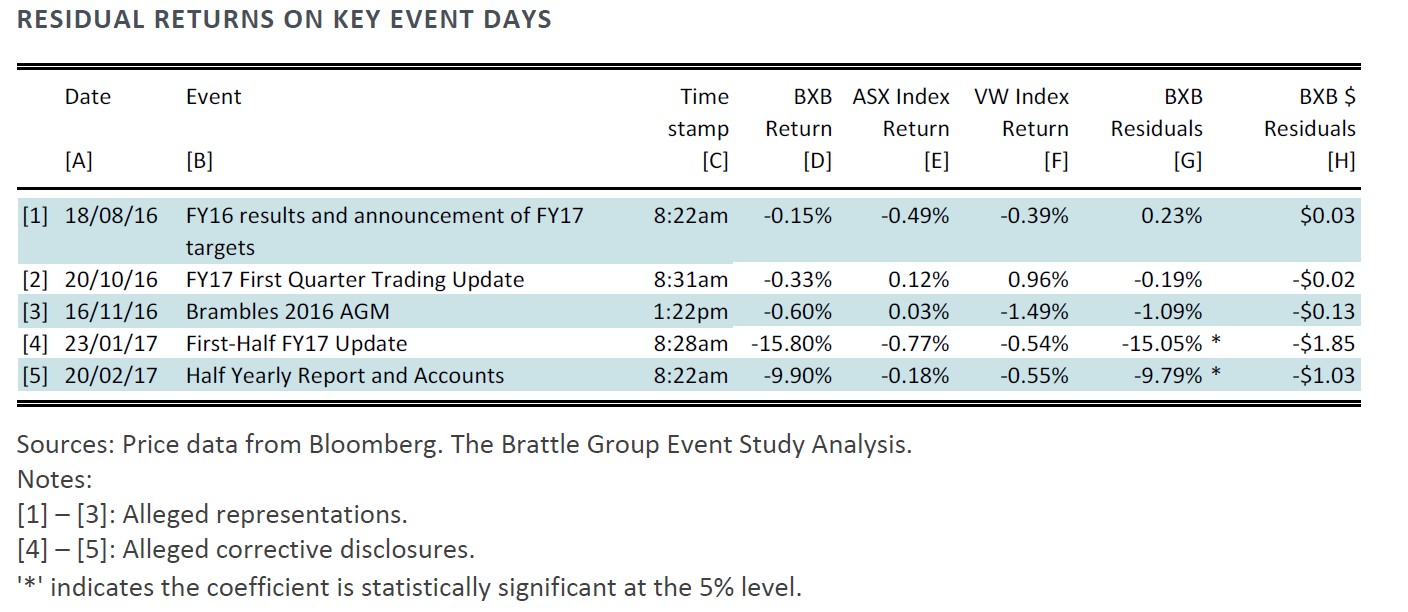
4040 The January and February Disclosures are the bottom two rows of the table above. Dr Voetmann concluded that the abnormal returns for both the January and February Disclosures were statistically significant. He relevantly determined:
(a) in relation to the January Disclosure, the abnormal return was ‐15.05% (or -$1.85); and
(b) in relation to the February Disclosure, the abnormal return was ‐9.79% (or -$1.03).
4041 The purpose of Dr Voetmann’s event study was to assist in answering the following questions (asked of him by the applicant), which I have changed only to reflect the definitional terms in these reasons.
(a) Question 1: Whether the price of Brambles shares changed as a result of the:
(i) January Disclosure
(ii) February Disclosure
and if so, the magnitude of any such change?
Response 1: It is my opinion that the price of Brambles shares changed as a direct result of both the January Disclosure and the February Disclosure when the market learned the August, October or November Information. The net change in price resulting from the January Disclosure, as measured by the abnormal return of my event study results, was a $1.85 decline, and the net change in price resulting from the February Disclosure, as measured by the abnormal return of my event study results, was a $1.03 decline.
(b) Question 2: Whether, during the Relevant Period, the price of Brambles Shares was inflated as a result of non‐disclosure of the August, October or November Information.
Response 2: During the Relevant Period, from the time that the August, October or November Information should and could have been disclosed to the February Disclosure, the price of Brambles shares was inflated as a result of non‐disclosure thereof.
(c) Question 3: If the answer to Question 2 is ‘yes,’ what was the magnitude throughout the Relevant Period of the share price inflation resulting from the non‐disclosure of the August, October or November Information?
Response 3: During the Relevant Period, from the time that the August, October or November Information should and could have been disclosed to the January Disclosure, the price of Brambles shares was inflated by $2.88 as a result of the non‐disclosure thereof. From the moment subsequent to the January Disclosure to right before the February Disclosure, the price of Brambles shares was inflated by $1.03 as a result of the same.
(d) Question 4: Whether, during the Relevant Period, the price of Brambles shares was inflated as a result of Brambles making the Representations?
Response 4: Brambles made the August Representations, the October Representations, and the November Representations. However, the August, October or November Information contradicted the Representations. Brambles also made the January Representations. The August, October or November Information still contradicted parts of the January Representations, which were merely partially corrective. Therefore, my response to this question is identical to that of Question 2, namely that the price of Brambles shares was inflated.
(e) Question 5: If the answer to Question 4 is ‘yes,’ what was the magnitude throughout the Relevant Period of the share price inflation that resulted from Brambles making the Representations?
Response 5: Brambles made the August Representations, the October Representations, and the November Representations. However, the August, October or November Information contradicted the Representations. Brambles also made the January Representations. The August, October or November Information still contradicted parts of the January Representations, which were merely partially corrective. Therefore, my response to this question is identical to that of Question 3. Namely, the price of Brambles shares was inflated by $2.88 until the January Disclosure as a result of the Representations and inflated by $1.03 until the February Disclosure.
Was there a statistically significant decline in the Brambles share price following the January Disclosure and then the February Disclosure?
4042 All three experts agreed that the January and February Disclosures each caused a statistically significant decline in the price of Brambles shares. The Joint Report provided:
The 23 January 2017 Disclosure and 20 February 2017 Disclosure resulted in a significant decline in the price of Brambles’ share.
I accept that.
The quantum of the decline in Brambles’ share price caused by the January Disclosure and / or the February Disclosure?
4043 Dr Voetmann’s event study used a one-day event window (i.e., relying only upon share price movements in one day following the announcement) to calculate the excess returns, if any, in relation to Brambles’ share price following the January Disclosure and/or the February Disclosure. He testified that a one-day event window was appropriate because of the efficiency of the market in Brambles shares. On that basis, (as noted above) Dr Voetmann calculated abnormal returns of $1.85 per share following the January Disclosure, and $1.03 following the February Disclosure.
4044 Dr Unni also conducted an event study, and he also used a one-day event window. In cross-examination, he testified that a one-day event window was appropriate because it gave market participants an entire day in which to process the information from the relevant announcement and incorporate it into the share price on that day. He said that was appropriate because of the efficiency of the market in Brambles shares.
4045 In the Joint Report, Dr Unni stated that, notwithstanding differences in the event study methodologies they each employed, his event study produced abnormal returns in relation to Brambles’ share price following the January and February Disclosures that were of “similar magnitude” to the abnormal returns found by Dr Voetmann’s event study. In cross-examination he said that, applying the abnormal returns he calculated to the share prices the day before those announcements, he calculated abnormal returns of $1.85 per share following the January Disclosure, and $1.03 following the February Disclosure. That is, his results were exactly the same as Dr Voetmann’s results.
4046 Mr Holzwarth gave a somewhat different opinion. He also performed an event study (although he did not produce it in evidence), but he used a two-day event window. He explained why he considered a two-day event window was appropriate in the circumstances but I did not find his explanation persuasive. In cross-examination, although maintaining his view that a two-day event window was appropriate, Mr Holzwarth accepted that a one-day event window was consistent with a semi-strong form of the efficient market hypothesis. Mr Holzwarth said that his event study produced total excess returns of $2.85 per share, which was only $.03 less than the total calculated by Dr Voetmann and Dr Unni. Mr Holzwarth, however, apportioned the share inflation differently as between the January Disclosure and the February Disclosure, being $1.65 for the January Disclosure and $1.20 for the February Disclosure.
4047 Thus, all three experts agreed that the January and February Disclosures resulted in abnormal returns, and there was only a peripheral dispute about the apportionment of the abnormal returns between the two disclosures.
4048 I was comforted by the agreement of Dr Unni and Dr Voetmann on the appropriateness of a one-day event window in the circumstances of the case, and by the fact that their event studies used different methodologies but came up with very similar excess returns for the January and February Disclosures. Such agreement between loss experts in a shareholder class action is a rare and wondrous thing. I was also comforted by the fact that Mr Holzwarth’s event study produced a similar total inflation figure to that of Dr Unni and Dr Voetmann.
4049 I accept the evidence of Dr Unni and Dr Voetmann that a one-day event window is appropriate in the circumstances of the case, and I accept their calculations of the excess returns following the January Disclosure and the February Disclosure. I give less weight to Mr Holzwarth’s calculations when he did not put forward an alternative market model or event study. I conclude that:
(a) the January Disclosure caused an excess decline in the price of Brambles shares of $1.85 per share; and
(b) the February Disclosure caused an excess decline in the price of Brambles shares of $1.03 per share.
4050 I need not deal with the February Disclosure as I have found no contraventions which relate to the FY19 ROCI Target or the Medium-Term Targets or the alleged January Representations.
25.4.4 The analysts’ reports
4051 The applicants also relied upon the analysts’ reports as one of the “mutually reinforcing bases” to show that Brambles shares traded at inflated prices during the Relevant Period to 23 January 2017.
4052 Dr Voetmann reviewed the analyst reports issued between 23 January 2017 and 24 January 2017 to understand how the analysts reacted to the January Disclosure. He found that following the January Disclosure, analysts downwardly revised their expectations of Brambles’ future earnings and therefore revised down their earnings per share forecasts, and the recommended price of Brambles shares. Dr Voetmann noted that the analysts identified:
(a) weaknesses associated with US Pooled’s performance as the key driver of their lowered expectations of Brambles’ future earnings; and
(b) a lack of transparency and explanations from Brambles’ disclosures.
4053 Dr Voetmann produced a graph of Brambles’ actual share price and the consensus target price of ten reputable analysts, which I have reproduced below.
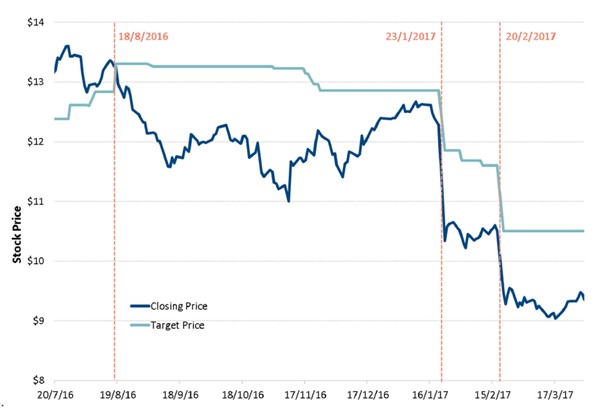
4054 Using the figures from the Dr Voetmann Response Report, the applicants produced the following table of the mean and median analyst forecasts for the FY17 Guidance before and after the January Partial Disclosure.
Before 23 January | After 23 January | Difference | |
Underlying Profit growth | |||
Mean | 8.8% | 2.4% | -6.4% |
Median | 8.9% | 2.7% | -6.2% |
Sales revenue growth | |||
Mean | 7.4% | 5.3% | -2.1% |
Median | 7.8% | 5.6% | -2.2% |
4055 Dr Unni also opined that the qualitative commentary by the analysts reflected a view that Brambles would not achieve its FY17 Guidance.
4056 The analysts’ reports show that, based on information in the January Disclosure, analysts downwardly revised their expectations of Brambles’ future earnings and consequently their share price recommendations. That also supports a finding that during the Relevant Period until 23 January 2017, Brambles shares traded at an inflated price.
25.4.5 Common sense?
4057 As to the third “mutually reinforcing base” the applicants contended that the proposition that, Brambles shares traded at an inflated price up to 23 January 2017 is also supported by common sense. As they said, the nub of their claim is that Brambles’ FY17 Guidance was misleading when it was given or should have been withdrawn when it became known by Brambles’ officers, either actually or constructively, that it was unlikely to be achieved.
4058 They submitted, and I accept, that participants in the market for ASX-listed shares such as Brambles are likely to treat earnings guidance such as the FY17 Guidance as influential for the purposes of their investment decisions. Brambles did not really contend to the contrary. As I found in relation to the materiality of the November Information, the likelihood that Brambles would not achieve its FY17 Guidance was likely to cause owners or prospective purchasers of Brambles shares to revise downwards their expectations for Brambles’ future earnings, thereby reducing their price expectations for Brambles shares. Looked at the other way, had Brambles not misleadingly continued to state that it expected to achieve its FY17 Guidance in respect of sales revenue and Underlying Profit, that was likely to cause owners or prospective purchasers of Brambles shares to revise downwards their expectations for Brambles’ future earnings, with the same result.
4059 And that likelihood is confirmed by what actually happened. Upon receipt of the January Disclosure, the analysts strongly revised downwards their estimates of likely Brambles FY17 sales revenue and Underlying Profit growth and their price recommendations in respect of Brambles shares.
4060 I accept the applicants’ submission that, as a matter of common sense, therefore, if Brambles’ FY17 Guidance was misleading at and from 16 November 2016, or if Brambles became “aware” pursuant to ASX Listing Rule 3.1 that at and from that date, it was unlikely to achieve its FY17 Guidance but failed to disclose that to the market, then it is likely that Brambles shares traded at a higher price than would have been the case if Brambles had refrained from making, reaffirming or maintaining (i.e., failing to correct, qualify or withdraw) the misleading FY17 Guidance or made the appropriate disclosure to the market. If Brambles ceased its misleading conduct or made the appropriate disclosure to the market that would cause buyers and sellers of Brambles shares to revise downwards their expectations for Brambles’ future earnings (and/or or revise upwards their risk assessment of Brambles share), then this would lead to a decline in Brambles’ share price.
4061 I accept the applicants’ contention that in the Relevant Period up to 23 January 2017, Brambles shares traded at an inflated price.
25.4.6 Whether the November Information and the November Representations are economically equivalent to the January Disclosure
4062 I have found that the information disclosed to the market by the January Disclosure caused abnormal returns, best understood as an excess decline, in the price of Brambles shares in an amount of $1.85 per share. The applicants’ next task is to show that the information disclosed in the January Disclosure was, as a matter of economic substance, equivalent to the information that ought to have been disclosed had Brambles complied with its statutory obligations. If so, it can be inferred that the amount of the excess returns attributable to that disclosure reflects the amount by which the share price was inflated between the date of the contravention and the date of the disclosure.
4063 Brambles’ contended that if, contrary to its primary submission, indirect market-based causation could be relied upon to establish causally connected loss, the applicants failed to adduce evidence capable of establishing that the alleged contravening conduct deceived the market to produce an inflated market price. It submitted that the applicants’ case must fail because they failed to establish that Brambles’ disclosure failures caused the actions of intermediaries, namely the share buyers and sellers in the market, to inflate the trading price of Brambles securities above the price that a properly informed market would have set.
4064 On Brambles’ argument, Dr Voetmann’s evidence does not provide a foundation from which the Court can conclude, on the balance of probabilities that - if they were aware of the alleged material information - buyers and sellers in the market would have transacted at different and lower prices, thus causing Brambles shares to trade at an inflated price in the absence of that information. It submitted that without such evidence, the applicants cannot prove that the failure to disclose that material information in fact caused Brambles’ share price to trade at an inflated level.
4065 As Brambles developed this argument, its thrust was that the counterfactual November Information was not economically equivalent to the information actually disclosed in the January Disclosure. On that basis it argued that it could not be inferred that the amount of the excess returns attributable to the January Disclosure reflected the amount by which the share price was inflated between the date of the contravention and the date of the disclosure, and the applicants had therefore failed to establish loss. It argued that the November Information was not economically equivalent to the January Disclosure because:
(a) the January Disclosure was in certain and definite terms, as opposed to the November Information which was said to be vague and indefinite;
(b) the January Disclosure provided more information than solely the withdrawal of the FY17 Guidance for Underlying Profit and sales revenue growth, that being “confounding information”; and
(c) the January Disclosure and the February Disclosure provided context to market participants that was materially different to the November Information.
4066 Before dealing with Brambles’ arguments, I turn to make some observations about the evidence and to take up some of the applicants’ submissions regarding the proper approach to assessing economic equivalence and confounding information.
4067 First, the expert evidence in relation to market modelling and the regression analysis underpinning their respective event studies was of substantial assistance to the Court in reaching a conclusion in relation to the quantum of the inflation in Brambles’ share price in the relevant period and I have relied on the findings of Dr Voetmann and Dr Unni in that regard. However, the expert evidence about economic equivalence and confounding information was in a different category.
4068 In my view, all of the experts tended to over-intellectualise what was, in part, just informed guesswork about the likely market reaction to a hypothetical disclosure of the August, October or November Information at some point prior to 23 January 2017. Based on their prognostications about what they thought would be the likely market reaction to that hypothetical disclosure of information, the experts then opined as to whether that August, October or November Information was or was not economically equivalent to the January Disclosure.
4069 Such evidence was to a significant extent rooted in supposition as to how an unknown class of potential and existing Brambles’ shareholders and market analysts would have reacted at different points in time in the cycle of Brambles’ business over the course of 1H17. That evidence was still useful, but the Court is in at least as good a position as the experts to make an evaluative assessment informed by commercial common sense as to the likely reaction of market participants, relevantly, to the November Information. The Court is, therefore, in an equally good a position to evaluate its economic equivalence to what was actually disclosed in the January Disclosure (and which caused a $1.85 decline in Brambles share price). Again, as with the materiality evidence, some of the expert evidence tended to over-complicate rather than elucidate.
4070 Second, I consider it to be abundantly clear on the evidence that there was some inflation in Brambles shares as a result of the Contravening Conduct, and that the applicants and group members have suffered some loss. Indeed, Brambles’ expert evidence was not to the effect that there was no inflation in the price of Brambles shares as a result of the Contravening Conduct during the Relevant Period. For example, Mr Holzwarth opined:
While there may be alleged inflation in the price of Brambles shares during the Relevant Period, it is not possible to calculate the amount given the vague nature of the counterfactual disclosures and the actual disclosures made by Brambles.
4071 The mere fact that damages cannot be assessed without difficulty and uncertainty does not relieve a court from the responsibility of attempting to assess them as best it can: Fink v Fink (1946) 74 CLR 127 at 143 (Dixon and McTiernan JJ); Commonwealth v Amann Aviation Pty Ltd (1991) 174 CLR 64 at 83 (Mason CJ and Dawson J). This is not a case like Zonia (FC), in which the Full Court said (at [599]) that it was not enough for the appellants to put up an event study and then throw their hands up, say it was impossible to seek to allocate the observed price effect between the information that was substantively the same as the pleaded information and the other “bad news”, and then to rely on principles in Armory v Delamirie (1722) 1 Stra 505; 93 ER 664 and Cessnock City Council v 123 259 932 Pty Ltd [2024] HCA 17; 418 ALR 304 to claim the entire share price decline. Here, unlike in Zonia (FC), Dr Voetmann’s event study was not based on an erroneous assumption so that there was no starting point for the valuation exercise, and the facts regarding economic equivalence are quite different. In my view, Brambles’ contentions seek exact economic equivalence, which is not what is required, and they are overstated.
4072 Third, I accept the applicants’ submissions that too exacting a standard of proof as to the inflation in Brambles’ share price at different points in time ought not to be required. The very reason that an event study was required is because of Brambles’ Contravening Conduct. An overly technical approach focussing upon a supposed need to prove exact economic equivalence, or exclude the presence of confounding information which contributed to the price decline so as to identify the inflation as at the date of the acquisition, risks missing the point that if those issues existed their contribution to the price decline on the day of the January Disclosure when the truth was revealed, and to a greater share price reaction than would have been experienced in the event of timely disclosure, is actually a consequence of the lack of timely disclosure which comprises the wrongdoing.
4073 Fourth, as the applicants said, the goal of an event study is to arrive at a reasonable proxy for (not a perfect calculation of) what would have happened to the price of Brambles shares had the misrepresentations not been made and/or the November Information disclosed earlier. If, for example, the alleged confounding information causes some difficulty in measuring inflation, it is Brambles’ misconduct which has caused that difficulty. The compensatory principle should not be rendered subservient to the supposed need to conduct a perfect analysis. Doing so would risk giving Brambles’ credit for its own wrongdoing, or even allow it to avoid giving compensation at all because of its argument that the effects of its Contravening Conduct are impossible to disentangle from the effects of extraneous factors which would not have existed had timely disclosure occurred.
4074 The relevant November Information was as follows:
(a) in respect of sales revenue, Brambles’ performance in CHEP NA since 1 July 2016 meant it was likely that Brambles would not achieve year-on-year growth in sales revenue of between 7% and 9% in FY17 and an integral reason for this was that sales revenue in US Pooled would likely not meet budget in FY17; and
(b) in respect of Underlying Profit, Brambles’ performance in CHEP NA since 1 July 2016 meant it was likely that Brambles would not achieve year-on-year Underlying Profit growth of between 9% and 11% in FY17, and that integral reasons for this were that revenue in US Pooled would likely not meet budget in FY17, and direct costs were going up.
As noted earlier, the November Representations were the inverse of that. That is, that Brambles forecast that in FY17 it expected to achieve year-on-year growth in sales revenue of between 7% and 9%, and year-on-year Underlying Profit growth of between 9% and 11%.
4075 The salient part of the January Disclosure made by Brambles on 23 January 2017 said the following:
Brambles today announced that based on preliminary, unaudited financial accounts for the six months ended 31 December 2016, it expects first-half constant-currency sales revenue growth of approximately 5% and constant-currency Underlying Profit growth of approximately 3%.
In light of this first-half performance, Brambles expects constant-currency sales revenue and Underlying Profit growth for the year ending 30 June 2017 to be below its current guidance range for constant-currency sales revenue growth of between 7% and 9% and Underlying Profit growth of between 9% and 11%.
4076 It is convenient to deal with the issue of economic equivalence through the prism of Brambles’ submissions.
(a) The contention that the January Disclosure was certain and definite, whereas the November Information was vague and imprecise
4077 First, Brambles submitted that the January Disclosure was in certain and definite terms whereas the November Information was vague and imprecise, and the two were therefore not economically equivalent.
4078 It should be understood that, at least in part, this submission is based on the fact that there are two limbs of the November Information that were pleaded in relation to both sales revenue and Underlying Profit:
(a) that it was “likely” that Brambles would not achieve the FY17 Guidance; or
(b) there was “at least a material risk” that Brambles would not achieve the FY17 Guidance.
4079 For the reasons I have previously explained, I accept that the information that there was “at least a material risk” that Brambles would not achieve the FY17 Guidance is vague and imprecise, and not economically equivalent to the statement in the January Disclosure that Brambles expects sales revenue and Underlying Profit growth to be below the FY17 Guidance. I accept Dr Unni’s explanation that the disclosure of the existence of a risk that guidance would not be achieved is not economically equivalent to the disclosure of the realisation of that risk. I will not dwell on that because I have found that there was no contravention in relation to this limb of the November Information. My concern is with the “likely” component of the November Information.
4080 Brambles attacked the reliability of Dr Voetmann’s evidence on the basis that he maintained his adherence to the proposition that a “material risk” of the FY17 Guidance not being achieved was the same thing as a withdrawal of that guidance (and therefore economically equivalent). It submitted that that was a reason to treat his evidence with caution. I do not accept Dr Voetmann’s opinion that a material risk of missing guidance is economically equivalent to an expectation of missing guidance, but I reject the contention that Dr Voetmann’s evidence should be treated with caution. I found him an impressive witness who gave largely reliable evidence.
4081 Dr Unni opined that there was an “economically meaningful” distinction between a “likelihood” that Brambles would miss its guidance and the asserted “certitude” of a miss that was conveyed by the withdrawal of the FY17 Guidance that occurred through the January Disclosure. Brambles highlighted Dr Unni’s oral evidence, in which he said:
[L]ikelihood is [a] probabilistic statement and it would be perfectly correct to describe my statement as a statement of likelihood if I were to say, for example, that there’s a 60 per cent probability I will miss guidance. Or that there is a 55 per cent probability that I will miss guidance. Because in both instances, it’s more probable than not that you will miss. And I think under ordinary usage of the language it would be fair to say that you are saying it is likely you will miss. But to say that the company would miss guidance is, in my opinion, a much stronger statement.
Brambles contended that there is a relevant and meaningful difference between a “likelihood” that Brambles would miss the FY17 Guidance and the “definite withdrawal” of the FY17 Guidance which it said occurred through the January Disclosure.
4082 Mr Holzwarth described the November Information (including the “at least a material risk” limb) as having an infinite or vast range of potential outcomes, and as such the allegations were too “vague” and “imprecise” to determine the value of the information given the actual disclosure history for Brambles.
4083 Brambles noted that Dr Unni acknowledged that the price-reaction (or abnormal returns) upon a corrective disclosure can, in principle, be adjusted for the difference in the valuation impact of a possibility rather than a certainty. But Dr Unni said that in order for such an adjustment to be feasible, it is necessary to establish the degree of probability associated with the negative event in the allegedly omitted news. In his opinion, if the degree of probability cannot be reliably established from the allegations or other available information, such an adjustment may prove impossible. Brambles submitted that this is the case here.
4084 I found little force in Brambles’ submissions in relation to the “likely” limb of the November Information.
4085 The salient part of the January Disclosure, both in the January Trading Update and January Conference Call, stated:
Brambles expects constant-currency sales revenue and Underlying Profit growth for the year ending 30 June 2017 to be below its current guidance range for constant-currency sales revenue growth of between 7% and 9% and Underlying Profit growth of between 9% and 11%.
The salient parts of the November Information relevantly stated:
…it was likely that Brambles would not achieve year-on-year growth in sales revenue of between 7% and 9% in FY17 [and]
…it was likely that Brambles would not achieve year-on-year Underlying Profit growth of between 9% and 11% in FY17.
4086 I consider Dr Unni drew too fine a distinction between the information in the “likely” limb of the November Information and the information in the January Disclosure. I do not consider there is any significant difference in the market behaviour that could be expected to arise from:
(a) a statement by Brambles that it expects to miss guidance; and
(b) a statement by Brambles that it is likely to miss guidance.
4087 I put little weight on the dictionary definition, as what is important is what the market of investors and prospective investors in Brambles shares was likely to understand from the information. But it is worth noting that the Oxford English Dictionary provides that one of the meanings of “expect” is “regard as about or likely to happen”.
4088 To show substantial economic equivalence it is not necessary to show the same language. As Dr Voetmann noted:
Two disclosures can convey the same message, and thus resulting in the same price impact, without being “identical” in language to each other. As a simplistic example, a company might say its guidance is no longer likely to be achievable, or alternatively, that it no longer expects to meet its guidance. Both announcements would convey to the market that the company will no longer be working towards its former guidance. Thus, the same message can be conveyed without the disclosures being linguistically “identical.
(Emphasis added.)
As the Full Court in Zonia (FC) explained at [579], what is at issue is not differences in wording, but the substance of what was conveyed. Dr Unni made too much of the asserted difference in certitude between “likely” and “expects”.
4089 Further, as Dr Unni accepted in cross-examination, both the statement that Brambles expects to miss guidance, and the statement that it is likely to miss guidance, speak to the future. They both therefore carry some uncertainty. In cross-examination Dr Unni shifted from the position he took in his report where he said the November Information represented “the existence of a likelihood…that Brambles would not be able to meet its FY17 Guidance” in contrast to the January Disclosure which represented “the certitude that Brambles would be unable to meet its FY17 Guidance” (emphasis added). In cross-examination he said that the January Disclosure, had a “stronger degree of certitude” (emphasis added) than the November Information, as opposed to the January Disclosure being certain. Dr Unni’s contention in his report was overstated.
4090 Dr Unni also said in cross-examination that “informed, sophisticated investors” would be able to draw a distinction between the “degrees of certitude” of a statement by Brambles that it expects to miss guidance and a statement by Brambles that it is likely to miss guidance. I am not persuaded as to that. But even if I were, it would be wrong to assess the likely market reaction to announcements to ASX only by reference to responses of informed, and sophisticated investors. The semantic difference that Dr Unni was trying to draw out would most likely be lost on many retail investors.
4091 What is important is the substance of the disclosure, and what it is likely to convey to the market about Brambles’ likely future earnings; not the literal meaning of the words in the abstract. In relation to the likely economic effect of both the January Disclosure and the November Information Dr Voetmann gave evidence that it is “the fact that you’re expecting not to meet guidance” that will result in a “significant price decline”. I agree.
4092 I am buttressed in my view as to the substantial economic equivalence between the November Information and the January Disclosure by the evidence of Professor da Silva Rosa who opined that a statement by Brambles that it was likely to miss its FY17 Guidance in respect of Underlying Profit growth:
… would lead investors to infer that either revenue was not growing at the pace predicted in earlier forecasts by Brambles management and/or expenses were increasing at a higher rate - or not falling as fast - than predicted by Brambles management when they set out their earlier earnings forecasts. The combination of lower expected revenues and higher expected expenses in the future would lead investors to infer a material decline in expected earnings in FY2017 and beyond.
I consider that is the same, or at least very similar market effect, as one would expect from the information in the January Disclosure that Brambles expects to miss its FY17 Guidance in respect of Underlying Profit growth.
4093 Brambles’ submissions, contending for a dichotomy in the likely market reaction to a statement by Brambles that it is likely to miss guidance and a statement by Brambles that it expects to miss guidance were overstated. I do not accept them.
4094 Second, as noted, Mr Holzwarth described the November Information as having an infinite or vast range of potential outcomes, and as such the allegations were too “vague” and “imprecise” to determine the value of the information given the actual disclosure history for Brambles, and that the information did not have “a definable economic effect”. Relatedly, Mr Holzwarth said that the information conveyed by the November Information would have a “vast” number of permutations. I understood this aspect of Mr Holzwarth’s evidence to centrally concern the “at least a material risk” limb of the November Information which I am not here considering. But to the extent that Mr Holzwarth’s evidence extended to the “likely” limb of the November Information, I do not accept it. I do not accept that a statement by Brambles that it is likely to miss its FY17 Guidance on sales revenue and/or Underlying Profits is too vague or imprecise to have economic value. The persons who commonly invest in shares, including owners and prospective purchasers of Brambles shares, are likely to understand that according to its plain language; Brambles stating that it was probable that it would miss its FY17 Guidance. That is likely to have a substantial economic effect on the market.
4095 Further, Mr Holzwarth’s evidence that the November Information was so vague that it would not have a definable economic effect fell away in cross-examination. He accepted that some investors who received the November Information may take an “extremely negative view” and others may take a “less negative view” but the effect of the November Information on investors was always negative.
(b) The contention regarding confounding information
4096 The applicants explained the concept of “confounding information” as follows, which I accept:
The concept of confounding information in a case such as this refers to information which is contained in a corrective disclosure (ie, a disclosure that prompts a statistically significant excess return) which is both new and material, but which is not part of the information which it is said ought to have been disclosed earlier, or which overlaps with it in terms of its price impact. Where a statistically significant excess return has been identified, and the question is what information caused that excess return:
(a) Information which is not new (ie is already generally available) is not confounding, and can be ignored, because in a semi-strong form efficient market such information will already have been absorbed into the stock price (and so cannot have contributed to the excess return);
(b) Information which is not material is not confounding, and can be ignored, because in a semi-strong form efficient market it is only material information which contributes to a price reaction over and above the random walk, and market-wide factors the effect of which have already been excluded by the statistical analysis which found that the excess return was statistically significant;
(c) Information which is part of the information which it is said should have been disclosed earlier (here the Primary Information) is not confounding, and nor is information which it can be established would not have caused a price impact over and above (“in excess of”) the price reaction which occurred
4097 Brambles submitted that the January Disclosure included “additional value relevant information” which was different from the November Information, and that the two were therefore not economically equivalent. It centrally relied upon the fact that the January Disclosure included the following statement:
Brambles today announced that based on preliminary, unaudited financial accounts for the six months ended 31 December 2016, it expects first-half constant-currency sales revenue growth of approximately 5% and constant-currency Underlying Profit growth of approximately 3%.
(the 1H17 Results Preview)
4098 Mr Holzwarth opined that the 1H17 Results Preview was “additional value relevant information” which provided empirical results for market participants to formulate their expectations of Brambles’ revenue and Underlying Profit for the remainder of FY17. He said that the January Disclosure contained additional negative information describing the expected results for 1H17, and so did not provide a reliable basis to measure alleged inflation related to the November Information. To similar effect, Dr Unni opined that the 1H17 Results Preview and the US Pooled Information (as later defined) were more specific - and therefore more likely to have a price impact - than the withdrawal of the FY17 Guidance alone. In cross-examination he said that “since prices in an efficient market react to information…if more information is released to the market than less, prices will be expected to move more than in the case where less information is released”. On that basis Mr Holzwarth and Dr Unni opined that the January Disclosure and the November Information were not equivalent in economic substance.
4099 Brambles contended that the 1H17 Results Preview in the January Disclosure must be understood in the context of its previous disclosures to the market. It said, and I accept, that with respect to Brambles’ revenue, the 1H17 sales revenue growth and Underlying Profit growth disclosed in the 1H17 Results Preview were well below the trend established by Brambles over the preceding two years. It argued that the disclosure of those actual results for 1H17 is likely to have negatively influenced expectations of market participants in respect of Brambles’ performance over the balance of FY17. It noted that the January Disclosure came three months after Brambles had released its revenue results for 1Q17 in which Brambles had announced revenue growth of 7% for 1Q17, and it argued that investors were able to readily deduce (and did deduce) that revenue growth in 2Q17 had fallen to just 3% (given the half year result of 5% growth).
4100 On those bases, Brambles argued that the January Disclosure did not disclose only the November Information and disclosed additional value-relevant information regarding the magnitude of the likely shortfall to guidance for the full-year, because the market had actual results for the first six months of trading. It argued that, by contrast, the November Information did not specify (or include anything at all from which a view could be formed about) whether the possible or likely shortfall to guidance for the full-year would be small or large.
4101 In his initial report, Dr Voetmann said that he “did not find that [sic] any confounding information on either the January or February 2017 Disclosures that would have affected Brambles stock price”. Then, in the Voetmann Response Report, in response to criticisms from Mr Holzwarth, he stated that Mr Holzwarth did not provide any evidence to suggest that the 1H17 Results Preview “actually resulted in an excess return beyond the price impact of the corrective information”. He opined, having regard to three academic studies, that while the 1H17 Results Preview might be value-relevant in that it became part of the information set considered by investors, that did not necessarily result in a price decline in excess of that from the likely miss of the FY17 Guidance which was stated in the November Information.
4102 In relation to the academic literature, he said:
… the evidence from academic research suggests that, guidance withdrawals, on average, are expected to be associated with a significantly larger negative price response relative to guidance updates. This is because investors can react more negatively to the lack of specific quantification of management’s forecast error and associated increased uncertainty about future earnings prospects. A downward guidance revision is effectively a guidance withdrawal plus a revelation of the specific error of the prior management forecast. This specific quantification of the error can be value-relevant; however, academic evidence suggests that it does not have incremental price impact to the withdrawal itself—a withdrawal by itself, on average, has a significantly more negative price impact. This suggests that Brambles’ disclosure of its preliminary expectation for 1H FY2017 does not necessarily result in a price impact in excess of the withdrawal of the FY2017 Guidance. If anything, it may have dampened the price impact of Brambles’ withdrawal of the FY2017 Guidance on 23 January 2017.
(Emphasis added.)
4103 Decoded, the gist of Dr Voetmann’s evidence was that while the 1H17 Results Preview in the January Disclosure was likely to have been relevant to the revised expectations of market participants in relation to Brambles’ future earnings, its effect would have been to reduce the uncertainty resulting from Brambles’ withdrawal of the FY17 Guidance without providing any revised or updated guidance. Thus, rather than causing a further price decline additional to that caused by Brambles’ withdrawal of its FY17 Guidance, if anything, the 1H17 Results Preview (with the associated analysts’ commentary) may have “dampened” the price impact of the withdrawal. Dr Voetmann did not opine that such “dampening” would definitely occur, but he did state that it can be concluded that any price impact from the 1H17 Results Preview would not be additional to (“in excess of”) the price decline associated with the withdrawal of the FY17 Guidance without any revised or updated guidance.
4104 Brambles took umbrage with Dr Voetmann’s opinion regarding the likely effect of a guidance withdrawal on market participants, noting that he did not provide that opinion until the Voetmann Response Report, and relied on a “handful” of academic articles which Brambles argued were not directed squarely to the issue at hand (and some of which were at that point unpublished). Brambles submitted that the substantive problem with Dr Voetmann’s opinion is that it depended on an “entirely unrealistic and nonsensical premise” (and one that does not form part of the November Information) that in the counterfactual world in which Brambles disclosed that it was likely that it would not achieve its FY17 Guidance, Brambles would say nothing about when it expected to be in a position to provide revised guidance and would be unable to answer questions from investors about when revised guidance would be provided. Brambles contended that that was the relevant premise because that is what occurred in the “bare withdrawals” of earnings guidance which were the subject of the academic literature.
4105 The difference, according to Brambles, was that its withdrawal of the FY17 Guidance in the January Disclosure was not a “bare withdrawal” because it told the market that it was in a blackout period pending finalisation of the 1H17 results, and that it would provide revised guidance at the time of releasing its audited 1H17 results on 20 February 2017. It relied on Dr Unni’s opinion that it was wrong to suggest that any portion of the price decline that occurred following the January Disclosure was associated with a “negative imputation” that market participants might draw that Brambles was merely withdrawing its earnings guidance without being able to provide a revision.
4106 Brambles contrasted its position in withdrawing the FY17 Guidance with the examples of some of the withdrawals referred to in the academic literature, including that the companies studied which gave bare withdrawals either: (a) announced to the market that they were withdrawing guidance and not providing new guidance because volatile market conditions made it impossible for them to provide reliable guidance for the remainder of the year; or (b) did not revise their guidance in the same year as the guidance was withdrawn.
4107 Brambles also contended Dr Voetmann did not “engage with any ‘real world’ facts” in his discussion of the asserted confounding information. It argued that he failed to account for the different factual circumstances in which the counterfactual would have been received at different points in time. It said that, for example, if shortly after announcing its FY17 Guidance on 18 August 2016, Brambles had announced that it was unlikely to achieve that guidance, the fact that Brambles had in August 2016 just announced very strong results for FY16 and had met guidance for FY16 would clearly be relevant to how news of the withdrawal of the FY17 guidance would be received by the market. It said it was counterintuitive to assume, as it said Dr Voetmann did, that the market would receive that information in August 2016 and react to it in precisely the same way as it reacted to news of the withdrawal of guidance on 23 January 2017.
4108 Brambles submitted to similar effect, that if in October 2016 Brambles made the counterfactual November 2016 disclosure at or around the same time that it announced its 1Q17 results were in line with guidance, there is no sound reason to assume that the market’s reaction would be no different to the market’s reaction to the actual withdrawal of guidance through the actual January Disclosure. It relied upon Mr Holzwarth’s opinion that as at October 2016 analysts would have had only three months of actual results and nine months of forecast results whereas at the time of the January Disclosure it had six months of actual results and six months of forecast results, with an additional three months of actual revenue results showing a very substantial deterioration of Brambles performance in 1Q17.
4109 Brambles concluded on this point by submitting that the 1H17 Results Preview were value-relevant, disappointing and negative news, and the “belated” reliance by Dr Voetmann on academic articles in the Voetmann Response Report did not provide a sound basis for the asserted “dampening” effect. As such, Brambles submitted, the Court ought to conclude that it is adverse confounding information to which Dr Voetmann had no regard in his report and which therefore demonstrated the conclusions of his entire analysis were unreliable.
4110 I do not accept Brambles’ contentions regarding confounding information. In doing so I do not entirely discount its criticisms of the equation of its position with the position of the companies in the academic studies to which Dr Voetmann referred. Although I came to the view that the academic studies provided a proper foundation for Dr Voetmann’s opinion, my conclusion is not centrally based on the studies. My conclusion is centrally based in my own evaluative assessment, based on commercial common sense, regarding the likely market reaction to the November Information, my preference for Dr Voetmann’s opinion to the opinions provided by Mr Holzwarth and Dr Unni, and the commentary by analysts following the January Disclosure.
4111 First, the Court is in as good a position as the experts, indeed in my view a better position, to conduct the necessary robust evaluative assessment. I consider it likely that many investors in a large ASX300 company like Brambles would expect it to provide updated earnings guidance if it was withdrawing the guidance earlier provided, rather than being left wondering what Brambles’ outlook was for FY17 and the medium-term. To my mind, Brambles having provided the FY17 Guidance to the market on 18 August 2016, and having reaffirmed that guidance on 20 October 2016 and 16 November 2016, the fact that it withdrew the guidance and did not provide updated guidance was likely to have increased the uncertainty in the market about Brambles’ likely future earnings and outlook.
4112 It is likely that many investors would worry that the outlook for Brambles in FY17 and the medium-term was particularly uncertain; why else would Brambles not give its shareholders updated guidance? Gorman’s remarks in the January Briefing Call are likely to have fed into that. There he said that while he appreciated that it was “frustrating” that Brambles had not provided updated earnings guidance to the market, Brambles felt it was prudent to wait for the audited results and for the January trading results before providing an updated outlook. That sent a message that not only did Brambles expect to miss its FY17 Guidance, but it was also not sure what the January trading results would be like, even though at that point it was already 23 days into the month.
4113 Second, Mr Holzwarth opined that the November Information and the January Disclosure were not economically equivalent because the disclosure of the November Information on or around November 2016 would not have had the same effect as the January Disclosure, because (as Brambles put it) that disclosure would have been “contextually and qualitatively different”. He opined as follows:
At the time of the 23 January 2017 Disclosure, forecasts were conditioned on knowledge of 1H17 expected results after the conclusion of 1H17. Market participants’ forecasts for FY17 sales growth would have been a six plus six forecast - six months of effectively known results and a forecast of six months of future results for 2H17. The expectations for 2H17 would have reflected knowledge of 1H17 performance. By comparing then known 1H17 sales growth of 5% to then known 1Q17 sales growth of 7%, market participants would have deduced a decline in the sales growth rates in 2Q17 versus 1Q17. This deceleration in sales growth in 2Q17 would have been an important component of how market participants formed expectations for 2H17…
In contrast, market participants would have possessed a different and more positive set of information at the time of a counterfactual disclosure in October or November 2016. Brambles had disclosed 1Q17 sales growth consistent with guidance as well as some commentary regarding 1Q performance. A forecast of FY17 sales would have been a three plus nine forecast - three months of actual results and a forecast of nine months of operations. This more positive set of available information indicates that a conditional forecast in October or November 2016 would have been for better sales growth as compared to a counterfactual forecast in January 2017.
4114 That evidence was echoed by Brambles’ submission that Dr Voetmann did not “engage with any ‘real world’ facts” in his discussion of confounding information. Specifically, it argued he failed to account for the different factual circumstances regarding Brambles’ performance against budget in which the counterfactual information would have been received by the market in August, October or November 2016.
4115 In my view, that submission was not grounded in the evidence. It was little more than speculation about the likely market reaction at different points in time. One could speculate either way as to what the market reaction would have been had the November Information been disclosed at or around August, October and November 2016. As I said earlier, an overly technical approach focussing upon a supposed need to prove exact economic equivalence, risks missing the point that the reason the likely market reaction to that information must be the subject of speculation is actually a consequence of the lack of timely disclosure which comprises the Contravening Conduct. I accept that it is possible, as Mr Holzwarth opined, that the disclosure of the counterfactual October Information in October 2016 might have had less of an impact on market perceptions regarding the outlook for Brambles, because the 1Q17 results were in line with guidance and there was a longer timeframe for a possible turnaround. On the other hand, it is possible, as Professor da Silva Rosa opined, that the disclosure of the counterfactual information in October 2016 might have had an “even worse” impact on market perceptions regarding the outlook for Brambles, because missing guidance just four months into the financial year might indicate to the market that Brambles had serious problems that were unlikely be turned around. Both views are just speculation, and an inadequate basis upon which to decide the issue of substantial economic equivalence.
4116 Third, although the academic studies relied upon by Dr Voetmann were not squarely directed to Brambles’ circumstances, their broad import was that guidance withdrawals are typically associated with substantially more negative price responses relative to the price responses to guidance revisions. The applicants summarised the three academic studies upon which Dr Voetmann relied, as follows:
Marshall and Skinner. In this paper, the researchers set out to determine the impact of guidance withdrawals on the reputation of a firm’s management in the market. As part of the premises of that research, the authors note that companies are more likely to withdraw, rather than revise, earnings guidance when there is high uncertainty about the firm’s future performance. Consistently with that proposition, the authors note that abnormal returns following guidance withdrawals are “significantly more negative” than for guidance revisions, and that analysts “respond more negatively” to withdrawals than revisions.
Chen et al. This paper concludes that, after a firm announces that it will [no] longer give profit guidance, there is “an increase in analyst forecast dispersion and a decrease in analyst forecast accuracy after the stoppage of guidance”, which suggests that “explicit guidance is valuable to analysts”.
Lee and van Buskirk. The authors of this paper conclude that “firms that withdraw their earnings guidance experience a significantly larger increase in implied volatility relative to firms that revise their earnings guidance”. The authors comment that is because, “just as the revelation of new information tends to reduce uncertainty, the retraction of previously-disclosed information increases uncertainty.” They find that “firms withdrawing their guidance experience significantly more negative returns of approximately -8.9% relative to firms that revise their guidance.”
I have reviewed those academic papers, and the applicants’ summary is sufficient.
4117 In the Joint Report, Mr Holzwarth opined that Dr Voetmann’s reliance on the academic literature was “misplaced”, and that he failed to discuss some of the “underlying limitations” in the analysis presented in the Lee and van Buskirk study. However, in cross-examination, Mr Holzwarth conceded that that paper did not have the shortcomings of which he had said, and he accepted that his criticism was incorrect. He accepted that:
(a) the Lee and van Buskirk study supported the proposition that there is an incremental additional negative impact associated with guidance withdrawals compared to guidance revisions;
(b) the Marshall and Skinner study reached similar conclusions to the Lee and van Buskirk study;
(c) both studies supported the proposition that a withdrawal of earnings guidance is likely to lead to a greater abnormal return than a revision of earnings guidance;
(d) both studies supported the proposition that there is an additional negative impact from guidance withdrawals relative to guidance revisions; and
(e) all else being equal, a withdrawal of earnings guidance introduces more uncertainty into the market about a company’s future earnings prospects than an earnings guidance revision.
In effect, Mr Holzwarth accepted that the academic studies stood for the propositions for which Dr Voetmann cited them. That evidence seriously undercut Brambles’ criticisms of Dr Voetmann’s reliance on the studies.
4118 In cross-examination, as previously noted, Dr Unni said:
…since prices in an efficient market react to information, that if more information is released to the market than less, prices will be expected to move more than in the case where less information is released. And that is the logic behind my also stating that less specific information is likely to move prices less than more specific information.
4119 Boiled down, Dr Unni testified that the more specific the information provided to the market, the greater the price movement and he initially maintained that that was “a basic premise of finance theory”. Then, in cross-examination, he was drawn to concede that he was not stating some “universal principle” and that whether prices move more or less with the provision of information depends on the information. That was, of course, obvious. That concession cut away some of the basis for Dr Unni’s opinion that the 1H17 Results Preview was likely to have given rise to a price reaction in excess of that likely to result from the counterfactual disclosure of the November Information.
4120 In relation to the academic studies, Dr Unni said that he had “no quarrel” with the key finding of the Marshall and Skinner study that earnings guidance withdrawals have a greater price impact than earnings guidance revisions because they introduce more uncertainty into a company’s forecast. But he maintained that the study was not relevant in the present case as it was not “informative” about what would have happened under the counterfactual disclosure of the November Information. Dr Unni said that the difference between the January Disclosure and the companies studied was that the January Disclosure had provided the 1H17 Results Preview and had told the market that it would provide updated guidance on 20 February 2017.
4121 However, as Dr Voetmann accepted, there are three broad categories of guidance withdrawals:
(a) a withdrawal of guidance with no further information provided (a bare withdrawal); and
(b) a withdrawal of guidance accompanied by some additional information but not a guidance revision (a semi-bare withdrawal); and
(c) a withdrawal of guidance accompanied by revised or updated guidance (a guidance revision).
It became common ground that the January Disclosure was a “semi-bare withdrawal” and Dr Unni accepted that the authors of the Marshall and Skinner study had controlled for the effect of the disclosure of other information at the same time as the withdrawal of guidance.
4122 In cross-examination, it became apparent that Dr Unni understood the Marshall and Skinner study as showing that “bare withdrawals” of earnings guidance have a larger relative price impact than a withdrawal accompanied by a revision because, as defined in the study, a bare withdrawal conveys that the company is not merely withdrawing its current guidance but also indicating that it will not be able to give revised guidance for an indefinite time.
4123 However, as Dr Voetmann explained, both bare and semi-bare withdrawals gave rise to a significant and substantial share price decline in excess of the price decline experienced following a guidance revision. That underpinned his opinion that the 1H17 Results Preview was not confounding information that was likely to have led to a share price decline in excess of that which would have followed disclosure of the November Information. He maintained that view under strenuous cross-examination.
4124 Dr Unni accepted that the absence of revised guidance in the January Disclosure introduced uncertainty into the market in relation to Brambles’ outlook, which would have had a price impact. But he said:
Whereas the subjects of these academic studies of bare withdrawals are leaving investors with a considerably greater degree of uncertainty about what lies ahead because it was not just that they couldn’t tell when they would resume, but they were also … conveying something to the markets that Brambles never did. They are conveying that they are unable to come up with a revised amount, whereas Brambles was merely saying, “We are in the process of working on it and we need time over the next 30 days to do so.” And I do believe that’s also a meaningful distinction.
4125 The applicants submitted that that opinion can only be understood as Dr Unni stating that the fact that the January Disclosure told the market that Brambles would provide updated earnings guidance on 20 February 2017 would have reduced the uncertainty in the market caused by its withdrawal of the FY17 Guidance. Dr Unni confirmed that when he accepted, in answer to a question from the Court, that “a Brambles-type announcement where the withdrawal of the guidance was associated with the provision of other information - in Brambles’ case, the first half year results and some qualitative statements about the reasons for that” (i.e., a semi-bare withdrawal) would cause less uncertainty in the market than a bare withdrawal in which no indication was given as to when such guidance would be resumed.
4126 In the finish, Dr Unni effectively agreed with two of the propositions underpinning Dr Voetmann’s opinion, being that:
(a) a bare withdrawal of earnings guidance is associated with a greater amount of uncertainty in the market than a semi-bare withdrawal of earnings guidance (i.e., an announcement like the January Disclosure); and
(b) companies that make a bare withdrawal of earnings guidance see greater share price declines relative to companies that provide revised guidance.
4127 Dr Voetmann provided a simple analogy in support of his opinion:
The way to think about how do you measure the impact of the information that’s disclosed in January, you can think of this way, your Honour. If I told you that I’m going to give you $100 at the end of the year, and you expect to get $100 at the end of the year, scenario A, assume that I tell you six months in I have 40 bucks in my pocket but I don’t know what I can give you at the end of the year, but I will work towards - I will work hard in the next six months but I don’t know what I can give you at the end of the year. That is scenario A.
Scenario B, assume I come to you in six months time and say, I don’t - I know I can’t give you $100 at the end of the year and I don’t quantify anything else. If you think about those two scenarios, A clearly have less - because it has more information, it would lead to a lower price response, price reaction, because you have more clarity with the $40 provided. Whereas scenario B, you have no information, so that introduces more uncertainty. And so we know that with the higher uncertainty, you have a larger price impact.
4128 The January Disclosure is similar to “Scenario A” and the November Information is similar to Scenario B, which carries more uncertainty. In my view, Dr Voetmann’s opinion that the 1H17 Results Preview was unlikely to cause any material price decline additional to the price decline associated with the counterfactual disclosure of the November Information accords with commercial common sense.
4129 Fourth, the analysts’ reactions to the January Disclosure are consistent with Dr Voetmann’s opinion, and with common sense. Dr Voetmann produced the following table to show the dispersion of analyst estimates (i.e., the range of difference between their estimates) following the January Disclosure in relation to expected FY17 sales revenue and Underlying Profit growth.
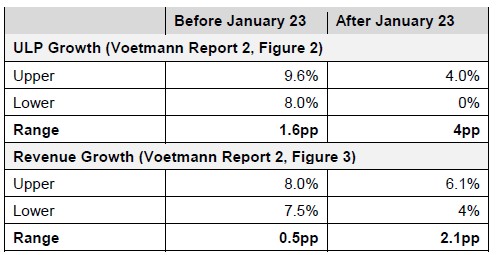
4130 In cross-examination, Mr Holzwarth accepted that the increased dispersion in analysts’ estimates was consistent with a higher degree of uncertainty regarding the outlook for Brambles. Indeed, he said that the level of dispersion “doubled” and that the analysts’ estimates regarding Brambles’ outlook were “pretty tight” before the January Disclosure. Dr Unni opined that increased dispersion by itself does not necessarily indicate an increase in uncertainty, but he agreed that when one looks at the qualitative statements made by the analysts they were expressing greater uncertainty regarding the Brambles financial outlook.
4131 The Voetmann Response Report set out some examples of analyst commentary regarding the uncertainty which flowed from the lack of updated guidance and further information from Brambles in the January Disclosure. They included the following:
(a) Citi Research (23 January 2017):
The profit warning and lack of clarity on FY17 guidance are concerning, particularly when there remains another 28 days before we get more detail on the issues and their impact into 2H17… While we believe the share price reaction has been overdone, the lack of clarity on the likely impact should continue to weigh on any share price recovery.
(Emphasis added)
(b) Evans and Partners (24 January 2017):
Given these issues have arisen less than 12 weeks since the company previously gave its growth expectations, we believe earnings visibility to be low at this point. We await further disclosure on the nature of the destocking via a read through from official 4Q inventory data and customer reporting. Ahead of that time, we expect the uncertainty to weigh on the outlook and multiple.
(Emphasis added)
(c) Goldman Sachs (23 January 2017):
The lack of detail and clarity regarding the potential forward looking ramifications could likely see the stock remain subdued until such detail is provided at the result, in our view.
(Emphasis added)
(d) UBS (23 January 2017):
The lack of disclosure and imprecise explanations from management for Brambles’ surprise guidance downgrade have driven a sharp correction in the share price… the impact from ‘US retailer destocking’ experienced in the month of December is without anecdotal support and appears to have driven a rapid slowing in revenue growth
(Emphasis added)
4132 Having regard to those qualitative statements. it is plain that following the January Disclosure (being the withdrawal of the FY17 Guidance which was not accompanied by any revised guidance) the market experienced substantial uncertainty regarding the outlook for Brambles in FY17 and beyond.
4133 Dr Voetmann’s point was that, absent a level of increased certainty through the inclusion of the 1H17 Results Preview and other information regarding US Pooled in the January Disclosure, the share price decline may have been even greater, and it was unlikely that the inclusion of that additional information would have caused a share price decline additional to that which was likely to follow disclosure of the November Information. There is a sound basis in the evidence for that conclusion. I accept the applicants’ contention that the inclusion of the 1H17 Results Preview in the January Disclosure was not confounding information that was likely to have led to a material additional price decline in excess of that which was likely to have followed the counterfactual disclosure of the November Information.
4134 Fifth, and relatedly, Brambles contended that the January Disclosure and the November Information were not economically equivalent because the January Disclosure provided some information about the magnitude of the likely shortfall to the FY17 Guidance, whereas the November Information did not specify anything about the magnitude of the likely shortfall. I do not accept that that meant that the January Disclosure and the November Information were not substantially economically equivalent.
4135 Sixth, I do not accept Brambles’ submission that the inclusion of the 1H17 Results Preview and what I call the US Pooled Information (see below) in the January Disclosure went unconsidered by Dr Voetmann. He provided a detailed and considered report, that material was obvious, and it is clear that he gave close attention to the January Disclosure. I do not accept that he somehow missed the significance of the information to the withdrawal of the FY17 Guidance. The actual position was that he did not consider that the 1H17 Results Preview was “confounding information” at all, in the sense that he did not consider it would have caused price decline in excess of the price decline associated with the information that Brambles expects to or was likely to miss its FY17 Guidance, unaccompanied as they were by any information providing updated earnings guidance for FY17. That was his primary position. Then, in response to the opinions of Mr Holzwarth and Dr Unni he gave a more fulsome explanation and supported that by reference to academic studies. Nor do I accept that it is appropriate to draw an adverse conclusion about Dr Voetmann’s reliability as a witness. I found him to be a careful and impressive witness.
4136 Similarly, I found little force in Brambles’ submission that Dr Voetmann’s evidence should be given little weight because of an asserted change in position between his first report and the Voetmann Response Report. I am not persuaded that Dr Voetmann’s position changed. More than anything, his language in relation to that issue was imprecise. But in any event, nothing turns on it. Brambles submitted that Dr Voetmann’s purported change in position had two important ramifications for the applicants’ case:
(a) First, it said the February Disclosure can be put aside for the purposes of assessing the case in respect of the FY17 Guidance.
(b) Second, the alleged change in position and Dr Voetmann’s refusal to acknowledge it adversely affected his credibility.
In relation to February Disclosure, I have found that there were no contraventions in relation to the FY19 ROCI Target and the Medium-Term Targets, so that contention goes nowhere. I reject the second contention.
(c) Economic context provided in the January Disclosure
4137 For this contention in relation to economic equivalence, Brambles relied on the following information in the January Disclosure (the US Pooled Information):
In our North America pallets business, we experienced some revenue and cost pressures during the back end of the first half. These pressures were partly due to US retailer destocking which impacted volumes and resulted in increased transport and plant costs associated with higher-than-expected pallet returns. In addition, we have continued to see a deferral of potential customer conversions to pooling in North America and pricing pressure across our recycled pallet operations.
4138 Brambles submitted that the January Disclosure provided context to market participants regarding the economic factors underlying the inability to meet the FY17 Guidance, including increased competitive pressures in US Pooled, higher network costs as well as customer destocking. It contended that in contrast, the November Information only comprised information that it was likely that Brambles would not achieve the FY17 Guidance, and that integral reasons for that were that US Pooled would likely not achieve its FY17 sales revenue budget and US Pooled direct costs were going up. It submitted that this was a further reason why Dr Voetmann was wrong to conclude that the January Disclosure and the counterfactual disclosure in the November Information were economically equivalent. Brambles stated that the US Pooled Information was plainly value-relevant information additional to matters in the November Information. On that basis it argued that Dr Voetmann’s attribution of the entirety of the $1.85 price decline in January 2017 to the information provided in the November Information cannot be accepted.
4139 I do not accept this submission. The value-relevant information in the November Information was that it was likely that Brambles would not achieve its FY17 Guidance in respect of sales revenue growth and Underlying Profit growth coupled with the “integral reasons” that sales revenue in US Pooled would likely not meet budget in FY17 and US Pooled direct costs were going up.
4140 Those “integral reasons” are sufficiently close to the US Pooled Information to be substantially economically equivalent. The content of the November Information in relation to the reasons for US Pooled’s underperformance is expressed at a higher level of generality than the January Disclosure, but that does not mean that it is not substantially economically equivalent. And again, the Court is in as good a position as the experts to make an evaluative assessment, informed by commercial common sense regarding the likely market reaction to the information disclosed in the counterfactual November Information - had Brambles disclosed it. Several matters are material to my view.
4141 First, in my view it is likely that market participants would attribute similar economic significance to the pleaded “integral reasons” as they did to the US Pooled Information. The thrust of the November Information, read as a whole, was that it was likely that Brambles would not achieve its FY17 Guidance because of sales revenue and direct costs underperformance in US Pooled. It is likely that the market reaction to that information would be materially similar to the slightly more granular reasons provided in the January Disclosure.
4142 Second, this is another example of Brambles’ erroneous search for meticulous precision in the equivalence of counterfactual information. It evokes an overly technical approach focussing upon a supposed need to prove exact economic equivalence, but which is fundamentally based in supposition about the likely reaction of an unknown class of actual and potential Brambles’ shareholders to a hypothetical disclosure more than six years prior to the hearing. It is fundamentally unsound. And taking that erroneous approach risks giving credit to Brambles for its own misconduct.
4143 Having regard to my conclusion that the January Disclosure was substantially economically equivalent to the November Information, except for one remaining issue it can be safely inferred that the $1.85 in abnormal returns attributable to that disclosure reflects the amount by which Brambles share price was inflated between 16 November 2016 and 23 January 2017, as a result of the Contravening Conduct.
25.4.7 Adjustments referable to the period from 16 November 2016 to 21 December 2016
4144 The remaining issue concerns appropriate adjustments referable to the November Information in the period from 16 November 2016 to 21 December 2016. In that period, the Contravening Conduct is that Brambles made misleading representations to the effect that it expected to achieve the FY17 Guidance in respect of Underlying Profit growth, and that Brambles breached the continuous disclosure regime by failing to disclose that it was likely that it would miss the FY17 Guidance on Underlying Profit growth. The Contravening Conduct does not relate to misleading representations, or a failure to disclose, in relation to its the FY17 Guidance as it concerned sales revenue growth.
4145 In the period on and from 21 December 2016 to 23 January 2017, the problem does not arise because, in that period, the Contravening Conduct relates to the FY17 Guidance in respect of both sales revenue growth and Underlying Profit growth.
4146 The difficulty is that Dr Voetmann’s evidence does not apportion the loss said to have been caused by the nondisclosure of information and/or misleading conduct concerning the FY17 Guidance as between sales revenue growth and Underlying Profit growth. That is, what loss has been shown to have been caused by the Contravening Conduct in relation to the FY17 Guidance regarding Underlying Profit growth alone?
4147 I have had no submissions directly on this issue. The evidence of Professor da Silva Rosa goes to show that the November Information consisted of disaggregated earnings information that had it been made known to investors at any point as at and from 16 November 2016 over the Relevant Period would have allowed investors to update the expected revenues and expenses they used to estimate Brambles’ future earnings. In relation to Underlying Profit, growth he said that the November Information that it was likely that Brambles would not achieve its FY17 Underlying Profit growth target would lead investors to infer a material decline in expected earnings in FY17 and beyond. I accept that. But how does that show how much of the share price decline was related to that metric alone?
4148 Even so, it is clear on the evidence that the applicants and group members have suffered some loss. The mere fact that damages cannot be assessed without difficulty and uncertainty does not relieve the Court from the responsibility of endeavouring to assess loss as best it can: Fink v Fink at 143; Amann Aviation at 83.
4149 Here, there is a basis in the evidence for apportioning the loss between the Contravening Conduct in respect to the FY17 Guidance regarding Underlying Profit growth and the Contravening conduct in respect the FY17 Guidance regarding sales revenue growth.
4150 When one considers the analyst reports, it is plain that their main concern (and as I infer the investors who relied upon their reports) was that Brambles expected to miss its FY17 Guidance in respect to Underlying Profit growth, which meant lower earnings, a worse price/earnings ratio and a lower present value of future expected returns. They were the bases of the analysts’ recommendations for a lower Brambles’ share price following the January Disclosure, not a concern about missing its FY17 Guidance in respect to sales revenue growth.
4151 I set out below a number of relevant excerpts from reputable analysts’ reports. I note that some of the analysts’ references are to “EBIT” (being earnings before income tax) which is a metric akin to Underlying Profit:
(a) Bank of America Merrill Lynch:
FY17E EPS lowered by 6.4%
The $51m decrease in our FY17E EBIT and $4.2m decrease to income from HFG results in a 6.4% decrease in our FY17E EPS (from A$56.5cps to A$52.9cps). We think destocking seen in US retailers will reverse relatively quickly given positive trends in US GDP growth. The new CEO may result in changes in management within the Pallets Americas segment.
(b) Citi Research:
Investment view — The profit warning and lack of clarity on FY17 guidance are concerning, particularly when there remains another 28 days before we get more detail on the issues and their impact into 2H17. That said, we don’t see these issues as structural and while a headwind for FY17, they should correct. Consequently, we expect the share price reaction will prove to be an over-reaction at these levels.
[…]
Valuation — Following earnings changes and an update to the valuation multiple, our valuation reduces from $13.89 per share to $12.33 per share. With an ETR of 22.1%, our rating remains Buy.
[…]
Valuation
We have decreased our valuation to reflect the lower earnings forecast, but also a decrease in the premium we attribute to Pallets Americas business to 35% (from 40%).
(c) CLSA:
Value emerging but new CEO still to come
Brambles today warned it would miss FY17 earnings guidance. 1H17 constant-currency underlying profit growth of ~3% is 6-8% lower than its FY17 guidance. It will update guidance at its result on 20 February, but with this the final result for retiring CEO Gorman, this is unlikely to be the market focus. Rather it is what has caused this given surprising timing and what could come next. Our TP has been reduced by ~5%. But with risk-return improving, we upgrade from SELL to U-PF.
(d) Credit Suisse:
Destocking margin squeeze
Profit warning on weak US pallets: Brambles issued a profit warning due to US retailer destocking, weak pricing in whitewood (recycled) pallets and potential pooled pallet customers delaying purchase decisions. Retailer destocking squeezes Brambles margins due to the timing of when revenue and operation costs are incurred. Outgoing CEO Tom Gorman delivered the warning, but disclosure was limited partly due to being in blackout ahead of the 1H FY17 result (20th Feb). It is not clear how severe or how long the destocking will be. In our base case, it’s complete by the end of February, but even if it’s done in January, delays in reporting may prevent management declaring the all clear at the 1H result. We cut our target price to A$9.80 (from A$11.3) and lower to an UNDERPERFORM rating (from NEUTRAL).
[…]
Profit warning - cutting estimates 9%
Following Brambles profit warning we cut our FY17 EPS estimates 9%, lower target price to $9.80 (from $11.3) and move to an UNDERPERFORM rating (from Neutral).
Brambles expects first-half constant-currency sales revenue growth of ~5% ($2,779mn) and constant-currency Underlying Profit growth of approximately 3% ($478mn). Sales are in line with our estimate, but operating profit is 4% below our previous estimate. Management expects the FY17 result will be below previous guidance of 7-9% constant currency sales growth and 9-11% constant currency operating profit growth. Management cited three issues causing the weak performance:
1. US retailers destocking
2. Pricing pressure in the recycled pallets business (whitewood)
3. Potential customers deferring pooled pallet contracts
(e) Deutsche Bank:
BXB has issued a trading update for 1H17 downgrading earnings
BXB’s 1H17 trading update has downgraded its sales and underlying profit expectations. The company has indicated that it now expects constant currency revenue growth of 5% and EBIT of 3%. This compares to the previous full year guidance of 7-9% and EBIT of 9-11%. We have downgraded our 1H17 forecasts in line with the trading update and have downgraded our FY17 forecasts as well. We set our PT at $13.20/share (-$1.20) and maintain our recommendation as BUY given the upside from the current traded price.
[...]
Valuation
Our price target for BXB is set at A$13.20/share, in line with our valuation of A$13.19/share. We rate the company a BUY given potential upside from current trading levels to our Price Target. We value BXB at an 12 month forward PE of 20% premium to the ASX Industrials ex Financials, reflecting BXB’s historical premium to the ASX All Industrials ex Financials of c20% (average of 15% up to a peak of 33%). We believe that BXB can trade at a higher multiple while it invests in its growth options and delivers strong underlying profit growth. We expect this growth to accelerate in FY17 and beyond.
(f) Morgan Stanley:
FY17 guidance downgraded: Brambles management have moved away from FY17 guidance for 9-11% EBIT growth, with 1H17 revenue growth now expected to be 5% and 1H17 EBIT growth expected at 3% (an implied 7%pt miss to the mid point of guidance). Further, 2Q17 exit rates were poor with revenue growth of only ~3% vs 7% achieved in 1Q17. We correspondingly lower FY17 EPS by 7%, with full year EBIT growth expectations of 3.5%. Our PT falls 16% to A$11.34. Updated FY17 earnings guidance will be offered at the 1H17 result, expected 20th February.
[...]
We lower FY17 EPS by 7%, with full year EBIT growth expectations of 3.5%. We also lower FY18 EPS by -6% and FY19 EPS by -7%. This follows the BXB 1H17 trading update. 1H17 revenue growth now expected to be 5% (previously 7-9%) and 1H17 EBIT growth expected at 3% (vs 9-11%). Updated FY17 earnings guidance will be offered at the 1H17 result, expected 20th February.
4152 The analysts’ views also accord with commercial common sense. Sales revenue is component of Underlying Profit and the ordinary or reasonable investor in a company like Brambles is more likely to be interested in earnings rather than revenue. Brambles was not some start-up which investors were likely to support while it traded at a loss, and they were substantially more likely to be interested in profit rather than revenue.
4153 As the applicants submitted, generally, where there has been an actual loss of some sort, difficulties in estimating the loss in money should not defeat an award of damages. This principle is derived from Armory, which has was restated in Houghton v Immer (No. 155) Pty Ltd [1997] NSWSC 608; [1997] 44 NSWLR 46 at 59 (Handley JA, Mason P and Beazley JA, agreeing):
[T]he Court should assess the compensation in a robust manner, relying on the presumption against wrongdoers, the onus of proof, and resolving doubtful questions against the party “whose actions have made an accurate determination so problematic.”
4154 In Pitcher Partners Consulting Pty Ltd v Neville’s Bus Service Pty Ltd [2019] FCAFC 119 271; FCR 392 at [115]-[116] (Allsop, Yates and O’Bryan JJ) explained:
Armory v Delamirie, LJP Investments 24 NSWLR at 508, and Houghton v Immer 44 NSWLR at 59 were expressly approved by the High Court in Murphy v Overton 216 CLR at 416 [74].
These passages reveal that the general proposition that the claimant has the onus to prove its damages is qualified in circumstances where the (deliberate) wrong has caused the position of uncertainty or difficulty of proof. Even in cases of breach of contract where it has become difficult or impossible for the plaintiff to prove it would have recovered its expenses from the performance of the contract, the onus shifts to the defendant to prove that the plaintiff would not have done so, or that the contract was worthless…
4155 In Zonia (FC) the Full Court said (at [607]-[608]):
The facilitation principle allows for assumptions favourable to a plaintiff to be made, for example that the jury should award the plaintiff the market value of the best jewel that would fit in the setting where the defendant refused to produce the jewel actually retained for valuation, as occurred in Armory itself. However, and as the plurality summarised the position in Cessnock, a plaintiff is given a “‘fair wind’ but not a ‘free ride’” and the “strength of the wind” varies depending on the extent of the uncertainty resulting from the defendant’s breach: Cessnock at [139]. In JLW (Vic) Pty Ltd v Tsiloglou [1994] 1 VR 237 (JLW), Brooking J surveyed the authorities (at 241-246). What Brooking J’s analysis exposes is that, as we have already observed, the evidence required of a plaintiff (in this Court, an applicant) is responsive to the circumstances concerning the evidence that could be adduced, and the impact of the defendant’s wrongdoing on the capacity of the plaintiff to establish quantum. In JLW, Brooking J also referred to the need to have regard to whether the damages sought are of a kind that is left to the opinion of the Court, acting at large (eg in the assessment of damages for pain and suffering in personal injuries cases) or are of a kind that are capable of quantification, such as property valuation or, one might add, inflation to a share price.
As we have explained, we do not accept that the Bank’s breach of its continuous disclosure obligations on and from 24 April 2017 meant that the appellants were practically unable to do more, in establishing quantum, than to point to the entire abnormal return of $3.29. As the primary judge found, the appellants had not established any “rational starting point for the valuation of the inflation”, and the principle in Armory (and, we would add, Cessnock) does not assist as the deficiencies in proof are not a problem of the Bank’s making.
4156 This is not a case where I consider the applicants have failed to put on the best available evidence, nor is it a case like Zonia where the event study report was founded in an erroneous assumption of economic equivalence, and therefore (as the primary judge found), did not establish any “rational starting point for the valuation of the inflation”. Based on my own experience, I doubt that it was possible to get reliable expert evidence disaggregating the likely market reaction and price effect of undisclosed information or misleading conduct at the granular level of distinguishing between missing guidance on sales revenue or Underlying Profit. Here, (unlike Zonia) there is a clear starting point in relation to loss, indeed an end point which is $1.85 per share. The question is how much of that price effect should be put down to the Contravening Conduct in respect of the FY17 Guidance on Underlying Profit growth. Here, to the extent that it is necessary, there is work for the principles in Armory and Cessnock City Council.
4157 I consider, having regard to the analysts’ commentary and my own evaluative assessment, 85% of the abnormal returns should be attributed to the Contravening Conduct in respect to the FY17 Guidance on Underlying Profit growth. That assessment is only relevant to share acquisitions in the 35-day window from 16 November 2016 to 21 December 2016.
25.5 Did the applicants purchase Brambles shares in an inflated market?
4158 The applicants did not give evidence, but they tendered the contract notes relating to their share purchases, which show the following.
4159 The first applicant, Holly Southernwood, did not purchase Brambles shares in the period of the Contravening Conduct. Her relevant purchases were made on 23 August, 6 September and 2 November 2016, i.e., before the share price was inflated by the Contravening Conduct. Thus, she has not shown causally connected loss.
4160 The second applicant, William Vincent Kidd and Mary Agnes Collum as trustees for the Magness-Bennett Superannuation Fund, purchased Brambles shares on 21 December 2016, in the period of the Contravening Conduct. Its purchase occurred in the period when the share price was inflated by the Contravening Conduct.
4161 I am satisfied that the second applicant has suffered damage that “resulted from”, “by” or “because of” the Contravening Conduct within the meaning of the statutory provisions outlined above. The same is likely to apply to the group members who purchased Brambles shares between 16 November 2016 and 23 January 2017.
4162 However, having regard to Brambles’ submissions it may wish to be heard in relation to whether some group members who purchased Brambles shares between 16 November 2016 and 23 January 2017 were not misled or knew the information the subject of the non-disclosure and/or would have taken no notice had they known of the misleading conduct or of the information had it been disclosed. That can be considered after orders are made in respect of the common questions.
25.5.1 What is the correct method of measuring any loss or damage suffered by the applicants and group members.
4163 Brambles submitted that of the methods of loss particularised by the applicants, only the “true loss” approach was tenable, citing Dixon J in Potts v Miller (1940) 64 CLR 282 at 299-300 and 304. It characterised the authorities as providing that:
(a) loss is to be assessed by reference to whether the value of what was acquired on the strength of the misleading disclosure, objectively assessed, is less than what was paid for it; and
(b) “value” is not to be equated with “market price”.
4164 Brambles argued that the proposition that value is not to be equated with market price is critical and fundamental, citing HTW Valuers (Central Qld) Pty Ltd v Astonland Pty Ltd [2004] HCA 54; 217 CLR 640 at 656-658. It said that the rule that the relevant comparison is between price paid and ‘true value’ rather than ‘market value’ ensures that claimants are not compensated for opportunistic acquisition of assets at an undervalue if they received, in fact, an amount which fairly represented the value of the assets.
4165 Then Brambles contended that there is no evidence before the Court from which the applicants can establish an entitlement to damages using the true value measure. It said that it was open to the applicants to adduce fundamental valuation evidence, but they did not, and that Dr Voetmann’s report does not establish what the ‘true value’ of Brambles shares was at any point in the Relevant Period. On its argument there is therefore no evidentiary foundation from which the Court can make a Potts v Miller assessment and, consistent with principle the only measure of loss recoverable at law is unavailable to the applicants in this case: Ho v Powell [2001] NSWCA 168; (2001) 51 NSWLR 572 ; Oran Park Motor Sport Pty Ltd v Fleissig [2002] NSWCA 371.
4166 I do not accept Brambles’ argument. As the applicants submitted, “the Court is engaged in a valuation exercise, the purpose of which is to give effect to the compensatory principle in the context of a statutory regime the purpose of which is to enable recovery of loss or damage caused by lack of timely disclosure of information.” In the present context the same normative purposes lay behind the provisions relating to breaches of the continuous disclosure regime and of the prohibition against misleading or deceptive conduct. As the applicants put it, the approach in Potts v Miller was normally justified by the difficulty of distinguishing causally relevant loss from extraneous causes. Here, however, I have found no extraneous causes and Dr Voetmann’s evidence shows that it is possible to value the shares at their price at the time of the transaction.
4167 I am satisfied that the best approach to loss, and the approach most consistent with compensating the applicants and group members for the wrongs suffered by reason of the Contravening Conduct is to award them compensation by reference to the abnormal returns following the January Disclosure, which represents the share price decline after controlling for extraneous matters. That is, $1.85 per share for shares purchased before 23 January 2017 and held or sold after that date. And for shares purchased in the period from 16 November 2016 to 21 December 2016, 85% of that amount, being approximately $1.57 per share.
25.6 Other claims of loss
4168 I have not dealt with a variety of the other claims of loss and damage. That is because none of the other claims relate to the Contravening Conduct that I have found. In the event that I have not dealt with a claim hidden in the plethora of claims, the parties can advise chambers, and I will consider allowing further submissions.
25.7 Conclusion
4169 The applicants have succeeded on some common questions in relation to liability and loss and failed on others. The first applicant failed on the individual issue of her own loss and damage, but the second applicant succeeded.
4170 Using a table provided by the applicants, on my calculation, the loss suffered by the second applicant is as follows.
Second applicant - Purchases before 23 January 2017 | ||||||
Purchase date | Disposal date (if in Relevant Period) | Number of shares [A] | Avg. price per share ($) | Inflation per share ($) [B] | Inflation recovered ($) [C] | Loss (LIFO, $) [A] * [B] - [C] |
21-Dec-16 | N/A | 1,219 | $12.30 | $1.85 | N/A | $2,255.15 |
4171 I direct the parties to confer and endeavour to agree in relation to answers to the common questions to reflect these reasons, and any orders in relation to the individual claims in relation to the first and second applicants. The parties should provide chambers with an agreed form of order or draft orders showing the areas of disagreement, with submissions as to the reasons for any disagreement by 1 May 2026 but may seek an extension if that proves too short.
I certify that the preceding four thousand one hundred and seventy-one (4,171) numbered paragraphs are a true copy of the Reasons for Judgment of the Honourable Justice Murphy |
Associate:
Dated: 10 April 2026


