

FEDERAL COURT OF AUSTRALIA
Orikan Group Pty Ltd v Vehicle Monitoring Systems Pty Limited (No 2) [2026] FCA 407
File number(s): | VID 519 of 2022 |
Judgment of: | O'BRYAN J |
Date of judgment: | 10 April 2026 |
Catchwords: | PATENTS – standard patent for vehicle detection system – claim construction – infringement – validity PATENTS – claim construction – whether parties’ competing constructions are inconsistent with construction findings made in earlier opposition proceeding – whether construction findings made in earlier opposition proceeding creates an issue estoppel between the parties PATENTS – infringement – whether respondent’s vehicle detection unit comprises a processor operable to initiate a communication to a supervisory device upon occurrence of a notifiable event – whether data items communicated in a format suitable for pre-population into infringement issuing software – whether respondent was exploiting its vehicle detection unit and system immediately before the priority date within the meaning of s 119 of the Patents Act 1990 (Cth) – no infringement found PATENTS – validity – whether complete specification discloses the invention in a manner which is clear enough and complete enough for the invention to be performed by a person skilled in the relevant art, as required by s 40(2)(a) of the Patents Act 1990 (Cth) – whether respondent is prevented from advancing the sufficiency ground of invalidity on the grounds of issue estoppel by reason of findings made in earlier opposition proceeding – whether respondent is prevented from advancing the sufficiency ground of invalidity on the grounds of Anshun estoppel or abuse of process for failing to have raised the ground in earlier opposition proceeding – no estoppel – sufficiency ground of invalidity upheld PATENTS – validity – relevant priority date – whether the claims of the patent are entitled to a priority date based on the filing of earlier provisional application, Patent Cooperation Treaty (PCT) application and/or parent application – whether earlier applications disclose the invention in the claim in a manner that is clear enough and complete enough for the invention to be performed by a person skilled in the relevant art – insufficient disclosure PATENTS – validity – whether the complete specification discloses the best method of performing the invention known to the patent applicant as required by s 40(2)(aa) of the Patents Act 1990 (Cth) – whether patent applicant’s knowledge to be assessed as at the date of filing the divisional application or at the date of filing of the divisional parent application – best method ground of invalidity upheld |
Legislation: | Federal Court of Australia Act 1976 (Cth), ss 37AF and 37AG Intellectual Property Laws Amendment (Raising the Bar) Act 2012 (Cth) Patents Act 1952 (Cth), s 58B Patents Act 1990 (Cth), ss 7, 7A, 24, 29A, 40, 43, 60, 79B, 114, 119, 121, 128, 138, and 158 Federal Court Rules 2011 (Cth) Patents Regulations 1991 (Cth), regs 2.2 and 6.3 Intellectual Property Laws Amendment (Raising the Bar) Bill 2011 (Cth) Patents Act 1977 (UK), s 14 |
Cases cited: | AstraZeneca AB v Apotex Pty Ltd (2015) 257 CLR 356 Avel Pty Ltd v Multicoin (1990) 171 CLR 88 Blair v Curran (1939) 62 CLR 464 Boehringer Ingelheim Animal Health USA Inc v Zoetis Services LLC [2023] FCA 1119; 180 IPR 199 Bristol-Myers Co v Beccham Group Ltd [1975] RPC 127 Britax Childcare Pty Ltd v Infa-Secure Pty Ltd [2012] FCA 467; 290 ALR 47 Carl Zeiss Stiftung v Rayner & Keeler Ltd (No 2) [1967] 1 AC 853 Catnic Components Ltd v Hill & Smith Ltd [1982] RPC 183 CFMMEU v Personnel Contracting Pty Ltd (2020) 279 FCR 631 Commissioner of Patents v Rokt Pte Ltd (2020) 277 FCR 267 D’Orta-Ekenaike v Victoria Legal Aid (2005) 223 CLR 1 Dometic Australia Pty Ltd v Houghton Leisure Products Pty Ltd [2018] FCA 1573; 135 IPR 403 Eli Lilly & Co v Human Genome Sciences Inc [2008] RPC 29 Erickson’s Patent (1923) 40 RPC 477 Esco Corporation v Ronneby Road Pty Ltd [2018] FCAFC 46; 131 IPR 1 Esso Australia Resources Ltd v Commissioner of Taxation (Cth) (1997) 150 ALR 117 Fresenius Medical Care Australia Pty Limited v Gambro Pty Limited [2005] FCAFC 220; 67 IPR 230 Garford Pty Ltd v DYWIDAG Systems International Pty Ltd [2015] FCAFC 6; 110 IPR 30 General Tire & Rubber Co v Firestone Tyre & Rubber Co Ltd [1972] RPC 475 Genetics Institute v Kirin-Amgen (1999) 92 FCR 106 GlaxoSmithKline Consumer Healthcare Investments (Ireland) (No 2) Limited v Generic Partners Pty Limited (2018) 264 FCR 474 Globaltech Corporation Pty Ltd v Australian Mud Company Pty Ltd [2019] FCAFC 162; 145 IPR 39 Halliburton Energy Services Inc v Smith International (North Sea) Ltd [2006] RPC 653 Insta Image Pty Ltd v KD Kanopy Australasia Pty Ltd [2008] FCAFC 139; 78 IPR 20 Jackson v Goldsmith (1950) 81 CLR 446 Jupiters Ltd v Neurizon Pty Ltd (2005) FCAFC 90; 65 IPR 86 Jusand Nominees Pty Ltd v Rattlejack Innovations Pty Ltd [2023] FCAFC 178; 176 IPR 336 KD Kanopy Australasia Pty Ltd v InstaImage Pty Ltd [2007] FCA 481; 71 IPR 615 Kimberly-Clark Australia Pty Ltd v Arico Trading International Pty Ltd (2001) 207 CLR 1 Kimberly-Clark Australia Pty Ltd v Multigate Medical Products [2011] FCAFC 86; 92 IPR 21 Kirin-Amgen Inc v Hoechst Marion Roussel Ltd [2004] UKHL 46; 64 IPR 444 Kuligowski v Metrobus (2004) 220 CLR 363 Les Laboratoires Servier v Apotex Pty Ltd (2016) 247 FCR 61 Lockwood Security Products Pty Ltd v Doric Products Pty Ltd (2004) 217 CLR 274 Lubrizol Corp v Esso Petroleum Co Ltd [1998] RPC 727 Martin v Scribal Proprietary Limited (1954) 92 CLR 17 Meat and Livestock Australia Ltd v Cargill, Inc [2018] FCA 51; 354 ALR 95 Melbourne v Terry Fluid Controls [1994] FCA 134; 28 IPR 302 Mentor Corp v Hollister Inc (No 2) [1993] RPC 7 Mentor Corp v Hollister Inc [1991] FSR 557 Merck Sharp & Dohme Corp v Wyeth LLC (No 3) [2020] FCA 1477; 155 IPR 1 Minnesota Mining & Manufacturing Company v Tyco Electronics Pty Limited [2001] FCA 1359; 53 IPR 32 Mont Adventure Equipment Pty Ltd v Phoenix Leisure Group Pty Ltd (2009) 176 FCR 575 Neurizon Pty Ltd v Jupiters Ltd [2004] FCA 1012; 62 IPR 569 Nicaro Holdings Pty Ltd v Martin Engineering Co (1990) 16 IPR 545 NOCO Company v Brown and Watson International Pty Ltd [2025] FCA 887 NOCO Company v Brown and Watson International Pty Ltd [2026] FCAFC 44 Norton & Gregory v Jacobs (1937) 54 RPC 271 Novartis AG v Johns & Johnson Medical Ltd (t/as Johnson & Johnson Vision Care) [2010] EWCA Civ 1039 Novartis AG v Pharmacor Pty Limited (No 3) [2024] FCA 1307; 186 IPR 24 Orikan Group Pty Ltd v Vehicle Monitoring Systems Pty Limited [2023] FCA 1031; 177 IPR 319 Otsuka Pharmaceutical Co Ltd v Generic Health Pty Ltd (No 2) [2016] FCFCA 111; 120 IPR 431 Pfizer Overseas Pharmaceuticals v Eli Lilly & Co [2005] FCAFC 224; 225 ALR 416 Polwood Pty Ltd v Foxworth Pty Ltd (2008) 165 FCR 527 Port of Melbourne Authority v Anshun Pty Limited (1981) 147 CLR 589 Realestate.com.au Pty Ltd v Hardingham (2022) 277 CLR 115 Rehm Pty Ltd v Websters Security Systems (International) Pty Ltd [1988] FCA 232; 81 ALR 79 Rescare Ltd v Anaesthetic Supplies Pty Ltd (1992) 111 ALR 205 Root Quality Pty Ltd v Root Control Technologies Pty Ltd [2000] FCA 980; 49 IPR 225 Sandvik Intellectual Property AB v Quarry Mining & Construction Equipment Pty Ltd [2017] FCAFC 138; 348 ALR 156 SARB Management Group Pty Ltd T/A Database Consultants Australia v Vehicle Monitoring Systems Pty Ltd [2024] FCAFC 6; 176 IPR 391 Takapana Investments Pty Ltd v Teco Information Systems Co Ltd (1998) 82 FCR 25 TCT Group Pty Ltd v Polaris IP Pty Ltd [2022] FCA 1493; 170 IPR 313 Tomlinson v Ramsey Food Processing Pty Ltd (2015) 256 CLR 507 ToolGen Inc v Fisher (No 2) [2023] FCA 794 Towney v Minister for Land and Water Conservation for New South Wales (1997) 147 ALR 402 Vehicle Monitoring Systems Pty Ltd v SARB Management Group Pty Ltd [2020] FCA 408; 150 IPR 216 Vehicle Monitoring Systems Pty Ltd v Sarb Management Group Pty Ltd (No 2) [2013] FCA 395; 101 IPR 496 Vehicle Monitoring Systems Pty Ltd v SARB Management Group Pty Ltd t/as Database Consultants Australia (No 8) [2023] FCA 182 Vehicle Monitoring Systems Pty Ltd v Sarb Management Group Pty Ltd [2017] APO 63; 133 IPR 352 Vehicle Monitoring Systems Pty Ltd v SARB Management Group Pty Ltd (2021) 288 FCR 247 Welch Perrin v Worrel (1961) 106 CLR 588 at 612 Zoetis Services LLC v Boehringer Ingelheim Animal Health USA Inc (2024) 306 FCR 19 |
Division: | General Division |
Registry: | Victoria |
National Practice Area: | Intellectual Property |
Sub-area: | Patents and associated statutes |
Number of paragraphs: | 630 |
Date of hearing: | 2-6 and 10-11 December 2024 |
Counsel for the Applicant and Cross-Respondent: | A Ryan SC with C Cunliffe |
Solicitors for the Applicant and Cross-Respondent: | Norton Rose Fulbright Australia |
Counsel for the Respondent and Cross-Claimant: | J Ambikapathy and E Thompson |
Solicitors for the Respondent and Cross-Claimant: | Spruson & Ferguson Lawyers Pty Ltd |
ORDERS
VID 519 of 2022 | ||
| ||
BETWEEN: | ORIKAN GROUP PTY LTD ACN 620 056 715 Applicant | |
AND: | VEHICLE MONITORING SYSTEMS PTY LIMITED ACN 107 396 136 Respondent | |
AND BETWEEN: | VEHICLE MONITORING SYSTEMS PTY LIMITED ACN 107 396 136 Cross-Claimant | |
AND: | ORIKAN GROUP PTY LTD ACN 620 056 715 Cross-Respondent | |
order made by: | O'BRYAN J |
DATE OF ORDER: | 10 April 2026 |
THE COURT ORDERS THAT:
1. By 24 April 2026, the parties provide to the chambers of O’Bryan J agreed or, if not agreed, competing proposed orders giving effect to these reasons (including as to the costs of the trial) and for the further disposition of the proceeding.
2. If the parties are unable to agree on the proposed orders referred to in order 1, by 8 May 2026 the parties are to file and serve written submission limited to 5 pages in support of the orders proposed by that party.
3. Subject to order 4, pursuant to ss 37AF(1)(b) and 37AG(1)(a) of the Federal Court of Australia Act 1976 (Cth), until further order of the Court, access to and disclosure (by publication or otherwise) of the unredacted text of the reasons for judgment delivered today be restricted to the legal representatives of the parties.
4. Nothing in Order 3 prevents any party from publishing or disclosing the covering pages of these reasons for judgment up to and including these orders and Sections A, B, C, D, J, K and L of the reasons.
5. By 24 April 2026, the legal representatives for the parties exchange highlighted versions of the reasons for judgment identifying any parts of the reasons that are claimed to contain information confidential to their respective clients for redaction.
6. By 8 May 2026, the legal representatives for the parties confer on the proposed redactions and, if the parties are able to agree on the proposed redactions, provide to the chambers of Justice O’Bryan an agreed form of the reasons for judgment with the proposed redactions highlighted, together with an agreed redacted form of the reasons for judgment that is suitable for publication.
7. In the event the parties are unable to agree on the proposed redactions, by 22 May 2026 the legal representatives for the parties provide the chambers of Justice O’Bryan with:
(a) a version of the reasons for judgment which identifies the redactions which have been agreed and those which are in dispute; and
(b) a short written submission addressing the areas of disagreement.
8. Subject to further or other order, and pursuant to ss 37AF and 37AG of the Federal Court of Australia Act 1976 (Cth) (on the basis that the order is necessary to prevent prejudice to the proper administration of justice), disclosure of the documents listed in Annexure A of these orders be restricted to the Court and the following persons:
(a) the applicant’s external solicitors (and legal support staff), counsel (and legal support staff), and independent expert retained in this proceeding who have signed confidentiality undertakings substantially in the form ordered on 29 November 2022;
(b) the respondent and its solicitors, counsel and any independent expert; and
(c) such other persons as the Court may order.
9. Subject to further or other order, and pursuant to s 37AF of the Federal Court of Australia Act 1976 (Cth) (on the basis that the order is necessary to prevent prejudice to the proper administration of justice), the documents listed in Annexure B to these orders and the information contained in those documents are not to be disclosed to any person, except on the terms set out in Order 13 of the orders in these proceedings dated 29 November 2022, until 16 May 2029.
Note: Entry of orders is dealt with in Rule 39.32 of the Federal Court Rules 2011.
Annexure A
1. The following documents exhibited to the affidavit of Fraser Welch sworn 9 September 2024:
(a) within Confidential Exhibit FW-1, the following annexures and exhibits to the affidavit of Fraser Welch sworn 31 March 2024: FW-1, FW-2, FW-3, FW-5, FW-8, FW-9, FW-10, FW-11, FW-12 and FW-13 in that exhibit);
(b) Confidential Exhibit FW-2;
(c) Confidential Exhibit FW-3; and
(d) Confidential Exhibit FW-4.
2. The following documents exhibited to the affidavit of Andrew Luscombe sworn 9 September 2024:
(a) Confidential Exhibit AL-1;
(b) Confidential Exhibit AL-2;
(c) Confidential Exhibit AL-3;
(d) Confidential Exhibit AL-4;
(e) Confidential Exhibit AL-5;
(f) Confidential Exhibit AL-6; and
(g) Confidential Exhibit AL-7.
3. The following documents exhibited to the affidavit of Geoffrey David Sizer sworn 10 September 2024:
(a) Confidential Exhibit GDS-6;
(b) Confidential Exhibit GDS-7;
(c) Confidential Exhibit GDS-8;
(d) Confidential Exhibit GDS-9;
(e) Confidential Exhibit GDS-10;
(f) Confidential Exhibit GDS-11;
(g) Confidential Exhibit GDS-12; and
(h) Confidential Exhibit GDS-13.
4. The following documents exhibited or annexed to the affidavit of Anand Sivamalai sworn 14 May 2024:
(a) Confidential Exhibit AS-6;
(b) Confidential Annexure AS-7; and
(c) Confidential Annexure AS-8.
5. The following documents annexed to the affidavit of Anand Sivamalai sworn 15 October 2024:
(a) Confidential Annexure AS-12; and
(b) Confidential Annexure AS-13.
6. The following documents exhibited to the affidavit of Fraser Welch sworn 25 November 2024:
(a) Confidential Exhibit FW-5.
7. The following documents exhibited to the Affidavit of Saxon Hill sworn 2 December 2024:
(a) Confidential Exhibit SH-2.
8. The Joint Expert Report of Dr Sivamalai and Mr Sizer dated 8 November 2024.
9. Paragraphs 70, 78, 79, 80, 85 and 91 of the applicant’s opening submissions on infringement dated 13 November 2024.
10. Paragraphs 51, 52, 56, 59, 60(b)(i)-(v), 61 and 64 of the respondent’s opening submissions on infringement dated 22 November 2024.
11. Paragraphs 18, 24, 25, 174, 175, 177, 178, 180, 182, 185, 188, 190, 191, 196 to 201 (noting there is no paragraph 202 or 203) and 205 of the applicant’s closing submissions on infringement dated 13 December 2024.
12. Paragraphs 87 to 101 and 111 of the respondent’s closing submissions on infringement dated 10 December 2024.
Annexure B
1. The following documents exhibited to the affidavit of Geoffrey David Sizer dated 18 May 2024:
(a) Confidential Exhibit GDS-2 (excluding Tab 17); and
(b) Confidential Exhibit GDS-4.
2. The following document exhibited to the affidavit of Anand Sivamalai dated 21 August 2024:
(a) Confidential Annexure AS-11.
3. The following document exhibited to the Affidavit of Geoffrey David Sizer dated 3 October 2024:
(a) Confidential Exhibit GDS-16.
4. The Joint Expert Report of Dr Sivamalai and Mr Sizer dated 8 November 2024.
5. Paragraphs 53 to 67, 73 to 79 and 81 to 82 of the cross-claimant’s opening submissions on invalidity dated 14 November 2024.
6. Paragraphs 88 to 122 and 129 to 139 of the cross-claimant’s closing submissions on invalidity dated 11 December 2024.
7. Paragraphs 78 to 86 and paragraphs 91 to 96 of the cross-respondent’s closing submissions on invalidity dated 11 December 2024.
REASONS FOR JUDGMENT
O’BRYAN J:
[1] | |
[20] | |
[20] | |
[33] | |
B.3 Issue estoppel in the context of opposition and revocation proceedings | [43] |
B.4 Anshun estoppel in the context of opposition and revocation proceedings | [56] |
[59] | |
[59] | |
[75] | |
[96] | |
[96] | |
[97] | |
[120] | |
[125] | |
[125] | |
[130] | |
[134] | |
[139] | |
[143] | |
[143] | |
[151] | |
[158] | |
[186] | |
[227] | |
[249] | |
[260] | |
[281] | |
[281] | |
[286] | |
[302] | |
[316] | |
[352] | |
[352] | |
[362] | |
[388] | |
[440] | |
[442] | |
[449] | |
[453] | |
[466] | |
[506] | |
[513] | |
[609] | |
[611] | |
[617] | |
[625] |
A. INTRODUCTION
1 The applicant, Orikan Group Pty Ltd (formerly DCA Cities Holdings Pty Ltd) (Orikan), is the registered owner of Australian Patent No. 2013213708 titled ‘Vehicle Detection’ (Patent) granted under the Patents Act 1990 (Cth) (Act) on 27 January 2022. The Patent was assigned to Orikan by a related entity, SARB Management Pty Ltd (trading as Database Consultants Australia) (SARB), on 31 May 2022.
2 The Patent, which claims a priority date of 23 August 2007, concerns vehicle detection technology used in the enforcement of vehicle parking regulations. The Patent abstract provides the following description:
A vehicle detection unit (VDU) is embedded beneath each of a plurality of parking spaces. Each VDU has a sensor which detects magnetic field fluctuations caused by the arrival and departure of a vehicle in the parking space. The VDU runs a vehicle detection algorithm to distinguish magnetic fluctuations caused by vehicles from “exceptional” magnetic fluctuations from other sources. The VDU also stores parameters which define notifiable vehicle space occupancy events. A processor of the VDU processes the sensor signal to determine occupancy status of the vehicle space, and compare the occupancy status of the vehicle space with the parameters in order to determine whether a notifiable event has occurred, such as a vehicle going into violation of parking restrictions. As necessary, the VDU initiates radio communications with a supervisory device, either a transient portable device such as a Parking Officer's PDA or a fixed radio node mounted within range.
3 The claims of the Patent (as stated in claim 1 and dependent claims) relate to a vehicle detection unit (VDU) comprising a magnetic sensor able to sense variations in magnetic field and for outputting a sensor signal caused by occupancy of a vehicle space by a vehicle; a storage device carrying parameters which define notifiable vehicle space occupancy events; a processor operable to process the sensor signal to determine occupancy status of the vehicle space, and operable to compare the occupancy status of the vehicle space with the parameters in order to determine whether a notifiable event has occurred, and operable to initiate a communication from the VDU to a supervisory device upon occurrence of a notifiable event, wherein the communication includes data items pertaining to the notifiable event and communicated in a format suitable for pre-population into infringement issuing software.
4 The claims of the Patent (as stated in claim 11 and its dependent claims) relate to a method for vehicle detection by a VDU, the method comprising sensing variations in magnetic field caused by occupancy of a vehicle space by a vehicle, and outputting a sensor signal; retrieving from a storage device parameters which define notifiable vehicle space occupancy events; processing the sensor signal to determine occupancy status of the vehicle space, comparing the occupancy status of the vehicle space with the parameters in order to determine whether a notifiable event has occurred, and initiating a communication from the VDU to a supervisory device upon occurrence of a notifiable event, wherein the communication includes data items pertaining to the notifiable event and communicated in a format suitable for pre-population into an infringement issuing device.
5 In this proceeding, Orikan alleges that the respondent, Vehicle Monitoring Systems Pty Limited (VMS), has since at least August 2013 infringed:
(a) claim 1 (and dependent claims 2, 3, 5, 6, 7, 9 and 10); and
(b) claim 11 (and dependent claims 13, 14, 16, 17, 18 and 19),
of the Patent by the exploitation of vehicle parking overstay detection systems using the in-ground vehicle detection sensor unit known as a PODS Sensor, integrated with supervisory devices, in two versions of a method for vehicle detection, known as PODS-433 and PODS-915 (comprising two sub-versions PODS-915v1 and PODS-915v2) (referred to interchangeably as the PODS Methods or PODS System). Orikan seeks a range of remedies including declarations of infringement, injunctive relief, orders for the delivery up or destruction of infringing components and damages or an account of profits.
6 By its defence, VMS admits that:
(a) it has made, hired, sold, or otherwise disposed of, offered to make, hire, sell or otherwise disposed of, supplied, used, kept and licensed the use of the PODS Sensor in Australia (including PODS-433 and PODS-915);
(b) it has made, used, supplied, licensed the use of, offered to make, supply and license the use of, and kept for the purpose of doing the foregoing things, portable data collection devices for use in conjunction with the PODS Sensor; and
(c) it has used and licensed the use of the PODS Sensor in a method for vehicle detection and that there are two versions of the format in which data used to facilitate the generation of a parking infringement notice is transmitted from the PODS Sensor to a handheld device (sometimes abbreviated as ‘HHD’) carried by a parking enforcement officer, one version for PODS-433 and two versions for PODS-915, being the PODS Method.
7 VMS denies, however, that it has infringed the Patent.
8 In respect of independent claims 1 and 11, VMS contends that:
(a) the PODS Sensor (being the VDU) does not communicate data items pertaining to the notifiable event in a format suitable for pre-population into infringement issuing software or an infringement issuing device;
(b) the grace period is not a data item pertaining to the notifiable event; and
(c) PODS-915 does not initiate a communication from the VDU to a supervisory device (although this is admitted for PODS-433).
9 In respect of certain of the dependent claims, VMS contends that:
(a) the communication is not directly with a portable supervisory device (claim 2);
(b) the parameters are not provided in firmware (claims 10 and 19); and
(c) the PODS Sensor (being the VDU) when deployed is not operable to receive, or the method does not comprise receiving, firmware updates to the parameters (claims 10 and 19).
10 VMS also relies on the defence of prior use under s 119 of the Act, assuming the earliest priority date of the Patent is 7 August 2013 (as claimed by VMS in its cross-claim). In that regard, it is an agreed fact that, if the priority date is 7 August 2013, VMS was exploiting (as that term is used in s 119(5) of the Act) the PODS Sensors and the PODS Methods immediately before the priority date.
11 By notice of cross-claim, VMS seeks an order for the revocation of the Patent. By its further amended statement of cross-claim and particulars of invalidity, VMS advanced three grounds of invalidity:
(a) that the alleged invention, so far as claimed in claims 1 to 3, 5 to 14, and 16 to 24 of the Patent, is not a patentable invention within the meaning of s 18(1)(b)(i) of the Act in that, when compared with the prior art base as it existed before the priority date of each claim, the alleged invention is not novel (novelty ground);
(b) that the complete specification of the Patent does not comply with s 40(2)(a) of the Act in that it does not disclose the alleged invention in claims 1 to 24 in a manner which is clear enough and complete enough for the alleged invention to be performed by a person skilled in the relevant art (sufficiency ground); and
(c) that the complete specification of the Patent does not comply with s 40(2)(aa) of the Act in that it does not describe the best method known to the patentee of performing the alleged invention (best method ground).
12 At trial, VMS did not press the novelty ground.
13 By its cross-claim, VMS also challenged the priority date of the Patent and sought declaratory relief and damages against Orikan on account of unjustified threats of infringement proceedings.
14 Pursuant to r 30.01 of the Federal Court Rules 2011 (Cth), an order was made that all issues of liability for patent infringement and all issues of patent validity be determined prior to and separately from the quantum of any pecuniary relief for patent infringement.
15 Prior to the commencement of the trial on patent infringement and validity, the parties prepared an agreed statement of the issues which required determination in the proceeding (Statement of Issues). The issues for determination as identified in the Statement of Issues are as follows:
1 CONSTRUCTION
1.1 Having regard to paragraphs [56]-[72] of Vehicle Monitoring Systems Pty Ltd v SARB Management Group Pty Ltd [2020] FCA 408 (Burley J Judgment), what is the construction of the following integers:
Issue A
(1) “communicated in a format suitable for pre-population into infringement issuing software” in claim 1 of Australian Patent No. 2013213708 (Patent);
(2) “communicated in a format suitable for pre-population into an infringement issuing device” in claim 11 of the Patent;
(3) “infringement issuing software” in claim 1 of the Patent;
(4) “infringement issuing device” in claim 11 of the Patent;
(5) what processing (if any) by the supervisory device of the “data communicated [from the vehicle detection unit] in a format suitable for pre-population into infringement issuing software” or “an infringement issuing device”, such as the removal of headers or conducting a cyclic redundancy check, required as a necessary incident of such communication, falls within the scope of these claims;
Issue B
(6) “operable to initiate a communication from the vehicle detection unit to a supervisory device upon occurrence of a notifiable event” in claim 1 of the Patent;
(7) “initiating a communication from the vehicle detection unit to a supervisory device upon occurrence of a notifiable event” in claim 11 of the Patent;
Issue C
(8) “pertaining to the notifiable event” in claims 1 and 11 of the Patent;
Issue D
(9) “supervisory device” in claims 1 and 11 of the Patent;
(10) “portable supervisory device” in claims 2, 3, 13 and 14 of the Patent;
Issue E
(11) “wherein the parameters are provided in firmware” in claims 10 and 19 of the Patent;
(12) “wherein the vehicle detection unit when deployed is operable to receive firmware updates to the parameters” in claims 10 and 19 of the Patent; and
Issue F
(13) “applicable regulations” in claims 5 and 16 of the Patent?
2 INFRINGEMENT
Issue G
2.1 Are the “time limit” and “grace time” in PODS-433 or the “time limit” and “grace period” in PODS-915:
(1) “communicated in a format suitable for pre-population into infringement issuing software” pursuant to claim 1 of the Patent; and
(2) “communicated in a format suitable for pre-population into an infringement issuing device” pursuant to claim 11 of the Patent?
Issue H
2.2 Is a “grace time” in PODS-433 and “grace period” in PODS-915 a “data item pertaining to the notifiable event” pursuant to claims 1 and 11 of the Patent?
Issue I
2.3 Is PODS-915 “operable to initiate” the relevant communication with a “supervisory device” pursuant to claim 1?
2.4 Does PODS-915 “initiat[e] a communication from the vehicle detection unit to a supervisory device upon occurrence of a notifiable event” pursuant to claim 11 of the Patent?
2.5 Is PODS-915 “operable to initiate” the relevant communication with a “portable supervisory device” pursuant to claims 2 and 3 of the Patent?
2.6 Does PODS-915 “initiat[e]” the relevant communication with a “portable supervisory device” pursuant to claims 13 and 14 of the Patent?
Issue J
2.7 Does PODS-433 or PODS-915 contain “parameters provided in firmware” within the meaning of claims 10 and 19 of the Patent?
2.8 Does PODS-433 or PODS-915:
(1) contain a “vehicle detection unit [which] when deployed is operable to receive firmware updates to the parameters” within the meaning of claim 10 of the Patent; and
(2) involve “receiving firmware updates to the parameters” within the meaning of claim 19 of the Patent?
Consequences of Issues A to J above
2.9 In light of the above, are any of claims 1 to 3, 5 to 7, 9 to 11, 13, 14 and 16 to 19 of the Patent infringed by the use of PODS Sensors in the PODS-433 Method?
2.10 In light of the above, are any of claims 1 to 3, 5 to 7, 9 to 11, 13, 14 and 16 to 19 of the Patent infringed by the use of the PODS Sensors in the PODS-915 Method?
Issue K
2.11 If the PODS-433 Method or the PODS-915 Method infringe the Patent, was the respondent exploiting the PODS-433 Method or PODS-915 Method immediately before the priority date, if the priority date is 7 August 2013?
3 INVALIDITY
Issue L
3.1 By reason of the Court’s findings in the Burley J Judgment at [272]-[273], does an estoppel or abuse of process arise in respect of the allegations of lack of sufficiency (s 40(2)(a)) in paragraph 3 of the Further Amended Particulars?
Issue M
3.2 Does the complete specification of the Patent comply with s 40(2)(a) of the Act in that the complete specification discloses the step of the processor of the VDU processing the sensor signals to determine the occupancy status of the vehicle space and comparing that occupancy status with the parameters to determine whether a notifiable event has occurred in a manner that is clear enough and complete enough to enable the alleged invention to be performed by a person skilled in the art without undue burden or inventive skill?
Issue N
3.3 Are the claims of the Patent entitled to a priority date before 7 August 2013 in that each of the Provisional Application filed on 23 August 2007, PCT Application filed on 22 August 2008 and Parent Application filed on 16 February 2010 disclose the step of the processor of the VDU processing the sensor signals to determine the occupancy status of the vehicle space and comparing that occupancy status with the parameters to determine whether a notifiable event has occurred in a manner that is clear enough and complete enough to enable the alleged invention to be performed by a person skilled in the art without undue burden or inventive skill?
Issue O
3.4 What is the relevant date for assessing the knowledge of the patent applicant, or the patent applicant’s predecessor in title to the invention as to the best method?
3.5 Does the complete specification of the Patent describe the best method known to the patent applicant for:
(1) the processor in the VDU processing the sensor signals to determine the occupancy status of the vehicle space and comparing that occupancy status with the parameters to determine whether a notifiable event has occurred (including a parking violation or imminent parking violation);
(2) the VDU communicating the one or more data items to the supervisory device in a format suitable for pre-population population into the infringement issuing software (including via intermediary devices such as a transient middle tier (TMT) or backend system);
(3) the VDU’s battery and power saving processes, the VDU clock and synchronisation processes with the supervisory device, the VDU’s watch-dog, auto-reset and firmware update processes and the vehicle detection and violation reporting and monitoring functionality of the backend system?
3.6 In order for the complete specification to satisfy the best method requirement, does the specification need to describe the best method known to the patent applicant, or the applicant’s predecessor(s) in title to the invention, for carrying out the matters identified in (1), (2) or (3) above?
16 The Statement of Issues refers to the earlier judgment of Burley J in Vehicle Monitoring Systems Pty Ltd v SARB Management Group Pty Ltd [2020] FCA 408; 150 IPR 216. In that judgment, Burley J dismissed an appeal brought by VMS against a decision of the Australian Patents Office (APO) rejecting VMS’s opposition to the grant of the Patent. In these reasons, the judgment of Burley J will be referred to as the Opposition Judgment (or abbreviated to OJ).
17 Although these reasons have taken some time to prepare, the findings relating to the credibility and reliability of the witnesses who gave evidence were recorded at the time of trial.
18 The following defined terms are used in these reasons:
BSF | Bay Status File |
FMT | Fixed middle tier |
HHD | Handheld device |
IGU | In ground unit |
PID | Portable interface device (also referred to as a PODS interface device) |
PODS | Parking overstay detection system |
PODS Method / | Methods for vehicle detection by a VDU, known as PODS-433 and PODS-915 (comprised of two sub-methods, PODS-915v1 and PODS-915v2) |
PODS Sensor | Parking overstay detection system sensor (also referred to as a PODS IGU) |
PDT | Portable data terminal |
TMT | Transient middle tier |
VDA | Vehicle detection algorithm |
VDS | Vehicle detection system |
VDS IG | Vehicle detection system internet gateway |
VIVA | Vehicle in violation algorithm |
VDU | Vehicle detection unit |
19 For the reasons set out below, I have concluded that Orikan’s claim for infringement of the Patent fails, and VMS’s cross-claim alleging invalidity of the Patent succeeds.
B. EARLIER PROCEEDINGS
B.1 History of earlier proceedings
20 This proceeding is the latest iteration of a long-running dispute between Orikan and its related entities on the one hand, and VMS on the other, in connection with vehicle monitoring technology and associated patent rights.
VMS patents
21 There have been several proceedings instituted by VMS against SARB for infringement of VMS’s patents. Those proceedings are not directly relevant to the issues in dispute in the present proceeding, although the parties referred to certain of the judgments in the course of argument.
22 VMS is the patentee of Australian Patent No. 2010101354 titled ‘Method, apparatus and system for parking overstay detection’. In April 2011, VMS commenced proceedings in this Court against SARB alleging patent infringement (proceeding no. NSD 395 of 2011). By cross-claim, SARB alleged that the patent was invalid and sought its revocation. The proceeding was heard in April and May 2012 and judgment was delivered on 3 May 2013: Vehicle Monitoring Systems Pty Ltd v Sarb Management Group Pty Ltd (No 2) [2013] FCA 395; 101 IPR 496. VMS succeeded in its claims and obtained declaratory relief, but the proceeding was subsequently resolved by agreement and discontinued.
23 VMS is also the registered owner of Australian Patent No. 2005243110 titled ‘Method, apparatus and system for parking overstay detection’ and Australian Patent No. 2011204924 which has the same title. In 2019, VMS commenced proceedings in this Court against SARB alleging infringement of those patents (proceeding no. NSD 200 of 2019). By cross-claim, SARB alleged that the VMS patents were invalid and sought their revocation. At trial, VMS was successful in its claims and SARB failed on its cross-claim: Vehicle Monitoring Systems Pty Ltd v SARB Management Group Pty Ltd t/as Database Consultants Australia (No 8) [2023] FCA 182 (Besanko J). SARB’s appeal against the findings of infringement was allowed in part, but its appeal against the dismissal of its cross-claim failed: SARB Management Group Pty Ltd T/A Database Consultants Australia v Vehicle Monitoring Systems Pty Ltd [2024] FCAFC 6; 176 IPR 391 (SARB Appeal) (Burley, Jackson and Downes JJ).
SARB/Orikan patents
24 There have been three earlier proceedings instituted by SARB against VMS for infringement of SARB’s patents, which are related to the Patent.
25 On 22 August 2008, SARB filed Australian Patent Application No. 2008288710 titled ‘Vehicle detection’. This parent patent resulted in two divisional patents: Australian Patent No. 2011101179 (Innovation Patent), which was filed by SARB on 15 September 2011; and the Patent the subject of these proceedings, which was filed by SARB on 7 August 2013. The independent claims of the Innovation Patent overlap considerably with a number of the independent claims of the Patent.
26 In April 2012, SARB commenced infringement proceedings in this Court against VMS in respect of the Innovation Patent (proceeding no. VID 318 of 2012, which will be referred to as the Innovation Patent Proceeding). In that proceeding, VMS brought a cross-claim asserting that the Innovation Patent was invalid on 11 different grounds, including no entitlement to claim a priority date before 21 August 2008, lack of novelty, secret use and lack of sufficiency and best method. The Innovation Patent Proceeding was settled by the parties on 18 June 2014, prior to trial.
27 On 4 August 2016, following the acceptance of the application for the patent the subject of this proceeding, VMS filed a notice of opposition to the grant of the patent in the APO on the grounds of lack of entitlement, lack of compliance with s 18(1)(b) of the Act (lack of novelty and inventive step), and lack of compliance with ss 40(2) and (3) of the Act (sufficiency, clarity and support). On 15 December 2017, the APO rejected VMS’s opposition: Vehicle Monitoring Systems Pty Ltd v Sarb Management Group Pty Ltd [2017] APO 63; 133 IPR 352.
28 On 24 January 2018, VMS filed a notice of appeal in this Court against the APO’s decision (proceeding no. NSD 75 of 2018, which will be referred to as the Opposition Proceeding). SARB, as the applicant for the Patent, was a respondent to that proceeding. Since the appeal was conducted as a hearing de novo, VMS was entitled to rely upon different grounds of invalidity to those raised before the APO and new evidence. In the Opposition Proceeding, VMS advanced three grounds of opposition for the purposes of s 59 of the Act:
(a) first, that the invention was not a patentable invention within the meaning of s 18(1)(b)(i) of the Act in that claims 1 to 24 lacked an inventive step (OJ [9]);
(b) second, that SARB was not entitled to be the person to whom the patent is granted (OJ [11]; and
(c) third, that the invention claimed was not patentable because it does not disclose the invention in a manner which is clear enough and complete enough for the invention to be performed by a person skilled in the relevant art, in breach of s 40(2)(a) of the Act (OJ [12]).
29 The Opposition Proceeding was heard in March 2019 and judgment was delivered on 30 March 2020. As noted earlier, the grounds of opposition were rejected by Burley J with reasons published in the Opposition Judgment. As discussed below, findings made by Burley J in the Opposition Judgment in relation to the construction of the Patent and in relation to certain grounds of opposition have relevance to the issues raised in this proceeding.
30 On 23 July 2020, VMS filed an application for leave to appeal the Opposition Judgment. The appeal was ultimately confined to the ground of lack of entitlement. The appeal was heard in February 2021 and was dismissed on 8 December 2021: Vehicle Monitoring Systems Pty Ltd v SARB Management Group Pty Ltd (2021) 288 FCR 247 (which will be referred to herein as the Opposition Appeal, or OA as an abbreviation). Although the appeal was dismissed, the Full Court disagreed with some aspects of Burley J’s analysis of the invention the subject of the patent (relevantly, at [136]-[144] and [149]-[153]). The reasoning of the Full Court with respect to the ‘inventive concept’ of the Patent, and particularly its analysis of the specification, has some relevance to the issues raised in this proceeding, notwithstanding that the reasoning was directed to the question of entitlement which does not arise in this proceeding.
31 On 27 January 2022, the Patent was granted, identifying SARB as the registered owner. On 31 May 2022, SARB assigned the Patent to Orikan as part of a corporate restructuring. VMS accepts that, since 4 August 2022, Orikan has been recorded in the Australian Register of Patents as the patentee of the Patent.
32 On 9 September 2022, Orikan commenced the present proceeding for alleged infringement of the Patent.
B.2 Estoppel arguments based on the Opposition Judgment
33 In this proceeding, each of the parties advanced arguments to the effect that the other party is estopped from raising certain issues, on the basis of either issue estoppel or Anshun estoppel (alternatively, abuse of process), by reason of the issues raised and determined in the Opposition Judgment. It is convenient to introduce those arguments at this point, and address the principles that are applicable.
34 Earlier in this proceeding, Orikan sought an order that the invalidity cross-claim then advanced by VMS be stayed on the basis of Anshun estoppel or, in the alternative, be struck out as an abuse of process. That application was dismissed on 23 August 2023: Orikan Group Pty Ltd v Vehicle Monitoring Systems Pty Limited [2023] FCA 1031; 177 IPR 319 (Orikan No 1).
35 At the time of the judgment in Orikan No 1, it was common ground between the parties that the grounds of invalidity then raised by VMS in its cross-claim had not been raised by VMS in the Opposition Proceeding. Accordingly, no issue estoppel could arise. However, Orikan argued that the invalidity cross-claim advanced by VMS should be stayed on the basis of Anshun estoppel (as stated in Port of Melbourne Authority v Anshun Pty Limited (1981) 147 CLR 589) and, in the alternative, Orikan sought an order that the invalidity cross-claim be struck out as an abuse of the process of the Court. Orikan’s central contention was that VMS could, and should, have raised the invalidity cross-claim in the Opposition Proceeding, and that VMS is estopped from advancing the invalidity cross-claim in the present proceeding because the particulars of alleged invalidity were so closely connected to the subject matter of the Opposition Proceeding that it was unreasonable not to have raised them at that time. The primary conclusions reached in Orikan No 1 were that:
(a) the benefit and the burden of Anshun estoppel also extends to the privies of the party that enjoys the benefit or suffers the burden as the case may be (at [34]);
(b) Orikan is a privy of SARB by reason of holding a successive legal interest as an assignee of the Patent from SARB (at [57] and [71]); and
(c) however, VMS did not act unreasonably in failing to advance in the Opposition Proceeding the specific grounds of invalidity relied upon (at that time) in this proceeding (at [74]), and therefore was not estopped from advancing those invalidity grounds in the present proceeding and advancing those grounds was not an abuse of process.
36 Prior to trial, VMS amended the grounds of invalidity in its statement of cross-claim to include the sufficiency ground. As noted above, VMS also raised sufficiency as a ground of invalidity in the Opposition Proceeding, which was rejected by Burley J (OJ [272]-[273]).
37 At trial, Orikan submitted that VMS is estopped from raising the sufficiency ground of invalidity in this proceeding on the basis of issue estoppel or, in the alternative, Anshun estoppel or abuse of process. In response, VMS submitted that the sufficiency ground of invalidity raised by it in this proceeding differs from the sufficiency ground raised in the Opposition Proceeding and, accordingly, no issue estoppel arises. In that regard, VMS submitted that:
(a) in the Opposition Proceeding, it had contended that the complete specification does not disclose (in a manner that is clear enough and complete enough for the invention to be performed by a person skilled in the relevant art):
(i) that the VDU should be selected in preference to other system components (such as the handheld device) to perform the processing task of placing the infringement data into a format suitable for pre-population into infringement issuing software; and
(ii) any of the software/firmware that would be necessary to program the VDU to place the infringement data into the pre-population suitable format;
(b) in this proceeding, in contrast, it contends that the complete specification does not disclose (in a manner that is clear enough and complete enough for the invention to be performed by a person skilled in the relevant art) the step of the processor in the VDU processing the sensor signal to determine the occupancy status of the vehicle space and comparing that occupancy status with the parameters to determine whether a notifiable event has occurred.
38 VMS also submitted that Anshun estoppel does not arise, and there is no abuse of process, for similar reasons canvassed in Orikan No 1.
39 In the course of the Opposition Judgment, Burley J also made findings with respect to:
(a) the person skilled in the relevant art for the purposes of ss 7 and 40 of the Act; and
(b) the construction of certain integers of claims 1 and 11 of the Patent.
40 At trial in this proceeding, VMS submitted that Orikan is estopped from contesting the above findings made by Burley J on the basis of issue estoppel. VMS further submitted that, as a matter of judicial comity, an earlier decision on the construction of a patent should usually be followed, citing Neurizon Pty Ltd v Jupiters Ltd [2004] FCA 1012; 62 IPR 569 (Neurizon) at [32]-[35].
41 In response, Orikan submitted that it does not seek to run a case inconsistent with the Opposition Judgment, but it does not accept that that judgment was exhaustive on the issues of construction that arise in this proceeding or that its existence relieves the need of the Court to construe the Patent for the purposes of this proceeding. Orikan submitted that the questions of construction raised in the Opposition Proceeding were very different to any issue raised in the present proceeding, and that the resolution of those questions did not dispose of the issues which are now raised. Therefore, it cannot be said that the same question has been decided
42 A preliminary question arises whether the principles of issue estoppel are applicable in the context of opposition and revocation proceedings. It is convenient to address that question at the outset. For the reasons explained below, I consider that the amendments made to the Act by the Intellectual Property Laws Amendment (Raising the Bar) Act 2012 (Cth) (Raising the Bar Act) had the effect that the principles of issue estoppel are now applicable in the context of opposition and revocation proceedings. It is therefore necessary to address the issue estoppel arguments in the course of these reasons. The estoppel arguments with respect to the issues of construction are considered below in section F which addresses the claim construction issues. The estoppel arguments with respect to the sufficiency ground of invalidity are the subject of Issue L, and are considered below in section H which addresses the invalidity issues.
B.3 Issue estoppel in the context of opposition and revocation proceedings
43 The principles with respect to issue estoppel are well-established. An issue estoppel operates to preclude the raising in a subsequent proceeding of an issue of fact or law that was necessarily resolved as a step in reaching the determination made in the judgment: Tomlinson v Ramsey Food Processing Pty Ltd (2015) 256 CLR 507 (Tomlinson) at [22] (French CJ, Bell, Gageler and Keane J), citing Blair v Curran (1939) 62 CLR 464 (Blair v Curran) at 510 (Starke J), 531-3 (Dixon J); Jackson v Goldsmith (1950) 81 CLR 446 at 466-7. The classic expression of the primary consequence of its operation is that a “judicial determination directly involving an issue of fact or of law disposes once for all of the issue, so that it cannot afterwards be raised between the same parties or their privies”: Tomlinson at [22], citing Blair v Curran at 531 and Kuligowski v Metrobus (2004) 220 CLR 363 (Kuligowski) at [21]. In Kuligowski at [21], the High Court cited the following requirements of the estoppel that were given by Lord Guest in Carl Zeiss Stiftung v Rayner & Keeler Ltd (No 2) [1967] 1 AC 853 at 935:
(1) that the same question has been decided; (2) that the judicial decision which is said to create the estoppel was final; and, (3) that the parties to the judicial decision or their privies were the same persons as the parties to the proceedings in which the estoppel is raised or their privies.
44 The common law doctrine of issue estoppel is informed by considerations of finality and fairness: Tomlinson at [21] (French CJ, Bell, Gageler and Keane J), citing D’Orta-Ekenaike v Victoria Legal Aid (2005) 223 CLR 1 (D’Orta-Ekenaike) at [34] (Gleeson CJ, Gummow, Hayne and Heydon JJ). As observed by the plurality in D’Orta-Ekenaike at [35], the principal qualification to the general principle that controversies, once quelled, may not be re-opened is provided by the appellate system.
45 At trial, it was common ground that Orikan is the privy of SARB for the purposes of the Opposition Judgment, taking the benefit and the burden of the findings made in that judgment.
46 As stated by Dixon J in Blair v Curran at 532, the estoppel covers only those matters which the prior judgment necessarily established as the legal foundation or justification of its conclusion. His Honour explained:
Nothing but what is legally indispensable to the conclusion is thus finally closed or precluded. In matters of fact the issue-estoppel is confined to those ultimate facts which form the ingredients in the cause of action, that is, the title to the right established. Where the conclusion is against the existence of a right or claim which in point of law depends upon a number of ingredients or ultimate facts the absence of any one of which would be enough to defeat the claim, the estoppel covers only the actual ground upon which the existence of the right was negatived. But in neither case is the estoppel confined to the final legal conclusion expressed in the judgment … [T]he judicial determination concludes, not merely as to the point actually decided, but as to a matter which it was necessary to decide and which was actually decided as the groundwork of the decision itself, though not then directly the point at issue. Matters cardinal to the latter claim or contention cannot be raised if to raise them is necessarily to assert that the former decision was erroneous.
47 In the context of patent litigation, the Full Court in Genetics Institute v Kirin-Amgen (1999) 92 FCR 106 (Genetics Institute) concluded (at [17]) that a ground of invalidity determined in a pre-grant opposition proceeding under s 60(4) of the Act would not give rise to an issue estoppel in a subsequent post-grant revocation proceeding under s 138 of the Act between the same parties (or their privies) because (at that time) the two proceedings involved different standards of proof and therefore necessarily involved a different issue. The Full Court explained:
… The overriding issue in the pre-grant opposition proceeding before Heerey J was whether it was practically certain that the patent to be granted on the specification would have been invalid on the ground that the content of the specification was not in accordance with the requirements of s 40 of the Patents Act 1952 (Cth): Genetics Institute Inc v Kirin-Amgen Inc (No 3) (1998) 156 ALR 30 at 39-41. Even if revocation of the patent was subsequently sought by the applicant on the virtually identical ground of non-compliance with s 40(2) or (3) of the current Act (see s 138(3)(f) of the Act), the issue for determination by the judge hearing that revocation application would be whether the patent should be revoked for the specification's non-compliance with s 40(2) or (3). The decision of Heerey J that it was not practically certain that the patent should be so revoked would be inconclusive of this issue. Accordingly, there would be no scope for the operation of an issue estoppel in relation to the decision of Heerey J in any post-grant revocation proceeding instituted by the applicant in respect of the current patent.
48 By parity of reasoning, the same conclusion would be reached with respect to a post-grant revocation application brought by a defendant to an infringement proceeding by way of counter-claim under s 121 of the Act.
49 The Raising the Bar Act, however, amended the standard of proof applicable to pre-grant opposition proceedings. Section 60(3A) of the Act now stipulates that:
If the Commissioner is satisfied, on the balance of probabilities, that a ground of opposition to the grant of the standard patent exists, the Commissioner may refuse the application.
50 It follows that the difference adverted to by the Full Court in Genetics Institute between pre-grant opposition proceedings and post-grant revocation proceedings no longer exists.
51 The question whether an issue determined in a pre-grant opposition proceeding under s 60(4) of the Act would give rise to an issue estoppel between the same parties (or their privies) in a subsequent revocation counter-claim to an infringement proceeding under s 121 of the Act or a revocation proceeding under s 138 of the Act was alluded to by the Full Court in the Opposition Appeal, in the context of considering whether to grant leave to appeal under s 158(2) of the Act. The Full Court noted that the amendment to the standard of proof applicable to pre-grant opposition proceedings may have significance to the question of issue estoppel (at 13]), but concluded that it was unnecessary to determine whether the principles of issue estoppel are now applicable in the context of patent opposition and revocation proceedings, stating (at [19]):
We would add that, in exercising the power under s 158(2) of the Act in the present case, it is not necessary to reach a concluded view on the question of whether an issue estoppel would be available to the respondent in subsequent proceedings between the parties. Whether an issue estoppel is available should only be determined if, and when, that question arises. It is pertinent to observe, however, that the legal landscape has changed, and that earlier cases dealing with the question of leave should be read with that change in mind.
52 In the present proceeding, both parties presented arguments on the basis that the principles of issue estoppel are applicable in the context of patent opposition and revocation proceedings. The implicit, if not express, submission advanced by both parties was that, as a consequence of the Raising the Bar Act, the reasoning in Genetics Institute with respect to issue estoppel no longer applies.
53 In my view, the approach taken by the parties in this proceeding is correct. There is no reason why the principle of issue estoppel should be inapplicable in the context of patent opposition and revocation proceedings. The judicial determination of an issue of fact or of law that is legally indispensable to the determination of a ground of invalidity in an opposition proceeding under s 60(4) of the Act disposes of that issue once and for all; it cannot afterwards be raised between the same parties or their privies in a subsequent revocation counter-claim to an infringement proceeding under s 121 of the Act or a revocation proceeding under s 138 of the Act.
54 The questions that arise in this proceeding are:
(a) whether the findings made by Burley J in the Opposition Judgment that are relied upon by the parties are findings of fact or law that are legally indispensable to the determination of the grounds of invalidity raised in the Opposition Proceeding;
(b) whether those findings are affected by the Opposition Appeal; and
(c) whether a party is seeking to contradict those findings in this proceeding.
55 Those questions are addressed below in the context of the specific arguments raised by the parties.
B.4 Anshun estoppel in the context of opposition and revocation proceedings
56 As noted above, in response to Orikan’s argument based on issue estoppel, VMS submitted that the sufficiency ground of invalidity raised by it in this proceeding differs from the sufficiency ground raised in the Opposition Proceeding and, accordingly, no issue estoppel arises. Orikan submitted that, if that is correct, VMS is estopped from raising the sufficiency ground of invalidity on the basis of Anshun estoppel (or abuse of process).
57 The principles concerning Anshun estoppel and abuse of process in the context of opposition and revocation proceedings were considered in Orikan No 1 at [26]-[40]. In that judgment, I concluded that VMS had not acted unreasonably in failing to advance, in the Opposition Proceeding, the grounds and particulars of invalidity it seeks to advance in this proceeding. The principal reasons for reaching that conclusion were:
(a) first, there was not a relevant risk of inconsistent judgments between this proceeding and the Opposition Proceeding (at [75]);
(b) second, there is a fundamental difference in the nature and the consequences of the Opposition Proceeding and this proceeding in that the Opposition Proceeding involved pre-grant opposition to the Patent whereas the present proceeding is an infringement proceeding in which the invalidity cross-claim has been raised as a defence against allegations of infringement (at [76]-[77]); and
(c) third, I was not satisfied that the invalidity cross-claims, if allowed in this proceeding, would produce additional cost and delay than that which would have arisen if the same grounds and particulars of invalidity had been pursued in the Opposition Proceeding (at [78]).
58 At the time of the decision in Orikan No 1, VMS’s cross-claim did not include the sufficiency ground of invalidity. The sufficiency ground of invalidity was introduced by VMS’s further amended statement of cross-claim dated 11 September 2024. Orikan submits that, notwithstanding the Court’s reasoning and conclusion in Orikan No 1, the sufficiency ground of invalidity now advanced by VMS raises different considerations. Orikan’s arguments with respect to Anshun estoppel are considered further as part of Issue L.
C. THE WITNESSES
C.1 Lay witnesses
59 Orikan did not call any lay witnesses to give evidence at trial. VMS called three lay witnesses: Fraser Welch, Andrew Luscombe and Fiona Deng.
Fraser Welch
60 Mr Welch has been an executive director of VMS since it was registered in December 2003.
61 Mr Welch swore an affidavit dated 9 September 2024 which was read at trial. That affidavit also exhibited an affidavit sworn by Mr Welch on 31 March 2014 for the purposes of the Innovation Patent Proceeding. Mr Welch also swore a short affidavit dated 25 November 2024 shortly prior to trial which made some corrections to his 9 September 2024 affidavit. Mr Welch was cross-examined at trial.
62 In his affidavit dated 9 September 2024, Mr Welch deposed that he is the person at VMS who has overall responsibility for the design, development and commercialisation of the parking overstay detection system known as the ‘PODS System’. Mr Welch further deposed that, since about 2002, he has spent the majority of his full-time working hours engaged in the tasks of inventing, designing, developing and commercialising the PODS System. Mr Welch deposed that, as a result of that work, he has acquired a thorough knowledge and understanding of what the PODS System is and how it operates.
63 Mr Welch exhibited to his affidavit a statement that described the features of the PODS-433 system (which is referred to in these reasons as the PODS-433 Product Description) and a statement that described the features of the PODS-915 version 1 system (which is referred to in these reasons as the PODS-915v1 Product Description). Mr Welch deposed that, to the best of his knowledge, information and belief:
(a) the PODS-433 Product Description describes the features of the PODS-433 system implemented by Maribyrnong City Council from around June 2009 to around July 2012; and
(b) the PODS-915v1 Product Description describes the features of the PODS-915v1 system implemented by Moreland City Council from around May 2012 to May 2017.
64 I consider that Mr Welch was a truthful witness. However, Mr Welch gave his evidence in a hesitant manner and seemed uncertain about some of his answers during cross-examination. He acknowledged that, in recent times, he had experienced difficulty with his memory. There was a striking example during cross-examination on 3 December 2024 when Mr Welch was cross-examined about his amending affidavit made on 25 November 2024. It was apparent that Mr Welch had limited recall about the contents of his amending affidavit, despite its brevity and the fact that it was sworn only a week prior to his giving evidence.
65 Mr Welch’s affidavit evidence was shown to be imprecise in certain respects, although little turns on the imprecision.
66 First, in his 9 September 2024 affidavit, Mr Welch deposed that he prepared the PODS-433 Product Description and the PODS-915v1 Product Description. However, in cross-examination, Mr Welch said that the statements were prepared by VMS’s lawyers and that Mr Welch verified the information contained in the statements. Ultimately, though, no challenge was made by Orikan to the accuracy of the Product Descriptions.
67 Second, in his 31 March 2014 affidavit, Mr Welch deposed that, when the PODS System was first used in Maribyrnong in March 2005, it was not integrated with the ticket issuing device then in use (Autocite) and, in order to issue an infringement notice, the parking officer was required to look at the overstay details that were displayed on the screen of the Portable Data Terminal (PDT) and then enter those details manually into the ticket issuing device. Mr Welch further deposed that, in about August 2009, the Autocite ticket issuing devices were replaced by Schweers devices and VMS and Schweers integrated the PODS System with the Schweers devices so that certain infringement details were automatically entered (populated) into the Politess CE infringement issuing software on the Schweers devices, thereby saving parking officers from manually entering those details. However, in his 9 September 2024 affidavit, Mr Welch deposed that the PODS-433 Product Description, which described the PODS System in its integrated form, was implemented from around June 2009. In cross-examination, Mr Welch was unable to say whether the correct date was June or August 2009.
68 Overall, I consider that Mr Welch’s evidence was generally reliable, and there was no challenge to the material aspects of his evidence.
Andrew Luscombe
69 Andrew Luscombe is a systems engineer employed by VMS, specialising in parking enforcement technologies.
70 Mr Luscombe swore an affidavit dated 9 September 2024 which was read at trial. Mr Luscombe also swore a short affidavit dated 25 November 2024 shortly prior to trial which made some corrections to his 9 September 2024 affidavit. Mr Luscombe was not required for cross-examination.
71 Mr Luscombe was awarded a Bachelor of Engineering Mechanical degree from Melbourne University in 1988 and a PhD (Production Engineering) from Swinburne University in 1998. Since 1998, Mr Luscombe has held positions as a systems engineer with Poltech and Tenix Solutions (working on speed camera and parking enforcement technologies). He commenced employment with VMS in 2018.
72 Mr Luscombe deposed that, since commencing employment with VMS, and in his position as systems engineer, he has been closely involved in the ongoing development and implementation of VMS’s parking overstay detection system (referred to as the ‘PODS System’). As a result of this work, Mr Luscombe has acquired a thorough knowledge and understanding of the PODS System. At the request of VMS’s solicitors, Mr Luscombe prepared a product description setting out the features of the PODS-915v2 (PODS-915v2 Product Description). Mr Luscombe deposed that, to the best of his knowledge, information and belief, the PODS-915v2 Product Description describes the key features of the PODS-915v2 system implemented by VMS since around October 2015.
Fiona Deng
73 Fiona Deng is a solicitor in the employ of Spruson & Ferguson Lawyers, the solicitors for VMS.
74 Ms Deng affirmed an affidavit dated 10 October 2024 which annexed a number of documents. Ms Deng was not required for cross-examination.
C.2 Expert witnesses
Dr Anand Sivamalai
75 Orikan called Dr Anand Sivamalai to give expert evidence. Dr Sivamalai is a senior research and development engineer with over 20 years of professional experience in wireless communications and sensor networks.
76 Dr Sivamalai obtained a Bachelor of Engineering (Computer Systems Engineering) and a Bachelor of Applied Science (Computer Science) with First Class Honours from RMIT University in Melbourne in 2001. Dr Sivamalai obtained a Doctor of Philosophy (Wireless Communications) from the University of Melbourne in 2019. During his career, Dr Sivamalai has been engaged in software design and development principally in connection with communications technology, including 3G, 4G and 5G telecommunications, modem development and IoT (internet of things) connected devices.
77 In his most recent role as a Senior Research and Development Engineer at Phasor Innovation in Melbourne, Dr Sivamalai has worked on the development of quantum magnetic sensors, being sensors that are made from laboratory-grown diamonds that can sense vector magnetic fields, and the delivery of microwaves to these sensors in order to allow them to measure the magnetic field within which they operate. In his oral evidence, Dr Sivamalai explained that quantum magnetic sensors are able to detect changes in magnetic fields at far greater levels of sensitivity than compared with electronic magnetic sensors. Dr Sivamalai deposed that he had developed several variants of microwave delivery systems for the sensors, as well as simulations and models of the sensors including their magnetic sensing and localisation capability.
78 Dr Sivamalai affirmed three affidavits which were read at the hearing:
(a) the first, dealing with construction and infringement, on 14 May 2024 (first Sivamalai affidavit);
(b) the second, dealing with validity, on 21 August 2024 (second Sivamalai affidavit); and
(c) the third, replying on infringement, on 15 October 2024 (third Sivamalai affidavit).
79 Dr Sivamalai gave oral testimony and was cross-examined concurrently with Geoffrey Sizer, whose evidence is discussed below.
80 Dr Sivamalai was a truthful witness and was careful in the answers that he gave. As explained further below, however, I consider that Dr Sivamalai gave a strained interpretation to a number of aspects of the Patent. Further, it was apparent that Dr Sivamalai’s interpretation of the Patent developed after Dr Sivamalai received evidence concerning the PODS System used by VMS. I consider that his interpretation was influenced by his knowledge of VMS’s product. I also consider that Dr Sivamalai under-estimated the degree of research effort that would have been required by a person skilled in the art to implement certain aspects of the Patent. I consider that Mr Sizer’s evidence was more realistic on that topic.
Geoffrey David Sizer
81 VMS called Geoffrey David Sizer to give expert evidence. Mr Sizer is an electrical engineer with over 40 years’ experience in the fields of electrical engineering, computer science and related engineering disciplines, including designing and developing electrical devices and systems for vehicle detection and street parking. He is the Founder and Chief Technology Advisor at Genesys Electronics Design Pty Ltd, an engineering and product development company based in Sydney, specialising in electronics, software engineering, medical devices and other products.
82 Mr Sizer obtained a Bachelor of Science from the University of Adelaide in 1977, majoring in Computing Science and Applied Mathematics, and a Bachelor of Electricity with First Class Honours from the University of Adelaide in 1978.
83 Between 1979 and 1986, Mr Sizer worked as Electronics Design Engineer, Senior Research Engineer, and Senior Systems Engineer at Amalgamated Wireless (Australasia) Ltd (AWA). AWA is a broad-based electronics product development company. As part of his role at AWA, Mr Sizer worked on a number of projects involving digital, analogue and microprocessor hardware, embedded software, sensors, fibre optic and other communications technology including projects for the Australian Defence Department.
84 Between 1986 to 1991, Mr Sizer worked as Senior Electronics Engineer and Engineering Manager at Advanced Systems Research Pty Ltd (ASR). During that period, ASR specialised in spread spectrum-based vehicle tracking and communication systems. Spread spectrum is a technique or form of radio frequency communication in which a signal (eg electrical, electromagnetic or acoustic) generated with a particular bandwidth is deliberately spread in the frequency domain over a wider frequency band.
85 Since 1991, Mr Sizer has been the CEO, Principal Electronics Engineer and Chief Technology Advisor at Genesys. At Genesys, Mr Sizer has been involved in the day-to-day engineering activities of the company as a principal electronics engineer, in the areas of product conceptualisation, project planning and estimating, project management, product and systems specification, as well as undertaking a wide range of consulting, contract engineering and research and development activities.
86 Mr Sizer is or has been a member of the following professional societies, including Engineers Australia (being the peak body for the engineering profession in Australia) since 2000:
(a) Registered Professional Engineer for Information, Telecommunications and Electronics Engineering, and fellow of Engineers Australia with the post-nominals FIEAust CPEng NER APEC Engineer IntPE(Aus);
(b) between 2000 and 2017, Board Member of Engineers Australia's Information, Telecommunications and Electronics Engineering (ITEE) College; and
(c) in 2016, Chairman of the ITEE College.
87 Mr Sizer is also a member of Standards Australia committees JTCI SAC Special Advisory committee, and IT-O42 Internet of Things and Digital Twin.
88 Throughout his career, Mr Sizer has been involved in communication systems and network specification, design and development, in particular for short and medium range, energy-constrained wireless radio frequency communication applications using magnetometers, accelerometers and other sensors.
89 Mr Sizer deposed, and I accept, that as a result of Mr Sizer’s qualifications in the field of electrical engineering and his practical work experiences as a design engineer, he has specialised knowledge of, and practical experience working with, sensing devices, radio frequency communication and communication devices that are involved in the generation, transmission, processing, exchange and storage of data.
90 Mr Sizer affirmed three affidavits which were read at the hearing:
(a) the first, dealing with construction and validity, on 18 May 2024 (first Sizer affidavit);
(b) the second, dealing with infringement, on 10 September 2024 (second Sizer affidavit); and
(c) the third, replying on validity, on 8 October 2024 (third Sizer affidavit).
91 Mr Sizer gave oral testimony and was cross-examined concurrently with Dr Sivamalai.
92 Mr Sizer was a truthful witness who sought at all times to assist the Court. He was careful in the answers that he gave and made concessions where it was appropriate to do so. With the concessions made during oral testimony, I found the opinions expressed by Mr Sizer on the issues in dispute persuasive and, to the extent those opinions differed from Dr Sivamalai, I generally preferred the opinions expressed by Mr Sizer.
Assumptions provided to the experts
93 For the purposes of answering questions relating to the construction of the Patent, both experts were asked to make the following assumptions:
(1) In claim 1, the words “operable to initiate a communication from the vehicle detection unit to a supervisory device upon occurrence of a notifiable event” include that the VDU is operable (i.e. able) to initiate a communication upon receiving (and in response to) a ‘beacon’ (or wakeup signal) that is transmitted by a TMT [transient middle tier] or FMT [fixed middle tier].
(2) In claim 11, the words “initiating a communication from the vehicle detection unit to a supervisory device upon occurrence of a notifiable event” include that the VDU is operable (i.e. able) to initiate a communication upon receiving (and in response to) a ‘beacon’ (or wakeup signal) that is transmitted by a TMT or FMT.
(3) The requirement in claim 1 that the processor be “operable” to initiate a communication upon the occurrence of a notifiable event means that the processor must be capable of so operating but does not preclude a communication being initiated by the VDU at a time other than when a notifiable event has occurred.
(4) The term “notifiable event” does not require the notification to the supervisory device of every potential notifiable event. Claim 1 and claim 11 do not require the transmission by the VDU of all information required to populate the fields in the infringement issuing software.
(5) The “communication” in claim 1 and claim 11 do not mean that all data items must be communicated in the requisite format suitable for pre-population into the infringement issuing software. Claim 1 and claim 11 requires only two or more such items to be communicated in such a way.
(6) The data contained in the ‘beacon’ (or wake up signal) is not the same data which makes up the ‘communication’ in claim 1 and claim 11.
(7) In relation to the words “communicated in a format suitable for pre-population into infringement issuing software” in claim 1, claim 11 and claim 20, ‘pre-population’ means data items pertaining to the notifiable event are transmitted directly into the infringement issuing software by the VDU without the need for a parking officer to take a step to do so.
(8) Subject to paragraph (9) below, at least some of the data communicated by the VDU to the supervisory device pertaining to a notifiable event must be able to be pre-populated into the data fields in the infringement issuing software without further conversion or calibration. It is the VDU that performs that work, and the supervisory device is relieved of the processing obligation for those items of data that are communicated by the VDU concerning a notifiable event.
(9) An exception to paragraph (8) above is necessary processing by the supervisory device of data packets sent by the VDU, such as the removal of headers or conducting a cyclic redundancy check, that must always be done at the receiver end to return the data to its original form – processing required as a necessary incident of wireless communication.
(10) All the claims encompass an invention wherein at least two data items communicated from a vehicle detection unit are in a format suitable for pre-population into infringement issuing software.
94 In my view, the foregoing assumptions fairly reflect the construction findings made by Burley J in the Opposition Judgment. The assumptions given to the experts are important in assessing the evidence of the experts. As discussed below, on occasion, one or other of the experts expressed opinions that conflicted with the assumptions given to them.
Joint expert report
95 The expert witnesses conferred prior to trial and prepared a joint expert report dated 8 November 2024 (joint expert report) which summarises their agreement and disagreement on the issues in dispute between the parties.
D. THE PATENT
D.1 Details of the Patent
96 The Patent is titled Vehicle Detection. It has a filing date of 7 August 2013. It is a divisional patent of Australian Patent No. 2008288710, which has a filing date of 22 August 2008. The applicant was SARB and the inventors are identified as Paul Carboon, Stephen Toal and Sandy del Papa.
D.2 The specification
97 The Technical Field of the invention (page 1, lines 10 and 11) is stated as relating to “vehicle parking compliance and in particular to automated determination of notifiable parking events”.
98 The Background of the Invention (page 1, line 14-34) is stated as follows:
Vehicular parking is usually subjected to rules and regulations such as absolute prohibitions in areas in which no parking is permitted, and conditional prohibitions such as permit-only parking. Time-limited parking regulations, whether free or metered/ticketed, are also common on public roadways.
Enforcement of vehicular parking regulations can be the responsibility of either private or public agencies. Such enforcement is costly and time consuming. Typical enforcement involves a parking inspector manually inspecting all of the restricted spaces periodically, regardless of whether vehicles are actually present. Further, to identify a violation in a free time-limited zone requires that the parking inspector inspect the violating car at least twice, once to establish a time of arrival of the car (for example by chalking the tire of the car), and a second time once the permitted time period for parking has elapsed. Even in paid metered zones, such manual enforcement is inefficient as the parking inspector may fail to note an expired meter or ticket before the violating car departs, reducing the deterrent to infringers and denying fines revenue to the relevant body. It has been estimated that only 1 in 25 parking violations are identified by manual enforcement. Enforcement is made even more difficult when the spaces are distributed over a large area, such as a city block or a large, multi-level parking garage. Manual enforcement is also unable to provide historical data of parking usage, and such data is becoming of increasing importance to the implementation of parking supply and regulation.
99 Under the heading Summary of the Invention, the specification describes the invention as having four aspects:
(1) a VDU — page 2, lines 14-26 (the consistory statement for claim 1);
(2) a method for vehicle detection by a VDU — page 2, line 28 – page 2a, line 4 (the consistory statement for claim 11);
(3) a method for issuing a parking infringement notice — page 4, lines 25-32 (the consistory statement for claim 20); and
(4) a system for detecting vehicle parking infringements — page 5, lines 5-19 (the consistory statement for claim 21).
100 The consistory statements are a general description of what the invention is said to consist of: see Lockwood Security Products Pty Ltd v Doric Products Pty Ltd (2004) 217 CLR 274 at [10].
101 The consistory statement that corresponds with claim 1 is as follows:
According to a first aspect the present invention provides a vehicle detection unit comprising:
a magnetic sensor able to sense variations in magnetic field and for outputting a sensor signal caused by occupancy of a vehicle space by a vehicle;
a storage device carrying parameters which define notifiable vehicle space occupancy events;
a processor operable to process the sensor signal to determine occupancy status of the vehicle space, and operable to compare the occupancy status of the vehicle space with the parameters in order to determine whether a notifiable event has occurred, and operable to initiate a communication from the vehicle detection unit to a supervisory device upon occurrence of a notifiable event, wherein the communication includes data items pertaining to the notifiable event and communicated in a format suitable for pre population into infringement issuing software.
102 The consistory statement that corresponds with claim 11 is as follows:
According to a second aspect the present invention provides a method for vehicle detection by a vehicle detection unit, the method comprising:
sensing variations in magnetic field caused by occupancy of a vehicle space by a vehicle and outputting a sensor signal;
retrieving from a storage device parameters which define notifiable vehicle space occupancy events;
processing the sensor signal to determine occupancy status of the vehicle space, comparing the occupancy status of the vehicle space with the parameters in order to determine whether a notifiable event has occurred, and initiating a communication from the vehicle detection unit to a supervisory device upon occurrence of a notifiable event, wherein the communication includes data items pertaining to the notifiable event and communicated in a format suitable for pre-population into an infringement issuing device.
103 The specification states (page 3, lines 1-2) that the “present invention thus provides for the vehicle detection unit itself to determine whether a notifiable event has occurred”.
104 In relation to the method of communication from the VDU to a supervisory device upon occurrence of a notifiable event, the specification states (page 3, lines 4-13):
Preferably, the vehicle detection unit communicates wirelessly directly with a portable supervisory device, for example a personal digital assistant carried by an inspector, in an ad-hoc manner at times when a notifiable event has occurred and when the portable supervisory device is in range. Such a network topology is referred to herein as a transient middle tier. Such embodiments may thus obviate the need for fixed communications infrastructure to connect the or each vehicle detection unit with a head office server, and to connect the head office server with the supervisory device, with such fixed infrastructure being referred to herein as a fixed middle tier. However, it is to be appreciated that the scope of the present invention includes embodiments in which a fixed middle tier is employed.
105 In relation to the content of the communication, the specification states (page 3, lines 15-23):
In further preferred embodiments of the invention, the vehicle detection unit is operable to provide information associated with the notifiable event to the supervisory device so that such information may be pre-populated into the supervisory device without requiring manual entry of such information by a parking inspector. Depending on the nature of the notifiable event such pre-population of associated information may save the inspector from manually entering up to 20 or more fields of data. Such data may for example include location information such as street name and parking bay number, vehicle occupancy duration, offence details, applicable regulations or “signage”, an applicable monetary fine, historical usage data, and the like.
106 In relation to notifiable events, the specification states (page 3, lines 25-27):
The notifiable event may comprise occurrence of a parking violation, an imminent parking violation, or any non-violating parking event of interest such as a change in occupancy status.
107 In relation to the determination by the VDU of whether a notifiable event has occurred, the specification states (page 4, lines 7-16):
The sensor of the vehicle detection unit is preferably a magnetometer able to sense variations in magnetic field caused by the arrival, presence, departure or absence of a vehicle. In particularly preferred embodiments of the invention the magnetometer is a 3-axis magnetometer able to sense components of the magnetic field in x, y and z directions. Preferably, emphasis is placed on variations in the z-axis (vertical axis) of the magnetic field, as such variations are most likely caused by a vehicle directly above the sensor. In such embodiments the vehicle detection unit preferably comprises a vehicle detection algorithm adapted to determine whether detected variations in the sensor signal are caused by a vehicle or by some other event such as the presence of magnetic objects, in order to avoid false positives.
108 After giving consistory statements for the third and fourth aspects of the invention (page 4, line 25 – page 5, line 19), the invention is further described by reference to a detailed description of the preferred embodiments and drawings in figures 1 to 8. The detailed description incorporates a number of different network topologies in which data communicated to a handheld device is used to issue a parking infringement notice.
109 The specification states (page 5, lines 29-30) that “Figure 1 illustrates a network topology comprising a transient middle tier in accordance with a preferred embodiment of the invention”. The expression ‘transient middle tier’ (TMT) is described (page 8, lines 1-3) as the “conduit between the HHD and the VDU”. The specification states that the “TMT is ‘transient’ as it travels in the field with the Parking Officer and the HHD”. Figure 1 is as follows (substitute sheet 1/7):
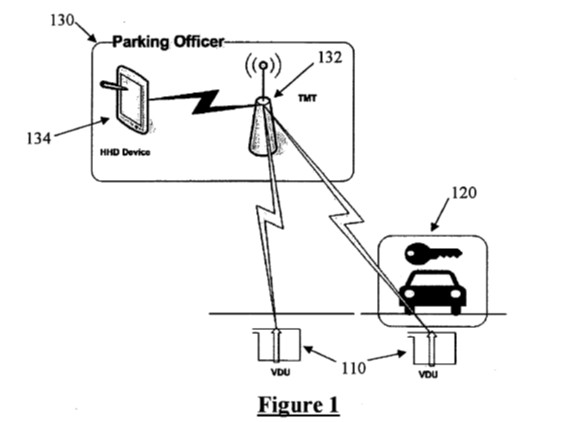
110 The specification describes the network topology depicted in figure 1 as follows (page 8, line 14 – page 9, line 9):
The transient topology utilising a TMT is outlined in Figure 1. Each VDU 110 is battery powered and embedded in the ground. To effect the transient topology shown in Figure 1, each VDU 110 has the ability to detect the arrival and departure of a vehicle 120, by way of a three-axis magnetic sensor. The magnetic sensor reads the magnetic field at sufficiently regular intervals to detect a magnetic field disturbance created by a vehicle travelling at 20 kph or less. Each reading taken outside thresholds is passed to the VDA for determination of the presence of a vehicle, as discussed further in the following. The sensor utilises a 3-axis sensor, which takes readings in the X, Y, and Z axis of the sensor, and the sensor can be placed into a power saving mode. The VDU 110 runs a vehicle detection algorithm (VDA). The VDA takes readings from the sensor and determines the arrival and departure of the vehicle 120 as discussed further with reference to Figures 3a to 3i. The VDA is run in the firmware of VDU 110. Upon determination of the arrival of a vehicle 120 by the VDA, the VDU 110 also determines when the vehicle 120 moves into violation of parking restrictions. This is done by a VIVA (Vehicle In Violation Algorithm), which is run in the firmware of the VDU 110.
Upon determination of an actual or impending infringement, the VIVA initiates communications from the VDU 110 to the TMT 132, to alert the parking officer 130 of the infringement. This is effected by an RF communications component of the VDU 110. The RF communications component of the VDU 110 "listens when required" for the broadcast beacon from the TMT 132, and organises communications.
Each VDU 110 has onboard memory storage to store Parking Events, enabling the VDU 110 to upload data for pre-population into the HHD 134 as required. Such data includes infringement data, parking event data, system health status, offence type (eg no standing), location details (physical), parking restrictions (eg signage), offence details such as arrival time and departure time, offence notes such as arrival time and time overstayed, and firmware details. Once the Parking Event data has been transferred, it is removed from the VDU 110. Further, the HHD 134 issues a confirmation message indicating that an infringement has been issued, which is received by the VDU 110 and causes the VDA to be reset.
111 The specification states (page 10, lines 22-26) that, while the TMT shown in figure 1 is a preferable solution due to the need for little or no fixed middle tier hardware, it is to be understood that the invention includes within its scope fixed middle tier topologies communicating with vehicle detection units. The expression ‘fixed middle tier’ (FMT) is described in the specification (page 7, lines 26-29) as “an alternative topology to TMT” and that the “FMT is the conduit between the VDU and the VDS IG” (the vehicle detection system internet gateway). The specification further states that the “FMT is ‘fixed’ as it is permanently in place in the field” and that the “FMT may comprise wireless network nodes attached to parking meter or light poles or the like”. The specification states (page 5, lines 31-32) that “[f]igure 2 illustrates a system 200 in accordance with one such fixed middle tier (FMT) topology”. Figure 2 is as follows (substitute sheet 1/7):
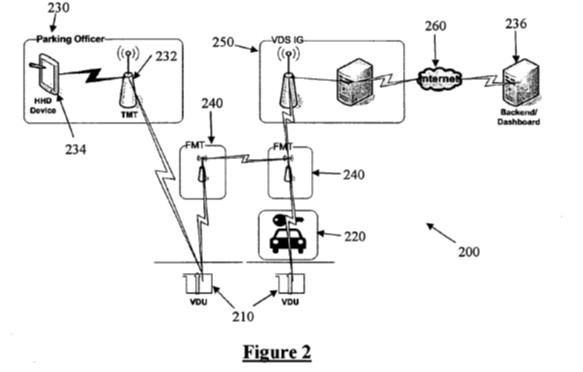
112 The specification describes the network topology depicted in figure 2 as follows (page 10, line 28 – page 12, line 6):
The VDUs 210 in the system 200 provide most of the functions described above for the VDUs 110 of Figure 1, which are not described again. In addition, each VDU 210 is operable to listen for the beacon signal of the FMT 240, when required. Upon detecting the beacon signal, the VDU 210 will perform the actions as outlined above as for the TMT 132. However, as infringement will only be issued by the HHD 234, the VDU 210 will continue to listen for the beacon signal of the TMT 232 when a vehicle 220 is in violation.
A transient middle tier 232 is provided in the embodiment of Figure 2, however only infringement information would be transferred by TMT 232 as the other data would be sent via the FMT 240. The 234 HHD functions largely as defined above for the transient topology of Figure 1. The fixed middle tier 240 of Figure 2 is similar to the TMT 132 in that it communicates to each VDU 210, however the FMT 240 provides further capability beyond that of the TMT 132, namely to mesh network the data received from the VDUs 210 back to the VDS IG 250. …
The FMT 240 thus acts as a conduit, whereby it passes data from the VDUs 210 to other FMTs 240 or VDS IGs 250. No data is stored on the FMT 240. The FMT 240 is installed such that its broadcast receive range covers a wide range of VDUs 210 such that no single VDU 210 is within range of only one FMT 240, thus providing connection redundancy. The communication between the FMT 240 and the VDU 210 is effected by an RF wireless link. The FMT 240 issues a broadcast beacon signal which can be picked up by any VDU 210 within range. If a given VDU 210 responds, the FMT 240 schedules communications with that VDU 210. Once communications have been scheduled the data exchange between the VDU 210 and the FMT 240 includes Parking Infringement details, Parking Event data, Health Status information and Firmware details. The FMT 240 then passes this information over the Mesh network to the VDS IG 250. Again, the VDUs 210 erase any data that has been successfully transmitted to the TMT 232 and/or FMT 240, to minimise VDU memory requirements.
The VDS IG 250 is an internet gateway that has a connection to the internet 260. VDU information transferred to the VDS IG 250 via the FMT 240 is sent on to the parking inspector's dashboard monitor 236 or HHD 234. …
Operation of VDUs 110, 210 thus includes communicability with either or both of a TMT 232 or FMT 240, depending on topology implemented. In preferred embodiments, each deployed VDU 110, 210 is capable of operating under either a fixed topology or a transient topology to allow topology changes without requiring physical replacement of the VDUs, such replacement being laborious and involving excavation of the roadway. …
113 According to the specification (page 5a, lines 1-9): figure 5 illustrates the generalised network topology of a further embodiment of the invention; figure 6 illustrates operation of a ‘smart’ VDU in accordance with another embodiment of the present invention; figure 7 illustrates operation of an ‘intelligent’ VDU in accordance with yet another embodiment of the present invention; and figure 8 illustrates operation of a ‘smart’ middle tier together with ‘smart’ VDUs, in accordance with a further embodiment of the invention.
114 The specification describes the vehicle detection algorithm (VDA) as a “VDU firmware function that detects the presence of a vehicle over the unit” (page 8, lines 4-5) and describes the vehicle in violation algorithm (VIVA) as a “VDU firmware function that determines whether a given vehicle has lapsed into violation based on the presence of a vehicle as reported by the VDA”. Each are further described by reference to figures 3a to 3i and 4. According to the specification (page 5, lines 33-35), figures 3a to 3i illustrate cases which influence operation of the VDA in distinguishing parking events from exceptions, and figure 4 is a flowchart illustrating operation of the VDA.
115 Figures 3a to 3i are as follows:
|
|
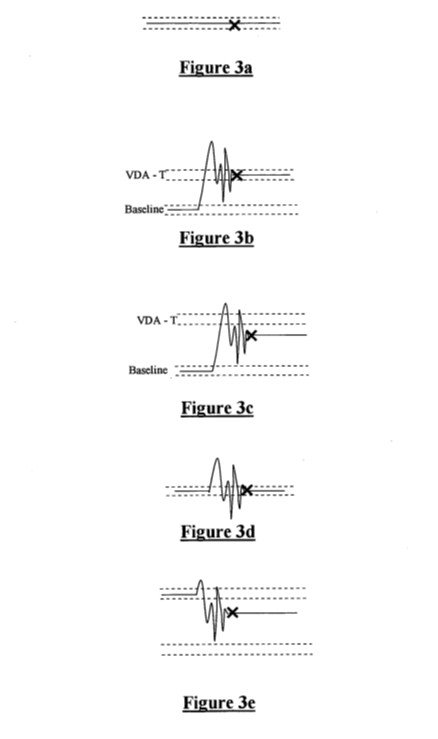
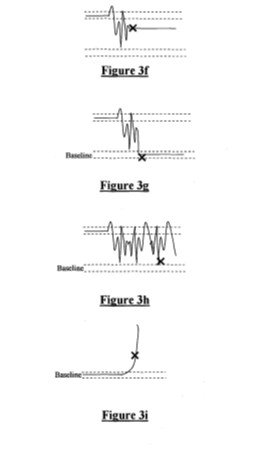
116 Figure 4 is depicted on two pages marked as FIG. 4A and 4B respectively. Those figures are as follows:
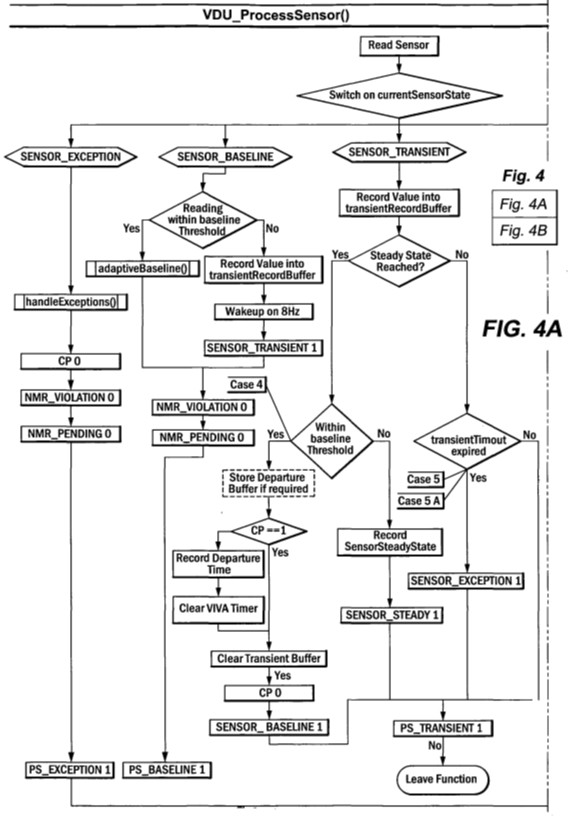
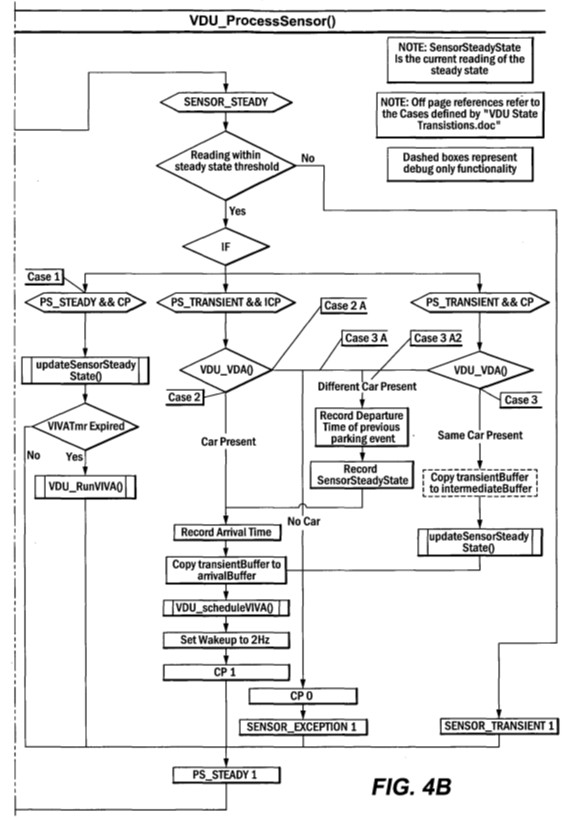
117 The specification describes the VDA as follows (page 13, lines 1-11):
Each VDU 110, 210 runs a vehicle detection algorithm (VDA) which is illustrated in Figure 4. The VDA is remotely updateable as part of a general firmware update. Any object that creates a disturbance to the magnetic field far greater than that created by a vehicle (such as a very strong magnet within the vicinity of the sensor) is to be treated as an exception, as discussed with reference to Figures 3a to 3i. Other situations which may trip the VDA into a false positive are also recorded as exceptions. Exceptions are reported as "space unoccupied" by default. The VDA enables the VDU to determine the arrival of a vehicle over the sensor, and determine the departure of a vehicle from over the sensor. The process of Figure 4 is biased towards avoiding false positives, so as to minimise the chance of wrongly reporting a vehicle as being in violation when no violation actually occurred.
118 The specification describes the VIVA as follows (page 13, lines 13-25):
The VIVA algorithm operates on multiple time based triggers, supporting a minimum of 10 time changes in any operational period. The VIVA algorithm is updateable over the RF link, and being a firmware algorithm can be updated with a full firmware update. The VIVA configuration will be configurable via parameters over the RF link. Updating these parameters will not require a full firmware update, so that the VIVA configuration may for example implement a parameter driven daylight savings time period allowing simple parameter updates to effect changed daylight savings conditions. Similarly the VIVA configuration may implement parameter driven exception days, for example for parking limitations which apply except on certain days, thus providing for simple parameter updates to effect any changes in exception days.
The VIVA works in conjunction with the VDA to determine whether a vehicle is in violation. …
119 The specification describes a series of ‘cases’ that are illustrated by figures 3a to 3i and the intended functioning of the VDA as illustrated in figure 4 (page 14 line 7 – page 17 line 7).
D.3 Relevant claims
120 The specification ends with 28 claims. As noted earlier, claims 1, 11, 20 and 21 are independent claims representing the four described aspects of the invention:
121 Claim 1 and its dependent claims are as follows:
1. A vehicle detection unit (VDU) comprising:
a magnetic sensor able to sense variations in magnetic field and for outputting a sensor signal caused by occupancy of a vehicle space by a vehicle;
a storage device carrying parameters which define notifiable vehicle space occupancy events;
a processor operable to process the sensor signal to determine occupancy status of the vehicle space, and operable to compare the occupancy status of the vehicle space with the parameters in order to determine whether a notifiable event has occurred, and operable to initiate a communication from the vehicle detection unit to a supervisory device upon occurrence of a notifiable event, wherein the communication includes data items pertaining to the notifiable event and communicated in a format suitable for pre-population into infringement issuing software.
2. The vehicle detection unit of claim 1, wherein the communication is wireless and directly with a portable supervisory device.
3. The vehicle detection unit of claim 2 wherein the communication is established in an ad-hoc manner at times when a notifiable event has occurred and when the portable supervisory device is in range.
4. The vehicle detection unit of claim 1 or claim 2 wherein the communication is with a fixed supervisory device effecting a fixed middle tier.
5. The vehicle detection unit of any one of claims 1 to 4 wherein the information comprises at least one of: street name, parking bay number, vehicle occupancy duration, offence details, applicable regulations, applicable monetary fine, and historical usage data.
6. The vehicle detection unit of any one of claims 1 to 5 wherein the notifiable event comprises at least one of: occurrence of a parking violation, an imminent parking violation, a non-violating parking event of interest, and a change in occupancy status of the vehicle space.
7. The vehicle detection unit of any one of claims 1 to 6 and further configured to be embedded in the roadway beneath an associated vehicle space.
8. The vehicle detection unit of claim 1 wherein the sensor is a 3-axis magnetometer able to sense components of the magnetic field in x, y and z directions.
9. The vehicle detection unit of any one of claims 1 to 8 wherein the processor is configured to execute a vehicle detection algorithm to determine whether detected variations in the sensor signal are caused by a vehicle.
10. The vehicle detection unit of any one of claims 1 to 9 wherein the parameters are provided in firmware, and wherein the vehicle detection unit when deployed is operable to receive firmware updates to the parameters.
122 Claim 11 and its dependent claims are as follows:
11. A method for vehicle detection by a vehicle detection unit, the method comprising:
sensing variations in magnetic field caused by occupancy of a vehicle space by a vehicle, and outputting a sensor signal;
retrieving from a storage device parameters which define notifiable vehicle space occupancy events;
processing the sensor signal to determine occupancy status of the vehicle space, comparing the occupancy status of the vehicle space with the parameters in order to determine whether a notifiable event has occurred, and initiating a communication from the vehicle detection unit to a supervisory device upon occurrence of a notifiable event, wherein the communication includes data items pertaining to the notifiable event and communicated in a format suitable for pre-population into an infringement issuing device.
12. The method of claim 11 wherein the sensor signal is processed in a manner to emphasise variations in the z-axis (vertical axis) of the magnetic field.
13. The method of claim 11 or claim 12, wherein the communication is wireless and directly with a portable supervisory device.
14. The method of claim 13 wherein the communication is established in an ad-hoc manner at times when a notifiable event has occurred and when the portable supervisory device is in range.
15. The method of any one of claims 11 to 14 wherein the communication is with a fixed supervisory device effecting a fixed middle tier.
16. The method of any one of claims 11 to 15 wherein the information comprises at least one of: street name, parking bay number, vehicle occupancy duration, offence details, applicable regulations, applicable monetary fine, and historical usage data.
17. The method of any one of claims 11 to 16 wherein the notifiable event comprises at least one of: occurrence of a parking violation, an imminent parking violation, a non-violating parking event of interest, and a change in occupancy status of the vehicle space.
18. The method of any one of claims 11 to 17 wherein the processing comprises executing a vehicle detection algorithm to determine whether detected variations in the sensor signal are caused by a vehicle.
19. The method of any one of claims 11 to 18 wherein the parameters are provided in firmware, and further comprising receiving firmware updates to the parameters.
123 Claim 20 is as follows:
A method for issuing a parking infringement notice, the method comprising:
a portable device establishing a transient wireless connection with at least one fixed vehicle detection unit (VDU);
the portable device obtaining from the VDU via the wireless connection data arising from a notifiable parking event magnetically detected by the VDU; and
the portable device pre-populating the data into infringement issuing software and generating a parking infringement notice using the pre-populated data obtained from the VDU.
124 Claim 21 is as follows:
A system for detecting vehicle parking infringements, the system comprising:
a plurality of vehicle detection units (VDUs) each associated with a respective vehicle parking space and storing parameters defining notifiable vehicle space occupancy events, each VDU configured to sense variations in magnetic field caused by occupancy of the associated vehicle space and determine by reference to the parameters whether a notifiable event has occurred, and operable to communicate wirelessly including wirelessly transmitting data items pertaining to the notifiable event and communicated in a format suitable for pre-population into infringement issuing software;
a mobile supervisory device configured to wirelessly communicate with each respective VDU when brought within range, to receive information from the VDU arising from a notifiable parking event detected by the VDU, to pre-populate received data items into infringement issuing software and to generate a parking infringement notice using the pre-populated data items obtained from the VDU.
E. PERSON SKILLED IN THE ART
E.1 Introduction
125 Each of the parties advanced submissions on the question of the persons to whom the Patent is addressed, also referred to as the ‘skilled addressee’ or ‘person skilled in the art’.
126 The construct of a ‘person skilled in the art’ is used in patent law in a number of ways. The phrase appears in the key provisions in the Act relevant to the assessment of the validity of a patent, including the definitions of ‘novelty’, ‘inventive step’ and ‘innovative step’ in s 7, the definition of ‘useful’ in s 7A, the requirements relating to specifications in s 40 and the determination of the priority date of a claim in ss 43 and 114. In addition, the construct is relevant to the construction of patents. A claim is construed from the perspective of a person skilled in the relevant art as to how such a person would have understood the patentee to be using the words of the claim in the context of the specification as a whole: Meat and Livestock Australia Ltd v Cargill, Inc [2018] FCA 51; 354 ALR 95 at [219] (Beach J). However, as discussed further below, ordinary words used in a patent are given their ordinary meaning unless the skilled addressee (a person skilled in the relevant art) would give them a technical meaning: Kimberly-Clark Australia Pty Ltd v Multigate Medical Products [2011] FCAFC 86; 92 IPR 21 (Multigate) at [39] (Greenwood and Nicholas JJ).
127 In the present case, the identification of the person skilled in the art, as a legal construct, is relevant to both the construction of the Patent and the sufficiency ground of invalidity advanced by VMS.
128 In AstraZeneca AB v Apotex Pty Ltd (2015) 257 CLR 356 (AstraZeneca), French CJ described the statutory term ‘person skilled in the relevant art’ in the following terms (at [18], citations omitted):
The judicial determination whether want of inventive step is established pursuant to s 7 is mediated through the legal construct of the hypothetical person skilled in the relevant art. The construct is of a kind well-known to the law and used for setting parameters for evaluative judgments. It is a tool of analysis and is given statutory recognition, for that limited purpose, in s 7.
129 Similarly, Kiefel J explained (at [70], citations omitted):
In addressing s 7(2), it is to be borne in mind that the skilled person is an artificial construct, intended as an aid to the courts in addressing the hypothetical question of whether a person, with the same knowledge in the field and aware of the problem to which the patent was directed, would be led directly to the claimed invention. The statute’s creation of the skilled person construct for this purpose is not to be taken as an invitation to deal with the question posed by s 7(2) entirely in the abstract. Whilst the question remains one for the courts to determine, the courts do so by reference to the available evidence including that of persons who might be representative of the skilled person.
E.2 Applicable principles
130 There was no dispute between the parties with respect to the principles applicable to the statutory concept of a person skilled in the art.
131 A person skilled in the art – or ‘skilled addressee’ – is a person of the kind to whom a patent specification is addressed: General Tire & Rubber Co v Firestone Tyre & Rubber Co Ltd [1972] RPC 475 at 485, cited with approval in Nicaro Holdings Pty Ltd v Martin Engineering Co (1990) 16 IPR 545 (Gummow J). A patent specification is addressed to those likely to have a practical interest in the subject matter of the invention: Catnic Components Ltd v Hill & Smith Ltd [1982] RPC 183 at 242 (Lord Diplock). The skilled addressee comes to a reading of the specification with the common general knowledge of persons skilled in the relevant art, and they read it in a common sense and practical manner knowing that its purpose is to describe and demarcate an invention and not to be a textbook in the relevant field: Kirin-Amgen Inc v Hoechst Marion Roussel Ltd [2004] UKHL 46; 64 IPR 444 (Kirin-Amgen) at [33] (Hoffman LJ). The skilled addressee is assumed to be of ordinary skill and non-inventive: Root Quality Pty Ltd v Root Control Technologies Pty Ltd [2000] FCA 980; 49 IPR 225 at [70]-[72].
132 Although skills drawn from different areas of expertise may be relevant, the person skilled in the art thinks with one mind, speaks with one voice, and draws, when and to the extent necessary, on the disparate knowledge and skills of all of the members of the team: Novartis AG v Pharmacor Pty Limited (No 3) [2024] FCA 1307; 186 IPR 24 at [149] (Yates J).
133 The knowledge and skills of the person skilled in the art can be informed by the evidence of expert witnesses. However, the person skilled in the art is not a mere avatar of those witnesses: AstraZeneca at [23] (French CJ). The person skilled in the art is not a reference to a specific person but is a legal construct, albeit the legal construct is informed by the available evidence including the evidence of persons who might be representative of the skilled person: AstraZeneca at [18] (French CJ) and [70] (Kiefel J).
E.3 The parties’ contentions
134 Orikan’s primary submission was that the Patent is addressed to an ordinary electrical engineer (or team) who may or may not have previously worked in the industry field of vehicle compliance or parking, and that the person skilled in the relevant art would be experienced with developing systems that make use of sensors and forms of wireless communication. In support of that submission, Orikan relied on the following opinion expressed by Mr Sizer, with which Dr Sivamalai expressed agreement:
The PSA in the Relevant Field, in my opinion, includes a skilled worker with knowledge and experience in sensors, processors, computer programming and communication technologies. I consider such a person to be an electrical engineer who has worked with such technologies previously (the ordinary electrical engineer). ln my view, such a person may or may not have previously worked in the specific industry field of vehicle compliance or parking. ln my experience, it is often the case that an electrical engineer will be asked to develop a product for a specific industry sector which they have not previously worked in or specific application which they have not previously encountered, using or applying their existing knowledge and experience in sensors, processors, computer programming and communication technologies…
135 On that basis, Orikan submitted that it is irrelevant that Dr Sivamalai has not worked in the specific industry field of vehicle compliance or parking. By reason of his qualifications in sensors, processors, computer programming and communications technologies, he is qualified to opine on the Patent.
136 Despite the foregoing submission, Orikan also accepted the following finding made by Burley J in the Opposition Judgment at [24] as to the person skilled in the relevant art for the purposes of the Patent (emphasis in original):
In the present case the person skilled in the art is someone with a practical interest in devices used for the automated enforcement of vehicle parking compliance requirements. There is no dispute that such persons may consist of a team, or that in the present case the team will include: (a) an electrical or electronics engineer familiar with sensing devices, radio frequency communications and the communication of data; and (b) a person or persons with a practical interest in and, knowledge of, parking practices, equipment and technology. I refer to these persons collectively as the skilled team…
137 As can be seen, the description formulated by Burley J includes, within the notional team, a person or persons with knowledge of parking practices, equipment and technology. Orikan submitted that, within that description, Dr Sivamalai would be a member of the team and, further, that the member of the team with a practical interest in and knowledge of parking practices, equipment and technology is largely irrelevant to the present dispute.
138 In contrast to Orikan, VMS embraced the above description of the person skilled in the relevant art given by Burley J. VMS also placed reliance on the statement of the technical field in the Patent specification, being “vehicle parking compliance and in particular to automated determination of notifiable parking events”. VMS submitted that Mr Sizer is an electrical and electronic engineer familiar with sensing devices, radio frequency communications and the communication of data, and has experience in designing and developing parking enforcement systems. VMS submitted that, although Dr Sivamalai is also an electrical and electronic engineer familiar with sensing devices, radio frequency communications and the communication of data, Dr Sivamalai has no direct experience developing technology for the parking industry and had not worked with magnetic sensors until 2022, when he started working on a research project developing a diamond magnetic sensor.
E.4 Consideration
139 I respectfully consider that the description of the person skilled in the relevant art was correctly stated by Burley J in the Opposition Judgment at [24]. The technical field with which the patent is concerned is vehicle parking compliance and, in particular, the “automated determination of notifiable parking events”. The background of the invention is the time and cost associated with the enforcement of vehicle parking regulations. The invention the subject of the patent concerns both the automated detection of a ‘notifiable event’ (such as a vehicle going into violation of parking restrictions) and the communication of data pertaining to the notifiable event in a format suitable for pre-population into infringement issuing software.
140 As submitted by VMS, Mr Sizer is an electrical and electronic engineer familiar with sensing devices, radio frequency communications and the communication of data, and has experience in designing and developing parking enforcement systems. I consider that he is well qualified to express opinions regarding the interpretation of the Patent.
141 As also submitted by VMS, Dr Sivamalai is an electrical and electronic engineer familiar with sensing devices, radio frequency communications and the communication of data, but Dr Sivamalai has no direct experience developing technology for the parking industry. I accept Orikan’s submission, however, that Dr Sivamalai’s skills are representative of a member of the notional team constituting the person skilled in the art. As such, his evidence is of assistance. However, as explained further below, I consider that his evidence on certain issues was strained, which likely reflected his more limited expertise, having no experience in the field of parking enforcement systems.
142 I reiterate that it is the task of the Court to construe terms used in the patent and the evidence of an expert cannot supplant that task: Commissioner of Patents v Rokt Pte Ltd (2020) 277 FCR 267 at [73] (Rares, Nicholas and Burley JJ).
F. CLAIM CONSTRUCTION ISSUES
F.1 Construction issues in dispute
143 In the Statement of Issues, the parties separated the construction issues in dispute between them into six issues labelled A to F. It is convenient to address the issues in dispute in the manner proposed by the parties, while recognising that any exercise of construction of words and phrases (whether appearing in a patent, a statute or a contract) must take into account the context in which the words are used. In the case of words and phrases appearing in a claim, the relevant context includes the language of the claim as a whole when read in light of the specification as a whole.
144 The relevant claims of the Patent have been reproduced earlier in these reasons, together with salient aspects of the specification. It is convenient to reproduce the claims in which issues of construction are disputed between the parties, highlighting those words and phrases that are the subject of dispute between the parties.
145 Issues A to D concern claim 1 and claim 11. Claim 1 is as follows with the relevant words and phrases in dispute marked with different text formatting:
1. A vehicle detection unit (VDU) comprising:
a magnetic sensor able to sense variations in magnetic field and for outputting a sensor signal caused by occupancy of a vehicle space by a vehicle;
a storage device carrying parameters which define notifiable vehicle space occupancy events;
a processor operable to process the sensor signal to determine occupancy status of the vehicle space, and operable to compare the occupancy status of the vehicle space with the parameters in order to determine whether a notifiable event has occurred, and [Issue B] operable to initiate a communication from the vehicle detection unit to a [Issue D] supervisory device upon occurrence of a notifiable event, wherein the communication includes data items [Issue C] pertaining to the notifiable event and [Issue A] communicated in a format suitable for pre-population into infringement issuing software.
146 Claim 11 is as follows with the relevant words and phrases in dispute marked with different text formatting:
11. A method for vehicle detection by a vehicle detection unit, the method comprising:
sensing variations in magnetic field caused by occupancy of a vehicle space by a vehicle, and outputting a sensor signal;
retrieving from a storage device parameters which define notifiable vehicle space occupancy events;
processing the sensor signal to determine occupancy status of the vehicle space, comparing the occupancy status of the vehicle space with the parameters in order to determine whether a notifiable event has occurred, and [Issue B] initiating a communication from the vehicle detection unit to a [Issue D] supervisory device upon occurrence of a notifiable event, wherein the communication includes data items [Issue C] pertaining to the notifiable event and [Issue A] communicated in a format suitable for pre-population into an infringement issuing device.
147 Issue E concerns claims 10 and 19 which are as follows with the relevant words and phrases in dispute highlighted:
10. The vehicle detection unit of any one of claims 1 to 9 wherein the parameters are provided in firmware, and wherein the vehicle detection unit when deployed is operable to receive firmware updates to the parameters.
19. The method of any one of claims 11 to 18 wherein the parameters are provided in firmware, and further comprising receiving firmware updates to the parameters.
148 Ultimately each of the experts agreed that, in the context of claims 10 and 19, the VDU firmware comprises both the software program that executes on the VDU processor (ie the program instructions) and the parameters (which define notifiable vehicle space occupancy events) used by the program. Claims 10 and 19 describe a VDU that, when deployed (ie, when the VDU has been deployed in the field), is operable to receive firmware updates which change the parameters. Each of the parties accepted that construction of the phrase. It is therefore unnecessary to address Issue E further.
149 Issue F concerns claims 5 and 16 which are as follows with the relevant words and phrases in dispute highlighted:
5. The vehicle detection unit of any one of claims 1 to 4 wherein the information comprises at least one of: street name, parking bay number, vehicle occupancy duration, offence details, applicable regulations, applicable monetary fine, and historical usage data.
16. The method of any one of claims 11 to 15 wherein the information comprises at least one of: street name, parking bay number, vehicle occupancy duration, offence details, applicable regulations, applicable monetary fine, and historical usage data.
150 Ultimately, the experts agreed that ‘applicable regulations’ mean the regulations that apply to a particular parking space. Each of the parties accepted that construction of the phrase. It is therefore unnecessary to address Issue F further.
F.2 Applicable legal principles
151 The principles of law governing the construction of patent specifications, including claims, are well established and were not in dispute between the parties. They have been summarised in many previous Full Court cases, including those referred to by the Full Court in Jupiters Ltd v Neurizon Pty Ltd (2005) FCAFC 90; 65 IPR 86 (Jupiters) at [67], Esco Corporation v Ronneby Road Pty Ltd [2018] FCAFC 46; 131 IPR 1 (Esco) at [144] and GlaxoSmithKline Consumer Healthcare Investments (Ireland) (No 2) Limited v Generic Partners Pty Limited (2018) 264 FCR 474 (GSK Appeal) at [102].
152 The proper construction of a claim is a question of law, noting that the function of the claims is to define the scope of a claimed monopoly, a function different to the separate descriptive and ‘teaching’ purpose of the body of a patent specification. Evidence can be given by experts as to the meaning which those skilled in the art would give to technical or scientific terms and phrases, but the construction of claims is ultimately a matter for the Court: Minnesota Mining & Manufacturing Company v Tyco Electronics Pty Limited [2001] FCA 1359; 53 IPR 32 at [92]; Fresenius Medical Care Australia Pty Limited v Gambro Pty Limited [2005] FCAFC 220; 67 IPR 230 at [34]; Insta Image Pty Ltd v KD Kanopy Australasia Pty Ltd [2008] FCAFC 139; 78 IPR 20 at [82]; Multigate at [39] (Greenwood and Nicholas JJ).
153 A specification should be read in a practical and common-sense way through the eyes of the skilled addressee: GSK Appeal at [106]; KD Kanopy Australasia Pty Ltd v InstaImage Pty Ltd [2007] FCA 481; 71 IPR 615 at [16]. The Court should avoid too technical or narrow a construction of claims: Pfizer Overseas Pharmaceuticals v Eli Lilly & Co [2005] FCAFC 224; 225 ALR 416 (Pfizer) at [250] (French and Lindgren JJ). The relevant question is always what the skilled addressee would have understood the patentee to mean in using the language of the claim: Kirin-Amgen at [34] (Hoffman LJ).
154 A patent specification is to be given a purposive construction, and must be read as a whole through the eyes of a skilled addressee in light of the common general knowledge as at the priority date: Kimberly-Clark Australia Pty Ltd v Arico Trading International Pty Ltd (2001) 207 CLR 1 (Kimberly-Clark) at [24] (Gleeson CJ, McHugh, Gummow, Hayne and Callinan JJ).
155 Although the claims are construed in the context of the specification as a whole, it is not legitimate to confine the scope of the claims by reference to limitations which may be found in the body of the specification but which are not reproduced in the claims themselves. To put it another way, it is not legitimate to narrow or expand the boundaries of the monopoly as fixed by a claim by adding glosses drawn from other parts of the specification: Martin v Scribal Proprietary Limited (1954) 92 CLR 17 at 97 (Taylor J), cited with approval by Besanko and Nicholas JJ in Otsuka Pharmaceutical Co Ltd v Generic Health Pty Ltd (No 2) [2016] FCFCA 111; 120 IPR 431 at [95].
156 Relatedly, claims in a patent are not to be narrowed by reference to the preferred embodiment: Rehm Pty Ltd v Websters Security Systems (International) Pty Ltd [1988] FCA 232; 81 ALR 79 at 89. The preferred embodiment cannot properly be used to introduce into the definite words of a claim an additional definition or qualification of the patentee’s invention: Erickson’s Patent (1923) 40 RPC 477 at 491; Globaltech Corporation Pty Ltd v Australian Mud Company Pty Ltd [2019] FCAFC 162; 145 IPR 39 at [111]. A proper analysis of the specification may show that references to a particular embodiment are by way of “illustration and explanation of the invention” rather than a “definition of it”: Welch Perrin v Worrel (1961) 106 CLR 588 at 612 (Dixon CJ, Kitto and Windeyer JJ).
157 It is also not permissible to narrow the clear words of a claim:
(a) because a person skilled in the art would likely apply those words in a limited range of situations: Britax Childcare Pty Ltd v Infa-Secure Pty Ltd [2012] FCA 467; 290 ALR 47 at [272];
(b) to match what is said to be the general expectation of those skilled in the art: Melbourne v Terry Fluid Controls [1994] FCA 134; 28 IPR 302 at 309 (Northrop, Gummow and Olney JJ); or
(c) to exclude embodiments that would not be used by the person skilled in the art: Norton & Gregory v Jacobs (1937) 54 RPC 271 at 276 (Greene MR).
F.3 The Opposition Proceedings
158 As discussed in section B, aspects of the Patent were construed by Burley J in the Opposition Proceeding for the purpose of the issues that were determined in that proceeding. In so far as the construction findings made by Burley J were legally indispensable to the conclusions his Honour reached in that proceeding, the parties are estopped from contesting that construction in this proceeding, unless the construction findings were affected by the Full Court’s reasoning in the Opposition Appeal. Even if the construction findings made by Burley J were not essential to the determination of an issue in the Opposition Proceeding, I would follow his Honour’s construction unless convinced that his Honour was wrong: Neurizon at [32]-[35] (Kiefel J). Again, in that context, it is necessary to consider whether his Honour’s construction is affected by the Full Court’s reasoning in the Opposition Appeal.
159 In their Statement of Issues, the parties implicitly accepted that they are estopped from contesting the construction findings made by Burley J in the Opposition Judgment. The Statement of Issues seeks the determination by the Court of the construction of identified integers of the Patent “having regard to paragraphs [56]-[72] of Vehicle Monitoring Systems Pty Ltd v SARB Management Group Pty Ltd [2020] FCA 408”. As noted earlier, the parties also provided a joint set of assumptions to their expert witnesses which, in my view, fairly reflected the construction findings made in the Opposition Judgment.
160 It is appropriate to commence with the conclusions reached by Burley J in the Opposition Judgment on the construction of the Patent and determine whether the construction findings made by his Honour were legally indispensable to the conclusions reached in that proceeding.
The construction findings in the Opposition Judgment
161 His Honour observed (OJ [53] and [54]) that the VDU of claim 1 is a combination of parts and functions that has the following integers:
(1) a magnetic sensor that is able to sense variations in magnetic field and output a sensor signal caused by the occupancy of a vehicle space by a vehicle;
(2) a storage device that contains the parameters defining notifiable vehicle space occupancy events (such as the duration of permitted parking); and
(3) a processor that is (a) operable to process the sensor signal to determine occupancy status of the vehicle space, and (b) operable to compare the occupancy status of the vehicle space with the parameters provided by the storage device to determine whether a notifiable event (such as a parking overstay) has occurred, and (c) operable to initiate a communication from the VDU to a supervisory device (such as a handheld device carried by a parking officer) when a notifiable event occurs and (i) include within that communication data items relating to the notifiable event and (ii) in a format suitable for pre-population into infringement issuing software.
162 His Honour recorded (OJ [55]) that the construction issues that arose in relation to integer 3 involved addressing three interrelated questions:
(a) first, what is meant by the requirement in integer 3(c) that the processor is ‘operable to initiate’ communications to the supervisory device upon the occurrence of a notifiable event;
(b) secondly, the meaning conveyed in integer 3(c)(i) by the words ‘data items’; and
(c) thirdly, the level of processing required of data items once communicated to the infringement issuing software in integer 3(c)(ii).
163 In relation to the first issue of construction, his Honour concluded (OJ [56]) that claim 1 requires the VDU to include a processor ‘operable to initiate a communication’ from the VDU to a supervisory device ‘upon the occurrence of a notifiable event’, and that these words include that the VDU is operable (ie able) to initiate a communication upon receiving (and in response to) a ‘beacon’ (or wake-up signal) that is transmitted by a TMT or FMT. His Honour rejected a submission from Orikan that the claim requires that the VDU sends a response to a broadcast beacon message only upon the occurrence of a notifiable event.
164 In relation to the second issue of construction, his Honour concluded (OJ [63]) that the words ‘data items’ do not mean all data items pertaining to the notifiable event; the words mean only two or more such items.
165 The third issue of construction is a significant issue of dispute in this proceeding. It is convenient to extract his Honour’s consideration of this issue and conclusion (OJ [66]-[70]):
66 The third issue concerns the meaning of the words ‘communicated in a format suitable for pre-population into infringement issuing software’ in integer (3)(c)(ii). There is no dispute that ‘pre-population’ means that data items pertaining to the notifiable event are transmitted directly into the infringement issuing software by the VDU without the need for a parking officer to take a step to do so. This approach satisfies an objective of the invention disclosed to save the parking officer time and effort.
67 VMS submits that this integer requires that the data communicated by the VDU to the supervisory device be able to be pre-populated into the data fields in the infringement issuing software without further data processing by the supervisory device. In that regard, the supervisory device should not, by the language of the claim, be required itself to process the infringement data generated and communicated by the VDU, because the work has already been done by the processor in the VDU. For instance, information generated by the VDU may include the time that a vehicle is detected arriving at a parking bay, or that a vehicle has contravened a parking requirement by overstaying. That will be recorded in a binary, computer-readable form. VMS submits that the language of integer (3)(c)(ii) contemplates that the information will be communicated from the VDU to the supervisory device in a form that can be introduced into the infringement issuing software without any translation (or ‘processing’) at the supervisory device. Accordingly, the binary computer-readable form of the data items must first be converted to a form suitable for pre-population communication to the supervisory device at the VDU, and then communicated. An example given in the evidence is where the VDU collects data as to the ‘offence date and time’ and initially records it as a 32 bit binary number in UNIX epoch format (which is the number of seconds since 1 January 1970 — for instance, 1,235,068 seconds). Infringement issuing software will use data fields in the hour/minutes and day/month/year format. VMS submits that the integer requires that the VDU communicate information in the latter format, without the supervisory device engaging in that processing. This type of processing is referred to below, depending on the context, as formatting.
68 SARB largely accepts this construction, but it submits that the language of claim 1 does not preclude additional necessary processing at the supervisory device. It accepts that where data is transmitted concerning a notifiable event from the VDU to the supervisory device, it must be in a format that is able to be placed directly into the infringement issuing software in a format that is human readable, any conversion from binary form to readable form having taken place in the VDU. However, it submits that this should not be taken to preclude some processing that is still required at the supervisory device that must always be done at the receiver end to return the data to its original form.
69 This qualification arises from the evidence of the experts as to the means by which data may be wirelessly sent and received. As noted in section 5.4.4. below, methods of wirelessly sending packets of data over standard protocols require the addition of headers and footers, and utilise cyclic redundancy checks. Data is processed in various ways in preparation for communications. For example, a ‘header’ may typically be added, such that the data transmitted does not look exactly the same, or is not in the same format, as the user wants to send. There will always be processing required at the receiver end to return the data to its original form (for instance by removing a header or conducting a cyclic redundancy check) so that the wirelessly transmitted packet of data can be received and organised.
70 In my view the requirement of integer (3)(c)(ii) is that the data communicated by the VDU to the supervisory device pertaining to a notifiable event must be able to be pre-populated into the data fields in the infringement issuing software without further conversion or calibration, as VMS submits. The integer requires that it is the VDU that performs that work, and that the supervisory device is relieved of the processing obligation for any items of data that are communicated by the VDU concerning a notifiable event. As the expert evidence explains, this involves a choice designed to save power at the supervisory device end (typically a HHD) and to impose the processing task on the in-ground VDU. An exception to this finding is necessary processing by the supervisory device of data packets sent by the VDU, such as the removal of headers, that must always be done at the receiver end to return the data to its original form. I do not consider that the language of the claim precludes processing of this nature. The fact that wireless communication is contemplated within the claim indicates that processing required as a necessary incident of such communication falls within the scope of the monopoly. Accordingly, I agree with the submission advanced by VMS, and also with the refinement or qualification added by SARB.
166 In those paragraphs, his Honour concluded that integer 3(c)(ii) contemplates that the data will be communicated from the VDU to the supervisory device in a form that can be introduced into the infringement issuing software without any translation (or ‘processing’) at the supervisory device. His Honour accepted VMS’s submission that the binary computer-readable form of the data items must first be converted, by the VDU, to a form suitable for pre-population into the infringement issuing software prior to being communicated to the supervisory device. The example referred to in his Honour’s reasons is where the VDU collects data as to the ‘offence date and time’ and initially records it as a 32-bit binary number in UNIX epoch format (which is the number of seconds since 1 January 1970 — for instance, 1,235,068 seconds), but the infringement issuing software uses data fields in the hour/minutes and day/month/year format. His Honour accepted that integer 3(c)(ii) requires that the VDU processes the information into the latter format prior to communication, such that the supervisory device does not engage in that processing. His Honour reached that conclusion because his Honour understood that the invention involves a choice to save power at the supervisory device end and to impose the processing task on the in-ground VDU.
167 His Honour also concluded that, as wireless communication is contemplated by the claim, data processing by the supervisory device that is a necessary incident of wireless communication falls within the scope of the monopoly. An example of such necessary processing, given by his Honour, is the removal of headers that are inserted into a data package as part of wireless communication. As discussed further below, all data that is communicated wirelessly must be transmitted in the form of binary numbers which represents the data. Thus, data that is communicated wirelessly must be converted into binary numbers before being transmitted, and then converted back into its original format at the receiving end. Ultimately it was common ground between the parties that such data conversion falls within the scope of the monopoly.
Were the construction findings legally indispensable to the conclusions reached in the Opposition Proceeding?
168 In my view, the construction findings were legally indispensable to the dismissal, by Burley J, of VMS’s opposition based upon the contentions that:
(a) the invention claimed in claim 1 lacked an inventive step; and
(b) SARB was not entitled to be granted a patent for the invention claimed or, alternatively, SARB is only entitled to the grant in conjunction with Mr Welch (and possibly Mr Gladwin).
169 In relation to the alleged lack of inventive step, the construction findings were a necessary element of his Honour’s comparison of the prior art base with the invention as claimed in claim 1 of the Patent application. By way of illustration:
(a) In respect of the prior art comprising International Patent Application No. WO2005/111963 filed by VMS in which Mr Welch is the named inventor (PCT application WO2005), his Honour reasoned that:
(i) the disclosure of PCT application WO2005 is of a VDU with the features of integers (1), (2), 3(b), 3(c) and 3(c)(i), but that there are forks in the road that the skilled team encounters before arriving at the combination of integers in claim 1 (OJ [197]);
(ii) PCT application WO2005 provides no teaching at all about how data communicated to a data collection apparatus is to then result in the issuing of a parking infringement notice (OJ [207]);
(iii) neither PCT application WO2005 nor the common general knowledge supply a ready answer to the question of which processor in a wireless sensor system should undertake the processing to format the data items into a format suitable for pre-population into the infringement issuing software (OJ [208]); and
(iv) by reason of the uncertainties left unresolved by PCT application WO2005, VMS had not established that the invention claimed in claim 1 lacks an inventive step (OJ [212]).
(b) In respect of the prior art relating to the PODS system (referred to in the Opposition Judgment as the ‘PODS article’, the ‘Gladwin PowerPoint’ and the ‘Welch presentation’), his Honour’s reasoning included that the PODS article did not refer to pre-population of data items into infringement issuing software (OJ [218]).
170 In my view, it is clear that his Honour’s conclusion that VMS had failed to establish that the invention claimed in claim 1 lacked an inventive step took, as its starting point and foundation, his Honour’s construction of integer 3 of claim 1 of the Patent application.
171 In relation to the issue of entitlement, his Honour referred (OJ [234]) to SARB’s submission that the inventive concept disclosed in the Patent application as reflected in claim 1 requires that the processor in the VDU should initiate communication with the supervisory device, and do so only on overstay, and send the infringement information in a suitable format for pre-population into infringement issuing software. SARB further submitted that neither Mr Welch nor Mr Gladwin communicated that inventive concept to Mr Del Papa (of SARB). His Honour found that the proposal communicated by Mr Welch to Mr Del Papa in about August 2005 led Mr Del Papa and SARB to develop the invention the subject of the Patent application (OJ [269]). However, his Honour found (OJ [270], emphasis added):
… the message conveyed to Mr Del Papa was, at its highest, the idea that the POD system could possibly be adapted in the way suggested in the proposal. In my view the invention disclosed in the specification and the subject of the claims is not that obvious, high level idea, but rather a more prosaic, practical implementation. It is the reduction of that concept to a working apparatus that is the invention: Polwood at [33]. The solution to the manual entry problem involved arriving at a wireless system that balances the power saving considerations involved in the communication between remote devices that do not have connections to mains power. One factor in the balancing process was to enable the processor in the VDU to detect and determine an overstay (or notifiable event). Another was to require the processor to initiate a communication with a HHD (including in response to a wake-up call). A third was the decision to communicate data relating to the overstay (or notifiable event) to a HHD in a format that can pre-populate the infringement issuing software without additional formatting. Neither Mr Welch nor Mr Gladwin played any role in arriving at that solution.
172 In the above passage, his Honour identified, as an essential element of the inventive concept (involving the practical implementation of the concept), integer 3(c) as construed by his Honour: namely, the decision to have the processor in the VDU to detect and determine an overstay (or notifiable event), initiate a communication with a handheld device (including in response to a wake-up call) and communicate data relating to the overstay (or notifiable event) to a supervisory device in a format that can pre-populate the infringement issuing software without additional formatting.
173 It follows that, subject to any contrary conclusion reached by the Full Court in the Opposition Appeal, each of Orikan and VMS are estopped from contesting the construction findings made by Burley J.
Were the construction findings made by Burley J affected by the Full Court’s reasoning in the Opposition Appeal?
174 The Opposition Appeal was ultimately confined to the ground of lack of entitlement. This required the Full Court to consider the ‘inventive concept’ of the patent. The ‘inventive concept’, relevant to the issue of entitlement, is not equivalent to the invention claimed in the claims of the patent. As explained by the Full Court in the Opposition Appeal (OA [62]-[66]), the inventive concept is ascertained from the whole of the specification, including the claims, and not merely from the claims. In Polwood Pty Ltd v Foxworth Pty Ltd (2008) 165 FCR 527, the Full Court said (at [60]):
The invention or inventive concept of a patent or patent application should be discerned from the specification, the whole of the specification including the claims. The body of the specification describes the invention and should explain the inventive concepts involved. While the claims may claim less than the whole of the invention, they represent the patentee’s description of the invention sought to be protected and for which the monopoly is claimed. The claims assist in understanding the invention and the inventive concept or concepts that gave rise to it. There may be only one invention but it may be the subject of more than one inventive concept or inventive contribution. The invention may consist of a combination of elements. It may be that different persons contributed to that combination.
175 In the course of its reasons, the Full Court considered submissions relating to Burley J’s findings as to the construction of claim 1, as well as submissions relating to his Honour’s description of the inventive concept of the Patent.
176 In respect of the submissions concerning the construction of claim 1, the Full Court did not express any disagreement with Burley J’s findings. Specifically, the Full Court referred to, without expressing disagreement, the following findings:
(a) that an integer of the invention is that the VDU determines when a vehicle moves into violation of parking restrictions and, upon determination of an actual or impending infringement, communications are initiated from the VDU to the TMT, which acts as a conduit passing data between the handheld device and each VDU (OA [117]);
(b) that there is nothing in the text of claim 1 that requires all data items pertaining to the notifiable event to be communicated by the VDU in a format suitable for pre-population into the infringement issuing software (OA [122]); and
(c) that although the data pertaining to a notifiable event communicated by the VDU to the supervisory device must be in a format suitable for pre-population into infringement issuing software, this does not mean that the supervisory device does not carry out necessary processing of data packets sent by the VDU, such as the removal of headers, that must always be done at the receiver end to return the data to its original form (OA [123]).
177 In respect of the ‘inventive concept’ of the patent, the Full Court disagreed with some aspects of Burley J’s analysis (relevantly, at OA [136]-[144] and [149]-[153]). The Full Court made the following findings with respect to the ‘inventive concept’ of the Patent:
136 The primary judge saw the invention as the reduction of a concept to a working apparatus. The concept found expression in the Welch proposal …, which was Mr Welch’s solution to the manual entry problem … . However, the specification does not identify a manual entry problem as such; nor is the invention, as described, directed to providing a solution to a manual entry problem.
137 The invention, as the respondent chose to describe it, relates to the “automated determination of notifiable parking events”: page 1, lines 10-11. It provides devices, methods, and systems which are said to provide advantages over the prior art method of enforcing vehicular parking regulations. According to the specification, the prior art method typically involved a parking inspector manually inspecting all of the restricted spaces periodically, regardless of whether vehicles were actually present. The specification points to the deficiencies of manual enforcement: it is costly; time-consuming; and inefficient, in that the parking inspector may fail to detect a parking violation, leading to a lack of deterrence and the denial of infringement revenue to the parking agency. The specification also points to the asserted fact that manual enforcement is unable to provide historical data of parking usage. No mention is made of a manual entry problem.
138 Thus, the specification seats the invention as an automated parking enforcement system that provides advantages over a so-called manual parking enforcement system.
178 The Full Court concluded (OA [141]) that the ‘inventive concept’ does not have the limited focus of a solution to a manual entry problem and that it would be an error to see the invention as proceeding from the limited focus of a solution to a manual entry problem. The Full Court also expressed disagreement (OA [145]) with Burley J’s reasoning that the reduction of the concept to a working apparatus involved solving the manual entry problem in a way that balances the power saving considerations involved in communications between remote devices that do not have connections to mains power. The Full Court found (OA [146]) that the specification does not teach that power efficiency is achieved by the VDU determining a notifiable event or by communicating data items pertaining to a notifiable event in a format suitable for pre-population into infringement issuing software.
179 Ultimately, the Full Court expressed its findings on the ‘inventive concept’ as follows (OA [151]-[153]):
151 … the applicant contended that the inventive concept of the 708 application extends to include, at least, the idea of an integrated automated parking enforcement system in which magnetic sensors are able to output a sensor signal caused by the occupancy of a vehicle space by a vehicle and in which details pertaining to a notifiable event are pre-populated into infringement issuing software.
152 That contention should be accepted. First, as explained above, invention may reside in the conception of an idea, or in the manner in which an idea is carried out (ie, in a reduction to practice), or in both. The specification does not, itself, attempt to nominate where the invention resides. But, equally, it does not preclude a finding that the idea of the described automated parking infringement system is part of the inventive concept. In our view, such a finding should be made.
153 Secondly, as to the components of that system, the idea that the sensors are magnetic sensors that are able to output a sensor signal caused by the occupancy of a vehicle space by a vehicle, is captured by the specification’s description of the fourth aspect of the invention, which includes such a sensor. The idea that data should be in a format for pre-population into infringing issuing software should also be taken to be part of the inventive concept. The fourth aspect of the invention assigns this task to the VDU but, as we have stressed, in light of the description given, the inventive concept must extend to a system in which other components, such as the backend system and the smart middle tier, determine whether a notifiable event has occurred. It follows that the inventive concept extends to a system where the formatting of such data is carried out by components other than the VDU.
180 As already noted, notwithstanding its disagreement with Burley J’s expression of the inventive concept of the Patent application for the purposes of the entitlement issue, the Full Court agreed with his Honour’s assessment of Mr Welch’s contribution to the inventive concept and dismissed the appeal.
181 In my view, the Full Court’s reasons did not directly affect the construction findings made by Burley J, notwithstanding that the Full Court disagreed with some aspects of Burley J’s analysis of the inventive concept of the Patent.
182 First, the issue before the Full Court was entitlement. This required the Full Court to consider the ‘inventive concept’ of the Patent application, which is broader than the invention as claimed in the claims. As such, it was unnecessary for the Full Court to construe the claims of the Patent application. Further, as stated by the Full Court, the inventive concept was not confined to a method or system by which the data pertaining to a notifiable event communicated by the VDU to the supervisory device must be in a format suitable for pre-population into infringement issuing software broader (without further processing by the supervisory device). As such, it was unnecessary for the Full Court to determine whether the construction of integer 3(c)(ii) found by Burley J was correct.
183 Second, to the extent the Full Court commented upon the construction findings made by Burley J, it did not express any disagreement with those findings.
184 The common law doctrine of issue estoppel is informed by considerations of finality and fairness. The principal qualification to the general principle that controversies, once quelled, may not be re-opened is provided by the appellate system. In the present case, Orikan (as the privy of SARB) obtained the benefit of Burley J’s construction of integer 3(c)(ii) of claim 1 in that, on that construction, it defeated the opposition to the grant of the Patent on the ground of lack of an inventive step. Considerations of finality and fairness require that Orikan also accepts the burden of that construction in this subsequent infringement proceeding. The issue of inventive step was not ultimately the subject of appeal to the Full Court. The Full Court’s approach to the issue of entitlement did not require it to construe the claims of the Patent application and, to the extent that arguments were advanced about Burley J’s construction of the integers of claim 1, the Full Court did not express any disagreement with the construction. In my view, the fact that, in the course of its reasoning, the Full Court disagreed with Burley J’s description of the inventive concept of the Patent application is not a sufficient basis to conclude that the estoppel is qualified in this case.
The parties’ contentions with respect to the construction findings in the Opposition Judgment
185 As discussed below, VMS largely embraced the construction findings made by Burley J in the Opposition Judgment. Orikan submitted that it did not seek to advance a construction that was inconsistent with the construction findings made by Burley J, but that the findings made by his Honour were not exhaustive of the relevant construction issues. In support of that submission, Orikan undertook a lengthy examination of the evidence and submissions that were before Burley J in the Opposition Proceeding, and attempted to place reliance on snippets of that material as somehow qualifying Burley J’s findings. I found the whole exercise to be misguided and unhelpful. Burley J’s reasons and findings with respect to the construction issues before his Honour are clear. None of the evidence and submissions from the Opposition Proceeding that were placed before me by Orikan caused me to understand his Honour’s reasons and findings in a different light. I consider it to be unnecessary to refer to or reproduce any of that material in these reasons, and it is sufficient to say that I reject the submissions advanced on the basis of that material.
F.4 Issue A
186 Issue A requires the construction of the following integers of claims 1 and 11 of the Patent:
(a) ‘communicated in a format suitable for pre-population into infringement issuing software’ in claim 1 of the Patent;
(b) ‘communicated in a format suitable for pre-population into an infringement issuing device’ in claim 11 of the Patent;
(c) ‘infringement issuing software’ in claim 1 of the Patent;
(d) ‘infringement issuing device’ in claim 11 of the Patent; and
(e) what processing (if any) by the supervisory device of the ‘data communicated [from the VDU] in a format suitable for pre-population into infringement issuing software’ or ‘an infringement issuing device’, such as the removal of headers or conducting a cyclic redundancy check, required as a necessary incident of such communication, falls within the scope of these claims.
187 Although Issue A is stated by reference to five elements, the parties addressed the issue by reference to two issues. The first issue concerns the meaning of the phrase ‘communicated in a format suitable for pre-population into infringement issuing software’, and specifically what processing (if any) by the supervisory device of the data communicated from the VDU falls within the scope of these claims? I will refer to that issue as the ‘data format’ issue and label it Issue A1. It is the same issue as was referred to as integer 3(c)(ii) by Burley J in the Opposition Judgment (and the equivalent integer of claim 11). The second issue concerns the meaning of the phrases ‘infringement issuing software’ in claim 1 of the Patent and ‘infringement issuing device’ in claim 11 of the Patent, and whether those phrases convey a different meaning. I will refer to that issue as the ‘infringement issuing software/device’ issue and label it Issue A2. Each of the issues will be addressed in turn.
Issue A1 – data format issue
The parties’ contentions
188 Orikan’s construction of integer 3(c)(ii) of claim 1 (and the equivalent integer of claim 11) was not expressed with clarity and it was difficult to discern its point of departure from the construction findings of Burley J in the Opposition Judgment and the construction articulated by VMS. Orikan emphasised that:
(a) the subject of claim 1 is the VDU and the subject of claim 11 is a method for vehicle detection by a VDU, and that neither claim includes, as an integer, the supervisory device or the infringement issuing software;
(b) the phrase ‘in a format suitable for’ does not mean ‘in the format required for’; and
(c) the requirement that the data be ‘suitable for’ pre-population does not mean that the data must be sent in the format that is required by the data fields of any given infringement issuing software or infringement issuing device.
189 Nevertheless, Orikan accepted that, if the VDU collects data as to the ‘offence date and time’ and records it, and communicates it, as a 32-bit binary number in UNIX epoch format (which is the number of seconds since 1 January 1970 — for instance, 1,235,068 seconds), the data so communicated is not in a format suitable for pre-population into infringement issuing software. That concession is consistent with the reasoning and conclusion of Burley J in the Opposition Judgment at [67] and [70].
190 Orikan contends that data items will be communicated in a format which is suitable for pre-population even if it is necessary for the supervisory device to perform minimal operations, such as data encoding or data unpacking of the type which is routinely undertaken when electronic messages are sent. The qualification concerning data unpacking is consistent with the reasoning and conclusion of Burley J in the Opposition Judgment at [68] - [70]. His Honour observed that wireless communication is contemplated within the claim, and it follows that processing required as a necessary incident of wireless communication must fall within the claim. In its submissions, Orikan did not clearly explain what was encompassed by its use of the expression ‘data encoding’. The submissions must be understood in light of the expert evidence concerning data (or text) encoding, which is discussed below.
191 VMS contends that, on a proper construction of integer 3(c)(ii) of claim 1 (and the equivalent integer of claim 11):
(a) the words ‘pre-population into infringement issuing software’ means pre-population into the data fields of the infringement issuing software;
(b) for a data item to be in ‘a format suitable for pre-population’ it must be in a format that can be used to pre-populate those data fields, without further data processing (formatting, conversion or calibration) by the supervisory device;
(c) therefore, for a data item to be in ‘a format suitable for pre-population’, it must be communicated by the VDU in the same format as the format of the data fields for pre-population; and
(d) the words of the claim require the VDU to do that processing and communicate two or more ‘data items pertaining to the notifiable event’ in that format, and the supervisory device is relieved of that processing burden.
192 VMS submitted that this construction is consistent with the construction findings of Burley J in the Opposition Judgment. VMS accepted his Honour’s finding that data processing by the supervisory device that is a necessary incident of wireless communication falls within the scope of the monopoly. VMS agreed that this included data processing of the kind referred to by his Honour (the removal of headers that are inserted into a data package as part of wireless communication), as well as the necessary conversion of data into binary numbers before transmission and then reconversion into its original format at the receiving end. VMS submitted, however, that integer 3(c)(ii) requires the VDU to format the data into a form that can be used to pre-populate the relevant data field in the infringement issuing software, and the data must then be communicated in binary numbers that represents data in that format. VMS further submitted that this construction reflects the language of the claims when read in the context of the specification. VMS also submitted that this construction is supported by the evidence of Mr Sizer and that Mr Sizer’s evidence should be preferred over the evidence of Dr Sivamalai.
Expert evidence
193 Assumptions 5, 7, 8, 9 and 10 given to the experts are relevant to the construction of this integer. It is convenient to reproduce those assumptions:
(5) The “communication” in claim 1 and claim 11 do not mean that all data items must be communicated in the requisite format suitable for pre-population into the infringement issuing software. Claim 1 and claim 11 requires only two or more such items to be communicated in such a way.
…
(7) In relation to the words “communicated in a format suitable for pre-population into infringement issuing software” in claim 1, claim 11 and claim 20, ‘pre-population’ means data items pertaining to the notifiable event are transmitted directly into the infringement issuing software by the VDU without the need for a parking officer to take a step to do so.
(8) Subject to paragraph (9) below, at least some of the data communicated by the VDU to the supervisory device pertaining to a notifiable event must be able to be pre-populated into the data fields in the infringement issuing software without further conversion or calibration. It is the VDU that performs that work, and the supervisory device is relieved of the processing obligation for those items of data that are communicated by the VDU concerning a notifiable event.
(9) An exception to paragraph (8) above is necessary processing by the supervisory device of data packets sent by the VDU, such as the removal of headers or conducting a cyclic redundancy check, that must always be done at the receiver end to return the data to its original form – processing required as a necessary incident of wireless communication.
(10) All the claims encompass an invention wherein at least two data items communicated from a vehicle detection unit are in a format suitable for pre-population into infringement issuing software.
194 The expert witnesses disagreed about the meaning of this integer of claims 1 and 11. Also, Dr Sivamalai’s opinion changed between his primary written evidence and his responsive written evidence. To understand the basis of the disagreement, it is necessary to follow the chronological development of the evidence.
195 Dr Sivamalai’s first affidavit reflected the assumptions given to the experts by the parties and the questions asked of him. Dr Sivamalai was asked to explain the processing that would be undertaken by the supervisory device as a necessary incident of wireless communications. In response, Dr Sivamalai explained that the precise processing that is required to be undertaken by the supervisory device will depend on the protocol that dictates how the communication occurs between the VDU and the supervisory device. Dr Sivamalai explained the types of processing that would generally be required by reference to the model developed in the early 1980s by the International Organization for Standardization (referred to as the ‘OSI model’ or ‘OSI reference model’), which is still used today, to describe the process of transmitting data between devices in seven different layers. The model is illustrated in the following diagram prepared by Dr Sivamalai:
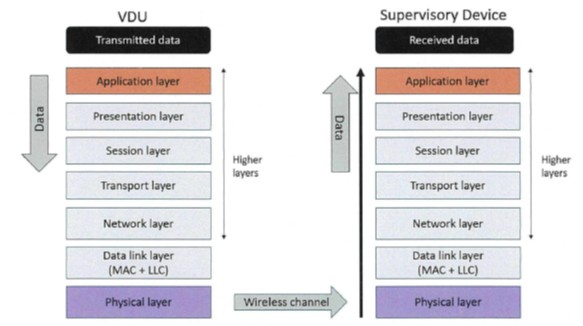
196 Dr Sivamalai explained that for data to be communicated from the VDU to the supervisory device, the data first ‘travels down’ each of any higher layers of the VDU to the physical layer of the VDU. The data undergoes certain necessary processing at each of the layers it travels through (for example, the addition of headers). The data is transmitted from the physical layer of the VDU to the physical layer of the supervisory device (in the case of a wireless communication, as an analogue signal via a wireless channel). Once the data is received by the physical layer of the supervisory device, it goes through a process through the supervisory device in reverse to the one it underwent in the VDU. The data ‘travels up’ through the layers of the supervisory device (in reverse order to the VDU layers). Similar to what occurred in the VDU, the data undergoes necessary processing at each of the layers of the supervisory device (having the opposite effect to the processing that occurred in the VDU, for example, the removal of headers).
197 With respect to the integer of claims 1 and 11 that data items pertaining to the notifiable event be communicated in a format suitable for pre-population into infringement issuing software, Dr Sivamalai stated that he does not consider that the term ‘pre-population’ has a specific meaning in the field of electronic engineering, but that, generally speaking, ‘pre-population’ refers to some sort of automated process whereby information is input without the need for manual (human) intervention or action. Dr Sivamalai continued:
In my opinion, this means that data items are sent from the VDU in a format so that they can be directly input into the infringement issuing software, without the parking officer's involvement. The specific format would be governed by the interface of the infringement issuing software. For example, if the infringement issuing software requires that dates and times are provided in six-digit strings, the format suitable for pre-population would be six-digit strings.
198 In construing this requirement of claims 1 and 11, Dr Sivamalai expressed the opinion that there is no substantive difference between the language of the claims, and specifically no substantive difference between the use of ‘infringement issuing software’ in claim 1 and the use of ‘infringement issuing device’ in claim 11.
199 In his first affidavit, Mr Sizer similarly explained that data is typically communicated wirelessly between devices according to a communication protocol, being the rules that are used to define how data is exchanged and/or interpreted when it is communicated between two or more devices. Data is exchanged using data frames or packets (arranged by header, payload and trailer) with data fields prescribed by the communication protocol. Each data field is generally defined by a data type and/or format, together with a size component if necessary. Mr Sizer explained that, unless the data is communicated between devices using the same type and format that is defined in the communication protocol, a misinterpretation may occur. The data that needs to be transferred from one device to another device is typically contained within a data packet (or a segment of a data packet) in a field known as the ‘payload’ or ‘body’. Header and trailer (or footer) data surrounds the payload data in the data packet or packet segment. This surrounding data is also referred to as ‘overhead’ communication protocol data. Mr Sizer also explained that, in general terms, all digital wireless communication technologies in August 2007 involved at least some processing (at the sender end) to modulate the data into wave (signal) form and at least some processing (at the receiver end) to demodulate those signals into digital format.
200 With respect to the integer of claims 1 and 11 that data items pertaining to the notifiable event be communicated in a format suitable for pre-population into infringement issuing software, it is fair to say that Mr Sizer’s evidence reflected his understanding of the assumptions that both experts were given (and which, as noted above, were derived from the construction findings in the Opposition Judgment). Mr Sizer stated that, in light of the assumptions, he understood that the data items (pertaining to the notifiable event) which are communicated from the VDU to the supervisory device must be in a format suitable for pre-population into the data fields of the infringement issuing software, without further conversion or calibration by the supervisory device. It followed, in Mr Sizer’s opinion, that if the form of the data fields in the infringement issuing software required the supervisory device to perform additional processing or formatting steps so as to pre-populate the data fields of the infringement issuing software with the data items received from the VDU, such processing involves further conversion or calibration and is outside the scope of the invention in claims 1 and 11. Such additional processing and formatting steps would include: (a) using the received data items to find, obtain or calculate some other data value; or (b) re-formatting or translating the received data items into some other form, such as conversion into another data format. Mr Sizer gave the following examples of such additional processing and formatting:
(a) Time/Date data can be transmitted in several forms. It can be transmitted in the form of 32-bit (4-byte) UTC (Universal Time Coordinated) numeric value, which is a numeric value representing the passage of time in seconds since 1 January 1970. This numeric value needs decoding to be meaningful to a human. Time/Date data can alternatively be sent in the form of data representing an alpha-numeric string of ASCII-coded characters, for example ‘Mon, 29 Apr 2024 22:10:46 GMT’ (29 characters, or 29 bytes). ASCII is an abbreviation of American Standard Code for Information Interchange. When transmitted in this form, the Time/Date data can be directly displayed on a screen or printed using a suitable printer.
(b) It is also possible to send data as a numerical or binary number which is then further processed to obtain or calculate some other data value. For example, data elements may require mathematical calculations to be performed before use. By way of illustration, a binary number representing battery voltage can be sent in a form which requires the receiving end to multiply this binary number by a scale factor to give a numeral number in units of volts.
(c) Another example is sending a numerical ‘index’ code which requires further processing and conversion at the receiver end. By way of illustration, it is possible to send data in the form of a key. That key is used at the receiving end to query against various other data items stored across various tables in a relational database at the receiving end to extract and/or create additional data items associated with that key. These tables are often referred to as ‘look up’ tables.
201 Mr Sizer expressed the opinion that conversion of one Time/Date format to another, the performing of mathematical calculations on received data, and the use of ‘look up’ tables to extract or create data by the supervisory device, each involves further conversion or calibration of the data and is not processing which is a necessary incident of wireless communication.
202 In his second affidavit, Dr Sivamalai changed his opinion and expressed disagreement with Mr Sizer’s opinion regarding this integer of claims 1 and 11. Dr Sivamalai stated (emphasis added):
I agree with Mr Sizer that the use of a look-up table or reformatting the data items into another format … are examples of “further conversion or calibration” that is not a “necessary incident of wireless communication”. However, I do not consider that the fact that a look-up table is used or data items are reformatted into another format (at the receiver end) necessarily means that the data items were not communicated in a format suitable for pre-population. That is because I understand that the inclusion of the words “suitable for” means that the data items could be pre-populated without further conversion or calibration, not necessarily that they are pre-populated without further conversion or calibration.
203 In oral testimony, Dr Sivamalai explained that his interpretation of this integer of the claim is that it only required the relevant data item to be in a format suitable for pre-population into an infringement issuing software; that is, the data item could be used by an issuing infringement software, even if it was not in fact used (without further calibration) by infringement issuing software in a supervisory device to which the relevant data item is sent.
204 In his second affidavit, Mr Sizer elaborated on the data communication and computer software concepts discussed in his first affidavit.
205 Mr Sizer stated that the term ‘pre-population’, in computing, generally means automatically entering data into pre-determined or pre-known data fields of executable software before that list or table is provided to the user. Mr Sizer further explained:
The term “pre-population”, in my view, has a particular meaning in computing and involves more than merely receiving data in software or memory. The phrase “wherein the communication is in a format suitable for pre-population”, in my view, would not have any work to do if it required only that the data items to be communicated to, or received by, the supervisory device or infringement issuing software. It is an inherent requirement of the earlier elements of the claims that the notifiable event data items be communicated to (and hence received) by the supervisory device and infringement issuing software. Furthermore, it is clear to me, from the earlier elements of the claims referring to the processing performed by the VDU's processor, that the supervisory device is not itself required to process the notifiable event data items generated and communicated by the VDU into another format, because that work has already been done by the processor in the VDU before it is communicated in the format required for pre-population into the infringement issuing software (see Assumption 8).
206 Mr Sizer stated that he understood the phrase ‘format suitable for pre-population’ in claims 1 and 11 to mean that the data items communicated by the VDU are in the format that has been defined for the data fields that the infringement issuing software accesses when populating the required data fields for issuing a parking infringement notice. If the data items communicated from the VDU are in a different format, they are not data ‘in a format suitable for pre-population into infringement issuing software’, because they will not be correctly interpreted if they are populated into those data fields. Where the infringement data communicated from the VDU is not ‘in a format suitable for pre-population into infringement issuing software’, it will need to be converted, processed and/or re-formatted into the format that is defined for each data field in the infringement issuing software so the data used to pre-populate the details on the parking infringement notice will be correct.
207 In his third affidavit, Dr Sivamalai added the following further opinion. Dr Sivamalai observed that for data to be displayed on a screen as human readable characters, it must be encoded using a standard text encoding such as ASCII, UTF-8 (Unicode Transformation Format-8) or UTF-16 (Unicode Transformation Format-16). Dr Sivamalai expressed the opinion that it would not be practical for a VDU to send data to a supervisory device in a standard text encoding, as this is highly (energy) inefficient. Dr Sivamalai explained that the transfer of the number ‘101’ in a text encoded format would require at least 3 bytes instead of 1, since each digit of the number would be encoded individually. Dr Sivamalai stated that he had never observed any examples of devices wirelessly transmitting numerical data as character encoded data.
208 In cross-examination, Mr Sizer expressed his disagreement with Dr Sivamalai’s opinion with respect to text encoding. It was suggested to Mr Sizer that, in wireless communications, a numeric value would always be transmitted as its binary number equivalent and it would never be transmitted in a text encoded form. Mr Sizer disagreed and provided illustrations of communications systems that he had worked on that transmitted data in a text encoded form to minimise the processing burden on the receiving device.
Consideration
209 For the reasons expressed earlier, I consider that the parties are estopped from contradicting the construction findings made by Burley J. The only question that arises is whether the expert evidence adds to (in the sense of elaborating upon) the constructions findings made by Burley J in a manner that is consistent with those findings.
210 I accept Mr Sizer’s evidence regarding the meaning which those skilled in the art would give to the integer ‘format suitable for pre-population into infringement issuing software’. Mr Sizer’s evidence is consistent with the construction findings in the Opposition Judgment. Focusing on claim 1, the operability of the VDU the subject of the invention is not merely the ability to determine occupancy status of a vehicle space and whether a notifiable event has occurred and the ability to initiate a communication to a supervisory device upon occurrence of a notifiable event which includes data items pertaining to the notifiable event. The claim requires the operability of the VDU to include that the data items be communicated in a format suitable for pre-population into infringement issuing software. The operability is that the data be communicated from the VDU to the supervisory device in a form that can be introduced into the infringement issuing software without any processing at the supervisory device, other than processing that is a necessary incident of wireless communication.
211 I reject Dr Sivamalai’s evidence regarding the meaning which those skilled in the art would give to the integer; specifically, that the integer only requires the relevant data item to be in a format suitable for pre-population into an infringement issuing software. Dr Sivamalai’s understanding of the integer contradicts the construction findings in the Opposition Judgment. I consider that Orikan is estopped from advancing such a construction. I also separately consider that Dr Sivamalai’s understanding is strained and incorrect. Dr Sivamalai provided no satisfactory explanation as to why the integer would be understood in the manner he propounded. On Dr Sivamalai’s approach, a VDU would infringe the patent if it communicated data in a format suitable for pre-population into some infringement issuing software that exists in the world, even if the VDU did not in fact communicate the data to a supervisory device in a format suitable for pre-population into the infringement issuing software used by the supervisory device. That interpretation of the integer renders the integer otiose in any practical sense.
212 It is necessary to address an additional issue raised by the expert evidence that was not specifically addressed in the Opposition Judgment. That issue concerns text encoding. It will be recalled that Orikan contends that data items will be communicated in a format which is suitable for pre-population into infringement issuing software even if it is necessary for the supervisory device to perform data encoding (which I understand to have the same meaning as ‘text encoding’ as referred to in the expert evidence).
213 It can be accepted, as Dr Sivamalai stated, that for data to be displayed on a screen (or printed on a parking infringement notice) as human readable characters, it must be encoded using a standard text encoding such as ASCII, UTF-8 or UTF-16. However, contrary to Dr Sivamalai’s evidence, it does not follow that it is impossible for the supervisory device to be relieved of this encoding requirement. As Mr Sizer said, data can be communicated by the VDU in a text encoded format, and he is aware of applications where this is done to minimise the processing burden on the receiving device.
214 Dr Sivamalai’s focus on the conversion of data into human readable characters for display on a device screen is something of a distraction. The language of the claim is not directly concerned with the display of human readable characters (albeit that a parking infringement notice issued by a supervisory device will be in a human readable form). Claim 1 requires the operability of the VDU to include that the relevant data items be communicated in a format suitable for pre-population into infringement issuing software. As Mr Sizer stated, the required communication format is therefore dependent on the format of the relevant data field in the infringement issuing software to which the data is being sent by the VDU. If the relevant data field in the infringement issuing software is an alpha-numeric string of ASCII-coded characters, claim 1 requires the VDU to be operable to communicate the data in that format. However, if the relevant data field in the infringement issuing software is merely a numeric value which is able to be stored as a binary number, the claim only requires the VDU to be operable to communicate the data in that format (that is, as a binary number). I did not understand Mr Sizer’s evidence with respect to text encoding to suggest otherwise.
215 It follows that I reject Orikan’s proposed supplement to the construction finding in the Opposition Judgment to the effect that data items will be communicated in a format which is suitable for pre-population into infringement issuing software even if it is necessary for the supervisory device to perform text encoding. There is no necessary or implicit exception for such processing as there is for processing that is a necessary incident of wireless communication.
Issue A2 – the infringement issuing software/device issue
The parties’ contentions
216 Orikan contends that the ‘infringement issuing software’ in claim 1 is all software involved in receiving and processing data necessary for issuing a parking infringement notice, which includes the software for the receipt of the data items following communication with a VDU, the software for processing some of the data items, the software for processing manual input from the parking officer as required and the software which issues a parking infringement notice. Orikan contends that this construction is supported by the evidence of Dr Sivamalai, whose evidence should be preferred to that of Mr Sizer.
217 With respect to the phrase ‘infringement issuing device’ in claim 11, Orikan contends that the phrase refers to the handheld device, being the device that executes the infringement issuing software. Orikan contends that, on its construction of the two phrases, there is no substantive difference between the ‘infringement issuing software’ of claim 1 and the ‘infringement issuing device’ of claim 11, because the infringement issuing software is essentially all software running on the handheld device (being the infringement issuing device). Again, Orikan contends that this construction is supported by the evidence of Dr Sivamalai, whose evidence should be preferred to that of Mr Sizer.
218 VMS contends that the phrase ‘infringement issuing software’ in claim 1 refers to the particular software which performs the function of generating (issuing) the parking infringement notice. VMS says this construction is consistent with the plain meaning of the words ‘infringement issuing software’ and is consistent with Mr Sizer’s evidence.
219 With respect to the phrase ‘infringement issuing device’ in claim 11, VMS contends that the phrase refers to the device which executes the infringement issuing software and issues the parking infringement notice, which in the Patent is generally referred to as the handheld device. VMS submitted that the Patent describes the infringement issuing software as “running on the HHD” and does not otherwise describe an “infringement issuing device”. Further, the Patent describes a handheld device as being used to issue infringements but does not make a clear distinction between infringement issuing software and the device used to issue infringements. VMS contends that there is no substantive difference between the use of the phrase ‘infringement issuing software’ in claim 1 and the use of the phrase ‘infringement issuing device’ in claim 11, with both claims encompassing an invention wherein at least two data items communicated from the VDU are in a format suitable for pre-population into infringement issuing software, being the software that issues the infringement.
Expert evidence
220 In his first affidavit, Dr Sivamalai expressed the opinion that the infringement issuing software is all the software running on the handheld device that is involved in receiving and processing data necessary for issuing a parking infringement notice, and that the handheld device is the infringement issuing device. In Dr Sivamalai’s opinion, this excludes software that is pre-loaded on the handheld device by the original equipment manufacturer such as the operating system software. As noted earlier, Dr Sivamalai understood that the infringement issuing device contains infringement issuing software which will be executed by the infringement issuing device and, as such, there is no substantive difference between the use of the phrase ‘infringement issuing software’ in claim 1 and the use of ‘infringement issuing device’ in claim 11.
221 For the purposes of his first affidavit, Mr Sizer was not asked to address the meaning of the phrases ‘infringement issuing software’ and ‘infringement issuing device’. In his second affidavit, Mr Sizer responded to Dr Sivamalai’s evidence. Mr Sizer expressed the opinion that the phrase ‘infringement issuing software’ in claim 1 refers to the particular software which generates (issues) a parking infringement notice. In that regard, Mr Sizer observed that, by claim 1, the VDU is required to communicate at least two data items pertaining to a notifiable event in a format suitable for pre-population into the infringement issuing software, which indicates that the infringement issuing software (that is being referred to in the claim) is the software which generates the parking infringement notice. Mr Sizer disagreed with Dr Sivamalai’s opinion that the phrase ‘infringement issuing software’ (within the meaning of the claim) includes all software running on the handheld device that is involved in receiving and processing data necessary for issuing a parking infringement notice. In that regard, Mr Sizer observed that claims 1 and 11 do not require transmission by the VDU of all data items required to pre-populate the data fields of the infringement issuing software. The claimed invention permits some processing of data items by the handheld device, such as the location details of the notifiable event, as is disclosed in the following passage of the Patent specification (page 10, lines 12-18, referring to figure 1):
When infringement details are acquired, the location of the associated VDU 110 and any other details required for the IIS [infringement issuing software] to produce the infringement notice will be retrieved from an internal memory of the HHD 134 based on the details provided by the VDU 110. For example, the details of the internal memory may include a street-to-suburb mapping to enable the HHD 134 to include the suburb in the infringement notice.
222 In relation to the phrase ‘infringement issuing device’, Mr Sizer agreed with Dr Sivamalai’s opinion that this is the device that executes the infringement issuing software and issues the parking infringement notice. Mr Sizer also agreed that there is no substantive difference between the use of the phrase ‘infringement issuing software’ in claim 1 and the use of the phrase ‘infringement issuing device’ in claim 11 and that both claims encompass an invention wherein at least two data items communicated from the VDU are in a format suitable for pre-population into infringement issuing software.
223 In his third affidavit, Dr Sivamalai maintained his earlier opinion, but also stated that, if Mr Sizer were correct in his understanding of the phrase ‘infringement issuing software’, then the phrase ‘infringement issuing device’ in claim 11 has a broader meaning than ‘infringement issuing software’ in claim 1 because it includes all software on the device.
Consideration
224 I consider that Mr Sizer’s understanding of the phrases ‘infringement issuing software’ in claim 1 and ‘infringement issuing device’ in claim 11 is correct. Mr Sizer’s understanding reflects the use of those phrases within the context of the relevant claims. In contrast, Dr Sivamalai’s understanding failed to recognise the context in which the phrases are used in the claims.
225 It is, of course, correct that the infringement issuing device (which the parties agree is the parking officer’s handheld device) will contain a range of software in order to function, including an operating system and software related to wireless communications. However, the relevant issue is the meaning of the phrase ‘infringement issuing software’ as used in the following integer of claim 1: “communicated in a format suitable for pre-population into infringement issuing software”. As discussed in the context of Issue A1, that integer of the invention is that the VDU has the operability to communicate (at least two) data items pertaining to a notifiable event from the VDU to the supervisory device in a form that can be introduced into the infringement issuing software without any processing at the supervisory device. In their ordinary meaning, the words ‘infringement issuing software’ mean the software that functions to issue an infringement notice. The integer must be assessed by reference to that software and not by reference to other software within the supervisory device.
226 It is perhaps unfortunate that claim 11 uses the phrase ‘infringement issuing device’ rather than ‘infringement issuing software’. While the invention in claim 1 relates to a VDU whereas the invention in claim 11 relaters to a method of vehicle detection by a VDU, the integers of both claims are relevantly the same. The method of claim 11 requires, as a necessary integer, the initiation of a communication from the VDU to a supervisory device upon occurrence of a notifiable event, and that the communication includes (at least two) data items pertaining to the notifiable event and communicated in a format suitable for pre-population into an infringement issuing device. There is no aspect of the claim or the broader specification which suggests that the phrase ‘infringement issuing device’ in claim 11 is intended to have a different (practical) meaning to the phrase ‘infringement issuing software’ in claim 1. Indeed, pre-population of data logically refers to loading data fields within software and, read in context, the reference to ‘infringement issuing device’ in claim 11 must be understood as the device containing infringement issuing software.
F.5 Issue B
227 Issue B requires consideration of the meaning of, and whether there is a distinction between, the following integers:
(a) ‘operable to initiate a communication from the vehicle detection unit to a supervisory device upon occurrence of a notifiable event’ in claim 1 of the Patent; and
(b) ‘initiating a communication from the vehicle detection unit to a supervisory device upon occurrence of a notifiable event’ in claim 11 of the Patent.
228 As recorded earlier, in the Opposition Judgment Burley J found (OJ [56]-[57]) that the above integers require:
(a) that the processor (in the VDU) be operable to initiate a communication upon the occurrence of a notifiable event (which means that the processor must be capable of so operating); and
(b) the words include that the processor is operable (ie able) to initiate a communication upon receiving (and in response to) a ‘beacon’ (or wake-up signal) that is transmitted by a TMT or FMT.
229 His Honour referred to the following description of the beacon in the specification (page 9, line 30, in relation to figure 1):
The communication between the TMT 132 and each VDU 110 is by way of an RF link. Due to the transient nature of the TMT 132 and the need to establish a new wireless connection each time it comes into range of a VDU in violation, the TMT 132 issues a broadcast beacon which can be picked up by any VDU 110 within range. If a given VDU 110 responds, the TMT 132 will then schedule communications with the VDU 110 so as to establish the new connection.
230 His Honour noted (OJ [60] and [61]) that the data contained in the broadcast beacon signal is not the same data which makes up the ‘communication’ as defined in claims 1 and 11. The communication that is the subject of claims 1 and 11 is one which includes within it “data items pertaining to the notifiable event … in a format suitable for pre-population into infringement issuing software”.
The parties’ contentions
231 Whilst Orikan stated that it accepted the construction findings in the Opposition Judgment on this integer, it advanced two submissions that were not part of those construction findings.
232 First, Orikan sought to draw a distinction between the phrase ‘operable to initiate a communication’ in claim 1 and ‘initiating a communication’ in claim 11. It submitted that the words ‘operable to initiate’ mean capable of initiating, while ‘initiating’ means that the VDU actually initiates a communication. In contrast, in the Opposition Judgment, Burley J found that the same construction applied to both claims (at [61]).
233 Second, Orikan submitted that its primary case is that the ‘communication’ is the entirety of the communication between the two devices (which includes, among other messages, the message communicating the data items in a format suitable for pre-population). In the alternative, and assuming that each communication between the VDU and the supervisory device are separate communications, Orikan submitted that the word ‘initiate’ simply means ‘send’. While Orikan submitted that this latter construction is consistent with the construction findings in the Opposition Judgment (in that the initiation of the relevant communication by the VDU may follow the receipt of a broadcast beacon), the construction findings do not suggest that the word ‘initiate’ means ‘send’.
234 VMS stated that it also accepted the construction findings in the Opposition Judgment on this integer, including that the initiation of the relevant communication by the VDU may follow the receipt of a broadcast beacon. However, VMS also submitted that the construction findings in the Opposition Judgment were not an exhaustive construction. Despite that, VMS did not clearly identify any gap in the construction findings.
235 VMS disagreed with the opinion expressed by Dr Sivamalai that the ‘communication’ referred to in the integer can be a sequence or series of communications. VMS submitted that the communication referred to in the integer is the communication that includes the data items ‘suitable for pre-population into infringement issuing software’, and that it is that communication that the VDU must be operable to initiate.
Expert evidence
236 The experts were given assumptions 1, 2, 3 and 6 which relate to this integer:
(1) In claim 1, the words “operable to initiate a communication from the vehicle detection unit to a supervisory device upon occurrence of a notifiable event” include that the VDU is operable (i.e. able) to initiate a communication upon receiving (and in response to) a ‘beacon’ (or wakeup signal) that is transmitted by a TMT or FMT.
(2) In claim 11 , the words “initiating a communication from the vehicle detection unit to a supervisory device upon occurrence of a notifiable event” include that the VDU is operable (i.e. able) to initiate a communication upon receiving (and in response to) a ‘beacon’ (or wakeup signal) that is transmitted by a TMT or FMT.
(3) The requirement in claim 1 that the processor be “operable” to initiate a communication upon the occurrence of a notifiable event means that the processor must be capable of so operating but does not preclude a communication being initiated by the VDU at a time other than when a notifiable event has occurred.
(6) The data contained in the ‘beacon’ (or wake up signal) is not the same data which makes up the ‘communication’ in claim 1 and claim 11.
237 Having been given those assumptions, the experts were not expressly asked their opinion on the meaning of this integer. In the main, the experts addressed this integer in the context of the question of infringement.
238 Nevertheless, in his first affidavit, Dr Sivamalai explained his understanding of the integer as follows:
On occurrence of a notifiable event, the processor can turn on its receiver in order to detect an advertising beacon of the supervisory device. When a beacon is detected, and the supervisory device is determined to be in communication range by the processor, the processor can initiate a communication with the supervisory device. This communication may first be a request from the processor for a connection to the supervisory device. Once a connection is established, the VDU then communicates data items to the supervisory device (see for example, page 8, lines 31 to 35, and page 9, lines 30 to 35 of the Patent). Alternatively, the communication may simply be the data items themselves (i.e. the VDU sends data items to the supervisory device without first needing to establish a connection).
Another way the communication can be achieved may be, upon occurrence of a notifiable event, and in the absence of any advertising beacon from the supervisory device, the VDU itself commences broadcasting a communication. This communication would contain the information the VDU is programmed to communicate to a supervisory device. The VDU would broadcast this communication at regular intervals so that it would be received by a supervisory device passing by.
239 In the context of answering questions going to infringement, Dr Sivamalai broadened his interpretation of this integer. In his second affidavit, he expressed the opinion that, where the VDU has commenced broadcasting a communication to the supervisory device, the “communication” (for the purposes of claims 1 and 11):
… is not limited to the first signal between the two devices; rather, the “communication” is the entirety of the exchange between the two devices.
240 In his third affidavit, also in the context of infringement, Dr Sivamalai reached for the broadest possible interpretation of this integer. He expressed the opinion that, because the PODS-915 in ground unit (IGU) has a wireless transmitter that is capable of initiating a communication, the IGU is operable (in the sense of able) to initiate the communication upon the occurrence of a notifiable event as defined in claim 1.
241 In oral testimony, Dr Sivamalai stated that, in his opinion, the communication the subject of this integer may be a series of communications (by which the relevant data items pertaining to the notifiable event are communicated in a format suitable for pre-population into infringement issuing software), rather than a single communication. Dr Sivamalai further stated that, in his opinion, even if the VDU was not programmed to initiate the communication the subject of this integer, if it was able to be reprogrammed so as to initiate such a communication, the VDU was ‘operable to initiate’ the communication in the sense of being able to initiate the communication.
Consideration
242 In my view, the parties are estopped from contradicting the construction findings made by Burley J in the Opposition Judgment on this integer, findings with which I respectfully agree. It is only necessary to consider the parties’ supplementary contentions with respect to the integer.
243 Broadly, I accept Dr Sivamalai’s evidence in his first affidavit concerning communication processes that satisfy this integer. I consider that Dr Sivamalai’s description appropriately illustrates communication processes that are within the scope of the claim. However, I consider that Dr Sivamalai’s subsequent evidence that the entirety of the exchange between the VDU and the supervisory advice would be a communication for the purposes of this integer to be too vague to be of any assistance. I accept that the word ‘communication’ can include a plurality of communications, rather than a single communication. For example, the fact that the VDU is operable to initiate a sequence of communications containing the relevant data items, rather than operable to initiate a single communication, would not, in my view, be outside the scope of the claim.
244 I reject Dr Sivamalai’s opinion that the phrase ‘operable to initiate a communication’ includes a circumstance that the VDU is able to be reprogrammed so as to initiate the communication, and is satisfied if the VDU contains a wireless transmitter. The opinion denudes the integer of any work or meaning. As the Full Court explained in Garford Pty Ltd v DYWIDAG Systems International Pty Ltd [2015] FCAFC 6; 110 IPR 30 at [122] (emphasis added):
A claim to an apparatus for a particular purpose is a claim to an apparatus that is suitable for that purpose: see, for example, Bühler AG v Satake UK Ltd [1997] RPC 232 per Jacob J; Insituform Technical Services Ltd v Inliner UK Plc [1992] RPC 83 at 102 per Aldous J. To establish infringement of such a claim it is not necessary for the patentee to establish that the apparatus is intended to be used for that purpose. The patentee need only show that the apparatus is suitable for that purpose. The fact that the apparatus could be modified to make it suitable for a specified purpose does not put it within the scope of the claim unless it has been so modified.
245 It follows that I also reject Orikan’s submission that there is any relevant difference between the phrase ‘operable to initiate a communication’ in claim 1 and ‘initiating a communication’ in claim 11. I respectfully agree with Burley J’s conclusion that the same construction applies to both phrases. I also reject Orikan’s further submission that the communication is the entirety of the communication between the two devices (the VDU and the supervisory device), which appears to be based on Dr Sivamalai’s evidence which I reject.
246 It is appropriate to say something more about Orikan’s submissions that the verb ‘initiate’, when used in claims 1 and 11, simply means ‘send’. That submission does not accord with the ordinary meaning of the word. The expert evidence did not suggest that the word has a technical meaning. The Macquarie Dictionary defines the verb ‘initiate’ to mean: to begin, set going, or originate. The relevant integer requires that the processor be operable to initiate a communication from the VDU ‘upon occurrence of a notifiable event’. In this context, the preposition ‘upon’ has the same meaning as ‘on’ and takes the Macquarie Dictionary meaning: time or occasion. Thus, the ordinary meaning of the words used in the integer is that the processor is operable to begin the communication at the time of the occurrence of a notifiable event.
247 As found by Burley J, that construction of the integer still allows for the processor to receive a beacon signal from the communications facility associated with the supervisory device that alerts the processor to the fact that a supervisory device is within range and establishes a communication channel. That construction is consistent with the invention described in claims 2 and 3 (dependent upon claim 1) and claims 13 and 14 (dependent upon claim 11). Claims 2 and 13 describe the VDU of claim 1 wherein the communication is wireless and directly with a portable supervisory device. Claims 3 and 14 describe the VDU of claim 2 and claim 13 respectively wherein the communication is established in an ad hoc manner at times when a notifiable event has occurred and when the portable supervisory device is in range. As set out earlier, the specification describes such a configuration (page 3, lines 4-7):
Preferably, the vehicle detection unit communicates wirelessly directly with a portable supervisory device, for example a personal digital assistant carried by an inspector, in an ad-hoc manner at times when a notifiable event has occurred and when the portable supervisory device is in range.
248 It follows that claims 2 and 3 and claims 13 and 14 describe an invention in which it is necessary for a communications link to be established between the VDU and the supervisory device in an ad hoc manner when the supervisory device is within range. This configuration is further described in the embodiment depicted in figure 1. The specification describes a transient topology (using a TMT) in which there is a need to establish a new wireless connection each time the handheld device and the TMT come into range of a VDU in violation (page 9, line 32). The fact that a connection must be established to enable the VDU to send the relevant communication is consistent with the VDU being operable to initiate the communication upon the occurrence of the notifiable event within the meaning of claim 1 (and initiating the communication upon the occurrence of the notifiable event within the meaning of claim 11).
F.6 Issue C
249 Issue C requires consideration of the meaning of the phrase ‘pertaining to the notifiable event’ in claims 1 and 11 of the Patent. This phrase was not the subject of findings made in the Opposition Judgment.
The parties’ contentions
250 Orikan contends that the phrase ‘data items pertaining to the notifiable event’ has the same meaning as ‘data items associated with a notifiable event’, as that latter expression is described in the specification. In that regard, Orikan relies upon the following description in the specification (page 3, lines 15-23):
In further preferred embodiments of the invention, the vehicle detection unit is operable to provide information associated with the notifiable event to the supervisory device so that such information may be pre-populated into the supervisory device without requiring manual entry of such information by a parking inspector. Depending on the nature of the notifiable event such pre-population of associated information may save the inspector from manually entering up to 20 or more fields of data. Such data may for example include location information such as street name and parking bay number, vehicle occupancy duration, offence details, applicable regulations or “signage”, an applicable monetary fine, historical usage data, and the like.
251 On that basis, Orikan contends that any time limit that applies to or defines a notifiable event, including any grace period that applies to or defines a parking infringement, is a data item pertaining to the notifiable event.
252 VMS contends that the phrase ‘data items pertaining to the notifiable event’ means data items that belong to, or are part of, the specific notifiable event. It contends that the data items must be an attribute of the notifiable event. In that regard, VMS drew a distinction between configurable aspects of the algorithms used by the VDU to determine if the vehicle is in violation, such as a configurable grace period (which it contends is not a data item pertaining to the notifiable event), and data items that belong to, or are part of, the specific notifiable event.
Expert evidence
253 In his first affidavit, Dr Sivamalai noted that the Patent does not define the data items that are said to be ‘pertaining to the notifiable event’. However, the Patent discusses information associated with the notifiable event (page 3, lines 15-23) and gives examples of such associated information including: location information such as street name and parking bay number, vehicle occupancy duration, offence details, applicable regulations, applicable monetary fine and historical usage data. The Patent goes on to state (page 3, lines 25-27) that the notifiable event may comprise an occurrence of a parking violation, an imminent parking violation, or any non-violating parking event of interest such as a change in occupancy status. In light of those statements, Dr Sivamalai expressed the opinion that the phrase ‘data items pertaining to the notifiable event’ can be categorised as follows:
(a) information independent of the vehicle, such as:
(i) information about the VDU — for example, its identifier;
(ii) information about the location of the VDU — for example, street name and parking bay number;
(iii) information relating to the relevant applicable parking restriction — for example, how long a vehicle is permitted to park in the parking bay and the applicable leeway or grace period before an offence is deemed to have occurred; and
(b) information which relates to the vehicle, such as:
(i) information about the vehicle — for example, its number plate;
(ii) information about the parking of the vehicle — for example, the time the vehicle arrived in the parking bay and how long the vehicle has been in the parking bay; and
(c) in the case where a parking infringement has occurred, information about the offence — for example, when the offence occurred and the applicable fine.
254 In his first affidavit, Mr Sizer expressed the opinion that the words ‘pertaining to the notifiable event’ in claims 1 and 11 refer to data items which belong to, or are part of, the specific notifiable event (eg a particular parking event violation) as determined by the sensors and parameters in the earlier part of the claims. Mr Sizer understood that the claims require the notifiable event to be determined by the VDU’s processor by comparing the occupancy status of the vehicle (as determined by the VDU’s magnetic sensors) with the parking violation parameters stored on the VDU’s storage device. It is only once that specific notifiable event is determined, based on the sensors and parameters, that a communication (with the data items pertaining to the notifiable event) is then sent from the VDU to the supervisory device for pre-population of those data items into the infringement issuing software. Although perhaps not expressed clearly, I understand Mr Sizer’s interpretation of the phrase ‘pertaining to the notifiable event’ to be affected by the additional integer that requires the data items to be communicated in a format suitable for pre-population into infringement issuing software.
255 In his second affidavit, Mr Sizer disagreed with Dr Sivamalai’s understanding of this integer. In Mr Sizer’s opinion, some of the types of data items referred to by Dr Sivamalai, such as device identifiers and configurable grace periods, are data items “pertaining to the internal workings of the system or otherwise not data items which I would expect to be in format suitable for pre-population into infringement issuing software”. In that regard, Mr Sizer observed that the Patent refers to configurable grace periods (such as at least one minute after the parking restriction time elapses) as being part of the vehicle in violation algorithm (referred to in these reasons as the ‘VIVA’) or system data before the process for issuance of an infringement notice is initiated (page 13, lines 28-30):
The VIVA works in conjunction with the VDA to determine whether a vehicle is in violation. When required the VIVA initiates communication with the TMT 132 and/or FMT 240. Determinations made by the VIVA constitute parking event data, which is written to the memory of the VDU. The VIVA is further able to support pending violations, for example to indicate that a violation is imminent. The VIVA and/or system further provides for a configurable grace period, which may be afforded to a vehicle operator before issuance of an infringement notice is initiated.
256 Again, although not expressed clearly, Mr Sizer’s evidence can be understood as having a focus on the requirement that the data items be communicated in a format suitable for pre-population into infringement issuing software. Mr Sizer did not understand that any grace period would be so communicated, and therefore Mr Sizer considered that a grace period is not a data item as referred to in this integer.
257 Mr Sizer’s opinion in that regard was clarified to some extent in his oral testimony. Mr Sizer agreed that an item such as a grace period relates to the notifiable event, and therefore pertains to the notifiable event (Mr Sizer agreeing that the expression ‘relating to’ and ‘pertaining to’ are equivalent). However, Mr Sizer’s understanding is that the communication referred to in the claims must include (at least two) data items that satisfy two conditions: they are data items pertaining to the notifiable event and are data items communicated to the supervisory device in a format suitable for pre-population into infringement issuing software. Mr Sizer also agreed that if the grace period was communicated to the supervisory device in the manner required by the integer, then it would be a data item that satisfies the integer (as a data item pertaining to the notifiable event).
Consideration
258 Following the clarification of Mr Sizer’s opinion in oral testimony, I consider that there was no substantive dispute between the experts concerning the meaning of the phrase ‘pertaining to the notifiable event’. Mr Sizer agreed that the phrase ‘pertaining to’, in this context, simply means ‘relating to’. Dr Sivamalai adopted the phrase ‘associated with’ because it is the alternative phrase used in the specification. In my view, each of these phrases is broadly synonymous.
259 In my view, each of the data items listed by Dr Sivamalai are data items pertaining to the notifiable event within the meaning of claims 1 and 11, including any applicable grace period. Mr Sizer’s disagreement with Dr Sivamalai’s evidence in that respect was misdirected. As explained above, Mr Sizer interpreted the phrase ‘data items pertaining to the notifiable event’ as qualified by the further integer that the relevant data items be data items that are communicated in a format suitable for pre-population into infringement issuing software. Mr Sizer thereby conflated the two integers in his evidence.
F.7 Issue D
260 Issue D requires consideration of the meaning of the phrase ‘supervisory device’ in claims 1 and 11 of the Patent. This phrase was not the subject of the findings made in the Opposition Judgment.
261 As Orikan submitted, it is not apparent that VMS seeks to defend the allegations of patent infringement on the basis of this integer of claims 1 and 11. VMS advanced no submissions addressing this integer in the context of infringement. Nevertheless, this section of the reasons will address the issue of construction as advanced by the parties.
262 Orikan further submitted that, to succeed on its infringement case, it is not necessary for Orikan to show that a supervisory device falls within the scope of the claims or that the supervisory device used by VMS with the PODS Sensor actually uses the data items which are communicated by the PODS Sensor to pre-populate infringement issuing software. Orikan argued that the supervisory device (and the infringement issuing software and infringement issuing device) is not part of either the device claimed in claim 1 (which is a vehicle detection unit) or the method claimed in claim 11 (which is a method of using the vehicle detection unit), and therefore do not provide a limitation to the claims.
263 I do not fully accept that submission. It is correct that the invention the subject of claim 1 is the VDU and the invention the subject of claim 11 is a method for vehicle detection by a VDU. It follows that the issue of infringement concerns the allegedly infringing VDU (here, the PODS Sensors) and the method for vehicle detection by the VDU. However, the invention includes integers relating to the operability of the VDU to initiate a communication to a supervisory device upon occurrence of a notifiable event, wherein the communication includes data items pertaining to the notifiable event and communicated in a format suitable for pre-population into an infringement issuing device. In determining whether that integer of the invention exists in the allegedly infringing VDU, it is necessary to understand the meaning of the phrase ‘supervisory device’ in the claims.
The parties’ contentions
264 Orikan contends that the phrase ‘supervisory device’ includes both the device that has a human interface for a parking inspector (such as a personal digital assistant carried by a parking inspector) as well as any device or component that enables communication with the VDU such as the TMT. Accordingly, the supervisory device may be comprised of one or more components. In support, Orikan observes that the specification makes plain that the supervisory device must be able to communicate with the VDU. The specification describes preferred embodiments in which the TMT component acts as a conduit between the VDU and the handheld device (see for example page 9, lines 26-35).
265 In contrast, VMS contends that the phrase ‘supervisory device’ refers to a singular device used by a parking officer to supervise or monitor parking violations or other notifiable events, and which receives the communication from the VDU (either directly or indirectly).
Expert evidence
266 In his first affidavit, Dr Sivamalai stated that he understands the words ‘supervisory device’ to refer to a conceptual device that may be comprised of more than one component and that is able to communicate with the VDU and has a human interface. It may be a single device or a collection of devices used together. Dr Sivamalai acknowledged that certain passages in the Patent suggest that the supervisory device could be the human interface only, for example, the personal digital assistant carried by a parking inspector (page 3, line 5). However, Dr Sivamalai observed that other passages of the Patent indicate that the supervisory device must be able to communicate with the VDU (page 5, lines 15-19). Dr Sivamalai also referred to the embodiment of the invention described at page 9, lines 17-35:
The TMT 132 is the component associated with the HHD 134 and the Parking Officer 130. The TMT 132 communicates to the VDUs 110 and interfaces to the HHD 134. In this embodiment the TMT 132 is provided by wireless networking hardware positioned in the holster of the HHD 134. The communications between the TMT 132 and the HHD 134 occur via mini USB port. The HHD 134 and the TMT 132 thus have a permanent connection in place whereby communication can occur at any time. The TMT 132 is a “transient” middle tier as it travels in the field with the parking officer 130, and thus is not always available for communications with any given VDU 110.
The TMT 132 acts as a conduit, whereby it passes data between the HHD 134 and each VDU 110. No data is stored on the TMT 132. Data to be transferred to a VDU 110 from the HHD 134 is downloaded into the TMT 132 for transmission as required. Data to be transferred to the HHD 134 from the VDU 110 will be transmitted to the TMT 132 for upload to the HHD 134. The communication between the TMT 132 and each VDU 110 is by way of an RF link. Due to the transient nature of the TMT 132 and the need to establish a new wireless connection each time it comes into range of a VDU in violation, the TMT 132 issues a broadcast beacon which can be picked up by any VDU 110 within range. If a given VDU 110 responds, the TMT 132 will then schedule communications with the VDU 110 so as to establish the new connection.
267 Dr Sivamalai stated that, in that embodiment, he understands the supervisory device to be the combination of the handheld device and the TMT.
268 In his first affidavit, Mr Sizer stated that he understands the phrase ‘supervisory device’ in claims 1 and 11 to refer to the device used by the parking inspector which receives the communication from the VDU in the manner required by claims 1 and 11. Mr Sizer understands the word ‘supervisory’ to refer to the role that the device has when used by the parking inspector who is supervising or monitoring parking violations or other notifiable events. Mr Sizer observed that the claims refer to a (ie singular) supervisory device and the specification also refers to a singular device (page 3, lines 30-31). Mr Sizer also observed that a preferred form of supervisory device in the Patent is a personal digital assistant carried by a parking inspector (ie a handheld device) (page 3, lines 4-7 and 30-31).
269 In their subsequent affidavits, each expert maintains the views expressed above. As can be seen, the point of disagreement is whether a communication conduit, such as the TMT, forms part of the supervisory device as that phrase is used in the Patent. In his third affidavit, Dr Sivamalai explained his reasoning as follows:
Given that the Patent describes the “supervisory device” as communicating with the VDU, it follows that it must be the combined functionality of the TMT and HHD.
Consideration
270 Save in one respect, I accept the opinion expressed by Mr Sizer and reject the opinion expressed by Dr Sivamalai. Mr Sizer’s opinion reflects the ordinary meaning of the words ‘supervisory device’ and is supported by the specification.
271 In contrast, Dr Sivamalai’s opinion is based upon a non-sequitur. It is uncontroversial that the VDU must be capable of communicating with the supervisory device. That requirement is integral to the invention (as stated in claims 1 and 11). However, that fact does not support a conclusion that the supervisory device, as described in the Patent, includes communications facilities or components as part of the device. Indeed, the specification clearly indicates the opposite conclusion.
272 The specification describes various embodiments of the invention which utilise different facilities or components by which communications are transmitted between the VDU and the supervisory device. Such communications may be via a TMT or a FMT as described at page 3, lines 4-13:
Preferably, the vehicle detection unit communicates wirelessly directly with a portable supervisory device, for example a personal digital assistant carried by an inspector, in an ad-hoc manner at times when a notifiable event has occurred and when the portable supervisory device is in range. Such a network topology is referred to herein as a transient middle tier. Such embodiments may thus obviate the need for fixed communications infrastructure to connect the or each vehicle detection unit with a head office server, and to connect the head office server with the supervisory device, with such fixed infrastructure being referred to herein as a fixed middle tier. However, it is to be appreciated that the scope of the present invention includes embodiments in which a fixed middle tier is employed.
273 The TMT is defined (page 8, lines 1-3) as the conduit between the handheld device and the VDU. While the TMT is described as “the component associated with the HHD and the Parking Officer”, the specification states that the “TMT communicates to the VDUs and interfaces to the HHD”, the “TMT acts as a conduit, whereby it passes data between the HHD and each VDU”, and “no data is stored on the TMT” (page 9, lines 17-35).
274 Similarly, the FMT is defined (page 7, lines 26-29) as the conduit between the VDU and the vehicle detection system internet gateway (referred to in these reasons as the ‘VDS IG’). The specification states that the “FMT thus acts as a conduit, whereby it passes data from the VDUs to other FMTs or VDS IGs” and that “no data is stored on the FMT” (page 11, lines 13-14). The specification further explains that the “VDS IG is an internet gateway that has a connection to the internet” and that “the VDU information transferred to the VDS IG via the FMT is sent on to the parking inspector's dashboard monitor or HHD” (page 11, lines 28-30). The specification further explains (page 11, lines 32-35):
The backend 236 could be the dashboard monitor or other car-based computing device of a parking inspector 230, and is capable of displaying this information in a graphical nature for visual interpretation 35 and analysis of the data being received.
275 Figure 5 also depicts a topology where the VDU communicates directly with a handheld device. This embodiment is described as follows (page 19, line 28 – page 20, line 2, emphasis added):
The hand held device (HHD) 3 is carried by a parking officer, and receives communications regarding the details of an infringement (or pending infringement) and is provided with “pre populated” details which are automatically passed into the PINS for processing by the officer. The data fields provided for automated pre-population include Offence Type, Offence Date and Time, Offence Location (e.g Street No., Street Name, Suburb), Parking Bay Identifier, Vehicle Arrival Time, Vehicle Stay Duration, Location Information (e.g. Side of Street, Between Streets, Near
276 The above description of the handheld device indicates that the handheld device is the supervisory device, as it receives communications regarding details of the infringement and is provided with pre-populated details. The communications may be sent from the back-end system, a middle tier or directly from the VDU.
277 Throughout the specification, the communications facilities and components are described separately from the device which is the supervisory device (and which is most often referred to as the handheld device).
278 The only aspect of Mr Sizer’s opinion which I do not accept is his view that the supervisory device must be a single device. In my view, that is not a requirement of the Patent. Whilst the specification describes preferred embodiments by reference to a single handheld device, I do not regard the physical construction of the device as relevant to the claims. However, nothing turns on that issue in this proceeding.
279 In conclusion, I consider that the phrase ‘supervisory device’ refers to a device used by a parking officer to supervise or monitor parking violations or other notifiable events, and which receives the communication from the VDU (either directly or indirectly).
280 There was no dispute between parties with respect to the meaning of the phrase ‘portable supervisory device’. In their Joint Report, the experts stated their agreement that the word ‘portable’ refers to a supervisory device which is not fixed or attached to anything. That is an ambiguous definition. I prefer the explanation given by Mr Sizer in his first affidavit that the phrase ‘portable supervisory device’ is a supervisory device that is designed to be transported, portable or moveable (in contrast to a fixed form of supervisory device which is not designed to be transported, portable or moveable. In the specification, the preferred form of such a device is a personal digital assistant (also referred to as a handheld device) which is either carried by an inspector or mounted on a vehicle.
G. THE PODS SENSORS AND METHOD
G.1 Introduction
281 As noted earlier, evidence concerning the PODS Sensors and PODS Method was principally given by Mr Welch and Mr Luscombe. In their evidence, VMS’s parking overstay detection system was referred to as the PODS System, and VMS’s vehicle detection units were referred to as ‘in ground units’ (referred to in these reasons as ‘IGUs’), and the different models were referred to as the PODS-433, PODS-915v1 and PODS-915v2. For the purposes of Orikan’s infringement allegations, the PODS Sensors are PODS-433, PODS-915v1 and PODS-915v2, and the PODS Method is VMS’s parking overstay detection system (which VMS calls the PODS System) using PODS-433, PODS-915v1 and PODS-915v2. In these reasons, the expressions ‘PODS System’ and ‘PODS Method’ are used interchangeably.
282 In his evidence, Mr Welch verified:
(a) the PODS-433 Product Description, which describes the features of the PODS-433 system implemented by Maribyrnong City Council from around June 2009 to around July 2012; and
(b) the PODS-915v1 Product Description, which describes the features of the PODS-915v1 system implemented by Moreland City Council from around May 2012 to May 2017.
283 Mr Luscombe verified the PODS-915v2 Product Description, which describes the key features of the PODS-915v2 system implemented by VMS since around October 2015.
284 Orikan does not challenge the accuracy of the Product Descriptions, although certain features of the PODS System were clarified in the cross-examination of Mr Welch.
285 The following is an overview of the salient features of each of the PODS Sensors and associated PODS System as disclosed by the evidence.
G.2 PODS-433 Product Description
286 The PODS-433 Product Description states that VMS supplied Maribyrnong City Council with PODS IGUs and Portable Data Terminals (referred to in these reasons as ‘PDTs’). Maribyrnong was also supplied with ticket issuing devices, referred to as the Schweers X600 and Schweers Ticketman. A method for data exchange using a Bluetooth connection between the PDT and the Schweers X600 or Ticketman was developed by VMS. This integration allowed full operation and control of the PODS IGUs using the PDT and X600 or Ticketman devices.
287 Each PODS IGU contained a magnetometer and had the ability to determine the presence of a vehicle stopped above the PODS IGU and to determine that the vehicle had remained stopped for a period of time that was longer than the sum of the time limit and the grace period programmed into the PODS IGU.
288 Each PODS IGU contained a microcontroller which had volatile and non-volatile memory and a discrete flash memory integrated circuit. The microcontroller was able to: determine the arrival and departure time of a motor vehicle in a parking bay; measure the time period during which a motor vehicle was present in a parking bay; compare the duration of stay of a motor vehicle against a stored record of applicable time restrictions and grace periods; and determine whether a motor vehicle was in violation of a time-based parking restriction.
289 Each PODS IGU had a unique device ID and could be installed under a parking bay or a single car park space as marked on the roadway. When that occurred, the unique device ID of the PODS IGU was stored in a database maintained on a computer server in which it was associated with the parking bay or car park space.
290 Each PODS IGU was able to communicate with a portable data collection device using radio frequencies. In particular, each PODS IGU was able to transmit a Bay Status File (or BSF) to a PDT using radio frequencies.
291 The parking officer used either the Schweers X600 or Ticketman device to print parking infringement notices for infringements detected using the PODS System. The Schweers devices communicated with the PDT via a wireless Bluetooth communications link. Both the PDT and the Schweers devices were carried by parking officers (typically, the PDT was strapped to the officer's belt).
292 The Schweers devices included a microprocessor with memory and software, a touch screen display, hard buttons and a printer for printing infringement notices. The software that was installed and executed on the device included the following two applications:
(a) Politess CE, which was a software application written by Schweers and which performs the function of issuing a parking infringement notice; and
(b) CPODS/PDTLink, which was a software application written by VMS.
293 The CPODS/PDTLink software functioned as the interface and data conversion link between Politess CE and the remaining parts of the PODS-433 system. It was necessary for VMS to write CPODS/PDTLink because the data and data fields used by Politess CE were not the same as those used in the BSF and the data contained in the BSF required conversion, calibration and processing by CPODS/PDTLink before it could be used by Politess CE to generate a parking infringement ticket.
294 The Product Description contains a detailed description of the sequence of steps that were taken by a parking officer to electronically ‘poll’ or search for a parking infringement and issue a parking infringement notice, as well as the sequence of communications triggered by such action and the content of the data communicated. Those steps (where relevant) will be considered in the context of the specific issues in dispute between the parties on the question of infringement. By way of overview, the Product Description describes the following sequence.
295 After the parking officer had logged into the Politess CE software, a menu screen was displayed on the touch screen of the Schweers device by the Politess CE software. The first step in the sequence involved the parking officer selecting the ‘PODS Check’ button on the screen to determine whether any vehicles were in overstay. [REDACTED].
296 The second step involved the CPODS/PDTLink software causing a ‘dialog box’ to be generated and displayed on the Schweers device that included certain data (information) items relating to the overstay event. Those items included: the location; the entry time (the time the vehicle entered the parking space); the stay time (the lesser of the amount of time the vehicle had been parked or the amount of time since the enforcement period commenced); the time limit (the amount of time a vehicle was legally allowed to remain parked); and the overstay (the amount of time the vehicle had overstayed the sum of the time limit and the grace period that had been programmed into the PODS IGU).
297 The third step involved the parking officer deciding whether to issue a parking infringement notice after reading the information that was displayed on the dialog box.
298 If the parking officer decided to issue a ticket, the fourth step involved the parking officer pressing the on-screen ‘Ticket’ button. This caused control of the Schweers device to be transferred from CPODS/PDTLink to Politess CE for the parking officer to issue a ticket. At this stage, the data calculated and generated by CPODS/PDTLink was retrieved by Politess CE. Politess CE caused an ‘Issue’ interface screen to be displayed on the Schweers device which enabled the parking officer to perform a final check and insert infringement details (such as the vehicle registration details and the offence code) that would be printed on the ticket or otherwise kept by the officer as a record of the offence.
299 The fifth step involved the parking officer scrolling to, and pressing, the ‘Print now’ field on the Schweers screen.
300 At the sixth step, the parking officer manually entered, or checked and if necessary amended, infringement details (if any) that he or she wished to keep in the remaining fields on the Politess CE ‘Issue’ screen.
301 At the seventh step, the Schweers device returned to the ‘PODS polling’ state.
G.3 PODS-915v1 Product Description
302 The PODS-915v1 Product Description states that, in early June 2011, Moreland City Council resolved to accept the tender from Tenix Solutions Pty Ltd for the supply and installation of up to 4000 sensors and the provision of 17 ticket issuing devices and associated equipment. The sensors, ticket issuing devices and associated equipment that were supplied and installed in Moreland included PODS IGUs, a portable interface device or hand-held hardware (PID) and the Schweers Ticketman devices. The PID in Moreland included a processor, memory, a radio integrated circuit, an antenna and an audible buzzer that were sealed in a plastic housing. Each PID in Moreland was external and attached with screws to the top rear face of the Schweers Ticketman device.
303 The functionality of the PODS-915v1 IGU was relevantly the same as the PODS-433 IGU, save in one respect. [REDACTED]. When the PID received that message, it alerted the parking officer by sounding an audible alarm.
304 In the case of the PODS-915v1 System, VMS wrote a software application called VMSYS to integrate the PODS-915v1 IGU with the Politess CE software installed on the Ticketman devices. VMSYS was installed on the Ticketman device and functioned as the interface and data conversion link between Politess CE and the portable data collection device. As for the PODS-433 System, VMSYS was necessary because the data and data fields used by Politess CE were not the same as those used in the BSF transmitted by the IGU and the data contained in the BSF required conversion, calibration and processing by VMSYS before it could be used by Politess CE to generate a parking infringement ticket.
305 The Product Description contains a detailed description of the sequence of steps that were taken by a parking officer to electronically identify parking infringements and issue a parking infringement notice, as well as the sequence of communications triggered by such action and the content of the data communicated. The steps are similar, but not identical, to the PODS-433 System. Those steps (where relevant) will be considered in the context of the specific issues in dispute between the parties on the question of infringement. By way of overview, the Product Description describes the following sequence.
306 The first step involved the parking officer logging in to the Ticketmaster device, following which the Politess CE software caused a menu to be displayed on the Ticketmaster screen.
307 The second step involved the parking officer selecting the ‘PODS Check’ button on the screen menu. This action caused:
(a) Politess CE to launch VMSYS; and
(b) VMSYS to send a request message to the PID to listen for any overstay alarms that were communicated by PODS IGUs.
308 The third step involved VMSYS generating, and displaying on the Ticketman screen, a list of the IGUs sending overstay alarms containing location details of the IGU and the number of seconds since the receipt of the last alarm from the IGU. As noted above, when in alarm mode, the IGU transmitted to any PID in the reception range a message containing the unique identification number of the IGU. The identification number was communicated by the PID to the Ticketman device. Location details associated with each IGU identification number were stored in the Ticketman memory. VMSYS extracted the location details from the memory and displayed it on the Ticketman screen.
309 At the fourth step, the parking officer highlighted an identified overstay on the Ticketman device and pressed the button marked ‘Details’. This caused VMSYS to communicate with the PID and (relevantly) request the BSF for the overstay. The BSF was then communicated from the PODS IGU to the PID, which in turn communicated those files to VMSYS. VMSYS then performed a number of validation checks on the content of the BSF.
310 At the fifth step, VMSYS caused the Ticketman screen to display an ‘Offence Detail’ screen that had a list of offence details on the touch screen.
311 At the sixth step, the parking officer decided whether to issue a parking infringement notice. A number of options were displayed on the Ticketman screen, including ‘Skip’ (to return to the list of IGUs in overstay), ‘Confirm’ (to refresh the overstay details), ‘No Ticket’ (if the parking officer elected not to issue a ticket) and ‘Ticket’.
312 At the seventh step, if the parking officer decided to issue a parking infringement notice, the officer pressed the ‘Ticket’ button on the touch screen. This caused control of the Ticketman device to be transferred from VMSYS to Politess CE. At this stage, the data calculated and generated by VMSYS was retrieved by Politess CE. Politess CE caused an ‘Issue’ interface screen to be displayed on the Ticketman device which enabled the parking officer to perform a final check and insert infringement details (such as the vehicle registration details and the offence code) that would be printed on the ticket or otherwise kept by the officer as a record of the offence.
313 At the eighth step, the parking officer scrolled to, and pressed, the ‘Print’ button on the Ticketman screen.
314 At the ninth step, the parking officer manually entered, or checked and if necessary amended, infringement details (if any) that he or she wished to keep in the remaining fields on the Politess CE ‘Issue’ screen.
315 At the tenth step, the Ticketman device returned to the IGU overstay list.
G.4 PODS-915v2 Product Description
316 The PODS-915v2 Product Description states that PODS-915v2 comprises PODS IGUs used with a PID (also referred to as a ‘PODS interface device’ in the PODS-915v2 Product Description) and an Android smartphone. PODS-915v2 was first supplied to the City of Monash in around October 2015. The Product Description is based on the PODS-915v2 System implemented by VMS for Monash and Moreland. Except where noted, the key features of the system are substantially the same as the current PODS-915v2 System in relation to data transmission, handling and processing.
317 PODS-915v2 is similar to PODS-915v1. However, it involves, amongst other things:
(a) [REDACTED]
(b) [REDACTED].
318 Auto Issue and PinForce were software applications used to generate and issue parking infringement notices. Where PinForce was used, [REDACTED].
319 VMS did not and does not supply the Android smartphone or the third-party software applications, Auto Issue and PinForce.
320 In PODS-915v2, the PID is a standalone device and is normally carried in the parking officer’s pocket. The parking officer uses the Android smartphone (installed with PODS Patrol and either Auto Issue or PinForce) to issue parking infringement notices. A separate device is used to print the parking infringement notices.
321 The functionality of the PODS-915v2 IGU is relevantly the same as the PODS-915v1 IGU, [REDACTED].
322 [REDACTED]. It was necessary for VMS to write PODS Patrol, Keyboard and Data Agent because the data types, format and data fields used by Auto Issue/PinForce are not the same as those used in the BSF transmitted by the IGU and the data contained in the BSF requires conversion, calibration and processing before it can be used by the relevant infringement application to issue a parking infringement ticket.
323 The Product Description contains a detailed description of the sequence of steps that were and are taken by a parking officer to electronically identify parking infringements and issue a parking infringement notice, as well as the sequence of communications triggered by such action and the content of the data communicated. The steps are similar, but not identical, to the PODS-433 and PODS-915v1 Systems. Those steps (where relevant) will be considered in the context of the specific issues in dispute between the parties on the question of infringement. By way of overview, the Product Description describes the following sequence.
324 The first step involves the parking officer logging into PODS Patrol and then the infringement application (Auto Issue or PinForce) on the same Android smartphone.
325 At the second step, PODS Patrol generates a map screen which has red dots or circles for IGU locations in overstay. Typically, the map will show red dots indicating all overstays across the council (which are communicated to PODS Patrol from a central server, as referred to above), and red circles indicating the IGUs for which the parking officer’s PID has received alarm messages directly from the IGU. [REDACTED].
326 At the third step, the parking officer is able to click on an individual red dot on the map screen, which causes a ‘Quick View’ dialogue box for the selected red dot to be displayed. The ‘Quick View’ screen can be used by the parking officer to identify the physical location of the parking bay in overstay.
327 At the fourth step, the parking officer navigates to the ‘PODS Overstay’ screen to display the list of overstay locations.
328 At the fifth step, the parking officer selects a particular overstay location on the ‘PODS Overstay’ screen. [REDACTED].
329 At the sixth step, PODS Patrol generates an ‘Overstay Detail’ screen that has a list of 10 overstay details for the selected location.
330 At the seventh step, the parking officer decides whether to issue a parking infringement notice after reading the information on the ‘Overstay Detail’ screen. A number of options are displayed on the screen, including a ‘Refresh’ button (to refresh the overstay details), a ‘Cancel’ button (if the parking officer elected not to issue a ticket), a ‘Menu’ button (which includes an option to ‘Snooze’ the overstay alarm, and an ‘Issue’ button to issue an infringement ticket.
Android device running Auto Issue
331 If the Android device is running Auto Issue, the steps after step seven continue as follows.
332 At the eighth step, if the parking officer presses the ‘Issue’ button:
(a) [REDACTED]
(b) Auto Issue launches.
333 The BSF transmitted from the IGU to the PID and used by PODS Patrol is not transmitted to or used by Auto Issue, and no data items from the BSF are transmitted to or used by Auto Issue.
334 At the ninth step, the Android smartphone switches from displaying PODS Patrol to displaying Auto Issue. Auto Issue displays an ‘Offence’ screen containing details of the offence.
335 At the tenth step, the parking officer navigates to an Auto Issue screen containing data fields, to be manually populated by the parking officer, relating to the infringing vehicle.
336 At the eleventh step, the parking officer navigates to an Auto Issue screen containing data fields, to be manually populated by the parking officer, relating to the offence code.
337 At the twelfth step, the parking officer issues the parking infringement notice by pressing the ‘Print’ button. As noted above, the notice is printed on a separate printing device.
338 At the thirteenth step, the parking officer navigates to another Auto Issue screen with further details of the offence that need to be completed for the infringement record.
339 At the fourteenth step, the parking officer navigates to display the final screen at which time the infringement record is finalised and the information is transferred by Auto Issue to a remote server.
Android device running PinForce
340 If the Android device is running PinForce, the steps after step seven continue as follows.
341 At the eighth step, if the parking officer presses the ‘Issue’ button:
(a) [REDACTED]
(b) PinForce launches.
342 [REDACTED].
343 The BSF transmitted from the IGU to the PID and used by PODS Patrol is not transmitted to or used by PODS Keyboard or Data Agent or by PinForce, and no data items from the BSF are transmitted to or used by PODS Keyboard or Data Agent or by PinForce.
344 At the tenth step, the Android smartphone switches from displaying PODS Patrol to displaying PinForce. The parking officer navigates to the ‘Parking PIN’ section of PinForce (‘PIN’ being an abbreviation for parking infringement notice).
345 At the eleventh step, the ‘Offence’ screen is displayed. The parking officer must navigate between pages displaying different offence details (data fields). Certain data fields are able to be populated by PODS Data Agent upon the parking officer pressing an icon (red circle) to do so.
346 At the twelfth step, the parking officer navigates to the ‘Location Details’ screen and presses the red circle icon to cause the Data Agent to populate certain fields on the screen.
347 At the thirteenth step, the parking officer navigates to an ‘Extra Fields’ screen which contains a ‘bug’ (defect) in the implementation of the system.
348 At the fourteenth step, the parking officer navigates to a ‘Vehicle’ screen which must be manually populated using a keyboard or drop down menu.
349 At the fifteenth step, when all relevant screens have been populated, the parking officer presses the printer icon at the top of the screen to print a parking infringement notice.
350 At the sixteenth step, the parking officer navigates to another set of screens with fields for further information about the offence to be completed.
351 At the seventeenth step, when the parking officer has completed all screens, the infringement record is loaded to a PinForce server. The parking officer presses an icon to return to PODS Patrol.
H. INFRINGEMENT
H.1 Introduction
352 There is no dispute between the parties that the PODS IGUs for each of the PODS Systems are ‘vehicle detection units’ within the meaning of that phrase in claims 1 and 11 of the Patent. As VMS submitted, the key issue in dispute in relation to infringement is whether the PODS Systems (in their different versions) possess the following integers of claim 1 (and the materially identical integers of claim 11):
(a) a processor operable to initiate a communication from the vehicle detection unit to a supervisory device upon occurrence of a notifiable event,
(b) wherein the communication includes (two or more) data items pertaining to the notifiable event, and
(c) communicated in a format suitable for pre-population into infringement issuing software.
353 Orikan relies on only two data items communicated from the PODS IGU: the ‘time limit’ and ‘grace time’ in PODS-433 and the ‘time limit’ and ‘grace period’ in PODS-915 (both PODS-915v1 and PODS-915v2). In effect, Orikan concedes that no other data items pertaining to the notifiable event that are communicated from the IGU are communicated in a format suitable for pre-population into infringement issuing software.
354 To establish infringement, Orikan must establish that both the ‘time limit’ and ‘grace time’ data items communicated by the PODS-433 IGU in the BSF are suitable for pre-population into the CPODS/PDTLink software. That is because Orikan must establish that the PODS-433 IGU is operable to initiate a communication containing at least two data items pertaining to the notifiable event in such a format. Orikan’s infringement case fails if either of the data items do not satisfy this integer.
355 VMS contends that none of the ‘time limit’ and ‘grace time’ in PODS-433 and the ‘time limit’ and ‘grace period’ in PODS-915 are communicated by the PODS IGU in a format suitable for pre-population into infringement issuing software or an infringement issuing device within the meaning of claims 1 and 11 and, consequently, the PODS Systems do not infringe the Patent. VMS also contends that certain other integers of the claims are not present in the PODS Systems.
356 In their Statement of Issues, the parties separated the infringement issues in dispute between them into five issues labelled G to K. Two of the issues in dispute have been determined by the construction findings made above.
357 Issue H concerned the question whether ‘grace time’ in PODS-433 and ‘grace period’ in PODS-915 are each a data item pertaining to the notifiable event pursuant to claims 1 and 11 of the Patent. I have earlier concluded that data items pertaining to the notifiable event within the meaning of claims 1 and 11 include any applicable grace period. Accordingly, that issue has been resolved in favour of Orikan.
358 Issue J concerned the question whether PODS-433 or PODS-915 contain parameters provided in firmware within the meaning of claims 10 and 19 of the Patent, and are operable to receive firmware updates to the parameters within the meaning of claim 10 or receive firmware updates to the parameters within the meaning of claim 19 of the Patent. The dispute between the parties turns on the meaning of the word ‘firmware’ and whether it included parameters used by the firmware. That question is the subject of Issue E. As recorded earlier in these reasons, each of the experts agreed that, in the context of claims 10 and 19, the VDU firmware comprises both the software program that executes on the VDU processor (ie the program instructions) and the parameters (which define notifiable vehicle space occupancy events) used by the program. In closing submissions, VMS acknowledged that, on that construction of the word ‘firmware’, the PODS Systems possess these integers. Accordingly, that issue has been resolved in favour of Orikan.
359 The order in which the parties identified the relevant issues does not follow the order in which the disputed integers appear in claims 1 and 11 of the Patent. I have found it convenient to address the disputed integers in the order in which they appear in the claims. For that reason, Issue I will be addressed before Issue G.
360 In its closing submissions, Orikan emphasised that the invention that is the subject of claims 1 and 11 is the VDU and a method for vehicle detection by a VDU respectively. The invention does not include the supervisory device. I accept that submission in part. It is correct that, in respect of claim 1, the question of infringement concerns the PODS Sensors and whether they have the operability specified in the integers of the claim. However, in assessing those integers, it is necessary to identify the supervisory device to which the PODS IGUs are operable to send communications and the infringement issuing software within the supervisory device. It is not possible to assess whether the PODS IGUs have the operability stipulated by the relevant integers of the claims without an understanding of how the PODS IGUs are designed to operate with a supervisory unit and infringement issuing software.
361 It is uncontroversial that Orikan bears the onus of establishing that VMS has infringed the Patent: Avel Pty Ltd v Multicoin (1990) 171 CLR 88 at 94-95 (Mason CJ, Deane and Gaudron JJ), 105-106 (Dawson J), 119 (McHugh J), recently cited with approval in Realestate.com.au Pty Ltd v Hardingham (2022) 277 CLR 115 at [40] (Kiefel CJ and Gageler J).
H.2 Issue I
362 Issue I concerns the following integer in claim 1: whether the VDU comprises a processor operable to initiate a communication from the vehicle detection unit to a supervisory device upon occurrence of a notifiable event. It also concerns the dependent integers 2 and 3 which are as follows:
2. The vehicle detection unit of claim 1, wherein the communication is wireless and directly with a portable supervisory device.
3. The vehicle detection unit of claim 2 wherein the communication is established in an ad-hoc manner at times when a notifiable event has occurred and when the portable supervisory device is in range.
363 The parties stated two questions arising from these integers:
(a) Is PODS-915 ‘operable to initiate’ the relevant communication with a ‘supervisory device’ pursuant to claim 1?
(b) Is PODS-915 ‘operable to initiate’ the relevant communication with a ‘portable supervisory device’ pursuant to claims 2 and 3 of the Patent?
364 VMS does not dispute that PODS-433 is operable to initiate the relevant communication for the purposes of those integers.
365 Issue I also concerns the similar integer in claim 11: whether the method for vehicle detection by a VDU comprises initiating a communication from the VDU to a supervisory device upon occurrence of a notifiable event. It also concerns the dependent integers 13 and 14 which are as follows:
13. The method of claim 11 or claim 12, wherein the communication is wireless and directly with a portable supervisory device.
14. The method of claim 13 wherein the communication is established in an ad-hoc manner at times when a notifiable event has occurred and when the portable supervisory device is in range.
366 The parties stated two questions arising from these integers:
(a) Does PODS-915 ‘initiat[e] a communication from the vehicle detection unit to a supervisory device upon occurrence of a notifiable event’ pursuant to claim 11 of the Patent?
(b) Does PODS-915 ‘initiat[e]’ the relevant communication with a ‘portable supervisory device’ pursuant to claims 13 and 14 of the Patent?
367 VMS does not dispute that PODS-433 is operable to initiate the relevant communication for the purposes of those integers.
368 The dispute between the parties principally concerns two aspects of the foregoing integers: first, whether the PODS-915 IGU comprises a processor operable to initiate a communication from the IGU upon occurrence of a notifiable event (claim 1), and whether the PODS-915 Method comprises the IGU initiating a communication from the IGU upon occurrence of a notifiable event (claim 11); and second, in both cases, whether the communication is to a supervisory device or portable supervisory device. Each issue is considered in turn, commencing with the identification of the supervisory device.
Supervisory device
369 As discussed earlier, the parties disputed the construction of the words ‘supervisory device’ in the Patent. I have earlier concluded that the words ‘supervisory device’ refer to a device used by a parking officer to supervise or monitor parking violations or other ‘notifiable events’, and which receives the communication from the VDU (either directly or indirectly). I also concluded that the supervisory device, as described in the Patent, is distinct from the communications facilities or components that enable communications to be sent from the VDU to the supervisory device. It follows from those conclusions that the relevant supervisory devices within the three PODS Systems are:
(a) the Schweers X600 or Ticketman for PODS-433;
(b) the Schweers Ticketman for PODS-915v1; and
(c) the Android smartphone for PODS-915v2.
370 Relevantly, the supervisory device does not include the PDT that was used as part of the PODS-433 System, or the PID that was or is used as part of the PODS-915v1 and PODS-915v2 Systems.
371 I note for completeness that both Mr Sizer and Dr Sivamalai disagreed with that conclusion, but for different reasons.
372 In his second affidavit, Mr Sizer expressed the opinion that none of the above devices (the Schweers devices and the Android smartphone) were a supervisory device because none of those devices perform the functions required to be performed by a supervisory device in claims 1 and 11 of the Patent. In expressing that opinion, I consider that Mr Sizer has conflated different integers of the Patent. In determining whether the PODS IGUs have the communications operabilities required by claims 1 and 11 of the Patent, it is necessary to identify the supervisory device to which the PODS IGUs are operable to communicate. The relevant supervisory device is able to be identified independently of an assessment of whether the PODS IGUs are operable to communicate with the supervisory device in the manner specified in the Patent claims.
373 In his first affidavit, Dr Sivamalai stated that he understands the words ‘supervisory device’ to refer to a conceptual device that may be comprised of more than one component and that is able to communicate with the VDU and has a human interface. Thus, Dr Sivamalai considered that the supervisory device comprised both the device used by a parking officer to supervise or monitor parking violations (typically the handheld device) and any device which is used for the transmission of communications from the VDU to the handheld device. For the reasons given earlier, I consider that the Patent distinguishes between the supervisory device (being the device used by a parking officer to supervise or monitor parking violations) and any associated device used for the transmission of communications.
Operable to initiate a communication upon occurrence of a notifiable event
374 As described earlier, the PODS-915v1 IGU would enter an ‘alarm’ mode upon detecting a notifiable event. [REDACTED].
375 The functionality of the PODS-915v2 IGU is relevantly the same as the PODS-915v1 IGU, [REDACTED].
376 The dispute between the parties is whether the PODS-915 IGU is operable to initiate a communication (which included data items pertaining to the notifiable event) upon occurrence of a notifiable event, in circumstances where the BSF is communicated following an electronic request from the parking officer.
377 In the Opposition Judgment, Burley J found (at [56]-[57]) that ‘operable’ means that the processor in the VDU must be capable of so operating, and that the integer includes that the processor is operable to initiate a communication upon receiving (and in response to) a ‘beacon’ (or wake-up signal) that is transmitted by a TMT (transient middle tier) or FMT (fixed middle tier). His Honour rejected a submission that the beacon signal formed part of the communication as defined in claim 1 (at [60]).
378 Orikan’s primary case is that the relevant communication is the entirety of the communication between the PODS-915 IGU and the supervisory device. Orikan submitted that, in the case of PODS-915v1 and PODS-915v2, the initiation of a communication occurs as a result of a notifiable event occurring and involves turning on the communications ability of the IGU in order to send data items pertaining to the notifiable event, which occurs when the IGU enters alarm mode when a parking violation has occurred.
379 I have earlier rejected a submission to that effect in construing this integer of the Patent. In my view, that submission contradicts the construction findings made by Burley J, where his Honour concluded that a beacon (or wake up) signal transmitted from a supervisory device is not part of the communication as defined in claim 1. I respectfully agree with his Honour’s conclusion.
380 Orikan’s alternative submission is that, if each communication is a separate communication, the relevant communication is the message sent by the IGU containing the BSF and that the word ‘initiate’ simply means ‘send’. In other words, the PODS-915 IGU initiates the communication as defined in claim 1 because it sends the BSF to the supervisory device.
381 I have also earlier rejected that submission. The ordinary meaning of the words used in the integer in claim 1 is that the processor is operable to begin the relevant communication at the time of the occurrence of a notifiable event.
382 VMS contends that the PODS-915 IGU does not satisfy this integer of claim 1 or claim 11 because the relevant communication is initiated by the user (the parking officer). The relevant communication, being the BSF, is only communicated in response to an electronic request, initiated by the user, for details of an overstay event.
383 VMS’s submission is supported by the evidence of Mr Sizer. In Mr Sizer’s opinion, it is the user who initiates the relevant communication from the IGU by electronically requesting the BSF. The IGU does not initiate that communication. Mr Sizer expressed the opinion that the electronic request for the BSF differs from the use of a broadcast ‘beacon’ which informs the IGU that the supervisory device is in range, following which the IGU initiates the communication. In PODS-915, the only communication initiated by the IGU is the alarm mode signal (which is accompanied by the identification number of the IGU). The IGU is only operable to initiate the communication as defined in the claim upon receipt of an electronic request for the BSF from the operator of the supervisory device.
384 I note for completeness that Mr Sizer reached the opposite conclusion with respect to the PODS-433 IGU. Mr Sizer explained that the PODS-433 System involves [REDACTED]. On that basis, Mr Sizer expressed the opinion that the PODS-433 IGUs are operable to initiate the relevant communication for the purposes of claims 1 and 11. VMS accepted that conclusion in the proceeding.
385 In respect of PODS-915, Dr Sivamalai expressed the opposite opinion to Mr Sizer, but for reasons that I regard are inconsistent with the proper construction of this integer. First, Dr Sivamalai expressed the opinion that the relevant communication as defined in the claim begins with the communication of the alarm mode, and all communications between the IGU and the supervisory device are part of the communication within the meaning of the claim. I have earlier rejected that interpretation of this integer. Second, Dr Sivamalai expressed the opinion that, because the PODS-915 IGU has a wireless transmitter that is capable of initiating a communication, and can be reprogrammed to initiate a communication upon the occurrence of a notifiable event, it is operable to initiate a communication within the meaning of the claim. I have also earlier rejected that interpretation of the claim.
386 I accept VMS’s submission for the reasons explained by Mr Sizer in his evidence. The PODS-915 IGU does not initiate the communication the subject of claim 1 upon the occurrence of a notifiable event. Practically, the relevant communication, being the transmission of the BSF, is initiated by the user of the supervisory device who makes an electronic request for the BSF. It is equally correct to state that, to the extent that the PODS-915 IGU initiates the relevant communication, it does so on (or upon) the receipt of a request to do so from the supervisory device. On either approach, the PODS-915 IGU does not satisfy this integer of claim 1, and for the same reason does not satisfy this integer of claim 11.
387 It follows that Orikan has failed to establish that the PODS-915 IGU is operable to initiate the required communication upon occurrence of a notifiable event within the meaning of claim 1, or initiates the required communication upon occurrence of a notifiable event within the meaning of claim 11. Accordingly, Issue I is resolved in favour of VMS.
H.3 Issue G
388 Issue G requires the Court to determine whether the ‘time limit’ and ‘grace time’ data items in PODS-433, and the ‘time limit’ and ‘grace period’ data items in PODS-915, are:
(a) ‘communicated in a format suitable for pre-population into infringement issuing software’ pursuant to claim 1 of the Patent; and
(b) ‘communicated in a format suitable for pre-population into an infringement issuing device’ pursuant to claim 11 of the Patent.
389 Where it is unnecessary to distinguish between them, I will refer to both the ‘grace time’ data item in PODS-433 and the ‘grace period’ data item in PODS-915 as ‘grace period’ for convenience.
390 As noted earlier, to establish infringement, Orikan must establish that both the ‘time limit’ and ‘grace period’ data items communicated by the PODS IGUs in the BSF are suitable for pre-population into infringement issuing software.
The parties’ contentions
391 The parties’ contentions on this issue of infringement were framed by reference to their contentions on the relevant issues of construction (Issues A1 and A2).
392 As discussed earlier, Orikan’s proposed construction of the above integers was not expressed with clarity. Nevertheless, Orikan contended that data items will be communicated in a format which is suitable for pre-population even if it is necessary for the supervisory device to perform ‘minimal operations’, such as data encoding or data unpacking of the type which is routinely undertaken when electronic messages are sent. Orikan further contended that the phrase ‘infringement issuing software’ in claim 1 refers to all software involved in receiving and processing data necessary for issuing a parking infringement notice, which includes the software for the receipt of the data items following communication with a VDU, the software for processing some of the data items, the software for processing manual input from the parking officer as required and the software which issues a parking infringement notice. Orikan’s principal submission with respect to infringement is that the processing performed on the ‘time limit’ and ‘grace period’ data items in the PODS Systems involves such ‘minimal operations’.
393 I have earlier rejected Orikan’s proposed construction of the above integers of claims 1 and 11. In my view, claim 1 requires the operability of the VDU to include that two or more data items be communicated in a format suitable for pre-population into infringement issuing software, and that claim 11 has materially the same requirement. The operability is for the data to be communicated from the VDU to the supervisory device in a form that can be introduced into the infringement issuing software without any processing at the supervisory device, other than processing that is a necessary incident of wireless communication. I have specifically rejected Orikan’s contention that the integer will be satisfied even if it is necessary for the supervisory device to perform text encoding. I also concluded that, in its ordinary meaning, the phrase ‘infringement issuing software’ means the software that functions to issue an infringement notice. The integer must be assessed by reference to that software and not by reference to other software within the supervisory device. Read in context, the reference to infringement issuing device in claim 11 must be understood as the device containing infringement issuing software.
394 Although I have rejected Orikan’s construction of these integers of claims 1 and 11 and, in the main, accepted VMS’s construction, it remains necessary to examine the evidence concerning the operability of the PODS IGUs with respect to the communication of the BSF containing the ‘time limit’ and ‘grace period’ data items, and consider whether the IGUs are operable to communicate those data items in a format suitable for pre-population into infringement issuing software (pursuant to claim 1) or an infringement issuing device (pursuant to claim 11).
395 VMS contends that its own software, being CPODS/PDTLink for PODS-433, VMSYS for PODS-915v1 and PODS Patrol for PODS-915v2, is not infringement issuing software. VMS submits that none of these software applications issues or generates an infringement. It argues that each of these software applications has a programming interface with a third-party infringement issuing software application, being Politess CE in PODS-433 and PODS-915v1 and Auto Issue or PinForce in PODS-915v2. The relevant VMS software receives and processes data that is ultimately used as part of the infringement issuing process, but the function of the VMS software is to receive and process that data and then transfer the processed data onto the third-party infringement issuing software which issues the infringement.
396 VMS further contends that, even if its own software is infringing issuing software, neither the ‘time limit’ data item or the ‘grace period’ data items communicated by the IGU as part of the BSF are in the format required by the relevant data fields of either the VMS software or the third-party infringement issuing software. VMS contends that:
(a) In the case of PODS-433, the ‘time limit’ data item required further processing by CPODS/PDTLink before it was in a format that could be used to populate the relevant data field in the CPODS/PDTLink; the ‘grace time’ data item was only used by CPODS/PDTLink as an input value to calculate another value; and neither the ‘time limit’ or ‘grace time’ data items were used to populate any data fields in Politess CE or the parking infringement notice issued by Politess CE.
(b) In the case of PODS-915v1, the ‘time limit’ and ‘grace period’ data items required further processing by VMSYS before they were in a format that could be used to populate the relevant data fields in VMSYS; and neither the ‘time limit’ nor ‘grace period’ data items were used to populate any data fields in Politess CE or the parking infringement notice issued by Politess CE.
(c) In the case of PODS-915v2, the ‘time limit’ data item requires further processing by PODS Patrol before it is in a format that can be used to populate the relevant data field in PODS Patrol; while in early versions of PODS Patrol the ‘grace period’ was displayed (and in later versions that ceased), at all times the ‘grace period’ data item required further processing by PODS Patrol before it was in a format that could be used to populate the relevant data field in PODS Patrol; and the ‘time limit’ and ‘grace period’ data items require further processing by PODS Patrol before they are in a format that can be passed to either Auto Issue or PinForce.
Expert evidence
397 In his evidence, Mr Sizer provided a detailed description of the operability of the PODS IGUs to communicate the ‘time limit’ and ‘grace period’ data items as part of the BSF and the use of those data items by the software loaded on the supervisory device. In giving his evidence, Mr Sizer had regard to the product descriptions of each of the PODS Systems and also examined the software source code used in each component of the PODS Systems. Mr Sizer confirmed that the software source code functioned as described in the product descriptions.
398 It is necessary to consider each version of the PODS Systems separately. What follows is a summary of the relevant aspects of the product descriptions, as explained in more detail by Mr Sizer, together with a summary of Mr Sizer’s opinion and Dr Sivamalai’s response.
399 It is convenient to record at the outset that Mr Sizer expressed the opinion that VMS’s software, being CPODS/PDTLink for PODS-433, VMSYS for PODS-915v1 and PODS Patrol for PODS-915v2, is not infringement issuing software within the meaning of claim 1. Mr Sizer considered that only the relevant third-party software, being Politess CE, Auto Issue and PinForce, is infringement issuing software. Mr Sizer considered that only the relevant third-party software performs the function of issuing a parking infringement notice. Despite that, Mr Sizer addressed the question of infringement by reference to both VMS’s software and the third-party software.
400 Conversely, Dr Sivamalai expressed the opinion that both VMS’s software and the third-party software constitute infringement issuing software within the meaning of claim 1. Dr Sivamalai stated that the two systems of software are highly coupled functionally and work together to produce a single ultimate result (issuing an infringement).
PODS-433
401 In PODS-433, Mr Sizer explained that the ‘time limit’ data element of the BSF is used in two ways by the CPODS/PDTLink software on the Schweers device, whereas the ‘grace time’ item was used in only one way.
402 First, the ‘time limit’ data element of the BSF, as converted and reformatted by the CPODS/PDTLink software, was displayed on the Schweers device for the parking officer to view. The conversion and reformatting involved [REDACTED].
403 Second, the ‘time limit’ data item was used by the CPODS/PDTLink software to calculate another data item called ‘overstay’ which was also displayed on the Schweers device for the parking officer to view. The ‘grace time’ data item was also used in this calculation. The ‘overstay’ time represented the amount of time the vehicle had overstayed the sum of the time limit and the grace period that had been programmed into the PODS IGU. [REDACTED].
404 If the parking officer decided to issue a ticket, the parking officer pressed the on-screen ‘Ticket’ button. [REDACTED].
405 The BSF file as transmitted from the IGU was not transmitted to or used by Politess CE.
406 Mr Sizer expressed the opinion that neither the ‘time limit’ nor the ‘grace time’ data items communicated as part of the BSF are suitable for pre-population in the infringement issuing software. That is because both data items require calculations, conversions and reformatting which are not a necessary incident of wireless communications. Mr Sizer’s opinion was expressed in reference to both the CPODS/PDTLink software and the Politess CE software.
407 While Dr Sivamalai agreed with Mr Sizer’s explanation of the format of the ‘time limit’ and ‘grace time’ data items in the BSF and their use by the CPODS/PDTLink software, he expressed the opposite opinion on the question whether the PODS-433 IGU was operable to communicate those data items in a format suitable for pre-population into infringement issuing software. In the context of infringement, Dr Sivamalai proffered a new construction of the phrase ‘suitable for pre-population’. Dr Sivamalai stated that, in order for a data item to be ‘suitable for pre-population’ into data fields (in the infringement issuing software), it would need to be:
(a) useful information to display to a parking officer carrying out their duties;
(b) in units or quantities which are readily interpreted by a human;
(c) in units or quantities which are at a sufficient level of specificity required by its use; and
(d) self-contained (in the sense that it has meaning without reference to any additional data and without carrying out further calculations), rather than provided as a measurement to any other piece of data.
408 Dr Sivamalai expressed the opinion that both the ‘time limit’ data item and the ‘grace time’ data item in the BSF satisfy the above criteria and, for that reason, are data items suitable for pre-population into infringement issuing software (or an infringement issuing device).
PODS-915v1
409 In respect of PODS-915v1, Mr Sizer explained that the ‘time limit’ data element in the BSF was again used in two ways by the VMSYS software on the Schweers Ticketman device, and the ‘grace period’ data element was used in one way.
410 First, the ‘time limit’ data element, as converted and reformatted by the VMSYS software, was displayed on the Ticketman device for the parking officer to view. The conversion and reformatting involved the following computing steps. [REDACTED].
411 Second, the ‘time limit’ data element in the BSF was used by the VMSYS software to calculate another data item called ‘overstay’ which was also displayed on the Ticketman device for the parking officer to view. [REDACTED]. Relevantly, however, the ‘time limit’ data element that was used in the calculation of ‘overstay’ had to be converted and reformatted as described in the preceding paragraph for use in the calculation.
412 The ‘grace period’ data element, as converted and reformatted by the VMSYS software, was displayed on the Ticketman device for the parking officer to view. [REDACTED].
413 If the parking officer decided to issue a ticket, the parking officer pressed the on-screen ‘Ticket’ button. This caused control of the Ticketman device to be transferred from VMSYS to Politess CE for the parking officer to issue a ticket. At this stage, the data calculated and generated by VMSYS, as described above, was retrieved and used by Politess CE. However, Politess CE performed other calculations and functions in generating the parking infringement notice, and the ‘time limit’ and ‘grace period’ data items, even as converted by VMSYS, were not utilised in those calculations and functions.
414 The BSF file as transmitted from the IGU was not transmitted to or used by Politess CE.
415 Mr Sizer expressed the opinion that neither the ‘time limit’ nor the ‘grace period’ data items communicated as part of the BSF are suitable for pre-population in the infringement issuing software. That is because both data items require calculations, conversions and reformatting which are not a necessary incident of wireless communications. The relevant processes involve (at a minimum): [REDACTED]. Again, Mr Sizer’s opinion was expressed by reference to both VMSYS and Politess CE.
416 While Dr Sivamalai agreed with Mr Sizer’s explanation of the format of the ‘time limit’ and ‘grace time’ data items in the BSF and their use by the VMSYS software, he expressed the opposite opinion on the question whether the PODS-433 IGU was operable to communicate those data items in a format suitable for pre-population into infringement issuing software. Dr Sivamalai’s disagreement reflected his opinion, expressed in the context of the construction of the Patent, that it is not practical to transmit data in a text encoded format and it follows that processes of data encoding and reformatting are within the scope of this integer of the claims.
417 Dr Sivamalai provided the following visual depiction of the [REDACTED]:
[IMAGE REDACTED]
418 Dr Sivamalai agreed with Mr Sizer that the ‘time limit’ and the ‘grace period’ data elements are sent in the BSF [REDACTED]. Dr Sivamalai expressed the opinion that:
Packing data together in this way is a common way to communicate data, because it is a more efficient way to communicate data using fewer bytes. This is especially so in contexts where it is necessary for data to be sent efficiently. I consider that data needs to be sent efficiently in this context, due to the power constraints of the VDU (see Patent page 9, lines 11 to 12).
If data is 'packed' together by the transmitting device, it must be 'unpacked' by the receiving device. However, I do not consider that 'unpacking' the data involves any conversion of [sic] calibration of the data … . The two data items remain in the same form when they are 'unpacked' by the supervisory device. It is necessary to send the data this way in order to send it efficiently.
419 Dr Sivamalai expressed the opinion that both the ‘time limit’ and the ‘grace period’ data items are sent in a format suitable for pre-population into a data field on the screen of the handheld device, and therefore fall within the scope of claims 1 and 11 of the Patent, because they satisfy the four criteria referred to earlier; namely, the data items are:
(a) useful information to display to a parking officer carrying out their duties;
(b) in units or quantities which are readily interpreted by a human;
(c) in units or quantities which are at a sufficient level of specificity required by its use; and
(d) self-contained (in the sense that it has meaning without reference to any additional data and without carrying out further calculations), rather than provided as a measurement to any other piece of data.
PODS-915v2
420 In respect of PODS-915v2, the ‘time limit’ and ‘grace period’ data elements in the BSF are transmitted by the PODS IGU in the same format in the BSF as for PODS-915v1, but the data elements are converted and reformatted by PODS Patrol in PODS-915v2 in a different manner to VMSYS in PODS-915v1.
421 [REDACTED].
422 PODS Patrol generates an ‘Overstay Detail’ screen on the Android smartphone that has a list of 10 overstay details for the selected location. In earlier versions, the Overstay Detail screen displayed both time limit and grace period, but in later versions only time limit was displayed.
423 To display the time limit on the ‘Overstay Detail’ screen, PODS Patrol performed the following functions and calculations. [REDACTED].
424 To display the ‘grace period’ on the ‘Overstay Detail’ screen (in earlier versions of PODS-915v2), PODS Patrol performed the following functions and calculations. [REDACTED].
425 The time limit was also used by PODS Patrol in calculating the Overstay displayed on the ‘Overstay Details’ screen. For this purpose, the ‘time limit’ data item is converted and formatted in the same manner as described above.
426 If the parking officer decides to issue a ticket, and the Android device has Auto Issue installed, the PODS Patrol launches Auto Issue and [REDACTED].
427 The BSF file as transmitted from the IGU is not transmitted to or used by Auto Issue.
428 If the parking officer decides to issue a ticket, and the Android device has PinForce installed, the PODS Patrol launches PinForce and [REDACTED].
429 The BSF file as transmitted from the IGU is not transmitted to or used by PODS Keyboard, PODS Data Agent or PinForce.
430 Mr Sizer expressed the opinion that neither the ‘time limit’ nor the ‘grace period’ data items communicated as part of the BSF are suitable for pre-population in the infringement issuing software. That is because both data items require calculations, conversions and reformatting which are not a necessary incident of wireless communications. The relevant processes involve (at a minimum): [REDACTED]. Mr Sizer expressed the opinion that the calculations, conversions, and re-formatting processes are not processing steps which must always be done at the receiver end (to return data to its original form) or processing steps which are a necessary incident of wireless communication. Again, Mr Sizer’s opinion was expressed in reference to both PODS Patrol and Auto Issue and PinForce.
431 Dr Sivamalai considered that there was no material difference between PODS-915v1 and v2, and expressed the same opinion for both.
Consideration
432 In my view, the VMS software, being CPODS/PDTLink for PODS-433, VMSYS for PODS-915v1 and PODS Patrol for PODS-915v2, is part of, but not the whole of, the infringement issuing software in the PODS System. The infringement issuing software comprises both the VMS software and the third-party applications, being Politess CE in PODS-433 and PODS-915v1 and Auto Issue or PinForce in PODS-915v2, loaded on the relevant Schweers and Android devices that are used for issuing infringements.
433 I accept Dr Sivamalai’s opinion that the two sets of software are highly coupled functionally. In the PODS System, the VMS software receives relevant infringement data from the IGU and converts and reformats the data for display to the parking officer to assist the parking officer in deciding whether to issue an infringement. In my view, that functionality must be characterised as infringement issuing functionality. In PODS-433 and PODS-915v1, whilst the converted and reformatted ‘time limit’ and ‘grace period’ data is then made available to Politess CE, it is not in fact used by Politess CE in issuing an infringement. In PODS-915v2, the data is recorded in a notes section in PinForce (but not in Auto Issue). The fact that ‘time limit’ and ‘grace period’ are primarily, if not solely, used in the VMS software to assist the parking officer in deciding whether to issue an infringement fortifies my view that the VMS software is part of the infringement issuing software.
434 However, save in the foregoing respect, I accept the opinions expressed by Mr Sizer that neither the ‘time limit’ data item nor the ‘grace period’ data item communicated from the PODS IGU in the BSF are in a format suitable for pre-population into infringement issuing software. In my view, Mr Sizer’s opinions are consistent with the construction of this integer of the Patent, discussed earlier in these reasons. It is the construction given to this integer in the Opposition Judgment, which Orikan is estopped from contradicting. Claim 1 requires the operability of the VDU to include that two or more data items be communicated in a format suitable for pre-population into infringement issuing software, and that claim 11 has materially the same requirement. The operability is for the data to be communicated from the VDU to the supervisory device in a form that can be introduced into the infringement issuing software without any processing at the supervisory device, other than processing that is a necessary incident of wireless communication.
435 The evidence, summarised above, establishes that each of the ‘time limit’ and ‘grace period’ data items undergo substantial processing when received by the VMS software (CPODS/PDTLink for PODS-433, VMSYS for PODS-915v1 and PODS Patrol for PODS-915v2). The processing that is undertaken is not a necessary incident of wireless communications.
436 I reject Dr Sivamalai’s opinion that a data item would be suitable for pre-population into data fields (in the infringement issuing software) if it is:
(a) useful information to display to a parking officer carrying out their duties;
(b) in units or quantities which are readily interpreted by a human;
(c) in units or quantities which are at a sufficient level of specificity required by its use; and
(d) self-contained (in the sense that it has meaning without reference to any additional data and without carrying out further calculations), rather than provided as a measurement to any other piece of data.
437 In my view, criteria (a), (b) and (c) are entirely misdirected. They have no bearing on the question whether data is communicated in a format suitable for pre-population into software, which is concerned with the format of the data and the need for further processing of the data.
438 Ultimately, Dr Sivamalai’s opinion was governed by his view that, for reasons of efficiency, data would always be communicated wirelessly in formats that differ from human readable formats. As Dr Sivamalai could not contemplate that data would be communicated in any format other than the most efficient format, he considered that this integer of the Patent had to be construed in a manner that contemplated data conversion and reformatting at the receiving end (by the infringement issuing software). In my view, Dr Sivamalai’s opinion is inconsistent with the invention the subject of claim 1 and must be rejected.
439 It follows that Orikan has failed to establish that the PODS Sensors (each of PODS-433, PODS-915v1 and PODS-915v2) have the operability to initiate communications containing at least two data items in the format stipulated in claim 1, or initiate communications containing at least two data items in the format stipulated in claim 11. Issue G is resolved in favour of VMS.
H.4 Consequences of Issues A to J above
440 The resolution of Issue I in favour of VMS leads to the conclusion that claims 1, 2, 3, 5, 6, 7, 9, 10 ,11, 13, 14, 16, 17, 18 of the Patent are not infringed by the exploitation of the PODS-915 Sensor or the PODS-915 Method.
441 The resolution of Issue G in favour of VMS leads to the conclusion that claims 1, 2, 3, 5, 6, 7, 9, 10 ,11, 13, 14, 16, 17, 18 of the Patent are not infringed by the exploitation of the PODS-433 or PODS-915 Sensors or the PODS-433 or PODS-915 Methods.
H.5 Issue K
442 Issue K requires the Court to determine whether VMS was exploiting the PODS-433 Method or PODS-915 Method immediately before the priority date, if the priority date is 7 August 2013. Although Issue K refers to the PODS Methods and not the PODS Sensors, VMS’s defence refers to both and the parties’ submissions addressed both.
443 Issue K is only relevant if the exploitation of the PODS Sensors and the PODS Methods infringe the Patent. Although I have concluded that the claims of the Patent are not infringed by the exploitation of the PODS-433 or PODS-915 Sensors or the PODS-433 or PODS-915 Methods, it is appropriate to state my conclusion on Issue K in case the matter goes further.
444 As noted earlier, VMS relies on the defence of prior use under s 119 of the Act, assuming the earliest priority date of the Patent is 7 August 2013 (as claimed by VMS in its cross-claim).
445 Section 119(1) of the Act provides as follows:
119 Infringement exemptions: prior use
(1) A person may, without infringing a patent, do an act that exploits a product, method or process and would infringe the patent apart from this subsection, if immediately before the priority date of the relevant claim the person:
(a) was exploiting the product, method or process in the patent area; or
(b) had taken definite steps (contractually or otherwise) to exploit the product, method or process in the patent area.
446 VMS says that the principle embodied in s 119 is that a patent cannot deprive a person of the right to do what they were doing before the patent was applied for: Bristol-Myers Co v Beccham Group Ltd [1975] RPC 127 at 156-7 (Lord Diplock); Jupiters at [135]. The protected act does not need to be exactly the same as the prior act. Identicality is not required. The section is intended to give practical protection to enable a person to continue doing what in substance they were doing before: Lubrizol Corp v Esso Petroleum Co Ltd [1998] RPC 727 at 760-70 (Aldous LJ).
447 At the commencement of the trial, Orikan conceded that VMS was using the integrated PODS Systems immediately before 7 August 2013 and that, if the priority date is 7 August 2013, the prior use defence would succeed. That concession was formalised by the following admission made by Orikan in the proceeding:
Orikan Group Pty Ltd admits that Vehicle Monitoring Systems Pty Ltd was exploiting (as that term is defined in s 119(5) of the Patents Act 1990 (Cth)) the PODS Sensors in the PODS Methods (as those terms are defined in the Amended Statement of Claim) immediately before the priority date, if the priority date is 7 August 2013.
448 Accordingly, that issue has been resolved in favour of VMS (but is dependent upon the Court’s conclusion with respect to the priority date of the Patent, which is considered below).
I. INVALIDITY
449 By its cross-claim, VMS seeks an order for the revocation of the Patent. At trial, VMS pressed two grounds of invalidity:
(a) the sufficiency ground — that the complete specification of the Patent does not comply with s 40(2)(a) of the Act in that it does not disclose the alleged invention in claims 1 to 24 in a manner which is clear enough and complete enough for the alleged invention to be performed by a person skilled in the relevant art; and
(b) the best method ground — that the complete specification of the Patent does not comply with s 40(2)(aa) of the Act in that it does not describe the best method known to the patentee of performing the alleged invention.
450 VMS also challenges the priority date of the Patent and seeks declaratory relief and damages against Orikan on account of unjustified threats of infringement proceedings.
451 Orikan says that VMS is estopped from advancing sufficiency ground as it says that issue was decided in the Opposition Judgment.
452 The invalidity issues to be determined by the Court, as agreed between the parties, are issues L to O, as set out earlier in these reasons.
I.1 Issue L
453 Issue L requires the Court to determine whether, by reason of the Court’s findings in the Opposition Judgment at [272]-[273], VMS is prevented from advancing the sufficiency ground (in para 3 of the further amended particulars to the cross-claim) on the grounds of issue estoppel, Anshun estoppel or abuse of process. Paragraph 3 of the further amended particulars is as follows:
The complete specification of the Patent does not comply with s 40(2)(a) of the Act in that it does not disclose the alleged invention in claims 1 to 24 in a manner which is clear enough and complete enough for the alleged invention to be performed by a person skilled in the relevant art.
PARTICULARS
The complete specification does not disclose the step of the processor in the VDU processing the sensor signal to determine the occupancy status of the vehicle space and comparing that occupancy status with the parameters to determine whether a notifiable event has occurred in a manner that is clear enough and complete enough to enable the alleged invention to be performed by a person skilled in the art without undue burden or inventive skill.
The parties’ contentions
454 Orikan contends that VMS should not be permitted to re-agitate the sufficiency ground in these proceedings, as doing so would give rise to an issue estoppel, Anshun estoppel and/or an abuse of process. Orikan submitted that VMS previously challenged the sufficiency of the Patent in the Opposition Proceeding and Burley J determined that the specification complied with s 40(2)(a) (at [272]-[273] of the Opposition Judgment). VMS did not appeal that finding.
455 As such, Orikan submits that an issue estoppel arises: the same question that VMS seeks to agitate in this proceeding has been decided in the Opposition Proceeding, which was a final decision, and the parties to the Opposition Proceeding or their privies are the same persons as the parties to this proceeding.
456 Orikan also says that VMS ought to be precluded from raising the sufficiency ground of invalidity again on the basis of Anshun estoppel and/or abuse of process. Orikan acknowledged that arguments concerning Anshun estoppel and abuse of process were considered, and decided against it, in Orikan No 1. It submitted, however, that its argument in respect of the sufficiency ground of invalidity raises different considerations. This is because, unlike the other invalidity grounds now pursued by VMS, the sufficiency ground had been raised (and dismissed) in the Opposition Proceeding. Orikan submitted that, notwithstanding the different particularisation of the sufficiency ground in this proceeding, the ground is so connected with the subject matter of the Opposition Proceeding as to make it unreasonable for the current particularisation of the sufficiency argument not to have been raised in that proceeding.
457 VMS submitted that the sufficiency ground of invalidity raised by it in this proceeding differs from the sufficiency ground raised in the Opposition Proceeding and, accordingly, no issue estoppel arises. VMS also submitted that Anshun estoppel does not arise, and there is no abuse of process, for the following reasons:
(a) First, the new sufficiency ground could not have been raised in the Opposition Proceeding as it was identified in the course of preparing expert evidence in this proceeding.
(b) Second, the new sufficiency ground is concerned with a different aspect of the invention and, as a result, different facts and issues arise for determination.
(c) Third, as a consequence the risk of inconsistent findings of fact or law between the two proceedings is low.
(d) Fourth, whilst if VMS succeeds on this new sufficiency ground there will be a different outcome to the Opposition Proceeding (ie the Patent will be invalid), the basis upon which that finding will be made will be different.
(e) Fifth, the new sufficiency ground is a strong ground and there is a public interest in it being determined when the Patent operates in rem.
(f) Sixth, raising the new sufficiency ground in the Opposition Proceeding (had it been known) would have added to the length and complexity of that proceeding. Whereas, in this proceeding, there is a significant overlap between the new sufficiency ground and the priority date challenge. In those circumstances it was not unreasonable for VMS not to have raised the new sufficiency ground (had it been known) in the Opposition Proceeding.
Consideration
458 As stated earlier, both parties presented arguments on the basis that the principles of issue estoppel are applicable in the context of patent opposition and revocation proceedings. In my view, the approach taken by the parties is correct. There is no reason why the principle of issue estoppel should be inapplicable in the context of patent opposition and revocation proceedings. It follows that the judicial determination of an issue of fact or of law that is legally indispensable to the determination of a ground of invalidity in an opposition proceeding under s 60(4) of the Act disposes of that issue once and for all; it cannot afterwards be raised between the same parties or their privies in a subsequent revocation counter-claim to an infringement proceeding under s 121 of the Act or a revocation proceeding under s 138 of the Act.
459 However, I consider that no issue estoppel arises in respect of the sufficiency ground of invalidity advanced by VMS in this proceeding. Orikan’s argument is that, in the Opposition Judgment, the Court determined on a final basis that the Patent was not invalid for failing to comply with s 40(2)(a) of the Act, and VMS cannot re-agitate the sufficiency issue. Orikan’s argument states the Court’s conclusion too broadly. An issue estoppel operates to preclude the raising in a subsequent proceeding of an issue of fact or law that was necessarily resolved as a step in reaching the determination made in an earlier judgment binding on the parties or their privies. As stated by Dixon J in Blair v Curran at 531-2, the estoppel covers only those matters which the prior judgment necessarily established as the legal foundation or justification of its conclusion. The estoppel covers only the actual ground upon which the existence of the right was established or negatived. In the Opposition Proceeding, the factual contention advanced by VMS in respect of the lack of sufficiency ground, which Burley J found was not established, differed from the present proceeding. His Honour observed (OJ [272]):
Specifically, [VMS] contends that there is no disclosure that the VDU should be selected, in preference to other system components such as the supervisory device, to perform the processing task of placing the infringement data into a format suitable for pre-population into infringement issuing software.
460 In contrast, in this proceeding VMS contends that the complete specification does not disclose (in a manner that is clear enough and complete enough for the invention to be performed by a person skilled in the relevant art) the step of the processor in the VDU processing the sensor signal to determine the occupancy status of the vehicle space and comparing that occupancy status with the parameters to determine whether a notifiable event has occurred. This is a different factual contention to that advanced in the Opposition Proceeding. It follows that the factual contention now advanced by VMS has not been the subject of a final determination in a prior proceeding between the parties (or their privies).
461 Different considerations arise in respect of Anshun estoppel and abuse of process. The relevant principles were considered in Orikan No 1 at [26]-[40] and will not be repeated. In my view, VMS has not acted unreasonably in failing to advance, in the Opposition Proceeding, the sufficiency ground of invalidity as now particularised in this proceeding. The principal reasons for reaching that conclusion are materially the same as those considered in Orikan No 1, and relate to the particular features of pre-grant opposition proceedings and post-grant revocation applications and cross-claims.
462 First, the failure to have raised the sufficiency ground of invalidity (as now particularised) in the Opposition Proceeding does not create a risk of inconsistent judgments between this proceeding and the Opposition Proceeding. Whilst the sufficiency ground of invalidity was rejected in the Opposition Proceeding, the factual contentions underpinning the ground in the Opposition Proceeding differed from the present proceeding in material respects.
463 Second, there is a fundamental difference in the nature and the consequences of the Opposition Proceeding, which involved pre-grant opposition to the Patent, and this proceeding, in which invalidity is raised by way of defence against allegations of infringement.
464 Third, I am not satisfied that the sufficiency ground of invalidity (as now particularised), if allowed in this proceeding, would produce additional cost and delay than that which would have arisen if the same ground had been pursued in the Opposition Proceeding. That is because the sufficiency ground of invalidity (as now particularised) raises entirely different factual questions to those that were raised and rejected in the Opposition Proceeding.
465 It therefore follows that I reject Orikan’s contention that VMS should not be permitted to re-agitate the sufficiency ground of invalidity in these proceedings.
I.2 Issue M
466 Issue M concerns VMS’s cross-claim that the Patent is invalid because the complete specification does not disclose the invention in claims 1 to 24 in a manner which is clear enough and complete enough for the invention to be performed by a person skilled in the relevant art, as required by s 40(2)(a) of the Act.
467 Issue M requires the Court to determine whether the complete specification discloses the step of the processor of the VDU:
(a) being ‘operable to process the sensor signal to determine the occupancy status of the vehicle space, and operable to compare the occupancy status of the vehicle space with the parameters in order to determine whether a notifiable event has occurred’ (as claimed in claim 1 and dependent claims 2 to 10); and
(b) ‘processing the sensor signal to determine occupancy status of the vehicle space’ and ‘comparing the occupancy status of the vehicle space with the parameters in order to determine whether a notifiable event has occurred’ (as claimed in claim 11 and dependent claims 12 to 19),
in a manner that is clear enough and complete enough to enable the alleged invention to be performed by a person skilled in the art without undue burden or inventive skill.
468 Claim 21 (and dependent claims 22 to 24), concerning a system for detecting vehicle parking infringements, contains materially the same integer, being (emphasis added):
a plurality of vehicle detection units (VDUs) each associated with a respective vehicle parking space and storing parameters defining notifiable vehicle space occupancy events, each VDU configured to sense variations in magnetic field caused by occupancy of the associated vehicle space and determine by reference to the parameters whether a notifiable event has occurred …
Applicable principles
469 There was no dispute between the parties as to the applicable principles.
470 Section 40(2)(a) of the Act in its current form was introduced following the passage of the Raising the Bar Act. The Explanatory Memorandum to the Intellectual Property Laws Amendment (Raising the Bar) Bill 2011 (Cth) (Raising the Bar Bill), explained the intended effect of the amendment as follows:
This item amends paragraph 40(2)(a) by imposing the requirement that a patent specification must disclose the invention in a manner which is clear enough and complete enough for the invention to be performed by a person skilled in the relevant art. This is intended to align the disclosure requirement with that applying in other jurisdictions with the effect that sufficient information must be provided to enable the whole width of the claimed invention to be performed by the skilled person without undue burden, or the need for further invention. This more clearly reflects a fundamental principle of the patent system: in exchange for the exclusive rights given to the patentee, the patentee must share with the public the information necessary to make and use the invention.
471 The principles governing s 40(2)(a) of the Act were considered by the Full Court in Jusand Nominees Pty Ltd v Rattlejack Innovations Pty Ltd [2023] FCAFC 178; 176 IPR 336. In that case, Perram J (with whom Nicholas and McElwaine JJ agreed) noted (at [163]) that the amendment to s 40(2)(a) was intended to align Australian law relating to sufficiency with the law in the United Kingdom and Europe. His Honour referred to the following passage from the Explanatory Memorandum to the Raising the Bar Bill (at p 47):
The item is intended to modify the wording of paragraph 40(2)(a) of the Act so as to require enablement across the full width of the claims, while adopting language that is consistent with that used in other jurisdictions. The wording in the amendment is similar to s 14(3) of the UK patents legislation, which has been interpreted as imposing this requirement. The wording is also similar to art 83 of the European Patent Convention, which has been interpreted with similar effect. The intention is that paragraph 40(2)(a) be given, as close as is practicable, the same effect as the corresponding provisions of UK legislation and the European Patent Convention. (citations omitted).
472 Justice Perram noted (at [167]) that sufficiency is dealt with in Art 83 of the European Patent Convention as follows:
The European patent application shall disclose the invention in a manner sufficiently clear and complete for it to be carried out by a person skilled in the art.
and (at [168]) that this is embodied in s 14(3) of the Patents Act 1977 (UK), which is in the following terms:
The specification of an application shall disclose the invention in a manner which is clear enough and complete enough for the invention to be performed by a person skilled in the art.
473 His Honour concluded (at [171]):
It will be seen therefore that the European and United Kingdom provisions are relevantly the same as s 40(2)(a) and (3). I would conclude from that equivalence, the clear statements made to both Chambers by the Ministers who moved for the bill’s second reading and the Explanatory Memorandum that the purpose of the amendments was to ensure that the Australian law of sufficiency and support developed along the same lines as the law of the United Kingdom and the members of the European Union (each of which is a signatory to the European Patent Convention).
474 Justice Perram further noted that his conclusions with respect to the effect of the amendments made to s 40(2)(a) were consistent with the conclusions reached by Burley J in in Merck Sharp & Dohme Corp v Wyeth LLC (No 3) [2020] FCA 1477; 155 IPR 1 at [511]-[514] and [523]-[526].
475 Insufficiency will arise when the disclosure is not clear or complete enough for the claims to be worked by a person skilled in the art, using the matters disclosed and common general knowledge, without undue burden or further invention: Kirin-Amgen at [103]; Novartis AG v Johns & Johnson Medical Ltd (t/as Johnson & Johnson Vision Care) [2010] EWCA Civ 1039; [2011] ECC 10 (Novartis AG) at [74]; ToolGen Inc v Fisher (No 2) [2023] FCA 794 (ToolGen) at [238]. In Novartis AG, Jacob LJ said at [74]:
The heart of the test is: Can the skilled person readily perform the invention over the whole area claimed without undue burden and without needing inventive skill?
476 Whether a specification is sufficient to enable the skilled addressee to perform the invention across the whole scope of the monopoly without undue burden is ultimately a question of fact. In Mentor Corp v Hollister Inc (No 2) [1993] RPC 7 at 14, the Court of Appeal (Lloyd LJ, with whom Stuart-Smith and Scott LJJ agreed) endorsed the following passage from Aldous J at first instance (Mentor Corp v Hollister Inc [1991] FSR 557 at 562):
The section requires the skilled man to be able to perform the invention, but does not lay down the limits as to the time and energy that the skilled man must spend seeking to perform the invention before it is sufficient. The subsection, by using the words “clearly enough and completely enough”, contemplates that patent specifications need not set out every detail necessary for performance, but can leave the skilled man to use his skill to perform the invention. In so doing he must seek success. He should not be required to carry out any prolonged research, enquiry or experiment. He may need to carry out the ordinary methods of trial and error, which involve no inventive step and generally are necessary in applying the particular discovery to produce a practical result. In each case, it is a question of fact, depending on the nature of the invention, as to whether the steps needed to perform the invention are ordinary steps of trial and error which a skilled man would realise would be necessary and normal to produce a practical result.
477 In Halliburton Energy Services Inc v Smith International (North Sea) Ltd [2006] RPC 653, Jacob LJ said (at [18]):
Patents are meant to teach people how to do things. If what is ‘taught’ involves just too much to be reasonable allowing for all the circumstances including the nature of the art, then the patent cannot be regarded as an ‘enabling disclosure.’ That is the basic concept behind the requirement of sufficiency and one that lies at the heart of patent law (‘central’ as Lord Hoffmann put it in Biogen Inc v Medeva Plc [1996] UKHL 18). The setting of a gigantic project, even if merely routine, will not do. …
478 In Eli Lilly & Co v Human Genome Sciences Inc [2008] RPC 29, Kitchin J summarised the applicable principles as follows (at [239] and [241]):
239 The specification must disclose the invention clearly and completely enough for it to be performed by a person skilled in the art. The key elements of this requirement which bear on the present case are these:
(i) the first step is to identify the invention and that is to be done by reading and construing the claims;
(ii) in the case of a product claim that means making or otherwise obtaining the product;
(iii) in the case of a process claim, it means working the process;
(iv) sufficiency of the disclosure must be assessed on the basis of the specification as a whole including the description and the claims;
(v) the disclosure is aimed at the skilled person who may use his common general knowledge to supplement the information contained in the specification;
(vi) the specification must be sufficient to allow the invention to be performed over the whole scope of the claim;
(vii) the specification must be sufficient to allow the invention to be so performed without undue burden.
…
241 The question whether a burden is undue must be sensitive to the nature of the invention, the abilities of the skilled person and the art in which the invention has been made. The court must consider whether the effort required of the skilled person is undue having regard to the fact that the specification should explain to him how the invention can be performed. Each case must be decided on its own facts. …
The parties’ contentions
479 VMS contends that the Patent does not disclose the step of the invention of the processor in the VDU being operable to process, or processing, the sensor signal to determine the occupancy status of the vehicle space and operable to compare that occupancy status with the parameters to determine whether a notifiable event has occurred (vehicle detection and violation determination) in a manner that is clear enough and complete enough to enable the alleged invention to be performed by a person skilled in the art without undue burden or inventive skill, and therefore does not comply with s 40(2)(a) of the Act, and the Patent is therefore liable to be revoked pursuant to s 138(3)(f) of the Act. VMS submitted that it is clear on the evidence that the person skilled in the art, armed with the limited disclosures in the Patent, would not be able to carry out the vehicle detection and violation determination steps of the claimed invention across the full scope of the monopoly without a prolonged period of research, enquiry and experimentation and a need for invention, problem-solving and ingenuity.
480 In relation to the disclosures in the Patent, VMS submitted that the Patent discloses, in general terms, a vehicle detection algorithm (referred to in these reasons as ‘VDA’) and a vehicle in violation algorithm (referred to in these reasons as ‘VIVA’), and that the VDA and VIVA are run on the firmware of the VDU. The Patent discloses that the VDA takes readings from the magnetic sensor and determines the arrival and departure of a vehicle using two threshold regions (Baseline and VDA-T, as depicted in figures 3a to 3i) and various VDA machine states (Transient, Steady, Baseline and Exception). The VDA is described by reference to figures 3a to 3i, which are wave diagrams with no values or scale, and figure 4, which is a flow chart with no explanation of the data inputs or outputs or when and how the algorithm progresses from one step to the next. The Patent discloses that the VIVA determines when the vehicle (detected by the VDA) moves into violation of parking restrictions. The VIVA is also described by reference to figure 4.
481 VMS submitted that the Patent does not disclose a number of matters that would be required by the skilled addressee to implement these aspects of the invention.
482 In relation to the VDA:
(a) The Patent discloses that preferably the VDU uses a 3-axis magnetometer to measure the magnetic field in x, y and z directions, with an emphasis placed on the z-axis (vertical axis). However, there is no disclosure of the timing or frequency of polling or how these x, y and z values are combined to obtain the value shown in figures 3a to 3f.
(b) The Patent discloses two threshold regions shown in figures 3a to 3f: (i) a ‘Baseline’ threshold indicated by the bottom set of dotted lines in figures 3a to 3f from which, after reaching a steady state within those lines, vehicle absence will be determined; and (ii) a vehicle detection threshold designated as ‘VDA – T’ indicated by the top set of dotted lines in figures 3a to 3f from which, after reaching a steady state within those lines, vehicle presence will be determined. However, there are no values or scale provided in these figures (or elsewhere in the Patent).
(c) The Patent discloses, in figure 4, the following machine states for the VDA and VIVA: ‘SENSOR_EXCEPTION’, ‘SENSOR_BASELINE’, ‘SENSOR_TRANSIENT’ and ‘SENSOR_STEADY’. However, it does not disclose how the VDA measures or determines these machine states. In particular, it does not disclose what particular wave form length or profile range is required to be at what particular time, what particular value and in what particular circumstances for each of these machine states to occur.
(d) The Patent discloses, in figure 4, the VDA progressing from these machine states to determine return values such as ‘Car Present’, ‘No Car Present’, ‘Different Car Present’, ‘Same Car Present’ and ‘Exception’. However, it does not disclose how the VDA progresses from each machine state to determine these return values. Again, there is no disclosure of what particular wave form length or profile range is required to be at what particular time, what particular value and in what particular circumstances for these return values to be realised. By way of illustration, figures 3e and 3f depict identical wavelength values which are described in the specification as resulting in fundamentally different return outcomes, ‘No Car Present’ (figure 3e) and ‘Different Car Present’ (figure 3f).
(e) The Patent describes an ‘Exception’ as a case where an object other than a vehicle (such as a magnet) is placed within the vicinity of the sensor. The VDA should detect this event and determine it to be an exception. The Patent describes a ‘False Positive’ as “[t]he VDU incorrectly determines that the space is occupied when the space is empty”. The Patent also states that other situations which may “trip the VDA into a false positive are also recorded as exceptions”. Beyond these statements, the Patent provides no guidance as to what these exception or error states are, and how they are recognised, measured and processed as part of the VDA.
483 In relation to the VIVA, the Patent does not disclose the nature and components of the VIVA, the inputs, outputs and configurable parameters used by the VIVA and the particular manner in which the VIVA interacts with the VDA to determine whether a vehicle is in violation.
484 VMS submitted that, having regard to the expert evidence, developing a working prototype, which accounted for the range of vehicles, parking environments and confounding sources of interference likely to be encountered in the real world and in a manner which was sufficiently accurate, reliable and robust for the purposes of issuing parking fines, would involve prolonged research, enquiry or experiment without any real assistance from the Patent or guarantee of success. VMS submitted that the task could not be done without the need for further invention and ingenuity on the part of the person skilled in the art. Studying the effects of highly variable, unpredictable and interreacting data sets would be work beyond the capabilities of the ordinary engineer. Many of these variabilities would involve the person skilled in the art having to revisit and fundamentally re-design earlier aspects of the measurement and processing sequence envisaged during earlier parts of the testing process. It would not be the ordinary work of a non-inventive person skilled in the art. Rather, it would require the skilled person to exercise inventive skill to come up with ingenious ways to address the interacting measurement problems and variabilities outlined above, and without any guarantee of success.
485 Orikan submitted that the evidence does not support a conclusion that the Patent disclosure is insufficient. Orikan argued that cross-examination of Mr Sizer revealed that the scope of the project he understood he was being asked to express an opinion on was far greater and more expansive than would be required for the skilled addressee to perform the invention claimed in the Patent in practice. As a result, Mr Sizer’s written evidence significantly overstated the perceived difficulties, and the degree of ingenuity, design problem-solving and non-routine experimentation, required to implement the invention. Orikan submitted that the evidence of Dr Sivamalai, that the work required was well within the capabilities of the ordinary electrical engineer, should be preferred to the evidence of Mr Sizer, given Mr Sizer’s error in approach. Orikan further submitted that a patent application can be sufficient even if it does not include every detail, if the details which are omitted could be readily ascertained by the skilled addressee (in this case, the ordinary electrical engineer, noting that that does not mean a very junior or inexperienced engineer).
Expert evidence
486 In his first affidavit, Mr Sizer expressed the opinion that the Patent failed to disclose the following elements of the VDA and VIVA:
(a) the particular scale or value of the baseline, tolerance, transient, exception and steady state levels which are used;
(b) the particular exception states, false positive states and false negative states and how they are determined by the VDA or VIVA;
(c) the buffer levels (including the transient, steady and exception buffer levels);
(d) the particular x, y and z sensor values used for measurement generally and how they are combined or polled;
(e) the timing, values, sampling frequencies, conditions or measurement parameters for (a) to (d) above, including what particular waveform length or profile range is in fact required to be at what particular time, what particular value and in what particular circumstance for each of the software commands and consequences illustrated in figure 4 of the specification to occur; and
(f) how the VDA and VIVA in fact determine, based on the magnetic sensor signal outputs and the particular software command module and consequential steps in figure 4 of the specification, the actual occupancy status, exceptions false positives and violation status based on stored parameters, of a particular car in a parking violation condition in a parking bay.
487 Mr Sizer gave evidence, that in light of the above limitations, the disclosures in the Patent are not sufficiently clear and complete enough for an ordinary electrical engineer as at August 2007 to carry out the step of the VDU initiating the required communication to a supervisory device upon the occurrence of the notifiable event. This is because (amongst other things) the step of initiating the required communication upon occurrence of a notifiable event requires the VDU to first carry out a series of processing steps to determine whether a notifiable event has in fact occurred. These processing steps involve the processing of sensor signals to determine occupancy status of the vehicle space, and then comparing the occupancy status determined by that signal processing with the parameters stored in the VDU memory in order to determine whether a notifiable event has occurred. The Patent includes some very general descriptions and illustrations which are relevant to these processing steps. However, those disclosures are not sufficiently clear or complete enough for an ordinary engineer as at August 2007 to carry out these processing steps without a considerable degree of ingenuity, experimentation, analysis, design and re-design work for this aspect of the invention to be carried out.
488 Mr Sizer provided a detailed explanation of the technical challenges in implementing the invention and the work that would be involved. He expressed the opinion that, as at August 2007 and today, overcoming and solving those issues would not involve straightforward, routine or self-evident electrical engineering tasks, but would involve a substantial degree of ingenuity, design problem-solving, and non-routine experimentation.
489 In his second affidavit, Dr Sivamalai agreed with Mr Sizer about the elements of the VDA and the VIVA that were not disclosed by the Patent, but expressed the opinion that such details were not necessary to perform the invention, and that he considered “an ordinary electrical engineer as at August 2007 would be able to select appropriate off-the-shelf equipment and design a suitable algorithm for successfully detecting vehicles in the manner contemplated by the [specification] … and would have a high degree of confidence that the system would work”. In his second affidavit, Dr Sivamalai was generally dismissive of the extent of ingenuity and experimentation that would be required to design the VDA and VIVA, expressing his confidence that, as at August 2007, “the ordinary electrical engineer would have been able to design a VDA and VIVA that were sufficiently accurate”.
490 In his third affidavit, Mr Sizer expressed his disagreement with Dr Sivamalai’s opinions. Mr Sizer said that an ordinary engineer would not be able to select an off-the-shelf magnetometer and then go on to design, using only routine and non-inventive processes, an effective VDA for processing sensor magnetic signals associated with vehicle detection and overstay events in the manner required by the invention. Mr Sizer said that all off-the-shelf magnetometers need to be calibrated and no magnetometer is able to function without corresponding software and algorithms being built which achieve the particular environment and use case for that equipment. Mr Sizer gave the following evidence, which was not contradicted by Dr Sivamalai or challenged on cross-examination:
I am not aware of any measurement data publicly available in August 2007 or August 2013, and the Provisional and Complete Applications provide no guidance, about the magnetic field changes associated with different vehicles [sic] types and the role of environmental factors and confounding magnetic interference issues at underground sensor locations in real-world parking conditions. I am also not aware of any public information, and the Provisional and Complete Applications provide no guidance about how those data measurements should be made and how to devise a measurement algorithm and programming sequence that satisfactorily accounts for the significant variability of magnetic field strength data which is likely to be encountered with different vehicle types, parking locations, parking habits and potential sources of magnetic interference
491 Mr Sizer prepared a description of the types of investigation and experiments which he considered the ordinary engineer would likely need to carry out before arriving at a suitable algorithm and processing sequence for this aspect of the invention. The description was contained in Annexure GDS-15 to his third affidavit. The document commenced with an explanation of the areas of difficulty and uncertainty related to vehicle detection using magnetometers, which included the following observations:
(a) First, the characteristics of the earth’s magnetic field when a vehicle is present compared with when no vehicle is present will change in a manner which can be difficult to predict. The size of the vehicle will affect the amount of ferromagnetic material (ie steel) in it, which will affect the degree to which the vehicle perturbs the earth’s magnetic field at the magnetic sensor. Similarly, the ground clearance of the vehicle’s chassis will impact its distance from the magnetic sensor, which will impact the nature of the perturbation. The location of the vehicle in the parking bay in the front-rear and side-to-side direction may also have an effect. Vehicles parked in adjacent parking bays will also impact the magnetic sensor readings.
(b) Second, the earth’s magnetic field is not the same at all locations on the planet, and may vary in strength and orientation. In particular, the angle of incidence of the earth’s magnetic field lines to the earth’s surface, which varies with latitude (from horizontal to the earth’s surface at the equator, to vertical to it at the poles), is likely to impact the changes in the earth’s magnetic field detected by the magnetic sensor in each of its three detection axes (eg north-south, east-west and vertical). The earth’s magnetic field is also stronger at the poles than at the equator.
(c) Third, ferromagnetic materials (eg steel reinforcing bar, tram tracks, metal grates or plates, mains power transformers) will impact the earth’s magnetic field at the magnetic sensor, and the way in which the field is affected by parked vehicles. Current-carrying conductors and transformers create time-varying magnetic fields, with a fundamental frequency of 50 or 60 Hz for mains power; and in a less predictable way for DC currents such as tram or electric train powering. The resultant magnetic field strength at the magnetic sensors will depend on the location of the conductors relative to it, and the amplitude of the current, which will vary with time depending on the power demand of the loads being supplied.
492 The activities identified by Mr Sizer in annexure GDS-15 involve approximately 51 weeks of research, experimentation, data analysis and algorithmic design and re-design work. Annexure GDS-15 commences by explaining areas of difficulty and uncertainty related to implementing the vehicle detection and violation determination aspects of the claims in real world conditions. Then, under the heading ‘Areas of Investigation and Experimentation’, an approach (Phase 0 – Discovery) is explained for investigating those areas so as to develop a working prototype VDU which can be used to effectively determine vehicle occupancy and violation status of parking bays using the disclosures in the Patent. A series of ten activities were outlined in GDS-15 for investigating and testing the magnetic field strength changes associated with vehicle types, locations, common parking behaviours, and various sources of magnetic interference and noise.
493 In the Joint Expert Report, Dr Sivamalai agreed that the activities identified by Mr Sizer in annexure GDS-15 to his third affidavit, and the scope of those activities, provide a reasonable estimate of what would need to be done to implement the vehicle detection and violation determination aspect of the Patent, with some confidence of success. However, Dr Sivamalai did not agree that Senior Engineers are necessarily required for the activities identified, with the exception of item 0.5 in that annexure. By way of a simplified summary of GDS-15, the experts agreed that the following steps were involved:
Item | Activity and objective | Estimate |
0.1 | Earth’s Magnetic Field Characteristics Research Initial research and study. To gain an understanding of the characteristics of the earth’s magnetic field and different locations, in particular at different latitudes, in order to gain insights into how magnetic sensing of vehicles is likely to be impacted at different locations. | 2 weeks |
0.2 | Experimental Measurements – Single Vehicle First stage experiments – what is the magnetic signature of a single vehicle? To determine by tests and measurements the effect of vehicle presence and absence on the magnetic field measurements of a three-axis magnetic sensor for vehicle presence, absence and movement, for a range of vehicle types, locations and orientations. | 6 weeks |
0.3 | Data Analysis – Single Vehicle Measurement Data First stage data analysis – can we detect presence and absence of a single vehicle? Analysis of data captured during Experimental Measurements – Single Vehicle; in order to gain insights into requirements for the magnetic field measurement analysis algorithm. | 3 weeks |
0.4 | Experimental Measurements – Multiple Vehicle Second stage experiments – what are the impacts of real-world variability on vehicle detection? To determine by tests and measurements the effect of vehicle presence and absence in adjacent parking bays, and moving vehicles, on the magnetic field measurements of a three-axis magnetic sensor for vehicle presence, absence and movement, for a range of vehicle types, locations and orientations. | 4 weeks |
0.5 | Experimental Measurements – Magnetic Interference Third stage experiments – what are the impacts of sources of magnetic interference on vehicle detection? To determine the impact of sources of magnetic interference on magnetic sensor readings. | 6 weeks |
0.6 | Vehicle Detection Algorithm Design and Bench Testing Algorithmic design work – how can we implement the VDA of the Patent, accounting for the experimental data discovered in 0.1 to 0.5 above? To implement the VDA which is able to reliably detect the presence of the wide range of vehicles, including in the presence of other parked and moving vehicles, plus magnetic interference. | 12 weeks |
0.7 | Magnetic Sensor Selection Selection of the magnetic sensor which will be used in the VDU prototype (which for practical reasons may be different from the magnetic sensor used in the experiments described above). | 1 week |
0.8 | Vehicle Detection Algorithm Field Trials Field trials to verify the performance of the selected magnetic sensor. To determine the effectiveness of the vehicle detection algorithm in practice, using the magnetic sensor which will be used in the VDU prototype. | 3 weeks |
0.9 | Vehicle Detection Algorithm Review and Refinement Algorithm refinement and re-testing to the extent required to achieve adequate performance with the magnetic sensor which will be used in the VDU prototype. To achieve adequate performance of the vehicle detection algorithm. | 12 weeks |
0.10 | Vehicle In Violation Algorithm (VIVA) Integration Devising the VIVA which uses the vehicle detection data. To ensure that the Vehicle Detection Algorithm provides the information required by the VIVA to operate | 2 weeks |
Total | 51 weeks |
494 In the Joint Expert Report, and during cross-examination, Dr Sivamalai maintained his opinion that the above steps, with the exception of item 0.5, could be undertaken by an ordinary electrical engineer, as opposed to requiring a senior engineer with an in-depth understanding in magnetics. In relation to item 0.5, which concerns the impact of sources of magnetic interference on magnetic sensor readings, Dr Sivamalai agreed that this type of magnetic interference is highly variable and unpredictable, and requires some detailed knowledge and experience to understand what the experimental data is revealing. When pressed during cross-examination, Dr Sivamalai agreed that the investigation and experimentation required to implement this aspect of the invention (vehicle detection and violation determination) to a high degree of accuracy would require some ingenuity. In Mr Sizer’s opinion, it would require a great deal of ingenuity.
495 During cross-examination, Dr Sivamalai acknowledged that, as at August 2013:
(a) he had not used magnetometers, and had not used them for the purpose of determining parking overstay events;
(b) he was not aware of any software or application notes which solved the particular issues involved in designing a suitable measurement formula, and processing sequence, for vehicle detection using underground magnetic sensors;
(c) he was not aware of any publicly available measurement data about the magnetic field changes associated with various vehicle types; and
(d) it might take hundreds of experiments in the field to find the formula which is appropriate for the task of measuring changes in magnetic field strength which are caused by a vehicle rather than other magnetic disturbances or interruptions.
496 During cross-examination, Dr Sivamalai also stated that, in order to gain confidence about the opinions he expressed in his evidence, he conducted an informal experiment in a car park in Brunswick (a suburb in Melbourne) using the magnetometer on his iPhone. In order to estimate the extent of disturbance in magnetic field caused by a vehicle in an adjacent car parking space, Dr Sivamalai placed his iPhone under a parked car and then drove his own car into the neighbouring car space.
497 In contrast to Dr Sivamalai, Mr Sizer gave evidence during cross-examination that he had used magnetic sensors of various types since at least 2000, and did work in about 2010 looking at using a three-axis magnetometer for stabilising a camera platform. More recently, Mr Sizer has used three-axis magnetic sensors in other applications, including the stabilisation of a drone. However, Mr Sizer had no experience with respect to the use of magnetometers in vehicle detection and violation determination.
498 It was common ground that the scope of the activities in Annexure GDS-15 could be reduced, including if only one location was chosen for the testing. However, as noted above, Mr Sizer’s evidence was that the amplitude and direction in the magnetic field lines vary relative to the earth’s curved surface (with the variation north and south of the equator being equivalent). In cross-examination, Mr Sizer expressed the opinion that a good balance of testing would be to choose at least three latitude locations along the earth’s latitudinal axis to perform testing, such as Hobart at the southern extreme, a location on the equator and somewhere in between such as Brisbane or Melbourne. The time allowed in Annexure GDS-15 assumed testing in three locations. Dr Sivamalai proffered the opinion that it might be sufficient to test in two locations along the earth’s latitudinal axis, because it might be possible to formulate an equation that explained the difference in the data obtained at each location.
Consideration
499 On the basis of the expert evidence, which has been summarised above, in my view the complete specification fails to disclose the step of the processor of the VDU being operable to process, or processing, or being configured to sense, the sensor signal to determine the occupancy status of the vehicle space and comparing the occupancy status of the vehicle space with the parameters in order to determine whether a notifiable event has occurred (as claimed in claims 1, 11 and 21 and their dependent claims) in a manner that is clear enough and complete enough to enable the alleged invention to be performed by a person skilled in the art without undue burden or inventive skill. It follows that the complete specification fails to comply with s 40(2)(a) of the Act.
500 In assessing the expert evidence on this issue, I give more weight to the opinions of Mr Sizer in comparison to the opinions of Dr Sivamalai. In my view, Mr Sizer has more relevant expertise and experience in comparison to Dr Sivamalai and, as a result, his opinions were more objectively reasonable.
501 Dr Sivamalai holds very high qualifications and his expertise and experience lie in the fields of communications and software design. Although in recent years Dr Sivamalai has worked on the development of quantum magnetic sensors, he agreed in cross-examination that quantum-based magnetometers are cutting-edge and frontier technology, and are a very different type of instrument to the magnetometers that would be used to implement the Patent invention. As at August 2013, Dr Sivamalai had not used magnetometers, was not aware of any software for vehicle detection using underground magnetic sensors, and was not aware of any publicly available measurement data about the magnetic field changes associated with various vehicle types. Dr Sivamalai’s lack of experience in the use of magnetometers was illustrated by the fact that Dr Sivamalai thought it necessary to conduct some informal experiments using the magnetometer on his iPhone in order to gain confidence about the opinions he expressed in his evidence.
502 In contrast to Dr Sivamalai, Mr Sizer is an electrical engineer with over 40 years’ experience in the fields of electrical engineering, computer science and related engineering disciplines, including designing and developing electrical devices and systems for vehicle detection and street parking. As noted earlier, as a result of Mr Sizer’s qualifications in the field of electrical engineering and his practical work experiences as a design engineer, he has specialised knowledge of, and practical experience working with, sensing devices, radio frequency communication and communication devices that are involved in the generation, transmission, processing, exchange and storage of data.
503 Dr Sivamalai’s written evidence was initially dismissive of the extent of ingenuity and experimentation that would be required to design the VDA and VIVA in order to implement the invention the subject of the Patent. In contrast, Mr Sizer explained the tasks that would be involved in a careful and detailed manner. Dr Sivamalai agreed that those tasks would be required, but downplayed the degree of ingenuity involved. I did not find that aspect of Dr Sivamalai’s evidence persuasive. When pressed in cross-examination, Dr Sivamalai was forced to make concessions about the work involved, ultimately agreeing that the investigation and experimentation required to implement this aspect of the invention (vehicle detection and violation determination) to a high degree of accuracy would require some ingenuity. In Mr Sizer’s opinion, it would require a great deal of ingenuity. I consider Mr Sizer’s evidence to be more practical and reasonable.
504 I accept Mr Sizer’s evidence concerning the technical challenges in implementing the vehicle detection and violation determination aspect of the invention, and the types of investigation and experiments which the ordinary engineer would likely need to carry out before arriving at a suitable algorithm and processing sequence for this aspect of the invention. That evidence satisfies me that the skilled person could not readily perform that aspect of the invention without undue burden and without needing inventive skill. The work required involves prolonged research, enquiry and experimentation.
505 For those reasons, I have concluded that the complete specification does not comply with s 40(2)(a) of the Act in that it does not disclose the alleged invention in claims 1 to 24 in a manner which is clear enough and complete enough for the alleged invention to be performed by a person skilled in the relevant art.
I.3 Issue N
506 The Patent claims priority from the filing of Provisional Application AU2007904549 on 23 August 2007 (Provisional Application), PCT (Patent Cooperation Treaty) Application WO2009/023936 filed on 22 August 2008 (PCT Application) and Divisional Parent Application AU2008288710 filed on 16 February 2010 (Divisional Parent Application).
507 Issue N requires the Court to determine whether the claims of the Patent are entitled to a priority date before 7 August 2013, on the basis that each of the Provisional Application, PCT Application and Divisional Parent Application disclose the step of the processor of the VDU processing the sensor signals to determine the occupancy status of the vehicle space and comparing that occupancy status with the parameters to determine whether a notifiable event has occurred in a manner that is clear enough and complete enough to enable the alleged invention to be performed by a person skilled in the art without undue burden or inventive skill.
508 This issue has been rendered moot by reason of the conclusion reached in respect of Issue M: that the complete specification of the Patent fails to comply with s 40(2)(a) of the Act because it fails to disclose the step of the processor of the VDU being operable to process, or processing, the sensor signal to determine the occupancy status of the vehicle space and comparing the occupancy status of the vehicle space with the parameters in order to determine whether a notifiable event has occurred in a manner that is clear enough and complete enough to enable the alleged invention to be performed by a person skilled in the art without undue burden or inventive skill. Nevertheless, the following brief conclusions can be stated with respect to Issue N.
509 There is no disagreement between the parties as to the applicable legal principles concerning the priority date of the claims of the Patent. Section 43 of the Act relevantly provides as follows:
43 Priority dates
(1) Each claim of a specification must have a priority date.
(2) The priority date of a claim is:
(a) if subsection (2A) applies to the claim—the date determined under the regulations; or
(b) otherwise—the date of the filing of the specification.
(2A) This subsection applies to a claim if:
(a) prescribed circumstances apply in relation to the invention defined in the claim; and
(b) a prescribed document discloses, or a prescribed set of prescribed documents considered together disclose, the invention in the claim in a manner that is clear enough and complete enough for the invention to be performed by a person skilled in the relevant art.
…
(3) Where a claim defines more than one form of an invention, then, for the purposes of determining the priority date of the claim, it must be treated as if it were a separate claim for each form of the invention that is defined.
(4) The priority date of a claim of a specification may be different from the priority date of any other claim of the specification.
…
510 It was common ground that, by force of regs 3.12 and 3.13A to 3.14 of the Patents Regulations 1991 (Cth) (Patents Regulations), the claims of the Patent will be entitled to take priority through its earlier Provisional, PCT and Divisional Parent filings if those earlier documents clearly disclose the invention the subject of the claims. By reg 3.12(4), a document clearly discloses the invention if the document discloses the invention in a manner that is “clear enough and complete enough for the invention to be performed by a person skilled in the relevant art”. Thus, the requirement that an earlier document clearly discloses an invention the subject of a claim is the same as the requirement of disclosure set out in s 40(2)(a) of the Act: TCT Group Pty Ltd v Polaris IP Pty Ltd [2022] FCA 1493; 170 IPR 313 at [142]-[151] (Burley J); ToolGen at [160]-[166] (Nicholas J).
511 It is also common ground between the parties that there is no substantive difference between the disclosures in the earlier Provisional, PCT and Divisional Parent filings on the one hand, and the Patent on the other, in respect of the step of the processor of the VDU being operable to process, or processing, the sensor signal to determine the occupancy status of the vehicle space and comparing the occupancy status of the vehicle space with the parameters in order to determine whether a notifiable event has occurred.
512 As I have found that those disclosures are not clear enough and complete enough to enable the alleged invention to be performed by a person skilled in the art without undue burden or inventive skill, it follows that the claims of the Patent, which include that integer, are not entitled to a priority date before 7 August 2013.
I.4 Issue O
513 Issue O concerns VMS’s cross-claim that the Patent is invalid because the complete specification does not disclose the best method of performing the invention known to the patent applicant at the time the application for the Patent, with its complete specification, was filed on 7 August 2013, as required by s 40(2)(aa) of the Act.
514 As formulated by the parties, Issue O raised the following three questions:
(a) What is the relevant date for assessing the knowledge of the patent applicant, or the patent applicant’s predecessor in title to the invention, as to the best method?
(b) Does the complete specification of the Patent describe the best method known to the patent applicant for:
(i) the processor in the VDU processing the sensor signals to determine the occupancy status of the vehicle space and comparing that occupancy status with the parameters to determine whether a notifiable event has occurred (including a parking violation or imminent parking violation);
(ii) the VDU communicating at least two data items to the supervisory device in a format suitable for pre-population population into the infringement issuing software (including via intermediary devices such as a transient middle tier (TMT) or backend system); and
(iii) the VDU’s battery and power saving processes, the VDU clock and synchronisation processes with the supervisory device, the VDU’s watch-dog, auto-reset and firmware update processes and the vehicle detection and violation reporting and monitoring functionality of the backend system?
(c) In order for the complete specification to satisfy the best method requirement, does the specification need to describe the best method known to the patent applicant, or the applicant’s predecessor(s) in title to the invention, for carrying out the matters identified in (i), (ii) or (iii) above?
515 The parties did not address question (c). The applicant for the Patent was SARB, from whom Orikan acquired the Patent after grant. The argument proceeded on the basis that the best method requirement in s 40(2)(aa) is directed to the best method known to SARB, as the applicant for the Patent.
516 At trial, VMS did not press the issue that is the subject of question (b)(iii) above. In short, VMS contends that the complete specification, as filed on 7 August 2013, does not disclose the best method known to SARB at that time of performing the following elements of the invention:
(a) the VDU carrying out vehicle detection and violation determination; and
(b) the VDU communicating at least two data items to a supervisory device in a format suitable for pre-population into the infringement issuing software.
Applicable principles
517 Section 40(2)(aa) of the Act provides that a complete specification must disclose the best method known to the applicant of performing the invention. There was no disagreement between the parties with respect to the applicable principles concerning the best method requirement, save in one important respect. The parties disagreed as to the date at which the requirement must be satisfied. VMS contends that the relevant date for the assessment is the date of filing of the application for the patent with the complete specification which, in the present case, is 7 August 2013. Orikan contends that the relevant date for the best method requirement is the date when the monopoly begins to run which, in the case of a divisional patent, is the date of filing the parent application (in this case, being 22 August 2008). The dispute with respect to the date at which the best method requirement must be satisfied is considered below. The following is a summary of the applicable principles concerning the best method requirement which are not in dispute.
518 The best method requirement was previously contained within s 40(2)(a) of the Act, alongside the sufficiency requirement. The Raising the Bar Act separated the sufficiency and best method requirements into ss 40(2)(a) and (aa) respectively. However, the amendment did not affect the meaning of the best method requirement, which had always been interpreted as an independent requirement for the validity of a patent: Les Laboratoires Servier v Apotex Pty Ltd (2016) 247 FCR 61 (Servier) at [107] and [109] (Bennett, Besanko and Beach JJ). The Explanatory Memorandum to the Raising the Bar Bill stated (at p 48) that the amendment to s 40(2)(a):
… clarifies that the existing requirement for a complete specification to include the best method known to the applicant of performing the invention remains unchanged.
519 Most of the authorities that have considered the best method requirement have done so in the context of s 40(2)(a) in its form prior to the Raising the Bar Act.
520 For the purposes of the best method requirement, the invention is the embodiment which is described and around which the claims are drawn: Kimberly-Clark at [21] (Gleeson CJ, McHugh, Gummow, Hayne and Callinan JJ); Sandvik Intellectual Property AB v Quarry Mining & Construction Equipment Pty Ltd [2017] FCAFC 138; 348 ALR 156 (Sandvik) at [94] (Greenwood, Rares and Moshinsky JJ). In deciding whether the best method has been disclosed, it is necessary to look at the invention disclosed in the specification as a whole, not merely the claims, and it is not correct to summarise the invention by reference (only) to the consistory clauses: Sandvik at [125]-[126]; SARB Appeal at [122] (Burley, Jackson and Downes JJ); Zoetis Services LLC v Boehringer Ingelheim Animal Health USA Inc (2024) 306 FCR 19 (Zoetis) at [25] (Perram, Nicholas and Downes JJ). In Zoetis, the Full Court described the approach as follows (at [30]):
… in discerning the nature of the invention for the purposes of s 40(2)(aa) the inquiry is not into the various inventions disclosed in the individual claims but rather into the invention as claimed in any claim read together with the whole of the specification.
521 In Servier, the Full Court contrasted the sufficiency and best method requirements as follows (at [135]):
… the mere fact that a complete specification described a method which conveyed sufficient information to a skilled addressee to enable him or her to work the invention does not necessarily satisfy the Patentee’s additional obligation to describe the best method. The patentee has an obligation to include aspects of the method of manufacture that are material to the advantages it is claimed the invention brings.
522 In Sandvik, the Full Court stated the following key principles which emerge from the authorities concerning the best method requirement (at [115]):
(a) The purpose of the requirement to disclose the best method known to the applicant of performing the invention is to allow the public the full benefit of the invention when the monopoly expires.
(b) Although a patentee might not be explicitly required to act in good faith, principles of good faith underlie the best method requirement.
(c) The nature and extent of the disclosure required to satisfy the best method requirement will depend on the nature of the invention itself.
(d) The key to understanding the obligation of the patentee is to understand that the section is directed to the method of performance of the invention. The monopoly is circumscribed by the claims, but the nature of the invention is as described in the whole of the specification.
(e) The requirement to describe the best method of performing the invention is ordinarily satisfied by including in the specification a detailed description of one or more preferred embodiments of the invention.
523 In Zoetis at [89], the Full Court expressed caution about the use of a principle of good faith in this context because of the risk that the principle might overshadow the statutory language. The Full Court explained (at [90]):
Whilst it is not to be doubted that historically good faith on the patent applicant’s part explains why the best method known to the patent applicant needs to be disclosed, it does not seem to assist analytically in any particular case. The best method known to the patent applicant is either disclosed or it is not disclosed. If it is disclosed, then bad faith on the part of the patent applicant is irrelevant. If it is not disclosed, then its good faith is likewise irrelevant. Put another way, debating the bona fides of the patent applicant is incapable of bearing upon the question the statute poses.
524 The requirement in s 40(2)(aa) is designed to safeguard against a patent applicant holding back information with a view to getting the benefit of a monopoly without conferring on the public the full consideration for the grant of that monopoly: Pfizer at [374] (French and Lindgren JJ).
525 In GSK Appeal, the Full Court (Middleton, Nicholas and Burley JJ) said (at [187], in respect of the dual sufficiency and best method requirements of the previous s 40(2)(a)):
Whether there has been a failure to make the required disclosure is essentially a question of fact. Every case will depend on its own facts including the nature of the invention, and the significance of what is and what is not disclosed. And like many other questions that arise in relation to the interpretation of a patent specification and the scope of its disclosure, the question whether there has been sufficient disclosure of the best method should be addressed in a practical and common sense manner. It is also necessary to have regard to the public policy justification that supports the best method requirement.
526 The patent applicant is not entitled to withhold information that is necessary to enable the skilled addressee to perform the invention in accordance with the best method merely because the skilled addressee could ascertain such information by routine experiment: GSK Appeal at [191]. The level of disclosure in the specification must be such as to relieve the skilled addressee seeking to implement the invention from being faced with a potentially extensive course of trial and error or to overcome blind alleys and pitfalls which the patentee has already navigated or overcome as at the filing date: Servier at [134]; Boehringer Ingelheim Animal Health USA Inc v Zoetis Services LLC [2023] FCA 1119; 180 IPR 199 at [636] (Rofe J).
527 The requirement to describe the best method is ordinarily satisfied by including in the specification a detailed description of preferred embodiments: Servier at [104]; Sandvik at [115]. Where, however, the detailed description of a specification does not describe an aspect of the invention which is necessary and important to carry out the best method of performing the invention, then the specification will not comply with s 40(2)(aa). Thus, in Sandvik, the Court found that, where a critical aspect of the best method of performing an invention for an extension drilling system was an effective water seal, the patentee’s obligation was to describe the best sealing member known to it: Sandvik at [125].
The date for assessing the knowledge of the patent applicant as to the best method of performing the invention
528 The parties disagree with respect to the relevant date for assessing the knowledge of the patent applicant as to the best method for performing the invention. VMS contends that the relevant date is the date of filing of the application for the patent in suit with the complete specification which, in the present case, was 7 August 2013. Orikan contends that, in the case of a divisional patent such as in this case, the relevant date is the date of filing the parent application, being the date when the monopoly begins to run which, in the present case, was 22 August 2008.
529 VMS relies on the ordinary meaning of the statutory language read in context and the decision of White J in Dometic Australia Pty Ltd v Houghton Leisure Products Pty Ltd [2018] FCA 1573; 135 IPR 403 (Dometic). At the time of trial, Dometic was the only decision that had directly considered the issue raised by the parties in this proceeding. After the conclusion of the trial, the parties drew the Court’s attention to the decision of Moshinsky J in NOCO Company v Brown and Watson International Pty Ltd [2025] FCA 887 (NOCO) which was delivered on 7 August 2025, where his Honour reached the opposite conclusion to that of White J in Dometic.
530 Judgment in this proceeding was scheduled to be delivered this morning. Before delivering judgment, I became aware that the Full Court had also listed for judgment this morning the appeal from the decision of Moshinsky J in NOCO. Given the relevance of the decision in NOCO to this issue, I deferred judgment in this proceeding so that I could consider the reasons of the Full Court, which have been published in NOCO Company v Brown and Watson International Pty Ltd [2026] FCAFC 44 (NOCO FC). Relevantly, the Full Court concluded that the decision of White J in Dometic on this issue was correct: at [217]-[218].
531 The reasons that follow, with respect to the relevant date for assessing the knowledge of the patent applicant as to the best method for performing the invention, were prepared before receiving a copy of the Full Court’s reasons in NOCO FC. I consider the reasons that follow to be consistent with Full Court’s reasons. While it would be possible to refine the following reasons to incorporate more of the Full Court’s analysis, in the circumstances I consider that to be unnecessary and I have left the reasons largely unchanged, save for making reference to the Full Court’s decision.
532 As noted earlier, s 40(2)(aa) of the Act provides that a complete specification must disclose the best method known to the applicant of performing the invention. The term ‘complete specification’ is defined in the Dictionary in Sch 1 to the Act to mean “a specification filed in respect of a complete patent application or, if the specification has been amended, the complete specification as amended”.
533 Section 79B governs the making of a divisional application and provides as follows:
79B Divisional applications prior to grant of patent
(1) If:
(a) a complete application (the first application) for a patent is made; and
(b) the first application is not a divisional application for an innovation patent provided for in section 79C;
the applicant may make a further complete application for a patent for an invention disclosed in the specification filed in relation to the first application.
(2) The further complete application:
(a) must be made in accordance with the regulations made for the purposes of this subsection; and
(b) must include the prescribed particulars.
(3) The further complete application can only be made during the period:
(a) starting on the day the first application is made; and
(b) ending when any of the following happens:
(i) the first application lapses;
(ii) the first application is refused;
(iii) the first application is withdrawn;
(iv) a period prescribed by the regulations for the purposes of this subparagraph ends.
(4) In this section:
applicant has the same meaning as in section 38.
534 It can be observed that s 79B prescribes the circumstances and time in which a divisional application may be made following the making of the first (parent) application. Relevantly, s 79B(1) requires that a divisional application is made by filing a “further complete application for a patent for an invention disclosed in the specification filed in relation to the first application”. Thus, whilst a divisional application must be for a patent for an invention disclosed in the specification filed in relation to the parent application, a further complete application must be filed in respect of the divisional patent.
535 Section 40(2) is concerned with the contents of the complete specification for the patent in question. In respect of a divisional application, s 40(2) is concerned with the complete specification filed in respect of the divisional application. Each of the paragraphs of s 40(2) impose requirements with respect to the contents of the complete specification. In Dometic, White J observed (at [231]) that the language of s 40(2) indicates that compliance with each of the requirements is required at the time of filing the complete specification.
536 The issue raised by the parties was considered by White J in Dometic. His Honour concluded (at [234]) that the relevant date for the assessment of the best method requirement is the date of filing of the divisional application with the complete specification for the following three reasons:
(a) First, his Honour considered that the Full Court in Pfizer had concluded that the statute required that it is the best method known to the applicant at the filing date which must be disclosed in the complete specification (at [229]). His Honour also considered that that conclusion had been referred to with apparent approval by the Full Court in Servier (at [230]).
(b) Second, his Honour considered that that conclusion was supported by the statutory language (at [231]).
(c) Third, his Honour placed reliance on the observation of the High Court in Kimberly-Clark that “grounds such as lack of fair-basing, inadequate disclosure, ambiguity and the like are to be determined in this litigation … under the Patents Act… and by reference to the terms of the Patent as granted” (at [232], citing Kimberly-Clark at [5]).
537 VMS submitted that the reasoning of White J is not plainly or clearly incorrect. It is well established that, as a matter of judicial comity, a judge of this Court should follow an earlier decision of another judge unless of the view that the decision is plainly wrong: Takapana Investments Pty Ltd v Teco Information Systems Co Ltd (1998) 82 FCR 25 at 32 (Goldberg J), citing Towney v Minister for Land and Water Conservation for New South Wales (1997) 147 ALR 402 at 412 and Esso Australia Resources Ltd v Commissioner of Taxation (Cth) (1997) 150 ALR 117 at 121. The relevant question is whether there is a compelling reason to depart from the earlier decision: CFMMEU v Personnel Contracting Pty Ltd (2020) 279 FCR 631 at [126] (Lee J, Allsop CJ and Jagot J agreeing).
538 Orikan’s argument was largely based on the following statements of Gummow J in Rescare Ltd v Anaesthetic Supplies Pty Ltd (1992) 111 ALR 205 (Rescare) in relation to s 40 of the Act (at 223, emphasis added):
Sections 67 and 68 of the 1952 Act provided for a term of a standard patent of 16 years, reckoned from the date of the patent, this being the date on which the complete specification was lodged. The adequacy of the disclosure should be judged by reference to the time from which dated the monopoly granted the applicant in exchange for the disclosure. In the present case that is the international filing date, 23 April 1982. This is the date from which the term of the patent runs.
539 Orikan submitted that, under s 67 of the Act, the term of a standard patent is 20 years from the date of the patent. By s 65, the date of a patent is the date of filing of the relevant complete specification or such other date as determined under the regulations. In respect of a divisional application made under subs 79B(1) of the Act, reg 6.3(7)(c)(i) of the Patents Regulations gives the divisional application the date of its parent application. Applying those provisions, the date of the (divisional) Patent in the present case is the date of its parent, being 22 August 2008, and the term of the patent is 20 years from that date. Applying the above statement of Gummow J in Rescare, Orikan submitted that the knowledge of the patent applicant for the purposes of the best method requirement should be judged by reference to the date from which the monopoly was granted to Orikan, being 22 August 2008, and not the later date of filing the complete specification for the (divisional) Patent.
540 Whilst the above statement of Gummow J in Rescare carries weight in resolving the issue in dispute between the parties, its weight is lessened by the following factors.
541 First, Rescare did not concern an application for a divisional patent; it concerned a PCT (Patent Cooperation Treaty) application. Different rules and procedures apply to a PCT application. Under s 58B(2) of the Patents Act 1952 (Cth), the complete specification was treated as having been lodged on the international filing date of the international application (see Rescare at 210). Under s 29A(1) of the current Act, a PCT application is to be treated as a complete application under the Act for a standard patent. It is therefore uncontroversial in the context of a PCT application that the disclosure requirements are to be assessed as at the date of filing of the international application, because the PCT application is treated as the complete specification for the purposes of s 40.
542 Second, and as a corollary of the first point, Gummow J’s statement that the adequacy of the disclosure should be judged by reference to the time from which the monopoly was granted to the applicant in exchange for the disclosure cannot be treated as a free-standing principle of law. It is a description of the statutory regime as it applies to PCT applications.
543 Third, the dispute in Rescare concerned the question whether the assessment of the disclosure of the best method known to the applicant was to be assessed by reference to the applicant’s knowledge at the date of filing the complete specification or at the (later) date of publication (Rescare at 220). Justice Gummow’s statement must be read with the nature of the dispute in mind.
544 Fourth, Gummow J’s statement was obiter because his Honour found that the respondent had not proved that the best method known to the applicant at the (later) date of publication differed from the best method known to the applicant at the date of filing the complete specification.
545 Orikan sought to draw support for its contention from the later decisions of the Full Court in Pfizer and Servier. However, neither case considered the specific question raised in this proceeding (concerning divisional patents), and consequently neither case provides direct support for Orikan’s contention.
546 Similar to Rescare, the relevant dispute in Pfizer concerned the question whether the disclosure of the best method known to the applicant was to be assessed by reference to the applicant’s knowledge at the date of filing the complete specification or at the (later) date of grant (see [350]-[351]). In respect of that dispute, the Full Court plurality (French and Lindgren JJ) stated (at [375]):
The date as at which the best method known to the applicant is to be identified is conceptually distinct from the date by which the specification’s full description of the invention must include a disclosure of it. The parties correctly proceeded on the basis that it is the best method known to the applicant as at the filing date that must be disclosed. In Rescare, Gummow J expressed the opinion (at ALR 223; IPR 135) that this was so under s 40 of the 1952 Act, and s 40(2)(a) is to the same effect as s 40(1)(a) of the 1952 Act.
547 After explaining that the question in Rescare concerned the date as at which the best method known to the applicant for the patent is to be identified, the plurality in Pfizer continued (at [379]):
Once it is accepted, however, that an applicant for a patent must disclose the best method known to the applicant at the date of filing, it is also not difficult to think, as Gummow J appears to have done and as we do, that disclosure must be made in the complete specification when it is filed. Lest there be any doubt, we would make it clear that s 40(2)(a) requires an applicant for a patent to disclose in the complete specification at the time of filing it the best method of performing it known to the applicant at that time …
548 The balance of the plurality’s reasons on this topic concerned the question whether the failure to disclose, in the complete specification at the time of filing it, the best method of performing the invention known to the applicant at that time could be cured by a later amendment. That question does not arise in this case.
549 Materially the same question arose in Servier, although the Full Court concluded in that case that it was not necessary to decide whether the date upon which the patentee must describe the best method known to them is the date of filing the patent application or the date of grant of the patent (at [111]). The Full Court recorded (at [116]) that it was agreed between the parties for the purposes of the appeal that any best method requirement is the best method known to the patentee as at the date of filing, but there was a debate as to whether an amendment later in time could be made to include or to add that best method.
550 Orikan also sought to draw support for its contention by way of analogy from an aspect of the reasoning of the Full Court in Mont Adventure Equipment Pty Ltd v Phoenix Leisure Group Pty Ltd (2009) 176 FCR 575 (Mont Adventure). The Court considered whether, in the case of divisional patents, the ‘grace period’ granted by s 24 of the Act should run from the date of filing of the parent application, or the divisional application, and unanimously found that the grace period should run from the filing date of the parent application. Orikan placed reliance on the following observation of Jagot J (at [76]-[77], with whom Bennett and Emmett JJ concurred on this issue):
76 By the provisions relating to divisional applications, the Act and Regulations establish a scheme in which an applicant may ensure that a claim for an invention that the applicant has previously disclosed in a complete specification as filed and which is within the scope of the claims of the complete specification as accepted takes a priority date as if the claim had been included in that earlier complete specification. The scheme thus ensures that the requirements of novelty and inventive step or innovative step for the claims within the divisional application (which are essential determinants of the validity of the patent application) are assessed by reference to a priority date established by the date of the earlier (or parent or original), rather than the later (or divisional) specification.
77 All features of this statutory scheme for divisional applications are consistent. Hence, the claims in any patent granted on a divisional application take the priority date of the claims in the earlier (or parent or original) application. Publications or uses of the claimed invention, after that priority date, cannot affect the validity of any patent granted. The term of any patent granted on a divisional application is also taken to have started on the same date as the date of the earlier (or parent or original) application.
551 Orikan submitted that, although in Mont Adventure the Full Court was concerned with a different question in a different context, the Full Court’s reasoning is relevant to the question raised in this proceeding concerning the date for assessing the best method requirement.
552 In my view, Orikan’s reliance upon the reasoning in Mont Adventure is unsound. The question determined by the Full Court was whether the patentee had the benefit of protection from its own disclosure of its invention for the purpose of deciding the issues of novelty and lack of innovative step with respect to a patent application, applying s 24 of the Act. In that context, the Full Court concluded that, for the purpose of determining the validity of a divisional patent, the phrase ‘the filing date of the complete application’ in reg 2.2(1A) of the Patents Regulations referred to the filing date of the complete application for the parent patent, not the divisional patent. The issues concerning novelty and inventive or innovative step under s 18 of the Act, including the date for assessment of those issues, are entirely separate to the issues concerning the content of a patent specification under s 40 of the Act. Furthermore, the case concerned the meaning to be given to a regulation made under s 24 which has since been amended.
553 As noted above, since the completion of the trial, Moshinsky J delivered judgment in NOCO. His Honour confronted the same issue and the same arguments that arise in this proceeding. His Honour considered that Gummow J’s reasoning in Rescare (reproduced above), whilst obiter and not directly addressing the question of divisional applications, was nevertheless guiding on the present issue (at [378]). His Honour noted that the Full Court in Pfizer expressly approved the reasoning of Gummow J in Rescare (at [382]-[385]). His Honour then concluded as follows (at [386]-[388]):
386 The important point for present purposes is that at [375], French and Lindgren JJ held that the relevant date for the purposes of the knowledge element is the filing date of the complete specification (which was, in that case, the international filing date). In this regard, I note that s 29A(2) of the Patents Act provides that “[t]he description, drawings, graphics, photographs and claims contained in a PCT application are to be treated as a complete specification filed in respect of the application”. For this reason, the filing date of a PCT specification (i.e. the international filing date) is capable of constituting the filing date of the complete specification. It is not clear to me why the analysis in Pfizer at [375] would not apply in the circumstances of this case. In other words, it is not clear to me why the filing date would not be treated as the filing date of PCT434. This is the date from which the term of each of the Patents runs, a matter to which Gummow J referred in Rescare at 135. Thus, by parity of reasoning, the relevant date for the knowledge element is the filing date of PCT434. Further, the disclosure was required to be made in the complete specification for PCT434 when it was filed.
387 The judgment of the Full Court in Servier at [111]-[114] does not take the issue any further. In that case, the Full Court adopted the relevant statements of principle in Pfizer in substantially the same terms.
388 While a different view was taken in Dometic at [233], I consider that I should follow (what I understand to be) the view of the Full Court in Pfizer rather than the holding in that case. I do not consider it necessary for me to form a view on whether the holding in Dometic is plainly wrong.
554 Thus, following NOCO, there were two earlier decisions of single judges of this Court that had reached opposite conclusions on the issue to be determined.
555 As further noted above, however, the Full Court delivered judgment this morning and concluded that the decision of White J in Dometic is correct, and that the date for ascertaining the patentee’s knowledge of the best method is the date of filing the complete specification for the patent in suit, not the earlier date of a PCT specification (or here, a parent application): NOCO FC at [217]-[218]. The Full Court observed that that conclusion is supported both by the statutory language and by policy considerations, stating (at [220]-[221]):
220 … it is only at the time of filing a divisional application that an applicant defines the monopoly sought in a divisional. Further, a valid divisional application need only include one claim which is entitled to claim priority from its parent; this claim may ultimately need to be different to that claimed and granted in the parent to avoid a s 64(2) concern. But s 79B does not preclude the divisional application also including other claims that are not clearly disclosed in the parent, although the price to pay for including these other claims would be a later priority date (ss 43(1) and (4)). Further, s 79B does not prohibit disclosure in a divisional application of matter that extends beyond that disclosed in its parent; there is not such a prohibition as exists in other albeit different contexts such as addressed in s 102(1).
221 All of these points support the notion that the disclosure required by s 40(2)(aa) is concerned with the later filing date being the filing of the divisional applications containing the complete specifications and what is known by the applicant of those applications at that time to be the best method.
556 For the purposes of this proceeding, and in response to the specific arguments advanced by Orikan, I would add that that construction does not cause any incongruity in result. There is no legal or other impediment preventing an applicant, who has filed a parent application, from filing a divisional application under s 79B which includes, in the complete specification, the best method known to the applicant of performing the invention at the time of filing the divisional application. Further, and as observed by the Full Court in NOCO FC, that construction is consistent with the policy underpinning the sufficiency and best method requirements in s 40(2) of the Act. That policy, as revealed in the authorities and the Explanatory Memorandum to the Raising the Bar Bill, is that, in return for obtaining the benefit of the monopoly conferred by the patent, the patentee is required to disclose:
(a) the invention in a manner which is clear enough and complete enough for the invention to be performed by a person skilled in the relevant art; and
(b) the best method known to the applicant of performing the invention.
557 The monopoly granted to the patentee is defined by the claims stated in the complete specification, and s 40 requires the complete specification to comply with the sufficiency and best method requirements. On Orikan’s approach, the best method requirement in respect of a divisional application would be assessed by reference to the patentee’s knowledge at the time of filing the parent application and by reference to a form of specification (in respect of the parent application) that did not proceed to grant and which does not define the claims in respect of which the monopoly is granted.
558 In conclusion, I accept VMS’s contention that s 40(2)(aa) requires that the complete specification discloses the best method known to the patent applicant (SARB) of performing the invention as at the date of filing the complete specification, which in respect of the Patent was 7 August 2013.
Evidence with respect to the best method known to SARB as at 7 August 2013
559 The evidence adduced by VMS in support of the best method ground of its cross-claim comprised:
(a) internal business documents of SARB (trading under the business name Database Consultants Australia) comprising technical specifications, functional specifications, system requirements and communication protocols for SARB’s vehicle detection unit and its vehicle detection and violation system in the period from 1 June 2005 to 7 August 2013, produced by Orikan on discovery in this proceeding (DCA Specifications); and
(b) analysis of the DCA Specifications undertaken by Mr Sizer.
560 In this proceeding, Orikan admitted that:
(a) the DCA Specifications describe the vehicle detection technology system of SARB (the applicant for the Patent and Orikan’s predecessor in title of the Patent);
(b) SARB was aware of the technologies and techniques described in its own specifications for its own products; and
(c) the date recorded for each document is the date when the contents of the document were last modified.
561 The DCA Specifications adduced in evidence comprised 16 documents in the following categories, with the following agreed titles and agreed dates of last modification:
(a) Functional Specifications comprising: Sentinel Functional Specification in the following versions: v 1.1 dated 13 August 2008; v 1.1.6 dated 23 April 2009; v 2.07 dated 10 January 2010; v 2.3.1 dated 13 April 2011; v 2.4.3 dated 5 April 2012; v 2.5 dated 9 August 2012; v 2.5.2 dated 17 September 2012; and v 2.6.0 dated 19 November 2012;
(b) VDU Specification comprising: VDU Technical Specification dated July 2009; and Sentinel Vehicle Detection dated April 2009;
(c) TMT (Transient Middle Tier) Specifications comprising: S-ES400 Requirements dated April 2009; Sentinel: PinForce TMT Hardware Specification dated August 2012; Sentinel: Bluetooth to Zigbee Device (Beetle) Requirements dated 7 November 2011; and Beetle Circuit Diagrams dated 1 August 2012; and
(d) Handheld Specifications comprising: PinForce Infringement Processing v 4.6 dated 22 October 2012; and PinForce Infringement Processing v 4.7 dated 11 January 2013.
562 Orikan did not adduce any evidence from its patent attorneys, inventors or other persons who could give evidence about the contents of the DCA Specifications, or more generally about the best method known to SARB of performing the invention at the time of filing the complete specification for the Patent. However, Orikan adduced evidence from Dr Sivamalai in response to Mr Sizer’s evidence.
563 In their evidence, the experts have referred to the method for performing the invention described in the specification for the Patent as the First Method and the method for performing the invention disclosed in the DCA Specifications as the Second Method. In the Joint Expert Report, the experts recorded that:
(a) they agreed that the First and Second Methods are broadly similar;
(b) they disagreed about the extent to which the Second Method aligns with the First Method and about the extent to which the Second Method has advantages over the First Method; and
(c) the reason for disagreement arises because Dr Sivamalai considers the Second Method to be an implementation of the First Method, whereas Mr Sizer considers the Second Method to extend and improve the First Method.
564 The respective opinions of the experts are considered in more detail below.
Best method for performing vehicle detection and violation determination
The parties’ contentions
565 VMS contends that the complete specification does not disclose the best method known to SARB, as at 7 August 2013, for carrying out the step of the VDU being operable to process, or processing, the sensor signals to determine the occupancy status of the vehicle space and comparing that occupancy status with the stored parking parameters to determine whether a notifiable event has occurred (including a parking violation or imminent parking violation). VMS submitted that this aspect of the alleged invention is the critical processing step by which the VDU, in the invention described and claimed, determines the vehicle occupancy and violation status of a vehicle space before communicating the notifiable event data to the supervisory device. VMS submitted that it is a feature of all the independent claims (claims 1, 11 and 21) and that the invention is unworkable without this feature.
566 VMS argued that the preferred method of performing this step, and around which the claims are drawn, is described in the section entitled ‘Descriptions of the Preferred Embodiments’ at pages 8 and 13 to 18 and figures 3a to 3i and 4 of the specification. In that regard, VMS referred to its submissions with respect to the sufficiency ground of invalidity (discussed earlier) to the effect that this part of the specification does not describe or illustrate various matters which are relevant to performing this feature of the invention.
567 VMS submitted that the DCA Specifications reveal that, as at 7 August 2013, SARB was aware of better vehicle detection and violation determination methods (being the Second Method as referred to in the expert evidence) than that disclosed in the Patent (being the First Method). VMS submitted that there are eight features of the Second Method that have material advantages over the First Method in performing this aspect of the invention, being:
(a) first, a vehicle detection algorithm that [REDACTED];
(b) second, a specific mechanism for filtering out magnetic noise, involving [REDACTED];
(c) third, specification of measurement values for time, sensor sensitivity levels and sampling frequency levels for the various machine states used for detecting vehicle arrival and departure;
(d) fourth, specification of the processing logic used to enable (turn on) and disable (turn off) the vehicle detection algorithm;
(e) fifth, specification of a detailed database schema, structure and library for determining parking violations;
(f) sixth, specification of a [REDACTED];
(g) seventh, specification of [REDACTED]; and
(h) eighth, adjustments made to the timing and frequency of the sensor readings to address issues with AC (alternating current) magnetic noise interference.
568 Orikan’s submissions with respect to the best method ground of invalidity were twofold.
569 First, Orikan submitted that the relevant date for assessing the best method known to the applicant of performing the invention was the date of filing of the parent application, being 22 August 2008. If that is the relevant date, Orikan submitted that most of VMS’s best method arguments fall away, because most are based on DCA Specifications that post-date 22 August 2008. I have earlier rejected Orikan’s argument that the relevant assessment date is the date of filing of the parent application.
570 Second, Orikan submitted that VMS failed to establish that any of the matters disclosed in the DCA Specifications relating to the method of performing vehicle detection and violation determination are relevantly different to the embodiments disclosed in the specification, or that they are improvements.
Expert evidence
571 As noted earlier, the experts disagreed about the extent to which the Second Method aligns with the First Method and about the extent to which the Second Method has advantages over the First Method. The disagreement arises because Dr Sivamalai considered the Second Method to be an implementation of the First Method, whereas Mr Sizer considered the Second Method to extend and improve the First Method.
572 In his first affidavit, Mr Sizer summarised his understanding of the invention as disclosed by the Patent specification. In respect of the step involving the VDU carrying out vehicle detection and violation determination, Mr Sizer noted the following aspects of the preferred embodiments:
(a) (Page 4, lines 9-16) The sensor in the VDU is preferably a magnetometer which is able to sense variations in magnetic field caused by the arrival or departure of a vehicle. In preferred embodiments, the magnetometer is a 3-axis magnetometer able to sense components of the magnetic field in x, y and z directions. Preferably, emphasis is placed on variations in the z-axis (vertical axis) of the magnetic field, as such variations are most likely caused by a vehicle directly above the sensor. In such embodiments, the vehicle detection unit preferably comprises a vehicle detection algorithm adapted to determine whether detected variations in the sensor signal are caused by a vehicle or by some other event such as the presence of magnetic objects, in order to avoid false positives.
(b) (Page 8, lines 14-29) The specification explains, by reference to figure 1, that each VDU is battery-powered, is embedded in the ground and is able to detect the arrival and departure of a vehicle by way of a three-axis magnetic sensor. The sensor reads the magnetic field at sufficiently regular intervals to detect a magnetic field disturbance created by a vehicle travelling at 20 kilometres per hour or less. Each reading taken outside thresholds is passed to the vehicle detection algorithm (referred to in these reasons as ‘VDA’) for determination of the presence of a vehicle. The VDA takes readings from the sensor and determines the arrival and departure of the vehicle as discussed further with reference to figures 3a to 3i. Upon the determination of the arrival of a vehicle by the VDA, the VDU determines when the vehicle violates parking restrictions. This is done by the VIVA (vehicle in violation algorithm) which is part of the VDU’s firmware.
(c) (Page 13, lines 2-9) Any object that creates a disturbance to the magnetic field far greater than that created by a vehicle (such as a very strong magnet within the vicinity of the sensor) is to be treated as an exception, as discussed with reference to figures 3a to 3i. Other situations which may trip the VDA into a false positive are also recorded as exceptions. Exceptions are reported as ‘space unoccupied’ by default. The VDA enables the VDU to determine the arrival of a vehicle over the sensor and determine the departure of a vehicle from over the sensor.
(d) (Page 13, lines 12-30) The VIVA algorithm operates on multiple time based triggers, supporting a minimum of 10 time changes in any operational period. The VIVA algorithm is updateable over a radio frequency link and may include parameters for daylight savings and exception days (for example, parking limitations which apply except on certain days). The VIVA works in conjunction with the VDA to determine whether a vehicle is in violation.
(e) The various machine states for the VDU, and signal readings, used by the VDA and VIVA algorithms, are explained at pages 14 to 17 of the Patent by reference to figures 3a to 3i and figure 4. Figures 3a to 3i illustrate cases which influence operation of the VDA in distinguishing parking events from exceptions (page 5, lines 33-34). Figure 4 is a flow chart illustrating operation of the VDA (page 5, line 35).
(f) The sensor waveform readings in figures 3a to 3i do not include amplitude, time or scale values and do not indicate how the reading for each point in the waveform has been calculated (based on x, y, z-axis co-ordinates). The graphs in figures 3a to 3i, and the reference to ‘thresholds’ (plural) at page 8, line 19 of the specification, make it clear that two thresholds are used. These two thresholds are illustrated in each of figures 3a to 3i as two sets of two dotted lines: (i) a vehicle detection threshold (the top set of dotted lines); and (ii) a baseline or bay empty threshold (the bottom set of dotted lines). Whilst the two thresholds are used by the VDA, there is no information about what the values and ranges are for those thresholds. Similarly, while the graphs in figures 3a to 3i (and the flow chart in figure 4) illustrate that the VDA involves detection of a steady state (a flat waveform) and a transient state (a variable waveform), the actual amplitude, time and/or value or algorithm used to trigger or transition between those two states are not described.
(g) Mr Sizer observed that, whilst the specification teaches the need to account for exceptions, magnetic interferences, false positives and environmental factors, it does not explain or quantify what each of those exceptions or other factors are, what values and algorithms are used for them, and how the VDA handles all of those exception and false positive states and distinguishes those exception states from the other states and outcomes, such as car present and different car present, illustrated in figure 4.
(h) Mr Sizer further observed that, whilst the specification refers to the VIVA parameters and it is clear that it involves a library of parking restriction details and parameters, the nature and composition of those parameters and library fields, how they are structured and defined, and how they interact with the VDA so as to produce notifiable event data (eg parking violations for various street signs) is not described, illustrated or explained in any detail.
573 Mr Sizer examined the DCA Specifications in order to compare the method of performing the invention that was disclosed in the preferred embodiments of the Patent (First Method) with that implemented, or proposed to be implemented, by SARB prior to 7 August 2013 (Second Method). Mr Sizer observed that the DCA Specifications are technical documents and are lengthy and complex. Mr Sizer explained that he had not addressed every aspect of the DCA Specifications but had instead focused on some key features of the Second Method as revealed in those documents to the extent relevant to the questions he had been asked to address.
574 In respect of the step involving the VDU carrying out vehicle detection and violation determination, Mr Sizer observed that the Second Method disclosed in the DCA Specifications is a method for vehicle detection using a VDU. It is broadly similar to the First Method. However, Mr Sizer considered that it has some important differences and advantages. Mr Sizer noted the following aspects of the Second Method that he considered are different to, and have advantages over, the First Method:
(a) First, a number of the DCA Specifications, including in particular the Vehicle Detection Specification, commence by providing a specific formula (equation) for evaluating the readings taken from the magnetic sensor (on each of the x, y and z axes), and the sampling frequency for taking the sensor measurements, to determine if the change in the magnetic field was caused by a vehicle. The formula is commercially confidential and it is unnecessary to reproduce the formula in these reasons. The Vehicle Detection Specification explained that:
After recording many hundreds of “Buffers” generated by driving a vehicle over the sensor, DCA [SARB] determined that the … “threshold” based algorithm was best to ensure that the change caused in the magnetic field was indeed caused by a vehicle.
(b) Second, the DCA Specifications disclose two different versions of the methodology used for vehicle detection, neither of which use the two-threshold methodology disclosed in the Patent. [REDACTED].
(c) Third, the DCA Specifications include the library of data fields, software commands and database schema for the parking restriction parameters and later versions also include configurable fields, libraries and software for complicated parking restriction environments, such as disability parking.
575 For completeness, I note that Mr Sizer referred to a number of other aspects of the Second Method relating to vehicle detection and violation determination that he considered are different to, and have advantages over, the First Method. Those matters include matters such as a [REDACTED]. I consider that the other aspects referred to by Mr Sizer are matters of detailed implementation of the invention and cannot be characterised as a better method of performing the invention within the meaning of s 40(2)(aa). In my view, the aspects of the Second Method that require assessment for the purposes of s 40(2)(aa) are the three matters identified above.
576 In respect of the first difference, Mr Sizer observed that the DCA Specifications describe the formula [REDACTED].
577 In respect of the second difference, Mr Sizer observed that the DCA Specifications refer to SARB having performed [REDACTED]. Mr Sizer agreed with the reasons and conclusions expressed in the DCA Specifications that a vehicle detection technique which is not premised on a prescribed threshold is better able to account for background and localised magnetic noise fluctuations and is therefore less likely to result in incorrect readings. That conclusion accorded with Mr Sizer’s own experience when working on projects involving magnetic sensors. In Mr Sizer’s opinion, the [REDACTED].
578 In respect of the third difference, Mr Sizer reiterated that the Patent specification does not provide any guidance as to how to structure and define the data fields and parameters for determining parking infringement and violation, whereas the DCA Specifications provides a detailed useable data structure, library and software command process for handling all of these offence types, exemptions and timing and date parameters that can be used across street signage in a local council area.
579 In his second affidavit, Dr Sivamalai expressed the opinion that the DCA Specifications are essentially consistent with all key elements of the method as described and claimed in the Patent, and that the method used in the DCA Specifications is disclosed in the Patent. In respect of the step involving the VDU carrying out vehicle detection and violation determination, and in response to the three aspects of the Second Method disclosed in the DCA Specifications highlighted by Mr Sizer, Dr Sivamalai expressed the following opinions:
(a) In respect of the formula disclosed for calculating magnetic field strength change from the magnetic sensor readings for vehicle detection, Dr Sivamalai was of the opinion that the formula did not constitute a difference between the First Method (the method disclosed by the Patent specification) and the Second Method (the method disclosed by the DCA Specifications). Dr Sivamalai considered that the formula was consistent with the directions provided by the Patent, and that the specific formula developed would be implementation-specific and would need to be verified through experimentation. In Dr Sivamalai’s opinion, the formula would be determined from the routine and unavoidable day-to-day experimental work undertaken by an ordinary electrical engineer implementing the invention described in the Patent.
(b) In respect of the methodology used for vehicle detection, Dr Sivamalai agreed that the initial implementation disclosed in the Second Method uses only a single baseline threshold, and stated that it is not clear from the DCA Specifications why a second threshold was not used. Dr Sivamalai stated that he did not know exactly what is meant by, or involved in, the [REDACTED] as disclosed in the DCA Specifications. For that reason, Dr Sivamalai stated that it was difficult for him to provide an opinion as to the differences between the [REDACTED] described in the DCA Specifications.
(c) In respect of the database schema, structure and library for determining parking violations as described in the DCA Specifications, Dr Sivamalai considered that the method as described in the DCA Specifications was not different to the high-level description in the Patent, and is merely an implementation of the same method.
580 In his third affidavit, Mr Sizer disagreed with the opinions expressed by Dr Sivamalai. Most relevantly for present purposes, Mr Sizer expressed the opinions that:
(a) Whilst the formula disclosed in the DCA Specifications for calculating magnetic field strength change from the magnetic sensor readings for vehicle detection involves a specific implementation of the VDA disclosed in the Patent, the Patent fails to disclose information which is essential to the proper working of the invention described and claimed. Mr Sizer disagreed with Dr Sivamalai’s opinion that the formula was of limited assistance; Mr Sizer considered that the formula could be implemented irrespective of the type of magnetometer or other equipment used to implement the invention.
(b) While the DCA Specifications do not fully explain how [REDACTED].
581 The opinions expressed by the experts did not change in any material way during cross-examination. It was suggested to Mr Sizer that an early version of the DCA Specifications also involved a second (upper) vehicle detection threshold of the type illustrated in figures 3a to 3i of the Patent specification. Mr Sizer disagreed. Somewhat inconsistently, it was then suggested to Mr Sizer that the Patent specification described only one (baseline) vehicle detection threshold and, in that sense, the vehicle detection method disclosed in the Patent specification and the DCA Specifications were similar. Mr Sizer also rejected that proposition.
582 In cross-examination, Dr Sivamalai agreed with Mr Sizer that a difference between the method described in the Patent specification and the method described in the DCA Specifications is that the Patent specification describes a two-threshold methodology for vehicle detection, whereas the initial method described in the DCA Specifications was a single (baseline) threshold methodology. Dr Sivamalai also agreed with Mr Sizer that there are advantages in using a single threshold, including difficulties with an upper threshold accommodating a range of vehicle sizes.
Consideration
583 The disagreement between the experts, and the parties, concerns the question whether the DCA Specifications provide a detailed method of implementing the invention disclosed in the Patent or provide a better method of performing the invention disclosed in the Patent. For the following reasons, I consider that VMS has established that the complete specification did not disclose the best method of performing the invention known to SARB at the time of filing the application, and accordingly the specification did not comply with s 40(2)(aa) of the Act.
584 First, the invention includes, as an essential element, a VDU that is operable to process, and that processes, the magnetic sensor signals to determine the occupancy status of the vehicle space and compare that occupancy status with the parameters to determine whether a notifiable event has occurred. That is demonstrated by the facts that:
(a) the Patent is titled ‘Vehicle Detection’;
(b) the technical field of the Patent is automated determination of notifiable events (page 1, lines 10-11);
(c) the background to the invention is identified as the costly and time-consuming nature of manual inspection of parking spaces (page 1, lines 19-34); and
(d) the vehicle detection and violation determination element of the invention is part of almost every claim, and is the subject of detailed description in the specification.
585 I did not understand Orikan to contend to the contrary.
586 Second, based on the admissions made by Orikan, I am satisfied that the methods and processes disclosed in the DCA Specifications were known to SARB as at the last date of modification of those documents. It follows that I am satisfied that the features of those methods and processes identified by Mr Sizer, as described above, were known to SARB prior to filing the complete specification for the Patent.
587 Third, on the basis of Mr Sizer’s evidence, I am satisfied that the complete specification for the Patent did not disclose the best method known to SARB of performing the invention as at the date of filing the complete specification. Specifically, I consider that the best method known to SARB of performing the invention included two key elements, as discussed by Mr Sizer in his evidence.
588 The best method included a specific formula for evaluating the readings taken from the magnetic sensor (on each of the x, y and z axes), and the sampling frequency for taking the sensor measurements, to determine if the change in the magnetic field was caused by a vehicle. The DCA Specifications establish that, as a result of many hundreds of recordings of vehicle occupancy events, SARB had determined that this was the best formula to ensure that the change caused in the magnetic field was caused by a vehicle. Despite that knowledge, SARB did not disclose the formula in the Patent specification. In my view, the formula is material to the advantages it is claimed the invention brings, being automated determination of parking restriction violations, and SARB had an obligation to disclose that aspect of the invention.
589 The best method also involved [REDACTED]. The DCA Specifications establish that SARB initially used a baseline threshold methodology, which itself differed from the methodology disclosed in the Patent. Both Mr Sizer and Dr Sivamalai agreed that a single baseline threshold methodology had advantages over the baseline and upper threshold methodology described in the Patent specification. The DCA Specifications also establish that SARB learned over time that [REDACTED]. The DCA Specifications described this method as a better and enhanced method for vehicle detection in comparison to using a baseline threshold. Again, despite that knowledge, SARB did not disclose the [REDACTED] in the Patent specification. In my view, the methodology used for vehicle detection is material to the advantages it is claimed the invention brings. SARB had an obligation to disclose that aspect of the invention.
590 For those reasons, I consider that the complete specification for the Patent does not comply with s 40(2)(aa) of the Act in that it does not disclose the best method known to the applicant of performing the invention in claims 1 to 24 as at the date of filing the complete application.
Best method for performing data communication from the VDU to supervisory device
The parties’ contentions
591 VMS also contends that the complete specification does not disclose the best method known to SARB, as at 7 August 2013, for carrying out the step of the VDU communicating at least two data items to a supervisory device in a format suitable for pre-population into the infringement issuing software. VMS submitted that this aspect of the alleged invention is the important and necessary step by which the VDU, in the invention described and claimed, is able to send data from a position underground, beneath the parking bay, to the handheld device used by the parking officer to issue parking infringement notices, including via one or more intermediary devices or communication nodes. VMS says that the invention is unworkable without this feature.
592 VMS argued that the preferred form of this feature, and around which the claims are drawn, is described in the section entitled ‘Descriptions of the Preferred Embodiments’ at pages 8 to 12 and 18 to 22 and figures 1, 2 and 5 to 8 of the specification. In general terms, these parts of the specification disclose that, once the VDU’s processor has determined that a notifiable event has occurred, it is then able to initiate a communication to the supervisory device, either directly or indirectly, using radio frequency or internet wireless forms of communication, including via beacon signal. The specification describes and illustrates in figures 1, 2 and 5 to 8 various preferred network topologies for implementing this aspect of the invention. VMS submitted that the specification does not, however, describe or illustrate the following:
(a) what particular type of equipment is used to handle the communication from the VDU (including the radio frequency antenna, radio frequency noise and interference filtering, radio transceiver characteristics, digital signal demodulation, digital processing devices and communication processing software);
(b) what particular frequency, bandwidth, modulation, communication protocol and data format is used to carry the communication;
(c) the software and hardware used for sending the broadcast beacon in a power-saving and reliable manner so that the communication is only sent when the VDU is in range and only once a notifiable event (such as a parking violation) has occurred;
(d) how the VDU’s radio antenna and transceiver are able to achieve adequate communication range and performance, faced with challenges posed by underground installation; and
(e) how the invention is able to be implemented for particular types of wireless communication technologies, network topologies and distance ranges which are applicable in real world environments.
593 VMS submitted that the DCA Specifications reveal that, as at 7 August 2013, SARB was aware of a better method for carrying out the invention (being the Second Method as referred to in the expert evidence) than that disclosed in the Patent (being the First Method). VMS submitted that there are three features of the Second Method that have material advantages over the First Method in performing this aspect of the invention, being:
(a) first, the DCA Specifications disclose the [REDACTED];
(b) second, the DCA Specifications disclose the use of: (a) particular communication equipment (including a particular form of radio frequency antenna, radio frequency noise and interference filtering, radio transceiver, digital signal demodulation, digital processing devices, and communication protocol); and (b) [REDACTED]; and
(c) third, the DCA Specifications disclose a specific mechanism [REDACTED].
594 Orikan’s submissions with respect to this aspect of the best method ground of invalidity were again twofold.
595 First, Orikan submitted that the relevant date for assessing the best method known to the applicant of performing the invention was the date of filing of the parent application, being 22 August 2008. If that is the relevant date, Orikan submitted that most of VMS’s best method arguments fall away, because most are based on DCA Specifications that post-date 22 August 2008. I have earlier rejected Orikan’s argument that the relevant assessment date is the date of filing of the parent application.
596 Second, Orikan submitted that VMS failed to establish that any of the matters disclosed in the DCA Specifications relating to the method of performing data communication from the VDU to the supervisory device are relevantly different to the embodiments disclosed in the specification, or that they are improvements.
Expert evidence
597 In his first affidavit, Mr Sizer summarised his understanding of the invention as disclosed by the Patent specification. In respect of the step involving data communication from the VDU to the supervisory device, Mr Sizer noted that the specification discloses:
(a) the purpose and object of the VDU communicating data items in a format suitable for pre-population into the infringement issuing software which is used to generate a parking ticket; and
(b) the types of information which may be included in the data items and the data fields of the infringement issuing software which are used for pre-populating those data items.
598 Mr Sizer stated that the specification does not, however, disclose any particular data format, software or communication protocol which is suitable for pre-population of that data into the data fields of the infringement issuing software which is used to generate a parking ticket which contains that information.
599 Mr Sizer examined the DCA Specifications in order to compare the method of performing the invention that was disclosed in the preferred embodiments of the patent (First Method) with that implemented, or proposed to be implemented, by SARB prior to 7 August 2013 (Second Method). As noted earlier, Mr Sizer explained that he had not addressed every aspect of the DCA Specifications but had instead focused on some key features of the Second Method as revealed in those documents to the extent relevant to the questions he had been asked to address.
600 In respect of the step involving the data communication from the VDU to the supervisory device, Mr Sizer observed that the difference between the First Method and the Second Method relates to: (i) the particular type of equipment used for communication from the VDU (including the radio frequency antenna, radio frequency noise and interference filtering, radio transceiver characteristics, digital signal demodulation, digital processing devices, and communication processing software); and (ii) [REDACTED]. Mr Sizer reiterated that the Patent specification is silent on these issues. In contrast, the DCA Specifications disclose: (i) the equipment used, including the suitable antennas, receivers and communication module; (ii) the communication protocol used, including the particular type of data packet and communication command sequences; and (iii) [REDACTED].
601 Mr Sizer expressed the opinion that designing and implementing all aspects of the communication and radio frequency elements of the invention is not straightforward and working through all of the various communication design choices would require a substantial degree of experimentation, analysis and problem solving to determine a reliable form of communication and initiation sequence between the VDU and the supervisory device, including via any fixed or transient middle tier. As an illustration, Mr Sizer observed that one of the issues which would need to be thought through is potential interference between the antennas and receivers used for communicating messages between the VDU and the TMT and between the TMT and the handheld device. The DCA Specifications include a solution to this issue [REDACTED] whereas the Patent specification does not include any mechanism for resolving communication interference.
602 In his second affidavit, Dr Sivamalai expressed the opinion that the First and Second Methods appear to be relatively similar in relation to the step of communicating the at least two data items in a format suitable for pre-population into the infringement issuing software. Dr Sivamalai agreed with Mr Sizer that the DCA Specifications are more comprehensive than the Patent specification in that they provide the details of a specific implementation of the invention claimed in the Patent. However, Dr Sivamalai did not consider that the Second Method is different to the First Method or that it describes improvements to the First Method. Rather, the Second Method provides implementation-specific details of the kind that Dr Sivamalai would expect to obtain as a consequence of making particular design choices and conducting the experimental work necessary to develop a working product.
Consideration
603 For the following reasons, I consider that VMS has not established that, as at 7 August 2013, SARB knew of a better method for performing data communication from the VDU to the supervisory device than was disclosed in the Patent specification.
604 I accept that the invention includes, as an essential element, a VDU that is operable to initiate, upon the occurrence of a notifiable event, a communication to a supervisory device containing at least two notifiable event data items in a format suitable for pre-population into infringement issuing software. That is demonstrated by the facts that:
(a) the technical field of the Patent relates to vehicle parking compliance (page 1, lines 10-11);
(b) the summary of the invention includes the VDU being operable to initiate the stated communication in a format suitable for pre-population into infringement issuing software, with the identified benefit of obviating the need for a parking inspector to manually enter up to 20 or more fields of data (page 3, lines 15-23); and
(c) the data communication from the VDU to the supervisory device element of the invention is part of almost every claim, and is the subject of detailed description in the specification.
605 I did not understand Orikan to contend to the contrary.
606 I also accept, based on the admissions made by Orikan, that the methods and processes disclosed in the DCA Specifications were known to SARB as at the last date of modification of those documents. It follows that I am satisfied that the features of those methods and processes identified by Mr Sizer, as described above, were known to SARB prior to filing the complete specification for the Patent.
607 However, I am not satisfied that the method for performing data communication from the VDU to the supervisory device as disclosed in the DCA Specifications is a different and better method than was disclosed in the Patent specification. In my view, Mr Sizer’s evidence on this topic rises no higher than establishing that the DCA Specifications disclose SARB’s specific implementation of the invention claimed in the Patent. It is unsurprising that, in implementing the invention, SARB made choices with respect to communications equipment and protocols, and was required to solve technical problems in implementing the communications system. However, I do not consider that Mr Sizer’s evidence established that SARB’s implementation resulted in a better method of performing this aspect of the invention. The conclusion I have reached is consistent with the opinion expressed by Dr Sivamalai on this topic.
Conclusion
608 For the reasons given above in respect of Issue O, I conclude that:
(a) the relevant date for assessing the knowledge of the patent applicant (in this case, SARB) as to the best method of performing the invention is the date of filing the complete specification for the divisional patent application, being 7 August 2013; and
(b) the complete specification for the Patent does not comply with s 40(2)(aa) of the Act in that it does not disclose the best method known to the applicant of performing the invention in claims 1 to 24 as at the date of filing the complete application because, prior to 7 August 2013, SARB knew of a better method of performing the step of the processor in the VDU being operable to process, or processing, the sensor signals to determine the occupancy status of the vehicle space and comparing that occupancy status with the parameters to determine whether a notifiable event has occurred.
I.5 Consequences of Issues L to O
609 As a result of the findings reached in respect of issues L to O, I conclude that VMS has successfully established on its cross-claim that claims 1 to 24 of the Patent are invalid for the reasons that the complete specification:
(a) does not disclose the invention in a manner which is clear enough and complete enough for the invention to be performed by a person skilled in the relevant art, as required by s 40(2)(a) of the Act; and
(b) does not disclose the best method of performing the invention known to the patent applicant at the time the application for the Patent, with its complete specification, was filed on 7 August 2013, as required by s 40(2)(aa) of the Act.
610 I will hear further from the parties as to the appropriate form of relief consequent upon those conclusions.
J. UNJUSTIFIED THREATS
611 By its cross-claim, VMS seeks:
(a) a declaration that Orikan’s threat to commence proceedings against VMS was unjustifiable, pursuant to s 128(1)(a) of the Act;
(b) the recovery of damages sustained by it as a result of Orikan having threatened infringement proceedings against VMS which was unjustifiable, pursuant to s 128(1)(c) of the Act; and
(c) additional damages as a result of the unjustifiable threats, pursuant to s 128(1A) of the Act.
612 VMS alleges that:
(a) from 2 September 2022, prior to commencing these proceedings, Orikan threatened it with infringement proceedings on the basis that VMS’s use and supply of the PODS Sensors and PODS Method had infringed and continued to infringe various claims of the Patent;
(b) the threats made by Orikan were unjustifiable, within the meaning of s 128 of the Act;
(c) as a result of Orikan threatening it with infringement proceedings, VMS has suffered loss and damage; and
(d) it is appropriate to include an additional amount in an assessment of damages pursuant to s 128(1A) of the Act by reason of the following additional matters:
(i) VMS has consistently denied that its use and supply of the PODS Sensors and PODS Method infringe the claims of the Patent; and
(ii) VMS has disclosed information to Orikan and/or SARB regarding the PODS Sensors and PODS Method and explained the reasons it denies that its use and supply of the PODS Sensors and PODS Method infringe the claims of the Patent.
613 Orikan admits that, from 2 September 2022, prior to commencing this proceeding, it threatened VMS with infringement proceedings on the basis that VMS’s use and supply of the PODS Sensors and PODS Method had infringed and continued to infringe various claims of the Patent.
614 Section 129 of the Act provides that, if the threats relate to a standard patent (as is the case here), the Court may grant relief under s 128 unless the respondent (in this case Orikan) satisfies the Court that the acts about which the threats were made infringed or would infringe a claim that is not shown to be invalid.
615 I have concluded that VMS’s use and supply of the PODS Sensors and PODS Method do not infringe claim 1 (and dependent claims 2, 3, 5, 6, 7, 9 and 10) and claim 11 (and dependent claims 13, 14, 16, 17, 18 and 19) of the Patent, and further that those claims are invalid. It follows that Orikan’s threats were unjustifiable.
616 The assessment of any damages and additional damages will be undertaken at a future date.
K. CONFIDENTIALITY
617 Each of the parties applied for non-publication orders under ss 37AF and 37AG of the Federal Court of Australia Act 1976 (Cth) in respect of parts of the evidence and submissions that disclosed commercially confidential information on the basis that non-publication is necessary to prevent prejudice to the proper administration of justice.
618 VMS’s application was supported by an affidavit dated 3 December 2024 made by its managing director, Saxon Hill. Mr Hill deposed that the software, technology and technical processes (including the source code, algorithms, database schemas and other technical materials) which allow the PODS System to operate:
(a) have taken years and tens of thousands of hours to develop;
(b) are not visible to the public, have never been released to the public and are maintained in password protected, encrypted and secure operating environment that is only accessible by VMS’s technical staff;
(c) are treated by VMS as highly confidential and commercially sensitive to VMS, for example prior to entering into any discussions with prospective customers of the PODS System, such as municipal councils, VMS requires the prospective customers to enter into confidentiality and non-disclosure agreements; and
(d) are valuable trade secrets of VMS,
and that the disclosure of that information to the public or a direct competitor would be commercially damaging to VMS and undermine VMS’s competitive advantage with respect to its competitors.
619 I accept that evidence and consider that it is appropriate to make a non-publication order in respect of the confidential information of VMS which is disclosed in evidence and submissions in the proceeding on the basis that such an order is necessary to prevent prejudice to the proper administration of justice.
620 Orikan’s application was supported by a submission dated 14 April 2025 that explained:
(a) the history of non-publication orders that have been made by the Court in other proceedings between SARB (Orikan’s predecessor in title) and VMS in respect of SARB’s commercially confidential information;
(b) pursuant to a Business Sale Agreement dated 31 May 2022, Orikan purchased all of the property, assets, rights, title and interest owned by SARB and exclusively used by SARB in the civic compliance and parking business comprising parking enforcement, vehicle protection and infringement management solutions using mobile technology run under the name DCA, including all intellectual property and confidential information.
621 Orikan submitted that it now stands in the shoes of SARB in respect of the relevant confidential information. I accept that submission.
622 Orikan’s submission further explained that the majority of the documents in respect of which it sought non-publication orders was already the subject of non-publication orders in other proceedings, and the remaining documents are of a similar nature. I accept that submission.
623 I accept that it is appropriate to make a non-publication order in respect of the confidential information of Orikan which is disclosed in evidence and submissions in the proceeding on the basis that such an order is necessary to prevent prejudice to the proper administration of justice.
624 The substantive part of these reasons will also be temporarily suppressed to afford the parties an opportunity to consider whether any part of the reasons reveals commercial in confidence information and to make an application for redaction of any such information from the published version of the reasons.
L. CONCLUSIONS
625 By way of summary, I have reached the following conclusions.
626 First, Orikan has failed to establish its allegation that claims 1, 2, 3, 5, 6, 7, 9, 10,11, 13, 14, 16, 17, 18 of the Patent are infringed by the exploitation of the PODS-433 or PODS-915 Sensors or the PODS-433 or PODS-915 Methods.
627 Second, claims 1 to 24 of the Patent, which include the integer of the VDU being operable to process, or processing, or configured to sense, the sensor signals to determine the occupancy status of the vehicle space and comparing that occupancy status with the parameters to determine whether a notifiable event has occurred, are not entitled to a priority date before 7 August 2013. As VMS was exploiting the PODS Sensors and the PODS Methods before that priority date (as admitted by Orikan), it also has a defence to patent infringement under s 119 of the Act.
628 Third, VMS has successfully established on its cross-claim that claims 1 to 24 of the Patent are invalid for the reasons that the complete specification:
(a) does not disclose the invention in a manner which is clear enough and complete enough for the invention to be performed by a person skilled in the relevant art, as required by s 40(2)(a) of the Act; and
(b) does not disclose the best method of performing the invention known to the patent applicant at the time the application for the Patent, with its complete specification, was filed on 7 August 2013, as required by s 40(2)(aa) of the Act.
629 Fourth, from 2 September 2022, prior to commencing these proceedings, Orikan unjustifiably threatened VMS with infringement proceedings on the basis that VMS’s use and supply of the PODS Sensors and PODS Method had infringed and continued to infringe various claims of the Patent.
630 I will make an order for the parties to prepare appropriate orders giving effect to the above conclusions, including as to the costs of the trial, and for the further disposition of the proceeding.
I certify that the preceding six hundred and thirty (630) numbered paragraphs are a true copy of the Reasons for Judgment of the Honourable Justice O'Bryan. |
Associate:
Dated: 10 April 2026


