

Federal Court of Australia
National Disability Insurance Agency v Caterson [2026] FCA 287
File number(s): | QUD 646 of 2024 |
Judgment of: | COLLIER J |
Date of judgment: | 19 March 2026 |
Catchwords: | ADMINISTRATIVE LAW – Appeal from former Administrative Appeals Tribunal – National Disability Insurance Scheme – Specialist Disability Accommodation – funding limit – where SDA Price Guide set out categories of living arrangements with maximum funding – where NDIS participant claimed funding for a living arrangement not in the SDA Price Guide – reasonable and necessary supports – whether SDA Price Guide prescriptive – whether Tribunal failed to deal with a submission – whether Tribunal provided adequate reasons for rejecting a submission – whether Tribunal acted beyond power – appeal allowed – matter remitted to Administrative Review Tribunal |
Legislation: | Administrative Appeals Tribunal Act 1975 (Cth) ss 43, (1), (2), (2B) Administrative Review Tribunal Act 2024 (Cth) s 172 Administrative Review Tribunal (Consequential and Transitional Provisions No. 1) Act 2024 (Cth) sch 16, s 23 National Disability Insurance Scheme Act 2013 (Cth) ss 9, 31, 32(1), 33, (2)(b), (7), 34, (2), 35, (1), (b), 209, (2), (2A), (4) National Disability Insurance Scheme (Specialist Disability Accommodation) Rules 2020 (Cth) ss 5, 9, 11, 12, 13, 14, 15, (2), 16, 17, 18, pt 2 div 2, schs 1, 2 |
Cases cited: | East Finchley Pty Ltd v Commissioner of Taxation (1989) 90 ALR 457 Frugtniet v Australian Securities and Investments Commission [2019] HCA 16; (2019) 266 CLR 250 Montenegro v Secretary, Department of Education [2020] FCAFC 210; (2020) 281 FCR 346 Re Caterson and National Disability Insurance Agency [2024] AATA 3440 |
Division: | General Division |
Registry: | Queensland |
National Practice Area: | Administrative and Constitutional Law and Human Rights |
Number of paragraphs: | 65 |
Date of last submission/s: | 25 June 2025 |
Date of hearing: | 9 July 2025 |
Counsel for the Applicant: | Mr P J Hanks KC with Mr P M Nolan |
Solicitor for the Applicant: | Mills Oakley |
Counsel for the Respondent: | Mr C Bilboe |
Solicitor for the Respondent: | Intrepidus Law |
ORDERS
QUD 646 of 2024 | ||
| ||
BETWEEN: | NATIONAL DISABILITY INSURANCE AGENCY Applicant | |
AND: | RYAN CATERSON Respondent | |
order made by: | COLLIER J |
DATE OF ORDER: | 19 March 2026 |
THE COURT ORDERS THAT:
1. That part of the decision of the former Administrative Appeals Tribunal dated 30 September 2024 that included direction (i) in the remittal of the matter to the National Disability Insurance Agency be set aside.
2. The matter is remitted to the Administrative Review Tribunal to be decided according to law.
3. Each party is to bear its own costs.
Note: Entry of orders is dealt with in Rule 39.32 of the Federal Court Rules 2011.
REASONS FOR JUDGMENT
COLLIER J:
1 Before the Court is a Notice of Appeal from a Tribunal, filed by the applicant, the National Disability Insurance Agency (NDIA). The NDIA appeals, pursuant to s 172 of the Administrative Review Tribunal Act 2024 (Cth) and sch 16, s 23 of the Administrative Review Tribunal (Consequential and Transitional Provisions No. 1) Act 2024 (Cth), from a decision of the former Administrative Appeals Tribunal given on 30 September 2024 (Tribunal Decision). By its decision, the Tribunal set aside a decision of the NDIA dated 13 September 2022 (Internal Review Decision) whereby the NDIA confirmed the respondent’s Participant Plan which came into effect on 24 May 2022.
2 The crux of the dispute before this Court is whether Mr Caterson is permitted to receive support for specialist disability accommodation (SDA) for a two-bedroom house occupied by one National Disability Insurance Scheme (NDIS) participant (namely himself), in circumstances where the NDIA had ruled that he is not, and where the Tribunal had ruled that he is.
3 In these reasons I refer to a number of Acts, legislative instruments and quasi-legislative instruments. It is convenient for me to set out some of them now for the purposes of providing the short titles to which I will refer.
Administrative Appeals Tribunal Act 1975 (Cth) (AAT Act)
National Disability Insurance Scheme Act 2013 (Cth) (NDIS Act)
National Disability Insurance Scheme (Specialist Disability Accommodation) Rules 2020 (Cth) (SDA Rules)
National Disability Insurance Agency, Pricing Arrangements for Special Disability Accommodation 2023-24 (at 16 April 2024) (SDA Price Guide)
4 For the reasons that follow, the NDIA’s appeal should be allowed.
Background
5 Mr Caterson is a participant in the NDIS.
6 On 24 May 2022, Mr Caterson’s Participant Plan under the NDIS came into effect. The Participant Plan included a statement of participant supports (SOPS) which included funding for SDA to a limit of $49,246.62. It is not in dispute in the present proceedings that this amount corresponded to the funding limit at the time for a one resident villa/duplex/townhouse.
7 In a Request for a Review of a Decision form signed on 12 August 2022, Mr Caterson requested an internal review of the Participant Plan. On 13 September 2022, the NDIA made the Internal Review Decision, confirming the Participant Plan and consequently, the funding for the SDA.
8 On 10 October 2022, Mr Caterson lodged an Application for Review of Decision in the former Administrative Appeals Tribunal (Tribunal Application) that sought to review the Internal Review Decision made by the NDIA.
Hearing in the Tribunal
9 The issues before the Tribunal concerned NDIS-funded accommodation and support.
10 With regards to accommodation, Mr Caterson sought the following form of order in the Tribunal:
The decision under review is remitted to the Respondent under s 43(1)(c)(ii) of the Administrative Appeals Tribunal Act 1975 (Cth) with an order that the following supports are reasonable and necessary supports to be included in the Applicant’s plan:
(a) Subject to the provision of a suitable quote, SDA comprising:
SDA Type: New Build;
Design Category: Robust;
Building type: House, sole occupant;
Location: QLD – Brisbane – East;
OOA: Yes;
Fire sprinklers: Yes
(b) Funding for supported independent living at a high intensity rate, comprising:
1:1 support for 24/7; and
Active overnight support.
11 In contrast the NDIA submitted the following form of order for consideration by the Tribunal:
Pursuant to section 43(1)(b) of the Administrative Appeals Tribunal Act 1975 (Cth) the decision under review is varied as follows:
(a) Specialist Disability Accommodation (SDA) specified in Appendix A of the SDA Pricing Arrangements and Price Limits 2023-2024, comprising:
(i) SDA Type: New Build;
(ii) Design Category: Robust;
(iii) Building type: House, 2 bedrooms, 2 SDA participant;
(iv) Location: QLD – Brisbane – East;
(v) OOA: Yes; and
(vi) Fire sprinklers: Yes.
(b) Funding for supported independent living at a high intensity rate, comprising:
(i) 1:1 support for 24 hours per day, 7 days per week (inclusive of active overnight support).
12 In relation to support, Mr Caterson submitted that the following order be made:
The Applicant’s Mother is to be paid as a support worker which is a reasonable and necessary support; and
The funding is to be plan managed.
The Tribunal notes that, the Applicant’s Mother is to be paid as a support worker until the Applicant has fully transitioned to SDA.
13 In comparison the NDIA submitted that the following order was appropriate:
(ii) The supports at paragraphs (a) and (b) are to be agency managed* and the remaining supports in the Applicant’s plan are to remain plan managed.
*The Applicant will maintain choice and control when choosing the NDIS registered provider for the delivery of their supports pursuant to rule 1.2 of the National Disability Insurance Scheme (Support for Participants) Rules 2013.
14 The Tribunal ordered:
The decision under review is set aside and the matter is remitted for reconsideration by the [NDIA] in accordance with directions:
(i) the specialist disability accommodation for the Applicant be new build, robust, house, one occupant, two bedrooms, high physical support with onsite overnight assistance and fire sprinklers;
(ii) funding for supported independent living at a high intensity rate, comprising 1:1 support for 24 hours per day, 7 days per week (inclusive of active overnight support); and
(iii) the supports at (i) and (ii) are to be agency managed and all remaining supports in the Applicant’s plan are to be plan managed.
(emphasis added)
15 The reasons for decision of the Tribunal were published in Re Caterson and National Disability Insurance Agency [2024] AATA 3440.
The Appeal
16 On 28 October 2024, the NDIA filed its appeal from the decision of the Tribunal to this Court. The NDIA specifically appealed that part of the Tribunal’s Orders referable to direction (i) concerning the specialist disability accommodation for Mr Caterson.
17 The NDIA relied on two grounds of appeal, namely:
1. The Tribunal failed to deal with a submission put to the Tribunal by the NDIA – that the [SDA Rules], through their adoption of the SDA Price Guide, exclude support for a two-bedroom house occupied by one participant, being a house of the kind contemplated by the Tribunal’s direction (i) and thereby:
(a) failed to comply with s 43(2) of the AAT Act by providing reasons for its rejection of the NDIA’s submission; and
(b) brought about a miscarriage of justice by disabling the Federal Court from deciding whether the Tribunal’s decision was vitiated by an error of law.
2. By making direction (i), the Tribunal acted contrary to the [SDA Rules] and the SDA Price Guide and exceeded the Tribunal’s power under s 43(1) of the AAT Act.
18 In pursuing those grounds of appeal, the NDIA posited three questions of law for consideration by the Court, those questions being:
1. Did the Tribunal fail to deal with a submission put to the Tribunal by the NDIA that the National Disability Insurance Scheme (Specialist Disability Accommodation) Rules 2020 (Cth) (the Rules), through their adoption of the SDA Price Guide, exclude support for a two-bedroom house occupied by one participant, being a house of the kind contemplated by the Tribunal’s direction (i)?
2. Did the Tribunal fail to provide any reasons, as required by s 43(2) of the Administrative Appeals Tribunal Act 1975 (the AAT Act), for its apparent rejection of the NDIA’s submission that the Rules excluded support for a two-bedroom house occupied by one participant and its decision to include direction (i) in the Tribunal’s decision?
3. Do the Rules, through their adoption of the SDA Price Guide:
(a) exclude support for a two-bedroom house occupied by one participant – including the house contemplated by the Tribunal’s direction (i); and
(b) prevent the Tribunal including direction (i) in the Tribunal’s decision?
Ground 1
19 There is considerable overlap between grounds of appeal 1(a) and (b), referable to questions of law 1 and 2 in the Notice of Appeal.
Submissions of the NDIA
20 The NDIA contended that the Tribunal failed to deal with its submission (Price Limit Submission) that the SDA Rules excluded support for a two-bedroom house occupied by one participant. It also contended that the Tribunal failed to provide any reasons for its apparent rejection of the NDIA’s Price Limit Submission and its decision to include direction (i).
21 In the proceeding before the Tribunal the NDIA submitted, in writing:
17. It is accepted that the Applicant is eligible to receive support for SDA, as he meets the criteria in Part 2, Division 2 of the SDA Rules.
18. It is also accepted that the Applicant’s funding for SDA should be priced, based on the following:
(a) SDA Type: New Build;
(b) Design Category: Robust;
(c) Building type: House, 2 residents;
(d) Location: QLD Brisbane East;
(e) Onsite overnight assistance (OOA): Yes;
(f) Fire sprinklers: Yes.
19. The only point of contention between the parties is that the Applicant seeks funding for a 2-bedroom house with 1 resident, whereas the Respondent’s contention is that SDA funding for the Applicant should be priced at a House with 2 residents.
20. The Respondent’s position is based on the fact that the SDA Price Limits and Arrangements 2023-2024 (SDA Price Guide) does not provide for the funding model of a House with 2 bedrooms and a single resident. Houses are priced at either 2 residents or 3 residents.
21. The SDA Price Guide is expressly referred to in the SDA Rules. The “SDA Price Guide” is defined in section 5 of the SDA Rules as follows:
SDA Price Guide means the publication known as the National Disability Insurance Scheme Price Guide for Specialist Disability Accommodation, published by the CEO, as in force from time to time.
Note: The SDA Price Guide could in 2020 be viewed on the Agency’s website (http://www.ndis.gov.au).
22. Section 9 of the SDA Rules set out the “Simplified outline” of Part 9:
This Part applies to determine whether a participant is eligible to receive support for specialist disability accommodation under the National Disability Insurance Scheme. If a participant is assessed as eligible to receive support for specialist disability accommodation, the CEO must determine the SDA building type, SDA design category and location of the specialist disability accommodation that is reasonable and necessary to support the participant. The SDA building type, SDA design category and location are used to determine the maximum amount that a participant can be funded under the National Disability Insurance Scheme. The amount is determined under the SDA Price Guide. |
23. Further, rule 15 of the SDA Rules state:
15 Matters to be determined by CEO in respect of each eligible participant
(1) The CEO must determine the following matters for an eligible participant:
(a) the SDA building type that is appropriate to support the eligible participant (see section 16);
(b) the SDA design category that is appropriate to support the eligible participant (see section 17);
(c) the area in which the specialist disability accommodation is to be located (see section 18);
(d) whether the specialist disability accommodation is to be provided as an in-kind support.
Note: The CEO may determine more than one SDA building type, SDA design category or location in relation to an eligible participant. The SDA building type, SDA design category and location must be specified in the eligible participant’s plan: see section 19
(2) If an eligible participant notifies the CEO, in writing, that the eligible participant wishes to reside at:
(a) a dwelling that the eligible participant occupied immediately before a determination under subsection (1) is made; or
(b) a dwelling that the eligible participant moved to in accordance with an earlier determination made under subsection (1); or
(c) a dwelling that does not meet the matters determined by the CEO under subsection (1) in relation to the eligible participant while the eligible participant finds and transitions to accommodation that satisfies those matters;
the CEO may determine, in addition to the matters mentioned in subsection (1), that the eligible participant is eligible to receive support for specialist disability accommodation in relation to the accommodation specified in the notice.
Note 1: An eligible participant may be eligible under subsection (2) to receive support for a dwelling that only satisfies the minimum design requirements specified for the SDA design category of basic.
Note 2: The matters determined by the CEO under this section affect the amount of support that can be paid to an eligible participant for specialist disability accommodation. The SDA Price Guide sets out the maximum amount of support that is available for specialist disability accommodation.
24. The critical paragraphs have been emphasised, because of their significance. The primary purpose of identifying the “SDA Building type”, the “SDA design category” and “location” are to determine the “maximum” amount that a participant can be funded under the NDIS. The SDA Price Guide then sets that maximum amount.
25. A participant may be more appropriately suited to property types that are outside the building type, design category and location in the SDA Rules. Further, the commercial cost of the appropriate property that the participant may be best suited for may exceed what has been provided for in the SDA Price Guide. To that end, and in this case, it may be that a House, with 2 bedrooms, with no other residents, is a reasonable and necessary support for the Applicant.
26. However, section 33(2)(b) of the NDIS Act requires a consideration of whether the support will be funded, even if it is a reasonable and necessary support. Here, the SDA Rules, which incorporate the SDA Price Guide, makes plain that supports for a House outside of 2 or 3 residents will not be funded. The decision, through the Rules, to exclude supports for a House beyond 2 or 3 residents is a policy based decision of the Executive implemented, presumably on one of the objects to ensure the financial sustainability of the Scheme.
27. It should also be noted that the SDA Rules and Price Guides also determine the maximum amount that SDA Providers can charge for SDA. Under Appendix H, item 89 of the SDA Price Guide, the maximum is calculated based on the price limit that would apply if one SDA eligible person was occupying the bedroom minus 30% x the maximum reasonable rent contribution of the non-SDA eligible participant. For clarity, the relevant price limits covered by Appendix H are specified at Table 20 of the SDA Price Guide. Once the funding amount is approved, the SDA provider may claim this amount from the participant’s plan. Accordingly, the participant is not paying additional funds to cover a shortfall in funding. Rather, any caps on funding placed on the Applicant is equally placed on the SDA provider.
28. Accordingly, in this case, although the Applicant may need a house with two bedrooms, with only one resident, may be a “reasonable and necessary support”. However, what will be funded, pursuant to the SDA Rules and SDA Price Guide, is capped on the formula based on a House with 2 residents.
(emphasis in original, footnotes omitted)
22 In this appeal the NDIA submitted, in summary, as follows:
A failure to respond to a substantial, clearly articulated argument relying upon established facts is a constructive failure to exercise jurisdiction.
At the Tribunal hearing the NDIA submitted that SDA funding for a sole occupancy house is impermissible because the SDA Rules, through the adoption of the SDA Price Guide as that term is defined in s 5 of the SDA Rules, place a cap on anything beyond a two-bedroom, two-resident, house. That oral submission was supplemented by a written statement of facts, issues and contentions, which the Tribunal Member acknowledged having read.
In the published reasons, after summarising the respective parties’ arguments, the Tribunal simply concluded that the matter should be remitted for reconsideration by the NDIA with the direction that the SDA for Mr Caterson be a new build, robust, house, one occupant, with two bedrooms.
While the Tribunal was “not obliged to engage in a line-by-line refutation of a party’s submissions”, there must be some engagement with the arguments advanced by the parties.
The Tribunal said nothing as to the cogency or effect of the NDIA’s submissions regarding the SDA Rules, or whether and why the Tribunal did not accept that submission. Rather, the Tribunal proceeded to make the direction without any discussion of the submission, or any explanation of its reasoning in response to the submission.
The Tribunal was obliged to provide reasons for its decision. Those reasons must include the Tribunal’s findings on material questions of fact and a reference to the evidence or other material on which those findings were based.
The Tribunal was required to explain the “actual path of reasoning” by which the decision-maker arrived at a conclusion and must do so in sufficient detail to enable a reviewing court to see whether the conclusion was affected by any error of law.
In this case, the Tribunal provided no path of reasoning in forming the conclusions that it reached on the type of SDA funding that it directed the NDIA to provide under Mr Caterson’s plan.
Submissions of Mr Caterson
23 In this appeal Mr Caterson submitted, in summary, as follows:
It was not in dispute that Mr Caterson was eligible for SDA. At the hearing, the NDIA accepted that Mr Caterson needed space and cannot share accommodation. At the hearing, and in the orders submitted by the parties, neither party disputed that a single resident accommodation in a house, pursuant to s 34 of the NDIS Act, was a reasonable and necessary support.
The Tribunal heard evidence from Ms Laumer, occupational therapist, and Mr Watson, occupational therapist, regarding Mr Caterson’s behaviour and support needs. The Tribunal noted, correctly, that the sole point of contention between the parties was that Mr Caterson sought funding as a single resident of a house, whereas the NDIA contended that Mr Caterson should be funded for a two-resident house.
As a starting point, the fact that the Tribunal identified the Price Limit Submission in its reasons made it more difficult to infer that the submission was overlooked. It is necessary to consider the Tribunal’s reasons as a whole to determine whether a submission had been considered.
The NDIA was correct in its submission that the Tribunal was required to consider any clearly articulated argument of substance made to it. However, the Tribunal was not obliged to engage in a line-by-line refutation of a party’s submissions. It was unnecessary for the Tribunal to make a specific finding on the NDIA’s submission, because the Tribunal’s conclusion rested on a factual premise that Mr Caterson could not reside with another NDIS participant.
It was not disputed that the Tribunal was obliged to provide reasons for its decision. The Tribunal was required by ss 43(2) and (2B) of the AAT Act to give reasons for its decision, and those reasons must set out findings on material questions of fact and a reference to the evidence or other material on which those findings were based.
The duty to give reasons carries with it the duty to expose the reasoning process. The reasons must be sufficient to enable a party aggrieved by the decision to understand why the party lost and to decide whether the decision involved an unwarranted finding of fact, or an error of law, which is worth challenging.
The Tribunal was required to set out its findings on material questions of fact, the evidence or other material on which those findings were based, and the reasons it had for reaching its decision.
The Tribunal provided adequate reasons to dispose of the application that was before it. In [29] of the Tribunal’s reasons, the Tribunal found that the submission by the NDIA was made in the context of material produced by the NDIA that did not appear to include a specific identification for a two-bedroom, single occupant house. This indicated that the price guide did not provide for the support that is otherwise reasonable and necessary. The Tribunal was then not required, based on that finding and based on the factual findings which underpinned that particular submission, to provide anything further.
Consideration
24 In respect of whether the Tribunal adequately dealt with a submission put to it by the NDIA that the SDA Rules, through their adoption of the SDA Price Guide, excluded support for a two-bedroom house occupied by one NDIS participant, I note in particular as follows.
25 At [12] and [13] the Tribunal summarised the effects of ss 31, 34, 35, 9 and 209 of the NDIS Act, and ss 11 and 12 of the SDA Rules. In respect of these provisions, the Tribunal said:
14. The Applicant submitted that there is ‘extreme functional impairment’. The Applicant is 26 years of age. The Applicant has impairments attributable to: ‘Angel syndrome, intellectual disability, epilepsy and cerebral palsy’. The Applicant ‘experiences’ ’severe GORD resulting in numerous choking incidents’, ’extreme territorialism and mental rigidity’, ’severe dysregulated behaviours’ and ’double incontinence’. The Applicant has an extreme functional impairment in that the Applicant’s impairments result in extremely reduced functional capacity to undertake, or psychosocial functioning in undertaking, self-care and self-management. The Applicant has a very high need for person-to-person supports in undertaking self-care and self-management even with assistive technology, equipment or home modifications. The Applicant has an extreme functional impairment within the meaning of section 12 of the Rules.
(footnotes omitted)
26 At [15] the Tribunal set out s 13 of the SDA Rules, and then said:
16. It is not in dispute between the parties that the Applicant has significant needs and impairments. Both parties submitted that the Applicant should receive ‘funding for supported independent living at a high intensity rate, comprising 1:1 support for 24 hours per day, 7 days per week, inclusive of active overnight support’. Ms Laumer, an occupational therapist, stated that the Applicant is at increased risk of physical injury to himself, increased risk of infection, exposure to starvation and dehydration. Mr Watson, team leader, Loganholme Respite Centre, stated that ‘the Applicant has attended the centre for over 15 years. During that time, has always attended with a 1:1 staff to client ratio due to significant behavioural concerns, harm to self, including biting or incidental harm through banging surfaces or touching hot electrical elements or cooking pans containing hot products and spitting/throwing mucous at people, throwing objects and kicking people’. Further, Mr Watson states that the Applicant ‘generally will only sleep 3-4 hours on average during the night, requiring staff to be available to support him through the rest of the night ... and becomes extremely unpredictable, often targeting the staff working directly with him’. There is, therefore, evidence from Ms Laumer and Mr Watson that accords with the submissions made by the parties as to the ‘very high support needs’ of the Applicant. The Applicant has very high support needs in that the Applicant is at risk or poses a risk to others, and that risk could be mitigated by the provision of specialist disability accommodation, having regard to the participant’s response to risk and the interaction of the participant with the environment. The Applicant ‘has very high support needs’ within the meaning of section 13 of the Rules.
(footnotes omitted)
27 At [17] the Tribunal set out s 14 of the SDA Rules, which included reference to circumstances where a NDIS participant has very high support needs. At [18] and [20] the Tribunal referred to the reports of Mr Watson and Ms Laumer in respect of conduct of Mr Caterson, and at [19] the Tribunal noted the submission of Mr Caterson concerning the type of accommodation he contended he required. At [21] the Tribunal noted the satisfaction of the parties that Mr Caterson was eligible to receive support for specialist disability accommodation in that he had an extreme functional impairment, had very high support needs, met the SDA needs requirement, and that SDA was a reasonable and necessary support for Mr Caterson.
28 At [22] the Tribunal referred to s 15 of the SDA Rules, which sets out matters to be determined in respect of eligible NDIS participants.
29 At [23] the Tribunal noted, by reference to s 16 of the SDA Rules, that the parties agreed that the applicable SDA building type for Mr Caterson should be a “house”, as that term is defined in sch 1 of the SDA Rules. At [24] the Tribunal noted the common position of the parties, by reference to s 17 of the SDA Rules, that that the design category of the building should be “robust”, as that term is defined in sch 2 of the SDA Rules. At [25] the Tribunal noted the agreement of the parties, by reference to s 18 of the SDA Rules, that the area in which the specialist disability accommodation was to be located was “Location: QLD – Brisbane – East”.
30 At [26] the Tribunal referred to “in-kind support” in ss 5 and 15 of the SDA Rules. The Tribunal noted at [27] that the orders submitted by the parties did not state whether the specialist disability accommodation was to be provided as an “in-kind support”.
31 At [28] the Tribunal referred to Note 2 to s 15(2) of the SDA Rules, and continued:
28. Note 2 in section 15 of the Rules states that ‘the matters determined under section 15 affect the amount of support that can be paid to an eligible participant for specialist disability accommodation and the SDA Price Guide sets out the maximum amount of support that is available for specialist disability accommodation’. Section 5 of the Rules states:
‘SDA Price Guide means the publication known as the National Disability Insurance Scheme Price Guide for Specialist Disability Accommodation, published by the CEO, as in force from time to time.
Note: The SDA Price Guide could in 2020 be viewed on the Agency’s website (http://www.ndis.gov.au).’
29. There is a Specialist Disability Accommodation Pricing and Payments Framework document by the Respondent. The Respondent submitted, regarding the Pricing and Payments Framework, as to the specialist disability accommodation for the Applicant: ’ ... The purpose is to provide the $80,000 as increased ... so that any of those villas, houses can be utilised. ... At page 43, Appendix H, Table 25, ... Dwelling has onsite overnight accommodation. A house, two bedrooms, one SDA participant. The Respondent’s willing to increase the amount to account for that.’ That submission by the Respondent was made in the context where the Pricing and Payments Framework document does not appear to include a specific identification for a new build, robust, house, one occupant, two bedrooms, high physical support with on-site overnight assistance and fire sprinklers. The Respondent added the following to the draft order submitted by the Respondent: ’ ... the Respondent acknowledges [that the] amended draft orders reflect the higher funding amount available under Appendix A. An order seeking 2 bedrooms; 1 SDA participant is impermissible as an SDA provider is unable to register their property as a 2 bed, 1 participant property. If the provider were to claim for additional residents or even appendix H funding when the SDA is, in fact, being used for only one resident/participant, they would risk their registration as an SDA provider. However, if the participant is able to negotiate with the SDA provider to allow only 1 participant and utilise appendix H if there were to be another resident (non-NDIS participant), for example, his mother or a friend or utilise the funding to find a 1 resident, 1 bedroom townhouse/villa/duplex.’ Where note 2 in section 15 of the Rules states that the ‘SDA Price Guide sets out the maximum amount of support that is available for specialist disability accommodation’, then as submitted by the Respondent, the funding for a new build, robust, house, one occupant, two bedrooms, high physical support must not exceed the maximum amount of support that is available for specialist disability accommodation in the SDA Price Guide, published, as in force from time to time.
30. Having regard to the submissions of the parties, for the reasons above, the decision under review is set aside as to the specialist disability accommodation for the Applicant and remitted for reconsideration by the Respondent in accordance with the following directions in that regard: (1) the specialist disability accommodation for the Applicant be new build, robust, house, one occupant, two bedrooms, high physical support with on-site overnight assistance and fire sprinklers; and (2) funding for supported independent living at a high intensity rate, comprising 1:1 support for 24 hours per day, 7 days per week (inclusive of active overnight support).
(emphasis added, footnotes omitted)
32 Sections 43(2) and (2B) of the AAT Act then in operation provided that the Tribunal shall give reasons for its decision and, where the Tribunal gives its reasons in writing, those reasons shall include its findings on material questions of fact. This provision was explained by Hill J in East Finchley Pty Ltd v Commissioner of Taxation (1989) 90 ALR 457 in the following terms:
By virtue of s.43 of the Administrative Appeals Tribunal Act 1975 the Tribunal is obliged to give reasons for its decision and by force of sub-s.2B of that section those reasons are to include its findings on material questions of fact and a reference to the evidence or other material on which those findings were based. Where the Tribunal's decision contains no findings on specific questions of fact which are material to the issue before it, the conclusion will ordinarily follow that the Tribunal has failed to direct its attention to considerations properly relevant to its determination and the proceedings before it will in such a case have miscarried. The Tribunal will have failed to deal, by reference to the relevant considerations, with a matter which arose for its determination and which it purported to determine. See Sullivan v. Department of Transport (1978) 20 ALR 323, at 349 per Deane J. As his Honour later said in Minister for Immigration v. Pochi [1980] FCA 85; (1980) 31 ALR 666 at 686, the Administrative Appeals Tribunal Act 1975 effected a "quiet revolution" in regard to the making of administrative decisions in that it afforded an opportunity for an aggrieved person to be supplied with a statement in writing of the decision-maker's findings of material questions of fact and giving the reasons for the decision: s.28 and for that decision to be reviewed by the Tribunal : s.27. It would have been remarkable against such a background if the Tribunal itself were not bound to state the facts upon which it relied in coming to its conclusions…
(at 466)
33 Justice Hill later observed:
The matter having been dealt with in the notice of assessment and having been referred to in the submissions of counsel for the applicant, the Tribunal had a duty to deal with it and failure so to do involved an error of law. It follows for this reason alone that the matter must be remitted to the Administrative Appeals Tribunal to make the necessary findings of fact and conclusions required of it under s.43 of the Administrative Appeals Tribunal Act.
(at 468)
34 More recently in Montenegro v Secretary, Department of Education [2020] FCAFC 210; (2020) 281 FCR 346, the Full Court discussed principles relevant to adequacy of reasons of administrative tribunals. In particular Flick J, with whom Rangiah and Charlesworth JJ agreed, said:
41. The starting point for the argument is s 43(2) and (2B) of the Administrative Appeals Tribunal Act 1975 (Cth) (the “Administrative Appeals Tribunal Act”) which provide in relevant part as follows:
(2) Subject to this section and to sections 35 and 36D, the Tribunal shall give reasons either orally or in writing for its decision.
...
(2B) Where the Tribunal gives in writing the reasons for its decision, those reasons shall include its findings on material questions of fact and a reference to the evidence or other material on which those findings were based.
A failure to comply with s 43(2) raises a “question of law” for the purposes of the appeal provisions in s 44 of the Act: Ekinci v Civil Aviation Safety Authority [2014] FCAFC 180 at [111] to [116]; (2014) 319 ALR 1 at 31-32 per Bennett, Nicholas and Griffiths JJ. And s 43(2B), it will be noted, imposes an obligation to not only provide “reasons” but also an obligation to include the Tribunal’s “findings on material questions of fact”. Both obligations are equally as important: Comcare v Davies [2008] FCA 393 at [34]; (2008) 173 IR 294 at 303 per Flick J.
42. The general principles surrounding the application of s 43(2B) are relatively well-settled. “Sufficient reasons”, it is thus accepted, must be provided “to make the system of appeals effective”: Roncevich v Repatriation Commission [2005] HCA 40 at [62]; (2005) 222 CLR 115 at 135 per Kirby J. Similarly, it is well-accepted that “[o]ne of the central objects behind the statutory obligation to give reasons is to expose the tribunal’s reasoning process which may facilitate appeals on a question of law or judicial review”: Summers v Repatriation Commission [2015] FCAFC 36 at [110]; (2015) 145 ALD 30 at 60 per Kenny, Murphy and Beach JJ. It must thus be possible “to discern from the reasons given the actual reasoning process adopted”: Comcare Australia v Mathieson [2004] FCA 212 at [61]; 79 ALD 518 at 531 per Weinberg J. When a Judge of this Court, French J similarly observed that the “tribunal will have discharged its duty under s 43 if its reasons disclose its findings of fact, the evidence on which they were based and the logical process by which it moved from those findings to the result in the case”: Secretary, Department of Employment and Workplace Relations v Homewood [2006] FCA 779 at [40]; (2006) 91 ALD 103 at 111.
43. Counsel for the Respondent contended that s 43(2B) had in fact been complied with by the Tribunal, at least on a proper reading of the reasons provided. Those reasons, Counsel emphasised, were to be read not with “an eye keenly attuned to the perception of error”: Minister for Immigration and Ethnic Affairs v Liang (1996) 185 CLR 259 at 271-272 per Brennan CJ, Toohey, McHugh and Gummow JJ. Although recourse is oft had to these observations by those seeking to deny the existence of error, it is equally well-established that the eyes of a reader “should not be so blinkered as to avoid discerning an absence of reasons or reasons devoid of any consideration of a submission central to a party’s case”: Soliman v University of Technology, Sydney [2012] FCAFC 146 at [57]; (2012) 207 FCR 277 at 295-296 per Marshall, North and Flick JJ. See also: FCFY v Minister for Home Affairs (No 2) [2019] FCA 1990 at [91] per Thawley J; Lifestyle Investments 1 Pty Ltd v Commissioner of State Revenue [2020] VSC 397 at [104] per Nichols J.
44. Although it may readily be accepted that reasons for an administrative decision must be construed in a practical and common sense manner, and in recognition of the fact that those writing such reasons may well have experience and qualifications in areas of discipline other than the law, the difficulty in the path of Counsel for the Respondent is that it is the reasons and findings of the decision-maker which must always remain the focus of scrutiny. A course to be shunned is a course whereby Counsel for a decision-maker seeks to opportunistically select from the entirety of the reasons and findings provided those statements which could potentially have founded the ultimate conclusion, and seeks to then rely upon those statements to assert an absence of error or “material” error. Such a course divorces those statements from the context in which they have been made, and potentially seeks to attribute to those statements a course of reasoning different to that of the decision-maker. It is not for Counsel to propose a possible course of reasoning different to the one pursued by the decision-maker. It is not the reasoning process of Counsel which assumes relevance. The task is forever to scrutinise the reasons in fact provided by the decision-maker to ascertain whether those reasons and those findings on “material questions of fact” sufficiently set forth the reasoning process of the decision-maker. If the course of reasoning is not so disclosed, there has been non-compliance with s 43(2B). And that is so even if Counsel could propound a course of reasoning different to that in fact pursued by the decision-maker which could have arrived at the same result, given the findings made.
35 In this case I am satisfied that the NDIA made a substantial and clearly articulated submission in the Tribunal (both orally and in its Statement of Facts, Issues and Contentions) that:
the legislative scheme, including by reference to the SDA Price Guide, did not provide for a funding model for a house with two bedrooms and a single resident;
the legislative scheme was prescriptive; and accordingly,
the funding model advanced by Mr Caterson for a house with two bedrooms and himself as a single resident was not permissible.
36 However, I am not satisfied that the Tribunal had regard to that submission, or that the Tribunal gave adequate reasons within the meaning of s 43(2) of the AAT Act for rejecting it.
37 Mr Caterson submitted that the Tribunal identified, at [10] of its reasons, that the sole point of contention between the parties in relation to the accommodation issue was that “[Mr Caterson] sought funding as a sole occupant of a house, whereas the [NDIA] contended that [Mr Caterson] should be funded as a two-residence”, and accordingly that it should not be inferred that the NDIA’s submission concerning the construction and application of the SDA Price Guide was overlooked. Mr Caterson also submitted that the Tribunal’s reasons ought to be construed as a whole, and further that the NDIA was obliged to fund support which is reasonable and necessary within the meaning of ss 33 and 34 of the NDIS Act.
38 While I note the principle that the Tribunal’s reasons were not to be read with an eye keenly attuned to the perception of error, having regard to the reasons for decision in their entirety I am unable to identify a path of reasoning of the Tribunal in forming the conclusions it reached on the type of SDA funding it directed the NDIA to provide under Mr Caterson’s plan. In particular, I am unable to identify anything in [29] and [30] of the Tribunal’s reasons, or in preceding paragraphs, that address the contentions of the NDIA referable to the types of support stipulated in the SDA Price Guide and the SDA Price Guide’s relevance to the type of accommodation funding support claimed by Mr Caterson.
39 Mr Caterson, in his submissions before the Tribunal, further contended that the fact that the SDA Price Guide did not provide for a single resident house did not exclude the provision of that support. However this was the argument of the NDIA which the Tribunal was required to address. The Tribunal’s reasons did not explain why it appeared to reject the NDIA’s arguments in this respect.
40 Grounds of appeal 1(a) and (b) are substantiated.
Ground 2
Submissions of the NDIA
41 By ground of appeal 2 the NDIA contended that the Tribunal acted contrary to the SDA Rules and the SDA Price Guide, and exceeded the Tribunal’s power under s 43(1) of the AAT Act. Linked to ground of appeal 2 is the third question of law posited by the NDIA, namely whether the SDA Rules, through their adoption of the SDA Price Guide, exclude support for a two-bedroom house occupied by one NDIS participant.
42 In relation to this issue, the NDIA submitted in summary as follows:
The NDIS Rules may make provision for “reasonable and necessary supports or general supports that will not be funded or provided” under the NDIS: s 35(1)(b) NDIS Act.
For participants seeking SDA support, the SDA Rules require a determination of the SDA building type, SDA design category and location, which are used to determine the amount of support that can be paid to an eligible participant for SDA.
The SDA Price Guide sets out the maximum amount of support that is available. The SDA Price Guide, which is structured in a categorical fashion according to building types, is prescriptive in the sense that SDA support is not available if a building type is not listed.
The SDA Price Guide limits the provision of SDA funding for houses to houses that have either 2 or 3 residents. The SDA Rules, through their adoption of the SDA Price Guide, exclude SDA support for a two-bedroom house occupied by one NDIS participant.
Notwithstanding the above limitation, the Tribunal remitted the matter to the NDIA with a direction that the SDA for Mr Caterson be a “… house, one occupant, two bedrooms…”. The Tribunal exceeded the limits of its decision-making authority conferred by s 43 of the AAT Act in making the decision.
Direction (i) in the Tribunal’s decision ignored the considerations that the Tribunal was required to take into account, and the limitation, as articulated in s 35 of the NDIS Act, s 15 of the SDA Rules and the SDA Price Guide, that the Tribunal was required to observe. For that reason, direction (i) lacks statutory force and is invalid.
The Tribunal committed a jurisdictional error because the conclusion at which the Tribunal arrived was one not permitted by the SDA Rules incorporating the SDA Price Guide. The Tribunal’s decision, to the extent that it included direction (i), should be set aside and the matter should then be remitted to the Tribunal to decide what form of accommodation should be provided.
43 In response to the new issues raised by counsel for Mr Caterson in oral submissions (see below), the NDIA submitted through its counsel as follows:
To the extent that the lack of provisions for a one resident, two-bedroom house in the SDA Price Guide was attributable to oversight on the part of a rule-making authority, it is the role of that rule-making authority, not the Court, to correct the oversight.
To the extent that s 209(4) of the NDIS Act imposed a procedural constraint on the exclusion of supports from NDIS funding:
• That was a new point only raised for the first time during oral submissions.
• This Court should not now entertain an attack on the validity of the rules, as the issue should have been raised before the Tribunal and could have been met with evidence from the NDIA.
• The burden lies on those who attack the validity of any part of the rules to demonstrate that the foundation for the attack is present. The burden does not lie on the NDIA or the Minister to prove that the foundation is not present.
Submissions of Mr Caterson
44 In his written submissions, Mr Caterson submitted in summary as follows:
The Tribunal accepted that Mr Caterson was entitled to receive SDA support, as he met the criteria in Part 2, Division 2 of the SDA Rules.
The NDIA submitted that funding should not exceed the maximum support available for a two-bedroom, two-resident house. That was not the support that the NDIA accepted was reasonable and necessary.
The NDIA’s position was contrary to its obligation to fund, in full, the support which is reasonable and necessary, and would lead to a perverse outcome in the context of the objects and guiding principles of the NDIS Act.
The SDA Price Guide was not a means of assessing whether a support was reasonable and necessary. The SDA Price Guide provided a guide in respect of the amount of support that could be paid to a NDIS participant in respect of the SDA for which the participant was eligible. The SDA Price Guide did not constitute a mechanism of determining whether a support was reasonable and necessary, especially in circumstances where the SDA Price Guide did not provide for a particular support.
The SDA Price Guide did not provide for all possible circumstances, and it specifically did not provide for a house with a single resident. The SDA Price Guide did not exclude SDA support for a single resident house. If the SDA Price Guide did not provide for the support, which was otherwise reasonable and necessary, there was no need to refer to the SDA Price Guide.
The fact that the property type required by Mr Caterson was not listed in the SDA Price Guide did not absolve the NDIA of the requirements to fund supports which were reasonable and necessary under s 34 of the NDIS Act. That same obligation applied to the Tribunal. The Tribunal was, therefore, correct to conclude that the matter should be remitted to the NDIA in accordance with direction (i).
45 At the hearing on 9 July 2025, counsel for Mr Caterson made, for the first time in these proceedings, the following additional submissions:
The lack of provisions for a one resident, two-bedroom house in the SDA Price Guide may be attributable to oversight.
Section 209(4) of the NDIS Act provided that the Minister must not make a Category A NDIS rule “unless the Commonwealth and each host jurisdiction has agreed to the making of those rules”. A rule prescribing “reasonable and necessary supports or general supports that will not be funded or provided under the [NDIS]” is a Category A rule. Neither the SDA Price Guide nor the SDA Rules exclude a support that was reasonable and necessary. It followed that if Mr Caterson were excluded from accessing SDA support for a one resident, two-bedroom house, the exclusion must have come from another, separate rule. There was no evidence that such a separate rule had received the approval of the Commonwealth and the host jurisdictions in the way stipulated in s 209(4) of the NDIS Act.
Consideration
46 Section 43(1) of the AAT Act provided that, for the purposes of reviewing a decision, the Tribunal may exercise all the powers and discretions that are conferred by any relevant enactment on the person who made the decision. The key issue now for consideration is whether, in remitting the matter to the NDIA with direction (i), the Tribunal was acting beyond its power. In examining this issue it is necessary to turn first to the legislative framework.
47 If a person becomes a participant in the NDIS, the Chief Executive Officer of the NDIA must facilitate the preparation of the participant’s plan: NDIS Act s 32(1).
48 A participant’s plan must include a SOPS prepared with the participant and approved by the CEO of the NDIA, that specifies, inter alia, “the reasonable and necessary supports (if any) that will be funded under the [NDIS]”: NDIS Act s 33(2)(b).
49 Section 34 of the NDIS Act prescribes the criteria on which the CEO must be satisfied for the purposes of specifying, in a SOPS, the reasonable and necessary supports that will be funded.
50 Section 35 of the NDIS Act provides:
National Disability Insurance Scheme rules for statement of participant supports
(1) The National Disability Insurance Scheme rules may make provision in connection with the funding or provision of reasonable and necessary supports or general supports, including but not limited to prescribing:
(a) methods or criteria to be applied, or matters to which the CEO is to have regard, in deciding, the reasonable and necessary supports or general supports that will be funded or provided under the National Disability Insurance Scheme; and
(b) reasonable and necessary supports or general supports that will not be funded or provided under the National Disability Insurance Scheme; and
(c) reasonable and necessary supports or general supports that will or will not be funded or provided under the National Disability Insurance Scheme for prescribed participants.
(2) The National Disability Insurance Scheme rules referred to in subsection (1) may relate to the manner in which supports are to be funded or provided and by whom supports are to be provided.
…
(4) The National Disability Insurance Scheme rules referred to in subsection (1) may relate to how to take into account:
(a) lump sum compensation payments that specifically include an amount for the cost of supports; and
(b) lump sum compensation payments that do not specifically include an amount for the cost of supports; and
(c) periodic compensation payments that the CEO is satisfied include an amount for the cost of supports.
(5) The National Disability Insurance Scheme rules referred to in subsection (1) may relate to how to take into account amounts that a participant or prospective participant did not receive by way of a compensation payment because he or she entered into an agreement to give up his or her right to compensation.
(emphasis added)
51 Section 209 of the NDIS Act provides that:
(1) The Minister may, by legislative instrument, make rules called the National Disability Insurance Scheme rules prescribing matters:
(a) required or permitted by this Act to be prescribed by the National Disability Insurance Scheme rules; or
(b) necessary or convenient to be prescribed in order to carry out or give effect to this Act.
…
(2) Despite subsection 14(2) of the Legislation Act 2003, National Disability Insurance Scheme rules may make provision for or in relation to a matter by applying, adopting or incorporating any matter contained in an instrument or other writing as in force or existing from time to time.
…
(3) When making National Disability Insurance Scheme rules, the Minister must have regard to:
(a) the objects and principles of this Act; and
(b) the need to ensure the financial sustainability of the National Disability Insurance Scheme.
(4) The Minister must not make Category A National Disability Insurance Scheme rules unless the Commonwealth and each host jurisdiction have agreed to the making of the rules.
…
(8) The following table sets out the categories of National Disability Insurance Scheme rules for the purposes of this section.
Categories of National Disability Insurance Scheme rules | ||
Item | Category of rules | Description |
1 | Category A National Disability Insurance Scheme rules | Rules made for the purposes of any of the following provisions: … (e) section 35; … |
… | … | … |
…
(emphasis added)
52 The SDA Rules is a legislative instrument made under the NDIS Act that contains provisions relating to the funding for SDA.
53 Section 9 of the SDA Rules, which contains the simplified outline for Part 2, relevantly states that:
This Part applies to determine whether a participant is eligible to receive support for specialist disability accommodation under the National Disability Insurance Scheme.
If a participant is assessed as eligible to receive support for specialist disability accommodation, the CEO must determine the SDA building type, SDA design category and location of the specialist disability accommodation that is reasonable and necessary to support the participant.
The SDA building type, SDA design category and location are used to determine the maximum amount that a participant can be funded under the National Disability Insurance Scheme. The amount is determined under the SDA Price Guide.
(emphasis added)
54 Section 15 of the SDA Rules sets out the matters to be determined by the CEO in respect of eligible participants. Note 2 to s 15(2) reads:
The matters determined by the CEO under this section affect the amount of support that can be paid to an eligible participant for specialist disability accommodation. The SDA Price Guide sets out the maximum amount of support that is available for specialist disability accommodation.
(emphasis added)
55 Section 5 of the SDA Rules defines the SDA Price Guide to mean “… the publication known as the National Disability Insurance Scheme Price Guide for Specialist Disability Accommodation, published by the CEO, as in force from time to time”. At the hearing, it was not disputed that the document handed up by the NDIA, headed “National Disability Insurance Scheme Pricing Arrangements for Specialist Disability Accommodation 2023-24” was the applicable SDA Price Guide within the meaning of s 5 of the SDA Rules.
56 (I note that a preliminary issue that arose in the Tribunal was the relevant version of the SDA Price Guide – ie whether the correct version was the SDA Price Guide marked as “valid from 20 March 2024 Version 3.0 (Released 16 April 2024)” (as submitted by the NDIA) or the SDA Price Guide in effect on 13 September 2022. I am satisfied that this issue is not material to the resolution of issues in the present case, in circumstances where neither the SDA Price Guide in effect on 30 April 2024, nor the SDA Price Guide in effect on 13 September 2022, made any reference to a house occupied by one NDIS participant.)
57 Turning to the SDA Price Guide marked as valid from 20 March 2024, I note Table 7 of Appendix A which provided as follows:
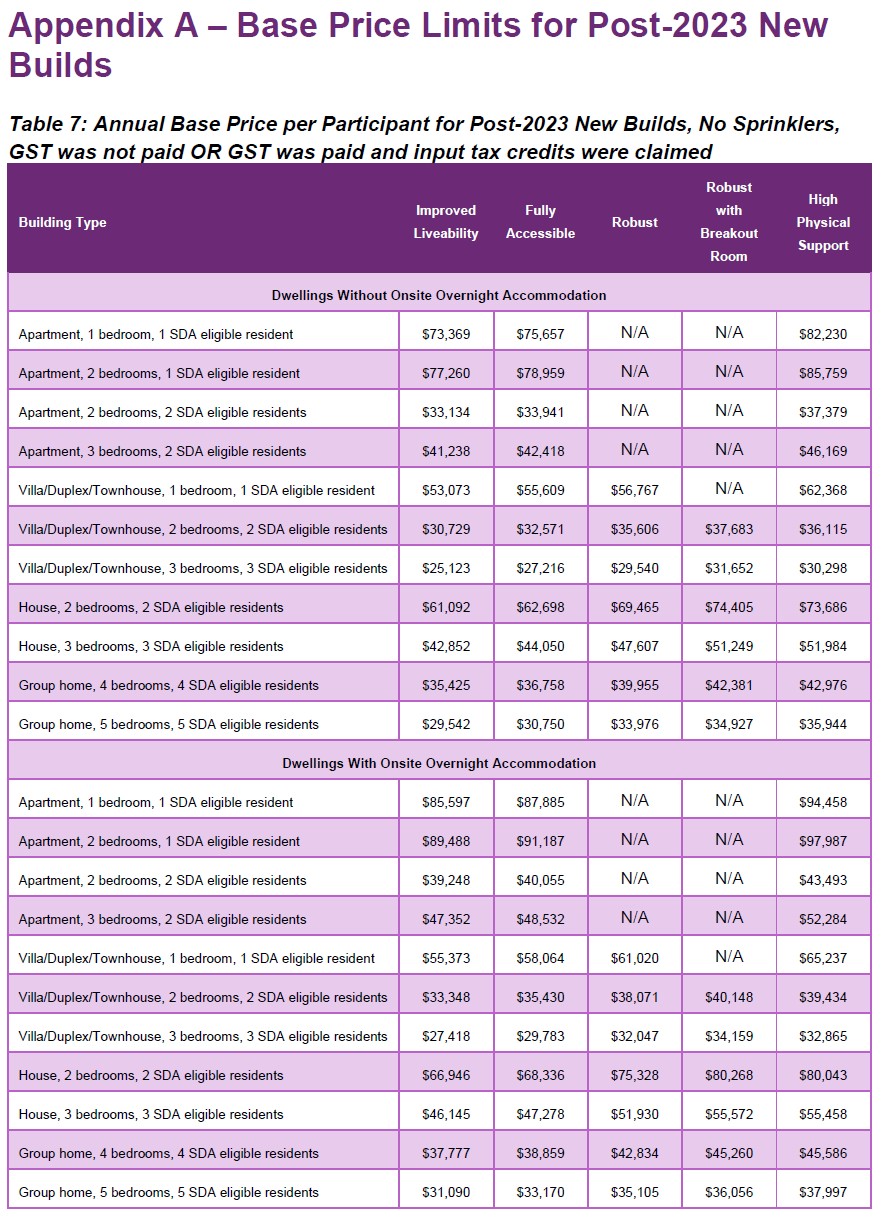
58 The SDA Price Guide plainly did not contemplate a two-bedroom house with one eligible resident.
59 I further note that all of the Tables in Appendix A to the SDA Price Guide were in a similar format, namely none of the Tables included a reference to a house occupied by a single resident.
60 Reading these provisions as a whole, I am satisfied of the following:
The Minister is empowered to make Rules for the National Disability Insurance Scheme, including in connection with the funding (or non-funding) or provision (or non-provision) of reasonable and necessary supports or general supports. The Minister is empowered to make rules on supports that will not be funded under the NDIS.
Requirements and obligations for SDA funding are set out in the SDA Rules, which were made for the purposes of ss 33(7), 34(2), 35(1) and 209(2A) of the NDIS Act.
The maximum amount that a participant can be funded under the NDIS is determined under the SDA Price Guide (ss 9 and 15 of the SDA Rules). This price guide is “an instrument or other writing as in force or existing from time to time” for the purposes of s 209(2) of the NDIS Act.
The SDA Price Guide provided that only circumstance in which a NDIS participant will be funded for living in a two-bedroom house is where there are two SDA eligible residents sharing the house. The SDA Price Guide did not contemplate a NDIS participant being the sole resident in a two-bedroom house.
Although the NDIS Act makes provision for reasonable and necessary supports to be provided to a NDIS participant, there is a maximum cap on what reasonable and necessary supports will be funded. That maximum cap, for specialist disability accommodation, is prescribed by the SDA Price Guide.
I do not accept the submission of Mr Caterson that, even though the SDA Price Guide does not provide for a single resident house, such living arrangements are not excluded from funding where they are otherwise reasonable and necessary. While the SDA Rules and SDA Price Guide do not prescribe supports that are reasonable and necessary, they do prescribe supports that will be funded.
While, within the meaning of ss 33-35 of the NDIS Act, it may be reasonable and necessary for Mr Caterson to be the sole NDIS resident of a two-bedroom house, such living arrangements are not funded by the scheme.
I am not persuaded that the omission of a two-bedroom house occupied by a single resident in the SDA Price Guide was a drafting oversight which the Court should recognise and “correct”. As Counsel for the NDIA submitted, there was no material before the Court which would support a finding to this effect.
In relation to whether s 209(4) of the NDIS Act prevented the exclusion of funding support for a single resident, two-bedroom house, there was no material before the Court to substantiate non-compliance with s 209(4). I further note that (as submitted by Counsel for the NDIA) this issue could have been, but was not, raised before the Tribunal.
61 As Bell, Gageler, Gordon and Edelman JJ explained in Frugtniet v Australian Securities and Investments Commission [2019] HCA 16 at [51]; (2019) 266 CLR 250 at 271:
… The AAT exercises the same power or powers as the primary decision-maker, subject to the same constraints … The AAT must address the same question the primary decision-maker was required to address, and the question raised by statute for decision by the primary decision-maker determines the considerations that must or must not be taken into account by the AAT in reviewing that decision …
62 In circumstances where the NDIA was not permitted to fund Mr Caterson living as the sole NDIS resident of a two-bedroom house, any direction to that effect by the Tribunal was invalid.
63 The NDIA has substantiated ground of appeal 2.
Conclusion
64 The appeal is allowed. The matter will be remitted to the Administrative Review Tribunal to be decided according to law, by making a direction, as to the specialist disability accommodation for Mr Caterson, that is consistent with the SDA Rules.
65 The NDIA does not seek costs. Accordingly, each party will bear their own costs.
I certify that the preceding sixty-five (65) numbered paragraphs are a true copy of the Reasons for Judgment of the Honourable Justice Collier. |
Associate:
Dated: 19 March 2026


