

Federal Court of Australia
Bodum AG v H.A.G Import Corpn (Australia) Pty Ltd [2026] FCA 238
File number(s): | NSD 1650 of 2024 |
Judgment of: | RAPER J |
Date of judgment: | 10 March 2026 |
Catchwords: | INTELLECTUAL PROPERTY – application for injunctive relief for breaches of ss 18, 29(1)(a), (g) and (h) of the Competition and Consumer Act 2010 (Cth), Sch 2 (Australian Consumer Law) and passing off CONSUMER LAW – misleading or deceptive conduct – passing off – use of the shape and design features of the applicants’ double walled glasses but where the respondent placed an etching on the glass and had packaging with its own labelling – where the applicants did not establish a secondary reputation in the shape – where both the applicants and respondents had well-established reputations in the Australian market – where the respondent deliberately copied the shape and design features – whether the respondent deliberately intended to mislead and deceive – conduct not misleading or deceptive and did not constitute passing off – applications dismissed |
Legislation: | Competition and Consumer Act 2010 (Cth), sch 2 (Australian Consumer Law), ss 18, 18(1), 29(1)(a), 29(1)(g), 29(1)(h) Copyright Act 1968 (Cth), ss 75, 77A Designs Act 2003 (Cth), s 10 Evidence Act 1995 (Cth), s 136 |
Cases cited: | Australian Competition and Consumer Commission (ACCC) v TPG Internet Pty Ltd [2020] FCAFC 130; 278 FCR 450 Australian Competition and Consumer Commission (ACCC) v TPG Internet Pty Ltd [2013] HCA 54; 250 CLR 640 Australian Competition and Consumer Commission v TPG Internet Pty Ltd [2019] FCA 1677; 375 ALR 537 Australian Woollen Mills Ltd v FS Walton & Co Ltd [1937] HCA 51; 58 CLR 641 Bed Bath ‘N' Table Pty Ltd v Global Retail Brands Australia Pty Ltd [2023] FCA 1587; 182 IPR 393 Bed Bath 'N' Table Pty Ltd v Global Retail Brands Australia Pty Ltd [2025] HCA 50; 426 ALR 518 Bodum v DKSH Australia Pty Ltd [2008] FCA 1854 Bodum v DKSH Australia Pty Ltd [2011] FCAFC 98; 280 ALR 639 Cadbury Schweppes Pty Ltd v Darrell Lea Chocolate Shops Pty Ltd [2007] FCAFC 70; 159 FCR 397 Campomar Sociedad, Limitada v Nike International Limited [2000] HCA 12; 202 CLR 45 ConAgra Inc v McCain Foods (Aust) Pty Ltd [1991] FCA 299; 101 ALR 461 Dr Martens Australia Pty Ltd v Figgins Holdings Pty Ltd [1999] FCA 461; 44 IPR 281 Dr Martens Australia Pty Ltd v Rivers (Australia) Pty Ltd [1999] FCA 1655; 95 FCR 136 Freeman Cosmetic Corporation v Jenola Trial Pty Ltd (t/a South Pacific Cosmetics) (Jenkinson J, 18 October 1993, unreported); (1993) ATPR 41-270 Global Retail Brands Australia Pty Ltd v Bed Bath ‘N’ Table Pty Ltd [2024] FCAFC 139; 424 ALR 119 Homart Pharmaceuticals Pty Ltd v Careline Australia Pty Ltd [2017] FCA 403; 349 ALR 598 In-N-Out Burgers, Inc v Hashtag Burgers Pty Ltd [2020] FCA 193; 377 ALR 116 Interlego AG v Croner Trading Pty Ltd [1992] FCA 624; 39 FCR 348 Jacksons Drawing Supplies Pty Ltd v Jackson’s Art Supplies Ltd [2025] FCA 530 Jones v Dunkel (1959) 101 CLR 298 Knott Investments Pty Ltd v Winnebago Industries, Inc [2013] FCAFC 59; 211 FCR 449 Koninklijke Philips Electronics NV v Remington Products Australia Pty Ltd [2000] FCA 876; 100 FCR 90 Kruger v Thompson [2025] FCAFC 143 Natural Waters of Viti Limited v Dayals (Fiji) Artesian Waters Limited [2007] FCA 200; 71 IPR 571 Nutrientwater Pty Ltd v Baco Pty Ltd [2010] FCA 2; 84 IPR 452 Optical 88 Ltd v Optical 88 Pty Ltd (No 2) [2010] FCA 1380; 275 ALR 526 Parkdale Custom Built Furniture Pty Ltd v Puxu Pty Ltd [1982] HCA 44; 149 CLR 191 Quintis Ltd (Subject to Deed of Company Arrangement) v Certain Underwriters at Lloyd’s London Subscribing to Policy Number B0507N16FA15350 [2021] FCA 19; 385 ALR 639 RB (Hygiene Home) Australia Pty Ltd v Henkel Australia Pty Ltd [2022] FCA 1042; 168 IPR 293 Reckitt & Colman Products Ltd v Borden Inc [1990] 1 All E.R. 873 Red Bull Australia Pty Ltd v Sydneywide Distributors Pty Ltd [2001] FCA 1228; 53 IPR 481 S & I Publishing Pty Ltd v Australian Surf Life Saving Pty Ltd (1998) 88 FCR 354 Self Care IP Holdings Pty Ltd v Allergan Australia Pty Ltd [2023] HCA 8; 277 CLR 186 Societe Civile et Agricole du Vieux Chateau Certan v Kreglinger (Australia) Pty Ltd [2024] FCA 248; 179 IPR 226 State Government Insurance Corporation v Government Insurance Office of New South Wales (1991) 28 FCR 511 State Street Global Advisors Trust Company v Maurice Blackburn Pty Ltd (No 2) [2021] FCA 137; 164 IPR 420 Stuart Alexander & Co (Interstate) Pty Ltd v Blenders Pty Ltd (1981) 37 ALR 161 Sydneywide Distributors Pty Ltd v Red Bull Australia Pty Ltd [2002] FCAFC 157; 117 FCR 189 Taco Co of Australia Inc v Taco Bell Pty Ltd (1982) 42 ALR 177 Telmak Teleproducts (Australia) Pty Ltd v Coles Myer Ltd (1989) 89 ALR 48 Telstra Corp Ltd v Phone Directories Co Pty Ltd [2014] FCA 568; 316 ALR 590 Thai World Import & Export Co Ltd v Shuey Shing Pty Ltd (1989) 17 IPR 289 Urban Alley Brewery Pty Ltd v La Sirène Pty Ltd [2020] FCA 82; 150 IPR 11 Verrocchi v Direct Chemist Outlet Pty Ltd [2016] FCAFC 104; 247 FCR 570 Vivo International Corporation Pty Ltd v Tivo Inc [2012] FCAFC 159; 294 ALR 661 |
Division: | General Division |
Registry: | New South Wales |
National Practice Area: | Intellectual Property |
Sub-area | Copyright and Industrial Design |
Number of paragraphs: | 336 |
Date of last submission/s: | 10 February 2026 |
Date of hearing: | 20 – 24 October 2025, 17 February 2026 |
Counsel for the Applicants: | Mr J Hennessy SC with Mr M Gvozdenovic |
Solicitor for the Applicants: | Gilbert and Tobin |
Counsel for the Respondent: | Mr E Heerey KC with Ms J Ambikapathy |
Solicitor for the Respondent: | MinterEllison |
ORDERS
NSD 1650 of 2024 | ||
BETWEEN: | BODUM AG First Applicant BODUM (AUSTRALIA) PTY LTD (ACN 104 809 672) Second Applicant PI-DESIGN AG Third Applicant | |
AND: | H.A.G IMPORT CORPN (AUSTRALIA) PTY LTD (ACN 005 109 035) Respondent | |
order made by: | RAPER J |
DATE OF ORDER: | 10 March 2026 |
THE COURT ORDERS THAT:
1. The application be dismissed.
2. The applicants pay the respondent’s costs as agreed or assessed.
Note: Entry of orders is dealt with in Rule 39.32 of the Federal Court Rules 2011.
REASONS FOR JUDGMENT
RAPER J:
Introduction
1 In the early 2000s, Mr Jørgen Bodum, continuing his father’s designer tea and coffee glassware empire legacy, observed young people in Copenhagen drinking coffee from glasses but needing to place napkins around them to insulate their hands from the heat of the coffee. This was the genesis for the design and thereafter success of the applicants (hereafter Bodum) in the design, manufacture and sale of double walled glasses (DWGs), which by the double glass wall design, allowed a person to drink hot or cold liquid, in an aesthetically pleasing glass, without any discomfort upon touch.
2 Since 2004, the Bodum Group has promoted, designed, manufactured, distributed, and sold DWGs in Australia. Bodum registered its various designs of this product and enjoyed, by this registration, a cloaked monopoly for a decade until that registration expired. The respondent (hereafter HAG) is an Australian corporation that has used Maxwell & Williams as a trade mark for a range of homewares, including glassware, and has been registered in Australia as the owner of a number of trade marks with the “Maxwell & Williams” logo. HAG, an importer and distributor, decided to copy (in shape and design features) two of Bodum’s bestselling DWGs (the Pavina and the Canteen) and, from various dates in 2019, 2021 and 2023, sold those glasses in the Australian market.
3 The dispute typifies the nature of the market battleground within the array of intellectual property regulation. Intellectual property law allows for the registration of trade marks, designs, patents and gives protection from copying but for generally finite periods. Here, Bodum maintains the protection of its marks. The dispute concerns what Bodum said is the distinctive shape of two very popular glasses which Bodum said HAG has copied and sold at a cheaper price. Bodum wants to jealously guard those design shapes after the expiry of the design registration. It claims it is able to do so on the basis that HAG has engaged in misleading and deceptive conduct in contravention of s 18 of sch 2 to the Competition and Consumer Act 2010 (Cth) (Australian Consumer Law), as well as having contravened ss 29(1)(a), (g) and (h) of the ACL. Bodum also seeks a declaration that HAG has committed the tort of passing off. The hearing has been split to only deal with questions of liability at this stage.
4 Accordingly, the following issues require determination: first, whether HAG has engaged in the pleaded conduct and it is misleading and deceptive within the meaning of the ACL and secondly, whether, by the same pleaded conduct, HAG has committed the tort of passing off.
5 The heart of the dispute concerns HAG’s importing, promotion and distribution in the Australian market of two almost identical competing products (the Blend and Blend Conical), in the same sizes as Bodum’s bestselling Pavina and Canteen DWGs, with the following dimensions:
Pavina DWG products
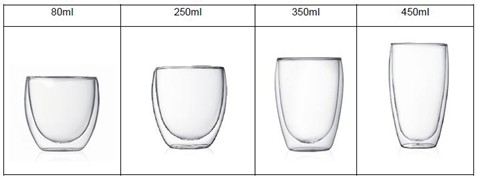
Canteen DWG products
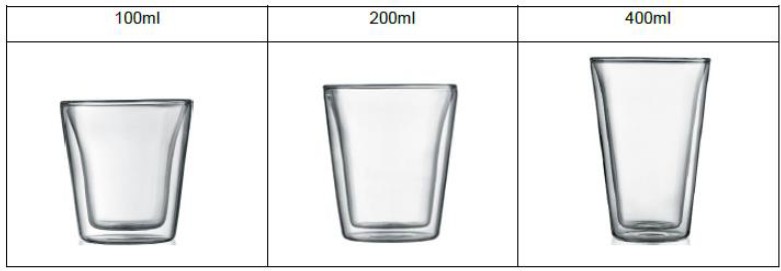
6 Bodum contends that, with respect to the Pavina DWG range, the designs have a distinctive overall appearance that includes the following combination of features:
(a) Internal layer of glass with rounded bottom and curved sides;
(b) External layer of glass with curved sides tapering to a flat base with rounded corners;
(c) Rounded lip at opening of glass where internal and external layers connect as a single piece of glass; and
(d) The internal layer of glass appears suspended inside external layer of glass.
(the Pavina DWG Design Features).
7 Similarly, Bodum also contends with respect to the Canteen DWG designs that they have a distinctive overall appearance that includes the following combination of features:
(a) Internal layer of glass with narrower flat bottom and straight, angled sides tapering outwards to a wider section at the opening of the glass;
(b) External layer of glass with straight, angled sides tapering from a flat narrower base with rounded corners to a wider section at the opening of the glass;
(c) Rounded lip at opening of glass where internal and external layers connect as a single piece of glass; and
(d) The internal layer of glass appears suspended inside external layer of glass.
(the Canteen DWG Design Features).
8 In addition to HAG giving prominence to each of the parties’ established reputations in the Australian market, HAG emphasised the difference, as between them, in the labelling and packaging of the products.
9 There are four additional features of the Bodum DWGs (not replicated on HAG’s competing products): The base of the glasses contain an imprint of the Bodum logo rendered against a white background and the statements “Patents visit www.bodum.com/ip/6” and “Design registered by Pi-Design AG, Switzerland”, there is a “vent” with the silicon seal and a removable sticker containing the Bodum logo on the side of the glass. Each of these features can be seen in the following images:
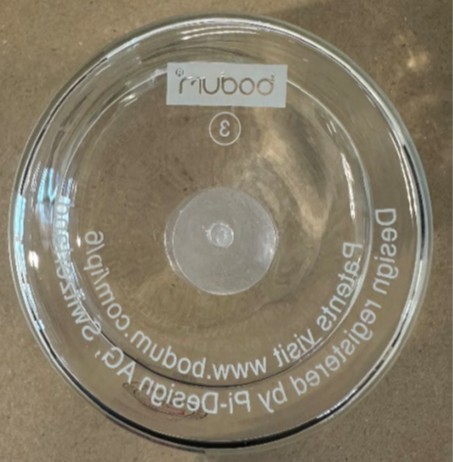
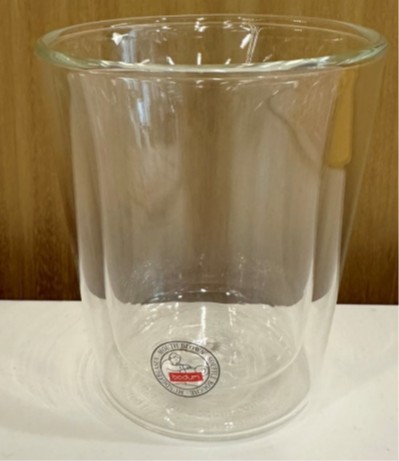
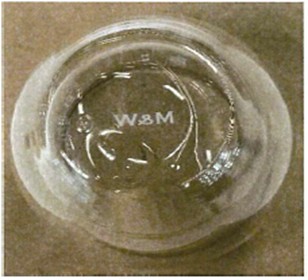
10 By contrast, the HAG DWGs have the trade mark “M&W” imprinted on the bottom of each glass, as depicted below:
11 Whilst Bodum has had different packaging from time to time, an illustration of the comparative packaging for the Bodum Pavina DWG and the HAG Blend DWG is as follows:
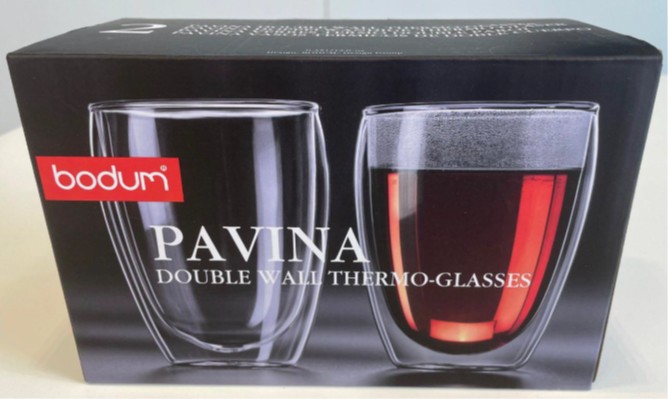
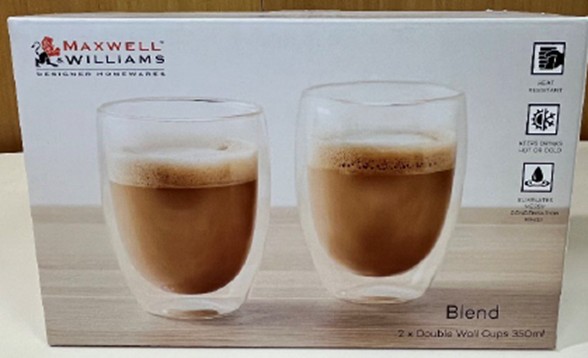
12 The comparative packaging for the Bodum Canteen DWG and the HAG Blend Conical DWG is as follows:
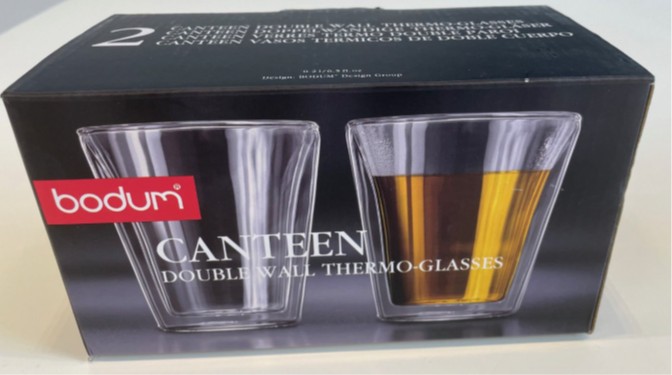
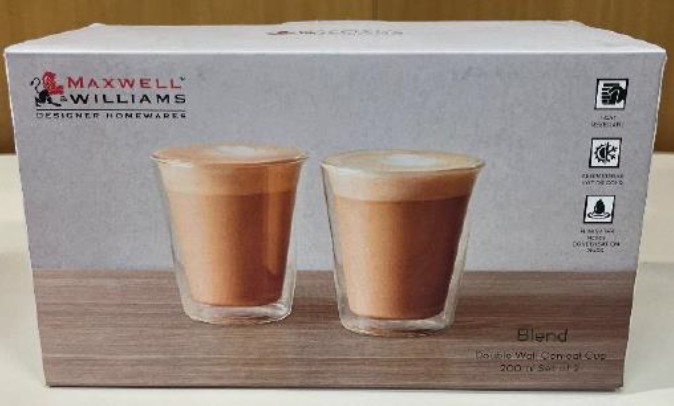
13 The dispute between the parties can be summarised as follows.
14 Each of the parties use the reputation evidence in different ways to support their positions. Whilst it is accepted that there is no need to establish a reputation in the shape for the purpose of the ACL claim unlike the passing off claim, one is not precluded from considering the reputations of each of Bodum and HAG as forming part of the circumstances in which the impugned conduct occurred.
15 Bodum relies on the fact of the distinctiveness of its shape in the market as being the springboard from which HAG drew customers into its marketing web. HAG disputes that Bodum has established a secondary reputation, at the relevant dates, in the distinctiveness of the shape, such that it was known by the relevant class of consumers to be associated with Bodum.
16 HAG gave prominence to the fact of registration by both HAG and Bodum of their own trademarks for extensive periods prior to the relevant dates that HAG sold its competing products in the market, as well as the expiry of the associated design registrations. HAG submitted that account needed to be given to the fact that the Pavina and Canteen DWGs were not Bodum’s flagship products but formed part of a large drinking glass product range including a large number of DWGs which are promoted, distributed and sold in Australia under the Bodum logos and word marks. From this, HAG relies on the fact of the use by each of them of their logos and word marks, on the base of the glasses, and on the packaging, as being crucial to its defence, such that consumers would not be misled or deceived as to the origin of HAG’s glasses (nor any of the additional representations) nor a claim in passing off being made out.
17 In this context, the dispute involved consideration of four different forms of consumer experience (online, via catalogue, and in-store where the glasses are displayed with or without packaging). It was agreed, in certain contexts, that the products are sold without a member of the relevant class being able to see the etching on the bottom of the glass and the packaging.
18 HAG emphasises the fact that the relevant glasses were initially registered designs in Australia but that those designs have expired and, as a consequence, “other traders in Australia have been at liberty to make, import and sell products which embody those designs”, pursuant to s 10 of the Designs Act 2003 (Cth). Further, it pleads, that by reason of ss 75 and 77A of the Copyright Act 1968 (Cth), it is not an infringement of copyright to make, import or sell products which embody those designs.
19 In response, Bodum submits that it may be so that it is no longer able to be afforded protection under those provisions, but it remains open for it to be so protected by the more expansive protections available under the ACL and in passing off.
20 A significant aspect of both Bodum’s claims was HAG’s intention. HAG admits that it intended to adopt the shape and design features of the Bodum DWG products. The dispute centres around what the effect that admission has on Bodum’s causes of action. Bodum submits that, by reason of this admission, the presumption in Australian Woollen Mills Ltd v FS Walton & Co Ltd [1937] HCA 51; 58 CLR 641 at 657 is made out and it follows that HAG’s conduct is presumed to be for the purpose of appropriating Bodum’s reputation and “therefore likely to be misleading or deceptive”. In response, HAG offers four matters said to displace the presumption. First, that the shape of the Pavina and the Canteen do not have a reputation independent of the Bodum brand. Secondly, that consumers would not be misled having regard to the use of logos or wordmarks on the products’ respective packaging and/or signage in department stores. Thirdly, that copying is permitted and desirable where design registrations have lapsed. Fourthly, that HAG’s products are “properly labelled” in the Puxu sense: Parkdale Custom Built Furniture Pty Ltd v Puxu Pty Ltd [1982] HCA 44; 149 CLR 191 at 199-200. To which Bodum submits that these matters are neither correct nor sufficient to refute the High Court’s presumption, and ultimately, the conclusion is that HAG’s conduct was likely to mislead or deceive and constitute passing off.
Summary of conclusions
21 For the reasons given below, I have concluded that Bodum has not made out its claim pursuant to s 18 of the ACL for misleading and deceptive conduct arising from the similarities in the shape (whether comprising all or a part of the get up) as between its Pavina and Canteen products and HAG’s competing Blend ranges. I have also concluded that Bodum has not made out its claim in passing off as against HAG.
The claims brought by Bodum
Australian Consumer Law
22 Bodum submitted that, in the course of promoting and selling the Blend DWG and Blend Conical DWG in Australia, HAG has made and is making one or more of the following representations to members of the public:
(a) that the Blend DWG are Pavina DWG;
(b) that the Blend Conical DWG are Canteen DWG;
(c) that the Blend DWG are affiliated or associated with the Pavina DWG;
(d) that the Blend Conical DWG are affiliated or associated with the Canteen DWG;
(e) that the Blend DWG are part of or associated with BODUM® ranges of glasses;
(f) that the Blend Conical DWG are part of or associated with BODUM® ranges of glasses;
(g) that the Blend DWG have been manufactured, marketed and promoted with the licence, sponsorship or approval of the source of BODUM® branded glasses;
(h) that the Blend Conical DWG have been manufactured, marketed and promoted with the licence, sponsorship or approval of the source of BODUM® branded glasses;
(i) that the Blend DWG are licensed, sponsored or approved by the source of the Pavina DWG;
(j) that the Blend Conical DWG are licensed, sponsored or approved by the source of the Canteen DWG; and
(k) that Maxwell & Williams is licensed by or associated with the source of the Pavina DWG and/or Canteen DWG, and/or the source of BODUM® branded glasses,
(collectively, the Representations).
23 Bodum submitted that each representation was made in trade or commerce, and is or was false, misleading and or deceptive, in that:
(a) the Blend DWG are not the Pavina DWG;
(b) the Blend Conical DWG are not the Canteen DWG;
(c) the Blend DWG are not affiliated or associated with the Pavina DWG;
(d) the Blend Conical DWG are not affiliated or associated with the Canteen DWG;
(e) the Blend DWG are not part of or associated with BODUM® ranges of DWGs;
(f) the Blend Conical DWG are not part of or associated with BODUM® ranges of DWGs;
(g) the Blend DWG have not been manufactured, marketed and promoted with the licence, sponsorship or approval of the source of BODUM® branded DWGs;
(h) the Blend Conical DWG have not been manufactured, marketed and promoted with the licence, sponsorship or approval of the source of BODUM® branded DWGs;
(i) the Blend DWG are not licensed, sponsored or approved by the source of the Pavina DWG;
(j) the Blend Conical DWG are not licensed, sponsored or approved by the source of the nCanteen DWG; and
(k) Maxwell & Williams is not licensed by or associated with the source of the Pavina DWG and/or Canteen DWG.
24 It was said by Bodum that, by reason of the conduct foregoing, HAG has engaged, are engaging, and further or alternatively are threatening to engage, in conduct which is, or is likely to be, misleading or deceptive in contravention of s 18 of the ACL. Further, HAG has made, or is making, false or misleading representations in connection with the promotion of the supply of goods or services in contravention of ss 29(1)(a), (g) and (h) of the ACL.
Passing off
25 By reason of the purported secondary reputation that Bodum claims to have in the Bodum shapes, the Pavina DWG Design Features and the Canteen DWG Design Features, HAG, by their conduct referred to above, has passed off the Blend DWG and/or the Blend Conical DWG as:
(a) the Pavina DWG and/or Canteen DWG;
(b) affiliated or associated with the Pavina DWG and/or Canteen DWG;
(c) part of a BODUM® branded range of DWGs; and
(d) an authorised derivative BODUM® branded DWGs.
Loss and damage
26 Bodum submits that they have suffered loss and damage and will continue to suffer such loss and damage. Unless restrained, HAG will continue to engage in the conduct alleged above. By reason of the conduct alleged, HAG has made, and will continue to make, profits at the expense of Bodum, unless the conduct of HAG identified above is restrained by this Court.
Evidence
Bodum’s Evidence
Lay evidence
27 Mr Jørgen Bodum gave evidence as the CEO of Britbo Holding AG, part-owner of the Bodum Group, and a director of each of the applicants. Mr Jørgen Bodum was the immediate previous CEO with his son (Peter Bodum) taking over after him. Mr Jørgen Bodum gave evidence of the corporate structure of the Bodum Group, the history of the business as a family business, his father’s invention and foundation of the Bodum business, and development of Bodum logos and trade marks. He also gave evidence on the history and development of DWGs made and offered for sale by Bodum. He also deposed to having meetings with glass manufacturers in China. He deposed to having designed the double wall version of the Canteen glass. He then worked with Mr Yamamoto to create a further DWG design marketed under the trade mark “Pavina”. He then worked on creating a “silicone vent”, that equalises the air pressure between the two layers of glass. He said that he understands that Bodum’s DWGs are the only DWGs which have this vent.
28 Mr Jørgen Bodum caused the Pavina and Canteen DWGs to be registered designs in Australia in 2004 until 2014. The designs won several awards. Bodum marketed the Pavina and Canteen DWGs globally. From 2008, the products were packaged in packaging he designed. He said he designed the packaging in a way that mimicked as close as possible the experience of having the product on the shelf. In October 2008, following the patent for the silicone vent, the packaging was changed. He deposed that, while Bodum is using up the existing stock of this packaging, its products continue to be sold with that packaging. However, there is a further, new design packaging, as depicted below:
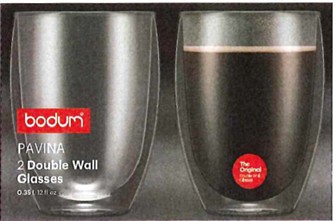
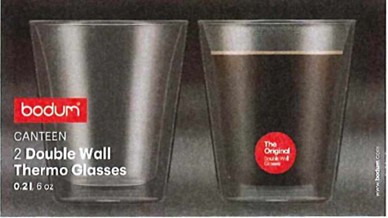
29 Mr Jørgen Bodum also deposed to the catalogues and leaflets for the products, and advertising campaigns for Bodum products, including the Canteen DWG and Pavina DWG. He also deposed to digital marketing campaigns, partnerships with brands such as Qantas, trade shows, fairs and festivals, international marketing and sales figures.
30 Mr Jørgen Bodum gave evidence as to when in or around November 2023, he first became aware of Maxwell & Williams offering for sale products which appeared to him to be copies of the Canteen DWG and Pavina DWG. He gave evidence as to what he observed as to the display of the Blend DWG and Blend Conical DWGs in November 2023, November 2024 and March 2025, when he visited the Myer Store in Sydney City. Mr Jørgen Bodum deposed that since the introduction of Maxwell & Williams' Blend DWG and Blend Conical DWG, the Pavina DWG and Canteen DWG have experienced significant drops in sales in Australia.
31 Mr Peter Bodum is the CEO of the Bodum Group and deposed to Bodum’s global business operations and marketing practices (including its marketing budget). He also deposed as to user data analyses as to consumer access to Bodum websites, including on social media channels, and partnerships with other businesses for the use of the Pavina and Canteen DWGs. He gave evidence as to his understanding of the process by which Bodum manufactures its glasses. Mr Peter Bodum also deposed that, on 14 August 2025, Gilbert + Tobin showed him the image which is reproduced at page 2 of Confidential Exhibit PB-4, as follows:
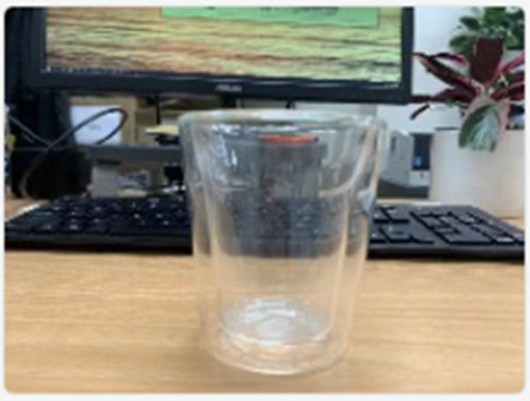
Mr Peter Bodum reviewed the image and observed that it is an image of a Bodum Canteen double-walled glass.
32 Mr Gino Maiolo has held the position of Country Sales Manager for Australia and New Zealand since October 2023. He deposed to his understanding of the Australian homewares market, and Bodum’s business operations in Australia. Mr Maiolo deposed to the branding, marketing and promotion of Pavina and Canteen DWGs in Australia and the market segments targeted. Mr Maiolo gave evidence as to how the Pavina DWG and Canteen DWGs are promoted through in-store displays, and as to his understanding that Bodum products are to be displayed (under their global merchandising standard) outside their packaging.
33 Mr Maiolo also deposed to the marketing and promotion strategy of Bodum Australia and the processes that are undergone with respect to Bodum AG’s approval. He also gave evidence as to the modes of advertising, including through print advertising (magazines, catalogues, in-store and point-of-sale advertising), through television advertising, digital advertising, social media, trade fairs, roadshows and events. In addition, his evidence concerned partnerships, collaborations and promotions through retailers, press releases, bulletins and leaflets. He also deposed to the advertising of the Pavina DWG and Canteen DWG ranges with no Bodum brand name or logo. He also deposed to his understanding of the Maxwell & Williams products and sale in Australia. He deposed that, in his view, the Blend range appears identical to the Pavina DWG range. Similarly, in his view, the Blend Conical range appears identical to the Canteen DWG range. This is particularly so when they are observed on the shelves of stores, which is how they are most commonly offered for sale. He said that he is also aware that the Maxwell & Williams name and logo do not appear on the base of the Blend and Blend Conical ranges.
34 It was Mr Maiolo’s evidence that he observed that Bodum’s products (including the Pavina DWG range) are located in very close proximity to the Blend and Blend Conical ranges in Myer stores. He said that there is close proximity between Bodum in-store displays and Maxwell & Williams in-store glassware displays. He said that he is also aware that the majority of Maxwell & Williams’ products are located elsewhere in the Myer stores. By this he means that Maxwell & Williams’ glassware is located in close proximity to Bodum’s products, however, their porcelain and other housewares products are located in another location in the store (at a Maxwell & Williams branded “store within a store”). Mr Maiolo’s second affidavit deposed to the date ranges and sources of the catalogues exhibited to his first affidavit.
35 Ms Dunn, solicitor for Bodum, gave evidence of her review of HAG’s trade mark portfolio and HAG’s use of only the “M&W” word mark (M&W mark) on the Blend DWG and Blend Conical DWG ranges and not the M&W figurative trademark with the word “M&W” alongside a lion logo (M&W lion logo). Ms Dunn also gave evidence of searches conducted of advertising and promotion of Pavina and Canteen DWGs in Australia across a range of media publications. In response to the Affidavit of Deanna Ficatas affirmed 21 July 2025 at [35]–[63], where she described the steps she took to purchase DWGs through various online retailers, Ms Dunn deposed that, on 14 August 2025, she caused a Google search to be conducted for the term “Double walled glass” and described the search results. Lastly, Ms Dunn undertook searches for media articles on the databases operated by Westlaw AU.
36 Ms Allen gave evidence as a solicitor under the supervision of Ms Dunn, having attended the retailer Myer at the Sydney City store and purchased the Maxwell & Williams Blend DWG and Blend Conical DWG sets. Ms Gough Cooper also a solicitor working under the supervision of Ms Dunn gave responsive evidence to that of Ms Kelly Tunbridge affirmed 25 July 2025 and the affidavit of Deanna Ficatas affirmed 21 July 2025. Ms Gough Cooper gave evidence as to her observations as a result of her attendance, on 30 September 2025, at the Myer store at 436 George Street, Sydney.
37 Ms Cullen, another solicitor under the supervision of Ms Dunn, referred to the Notice to Admit and the covering letter regarding the image which appears on page 1231 of Confidential Annexure KET-27 to the Affidavit of Kelly Elise Tunbridge affirmed 25 July 2025 and the Notice of Dispute. She deposed that, on 23 September 2025, she undertook a company search for H.A.G. Import Corpn (Australia) Pty Ltd (ACN 005 109 035) using Dye & Durham, a third-party company search provider. A copy of the company search is reproduced at pages 57 to 63 of Exhibit DEC-1. The company search indicates that Max Grundmann is the sole director, secretary and shareholder of HAG.
Expert evidence
38 Mr Simpson is an industrial designer who, since 2003 has led various industrial design roles and founded his own design firm in 2005. His firm oversees the design work of 15 industrial designers and has worked on and overseen the development of thousands of products including the designing of glass products. Mr Simpson was asked by Bodum to give his expert opinion on six questions:
(a) the process of designing and manufacturing a double walled drinking glass including any functional and aesthetic considerations;
(b) the visual features and shape of the two Bodum DWGs;
(c) an overview of the DWGs available in the Australian market between 2019 and 2023;
(d) whether one or more of the visual features and/or shape of the Bodum DWGs are distinctive as compared to other DWGs available in the Australian market;
(e) the visual features and shape of the two HAG DWGs; and
(f) a comparison of the visual features and shape between Bodum’s and HAG’s DWGs.
39 HAG objected to Mr Simpson’s evidence, submitting that it should be admitted subject to a limitation under s 136 of the Evidence Act 1995 (Cth) that it is not:
(a) evidence representative of the relevant class of consumers;
(b) evidence of consumer perception or behaviour;
(c) evidence on the question of whether HAG’s conduct was likely to mislead or deceive in all the circumstances.
40 I determined that a s 136 limitation would apply to his evidence on the basis that it is not evidence representative of the relevant class of consumers and does not constitute evidence of “consumer perception or behaviour”.
Witnesses required for cross-examination
41 Mr Jørgen Bodum and Mr Maiolo were the only Bodum witnesses required for limited cross-examination. No challenge was made to the credibility of their testimony. Rather, submissions were made as to the weight given to it and its relevance.
42 As to the key aspects of the evidence they gave under cross-examination, Mr Jørgen Bodum, who designed the shape of the Bodum Pavina and Canteen DWG ranges, was asked to accept, based on his review of photographs of certain competitor DWGs available in Australia before the relevant dates, that they bear the same design features as those of the Pavina and Canteen glasses, by similar description, to the features identified by Mr Bodum at [37(d)] of his first affidavit, and by reference to how they are described respectively at [16] and [18] of the Statement of Claim. It can be queried, as to the relevance of this, given he was not asked about the shape of the glasses.
43 It was my impression of Mr Jørgen Bodum that he has worked tirelessly his whole life (from age 7 or 8 in his father’s warehouse), to when he took on a more substantive role (upon his father’s death when he was 17 years of age), for Bodum and has been very successful, particularly in his designs. Mr Jørgen Bodum stated emphatically that he did not want anyone to copy his designs (whether with or without permission).
44 Mr Maiolo was cross-examined largely about the absence of control Bodum has as to the merchandising of its products in stores. Mr Maiolo accepted that ultimately, despite Bodum’s preferred guidelines as to how their products ought be displayed (amongst other things, outside the box and not in front of their boxes), stores have their own merchandising standards and practices and control how products are displayed.
HAG’s evidence
Lay evidence
45 Ms Ficatas is a lawyer at MinterEllison. She deposed to attending the Myer store located in the Bourke St Mall at 314/336 Bourke St, Melbourne VIC 3000 on 14 May 2025, 13 June 2025, and 1 July 2025, taking photographs and gave evidence as to her observations at the store. Ms Ficatas thereafter deposed that her colleague Ms Laurendet attended the Myer store located at 436 George St, Sydney NSW 2000 on 26 May 2025 to undertake a similar exercise as her own. Ms Laurendet informed Ms Ficatas of her observations which Ms Ficatas records. Ms Ficatas then deposed to the process preceding the purchase of DWGs from four online retailers: Myer, Matchbox, Harris Scarfe and Amazon. She deposed that between 14 and 16 December 2024, she identified products on various web pages that are included in Annexure C to HAG’s defence filed on 17 December 2024. For each product, she listed the URL of the website where the image of the product was located. On 16 and 17 July 2025, she visited the URL for each of the products listed in the “Product and link” column of Annexure C and took a screenshot of each webpage as that webpage appeared at that date. These screenshots are at pages 185 to 237 of Annexure DCF-7.
46 Ms Dutkowski is a lawyer at MinterEllison in Melbourne, Victoria. She deposed to her observations on two occasions at the Chadstone Myer store in Melbourne and also on another occasion at the Dalgarno’s store in Elsternwick.
47 Ms Dutkowski then deposed to various searches she conducted: on and for the Bodum website; for Bodum products on Bodum social media; for other brands of DWGs on other social media; and for Maxwell & Williams products on Google database. From 14 to 22 May 2025, she caused searches to be conducted in person of the catalogue of the State Library of Victoria for the magazines in which advertisements, included in Bodum’s evidence, appeared and summarised the results at [39]–[65]. From 19 to 27 June 2025, she caused searches to be conducted in person of the catalogue of the State Library of New South Wales for the magazines in which advertisements, included in Bodum’s evidence, appeared and summarised the results at [67]–[95].
48 On 2 July 2025, Ms Dutkowski caused online searches to be conducted on PressReader (pressreader.com) for the QANTAS Spirit of Australia magazines in which advertisements, included in Bodum’s evidence, appeared and summarised the results at [97]–[100]. On the same date, she caused online searches to be conducted of Prime Creative Media on the Issuu website at issuu.com for the Global Coffee Report magazine in which an advertisement, included in the Bodum’s evidence, appeared and set out her results at [102]–[103]. On the same date she caused online searches to be conducted of subscription websites for magazines in which advertisements, included in Bodum’s evidence, appeared at [104] and set out the results at [104]–[105].
49 In her September and October affidavits, Ms Dutkowski deposed to results of subpoenas she caused to be issued on various competitor DWGs producers as to their unit sales in Australia.
50 Ms Tunbridge was at the time of affirming her evidence Head of Product at HAG. It is apparent that her employment ceased in very short time after affirming this evidence. Ms Tunbridge was the only witness proffered by HAG to give evidence as to circumstances leading to the adoption of the Blend and Blend Conical products but in circumstances where she was not even in the employ of HAG when the Blend product was first adopted and introduced into the market. Her evidence is considered in detail below. Ms Tunbridge was required for cross-examination. For the reasons set out below, it was my view that her evidence was largely unsatisfactory and in certain respects her evidence was not accepted.
Relevant principles – the ACL claim
51 Subsection 18(1) of the ACL provides:
(1) A person must not, in trade or commerce, engage in conduct that is misleading or deceptive or is likely to mislead or deceive.
52 Sections 29(1)(a), (g) and (h) of the ACL provides:
29 False or misleading representations about goods or services
(1) A person must not, in trade or commerce, in connection with the supply or possible supply of goods or services or in connection with the promotion by any means of the supply or use of goods or services:
(a) make a false or misleading representation that goods are of a particular standard, quality, value, grade, composition, style or model or have had a particular history or particular previous use; or
…
(g) make a false or misleading representation that goods or services have sponsorship, approval, performance characteristics, accessories, uses or benefits; or
(h) make a false or misleading representation that the person making the representation has a sponsorship, approval or affiliation; or
…
53 The principles governing ss 18 and 29 of the ACL are well established: Self Care IP Holdings Pty Ltd v Allergan Australia Pty Ltd [2023] HCA 8; 277 CLR 186 at [80]-[84]; Australian Competition and Consumer Commission (ACCC) v TPG Internet Pty Ltd [2020] FCAFC 130; 278 FCR 450 at [18]-[25]. The determination of whether there is a breach of s 18 of the ACL, involves four steps: Self Care at [80] per Kiefel CJ, Gageler, Gordon, Edelman and Gleeson JJ:
Determining whether a person has breached s 18 of the ACL involves four steps: first, identifying with precision the “conduct” said to contravene s 18; second, considering whether the identified conduct was conduct “in trade or commerce”; third, considering what meaning that conduct conveyed; and fourth, determining whether that conduct in light of that meaning was “misleading or deceptive or … likely to mislead or deceive”.
54 Their Honours helpfully went on to describe more expansively those stepping stones along the reasoning path at [81]-[83]:
The first step requires asking: “what is the alleged conduct?” and “does the evidence establish that the person engaged in the conduct?”. The third step considers what meaning that conduct conveyed to its intended audience. As in this case, where the pleaded conduct is said to amount to a representation, it is necessary to determine whether the alleged representation is established by the evidence. The fourth step is to ask whether the conduct in light of that meaning meets the statutory description of “misleading or deceptive or …likely to mislead or deceive”; that is, whether it has the tendency to lead into error. Each of those steps involves “quintessential question[s] of fact”.
The third and fourth steps require the court to characterise, as an objective matter, the conduct viewed as a whole and its notional effects, judged by reference to its conduct, on the state of mind of the relevant person or class of persons. That context includes the immediate context – relevantly, all the words in the document or communication and the manner in which those words are conveyed, not just a word or phrase in isolation – and the broader context of the relevant surrounding facts and circumstances. ….
Where the conduct was directed to the public or part of the public, the third and fourth steps must be undertaken by reference to the effect or likely effect of the conduct on the ordinary and reasonable members of the relevant class of persons. The relevant class of persons may be defined according to the nature of the conduct, by geographical distribution, age or some other common attribute, habit or interest. It is necessary to isolate an ordinary and reasonable “representative member” (or members) of that class, to objectively attribute characteristics and knowledge to that hypothetical person (or persons), and to consider the effect or likely effect of the conduct on their state of mind. This hypothetical construct “avoids using the very ignorant or the very knowledgeable to assess effect or likely effect; it also avoids using those credited with habitual caution or exceptional carelessness; it also avoids considering the assumptions of person which hare extreme or fanciful”. The construct allows for a range of reasonable reactions to the conduct by the ordinary and reasonable member (or members) of the class.
55 Conduct is likely to mislead or deceive if there is a real or not remote chance or possibility of it so doing, it is not sufficient if the conduct merely causes confusion, it is unnecessary to prove an intention to mislead or deceive and it is unnecessary to prove that the conduct in question actually deceived or misled. Rather, the question is determined objectively and by the Court itself: TPG FCAFC at [22].
56 Further, as identified by Beach J in State Street Global Advisors Trust Company v Maurice Blackburn Pty Ltd (No 2) [2021] FCA 137; 164 IPR 420 at [715]:
...there must be a sufficient nexus between the impugned conduct or apprehended conduct and the customer’s misconception or deception. Subject to one qualification, the error or misconception must result from the relevant respondent’s conduct and not from other circumstances for which that respondent was not responsible. But conduct that exploits or feeds into and thereby reinforces the pre-existing mistaken views of members of the relevant class may be misleading or deceptive or likely to mislead or deceive.
57 Relevant to Bodum’s argument in this case is that the High Court has recognised, by extension, that misleading and deceptive conduct may occur if the relevant class has been led into “the marketing web” by an erroneous belief engendered by an advertiser, even if the consumer may come to appreciate the true position before the transaction is concluded: Australian Competition and Consumer Commission (ACCC) v TPG Internet Pty Ltd [2013] HCA 54; 250 CLR 640 at [50].
58 It is worth noting what has been previously observed by this Court about the distinction between new market entrants who attempt to use packaging, colour and trade indicia to attract some of the familiarity that consumers have with the market leader’s products and engaging in misleading or deceptive conduct or passing off. As observed by Murphy J in Telstra Corp Ltd v Phone Directories Co Pty Ltd [2014] FCA 568; 316 ALR 590 at [539]-[540]:
Experience teaches that it is far from unusual for a new entrant to a market to attempt through packaging, use of colour, or use of other trade indicia to attract some of the familiarity that consumers have in the products of the market leader. As Mr Weissenberg said:
The first brand that comes into the marketplace and establishes the category sets the tonality for everyone else and, you know, they follow in terms of packaging, in terms of colour use, etc. That is quite a common thing.
But that is not the same thing as setting out to deceive.
It is also necessary to keep in mind that it is no part of the court’s task to be critical of the respondents for taking an element of Telstra’s get up unless they have engaged in misleading or deceptive conduct or passing off: Dr Martens Australia Pty Ltd v Figgins Holdings Pty Ltd (1999) 44 IPR 281 at [306]–[307] per Goldberg J. The authorities are replete with examples where traders “sail close to the wind” by copying elements of a competitor’s get up, but maintain sufficient differences such that misleading or deceptive conduct or passing off cannot be made out. The question is whether the trader goes too far and steps over the line into misrepresentation.
59 Lastly, the establishment of an intention to deceive will be highly relevant to whether conduct is likely to deceive potential consumers. Whilst the appellant in Australian Woollen Mills was not able to establish such an intention, Dixon and McTiernan JJ stated, at page 657:
But the examination made of the respondent’s motives and good faith seems to us to leave the question of infringement and passing off very much in the same position as it stood in without it. The rule that if a mark or get-up for goods is adopted for the purpose of appropriating part of the trade or reputation of a rival, it should be presumed to be fitted for the purpose and therefore likely to deceive or confuse, no doubt, is as just in principle as it is wholesome in tendency. In a question how possible or prospective buyers will be impressed by a given picture, word or appearance, the instinct and judgment of traders is not to be lightly rejected, and when a dishonest trader fashions an implement or weapon for the purpose of misleading potential customers he at least provides a reliable and expert opinion on the question whether what he has done is in fact likely to deceive. Moreover, he can blame no one but himself, even if the conclusion be mistaken that his trade mark or the get-up of his goods will confuse and mislead the public.
60 As to the place of intention, as their Honours went on to observe immediately after this well-known passage, “the practical application of the principle may sometimes be attended with difficulty”: at 657. Despite recognising the possibility of the principle applying, their Honours went on to consider carefully the states of mind, motives and intentions of three people whose combined judgment was attributed to the company when it decided it should adopt the trade brand and description complained of and ultimately concluded that it could not be established that they had any intention to mislead or deceive nor nonetheless that the conduct gave rise to misleading and deceptive conduct.
61 More recently the principle was applied in Bed Bath ‘N' Table Pty Ltd v Global Retail Brands Australia Pty Ltd [2023] FCA 1587; 182 IPR 393 (BBNT PJ) where Rofe J found that the respondent had engaged in misleading and deceptive conduct, in part, by application of the presumption, finding at [511]:
It is also highly relevant that when it adopted the House B&B mark, GRBA was aware of the existence of BBNT and its reputation in the soft homewares sector, as both had been operating in the broader homewares sector for around 40 years. When combined with a surprising lack of legal advice and the fierce determination not to change the name of the store when the prospect of confusion was first brought to GRBA’s attention, GRBA’s attitude to the possibility of confusion of House B&B with BBNT can only be described as one of wilful blindness. Although GRBA’s wilful blindness may not amount to an intention to deceive consumers, it provides a similarly “reliable and expert opinion on the question of whether [GRBA’s conduct] is in fact likely to deceive”: see Australian Woollen Mills at 657 (per Dixon and McTiernan JJ).
62 Relevant to the case at hand, her Honour at [512] went on to emphasise the Full Court’s observation in Sydneywide Distributors Pty Ltd v Red Bull Australia Pty Ltd [2002] FCAFC 157; 117 FCR 189 (Red Bull FC), at [117], including that a trader may explain his or her conduct in such a way as to undermine the availability of that inference.
63 The High Court recently opined as to the place of state of mind evidence in determining whether the putative copyist had engaged in conduct that was likely to mislead or deceive: Bed Bath 'N' Table Pty Ltd v Global Retail Brands Australia Pty Ltd [2025] HCA 50; 426 ALR 518 (BBNT). The Full Court had found that the primary judge’s finding that the relevant witness’ state of mind amounted to a finding that the witness knew that some confusion would occur which was not the same as an intention to mislead or deceive consumers or an intention to cause confusion, and given the limitations in the primary judge’s finding as to “wilful blindness”, the relevant witness’ subjective state of mind was not “capable” of providing any reliable evidence on the objective question of whether the conduct was likely to mislead or deceive consumers: Global Retail Brands Australia Pty Ltd v Bed Bath ‘N’ Table Pty Ltd [2024] FCAFC 139; 424 ALR 119 (BBNT FC) at [88]. The High Court disagreed and found that the primary judge’s findings were not so limited, and it was not necessary for the primary judge to characterise the state of knowledge attributed to the alleged wrongdoer in terms of particular degrees of knowledge: at [49]. Further, the High Court found that the evidentiary propositions in Australian Woollen Mills are not confined to “cases of a trader’s use of a competitor’s trade mark or get-up with dishonest intent to mislead consumers”: at [52].
64 The Court considered and reordered the various strands of the reasoning in Australian Woollen Mills in the following way (footnotes omitted), at [52]-[56]:
The relevant part of the reasoning in Australian Woollen Mills is compressed. Dixon and McTiernan JJ described the first proposition as a "rule that if a mark or get-up for goods is adopted for the purpose of appropriating part of the trade or reputation of a rival, it should be presumed to be fitted for the purpose and therefore likely to deceive or confuse". Their Honours then said that "[i]n a question how possible or prospective buyers will be impressed by a given picture, word or appearance, the instinct and judgment of traders is not to be lightly rejected, and when a dishonest trader fashions an implement or weapon for the purpose of misleading potential customers he at least provides a reliable and expert opinion on the question whether what he has done is in fact likely to deceive". Ultimately, their Honours said, "it becomes a question of fact for the court to decide whether in fact there is such a reasonable probability of deception or confusion that the use of the new mark and title should be restrained".
There are several strands of reasoning in these observations. The last strand, in principle, is the first; the ultimate question (by analogy, whether conduct is misleading or deceptive or likely to mislead or deceive) is one of objective assessment of fact. The second strand involves an evidentiary approach, so that if the person intending to achieve an end or object by the doing of an act is a trader in the relevant area of business, that trader's belief that the doing of an act will achieve a certain end or object and that trader's doing of the act on the basis of that belief may be taken as "a reliable and expert opinion on the question whether what [the trader] has done is in fact likely to" achieve the intended end or object. The inference that the trader held this state of mind, referred to as an "expert opinion", is relevant and forms part of the evidence before the judge to be weighed with all other relevant evidence on the ultimate objective question of fact, whether the intended end or object occurred.
While, in explaining this final strand, their Honours referred to a "dishonest trader" achieving the end or object of misleading or deceiving consumers, neither in logic nor legal principle can the method of reasoning be so limited. In the case of misleading or deceptive conduct or conduct likely to mislead or deceive in contravention of s 18(1) of the Australian Consumer Law, a person's dishonest intention is not an element of the statutory proscription. A person may be scrupulously honest and yet by conduct contravene s 18(1). But that does not mean a person's state of mind is irrelevant to the question of contravention. A person's state of mind may be relevant in the ways described in Australian Woollen Mills. Moreover, because s 18(1) does not depend on a person's dishonest intention, a person's state of mind, directly or by analogy, may engage the approach to evidence explained in Australian Woollen Mills. The infinite spectrum of a person's state of mind from dishonest intent to scrupulous honesty are all within the scope of that reasoning.
In the present case, as noted, the primary judge was not satisfied that GRBA dishonestly intended to appropriate part of BBNT's trade and reputation by misleading consumers as to an association between GRBA's soft homewares stores and BBNT. But GRBA, on the primary judge's findings, certainly intended to take part of BBNT's trade and decided to use part of the BBNT mark, together with the "Hamptons" style of the BBNT get-up and other soft homewares stores, intending to achieve the end or object of taking part of BBNT's trade. The primary judge's reasoning that the evidentiary approach in Australian Woollen Mills was engaged and that the evidentiary approach supported the inference that Mr Lew's state of mind was a cogent reflection of reality involved no error.
The observation on which the Full Court relied, that "proof of a subjective intention to mislead ... may be some evidence that in a border line case the respondents' conduct is likely to mislead or deceive", is too narrow in multiple respects. As explained, the evidentiary approach in Australian Woollen Mills is not confined to cases of a subjective intention to mislead. Nor are they engaged only in a "border line case". And nor is such resulting evidence to be classified as "some evidence" only, if by that emphasis the Full Court was intended to convey that evidence resulting from the operation of the evidentiary approach is to be given less weight on an a priori basis derived from its character. A judge's obligation is to consider all the relevant evidence including the evidence resulting from the operation of the evidentiary approach. The weight of the evidence so resulting will be an output of the judge's calibration of the overall strengths and weaknesses of all the relevant evidence. The weight the resulting evidence takes in the particular case therefore is not capable of being either "overstated" or "understated" in the abstract as it will be case dependent.
65 As helpfully crystalised by Burley J in Homart Pharmaceuticals Pty Ltd v Careline Australia Pty Ltd [2017] FCA 403; 349 ALR 598 at [35], in considering whether consumers are likely to be misled or deceived, it is necessary to consider the alleged infringing conduct as against all the surrounding circumstances, including:
(1) the strength of the applicant’s reputation, and the extent of distribution of its products;
(2) the strength of the respondent’s reputation, and the extent to which the respondent has undertaken any advertising of its product;
(3) the nature and extent of the differences between the products, including whether the products are directly competing;
(4) the circumstances in which the products are offered to the public; and
(5) whether the respondent has copied the applicant’s product or has intentionally adopted prominent features and characteristics of the applicant’s product;
Verrocchi, first instance at [62]; cited by Verrocchi, Full Court at [69] (Nicholas, Murphy and Beach JJ).
66 This is because, as Burley J went onto observe:
(a) in a case of this kind an applicant must establish that it has acquired the relevant reputation in the name or get-up such that the name or get-up has become distinctive of the applicant’s business or products: S & I Publishing Pty Ltd v Australian Surf Life Saving Pty Ltd (1998) 88 FCR 354 at 362-3 per Hill, R D Nicholson and Emmett JJ (Homart at [22]);
(b) a trader may establish a reputation in trade indicia other than names and logos which may be protected without registration as a trade mark: Homart at [23] citing Cadbury Schweppes Pty Ltd v Darrell Lea Chocolate Shops Pty Ltd [2007] FCAFC 70; 159 FCR 397 at [97]. His Honour thereafter observed that, if particular branding elements used by a trader have been identified in a special way with that trader in the minds of members of the public, there may be misleading or deceptive conduct by reason of the appropriation of those particular branding elements by another trader: Homart at [23] citing Cadbury Schweppes at [97];
(c) the relevant date for assessing the reputation of an applicant for the purpose of s 18 of the ACL is the date that the impugned conduct commenced: Homart at [24] citing Thai World Import & Export Co Ltd v Shuey Shing Pty Ltd (1989) 17 IPR 289 at 302 (per Gummow J); Taco Co of Australia Inc v Taco Bell Pty Ltd (1982) 42 ALR 177 at 182 (Franki J), 195, 196, 204 (Deane and Fitzgerald JJ); Optical 88 Ltd v Optical 88 Pty Ltd (No 2) [2010] FCA 1380; 275 ALR 526 at [334] (Yates J).
(d) consideration will invariably mean that it is necessary to consider the class of persons to whom the representation was directed: Homart at [25], citing S & I Publishing at 362-3.
(e) where the persons in question are members of a class to which the conduct in question was directed in a general sense, it is necessary to isolate by some criterion a representative member of that class: Homart at [26]. Where the effect contemplated of is on a class of consumers (as in the present case), the effect of the conduct (here, the get-up) on reasonable members of the class is to be considered: Homart at [26] citing Campomar Sociedad, Limitada v Nike International Limited [2000] HCA 12; 202 CLR 45 at [103] per Gleeson CJ, Gaudron, McHugh, Gummow, Kirby, Hayne and Callinan JJ.
(f) for the purposes of a breach of s 18 of the ACL, the focus is upon the misleading of others, and therefore the conduct must be identified (for example, the use of shape, words) which is said to be misleading or deceptive: Homart at [28].
(g) in assessing the character of the conduct in question, within the relevant factual circumstances, conduct which misleads a consumer such that she or he opens negotiations or invites approaches under some mistaken impression of a trader’s connection or affiliation with another, may be engaging in misleading or deceptive conduct, even if the true position emerges before the transaction is concluded: Homart at [29] and citing Bodum v DKSH Australia Pty Ltd [2011] FCAFC 98; 280 ALR 639 at [210].
(h) whether an impression of a trader’s connection or affiliation, which does not linger until point of sale, is sufficient to amount to misleading or deceptive conduct depends on the circumstances of each case: Homart at [29]. In Stuart Alexander & Co (Interstate) Pty Ltd v Blenders Pty Ltd (1981) 37 ALR 161 at 169, Lockhart J declined to find misleading or deceptive conduct because, despite similarities in the get-up of the containers, he found that the trade name (“Moccona” as against “Andronicus”) was sufficient to distinguish the goods. In the Taco Co case, Deane and Fitzgerald JJ at 199 declined to make a finding of general principle that point of sale confusion was required.
67 Evidence from individual consumers that they have been misled by the impugned conduct is of limited utility. It has no statistical significance and the Court cannot draw inferences from it that any section or fraction of the population will have similar reactions; but if the inference is open, independently of such testimonial evidence, that the conduct is misleading or deceptive or likely to mislead or deceive, then it may be that the evidence of consumers that they have been misled can strengthen that inference: Verrocchi v Direct Chemist Outlet Pty Ltd [2016] FCAFC 104; 247 FCR 570 at [94] citing State Government Insurance Corporation v Government Insurance Office of New South Wales (1991) 28 FCR 511 at 529 (French J, as he was then).
68 Lastly, HAG emphasised relevant dicta as to the law permitting, indeed encouraging, traders to copy the designs of their competitors’ products unless those designs are protected under the Designs Act. Since Bodum’s protection under the Designs Act expired, its competitors have been at liberty to make, import and sell products which embody those designs: Puxu at 220-1 per Brennan J. Gibbs CJ stated the general approach to these cases is as follows at 199-200 (emphasis added):
Speaking generally, the sale by one manufacturer of goods which closely resemble those of another manufacturer is not a breach of s. 52 if the goods are properly labelled. There are hundreds of ordinary articles of consumption which, although made by different manufacturers and of different quality, closely resemble one another. In some cases this is because the design of a particular article has traditionally, or over a considerable period of time, been accepted as the most suitable for the purpose which the article serves. In some cases indeed no other design would be practicable. In other cases, although the article in question is the product of the invention of a person who is currently trading, the suitability of the design or appearance of the article is such that a market has become established which other manufacturers endeavour to satisfy, as they are entitled to do if no property exists in the design or appearance of the article. In all of these cases, the normal and reasonable way to distinguish one product from another is by marks, brands or labels. If an article is properly labelled so as to show the name of the manufacturer or the source of the article its close resemblance to another article will not mislead an ordinary reasonable member of the public.
Relevant principles – the passing off claim
69 As recently identified by Beach J in Societe Civile et Agricole du Vieux Chateau Certan v Kreglinger (Australia) Pty Ltd [2024] FCA 248; 179 IPR 226 at [440]-[443], the tort of passing off involves the following elements:
(a) the existence of a reputation, at the time of the respondent’s impugned conduct, in the mind of the relevant purchasing class for the applicant’s products or a reputation in the get-up of the applicant’s products such that the get-up is recognised by relevant purchasers as distinctive of the applicant’s products.
(b) there has to be a misrepresentation by the respondent, whether intentional or inadvertent, that its products are those of the applicant or affiliated with the applicant or a misrepresentation by the respondent’s use of the same or a similar get-up to indicate that the respondent’s products are the same as the applicant’s products or come from or are associated with the applicant.
(c) the applicant must have suffered or be likely to suffer damage flowing from the erroneous belief engendered by the misrepresentation.
70 Despite there being a close relation and elemental overlap between passing off and misleading and deceptive conduct, the causes of action have distinct origins and purposes. As observed by the Full Court in Cadbury Schweppes at [98]:
...the causes of action have distinct origins and the purposes and interests that both bodies of law primarily protect are contrasting. Passing off protects a right of property in business or goodwill whereas Part V is concerned with consumer protection. Part V is not restricted by common law principles relating to passing off and provides wider protection than passing off.
71 A key distinction is that the establishment of a reputation is required in passing off but not under the ACL.
Issues to be determined
72 In summary form, the issues are as follows:
(a) The relevant class of consumers of the Blend DWG and the Blend Conical DWG products (about which there was agreement), are adult Australian tea and coffee drinkers (the Relevant Class) (Issue 1).
(b) Whether the Pavina and Canteen DWG design features or shapes had acquired a reputation and become distinctive in the minds of the Relevant Class at the relevant dates (Issues 2 and 3). Issues 2 and 3 involve ancillary consideration of:
(i) The extent to which the respective products had been promoted and displayed before the relevant dates;
(ii) The sales of the respective products before the relevant dates;
(iii) As at the relevant dates, what other drinking glass products (including DWGs) had been promoted, distributed and sold in Australia under the word mark Bodum and or the Bodum logo mark:

(iv) What other DWGs were available in Australia prior to the relevant dates, to what extent they possessed the Pavina and Canteen design features and/or shape, both individually and in combination, and how they differed from the Bodum Pavina and Canteen products;
(v) Whether the word mark Bodum and/or Bodum logo mark was well-known in Australia in the Relevant Class and whether such reputation detracts from there also being a reputation in the shape and/or the respective design features in Australia at the relevant dates;
(c) Whether HAG intended to adopt the shape and design features of the Pavina and Canteen products when creating the two impugned products (notably this was admitted by HAG at the beginning of the hearing). And relatedly, whether this intention to adopt was done with an intention to mislead or deceive in the sense that such adoption was for the purpose of appropriating part of the trade or reputation of the shape and/or design features of the Pavina and Canteen products. This latter aspect was not admitted (Issue 4).
(d) Whether HAG was likely to mislead a number of ordinary and reasonable consumers of the Relevant Class into the erroneous belief that the impugned products emanate from Bodum or are otherwise associated or affiliated with Bodum or their products by promoting and selling two impugned products (Issue 5). As part of this inquiry consideration includes:
(i) The qualities of the Relevant Class;
(ii) Any reputation in the Pavina and/or Canteen DWG products (as per Issues 2 and 3);
(iii) The extent to which the impugned products have the design features and/or shape of the Pavina and/or Canteen DWG (where at hearing HAG conceded that they did);
(iv) How the impugned HAG products are promoted and sold in Australia;
(v) How any of the logos and trade marks are used on the products, packaging or otherwise used in relation to the impugned products;
(vi) The level of thought/consideration given by the Relevant Class prior to purchasing DWGs;
(vii) The extent to which, if any, logos and trade marks were used on the products, packaging, or otherwise used in relation to the impugned HAG products, and were well-known in the Australian market by consumers in the Relevant Class;
(viii) Any evidence that HAG intended to mislead or deceive (as determined as per Issue 4).
(e) For the purpose of determining the passing off claim only, whether HAG has injured the goodwill and reputation of Bodum (Issue 6).
73 There was very little dispute between the parties on questions of law and fact. As to questions of law, there were three primary disputes: (a) as to the overall assessment and the emphasis given to the presumption in Australian Woollen Mills, the Court’s consideration of the factors necessary to determine whether consumers would be misled or deceived within the meaning of s 18 or as part of a claim in passing off: Bodum submitted it was the starting point and gave significant attention in its written and oral submissions to the bases for and the purported fact of the presumption being made out; (b) the necessity to determine, as part of whether Bodum had satisfied the Court of its reputation, that the claimed reputation has been established amongst a “significant” or “substantial” proportion of the Relevant Class of persons in Australia; and (c) as to whether for the purpose of the presumption to be enlivened, there is a necessity to establish that HAG “intended to deceive”. The latter issue fell away after the High Court handed down its decision in BBNT late last year.
74 The parties agree as to the Relevant Class of consumer being Australian adult tea and coffee drinkers, the fact of the existence of Bodum’s products before the relevant dates upon which HAG produced the competing products, and the relevant dates when HAG entered the market with its DWG products which are the subject of the proceeding.
75 The parties largely agreed as to all of the facts underpinning Bodum’s claims as to its reputation (in the shape) prior to the relevant date, but rather each disputed that their respective alternate reputations in their word marks or logos could be deployed in answer to their respective claims. HAG disputed that the evidence established that Bodum did in fact have a reputation in the shape as opposed to having a reputation as to its word mark and logo. Bodum disputed, and said HAG had not established, that Bodum had a brand or logo as at the relevant dates and/or that its own reputation in that brand or logo detracted from or cancelled out any independent reputation in the shape. Similarly, to the extent that HAG relied upon its own reputation in its logo and word mark, said to be deployed, in part, as an etching on the bottom of the glass and by its packaging, Bodum disputed that these matters warded against its ACL and passing of claims.
76 Much was made by Bodum as to HAG’s late admission that it intended to adopt the Bodum shape and the leverage that could be made from that admission (and the surrounding evidence or lack of it) as to why it could be established that its claim of misleading and deceptive conduct was made out and also its claim in passing off. It was submitted that by reason of there being nothing in the actual records of HAG to assist it and no appropriately qualified person, in HAG’s mid-order management or otherwise, proffered to give evidence, the only sensible conclusion was that HAG adopted the Bodum shapes to mislead and deceive and to appropriate Bodum’s trade or reputation.
77 HAG’s submissions gave focus to why, despite its admission, the fact that it had placed an etching on the bottom of the glass and deployed its well-known wordmark and logo on the packaging were such that each of Bodum’s claims could not be established.
Consideration
The Relevant Class (Issue 1)
78 In order to determine whether HAG’s alleged conduct was misleading or deceptive, it is necessary to identify the class of persons who are claimed to have been aware of Bodum’s reputation in the shape of the Pavina and Blend DWGs at the relevant dates.
79 I find that the Relevant Class of persons to whom the conduct is directed, namely consumers of the Blend DWG and the Blend Conical DWG products, consists adult Australian tea and coffee drinkers. The relevant market is the market for coffee and tea related glassware (Relevant Market). This is apparent from the fact that the glasses are marketed particularly for the drinking of tea or coffee, and HAG’s pleaded depiction of its external packaging shows the Blend Products with tea or coffee in the double walled glassware. HAG’s own evidence describes the Bodum products (being those which it wants to adopt) as being “[f]or the hot beverage lover and coffee enthuses” and identifies the Blend Products as being found in “sections” of retailers that are identified with “signage” that reads “Tea & Coffee” or just “Coffee”.
The relevant dates for establishing reputation
80 As adverted to above, Bodum’s secondary reputation in the shape of the DWGs is relevant to its ACL claim (though on its case alleged, not essential) but a prerequisite for its passing off claim. As a consequence, it is worthwhile first dealing with the issues associated with reputation.
81 It is necessary to identify the relevant times at which Bodum’s reputation (and on HAG’s case, its own reputation) is to be assessed, given a company’s reputation may change over time. The relevant dates were agreed as between the parties for assessing HAG’s impugned conduct. They must be the time at which the impugned conduct commenced: BBNT FC at [67] (not in issue on appeal). With respect to the Pavina/Blend dates, HAG started promoting and offering for sale the Blend DWG products in: (i) August 2019 for the Blend DWG products in size 250ml, 350ml and 450ml; and (ii) March 2021 for the Blend DWG products in size 80ml. HAG started promoting and offering for sale the Blend Conical DWG product in July 2023.
Principles regarding the establishment of reputation and the need for proof of a substantial number of persons being aware, at the relevant date, of the Bodum shape
82 Issues 2 and 3 concern whether Bodum has established that it had acquired, as at each of the relevant dates, a reputation in the shape and/or design features of the Pavina and Canteen products and that reputation had become distinctive in the minds of the Relevant Class of each. Before determining these questions, it is worthwhile noting the relevant principles which inform this exercise.
83 The parties agreed that the determination of reputation is a question of fact. Here the reputation is alleged to be in the shape of each of these glasses.
84 Both parties accepted that reputation is not an element of the statutory cause of action: In-N-Out Burgers, Inc v Hashtag Burgers Pty Ltd [2020] FCA 193; 377 ALR 116 at [182]-[184]; Urban Alley Brewery Pty Ltd v La Sirène Pty Ltd [2020] FCA 82; 150 IPR 11 at [235] per O’Bryan J.
85 However, as will be apparent from the above, the parties are at one as to the use of evidence concerning their respective reputations in both claims. Reputation, in a case for passing off or misleading or deceptive conduct (though not required), is established by evidence relating to: the volume of its sales; the extent and nature of its advertising, marketing and promotional activities; and the length of time, and geographical area, in which these activities have taken place: Urban Alley at [238]; McCormick at [85]–[87]; ConAgra Inc v McCain Foods (Aust) Pty Ltd [1991] FCA 299; 101 ALR 461 at 343 and 346; Nutrientwater Pty Ltd v Baco Pty Ltd [2010] FCA 2; 84 IPR 452 at [16]; Jacksons Drawing Supplies Pty Ltd v Jackson’s Art Supplies Ltd [2025] FCA 530 at [115] and [116]; Natural Waters of Viti Limited v Dayals (Fiji) Artesian Waters Limited [2007] FCA 200; 71 IPR 571 at [58]; RB (Hygiene Home) Australia Pty Ltd v Henkel Australia Pty Ltd [2022] FCA 1042; 168 IPR 293 at [315]. It was not in dispute that the claimed reputation must be established as at the date when HAG’s impugned conduct commenced: Taco Co at 195, 196, 204; Cadbury v Pub Squash at 860.
86 As referred to by Jackson J in Jacksons at [115], evidence of sales can suffice to establish reputation citing Natural Waters at [58], where Bennett J explained:
In McCormick & Co Inc v McCormick (2000) 51 IPR 102; [2000] FCA 1335 at [81]-[88], Kenny J discussed the evidence necessary or sufficient to establish reputation in a trade mark. Her Honour pointed out that evidence of sales and advertising may be sufficient to establish reputation despite the absence of any direct evidence of consumer appreciation of the mark, as opposed to the product: 'public awareness of and regard for a mark tends to correlate with appreciation of the products with which the mark is associated, as evidenced by sales volume, among other things': McCormick at [86]. Such factors may also establish the reputation necessary to found a case for passing off and contravention of s 52 of the [Trade Practices] Act: for example, Pacific Publications Pty Ltd v Next Publishing Pty Ltd (2005) 222 ALR 127; 65 IPR 58; [2005] FCA 625 at [12]-[14].
87 Ultimately, the question of reputation is a question of fact that depends on the evidence in the particular case.
88 Notably, Jackson J considered the ancillary question, within the establishment of reputation, as to the necessity for the establishment of a substantial number of persons being aware of the applicant’s product and thus that they were potential customers, and cites the following aspect of Knott Investments Pty Ltd v Winnebago Industries, Inc [2013] FCAFC 59; 211 FCR 449 at [14], where Allsop CJ summarised the position as follows:
What is required is proof of a substantial number of persons (whether residents or visitors) who were aware of the applicant's product and who were thus potential customers. Such persons represent, in a real sense, a commercial advantage available to be turned to account were the applicant to commence business: ConAgra at 346 (Lockhart J), at 372 (Gummow J) and at 377 (French J). The size and extent of the class of such potential customers may vary according to the circumstances of the case and will be measured by reference to the relevant group or section of the public likely to be potential customers. Here, such persons would be prospective buyers, hirers or users of recreational vehicles, being the class of persons who would be likely customers, whether direct or indirect. The relevance and importance of there being a substantial number flows from the need to show real damage by the deception caused by the respondent's conduct.
89 Upon consideration of this reasoning, Jackson J concluded, at [118], that the following passage from French J's judgment in ConAgra at 380-381 sheds light on the meaning of “a substantial number of persons” in this context:
The nature of the question to be asked about McCain's conduct for the purposes of s 52, Trade Practices Act is to be borne in mind in considering the correctness of the approach taken by his Honour. The question is one of characterisation of the conduct, not of the reactions of consumers or others to that conduct. So where some express representation is made and that representation is demonstrably false, it is not usually necessary to go beyond that finding in order to conclude that it is misleading or deceptive. The case of an obvious puff might be taken as an exception. Where conduct depends upon context or surrounding circumstances to convey a particular meaning, then those factors must be taken into account but only as a way of characterising the conduct. Where the name and get-up of a product are in issue, the question for the purposes of s 52 is whether they are misleading or deceptive in the circumstances. The fact that some members of the relevant public may be aware of a similar product in another country does not affect the characterisation of the conduct if that number is small. The word 'insignificant' was used by his Honour to identify the threshold of public awareness below which such conduct is not misleading for the purposes of the section. That word is normative but not for that reason inappropriate. Attention must be paid to the policy of the relevant provision which, as the heading to Pt V and many of its provisions indicate, is one of consumer protection. If the similarity complained of is commercially irrelevant having regard to the number of people who know of it, then it can be concluded that the use of the name and/or getup complained of is not misleading or deceptive. That is essentially the kind of evaluation which underpinned his Honour's finding in this case and on the primary facts that he found I am not persuaded that he erred in his approach.
90 Jackson J thereafter thoughtfully considered further authorities and ultimately concluded that the requirement of a substantial number of persons concerns the extent of the claimant’s reputation as a contextual element of a claim of misleading and deceptive conduct such that, at [121]:
It is the existence of a sufficiently extensive reputation connected with a name, mark or get up that leads to people being misled, if the impugned conduct associates the respondent with that reputation. If a reputation of that kind is not established, then the alleged conduct may well be, in French J’s words ‘commercially irrelevant’ (ConAgra at 380-381).
91 His Honour went on to explain the different principle referred to in Australian Competition and Consumer Commission v TPG Internet Pty Ltd [2019] FCA 1677; 375 ALR 537 at [23], which “simply acknowledges that it is no part of the statutory prohibition now found in s 18 of the ACL that any minimum number of people are to be misled”: at [122]. I agree with Jackson J’s observations in these respects.
92 It cannot be disputed that the “shape” of a product can become associated with a particular trader, such that its use by another could constitute misleading or deceptive conduct: See for example Red Bull Australia Pty Ltd v Sydneywide Distributors Pty Ltd [2001] FCA 1228; 53 IPR 481 (Red Bull PJ) at [65] (“sufficient similarities of get-up may conceivably relate to elements of colour, shape and size, and thus to the existence of passing off, irrespective of the use by the competitor of a different brand name”) and [66], quoting Freeman Cosmetic Corporation v Jenola Trial Pty Ltd (t/a South Pacific Cosmetics) (Jenkinson J, 18 October 1993, unreported); (1993) ATPR 41-270 (“[w]hat attract[s] the eye, in the case of each of the parties’ bottles, are the general shape of the bottle (including its cap) […] Those are the features which remain in recollection”). See also Dr Martens Australia Pty Ltd v Figgins Holdings Pty Ltd [1999] FCA 461; 44 IPR 281 at [308]; Reckitt & Colman Products Ltd v Borden Inc [1990] 1 All E.R. 873.
Summary of parties’ competing positions regarding reputation in the shape
93 Both parties took different positions as to the importance of the establishment of Bodum’s reputation in the shape of its products. Bodum accepted a finding of the same was necessary for its passing off claim but not its misleading and deceptive conduct claim, citing the Full Court in Cadbury Schweppes which confirmed that this principle is limited to passing off and does not apply to s 18 at [99] (emphasis added, see also [96]-[98]):
The question is not whether an applicant has shown a sufficient reputation in a particular get-up or name. The question is whether the use of the particular get-up or name by an alleged wrongdoer in relation to his product is likely to mislead or deceive persons familiar with the claimant’s product to believe that the two products are associated, having regard to the state of the knowledge of consumers in Australia of the claimant’s product.
94 On the other hand, HAG submitted that in order for Bodum to make out its misleading and deceptive conduct case, Bodum, in this case, given the representation concerns the shape and any association with it, needed to establish that the ordinary consumers in the Relevant Class at the relevant dates had an awareness of (or understanding of Bodum’s reputation in) the shapes of the Bodum Pavina and Canteen DWGs such that they would think those shapes came from Bodum, regardless of any Bodum branding.
Bodum’s history and trading
95 Mr Peter Bodum, Mr Jørgen Bodum’s father, started the first Bodum company in Copenhagen, Denmark in 1944, by importing a range of goods, including glassware and vacuum coffee makers, under his name into Denmark. Upon Mr Peter Bodum’s gauging of consumer interest in certain coffee-related products, he set about improving their design and thereafter developed many vacuum coffee maker products.
96 After Mr Peter Bodum’s death, Mr Jørgen Bodum’s mother took over the business until Mr Jørgen Bodum completed his studies. During his mother’s stewardship, Bodum started to distribute products internationally, including to Australia in 1973. In 1974, Mr Jørgen Bodum became the company’s CEO, and it was his goal to continue his father’s legacy by developing innovative new products in the coffee (and later tea) making markets.
97 Mr Jørgen Bodum gave evidence as to the most successful (in terms of sales) of the products thereafter created and sold as including Bodum’s first French coffee press, known as the Bistro (which has received a number of prestigious international and Danish design awards), another coffee press known as the Melior, the Assam teapot and the Pavina and Canteen DWGs.
98 It was Mr Jørgen Bodum’s evidence that the provenance of the DWGs came from his observations of young people in cafes in Copenhagen drinking coffee from glasses, but where those glasses were wrapped in napkins as they were too hot to hold. Mr Jørgen Bodum gave detailed evidence as to evolution of that idea into a DWG, through its design and production phase.
99 During the time that Mr Jørgen Bodum was CEO of Bodum, the company grew from only producing vacuum coffee makers to producing hundreds of products and distributing them globally. Later, the company launched its own retail stores. It was not disputed that Bodum is now a global brand with a signature Scandinavian design aesthetic, which distributes its products to over 55 countries with entities in Australia, Switzerland, Hong Kong, Portugal, Denmark, Japan, Germany, Holland, Korea, France, England, the USA and Singapore.
The Bodum logos and trademarks
100 The Bodum business, brand and many of the companies within the Bodum group bear the family name Bodum. Mr Peter Bodum created the first logo for the company in 1955. Bodum first entered the Australian market in 1969. In 1974, Mr Jørgen Bodum created the next Bodum logo depicted in either black or red. In 1978 and 1979, Bodum started to use the following logo in either black or red:

101 Then in 1980, used the following logo from time to time:

102 From around 1984, the word mark “BODUM” was first registered as a trade mark in a range of countries including Australia. In 1987 and 1988, Bodum started using the following logo which it is still using today:

103 The evidence establishes that the Bodum brand, associated with the tea and coffee glassware market, was well-known in Australia at all the relevant dates.
104 Bodum Australia advertises, promotes and sells products directly to consumers and through a range of retailers in Australia, including Myer (in-store and online), David Jones (in-store and online), Amazon (online), Catch (online), Peter’s of Kensington (in-store and online), Minimax (in-store and online), Kitchen Warehouse, and through Breville, a well-known home appliance brand.
Agreed facts relevant to both the Pavina and Canteen glasses – reputation and impugned conduct
105 The following agreed facts are relevant to the assessment of Bodum’s reputation in the Pavina and Canteen shape, and the circumstances giving rise to the impugned conduct, as at the relevant dates:
(a) The Pavina and Canteen shaped DWGs were designed and developed by Mr Jørgen Bodum in 2003-2004.
(b) The first sales of these products in Australia occurred in August and October 2004 respectively.
(c) No competitive DWGs were introduced into the Australian market until mid-2014.
(d) Pi-Design was the owner of the registered designs for each of the Pavina and Canteen shapes which expired before HAG commenced promoting and selling any like DWGs in Australia.
(e) Prior to August 2019, HAG did not promote, distribute, or sell any DWGs in Australia.
(f) The Blend was introduced in around August 2019 (noting different sizes came out at later times) and the Conical in July 2023.
(g) The shape and design features of the Blend and the Conical are precise or virtually identical to the shape and design features of the Pavina and the Canteen respectively, save for:
(i) minor differences in measurement which do not affect the visual features or shape;
(ii) the fact that they both contain different marks on the bottom of their glasses;
(iii) Bodum affixes a removal sticker on its glasses; and
(iv) the Pavina and the Canteen from approximately three to four years after their initial release have a silicon vent to equalise the air pressure between the two layers of glass.
106 At hearing, HAG conceded that it intended to adopt the shape and/or design features of the Pavina and the Canteen when creating the Blend and Conical products. This admission bears some significance about which I will deal with later.
The design, advertising and promotion of the shape (Issues 2 and 3)
107 As a consequence of the above, it may be accepted that the Bodum shapes were sold for over ten years in the Australian market before any competing DWGs were introduced.
108 Account may be taken of the fact that the Pavina and the Canteen shapes were the original shapes of DWGs in the Australian market. The undisputed evidence revealed that, after their introduction, both products won a number of international and country-specific design awards in 2004, 2005, and 2006. The Pavina in particular enjoyed further promotion in the Australian market in 2014 when Bodum and the Sydney Opera House successfully collaborated, with the Pavina then sold in the Opera House gift shop. There is additional evidence of international collaborations, such as with the Museum of Modern Art in 2023 and 2024, using the Pavina and Canteen DWGs. Mr Peter Bodum’s evidence detailed the extent to which the Pavina DWG and Canteen DWG had appeared in popular culture for example in Star Trek episodes.
The sales of the Pavina and Canteen products (Issues 2(b) and 3(b))
109 Bodum relied upon a confidential exhibit of the unit sales figures between 2014 to 2025 obtained from the business records of different companies selling DWGs in the Australian market. The underlying evidence was not disputed at hearing. The evidence revealed that Bodum has sold substantial units of the Pavina products both prior to and after the relevant dates. The unit sales (where glasses are sold in, at least, pairs) for both the Pavina and Canteen products are as follows:
Type | 2017 | 2018 | 2019 | 2020 | 2021 | 2022 | 2023 | 2024 | 2025 |
Pavina | 381,130 | 311,184 | 335,938 | 538,658 | 378,858 | 153,354 | 101,886 | 130,904 | 28,744 [to April] |
Canteen | 24,514 | 37,408 | 111,662 | 40,576 | 28,508 | 21,876 | 11,518 | 8,112 | 1,504 [to April] |
110 The unit sales figures between 2020 and 2025 for Blend DWG and Conical DWG are as follows:
Type | 2017 | 2018 | 2019 | 2020 | 2021 | 2022 | 2023 | 2024 | 2025 |
Blend DWG | - | - | - | 11,998 [2019- 2020] | 25,388 [2020- 2021] | 33,286 [2021- 2022] | 60,264 [2022- 2023] | 84,037 [2023- 2024] | 70,726 [2024- 2025] |
Conical DWG | - | - | - | - | - | - | - | 16,806 [2023- 2024] | 14,030 [2024- 2025] |
111 Ultimately, Bodum submitted in closing, of which there was no dispute, that evidence contained in Confidential Exhibit JJB-2, pages 74-79 evidenced that over 6 million units of the Pavina and 1 million units of the Canteen products were in circulation from the relevant dates (being 2019 and 2023 respectively).
112 The evidence established that Bodum has expended money and effort on marketing and advertising in respect of both the Pavina and Canteen products in Australia. The undisputed evidence of Mr Peter Bodum discloses the total amount of Bodum’s budget spent both globally and in Australia between 2004 and 2024 as evident from page 47 of Confidential Exhibit PB-2. The evidence reveals that between 2004 and 2024, between -0.1% and 6.3% of Bodum’s total international budget was spent in Australia, ranging in real terms from -$26,000 to $6.55 million. During the periods close to the relevant dates, the budget fluctuated. In 2019, Bodum spent 2.5% of its total marketing budget in Australia, being $1,134,000. It thereafter spent greater amounts per annum. However, there is no breakdown at all regarding the proportion of marketing spending focused on the Pavina or Canteen products. As a consequence, the import of this data is of limited utility.
113 The evidence reveals that the marketing has taken many forms, including the use of leaflets distributed at point of sale to retail customers, digital marketing, high-profile partnerships with Qantas (offered for sale as part of Qantas’ Frequent Flyer Marketplace), with Breville (where a pair of Bodum Canteen glasses were distributed with the Breville “Dual Boiler” coffee machine) and where Bodum promotes its products at trade shows, fairs and festivals in Australia and internationally. Mr Peter Bodum’s uncontested evidence traverses the extent of the digital promotion undertaken by the deployment of both an in-house digital team but also the engagement of external advertising agencies. This evidence included snapshots of Bodum’s various websites including its social media accounts, digital display advertising (including Google Ads and Meta Ads) and direct email marketing.
114 Ultimately, in closing, Bodum did not place significant emphasis on its promotion and marketing efforts with respect to the Bodum products as a basis for its claimed establishment of a secondary reputation in the shape. It submitted that the generic evidence of Mr Maiolo, Mr Jørgen Bodum and Mr Peter Bodum was to the effect that Bodum products are often advertised or promoted without the Bodum brand name or logo, that is they are promoted by relying only on their distinctive shape and design features. However, a review of Bodum’s referenced material, largely (save for Mr Maiolo’s evidence) stated the same without illustration of examples, at the relevant dates. Further, the evidence did not include associated evidence as to readership such that a true assessment of its overall effect on consumers could not be undertaken.
115 A review of the evidence of Bodum’s promotional efforts as to Bodum’s claimed reputation in each of the shapes of the DWGs revealed limitations in that evidence. First, as to promotion through catalogues, there was no evidence as to whom they were distributed to and in what number in Australia. Accordingly, this evidence is of limited assistance. Secondly, Bodum also relied upon the fact that it advertises by use of leaflets, distributed to retail customers and which “may also appear at point-of-sale”. Those leaflets advertise the DWG ranges together with other coffee and tea glassware. However, there was no evidence of the use of this historical point of sale advertising before any of the relevant dates. Thirdly, as to promotion by use of Bodum’s website, there is no evidence of what the Bodum websites looked like before the relevant dates. Whilst there was some Google Analytics evidence of website activity (in Mr Peter Bodum’s evidence), that evidence represented the combined activity on Bodum’s website used by Australian users for the period from 1 January 2017 to 12 April 2025. Accordingly, I was not able to discern activity before or at the point of the relevant dates. Fourthly, as to social media, Mr Peter Bodum in his first affidavit lists various social media accounts operated by Bodum. However, there is no evidence of how many people in Australia or elsewhere followed, interacted or viewed any of these accounts, except with respect to YouTube videos in between 2009 and 2023, at the relevant dates. Further, when one considers the content of, for example, Instagram, the Pavina and Canteen products, are two of many products promoted by Bodum on Instagram and where all posts display the Bodum brand. Ms Dutkowski, solicitor for HAG, undertook an analysis of the Bodum Instagram posts in the years from 2016 to 2023 which captured each of the Pavina and Canteen products (and related varieties) and the total number of posts Bodum had made of all other products (RD Affidavit, [32]–[34]; Ex RD-7, tab 33, 5289). What they reveal is telling. From 2016 to 2023, Canteen appeared in less than 3% of the Instagram posts. The analysis also reveals that Pavina appeared in less than 20% of the posts. Further, approximately 8% of the posts contained other Bodum DWGs. The evidence revealed a number of different DWGs in different shapes promoted by Bodum, as seen in one of the Bodum catalogues.
116 Fifthly, there was only one sample Bodum newsletter in evidence from June 2022. Sixthly, to the extent that there was evidence of the products being featured in TV programs and films such as Star Trek, apart from Star Trek, there was no evidence of how the products were featured in those programs, nor was there evidence of viewership. As to the Star Trek evidence, no corresponding evidence was adduced as to how viewers would know that the product was in fact a Bodum product and again there was no evidence of viewership.
117 Seventhly, HAG provided, in an aide memoire, a summary of the magazine, catalogue and newspaper advertising in each month of each year from 2004 to 2024. The summary revealed years where there was no advertising of the Pavina and Canteen products, years where there was limited advertising (a few pages in a couple of titles), that there was no print advertising in 2010, only one instance of print advertising in 2011 (in a catalogue about which no readership numbers are known) and five magazine advertisements in 2013. In 2019, the only print advertising was in two pages of the Qantas magazine (in October and December) and none in 2021, 2022 and 2023.
118 Further a review of the magazine and catalogue advertisements relied upon, for example, by Mr Maiolo, reveals a number of advertisements (without being exhaustive) where multiple DWGs (attributed to Bodum and other competitors) are advertised together (at Exhibit GM-1, page 23, 78), multiple Bodum products together (and therefore where the DWG is not given specific prominence) (at Exhibit GM-1, pages 27, 29, 35, 42, 44, 46, 48, 50, 59, 60, 62, 65, 67, 73, 75), and there were images of a Bodum DWG but there is no indication to the reader that it is a Bodum product (eg. Exhibit GM-1, page 38). I note also that whilst ordinarily the word “Bodum” appears in the advertisements as an identifier, the Bodum logo is not always displayed.
119 As conceded correctly by HAG, the authorities do not go so far as to say that there must be continuous subscription in every possible form of publication that might be available in the market in order for there to be enough to establish that an ordinary reasonable consumer must know about a particular product. There does, however, need to be evidence to establish that there was enough activity in the market, including by reference to promotion through advertising, that the ordinary consumer would remember. I accept, in this regard, that account must be taken of the whole of the evidence (including the evidence of trade fairs, cross-promotion, partnerships and awards). However, as to print advertising, if the ordinary consumer had subscribed to each of the publications in which there was evidence, it may be observed that, even by that limited pool, it could not be said that there was repeated advertising in any one year or over many years from which the ordinary consumer would have remembered the string of advertisements. Further, there were times when only the Canteen or the Pavina product was advertised and routinely in the context of many other products.
120 A review of the print media contained in the evidence of Mr Maiolo, Ms Dunn and Ms Dutkowski reveals a number of matters. There were occasions where images of the Pavina and Canteen glasses were used in magazines without the product’s source being identified. However, a survey of the magazines revealed that many other consumer products, including glassware without source identification, were used as well. Sometimes the Bodum advertisements were only of its DWGs but often a range of Bodum tea and coffee products together. However, Ms Dutkowski gave complementary contextual evidence with respect to Bodum’s magazine and catalogue evidence. That evidence went on to consider each publication in more detail, to identify its size and the range of other advertisements. That evidence revealed that these magazines are replete with advertisements of homeware and glassware products. To the extent that Bodum products were featured alone without branding, this was a standard practice done with many other glasses and plates. The publications, on occasion, promoted many competing product lines together. For example, in the Myer Emporium winter catalogue in 2015 and again in its Christmas catalogue that year, coffee machines with competitive DWGs were all displayed together (Annexure RD-22, CB7.48.5534-35, 5544, 5547). It may be accepted that this is more likely with respect to a catalogue rather than a magazine. Further, the evidence reveals that in the same magazines and catalogues relied upon by Bodum to demonstrate its promotion of the DWGs, there are also, on occasion, advertisements by Maxwell & Williams of its products.
121 Eighthly, as to television advertisements, there was no evidence of consumer awareness of this material. Mr Maiolo and Mr Jørgen Bodum give evidence of television advertising campaigns in Australia and the United Kingdom. However, as submitted by HAG, there was limited evidence from which it could be inferred as to potential viewing by the Relevant Class.
122 Ninthly, with respect to trade fairs, festivals and other events, I accept the submission of HAG that the photographs of these events reveal that the Pavina and Canteen DWGs were two of many Bodum products being promoted on these occasions and were not given any prominence over any other Bodum product (save for the Opera House event). For example, the photographs of the Myer Homewares Roadshow in 2012 depict many, many Bodum products being showcased. Notably, Maxwell & Williams was also displaying its wares at the same time. The Bodum report reveals that Bodum representatives spoke about many of their products grouped into six categories: coffee, tea, double-wall glass range, glasses, kitchen & table top and BBQ. Five DWGs were spoken about, including the Pavina and Canteen. Similarly at the Sydney Opera House event in September 2013, a number of DWGs were promoted, including the then new Pilatus. And again, at the Sydney Tea Festival in 2015, Bodum’s display tables show many, many Bodum tea and coffee making products where, according to the post-festival Bodum report, they sold tea presses, iced tea jugs, DWGs and the Memphis collection.
123 Tenthly, as to partnerships, notably, Bodum has retained its own branding on the glass and the branding of its partner.
Conclusions as to the extent to which Pavina and Canteen products were promoted and displayed in Australia prior to the relevant dates
124 The Court is required to make findings as to the extent of the promotion and displaying of each of the products before the relevant dates applicable to each of the products. However, there is overlap, both in terms of the evidence and the submissions of the parties with respect to each.
125 I accept that the Bodum shapes (namely the Pavina and Canteen) benefitted from being first to market in 2004 and enjoyed a monopoly for ten years before competing DWGs were introduced to the market. I accept also that the evidence establishes both products won a number of awards early in that decade and collaborated with the Sydney Opera House gift shop. However, the relevant immediate and broader context, includes how these products, and others within the market, were promoted and displayed.
126 I have come to the following conclusions, in these respects, based on the above findings. First, to the extent that reliance was placed on promotion via catalogues, there was no evidence as to the extent of distribution. Accordingly, this evidence was of limited assistance. Secondly, and similarly, the point-of-sale advertising evidence was limited: The leaflets advertised the DWG ranges together with other coffee and tea glassware. Further, there was no evidence of the use of this historical point of sale advertising before any of the relevant dates. Thirdly, with respect to promotion via Bodum’s website, there was no historical evidence as to the content of that website before the relevant dates. Further, and in any event, the Google Analytics evidence was not pointed: It comprised the combined activity between 2017 and 2025. Fourthly, similarly the social media activity was of limited utility as there was no complementary evidence, save for with respect to Bodum’s YouTube Channel, as to the number of people in Australia or elsewhere who followed, interacted with or viewed these accounts.
127 Fifthly, the sample Bodum newsletter evidence was very limited (one publication). Sixthly, the TV and film product placement evidence does not include evidence as to how the products were featured in those programs (save for snapshots of the DWGs in Star Trek) nor fortified by evidence of viewership. Seventhly, the HAG aide memoire revealed patchy magazine advertising, where the readership numbers are not known. Further, in any event, those magazines were largely saturated with advertising of many, many products. Eighthly, there were advertisements where DWGs (of Bodum and other competitors) were advertised all together (and their different origins identified). Ninthly, there were many instances where a range of Bodum products, including the DWGs, were advertised together. It could not be said that the DWGs were Bodum’s flagship product.
128 Tenthly, it is the case that there are instances where the Pavina and Canteen are used by the magazine in pleasing photo montages to complement an article or a theme. However, a review of the magazines reveals that there were many cases where the magazines used many products in the same way. The evidence does not tell in favour of a deduction that the use of those products was indicative of them being so distinctive in the market that there was no need to attribute their origin. Eleventhly, as to television advertisements, there is no evidence of consumer awareness of this material. Twelfthly, as to the evidence of trade fairs, festivals and other events (save for the Opera House event), the evidence reveals that the Pavina and the Canteen were two of many Bodum products being promoted on these occasions and were not given any particular prominence. Thirteenthly, Bodum maintained their own branding on their glasses when forming collaborations.
129 Lastly, as to the display of the Pavina products in store before August 2019, HAG submitted, and there was no submission to the contrary by Bodum, that there is no evidence that the Pavina DWG was made available through online retailers before August 2019. There is no evidence as to when and if so, how the Pavina DWG products were displayed in store by any retailers before August 2019. Mr Maiolo gave evidence of being aware from the “books and records of Bodum Australia” that “Bodum products” have “previously been offered for sale” in a number of “in-person stores”. In examination in chief, Mr Maiolo clarified that “Bodum products” meant “double walled glass and coffee presses” and of the “double walled glass” the “Pavina would be a key one”. However, I accept HAG’s submission that Mr Maiolo did not identify which products were available at which “in-person stores” or when. I accept that there was a dearth of evidence as to in-store promotion and display of the Pavina before 2019.
130 As to whether there are any further findings capable of being made particularly about the advertising and promotion of the Canteen product at the later relevant dates, the parties made very little of this. Rather, Bodum repeated the same submissions it had made with respect to the Pavina products. It placed weight on the “significant money and efforts on marketing and advertising”, without specific elucidation, and by reference to its high-profile partnerships.
Evidence of competitor DWGs in the market prior to and as at the relevant dates (Issues 2(d) and 3(d))
131 Reliance was placed, by HAG, on the evidence of competitor DWG glasses in the market prior to and as at the relevant dates. By contrast, Bodum submitted that the evidence of competitors has the inverse effect on their reputation in the shape because of the fact of the low level of sales and the absence of competitor sales’ promotion, such that the copyists did not in fact dilute the market nor its reputation, relying on the reasoning of the Full Court in Bodum v DKSH at [229]. Regardless neither party contested the relevance of competitor DWG products being in the market before the relevant dates (for the purpose of establishment of reputation in the shape) or at the relevant dates (for the purpose of establishment of reputation at that time) or for the purpose of establishing the circumstances relevant to assessing the existence of the impugned conduct thereafter. Before coming to a concluded view about what may be ultimately gleaned from the existence of these competitors in the market, I make the following findings as to the existence of these competitors in the market.
132 Both parties summarised the evidence as to these competitive products in annexures to their closing submissions. Neither party disputed the facts underpinning those summaries nor the summaries themselves. Annexure A to Bodum’s closing submission gave (where available) evidence of when competitive products first came on the Australian market and the annualised number of product units sold. It is worthwhile considering certain parts of this evidence given the reliance placed upon it by both parties with respect to their respective cases.
133 HAG submitted that each size of the Pavina DWG has a different shape and overall appearance. The 80 ml and 250 ml Pavina DWG are more rounded and the 350 ml and 450 ml Pavina DWG are more elongated and less rounded. Mr Jørgen Bodum’s evidence is that each of the sizes of the Pavina DWG are “based from the same design”, the design he described as having a “distinct appearance” and including the “Pavina Design Features”: Mr Jørgen Bodum [41]-[43]. HAG submitted that the DWG product ranges set out in its Annexure A (to its closing submissions) were sold by other traders in Australia before August 2019. It was submitted that a comparison of these products, with the shape of the different sizes of the Pavina DWG (CB1.6.122-3), clearly shows that each of these products had a similar shape to the Pavina DWG. Mr Jørgen Bodum acknowledged in cross-examination that DWG products sold by other traders in Australia before August 2019 had all of the “Pavina Design Features” that give the Pavina DWG its claimed “distinct appearance”: T139.31-140.5; T141.33-44; T141.14-28; T142.32-143.21; T143.47-144.41.
134 The evidence revealed that the De’Longhi (sold in 90ml, 270ml and 330ml) has been sold in Australia since 2014.
135 Evidence as to the units sold for this product (in all three sizes) were as follows:
Type | 2014 | 2015 | 2016 | 2017 | 2018 | 2019 | 2020 | 2021 | 2022 | 2023 | 2024 | 2025 |
90ml | 956 | 754 | 230 | 508 | 767 | 943 | 2,692 | 3,856 | 4,983 | 5,239 | 7,482 | 2,053 |
270ml | 2,432 | 1,598 | 527 | 3,442 | 2,528 | 2,577 | 5,694 | 8,061 | 7,025 | 6,808 | 7,219 | 4,103 |
330ml | 2,298 | 1,837 | 497 | 2,599 | 1,378 | 1,814 | 5,068 | 7,396 | 7,149 | 6,856 | 7,392 | 2,825 |
136 Accordingly, the evidence reveals that the De’Longhi DWG sales units have steadily increased over time. The products have been promoted in Australia since at least 2014 and were displayed in 2025 at Myer in Sydney and Melbourne in competition with Bodum and Maxwell & Williams DWGs.
137 Harris Scarf, from 2014 to at least 2022, has sold two DWGs in the following form:
138 Where the evidence of their associated unit sales was as follows:
Type | 2014 | 2015 | 2016 | 2017 | 2018 | 2019 | 2020 | 2021 | 2022 | 2023 |
Java (100ml) | 1,311 [July 2014-June 2015] | 121 [July 2015-June 2016] | 6 [July 2016-June 2017] | - | - | - | - | - | - | - |
Java (250ml) | 1,341 [July 2014- June 2015] | 2,832 [July 2015- June 2016] | 2,807 [July 2016- June 2017] | 3,747 [July 2017- June 2018] | 5,894 [July 2018-June 2019] | 6,374 [July 2019-June 2020] | 3,396 [July 2020-June 2021] | 3,492 [July 2021- June 2022] | 2,261 [July 2022-June 2023] | 5 [July 2023-June 2024] |
Barista (100ml) | - | - | - | - | - | - | - | - | - | - |
Barista (250ml) | 4,909 [July 2014- June 2015] | 2,749 [July 2015- June 2016] | 3,615 [July 2016- June 2017] | 4,827 [July 2017- June 2018] | 6,527 [July 2018-June 2019] | 5,614 [July 2019-June 2020] | 4,211 [July 2020-June 2021] | 4,384 [July 2021-June 2022] | 982 [July 2022-June 2023] | - |
139 It was not disputed that Harris Scarfe has sold DWG products in 100ml and 250ml sizes across Australia since at least 2015 under the brand names “Classica” and “Coffee Culture”. Harris Scarfe has advertised DWG products in its catalogues since at least 2015.
140 The Baccarat Barista DWG has been promoted since late 2017 and sold by House since April 2018. The following images are for those promoted on the Baccarat Australia Instagram page, on 10 November 2017 and 8 June 2018.
141 The evidence revealed that the Avanti “Café Twin Wall Glasses” have been sold in Australia since 2021 (in a range of sizes) with exact units not known, a depiction of the twin-wall glasses is as follows:
142 However, the evidence revealed that Avanti DWG products have been advertised in Australia since at least 2014 (as contained in the 2014 Matchbox Christmas gift catalogue) and promoted for sale since at least August 2018 (as found on Avanti homewares Instagram posts). Further, the evidence revealed, in a response to a subpoena, that Sheldon & Hammond, had customer orders for the products in each of the years 2021 to 2025.
143 In addition, Pyrex has sold its own DWGs (250ml and 400ml) since 2014, depicted in the following image:
144 Further, its unit sales figures reveal the following of the period 2014 to 2025:
Type | 2014 | 2015 | 2016 | 2017 | 2018 | 2019 | 2020 | 2021 | 2022 | 2023 | 2024 | 2025 |
250ml | 2,097 [July 2014-June 2015] | 2,197 [July 2015-June 2016] | 2,938 [July 2016-June 2017] | 3,272 [July 2017-June 2018] | 3,715 [July 2018-June 2019] | 4,515 [July 2019-June 2020] | 4,409 [July 2020-June 2021] | 4,315 [July 2021-June 2022] | 3,768 [July 2022-June 2023] | 4,092 [July 2023-June 2024] | 1,768 [July 2024-June 2025] | 15 [July 2025-June 2026] |
400ml | 2,069 [July 2014-June 2015] | 1,770 [July 2015-June 2016] | 2,087 [July 2016-June 2017] | 3,057 [July 2017-June 2018] | 3,166 [July 2018-June 2019] | 3,056 [July 2019-June 2020] | 3,289 [July 2020-June 2021] | 3,443 [July 2021-June 2022] | 3,310 [July 2022-June 2023] | 975 [July 2023-June 2024] | - | - |
145 Further, there was evidence (adduced from subpoenaed material of Harris Scarfe) of Pyrex DWG sold in Harris Scarfe stores, in 250mL and 400mL sizes. It was not disputed that the evidence reveals that the Pyrex DWG have been advertised in Harris Scarf catalogues, every year since 2014. Pyrex DWG products have been sold in Harris Scarfe stores across Australia since at least 2015. There is evidence of their unit sales from the FY2015 to FY2025 years ranging between 3,805 units in FY2015 and a peak of 7,814 units in FY19.
146 At hearing, Mr Jørgen Bodum was shown certain depictions of the Harris Scarfe, De’Longhi, Baccarat, Avanti and Pyrex glasses referred (but not always the same image) and admitted that they each had the same design features which Mr Bodum had used to describe the relevant design features of the Pavina glass in his evidence. I note however that no question was asked of him as to similarity of the shape of these competing products on the market and in any event, it is ultimately a matter for me to decide.
147 HAG in particular relied on two glasses with respect to its case concerning the Canteen/Blend Conical Glass range. An image of each is extracted as follows.
148 First, reliance was placed a particular Avanti DWG, promoted for sale since at least 24 April 2019:

149 Notably, there is no corresponding sales evidence for this product.
150 Second, reliance was placed on the De’Longhi DWG (below, furthest on the right), advertised on Instagram on 29 August 2022.
151 There do not appear to be reliable corresponding sales figures for this product either. In Ms Dutkowski’s second affidavit, at [11], she states that the sales table at Annexure RD-32 included “three product codes, being "DBWALLCAPP", "DBWALLESP" and "DBWALLLATTE", and contained sales figures for each product code for each year between 2014 and 2025”. She goes on to say that “the product codes in the sales table appeared to relate to products shown in these documents”, which follow the table in that document. However, the documents contain images of more than 3 different DWGs making it difficult to identify which glasses exactly are the ones referred to by the product codes.
152 Mr Jørgen Bodum again accepted in cross-examination that these DWG products had all of the Canteen design features he had adverted to in his evidence.
153 Accordingly, a review of the sales data for each of the competitive products reveals that there have been a number of DWGs in the market since at least 2014 (five years before HAG entered the market). Those products had been promoted before release and subsequent to release over time, and before HAG’s entry into the market, the number of competitive DWGs increased. In certain instances, competitors’ unit sales have increased markedly over that time, for example the De’Longhi group sales, and with others, for example Harris Scarfe, they have decreased over time.
154 In the first instance Bodum v DKSH Australia Pty Ltd [2008] FCA 1854 decision, it was found that although copyists had entered the market from time to time, the presence of those copyists did not dilute Bodum’s reputation, rather Middleton J found that it “would have had the inverse effect” (at [120]). There was little or no advertising evidence of the copy products and only limited evidence of sales. To the extent that there was evidence, these products were always prominently displayed with a mark such as Avanti or Arcosteel. It was found, “with the continued removal of copyists from the market a starker market has emerged, against which Bodum and the limited number of remaining coffee plunger manufacturers can be more distinctly seen”. (Emphasis added). No issue was taken with this reasoning on appeal: Bodum v DKSH at [196], [229].
155 A central issue for Full Court in Bodum v DKSH, when considering the competitive Euroline plunger, was that it had no branding of the product itself which follows the Full Court’s consideration of the copyist evidence (see for example the reasoning in Bodum v DKSH at [231]).
156 In this case, unlike Bodum v DKSH, there were a number of competitors in the market. Some have been and remain in the market since 2014 (Pyrex, De’Longhi). Others, there are sales records for substantial periods (Harris Scarfe between 2014 and 2023, IsAlbi from 2017 to at least 2022). It was not submitted by Bodum that it can be inferred from the subpoenaed material of the competitors that there has been a “continued removal of copyists” from the market nor that sales were diminishing. It is apparent from the limited data that there are fluctuations in sales from which no cause can be discerned.
157 It must be accepted, however, that account is taken of their comparative sales to those of Bodum and of HAG. Further, account must be taken of the fact that they do not individually or in combination, have a large market share.
Evidence from the expert
158 Ultimately, in closing, Bodum sought to rely on the evidence of Mr Simpson, industrial designer, in a number of respects: First, as to the fact that in 2019, when HAG wanted to enter the DWG market, the Pavina was the standout product and had been the only bulbous-shaped product for a decade. It may be accepted that, as the sales figures reveal, the Pavina was the standout product as at 2019 in the Australian market. This is evident from the sales figures alone of the Pavina and rival products which were relied upon by both parties. As to it being the standout, it may be accepted that it was the market leader, in terms of sales, awards and promotion. Secondly, it was submitted that Mr Simpson gave evidence as to the “uniqueness” or distinctiveness of its design and development in the commercial glassware industry and was a multiple award winner. It may be accepted that it was the only DWG sold in the Australian market for a decade. It may be accepted by this that it was “unique” and that it had been a multiple award winner. As to whether it was “unique” as at the relevant dates, the same cannot be accepted. It was the original yes, but by each of the relevant dates, there were other DWGs in the Australian market.
159 As to the distinctiveness of each of the Pavina and Canteen shapes, account may be taken of the underlying facts (as proven in the evidence) that Mr Simpson relies upon giving rise to his conclusion, as forming part of what the Court is required to determine. However, as HAG submitted, there are limitations as to the extent to which Mr Simpson’s evidence can be relied upon, not only by reason of him not being representative of the Relevant Class of consumers but also having given his opinion outside the material consumer experience settings.
160 Thirdly, Bodum relied upon the observations Mr Simpson had made of images of various competitor DWGs and why he concluded that they were distinguishable from the Pavina and Canteen products (at [51] of his report). For example, with respect to the Avanti (an image of which appears at CB1.10.200-201) Mr Simpson observed:
Avanti makes a number of double walled glasses. The glass on the left has an elongated form, and does not bulge in the way the Second Bodum Glass [the Pavina] does. The general form is more conservative and simple, it is not as playful as the Second Bodum Glass [the Pavina]. The inner and outer layers on the Avanti glass converge at the base, as opposed to the separation we see with the Bodum glass.
161 Mr Simpson then addressed the De’Longhi glasses, depicted as follows:
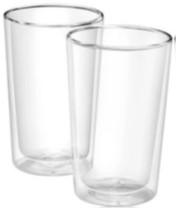
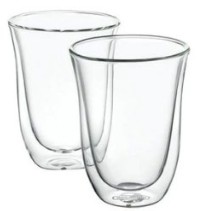
162 Mr Simpson made the following observations with respect to both, at [51(d)]:
DeLonghi makes double walled glasses…The DeLonghi glass on the left is in tumbler form, it does not flare as it approaches the lip, and the two taper forms have the same draft angle and do not taper to meet the lip. There is only a small gap between the inner and outer layers which both follow the traditional design of a tall water glass. The glass on the right has a vase-like shape, which flares and then bulges at the base.
163 Ultimately, Bodum conceded correctly that it is a matter for the Court to determine what can be made of the competitive products in the market at the relevant times and what that evidence says about the distinctiveness of the Bodum products. Mr Simpson’s observations include those of a designer with a keen eye, and interest and specific expertise in identifying differences between products. The acuteness of the attention he has given to the products, outside a consumer experience setting and where he holds attributes (associated with his expertise), is different from what could be expected of the relevant consumer class. As a consequence, this aspect of his evidence is of limited utility.
164 Fourthly, account may of course be taken of the exact measurements of the Bodum and HAG products undertaken by Mr Simpson (at [58]-[67]), as he has the expertise to undertake this exercise and there was no challenge to this evidence. Mr Simpson’s evidence reveals that the competing products are exact copies save for two exceptions (the silicon valve and the printed graphic): at [56], [70]. Mr Simpson stated that these two differences “do not impact the overall appearance of the design” and Bodum relied upon this. However, again, ultimately it is a matter for me to decide, but in circumstances where account must also be taken of the belated admission by HAG that they are in fact the same, in shape and design features.
Findings as to differences in the shape
165 Ultimately, it may be accepted that each of the other competitive DWGs were not identical in shape or measurements to each of the Pavina and Canteen DWGs. However, there are marked similarities between the overall shape and design features of the Bodum Pavina and the Avanti DWG which was advertised alongside the Pavina DWG in 2014. The Avanti has been promoted since at least August 2018 and has the same design features (described by Mr Jørgen Bodum) as the Pavina DWG. The same could be said for the Harris Scarfe Classica. The Pryex is less similar in shape, because of the greater gradient of the curvature of the glass, but again it has similar design features. The De’Longhi again has similar features but a more pronounced and pointed lip.
166 It is my view that these identified competitive DWGs, in the preceding paragraph, have marked similarities in terms of the overall design features, namely as Mr Jørgen Bodum conceded, they each contain an internal layer of glass with a rounded bottom and curved sides, an external layer of glass with curved sides tapering to a flat base, a rounded lip and an internal layer of glass which appears suspended.
167 As to the Canteen DWGs, I have a similar view. The identified competitive DWGs, though not identical, have marked similarities in terms of the overall design features to those of the Canteen as conceded by Mr Jørgen Bodum. They are less bulbous or tapered than the other DWGs that are similar to the Pavina glasses but like the Canteen, also contain the internal layer of glass with a narrower flat bottom and straight, angled sides tapering outwards towards a wider section at the opening of the glass, an external layer of glass with straight, angled sides tapering from a flat narrower base with rounded corners to a wider section at the opening of the glass, a rounded lip and the internal layer of the glass appears suspended.
Evidence as to what other drinking glass products (including DWGs) had been promoted, distributed and sold in Australia under the word mark Bodum and/or the Bodum logo (Issues 2(c) and 3(c))
168 As is revealed from the above, the evidence demonstrates, and there was no dispute, that Bodum had a very large range of other tea and coffee drinking products being promoted, distributed and sold in Australia for decades before the relevant dates under the word mark Bodum and/or by use of the Bodum logo. Often before each of the relevant dates, Bodum would promote its DWGs together with those other products, for example with a coffee plunger.
169 It may be accepted, as submitted by HAG, that this is not a case like Red Bull PJ, Dr Martens, or Koninklijke Philips Electronics NV v Remington Products Australia Pty Ltd [2000] FCA 876; 100 FCR 90 where the product design features in which reputation was claimed applied to the applicant’s sole or flagship product. The 2019 Bodum catalogue displayed 38 different shapes and sizes of drinking glasses, including over 25 DWGs, as depicted in Annexure B to HAG’s submissions. This can also be seen by how Bodum advertised its products, often with many different glassware products together, how it displayed its products in stores (many different glassware products together) and at trade fairs in the same way as adverted to above.
170 Mr Jørgen Bodum accepted under cross-examination that the Pavina and Canteen ranges were not the only “distinctive ranges of double walled glasses” manufactured by Bodum, volunteering that “[t]here are many others” including the Assam, Pilatus, Titlis and Bistro ranges. I accept HAG’s submission that the evidence establishes that, by August 2019, the Bodum catalogues show that other Bodum DWGs had been on sale for many years. For example, the Assam and Bistro since 2010; the Pilatus since 2012; and the Titlis since 2015. At the June 2012 Myer Roadshow, Bodum exhibited its Pavina, Pilatus, Canteen, Bistro and Presso ranges of DWGs.
The evidence of admissions as to the reputation of the Pavina shape from the HAG evidence
171 To an extent, account may be taken of HAG’s recognition of the Pavina and Canteen shapes in determining whether Bodum has established that it had acquired a secondary reputation and become distinctive in the minds of the Relevant Class.
172 In May 2022, HAG was asked by its distributor to provide “a draft image” of the “MW Blend Double Wall Cup” it had on order. Mr Daniel Grundmann, HAG’s Director of Sales, in response, did not provide an image, but confirmed “its (sic) basically the Bodum shape”. It can be inferred that Mr Daniel Grundmann believed that the reference to the “Bodum shape” was sufficient to explain the image. The HAG “Summer 2019 Range Presentation” records, under the heading “MW Blend”, refer to “Bodum shapes [without specificity], their patent expired”. Ms Renata Puz (HAG’s Head of Product at the time of the Blend DWG), in response to a retailer’s suggestion that HAG should expand in the DWG “category”, noted that HAG has “a few things for Summer – packs of 8 of the “pavina” on promo that should make [the retailer] happy”.
Distinctiveness of the shape in the packaging
173 Bodum submitted that the distinctiveness of the shapes of the Pavina and Canteen glasses is said to be reinforced by its packaging.
174 Mr Jørgen Bodum’s evidence revealed that the Bodum packaging has always prominently displayed photographs of the products. The packaging is always against a black background, with the Bodum logo in contrasting red where the photographs of two glasses take up the overwhelming majority of the space. A depiction of the original packaging when first sold in 2004 is produced below:
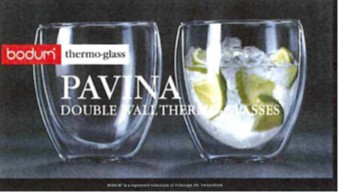
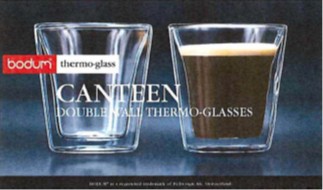
175 A depiction of the revised packaging used between 2008 and 2022 is produced below:
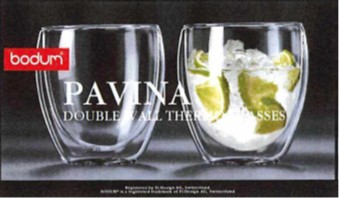
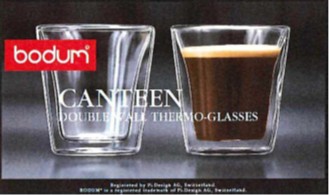
176 In around 2022, Bodum developed and introduced new packaging, which continued to display the products themselves. The pleadings and Mr Jørgen Bodum’s evidence appears to reveal that there are two variations of the current packaging, as reproduced below:
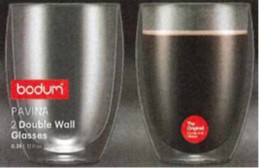
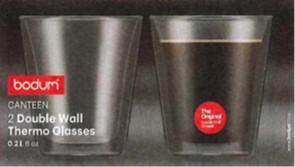
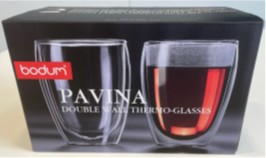
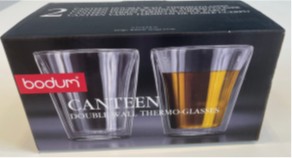
177 It is apparent that the Bodum logo appears prominently on the packaging which is a logo that Bodum has used since 1987, in bright red against a dark background: Jørgen Bodum 1 [24(f)], [69]-[76]. The Canteen and Pavina DWGs have the Bodum name and logo etched on their base: MFI 1 - 3 (physical exhibits of Bodum products). Bodum’s own evidence of “collaborations with other well-known and established brands” shows that when Bodum makes the Pavina DWG design available to another brand, the Bodum name and logo remains etched at the base of the glass.
Conclusion as to whether the word mark Bodum and/or the Bodum logo mark were well-known by consumers in the Relevant Class and whether such reputation detracts from there also being a reputation in the shape and/or design features of each of the products (Issues 2(e) and 3(e))
178 It is my view that Bodum’s evidence, surveyed above, reveals that by its transformative expansion from the 1970s internationally and in Australia under the stewardship of Mr Jørgen Bodum, Bodum had, by the earliest of the relevant dates, being August 2019, established itself in Australia as the premier, innovative, designer tea and coffee glassware brand. This is established from its history of using logos and word marks, continually expanding its range of tea and coffee glassware products, collecting awards, its sales record and its successful attempts to market itself. It is my view that a member of the Relevant Class would have known of the Bodum logo and word mark at each of the relevant dates and would have come to expect its name and logo to be etched at the base of its glass products.
Bodum had not established a secondary reputation in the shape of the Pavina DWG by August 2019 or by March 2021
179 For the following reasons, it is my view that Bodum has not established that it had acquired a secondary reputation in the Pavina DWG by August 2019 or later in March 2021.
180 For the reasons given above, it is my impression that an ordinary consumer of the Relevant Class, at the relevant date, would have known the Bodum word mark and logo and understood it to have a very well-established reputation to the Relevant Class as the premium, innovative, designer tea and coffee glassware maker. This is not to say that by reason of this fact, Bodum could not establish a secondary reputation in the shape of the Pavina and Canteen glasses. However, for the following reasons, it is my view that the evidence does not establish that Bodum has established a secondary reputation in either the Pavina or Canteen shapes at the relevant dates. I accept that the Court must consider what the evidence establishes with respect to each of the glasses at each of the relevant dates. However, the evidence overlaps as between each.
181 I accept that the evidence establishes that the first sales of these products occurred in 2004 and that they effectively had a monopoly in the DWG market for a decade in Australia. I also accept that the two products have received multiple awards for their designs. However, despite this monopoly (and design recognition and partnerships), the two DWGs were amongst many other Bodum products available to the Relevant Class. Indeed, Bodum had a very extensive range of glassware available to the Relevant Class. Further, it is my view that the evidence does not establish that, nor was it submitted by Bodum, somehow its marketing of its DWGs before the relevant dates was more extensive than its marketing of its other products. Indeed, there is no distinction at all in the evidence as to the comparative marketing budget, time and effort spent by Bodum on the DWGs by comparison to its other products.
182 It is my view that by 2019, times had changed. The evidence reveals that other DWG competitors had entered the market. Those competitors promoted their wares, and their wares were, at times, advertised in exactly the same places as those of Bodum. It is my view that whilst their sales have been much smaller than Bodum’s, in aggregate over the time until the relevant dates, they have not been insignificant. Unlike the facts in Bodum v DKSH, those competitors have not been declining, such as to establish the inverse of a diminution in reputation. Further, I am not saying that Bodum’s reputation in its shape diminished rather I am saying that the Relevant Class would have been aware of other similar products on the market. However, to the extent that it was submitted by Bodum that it did not stop promoting the Pavina shape and design features in this period (after 2014), there is evidence, as mapped chronologically in MFI 17, of the extent of the print advertising from 2014 onwards.
183 Further, by March 2021, HAG commenced selling its “Blend Double Wall Cup” in the 80 ml size, in addition to the 250, 350 and 450 ml sizes sold since August 2019. In the intervening 19 months, there was no material change in the way the Pavina DWGs were promoted and sold so as to require a different conclusion as to reputation.
184 It is my view that the evidence establishes that the other DWGs available on the market at the respective relevant dates had similar design features and certain of those identified above, were similar, though not identical, in shape.
185 Further, it is my view that the advertising and promotion of Bodum’s Pavina and Canteen products does not reveal that they were “iconic” or so “distinctive” such that the Relevant Class would know and understand, merely by looking at the shape, that they were Bodum glasses. I do not think that it can be inferred from the fact of publishers using those glasses for aesthetic appeal without branding was such that this represented their distinctiveness in the market. It was my observation that those publications used many glasses and cookware in the same way.
186 I accept the ultimate thorough submission made by junior counsel for HAG, together with my survey of all the evidence of Mr Jørgen Bodum, Mr Peter Bodum, Mr Maiolo, Ms Dunn and Ms Dutkowski. Account must be also taken of the extent of the evidence (how much advertising was conducted, over what period, through what mediums, and in what form) regarding the same. As can be seen from the above, Bodum did not saturate the market. It cannot be said, as was found by Greenwood J in Bodum v DKSH, that little more could be done to reach out to the cohort of consumers interested in tea and coffee drinking to hold out both Bodum products as products exhibiting the “distinctive look” (at [186]). However, I accept that the saturation point is not required. The extensive survey by Greenwood J in Bodum v DKSH of the advertising and promotion material reveals that the evidence was of a different kind to here. In that case, there was associated evidence of distribution and readership data. There were extensive submissions, unlike here, as to how those advertisements revealed the distinctiveness of the shape and design of the coffee plunger (at [194]) with the plunger in effect at the apex of the Christmas tree. Here, there are some images of the DWGs alone, but I do not accept that the evidence is of the same nature and quality to that in Bodum v DKSH and, in any event, Bodum in this case did not urge me to find the same. Their focus, as to evidence of distinctiveness, was elsewhere largely, to which I will deal with further below.
187 Further, the evidence reveals that the promotion of the Bodum Pavina and Canteen products occurred often with many, many other advertisements, where the products were promoted alongside other Bodum products and alongside those of competitors (including other DWGs).
188 Account may be taken of the HAG admissions as to its adoption of the “Bodum shapes” and the use of the “Pavina” descriptor to describe HAG’s Blend DWG. However, ultimately, it is my view that they indicate, within the glassware industry, it was well-known that the Pavina glasses were the market leaders. It is ultimately my view that when considering the entirety of the evidence, through the prism of what the Relevant Class was exposed to, as opposed to those experts in the business of selling these wares, it does not establish the conclusion urged upon me by Bodum.
189 Account may also be taken of evidence of Mr Simpson regarding the circumstances which led to his view as to the products being distinctive ones. However, this is only because the opinion arises from undisputed facts. It can be accepted that the products were innovative and striking when they first entered the market. However, ultimately, Mr Simpson’s expert evidence as to “distinctiveness” is of limited utility. It is “distinctiveness” in the eye of the Relevant Class of consumer in the relevant consumption setting that is important rather than that of an expert. Furthermore, Bodum conceded that Mr Simpson’s views regarding the differences and similarities with the DWGs of competitors was, again, something to be determined by the Court.
190 As to the argument that the products’ distinctiveness is evident from its use as the predominant feature of the packaging, it is my view that I can take judicial notice of the fact that products are commonly depicted on the packaging.
191 Ultimately, I accept HAG’s submission that, by reason of the Relevant Class’s knowledge of the Bodum word mark and logo, it is more likely that ordinary consumers, when seeking to distinguish between different brands of DWGs, would remember and distinguish Bodum’s DWGs by reference to the Bodum brand, and less likely that they would rely upon the design features of some of those individual products within that brand, to identify products not labelled Bodum as coming from Bodum.
192 For these reasons, the evidence does not establish that the shape of the Pavina DWG was known among ordinary Australian adult tea and coffee drinkers as at August 2019, such that they would remember and associate those shapes with Bodum regardless of any Bodum branding. I hold this view regardless of whether the test is one that requires a significant proportion of ordinary Australian adult consumers being likely to remember the shape or a lower number. Further, I do not accept that the evidence establishes some shift in the consciousness of the Relevant Class by March 2021 when the competitive Blend Conical 80ml was released.
Bodum had not established a secondary reputation in the shape of the Canteen DWG by July 2023
193 Similarly, it is my view that Bodum has not established that it had a secondary reputation in the Canteen shape by July 2023. The reasons already expressed above concerning what the ordinary consumer of the Relevant Class would have known about the Bodum word mark and logo and understood about Bodum’s reputation equally apply here. The same can be said as to my reasons for why, despite having held a monopoly in the DWG market for a long period, the consumer’s awareness was more of the fact of Bodum being the market leader in the tea and coffee glassware market rather than as the creator of DWGs by 2023. By 2023, competitive DWGs had been in the market for nine years and whilst their comparative unit sales were much less than those of Bodum, there would have been, to the consumer, a cumulative effect upon the market of the combined existence of these competing DWGs. By August 2019, the Bodum catalogues revealed that other Bodum DWGs had been on sale for many years. The 2019 Bodum catalogue displayed 38 different shapes and sizes of drinking glasses, including over 25 DWGs, as depicted in Annexure B to HAG’s submissions. For example, the Assam and Bistro since 2010; the Pilatus since 2012; and the Titlis since 2015. At the June 2012 Myer Roadshow, Bodum exhibited its Pavina, Pilatus, Canteen, Bistro and Presso ranges of DWGs. Further, since 2019, HAG had been selling its own Blend DWG.
194 It is my view that the evidence establishes that there were two DWGs which had been promoted at the relevant date which had similar design features and were similar, though not identical, in shape. I note that there is no sales data for the Avanti DWG but there appears to be some data for the De Longhi (second affidavit of R Dutkowski CB10.101.1765 at [11], RD-32 CB10.111.7381). I rely also on my above findings as to the advertising and promotion of the Bodum Pavina and Canteen products. I note that Bodum had entered into partnerships, during the period prior to the relevant date, with Starbucks in 2011 with respect to the Canteen, and in 2021 with Breville whereby Breville distributed the Canteen size 200ml with its Dual Boiler coffee machine, and in 2023 with the Museum of Modern Art (MoMA). However, despite this, I do not accept that a secondary reputation was established.
195 I accept that the evidence establishes that HAG knew that the Canteen product was a market-leader and wanted to copy it (the relevant findings are set out further below) and that evidence could go some way to establishing a secondary reputation in the shape. The evidence establishes that when HAG went about seeking to procure the Blend Conical from the supplier, HAG, through Ms Cynthia Sujudi (HAG’s Product Coordinator), messaged HAG’s supplier with an image of the Canteen. However, it is my view that, for reasons which are similar to those above, that evidence establishes a shrewd review of competitors rather than evincing knowledge of the Relevant Class.
196 I have also taken into account Mr Simpson’s evidence to the extent that I think it is of utility for the reasons identified above. I adopt my earlier reasons regarding the prominence of the shape on the packaging. For similar reasons, I accept HAG’s submission that, by reason of the Relevant Class’s knowledge of the Bodum word mark and logo, it is more likely that ordinary consumers, when seeking to distinguish between different brands of DWGs, would remember and distinguish Bodum’s DWGs by reference to the Bodum brand, and be less likely to rely upon the design features.
197 For these reasons, the evidence does not establish that the shape of the Canteen DWG was known among ordinary Australian adult tea and coffee drinkers as at July 2023, such that they would remember and associate those shapes with Bodum regardless of any Bodum branding. I hold this view regardless of whether the test is one that requires a significant proportion of ordinary Australian adult consumers being likely to remember the shape or a lower number.
Did HAG intend to adopt the shape and/or design features of the Pavina and/or Canteen DWG products when creating the products? If so, was this done with an intention to mislead or deceive in the sense that such adoption was for the purpose of appropriating part of the trade or reputation of the shape of the Pavina DWG and/or Canteen DWG products; and/or the Pavina DWG and/or Canteen DWG Design Features? (Issue 4)
198 As referred above, HAG admitted at the hearing that it intended to adopt the shape and design features of the Pavina and Canteen DWG products when creating the products. However, HAG denies that it did so with an intention to mislead or deceive in the sense that such an adoption was for the purpose of appropriating part of the trade or reputation of the shape or design features of the Pavina DWG and/or Canteen DWG products.
199 In summary, Bodum submitted that the latter is established by reason of the following:
(a) the fact that the evidence reveals that no design and/or development process was undertaken by HAG with respect to each of the Blend and Blend Conical products points to the adoption of the Bodum shapes to appropriate trade and reputation.
(b) the fact that HAG proffered no witness evidence or records on the question of adoption of the shapes and the purported intention behind that adoption. It was submitted, rhetorically, what intention could there be other than to appropriate what HAG understood to be Bodum’s reputation and custom?
(c) Bodum identified persons, gleaned from the contemporaneous documentation surrounding the creation of the Blend and the Blend Conical DWGs, from which it said it could be inferred, by their unexplained absence, that their evidence as to why HAG adopted the exact Bodum shapes would not have assisted HAG’s case relying upon the Jones v Dunkel (1959) 101 CLR 298 inference. Those persons being Messieurs Max and Daniel Grundmann (HAG’s CEO and Director of Sales respectively), Ms Puz, Ms Anna Kelly (HAG’s Senior Marketing Manager), Ms Sujudi and Ms Elena Chung (HAG’s Buying and Product Developer).
(d) the circumstances establish that HAG did in fact want to appropriate Bodum’s reputation and custom: It had identified the standout best-selling Bodum products, other DWGs in circulation were different-shaped products and their sales dwarfed by comparison. No evidence was put forward by HAG as to there being any other reason other than appropriation, for example some functional reason.
(e) account may be taken of HAG’s conduct in the proceedings, namely its failure to admit matters that it was plainly required to admit, as to its adoption of the Bodum shapes, until the hearing, despite the evidence in Exhibit KET-24 being the books and records relating to the sourcing and development of Blend products. As a consequence, it was submitted that the Court would not be satisfied as to HAG’s truthfulness in its denial of intention to appropriate reputation and custom, in circumstances where it was prepared “right up until about two hours into this hearing to be untruthful about its intention to adopt the shapes”.
(f) in the context of HAG’s denials that Ms Tunbridge’s evidence, as to the purported product development was a complete sideshow that was meant to make good the denial as to adoption (the first part of Issue 4) which is now accepted. It was submitted that Ms Tunbridge’s evidence was directed to product development which was bound to mislead and where her evidence pivoted to “off-the-shelf” sourcing. It was submitted that the unsatisfactory nature of her evidence feeds into the Jones v Dunkel inference that can be drawn to the effect that HAG’s evidence would not have assisted it on the question of its intention to appropriate the shape and features of Bodum’s products.
(g) the presumption in Australian Woollen Mills plainly operates in this proceeding given that HAG accepts that the Bodum products are “distinctive”. HAG, through the Blend and Conical products, has adopted the distinctive shape and design features of the Pavina and the Canteen. It is submitted that this was done so, having knowledge and experience in the relevant market, for the purpose of appropriating the reputation in Bodum’s products (Ms Tunbridge made this plain). It follows that HAG’s conduct is presumed to be fitted for that purpose and therefore likely to be misleading or deceptive.
200 The battlelines between the parties therefore centre around:
(a) the existence of the secondary, independent reputation in the Bodum shapes (about which I will return);
(b) the fact that, by reason of HAG’s admission, it deliberately intended to and did in fact copy and make identically shaped products to those of Bodum;
(c) the extent of the significance of that admission, in the overall assessment of the immediate and broader context;
(d) whether, by reason of that admission, and the absence of HAG evidence as to intention, together with Jones v Dunkel inferences, a leap can be made to find that HAG intended to mislead or deceive in the sense that such adoption was for the purpose of appropriating part of the trade or reputation of the shape of the Pavina DWG and/or Canteen DWG products; and/or the Pavina DWG and/or Canteen DWG Design Features;
(e) even if Bodum did have that secondary reputation and HAG had the impugned intention (admitted or found by the leap), whether consumers would nonetheless not be misled having regard to the use of logos or word marks on the products and/or their packaging.
201 Bodum was at pains to submit that it does not need to establish a reputation in the shape to ultimately succeed in establishing misleading and deceptive conduct. It may be accepted, and HAG conceded the same, that at the level of principle, a finding that conduct is misleading and deceptive, does not require the establishment of a reputation.
202 However, it is difficult to understand how, on the basis of the case crafted by Bodum, it can succeed in establishing its misleading and deceptive conduct claim, even by reference to the marketing web, without having established its reputation in the shape.
203 To return to Bodum’s pleaded case, it pleads it had a reputation in the shape as part of its ACL claim. It is my view that it logically had to do that. Much was made by Bodum in its oral and written submissions, at the level of principle, that it does not need to establish a secondary reputation in the shape. However, its submissions were elusive as to how there was a possibility that the consumer would be misled into thinking that the HAG Blend and Conical glasses, though identical, were those of or associated with Bodum without that secondary reputation in their shapes being established. A submission was continually made that the shapes were “distinctive” by reason of them having a design monopoly for a decade, being promoted without branding and being the sales market leaders in DWGs by a long way.
204 In a related way, on the question of intention, it was submitted that when one considers the documentary trail one sees that, based on HAG’s evidence, Bodum had a reputation in the shape, or it could be inferred that HAG assumed that Bodum had a reputation in the shape of the two glasses, and sought to take that custom away “because it must have appreciated the risk of confusion in the sense that consumers would look at the two sets of glasses and mistakenly assume that the identical shape of the Blend and Conical were actually those of the Pavina and Canteen and a consumer picks up that item, or purchases it online, and hence [HAG] has taken custom away from [Bodum]”. However, of course, regardless of HAG’s assumption or intention, it remains for the Court, ultimately, to be satisfied on the basis of the entirety of the evidence. As the High Court noted, despite scrupulous honesty, a trader may still mislead or deceive (BBNT at [54]). The reverse may also occur. Further, the submission appeared to be premised on the fact that confusion was the only possibility. It remains open to find that the Bodum products are the market-leaders, they are the ones that consumers are attracted to and like best and will buy them from whoever makes them. It was submitted that the consumer likes the shape “because Bodum has had the shape which consumers have liked for a decade of uninterrupted usage”. I do not accept that a product becomes “distinctive” and is afforded ACL protection purely by it being the original and the most liked (without the consumer understanding its origin). Otherwise, the effect is concerned not with consumer protection but to guard design monopoly.
205 However, it is my view that to merely find that the shapes were “distinctive” in the sense that they were the best sellers (the shapes most preferred by consumers) which consumers would seek out, absent knowledge of any association to Bodum, is insufficient to make out Bodum’s case (as pleaded) that the ordinary consumer might possibly be misled or deceived (including by being drawn into the marketing web). Ultimately, it appeared to be accepted by Bodum that to establish “distinctiveness of the shape”, a consumer would have to register the Blend or Blend Conical shape as being the shapes of the Pavina and Canteen and proceed to purchase them but critically on the basis that they thought they were Bodum’s Pavina and Canteen, or associated with Bodum: T401:1-32.
The place of the presumption
206 It was conceded by Bodum that the presumption is taken into account in the broad, in the context of the entirety of the conduct and where despite the availability of the presumption, it does not follow that the Court will necessarily be satisfied that a breach of the ACL or a claim of passing off has been established.
What HAG has admitted
207 As has already been referred to, HAG admits that the shape of the two HAG products (Blend and Blend Conical) are the same as the Bodum Pavina and Canteen DWGs respectively. HAG also admitted at hearing that it intended to adopt the same shape with the same design features of each of Bodum’s products.
208 Further, HAG put on no evidence that it in fact designed or developed the Blend product.
What the evidence established regarding HAG’s adoption of Bodum’s shapes and designs
The Blend
209 HAG only proffered one witness to give evidence as to the circumstances leading to HAG’s launch of the two Blend products. Ms Tunbridge swore her affidavit in a matter of days before her employment ceased with HAG. She was only employed for a very short time with HAG, under four and a half years. Ms Tunbridge was a Senior Buyer and Product Developer between January 2021 and May 2023 and Head of Product from June 2023 until July 2025. Accordingly, the obvious is revealed. Ms Tunbridge was not employed in the lead up to and release of the first HAG Blend DWG (sizes 250ml, 350ml and 450ml) but had been employed for two months shortly before the release of the Blend 80ml glass (in March 2021) and when HAG started promoting and offering for sale the Blend Conical DWG product in July 2023. She had been a Senior Buyer and Product Developer until the end of May that year and then became the Head of Product.
210 Given Ms Tunbridge was not at HAG in the lead up to and when the first Blend DWGs were promoted and offered for sale, all that Ms Tunbridge’s evidence comprised was what she was “aware” of from “the books and records” of HAG. Ms Tunbridge’s evidence identified when the DWGs were first offered for sale, who the supplier was, where the DWGs have been sold, the fact that the products have always featured the “M&W” logo etched into the base of the glass and the product packaging.
211 Tucked into Confidential Annexure KET-24, Ms Tunbridge annexed documents “that have been identified by MinterEllison in the books and records of HAG in relation to the sourcing and development of these products”. Curiously, Ms Tunbridge, in her affidavit, when dealing with Exhibit KET-24, said that the documents include, but without identifying which ones, documents which she had located from her “own searching of the books and records of HAG”. This is curious because Ms Tunbridge was employed for two months shortly before the release of the Blend 80ml glass (in March 2021) but puts on no evidence with respect to its development.
212 Rather than stating directly who were the relevant people involved in the sourcing and development of these products, she just stated that Ms Kelly was the Senior Marketing Manager at HAG, Ms Puz was the Head of Product at HAG (her predecessor and former boss), and Ms Sujudi was a HAG Product Coordinator.
213 As a consequence, the Court’s ability to understand the circumstances leading to the creation, promotion and offering for sale of the products was limited. My review of the contemporaneous documentary evidence together with Ms Tunbridge’s evidence reveals the following.
214 On 12 February 2019, Ms Chung sent to a number of persons, including Ms Puz, lists of ranges of products for the “Summer 19” series which include “Double Wall Cup[s]” in 250ml, 350ml and 440ml sizes, with a legible copy of the relevant part of the list tendered as Exhibit R2. In the image, there is a label in the middle near the top of each glass. Ms Tunbridge could give no evidence as to why a decision was ultimately made to place the label on the bottom of the glass.
215 On 3 April 2019, Ms Puz provided to various HAG employees the indicative dates for when products are coming and that the “orders are confirmed”. They included “Blend” with an “ETA” of “Early Aug”. On 13 May 2019, a daniel@hag.com.au sent details of the orders placed to various employees, including Ms Puz, for the “Blend Double Wall Cup 250ml Set of 2 Gift Boxed” with a quantity of 3240, the 350ml in a quantity of 2760 and the 450ml with a quantity of 2400. A day later, on 14 May 2019, Mr Julian Zach, holding the role or title of Finished Artist, emailed a number of HAG staff, including Ms Kelly and Ms Chung, about the “shooting” of the Blend DWGs. On 16 May 2019, Ms Chung emailed Mr Daniel Grundmann regarding the additional items for “AUS19” which include “Blend Double-walled glass cups”. On 16 May 2019, Ms Betsie vd Westhuizen wrote to Mr Daniel Grundmann about the material of the Blend cups (having received his email of 13 May 2019 referred to above) and later asked for a “draft image” of the cups, to which Mr Daniel Grundmann said:
In the coming days. Its (sic) basically the Bodum shape.
216 To which Ms vd Westhuizen replied “Noted thanks”. It appears from Ms vd Westhuizen’s email address and later documents, that she works for a distributor located in South Africa. Another request for an image was made by Ms Patricia de Abreu, in Brazil, to Mr Daniel Grundmann on 16 May 2019, to which Mr Daniel Grundmann replied the following day saying, “as soon as we have all the images we will let everyone know”.
217 The evidence of Mr Daniel Grundmann is telling. It can be inferred that he assumed Ms vd Westhuizen would understand what he means. It is telling in another respect. It was Ms Tunbridge’s evidence that if she, as a buyer, was considering releasing a HAG product that would look the same or very similar to a competitor’s product, it was not something that they would raise with management but rather for the buyer to work it out. It was Ms Tunbridge’s evidence to the effect that the buyer would survey the competitors in the market and take “screenshots and photos of the items” and present them to the Head of Product (an example being Exhibit A1, Tab 4, in relation to the Blend Conical). This does not sit comfortably with Ms Tunbridge’s affidavit evidence concerning the process of considering whether to introduce new products into an existing product range which required formal approval from the management team.
218 It was also Ms Tunbridge’s evidence that she did not speak to Mr Daniel Grundmann about what he meant by “it’s basically the Bodum shape”. When asked whether she thought it might be relevant to try to understand the subject matter, being product development, she said she was not doing an investigation, she was just looking for data. However, it is clear from her cross-examination that she did speak to some of her “colleagues” and referred to speaking to Mr Assad Khan from the planning team who “assisted [her] in getting some sales figures”, Ms Iris or Irene Kuah, who was the financial controller regarding the marketing spend and Mr Anthony Garterbasco from the studio team. I found Ms Tunbridge’s evidence as to how she went about collating the evidence and the choices she made as to what she put in her evidence very rehearsed and contrived. I do not accept that she did not think to follow up Mr Grundmann’s wording.
219 On 21 May 2019, Ms Shady Chen sent an email to Mr Max Grundmann and Ms Puz (amongst others) attaching range review spreadsheets (which included the Blend DWGs) which she stated, “we will use in the meeting” (Tab 13 to Exhibit A1).
220 The evidence reveals that orders were made for the Blend DWGs, and requests for samples were made by distributors thereafter, with Mr Daniel Grundmann sending many emails (or being copied into them) regarding orders and distribution of the product. The supplier then sent samples of the product to the distributor that requested them. In June and July 2019, the supplier corresponded with HAG regarding the design of the packaging. On 5 June 2019, Mr Daniel Grundman sent an email to Ms Puz only, where Ms Puz was, according to Ms Tunbridge’s evidence, the Head of Product at HAG, regarding the Blend, saying “[w]e are all good to go ahead with Blend. Max just thinks we should do it better next time…”. Ms Chung liaised with the supplier in July regarding inspections of the container before shipment.
221 In July 2019, Mr Ray Lin, Quality Control and Systems Manager, appeared to be conducting quality tests of the glasses and wrote to “Billie”, at PHW (the apparent supplier), the following:
Hi Billie
I have received your shipment samples and found two issues.
The base was not as flat as the pre-shipment samples and our brand can’t (sic) seen from the top. Kindly confirm how many with problems.
The rating label size was too big and wrinkle. The size was larger than the artwork we provided.
Have you got approval from us to change to larger size label.
222 There is a copy of the Maxwell & Williams “Summer 2019 Range Presentation” which includes photographs of the ranges and then bullet-point messaging for example, as to where the products in that range are designed, their usefulness and whether they are a seasonal only range. With respect to the Blend products, the following dot points, amongst others, are contained in the presentation:
• Bodum shapes, their patent expired
• Leo said they have a nice gap
• For the hot beverage lover and coffee enthuses
• Looks great in gold
• Minimalist and modern
• Superior quality
• Sold $85.5k across 3 sku’s last year
• Averaging 2.7k units per sku
• Very promotable
• Will look at doing a GWP
223 Ms Tunbridge was cross-examined as to the meaning of the above bullet-points but given she was not working at HAG at the time, I do not think much can be made of her responses.
224 No evidence at all was provided as to how the supplier came to supply glasses with the exact measurements as the Pavina. Further, Ms Tunbridge took steps with the Blend Conical to find out what documents the supplier had regarding the shape, at [93], the results of which were the WeChat message in Annexure KET-27. However, there is no evidence of any similar requests being made of the supplier with respect to the Blend product. Ms Tunbridge gave some evidence later in her cross-examination about contacting the supplier, but I do not accept that any attempt was made to get information from the supplier about the Blend product. It is my view that all she did, upon seeing the WeChat message (about the Conical), which she would have known about because she was later copied into the chain, was to ask about that.
The Blend Conical DWG
225 It will be remembered that the relevant dates for the Blend Conical are that HAG started promoting and offering it for sale in July 2023. Ms Tunbridge was the Senior Buyer and Product Developer at the time that the Blend Conical DWG was sourced and developed. At that time, Ms Tunbridge conceded that Ms Sujudi was being trained up as the assistant buyer.
226 It is evident that Ms Tunbridge was involved from the inception of the idea. The genesis for the copying of the Canteen product came from Ms Mandy Yole, after speaking with a retail customer, on 23 May 2022, who spoke about wanting to stop sourcing Bodum products and describing the Pavina and Canteen glasses as their “highest turnover” together with the “Bistro double wall mug”. In response, Ms Puz emailed Ms Yole, on 24 May 2022, and copied in Ms Tunbridge, and said the following:
Great timing Mandy. We’ve heard whispers of the same and Kelly [Ms Tunbridge] is working on expansion. We have a few things for Summer – packs of 8 of the “pavina” on promo that should make Ann happy, plus new developments for Winter 23. We’ll take these notes on board. Thanks, we love your feedback and Ann’s [the retailer]! ……
227 Ms Tunbridge deposed to understanding from the email that the reference to “pavina” is a reference to their Blend product.
228 Ms Tunbridge gave a partial chronology of events, summarising the documents of others said to comprise her evidence as to “[t]he development and launch of the BLEND Conical DWG”. The evidence does not devolve the reason for the adoption of an exact copy of the Canteen glass. There is no evidence, for example, that it was decided upon because it was functionally better. However, it does seem, consistent with the Summer 2019 presentation, that the email from Ms Yole, and the subsequent responses, a “gap” in the market with a strong selling product had been identified. Maxwell & Williams effectively wanted to grab that gap in the market from Bodum and to expand its Blend product range.
229 Ms Tunbridge’s chronology starts from July 2022. However, HAG’s discovered documents refer to Ms Tunbridge’s involvement as early as March 2022. On 22 March 2022, Ms Sujudi wrote to the supplier, regarding the “Blend Promo Sets AUS22” copying in Ms Tunbridge and Mr Lin, amongst others. The email has a long chain and includes emails from Mr Lin of a similar kind to those he had sent to the supplier in 2019, regarding the visibility of the brand logo looking from the top and the need for the glass to be thick at the bottom as well as for the brand to be visible.
230 This evidence, not contained in Ms Tunbridge’s evidence, reveals a different path. It shows that HAG had informed the supplier of problems they had with their Blend glass and complaints they received that the glass had broken during use within a month, including that two had broken when used with ice cubes. Mr Lin then asked the supplier for samples of each of the 250ml/350ml/400ml “with the improvement” on 9 March 2022. COVID-19 lockdowns cause delays. The supplier messaged Ms Sujudi on 21 March 2021 and told her that they will send a sample on 31 March 2022. It is not clear from the evidence whether a sample was sent. There must have been discussion of shape before the sample was to be sent. No doubt Ms Sujudi and Mr Lin would know, but they were not called to give evidence. We know Ms Sujudi is working in Melbourne. No explanation is given for her not giving evidence save for her no longer working at HAG.
231 Ms Tunbridge then deposed to the following:
In July 2022, Cynthia Sujudi, HAG Product Coordinator, sent a photo to the supplier of the BLEND® DWG referred to in paragraph 86 of a conical shaped double walled glass and asked “Do you have this shape…I would need an option of sizes”. Annexed hereto and marked Confidential Annexure KET-27 is a copy of an extract of a WeChat conversation, provided to be me by the supplier, between Cynthia and a representative of the supplier between 21 July 2022 and 8 August 2022, that contained that request. Cythnia is no longer at HAG.
232 A copy of a part of the WeChat communication is extracted as follows:
233 It was Mr Peter Bodum’s unchallenged evidence that this is a photograph of the Bodum Canteen glass. The photograph was used in subsequent HAG documents, for example the HAG Photo Quotation: CB9.87.7061; Exhibit A-1 Tab 3.
234 Notably, Ms Tunbridge was copied on those WeChat messages thereafter in August with the supplier. Ms Tunbridge’s way to avoid any failure on her or HAG’s part to answer questions as to how similar the Blend Conical was to the Canteen, or whether in fact they were the same shape, was to say she did not obtain this kind of evidence because “it’s an off-the-shelf product”. Curiously, there was nothing in her affidavit to suggest this. It is also curious that Ms Tunbridge knows this but feigned to have limited knowledge otherwise. Ms Tunbridge was emphatic in her careful delivery of this repeated fact. It was her evidence that the shape and design of the glass had come from the supplier where they have a room full of DWGs and she described how big this room is proximate to the size of the courtroom. It was her evidence that because HAG did not pay for the tooling for its development, it must “obviously [be] in the market somewhere”. However, the supplier did not provide the image or specifications. Ms Sujudi provided the image which Ms Tunbridge was privy to: Indeed, an enlarged copy of this image was sent back from the supplier to Ms Tunbridge on 2 August 2022: Exhibit A-1, Tab 3. Ms Tunbridge was forced to concede that there was no other conical shaped DWG in the Australian market that she was aware of when the HAG product was released, save for the Bodum product.
235 Ms Tunbridge received various emails from the supplier and Ms Sujudi during August 2022, regarding the supply demand, the minimum order quantities and pricing.
236 On 9 December 2022, “after meetings with the management team and representative of Myer”, Ms Tunbridge informed the supplier that HAG intended to proceed with the conical DWGs in a number of sizes. In the consistent, unsatisfactory way Ms Tunbridge gave evidence, she does not identify who from management she met with and what the decisional process was. Under cross-examination, Ms Tunbridge stated that these December management meetings involved how many units would be ordered for a range, what price point and what promotional structure. However, under cross-examination, Ms Tunbridge could not recall who from management attended the meeting or that she even attended the meeting. For Ms Tunbridge to say that she did not even recall whether she had attended the meeting was concerning and unconvincing, given she had deposed in her evidence that, after the meetings, she had written to the supplier. That evidence would be misleading if she had not attended the meetings said to give rise to the supplier request without more being said in that paragraph. Further, Ms Tunbridge wrote directly to the supplier saying, “our meetings with management and key customer Myer went very well”. Ms Tunbridge was then copied on subsequent emails in December 2022 and January 2023, from Ms Sujudi, regarding the ordering of the glasses and the form of packaging. It was my impression that when she felt cornered by the obvious, she then sought to avoid giving any response to who was present at the December 2022 meeting by saying she did not even recall attending herself.
237 Further, HAG discovered emails refer to the fact that, in April 2023, Ms Sujudi received emails from the supplier telling her not to display on their packaging that the glass was dishwasher and microwave safe due to their risk of breaking, and if microwaved the seal may break. Ms Sujudi responded saying “You told me the failure of seal was 0.3%, so I think we can handle this failure”. On 12 April 2023, the supplier responded, copying in Ms Tunbridge, that “the failure of the seal is 0.3%, but that the double wall glass is 8-cycle dishwasher safe, if use the dishwasher with more times, the percentage of sealer failures will be increased” hence why they did not recommend saying that they were dishwasher safe on the colour boxes. Ms Sujudi responded by saying “Thank you for your explanation. Please proceed as it is”. Ms Tunbridge was copied on this email.
238 As to HAG’s intention, it must be remembered that HAG, through its Counsel, conceded during the hearing that it intended to adopt the same shape and the same design features as the Canteen DWG.
239 Ms Tunbridge resisted the same in her evidence. She would not agree that a decision was made to copy the Bodum product but rather said “we made a decision to have a conical shape”. But Ms Tunbridge accepted that part of the decision included the knowledge that there was only one conical shape in the market, the Canteen product. Ms Tunbridge went on to concede that part of the reason for the choice was that “the conical shape was a very strong selling shape in glassware” based on market research and their sales history. Given her concession that only Bodum was selling that shape, it can be inferred that part of HAG’s decision was to copy Bodum’s shape because it was a very strong selling shape in glassware. However, it is clear that the genesis of the Blend Conical product was Ms Yole’s email referred to above: HAG was effectively being asked by a retail customer to produce more of Bodum’s offerings so they could terminate their commercial arrangement with Bodum. The customer identified Bodum best sellers as including the Pavina and Canteen. In essence, Ms Tunbridge conceded the same:
Right. And it’s the case, isn’t it, that the development process for the Conical began with an intention that a product be introduced into the market to enable retailers like Ann from Dalgarno’s to substitute Bodum’s CANTEEN product for the newly developed product by HAG? ….It was to answer our customer’s request, yes.
Yes. And in so doing, be able to replace Bodum products in the market with HAG products; correct? ….Yes. Our aim is to get market share. So regardless of the brand, we always want to take market share.
Well, when you say regardless of the brand, here it was specifically with regard to another brand, ie. Bodum; correct? In this regard, yes.
240 This of course is entirely consistent with the documentary trail. Ms Yole, who was a HAG Account Manager (Vic), had further email communications with the same retail customer on 24 May 2022. In response to a customer’s request for competing Blend products so that they could “exit from Bodum”, Ms Yole responded saying that they may have more new Blend in 2023.
241 Ms Tunbridge sought to resist the suggestion that the shape of glass, provided as part of the WeChat message on 21 July 2022, was achieved by using a Canteen glass as a reference. I do not accept her evidence. It is my view that the evidence reveals that, regardless of whether in fact it was a Canteen glass, though I accept that it can be inferred that it was because it was the only glass of that kind on the Australian market at that time, Ms Tunbridge had accepted that they wanted to take Bodum’s market share (of its Canteen glass). It can be inferred that regardless, HAG, through Ms Sujudi, intended to give the supplier the Canteen glass so the shape could be copied.
242 Further, to get the competitive edge, it was Ms Tunbridge’s evidence that price was the driver of purchases in DWG products. Ms Tunbridge accepted that it was HAG’s strategy vis-à-vis Bodum’s products to offer HAG’s products at a lower price to encourage HAG purchases over Bodum. On 23 May 2022, Ms Tunbridge sent to Mr Daniel Grundmann, Mr Max Grundmann, and Mr Michael Grundmann, a price review of what was to be the Blend Conical price point by comparison to the cost of La Caf and Bodum products. Then, on 18 August 2022, Ms Sujudi sent Ms Tunbridge the Bodum Canteen prices (Exhibit A1, Tab 4).
Jones v Dunkel
243 Much was made by Bodum as to the failure of HAG to call any of the critical witnesses involved in the development and sourcing of the Blend DWG and all, save for Ms Tunbridge, in the development and sourcing of the Blend Conical DWG.
244 As observed recently by the Full Court in Kruger v Thompson [2025] FCAFC 143 (Colvin, Abraham and McElwaine JJ) at [48]:
The rule in Jones v Dunkel does not require a party to give repetitive or cumulative evidence and accordingly, it was not open to the Court to draw any such inference simply because Dr Martin was not called to give evidence about the same issue: Manly Council v Byrne [2004] NSWCA 123 at [61]-[67]. Moreover, the primary judge has not grappled with the concept underlying Jones v Dunkel. The rule is that the unexplained failure of a party to give evidence may, in appropriate circumstances, lead to an inference that the uncalled evidence would not have assisted that party’s case, so entitling a court to more readily draw an inference against that party: Jones v Dunkel [1959] HCA 9; (1959) 101 CLR 298 at 308, 312, 320-321; Cubillo v Commonwealth (No 2) [2000] FCA 1084; (2000) 103 FCR 1 at [353]. The primary judge has not identified the inference that could be more readily drawn.
245 Those witnesses for which there was said to be an unexplained failure to call them, were said to be Messrs Max and Daniel Grundmann, Ms Puz, Ms Kelly, Ms Chung and Ms Sujudi. It was contended that, by their unexplained absence, it could be assumed that their evidence would not have assisted HAG’s case.
246 It was submitted that it was incumbent on HAG to call one or both of the Grundmanns. Ms Tunbridge, had not been employed by HAG when the Blend product was first created and claimed to have limited recollection of the development of the Blend Conical product. It was submitted that persons employed in HAG, in positions below those of the Grundmanns, involved in the development of the products, were the four women identified in the immediately preceding paragraph, who had all left HAG, but appeared to remain in Melbourne and whom Ms Tunbridge had made no attempt to contact to learn about the development of the two products. It was submitted that no explanation was proffered and the Court could be “bold in drawing inferences on the relatively limited material which [Bodum could] bring forward”.
247 It was accepted that the deployment of the Jones v Dunkel inference could not fill the gap but, reference was made to Lee J’s observations in Quintis Ltd (Subject to Deed of Company Arrangement) v Certain Underwriters at Lloyd’s London Subscribing to Policy Number B0507N16FA15350 [2021] FCA 19; 385 ALR 639 at [252]:
252. In Blatch v Archer, Lord Mansfield (at 65) famously remarked that “all evidence is to be weighed according to the proof which it was in the power of one side to have produced, and in the power of the other to have contradicted.” Such a maxim is reflective of the problem that in deciding issues of fact on the civil standard of proof, the Court is concerned not just with the question of probabilities on the limited material available, but also whether that limited material is an appropriate basis on which to reach a reasonable decision: Ho v Powell [2001] NSWCA 168; (2001) 51 NSWLR 572 (at 576 [14] per Hodgson JA, with whom Beazley JA agreed). Considering the latter of these propositions, Hodgson JA stated (at 576 [15]) that “it is important to have regard to the ability of parties, particularly parties bearing the onus of proof, to lead evidence on a particular matter, and the extent to which they have in fact done so”.
253. A particular application of the maxim enunciated in Blatch v Archer is the “rule” in Jones v Dunkel (at 308 per Kitto J, at 312 per Menzies J, and at 320–1 per Windeyer J). That rule, said to be founded on “plain common sense” (Jones v Dunkel (at 321 per Windeyer J)), was more recently explained by French CJ, Gummow, Hayne, Crennan, Kiefel and Bell JJ in Australian Securities and Investments Commission v Hellicar [2012] HCA 17; (2012) 247 CLR 345 (at 412–13 [165]–[167]). A year earlier in Kuhl v Zurich Financial Services Australia Ltd [2011] HCA 11; (2011) 243 CLR 361, Heydon, Crennan and Bell JJ observed as follows (at 384–5 [63]–[64]):
The rule in Jones v Dunkel is that the unexplained failure by a party to call a witness may in appropriate circumstances support an inference that the uncalled evidence would not have assisted the party’s case. That is particularly so where it is the party which is the uncalled witness. The failure to call a witness may also permit the court to draw, with greater confidence, any inference unfavourable to the party that failed to call the witness, if that uncalled witness appears to be in a position to cast light on whether the inference should be drawn. …
The rule in Jones v Dunkel permits an inference, not that evidence not called by a party would have been adverse to the party, but that it would not have assisted the party.
254. Elsewhere it has been remarked that the failure by a party to deny or explain facts which it is within that party’s power to explain or deny “gives a colour to the other evidence against him” (Boyle v Wiseman (1855) 156 ER 598 (at 600 per Baron Alderson)) and that “when circumstances are proved indicating a conclusion and the only party who can give direct evidence of the matter prefers the well of the court to the witness box a court is entitled to be bold”: Insurance Commissioner v Joyce (1948) 77 CLR 39 (at 49 per Rich J); see also Longmuir (at 131 per Winneke P). Of course, the rule in Jones v Dunkel is not confined to the unexplained failure of a party to call a witness, but also extends to the tendering of documents: see Jones v Dunkel (at 320–1 per Windeyer J); Burke v LFOT Pty Limited [2002] HCA 17; (2002) 209 CLR 282 (at [134] per Callinan J); Galea v Bagtrans Pty Limited [2010] NSWCA 350 (at [2] per Allsop P, with whom Macfarlan JA agreed).
…
260. The rule in Jones v Dunkel cannot be applied to the non-calling of a witness unless: (a) the missing witness would be expected to be called by one party rather than the other; (b) his evidence would elucidate a particular matter; and (c) his absence is unexplained: see Payne v Parker (1976) 1 NSWLR 191 (at 201 per Glass JA). Speaking in terms of the first of these conditions, Glass JA said (at 202):
… it is also described as existing where it would be natural for one party to produce the witness, or the witness would be expected to be available to one party rather than the other, or where the circumstances excuse one party from calling the witness, but require the other party to call him, or where he might be regarded as in the camp of one party, so as to make it unrealistic for the other party to call him, or where the witness’ knowledge may be regarded as the knowledge of one party rather than the other, or where his absence should be regarded as adverse to the case of one party rather than the other. It has been observed that the higher the missing witness stands in the confidence of one party, the more reason there will be for thinking that his knowledge is available to that party rather than to his adversary.
(Citations omitted).
248 As to the Grundmanns, it was submitted that the relevant inference concerned why HAG adopted Bodum’s exact shapes. It was submitted that no answer was given to this question. It was submitted that Messrs Grundmann ought to have been called given their seniority, their inclusion in various email chains at the time, their management roles which included participating in new product presentations intended to be released to the market and an explanation for why Mr Daniel Grundmann had described the Blend product as the Bodum shape.
249 HAG submitted that there is no basis to infer that they were involved in selecting the relevant shapes of these products. For products purchased off-the-shelf, it was the responsibility of the buyer at an early stage to make sure there was no legal infringement issue, much earlier than at any management meeting: T218.1-38, T219.1-15. As to Mr Max Grundmann’s involvement in the presentation to management at range review meetings, those meetings related to hundreds of products – see the 34 pages of products on the “Range Review Spreadsheets” sent to Mr Max Grundmann on 21 May 2019: Exhibit A-1 Tab 13. By this stage, the products “were already developed to the stage where it’s not pitching any more. The items are already confirmed in terms of the design, the colour. It’s just fine-tuning how many SKUs in a range, what price point, what promotional structure”: T221.19-22. By this stage “[t]here’s no final sign off on the design of the product. It’s final sign-off on the order quantity”: T221.45-222.3. With respect to Mr Daniel Grundmann, HAG submitted that, until March 2023 (well after purchase orders were placed for all impugned products), he was only involved in international sales and was not involved in sourcing product: T216.24-6. Bodum adduced evidence from Ms Tunbridge that he told her that he was not involved in developing the Blend DWG product: T245.45-246.2.
250 As to Mr Daniel Grundmann, the relevant chronology above reveals that: he was aware of, and kept up to date about, the status of purchase orders for the Blend DWG; he authored correspondence as to his awareness of the draft images for the Blend DWG and their likeness to the Bodum product, being “basically the Bodum shape”; further, it was Mr Daniel Grundmann who wrote to Ms Puz (on 5 June 2019) indicating that he was aware of the final sign off to “go ahead” with the Blend, presumably to market. Ms Puz was the Head of Product in Australia. As part of that communication, Mr Daniel Grundmann said “Max just thinks we should do it better next time”. This is indicative of collective responsibility for its creation and his role in the sign off. In this respect, I do not accept that the evidence reveals that Mr Daniel Grundmann’s role, being an international one, had no involvement in Australian operations. Indeed, Ms Tunbridge did not assume such a limitation, when she sought him out to understand the Blend product’s history.
251 I am of the view that a Jones v Dunkel inference can be drawn against HAG for its failure to call Mr Daniel Grundmann regarding the development of the Blend DWG prior to its release to the market and his knowledge as to why HAG intended to adopt the Bodum product.
252 However, I am not satisfied that such an inference can be drawn with Mr Max Grundmann. The documents do not reveal any involvement, by virtue of his position or otherwise, in the sourcing and development of either of the Blend products.
253 Similarly, it was submitted the same inference applied by reason of the failure to call four mid-management former employees. HAG sought to refute the inference on the basis that none of the women were employed any more by HAG. I do not accept that such a bald submission, without more, answers the apparent failure. HAG also submitted that the inference could not be drawn because of the sheer volume of products that HAG launches each year (between eight to 1,200 per year). It was submitted that by reason of the passage of time and the volume of products each year that it could not be assumed that the witnesses would have any recollection of the products.
254 As to two (Ms Puz and Ms Sujudi) of the four women, I am of the view that a Jones v Dunkel inference can be drawn by reason of the fact that each of them would have been expected to be called by HAG; their evidence would elucidate a particular matter; and their absences were unexplained.
255 Ms Puz was the Head of Product at the time HAG determined to release the Blend DWG to the market. Ms Tunbridge became her successor. It was curious that HAG claimed that Ms Tunbridge was the relevant witness, as being Head of Product, at the time of the release of the Blend Conical but did not apply the same logic to Ms Puz. Ms Tunbridge gave evidence that, if a buyer, at HAG, considered releasing a product the same or similar to a competitor’s product, it would be not raised with management but was for the buyer to work it out. The buyer would survey the competitors in the market and take “screenshots and photos of the items” and present them to the Head of Product. If this evidence is to be accepted, Ms Puz would have received from a buyer screenshots and photos of competitive products on the market, which would likely have depicted the Bodum product, which was ultimately recreated by HAG’s Blend. The evidence also reveals Ms Puz’s involvement in the final sign-off. Furthermore, Ms Puz appeared to be involved, at the point of the genesis of the Blend Conical product. From this, it can be inferred, as Head of Product, at the time of the first Blend product, that Ms Puz would have been involved. Ms Puz so equates the Pavina product with the Blend product that she continues to call it that. Further, it illustrates her role in the appropriation of the Bodum shape for the Blend Conical product.
256 Ms Sujudi replaced Ms Tunbridge as the Senior Buyer and Product Developer during the time that the Blend Conical DWG was sourced and developed. At that time, Ms Tunbridge conceded that Ms Sujudi was being trained up as the assistant buyer. The documentary evidence reveals that Ms Sujudi authored and received emails regarding the Blend Promo Sets AUS22, the visibility of the brand log, and requests for sample products. Significantly, on 21 July 2022, Ms Sujudi, in her capacity as Product Coordinator, sent a WeChat message to HAG’s supplier (the same supplier of the Blend product) with an image of the Canteen product and asked, “Do you have this shape”. Ms Sujudi also received an email which included a much larger copy of the exact same photo. It was Mr Peter Bodum’s unchallenged evidence that this is a photograph of the Bodum Canteen glass. I am of the view that Ms Sujudi would be able to give evidence as to whether the image was in fact a Canteen or a sample, and evidence regarding the reasons why HAG sought the same product shape. Ms Sujudi sent emails regarding the supply demand, the minimum order quantities and pricing. It was Ms Tunbridge’s evidence that an attached quotation did not contain tooling in the quote and hypothesised that in her experience that meant that these products were existing products of the supplier. Ms Sujudi would be uniquely placed to explain why tooling was not included in the invoice and what this meant for the Blend Conical.
257 The above evidence reveals that Ms Chung formed part of the team, involved in the Blend product’s sourcing and release to market. I am of the view that, given her level of involvement, it would not have been expected that she be called by HAG. Similarly, I do not think the inference can be drawn with respect to Ms Kelly. There is nothing in this evidence that indicates Ms Kelly was engaged in the design process as distinct from the marketing process.
The labelling and packaging of the HAG products
258 As is evident from the images, in the introductory part of these reasons, there are a number of distinguishing features, as between the Bodum and HAG DWGs. First, there is an imprint of the Bodum logo against a white background. Secondly, there are statements regarding Bodum patents and design registrations on the bottom of Bodum’s glasses. Thirdly, the Bodum product has an additional physical feature, the vent with a silicon seal. Fourthly, the Bodum product has a removable sticker with the Bodum logo. Fifthly, the HAG products have none of these features and separately the HAG DWGs have the trade mark “M&W” imprinted on the bottom of the glass.
As to the latter, much was made by Bodum of the fact of the recent invention of the “M&W” trade mark (about which it was said it had no reputation). Further, ordinarily, according to Bodum, HAG products, including HAG glassware, feature the “Maxwell & Williams Designer Homewares” registered trade mark (TM 708360)  or alternatively the “Maxwell & Williams” registered trade mark (TM 1418935)
  . Examples of these were contained in Exhibit MEA-1 to Ms Allen’s evidence. Those examples include the use of these trademarks on cutlery, crockery and on the glass beakers for coffee plungers.
259 However, it is my view that the evidence reveals, despite the use of the new mark, that HAG did affix a mark from which it could be reasonably deduced that it would be associated with the HAG well known registered trade marks. The evidence revealed that, with respect to both the creation of the Blend and the Blend Conical glasses, HAG was at pains to ensure that the “M&W” label was visible through the glass: See the emails from Mr Lin. Further, HAG used the well-known registered trade marks, at all times, on the packaging. This was consistent with the evidence of Ms Tunbridge that HAG wanted to “permanently brand [their] product as much as possible” such that when the consumer takes the product home and takes it out of its packaging, HAG wanted the consumer to “identify it as Maxwell & Williams”. In this regard, I accept Ms Tunbridge’s evidence. I do so because it is consistent with the larger body of contemporaneous documentation, including the emails of others, including those of Mr Lin, and the evidence of HAG’s conduct.
Conclusion regarding intention
260 By the foregoing, it is my view that the evidence establishes, as HAG admits, that HAG intended to adopt the same shape and design features of each of Bodum’s products. The evidence establishes that HAG had formed the view that the Pavina and Canteen DWGs were the market-leaders and wanted to copy those products and to take Bodum’s market share. Ms Tunbridge accepted, under cross-examination, that HAG’s strategy with respect to Bodum’s DWG products has (and had) been to offer HAG’s products at a lower price and to encourage the purchase of HAG’s DWGs over those of Bodum.
261 However, despite conscious imitation, I am of the view that the evidence does not establish that HAG intended, by that adoption, to mislead and deceive consumers.
262 The evidence establishes, as was ultimately admitted, that a deliberate choice was made by HAG to copy the Pavina shape to create the Blend and where it was known by all those who were involved in the creation of the Blend product. The same is evident from Mr Daniel Grundmann’s description as it being “basically the Bodum shape”. However, the evidence also reveals that there was a conscious decision to make sure that the product was labelled (both on the bottom of the glass) and by its packaging.
263 It was submitted that the labelling was deficient in a number of respects, as I have referred to above. There were arguments about the placement of the new etching (on the bottom as opposed to the side of the glass), the label type (the new mark rather than the established mark) and size of the labelling. However, it is my view that HAG placed its own mark on the glasses and used its own well-known logo and word mark on its packaging and as the descriptor for its online sales. The evidence established these deliberate acts. It is my view that these deliberate acts need to be considered in light of the broader context. The evidence reveals, as already found (and will be considered further below), that both Bodum and HAG had established, at the relevant times, distinct very well-known reputations in their respective brands, word marks and logos. They both routinely used those word marks and logos on their products. I accept that there was a decision to use the M&W mark. However, it is my view that it could be inferred that HAG intended to use this on the basis that the consumer would deduce it was an abbreviation for its well-known word mark and logo. In any event, it is my view that HAG would have been aware that the M&W mark is distinct from Bodum’s word mark and logo and even if it could not be inferred that HAG intended for the consumer to understand that the M&W mark was being an abbreviation, nonetheless it could be inferred that it intended to distinguish its DWGs from that of Bodum. It is my view that it can be inferred that HAG knew of the extent of each of their distinct reputations when it decided on its labelling and packaging. This informs what the Court may infer as to the decisions HAG made when deciding on the etching and the packaging.
264 Counsel for Bodum was asked by the Court about the account it has to take of Mr Lin’s emails and the evidence of Ms Tunbridge (that HAG wanted to affix its mark or logos on all its products so the consumer would thereafter identify the product with them). It was submitted that Ms Tunbridge, at T268:45, “didn’t care about the distortion of the logo”; that none of the evidence answers the primary question as to why HAG chose the shapes; and it goes to Bodum’s complaint that if HAG really cared about their logo, they could have made it bigger. I am not persuaded by these submissions. I do not accept that the effect of Ms Tunbridge’s evidence is that she did not care about logo distortion. It was her evidence that if there was a safety concern, safety trumped branding. Whilst I have misgivings about aspects of Ms Tunbridge’s evidence, it is my view that I am able to accept her evidence in this regard because it is consistent with contemporaneous documentary evidence and the evidence as to what HAG did. I do not accept that none of the evidence answers the primary question. Whilst I accept there are stark lacunas in the evidence, I am ultimately satisfied that the evidence establishes that, despite HAG copying Bodum’s products, it did not intend to mislead or deceive consumers but rather sought to use Bodum’s shape to take market share with its own branding. Despite the concerns I have expressed about the evidence of Ms Tunbridge and the fact that a Jones v Dunkel inference could be drawn, it cannot be established that HAG intended to mislead and deceive.
Did HAG by promoting and selling the impugned products engage in misleading and deceptive conduct? (Issue 5)
The alleged impugned conduct of HAG
265 The alleged impugned conduct was said to comprise the following:
(a) Since around August 2019, HAG has promoted, distributed and sold DWGs under and by reference to the name “Blend Double Wall Cup” (the Blend DWG) in Australia in various sizes (250, 350 and 450 ml);
(b) Since around July 2023, HAG has promoted, distributed and sold DWGs under and by reference to the name “Blend Double Wall Conical Cup” (the Blend Conical DWG) in Australia in two sizes (200 and 40 ml);
(c) Each of the overall appearance and design features of the Blend and Conical DWGs closely resemble the Pavina and Canteen design features respectively;
(d) The two HAG products are packaged for sale with packaging that feature a number of photographic representations of the Blend product;
(e) At outlets where they are sold, the Blend products may be displayed in any of the following ways:
(i) In the depicted packaging;
(ii) By display of the product, outside away from or without the packaging;
(iii) Alongside or in close proximity to the Bodum’s Pavina and Canteen DWG or other glasses or homewares.
(f) The Blend products were sold to retailers and to consumers in Australia.
(g) The Blend products did not contain any branding or labelling visible on the product itself other than the letters “M&W” on the bottom of the product.
(h) HAG engaged in the conduct knowing the Blend products “to possess and intending them to possess features which adopted and closely reproduced” the corresponding Bodum design features;
(i) HAG engaged in the conduct for purposes including appropriating the reputation of:
(i) The BODUM®;
(ii) The Pavina DWG Design Features; and
(iii) The Canteen DWG Design Features.
The alleged representations
266 It is worthwhile repeating the alleged representations said to arise from the conduct, which are pleaded in the following way:
(a) that the Blend DWG are Pavina DWG;
(b) that the Blend Conical DWG are Canteen DWG;
(c) that the Blend DWG are affiliated or associated with the Pavina DWG;
(d) that the Blend Conical DWG are affiliated or associated with the Canteen DWG;
(e) that the Blend DWG are part of or associated with BODUM® ranges of glasses;
(f) that the Blend Conical DWG are part of or associated with BODUM® ranges of glasses;
(g) that the Blend DWG have been manufactured, marketed and promoted with the licence, sponsorship or approval of the source of BODUM® branded glasses;
(h) that the Blend Conical DWG have been manufactured, marketed and promoted with the licence, sponsorship or approval of the source of BODUM® branded glasses;
(i) that the Blend DWG are licensed, sponsored or approved by the source of the Pavina DWG;
(j) that the Blend Conical DWG are licensed, sponsored or approved by the source of the Canteen DWG; and
(k) that Maxwell & Williams is licensed by or associated with the source of the Pavina DWG and/or Canteen DWG, and/or the source of BODUM® branded glasses.
267 The parties made no submissions at all about each of the representations. No submissions were made that different evidence was relied upon as between each of them or as they arose with respect to each of the HAG Blend and Blend Conical products.
The qualities of the Relevant Class (as per Issue 1)
268 As to the qualities of the Relevant Class, the parties’ submissions concentrated on the level of consumer attention that is given to the purchase of the impugned products. Bodum submitted that the expected level of consumer attention is closer to an “impulse” good as compared to “vigilant” goods such as furniture (Puxu) or clothing (Dr Martens) where one “expect[s] […] purchasers to exercise somewhat more vigilance than may be the case with the purchase of items of less financial significance having less impact on the appearance of the home” (Puxu at 209; see also Red Bull PJ at [65]). Both Ms Tunbridge and Bodum’s Country Manager accept that DWGs are not a “considered” purchase.
269 Against this, HAG submitted that the parties’ respective products are products to be kept in the purchaser’s home, ideally, for years and used again and again for an indefinite period. This is in stark contrast to Red Bull where the consumer was purchasing a can of energy drink while buying petrol, consumed shortly thereafter and discarded. A closer analogue is footwear, as referred to in Dr Martens, and clothing, which include both functional and aesthetic aspects and are products that will not be disposed of. In that regard, the consumers of such products can be expected to pay enough attention to see that the name of the product is Maxwell & Williams. As long as they pay that much attention, the principle in Puxu is made out.
270 It may be appreciated that there is a spectrum of consumer attention influenced by factors which include the level of investment, the nature of the product, its utility and potential longevity or durability. For example, a single use product of a low price will be at one end of the spectrum. A product which is used by a person every day, which involves significant financial outlay and where it is expected to have a long use life will be at the other. Here, it is my view that the level of consumer attention afforded to the purchase of DWGs will be greater than an impulse buy but less than that for a significant investment. Given the availability of cheap ceramic tea and coffee cups, it is my view that a consumer, in the DWG market, is not impulse buying but rather looking for an aesthetically pleasing glass which is functional. Further, the glasses are not cheap comparative to a ceramic cup. The evidence revealed that a Bodum Pavina 250ml 2 pack (ranged between $23.97 to $39.95) and the comparative Blend (between $13.97 and $19.95): MFI 18. Whilst they are not an expensive purchase, they are not a one-use item and as a consequence greater attention will be given to the purchase. However, they are not a “considered” purchase as the parties agree.
The evidence does not establish that Bodum had a secondary reputation in the Pavina and/or Canteen DWG products (as determined by Issues 2 and 3)
271 For the reasons already given above, I am of the view that Bodum has not established that it had a secondary reputation in the Pavina and Canteen DWG shapes.
272 However, it is relevant to the assessment of the impugned conduct that I consider the immediate and broader context. This includes the fact that the evidence has established that the Bodum brand, associated with the tea and coffee glassware market, was well-known in Australia at all the relevant dates.
273 It is also my view that the consumer would expect a Bodum product to have the Bodum logo and/or word mark on its products and packaging.
The strength of the Maxwell & Williams Brand is a relevant factor
274 The authorities establish that the strength of a putative wrongdoing trader’s brand may be a relevant factor: see BBNT PJ at [509]–[510]; BBNT at [37]–[39]; Dr Martens Australia Pty Ltd v Rivers (Australia) Pty Ltd [1999] FCA 1655; 95 FCR 136 at [38]; Philips at [45] and Verrocchi at [69]. Such a factor may assist a defence but is not essential. For example, in both Puxu and Interlego AG v Croner Trading Pty Ltd [1992] FCA 624; 39 FCR 348, the putative wrongdoers’ brands were not well-known.
275 The evidence establishes, as submitted by HAG, that the Maxwell & Williams and M&W marks are registered and distinctive, but not descriptive and bear no resemblance to the Bodum name and trade marks. Bodum does not dispute that the Maxwell & Williams logo and wordmark have a reputation in the homewares market generally. The evidence establishes that Maxwell & Williams is a well-known brand having been used for a wide range of homewares (including glassware and products for making and drinking tea and coffee) since 1998. As at 2004, HAG’s annual sales of almost $50 million and around $56 million in 2019. There was no dispute that since 1998, Maxwell & Williams branded homewares have been sold in retail chains including Myer, House, David Jones, Minimax, Harris Scarfe, Matchbox and over 500 independent stores. Further, in 2009 HAG released its first products under the Maxwell & Williams sub-brand Blend (directed at the tea and coffee market). The first Blend products were replacement glass products for existing Maxwell & Williams coffee plungers and tea pots introduced in 2009. Further tea and coffee products were added to the Blend range in 2010, 2014, 2019 and then annually from 2020 onwards.
276 According to Bodum, the relevant dispute concerns whether HAG has a reputation in the DWG category and specifically whether the M&W mark has a reputation in the DWG category. As to the former, I do not accept that the authorities require that HAG establish that, at the relevant dates (when it launched the competitive products), it had to have a reputation in DWGs. Further, I do not accept that account cannot be taken of the Maxwell & Williams logo and word mark as part of the circumstances giving rise to the impugned conduct. I accept that account must be taken of the different consumer purchasing experiences and the Maxwell & Williams logo and word mark may not have been apparent (where the purchaser was purchasing instore and the glassware is displayed without packaging, or in certain online instances). However, in other circumstances such logos and wordmarks are present.
277 Further I accept that to the extent that reliance is placed on the fact that, according to the HAG submission, account may be made of the M&W mark etched on the bottom of the DWGs. The M&W mark was only registered in March 2019 just before the Blend product was released in August 2019 and that the actual logo for the M&W mark is not registered.
278 However, it is my view that the evidence establishes that the Maxwell & Williams logos and wordmarks were so well-known at each of the relevant dates that a consumer would equate the M&W etching as an abbreviation of the well-known wordmark and logo. The undisputed evidence of Ms Tunbridge reveals that HAG releases between 800 and 1200 product SKUs per year as part of either an Autumn/Winter season product launch (January to June) or a Spring/Summer season launch (July to December).
279 Further the evidence establishes that the Maxwell & Williams glassware has been promoted and sold in direct competition with Bodum for many years. At the Myer Roadshow in June 2012, Bodum and Maxwell & Williams were two of eight identified brands featured. Another illustration is the KitchenStyle advertisement in Australian House & Garden in August 2013, with photographs of DWGs and referring to “All Your favourite brands including: Maxwell & Williams, Bodum…” and others: GM-1 p 23, CB 353. Further, the 2014 and 2015 Matchbox catalogues advertised Bodum (together with the competing Avanti DWG) and Maxwell & Williams glassware on the same pages: GM-1 p78-9.
The fact that the impugned HAG products have the same design features and shapes as the Bodum products is significant
280 I accept that the HAG products have the same shape and design features as the Pavina and Canteen products. I accept that this fact is a significant, weighty factor in the overall assessment. Further, as found above, the evidence does not establish that any of the other competitive DWGs, as at the relevant dates, were identical in shape or measurements to each of the Pavina and Canteen DWGs.
The existence of other competitive DWGs in the market
281 However, as found above, there had been a number of competitive DWGs in the market since at least 2014 (five years before HAG entered the market). In certain instances, those competitors’ unit sales increased over time. Whilst it may be accepted that those sales were not at the same level of those of Bodum, account may be taken of the fact of their existence in the market. As already found, whilst not identical in shape or measurements to those of the Pavina and Canteen DWGs, there are marked similarities with other competitive products in the market at the relevant time. For the reasons already given, I have a similar view with respect to identified competitive DWGs to the Canteen product.
282 It is my view that the existence of other competitive DWGs in the market is a factor that may be taken into account. By reason of this competition, I think it is less likely of a possibility of a member of the Relevant Class being misled or deceived, regardless of the consumer experience, because the existence of choice may then alert the potential purchaser to difference in origin.
How the Blend DWG products and the Blend Conical DWG products are promoted and displayed in Australia - Evidentiary findings regarding consumer experience
283 The relevant context includes consideration of the different forms of consumer experience. The evidence revealed that there were three primary methods of sale:
(a) purchasing online;
(b) purchasing from a catalogue;
(c) purchasing in-store, where the products are displayed inside or outside the box.
284 No distinction was made by either party as to any real difference in the customer experience of each of the Bodum products or by the applicable relevant dates. There were separate illustrations for each but no distinction as to what was to be drawn from them, as to the circumstances taken into account in order to establish the alleged representations. There was no evidence as to the extent of sales sourced from each point of sale method, save for Ms Tunbridge stating online sales, via the Maxwell & Williams website, constituted less than 1% of the sales of their products.
285 As to purchase by catalogue, HAG produced aide memoires which provided illustrations from the evidence of how the Pavina and Blend (MFI-13) and Canteen and Blend Conical products (MFI-14) were depicted in catalogues and online. Bodum made no dispute that these were not representative of the evidence. Further, the Court had made clear to the parties before closing submissions, that the Court would not be wading through the evidence but rather would only take into account specific evidence that it was taken to during closing oral addresses. The catalogues routinely identify the product by its origin descriptor.
286 The evidence concerning the online consumer experience revealed the following, regardless of gateway (whether through a specific online retailer or from a social media link). When purchasing online, the consumer would see a silhouette of the shape of the glass and the name of its origin ie. a Bodum Pavina or Maxwell & Williams Blend DWG (See item 4 to MFI-13). When purchasing from the retailer website, there would be a reference to the origin by name but not by mark or logo. However, if the consumer purchased the product from the Bodum website, the person would be reminded of the product’s origin from at least two places: By the logo and by the name (as depicted in MFI-14, item 6), and also from the domain name. The purchaser would not be able to see the bottom of the glass (and therefore any etching on it). The purchaser would not see the packaging either.
287 Similarly, if the consumer purchased from the online retailer Matchbox or Harris Scarfe, and a search was conducted for “double walled glasses”, the results would reveal a number of products with each glass identified with a picture and a brand name, for example Avanti and Maxwell & Williams (see the evidence of Ms Ficatas, Annexures DCF-4 CB7.56.5745-56, DCF-5 CB7.57.5770-75). A different layout appears on the Amazon website when the same search terms are used, with the “sponsored” results featured first (including, at this point in time, Bodum) but then, again, by use, the shape, brand name and price (Ficatas, Annexure DCF-6 CB7.58.5783-94). However, there was one anomaly noted in the second affidavit of Ms Dunn. When she conducted a Google search for “double walled glasses”, two came up without a brand but rather described in the search results as “Set of 2 Blend Double Wall Coffe..” and then a link to Temple & Webster which, when clicked, would take the user to the Temple & Webster online store where they were identified as Maxwell & Williams products.
288 To the extent that an online consumer commenced the online purchasing experience by social media, for example by an Instagram post (from Bodum or Maxwell & Williams), an illustration of what the consumer would see is depicted at MFI-13, item 6. In this image, the brand’s logo or name is repeated a number of times, the number depends on the Instagram post. For example, the Instagram post from June 2019 from Bodum, reveals its name and logo twice. The Instagram post from April 2021 reveals that the post was made on the “maxwellandwilliamsofficial” account and there are 5 references by logo or word to Maxwell & Williams on the post.
289 As to the experience by catalogue, (depicted at items 1 and 2 of MFI-13 and MFI-14) the consumer would see the silhouette of the shape and the product named by its origin but the same would not be reinforced by a logo nor the capacity to see the etching on the glass. Further, the image might be no more than a line reference, with the Brand, Item Description, Style, Price and Image (as depicted in item 1 of MFI-14).
290 As to the context in which ordinary consumers encounter the impugned products in retail stores, there was a surprising amount of evidence adduced on both sides and submissions made. But ultimately, what it revealed is that it is a matter for the retailer as to how it presents their products. Whilst, for example, Bodum had merchandising guidelines (Maiolo [41]-[43]) and worked with retailers creating “planograms” (Maiolo [37]) that suggested that its products be displayed outside the box, it was ultimately a matter for the retailer to decide how the products were displayed.
291 The evidence reveals that Bodum provides, to retailers, large point-of-sale advertising posters as well as “shelftalker” signs displayed on shelves (Maiolo [53]-[54], Exhibit GM-1 84-113). Bodum and HAG have “in-store” displays, where all their products are grouped together, under their respective signage, for example, as depicted below paragraph [54] of Mr Maiolo’s evidence. Ms Allen’s evidence is of a similar kind. Ms Allen attended the Myer Sydney City Store on 25 and 26 September 2024. The same can be said for the evidence of Ms Dutkowski and Ms Ficatas, who attended the Myer Chadstone store in Melbourne on 25 May 2025 and Myer Melbourne on 13 June 2025 respectively. Ms Laurendet also attended Myer Sydney on 23 May 2025 (the information gained from her attendance forms part of Ms Ficatas’ evidence).
292 However, the evidence also reveals that Bodum products are displayed alongside other tea and coffee-related homewares, such as De’Longhi, Smeg and Bialetti, as reproduced in the images at pages 2-21 of Exhibit GM-1). Those images were taken at: Myer – Macquarie, Sydney; David Jones – Elizabeth Street, Sydney; David Jones – Bourke Street Mall, Melbourne; and Peter’s of Kensington – Birkenhead Point, Sydney. By “alongside each other”, they may be demarcated by shelves (one set of shelves per manufacturer/distributor/importer sometimes with a brand indicator at the top of the shelves) or from shelf to a central, stand-alone display. Sometimes, there is no demarcation by brand by a set of shelves with a specific brand poster identifying the groupings but rather a generic sign, such as “Tea & Coffee” or a central display (that you can walk around) with the signage “Coffee”, distinguishing the section, not the products by originator (see the evidence of Ms Dutkowski and Ms Ficatas). Sometimes, for example, at the “Coffee” display at Myer Chadstone store, the different DWG are just placed around the display and where there is not a clear demarcation between brands. But the “Coffee” display at Myer Melbourne allows for a greater number of DWGs to be displayed per brand such that there is a clearer demarcation between them.
293 Sometimes the displays, whether on the shelf, or in a central stand-alone display, have the products displayed outside the box. That is, both Bodum’s Pavina and Canteen DWG and the Blend and Blend Conical DWGs are displayed outside their boxes.
294 In addition, sometimes the displays have a large, varied number of Bodum products all together, and Maxwell & Williams products. And sometimes, rather than displaying their various products in large blocks by brand, the displays are tailored to specific product uses, for example tea and coffee. Others display specific products from a number of brands together. Ms Tunbridge, in her evidence, described these block placements as “stores within stores”. However, Bodum disputed this evidence. Ms Cooper, another solicitor for Bodum, attended the Myer Sydney store on 30 September 2025, for the purpose of giving responsive evidence to the combined effect of Ms Tunbridge’s and Ms Ficatas’ evidence. As to what she understood to be the claimed Maxwell & Williams “store within a store”, she could locate the grouping of a large range of different Maxwell & Williams products across the kitchenware spectrum but could not locate any Maxwell & Williams DWGs anywhere in that “store within a store”. Further, upon Ms Cooper’s attendance (on 30 September 2025), she could not find The Cooks Collective glasses displayed in the same place as identified four months earlier by Ms Laurendet. Such appeared to be the fluidity and dynamism of product displays in Myer Sydney.
295 Further, as referred to above, there have been instances where Bodum’s products (including the Pavina DWG range) are located in very close proximity to the Blend and Conical ranges in Myer stores (see Maiolo [89] CB1.5.109, Exhibit GM-1 503-507 CB1.15.833-37). Or as Mr Jørgen Bodum’s evidence reveals, where a Bodum Pavina DWG is placed outside its box, on the shelves where the Blend DWGs are placed (Exhibit JJB-1, page 2540 CB2-4.18.3623).
296 Ms Dutkowski, when attending the Myer Chadstone store, counted the number of different DWGs on each of the shelves and observed that there were, as at 25 May 2025, 33 different DWGs (differentiated by shape but also counting difference in size per shape) on display of which 14 were those of Bodum and 11 were those of Maxwell & Williams (CB1.11. 257). Ms Ficatas conducted her own count when attending the Myer Melbourne store. Her evidence was that there were 13 different Bodum DWGs on display, 12 were of Maxwell & Williams, 3 were of the Cooks Collective, 2 were of Breville and 4 were of De’Longhi. Ms Laurendet’s count (CB1.12.282-85) revealed similar numbers: 13 Bodum DWGs, 11 Maxwell & Williams, 4 The Cooks Collective, 2 Breville and 5 De’Longhi.
297 Ms Dutkowski also attended, on 28 June 2025, the Dalgarno’s store in Elsternwick, a small kitchenware and homewares store and obtained images of the product placement ([23] CB1.11.259, Exhibit RD-3 CB6.29.5259-62). The majority of DWGs were not in boxes but were displayed, by brand, on different shelves with wooden block branding signs. Other stores, such as Matchbox and Harris Scarfe, group homeware products by category (CB1.13.311).
298 As part of HAG’s closing submissions, HAG tendered a compilation of all the photographs contained in the parties’ evidence that depict the display of products in the retail environment. This compilation was marked as MFI-16 and comprised of photographs taken between 2018 and 2025 of products and displays by Bodum, Maxwell & Williams and various other brands at a number of retail stores, namely Myer, David Jones, Peter’s of Kensington and Dalgarno’s. In essence, it was HAG’s submission in closing that the following can be deduced from the photographs contained in MFI-16:
(1) The photographs in Tab-1 (MEA-1, CB6.25.5089-5090) at pages 5 and 6 depict Bodum DWGs (including other DWGs in the Bodum range) displayed outside of their packaging, directly under a Bodum sign and each with a red removable Bodum sticker and these are factors that distinguish the Bodum DWGs from Maxwell & Williams products.
(2) The photographs in Tab-1 (MEA-1, CB6.25.5110-5133) at pages 26-49 depict a number of Maxwell & Williams products on display, each branded with the Maxwell & Williams trademark or logo.
(3) The photograph in Tab 1 (MEA-1, CB6.25.5134) at page 50 depicts another glass (with a copper base and handle which is not the Blend or the Blend Conical) with the M&W mark at its base being held near a shelf containing Maxwell & Williams products and Maxwell & William branded boxes.
(4) The photograph in Tab 3 of MFI-16 (GM-1, CB1.15.837) shows a customer picking up a boxed set of Maxwell & Williams DWGs from a shelf containing Maxwell & Williams products, underneath a large Maxwell & Williams sign, and where there are DWGs outside their boxes.
(5) The photographs at Tab 4 (JJB-1, CB4.18.3623-4) at pages 2540 and 2541 which depict a Bodum DWG placed in front of a Maxwell & Williams DWG box on a shelf containing Maxwell & Williams products. The Bodum DWG is distinguished by a red removable sticker, another sticker placed close to the bottom of the glass and the Bodum logo on the bottom of the DWG.
(6) Tab 5 (GM-1, CB1.15.332-342) contains photos of Bodum products being displayed alongside Bodum signage and advertising. These photographs are illustrative of many, many similar photographs of the same in evidence. The evidence also revealed many, many shelf displays of Maxwell & Williams products grouped together with similar signage. I accept that this indicates that Bodum is a well-known brand and that consumers would refer to Bodum signage as a method of determining the trade source of the products they were looking at.
(7) The photograph at Tab 6 (DCF-2, CB7.54.5674) at page 57 depicts Bodum DWGs displayed alongside other Bodum products including kettles, grinders and plungers. I accept that this demonstrates that customers who become familiar with Bodum DWGs often become familiar with them amongst a wide range of other Bodum products. The same could be said for Maxwell & Williams products.
(8) The photograph at Tab 6 (DCF-2, CB7.54.5683) at page 66 depicts the Bodum and Breville collaboration DWGs on display. The evidence is relevant insofar as Bodum has run the argument that ordinary customers would be misled to believe that Maxwell & Williams DWGs were made under a licence from Bodum. The packaging of the Breville collaboration with Bodum is pictured at page 66 and the Bodum trade mark appears on the packaging.
(9) Tab 7 (AAGC-1, CB10.105.7238-68) depicts photos taken of a variety of Maxwell & Williams products on display, as well as some Bialetti and the Cooks Collective products on display. It was submitted that this evidence demonstrates that there are significantly more Maxwell & Williams products displayed than Bodum products and that people who purchase homewares would therefore be aware that Maxwell & Williams is a well-known homewares brand. I accept that this may be the case at this particular store at this particular time.
(10) Tabs 8 (GM-1, CB1.15.343-344) and 9 (DCF-1, CB7.53.5640-5648) comprise of photographs of shelves where most Bodum and Maxwell & Williams products are not displayed outside of their packaging and as the respective packaging is consistent and distinctive, the source of these products is easily identifiable.
(11) Relevantly, there is some evidence of store displays before the relevant dates. Tabs 14 and 15 (KET-10, CB8.69.6621) contain images of Maxwell & Williams store displays of 2018 and 2019. Those displays, whilst pre-dating or on the cusp of HAG’s entry into the DWG market, show large displays of a range of Maxwell & Williams products with large signage.
Conclusions as to consumer experience
299 It was submitted by Bodum that, regardless of method, in each respect the consumer is faced with product choice by shape, such that at point of sale either additional packaging or the etching on the glass is of little or no utility. Further, if by the instore experience (being enticed by the HAG unpackaged glass), the consumer has already been caught within the HAG marketing web because of Bodum’s secondary reputation.
300 For the reasons already given, I reject this argument because I do not accept that Bodum has established a secondary reputation in the shapes of each of the Pavina and Canteen DWGs. This finding has some significance to the way that Bodum argued the likelihood of a consumer being misled or deceived with respect to each form of consumer experience because Bodum emphasised the prominence of the HAG products’ shape. It was submitted that, by the prominence of its shape (being identical to Bodum), in catalogues, online and as part of the retail experience (being displayed outside the box) or the shape prominence on signage or packaging, there was a likelihood that the consumer would be misled.
301 When purchasing online, a photograph of the glass silhouette is shown. As a consequence, Bodum emphasised that a consumer cannot observe the etching of the M&W mark on the base of the glass nor does the consumer have any of the HAG additional get-up (namely the packaging) to assist them in determining the product’s origin. The same is said to be the consumer’s experience when buying from a catalogue. However, as found above, the catalogue evidence revealed that the products are identified by an origin descriptor. Further, when a consumer purchases the product online, regardless of gateway (via a specific online retailer or from a social media link), the name of origin is given. Whilst it may be accepted that the purchaser would not be alerted to origin by the use of the M&W etching nor the packaging, the fact of the use of the origin descriptor in my view is significant. In addition to the use of the origin descriptor, there may, but not always, also be a logo. If the consumer purchased the product from the Bodum or HAG website, there would, by the domain name, be additional reinforcement, of the product’s origin.
302 I accept that the relevant conduct includes that, in a retail environment, the Pavina and Canteen may be displayed “outside, away from or without packaging”. In this respect, Bodum submitted, at the point of sale, the Pavina and the Canteen might be displayed independently of their packaging, or outside and near their packaging. Ultimately, Bodum submitted that, by reference to an aide-memoire, there are many examples, consistent with Bodum’s merchandising guidelines, where the Pavina and Canteen glasses are displayed in-store outside of their packaging during the relevant period. As a consequence, Bodum submits that a consumer is, when buying the HAG product in store, purchasing a product where it is displayed outside its packaging, or with packaging that predominately displays the distinctiveness of its shape, such that the consumer will be misled or deceived as to its origin. I reject this submission for the following reasons.
303 First, the argument appears again to be premised on the existence of secondary reputation. Secondly, even if it were capable of being argued without it, the evidence revealed that HAG products, as with Bodum’s products, were usually assigned designated shelves or displays with their own signage. Thirdly, to the extent that they are displayed together, they are at times displayed alongside other tea and coffee-related homewares. The fact of many different brands being displayed together again in my view means that the Relevant Class would be prompted to identify origin by reference to the mark on the bottom of the glass or by the packaging (if they were all packaged or near packaging). Fourthly, even if both the HAG and Bodum products are displayed (outside boxes) side by side, it is my view that the combination of the fact that their respective brands were very well-known in the market at the relevant dates, and they had distinct labelling on the bottom of the glasses, weighs against the possibility of misleading or deceptive conduct. The same view is fortified by the fact both Bodum and HAG were displaying, often, many other tea and coffee products, in the same displays.
304 Bodum submitted that HAG could not rely on the fact of its labelling, and deploy the reasoning from Puxu, because it was submitted that such principles are inapt in this case because there was no “proper” labelling. This was said to be the case because where the resemblance is identical the “clearest labelling possible” is necessary. It was submitted that HAG’s M&W mark and its placement fail to satisfy this test. For the reasons already given above, it is my view that the placement of the etching on the bottom of glassware is entirely ordinary and would be expected by a consumer in the Relevant Class. Further, contrary to Bodum’s argument, I do not accept that the M&W mark (being the only labelling on the products) does not have a reputation. For the reasons already given, it is my view that at the relevant dates, the Relevant Class would have deduced that there was an association between that label and the Maxwell & Williams brand. In any event, even if I were wrong in this regard, it is my view that the M&W etching is sufficiently dissimilar to the Bodum logo and wordmark such that it is not likely that the Relevant Class would be misled or deceived into thinking that the product was that of, or associated with, Bodum. It was submitted, without elucidation, that each of the decisions of Bodum v DKSH, Red Bull FC, and Homart each support the conclusion that HAG’s labelling is insufficient. A review of these authorities reveal that each case is determined on its own facts, and I do not accept that the labelling was insufficient in this case.
305 Bodum submitted that by reason of the alleged “marketing web”, evident from HAG’s products being displayed prominently online, in store, and by catalogue, out of their packaging, HAG’s conduct was misleading and deceptive. Reliance was placed on TPG HCA for the proposition that where a consumer is enticed into a respondent’s marketing web, “even if the consumer may come to appreciate the true position before a transaction is concluded” the conduct can be misleading and deceptive at [50]. I do not accept that the marketing web argument can be relied upon in this case. The argument is premised on a purported misconception as to origin arising from shape. I cannot see how such an argument can be made out where no secondary reputation in that shape has been made out.
Confusion evidence
306 Mr Maiolo gave evidence as to his observations of consumers confusing and comparing the Blend and Pavina DWG and the Blend Conical and Canteen DWG range on the Myer website (Maiolo [87]). For example, when a customer reviewed the Blend DWG the customer used the Pavina DWG image. Another customer assumes that the Blend Double Wall cup has a “silicone vent on the bottom” which it does not. Only Bodum’s products contain this feature.
307 Further, as referred to above, there have been instances where Bodum’s products (including the Pavina DWG range) are located in very close proximity to the Blend and Conical ranges in Myer stores (see Maiolo [89]). Or as Mr Jørgen Bodum’s evidence reveals, where a Bodum Pavina DWG is placed outside its box, on the shelves where the Blend DWGs are placed (Exhibit JJB-1, page 2540 CB2-4.18.3623).
308 Ultimately, Bodum placed no real reliance upon this evidence in closing, save for one passing footnote reference. Indirect evidence of alleged confusion should be given little or no weight, particularly were no explanation has been given for the failure to call direct evidence, as observed by Rofe J in BBNT PJ at [333]-[340], given the impossibility of knowing what customers meant by the statements they made or whether the quotes attributed to them are accurate citing Telstra Corp at [188], [199], [210], [225], [231], [236], [241] per Murphy J; Vivo International Corporation Pty Ltd v Tivo Inc [2012] FCAFC 159; 294 ALR 661 at [151] per Nicholas J. There was no criticism nor endorsement on appeal, but the Full Court observed (BBNT FC at [72]) that:
[E]vidence that members of the relevant class have been actually misled or confused is not essential but it may be given considerable weight. However, not all such evidence is persuasive. As observed by Nicholas J (with whom Dowsett J agreed) in Vivo International Corporation Pty Ltd v Tivo Inc [2012] FCAFC 159; 294 ALR 661 at [137]:
It is well established that evidence of actual confusion may be highly persuasive. But as with other evidence, in assessing what weight should be given to it, the court must evaluate the quality of the evidence by reference to its internal features, the other evidence and the court's own knowledge of human affairs …
Various factors may affect the weight to be given to what is said to be evidence of actual deception or confusion. These include: the way in which the evidence has been collected and presented (which may make it impossible to know whether any relevant misconception is attributable to the respondent's conduct) and whether the evidence is likely to be representative of the thinking of ordinary and reasonable members of the relevant class.
309 As astutely observed by Jackson J in Jacksons at [500]: It is for the Court to evaluate the quality of the evidence before it by reference to its internal features, the other evidence and the Court's knowledge of human affairs and secondly the question of whether conduct is misleading or deceptive is an objective one for the Court to assess itself. In Jacksons, there was documentary evidence of confusion, namely emails or similar communications to the competing parties. The nature and amount of evidence in Jacksons is of a very different kind to this case.
310 To adopt the appropriate approach, identified by Jackson J in Jacksons, I am to assess HAG’s conduct, objectively, to determine whether their conduct is misleading or deceptive and to determine as an additional point, or as part of that assessment, whether there is evidence of actual customers being misled which confirms and reinforces that conclusion. For these reasons, I give this evidence little weight.
HAG’s conduct was not likely to mislead or deceive
311 The determination of whether s 18 of the ACL is contravened is an “objective assessment of fact” decided by reference to a respondent’s conduct “in its immediate and broader context”, which includes, as Bodum conceded, but is not limited to the applicant’s reputation “evaluated from the perspective of the reasonable consumer of the goods”: BBNT [4], [28]-[29], [41], [53]. “Conduct”, in this context, is a “broader concept” that should not be conflated with distinct concepts from other areas of intellectual property: for example, the concept of “distinctiveness” in trade mark law: BBNT [41].
312 It is my view that the evidence does not establish that HAG’s conduct was likely to mislead or deceive.
313 I must take into account, in the weighing exercise, the significance of the fact that the HAG products have the same shape and design features as the Pavina and Canteen products. The extent of resemblance or differentiation between the impugned products (for example different distinctive logo and appearance) will bear on whether there is any misrepresentation: Verrocchi at [89]. I accept that, as Bodum emphasised, a finding that conduct is likely to mislead or deceive does not require the degree of similarity that is evident here. Indeed, it was submitted, that in BBNT, the primary judge had been prepared to make such a finding, even though there were several, “substantial and crucial differences between the marks” themselves: BBNT at [39], BBNT PJ at [437].
314 As I have already found, I have not been persuaded that Bodum had, at the relevant dates, a secondary reputation in the shapes. I accept that, as a matter of principle, it is not a prerequisite to a person bringing a misleading and deceptive conduct claim to establish the same. Nonetheless for the reasons already given, and as set out below, I consider it material that Bodum has not established that secondary reputation. I am not satisfied that Bodum’s claim, without it, by reference to the impugned conduct, and the alleged representations, could, in the circumstances of this case, be made out and found to be misleading or deceptive.
315 Furthermore, even if the evidence supported the conclusion that Bodum had a secondary reputation in the shapes, it is my view that the immediate and broader context cannot lead to this result for the following reasons. HAG’s conduct must be “viewed as a whole” in the context of all “relevant surrounding facts and circumstances”, to determine “the effect or likely effect of the conduct on the ordinary and reasonable members of the relevant class of persons”: Self Care at [82]-[83].
316 As to HAG’s intention, Bodum submitted that I must give greater weight to it, in light of the emphasis given to it by the High Court in BBNT. For the reasons already given, I accept that the evidence establishes that HAG, having knowledge of the tea and coffee market, intended to take custom which would otherwise have gone to Bodum by deliberately copying the exact shape and design features of Bodum’s products. I am of the view however that the evidence does not establish that HAG intended to mislead and deceive consumers.
317 Regardless, even if I were wrong and had found HAG intended to mislead and deceive, which would be weighty evidence in favour of finding that there was a likelihood that the Relevant Class would be misled or deceived, it remains my view, as set out above and below, that the Relevant Class is not likely to have been misled or deceived.
318 I accept that, despite coming to this conclusion as a result of examining HAG’s motives, the question of whether nonetheless the conduct is likely to mislead or deceive or a claim of passing off is made out is “very much in the same position as it stood in without it”: Australian Woolen Mills at 657.
319 As observed in Australian Woolen Mills, it may be accepted that, where a trader appropriates a mark or get-up for goods for the purpose of appropriating part of the trade or reputation of a rival, it should be presumed to be fitted for the purpose and, with focus on the potential effect, therefore likely to deceive or confuse: at 657. I understand the force of Bodum’s submission to be that despite a finding that HAG did not intend to mislead and deceive, nonetheless, the evidentiary approach outlined in Australian Woolen Mills would nonetheless apply. That is, that the “instinct and judgment of traders”, in this case HAG, is not to be “lightly rejected”. It has significant “evidentiary value” (Telmak Teleproducts (Australia) Pty Ltd v Coles Myer Ltd (1989) 89 ALR 48 at 69) and comprises a reliable expert opinion on the question whether what HAG has done (despite absence of intention to mislead or deceive) is, in fact, likely to mislead or deceive. BBNT makes clear that the principle does not merely apply to “border line cases” nor is confined to cases of a subjective intention to mislead: at [56].
320 As a consequence, I accept, as Bodum has urged, that the principle applies. However, as recently observed in BBNT, the principle comprises an evidentiary approach and not a rule. The same is evident from the observations of Dixon and McTiernan JJ immediately after distilling this principle, that the practical application of this principle may sometimes be attended with difficulty. Their Honours went on to consider, in detail, the issue of intention, and critically, the relevant conduct and what attributes are to be ascribed to the ordinary consumer when engaged with considering the conduct in its immediate and broader context.
321 I also accept Bodum’s submission that the Court can presume that HAG’s conduct would be likely to mislead, and that HAG may explain its conduct in such a way as to undermine the availability of that inference: Red Bull FC at [117]. I accept that there are bases to be critical of HAG for the reasons already given including the availability of the Jones v Dunkel inferences. However, I am ultimately persuaded, in all the circumstances, that HAG has explained its conduct to undermine the availability of that inference.
322 It is my view that the evidentiary approach and its application require flexibility in applying appropriate weight to the presumption, being that, where all other things are equal, the trader’s conduct is likely to mislead and deceive. However, here there are material factors, in the immediate and broader context, which countervail that presumption.
323 As adverted to earlier, the parties do not differentiate in their submissions between conduct said to create the alleged representations. HAG’s conduct was said to convey the following: that the Blend products were Bodum products; that the Blend products are affiliated or associated with the Bodum products; the Blend products are part of or associated with Bodum; and/or the Blend products have been manufactured, marketed, and promoted with the licence, sponsorship, or approval of Bodum.
324 I accept that Bodum’s contention, when assessing whether the Representations have been conveyed, was not limited to HAG’s conduct in designing the Blend Products to be identical in appearance to the Bodum Products. Bodum’s claim, as to the impugned conduct, included that Blend DWGs are the only DWGs in the Relevant Market that are an exact copy of the sizes of Pavina DWG and that the Blend Conical DWG is the closest copy of the Canteen DWG range. I accept that both Blend Products are sold as two pieces identical to the Bodum Products and may be displayed alongside or in close proximity to other glasses or other homeware products. However, there are a number of factors within the immediate and broader context which must also be taken into account.
325 It is my view that the Relevant Class, though not “considered”, regardless of consumer experience, will consider the potential purchase for long enough to be able to identify the origin. It is my view that when the consumer purchases the HAG Blend or Conical, the consumer will notice online or in the catalogue where they are said to originate from. It is my view that the consumer, as at the relevant dates and thereafter, is likely to have known of the Bodum and HAG word marks and logos as being distinct from each other.
326 I must also take into account, that there are differences as between the products: The base of the Bodum glasses contain an imprint of the Bodum Logo rendered against a white background and the statements “Patents visit www.bodum.com/ip/6” and “Design registered by Pi-Design AG, Switzerland”, there is a “vent” with the silicon seal and a removable sticker on the side of the glass, with the Bodum Logo. By contrast, the HAG products have none of these features and have the M&W etching on the bottom. I must also take into account the differences in packaging.
327 It is my view that these differences would be accentuated in the minds of the Relevant Class, given the evidence has established that consumers are accustomed to the Bodum word mark or logo being on a Bodum DWG product such that the absence of any such branding would indicate to a consumer that the product is not from or associated with Bodum. On Bodum’s own evidence, when it partners with another brand, the Bodum logo and name remain etched on the base of the glass and appear on the packaging.
328 Where the consumer purchases the product online or by catalogue, as I have found, the consumer is alerted to the product’s origin, by the descriptor of the product and on occasion the use of Maxwell & Williams brand and logo. Similarly, if the consumer purchases the boxed product, the packaging is sufficiently different as between the brands to alert the consumer.
329 Furthermore, this accentuation (difference in product labelling, descriptor or packaging) is heightened by the strength of HAG’s reputation in its own Maxwell & Williams brand, which is relevant: Verrocchi at [69]. Given how well-known the HAG Maxwell & Williams brand and logo was at each of the relevant dates, it is my view that even if it was less known in the tea and coffee market, its reputation was so well known, at the relevant dates, that it would be recognised and it cannot be inferred that there was a likelihood that the Relevant Class of consumer would be misled into thinking HAG’s product was Bodum’s or there was any association with Bodum. I accept HAG’s submission that the established reputation of the distinctive Maxwell & Williams brand is a key difference between this case and Red Bull PJ at [35], Red Bull FC at [35] Bodum v DKSH at [235]-[237], [244], and Homart at [166] where there was no comparable evidence of widespread use of the respondents’ brand names. Indeed, a further key factor in Homart was the similarity of the parties’ brand names” [195]–[196]. I accept that was not the case in BBNT.
330 However, it is my view that the facts of that case were different, and in any event, ultimately, each case rises and falls on its own facts. BBNT concerned the use of particular words as brand names for retail stores (where it had an established reputation), as opposed to the use of the shapes of particular glasses (for which no secondary reputation has been established) within a range of glasses sold by competitors under different well-known brand names. An additional distinguishing feature of BBNT was the competitor’s adoption of a particular get-up: The store styling. There was a dispute between the parties as to what comprised the get-up, whether it was the shape, or the packaging. It is my view that the relevant get-up ultimately depended on the relevant form of consumer experience. As the evidence revealed, for example, the consumer would purchase from the catalogue or online, without any knowledge of the packaging. Further, another distinguishing factor is that in BBNT, the mark was unique.
331 Here, Bodum did not, prior to the impugned conduct, have a secondary reputation in the shape. Bodum’s two Pavina and Canteen products were not its flagship products. They were two of many, many products Bodum sold in Australia, at the relevant dates, including a range of over 25 different DWGs (when account is taken for different sizing within the ranges). Further, whilst competitors had not, prior to HAG, exactly copied the product, there were other similar DWG products in the market. The promotion evidence revealed that many of Bodum’s products (including different DWGs) were promoted at the same time and with other competitor products.
332 For the reasons already stated above, it is my view that a member of the Relevant Class would have known HAG as being in the business of selling an extensive range of kitchenware, including glassware and tea and coffee glassware (though prior to 2019 selling teapots and coffee plungers). I accept that it had not sold DWGs before the relevant dates nor was known to be in the DWG market. I also accept that the use of the M&W mark was new. However, for the reasons already given, I am of the view that members of the Relevant Class would have deduced the association between the M&W mark and the Maxwell & Williams brand and logo. The evidence revealed that the relevant retail consumer experiences included that, whilst HAG products might be out of their boxes, they were invariably close to the HAG boxes and Maxwell & Williams signage. Even if not, it is my view nonetheless that the consumer would discern from the M&W mark that it was not a Bodum product.
333 Further, it is my view that when the consumer purchases the HAG Blend and Conical, in store, they will notice the different packaging (if they are packaged) and if not packaged, will notice the comparative differences between the etchings or marks on the bottom of the glasses. It is entirely ordinary for a mark on glass to appear on its base. I am of the view that it can be inferred that the ordinary consumer, if viewing the HAG DWGs outside their boxes in store, will turn the product over or look through the glass, to decipher its origin.
334 For all of these reasons, Bodum’s ACL claim must fail.
Has the Respondent injured the goodwill and reputation of the Applicants? (Issue 6)
335 By reason of my findings above, the key element of secondary reputation has not been established and for this reason, the claim must be fail.
Conclusion
336 For these reasons, the application must be dismissed with costs.
I certify that the preceding three hundred and thirty-six (336) numbered paragraphs are a true copy of the Reasons for Judgment of the Honourable Justice Raper. |
Associate:
Dated: 10 March 2026


