

Federal Court of Australia
Trafalgar Group Pty Ltd v Boss Fire & Safety Pty Ltd [2026] FCA 202
File number(s): | NSD 970 of 2024 NSD 1328 of 2024 |
Judgment of: | NEEDHAM J |
Date of judgment: | 4 March 2026 |
Catchwords: | TRADE MARKS – appeal from decision of Registrar – non-use – mark used in relevant period as part of composite marks – “mark within a mark” – appeal allowed TRADE MARKS – whether second word in each of composite marks used after trade mark were additions or alterations “substantially affecting its identity” – held that suffixes were integral part of the composite marks TRADE MARKS – cancellation action – whether device mark was capable of distinguishing goods as a trade mark – whether holder did not intend to use it, or registered it in bad faith – trade mark not cancelled TRADE MARKS – whether device mark acted as a word mark to monopolise use of the word “FYRE” meaning FIRE – held that device elements and deliberate misspelling of “fire” did not provide monopoly of use – whether limitation under s 88(1)(c) of the Trade Marks Act 1995 (Cth) should be made – application for limitation dismissed |
Legislation: | Evidence Act 1995 (Cth) s 191 Intellectual Property Laws Amendment (Raising the Bar) Act 2012 (Cth) Trade Marks Act 1955 (Cth) Trade Marks Act 1995 (Cth) ss 7, 10, 41 (as at 7 August 2009), 58, 59, 62, 62A, 88, 92, 100, 101 Trade Marks Bill 1995 (Cth) Next Generation Initiative Practice Note (GPN-NGI) |
Cases cited: | Accor Australia & New Zealand Hospitality Pty Ltd v Liv Pty Ltd [2017] FCAFC 56; 345 ALR 205 Al Muderis v Nine Network Australia Pty Limited (Trial Judgment) [2025] FCA 909 Anchorage Capital Partners Pty Limited v ACPA Pty Ltd [2018] FCAFC 6; 351 ALR 436 Anheuser-Busch, Inc v Budejovický Budvar, Národní Podnik & Ors [2002] FCA 390; 56 IPR 182 Apple Inc. v Registrar of Trade Marks [2014] FCA 1304; 227 FCR 511 Austin, Nichols & Company Inc v Lodestar Anstalt [2012] FCAFC 8; 202 FCR 490 Bed Bath 'N' Table Pty Ltd v Global Retail Brands Australia Pty Ltd [2025] HCA 50; 100 ALJR 57 Blount Inc v Registrar of Trade Marks [1988] FCA 440; 83 FCR 50 Bohemia Crystal Pty Ltd v Host Corporation Pty Ltd [2018] FCA 235; 129 IPR 482 British Sugar plc v James Robertson & Sons Ltd [1996] RPC 281 Buchanan Turf Supplies Pty Ltd v Registrar of Trade Marks [2015] FCA 756; 114 IPR 81 Cantarella Bros Pty Limited v Modena Trading Pty Limited [2014] HCA 48; 254 CLR 337 Caporaso Pty Ltd v Mercato Centrale Australia Pty Ltd [2024] FCA 138; 181 IPR 78 Chocolaterie Guylian NV v Registrar of Trade Marks [2009] FCA 891; 180 FCR 60 Clark Equipment Company v Registrar of Trade Marks [1964] HCA 55; 111 CLR 511 Colorado Group Ltd v Strandbags Group Pty Ltd [2007] FCAFC 184; 243 ALR 127 Complete Technology Integrations Pty Ltd v Green Energy Management Solutions Pty Ltd [2011] FCA 1319 E&J Gallo Winery v Lion Nathan Australia Pty Ltd [2010] HCA 15; 241 CLR 144 Eclipse Sleep Products Incorporated v Registrar of Trade Marks [1957] HCA 86; 99 CLR 300 ET-China.com International Holdings Ltd v Cheung [2021] NSWCA 24; 388 ALR 128 ETO Group Pty Ltd v ETO Gruppe Technologies GmbH [2025] FCA 1253 Flexopack S.A Plastics Industry v Flexopack Australia Pty Ltd [2016] FCA 235; 118 IPR 239 Food Channel Network Pty Ltd v Television Food Network GP [2010] FCAFC 58; 185 FCR 9 Fox v Percy [2003] HCA 22; 214 CLR 118 Fry Consulting Pty Ltd v Sports Warehouse Inc (No 2) [2012] FCA 81 Global Retail Brands Australia Pty Ltd v Bed Bath ‘N’ Table Pty Ltd [2024] FCAFC 139; 424 ALR 119 Goodman Fielder Pte Ltd v Conga Foods Pty Ltd [2020] FCA 1808; 158 IPR 9 Halal Certification Authority Pty Limited v Flujo Sanguineo Holdings Pty Limited [2023] FCAFC 175; 300 FCR 478 Health World Ltd v Shin-Sun Australia Pty Ltd [2010] HCA 13; 240 CLR 590 Henley Constructions Pty Ltd v Henley Arch Pty Ltd [2023] FCAFC 62; 297 FCR 353 Howard Auto-Cultivators Ltd v Webb Industries Pty Ltd [1946] HCA 15; 72 CLR 175 Imperial Group Ltd v Philip Morris & Co [1982] FSR 72 Kenman Kandy Australia Pty Ltd v Registrar of Trade Marks [2002] FCAFC 273; 122 FCR 494 Laboratoire de la Mer Trade Marks [2002] FSR 51 (Cth) Optical 88 Ltd v Optical 88 Pty Ltd (No 2) [2010] FCA 1380; 89 IPR 457 Optical 88 Ltd v Optical 88 Pty Ltd [2011] FCAFC 130; 197 FCR 67 PB Foods Ltd v Malanda Dairy Foods Ltd [1999] FCA 1602; 47 IPR 47 PDP Capital Pty Ltd v Grasshopper Ventures Pty Ltd [2021] FCAFC 128; (2021) 285 FCR 598 Pham Global Pty Ltd v Insight Clinical Imaging Pty Ltd [2017] FCAFC 83; 251 FCR 379 Pioneer Kabushiki Kaisha v Registrar of Trade Marks [1977] HCA 56; 137 CLR 670 Powell v Birmingham Vinegar Brewery Co Ltd [1894] AC 8 Ragopika Pty Ltd v Isaac [2023] FCA 487; 174 IPR 351 Rakman International Pty Ltd v Boss Fire & Safety Ltd [2022] FCA 464 RB (Hygiene Home) Australia Pty Ltd v Henkel Australia Pty Ltd [2024] FCAFC 10; 302 FCR 285 Registrar of Trade Marks v Woolworths Ltd [1999] FCA 1020; 93 FCR 365 Rowntree PLC v Rollbits Pty Ltd (1988) 90 FLR 398 Sangha v Baxter [2009] NSWCA 78; 52 MVR 492 Schweppes Ltd v E Rowlands Pty Ltd [1910] HCA 36; 11 CLR 347 Self Care IP Holdings Pty Ltd v Allergan Australia Pty Ltd [2023] HCA 8; 277 CLR 186 Seven Network (Operations) Limited v 7-Eleven Inc [2023] FCA 608 Shell Company of Australia Ltd v Esso Standard Oil (Australia) Ltd [1963] HCA 66; 109 CLR 407 Suyen Corporation v Americana International Ltd [2010] FCA 638; 187 FCR 169 Swancom Pty Ltd v The Jazz Corner Hotel Pty Ltd (No 2) [2021] FCA 328; 157 IPR 498 Trafalgar Group Pty Ltd v Boss Fire & Safety Pty Ltd [2024] ATMO 122 Watson v Foxman (1995) 49 NSWLR 315 Wellness Pty Ltd v Pro Bio Living Waters Pty Ltd [2004] FCA 438; 61 IPR 424 Wiluna Mining Corporation [No 2] [2025] WASC 515 Woolly Bull Enterprises Pty Ltd v Reynolds [2001] FCA 261; 107 FCR 166 |
Division: | General Division |
Registry: | New South Wales |
National Practice Area: | Intellectual Property |
Sub-area: | Trade Marks |
Number of paragraphs: | 169 |
Date of last submission/s: | 6 February 2026 |
Date of hearing: | 21-23 July 2025 |
Counsel for the Appellant/ Respondent | Ms C. Cochrane SC with Ms A. McDonald |
Solicitor for the Appellant/ Respondent | Hazan Hollander |
Counsel for the Respondent/ Applicant | Ms F. St John with Ms B. Workman |
Solicitor for the Respondent/ Applicant | DLA Piper |
ORDERS
NSD 970 of 2024 | ||
| ||
BETWEEN: | TRAFALGAR GROUP PTY LTD (ACN 109 155 044) Appellant | |
AND: | BOSS FIRE & SAFETY PTY LTD (ACN 136 955 685) Respondent | |
order made by: | NEEDHAM J |
DATE OF ORDER: | 4 March 2026 |
THE COURT ORDERS THAT:
1. The appeal be allowed.
2. The decision of the delegate of the Registrar of Trade Marks given on 2 July 2024 in Trafalgar Group Pty Ltd v Boss Fire & Safety Pty Ltd [2024] ATMO 122 be set aside.
3. Trade Mark Registration Number 1313971 to remain registered in relation to the goods set out in the particular iii to paragraph (1)(b) of the Notice of Appeal.
4. The parties are, within 14 days of the date of this order, to provide Chambers:
(a) with orders providing for the costs of the appeal; or
(b) with short submissions, not more than two pages, on costs;
so that a costs order can be made on the papers.
Note: Entry of orders is dealt with in Rule 39.32 of the Federal Court Rules 2011.
ORDERS
NSD 1328 of 2024 | ||
BETWEEN: | BOSS FIRE & SAFETY PTY LTD (ACN 136 955 685) Applicant | |
AND: | TRAFALGAR GROUP PTY LTD (ACN 109 155 044) Respondent | |
order made by: | needham j |
DATE OF ORDER: | 4 March 2026 |
THE COURT ORDERS THAT:
1. The cancellation action be dismissed with costs.
Note: Entry of orders is dealt with in Rule 39.32 of the Federal Court Rules 2011.
REASONS FOR JUDGMENT
[1] | |
[13] | |
[17] | |
[26] | |
[28] | |
[33] | |
[40] | |
[41] | |
[46] | |
[49] | |
[52] | |
[56] | |
[59] | |
[62] | |
[62] | |
[63] | |
The type and standard of use required under s 100(3)(a) of the TMA | [68] |
[87] | |
[92] | |
[93] | |
[109] | |
[114] | |
[117] | |
[118] | |
[125] | |
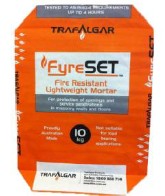
[126] | |
[139] | |
[149] | |
[153] | |
Issue 6 – Was the application for the FYRE Registration made in bad faith? | [154] |
[158] | |
If the answer to any one of the above issues is “yes”, should the registration be cancelled? | [159] |
[160] | |
[166] | |
[168] | |
[169] |
NEEDHAM J:
The matters in issue
1 These proceedings concern a dispute between Trafalgar Group Pty Ltd and Boss Fire & Safety Pty Ltd in relation to a trade mark.
2 Trafalgar Group and Boss Fire are each in the business of supplying and manufacturing products to be used for passive fire protection. The term “passive fire” refers to the equipment and material used in construction to prevent or slow the spread of fire. For example, passive fire protection includes systems and products that restrict the spread of fire within a structure by compartmentalising the building and its services.
3 Two separate proceedings were heard concurrently, each of which was in relation to the trade mark depicted below:

(the FYRE Device Mark).
4 On 7 August 2009, the priority date, Trafalgar Group applied to register Trade Mark No. 1313971 (FYRE Registration) for the FYRE Device Mark in respect of goods in classes 1, 6, 17 and 19 (the Registered Goods).
5 The FYRE Device Mark was accepted for registration on 2 November 2009 for the Registered Goods, and was entered on the Register of Trade Marks on 18 March 2010. Trafalgar Group is the registered owner of the FYRE Device Mark.
6 On 22 February 2019, Boss Fire filed an application under s 92(1) of the Trade Marks Act 1995 (Cth) (TMA) seeking to remove the FYRE Device Mark from the Register of Trade Marks, on the grounds cited in s 92(4)(b), namely that Trafalgar Group had not used the FYRE Device Mark during the three-year period between 23 January 2016 and 22 January 2019 (the non-use period) in relation to any of the Registered Goods. On 23 April 2019, Trafalgar Group (which until 24 February 2020 was called Fire Containment Pty Ltd) opposed the application.
7 On 2 July 2024, a delegate of the Registrar of Trade Marks issued a Decision (Trafalgar Group Pty Ltd v Boss Fire & Safety Pty Ltd [2024] ATMO 122) rejecting Trafalgar Group’s opposition to removal of the FYRE Device Mark for non-use, and declining to exercise the discretion to retain the registration pursuant to s 101(3) of the TMA.
8 On 23 July 2024, Trafalgar Group filed a Notice of Appeal (Intellectual Property) in respect of the Decision, thereby commencing the present proceeding, NSD 970 of 2024. I will refer to this proceeding as the non-use appeal.
9 On 23 September 2024, Boss Fire filed an Originating Application and Statement of Claim seeking cancellation of the FYRE Device Mark, thereby commencing the present proceeding, NSD 1328 of 2024. I will refer to this proceeding as the cancellation action.
10 In the non-use appeal, Trafalgar Group is the appellant and Boss Fire is the respondent, and in the cancellation action, Boss Fire is the applicant and Trafalgar Group is the respondent.
11 There is substantial overlap between the issues and evidence relied upon in the non-use appeal and cancellation action, and on 29 April 2025, I made orders that evidence in each proceeding be evidence in the other.
12 The parties have helpfully provided Agreed Background Facts pursuant to s 191 of the Evidence Act 1995 (Cth), and Factual and Legal Issues for Determination in each claim, which were each received as an aide-memoire. The latter document forms the basis of the questions for determination in these reasons.
Determinations
13 For the reasons given below, I have determined that the non-use appeal should succeed as follows:
(a) I have found that the FYRE Device Mark was not used on its own as a trade mark during the non-use period, but was used as a “mark within a mark” during that time.
(b) The use of the FYRE Device Mark as part of the composite marks was not a use of the mark with “additions or alterations not substantially affecting their identity”;
(c) Accordingly, as Trafalgar Group succeeded on the first point, the question of whether I should exercise my discretion not to remove it from the Register does not arise.
14 In relation to the cancellation action, I have determined that:
(a) The FYRE Device Mark is inherently adapted to distinguish Trafalgar Group’s goods or services from the goods or services of other persons (s 41(3) of the TMA).
(b) It was intended to be used as a trade mark.
(c) The application was not made in bad faith.
15 I am not persuaded to make the FYRE Registration subject to a limitation as sought by Boss Fire.
16 The non-use appeal should be allowed, and the cancellation action dismissed.
The parties and the FYRE trade marks
17 Since the 1980s, the word “FYRE” was used by Wormald International Ltd in relation to the development, manufacture, distribution, and sale of passive fire protection products developed by its Fire Research division (FYRE Business).
18 In around 1990, Tyco International Ltd, a US corporation, purchased all of the fire protection systems and related business conducted by Wormald International, including the FYRE Business and the FYRE trade marks.
19 Throughout the 1990s and early 2000s, Grinnell Building Products Limited, a wholly-owned subsidiary of Tyco at the time, operated the FYRE Business. In around 1997, Grinnell changed its name to Tyco Building Products Pty Limited. On 19 May 2004, the company now known as Trafalgar Group was incorporated as F&S Group Pty Ltd, before changing its name to Fire Containment Pty Ltd on 11 February 2009, and then to Trafalgar Group on 24 February 2020.
20 In around November 2004, Norfolk Building Products (Aust) Pty Ltd purchased Tyco Building Products, and its name was changed to Trafalgar Building Products Pty Ltd.
21 In around 2009, Norfolk sought a buyer for the business and assets of Trafalgar Building Products, and on 8 May 2009, Trafalgar Group, named Fire Containment Pty Ltd at the time, purchased the business and assets of Trafalgar Building Products, including the FYRE Business and FYRE trade marks.
22 I note here as background that Boss Fire and Trafalgar Group have been parties to several disputes in the Federal Court, the Supreme Court of NSW, and the Trade Mark Office concerning Trafalgar Group’s business name and trade marks, including the FYRE Device Mark. The proceedings have their genesis in the fact that both sides (through their respective managing directors) have been in conflict since the purchase in 2009 of the Trafalgar Building Products business and assets by Trafalgar Group. For example, Mr Rakic (for Trafalgar Group) and Mr Prior (for Boss Fire) were both in negotiations with Norfolk to purchase the business and assets of Trafalgar Building Products, and there have been a number of proceedings in relation to intellectual property since then. The countervailing attacks on credit, and attempts to establish knowledge of the FYRE Device Mark and its use, are coloured by this history.
23 Trafalgar Group is the owner of the following trade marks:
Trade Mark Number | Trade Mark | Priority Date | Definition in these reasons |
1298424 |
| 8 May 2009 | the Trafalgar Mark |
1302350 |
| 3 June 2009 | Together – the Trafalgar marks or (in reference to the product) the Trafalgar products |
1302351 |
| 3 June 2009 | |
1302352 |
| 3 June 2009 | |
1313963 |
| 7 August 2009 |





24 Each of the Trafalgar marks incorporates the FYRE Device Mark. Mr Rakic gave evidence that the “font and elements of the [FYRE Device Mark] … was taken from the Trafalgar Mark”. The four Trafalgar products – FYREFLEX, FYREPLUG, FYRESET, and FYRECLAMP – are those relied on by Trafalgar Group to establish use of the FYRE Device Mark in the non-use period. Mr Bury, a witness called by Trafalgar Group, gave evidence that these products are part of a system, so that “Fyreplug pillows are installed and sealed with Fyrecaulk foaming sealant” and fire resistance test certificates are issued in relation to that system (see paragraph 22 of his affidavit of 3 April 2025).
25 Boss Fire uses two word trade marks, FIREBOX and FYREBOX (see Rakman International Pty Ltd v Boss Fire & Safety Ltd [2022] FCA 464 at [673]). In addition, other traders use the word “FYRE” in relation to passive fire protection products (for example, FYRESHIELD fire shutters, a product unrelated to either of the parties to these proceedings).
Witnesses
26 Before dealing with the two actions, I will consider the submissions on credibility of the main witnesses, Mr Rakic and Mr Bury (called by Trafalgar Group), and Mr Prior (called for Boss Fire). I do not intend to make global credibility findings in relation to the witnesses but, instead, to have regard to the entirety of the evidence and the weight to be given to their oral evidence. As Basten JA (with whom Handley AJA agreed) cautioned in Sangha v Baxter [2009] NSWCA 78; 52 MVR 492:
155 There are risks in making global findings about credibility of any particular witness. Because a witness has not told the truth with respect to a particular matter does not mean that other parts of his or her evidence are untruthful. Where possible, an assessment should be made of the reasons for the untruthfulness in order to see if other aspects of the evidence are likely to be infected by the same concern. Further, evidence may be rejected because it is apparently unreliable, possibly mistaken or deliberately untruthful or capable of being categorised in a variety of ways which are unlikely to be capable of clear delineation in some cases.
156 Further, findings of credibility are not usually findings with respect to factual issues in the case, but are rather subsidiary findings on the way to determination of issues. Like many aspects of the evidence in a trial, the evidence of a witness who is believed to have lied in a particular respect, will nevertheless be able to bear some weight and should be placed into a balance, with other material evidence, before a conclusion is reached in relation to a critical fact. The rejection of a witness in total, absent corroboration is likely to mean that, even where corroborated, little attention will be paid to the evidence of the witness and less to the possible consequences which might flow from the fact that particular evidence is shown to be truthful: see generally, King v Collins [2007] NSWCA 122 at [44].
27 I will give my general impressions of the witnesses below, which inform my findings in relation to each of the two actions. I have had regard to the oral evidence as against the written record, bearing in mind what Bell P said in ET-China.com International Holdings Ltd v Cheung [2021] NSWCA 24; 388 ALR 128 at [25]-[29] about “contemporary materials, objectively established facts and the apparent logic of events” (Fox v Percy [2003] HCA 22; 214 CLR 118 at [31]) forming a reference point for assessing the reliability of witness testimony. See also Abraham J in Al Muderis v Nine Network Australia Pty Limited (Trial Judgment) [2025] FCA 909 at [154], and the need to find an “actual persuasion” (Watson v Foxman (1995) 49 NSWLR 315 at 318–9 (McLelland CJ in Eq)) as to whether events took place.
John Rakic
28 Trafalgar Group relied on three affidavits of Mr John Rakic, who has been the Managing Director of Trafalgar Group since 2008. Mr Rakic has more than 25 years’ experience in the passive fire protection industry, as well as being involved in a number of committees relating to the standards connected with passive fire protection.
29 Mr Rakic gave evidence on Trafalgar Group’s use of the FYRE Device Mark and the history of the FYRE trade marks in Australia. He gave evidence on the use of the FYRE Device Mark on various platforms such as websites, FYRE product labels and packaging, technical guides, data sheets and brochures, and on YouTube. Mr Rakic also gave evidence on how the mark, which formed part of the assets sold to Trafalgar Group, had been in continuous use in the passive fire protection industry since the 1980s, including through companies such as Wormald International.
30 Mr Rakic was cross-examined on this evidence, and on affidavit evidence that he had given during the Rakman proceedings before Yates J involving the use of the word “FYRE” in Trafalgar Group’s FYREBOX product. Boss Fire submitted that Mr Rakic repeatedly sought to deviate from the evidence given in Rakman, without accepting that that was what he was doing, and as such, his evidence should be treated with caution.
31 In his first affidavit, at paragraph 13, Mr Rakic provided a list of products that had been offered for sale by Trafalgar Group and its predecessors since at least 1987, all containing the word “FYRE” and/or using the FYRE Device Mark. Twenty-two of the products listed were objected to, and were not read into evidence. In cross-examination, counsel for Boss Fire, Ms St John, asked Mr Rakic whether the remaining words, one of which was “Fyrejoint”, were presently being used in Trafalgar Group’s business in a ‘market-facing way’, which is a short-hand way of asking whether the mark was being displayed to customers of those products. Mr Rakic had difficulty answering this question, but responded that, “[Trafalgar] has chosen not to for the short period of time”. I asked Mr Rakic whether, since Trafalgar Group bought the business from its predecessor, the “Fyrejoint” product had been sold by Trafalgar Group or shown on its website. Mr Rakic confirmed that it had not. Boss Fire submitted that Mr Rakic gave “conflicting evidence” on this point, and noted, with some degree of accuracy, that the 16 years since Mr Rakic purchased the Trafalgar Group business was not a “short period of time”. In response to further questions from Ms St John, Mr Rakic claimed that, “the mark is still being used today … because the product is installed … in existing buildings which need to be maintained”. From this evidence, Ms St John sought to establish that when Mr Rakic referred to the “use” of these products in his affidavit, he was not necessarily referring to the use of the FYRE Device Mark.
32 I did not find Mr Rakic to be a consistently helpful witness. He was, however, in the witness box for nearly a whole day. Trafalgar Group’s counsel, Ms Cochrane SC, who appeared with Ms McDonald, submitted that he was an honest witness doing his best to answer sometimes confusing questions. Ms St John submitted that “his intentions and motivations are relevant to this case, because Trafalgar Group asks the Court to exercise its discretion in [Trafalgar Group’s] favour”. I found Mr Rakic’s evidence in these proceedings to be somewhat vague and occasionally, as submitted by Boss Fire, not consistent with his previous evidence given in Rakman. I will accordingly review his oral evidence against the contemporary corroborative or inconsistent materials when making necessary findings of fact.
Gregory Bury
33 Trafalgar Group also relied on an affidavit of Mr Gregory Bury, a trader in passive fire protection products, in the cancellation action. Mr Bury is the owner of Fire Stopping Pty Ltd, and has over 60 years’ experience in construction and 45 years’ experience in the fire protection industry. Mr Bury was asked to provide independent expert advice on active and passive fire protection, and his knowledge and experience of products or brands using the word “FYRE” in the passive fire protection industry. Mr Bury gave evidence that he had been aware of the FYRE Device Mark for over a decade, and that he associates the logo with FYRE products and Trafalgar Group, and does not associate the word “FYRE” with any other product or brand in the passive fire protection market.
34 Boss Fire did not challenge Mr Bury’s honesty, but submitted that Mr Bury was not the right person to give evidence that could affect the Court’s assessment of the reputation of the FYRE-formative marks in the market generally. Boss Fire relied on the fact that Mr Bury has had a long association with Trafalgar Group, having previously worked with the Wormald Group, which, as noted above, sold products bearing the word “FYRE” in the name. It was submitted for Trafalgar Group that Mr Bury’s evidence should be accepted because of his long history of participation in the passive fire protection market.
35 Boss Fire issued two subpoenas on 22 May 2025, one to Mr Bury, and one to his company, Fire Stopping. The subpoena to Mr Bury sought production of documents recording any communications made between Mr Bury and Mr Rakic from 1 July 2024 to date, any documents recording purchases made by Mr Bury from Trafalgar Group or Mr Rakic from 1 July 2020 to date, and any document recording the commercial terms between Mr Bury and Trafalgar Group from 1 July 2020 to date. The subpoena to Fire Stopping requested the same documents but substituted “Mr Bury” for “any person at Fire Stopping”. On 20 June 2025, the solicitors for Boss Fire sent Mr Bury a letter referring to the two subpoenas dated 22 May 2025, and noted that he had not complied with the subpoenas, as “no copies of invoices have been provided despite the financial extract … showing hundreds of purchases in the period from 2020 to 2025”.
36 On 26 June 2025, Mr Bury received a letter from the solicitors for Trafalgar Group requesting information in order to prepare a supplementary affidavit. The letter requested any communication between Mr Bury and/or Fire Stopping and Mr Rakic and/or Trafalgar Group from 1 July 2024, and requested copies of invoices issued by Trafalgar Group to Fire Stopping from 1 July 2020, and copies of invoices issued by Boss Fire to Fire Stopping from 1 July 2020. Mr Bury swore a second affidavit in these proceedings on 18 July 2025, annexing copies of these communications and invoices.
37 Trafalgar Group did not read Mr Bury’s second affidavit, but it was tendered by Boss Fire, and relied on in Boss Fire’s closing submissions to demonstrate the “substantial disparity in the amount of products his company has bought from the parties”. Mr Bury’s second affidavit revealed that, “since 1 July 2020, Mr Bury’s company had bought more than 72 times the amount of products from Trafalgar Group” than it had bought from Boss Fire. Mr Bury was referred to the annexures to his second affidavit in cross-examination, which showed that Fire Stopping had purchased $714,041.80 worth of Trafalgar Group’s products from 1 July 2020. Boss Fire relied on this to submit that Mr Bury’s experience with Trafalgar Group’s business and products was so longstanding and extensive, that his recognition of the marks is idiosyncratic. In other words, Mr Bury’s evidence only establishes his own recognition of the marks, as opposed to the recognition of a notional consumer.
38 Mr Bury was also cross-examined on his compliance with the subpoenas issued on 22 May 2025. In particular, he was asked why the subpoena responses did not contain invoices, only a summary of payments. It was submitted that the purpose of the second affidavit was “to comply with that subpoena in an orderly way”.
39 Having heard Mr Bury, and the submissions as to his history of purchasing Trafalgar Group products and as to his compliance with the subpoenas, I am not convinced that he is so partisan that he would have amended his evidence to suit Trafalgar Group. As pointed out by Ms Cochrane SC in submissions, the allegation that he was a partisan witness was not squarely put to Mr Bury. That said, the submission that he may have an idiosyncratic experience of the Trafalgar Group products, and so recognise the FYRE Device Mark in that way, may have some weight. While he may not be the notional consumer, he is clearly someone who has significant experience with the Trafalgar Group products and relies on them as a trusted brand.
Mark Prior
40 Boss Fire relied on three affidavits of Mr Mark Prior. Mr Prior is a director of Boss Fire and has held that position since 2009. In the period from 1987 to 1994 Mr Prior was an engineer at Wormald, from 1999 to 2004 he worked as General Manager at Tyco, and from 2005 to 2009 he was the General Manager at Trafalgar Building Products. Mr Prior was cross-examined at length as to whether he knew about the FYRE-formative marks prior to 2005. Trafalgar Group sought to establish that Mr Prior was not a reliable witness, having regard to his demeanour during cross-examination, what was submitted to be prior inconsistent statements, and an ostensible tailoring of his evidence to meet that relied on by Trafalgar Group. On the final day of hearing, I asked the parties to provide a list of transcript references on this issue and their position on Mr Prior’s credit, which issues have been summarised under the headings below. I was provided with a document entitled Boss Fire Additional Transcript References, along with Trafalgar Group’s response. I deal with the issues raised only briefly given that the evidence on when Mr Prior became aware of the FYRE Device Mark is relevant only to the Trafalgar Group case on discretion.
Awareness of FYRE before 2005
41 Trafalgar Group sought to draw adverse credit inferences from a statement made by Mr Prior during cross-examination when he was asked whether he was aware of products being sold with the word “FYRE” while he worked at the Wormald group of companies, to which he responded, “I have never heard of the word ‘Fyre’ – the prefix F-y-r-e – in all my time at Wormald before I started at what was called, then, Trafalgar Building Products around the beginning of 2005, end of 2004. I had never heard of those words until then”. This assertion was contrasted against statements in Mr Prior’s third affidavit, at paragraph 10(a):
I am aware of Wormald International Ltd and the Wormald Group generally (including the Fire Control division of Wormald), Tyco International Ltd (as well as other Tyco entities such as Tyco Australia Pty Ltd and Tyco Building Products Pty Limited) and Trafalgar Building Products Pty Ltd marketing or selling FYREFLEX, FYREPLUG, FYRESET and FYRECHOKE branded products.
and at paragraph 11:
In the period from 1987 until 2004 when I was as an engineer at Wormald, from 1999 until 2004 when I was General Manager at Tyco, and from 2005 until 2009 when I was General Manager at Trafalgar Building Products, I recall Wormald sold a large number of products outside of the FYRE range, for example [and then he listed 25 product names]
42 Trafalgar Group submitted that in his affidavits, Mr Prior sought to rely on his knowledge and awareness of Trafalgar Group’s predecessors to diminish Mr Bury’s evidence, and in cross-examination he changed his evidence because he had become aware that his own knowledge of the FYRE family of marks was relevant to Trafalgar Group’s case. Ms Cochrane SC put to Mr Prior that it would assist his case in the proceeding to give evidence that he had no personal knowledge of the FYRE products before 2005. This was denied. However, Trafalgar Group noted that Mr Prior’s oral evidence was given once he had observed the whole of the trial, including opening submissions, evidence objections and cross-examination of Mr Rakic and Mr Bury. It claimed that Mr Prior’s oral evidence was a “recent invention tailored to assist Boss’s case and inconsistent with Mr Prior’s previous evidence”, and that this inconsistency undermined his evidence that he was not aware of the FYRE family of products until 2005. Trafalgar Group submitted that the Court ought to find that he was aware of the FYRE family of products from 1987 onwards. There is some force in these submissions and I am able to find that Mr Prior was indeed aware of the FYRE products prior to 2005, and most likely so aware during the timeframe mentioned in his affidavit.
43 There was also contest as to whether references to “Wormald” in Mr Prior’s affidavits were references to “Wormald Building Products” or the Wormald group of companies. Mr Prior’s evidence was that he did not work for Wormald Building Products, but rather worked for the Wormald group of companies from 1987 to 1994. Mr Prior was shown Exhibit A, an affidavit he had sworn on 6 August 2009 in proceedings in the Supreme Court of NSW, in which he stated, “before 1990, it was known as Wormald Building Products for several years. I am aware of this because I was employed by Wormald from 1987 until 1994”. It was put to Mr Prior that the effect of those sentences was that he was employed by Wormald Building Products. Mr Prior denied this, and Boss Fire submitted that this distinction was clear in Mr Prior’s separate references to “Wormald” and “Wormald Building Products”. However, Ms Cochrane SC suggested to Mr Prior that in paragraph 11 of his affidavit (extracted at [41] above), he was seeking to convey that he had direct experience of what Wormald Building Products was doing from 1987. Mr Prior maintained that he worked for Wormald, of which Wormald Building Products was “a small division”, and that he had “direct knowledge that Wormald was using other brands outside of Fyre prefix product names, in contradiction of Mr Bury’s statement that Fyre was the consistent brand”. It is almost impossible to determine, this far after the fact, whether (in an affidavit which did not contain definitions of the terms used) “Wormald” and “Wormald Building Products” were such completely different entities that knowledge of Wormald Building Products while employed by Wormald was likely, possible, or improbable.
44 In response, Boss Fire submitted that Mr Prior’s evidence had been consistent throughout, and there was no basis for an adverse credit finding against him. Mr Prior explained, in cross-examination, that his awareness of the Wormald group of companies selling “FYREFLEX, FYREPLUG, FYRESET and FYRECHOKE branded products” (at paragraph 10(a) of his third affidavit) referred to his current awareness, which was gained after he started working at Trafalgar Building Products. Ms St John told the Court it was “not clear why the distinction matters, or why it was necessary to mount such an enthusiastic attack” on Mr Prior’s credit, particularly when 2005 and 1987 were both before the priority date, meaning that in any case, Mr Prior said he knew about the marks before the priority date. In this respect, there was no benefit to Mr Prior in denying knowledge of Wormald’s use of the FYRE prefix between 1987 and 2005.
45 I am not able to reach a finding on this issue beyond that Mr Prior may well have known of the relevant products before working for Trafalgar Building Products, but I have formed an impression in this cross-examination that Mr Prior was not doing his best to answer questions thoughtfully and with a view to “the whole truth and nothing but the truth”. I do not regard Mr Prior as having lied about his employment. However, it does fit with my general view of Mr Prior’s credit that he was relying on a faint distinction to establish what seemed to him to be a useful differentiation in relation to his knowledge of FYRE products. He was generally reluctant to agree with propositions put to him by Ms Cochrane SC.
Awareness of the FYRE Device Mark registration
46 Mr Prior gave evidence in cross-examination that he was not aware that Trafalgar Group had registered the FYRE Device Mark until 2016. Trafalgar Group submitted that this was “a self-serving lie”, consistent with the motivation and desire of Mr Prior and other traders to use the word “FYRE”. Ms Cochrane SC took Mr Prior to Exhibit B, which was an extract of an affidavit he had affirmed on 30 August 2019 in Federal Court proceedings NSD 641 of 2019, one of the proceedings decided by Yates J in Rakman. It established that by at least 2010, Mr Prior was aware of the FYRECLAMP mark. Trafalgar Group sought to draw the conclusion that, since Mr Prior was aware of the FYRECLAMP mark, he had to have been aware of the registration of the FYRE Device Mark. Trafalgar Group noted the FYRECLAMP mark was applied for on 7 August 2009, the same day as the FYRE Device Mark, and that the FYRE Device Mark would have been of concern to Mr Prior if he wanted to resell a FYRECLAMP product in Australia. It submitted that the Court ought to find that he was aware of the FYRE Device Mark from 2010 onwards.
47 Boss Fire submitted that there is no necessary inconsistency between Mr Prior’s evidence that he knew of the FYRECLAMP mark in 2010, and his evidence that he did not know of the FYRE Device Mark. While Mr Prior admitted to having an interest in the FYRECLAMP mark because of its potential to restrict opportunities to sell another product bearing the same name, Boss Fire submitted that there was no evidence that his awareness of the FYRECLAMP mark meant that he had an awareness of the FYRE Device Mark. For example, he was not asked whether he had done trade mark searches at the time that would have revealed its existence on the Register.
48 From this evidence, and from my observations of Mr Prior in the witness box, I am of the opinion that I should be careful to ensure that evidence given by Mr Prior, if uncorroborated by any independent source, is inherently probable (or against his interest).
Witnesses who were not cross-examined
49 Trafalgar Group relied on two affidavits of Ms Katie Lau, a solicitor acting for Trafalgar Group, and one affidavit of Mr Christopher Butler, the office manager of the Internet Archive, a website that provides access to a digital library of internet sites and cultural artefacts and which created the service known as the Wayback Machine. Ms Lau gave evidence of searches undertaken in relation to use of the FYRE Device Mark, and Mr Butler as to the operation of the Wayback Machine and records held by it of Trafalgar Group’s website.
50 Boss Fire relied on two affidavits of Ms Robynne Lyndsay Sanders, the solicitor acting for Boss Fire.
51 In the absence of any challenge to the affidavit evidence of these witnesses, I accept their evidence.
The non-use appeal
52 Turning now to the non-use appeal, as noted above, Trafalgar Group brings an appeal from the Decision of the Registrar of Trade Marks, made by his delegate in relation to the FYRE Device Mark. The delegate determined that Trafalgar Group had not established its opposition to the removal of the FYRE Device Mark and directed that the FYRE Registration be removed from the Register one month from the date of the Decision. The Decision directed that, should the Registrar be served with a notice of appeal before the removal of the trade mark, the removal would not occur until after the appeal had been decided or discontinued, and any disposition of the removal application be in accordance with the Court’s orders or direction.
53 Within the required 21 days after the Decision was issued, Trafalgar Group filed the Notice of Appeal seeking orders that the appeal be allowed, the Decision be set aside, and the FYRE Registration remain registered.
54 The hearing and determination of the non-use appeal is a hearing de novo, involving the exercise of original jurisdiction of the Court (see Rowntree PLC v Rollbits Pty Ltd (1988) 90 FLR 398). This requires the Court to approach the matter afresh, and hear and determine questions of fact and law in controversy according to all the evidence adduced at the hearing in support of, or in answer to, the relevant case. As Markovic J said in ETO Group Pty Ltd v ETO Gruppe Technologies GmbH [2025] FCA 1253 at [15] (citing Thawley J in Seven Network (Operations) Limited v 7-Eleven Inc [2023] FCA 608 at [3]), “The Court stands in the shoes of the Registrar to consider the relevant issues afresh”.
55 Trafalgar Group submitted that the appeal de novo aspect is particularly relevant in the present proceeding, as the evidence before the delegate has been augmented by Trafalgar Group in these proceedings. Nevertheless, I accept the principle relied upon in Boss Fire’s submissions that weight should be given to the Registrar’s opinion, it being the decision of a skilled and experienced person (see Eclipse Sleep Products Incorporated v Registrar of Trade Marks [1957] HCA 86; 99 CLR 300 at 308; Registrar of Trade Marks v Woolworths Ltd [1999] FCA 1020; 93 FCR 365 at [32]-[34] per French J (with whom Tamberlin J agreed)).
Removal application and grounds for removal
56 Part 9 of the TMA provides a mechanism for the removal of a registered trade mark for non-use. As outlined above, Boss Fire applied to the Registrar under s 92(1) to have the FYRE Device Mark removed from the Register. Its application for removal relied upon the ground in s 92(4)(b) of the TMA, which relevantly provides:
92 Application for removal of trade mark from Register etc.
…
(4) An application under subsection (1) or (3) (non-use application) may be made on either or both of the following grounds, and on no other grounds:
…
(b) that the trade mark has remained registered for a continuous period of 3 years ending one month before the day on which the non-use application is filed, and, at no time during that period, the person who was then the registered owner:
(i) used the trade mark in Australia; or
(ii) used the trade mark in good faith in Australia;
in relation to the goods and/or services to which the application relates.
…
57 Under s 100 of the TMA, as the opponent to Boss Fire’s non-use application, Trafalgar Group bears the onus to rebut any allegation of non-use under s 92(4)(b) of the TMA. In particular, s 100(1)(c) provides that:
100 Burden on opponent to establish use of trade mark etc.
(1) In any proceedings relating to an opposed application, it is for the opponent to rebut:
…
(c) any allegation made under paragraph 92(4)(b) that the trade mark has not, at any time during the period of 3 years ending one month before the day on which the opposed application was filed, been used, or been used in good faith, by its registered owner in relation to the relevant goods and/or services.
…
58 The Court further has an overarching discretion under s 101(3) of the TMA to decide not to remove a trade mark if it is satisfied that it is reasonable to do so, even if the grounds on which the application was made have been established.
Purpose of the non-use procedure
59 The High Court (French CJ, Gummow, Heydon and Bell JJ, Crennan J agreeing on this point) described the purpose of the non-use procedure in Health World Ltd v Shin-Sun Australia Pty Ltd [2010] HCA 13; 240 CLR 590 at [22]:
… [T]he legislative scheme reveals a concern with the condition of the Register of Trade Marks. It is a concern that it have “integrity” and that it be “pure”. It is a “public mischief” if the Register is not pure, for there is “public interest in [its] purity”. The concern and the public interest, viewed from the angle of consumers, is to ensure that the register is maintained as an accurate record of marks which perform their statutory function — to indicate the trade origins of the goods to which it is intended that they be applied.
(references omitted)
60 In a UK case, Laboratoire de la Mer Trade Marks [2002] FSR 51 (Cth) at 796 [19(a)], Jacobs J described the purpose of the equivalent UK provision in the following terms:
There is an obvious strong public interest in unused trade marks not being retained on the registers of national trade mark officers. They simply clog up the register and constitute a pointless hazard or obstacle for later traders who are trying actually to trade with the same or similar marks. They are abandoned vessels in the shipping lanes of trade.
61 Boss Fire adopted this language in its closing submissions, submitting that the FYRE Device Mark, on its own, is not performing the function of indicating the trade origin of Trafalgar Group’s goods, and is instead such an “abandoned vessel”.
Issues for determination in the non-use appeal
Issue 1 – Did Trafalgar Group use the FYRE Device Mark as a trade mark in respect of each or any of the Registered Goods in the non-use period
62 As noted above, Trafalgar Group bears the onus of rebutting any allegation of non-use under s 92(4)(b) of the TMA. Under s 100(3)(a) of the TMA, Trafalgar Group is taken by the Court to have rebutted the allegation if it establishes that the FYRE Device Mark, or the FYRE Device Mark with additions or alterations not substantially affecting its identity, was used in good faith by Trafalgar Group in relation to the Registered Goods during the non-use period. It will be recalled that the non-use period is 23 January 2016 to 22 January 2019.
Use in respect of the Registered Goods
63 The requirement that the trade mark be used in respect of the Registered Goods refers to the part of s 92(4)(b) which states, “at no time during that period, the person who was then the registered owner: (i) used the trade mark in Australia … in relation to the goods and/or services to which the application relates” (emphasis added).
64 Boss Fire’s application for removal was made in respect of all of the Registered Goods, and appears at Annexure A of the Decision. In its closing submissions, it noted that the Registered Goods included broadly-defined goods such as, “Chemicals used in industry, science and photography, as well as in agriculture, horticulture and forestry”, and progressed to more specific goods such as “chemical preparations for use in the control, prevention and extinguishing of fires, fire resistant chemicals and compositions”. The broadly defined goods include fire-related goods, but are not limited to such goods. On the other hand, it was submitted, the more specific goods are indisputably fire-related.
65 Boss Fire submitted that Trafalgar Group’s operations were only in respect of the more specific fire-related goods, and that Trafalgar Group did not adduce any evidence of use of the FYRE Device Mark in respect of any goods other than goods for passive fire protection. Indeed, paragraph (1)(b) of Trafalgar Group’s Notice of Appeal, under the heading “grounds relied on”, claims that the delegate ought to have found that Trafalgar Group used the FYRE Device Mark during the non-use period “in relation to at least some of the goods identified in Annexure A”. Particular (iii) to this paragraph specifies those goods as:
iii. The Trade Mark has been used in relation to at least the following goods:
(1) Class 1: fire extinguishing compositions; adhesives used in industry; chemical preparations for use in the control, prevention and extinguishing of fires, fire resistant chemicals and compositions;
(2) Class 6: metal building materials; ironmongery, small items of metal hardware; pipes and tubes of metal;
(3) Class 17: packing, stopping and insulating materials; fire resistant and fire retardant materials for building purposes including ceiling and partitions; fire proof seals; and
(4) Class 19: non-metallic building materials for fire protection including for the prevention of the spread of fire in buildings, non-metallic fire protection materials for use in building, for electrical cables, for electrical and pipe ducts; fire retardant bags to lock openings in walls and floor slabs; fire resistant cement; sealants having fire resistant or fire retardant properties including acrylic sealants and polyurethane sealants with fire retardant properties.
66 Trafalgar Group accepted that its use of the FYRE Device Mark has been in respect of the subset of goods identified in paragraph (1)(b)(iii) of the Notice of Appeal extracted above, which can be characterised as relating to passive fire protection. Ms Cochrane SC cited those classes in her closing oral submissions, and noted that the evidence supported use of the FYRE Device Mark in those classes (notwithstanding the cross-examination of Mr Rakic in relation to fertiliser and the like). Ms McDonald submitted for Trafalgar Group that s 92 of the TMA permitted the Court to provide for cancellation of the whole or part of the registration of the mark; if I were satisfied that there had not been use in particular classes, then they could be struck out and the registration remain in relation to the specified classes.
67 For the purposes of the non-use appeal, I therefore accept that the question is whether Trafalgar Group used the FYRE Device Mark in respect of the passive fire protection goods in the above classes, as opposed to all of the goods listed in Annexure A.
The type and standard of use required under s 100(3)(a) of the TMA
68 The TMA provides guidance as to conduct that will constitute the use of a mark, which is required to rebut the allegation of non-use under s 100(3). Relevantly, s 7 of the TMA provides that:
7 Use of trade mark
(1) If the Registrar or a prescribed court, having regard to the circumstances of a particular case, thinks fit, the Registrar or the court may decide that a person has used a trade mark if it is established that the person has used the trade mark with additions or alterations that do not substantially affect the identity of the trade mark.
Note: For prescribed court, see section 190.
(2) To avoid any doubt, it is stated that, if a trade mark consists of the following, or any combination of the following, namely, any letter, word, name or numeral, any aural representation of the trade mark is, for the purposes of this Act, a use of the trade mark.
(3) An authorised use of a trade mark by a person (see section 8) is taken, for the purposes of this Act, to be a use of the trade mark by the owner of the trade mark.
(4) In this Act:
use of a trade mark in relation to goods means use of the trade mark upon, or in physical or other relation to, the goods (including second‑hand goods).
…
69 A single bona fide use of the FYRE Device Mark during the non-use period is sufficient to resist an application for removal: Woolly Bull Enterprises Pty Ltd v Reynolds [2001] FCA 261; 107 FCR 166 at [17]. The type of use required to rebut a non-use application is use as a trade mark, ie as a badge of origin (E&J Gallo Winery v Lion Nathan Australia Pty Ltd [2010] HCA 15; 241 CLR 144 at [41]–[43]). Use of the trade mark must be genuine commercial use (Imperial Group Ltd v Philip Morris & Co [1982] FSR 72), and the requirement of the use to be in “good faith” means “real” as opposed to token use in a commercial sense (Woolly Bull at [16]).
70 Trafalgar Group adduced evidence of what it said was an extensive use of the FYRE Device Mark before, and during, the non-use period, claiming that it appeared as part of the trade marks for the various Trafalgar products on Trafalgar Group websites, product labels, technical guides, data sheets, and brochures in at least the following forms:





71 Trafalgar Group submitted that each of these four examples is a use of the FYRE Device Mark, as a “classic example of trade marks within trade marks”, or as part of the “FYRE family of products”. It further submitted that “well before Trafalgar [Group] applied to register the FYRE Device Mark, the word FYRE had a reputation as a longstanding and trusted trade mark in the passive fire protection market in Australia” (see Mr Bury’s affidavit where he gives the history of the use of the word “FYRE” in products as part of a system, as summarised above in the section “The parties and the FYRE trade marks”).
72 Ms Lau, who gave evidence of the historic use of the FYRE Device Mark on the Trafalgar Group website https://tfire.com.au was able to isolate uses of the FYRE Device Mark “simpliciter” but not within the non-use period (which ended on 22 January 2019). The first identified use by Ms Lau of that mark was on a technical manual dated 30 July 2019, where the FYRE Device Mark appeared in the phrase “Fight Fire with FYRE”. Mr Rakic was cross-examined on this evidence in relation to whether Trafalgar Group had abandoned the use of the FYRE Device Mark. I note that Ms Lau’s second affidavit was filed at 10.00 am on the morning of the first day of hearing, and Boss Fire submitted that there was no explanation for why Ms Lau’s evidence was filed after the time for evidence had expired. However, as noted in the section on witnesses, Ms Lau was not cross-examined, and her evidence is mainly as to her searches on the Wayback Machine and annexures containing screen captures of the uses she had uncovered. I have taken her evidence into account given that Boss Fire did not point to any specific prejudice arising from that lamentably late service.
73 The general principles for determining whether a sign has been used as a trade mark were set out in Seven Network at [42] in the following terms:
The question whether a sign has been used as a trade mark is assessed objectively from the perspective of the consumer, taking into account the context of the use of the mark. It is to be assessed without reference to the subjective trading intentions of the user. The context includes “the relevant trade, the way in which the words have been displayed, and how the words would present themselves to persons who read them and form a view about what they connote”. It may be assessed with resort to common sense.
(references omitted)
74 Trafalgar Group further relied on the “fundamental principle of trade mark law”, that where there are multiple words or signs used in combination, each part of the combination can perform a trade mark function, citing the observations of the joint judgment of the High Court in Self Care IP Holdings Pty Ltd v Allergan Australia Pty Ltd [2023] HCA 8; 277 CLR 186 at [25]:
Where there are several words or signs used in combination, the existence of a clear dominant “brand” is relevant to the assessment of what would be taken to be the effect of the balance of the label, but does not mean another part of the label cannot also act to distinguish the goods.
75 It was submitted that the question of whether a sign has been used as a trade mark is assessed objectively from the point of view of the notional consumer, taking into account the context of the use of the mark; this can be assessed with “resort to common sense” (Seven Network at [42], citing inter alia Shell Company of Australia Ltd v Esso Standard Oil (Australia) Ltd [1963] HCA 66; 109 CLR 407 at 425 and E&J Gallo; see also Wellness Pty Ltd v Pro Bio Living Waters Pty Ltd [2004] FCA 438; 61 IPR 424 at [25]).
76 Trafalgar Group submitted that the decision of Bennett J in Wellness is illustrative of the principle that each part of a combination trade mark may perform a trade mark function. Her Honour considered the following trade mark:

and in assessing the trade mark, considered at [28] that it contained two separate trade marks:
… as used and as it would be understood by consumers, PRO-BIO is used to denote the company that is the origin of the range of waters collectively marketed and distinguished in the course of trade under the name LIVING WATERS. LIVING WATERS is thereby used as a separate trade mark.
77 Applying Bennett J’s assessment in Wellness, Trafalgar Group submitted that each of the Trafalgar marks is a “trade mark comprising the FYRE Device Mark and a suffix” where the FYRE Device Mark and each suffix is performing distinct and separate functions within each trade mark. The FYRE Device Mark identifies the source of the product range, whereas each suffix is a secondary mark to identify each product within the family emanating from that source. Trafalgar Group set out five bases upon which it claimed that the FYRE Device Mark was being used in the Trafalgar marks, during the non-use period:
(a) The whole of the FYRE Device Mark was used in the precise form in which it appears in the registration, including the flame and the extended tail of the Y, and is therefore inherently capable of distinguishing Trafalgar Group’s goods from the goods of other traders.
(b) The colour of the FYRE Device Mark marks it as distinctive from and separate to the rest of the label, with the FYRE Device Mark presented in a unifying orange, and the second word presented in all black and all caps. The colour sufficiently distinguishes the FYRE Device Mark from the second word so that consumers understand it acts separately as a trade mark.
(c) The FYRE Device Mark is used, and was used during the non-use period, as the consistent brand for the FYRE products, indicating that the products are part of a family or system of products sold by Trafalgar Group that provide passive fire protection.
(d) The second part of each example is descriptive of a function or characteristic of each product, for example the FYREFLEX is used to seal joints between panels which move, and therefore must be flexible, the FYREPLUG is used to plug openings in walls and floor slabs, the FYRESET is a type of mortar or concrete which sets when it is poured or trowelled, and the FYRECLAMP is used to prevent the spread of fire by clamping service penetrations in an intumescent material.
(e) The understanding as to how the notional consumer would understand the FYRE Device Mark is consistent with the evidence of Mr Rakic and Mr Bury as to how they see the mark; Mr Rakic stated in cross-examination, “when I see ‘Fyre’ and ‘COLLAR’ in orange and black, to me, they are two separate words and two separate marks”.
78 In addition to the principles as set out in Wellness, Trafalgar Group relied on the statement of Allsop J in Anheuser-Busch, Inc v Budejovický Budvar, Národní Podnik & Ors [2002] FCA 390; 56 IPR 182 at [191]:
It is not to the point, with respect, to say that because another part of the label … is the obvious and important “brand”, that another part of the label cannot act to distinguish the goods. The “branding function”, if that expression is merely used as a synonym for the contents of ss 7 and 17 of the TM Act, can be carried out in different places on packaging, with different degrees of strength and subtlety.
79 His Honour saw the “branding function” as leading to the conclusion that (at [192]):
… one of the impressions that the viewer of the label will take away is that the word ‘Budweiser’ and the phrase ‘Budweiser Budvar’ are being used in a way to distinguish the goods.
80 Trafalgar Group submitted that having regard to the above matters, and the established authorities, the answer to Issue 1 is clearly yes. It was submitted that the FYRE Device Mark is used to denote the company of origin of a family of products, collectively marketed, under the distinctive names or “secondary marks” “FLEX”, “CLAMP”, “SET” and “PLUG”. The FYRE Device Mark was part of the trade marks for those products, in the “FYRE product family”. As Allsop J said in Anheuser-Busch at [189]:
The usage of a word may fulfil more than one purpose on a label. For example a word may have a descriptive element, but also an element of trade mark or branding or distinguishing role: Johnson & Johnson v Sterling Pharmaceuticals, … at 335.
81 Boss Fire did not dispute Trafalgar Group’s extensive use of the Trafalgar marks during the non-use period, nor whether their use was use in good faith.
82 However, Boss Fire submitted no evidence was adduced that Trafalgar Group used the FYRE Device Mark simpliciter during the non-use period. It was only used as part of other, longer marks, and the uses of the FYRE Device Mark on its own (for example, as part of the website slogan “Fight Fire with FYRE”, or “Part of the Trafalgar FYRE family of products”, each using the FYRE Device Mark for the word “FYRE”) were added to the website after the non-use proceedings had been filed. Therefore the key issue in dispute was whether the use that Trafalgar Group relied upon was use of the FYRE Device Mark with additions or alterations not substantially affecting its identity. The parties agreed that this question was equivalent to the question of whether the Trafalgar marks are substantially identical to the FYRE Device Mark.
83 The submissions by Ms St John sought to distinguish Wellness on the basis that the two parts of the logo (pictured at [76] above) differed from the Trafalgar marks, in that the PRO-BIO part was large and embellished, whereas the LIVING WATERS part was not embellished, positioned separately, and was much smaller. She further relied on the finding of Allsop J in Anheuser-Busch that the two words “Budejovický-Budvar” was the mark, not its component words, because the words were placed in close proximity, in similar script, and with generally equal or slightly different prominence. The submission was that this is a closer analogy to the Trafalgar marks than Wellness.
84 In relying on Anheuser-Busch, and its citation in Self Care at [25], Boss Fire submitted that the High Court in Self Care was referring to “two marks appearing in the same material, not … marks within marks”, referring to the use of Budweiser in the company name “Budweiser Budvar” where there was another dominant brand on the label. That is not, it was submitted, a “mark within a mark”. Boss Fire submitted that the Trafalgar marks did not constitute a separate use of the FYRE Device Mark; instead, the whole word (using FYRECLAMP as an example) would be perceived by consumers as one trade mark, not a trade mark encompassing or including a second mark, being just the word (or device mark) “FYRE”. Ms St John dealt with the difference in colour and emphasis between the two components (in this case, FYRE and CLAMP) and pointed to the orange underline under the word CLAMP. That factor, it was submitted, “emphasises the connection between the two parts of the word”, linking the FYRE Device Mark with the second part of the words in the Trafalgar products.
85 I was also taken to Global Retail Brands Australia Pty Ltd v Bed Bath ‘N’ Table Pty Ltd [2024] FCAFC 139; 424 ALR 119 (Nicholas, Katzmann, and Downes JJ) where the mark of a large word HOUSE with the smaller words BED & BATH underneath:

were held by the Full Court to be a single composite mark. At the hearing, Ms St John took me to [119] of the Full Court judgment, which held that the primary judge’s conclusion “depends very much on matters of impression”, and that while this case could not be applied as binding authority for the Trafalgar products, I could be guided by the Full Court’s analysis that, “if something like a large ‘HOUSE’ with a small ‘BED & BATH’ underneath was not considered to be severable in the way [Trafalgar Group is] proposing… the Fyre formative marks in this case would not be”.
86 I note that in Bed Bath 'N' Table Pty Ltd v Global Retail Brands Australia Pty Ltd [2025] HCA 50; 100 ALJR 57 (delivered on 10 December 2025) the High Court reversed the decision of the Full Court on the grounds of misleading or deceptive conduct. In the course of preparation of these reasons I asked the parties whether they wished to make any further submissions on the impact of the High Court decision. On 6 February 2026, the solicitors for Boss Fire provided a response via email to my Chambers, and counsel for Trafalgar Group filed two pages of submissions. Both parties are agreed that the High Court decision did not impact the submissions made in these proceedings. The Full Court’s findings in relation to the TMA were not the subject of the appeal to the High Court, and as such, that reasoning was not affected by the High Court’s reasons.
Consideration
87 It is not in dispute that the FYRE Device Mark was used, in the non-use period, as part of the Trafalgar marks. The question is whether that use of the FYRE Device Mark during the non-use period by way of its incorporation in the Trafalgar marks was sufficient to satisfy the Court of its use as a separately performing trade mark.
88 Having taken into account the submissions and reviewed the material demonstrating the use of the FYRE Device Mark, I have come to the view that the FYRE Device Mark operates as a “mark within a mark” by its use as part of the Trafalgar marks. I have had regard to the authorities to which my attention has been drawn on each side, I am mindful that this is not an easy question, and echo the words of Needham J in Rowntree v Rollbits at 405 where his Honour said, “Clearly, the question is one of impression, and one to which different minds could give different answers.”
89 The “badge of origin” part of the Trafalgar marks is the FYRE Device Mark. It operates as a “separate badge of origin to the composite whole” (see RB (Hygiene Home) Australia Pty Ltd v Henkel Australia Pty Ltd [2024] FCAFC 10; 302 FCR 285 (Nicholas, Burley and Hespe JJ) at [116]). The consistent use of the orange in the FYRE Device Mark and the black font in the suffixes indicates that those are products within a “FYRE” range. It operates as a separate word from the suffixes -FLEX, -PLUG, -SET, and -CLAMP. While those words are – as Ms St John submitted – not directly descriptive, they do have a relevance to the function of the product. The FYRE Device Mark, having as it does the flourishes of the flame and the elongated orange tail, acts as a “badge of origin” for the various products within the family. While Mr Rakic was of course not giving expert evidence on how the marks should be perceived, I agree with his observation that “when I see ‘FYRE and ‘COLLAR’ in orange and black, to me, they are two separate words and two separate marks”. It would be more likely than not, in my view, that a notional consumer – and here I adopt Ms Cochrane SC’s suggestion that I can be informed to some extent by an actual consumer such as Mr Bury – would see the FYRE Device Mark as fulfilling a separate role from the suffix. The FYRE Device Mark identifies the source of the product range, whereas each suffix is a secondary mark to identify each product within the FYRE family. The use of the FYRE Device Mark as a component of a larger composite mark is sufficient to demonstrate that there has been use of the FYRE Device Mark itself (see RB (Hygiene Home) at [111]).
90 This is an appeal, but a hearing de novo. I have come to a different conclusion from that of the delegate. I note that the evidence before the delegate was less expansive than that which was brought before me, and again I note that reasonable minds may reasonably differ on these matters. In particular, I do not agree with the delegate that the underlining under both the FYRE element and the following word elements “serve[s] to emphasise the connection between the respective elements of the trade marks” (at [41] of the Decision). In my view the orange of the second underlining, while it has some connective elements, operates more to emphasise the separateness of the second word. I note the fact that colour alone is not enough to render a mark distinctive (and indeed the FYRE Device Mark could be rendered in any colour), but the underlining of the second word acts itself to some degree as separation of the two words of each of the Trafalgar marks.
91 I consider that Trafalgar Group has demonstrated that it has used the FYRE Device Mark as a trade mark during the non-use period in relation to the goods and services set out in paragraph [65] above.
Issue 2 – Whether Trafalgar Group’s use of the FYRE Device Mark together with other matters, in the non-use period, constituted use of the FYRE Registration with additions or alterations not substantially affecting its identity
92 Trafalgar Group says that Issue 2 only arises if the Court finds that the FYRE Device Mark is not separately performing a trade mark function when used in the examples at [70] above. That is, the only element performing a trade mark function in those examples is the mark as a whole. As I have determined Issue 1 in favour of Trafalgar Group, a determination of the second question is not strictly necessary. However, I will briefly review this ground and determine it given that it was fully argued.
Principles of substantial identity
93 Section 100(3)(a) of the TMA allows an opponent to a non-use application to rebut the allegation of non-use by proving that the trade mark was used “with additions or alterations not substantially affecting its identity”. It has been noted that:
… this phrase (which is mirrored in s 7(1), which deals with what can be taken to constitute ‘use’ of a mark in other places in the TMA) has been interpreted as being broadly coterminous with the concept of ‘substantial identity’ as that concept has been applied in ownership disputes under s 58, in infringement actions under s 120 and in cases involving conflicts between applications for registration and earlier registered marks under s 44.
(see Burrell R and Handler M, Australian Trade Mark Law (3rd ed, LexisNexis Australia, 2024) p 487 cited in Trafalgar Group’s opening submissions).
94 The question therefore is whether use of the Trafalgar marks constitutes use of the FYRE Device Mark, with additions or alterations not substantially affecting its identity. The parties are agreed that that question is equivalent to the question of whether the Trafalgar marks are substantially identical to the FYRE Device Mark.
95 The concept of ‘substantial identity’ is not defined in the TMA. However, the test has developed in contradistinction to the test of ‘deceptively similar’, which is defined in s 10 of the TMA in the following terms: “…a trade mark is taken to be deceptively similar to another trade mark if it so nearly resembles that other trade mark that it is likely to deceive or cause confusion”. The distinction between the two tests was established by the High Court in Schweppes Ltd v E Rowlands Pty Ltd [1910] HCA 36; 11 CLR 347 at 357, and was developed by Windeyer J in Shell at 414-415:
In considering whether marks are substantially identical they should, I think, be compared side by side, their similarities and differences noted and the importance of these assessed having regard to the essential features of the registered mark and the total impression of resemblance or dissimilarity that emerges from the comparison.
…
On the question of deceptive similarity a different comparison must be made from that which is necessary when substantial identity is in question. The marks are not now to be looked at side by side. The issue is not abstract similarity, but deceptive similarity. Therefore the comparison is the familiar one of trade mark law. It is between, on the one hand, the impression based on recollection of the plaintiff's mark that persons of ordinary intelligence and memory would have; and, on the other hand, the impressions that such persons would get from the defendant's television exhibitions.
96 Substantial identity is the more demanding of the two comparisons, involving a ‘side-by-side’ comparison of the marks with any differences likely to be perceptible. Deceptive similarity is judged against the overall impression that persons of ordinary intelligence and memory would have of the first mark, based on their recollection (which may be imperfect); and the impression such persons would get from the second mark. The Court considers whether, if each of those marks is used in a normal way as a trade mark for the relevant goods, there will be confusion (see Shell at 415-416).
97 The authority for applying the substantial identity test to non-use cases was confirmed in Optical 88 Ltd v Optical 88 Pty Ltd (No 2) [2010] FCA 1380; 89 IPR 457, 507 at [256] (affirmed on appeal in Optical 88 Ltd v Optical 88 Pty Ltd [2011] FCAFC 130; 197 FCR 67 at [39] (Cowdroy, Middleton and Jagot JJ)), where Yates J held that in non-use cases it was appropriate to consider whether a “total impression of similarity emerges from a comparison between the two marks”, citing key authorities on “substantial identity” in support. This approach was adopted more recently by the Full Federal Court in PDP Capital Pty Ltd v Grasshopper Ventures Pty Ltd [2021] FCAFC 128; (2021) 285 FCR 598, 634 at [161].
98 Trafalgar Group relied on the decision of Pham Global Pty Ltd v Insight Clinical Imaging Pty Ltd [2017] FCAFC 83; 251 FCR 379 (Greenwood, Jagot and Beach JJ). In Pham, the Full Court found that the following trade marks were substantially identical (in the context of considering ownership of a trade mark pursuant to s 58 of the TMA):

99 At [52], the Full Court set out the ‘side-by-side’ comparison test for substantial identity in the following terms:
… The required exercise of side-by-side comparison is not carried out in a factual and legislative vacuum. The purpose of the exercise is to decide if two trade marks are substantially identical, where a trade mark is “a sign used, or intended to be used, to distinguish goods or services dealt with or provided in the course of trade by a person from goods or services so dealt with or provided by any other person” (s 17). Given this context, it is unlikely that the essential elements of a mark or its dominant cognitive clues are to be found in mere descriptive elements, which are not apt to perform this distinguishing role in respect of the relevant goods or services. While this does not mean that differences, including descriptive differences, may be ignored, it does mean that the side-by-side comparison is to be carried out cognisant of the essential elements of the mark.
(emphasis added)
100 The Full Court then applied this test at [56]:
The essential elements are the words “Insight” and the device. The word is the same in both marks. The device appears to the left of the word in both marks. While the differences which her Honour noted do exist, the dominant cognitive cues in both marks is a device which is circular in shape evoking an eye to the left of the word “Insight”, in circumstances where the other words “clinical imaging” and “radiology” are descriptive of the services offered. The importance of the visual differences which her Honour noted, and which we accept exist, must be assessed having regard to these essential elements of the marks. Once this necessary exercise is undertaken, we consider that not only is there a total impression of resemblance between the marks, but also that the differences between the marks are slight having regard to their essential elements or the dominant cognitive clues which they present.
101 Trafalgar Group relied on Pham as “just one example of a number in which composite trade marks with a common element have been found to be substantially identical and/or have met the test for use of the trade mark with additions or alterations not substantially affecting its identity”.
102 Trafalgar Group gave examples of other cases where composite trade marks with a common element were found to be substantially identical and/or met the test for use of a trade mark with additions or alterations not substantially affecting its identity:
(a) AACHI was held to be substantially identical to AACHI INDIAN CUISINE: Ragopika Pty Ltd v Isaac [2023] FCA 487; 174 IPR 351 at [33].
(b) ANCHORAGE CAPITAL was held to be substantially identical to ANCHORAGE CAPITAL GROUP and ANCHORAGE CAPITAL PARTNERS: Anchorage Capital Partners Pty Limited v ACPA Pty Ltd [2018] FCAFC 6; 351 ALR 436 at [119] and [130].
(c) CAIRNS HARBOUR LIGHTS was held to be substantially identical to the words HARBOUR LIGHTS with five gold stars appearing above it and the words A NEW STAR SHINES below it: Accor Australia & New Zealand Hospitality Pty Ltd v Liv Pty Ltd [2017] FCAFC 56; 345 ALR 205 at [213].
(d) CTI was held to be substantially identical to CTI CANBERRA: Complete Technology Integrations Pty Ltd v Green Energy Management Solutions Pty Ltd [2011] FCA 1319 at [63].
(e) CHOC CHILL, COFFEE CHILL, STRAWBERRY CHILL, and VANILLA CHILL were held to be substantially identical to CHILL: PB Foods Ltd v Malanda Dairy Foods Ltd [1999] FCA 1602; 47 IPR 47 at [39].
103 Trafalgar Group relied on the above authorities to submit that use of the FYRE Device Mark with additions or alterations not substantially affecting its identity constituted a use of the FYRE Device Mark during the non-use period, and further cited the following reasons:
(a) The FYRE Device Mark is depicted in the composite trade marks in its entirety, including the word “FYRE” in the same font with the long tail on the letter “Y” and the flame logo.
(b) The flame logo and the word “FYRE” in the stylised font are the essential elements or dominant cognitive cues of both the FYRE Device Mark and the composite trade marks. They appear at the start of each composite trade mark, giving those features prominence both visually and aurally, and they are highlighted in a brightly coloured font.
(c) The word “FYRE” is a distinctive, made-up word. While it is a misspelling of FIRE, it is more apt to perform a distinguishing role because of the misspelling.
(d) By contrast, the second element in each composite trade mark is presented in black and is descriptive. Each of SET, FLEX, CLAMP and PLUG is descriptive of the form or function of the product sold under or by reference to each composite mark. As the Full Court held in Pham, mere descriptive elements are unlikely to be the essential elements of a trade mark and are not apt to perform a distinguishing role in respect of the relevant goods.
104 Applying the ‘side-by-side’ comparison, with appropriate weight given to the essential features of each composite trade mark (the flame logo and the word “FYRE” in the stylised font), Trafalgar Group submitted that each constitutes use of the FYRE Device Mark with additions or alterations not substantially affecting its identity.
105 Boss Fire, in its submissions to the non-use appeal, embraced Pham but submitted that it did not assist Trafalgar Group’s case. Boss Fire submitted that the basis of the decision in Pham was that the essential elements of the marks were the word “INSIGHT”, which was present in both marks; and the device, which was similar (in both marks, the device was on the left of the mark, and circular in shape, evoking an eye: Pham at [56]). The only other difference between the marks was that one included the words “CLINICAL IMAGING” and the other included “RADIOLOGY”. The Full Court held that those words were “mere descriptive elements, which are not apt to perform [a] distinguishing role”: Pham at [52], [56]. As mere descriptive elements, they were not enough to prevent a finding of substantial identity, given that the Court must carry out the side-by-side comparison “cognisant of the essential elements of the mark”: Pham at [52]. Therefore, Boss Fire submitted that Trafalgar Group must persuade the Court that the second part of the marks, ie FLEX, CLAMP, SET, PLUG, are not essential elements of the marks; Boss Fire submitted that they plainly are.
106 Boss Fire submitted that the second part of the marks is akin to the second words in the marks that were recently under consideration in Henley Constructions Pty Ltd v Henley Arch Pty Ltd [2023] FCAFC 62; 297 FCR 353 (Yates, Rofe and McElwaine JJ), where the Full Court said at [207]:
Can it be said that the respondent’s use of HENLEY was a use of the 558 mark (HENLEY ESSENCE), the 561 mark (HENLEY RESERVE), or the 570 mark (HENLEY COLLECTION)? While each of the 2016 registered marks includes the word HENLEY, each registered mark is more than simply that word. Each mark is a compound mark with a separate identity based on the inseparable presence of ESSENCE, RESERVE, and COLLECTION, respectively. In our view, those additional words are integral to the identity of each registered mark. They are not mere surplusage that can be ignored. Accordingly, we are not persuaded that the respondent’s use of HENLEY was a use of HENLEY ESSENCE, HENLEY RESERVE, or HENLEY COLLECTION for the purpose of considering the s 124 defence.
107 In support of this submission, Boss Fire noted the following features of the Trafalgar marks:
(a) The second parts of the marks are substantial, and in many cases, longer than the first part (FYRE).
(b) The same font is used in both parts of the mark, and an underline in the same colour extends from the FYRE part of the mark to the second part. The result is that the second part would not be seen as a descriptive add-on or product identifier, but an essential part of the trade mark. This is emphasised by the fact that the “™” symbol is at the end of the second part, not at the end of the FYRE part.
(c) The second words in the marks are not words that are descriptive of fire protection goods. For example, Trafalgar Group’s use of FYREFLEX has been in relation to sealant. The word FLEX is not descriptive of sealant, but rather, citing Flexopack S.A Plastics Industry v Flexopack Australia Pty Ltd [2016] FCA 235; 118 IPR 239 (Beach J) at [234], it is a “covert or skilful allusion” to a quality Trafalgar Group wishes to ascribe to its sealant, which makes that word perfectly adapted to form part of a trade mark for those goods. The word FLEX would strike the consumer as part of a brand, not merely a product descriptor tacked onto the end of a mark. The same is true for SET in relation to mortar, PLUG in relation to fire pillows, and CLAMP in relation to a cable transit box. This, it is submitted, directly contradicts Trafalgar Group’s submissions at [77](d) and [103](d)] above.
(d) The word “FYRE” is not, as Trafalgar Group submits, “a distinctive, made-up word”. While it is an obvious misspelling of FIRE, it is nothing more than “a colourable attempt at reproducing some of the sounds and all the sense of an expression belonging to common speech” (Flexopack at [222] quoting Dixon J in Howard Auto-Cultivators Ltd v Webb Industries Pty Ltd [1946] HCA 15; 72 CLR 175 at 181). It is not apt to perform a distinguishing role.
(e) The second part of the marks is given emphasis by its rendering, in large black capital letters with an underline, and larger font than the first part of the marks. The large black text jumps out at the viewer, conveying to consumers that the second part is not a descriptive add-on, but an essential feature of the badge of origin the trader has applied to the goods. Unlike Pham, where the words CLINICAL IMAGING and RADIOLOGY were rendered in smaller font and underneath, or in lighter text to indicate their lesser importance, the second part of the Trafalgar marks is striking. In each case, it is an essential feature of the marks.
108 Relying on these factors, Boss Fire submitted that the only use Trafalgar Group made of the FYRE Device Mark during the non-use period was as part of the marks used for the Trafalgar products, which are not substantially identical to the FYRE Device Mark. Therefore, there has been no use of the FYRE Device Mark during the non-use period.
Consideration
109 I have come to the conclusion that Issue 2 should be determined against Trafalgar Group.
110 I am assisted in this view by the finding in Henley above which includes:
While each of the 2016 registered marks includes the word HENLEY, each registered mark is more than simply that word. Each mark is a compound mark with a separate identity based on the inseparable presence of ESSENCE, RESERVE, and COLLECTION, respectively. In our view, those additional words are integral to the identity of each registered mark.
111 Consistently with my finding on Issue 1, the “compound marks” which are the Trafalgar marks contain two separate marks. They are “integral to the identity of each … mark”, being somewhat descriptive. Accordingly, they cannot be said to be “additions or alterations not substantially affecting their identity”. The suffixes are integral to the Trafalgar marks; each of the Trafalgar marks has its own identity, of which the FYRE Device Mark is a part, as I have explained above.
112 I do not accept that the registration of the FYRE Device Mark operates as substantially identical to the word “FYRE” alone; it has its own identity and can be distinguished from the literal rendition of a bare foot under the mark BAREOOT (as in E&J Gallo).
113 If it were necessary to decide, I would have determined this issue in favour of Boss Fire.
Issue 3 – If the answer to Issues 1 and 2 are “no”, whether it is reasonable for the Court to exercise its discretion not to remove the FYRE Registration in respect of any or all of the Registered Goods, pursuant to s 101(3) of the TMA
114 The Court has an overarching discretion under s 101(3) of the TMA not to remove a trade mark if the Court is satisfied that it is reasonable to do so. The discretion is a broad one and is limited only by the subject matter, scope, and purpose of the legislation and in particular Part 9 of the TMA: Austin, Nichols & Company Inc v Lodestar Anstalt [2012] FCAFC 8; 202 FCR 490 at [35] (Jacobson, Yates and Katzmann JJ).
115 Trafalgar Group bears the onus of persuading the Court to exercise the discretion in its favour. The factors relevant to the exercise of the Court’s discretion, include: whether the mark has been abandoned, whether the registered owner retains a residual reputation in the mark, whether there has been use of the mark after the non-use period, whether the applicant for removal entered the market with knowledge of the registered mark and the public interest in maintaining the integrity of the Register. Trafalgar Group submitted that each of these factors, on its own, sufficiently supports the exercise of the Court’s discretion in its favour, and taken together, the balance leans heavily in favour of the exercise of the discretion.
116 In written submissions, both Trafalgar Group and Boss Fire addressed the question of whether the Court should exercise its discretion to allow the FYRE Device Mark to remain on the Register. Given my conclusion on the substance of the non-use appeal and as I have found for Trafalgar Group on Issue 1, it is ultimately unnecessary to determine these issues.
Conclusion and orders on the non-use appeal
117 The appeal from the decision of the Registrar of Trade Marks, made by his delegate in relation to the FYRE Device Mark, is allowed. I will make an order that the Trade Mark Registration Number 1313971 remain registered in relation to the goods set out in the particular iii to paragraph (1)(b) of the Notice of Appeal. As the appellant has been successful, my inclination is that it should have its costs of the appeal. However, as the scope of the appeal was limited to the classes noted above, I will give the parties 14 days to agree on costs or to provide me with short (2 page) submissions on where the costs should fall.
Cancellation action
118 In the cancellation action, Boss Fire filed an Originating Application seeking an order pursuant to s 88 of the TMA that the FYRE Registration be cancelled, or in the alternative, that the FYRE Registration be made subject to a limitation that it provides no exclusive right to use or to authorise the use of the word “FYRE”.
119 Section 88(1) of the TMA provides that:
88 Amendment or cancellation – other specified grounds
(1) Subject to subsection (2) and section 89, a prescribed court may, on the application of an aggrieved person or the Registrar, order that the Register be rectified by:
(a) cancelling the registration of a trade mark; or
(b) removing or amending an entry wrongly made or remaining on the Register; or
(c) entering any condition or limitation affecting the registration of a trade mark that ought to be entered.
120 An application under s 88 of the TMA may be made on any ground on which the registration of the mark could have been originally opposed: s 88(2)(a). Boss Fire, as the claimant for cancellation, bears the onus of proof (Accor at [156]).
121 In its closing submissions, Boss Fire framed this question as requiring the Court to determine whether the FYRE Device Mark should have been granted in the first place. Trafalgar Group submitted that the “statutory question for determination by this Court is whether the FYRE Device Mark could have been successfully opposed at its priority date on any one of the specific grounds …” and, if so, whether the FYRE Registration should now be cancelled.
122 The grounds for opposing registration of standard marks are set out in ss 57 to 62A of the TMA. Since s 57 incorporates any ground upon which an application could have been rejected under the TMA, it also allows for any grounds under ss 39-44 to be raised as opposition, except the ground that the trade mark cannot be represented graphically. Boss Fire relied on the grounds in ss 41, 59 and 62A of the TMA, as set out in paragraphs 9 to 11 of the Statement of Claim, and summarised below:
(a) Section 41 – Not Distinctive: the FYRE Device Mark was not, at the priority date, capable of distinguishing the Registered Goods from the goods of other persons within the meaning of s 41(2) of the TMA.
(b) Section 59 – Intention to Use: Trafalgar Group did not, at the priority date, intend to use or authorise the use of, or assign to a body corporate for use, the FYRE Device Mark in Australia.
(c) Section 62A – Bad Faith: Trafalgar Group applied for registration of the FYRE Device Mark in bad faith.
123 To be successful in its cancellation case, Boss Fire only needs to establish one of the grounds above. In the alternative to cancellation, Boss Fire seeks that the FYRE Registration be made subject to a limitation pursuant to s 88(1)(c) of the TMA that it provides no exclusive right to use or authorise the use of the word “FYRE”.
124 It should be noted at the outset that s 88(1) requires Boss Fire to be a person “aggrieved” by the FYRE Registration. It was faintly argued by Trafalgar Group that Boss Fire was not a person aggrieved. This term has been interpreted broadly, its purpose being to remove mere “busybodies” (see Health World at [27]; Powell v Birmingham Vinegar Brewery Co Ltd [1894] AC 8 at 10 and 14). I am satisfied that Boss Fire is a person “aggrieved” for the purposes of s 88(1), being in the same business of passive fire protection as Trafalgar Group, and, as Boss Fire noted, a “trade rival” who may want to use the FYRE-formative marks in the future (and indeed, with its FYREBOX mark, already does).
Issues for determination in the cancellation action
125 I summarise below the arguments for each side on each question. There is necessarily some overlap with what has gone before in relation to non-use.
Issue 4 – Was the FYRE Device Mark incapable of distinguishing the Registered Goods from the goods of other persons within the meaning of s 41(2) of the TMA, and so should be cancelled pursuant to s 88(1) of the TMA?
126 Section 41 of the TMA requires the rejection of trade marks that are not capable of distinguishing the goods or services in respect of which their registration is sought. It was not in dispute that the relevant version of s 41 is the version that was in force at the priority date (prior to the amendments brought about by the Intellectual Property Laws Amendment (Raising the Bar) Act 2012 (Cth)), and set out below:
41 Trade mark not distinguishing applicant’s goods or services
(1) For the purposes of this section, the use of a trade mark by a predecessor in title of an applicant for the registration of the trade mark is taken to be a use of the trade mark by the applicant.
Note 1: For applicant and predecessor in title see section 6.
Note 2: If a predecessor in title had authorised another person to use the trade mark, any authorised use of the trade mark by the other person is taken to be a use of the trade mark by the predecessor in title (see subsection 7(3) and section 8).
(2) An application for the registration of a trade mark must be rejected if the trade mark is not capable of distinguishing the applicant’s goods or services in respect of which the trade mark is sought to be registered (designated goods or services) from the goods or services of other persons.
Note: For goods of a person and services of a person see section 6.
(3) In deciding the question whether or not a trade mark is capable of distinguishing the designated goods or services from the goods or services of other persons, the Registrar must first take into account the extent to which the trade mark is inherently adapted to distinguish the designated goods or services from the goods or services of other persons.
(4) Then, if the Registrar is still unable to decide the question, the following provisions apply.
(5) If the Registrar finds that the trade mark is to some extent inherently adapted to distinguish the designated goods or services from the goods or services of other persons but is unable to decide, on that basis alone, that the trade mark is capable of so distinguishing the designated goods or services:
(a) the Registrar is to consider whether, because of the combined effect of the following:
(i) the extent to which the trade mark is inherently adapted to distinguish the designated goods or services;
(ii) the use, or intended use, of the trade mark by the applicant;
(iii) any other circumstances;
the trade mark does or will distinguish the designated goods or services as being those of the applicant; and
(b) if the Registrar is then satisfied that the trade mark does or will so distinguish the designated goods or services—the trade mark is taken to be capable of distinguishing the applicant’s goods or services from the goods or services of other persons; and
(c) if the Registrar is not satisfied that the trade mark does or will so distinguish the designated goods or services—the trade mark is taken not to be capable of distinguishing the applicant’s goods or services from the goods or services of other persons.
Note 1: For goods of a person and services of a person see section 6.
Note 2: Use of a trade mark by a predecessor in title of an applicant and an authorised use of a trade mark by another person are each taken to be use of the trade mark by the applicant (see subsections (1) and 7(3) and section 8).
(6) If the Registrar finds that the trade mark is not to any extent inherently adapted to distinguish the designated goods or services from the goods or services of other persons, the following provisions apply:
(a) if the applicant establishes that, because of the extent to which the applicant has used the trade mark before the filing date in respect of the application, it does distinguish the designated goods or services as being those of the applicant—the trade mark is taken to be capable of distinguishing the designated goods or services from the goods or services of other persons;
(b) in any other case—the trade mark is taken not to be capable of distinguishing the designated goods or services from the goods or services of other persons.
Note 1: Trade marks that are not inherently adapted to distinguish goods or services are mostly trade marks that consist wholly of a sign that is ordinarily used to indicate:
(a) the kind, quality, quantity, intended purpose, value, geographical origin, or some other characteristic, of goods or services; or
(b) the time of production of goods or of the rendering of services.
Note 2: Use of a trade mark by a predecessor in title of an applicant and an authorised use of a trade mark by another person are each taken to be use of the trade mark by the applicant (see subsections (1) and 7(3) and section 8).
127 In its written submissions, at paragraphs 11-14, Trafalgar Group set out the helpful step-by-step process of working out the distinctiveness of the relevant mark, in a way which was not gainsaid by Boss Fire, as follows:
11. The first step is to classify the distinctiveness of the mark in one of three ways:
(a) the mark is not to any extent inherently adapted to distinguish (s 41(6));
(b) the mark is to some extent adapted to distinguish (s 41(5)); or
(c) the mark is inherently adapted to distinguish (s 41(3)).
12. If the FYRE Device Mark falls into Category (a) above, it will be registrable if it had acquired distinctiveness through the use by Trafalgar or its predecessors before the Priority Date.
13. If the FYRE Device Mark falls into Category (b) above, the Registrar (or here, the Court standing in the shoes of the Registrar) must consider the combined effect of the following three factors in determining whether the mark was registrable:
(a) the extent to which FYRE Device Mark was inherently adapted to distinguish the designated goods at the Priority Date;
(b) the use, or intended use, of the FYRE Device Mark by Trafalgar or its predecessors; and
(c) any other circumstances.
14. If the FYRE Device Mark falls into Category (c) above, it is inherently registrable.
(emphasis in original)
128 The appropriate date to determine the cancellation action is the priority date, the date of filing of the FYRE Device Mark (ie, 7 August 2009).
129 Boss Fire headlined its case as being whether “Trafalgar [Group] should be allowed to monopolise the word FYRE, in respect of [passive] fire-related goods”. Again, Boss Fire made the point that it was not in dispute that Trafalgar Group’s business encompassed only fire-related products, and not the more broadly defined goods in the relevant classes (see, for example, Class 1, which commences with “Chemicals used in industry, science and photography, as well as in agriculture, horticulture and forestry”).
130 Boss Fire submitted that it is not relevant that:
(a) the FYRE Registration was granted after an examination report with no s 41 issue arising;
(b) Boss Fire did not oppose the registration at the time; or
(c) no other traders opposed the registration.
Given that there is a statutory process for cancellation of registration which does not take these factors into account, Boss Fire submitted that the appropriate process is that under s 88(2)(a). It was further submitted that no presumption of registrability arose in relation to ss 41(5) and (6) as they stood at the priority date: see Blount Inc v Registrar of Trade Marks [1988] FCA 440; 83 FCR 50 at 56-58. Branson J said (at 58):
The question whether or not a trade mark is to be taken for the purposes of s 41(2) as capable or not capable of distinguishing the designated goods or services from the goods or services of other persons is governed entirely by s 41(3)-(6).
131 The heart of Boss Fire’s submission is that the word “FYRE” has the ordinary signification of “fire”, being “an obvious misspelling” (a contention accepted by Mr Rakic in his cross-examination), and that it is thus not capable of distinguishing the relevant goods. Additionally, the fire or flame device “reinforce[s] that the mark means ‘fire’”. Additionally, Boss Fire relied on the fact that the word “FYRE” is pronounced “FIRE”.
132 Boss Fire placed reliance on the plurality in Cantarella Bros Pty Limited v Modena Trading Pty Limited [2014] HCA 48; 254 CLR 337 at [70], where it said that the test for determining whether a trade mark is “inherently adapted to distinguish” requires consideration of the “ordinary signification” of the mark to any person in Australia concerned with the relevant goods. An inquiry can then be made into whether other traders might legitimately need to use the mark, or marks nearly resembling it, in respect of their goods. Boss Fire referred to the comments of Kitto J in Clark Equipment Company v Registrar of Trade Marks [1964] HCA 55; 111 CLR 511 at 514 which were adopted in Cantarella:
… whether a mark is adapted to distinguish [is to] be tested by reference to the likelihood that other persons, trading in goods of the relevant kind and being actuated only by proper motives — in the exercise, that is to say, of the common right of the public to make honest use of words forming part of the common heritage, for the sake of the signification which they ordinarily possess — will think of the word and want to use it in connexion with similar goods in any manner which would infringe a registered trade mark granted in respect of it.
See also Accor at [236].
133 There was no dispute that the Cantarella, Clark Equipment and Accor tests were appropriate.
134 Boss Fire submitted that the question was whether a trader should be precluded from using not just the actual mark, but one that is substantially identical, or deceptively similar, to the FYRE Device Mark, when that mark is, essentially, a mere use of the word “fire”. In support of this submission, it was said that the flame device “does no more than illustrate, and reinforce, that the FYRE [Device Mark] means FIRE”. Boss Fire submitted that I can have regard to what other traders in the same goods are doing: Chocolaterie Guylian NV v Registrar of Trade Marks [2009] FCA 891; 180 FCR 60 at [54]. As noted above, it is not in dispute that Boss Fire uses FYREBOX.
135 A “practical evaluative judgment” of the mark is required to determine whether the FYRE Device Mark is “inherently adapted to distinguish” the goods of Trafalgar Group (see Kenman Kandy Australia Pty Ltd v Registrar of Trade Marks [2002] FCAFC 273; 122 FCR 494 at [47]-[48] per French J). Boss Fire submitted that the fact that this is a composite mark is not relevant; it should be treated the same as any other mark, and where a word mark is descriptive, it will be less likely to be found to be inherently adapted to distinguish the goods to which it is applied. For example, in Halal Certification Authority Pty Limited v Flujo Sanguineo Holdings Pty Limited [2023] FCAFC 175; 300 FCR 478, the Full Court had regard to the figurative elements of a device mark and found (at [169]) that those elements did not make any significant contribution to the message conveyed, and that “other traders acting honestly … may well desire to use both the English and Arabic words in the [relevant stylised form] to indicate that the goods had been certified as halal by that person”.
136 Trafalgar Group’s submissions relied on the following:
(a) the presumption of registrability and citing of the Second Reading Speech for the Trade Marks Bill 1995 (Cth);
(b) that composite marks, such as the FYRE Device Mark, which contain multiple elements, must not be sectioned into constituent parts but be considered as a whole; and
(c) the IP Australia Trade Marks Manual of Practice and Procedure discussion as to composite marks, where it was said at 22.26:
Trade marks comprising any combination of words, devices, shapes, sounds, scents and/or colour elements must satisfy the requirement that, when taken as a whole, they are capable of distinguishing designated goods or services in the marketplace. It could be said, however, that combinations are likely to have a higher capacity to distinguish and are more likely to be prima facie capable of distinguishing.
In this regard, Lawrence J. in Diamond T [Diamond T Motor Car Co’s Application (1921) 38 RPC 373] noted at 380:
In determining the question of (whether a mark is adapted to distinguish the applicant's goods from goods of other manufacturers) it is, in my judgement, immaterial to consider whether any of its component parts are or are not registrable by themselves.
Also note Dodds-Streeton J comments in Fry Consulting Pty Ltd v Sports Warehouse Inc (No 2) [2012] FCA 81 at 61:
It is established that a combination mark may be capable of distinguishing by the overall impression it creates, even if the individual elements in isolation lack any such capacity, because, for example, they are commonplace in a trade, or, by parity of reasoning, merely or highly descriptive.
In this case the composite trade mark was found to be inherently adapted to distinguish in respect of retailing services in class 35 notwithstanding the descriptive nature of some of the constituents of the trade mark.
137 See also Colorado Group Ltd v Strandbags Group Pty Ltd [2007] FCAFC 184; 243 ALR 127, where Allsop J treated a device mark as a whole. The word “Colorado” in that device mark was “always [used] with a device. That device was part of the trade mark use; it had a capacity to distinguish” (at [110]). Trafalgar sought to draw a link between the consideration of the whole of the device mark to support its submission that the word “FYRE” must be looked at as a composite mark, and not merely a word mark. It was submitted that the device of the flame and the particular sans serif font with the long tail on the Y is part of the whole device, and that the Court should not be asked to consider whether the word mark FYRE alone, or the flame device alone, is inherently adapted to distinguish the Registered Goods.
138 In response, Boss Fire asserted that the s 41 ground for cancellation was that “the mark is descriptive of the goods”.
Determination of s 41 ground
139 I agree with Boss Fire on a number of preliminary matters; it seems to me, relying on the passage from Branson J in Blount Inc cited above, that there is no reliance on the presumption of registrability arising out of the initial registration; the Registrar had to be satisfied on the balance of probabilities that the relevant criteria in s 41 were met. Accordingly I, too, must look at the matter as if it were being determined afresh. See also Apple Inc. v Registrar of Trade Marks [2014] FCA 1304; 227 FCR 511 at [31] (Yates J). Nor do I take anything from the fact that Boss Fire did not oppose the FYRE Device Mark at the time of registration. Section 88 of the TMA does not so constrain cancellation actions to those who objected at the time. No such limitation should be read in (although I do not understand Trafalgar Group to be asserting any kind of estoppel to that effect).
140 Having considered the way in which the plurality in Cantarella explained the concept of “ordinary signification” (at [70]-[71]) of a mark, I am of the view that the ordinary signification of the word “FYRE” is of an allusion to goods with some relevance to fire, but not directly descriptive of passive fire protection products (as contended for by Boss Fire). I can distinguish cases such as Halal because the words in that case, contained in the annulus device, were the exact words which a trader wishing to denote that its goods were halal-certified would append to them. The marks were:

(registered trade mark) and

(respondent seeking registration).
141 The Arabic characters at the centre of the annulus “can be transliterated as ‘Halal’” (at [6]). The Court at [168]-[169] said:
In our view the Arabic lettering is likely to convey to many people within the target audience the meaning of Halal or, translated into English, allowed or permitted in accordance with Islamic rites.
Both the English and Arabic in the Trade Mark [the first image set out above] refer directly to a relevant characteristic of the goods to which the Trade Mark is applied and the certification services provided by the owner of the Trade Mark in respect of such goods and services. The other component of the Trade Mark, which his Honour correctly described as a non-distinctive annulus of a kind in common use, does not either alone or in combination with the other elements contribute significantly to the distinctiveness of the Trade Mark as a whole. It seems to us that other traders acting honestly and not actuated by any improper motive, may well desire to use both the English and Arabic words in the stylised form of an annulus of the Trade Mark to indicate that the goods had been certified as Halal by that person.
142 Unlike the composite marks in Halal, the FYRE Device Mark does not use FYRE as a direct reference to a relevant characteristic of Trafalgar Group’s goods. It is more allusive than descriptive. Nothing about FYRE indicates the quality or characteristic of the goods; it alludes only to the context in which those goods may be used. Ms St John relied on Halal to support her argument that “the Court should not put aside cases about word marks or image marks in favour of cases in which the mark under consideration was a composite mark. … The principles are the same”. However, nothing in Halal says that the figurative or device elements of the mark do not, as a proposition of law, make any significant contribution to the message conveyed by the word component of the sign, or its distinctiveness. That was the case in Halal; the Court found that the annulus itself was “non-distinctive” and, it seems, a natural shape for a certification device. But it does not mean that the device elements of the FYRE Device Mark add nothing to the mark as a whole.
143 In examining the mark as a whole, I need to consider each element (see, eg, Bohemia Crystal Pty Ltd v Host Corporation Pty Ltd [2018] FCA 235; 129 IPR 482 at [229]; Goodman Fielder Pte Ltd v Conga Foods Pty Ltd [2020] FCA 1808; 158 IPR 9 at [244]-[245]). In my view the fact that the flame is a fairly recognisable rendition of a fire does not mean that it is descriptive of passive fire protection products to the extent that it is “fully or specifically descriptive of the services in relation to which registration is sought or those in fact provided by [Trafalgar Group]” (see Fry Consulting at [59]). Boss Fire’s written closing submissions contend, with a slight air of “stating the obvious” (cf Fawlty Towers s2 ep 6, “Basil the Rat”), that “The FYRE [Device] mark is pronounced ‘FIRE’”. That statement is undoubtedly true, but there is more to the FYRE Device Mark than merely the word element.
144 I accept that FYRE, being a misspelling of FIRE, may be something that may occur to other traders – as indeed it has to Boss Fire – as a designation of passive fire protection goods. However, I do not consider that in using a mark which contains the word “FYRE” those other traders would necessarily be inclined to use a mark which is substantially identical or deceptively similar to the FYRE Device Mark; and here the analysis in the Full Court’s reasoning in Halal is relevant in looking at the distinctiveness of the non-word elements. The flame device, and the trailing Y in the distinctive font, are not elements which would be likely to occur to other traders in developing a device using the word “FYRE”. I agree with Trafalgar Group that the fact that this is a composite device mark, and not merely a word mark, is relevant when determining whether it is inherently adapted to distinguish Trafalgar Group’s goods from the goods of others.
145 In this determination I am persuaded by the treatment of the Colorado device mark in Colorado Group by Allsop J:

and the Tennis Warehouse device mark in Fry Consulting by Dodds-Streeton J:

to have regard to the whole of the FYRE Device Mark, including its font, its flame device, and the long tail of the Y which combine to be a distinctive word reinforced by the image elements. Notably, in Colorado Group, Allsop J said (at [110]):
[T]he examples in evidence reveal an important, perhaps even dominant, effect of the word “Colorado”, but always with a device. That device was part of the trade mark use; it had a capacity to distinguish. It did not, in my view, operate as a separate mark, nor as a mere descriptor. It operated as part of a combination with the word “Colorado”, in part reinforcing it.
146 As in Colorado Group, the FYRE Device Mark is not just the word “FYRE” alone. It has only been used (either on its own, or as part of the Trafalgar marks) as a device mark. The inclusion of the word “FYRE” may be seen as the dominant element, but it is part of a device, and so the device’s ordinary signification is that of a trade mark. This is not a case such as British Sugar plc v James Robertson & Sons Ltd [1996] RPC 281 at 302 (Jacob J) cited by Yates J in Buchanan Turf Supplies Pty Ltd v Registrar of Trade Marks [2015] FCA 756; 114 IPR 81 at [34]:
… no matter how much use a manufacturer made of the word “Soap” as a purported trade mark for soap the word would not be distinctive of his goods. He could use fancy lettering as much as he liked, whatever he did would not turn the word into a trade mark.
147 Boss Fire’s contention that “FYRE for fire-related goods is like SOAP for soap” is not correct. Trafalgar Group’s goods are not merely “fire-related goods”. They are passive fire protection products, which involve more than merely a concept of fire alone. In my view the FYRE Device Mark fulfils the criteria of being inherently adapted to distinguish the goods of Trafalgar Group. The word “FYRE” does not operate as a separate mark, nor is it a mere descriptor (see Colorado Group at [110]). It operates to distinguish the goods of Trafalgar Group from the goods of others (s 41(3) of the TMA; also see Clark Equipment at 513).
148 This ground should be dismissed.
Issue 5 – Did Trafalgar Group intend to use or authorise the use of the FYRE Registration in Australia as a trade mark in relation to the Registered Goods?
149 Section 59 of the TMA allows opposition to (and therefore cancellation under s 88) of a mark, if the applicant for registration did not intend to use it, or authorise its use, in Australia, in relation to the specified goods and services in the application. The time for assessing the applicant’s intention is at the priority date, but use of the mark after that date may clarify the intention from the date of application; see Suyen Corporation v Americana International Ltd [2010] FCA 638; 187 FCR 169 at [211]. Nor can a lack of use give rise to an inference of lack of intention (Suyen at [207]). The threshold in regard to intention to use is very low; see Food Channel Network Pty Ltd v Television Food Network GP [2010] FCAFC 58; 185 FCR 9 at [67].
150 Boss Fire submitted that this ground should be determined by my findings in relation to the non-use appeal; that is, if I find that Trafalgar Group was not making use of the FYRE Device Mark, then I should infer that “the use that has been made was the use that was intended”. Boss Fire’s submission was based on the contention that, as Trafalgar Group “used the FYRE [Device] mark only as part of various composite marks, which is not use of the FYRE [Device] mark at all. The Court can infer that Trafalgar always intended to use the mark in that way”.
151 Boss Fire submitted that the use in the evidence of the FYRE Device Mark between 30 July 2019 to December 2021 is too late in the history of the registration to be encompassed within its “intended use”. Instead, Ms St John submitted that Mr Rakic’s expressed intended uses at the priority date – to protect the FYRE Device Mark, or to use it in the combined names of the Trafalgar marks – were not sufficient. Ms St John relied on Mr Rakic’s failure to say that he intended to use the mark on its own to ground this submission. I do not consider that the transcript reference documents, which I have reviewed, change the determinations I have made as to intended use.
152 For Trafalgar Group, it was submitted that the findings in relation to Issues 1 and 2 above show that Trafalgar Group did intend to use the FYRE Device Mark as a trade mark.
Determination of s 59 ground
153 As I have determined in favour of Trafalgar Group in relation to Issue 1, and I have found that the FYRE Device Mark was indeed used as a “mark within a mark” by Trafalgar Group, I find that there was, at the date of registration, an intention to use the FYRE Device Mark. This ground should be dismissed.
Issue 6 – Was the application for the FYRE Registration made in bad faith?
154 A ground for opposition to the registration of a trade mark is, pursuant to s 62A of the TMA, that “the application was made in bad faith”. Boss Fire relied on the submissions above as to the asserted lack of intention to use the FYRE Device Mark; it further submitted that the actions taken by Trafalgar Group, in resisting or preventing other traders from using or seeking to register trade marks that are deceptively similar to the FYRE Device Mark, are consistent with seeking to “wield a monopoly outside of the scope of the TMA”, and are thus indicative of bad faith.
155 The parties are agreed that bad faith in the context of s 62A does not require dishonesty or fraud.
156 Ms St John recognised that the bad faith ground was “entwined with the question of what constitutes use.” As she said quite fairly in oral argument:
The bad faith is raised in a very narrow way – and we’ve made this very clear from the beginning. The only way we put the bad faith case is the same as the use case, and the same as the intention case. We say it’s bad faith to file a mark that you don’t intend to use. So that is – that goes no further … than what goes for intention and use.
157 As Boss Fire’s arguments have failed on each of intention and use, the argument on bad faith cannot succeed.
Determination of s 62A ground
158 This ground should be dismissed.
If the answer to any one of the above issues is “yes”, should the registration be cancelled?
159 This does not arise, as none of the answers to any of the questions was “yes”.
Issue 7 – If the FYRE Registration should not be cancelled, should it be made subject to a limitation that it provides no exclusive right to use or authorise the use of the word FYRE?
160 Section 88(1)(c) of the TMA empowers the Court to “[enter] any condition or limitation affecting the registration of a trade mark that ought to be entered.” Boss Fire submitted that, as an alternative to cancellation, a limitation should be entered to the effect that Trafalgar Group, by reason of its registration of the FYRE Device Mark, has no exclusive right to use or authorise the use of the word “FYRE”.
161 The parties are agreed that such a limitation is discretionary, as is apparent from the use of the word “ought”. Each side relies on grounds set out in Shanahan’s Australian Law of Trade Marks and Passing Off (7th ed, Thomson Reuters, 2022) as to appropriate cases for such a limitation. Boss Fire noted that at paragraph 45.505, the learned authors say:
It does however appear that the Registrar, and in some cases the Court, retains a significant discretion to impose whatever conditions or limitations are in the public interest provided at least that these relate to the scope of the monopoly or to the use of the trade mark as a trade mark.
(and they cite Pioneer Kabushiki Kaisha v Registrar of Trade Marks [1977] HCA 56; 137 CLR 670 in support). Trafalgar Group cites paragraph 45.510 of Shanahan which sets out guidance on the occasions for the imposition of a condition or limitation including:
(a) Where a territorial restriction is appropriate.
(b) To ensure international or other legal obligations are met.
(c) To refer to legal obligations as to the use of the trade mark, for example, under the Wine Australia Act 2013 (Cth) (formerly the Australian Grape and Wine Authority Act 2013 (Cth)).
(d) Where a limitation may serve to avoid confusion and deception.
162 The position taken by Boss Fire is that a limitation of the kind sought would avoid “deception or confusion” and would “align the Register with the reality experienced by consumers and other traders in the fire protection industry: FYRE does not exclusively mean Trafalgar”. Boss Fire recognised, in seeking the limitation, that the trade mark in the FYRE Device Mark with its composition element would remain available as a monopoly to Trafalgar Group. Mr Rakic was cross-examined as to whether he was of the view that the FYRE Device Mark gave “Trafalgar a monopoly on the word FYRE” and he agreed that he viewed the FYRE Device Mark as operating to “stop other traders from using or registering marks with F-y-r-e in them” in the relevant classes. However, Mr Rakic’s view does not bind, of course, the processes of registration of trade marks and he, as well as other traders, is protected against the registration of deceptively similar marks, as other traders would be allowed to use the word “FYRE” as long as it were not “confusing or deceptive”.
163 Neither party was able to point me to a decision where the Court has limited or placed a condition on the registration of a trade mark. Boss Fire pointed to Caporaso Pty Ltd v Mercato Centrale Australia Pty Ltd [2024] FCA 138; 181 IPR 78, where Charlesworth J considered whether endorsements should be made to the Register about exclusive right to the use of the word MERCATO, and Swancom Pty Ltd v The Jazz Corner Hotel Pty Ltd (No 2) [2021] FCA 328; 157 IPR 498, where O’Bryan J asked for further submissions on whether any conditions or limitations should be entered on the registration of CORNER and THE CORNER in relation to professional live music services. In each of those cases, no limitations were entered, given the ultimate conclusions to which each judge came, but Charlesworth J said at [232] of Mercato that “[h]ad the claim founded on s 62 succeeded, I would have had no hesitation ordering the rectification of the Register in the manner sought”.
164 The facts in Mercato differed in two significant respects from this case; first, the registration of MERCATO was a “plain word mark” (at [20]), and secondly, s 62 relates to “application[s] for registration on the basis of evidence or representations that were false in material particulars” (at [14]). Each of those matters would make it more likely that the Court would consider a limitation. In this case, there is no allegation of false representations (the bad faith allegation did not go so far) and the word “FYRE” in the FYRE Device Mark is not a “plain word mark” which would give Trafalgar Group a monopoly on the use of the word “FYRE” (as determined above). I do not see Charlesworth J’s readiness to rectify the Register in that particular case as providing me with any analogous grounds on which my discretion to impose the sought limitation or condition should be exercised.
165 Trafalgar Group noted that “FYRE” is, indeed, a “made-up word” and that the fact that previous Wormald registrations in the 1980s (Fyrestop, Fyrefyba) may have had limitations imposed on them under the former Trade Marks Act 1955 (Cth) does not assist me, today, in determining whether limitations should be imposed now.
Determination of limitation or condition issue
166 As noted, my power to order that the FYRE Device Mark be limited or be made subject to a condition in the Register is discretionary. I have taken into account the submissions above, and the fact that the evidence shows that FYRE in various words or devices has been used, not just by Trafalgar, but by other traders (see, for example, Annexure MP-5 to the Affidavit of Mr Prior of 18 November 2024, at p 2717 of the Court Book, which is a printout of the website of a company called Fyreguard which provides passive fire protection). Boss Fire has, as noted above, used the marks FIREBOX and FYREBOX. It does not appear that there is any basis upon which I should limit Trafalgar Group’s trade mark in the way contended for, effectively to fix a problem which may not, in truth, exist – there does not seem to be the “confusion and deception” referred to in Shanahan.
167 I decline to exercise the discretion to impose a limitation or condition as to Trafalgar Group not having a monopoly on the use of the word “FYRE” as sought.
Conclusion and orders on the cancellation action
168 The cancellation action should be dismissed with costs.
An Observation
169 Howard J noted in Wiluna Mining Corporation [No 2] [2025] WASC 515 at [144] that he regarded the appearances in that matter as being “remarkable” for the complete absence of women barristers at the Bar table. I found the current matter remarkable, but for a different reason; all four counsel were women. Junior counsel were given opportunities to participate meaningfully in the proceedings in the spirit of this Court’s Next Generation Initiative Practice Note (GPN-NGI). I commend counsel, solicitors, and the parties on their respective choices to provide junior counsel with substantive speaking roles, and to take steps in improving the historical and practical gender imbalance in representation before this Court. It goes without saying that the assistance provided by counsel in these proceedings was invaluable.
I certify that the preceding one hundred and sixty-nine (169) numbered paragraphs are a true copy of the Reasons for Judgment of the Honourable Justice Needham. |
Associate:
Dated: 4 March 2026


