

FEDERAL COURT OF AUSTRALIA
Australian Securities and Investments Commission v Bekier (Liability Judgment) [2026] FCA 196
File number(s): | NSD 1082 of 2022 |
Judgment of: | LEE J |
Date of judgment: | 5 March 2026 |
Catchwords: | CORPORATIONS – where ASIC commenced civil penalty proceedings against eleven members of the executive team and board of Star Entertainment Group Limited (Star) in respect of alleged contraventions during dealings with junkets and the Group’s principal banker CORPORATIONS – whether directors and officers of Star contravened s 180(1) of the Corporations Act 2001 (Cth) by failing to discharge duties with degree of care and diligence that a reasonable person would exercise if they were a director or officer of Star in Star’s circumstances and occupied the office held by, and had the same responsibilities within Star, as the director or officer – directors and officers found to have breached s 180(1) of the Corporations Act 2001 (Cth) CORPORATIONS – where second defendant was Company Secretary and Group General Counsel of Star, and subsequently, Company Secretary and Chief Legal and Risk Officer of Star – consideration of whether responsibilities of Company Secretary, Group General Counsel, and Chief Legal and Risk Officer are divisible – how scope of an officer’s responsibilities within corporation are determined – consideration of whether s 180(1) of the Corporations Act 2001 (Cth) applies to all responsibilities held within the corporation CORPORATIONS – consideration of s 180(2) of the Corporations Act 2001 (Cth) – whether “business judgment rule” operates as a rebuttable presumption or as a defence CORPORATIONS – relevance of distinction between executive and non-executive directors to assessment under s 180(1) of the Corporations Act 2001 (Cth) – relevance is to be assessed contextually CORPORATIONS – Consideration of extent to which directors must read, understand and engage with the information they receive in their capacity as board members – boards must control the information they receive – directors must take reasonable steps to place themselves in a position to guide and monitor the management of the company – directors cannot rely upon an inability to cope with the volume of information they receive – directors must exercise control – consideration of impact of artificial intelligence on corporate governance practices – the use of technology may assist comprehension, but it cannot displace human judgment CORPORATIONS – consideration of test of reasonable foreseeability under s 180(1) – a director’s conduct in approving or permitting (in the sense of failing to prevent) a course of action to be pursued by the company must be assessed by balancing the potential benefits from such course of action against the reasonably foreseeable risks of such course of action CORPORATIONS – irrelevance of an officer’s failure to take steps which it is alleged a hypothetical reasonable officer would have taken if they had been provided with or obtained additional information which the impugned officer, in fact, did not know or possess STATUTORY INTERPRETATION – consideration of notion of “suitability” and meaning of “business association” and “person, body or association” in s 12(2)(g) of the Casino Control Act 1992 (NSW) and s 20(1)(f) Casino Control Act 1982 (Qld) – while licensee’s failure to remain a “suitable person” results in risk of disciplinary action, that potentiality does not impose any express legal obligation on the licensee to remain suitable PRACTICE AND PROCEDURE – where further amended statement of claim was confusing – several pleading issues considered EVIDENCE – drawing of inferences in absence of direct evidence – where defendant non-executive directors did not give evidence – consideration of application of the rule in Jones v Dunkel in civil penalty proceedings |
Legislation: | Anti-Money Laundering and Counter-Terrorism Financing Act 2006 (Cth) ss 3(1), 5, 6, 36, 36(1), 41, 41(1)(a), 41(1)(b), 41(1)(c), 41(1)(g), 41(1)(i), 41(1)(h), 41(1)(j), 81, 82, 82(1)(c), 85, 85(2)(a), 85(2)(c), 85(3)(a), 85(3)(b), 164, 175 Competition and Consumer Act 2010 (Cth), Sch 2, Australian Consumer Law s 18 Cheques Act 1986 (Cth) s 10 Corporations Act 2001 (Cth) ss 9, 180, 180(1), 180(1)(b), 180(2), 180(2)(c), 180(2)(d), 180(3), 181, 189, 189(b)(ii), 206C(1), 206E, 251A(6), 1041H, 1308, 1317E(3)(a), 1317G, 1317R, 1317S, 1318 Corporations Law Economic Reform Program Act 1999 (Cth) Evidence Act 1995 (Cth), s 140, 140(1), 140(2), 144 Judiciary Act 1903 (Cth) s 55ZF, 64 Anti-Money Laundering and Counter-Terrorism Financing Rules Instrument 2007 (No. 1) (Cth), Part 9.4, 9.6, r 9.4.2 Casino Control Act 1982 (Qld) ss 20, 20(1), 20(1)(a), 20(1)(f), 22, 26, 31(1), 31(1)(d), 31(2), 31(3), 31(7), 31(8), 31(8)(a), 31(8)(b), 31(8)(c), 31(10), 31(12), 31(15), 85A Casino Control Act 1992 (NSW) ss 3(1), 4A, 6, 11, 12, 12(1), 12(2), 12(2)(a), 12(2)(g), 18, 22, 23, 23(1), 23(2), 23(3), 23(4), 24, 29, 31, 31(1), 31(1)(a), 31(1)(b), 32, 35(2), 59, 74, 76(3), 76(3)(a), 79, 81, 124(1), 140, 143, 143(1), 143(5) Casino Control Amendment (Barangaroo Restricted Gaming Facility) Act 2013 (NSW) Casino Control Amendment Act 2001 (NSW) Gambling and Liquor Administration Act 2007 (NSW) ss 5, 5(1), 5(2), 5(3), 21 Legal Profession Uniform Law Australian Solicitors’ Conduct Rules 2015 (NSW), Part 2, r 7 |
Explanatory Memorandum, Corporate Law Economic Reform Program Bill 1998 (Cth) Ramsay I M and Austin R, Ford, Austin and Ramsay’s Principles of Corporations Law, LexisNexis online | |
Cases cited: | Adams v Director of the Fair Work Building Industry Inspectorate [2017] FCAFC 228; (2017) 258 FCR 257 Adler v Australian Securities and Investments Commission [2003] NSWCA 131; (2003) 46 ACSR 504 Australian Building and Construction Commissioner v Hall [2018] FCAFC 83; (2018) 261 FCR 347 Australian Prudential Regulation Authority v Kelaher [2019] FCA 1521; (2019) 138 ACSR 459 Australian Securities and Investments Commission v Adler [2002] NSWSC 171; (2002) 168 FLR 253 Australian Securities and Investments Commission v Bekier (Evidentiary Ruling) [2025] FCA 237 Australian Securities and Investments Commission v Bettles [2023] FCA 975; (2023) 169 ACSR 244 Australian Securities and Investments Commission v Big Star Energy Ltd (No 3) [2020] FCA 1442; (2020) 389 ALR 17 Australian Securities and Investments Commission v Cassimatis (No 8) [2016] FCA 1023; (2016) 336 ALR 209 Australian Securities and Investments Commission v Drake (No 2) [2016] FCA 1552; (2016) 340 ALR 75 Australian Securities and Investments Commission v Flugge [2016] VSC 779; (2016) 342 ALR 1 Australian Securities and Investments Commission v Fortescue Metals Group Ltd [2011] FCAFC 19; (2011) 190 FCR 364 Australian Securities and Investments Commission v Geary [2018] VSCA 103; (2018) 332 FLR 201 Australian Securities and Investments Commission v GetSwift Limited (Liability Hearing) [2021] FCA 1384 Australian Securities and Investments Commission v Hawkins [2025] FCA 121 Australian Securities and Investments Commission v Healey [2011] FCA 717; (2011) 196 FCR 291 Australian Securities and Investments Commission v Hellicar [2012] HCA 17; (2012) 247 CLR 345 Australian Securities and Investments Commission v Lindberg [2012] VSC 332; (2012) 91 ACSR 640 Australian Securities and Investments Commission v Macdonald (No 11) [2009] NSWSC 287; (2009) 230 FLR 1 Australian Securities and Investments Commission v Mariner Corp [2015] FCA 589; (2015) 241 FCR 502 Australian Securities and Investments Commission v Maxwell [2006] NSWSC 1052; (2006) 59 ACSR 373 Australian Securities and Investments Commission v Mitchell (No 2) [2020] FCA 1098; (2020) 382 ALR 425 Australian Securities and Investments Commission v Rich [2009] NSWSC 1229; (2009) 236 FLR 1 Australian Securities and Investments Commission v Vines [2003] NSWSC 1116; (2003) 182 FLR 405 Australian Securities and Investments Commission v Vines [2005] NSWSC 738; (2005) 55 ACSR 617 Australian Securities and Investments Commission v Vocation Ltd (in liq) [2019] FCA 807; (2019) 371 ALR 155 Australian Securities Commission v Gallagher (1993) 10 ACSR 43 AWA Ltd v Daniels (1992) 7 ACSR 759 Axon v Axon (1937) 59 CLR 395 Banque Commerciale SA (En Liqn) v Akhil Holdings Ltd [1990] HCA 11; (1990) 169 CLR 279 Briginshaw v Briginshaw [1938] HCA 34; (1938) 60 CLR 336 Cassimatis v Australian Securities and Investments Commission [2020] FCAFC 52; (2020) 275 FCR 533 Chief Executive Officer of Australian Transaction Reports and Analysis Centre v Tab Ltd (No 3) [2017] FCA 1296 Chief Executive Officer of the Australian Transaction Reports and Analysis Centre v Westpac Banking Corporation [2020] FCA 1538; (2020) 148 ACSR 247 Chief Executive Officer of the Australian Transaction Reports and Analysis Centre v Crown Melbourne Limited [2023] FCA 782; (2023) 168 ACSR 421 Chief Executive Officer of the Australian Transaction Reports and Analysis Centre v TAB Ltd (No 3) [2017] FCA 1296 Chief Executive Officer of the Australian Transaction Reports and Analysis Centre v Commonwealth Bank of Australia Ltd [2018] FCA 930 Commonwealth Bank of Australia v Friedrich (1991) 5 ACSR 115 Communications, Electrical, Electronic, Energy, Information, Postal, Plumbing & Allied Services Union of Australia v Australian Competition and Consumer Commission [2007] FCAFC 132; (2007) 162 FCR 466 CSG Limited v Fuji Xerox Australia Pty Ltd [2011] NSWCA 335 Daniels v Anderson (1995) 37 NSWLR 438 Dare v Pulham [1982] HCA 70; (1982) 148 CLR 658 DSHE Holdings Ltd (recs and mgrs apptd) (in liq) v Potts [2022] NSWCA 165; (2022) 405 ALR 70 Fabre v Arenales (1992) 27 NSWLR 437 Forrest v Australian Securities and Investments Commission [2012] HCA 39; (2012) 247 CLR 486 Getsmin SGPS SA v Credit Suisse (UK) Limited [2013] EWHC 3560 (Comm) Giannarelli v Wraith [1988] HCA 52; (1988) 165 CLR 543 Girlock (Sales) Pty Ltd v Hurrell (1982) 149 CLR 155 GLJ v Trustees of the Roman Catholic Church for the Diocese of Lismore [2023] HCA 32; (2023) 280 CLR 442 Gold Ribbon (Accountants) Pty Ltd (in liq) v Sheers [2006] QCA 335 Harlowe’s Nominees Pty Ltd v Woodside (Lakes Entrance) Oil Co NL [1968] HCA 37; (1968) 121 CLR 483 Howard Smith Ltd v Ampol Petroleum Ltd [1974] AC 821 Howell v Macquarie University [2008] NSWCA 26 Ingot Capital Investments Pty Ltd v Macquarie Equity Capital Markets Ltd [2008] NSWCA 206 International Litigation Partners Pte Ltd v Chameleon Mining NL (recs and mgrs apptd) [2012] HCA 45; (2012) 246 CLR 455 Jones v Dunkel [1959] HCA 8; (1959) 101 CLR 298 Kuhl v Zurich Financial Services Australia Ltd [2011] HCA 11; (2011) 243 CLR 361 Liberty Mutual Insurance Company Australian Branch trading as Liberty Specialty Markets v Icon Co (NSW) Pty Ltd [2021] FCAFC 126 Manly Council v Byrne [2004] NSWCA 123 Marriner v Australian Super Developments Pty Ltd [2016] VSCA 141 Master Wealth Control Pty Ltd v Australian Competition and Consumer Commission [2024] FCAFC 171; (2024) 306 FCR 462 McNickle v Huntsman Chemical Company Australia Pty Ltd (Initial Trial) [2024] FCA 807 Melbourne Steamship Co Ltd v Moorehead [1912] HCA 69; (1912) 15 CLR 333 Morley v Australian Securities and Investments Commission [2010] NSWCA 331; (2010) 274 ALR 205 Palmer v McGowan (No 5) [2022] FCA 893; (2022) 404 ALR 621 Patrick Stevedores Holdings Pty Ltd v CFMEU [2019] FCA 451; (2019) 286 IR 52 Payne v Parker [1976] 1 NSWLR 191 Permanent Building Society (in liq) v Wheeler (1994) 14 ACSR 109 Re Cardiff Savings Bank [1892] 2 Ch 100 Re Property Force Consultants Pty Ltd (In Liq) [1997] 1 Qd R 300 Roberts-Smith v Fairfax Media Publications Pty Ltd (No 41) [2023] FCA 555; (2023) 417 ALR 267 Russell v Australian Broadcasting Corporation (No 3) [2023] FCA 1223; (2023) 303 FCR 372 Shafron v Australian Securities and Investments Commission [2012] HCA 18; (2012) 247 CLR 465 SZTAL v Minister for Immigration and Border Protection [2017] HCA 34; (2017) 262 CLR 362 Termite Resources NL (in liq) v Meadows (No 2) [2019] FCA 354; (2019) 370 ALR 191 Transport Industries Insurance Co Ltd v Longmuir [1997] 1 VR 125 Transport Workers’ Union of Australia v Qantas Airways Ltd [2021] FCA 873; (2021) 308 IR 244 Trilogy Funds Management Ltd v Sullivan (No 2) [2015] FCA 1452; (2015) 331 ALR 185 Truth About Motorways Pty Ltd v Macquarie Infrastructure Investment Management Ltd [2000] HCA 11; (2000) 200 CLR 591 United Petroleum Australia Pty Ltd v Herbert Smith Freehills (a firm) [2018] VSC 347; (2018) 128 ACSR 324 Uniting Church in Australia Property Trust (NSW) v Allianz Australia Insurance Limited (Liability Judgment) [2023] FCA 190 Vines v Australian Securities and Investments Commission [2007] NSWCA 75; (2007) 73 NSWLR 451 Vrisakis v Australian Securities Commission (1993) 9 WAR 395 Webb v GetSwift Ltd (No 5) [2019] FCA 1533 XYZ v Commonwealth [2006] HCA 25; (2006) 227 CLR 532 |
Division: | General Division |
Registry: | New South Wales |
National Practice Area: | Commercial and Corporations |
Sub-area: | Regulator and Consumer Protection |
Number of paragraphs: | 1959 |
Date of hearing: | 10–13, 19, 24 February 2025, 5–6, 12–14, 17–20 March 2025, 12–15, 26–28 May 2025 |
Date of final submissions: | 13 February 2026 |
Counsel for the plaintiff: | Dr R C A Higgins SC with Mr J Arnott SC, Ms S Patterson, Mr S Speirs and Mr L Moretti |
Solicitor for the plaintiff: | Norton Rose Fulbright |
Counsel for the first defendant: | Mr J Williams SC with Mr J Entwisle |
Solicitor for the first defendant: | Gilbert + Tobin |
Counsel for the second defendant: | Mr P Wood with Mr B Hancock |
Solicitor for the second defendant: | Gadens Lawyers |
Counsel for the fifth defendant: | Mr M Darke SC with Mr P Meagher |
Solicitor for the fifth defendant: | Gilbert + Tobin |
Counsel for the sixth to ninth defendants: | Mr M Henry SC with Ms Z Hillman and Ms L Rich |
Solicitor for the sixth to ninth defendants: | Arnold Bloch Leibler |
Counsel for the tenth and eleventh defendants: | Mr R Dick SC with Ms A Lyons and Ms Z Bush |
Solicitors for the tenth and eleventh defendants: | Arnold Bloch Leibler |
ORDERS
NSD 1082 of 2022 | ||
| ||
BETWEEN: | AUSTRALIAN SECURITIES AND INVESTMENTS COMMISSION Plaintiff | |
AND: | MATTHIAS MICHAEL BEKIER First Defendant PAULA MAREE MARTIN Second Defendant GREGORY FRANCIS HAWKINS (and others named in the Schedule) Third Defendant | |
order made by: | LEE J |
DATE OF ORDER: | 5 March 2026 |
THE COURT ORDERS THAT:
1. The proceeding be adjourned, part-heard, to a date to be fixed within the next seven days for the making of orders in conformity with these reasons.
Note: Entry of orders is dealt with in Rule 39.32 of the Federal Court Rules 2011.
REASONS FOR JUDGMENT
CONTENTS:
LEE J:
A INTRODUCTION
1 The succession of the infant Marquess of Bute to the marquessate in 1848 made him staggeringly wealthy. As part of his inheritance, the Marquess was made President of the Cardiff Savings Bank; a position held by his late father. But despite his Lordship’s abiding interests in architecture, linguistics, philanthropy and Catholicism, the Marquess eschewed any interest in the affairs of the Cardiff Savings Bank. Remarkably, in the almost four decades leading up to the bank’s collapse, he had presided over precisely one board meeting.
2 While his Lordship was engaged elsewhere, a rogue had been busy. An actuary had defalcated approximately £30,000 and a liquidator sought to make officers of the bank responsible. The Marquess was not exempt. The issue in Re Cardiff Savings Bank [1892] 2 Ch 100 (also known as the Marquess of Bute’s case) was whether despite having no knowledge of the irregularities (or really any of the bank’s affairs), the Marquess was liable. Mr Justice Stirling held that he was not: the Marquess was entitled to rely on others to manage the affairs of the bank and to hold otherwise would be to fix him with responsibility for their neglect or omission.
3 Times have changed. Toleration of the languid, listless indifference of gentleman directors of the Victorian and Edwardian ages is a thing of the past. The law now expects significantly more of officers of a corporation in discharging their duties and when delegating to others.
4 A recurring topic canvassed in the submissions in this case, which has also frequently arisen throughout recent case law, is whether a director or other officer has exercised the requisite degree of care and diligence, particularly when delegating to and relying upon management. Part of the case of the Australian Securities and Investments Commission (ASIC) involves consideration of the extent to which directors (and particularly non-executive directors) are required, as part of their statutory duty of care and diligence, to scrutinise information provided by management and to seek further information.
5 But as I will explain, the resolution of this case has been informed by the precise case mounted by ASIC on its pleadings, and the facts found based upon the evidence adduced at trial, rather than by issues of broad legal principle.
6 On one level this is unsurprising. The principles are now relatively uncontroversial and drawing lines as to acceptable engagement with the affairs of a company does not occur in the abstract. An evaluation of whether the statutory standard has been met is necessarily contextual. Like assessments as to what is reasonable, an evaluation as to whether there has been a contravention of the broadly expressed statutory norm is value laden. This is because the required standard is applied by reference to “fact-value complexes, not on mere facts”: see Russell v Australian Broadcasting Corporation (No 3) [2023] FCA 1223; (2023) 303 FCR 372 (per Lee J at 432 [325]).
7 During ASIC’s opening, I indicated a preliminary view that aspects of ASIC’s case might give rise to two conceptual difficulties.
8 The first was that there was a tension in parts of the case brought as between the executives on the one hand and the non-executive directors on the other. The executives were alleged (as it turned out, with justification), to have failed to apprise the Board sufficiently of certain information they possessed. Meanwhile, the non-executive directors were alleged to have failed to recognise that the information they were provided was inadequate and to make enquiries to discover certain information.
9 The second was that it appeared aspects of ASIC’s case may suffer from a degree of hindsight bias. What may have appeared as the most prudent course of action ex post, with the benefit of information and perspective now available, can obscure the proper analysis of past actions. Judgments of directors are made in real time. As Søren Kierkegaard famously observed: “life can only be understood backwards; but it must be lived forwards”. The human experience is to live by making choices and moving forward; sometimes without complete understanding; but one ultimately gains insight into those choices by looking back. Evaluative judgments of past actions, including when assessing legal liability, ought to reflect the reality that actions or inactions of directors, like any human actor, need to be judged by reference to the snapshot of knowledge and perspective then available.
10 In part, these preliminary views have been fortified by closer analysis.
11 Before providing an overview of the case, it is useful to make two additional preliminary points.
12 First, the fourth defendant, Mr Theodore, and the third defendant, Mr Hawkins, each settled the claims brought against them. Consent orders were made by another judge of the Court: see Australian Securities and Investments Commission v Hawkins [2025] FCA 121. Although it is unnecessary to decide the cases brought against Mr Theodore or Mr Hawkins, to the extent their involvement in any event is relevant to ascertaining the facts underlying the contraventions alleged against the other defendants, it will be considered for that purpose and only on the evidence adduced at trial.
13 Secondly, if not already apparent, this is a long judgment. For intended readers, Lent is an apt time for delivery. Its penitential length reflects the number of defendants, the need to make a vast number of factual findings, and the convoluted way ASIC has pleaded its case. As will become apparent, although ASIC’s case was skilfully presented, the pleading is at times difficult to follow and was pregnant with complex definitions; indeed, as was remarked during final submissions, two adjacent and important paragraphs, directly or indirectly, each contained no less than 15 densely drafted defined terms.
14 To facilitate readability, I have divided the judgment into sections, which are identified in the index and broadly mirror the way ASIC presented the various aspects of its case.
A.1 Overview of ASIC’s case
15 ASIC makes claims against eleven persons. Curiously, ASIC named four defendants by including their post-nominals (or presumably some of their post-nominals). Each of them is alleged to have contravened their statutory duty pursuant to s 180(1) of the Corporations Act 2001 (Cth) (Corporations Act). This is because as former directors and officers of The Star Entertainment Group Limited (Star) it is alleged they failed to exercise their powers and discharge their duties with the degree of care and diligence that a reasonable person would have exercised if they were a director or officer of Star in Star’s circumstances, and occupied the office held by, and had the same responsibilities within Star as, the director or officer.
16 In broad terms, ASIC’s case concerns two aspects of Star’s casino business.
17 The first is Star’s dealings with junkets, particularly its largest junket customer, Suncity. I return below to what precisely is meant by the common noun, “junket” and the proper noun, “Suncity”. Relevantly, ASIC’s case is that the first defendant, Star’s Chief Executive Officer (CEO) and Managing Director, Mr Bekier, and the second defendant, Star’s most senior in-house solicitor, Ms Martin, each contravened s 180(1) by failing to act after becoming aware that Suncity personnel had engaged in suspicious conduct at Star’s casino in Sydney, including apparent money laundering and other potential criminal activity. ASIC’s case is that they neither took steps to terminate nor suspend Star’s business associations with Suncity, even when on notice of active law enforcement interests. ASIC also alleges that they did not ensure Star’s Board was given a proper overview of Suncity’s conduct within the Sydney casino and the risk Star faced from its ongoing business associations with Suncity.
18 ASIC further alleges that Star’s directors failed to take reasonable steps to place themselves in a position to guide and monitor the management of Star. Specifically, ASIC contends that Star’s directors failed to: (a) apply an enquiring mind to their responsibilities so as to recognise manifest gaps in the information Star’s management had provided to them; (b) recognise when certain information revealed deficiencies in Star’s management of its risks concerning junkets; and (c) act in their roles as stewards overseeing Star’s management of risk. ASIC contends that they thereby failed to exercise the degree of care and diligence expected of a reasonable director in Star’s circumstances with the same office and responsibilities, and contravened s 180(1) of the Corporations Act.
19 The second aspect is Star’s interactions with one of its major lenders, National Australia Bank Ltd (NAB) in relation to UnionPay (CUP or UnionPay) cards. To hearken back to an analogy drawn from simpler days, CUP was effectively the “Bankcard” of China. As will be explained below, Star knowingly permitted customers using those cards to obtain money for the prohibited purpose of gambling, in the guise of hotel expenses.
20 ASIC asserts that since at least 2016, CUP had repeatedly made clear to Star, through NAB, that the use of its cards for gambling purposes was prohibited, yet such use nonetheless continued at Star casinos. According to ASIC, in November 2019, Ms Martin reviewed and permitted correspondence to be sent to NAB (and then on to CUP), which falsely represented that CUP cards were only used by customers at Star to pay for non-gambling expenses. ASIC further alleges that she, and Mr Bekier, failed to inform Star’s Board of the issues in relation to CUP, and that their conduct exposed Star to risks of various types of harm, including damage to Star’s relationship with NAB, exposing Star to potential legal liability and reputational harm.
21 ASIC also brings a case against each of the non-executive directors of Star. That case focusses upon the information provided to them and the action, or inaction, that occurred in the light of that information. ASIC relies on:
(a) the Board’s approval of credit exposure increases to existing “cheque” cashing facilities (CCFs), which Star had in place with Mr Sixin Qin and Mr Alvin Chau (two junket funders), in the absence of probity information;
(b) the Board’s failure to suspend or terminate dealings with Messrs Qin and Chau in the light of certain information, including a “World Check Report” and reports prepared by KPMG;
(c) the information provided to the Board in July and August 2018 about “concerns” relating to certain activities undertaken at the Salon 95 Service Desk (“Salon 95” is a private and “exclusive” gaming room that was made available by Star to junkets affiliated with Suncity); and
(d) the public reporting of allegations about the way Crown Resorts Ltd (Crown) conducted its casino business.
22 ASIC’s case against the non-executive directors emphasises the individual and discrete duties that each of them owed to Star, and their requirement to engage with and fulfil those duties irrespective of the actions of Mr Bekier and Ms Martin. ASIC contends that while Mr Bekier and Ms Martin “manifestly let Star’s Board down”, that does not excuse the failures of Star’s non-executive directors. ASIC pursues these two theories of liability concurrently rather than alternatively.
23 Having introduced the case, it is next appropriate to say something further about the defendants and summarise their broad responses to the ASIC claims.
A.2 The defendants
24 From 1 November 2016 to 31 March 2020 (Relevant Period), the first defendant, Mr Bekier, was the Managing Director and CEO of Star. He commenced in April 2014. Mr Bekier was a director of Star from March 2011 until March 2022. He was also a director (from August 2006 to July 2022) of each of the companies in The Star Entertainment Group (Group) that held casino licences being: (a) The Star Pty Limited (Star Sydney), (b) The Star Entertainment Qld Custodian Pty Ltd (Star Qld Custodian); and (c) The Star Entertainment QLD Limited (Star Qld) (which, until 3 February 2017, was called Jupiters Limited).
25 The second defendant, Ms Martin, a solicitor holding a current practising certificate, was Star’s Company Secretary from June 2011 to May 2022. From October 2012 until August 2019, she was also the Group General Counsel. By 7 August 2019, she was the Group’s Chief Legal and Risk Officer (CLRO). Additionally, from June 2011, she was the company secretary of: (a) Star Sydney until May 2022; (b) Star Qld Custodian until June 2022; and (c) Star Qld until June 2022. She was also a director of Star Qld from March 2014 to June 2022.
26 The third defendant, Mr Hawkins, was the Managing Director of Star Sydney from September 2014 until January 2019. In January 2019, he became Star’s Chief Casino Officer.
27 The fourth defendant, Mr Theodore, was Star’s Head of Strategy and Investor Relations from 2011 until October 2018, when he became the Chief Commercial Officer. From September 2019, he was Star’s Chief Financial Officer (CFO). When Mr Theodore commenced as CFO, there was a transition period with his predecessor, Mr Barton, until October 2019.
28 The fifth defendant, Mr O’Neill, was a non-executive director of Star from March 2011 until May 2022. He was the Chairman of the Board from June 2012, and as Chairman he was an ex-officio member of all Board committees. Mr O’Neill was also a director of Star Qld from June 2012 to June 2022.
29 The sixth defendant, Mr Sheppard, was a non-executive director of Star from March 2013 to November 2022. He was the Chair of the Risk and Compliance Committee until August 2015 and was Chair of the Investment and Capital Expenditure Review Committee from March 2015 to June 2020. He was a member of a committee carrying the grand (but vaguely Stalinist) name, the “People, Culture and Social Responsibility Committee” from July 2013 until the end of 2014. He was also briefly a member of the Remuneration and Nomination Committees between March and June 2013.
30 The seventh defendant, Ms Lahey, was a non-executive director of Star from March 2013 to December 2022. She was a member of the Risk and Compliance Committee from March 2013 until November 2022. She was the Chair of the People, Culture and Social Responsibility Committee (which became the Remuneration, People and Social Responsibility Committee) for the entirety of her time on Star’s Board. I interpolate to make two remarks: first, why the word “culture” was later omitted from the title is mysterious on the evidence; and secondly, perhaps demonstrating the performative nature of these sorts of titles, to the extent one can discern a “culture” at Star during the period, for reasons that will become evident, it was an unhealthy one. In any event, Ms Lahey was also a member of the Remuneration Committee from March 2013 until the end of 2021, and also a member of the Audit Committee from March 2013 to June 2013.
31 The eighth defendant, Mr Bradley, was a non-executive director of Star from May 2013 to October 2022. Mr Bradley was a member of the Risk and Compliance Committee for the entirety of his time on Star’s Board and the Chair of that Committee from September 2015 to February 2021. He was also a member of the Audit Committee for the entirety of his tenure, the Chair of that Committee from September 2013 to August 2015 and Acting Chair from November 2017 to May 2018. He was a member of the Remuneration Committee from May 2013 to February 2018. He was also a member of the Investment and Capital Expenditure Review Committee from March 2015 to June 2020.
32 The ninth defendant, Ms Pitkin, was a non-executive director of Star from December 2014 to June 2022. She was a member of the Audit Committee for the entirety of her time on Star’s Board. She was also Chair of the Remuneration Committee throughout her tenure until December 2021. She was also a member of the People, Culture and Social Responsibility Committee throughout her tenure.
33 The tenth defendant, Mr Heap, commenced as a board observer on 18 December 2017. He was appointed formally as a director of Star from 23 May 2018 and remained in that role until 31 March 2023. From 23 May 2018, he was a member of the Risk and Compliance Committee, the Remuneration Committee and the People, Culture and Social Responsibility Committee.
34 The eleventh defendant, Mr Todorcevski, commenced as a board observer on 23 October 2017. He was appointed formally as a director of Star from 23 May 2018 and remained in that role until 31 August 2020. From 23 May 2018, Mr Todorcevski was the Chair of the Audit Committee and a member of each of the Risk and Compliance Committee and the Investment and Capital Expenditure Review Committee.
A.3 Overview of the defendants’ cases
35 This section provides an overview of each defendant’s response to the cases brought against them. Although I describe below the “case” of each defendant, this does not involve me making the basic error of inverting onus; it is not, of course, for the defendants to prove a case; this expression is used as convenient shorthand.
36 Of course, my description of these responses is not exhaustive and, like my explanation of ASIC’s case, is presented at a relatively high level of generality. A more detailed consideration of each response will emerge as I progress through the process of fact-finding and formulating my conclusions.
A.3.1 Mr Bekier
37 Mr Bekier focusses on what information ASIC alleges he knew or does not allege he knew at specific points in time. For each contravention alleged against him, he considers what a reasonable director in his position would have done with the knowledge he possessed and without the knowledge he did not possess, which may have been available to others within Star.
38 ASIC’s first and third allegations concern the Board’s decision to approve, by circulating resolution, increases in Star’s net credit exposure under the CCFs for Mr Qin (in late 2017) and Mr Chau (in early 2018). In response to those allegations, Mr Bekier asserts that such approvals were “financial” or “credit” decisions, not requiring consideration or assessment of the suitability of Messrs Qin and Chau as persons with whom Star should continue doing business. He emphasises that the decisions involved increasing existing lines of credit to junket customers, and that he reasonably assumed the probity of Messrs Qin and Chau had been assessed by management.
39 ASIC’s second allegation against Mr Bekier, which is effectively a sequel to the first, concerns a Board paper that Mr Bekier was involved in presenting at a meeting of Star’s Board on 6 December 2017 entitled “Cheque Cashing Facility Process”. This paper included, as an appendix, an extract from a World Check Report on Mr Qin. The extract contained a one-line reference to Mr Qin reportedly being detained in China in 2012 for alleged involvement in money laundering. ASIC’s case is that a reasonable director in Mr Bekier’s position, upon seeing this reference, would have taken all necessary steps to terminate all business associations with Mr Qin or suspend those business associations until he was provided with certain information that satisfied him of Mr Qin’s probity. Mr Bekier is alleged to have contravened s 180(1) by not taking these steps at the Board meeting held on 6 December 2017 and thereafter.
40 In response, Mr Bekier asserts he did not know of the World Check Report information, and even if it was found that he knew that information, terminating or suspending Star’s dealings with Mr Qin was not the only reasonable response in the circumstances.
41 ASIC’s fourth allegation against Mr Bekier is that by the time of Audit Committee and Board meetings held on 23 and 24 May 2018 (or on 16 August 2018), he failed to take steps to suspend Star’s dealings with Mr Qin, Mr Chau and Suncity, and to disclose the contents of an email from Mr Andrew Power (Star Sydney’s General Counsel) to the Board. This allegation is premised upon Mr Bekier having received two further pieces of information that should have caused him to reassess Star’s relationship with Mr Qin, Mr Chau and Suncity: first, the contents of the email from Mr Power concerning Suncity’s conduct in Salon 95; and secondly, the findings of the KPMG reports concerning Star’s AML/CTF programme.
42 By way of response, Mr Bekier contends that the Court should make several factual findings about the prior reviews of Star’s AML/CTF programme, all of which demonstrate that Mr Bekier had received repeated assurances the programme was effective and compliant. Mr Bekier also contends that several factual findings should be made as to the reports prepared by KPMG, Mr Power’s email, and his discussions with Mr Hawkins, Mr O’Neill and Ms Martin, which support his assertion that no contravention can be established.
43 ASIC’s fifth allegation against Mr Bekier concerns his response to the information about Suncity’s conduct in Salon 95 during the period up to the Board meeting on 26 July 2018, which overlaps to some extent with ASIC’s fourth allegation. Mr Bekier answers by contending that several factual findings should be made as to the contents and review of the KPMG reports, his May 2018 CEO report, his June 2018 CEO report, his meetings with Ms Martin and the Board meeting on 26 July 2018. He contends that his knowledge of relevant matters as of 26 July 2018 was effectively the same as of 23 May 2018, and a reasonable director would not have taken any additional steps other than ensuring that KPMG’s recommendations were implemented in full, which is what he did.
44 ASIC’s sixth allegation against Mr Bekier concerns his response to media reporting about Crown’s relationship with certain junkets, including Suncity, published in July and August 2019. According to ASIC, by the time of the Board meeting held on 15 August 2019, Mr Bekier knew or ought reasonably to have known (in addition to the matters he already knew by 26 July 2018) of further adverse information about Mr Chau and Suncity, and the contents of media reporting about Crown. ASIC’s primary case is that, prior to the Board meeting held on 15 August 2019, a reasonable director would have taken all necessary steps to inform themselves of any matters relating to Salon 95 and/or Suncity that had occurred subsequent to the May 2018 CEO report, which enquiries would have elicited information known by Mr Hawkins and Ms Martin (including the “Operation Money Bags Information” and “Operational Lunar Information”).
45 In response, Mr Bekier contends that a reasonable director in his position would not have recommended the termination or suspension of Star’s relationship with Suncity based on the information he had as of 15 August 2019. He also says a reasonable director would have directed management to investigate the Crown reporting and brief the Board on their implications for Star, which is what Mr Bekier did.
46 ASIC’s seventh allegation against Mr Bekier concerns his response to a warning letter from CUP to NAB. He notes this letter was attached as an “FYI” to an email he received on 5 March 2020, days after he had been told that Star’s CFO, Mr Theodore, had already decided to cease offering CUP services at Star. Mr Bekier again says several factual findings should be made about the set up and implementation of the CUP process, Star’s interactions with NAB, his knowledge of communications with NAB during 2017 to 2019, and his response to the letter from CUP. He asserts that a reasonable director in his position would not have appreciated that the information he was being provided indicated that Star had engaged in serious misconduct that required investigation or reporting to the Board. He further submits a reasonable director would not have taken any further steps to enquire into Star’s prior communications with NAB, and that even if the Court assesses the counterfactual aspect of ASIC’s case, the steps alleged that should have been taken do not engage with any risk of harm to Star.
A.3.2 Ms Martin
47 Ms Martin focusses on what she contends are deficiencies in the contraventions alleged against her, arising out of the way ASIC has pleaded and run its case.
48 She asserts that she was relatively detached from the decision-making of Star’s Board and did not possess the responsibilities or capacities ASIC suggests she had in her roles as Company Secretary, Group General Counsel and CLRO.
49 Ms Martin contends that she attended Board meetings in her capacity as Company Secretary for the purpose of taking minutes, with the caveat that, on occasion and upon request to do so, she presented on specific papers in her role as Group General Counsel or CLRO. She submits that she did not have a direct or independent reporting line to the Board on matters that were unrelated to her role as Company Secretary; rather, she contends that she reported to Mr Bekier, who determined what matters were brought to the Board’s attention. She asserts a generalised reliance on Mr Bekier concerning the contraventions alleged against her, which she says is corroborated by Mr Bekier’s evidence.
50 Separately, Ms Martin contends that ASIC has not pleaded nor run a case that seeks to define the scope of her duties and responsibilities, or “the applicable standard of care”, in reliance on any ethical duties. Rather, she says that ASIC has adopted the orthodox approach of seeking to establish the duties and responsibilities held by her as a matter of fact, having regard to her expertise as a solicitor.
51 Ms Martin also focusses on what she says are deficiencies in certain contraventions alleged against her arising out of ASIC’s pleaded case as to her alleged knowledge of “Star Sydney’s Obligations” and the “Queensland Casino Obligations”.
52 There are three allegations of contravention made against Ms Martin. The first relates to events concerning Suncity in 2018; the second relates to events concerning Suncity in 2019; and the third relates to events concerning CUP in 2019 and 2020.
53 Ms Martin responds to the allegations concerning the issues arising concerning Suncity in 2018 and in 2019 by contending that the “obligations” forming part of her alleged knowledge, do not exist. She also asserts that she did not know, and ought not reasonably to have known, all the matters on which ASIC’s case is based. She submits a reasonable officer in her position would not have recognised that the risks which ASIC relies upon arose nor would have had the power to terminate or suspend business associations with Suncity and Mr Chau, and even if she had that power, she would not have done so. Lastly, she says that, to her knowledge, Mr Bekier and Mr Hawkins were aware of the substance of the relevant information, and in such circumstances, a reasonable officer in her position would not have further informed Mr Bekier and the other members of the Board of such information, nor recommended the Board terminate or suspend the business associations.
54 In response to the allegations concerning the issues arising from Star’s dealings with NAB regarding the use of CUP cards, Ms Martin contends that ASIC has not established the pleaded risks it says Ms Martin knew or ought reasonably to have known existed, including the “CUP Suitability Risk”, “NAB Relationship Risk”, “Misleading Conduct Liability Risk”, and “Reputational Risk”. Ms Martin also contends that ASIC has not established she knew or ought reasonably to have known of certain matters concerning CUP’s position and communications between Star and NAB in respect of CUP.
A.3.3 Mr O’Neill
55 ASIC’s claims against Mr O’Neill, which are materially the same as ASIC’s claims against the other non-executive directors, fall into two broad categories.
56 The first category of claims, like the first and third allegations made against Mr Bekier, concerns the Board’s decision to approve, by circulating resolution, increases in Star’s net credit exposure under the CCFs for Mr Qin (in late 2017) and Mr Chau (in early 2018).
57 The second category of claims concerns the Board’s alleged failure to make enquiries into the probity of Mr Chau and Suncity, and to terminate or suspend Star’s business associations with Mr Chau and Suncity, in July 2018 and August 2019.
58 In relation to the first category, Mr O’Neill asserts that the Board was being asked to approve increases to Star’s net credit exposure to Messrs Qin and Chau in the context of Star being presented with a valuable commercial opportunity to win over junket business from Crown. Mr O’Neill contends this was a commercial decision which required the Board to weigh the foreseeable risks of the proposed course against the potential rewards.
59 Contrary to ASIC’s case, Mr O’Neill asserts that a reasonable director would not have considered it necessary, before approving the proposed credit limit increases, to direct Star’s management to provide the Board with all information necessary to carry out a full probity assessment of Mr Qin or Mr Chau. Mr O’Neill submits this aspect of ASIC’s case is clouded by hindsight. Mr O’Neill also highlights that ASIC does not allege that, at the time of the relevant decisions, Mr Chau or Mr Qin were unsuitable persons for Star to be doing business with.
60 As to the second category, Mr O’Neill asserts that the Board was not informed properly by Star’s management of the risks to Star of doing business with Mr Chau and Suncity. Unbeknown to the Board, repeated suspicious transactions had occurred in Salon 95, ultimately attracting interest from the NSW Police and Australian Federal Police (AFP).
61 ASIC alleges that, throughout 2018 and 2019, Mr Bekier and Ms Martin (as well as Mr Hawkins) knew or ought reasonably to have known of important matters about Mr Chau and Suncity that gave rise to serious legal and regulatory risks for Star, and they failed to bring those matters to the Board’s attention. Mr O’Neill contends that it necessarily follows that the non-executive directors were entitled to expect that Mr Bekier, Ms Martin and Mr Hawkins would, in carrying out their duties and responsibilities with care and diligence, recognise material risks when they arose and report such risks to the Board.
A.3.4 Mr Sheppard, Ms Lahey, Mr Bradley and Ms Pitkin
62 Six contraventions are alleged against Mr Sheppard, Ms Lahey, Mr Bradley and Ms Pitkin. Those non-executive directors assert that ASIC’s case against them is founded upon management’s failure to provide information to them and a corresponding requirement to procure this information from management. They contend that the countervailing nature of those propositions is unexplained.
63 The first contravention alleged is that Mr Sheppard, Ms Lahey, Mr Bradley and Ms Pitkin breached s 180(1) by not declining to approve the proposed circulating resolution to increase the credit limit for Mr Qin’s CCF until they were provided with certain probity information concerning Mr Qin. In response they submit that neither the draft resolution nor the Board paper referred to any matter that alerted them to a need to consider whether Star should continue to do business with Mr Qin. They also identify that neither document stated anything that alerted them to any concern or risk arising from Star’s dealings with Mr Qin, and make the same points concerning the third contravention alleged against them concerning the Board’s decision to approve an increase in Star’s net credit exposure under the CCF for Mr Chau.
64 The second contravention alleged against them is that, at or following the 6 December 2017 Board meeting, they breached s 180(1) by not terminating business associations with Mr Qin or suspending dealings with him pending management demonstrating that he and all persons associated with the Shen Minmin junket (the junket funded by his CCF) were of good repute.
65 In response to this allegation, they highlight that the World Check Report information concerning Mr Qin was “buried” in appendix of a 235-page long Board pack to which they were not referred. They also note that the Board pack included a presentation on the “CCF Process” that informed the Board that reputational risk factors had been examined for every CCF applicant. I interpolate to note that I evaluate the submission about the length of this and other Board packs in some detail below.
66 The fourth alleged contravention is that, at the Audit Committee meeting held on 23 May 2018, the Board meeting held on 24 May 2018 or, at the latest, by the conclusion of the Audit Committee meeting held on 16 August 2018, they breached s 180(1) by failing to: (a) request from management probity information, source of wealth information and source of funds information about Mr Qin and Mr Chau; and (b) suspend all dealings with Mr Qin, Mr Chau and Suncity until management had provided them with such information and they were satisfied that it was appropriate for Star to maintain a business association with them. The significance of the May 2018 dates derives from the fact that the executive summaries of KPMG reports were provided to the Audit Committee for its meeting on 23 May 2018. The significance of the Audit Committee meeting held on 16 August 2018 is that, by that date, management had informed the Audit Committee of the actions Star was taking to adopt the recommendations KPMG had made in its review of Star’s AML/CTF programme.
67 In response they contend they, prior to becoming aware of the contents of the executive summaries of the KPMG reports, were entitled to proceed on the basis that Star’s AML/CTF programme was compliant and effective. They further submit that they considered the matters raised by KPMG, requested management to prepare a detailed response and, after being satisfied that the response addressed KPMG’s concerns, approved the response and its implementation. Further, they assert that the neither the KPMG reports nor the executive summaries of those reports referred to Mr Qin, Mr Chau or Suncity.
68 There are two further contraventions alleged against Mr Sheppard, Ms Lahey, Mr Bradley and Ms Pitkin which are also alleged against Messrs Heap and Todorcevski (as well as Mr O’Neill). Mr Sheppard, Ms Lahey, Mr Bradley and Ms Pitkin adopt the submissions of Messrs Heap and Todorcevski in response to these remaining two alleged contraventions.
A.3.5 Messrs Heap and Todorcevski
69 The first contravention alleged against Messrs Heap and Todorcevski, as well as the other non-executive directors, is that they ought to have made enquiries of management about references to Salon 95 in three board papers in July and August 2018 and proposed that the Board direct management to suspend all business associations with Mr Chau and Suncity. In response they contend that, based on the documentary context in which those references appear, a reasonable director would not have considered them to be “red flags” and that the existence of a “red flag” is inconsistent with the proposition that the non-executive directors have been misled or “let down” by Star’s executives.
70 The second alleged contravention is that, at the Board meeting held on 15 August 2019 and all subsequent relevant times during the Relevant Period, they ought to have proposed to the other members of Star’s Board that the Board direct management to either terminate or suspend Star’s dealings with Suncity in the light of the Crown media allegations. In response they assert they demonstrated a “diligent and intelligent interest” into the Crown allegations and that the Board directed management to prepare a paper, which was presented at the Board meeting held on 15 August 2019. They assert that they were entitled to rely on the paper and the reasoning in it that supported the continuation of Star’s relationship with Suncity.
B PRINCIPAL CONCLUSIONS
71 Given the length of these reasons, it is helpful to provide a summary of my principal conclusions in relation to each claim.
72 First, Mr Bekier failed to exercise his powers and discharge his duties as a director of Star with the requisite degree of care and diligence and thereby contravened s 180(1) of the Corporations Act in relation to: (a) the KPMG reports; (b) Suncity in 2018; (c) Suncity in 2019; and (d) CUP. The findings of contravention concerning the KPMG reports and in 2018 in relation to Suncity overlap to some degree. ASIC has not established that Mr Bekier engaged in contravening conduct concerning: (a) the Board’s decision to approve, by circulating resolution, the increase in Star’s net credit exposure under the CCF for Mr Qin (in late 2017); (b) the Board meeting held on 6 December 2017; and (c) the Board’s decision to approve, by circulating resolution, the increase in Star’s net credit exposure under the CCF for Mr Chau (in early 2018).
73 Secondly, Ms Martin failed to exercise her powers and discharge her duties as an officer of Star with the degree of care and diligence required and thereby contravened s 180(1) of the Corporations Act in respect of the allegations of contravention in relation to: (a) Suncity in 2018; (b) Suncity in 2019; and (c) CUP.
74 Thirdly, ASIC has not established that it is entitled to any relief against Mr O’Neill, Mr Sheppard, Ms Lahey, Mr Bradley, Ms Pitkin, Mr Heap or Mr Todorcevski. The pleaded case that they each failed to exercise their powers and discharge their duties as directors of Star with the requisite degree of care and diligence and thereby contravened s 180(1) of the Corporations Act is not made out on the evidence adduced.
C THE PLEADED CASE
C.1 Some observations and the relevant principles
75 A pleader can sometimes find themselves caught between Scylla and Charybdis.
76 It is sometimes difficult in a complex case to avoid assertions of insufficient specificity while avoiding the vice of eliding the distinction between material facts and particulars and unnecessarily confining the case being advanced by making allegations that are too granular. Sometimes frustration is faced by pleaders when the same respondents who demand further particularisation then say an applicant has confined their case when the substance or core of the case sought to be advanced is tolerably clear to everyone.
77 ASIC’s pleaded case did not always avoid unnecessary complexity and misconceptions. The device of adopting and then repeatedly deploying complicated definitions has been apt to cause confusion. Also, at times, the pleading put matters too highly or it was unclear as to whether pleas were averred as alternatives or in combination. Although these issues were largely clarified during the hearing and submissions, with a metronome-like predictability, several defendants then relied on pleading points and assert that ASIC was “bound by its pleaded case” and that ASIC had sought to depart from it.
78 In considering the substance of these pleading disputes, it is worth restating some well-known principles.
79 As I observed in Australian Securities and Investments Commission v GetSwift Limited (Liability Hearing) [2021] FCA 1384 (at [84]), an abundance of authority confirms the need for precision in pleadings, particularly in cases involving allegations of contravention of a civil penalty provision. Indeed, a fair trial of allegations of contravention of law requires “the party making those allegations … to identify the case which it seeks to make and to do that clearly and distinctly”: Forrest v Australian Securities and Investments Commission [2012] HCA 39; (2012) 247 CLR 486 (at 502 [25] per French CJ, Gummow, Hayne and Kiefel JJ); see also Australian Building and Construction Commissioner v Hall [2018] FCAFC 83; (2018) 261 FCR 347 (at 368–9 [49]–[50] per Tracey, Reeves and Bromwich JJ).
80 This case does involve allegations of contravention of a civil penalty provision, being s 180(1) of the Corporations Act: see s 1317E(3)(a). It also involves the seeking of pecuniary penalty orders pursuant to s 1317G, and disqualification orders pursuant to ss 206C(1) and 206E. Although some issues have been clarified during trial, it is not a case in which the parties have agreed to countenance a departure from the pleadings and to fight the case on other issues.
81 Some reliance was put by the defendants in this regard on ASIC being a Commonwealth agency and obliged to behave as a “model litigant” pursuant to the Legal Services Directions made under s 55ZF of the Judiciary Act 1903 (Cth). At best, this is a distraction. The model litigant obligation requires ASIC to act fairly, with complete propriety and in accordance with the highest professional standards. This is an important discipline reflecting the traditional and instinctive dealing of fair play between Crown and subject (see Melbourne Steamship Co Ltd v Moorehead [1912] HCA 69; (1912) 15 CLR 333 per Griffith CJ at 342), but it does not change the substantive obligations of ASIC as a party. As s 64 of the Judiciary Act 1903 (Cth) relevantly provides, in any suit to which the Commonwealth is a party, the rights of parties shall as nearly as possible be the same as in a suit between subject and subject.
82 Ultimately, pleadings are a means to an end and not an end in themselves. Litigation, including regulatory litigation, is not a game of “gotcha”. What has informed my approach is recognising the need to define the issues in dispute with sufficient clarity to enable the respondents to understand the case while bearing in mind the basal function of pleadings is to ensure the requirement of procedural fairness that a party should have the opportunity of meeting the case against them: Banque Commerciale SA (En Liqn) v Akhil Holdings Ltd [1990] HCA 11; (1990) 169 CLR 279 (at 286 per Mason CJ and Gaudron J); Dare v Pulham [1982] HCA 70; (1982) 148 CLR 658 (at 664 per Murphy, Brennan, Wilson, Deane and Dawson JJ).
83 With these principles in mind, it is useful to turn to identify at the outset some pleading arguments that can be placed into five categories, and which, to some extent, recur during this case.
C.2 The first pleading issue: counterfactual enquiries
84 Properly analysed, a deficiency exists in those aspects of ASIC’s pleaded case which hypothesise what a reasonable director would have done upon being apprised of information that it is not alleged that the relevant director knew or ought reasonably to have known.
85 For example, in [232] of the Further Amended Statement of Claim (FASOC), ASIC pleads that a hypothetical reasonable director, possessing certain knowledge that Mr Bekier allegedly had as of July 2018, would have made further enquiries to inform themselves of any matters relating to Salon 95 and/or Suncity (see [232(a)(i)]). Making these further enquiries would have allegedly revealed information held by other employees of Star (including the “Operation Money Bags Information”) and the reasonable director would have learned of such information (see [232(a)(ii)]). The FASOC then makes a series of allegations about what a hypothetical reasonable director would have done with that information, including taking all necessary steps to terminate or suspend Star’s relationship with Suncity and/or informing the Board of the information and recommending these steps be taken (see FASOC [232(b)-(f)]). ASIC then alleges that Mr Bekier breached his duty by not taking all these steps, including the steps that would have been taken in the counterfactual (see FASOC [233]).
86 This is a cascading pleading culminating in the allegation of steps that a hypothetical director would have taken in the counterfactual. ASIC’s pleading attempts to establish that a breach arises once the hypothetical reasonable director acts, or fails to act, on certain knowledge which can only be obtained by making enquiries in the light of possessing prior knowledge. This represents an impermissible expansion of the duty imposed by s 180(1). Logically, Mr Bekier cannot be in breach of s 180(1) for failing to take steps which it is alleged a hypothetical reasonable director would have taken if they had been provided with additional information, which Mr Bekier, in fact, did not know nor possess. The breach, if any, is in the failure to make enquiries and at that earlier point, there is either a breach, or no breach.
87 One assumes ASIC pleaded this part of the case against Mr Bekier because the materiality of the breaches would be a matter relevant at the penalty stage, and also with the forethought that Mr Bekier could have submitted that there was no breach of duty because it would have made no difference if a defendant had in fact made the enquiries in question.
88 As it happens, this pleading point has largely become irrelevant because ASIC has averred alternative pleas which allege a breach of s 180(1) at the anterior point when the breach properly crystalises, that is, prior to the hypothetical reasonable director making enquiries (see FASOC [233A] and [237]). These allegations are premised on the Court finding that a reasonable director in Mr Bekier’s position would not have learned of the additional information. Put simply, these are allegations of failures to take certain steps premised on information which Mr Bekier, in fact, knew.
89 In a similar vein, ASIC makes various allegations about the information that would have been provided to the non-executive directors if they had requested probity information concerning Mr Qin and Mr Chau. Those allegations may be put to one side. The nature of the information that would have been provided if the directors had made certain requests cannot logically inform the question of whether a reasonable director in their position, exercising due care and diligence, would have made such requests. It is not alleged that any of the non-executive directors had actual or constructive knowledge of that information at the time they approved the circulating resolutions to increase credit limits of the CCFs for Mr Chau and Mr Qin.
C.3 The second pleading issue: the “Suitability Obligations”
90 The second issue, as to the pleaded “Suitability Obligations”, necessitates a descent into the brume of the definitions embedded in the pleading.
91 If Star Sydney, being the holder of the relevant casino licence permitting it to operate the Sydney casino (see [215]), was not of good repute, or if it maintained business associations with persons or entities who were not of good repute, Star Sydney could fail to be a “suitable person” and could have its casino licence cancelled or suspended upon investigation or disciplinary action by ILGA: ss 23 and 31 of the Casino Control Act 1992 (NSW) (CCA NSW). Likewise, as a “close associate” of Star Sydney (see [228]–[231]), if Star itself was not of good repute, Star Sydney could fail to be a “suitable person” and could have its casino licence called or suspended upon investigation or disciplinary action by ILGA.
92 As I will set out specifically below, ASIC pleaded that each of the defendants knew or ought reasonably to have known of “Star Sydney’s Obligations”, which were defined as an amalgam of Star Sydney’s “Suitability Obligations” and “AML/CTF Obligations”. Relevantly, Star Sydney’s “Suitability Obligations” were defined to be an “obligation … to remain, throughout the Relevant Period, a suitable person having regard to the considerations identified in s 12(2) of the CCA [NSW] …” (FASOC [5(c)]). I will return to Star Sydney’s “AML/CTF Obligations” later.
93 ASIC has described the CCA NSW as imposing an “obligation” on Star Sydney to remain a “suitable person” by reference to the factors in s 12, including, relevantly, to not have or maintain a business association with persons who were not of good repute. This is not accurate because the CCA NSW does not impose a freestanding “obligation” to remain suitable. The requirement to be a “suitable person” in s 12(1) is a prerequisite for the grant of a casino licence; it is not a continuous legal obligation imposed on the licensee to remain suitable thereafter.
94 Properly analysed, once the application for a casino licence was successful, ILGA was then required, in accordance with s 31, to investigate and form an opinion every five years as to whether the casino operator remained a suitable person to continue to give effect to the casino licence and the CCA NSW. The matters listed in s 12 did not expressly form part of that review process, notwithstanding they were considered as part of Dr Horton QC’s review to assist ILGA with its periodic investigation pursuant to s 31(1) of the CCA NSW in November 2016 (Horton Review), which I will consider below.
95 What can be said is that while a licensee’s failure to remain suitable results in risk of disciplinary action (ranging in severity from, for example, the issue of a letter of censure to suspension or cancellation of their licence), that potentiality also does not impose any express legal obligation on the licensee to remain suitable.
96 Ultimately, and inevitably, ASIC accepted the CCA NSW did not impose any “direct obligation” on an applicant for a casino licence or the holder of such a licence to be or remain suitable.
97 The issue assumed some significance in submissions because ASIC’s pleading at FASOC [5] is as follows:
Throughout the Relevant Period, Star Sydney, as the holder of the Licence, was:
(a) subject to periodic reviews required, by s 31 of the CCA [NSW], to be conducted by the Independent Liquor and Gaming Authority (Authority) as to whether it was a suitable person to continue to give effect to the Licence and as to whether it was in the public interest that the Licence should continue in force;
(b) liable to be subject to disciplinary action taken by the Authority pursuant to s 23 or s 59 of the CCA (including suspension or cancellation of its Licence) if the Authority was satisfied that grounds existed for such action, which grounds included, as specified in s 23(1)(d) or s 59(1)(f) of the CCA [NSW], that the Authority was of the opinion that the licensee was not a suitable person to be the holder of a casino licence;
(c) accordingly, was under an obligation (Suitability Obligations) to remain, throughout the Relevant Period, a suitable person having regard to the considerations identified in s 12(2) of the CCA [NSW], which included obligations:
(i) that it, and its close associates, be persons of good repute, having regard to character, honesty and integrity;
(ii) that it, and its close associates, not have or maintain any business association with any person, body or association who, in the Authority’s opinion, was not of good repute having regard to character, honesty and integrity or has undesirable or unsatisfactory financial resources.
(Emphasis added).
98 Both by way of opening and during the hearing, ASIC contended that the effect of ss 11 and 12 of the CCA NSW was indirectly to impose a series of cascading requirements on an applicant to demonstrate their suitability and on the holder of a licence to maintain their suitability “under pain of disciplinary action”. Initially, in making this submission, ASIC placed sole reliance on s 59 of the CCA NSW. Section 59 is contained in Part 4 of the CCA NSW, being the Part concerning the licensing of casino employees whereas ss 23 and 31 are contained in Parts 2 and 3 respectively and concern casino operators. The casino licences in this proceeding are those of casino operators, not casino employees. This was obviously problematic.
99 But in the end, following an amendment allowed during the hearing, ASIC submitted that the effect of s 31 was to require a licensee to “seek to maintain its suitability from time to time, having regard to the s 12 matters: under pain of proportionate disciplinary action under s 23 (or s 59)”.
100 Again the reliance on s 59 is misconceived, but while it is now common ground there is no freestanding obligation imposed on a casino operator by the CCA NSW to remain suitable, the terms and structure of the CCA NSW can be seen to impose a practical requirement on a holder of a casino licence to maintain its suitability to avoid the risk or possibility of some form of disciplinary action, having regard to the matters in s 12(2).
101 For completeness, I should note two matters.
102 First, the same issue arises as to the cognate Queensland statutory regime (which I have outlined below in detail in Section F.2.2). Put shortly, like the CCA NSW, the Casino Control Act 1982 (Qld) (CCA Qld) did not impose a freestanding “obligation” on a licensee to remain suitable – but it is sufficient in this part of the reasons to refer further to only the CCA NSW.
103 Secondly, as noted above, Star Sydney’s Obligations combined Star Sydney’s Suitability Obligations together with its AML/CTF Obligations. There is, of course, no question the AML/CTF Obligations were subsisting legal obligations to the extent they became applicable.
104 So how am I to proceed?
105 As I have noted, even absent a direct legal obligation, a holder wishing to retain its licence needed to act in such a way as to maintain its suitability. After all, Star’s core business was being a part of a group operating casinos, and this required Star Sydney to hold a casino licence, which was subject to review. As the holder of that licence, it was also liable to be subject to disciplinary action taken by ILGA pursuant to the CCA NSW.
106 It is plain that ASIC has sought and seeks to maintain a case that Star Sydney was required, if it wished to continue to conduct its business, to remain a suitable person having regard to the considerations identified in s 12(2) of the CCA, including that it and its close associates not have, or maintain, any business association with any person, body or association, who in ILGA’s opinion was not of good repute having regard to character, honesty and integrity or has undesirable or unsatisfactory financial sources. Although ASIC referred to this as a form of legal obligation and spoken in terms of “breach” (or adopted terms or phrases such as “Suitability Obligation” or a “requirement of suitability”), the substance or nature of the case advanced was no secret. Put simply, ASIC says that to reduce risk of disciplinary action, and to secure retaining its licence, Star Sydney was required to remain a suitable person having regard, inter alia, to the requirements of s 12(2) of the CCA NSW. Any “breach” in this context is not of an extant legal obligation but in conducting its business otherwise than in accordance with this requirement giving rise to the pleaded foreseeable risks.
107 Although the pleading defines this requirement as the Suitability Obligation, this is the case that all the defendants knew they were to meet. The case should not be determined by reference to admittedly canny pleading points. One of the benefits of the docket system in a large case is a judge seeing how a case evolves from its origin up until the hearing and during a long trial following a detailed written and oral opening. This provides a broader and more accurate perspective than a single-minded focus on some paragraphs of a pleading that in some respects is expressed maladroitly. This does not minimise the need for precision in pleading, but such a perspective is a surer guide to assessing whether there is, in truth, any want of procedural fairness.
108 When the terms “Star Sydney’s Obligations” (which combines Star Sydney’s Suitability Obligations and its AML/CTF Obligations) and “Queensland Casino Obligations” (which combines the Star Qld Companies’ Suitability Obligations and Star Qld’s AML/CTF Obligations) are used, they must also be understood by reference to the proper understanding of the Suitability Obligations. When I use these terms below (which are necessary to adopt given the number of times they recur throughout the case), this is what is meant.
109 Returning to the pleaded “AML/CTF Obligations”, being the other component of “Star Sydney’s Obligations”, at the risk of repetition, these obligations as pleaded accurately describe the relevant legal obligations under the Anti-Money Laundering and Counter-Terrorism Financing Act 2006 (Cth) (AML/CTF Act). However, it is important to note, for reasons that will become apparent, that these pleaded obligations are not exhaustive.
C.4 The third pleading issue: foreseeability of risk (FASOC [222(a1)], [239(a1)], [252(a1)], [265(a1)], [278(a1)], [291(a1)], [304(a1)], [309(a1)])
110 In section H.1 below, I canvass the general principles concerning the statutory norm of care and diligence of directors and other officers. As I will explain, in determining whether a director or other officer has engaged in contravening conduct, it is necessary to balance the foreseeable risk of harm to the company against the benefits that could have reasonably been expected to accrue to the company by reason of the director’s or officer’s actions, along with the difficulties attending any alleviating action.
111 ASIC’s case is that each defendant (except for Ms Martin) knew or ought reasonably to have known, by reason of knowing or ought reasonably of knowing of Star Sydney’s Obligations, the Star Qld Companies’ Queensland Casino Obligations, and the existence of the General Junket Risks, that:
… if Star Sydney’s Obligations or the Star Qld Companies’ Queensland Casino Obligations were breached as a consequence of the Group having entered into or maintained a business association with particular persons or entities who operated or funded junkets, it was reasonably foreseeable that Star would suffer harm to its interests including in the form of (1) investigations and inquiries into compliance with Star Sydney’s Obligations or the Star Qld Companies’ Queensland Casino Obligations (2) the imposition of conditions on, or the suspension or cancellation of, the licences to operate the Sydney Casino and/or the Queensland Casinos, (3) the imposition on Star Sydney and/or Star Qld of substantial civil penalties under the AML/CTF Act, and/or (4) reputational harm (including to Star’s reputation with regulators, government, the ASX, debt providers and equity investors and the public generally).
112 An issue will no doubt already be apparent.
113 It is one thing to contend that if Star breached a legal obligation, then it was reasonably foreseeable that it would suffer harm to its interests, which is straightforward and uncontroversial; it is another thing, however, to contend that if Star pursued some particular course, such as entering into or maintaining a business association with a particular person or entity, then it was reasonably foreseeable that Star would risk suffering specified harm to its interests. But as will be apparent from a proper understanding of Star Sydney’s Obligations or the Star Qld Companies’ Queensland Casino Obligations and what is meant by “breach”, ASIC’s case does involve the proposition that there was a reasonably foreseeable risk (of which any defendant director knew or ought reasonably to have known) that if the Board pursued some particular course, such as approving the proposed increases to Mr Qin’s or Mr Chau’s CCF limits, or maintaining a business association with Mr Qin or Mr Chau, Star would risk suffering pleaded forms of harm to its interests.
114 The approach of ASIC was the subject of criticism in submissions, but it is not inconsistent with authority.
115 In Cassimatis v Australian Securities and Investments Commission [2020] FCAFC 52; (2020) 275 FCR 533, ASIC pleaded and ran its case on the basis that it had to establish a contravention of the Corporations Act by the company to prove the breach of directors’ duties it had alleged (at 599 [290] per Thawley J). That was not because the liability of the directors under s 180(1) was derivative of that of the company, but rather because the contraventions by the company were said to contain a foreseeable risk of serious harm to its interests which reasonable directors ought to have guarded against (at 554 [77] per Greenwood J; 642 [465] per Thawley J). As I explain in further detail below (at [403]), Greenwood J held that, had ASIC not established contraventions of the Corporations Act by the company, “it would have been difficult, if not impossible” to sustain the contention that the directors had contravened s 180(1) by failing to guard against a foreseeable risk of serious harm to the company (at 533 [79]). Thawley J articulated a less restrictive threshold, reasoning that a breach of s 180(1) “might potentially be demonstrated by showing that [a director’s] conduct exposed the company to relevant jeopardy because it was likely to result in future contravention by the company or that the direct and immediate consequence of the conduct was that the company contravened the Corporations Act or some other law” (at 533–534 [464]).
116 Ultimately, the dispositive reasoning of the majority (Greenwood and Thawley JJ), was that reasonable directors in the company’s circumstances, having the same responsibilities, would not have run the foreseeable risk of harm or jeopardy to the company and its interests (see 574 [179], 578 [204], 648–650 [488]–[500]); this is to be contrasted with Rares J who, in dissent, concluded that while the directors were responsible for the company’s contraventions on number of occasions, a reasonable director would not have come under a duty under s 180(1) to prevent the contraventions, as it was not then likely that the contraventions would have led to the imposition of a banning order or suspension or cancellation of licence, as opposed to the taking of prompt remedial action (see 581 [218], 595 [278], 596 [282]).
117 It is clear, following the decision of the majority, that depending upon the circumstances, a company’s contravention might be a material fact relevant to the question whether a director failed to meet the standard mandated by s 180(1) by exposing a company to risk, but it is not an “essential ingredient of liability” (see 574 [179], 641–642 [462]–[466]).
118 Consistently with those principles, the director’s conduct in approving or permitting (in the sense of failing to prevent) a course of action to be pursued by the company must be assessed by balancing the potential benefits that could reasonably have been expected to accrue to the company from such course of action against the reasonably foreseeable risks of such course of action.
119 Relevantly, those risks said to be foreseeable are as follows:
(a) investigations and inquiries into compliance with Star Sydney’s Obligations or the Star Qld Companies’ Queensland Casino Obligations (as those requirements are properly understood);
(b) the imposition of conditions on, or the suspension or cancellation of, the licences to operate the Sydney Casino and/or the Queensland Casinos;
(c) the imposition on Star Sydney and/or Star Qld of substantial civil penalties under the AML/CTF Act; and/or
(d) reputational harm including to Star’s reputation with regulators, government, the ASX, debt providers and equity investors and the public generally.
120 I note that in Section F.2.5 I explain, in the light of the evidence, some issues that arise as to the reasonable foreseeability of some regulatory responses at points in time relevant to the allegations in this proceeding.
C.5 The fourth pleading issue: Ms Martin’s obligations
121 There is a further important pleading issue which relates solely to Ms Martin. It makes more sense to deal with that below when dealing with the first of Ms Martin’s alleged contraventions.
C.6 The fifth pleading issue: The case concerning CUP against Mr Bekier
122 Again, there is another important pleading issue which relates to the case concerning CUP against Mr Bekier. Given its complexity, it is better to deal with that issue below in the section concerning the relevant allegation.
D THE EVIDENCE GENERALLY
123 Before making factual findings, it is appropriate to make a few observations about the evidence generally.
D.1 ASIC’s evidence
124 ASIC tendered a tsunami of documentary material, including Star’s annual reports, casino licences, corporate governance documentation and standard operating procedures, as well as company extracts on Star and its subsidiaries, contracts and agreements between: (a) Star and Suncity; (b) Star and NAB; and (c) NAB and CUP; and also Star’s Board and Board committee agendas, minutes, and papers. The tender also included documents concerning the KPMG review, CUP, and Star’s relationships and interactions with junkets and Suncity, along with documents relating to various roles and responsibilities within Star and probity material. I made rulings on ASIC’s documentary tender during the trial.
125 ASIC also read the affidavits of two witnesses: Ms Tanya Arthur and Mr Andrew Bowen, both of whom were former employees of the NAB responsible for managing the relationship between Star and NAB. Neither of these witnesses were cross-examined. Counsel for Mr Bekier and Ms Martin objected to specific aspects of Mr Bowen’s and Ms Arthur’s affidavits, and I addressed those objections during the trial.
126 Given the evidence of these deponents was unchallenged (and that nothing about it is inherently incredible), it should, in accordance with the relevant principles, generally be accepted. As I noted in Palmer v McGowan (No 5) [2022] FCA 893; (2022) 404 ALR 621 (at 719 [462]):
… It is often remarked that unchallenged evidence that is not inherently incredible ought generally to be accepted by the tribunal of fact (although such evidence may be rejected if it is contradicted by established facts or the particular circumstances point to its rejection): Precision Plastics Pty Limited v Demir [1975] HCA 27; (1975) 132 CLR 362 (at 370–371 per Gibbs J); Ashby v Slipper [2014] FCAFC 15 (2014) 219 FCR 322 (at 349 [77] per Mansfield and Gilmour JJ)…. [B]ut this is not the end of the matter. As I recently noted in Transport Workers’ Union of Australia v Qantas Airways Limited [2021] FCA 873; (2021) 308 IR 244 (at [284]–[288]), when the law requires proof of any fact, the tribunal of fact must feel actual persuasion as to its occurrence or existence before it can be found. A party bearing the onus will not succeed unless the whole of the evidence establishes a reasonable satisfaction on the preponderance of probabilities such as to sustain the relevant issue. In this way, the facts proved must form a reasonable basis for a definite conclusion affirmatively drawn of the truth of which the tribunal of fact may reasonably be satisfied: Jones v Dunkel [1959] HCA 8; (1959) 101 CLR 298 (at 305). Despite the criticisms referred to in Transport Workers’ Union of Australia v Qantas (at [286]), this approach is well entrenched and unquestionably represents the current state of the law. Hence it is appropriate I pose the relevant question in this part of the case as being whether, on the whole of the evidence, including the unchallenged evidence, I have reached a [relevant] state of actual persuasion or reasonable satisfaction...
(Emphasis in original.)
127 It follows that the relevant question to be answered is whether, on the whole of the evidence, including the unchallenged evidence, I have reached a state of actual persuasion or reasonable satisfaction of Mr Bowen’s and Ms Athur’s explication of the occurrence or existence of the facts to which they depose. I will make that assessment when I consider the relevant factual narrative and contraventions to which their evidence relates, below.
D.2 The defendants’ evidence
128 Leaving aside part of the overall documentary tender, notwithstanding that this proceeding involves nine remaining defendants, only Mr Bekier, Ms Martin and Mr O’Neill elected to go into evidence, and only Mr Bekier and Ms Martin went into the witness box. I will later consider the inferences that may be drawn from the remaining defendants’ forensic decisions not to give evidence.
129 Mr Bekier’s affidavit sworn on 25 February 2025 and Ms Martin’s affidavit affirmed on 25 February 2025 were both read subject to rulings which I made during the trial. Cross-examination of Mr Bekier and Ms Martin was, obviously enough, primarily conducted on behalf of ASIC, but also by counsel for Ms Martin and Mr Bekier.
D.2.1 Mr Bekier
D.2.1.1 Affidavit evidence
130 Before considering Mr Bekier’s credibility, it is appropriate to provide an overview of his affidavit evidence. The following paragraphs of this subsection are a summary or a recounting of the evidence and do not represent findings on contested matters. I will return to his evidence in chief when considering his credibility.
131 In his affidavit, Mr Bekier identifies Star’s “key Group support functions”, their responsibilities, and the senior executives who led those functions and ultimately reported to him (at [15]–[27]). He also describes the nature and frequency of Board meetings and discusses the process through which agendas and Board and Board sub-committee papers were prepared, settled and distributed (at [35]–[46]).
132 Mr Bekier notes that the materials and papers for each Board meeting regularly exceeded 300 pages and were often up to 700 or more pages (at [41]). The Board sub-committees had their own materials and papers, which would be of similar length and sometimes longer, and provided on the same day or one day before the Board papers (at [41]).
133 Mr Bekier and Ms Martin would separately review all Board and Board sub-committee papers before they were circulated to the Board and uploaded to the Board portal (at [44]). Board and Board sub-committee papers were typically uploaded to the Board portal five days prior to the meeting (at [45]). Board meeting discussions proceeded on the basis that the materials provided in advance of meetings had been read (at [46]).
134 Mr Bekier also describes the format of his CEO Report and the process involved in its preparation (at [47]–[57]). He spoke to the CEO Report at Board meetings, though the nature of his oral update would depend on the circumstances facing the company at the time (at [53]–[54]). His practice was to accentuate rather than restate key matters, and to focus on overall financial performance, major projects and strategic matters (at [53]–[54]). Mr Bekier would work with the executive committee and their teams to prepare and finalise the CEO Report (at [50]). Each executive committee member or their respective team members drafted the text of the section(s) related to their business function for inclusion in the CEO Report (at [50]). Mr Bekier says his approach was to review drafts of the CEO Report and ensure that he was comfortable with its content before it was finalised and provided to the Board (at [51]).
135 Mr Bekier also identifies the six Board sub-committees of Star, each of which were chaired by a non-executive director (at [58]–[59]). He states that he was not a member of any Board sub-committee but regularly attended Board sub-committee meetings as an observer (at [62]). Mr Bekier also discusses the nature and frequency of meetings and discussions he had with the Board Chairman, Mr O’Neill (at [63]–[64]).
136 Mr Bekier then describes his role as Managing Director and CEO of Star, outlining his key responsibilities and general daily practice (at [65]–[76]). He sets out the details of his key direct reports (at [77]–[102]) and discusses the nature and frequency of executive committee meetings and one-on-one catch-ups (at [103]–[110]).
137 He also discusses the regulation of Star (at [112]–[126]), Star’s engagement with regulators and law enforcement agencies (at [127]–[143]), risk management at Star (at [144]–[158]), independent reviews of Star (at [159]–[170]), junkets (including the management of junket risks, vetting of new junket operators and monitoring of junkets) (at [171]–[225]), CCFs (at [226]–[246]), Suncity and Mr Chau (at [247]–[261]), the Shen Minmin junket and Mr Qin (at [258]–[261]), the CCF increases for Suncity and Shen Minmin (at [262]–[281]), Salon 95 (at [282]–[307]), the KPMG review (at [308]–[338]), Suncity matters from August 2018 to August 2019 (at [339]–[393]), and CUP and NAB (at [394]–[427]). As these matters tend to follow and respond to the case put forward by ASIC, I will return to them at the appropriate juncture.
D.2.1.2 Credit findings
138 During the initial phase of his cross-examination, Mr Bekier presented as a generally good witness. He was responsive, made concessions, and differentiated between what he could recall and the likelihood of certain events. Despite forceful (and appropriate) questioning and repeated suggestions his evidence was wrong, his demeanour remained consistent. However, as the cross-examination progressed, roughly following the timeline of events the subject of this proceeding, it was noteworthy how his responses grew increasingly elliptical and, in some respects, evasive. As time went on, he repeatedly attempted to circumvent the crux of the questions asked, which ultimately led to his evidence being, in some respects, unconvincing, contradictory, and on occasion, highly improbable.
139 In making these assessments, I have had regard to several adverse findings I make below and the totality of Mr Bekier’s evidence; however, in the following paragraphs I discuss three examples focussed upon by ASIC.
The Hong Kong Jockey Club Report
140 The first example is not of great moment. It is not determinative of my credit conclusions as to Mr Bekier’s evidence generally but rather illustrates the need to approach his uncorroborated evidence with a degree of caution. It concerns Mr Bekier’s evidence of a conversation he says he had with Mr Angus Buchanan, Star’s Due Diligence Program Manager, in August 2019 about a report Mr Buchanan and his intelligence team compiled in 2018 while he was working for the Hong Kong Jockey Club (Hong Kong Jockey Club Report) (T418.33-44).
141 Mr Bekier’s evidence was inconsistent with the testimony he gave on oath to the Independent Review of The Star conducted by Mr Adam Bell SC (Bell Inquiry) in 2022. For reasons which I provided in Australian Securities and Investments Commission v Bekier (Evidentiary Ruling) [2025] FCA 237, prior inconsistent statements to the Bell Inquiry were admitted as evidence in the trial.
142 During his examination-in-chief, Mr Bekier said he recalled asking Mr Buchanan, along with other people within Star, for a copy of the Hong Kong Jockey Club Report in August 2019, which was when “… the Hong Kong Jockey Club was first kicked around in the media and reported on …” (T418.39-44).
143 Mr Bekier said he approached Mr Buchanan at his desk and asked him for a copy of the Hong Kong Jockey Club Report because he knew that Mr Buchanan “had previously worked there and been in the investigations department there” (T418.46-419.3). Mr Bekier said that Mr Buchanan responded with “No, I can’t give you a copy. I was one of the authors, but this is – was written for the Hong Kong Jockey Club. It’s not mine to give. It’s their IP.” Mr Bekier recalled subsequently asking Mr Buchanan whether there was “anything in that report that should make us concerned” (T419.5-6). Mr Bekier said that Mr Buchanan’s response was “No … the report is a collection of allegations that are all well-known to you and you also have to bear in mind that we wrote this report for a competitor of Suncity” (T419.6-9).
144 Despite allegedly having this conversation, he agreed he did not press Mr Buchanan for a copy of the Hong Kong Jockey Club Report. He said this was because Mr Buchanan had said there was “nothing to worry about”, and he trusted Mr Buchanan’s judgment as one of the people that he was relying on to carry out the relevant investigations (T419.27-32). It is common ground Mr Bekier ultimately did not receive a copy of the Hong Kong Jockey Club Report until late 2021 or early 2022, in preparation for the Bell Inquiry (T419.23-24).
145 During cross-examination, Mr Bekier was tested closely on the honesty of his evidence about his conversation with Mr Buchanan, and particularly, the timing of the conversation. In response, Mr Bekier said that he could not “recall precisely what time it was”, but that his best recollection was that he “was asking a lot of people to try get a copy of that report, so it could have been July, could have been August, could have been September” (T680.47-681.7). Mr Bekier was asked whether he wished to withdraw that evidence. He declined to do so as it was “the best recollection [he had] of that conversation in terms of the timing” (T681.32-40).
146 Contrary to this evidence, Mr Bekier gave evidence on oath to the Bell Inquiry that he thought he asked Mr Buchanan for a copy of the report in January 2022 or February 2022 (Exhibit 2, T3115.1-6). ASIC’s Senior Counsel suggested to Mr Bekier that the “true position” was that he had a different conversation about the Hong Kong Jockey Club Report with Mr Buchanan in January or February 2022, to which Mr Bekier responded “… I realised that that’s in my statement to Mr Bell, but I’ve reflected on the timing and, to the best of my knowledge … I was chasing down the report when it was topical, and it was topical in 2019” (T681.46-682.4). At a later point during cross-examination, Senior Counsel put the “true position” to Mr Bekier again. He responded by saying:
That’s not my recollection today, Ms Higgins. I acknowledge that this is the statement and the position I took to Mr Bell. I have been reflecting on this, on the timing of my conversations, and, to the best of my recollection, is that I – you know I – I chased down – I tried to chase down copies of that report and in that context, when it was topical, I talked to Angus Buchanan to find out whether he could get me a report. By 2022, that report wasn’t that topical anymore. It was – you know, it was going to be part of the court paper but – court process but it wasn’t sort of valuable for me to try and chase it down. That’s why I’m saying, to the best of my recollection, I had that meeting with Angus in 2019.
(T688.36-46).
147 Although I am far from certain, I consider the evidence he gave at the Bell Inquiry as to the timing of the conversation is probably more likely to be correct. This topic was not a peripheral matter at the Bell Inquiry, and it is not suggested Mr Bekier was taken by surprise when he made these prior inconsistent statements. One would think Mr Bekier’s recollection of the timing of the conversation in May 2022 was better than his recollection of the timing of the conversation in 2025. But for reasons that will become clear, the timing does not really matter.
148 Turning to the content of the conversation, ASIC correctly submitted that Mr Bekier’s account of the content of his conversation with Mr Buchanan was implausible on two bases: first, it is unlikely Mr Buchanan would have refused to provide a copy of the report to the CEO of the company by which he was employed (a fortiori where Mr Buchanan had already provided a copy of the report to other Star employees and much of its content had already been the subject of reporting in the media); and secondly, Mr Bekier’s contention that Mr Buchanan deprecated the importance of the report and told him that he did not need to worry about its contents because it “is a collection of allegations that are well-known to you” and was written “for a competitor of Suncity”, was inconsistent with the documentary evidence (T419.5-9).
149 Mr Buchanan sent an email on 12 June 2019 to Ms Martin, Mr White and Mr Houlihan, which attached the report and stated:
Dear all,
Please find attached a copy of the 2018 Sun City report my intelligence team compiled whilst I was with the Hong Kong Jockey Club.
It is a comprehensive report and was prepared due to the potential threat Sun City posed/poses to the integrity of racing in Hong Kong.
I suspect certain aspects of the report may be of interest to The Star.
Due to overlapping ‘interests’, the report was disseminated to senior management in the Hong Kong Police, Hong Kong ICAC, the Australian Criminal Intelligence Commission and the Australian Federal Police.
Given the confidentiality of the report, would appreciate if the document is not distributed beyond this group.
Best regards,
Augus
150 It strikes me as implausible the author of this communication would, six weeks later (or anytime later), have told his CEO that there was nothing in the report he should be concerned about (or he would not have also disclosed it to him on the same conditions of confidentiality).
151 Additionally, ASIC pointed to the fact that Mr Bekier said that the Hong Kong Jockey Club Report was a “very good report” that “assembles a lot of evidence that, in pieces, we may be – partially have been aware of. But it assembles to paint a picture of somebody we shouldn’t be doing business with” (Exhibit 2, T3115.36-43). ASIC went on to submit there is an “obvious tension” between this evidence and Mr Bekier’s evidence in this proceeding that Mr Buchanan downplayed the importance of the report.
152 I consider it highly unlikely that Mr Buchanan ever played down the importance of the Hong Kong Jockey Club Report and any evidence Mr Bekier gave to the contrary struck me as unpersuasive.
153 In reaching this conclusion, I recognise that ASIC made the forensic decision not to call Mr Buchanan. It is not in dispute that Mr Buchanan was having discussions with representatives of ASIC, ASIC’s solicitors and ASIC’s senior counsel after Mr Bekier’s affidavit had been served. As I remarked during the trial, Mr Buchanan would have been the most obvious person to put a stake through this evidence. I would decline to go so far as to draw an inference that ASIC did not take this step because Mr Buchanan’s evidence would not have assisted its case (see Kuhl v Zurich Financial Services Australia Ltd [2011] HCA 11; (2011) 243 CLR 361 (at 384–385 [63]–[64] per Heydon, Crennan and Bell JJ). That said, the absence of any contrary account has caused me to hesitate before accepting ASIC’s submission that any part of Mr Bekier’s account of his conversations with Mr Buchanan was deliberately false. It is enough to say that I am unpersuaded by Mr Bekier’s evidence that Mr Buchanan deprecated the importance of the Hong Kong Jockey Club Report.
Mr Hawkins’ “Board Talking Points – Macau Junkets and Suncity” Email
154 The second and better example concerns an email that Mr Hawkins sent Mr Bekier on 22 July 2019, copying Ms Martin, and was headed “Board Talking Points – Macau Junkets and Suncity”.
155 In his affidavit, Mr Bekier states that he does not recall whether he read the email (at [350]), but during cross-examination, he acknowledged it to be “highly likely” that he read it (T641.1-13).
156 In the email, Mr Hawkins stated that he had planned to be in Queensland to meet with the International Rebate Business (IRB) group, and subject to timing, expected to be able to attend the upcoming Board meeting (at least in part).
157 During cross-examination, Mr Bekier acknowledged that Mr Hawkins was not present at that meeting (T643.17-18). He also accepted that Mr Hawkins did not usually send him his “board talking points” (T641.36) and that Mr Hawkins would not typically provide him with an indication of what he proposed to raise with the Board in advance of Board meetings (T642.4-7). It follows Mr Hawkins was seemingly departing from his usual practice, and it is more likely than not that Mr Hawkins was providing his Board Talking Points to Mr Bekier in case he was not able to attend the Board meeting. I raised this with Mr Bekier, and he accepted that was a conclusion he could have drawn, but that he ultimately did not.
158 Mr Hawkins’ email identified that:
Macau Junket Situation
Last week, all Macau junket operators received a formal warning from the DICJ of the possible revocation of their junket licenses [sic] if they conduct active selling/promotion of overseas casino play, whether executed via online, proxy betting or normal play. All promotional material for overseas resorts/casinos as well as displayed global currency exchange rates were directed to be removed.
Suncity were singled out in the Chinese media as an example of a business presenting gambling experiences (online/proxy) to mainland Chinese which is in direct contravention of Chinese law. Suncity have denied this activity.
…
Sydney Suncity Personnel Exclusions
We recently received correspondence from the Police Commissioner in NSW advising of a number of exclusions. This in itself is not abnormal but in this instance 6 of them were people associated with SunCity.
The letter from the Commissioner does not articulate any reasons for the exclusions. Internal guidance at this point does not provide any further insight, apart from typically these type of exclusions may be related to parties involved in organised criminal activities.
…
159 Mr Bekier could not recall whether he raised the talking points with the Board. He agreed with the proposition that it would be fair to say that when he read the heading of the email, he would have thought that Mr Hawkins believed these were points that ought to be raised with the Board (T643.32-35). Mr Bekier did not ask for any further information about the “Macau junket situation” matters identified in the email (T643.3-4). Mr Bekier maintained that these points were Mr Hawkins’ points to raise with the Board, noting that he knew another Board meeting would take place within two weeks’ time, allowing Mr Hawkins to raise them with the Board at that upcoming meeting “if they were really important” (T643.39-46).
160 In response to the question of whether Mr Bekier should have read out the talking points that the absent Mr Hawkins sent him, Mr Bekier provided what forcefully struck me at the time as an evasive answer (see T643.20-25). He said:
No, because I believed the first section on the Macau junket situation, that was relevant to the direction we wanted to take with our business and, you know, I think it’s – either Mr Barton or myself talked to the budget and the five-year plan, so those points would have been covered broadly in terms of the direction of the business.
161 The entirety of this evidence, culminating in an unpersuasive justification for inaction, is troubling. Mr Bekier did not explain persuasively why he did not raise the matters with the Board.
Mr Bekier’s evidence concerning CUP and NAB
162 The third example concerns Mr Bekier’s wholly unconvincing evidence about his understanding as to why Star did not provide direct responses to NAB about the impermissible use of CUP cards for gaming.
163 ASIC characterises this as evidence, not unfairly, as the embrace by the witness of a “tacit three-way conspiracy between Star, NAB and CUP to mislead an unnamed party”. Mr Bekier’s evidence on this topic was as follows:
So is this the case: you knew that CUP via NAB was making requests for information, but you thought they were just seeking to confirm that CUP cards were not being used to acquire gaming chips directly?---That was – in my mind, that was the effect. If I can put it in different words, Ms Higgins, I thought that, you know, whoever sent these requests from CUP tried to build up a paper trail that demonstrated that those transactions were not being used directly for the acquisition of chips.
…
HIS HONOUR: Can I understand the last answer. So when you say “build up a paper trail”, do you mean that somebody was conscious of the fact that the cards were being used for this purpose but notwithstanding this, wanted to put in place a series of communications to protect themselves from later scrutiny so they could assert dishonestly that they weren’t aware?---Your Honour, my assumption – and it’s an assumption only – was that CUP, you know, probably was receiving queries either from its member banks or the Chinese regulator about certain transactions and that the people within CUP who knew about our arrangement and just wanted to make sure that they can point to communication coming back saying, you know, “We have inquired; this what it’s being used for” and so that they can point to that. That was my assumption of what was happening here.
Does that mean the answer to my question is yes?---Yes, sorry
(T724.46-725.25)
164 Then later during his cross-examination:
But if Star, NAB and CUP were all on the same page, Mr Bekier, Star could just say, “The transactions are being effected pursuant to the two-stage process that you’ve always understood and are being used indirectly for gambling”?---We certainly could have said the first bit of that statement, yes.
And the second bit because that was part of what you say you believe was understood by all three parties?---Yes, but it may not have been understood by other parties in China.
Who are these other parties in China, Mr Bekier?---I don’t know, maybe the regulator, maybe the member banks. But we - - -
You’re just speculating at this point; correct?---Yes.
HIS HONOUR: Do I understand that, putting that together with your earlier evidence where you said there was a creation of the paper trail - - -?---Sorry, your Honour, I assumed that there was.
Yes, no, you assumed there was a creation of the paper trail. A frank exchange which would have said that there was a use indirectly for gambling – notwithstanding you thought CUP knew exactly what was going on, to say that frankly in the communication might cause a problem because they were creating a paper trail inconsistent with that?---Yes.
(T731.37-732.11)
165 And finally:
And do you have any view about which member bank was involved?---No.
Or which regulator was involved?---My understanding of the Chinese banking system is the People’s Bank of China and that CUP is a card issuer like Visa on behalf of a whole – a whole host of Chinese member banks.
So it’s your evidence that you believe that the Star, NAB and CUP were all involved, knowingly, in conduct to convey dishonest information to the People’s Bank of China?---No, that was not the purpose in itself but that might have been the effect.
Mr Bekier, you just know that none of this is the case, don’t you?---No, I disagree. And I think if you look at the evidence of – of the volumes in the play, I think that – that validates the perspective, at least in my mind.
(T743.1-13)
166 Counsel for Mr Bekier submitted that his evidence has a ring of truth given Mr Bekier’s experience working with Chinese companies and Chinese government policy, and particularly, his knowledge that the Chinese government sought to restrict its citizens’ ability to take money outside of the country to gamble. It was said the whole point of the CUP process was that Star, NAB and CUP had agreed to create a technical “workaround” that permitted CUP’s customers to bypass the Chinese government’s restriction; that is, by creating a two-step process of withdrawing funds at the hotel and then transferring those funds to the customer’s gaming account, the restriction could be circumvented.
167 Further, counsel submitted that when Mr Bekier was told that Star was receiving communications from NAB passing on requests for information about the use of CUP cards, he may have reasonably assumed that the ultimate source of those requests was the Chinese government (represented by the People’s Bank of China or state-owned member banks). As CUP had supposedly been party to the initial arrangement to achieve a workaround of Chinese government policy, it arguably made sense to interpret those requests as an attempt to create a “paper trail” that the CUP could show those interested in China.
168 I reject these submissions. As I explain below, the documentary evidence paints a different and more disturbing picture. The documentary evidence reveals escalating scrutiny and scepticism in repeated requests from NAB and CUP concerning CUP card usage at Star. I do not believe for a minute that Mr Bekier did not know what was going on. As I will explain, it is plain why Star dissembled the true position to its banker, and the embrace of an ongoing tacit understanding to permit the purchase of gaming chips with CUP cards cannot be accepted. His willingness to volunteer the evidence he gave during cross-examination reflects poorly on his credit.
D.2.2 Ms Martin
D.2.2.1 Affidavit evidence
169 Again, I will here recount the evidence in chief but will not proceed to make findings on contested topics.
170 In her affidavit, Ms Martin identifies and describes the various roles and responsibilities she held at Star (at [13] and [28]–[73]). She also identifies her direct reports, which relevantly included Mr Power, Mr White, Mr Houlihan and Mr Brodie (at [74]–[78]), and discusses her reliance on them (at [79]–[99]). She describes Mr McWilliams’ responsibility for the Compliance portfolio in his role as Chief Risk Officer (CRO) of Star from February 2016 to July 2019 (at [100]–[107]), and her general interactions with and observations of Mr Bekier (at [108]–[115]).
171 Ms Martin also describes her practice with emails (at [124]–[131]) and her involvement with Board meetings (at [132]–[144]), including her attendance, and her preparation of minutes, Board papers and the legal and regulatory section of the CEO Report (at [132]–[159]). She notes that lawyers, including Mr Power and Mr White, would prepare the first draft of the “legal and regulatory” section of Mr Bekier’s CEO Report (at [137]).
172 Ms Martin also discusses Star’s engagement with regulators (at [165]–[177]), Star’s risks and obligations (at [178]–[201]), and various other events and conduct which are the subject of the allegations in this proceeding (at [202]–[570]). As these matters follow and respond to the case put forward by ASIC, I will return to them at the appropriate juncture.
D.2.2.2 Credit findings
173 Ms Martin approached cross-examination with marked caution. She considered each question at length and, although this cannot be discerned from the transcript, her answers were frequently preceded or interrupted by pauses, at times excruciatingly prolonged pauses. She was reluctant to make concessions, even where they appeared obvious, and concessions were often yielded only after sustained and careful pressing.
174 I have borne in mind that some witnesses are by temperament reserved and circumspect. I also accept that cross-examination is stressful, and Ms Martin appeared at times to be under strain. Conscious of this, I ensured she was afforded appropriate opportunities to take breaks. However, having observed her closely in the witness box, I am satisfied that her presentation was not explained merely by caution or stress. Rather, her difficulty lay in maintaining positions that were increasingly difficult to reconcile with the contemporaneous documentary record or inherent probabilities.
175 As the cross-examination unfolded, it became apparent that Ms Martin was reconstructing events in a manner that accommodated the documents where necessary, while invoking uncertainty of memory where it did not. Her recollection of certain events was strikingly detailed: for example, her evidence in chief concerning what was said at the Board meeting of 24 July 2019, the Board call of 30 July 2019, and the Board meeting of 7 August 2019, being matters in respect of which detailed recollection served her interests. That specificity stood in marked contrast to her professed inability to recall other significant Suncity-related matters.
176 I accept that assessing credibility is not an easy exercise. Nonetheless, Ms Martin was an unimpressive witness. The inconsistencies in her evidence materially affect the weight I can place upon it, and I hesitate in accepting any testimony by her unless it is corroborated by other evidence I accept. I will highlight the troubling aspects of her evidence that have contributed to my overall impression where necessary throughout the judgment, but it is worth mentioning here one example. Again, this example is illustrative of, but far from determinative in, my overall assessment of her credibility.
The inconsistency in Ms Martin’s evidence about the 7 November email
177 On affirmation to this Court, and to Mr Bell SC in the Bell Inquiry, Ms Martin has provided separate accounts about her actions in relation to, and understanding of, an email chain titled ‘FW: UnionPay notice for the Star’.
178 At paragraph 144 of her written statement filed in the Bell Inquiry, which was admitted into evidence in the present proceeding (T1171.4-12), and which she adopted on affirmation as true and correct when called (see T1097.16-17), Ms Martin stated:
I recall that, after correspondence from NAB was forwarded to me at 10.46am on 7 November 2019 (STA.3401.0005.1453), I had a brief conversation with Mr Theodore in relation to the information which was proposed to be provided to NAB. Later that day, or in the following days, I recall that I had a further conversation(s) with Mr Theodore, in which I discussed with him why NAB was asking questions and the significance of the increased scrutiny in the context of The Star Entertainment Group’s broader commercial relationship with the NAB. I wished to understand why there had been an apparent change in NAB’s position in relation to China Union Pay. …
(Emphasis added).
179 Ms Martin says she was aware there had been an “apparent change in NAB’s position in relation to [CUP]”. While she does not say she understood that NAB had in fact changed its position, it does convey she had some level of awareness that NAB’s position might have changed, and she “wished to understand” why such change occurred.
180 In referring to the same matters in this proceeding, Ms Martin stated in her affidavit (at [570]):
I did not consider that the Board needed to be informed of the matters concerning CUP. I was not aware at the time that NAB had changed its position in relation to CUP card usage or the CUP two-step process or that The Star had sent any communication that may be inaccurate or misleading to NAB. I only became [aware] that there was an issue with the 7 November 2019 email in 2021. I was also aware as at March 2020 that the Star was proposing to cease accepting CUP cards.
(Emphasis added).
181 This carefully drafted evidence in chief contradicts Ms Martin’s earlier account. If she was “not aware” of any change in NAB’s position, she would not have sought to understand why the “apparent change” occurred.
182 I regret to say that my impression, after closely observing her in the witness box, is that there is substance in ASIC’s submission that this inconsistency in her evidence demonstrates that she was a witness willing to tell an untruth on an important matter if she perceived that doing so could assist her in maintaining her position. I do not make this finding lightly. I recognise it is a serious conclusion to draw about a witness who is a solicitor, having a paramount duty to the court and the administration of justice, but I am amply persuaded it is the most rational way of explaining the inconsistencies in her evidence and her unsatisfactory demeanour.
Other aspects of Ms Martin’s evidence concerning the 7 November email
183 Turning to another important aspect of her testimony, Ms Martin gave further evidence about the correspondence from NAB that was forwarded to her at 10:46am on 7 November 2019, and in particular, Star’s draft response to that correspondence.
184 It would be inappropriate for me to explain and assess her evidence on that topic without doing so in its appropriate context, and such context can only be properly understood by considering many factual findings which span across several pages of this judgment. For convenience, I note in this section of my reasons that her evidence concerning Star’s draft response to NAB, and the circumstances surrounding the finalisation of that response bears the hallmarks of Ms Martin fashioning her evidence to explain away an inconvenient truth and, in the light of the contemporaneous documentary record, her account must be rejected as being false. While I readily appreciate the wisdom in judges being reticent in reaching such conclusions, both the implausibility of her evidence and her unconvincing manner of giving it struck me forcefully. The relevant factual findings and my analysis of Ms Martin’s credibility are set out in [1186]–[1235] below.
185 Further, for reasons which I have explained later in this judgment, I am also satisfied that Ms Martin was aware that the representations in Star’s response to NAB were inaccurate, incomplete and misleading. Ms Martin is an experienced solicitor, having held a Queensland practising certificate since January 2002. From 1999 to late 2005 she was employed at a large law firm. In late 2005, she commenced as Legal Counsel (Qld) at Tabcorp Holdings Limited. From mid-2011, she was employed by Echo Entertainment Group Limited, which later became Star. With her legal education, training and experience, she was well-equipped with the knowledge and skills to identify misleading representations, and to have been attentive to the legal and commercial risks to which Star would be exposed if it dealt falsely with one of the Group’s key lenders.
D.2.3 The non-executive directors
186 As noted above, each of the defendant non-executive directors elected not to give evidence.
187 Justifying his decision not to give evidence, Mr O’Neill relied on the affidavit of Dr Carolina Velásquez Vanegas affirmed on 20 February 2025 and its accompanying annexure. The redacted contents of the annexure remain subject to a suppression order.
D.2.3.1 Jones v Dunkel inferences
188 In seeking to discharge its burden of proof to the civil standard, ASIC relies principally on the documentary records and inferences arising directly from them. However, ASIC places some reliance upon the rule in Jones v Dunkel [1959] HCA 8; (1959) 101 CLR 298 to support the drawing of inferences.
189 At this risk of stating the obvious, in the light of the civil standard of proof applicable to ASIC’s case, before any inference may be drawn in its favour, ASIC must establish that the circumstances appearing in the evidence give rise to a reasonable and definite inference, and not merely to conflicting inferences of equal degrees of probability: Communications, Electrical, Electronic, Energy, Information, Postal, Plumbing & Allied Services Union of Australia v Australian Competition and Consumer Commission [2007] FCAFC 132; (2007) 162 FCR 466 (at 482 [38] per Weinberg, Bennett and Rares JJ).
190 As is well-known, the rule in Jones v Dunkel concerns the unexplained failure by a party to call a witness from which certain inferences may be drawn. As I noted in GetSwift (at [126]) and Patrick Stevedores Holdings Pty Ltd v CFMEU [2019] FCA 451; (2019) 286 IR 52 (at 61 [21]), the availability of such inferences in the context of civil penalty proceedings has been the subject of some discussion. Ultimately, however, authority supports the proposition that Jones v Dunkel inferences may be drawn in civil penalty proceedings: Adler v Australian Securities and Investments Commission [2003] NSWCA 131; (2003) 46 ACSR 504 (at 644 [661] per Giles JA, with whom Mason P and Beazley JA agreed); Adams v Director of the Fair Work Building Industry Inspectorate [2017] FCAFC 228; (2017) 258 FCR 257 (at 302 [147] per North, Dowsett and Rares JJ); Master Wealth Control Pty Ltd v Australian Competition and Consumer Commission [2024] FCAFC 171; (2024) 306 FCR 462 (at 472 [38] per Sarah C Derrington, Halley and Shariff JJ).
191 The drawing of a Jones v Dunkel inference requires the court to be satisfied of three matters: first, that it is expected or natural for the party in question to have called the witness; secondly, that the evidence of the witness would elucidate a particular matter; and thirdly, that the absence of the witness is unexplained: Payne v Parker [1976] 1 NSWLR 191 (at 201–202 per Glass JA); Roberts-Smith v Fairfax Media Publications Pty Ltd (No 41) [2023] FCA 555; (2023) 417 ALR 267 (at 324 [178] per Besanko J).
192 In this case, the third condition requires careful consideration as its formulation and application was disputed. It is satisfied if “no explanation is offered for the absence of the witness, or the tribunal thinks that the explanation given is unsatisfactory”: Payne v Parker [1976] 1 NSWLR 191 (at 202 per Glass JA).
193 While the rule has no application “if there are facts which provide an explanation of why the witness was not called or which show that the reason for not calling [the witness] was not that the party ‘fears to do so’”: Fabre v Arenales (1992) 27 NSWLR 437 (at 445–446 per Mahoney JA, with whom Priestley and Sheller JJA agreed), such “explanation” for the person’s absence must be “sufficient”: Jones v Dunkel [1959] HCA 8; (1959) 101 CLR 298 (at 308 per Kitto J).
D.2.3.2 Mr O’Neill
194 While it is undoubtably the case that the matters referred to in Dr Vanegas’s evidence would have affected Mr O’Neill significantly, her evidence does not provide a sufficient explanation for his absence. While I have considered the totality of Dr Vanegas’s evidence, in these reasons I will only refer to matters not forming part of the redacted contents of the annexure to her affidavit, which remain subject to suppression.
195 These proceedings started as long ago as 2022. It is difficult for me to accept that detailed and comprehensive instructions as to ASIC’s case would not have been obtained from Mr O’Neill when solicitors were initially retained by him (and there is certainly no evidence this usual step taken in preparing for complex ligation by experienced solicitors did not occur in a timely way).
196 While Dr Vanegas provided an unchallenged medical opinion that unfortunate developing circumstances have caused Mr O’Neill to experience anxiety and exhaustion, which in turn had adversely affected his ability to concentrate and to recall events with precision, as well as his memory in general, the evidence adduced on this issue is significant for what it does not say, including relating to the early stages of this case.
197 Moreover, Dr Vanegas’s evidence does not rise to the level of opining that Mr O’Neill was physically or intellectually incapable of giving evidence. While there may be a suggestion or undertone to that effect, it does not go that far.
198 Notably, Mr O’Neill did not seek any measure to ameliorate the circumstances affecting him, such as for a combination of shorter sitting times, suspension of the livestream, the provision of breaks or shorter cross-examination periods. Steps could have been taken to ensure that any stress Mr O’Neill would have suffered could have been reduced.
199 I also gave the parties ample opportunity to seek an adjournment of the case against Mr O’Neill to a point in time at which he could have provided evidence, and I indicated my inclination towards granting such an adjournment. However, I accept the submission made by Senior Counsel for Mr O’Neill that if Mr O’Neill were to give evidence, other defendants may have sought to cross-examine him and made submissions as to their own case based on evidence given by him. In that way, any adjournment would have necessarily been an adjournment of the whole proceedings. Nonetheless, I do not accept the submission that such an adjournment would have been indefinite. Dr Vanegas provides no evidence that the circumstances affecting Mr O’Neill were indefinite.
200 For the reasons above, the explanation offered for Mr O’Neill’s absence is insufficient, and the third condition of the rule in Jones v Dunkel is satisfied. The two inferences may be drawn against him. But this is not the end of the matter. There is no compulsion on the trial judge to draw any Jones v Dunkel inferences: Manly Council v Byrne [2004] NSWCA 123 (at [52] per Campbell J, Beazley JA and Pearlman AJA agreeing); Howell v Macquarie University [2008] NSWCA 26 (at [97]–[98] per Campbell JA, Spigelman CJ and Bell JA agreeing); CSG Limited v Fuji Xerox Australia Pty Ltd [2011] NSWCA 335 (at [82] per Sackville AJA, Bathurst CJ and Campbell JA agreeing).
201 As will emerge, the facts arising from the contemporaneous business records in this case are sufficiently compelling to inform the critical findings and not require resort to the drawing of inferences based upon the absence of evidence from Mr O’Neill. Although there are some ambiguities in some aspects of what Mr O’Neill knew, said, or did, none of these ambiguities turn out to be decisive, and I am unconvinced that the drawing of any adverse inferences to resolve such uncertainties that do exist would amount to anything other than speculation.
D.2.3.3 The other non-executive directors
202 I am satisfied that the same conclusion should generally be made in respect of the other non-executive directors. However, ASIC occasionally relies on the principle in Jones v Dunkel to assist the Court to more comfortably draw the inferences that otherwise arise from the documents in the absence of any contrary evidence. I will consider ASIC’s reliance on Jones v Dunkel inferences as and when they arise throughout the fact-finding process.
203 However, I hasten to add that while the principle in Jones v Dunkel may permit a court to more readily draw an inference that a defendant read a particular document, that does not alter the position that the Court must feel actual persuasion before finding that a defendant read a particular document or part thereof and, in consequence, had particular knowledge: see Australian Securities and Investments Commission v Geary [2018] VSCA 103; (2018) 332 FLR 201 (at 239 [251]–[252] and 239–240 [257] per Ferguson CJ, Weinberg JA and Sifris AJA).
E APPROACH TO FACT FINDING
E.1 Burden and standard of proof
204 ASIC must prove its case to the civil standard of proof, which is provided in s 140(1) of the Evidence Act 1995 (Cth) (EA). Section 140(1) requires the Court, in a civil proceeding, to find a party’s case proved if satisfied that it has been proved on the balance of probabilities. In deciding whether it is so satisfied, the Court must take into account the three matters specified in s 140(2): (a) the nature of the cause of action or defence; (b) the nature of the subject-matter of the proceeding; and (c) the gravity of the matters alleged.
205 As I observed in Transport Workers’ Union of Australia v Qantas Airways Ltd [2021] FCA 873; (2021) 308 IR 244 (at 324–325 [284]–[288]) and more recently in McNickle v Huntsman Chemical Company Australia Pty Ltd (Initial Trial) [2024] FCA 807 (at [40]), when the law requires proof of any fact, the tribunal must feel an actual persuasion of its occurrence or existence before it can be found. A party bearing the onus will only succeed if the whole of evidence establishes a “reasonable satisfaction” on the preponderance of probabilities such as to sustain the relevant issue: Axon v Axon (1937) 59 CLR 395 (at 403 per Dixon J). In this way, the facts proved must form a reasonable basis for a definite conclusion affirmatively drawn of the truth of which the tribunal of fact may reasonably be satisfied: Jones v Dunkel [1959] HCA 8; (1959) 101 CLR 298 (at 305 per Dixon CJ).
206 Having noted this, in Uniting Church in Australia Property Trust (NSW) v Allianz Australia Insurance Limited (Liability Judgment) [2023] FCA 190 (at [347]–[349]), I explained that where there is no direct evidence of a fact that a party bearing the onus of proof seeks to prove, “it is not possible to attain entire satisfaction as to the true state of affairs”: Girlock (Sales) Pty Ltd v Hurrell (1982) 149 CLR 155 (at 169 per Mason J). The standard of proof can be met by drawing “reasonable and definite” inferences from circumstances, and the law does not require proof to the “entire satisfaction” of the tribunal of fact: Transport Industries Insurance Co Ltd v Longmuir [1997] 1 VR 125 (at 141 per Tadgell JA, with whom Winneke P and Phillips JA agreed). The question of whether an inference is open and can be drawn as a matter of probability is to be determined by considering the combined weight of all the relevant established facts: Marriner v Australian Super Developments Pty Ltd [2016] VSCA 141 (at [75] per Tate ACJ, Kyrou and Ferguson JJA).
207 But finally, what is of particular importance in the circumstances of this case, is the requirement that the strength and quality of the evidence required to achieve this reasonable satisfaction on the balance of probabilities varies according to the seriousness of the allegations, the inherent unlikelihood of a particular occurrence, and the gravity of the consequences flowing from a particular finding: Briginshaw v Briginshaw [1938] HCA 34; (1938) 60 CLR 336 (at 361–363 per Dixon J).
208 Although I have avoided repeating it mantra-like throughout the judgment, in making findings on contested issues in this case I have always kept steadily in mind that s 140 reflects the position of the common law that the gravity of the fact sought to be proved is relevant to the degree of persuasion of the mind according to the balance of probabilities: see GLJ v Trustees of the Roman Catholic Church for the Diocese of Lismore [2023] HCA 32; (2023) 280 CLR 442 (at 471 [57] per Kiefel CJ, Gageler and Jagot JJ).
E.2 Contemporaneous documents and witness evidence
209 When resolving contested factual issues in commercial cases such as this one, it is usually most appropriate to focus upon and analyse the contemporaneous documents prepared in the ordinary course of business. In this case, that proposition finds particular significance in the minutes of the Board and its committees. Signed minutes are a formal and near contemporaneous record of the proceedings of meetings: Australian Securities and Investments Commission v Hellicar [2012] HCA 17; (2012) 247 CLR 345 (at 403 [138] per French CJ, Gummow, Hayne, Crennan, Kiefel and Bell JJ). So much is reflected in the Corporations Act. Section 251A(6) creates a presumption that signed minutes are “evidence of the proceeding, resolution or declaration to which it relates, unless the contrary is proved”, and s 1308 makes it an offence to make or authorise a false minutes, or to omit or authorise the omission of a matter from minutes, which renders them materially false or misleading.
210 Contemporaneous documents assume their importance, in part, from the difficulties associated with witness evidence based upon recollection. As I observed in Webb v GetSwift Ltd (No 5) [2019] FCA 1533 (at [17]–[18]), referring to the reasoning of Leggatt J in Getsmin SGPS SA v Credit Suisse (UK) Limited [2013] EWHC 3560 (Comm) (at [15]–[23]):
… there are a number of difficulties with oral evidence based on recollection of events given the unreliability of human memory. Moreover, considerable inference with memory is also introduced in civil litigation by the procedure of preparing for trial. As his Lordship noted, a witness is asked to make a statement, often when considerable time has already elapsed since the relevant events. The statement is usually drafted by a solicitor who is inevitably conscious of the significance for the case of what the witness does or does not say. The statement is often made after the memory of the witness has been “refreshed” by reading documents. The documents considered can often include argumentative material as well as documents that the witness did not see at the time and which came into existence after the events which the witness is being asked to recall. It may go through several iterations before it is finished. As Lord Buckmaster famously said, the truth “may sometimes leak out from an affidavit, like water from the bottom of a well”. This may be overly cynical, but the surest guide for deciding the case will be as identified by Leggatt J at [22]:
“… the best approach for a judge to adopt in the trial of a commercial case is, in my view, to place little if any reliance at all on the witnesses’ recollections of what was said in meetings and conversations, and to base factual findings on inferences drawn from the documentary evidence and known or probable facts.”
211 As the Full Court later noted in Liberty Mutual Insurance Company Australian Branch trading as Liberty Specialty Markets v Icon Co (NSW) Pty Ltd [2021] FCAFC 126 (at [239] per Allsop CJ, Besanko and Middleton JJ), this approach might be best seen as a helpful working hypothesis rather than something to be enshrined in any rule or general practice of placing little reliance on recollections of conversations.
F FACTUAL AND LEGAL BACKGROUND
F.1 Overview of Star’s business
212 Throughout the Relevant Period, Star was an Australian public company listed on the Australian Securities Exchange (ASX). Prior to 9 November 2015, Star was called Echo Entertainment Group Limited.
213 During the Relevant Period, Star was the ultimate holding company (within the meaning of that term in s 9 of the Corporations Act) of various companies, including Star Sydney, Star Qld Custodian, and Star Qld. Star, together with the companies of which it was the ultimate holding company, comprised the Group.
214 Throughout the Relevant Period, Star conducted, through the Group, a business providing gaming, entertainment and hospitality services. Its major source of revenue was operating casinos known as The Star Sydney (Sydney Casino), The Star Gold Coast (which was previously known as Jupiters) and Treasury Brisbane.
215 Throughout the Relevant Period, Star Sydney operated the Sydney Casino pursuant to a licence granted to it under s 18 of the CCA NSW, and Star Qld operated Treasury Brisbane pursuant to a licence granted to it under ss 18 and 22 of the CCA Qld. During the Relevant Period, Star Qld Custodian was the holder of a licence granted under the CCA Qld for The Star Gold Coast. The Star Gold Coast was operated by Star Qld.
F.2 Star’s regulatory environment
216 During the Relevant Period, companies within the Group were subject to the requirements of three important statutes: the CCA NSW, the CCA Qld, and the AML/CTF Act.
217 For Star to carry on its core business of operating casinos, it, or companies within the Group, needed to hold appropriate licences permitting it to operate its casinos. Compliance with the statutory regimes that regulated casinos in NSW and Queensland was therefore critical to Star’s viability. Those statutory regimes, and particularly, their requirements for holding casino licences, are outlined below.
F.2.1 Casino Control Act 1992 (NSW)
218 Prior to the introduction of the CCA NSW, the NSW Government appointed the Honourable Sir Laurence Street AC KCMG, the former Chief Justice of NSW, to conduct an inquiry into its proposal for a draft Casino Control Bill (Draft Bill). In November 1991, Sir Laurence completed a report containing his findings (Street Report).
219 In his Report, Sir Laurence stated it was “clear that casinos are vulnerable to criminal influence” and that the “threat to the integrity of casino operations in Australia is real” (at [7.1.2]). Sir Laurence expressed the view that meeting concerns about criminality in casino operations depended on three elements (at [6.1.1]):
(a) the selection of an operator whose integrity and commitment to preserving a crime-free environment in, and in relation to, the casino was assured;
(b) the formulation of a comprehensive regulatory structure for the operation of the casino; and
(c) the diligent enforcement of that regulatory structure.
220 Sir Laurence further observed that the Draft Bill was consistent with the recognition, in other Australian jurisdictions, which had already introduced legislation for casinos, of “‘the absolute necessity for on-going, strict, even draconian control’ of a legal gambling industry” (at [6.1.3]). He observed that a primary objective of the Australian regulatory system was “to ensure that the casino industry operates honestly and free from criminal influence” (at [2.2.3]).
221 Ultimately, Sir Laurence stated that he was “entirely satisfied that the principles of the Bill, the provisions contained in it and the mechanisms and controls that can be implemented under it, combine to create a fabric in which the casinos can be protected from criminal influence and exploitation, kept free from money laundering and maintained as places for honest gaming” (at [6.1.5]). However, Sir Laurence also cautioned that “[u]ltimately the measure of success in achieving an honest, crime-free gaming environment will depend upon the capacity, commitment and diligence of the administration and enforcement of the mechanisms and controls” (at [6.1.5]).
222 For present purposes, five core features of the CCA NSW can be identified.
223 First, one of the objects of the CCA NSW was to ensure “that the management and operation of a casino remain free from criminal influence or exploitation”. Upon enactment, this was specified in s 140 as an object of “the Authority”, which s 3(1) defined as the “New South Wales Casino Control Authority”. Throughout the Relevant Period, the Authority, as defined in s 3(1), was the Independent Liquor and Gaming Authority (ILGA) constituted under the Gambling and Liquor Administration Act 2007 (NSW) (GLA Act).
224 Following the amendment of the CCA NSW by the commencement of the Casino Control Amendment Act 2001 (NSW), an objects clause was introduced in s 4A. Section 4A provided:
4A Primary objects of Act
(1) Among the primary objects of this Act are:
(a) ensuring that the management and operation of a casino remain free from criminal influence or exploitation, and
(b) ensuring that gaming in a casino is conducted honestly, and
(c) containing and controlling the potential of a casino to cause harm to the public interest and to individuals and families.
(2) All persons having functions under this Act are required to have due regard to the objects referred to in subsection (1) when exercising those functions.
225 Secondly, when it commenced, the CCA NSW permitted only one casino licence to be in force under the Act at any time, with the requirement that “[a] casino licence is to apply to one casino only” (s 6). Accordingly, only one casino could lawfully operate in NSW. This was the Sydney Casino, whose licence was held by Star Sydney.
226 However, upon the commencement of the Casino Control Amendment (Barangaroo Restricted Gaming Facility) Act 2013 (NSW) on 27 November 2013, a “restricted gaming licence” could be granted under the CCA NSW to operate “the Barangaroo restricted gaming facility”. Like the casino licence, only one restricted gaming licence could be in force under the Act at any one time. As a result, the CCA NSW permitted the operation of only two gaming facilities in NSW: the Sydney Casino and the “restricted gaming facility” to be established at Barangaroo, which later became the Sydney casino operated by Crown.
227 Thirdly, upon enactment and throughout the Relevant Period, s 12(1) of the CCA NSW prohibited ILGA from granting an application for a casino licence unless satisfied that the applicant, and each close associate of the applicant, was a “suitable person to be concerned in or associated with the management and operation of a casino”. For that purpose, ILGA was required to consider the matters provided in s 12(2), including, relevantly, whether each of those persons was “of good repute, having regard to character, honesty and integrity” (s 12(2)(a)), and whether they had “any business association with any person, body or association” who, in the opinion of ILGA, was “not of good repute having regard to character, honesty and integrity or [had] undesirable or unsatisfactory financial resources” (s 12(2)(g)).
228 Throughout the Relevant Period, s 3(1) of the CCA NSW provided that “close associate” meant a close associate within the meaning of the GLA Act. Section 5(1) of the GLA Act relevantly provided that a person was a close associate of an applicant for, or the holder of, a casino licence if the person:
(a) holds or will hold any relevant financial interest, or is or will be entitled to exercise any relevant power (whether in his or her own right or on behalf of any other person), in the business of the applicant or licensee that is or will be carried on under the authority of the licence, and by virtue of that interest or power is or will be able (in the opinion of the Authority) to exercise a significant influence over or with respect to the management or operation of that business, or
(b) holds or will hold any relevant position, whether in his or her own right or on behalf of any other person, in the business of the applicant or licensee that is or will be carried on under the authority of the licence.
229 Section 5(2) of the GLA Act defined a “relevant financial interest” concerning a business to include, relevantly, any share in the capital of the business, any entitlement to receive any income derived from the business or to receive any other financial benefit or financial advantage from the carrying on of the business.
230 Section 5(2) defined a “relevant position” to mean the position of director, manager or secretary, or any other position, however designated, if it is an “executive position”. Section 5(2) defined a “relevant power” to mean any power, whether exercisable by voting or otherwise, and whether exercisable alone or in association with others, to participate in “any directorial, managerial or executive decision” or to elect or appoint any person to a relevant position.
231 It was not disputed that Star, as the ultimate holding company of Star Sydney (the holder of the casino licence for the Sydney Casino), was a “close associate” of Star Sydney. Given that Star and the entities it controlled, including Star Sydney, operated as the Group, Star had a “relevant financial interest” in Star Sydney. Additionally, as the ultimate holding company of Star Sydney, Star was entitled to exercise a “relevant power” over Star Sydney.
232 Fourthly, throughout the Relevant Period, s 23 of the CCA NSW empowered ILGA to take “disciplinary action” against a casino operator, specifying four types of disciplinary action and the grounds for such action. The types of action specified in s 23(1) were: (a) the cancellation or suspension of the licence; (b) the imposition on the licensee of a pecuniary penalty of up to $1 million; (c) the amendment of the terms or conditions of the licence (other than under s 22); and (d) the issue of a letter of censure to the licensee. The grounds for disciplinary action, which were also identified in s 23(1), relevantly included “that the licensee is, for specified reasons, considered to be no longer a suitable person to give effect to the licence and this Act”.
233 Fifthly, s 31 required ILGA, at intervals not exceeding five years, to review a casino licence by investigating and forming an opinion as to whether the casino operator was a suitable person to continue to give effect to the casino licence and the CCA NSW (s 31(1)(a)), and whether it was in the public interest that the casino licence should continue in force (s 31(1)(b)).
234 Sections 31 and 23(1) demonstrate that the consideration of whether a person was “suitable” was not confined to ILGA’s determination of whether to grant an application for a casino licence under s 12(1).
235 The disciplinary action regime in s 23 permitted ILGA to serve a written notice on the casino licensee affording the licensee an opportunity to show cause why disciplinary action should not be taken against them (s 23(2)). The licensee could make submissions, and ILGA was required to consider any submissions so made (s 23(3)). ILGA could then decide whether it was appropriate that disciplinary action be taken and could take that disciplinary action by giving written notice to the licensee, or alternatively, provide a rectification order under s 24 (s 23(4)).
236 As I indicated earlier, these components of the statutory framework are relevant to understanding aspects of ASIC’s pleaded case, particularly as to the defendants’ alleged knowledge and the foreseeability of certain types of harm to Star.
F.2.2 Casino Control Act 1982 (Qld)
237 Sections 20(1) and 26 of the CCA Qld required that, prior to being granted a casino licence, the licensee be a “suitable” person to be associated or connected with the management and operations of a casino. This suitability requirement also applied to all persons (natural or not) who were “associated or connected or to be associated or connected, in the opinion of the Minister, with the ownership, administration or management of the operations or business of the casino licensee …” (s 20(1)). Such persons were therefore like “close associates” in NSW. As with the CCA NSW, the criteria relevant to the assessment of suitability included:
(a) whether the licensee and its associates were each of “good repute, having regard to character, honesty and integrity” (s 20(1)(a)); and
(b) whether the licensee or any of its associates had “any business association with any person, body or association who or that, in the opinion of the Governor in Council after investigation made or caused to be made by the Minister, [was] not of good repute having regard to character, honesty and integrity or [had] undesirable or unsatisfactory financial resources” (s 20(1)(f)).
238 Additionally, like s 23(1) of the CCA NSW, s 31(1) of the CCA Qld provided various grounds for the cancellation or suspension of a casino licence. Relevantly, one of those grounds was if the licensee or any director, partner, trustee, executive officer, secretary or other officer or person determined by the Minister associated or connected with the ownership, administration or management of the person’s operations or business, was not or ceased to be a suitable person, having regard to the matters in ss 20 or 26 of the CCA Qld (see s 31(1)(d)).
239 If such a ground arose and the Minister was of the opinion that “the act or omission or other thing constituting the ground [was] of such a serious and fundamental nature that the integrity of the operation of the casino [was] jeopardised or the interest of the public [was] adversely affected”, the Minister was empowered to set in train a process that could ultimately result in suspension or cancellation of the licence (s 31(2)). If the Minister was not of the requisite opinion, they could issue a letter of censure (s 31(10)).
240 If the Minister held the requisite opinion, they were required to issue to the casino licensee a notice in writing requiring them to show cause why action should not be taken with respect to the licence (s 31(2)). The Minister was required to issue a copy of the notice to any other person who, in the Minister’s opinion, had an interest in the casino licence (s 31(3)). Any person having an interest as referred to in subsection (3) could make submissions to the Minister (s 31(7)). Upon considering the answers given in reply to the notice and any submissions made, the Minister had options other than recommending to the Governor in Council a suspension or cancellation of the licence. The Minister could have taken no further action (s 31(8)(a)), issued a letter of censure (s 31(8)(b)), or given directions to ensure that any matter connected with or giving rise to the issue of the notice was rectified within a specified timeframe (s 31(8)(c)(i)). If the Minister decided to recommend to the Governor in Council that the casino licence be cancelled or suspended (s 31(8)(c)(ii)), it ultimately remained in the Governor in Council’s “absolute discretion” as to what, if any, action should be taken (s 31(12)).
241 Notwithstanding any other provision of the CCA Qld, the power to cancel or suspend a licence could only be exercised by the Governor in Council if satisfied “that the circumstances [were] so extraordinary that it [was] imperative in the public interest to do so” (s 31(15)).
F.2.3 The AML/CTF Act
242 During the Relevant Period, the objects of the AML/CTF Act, set out in s 3(1), included fulfilling Australia’s international obligations and addressing matters of international concern relating to combatting money laundering and the financing of terrorism. They also included:
(aa) to provide for measures to detect, deter and disrupt money laundering, the financing of terrorism, and other serious financial crimes; and
(ab) to provide relevant Australian government bodies and their international counterparts with the information they need to investigate and prosecute money laundering offences, offences constituted by the financing of terrorism, and other serious crimes; and
(ac) to support cooperation and collaboration among reporting entities, AUSTRAC and other government agencies, particularly law enforcement agencies, to detect, deter and disrupt money laundering, the financing of terrorism, and other serious crimes; and
(ad) to promote public confidence in the Australian financial system through the enactment and implementation of controls and powers to detect, deter and disrupt money laundering, the financing of terrorism, and other serious crimes
…
243 The AML/CTF Act imposed requirements on “reporting entities”, which were defined in s 5 as “a person who provides a designated service”. The expression “designated service” was defined as having the meaning given by s 6. Section 6 provided tables identifying various types of “designated services”. Relevantly, “designated services” included a variety of “gambling services”, as specified in Table 3 in s 6.
244 It was uncontroversial that Star Sydney and Star Qld, as the operators of the Sydney Casino, Treasury Brisbane, and The Star Gold Coast, were “reporting entities”, providers of “designated services”, and required to comply with requirements of the AML/CTF Act.
245 Three requirements of the AML/CTF Act assume present relevance.
246 First, a “fundamental and foundational” requirement of the AML/CTF Act was that, under s 81, a reporting entity was prohibited from commencing to provide a designated service to a customer unless it had adopted and maintained an anti-money laundering and counter-terrorism financing programme (AML/CTF Programme): Chief Executive Officer of the Australian Transaction Reports and Analysis Centre v Westpac Banking Corporation [2020] FCA 1538; (2020) 148 ACSR 247 (at 268 [135] per Beach J).
247 As I observed in Chief Executive Officer of the Australian Transaction Reports and Analysis Centre v Crown Melbourne Limited [2023] FCA 782; (2023) 168 ACSR 421, the AML/CTF Programme is the principal document for setting out the risk-based systems and controls that are required to ensure compliance with the AML/CTF Act and the Anti-Money Laundering and Counter-Terrorism Financing Rules Instrument 2007 (No. 1) (Cth) (AML/CTF Rules), and is either a “standard”, “joint” or “special” programme (at 435–436 [63]–[64] per Lee J).
248 Star Sydney and Star Qld, each being a “reporting entity”, together formed a “designated business group” and, pursuant to s 85, had a Joint AML/CTF Programme. Throughout this judgment I use the expressions “Star’s Joint AML/CTF Programme” and “Star’s AML/CTF Programme” as convenient shorthands; they were used by the parties. Section 85 provided that a Joint AML/CTF Programme has two parts, being:
(a) Part A, whose primary purpose was to identify, mitigate and manage the risk that each of those reporting entities may reasonably face that the provision by the relevant reporting entity of designed services at or through a permanent establishment of the relevant reporting entity in Australia might (whether inadvertently or otherwise) involve or facilitate money laundering or financing of terrorism (s 85(2)(a)); and
(b) Part B, whose sole or primary purpose was to set out the applicable customer identification procedures for the purposes of the application of the AML/CTF Act to customers of each of those reporting entities (s 85(3)(a)).
249 Section 82 of the AML/CTF Act imposed an obligation on reporting entities to comply with Part A of their standard or joint AML/CTF Programme (s 82(1)(c)). Sections 85(2)(c) and 85(3)(b) required that Part A and Part B of a joint AML/CTF Programme respectively comply with the requirements (if any) as specified in the AML/CTF Rules. In Chief Executive Officer of Australian Transaction Reports and Analysis Centre v Tab Ltd (No 3) [2017] FCA 1296, Perram J considered this “unusual drafting device” and concluded that a failure to comply with the AML/CTF Rules will generally have the consequence of causing an infringement of s 81 (at [25]–[28]).
250 One of the requirements specified in the AML/CTF Rules (in Part 9.4) was that Part A of the AML/CTF Programme be approved by the “governing board and senior management” of each reporting entity in the designated business group, and that it be “subject to ongoing oversight” of the governing board and senior management of the main holding company of the group (see r 9.4.2). In this way, the directors of Star, being the “the main holding company” of each of Star Sydney and Star Qld, were responsible for approving and overseeing Part A of Star’s Joint AML/CTF Programme.
251 Secondly, pursuant to s 41 of the AML/CTF Act, a reporting entity was required to make suspicious matter reports (SMRs) to the Chief Executive Officer of the Australian Transaction Reports and Analysis Centre (AUSTRAC) of information about certain matters in certain circumstances. The circumstances in which SMRs were required to be made were, relevantly, as follows:
(a) if the reporting entity commenced to provide, or proposed to provide, a designated service to a particular person, or that person requested the reporting entity to provide a designated service and such designated service was of a kind ordinarily provided by the reporting entity, or that the person enquired whether the reporting entity would be willing or prepared to provide a designated service to them and the designated service was of a kind ordinarily provided by the reporting entity (s 41(1)(a)-(c)); and
(b) if, at the relevant time or a later time, the reporting entity suspected on reasonable grounds that the person or their agent is not the person they or their agent claimed to be (s 41(1)(d)-(e)), or that information it had concerning the provision, or prospective provision, of the designated service is preparatory to the commission of certain offences (ss 41(1)(f), 41(1)(g) and 41(1)(i)) or may be relevant to the investigation of, or prosecution of a person for certain offences, including a “financing of terrorism” or “money laundering” offence (ss 41(1)(h) and 41(1)(j)).
252 As s 41(1) makes clear, the reporting obligation only arises where the circumstances in s 41(1)(a)-(c) exist and any of the conditions in subsections (d)-(j) are satisfied.
253 Thirdly, under Part 2 of the AML/CTF Act, a reporting entity had various obligations regarding verification of a customer’s identity before providing designated services. Section 36(1) imposed an obligation on a reporting entity to monitor its customers as to the provision by the reporting entity of designated services, with a view to identifying, mitigating and managing the risk it might reasonably face that provision of a designated service might involve or facilitate money laundering or the financing of terrorism, and to do so in accordance with the AML/CTF Rules.
254 As with the suspicious matter reporting obligation in s 41, the requirement to “monitor” in s 36 operates by reference to the provision by the reporting entity of designated services. Any finding as to a risk of contravention of those requirements must relate to the designated services supplied by the reporting entity, the person or customer to whom they were provided or to be provided, and, specifically in the case of s 36(1), the risk that the reporting entity might reasonably face in relation to the provision of those designated services without carrying out the required monitoring.
255 If a reporting entity breached its obligations under the AML/CTF Act, it was liable to have substantial civil penalties imposed on it, pursuant to s 175 of the AML/CTF Act. A single contravention could attract a penalty of up to 100,000 penalty units, which, during the Relevant Period was:
(a) $18 million per contravention, from 31 July 2025 to 30 June 2017;
(b) $21 million per contravention, from 1 July 2017 to 30 June 2020; and
(c) $22.2 million per contravention, from 1 July 2020 to the end of the Relevant Period.
256 The risk of the imposition of substantial civil penalties was not merely theoretical. During the Relevant Period, the following penalties were imposed by this Court for contraventions of the AML/CTF Act:
(a) $45 million on Tabcorp Holdings Limited and its related entities: Chief Executive Officer of the Australian Transaction Reports and Analysis Centre v TAB Ltd (No 3) [2017] FCA 1296;
(b) $700 million on Commonwealth Bank of Australia Limited: Chief Executive Officer of the Australian Transaction Reports and Analysis Centre v Commonwealth Bank of Australia Ltd [2018] FCA 930; and
(c) $1.3 billion on Westpac Banking Corporation: Chief Executive Officer of the Australian Transaction Reports and Analysis Centre v Westpac Banking Corporation [2020] FCA 1538.
F.2.4 Star’s relationship with regulators
257 During the trial, I received aides-mémoire from the parties containing chronologies of Star’s interactions with various regulators based on the material in evidence. The evidence summarised in these documents assumes some significance as it provides the necessary historical context or background against which one can assess the reasonableness of any ex ante perception of risk of disciplinary action by the regulator if the regulator had been apprised of specified information. This importance is highlighted by the reality that, as I have already noted, no evidence was led by ASIC to contradict any representations recorded in business records as to communications with the regulators, nor was evidence adduced as to any remedial disciplinary response that would have been taken by the regulators if they had been apprised of specific information.
258 What I do have is the following.
259 On 15 December 2011, Star Sydney was subject to an independent periodic review under s 31 of the CCA NSW by Gail Furness SC. Ms Furness found that Star Sydney was a suitable person to continue to give effect to their casino licence and that it was in the public interest that the casino licence should continue in force.
260 On 8 February 2012, the Queensland Office of Liquor and Gaming Regulation (OLGR) provided approval for Mr Alan Iek (the junket promoter for Suncity) to enter future junket arrangements in Queensland in the capacity of a junket promoter.
261 On 26 April 2012, ILGA issued a notice to Star under s 32 of the CCA NSW requesting a copy of all documents relating to the due diligence and/or risk assessments conducted on Suncity, and its principals and representatives. Star responded on 30 April 2012, providing information including a World Check Report for Mr Chau and a copy of a report prepared by Mr Jim Lisle, a Macau-based private investigator retained by Star.
262 On 25 November 2012, OLGR provided approval for Mr Shen Min Min (the junket promoter associated with Mr Qin and, obviously enough, the Shen Minmin junket) to enter into future junket agreements in Queensland in the capacity of a junket promoter.
263 On 20 September 2013, ILGA published a review of Star’s junket promoters for the period from 1 January 2012 to 31 January 2013. The review concluded that Star had “comprehensive, risk based procedures in place to limit any junket promoters and their players that may have [had] backgrounds of a suspect nature dealing with The Star” and noted that “[i]t is not considered that at this stage … The Star could put in place any further checking procedures to determine the suitability of their junket operators”.
264 As of 17 October 2013, OLGR had completed a probity review of Star and its three Queensland casino licence holding entities, issuing a letter of advice confirming the suitability of the Queensland licence holding entities and relevant individuals with no specific recommendations or actions required of Star.
265 A Board and Risk Compliance Committee paper from Ms Martin prepared for discussion at a Risk and Compliance Committee meeting on 19 March 2014 provided that “[t]he first 2014 quarterly executive meeting with ILGA Chairman (Chris Sidoti) and Chief Executive (Micheil Brodie) was held on 28 February, with John O’Neill, Matt Bekier and I attending. Mr Sidoti and Mr Brodie confirmed that they were comfortable with [Star’s] standard of regulatory compliance overall.”
266 On 27 August 2014, Star’s Board met with ILGA’s Board.
267 On 25 September 2014, ILGA issued a notice to Star under s 32 of the CCA NSW concerning Star’s dealings with junkets and junket promoters affiliated with the “Neptune Group” and Suncity. ILGA sought information about the number of junkets conducted at Star by Neptune and Suncity, details outlining what due diligence and/or risk assessment checks had been conducted on Neptune and Suncity, its principals and representatives, the names of those junket promoters representing Neptune and Suncity, and copies of any agreements entered with Neptune and Suncity. On 10 October 2014, Star responded to the s 32 notice, indicating that “[n]o corporate entities have been licensed as junket promoters in NSW by The Star and accordingly neither the Neptune Group nor Suncity Group conducted junkets in their own capacity at The Star during the relevant period”. Star also provided information about its dealings with Mr Chau and Mr Iek, including copies of the relevant agreements and a description of the due diligence process that Star followed generally concerning junkets.
268 On 14 October 2014, ILGA issued a s 32 notice to Star, seeking information in relation to Star’s junket arrangements, including copies of any junket agreements entered with Mr Iek as the nominated junket promoter representing Suncity. On 20 October 2014, Star responded to that notice, providing copies of the relevant junket agreements.
269 Following the Four Corners story on casinos (and junket operators in Macau) on 16 October 2014, ILGA wrote to Star to request information regarding junkets that Star had conducted with Neptune and Suncity. This type of information had been provided previously and was submitted again, with no follow up questions received.
270 On 5 November 2014, Mr Bekier and Ms Martin attended a meeting with Micheil Brodie of ILGA. A file note of the meeting records that, following the Four Corners story, ILGA asked for some information about some of Star’s junket groups and operators. It also states that Star responded to that request.
271 On 17 February 2015, an Executive Operations meeting occurred between representatives of Star and Liquor and Gaming NSW (L&GNSW). The minutes of the meeting record that various items were discussed, including the Victorian Auditor General’s report into Regulating Gambling and Liquor, and the s 31 Casino Review. The minutes also record that “[o]ver the past 5 years there has been a much greater reliance on junket groups to bring business to the property”.
272 On 28 October 2015, Star’s Board met with ILGA’s Board. A memorandum prepared by Ms Martin ahead of that meeting indicated that “[t]he meeting is designed to be a high-level discussion between the two Boards, which promotes [Star’s] commitment to ongoing open and transparent interaction with the Board and the authority more broadly”. It also recorded that “[i]n addition to putting [Star’s] points forward (refer below), the meeting is an opportunity to hear directly from the ILGA Board as to … any issues/concerns and other comments that it has to provide [Star] on the operations of [Star] or across the group. This is particularly important in the context of the 2016 casino licence review (section 31 review).” The memorandum also records the ongoing interest of the AFP and Australian Taxation Office (ATO) in junket operators and individuals.
273 On 26 April 2016, a Risk and Compliance Committee paper prepared by Ms Martin with the subject “Regulatory Matters Update” informed the Risk and Compliance Committee at a meeting that, in the first quarterly executive meeting with OLGR’s CEO (Mr Mike Sarquis) on 17 March 2016, that he was “comfortable a good level of compliance [was] being maintained across the Brisbane and Gold Coast properties”. The paper also recorded that compliance reports issued by OLGR as to the period from 1 October 2015 to 31 January 2016 for the Treasury Brisbane and Jupiters Gold Coast properties “noted that good levels of compliance [were] being maintained at both properties”.
274 On 20 July 2016, Mr O’Neill attended what was described as a “coffee catch-up” with Mr Philip Crawford, the Chairman of ILGA.
275 On 4 August 2016, Dr Horton was appointed by ILGA under s 143(1) of the CCA NSW to conduct a review into Star Sydney’s suitability to hold a casino licence under the CCA NSW, relevantly considering the processes and procedures Star had in place to manage junkets. Dr Horton found that Star Sydney was suitable to hold a casino licence. I consider the Horton Review in more detail in Section I below, being the section concerning Star’s relationships with junkets.
276 On 29 September 2016, a Risk and Compliance Committee paper prepared by Ms Martin with the subject “Regulatory Matters Update” informed the Risk and Compliance Committee at a meeting that, in the quarterly executive meeting with OLGR’s CEO in June 2016, he was “comfortable that a good level of compliance [was] being maintained across the Brisbane and Gold Coast properties”.
277 On 6 December 2016, a Risk and Compliance Committee paper prepared by Ms Martin with the subject “Regulatory Matters Update” informed the Risk and Compliance Committee at a meeting that compliance reports issued by OLGR on 25 November 2016 as to the period from June to September 2016 noted “that good levels of compliance [were] being maintained” at the Queensland properties.
278 On 15 December 2016, Mr O’Neill had another get together with Mr Crawford.
279 On 24 May 2017, a Risk and Compliance Committee paper prepared by Ms Martin with the subject “Regulatory Matters Update” informed the Risk and Compliance Committee at a meeting that “OLGR continues to focus on (relatively) minor matters and acknowledge that overall, good levels of compliance are being maintained at both [Queensland] properties”.
280 On 26 May 2017, an Executive Operations meeting occurred between representatives of Star and L&GNSW. The minutes of the meeting record that L&GNSW “thanked [Star] for the presentation around junkets and AML”.
281 On 26 September 2017, a Risk and Compliance Committee paper prepared by Ms Martin with the subject “Regulatory Matters Update” informed the Risk and Compliance Committee at a meeting that “[n]o material compliance issues were raised by OLGR Chief Executive, Mr Mike Sarquis, during the reporting period [May 2017 to 10 September 2017]”, and recorded that “OLGR continues to focus on (relatively) minor matters and acknowledge overall, good levels of compliance are being maintained at both [Queensland] properties”.
282 On 5 December 2017, a Risk and Compliance Committee paper prepared by Ms Martin with the subject “Regulatory Matters Update” informed the Risk and Compliance Committee at a meeting that “[n]o material compliance issues were raised by OLGR Chief Executive, Mr Mike Sarquis, during the reporting period [10 September 2017 to 24 November 2017]”, and recorded that “OLGR continues to focus on (relatively) minor matters and acknowledge overall, good levels of compliance are being maintained at both [Queensland] properties”.
283 On 5 February 2018, Star notified ILGA that it was proposing to make some minor changes to the junket operator’s office located in a private gaming room at the Sydney Casino, called Salon 95. The changes were the installation of a service desk in the Salon and a service window in the wall of the junket operator’s office.
284 On 22 March 2018, a Risk and Compliance Committee paper prepared by Ms Martin with the subject “Regulatory Matters Update” informed the Risk and Compliance Committee at a meeting that “[n]o material compliance issues were raised by OLGR Chief Executive, Mr Mike Sarquis, during the reporting period [December 2017 to 12 March 2018]”. It also recorded that “OLGR continue to focus on (relatively) minor matters and acknowledge that overall, good levels of compliance are being maintained at both properties”.
285 On 27 March 2018, Mr O’Neill had a telephone call with Mr Crawford. There is no record of what passed between them and no reason to think it was a communication of any particular importance.
286 On 23 May 2018, a Risk and Compliance Committee paper prepared by Ms Martin with the subject “Regulatory Matters Update” informed the Risk and Compliance Committee at a meeting that OLGR’s compliance review for the reporting period 1 October 2017 to 31 January 2018 yielded “no recommendations for changes or reviews identified by OLGR for either the Brisbane or Gold Coast property” and the “Gold Coast Inspectorate advised that no audit issues were identified during January and February which included the Lunar New Year business and opening of new gaming areas”.
287 On 16 August 2018, a Risk and Compliance Committee paper prepared by Ms Martin with the subject “Regulatory Matters Update” informed the Risk and Compliance Committee at a meeting that there were “minimal compliance issues identified by OLGR” during the 2018 financial year, with OLGR’s audits identifying “[n]o major issues” and OLGR acknowledging that “good levels of compliance are continuing to be maintained at both [Queensland] properties”.
288 On 31 October 2018, a Risk and Compliance Committee paper prepared by Ms Martin with the subject “Regulatory Matters Update” informed the Risk and Compliance Committee at a meeting that OLGR’s monthly audit reports for August and September did not raise “any significant issues for either South-East Queensland property”. The paper also records that, in respect of ILGA, Star “continued with a range of stakeholder engagement meetings with L&G NSW during the reporting period”, and that Star “has been informed that L&G NSW will issue a warning letter that encompasses a range of breaches over the previous 16 months. The Star has not yet received this letter”.
289 On 21 November 2018, Mr O’Neill, Ms Martin, Mr Bekier attended a meeting with Ms Rochelle Hurst and Mr Crawford, both of ILGA. The “talking points” for the meeting recorded that Mr O’Neill was to speak to the “[b]ackground to requests – previous engagement with the former ILGA Board found beneficial … keen to maintain various, appropriate levels of engagement going forward in NSW”.
290 On 18 December 2018, pursuant to s 124(1) of the CCA NSW, ILGA approved all of Star’s revised Internal Control Manuals. The approved Internal Control Manuals included “ICM 8: Rebate Play (regarding premium player arrangement or Junket play)” and “ICM 9: Cheque Cashing & Deposit Facilities (regarding the utilisation of “cheque” cashing facilities)”. The approval letter signed by Mr Crawford states that “[t]he ICM has been redrafted over several months in a collaborative effort between Liquor and Gaming NSW (L&GNSW), [Star] and [Crown] … The Authority is satisfied that the use of the revised ICM provides greater flexibility and has been updated to reflect changes in community standards, industry circumstances, compliance and enforcement practices, or emergent risks.”
291 On 26 March 2019, a Risk and Compliance Committee paper prepared by Ms Martin with the subject “Regulatory Matters Update” informed the Risk and Compliance Committee at a meeting that OLGR made no recommendations in respect of the Queensland properties in its performance reports for 1 June 2018 to 31 December 2018, and that OLGR’s view was that “the reduction in operator and staff non-conformities in this period [at Star Gold Coast] compared to the same period in 2017 represents an improvement in compliance and indicates that the operator continues to maintain a good level of compliance” and “the operator’s compliance [at Treasury Brisbane] with regulatory requirements and approved controls has considerably improved in the reporting period”. As to ILGA, the update states that “[n]o significant issues were raised in relation to the implementation of the group-wide organisational changes to the marketing and gaming structures of the property-level management structure for The Star during the reporting period”. The update further noted that “[a] meeting with the ILGA Board Chairman and other members and the Managing Director & CEO and Chairman of The Star originally scheduled for 22 August was held on 21 November 2018. The meeting covered a range of topics and set a base for ongoing engagement with the ILGA Board Chairman and members”.
292 On 21 May 2019, a Risk and Compliance Committee paper prepared by Ms Martin with the subject “Regulatory Matters Update” informed the Risk and Compliance Committee at a meeting that following the implementation of risk-based, less prescriptive internal controls at Star Sydney in December, a plan of regulatory reviews was being carried out by the Regulatory Affairs team to provide comfort as to compliance with obligations under the internal controls. The paper records that several reviews had been conducted, including on “Salon 95 Suncity Processes” and the “Junket Residency Checklist”. In respect of the former, the paper records that no significant issues were found and that “Suncity have been conducting all transactions through [Star’s] Cage providing a much higher level of oversight”.
293 On 23 May 2019, Ms Martin and Mr Hawkins met with Mr Crawford. The meeting notes state concerning the background and purpose of the meeting: “Meeting late 2019 with JON and MB – raised [Star’s] priorities and concerns re 2 operator market … The Star has a large pipeline of works and plans across the Group, in relation to which the ILGA Board and L&G NSW will have roles – we want to be proactive and efficient with ILGA”.
294 On 29 July 2019, L&GNSW wrote to Star concerning the Crown allegations, noting that “L&GNSW is currently reviewing the effectiveness of The Star’s compliance with regulatory requirements through audits of its internal controls, standard operating procedures and other regulatory obligations”. The letter contains a request that Star “undertakes a risk assessment of its practices and procedures which mitigate against the types of issues raised in the media reports, and reports the findings to Liquor & Gaming NSW”, and specifically that Star “details what steps it takes to ensure that only suitable operators and representatives operate junkets in its casinos”. L&GNSW also requested that Star review “any current associations or arrangements with junket operators or related individuals to ensure the suitability of any existing relationships” and noted that “a more specific discussion around the individuals and organisations identified in the reports is to take place between L&GNSW and Mr Graeme Stevens, Regulatory Affairs Manager, in a meeting to be held this week”.
295 On 31 July 2019, Mr Power responded to L&GNSW, noting that the Crown allegations did not refer to or relate to Star or any of the casinos it operates, and stating that “… we remain comfortable that The Star’s processes are robust and that the findings of the review conducted by Dr Horton in November 2016 for the Independent Liquor and Gaming Authority hold true today …”. Mr Power also stated that Star “already has in place routine methods of assessing the risks associated with junket participants” and suggested a meeting to discuss Star’s due diligence processes.
296 On 1 August 2019, Mr O’Neill met with Mr Crawford. Following that meeting, Mr O’Neill sent Mr Crawford a briefing note prepared by Ms Martin, which sets out talking points as to the Crown allegations, including that “[m]anagement are reviewing the information in the reports for any further checks/actions needed at The Star (as we do with all such media on AML matters)”. The talking points also summarise the letter received from L&GNSW and indicate Star’s response to that letter.
297 Importantly, Mr Bekier gave evidence of his recollection of this meeting. Although I have expressed credit concerns about aspects of Mr Bekier’s evidence, there was no evidence adduced contradicting his account and it is consistent with the lack of concern that had been expressed by ILGA up until this time. I accept his evidence of what transpired, which was that:
The whole topic was pretty broad-ranging, but it was an effort for Mr O’Neill, our chairman, to open the door and make sure that we had an open line of communication with ILGA …
Mr Crawford was very generous and he – you know, Mr O’Neill basically suggested that we meet – that he and – he and Mr Crawford meet along more frequently to make sure that the conversation continues to flow, continues. And Mr Crawford basically said, “Look, I like meeting with you but I’m not sure we need to because I feel like we’ve got a good relationship with Star. We get everything we need, you know, through Mr Hawkins and there’s no real need for us to meet.” And in that context, he also offered that he felt there was a very different type of engagement between us and Crown…
he said something to the extent of “there’s day and night between you and Crown in the way that you deal with regulators”.
(T421.22-38)
298 On 8 August 2019, ILGA announced its inquiry into Crown, which was to be led by the Honourable Patricia Bergin SC, including into “various matters raised in recent media reports published by the Nine Network, the Sydney Morning Herald and the Melbourne Age relating to Crown Resorts”.
299 On 8 August 2019, L&GNSW wrote to Star, seeking information about the specific individuals and entities named in the Crown allegations, including Suncity and Mr Chau.
300 On 9 August 2019, Mr O’Neill emailed Mr Crawford a copy of Star’s statement to The Sydney Morning Herald regarding the Crown allegations.
301 On 10 September 2019, Star wrote to L&GNSW concerning the Crown allegations, providing a response on specific individuals and entities, including Suncity and Mr Chau, as well as information relating to Star’s Joint AML/CTF Programme.
302 On 24 September 2019, a Risk and Compliance Committee paper prepared by Ms Martin with the subject “Regulatory Matters Update” informed the Risk and Compliance Committee at a meeting that OLGR’s performance report for the reporting period of 1 January 2019 to 30 June 2019 noted that two recommendations were made in respect of Star Gold Coast, but that “the operator is maintaining a good level of compliance and the overall commentary at the meeting was positive”. As to Treasury Brisbane, the paper recorded that “no recommendations were made” and that the performance report noted that “the operator’s compliance with regulatory requirements and approved controls is consistent with the previous reporting period and fewer than half the number of issues of non-compliance with the same reporting period in 2018”.
303 On 22 May 2020, Mr O’Neill, Mr Bekier, Ms Martin and Mr Power met with Mr Crawford and on 6 August 2020 and 2 November 2020, Mr O’Neill met with Mr Crawford. There is no evidence of any concerns expressed by Mr Crawford as to Star’s procedures or operations at these meetings.
F.2.5 The foreseeability of disciplinary action
304 Drawing all these communications together, they must be examined without the distortion of hindsight. The evidence does not furnish a sufficient foundation for any finding as to the diligence, or otherwise, of ILGA, and it is unnecessary to reach such a conclusion. What is relevant for present purposes is that the communications with Mr Crawford disclose a then relatively benign and trusting relationship between Star and the regulator, even after the initial publication of the Crown allegations and the first exchange of information with L&GNSW.
305 In short, a fair review of the material suggests that ILGA, L&GNSW (to whom certain functions were delegated), and OLGR maintained an apparently cordial working relationship, sharing information concerning junkets and Star’s vetting and monitoring of those junkets.
306 There is no evidence that Mr Crawford regarded Star as other than constructively and candidly engaged with the regulator, nor that his view was idiosyncratic or detached from the regulator’s institutional posture. In those circumstances, it cannot be accepted that, upon being apprised of deficiencies in Star’s practices at the material time, ILGA would have been predisposed to take drastic disciplinary action without prior informal engagement and an opportunity for remediation.
307 I repeat I can only proceed on the basis on the evidence presented to me. Viewed against the contemporaneous documents and the regulatory relationship they reveal, ASIC’s repeated contention that termination effectively hung like a sword of Damocles over Star’s business is overstated.
308 Having noted this, I hasten to add the communications set out above were made at a time when the regulator did not understand the full range of facts which bore upon an assessment of Star’s suitability. Steps which might now appear obvious rarely present themselves with such clarity to those acting at the time. When the picture was revealed at the instigation of the media, and later by the evidence given at the Bell Inquiry, views as to suitability were assessed in a very different context. Counterfactual reasoning is often tricky. It is important not to overstate the risk, but it is also important not to diminish it by placing undue emphasis upon communications made in a different environment of knowledge.
309 In the end, there was real risk of some regulatory action during the Relevant Period if the pleaded circumstances canvassed below were revealed, but it is more probable that any initial regulatory response would have been informal. Suspension or cancellation of the licence would only have become a realistic course had Star failed to comply with initial requests or directions or otherwise failed to cooperate with the regulator.
310 This conclusion is fortified by considering the structure and operation of the CCA NSW.
311 As I have already explained, ILGA had a range of actions it could take if it considered it necessary, including four types of disciplinary action (s 23) and a rectification order as an alternative to disciplinary action (s 24). What option was adopted was left to the discretion of ILGA, and before taking any action, it needed to serve on the licensee a show cause notice and seek submissions from the licensee (ss 23(2) and (3)). Only then could it decide to proceed with the proposed disciplinary action or, alternatively, issue a rectification order (ss 23(4) and 24). ILGA also had a general power to issue written directions (with which the casino operator was required to comply) about the conduct, supervision or control of the operations in the casino (s 29).
F.3 The meaning of “Suncity”, “business association” and “person, body or association”
312 Having considered the CCA NSW and CCA Qld in some detail, it is now appropriate to resolve the dispute regarding what is meant by the statutory expressions “business association” and “person, body or association”, as well as “Suncity”.
313 Ms Martin took issue with ASIC’s pleaded definition of “Suncity” in the context of its interaction with the pleaded “Suncity Suitability Risk”. In short, she contends there is a difficulty with ASIC’s formulation of the Suncity Suitability Risk to the extent it concerns maintenance of business associations with “Suncity”. During the trial, her counsel contended there were difficulties with the “different meanings given to Suncity”, providing examples of ASIC referring to “Suncity” as specific entities, such as “Suncity Group Limited” or “Suncity Group Holdings Limited”.
314 In the end, although cleverly articulated, this an exercise in pedantry. I am satisfied that ASIC has sufficiently defined “Suncity” as “a junket known as ‘Suncity’”. I explain below what is meant by a “junket” (see [428]–[434]). “Suncity” is comprehensible shorthand for the junket bearing that name. “Suncity” is a shorthand appellation which takes on slight differences in meaning depending on the context in which it is used. It may refer to the Suncity junket(s); the Suncity group or business, Suncity as an “entity”, a particular Suncity entity, or the collective group of Suncity representatives operating in Salon 95. It was not necessary for ASIC to plead these different shades of meaning; it is obvious that Suncity could take on slightly different meanings which were able to be readily understood by the defendants.
315 Ms Martin and Mr O’Neill contend that there are further difficulties with ASIC’s definition of “Suncity” because s 12(2)(g) of the CCA NSW requires consideration of the repute of “any person, body or association” with whom Star Sydney had business associations, and not any “entity”. They say that “a junket is just an arrangement”, invoking the definition in s 76(3) of the CCA NSW, and that “Suncity” could not be a “person, body or association” nor an “entity”. Relatedly, they contend that Star and Star Sydney could not have a “business association” with an arrangement.
316 For reasons which I will explain, these arguments are unpersuasive.
317 While the Suncity junket(s) fall within the statutory definition of a “junket” in s 76(3), which is defined by reference to an arrangement, “Suncity” in the broader sense was much more than an “arrangement”.
318 I will now consider the statutory expression “person, body or association”. It is trite that the modern approach to statutory interpretation requires, in the first instance, consideration of the text of the statute while, at the same time, having regard to its context and purpose: SZTAL v Minister for Immigration and Border Protection [2017] HCA 34; (2017) 262 CLR 362 (at 368 [14] per Kiefel CJ, Nettle and Gordon JJ).
319 The words “person”, “body” and “association” are not defined in the CCA NSW. Unlike the expression “business association”, which, as I explain below, is a composite expression, the phrase “person, body or association” is a disjunctive list. Each limb appears to operate independently, but the terms are joined by “or”, which casts a wide net over the range of subjects that may be caught by the provision. Given the breadth of that formulation and the purpose underpinning s 12(2) and the CCA NSW more broadly, I am satisfied that Suncity is a “person, body or association”. The broader statutory context in which the expression appears is legislation which has the purposes of protecting casino operations from criminal influence or exploitation, ensuring that gaming is conducted honestly, and preventing the potential of casinos to cause harm to the public (see [223]–[224]). The licensing regime, and particularly, the suitability requirements that form part of that licensing regime, serve to fulfil that purpose. Indeed, the suitability requirements in s 12 should be construed widely, to effectuate the beneficial purpose conferred on the public.
320 Even if “Suncity” is not a “person, body or association”, which I doubt, the evidence in this case amply demonstrates that Star and Star Sydney had a long-standing “business association” with Suncity’s CEO and junket funder, Mr Chau, who falls within the first limb. The unusual nature of Suncity’s structure does not defeat the provision. The purpose of the disjunctive formulation appears to be to ensure that no intended subject escapes merely because it does not fit neatly within a single legal category. Suncity’s junkets were typically funded by a CCF, and Mr Chau was the holder of a CCF that was used to fund the Suncity junket (see [461] and Section J.3). Presumably this is why ASIC used the words “business associations between the Group and Suncity and Mr Chau” and “business associations between the Group and Suncity and/or Mr Chau” throughout its pleading.
321 At this point, it is appropriate to resolve the dispute regarding what is meant by the statutory expression “business association”. The parties gave primacy in their submissions to the meaning of that expression in the CCA NSW as opposed to the CCA Qld. This is for good reason: this case predominantly concerns conduct relating to the Sydney Casino, whose licence was held by Star Sydney. In any event, the two statutory regimes share equivalencies in relation to their use of the concept “business association” (see, for example, s 12(2)(g) of the CCA NSW and s 20(1)(f) of the CCA Qld).
322 Turning to the text, the composite expression “business association” is not defined in the CCA NSW nor the CCA Qld. It was agreed between ASIC and Mr O’Neill that, being undefined, the term has its ordinary and natural meaning and takes its colour from the context and purpose of the statute.
323 The expression “business association” relevantly appears in sections 12(2)(g) of the CCA NSW and 20(1)(f) of the CCA Qld. As I have already explained (see [227] and [237]), those provisions concern whether an applicant for a casino licence and each close associate of the applicant (in NSW), and whether a licensee and its associates (in Qld), have any “business association” with any “person, body or association” who, in the opinion of the relevant authority, is not of “good repute” having regard to character, honesty and integrity, or has undesirable or unsatisfactory financial sources.
324 ASIC provided definitions of the words “business” and “association”, but considering those definitions tends to distract from the fact that the expression is a composite one, and it is necessary to construe such an expression accordingly: XYZ v Commonwealth [2006] HCA 25; (2006) 227 CLR 532 (at 543–544 [19] per Gleeson CJ, 568 [102] per Kirby J, 592–593 [176] per Callinan and Heydon JJ). Indeed, it may be misleading to construe a composite expression by merely combining the dictionary meanings of its component parts, and it is important to avoid the possibility of engaging in any inadvertent, restrictive interpretive error or otherwise distract from the contextual and purposive interpretation of the text.
325 It is notable that the expression “business association” is qualified by the term “any”. The word “any” does not lend itself to a restrictive interpretation and should be construed amply: Truth About Motorways Pty Ltd v Macquarie Infrastructure Investment Management Ltd [2000] HCA 11; (2000) 200 CLR 591 (at 601 [15] per Gleeson CJ and McHugh J); International Litigation Partners Pte Ltd v Chameleon Mining NL (recs and mgrs apptd) [2012] HCA 45; (2012) 246 CLR 455 (at 467 [44] per Heydon J). Indeed, it is revealing that s 12(2)(g) uses the word “any” three times.
326 The immediate statutory context in which the expression “business association” appears in the CCA NSW is s 12, which also uses the term “close associate” (in s 12(1)). As I explained above, that term is given a statutory definition by reference to s 5 of the GLA Act, which involves the capacity to exercise significant influence over the management of the operation of the other person’s business (see [228]). That definition is seemingly much narrower than the expression “business association”. The use of the narrower defined phrase in s 12 serves to confirm the breadth of the wider undefined expression in that same section. The legislature’s choice to define “close associate” but leave “business association” undefined, and to deploy both expressions in the same section, reinforces that “business association” was intended to operate at a higher level of generality.
327 As I observed above, the broader statutory context in which the expression appears is legislation which has the purposes of protecting casino operations from criminal influence or exploitation, ensuring that gaming is conducted honestly, and preventing the potential of casinos to cause harm to the public (see [319]).
328 Mr Bekier submitted that ASIC mischaracterised what was required for a “business association”, suggesting that the expression should require something more than a private arms’ length commercial relationship, and as requiring a connexion between two people that involves more than each pursuing their own private interests.
329 I am persuaded by ASIC’s submission that the preferrable construction of “any business association” is broad, and captures any form of commercial relationship or connexion directed to profit. The legislature selected the broader expression “business association” as opposed to the narrower expression “business relationship”. A business association encompasses a looser affiliation than a business relationship. The word “business” in the composite expression confines the provision to associations of a commercial character.
330 However, ASIC rightly recognises that, having regard to the context and purpose of the suitability provisions and s 12(2)(g) in particular, a question of extent arises. It is necessary to consider the extent of the connexion between a licensee and a person, body or association, which must be such as to attract a concern that having a business association with that person, body or association, when they are not of good repute or have undesirable or unsatisfactory financial sources, is apt to reflect upon the suitability of the licensee itself. Indeed, the “business association” could not be so tenuous or fleeting as to be unlikely to engage the statutory purpose underpinning s 12(2)(g), such as engaging in a series of preliminary meetings to investigate the pursuance of a commercial relationship. To the contrary, a written contractual relationship between the licensee and another party would likely suffice. As would repeated interactions not pursuant to a written contract. Needless to say, each connexion must be considered on its own facts.
331 I am satisfied that Star and Star Sydney had a statutorily relevant “business association” with Suncity. Suncity was Star’s largest junket customer. Even if I am wrong, I am satisfied that Star and Star Sydney had a statutorily relevant “business association” with Mr Chau (see [320]).
332 An agreement entitled “Win/Loss Rebate & Exclusive Access Agreement”, dated 30 June 2017 and to which Star was a party, provides helpful context (see [463]–[464]). It contained what is described as “junket terms for groups that the Promoter hosts/organises to play at The Star”. It conferred a series of rebates (cll 1-3), offered expense allowances for junket programmes (cl 4), and provided the Promoter with exclusive access to Salon 95 for the Promoter’s Customer’s (defined in cl 7 substantially as meaning exclusive customers of the Promoter who are not customers of Star) (cl 5). The Agreement acknowledged the operation of the separate agreement dated 21 December 2014 between Star and Mr Chau as CCF Holder for Suncity (cll 8 and 10(q) chapeau). Clause 10(b) provided that “[t]he necessary junket agreements and paperwork must be entered in to with The Star as per usually legally required process”. Clause 10(x) relatedly provided that the Agreement “is subject to the Promoter having all necessary junket licence approvals in place, the relevant junket agreements being in place with The Star, ongoing creditworthiness of the Promoter and the CCF Holder and all necessary regulatory approvals and procedures being in place at The Star allowing the operation of the junket agreements in the manner anticipated by this agreement”. As those terms demonstrate, the Agreement reflected the relationship among Star as casino operator, Mr Iek as Promoter, Mr Chau as CCF Holder, and the Suncity junket as the Promoter’s Customers.
G STAR’S CORPORATE GOVERNANCE STRUCTURE
G.1 The role of the Board and its committees
333 Clause 54(a) of Star’s Constitution provided that Star’s business was managed by the Board. Accordingly, all the defendants, save curiously for Mr Bekier, admits that the directors of Star, acting as the Board, had the power to manage the business of Star. Mr Bekier accepted in cross-examination the blindingly obvious proposition that he understood that the Board had responsibility for the corporate governance of the company (T424.37-38). The Board was defined in cl 1 as meaning “all or some of the Directors for the time being acting as a board”.
334 ASX Listing Rule 4.10.3 required a listed company, such as Star, to publish a corporate governance statement in its annual report or on its website (and, if the latter, the statement was required by Listing Rule 4.7.4 to be lodged with the ASX). Star’s Corporate Governance Statements outlining the main corporate governance practices and policies it had in place in the 2018 financial year, the 2019 financial year, and the 2020 financial year, recorded that the Board’s role included:
(a) reviewing and approving the strategies, budgets and business plans prepared by management;
(b) assuring itself of the effectiveness of arrangements for the governance of the Group, including the quality of the executive team, the appropriateness of organisational arrangements and structure, and the adequacy of internal controls, policies, procedures and processes;
(c) overseeing performance against targets and objectives; and
(d) overseeing reporting to shareholders and other stakeholders on the strategic direction, governance and performance of the Group.
335 Star’s Corporate Governance Statement for the 2020 financial year additionally identified that the Board’s role included “defining the Company’s purpose and setting its strategic objectives” and “approving and overseeing the Company’s organisational culture and values and its risk and compliance management policies and frameworks”.
336 These Corporate Governance Statements also identified that Star operated several standing Board committees, each of which operated under terms of reference approved by the Board.
337 At a Board meeting held on 26 July 2018, the Board resolved to approve amendments to its own terms of reference, and to the terms of reference for each of its Board committees. One of the Board papers for that meeting addressed the amendments to these terms of reference and attached copies of the terms of reference for the Board and each committee, showing the amendments in mark-up. Those attachments thus show the Board’s and the committees’ terms of reference as in place from 2016, and (in mark-up) as in place from July 2018.
338 Under the heading “Key responsibilities”, cl 2 of the Board’s terms of reference identified that the Board had “overall responsibility for the corporate governance of [Star]”, and that its role included oversight of management actions and company performance, business and commercial risks, and regulatory compliance. Clause 2 also stated that, in relation to “Corporate Governance”, matters reserved for the Board or its committees included “monitoring the effectiveness of the Company’s governance, culture and accountability frameworks and practices …”, and from July 2018, “overseeing business issues associated with [Star’s] subsidiaries and other responsible entities”. As to “Management Oversight & Company Performance”, matters reserved for the Board included “overseeing the actions and decisions of management”.
339 In relation to “Business Risk and Regulatory Compliance”, matters reserved for the Board or its committees included:
[O]verseeing the management of business risk, including regulatory and legal risks which may jeopardise any licences held by the Company and key commercial risks (such as the degree of risk associated with high end discounted table game commission play).
340 From July 2018, those matters also included overseeing the management of non-financial risks and potential threats to Star’s reputation and providing strategic guidance on high-risk issues that could impact Star.
341 The Board’s terms of reference also confirmed in cl 7 that any director may “access any employee or other individual (including members of management) to ask questions and/or seek explanations and additional information relating to Board matters”, “access all relevant company records”, “invite any employee or other individual to attend a meeting of the Board”, and “access [Star’s] resources to enable the Board to discharge its duties, as the Board considered appropriate”.
342 The terms of reference for the Audit Committee, in cl 2, stated that the committee’s role was to “consider and make recommendations to the Board on its corporate governance and oversight responsibilities relating to financial accounting practices, financial risk management and system of internal control, external reporting, and the internal and external audit functions”.
343 The terms of reference for the Risk and Compliance Committee identified that the committee’s role was to assist the Board concerning the areas of risk and compliance policies and frameworks (including underlying systems, process and controls), risk management and compliance management. The responsibilities of the Risk and Compliance Committee, as set out in cl 3, included:
(a) “evaluating the effectiveness of Star’s systems, process and controls” to, inter alia, “enable compliance with legal, regulatory and contractual obligations, including compliance with applicable licence conditions”;
(b) “evaluating the Group’s internal process for identifying, assessing, monitoring and “managing its key operational, financial, strategic and compliance risks (including regulatory and legal risks which may jeopardise any licences held by [Star])”; and
(c) “monitoring the management and resolution of significant legal and regulatory matters that may have a material effect on [Star’s] reputation”.
G.2 Appointment and induction of new directors
344 Star’s Corporate Governance Statement for the 2018 financial year stated that the appointment of any new director was subject to “regulatory approvals”. This seemingly was a consequence of s 35(2) of the CCA NSW, which provided that it was a condition of a casino licence that the casino operator ensure that a “major change” in the state of affairs existing concerning the operator, which is within the operator’s power to prevent, does not occur “except with the prior approval in writing of the Authority”. Section 35(1) defined a “major change” to include any change that resulted in a person becoming a close associate of the casino operator.
345 The meaning of a “close associate” is addressed above. As Star was a close associate of Star Sydney, Star and ILGA proceeded on the basis that a director of Star was accordingly also a close associate of Star Sydney. Therefore, before a new director could be appointed to Star’s Board, which would result in that person becoming a close associate of Star Sydney, s 35(2) required Star Sydney to seek ILGA’s approval for that appointment. Each of the defendants admitted that they were “close associates” of Star Sydney.
346 Star’s Corporate Governance Statement explained that, while regulatory approval was being sought for the appointment of a nominated new director, the nominated person attended Board and Board committee meetings as an “observer”, which assisted their transition into their role. The Statement also explained that such observers undertook an induction programme, and were provided with access to Board reference documents, Star’s policies, strategic plans and other materials to “assist them to participate fully and actively in all Board decision-making at the earliest opportunity”. This programme included meetings with each member of Star’s executive team and site visits.
347 As I identified earlier, Mr Heap and Mr Todorcevski were appointed formally as directors on 23 May 2018. Star’s Corporate Governance Statement reported that, during the 2018 financial year in the period between their nomination as directors and this formal appointment, they had attended Board and Board committee meetings as observers. Mr Todorcevski’s proposed appointment as a director had been announced to the ASX on 23 October 2017, and Mr Heap’s on 18 December 2017. They attended Board meetings as observers from at least 15 February 2018. I infer they underwent the induction programme described by Star in its Corporate Governance Statement.
H RELEVANT LEGAL PRINCIPLES
348 Before providing an explanation of the important but largely uncontroversial principles concerning s 180(1) of the Corporations Act, I note it is unnecessary to discuss the meaning of “officer” in s 9 of the Act. It is common ground all defendant directors were officers of Star and Ms Martin also correctly accepted that she, as Company Secretary of Star, was an “officer” within the meaning of limb-(a) of the definition in s 9.
H.1 Section 180(1) of the Corporations Act – general principles
349 The statutory duty of care and diligence is set out in s 180(1) of the Corporations Act, which provides:
180 Care and diligence—civil obligation only
Care and diligence—directors and other officers
(1) A director or other officer of a corporation must exercise their powers and discharge their duties with the degree of care and diligence that a reasonable person would exercise if they:
(a) were a director or officer of a corporation in the corporation’s circumstances; and
(b) occupied the office held by, and had the same responsibilities within the corporation as, the director or officer.
Note: This subsection is a civil penalty provision (see section 1317E).
350 It is unnecessary for me to discuss the history of the statutory duty of care and its general law antecedents. So much has been thoroughly addressed by Edelman J in Australian Securities and Investments Commission v Cassimatis (No 8) [2016] FCA 1023; (2016) 336 ALR 209 (at 288–295 [416]–[445]) and Greenwood J in Cassimatis v Australian Securities and Investments Commission [2020] FCAFC 52; (2020) 275 FCR 533 (at 565–571 [126]–[157]).
351 For the section to be engaged, the director or other officer must “exercise their powers” or “discharge their duties”, and accordingly, the power being exercised or the duty being discharged must be identified along with its source: GetSwift (at [2526] per Lee J, citing Cassimatis (at 545 [25] per Greenwood J, at 639 [450]–[452] per Thawley J)).
352 The section imposes an obligation to meet a statutory standard of care and diligence, which is objectively measured. The Court considers what an ordinary person, with the knowledge and experience of the director or officer, could be expected to have done in the circumstances if the director was acting on the director’s own behalf: Termite Resources NL (in liq) v Meadows (No 2) [2019] FCA 354; (2019) 370 ALR 191 (at 227 [181] per White J); United Petroleum Australia Pty Ltd v Herbert Smith Freehills (a firm) [2018] VSC 347; (2018) 128 ACSR 324 (at 443 [609] per Elliott J); Australian Securities and Investments Commission v Adler [2002] NSWSC 171; (2002) 168 FLR 253 (at 346–347 [372(4)] per Santow J); Permanent Building Society (in liq) v Wheeler (1994) 14 ACSR 109 (at 159 per Ipp J); Australian Securities Commission v Gallagher (1993) 10 ACSR 43 (at 53 per Pidgeon J).
353 The “ordinary person” is a director or officer of the corporation “in the corporation’s circumstances” who occupies the office held by, and has the same “responsibilities within the corporation” as, the director or officer whose conduct is impugned: GetSwift (at [2527] per Lee J, citing Cassimatis (at 545–546 [27] per Greenwood J, at 640 [455]–[457] Thawley J)). Those are the subjective elements which inform the objective assessment.
354 The phrase “corporation’s circumstances” has been interpreted expansively and includes the type of company involved, the provisions of its constitution, the size and nature of the company’s business or businesses, the composition of the board of directors, the competence of the company’s management, the competence of the company’s advisers, and the distribution of the work and responsibilities as between the board and as between other officers: Australian Securities and Investments Commission v Bettles [2023] FCA 975; (2023) 169 ACSR 244 (at 354 [439(2)] per Markovic J); Termite Resources (at 227 [181] per White J); Australian Securities and Investments Commission v Macdonald (No 11) [2009] NSWSC 287; (2009) 230 FLR 1 (at 53 [240] per Gzell J); Australian Securities and Investments Commission v Flugge [2016] VSC 779; (2016) 342 ALR 1 (at 274 [1871] per Robson J); Australian Securities and Investments Commission v Rich [2009] NSWSC 1229; (2009) 236 FLR 1 (at 131 [7201(a)] per Austin J); Australian Securities and Investments Commission v Maxwell [2006] NSWSC 1052; (2006) 59 ACSR 373 (at 397 [100] per Brereton J).
355 Depending on the circumstances of the case, it may also be “necessary to have regard to the status of the company as a listed or unlisted entity, and in the case of a parent company, to have regard to the size and nature of the businesses of its subsidiaries if they are under the general supervision of the parent …”: Rich (at 131 [7201(a)] per Austin J). The “corporation’s circumstances” also “necessarily include, if it be relevant to the particular case, any breach or potential breach of law by the corporation”: Cassimatis (at 640 [456] per Thawley J).
356 The “responsibilities” referred to in s 180(1)(b) are not confined to the statutory responsibilities imposed on the officer by the Corporations Act, but also encompass “whatever responsibilities [original emphasis] the officer concerned had within the corporation, regardless of how or why those responsibilities came to be imposed on that officer”: Shafron v Australian Securities and Investments Commission [2012] HCA 18; (2012) 247 CLR 465 (at 476 [18] per French CJ, Gummow, Hayne, Crennan, Kiefel and Bell JJ); Cassimatis (at 545–546 [27] per Greenwood J, at 640 [457] per Thawley J). In this context, “responsibilities” directs attention to the acquisition of responsibilities not only through specific delegation by formal means, such as through the company’s constitution or a resolution, but also to the factual arrangements operating within a company that lead to the distribution of work: GetSwift (at [2532] per Lee J); Rich (at 131–132 [7201]–[7202] per Austin J).
357 In determining whether a director or officer has contravened s 180(1), it is necessary to balance the foreseeable risk of harm to the company (including the nature and magnitude of the risk of harm and the degree of probability of its occurrence) against the potential benefits that could reasonably have been expected to accrue to the company by reason of the director’s or officer’s actions, along with the expense, difficulty and inconvenience of taking alleviating action: GetSwift (at [2528] per Lee J, citing Vrisakis v Australian Securities Commission (1993) 9 WAR 395 (at 449–450 per Ipp J) and Maxwell (at 397–398 [102] per Brereton J)); Cassimatis (at 556 [87] per Greenwood J); Australian Securities and Investments Commission v Drake (No 2) [2016] FCA 1552; (2016) 340 ALR 75 (at 155–156 [395] per Edelman J); Australian Securities and Investments Commission v Mariner Corp [2015] FCA 589; (2015) 241 FCR 502 (at 583–584 [449]–[452] per Beach J).
358 The balancing exercise is not confined to commercial considerations or monetary consequences and extends to “all of the interests of the corporation”: GetSwift (at [2529] per Lee J, citing Cassimatis (at 640–641 [459] per Thawley J)); Australian Securities and Investments Commission v Mitchell (No 2) [2020] FCA 1098; (2020) 382 ALR 425 (at 674 [1431] per Beach J).
359 The exercise is forward-looking to what a reasonable person would have done and must be undertaken without the benefit of hindsight: GetSwift (at [2528] per Lee J, citing Cassimatis (at 556 [87] per Greenwood J)); Drake (No 2) (at 156 [396] per Edelman J); Rich (at 139–140 [7234]–[7235] per Austin J).
360 Section 180(1) does not impose a standard of perfection; making a mistake does not in itself demonstrate a lack of due care and diligence: GetSwift (at [2533] per Lee J, citing Australian Securities and Investments Commission v Lindberg [2012] VSC 332; (2012) 91 ACSR 640 (at 654 [72] per Robson J) and Rich (at 141 [7242] per Austin J)).
H.1.1 Guiding and monitoring the management of the company
361 Whatever the position in earlier times, directors are now required to take reasonable steps to place themselves in a position to guide and monitor the management of the company: Australian Securities and Investments Commission v Healey [2011] FCA 717; (2011) 196 FCR 291 (at 330 [166] per Middleton J); Adler (at 346–347 [372(8)] per Santow J); Daniels v Anderson (1995) 37 NSWLR 438 (at 500–501 per Clarke and Sheller JJA).
362 This means that a director should become familiar with the fundamentals of the business or businesses in which the corporation is engaged; a director is under a continuing obligation to keep informed about the activities of the corporation; directorial management requires a general monitoring of corporate affairs and policies (including by way of regular attendance at board meetings); and a director should maintain familiarity with the financial status of the corporation by a regular review of financial statements: Healey (at 330 [166] per Middleton J); Rich (at 132 [7203] per Austin J); Adler (at 346–347 [372(8)] per Santow J); Daniels v Anderson (at 502–504 per Clarke and Sheller JJA); Commonwealth Bank of Australia v Friedrich (1991) 5 ACSR 115 (at 125 per Tadgell J).
363 While directors are required to take reasonable steps to place themselves in a position to guide and monitor management, they are entitled to rely without verification on the judgment, information and advice of management and other officers, at least except where they know, or by the exercise of ordinary care should have known, facts that would deny reliance: GetSwift (at [2535] per Lee J, citing Healey (at 330 [167] per Middleton J) and Australian Prudential Regulation Authority v Kelaher [2019] FCA 1521; (2019) 138 ACSR 459 (at 476 [41] per Jagot J)); AWA Ltd v Daniels (1992) 7 ACSR 759 (at 868 per Rogers CJ); Adler (at 346–348 [372(10)] per Santow J); Maxwell (at 397 [101] per Brereton J); Flugge (at [1870] and [1876] per Robson J).
364 A director who is appointed to a company because of their special expertise is not relieved of the duty to pay attention to the company’s affairs which might reasonably be expected to attract enquiry, even if outside that area of expertise: Adler (at 346–347 [372(9)] per Santow J, citing Re Property Force Consultants Pty Ltd (In Liq) [1997] 1 Qd R 300).
365 If facts have come to the director’s attention that have awoken their suspicion that something is amiss, or would have awoken the suspicion of a prudent director, then the director has a duty to enquire into the matter: Flugge (at 275 [1874] per Robson J); Daniels v Anderson (at 502–503 per Clarke and Sheller JJA).
366 In Adler (at 346–348 [372(11)]) Santow J distilled the principles from the general law into the following factors to determine the reasonableness of the relevant reliance or delegation:
Although reasonableness of the reliance or delegation must be determined in each case, the following may be important in determining reasonableness:
(a) the function that has been delegated is such that “it may properly be left to such officers”: Re City Equitable Fire Insurance Co Ltd per Romer J;
(b) the extent to which the director is put on inquiry, or given the facts of a case, should have been put on inquiry: Re Property Force Consultants Pty Ltd per Derrington J;
(c) the relationship between the director and delegate, must be such that the director honestly holds the belief that the delegate is trustworthy, competent and someone on who reliance can be placed. Knowledge that the delegate is dishonest or incompetent will make reliance unreasonable: Biala Pty Ltd v Mallina Holdings Ltd (1994) 15 ACSR 1 at 62;
(d) the risk involved in the transaction and the nature of the transaction: Permanent Building Society v Wheeler (1994) 14 ACSR 109…;
(e) the extent of steps taken by the director, for example, inquiries made or other circumstances engendering “trust”;
(f) whether the position of the director is executive or non-executive: Permanent Building Society v Wheeler per Ipp J, though, in Daniels v Anderson, the majority have moved away from this distinction.
367 As Santow JA (who dissented on the facts but not on the principles) explained in Vines v Australian Securities and Investments Commission [2007] NSWCA 75; (2007) 73 NSWLR 451 (at 584–585 [731]), what is expected of directors in the context of their reliance on others (see also Healey at 331–332 [170] per Middleton J):
… is a level of scrutiny as befits supervision, not the detailed direct involvement that is associated with operational responsibility. Where there is no cause for suspicion nor circumstances demanding critical and detailed attention, it is reasonable for an officer to rely on advice, without independently verifying the information or scrutinising the data or circumstances upon which that advice is based: see Australian Securities and Investments Commission v Adler (2002) 168 FLR 253 at 346–348; 41 ACSR 72 at 166–167.
H.1.2 Non-executive directors
368 In Daniels v Anderson, Clarke and Sheller JJA made it clear that all directors, whether executive or non-executive, are required to take reasonable steps to place themselves in a position to guide and monitor the management of the company. Indeed, that is the irreducible requirement of care and diligence expected of all directors.
369 Additional care may be required depending on the director’s skills or experience, and the content of the duty of care and diligence varies according to those skills or experience: Daniels v Anderson (at 505 per Clarke and Sheller JJA). The “responsibilities” referred to in s 180(1) include arrangements flowing from the experience and skills the director brought to his or her office: Rich (at 132 [7202] per Austin J).
370 Non-executive directors are not required to be involved in the affairs of a company at the operational level: Healey (at 332 [171] per Middleton J, citing Macdonald (No 11) (at 250 [255] per Gzell J)). Further, a non-executive director may rely on management and other officers to a greater extent than an executive director: Morley v Australian Securities and Investments Commission [2010] NSWCA 331; (2010) 274 ALR 205 (at 355 [807] per Spigelman CJ, Beazley and Giles JJA). These propositions reflect the reality that non-executive directors typically do not engage in the day-to-day management and administration of the company to the same extent as executive directors. Of course, non-executive directors are not expected to have the same knowledge of the company’s operational activities as executive directors.
371 Non-executive directors are entitled to rely upon management to bring to their attention any problems or irregularities as to operational issues, unless there is reason to believe that management is not honest, trustworthy or competent: Trilogy Funds Management Ltd v Sullivan (No 2) [2015] FCA 1452; (2015) 331 ALR 185 (at 285–286 [487]–[489] per Wigney J). However, directors cannot substitute reliance upon the advice of management for their own attention and examination of an important matter that falls specifically with the board’s responsibilities: Healey (at 332–333 [175] per Middleton J).
372 It has been observed that non-executive directors are not subject to the same (higher) standard as executive directors (see Rich (at 129–130 [7196] per Austin J) and Flugge (at 275 [1875] per Robson J)), but that the standard to which non-executive directors are held now sits closer to those of executive directors (see Vines v Australian Securities and Investments Commission [2007] NSWCA 75; (2007) 73 NSWLR 451 (at 585 [730] per Santow JA)).
373 Although it is helpful to pitch the level at which “the” standard of care for non-executive directors (as a class of director) sits relative to executive directors, one must not lose sight of the idiosyncratic nature of the assessment mandated by s 180(1). The focus of the statutory inquiry must be on determining what a reasonable director or officer, acting in the corporation’s specific circumstances and possessing the particular responsibilities and office of the impugned director or officer, would have done. Those subjective elements in s 180(1) shape the requirements imposed as they apply to each individual director.
374 The case law has not yet supplied an objective standard of the reasonably competent non-executive director. There is good reason for this: the diversity of corporations and the variety of business endeavours undertaken by them are such that uniformity of standards is only possible for very general matters.
375 Ultimately, the relevance of the distinction between executive and non-executive directors for the purpose of determining whether there has been a breach of s 180(1) is to be assessed contextually. The fact that a director was engaged in a non-executive capacity which envisaged less time would be given to the affairs of the company than an executive director is but one factor relevant to the overall assessment of their conduct. In any event, that factor does not absolve a non-executive director from failing to take reasonable steps to place themselves in a position to guide and monitor the management of the company.
H.1.3 Executive officers
376 Where a company has engaged an executive officer or an executive director, it is generally an implied term of their employment contract that they possess the skills of a reasonably competent person in their category of employment, and that they will act with reasonable care, diligence and skill: Rich (at 134–135 [7211]–[7212] per Austin J, citing Adler (at 346–347 [372(5)] per Santow J); Australian Securities and Investments Commission v Vines [2003] NSWSC 1116; (2003) 182 FLR 405 (at 410 [20]–[21] per Austin J); Australian Securities and Investments Commission v Vines [2005] NSWSC 738; (2005) 55 ACSR 617 (at 858 [1064] per Austin J)).
377 The standard of care owed by an executive officer or an executive director “has regard to the knowledge and expertise of persons in the same recognised calling as the person charged with the contravention, and therefore recourse may be had to the evidence of experienced people who have occupied similar offices”: Rich (at 135 [7213] per Austin J).
H.1.4 Chairman of the board
378 The role of the chairman was, with respect, helpfully canvassed by Beach J in Mitchell (No 2) (at 669–672 [1398]–[1420]). In affirming that the chairman “has no power or authority to manage the corporation” and that their “primary function is to preside at board meetings and accordingly to exercise procedural control”, his Honour observed, save for that and an ability to exercise a casting vote (if applicable), the position carries “no greater authority than an ordinary director” and that they are “not some sort of directorial overlord” (at 671 [1409]).
379 However, his Honour also identified that the chairman (at 671–672 [1408]–[1420]) (see Ford, Austin and Ramsay’s Principles of Corporations Law, LexisNexis online (at [8.460.9])):
(a) has the power and authority to manage board meetings and to that extent may have greater responsibility for the performance of the board as a whole;
(b) has the power, authority and responsibility for setting the agenda items for board meetings, although these may be added to by the agreement of other directors; the chairman can also discharge that responsibility in consultation with the chief executive officer;
(c) has the power, authority and responsibility to ensure that the board has before it sufficient information, whether presented in written or oral form, such as to be able to consider meaningfully, discuss and decide on the agenda items before the board at the relevant meeting taking into account the context of the decision required or consideration necessary by the board at that meeting; this responsibility may be discharged in consultation with the chief executive officer;
(d) has the power, authority and responsibility to manage the board to ensure that sufficient time is allowed for the discussion of complex or contentious matters and for this purpose it may be necessary to arrange meetings outside board meetings so that board members are thoroughly prepared;
(e) should ensure that the board members work effectively together and that their skill sets and personalities complement each other;
(f) should endeavour to facilitate the effective contribution of each director;
(g) should ensure workable and harmonious relations between the executive and non-executive directors, and more generally ensure workable and harmonious relations between the board on the one hand and the executive management on the other hand, particularly the chief executive officer;
(h) may have greater responsibility for defining and ensuring that the board sets and implements the appropriate corporate governance structure within the company (with the Court referring to “corporate governance” as the framework of rules, relationships, systems and mechanisms under which authority is exercised and controlled within the company and under which it is accountable);
(i) should assist to identify new directors, deal with the induction of new directors and ensure continuing education and development of each director;
(j) is responsible for monitoring the performance of the board, board members and board committees;
(k) should ensure there is appropriate communication with, and the taking into consideration of, the interests and concerns of members of the company; and
(l) may have a public relations role in representing the board and the company to outside parties.
H.1.5 Boards must control the information they receive: some observations
380 Given some submissions made by the non-executive directors, it is necessary to say something about the extent to which directors must read, understand and engage with the information they receive in their capacity as board members.
381 As long as 14 years ago in Healey, the non-executive directors submitted that because they had received extensive papers and annexures for their board meetings they could not be expected to scrutinise and cross-check all that material. The papers provided to the Board each month were “voluminous”, generally comprising “about one large binder folder” and “around 450 pages” (at 360 [297]–[298]). It was argued that directors, particularly non-executive directors, ought not be expected to read hundreds of pages, and that imposing an obligation to do so risks rendering the board’s oversight of management impracticable.
382 However, in Healey, Middleton J directly addressed this point, stating (at 346 [229]):
In relation to this submission relating to the extent of the papers, I also make the following observations. A board can control the information it receives. If there was an information overload, it could have been prevented. If there was a huge amount of information, then more time may need to be taken to read and understand it. The complexity and volume of information cannot be an excuse for failing to properly read and understand the financial statements. It may be for less significant documents, but not for financial statements … The information was provided to the directors by management for a reason.
383 Middleton J’s sage remarks appear to have fallen on deaf ears. Without unduly stretching the bounds of s 144 of the EA, it appears they have had little normative effect on how boards control the information they receive. If anything, things appear to be getting worse.
384 It is now notorious that the Board pack of a public company no longer arrives as a modest bundle of papers designed to assist judgment; often the packs represent an electronic publishing project. No longer posted or delivered by a bike courier, the document uploaded is often heroically vast. After seeing many such documents, spanning many proceedings as a barrister and judge, a common pattern can be seen: often there are executive summaries, followed by longer summaries of the summaries, followed by detailed papers, followed by appendices, annexures, and technical attachments whose purpose appears to be not so much enlightenment as completeness. Each section is defensible, and, in isolation, apparently sensible, but taken together, they are oppressive.
385 No doubt many new and conscientious directors open their first pack with good intentions. But after several hours, a thought might begin to assert itself: no rational person can evaluate all this material meaningfully in the time available, let alone do so repeatedly, meeting after meeting. Commonsense suggests that what often follows amounts to a form of directorial “triage”. One reads what appears central, scans what appears arguably material, and just trusts that anything alarming would have been signalled plainly.
386 Why, then, does the volume continue to grow? One suspects the answer lies in both director indiscipline and management psychology. Without imposing upon management the discipline of synthesising and summarising material to make it practical for the pack to be delivered manually, the temptation exists for those preparing the pack to chuck in everything. In this sense, the pack is doing two jobs at once. Officially, it is supposed to inform the Board; unofficially, it serves to insulate the preparers from potential criticism.
387 The extent of the existing problem can be seen by returning to the facts of the present case. At least on one occasion, important board papers were made available to the directors only moments before the day’s meetings commenced. On 15 August 2019, the Crown Allegations Board Paper, which is discussed further below, was made available to the directors at 8:57am, three minutes prior to the meeting of the Board’s Remuneration Committee that ran from 9:00am to 10:00am, which was followed by a non-executive director “session” which ran from 10:30am to 11:30am, and then the Board meeting at which the Crown Allegations Board Paper was tabled, at 11:30am (see [985]–[987]). This meant, for example, that the Crown Allegations Board Paper could only have been read by some during the Board meeting.
388 Predictably, the present proceeding involves repeated instances of board packs spanning hundreds of pages, and submissions to the effect that directors should not be expected to read and absorb board materials in full and accord importance to information “buried” within them.
389 I deal with the merits of these specific submissions below, but what is to be done more generally about this common problem?
390 To state the obvious, any observations which relate to the exchange and analysis of information in 2026 must recognise the profound impact of artificial intelligence. It is beyond the scope of this judgment to dwell on the developments usefully summarised in an article recently published by the Australian Institute of Company Directors entitled “AI use by directors and boards: Early Insights” (available at https://www.aicd.com.au/content/dam/aicd/pdf/tools-resources/director-resources/ai-use-by-directors-and-boards.pdf).
391 The article repays close reading and explains that Australian boards are cautiously but increasingly experimenting with AI as a governance support tool, shifting the focus from how companies generally oversee AI in their organisations to how AI might assist the directors themselves in the discharge of their duties. Although it appears current use remains uneven, it would be jejune to deny that many individual directors are using AI informally to prepare for meetings. This is despite collective, board-endorsed use of AI being far from entrenched due, among other things, to confidentiality and legal concerns.
392 Further, leaving aside summarising and consideration of board packs and identifying themes or anomalies for directors, AI is also no doubt being used by management and company secretaries in the creation of packs.
393 Ultimately, however, directors must be furnished, by whatever means are adopted, with information in a form that is both comprehensive and capable of proper digestion. It scarcely requires emphasis to observe that the use of AI-generated summaries as a substitute for the careful reading and interrogation of board materials would warrant caution, not least because inadequately deployed or misdirected AI may increase risk and legal exposure rather than mitigate it. That said, there is considerable potential for AI, if appropriately utilised, to assist directors in the discharge of their duties.
394 But any use of AI should be controlled and transparent. It seems to me prudent that boards should discuss and deliberately govern any AI use by formal adoption of policies, rather than just wink at informal “shadow” use. Chairmen and company secretaries have a critical role in preserving role boundaries with management and promoting proper director engagement. Although ethical reasoning and judgment rests with directors, not machines, AI is already changing the way in which directors receive and analyse material. It is the responsibility of directors to ensure that this occurs in a responsible way, guided by Middleton J’s caution that a board can control the information it receives.
395 Given the submissions in this case, and at the risk of repetition, it appears it is necessary to restate plainly that directors cannot rely upon an inability to cope with the volume of information they receive. In short, a director, whether executive or non-executive, is required to take reasonable steps to place themselves in a position to guide and monitor the management of the company, and is expected to take a diligent and intelligent interest in the information available to them, understand that information, and apply an enquiring mind to their responsibilities.
396 A way of addressing information overload, at least in part, could be through the principled and transparent use of emergent technology. The modalities of reading and examining material in board papers might change, but analysing and understanding information provided by management is a core function of a board; after all, this is the primary way by which directors access the information necessary to make informed, bona fide decisions.
H.1.6 The relevance of the director causing or allowing the company’s breach of the law
397 This has already been touched upon above, but the principles are worth restating at this point of my reasons.
398 Liability for contravention of s 180(1) may be established by the director’s failure to exercise reasonable care and diligence to ensure that the company did not breach other legal norms, whether within or outside the Corporations Act: DSHE Holdings Ltd (recs and mgrs apptd) (in liq) v Potts [2022] NSWCA 165; (2022) 405 ALR 70 (at 96 [112] per Leeming and Kirk JJA and Basten AJA).
399 However, s 180(1) does not impose an obligation on directors to conduct the affairs of the company in accordance with the law generally or the Corporations Act specifically: GetSwift (at [2538] per Lee J, citing Cassimatis (at 641 [460] per Thawley J) and Maxwell (at 399 [104], 402 [110] per Brereton J)).
400 Indeed, the notion that an action of a company is likely to breach, will breach, or does in fact breach, some other legal norm, does not necessarily establish a breach of the duties owed by the directors to the company: DSHE Holdings (at 96–97 [113] per Leeming and Kirk JJA and Basten AJA); Australian Securities and Investments Commission v Vocation Ltd (in liq) [2019] FCA 807; (2019) 371 ALR 155 (at 330 [730] per Nicholas J). Conversely, the finding that an apprehended breach did not eventuate does not necessarily demonstrate that the director complied with their duties to the company: DSHE Holdings (at 96–97 [113] per Leeming and Kirk JJA and Basten AJA).
401 Liability under s 180(1) may arise where a director’s failure to exercise reasonable care and diligence has caused, or allowed, the company to contravene the Corporations Act, at least where it was reasonably foreseeable that such contravention might harm the company’s interests: Getswift (at [2538] per Lee J, citing Vocation (at 330 [730] per Nicholas J)); Maxwell (at 397–399 [102]–[104] per Brereton J); Cassimatis (at 282–283 [77]–[79] per Greenwood J). In principle, there is no reason why these observations should not apply to breaches of the law more generally.
402 The relevant analysis concerns whether, and the extent to which, the corporation’s interests were jeopardised, and if so, whether the risks obviously outweighed any potential countervailing benefits, along with whether there were reasonable steps which could have been taken to avoid them: GetSwift (at [2538] per Lee J, citing Maxwell (at 402 [110] per Brereton J)).
403 Counsel acting for Ms Martin argued that one can find different approaches in the judgments in Cassimatis. As I have already noted, Greenwood J held that, had ASIC not established contraventions of the Corporations Act by the company, “it would have been difficult, if not impossible” to sustain the contention that the directors had contravened s 180(1) by failing to guard against a foreseeable risk of serious harm to the company (at 555 [79]). Thawley J did not go so far, opining that a breach of s 180(1) (at 641–642 [464]):
… might potentially be demonstrated by showing that [a director’s] conduct exposed the company to relevant jeopardy because it was likely to result in future contravention by the company or that the direct and immediate consequence of the conduct was that the company contravened the Corporations Act or some other law. It might potentially be demonstrated by showing that a failure to act was likely to result in contravention by the company or failed to bring a continuing contravention to an end. Whether or not there was a failure to meet the standard prescribed by s 180(1) depends on the particular facts.
(Emphasis added).
404 Indeed, as Edelman J observed at first instance, it may be sufficient that the director’s conduct meant that a breach of the Corporations Act “was extremely likely and that this high degree of risk, and its consequences, might give rise to a breach [of s 180(1)] despite other considerations such as the burden of alleviating precautions”: Australian Securities and Investments Commission v Cassimatis (No 8) [2016] FCA 1023; (2016) 336 ALR 209 (at 218 [5] and 339 [679] per Edelman J).
405 A “necessary element” of the statutory standard of care and diligence in s 180(1) is that it is “reasonably foreseeable” that “harm to the interests of the company might be caused by the director’s act or omission”, and “foreseeability of damage to the interests of the corporation … is an ingredient of the concept of care and diligence …”: Rich (at 129–130 [7196]–[7197] per Austin J); Cassimatis (at 298 [157] per Greenwood J). It is not necessary that a contravention be likely to have occurred for the risk that such a contravention might harm the company’s interests to be reasonably foreseeable.
406 Having said that, the fact of a contravention by a company is but one factor relevant to be considered when determining whether a director has met the statutory standard; a director’s liability under s 180(1) of the Corporations Act is direct and is not derivative from a company’s contravention: GetSwift (at [2538] per Lee J, citing Cassimatis (at 641 [463] per Thawley J)).
H.2 Section 180(2) of the Corporations Act – the business judgment rule
407 Subsections 180(2)-(3) of the Corporations Act provide that:
Business judgment rule
(2) A director or other officer of a corporation who makes a business judgment is taken to meet the requirements of subsection (1), and their equivalent duties at common law and in equity, in respect of the judgment if they:
(a) make the judgment in good faith for a proper purpose; and
(b) do not have a material personal interest in the subject matter of the judgment; and
(c) inform themselves about the subject matter of the judgment to the extent they reasonably believe to be appropriate; and
(d) rationally believe that the judgment is in the best interests of the corporation.
The director’s or officer’s belief that the judgment is in the best interests of the corporation is a rational one unless the belief is one that no reasonable person in their position would hold.
Note: This subsection only operates in relation to duties under this section and their equivalent duties at common law or in equity (including the duty of care that arises under the common law principles governing liability for negligence)—it does not operate in relation to duties under any other provision of this Act or under any other laws.
(3) In this section:
business judgment means any decision to take or not take action in respect of a matter relevant to the business operations of the corporation.
408 The business judgment rule was introduced into the Corporations Law by Schedule 1 to the Corporations Law Economic Reform Program Act 1999 (Cth). The Explanatory Memorandum to the Corporate Law Economic Reform Program Bill 1998 (Cth) stated that a statutory business judgment rule would “offer directors a safe harbour from personal liability in relation to honest, informed and rational business judgments” (at [6.1]).
409 It seems apparent that ss 180(2) and (3) were intended to operate as something akin to safe harbour provisions making clear that a director would not contravene s 180(1) or equivalent obligations at common law and in equity if the integers of those subsections were satisfied: Cassimatis (at 546–547 [30] per Greenwood J). It has also been observed that those subsections, in the light of the observations of Austin J in Rich (at 149–151 [7269]–[7278]), seem to have “little, if any, practical utility”: Cassimatis (at 546–547 [30] per Greenwood J, quoting Nettle J, “The Changing Position and Duties of Company Directors” (2018) 41 Melbourne University Law Review 1402 (at 1417)).
410 The current state of authority is that the defendant bears the onus of proving the elements of the business judgment rule: Mitchell (No 2) (at 675 [1435] per Beach J); Australian Securities and Investments Commission v Fortescue Metals Group Ltd [2011] FCAFC 19; (2011) 190 FCR 364 (at 427 [197] per Keane CJ); Rich (at 149 [7269] per Austin J). The notion that the defendant bears the onus has been said to be “apparent from the express statutory language”: Mitchell (No 2) (at 675 [1435] per Beach J).
411 That view appears to be preferable for at least three reasons. First, it avoids adding elements of the contravention that must be proved by the plaintiff, but which are not referred to in s 180(1): Rich (at 149 [7269] per Austin J). Secondly, if the plaintiff were to bear the onus of establishing that the defendant’s business judgment was not made in good faith for a proper purpose (as one of the four statutory criteria in s 180(2)), it would essentially amount to proving a more serious contravention of the law, namely a contravention of s 181: Rich (at 149 [7269] per Austin J, citing Adler (at 356 [410] per Santow J)). Thirdly, each criterion in s 180(2) is “within the purview, personal knowledge of and proof by the defendant director”, which suggests a statutory intention that they bear the relevant legal and evidentiary onus: Mitchell (No 2) (at 675 [1435] per Beach J).
412 While these are strong reasons supporting the preferred interpretation of s 180(2), I acknowledge the alternative view that the statutory business judgment rule may operate as a rebuttable presumption. Indeed, there are passages in the Explanatory Memorandum that may leave “little doubt that it was the legislature’s intention that the provision would operate as a presumption …”: Nettle J, “The Changing Position and Duties of Company Directors” (2018) 41 Melbourne University Law Review 1402 (at 1417). One of those passages in the Explanatory Memorandum is that the “[p]roposed subsection 180(2) acts as a rebuttable presumption in favour of directors which, if rebutted by a plaintiff, would mean the plaintiff would then still have to establish that the officer had breached their duty of care and diligence” (at [6.10]). The Explanatory Memorandum also states that the statutory business judgment rule would provide a “clear presumption in favour of a director’s judgment” (at [6.4]).
413 There are other reasons supporting the view that s 180(2) may operate as a rebuttable presumption.
414 First, a presumption appears to be more consistent with the policy underlying the introduction of s 180(2) to encourage “directors to take advantage of opportunities that involve responsible risk taking” (Explanatory Memorandum at [6.3]).
415 Secondly, a presumption supporting directors in exercising their business judgment is consistent with the common law doctrine in the sense of courts being reluctant to review bona fide business decisions of directors: see Harlowe’s Nominees Pty Ltd v Woodside (Lakes Entrance) Oil Co NL [1968] HCA 37; (1968) 121 CLR 483 (at 492–493 per Barwick CJ, McTiernan and Kitto JJ); Howard Smith Ltd v Ampol Petroleum Ltd [1974] AC 821 (at 832 per Lord Wilberforce). In this regard, the Explanatory Memorandum expressly states that “[t]he statutory formulation of the business judgment rule will clarify and confirm the common law position that the Courts will rarely review bona fide business decisions” (at [6.4]).
416 Thirdly, it is consistent with the drafting of s 180(2) in that the director or officer is “taken to meet the requirements of subsection (1)” and that their belief that the judgment is in the company’s best interests is “a rational one unless the belief is one that no reasonable person in their position would hold”, and a plaintiff may rebut the presumption by only needing to disprove one of the four elements. The drafting of s 180(2) also appears to be consistent with the drafting of s 189, which it is accepted relevantly establishes a statutory presumption as to the reasonableness of a director’s reliance on information and advice if certain conditions are satisfied: Mitchell (No 2) (at 680 [1459] per Beach J).
417 It is also noteworthy that, in Rich, Austin J concluded that the defendant bears the onus of proving the elements of s 180(2) with “some hesitation in light of the US approach”, and his Honour ultimately thought the question was an “important one that will eventually need to be resolved at the appellate level”: Rich (at 149 [7269] per Austin J).
418 This debate has interest but does not matter in this case. It was not in dispute before me that the statutory business judgment rule operates as a defence, and no contention was made that the business judgment rule operates as a rebuttable presumption. In those circumstances, and consistent with the weight of authority, I will proceed on that basis.
419 What is presently far more relevant and decisive in this case, is that s 180(2) is engaged only where a director or other officer has made a “business judgment”, which is defined in s 180(3) as “any decision to take or not take action in respect of a matter relevant to the business operations of the corporation”.
420 The statutory language is broad, as evidenced by the words “in respect of”, “matter” and “relevant”: Rich (at 151 [7276] per Austin J). The language captures decisions made in planning, budgeting and forecasting, and decisions to enter certain transactions for financial purposes: Rich (at 150 [7272], [7274] per Austin J). However, it does not capture decisions not to comply with the requirements of the Corporations Act: Fortescue Metals (at 427 [197]–[198] per Keane CJ); Vocation (at 331–332 [737]–[739] per Nicholas J); Australian Securities and Investments Commission v Big Star Energy Ltd (No 3) [2020] FCA 1442; (2020) 389 ALR 17 (at 115–116 [529]–[532] per Banks-Smith J).
421 Additionally, there must be a “decision to take or not to take action”, consciously made such that judgment has been exercised: Rich (at 151 [7277]–[7278] per Austin J). A director who “simply neglected to deal with proper safeguards, with no evidence that they turned their mind to a judgment of what safeguards there should be”, has not made a business judgment: Rich (at 151 [7277]–[7278] per Austin J, citing Adler (at 356 [406] per Santow J)); Gold Ribbon (Accountants) Pty Ltd (in liq) v Sheers [2006] QCA 335 (at [247] per Keane JA). A decision to refrain from doing something may indeed constitute a business judgment; the important question is whether the director or officer has turned their mind to the matter: Rich (at 151 [7277]–[7278] per Austin J). The business judgment rule does not protect the discharge of directors’ monitoring and oversight duties, including monitoring the company’s financial position, as they are not themselves matters that involve a “decision to take or not to take action” in respect of a matter relevant to the company’s business operations: Rich (at 151 [7278] per Austin J).
422 The element of the business judgment rule set out in s 180(2)(c) requires the director or officer to “inform themselves about the subject matter of the judgment to the extent they reasonably believe to be appropriate”. This requires the director to become informed about the subject matter of the decision before making it: Rich (at 152–153 [7284] per Austin J). However, the qualifying words “to the extent they reasonably believe to be appropriate” convey the idea that protection may be available even if the director was not aware of available information material to the decision, if they reasonably believed they had taken appropriate steps on the decision-making occasion to inform themselves about the subject matter: Rich (at 152–153 [7284] per Austin J).
423 Section 180(2)(d) states that a director must “rationally believe that the judgment is in the best interests of the corporation”. Section 180(2) also states that “[t]he director’s or officer’s belief that the judgment is in the best interests of the corporation is a rational one unless the belief is one that no reasonable person in their position would hold”. Section 180(2)(d) is satisfied if the evidence demonstrates that the defendant believed their judgment was in the best interests of the corporation, and that belief was supported by a reasoning process sufficient to warrant describing it as a rational belief, whether or not the reasoning process is objectively a convincing one: Rich (at [7290] per Austin J); Mariner Corp (at 591 [493] per Beach J).
H.3 Section 189 of the Corporations Act – reliance on information and advice
424 Section 189 of the Corporations Act provides that subject to certain matters being satisfied, a director’s reliance on the information or advice is presumed to be reasonable unless the contrary is proved. That is, the provision creates a rebuttable statutory presumption as to the reasonableness of a director’s reliance on information or advice if certain conditions are satisfied: Mitchell (No 2) (at [1459] per Beach J).
425 It is unnecessary to deal with this presumption further. Although pleaded, none of the directors advanced any submission at all concerning s 189 with respect to any allegation made against them.
I STAR’S RELATIONSHIPS WITH JUNKETS
I.1 Star’s International Rebate Business
426 During the Relevant Period, Star attributed its revenue to either its “domestic” business or its International VIP business. Star’s International VIP business was also known as the IRB. Star’s IRB generated approximately 25% of Star’s total revenue in each of the 2015 to 2019 financial years.
427 Star’s IRB comprised three segments: first, the “North Asian junket” segment in which players generally participated through “junkets” and the amount of front money (being the money used to purchase gaming chips) was typically in the range of $1 million to $5 million (I return to explain what is meant by “junket” below); secondly, the “South Asia direct” segment in which there were few junkets and players had front money typically in the amount of $500,000; and thirdly, the “Premium Mass” segment, which was a “nascent market” in which players had front money typically in the range of $50,000 to $250,000.
I.2 The nature of junkets and the risks associated with them
428 In its pleading, ASIC defined a “junket” as being (see FASOC [43]):
… an arrangement involving a group of persons (referred to as junket participants or players) who were introduced to a casino operator by a junket promoter (sometimes called the junket operator), and who received from the casino operator a commission or rebate, based on the turnover of play in the casino attributable to the junket participants introduced by the junket promoter.
429 Each of Mr Bekier, Mr Sheppard, Ms Lahey, Mr Bradley, Ms Piktin, Mr Heap and Mr Todorcevski admits this definition. Mr O’Neill refers to and relies on the definitions of “junket” in the CCA NSW and CCA Qld. Ms Martin pleads a similar, but slightly different formulation of ASIC’s definition.
430 During the Relevant Period, s 76(3) of the CCA NSW defined a junket as:
(a) an arrangement involving a person (or a group of people) who is introduced to a casino operator by a promoter who receives a commission based on the turnover of play in the casino attributable to the person or persons introduced by the promoter (or otherwise calculated by reference to such play), or
(b) an arrangement for the promotion of gaming in a casino by groups of people (usually involving arrangements for the provision of transportation, accommodation, food, drink and entertainment for participants in the arrangements, some or all of which are paid for by the casino operator or are otherwise provided on a complimentary basis).
431 The references to “person” and “group of people” in s 76(3)(a) are references to what is also known as a “junket participant” or “junket player”. Similarly, the reference to “promoter” is a reference to what is known as a “junket promoter”, which was sometimes called a “junket operator”. A “junket promoter” is the ‘face’ for a particular travelling group and acts as its principal.
432 The definition of a “junket agreement” in s 85A of the CCA Qld described an arrangement with equivalent features. During the Relevant Period, s 85A of the CCA Qld provided the following definitions:
85A Definitions
In this division—
group of participants means a group of persons to which a junket agreement applies.
junket agreement means an agreement entered into by a casino operator, with the approval of the Minister under section 84, with another person (the promoter) under which—
(a) the promoter arranges for a group of persons to visit the casino to participate in gaming; and
(b) the casino operator pays the promoter a commission based on—
(i) the amount the persons gamble at the casino; or
(ii) the revenue of the casino derived from the persons.
participant means a person who is a member of a group of participants.
promoter see definition junket agreement.
sole participant agreement means a junket agreement under which the promoter is the only participant.
433 Considering these provisions, it can be seen that a “junket” is an arrangement involving a person or group of people (junket participant(s) or player(s)) who are introduced to a casino operator by a junket promoter. The junket promoter receives a commission from the casino operator, which is based on the turnover of play in the casino attributable to the junket participants introduced by the promoter (or otherwise calculated by reference to such play, such as the revenue the casino derives from the play). Further, a “junket” can also refer to an arrangement for promoting gaming in a casino to groups of people, often including the provision of transportation, accommodation, food, drink and what might be described (no doubt on occasions euphemistically) as “entertainment” for the participants, with some or all of these services paid for by the casino operator or provided on a complimentary basis.
434 In an email to ILGA on 21 November 2017, Mr Graeme Stevens (Star’s Regulatory Affairs Manager) described some further aspects of junket arrangements. He explained that the junket operator “buys in” on behalf of the junket, by drawing down funds to purchase chips for use by junket participants. Junket participants may have used their own funds for play, or they might have borrowed funds from the junket operator. Upon the conclusion of the junket, the junket operator presents the chips back to the casino for redemption. The junket operator kept records of which participants had been provided with which chips (and what funds they therefore owed to the operator) and what chips they had returned to the operator.
I.2.1 The Horton Review
435 As I previously mentioned (at [275]), in August 2016, Dr Horton was appointed by ILGA under s 143(1) of the CCA NSW to conduct a review into Star’s suitability to hold a casino licence under the CCA NSW, relevantly considering the processes and procedures Star had in place to manage junkets. The purpose of the Horton Review was to assist ILGA exercise its function, under s 31 of the CCA NSW, to review a casino operator to form an opinion whether the operator is still a suitable person to hold the licence and whether it is in the public interest for the licence to continue in force (see [94]). In conducting the Horton Review, Dr Horton and experienced junior counsel, Mr Caspar Conde, attended many interviews with employees and officers of Star, members of ILGA, members of L&GNSW, the NSW Police and NSW Crime Commission, and AUSTRAC. As required by s 143(5) of the CCA NSW, Dr Horton prepared and provided a report on the results of the Horton Review (Horton Report).
436 Ms Martin prepared a Board paper regarding the Horton Review, which was taken as read at the Board meeting on 25 August 2016. At the meeting, Ms Martin spoke to the paper, noting that the review had formally commenced and that management was responding to information requests. In the paper, Ms Martin outlined the requirement for ILGA, under s 31 of the CCA NSW, to form an opinion as to Star’s suitability and whether it is in the public interest that the casino licence should remain in force. She explained that the Horton Review would cover the operations of the Sydney Casino, Star Sydney and its “close associates”, which, she noted included its ultimate holding company, Star.
437 Ms Martin also noted in her paper that Star had been advised that there would be “specific inquiry” into the “operations of junket programs and the integrity of their settlement”, “vulnerability of the [Sydney Casino] to money laundering”, and “access to and the availability of ‘High Stakes’ gaming”.
438 Ms Martin attached to her paper a copy of Dr Horton’s terms of reference. Relevantly, the eighth term of reference required that the Horton Review consider certain matters, including “the operation of junket programs and the integrity of their settlement” and “the vulnerability of gaming (and especially high-stakes gaming) carried on at the [Sydney] Casino to money laundering”.
439 In the Horton Report, Dr Horton explained that while junket promoters could provide a “real benefit to a casino’s business, by bringing high value people into the casino who wish to gamble large sums of money”, junkets also introduced “idiosyncratic risks” relating to junket promoters, junket participants, their associates and business practices, as well as the source of funds (at [226]). He stated that junkets facilitated the introduction to the casino of large amounts of money, when the source of that money might be “unknown – and unascertainable” (at [226(b)]).
440 The Horton Report addressed the risks associated with junkets in further detail (General Junket Risks). Dr Horton reported that the National Coordinator of Money Laundering, Organised Crime and Cyber Operations of the AFP had explained that junkets presented an “opportunity for the introduction of tainted funds at various entry points” (at [250]). Dr Horton identified that tainted funds may come from:
(a) junket participants in China, where the funds taken out of that jurisdiction could be a bribe or an unlawful appropriation;
(b) a junket operator, who might have received tainted funds in Macau or Hong Kong from a nefarious associate; and
(c) a source in Australia, such as if an Australian account containing tainted funds was made available to the junket to serve as collateral for the casino.
441 Dr Horton considered that junkets presented a risk to the integrity of the Sydney Casino, “by virtue of the very large amounts of money involved, the potential illicit sources of those funds, and issues relating to junket promoters and the nature of their business” (at [254]). He also concluded that an “obvious risk” that attended junkets was money laundering, and that junkets were vulnerable to money laundering and exploitation by criminal influences (at [257]–[258]).
442 Notwithstanding his recognition of the General Junket Risks, Dr Horton made “no recommendations in relation to junkets, being satisfied that … junket programmes appear to be conducted properly, honestly and with proper protections by The Star, and that their settlement is reliable and honest” (at [258]). As to the “obvious” risk of money laundering, he noted that Star “has procedures to address that risk” (at [257]). He also identified that “in all the interviews with law enforcement and like bodies, there was no assertion made that the junket component of The Star’s business [was] being conducted less than honestly” (at [260]).
443 Further, concerning the eighth term of reference (see [438]), Dr Horton noted that:
(a) “[j]unket programmes and their settlement are managed appropriately so as to minimise the risk that they pose for criminal influence and honesty in gambling”; and
(b) he was “satisfied that the arrangements which The Star has in place are adequate, having regard to the nature and extent of the risks posed to the honest conduct of gaming and to resist criminal influence and exploitation”.
444 In the Horton Report, Dr Horton also concluded, relevantly, that:
(a) at [2]:
The Star is resistant to infiltration by organised crime and other criminal influences. It, and those closely associated with it, appear to be of good repute, seem to have sound and stable financial backgrounds. The Star has no business association, so far as I have been able to ascertain, with a person or body that is not of good repute or which has undesirable or unsatisfactory financial sources. It has systems and practices that reasonably ensure the honest conduct of gambling and the minimisation of harm to the public;
(b) at [9]:
The public interest, so far as I am capable of assessing it, favours the continuation of The Star’s licence. The Star Casino, apart from being, so far as I could ascertain, well run, appears to be resistant to criminal influence…; and
(c) at [7], [26]:
Star cooperated fully with [the] Inquiry.
445 On 21 December 2016, the Board was advised of the conclusions reached. A copy of the Horton Report was provided to the Board, through the Board portal, that same day. On 15 March 2017, the Risk and Compliance Committee was also advised by Ms Martin of a selection of the findings and recommendations. A Risk and Compliance Committee paper prepared for that meeting provided a “final update on the status of the mandatory five-yearly Casino Licence Review … and the associated report that was released at the end of December 2016”, indicating that the report was “largely positive” and providing a selection of Dr Horton’s findings and recommendations. As such, the matters described in the Horton Report also formed the basis of the Board’s understanding of the nature and adequacy of Star’s processes in relation to junkets.
446 As far as the Board was informed, the process by which Star engaged with junkets had the following features:
(a) all junket operators and junket representatives with whom Star did business were required to be approved by Star (in NSW) or OLGR (in Queensland);
(b) the licensing process at Star involved “extensive due diligence, including background checks”;
(c) junket operators were required to be invited by Star to apply for approval. Junket operators were only invited by Star to apply for approval if they were believed to be “suitable” by Star’s General Manager of VIP Marketing International;
(d) in applying for approval, junket operators and junket representatives (in both NSW and Queensland) were required to provide personal information and supporting documentation to Star, including: employment history, business associations, dealings with other casinos, details of any litigation history (civil, criminal or bankruptcy), character references (from persons that have known the applicant for at least five years), and police clearance certificates from the applicant’s country of residence;
(e) the suitability of the applicant to be a junket operator or junket representative was assessed by Star. In NSW, enquiries for the purposes of that assessment were carried out by Star’s Investigations team. In Queensland, the assessment of whether a junket operator was suitable was made by OLGR. The due diligence that Star conducted as to junkets was not confined to (but did include) a creditworthiness assessment;
(f) prior to approving any junket operator or representative, and in respect of applicants in both NSW and Queensland, Star undertook checks that were consistent with: (a) Star’s obligations under the AML/CTF Act; and (b) the controls and processes in Star’s regulator-approved Internal Controls Manuals. In particular, a World Check search was run concerning the applicant for adverse application. Star’s investigators could recommend further due diligence as appropriate by an external consultant;
(g) “repeat junkets” at Star were the subject of “a detailed risk assessment” undertaken by a private investigator (i.e. Lisle Security Consultants, as to which, before any agreement was signed there was a “continuous monitoring of news flow” on the junket operators thereafter);
(h) as “a further risk mitigation, the Collections team also undertakes a high level review of the major players funded by all junkets”;
(i) the terms of each junket visit were agreed in advance of the visit between Star and the junket operator. The casino regulator was given advance notice of any junket visit;
(j) foreign junket participants travelling to Australia were required to clear customs and immigration upon arrival and, normally, obtain a visa;
(k) upon arrival, all junket participants were required to complete a Star membership application (if they had not already done so) and provide passport details for verification “in accordance with AML/CTF requirements”;
(l) within eight hours of the arrival of the junket participants at the casino, Star provided to ILGA (in NSW) or OLGR (in Queensland) a list of the junket participants’ names, copies of the junket participants’ passports, and a copy of the relevant junket agreement;
(m) Star “report[ed] to AUSTRAC throughout the course of the [j]unket, in accordance with its AML/CTF obligations, including:” threshold transaction reports for any cash transaction of $10,000 or more by any junket promoter, representative or participant; suspicious matter reports for any suspicious matter identified by Star’s staff, who had received training for that purpose; and international funds transfer instructions for any internation funds transfers, other than those made through an established bank transfer;
(n) after the conclusion of junket play, “settlement” occurred in accordance with the controls and processes in Star’s regulator-approved Internal Controls Manuals. A “settlement report” was generated and given to the casino regulator at the time of settlement;
(o) after the junket concluded and the participants left, Star conducted a World Check search on all participants and any findings were sent to Star’s investigators. A settlement report was given to the casino regulator within seven days. That report included details about any instructions received by Star about disbursement of junket funds. Star also provided a monthly report of all concluded junkets to the casino regulator;
(p) Star provided a weekly junket report to AUSTRAC, which included the details of the junket participants (including their passports), and all threshold transactions;
(q) Star lodged an annual return with the ATO, which included details of all junket promoters, the annual amounts paid in cash and in kind to non-residents, and the amount of withholding tax deducted;
(r) Star “maintain[s] a proactive approach to our initial and ongoing assessment of junket operators”; and
(s) Star convened a regular Junket and Player Monitoring meeting to discuss information received in relation to junket operators, representatives and participants.
I.3 Contribution of Junkets to Star’s International Rebate Business
447 Throughout the Relevant Period, junkets substantially contributed to Star’s turnover in its IRB, noting that Star’s IRB generated approximately 25% of Star’s total revenue in each of the 2015 to 2019 financial years.
448 A presentation entitled “IRB Strategy Update”, prepared by Mr Bekier and Mr John Chong, Star’s President of International Marketing (which was attached to a Board paper taken as read at a Board meeting on 26 September 2017), recorded that cash turnover in Star’s IRB had been around $46 billion in the 2015 financial year, $49 billion in the 2016 financial year, $40 billion in the 2017 financial year, and was budgeted to be $44 billion in the 2018 financial year.
449 The paper also recorded that junket volumes accounted for approximately 80% of total North Asian junket segment turnover and, since October 2016, had declined significantly. Indeed, the paper records that Star’s IRB turnover in the 2017 financial year had declined by 18.4%, partly because employees of Crown, one of Star’s competitors, were arrested in China.
450 Mr Bekier and Mr Chong described the nature and context of those arrests in the “Current Issues” section of their paper, under the heading “China Update”, as follows:
(a) a campaign called “Operation Chain Break” was launched in mid-2015 “to stop the flow of money and connections between high-stakes gamblers on the mainland and casinos (incl. Macau)”;
(b) 13 staff of two South Korean gaming companies were detained and subsequently released;
(c) in October 2016, 18 Crown employees were detained in China on suspicion of having committed “gambling-related crimes” (the Crown Arrests); those employees pleaded guilty and were released in July and August 2017 after having served sentences of up to 10 months and being fined a total of circa $1.7 million, which had been paid by Crown; and
(d) in March 2017, China’s Public Security Minister had “vowed to investigate and ‘severely punish’ people or companies involved in organising Chinese tourists to visit overseas casinos and advised that the ministry remained committed to Operation Chain Break”.
451 Further, the IRB Strategy Update presentation provided a comparison of Star’s forecasted financial results under their “50/25/25 strategy” and their revised five-year plan, the former of which aimed to reduce Star’s reliance on the North Asian junket segment. The forecasted results indicated that Star’s reliance on the North Asian junket segment would be reduced from circa 70% of IRB’s total business to around 60% by the end of the 2022 financial year.
452 While IRB turnover declined in the 2017 financial year largely due to the reduction in North Asian junket segment turnover because of the Crown Arrests, that reduction did not occur throughout the remainder of the Relevant Period. Indeed, despite this initial reduction, the North Asian junket segment generated increasing turnover for Star’s IRB.
453 At a meeting of the Board held on 26 July 2018, the Board resolved to approve a 2019 five-year plan and a budget for the 2019 financial year. In a Board paper for that meeting with the subject “FY19 Budget”, which attached a presentation entitled “Group FY18 Results and FY19 Budget”, Mr Bekier and Mr Barton (the then CFO) reported that Star’s IRB had seen “record volumes with turnover up 34.6% on budget and up 50.2% on prior year”. The presentation states that the record volumes were the “main driver” of Star’s strong normalised EBITDA of $588.1 million, which grew by 14.2% when compared to the prior year. The budget for the 2019 financial year aimed for overall growth of 5.9% on the 2018 year, with “[f]urther increase in the IRB through a larger sales team presence and a more frequent events and promotions calendar” being identified as one of six “main drivers” of that growth.
454 A further meeting of Star’s Board was held on 26 September 2018 in Hong Kong. At that meeting, the Board considered a paper titled “IRB Strategy Update”, which stated that Star’s IRB had “recovered significantly” in the 2018 financial year, with turnover increasing 51.5% to $61.2 billion. It also stated that although “North Asia IRB turnover was significantly impacted following the Crown employee arrests”, the North Asia junket segment had “recovered strongly”, and its turnover for the 2018 financial year was $46.5 billion. This was 75.9% of the total IRB turnover. The paper also acknowledged that the uplift in IRB’s turnover was “driven by higher reliance on junket play”.
455 A draft Board paper entitled “International Strategy Update” was prepared by Mr Hawkins for a Board strategy day scheduled for 2 December 2020. It was circulated by Mr Theodore to Mr Hawkins and some other Star employees as an attachment to a diary invitation for a meeting on 19 October 2020. That paper recorded that over the 2016 to 2020 financial years, junkets accounted for 80% of IRB’s total turnover.
I.4 Star’s relationship with Suncity as at late 2017
456 By late 2017, Star had an active and long-standing business association with Suncity. That relationship commenced in July 2011 and continued until at least March 2020.
457 Prior to 2016, Suncity had done most of its Australian business with Crown, at its casino in Melbourne, rather than with Star. However, because of both the Crown Arrests and Star’s IRB team pursuing Suncity’s business through sales and marketing activity, Star’s turnover from Suncity had increased from $893.1 million in the 2016 financial year to $2.1 billion in the 2017 financial year. This meant that Suncity was Star’s largest junket customer, accounting for 9% of the North Asia junket segment’s turnover.
458 Throughout the Relevant Period, Suncity’s junkets were typically funded by a CCF (for ease of reference, a “Cheque Cashing Facility”). Section 74 of the CCA NSW prohibited a casino operator from extending credit to patrons. A CCF was an arrangement Star offered to some customers, as an alternative. Under a CCF, the customer would provide a signed personal order to Star, with no dollar value, prior to the commencement of play.
459 Such a document was invariably described in the contemporaneous documents as a “cheque”, but it was, of course, no such thing. Section 10 of the Cheques Act 1986 (Cth) provides that a cheque is an unconditional order in writing that is addressed by a person to another person, being a financial institution; is signed by the person giving it; and “requires the financial institution to pay on demand a sum certain in money”.
460 Once play was completed, if the player (or junket) had lost, the amount Star was owed (net of any commissions or rebates owed by Star) was entered onto the document, which required the financial institution upon which it was drawn to pay on demand a sum certain in money, thus becoming a cheque Star could then bank. This process was described in a Board paper entitled “Cheque Cashing Facility Process”, which was tabled and taken as read at a Board meeting held on 6 December 2017.
461 Throughout the Relevant Period, Mr Cheok Wa Chau, also known as Mr Alvin Chau, was the holder of a CCF that was used to fund the Suncity junket. Mr Chau’s CCF originally had a limit of $20 million. In February 2014, it was increased to $30 million, and in March 2017 it was increased to $50 million.
462 The application forms signed by a person seeking to establish a CCF with Star Sydney (in relation to the Sydney Casino) or Star Qld (in relation to the Treasury Brisbane and Star Gold Coast casino) contained the terms and conditions which applied to a CCF. One of the terms (cl 3) was that the Star entity providing the CCF (Star Sydney or Star Qld) was entitled, in its absolute discretion to terminate or suspend a CCF.
463 From around 30 June 2017, the promoter of the Suncity junket was Mr Alan Iek. Star Sydney and Mr Iek (as the “Promoter”) entered an agreement dated 30 June 2017, entitled “Win/Loss Rebate & Exclusive Access Agreement”. The terms of that agreement included:
(a) Clauses 1 to 4, which set out terms, among other matters, as to the commissions, rebates and allowances (to cover items such as food and beverages) that Star Sydney would pay in respect of gaming by Suncity junket players, provided that gaming play by Suncity junket players reached a minimum monthly turnover of $50 million.
(b) Clause 6, which provided that Star Sydney would provide the Promoter with exclusive access to a VIP gaming salon at the Sydney Casino known as “Salon 95”.
(c) Clause 10(a), which provided that the agreement commenced on 1 July 2017, and would expire on 30 June 2018, unless terminated or extended as agreed by the parties.
464 Clause 10(q) set out grounds on which Star Sydney was entitled to terminate the agreement, and any agreement “arising from or contemplated by it”, which included an agreement with the “CCF Holder” (identified in cl 8 to be Mr Chau). One of the grounds upon which Star Sydney could terminate the agreement, in cl 10(q)(iv), was if Mr Iek, Mr Chau or any other “related entitled or individual”, in the opinion of Star Sydney or Star, “acts in a manner which brings or is likely to bring” Star Sydney, Star or any other Group casino “into disrepute” or is likely to be “adverse to the interests of” Star Sydney, Star or a Group casino.
J JUNKETS AND SUNCITY
J.1 Increasing Mr Qin’s CCF – November 2017
465 On 17 November 2017 at 5:35pm, Ms Hannah Kim, a Board Administration Officer, sent an email to Mr O’Neill, Mr Bekier, Ms Lahey, Mr Sheppard, Mr Bradley and Ms Pitkin attaching a proposed circulating resolution in relation to a CCF held by Mr Qin (Qin CCF Circulating Resolution) and a Board paper relating to that proposed resolution (Qin CCF Board Paper).
466 The Qin CCF Circulating Resolution proposed to increase Star’s net exposure under the CCF for Mr Qin from $28.3 million to $50 million. Approval by Star’s Board was required because the Board had reserved to itself, through a Delegated Authorities Policy, the power to approve an increase to Star’s net exposure under an existing CCF where that net exposure would become $50 million or higher.
467 Before finding further facts concerning the Board’s approval to increase Star’s net exposure under Mr Qin’s CCF, it is appropriate to address a preliminary issue regarding the characterisation of the Board’s decisions concerning CCFs more generally.
J.1.1 Decisions regarding CCFs generally
468 Clause 54(a) of Star’s Constitution provided that Star’s business was “managed by the Board”, and that the Board could exercise all powers of Star that were not required, by law or the Constitution, to be exercised by the company in general meeting. Clauses 54(b) and 60(a) empowered the Board to delegate its powers to the Managing Director, a committee of the Board, or any other person or persons the Board thought fit.
469 During the Relevant Period, the Board delegated some of its powers, but expressly reserved others to itself, on terms set out in a Delegated Authorities Policy. Star’s Board approved a Delegated Authorities Policy that was effective from 1 September 2016 to 31 December 2017 (First Delegated Authorities Policy). It approved a revised Delegated Authorities Policy with effect from 1 January 2018 (Second Delegated Authorities Policy).
470 Clause 3 of the First Delegated Authorities Policy stated that the Board retained “sole authority” to approve “decisions” in respect of the “specific matters” set out in Schedule 1. Clause 3 also stated that authority to approve all other decisions was delegated to the CEO, and through him, to other employees as specified in Schedule 1.
471 Schedule 1 identified different categories of decisions in a table under the heading “Schedule 1 – Delegation approval limits”, including decisions as to capital expenditure, acquisitions and disposals of assets, operating expenditure, financing transactions, supplier credit limits, employee matters, and non-disclosure agreements, as well as, relevantly, CCFs.
472 For each category of decision, criteria were identified which determined whether a decision of the relevant categorisation was reserved to the Board. For example, decisions concerning “capital expenditure” were reserved to the Board if the proposed expenditure was greater than $20 million. Relevantly, the criterion for CCFs was expressed as “[c]ustomer credit ≥ $50m”.
473 ASIC contended that the Board had reserved to itself the power of “approving CCFs where the limit was greater than or equal to $50 million”, and that the Board’s reservation was not expressed to be limited to the “credit aspect” of decisions concerning CCFs. Rather, it contended that the Board reserved to itself “the totality of certain species of decisions above a certain qualitative or quantitative threshold” and “responsibility for determining all matters relevant to the decision whether to approve an increase in a customer’s CCF, when that would lead to the CCF limit being greater than or equal to $50 million”, including probity and suitability.
474 The defendants, unsurprisingly, took a different position. Mr Bekier contended that the First Delegated Authorities Policy “required CCF applications in excess of $50 million to be approved by the Board”, and that the fact that the Board was required to approve the CCF if it exceeded this monetary threshold was a strong indicator that the Board was making a “financial” or “credit” decision. He further contended that the Board was not being asked to assess and form an opinion on the suitability of the CCF holder as a person with whom Star should continue doing business with. Mr O’Neill looked past the characterisation of the decision, submitting that a requirement for the Board to assess probity did not arise from the First Delegated Authorities Policy or at law. Similarly, Mr Sheppard, Ms Lahey, Mr Bradley and Ms Pitkin contended that the decision before the Board in respect of approving the increase to Mr Qin’s CCF could not be understood (by reference to the First Delegated Authorities Policy or otherwise) as putting all questions of suitability, probity and credit before the Board for its deliberation.
475 In isolation, the sole criterion “[c]ustomer credit ≥ $50m” was ambiguous. Conceivably, it might have been thought what was being reserved was: (a) a decision to approve a CCF where the credit limit sought was equal to or greater than $50 million (including or excluding the determination of all matters purportedly relevant to that decision, such as probity and suitability); or (b) a decision to approve an increase to Star’s net exposure under an existing CCF to an amount equal to or greater than $50 million (including or excluding the determination of the same aforementioned matters purportedly relevant to that decision); or (c) both of those decisions.
476 The conflicting positions as to the character of the decisions are illustrated by the following exchange during Mr Bekier’s cross-examination:
DR HIGGINS: Mr Bekier, can I ask you some questions now about how you say you understood decisions about CCF approvals when they came to the board. And if you look at your affidavit at paragraph 237, which is page 65, you say that:
As a result of the processes –
Which is the processes you’ve addressed at 236, you understood that:
By the time CCF applications came to be considered for final approval, the customer’s suitability to do business with the Star had also been assessed separately from the CCF application process.
Do you see that?---Yes.
Now, had that assessment, to your understanding, of suitability to do business with the Star been assessed by management?---Yes, by management.
And it’s your evidence that that question was not in any way to be assessed by the board, is that correct?---That’s my view, yes.
And had you deliberately removed an assessment of suitability or probity from consideration by the board?---No. We – we looked at suitability and credit assessment as two separate decisions and the board only got involved for credit above 50 million. There’s no other role for the board to play.
Now, you understand that creditworthiness had also been comprehensibly – comprehensively, rather, assessed by the credit team?---Yes.
You set out in your affidavit 239 a separation that you say divided these processes, but at 231, you set out in some detail the credit assessment process that had been undertaken by the credit team; correct?---Yes
Do you see that?---Yes, I do.
So it’s correct that creditworthiness had been assessed by the credit team?---Yes.
But it’s your evidence that that aspect of the decision, unlike probity, did have to be assessed independently by the board. Is that your evidence?---No, my evidence is that we’re making two decisions, Ms Higgins. One is management’s forming a view about the suitability of the business through the processes I’ve set out before, then depending on the amount of credit, either management approves the credit or if it’s above $50 million, the board approves the credit.
So had you deliberately removed consideration of an assessment of probity from the board?---No, because even credit approvals below $50 million went through the same process. It was purely a credit decision that was being made after suitability had been established.
(T453.1-47, emphasis added).
477 ASIC did not directly put its construction of the policy to Mr Bekier in cross-examination. But the tenor of Mr Bekier’s evidence was that the Board did not intend to reserve to itself the decision of whether a CCF holder was a suitable person to do business with whenever it approved a CCF limit extension equal to or greater than $50 million. To the extent it matters, this evidence as to subjective intention is probably correct, corroborated, as it is, by the documentary record. This reveals that the processes of assessing, verifying and approving a CCF application were distinct from the process of approving an increase to a CCF limit (see [481]–[486]).
478 The better view on the evidence, including the terms of the First Delegated Authorities Policy and the processes described in detail below, is that there was no settled requirement or understanding that the Board was to undertake an assessment of suitability or probity as part of its decision. Put another way, I am not satisfied the decision to approve an increase to Mr Qin’s CCF was understood at the time (by either management or the directors) as putting all questions of suitability, probity and credit before the Board for its deliberation.
479 More generally, I am not satisfied that the Board reserved to itself the decision of whether a CCF holder was a suitable person to do business with when it considered approving a CCF limit extension equal to or greater than $50 million.
480 Before returning to consider further facts surrounding the Board’s approval to increase Star’s net exposure under Mr Qin’s CCF, it is appropriate to set out Star’s documented processes and procedures as to CCFs as they properly contextualise the nature of the Board’s decision.
J.1.2 Star’s processes and procedures concerning CCFs
481 As I indicated above, the documentary record reveals that the processes of assessing, verifying and approving a CCF application were distinct from the process of approving an increase to the limit of the CCF. Aspects of this distinction are apparent from one of Star’s “Standard Operating Procedure” documents, which was entitled “Cheque Cashing & Deposit Facilities – SOPs” and was effective from 26 August 2016 (CCF SOP).
482 The CCF SOP identified that there are four steps in the CCF application and approval process: CCF request, CCF assessment, CCF approval and CCF approval notification/documentation. It is the second step, performed by Star’s VIP & Credit Collections team, that involves obtaining a World Check Report and undertaking credit checks. This is explained in section “7. Application Verification” of the CCF SOP, where it is identified that Star’s VIP Credit & Collections team is to “perform necessary checks to validate a CCF application …”, including “[c]entral checks within the last 30 business days”, “[w]orld check within 12 months”, “[c]redit bureau report within 12 months”, and “[p]roperty [c]hecks for Hong Kong / Macau / Singapore addresses”. Indeed, the CCF SOP stated:
All Matches or suspected matches on World Check should be forwarded to the AML/CTF Administrator. The AML/CTF Administrator will conduct further checks and liaise with the Investigations team as appropriate.
If suspicious circumstances surround the application for CCF (whether or not the CCF is ultimately approved), information should be forwarded to the AML/CTF Administrator. See Task 6 re AUSTRAC reporting requirements for details.
A CCF applicant who is deemed to be “Undesirable” (whether as a result of potential status as a PEP or other potential material issue flagged through background checks) will be elevated to Legal and Investigations for them to investigate the person more thoroughly.
Based on the investigation undertaken and its findings the matter is to be referred to The Star Executives (CEO, Group CFO, and Chief Risk Officer) for a decision on whether VIP Credit & Collections can proceed.
(Emphasis in original).
483 The process therefore involves Star’s VIP Credit & Collections Team performing a “World Check” and referring any matches or suspicious circumstances surrounding the application to the AML/CTF Administrator and Star’s Legal team for further investigation. If those investigations confirmed that the CCF applicant was “undesirable”, then the application could not proceed without approval of the senior executives identified. Alternatively, if there was no adverse information or, following investigation, the Legal team concluded that the issues identified were not substantiated, then the application could proceed to the CCF approval stage.
484 The CCF approval, which had to be given in accordance with the delegated authorities, was a decision that assumed any probity issues had already been addressed in the second stage. This is apparent from section “9. Applications – Approved/Denied”, which identified that the approval or denial of a CCF application relied on a “risk matrix”. That risk matrix considered the following factors: CCF history, central history, market comparison, current outstanding, AML jurisdiction, recourse, and financial background. None of those factors directly concerned probity. The AML jurisdiction factor, which had a 5% weighting, was focussed on the location of the customer’s cheque account. It was in the risk matrix because of the risk of recovering debts from persons located in jurisdictions with high AML risk ratings. A “risk matrix score” was to be calculated and included in all CCF authorisation requests.
485 The steps involved in the CCF assessment and verification process were also described in a paper entitled “Cheque Cashing Facility Process”, which was presented to the Board at a Board meeting on 6 December 2017 (CCF Paper). I will return to this paper and meeting in due course, but for present purposes, it suffices to note that the steps included: (a) obtaining a “central credit report” from a subscriber database used by casinos around the world, which indicated when an inquiry had been made about a patron; (b) contacting other casinos (based on the information obtained from the central credit report) with the aim of understanding the highest limit, last limit, outstanding balance and details of any issues associated with the patron; (c) obtaining subscriber-based financial reports, which provided details of business and property interests and may have indicated legal action and any pending bankruptcy; and (d) obtaining further information about the patron through a World Check Report.
486 The CCF Paper explained that the World Check Report enabled Star to identify if the patron was considered to be a politically exposed person (PEP) (and if so, then Collections would advise the Legal team, “who may decline the application process immediately”), and whether they “pose[d] a reputational risk to the business due to their personal associations”. It also stated that the risks identified from a World Check Report, if considered “low range” by Collections management, would be escalated to Star’s Legal team, and that high-risk cases would be escalated for discussion at a credit risk committee meeting, which may result in additional background checks being performed. The diagrams in the CCF Paper illustrated that the information obtained from those four steps would be fed into a “risk score matrix”, which would generate a risk rating of “low”, “moderate”, “significant” or “high”. This risk rating formed the basis of the Collections team’s recommendation regarding the amount of the CCF sought. All these assessment and verification steps were to be undertaken before the CCF application progressed to the final decision-maker for approval or rejection.
487 I now return to consider further facts surrounding the Board’s approval to increase Star’s net exposure under Mr Qin’s CCF, including Star’s prior dealings with Mr Qin.
J.1.3 Prior dealings with Mr Qin
488 Mr Qin was a long-standing customer of Star and was well known in the casino industry in both Australia and Asia. The junket he funded, the Shen Minmin junket, was part of the David Group, a well-known Macau junket operator with many VIP rooms in several Macau casinos.
489 The evidence demonstrates that Mr Qin’s probity had been considered by Star prior to the Board’s approval of the Qin CCF Circulating Resolution in November 2017.
490 In October 2015, Mr White (Star’s General Counsel (Corporate)) obtained a confidential report concerning Mr Qin from Mr Jim Lisle, a Macau-based private investigator. The report recorded that, in November 2012, Mr Qin was reportedly arrested in China and reportedly involved in money laundering and underground banking to circumvent Chinese currency export restrictions. The report also recorded that there was media speculation that Mr Qin was involved in laundering money on behalf of a person described as a “disgraced” Chinese politician. It also indicated that “[r]eliable law enforcement sources in PRC revealed that QIN was released from custody but is likely to be monitored by local law enforcement agencies”.
491 ASIC does not allege that any defendant saw or read this report. I infer that this report was procured by Mr White for the purpose of providing advice to his client, Star, as to Mr Qin’s probity in accordance with Star’s usual procedures. Indeed, a Board paper entitled “IRB Credit Process Overview” prepared for a Board meeting on 19 July 2012 reveals that seeking confidential reports from Mr Lisle was part of the credit approval and risk assessment process that Star followed in respect of rolling junkets prior to entering into an agreement. Also, a later email in which Mr White sought information from Mr Lisle on junket representatives noted that the purpose of the request was “so that I can advise my internal clients accordingly”.
492 Between December 2016 and April 2017, Mr Qin requested that Star reactivate his CCF with a limit of $15 million. Mr Bekier and Mr Barton, the then CFO, approved those requests as they were below the $50 million threshold requiring Board approval pursuant to the First Delegated Authorities Policy. Mr Bekier’s evidence was that he did so on the basis that Mr Qin’s and the Shen Minimin junket’s suitability as customers had already been considered as part of the Star’s CCF and junket approval processes. He assumed that the Legal and Regulatory and Risk teams had considered these issues and had not flagged any matters of concern (see Mr Bekier’s affidavit at [259]–[260]).
493 A World Check Report was obtained by Star around the same time, being dated 8 December 2016. This report was obtained prior to Mr Bekier being asked to approve the reactivation of the CCF, in accordance with Star’s usual processes. The report relevantly included two notations, being “Dec 2012 – reportedly detained in China for alleged involvement in money laundering” and “Jun 2016 – no further information reported”. The former notation was presumably a reference to the same information that Mr Lisle addressed in his earlier report (see [490]), without the additional information Mr Lisle had obtained from law enforcement sources in China.
494 In September 2017, Mr Qin requested to increase his CCF limit from $15 million to $28.1 million. This request was again approved by Mr Bekier and Mr Barton. Mr Bekier recalled that he approved the extension on the same basis as the earlier request (see Mr Bekier’s affidavit at [261]). On 11 September 2017, Mr White sought an updated report for Mr Lisle for various individuals and junkets, including Mr Qin. The email was marked “Privileged and confidential”, and the apparent purpose of the request was so that Mr White could advise Star on Mr Qin’s probity and any legal or regulatory risks arising from dealing with him. The timing suggests that this related to the CCF increase requested by Mr Qin.
495 On 9 October 2017, Mr White received the updated report for Mr Qin. It contained relevantly the same information as the 2015 report. The only material difference (identified in blue text) was that Mr Qin was now a shareholder in an additional company. ASIC does not allege that any defendant saw or read this report. There is no evidence that Mr White, or anyone else, determined that the information gave rise to material legal, regulatory or reputational risks if Star continued to do business with Mr Qin.
496 On 15 November 2017, another World Check Report was run on Mr Qin. It contained the same information as the earlier World Check Report (see [493]). This confirmed that there was no new adverse media reporting on Mr Qin since the report that was run in December 2016. As this World Check was run one day before management sought approval for Mr Qin’s credit increase, it is safe to find this World Check was performed as part of Star’s usual processes before seeking approval to increase the CCF limit.
J.1.4 Initial CCF increase request to Mr Bekier and Mr Barton
497 On 16 November 2017, at 2:19pm, Mr Bekier received an email from Mr Hornsby (Star’s General Manager VIP Credit and Collections) addressed to him and Mr Barton proposing an increase to Mr Qin’s CCF limit to $50 million. The email recorded:
Junket Qin SiXin #40188524 will be arriving LATE November 2017 at The Star and will be requesting to reactivate and increase his Junket CCF from:
• AUD95mil no TTO CCF at 70/30 with Max risk exposure of AUD28.3mil (based upon the HKD exchange rate) to AUD166.67mil no TTO CCF at 70/30 with Max risk exposure of AUD50mil (Perm active).
• Approved as a Perm active with Max risk exposure of AUD28.3mil no TTOs on 20/09/17 with no payment issues since.
• Qin Sixin himself will be requesting for AUD20Mil exposure for his own play. Since April 2017, he has been maintain [sic] a strong payment record at our club. Qin Sixin himself is a large player being in the top 5 players over 2010-2015 with us
(Emphasis in original).
498 That email identified the patrons whom the junket would be funding. They were patrons who previously had credit limits with Star. Mr Hornsby also provided a “credit check” showing that Mr Qin had active limits at many casinos, including Crown Melbourne, SkyCity Adelaide, and all the major casinos in Macau.
499 Twenty minutes later, Mr Barton replied (copying Mr Bekier) asking for more detail about the deal structure and margins. Michael Whytcross (General Manager – Financial and Commercial) replied, explaining the details of the junket arrangement and noting that “[a]lthough this was a low margin, I was comfortable given it was Crown’s number 1 player for many years (and we have managed to secure these volumes over the past 6 months). He has also influenced other key players to visit.”
500 It appears that, later that day, Mr Barton had a discussion with Mr Bekier. At 6:52pm, Mr Barton sent an email to Mr Whytcross and Mr Hornsby indicating that the CCF increase was above his and Mr Bekier’s delegated authority. He said, “I have discussed with Matt and we are going to need to do a Board paper tomorrow to seek their approval by circular”. Mr Whytcross responded with a draft board paper at 12:20pm on 17 November 2017. It was materially the same form as the paper that ultimately went to the Board.
J.1.5 The Qin CCF Circulating Resolution and the Qin CCF Board Paper
501 As I indicated above (see [465]), on 17 November 2017, the Board was provided by email with the CCF Circulating Resolution and the accompanying Qin CCF Board Paper.
502 The Qin CCF Circulating Resolution was in the following terms:
By this circulating resolution in accordance with rule 61 of the Company’s Constitution, we the undersigned, being the directors of The Star Entertainment Group Limited who are entitled to vote on this resolution, resolve to:
1. approve an increase to the Company’s net exposure under the CCF for Mr QIN Sixin from A$28.3 million to A$50 million (based on a maximum gross CCF limit of A$167 million), in order for Mr QIN Sixin to conduct junket business at the Company’s casinos; and
2. authorise management to enter into and finalise commercial negotiations with Mr QIN Sixin to give effect to the above arrangement.
(Emphasis added).
503 The following matters were identified in, or otherwise obvious from, the Qin CCF Board Paper:
(a) Mr Qin was an existing customer of Star;
(b) Mr Qin had, historically, been a major customer of Crown, but was shifting his business away from Crown and towards Star (under the Shen Minmin junket, which had turnover of $880 million in the 2017 financial year and had increased to $2 billion in the 2018 financial year with no repayment issues);
(c) Pursuant to an “existing agreement” with Star, Mr Qin was already approved to a net exposure of $28.3 million under the CCF;
(d) Many “high net worth customers” were returning to game under Mr Qin and many of those customers had “long standing relationships” with Star;
(e) Mr Qin had “been operating as a major global junket for over 15 years” and his then “current financial position [was] widely considered to be the strongest to date”;
(f) Mr Qin held extensive property assets in Hong Kong having an estimated value of HKD 63.8 million; and
(g) Mr Qin conducted business at a wide range of established casinos in Australia, Singapore, Macau, the United Kingdom, and North America, at which he had credit approval in amounts of up to USD 70 million.
504 In the Qin CCF Board Paper, management recommended to the Board that the Qin CCF Circulating Resolution be approved, “following the significant increase in volumes generated from Qin Sixin and the growing pipeline of high value key players”.
505 Four of Star’s six directors (Mr Bekier, Mr O’Neill, Mr Bradley and Mr Sheppard) approved the Qin CCF Circulating Resolution by email on the same day. Mr Bekier emailed at 5:56pm, Mr O’Neill emailed at 6:36pm, Mr Bradley emailed at 9:39pm, and Mr Sheppard emailed at 9:39pm. Ms Pitkin and Ms Lahey approved the Qin CCF Circulating Resolution by email the following day, on 18 November 2017, at 6:44am and 7:08am respectively. ASIC attempted to make something of the fact that Mr Bekier sent an email providing his approval of the Qin CCF Circulating Resolution 21 minutes after he received the email with the proposed resolution and Qin CCF Board Paper; however, Mr Bekier was aware of Mr Qin’s request to increase his CCF limit to $50 million from at least the prior day (see [497]–[500]).
506 In the email by which he provided his approval to the Qin CCF Circulating Resolution (copying the other members of the Board, as well as Ms Martin and Mr Barton), Mr Sheppard stated that while he understood the “commercial case” for approval of the Qin CCF Circulating Resolution and “Mr Qin’s track record”, he sensibly advised he wanted to “understand a few issues” when the Board had time for a longer discussion. In particular, he stated that he: (a) “would like to understand a bit more about the arrangements between us and the junket operators mentioned, and between Mr Qin and the junkets”; (b) was “not sure how much comfort [the Board] should take from the fact that Mr Qin has approx[imately] HK$60 million in [p]roperty in Hong Kong without a bit more detail such as whether it is geared or not”; and (c) “would be interested in using this as a bit of a test case to understand a bit more about the credit evaluation process that we go through, and some of the underlying commercial arrangements”.
507 This commendable Sheppard email is an important matter of context to which it will be necessary to return.
508 In any event, Mr Bekier replied to Mr Sheppard’s email on 17 November 2017 at 11:34pm, suggesting that management “provide the detail at the next Board meeting when we have the IRB simulation scheduled”.
J.1.6 The “continuous education” session on 5 December 2017
509 On 5 December 2017, the directors attended a “continuous education” session concerning junkets. This was recorded in the agenda for the Board meeting held on 6 December 2017 and in the minutes of that meeting. That session included a presentation entitled “The Star: International Rebate Business”. The presentation described Star’s IRB and the nature of junkets, and Star’s commercial arrangements with them. The presentation then set out the steps by which junket promoters and representatives were approved in NSW and in Queensland. It identified that, in relation to setting up a CCF, credit checks would be conducted, and information as to business and assets would be gathered, to verify creditworthiness and determine the limit of the CCF. At this point, a World Check would also be done. This is consistent with the processes documented in the CCF SOP and CCF Paper, which I considered above (see [481]–[486]). The presentation then outlined the steps that were taken from when play commenced for a junket, and what records and reporting were done following completion (settlement) of a junket.
J.2 The CCF Paper at the December 2017 Board Meeting
510 At the Board meeting the next day, being 6 December 2017, the CCF Paper (see [485]) was taken as read, and Mr Barton and Mr Saro Mugnaini (Star’s General Manager VIP International) spoke to it.
511 The CCF Paper was distributed to the Board on 1 December 2017. It was one of numerous papers circulated to the directors for the purpose of preparing for the upcoming Board and committee meetings on 6 and 7 December 2017.
512 The CCF Paper began by describing the nature of commissions and rebates Star offered within its IRB. It then outlined the CCF process. This included an explanation of the process followed when assessing and approving a CCF. Here, the CCF Paper identified that, in addition to conducting credit and property searches, a World Check Report was also obtained, to enable Star to check whether the individual being considered for the CCF was a PEP or whether they posed reputational risk to Star because of their personal association.
513 The CCF Paper also included a section outlining Star’s commercial relationship with Mr Qin. Importantly, this was the aspect of the paper that treated Mr Qin as a “test case” (see [506]). It identified that, in November 2017, the Board had approved a resolution for the CCF of Mr Qin to a total net exposure of $50 million. The section also explained Mr Qin’s historical background, payment profile and gaming activity, and provided details of Mr Qin’s assets and credit checks.
514 The CCF Paper also included, in the appendices, a series of reports concerning Mr Qin. These were a “Central Credit Gaming Report”, “Central Credit Call Log”, a credit bureau and asset search, and an extract of a World Check Report. Those reports correspond to the reports obtained and searches conducted as part of the steps involved in the CCF application and approval process, which I explained above (see [482]–[484]). The appendices also included a “risk matrix”, which indicated Mr Qin’s “overall risk rating” was 2.6. That risk rating fell into the lower range of the “significant” category. “Significant” was the third highest of four categories. I previously identified the factors that contributed to the calculation of the “risk matrix” score above and note that none of those factors directly concerned probity (see [484]). Rather, they were concerned with the customer’s credit history and financial background. No doubt these reports were included in the CCF Paper to illustrate the reports Star’s management had obtained and the searches it had undertaken as part of its assessment of the proposed increase to Mr Qin’s CCF.
515 The extract of the World Check Report regarding Mr Qin contained in the CCF Paper contained the same notations as the World Check reports dated 8 December 2016 and 15 November 2017 (see [493] and [496]). For ease of reference, those notations were “Dec 2012 – reportedly detained in China for alleged involvement in money laundering” and “Jun 2016 – no further information reported”.
516 ASIC asked the Court to infer that, in the absence of evidence from any director other than Mr Bekier (to whom I will return to below), each director read the CCF Paper “in its entirety”. However, the evidence does not support an inference in such broad and unqualified terms. It does not simply follow from the fact that the directors received the CCF Paper among other Board materials that they read the detail of the entirety of the CCF Paper, including appendices. The Board pack for the 6 December 2017 meeting was 235 pages long and the materials for the Board and committee meetings comprised some 590 pages.
517 There is a difference in considering whether this representation contained in a document relevant to the “test case” was read by all directors (or ought to have been read) and the broad, omnibus finding as to entirety of the CCF Paper for which ASIC contends based upon inferential reasoning.
518 The minutes of the meeting recorded that Mr Barton, Star’s then CFO, spoke in detail to the approval request concerning Mr Qin that had been put to the Board, including the credit risk assessment carried out and determination of the maximum potential net exposure for Star. The minutes also recorded that the Board requested management to “consider a more standard format for approval requests for approvals to be put to the Board for CCF/maximum exposure limits under the Delegated Authorities Policy to reflect the standardised assessment processes conducted by management”. The minutes do not record that any of the appendices were spoken to or discussed. Typically, no probing questions are recorded as being asked. I am unpersuaded on the evidence that members of the Board were told specifically at the meeting that Mr Qin had reportedly been detained for suspected money laundering in December 2012.
J.3 Increasing Mr Chau’s CCF – February 2018
519 The Board meeting held on 15 February 2018 took place from 11:30am to 4:30pm. Mr Bekier foreshadowed that Star’s management might propose a circulating resolution to increase the CCF limit for the Suncity junket, because Suncity anticipated needing “additional CCF capacity” over the Lunar New Year. The minutes of the meeting recorded:
Mr Bekier noted that management is currently considering the Cheque Cashing Facility (CCF) limit for SunCity, junket operator, as they are anticipating needing additional CCF capacity over Lunar New Year. Management is currently reviewing this and may propose a circular resolution seeking an increase in CCF limit over the coming days for the Board’s consideration and, if thought fit, approval.
520 Of course, as has been explained, Board approval was required because the proposed course of action involved increasing a customer’s credit risk exposure to $80 million.
521 Mr Hornsby had informed Mr Bekier of Suncity’s request to increase the CCF limit, and Mr Bekier had responded that, since the Board meeting was that day, the proposed increase would not be considered at the Board meeting. This was because Mr Bekier considered the Board would be “very disinclined” to consider a paper they had not seen or been alerted to prior to the meeting, and because Mr Bekier was going to be in a Board meeting all day, he would not be in a position to prepare or review the Board paper addressing the proposal.
522 Mr Hornsby responded to Mr Bekier, suggesting that management would look for a second temporary CCF holder within Suncity (such that a secondary temporary CCF holder would be added with the existing CCF holder, Mr Chau, guaranteeing that CCF). Mr Barton, who was copied to that email, rejected Mr Hornsby’s suggestion because that would look like management was seeking to circumvent Star’s Second Delegated Authorities Policy. Mr Barton also indicated that a Board paper “in line with our last one” would need to be prepared, requesting a CCF for $80 million. Mr Barton’s reference to the “last one” was a reference to the Board paper management had provided in support of the Qin CCF Circulating Resolution.
523 From 6:00pm on 15 February 2018, following the Board meeting, a Board dinner was held.
524 At 10:24pm on 15 February 2018, Ms Martin sent an email to Mr O’Neill, Mr Bekier, Ms Lahey, Mr Sheppard, Mr Bradley and Ms Pitkin, attaching a Board paper recommending the increase (Chau CCF Board Paper) and a proposed circulating resolution (Chau CCF Circulating Resolution).
525 The Chau CCF Circulating Resolution was in the following terms:
By this circulating resolution in accordance with rule 61 of the Company’s Constitution, we the undersigned, being the directors of The Star Entertainment Group Limited who are entitled to vote on this resolution, resolve to:
1. approve an increase to the Company’s CRE [credit risk exposure] under the CCF for Mr CHAU Cheok Wa from A$50 million to A$80 million, in order for Mr CHAU Cheok Wa (Suncity) to conduct junket business at the Company’s casinos; and
2. authorise management to enter into and finalise commercial negotiations with Mr Chau Cheok Wa (Suncity) to give effect to the above arrangement.
(Emphasis added).
526 In her email, Ms Martin explained to the directors that the increase was proposed “in light of the now increased pipeline of business expected by the Suncity junket operator … over Lunar New Year”. Ms Martin also stated that “additional detail” was set out in the Chau CCF Board Paper, and she requested a response to the Chau CCF Circulating Resolution at the directors’ earliest convenience. Lunar New Year fell on 16 February 2018, being the next day.
527 Mr Chau’s existing CCF of $50 million had been approved by Mr Barton and Mr Bekier in March 2017, prior to the Board approving the First Delegated Authorities Policy. The proposed Chau CCF Circulating Resolution was the first occasion on which Mr Chau’s CCF had come before the Board for its consideration. Mr Bekier agreed that the increase to $80 million was the biggest credit risk that Star had ever taken with a single group for a junket (T522.19-20).
528 The Chau CCF Board Paper informed the Board that:
(a) Mr Chau was “the Chief Executive Officer of Suncity”;
(b) Suncity was “the world’s largest and arguably most compliant junket”;
(c) Suncity “accounts for approximately 70% of total VIP volumes in Macau (estimated at $400 billion)”;
(d) Suncity “has held a relationship with the Star since July 2011 (with no payment delays or disputes)”;
(e) the limit of Mr Chau’s CCF had been increased several times previously, from $20 million to $30 million in February 2014, and, more recently, to $50 million in March 2017;
(f) the “[m]ajority of Suncity’s Australian business” had “historically diverted to Melbourne”, which was a reference to Crown’s casino there (T522.31-35), but that business had “shifted dramatically due to a combination of the Crown arrests, strengthening of the IRB sales team, tailored events and improved marketing alignment”, resulting in turnover at Star from Suncity increasing from $893.1 million in the 2016 financial year to $2.1 billion in the 2017 financial year;
(g) management had “recently established Salon 95 in Sydney (Sovereign Rivers) as a permanent area for Suncity patrons” which had “enabled the junket to implement a more structured approach to their operations at The Star and drive higher volumes to Sydney”;
(h) “a strengthening of the pipeline in the past week” had resulted in Suncity requesting to increase their credit risk exposure as they advised that they “would be unable to fund all key players under the existing facility”;
(i) Suncity was expecting trips from four high-value customers, with their anticipated front money of at least $40 million in total expected to arrive in the period of 17 to 19 February 2018; and
(j) Mr Chau conducted business at a wide range of established casinos in Australia, Asia, London and North America, at which he had credit approval in amounts of up to USD $70 million.
529 The Chau CCF Board Paper also outlined Suncity’s historical gaming performance, identified credit checks and provided an appendix of Suncity’s historical payment profile, which indicated that all payments were received on time.
530 Star’s IRB management team then recommended that the CCF be increased due to “increase[s] in volumes generated from Suncity and the pipeline of high value key players” expected over the Lunar New Year period.
531 Mr Bekier and Mr O’Neill provided their approvals at 10:33pm and 10:31pm respectively, less than 10 minutes after receiving Ms Martin’s email (at 10:24pm). It will be recalled that Mr Bekier was aware of the request since the morning of 15 February 2018, when he sent his email stating the proposed increase would not be considered at the Board meeting (see [521]). Also, contrary to Mr Bekier’s initial resistance, the request was ultimately discussed at the Board meeting that afternoon, as indicated in the minutes.
532 Star’s remaining directors had all sent their approvals by 9:22am on 16 February 2018, making the resolution unanimously approved by the Board.
533 It was well known within Star that Chinese New Year was the peak gaming period for the year and that the VIP business could generate a substantial amount of its annual volumes during that period. The issue that arose was that Star’s sales team had “dropped the ball” in terms of seeking approval for the increased CCF until the very last moment. This was explained by Mr Bekier during his cross-examination:
HIS HONOUR: Can I understand that answer a bit better than I do now? As I understand it, you’ve been sent an email just after midnight on the day of Chinese New Year when this is first raised, that is, 16 February?---Yes.
Doesn’t that mean that you would have perceived that someone has dropped the ball?---Oh, yes.
And you were frustrated by that?---Yes, your Honour.
Why would it be that you thought that people had dotted the i’s and crossed the t’s if they were raising something at the eleventh hour which was requiring the board to make an urgent decision which was something which was entirely predictable from anyone looking at the calendar?---Your Honour, they are different people. So the people that, in my view, dropped the ball were the sales people.
Right?---So the sales people – the sales process for Chinese New Year involves people – a lot of Chinese guests having to get a visa, which is a three-month process.
Yes?---We only get closer when they actually get the visa approved and so on. So these – you know, those conversations were in the pipeline for a long period of time, and I was frustrated with the sales people that they suddenly come out and say, actually, all these trips are now confirmed and we have to send a jet and pick up these people. I had total confidence in our investigators and our team that looked at probity and assessed these people.
Right?---So, your Honour, I’m trying to say there are two different groups of people and my frustration was directed - - -
I understand they are two different groups of people. But what I’m trying to understand is, given the sales people had dropped the ball and hadn’t anticipated there would be a need for this request to be made, why you would have thought that immediately before the request was being made, the people in whom you repose confidence would have been doing a probity check?--- Your Honour, the people – so Suncity was pretty much permanently active and so my assumption was that the file was permanently open, and we – through the monitoring meetings, we would monitor the behaviour of Suncity when they were in-house and the investigators had an open review of any new information that would come in on Suncity.
(T525.16-526.5, emphasis added).
534 The point that Mr Bekier made during this exchange was that the last-minute request to him, and then to the Board, was a request to increase the amount of credit available to the Suncity junket when it arrived the following day. Management had been preparing for that trip for some time and continued to perform their regular monitoring of the suitability of Mr Chau and Suncity in parallel with the credit assessment process. As Mr Bekier said in his email to Mr Chong (the head of the VIP business) at 7:39am on the morning when the proposed increase was first raised: “John, you have to get your team to plan more professionally. Chinese new year is not new, the SunCity line is not new, the players have been booked for a while”.
535 One might be forgiven for pausing to remark that this admonition might be thought to reflect considerable understatement given the Spring Festival dates to about 1500 years before Christ.
536 In any event, there is no evidence that the Legal and Regulatory team had been the ones to “drop the ball”. As will become apparent, the evidence demonstrates that Mr White had as recently as September 2017 sought updated investigation reports on Mr Chau and Suncity, and was continuing to liaise with Mr Lisle about any adverse media coverage throughout this period.
J.3.1 Star’s relationship with Mr Chau and Suncity
537 Like Mr Qin, Star had a long-standing relationship with Mr Chau and Suncity. Suncity had been operating a junket with Star since 2011, and Mr Chau was the CCF holder for that junket.
538 By 2013, Mr Chau’s CCF was active with a credit limit of $20 million (being $10 million for each of Star and Jupiters). This limit was increased to $50 million in around March 2017. Mr Bekier, who as the CFO at the time of the initial increases and then CEO by the time of the increase to $50 million, was involved in approving the limit increases and was aware of them.
J.3.2 Suitability assessments
539 Mr Chau and Suncity were vetted when they first applied to operate a junket at Star’s casinos (both by Star and OLGR) and were the subject of monitoring in accordance with Star’s usual processes.
540 In an email reporting on the initial signing of the Suncity agreement in July 2011, Stephen Spence (Executive General Manager, VIP Gaming) stated that:
I am particularly excited about this opportunity as it presents to us a positive upside to our business. The deal is dependent upon granting approval of a $20m CCF and the paperwork to support this has and is still being provided to David Procter. The CCF will be in the name of the chairman of Suncity who is also the guarantor for the other lines Suncity hold in Macau. No doubt the CCF approvers will see this application come through shortly. I think we are waiting on an updated report from Jim lislie [sic] who undertook an initial report for us midway through 2010.
(Emphasis added).
541 The initial report from Mr Lisle indicated that Mr Chau did not have a criminal record and that the Hong Kong Stock Exchange had deemed him to be a suitable person to be chairman of a listed company.
542 As I explained above (see [261]), on 26 April 2012, ILGA wrote to Star requesting a copy of all due diligence and/or risk assessments conducted on Suncity, its principals or representatives. Star responded to that request on 30 April 2012, providing a copy of Mr Lisle’s report and a World Check Report for Mr Chau.
543 In August 2012 and October 2013, Star ran World Check reports on Mr Chau. Each of those reports recorded that “[t]here are no entries matching the above search criteria”. This meant that there was no adverse media about Mr Chau recorded on the World Check database.
544 In July 2013, Mr White procured another investigation report from Mr Lisle on Mr Chau. It stated that:
CHAU is of good repute in the People’s Republic of China and in January 2013 was appointed as a member of the of the 11th Guangdong provincial committee of the Chinese People’s Political Consultative Conference (CPPCC). CHAU is a successful businessman with a diverse portfolio of thirty-six companies, including listed companies, in Hong Kong of which he is a Director. Checks against these Hong Kong companies and his co-directors have found nothing derogatory other than disputes that arise in the normal course of business.
CHAU does not have a criminal record in Macau or Hong Kong. CHAU was a ‘mud chip dealer’ in Casino Jai Alai in the 1990’s. During that period the Jai Alai casino was under the protection of the 14K triad society led by the notorious WAN Kuok-koi (‘Broken Tooth’). To operate as a mud chip dealer CHAU would have had to associate with triad members and have their permission to operate. In Macau in the 1990s it was not illegal to be a mud chip dealer and many respectable people, as well as many not so respectable, entered the business to make a living. CHAU has no criminal record in Macau and no evidence that he was a triad member has come to light. When ‘Broken Tooth’ was sentenced to 15 years imprisonment in 1988 it is highly unlikely that he would have even known CHAU; who was only a 24 year old low level mud chip dealer at that time. Despite widespread media speculation in Macau no evidence of a close relationship between CHAU and WAN has been found.
During his time as a mud chip dealer CHAU was detained, on a number of occasions, during police sweeps in connection with investigations into loan sharking, criminal intimidation, blackmail and unlawful detention. On each occasion CHAU was unconditionally released without being charged with any offence. During the triad tur war of the 1990s the Macau police forces conducted regular sweeps and mass arrests, in Macau casinos, as an anti-triad deterrent. It was not unusual for two hundred or more people to be arrested during these sweeps and all to be subsequently released without charge. Such tactics are still used by the Macau police forces.
…
545 However favourably or unfavourably this information reflects on Mr Chau is irrelevant in circumstances where ASIC does not allege that any defendant knew or ought reasonably to have known of this report. Rather, ASIC alleges that the relevant directors did not request any probity information concerning Mr Chau before voting to approve the Chau CCF Circulating Resolution, and that had they requested such information, they would have uncovered probity information, including the information contained in Mr Lisle’s 2013 report. As I have already explained (see [84]–[89]), given the nature of the case pleaded, the nature of the information that would have been provided to the directors if they had made enquiries cannot logically bear upon whether the directors ought to have made those enquiries.
546 On 21 July 2014 and again on 24 March 2017, further World Check reports were run on Mr Chau. The results were the same as the earlier reports. The latter report, which was in an updated format, recorded that there were “NO MATCHES FOUND”.
547 In June 2016, Mr Lisle provided an updated report on Mr Chau and Suncity. This report recorded that “[t]he company and CHAU have passed numerous probity investigations” and have successfully undergone due diligence screening by Hong Kong, US and Australia listed companies’ regulators; gaming regulators in multiple jurisdictions; the Australian Foreign Investment Review Board; the Hong Kong Stock Exchange; and the Chu Lai Open Economic Zone Authority of Vietnam. It then recorded:
Reliable and authoritative sources confirm that CHAU does not have a criminal record in Macau, Hong Kong or the People’s Republic of China. No evidence indicating a criminal record in any other jurisdiction has been found.
The same sources do not believe CHAU is a member of a triad society or any other organized crime group. However, it is inevitable that CHAU has associates that will be linked to triad societies. In the 1990s CHAU worked as a ‘mud-chip’ dealer in Macau casinos, this was and is a lawful occupation in Macau. However, the 1990s was a period of endemic corruption in Macau and at that time all VIP rooms were controlled by triad societies. As such it was impossible for ‘mud-chip’ dealers not to associate with triad members.
During this period there was a very violent triad ‘turf war’ between the 14K and Wo On Lok triad societies, which saw the murder rate sore and numerous triad outrages including the attempted assassinations of the Commissioner of Police and the head of the gaming regulatory body (DICJ) and the successful assassination of the second in charge of that body. As a result of these outrages the Macau Public Security Police adopted the tactic of raiding casinos and detaining all customers inside, in an attempt to disrupt triad finances, for a number of hours before releasing the majority without any charges being laid. According to reliable and authoritative sources CHAU was detained on 3-4 occasions, with hundreds of other people, during such police operations but was released on each occasion with no charges being laid.
548 This report also addressed what it described as the “Bangladesh Bank Scandal”. On this topic, Mr Lisle reported:
Suncity’s VIP cages in Manila are alleged to be one of the recipients of part of the US$ 81 million stolen from Bangladesh’s central bank and transferred to the Philippines, according to media reports on the fourth hearing at the Philippine Senate on 5 April 2016. CHAU’s legal representative has appeared before the Senate hearing and undertook to provide a full report to that body. To date no evidence of malfeasance on the part of CHAU or Suncity has come to light although there is a great deal of pressure upon Suncity to return the funds.
549 Finally, Mr Lisle conducted media checks against “Worldcheck, Lexis, Factiva and Wisers database searches” and concluded that “none of these are derogatory in nature”.
550 As was the case with the July 2013 Lisle report, ASIC does not allege that any defendant knew or ought reasonably to have known of the June 2016 Lisle report. Rather, according to ASIC, the relevant directors did not request any probity information concerning Mr Chau before voting, and (misguidedly) that had they requested such information, they would have uncovered probity information, including the information contained in Mr Lisle’s June 2016 report.
551 On 11 September 2017, Mr White asked Mr Lisle to prepare an updated report on Mr Chau and Suncity. The September 2017 report is not in evidence. There is evidence that Mr Lisle was continuing to monitor Suncity and regularly briefed Mr White and others in the Risk and Legal teams on developments. This can be seen from the email chain between Mr Lisle and Mr White on 26 February 2018, where Mr Lisle referred to a briefing he gave Mr White “last year”. Mr White responded proposing a “catch up call” with “Paul”, “Paula” and “Kevin”. These were references to Mr McWilliams, Ms Martin and Mr Houlihan.
552 On 13 November 2017, Mr Sheppard (Mr Lisle’s offsider) provided Mr White with updated reports for several individuals including Iek Kit Lon (the Suncity junket operator, Mr Iek). The report on Mr Iek recorded that “IEK Kit Lon is not a politically exposed person (PEP) and does not have any known criminal/triad background in Macau, Hong Kong or the People’s Republic of China. No derogatory information was found on IEK”.
J.3.3 The FTI Consulting Report
553 On 13 April 2017, approximately ten months prior to the Board’s consideration of the Chau CCF Circulating Resolution, Mr O’Neill received an email from Murray Lawson of FTI Consulting. The email was self-evidently a “pitch” for new business from Star. Sensibly, Senior Counsel for ASIC accepted in opening submissions that it was an email “touting for work” (T87.17-21).
554 Attached to the email was a document Mr Lawson said was a “preliminary analysis, based on open source information, of some of the key junket operators linked to Australian gaming” (FTI Consulting Report). The FTI Consulting Report was a landscape spider-web diagram of the links between individuals and various junket operators linked to Crown, with commentary on adverse media reports about those individuals in excruciatingly small font.
555 Mr O’Neill forwarded the email and its attachments to Mr Bekier, copying Ms Martin and Mr McWilliams, approximately 13 minutes later, stating “FYI. Not sure whether this is of any interest, usefulness or not”.
556 The FTI Consulting Report identified several matters concerning Mr Chau, including that: (a) it had been reported, in April 2016, Mr Chau had received some of the proceeds from a theft of USD 81 million from the Bank of Bangladesh by “Chinese hackers”, which had been laundered through Philippine banks and casinos; (b) Mr Chau had joined the Chinese People’s Political Consultative Committee, which made him a PEP; and (c) concerns had been raised in March 2012 about Mr Chau’s links to two persons who had been identified by the US Government as organised crime figures.
557 Mr Bekier accepted that, if the information in the FTI Consulting Report was correct, it supplied grounds to have serious concerns about the probity of Mr Chau and Suncity (T530.32-33; T531.18-20). However, Mr Bekier did not accept that it was information that would immediately need to be verified by Star to ascertain whether it was correct. Instead, he characterised the email as a “marketing email” which was “copied to the head of legal who also has the whole investigative team and is the head of risk …”, with the consequence that he “… would leave it to them to work out whether this is reliable information and whether it requires other investigation” (T531.22-29). Ultimately, and in the light of the Horton Review, Mr Bekier did not feel the need to delve into the information (T531.22-29).
558 ASIC does not plead that Mr Bekier, Mr O’Neill or any other defendant knew or ought reasonably to have known of any of the matters referred to in the FTI Consulting Report. The FTI Consulting Report only appears in ASIC’s pleading as a particular of what the Board would have been told had they asked for probity information about Mr Chau. At the risk of repetition, the pleaded breach, if any, is the failure to make enquiries.
559 ASIC in its final submissions mounted a somewhat broader case (and contended that there was some acquiescence in them doing so by Mr Bekier of the kind referred to by Ipp JA in Ingot Capital Investments Pty Ltd v Macquarie Equity Capital Markets Ltd [2008] NSWCA 206; (2008) 73 NSWLR 653 (at 710 [424]). I do not accept this, but even if I were to find that there was such acquiescence, given the mode by which the information had been conveyed and had been received, there is an infirm basis for finding Mr Bekier or Mr O’Neill would have been cognitively aware of the relevant contents of the FTI Consulting Report at the time the Board approved the Chau CCF Circulating Resolution in February 2018 (some 10 months after the email was received). The assumption that they would have recalled this specific information in an unsolicited email is a heroic one given the amount of information they received. During cross-examination, Mr Bekier agreed that he would have read the email as it had come from Mr O’Neill and would have “scanned” its attachments (T529.21-27). This does not strike me as intuitively odd given the nature of the communication, being a “marketing email”.
560 Whatever reservations I have as to aspects of the evidence of Mr Bekier, I accept he has no recollection of seeing the content concerning Mr Chau in the FTI Consulting Report, which was in miniscule font (T529.36-37). I also accept his evidence he was not familiar with FTI Consulting and knew nothing about them (T530.20-23).
561 Further, the open-source information in the FTI Consulting Report was the kind of information Mr Bekier would have understood Star’s Legal and Regulatory team was collating and reviewing. As Mr Bekier said during his cross-examination:
HIS HONOUR: Would you accept, though, it’s pretty – irrespective of the fact it’s in a marketing document, it’s pretty startling information, isn’t it?---It is, yes.
Well, wouldn’t you think in the light of the nature of the information, it was startling, that someone should really get to the bottom of whether there was any cogency in it?---Your Honour, I was of the view that we had a department of people that did nothing but that.
(T533.35-41).
J.4 The Salon 95 Service Desk commences operation
562 In March 2018, Mr Saro Mugnaini (Star’s General Manager VIP International) and Mr David Aloi (Cash Services Manager at Star Sydney) sought advice from Mr White concerning Suncity operating a “service desk” within Salon 95, the VIP gaming salon in the Sydney Casino to which Suncity was granted exclusive access under the agreement Mr Iek and Star Sydney entered into in June 2017 (Salon 95 Service Desk) (see [463]).
563 In early April 2018, Mr Micheil Brodie (General Manager, Compliance and Responsible Gambling) identified, after having discussions with Mr Marcus Lim (President, International Marketing), that it was appropriate to conduct an anti-money laundering risk assessment in relation to the Salon 95 Service Desk.
564 Salon 95 was planned to be operating by Thursday, 12 April 2018. By at least mid-April 2018, the Suncity junket was using Salon 95 and operating the Salon 95 Service Desk in it.
565 A risk assessment for the Salon 95 Service Desk was completed on 27 April 2018, when it was approved by Mr Paul McWilliams, Star’s CRO (Salon 95 Risk Assessment). The risk assessment identified that Suncity would be operating the Salon 95 Service Desk as a junket promoter and using the service desk to provide customer service to their junket participants. The Salon 95 Risk Assessment also stated that the “customer service amenities” that were being considered for the purposes of the risk assessment were: “the acceptance of cash by a player for entry into a junket”; “the provision of chips for play”; and “the provision of cash at the settlement (or partial settlement) of the junket”.
566 Three risks related to the services proposed to be provided at the Salon 95 Service Desk were identified: first, there could be “the accidental provision of a designated service” (pursuant to the AML/CTF Act) by Suncity without appropriate registration or structures in place; secondly, the operations of the casino (that is, through the operation of a casino cage) could be (or be perceived to be) conducted by a person other than the casino operator, which was said to be prohibited under the CCA NSW; and thirdly, the services at the Salon 95 Service Desk could lead to the operation of “super junkets”, where unrelated parties are added to an overarching junket agreement rather than each group of people being treated as an individual junket. Allowing the Salon 95 Service Desk to operate without controlling these risks, “could result in serious legal non-compliances” outside of Star’s “risk tolerance”.
567 Mr Bekier accepted that he understood that the first two of these risks were ones that arose in respect of a VIP room like Salon 95, and that if Suncity were permitted to provide designated services it would result in contraventions of the AML/CTF Act and the CCA NSW (T543.3-29). Ms Martin agreed that not controlling for the risks identified would be outside Star’s risk tolerance, was an accurate reflection of the Group’s risk tolerance (T906.36-45).
568 The Salon 95 Risk Assessment specified that, as a condition of operation, the Salon 95 Service Desk would not be permitted to:
…exchange cash for chips (or chips for cash), accept entry of players into a game, pay out winnings or provide account facilities (such as front money accounts) all of which constitute designated services (as per table 3 of the AML/CTF Act).
569 The Salon 95 Risk Assessment then identified the following controls that it was proposed be applied for Star to remain “compliant”:
(a) players are not to be accepted into junkets until they have undergone “appropriate identity checks” by Star employees, including by sighting appropriate identity documents, for Star to meet its KYC (know your customer) requirements under the AML/CTF Act;
(b) cash received from players must not be retained at the “Suncity Service Desk” or provided to other patrons as cash dispersals and must be deposited in the Suncity Front Money account at the Star Cage (being the location in the Sydney Casino where patrons could exchange chips for cash and cash for chips), or be exchanged for a chip purchase voucher, as soon as practicable upon being received;
(c) players cannot provide cash and receive chips in the same transaction;
(d) Suncity cannot provide chips to players that have not been received from the Star cage (in exchange for cash or because of drawing down on a CCF); and
(e) upon settlement (or partial settlement) of a junket, Suncity representatives must exchange chips for cash at the Star Cage, and then disperse that cash to players (as opposed to retaining or drawing down excess cash to provide to players).
J.5 Suspicious cash transactions at the Salon 95 Service Desk and the First Warning Letter
570 As will become evident, from at least early May 2018, Star employees conducting surveillance and reviewing CCTV footage of activity in Salon 95 reported to their superiors that they had observed suspicious cash transactions.
571 On 3 May 2018, Mr Wayne Willett (Star’s AML/CTF Administrator) sent an email to Ms Skye Arnott (Star’s Compliance Manager) referring to a cash deposit of $450,000 on 1 May 2018, and another of $437,374 on 2 May 2018. Ms Arnott replied on the same day, copying Mr Brodie and stating that the information she had received from surveillance was that those cash amounts had come from the “Suncity Service Desk”. Ms Arnott explained that the surveillance team was attempting to identify where the cash had come from, and whether the money was provided to Suncity from a patron, or whether Suncity was bringing the money in from another area altogether. Ms Arnott then reported the following:
Surveillance say that the suncity service desk is behind a little window and that patrons do not have access to the area. They are seeing Sun staff bring in cardboard boxes (that look like they were originally photocopy paper boxes) containing cash to the service desk area on a semi regular basis. I have asked to find out what the source of the funds that are being brought in are.
572 On 5 May 2018, a surveillance supervisor of Star sent an email to Ms Arnott and others, with the subject “Pit 95 – Sun City Activity”. She referred to a review that was ongoing, relating to incidents involving “a number of bags with large sums of cash, mostly $50 notes bundled with elastic bands”. She reported that CCTV footage from these incidents, on 14 April, 21 April, 1 May and 4 May 2018 had been obtained, and that the origins of those bags of cash had not yet been identified.
573 Later in the day on 5 May 2018, one of Star’s cash services duty managers emailed Star’s generic anti-money laundering email address, addressed to “Wayne” (being Mr Willett). The duty manager described a transaction whereby a patron had deposited $100,000 in cash (which was unstrapped and wrapped in a rubber band, in bundles of $10,000) into his front money account. The email indicated that a suspicious matter report for this transaction had been completed, and that suspicious matter report was in evidence. Mr Willett forwarded this email to Mr Brodie and Ms Arnott on 7 May 2018, and observed that this was an incident where “more cash” had been paid by Suncity to a patron, and that this patron had no history of junket play or links with Suncity.
574 On 8 May 2018, a gaming operations manager sent an email to various Star employees, including Mr Mugnaini, forwarding an earlier email chain that set out two instances that morning of chips being exchanged for cash at the Salon 95 Service Desk. In the first instance, after a patron in Salon 95 had finished play, he took chips to the Service Desk and received an unknown amount in cash. In the second instance, a patron walked into Salon 95, exchanged a $100,000 “plaque” for cash and then left Salon 95 soon after.
575 Mr Mugnaini forwarded the gaming operation manager’s email to Mr Anthony Lui, a Senior Vice President of International Marketing at Star, and copied several others, including Mr Hawkins. In his email, Mr Mugnaini asked Mr Lui to remind Suncity that they “must not exchange chips for cash at the Service Desk”. Mr Lui replied later that day (and copied Mr Hawkins), confirming that he had done so.
576 On 9 May 2018, Ms Amy Lim (a director in Star’s VIP International Operations team) sent an email to Mr Mugnaini, in the following terms:
Gaming Manager (Dee Tran) and myself reiterate to Park Chou (Manager of Customer Service) & Van Tan (Acting Assistant Director Vip Club) that they must not exchange chips for cash at the Service Desk.
I have advised Park and Van that they will need to brief all their staff re the seriousness of the above issue. Failure to adhere to the above will result to Suncity losing their junket license.
577 Mr Mugnaini forwarded Ms Lim’s email report of her meeting with Suncity to Mr Hawkins on 10 May 2018. In his email, Mr Mugnaini said:
As directed yesterday a meeting was held between The Star management and Suncity staff yesterday. See below confirmation email.
This is in addition to a strong message delivered 24 hrs prior under my instruction (see attached email).
578 On 10 May 2018, Mr Hawkins signed a letter addressed to Mr Iek (Suncity’s promoter), concerning the Salon 95 Service Desk (First Warning Letter). In the letter, Mr Hawkins explained that he was “writing to re-iterate the restrictions notified to you in April 2018 regarding the operation of the service desk in Salon 95”. Mr Hawkins also stated that:
(a) the Service Desk must not operate a cash float, that any cash received at the Service Desk “must be deposited” at Star Sydney’s cage, and any payments by Suncity to patrons in Salon 95 must originate from Star Sydney’s cage;
(b) at the Service Desk, cash was not permitted to be exchanged for chips, and vice versa; and
(c) the Service Desk was for the “exclusive use” of Suncity’s customers, and persons who were not Suncity customers were not permitted to seek services from the desk.
579 Needless to say, these requirements mirrored the controls, set out in [569] above.
580 Mr Hawkins concluded the First Warning Letter with the following statement:
Compliance with the points above is extremely important and non-compliance will result in The Star, Sydney terminating your use of the Service Desk.
(Emphasis added).
581 Mr Lim delivered the First Warning Letter to Suncity staff overseas, at Suncity’s headquarters, on 11 May 2018. Ms Lim and Mr Mugnaini delivered a copy to Suncity staff in Sydney, and discussed its contents with them, on 14 May 2018. In an email to Mr Power on 15 May 2018, Mr Mugnaini confirmed that his provision of the letter to local Suncity staff had also been for the purpose of on-delivery to Mr Iek. Why it was not sent directly to Mr Iek raises some interesting but incidental questions that are unnecessary to resolve. It suffices to note this curiosity was not explained.
J.6 Further suspicious transactions at the Salon 95 Service Desk
582 Between 12 and 15 May 2018, Star employees identified several further suspicious cash transactions, including the following.
583 First, on 12 May 2018, a person who was not a Suncity customer sought to enter the area where Salon 95 was located, and when he was refused entry, the person made a call to a Suncity representative, who then collected the person from reception and went with him to Salon 95. While there, the person collected $45,000 in cash, signed an unidentified document, and left with the cash in a paper bag.
584 Mr Andrew McGregor, a senior investigator at Star, investigated this incident. In an email he sent on 14 May 2018 to Mr Power and Mr Houlihan, he reported that he had spoken to the person who collected the cash, who claimed (one would have thought suspiciously) that he needed $45,000 “urgently for a private business purpose”, had reached out to a “casino friend” who gave him instructions on how to “get into the Sydney Suncity Club”, and once he arrived, provided a reference number and then received the cash. He also said that he “signed something” when Suncity staff asked for his identification and signature.
585 In the light of this, Mr McGregor unsurprisingly suspected Suncity was operating a “membership club” where customers had access to a line of credit or a Suncity front money account, which the person was able to access, or alternatively, that Suncity was “operating as an informal money remitter or hawala”. “Hawala” is a term used to describe a remittance practice involving offsetting, which enables the international transfer of value without any money being transferred. The arrangement involves an offsetting relationship between two or more dealers operating in different countries, and could be used by criminals to conceal the transfer of illicit funds, obscure the identity of the persons involved, and avoid reporting to AUSTRAC.
586 With some understatement, Mr McGregor observed:
Today’s activities with Suncity have been very strange, we have an entity within our four walls which is totally non-compliant to reasonable requests for basic information. I’m going to call it out early, Suncity is operating a business model under our noses which is problematic for the SEG with regards to AML/CTF Laws.
587 Mr McGregor concluded his email by noting that Mr Willett had called him to “call out” a cash deposit of $300,000 from over the weekend, and a $250,000 cash deposit from that afternoon. The latter incident may have been the incident referred to below (see [589]).
588 On 15 May 2018, Mr McGregor sent a further email, summarising a meeting with Suncity staff. He reported that the staff had provided him with the name of the Suncity customer from whom the person had sought the $45,000, but then refused to provide further information about that customer due to “privacy concerns”. Mr McGregor also reported that he requested documentation relating to the transaction, and that Suncity staff told him that under the agreement Suncity had with Star, they were not required to keep such documents. Mr McGregor also asked for the documents that the person signed, but Suncity staff told him that they were thrown out.
589 Secondly, on 14 May 2018, a person arrived at Salon 95, and shortly thereafter, bundled cash totalling $250,000 was placed on a dining table, and then collected by the person who had recently arrived.
590 Thirdly, on 14 or 15 May 2018, a patron who was not a member of the Suncity junket walked into Salon 95 with a friend, and made a request in relation to “moving some money”. The patron handed over something that appeared to be akin to a card, and did not then take any chips or cash. However, approximately 10 minutes later, the patron and a Suncity representative walked from Salon 95 to the retail area of Star’s premises, and exchanged a bag, which Star employees who observed the incident believed contained cash. The patron and the Suncity representative then departed the area separately.
591 On 15 May 2018, Mr Hawkins received two emails which contained reports of the transactions described in [589] and [590] above.
J.7 The Power Email and the Operation Money Bags Information Note
J.7.1 The Power Email
592 On 15 May 2018 at 10:10pm, Mr Andrew Power (Star Sydney’s General Counsel) sent an email to Mr Hawkins with the subject line “Privileged: Salon 95 and the IEK junket group” (Power Email). On 16 May 2018 at 7:36am, Mr Hawkins forwarded the Power Email to Mr Bekier with the message “FYI as discussed”. The content of the email was for Mr Bekier’s information and was to be understood in the context of their prior discussions, which I return to consider below (at [601]–[604]).
593 Given its importance, it is appropriate to set out the Power Email in its entirety:
From: Greg Hawkins
To: Matt Bekier
Date: Wed, 16 May 2018 07:36:00 +1000
FYI as discussed.
From: Andrew Power
Sent: Tuesday, 15 May 2018 10:10 PM
To: Greg Hawkins
Subject: Privileged: Salon 95 and the IEK junket group
Privileged and confidential
Good evening Greg
As discussed, I have now been briefed on conduct occurring in Pit 95 (the salon the subject of an exclusivity arrangement with the IEK junket group) and reviewed available footage and reports received from gaming staff. The focal point of concern relates to cash transactions occurring in those areas.
Legal and Regulatory Risks: In my opinion, the junket group’s conduct has exposed The Star to an unacceptable level of risk and constitutes a breach of the agreement, of applicable laws or otherwise amounts to casino operations. In particular -
1. Cash for chip (and vice versa) transactions taking place at the service desk;
2. Withdrawal of cash (terms unknown) by non-junket participants at the service desk and other locations (including retail).
Equally, concerns are also held around -
1. Reporting requirements arising from the services offered and compliance with AML reporting requirements
2. source of funds and presentation of large quantities of cash into salon 95
3. Retention of documents relating to transactions
4. Reports by other junket groups that large quantities of cash had been sourced from the “Suncity Group” (presumed to be the IEK junket).
Finally, there are [sic] also a suggestion that one of the junket’s staff was an excluded patron who was present in the salon 95 (a blue line area).
Next steps: Oliver will discuss with Saro and Michael W who will convey to the junket group that cash transactions at the service desk must cease until such time as we have prepared a clear list of permitted activities and prohibited acts. We will also need to outline any other requirements that we have, including the ability to be able to audit compliance on an ongoing basis. A direction will also be issued requiring money held in the service desk area to be deposited with The Star’s Cage. This communication will likely take place by lunchtime tomorrow.
Should you require any further information or advice, please let me know.
Regards
Andrew
594 There are two preliminary matters worth noting.
595 First, the email is addressed to Mr Hawkins and marked “Privileged and confidential”. It appears this is because it contains legal advice that is being provided by Mr Power to Mr Hawkins in his role as Managing Director of Star Sydney. I make this finding with some hesitation as there seemed to be a practice within Star to label all sorts of communications, which could not conceivably be legally professionally privileged, the subject of an apparent claim.
596 Secondly, the content and timing of the instructions given to Mr Power and the context of his advice are entirely unclear. I have not had the benefit of hearing from Mr Power to determine who instructed him to prepare the advice and when he was instructed. The Power Email commences with the words “[a]s discussed”, which suggest that the advice followed a discussion between Mr Hawkins and Mr Power, but there is otherwise no evidence of that discussion.
597 Turning to more substantive matters, as can be seen, Mr Power reported in the email that he had been “briefed on conduct occurring” in Salon 95 and had “reviewed available footage and reports received from gaming staff”; he noted that “the focal point of concern relates to cash transactions” that were occurring in Salon 95 and expressed his opinion as to an unacceptable level of risk and then identified the seven matters identified which supported that opinion.
598 Mr Power’s reference to the “agreement” was plainly to the agreement Star Sydney entered into with Mr Iek, the promoter of the Suncity junket, in June 2017 (see [463]). Mr Power’s reference to Suncity’s conduct constituting a breach of “applicable laws” was a reference to the CCA NSW, the AML/CTF Act, or both. That conclusion is supported by the fact that: (a) one of the concerns Mr Power specifically identified as arising from Suncity’s conduct was “compliance with AML reporting requirements”; and (b) given that Mr Power’s view was that Suncity’s conduct may have amounted to “casino operations”, it is likely he was also referring to the CCA NSW, given that it was only Star Sydney, and not Suncity, who held a licence under the CCA NSW.
599 Further, as can again be seen, Mr Power concluded by identifying a series of “next steps” being:
(a) “Oliver” (which was a reference to Star’s General Counsel (Corporate), Mr Oliver White), would discuss with Mr Mugnaini and Mr Whytcross “who will convey to the junket group that junket transactions at the service desk must cease until such time as we [Star Sydney] have prepared a clear list of permitted activities and prohibited acts”;
(b) Star Sydney would need to outline to representatives of Suncity any other requirements, “including the ability to be able to audit compliance on an ongoing basis”; and
(c) Star Sydney would issue a direction “requiring money held in the service desk area to be deposited with The Star’s Cage”.
600 There was an attempt in submissions to downplay the importance of the information contained in the Power Email by saying it did not identify a problem involving any breach by Star. But that misses the point. The opinion expressed by Mr Power indicated that the conduct of Suncity in Salon 95 was a matter of grave concern that warranted the attention of Mr Hawkins, and in turn, Mr Bekier. A senior solicitor employed by Star had expressed the view that the conduct exposed Star to an “unacceptable level of risk” with respect to compliance with legal and regulatory obligations. The fact that Mr Power had identified that a series of steps to be taken to address Suncity’s conduct did not diminish the force of the unequivocal terms in which Mr Power had expressed his opinion.
J.7.1.1 Mr Bekier’s prior discussion with Mr Hawkins
601 Mr Bekier’s evidence was that, on or around 15 May 2018, before receiving the Power Email from Mr Hawkins, he had a discussion during which Mr Hawkins had brought up Salon 95 and told him that the Investigations team had identified instances where Suncity had not complied with Star’s rules for using Salon 95. In his affidavit, Mr Bekier claimed that Mr Hawkins described those instances as “teething problems”, and that his understanding was that there had likely been a “misunderstanding” of the rules by Suncity (see Mr Bekier’s affidavit at [291]–[294]). However, in cross-examination, Mr Bekier conceded that he could not be certain that Mr Hawkins had described Suncity’s conduct as “teething problems”, and accepted that might have been his own characterisation (T544.14-20).
602 Mr Bekier recalled asking Mr Hawkins if he needed to do anything, to which Mr Hawkins replied, “no” and that he was “taking care of it” (see Mr Bekier’s affidavit at [291]). According to Mr Bekier’s evidence, Mr Hawkins said he had already spoken with Suncity and would follow up in writing, emphasising that the rules needed to be followed and that any further issues would result in Suncity losing access to the room.
603 Based on that conversation, Mr Bekier concluded that Mr Hawkins had the issue at hand. He did not recall being particularly concerned by Mr Hawkins’ update (see Mr Bekier’s affidavit at [294]). He understood that the matter was an “operational matter” and took comfort from the fact that the issue had been identified and was being addressed by Mr Hawkins, who he considered to be a highly experienced and competent executive (T544.42-47; Mr Bekier’s affidavit at [295]).
604 While I accept that a conversation between Mr Bekier and Mr Hawkins occurred on 15 May 2018 given Mr Hawkins’ email to Mr Bekier of 16 May 2018 began with the words “FYI as discussed”, I do not accept Mr Bekier’s evidence of the content of this conversation, which is uncorroborated. Mr Hawkins contemporaneous conduct is objectively inconsistent with him having believed, and told Mr Bekier, that Suncity’s conduct in Salon 95 was merely “teething problems”. Rather, his conduct demonstrated that he considered Suncity’s conduct to pose a real risk of harm to Star’s interests. As I explained above (at [576]–[580]), Mr Hawkins had directed Star employees to deliver verbal warnings to Suncity staff in Salon 95, and he had signed the First Warning Letter in which he indicated that further non-compliance by Suncity would result in Star terminating its agreement with Suncity. Further, on 16 May 2018 at 12:49pm, Mr Hawkins responded to an apparent complaint from Mr Lim that matters concerning Suncity and warning to it were getting “a little over complex” by emphasising that “we have had some very significant non-compliance which poses a real AML risk to our business”.
J.7.1.2 Ms Martin
605 At 7:36am on 16 May 2018, when Mr Hawkins forwarded the Power Email to Mr Bekier, Mr Power also forwarded the Power Email to Ms Martin and Mr White. In his email, Mr Power said: “Greg [Mr Hawkins] asked me for a short note with advice on the IRB issue and recommended next steps. Please see below”. Ms Martin replied to Mr Power’s email at 7:55am, requesting that Mr Power “[p]lease copy me directly on any advice being provided to the business on this topic given the likely pace of the matter”.
606 Ms Martin was aware in “mid-May 2018”, from communications with Mr White, that a letter was being prepared to send to Mr Iek regarding the use of the Salon 95 Service Desk, and that Mr White was providing advice about that letter because she was copied on some emails (Ms Martin’s affidavit at [244]). Upon being shown a copy of the First Warning Letter, Ms Martin agreed that she had seen some pieces of correspondence, one of which included a letter that looked like that letter (T910.26-29).
607 Ms Martin’s evidence was that, after she received the Power Email (at 7:36am on 16 May 2018) but before she responded to Mr Power at 7:55am, she received a call from Mr Bekier (who, it will be recalled, also happened to have received the Power Email from Mr Hawkins at 7:36am). She said that, at the time of the call, she was not aware of what issues had arisen in Salon 95, or the details of the transactions that had occurred. Ms Martin said that after the call from Mr Bekier, but before she replied by email to Mr Power at 7:55am, she spoke with Mr Power. She said it was at this time that he summarised the “concerns” he had about Salon 95, which included chip for cash transactions, dealings with individuals who appeared to have no connexion to junket play, and some cash transactions that “looked suspicious” (Ms Martin’s affidavit at [249]).
608 There is no contemporaneous documentary evidence confirming that there was a call between Ms Martin and Mr Bekier, and then a call between Ms Martin and Mr Power, between 7:36am and 7:55am on 16 May 2018, and Mr Bekier said that the call did not take place (T1135.34-1136.3). No records were tendered proving a call took place. However, it is of relatively little significance whether a call occurred. This is because, even on Ms Martin’s account, she was not in a position to inform Mr Bekier of anything he would not have already known from the Power Email itself, and in any event, Ms Martin and Mr Bekier met again later on 16 May 2018, which I will return to below (at [611]–[615]).
609 At 9:31am on 16 May 2018, approximately two hours after he had received the Power Email, Mr Bekier sent an email to Mr O’Neill about a “catch up” they had scheduled for later that day. Mr Bekier listed his proposed topics for discussion. Mr Bekier had included “Suncity” under the heading “New Risks”. In cross-examination, Mr Bekier gave evidence that the inclusion of this item could have been a function of the discussion he had with Mr Hawkins on 15 May 2018 or his receipt of the Power Email on 16 May 2018 (T553.20-25; T553.30-31). Mr Bekier also accepted that it was highly likely that by the time he sent his email to Mr O’Neill, he had read the Power Email (T553.33-35).
610 Mr Bekier could not recall his conversation with Mr O’Neill on the topic of Suncity, or about any of the other topics listed for discussion (T554.39-40). However, there is no rational explanation as to why Mr Bekier would have included “Suncity” under the heading “New Risks” in his proposed list of topics other than to discuss the new risks about Suncity with Mr O’Neill. Something was no doubt mentioned by Mr Bekier. Indeed, he gave evidence that he “would have reflected to [Mr O’Neill] [his] understanding of the risks that the company faced” (T554.41-555.2). However, what Mr Bekier said to Mr O’Neill remains shrouded in mystery. Mr Bekier could have said many things that were associated with the “risks”, ranging from apprising Mr O’Neill of something relatively benign to apprising him of the true extent of the problem. The fact that Mr Bekier could not recall what he said does not lead me to feeling any actual persuasion or reasonable satisfaction that what he would have said would have been in such a tone to bring home the true extent of the problem to Mr O’Neill.
611 Mr Bekier and Ms Martin met on 16 May 2018, for one of their regular weekly catch-ups. Those usually occurred at 11:00am (T1136.45-46). Ms Martin prepared an agenda for that meeting. One of the items on the agenda was “Suncity room update”.
612 Ms Martin’s evidence as to what she told Mr Bekier about the conduct that had occurred in Salon 95 was as follows (T813.44-814.4):
I told Mr Bekier that I now understood the nature of the events and incidents that had been reviewed in relation to the Suncity room, and they were incidents of the sort that involved particular events of cash handling and transaction. There were three categories that I described to Mr Bekier. One was the – in the nature of chip and cash transactions, the other sort was cash transactions that did not appear to be connected to junket players otherwise permitted to be in the room, and the other was other types of cash-handling that appeared suspicious to the investigators.
613 Ms Martin said she told Mr Bekier the chip and cash transactions were of a sort that “could” give rise to a risk of breaches of the CCA NSW (T814.4-6). She also said she told Mr Bekier that Mr Power and Mr White in her team were working on the matter, and providing advice to Mr Hawkins and Mr McWilliams, and that while investigations were underway, any forms of cash handling in Salon 95 had been directed to cease (T814.4-13). Ms Martin also gave evidence that Mr Bekier then asked her to “keep him updated and said that he would also leave the matter with Mr Hawkins” (T814.13-15).
614 There is real reason to doubt the reliability of Ms Martin’s account. While she claimed to have this detailed recollection of her discussion with Mr Bekier regarding Salon 95, she had no recollection, or only a limited recollection, of what was discussed in respect of other items on the agenda (T1136.31-43). In any event, what Ms Martin claims to have told Mr Bekier as to the types of transactions that had been conducted in Salon 95, and concerns arising, added nothing of substance to what Mr Bekier already knew. Mr Bekier had already been informed, through the Power Email, that the concerning transactions included chip for cash transactions, the presentation of large amounts of cash of unknown sources, cash withdrawals by non-junket participants, and receipts by other junket groups of large quantities of cash from Suncity, and that the conduct gave rise to an “unacceptable level of risk” of contraventions of the law.
615 Mr Bekier appears to contend that, at this meeting, he did not ask Ms Martin to keep him updated about Salon 95 (T1137.40-47). However, Ms Martin recalled being “asked specifically by Mr Bekier to update him following Mr Bekier’s receipt of an email from Mr Hawkins” (T1137.46-47). I will later return to consider the lack of evidence from Mr Bekier that he followed up with Mr Hawkins, Mr Power, or any other member of Star’s Legal team to ensure that steps were being taken in response to Mr Power’s email, and I will also consider his reliance on Mr Hawkins’ alleged reassurance that steps were being taken.
J.7.2 The Operation Money Bags Information Note
616 On 17 May 2018, Mr McGregor sent an email to Ms Martin, Mr Power and Mr White attaching an “Information Note” entitled “Operation Money Bags” which he had prepared (Operation Money Bags Information Note).
617 In the “Summary” box on the first page, Mr McGregor recounted that Star’s Investigations Team had commenced “Operation Money Bags” on 14 May 2018, after being informed of a suspicious transaction involving $45,000 in cash at Salon 95 on 12 May 2018. This was the transaction described above (see [583]–[588]). Mr McGregor noted that the purpose of the Note was “to brief [Star’s] Legal team to assist them in the preparation of legal advice for the business in relation to legal and regulatory obligations arising from the investigation and prepare for any anticipated legal proceedings”.
618 Mr McGregor recounted his efforts to investigate the transaction involving $45,000 in cash. He identified that the transaction involved a “non-promoter customer” (that is, a patron who was not a junket participant), who needed money for a “personal business matter”, and after asking a “casino friend” to borrow money, was given directions to Salon 95 and a reference number. On arrival at Salon 95, he provided his identification, signed a form and was then handed $45,000 in cash in a plastic bag.
619 Mr McGregor reported that, on three occasions, Suncity staff had been unwilling to answer his questions about this odd transaction, and that they had also been unwilling to provide documentation.
620 Mr McGregor then reported becoming aware, on 15 May 2018, of a further transaction where another non-Suncity patron and his friend received a bag of cash from a Suncity staff member in the retail arcade area of Star Sydney. Mr McGregor observed that, from the CCTV footage, it looked like the Suncity staff member stood in a position that obscured the security camera while a colleague opened the cash drawer at the Salon 95 Service Desk and placed something in a plastic bag. The Suncity staff then took the non-Suncity patron and his friend to the retail arcade, where they handed over the plastic bag.
621 Mr McGregor then reviewed CCTV footage and reported on the transactions he observed from that review. This included a number of instances where Suncity staff had been observed to handle substantial amounts of cash from various carriers (a red suitcase, a black and blue sports bag, and a black backpack) located at the host desk and on the balcony in Salon 95, in circumstances where Mr McGregor could not identify when those carriers had arrived in Salon 95 or the source of funds.
622 The transactions included instances where substantial amounts of cash were delivered to Salon 95, in a white plastic bag and a blue “Eski” bag. Mr McGregor also identified several chips for cash or cash for chips transactions.
623 Mr McGregor reported an incident where a man was handed (literally) a brown paper bag containing $100,000, who was then escorted by Suncity staff to The Darling lobby, where he handed it to another waiting man. That man, the original customer and the Suncity staff then returned to Salon 95, where the bag and the cash were handed back to Suncity staff. This all occurred within the span of 11 minutes. Given this remarkable incident, it did Ms Martin no credit to refuse to accept that this transaction was very concerning (she would only accept it “concerns” her), that it was indicative of money laundering (she would only concede that was a “possibility”), and that it was “highly suspicious” (she would only accept that it was “suspicious”) (T931.6-932.3).
624 Mr McGregor concluded the Operation Money Bags Information Note with the following observation:
It should be noted that on many occasions the cash appeared in The Rivers and Pit 95 in suitcases, backpacks and other carriers, which visually can’t be attributed to an owner/promoter’s customer and it is not known which amounts were ultimately attributed to whom.
625 Ms Martin could not recall reading the Operations Money Bags Information Note, but believes that she “would have” (see Ms Martin’s affidavit at [263]).
626 Ms Martin sought to downplay the significance of the startling information she received concerning Suncity’s conduct in the Power Email and the Operation Money Bags Information Note in several ways. She claimed that the conduct might have arisen from a “misunderstanding” on the part of Suncity representatives as to “what was required of them” (see Ms Martin’s affidavit at [265]). Further, Ms Martin claimed that on 19 May 2018, Mr McWilliams informed her that his team had not be able to establish that “prohibited” cash for chip or chip for cash transactions had occurred in Salon 95 (see Ms Martin’s affidavit at [268]).
627 I am not satisfied that either of those matters provided any proper basis for Ms Martin to reach any conclusion other than the obvious one Mr Power had reached, namely, that Suncity’s conduct had exposed Star to “an unacceptable level of risk” in relation to Star’s own legal and regulatory obligations.
628 First, I do not accept Ms Martin’s claim that Mr McWilliams or Mr Power told her that the chips for cash and cash for chips transactions that had been observed were not “prohibited” or did not give rise to a risk of a breach of the CCA NSW (see Ms Martin’s affidavit at [266]; T929.17-22). Ms Martin could not point to any written advice to that effect. Nor could she explain how it could have been concluded that, despite the First Warning Letter in terms stating that the exchange of chips for cash and cash for chips must not take place, such transactions were not “prohibited”. She gave no explanation as to what was seen in any “further review of these matters and footage” to justify any such conclusion (T929.17-18). Her evidence was wholly unpersuasive in this regard.
629 Secondly, and in any event, one did not have to be an experienced solicitor or particularly savvy to conclude that multiple features of the conduct were, or should have been, deeply concerning and was not merely the result of some “misunderstanding” on the part of Suncity’s staff. Ms Martin accepted that the conduct included instances involving large amounts of cash being delivered where the source was unknown, non-junket customers being able to turn up in Salon 95 and receive cash, large amounts of cash being stored in and around Salon 95 where investigators could not identify the source or origin of the funds, occasions where Suncity staff had been unwilling to provide information to Mr McGregor, and tellingly, instances where Suncity staff had moved to obscure the view of the surveillance cameras (T938.22-39).
630 Thirdly, Mr Houlihan had informed Ms Martin that his team was engaging with law enforcement concerning Suncity’s conduct (see Ms Martin’s affidavit at [266]). The fact that Mr Houlihan (Star’s Group Investigations Manager, who was a former detective in the NSW Police and had received commendations from the Australian Crime Commission, the NSW Crime Commission and the NSW Commissioner of Police) considered that Suncity’s conduct was of a kind that warranted the involvement of law enforcement meant he did not consider the conduct to have been just some “misunderstanding”, but rather indicative of possible criminal conduct.
631 Ms Martin gave evidence that she had a weekly catch-up meeting with Mr Bekier on 22 May 2018, and she gave a detailed account of what she said was her recollection of that meeting (T814.31-815.20). Ms Martin’s evidence was that she updated Mr Bekier as to what each of her direct reports were working on. That included that she informed Mr Bekier that Mr Houlihan’s investigations team “were also continuing to liaise with law enforcement agencies at this time in relation to these incidents”.
632 An agenda for a weekly catch-up between Ms Martin and Mr Bekier, dated 22 May 2018, contains the bullet point “Suncity room update” under the heading “Other items”. Except for the date, the agenda is identical to the agenda for the catch-up on 16 May 2018. Ms Martin confirmed that the only document she had to give her any assistance in recalling what was said at this meeting was that agenda.
633 Her evidence was that at this meeting she updated Mr Bekier. This included telling Mr Bekier that Mr Power had spoken to Mr Brodie and had determined that the “cash for chip” transactions mentioned in his email did not give rise to a risk of breach of the CCA NSW (T814.34-815.17). Importantly, Ms Martin did not give evidence that she told Mr Bekier about the Operation Money Bags Information Note, which she had received by this time.
634 Ms Martin’s claim to have a detailed recollection of what she told Mr Bekier during this meeting is at odds with the lack of recollection she had in many other respects in her evidence. That, together with the fact that she relied on an agenda to assist her recollection that she subsequently accepted was likely not the final agenda for the meeting, means there is real reason to doubt the reliability of Ms Martin’s account of the meeting. Additionally, Mr Bekier appears to assert that there was no catch-up meeting at all on 22 May 2018 (T1141.33-34), and if there was, Ms Martin did not tell him that Star’s investigators were continuing to liaise with law enforcement concerning Salon 95, and he did not ask her to stay across matters happening in Salon 95. It is unnecessary to decide, but I suspect Mr Bekier is right. In any event, I do not accept Ms Martin’s uncorroborated account given my general doubts as to her credibility.
J.8 Issuance of written Salon 95 Service Desk Processes
635 On around 16 May 2018, Star employees had commenced drafting a set of SOPs to be followed by Suncity in its operation of the Salon 95 Service Desk.
636 On 21 May 2018, Mr Brodie sent an email to Mr Hawkins and Mr McWilliams, attaching a draft version of the SOPs. In his email, Mr Brodie referred to the fact that a “number [of] practices were identified occurring at the Salon 95 Service Desk” which were of concern, and he sought Mr Hawkins’ and Mr McWilliams’ endorsement of the SOPs.
637 On 23 May 2018, Mr Mugnaini sent an email to Mr Lui, which he copied to Mr Lim, Mr Whytcross and Mr Hawkins, to which he attached the final version of a document entitled “Salon 95 Service Desk Processes”, which he had provided to Suncity staff at a meeting that day.
638 Mr White emailed a copy of the Salon 95 Service Desk Processes to Ms Martin and Mr Power on 25 May 2018.
J.9 The KPMG Reports, and the Board and Committee meetings on 23 and 24 May 2018
639 A meeting of Star’s Audit Committee was held on 23 May 2018. Each of Mr Todorcevski, Mr Bradley, Mr Sheppard, Ms Pitkin and Mr O’Neill was present at this meeting. Mr Bekier, Ms Martin and Mr McWilliams were in attendance. I return to discuss this meeting in further detail below (see [681]–[695]), but for present purposes, it suffices to note that one of the matters discussed at this meeting was a review KPMG had conducted of Star’s Joint AML/CTF Programme.
J.9.1 The KPMG Reports
640 On 16 May 2018, KPMG provided two reports to Star (KPMG Reports) concerning the Star’s Part A AML/CTF Programme (KPMG Part A Report) and Star’s Part B AML/CTF Programme (KPMG Part B Report).
641 The KPMG Reports were the product of a review conducted by KPMG of Star’s Joint AML/CTF Programme (in the case of the Part A Programme, that being required by Part 9.6 of the AML/CTF Rules) during the period from December 2016 to November 2017.
642 One of the specific issues that KPMG had been asked by Star to consider in the KPMG Part B Report was whether “[t]he money laundering and terrorism financing … risks posed by the use of ‘junket’ operators based in Hong Kong and Macau have been adequately identified and addressed”.
643 In the Executive Summary section of the KPMG Part B Report, KPMG noted that junkets were generally considered by anti-money laundering regulators as “higher risk”. KPMG also identified that, in relation to “junkets’ ML/TF risk assessment”, Star did not have in place any “formal risk assessment of junkets”. KPMG also made the following observation:
It also appeared that limited due diligence was conducted on junket operators and only a World-Check search was conducted on junket participants, in particular, with no information on source of funds and wealth.
644 In the Summary of Findings section of the KPMG Part B Report, KPMG identified that it had rated its findings concerning “ML/TF Risk Assessments relating to Junket Operators” as “high”. It described those findings in the following terms:
There is no documented ML/TF Risk Assessment or Risk Assessment Methodology in relation to Junkets.
SGR obtains limited information on junket operators’ source of funds or source of wealth.
Due diligence on junket participants is limited, particularly in QLD. No enquiries are made on the junket participants’ source of wealth or funds.
Junket participants did not undergo ECDD in QLD and ECDD was not conducted in a timely manner for junket participants in NSW.
645 KPMG elaborated on these findings in Section 4.3 of its full Part B Report. KPMG reported that Star had not conducted an ML/TF risk assessment of its “junket business”, and instead it conducted a “due diligence” process when a junket operator applied for a junket licence. KPMG then described that application process. It noted that, in Queensland, it was OLGR rather than Star that licensed junket promoters and representatives, and that Star relied on the due diligence conducted by OLGR as part of their licensing process. KPMG set out the steps Star undertook with regard to the junket licensing process in NSW, but also recorded its understanding that because Star frequently received notification of a new junket application when the junket operator and participants were already travelling from overseas, the approval process was conducted within very short timeframes and “most new junket operators commence their junket operations on the basis of a provisional, rather than a full licence”.
646 Mr Bekier submitted the statement that Star had not conducted an ML/TF risk assessment of its junket business cannot be read in isolation. He emphasises that elsewhere KPMG specified that “there is no formal risk assessment of junkets”, and “[t]here is no documented ML/CTF Risk Assessment or Risk Assessment Methodology in relation to Junkets”. Mr Bekier’s contention is that KPMG was only making clear that Star had not documented how it assessed that risk and that this was merely a “procedural criticism”. However, Mr Bekier gave evidence in cross-examination that he understood KPMG’s finding concerning the absence of an ML/TF risk assessment of its junket business was not limited to a finding that Star had not documented such a risk assessment, as opposed to not having conducted an assessment (see [659]). Further, in the context of an AML/CTF programme, it is quite unclear what an undocumented or informal risk assessment methodology concerning junkets would be.
647 In respect of CCFs used to fund junkets, KPMG made the following statement:
We understand that in practice most junket operators are also provided with a cheque cashing facility (CCF). In order to be granted a CCF, the applicant must undergo credit checks by the Credit and Collections team, which include enquiries into the applicant’s credit worthiness and details of their income and employment. This is verified where possible, but does not include any in-depth enquiries as to the junket operator’s source of wealth or source of funds. In some cases, junket operators are funded by a third party’s CCF facility. In that case the funder will have been identified and verified, but enquiries are not made as to the relationship between the funder and the junket operator.
648 As for junket participants, KPMG noted that they are “generally regarded as posing a higher ML/TF risk”, but also found that:
[Star] does not conduct due diligence on the participants during the licensing and CCF application process, although all junket participants are checked on arrival to ensure their passports and visas are in order.
649 KPMG acknowledged that some due diligence was conducted in NSW on junket participants when they applied for Sovereign room membership, which consisted of identification verification, a World Check search, and that details of all new Sovereign room membership applications were sent to NSW law enforcement at the end of each month. However, as to the funds used by junket participants, KPMG noted:
Some information on the amounts contributed by the participants to the junket’s pool of funds can be gleaned from details of the participants’ buy-in, any subsequent buy-ins and partial settlements, but this based on information is provided by the junket operator and SGR cannot independently confirm this.
650 KPMG recorded it had been informed that in Queensland, World Check searches were not conducted on junket participants when they applied for Sovereign room memberships, the AML Administrator did not receive copies of any documentation relating to junkets, and while the AML Administrator did conduct World Check searches on some junket participants, not all participants were captured.
651 KPMG further noted that, when it tested the due diligence processes on a sample basis, in NSW, due diligence was conducted on junket participants on average 50 days after the junket had taken place, and there was no due diligence conducted on junket participants in Queensland (which was because Star relied on the due diligence conducted by OLGR).
652 KPMG summarised its findings in Section 4.3 as follows:
• There is no documented ML/TF Risk Assessment or Risk Assessment Methodology in relation to Junkets. In NSW, SGR does not enquire into the source of funds or source of wealth of the junket operator, or has any information as to the source of the funds used by the junket program[me]. Furthermore, if the junket program[me] is funded by a third-party through a CCF, SGR does not enquire as to the source of those funds and the relationship between the parties. In QLD, these enquiries are made by the regulator but SGR does not make any independent enquiries. Most junket licenses proceed on provisional approvals, and we have not seen evidence of any full approval being granted by the Investigations team.
• Due diligence on junket participants is limited, particularly in QLD. In addition, enquiries are not made on the junket participants’ source of wealth or funds.
• Junket participants did not undergo ECDD in QLD and ECDD was not conducted in a timely manner for junket participants in NSW.
653 KPMG then explained that there were two risks in respect of junkets. First, junket programmes may “facilitate money laundering because they add a layer of obscurity to the source of funds and source of wealth”. That observation echoed the risk identified in the Horton Report, namely, that junkets facilitated the introduction into the Sydney Casino of large amounts of money where the source of that money might be “unknown – and unascertainable” (see [439]). Secondly, there was a risk that customers may not be identified as high risk (e.g. foreign PEPs), due to the “lack of transparency over the participants in QLD, and the distribution of funds being unknown”.
654 KPMG recommended four actions for Star to take to address the issues it had identified in respect of junkets:
4.3.1 Develop a risk assessment methodology for Junkets.
4.3.2 Consider how best to enquire about source of funds and wealth, for junket operators and participants.
4.3.3 Require senior management approval where information as to source of funds and wealth cannot be obtained from junket operators or participants.
4.3.4 Develop procedures to ensure junket participants are subject to ECDD as required by the Program[me].
655 Separately, in its Part A Report, KPMG identified several deficiencies in Star’s approach to ML/TF risk assessment generally, which led it to assign a “high” risk rating to this review area. In particular:
(a) KPMG found that Star “does not have an adequately documented ML/TF risk assessment methodology on which its ML/TF assessments have been performed”.
(b) KPMG identified that Star applied a default customer ML/TF risk rating of “low” that was not adequately explained or documented. KPMG illustrated this by pointing out that a customer who brought “a significant amount of money into the casino” would not automatically be assessed as higher than “low” risk by Star and expressed the opinion that such customers should be considered as potentially higher risk of being involved with the facilitation of money laundering or terrorism financing.
(c) KPMG observed that Star’s risk assessment did not consider terrorism financing “as required by the AML/CTF Rules”. Further, Star’s risk assessment did not consider, in sufficient detail, the ML/TF risk posed by specific parts of the business, where the risk may be higher.
656 KPMG identified deficiencies in Star’s approach to enhanced customer due diligence (ECDD). In particular, KPMG observed:
There is no procedural document that sets out how and what ECDD must be conducted and recorded. Therefore this is open to interpretation and an inconsistent approach by the AML Administrators.
ECDD is conducted and recorded inconsistently across The Star DBG. Our interviews and testing indicated that ECDD performed by and records maintained by the QLD Administrator are more thorough than the NSW AML Administrator.
657 Further, KPMG found that there were “no procedural documents that set out in practice how and what ECDD is performed”. KPMG reached the following conclusion:
Appropriate ECDD is not always conducted. For a number of customers, the ECDD record appeared to be limited to a World-Check and did not include the type of information that we would expect to see, e.g. the reason why ECDD was conducted, details of the customer’s transaction or gaming history, a general Google search which would have identified issues of concern.
658 I return below to consider further facts concerning the KPMG Reports, and particularly, the provision of the executive summaries of those reports to the Audit Committee on 23 May 2018 (see [681]–[698]).
659 Mr Bekier accepted, in cross-examination, that the findings made by KPMG indicated that Star’s AML/CTF Programme “greatly concerned” him and “had to be improved” (T566.15; T571.1-14). He was also forced to accept, contrary to his assertion in chief, that KPMG’s findings concerning the absence of an ML/TF risk assessment of its junket business was not limited to a finding that Star had not documented such a risk assessment (T590.34-591.10). He accepted that there was a “wider issue” regarding Star’s “end-to-end process”, including that Star did not do enough ECDD on junket participants, and that there was an absence of an “overall methodology” (T590.44-591.6).
660 Ms Martin read the executive summaries and aspects of the summary of findings sections shortly after the reports were provided to Star (T941.20-22; T943.21-28). Ms Martin’s “initial reaction” to the KPMG Reports was “surprise and concern”, because she considered that KPMG’s assessment “in some respects differed significantly” from earlier independent review reports Star had received (see Ms Martin’s affidavit at [281]).
661 Despite this, in cross-examination, Ms Martin did not accept that the KPMG Part B Report highlighted some significant deficiencies in Star’s money laundering and terrorism financing assessments, in relation to junkets, or in Star’s processes for dealing with junkets (T942.7-29). She claimed that, until she took on the AML portfolio in 2019 (that is, when she became Star’s CLRO), she did not turn her mind to whether she agreed with KPMG’s findings (T942.31-41).
662 Further, Ms Martin denied that receiving KPMG’s findings and recommendations in May 2018 increased her level of concern about the conduct Mr McGregor and Mr Power had identified in Salon 95, and she did not accept that they should have (T943.30-38; T944.23-29). She asserted that, while the KPMG Reports might have reflected its view concerning “Star’s whole operations”, she was “aware of some different information in relation to the events in Salon 95 around this time” (T944.1-2). She then elaborated that the “different information” was the “active monitoring and assessment of activities in Salon 95”, which she felt distinguished the Salon 95 activities from KPMG’s findings and recommendations (T944.4-10).
663 Ms Martin accepted that Mr McGregor had not been able to ascertain from where the cash described in the Operation Money Bags Information Note had come. But she asserted that the AML team “did their own reviews of the individuals involved” (T944.12-14). When it was pointed out to her that had resulted in the AML team lodging a series of SMRs with AUSTRAC, Ms Martin accepted she was aware that some SMRs had been lodged, and conceded she did not know the basis on which they had been lodged or the details, and that she did not see those SMRs until after the commencement of this proceeding (T944.16-21).
664 Ms Martin’s evidence is quite implausible and appears to be an attempt to avoid accepting what should have been obvious to her, both in May 2018 and when she gave evidence in this proceeding. Independent experts engaged by Star to review its Joint AML/CTF Programme and whether the ML/TF risks posed by Star’s use of junket operators had been adequately identified and addressed, provided a report identifying deficiencies in how Star assessed the risks posed by junkets and conducted due diligence on persons associated with junkets. They did so in the same month that, to Ms Martin’s knowledge, Star’s largest junket customer had been found to have been engaging in conduct involving suspicious cash transactions and cash handling in Salon 95. This concatenation of events should have made it abundantly clear to Ms Martin that Suncity’s conduct had exposed Star to significant risks (or, as Mr Power had recognised, an “unacceptable level of risk”) with respect to Star’s compliance with its obligations under the AML/CTF Act.
J.9.2 Prior reviews of Star’s AML/CTF Programme and junket vetting processes and systems
665 In reaching this conclusion, I have had regard to the fact that Star had previously submitted both Part A and B of its Joint AML/CTF Programme to external review, for the purposes of assessing whether the Joint AML/CTF Programme was operating effectively and complied with statutory requirements. For completeness, and to assist in understanding the whole context, it is worth giving some detail.
J.9.2.1 Brown Review
666 In July and August 2015, Star’s Joint AML/CTF Programme was reviewed by Mr William Brown of Orange Advisory, a solicitor specialising in AML/CTF compliance. Mr Brown was approved by AUSTRAC to act as an external auditor for the purposes of s 164 of the AML/CTF Act. As he noted in his report, he had “extensive knowledge of ML/TF risks faced by casinos in Australia”. Mr Brown’s review was dated 21 August 2015.
667 Mr Brown concluded that, subject to implementation of the key recommended actions and qualifications and assumptions contained in his report, Star’s Joint AML/CTF Programme was effective “in pursuit of its purpose having regard to the money laundering (ML) and terrorist financing (TF) risks the Casinos and the [Designated Business Group] may reasonably face”, complied with the AML/CTF Rules, had been effectively implemented, and that Star’s casinos had complied with the Programme. In providing that opinion, Mr Brown explicitly noted that:
effectiveness, as referred to in opinion item 1 above, is to be interpreted in the context of section 84 of the Act. The purpose of a Program[me] is to “identify, mitigate and manage” the ML/TF risk that that Casinos “may reasonably face”. Mitigation and management do not mean elimination. Accordingly, I use the term “effective” to mean accomplishing mitigation or management …
(Emphasis added).
668 Mr Brown identified a series of recommended actions for consideration by Star. He prefaced those recommended actions with the following commentary (noting that “EEG” was a reference to “Echo Entertainment Group”, Star’s then corporate name, and “DBG” was a reference to “designated business group”):
In the interests of balance, it must be recognised and acknowledged that the Program[me] works well, in accordance with its terms and the efforts of the CO and the dedicated AML/CTF team and other relevant staff of the Casinos. Behind and underpinning my review opinions are an array of positive findings and conclusions about the manner and means by which the DBG implements the Program[me] and complies with the law. Those opinions can therefore give the directors confidence that there are many good things being done in EEG’s efforts to identify, manage and mitigate the ML/TF risks faced by the Casinos.
In particular, as evidence that the Program[me] is effective, Casinos in the DBG:
• regularly file threshold transaction reports (TTRs);
• regularly file suspicious matter reports (SMRs);
• report international funds transfer instructions (IFTIs) when required;
• have a large number of customers listed on the ML/TF Risk Register;
• assess the ML/TF risks associated with new types of designated services, ways of delivering designated services and changes in procedures;
• regularly and actively monitor, review and analyse customer transactions and activities;
• appropriately identify their customers and conduct ongoing customer due diligence on higher risk customers;
• train their staff to alert them generally to ML/TF risks and the Program[me];
• ensure that relevant staff have licences (issued by the casino regulators on strict probity grounds) to act in their roles;
• liaise with and communicate appropriately with AUSTRAC; and
• keep good and accessible records related to the Program[me].
(Emphasis added).
669 After identifying those matters, Mr Brown stated that he set out, in his report, several “key” and “other” recommended actions for consideration. He said that while he did not resile from his opinion on Part A of the Programme, it was his view that if any of those recommended actions were not implemented, his opinions “might change”. Further, Mr Brown stated that if any of the “key recommended actions” were not implemented, he could say “with some certainty” that his opinion “would change”.
670 None of Mr Brown’s “key” or “other” recommended actions specifically concerned junkets.
671 On 25 September 2015, Mr Brown attended a Risk and Compliance Committee meeting to present his findings. The minutes of that meeting record that Mr Brown spoke in detail about the review and “noted that his findings were, overall, very positive, with some key recommended areas of action to improve upon”. The minutes further recorded that:
In response to queries from the Committee, Mr Brown talked to perceived potential compliance risk areas for casinos, in particular, suspicious matter reporting requirements and matters relating to premium programs (‘junkets’), noting that the Company performs well in relation to compliance with respect to junkets especially relative to others in the industry.
(Emphasis added).
672 At its next meeting, on 1 December 2015, the Risk and Compliance Committee was updated on management’s actions to date in response to Mr Brown’s recommendations. At a Board meeting on 2 December 2015, the Risk and Compliance Committee recommended to the Board that certain amendments be made to the Joint AML/CTF Programme, following the recommendations made by Mr Brown. The Board accepted the Risk and Compliance Committee’s recommendation and resolved to approve the proposed amendments.
673 All of Mr Brown’s recommendations were adopted by Star in its updated AML/CTF Programme approved by the Board in September 2016. This was confirmed by Mr Brown, who reviewed the draft updated programme before it was adopted. In a further report dated July 2016, he said Star could “consider that the recommendations made in the Report have been adequately and sufficiently implemented”.
674 Mr Bekier’s evidence was that Mr Brown’s review gave him comfort that Star had an effective programme that was compliant with AML/CTF obligations (see Mr Bekier’s affidavit at [161]). I am unpersuaded by ASIC’s sweeping submission that Mr Bekier had no basis for asserting that the deficiencies KPMG had found, or the actions it identified, were “new requirements” (T570.25-40). Mr Bekier’s characterisation of KPMG’s findings and recommendations in this way was based on his evidence that the KPMG Reports were the first time he had been informed of any “suggested weakness in [Star’s] AML/CTF processes generally, and for junkets in particular” (see Mr Bekier’s affidavit at [317]).
J.9.2.2 Horton Review
675 As I previously explained, Dr Horton was appointed by ILGA to conduct a review into Star Sydney’s suitability to hold a casino licence under the CCA NSW. I have already explained the results of the Horton Review in some detail above (see [435]–[445]). It suffices to note that Dr Horton completed the Horton Report in November 2016 and was satisfied that: (a) junket programmes appeared to be conducted properly, honestly and with proper protections by Star, and that their settlement was reliable and honest; (b) junket programmes and their settlement were managed appropriately so as to minimise the risks that they posed for criminal influence and honesty in gambling; and (c) the arrangements which Star had in place were adequate, having regard to the nature and extent of the risks posed to the honest conduct of gaming and to resist criminal influence and exploitation (see [442]–[443]).
J.9.2.3 AUSTRAC compliance assessment
676 Throughout the Relevant Period, Star was subjected to “compliance assessments” undertaken by AUSTRAC.
677 In 2017, AUSTRAC assessed Star and each of its casinos (2017 Compliance Assessment). The 2017 Compliance Assessment included reviewing Star’s Joint AML/CTF Programme, on-site visits to all three of Star’s casinos, discussions with cage and gaming staff at the Sydney Casino, “a simulated Junket experience” at the Sydney Casino, and the provision of information about the operation of Queensland junkets. The Board was advised that the compliance assessment “conducted across all properties … were positive overall” and had resulted in “positive outcomes”.
678 AUSTRAC’s review was summarised in a Board paper from Mr McWilliams and Ms Arnott dated 22 August 2017. That paper reported that:
(a) AUSTRAC’s assessments were conducted after Mr Brown’s independent review of the programme in late 2015 and recommendations from that review had been incorporated in changes to the programme which the Board approved in late 2016.
(b) In January 2017, AUSTRAC had assessed the Gold Coast and Brisbane properties, including a review of the programme and associated documents, and “information about the operation of the Queensland junket operations”.
(c) Following the Queensland review, AUSTRAC had provided a letter dated 17 March 2017 outlining three required and two recommended changes to the programme none of which related to junkets.
(d) Changes to the programme have been drafted to satisfy all of AUSTRAC’s recommendations. A draft copy of the programme, including the proposed changes, was provided to AUSTRAC. In a letter dated 23 May 2017, AUSTRAC confirmed it was satisfied that the proposed changes would meet its requirements.
(e) In May 2017, AUSTRAC assessed AML/CTF compliance at the Sydney property including a review of the programme and associated documents and “a simulated Junket experience”.
(f) Following this review, AUSTRAC provided a letter dated 29 June 2017 outlining two suggested and one required change to the programme. None of those changes related to junkets.
(g) Star had drafted changes to programme to address AUSTRAC’s comments in its 29 June 2017 letter. A draft copy had been provided to AUSTRAC. Although no response had yet been received, the proposed amendments to the programme were not considered to be controversial.
679 Following the 2017 Compliance Assessment, AUSTRAC wrote to Star outlining certain, confined suggested and required changes. Star proposed minor amendments to address the issues raised and those amendments were approved by the Board at its meeting on 22 August 2017. As reported to the Board, those amendments were also provided to AUSTRAC, and AUSTRAC indicated that it regarded them as satisfactory or, as regards amendments that were uncontroversial, did not raise any objection.
J.9.2.4 Summary of position prior to receipt of the KPMG Reports
680 What one is to take from this is that prior to receiving the KPMG Reports, the Board had been assured that Star’s AML/CTF Programme was effective and complied with relevant laws. To the extent recommendations had been made for improvement, they had been adopted.
J.9.3 Board Committee and Board meetings on 23-24 May 2018
681 Star first received the KPMG Reports on 16 May 2018. However, they were not provided to the Board at this time. Mr Bekier’s unchallenged evidence was that he did not see the full reports until 10 July 2018, when Ms Martin emailed them to him (T578.41-45).
682 As noted above (at [639]), on 23 May 2018, a meeting of Star’s Audit Committee was held. Mr Todorcevski, Mr Bradley, Mr Sheppard, Ms Pitkin and Mr O’Neill were present at this meeting, and Mr Bekier was in attendance. Ms Martin and Mr McWilliams were also in attendance. Ms Lahey and Mr Heap were not recorded as being present nor in attendance.
683 For the meeting, Mr McWilliams and Ms Tarnya O’Neil (General Manager, Internal Audit and Assurance) prepared a paper in relation to the KPMG Reports entitled “Internal Audit Status Update”, dated 23 May 2018. The paper was taken as read at the meeting and reported that KPMG had conducted the review described above.
684 As to the KPMG Part A Report, the Internal Audit Status Update paper described the five broad “significant … improvement opportunities” that had been identified in the KPMG Part A Report. The paper noted that there had been two “high” rated findings, three “moderate” rated findings, and one “low” rated finding. The paper also identified that there were 24 “[m]anagement agreed actions” in relation to those findings.
685 Regarding the KPMG Part B Report, the Internal Audit Status Update paper described three broad “significant improvement opportunities” that had been identified, one of which was, relevantly, “[e]nhancing ML/TF risk assessments relating to junket operators”. The paper noted that there had been one “high” rated finding, one “moderate” rated finding, three “low” rated findings. The paper also identified that there were 12 “[m]anagement agreed actions” in relation to those findings.
686 Attachment B to the Internal Audit Status Update paper was: (a) the executive summary of the KPMG Part A Report; and (b) the summary of findings in the KPMG Part A Report.
687 The executive summary of the KPMG Part A Report in Attachment B stated that:
The objectives of the review, as defined by Chapter 9.6 of the AML/CTF Rules, were to:
• Assess the effectiveness of SGR’s Part A Program[me] having regarding to the money laundering and terrorism financing (“ML/TF”) risk of each Reporting Entity within The Star Designated Business Group (“The Star DBG”);
• Assess whether the Part A Program[me] complied with the AML/CTF Rules;
• Assess whether the Part A Program[me] had been effectively implemented; and
• Assess whether each Reporting Entity in The Star DBG had complied with the part A program[me]”
…
Overall, SGR’s Part A Program[me] could be enhanced, especially in relation to its ML/TF risk assessment, to more effectively identify, manage and mitigate its ML/TF risks.
…
In particular, we note the following with respect to the scope of this Independent Review as set out in the Scope.
• The controls developed for the Part A Program[me] appear to be partially effective in regards to the ML/TF risk of each Reporting Entity within The Star DBG;
• The Part A Program[me] largely complies with the AML/CTF Rules;
• The Part A Program[me] has been partially effectively implemented; and
• The Reporting Entities in The Star DBG have largely complied with the Part A Program[me].
688 Attachment C to the Internal Audit Status Update paper was: (a) the executive summary from the KPMG Part B Report; and (b) the summary of findings in the KPMG Part B Report.
689 The executive summary of the KPMG Part B Report in Attachment C stated that:
The objectives of the review, as agreed in the engagement letter dated 27 November 2017, were to:
1 Consider the design and operating effectiveness of SGR’s Joint AML/CTF Part B Program[me].
2 Consider the following specific issues (collectively referred to as “specific issues”). … Specifically, consider management’s processes and controls in place to determine whether:
…
c) The money laundering and terrorism financing (“ML/TF”) risks posed by the use of “junket” operators based in Hong Kong and Macau have been adequately identified and addressed;
…
In general, we note that the Part B Program[me] has generally been effectively designed to meet the requirements of the Rules. We identified a few minor exceptions. We conducted sample testing and noted no exceptions.
For the Specific Issues relating to regulatory change and governance processes that we were asked to consider, we noted that whilst SGR processes were not formally documented, in practice the processes appear to be effectively implemented.
We consider that the lack of documentation creates a risk that procedures and processes may not be consistent and followed. We also noted that there is limited quality assurance over the information recorded in the Protecht risk management system and we have recommended how this could be improved.
In respect to junkets’ ML/TF risk assessment, we note there is no formal risk assessment of junkets, although these are generally considered by the AML regulators as high risk [footnote omitted]. It also appeared that limited due diligence was conducted on junket operators and only a World-Check search was conducted on junket participants, in particular, with no information on source of funds and wealth.
…
Recommendations, agreed management actions, with action owners and dates, are included in section 3 and 4 of this report.
(Emphasis added).
690 The summary of findings in the KPMG Part B Report included the following finding concerning the “ML/TF Risk Assessments relating to Junket Operators” review area:
There is no documented ML/TF Risk Assessment or Risk Assessment Methodology in relation to Junkets.
[Star] obtains limited information on junket operators’ source of funds or source of wealth.
Due diligence on junket participants is limited, particularly in QLD. No enquiries are made on the junket participants’ source of wealth or funds.
Junket participants did not undergo ECDD in QLD and ECDD was not conducted in a timely manner for junket participants in NSW.
691 That finding was allocated a “high” rating. The classification of findings adopted in the report is explained in Appendix 2 to the KPMG Part B Report. Notably, that classification explains that a “high” rating may indicate “a breach of legal requirements and/or regulations” in respect of which “no further action is likely to be taken by a regulator”. By contrast, a rating of “very high” may indicate a “[s]erious breach of legal requirements and/or regulations” in respect of which “action [is] likely to be undertaken by a regulator”.
692 On 23 May 2018, at the Audit Committee meeting, Mr McWilliams and Ms Martin addressed the Audit Committee on the review undertaken by KPMG. The minutes record the following:
Mr McWilliams noted KPMG were encouraged to apply a high standard to their critique and formation of opinions with the aim of enabling ongoing improvement and evolution of the Company’s program[me] and supporting procedures and practices.
Mr McWilliams spoke to the executive summaries in the papers, noting that the high rated items are classified as such primarily due to the fact that these items relate to risk assessment aspects of the program[me] and improving related documentation. In light of the risk-based approach of the Act and consequential emphasis placed on risk assessments, short periods for management action in response was recommended in these areas, which led to the high ratings for them.
It was noted that the detailed reports have only just been received by management and are undergoing review. There are aspects of the content and bases for some opinions that may be contested by management, however the compliance team’s initial focus has been on developing an action plan in response to the recommendations in the report, starting with the high rated items.
Ms Martin noted that the next steps are for management to complete its review of the report (considering the scope of the review and extent of the fieldwork) and respond, complete the management agreed action plan and finalise legal advice on any issues of compliance with the Act. Management will then present a report to the Committee addressing all these components.
The Committee noted KPMG’s report was delivered to management very close to the meeting time. However, for the Committee to adequately assess the review outcomes, it is necessary for the Committee to be presented with complete review outcomes, including management actions in response and assurances in relation to implementation. In addition, some language in the summaries in the report is concerning in the limited context presented.
Following discussion, the Committee noted the extracts presented and noted that management is however continuing work with KPMG and will revert to the Committee further.
The Committee requested management provide progress updates to the Chair of the Committee prior to the next scheduled meeting and, if considered necessary by the Chair, schedule an additional meeting of the Committee.
693 Considering Ms Martin’s comments at the Audit Committee meeting, I infer that this included telling the other members of the Committee that management was still reviewing the KPMG Reports, who believed that there were some aspects of the content and the bases for some opinions that may be contested.
694 Mr Bekier recalls that Ms Martin (who had the full KPMG Reports by this time) said that there were some matters that needed to be clarified with KPMG, particularly about junkets (see Mr Bekier’s affidavit at [315]). Mr Bekier’s recollection is that management thought KPMG had misunderstood some aspects of Star’s processes around junkets and junket participants, although he could not be certain whether this was raised in the meeting or with him directly.
695 The full KPMG Reports were not provided to the non-executive directors during the Relevant Period. Although the minutes of the Audit Committee meeting held on 23 May 2018 state that “the full version of each report has been uploaded to the Board portal”, this had not in fact occurred. During the hearing, ASIC issued a notice to Star under s 1317R of the Corporations Act requiring Star to identify, inter alia, when, if at all, the KPMG Reports were uploaded to the Board portal (which utilised the “Diligent” platform). It is uncontroversial that in response, Star explained that the KPMG Reports “were not uploaded to Diligent in the Relevant Period” and were “first uploaded to Diligent on or about 13 October 2021”. Ms Martin corroborated that evidence, testifying that the full KPMG Reports were not provided to the Audit Committee (T1120.42-43).
696 On 24 May 2018, a Board meeting was held. Each of Mr O’Neill, Mr Bekier, Mr Sheppard, Ms Lahey, Mr Bradley, Ms Pitkin, Mr Todorcevski and Mr Heap were present, and Mr Hawkins, Mr Theodore and Ms Martin were in attendance.
697 At the Board meeting, Mr Todorcevski, in his capacity as Chair of the Board Audit Committee, advised the Board that the Audit Committee had considered the Internal Audit Status Update paper and key review findings. In particular, he noted that the Audit Committee had considered the “high rated findings” in the AML/CTF Programme Review (this being a reference to the KPMG Reports). The “high rated findings” included KPMG’s findings concerning deficiencies. He also noted the actions being taken in response.
698 Mr Todorcevski, as Chairman of the Audit Committee, received and read both the KPMG Reports prior to the Audit Committee meeting on 23 May 2018 and spoke with Mr McWilliams and Ms Martin about them. Indeed, he noted in an email sent to Mr McWilliams and Ms O’Neil on 22 May 2018 that he was “concerned about the two AML/CTF reports from KPMG” and that he knew the reports “were published after our call last week”. Further, he could not have properly advised the Board that the Audit Committee (which included himself) had considered the “high rated findings” in the KPMG Reports without having read them. He met with Mr McWilliams and Ms Martin about the KPMG Reports again in June 2018, and he met with KPMG on 25 July 2018.
J.10 Further suspicious cash transactions at the Salon 95 Service Desk and the Second Warning Letter
699 In late May and early June 2018, further suspicious transactions yet again occurred in Salon 95.
700 On 29 May 2018, one of Star’s cash services duty managers sent an email to Star’s generic AML email address. He reported having been called to “do a cash deposit” of $60,000 to a “local player”. He said that the cash had been presented “in a black square paperbag” with most of it “sealed in a thick clear bag with bundles of $50’s in $5k lots rubber banded”.
701 The duty manager recounted that the Suncity junket had requested the funds be used for a “buy-in”, and that he had tried to ascertain which Suncity junket player the funds were for, and that after he was given a name, he was unsatisfied with the answer. As a result, after the deposit was completed, the duty manager asked the surveillance team to follow the junket staff and player to determine if the player was playing. He observed that the Suncity staff put the chips in a drawer, and the player who made the deposit left Salon 95, which was empty, and no play could be seen. He reported that the funds appeared to go through Suncity staff hands, be given to the player to deposit, and the player then returned them to Suncity.
702 On 4 June 2018, a meeting was scheduled at 6:00pm, with the subject “Salon 95 – update on recent developments and decision around next steps”. The “required” attendees were Mr White, Mr Power, Mr Brodie, Mr Mugnaini, Mr Houlihan, Mr McWilliams and Mr Hawkins. Mr White, Mr Power and Mr Houlihan each directly reported to Ms Martin. Ms Martin was one of the “optional” attendees. Ms Martin could not recall if she attended this meeting (see Ms Martin’s affidavit at [284]). It does not really matter, because she accepted that, if she did not attend, one of her direct reports would have told her what occurred (T959.1-2).
703 On 5 June 2018 at 6:40pm, Mr Hawkins sent an email to Ms Martin and others suggesting that “if senior management popped into the SC room every now and then it would assist with reinforcing our focus on compliance and sound management”. Ms Martin replied to this email at 8.11pm stating, “[n]o problem, happy to help”, and subsequently visited Salon 95 with Mr Mugnaini the next day on 6 June 2018.
704 On 7 June 2018 at 3:29pm, Mr McGregor sent an email to several NSW Police officers, attaching a document entitled “Pit 95”. “Pit 95” was the term Mr McGregor used for Salon 95 (T962.32-36). That document summarised several suspicious transactions that had been conducted in Salon 95 and Mr McGregor’s investigation of them. The summary included a description of the transaction on 29 May 2018. It also identified that $2.57 million in cash had been deposited in Mr Iek’s account on 3 June 2018, which had been brought into Salon 95 from The Darling Hotel, in a suitcase. Mr McGregor concluded his summary with the following statement:
I think it’s possible that bulk cash is continuing to be brought into both the salon and a hotel room discreetly, where it is recounted, bundled and package before being deposited in program accounts linked to IEK.
705 On 7 June 2018 at 4:58pm, Mr Brodie sent an email to Mr McWilliams (copying Mr Power and Mr Hawkins). In this email, Mr Brodie:
(a) expressed concern that “a number of the large cash transactions originating from people associated with the Sun City junkets might have increased our risks in respect of layering type activity”. (“Layering” is a recognised money-laundering method, where illicit funds are moved or dispersed in a way that conceals their origin);
(b) reported that “an unusually large proportion of the Suspicious Matter reports made this month (June)” by Star Sydney was related to Suncity;
(c) explained that the “volume of cash transacted along with the final destination of some money creates uncertainty about whether these transactions might be related to offenses”;
(d) expressed the view that these matters ought to trigger “enhanced customer due diligence [ECDD] inquiries”, and that Star “should be establishing a clearer probity profile and a much better understanding of the source of wealth”; and
(e) recommended that Star commence ECDD process on the principals involved in SMRs made in June that relate to Suncity.
706 At 5:08pm, Mr McWilliams replied to Mr Brodie, copying Mr Hawkins and Mr Power. He expressed agreement with Mr Brodie that “the pattern of money flows is unusual enough to warrant a more detailed analysis”.
707 Sometime between 5 June and 4:30pm on 8 June 2018, Mr Hawkins signed a letter addressed to Mr Iek (the Suncity junket operator) dated 5 June 2018 (Second Warning Letter). In this letter, Mr Hawkins:
(a) referred to the First Warning Letter and stated that he was writing because of “further non-compliance”;
(b) noted that Mr Mugnaini had provided the Salon 95 Service Desk Processes to Suncity representatives and that the that document had also been communicated to other Suncity employees;
(c) noted that he understood that, on 29 May 2018, certain material aspects of the Salon 95 Service Desk Processes had not been followed; and
(d) stated that Star viewed the breach “very seriously” and that any further breaches would result in Star Sydney terminating use of the Salon 95 Service Desk and may result in Star Sydney reviewing Suncity’s exclusive access to Salon 95.
708 On 8 June 2018, Mr Mugnaini handed the Second Warning Letter to the Suncity Service Team Manager in Sydney.
709 Mr Bekier gave evidence that he was aware that, in the weeks following his receipt of the Power Email (on 16 May 2018), Star and Star Sydney had taken a number of steps with regard to the compliance issues, including “issuing Suncity a formal warning letter identifying the relevant non-compliance with the rules”, and that as best as he can recall he “was informed of these steps by Mr Hawkins” during their regular discussions (see Mr Bekier’s affidavit at [299]–[300]).
710 Mr Bekier accepted in cross-examination that he did not know what was involved in the formal warning letter and he did not know what laws Mr Power had suggested in the Power Email had been the subject of non-compliance (T560.25-561.17). He accepted that he did not in fact “form an independent view as to whether” the warning letter that was sent “was an appropriate and adequate response” and instead “trusted Mr Hawkins to have known the primary facts and [to] have responded appropriately” (T561.23-26).
711 Ms Martin accepted that she became aware that another warning letter had been issued (T958.23-26). She said she recalled that, in around early June, she knew that there were “discussions happening about Salon 95 again” (T959.4-9). Although she could not recall being informed of the transactions in Salon 95 recounted in the summary Mr McGregor provided to NSW Police on 7 June 2018 (T964.1-4), or that an unusually large proportion of SMRs made in early June 2018 related to Suncity (T964.41-44), Ms Martin also agreed it was likely that, prior to a weekly catch-up she had scheduled with Mr Bekier on 13 June 2018, she would have received an update from her direct reports, including Mr Power and Mr Houlihan.
712 On 8 June 2018, a Detective Senior Constable, from the Casino & Racing Investigation Unit (CRIU) within the Organised Crime Squad of the NSW Police, sent an email to Mr McGregor and Amanda Judd, another member of Star’s investigations team. The detective referred to a meeting with Mr McGregor and Ms Judd earlier that day regarding the “Suncity Group / IEK junket matter”, and said that, after speaking with a Detective Acting Inspector Child, he wanted to advise Mr McGregor and Ms Judd that NSW Police were planning to conduct some surveillance on the Suncity group and requested notification when a particular person checked in.
J.11 Star and Suncity enter into a new agreement, further suspicious conduct by Suncity, and NSW Police surveillance – June and July 2018
713 At 11:54am on 13 June 2018, a paralegal in Star’s legal team sent an email to Mr Whytcross, Mr White and Mr Hawkins, attaching a copy of a proposed “Win/Loss Rebate and Exclusive Access Agreement with IEK Kit Lon” and a “Contract Summary Form” relating to that proposed agreement. The proposed agreement was like the agreement Star had entered with Mr Iek in June 2017 (see [463] above), although the new proposed agreement added Star Qld as a party.
714 The “Contract Summary” form provided Mr Hawkins with the proposed new agreement, set out information concerning Star’s existing relationship with Suncity, and the key terms in the proposed new agreement. It described Suncity as “the largest and most compliant junket”. Mr Hawkins provided his approval for the new agreement.
715 The proposed new agreement with Suncity, between Star Sydney, Star Qld and Mr Iek, was executed on 21 June 2018 (2018 Suncity Agreement). The following terms should be noted:
(a) Clauses 1 to 4 set out terms, among other matters, as to the commissions, rebates and allowances (to cover items such as food and beverages) that Star Sydney would pay in respect of gaming by Suncity players, provided that gaming play by Suncity players reached a minimum monthly turnover figure of $100 million. (The minimum monthly turnover figure in the agreement from 2017 was $50 million);
(b) Clause 6 provided that Star Sydney would provide the Suncity promoter with exclusive access to Salon 95, subject to Star Sydney retaining “sole operational and management control” of Salon 95;
(c) Clause 6 required junket representatives to conduct all activities in Salon 95 in accordance with the Salon 95 Service Desk Processes, granted a right to Star Sydney to audit Suncity’s activities at the Salon 95 Service Desk in accordance with the Salon 95 Service Desk Processes at any time, and to restrict the activities permitted at the Salon 95 Service Desk or remove its availability if Star Sydney found non-compliance with those processes; and
(d) Clause 10(n)(iv) provided that Star Sydney had a right of immediate termination of the agreement if, in the opinion of Star or Star Sydney, among other things, Mr Iek, Mr Chau (as the holder of the CCF for the junket) or any other related entity or individual acted in a manner that brought or was likely to bring Star Sydney, or any other casino operated by entities related to the Star into disrepute or was likely to be adverse to their interest.
716 In the little over a week between Mr Hawkins approving the terms of the 2018 Suncity Agreement and execution, further suspicious transactions occurred in Salon 95.
717 On 15 June 2018, one of Star’s surveillance managers sent an email reporting “more suspicious activity” by Suncity. This involved a patron being “led out to the balcony” and outside of camera view, only to emerge “a short time later with a bag”.
718 On 18 June 2018, Mr McGregor sent an email reporting that incident to Mr Power (among others). Mr McGregor reported that the footage suggested to him that a Suncity staff member had concealed $35,000 in chips in his pocket, and directed a customer onto the balcony of Salon 95, where he and the customer “intentionally stand beneath the camera … Each person on the balcony looks at the camera before moving out of view and there appears to be smiles and giggles exchanged”. Mr McGregor also stated he was concerned that Suncity staff were “still making serious efforts to avoid supervision and detection.” Mr McGregor reported the incident to NSW Police officers in the CRIU.
719 On 19 June 2018, an employee in Star’s investigations team sent an email to Mr McGregor and NSW Police. She reported that the same patron had deposited $170,000 in cash into his front money account, that the cash was “brought all in $50 notes in a Star Paper bag and was bundled in rubber bands”, and that the patron had been escorted by Suncity representatives to conduct the transactions.
720 On 11 July 2018, Detective Sergeant Child of NSW Police’s CRIU sent an email to Mr Houlihan and Mr McGregor, noting that he had spoken with Mr Houlihan that morning about the Suncity junket. He then said:
In short I have some concerns about the source and distribution of cash at The Star with some of the participants, and people perhaps linked with Suncity. I know this is a broad statement, but in some of the initial investigations around some of the large cash deposits, which have been viewed as suspicious, Suncity is a common denominator.
I understand the junket operation has a number of wealthy individuals, and many of them no criminality exists on their behalf. As discussed with Kevin given the scope a pro-active approach with those involved in the suspicious transactions is more appropriate. Once approached and if grounds exists with those individuals, i.e. money laundering consider exclusion.
721 DS Child explained that his team would conduct some surveillance in the following week.
722 On 16 July 2018, Mr Houlihan and Mr McGregor exchanged emails in respect of steps to assist DS Child (“Childsy”) concerning DS Child’s surveillance of and possible meetings with persons associated with Suncity. Mr Houlihan noted that he had spoken with Mr Power (“AP”) and that he was planning on having a telephone call with Ms Martin (“Paula”) that day, to “keep them up to date”. As recorded in an email on 19 July 2018, Shannon Hewitt, in Star’s investigations team, had assisted the NSW Police with their investigation. Ms Martin gave evidence that, around this time, she had a conversation with Mr Houlihan, who informed her that NSW Police intended to “conduct investigations in relation to individuals, including some associated with incidents in Salon 95”.
723 Ms Martin also gave evidence that she could recall several conversations with Mr Bekier in July 2018 (T816.1-10). Her evidence was as follows:
One that I recall that’s relevant to these proceedings was calling Mr Bekier to provide him with notification that the New South Wales Police were conducting a covert – or – yes, covert operation on the property at the Star Sydney premises, and they – the New South Wales Police were liaising with the Investigations team in order to conduct that investigation, that it related to a number of people and the people of interest to police did include some of those associated with the Suncity room or Salon 95.
724 It was put to Ms Martin, by Mr Bekier’s Senior Counsel, that this conversation did not occur (T1144.44-45). Indeed, Mr Bekier’s evidence was that he could not recall receiving any further update from Mr Hawkins, Ms Martin or anyone else “about any ongoing compliance issue regarding Salon 95 or Suncity following the issues that were reported to me in May 2018” (see Mr Bekier’s affidavit at [339]).
725 However, the contemporaneous documentary evidence shows that “Salon 95” was a recurring item (although described sometimes in different terms) on the agenda for Mr Bekier’s and Ms Martin’s weekly catch-ups on 13 June 2018, and on 18 July 2018, and “Salon 95 – FYI” was on the agenda for their catch-ups on 25 July 2018 and 1 August 2018. It is more likely than not that some update was given, although the precise terms of what was said are unknown.
J.12 Board and Board Committee meetings in July and August 2018
J.12.1 The July 2018 Board Meeting
726 On 26 July 2018, a Board meeting was held. Mr Bekier, Mr O’Neill, Mr Sheppard, Ms Lahey, Mr Bradley, Ms Pitkin, Mr Todorcevski and Mr Heap was present, and Ms Martin and Mr Hawkins were in attendance.
727 One of the papers taken as read was entitled “The Star Entertainment Group Limited Managing Director & CEO Report May 2018” (May 2018 CEO Report). Mr Bekier explained that CEO reports were a record of “all significant financial, operational and strategic matters” and that each Executive Committee member, or their team members, drafted the text for the section or sections of the CEO report that related to their business function. For example, he said that Ms Martin was responsible for the legal and regulatory section of the CEO reports, and that Mr Hawkins was responsible for the section addressing the performance of Star Sydney. However, Mr Bekier also said that he reviewed drafts to ensure he was “comfortable with the content” and to “confirm the report appropriately reflected [his] understanding of the various matters it contained” (see Mr Bekier’s affidavit at [49]–[51]). The evident purpose of these reports was to inform the other directors of Star of significant matters that had arisen within Star’s business in the month to which the report related. Mr Bekier retained ultimate responsibility for ensuring each such report achieved that purpose.
728 The “Legal and Regulatory” section of the May 2018 CEO Report, under the sub-heading “Projects & Commercial Matters”, contained the following statement:
> Sydney
• Planning advice: Further advice is being provided on planning pathways to allow the business to convert existing retail outlets to F&B [ie, Food & Beverage]. The F&B strategy now necessities the delivery of additional restaurants and bars as a priority
• EGM Controls: Advice is being provided in relation to Internal Controls relating to the management and operation of gaming machines. Audit is undertaking a review to identify opportunities to strengthen those controls. There is also a proposal to try and update some of the more prescriptive controls as part of the modernisation review referred to above
• Digital Host Application: Advice is being provided on a proposed new mobile application being developed for use by hosts to better service their premium members
• Salon 95 Service Desk: In May, concerns emerged around certain activities undertaken at the junket service desk in Salon 95. At present functions at the service desk are limited pending the roll out of detailed processes for the junket representative in that salon. It is expected that training will be completed by 8 June, with regular on-going compliance monitoring following resumption of services at the service desk
• Management of IP Portfolio: Management is investigating the use of the name “THE STAR CLUB” by a cinema in Brisbane to promote its loyalty program, and will likely issue a cease and desist letter.
…
(Emphasis added).
729 The emphasised paragraph concerning Salon 95 was drafted by Mr White. On 23 May 2018, Ms McIntosh (Ms Martin’s executive assistant) sent an email to Ms Martin’s director reports, including Mr White, with a copy of the CEO report for April 2018, asking them to “update with your May content and return to me …”. Mr White sent an email to Ms McIntosh on 29 May 2018, attaching the “Legal and Regulatory” section, with deletions and additions marked-up. One of the marked-up additions was the passage concerning Salon 95, in the same terms that appeared in the May 2018 CEO Report.
730 Ms Martin’s evidence was that she would have reviewed the draft before it went to Mr Bekier and could have added or changed what Mr White had written if she thought it was wrong, incomplete or inadequate (T1128.4-5). She agreed that because she made no changes she was content that the disclosure accurately and fairly disclosed the nature of the issues as she understood them (T1128.7-9).
731 On 27 June 2018, Ms McIntosh sent a soft copy of the Legal and Regulatory section of the May 2018 CEO Report to Ms Martin’s direct reports, Mr Power and Mr White. In her email, Ms McIntosh stated that she attached the “May report for updating for June”, and requested contributions by close of business on 4 July 2018. On 3 July 2018, Mr White responded to Ms McIntosh stating “[p]lease see my input attached”, attaching a Word document with the “Legal and Regulatory” section of the May 2018 CEO Report, with deletions and additions. In that marked-up report, the passage concerning Salon 95 had been deleted.
732 Ms Martin agreed that her ordinary process would have been to review this draft before it went to Mr Bekier (T1129.18). She agreed that she or Mr Power could have added anything to the draft (T1129.26-27). She also agreed that, in accordance with her usual practice, the fact that the Salon 95 update was removed suggests that her view at the time was that nothing had occurred in June regarding Salon 95 which she knew and thought was material (T1129.33-37).
733 The final version of the Managing Director and CEO report for June 2018 (June 2018 CEO Report), which was also taken as read at the Board meeting held on 26 July 2018, contained no reference to Salon 95 or Suncity. As I indicated above, the text concerning Salon 95 that had been included in the May 2018 CEO Report was removed from the from the June 2018 CEO Report.
734 Ms Martin gave evidence that during her weekly meetings with Mr Bekier in June and July 2018, she disclosed certain matters about Suncity’s conduct in Salon 95. Mr Bekier’s evidence was that he did not recall being given any new information about Salon 95 during this time, beyond what Mr Hawkins had relayed to him.
735 Mr Bekier spoke to both the May 2018 CEO Report and the June 2018 CEO Report at the Board meeting which was held on 26 July 2018. The minutes of that meeting do not record that Mr Bekier, or anyone else, said anything about Salon 95 or Suncity. Mr Bekier does not recall any discussion of Salon 95 or Suncity at this meeting and I conclude nothing was said.
736 Later in the same meeting, there was a non-executive only session to address the “KPMG AML Review Update”. The minutes of the meeting record that:
(Non-executive directors only present for this discussion.)
The Chair of the Audit Committee updated the Board on the additional work conducted by KPMG on the AML Review since the last Audit Committee [meeting]. Each of the Managing Director and CEO and Chair of the Audit Committee also met with KPMG to receive a briefing on the conduct of the audit and the findings relative to KPMG’s experience with other similar audits. KPMG confirmed that the findings and recommendation items in their original report will stand and commended management on their response to the findings.
The Board noted that management will present a detailed action plan, along with a brief summary of the prior independent review of the Company’s AML/CTF Program[me], at the next Audit Committee meeting.
737 The May 2018 CEO Report referred to “[a]ctions under way to adopt KPMG’s recommendations from their independent internal audit report about effectiveness of SGR’s AML program[me]” and the June 2018 CEO Report also identified that one of the “actions” being taken to address “compliance risk” was the adoption of KPMG recommendations.
J.12.2 The Audit Committee meeting on 16 August 2018
738 On 16 August 2018, a meeting of the Audit Committee was held. Mr Todorcevski, Mr Bradley, Mr Sheppard, Ms Pitkin, Mr Heap and Mr O’Neill were present at this meeting, and Ms Lahey, Mr Bekier and Ms Martin were in attendance.
739 One of the papers tabled and taken as read at the meeting was entitled “Compliance Assurance Process” (August 2018 BAC Compliance Report). That paper outlined a process that had been undertaken for the purpose of Mr McWilliams, in his capacity as Star’s CRO, informing the Board as to the effectiveness of Star’s risk management and internal control processes, and foreshadowed that a similar paper would be provided to the Board prior to approval of Star’s financial statements. The paper attached a table, which set out a summary of “potential” operational, commercial and compliance issues that had been identified during that process. In the “General Counsel” section of that table, one of the issues identified, and categorised as a “compliance issue” was:
Third Party agreement related to Salon 95 creating some compliance risk increases.
740 This was presented in the context of other, minor compliance issues including “Noise issues emerging in relation to Garden Kitchen Bar” and “Boat – RMS prohibition notice issued”.
741 The paper explained the process that Mr McWilliams had followed in providing his statement of assurance to the Audit Committee. The process involved “Senior Management Compliance Assurance” questionnaires being distributed to each member of the executive team, asking them to provide, inter alia, a narrative summary of material operational issues affecting the executive’s area of business responsibility and any significant breaches of relevant statutory obligations. The test of materiality was stated to be “whether the Exco member would reasonably expect that the Managing Director would want to be informed about the particular matter”. Mr McWilliams then met with each Executive Committee member to confirm no material matters had been omitted and to understand how the executive satisfied themselves that relevant statutory obligations had been the subject of compliance. Mr McWilliams stated that, based on those processes, he was satisfied that the Star’s risk management and internal control processes had been effective.
742 Ms Martin’s signed questionnaire for this period is not in evidence; however, there was a draft of the questionnaire that Ms Martin sent to her direct reports, including Mr Power and Mr White, on 22 July 2018. The draft indicates that the issue raised by Ms Martin was “Operational change – junket promoter operations of Salon 95” and that the current state of the issue was “Compliance and legal working with IRB and junket promoter on internal controls, procedures and training”. The draft further discloses that the questionnaire required Ms Martin to obtain individual assurances from each of her direct reports (which included Mr Power) that Star had effective compliance controls, that they had not identified any material incidents or breaches which placed the business at significant risk which had not been previously reported to the Board, and were not aware of any matters or circumstances that may significantly affect the ongoing compliance of the organisation since the end of the reporting period.
743 This assurance process is significant as it indicates that, by August 2018, Mr Hawkins and Ms Martin had confirmed to Mr McWilliams, and through him to Mr Bekier and the Audit Committee, that there were no significant breaches of relevant statutory obligations within their area of responsibility. This included the issues that had been addressed in respect of Suncity’s conduct in Salon 95. The effect of the compliance assurance process was that Ms Martin had not only identified the potential risk but had confirmed that this incident did not involve a breach of any relevant statutory obligations.
744 While Mr Bekier and the Audit Committee members are not recorded as asking questions about Ms Martin’s entry in the compliance assurance statement at the meeting, it is safe to assume Mr Bekier and the Audit Committee would have understood that Mr McWilliams was providing an assurance, based on his discussions with Ms Martin, that there was no significant breakdown in Star’s controls or breach of statutory obligations in respect of this incident.
745 Another paper that was taken as read and the subject of discussion at the Audit Committee meeting held on 16 August 2018 was entitled “AML/CTF Program[me] Review – Status Update”. This paper provided an update to the Audit Committee on the actions Star was taking to adopt the recommendations KPMG had made in its review of Star’s Joint AML/CTF Programme, in the KPMG Reports. It recorded that “[a]ll high-rated recommendations” in the KPMG Reports were being “addressed as a priority”. The paper appended an “Action Plan”, which set out each recommendation KPMG had made, specified whether it was rated “high”, “moderate” or “low”, and set out the actions Star was taking to give effect to them. This included, in relation to junkets, the following four recommendations, each of which was rated as “high”:
(a) “Develop a risk assessment methodology for junkets”;
(b) “Consider how best to enquire about source of funds and wealth for junket operators and participants”;
(c) “Require senior management approval where information as to source of funds and wealth cannot be obtained from junket operators or participants”; and
(d) “Develop procedures to ensure junket participants are subject to ECDD as required by the Program[me]”.
746 Each of those recommendations corresponded with the KPMG recommendations (see [654]). As to developing a risk assessment methodology for junkets, the Action Plan recorded that a risk methodology was “to be developed” and “will be applied to Junkets as a whole and to new Junkets as they apply”. Regarding the recommendation that Star consider how best to enquire about source of funds and wealth for junket operators and participants, the Action Plan recorded that this was complete (subject to Board consideration) and that the proposed solution was to strengthen the ECDD process to include review of occupation and Google searches, with additional enquiries from the patron or “international AML person” if those initial searches did not provide a reasonable level of comfort.
747 At the meeting, the Audit Committee recorded the actions being taken to effect KPMG’s recommendations. It noted that, because the Action Plan had now been developed, it would monitor the “close out” of the actions, and the Risk and Compliance Committee would pursue “key points and coverage”. By the time of the meeting, Star had accepted that the findings in the KPMG Reports were correct and that KPMG’s recommendations based on those findings should be adopted.
J.12.3 The Risk and Compliance Committee meeting on 16 August 2018
748 Also on 16 August 2018, a meeting of the Risk and Compliance Committee was held. Each of Mr Bradley, Ms Lahey, Mr Sheppard, Mr Todorcevski, Mr Heap and Mr O’Neill were present, and Ms Pitkin, Mr Bekier, and Ms Martin, among others, were in attendance. At the meeting, a paper entitled “Regulatory Matters Update” prepared by Ms Martin was taken as read. That paper purported to “provide an update on casino related (and other key) regulatory matters and engagement for the reporting period 12 May 2018 to 3 August 2018 … [and] a high-level assessment of the FY18 year with respect to the working relationships and engagements with the New South Wales and Queensland casino and liquor regulatory authorities”.
749 The paper did not mention Salon 95 or any related “compliance risk increases”. It advised the committee that “generally positive compliance standards were maintained during the year”. There is no basis to find anything contrary to this representation was said to the meeting. Consistently with this, at the same meeting, Mr McWilliams advised the Risk and Compliance Committee that “the Company is considered to be operating within its approved risk appetite”.
J.12.4 The August 2018 Board Meeting
750 On 23 August 2018, a Board meeting was held. Mr Bekier, Mr O’Neill, Mr Sheppard, Ms Lahey, Mr Bradley, Ms Pitkin, Mr Todorcevski and Mr Heap was present at the meeting, and Ms Martin and Mr Hawkins were in attendance.
751 A paper entitled “Compliance Assurance and Management Representation Letters” (August 2018 Board Compliance Report) prepared by Mr McWilliams was taken as read. This paper was substantially the same as the earlier paper provided to the Audit Committee, save that it contained a statement from Mr McWilliams, in his capacity as Star’s CRO, assuring the Board as to the effectiveness of Star’s risk management and internal control processes. As with the earlier paper provided to the Audit Committee, the table attached to the paper identified, in the “General Counsel” section, the following “potential issue” arising during the six months to 30 June 2018:
Third Party agreement related to Salon 95 creating some compliance risk increases.
752 Again, this was presented in the context of other, relatively minor compliance issues including “Show cause notices relating to responsible service of alcohol (minor financial penalties)”, “Noise issues emerging in relation to Garden Kitchen Bar” and “Boat – RMS prohibition notice issued”.
753 The minutes of the Board meeting held on 23 August 2018 do not record that any director (or anyone else) asked any questions about what compliance risk had increased in connexion with Salon 95.
J.13 Further developments relating to Suncity in 2018
754 On 10 September 2018, Mr Theodore (then Head of Strategy and Investor Relations) sent an email to Mr Bekier, Mr Barton, Mr Hawkins and others that passed on comments he had received from Kenneth Fong, an analyst from Credit Suisse who “had Suncity present at their conference last week”. The key points included that the top three junkets (including Suncity) were “growing well” and had balance sheets “in good shape”. The email also noted that Mr Fong expected that there would be “more noise on cracking down on outflows to scare people from taking money out of China”. He explained that limiting capital outflows was high on the Chinese government’s agenda because of “rate differential with US, trade balance, CPI higher than expected, inability to print money and the China de-leveraging focus”.
755 On 11 September 2018, Danny Huang (General Manager – Strategy & Investor Relations) responded to Mr Theodore’s email (copying everyone on the initial email) supplying a Deutsche research report released that morning.
756 Mr Hornsby then replied to Mr Huang’s email (again, copying everyone on the initial email). He set out “feedback” he had received on liquidity issues facing major junkets from “various sources” in North Asia. The relevant part of the email concerning Suncity read:
Overnight I have also researched the below feedback from various sources in Nth Asia.
SUNCITY - there has been a recent run on cash withdrawals in their junket cages reducing their current liquidity. This means there is some market uncertainty thus SUNCITY has delayed paying out some clients for a small period of time.
News circulating that CEO Alvin Chau has been refused Visas to Australia and perhaps some other countries. There is concern that if Mr Chau is uncontactable for a 24 hour or more, that he may be detained. This is yet to happen but if it does, this will create a meltdown in the junket world.
757 During cross-examination, Mr Bekier accepted he would likely have read Mr Theodore’s original email but could not recall receiving Mr Hornsby’s email and does not know if he read it at the time (T633.15-23). I think it is far more likely than not that he would have read Mr Hornsby’s email, and it is not correct to dismiss the information by suggesting “this whole email chain really deals with the probability of us getting repaid” (T634.30-31). Although the information was being provided by Mr Hornsby, a manager in the credit team, whom Mr Bekier knew liked to report on “industry chatter” (T635.42-636.16), the information from “various sources” was that there was “news circulating” that Mr Chau had been refused a visa to Australia. There was then speculation that if Mr Chau was uncontactable for 24 hours or more, he could have been detained and that would create a “meltdown in the junket world”. Mr Bekier’s evidence was that this kind of information would not have excited significant concern on his part, if he had read it. I do not accept this evidence. This was far from insignificant information. Without taking the trouble to investigate, given its potential importance, it was less than satisfactory to dismiss it simply because it was “industry chatter” (T635.42-636.16).
758 On 19 September 2018, Heidi Huang (Star’s Senior Vice President, VIP International Operations) sent an email to Mr Hawkins, reporting that “Suncity owner Chau Cheok Wa has been declined of [sic] Australian visa by immigration due to significant seized cash in hotel room safe previously”.
759 On 22 November 2018, CRIU informed Star’s Investigations Team that they were preparing applications for directions to be given by the Commissioner of NSW Police to Star Sydney pursuant to s 81 of the CCA NSW, in respect of 13 persons connected to suspicious transactions in Salon 95, including six Suncity representatives of employees. Mr Houlihan briefed Ms Martin regarding this development on 28 November 2018. Ms Martin gave evidence that around this time, Mr Houlihan told her that NSW Police were preparing applications for the exclusion of several people, including some who were associated with Salon 95 (see Ms Martin’s affidavit at [341]).
J.14 Events relating to Suncity and Salon 95 in 2019 – prior to the Crown Allegations
J.14.1 The Stevens Review of Salon 95
760 During May 2019, Mr Graeme Stevens (Star’s Regulatory Affairs Manager) conducted a review of Suncity’s compliance with the Salon 95 Service Desk Processes (Stevens Review). Mr Stevens concluded that Suncity’s “overall control environment” was “satisfactory” and that there was “no evidence” of the conduct that had “raised a concern around the operation of [Salon 95] in 2018”. Mr Stevens also reported that cash transactions with junket players for “buy-in” were being conducted at Star’s cage and not at the Salon 95 Service Desk, and he said that this provided a “more effective control than that contained in the SOP”.
761 A meeting of Star’s Board Risk and Compliance Committee was held on 21 May 2019. Mr Bradley, Ms Lahey, Mr Sheppard, Mr Todocevski, Mr Heap and Mr O’Neill were present, and Mr Bekier, Ms Pitkin, Mr Hawkins and Ms Martin were in attendance.
762 One of the papers taken as read at this meeting was a paper entitled “Regulatory Matters Update” (May 2019 Regulatory Matters Update Paper), from Ms Martin. This paper reported that “a plan of regulatory reviews” was being carried out “to provide comfort as to compliance with obligations under the internal controls”. It identified one of those reviews as being of the “Salon 95 Suncity Processes”, which was a reference to the Stevens Review (T1021.35-1022.41). As to that review, the paper reported that the outcome was:
[N]o significant issues found. Suncity have been conducting all transactions through The Star’s Cage providing a much higher level of oversight.
763 However, importantly, approximately two weeks after Ms Martin reported to the Board Risk and Compliance Committee that “no significant issues” had been found in Salon 95, Ms Martin received reports from Mr McGregor which identified that, contrary to the conclusions in the Stevens Review, Suncity staff were in fact not complying with the Salon 95 Service Desk Processes, there had been numerous suspicious transactions conducted in Salon 95, and Suncity staff in Salon 95 were making a concerted effort to conceal their suspicious conduct and to thwart Star’s ability to identify and investigate it.
764 Although Mr Bekier gave evidence he understood from Ms Martin’s update that the compliance issue in Salon 95 that had been raised with him by Mr Hawkins in May 2018 had been addressed and there were no ongoing issues, this struck me as reconstruction, it is uncorroborated by any contemporaneous note, and I am unpersuaded by this evidence.
J.14.2 The Operation Lunar Information Notes
765 On 3 June 2019 at 5:47pm, Mr Houlihan sent an email to Ms Martin, attaching a “draft information report” from Mr McGregor, which Mr Houlihan said related to Mr McGregor’s “interaction with Sun City last Friday evening”. The draft information note concerned “Op LUNAR”, which was said to deal with law enforcement agency interest in SMRs relating to Salon 95 and Suncity (Draft Operation Lunar Note). Ms Martin’s evidence was that it is likely that she read this note when she received it (T1023.38-40).
766 Under the heading “Background”, Mr McGregor set out the following:
Operation LUNAR 2018 (Op Moneybags) and inquiries conducted by police from the Casino Racing and Investigations Unit (CRIU) and Detective from the Organised Crime Squad (OCS), last year saw several individuals from Sun City, including their staff and customers being interviewed. Police have previously seized cash and chips from a few people within the casino and preferred charges in accordance with Proceeds of Crime Act (POCA) and Anti Money Laundering (AML) legislation.
Negotiated changes saw cash removed from the Salon 95 environment mid-last year in response to highlighted issues and perceived issues between The Star and Sun City (the agreement). (Emphasis in original).
767 Beneath the heading “Details”, Mr McGregor identified that, since 20 May 2019, Star Sydney had submitted six different SMRs arising from cash transactions concerning Mr Iek’s junket (i.e., Suncity) totalling $915,000. He also noted that the police had commenced enquiries. Mr McGregor also reported that in relation to five of the six transactions, cash ranging in amounts of $100,000 to $200,000 “appears to have come out of the closet room behind the Sun City service desk”.
768 Mr McGregor also reported that:
Concerning to investigators is that Sun City staff appeared to make efforts to conceal their activities by obscuring the view of the CCTV cameras. This was achieved by repackaging the cash into different bags, operating in the closet room which is out of view and or shrouding their actions with a blanket.
769 In the balance of the Draft Operation Lunar Note, Mr McGregor described his attempts to investigate the most recent transaction, involving $200,000 in cash. He reported that the Suncity employee he first spoke to was “guarded, extensively refusing to answer my questions” and did identify his supervisor. When Mr McGregor went looking for the supervisor minutes later, he had “unexpectedly left the building”. After Mr McGregor arranged for the supervisor to return, the supervisor told him that he “had not been able to convince any of the staff involved in these transactions to meet with me”.
770 Mr McGregor reported that he was only able to obtain the supervisor’s consent to inspect the closet room “after a significant negotiation and delay”, and that even then, “I was allowed 30 seconds upon condition that I didn’t touch anything inside”. He reported that he saw there were “countless” shopping bags like the ones seen to contain the $200,000, but that:
… as I wasn’t allowed to touch anything I couldn’t see adequately what else was in the room or within the bags. On CCTV earlier, I had seen two Sun City employees wholly enter this room closing the door behind before re-emerging with a bag of cash.
771 The remarkable Draft Operation Lunar Note made clear that (a) that there had been, in a short period of time, multiple cash transactions in Salon 95 that were suspicious enough for the police to commence an investigation; and (b) Suncity staff were uncooperative with and obstructive of attempts by an investigator employed by Star to obtain information. To say the least, the contents of Mr McGregor’s draft note should have been alarming to any person who also understood Star’s legal and regulatory obligations. Even Ms Martin conceded, with considerable understatement, that the contents were “concerning” (T1028.1-11).
772 At 6:34pm on 3 June 2019, Ms Martin replied to the email Mr Houlihan had sent with the Draft Operation Lunar Note. She said she would review the draft information note that evening, and requested Mr Houlihan “[p]lease continue to send through the updates as Andrew Mc[Gregor] continues on this”.
773 In evidence, there is an agenda for the weekly catch-up between Ms Martin and Mr Bekier on 5 June 2019. An item was added to that agenda in handwriting, which stated: “Salon 95 – watching brief”. Ms Martin said that had been added because of the Draft Operation Lunar Note she had received on 3 June 2019 (T1032.9-20).
774 On 5 June 2019 at 1:31pm, Mr McGregor sent an email to Mr Houlihan and Mr Power, copying Ms Martin, to which he attached an updated version of the draft information note Mr Houlihan had provided to Ms Martin on 3 June 2019 (Operation Lunar Information Note).
775 The Operation Lunar Information Note contained the information that was in the draft. Mr McGregor added to the “Background” section the following statement:
The key reasons for my response to this so far is to mitigate the reputational harm to The Star Entertainment Group, which is likely, if external stakeholders investigate these suspicious transactions.
It is clear that Sun City is not currently complying with the agreed key processes for; provision of service and buy-in drawer operations.
776 Mr McGregor had also added a “Postscript”. There, he reported that it appeared that Suncity associates “bring cash into Salon 95 concealing it in a few ways and that this concealment has thwarted casino surveillance’s efforts to track its source and or arrival time”. He also reported that:
(a) the Suncity supervisor said that Crown Melbourne searched Suncity employees to combat the concealing of cash;
(b) it appeared that as newer people had moved into roles with Suncity, and behaviours that had been “discouraged” in 2018 “are returning”;
(c) the supervisor also “basically describes himself as a lame duck with no real ability to direct/supervise other people from their finance and operations teams, as those directions come from outside Sydney”.
777 Mr McGregor also included an analysis of the conduct relating to the suspicious transactions against specific requirements set out in the Salon 95 Service Desk Processes. He identified failures to comply with four of the “Key Principles”, and six of the requirements concerning buy-in drawer transactions and included a number of matters in a section headed “Follow Up / Recommendations”: first, he noted that CCTV footage of Salon 95 had been retained, and that Mr Tomkins (a Star employee who had roles in compliance and regulatory affairs: T1043.3-8) was receiving a months’ worth of additional footage; and secondly, Mr McGregor reported that several Suncity staff were being considered for exclusion, and NSW Police had provided Star with a list of Suncity associates they were considering for exclusion.
778 During the trial, Ms Martin repeatedly and unconvincingly insisted that she could not recall whether she read the Operation Lunar Information Note (T1038.20-22; T1039.30-34; T1040.9; T1041.43-44; T1042.16-18). This was despite it being apparent that upon receiving the draft version of the Note, Ms Martin requested Mr Houlihan to continue to send updates to her, and the item “Salon 95 – watching brief” was added to the agenda for Mr Bekier’s and Ms Martin’s weekly catch-up. That contemporaneous documentary evidence plainly demonstrates awareness on Ms Martin’s part of the issues raised by Operation Lunar, and supports a finding that Ms Martin read the updated Operation Lunar Information Note she received on 5 June 2019. It would be quite extraordinary if she did not.
779 There is no allegation that Mr Bekier or any other member of the Board saw or received the Operation Lunar Information Note.
J.14.3 The Hong Kong Jockey Club Report
780 On 12 June 2019, Mr Angus Buchanan (Star’s Due Diligence Program Manager) sent an email to Ms Martin, Mr White and Mr Houlihan, attaching a copy of the Hong Kong Jockey Club Report.
781 Mr Buchanan had commenced at Star on 6 May 2019. His role was to improve Star’s due diligence processes, particularly as to foreign individuals, such as junket promoters, junket representatives and junket funders, who operated at Star’s casinos (T1017.40-1018.8).
782 Prior to joining Star, Mr Buchanan had worked for three years as the Executive Manager, Anti-Bribery & Integrity Assurance, in the Security and Integrity Department of the Hong Kong Jockey Club. Before that, he worked in investigatory roles at the Australian Crime Commission, and with the South Australia Police, the Strathclyde Police in the United Kingdom, and the Royal Hong Kong Police. Ms Martin interviewed Mr Buchanan in early 2019 and offered him the job (T1017.11-26; T1019.13-24).
783 In his email to Ms Martin, Mr White and Mr Houlihan attaching the Hong Kong Jockey Club Report, Mr Buchanan described the report as being “comprehensive”. He explained that he had been prepared “due to the potential threat Sun City posed/poses to the integrity of racing in Hong Kong” and that he suspected “certain aspects” of it “may be of interest” to Star. Mr Buchanan also explained that the report had been provided to “senior management” in the Hong Kong Police, Hong Kong ICAC, the Australian Criminal Intelligence Commission (ACIC), and the AFP due to “overlapping interests”. Mr Buchanan also noted that because the report was confidential, he would appreciate it not being distributed beyond the group of people to whom he had sent it.
784 The Hong Kong Jockey Club Report contained a covering memorandum addressed to executives of the Hong Kong Jockey Club, from the club’s Director of Security & Integrity, Mr Martin Purbrick. Mr Purbrick stated that the report, which was from Mr Buchanan’s team, summarised “Australian federal law enforcement interest in Suncity” and stated that while Australian authorities had taken a “long term approach” to investigations into Suncity’s activity, they were “very keen to take enforcement action”. Mr Purbrick also stated that Suncity “clearly involves a number of criminal enterprises”, and that its main principals had a background in triad societies.
785 The Report identified, at paragraph one in the Introduction, that its purpose was to provide an update and overview of Suncity’s business operations, key personalities and links to organised crime in Hong Kong and overseas.
786 In relation to Mr Chau, the Report stated that Mr Chau was alleged to be a member of the Macau faction of the 14K triad society and a “follower of former 14K leader Wan Kuok Koi (aka “Broken Tooth Koi”)”. It also recorded Mr Chau was reported to have been the recipient of a portion of funds stolen in a cyber-attack from accounts of the Bangladesh Bank held at the Federal Reserve of New York, and that no charges had been laid as the FBI continued its investigation. The report recorded that lawyers for Suncity had indicated they would submit a report to the Philippines Senate once they had accounted for the funds, suggesting that Suncity may have been assisting in the investigation. This incident had been reviewed by Mr Lisle in 2016 who had concluded that there was “no evidence of malfeasance on the part of CHAU or Suncity”.
787 The Report stated that Cheng Ting Kong, Mr Chau’s major business partner (with whom Mr Chau had 11 common directorships), was believed to be a member of the 14K triad society in Hong Kong and was reported by intelligence sources to be involved in illegal bookmaking, drug trafficking and large-scale money laundering activities.
788 The Report noted that Australian law enforcement sources had informed the Hong Kong Jockey Club in May 2017 that two persons of interest to Australian authorities (including Xu Xiao Guang, referred to as “Xu”) had been involved in making a cash deposit of $403,000 into an account at the Sydney Casino, which was then immediately transferred to Mr Chau’s account at Star Sydney. However, the Hong Kong Jockey Club Report did not indicate that there was any evidence that this payment was illegitimate, or that Mr Chau was knowingly involved in any wrongdoing by Xu.
789 The Report also recorded, at paragraph 57 the following information, which was identified as being sourced from Australian law enforcement authorities in May 2017:
Suncity Group is of interest to Australian law enforcement authorities in relation to suspected large scale money laundering activities. Money is laundered, via a myriad of methods, from Australia to both Hong Kong and Guangdong Province, China. One of Cheng’s Hong Kong based associates, Dan Cheng Kwan Tan, orchestrated this activity in Sydney. Dan Cheng purportedly managed a number of Hong Kong citizens and directed their money laundering activities whilst they were temporarily resident in Australia. During 2013 to 2105, the group was believed to be laundering up to AU$2 million a day through various money laundering methodologies.
790 In its Conclusion, the Report identified that the Suncity Group posed several “major risks”. One such risk was that its key personalities, including Mr Chau and his business partner, Mr Cheng, had “demonstrated links” to triad societies and organised crime figures. Another major risk was:
Reliable intelligence indicates that Cheng is an Australian law enforcement person of interest due to money laundering and drug trafficking activity which he reportedly orchestrates from Hong Kong.
791 The Report concluded, at paragraph 111 that as a result, it assessed that Suncity’s controlling entities, being Mr Cheng and Mr Chau, “would pose tangible criminal as well as reputational risks to the Club, and indeed racing integrity in Hong Kong, should they, or their associates, become Members and horse owners”.
792 Needless to say, the Hong Kong Jockey Club Report was expressed in strong terms and levelled seriously adverse allegations against Suncity and Mr Chau. While its contents suggest that some of its findings were based on dated media reports of which Star’s investigators (including Mr Lisle) had been aware, it included allegations, based on Australian law enforcement sources, that Suncity was suspected by law enforcement authorities of presently conducting “large-scale money laundering activities” and “clearly involved in a number of criminal enterprises”.
793 Ms Martin gave evidence in her affidavit (at [380]) that Mr Buchanan told her it was difficult to obtain “credible information” on junket groups and VIP players from some jurisdictions, because it could be difficult to access corporate and court records, and media reporting could be unreliable. She also gave evidence that Mr Buchanan told her that the “most credible information” about junkets came from law enforcement officials. Ms Martin said she asked Mr Buchanan what information he had used for the Hong Kong Jockey Club Report, and that he told her that he had used his “law enforcement agency contacts”, media sources and corporate registry searches.
794 During cross-examination, Ms Martin said Mr Buchanan told her that the Hong Kong Jockey Club Report was an “important piece of work that he did for the Hong Kong Jocky Club at that time”. She also said she understood from him that “some” information in it was based on sources that, “at an investigative level, would not necessarily be considered strong sources” (T1046.23-29).
795 Ms Martin’s account as to what Mr Buchanan told her about how he prepared the Hong Kong Jockey Club Report, and the sources he had used, did not involve Mr Buchanan telling Ms Martin that he considered the Hong Kong Jockey Club Report to be unreliable or lacking in credibility. While on Ms Martin’s account, Mr Buchanan had acknowledged that it could be difficult to obtain information, and that the sources used for some information would not be considered strong, he had also told her that he has used his contacts in law enforcement to obtain some information, and they were, as he had explained to her, the most credible information source about junkets.
796 Further, in the covering email on 12 June 2019 when Mr Buchanan sent the Hong Kong Jockey Club to Ms Martin, Mr Buchanan gave no indication that he considered the information in it was unreliable or lacking in credibility. Indeed, to the contrary, he described the Report as “comprehensive”, expressed the opinion that “certain aspects of the report may be of interest to The Star”, and said it had been disseminated to senior management in several law enforcement agencies in both Hong Kong and Australia.
797 Ms Martin gave evidence that she could not recall reading the Hong Kong Jockey Club report in 2019 (see Ms Martin’s affidavit at [383]). She explained that upon receiving it, she was “not particularly interested in reading the detail” in it, for several reasons listed in her affidavit (at [383]). Those reasons, considered individually or collectively, provide no credible explanation for why Star’s most senior solicitor would not read a due diligence report on the probity of Star’s largest junket customer, which had been completed only a little over 12 months earlier (April 2018), and which had been prepared by the person Star hired to improve its due diligence processes in respect of its foreign customers (including persons associated with junkets) (T1017.40-1018.8) because of his expertise, and experience and investigative skills (T1019.13-24).
J.14.4 Mr Buchanan’s memorandum regarding due diligence on junkets
798 On 12 June 2019, Mr Buchanan sent an email to Mr Houlihan attaching a memorandum entitled “Preliminary Review of Employee and Junket Related Due Diligence Processes” (Due Diligence Memorandum). In his email, Mr Buchanan said, “[p]lease find attached the final version of the DD report … As Paula advised she wanted the report by mid-June, suggest we forward same tomorrow”.
799 In the memorandum, Mr Buchanan provided his “interim findings” from a review he conducted of Star’s existing employee and junket related due diligence processes. Regarding junkets, Mr Buchanan identified several weaknesses in Star’s due diligence processes.
800 First, Mr Buchanan noted that, in Queensland, OLGR, as opposed to Star, conducted the due diligence checks before approving junket operators and representatives. He also noted that, after approval, no subsequent probity checks were conducted by either OLGR or Star. He expressed doubts as to how comprehensive OLGR’s overseas background checks were on the basis that it would be difficult for OLGR to validate aspects of the information the applicant provided on their application form. Mr Buchanan expressed the view that, because of the opaque environment in which junket operators based in Macau and Hong Kong conducted their business, due diligence conducted without an independent intelligence perspective was “particularly one-dimensional”. He subsequently recommended that, as a risk mitigation strategy, Star complete third-party intelligence checks on all potential overseas-based junket operators and representatives in tandem with the OLGR approval process.
801 That said, Mr Buchanan also noted that approximately 90% of Queensland approved junket operators were also approved in NSW, and accordingly, were also subject to Star’s internal due diligence checks prior to being approved to operate in NSW (in relation to NSW, it was Star and not the regulator who granted the approvals). Mr Buchanan stated that, in addition to those due diligence checks, third-party intelligence checks were also conducted as required. He expressed his view that this was a “commendable risk mitigation strategy”.
802 Secondly, Mr Buchanan stated that the database checks Star conducted on junket operators and representatives in relation to NSW were “rather rudimentary”, and that consideration should be given to conducting more thorough online searches using databases that covered Hong Kong, China and Macau.
803 Thirdly, Mr Buchanan stated that the existing due diligence procedures that Star used concerning junket participants to determine their source of wealth could be improved, in that more comprehensive checks should be carried out and there was presently an over-reliance on the World Check database.
804 Fourthly, Mr Buchanan recommended that, in addition to existing ECDD processes, Star should consider identifying and utilising additional overseas-based third-party intelligence providers regarding the junket participants, particularly in relation to Hong Kong-based junket participants given that Hong Kong police did not provide criminal history antecedents.
805 It is evident that, more than a year after Star had received the KPMG Reports, Mr Buchanan identified several weaknesses in the processes Star used to conduct due diligence on persons associated with junkets.
806 Ms Martin said she did not know when she read Mr Buchanan’s Due Diligence Memorandum and said it may have been as late as October 2019 (see Ms Martin’s affidavit at [393]). However, Ms Martin also stated that, in early July 2019, she had a conversation with Mr Buchanan during which he informed her, “at a high level”, of the contents of his due diligence review, and that he recommended the use of additional third party consultants to provide due diligence reports, establishing a broader network of contacts in law enforcement and the casino industry in Macau and Hong Kong, and the use of additional online databases for conducting searches, including Chinese language databases. Ms Martin’s evidence was that she thought Mr Buchanan’s recommendations were consistent with KPMG’s recommendations (T1048.17-30 and Ms Martin’s affidavit at [396]).
J.14.5 Reports of Suncity having engaged in illegal conduct overseas
807 At 8:58am on 10 July 2019, Mr Buchanan forwarded to Ms Martin and Mr Houlihan an email he had received the previous day from Detective Superintendent Damien (Des) Appleby of the AFP, who was the AFP’s senior liaison officer for Hong Kong, Japan, South Korea, Macau and Taiwan.
808 In his email to Mr Buchanan, D/Supt Appleby had told Mr Buchanan he was “good to catch up next week”, and that he was “[h]appy to share what we have with respect to junkets”. In addition, in bold, red text, D/Supt Appleby said:
As a heads up – you will see a 4 Corners story on 21 July re Crown and Suncity. Reuters are also doing a piece on casinos and junkets – which I think will mention the Star in a minor way.
809 Ms Martin was aware, from the time she received this email, that there was going to be some reporting concerning connexions between Crown and Suncity, which might involve Star in a minor way (T1051.37-1052.3).
810 On 10 July 2019, Mr Peter Jenkins (Star’s General Manager of Media and Communications) sent an email to Mr Bekier, Mr Theodore, Mr Hawkins, Mr Barton and Ms Martin, into which he had copied a media article entitled “Suncity Group denies online gaming, proxy betting in China”. The article reported that China’s state-run press had made allegations against Suncity of running online gaming and proxy betting in China, through offshore online casinos. The allegations were reported to include that underground banks were involved, to move capital out of China.
811 Mr Bekier accepted that it is likely that he read this email, and that it made him aware of accusations about Suncity that were being made (T640.7-25). Ms Martin recalled being aware of this media report at this time (T1052.3-12).
812 On 11 July 2019, Mr White sent an email to Ms Martin, in which he forwarded an email he had received from Mr Lisle of Lisle Security (the firm that had prepared reports for Star concerning Mr Qin and Mr Chau). In his email, Mr Lisle had copied the text of, and provided hyperlinks to, several media articles concerning Suncity. Mr Lisle also summarised the notable matters in those articles, which included that a Suncity VIP room account manager had advised a customer as to how to gamble online in mainland China through a Suncity gaming platform, and that one of the articles was published on a website that was operated by Xinhua News Agency, the state-run press agency of China.
813 Mr Lisle also stated that Mr Chau had been called for a meeting with Macau’s Gaming Inspection and Coordination Bureau (DICJ), and said that “obviously”, despite Suncity’s denials, the story was true, in that Suncity was “running such gaming platforms and facilitating underground banking and illegal gaming in the PRC out of their sites based in the Philippines (and according to a source [in] Cambodia)”.
814 During cross-examination, Ms Martin said that she had not understood Mr Lisle himself to be saying, based on information he had, that it was obviously true that Suncity was facilitating underground banking and illegal gaming in China, and that instead, she understood him to be saying there was another media article saying the allegations in this regard were true (T1053.31-1054.10). I do not accept this implausible evidence.
815 Mr White also forwarded Ms Lisle’s email to Mr Hornsby (Star’s General Manager VIP Credit and Collections) and Mr Whytcross (with a copy to Ms Martin), and asked them to consult their networks about the reports. Mr Hornsby replied on 12 July 2019 at 9:26am (copying Ms Martin). He expressed a view which indicated that, like Mr Lisle, he understood it to be true that Suncity was operating online in China and this activity was outside the law. He said:
I believe this is a very serious warning to Suncity to cease their Online activity into the Mainland and a message to others that no one is above the law.
816 On 12 July 2019, Mr White sent another email to Ms Martin, forwarding a further email he had received from Mr Lisle. In his email, Mr Lisle provided a hyperlink to a further media article about Mr Chau and Suncity. Mr Lisle provided a summary of that article, which was that Macau’s DICJ had met with representatives of junkets and Macau’s gaming operators where “stressed the need to adhere to local and foreign laws on gambling and the promotion of games of chance”.
J.14.6 The NSW Commissioner of Police’s exclusions of Suncity associates
817 On 22 July 2019 at 9:57am, Mr Brodie sent an email to Mr Hawkins and Ms Martin. In his email, Mr Brodie stated that Star had received correspondence from the NSW Commissioner of Police advising of a number of exclusions, and attached a list of those persons. Mr Brodie also said that, as he understood it, “6 of these are associated with SunCity”.
818 Mr Brodie explained that the correspondence from the Commissioner did not articulate any reasons for the exclusions; however, he then said:
The considerations of the Commissioner can be summarised as: a person might be excluded by the Commissioner if he is satisfied they have committed a serious crime or are associated with people engaged in ongoing serious crimes.
819 Mr Brodie identified that prior suitability inquiries (“s 31 inquiries”) had identified that in addition to exclusions being based on a person’s criminal history and associations, the Commissioner also assessed whether to exclude a person by considering if they had a gambling problem, or if they were the subject of a Court order that directed them not to enter or attend a licensed premises or casino.
820 Ms Martin’s recollection was that she advised Mr Bekier that these exclusions had been issued, and that Mr Hawkins had already told Mr Bekier (T1054.25-27). She said that the only other steps she took were discussing with Mr McWilliams and Mr Brodie what the exclusions meant in terms of their AML risk ratings on individuals, and briefly discussing with Mr Hawkins how the exclusions would be delivered (T1054.28-34). Under the CCA NSW, the Commissioner had power, under s 81, to direct the casino operator to give an exclusion order to the person to be excluded. It was then the casino operator which, pursuant to s 79, issued the exclusion order.
J.14.7 Mr Hawkins’ “Board Talking Points” email of 22 July 2019
821 On 22 July 2019 at 5:44pm, Mr Hawkins sent an email to Mr Bekier, copying Ms Martin, with the subject line “Board Talking Points – Macau Junkets and Suncity”. At the start of the email, Mr Hawkins stated:
Matt/Paula - I plan to be in Qld with Marcus L to meet with our current IRB group, subject to timing I should be able to attend the Board meeting (or part).
822 Mr Hawkins then addressed two matters in the balance of his email, under the headings “Macau Junket Situation” and “Sydney Suncity Personnel Exclusions”.
823 As to the “Macau Junket Situation”, Mr Hawkins noted that all of the junket operators in Macau “received a formal warning from the DICJ of the possible revocation of their junket licences if they conduct active selling/promotion of overseas casino play” and that “Suncity were singled out in the Chinese media as an example of a business presenting gambling experiences (online/proxy) to mainland Chinese which is in direct contravention of Chinese law”. He then identified several ways in which he considered those matters may impact Star’s business and its relationship with Macau-based junkets.
824 Regarding the “Sydney Suncity Personnel Exclusions”, Mr Hawkins reported that Star had recently received correspondence from the NSW Commissioner of Police advising of several exclusions. Mr Hawkins observed that while that “in itself is not abnormal”, in this instance the persons excluded included six people “associated with SunCity”. Mr Hawkins noted that the correspondence from the Commissioner did not state reasons for the exclusions, but observed that “typically these type of exclusions may be related to parties involved in organised criminal activities”. Mr Hawkins then repeated the explanation Mr Brodie had given him earlier that day as to reasons the Commissioner required the exclusion of persons.
825 Mr Bekier agreed that it was highly likely he read Mr Hawkins’ email (T641.1-13). Curiously, however, Mr Bekier did not accept, based on the subject line of Mr Hawkins’ email (“Board Talking Points – Macau Junkets and Suncity”) and Mr Hawkins’ statement that he may not be able to attend the Board meeting, that Mr Hawkins considered that Mr Bekier or Ms Martin may need to address the Board on the topics in his email. Mr Bekier insisted that he would not normally relay the talking points of his team to the Board (T641.15-41). He conceded, however, that it would be fair to say that when he read the subject line of the email, he would have thought that Mr Hawkins believed these were points that ought to be raised with the Board (T643.32-35). Clearly this was the case.
J.14.8 Mr Houlihan and Mr Buchanan confirm Australian law enforcement interest in Suncity
826 On 23 July 2019, Mr Buchanan sent an email to Ms Martin, attaching a “brief synopsis” of meetings he and Mr Houlihan had conducted in Hong Kong and Macau between 16 and 18 July 2019. The purpose of those meetings had been to determine whether certain third-party intelligence providers had the capability to support Star’s revised due diligence framework, to re-establish conducive working relationships with “international service providers who have coverage in Hong Kong, Macau and Singapore”, and to broaden Star’s external networks at a senior level, with relevant law enforcement agencies and with security and integrity personnel at casino and gaming enterprises based in South East Asia.
827 In his synopsis, Mr Buchanan summarised a meeting he and Mr Houlihan had with AFP’s liaison officer (Superintendent Des Appleby) in Hong Kong. Mr Buchanan explained that he had established a “solid working relationship” with him, and that as a result, he was “open in discussing an ongoing, multi-jurisdiction drug trafficking operation in South East Asia”, and the discussion turned to the subject of drug trafficking groups who sought to use “Australian based casinos to launder their tainted cash”. Mr Buchanan reported that Star was “considered by law enforcement as being a ‘good corporate citizen’ and, as such, Des would like to maintain ongoing contact”. Mr Buchanan also reported the following:
During the meeting, we discussed Suncity including their attempts to legitimise their business and mask their criminal antecedents. It was apparent that the Suncity group continues to be of interest to the AFP both domestically and offshore.
828 Ms Martin accepted that, at around the time of Mr Buchanan’s email and synopsis, she was aware “of law enforcement interests in the Suncity Group more broadly, both domestically and offshore” (T1055.17-19).
829 In her affidavit, Ms Martin stated she was aware, from discussions with Mr Houlihan and Mr Buchanan, of reports that Australian federal law enforcement bodies had an interest in Suncity. She said, however, that did not cause her to be concerned about dealing with Suncity junkets, because Mr Houlihan and Mr Buchanan had told her that the law enforcement interests related to activities of Suncity that had no connexion with Star (see Ms Martin’s affidavit at [387]). Ms Martin said that Mr Houlihan told her that it was conduct in Victoria unconnected with Star’s business that had “prompted concern from the AFP”, and that she understood from Mr Buchanan that “some interest lay regarding different associates connected with Suncity based in Asia and, again, not in connexion with their business at the Star” (T1049.3-10).
830 Ms Martin accepted it was possible that, if Suncity were engaged in criminal conduct, even if it was not at Star, that could be information relevant to whether it was of good repute (T1049.12-14). But she refused to accept the fact that conduct of concern to law enforcement (albeit occurring elsewhere) meant she should have been uncomfortable in dealing with Suncity junkets (T1049.30-33). This view was apparently justified on the basis that law enforcement had not expressed direct concern to Star about Star’s dealing with individuals associated with Suncity (T1049.33-38). Further, Ms Martin did not accept that the combination of her knowledge of law enforcement interest in Suncity in respect of conduct elsewhere, and her knowledge of suspicious conduct occurring in relation to Suncity in Star’s casino (as set out in the Operation Lunar information notes) should have indicated to her that Suncity was not of good repute (T1050.11-20). Her evidence as to her sanguine approach seems to me to be either false, as she well knew by this stage that the activities of Suncity were deeply worrisome, or, at the very least, a counterintuitive view for an experienced solicitor to take.
J.14.9 The Board meeting on 24 July 2019
831 A Board meeting was held on 24 July 2019. The minutes record the following, in connexion with the June 2019 Managing Director and CEO Report:
Mr Bekier spoke to the performance of the International VIP business over June and July to date, noting the significant group of players that have arrived on property into the Gold Coast (outlined further below), with Greg Hawkins and Marcus Lim in attendance during the visit.
832 When giving evidence in chief, Ms Martin was asked whether she could recall any further detail about what Mr Bekier said on this topic at the meeting. Ms Martin’s response was as follows (T818.10-42):
Yes, I recall Matt spoke about the performance of the VIP business over the – not just the June and July date mentioned there but also the entirety of the FY19 year. And in that discussion, Mr Bekier noted that there had been some impacts on the VIP business and that it had been softening or declining and that those impacts included some market factors – I guess “market factors” were the words that I recall and they included regulatory and licensing processes in Macau and – primarily Macau. And that that had had an impact on the amount of players being organised for visits to other jurisdictions by junket groups, and that in addition, there had been media in Macau, and I also think other jurisdictions around that time, like China, about junket groups and that that too was having that impact on the market. And that, relevantly for the Star, that the media and that licensing process in Macau that was coming up soon was impacting on Suncity, a junket operator or business that the Star did business with, and that it was having a particular impact on Suncity for two reasons. One was Suncity had been identified in the negative media with allegations of illegal conduct, and also that that was a distraction for Suncity because they were interested in participating in the Macau casino licensing process. As a result, their focus had not been on bringing business to the Star as much. And also Mr Bekier mentioned that the Star’s business – my apologies, Suncity’s business at the Star was decreasing as a result of some other challenges they had had with operating their fixed room or Salon 95 at the Star in terms of meeting the compliance requirements for operating the room, and that recently they had lost some of their team resources as a result of police exclusions that had affected Suncity’s operations in Australia. Apologies, New South Wales Police exclusions.
833 Ms Martin was also asked if Mr Bekier had “the assistance or benefit of any material in giving his presentation”. She said her recollection was that Mr Bekier “had notes from Mr Hawkins, or Greg. Mr Bekier also had his own notebook” (T818.44-46).
834 Ms Martin’s account of what Mr Bekier said at the Board meeting corresponds with the two topics addressed in Mr Hawkins’ email to her and Mr Bekier on 22 July 2019 regarding the “Board Talking Points”.
835 Mr Bekier did not recall reporting those two matters to the Board at this meeting, and he said it was “unlikely” that he did, and that “[i]t was not my habit to read out my – my team’s speaking notes” (T643.6-13). Mr Bekier said that the first topic in Mr Hawkins’ email, the “Macau Junket Situation”, was relevant to the direction of the business, and he thought that either he or Mr Barton addressed the meeting regarding Star’s budget and five-year plan, so the points in Mr Hawkins’ email on that topic “would have been covered broadly in terms of the direction of the business” (T643.20-25). Mr Bekier also said that there was going to be another Board meeting “within two weeks’ time” – which must have been a reference to the Board meeting scheduled for 15 August 2019 – and so the matters in Mr Hawkins’ email were ones that Mr Hawkins could raise at that meeting (T643.39-46). I considered this evidence in the section of these reasons concerning Mr Bekier’s credibility.
836 The minutes of the meeting record that, in respect of the proposed budget for the 2020 financial year, Mr Barton noted:
the budget breakdown across the properties and International VIP business (slide 13 of the paper) noting key drivers and key areas of differential as compared with FY19 preliminary results
837 There is a conflict between Ms Martin’s evidence (which is to the effect that Mr Bekier essentially read out the matters set out in Mr Hawkins’ email) and Mr Bekier’s evidence (which is that he cannot recall informing the Board of those matters, and that it was not his practice to read out the talking points of his team members). Ms Martin appeared to have a remarkably detailed recollection of what occurred at this meeting that involved Mr Bekier reading out Mr Hawkins’ notes. I have already pointed out the significant degree of detail with which Ms Martin claims to recall the Board meeting is at odds with her claimed lack of recollection of other significant, Suncity-related matters from more than five years ago.
838 That consideration, together with my acceptance of the evidence of Mr Bekier’s lack of recollection of informing the Board of the matters in Mr Hawkins’ email and his further evidence that it was “unlikely” that he did, results in the conclusion it is more likely than not than the Board was not told of the matters canvassed in Mr Hawkins’ email at the Board meeting on 24 July 2019.
J.15 The Crown Allegations and the response of Star’s Senior Management and Board
J.15.1 Introduction
839 During the period between 27 July 2019 and 9 August 2019, several allegations concerning the way Crown conducted its casino business were published in The Sydney Morning Herald and The Age newspapers and broadcast on the television programme 60 Minutes. These included allegations concerning Crown’s business associations with junkets that were alleged to be involved in or associated with organised crime and money laundering. I refer to the allegations described in [841]–[845], [857]–[862], [909], [915]–[917], [947]–[950] as the Crown Allegations. As the Crown Allegations developed, they began to implicate Star and its relationships with junkets referred to in the media reporting. Suncity and Mr Chau featured significantly in that reporting, particularly from the broadcast on the 60 Minutes episode on the evening of 28 July 2019.
840 Star’s Board met on three occasions to discuss the Crown Allegations, starting with an informal Board call on 30 July 2019, and two Board meetings on 7 and 15 August 2019. On each occasion, the allegations made in the media about Crown were the subject of discussion and consideration. Those events are described below. What occurred during the three Board meetings was addressed in the evidence of Mr Bekier and Ms Martin. In some respects, they agreed that certain things were disclosed to the Board at these meetings. But in many other respects, Mr Bekier and Ms Martin disagree.
J.15.2 The Crown Allegations commence and Suncity is named
841 On Saturday, 27 July 2019, three articles were published (one twice) which alleged that Crown had done business with various persons and entities that were engaged in, or had links to, organised crime.
842 First, an article entitled “Crown casino’s links to Asian organised crime exposed” was published in The Age and The Sydney Morning Herald. The article contained images which it was contended were of a junket representative, Roy Moo, picking up a bag of money for laundering through Crown Melbourne. It further alleged that he was ultimately gaoled for laundering almost $1 million for “The Company”, said to be “an Asian organised crime conglomerate run by triad bosses”.
843 Secondly, an article entitled “Gangsters, gamblers and Crown casino: How it all went wrong” was published in The Sydney Morning Herald. This article also referred to “The Company” and its alleged use of Mr Moo to launder its cash. The article stated:
“The Company” is an international drug trafficking and money laundering syndicate first identified by the FBI as part of a 1996 operation codenamed Sunblock. One former Australian Federal Police officer estimates this one syndicate has been responsible for up to 70 per cent of all drugs trafficked into Australia over the past two decades…
844 As to Mr Moo, the article stated:
Moo was [gaoled] in late 2013, but it was a pyrrhic victory for police. Multiple regional law enforcement sources say it prompted The Company to then rely on its own, in-house junket, named after a Macau hot pot restaurant chain. The Hot Pot junket was promptly licensed by Crown. For every dollar the junket arranged to be gambled over the casino’s Australian tables, Crown would pay a commission.
This arrangement represented an extraordinary truth: Crown was effectively making payments to an organised crime syndicate. For The Company, it was a lucrative side venture alongside its main criminal enterprises.
845 The article then contended that The Company was connected to Suncity as follows:
According to official sources across the region, some of The Company’s members and associates ultimately affiliated with Macau’s biggest and most successful junket operator, SunCity. This coincided with a directive from a Crown senior manager to Crown’s Chinese staff to also get close to SunCity.
Macau’s largest junket was about to become Crown’s business partner.
846 Thirdly, an article entitled “This woman was [gaoled] in China because she worked for Crown casino” was published in The Sydney Morning Herald. It focussed on the experience of a former employee of Crown, Jenny Jiang, who had been gaoled for her role in seeking to attract high rollers from China to Crown.
J.15.3 Star’s response
847 At 7:36am on 27 July 2019, Mr O’Neill received an email from “SMH Subscriptions” notifying him that there would be a significant story in The Sydney Morning Herald that weekend concerning Crown and involving “a brave former insider, the corruption and the cover-ups”. The email stated that the story would be “rolling out on the Sydney Morning Herald online and in print this weekend, along with a collaboration with 60 Minutes on Sunday night”.
848 At 7:52am, Mr O’Neill sent an email to Mr Bekier, Mr Hawkins and Mr Jenkins containing a hyperlink to one of the articles published in The Sydney Morning Herald, being the article entitled “Crown’s casino’s links to Asian organised crime exposed”. This article did not mention Suncity or Mr Chau. In his email, Mr O’Neill said “No doubt this will lead to questions about our relationship with junkets?”.
849 At 7:57am, five minutes later, Mr O’Neill sent a further email to the same group, as well as adding Ms Martin, this time including a hyperlink to another article published in The Sydney Morning Herald. This article indicated that the story the subject of the article would also feature on the 60 Minutes programme, on Sunday. In this email, Mr O’Neill said “Well someone is talking? I wonder if the various regulators will be watching this on Sunday night?”. This article also did not mention Suncity or Mr Chau.
850 At 8:06am, Mr Bekier emailed Ms Martin and Mr Hawkins, forwarding a link to the article published in The Age entitled “Crown casino’s links to Asian organised crime exposed”. In his email, he asked: “[d]o any of these characters have links to Star?”. At 11:40am, Mr Hawkins responded and said that the junket Mr Moo had been a representative of was not active in Sydney “but may be related to our Lim junket (low level)”. He said he had no knowledge of “The Company” and then said:
Suncity matter as you are aware of.
851 At 11:33am, Mr O’Neill sent an email to all of Star’s non-executive directors, copying members of management (including Mr Hawkins, Ms Martin and Mr Theodore). The subject line of the email was “1. Rejection of Riz Carlton tower at PYRMONT. 2. Crown Casino expose in SMH & 60 minutes.” In the body of the email, Mr O’Neill referred to the media articles that had been published that day, and foreshadowed that on the next evening (a Sunday), 60 Minutes would be broadcasting a programme relating to Crown. He said that:
The Crown expose [scil exposé] was news to us. Our team will obtain as much information, beyond that which is in the SMH, and tune in to the 60 minutes show tomorrow night, with an objective of assessing whether Star has or has had any involvement with the parties and/or junkets mentioned. This forensic examination will take a few days.
Naturally, the various regulators across the 3 jurisdictions will be on the case as well.
It would make sense for a Board conference call to be arranged early next week, so management can fully brief us on proposed tactics and strategies for both topics [the other topic being the rejection of the Ritz Carlton tower proposal].
852 Importantly, Mr O’Neill noted that the media articles would likely invite scrutiny from Star’s various regulators and proposed “a Board conference call to be arranged early next week, so management can fully brief us on proposed tactics and strategies”.
853 At 11:43am, Mr Bekier responded to Mr O’Neill’s email of 11:33am (after he had separately received Mr Hawkins’ email at 11:40am), copying Ms Martin, to inform him that having “checked with the IRB staff and to the best of our knowledge, the people referenced in the CWN article are not active in Sydney”. Mr Bekier was asked, given Mr Hawkins’ response regarding Suncity, why he had not referred to it in his email to Mr O’Neill, and his response was “this is probably just loose language, but I focussed this whole exchange on names that we were not familiar with because I knew that the chairman and everyone on the board knew that we had dealings with Suncity” (T659.4-8). I am far from confident the explanation for no reference being made to Suncity was just loose language, but it is unnecessary to make a finding. In any event, at 12:05pm, Mr O’Neill forwarded Mr Bekier’s email to the other non-executive directors, with the message “FYI”.
854 At 12:09pm, Ms Martin responded to Mr Hawkins’ email of 11:40am, which was addressed to Mr Bekier. She said that Mr Moo did appear to have been connected to the Ang junket which was active at Star from 2013 to 2016, but no dealings had been identified since 2016 when his AML rating was raised to “Critical”. She also said that no records on “The Company” had yet been located and said:
Suncity – nothing additional
855 In her email, Ms Martin said a note was “being pulled together on the detail we have, so we have this to hand if needed”.
856 During cross-examination, Ms Martin could not recall if there was a reason why she did not identify the information from the Operation Lunar information notes in her email. Her explanation was that her recollection was that these matters had been discussed with Mr Bekier “well prior to this media” (T1056.1-19).
J.15.4 The 60 Minutes broadcast
857 On 28 July 2019, a further article was published entitled “Crown’s unsavoury business links: how Australia’s casino got tied up with criminals”. This article focussed on Tom Zhou, who was referred to as “Mr Chinatown”.
858 In the evening of 28 July 2019, the 60 Minutes television programme was broadcast. During the programme, it was alleged that Crown had a business arrangement with Suncity, which included providing Suncity with its own “high roller room” at Crown’s casino in Melbourne, and Suncity (described as “Macau’s biggest junket operator”) Mr Chau were identified alongside other junkets referred to in the programme:
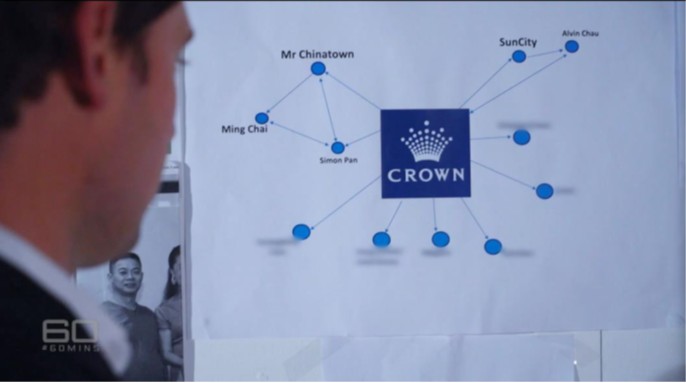
859 Nick McKenzie, the journalist who presented the story, reported that 60 Minutes had obtained a copy of the Hong Kong Jockey Club Report, which had stated that key Suncity personalities had demonstrated links to numerous triad societies and organised crime figures; and Suncity or persons associated with it were of interest to Australian authorities, in relation to money laundering activities, and that as a result, the Hong Kong Jockey Club had “black banned” Suncity.
860 A page from the Hong Kong Jockey Club Report was displayed with the following quote extracted on screen:
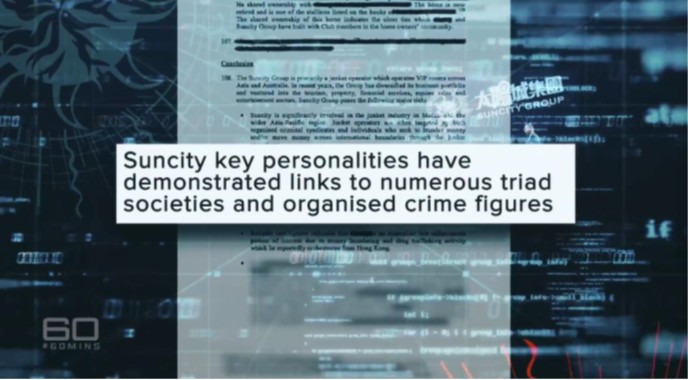
861 Mr McKenzie also asserted, regarding Suncity, that Crown was “providing the junket with its very own high roller room at Crown Melbourne”.
862 In addition to Mr Zhou, who was again identified as “Mr Chinatown”, the 60 Minutes programme also identified another junket operator, Simon Pan. As to Mr Pan, the following was said in the broadcast:
Crown has also jumped into bed with the Melbourne brothel boss with links to alleged sex trafficking. As well as running his prostitution business Simon Pan is also one of Crown’s junket operators.
McKenzie (voiceover): We’re just a stone’s throw from Crown casino. There’s number 39, Simon Pan’s brothel.
Court files reveal he runs a notorious prostitution business repeatedly investigated by the federal police and which has been implicated in organised crime and the suspected trafficking of women from Asia.
Courtney Keith: I think it’s extremely disturbing that the casino would have a contractual relationship with someone implicated in human trafficking.
McKenzie (voiceover): Anti-trafficking advocate Courtney Keith says a simple Google search reveals federal police were forced to rescue trafficked women from Pan’s brothel. She says it beggars belief that Crown wouldn’t know about Simon Pan.
McKenzie: What was going on inside its four walls?
Courtney Keith: There’s been more than one AFP raid resulting in the rescue of at least two women and this is all publicly available and it has all the hallmarks of a human trafficking situation.
863 Mr Bekier recalls watching the 60 Minutes programme when it aired. His impression was that the programme focussed on Crown and other individuals of which he was unaware. However, he does remember it mentioned Suncity and repeated rumours he had heard about Suncity having links to organised crime. He says the only new information he recalls seeing was the Hong Kong Jockey Club Report.
J.15.5 The Board call is arranged
864 Late in the evening of 28 July 2019, Mr O’Neill sent an email to Star’s non-executive directors, forwarding an email he had received that contained the text of an editorial in “tomorrow’s” (that is, Monday 29 July 2019) Sydney Morning Herald, entitled “Keep black cash out of Australia’s casinos”.
865 At 9:15am on Monday, 29 July 2019, Mr O’Neill sent a remarkable email to Mr Bekier, copying Ms Martin, Mr Hawkins and Mr Jenkins. At this time, it will be recalled, Suncity, was Star’s largest junket customer. The subject line of the email was “Fwd: 1. Rejection of Ritz Carlton tower at PYRMONT. 2. Crown Casino expose in SMH & 60 minutes”. Mr O’Neill said:
When do you think you and the team will be in a good position to brief the Board on these 2 topics?
Having watched the 60 minutes programme last night, there were 2 junkets, Sun City and Chinatown, mentioned, which Star has or has had, a relationship with. Sun City is still current, I think, and I recall we had a brief and unfortunate relationship with Chinatown, which we ended sometime ago.
(Emphasis added).
866 It is not necessary for a chairman to be across the granular details of the customers of a public company, but whatever way one looks at this email, it appears to reflect a disconcerting lack of knowledge of, or interest in, the identity of those customers then doing business at Star.
867 At 9:19am, Mr Bekier replied to Mr O’Neill and asked what worked for Mr O’Neill and said that he and his team would be ready “from tomorrow late afternoon”. Mr Hawkins replied only to Mr Bekier to state that his team was bringing “together a status [of] individuals and junkets, in conjunction with Paula M”. He also said that “coincidentally” he was meeting with Jason O’Connor that day, who had been the former head of Crown’s IRB business and who had been arrested during the Crown Arrests. Mr Bekier replied, copying Ms Martin and Mr Jenkins, and proposed that they catch up that afternoon.
868 Mr Bekier also sent an email to Ms McIntosh at 9:38am asking her to organise the Board call, copying Ms Martin and stating: “Paula – this is not a Board meeting but an information update?”. Ms Martin replied that she agreed that it was an information update and stated:
If there is anything from this call the Board wants management to follow up / address in a paper, we could cover this at the August Board meeting.
869 At this stage, the Board had been scheduled to meet on 15 August 2019. This was recorded in the minutes of the Board meeting held on 24 July 2019.
J.15.6 Verification process
870 After the Crown Allegations broke, Star set about investigating the allegations, for the purpose of ascertaining whether they could be substantiated. Ms Martin gave essentially unchallenged evidence about those processes in her affidavit:
[446] The verification of media reports involved several processes. In relation to individual customers, verification involved searches of The Star’s key databases to confirm whether individuals were customers of The Star and if so, when and what information was held about them. I understood that gaming and IRB team members conducted searches of the gaming system, members of the compliance and AML team, including Ms Arnott, conducted searches of the exclusions database, compliance incident reporting database and AML customer risk registers (in the Protecht system) and investigators (including Mr Houlihan) conducted searches of the investigations database (Ibase). Mr Houlihan and Ms Arnott also conducted additional WorldCheck database searches and internet searches to check publicly available information about individuals reported. This was repeated as new pieces of information were reported in the media.
[447] In relation to reports of law enforcement agency activity or information, I am aware that Mr Houlihan and Mr Buchanan contacted the relevant law enforcement agencies as part of the verification process. Those agencies included AFP, ACIC and CRIU. The government relations team also made direct enquiries of relevant government agencies including ACLEI to verify media reports.
[448] HKJC Report content reported in the media was checked by Mr Houlihan, Ms Arnott and Mr Buchanan against the report and Mr Buchanan’s knowledge.
[449] Ms Arnott also checked The Star’s AUSTRAC reporting information in relation to specific matters reported in the media to have occurred at The Star’s properties.
J.15.7 The 30 July Board call
871 On 30 July 2019 at 5:00pm, a “Board briefing call” was held by way of teleconference, concerning the two topics to which Mr O’Neill had referred in his email the previous day, being the rejection of a planned Ritz Carlton tower at Pyrmont, and the allegations that had been published in the media about Crown. Mr O’Neill, Mr Sheppard, Mr Heap, Ms Pitkin, Ms Lahey, Mr Todorcevski, Mr Bekier, Ms Martin, Mr Hawkins and Mr Jenkins joined the call. Ms Martin’s evidence was that Mr Bradley did not attend. There are no minutes or contemporaneous notes of the matters discussed on this call in evidence.
872 The fact that this out-of-session Board call was arranged reflected the seriousness of the Crown Allegations. Mr Bekier’s evidence was that out-of-session Board calls were arranged if “urgent or critical matters or risks emerged”, to brief the Board on such developments. He said that, in respect of this Board call, the “urgent or critical matter” that had emerged was as follows (T668.21-42):
The risk that I perceived at the time was that a whole number of names had been raised during the Crown investigation, that some of the names were relevant to us, because – particularly Suncity, and because we needed to make ourselves comfortable that we didn’t have the same exposure as Crown did to the same risks that had been described in that programme.
J.15.7.1 Mr Bekier’s evidence
873 Mr Bekier’s affidavit evidence was that the Board call was “a long call and ran well over the allocated 30 mins” and that “Mr Hawkins and Ms Martin had the main speaking roles” (at [364]). In his affidavit, Mr Bekier did not identify anything that Ms Martin said during the call. Mr Bekier said that Mr Hawkins spoke about each of the junket operators referred to in the media.
874 Mr Bekier also gave evidence in his affidavit by reference to some draft speaking notes prepared by Mr Hawkins. His evidence was that Mr Hawkins’ practice for Board and Committee meetings was to speak from prepared notes. While he could not recall “precisely” what Mr Hawkins said during the call, he said that Mr Hawkins’ notes “are consistent with [his] recollection that [Mr Hawkins] discussed with the Board each of the junkets referred to in the media with which The Star had a relationship” (at [365]).
875 Mr Hawkins’ notes are a five-page document. They commence with:
Quickly recap the allegations made in the 60 minutes expose then review the relationship of the individuals mentioned with our Group
876 The notes then contain a table that explains each of the allegations, the risk or vulnerability that it reveals and Star’s existing process regarding it. For example, the table identified that one of the allegations was that Crown was “wilfully blind to the source of funds and the source of wealth of junkets and key people” and identified the risk or vulnerability as:
A money laundering method applied cash raised from drug dealing in Australia to facilitate gambling with associated debts being paid in [C]hina. This allows crime proceeds to be moved to China without any trace in banking or financial system.
877 The Star process identified as to this is that “large cash buys ins” are reported to local police, Star makes SMRs to AUSTRAC, and that “[t]he new AML/CTF program[me] includes enhanced due diligence processes which seek to establish satisfactory source of wealth and source of funds evidence”.
878 Another allegation identified was that Crown was “wilfully blind” to the criminal activity of key business partners, particularly junket operators, and that these allegations had included claims related to the Hong Kong Jockey Club Report about Suncity. The table identifies the risk or vulnerability as:
Failure to identify and cease trading with criminals might expose a casino to exploitation related to a range of criminal activity.
This issue can be difficult if the information about criminal activity is solely contained in law enforcement intelligent systems.
879 The Star processes identified regarding this were that Star had “detailed cease to trade policies embedded in the AML/CTF Program[me]”, which have resulted in “Star banning people on a monthly basis”, and that Star’s “[j]unket operator approval process includes criminal history checks and other background checks in country of origin”.
880 The note then addressed the persons named in the media allegations. It identified that:
(a) Simon Pan was a “[b]rothel owner and [j]unket [o]perator” who had operated “both domestic and IRB programmes in Sydney managed under his own name and that of his sister”, with a turnover of approximately $1.1 billion since the 2014 financial year. It noted that Mr Pan held a CCF of $1.5 million with Star which was “currently suspended based on recent media”;
(b) Tom Zhou “Mr Chinatown” was not an approved junket operator himself, but Chinatown had a “permanent room” in Sydney under two junkets and these were a “large contributor across FY 16 and 17”. The notes identified another person, potentially Mr Zhou’s nephew, as the holder of a CCF with a $75 million approved limit. The notes record that Mr Zhou was “excluded in September 2016 for undesirable behaviour (staff physical and verbal abuse)” and that the arrangement with Chinatown had ended in December 2016;
(c) Roy Moo was a “Sovereign member” but was “never issued with a credit line” and that his AML status had been raised to “critical” in November 2016 and his Sovereign Room access revoked in 2017 because of his “inability to provide source of funds evidence”.
881 As to Suncity, the note records the following:
Alvin Chau - CEO holds the CCF of 80m
Under pressure globally due to PRC call out recently WRT proxy betting and marketing in PRC
Lek Kit Lon primary junket operator with Sio Peng Tong also a junket playing in the room
Permanent room established in early 2018
Recent NSW PC exclusions for a number of associated persons with this room
Oversight of cash/chip management and transactions in the room has been an ongoing focus to ensure compliance
Very close watch and follow up with our risk, compliance and investigations team
5.8b of cash T/O in FY19
882 The second and fifth points in this list reflect the topics that were in Mr Hawkins’ “Board Talking Points” email of 22 July 2019. This reflects the information that ASIC defines as the “Suncity Overseas Contraventions” and the “NSW Police Suncity Exclusions”, which it is alleged that Mr Bekier and Ms Martin failed to disclose at the 15 August 2019 meeting.
883 Finally, Mr Hawkins’ notes provided a summary of Star’s junket approval process. This included noting that, as part of that process, “[s]hould there be negative information, further investigation is undertaken by The Star Investigations team. This may include discussions with Police” and “The Investigations team will then make a recommendation to GM VIP International”.
884 Mr Bekier also gave evidence on this topic. He was asked, by reference to Mr Hawkins’ “Board Talking Points” email of 22 July 2019, whether the involvement of Suncity in providing online or proxy gaming services in China was discussed with the Board. He said that he had “a sense that we discussed everything that was known to us about Suncity, but I cannot put my finger on a specific meeting that this was discussed at” (T420.35-37).
885 Mr Bekier was also asked whether the topic of the exclusions by the NSW Police of six people associated with Suncity was discussed with the Board in July or August 2019 (T420.39-44). He said that he believed that was “one of the topics that would have been raised in one of those meetings, as we discussed Suncity” (T420.43-44; T775.21-27). His evidence was that Mr Hawkins “would have led that discussion” (T421.1-3). Mr Bekier appeared to emphasise why this would have been raised in the context of Suncity in these meetings on the basis “that was pretty much all we talked about” (T420.45-47). However, in cross-examination, he strangely stated that he would have looked at the exclusions associated with such a significant and now controversial customer like any of the “other hundreds of exclusions that the police made every year” (T652.23-31). In cross-examination, he also sought unconvincingly to minimise the notion that the exclusions raised a concern about Suncity, emphasising that the concern the NSW Police raised was not about Suncity, but about six individuals (T652.37-40).
J.15.7.2 Ms Martin’s evidence
886 Ms Martin also gave evidence about what she recalled being discussed during the 30 July Board call. In her affidavit, she said that she understood the call was to address the two topics of the NSW Government declining approval for the Ritz Carlton tower and the media allegations about Crown (at [463]). In her oral evidence in chief, Ms Martin said that Mr O’Neill opened the call and said that the media allegations about Crown would be discussed by Mr Bekier and the members of the executive team present (T819.25-32). Ms Martin said that Mr Jenkins then spoke and summarised the allegations and the topics raised by them being “incidents of money laundering and prostitution and Asian crime association allegations for particular individuals” (T819.34-42). She said that Mr Jenkins said that, while the focus had been on Crown, he was receiving some enquiries from media outlets. In her affidavit, Ms Martin says that she does not recall the Board “expressing shock or surprise” at the contents of the media reports during the call (at [472]).
887 Ms Martin gave evidence that Mr Bekier then said that Star’s management team was “reviewing the media and looking to confirm [the] accuracy of the reports” (T819.44-46). She could not recall Mr Bekier mentioning any customers, but that he asked Mr Hawkins to “speak to the customers that had been referred to in the media”, and Mr Hawkins mentioned Simon Pan, the Chinatown junket and Mr Zhou and “the Suncity junket” (T820.8-15). She said that Mr Hawkins told the Board that “Suncity junkets were still operating at the Star and that, at that time, the Suncity junkets were being held in their exclusive-use room under an agreement for the exclusive-use room and that that had continued to be the case” (T820.17-23). On this topic, Ms Martin’s evidence was that Mr Hawkins said (T820.23-27):
And that it was the use of that exclusive-use room that had given rise to some challenges with the Star’s dealings with Suncity in relation to Suncity’s compliance in the conduct of their operations in that room, and that also there had been challenges for Suncity in that room with some exclusions of their team members that had recently been carried out.
888 Ms Martin was asked whether she could recall saying anything “in relation to the media allegations or Suncity” (T820.29-30). She said she could recall “talking to the verification activities or actions that members of my team were responsible for conducting at that time” (T820.30-32). In particular, she could recall telling the Board that:
(a) Mr Houlihan was Star’s primary contact for liaising with law enforcement agencies, particularly police, and was contacting “police directly to confirm what was being reported in the media” (T820.32-35); and
(b) her team was assisting with verification in relation to the Hong Kong Jockey Club Report because (T820.35-41):
Mr Buchanan, who had joined my team, had been responsible for authoring or had a key role in authoring that report and was able to assist the Star, now that he was working with us, with verifying its extracts and that to the extent that contact needed to – or was useful to be made with police or law enforcement in Hong Kong and Macau, that Mr Buchanan was able to make that contact.
889 Ms Martin was then asked whether she could recall any particular questions raised by the Board during the call. She said that she could recall a question, most likely from Mr O’Neill, as to whether Star had received any correspondence from regulators or law enforcement agencies, and she advised that Star had received a letter from L&GNSW (T820.43-821.2). When asked if she could recall any other questions from Mr O’Neill or any other member of the Board, she answered as follows (T821.4-8):
During the end of the call, I think again the chairman asked management to keep the board informed or to provide a list of the customers and what the Star knew about it. I think that was on that call.
890 Ms Martin also gave evidence that Mr O’Neill asked management to keep the Board informed, and provide the Board with a list of all customers identified in the media allegations, and information as to whether they were current customers of Star and how Star was dealing with information about them (at [471]; T821.4-8).
891 Ms Martin was asked whether any Board member “raised a particular question in relation to what had been in the media, either the print media or television media, in the last few days”. Her answer was (T821.10-28):
In relation to the footage from the 60 Minutes show, I recall there was a question, but I don’t recall who it was from around the board table, as to whether the images that were shown that showed a man with bags of what appeared to be cash being moved around the casino property was something of the sort that could or had happened at the Star. And I recall there was a discussion about that. The piece of the discussion I recall is that I commented that that was possible at the Star, and the Star had experienced instances from time to time of such suspicious conduct being identified through surveillance and the investigators seeing activity on site or receiving reports of it on site, and that those events or actions by individuals had been witnessed, as I recalled, in the retail precinct area at the Star Sydney, and also some of the premium gaming areas including Salon 95. And that they were the sorts of incidents that the investigators called to the New South Wales Police to work with them, then, to identify individuals involved on a relatively regular basis and that – that the investigators would work with police on those matters. And that in addition to that, there was other reporting that occurred to regulators, but that was usually done outside of my team.
892 By this evidence, Ms Martin suggested she had told the Board about “bags of cash” being identified in Star’s retail precinct and its premium gaming areas, including Salon 95, during the 30 July Board call. However, when asked in cross-examination whether the 30 July Board call was the first time that she had told the Board about the suspicious transactions that had occurred in Salon 95, she said that it was her recollection that it was Mr Hawkins who had raised this and she did not believe she did at that meeting (T1062.8-25), although when then shown the transcript of her evidence in chief, she reaffirmed that she had said this to the Board during the call (T1063.5-1064.2). I found her evidence in this regard to be unconvincing.
J.15.7.3 Conclusion on the 30 July 2019 Board call
893 There are obvious differences in the evidence given by Mr Bekier and Ms Martin as to what occurred on the call.
894 Mr Bekier’s affidavit and oral evidence indicated that he did not have a good recollection of what had occurred. In particular, his evidence that Mr Hawkins’ notes are “consistent with [his] recollection” does not go higher than saying each junket with which Star had a relationship was discussed on the call, and his evidence about the discussion around the police exclusions was expressed in terms of a belief that the topic would have been raised, rather than an actual recollection (T420.39-44). Ms Martin’s account of what occurred during this call was given at a level of precision which it is difficult to conclude involves actual recollection, given her generally credibility problems, the fact it occurred over five years ago, and noting her lack of recollection regarding other matters relating to Suncity during the same period.
895 It is clear from Ms Martin’s evidence, as well as from the minutes of the Board meeting held on 7 August 2019 (see [919]–[921] below), that the Board requested that it be kept informed and provided with a Board paper addressing the Star’s customers who had been named in the Crown Allegations. One of the customers was Suncity. It is likely that anything that Mr Bekier, Mr Hawkins or Ms Martin told the Board in the call on 30 July 2019 would have been reflected in the Board paper prepared in accordance with this request. That paper (Crown Allegations Board Paper) was ultimately provided to Board, after Mr Bekier’s review of it, for its meeting on 15 August 2019.
896 I am satisfied to that, on this call, the Board was updated in general terms about the nature of the Crown Allegations and the steps that management was undertaking in response, namely that the management team was investigating whether the allegations reported in the media could be substantiated, including by liaising directly with law enforcement agencies.
897 At this juncture, it is unnecessary to engage further with the factual dispute between ASIC, Mr Bekier and Ms Martin as to the precise contents of the 30 July 2019 Board call in circumstances where the Crown Allegations Board Paper exists and it is likely that anything of any substance Mr Bekier, Mr Hawkins or Ms Martin told the Board in the call on 30 July 2019 would have been reflected in it. This is because this document was prepared at the specific direction of the Board at the 7 August 2019 meeting to address the topic of the Crown Allegations, and “also details of interactions with regulators on junket operations more generally”. That is, it was intended to consolidate in a formal Board paper, for further consideration at the Board meeting held on 15 August 2019, the matters that had been discussed informally on 30 July 2019 and orally on 7 August 2019.
J.15.8 Subsequent enquiries and the Hong Kong Jockey Club Report
898 Following the 30 July 2019 Board call, Ms Martin and Mr Hawkins continued to consolidate more detailed information on the Crown Allegations and their relevance to Star’s business. Mr Bekier’s affidavit evidence is that he had multiple conversations with Ms Martin and Mr Hawkins about this work (see Mr Bekier’s affidavit at [367]).
899 Mr Bekier also gave affidavit evidence that he made his own enquiries (at [368]). He recalls speaking to Mr Hawkins, Mr Quayle and Mr Lim to understand whether Star had the same problems as Crown. His evidence was that he spoke to those executives because they had all previously worked at Crown and would understand Crown’s processes.
900 Mr Bekier gave the following account of his conversation with Mr Hawkins in his affidavit (at [369]):
Me: “Could anything like this happen at the Star?”
Hawkins: “No. It is the same industry but we have different processes. We are a totally different company to Crown”.
Me: “How are they different?”
Hawkins: “Crown is super aggressive, to the point of flouting AML rules. They push sales hard without regard for compliance”.
901 He gave evidence that he does not recall the specifics of his conversations with Mr Quayle and Mr Lim, but says they were to a similar effect (at [370]).
902 Mr Bekier sought to give the general impression that he thought Star’s systems were much better than those of Crown and it was not facing the same issues that were being reported in the press. In particular, he said he understood that, unlike Crown, Star Sydney had a robust security presence in terms of staff and CCTV across the entire casino, including in private gaming salons, and that all cash transactions were conducted through Star Sydney’s Cage (at [370]). He continued to believe that the Star was running a “good, clean operation” (T631.13-14).
903 This evidence was uncorroborated, and although it was not the subject of direct challenge by ASIC, and he may have got some reassurances as to differences between Crown and Star, Mr Bekier knew at this time of at least the pleaded Power Email Information, KPMG Junket Risk Information, Salon 95 Concerns, Chau Visa Refusal Information, Suncity Overseas Contraventions, NSW Police Suncity Exclusions, and had watched the 60 Minutes programme (see [1377]–[1379], [1415]–[1417], [1443]–[1448]). Contrary to Mr Bekier’s evidence, the Power Email referred to the concern that cash for chip transactions were taking place at the service desk, as opposed to Star Sydney’s cage (see [1392]), and the KPMG Reports identified real deficiencies in Star’s AML/CTF systems and procedures, particularly in relation to junkets. Considering all the information which Mr Bekier knew, there was hardly a secure basis for Mr Bekier to believe Star was running a “good, clean” operation or to otherwise feel sanguine about these matters.
904 Separately, Mr Bekier also gave evidence that following further references to the Hong Kong Jockey Club Report in the media in early August 2019, he sought to obtain a copy. Mr Bekier’s evidence was “that when the Hong Kong Jockey Club was first kicked around in the media and reported on, I went on a chase to get a copy and ask a bunch of people within the organisation to get one” (T418.40-42). At that time, he said recalled speaking to Mr Lim and Star’s public affairs team to obtain a copy of the report. To be frank, I am simply unsure whether this took place.
905 As explained in the section of these reasons concerning Mr Bekier’s credibility, Mr Bekier also purportedly asked Mr Buchanan for a copy of the report at this time but I am unpersuaded of this evidence given it is inconsistent with previous representations that he thought he asked Mr Buchanan for a copy of the report in January or February 2022.
906 Certainly, Mr Bekier could not recall whether he asked Ms Martin for a copy of the Hong Kong Jockey Club Report at this time. Ms Martin’s recollection was that he did make that request on a call with her, Mr Jenkins, Mr Theodore and Mr Hawkins immediately after the 30 July 2019 Board call. Her evidence was that she responded that it was “confidential”. That evidence was not challenged by ASIC. In cross-examination by Mr Bekier’s counsel, she elaborated:
At this time, I’m not sure I had registered I even had the copy of it, but the point I was making to Mr Bekier at this time, as I recall, is that it had been provided on a confidential basis by Angus Buchanan, and I wasn’t even sure that the Star should have it and that Mr Buchanan was available to be spoken to directly in relation to its content.
(T1165.5-9)
907 This evidence is itself curious as it suggests that Ms Martin had some hesitation about the use of confidential information contained in the Hong Kong Jockey Club Report while, at the same time, advising Mr Bekier that Mr Buchanan was able to be spoken to about the information directly. That strikes me as an odd approach for a solicitor to take to the use of confidential information. Again, I am unsure about this evidence. Mr Bekier might have made this request of Ms Martin and perhaps she said something along the above lines. That said, irrespective of whether the conversation between Mr Bekier and Mr Buchanan occurred as recounted, it is of no real significance to the case against Mr Bekier.
J.15.9 Publicity concerning Crown from 31 July 2019
908 On 31 July 2019, Crown published a response to the recent media allegations. Mr Bekier forwarded a copy of Crown’s response to Mr O’Neill, who in turn forwarded it to the other non-executive directors.
909 On 31 July 2019, an article was published in The Age entitled “Crime agency reveals a major investigation into organised crime at casinos”. The article reported that ACIC had announced an investigation into organised crime in Australian casinos, in the wake of adverse media concerning Crown’s dealings with junket operators. The article reported comments made by ACIC Commissioner, Michael Phelan, including that:
(a) Commissioner Phelan told The Age and The Sydney Morning Herald that “investigators across state and federal police and intelligence agencies have uncovered damning insights into vulnerabilities … within casinos located in Australia”;
(b) Commissioner Phelan had announced that ACIC was currently conducting an “Targeting Criminal Wealth” inquiry, and which extended to probing junkets “responsible for bringing high roller clients into casinos, usually from offshore, to gamble”, and that while Commissioner Phelan did not name which casino operators were being examined, his statement raised the possibility that the investigation could include Crown’s main domestic rival, Star;
(c) “the lack of transparency of casino junket operations, anonymity of participants and obscurity around beneficial ownership, source and distribution of junket funds provide opportunities for criminal exploitation”; and
(d) “the structure of junket operations enables opaqueness around the source of beneficial ownership of funds ... and represents a significant money laundering risk”.
910 The next day Mr O’Neill sent a further email to Star’s other non-executive directors forwarding an email he had received from Mr Jenkins which contained the full text of the article and stating: “FYI. Suspect we will receive some attention”.
J.15.10 1 August 2019 meeting with ILGA
911 As I have already noted (at [296]), on 1 August 2019, Mr O’Neill met with Mr Phillip Crawford, Chairman of ILGA, to discuss the recent media coverage of Crown. Ms Martin prepared a briefing note for Mr O’Neill and provided it to him on the morning of the meeting. Ms Martin also provided Mr O’Neill with a copy of the letter from ILGA dated 29 July 2019 (received by Star on 30 July 2019).
912 The letter from ILGA, authored by Natasha Mann (Executive Director, Liquor, Gaming and Racing) stated, relevantly:
I refer to the allegations raised in media reports over the weekend about connections between Crown Resorts and criminal figures. In particular, the media reports raised allegations relating to suspicious junket arrangements in China and Australia, and questioned the suitability and conduct of some junket operators and their representatives.
…
I am writing to request that The Star undertakes a risk assessment of its practices and procedures which mitigate against the types of issues raised in the media reports, and reports the findings to Liquor & Gaming NSW. Specifically, I request that The Star details what steps it takes to ensure that only suitable operators and representatives operate junkets in its casinos.
I also request that The Star reviews any current associations or arrangements with junket operators or related individuals to ensure the suitability of any existing relationships. I note that a more specific discussion around the individuals and organisations identified in the reports is to take place between L&GNSW and Mr Graeme Stevens, Regulatory Affairs Manager, in a meeting to be held this week.
913 The briefing note indicated that Star had already provided an “initial response” to ILGA, which noted that Star had updated its AML/CTF risk assessment and its AML/CTF Programme, and proposed further discussions with ILGA to address matters including enhanced due diligence on “key junket groups and individuals” and “[o]ngoing intelligence sharing with law enforcement”.
914 Following the meeting with Mr Crawford, Mr O’Neill shared the briefing note prepared by Ms Martin with Mr Crawford.
J.15.11 Publicity concerning Crown from 1 to 5 August 2019
915 The same day an article was published in The Age entitled “Key Crown junket partner blocked from Australia”. The article contained the following:
The head of Crown Resorts’ major junket partner, Suncity, has been banned from entering Australia as investigators across the region probe the Macau-based company’s alleged links to organised crime.
Suncity chief executive Alvin Chau has been blocked by Home Affairs from entering the country, according to official sources who spoke on condition of anonymity. But Crown Resorts is still allowing the junket to host its own high-roller gaming room inside Crown Casino Melbourne.
Suncity, the biggest junket operator in Macau, also provides VIP gambling tours to casinos run by Crown’s rival, The Star.
916 The article then reported the following concerning the Hong Kong Jockey Club Report (that is, the report Mr Buchanan had provided to Ms Martin, Mr White and Mr Houlihan on 12 June 2019):
Leaked reports from the Hong Kong Jockey Club reveal club officials were briefed by “Australian Law Enforcement” in May 2017 about their concerns about Mr Chau. Among the concerns was suspected “large-scale money laundering activities”.
The report also states that “Suncity Group’s controlling entities ... [including] Alvin Chau ... pose tangible criminal and reputational risks to the [Hong Kong Jockey] club and indeed racing integrity in Hong Kong.”
“Suncity key personalities have demonstrated links to numerous triad societies and organised crime figures,” said the intelligence report, adding that Mr Chau and a colleague were reportedly members of the 14K triad society.
“Other Suncity entities are connected to known triad figures,” it found.
917 The article also reported on Star’s relationship with Suncity, as follows:
According to the Hong Kong Jockey Club’s intelligence report, obtained by The Age, The Sydney Morning Herald and 60 Minutes, Mr Chau received $403,000 placed into his account at The Star casino in Sydney from a suspected money-launderer in 2012.
The Star on Thursday confirmed it deals with junket operators and had done so for more than 10 years but it would not discuss individuals or groups. In a statement, The Star said it had not been contacted by ACIC about its casino junkets investigation.
918 On 5 August 2019, a further article was published in the Australian Financial Review, entitled “Crown’s web of influence runs deep”. The article reported that the Commonwealth Attorney-General had referred the recent allegations about Crown to the Australian Commission for Law Enforcement Integrity. The article stated that the Commission “will hopefully probe whether or not there was a soft touch approach to regulation and law enforcement”. Mr O’Neill forwarded the article to the other non-executive directors that same day.
J.15.12 The 7 August 2019 Board Meeting
919 On 7 August 2019, a Board meeting was held “additional” to the ordinary scheduled meetings of the Board. It was convened by Mr O’Neill for the Board to receive “timely briefs from management on recent key matters”. Mr Bekier described the purpose as being “so that the management team could provide an update to the Board on the developments and media coverage in relation to the Crown reports”.
920 Mr Bekier, Mr O’Neill, Mr Sheppard, Ms Lahey, Mr Bradley, Ms Pitkin, Mr Todorcevski and Mr Heap were present, and Ms Martin was in attendance. Mr Theodore, Mr Downy (General Manager, External Affairs) and Mr Jenkins (General Manager Media and Communications) were also in attendance for part of the meeting.
921 The minutes of the meeting record:
(a) Star’s management spoke about the recent media coverage of Crown. This included discussion of “government and other agency responses” that had been reported in the media, including ACIC’s “Targeting Criminal Wealth” review, which was the subject of the article published on 31 July 2019 (see [909] above);
(b) the Board “requested to be kept briefed on all significant regulator correspondence (including receiving copies of all correspondence) and responses on this topic”;
(c) the Board “requested that management prepare a paper on this topic in the papers for the Board meeting on 15 August 2019, which should include also details of interactions with regulators on junket operations more generally, including training provided”: and
(d) Mr O’Neill “provided an overview of his informal meeting” on 1 August 2019 with the Chairman of ILGA (the meeting is incorrectly referred to in the minutes as occurring on 6 August 2019, but the evidence shows that the meeting occurred on 1 August 2019).
922 In his affidavit, Mr Bekier referred to the Board’s request for the paper but did not otherwise give evidence as to what was said at the meeting. He also gave evidence that, following the meeting, he agreed with Ms Martin and Mr Hawkins that they would take responsibility for preparing the paper the Board had requested.
923 Ms Martin gave oral evidence about the meeting. She said Mr Jenkins gave updates on key allegations and that, as to Star’s customers, he noted there had been media relating to Suncity and Mr Chau, including that Mr Chau had been banned from entering Australia and also that there had been reports of Suncity and Mr Chau being investigated concerning online gambling practices (T822.38-44). Ms Martin said she told the Board that Star had confirmed Mr Chau was not banned from entering Australia and that it had obtained that advice from the relevant government department (T822.44-47). Ms Martin said she told the Board that “Suncity had made announcements and was reported in the media also as providing some denials in relation to Alvin Chau’s banning and level of investigation by authorities” (T823.5-9). She also said she told the Board that Star had considered extracts from the Hong Kong Jockey Club Report “and that the Star’s review of those pieces of content from the Hong Kong Jockey Club report had confirmed that they were reported accurately” (T823.9-12). Ms Martin then said she told the Board that Ms Arnott and Star’s AML team were “already aware of [the] content” of the Hong Kong Jockey Club Report and it had been “considered previously by the AML team” (T823.12-16). Ms Martin then said (T823.16-23):
But I did not have first-hand knowledge of that, so I reported on what Ms Arnott had told me and her views on the nature of some of the, I guess, sources from the media that had been used in preparing the Hong Kong Jockey Club report. And that Ms Arnott considered that some of those sources weren’t as reliable as the Star would use to verify the sorts of information that was being reported and that there were subjective views in that report. And that the report had been prepared for purposes for the Hong Kong Jockey Club’s use, not all of which was relevant to the Star’s interests.
924 Ms Martin’s oral evidence about what she said occurred at this meeting cannot be accepted in preference to the record provided by the contemporaneous minutes, for the following reasons (leaving aside for a moment my concerns about her general credibility).
925 First, Ms Martin’s evidence addresses topics that do not find any reflection in the minutes, which she drafted, such as the allegations that Mr Chau had been denied a visa to enter Australia and her commentary on the Hong Kong Jockey Club Report.
926 Secondly, Ms Martin’s evidence that she told the Board that Suncity was reported in the media as denying that Mr Chau was banned from entering Australia cannot be reconciled with the contemporaneous documentary evidence. In its announcement to the Hong Kong Stock Exchange on 5 August 2019 concerning “certain media articles recently published”, Suncity did not in fact deny that Mr Chau had been denied entry, but rather stated that Mr Chau had no intention of coming to Australia.
927 Thirdly, Ms Martin’s evidence that she advised the Board that Star, on the advice of the relevant government department, confirmed Mr Chau was not banned from entering Australia is also inconsistent with the information available within Star’s IRB business. Heidi Huang, Star’s Senior Vice President, VIP International Operations, informed Mr Hawkins by email on 19 September 2018 that Mr Chau’s visa had been declined “due to significant seized cash in hotel room safe previously”. Ms Martin based her evidence on a conversation she asserts she had with Mr Houlihan in the first week of August during which he said he had spoken to a representative of the Department of Home Affairs, who had confirmed that Mr Chau had not been banned from Australia. There is no other evidence of this conversation.
928 Fourthly, Ms Martin’s evidence that she advised the Board that Ms Arnott had told her that the AML team had already considered the Hong Kong Jockey Club Report and that Ms Arnott considered that the report: (a) was based on sources not as reliable as the sources Star would use; (b) contained subjective views; and (c) was “prepared for purposes for the Hong Kong Jockey Club’s use, not all of which was relevant to [Star’s] interests”, was implausible, inconsistent with other evidence she gave, and irreconcilable with contemporaneous documentary evidence. Ms Martin’s evidence was that she had previously told the Board on 30 July 2019 that it was Mr Buchanan, who had a key role in authoring the report, who was able to verify its contents, including with law enforcement. It therefore makes little sense that Ms Martin would present Ms Arnott’s views to the Board. Further, Ms Martin’s evidence is that she did not read the whole of the Hong Kong Jockey Club Report at this time, only the extracts that were reported in the media (T1046.13-16), and, while that evidence is difficult to accept, it is even more difficult to believe that Ms Martin would address the Board about the Hong Kong Jockey Club Report without actually reading it. In addition, Ms Martin’s evidence that she spoke to Ms Arnott about the Hong Kong Jockey Club Report is implausible (see Ms Martin’s affidavit at [475]). There is no evidence that Ms Arnott received the Report, and Ms Martin claimed in her affidavit to have been surprised to receive the Report from Mr Buchanan and to have been of the view it should not even have been shared with her, on the basis that it was confidential (at [383]). And even though I am unsure whether the conversation occurred, it is also noteworthy Ms Martin said she declined to give Mr Bekier a copy of the Report, apparently on something like the same basis (see [906]–[907] above).
929 There is also further contemporaneous documentary evidence inconsistent with Ms Martin’s twin contentions that Ms Arnott, if she received the Hong Kong Jockey Club Report, was: (a) dismissive of the weight that should be placed on its contents by citing concerns about its reliability and purpose; and (b) viewed it as only confirmatory of information that Star already had and considered. In particular:
(a) on 24 June 2019, Mr Tomkins sent Ms Arnott an email, copying Mr Stevens, summarising the results of his review of the CCTV footage of suspicious conduct in Salon 95 (a review that was referred to in the final Operation Lunar Information Note). Mr Tomkins identified several suspicions transactions (including three people going into the computer cupboard where it appeared Suncity was storing cash) and described attempts by Suncity representatives to hide their activities from surveillance; it is difficult to accept that Ms Arnott would not have been concerned about the involvement of Suncity in money laundering and its connexions with organised crime, given the highly suspicious conduct that was occurring in the Sydney Casino itself, of which she was aware;
(b) on 9 August 2019, Ms Arnott received the details about Mr Chau stored in Star’s database; this revealed that, as at April 2016, there had been a report in World Check that Mr Chau had reportedly received 903 million Philippine pesos which were stolen from the Central Bank of Bangladesh; it also identified Mr Chau as directly connected with six suspicious transactions that had taken place in the Sydney Casino between 4 September 2017 and 24 March 2018, including a suspicious cash transaction on 8 September 2017 to settle, in whole or part, Mr Chau’s CCF; I do not accept that Ms Arnott would have dismissed the information in the Hong Kong Jockey Club Report given Star already possessed World Check information and had identified its own suspicious transactions involving Mr Chau, which were consistent with the allegations of connexions to money laundering in Australia contained in that Report.
J.15.13 The 7 August 2019 Audit Committee Meeting and preparation of Board paper on Crown Allegations
930 On 7 August 2019, a meeting of the Audit Committee was held. Mr Todorcevski, Mr Bradley, Mr Sheppard, Ms Pitkin, Mr O’Neill, Ms Lahey and Mr Heap were present. Mr Bekier, Mr Barton and Ms Martin were in attendance.
931 At this meeting, the Audit Committee approved the financial statements for the financial year ended 30 June 2019 for recommendation to the Board. At the meeting, a paper entitled “Compliance Assurance Process”, prepared by Ms Martin, was taken as read. That paper gave the Audit Committee a statement from Ms Martin, the CLRO, regarding the effectiveness of Star’s risk management and internal control processes in identifying and disclosing any material issues that may have a bearing on the financial statements. The paper also attached draft declarations from Mr Bekier and Mr Barton that Star’s risk management and control processes were effective.
932 Ms Martin spoke to the paper, noting that, in her capacity as CLRO, she was satisfied that Star’s risk management and internal control processes were operating effectively for the financial year ended 30 June 2019, and that “there were no items of note from a materiality perspective in connection with the preparation of the FY19 full year financial statements”. The paper attached a “summary of potential issues” that had been identified following a process by which each member of the Executive Team was asked to identify “material operational issues”, “material commercial issues” and “any significant breaches of relevant statutory obligations”. None of the potential issues identified in the table referred expressly to Suncity. The only “issue” relating to junkets was “continuing monitoring of on-property single junket operator rooms”.
933 On 8 August 2019, Ms Martin sent an email to Mr Brodie and Mr Whytcross noting the directors had a “brief session discussing recent media reports on the CWN allegations and related matters, including ACLEI and ACIC reviews” and that “[f]ollowing on from the call we had with the Board last Tues [i.e. 30 July 2019], they have now asked for a paper to be included on this topic for next week’s Board meeting”. Her statement that the discussion occurred at the Audit Committee meeting is not consistent with the minutes of that meeting, which contain no reference to such a discussion. That meeting commenced at 2:30pm. Ms Martin must have been referring to the Board meeting held on the same day, at 1:30pm, and as set out above, the minutes for it record that the Board requested a paper regarding the Crown Allegations.
934 In her email, Ms Martin asked for help from Mr Brodie and Mr Whytcross in preparing the paper the Board had requested (which would become the Crown Allegations Board Paper). She identified what it should cover as follows:
The paper will need to cover:
• the CWN allegations in key media stores
• Any individuals and junkets that may also do business with The Star (or did in the past) raised in those stories and our risk mitigation/compliance efforts in these areas, including the licensing/approval approach for junkets (I think the summary prepared last week will be a good base for an attachment to the paper)
• what has been the regulators’ and other agencies response so far – ACLEI; ACIC; AUSTRAC; gaming regulators in Vic, NSW, Qld
• our engagement with regulators’ and other agencies, including AUSTRAC meeting already in for 21 Aug
• comment on our interaction with our gaming regulators on the topic of junkets generally – eg regularly reviewed in both Qld and NSW; do training and tours in NSW; note in Qld OLGR licences junket
• what we are doing internally in response to the reports, incl. monitoring external regulatory/agency activity; assessing any updated DD required; any other control review, training etc
935 This summary reflects what Ms Martin understood was necessary for the paper to address (following the Board meeting held on 7 August 2019 and her discussion with Mr Bekier and Mr Hawkins). Mr Whytcross sent Mr Brodie and Ms Martin a draft structure for the paper the same day.
936 The minutes of the Board meeting held on 7 August 2019 and Ms Martin’s email collectively demonstrate that the Board requested management prepare a paper based on the Crown Allegations, that included information as to each of the individuals and junkets who did business with Star, and as to each entity, what steps Star had previously needed to take, from a “risk mitigation/compliance” perspective, and what information Star presently had, from a regulatory and due diligence perspective, relevant to the allegations made in the media.
J.15.14 Other articles published
937 On 8 August 2019, The Age published an article entitled “Why Not?: Star CEO sticks with junket operator Suncity despite alleged criminal links”. The article included statements from Mr Bekier as follows:
… Matt Bekier says the casino will continue to partner with Macau junket operator Suncity, despite the group’s alleged links to organised crime.
Mr Bekier also said The Star would not be reviewing its use of junkets despite a recent investigation into Crown's use of allegedly criminal-linked junkets.
‘We are always looking at policies, and we are always under continuous review with our regulators, so to me, that is not something that we just do because our competitors have done something differently,’ he said.
When asked why The Star was still using the alleged-crime associated junket group Suncity, Bekier counter-asked: ‘Why not?’
‘Suncity is the largest junket operator in the world … and we work in a very a prescribed and lawful way with junkets that are credible and have been improved, in some states, by the regulators,’ he said.
…
Star chief executive Mr Bekier would not comment on the allegations against his competitor but said he felt his business was run in a ‘very clean and legal’ way.
‘I feel that what we do is both lawful and is executed in a way that should give us and our investors confidence that we are doing right,’ he said. ‘We have a dedicated team of compliance officers who track everything … we are being audited, like the banks and everyone else, so I feel pretty comfortable that we are doing a good job.’
(Emphasis added).
938 Mr Bekier gave evidence that he said “why not” in response to a journalist’s question as to why Star was still doing business with Suncity, as he was leaving the Bloomberg Asia Briefing Live conference.
939 Apart from demonstrating insouciance concerning Star continuing to deal with an alleged crime-associated junket group, this incident is of little moment. ASIC only relies on it to establish that Mr Bekier was taking particular interest in the media reporting of the Crown Allegations at this time, which is not in dispute.
940 On 8 August 2019, Mr Jenkins sent an email to Mr O’Neill, copying Mr Bekier, setting out questions that Mr Jenkins had received from Nick Toscano, a reporter from The Age, whose by-line had been on several of the articles containing the Crown Allegations. Mr Toscano asked several pertinent questions, including about Star’s relationship with Suncity and Mr Chau:
4. In light of reports that Suncity is involved in organised crime, that Suncity is black-banned by the Hong Kong Jockey Club and its CEO Alvin Chau is now banned from entering Australia, what checks, if any, will Star Entertainment undertake in respect of its dealings with Suncity?
5. An alleged money launderer Benny Liu Xu Xiong (arrested December 2011 by the federal police) placed $403,000 in January 2012 in the Star bank account of Alvin Chau, CEO of Suncity. Mr Liu Xu Xiong pleaded guilty to money laundering on 13 April 2012. What action if any has been taken by Star Entertainment in respect of Mr Chau s dealings- via the casino - with a money launderer?
6. Has Star Entertainment sought briefings from the Hong Kong Jockey Club, ACIC or AFP about Suncity and if not, why not?
941 Mr Jenkins said to Mr O’Neill that he would “touch base tomorrow when responses finalised”.
942 On 9 August 2019, ILGA sent a further letter to Star, which was addressed to Mr Power. It requested, among other matters, that Star identify whether any of the entities or individuals listed in the annexure are or had been authorised as junket operators, promoters or representatives with Star, and asked what steps had been taken “to mitigate ongoing risk” relating to them. The annexure identified “Suncity Group Holdings Ltd and its subsidiaries” and Mr Chau. It also identified Ming Chai, Roy Moo, Simon Pan, Tom Zhou, Andrew Ure and Greg Leather.
943 On 9 August 2019, Mr Jenkins sent his draft response to the questions from Mr Toscano of The Age to Ms Martin, Mr Power, Mr Hawkins, Ms Brodie, Mr Houlihan, copying Mr Bekier. It was evasive and did not engage directly with the questions about Suncity and asserted that Star “wants to make clear that junkets are legal, they are permitted under the Act, and they have been part of the global casino industry for more than a decade. Further, in Queensland, all junket operators involved with The Star, including Suncity, are licensed by the regulator” (emphasis added). Mr Bekier responded that he thought the draft response read well.
944 Mr Jenkins circulated a further draft a few hours later which included input from Ms Martin and Mr Power. This deleted any reference to Suncity and inserted a comment that through due diligence checks and ongoing monitoring of junket operators, Star was “able to assess its ongoing dealings with individual junket operators, including making decisions as to whether to exclude individuals from attending [its] properties”. The final version of the response included the following statements:
(a) “The Star wants to make clear that junkets are legal, they are permitted under the Casino Control Act, and they have been part of the global casino industry for decades. Further, in Queensland, all junket operators involved with The Star are approved to operate by the regulator. It is also worth noting that in all States in which The Star operates, any person including individuals involved with Junkets, may be subjected to an exclusion order issued by The Star, by Police or by the casino regulator”;
(b) Star had a “comprehensive AML/CTF Program[me] that is regularly reviewed by AUSTRAC” and that as part of that programme, “The Star conducts due diligence on all junket operators and their representatives. As a result of the due diligence checks, and the ongoing monitoring of junket groups, The Star is able to assess its ongoing dealings with individual junket operators, including making decisions as to whether to exclude individuals from attending The Star Entertainment Group’s properties”;
(c) there had been successive positive s 31 reviews including the Horton Report which made “no recommendations in relation to junkets, being satisfied that … junket programmes appear to be conducted properly, honestly and with proper protections by The Star, and that their settlement is reliable and honest”; and
(d) Star “ha[s] always, and will always, work closely with authorities including law enforcement agencies and regulators to ensure compliance within the industry”.
945 Mr O’Neill forwarded the responses to the other non-executive directors and to Mr Crawford of ILGA.
946 In the evening of 9 August 2019, Mr Brodie sent a draft of the Crown Allegations Board Paper to Ms Martin, copying Ms Arnott. In that draft, it stated:
Sun City is controlled by Alvin Chau who has [been] accused of associations with organised crime figures and membership of a triad. Management understands that no law enforcement agency has advised The Star of concerns about Mr Chau
947 In the evening of 9 August 2019, The Age published another article, which focussed on Star. It was entitled “The Star casino roped into Crown controversy over links to junkets”. This article included the following, which was based on information in the Hong Kong Jockey Club Report:
An Asian money launderer used a Star Entertainment casino account in Sydney to send more than $400,000 offshore in a transaction tracked by Australian Federal Police investigators.
The money was destined for Macau multi-millionaire casino tycoon, Alvin Chau, whose high-roller travel business, known as a junket, is licensed [sic] and paid huge commissions to lure the wealthiest Chinese gamblers to casinos.
A 2018 report by Hong Kong gambling and racing authorities shows that in January 2012, federal police officers in Sydney identified two alleged money launderers making “a cash deposit of AUD$403,000 into an account at Star Casino in Sydney.”
“The money was then immediately transferred to The Star Casino account of Alvin Chau,” the report notes.
948 The article then reported:
The revelations of the 2012 transaction are contained in a confidential report, and widen the focus on Australia’s casino industry from just Crown Resorts, which has been at the centre of explosive revelations about its business dealings with junket operators with links to suspected Asian crime bosses and Chinese Communist Party influence agents.
Mr Chau has since been blocked from entering Australia, and the Hong Kong Jockey Club has banned his junket, Suncity, over its links to drug trafficking and money laundering.
But Star Entertainment, which runs Sydney’s premier casino, The Star, has signalled it is still keen to do business with the junket. Asked on Thursday if he would continue to partner with Suncity, Star Entertainment Group's CEO Matt Bekier said “Why not?”.
“Suncity is the largest junket operator in the world … and we work in a very prescribed and lawful way with junkets that are credible and have been approved, in some states, by the regulators”.
…
949 The article also reported that a person who was involved in the $403,000 transaction, Mr Xiong, had his apartment raided by the AFP eight weeks before the transaction, after the AFP had observed him launder $5 million in proceeds of crime via banks in Sydney, and that Mr Xiong had subsequently pleaded guilty to dealing in proceeds of crime totalling over $5 million.
950 The article also recorded the following:
Mr Chau is not only Star royalty but is the chief executive of the biggest high-roller operation in the world.
But in an internal intelligence report in 2018, the Hong Kong Jockey Club reported that “Suncity Group’s controlling entities ... [including] Alvin Chau ... pose tangible criminal and reputational risks to the club and indeed racing integrity in Hong Kong”.
Mr Chau’s Suncity Junket is listed on the Hong Kong stock exchange and they deny all allegations of impropriety. However, the Hong Kong Jockey Club report said: “Suncity key personalities have demonstrated links to numerous triad societies and organised crime figures”, and that Mr Chau and a colleague were reportedly members of the 14K triad society.
951 On 10 August 2019, Mr O’Neill sent an email to Star’s non-executive directors. In his email, he forwarded an email that he had received from Mr Jenkins, which contained the full text of the article published in The Age on 9 August 2019.
J.15.15 Mr Bekier’s conversation with Mr Buchanan about the Hong Kong Jockey Club Report
952 As I explained in the section of these reasons concerning Mr Bekier’s credibility, Mr Bekier gave evidence that at some point in August 2019, when “the Hong Kong Jockey Club [Report] was first kicked around in the media” he spoke with Mr Buchanan about getting a copy (T418.36-44).
953 It will be recalled that Mr Bekier gave evidence on oath, in May 2022, when he recounted that it was in “January or February of this year”, that is, 2022, that he had asked Mr Buchanan directly for a copy of the report. As I have already explained, Mr Bekier’s prior evidence as to when the alleged conversation occurred is probably better than his recollection of those events some three years later (T689.25-27).
954 The case against Mr Bekier does not turn on whether Mr Bekier in fact asked Mr Buchanan for a copy of the Hong Kong Jockey Club Report in August 2019, or whether that conversation or other discussions in 2019 relating to the report occurred.
955 ASIC’s pleaded case against Mr Bekier is that he did not know of the Hong Kong Jockey Club Report, as is apparent from its absence from the knowledge pleadings. Rather, the pleaded case is that he breached his duty by not asking questions which would have elicited it. That case goes nowhere.
J.15.16 The preparation of the Crown Allegations Board Paper
956 On 12 August 2019, Mr Brodie sent a further draft of the Crown Allegations Board Paper, and the six proposed attachments to it, to Ms Martin. The first page of the draft Board paper stated:
Alvin Chau received a $403,000 payment from Benny Xiong who was apparently being actively monitored by the Australian Federal Police (AFP) at the time. Mr Xiong was subsequently convicted of a money laundering offence. Mr Xiong is the subject of an exclusion. The Star has records of providing information to the AFP about this transaction.
957 In a section headed “Key Junkets Adversely Named”, the following was stated about Suncity:
Chau Cheok Wah (Alvin) is the Chief Executive Officer of Suncity, and currently holds a CCF of AUD$80 million. Suncity connected junket operators were the largest contributor at The Star in FY19, with turnover increasing from $4.0 billion in FY18 to $5.9 billion. Chau Cheok Wah has been accused of associations with organised crime figures and membership of a triad however Management has not been made aware of concerns by law enforcement agencies.
958 Later that day, Ms McIntosh emailed the Board, copying Mr Bekier and Ms Martin, to inform them that the Board papers for the 15 August 2019 meeting had been uploaded. As to the Crown Allegations Board Paper, Ms McIntosh said:
Paper 5.3 (Crown Resorts media and related matters) will be uploaded tomorrow so that [it] captures the most up to date information for consideration at the Board meeting.
959 On 13 August 2019, Ms Martin emailed Mr Power, Mr Houlihan and Mr White, stating that she was “doing substantial ed[it]s on the paper so probably best to discuss with me before you do any substantive edits”.
J.15.17 Suncity ceases operations in Salon 95 and considers withdrawing from the Australian market
960 On 12 August 2019, Star’s Senior Vice President VIP International Operations, Ms Heidi Huang, was informed that Suncity had made nearly all “Salon VIP” staff in Melbourne redundant, and would decide about its Sydney operations on 13 August 2019. This information was passed on to Ms Martin immediately, via Mr Kevin Houlihan and, on 13 August 2019, to Mr Hawkins.
961 On 13 August 2019, following discussions between Marcus Lim (President, International VIP Sales), a colleague and Mr Chau, it was agreed that Suncity would cease using Salon 95. It was proposed, however, that Star would permit Suncity to continue junket visits at Star.
962 Considering the contemporaneous documentary evidence, the departure appears to have been initiated by Suncity. Mr Bekier’s recollection is the departure was a “mutual decision”. It is unclear to me why that would be an accurate characterisation in the light of the materials in evidence; but in any event, he gave evidence he agreed with the decision, having regard to the media allegations about Suncity which were in the course of being investigated.
963 Also on 13 August 2019, Star was informed (through Mr Theodore) that Suncity was reportedly considering withdrawing from Australia altogether, because of the recent media coverage. Mr Theodore immediately passed this information on to Mr Bekier. It appears that similar information was relayed to Star by one of the journalists that had been covering the Crown allegations.
J.15.18 The final Crown Allegations Board Paper
964 On 14 August 2019 at 11:49am, Ms Martin sent Mr Hawkins the proposed draft of the Crown Allegations Board Paper. She said in her covering email:
Here is the proposed draft of the Board paper. Attachment 2 is still being finalised, but will be a stripped back version of the detailed table prepared for your reference ahead of the Board call on 30 July. (I have the pen on that currently.)
The initial draft was prepared by Micheil B and Michael W and I have added to the background and streamlined some of the content.
Please let me know if you have any comments / concerns on the draft before we finalise it this afternoon.
965 The draft Board paper stated that Attachment 2 “lists the key personalities/groups identified in the Nine Media reporting about Crown and provides information about the person, including any history and current status at The Star properties”. The section headed “Key Junkets Adversely Named” had been redrafted as follows:
The Crown allegations name a number of individuals, some of whom are associated with currently active junket operators (i.e. Suncity and Simon Pan). The Chinatown group was historically associated with The Star however the arrangement ceased on 2 December 2016 following the exclusion of Zhou (Tom) Juiming. Additional detail is in the table at Attachment 2.
966 Accordingly, the more expansive detail about Suncity and Mr Chau contained in the earlier drafts sent by Mr Brodie to Ms Martin (see [946] and [956]–[957] above), including the (incorrect) statement that management was not aware of law enforcement interest in Suncity and Mr Chau, was removed. The version of Attachment 2 that Ms Martin circulated was blank, with the text “[to be inserted]”.
967 Mr Hawkins provided comments to Ms Martin by email on 14 August 2019 at 12:03pm. Mr Brodie incorporated the change that Mr Hawkins had requested, through the inclusion of the statement “The Star has ceased trading with junkets associated with Pan”.
968 The final version of a paper entitled “Crown Resorts Ltd – Media and Related Matters” from Mr Hawkins and Ms Martin was uploaded at around 8:57am on 15 August 2019 and was made available in hard copy in the boardroom.
969 The paper was marked “[f]or information” and did not call for a decision by the Board.
970 The stated purpose of the Crown Allegations Board Paper was to provide “a summary of allegations made in respect of Crown Resorts Ltd (Crown) in recent media and related matters and provide … a brief to the Board on potential key risks and implications for The Star Entertainment Group”.
971 The paper noted that the media “has also turned to The Star and its International VIP business, particularly where there are overlaps in junket operators or individuals across Crown and The Star properties”.
972 The Crown Allegations Board Paper identified that the Crown Allegations concerned “two basic issue areas”, being: first, wilful disregard of anti-money laundering and counter-terrorism related risk associated with the transactions and activity of casino customers; and secondly, systemic disregard for the suitability of the individuals with whom Crown was trading and the conduct of those people.
973 The paper advised the Board that:
Management has and will continue to monitor media reports on the Crown allegations and related matters and a media response plan is in place.
Management has also formed a focus group comprised of senior leaders from operational areas, finance, compliance, legal and regulatory (including AML/CTF team) areas to monitor media, assess unfolding information, update risks assessments on areas of potential vulnerability, action recommendations arising from a review of the Crown allegations and co-ordinate responses to regulator requests for information. This group is reporting to the authors of this paper.
974 This indicated to the Board that Mr Hawkins and Ms Martin were continuing to coordinate a response to the media reports. It suggested that they were continuing to assess the media and unfolding information, and were updating Star’s risk assessments and action recommendations.
975 As had been requested by the Board, the paper also summarised Star’s engagement with regulators in relation to the matters raised in the recent media. The paper advised the Board that:
Liquor and Gaming NSW (L&G NSW) have written to The Star (Attachments 3 and 4) seeking:
• information about the commercial relationship with people adversely named in the Crown allegations including historical status as operators or representatives;
• advice in respect of mitigations taken to reduce risk from people named in the Crown allegations;
• details on the current procedures and controls in place in respect of junkets; and
• a copy of the AML/CTF Program[me].
On 13 August, L&G NSW also wrote to The Star informally requesting a list of all approved junkets and advice as to whether each currently remains approved. On 14 August, L&G NSW issued a formal notice requesting this information from The Star by 20 August (Attachment 5).
At the time of writing, there have been no requests for information from the Queensland Office of Liquor and Gaming Regulation (OLGR). On 13 August 2019, Mike Sarquis, Acting Deputy Director General Department of Attorney General and Justice (with oversight of OLGR) was reported in media as saying the following in relation to the Queensland regulator’s approach –
“In a direct sense there is nothing that we have a specific incentive to look at but whenever anything like this happens we step back and look at the control processes we have in place, make sure we’re comfortable with those both from our point of view and from Star’s point of view and make doubly sure that controls are appropriate. We liaise with other regulators and other organizations and just make sure there are no red flags there. Of course we’ll keep an eye on the Crown investigation and make sure there are no issues highlighted there either.”
The Victorian Commission for Gambling and Liquor Regulation (VCGLR) is conducting an inquiry into the matters raised in relation to Crown. The Star has had no contact from the VCGLR at the time of writing.
976 The paper also advised the Board of “[c]urrent key processes which reduce risk in respect of junkets” and “[r]elevant action areas already part of the risk mitigation plan associated with the recently approved AML/CTF Program[me]”. The latter included an “updated AML/CTF risk assessment of Suncity including consideration of enhanced compliance assurance procedures”.
977 There were six attachments to the Crown Allegations Board Paper.
978 Attachment 1 was entitled “Summary of allegations made against Crown (and The Star) in media as at 29 July”. The paper itself said that this attachment: (a) listed the main allegations made in the media; (b) identified the “key risk or vulnerability associated with each claim”; and (c) summarised the key control processes in place at Star that was said to mitigate against those risks. The allegations addressed in Attachment 1 included the following:
(a) An allegation that Crown was “wilfully blind to the criminal activity of key business partners”, particularly regarding junket operators. It was noted that the allegations in this regard related to the “Hong Kong Jockey Club ban on Suncity”. The risks and vulnerabilities associated with this were that a failure to identify and cease to trade with criminals might expose casinos to criminal activity. The “existing processes” Star was said to have, included a “detailed cease to trade” policy in its AML/CTF Programme, and the process to approve junket operators includes “criminal history and other background checks in country”.
(b) An allegation that in “May 2017” Star had facilitated a transfer of $403,000 from a “convicted money launderer” to Mr Chau, the Chair of Suncity. This was the allegation reported in the articles on 1 August 2019 and 9 August 2019 (see [915]–[917] and [947]–[950] above), but misstated the date of the alleged transaction, which was in 2012. As to Star’s “existing processes”, it was said that Star reported this incident “to the AFP”, and that “[c]urrent rules” prevent movement of funds between people that are not for gambling purposes.
979 Attachment 2 was entitled “Summary of customers listed in media reports”. The paper stated that this attachment “lists the key personalities/groups identified in the Nine Media reporting about Crown and provides information about the person, including any history and current status at The Star properties”. It indicated that most of the people identified had been excluded or were not current customers. Suncity and Mr Chau were not mentioned in Attachment 2 despite: (a) having been the subject of extensive reporting (which included serious allegations made against each of them) as part of the Crown Allegations, in the 60 Minutes programme (see [858]–[861]), and in the articles published on 1 August 2019 (see [915]–[917]) and 9 August 2019 (see [947]–[950]); and (b) Suncity having been a customer of Star’s since 2011, and having become Star’s biggest customer, and Mr Chau being the holder of an $80m CCF to fund Suncity junkets at Star.
980 Mr Bekier says he does not recall noticing that Attachment 2 did not refer to Suncity. His recollection is that he was primarily focussed on being informed, and informing the Board, about individuals and junkets that were not well known to management or the Board (see Mr Bekier’s affidavit at [384]).
981 Attachment 3 was a copy of a letter from ILGA (Natasha Mann, Executive Director, Liquor, Gaming and Racing) dated 29 July 2019.
982 Attachment 4 was a letter from ILGA dated 8 August 2019. In that letter, ILGA identified (in Annexure 1) eight entities and individuals named in the recent media reports, including Suncity and Mr Chau, and requested:
that The Star:
• Advises whether any of the entities or individuals listed at Annexure 1 are or have been authorised as Junket Operators, Promoters or Representatives with The Star.
• Advises what, if any, steps have been taken to mitigate ongoing risk relating to individuals or entities listed at Annexure 1 that are authorised as Junket Operators, Promoters or Representatives with The Star.
• Advises whether any of the individuals listed at Annexure 1 have attended The Star as a participant in a junket arrangement.
• Advises of what, if any, steps have been taken to mitigate ongoing risk relating to individuals listed at Annexure 1 who have attended the Star as a participant of a junket arrangement.
• Details its current investigation and assessment criteria for the authorisation of Junket Operators, Promoters or Representatives and Junket participants.
• Details its current approach to ongoing monitoring of authorised Junket Operators, Promoters or Representatives and Junket participants.
• Details its risk rating methodology used for ongoing due diligence checks on authorised Junket Operators, Promoters or Representatives and Junket participants.
• Provides a copy of its updated AML Program[me].
983 Attachment 5 was a Notice to Produce issued by ILGA to Star Sydney under s 21 of the GLA Act, requiring production, by 21 August 2019, of:
A comprehensive list of all junket operators and promoters, including representatives, approved by The Star. The details on the list must include, but not limited to, the date the junket operator/promotor was approved and if the approval is still current.
984 Attachment 6 was a media release by ILGA announcing an inquiry to be conducted by the Honourable Patricia Bergin SC under s 143 of the CCA NSW into a proposed sale of shares in Crown, noting that inquiry would consider the issues raised in the Crown Allegations and would also include a focus on whether the casino remained free from criminal influence or exploitation.
J.15.19 The 15 August 2019 Board Meeting
985 On 15 August 2019, a meeting of Star’s Board was held. Mr Bekier, Mr O’Neill, Mr Sheppard, Ms Lahey, Mr Bradley, Ms Pitkin, Mr Todorcevski and Mr Heap were present, and Ms Martin and Mr Hawkins were in attendance.
986 The Board meeting commenced at 11:30am, and was preceded by a meeting of the Remuneration Committee from 9:00am to 10:00am, followed by non-executive director “session”, which ran from 10:30am to 11:30am.
987 The Crown Allegations Board Paper was tabled at the Board meeting, and Mr Hawkins and Ms Martin presented to the Board in respect of it. The paper was only made available to the directors earlier that morning, via the Board portal, at 8:57am, minutes before the day’s meetings commenced.
988 By the time of the Board meeting, Star’s Investigations team had not been able to substantiate the allegations reported in the media regarding Mr Chau and Suncity(see Mr Bekier’s affidavit at [389]).
989 About 90 minutes prior to the commencement of the meeting, Mr Hawkins emailed Ms Martin and said:
Not sure how we want to talk to this paper? Suggest you kick off with an overview of the regulatory and fed authority requests. I can then discuss the other specific junket/player matters if needed and the broader response from the market i.e. Suncity. Are you okay with that?
990 The minutes of the Board meeting record the following in respect of the discussion about the Crown Allegations Board Paper:
Greg Hawkins, Chief Casino Officer, introduced the paper and spoke in detail to reviews undertaken by management in relation to the junkets and individuals referenced in media, including due diligence reviews and historical trading.
Mr Hawkins spoke also to the broader market and sector pressures on the International VIP Rebate business from China and Macau, including the additional restrictions on funds movements from front money accounts in Macau issued via a directive released on 1 August.
Paula Martin, Group General Counsel, spoke to the communications received from the Company’s regulators and the approach to required responses.
Management spoke in particular to the corporate history of Suncity, specific allegations made in relation to them, and the changes that Suncity is making in relation to their business across Australian jurisdictions.
Harry Theodore, Chief Commercial Officer, spoke to the Company’s joint venture partner CTF’s business connections with Macau casino licence holder, SJM.
The Board discussed the different regulatory requirements applying to the Company and its joint venture partners as compared with Crown Resorts Limited and Melco.
Following discussion, the Board noted the paper.
(Emphasis in original).
991 Mr Bekier gave evidence that he recalled “extensive discussion about the allegations against Suncity and whether or not it was still appropriate for us to maintain a relationship with Suncity” (see Mr Bekier’s affidavit at [386]). He also gave evidence that, to the best of his recollection, Suncity was “closing its dedicated private rooms at Australian casinos”. During cross-examination, Mr Bekier’s recollection of the meeting was that “Suncity was raised” and “[a]ll of the relevant topics relating to Suncity and the allegations were being discussed” (T713.16-19).
992 Ms Martin gave evidence in chief that Mr Hawkins mentioned that “a decision had been made that week that Suncity would cease using the Salon 95 premises at the Star” and the fact that Suncity staff had been the subject of police exclusions (T824.32-825.3):
So, I recall Mr Hawkins speaking to the customers that had been the subject of the media allegation generally but I don’t recall the specifics of individual customers in relation to Suncity. However, I remember that Mr Hawkins spoke to the fact that Suncity was still a customer of the Star up until that recent time that the Suncity junkets were operating from Salon 95 and that the decision had been made that week that Suncity would cease using the Salon 95 premises at the Star. And in that context, I recall Mr Hawkins explaining that that was due to a number of reasons, from Suncity’s perspective. They wanted, as Mr Hawkins said, to focus on the Macau casino licensing process as a priority and that the negative media in both overseas jurisdictions and now also in Australia was presenting challenges in that respect and that, in addition, in relation to their Australian operations, Suncity had lost a number of its team members as a result of police exclusions that they otherwise used to conduct their exclusive salon business in Australia and as a result they would expect and were seeing decline in customers that they were able to bring to Australia and that would in turn mean they would be unlikely to continue to meet the same level of gaming activity in that room and that that was one of the requirements for them in maintaining the exclusive access to that room.
(Emphasis added).
993 Ms Martin also gave evidence in chief that Mr Hawkins spoke to Suncity’s “history” at Star Sydney, noting that Suncity had experienced “challenges” with meeting Star’s “compliance requirements” (T825.3-7):
Mr Hawkins also spoke to Suncity’s history with both Melbourne Crown Resorts premises and at the Star Sydney and that at the Star Sydney, whilst they had had a period of use of Salon 95 with the requisite level of gaming activity, they had had challenges with meeting the Star’s compliance requirements during that period, and that was prior to the police exclusions that I just referred to.
994 Mr Hawkins’ speaking notes for the Board meeting held on 15 August 2019 are in evidence. The notes relevantly record:
Suncity – closing Fixed room arrangement in Melbourne and Sydney in response to PRC pressure on their offshore operating model and to a lesser extent local reputational pressure via recent press:
• Proxy and online in Philippines and Indochina
• Revenue being taken out of Macau
• Our largest junket in F19 at 6b of cash turnover
• Committed to continue as a casual junket (lower local cost base)
…
Suncity:
• Suncity deal 62.5% plus 0.05% comp
• Fixed room established in early 2018
• Alvin Chau hold the CCF at 80m
• Recent NSW PC exclusions for a number of associated persons in the room
• Strict oversite of cash/chip management in the room
• 6b of turnover in F19
(Emphasis added)
995 It is apparent from these speaking notes that Mr Hawkins intended to inform the Board that, inter alia: (a) Suncity had been engaged in proxy and online gaming; and (b) there had been recent NSW police exclusions of persons associated with Suncity in Salon 95. This corresponded with the matters that were in his “Board Talking Points” email of 22 July 2019 to Mr Bekier and Ms Martin. As to the police exclusions, the contemporaneous documentary evidence makes clear that Mr Hawkins intended to raise that matter with the Board at least three times: in his 22 July 2019 email, his notes for the 30 July 2019 Board call, and his notes for the 15 August 2019 meeting. The fact that the matter was repeated in his notes up to the 15 August 2019 meeting suggests that it had not been raised during the earlier meetings.
996 Mr Bekier gave evidence in chief that the topic of police exclusions of six persons associated with Suncity “would have been raised” in one of the Board meetings during July or August 2019 (T420.39-44), and that Mr Hawkins would have led the discussion on that topic (T421.1-3). That evidence, given in terms of what “would have” occurred, was less likely to have been evidence of an actual recollection, and more likely to have been the result of reconstruction. Further, Mr Bekier could not recall whether the topic of police exclusions was raised during the 30 July 2019 Board call, the Board meeting held on 7 August 2019 or the Board meeting held on 15 August 2019 (T421.1-3; T775.24-27).
997 Mr Bekier insisted that the exclusions were not a matter of significant concern (because the police excluded hundreds of people each year and if the police had “real concerns about Suncity” the police would have raised them directly with Star and not just excluded people without telling Star the reason) (T652.23-31). As I have previously noted (see [885]), Mr Bekier also gave evidence that these exclusions were not indicative of any concern about Suncity, but just a concern about the particular individuals (T652.37-40). If that was Mr Bekier’s true state of mind, which I doubt, one would presume the exclusions were too insignificant to warrant the Board being informed of them. However, Mr Bekier ultimately accepted that these were not like other exclusions and Mr Hawkins at least considered that they were sufficiently serious to warrant consideration by the Board (T654.4-14). As I explain below (see [1669]), Ms Martin also sought to downplay the significance of the exclusions. Although something was likely said, the whole of the evidence provides an insecure foundation for being satisfied that it was brought home to the Board that the exclusions had any real importance.
998 Indeed, the closest the Crown Allegations Board Paper itself comes to disclosing that the NSW Commissioner of Police had recently excluded six persons associated with Suncity, is a statement on the second page of Attachment 1: “Recent NSW s81 police exclusions mirrored in Queensland”.
999 The witness evidence and contemporaneous documentary evidence, including the minutes of the meeting, does not demonstrate that anyone informed the Board that Suncity had been singled out in Chinese media as a business that contravened Chinese law by presenting gambling experiences to persons in mainland China, or that Suncity was of current interest to the AFP.
1000 Moreover, more generally, the evidence does not demonstrate that anyone informed the Board that Suncity had engaged in a variety of suspicious transactions in Salon 95 in 2018 and 2019, and that such conduct raised legal and regulatory risks for Star.
1001 The evidence also does not demonstrate that Ms Martin informed the Board that she had a copy of the Hong Kong Jockey Club Report. Consistent with the fact that Ms Martin claimed not to have read the Hong Kong Jockey Club Report (even after the media reports comprising the Crown Allegations made extensive reference to it), Ms Martin also did not give evidence that she informed the Board of the information contained in it, such as, that Australian law enforcement suspected that Suncity was connected to large-scale money laundering activities.
1002 Ms Martin gave evidence that she told the Board during the Board meeting held on 7 August 2019 that Star had considered extracts from the Hong Kong Jockey Club Report and that Ms Arnott and Star’s AML team were already aware of its contents (see [928]). However, for reasons which I provided above ([924]–[929]), that evidence could not be accepted in preference to the record provided by the contemporaneous minutes.
1003 Having regard to the matters addressed above, I am satisfied that:
(a) Star’s management did not inform the Board that Suncity was of current interest to the AFP;
(b) Ms Martin did not inform Star’s Board that she had a copy of the Hong Kong Jockey Club Report, or the nature of the information in it (including that some of it was sourced from Australian law enforcement); and
(c) Star’s management did not inform the Board that Suncity representatives had engaged in suspicious conduct in Salon 95 in 2018 and 2019, which conduct raised legal and regulatory risks for Star;
1004 Mr Bekier did not know of the first two matters, and it is not alleged that he knew or ought reasonably to have known them. The only person at the meeting who knew those two matters was Ms Martin.
1005 Having regard to: (a) the context in which the Board meeting on 15 August 2019 occurred, including the media scrutiny of Star’s relationship with Suncity and Mr Chau in the days leading up to the Board meeting; (b) the concerns reflected in Mr O’Neill’s emails to Star’s management in the weeks leading up to the meeting; (c) the request made by the Board on 7 August 2019 that gave rise to the Crown Allegations Board Paper; (d) the terms of the Crown Allegations Board Paper; (e) the terms of the minutes of Board meeting held on 15 August 2019; and (f) the other evidence referred to above, I am satisfied that the matters of which the Board was informed at the 15 August 2019 Board meeting included the following:
(a) Star’s management had reviewed the junkets and individuals named in the media with whom Star was doing, or had done, business, and had undertaken investigations in attempt to substantiate allegations reported in the media in respect of those individuals and junkets;
(b) Mr Chau and Suncity had been named in the media and allegations had been reported in respect of them;
(c) Star’s management had not been able to substantiate the allegations regarding Mr Chau and Suncity;
(d) Star had received communications from ILGA seeking further information about Star’s relationship with persons adversely named in the Crown Allegations, and would provide the requested information to ILGA;
(e) Star had not received any communications from OLGR in relation to the Crown Allegations;
(f) ILGA had announced an investigation into Crown (being the Bergin Inquiry), which investigation was to include consideration of the issues raised in the Crown Allegations;
(g) Star had not been contacted by any law enforcement agency concerning the Crown Allegations;
(h) persons associated with Suncity had been the subject of police exclusions;
(i) Suncity would no longer be conducting operations in private gaming rooms at Australian casinos, including Salon 95; and
(j) Suncity would nevertheless be permitted to continue to conduct junket visits at Star on a casual basis.
1006 The contemporaneous evidence supports the conclusion that something was said about the police exclusions by Mr Hawkins. However, precisely what was said, and how it was said, is opaque (including whether the Board was told of the precise fact that six persons associated with Suncity had been excluded from the Sydney Casino).
1007 Separately, I am satisfied that there was discussion of whether Star should continue to do business with Mr Chau and Suncity. It is quite improbable that any such discussion did not occur.
1008 There is no evidence that any director, during the Board meeting held on 15 August 2019, raised with Star’s management that the Crown Allegations Board Paper did not mention either Suncity or Mr Chau in Attachment 2. The minutes do not refer to that having been raised, and neither Ms Martin nor Mr Bekier gave evidence that it was.
1009 ASIC sought to make something of the fact that no member of Star’s management gave the Board any assurance that, despite the serious allegations raised about Suncity and Mr Chau in the Crown Allegations, management was satisfied that it was appropriate for Star to maintain business associations with them. That is of little moment in the case against the non-executive directors in circumstances where the Chief Casino Officer, Mr Hawkins, and the CLRO, Ms Martin, having prepared the detailed Crown Allegations Board Paper in advance and undertaken verification processes in light of the Crown Allegations, informed the Board that management had determined that Star would continue to do business with Suncity, on a casual basis.
K THE USE OF CHINA UNIONPAY CARDS AT STAR
1010 Before making factual findings, I make two preliminary points.
1011 The first is to note that ASIC’s exposition of the facts in this part of the case, in large part, was not contested. As a result, I have drawn heavily upon ASIC’s closing submissions (as well as Mr Bekier’s closing submissions) in explaining this part of the case. Ms Martin’s closing submissions focussed less on the findings of fact and more on her role and knowledge in relation to CUP arising out of those facts. In any event, to the extent there were contested factual issues, I have resolved them in either this section of the reasons or in the sections of the reasons as to the CUP allegations.
1012 The second is that despite the facts in this part of the case often being uncontested, one issue emerged early on and persisted, which, in Nixonian terms, can be expressed as: what did the bankers know about the use of credit cards at Star and when did they know it?
1013 During ASIC’s opening, my initial thought was that there was something suspicious about the spectacle of bankers discovering, with expressions of astonishment, that credit cards were being used in a casino for gambling.
1014 As I observed at the time, the scene irresistibly recalls Captain Renault in Casablanca, summoning all the authority of Vichy France to announce that he is “shocked, shocked to find that gambling is going on in here,” just moments before accepting his own winnings from the croupier.
1015 Like with Renault, a question appeared to arise as to whether the bankers were not so much unaware as theatrically unaware. Was the system functioning precisely because everyone participating understood the reality, while preserving just enough formal distance to allow solemn denials if required? If this was the case, just as Renault’s outrage dissolves conveniently into profit, so too does belated expression of institutional surprise coexist with years of accepted commercial benefit.
1016 But one must not jump to conclusions, and as I will explain, the evidence adduced, and the lack if challenge to key aspects of it, points compellingly in a different direction. Regrettably, to explain why this is so, and provide the necessary context to understand just how misleading and unmeritorious Star’s conduct became, it is necessary to wade into the detail.
K.1 Star’s relationship with NAB and CUP
1017 As of late 2019, NAB, directly or through its related entities, was a significant lender and provider of transaction services to Star and the Group. As will become apparent, Star’s relationship with NAB is an important circumstance relevant to assessing the conduct of Mr Bekier and Ms Martin about the use of CUP cards on NAB-supplied terminals at Star properties.
1018 From at least 2012 to the middle of 2019, NAB had provided loans to Star as part of a syndicated loan facility (see Mr Bowen’s affidavit at [15] and [17]). As of February 2019, NAB had a $160 million hold in the syndicated facility, which totalled $750 million (comprising $600 million in debt and $150 million in working capital) (see Ms Arthur’s affidavit at [20]).
1019 In June 2019, Star re-financed its debt. Within Star, this re-financing was referred to as “Project Mercury”. On 18 June 2019, Ms Martin sent an email to Star’s directors, referring to the Board having approved Star proceeding with the proposed refinancing at a Board meeting in May 2019. Her email attached a Board paper entitled “Project Mercury Update – Board Update on Bank Refinancing” and a proposed form of circulating resolution that, she explained, satisfied an aspect of the banks’ requirements. In the Board paper, management reported that “NAB and ANZ are the two lead banks with each committing $200m in 5 year facilities”. It recorded, in a table format, that NAB’s existing commitment was $160 million, and it was increasing its commitment by 25%.
1020 Shortly thereafter, The Star Entertainment Finance Limited and NAB entered into a facility agreement (2019 NAB Facility Agreement) and in October 2019, NAB and Star (and other entities in the Group) entered into an agreement pursuant to which NAB would provide specified funding facilities to members of the Star Group, with a total value of $54,050,000 by NAB and entered into a Bank Guarantee Facility Agreement, with a commitment by NAB of $25,200,000. Mr Bekier and Ms Martin signed this agreement on Star’s behalf.
1021 Plainly, the NAB commercial banking relationship was of signal importance to Star.
1022 As I previously identified, in addition to being a lender to the Group, NAB provided transaction services and to facilitate this service, NAB entered into several agreements with entities within the Group that enabled those entities to accept payment from nominated debit and credit cards.
1023 The terms and conditions upon which NAB provided these transaction services were set out in the “NAB Merchant Agreement – General Terms and Conditions” (as amended from time to time). The 2019 General Terms and Conditions (NAB Merchant Terms) relevantly provided that:
(a) merchants were required to comply with the NAB Merchant Terms: cl 3.1(a);
(b) merchants were required to provide NAB with all information and assistance that NAB reasonably required to perform its obligations and to deal with any queries concerning its provision of services to the merchant: cl 3.4(h);
(c) merchants were not permitted to accept a nominated card or a transaction, which was of a type which NAB (acting reasonably) had previously advised was not acceptable to it: cl 3.7(k);
(d) merchants agreed to indemnify NAB for all losses and liabilities incurred by NAB because the merchant breached an obligation under the NAB Merchant Terms: cl 18.1(a); and
(e) NAB was entitled to terminate the agreement if a merchant was engaged in activities in connexion with the merchant services that, in NAB’s reasonable opinion, was dishonest: cl 23.4(d).
1024 The electronic payment terminals that NAB provided to entities in the Group could process transactions for holders of CUP debit cards: cl 3.5 of the NAB Merchant Terms. CUP was (and remains) a State-owned financial services corporation offering bank card services and an EFTPOS network for China’s banking card industry. CUP operates under the approval of the central bank of China: the People’s Bank of China (PBOC). Several banks in China issue credit cards and debit cards that utilise CUP’s payment system (CUP cards). CUP cards could be used in countries outside of China, including Australia. These features of CUP’s business and services were described in an email sent by Mr Stephen Spence (Executive General Manager – VIP Gaming at Star) to Mr Brett Houldin (Star’s General Manager Group Finance) and copied to others, including Mr Bekier, on 21 November 2012.
1025 As noted above, CUP issued cards on behalf of Chinese banks that could be used to withdraw customer’s cash or purchase goods and services. This was explained in internal correspondence within the Star in 2013:
China UnionPay also known as UnionPay or by its abbreviation, CUP, is the only domestic bank card organization in the People’s Republic of China (PRC). Founded in March 2002, China UnionPay is an association for China’s banking card industry, operating under the approval of the People’s Bank of China (PBOC, central bank of China). It is currently the only interbank network in China excluding Hong Kong and Macau, linking the ATMs of some fourteen major banks and many more smaller banks throughout mainland China. It is also an EFTPOS network. Now UnionPay cards can be used in 104 countries and regions around the world. Some UnionPay Credit Cards are also affiliated with either American Express, MasterCard or Visa, and they can be used abroad as an American Express, MasterCard or Visa. UnionPay Debit Cards, however, can only be used in the UnionPay network and other networks that have signed contracts with UnionPay. Since 2006, China UnionPay cards can be used in over 100 countries outside China. In Australia, Union Pay cards are accepted at NAB ATM’s [sic] and selected EFTPOS outlets (ourselves included).
1026 As would already be apparent, Star had no direct relationship with CUP, contractual or otherwise. NAB had a contract with CUP that allowed CUP cards to be accepted at its ATMs and EFTPOS outlets.
1027 As an “acquirer” participating in the CUP network, NAB was required to comply with CUP’s “Operating Regulations – Volume II Business Rules” (CUP Scheme Rules). The CUP Scheme Rules stated that “[a] merchant with a prohibited MCC [merchant category code] should not be recruited by an Acquirer for the acceptance of UnionPay cards”. Appendix C to the CUP Scheme Rules contains a table of merchant categories. This table includes “MCC 7995” which is defined as “Betting, including lottery tickets, casino gaming chips, off-track betting, and wagers at race tracks”. MCC 7995 was marked as “Fully Prohibited”. By way of comparison, other merchant category codes in the CUP Scheme Rules, which were not marked as “Fully Prohibited”, were “MCC 5813” (Drinking places (alcoholic beverages) — bars, taverns, nightclubs, cocktail lounges, and discotheques) and “MCC 7011” (Lodging — hotels, motels, and resorts).
K.2 The CUP Process adopted by Star regarding obtaining funds for gaming
1028 As early as November 2012, employees of Star understood that facilitating the use of CUP cards to access funds for gambling presented a valuable commercial opportunity for the Group.
1029 Indeed, on 21 November 2012, Mr Spence sent an email to Mr Houldin (General Manager Group Finance, Star), copying Mr Bekier, which relevantly stated:
The opportunity
We currently offer Union Pay as a means of payment in a variety of outlets across the property including Hotel and selected F&B outlets.
The Union Pay debit card is a convenient low cost way for PRC residents to get money out of China. We should explore the option of providing a cash out policy which would allow Union Pay cardholders to withdraw amounts subject to their account balance (as cleared funds) via a dedicated Union Pay EFTPOS terminal(s) and use within our property. In terms of where this could be offered, we would need to be cognisent [sic] of the regulators [sic] restrictions around ATM’s. Having said that, if we can understand who is eligible to obtain a Union pay card we may be able to push the rules here to the extent that it would only apply to International Players. The ideal solution would be to have Union Pay debit card facilities at our Sovereign Room Cage windows. Cash withdrawals could be made and deposited into players front money accounts (minus a small administration fee). Cash is better than CCF and this I think could be a good opportunity that we may be able to tap into.
1030 The expression “push the rules here” is telling and reveals much. During 2012 and 2013, Star and Star Sydney began developing and operating a process that eventually allowed CUP cardholders to obtain funds for gaming purposes while attempting to preserve what might be described as some form of plausible deniability that they were, in fact, doing so.
1031 The first iteration of this process was described in two documents that were sent by Mr David Aloi (Star’s Cashier Services Manager) to various Group email addresses (including “Star Cage”, “Star VIP Services” and “Star VIP Concierge IRB Service”) on 5 June 2013. The first of these documents was a flow-chart that read as follows:
1. Marketing to patron | • International Sales & Marketing contact patron • Patron advised The Star can accept China Union Pay Debit Card. • Rebate and comp communicated |
2. Arrive at Hotel check in | • Patron greeted by hosts/VIP services • Taken to VIP Hotel check-in to process transaction. • Hotel room charge account opened |
3. Transaction at hotel front desk POS | • Daily rate transacted through Opera • Patron’s CUP Debit card is swiped to process transaction. • Patron is advised funds will only be available once funds are clear in The Star banking account, which could take up to 24hrs. |
4. Receipt prepared for Patron | • Patron receives a receipt of transaction in duplicate • Takes receipt to PGR Cage and presents to Cage representative |
5. Patron takes receipt to cage | • Once presented, Cage representative will update available balance of banking transaction account to see if funds are available. |
6. Cage patron setup and cage issued | • Cage ensures patron has active Front Money account in KCMS. • If funds are not available and clear, funds will not be deposited into Front Money account. |
7. Cage patron buy in | • If funds are available, buy-in process can take place. • Cage Supervisor or above perform buy in process consistent with the existing SOP for funds being available for Hexagon/ EFT transfers. • Funds deposited into Front Money and CPV issued for play. |
8. Patron plays | • Existing process for gaming activity. |
9. Settlement process | • Existing process for IRB settlement • Comp validated through hotel, VIP services |
10. Patron leaves property | • Room charge account closed and all comp completed |
1032 The most relevant steps in this process for present purposes were that a card of a CUP cardholder would be swiped to process a transaction at the hotel front desk whereby a hotel room’s daily rate would be transacted, but by which funds would also be deposited into a “Front Money account” for gambling once the cardholder’s funds had “clear[ed] in The Star banking account, which could take up to 24hrs”.
1033 This process was summarised in the second document attached to Mr Aloi’s email, which stated:
1. The Star may accept (EFT) funds via China Union Pay (CUP) Debit card.
2. The CUP Debit Card transaction is swiped at the VIP Arrival Lounge via eftpos terminal.
3. A member of Cage management is advised either by Hotel Management, VIP Executive Host or an International Marketing representative that a patron has debited their China Union Pay account. Cage management will login onto the NAB portal to confirm a deposit of funds has been received into The Star account.
4. After reviewing account balances and verifying a change, it is necessary to determine the funds are clear and who is the intended beneficiary. The transaction details must match the receipt presented by the patron.
5. Funds received may only be released if funds are cleared. Uncleared funds cannot be released.
6. If funds are available, buy-in process can take place.
7. Patron issued a Chip Purchase Voucher.
8. Upon notification of funds received via China Union Pay Debit, a Hexagon/Telegraphic Transaction form is completed and supporting documentation is attached.
9. Hexagon/Telegraphic Transfer paperwork is then recorded on the Main Bank Balance Sheet (MBBs) as a credit entry for China Union Pay. The corresponding credit will match a Front Money deposit.
(Emphasis in original).
1034 The key features, and importance to Star, of the process developed to allow CUP cardholders to access funds for gambling were described in a presentation for a Star “strategy day” in November 2013 entitled “Fund Transfer Process & Financial Institution Change”. That presentation stated:
• The Star IRB Business has been growing consistently in recent years, and therefore we have to accommodate the changing needs of the customer.
• Fund transfers are the most common format of funding we receive from patrons who wish to play at The Star; either to utilise funds for play or to redeem outstanding debts.
…
• The newest format of fund transfers, in particular for our Asian market, is via the China Union Pay (CUP).
• CUP links mainland China’s 14 major banks and some smaller banks onto the ATM network.
• Provides access to funds via POS eftpos terminal.
• Due to regulatory requirements, the funds can only be accessed via the terminal at the VIP arrival Lounge.
…
• Patron’s CUP Debit card is swiped at VIP Check-in lounge to process transaction.
• Maximum daily limit is $999,999.
• Transaction linked to room number in Opera database as a room charge.
• Patron is advised funds will only be available once clear in The Star banking account, which could be between to 24-40 hrs.
Short-term wins
• Funds deposited into patron Front Money for play.
• Patron has access to funds that were not accessible previously.
• The Star is the only casino in Australia where this service is available.
• Although funds can take up to 40hrs to hit our account, it provides a ready to go service option for international guests who are in-house and wish to use funds as part of their trip.
(Emphasis in original).
1035 A limitation of this early form of the process was that Star patrons could not buy-in and commence gambling until their funds had cleared (that is, when the funds were paid into Star’s account). The requirement for funds to clear could result in a delay for CUP cardholders before they could access funds and commence gambling. As the documents quoted above (at [1031] and [1034]) stated, that delay could be “up to 24hrs” or “up to 40hrs”. In a series of emails that Star employees exchanged on 19 June 2013, Mr Houldin observed that Star had some patrons who wanted to use their CUP cards, but had been “turned off by the 24 hour turnaround”.
1036 To remedy this delay in giving CUP cardholders access to their funds, an additional step in the process was developed and implemented. If funds did not immediately clear, a temporary CCF would be established for the CUP cardholder (temporary CCF). The limit of the temporary CCF would be the amount of funds that the CUP cardholder had sought when they swiped their CUP card. The CUP cardholder would be entitled immediately to draw down on the temporary CCF and use it to buy-in at the Sydney Casino. Once Star Sydney was notified that the CUP cardholder’s funds had cleared, the temporary CCF would be redeemed, and its limit would be reduced to zero.
1037 This revised process with the additional element of a temporary CCF was described in an internal Star document entitled “Cage Operations – S[tandard] O[perating] P[rocedure]s”, which Star provided to ILGA on 4 September 2014. That document included a modified description of the process set out above (at [1033]), as follows (CUP Process):
1. The Star may accept (EFT) funds via China Union Pay (CUP) Debit card.
2. The CUP Debit Card transaction is swiped at the VIP Hotel Arrival Lounge via Eftpos terminal.
3. A member of Cage management is advised either by Hotel Management, VIP Executive Host or an International Marketing representative that a patron has debited their China Union Pay account. Cage management will login onto the NAB portal to confirm a deposit of funds has been received into The Star Casino Bank Account.
4. After reviewing account balances and verifying a change, it is necessary to determine the funds are clear and who is the intended beneficiary. The transaction details must match the receipt presented by the guest.
5. CUP funds received may only be released if funds are cleared.
6. If funds are available, buy-in process can take place and funds deposited into Front Money.
7. Uncleared funds cannot be released to the guest.
8. If CUP funds are not cleared in the Star Casino banking account, a temporary CCF is set up.
9. CCF Application form is to be completed in all areas of the form.
10. Loading of Financial Institutions in the CMS is to be Chinese Yuan Cash.
11. CCF Limit Change Form is to be completed as a permanent increase.
12. CCF Limit, equivalent to the CUP receipt amount presented, is then loaded into the CMS.
13. CCF can then be drawn down and used for buy-in. Guest is issued a Chip Purchase Voucher up to the requested amount.
14. Upon notification of funds received via China Union Pay Debit, a Hexagon/Telegraphic Transaction form is completed and supporting documentation is attached.
15. When CUP funds are cleared in The Star banking account, the related CCF is redeemed and CCF limit is zeroed.
1038 The same document noted that: (a) when a “CUP Debit Card transaction is swiped at the VIP Hotel Arrival Lounge via Eftpos terminal” the transaction would be “processed via Opera account at Hotel and charged to guest’s room. (guest room charges may include other charges incurred during stay)”; and (b) “[t]he transaction limit on the terminal for each guest is $999,999 AUD”.
1039 On 19 December 2014, a regulatory affairs advisor at Star sent an email to a representative of ILGA, attaching a document entitled “Cheque Cashing/Deposit Facilities – SOPs”, noting that the “Cheque Cashing & Deposit Facilities SOP” had been updated to the attached version. The SOPs included the same description of the CUP Process outlined above (at [1037]), and expressly identified that the “desired outcome/end result” of this process was to ensure patrons could “access CUP monies for gaming play upfront”.
1040 In early 2013, when Star was developing the CUP Process, Mr Aloi (Cashier Services Manager at Star) informed NAB of the features of the proposed process, as outlined below.
1041 On 20 February 2013, Mr Aloi sent an email to Mr Andrew Haberley (Assistant Account Manager NSW/ACT at NAB), with the subject “China Union Pay”, stating “we’d like to implement this debit card to The Star at the hotel to purchase services, then to transfer funds across to their casino deposit account”. Mr Aloi’s query was escalated within NAB, and then to CUP. Lara De Groot (Account Manager at NAB) forwarded Mr Aloi’s email to Mr Gordon Long (Senior Manager Product Distribution and Major Alliances at NAB), stating:
Hi Gordon, Echo Entertainment (The Star/ Jupiter’s Casinos) are wanting to fund CUP card holders Casino account by debiting their CUP Card.
Whilst this is technically possible I wanted to check if there were any implications or restrictions with CUP. Given it’s funding a gambling account. Does this possibly need to be raised with Shaun Ghaidan?
1042 Mr Long forwarded this email to Mr Shuan Ghaidan of CUP (Head of Global Product at UnionPay International, based in Shanghai), who responded to the query on 26 February 2013 by saying “we have no issue with the cardholder using their debit card to purchase services from The Star – we still have a restriction on directly funding gambling chips with the card” (emphasis added).
1043 Mr Haberley was seemingly uncertain about the effect of Mr Ghaidan’s response because, on 12 March 2013, he sought further clarification, stating:
As per your note below, can you clarify some details for me please. “The Star” would like their CUP cardholders to make a purchase through their hotel terminals, internally through their own procedure they will then use this purchase as clarification of the funds and complete the purchase. For example $20k, from here they then deposit the purchase into a sub-account/playing account whereby the CUP cardholder can use the funds for gambling purposes. My question –
1) Does this break scheme rules in place etc? Any regulatory issues?
2) Is this possible? (I note you mention below that the CUP card cannot be used to funds a gambling account directly but if a purchase is made and then the star internally feeds the purchase into a sub account, is this allowed)?
Your assistance is greatly appreciated.
1044 Mr Ghaidan replied to Mr Haberley that same day:
We (and the issuers) only go by the Merchant Category Code and in this case if the MCC is membership account or something similar it will be approved (if all other checks pass). Once in the internal Star account how this is used can’t be controlled by UnionPay or the issuers. So I expect that the transactions will be approved by the issuer and also not blocked by UnionPay.
1045 Having received this email from Mr Ghaidan, Mr Haberley sent the following in an email to Mr Aloi at 8:31am on 13 March 2013:
Further to our phone conversation I have spoken with our merchant team and also China Union Pay.
CUP (and the issuers) only go by the Merchant Category Code and in this case if the MCC is membership account or something similar it will be approved (if all other checks pass). Once in the internal Star account how this is used can’t be controlled by UnionPay or the issuers. So I expect that the transactions will be approved by the issuer and also not blocked by UnionPay.
David - Can you advise the process in which “The Star” is going to follow? I note you mentioned that they will make the purchase at the hotel, but what purchase?
1046 Later that morning, Mr Aloi replied to Mr Haberley stating “[t]he purchase would be the hotel package: ie. room cost 1K and they swipe 50k. We then transfer 49k to their account. That would be the scenario. Could that be done you think?”.
1047 Mr Haberley then sought further clarification from Mr Ghaidan on 13 March 2013 by forwarding the content of Mr Aloi’s email to him in the following terms:
Echo have come back with the following -
The purchase would be the hotel package: ie. room cost 1K and they swipe 50K. We then transfer 49K to their account. That would be the scenario.
Could that be done you think?
1048 The same day, Mr Ghaidan replied to Mr Haberley:
That should be fine as long as the MCC is not restricted or subject to transaction limits. Loo Tse will send you a list of restricted and limited MCCs for your review.
Sounds like a great program[me] to increase spend.
1049 Another employee of CUP, Ms LooTse Lim, replied to that email, with an email to Mr Haberley, attaching a copy of the CUP Scheme Rules. Mr Haberley then, on 18 March 2013, sent an email to Mr Aloi, attaching a copy of the CUP Scheme Rules. In his email, Mr Haberley said:
In regards to your request below around withdrawing the funds from the customers cards as they transact at the Hotel, UnionPay advised me this is fine as long as the MCC (merchant category code) is not restricted or subject to transaction limits which in this case it should not be based on the below document (pg 114).
1050 It is apparent that by March 2013, CUP employees, including a senior CUP representative, were aware of the nature and purpose of the CUP Process and seemingly considered it to be in its commercial interests to facilitate it. As Mr Ghaidan said, he thought it “[s]ounds like a great program[me] to increase spend”. However, irrespective of what was thought by CUP representatives, Star was told by NAB that CUP was “fine” with the CUP Process as long as the MCC was not restricted or subject to transaction limits.
1051 It is also worthwhile highlighting that Mr Ghaidan referred to the position of the “issuer” in his email (see [1044]). Mr Bekier submitted that this was a reference to the “member banks” that he referred to in his evidence, being banks that issued cards to customers. Mr Bekier contends that he was expressing confidence that if Star used the MCC for “membership account or something similar” then this would be approved by the customer’s bank. Accordingly, Mr Bekier suggests that this explains why it was plausible, if not likely, that any queries about transactions were coming from those member banks, and why CUP may have wanted a “paper trail” that showed they were for non-gambling expenses.
1052 However, as I noted in the section of these reasons concerning Mr Bekier’s credibility, and as I will further explain, the totality of the documentary evidence reveals escalating scrutiny and scepticism in repeated requests from NAB and CUP concerning CUP card usage at Star, which cannot be sensibly reconciled with Mr Bekier’s evidence. I now turn to consider NAB’s enquiries of Star regarding the use of CUP cards during the period between 2016 and 2018.
K.3 NAB’s enquiries of Star regarding the use of CUP cards: 2016 to 2018
1053 Despite Mr Ghaidan indicating in early 2013 that the CUP Process that Star proposed to adopt “should be fine”, CUP’s stated position by late 2015 to early 2016 became consistent. Its cards were not permitted to be used for gambling-related purposes, and that this was reflected in the CUP Scheme Rules. It is unclear on the evidence whether this reflected a subtle change in CUP’s position or whether CUP employees had been mistaken in 2013 as to CUP’s “true” position.
1054 In any event, what is apparent on the evidence is that when Star was informed of CUP’s position in early 2016 and asked to confirm that significant withdrawals by customers from their CUP cards at Star properties were not related to gambling, Star employees did not then inform NAB (and through NAB, CUP) that the CUP Process was used, and designed, to allow patrons to obtain funds for the purpose of gambling. That, of course, would have been the honest, candid and frank response. Instead, they unethically gave explanations of the queried transactions that conveyed to NAB and CUP that the transactions were not for gambling purposes but were instead for other, non-gaming purposes.
K.3.1 2015 to 2016
1055 Towards the end of 2015, Star ordered additional NAB terminals that could be used for CUP transactions at The Star Gold Coast, which was known as Jupiters at the time.
1056 On 15 December 2015, Mr Andrew Bowen (Director, Industrials in NAB’s Global Institutional Banking team) emailed several other NAB employees (Mr Martin Meldrum, Mr Derek Stalley, Mr Mike Sim and Mr Neil Williams), referring to an order made by Star for “new terminal(s) … for Jupiters for their China Union Pay transactions”. He asked whether they “have been delivered and installed”. Mr Bowen was, at that time, the “relationship manager” for Star, and in that role, he was responsible for managing NAB’s relationship with Star. That included liaising between Star and a variety of specialist teams at NAB, about products or services NAB provided to Star (see Mr Bowen’s affidavit at [15]–[16], [18]).
1057 The same day, Mr Williams replied to Mr Bowen, stating that “[t]he original request has been internally declined based on the average ticket size and volume originally supplied I [scil it] was considered that the value $250k per txn reflected gambling). Jupiters have been advised and were in the process of confirming expected volumes and values”.
1058 On Christmas Eve and 29 January 2016, Mr Bowen sent two further emails to Mr Sim (NAB’s Director, Transaction Solutions, Institutional, NSW, Specialised Sales) seeking an update concerning Star’s request for NAB terminals at The Star Gold Coast.
1059 On 1 February 2016, Mr Sim replied to Mr Bowen, and said:
Andrew, I have spoken with the Head of our Merchant Approvals unit around why the application was knocked back. His concern is that his understanding of the CUP rules and regulations is that the merchant facility is not to be used for the purchase of gambling chips. The proposed average ticket size of $250k per transaction would indicate that that is possibly the case. I mentioned to him that the transaction value would cover such things as accommodation charges, meals, cost of flights booked by the hotel for the customer, other expenses and credit provided to the customer.
He is going to check the CUP rules to see what they say exactly and let me know. I asked him on what basis the facility could be approved. He said that if we obtained confirmation from the hotel that usage of the merchant facility will not be to provide gambling chips and that the merchant accepts it will be liable for any fines that may be imposed by CUP should it contravene the CUP rules then that may be acceptable.
He said he would get back to me in the next 24 hours in relation to the scheme rules. I will then confirm with him wording that he may be comfortable with in the event the scheme rules are as he believes. I will also ask what the quantum of any fines would be in the event these were levied by CUP.
1060 On the same day, Mr Bowen replied to Mr Sim as follows:
Thanks Mike
When he gets back to you can you let me know what wording they would like to see from The Star to say they will not provide gambling chips etc. and acknowledgement that they and not the NAB will be liable for any fine etc. we can then approach The Star and have that conversation.
1061 Also on 1 February 2016, Mr Allan Goldring (NAB’s Head of Merchant Risk and Operations, Products and Markets) sent an email to Ms Belle Jerusalem of CUP that said:
I understood that under the UnionPay rules, we are restricted (prohibited) from allowing UnionPay cards to be used in transactions to facilitate gambling – this would include going to a hotel and getting an effective cash advance on the account in the form of gaming chips.
Can you please confirm my suspicion?
1062 Ms Jerusalem forwarded this email Ms Lim, who responded to Mr Goldring on 2 February 2016, saying that “[t]ransactions related to purchases of gambling chips are not supported at the moment”.
1063 On 4 February 2016, Mr Goldring forwarded that response from Ms Lim to Mr Sim. Later that day, Mr Sim sent an email to Mr Bowen that read as follows:
Hi Andrew, I have just spoken with Allan Goldring (Head of Merchant Risk and Operations) re the CUP scheme rules and, as he suspected, use of CUP cards for the provision of gambling chips is prohibited (refer attached from CUP). This has implications for not just the new facilities they want to put in place, but also for the existing arrangements at Star City.
Would you be free for a telecon with Allan tomorrow morning at say 9am (unfortunately Allan is tied up all afternoon) so we can talk through the issue with him?. He is keen to support us with the client but has to balance this with compliance with the scheme rules. I have checked your diary and you look to be clear so I will send through a meeting invite for 9am and telecon details. Let me know if that doesn’t suit.
1064 The email chain of Mr Goldring’s correspondence with Ms Jerusalem and Ms Lim was attached to Mr Sim’s email to Mr Bowen.
1065 These email communications demonstrate that, from at least February 2016, CUP’s position, which it made clear to NAB, was that the CUP Scheme Rules prohibited the use of CUP cards for any transactions relating to the purchase of gambling chips. They also demonstrate that NAB understood this to be the position. This is confirmed by Mr Bowen (see Mr Bowen’s affidavit at [33]).
1066 Mr Bekier submitted that Ms Lim’s response to Mr Goldring (see [1062]) was consistent with the apparent “technical distinction” agreed to in 2013 between the direct use of CUP cards for purchasing gaming chips and the indirect use of the cards for gambling though the patron’s hotel account. As I identified above, Mr Ghaidan of CUP responded to Mr Aloi’s enquiry with “… we have no issue with the cardholder using their debit card to purchase services from The Star – we still have a restriction on directly funding gambling chips with the card” (emphasis added) (see [1042]).
1067 A few observations should be made about this submission, which could be described as not exactly dripping in merit.
1068 First, it fails to engage sufficiently with the terms of Ms Lim’s email, which broadly stated that transactions “related to” purchases of gaming chips were not supported at that time.
1069 Secondly, it looks past the fact that NAB’s employees understood Ms Lim to have said that the use of CUP cards for the provision of gambling chips was prohibited (see Mr Sim’s email to Mr Bowen referred to at [1063]).
1070 Thirdly, it does not reconcile with the email that Ms Jerusalem of CUP sent to Mr Goldring and Mr Sim on 24 February 2016 (referred to at [1073] below), which, for ease of reference, states that CUP was concerned to know whether there was any “possible gambling activity” in transactions using CUP cards at Star premises.
1071 Fourthly, contrary to Mr Bekier’s contention, I cannot draw the inference that Ms Lim’s words would be intended to convey a meaning contrary to their express terms by reason of ASIC’s failure to call Ms Lim. Disputed questions of fact must be decided according to the evidence that the parties adduce, not according to speculation about what other evidence might possibly have been led. The documents speak for themselves.
1072 On 16 February 2016, Mr Bowen sent an email to Mr Theodore with the subject “NAB Items to be Discussed When Convenient”. The email suggested that Mr Bowen and Mr Theodore should “catch up on a couple of matters including … China Union Pay at Jupiters on the Gold Coast and how we can progress to try and finalise the set up of this for you”.
1073 On 24 February 2016, Ms Jerusalem of CUP sent an email to Mr Goldring and Mr Sim of NAB in which she said “[i]t has been recently flagged by our Shanghai HQ team that there were larger transactions observed in the following NAB online merchants”. Her email then set out a screenshot of merchants in a table. One of these merchants was “Astral VIP” (being the name of the hotel at Star Sydney). Ms Jerusalem went on to say “[w]e are keen to clarify … [the] [n]ature of the transactions that occurred with Astral VIP and Crown Melbourne? Any indication of possible gambling activity in these transactions?”. That is, consistent with CUP’s and NAB’s understanding of the requirements imposed by the CUP Scheme Rules, Ms Jerusalem was asking NAB to enquire whether Star was permitting CUP cards to be used for any transactions relating to the purchase of gambling chips. Later that day, Mr Goldring forwarded this email to Mr Igor Gjorgjioski (NAB’s Manager – Merchant Risk, Business Transaction Banking, Product and Markets) stating “[c]an we please get some action around these merchants”.
1074 On 26 February 2016, Mr Gjorgjioski sent an email to NAB’s “GIB Industrial VIC Mailbox” which said:
… it has been recently flagged by the Union Pay Shanghai HQ team that there were larger transactions observed in the following NAB online merchants:
THE STAR – ASTRAL VP
MID: 3602669
EB: 25437831
The merchant facility has been set up as Accommodations but the value of the transactions processed is rather questionable.
I have also attached the transaction listing for the month of January 2016 for your reference.
We are keen to clarify the nature of the transactions that occurred at The Star - Astral VIP and if there is any indication of possible gambling activity in these transactions?
(Emphasis in original).
1075 Mr Carlson Fung (an Associate Director in NAB’s Institutional Banking team) forwarded that email to Mr Bowen. Mr Fung was a senior associate in Mr Bowen’s institutional banking team (see Mr Bowen’s affidavit at [12] and [39]). Mr Bowen responded to Mr Gjorgjioski on 2 March 2016 at 12:14pm, noting that he had spoken with Mr Goldring about that matter in the context of Star wishing to set up new terminals, and that he was seeking to organise a meeting between NAB and Star to discuss the matter further.
1076 Later that day, Mr Bowen sent an email to Mr Theodore with the subject “China Union Pay Transactions”. In that email, Mr Bowen asked Mr Theodore if it would be possible to set up a time for a telephone conference to discuss CUP, and then explained:
The reason for the call is that we have been contacted by China Union Pay re some transactions that were processed over January for you and they were wanting to confirm that the transactions are compliant with their scheme rules.
We are obviously keen to continue to support you with this business and the purpose of the call would be to understand what the transactions relate to, confirm that the transactions are within the China Union Pay Scheme rules and then agree how we will respond to China Union Pay.
1077 On 9 March 2016, Mr Bowen sent a follow up email to Mr Theodore, again asking if “any dates/times” worked for a call. Mr Bowen was seeking to arrange a meeting as part of his role, as relationship manager, to connect employees from different teams within NAB with each other and with the client, to address issues that arose about products NAB was providing or might provide to the client (see Mr Bowen’s affidavit at [42]).
1078 A meeting by telephone conference ultimately occurred on 5 April 2016, and a “call report” (essentially, a file note) of that meeting was circulated within NAB on 6 April 2016. The call report states:
Meeting called to discuss China UnionPay (CUP) acceptance within The Star’s properties.
Attendees
Star - Harry Theodore [HT], Nanette Lowe, Maja Dimitrova
NAB - Andrew Bowen [AB], Allan Goldring [AG], Michael Burns, Mike Sim
Key discussion items
• * AG advised that CUP had asked questions around the CUP merchant transactions at The Star and the average transaction value of approx $250k. CUP scheme rules prohibit the use of CUP cards for the purchase of gaming chips.
• * AG undertook to connect with The Star to better understand and validate the use of CUP cards by its high roller patrons.
• * HT confirmed that the transaction value covered a broad range of services available to high rollers through the Star including accommodation costs, food and beverage expenses, airfare costs, tourism-based experiences, high-end retail purchases (eg LK Jewellers) etc, which are all charged to their folio (and paid for by the CUP card).
• * AG appreciated the confirmation and undertook to revert to CUP with the explanation. to see if that satisfied their questions. AG also asked HT if it was possible for the Star to provide a comparison of their high roller ATS (via the NAB merchant facility) to the general CUP transactions processed through their CBA merchant facility. In the event that CUP request further clarity/information, this could provide further clarification of the nature and exclusive benefits included in the high-roller transactions. HT to investigate.
• * AG will discuss further with CUP and revert.
• * AB undertook to organise a further catchup in a weeks time to update all parties.
(Emphasis in original).
1079 Two aspects of this call report are particularly important.
1080 First, in the first bullet point, the call report states that Mr Goldring not only advised that CUP had queried certain Star-transactions but also that the “CUP scheme rules prohibit the use of CUP cards for the purchase of gaming chips”. That is, during this meeting, Mr Goldring again communicated to Star directly that CUP’s position and NAB’s understanding of that position was that the CUP Scheme Rules prohibited the use of CUP cards for purchasing gaming chips.
1081 Secondly, in the third bullet point, the call report records that Mr Theodore “confirmed that the transaction value covered a broad range of services available to high rollers through the Star including accommodation costs, food and beverage expenses, airfare costs, tourism-based experiences, high-end retail purchases…”. The call report also notes, in the fourth bullet point, that Mr Goldring “appreciated the confirmation and undertook to revert to CUP with the explanation to see if that satisfied their questions”.
1082 Mr Bowen’s evidence was that he could not recall this meeting. However, the confirmation provided by Mr Theodore, as recorded in the call report, was consistent with his understanding at the time that certain patrons of Star who had CUP cards spent “very significant sums on goods and services in addition to any money they might spend on gambling” (see Mr Bowen’s affidavit at [47]).
1083 I do not know anything more about this call as Mr Goldring was not called and Mr Theodore ultimately did not give evidence.
1084 Considering the call report closely, Mr Goldring may have formed the view that Mr Theodore’s confirmation might have satisfied CUP on the basis that he understood Mr Theodore to mean that CUP cardholders were only paying for these kinds of non-gaming services with their CUP cards; however, the terms of the call report do not themselves demonstrate that Mr Goldring in fact understood that at the time. The call report records that Mr Goldring would “revert to CUP with the explanation to see if that satisfied their questions”. These words suggest that Mr Goldring was going to communicate Mr Theodore’s explanation to CUP and come back to him with any response.
1085 On 11 April 2016, Mr Goldring emailed Ms Jerusalem of CUP to arrange a call. In his email, Mr Goldring said:
I have been in discussion with our merchant regarding the provision of UP card acceptance at their high roller site.
I am keen to have a quick conference call with you to discuss a query that has been raised and ensure we are on point with our merchant.
(Emphasis added).
1086 It is significant that the purpose of the call was to discuss a “query” that had been raised. Ms Jerusalem responded by seeking to find a time for the call that Ms Lim could attend. It appears from the email exchange that the call between Mr Goldring and Ms Lim occurred on 12 April 2016, or thereabouts. However, there is no evidence as to what was discussed between Mr Goldring, Ms Jerusalem and Ms Lim. Accordingly, there is no direct evidence of the “query” that Mr Goldring raised or CUP’s response.
1087 Mr Bekier submitted that the “obvious” inference was that the reference to the “query” in Mr Goldring’s email to Ms Jerusalem was a reference to a question as to whether the two-step CUP Process was still acceptable in the light of the requests that Star was receiving through NAB. He also submitted that inference ought to be drawn in the light of Mr Goldring’s use of the word “specifically” his later email of 5 October 2016 (see below at [1101]). However, I reject this submission in circumstances where:
(a) that would involve assuming that the two-step CUP Process was discussed on the call between Star and NAB on 5 April 2016 of which there notably is no record in the call report (this proposition was, of course, not put to Mr Bowen); and
(b) the call report states that “AG appreciated the confirmation [being the confirmation in the third bullet point] and undertook to revert to CUP with the explanation to see if that satisfied their questions” – considering all the evidence, it seems more likely this was the “query” that Mr Goldring raised with Ms Jerusalem and Ms Lim on their call. I return to this point below.
1088 After the email exchange between Mr Goldring and Ms Lim occurred (and perhaps the call between Mr Goldring and Ms Jerusalem, although I have no other evidence that such a call took place), there was a five-month hiatus during which there appears to have been no further discussion about the use of CUP cards at Star premises. After that, the issue as to the provision by NAB of CUP-enabled terminals at Star’s properties in Queensland, and the purpose for which Star would be using them, resurfaced.
1089 On 13 September 2016, Mr Bowen sent an email to Mr Williams and Mr Matthew Owen (Director, Transaction Solutions, Institutional, NSW, Specialised Sales at NAB), copying Mr Sim, Mr Meldrum and Mr Ross Stambuk. In that email, Mr Bowen wrote:
I received a call this morning from Harry Theodore (Head of Strategy, Investor Relations and Treasury) re where we are at re the new terminal(s) request they have ordered for Jupiters Gold Coast for their China Union Pay transactions?
Late last year/early this year the request was originally declined due to the proposed ticket size. Subsequent to this there have been a number of conversations internally and with personnel from The Star and Alan Goldring from Merchant Approvals confirmed his support/approval for us to continue.
I therefore assumed that the request was then processed and approved however Harry believes that no new terminals have been installed
Can one of you please investigate and advise as soon as you can as to where everything is at re this
1090 Mr Bowen’s email indicates that the request for additional NAB terminals at Jupiters, which had led to queries and concerns about whether the use of CUP cards at Star Sydney was consistent with CUP’s Scheme Rules, remained outstanding in September 2016. The email also records that, although NAB had raised concerns with Star about the use of CUP cards for the purchase of gaming chips earlier in 2016, Mr Theodore continued to press for new terminals at the Gold Coast casino.
1091 Promptly, Mr Owen responded to Mr Bowen’s email as follows:
We have an outstanding request from the client.
The request was confirmation or evidence that the Acquiring facility will be used only for Accommodation.
With a ticket size of $100K we need to ensure that it is not used for gambling when we add into the system the Merchant Category Code (“MCC”). If it [is] for gaming, than [sic] we need to flag the facility with a different MCC.
If you can speak with the client to obtain this confirmation that would be appreciated.
1092 Mr Bowen replied to Mr Owen’s email by attaching (and then ultimately a couple of days later sending a screenshot of) the call report for the 5 April 2016 call extracted above (at [1078]). Mr Bowen also stated, “as per the attached call report … this confirms what the facilities are currently used for”.
1093 On 15 September 2016, Mr Owen sent an email to Mr Bowen, Jocelyn Chew and Mr Gjorgjioski, copying Mr Sim, Mr Meldrum, Mr Stambuk and Mr Williams, stating:
Igor [Gjorgjioski] – It seems a conversation has been held that satisfied the nature of the purchases through the terminals. Star confirmed that this was not for Gaming chips. Could you please confirm with China Union Pay that this is the nature of the purchases? Can we please proceed to implement the terminals for the Star once you advise CUP?
(Emphasis added).
1094 Mr Owen highlighted the request in the call record of 5 April 2016 for Star “to provide a comparison of their high roller ATS (via the NAB merchant facility) to the general CUP transactions processed through their CBA merchant facility” and asked Mr Bowen whether Mr Theodore had responded to that request. Mr Bowen replied later that day, saying that Mr Theodore had indicated that Star could not get “the exact breakdown”, and that he believed Mr Goldring had communicated with CUP, who were “comfortable and had no further comments”.
1095 On 19 September 2016, Mr Owen emailed Michael Butler at Star, copying Mr Bowen, Mr Sim, Mr Meldrum and Peter Moody, providing a list of questions that were intended to facilitate getting merchant terminals established at Jupiters Casino. The questions relevantly included what “[t]ype of Business the Star group engages in” and “[w]hat purchases will be put through the terminal (e.g. gaming, food, drinks, accommodation)”?
1096 On 22 September 2016, Mr Bowen and Mr Theodore had a telephone call. A call report circulated within NAB recorded that their discussion included the following:
Spoke with Harry [Theodore] as part of Customer Connect Day and thanked him for their business for the last 12 months.
…
• * China Union Pay - discussed the new terminals they are ordering for the Gold Coast and the questions that the transactional team have asked The Star to confirm
• * Harry confirmed that the terminal(s) will be used for the exact same purpose as their current terminals at Sydney
(Emphasis added).
1097 ASIC submitted that the “exact same purpose” can be understood as referring to the “purpose” described in the 5 April 2016 call report. Mr Bekier submitted that it was “more likely to have been a reference to the two-step process that had been set up with the knowledge of NAB and CUP in 2013”. ASIC’s submission ought to be accepted and it is notable that the proposition for which Mr Bekier contends was not put to Mr Bowen.
1098 Although Mr Bowen had no independent recollection of this call and could not elaborate on what Mr Theodore said (see Mr Bowen’s affidavit at [57]–[58]), the only possible ambiguity in Mr Bowen’s written evidence, which was not subject of any cross-examination, was at this time he understood CUP cards were being used “for high roller patrons to pay for non-gaming related expenses, such as flights, accommodation, shopping, tours, and whatever else the patron might have wanted” (see Mr Bowen’s affidavit at [58]). It is understandable forensically why Mr Bowen’s evidence on this point was not explored. I do not think there is any doubt about Mr Bowen’s evidence that he did not think the CUP cards were being used for gambling. When asked a week earlier for confirmation as to what the current terminals were used for, Mr Bowen had sent Mr Owen a copy of the call report for the 5 April 2016 call (see [1092]). In the present context, that evidence only tends to suggest that Mr Bowen was deferring to Mr Theodore’s opinion as recorded in the call report. Given the state of the evidence, to conclude anything further would be an exercise in speculation.
1099 The following day, on 23 September 2016, Mr Bowen replied to Mr Owen’s email of 19 September 2016 (see [1095]), suggesting that NAB should already have most of the information required to set up the merchant terminal, based on the arrangement already in place for Star Sydney.
1100 Ultimately, on 4 October 2016 at 10:38am, Mr Owen confirmed that NAB could fill in responses to his questions in the manner that Mr Bowen had suggested. Later the same day, Mr Owen also sent an email to Mr Goldring. He said he understood from Mr Bowen that information had been provided to Mr Goldring “to seek comfort that the Star Entertainment CUP transactions are not for gaming and should have the MCC code 7011 (lodging) applied”.
1101 On 5 October 2016, Mr Goldring replied and said:
We discussed the UnionPay International rules regarding Casinos vs. provision of accommodation and other services to their high spend clients provision of gaming, and requirement with the customer and based on their confirmation that facility is to be used for settling room folio accounts and not specifically for the purposes of providing gaming chips I am comfortable to support provision of services.
Please note the customer’s confirmation is listed in the call report below.
(Emphasis added).
1102 The “call report below” to which Mr Goldring referred was a copy of the call report for the 5 April 2016 call extracted above (at [1078]).
1103 Mr Bekier submits that Mr Goldring’s use of the word “specifically” suggests that there was an awareness on the part of Mr Goldring of some distinction between direct and indirect use of the CUP cards for gambling purposes. Mr Goldring is said to have deployed careful language like that used by Mr Ghaidan when the CUP Process was initially set up and approved (see [1042]). But this submission cannot be accepted; it seeks to infer a level of shared understanding that the evidence does not sustain. Mr Goldring had been clear on 1 February 2016, when he recorded his understanding that under the “UnionPay rules, UnionPay cards could not be used in transactions to facilitate gambling”, being an understanding which was confirmed to him as being accurate the next day (see [1061]–[1062]).
1104 Accordingly, I reject the submission of Mr Bekier that Mr Goldring had some different understanding and that he discussed this understanding with Ms Jerusalem and Ms Lim during their calls on or around 12 April 2016. The better view is that the “query” that Mr Goldring raised with Ms Jerusalem and Ms Lim on their call was whether Mr Theodore’s explanation satisfied CUP’s questions.
1105 On 5 October 2016, Mr Bowen sent an email to Mr Butler, copying Mr Theodore, about the questions that Mr Owen had previously sent to Mr Butler, informing him that all Star needed to do was confirm that the existing information NAB had for Star Sydney was still correct.
1106 On 2 December 2016, NAB issued letters of offer for NAB EFTPOS Countertop terminals that accepted, inter alia, CUP debit cards for use at Star’s Jupiters Treasury Brisbane and Jupiters Gold Coast properties.
1107 On 9 January 2017, a NAB employee dealing with the implementation of the terminals sent an email to Mr Owen and Mr Sim, in which she noted the average transaction size proposed (of $142,000), and sought confirmation. Mr Sim replied, also on 9 January 2017. He stated that he attached the “email approval” from Mr Goldring. The email he attached was Mr Goldring’s email of 5 October 2016 (see [1101] above).
1108 The correspondence outlined above (at [1089]–[1107]) demonstrates that NAB made CUP-enabled terminals available to Star for use at its Queensland properties because its employees understood, based on what Star had told NAB previously, that they were not going to be used for gambling purposes (such as to facilitate customers purchasing gaming chips), but instead would be used for customers to purchase other services, such as accommodation.
K.3.2 2017 to 2018
1109 On 16 January 2017, Mr White sent an email to several Star executives and employees, including Mr Barton, Mr Theodore, Mr McWilliams, Ms Martin and Mr Hornsby. Mr White stated:
Please find below links to articles released in the media in December/over the holiday period relating to China Union Pay and tightening of use, both relating to casinos - one about Macau, the other about Singapore.
Whilst the Marina Bay Sands usage appears to be much more high profile than a patron’s ability to place additional credit on their hotel account at The Star Entertainment Group properties, if the general gist of the stories is correct and Beijing is looking to limit the use of CUP for capital outflows, then we should be aware of this and considering [REDACTED] should CUP be shut down as a payment method for The Star Entertainment Group or CUP is both shut down as a payment method and CUP refuses to clear one or more approved transactions.
I realise that historically CNY is a busy time of year for use of CUP, with Chinese customers attending our properties. Please consider whether we need to meet to discuss further monitoring of CUP exposures and/or proposals around use.
1110 This email demonstrates an awareness on the part of Mr White of the risks associated with using CUP as a payment method at Star. It also demonstrates his belief that the recipients of the email, being Star’s executives, including Ms Martin, should consider meeting to discuss “further monitoring of CUP exposures and/or proposals around use”. The risks described in the email arose in the context of the broader crackdown by Chinese authorities on overseas gambling by its nationals, including the transfer of funds from China to facilitate that activity. The Crown Arrests in October 2016 were part of this crackdown (see [450]).
1111 Shortly thereafter, CUP made the first of numerous requests for information concerning transactions at Star properties that were passed on by NAB to Star.
1112 On 13 February 2017, Mr Ethan Wang (a Business Development Manager at CUP) sent an email to Mr Joel Avenell (a Manager in NAB’s Acquiring, HICAPS and Commercial Cards team) attaching a letter he had received from CUP dated 26 January 2017. Mr Avenell worked in NAB’s Transactional Banking team (see Mr Bowen’s affidavit at [61]). Mr Wang stated he had just received the letter, that it was supposed to have been forwarded to NAB two weeks earlier, and that it concerned a “risk related investigation for Astral VIP”. He requested Mr Avenell’s assistance in investigating the issue and responding to CUP’s risk team as soon as possible.
1113 On the same day, Mr Avenell forwarded Mr Wang’s email, and the attached letter, to Mr Gjorgjioski (for ease of reference, NAB’s Manager – Merchant Risk, Business Transaction Banking, Product and Markets), stating that:
UnionPay has identified a NAB merchant, Astral VIP, whom they believe to be a gambling (MCC 7995) merchant accepting Unionpay cards. We’re not permitted to Acquire gambling merchants for UnionPay. Could you please investigate and advise?
1114 CUP’s letter stated that “a pattern of unusual and suspicious transactions was detected in your merchant ‘Astral VIP’” and drew attention to NAB’s obligations not to enter into agreements with merchants in “prohibited merchant category[ies]” such as “MCC 7995”. It concluded by requesting that action be taken regarding the merchant and an investigation report be provided.
1115 This enquiry from CUP led to a chain of email correspondence between NAB employees, from Mr Avenell to Mr Owen, from Mr Owen to Mr Meldrum, and from Mr Meldrum to Mr Bowen, between 15 and 16 February 2017. The first email in the chain contained CUP’s enquiry that NAB obtain confirmation from Star as to whether the NAB terminal at Star’s property in Sydney (Astral VIP) was being used to accept “full or partial payments from [CUP] cardholders for the purpose of gambling” because CUP had recently “raised concerns with us that this facility may be being used for gambling transactions which is against their scheme rules”. This email was forwarded from Mr Meldrum to Mr Bowen. Mr Meldrum asked Mr Bowen whether he could give him a call, to which Mr Bowen responded by stating “[m]id morning” on 17 February 2017 was the best time for him.
1116 On 17 February 2017, Mr Bowen sent Mr Owen an email containing a screenshot of the call report from the meeting between NAB and Star on 5 April 2016 (see [1078] above). Mr Owen replied to Mr Bowen on 17 February 2017, asking him to communicate the following to Star:
Dear X,
As Star Entertainment Group’s Acquiring Bank, NAB are committed to protecting our customers reputation. NAB would like to ensure that all transactions through Star Entertainment Group Merchant Facilities restrict gambling. Gambling applies a separate Merchant Category Code to what is currently applied to the Star Entertainment Groups Astral VIP merchant terminal, thereby we must ensure that no proceeds or deposits for gambling are placed through this terminal.
Please ensure strict controls are in place to avoid any gambling related credits being placed through the terminals.
1117 On 30 March 2017, Mr Bowen sent an email to Mr Theodore and Ms Nanette Lowe of Star, in the following terms:
Further to the discussion we had last year, re merchant acquiring for China UnionPay cardholders, I have been asked to forward the following to remind The Star Entertainment Group of China UnionPay’s terms and conditions.
As Star Entertainment Group’s Acquiring Bank, NAB are committed to protecting our customers reputation. NAB would like to ensure that all transactions through Star Entertainment Group Merchant Facilities restrict gambling. Gambling applies a separate Merchant Category Code to what is currently applied to the Star Entertainment Groups Astral VIP merchant terminal, thereby we must ensure that no proceeds or deposits for gambling are placed through this terminal.
Please ensure strict controls are in place to avoid any gambling credits being placed through the terminals. (Emphasis in original)
1118 Mr Bowen’s email was consistent with his understanding that the CUP-enabled NAB terminals at Star were not to be used for gaming purposes. At this time, Mr Bowen was aware that transactions on CUP cards at Star ranged from around $10,000 to $200,000. He believed that those were non-gaming related expenses, and that patrons used those funds for the hotel, entertainment or chartering Star’s private jet (see Mr Bowen’s affidavit at [68]).
1119 Shortly after sending this email, Mr Bowen had a telephone call with Ms Lowe, in which he explained he had been asked to forward that email, to remind Star of CUP’s scheme rules and regulations, particularly as to gambling. During that discussion, Ms Lowe confirmed Star was aware of those rules, following the discussions between Star and NAB “last year”. Ms Lowe’s reference to discussions in 2016 presumably was a reference to the meeting between NAB and Star on 5 April 2016 (which Ms Lowe had attended).
1120 Mr Theodore forwarded Mr Bowen’s email to Mr Barton and Mr Hornsby, copying Ms Lowe, with the notation “FYI”. This email represents a further occasion in which employees of Star were unequivocally reminded that NAB and CUP were of the view that no funds for gambling could be made available to CUP cardholders using NAB terminals.
1121 A couple of hours later, Mr Bowen sent an email to Mr Avenell (copying Ms Lauren Ferrarin, Ms Marisa Kreminski and Mr Meldrum of NAB) replying to earlier queries from Mr Avenell as to whether Star’s Astral VIP merchant facility was being used to accept “full or partial payments from UnionPay cardholders for the purpose of gambling”. Mr Bowen stated:
I can confirm that we have discussed this matter with members of The Star Entertainment Group both last year and again this year to make sure that they continue to be aware of their obligations and requirements as per the CUP scheme rules.
Alan Goldring actually joined the call last year where senior members of The Star Entertainment Group confirmed such.
I also confirm that I have sent to The Star the requested email …
1122 Mr Bowen’s email to Mr Theodore and Ms Lowe of 30 March 2017 was circulated further among employees of Star. Mr Barton, Mr Theodore, Ms Lowe and Mr White were sent a calendar invitation for a “CUP Meeting” on 12 April 2017 at 1:00pm to 1:30pm. Mr Bowen’s email of 30 March 2017 was attached to that invitation.
1123 Mr Bowen’s email of 30 March 2017 was also the subject of further discussion between Mr Bowen and Mr Theodore. On 24 April 2017, Mr Bowen and Mr Theodore had a phone call. NAB’s call report for that conversation records the following:
Discussion with Harry on China Union Pay
Key Discussion Items
• * CUP scheme rules with regards to gambling
• * The email sent to Harry on 30/3/17 re CUP scheme rules - this email has been shared with The Star’s CFO Chad Barton
(Emphasis in original).
1124 On 21 April 2017, Mr Wang of CUP sent an email to Mr Goldring of NAB, forwarding an email Mr Avenell had sent him in February which stated that NAB had reached out to Star for confirmation that Star’s Astral VIP merchant facility was not to be used for gambling purposes, and that NAB was awaiting Star’s response. Mr Wang’s request ultimately led to another NAB employee, Ms McKenzie, speaking to Mr Bowen. She recounted her conversation with Mr Bowen in an email to Mr Goldring the same day, in the following terms:
I have spoken to Andrew he has confirmed the merchant is compliant with the CUP scheme rules and no gambling transaction are processed through CUP cards.
The large CUP transactions which are settled at the end of the stay, are inclusive of;
• Flights (private jet)
• Penthouse at $40k a night
• Luxury shopping items
• Tourist attractions
• Flights interstate via private jet
• Helicopter rides to Great Barrier Reef etc.
1125 At the risk of repetition, this communication further demonstrates Mr Bowen’s understanding, which he conveyed to colleagues at NAB, that Star did not permit its customers to use their CUP cards to obtain funds for gambling-related purposes. Instead, he understood the transactions that Star facilitated for CUP cardholders involved high-end expenses such as private jets, penthouse accommodation, luxury shopping items and tourism expenses.
1126 On 27 April 2017, Mr Stephen Napiza (Associate, Priority Service Team, Customer Management, Business Direct at NAB) sent an email to Ms Danijela Perkovic, copying Andrew Buchanan and attaching 23 letters from NAB to Star. Each letter identified that a customer was requesting information about a specified transaction, and requested that Star provide NAB with documentation regarding the transaction.
1127 On 1 May 2017, Simon Tran (Lead - Merchants, Credit Card Chargebacks and Disputes Payments, Reconciliations and Logistics at NAB) sent an email to Mr Bowen, explaining that the requests for information had come from CUP. Mr Tran also stated that “[f]rom a scheme perspective and acting on behalf of the merchant as their Acquiring bank – we need to comply with the obligations and requirements to best treat these requests to avoid further escalation and potential write off”.
1128 Also on 1 May 2017, Mr Wang of CUP sent two emails to Mr Avenell. He requested that NAB investigate five specified transactions, which had been processed at Star’s Astral VIP terminal.
1129 In particular, Mr Wang asked Mr Avenell to:
Please take immediate actions to conduct the merchant investigation, which include:
• Extract the transactions details of the merchants and understand what are the goods and services provided by the merchants.
• Check the merchants’ genuine business types/scopes to see if MCCs are properly assigned, especially when restricted and prohibited MCCs are involved.
• Check if UnionPay cards issued from mainland China are accepted at merchants in the prohibited categories, i.e. gambling, real estate purchasing and etc.
• Submit an investigation report and a remediation plan (if any) to UPI by May 15, 2017.
1130 Later that day, Mr Bowen passed on CUP’s request to Mr Theodore via email. Mr Bowen explained that NAB’s merchant team had been contacted by CUP, which had “requested a copy of transaction details and sales receipts” for four specified transactions processed through Star’s Astral VIP terminal. Mr Bowen asked if Star had copies of these sale receipts or transaction records that NAB could provide to CUP. Mr Theodore forwarded this email to Mr White.
1131 Shortly thereafter, Mr White sent an email to Michael Butler, Christine Bletsas and Mr Hornsby, who were three members of Star’s finance team and reported to Mr Barton. The subject line of the email (for some odd reason) was “Privileged and confidential – CUP – recent developments, new limits, processing and documentation”. Relevantly, Mr Hawkins, Mr Barton, Mr Theodore and Ms Martin were copied to the email. Mr White tellingly wrote:
Hi Christine, Michael, Adrian,
As I am sure you will appreciate from previous discussions between us, the use of China Union Pay direct debit cards at our properties is a sensitive issue, particularly as China Union Pay cards are not to be used directly for acquiring gaming chips.
The potential for issues has been highlighted over the last 3 working days with requests for detailed documentation on CUP transactions from:
− China Union Pay (via NAB), in relation to 4 large transactions from March;
− A cardholder’s bank in China (via NAB), with regard to transactions in May to September last year
− A cardholder (via NAB), disputing a series of transactions earlier this year; and
− A patron asking, at this stage, for a high level summary of all of her CUP transactions between July last year and the end of April.
The details in the information provided can be extremely sensitive, particularly where the relevant documentation does not support the charge as a credit to the relevant patron’s hotel room, which is the basis for the relevant transaction.
In light of the requests for information and from some of the documentation collected, please could you liaise with the relevant teams at your properties to ensure:
− The upper limit for a CUP swipe is reduced to $100,000, with a maximum of 5 swipes on a card in one day – any potential exception to this to be approved by Chad [Barton];
− Opera entries for CUP transactions are in the patron’s name and refer to the patron’s room number. We have today discovered that at The Star, Sydney the recent Opera receipts for CUP transactions are coded to room “0000” for customer “CUP Transactions”. The Star is required by its Merchant provider (NAB) to keep accurate transaction records, so we need to keep correct receipts within Opera. Please could you ensure that going forward CUP Opera receipts are coded to the relevant patron’s room and addressed in the name of the cardholder. CUP transactions cannot be transacted for patrons who do not have a hotel room.
− As with all card transactions, staff members should ensure that the signature on the transaction receipt matches the signature on the card. If the card is not signed at the time of presentation, the patron should be requested to sign it immediately, with the signature checked against photo ID for that individual, or asked to present a card which has been signed instead.
With regard to the recent requests for transaction information, we will liaise directly with the team at The Star, Sydney to get the paperwork needed, but please could you communicate the points in the bullets above with the teams at your properties.
1132 Then Mr Barton forwarded Mr White’s email to Mr Bekier and said: “FYI on CUP below with reduced transaction limits put in place asap”.
1133 Mr White’s email states that “China Union Pay cards are not to be used directly for acquiring gaming chips”. His reference to details in the information provided to NAB and CUP being “extremely sensitive” when the “relevant documentation does not support the charge as a credit to the relevant patron’s hotel room” amply demonstrates that there was an awareness within Star that the process it had developed to allow CUP cardholders to access funds for gambling was inconsistent with NAB and CUP’s understanding of the effect of the CUP Scheme Rules (as expressed to Star).
1134 Despite these matters, Star ploughed on. It continued to make use of the two-step process it had adopted to facilitate the use of CUP cards for gambling purposes, albeit with a new limit of $100,000 per swipe and five swipes per day. This shift in policy is recorded in an email from Mr Butler to numerous Star employees (copied to Mr White) dated 2 May 2017 in which Mr Butler wrote:
Can you please ensure the following changes to the use of China Union pay are applied to all transactions effective immediately
− The upper limit for a CUP swipe is reduced to $100,000, with a maximum of 5 swipes on a card in one day – any potential exception to this to be approved by Chad [Barton]
1135 After sending the email extracted above (at [1131]), Mr White sent a further email on 1 May 2017 to Mr David Procter and Mr Hornsby, copying Mr Theodore and Ms Lowe. In that email, Mr White wrote:
As foreshadowed in my email earlier this evening, we have received requests for more information in relation to certain transactions from CUP.
As I am sure you are aware, this is sensitive and we do not wish to take steps (or fail to take steps) or provide (or fail to provide) information which results in a dispute with CUP in relation to the relevant transactions.
Set out below are 4 transactions that CUP are seeking more information in relation to.
For these transactions we will again need the Opera receipts (although these will need to be properly addressed – I will liaise with David about this tomorrow morning), together with the POS receipts and any other relevant information for those transactions.
Unlike the other transactions, we don't have a great deal of information, other than the date and overall amount. Will you be able to identify the relevant transactions from the information below?
Any questions, please give me a call.
1136 On 8 May 2017, Mr White sent two emails to Mr Bowen (both of which were copied to Mr Theodore and Mr Meldrum). In his first email, at 8:58pm, Mr White attached documents relating to the transactions that were the subject of the 23 letters NAB had sent to Star on 27 April 2017 (see [1126]). Mr White stated that the attachments were:
(a) the point of sale (“PoS”) “transaction receipt print out copies”; and
(b) copies of “transaction receipts” from Star’s hotel system (called “Opera”), which showed “the relevant transaction on that system”.
1137 In his second email, at 9:05pm, Mr White attached documents relating to the four transactions that CUP had requested information about on 1 May 2017 (see [1130]). The documents Mr White attached were of the same kind as in his first email, namely:
(a) point of sale printouts “confirming the card transactions”; and
(b) transaction receipts from Star’s hotel system.
1138 The documents Mr White sent to NAB in these two emails did not contain any information about the nature of the goods or services that were purchased by the relevant patron and debited to their CUP card. The point of sale printouts were simply EFTPOS machine printouts that recorded the merchant’s identification numbers, and the date, time and amount of the transaction. The transaction receipts from Star’s hotel system listed only transactions to or from the customer’s account, using the phrase “Transfer to customer’s account”. They contained no other information.
1139 Indeed, that is confirmed by the fact that after Mr Bowen provided these documents to Mr Avenell at NAB on 9 May 2017, Mr Avenell replied (in an email on 9 May 2017) in the following terms:
Thank-you very much for sending this information through.
For the Opera system receipts confirming the transaction on the patron’s room would it be possible for Star City to provide a breakdown? E.g.
Accommodation $100,000 AUD
Private Jet Flights $80,000 AUD
Entertainment Package $20,000 AUD
Total transaction $200,000 AUD
We’d like to be able to assure UnionPay we’ve reviewed the breakdown and reassure them that there’s no gambling component to the transactions as Star City has advised.
1140 It will come as no surprise to learn that for the balance of 2017 and into 2018, Star continued to utilise the process it had developed to enable CUP cardholders to access funds for gambling. Indeed, in emails sent directly to Ms Martin on 28 July 2017 and 25 January 2018, Mr Power stated that it had been identified that there were instances where staff had enabled non-guests at Star hotels to access funds for gambling using CUP cards by booking “dummy rooms” for those patrons. As Mr Power explained in his email of 28 July 2017:
China Union Pay – the risks associated with CUP are well known and a risk assessment and legal advice has been given in this regard. However, earlier in the year an instruction had been given to hotel staff to start issuing “dummy” rooms to International Guests (for example, by issuing them with an uninhabitable room or a dirty room, a room that had not been cleaned, in the knowledge that the guest would not be occupying the room). This instruction was corrected, but it highlights a risk that the use of CUP for international guests may well have exceeded the intended scope of this service, which may call into question the arrangement we have in place with The Star’s bank (NAB).
1141 Similarly, in Mr Power’s email of 25 January 2018, CUP was identified as an “[o]ngoing area[] of non-compliance” as follows:
China Union Pay – the risks associated with CUP are well known and a risk assessment and previously legal advice has been given in this regard. A policy exists, however, records show that there are occasions when CUP has been offered to guests who are not staying in the Hotel. In November 2017 at the direction of the VIP team, staff even noted the booking in a “Dummy Room”. This instance was taken up with the VIP team.
1142 Mr Power knew the “well known” risks and that “legal advice” had been received about those risks. Whatever that advice was, Star was willing to facilitate a use of CUP cards Star knew was unauthorised because it considered it to be in its commercial interests to do so. The commercial importance of the process developed by Star is demonstrated by an email which Mr Hornsby sent to Mr Danny Huang, Mr Theodore, Mr Bekier, Mr Barton, Mr Whytcross and Mr Hawkins on 11 September 2018. In that email, Mr Hornsby said:
We are still received very strong patronage in the CUP service with large amounts of patrons utilising this (222 last month). The volume amounts are consistent totalling in the AUD10-20m per month range, mainly given our daily swipe at 100k x 5 (500k). We have not received any noise from the banks regarding particular transactions for a period of 6 months or more.
K.4 NAB’s enquiries of Star regarding the use of CUP cards: 2019
1143 The position just becomes plainer as time goes on.
1144 In 2019, CUP repeatedly sought confirmation from Star, primarily through NAB, that large-value transactions effected using CUP cards at Star’s properties were not being used for gambling. CUP’s enquiries commenced in June 2019 and became more frequent and serious over time.
1145 As will become apparent, in responding to those requests, Star falsely represented that the funds that patrons obtained from their CUP cards were used to fund non-gambling goods and services, such as hotel accommodation, travel expenses and local tourism operator expenses. Star did not tell the truth: it did not inform NAB (and through it, CUP and ultimately the PBOC) that Star permitted patrons to use the CUP Process to access funds for gaming. That was made clear in Star’s SOP for Cheque Cashing and Deposit Facilities, from 2014 to at least 2019:
(a) As outlined above (at [1039]), the SOP for Cheque Cashing and Deposit Facilities sent by Star to ILGA on 19 December 2014 set out the CUP Process in Section 4, and stated as the “desired outcome/end result” that it covered the setting up of a temporary CCF for where a “patron wishes to access CUP monies for gaming play upfront”.
(b) The SOP for Cheque Cashing and Deposit Facilities as at August 2016 set out the CUP Process in Section 12, and explained that this process covered the setting up of a CCF where a “patron wishes to access CUP monies for gaming play before those funds clear into the bank accounts of [Star Sydney]”.
(c) The SOP for Cheque Cashing and Deposit Facilities as at March 2019 also set out the CUP Process in Section 12, and similarly explained that this process covered the setting up of a CFF where a “patron wishes to access CUP monies for gaming play before those funds clear into the bank accounts of [Star Sydney]”.
K.4.1 The CUP June 2019 Information Request
1146 On 13 June 2019, Ms Zhou of CUP sent an email to colleagues, requesting that NAB be contacted about two transactions conducted at Treasury Brisbane (referred to by Star Qld’s previous name of “Jupiters”). In her email (the CUP June 2019 Information Request), Ms Zhou explained that CUP’s risk team had requested that the transactions be investigated because each was a “suspicious large amount gambling transaction”, with the possibility of the merchant category code being incorrect. That request was ultimately received by Mr Avenell at NAB.
1147 By email on 18 June 2019, Mr Avenell passed on CUP’s request to another NAB employee, Mr Napiza. In his email, Mr Avenell explained that, for the two transactions identified, CUP requested that NAB, first, explain the “business scope of the relevant merchants”; secondly, explain what types of goods and services the cardholders had purchased; and thirdly, provide the supporting documents for the transactions, including but not limited to contracts, agreements and invoices.
1148 On 18 June 2019, Mr Napiza forwarded Mr Avenell’s request to various Star employees, including Ms Paulinka Dudek (Senior Treasury Manager at Star).
1149 On 19 June 2019, Ms Dudek responded to Mr Napiza’s email. In her email, she addressed the three requests set out in Mr Avenell’s email. In response to the first request, Ms Dudek said that the merchant (that is, Star) “operates integrated resorts in Australia, consisting of hotels, restaurants and other entertainment facilities”. In response to the second request, Ms Dudek stated that in the transactions identified, the cardholders had purchased “hotel accommodation services”. In response to the third request, Ms Dudek stated that she attached “invoices” for the relevant transactions. However, these documents were not invoices that identified the nature of any goods or services the customer had purchased using their CUP cards. In fact, what Ms Dudek had attached for each of the two transactions, were the same two kinds of documents Mr White had sent to NAB in his emails on 8 May 2017, regarding earlier enquiries from CUP (see [1136]–[1138]). These were:
(a) a hotel transaction record from Star’s hotel system for each cardholder, which listed only transactions to and from the customer’s account (using the phrase “Transfer to customer’s account”) and did not contain any information as to the nature of any goods or services that the customer had purchased with funds obtained from the customer’s CUP card; and
(b) point of sale printouts from the NAB terminal reflecting the debits made from the customers’ CUP cards.
K.4.2 The CUP August 2019 Information Request
1150 On 27 August 2019, Mr Meldrum sent an email to Ms Dudek. He explained that NAB had received a request from CUP for additional information regarding several card transactions that had been flagged as “suspicious”. Mr Meldrum’s email contained a table listing the transactions which had been conducted at NAB Terminals at the Astral Hotel (in Sydney), and at Treasury Brisbane and The Star Gold Coast (CUP August 2019 Information Request).
1151 As with the CUP June 2019 Information Request, Star was asked to provide: first, an explanation of Star’s “business scope”; secondly, an explanation of the types of goods or services the cardholders had purchased; and thirdly, the supporting documents for transactions, including but not limited to contracts, agreements and invoices.
1152 On 28 August 2019, Ms Dudek sent an email to Mr Meldrum containing Star’s response to the CUP August 2019 Information Request. Ms Dudek’s response was in the same terms as her response to the CUP June 2019 Information Request (see [1149]). First, Ms Dudek said that Star “operates integrated resorts in Australia, consisting of hotels, restaurants and other entertainment facilities”. Secondly, Ms Dudek stated that in the transactions identified, the cardholders had purchased “hotel accommodation services”. Thirdly, Ms Dudek stated that she attached “invoices” for the relevant transactions. The documents Ms Dudek attached were copies of the relevant customers’ hotel transaction records, which recorded only transfers to or from the customer’s account and did not identify any particular goods or services purchased, and printouts from the NAB terminals from when the customers’ CUP cards had been swiped to debit funds.
1153 Those documents showed that CUP cards had been swiped to debit very large sums, often the then-maximum amount of $100,000, and often those debits occurred multiple times on the same day, with the result that customers had withdrawn up to $500,000 in a single day using their CUP cards. Like Ms Dudek’s response to the CUP June 2019 Information Request, Ms Dudek’s response to the CUP August 2019 Information Request did not mention that Star’s principal business activity was operating casinos, and provided no information as to what the customers had actually used their CUP cards to purchase.
1154 Mr Meldrum’s email of 27 August 2019 and Ms Dudek’s response of 28 August 2019, were copied to Ms Tanya Arthur at NAB. Ms Arthur was the Head of Diversified Industries and Technology, in NAB’s Corporate and Institutional Bank Client Coverage team, and she had been in that role since May 2018 (see Ms Arthur’s affidavit at [8]). When she commenced in that role, Mr Bowen had reported to her. After Mr Bowen went on extended leave, and then left NAB, Ms Arthur became the relationship banker for Star (see Ms Arthur’s affidavit at [12]–[13]).
1155 Ms Arthur gave evidence that she first became aware of CUP making enquiries of NAB in respect of transactions conducted via NAB terminals located at Star’s properties on around 27 August 2019 (see Ms Arthur’s affidavit at [34]). This corresponds with Mr Meldrum’s email of 27 August 2019, in which she was copied. Around this time, she also became aware that there was a prohibition on gambling with funds obtained from CUP card transactions, and that it was against the CUP Scheme Rules for CUP cards to be used to fund gambling transactions (see Ms Arthur’s affidavit at [35]).
1156 After she received the emails from Mr Meldrum and Ms Dudek, Ms Arthur had a number of telephone conversations with Mr Avenell and Mr Meldrum about the CUP service, through which she came to understand how CUP cards worked, and the fact that NAB provided EFTPOS terminals to Star which were used to facilitate debit only transactions on CUP cards (see Ms Arthur’s affidavit at [30]).
1157 On 28 August 2019, Mr Meldrum passed on Ms Dudek’s response to Mr Sudono Salim, an employee in NAB’s merchant risk team. Mr Salim responded to Mr Meldrum the same day. He stated that “we require the actual tax invoices for these transactions”. In other words, he explained that it was necessary to know what the payments were for, because NAB needed “to be sure that these were not for gambling purposes”. Mr Salim observed that the documents Ms Dudek had provided and described as “invoices” merely stated “Transfer to customer’s account”, which, he observed, sounded like a deposit.
1158 Mr Salim’s email led to Mr Meldrum sending an email to Ms Dudek, two days later. Mr Meldrum explained that NAB’s merchant team had advised him that CUP “require some more details around the transactions”, including “actual tax invoices showing a break-down of the transactions to determine what the payments were for”. He noted that the documents which stated: “Transfer to customer’s account”, were “not sufficient to remedy [CUP’s] concerns”. On 2 September 2019, Ms Dudek responded to Mr Meldrum, stating that the documents provided were “the actual tax invoices”, and that they were “consistent with what we have provided NAB for the last few years”.
1159 Mr Meldrum promptly provided Ms Dudek’s response to Mr Salim. He noted that Star said that the documents which Ms Dudek had provided were “actual Tax Invoices”, and were like what had been provided to NAB over the previous few years.
1160 Early the following morning, Mr Avenell responded to Mr Meldrum’s email. He confirmed Ms Dudek’s assertion that the documents Star had provided after earlier enquiries from CUP were similar to the ones provided this time. However, he stated that Star had previously been “more forthcoming with their confirmation on whether or not there is any gambling component (e.g. casino chips or other credit for gambling) in the identified transactions”. Mr Avenell therefore asked Mr Meldrum to ask Star if “any portion of these transactions were used for gambling purposes”.
1161 That same morning, at 8:35am, Mr Avenell also sent an email to Ms Vanessa Todd at CUP. In his email, Mr Avenell passed on the response that NAB had received from Star. Mr Avenell noted that NAB had received “multiple similar queries” from CUP over recent years and confirmed that NAB had “reiterated” with Star that “gambling transactions must not be processed on [CUP] cards”. He further noted that NAB was still seeking “specific confirmation” that the transactions in question did not include any component for the purpose of gambling.
1162 At 8:39am, Ms Arthur (who was copied to these emails) responded to Mr Avenell’s email from 8:22am. She asked Mr Meldrum to call her so that they could discuss a response to Star and foreshadowed having a call with Ms Dudek.
1163 After she sent that email, Ms Arthur had a telephone call with Ms Dudek concerning other matters relating to Star, and she took the opportunity on that call to raise Mr Avenell’s question (see [1160] above) with Ms Dudek. She asked Ms Dudek if she could provide further information as to the purpose of the transactions. Ms Dudek told Ms Arthur that she had followed up with the relevant internal department for clarification, and that the transactions were for hotel accommodation services and did not include a gambling component (see Ms Arthur’s affidavit at [45]).
1164 On 4 September 2019 at 3:44pm, Ms Arthur sent an email to Mr Avenell, Mr Meldrum, Mr Salim and other NAB employees. Ms Arthur stated that she had spoken to Ms Dudek and reported that Ms Dudek had followed up with the appropriate internal department for clarification, and had confirmed that “the transactions were used for hotel accommodation services only”.
1165 A few minutes later, Mr Avenell replied to Ms Arthur’s email. He noted his understanding that “casino chips or gambling credits could fall under the definition of ‘hotel accommodation services’”, and requested further confirmation that there was no gambling component to the “hotel accommodation services”. After following Ms Arthur up for this confirmation on 10 September 2019 at 11:01am, Ms Arthur responded at 11:07am. She explained that Ms Dudek had said that there was “no gambling component”, and that Ms Arthur took this to include chips and credits. Ms Arthur did not have a further conversation with Ms Dudek before she sent her email to Mr Avenell on 10 September 2019; her email was based on what Ms Dudek had told her during their conversation on 4 September 2019.
1166 On 10 September 2019, after receiving Ms Arthur’s response, Mr Avenell sent an email to Ms Todd at CUP. Mr Avenell referred to his earlier email to Ms Todd (see [1161]), and correctly confirmed that NAB had now received “specific confirmation” from Star that the transactions queried did not include any component for the purpose of gambling.
K.4.3 The CUP October 2019 Information Request
1167 On 21 October 2019, Mr Salim sent an email to Mr Meldrum and Ms Arthur, in which he forwarded a further request for information that NAB had received from CUP. On 22 October 2019, Mr Meldrum sent an email to Ms Dudek, setting out CUP’s request. In that email, Mr Meldrum identified that CUP’s request had two components. First, as to the hotel transaction record documentation Star had previously provided, CUP asked for information as to what “Transfer to customer’s account” meant, because it was not clear what services were purchased. Secondly, CUP had identified three further instances of recent transactions on CUP cards, in respect of which it requested information.
1168 The same morning, after receiving Mr Meldrum’s email, Ms Dudek sent an email to Mr White and Mr David Smart (another Star employee). She requested that Mr Smart collate the “hotel invoice statements” relating to the three sets of transactions that CUP had identified. She asked Mr White whether he was able to provide an “appropriate response” to CUP’s query as to what “Transfer to customer’s account” meant on the hotel transaction statements, and also whether, regarding the three specific sets of transactions, Star’s prior responses (being the ones used in response to the CUP June 2019 Information Request and the CUP August 2019 Information Request) were still appropriate to be used.
1169 On 30 October 2019, Mr White responded to Ms Dudek. As to CUP’s query as to what “Transfer to customer’s account” meant, Mr White proposed the following response:
Certain very high end premium guests at The Star Entertainment Group’s integrated resorts incur expenses at the hotel, across a range of entertainment venues within the resort, as well as travel expenses (for example limousine transfers, internal flights) and external expenses (for example local tourism tour operator expenses), during their time in Australia and whilst staying at The Star Entertainment Group’s resorts. Such expenses are consolidated within the guest’s personal account, which is linked to the guest’s hotel accommodation, and cleared with a transfer from the hotel accommodation account, as noted in the receipt.
(Emphasis added).
1170 Mr White noted that he had discussed this proposed response briefly with Mr Theodore, but asked Ms Dudek to run it by him. Ms Dudek did so, in an email she sent to Mr Theodore and copied to Ms Sarah Scopel (Star’s Group Treasurer) on 31 October 2019. In that email, Ms Dudek forwarded her email exchange with Mr White, and also copied Mr White’s draft response in her email to Mr Theodore, noting that it set out proposed wording for a response to CUP’s queries and asking Mr Theodore if he was “comfortable” with the wording. On 1 November 2019 (a Friday), Ms Dudek sent an email to Ms Scopel asking if she had spoken with Mr Theodore about the wording. Ms Scopel replied that she had not, and would chase Mr Theodore on Monday (4 November 2019) if he had not replied over the weekend.
1171 On 4 November 2019, Ms Dudek sent Mr Meldrum an email responding to the CUP October 2019 Information Request.
1172 First, concerning CUP’s query as to what the phrase “Transfer to customer’s account” meant on documents Star had previously provided, Ms Dudek stated the following:
Certain very high end premium guests at The Star Entertainment Group’s integrated resorts incur expenses at the hotel, across a range of entertainment venues within the resort, as well as travel expenses (for example limousine transfers, flights) and external expenses (for example local tourism tour operator expenses), during their time in Australia and whilst staying at The Star Entertainment Group’s resorts. Such expenses are consolidated within the guest’s personal account, which is linked to the guest’s hotel accommodation, and cleared with a transfer from the hotel accommodation account, as noted in the receipt.
1173 Secondly, as to CUP’s request for information regarding the three transactions, Ms Dudek provided the same response that she had given to CUP’s requests in June and August 2019. Ms Dudek also attached copies of the relevant customers’ hotel transaction records and printouts from the NAB terminals that had been produced when the customers’ CUP cards had been swiped to debit funds.
1174 By around this time, Ms Arthur’s understanding as to how CUP cards were used at Star properties was as follows (see Ms Arthur’s affidavit at [53]):
(a) transactions using CUP cards were typically undertaken by international VIP patrons, at NAB terminals located within Star’s hotels;
(b) CUP cards were used to fund a “patron account”, which was a centralised expense account that was used to cover expenses the VIP patron incurred while visiting Star; these expenses could be ones incurred at the hotel (such as accommodation and restaurants), and also expenses incurred outside the hotel (such as travel, entertainment, jewellery and cards); and
(c) the “patron account” was separate from a “front money account”, with the latter being where a patron’s funds for gambling would be kept, into which their winnings deposited, and from which their losings were withdrawn.
1175 While Ms Arthur could not recall how she came to understand those matters, her belief was that it was from a number of conversations with and emails from Ms Scopel and Ms Dudek, including Ms Dudek’s email of 4 November 2019 (see [1171] and Ms Arthur’s affidavit at [54]).
1176 On 5 November 2019 at 10:44am, Ms Dudek sent an email to Mr White, replying to Mr White’s email of 30 October 2019 (see [1169]–[1170]). Ms Dudek told Mr White that Mr Theodore had been fine with the response Mr White had drafted, subject to the word “internal” being removed from the phrase “internal flights”. Indeed, while Mr White’s draft from 30 October 2019 had included the phrase “internal flights” (see [1169]), Ms Dudek’s response to NAB on 4 November 2019 referred only to “flights” (see [1172]).
1177 From this evidence, I conclude Mr Theodore reviewed Star’s draft response to NAB prior to it being sent, and that he approved it being sent in the terms that Ms Dudek used in her email of 4 November 2019.
1178 On 6 November 2019, Mr Salim of NAB provided Ms Dudek’s response to CUP. This included setting out, in his email to CUP, the text of Star’s response, from 4 November 2019, to CUP’s query concerning the meaning of the phrase “Transfer to customer’s account” on Star documentation, as extracted above (at [1172]).
K.4.4 CUP’s direct enquiry of Star and Mr Theodore’s email to Mr Bekier and Ms Martin – 4 to 5 November 2019
1179 On 4 November 2019 at 10:05am, Mr James Craig, a business development manager for CUP (based in Sydney) sent an email to Mr Humphreys of Star, referring to an earlier discussion and requesting “further detail” about transactions being processed through Star’s NAB terminal located at the Astral Hotel. He requested a response by close of business on 6 November 2019. Mr Humphreys forwarded Mr Craig’s email to Mr White, who then forwarded it to Mr Theodore and Ms Scopel.
1180 Mr Craig’s request was unusual, in the sense that he, as a representative of CUP, had directly requested information from Star. On previous occasions, CUP’s requests for information about transactions conducted at Star properties had come to Star through NAB. This direct request for information from CUP led to Star employees taking several actions.
1181 First, Ms Dudek (by email) and Ms Scopel (by telephone) contacted Mr Craig on 4 November 2019 and requested that he send CUP’s request for information via NAB. Mr Craig did so, emailing his request to Mr Avenell at NAB on 4 November 2019 at 4:42pm.
1182 On 6 November 2019 at 10:42am, Mr Avenell replied to Mr Craig, noting that there had been several “irregular transaction investigation requests” from CUP regarding the NAB terminal at Star’s Astral Hotel. Mr Avenell stated that Star had confirmed “on many previous occasions” that there was “no component” of the transactions that related to gambling. He then provided an example of Star’s explanation of the high value transactions, and quoted from Ms Dudek’s response to NAB on 4 November 2019 (as quoted above at [1172]).
1183 Secondly, on 5 November 2019, Mr Theodore decided to reduce the limit on transactions on CUP cards to $50,000 per withdrawal, with two withdrawals permitted per day, resulting in a maximum of $100,000 per day. He explained in an email to Mr Hawkins on the evening of 5 November 2019 that this decision had been made because Star had received another request for information, which this time came directly from CUP’s Sydney office.
1184 Thirdly, at 10:12pm on 5 November 2019, Mr Theodore sent an email to Mr Bekier, copying Mr Hawkins and Ms Martin, informing Mr Bekier of issues concerning CUP. The email relevantly stated:
Matt
We have been getting more requests for details from CUP on the transactions going through our NAB (hotel) terminals over recent weeks.
CUP are asking about the nature of the transactions and seeking a more detailed breakdown of specific customer accounts. Generally the pattern of requests are on larger transactions.
We have had this is [sic] the past. We gave high level answers and it blew over. The requests we are getting now however are seeking more detail. The requests come from CUP through NAB to us. We go back to NAB and they pass it through.
We also yesterday received a direct request from CUP’s SYDNEY office (they contacted Stephen Witten who directed them to Peter Humphreys). We have not had this approach before.
We continue to respond to requests through NAB with Oliver White’s assistance on drafting the replies.
When we last got focussed questions we reduced our limits and it seemed to assist (or we assume it did because the request stopped for a period). We currently have a transaction limit of $100k per swipe and up to 5 swipes per customer. There are some transactions at the $l00k but the vast majority are at lower levels (although still need to review the data in more detail).
We are doing work around the required limits and frequency to assess what we should do around reducing the limits in a way that minimises the customer impact and reduces risk with CUP but given the current focus I have asked the team to reduce the current limit to $50k per transaction and a maximum of two transactions per customer per day whilst we get more clarity on how CUP will respond. The requests we are getting from CUP generally relate to customers who have over $100k daily transactions so that should at least keep us under that threshold while we get a sense on the level of enquiry.
I think it is prudent we do this in the short term - we can monitor it and review whether we want to shift it (or want to make exceptions for any specific customers). I will work with Greg on best managing this.
…
1185 Mr Hawkins responded early the next morning at 6:39am, copying Mr Bekier and Ms Martin. He indicated that he understood Mr Theodore, and that he was “keen to assess transaction volumes” and wanted to “discuss a control mechanism and authority process” for requests over $50,000.
K.4.5 The CUP 2019 Warning and the 7 November Email
1186 On 6 November 2019, the nature of CUP’s requests for information concerning transactions occurring at Star’s properties escalated significantly. At 4:15pm, Mr Craig of CUP sent an email to Mr Avenell. In that email, Mr Craig stated:
We have been advised that direct action needs to be taken to ensure that no gambling related transactions are being made through The Star’s merchant facility.
This directive has come from the PBOC, who has seen individuals spend more than $20m at this merchant.
The two options that have been suggested are:
- The star establish a separate terminal or merchant facility that is used for gambling transactions and which will be blocked by UnionPay.
- The star provide documentation that proves that individual clients are spending the above amount at their venue on entertainment and accommodation expenses.
This is extremely urgent. I would greatly appreciate if nab can contact The Star and provide a response to the above by midday tomorrow, 7 November. Without the provision of this information back to PBOC, UPI may receive a directive to remove The Star's merchant facility
1187 At 5:15pm on 6 November 2019, Mr Avenell sent an email to Ms Arthur, attaching Mr Craig’s email. In his email, Mr Avenell noted that CUP was considering issuing NAB a directive to cease provision of CUP card acceptance to Star, and that CUP could fine NAB and terminate NAB’s ability to accept CUP cards if NAB failed to comply with its directives. Mr Avenell explained that, based on his discussions with local CUP staff, China’s central bank, the PBOC, which he likened to the Reserve Bank of Australia, was not satisfied with the explanations that CUP had received from Star concerning previous transaction investigation requests. Mr Avenell reported that PBOC had observed individual CUP cardholders spending more than $20 million at Star, which they believed included gambling, and that PBOC was “struggling to see how this level of expenditure could be made on non-gambling entertainment”.
1188 Mr Avenell further explained that, to avoid receiving a directive to terminate Star’s CUP card acceptance, Star needed to provide, by midday on 7 November 2019, documentation to prove individuals were spending $20 million at Star venues on entertainment and accommodation expenses. Mr Avenell asked Ms Arthur to contact Star and request Star to provide the following: (a) an “[e]xample breakdown” of around $20 million spent at Star, giving examples of amounts for penthouse accommodation and private jet flights (Mr Avenell noted that useful information could include how many people in a group had their expenses covered by an individual CUP cardholder); (b) copies of supplier invoices, for example, private jet hire company invoices; and (c) written confirmation that “no transactions via the merchant facility includes a gambling component”.
1189 On 6 November 2019 at 5:18pm, Ms Maryanne Harris, another NAB employee who received Mr Avenell’s email, forwarded it to Mr Meldrum and another NAB employee. In her email, Ms Harris observed that the situation was “really serious”, and that Ms Arthur and Mr Avenell needed to “set up a call with Star to explain the seriousness of this situation”.
1190 Shortly after receiving Mr Avenell’s 5:15pm email, Ms Arthur spoke with Ms Scopel. This reflected Ms Arthur’s usual practice of calling a client to notify them prior to sending them a “significant email”, to ensure it would be given appropriate attention. Ms Arthur reported on her discussion with Ms Scopel in emails she sent to Mr Avenell (see Ms Arthur’s affidavit at [59]–[61]). At 5:29pm, Ms Arthur told Mr Avenell that Star was going to provide some “receipt examples” for CUP. She also stated that Star had asked for an extension of time to close of business on Friday, 8 November 2019. At 5:31pm, Ms Arthur informed Mr Avenell that Star had just implemented measures to reduce the maximum daily spend on CUP cards to $50,000, and at 5:35pm, that the receipts of expenditure would be examples, rather than “actual itemised receipts for the nominated transactions”. She also observed that the latter apparently did not exist.
1191 On 6 November 2019 at 5:58pm, Ms Scopel sent an email to Mr Hawkins setting out an analysis that Star’s Treasury team had conducted in modelling the effect of reducing CUP transaction limits to two transactions of $50,000 per day. She observed that the analysis showed the following:
(a) while more than 50% of CUP transactions were below $50,000 in both Queensland and Sydney, a small number of higher value transactions made up the majority of the “spend”;
(b) the total value of transactions on CUP cards for January to September 2019 was $109.6 million;
(c) the top 11 users of CUP cards accounted for $36 million of those transactions; and
(d) if CUP transactions had been limited to $100,000 per day in the same period, the total value of transactions would have been reduced to $71 million.
1192 On 6 November at 6:50pm, Ms Scopel sent an email to Mr Theodore. In her email, she reported that Ms Arthur had said that “the suggestion should go a long way” (which, it is likely, was a reference to the reduction in the CUP card transaction limit) and that any extension of the deadline for Star’s response (being midday the following day) was still pending.
1193 On 6 November 2019 at 7:27pm, Ms Arthur sent an email to Ms Scopel, with the subject: “UnionPay notice for the Star”: (CUP 2019 Warning). Ms Arthur referred to having previously spoken with Ms Scopel, and then outlined the request, and warning, that CUP had provided. Ms Arthur’s email reflected the information included in Mr Avenell’s email to Ms Arthur, as set out above (see [1187]–[1188]). Ms Arthur asked Ms Scopel to provide additional information which satisfied the three matters that Mr Avenell had identified (see [1188]). Ms Arthur also said that NAB had sought an extension to CUP’s deadline for Star’s response, to close of business on Friday, 8 November 2019 (rather than the standing deadline of midday on 7 November 2019), and that NAB would let Ms Scopel know “asap” if that extension was granted.
1194 On 7 November 2019 at 7:34am, Mr Craig of CUP sent an email to Mr Avenell, responding to Star’s request for an extension of the deadline to respond. Mr Craig declined to grant an extension, on the basis that CUP had a deadline of 7 November 2019 to submit information to PBOC. Mr Craig also noted that CUP was “keen to know” if Star could provide any documentation, such as hotel terms and conditions, which communicated to guests that they could not use their CUP card for gambling purposes. By email at 8:43am, Mr Avenell informed Ms Arthur: (a) that CUP could not obtain an extension of time for PBOC’s request for additional information; and (b) of Mr Craig’s request for any terms and conditions that communicated to guests that they could not use their CUP cards for gambling expenses. At 8:57am, Ms Arthur sent an email to Ms Scopel, informing her that the extension request had been declined, and also the further request for any terms and conditions that communicated to Star guests that they could not use CUP cards for gambling expenses.
1195 At 9:06am on 7 November 2019, Ms Scopel sent an email to Mr Theodore and Mr White, forwarding them the CUP 2019 Warning. In her email, Ms Scopel noted that Star’s request for an extension to the midday deadline had not been granted, and that the “email from NAB” was below, along with her draft response.
1196 At 9:19am, Mr Whytcross sent an email to Mr Theodore, copying Ms Scopel and Mr Hawkins, referring to a discussion with Mr Theodore the previous day. He attached a “sample of high value invoices covering aircraft charter, premium wine, diamonds, vehicles, and tourism activities”.
1197 At 10:46am, Mr White forwarded Ms Scopel’s email of 9:06am to Ms Martin and Mr Power. It is convenient to set out the text of Mr White’s email (excluding Ms Scopel’s email):
Hi Paula, Andrew
FYI see below
Paula – I believe that Harry has touched base with you on this already today.
I have been liaising with Sarah and Harry on the proposed response, which will be made prior to 12pm deadline [sic].
I expect that NAB will be required to cease providing CUP to The Star going forward.
Kind regards
Oliver
…
(Emphasis added).
1198 At 11:18am, Ms Scopel sent an email to Ms Martin, Mr Theodore and Mr White, setting out a revised draft response for their “review”. The draft email stated that, “[w]ithout specific customer transactions to review, it is difficult to understand the areas of concern”, and that a review of CUP usage data for the 2019 year to date did not show any individual spending amounts in the range of $20 million (which was the figure that PBOC had suggested some individual cardholders were spending at Star’s premises, as set out in Ms Arthur’s email (see [1193])), with the maximum spend being “only a fraction” of this amount.
1199 The draft response then addressed the first two of CUP’s requests (being the request for an example breakdown of typical expenditure and the request for copies of supplier invoices, as set out in Ms Arthur’s email of 7:27pm on 6 November 2019). It stated:
Expense examples:
As previously mentioned, certain very high end premium guests at The Star Entertainment Group’s integrated resorts incur expenses at the hotel, across a range of entertainment venues within the resort, as well as travel expenses (for example limousine transfers, flights) and external expenses (for example local tourism tour operator expenses), during their time in Australia and whilst staying at The Star Entertainment Group’s resorts. Such expenses are consolidated within the guest’s personal account, which is linked to the guest’s hotel accommodation, and cleared with a transfer from the hotel accommodation account, as noted in the receipts provided previously.
(Emphasis in original).
1200 In the following paragraph, the draft email stated that “[e]xamples of external services provided which are charged to customer accounts” were attached (and a series of invoices were attached to the draft email, which were the invoices that Mr Whytcross had sent in his email at 9:19am (see [1196])). The email explained that Star also provided a number of “luxury services” to its “VVIP” customers, that may be charged to their “resort accounts”, including use of private jets and yachts, accommodation, and expenses incurred in addition to room charges, such as for wine and a 24-hour butler service.
1201 The draft email then stated that an “overview of the types of luxury offerings customers frequently consume” was attached.
1202 The draft email then included the following:
Nature of charges:
We confirm the terminal is located in The Star Grand hotel, outside of gaming related areas and gaming transactions are not conducted at the hotel. To provide further comfort around the nature of transactions being non-gaming related, we could restrict the transaction size to $50K with no more than one of this value per day available for customers to pay for resort expenses. For customer expenses exceeding this amount, we will then require alternate payment methods to cover the excess charges. Please advise if such enhanced restrictions would be preferred by CUP/NAB and we can implement the limits, effective immediately.
(Emphasis added).
1203 By including this paragraph in the draft email, Ms Scopel was seeking to address CUP’s third request, which was for “[w]ritten confirmation that no transactions via the merchant facility includes a gambling component”. As I have emphasised in the quote above, the paragraph expressly states the terminal is located “outside of gaming related areas” and that gaming transactions are not conducted at the hotel. It also states, “[t]o provide further comfort around the nature of the transactions being non-gaming related…”.
1204 At 11:25am, Ms Scopel sent another email to Ms Martin, Mr Theodore and Mr White, attaching a document entitled “Luxury Entertainment Overview”. This was the “overview” document to which Ms Scopel had referred in her draft email (see [1201]). This document described Star Sydney as featuring 35 restaurants, Sydney’s only Forbes Five Star luxury hotel, a 16-room day spa, “world-class gaming facilities”, and a nightclub.
1205 At 11:36am, Ms Martin replied to Ms Scopel’s email of 11:18am. Notably, Ms Martin had added the heading “Confidential & Legally Privileged” to her email. Ms Martin stated that the response “looks ok to me noting the advice Oliver has already provided regarding the potential risk regarding the inclusion of jet services”. As to the receipts that Ms Scopel had included, Ms Martin suggested removing the tour company receipt for a private tour of Japan if that receipt related to travel in Japan “as I am not sure that helps our case with connecting expenses to hotel stays in Sydney, Australia”. One of the receipts in the bundle Ms Scopel had attached to her email at 11:18am was for a “Private Japan tour”.
1206 At 11:48am, Mr Theodore sent an email to Ms Scopel, Ms Martin and Mr White. His email was a reply to Ms Scopel’s email at 11:18am, which had set out a draft response (see [1197]). Mr Theodore stated, “I have made some changes below” and “Oliver, can you please confirm ok with you now”. The changes Mr Theodore had made, compared to Ms Scopel’s 11:18am draft, are marked up below.
Hi Tanya
Thank you for providing us with the detail regarding this query.
Without specific customer transactions to review it is difficult to understand the areas of concern. I have reviewed our CUP usage data for 2019 YTD and our records do not show any individual spending amounts in the range of $20m, with the maximum spend only a fraction of this amount.
Expense examples:
As previously mentioned, certain very high end premium guests at The Star Entertainment Group’s integrated resorts incur expenses at the hotel, across a range of entertainment venues within the resort, as well as travel expenses (for example limousine transfers, flights) and external expenses (for example local tourism tour operator expenses, food and beverage, major events and entertainment), during their time in Australia and whilst staying at The Star Entertainment Group’s resorts. Such expenses are consolidated within the guest’s personal account, which is linked to the guest’s hotel accommodation, and cleared with a transfer from the hotel accommodation account, as noted in the receipts provided previously.
These services may include both internal and external services provided or consumed
E Some examples of external services provided which are may be charged to customer accounts are attached (jets, premium wines, jewellery, cars, cruises, travel experiences, concert tickets and events for customers etc.).
In addition, there are There are also a number of luxury services The Star provides to its VVIP customers that may be charged to their resort accounts, including:
• Use of the two owned Bombardier Global 6000 Aircraft which have an operating cost of USD$15k per hour (https://businessaircraft.bombardier.com/en/aircraft/global-6000#!#bba-pdp-section-1). Typical notional flight cost between Australia and Asia range between $370k and $450k per trip. Plans can be used for a variety of domestic and international flights by The Star’s VVIP customers
• Use of The Star’s yachts – The Star currently owns a 99 ft Sunseeker Yacht (https://www.sunseeker.com.au/#!#page=1) Use of and 145 ft Benetti Super Yacht (http://www.benettiyachts.it/) in addition to other yachts that are available for use by premium customers.
• Accommodation at a range of Hotels owned and operated by The Star. For example, purposes accommodation at The Darling Gold Coast and Darling Sydney suites with room rates ranging can range from $7K - $15K per night depending on time of the year and room type (VIP patrons typically can arrive with large groups, including family and friends, requiring multiple rooms).
• In addition to room charges, expenses incurred typically include premium goods and services such as wine and 24-hr butler service. Dinners or lunches at The Star’s premium Food and Beverage facilities may include rare wines procured specifically for the customers and can include large group bookings (these services can result in charges ranging in the hundreds of thousands of dollars in some instances)
Attached is an overview of the types of luxury offerings customers frequently consume.
Nature of charges:
We confirm the terminal is located in The Star Grand hotel, outside of gaming related areas and gaming transactions are not conducted at the hotel. To provide further comfort around the nature of transactions being non-gaming related, we could restrict the transaction size to $50K with no more than one of this value per day available for customers to pay for resort expenses. For customer expenses exceeding this amount, we will then require alternate payment methods to cover the excess charges. Please advise if such enhanced restrictions would be preferred by CUP/NAB and we can implement the limits, effective immediately.
1207 At 11:51am, Mr Theodore replied to Ms Scopel’s email of 11:25am, copying Ms Martin, to which she had attached the “Overview” document (see [1204]). Mr Theodore requested that the words “gaming facilities” be removed from the document’s description of Star Sydney, and that they instead be called “world-class entertainment facilities”. At 11:55am, a Star employee (Mr Sean Stewart) sent an email to Mr Theodore, Ms Scopel, Ms Martin and Mr White, attaching an updated version of the “Overview” document. The words “world-class entertainment facilities” had replaced the words “gaming facilities”, in the description of Star Sydney.
1208 Ms Scopel sent an email to Ms Arthur, copying Mr Theodore, at 11:59am on 7 November 2019 (7 November Email). She attached to her email a set of invoices, including the receipt for a private tour in Japan. She also attached to her email the document entitled “Luxury Entertainment Overview”, which referred to Star Sydney’s “world-class entertainment facilities” rather than its “gaming facilities”.
1209 The text of the 7 November Email was as follows:
Hi Tanya,
Thank you for providing us with the detail regarding this query.
Without specific customer transactions to review it is difficult to understand the areas of concern. I have reviewed our CUP usage data for 2019 YTD and our records do not show any individual spending amounts in the range of $20m, with the maximum spend only a fraction of this amount.
As previously mentioned, certain very high end premium guests at The Star Entertainment Group’s integrated resorts incur expenses at the hotel, across a range of entertainment venues within the resort, travel expenses (for example limousine transfers, flights) and external expenses (for example local tourism tour operator expenses, food and beverage, major events and entertainment), during their time in Australia and whilst staying at The Star Entertainment Group’s resorts. Such expenses are consolidated within the guest’s personal account, which is linked to the guest’s hotel accommodation, and cleared with a transfer from the hotel accommodation account, as noted in the receipts provided previously.
These services may include both internal and external services provided or consumed.
Some examples of external services provided which may be charged to customer accounts are attached (jets, premium wines, jewellery, cars, cruises, travel experiences, concert tickets and events for customers etc.).
There are also a number of luxury services The Star provides to its VVIP customers that may be charged to their resort accounts, including:
• Use of the two owned Bombardier Global 6000 Aircraft which have an operating cost of USD$15k per hour (https://businessaircraft.bombardier.com/en/aircraft/global-6000#!#bba-pdp-section-1). Typical notional flight cost between Australia and Asia range between $370k and $450k per trip. Plans can be used for a variety of domestic and international flights by The Star’s VVIP customers.
• Use of The Star’s yachts - The Star currently owns a 100 ft Sunseeker Yacht (https://www.sunseeker.com.au/#!#page=1) and 145 ft Benetti Super Yacht (http://www.benettiyachts.it/) in addition to other yachts that are available for use by premium customers.
• Accommodation at a range of Hotels owned and operated by The Star. For example purposes accommodation at The Darling Gold Coast and The Darling Sydney suites can range from $7K - $10K per night depending on time of the year and room type (VIP patrons can arrive with large groups, including family and friends, requiring multiple rooms)
• In addition to room charges, expenses incurred typically include premium goods and services such as wine and 24-hr butler service. Dinners or lunches at The Star’s premium Food and Beverage facilities may include rare wines procured specifically for the customers and can include large group bookings (these services can result in charges ranging in the hundreds of thousands of dollars in some instances)
Attached is an overview of the types of luxury offerings customers frequently consume.
We confirm the terminal is located in The Star Grand hotel, outside of gaming related areas and gaming transactions are not conducted at the hotel.
To provide further comfort around the nature of transactions, we could restrict the transaction size to $50K with no more than one of this value per day available for customers to pay for resort expenses. For customer expenses exceeding this amount, we will then require alternate payment methods to cover the excess charges. Please advise if such enhanced restrictions would be preferred by CUP/NAB and we can implement the limits, effective immediately.
Kind regards
Sarah
1210 It is clear from the first part of the 7 November Email, commencing with “As previously mentioned…” and ending with the reference to the attached overview of “the types of luxury offerings”, that Star was responding to the first two aspects of CUP’s request for information (as conveyed to Star by Ms Arthur), namely an “example breakdown of typical expenditure”, and copies of supplier invoices.
1211 It is also clear that the final two paragraphs of the 7 November Email provided Star’s response to the request for “written confirmation that no transactions via the merchant facility includes a gambling component”.
1212 Ms Scopel forwarded the 7 November Email (with its attachments) to Ms Martin and Mr White, at 12:07pm. Ms Martin then forwarded the 7 November Email to Ms Arnott, at 2:14pm.
1213 Ms Arthur replied to Ms Scopel’s 7 November Email at 12:18pm, copying Mr Theodore. She stated that NAB would prepare a response for CUP and let them know what feedback NAB received.
1214 Ms Scopel had forwarded the 7 November Email (and its attachments) to Mr Avenell at 12:03pm. At 12:42pm, Mr Avenell sent an email to Mr Craig of CUP. In his email to Mr Craig, Mr Avenell set out almost all of the text of the 7 November Email. However, he had removed the first two paragraphs of the 7 November Email, such that the text commenced with the words “certain very high end premium guests…” He also attached the two documents attached to the 7 November Email, being the set of invoices and the “Luxury Entertainment Overview” document.
1215 As I explained in the section of these reasons concerning Ms Martin’s credibility (see [173]–[185]), Ms Martin gave evidence to the Bell Inquiry that, after correspondence from NAB forwarded to her at 10:46am on 7 November 2019, she had a “brief conversation” with Mr Theodore “in relation to the information which was proposed to be provided to NAB”, and then a further conversation(s) either later on 7 November 2019 or “in the following days” with the purpose of understanding “why there had been an apparent change in NAB’s position in relation to China Union Pay”. In the present proceeding, she gave evidence that she was “not aware at the time that NAB had changed its position in relation to CUP card usage or the CUP two-step process …” (see Ms Martin’s affidavit at [570]). This evidence was wholly unconvincing; apart from anything else, if she was “not aware” of any change in NAB’s position, she would not have sought to understand why an “apparent change” occurred.
1216 In the present proceeding, she likewise recalled having a conversation with Mr Theodore “some days after 7 November 2019”, in which she contends he said he had a conversation with “an executive at NAB” who had said that “NAB knew exactly how The Star used the cards” (see Ms Martin’s affidavit at [565]). Ms Martin did not put to either Mr Bowen or Ms Arthur that such a conversation had occurred, or that its import reflected NAB’s understanding at the time. To the contrary, the terms of the CUP 2019 Warning were perfectly plain as to the position of NAB, CUP and the PBOC. Ms Martin gave evidence in this proceeding that she did not read the CUP 2019 Warning. However, for reasons which I will explain, that evidence is the product of a fiction of only reading part of Ms Scopel’s email. I have no doubt whatever that when Ms Martin gave her advice that Ms Scopel’s draft response to NAB “looks ok” and “helps [Star’s case]” she knew that the position of NAB, CUP and the PBOC was that CUP cards could not be used for transactions with any gambling component, whether directly or indirectly.
1217 Ms Martin gave evidence in her affidavit that she did “not believe” she read the email from Mr White “at the time” (which Mr White sent at 10:46am on 7 November 2019), given her schedule for the day (see Ms Martin’s affidavit at [545]). She also gave evidence that she did not read the emails sent at 11:51am from Mr Theodore and 11:55am from Mr Stewart, including because she was still attending her 11am meeting with Mr Power (see Ms Martin’s affidavit at [547] and [562]), which she said went for “longer than an hour” (T1086.44-45).
1218 She did not give evidence one way or another whether she read the emails that Ms Scopel sent at 11:18am and 11:26am, but she did give evidence that at that time, she was “unfamiliar with any recent correspondence between The Star and NAB”, which suggests she did not read them. She also did not give evidence one way or another whether she read the email from Mr Theodore at 11:48am. She gave evidence that she did not believe she checked her “copied folder” of emails regularly during the week due to her “significant workload” (see Ms Martin’s affidavit at [540]).
1219 The one exception is her evidence that she “skimmed the first paragraph” in an email from Ms Scopel (being a draft of the 7 November Email) she received that morning. Ms Martin’s evidence is that this occurred during her 11am meeting with Mr Power when the meeting was “interrupted” by Mr Theodore asking her to urgently look at some invoices (which he had brought into the meeting in hard copy) to check if they were “examples of expenses that rebate program[me] players can put to their CUP card” (see Ms Martin’s affidavit at [550]). Ms Martin’s account was that, after Mr Theodore showed her some invoices for jet or travel services, she then asked Mr Theodore if he could “show me the context?”, and that Mr Theodore showed her a hard copy version of Ms Scopel’s draft 7 November 2019 email and pointed to the section of Ms Scopel’s draft email under the heading “Expense Examples” (see Ms Martin’s affidavit at [550]). Ms Martin said that she then “skimmed the first paragraph under that heading” in the context of reviewing the invoices which Mr Theodore had shown her (see Ms Martin’s affidavit at [550]).
1220 Ms Martin said that she then reviewed the example invoices Mr Theodore had brought into the meeting, and said that one of the invoices concerning a Japan tour did not appear to have any connexion with a stay at a Star property, and therefore, it was not relevant to a rebate player’s stay in Sydney (see Ms Martin’s affidavit at [550]). Ms Martin then said that she looked at another example invoice referring to a jet service between locations where Star had properties, and said it “looks ok”. She said that Mr Theodore then asked her: “[c]an you flick me an email to that effect?”, to which Ms Martin responded that she would “just wrap up” the meeting “and then do that”. She said that Mr Theodore then asked “can you do it now? There is an email in your inbox from Sarah” (see Ms Martin’s affidavit at [550]).
1221 Ms Martin’s evidence was that it was only then that she “looked in [her] inbox” and “found an email from Sarah Scopel” and then, without reading Ms Scopel’s email in full, or the CUP 2019 Warning, which formed part of the email chain (see Ms Martin’s affidavit at [551], [552] and [557]), sent her email in reply at 11:36am, stating “this looks ok to me” (see Ms Martin’s affidavit at [556]). According to Ms Martin’s evidence, by using the word “looks ok to me”, she meant to convey that the expense examples that she discussed with Mr Theodore “were of a kind that could be paid for by a rebate program[me] player using a customer’s CUP card” (see Ms Martin’s affidavit at [557]).
1222 In the light of the contemporaneous documentary record, the inherent probabilities, as well as my impression of Ms Martin when she was cross-examined on this evidence, this account must be rejected as being deliberately false. As I observed in the section of these reasons concerning Ms Martin’s credibility, this evidence bears the hallmarks of Ms Martin fashioning her evidence to explain away an inconvenient truth. The reasons for this are probably obvious by now but it is worth making the following points.
1223 First, insofar as Ms Martin discussed the matter with Mr Theodore on 7 November 2019, the contemporaneous documentary record indicates that at least one discussion had occurred before 10:46am (and therefore before the 11am meeting with Mr Power). Mr White stated in his email which he sent at 10:46am, “Paula – I believe that Harry has touched based with you on this already today” (see [1197]). In the light of my findings as to Ms Martin’s credibility and this contemporaneous documentary record, I am satisfied that this indication of when Ms Martin spoke to Mr Theodore is to be preferred over Ms Martin’s evidence.
1224 Secondly, it is implausible that Mr Theodore, who was notably the CFO of Star, would interrupt Ms Martin in a meeting to ask her to look at some invoices to determine whether the invoices constituted the type of expenses that rebate programme players put on their CUP cards (T1087.28-30; T1089.24-26). The improbability of such a scenario occurring is supported by the fact that Ms Martin gave evidence that she “didn’t have much knowledge of what [rebate players] were actually putting on their cards at that time” (T1087.38-39), and more generally, that “Mr White would have been better placed to answer Mr Theodore’s queries”, who she described as “the specialist in this area” (Ms Martin’s affidavit at [213] and [554]). Ms Martin submitted that Mr Theodore interrupting the meeting was plausible because she was someone whom Mr Theodore worked closely with, and she gave affidavit evidence to this effect (see Ms Martin’s affidavit at [554]). However, there is no evidence from Ms Martin demonstrating that they did work closely. Indeed, Ms Martin submitted in closing that the area of financial reporting was an area of Star’s business “about which she did not have, and could not be expected to have, any knowledge”.
1225 Thirdly, even if the conversation between Ms Martin and Mr Theodore in fact occurred, it is highly doubtful that it occurred in the terms for which Ms Martin contends. It is more likely that Mr Theodore would have only interrupted Ms Martin to seek legal advice and specifically, her advice as to whether the draft 7 November Email prepared by Ms Scopel was “ok” to be sent (T1088.10-13). Indeed, Ms Martin gave evidence that it was “possible” that, if Mr Theodore did interrupt her, it would be to obtain legal advice (see T1087.33-35). After all, that happened to be her job.
1226 Fourthly, it is wholly implausible that Ms Martin, as CLRO and the most senior solicitor employed by Star, would simply say that an email “looks ok” without taking the time to review the email to which she was responding. In her closing submissions, Ms Martin contends that she sent the email in a “time-pressured setting” and “with Mr Theodore looking over her shoulder”, such that it could not be expected that she would have reviewed the chains of emails that she was responding to in detail. She also gave evidence that Mr Theodore waited until she started typing her response before leaving (see Ms Martin’s affidavit at [551]). I regret to say this struck me as a bit of detail to give verisimilitude to her generally unconvincing narrative.
1227 Fifthly, although it does not really matter, Ms Martin took the trouble to add the heading “Confidentially & Legally Privileged” to the email she sent at 11:36am (see [1205]), which is at least consistent with Ms Martin having provided legal advice to Ms Scopel and Mr Theodore about the contents of Ms Scopel’s draft 7 November Email (and whether it was an appropriate response to the 2019 CUP Warning).
1228 Having regard to the contemporaneous documentary record, I am amply satisfied that Ms Martin spoke with Mr Theodore on 7 November 2019 before 10:46am (see [1223]), and that Ms Martin read the email sent at 10:46am on 7 November 2019 on or shortly after receiving it from Mr White.
1229 In this regard, Ms Martin’s evidence of her alleged practice with emails is instructive. Ms Martin said that it was “generally the case” that if someone wanted her to “take action” in respect of an email, the email was sent directly to her (as opposed to copying her), or otherwise, the sender included “something in the text of the subject heading or early on in the text of the email to specifically alert [her] to the need to consider it” (see Ms Martin’s affidavit at [129]). The 10:46am email satisfied all those alleged conditions. It was sent directly to her and Mr Power, commenced with the words “Hi Paula, Andrew”, and the two lines immediately following respectively said, “FYI see below” and “Paula – I believe that Harry has touched based with you on this already” (see [1197]).
1230 Further, given Ms Martin’s evidence that, as of 6 November 2019, Mr White had told her that he had been assisting Mr Theodore in corresponding with NAB (see Ms Martin’s affidavit at [543]) and that the email from Mr White indicated that Ms Martin had spoken to Mr Theodore on the topic earlier that day (being before 10:46am), I am satisfied that, by this time, Ms Martin was involved in and monitoring emails concerning Star’s responses to NAB and CUP, and that she was not just leaving the issue to Mr White’s “expert[ise]” (see Ms Martin’s affidavit at [131] and [554]). This accords with the inherent probabilities given the significance of those communications and the nature of her role.
1231 Further, I do not accept Ms Martin’s evidence that “[a]t that time, I don’t know what Mr White was referring to” (T1084.16-24) when Mr White stated in his email of 10:46am that “I expect that NAB will be required to cease providing CUP to The Star going forward” (see [1197]). Ms Martin knew exactly what was going on. Indeed, she had already spoken to Mr Theodore about the issue. Further, even though it is not decisive in my reasoning, her evidence is also inconsistent with the prior statement she gave before the Bell Inquiry in 2022 (see [177]–[182]). Again, at the risk of repetition, it is convenient to reproduce that statement here:
… I recall that I had a further conversation(s) with Mr Theodore, in which I discussed with him why NAB was asking questions and the significance of the increased scrutiny in the context of The Star Entertainment Group’s broader commercial relationship with the NAB. I wished to understand why there had been an apparent change in NAB’s position in relation to China Union Pay.
(Emphasis added).
1232 It appears Ms Martin is suggesting that the “brief conversation” which she referred to before the Bell Inquiry was her conversation with Mr Theodore during the 11am meeting with Mr Power, and that her wish “to understand why there had been an apparent change in NAB’s position” was an understanding sought in conversations “[l]ater that day, or in the following days”. This is another example of Ms Martin engaging a process of reconstruction in attempt to maintain her position.
1233 Contrary to Ms Martin’s evidence, I am satisfied that when she sent her email at 11:36am with the heading “Confidentially & Legally Privileged” and stating “looks ok to me…”, in response to Ms Scopel’s email sent at 11:18am which set out a draft of the 7 November Email, Ms Martin had read and considered the draft, and that her response was providing her advice in respect of that draft email.
1234 Given that Ms Scopel had forwarded the CUP 2019 Warning in her email of 11:18am (as did the 10:46am email from Mr White), when Ms Martin reviewed Ms Scopel’s draft 7 November Email, she must have been aware of CUP’s request for an “[e]xample breakdown of typical expenditure” of approximately $20 million spent at Star by a customer using their CUP card, and “written confirmation that no transactions via the merchant facility include[ed] a gambling component”. She also must have been aware that the PBOC was “struggling to see” how this level of expenditure could be made on non-gambling entertainment. In that context, Ms Martin’s further suggestion, in her email of 11:36am, of “removing the tour company receipt for the private japan tour if this actually relates to travel in Japan as I’m not sure that helps our case with connecting expenses to hotel stays in Sydney, Australia” demonstrates that Ms Martin was conscious that the expenses Star was providing to NAB needed to “make the case” that the transactions were connected to hotel expenses and not gambling (T1090.26-28) to ensure that NAB did not have the CUP services terminated in Star (T1090.33-34).
1235 At the risk of repetition, I also record that I satisfied that, contrary to her evidence, Ms Martin read and knew the terms of the 7 November Email. It will be recalled that Ms Scopel forwarded the 7 November Email (with its attachments) to Ms Martin and Mr White, at 12:07pm. Tellingly, Ms Martin then forwarded the 7 November Email to Ms Arnott, at 2:14pm (see [1212]). Apart from anything else, it strikes me as odd that Ms Martin would forward an email to Ms Arnott without having read it. Further, the draft version of the email she received was almost in the same terms. It will be recalled that Mr Theodore made edits to the draft at 11:48am, after Ms Martin had sent her response (see [1206]). As I will explain in due course, those differences do not matter that much for the purposes of the alleged contravention.
1236 Having dealt with those matters, I now return to make further factual findings.
1237 On 20 November 2019 at 10:10am, Ms Arthur sent an email to Ms Scopel, stating that CUP had raised a “few further questions”. CUP’s first question concerned six specified sets of transactions and asked for an elaboration as to what type of goods or services the cardholder purchased, with supporting documents (such as contracts, agreements and invoices). CUP’s second question was for further detail as to how Star would put in place the $50,000 transaction limit.
1238 On 22 November 2019 at 12:15pm, Ms Dudek sent an email to Ms Arthur, copying Ms Scopel, setting out Star’s response to CUP’s further questions in the same terms as Star’s response to the CUP June 2019 Information Request (see [1149]) and to the CUP August 2019 Information Request (see [1152]).
1239 In response to CUP’s second question (as to how the $50,000 transaction limit would be put in place), Ms Dudek stated that, upon request by CUP, Star would be able to implement the limit immediately, and that once implemented, “customer resort expenses” that exceeded that amount would be required to be paid by the customer using an alternative payment method.
1240 Ms Arthur sent an email to Mr Avenell at 12:28pm, attaching Ms Dudek’s response.
K.4.6 The CUP November 2019 Information Request
1241 On 22 November 2019, Mr Craig of CUP sent an email to Mr Avenell, attaching a list of transactions. In his email, he stated that CUP’s headquarters had sent a further request for documentation as to each transaction, including purchase invoices and, if the transactions involved any “account top-up”, “spending details of the accounts and costs evidence accordingly” (CUP November 2019 Information Request). This request for information concerned 156 transactions.
1242 On the same day at 2:45pm, Mr Avenell replied to Mr Craig. He stated that he appreciated CUP’s need to send these requests and noted that CUP had sent a very large number of queries “consistently for some time now and The Star has been responding diligently”. He then said:
There is a level of administrative burden for both NAB and The Star on these matter[s] which cannot be sustained if UnionPay continues to send these queries through at the currently level of frequency. I believe The Star will be understandably offended and frustrated by the repetitive nature of these questions that have been previously asked and answered in relation to previous transactions.
1243 On 26 November 2019 at 8:54am, Mr Avenell sent an email to Ms Arthur, attaching the email he had received from Mr Craig of CUP containing the CUP November 2019 Information Request. He noted that CUP’s request concerned 156 transactions, and that he had “highlighted to [CUP] the level of effort required to fulfil these requests, that it’s not sustainable on an ongoing basis as well as the level of offence continually asking the same question of a merchant about different transactions is likely to cause”.
1244 On 26 November 2019 at 8:19pm, Ms Arthur sent an email to Ms Scopel, attaching the transaction list provided by CUP. In her email, Ms Scopel repeated what Mr Avenell had told her and identified that CUP requested provision of “purchase invoices” for the specified transactions, and if they involved account top-up, details of the accounts and “costs evidence”.
1245 In her email to Ms Scopel, Ms Arthur included what Mr Avenell had said to CUP about causing offence because Ms Scopel had previously expressed frustration to Ms Arthur about the amount of time and resources taken to respond to CUP’s requests for information. Nobody at Star had told Ms Arthur that they were “offend[ed]” by CUP’s requests. However, from Ms Arthur’s perspective, she was in the position of needing to obtain more information from Star, via Ms Scopel. By her email, she was attempting to convey to Ms Scopel that she understood the amount of work involved: (see Ms Arthur’s affidavit at [65] and [86]).
1246 On 9 December 2019 at 9:28am, Ms Dudek sent an email to Ms Arthur containing Star’s response to the CUP November 2019 Information Request. Ms Dudek stated that Star “operates integrated resorts in Australia, consisting of hotels, restaurants and other entertainment facilities”, and that the cardholders had purchased “hotel accommodation services”. She then stated that “invoices” for the transactions were attached. The documents Ms Dudek attached were hotel transaction records for each customer (with no information as to any particular goods or services purchased) and printouts from the NAB terminals reflecting the debits made on customers’ CUP cards.
1247 Indeed, this aspect of Star’s response was in the same terms as Star’s response to the CUP June 2019 Information Request (see [1149]) and to the CUP August 2019 Information Request (see [1152]), and Star’s response on 22 November 2019 to CUP’s request for additional information following the 7 November Email (see [1238]). At this point, it is safe to say that the three-pronged response was being repeated by Star as if it were some sort of mantra.
1248 On 11 December 2019, Ms Arthur sent an email to Ms Dudek, informing her that after receiving Star’s response, CUP was seeking additional information. CUP requested that, if the transactions were for topping up accounts, Star provide details of the spending of the cardholders. CUP also asked that if the accounts “are just for accommodation”, whether Star could provide details on the cardholder’s stay, such as the number of people and room rates.
1249 On 16 December 2019 at 11:04am, Ms Dudek sent an email to Ms Arthur, providing Star’s response to CUP’s request for further information. Ms Dudek’s email repeated the content of the 7 November Email, as to the types of expenses “[c]ertain very high end premium guests” of Star might incur (see [1208]–[1209]). As to this, Ms Dudek attached the same documents that had been attached to the 7 November Email, being a set of example invoices and the “Luxury Entertainment Overview” document. Ms Dudek also repeated Star’s offer to restrict CUP transactions to $50,000 per day.
K.5 Board Meetings in December 2019 and February 2020
1250 A meeting of Star’s Board was held on 4 December 2019, at which Mr Bekier was present, and Ms Martin was in attendance. There was no mention of the CUP Process in any of the papers taken as read at that meeting. The minutes for this Board meeting also do not indicate that the issue was raised during the meeting. Star’s Board was not informed, at this Board meeting, of the issues that had arisen concerning the CUP Process.
1251 Another meeting of Star’s Board was held on 19 February 2020, at which Mr Bekier was present, and Ms Martin was in attendance. Again, there was no mention of the CUP Process in any of the reports taken as read to that meeting. The minutes of this Board meeting contain no indication that they, or anyone else, informed the Board of any issues that had arisen concerning CUP during the meeting. Star’s Board was not informed, at this Board meeting, of the issues that had arisen about the CUP Process.
1252 In the period from December 2013 to January 2020, more than $890 million was transacted through CUP cards at Star properties.
K.6 The CUP warning letter in March 2020, and Star’s cessation of the CUP Process
1253 Turning to further alarming matters, on 28 February 2020, Mr Craig of CUP sent an email to Mr Avenell. In his email, he noted that transactions of three “largest spending” CUP cardholders at Star were of “particular concern” to CUP. He also noted that CUP had requested that Star provide documents to show that those transactions were not “for purposes that are banned under our rules & regulations”, and that the supporting documents provided to date were insufficient. Mr Craig attached to his email a letter from CUP dated 28 February 2020 with the subject line “Warning Letter to National Australia Bank”, which Mr Craig described in his email as formalising CUP’s request for information (CUP 2020 Warning Letter). Mr Craig also attached to his email a spreadsheet listing the transactions that were the subject of CUP’s request.
1254 In the CUP 2020 Warning Letter, CUP:
(a) referred to earlier requests for information, and noted that the daily average transaction volume of Astral VIP using CUP cards for February 2020 was the highest since October 2019;
(b) referred to NAB’s previous responses to CUP’s requests for information as having stated that the transactions were for “accommodation services” and “do not include any component for the purpose of gambling”;
(c) noted that NAB had provided some items of customers’ expenses as examples, but CUP had not received “the detailed supporting documents for the questioned transactions”;
(d) stated that, given that situation, CUP requested NAB take the following “immediate actions”, by 9 March 2020:
(i) provide supporting documents for the transactions listed in the attachment to the letter and explain what type of goods or services the cardholders purchased;
(ii) conduct further investigations into Star (such as on-site visits and retrieving transaction documents), to identify if the transactions were related to any “prohibited business”;
(iii) assign prohibited MCCs to “prohibited business”, as required by the CUP Scheme Rules.
1255 Indeed, the reference in the CUP 2020 Warning Letter to NAB’s responses to earlier request by CUP for information having stated that the transactions “do not include any component for the purpose of gambling” is significant. Considered objectively, this reference would have conveyed to any reader that CUP had understood previous responses provided to CUP as representing that transactions conducted using CUP cards at Star properties did not relate to gambling. Mr Bekier’s submission that the “responses” referred to were given by NAB to CUP and not attached to the letter does not detract from the significance of CUP’s understanding.
1256 On 2 March 2020 at 11:15am, Mr Avenell sent an email to Ms Arthur, attaching Mr Craig’s email, together with the CUP 2020 Warning Letter and the attached list of transactions. In his email, he informed Ms Arthur that CUP had issued a “formal warning” and requested “specific information” for 212 Astral VIP transactions. He also noted that he would be happy to arrange a meeting with CUP, Ms Arthur and (if Ms Arthur would like) Star. He also expressed the view that, if it was “at all possible” for Star to provide more specific information about the goods and services that relate to the transactions in question, that would go a long way to satisfying CUP’s queries.
1257 Ms Arthur called Ms Scopel on 2 March 2020, to inform her of the CUP 2020 Warning Letter that NAB had received, prior to sending it to her (see Ms Arthur’s affidavit at [102]).
1258 On 3 March 2020 at 10:34am, Ms Arthur sent an email to Ms Scopel, attaching the CUP 2020 Warning Letter and the list of transactions. In her email, Ms Arthur noted that the transactions of three “largest spending” CUP cardholders were of “particular concern” and that, while CUP acknowledged that Star had provided examples of customer expenditure, it sought “more detailed supporting documents” for those transactions to demonstrate that they were not for purposes banned under their rules and regulations. Ms Arthur also passed on CUP’s observation that transaction volumes had shown an upward trend since 2019. She asked that Star review the CUP 2020 Warning Letter and provide additional comments and supporting documents for the specific transactions identified.
1259 Ms Arthur had copied her email to Mr Meldrum, Mr Adam Fogarty of NAB and Ms Harris of NAB. Mr Fogarty was a Director of Transaction Banking Solutions in NAB’s Corporate and Institutional Transaction Banking team. Ms Harris was the Head of Transactional Banking Services Australia in that team, and she supervised Mr Fogarty and Mr Meldrum. Ms Arthur copied Mr Fogarty and Ms Harris on her email because she considered the CUP 2020 Warning Letter to be a serious matter (see Ms Arthur’s affidavit at [105]).
1260 On 3 March 2020 at 11:32am, Ms Scopel forwarded Ms Arthur’s email, with the attached CUP 2020 Warning Letter and transactions list, to Mr Theodore and Mr White. In her email she noted that they had a call at 4:30pm with NAB to discuss CUP’s request.
1261 At 1:42pm on 3 March 2020, Mr Theodore sent an email to Mr Bekier, with an “FYI” update on two matters, one concerning tax in NSW, and the other concerning CUP. Regarding CUP, Mr Theodore said:
NAB have received a further request and demand for information from CUP on transactions. This one is an escalation on previous correspondence.
We have a call with NAB this afternoon but I expect we are now in a position where we will lose the terminals.
Will update you when we have an agreed position with NAB on how we will respond.
1262 On 3 March 2020 at 4:30pm, a call was held that was attended by Ms Arthur and Mr Fogarty of NAB, and Mr Theodore, Mr White and Ms Scopel of Star. During that call, the attendees discussed the fact that the CUP 2020 Warning Letter was an escalation on CUP’s previous enquiries, and Ms Arthur asked if Star could provide any additional information to show that the transactions were not for gambling. Ms Arthur also offered to facilitate a meeting between NAB, Star and CUP, so that Star could directly explain the transactions to CUP, but the Star attendees declined that offer. One Star attendee asked if there were more enquiries to come from CUP, but Ms Arthur could not answer that because she did not know. A Star attendee asked what the process would be if Star was to cancel the use of NAB terminals for CUP cards, and Mr Fogarty explained that NAB would need written confirmation from Star to that effect (see Ms Arthur’s affidavit at [106]).
1263 On 3 March 2020 at 5:02pm (and therefore likely shortly after the meeting between NAB and Star employees concluded), Mr Theodore sent an email to Ms Martin, in which he forwarded to her a copy of the CUP 2020 Warning Letter, and stated “[a]s discussed”.
1264 On 3 March 2020 at 9:08pm, Mr Bekier forwarded the email he received from Mr Theodore at 1:43pm (see [1261]) to Ms Martin, Mr Jenkins, Mr Hogg and Ms Smith.
1265 On around 4 March 2020, Star decided to cease acceptance of CUP cards at all its properties. Ms Scopel sent an email to Ms Arthur that day at 4:43pm, informing her of Star’s decision. Ms Arthur forwarded Ms Scopel’s email to Mr Avenell at 5:12pm and asked him to inform CUP, which he did by email to Mr Craig of CUP at 5:42pm. Mr Theodore sent an email to Mr Hawkins and Mr Hornsby that evening, at 6:17pm, informing them of the decision.
1266 On 5 March 2020, Mr Theodore sent an email to Mr Bekier which said “[a]s discussed and as an FYI at this point this is the letter CUP sent to NAB”, and attached the CUP 2020 Warning Letter and transactions list. By his email, Mr Theodore forwarded to Mr Bekier the email Mr Scopel sent to him and Mr White (see [1260]), which itself forwarded the email Ms Arthur sent to Ms Scopel (see [1258]).
1267 A meeting of Star’s Board was held on 18 March 2020, at which Mr Bekier was present, and Ms Martin was in attendance. There was no mention of the CUP Process in any of the papers taken as read to that meeting. The minutes of this Board meeting contain no indication that Mr Bekier, Ms Martin, or anyone else, informed the Board of any issues that had arisen concerning CUP during the meeting. Star’s Board was not informed, at this Board meeting, of the issues that had arisen concerning the CUP Process.
1268 Mr Bekier’s evidence was that his focus in early March 2020 was on the significant risk to Star’s business presented by the COVID-19 pandemic, which he described as “existential” (see Mr Bekier’s affidavit at [415]). He said that this was his almost exclusive focus throughout the early March period, as it was looking increasingly likely that it would lead to the imminent closure of the business (see Mr Bekier’s affidavit at [420]). However, Mr Bekier accepted in cross-examination that the minutes record that the Board considered matters other than the threat of COVID-19 at this meeting, and that it would have been possible for him to have raised the CUP matter at the meeting (T745.22-26).
1269 A board report from Ms Martin and Mr Theodore for the Board meeting held on 18 March 2020 confirms Mr Bekier’s evidence. It records that the Board had been provided with briefings about the unfolding pandemic on 28 January 2020, 13 February 2020 and 19 February 2020, and that management was engaging in a process of ongoing monitoring and planning to respond to the rapidly changing health advice and directors from the NSW government. This included Group-wide executive monitoring and planning meetings (weekly to daily as required) and the establishment of an Emergence Operations Centre.
1270 Mr Theodore had also modelled the impact on Star’s current and future financial performance. The scenario where the casinos were closed for only one month demonstrated the very significant risk the pandemic posed to Star’s business. Mr Theodore’s forecast was that, in this event, Star would be forced to cut back to minimal costs and eliminate casuals and other discretionary spending. Even then, it would still suffer an EBITDA hit of -$203m (-35%) versus its budget. As Mr Bekier observed, that “worst case” scenario came to pass on 23 March 2020 (see Mr Bekier’s affidavit at [420]).
K.7 The ramifications of the CUP Process and Star’s communications to NAB
1271 During 2021, two events occurred which further illuminate Star’s use of the CUP Process from 2014 to 2020, and the way Star responded to CUP’s repeated requests, from 2016 onwards.
K.7.1 The Seyfort Paper – September 2021
1272 During 2020 or 2021, Star engaged the law firm HWL Ebsworth (HWLE) to conduct an independent review of matters that had arisen during the inquiry conducted by Ms Bergin into Crown, and in subsequent Royal Commissions held in Victoria and Western Australia relating to Crown.
1273 As part of this review, Mr Anthony Seyfort of HWLE conducted a review of Star’s use of CUP cards (Seyfort Paper). In the Seyfort Paper, Mr Seyfort provided his expressed “conclusions”:
The Star facilitated the use of CUP by hotel patrons between 2013 and 2020 to fund gambling, through a debit card facility established to fund hotel expenditure. The practices of The Star did not involve any regulatory contraventions but arguably represented questionable commercial conduct.
…
1274 The Seyfort Paper also discussed the following matters.
1275 First, Mr Seyfort described the CUP Process and noted that “[m]ost or all” of the funds received via a patron’s CUP card would be made available in the patron’s front money account, and those funds were mostly used for the purchase of chips for gambling.
1276 Secondly, Mr Seyfort reported that the CUP Process itself did not breach any Australian law, such as the AML/CTF Act or casino laws in NSW and Queensland.
1277 Thirdly, Mr Seyfort briefly summarised the enquiries Star had received from NAB and CUP. Mr Seyfort noted that from, at the latest, late 2016, NAB had made enquiries with Star about the size of CUP transactions, upon prompting by CUP. He reported that Star’s responses to NAB “did not reveal the use of funds from the card transactions in gambling activity”, and that Star’s reduction in transaction limits on CUP cards was motivated to “reduce the prospect of NAB pursuing investigations or claims for breach of the CUP rules”. He observed that such actions presented a “potential financial risk” to Star, because of the indemnity Star had given to NAB under the terms of the merchant agreement between Star and NAB.
1278 Mr Seyfort also noted that attention from NAB increased in late 2019, and that the use of CUP cards for gambling was discontinued in March 2020. Mr Seyfort stated that his understanding was that the decision was “motivated by concern about financial risk exposure to NAB”, and also “to avoid ultimate full disclosure of details of transactions which [CUP] had been enquiring about through NAB”.
1279 Fifthly, Mr Seyfort expressed the view that CUP and NAB “might” have been misled. He stated:
Who was misled?
While it is easy to label practices and actions ‘misleading’, it is instructive to analyse who was in fact misled by something that could be misleading.
Patrons were not misled. Patrons knew what their transactions involved.
Regulators were not misled. Regulators had various levels of awareness of the CUP transactions, but none received representations contrary to the facts.
UPI and NAB might have been misled, but whether they were depends on what each actually knew or perceived about the use of CUP cards at The Star. Each knew that the approved principal purpose of The Star’s acceptance of CUP cards was for hotel expenditure, and that gambling expenditure was a contractually prohibited category. Each knew that often large transactions of up to $100,000 were processed as card transactions, an amount that is massively disproportionate to even extravagant hotel occupancy. Each almost inevitably knew that there was a practice of holders of CUP cards using them to fund gambling, at least in Macau and elsewhere outside Australia. This has been generally known among the payments industry and reported in the media. In this context it is possible that UPI and NAB knew but did not admit to knowing.
1280 Sixthly, Mr Seyfort expressed the view that the “historical use of CUP” would not conform with Star’s “current corporate culture”, because:
(a) Star did not adhere to the rules of a major card scheme in which it participated;
(b) Star attracted financial and reputational risk in its use of CUP cards and its dealings with NAB;
(c) Star appeared to have less regard for foreign legal issues than Australian ones;
(d) Some parts of management felt “unconstrained by the spirit of [Star’s] controls”.
1281 A meeting of Star’s Board was held on 22 September 2021. Mr Bekier was present at the meeting, and Ms Martin was in attendance. Mr Seyfort was also in attendance and spoke “in detail” to the Seyfort Paper.
1282 The minutes of the meeting note that Mr Bekier confirmed that Star’s management “accepts and acknowledges” the points of concern raised in that paper and also that Star’s management had not advised the Board of the decision to cease use of the CUP Process when that decision was taken (in March 2020), and that this should have been done. The Board requested management “revert to the Board with priority to provide a formal response plan to the review findings” in the Seyfort Paper to ensure that systems and controls are in place to prevent a reoccurrence.
1283 The Board considered the issues raised in the Seyfort Paper to be of sufficient importance that a further meeting of the Board was convened on 1 October 2021, to consider management’s response. Management’s response was contained in a paper dated 1 October 2021 from Mr Bekier, which was uploaded to the Board portal on 30 September 2021.
1284 In that paper, Mr Bekier confirmed that Star’s management accepted the findings in the Seyfort Paper. He provided further detail context to the CUP Process and a proposed remediation plan. In the section of the paper headed “context considerations”, he identified that CUP transaction volumes developed quickly from inception, “amounting to 3% of the total value of CCFs at the peak”. In the “critical failings” section of the paper, Mr Bekier stated that the CUP Process had been a “very important funds transfer mechanism” for some of Star’s domestic and international gaming guests.
K.7.2 NAB uncovers the true purpose of the CUP Process – October 2021
1285 On 7 October 2021, Mr Theodore called Mr Tom Mazzaferro of NAB, and Mr Mazzaferro sent an email to various NAB employees, including Ms Arthur, summarising that call. Mr Mazzaferro was an Executive within NAB’s Corporate and Institutional Bank Client Coverage team, and Ms Arthur reported to him (see Ms Arthur’s affidavit at [9]).
1286 During that call, Mr Theodore informed Mr Mazzaferro that the Sydney Morning Herald and Channel Nine had notified Star that it was intending to run a story on Star, and that the line of questions that the Sydney Morning Herald had put to Star led Star to believe that the story would focus on the use of CUP terminals at Star’s hotel to provide funds to hotel guests who used them for gambling, from 2014 until 2020. Mr Mazzaferro recounted that Mr Theodore told him that the “point of concern” for Star was that Star had “breached the scheme rules”, and that “in hindsight”, allowing the practice to occur was “not the right thing to do”.
1287 Ms Arthur was understandably shocked when she read Mr Mazzaferro’s email. This was because she understood Mr Theodore, in his call with Mr Mazzaferro, to have confirmed that, throughout 2014 to 2020, Star had permitted the use of funds that its patrons obtained from CUP cards for gambling, and this was inconsistent with the statements and explanation that Star employees had given to Ms Arthur in 2019 and 2020. Because of those statements and explanations, Ms Arthur had, until she received Mr Mazzaferro’s email on 7 October 2021, not known or suspected that CUP cards were being used (or had been used) to fund gambling at Star. Shortly after receiving his email, Ms Arthur called Mr Mazzaferro to convey her shock to him (Ms Arthur’s affidavit at [113]–[114]).
1288 On 10 October 2021, 60 Minutes broadcast a programme concerning Star. During that programme, allegations were made about the use of CUP cards at Star, as well as other allegations about activities at Star, including suspected money laundering, organised crime, fraud and foreign interference.
1289 On 18 November 2021, a meeting was held between executives from Star and representatives of NAB. Prior to the meeting, NAB representatives agreed to approach the meeting in “listening mode”, whereby they would ask broad questions of Star’s executives, and listen to their responses. As a result, at the meeting, neither Ms Arthur nor any other NAB representatives put to the Star executives that NAB believed it had been misled by Star about the use of CUP cards (see Ms Arthur’s affidavit at [116]–[122]).
1290 However, shortly thereafter, NAB made its position clear to Star.
1291 On 23 December 2021, Ms Arthur sent an email to Mr Huang, copying Mr Theodore and Ms Martin and attaching a letter from NAB to Star regarding CUP. Ms Arthur also attached a document relating to questions concerning some AML/CTF issues. In the letter, Ms Arthur:
(a) referred to recent media reporting that had referred to Star customers using CUP cards to obtain money for gambling purposes;
(b) noted that, in the past, NAB had queried with Star certain transactions that occurred through CUP terminals at Star’s premises, and that in response to those queries, Star had informed NAB “that the relevant transactions were for purposes other than gambling, such as hotel accommodation, transport and food services”;
(c) recounted that, during a call on 7 October 2021, Mr Theodore had informed Mr Mazzaferro that between 2014 and 2020, CUP terminals at Star’s premises were “used to provide funds to hotel guests who then used those funds for gambling”;
(d) stated that NAB was concerned that “there appears to be a disconnect between the information previously provided by The Star as to the use of CUP merchant terminals and the information that was provided by Mr Theodore in October 2021”;
(e) requested that Star provide NAB with an explanation of what Star now knew about how CUP terminals may have been used for gambling related purposes so that NAB could better understand the circumstances surrounding this “apparent disconnect”. NAB’s request for information sought details about:
(i) the point at which Star was aware that NAB terminals were being used for gambling or gaming purposes. In this regard, Ms Arthur noted that NAB understood from Mr Theodore’s call with Mr Mazzaferro on 7 October 2021 that Star “may have” been aware of this from as early as 2014;
(ii) the number and value of transactions processed through CUP terminals for gambling-related purposes;
(iii) any other material factors which informed Star’s decision to cease acceptance of card transactions across NAB terminals.
1292 On 14 March 2022, Star sent a letter to NAB stating that because: (a) the past use of the CUP “facility” was being considered in the inquiry into Star Sydney then being conducted by Mr Bell SC for ILGA; and (b) as Ms Arthur and Star employees had been called to give evidence at that inquiry, it was not appropriate to respond substantively to the matters raised in their correspondence.
K.8 The 7 November Email was inaccurate, incomplete and misleading
1293 The 7 November Email extracted above (see [1209]) is a central document underpinning ASIC’s allegation that Ms Martin contravened s 180(1) in relation to her conduct in dealing with communications with NAB regarding the CUP Process. As I will come to explain in the section of these reasons concerning the allegation of contravention regarding CUP against Mr Bekier, it is not alleged that Mr Bekier knew of the 7 November Email.
1294 ASIC’s case is that the 7 November Email conveyed representations to the effect that:
(a) none of the funds that CUP cardholders obtained from their CUP cards were used (whether directly or ultimately) for gaming-related purposes;
(b) those funds were instead used to fund non-gaming related expenses, such as accommodation, private jet travel, expensive goods such as wine and jewellery and tourism services (Representations).
1295 ASIC further contends that the Representations were inaccurate, incomplete or misleading because in fact, a large proportion of the funds obtained by the CUP Process were used for gambling purposes, and that it was likely that representatives of NAB and CUP would be misled by the Representations. Ms Martin denies these allegations. Mr Bekier contends that the 7 November Email did not convey the Representations, because he contends NAB and CUP knew the principal purpose of the CUP Process was to enable CUP cardholders to access funds via their CUP cards for gaming. He therefore also denies the 7 November Email was misleading, and that it was likely NAB and CUP representatives would be misled by it.
1296 It should come as no surprise that I am satisfied that the 7 November Email was misleading, and badly misleading, for the following reasons.
1297 First, it is important to have regard to the immediate context of the 7 November Email, which was that the email provided Star’s response to the CUP 2019 Warning, which sought written confirmation that “no transactions via the merchant facility includes a gambling component”. Relevantly, the 7 November Email stated (emphasis added):
We confirm the terminal is located in The Star Grand Hotel, outside of gaming related areas and gaming transactions are not conducted at the hotel.
1298 I accept ASIC’s submission that the words “we confirm” responded to CUP’s request for written confirmation, and that confirmation, together with the statement that the terminal was located outside of gaming related areas was apt to convey that Star was providing the written confirmation that CUP had sought.
1299 Secondly, it is also important to have regard to the broader context of the 7 November Email, which I have canvassed in such detail. It was the culmination of many requests from CUP that Star explain the nature of transactions conducted using CUP cards at Star’s properties and confirm that those transactions were unrelated to gaming. In response to those requests, Star had confirmed that the large transaction values effected through CUP cards covered a variety of luxury goods and services. This explanation, notably, excluded gaming chips. Mr Theodore provided that explanation to NAB at the meeting on 5 April 2016 (see [1078]), and he had approved a similar explanation in Ms Dudek’s email to NAB on 4 November 2019 (see [1169]–[1171] and [1176]–[1177]). The 7 November Email would have therefore reinforced the impressions created by Star’s prior responses.
1300 Thirdly, Star’s earlier explanations, particularly Mr Theodore’s explanation at the 5 April 2016 meeting, had led NAB employees to believe that CUP cards were not being used to purchase gaming chips, but were instead being used to purchase other, non-gaming goods and services.
1301 Fourthly, the evidence overwhelmingly supports the finding that when Ms Martin and Mr Theodore reviewed a draft of the 7 November Email and the documents proposed to be attached to it, their aim was to ensure that Star’s response to the CUP 2019 Warning conveyed to NAB, and then CUP, that Star’s customers were using their CUP cards to pay for expenses associated with their stay in Australia that were unrelated to gaming. Indeed, Mr Theodore requested that, in the description of Star Sydney in the “Luxury Entertainment Overview” document that was to accompany the 7 November Email, the reference to “gaming facilities” be removed and replaced with the phrase “world-class entertainment facilities” (see [1207]). Mr Theodore wished to remove from the material to be sent to NAB (and CUP) anything that revealed Star’s core business activity: the provision of gaming services.
1302 For reasons which I have already explained, Ms Martin had a similar intention. She suggested that an invoice for a tour in Japan be removed from the proposed example invoices to be provided to NAB, because “I am not sure that helps our case with connecting expenses to hotel stays in Sydney, Australia” (see [1205]). It is hardly surprising that Ms Martin understood that NAB and CUP would have trouble accepting that Star’s customers would regularly pay for tours in foreign countries through a merchant terminal at a hotel operated by Star in Sydney.
1303 Fifthly, a foreseeable outcome following the CUP 2019 Warning was that, if Star did not provide confirmation in writing that the CUP transactions had no gambling component, CUP would likely direct NAB to terminate Star’s ability to accept CUP cards. Star therefore had a decision to make: to either provide the confirmation CUP sought (which would necessitate making the Representations, in some form) and retain the ability to offer the CUP Process to customers; or to behave honourably and belatedly tell the truth to NAB and CUP and most likely have Star’s ability to accept CUP cards terminated. The carefully crafted terms of the 7 November Email (and its attachments) were calculated to convey the Representations.
1304 The Representations conveyed by the 7 November Email were false because the true position was that Star permitted patrons to use funds obtained from their CUP cards for gambling purposes. Indeed, that was the purpose of the CUP Process when it was devised and that purpose was expressly stated in Star’s internal standard operating procedure documents (see [1145]).
1305 It was inevitable that NAB and CUP, through their employees, would be misled by the Representations into believing that the CUP transactions effected at Star’s properties had no gambling component. First, Star’s prior explanations had led NAB employees into that error, and there is no reason to think the Representations would not do the same (see [1300]). Secondly, to the extent it matters, Ms Arthur understood the 7 November Email in this way. Thirdly, NAB’s conduct after Mr Theodore revealed the true position to Mr Mazzaferro of NAB in October 2021 confirms that, until that point, NAB had been operating under the misapprehension that the CUP transactions conducted at Star’s properties were not related to gaming (see [1285]–[1292]).
1306 I cannot leave this aspect of the factual narrative without making a further point: I have exhaustively canvassed an array of communications by management (and later the Board) as to the use of CUP cards for gambling purposes. A striking aspect of this case is that it appears not a single person within the management of Star, or its Board, ever paused to reflect and ask the question as to whether the approach adopted by Star for facilitate the use of the cards in this way was moral or ethical in the circumstances. The fact that this is perhaps unsurprising given the nature of the business, makes it no less notable. But this fact can be put to one side given ASIC’s case is, of course, concerned with legal not ethical norms.
L ALLEGATIONS OF CONTRAVENTION OF S 180(1) BY MR BEKIER
L.1 Mr Bekier’s knowledge throughout the Relevant Period
1307 First, as to Mr Bekier’s knowledge of Star Sydney’s “Suitability Obligations” (being one of the two components of “Star Sydney’s Obligations”; the other being Star Sydney’s “AML/CTF Obligations”) or Star Qld Custodian’s and Star Qld’s “Qld Suitability Obligations” (being two of three components of the “Queensland Casino Obligations”, I am satisfied that Mr Bekier knew there was a requirement on a holder of a casino licence to maintain its suitability to avoid the risk or possibility of some form of disciplinary action (see [90]–[108] above).
1308 Mr Bekier accepted he was aware at all relevant times that:
(a) the casino licensing regimes in NSW and Queensland required an applicant for a licence to demonstrate that it and its close associates were suitable persons to be concerned in or associated with the management and operation of a casino;
(b) when assessing suitability on application for a licence, relevant government authorities were required to consider whether the applicant and its close associates were of good repute (having regard to their character, honesty and integrity) and whether they had any business association with any person, body or association who, in the opinion of the authority, was not of good repute or had undesirable or unsatisfactory financial sources;
(c) at least in NSW, the suitability of the licensee to continue holding the licence was the subject of regular review, which review did, in practice, take into account the same matters that were considered upon application for the licence; this included whether the licensee and its close associates remained persons of good repute and whether it had business associations with any persons who were not of good repute; and
(d) if relevant government authorities or regulators (relevantly, ILGA in NSW and OLGR in Queensland) formed the view that the licensee ceased to be a suitable person to hold a licence, the licensee could be subject to disciplinary action which could include, among other forms of action, the suspension or cancellation of their licence.
1309 Secondly, Mr Bekier was generally aware of Star Sydney’s and Star Qld’s “AML/CTF Obligations” (being the remaining components of “Star Sydney’s Obligations” and the “Queensland Casino Obligations”, respectively). He gave affidavit evidence (at [118]) that:
I understood that because gambling was a “designated service” under AML/CTF laws, the Star was required to have an AML/CTF Program[me] in place and to comply with relevant AML/CTF legislation. I was aware of and generally familiar with the AML/CTF obligations of the Group’s casinos as I had been involved in AML/CTF compliance in my previous role as CFO with Tabcorp from 2006 to 2011.
1310 In cross-examination, he also accepted the more specific propositions that, during the time that he was CEO of Star, he knew that (T437.23-47):
(a) “Star Sydney was a provider of designated services, including gambling services, under the AML/CTF Act”;
(b) “Star Sydney was a reporting entity within the meaning of that Act” such that it had obligations under the AML/CTF Act and the AML/CTF Rules;
(c) Star Sydney’s obligations included that “it was required to make suspicious matter reports to the CEO of AUSTRAC”; “it was required to carry out procedures to verify customers’ identities before providing a designated service”; and it “was required to carry out ongoing due diligence in relation to customers”.
1311 Further, Mr Bekier gave evidence that, during his time as CEO of Star, he knew that Star Qld was “in respect of Queensland casinos, a provider of designated services within the meaning of the AML/CTF Act” and “was liable to having substantial civil penalties imposed on it if it breached its AML/CTF obligations” (T438.25-30; T442.1-3). His role, as he accepted in cross-examination, included approving Star’s AML/CTF Programme and ensuring that Star had processes and structures in place to comply with Star’s AML/CTF obligations (T438.37-40).
1312 Thirdly, Mr Bekier knew of the pleaded “General Junket Risks”. It is convenient to reproduce the relevant paragraph of the FASOC which defines the General Junket Risks. It states:
46. Throughout the Relevant Period:
(a) junkets presented risks to the integrity of the Sydney Casino and the Queensland Casinos, by reason of the very large amounts of money involved and the potentially illicit sources of that money;
(b) an obvious risk that attended junkets was their use as a mechanism for money laundering (including because the manner in which they were structured, with the interposition of the junket operator between the casinos and the gamblers);
(c) junkets were vulnerable to money laundering and exploitation by criminal influences;
(d) junkets presented an opportunity for the introduction of funds that were tainted, for reasons including:
(i) their funds may have originated from junket participants who had taken funds out of certain jurisdictions whose laws prohibited the use of funds for gambling;
(ii) their funds may have originated from a junket promoter who may have received them from criminal sources or criminal associates;
(iii) their funds, or some of them, may have originated from criminally tainted sources in Australia,
(collectively, General Junket Risks).
(Particulars omitted).
1313 Mr Bekier accepted that he was aware that junkets presented risks of this kind. He gave evidence in his affidavit (at [191]) that:
I was aware that junkets presented additional risks to the business that needed to be managed. To my mind, they included greater difficulty in obtaining reliable information because the relevant individuals were from different jurisdictions, the relationship between players, funders and junket operators was more complex than direct play and the historical association some industry participants were alleged to have had with organised crime, especially those from Macau.
1314 He also acknowledged in cross-examination that, during the period that he was CEO of Star, he was aware of “other risks associated with junkets” (T439.29-31), which included:
(a) the “obvious risk” that junkets could be used “as a mechanism for money laundering” and that “junkets were vulnerable to money laundering and exploitation by criminal influences” (T440.34-38);
(b) that “junkets presented an opportunity for the introduction of funds that were tainted for reasons that included that the funds may have originated from junket participants who had taken funds out of certain jurisdictions, whose laws prohibited the use of funds for gambling” (T440.40-44);
(c) “that junkets presented an opportunity for the introduction of funds that may be tainted for reasons that included the funds may have originated from a junket promoter, who had received the funds from criminal sources or criminal associates” (T440.45-441.2); and
(d) that the international junkets with which Star dealt “may be involved in criminal activity in Australia” (T441.9-10).
1315 The pleaded General Junket Risks are a derivative of the risks associated with junkets which were identified in the Horton Report (see [439]–[441]). As outlined above (at [436]–[438]), the Board was informed of the nature and purpose of the Horton Review and the fact that junkets were a matter that Dr Horton was specifically required to inquire into for the purposes of this review. Mr Bekier gave evidence in his affidavit (at [167]) and during cross-examination (T440.3-10) that he met Dr Horton at the time that he was undertaking his review into Star’s suitability. Mr Bekier’s affidavit evidence was that he “was aware of Dr Horton’s review and understood that Dr Horton’s terms of reference required him to review the processes and procedures in place to manage junkets” and that he “read Dr Horton’s report following the review and his findings in relation to junkets” (at [224]). He updated the Board on the findings of the review on 21 December 2016.
1316 In addition to being aware of the General Junket Risks, Mr Bekier was aware that Star had systems and processes in place to vet and monitor junket operators and junket funders. The evidence, including various Board papers and presentations, demonstrates that the Board was advised of the process by which junket play occurred at Star, and in particular the processes undertaken by Star in assessing the suitability of junket operators and junket funders. The matters described in the Horton Report formed a basis of the Board’s understanding of the nature and adequacy of Star’s processes regarding junkets. ASIC emphasised that it is important to analyse carefully what Mr Bekier says he knew about these systems and processes at the relevant times. Prior to his receipt of the KPMG Reports on 10 July 2018, Mr Bekier had no reason to believe that there were any major deficiencies in Star’s systems for vetting and monitoring junket operators and junket funders. As I explained above: (a) none of Mr Brown’s recommended actions following his review of Star’s Joint AML/CTF Programme in 2015 specifically concerned junkets and he proffered an opinion that Star “performs well” in relation to compliance with respect to junkets (see [670]–[671]); (b) Dr Horton made no recommendations concerning junkets as part of his review in 2016, being satisfied that “junket programmes appear to be conducted properly, honestly and with proper protections by The Star, and that their settlement is reliable and honest” (see [675]); and (c) AUSTRAC’s compliance assessment, which it conducted in 2017, made no recommendations regarding junkets, and the assessment included “a simulated Junket experience” (see [676]–[679]).
L.2 Allegations of contravention of s 180(1) regarding junkets and Suncity
1317 The allegations of contravention of s 180(1) by Mr Bekier concerning junkets and Suncity comprise six individual allegations, respectively concerning:
(a) the Qin CCF Circulating Resolution;
(b) the December 2017 Board Meeting;
(c) the Chau CCF Circulating Resolution;
(d) the KPMG Reports;
(e) Suncity in 2018; and
(f) Suncity in 2019.
L.2.1 The Qin CCF Circulating Resolution
1318 This allegation of contravention made against Mr Bekier concerns his response to the Qin CCF Board Paper and the Qin CCF Circulating Resolution.
1319 ASIC alleges that, if presented with the Qin CCF Circulating Resolution, a reasonable director in Mr Bekier’s position, and who had knowledge of Star Sydney’s Obligations, the Star Qld Companies’ Queensland Casino Obligations, the General Junket Risks and the matters identified at [111] above, would have recognised that the Qin CCF Board Paper contained no probity information concerning Mr Qin and that, as a result, they and the Board could not be satisfied that Mr Qin (and the persons or entities associated with junkets funded by his CCF) were persons of good repute or that the Group entering into or maintaining a business association with Mr Qin did not materially increase the risk of non-compliance with Star Sydney’s Obligations and/or the Star Qld Companies’ Queensland Casino Obligations.
1320 ASIC also alleges that a reasonable director in Mr Bekier’s position would have requested Star’s management to obtain and provide to the Board probity information concerning Mr Qin, recommended to the Board that the Qin CCF Circulating Resolution not be approved until such probity information had been provided, and declined to approve the Qin CCF Circulating Resolution prior to receiving that information.
L.2.1.1 What did Mr Bekier know at the time?
1321 In addition to the elements of Mr Bekier’s knowledge identified above, I am satisfied that by the time Mr Bekier made his decision to approve the Qin CCF Circulating Resolution on 17 November 2017 (see [505]), he knew that:
(a) Mr Qin was an established and existing customer of Star;
(b) Mr Qin had historically been a major customer of Crown, but was shifting his business away from Crown and towards Star;
(c) Mr Qin had an existing CCF with Star with a credit limit of $28.3 million which had been increased over time (including by Mr Bekier and Mr Barton) (see [492]);
(d) Star had systems and processes for vetting and monitoring the suitability of junket operators and junket funders, which he reasonably assumed had been applied to Mr Qin;
(e) the credit information provided to him and the Board indicated that Mr Qin was likely able to repay any increased credit extended to him;
(f) no adverse information had been presented to him or the Board about Mr Qin; and
(g) the Qin CCF Board Paper did not contain any probity information about Mr Qin.
L.2.1.2 Did Mr Bekier breach s 180(1)?
1322 I am not satisfied that a reasonable director of a corporation in Star’s circumstances, occupying the position and having the responsibilities of Mr Bekier, with the knowledge outlined above, including Mr Bekier’s knowledge throughout the Relevant Period, would have declined to approve the Qin CCF Circulating Resolution or recommended to the Board that the Qin CCF Circulating Resolution not be approved. ASIC’s case that a reasonable director would have withheld their approval until they had received further information about Mr Qin’s probity is, with respect, clouded by hindsight.
1323 A reasonable director of a corporation in Star’s circumstances, occupying the position and having the responsibilities of Mr Bekier, would have understood that approving the Qin CCF Circulating Resolution would enable Star to capitalise on a valuable commercial opportunity. The purpose of the proposed increase to Mr Qin’s CCF limit was to accommodate the “significant increase in volumes” generated by Mr Qin and a “growing pipeline” of junket business from Mr Qin, which he had historically conducted at Crown (see [503]–[504]). In other words, the Qin CCF Circulating Resolution presented a valuable commercial opportunity to capture market share from Star’s largest competitor in a business segment that was significant. The customers that Mr Qin was bringing to Star were “high net worth customers” and many had “long standing relationships” with Star (see [503]–[504]). The recommendation from Star’s management to the Board to approve the resolution indicated management considered the proposed increase to Mr Qin’s CCF limit to be in Star’s commercial interests.
1324 Of course, the potential benefits must be weighed against any foreseeable risk of harm to Star (including the nature and magnitude of the risk of harm and the degree of probability of its occurrence). The foreseeable risk of harm to Star of increasing Mr Qin’s credit limit from $28.3 million to $50 million, was that the Shen Minmin junkets funded by his CCF, like any other junket, could have been used as a mechanism for money laundering and be exploited by criminal influences. Mr Bekier was aware of the General Junket Risks; however, the magnitude of that risk of harm and the degree of probability of its occurrence, at that point in time, was low.
1325 One must not lose sight of the fact that the impugned decision was a decision to approve an increase to Star’s net exposure under an existing CCF. Mr Bekier and the Board were not being asked to approve Star entering into a new agreement with Mr Qin. Mr Bekier did not understand that the Board was being asked to approve the continuation of Star’s relationship with Mr Qin or to assess Mr Qin’s suitability. A reasonable director of a corporation in Star’s circumstances, occupying the position and having the responsibilities of Mr Bekier, would have been aware that Mr Qin was an existing and established customer of Star and already had a CCF with a limit of $28.3 million. This was clear from the terms of the Qin CCF Circulating Resolution (see [502]) and the Qin CCF Board Paper (see [503]).
1326 Drawing the threads together, the hypothetical reasonable director would have concluded that the foreseeable risk of harm to Star from increasing Mr Qin’s credit limit from $28.3 million to $50 million was outweighed by the commercial benefits for essentially five reasons.
1327 First, the reasonable director would reasonably have expected that Mr Qin’s suitability had been assessed by Star’s management and would reasonably have expected that such assessments remained current when the Qin CCF Circulating Resolution was put to the Board. Indeed, Mr Bekier proceeded on the basis that Mr Qin’s suitability had been assessed as part of the original junket and CCF approval process and was the subject of monitoring (T477.7-10; T478.15-20; Mr Bekier’s affidavit at [268(a)]).
1328 Contrary to ASIC’s case, Mr Bekier and the Board did not need to ask management for further information about Mr Qin’s probity. Star employed a team of people whose job it was to investigate and assess the probity and suitability of junket operators and junket funders. A reasonable director having the CEO responsibilities of Mr Bekier could reasonably assume that those people were doing their jobs and that, if a material issue had been identified that required a decision from him, it would be brought to his attention. Such a reasonable director would be entitled to delegate the suitability assessment to management and to rely upon that assessment unless facts came to their attention which would have awoken their suspicion; no such facts arose or came to Mr Bekier’s attention, or would have come to the reasonable director’s attention, at the relevant time.
1329 Further, as I explained above (see [478]), there was no settled requirement or understanding that the Board was to undertake an assessment of suitability or probity as part of its decision. The First Delegated Authorities Policy was a policy approved by the directors to record their decision as to what decisions or functions were delegated to management or reserved for the Board. Mr Bekier was a director at the relevant time and participated in that decision. It can therefore be expected that he understood what was, and was not, being delegated pursuant to this policy. Consistently with Mr Bekier’s subjective view, there is nothing in the evidence to suggest the Board reserved to itself the decision of whether a CCF holder was a suitable person to do business with whenever it approved a CCF limit extension equal to or greater than $50 million (T453.37-47).
1330 Mr Bekier accepted that the Qin CCF Board Paper did not contain any probity information about Mr Qin (T475.42-44) and that he did not ask management for any further probity information about Mr Qin (T476.29-36). His evidence was that he did not feel he needed such information (T476.30). Mr Bekier’s understanding was that any adverse information would have been referred to the Legal and Regulatory team for further investigation. If that team concluded that the adverse information meant that Star should not be dealing with Mr Qin, then the approval process would not have proceeded and the application for an increase to the CCF limit would never have come before the Board for approval.
1331 Secondly, and contrary to ASIC’s case, a reasonable director having the responsibilities of Mr Bekier would not have foreseen any real or material risk that approving the Qin CCF Circulating Resolution (and thereby increasing Star’s net credit exposure to $50 million) would cause Star’s casino licence holders to cease to be suitable persons to hold casino licences, or that a particular type of disciplinary action, such as cancellation or suspension of the casino licence, would be taken (see [90]–[108] and [304]–[311] above).
1332 A reasonable director would have understood that, insofar as the test for “suitability” involved an assessment of whether a person having a “business association” with the casino licence holder (or the licence holder’s close associates) was “not of good repute”, the relevant enquiry focussed upon whether the person was not a person of good repute, in the opinion of the relevant authority (see [227] and [237]–[238] above), and Star’s dealings with junkets had recently been reviewed and expressly approved by Star’s casino regulators (see [435]–[443]). Dr Horton concluded, in the Horton Report, that Star Sydney “has no business association, so far as I have been able to ascertain, with a person or body that is not of good repute or which has undesirable or unsatisfactory financial sources. It has systems and practices that reasonably ensure the honest conduct of gambling and the minimisation of harm to the public” (see [444] above). Dr Horton’s review followed on from ILGA’s review in 2013 which concluded, following a review of all junkets conducted at Star Sydney from 1 January 2012 to 31 January 2013, that Star Sydney had “comprehensive, risk based procedures in place to limit any junket promoters and their players that may have [had] backgrounds of a suspect nature dealing with The Star”. That review appeared to vindicate Star’s approach to vetting junkets, noting that it was not considered at that time that Star “could put in place any further checking procedures to determine the suitability of their junket operators” (see [263]).
1333 Thirdly, a reasonable director having the responsibilities of Mr Bekier would not have foreseen any real risk that approval would “materially increase the risk” of Star breaching its obligations under the AML/CTF Act and would have understood:
(a) on the basis of the Horton Report, that Star had in place appropriate and effective procedures to deal with the risk of money laundering attending junkets (see [435]–[444] above);
(b) that Star had in place a Joint AML/CTF Programme that had been independently assessed by Mr Brown as appropriate, effective and legally compliant (see [666]–[674] above);
(c) that AUSTRAC had recently conducted a compliance review of Star’s casinos, the outcome of which was “positive” (see [676]–[679] above);
(d) that Mr Qin and those conducting or participating in junkets funded by his CCF would be subject to the controls and processes set out in Star’s Joint AML/CTF Programme, including, where appropriate, ECDD (see [665]–[680] above);
(e) in the event that any junket operators, representatives or participants in junkets funded by Mr Qin’s CCF engaged in suspicious activity at Star, that activity would be reported to AUSTRAC in accordance with Star’s legal obligations (see [242]–[254] above);
(f) that any cash transactions of $10,000 or more occurring in the course of the junket visit would be reported to AUSTRAC, in accordance with Star’s “threshold transaction” reporting obligations under the AML/CTF Act (see [446(m)] and above); and
(g) that Star’s practice was to provide a weekly junket report to AUSTRAC, which included the details of the junket participants (including their passports), and all threshold transactions (see [446(p)] above).
1334 Fourthly, a reasonable director having the responsibilities of Mr Bekier would have understood that the decision presented was not whether Star should conduct business with Mr Qin at all or “maintain” a business association with him, but rather whether Star should increase its net credit exposure. If the Qin CCF Circulating Resolution was not approved by the Board, Mr Qin would continue to be a customer of Star and would continue to enjoy the use of a CCF with a limit of $28.3 million.
1335 Fifthly, having appreciated the true nature of the decision, a reasonable director would have recognised that the primary foreseeable risk arising was of financial loss to Star if any debt owing on Mr Qin’s CCF was not repaid or recovered. The assessment of that risk called for an assessment of Mr Qin’s creditworthiness. The information in the Qin CCF Board Paper indicated that the credit risk was relatively low, having particular regard to the fact that: (a) Mr Qin had historically been one of Crown’s major customers and much of his junket business had shifted to Star under the Shen Minmin junket (with cash turnover of $880 million in the 2017 financial year, which had increased to $2 billion in the 2018 financial year with no repayment issues); (b) Mr Qin conducted business at a wide range of established casinos in Australia, Singapore, Macau, the United Kingdom, and North America, at which he had credit approval in amounts of up to USD 70 million, from which a reasonable director would have inferred that these casinos had no significant repayment issues with Mr Qin; and (c) Mr Qin had been operating a major global junket for over 15 years and his current financial position was widely considered to be the strongest to date (see [503]).
L.2.2 The December 2017 Board Meeting
1336 This allegation of contravention made against Mr Bekier concerns his response to the CCF Paper when attending the Board meeting held on 6 December 2017. ASIC’s case is a reasonable director in his position and who had knowledge of Star Sydney’s Obligations, the Star Qld Companies’ Queensland Casino Obligations, the General Junket Risks and the matters identified at [111] above, would have recognised that the CCF Paper disclosed the “Qin World Check Report Information”, being the copy of the World Check Report regarding Mr Qin which identified that it had been reported that Mr Qin had been detained in China in 2012 for alleged involvement in money laundering.
1337 According to ASIC, a reasonable director in Mr Bekier’s position would have appreciated that the Qin World Check Report Information was probity information concerning Mr Qin and recognised that Star’s management had not (in the CCF Paper or otherwise) provided the Board with information as to any steps management had taken in respect of the Qin World Check Report Information, or why, in the light of that information, it was appropriate for the Group to maintain a business association with him.
1338 ASIC then alleges that a reasonable director in Mr Bekier’s position would have taken all necessary steps to terminate all business associations between the Group and Mr Qin, or alternatively, suspend all business associations between the Group and Mr Qin unless and until Star’s management had provided the Board with probity information concerning Mr Qin which demonstrated to their and the Board’s satisfaction that, notwithstanding the Qin World Check Report Information and any other probity information held by Star or able to be obtained by it: (a) Mr Qin (and the persons or entities associated with junkets funded by his CCF) were persons of good repute; and/or (b) the Group maintaining a business association with Mr Qin did not materially increase the risk that Star would suffer harm to its interests.
L.2.2.1 What did Mr Bekier know at the time?
1339 Mr Bekier’s knowledge at the time of the Board meeting held on 6 December 2017 was relevantly the same as his knowledge two weeks earlier when he approved the Qin CCF Circulating Resolution, save as set out below.
1340 The presentation entitled “The Star: International Rebate Business”, which was presented to the directors at the “continuous education” session held on 5 December 2017 (see [509]), and the CCF Paper, which was distributed to the Board on 1 December 2017 and spoken to by Mr Barton and Mr Mugnaini at the Board meeting on 6 December 2017 (see [510]–[517]), would have generally reaffirmed Mr Bekier’s prior understanding of Star’s systems and processes for vetting and monitoring the suitability of junket promoters, which ran in parallel to the assessment and approval processes for CCFs.
1341 The CCF Paper taken as read and spoken to at the Board meeting held on 6 December 2017 included a section outlining Star’s commercial relationship with Mr Qin (see [513]–[515]). It will be recalled that this was the aspect of the paper that treated Mr Qin as a “test case”, which was requested by Mr Sheppard. The CCF Paper also included, as an appendix, a World Check Report regarding Mr Qin, being the pleaded Qin World Check Report Information.
1342 Mr Bekier stated in his affidavit that he could not recall whether he looked “specifically” at the World Check Report (at [271]). During cross-examination, he explained that he was not involved in preparing the CCF Paper (T506.16-20) but accepted that he read it carefully for the purpose of preparing for the Board meeting (T508.27-28). Immediately after giving that evidence, however, Mr Bekier was asked to confirm whether his evidence was that it was possible that he looked at the World Check Report. In response, he said he could not recall whether he looked at the World Check Report (T508.30-31). Ultimately, the question of whether Mr Bekier focussed upon the appendix in the CCF Paper containing the extract of the World Check Report and identified the relevant notations must be considered in context.
1343 Mr Bekier gave evidence in chief he would review the papers for all Board and Board sub-committee meetings ahead of such meetings to ensure that he was across all the issues and to ensure that the papers were coherent and contained an appropriate level of detail for the Board (see Mr Bekier’s affidavit at [40]). One of his “key responsibilities” included “being the key point of contact and facilitating the flow of information” between the Board and Star’s executive management team (see Mr Bekier’s affidavit at [66(b)]).
1344 Mr Bekier’s reply to Mr Sheppard’s email containing the request to use the Board’s approval of the Qin CCF Circulating Resolution as “a bit of a test case” is a clear example of Mr Bekier facilitating the flow of information between a member of the Board and executive management. His email was apt to convey to Mr Sheppard that his request would be passed onto management as he suggested that management “provide the detail at the next Board meeting when we have the IRB simulation scheduled” (see [506]–[508]).
1345 Considering Mr Bekier’s oral testimony together with the evidence of his role and responsibilities, I consider it more likely than not that he would have carefully reviewed the CCF Paper and recognised that it disclosed the Qin World Check Report Information. Even if he did not recognise such disclosure, I am satisfied that a reasonable director of a corporation in Star’s circumstances, occupying the position and having the responsibilities of Mr Bekier, with the knowledge outlined above, would have recognised that the CCF Paper disclosed the Qin World Check Report Information.
1346 I accept the Qin World Check Report Information was not contained in the body of the CCF Paper and that the body of the paper did not contain any cross-reference to the appendices. I also accept that there is no evidence that the Qin World Check Report Information was brought to the specific attention of Mr Bekier or the Board. But this information formed part of the section of the CCF Paper concerning Star’s commercial relationship with Mr Qin that was requested by a non-executive director (which Mr Bekier responded to directly). A reasonable director in Mr Bekier’s position, especially in the light of that request, would have given attention primarily to the body of the paper but would have also paid attention to the appendices.
1347 I also accept that the Board pack for the December 2017 meeting comprised 235 pages and that the notations in the appendix ASIC relies upon were in small font and not particularly well-produced. But Mr Bekier was required in the circumstances to familiarise himself with the papers to be provided to his fellow directors, including the information in the appendices to those papers.
L.2.2.2 Did Mr Bekier breach s 180(1)?
1348 A reasonable director of a corporation in Star’s circumstances, occupying the position and having the responsibilities of Mr Bekier, with the knowledge outlined above, including Mr Bekier’s knowledge throughout the Relevant Period, would have appreciated that: (a) the Qin World Check Report Information was probity information concerning Mr Qin; and (b) Star’s management had not (in the CCF Paper or otherwise) provided the Board with information as to any steps management had taken in respect of the Qin World Check Report Information, or why, in the light of that information, it was appropriate for the Group to maintain a business association with him.
1349 However, I am not satisfied that a reasonable director in Mr Bekier’s position would have taken the “necessary steps” pleaded by ASIC to terminate all business associations between the Group and Mr Qin, or, alternatively, suspend all business associations between the Group and Mr Qin unless and until Star’s management had provided the Board with all probity information concerning Mr Qin which demonstrated to their and the Board’s satisfaction that, notwithstanding the Qin World Check Report Information and any other probity information held by Star or able to be obtained by it: (a) Mr Qin (and the persons or entities associated with junkets funded by his CCF) were persons of good repute; and/or (b) the Group maintaining a business association with Mr Qin did not materially increase the risk that Star would suffer harm to its interests.
1350 The particular notations in the World Check Report concerning Mr Qin upon which ASIC relies are that: (a) Mr Qin had been reportedly detained in China for alleged involvement in money laundering in December 2012; and (b) no further information was reported as of June 2016 (see [515]). Accordingly, the World Check Report would have conveyed to a reasonable director in Mr Bekier’s position that there had been unverified allegations five years prior with nothing to substantiate those allegations. Meanwhile, Mr Qin had been actively playing at Star and other casinos in Australia and around the world (as was apparent from the credit information that was provided to the Board in the CCF Paper).
1351 I accept that a reasonable director in Mr Bekier’s position would have appreciated that the information was being brought to their attention within the context of Star’s processes and procedures (as outlined in the body of the CCF Paper and the presentation on Star’s IRB), as well as that Mr Qin and his junket had been approved and licensed by Star and OLGR when they first started playing at Star in 2015. I also accept that the CCF Paper and IRB presentation indicated that consideration was given to information obtained from World Check when vetting junket promoters and representatives, as well as CCF holders as part of the CCF assessment process. Indeed, the evidence discloses that multiple World Check Reports were obtained in respect of Mr Qin from late 2016 to 2017 (see [493] and [496] above). In that context, the inclusion of the Qin World Check Report Information in the appendices would have been understood by a reasonable director as illustrating the kind of information that was gathered and considered during the process of vetting and monitoring Mr Qin.
1352 Further, it would have been apparent from the CCF Paper that the information in the World Check Report would have been identified and referred to Star’s Legal team for investigation as part of the CCF assessment process. Indeed, Star’s Legal team had already obtained reports from Mr Lisle that addressed the matters described in the World Check reports (see [494]–[496]). Significantly, those reports provided additional information from Chinese law enforcement sources that confirmed that Mr Qin had been released.
1353 It would have also been apparent to a reasonable director in Mr Bekier’s position that management had considered the Qin World Check Report Information and, notwithstanding that information, was proceeding on the basis that it remained appropriate for Star to do business with Mr Qin. There was no reason for the Board to suspect that those responsible were not following the processes and approaches about which they had informed the Board at the December 2017 Board meeting. Nor was there any reason for the Board, including Mr Bekier, to second-guess management’s judgment in this regard. Directors are entitled to rely upon management to take such steps as management is responsible for taking (see [363]).
1354 A reasonable director having the responsibilities of Mr Bekier would not have terminated nor suspended Star’s relationship with Mr Qin without weighing the foreseeable risk of harm to Star against the benefits received from that relationship. The risk of harm that the relationship with Mr Qin would have caused regulators to consider Star’s licensees to no longer be suitable to hold a casino licence was not, at the relevant time, reasonably foreseeable. If the regulators were aware of the relevant information and did, as a consequence, have concerns, I have no doubt that the overwhelmingly likely response would have been to raise those concerns during their ongoing, largely informal interactions with Star, and for Star to investigate further and either act or explain why it had not acted.
1355 If one focusses on the relevant time of the alleged contravention, I am unsatisfied on the evidence adduced at trial that because of the existence of the Qin World Check Report Information and other relevant information known at the relevant time, there was a foreseeable risk that any dealings with Mr Qin would result in investigation or inquiry into, or suspension or cancellation of, Star’s licence, the imposition of substantial pecuniary penalties, or reputational damage.
1356 Turning to the benefits received from the relationship, Mr Qin was a large customer who was going to bring a pipeline of high-value key players to Star. This was apparent from the email from Mr Hornsby on 16 November 2017 (see [497]) and the Qin CCF Board Paper provided to the Board on 17 November 2017 (see [503]–[504]). If Star were to terminate or suspend its relationship with Mr Qin and his junket, that would involve foregoing the revenue from his play and junket for the foreseeable future. Mr Qin would just take his business elsewhere. A reasonable director would not forego this valuable commercial opportunity to increase revenue in the circumstances.
1357 ASIC has not established that Mr Bekier contravened s 180(1) regarding the December 2017 Board meeting.
L.2.3 The Chau CCF Circulating Resolution
1358 This allegation of contravention made against Mr Bekier is materially identical to the allegation of contravention made against him concerning the Qin CCF Circulating Resolution, which I have explained above (see [1318]–[1320]).
L.2.3.1 What did Mr Bekier know at the time?
1359 In addition to the elements of Mr Bekier’s knowledge identified above, I am satisfied that by the time Mr Bekier made his decision to approve the Chau CCF Circulating Resolution on 15 February 2018 (see [531]), he knew that:
(a) Star had a long-standing relationship with Mr Chau and Suncity;
(b) Mr Chau was the CEO of Suncity, which was “the world’s largest and arguably most compliant junket”, operating in other major casinos in Australia and overseas;
(c) Mr Chau already had an existing CCF with Star with a credit limit of $50 million which had been increased over time (including by Mr Bekier when he was CFO);
(d) Star had systems and processes for vetting and monitoring the suitability of junket operators and junket funders, which he assumed had been applied to Mr Chau and Suncity;
(e) ILGA and OLGR were aware that Suncity was playing at Star’s casinos, and had not expressed any concerns about Star’s dealings with Suncity;
(f) the credit information provided to him and the Board indicated that Mr Chau was a low credit risk and was likely to be able to repay any increased credit extended to him;
(g) the request for an increase to the limit on Mr Chau’s CCF had come from Star’s Credit and Collections team at the last minute only shortly before the Chinese New Year;
(h) no adverse information had been presented to him or the Board about Mr Chau; and
(i) the Chau CCF Board Paper did not contain any probity information about Mr Chau.
1360 As I explained above (at [559]–[561]), there is insufficient evidence to find that Mr Bekier was aware of the contents of the FTI Consulting Report, particularly when the Board approved the Chau CCF Circulating Resolution in February 2018, which was some 10 months after the FTI Consulting Report was received.
1361 Mr Bekier gave affidavit evidence that he was aware of the rumours of Mr Chau’s historical association with triad figures (see Mr Bekier’s affidavit at [255] and [280]). However, he understood that those rumours were well-known in the industry and had been considered by the Legal and Regulatory team when approving the Suncity junket and referred to the Investigations team for further background checks if appropriate. He was not aware of any evidence of a current connexion between Mr Chau and organised crime. Indeed, the media about Mr Chau’s current endeavours suggested that he was a highly successful businessman. He was the CEO of a group of companies that included companies listed on the Hong Kong Stock Exchange. His junket was playing in all the major casinos in Australia and around the world. He was a regular feature in industry publications such as Inside Asian Gaming. It is not obvious why it would be assumed that an apparent gaming industry leader, with whom all of Star’s peers were doing business, was operating as some form of organised crime figure.
L.2.3.2 Did Mr Bekier breach s 180(1)?
1362 I am not satisfied that a reasonable director of a corporation in Star’s circumstances, occupying the position and having the responsibilities of Mr Bekier, with the knowledge outlined above, including Mr Bekier’s knowledge throughout the Relevant Period, would have declined to approve the Chau CCF Circulating Resolution or recommended to the Board that the Chau CCF Circulating Resolution not be approved. Again, ASIC’s case concerning the Chau CCF Circulating Resolution is ahistorical.
1363 ASIC’s case against Mr Bekier regarding the Chau CCF Circulating Resolution fails for the same reasons, mutatis mutandis, as ASIC’s case concerning to the Qin CCF Circulating Resolution.
1364 Indeed, a reasonable director of a corporation in Star’s circumstances, occupying the position and having the responsibilities of Mr Bekier, would have approached the Chau CCF Circulating Resolution in substantially the same way as the Qin CCF Circulating Resolution. The directors were being asked to approve an increase in the credit limit for an existing junket that was subject to ongoing monitoring as part of Star’s systems and processes. They would not have understood that they were being asked to re-assess Mr Chau’s or Suncity’s suitability to operate at Star, and would have assessed the information provided in the knowledge that Star had systems and processes in place for vetting and monitoring the suitability of junket operators and junket funders (and which presumably had been applied to Mr Chau and Suncity).
1365 The Chau CCF Circulating Resolution, like the Qin CCF Circulating Resolution, was put to the Board to enable Star to take advantage of a valuable but time-sensitive commercial opportunity. Several “high-value customers” were expected to visit Star as part of the Suncity junket, and they were anticipated to gamble front money significantly in excess of typical volumes (see [528(i)]). Furthermore, the majority of Suncity’s Australian business had historically been conducted at Crown but was shifting towards Star due to a range of factors including the effectiveness of Star’s broader strategy to attract such business (see [528(f)]). This was, therefore, another valuable commercial opportunity to obtain market share from Star’s largest competitor, in a segment of Star’s business that had commercial importance. The recommendation from management indicated that it considered the proposed course to be commercially advantageous to Star, and the Board was entitled to rely upon management’s judgment in this regard.
1366 The commercial benefits needed to be weighed against any foreseeable risks of harm from approving the Chau CCF Circulating Resolution. In this situation, that balancing exercise needed to be undertaken with some urgency, having regard to the time-sensitive nature of the commercial opportunity and the imminence of Chinese New Year. A reasonable director of a corporation in Star’s circumstances, occupying the position and having the responsibilities of Mr Bekier, would have been able to decide quickly, given the similar request that had been made of the Board regarding Mr Qin three months earlier.
1367 The foreseeable risk of harm to Star of increasing Mr Chau’s credit limit from $50 million to $80 million, when the Chau CCF Circulating Resolution was put to the Board, was that the Suncity junkets funded by his CCF, like any other junket, could have been used as a mechanism for money laundering and be exploited by criminal influences. Mr Bekier was aware of the General Junket Risks; however, the magnitude of that risk of harm and the degree of probability of its occurrence, at that point in time, was low.
1368 As was the case with the Qin CCF Circulating Resolution, the impugned decision was a decision to approve an increase to Star’s net exposure under an existing CCF. As the Chau CCF Board Paper indicated (see [528]), Suncity had held a relationship with the Star since July 2011 (with no payment delays or disputes), and the limit of Mr Chau’s CCF had been increased several times previously, from $20 million to $30 million in February 2014, and, more recently, to $50 million in March 2017. A reasonable director in Mr Bekier’s position would have been aware that Mr Chau already had a CCF with a limit of $50 million. This was clear from the terms of the Chau CCF Circulating Resolution (see [525]) and the Chau CCF Board Paper (see [528]).
1369 Hence, the same five reasons identified above regarding the Qin CCF Circulating Resolution apply here: first, the reasonable director would reasonably have expected that Mr Chau’s suitability (and any Suncity junket operators and representatives funded by Mr Chau’s CCF) had been assessed by Star’s management (and in the case of Suncity junket operators, OLGR), and that such assessments remained current, and Mr Bekier knew that Star had systems and processes for monitoring junket operators and junket funders, which he reasonably assumed had been applied to Mr Chau; secondly, a reasonable director would not have foreseen any material risk that increasing Star’s net credit exposure to Mr Chau would cause Star’s casino licence holders to cease to be suitable persons to hold casino licences, or that a particular type of disciplinary action, such as cancellation or suspension of the casino licence, would be taken when both ILGA and OLGR were aware that Star did business with junkets funded by Mr Chau under the Suncity brand and Mr Iek, as promoter of Suncity junkets, was licensed by OLGR as a suitable person to conduct junkets at Star’s Queensland Casinos; thirdly, a reasonable director would not have foreseen any real risk that approving an increase to Star’s net credit exposure to Mr Chau would “materially increase the risk” of Star breaching its obligations under the AML/CTF Act, a fortiori when the Board had been advised by Mr Chong, the most senior executive in Star’s IRB business, that Suncity was “the world’s largest and arguably most compliant junket”; fourthly, the decision was whether Star should increase its net credit exposure; and fifthly, having appreciated that the decision was whether Star should increase its exposure, a reasonable director would have recognised that the primary foreseeable risk was of financial loss and that Mr Chau’s creditworthiness was relatively low given: (a) no repayment issues had arisen for at least the prior two years; (b) he had lines of credit at many reputable international casinos, from which a reasonable director would have inferred that these casinos had no significant repayment issues with Mr Chau; and (c) his strong financial position, as reported in the Chau CCF Board Paper (see [528]).
1370 ASIC has not established that Mr Bekier contravened s 180(1) in approving the Chau CCF Circulating Resolution.
L.2.4 The KPMG Reports
1371 ASIC’s chosen appellation for this allegation is somewhat of a misnomer as it involves not only the KPMG Reports, but also the Power Email. This observation is no criticism of ASIC; I recognise the Power Email aspect of the allegation was inserted as an amendment in the FASOC.
1372 ASIC alleges that by the time of the Audit Committee and Board meetings held on 23 and 24 May 2018 or, alternatively, by 16 August 2018, being when another Audit Committee meeting was held and when the findings in the KPMG Reports were accepted by Star (see [747]), Mr Bekier had received two further pieces of information that should have ultimately caused him to recommend to the Board that they direct Star’s management to suspend Star’s relationship with Mr Qin, Mr Chau and Suncity.
1373 The two further pieces of information were: (a) the “Power Email Information”, being the pleaded contents of the Power Email concerning Suncity’s conduct in Salon 95; and (b) one or more of the matters comprising the “KPMG Junket Risk Information”, being the pleaded set of views and conclusions expressed by KPMG in the KPMG Part B Report. I am satisfied that the pleaded Power Email Information and KPMG Junket Risk Information accurately reflect the substance of the contents of the Power Email and the conclusions expressed by KPMG in the KPMG Part B Report.
1374 ASIC’s case is that a reasonable director in Mr Bekier’s position with knowledge of Star Sydney’s Obligations, the Star Qld Companies’ Queensland Casino Obligations, the General Junket Risks, the matters identified at [111] above, the Power Email Information and one or more of the matters comprising the KPMG Junket Risk Information, would have recognised that: (a) the KPMG Junket Risk Information of which they were aware demonstrated that there were deficiencies in Star’s ML/TF risk assessment processes as to junkets, particularly because Star did not make enquiries about the source of wealth of junket operators or junket funders; (b) those deficiencies may have increased the risk of Star Sydney failing to comply with Star Sydney’s Obligations and Star Qld Companies’ failing to comply with the Queensland Casino Obligations; and (c) the KPMG Junket Risk Information of which they were aware cast doubt on the appropriateness of having recently approved the Qin CCF Circulating Resolution, as did the Power Email Information and the KPMG Junket Risk Information about the Chau CCF Circulating Resolution.
1375 ASIC also alleges that a reasonable director in Mr Bekier’s position would have taken all necessary steps to: (a) ensure, by the latest at the Board meeting held on 26 July 2018, that the other members of Star’s Board were informed of the Power Email Information; and/or (b) undertake enquiries and report back to the Board as to Mr Qin’s and Mr Chau’s probity, sources of wealth and sources of funds, and otherwise provide probity information concerning those individuals to the Board.
L.2.4.1 What did Mr Bekier know at the time?
1376 In addition to the elements of Mr Bekier’s knowledge identified above, I am satisfied that, by 16 August 2018, Mr Bekier knew or ought reasonably to have known of the following matters.
1377 First, he knew the Power Email Information. Although Mr Bekier could not recall reading the Power Email, he said it was “highly likely” that he would have read it at the time he received it (T553.7). While he had a discussion with Mr Hawkins about Suncity’s conduct in Salon 95 on 15 May 2018, being the day before Mr Hawkins forwarded him the Power Email (see [601]–[604]), Mr Bekier accepted that, because Mr Hawkins was one of his direct reports, the copy of the Power Email that Mr Hawkins sent him was “the kind of information on which [he] would spend more time” (T553.1-4). In the light of this evidence, I am satisfied that Mr Bekier read the Power Email when he received it on 16 May 2018.
1378 Secondly, Mr Bekier knew the KPMG Junket Risk Information. Mr Bekier received the full KPMG Reports on 10 July 2018 (see [681]) and gave evidence that he believed he read the whole of the KPMG Reports at this time (T578.44-45). While I have already accepted that Mr Bekier knew that the reviews of Star’s AML/CTF Programme and systems conducted prior to KPMG’s review had indicated they were effective in addressing ML/TF risks, including with respect to risks presented by junkets (see [1316]), that finding of knowledge has no relevance to this allegation given Mr Bekier knew of the KPMG Junket Risk Information at the relevant time.
1379 Thirdly, Mr Bekier knew that, as of 23 May 2018, being the date on which an Audit Committee meeting was held, Star’s management was still reviewing the KPMG Reports and believed that there were some aspects of the content and the bases for some opinions that may be contested (see [692]–[694]). But in any event, by the time of the Audit Committee meeting held on 16 August 2018 (of which Mr Bekier was in attendance), Star had accepted that the findings in the KPMG Reports were correct and that KPMG’s recommendations based on those findings should be adopted (see [747]).
L.2.4.2 Did Mr Bekier breach s 180(1)?
1380 For reasons which I will explain, I am satisfied that a reasonable director of a corporation in Star’s circumstances, occupying the position and having the responsibilities of Mr Bekier, with the knowledge outlined above, including Mr Bekier’s knowledge throughout the Relevant Period:
(a) by 26 July 2018, being the date on which the Board meeting in July 2018 was held, would have taken all necessary steps to ensure that the other members of Star’s Board were informed of the Power Email Information (FASOC [229(c1)]); and
(b) by 16 August 2018, would have taken all necessary steps to undertake enquiries and report back to the Board as to Mr Qin’s and Mr Chau’s probity, sources of wealth and sources of funds and, to the extent it was available at the time, provide probity information concerning those individuals to the Board, as well as recommend to the Board that the Board direct Star’s management to suspend all business associations between the Group and Mr Qin, Mr Chau and Suncity, until the Board was satisfied that it was appropriate for the Group to maintain those business associations (FASOC [229(d)]).
1381 I am satisfied that a reasonable director in Mr Bekier’s position would have recognised the KPMG Junket Risk Information demonstrated that there were real deficiencies in Star’s ML/TF risk assessment processes as to junkets, particularly because Star did not make enquiries about the source of wealth or source of funds of junket operators or funders (FASOC [229(a)]). That was clear from KPMG’s findings in Section 4.3 of the full KPMG Part B Report (see [652]), which Mr Bekier received on 10 July 2018 and read by this time. Indeed, Mr Bekier accepted that KPMG’s findings “greatly concerned” him and indicated that Star’s AML/CTF Programme “had to be improved” (T566.15; T571.1-14).
1382 The fact that the KPMG Junket Risk Information demonstrated that there were such deficiencies is made even clearer by the specific actions Star decided to take to implement KPMG’s recommendations, which were to, inter alia, develop a risk methodology for junkets and to consider how to best enquire about source of funds and wealth for junket operators. Those steps were specified in Star’s Action Plan in response to the KPMG Reports, which was included in the papers for, and considered during, the Audit Committee meeting held on 16 August 2018 (see [745]–[747]).
1383 The reasonable director in Mr Bekier’s position would have recognised that the deficiencies increased the risk of Star Sydney failing to comply with Star Sydney’s Obligations and the Star Qld Companies’ failing to comply with the Queensland Casino Obligations (FASOC [229(b)]). However, for reasons which I have already explained (see [90]–[108]), I am satisfied that a reasonable director in Mr Bekier’s position would have recognised that the deficiencies increased the risk of Star Sydney and the Star Qld Companies failing to comply with its “Suitability Obligations” in the sense I have described above (see [90]–[108]). As to Star Sydney’s and the Star Qld Companies’ “AML/CTF Obligations”, I am satisfied that the reasonable director would have recognised that the deficiencies increased the risk of Star Sydney and the Star Qld Companies failing to comply with those obligations. It is not necessary to find that the reasonable director would have identified with precision the particular AML/CTF Obligations that may have breached; the pleaded “AML/CTF Obligations” are not exhaustive (see [109]) and it is sufficient that the reasonable director would have appreciated that the deficiencies would have increased the risk of Star Sydney and the Star Qld Companies breaching AML/CTF obligations in the general sense.
1384 Regarding this finding, it is significant that on 16 May 2018, one week before the KPMG Reports were discussed at the Audit Committee meeting held on 23 May 2018, Mr Bekier had received the Power Email Information. A reasonable director in Mr Bekier’s position having read the Power Email and the full KPMG Reports would have considered whether the Power Email Information and the deficiencies identified by KPMG, individually and collectively, meant that Star’s existing relationships with junkets, including their operators and funders, had resulted in Star being exposed to increased risk. I am unpersuaded by Mr Bekier’s submission that a reasonable director would have treated the Power Email and the KPMG Reports as two separate issues. The Power Email and the KPMG Reports both identified serious ML/TF risks associated with junkets. A reasonable director in Mr Bekier’s position would have been particularly alert to the Power Email Information and would have synthesised that information together with the KPMG Junket Risk Information to understand the extent of the risks to which Star was now exposed.
1385 A reasonable director in Mr Bekier’s position would have also recognised that the KPMG Junket Risk Information cast doubt on the appropriateness of having recently approved the Qin CCF Circulating Resolution (which the Board had approved less than 12 months earlier), and that the Power Email Information and the KPMG Junket Risk Information cast doubt on the appropriateness of having recently approved the Chau CCF Circulating Resolution (which the Board had approved less than six months earlier) (FASOC [229(c)]). This is especially the case given the Board passed those resolutions in the absence of the probity information concerning Messrs Qin and Chau being provided to the Board. In this regard, the KPMG Junket Risk Information ought to have been particularly alarming to Mr Bekier because his evidence was that, in giving his approval to the Qin CCF Circulating Resolution and the Chau CCF Circulating Resolution, he had assumed that Mr Qin, Mr Chau and Suncity’s suitability had been assessed under Star’s existing “CCF and junket approval processes” and “junket and due diligence processes” (see Mr Bekier’s affidavit at [259] and [279]).
1386 Mr Bekier gave evidence that some of the findings in the KPMG Reports, all of which he ultimately accepted (T596.35-36), “were inconsistent with [his] understanding of the controls The Star had in place in relation to junkets” (Mr Bekier’s affidavit at [320]). His understanding was that:
(a) “Star had a good understanding of the identity of junket players” (see Mr Bekier’s affidavit at [197]);
(b) “all junket operators, junket representatives (i.e. junket staff members), CCF holders and junket participants were vetted before being allowed to operate or play at the casinos” (see Mr Bekier’s affidavit at [201], [202]–[203]);
(c) the CCF approval process included “obtaining a World Check report and carrying out of additional due diligence” for all CCF holders and scrutinising all CCF holders’ source of funds or wealth (see Mr Bekier’s affidavit at [205]);
(d) “[e]hnanced customer due diligence was undertaken on all CCF applications as part of the Star’s KYC checks” (see Mr Bekier’s affidavit at [231(e)]);
(e) when a junket arrived in Australia, there would be a process for ECDD to be undertaken on junket participants in accordance with Star’s AML/CTF obligations (see Mr Bekier’s affidavit at [207]); and
(f) “any junket participant had to first become a member of the Sovereign Room, which required a police certificate and a World Check report to be furnished” (see Mr Bekier’s affidavit at [207]).
1387 But the KPMG Reports contradicted Mr Bekier’s assumptions (see [647]–[652]). For example, as regards CCFs used to fund junkets, KPMG observed that the enquiries into the applicant’s creditworthiness did not include any in-depth enquiries as to the junket operator’s source of wealth or source of funds (see [647]). KPMG also observed that Star did not conduct due diligence on junket participants during the licensing and CCF application process (see [648]). The KPMG Part B Report also indicated that “in QLD, World-Checks are not conducted on junket participants when they apply for Sovereign room membership”. Further, the review of Star’s Part A Programme identified deficiencies in Star’s ECDD, including that:
• For foreign PEPs, other than a World-Check or Google search, no further investigation into the customer’s source of wealth or funds is conducted.
• Appropriate ECDD is not always conducted. For a number of customers, the ECDD record appeared to be limited to a World-Check and did not include the type of information that we would expect to see, e.g. the reason why ECDD was conducted, details of the customer’s transaction or gaming history, a general Google search which would have identified issues of concern.
1388 Considering the KPMG Junket Risk Information: (a) identified that there were serious deficiencies with the processes that Mr Bekier understood and assumed were functioning properly for the purposes of approving the Qin CCF Circulating Resolution and the Chau CCF Circulating Resolution; and (b) contradicted his understanding of those processes, his reading of the full KPMG Reports (as well as the Power Email) ought to have prompted him to reconsider the reliability and efficacy of Star’s processes, and to consider whether he had been unduly complacent. He ought to have reconsidered whether his approval of the Qin CCF Circulating Resolution and the Chau CCF Circulating Resolution was provided with an accurate understanding of the reliability of Star’s processes.
1389 Mr Bekier gave evidence that he did not consider these matters “because there had been other reviews that had given us support for [Star’s] processes” (T575.41-576.10). However, Mr Bekier’s account does not reconcile with the fact that he had received and read the full KPMG Reports, which were the product of a more recent review of Star’s AML/CTF Programme and highlighted the problems identified above. Indeed, I have already explained that Mr Bekier’s finding of knowledge regarding the reviews of Star’s AML/CTF Programme and systems conducted prior to KPMG’s review has no relevance given he knew the KPMG Junket Risk Information (see [1378]).
1390 Mr Bekier’s overall response to the KPMG Reports does not reflect how a reasonable director would have responded to the information contained within them if they were in his position. Recognising that information, particularly to the extent it now revealed deficiencies with Star’s processes concerning its ML/TF risk assessment of junkets, a reasonable director in Mr Bekier’s position would have proposed to the other members of the Board that the Board direct Star’s management to undertake enquiries and provide the Board with information as to Mr Qin’s and Mr Chau’s probity, sources of funds and sources of wealth.
1391 The necessity for that step to be taken should have been particularly obvious to Mr Bekier in relation to Suncity and Mr Chau because, in addition to reading the KPMG Reports, Mr Bekier knew the Power Email Information. This was alarming and Mr Bekier himself acknowledged “represented a range of risks” to Star including legal, regulatory and reputational risks (T553.43-44; T555.35-43). Mr Bekier had no proper basis to dismiss this information and ought to have disclosed it to the rest of Star’s Board. Indeed, in his proposed topics for discussion with Mr O’Neill during their catchup on the day Mr Bekier received the Power Email, he had included “Suncity” under the heading “New Risks” (see [609]). Mr Bekier’s approach in not raising it with the Board is particularly curious given he seemingly thought it prudent to propose to discuss something about the topic with the Chairman.
1392 Notably, the Power Email referred to the concern that cash for chips (and vice versa) transactions were taking place at the service desk in Salon 95 (see [593]). It also referred to concerns regarding the presentation of “large quantities of cash”. The fact that cash transactions were occurring in Salon 95 should have presented red flags to Mr Bekier given he understood the fact that “junkets usually played on credit” and “did not need to bring large amounts of cash into the casino” was a matter that “reduced the money laundering risk presented by junkets” (Mr Bekier’s affidavit at [194]). Mr Bekier also understood that, if junket participants were to bring cash into a gambling area, that would increase the risk of money laundering occurring (T545.34-36). He also agreed that large amounts of cash in the junket area of the casino would be “problematic or surprising, because the junkets make money on the turnover of the credit limit … so if somewhere cash appears, that does [not] help the junket’s economic proposition” (T444.19-26). Indeed, Mr Bekier considered that junkets typically used CCFs instead of cash and thus reduced the risk of money laundering (see Mr Bekier’s affidavit at [184] and [194]).
1393 While Mr Bekier provided evidence in chief that “reading the Power Email now” he did not understand the incidents in Salon 95 to indicate a breach by Star of its AML/CTF obligations, he accepted in cross-examination that Mr Power said, in terms, that he held concerns about compliance with “AML reporting requirements” and that “it was apparent … at the time and now that Mr Power considered the conduct he had been briefed on may breach applicable laws” (T560.14-15). Mr Bekier also accepted that understood that Mr Power’s view was that the conducted he had been briefed on represented an “unacceptable risk and ‘constitute[d] a breach of applicable laws or otherwise amount[ed] to casino operations” (T560.17-20), and that he did not know what particular rules Mr Power considered had not been complied with, and that he did not ask (T560.10-27).
1394 Mr Bekier’s evidence was that he did not turn his mind to what were the “applicable laws” referred to in the Power Email, and it was his position that he was “under no obligation to form an independent view or judgment about the legal risks presented by these circumstances to the Star” (T557.1-21). Mr Bekier also accepted that Mr Power was a solicitor and therefore had a better view than him of what was likely to constitute a breach of applicable laws (T556.39-44).
1395 While Mr Bekier spoke with Mr Hawkins on 15 May 2018, who Mr Bekier says indicated would take care of the instances of non-compliance in Salon 95 (see [602]), this conversation occurred the day before Mr Bekier received the Power Email. The contents of the Power Email, objectively construed, revealed startling facts that, if they had come to a reasonable director’s attention, would have awoken their suspicion that something was seriously wrong. A senior solicitor employed by Star had expressed the view that the junket group’s conduct exposed Star to an “unacceptable level of risk” with respect to Star’s compliance with its legal and regulatory obligations, and “constitutes a breach of the agreement, of applicable laws, or otherwise amounts to casino operations” (see [593] and [600]). These propositions were put to Mr Bekier in cross-examination (see T555.35-556.44):
And Mr Power states, in respect of legal and regulatory risks, that the conduct of Suncity and Salon 95, particularly in relation to cash transaction, has exposed Star to what he describes as “an unacceptable level of risk”. You see that?---I do.
And you understood that to involve legal risk?---Yes.
And regulatory risk?---Yes.
And reputational risk?---Yes.
And Mr Power states the conduct of Suncity in Salon 95 “constitutes a breach” of agreement between Star and Suncity. You see that?---Yes.
And you understood that to be the exclusive use agreement entered into for the use of Salon 95?---Yes – yes.
And Mr Power states that the conduct of Suncity and Salon 95 – staying on the first paragraph after Legal and Regulatory Risks, Mr Bekier – constitutes a breach of applicable laws. You see that?---In his opinion, yes.
Are you cavilling with his opinion?---I’m not a lawyer. I’m just noting that he says in his opinion that that’s - - -
And Mr Power was a lawyer?---Yes.
...
And you consider that he had a better view than you of what was likely to constitute a breach of applicable laws. You accept that?---I do.
1396 Having regard to these matters, together with the KPMG Reports, it is plain that Mr Bekier was presented with information that suggested that: (a) Star’s processes for conducting due diligence on, and assessing the probity and suitability of junket operators, funders, participants and other associated persons lacked rigour and were not operating in the manner that Mr Bekier had understood; and (b) there were serious concerns about the conduct of a major junket operating a Star Sydney’s casino (including a high risk of money laundering activities).
1397 In those circumstances, the important and obvious step to take, given the nature of the risk, was to recommend to the other members of Star’s Board that it direct Star’s management to suspend the Group’s relationships with Mr Qin, Mr Chau and Suncity (FASOC [229(d1)]). Those suspensions would be until Star’s management had undertaken enquiries and reported back to the Board, and the results of such enquiries had satisfied the Board that it was appropriate for the Group to maintain its relationships with Mr Qin, Mr Chau and Suncity.
1398 Mr Bekier’s responsibilities as CEO and Managing Director included overseeing “compliance with applicable legal and regulatory requirements”; being the “key point of contact and facilitating the flow of information” between the Board and Star’s executive management team (see Mr Bekier’s affidavit at [66(b)]); and taking all reasonable steps to ensure the Board was informed of matters which exposed Star to legal, financial or reputational risk and matters which created or increased a risk that Star or its subsidiaries would breach their legal obligations (T428.9-15). Give this, and the fact Mr Bekier was the most senior member of management and had a direct reporting line to the other members of the Board, he had a responsibility to recommend to the Board that the Group at least suspend all business associations between the Group and Mr Qin, and the Group and Suncity and Mr Chau, until satisfactory probity information was provided.
1399 Mr Bekier submitted that a reasonable director would have recognised that the KPMG Reports and Power Email “each identified steps that needed to be taken to address identified risks, and taken steps to ensure those steps were implemented”. While Mr Power concluded his email by identifying a series of “next steps” to be taken (see [599]) and Mr Hawkins apparently told Mr Bekier that certain steps were being taken (see [601]–[604]), a reasonable director in Mr Bekier’s position would have, upon reading the Power Email, been put on guard and enquired into the matter: see Flugge (at 275 [1874] per Robson J); Daniels v Anderson (at 502–503 per Clarke and Sheller JJA). Mr Bekier gave evidence that at no time before 16 August 2018 he asked anyone within management to give him a full briefing on management’s understanding of events that were occurring in Salon 95; rather, he relied on the conversation he had with Mr Hawkins (T624.9-11). Mr Bekier gave no evidence that he followed up with Mr Hawkins, Mr Power, or any other member of Star’s Legal team, to ensure such steps were being implemented. He apparently just relied on Mr Hawkins, notwithstanding alarming facts had arisen which ought to have awoken his suspicion and provoked independent inquiry.
1400 Although no submissions were advanced specifically in relation to s 189, even if Mr Bekier relied on the information and advice given by Mr Hawkins, it is apparent that his reliance was not made “after making an independent assessment of the information or advice” in accordance with s 189(b)(ii). Following his receipt of the Power Email, he ought to have made an independent assessment of the information and advice provided by Mr Hawkins (which, at the risk of repetition, was provided to Mr Bekier the day before he received the Power Email).
1401 In order properly to discharge the aspects of his duties as CEO and Managing Director identified above (see [1398]), he ought to have requested Ms Martin (who oversaw Star’s legal, regulatory and investigative teams), as well as Mr Hawkins, to keep him updated on the issues that had arisen in Salon 95, so that he could put himself in a position to make an informed and independent assessment as to the legal, regulatory and compliance risks occasioned by Suncity’s conduct, and so that he was in a position to ensure Star’s Board was fully informed.
1402 I am satisfied ASIC has established that Mr Bekier contravened s 180(1) regarding the KPMG Reports (and the Power Email).
L.2.5 Suncity in 2018
1403 This allegation of contravention by Mr Bekier concerns his response to the information about Suncity’s conduct in Salon 95 during the period up to the Board meeting held on 26 July 2018, and therefore overlaps to some extent with the previous allegation concerning Mr Bekier’s alleged failure to disclose the contents of the Power Email to the Board by this time.
1404 However, two additional elements of knowledge require consideration which were not pleaded in respect of the allegation concerning the KPMG Reports but were pleaded in respect of the allegation of contravention concerning Suncity in 2018.
1405 ASIC alleges that by the time of the Board meeting held on 26 July 2018, Mr Bekier knew or ought reasonably to have known of the “Salon 95 Concerns”, which were defined as “the matters referred to in the May 2018 CEO Report regarding concerns having emerged in relation to the Salon 95 Service Desk”. ASIC also pleads that, by the same time, Mr Bekier knew or ought reasonably to have known that the reference in the May 2018 CEO Report was the only written information provided to the Board in the Board papers for the Board meeting held on 26 July 2018 concerning Suncity and Salon 95. The reference to the Salon 95 Concerns in the May 2018 CEO Report is extracted above (see [728]).
1406 ASIC also alleges that, by the time of the Board meeting held on 26 July 2018, Mr Bekier knew or ought reasonably to have known of Star Sydney’s Obligations, the Star Qld Companies’ Queensland Casino Obligations, the existence of the General Junket Risks, the matters identified above (at [111]), the Power Email Information, and one or more of the matters comprising the KPMG Junket Risk Information. These are the same matters of knowledge that ASIC alleged in respect of the allegation concerning the KPMG Reports of which I have already found Mr Bekier was aware.
1407 Aside from the knowledge pleadings, ASIC pleaded two alternative cases against Mr Bekier regarding Suncity in 2018 (see FASOC [232]–[233] and [233A]–[233B]). As part of its primary case in FASOC [232]–[233], ASIC asserts the reasonable director, prior to attending the Board meeting held on 26 July 2018, would have taken all necessary steps to inform themselves (such as by making enquiries of Mr Hawkins and Ms Martin, and/or other members of Star’s management) of any matters relating to Salon 95 and Suncity that had occurred subsequent to the completion of the May 2018 CEO Report (see FASOC [232(a)(i)]). ASIC then pleads that a reasonable director would have then learned of the First Warning Information, the Second Warning Information, the Operation Money Bags Information, that NSW Police were planning to conduct surveillance on persons associated with Suncity at Star Sydney, and/or the SMRs that had been submitted by Star entities which involved Mr Chau and Suncity (see FASOC [232(a)(ii)]).
1408 Having learned of that information, ASIC pleads that a series of hypothetical counterfactual steps would have followed, resulting in the Board being informed of those matters and steps being taken to terminate Star’s business associations with Suncity and Mr Chau or suspend them until the Board was provided with satisfactory probity information (see FASOC [232(b)–(f)]).
1409 ASIC alleges in FASOC [233(a)] that in the period between the finalisation of the May 2018 CEO Report and 26 July 2018, Mr Bekier “failed to take all of the steps” alleged in FASOC [232], or alternatively, if he did recognise the matters in [232(b)] and [232(c)], the steps pleaded in [232(a)] and [232(d)]–[232(f)].
1410 ASIC accepted that the hypothetical counterfactual “steps” pleaded in FASOC [232(b)-(f)] are premised on the steps in FASOC [232(a)(i)] and the information that would have been obtained from taking those steps (see FASOC [232(a)(ii)]). But as I observed above (see [84]–[89]), Mr Bekier cannot be in breach of s 180(1) for failing to take steps which it is alleged a hypothetical director would have taken if they had been provided with additional information, which Mr Bekier, in fact, did not know or possess.
1411 The alternative aspect of the allegation in FASOC [233(a)] must also fail. Again it was not in contest that it required Mr Bekier to have taken the steps pleaded in FASOC [232(d)-(f)] which are premised on the hypothetical steps in FASOC [232(a)(i)] and the information that would have been obtained from taking those steps (see FASOC [232(a)(ii)]).
1412 This insuperable difficulty with the primary case sheds light on why ASIC amended their pleading to add an alternative case.
1413 ASIC’s alternative case is that, even if a reasonable director in Mr Bekier’s position would not have learned of the additional information referred to in FASOC [232(a)(ii)], the information that Mr Bekier already had (including the Power Email Information and the KPMG Junket Risk Information) was sufficient to cause a reasonable director in his position to:
(a) recognise that the Power Email Information, together with the General Junket Risks, meant that maintenance by the Group of business associations with Suncity and/or Mr Chau gave rise to the “Suncity Suitability Risk”, the “AML/CTF Risk”, the “Suncity Reputational Risk” and the “Queensland Casino Risk” (see FASOC [233A(a)]) – I explain these risks below;
(b) recognise that the other members of Star’s Board relied on them to draw to their attention any matters of which they were aware that gave rise to a real risk that Star Sydney was in breach of its Suitability Obligations or its AML/CTF Obligations, or which, if they became publicly known, would cause reputational harm to Star and Star Sydney (see FASOC [233A(b)]);
(c) take all necessary steps to terminate all business associations between the Group and Suncity and Mr Chau (see FASOC [233A(c)]);
(d) in the alternative to paragraph (c), take all necessary steps to suspend all business associations between the Group and Suncity and Mr Chau until they had obtained or been provided with information that satisfied them that, notwithstanding the matters in paragraph (a), it was appropriate for the Group to maintain business associations with Suncity and Mr Chau (see FASOC [233A(d)]);
(e) further or in the alternative to paragraphs (c) and (d), take all necessary steps to ensure, by the latest at the July 2018 Board meeting, that the other members of the Board were: (i) informed of the Power Email Information; (ii) informed of the fact that, in the circumstances, maintenance by the Group of business associations with Suncity and Mr Chau gave rise to the risks specified in paragraph (a) above; (iii) provided with a recommendation that the Group terminate all business associations with any persons or entities associated with Suncity or Mr Chau, or at least that the Group suspend those business associations until the Board was provided with information that satisfied it that, notwithstanding the Power Email Information, it was appropriate for the Group to maintain those business associations.
1414 As part of that case, ASIC then alleges that in the period between the finalisation of the May 2018 CEO Report and 26 July 2018, Mr Bekier failed to take all of the steps alleged in FASOC [233A], or, alternatively, if he did recognise the matters in FASOC [233A(a)] and [233A(b)], the steps pleaded in FASOC [233A(c)] to [233A(e)] (see FASOC [233B]), and in the premises, failed to discharge his duties to Star with the requisite degree of care and diligence and thereby contravened s 180(1).
L.2.5.1 What did Mr Bekier know at the time?
1415 In addition to the previous elements of knowledge which I have identified, I am satisfied that by 26 July 2018, Mr Bekier knew: (a) the Salon 95 Concerns; and (b) that the reference to these concerns in his May 2018 CEO Report was the only written information concerning Suncity and Salon 95 contained in the Board papers for the Board meeting held on 26 July 2018.
1416 Mr Bekier said that he “always read what was put out” in the CEO reports (T610.15-16), and acknowledged that he believes he would have read the relevant section of the May 2018 CEO Report. He also accepted in his closing submissions that he knew that no further information “about the incident that occurred in mid-May 2018” had been provided to the Board.
1417 In any event, Mr Bekier ought reasonably to have known of the matters identified above because: (a) the May 2018 CEO Report was Mr Bekier’s document (in the sense that he retained ultimate responsibility for it, notwithstanding other executives assisted him in drafting it); and (b) he reviewed the CEO reports to ensure that he was “comfortable with the content” and “to confirm the report appropriately reflected [his] understanding of the various matters it contained” (see [727]).
L.2.5.2 Did Mr Bekier breach s 180(1)?
1418 I am satisfied that ASIC’s alternative case pleaded in FASOC at [233A] succeeds. I now turn to consider each element of that alternative case.
1419 A reasonable director would have recognised that the Power Email Information, together with the General Junket Risks, meant that maintenance by the Group of business associations with Suncity and/or Mr Chau gave rise to the pleaded “Suncity Suitability Risk”, “AML/CTF Risk”, “Suncity Reputational Risk” and the “Queensland Casino Risk” (see FASOC [233A(a)]). Those risks are defined in FASOC at [211] as follows:
…
(i) gave rise to a foreseeable risk that Star Sydney would be in breach of its Suitability Obligations (by reason of s 12(2)(g) of the CCA [NSW]) and accordingly, could be liable to disciplinary action taken by the Authority pursuant to s 23 or s 59 of the CCA [NSW], which action could include the imposition of fines, suspension or cancellation of its Licence in circumstances where any such action would have serious negative impacts on Star’s financial situation and reputation (Suncity Suitability Risk);
(ii) gave rise to a to a foreseeable risk that Star Sydney would be in breach of one or more of its AML/CTF Obligations, and accordingly, could be liable to the imposition of substantial civil penalties imposed under the AML/CTF Act (AML/CTF Risk);
(iii) gave rise to a foreseeable risk that Star’s reputation would be damaged in that it could be perceived to be willing to maintain and profit from having business associations with persons or entities who were not of good repute (Suncity Reputational Risk);
(iv) gave rise to a foreseeable risk that the Star Qld Companies’ may not be able to comply with their Queensland Casino Obligations (as a result of the [Suncity Suitability Risk, AML/CTF Risk and Suncity Reputational Risk]) (the Queensland Casino Risk).
1420 I will deal with each of these pleaded risks, but out of turn.
1421 As to the Suncity Suitability Risk, while the foreseeable initial regulatory response on the evidence, at this point in time, would have been informal and would have been to seek further information from Star (see [304]–[311]), the Suncity Suitability Risk does not postulate the foreseeability of particular regulatory intervention; rather, it postulates the foreseeability of Star Sydney breaching its Suitability Obligations with the consequence that it could be liable to disciplinary action taken by ILGA. The Power Email Information, taken together with the General Junket Risks, would have demonstrated to the reasonable director that maintenance by the Group of business associations with Suncity and/or Mr Chau gave rise to the risk of Star Sydney breaching its Suitability Obligations, and accordingly, the possibility of disciplinary action being taken. That is because if Star Sydney were to maintain business associations with persons or entities who were not of good repute, Star Sydney could risk failing to be considered a “suitable person” within the meaning of s 12(2) of the CCA NSW and could have its casino licence cancelled or suspended upon disciplinary action taken by ILGA (see [91]). This was hardly a peripheral or technical matter.
1422 As to the Queensland Casino Risk, for essentially the same reasons, I am satisfied that the reasonable director would have recognised that the Power Email Information and the General Junket Risks demonstrated that maintenance of those business associations gave rise to a foreseeable risk that the Star Qld Companies may not be able to comply with their Queensland Casino Obligations (comprising Star Qld Custodian’s and Star Qld’s “Qld Suitability Obligations” and Star Qld’s AML/CTF Obligations). Indeed, if Star Qld Custodian or Star Qld were to maintain business associations with persons or entities who were not of good repute, Star Qld Custodian or Star Qld could fail to be a “suitable person” within the meaning of s 20 of the CCA Qld (see [237]–[241]).
1423 Even if I am wrong about these risks, regarding the pleaded “AML/CTF Risk”, it is plain that the Power Email Information, together with the General Junket Risks, meant that maintenance by the Group of business associations with Suncity and/or Mr Chau gave rise to this pleaded risk.
1424 As I have already explained in relation to the allegation against Mr Bekier concerning the KPMG Reports, a reasonable director in Mr Bekier’s position: (a) having read the Power Email would have been apprised of alarming facts that would have awoken their suspicion that something was seriously wrong and represented a range of legal, regulatory and reputational risks to Star; and (b) would have recognised from the full KPMG Reports that the KPMG Junket Risk Information demonstrated deficiencies in Star’s ML/TF risk assessment processes concerning junkets. Both of those matters, considered individually and collectively, would have given rise to a foreseeable risk that Star Sydney would be in breach of one or more of its AML/CTF Obligations, and accordingly, could be liable to the imposition of substantial civil penalties imposed under the AML/CTF Act.
1425 Again, even if I am wrong about the Suncity Suitability Risk and the Queensland Casino Risk, the existence of the Suncity Reputational Risk was patently obvious. The reasonable director would have recognised that, in the circumstances, maintaining business associations with Suncity and/or Mr Chau could have damaged Star’s reputation in that Star could be perceived as willing to profit from business associations with persons or entities who were not of good repute.
1426 I now turn to the next element.
1427 I am also satisfied that a reasonable director in Mr Bekier’s position would have recognised that the other members of Star’s Board relied on them to bring to their attention any matters which they were aware that gave rise to a foreseeable risk that Star Sydney was in breach of its Suitability Obligations or its AML/CTF Obligations, or which, if such information became publicly known, would cause reputational harm to Star and Star Sydney (see FASOC [233A(b)]). In this regard, Mr Bekier gave evidence that he in fact recognised at the time of the Board meeting held on 26 July 2018 that the Board relied on him to draw to their attention any matters that gave rise to a real risk that Star Sydney would breach its suitability obligations or its AML/CTF obligations or would cause reputational harm to Star (T629.36-43).
1428 However, I am not satisfied that the reasonable director would have taken all necessary steps to terminate all business associations between the Group and Suncity and Mr Chau, nor taken all necessary steps to suspend all business associations between the Group and Suncity and Mr Chau (see FASOC [233A(c)–(d)]. Terminating or suspending all business associations between the Group and Suncity and Mr Chau was a decision that ought to have been reserved to the Board in accordance with Star’s Second Delegated Authorities Policy. Indeed, that Policy reserved for the Board’s consideration “[a]ny other matter that it would be reasonable to expect the CEO, acting prudently, to refer to the Board for approval”. Suncity was Star’s largest junket customer. It would have been imprudent for the CEO and Managing Director of Star to take all necessary steps to terminate or suspend business associations with Star’s largest junket customer without Board approval.
1429 The position is different with respect to the steps pleaded in FASOC [233A(e)]. A reasonable director apprised of this information and having reviewed and being ultimately responsible for the May CEO 2018 Report, which contained the reference to the Salon 95 Concerns, ought to have realised that the written representation to the Board (see [728]) did not accurately reflect the reality and severity of matters, including those identified in the Power Email. Indeed, the reference to the Salon 95 Concerns was presented as a “Projects & Commercial” matter within the Legal and Regulatory section of the report, rather than as a standalone compliance issue (see [728]). The representation was that there were “concerns” in May 2018 about activities at the Salon 95 junket service desk. Those “concerns” were being addressed by limiting the functions at the desk pending “the roll out of detailed processes for the junket representatives”, which were to be “completed by 8 June” and followed by “regular on-going compliance monitoring”.
1430 The obvious and natural conclusion to be drawn is that these representations did not reflect the severity and reality of matters, including those identified in the Power Email. The so-called “concerns” were, in reality, serious risks of non-compliance.
1431 Knowing the information in the Power Email, KPMG Reports, Salon 95 Concerns and the reference in the May 2018 CEO Report, the reasonable director in Mr Bekier’s position would have taken all necessary steps to ensure, by the latest at the Board meeting held on 26 July 2018, that the Board was: (a) informed of the Power Email Information (see FASOC [233A(e)(i)]); (b) informed of the pleaded risks that would arise if the Group maintained business associations with Suncity and Mr Chau (see FASOC [233A(e)(ii)]); and (c) provided with a recommendation that the Group at least suspend all business associations between the Group and Suncity and Mr Chau until satisfactory probity information was provided (see FASOC [233A(e)(iii)]).
L.2.5.3 Business Judgment Rule
1432 Mr Bekier relies on the business judgment rule in relation to the allegation of contravention of s 180(1) concerning Suncity in 2018. Mr Bekier submitted that the “decision” not to terminate the business association with Suncity was a business judgment as defined in s 180(3), because it was a “decision to … not take action in respect of a matter relevant to the business operations of the corporation”.
1433 However, the business judgment rule can only be relied upon where a director has consciously made a decision, such that judgment has been exercised: Rich (at 151 [7277]–[7278] per Austin J). While a decision to refrain from doing something may constitute a business judgment, the director or officer must have turned their mind to the matter: Rich (at 151 [7277]–[7278] per Austin J).
1434 There was no evidence that Mr Bekier made a conscious decision not to terminate the business association with Suncity at or before the Board meeting held on 26 July 2018. To the contrary, Mr Bekier’s evidence was that he did not turn his mind to the matter. The relevant part of the cross-examination of Mr Bekier was as follows (T630.46-631.4):
… it’s correct that you never had occasion to turn your mind actively to deciding at the July 2018 board meeting whether Star should terminate or suspend its business relationship with Mr Chau. Is that the case?---That’s the case, Ms Higgins. If I can just add, you know, based on the material that you have shown me, there would have been other members of my executive team that could have and should have said something.
(Emphasis added).
1435 Further, to the extent it matters, Mr Bekier could not have satisfied the requirement in s 180(2)(c) to inform himself “about the subject matter of the judgment to the extent [he] reasonably believe[d] to be appropriate”. The relevant part of the cross-examination of Mr Bekier was as follows (T631.9-23):
And do you accept that at some point you perhaps should have asked questions of your management team as to what was going on in Salon 95 to give yourself the opportunity to be appraised of these facts?---Based on the history of operations and what I perceived – based on, you know, what I perceived to be a good, clean operation, I didn’t see a reason to make those inquiries. I trusted the representations that were given to me.
And you didn’t seek to inform yourself through management as to whether or not Star should suspend or terminate its relationship with Suncity. That’s correct?---That’s correct. I didn’t see that as – as an issue that was arising.
And you never turned your mind on or about July 2018 to whether Mr Chau was sufficiently suitable and reputable for Star to have a business association with him as part of making a decision about continuing that relationship?---No, I took comfort in the team’s processes and activities and resources in continuing to review that.
1436 Indeed, Mr Bekier accepted that he made no enquiries to inform himself through management as to whether Star should suspend or terminate its relationship with Suncity. He did not perceive any issue and could not have informed himself about the subject matter of the judgment insofar as he reasonably believed to be appropriate as required by s 180(2)(c). His reliance on the business judgment rule is unsustainable.
L.2.6 Suncity in 2019
1437 This allegation against Mr Bekier concerns the steps he took in response to information he had received prior to the Board meeting on 15 August 2019, including the media reporting about Crown in July and August 2019.
1438 ASIC alleges that by the time of the Board meeting held on 15 August 2019, Mr Bekier knew or ought reasonably to have known of the same matters he allegedly knew by 26 July 2018, which are identified above at [1405]–[1406], save for the reference in the May 2018 CEO Report. In addition to those elements of knowledge, ASIC also alleges that Mr Bekier knew the pleaded “Chau Visa Refusal Information”, the “Suncity Overseas Contraventions”, the “NSW Police Suncity Exclusions” and the Crown Allegations.
1439 The pleaded case follows the same structure as the case against Mr Bekier concerning Suncity in 2018. Aside from the knowledge pleadings, ASIC pleads two alternative cases against Mr Bekier concerning Suncity in 2019 (see FASOC [235]–[236] and [237]–[238]).
1440 It is not in dispute that ASIC’s primary case (see FASOC [235]–[236]), like the primary case against Mr Bekier regarding Suncity in 2018, alleges that the information then in his possession would have led a reasonable director in his position to engage in a series of counterfactual steps, culminating in the termination or suspension of all business associations with Suncity and Mr Chau (see FASOC [235(b)–(f)]). It fails for the same reason as the 2018 case (see [1407]–[1411]).
1441 But ASIC pleads an alternative case in FASOC [237]. It alleges the information that Mr Bekier already had was sufficient to cause a reasonable director in his position to:
(a) recognise that the matters identified in [111] above, together with the General Junket Risks, meant the maintenance by the Group of business associations with Suncity and/or Mr Chau gave rise to the Suncity Suitability Risk, the AML/CTF Risk, the Suncity Reputational Risk and the Queensland Casino Risk (see FASOC [237(a)]);
(b) recognise that the other members of Star’s Board relied on them to draw to their attention any matters of which they were aware that gave rise to a real risk that Star Sydney was in breach of its Suitability Obligations or its AML/CTF Obligations, or which, if they became public, would cause reputational harm to Star and Star Sydney (see FASOC [237(b)]);
(c) recognise that the Crown Allegations Board Paper:
(i) did not inform the Board of the substance of the Power Email Information, the Salon 95 Concerns, the Mr Chau Visa Refusal Information, the Suncity Overseas Contraventions, the NSW Police Suncity Exclusions (see FASOC [237(c)(i)]);
(ii) accordingly, did not inform the Board of key matters that would be relevant to the assessment of whether, in the light of Star Sydney’s Obligations the Star Qld Companies’ Queensland Casino Obligations and the General Junket Risks, the Group should terminate all business associations between the Group and Suncity and Mr Chau (see FASOC [237(c)(ii)]);
(d) taken all necessary steps to terminate all business associations between the Group and Suncity and Mr Chau (see FASOC [237(d)]);
(e) in the alternative to paragraph (d) taken all necessary steps to suspend all business associations between the Group and Suncity and Mr Chau until they had obtained or been provided with information that satisfied them that, notwithstanding the Salon 95 Concerns, the Mr Chau Visa Refusal Information, the Suncity Overseas Contraventions and the NSW Police Suncity Exclusions, it was appropriate for the Group to maintain business associations with Suncity and Mr Chau (see FASOC [237(e)]);
(f) further or in the alternative to paragraphs (d) and (e), taken all necessary steps, by the latest at the 15 August 2019 Board meeting, to ensure that: (i) the other members of Star’s Board were informed of the substance of the Power Email Information, the Salon 95 Concerns, the Mr Chau Visa Refusal Information, the Suncity Overseas Contraventions, the NSW Police Suncity Exclusions; (ii) the other members of the Board were informed of the fact that, in the circumstances, maintenance by the Group of business associations with Suncity and/or Mr Chau gave rise to the risks specified at FASOC [235(b)]; (iii) the other members of the Board were provided with a recommendation that the Group terminate all business associations between the Group and Suncity and Mr Chau, or at least the Group suspend those business associations until the Board was provided with information that satisfied it that, notwithstanding the information referred to in subparagraph (f)(i) above, it was appropriate for the Group to maintain those business associations (see FASOC [237(f)]).
L.2.6.1 What did Mr Bekier know at the time?
1442 In addition to the knowledge which I have already attributed to Mr Bekier, I am satisfied that Mr Bekier knew or ought reasonably to have known of the following additional matters.
1443 First, he knew the “Chau Visa Refusal Information”, being the information that there had been reports that Mr Chau had been refused a visa to enter Australia and perhaps also some other countries. That information was contained in an email sent by Mr Hornsby on 11 September 2018 (see [756]), which I found it was far more likely than not that Mr Bekier would have read. Mr Bekier also gave evidence that he became aware of reports that Mr Chau had been declined a visa to Australia by having “read that in the media somewhere” (T633.37-45), and ultimately accepted that as of 15 August 2019 he was aware that there were allegations in the Fairfax media that Mr Chau had been declined a visa to enter Australia and that Suncity was associated with organised crime.
1444 Secondly, Mr Bekier knew the “Suncity Overseas Contraventions”, being the information that Suncity had been singled out in Chinese media as a business that contravened Chinese law by providing gambling experiences to persons in mainland China. Mr Bekier was informed of this information in an email he received from Mr Hawkins on 22 July 2019, being the email to which I have previously referred in various sections of these reasons with the subject line “Board Talking Points – Macau Junkets and Suncity” (see [154]–[161] and [821]–[825]). Mr Bekier gave evidence that it was “highly likely” he read Mr Hawkins’ email (T641.14).
1445 Thirdly, Mr Bekier knew of the “NSW Police Suncity Exclusions”, being the information that the NSW Commissioner of Police had required that six persons associated with Suncity be excluded from the Sydney Casino. Mr Bekier had been informed of this information by the same “Board Talking Points” email sent by Mr Hawkins (see [824]). Despite initially suggesting in cross-examination that “the way [he] interpreted the six exclusions was the same way [he] would have looked at the other hundreds of exclusions that the police made every year” (T652.25-27), Mr Bekier ultimately accepted that these were not like other exclusions and Mr Hawkins at least considered that they were sufficiently serious to warrant consideration by the Board (T654.4-14).
1446 Fourthly, Mr Bekier was clearly aware of the Crown Allegations by the time of the Board meeting held on 15 August 2019. Mr Bekier gave evidence that he read or would have read various articles containing the Crown Allegations (T655.12-27, T656.1-5, T657.29, T658.11, T658.45, T663.21-22, T663.29, T670.6-8, T672.22, T674.8-9, T678.7-8). Indeed, Mr Bekier acknowledged in cross-examination that, in early August 2019, he was “tr[ying] to stay across” all of the media reporting on casinos at the time (T674.11-12). Mr Bekier accepted in his closing submissions that he took great interest in the media reporting of the Crown Allegations.
1447 He had also received emails from Mr O’Neill containing hyperlinks to articles published in The Sydney Morning Herald and had asked Ms Martin and Ms Hawkins, by reference to an article published in The Age, whether “any of these characters have links to Star” (see [848]–[850]). Mr Bekier also responded to an email from Mr O’Neill, informing Mr O’Neill that having “checked with the IRB staff and to the best of our knowledge, the people referenced in the [Crown] article are not active in Sydney” (see [853]).
1448 Further, Star’s Board met on three occasions in a period of just over two weeks to discuss the Crown Allegations (see [840]). As to the “briefing call” for the Board that was arranged on 30 July 2019 for the purpose of discussing the Crown Allegations (as well as an adverse planning decision concerning a proposal for a Ritz-Carlton tower at Star Sydney), Mr Bekier explained in cross-examination the “urgent risk” that precipitated this briefing call (T668.38-42):
The risk that I perceived at the time was that a whole number of names had been raised during the Crown investigation, that some of the names were relevant to us, because – particularly Suncity, and because we needed to make ourselves comfortable that we didn’t have the same exposure as Crown did to the same risks that had been described in that program.
L.2.6.2 Did Mr Bekier breach s 180(1)?
1449 I am satisfied that the alternative case alleged against Mr Bekier in FASOC [237] succeeds.
1450 First, a reasonable director in Mr Bekier’s position, with the knowledge I have outlined above, would have recognised that the matters identified in [111] above, the Power Email Information, one or more the matters comprising the KPMG Junket Risk Information, the Salon 95 Concerns, the Chau Visa Refusal Information, the Suncity Overseas Contraventions and the NSW Police Suncity Exclusions, together with the General Junket Risks, meant that maintenance by the Group of business associations with Suncity and/or Mr Chau gave rise to the Suncity Suitability Risk, the AML/CTF Risk, the Suncity Reputational Risk and the Queensland Casino Risk (see FASOC [237(a)]).
1451 I have already explained that, in 2018, the reasonable director would have recognised that merely the Power Email Information together with the General Junket Risks (as opposed to the miscellany of additional information pleaded in this part of the case) would have meant that maintenance by the Group of such business associations would have given rise to those pleaded forms of risk (see [1419]–[1425]).
1452 Mr Bekier submitted that ASIC did not explain how the risk of harm arises from the particular information that was available, or how a reasonable director would have weighed that against the risk of losing revenue from the Suncity business relationship if it were to be terminated or suspended.
1453 But by 15 August 2019, Mr Bekier had seen the media and regulatory imbroglio into which Crown had been drawn regarding these issues. He also knew of information, most relevantly the Power Email, which indicated that there was high risk that Suncity personnel had engaged in illicit activities, including conduct that was suggestive of money laundering, at Star’s premises. A reasonable director in his position would have recognised that such matters gave rise to a foreseeable risk that: (a) Star Sydney would be in breach of one or more of its AML/CTF Obligations, and accordingly, could be liable to the imposition of substantial civil penalties under the AML/CTF Act; and (b) Star’s reputation would be damaged in that it could be perceived to be willing to maintain and profit from having business associations with persons or entities who were not of good repute. Further, although I am unconvinced the regulator would have taken precipitative steps against Star, as I have explained, maintaining the relationship with Suncity gave rise to a risk of some form of regulatory response (see [304]–[311]). Be that as it may, the reputational risk was obvious, yet remarkably, Mr Bekier gave evidence that, by 15 August 2019, he did not even perceive that “Star was in a circumstance of a real reputational hazard” (T712.1-3).
1454 As to how these risks should have been balanced against revenue that might be lost by terminating or suspending the relationship with Suncity, Mr Bekier’s evidence was that Suncity’s contribution to Star’s revenue and earnings was “modest given the very low margins (after rebate) on international rebate business. My recollection is that earnings derived from Suncity was never more than 5% of The Star’s overall EBITDA”. This subjective view is not determinative as to the objective assessment of what a reasonable director would have done, but it is even more surprising Mr Bekier did not take the pleaded steps, given his view as to the economic value of the relationship. What ultimately matters is that given the severity of the consequences if the AML/CTF Risk and Suncity Reputational Risk came to pass, a reasonable director in Mr Bekier’s position ought to have taken steps to avoid the realisation of those risks.
1455 Secondly, a reasonable director in Mr Bekier’s position also ought to have recognised that the other members of Star’s Board relied on them to draw to their attention any matters of which they were aware that gave rise to a real risk that Star Sydney was in breach of its Suitability Obligations or, even more obviously, its AML/CTF Obligations, or which, if they became public, would necessarily cause reputational harm to Star Sydney (see FASOC [237(b)]).
1456 In this regard, Mr Bekier suggested that the Board did not rely on him to bring issues of legal or regulatory risk to their attention, and suggested that such issues were within the purview of Ms Martin’s responsibilities. However, a reasonable director would have readily appreciated that the other directors of Star would expect them to bring such matters to the Board’s attention. Ms Martin did not bear sole responsibility for informing the Board of matters that could have had legal or regulatory significance for the Group as a whole.
1457 Thirdly, a reasonable director in Mr Bekier’s position would have recognised that the Crown Allegations Board Paper did not inform the Board of the substance of the Power Email Information, the Salon 95 Concerns, the Mr Chau Visa Refusal Information, the Suncity Overseas Contraventions nor the NSW Police Suncity Exclusions, and that it accordingly failed to inform the Board of the matters that would be relevant to any assessment of whether the Group should terminate its business associations with Mr Chau and Suncity (see FASOC [237(c)]).
1458 Indeed, Mr Bekier acknowledged that the Crown Allegations Board Paper did not disclose all the matters concerning Suncity of which he was aware. A reasonable director in his position would have recognised that he and the non-executive directors had requested information which had not been provided to it through the Crown Allegations Board Paper, and that, as the most senior member of Star’s management, they had an important role in ensuring that the requested information was provided to the Board.
1459 For reasons which I have already explained at [1428]–[1431], I am satisfied that the reasonable director would have undertaken the steps pleaded in the alternative in FASOC [237(f)(i)-(iii)].
1460 To explicate, I am satisfied that a reasonable director in Mr Bekier’s position would have taken all necessary steps to ensure that the Board was informed of the substance of the Power Email Information, the Salon 95 Concerns, the Mr Chau Visa Refusal Information, the Suncity Overseas Contraventions, the NSW Police Suncity Exclusions (see FASOC [237(f)(i)]), and of the pleaded risks that would arise if the Group maintained a business association with Mr Chau and Suncity (see FASOC [237(f)(ii)]). While something had already been said at the Board meeting about persons associated with Suncity being the subject of police exclusions (see [1005]–[1006]), the reasonable director in Mr Bekier’s position would have ensured that the Board was informed of the substance of all the relevant information concerning Suncity pleaded in FASOC [237(f)(i)].
1461 Accordingly, and for reasons which I have already explained in relation to Mr Bekier’s role and responsibilities as CEO and Managing Director of Star (see [1398]) the reasonable director in his position would, given the miscellany of additional information he knew in comparison to what he knew in 2018, have recommended to the Board that the Group terminate all business associations with Mr Chau and Suncity. This finding reflects that the knowledge of that information would have been sufficient to require a reasonable director to recommend termination rather than just suspension (but even if I am wrong about a termination recommendation, the very least that should have been recommended was a suspension as pleaded in FASOC [237(f)(iii)]).
1462 Mr Bekier’s evidence that his view in August 2019 was that “I was, at that point, absolutely convinced that we were doing things the right way and that we would not be touched by similar allegations” (T672.32-34) is decidedly odd. Indeed, his contention that this state of mind was justified because the Horton Review and other “previous reviews of our junket business” that preceded the KPMG Reports “had given us a good mark” (T672.44-46) is reflective of his refusal to confront reality and the serious risks that Star faced at this time.
1463 I am unpersuaded by Mr Bekier’s submission that a reasonable response to the Crown Allegations would have been merely to direct management to investigate those allegations and brief the Board on their implications for Star, together with any required action in response. That submission fails to engage with the significance of the matters which Mr Bekier now knew. There was a very high chance that Suncity might be engaged in money laundering, including at Star’s premises; the warning signals were flashing; the alarm bells were ringing, and Mr Bekier ought to have ensured that the Board was apprised of all the matters relating to Suncity and Mr Chau of which he was aware and to have taken all necessary steps to ensure the Board was informed of the fact that maintenance by the Group of business associations with Suncity and/or Mr Chau gave rise to the risks identified above (see [1450]) and provided a recommendation stopping all business associations between the Group and Suncity.
1464 Mr Bekier, in the period between 27 July 2019 and 15 August 2019 and at all times thereafter during the Relevant Period, failed to take the steps pleaded in [237(f)] and therefore an aspect of ASIC’s alternative case succeeds (see FASOC [238(a)]).
L.2.6.3 Business Judgment Rule
1465 As with the allegation of contravention of s 180(1) concerning Suncity in 2018, Mr Bekier relies on the business judgment rule regarding the allegation of contravention of s 180(1) concerning Suncity in 2019. Mr Bekier submitted that the “decision” not to terminate the business association with Suncity was a business judgment as defined in s 180(3), because it is a “decision to … not take action in respect of a matter relevant to the business operations of the corporation”.
1466 Mr Bekier gave evidence that, following a discussion about Suncity, “the Board concluded, without any dissent, that it was appropriate to continue to do business with Suncity while also continuing to look into the information and allegations in the media reports and whether they had substance” (see Mr Bekier’s affidavit at [388]). He asserted that this was a “decision” made by the Board but then conceded the word “decision” was “too strong”, because the topic of the continuation of doing business with Suncity “was not put up to the board as a decision” (T714.1-2), notwithstanding that he insisted that a topic of discussion was whether Star should continue doing business with Suncity, and the “outcome” or “conclusion” of that was that Star would continue to do business with Suncity (T712.42-714.5).
1467 If Mr Bekier and the other directors had, in the course of discussion, consciously turned their minds to whether Star should continue to do business with Suncity, and collectively concluded that Star should continue to do so, it can be reasonably expected that such a conclusion, and the basis for it, would have been recorded in the minutes. In the light of the totality of this evidence, I am not satisfied that Mr Bekier decided (in the relevant sense) not to terminate (nor suspend) the business association with Suncity at or before the Board meeting held on 15 August 2019. It follows that Mr Bekier cannot rely on s 180(2) in this regard.
L.3 Allegation of contravention of s 180(1) regarding CUP
L.3.1 CUP in 2020
1468 As I foreshadowed at [122], another important pleading issue arises in this part of the case.
1469 Adopting its usual approach, ASIC’s case is that, as at 5 March 2020, Mr Bekier knew or ought reasonably to have known: (a) the CUP Process and its purpose; (b) that he, Mr Theodore and Ms Martin were “close associates” of Star Sydney; (c) the “CUP Suitability Risk”; (d) the “NAB Relationship Risk”; (e) the “Misleading Conduct Liability Risk”; (f) the “Reputational Risk”; (g) that, since prior to September 2018, or alternatively, since prior to November 2019, Star had periodically received requests from CUP for details about transactions using CUP cards that were conducted through NAB terminals at hotels; and (h) that Star had received the CUP 2020 Warning Letter.
1470 ASIC then goes on (at FASOC [324]–[325]) to allege as follows:
324. A reasonable director in Mr Bekier’s position:
(a) upon being provided with a copy of the CUP 2020 Warning Letter, would have:
(i) taken all steps necessary to inform him or herself (such as by making inquiries of Mr Theodore, Ms Martin and/or Ms Scopel) of the terms of communications Star had sent to NAB and/or CUP in response to any requests for information regarding CUP transactions it had received, including whether any such communications:
(A) had conveyed that CUP card transaction [sic] were only used to obtain funds for “accommodation services”;
(B) had conveyed, expressly or implicitly, that CUP card transactions “do not include any component for the purpose of gambling”;
Particulars to paragraph 324(a)(i)
1. Other members of Star’s management of whom a reasonable director in Mr Bekier’s position would have made inquiries include Mr Hornsby, Mr White and Ms Dudek.
2. As to the inquiries that would have been made of a member of Star’s management, a reasonable director in Mr Bekier’s position would have:
a. referred that member of Star’s management to the CUP 2020 Warning Letter; and
b. requested the person of whom the inquiry was made identify and provide to the director information about any matters concerning Star’s communications with NAB and/or CUP regarding use of CUP cards that might be relevant to the matters stated in the CUP 2020 Warning Letter.
(ii) having done so:
(A) would have learned of the CUP 2019 Warning;
(B) would have learned of the terms of the 7 November Email;
(C) in relation to the 7 November Email, would have recognised each of the matters pleaded in paragraph 314 to 316 above;
(b) taken all necessary steps, by no later than the March 2020 Board Meeting:
(i) to ensure that the other members of the Board of Star were informed:
(A) of all circumstances within Mr Bekier’s knowledge relating to the receipt of the CUP 2019 Warning and the CUP 2020 Warning Letter;
(B) of the terms of the 7 November Email and each of the matters pleaded in paragraph 314 to 316 above;
(ii) to ensure that the other members of the Board of Star were informed that, in the circumstances, they should give consideration to Star and Star Sydney taking one or more of the following steps:
(A) Star and Star Sydney sending a communication to NAB which provided an accurate and complete description of the CUP Process;
(B) Star Sydney, or one or more directors of Star on Star Sydney’s behalf, contacting the Authority to inform it of the nature of the CUP Process, the receipt of the CUP 2019 Warning, the terms of the 7 November Email and each of the matters pleaded in paragraph 314 to 316 above.
Particulars to paragraph 324(a)(i)
The necessary steps would have included:
1. providing the information and recommendations to the Board during a Board meeting (such as the March 2020 Board Meeting);
2. preparing a Board paper containing the information and recommendations and arranging for that paper to be made available to other members of the Board;
3. sending, or causing, an email to be sent containing the information and recommendations to each other member of the Board; and/or
4. calling each other member of the Board on the telephone and providing the information and recommendations during that telephone call.
325. In the period between 5 March 2020 and 18 March 2020, Mr Bekier:
(a) failed to take the steps pleaded in paragraph 324 above;
(b) in the premises:
(i) failed to discharge his duties to Star with the degree of care and diligence that a reasonable person would exercise, if they were a director of a corporation in Star’s circumstances and occupied the office held by Mr Bekier, and had the same responsibilities within the corporation;
(ii) thereby breached s 180(1) of the Corporations Act.
(Emphasis added).
1471 The pleading difficulty should be readily apparent.
1472 It is not alleged by ASIC that Mr Bekier knew of the CUP 2019 Warning or the terms of the 7 November Email (or would have recognised each of the matters pleaded in paragraph 314 to 316 above) without further steps being taken by him.
1473 For reasons I have already explained (see [84]–[89]), Mr Bekier cannot be in breach of s 180(1) by reason of having failed to take steps which it is alleged a hypothetical reasonable director would have taken if they had been provided with additional information.
1474 What is significant is that there is no (apparently straightforward) alternative case pleaded that because of the knowledge of Mr Bekier did in truth have (as detailed below), Mr Bekier should have immediately ensured: (a) Star and Star Sydney sent a communication to NAB which provided an accurate and complete description of the CUP Process; and/or (b) Star Sydney contacted ILGA to inform it of the true nature of the CUP Process. Nor is there a case pleaded that reasonable director in Mr Bekier’s position would have taken all necessary steps to ensure that the other members of Star’s Board were informed that the Board should consider taking such steps.
1475 The only allegation to a vaguely similar effect in FASOC [324(b)(ii)] is expressly premised on Mr Bekier having taken hypothetical steps.
1476 Having said this, Mr Bekier in his final submissions (at [807]) accepted that:
The only pleaded shortcoming in the discharge of Mr Bekier’s duties that can properly be maintained against him is his failure, following receipt of the 5 March 2020 email from Mr Theodore [that is, the email attaching the CUP 2020 Warning Letter], to ask for all of the Star’s communications with NAB concerning CUP cards. The failure to demand to be provided with all past correspondence was either a breach of his s 180(1) duty, or it was not…
1477 In the light of the express acceptance that this refined aspect of the case can be maintained, it is now necessary to make factual findings as to what Mr Bekier knew, or ought reasonably to have known, as of 5 March 2020.
L.3.1.1 What did Mr Bekier know at the time?
1478 First, Mr Bekier knew of the CUP process and its principal purpose, which was to enable CUP cardholders to access funds via their CUP cards for gaming. Mr Bekier was informed of the nature of the proposed CUP process in around 2012 or 2013 (see Mr Bekier’s affidavit at [396]). He understood that process to be (see Mr Bekier’s affidavit at [397]):
a mechanism by which CUP card holders could access their own money through The Star hotel terminals (in the same way they could transfer to an Australian bank or through a remittance provider), which they could then use for any purpose, including for gaming.
1479 During cross-examination, he confirmed that he “understood that the CUP process was a means by which a customer could obtain funds using a CUP card that would ultimately be used for gaming in one of Star’s casinos” (T719.27-29). He gave evidence that he was told about the CUP Process “in 2012 and ’13 and since” and that “he probably had a couple of conversations about this over the years” (T719.22-25). While there are differences in the granularity of ASIC’s pleaded “CUP Process” and Mr Bekier’s understanding of what he calls the “two-step process”, those differences are of little moment. He knew the principal purpose of the process, which was to enable CUP cardholders to access funds via their CUP cards for gaming. Of course, Mr Bekier was well aware that Star continued to operate the so-called two-step CUP process during the Relevant Period.
1480 Mr Bekier submitted that I should find that he knew the CUP Process involved a technical distinction between the direct use of CUP cards for purchasing gambling chips and the indirect use of the cards for gambling through a patron’s hotel account. In this regard, he gave evidence in his affidavit that, during the period between 2012 and 2013, it was “likely” that he was advised by the finance team and by Stephen Spence (then Head of VIP Gaming), that NAB and CUP were comfortable with this process because it did not involve the card being used directly for the purchase of gaming chips (see Mr Bekier’s affidavit at [398]). He also gave evidence that he understood the process involved a technical distinction that counterparties were comfortable with, and that he did not understand it to involve any breach of law in China or Australia, or Star’s agreement with the NAB (see Mr Bekier’s affidavit at [398]–[400]). He was also aware from his contacts in the casino industry that what was being proposed was like arrangements that CUP had in place with many other casinos around the world (see Mr Bekier’s affidavit at [401]).
1481 The technical distinction was just that, technical. Before it became apparent any tacit arrangement had ended, I accept his initial belief the workaround was a widespread practice and apparently did not cause waves, but I am far from persuaded that he gave any real thought to whether it was consistent with Chinese or Australian statutory norms or contractual requirements.
1482 Put bluntly, it was all a fig leaf; it was used, apparently by many, to give a patina of respectability to an argument that CUP cards were not being used to obtain funds for gambling. But whatever Mr Bekier understood as to any “‘technical’ distinction”, in the end, there is no doubt he always knew “the CUP Process was a means by which a customer could obtain funds using a CUP card that would ultimately be used for gaming” (T719.27-29). After all, that was the whole point of the exercise.
1483 Secondly, Mr Bekier accepted that he knew during his tenure as CEO of Star that he, Mr Theodore and Ms Martin were “close associates” of Star Sydney (T722.15-19).
1484 Thirdly, Mr Bekier knew that “if Star Sydney or one of its close associates failed to remain a person of good repute, that could create the risk that ILGA might cease to regard Star Sydney as a suitable person to hold a casino licence” and that “might result in the cancellation or suspension of Star Sydney’s casino licence” (T721.35-42). He also understood that “if it became known that Star Sydney engaged in misleading conduct directed at NAB, that could present a risk to Star Sydney’s capacity to maintain its casino licence” (T722.10-13). Further, he accepted that he “would not have regarded it as acceptable for employees of the group to engage in misleading conduct with commercial counter-parties” (T719.31-33), that “there would be legal and regulatory risks for Star if its employees engaged in conduct of that kind” (T719.35-36), and that “engaging in misleading conduct is not ordinarily regarded as acceptable amongst commercial parties” (T720.5-7).
1485 Although it does not in the end matter, I am not satisfied that Mr Bekier was aware of the CUP Suitability Risk in the strict sense of what is pleaded. The definition of CUP Suitability Risk expressly contemplates an involvement in “sending, or approving the sending, of a communication to a business associate that [they] knew or ought reasonably to have known was incomplete, inaccurate or misleading” (see FASOC at [317(c)]). Mr Bekier was not involved in sending or approving the sending of any communication of this kind. I am unpersuaded by ASIC’s submission that he would have been involved “in the sense that he would have condoned that communication”.
1486 Fourthly, I am satisfied that Mr Bekier was aware of the “NAB Relationship Risk”. That is, that if Star or Star Sydney sent communications to NAB in response to enquiries as to whether CUP cards were being used to fund gaming activities that were incomplete, inaccurate or misleading, that would create a risk of Star Sydney being in breach of NAB’s merchant terms and undermine the relationship with NAB as Star’s lenders and threaten NAB’s willingness to continue lending to Star and Star Sydney and other entities within the Group (see FASOC at [317(d)]).
1487 Indeed, during cross-examination, Mr Bekier accepted that during the period in which he was CEO of Star:
(a) he knew that “one of Star’s major lenders … was NAB” (T720.16-17);
(b) he “knew that in June 2019, NAB and the Star had entered into a facility agreement in which NAB committed to lend over A$200 million to the Star group” (T720.19-21);
(c) he knew that NAB provided some transactional banking services to Star (T720.23-30);
(d) he “understood that it was critical that a lender be able to trust a borrower” (T720.13-14);
(e) he “understood that if Star were to mislead the NAB about its use of the transaction services, that was likely to be a breach of any terms between NAB” and Star (T721.6-10);
(f) he appreciated “that if employees of NAB formed the view that they couldn’t trust the veracity of what Star employees were saying to them, that could threaten the lending relationship between the Star and NAB” (T721.10-13);
(g) it was possible that “if NAB employees were to form the view that Star was not trustworthy, it may result in NAB being unwilling to extend credit to Star in the future” and that “it could cause a problem for the group when needing to refinance if NAB were not an option” because Star would potentially have to explain to other lenders why its existing banker was unwilling to provide finance (T721.15-33).
1488 In the light of that evidence, there is an air of unreality in Mr Bekier’s carefully worded evidence in his affidavit that he “would not expect NAB to cease dealings with The Star even if it formed the view that it was not comfortable with The Star’s responses to CUP’s queries or even if they regarded them as misleading” (see Mr Bekier’s affidavit at [426]). What is important is that Mr Bekier must have known that sending false communications to NAB employees could well undermine Star’s relationship with NAB, perhaps with very serious consequences.
1489 In responding to the pleaded “NAB Relationship Risk”, Mr Bekier gave evidence that he was not aware of the NAB Merchant Terms at the time (see Mr Bekier’s affidavit at [422]; T754.13-14). While it was not contested that he was not aware of the NAB Merchant Terms at the time, I am satisfied that he ought to have been aware of the patently obvious: sending a false communication to NAB created the real risk of breaching NAB’s merchant terms (more generally) and undermining the relationship with NAB. This broadly reflects what is pleaded in the definition of the “NAB Relationship Risk”.
1490 Fifthly, Mr Bekier knew that there would be legal and regulatory risks for Star if its employees engaged in misleading conduct with commercial counterparties. In yet another unnecessary descent into particularity, ASIC’s pleaded “Misleading Conduct Liability Risk” involves foreseeing that if Star or Star Sydney sent communications to NAB that were misleading, it could result in Star or Star Sydney contravening either s 18 of the Australian Consumer Law or s 1041H of the Corporations Act, and/or render Star or Star Sydney liable to compensate any person who suffered loss or damage because of such contravening conduct (see FASOC at [317(e)]). The highest the evidence went is what I would have thought was the uncontroversial proposition that during the period that he was CEO of Star, he “understood there would be legal and regulatory risks for Star if its employees engaged” in “misleading conduct with commercial counterparties” (T719.31-36).
1491 Sixthly, the “Reputational Risk” as pleaded (see FASOC at [317(f)]). Mr Bekier accepted that he was aware of this risk (T754.31-33).
1492 Seventhly, Mr Bekier was aware that, since prior to September 2018, CUP and NAB had periodically sought confirmation from Star that CUP card transactions were not being used to fund the purchase of gaming chips by CUP cardholders.
1493 On 1 May 2017, Mr Barton forwarded to Mr Bekier an email from Mr White concerning the use of CUP cards at Star properties (see [1131]–[1132]). Although Mr Bekier does not recall whether he read the email at the time, he accepted that it was “extremely likely” that he read it (T725.33-41). Given that evidence, and in the light of the fact that email was forwarded to him by the CFO of the Group, I am satisfied that he would have read it. As I have already explained, Mr White’s reference in the email to details in the information provided to NAB and CUP being “extremely sensitive” demonstrates that there was an awareness within Star that the process it had developed was inconsistent with NAB and CUP’s understanding of the CUP Scheme Rules (see [1133]).
1494 Unsurprisingly, Mr Bekier accepted that he understood when he read this email that it informed him that “there was some sensitivity on the part of CUP as to how CUP cards were being used at Star properties” (T726.24-28). He also acknowledged that, in this email, he had been informed that “reduced transaction limits had been imposed on CUP cards at Star properties in response to a request for information from CUP” (T728.5-7). Further, Mr Bekier also received an email from Mr Hornsby on 11 September 2018 that referred to Star having not received “any noise” from banks regarding particular CUP transactions in the past (see [1142]). Although Mr Bekier does not recall reading this email at the time, it was consistent with his recollection that CUP’s requests related to high volume transactions and that Mr Barton had addressed those queries by reducing the CUP card limits (see Mr Bekier’s affidavit at [411]). During cross-examination, he gave evidence that he understood the reference in the email to Star not having “received any noise from the banks regarding particular transactions” referred to the absence of any “specific queries” about transactions using CUP cards at Star properties (T729.17-18).
1495 In any event, whatever else he may have thought previously, since prior to November 2019, Mr Bekier knew that CUP and NAB had periodically sought confirmation from Star that CUP card transactions were not being used to fund the purchase of gaming chips.
1496 Mr Bekier received an email from Mr Theodore on 5 November 2019 indicating that Star had been “getting more requests for details from CUP on the transactions going through our NAB (hotel) terminals over recent weeks”, that CUP were asking about “the nature of the transactions and seeking a more detailed breakdown of specific customer accounts” and that Star had received those kinds of requests “[in] the past” (see [1184]). That email was addressed to Mr Bekier, and he accepted in cross-examination that he read it (T729.28-34). He also accepted that:
(a) the reference to “more requests” in Mr Theodore’s email “assumes that there had been some previous requests” (T729.39-47); and
(b) he understood that Mr Theodore was informing him in this email that “CUP was requesting information about how the CUP cards were being used at Star’s properties” and that “CUP was particularly concerned about larger transactions” (T730.1-14).
1497 Mr Bekier spent some time in submissions trying to contest the notion that there was adequate proof there had been a “change of heart” on the part of CUP and that NAB knew this to be the case. Criticism is made of the failure of ASIC to call individuals to attest to this fact. But the documentary case is simply overwhelming, and whatever uncertainties there may be as to what CUP and NAB were prepared to tolerate earlier, it became crystal clear to those relevant within NAB and Star that CUP did not allow cards to be used for gambling, however that end was facilitated. At the risk of stating the obvious (given my self-directions earlier in the judgment), I make this and all other findings concerning knowledge conscious of the fact that this is a civil penalty case.
1498 Eighthly, and critically, Mr Bekier knew that Star had received the CUP 2020 Warning Letter attached, as it was, to Mr Theodore’s email to him on 5 March 2020 (see [1266]). A copy was not only received by him against the background of the information summarised above, but it also was sent to him shortly following a discussion with his CFO (“[a]s discussed and as a FYI at this point this is the letter CUP sent to NAB”) and was accompanied by an email Mr Theodore had received two days prior from Mr Scopel, the Group Treasurer, highlighting some urgency as to NAB’s requirements (as NAB was required to respond to CUP by the end of the week), and an email the same day from the NAB.
1499 Not only had Mr Bekier said that Mr Theodore had told him “that CUP, through NAB, had communicated that they were no longer comfortable with the CUP process” (see Mr Bekier’s affidavit at [416]) but two days before receipt of a copy of the CUP 2020 Warning Letter, Mr Bekier had received another email from Mr Theodore which identified that NAB had received a further request and demand for information from CUP, that was “an escalation on previous correspondence”, and that Mr Theodore expected Star was in a position where they would “lose the terminals” (see [1261]). During cross-examination, Mr Bekier accepted that he read this email (T737.9). He also forwarded this email to Ms Martin with the comment “FYI” (see [1264]).
1500 Mr Bekier’s evidence in chief was that he recalled receiving Mr Theodore’s email of 5 March 2020 and briefly reading the attached letter on his phone. He said he did not recall spending much time reviewing the letter and being concerned by it (see Mr Bekier’s affidavit at [418]). In cross-examination, Mr Bekier’s evidence was that he read the email but could not recall reading through to the bottom of it, and that he only remembered “looking” at the attachment (T739.15-18). Mr Bekier also said he had no recollection of whether he read the email from Ms Arthur (see [1258]), which was the first email sent in the chain (see [1266]; T739.23-26).
1501 Given the history recounted above, the very recent discussion with Mr Theodore in which the issue had been raised, the terms of the entire communication of 5 March 2020, and after seeing Mr Bekier being tested on this evidence, I find his evidence in chief downplaying its significance difficult to believe and I reject it. The whole communication, including the CUP 2020 Warning Letter, was very important, and I have no doubt that Mr Bekier read and understood it.
1502 In any event, notwithstanding that evidence, Mr Bekier accepted that he knew the statement in the CUP 2020 Warning Letter that the transactions “do not include any component for the purpose of gambling” was false (T741.6; T741.16-21), and he presumed he realised it was false when he read the letter (T741.23-24). He also gave evidence that, when he received the email from Mr Theodore on 5 March 2020 he was “focusing on the CUP letter” (T738.41; T739.1). Indeed, Mr Bekier accepted in cross-examination that when he “looked at” the CUP 2020 Warning Letter he:
(a) presumed the references to NAB’s responses to CUP in October and November 2019 and January 2020 to be “responses provided to CUP by NAB on the basis of information provided by Star” (T740.15-19);
(b) knew that the statement “[a]s per your responses, the transactions were for ‘accommodation services’ and do not include any component for the purpose of gambling” was an answer that had been provided to NAB by Star and the answer was “false” (T741.6-742.6; T743.29-30); and
(c) believed that Star’s answers to NAB’s enquiries “were crafted in a way to keep the arrangement between CUP and NAB going” (T741.27-28).
1503 Mr Bekier has suggested in his evidence in chief that he did not conclude at the time that Star had provided false or misleading answers to NAB (see Mr Bekier’s affidavit at [418] and T741.1-30). This evidence is false and cannot be accepted. He well knew Star had provided false or misleading answers to NAB as of 5 March 2020. Indeed, Mr Bekier was forced to accept that the statement in the letter (which he knew was false) was an answer that had been provided to NAB, and which NAB provided to CUP (T741.43-45).
1504 With regard to Mr Bekier’s knowledge of the CUP 2020 Warning Letter, Mr Bekier also gave evidence that in early March 2020, his primary focus was on the risks presented to Star by the COVID-19 pandemic. While those risks were undoubtably important at the beginning of March 2020, they do not relieve Mr Bekier from having to pay appropriate attention to other risks to Star’s business when he was confronted with them.
L.3.1.2 Did Mr Bekier breach s 180(1)?
1505 Given the extent of Mr Bekier’s knowledge, it is evident a simple and broader case could have been run by ASIC along the lines that Mr Bekier should have immediately ensured the false impression he knew had been created by Star uttering false representations to NAB be corrected. This case is not open on the pleading.
1506 But, as noted above, Mr Bekier accepts it is open to maintain a case that he engaged in contravening conduct by failing, following receipt of the CUP 2020 Warning Letter, to ask for all of Star’s communications with NAB concerning CUP cards and that the failure to demand to be provided with all past correspondence was either a breach of his s 180(1) duty, or it was not.
1507 As I have explained, armed with all the knowledge summarised in the last section of these reasons, it is critical to appreciate that Mr Bekier presumed the references to NAB’s responses to CUP were provided to CUP by NAB based on information provided by Star; knew the statement the transactions did not include any component for the purpose of gambling was an answer that had been provided to NAB by Star and the answer was false; and knew that Star’s answers to NAB’s enquiries were being crafted in a way to keep the arrangement between CUP and NAB going.
1508 But there was a gap in his knowledge. Indeed, in his final submissions Mr Bekier makes some point of the fact that the responses given by NAB to CUP were not given to him and that:
[w]hile Mr Bekier understood that the Star had provided information to NAB to answer questions from CUP, he had not seen either the requests or the responses. He therefore did not know the language that had been used in those communications, and whether CUP was quoting from something that NAB had passed on directly.
(Emphasis added).
1509 Emphasis is also placed by Mr Bekier (at [886]) on the following extract of his cross examination (T742.34-35):
And that required you to tell the NAB matters that were false which you believed the NAB understood were false?---Ultimately, yes, if that’s what we communicated.
(Emphasis added).
1510 Given what Mr Bekier knew, I have little doubt that a reasonable director of a corporation in Star’s circumstances, occupying the position and having the responsibilities of Mr Bekier, upon being provided with a copy of the CUP 2020 Warning Letter, would, as a first step, taken action to obtain a copy of Star’s communications with NAB concerning CUP cards. This was the obvious and necessary step to be taken by a director occupying Mr Bekier’s position to ascertain the precise terms of representations Star had made to NAB in response to earlier requests for information.
1511 Mr Bekier’s Senior Counsel deployed the idiom of Robson J in Flugge that “the horse had bolted” (at 280 [1910]; T1351.20-28), suggesting nothing could be done to ameliorate the position once the communications had been sent and, as a result, there was no foreseeable risk of harm in failing to undertake an audit of the communications ex post. But this was quite a different situation. A significant and foreseeable risk to Star’s reputation arose not only from failing to ensure communications did not contain a lie, but also by leaving the recipients of such communications ignorant and labouring under a misapprehension as to the truth. While the horse may have bolted down Alison Road, a one-rein stop to disengage its hindquarters was still needed to bring the horse back to Royal Randwick and then take steps to repair the damage. The reasonable director would have taken action to ameliorate the risk and get to the bottom of things as quickly as possible.
1512 Although the specific actions are not determinative, I consider a reasonable director in Mr Bekier’s position would have asked members of Star’s management, such as Mr Theodore (who had sent him the CUP 2020 Warning Letter) and Ms Martin (being the most senior solicitor at Star and a person that Mr Bekier had forwarded correspondence relating to requests for information about CUP cards (see [1264])), for a copy of any communications from Star to NAB. A reasonable director in Mr Bekier’s position would have appreciated that the information in the CUP 2020 Warning Letter made plain that falsehoods had been conveyed to CUP and would have made enquiries to ascertain precisely how those falsehoods were conveyed. As I say, this was the initial step in working out how and why Star was in the position he knew it was in (and although it does not strictly matter given the ambit of the refined case, it was also necessary a first step in working out how the problem was to be then optimally addressed, including by telling the truth to NAB). I hasten to add, at the risk of repetition, and contrary to the submissions of ASIC, it is unnecessary I hypothesise about what Mr Bekier and/or Star’s Board would or ought to have done had once they been apprised of what precisely has been said to NAB.
1513 Of course, we know Mr Bekier did not ask for all of the Star’s communications with NAB concerning CUP cards. His evidence was that:
(a) he “didn’t take any steps to inform [himself], for example, of inquiring [Mr] Theodore, Ms Martin or Ms Scopel of the terms of the communications that Star had sent to NAB or CUP in response to any request for information regarding CUP transactions it had received” (T752.22-25; T743.32-35);
(b) he “made no inquiries as to whether those communications had conveyed that CUP card transactions were only used to obtain funds for accommodation services” (T752.27-29; T743.37-39); and
(c) he “made no inquiries whether any such communications had conveyed expressly or implicitly that CUP card transactions do not include any component for the purpose of gambling” (T752.31-33; T743.41-43).
1514 While Mr Bekier gave evidence that he “did not brief the Board in relation to the CUP card matter on 18 March 2020, as the almost exclusive focus of the Board at that time was the threat of COVID-19 to the business” (see Mr Bekier’s affidavit at [420]), he confirmed in cross-examination that he could have raised the CUP/NAB matter with the Board (T745.8-26). Indeed, the fact that Mr Bekier was aware of information that suggested Star had provided false or misleading information to its banker was a serious matter that warranted the attention of the Board, notwithstanding the risks associated with COVID-19.
1515 Whatever other steps a reasonable director occupying the position and having the responsibilities of Mr Bekier would have been required to undertake, I am satisfied Mr Bekier contravened s 180(1) conduct “by failing, following receipt of the CUP 2020 Warning Letter, to ask for all of the Star’s communications with NAB concerning CUP cards”.
M ALLEGATIONS OF CONTRAVENTION OF S 180(1) BY MS MARTIN
M.1 Ms Martin’s role at Star, and status as an “officer”
1516 ASIC and Ms Martin made submissions concerning Ms Martin’s status as an “officer” within the meaning of that term in s 9 of the Corporations Act, particularly in relation to whether she was an “officer” of Star within the meaning of sub-paragraph (b)(ii) of the definition in s 9.
1517 During the trial, I was told I did not need to resolve this issue (T1215.18-42). This is unsurprising as Ms Martin was clearly an “officer” of Star within the meaning of sub-paragraph (a).
1518 For ease of reference, it is worth restating that Ms Martin was Company Secretary of Star from June 2011 to May 2022; Group General Counsel from October 2012 until August 2019; and CLRO by 7 August 2019.
1519 It became readily apparent from Ms Martin’s affidavit and her oral evidence that she was intent upon drawing a distinction between her duties and responsibilities undertaken in the capacity of Company Secretary, those undertaken in the capacity of Group General Counsel, and those undertaken in the capacity of CLRO.
1520 For example, in her affidavit, Ms Martin separates her responsibilities as Company Secretary (at [38]), which she describes as being “of an administrative nature” (at [37]), from her responsibilities as Group General Counsel (at [40]–[64]), and her responsibilities as CLRO (at [65]–[84]). She gave similar evidence in cross-examination (T855.28-856.4).
1521 She also identifies the Board papers that she authored or co-authored and presented to the Board in her capacity as Group General Counsel (at [148]), separately, in her capacity as Company Secretary (at [149]), and again, in her capacity as CLRO (at [150]).
1522 Furthermore, Ms Martin states in her affidavit that during the period in which she was Group General Counsel, she “did not have a direct reporting line to the Board on matters that were unrelated to her role as Company Secretary”, and that this was because, in that role, she reported to Mr Bekier, who “was the person who would determine what matters were brought to the Board’s attention” (at [138]).
1523 In Shafron v Australian Securities and Investments Commission [2012] HCA 18; (2012) 247 CLR 465, Mr Shafron, who was employed as “general counsel and company secretary” of James Hardie Industries Ltd, argued that there should be a division of his duties and responsibilities between those undertaken “in the capacity of” general counsel and those undertaken “in the capacity of” company secretary. The High Court rejected that argument because it was premised on three incorrect assumptions: first, “that it was possible to divide the duties and responsibilities of a person engaged by a company as ‘general counsel and company secretary’ between the two elements of the single, composite description given to the job” (at 474 [10]); secondly, “that the making of such a division was relevant to the application of s 180(1)” (at 474 [10]); and thirdly, “that the work he did ‘as company secretary’ could not, and did not, overlap with the work he did ‘as general counsel’” (at 474 [11]). The High Court said (at 474 [11]):
The proposition that some distinction could be drawn between the “capacities” in which certain tasks were undertaken by Mr Shafron assumed, wrongly, that the work he did “as company secretary” could not, and did not, overlap with the work he did “as general counsel”. It is to be greatly doubted that the tasks Mr Shafron undertook could be divided in this way. That may be reason enough to reject this aspect of Mr Shafron’s argument (although there are other, more fundamental, reasons to do so).
1524 Ms Martin has, unlike Mr Shafron, adduced evidence delineating the specific tasks performed uniquely within each of her roles (cf Shafron at 475 [14]). That said, the notion that Ms Martin could operate within discrete spheres of responsibility, defined by reference to a singular “capacity”, and that this demarcation is relevant to the question of liability, is without substance.
1525 In the end, any such contention here suffers from the same incorrect assumptions identified by the High Court in Shafron. It wrongly assumes that the work she did “as Company Secretary” could not, and did not, overlap, at least to some extent, with the work she did “as Group General Counsel” or “as CLRO”, and that it was possible to divide the duties and responsibilities of a person engaged by a company as “Group General Counsel and Company Secretary” between the elements of the composite description given to the job.
1526 Indeed, Ms Martin’s formal job title in August 2012, as reflected in her offer of employment, was “Group General Counsel & Company Secretary”. While Ms Martin’s job title in August 2019 was, strictly speaking, “CLRO”, and not “CLRO and Company Secretary”, the “position description” of her role as CLRO contemplated “[u]ltimate responsibility for the portfolio of Legal, Risk and Compliance related, Internal Audit, Responsible Gambling, Corporate Investigations and Company Secretariat functions” (see [1549]). Further, she remained Company Secretary of Star until 6 May 2022.
1527 In any event, a “more fundamental” reason (see Shafron at 474 [11]) to reject this aspect of Ms Martin’s argument is that it is irrelevant to the statutory inquiry under s 180(1). Ms Martin is an officer of Star because she was a company secretary (pursuant to sub-paragraph (a) of the definition of “officer” in s 9). The relevant statutory inquiry is what were the responsibilities Ms Martin had within Star; it is not an inquiry which seeks to divide the capacities in which those responsibilities were undertaken, whether between a role of a company secretary and some other role, or otherwise: see Shafron (at 472 [5]). The statutory obligation of an officer to exercise powers and discharge duties with care and diligence applies to “… whatever responsibilities the officer concerned had within the corporation, regardless of how or why those responsibilities came to be imposed on that officer”: see Shafron (at 476 [18]). As the High Court said, “[t]he effect of par (b) of s 180(1) is to require analysis of what a ‘reasonable person’ in the same position as the office in question would do”, and that position “is not adequately described unless regard is had both to the office held and to the responsibilities that the person has”: see Shafron (at 476 [19]).
1528 Ultimately, Ms Martin in her closing submissions, appropriately conceded that, following Shafron, s 180(1) attaches to the performance of all her duties and responsibilities, and not only those performed in her capacity as Company Secretary.
M.2 Ms Martin’s roles and responsibilities
1529 This section of the reasons identifies the various duties and responsibilities Ms Martin held.
1530 Before considering those duties and responsibilities, it is important to note that Ms Martin identified in her affidavit that aspects of the descriptions of her positions borne out by the contemporaneous documents did not reflect what she says her positions entailed. Apart from assuming that her perception of her role was the same as her actual duties, in the light of my findings as to Ms Martin’s credit, I have not attributed significant weight to this evidence, and I am unpersuaded by it: a far surer guide to the truth is found in the contemporaneous documents.
1531 In her capacity as Company Secretary, Ms Martin was responsible for the proper functioning of the Board (T845.35-40), provided advice to the Board on governance matters (T856.18-19), and reported directly to the Board through its Chairman, Mr O’Neill, regarding all matters relating to the functioning of the Board (T837.20-25; T844.8-12; T844.14-27).
1532 Ms Martin’s responsibilities as Company Secretary are described in the Board paper entitled “Corporate Governance Statement and Appendix 4G”, which Ms Martin co-authored and presented to the Board on 27 July 2017 in her capacity as Company Secretary (see Ms Martin’s affidavit at [149]; T838.32-34). Relevantly, “Recommendation 1.4” of the paper, which Ms Martin accepted it was likely she would have reviewed (T844.4-6), described the role of Company Secretary of Star as follows:
The Company Secretary is accountable directly to the Board, through the Chairman, on all matters relating to the proper functioning of the Board, and all Directors have direct access to the Company Secretary for advice.
The Company Secretary’s responsibilities include communicating with regulatory bodies and assisting the Group in complying with the statutory requirements of the Corporations Act, the ASX Listing Rules and other regulatory requirements.
The Company Secretary also assists with organizing [sic] and facilitating the induction and professional development of Directors, and advises the Board (through the Chair) on governance matters.
1533 Ms Martin’s evidence was that, in her capacity as Company Secretary:
(a) she had weekly meetings with the Chairman of the Board “for most of the year” during her time as Company Secretary (see Ms Martin’s affidavit at [38(a)]; T846.27-28). Ms Martin accepted that these meetings gave her an opportunity to identify to Mr O’Neill any issues or deficiencies in the information that was going to the Board that, in her opinion, Mr O’Neill as Chairman needed to be aware of (T846.37-39);
(b) she most if not all of the Board meetings during the Relevant Period (see Ms Martin’s affidavit at [38(b)]; T836.1) and in her capacity as Company Secretary, prepared minutes of the Board meetings (T850.11-26);
(c) she facilitated the finalisation of Board papers for provision to Mr Bekier prior to a relevant meeting (see Ms Martin’s affidavit at [38(g)]), and oversaw the provision of Board papers to the Board, generally five to seven days prior to a relevant meeting (see Ms Martin’s affidavit at [38(h)]);
(d) she attended almost every meeting of the Risk and Compliance Committee (T836.3-4) and Audit Committee (T836.6) during the Relevant Period;
(e) she served as the Secretary at Risk and Compliance Committee meetings (T849.15-17) and Audit Committee meetings (T848.10-11), and in her capacity as Secretary had responsibility for “determining the agenda of each meeting” and “taking minutes of Committee meetings” for each of the meetings of the Audit Committee and Risk and Compliance Committee; and
(f) she prepared a number of Board papers which were presented to the Board in her capacity as Company Secretary.
1534 I will now identify the matters which are relevant to the period in which Ms Martin was Group General Counsel and Company Secretary (i.e. October 2012 to August 2019).
1535 Ms Martin admitted that she was a member of Star’s “Executive Team” and the most senior solicitor employed by Star. Her offer of employment stated that she was to report directly to the Managing Director and CEO of Star. Ms Martin confirmed that she did in fact report directly to Mr Bekier during the period in which she was Group General Counsel and Company Secretary (see Ms Martin’s affidavit at [29]).
1536 In her role as Group General Counsel and Company Secretary, she had weekly meetings with Mr Bekier (T835.5-12).
1537 An internal Star document dated 15 October 2014 described the “position purpose” of Ms Martin’s role as Group General Counsel and Company Secretary in the following terms:
• Provide legal advice and assistance to the business and to the broader Senior Executive teams to ensure business operations are conducted within the limits prescribed by relevant laws and regulations.
• Perform role of a Company Secretary – ensuring proper systems are in place to comply with legislative, regulatory and Stock Exchange listing rule requirements in each jurisdiction in which the Company operates and administer activities in the Company which require compliance with legal, financial, corporate or statutory matters from a corporations and listing regulation perspective. Provide Chief Executive Officer (and/or the Board), Chief Financial Officer and/or Senior Executives with the necessary information and assessments to ensure such activities meet corporate goals.
1538 The document went on to explain that Ms Martin’s “key responsibilities & accountabilities” included:
• Manages a full legal and commercial advisory role to the Chief Executive, Senior Executives and the Board to ensure Echo Entertainment Group complies with all aspects of the law, and that its interests are protected
• Undertakes major contract and commercial negotiation, legal and general document drafting as well as maintenance and protection of the Company’s intellectual property rights
• Provides advice to management regarding issues of litigation, instructs external lawyers as necessary and ensures that legal issues are resolved in the most effective and efficient manner
• Considers Commercial Development Opportunities for Echo Entertainment Group
• Provides counsel to enable compliance of business operations with all relevant legislation, regulations and licence conditions
• Provides direction and advice in relation to contract negotiations, legal and general document drafting
• Provides advice to management regarding issues of litigation and areas of legal advice required, instructing external lawyers as necessary and ensures that legal issues are resolved in the most effective manner
• Liaise with Government officials, departments or tribunals on matters affecting or regulating the Company’s activities
• Identify areas of risk to ensure protection of the organisation’s integrity
• Provides legal advice in connection with investigations
• Maintain effective relationships with internal and external customers
• Manage reports
1539 Ms Martin disputed aspects of this document and contended that it could not be relied upon. Her evidence of the scope and nature of her role was not only the subject of evidence in chief but also the subject of significant cross-examination.
1540 Ms Martin confirmed that she understood that, in her capacity as Group General Counsel, Star was her client (T856.40-46) and her role extended to advising Star in relation to issues of good corporate governance (T857.1-3).
1541 As Group General Counsel, Ms Martin was responsible for three portfolios, being Legal, Regulatory Affairs, and Investigations (see Ms Martin’s affidavit at [40]; T825.36-40; T834.22-25). Ms Martin accepted that it was her responsibility to oversee these three portfolios and ensure they were functioning properly (T834.22-25).
1542 The Legal team was responsible for providing advice to Star and its subsidiaries to comply with their legal and regulatory obligations and to operate within the law (see Ms Martin’s affidavit at [41]; T826.4-6). Although Ms Martin’s evidence was that she “rarely provided legal advice” due to her “seniority and workload” (see Ms Martin’s affidavit at [57]), she accepted that she remained “responsible for managing the legal team who provided the legal advice” (see Ms Martin’s affidavit at [57]), and she would “meet with the lawyers who were providing the advice, understand what legal issues they were advising on and to assure [herself] they were dealing with them adequately” (T827.6-8). Ms Martin also confirmed that, to the extent a lawyer in her team presented advice, she would assess whether it needed to be escalated to those she reported to (T834.45-46), and if a significant legal or regulatory matter came to her attention, she would raise it with Mr Bekier (T835.3-4).
1543 The Regulatory Affairs team was responsible for managing Star’s relationship with the NSW and Queensland casino regulators (see Ms Martin’s affidavit at [44]–[45]; T827.30-31). The role of the Regulatory Affairs team included advising business units within Star in relation to their regulatory obligations and regulatory risks, including how regulatory risk should be addressed (T827.36-42). Despite Ms Martin contending that she relied on the expertise of the members in her team to advise on regulatory risks that faced the business (T828.1-2), she ultimately (and inevitably) accepted that she formed her own independent assessment on regulatory risks that confronted the business, and whether they were being properly managed, when they were presented to her and in discussions with members of her team (T828.4-14).
1544 The Investigations team carried out investigations regarding “illegal or undesirable conduct” within Star’s casino operation and would liaise with law enforcement agencies (see Ms Martin’s affidavit at [50]). Several of the investigators in the team were former law enforcement officers with expertise in identifying suspicious or criminal conduct (see Ms Martin’s affidavit at [50]; T828.19-22). Ms Martin confirmed that the Investigations team would often prepare investigations reports when suspicious or criminal conduct was identified within the casino (T829.3-4) and that the Investigations team carried out investigations into suspicious or criminal conduct about Suncity or individuals associated with Suncity in 2018 and 2019 (T829.21-32). Examples of investigation reports prepared by the team include the Operation Money Bags Information Note and the Operation Lunar Information Note.
1545 As the member of senior management responsible for Legal, Regulatory Risk and Investigations, Ms Martin regularly reported to the Board and Committees. For example, she provided “regulatory matters updates” to the Risk and Compliance Committee of the Board. These documents were prepared quarterly and were circulated to the Board more generally. As part of these updates, Ms Martin provided details of Star’s engagement with regulators and Star’s assessment of its own compliance with regulatory requirements. Ms Martin provided updates to the Risk and Compliance Committee (that were also circulated to the Board) in respect of actions taken by management in response to a review of the Group’s AML/CTF Programme that was undertaken in 2015 and resulting amendments to Star’s AML/CTF Programme that were approved by the Board.
1546 Consistently with what one would expect from someone occupying her position, Ms Martin presented to the Board concerning various other regulatory and legal matters. By way of example, the minutes of the Board meeting held on 3 May 2016 state that Ms Martin provided an update to the Board regarding legislation passed by the Queensland legislature concerning the “Queen’s Wharf Brisbane” project, being the construction of a new casino at Queen’s Wharf in Brisbane; and conditions precedent to be satisfied by Star for that project. She also prepared a paper for the Board concerning the approval of a new AML/CTF Programme and standards dated 24 July 2019, which were prepared in response to reviews of Star’s existing programme undertaken by KPMG and AUSTRAC. Ultimately, the minutes record that Ms Martin directly reported to the Board on legal issues on at least 10 occasions during the Relevant Period in her capacity as General Counsel (and 16 times if her time as CLRO is included).
1547 In early August 2019, Ms Martin was promoted to the role of CLRO within Star. Ms Martin admits that in her role as CLRO she remained a member of Star’s “executive team” and the most senior solicitor employed by the Group. The merger of the General Counsel and CRO roles into the CLRO role saw Ms Martin add the Compliance and Risk portfolio to her existing portfolios of Legal, Regulatory Affairs and Investigations (see Ms Martin’s affidavit at [34]; T825.42-44). The scope of the Risk and Compliance portfolio included compliance, AML/CTF compliance, risk and insurance, internal audit and responsible gambling (see Ms Martin’s affidavit at [31]). In this new role, and at all times, Ms Martin continued to report directly to Mr Bekier (see Ms Martin’s affidavit at [35]).
1548 A “position description” document for Ms Martin’s position as CLRO dated 19 November 2019 described Ms Martin’s “position purpose” as being:
• Manage all corporate governance, risk and compliance programs designed to reduce pertinent business risks that could interfere with the company’s objectives and goals.
• Managing compliance programs to ensure that the company is in substantial compliance with its internal operating policies and procedures and any external legal, regulatory or material contractual requirements.
• Manage the provision of legal and regulatory advice to ensure that the company’s business operations are conducted within the limits prescribed by relevant laws and regulations.
• Provide Company Secretariat in support of the Board (and joint venture boards) ensuring proper systems are in place to comply with legislative, regulatory and Stock Exchange listing rule requirements in each jurisdiction in which the Company operates.
1549 It stated that Ms Martin’s “[k]ey responsibilities & accountabilities” included:
• Ultimate responsibility for the portfolio of Legal, Risk and Compliance related, Internal Audit, Responsible Gambling, Corporate Investigations and Company Secretariat functions.
• Oversee the development and delivery of comprehensive:
• Risk-Based Annual Audit Plans
• Risk Based Compliance Plans
• Company Wide Risk Register
• Responsible Gambling Programs
• Regulatory Engagement Plans
• Legal and Investigations services to the company and (as relevant) into joint venture projects
• Company secretariat advisory services, including share registry provider relationship, for the company and (as relevant) into joint venture projects
• Report as required to the Board and relevant Board Committees, including Risk & Compliance and Audit Committees on progress against Audit and Compliance Plans.
• Provide legal counsel to the Chief Executive Officer, other Executives and the Board to ensure compliance with all aspects of the law, and that the company’s interests and reputation are protected
• Work with Group Executives to establish appropriate processes and reporting systems to escalate material Audit findings and Compliance breaches and track resolution.
…
• Ensure engagement with Regulators to integrate their Audit findings and Compliance breaches into the Audit and Compliance plans.
…
• Act, or nominate an appropriate delegate to act, as the AML / CTF Compliance Officer in accordance with The Star’s AML / CTF Program[me] as mandated under the Commonwealth Anti Money Laundering and Counter Terrorism Finance Act 2006.
• Ensure activities and behaviours of the team comply with relevant statutory and regulatory requirements, legal demands and professional and ethical standards.
…
• Ensure compliance with The Star Entertainment Group Code of Conduct, all internal policies and procedures and relevant statutory and regulatory requirements
…
1550 As the senior manager responsible for the Legal, Regulatory Risk, Investigations and Compliance and Risk portfolios, Ms Martin reported to the Board and Committees of the Board on such matters in her capacity as CLRO. For example, at a meeting of the Board on 15 August 2019, Ms Martin presented a paper entitled “Crown Resorts Ltd – Media and Related Matters”, which set out details of media coverage of allegations made against Crown regarding its dealing with junket operators, and Star’s engagement with regulators about its arrangements with junkets. The minutes of the Board meeting on 15 August 2019 record that, when this paper was discussed, Ms Martin “spoke to the communications received from the Company’s regulators and the approach to required responses”.
M.3 Ms Martin’s knowledge throughout the Relevant Period
1551 First, as to Ms Martin’s knowledge of Star Sydney’s “Suitability Obligations” (being one of the two components of “Star Sydney’s Obligations”; the other being Star Sydney’s “AML/CTF Obligations”) or Star Qld Custodian’s and Star Qld’s “Qld Suitability Obligations” (being two of three components of the “Queensland Casino Obligations”, I am satisfied that Ms Martin knew there was a requirement on a holder of a casino licence to maintain its suitability to avoid the risk or possibility of some form of disciplinary action (see [90]–[108] above).
1552 Ms Martin accepted that one of the most important things that Star had to do was remain “suitable” to hold a casino licence in NSW and Queensland (T841.38-40), and that Star’s casino licence was reviewed every five years in NSW to assess whether it remained “suitable” (T841.42-44). She also accepted that part of the assessment of “suitability” included an assessment of whether Star was of “good repute” (T842.9-13), and that one of the factors taken into account when Star’s licence was reviewed every five years was whether it had any business associations with people who were not of good repute (T843.26-29). She accepted that the factors considered regarding Star’s business associations included assessing the character, honesty and integrity of the person (T843.38-40).
1553 Secondly, Ms Martin knew of Star Sydney’s and Star Qld’s “AML/CTF Obligations” (being the remaining components of “Star Sydney’s Obligations” and the “Queensland Casino Obligations”, respectively). Ms Martin confirmed that she was aware the AML/CTF Act applied to Star (T858.12-13), that it required “preparations of program[mes] designed to identify, manage and mitigate money laundering and terrorism financing risk within Star” (T858.15-16) and to report suspicious matters to AUSTRAC as provided for by the AML/CTF Act (T858.20-23). Further, Ms Martin was the author of a paper for a meeting of the Risk and Compliance Committee on 29 September 2016, which summarised the key observations and recommendations made by Mr Brown following his review of Star’s AML/CTF Programme, and described management’s actions in response to those observations and recommendations. Ms Martin confirmed during cross-examination that she presented this paper to the Risk and Compliance Committee on 29 September 2016 (T859.1-3), and that the work she was performing in response to Mr Brown’s review required her to review and consider Star’s AML/CTF Programme (T859.24-25). Ms Martin also confirmed that she was responsible for overseeing management’s response to the recommendations in Mr Brown’s paper in her (interim) capacity as Group General Counsel (T859.16-17). She gave evidence that she was also performing part of the roles of the CRO at the time in relation to the review (T859.17-19). Ms Martin also accepted, in her closing submissions, that Star Sydney was a provider of “designated services” for the purposes of the AML/CTF Act, and that Star “accordingly, had various duties or obligations under the legislation”.
1554 Ms Martin took issue with the pleaded “AML/CTF Obligations”, which she says failed to capture some of the important details of the statutory obligations to which it refers. However, as I observed earlier in these reasons, I am satisfied that the pleaded “AML/CTF Obligations” accurately describe Star’s obligations under the AML/CTF Act (see [109]). There was no dispute between Ms Martin and ASIC that Star’s obligations under the AML/CTF Act included, as ASIC pleaded, having a compliant AML/CTF Programme to commence providing designated services (see s 81), to submit SMRs (see s 41), carrying out procedures to verify customers’ identities before providing a designated service (see Part 2 of the AML/CTF Act), and conducting ongoing due diligence (see s 36). I explained these obligations in some detail above (see [242]–[254]). Needless to say, a reasonable officer in Ms Martin’s position simply could not have discharged her responsibilities within Star without being aware of these obligations.
1555 Ms Martin also said that ASIC did not descend to identifying the “designated services” it says were supplied by Star Sydney of relevance to this case. With respect, this is an overly technical point which assumes no importance. It is to be greatly doubted that the designated services provided by Star Sydney did not include “gambling services” as identified in Table 3 of s 6 of the AML/CTF Act. ASIC pleaded sufficiently that Star Sydney was a provider of designated services, “such as various kinds of gambling services” within the meaning of s 6 of the AML/CTF Act.
1556 Similarly, Ms Martin took issue with ASIC’s description that an SMR must be reported if Star “suspected on reasonable grounds that information it had regarding a matter may be relevant to money laundering … offences”. Specifically, Ms Martin contended that this description misses a “crucial element” because the obligation to lodge an SMR “only arises where the information held by Star Sydney concerned the provision or prospective provision of a designated services” and “it is not … sufficient that the information be ‘regarding a matter’”. Again, and with unfeigned respect for the ingenuity of those acting for her, this strikes me as an overly technical point. I am persuaded by ASIC’s submission that ASIC did not need to descend to the level that Ms Martin suggests. I explain the obligation to make SMRs above (see [251]).
1557 Thirdly, Ms Martin knew of the pleaded “General Junket Risks”. As I have already identified, they are a derivative of the risks associated with junkets which were outlined in the Horton Report (see [439]–[441]). Ms Martin received a copy of the Horton Report from Mr Bekier on 21 December 2016. She accepted in cross-examination that it “was likely” that she read the document in full in the months following her receipt of it, accepting it to be a very important document for Star (T862.22-31). Also, Ms Martin was responsible for keeping the Board informed as to the progress of the Horton Review (T861.41-43). Indeed, she prepared Board papers regarding the Horton Review in August 2016 and September 2016, which she spoke to at the Board meetings held on 25 August 2016 and 29 September 2016. On 15 March 2017, she also advised the Risk and Compliance Committee of a selection of Dr Horton’s findings and recommendations (see [445]).
1558 Ms Martin gave evidence in her affidavit that she did not “consider that junkets presented risks to the integrity of the Sydney Casino and the Queensland Casinos, by reason of the very large amounts of money involved and the potentially illicit sources of that money” (see Ms Martin’s affidavit at [187]). That is, Ms Martin rejected the existence of the first sub-paragraph of the pleaded “General Junket Risks” (see [1312]). Rather, she considered that those risks generally “were inherent in all casino operations whether they involved junkets or not” (see Ms Martin’s affidavit at [187]). She also gave evidence in her affidavit that she did not consider that dealing with junkets gave rise to a heightened risk that Star would fail to comply with its legal obligations (see Ms Martin’s affidavit at [190]).
1559 Ms Martin sought to maintain this position during her cross-examination. For example, when Ms Martin was shown the part of the Horton Report where Dr Horton identified that “a further risk associated with junkets is the large amounts of money involved”, Ms Martin stated that “I don’t describe large amounts of money as a risk specific to junkets” (T863.1-9). However, Ms Martin ultimately accepted that junkets were more susceptible to exploitation by people engaged in money laundering, due to a lack of transparency as to the source of funds entering a casino through junkets (T864.10-25). Indeed, she gave evidence in her affidavit and during cross-examination that she considered junkets could present additional or heightened risks arising from their structure, namely the involvement of a junket promoter (and representatives) and because of their interposition between a casino operator and junket participants, which presented a potential vulnerability for money laundering to occur (Ms Martin’s affidavit at [188]; T864.10-25). She also accepted that Star having a business association with a junket promoter, representative or funder that was involved in money laundering or criminal activity would have the capacity to affect its suitability to hold its casino licence, and that such risk meant that Star had to be extra vigilant in dealings with junket promoters, representatives and funders (T866.16-26).
1560 In any event, and notwithstanding her evidence, it is obvious that Ms Martin ought reasonably to have known that junkets presented risks to the integrity of the Sydney Casino and the Queensland Casinos, by reason of the very large amounts of money involved and the potentially illicit sources of that money. In the Horton Report, Dr Horton considered that junkets presented a risk to the integrity of the Sydney Casino, by virtue of the very large amounts of money involved, the potential illicit sources of those funds, and issues relating to junket promoters and the nature of their business. He also concluded that an “obvious risk” that attended junkets was money laundering, and that junkets were vulnerable to money laundering and exploitation by criminal influences (see [441] above).
1561 In addition to being aware of the General Junket Risks, Ms Martin was aware that Star had systems and processes in place to vet and monitor junket operators and junket funders. As I observed above, she prepared a Board paper regarding the Horton Review and spoke to that paper at a Board meeting on 25 August 2016 (see [436]–[438]), and she advised the Risk and Compliance Committee of a selection of findings and recommendations from the Horton Review on 15 March 2017 (see [445]). She gave evidence in her affidavit that Star “had processes for requiring junket promoters to provide information in advance of each junket, including the provision of a manifest of all junket participants, together with photo identification and information about the participants such as their occupation” (see Ms Martin’s affidavit at [191]). She also gave evidence that, in the second half of 2019, Star “introduced a source of funds questionnaire that was filled out for each junket participant based on discussions with each junket participant”, and that Star “conducted customer identification and/or verification on each junket participant” (see Ms Martin’s affidavit at [192]). Further, she gave evidence that the information obtained in relation to junkets, including the identity of junket participants, was provided to NSW Police and L&GNSW in advance of the commencement of the junket (see Ms Martin’s affidavit at [193]–[194]).
M.4 Allegations of contravention of s 180(1) regarding junkets and Suncity
1562 The allegations of contravention of s 180(1) by Ms Martin concerning junkets and Suncity comprise two allegations concerning Suncity in 2018; and then in 2019.
M.4.1 Suncity in 2018
1563 ASIC alleges that at all times between 17 May 2018, which is when Ms Martin received the Operations Money Bags Information Note (see [616]), and 26 July 2018, which is when she attended the Board meeting held on that date (see [726]), Ms Martin knew or ought reasonably to have known of the following matters (see FASOC [216]):
(a) Star Sydney’s Obligations;
(b) the Star Qld Companies’ Queensland Casino Obligations;
(c) the existence of the General Junket Risks;
(d) the Power Email Information;
(e) the Operation Money Bags Information;
(f) the KPMG Junket Risk Information;
(g) that Star had issued the First Warning Letter to Mr Iek and provided it to Suncity representatives in Salon 95;
(h) that it had been necessary to provide Suncity representatives with written rules (being the Salon 95 Service Desk Processes) outlining the conduct they were permitted and not permitted to engage in at the Salon 95 Service Desk; and
(i) that, following the provision of the Salon 95 Service Desk Processes to Suncity representatives, Mr Hawkins had considered it necessary to request Ms Martin and other members of Star’s senior management personally visit Salon 95 to make known to Suncity’s representatives the importance of their compliance with those processes.
1564 ASIC then alleges in FASOC at [217] that a reasonable officer of a corporation in Star’s circumstances, occupying the position and having the responsibilities of Ms Martin, and who had knowledge of Star Sydney’s Obligations, the Star Qld Companies’ Queensland Obligations, the General Junket Risks and the matters referred to in FASOC [216(c1)-(h)], would have:
(a) recognised that the Power Email Information and the Operation Money Bags Information, together with the General Junket Risks, meant that maintenance by the Group of business associations with Suncity and/or Mr Chau gave rise to the Suncity Suitability Risk, the AML/CTF Risk, the Suncity Reputational Risk and the Queensland Casino Risk (see FASOC [217(a)]); and
(b) recognised that the members of Star’s Board relied on them to draw to their attention any matters of which they were aware that gave rise to a real risk that Star Sydney was in breach of its Suitability Obligations or its AML/CTF Obligations, or which, if they became publicly known, would cause reputational harm to Star and Star Sydney (see FASOC [217(b)]).
1565 ASIC then alleges that the reasonable officer would have taken all necessary steps to terminate all business associations between the Group and Suncity and Mr Chau (see FASOC [217(c)]), or suspend those business associations until they had obtained or been provided with information that satisfied them that it was appropriate for the Group to maintain those business associations (see FASOC [217(d)]).
1566 In the alternative to taking those steps to terminate or suspend the business associations between the Group and Suncity and Mr Chau, according to ASIC, the reasonable officer would have taken all necessary steps to ensure that, by the latest at the Board meeting held on 26 July 2018 (see FASOC [217(e)]):
(a) both Mr Bekier and the other members of Star’s Board were informed of the substance of the Power Email Information, the Operation Money Bags Information and the matters identified at [1563(g)]–[1563(i)] above;
(b) both Mr Bekier and the other members of Star’s Board were informed of the fact, in the circumstances, maintenance by the Group of business associations with Suncity and Mr Chau gave rise to the risks specified in [1564(a)] above;
(c) both Mr Bekier and other members of Star’s Board were provided with a recommendation that the Group terminate all business associations between the Group and Suncity and Mr Chau, or at least that the Group suspend those business associations until the Board was provided with information that satisfied it that it was appropriate for the Group to maintain those business associations.
M.4.1.1 What did Ms Martin know at the time?
1567 After explaining the allegation, I now return to the knowledge pleadings in FASOC at [216], which I identified above (see [1563]).
1568 As I have already observed, I am satisfied that Ms Martin was aware of Star Sydney’s Obligations and the Star Qld Companies’ Queensland Casino Obligations (in the sense I have previously explained) (see [1551] and [1553]–[1556]). She was also aware of the existence of the General Junket Risks (see [1557]–[1561]).
1569 Ms Martin accepted in her final submissions that, by the time of the Board meeting held on 26 July 2018, she:
(a) had received the Power Email and knew of its contents;
(b) had received the Operation Money Bags Information Note and was aware of the gist of its contents;
(c) had received the KPMG Reports and had read the section concerning recommendations, including regarding junkets, the executive summaries, the section on junket operators and risk assessments, and the summary of findings section;
(d) was aware that a letter had been sent to Mr Iek concerning the operation of the Salon 95 Service Desk, although she did not know that it contained all of the contents as alleged;
(e) was aware that processes had been developed for provision to junket representatives in Salon 95 as to the operation of the Salon 95 Service Desk;
(f) had visited Salon 95, at the request of Mr Hawkins, to make known the importance of compliance with those processes.
1570 Regarding the Power Email, Ms Martin gave evidence that, when she read it, she was “concerned and needed to understand more about it” (T884.10-11). She also gave evidence that she accepted Mr Power’s opinion “at that time” (T885.42-47). However, she said that her opinion changed over time (T887.4-5) and that she came “not to accept” his opinion (T885.46-47) after steps had been taken in response (T886.1-2), including further reviews that were undertaken of Salon 95 which resulted in some of the aspects of the matters which Mr Power referred to in forming his opinion being “verified or checked as not actually occurring” (T887.7-10).
1571 For several reasons which accompany my credit findings in relation to Ms Martin, I am unpersuaded as to those aspects of her evidence concerning the change in her view about Mr Power’s opinion.
1572 First, Mr Power’s opinion that Star had been exposed to an unacceptable level of risk was based on a review of available surveillance footage and interviews with relevant staff, which Ms Martin accepted (T886.37-46).
1573 Secondly, in respect of the first concern identified in the Power Email, relating to “cash for chips (and vice versa)”, Ms Martin’s evidence was that she understood that there were certain transactions involving cash and chips did not give rise to the concerns Mr Power originally stated in the Power Email, and that while there were some transactions that did give rise to those concerns, those transactions were reviewed and discussed with the General Manager of Compliance which did not give rise to the concern that Mr Power had first considered (T888.21-25). Upon being asked a further question by the cross-examiner, Ms Martin clarified that “[a]ll of the cash for chip or vice versa transactions were determined not to give rise to the concern Mr Power held” (T888.29-32). However, Ms Martin’s evidence is not supported by any evidence from Mr Power in writing to her or anyone else. Ms Martin could not recall whether Mr Power documented any such advice (T888.34-36).
1574 Thirdly, when she was questioned about the second concern identified in the Power Email relating to cash withdrawals by non-junket participants, Ms Martin accepted that this concern was not displaced by any further review, and clarified her recollection that “there were cash transactions by individuals not connected to junket participants that remained of concern” (T889.4-9). She accepted that this element of his concern “never changed” (T889.8-10).
1575 Fourthly, as to the third concern identified in the Power Email, being the concern around “[r]eporting requirements arising from the services offered and compliance with AML reporting requirements”, Ms Martin’s evidence was that “the reporting requirements had been considered by [Star’s] AML team, and as she understood from the AML team, “had been carried out” (T889.31-33). She also recalled that Star submitted a SMR to AUSTRAC concerning the transactions identified by Mr Power (T889.35-37). Her understanding that the reporting requirements “had been carried out” is vague and derivative, based on what she understood from the AML team, and does not mean that those reporting requirements had been carried out completely or in compliance with Star’s obligations. If the reporting was in fact compliant, then she could have provided documentary evidence demonstrating that the reporting requirements had been met or that the SMR had been submitted.
1576 Fifthly, as to the fourth concern identified in the Power Email, being the concern around the “source of funds and presentation of large quantities of cash into Salon 95”, Ms Martin gave evidence that Mr Power continued to hold that concern, which was the prompt for the temporary ceasing of cash transactions (T891.3-24). She also gave evidence that when cash transactions recommenced in Salon 95 (after the temporary ceasing of cash transactions was lifted) there were “further incidents” thereafter, and she accepted that the conduct started again (T891.26-35).
1577 Sixthly, as to the fifth concern identified in the Power Email, being the “[r]etention of documents relating to transactions”, Ms Martin’s evidence was that she thought that “there was some clarification on what documents were held” (T892.10-11). However, no examples of any such documents were in evidence, there was no explanation of what this “clarification” was, nor was there any identification of the documents to which such clarification related. To the contrary, there was evidence that, at least in May 2018, Suncity was unwilling to provide documentation to Star’s investigators. Mr McGregor had reported in the Operation Money Bags Information Note, which Ms Martin received on 17 May 2018, that Suncity staff had been unwilling to answer his questions about a certain transaction and were unwilling to provide documentation relating to it (see [619]).
1578 Seventhly, the sixth concern in the Power Email related to “[r]eports by other junket groups that large quantities of cash had been sourced from the ‘Suncity Group’ (presumed to be the IEK junket)”. Ms Martin gave evidence that she did not read this concern as relating to conduct “necessarily occurring in this casino” (T892.16-24), but accepted that she did not clarify the concern with Mr Power and that this concern was not one which she had suggested may have dissipated after the Power Email was sent (T892.32-35).
1579 Unsurprisingly, I am satisfied that Ms Martin was aware of the Power Email Information.
1580 I am also satisfied that Ms Martin knew the Operation Money Bags Information. She received the Operation Money Bags Information Note on 17 May 2018, which set out that information (see [616]). Ms Martin gave evidence that she could not recall reading the Operation Money Bags Information Note, but believes that she “would have” (see [625]). Given that this investigation report was sent to Ms Martin on 17 May 2018, the day after she had received the Power Email and requested Mr Power to copy her on advice provided to the business on the topic of Salon 95, and apparently had discussions with Mr Bekier about suspicious transactions in Salon 95 (see [605]–[615]), I am satisfied that Ms Martin would have recognised that this report, which concerned activity of Suncity and in Salon 95, as important and would have read it. She was also receiving “frequent updates on the issue” from Mr Power, Mr White and Mr Houlihan at the time (see Ms Martin’s affidavit at [263]).
1581 Like the Power Email, Ms Martin unmeritoriously sought to downplay the significance of the Operation Money Bags Information Note in her evidence. For example, while she accepted that the transactions described in the note were “suspicious”, she qualified on various occasions that her level of suspicion was informed by her assessment that there could be a “possibility” that the transactions were regular (T932.11-14), or that the transactions identified “warranted investigation” but were not necessarily suspicious (T927.22-23). She also contended that she took steps to review the transactions described in the Operation Money Bags Information Note with Mr Power and Mr Brodie and that she received advice that the transactions described in the note did not give rise to a breach of the CCA NSW (T929.17-23). However, there was no evidence of any advice being provided to her from Mr McGregor or otherwise recording these findings. I dealt with Ms Martin’s other contentions concerning the Operation Money Bags Information Note above (see [625]–[630]).
1582 Considering the totality of Ms Martin’s evidence, as well as my findings as to her credibility, I am satisfied that Ms Martin’s treatment of the Operation Money Bags Information Note is incredible and should not be accepted. The Operation Money Bags Information Note details the findings of an experienced investigator, based primarily on his review of surveillance footage. It identifies issues which were substantially the same as those identified in the Power Email from the day before, and Ms Martin gave evidence in her affidavit to this effect (see Ms Martin’s affidavit at [263]). Ms Martin also accepted that the Operation Money Bags Information Note “supplemented” the Power Email (T934.5). The additional information provided by the Operation Money Bags Information Note illustrated and heightened the risks identified in the Power Email.
1583 I now turn to consider the KPMG Junket Risk Information, of which I am satisfied Ms Martin was aware, particularly given that she had received the full KPMG Reports shortly after the issues in Salon 95 had been reported to her through the Power Email and the Operation Money Bags Information Note. Ms Martin gave evidence that she did not read the full KPMG Reports in their entirety (see Ms Martin’s affidavit at [280]), and that rather, she “focussed on the executive summaries first” (T941.17-19), which she confirmed she read shortly after the KPMG Reports were provided to Star on 16 May 2018 (see [640], [660]; T941.20-22). She also gave evidence that she thinks she read “the section on junket operators and risk assessments” of the KPMG Part B Report (being the section headed “4.3 ML/TF Risk Assessments relating to Junket Operators”, which she was taken to during cross-examination) (T942.1-5), the “recommendations concerning junkets” being the four recommendations identified in that same section (see T943.12-15 and [654]), and the “summary of findings” section (T943.24-25). Those sections of the KPMG Part B Report, considered together, capture the entirety of the pleaded “KPMG Junket Risk Information”.
1584 On 22 May 2018 at 6:21am, Ms Tarnya O’Neil sent the KPMG Reports by email to various people, copying Ms Martin. The email relevantly stated that:
KPMG, on behalf of Internal Audit and Assurance, have completed the above review. A report on the implementation of The Star Entertainment Group’s AML/CTF Program[me] required under the AML/CTF Act, from an internal audit review perspective, has been provided to Group Legal.
Group Legal will be providing advice to the company in relation to matters of compliance with the Act and under the Casino Control Act and related regulatory frameworks in NSW and Qld.
1585 Ms Martin confirmed that the reference to “Group Legal” in this email was a reference to “me and my team” (T945.32). Ms Martin also confirmed that Group Legal provided the “advice” referred to in Ms O’Neil’s email to the Risk and Compliance team and Internal Audit (T945.33-46).
1586 Ms Martin also gave evidence that she recalled attending a call with Mr Todorcevski and Mr McWilliams on 22 May 2018 to discuss the KPMG Reports (T946.37-40). During cross-examination, Ms Martin was shown an email from Mr Todorcevski to Mr McWilliams dated 22 May 2018 at 7:49am, in which Mr Todorcevski expressed that he was “concerned about the two AML/CTF reports from KPMG”, and which prompted Mr Todorcevski to set up a call between Ms Martin and Mr Todorcevski and Mr McWilliams later that day to discuss the reports (see [698]). It was put to Ms Martin in cross-examination that she would have reviewed the KPMG Reports before attending this call, however, Ms Martin said that she could not recall (T946.31-35).
1587 Further, Ms Martin spoke to the KPMG Reports at the Audit Committee meeting held on 23 May 2018 (see [692]). The minutes of that meeting record that:
…Ms Martin noted that the next steps are for management to complete its review of the report… and respond, complete the management agreed action plan and finalise legal advice on any issues of compliance with the Act…
1588 Additionally, Ms Martin was present at the Board meeting held on 24 May 2018, when Mr Todorcevski reported on the Audit Committee’s discussion of the “’high’ rated findings” from the KPMG Reports, which included its findings regarding junkets (see [697]).
1589 There are other pleaded matters relating to Salon 95 and the conduct of Suncity of which Ms Martin was aware (see FASOC [216(f)-(h)]).
1590 First, as I observed above, Ms Martin accepted in her final submissions that she was aware that a letter had been sent to Mr Iek concerning the operation of the Salon 95 Service Desk, although she claims she did not know that it contained all of the contents as alleged (some of which are outlined at [578] above). She gave evidence that she was aware in mid-May 2018, from a conversation with Mr White, that a letter was being prepared to send to Mr Iek regarding the use of the Salon 95 Service Desk, and that Mr White was providing advice as to that letter (see [606]). In cross-examination, upon being shown the First Warning Letter, she accepted that she “saw a few pieces of correspondence, one of which included a letter that I think looked like this” (T910.26-29). In the light of the totality of that evidence, I am satisfied that Ms Martin was aware that Star had issued the First Warning Letter to Mr Iek and provided it to Suncity representatives in Salon 95.
1591 Secondly, as I observed above, Ms Martin accepted in her final submissions that she was aware that processes had been developed for provision to junket representatives in Salon 95 as to the operation of the Service Desk. She received an email on 25 May 2018 from Mr White which attached the Service Desk Processes (see [638]). Ms Martin gave evidence that, in her view, providing standard operating procedures was “a normal action within a casino environment” which was “not indicative of Suncity junkets posing risks” (see Ms Martin’s affidavit at [267]). Such evidence cannot be accepted in circumstances where Ms Martin knew that the rules were being used by Star in response to issues identified in Salon 95 and she knew that the First Warning Letter had been issued. To this end, Ms Martin gave evidence that she thought the issuance of a letter was “a sensible course of action, given that there had been incidents in Salon 95, to ensure Suncity were aware of the Star’s view on what was required” (see Ms Martin’s affidavit at [256]–[257]).
1592 Thirdly, Ms Martin was aware that, following the provision of the Salon 95 Service Desk Processes to Suncity representatives, Mr Hawkins had requested her and other members of Star’s senior management to visit Salon 95 to emphasise to Suncity staff the importance of compliance. Indeed, Ms Martin received an email from Mr Hawkins on 5 June 2018 requesting that she (and other members of management) visit Salon 95, and she visited Salon 95 the following day (see [703]). I infer that Ms Martin was aware that Mr Hawkins considered the issues sufficiently serious to have made that request.
1593 I am satisfied that Ms Martin was aware of all the matters pleaded in FASOC at [216].
M.4.1.2 Did Ms Martin breach s 180(1)?
1594 Turning to the first element of the pleaded case as to contravention (see FASOC [217(a)]), I am satisfied that a reasonable officer of a corporation in Star’s circumstances, occupying the position and having the responsibilities of Ms Martin, and who had knowledge of Star Sydney’s Obligations, the Star Qld Companies’ Queensland Casino Obligations, the General Junket Risks and the matters referred to above (at [1564]) would have recognised that the Power Email Information and the Operation Money Bags Information, together with the General Junket Risks, meant that maintenance by the Group of business associations with Suncity and/or Mr Chau gave rise to the Suncity Suitability Risk, the AML/CTF Risk, the Suncity Reputational Risk and the Queensland Casino Risk.
1595 I will now deal with each of the pleaded risks.
1596 Ms Martin submitted that there were three problems with the formulation of the Suncity Suitability Risk: first, there can be no Suncity Suitability Risk as there is no “Suitability Obligation”; secondly, ASIC has incorrectly referred to s 59 of the CCA NSW in its formulation, which did not empower ILGA to take disciplinary action against Star Sydney; and thirdly, there is a difficulty with ASIC’s formulation of the risk insofar as it concerns the maintenance of “business associations” with “Suncity”.
1597 As to the first matter, for reasons which I have already explained, the Suitability Obligations do exist in the sense that there was a requirement on a holder of a casino licence to maintain its suitability to avoid the risk or possibility of some form of disciplinary action (see [90]–[108]). As to the second matter, it will be recalled that I allowed ASIC to amend its pleading to add s 23 in addition to s 59 (see [98]–[100]). Section 23 was inserted into the definition of Suncity Suitability Risk, which circumvents any difficulty with s 59 therein. As to the third matter, I have already explained it is clearly the case that Star Sydney had a long-standing business association with Suncity (see [312]–[332]).
1598 Regarding Ms Martin’s evidence about the Suncity Suitability Risk, I do not accept that she “would not have considered that conduct of the kind in Salon 95 gave rise to a real risk that the Star would be anything other than suitable under the CCA [NSW]” (see Ms Martin’s affidavit at [314]). This necessarily requires acceptance of Ms Martin’s evidence seeking to downplay the significance of the Power Email Information and Operation Money Bags Information, which I already have found ought not be accepted (see [1571]–[1582]). I also do not accept Ms Martin’s evidence that the Suncity Suitability Risk and Queensland Casino Risk was adequately addressed by Star “following appropriate processes and adequate responses” (see Ms Martin’s affidavit at [310] and [316]), or that Ms Martin had confidence in the practices implemented at Salon 95 (as set out in her affidavit at [305]). Indeed, that evidence shows that the processes that were implemented (such as the cessation of cash transactions, the Salon 95 Service Desk Processes and the First Warning Letter) did not stop repeated incidents of non-compliance.
1599 The Power Email Information and the Operation Money Bags Information, taken together with the General Junket Risks, would have demonstrated to the reasonable officer that maintenance by the Group of business associations with Suncity and/or Mr Chau gave risk to the risk of Star Sydney breaching its Suitability Obligations, and accordingly, the possibility of disciplinary action being taken. It is unnecessary to repeat what I have said at [1421]–[1422] in respect of the case against Mr Bekier, which also applies to the case against Ms Martin. Those reasons also deal with the Queensland Casino Risk.
1600 I also do not accept Ms Martin’s evidence that the incidents identified in Salon 95 could, in effect, be minimised as characterising them as being the result of “a few individuals, associated with one junket promoter” (see Ms Martin’s affidavit at [314]). To the contrary, Suncity was Star’s largest junket customer. Further, her evidence fails to engage with the reality of the alarming matters occurring in Salon 95 of which she was aware.
1601 Ms Martin’s evidence about her subjective view of “the prospect of the regulator taking disciplinary action against The Star as a result of the events in Salon 95 to be low” (see Ms Martin’s affidavit at [315]) is not compelling given her credit difficulties but is also not determinative of the objective assessment under s 180(1). It is also necessary to bear in mind the Suncity Suitability Risk, which, as I have explained, does not postulate the foreseeability of particular regulatory intervention (see [1421]).
1602 As to the Queensland Casino Risk, Ms Martin submits that it does not exist because ASIC has failed to establish: first, the Suncity Suitability Risk, the AML/CTF Risk and the Suncity Reputational Risk; and secondly, how conduct at Star Sydney, and the business associations of Star Sydney, could affect the suitability of the Queensland Casino licences. The first aspect of the submission fails as I have found that ASIC has established those risks. The second aspect of the submission also fails for the reasons which I have already explained at ([90]–[108], [237]–[241]). Put succinctly, if Star Qld Custodian or Star Qld were to maintain business associations with persons or entities who were not of good repute, Star Qld Custodian or Star Qld could fail to be a “suitable person” within the meaning of s 20 of the CCA Qld.
1603 Even if I am wrong about the Suncity Suitability Risk or the Queensland Casino Risk, as to the AML/CTF Risk, it is clear that the reasonable officer would have recognised, with knowledge of Star Sydney’s Obligations, the Star Qld Companies’ Queensland Casino Obligations, the General Junket Risks and the matters referred to in FASOC [216(c1)-(h)], that the Power Email Information and Operation Money Bags Information, together with the General Junket Risks, meant that maintenance by the Group of business associations with Suncity and/or Mr Chau gave rise to this pleaded risk. It is unnecessary for me to repeat what I have said at [1423]–[1424] as to the case against Mr Bekier, which also applies here.
1604 Further, conduct giving rise to the risk of considerable civil penalties (by virtue of a contravention of the AML/CTF Obligations) or Star’s association with people not of “good repute” would obviously adversely impact Star’s reputation. Indeed, Star itself recognised this reputational risk. In the CCF Paper, it is explained that one reason for obtaining a World Check Report was to enable Star to identify if the patron is a PEP and whether they “pose a reputational risk to the business due to their personal associations”.
1605 Regarding the AML/CTF Risk, Ms Martin contends that ASIC has not proved “essential elements” of that risk with respect to the events in Salon 95; namely, “the offence, the investigation of or prosecution for which the information was said to be relevant”; and “that the information concerned the provision or prospective provision of designated services by Star Sydney to a particular person”. This submission is premised on Ms Martin’s technical construction of the pleaded AML/CTF Obligations, where she submits that aspects of those obligations only arise “in respect of particular ‘customers’ and operates by reference to the provision of designated services”, such that “[a]ny finding as to a risk of contravention of those requirements would need to be tethered to identification of the designated services supplied by Star Sydney, the customers to whom they were provided…”. I have already rejected Ms Martin’s construction of the AML/CTF Obligations and dealt with her contentions as to those pleaded obligations (see [1554]–[1556]). In that context, it is unnecessary for ASIC to establish each of the “elements” which Ms Martin identifies, descending to the details of the specific designated service provided and the customer to whom it was provided for it to establish its pleaded case.
1606 Ms Martin also submitted that “[t]here is no evidence, and ASIC does not submit, that incidents of the kind identified in Mr Power’s email involve any breach by Star Sydney of any of the AML/CTF Obligations”, and that ASIC has provided no reason to support a finding that the events set out in the Power Email suggested that maintaining associations with Mr Chau and/or Suncity would give rise to the AML/CTF Risk. This is incorrect. ASIC submitted in closing that it could be inferred that Mr Power’s reference to Suncity’s conduct constituting a breach of “applicable laws” was a reference, at least, to the AML/CTF Act, and I am satisfied that Mr Power’s reference to Suncity’s conduct constituting a breach of “applicable laws” was a reference, in whole or part, to the AML/CTF Act (see [598]). ASIC also submitted that the “concurrence of events should have brought home to Ms Martin that Suncity’s conduct had exposed Star to extremely significant risks (or, as Mr Power had readily recognised, an unacceptable level of risk) with respect to Star’s compliance with its obligations under the AML/CTF Act”. Further, I have already explained the implausibility of Ms Martin’s evidence concerning the Power Email (see [1570]–[1579]). It is unnecessary to repeat what I have said about the Power Email and KPMG Reports and their interaction with the AML/CTF Risk in the aspect of the case against Mr Bekier, which also applies here (see [1423]–[1424]).
1607 Ms Martin also submits that “the Power Email Information and the Operation Money Bags Information plainly enough could have no bearing on whether Star Sydney had maintained a complying AML/CTF Program[me]”. With respect, this misses the point and fails to grapple with what is pleaded. ASIC’s case is that the reasonable officer would have recognised the AML/CTF Risk, having regard to various information in addition to the Power Email Information and the Operation Money Bags Information, including the KPMG Junket Risk Information (see FASOC [217]). The KPMG Junket Risk Information demonstrated that there were deficiencies in Star’s ML/TF risk assessments concerning junkets (which form part of Part B of its AML/CTF Programme). In circumstances where Ms Martin read the Power Email and Operation Money Bags Information Note, and subsequently learned of the KPMG Junket Risk Information, it ought to have been pellucid to her that the conduct recorded in the Power Email and the Operation Money Bags Information Note would have given rise to the foreseeable risk of Star’s AML/CTF Programme not being compliant, notwithstanding her evidence to the contrary (T943.30-39).
1608 Further, I do not accept Ms Martin’s evidence that it was not part of her or her team’s responsibility to ensure compliance with the AML/CTF Act (see Ms Martin’s affidavit at [321]). As I explain in more detail below (see [1620]–[1622]), her key responsibilities and accountabilities included managing “a full legal and commercial advisory role to the Chief Executive, Senior Executives and the Board to ensure Echo Entertainment Group complies with all aspects of the law, and that its interests are protected”, identifying areas of risk to ensure protection of Star’s integrity, and providing legal advice in connexion with investigations (see [1538]). To fulfil those responsibilities, the reasonable officer would have necessarily considered whether Star was complying with the AML/CTF Act. I also do not accept that Ms Martin had regard to an AML/CTF compliance assessment conducted in 2018 in relation to Salon 95 by Mr McWilliams (which she describes in her affidavit at [320], [322] and [324]). Apart from anything else, no such review was conducted in 2018 (see T956.45-957.1-9).
1609 I now turn to the Suncity Reputational Risk.
1610 Ms Martin submits ASIC has failed to establish this risk on the basis that it has not: (a) identified the relevant “persons or entities” and why they were not of “good repute”; and (b) demonstrated that the Power Email Information or Operation Money Bags Information would “materially alter” Star’s perception or would have “some detrimental consequence to Star Sydney”.
1611 This submission appears to reflect Ms Martin’s repeated complaints about the ambiguity as to what is meant by “Suncity”. These complaints at first glance might be thought to have some superficial force, but Star had a long-standing business association with “Suncity” which, as I have explained (at [314]), may refer to the Suncity junket(s); the Suncity group or business, Suncity as an “entity”, a particular Suncity entity, or the collective group of Suncity representatives operating in Salon 95.
1612 In any event, ASIC did not need to identify the particular persons or entities who were not of good repute as the Suncity Reputational Risk postulates the foreseeability that Star’s reputation would be damaged in that it could be perceived to be willing to maintain and profit from having business associations with persons or entities who were not of good repute. The perception of the association causes the damage. One does not need to see the faces of the people in a dive to know one should not be hanging out in a dive.
1613 Although the Suncity Reputational Risk itself does not use the expression “Suncity” in its definition, the chosen appellation demonstrates the nature of the risk. The second aspect of Ms Martin’s submission cannot be accepted; conduct giving rise to a risk of considerable civil penalties (because of contravening the AML/CTF Obligations) or Star’s association with people not of “good repute” would adversely impact Star’s reputation.
1614 Although I accept the reputation of casinos among right thinking people was that they “profited from dealings with gamblers, at least some of who[m] have been of less than excellent repute” (see Ms Martin’s affidavit at [325]), this does not take things very far. What matters is that I do not accept her evidence that continuing to deal with Mr Chau, Mr Iek or Suncity did not have the risk of materially affecting Star’s reputation. The contrary is clear for reasons which I have already explained.
1615 At the risk of repetition, the existence of the Suncity Reputational Risk was plain. The reasonable officer in Ms Martin’s position would have recognised that maintaining business associations with Suncity and/or Mr Chau could have damaged Star’s reputation in that Star could be perceived as willing to profit from business associations with persons or entities who were not of good repute.
1616 I now turn to the next element of the pleaded case.
1617 I am satisfied, for reasons which I explain below, that a reasonable officer in Ms Martin’s position would have recognised that the members of Star’s Board relied on her to draw to their attention any matters of which she was aware that gave rise to a real risk that Star Sydney was in breach of its Suitability Obligations or its AML/CTF Obligations, or which, if such information became publicly known, would cause reputational harm to Star and Star Sydney (see FASOC [217(b)]).
1618 Ms Martin was not a director of Star and gave evidence that she “did not have a direct reporting line to the Board on matters that were unrelated to her role as Company Secretary”, and this was because, in that role, she reported to Mr Bekier, who “was the person who would determine what matters were brought to the Board’s attention” (see Ms Martin’s affidavit at [138]). She also gave evidence that, in her role as Group General Counsel, she was only required to report to Mr Bekier, and that it was a matter for him to make an “assessment” as to whether he was to take matters to the Board (T835.24-40).
1619 For reasons which I have explained (see [1519]–[1528]), Ms Martin could not divide her duties and responsibilities between her roles as Group General Counsel and Company Secretary. She was accountable directly to the Board, through the Chairman, on all matters relating to the proper functioning of the Board, and all directors had “direct access” to her for advice (see [1532]). She had weekly meetings with the Chairman, attended most if not all Board meetings, and facilitated the finalisation of several Board papers which were presented to the Board ([1533]). The purpose of her position as Group General Counsel and Company Secretary included providing legal advice and assistance to the business and to the broader senior executive teams to ensure business operations were conducted within the limits prescribed by relevant laws and regulations (see [1537]).
1620 In her affidavit, Ms Martin did not dispute the existence of this aspect of the purpose of her position; rather, she only indicated that she “rarely provided legal advice” and instead was “predominantly responsible for managing the legal team who provided the legal advice” (see Ms Martin’s affidavit at [57]). Her key responsibilities and accountabilities included managing “a full legal and commercial advisory role to the Chief Executive, Senior Executives and the Board to ensure Echo Entertainment Group complies with all aspects of the law, and that its interests are protected”, identifying areas of risk to ensure protection of Star’s integrity, and providing legal advice in connexion with investigations (see [1538]). Again, in her affidavit, Ms Martin did not dispute the existence of this aspect of the purpose of her position; rather, she indicated that her role “did not include ‘commercial advisory’”, she “rarely provided legal advice to the [CEO] or Senior Executives”, and purportedly “did not have a reporting role to the Board and rarely provided them with legal advice” (see Ms Martin’s affidavit at [57]).
1621 Put bluntly, what was the point of such a role if it did not encompass the obligation to advise the client, that is, the company through its appropriate organ, of such matters? It is hardly surprising that “position purpose” of Ms Martin’s roles were expressed the way they were.
1622 At the risk of stating the obvious, Ms Martin was the most senior solicitor employed by Star and held a practising certificate and those to whom she came in contact would have expected her to attend to the legal advisory work central to such a role.
1623 Notwithstanding Ms Martin gave evidence that it was Mr Bekier who decided which matters were to be brought to the Board’s attention, the scope of her roles during the Relevant Period is clear from the key responsibilities identified in the contemporaneous documents. The findings made as to the nature of responsibilities is sufficient to require her to ensure that Mr Bekier and the other members of Star’s Board were apprised of matters which she was aware that gave rise to a foreseeable risk that Star or Star Sydney was in breach of its Suitability Obligations, or its AML/CTF Obligations, or which, if they became publicly known, would cause reputational harm to Star and Star Sydney.
1624 The fact that an “officer” of a company is also acting as in-house counsel of the company will have ramifications for the way in which they perform and discharge their obligations to the company and under s 180(1). This comment is not made because solicitors have a paramount duty to the court and the administration of justice, as well as other fundamental ethical duties; nor is it made because a lawyer’s obligations to the company that employs them cannot override their paramount duties (see Giannarelli v Wraith [1988] HCA 52; (1988) 165 CLR 543 at 555 per Mason CJ). The existence of these duties is, of course, central to how a solicitor employed by a company conducts their professional life, but more generally, and relevantly for present purposes, the subjective elements in s 180(1) shape the content of the statutory duty in the circumstances of a solicitor who is an officer, like it does in other contexts.
1625 What is required to be done to comply with the duty will vary according to the fact that the officer has had legal training, and possesses legal experience or skills which supported their appointment to their position. Such an officer may reasonably be expected to apply their legal knowledge, training and skills to identify risks that other officers of the company may not necessarily have appreciated, particularly those who lack legal experience or expertise, and to recognise that other officers within the company may be relying on them to be aware of legal risks, and to guard against the realisation of those risks. At the risk of stating the obvious, an officer in the position of Ms Martin would know the officer has a client, and that client is the company that employs the officer, and not the CEO of the client.
1626 Ms Martin’s evidence suggests that the dynamics were such that she thought she was required raise matters with Mr Bekier, who then decided whether those matters should be raised with the Board. However, to the extent Ms Martin was aware of a matter that gave rise to a relevant foreseeable risk, and she knew the matter had not been raised with the Board, a reasonable officer in Ms Martin’s position, given the nature of her duties, ought to have spoken up. As one would expect, Ms Martin had a direct reporting line to the Board through the Chairman (see [1531]).
1627 But it is at this point that ASIC’s pleaded case runs into some choppy water.
1628 As I observed above (at [1565]–[1566]), ASIC pleads three different cases at FASOC [217(c)]–[217(e)]. It is convenient to deal initially with the first two cases.
1629 The first is that a reasonable officer in Ms Martin’s position would have taken all necessary steps to terminate all business associations between the Group and Suncity and Mr Chau (see FASOC [217(c)]). The second is that ASIC pleads that such a reasonable officer would have taken all necessary steps to suspend all business associations between the Group and Suncity until they had obtained or been provided with information that satisfied them it was appropriate for the Group to maintain business associations with Suncity and Mr Chau (see FASOC [217(d)]).
1630 Both these cases are misconceived. A reasonable officer in Ms Martin’s position was not duty-bound, nor would have had the power, to take those steps. Her roles and responsibilities did not include making decisions about the business associations entered or maintained by Star Sydney or Star Qld. Ms Martin gave the inherently probable evidence in her affidavit (at [331]) that a decision to terminate or suspend Star’s business associations with Mr Chau, Mr Iek or Suncity was not open to her and was a decision that could only be made by Mr Bekier or Mr Hawkins (at [331]). In the absence of the identification of the source of a power or duty to act as alleged, Ms Martin cannot contravene s 180(1) for failing to exercise such a power or duty. As I observed above, for the statutory provision to be engaged, the director or other officer must “exercise their powers” or “discharge their duties”, and accordingly, the power being exercised or the duty being discharged must be identified along with its source (see [351]).
1631 It is necessary that I now consider ASIC’s third case against Ms Martin ([217(e)] case).
1632 To consider the [217(e)] case, it is necessary to set out that subparagraph and ASIC’s pleading at FASOC [218(a)]. The pleading averred that an officer in Ms Martin’s position would:
(e) in the alternative to paragraphs (c) and (d), taken all necessary steps to ensure that, by the latest at the July 2018 Board Meeting:
(i) both Mr Bekier and the other members of Star’s Board were informed of the substance of the Power Email Information, the Operation Money Bags Information and the matters pleaded at paragraphs 217(f) - 216(h);
(ii) both Mr Bekier and the other members of Star’s Board were informed of the fact, in the circumstances, maintenance by the Group of business associations with Suncity and Mr Chau gave rise to the risks specified in paragraph (a) above;
(iii) both Mr Bekier and the other members of Star’s Board were provided with a recommendation that the Group terminate all business associations between the Group and Suncity and Mr Chau, or at least that the Group suspend those business associations until the Board was provided with information that satisfied it that, notwithstanding the information referred to in subparagraph (e)(i), it was appropriate for the Group to maintain those business associations.
Particulars to paragraph 217(e)
The necessary steps would have included:
1. providing the information and recommendations to the Board during a Board meeting (such as the July 2018 Board Meeting);
2. preparing a Board paper containing the information and recommendations and arranging for that paper to be made available to members of the Board;
3. sending, or causing, an email to be sent containing the information and recommendations to each member of the Board;
4. calling each member of the Board on the telephone and providing the information and recommendations during the telephone call; and/or
5. to the extent that a reasonable officer in Ms Martin’s position would not have communicated directly with members of the Board, apart from Mr Bekier, without first having communicated with Mr Bekier, providing the information and recommendations to Mr Bekier (either orally (such as in a meeting) or in writing (such as by email)), informing him that the information and recommendations should be provided to the members of the Board, and then providing the information and recommendations to the members of the Board by one or more of the means described in paragraphs 1 to 4.
218. In the period between 17 May 2018 and 26 July 2018, Ms Martin:
(a) failed to take the steps pleaded in paragraph 217 above;
(b) in the premises:
(i) failed to discharge her duties to Star with the degree of care and diligence that a reasonable person would exercise, if they were an officer of a corporation in Star’s circumstances and occupied the office held by Ms Martin, and had the same responsibilities within the corporation;
(ii) thereby breached s 180(1) of the Corporations Act.
1633 I have already explained why I am satisfied that a reasonable officer in Ms Martin’s position would have taken all necessary steps to ensure that both Mr Bekier and the other members of Star’s Board were informed of the substance of the Power Email Information, the Operation Money Bags Information and the matters identified in FASOC at [216(f)-(h)], and that maintenance of the relationship in those circumstances was risky as alleged (see [FASOC 217(e)(i)-(ii)]) (see [1617]–[1626]).
1634 However, I am far from satisfied that a reasonable officer in Ms Martin’s position would have taken all necessary steps to ensure that both Mr Bekier and other members of Star’s Board were provided with a recommendation that the Group suspend those business associations until the Board was provided with information that satisfied it that it was appropriate for the Group to maintain those business associations (see FASOC [217(e)(iii)]).
1635 ASIC’s final submission did not engage with identifying how this duty to recommend was said to arise. In these circumstances, I requested supplementary submissions addressing the point and the consequences for this part of ASIC’s case if such a duty did not exist.
1636 ASIC contended that Ms Martin’s submission that no duty existed “overlooks two critical matters” being: first, as Star’s General Counsel (and then CLRO), Ms Martin “was to give advice and recommendations as to what steps, at least from a legal perspective, the Board should take to address the significant legal, regulatory and reputational risks that had arisen”; secondly, the Board was free not to follow the advice and recommendations given by Star’s most senior lawyer (for example, if there were countervailing commercial considerations).
1637 These are statements of conclusion rather than reasons for reaching a conclusion.
1638 The usual obligations of a solicitor are reflected in Part 2 of the Legal Profession Uniform Law Australian Solicitors’ Conduct Rules 2015 (NSW) and, to the extent relevant for Ms Martin, the then Queensland cognate of the uniform Rules, which relevantly provides as follows:
Relations with clients
7 Communication of advice
7.1 A solicitor must provide clear and timely advice to assist a client to understand relevant legal issues and to make informed choices about action to be taken during the course of a matter, consistent with the terms of the engagement.
1639 As a solicitor who was Star’s Group General Counsel (and then CLRO), Ms Martin not only had the same professional and ethical obligations as any other legal practitioner but was required to comply with statutory and regulatory norms governing the conduct and obligations of the profession. As I have already noted, it is trite her duties were to her client, and not to those who managed her client, such as the CEO, other individuals in senior management positions, the directors of the Board themselves or other employees. The Rules provide a statement of the duties of a solicitor to a client which accord with the proper discharge of those duties. Nowhere is there any indication a solicitor is under some form of general obligation to go around making recommendations.
1640 Of course, depending upon the circumstances, solicitors often provide recommendations to a client (whether asked for or not). But that is not the same thing as saying they have a general duty to recommend. Her duty was to provide clear and timely advice to assist her client. Absent some contractual obligation augmenting the usual duties of her role, as Ms Martin correctly submits, she had no duty “to accompany every piece of advice or information provided to the Board with a recommendation at all, or in the terms alleged in FASOC [217(e)(iii)] and [220(g)(iii)]”. One searches in vain for anything in the business records suggesting Ms Martin’s role had the expanded duty ASIC asserts.
1641 A moment’s reflection reveals why this makes sense. The decision-making organ of the client makes the decisions. Like with most commercial decisions, a balancing exercise was required: whether the risks were outweighed by perceived commercial benefits. Such balancing exercises are undertaken by management and directors all the time: see Mariner Corp (at 584 [452] per Beach J). This is precisely why decision makers need to be informed properly with the necessary advice by those in whom they response confidence; this allows them to make an informed decision.
1642 Having rejected the notion a duty to recommend existed, where does that leave this part of the case?
1643 As I have already explained, ASIC’s case was that an officer in Ms Martin’s position would, relevantly, have taken the steps alleged in [217(c)], alternatively [217(d)] or, further alternatively, the [217(e)] case. Having rejected these two other cases, the only path left to ASIC is the [217(e)] case.
1644 Ms Martin’s point is a simple and (almost) beguiling one: ASIC contended that Ms Martin breached her duty by failing to take one of the three pleaded courses of action. It follows that if ASIC fails to establish that Ms Martin had an obligation to do all the elements of at least one of those pleaded courses of action, ASIC will not have made good a breach of duty.
1645 As can be seen from the above, FASOC [217(e)] asserts that Ms Martin had an obligation to “take all necessary steps to ensure” three things took place – not that she had an obligation to ensure that one or more of those things took place. The effect of [218(a)] is that if only a subset of the matters alleged in [217(e)] were established, the Court could not be satisfied that ASIC had made out its [217(e)] case.
1646 Ms Martin also submits that the reality that ASIC’s [217(e)] case depended on it establishing that Ms Martin had an obligation to make recommendations to the Board is clear from its closing submissions. At [66] of Annexure 2, ASIC set out its various cases, the second of which encompassed FASOC [217(e)]. That submission shows ASIC’s case was that Ms Martin had an obligation to inform the Board of relevant matters “and, accordingly, recommend to the Board that the Group not continue its business associations with Mr Chau and Suncity”. Annexure 2, [69]–[70] are to similar effect.
1647 ASIC says this is “an artificial and non-contextual construction of the phrase ‘the steps’ in FASOC [218(a)]”, rather than the “natural meaning of that phrase when read in the context of the whole of FASOC [217] and [220]”. This natural meaning is said to be that “the steps” means the steps the Court finds a reasonable officer would have taken.
1648 ASIC further submits that Ms Martin does not suggest, nor could she, that the trial was conducted based on “the strained construction now propounded”. It is said the sections of ASIC’s final submissions called in aid by Ms Martin address “why the Court should find that Ms Martin’s obligations went further than the first step of providing information to the Board about the risks that had arisen to Star’s business and extended to the second step of advising or recommending actions to address those risks”. Consequently, ASIC contends if Ms Martin’s obligations were less extensive than all steps pleaded in the [217(e)] case, but that she failed to discharge some of them, then she will have contravened s 180(1).
1649 It is not fair to characterise Ms Martin’s position as artificial and non-contextual. Nor is it entirely accurate to say Ms Martin does not suggest the trial was conducted upon Ms Martin’s construction of the pleading. Ms Martin now submits, in terms, that it is not open to ASIC “to rely on differently constituted steps, having run its entire case on another basis, and Ms Martin having conducted her defence on the basis of what was pleaded”.
1650 Having noted this, it is true there is no suggestion any forensic decision made by Ms Martin was affected by the way one characterises the [217(e)] case. There is reason to conclude that adequate procedural fairness was provided to Ms Martin and there is no identifiable prejudice occasioned by any alleged disconformity between the terms of the pleading and how ASIC puts its [217(e)] case in final submissions. It follows that no injustice results from the form of ASIC’s pleading (which had some ambiguity and could easily have been amended to resolve that ambiguity).
1651 Mr Wood is the opposite of a naïf; he is senior and highly experienced counsel who took every conceivable pleading point properly and responsibly open to him. But I am conscious of the fact that even Mr Wood appeared to recognise there were some doubts about what precisely was meant and that there were some limits to the technicalities. This can be seen in the following exchange (T180.4-12):
Then what your Honour will see from [FASOC [217(c), (d) and (e)] are the steps that are said a reasonable officer would take. If I can stop there, as we read the pleading, we may be wrong about this, this seems like a cumulative exercise that one recognises that matters in A and B, and having done that, you take the steps that follow in (c), (d) and (e). It may not matter whether that’s a right reading of it.
HIS HONOUR: Or some of the alternatives – so it is.
MR WOOD: Yes. The alternatives are about the steps themselves. They both followed from the recognitions. So the first one is termination, the second - - -
HIS HONOUR: There are some things that necessarily follow logically but there are some things which do appear to be - - -
MR WOOD: That’s true.
HIS HONOUR: - - - non-dependent upon things that precede it.
1652 The [217(e)] case is open to be run. For the reasons I have explained, a reasonable officer in the position of Ms Martin was required to take the steps pleaded at FASOC [217(e)(i)-(ii)]. It follows I am satisfied ASIC has established its [217(e)] case and that Ms Martin contravened s 180(1) in relation to Suncity in 2018.
M.4.2 Suncity in 2019
1653 This allegation against Ms Martin concerns the steps she took in response to information she had received prior to the Board meeting on 15 August 2019, including the media reporting about Crown in July and August 2019. Again, three cases are pleaded.
1654 ASIC alleges in FASOC at [219] that by the time of the Board meeting held on 15 August 2019, Ms Martin knew or ought reasonably to have known of Star Sydney’s Obligations, the Star Qld Companies’ Queensland Casino Obligations, the existence of the General Junket Risks, the Power Email Information, the Operation Money Bags Information, and the KPMG Junket Risk Information. These are all matters of knowledge which I have already found Ms Martin knew or ought reasonably to have known when considering the allegation of contravention concerning Suncity in 2018. However, in addition to those matters, ASIC also alleges that Ms Martin knew or ought reasonably to have known of seven additional categories of information being: the “Operation Lunar Information”; the “HKJC Information”; the “Junket Due Diligence Information”; the “Suncity Overseas Contraventions”; the “NSW Police Suncity Exclusions”, the “AFP Suncity Information”; and the Crown Allegations. I will deal with her knowledge of these additional matters below.
1655 ASIC’s primary case (see FASOC [220]) is that her then knowledge meant that maintenance by the Group of business associations with Suncity and/or Mr Chau gave rise to the Suncity Suitability Risk, the AML/CTF Risk, the Suncity Reputational Risk and the Queensland Casino Risk (see FASOC [220(a)]). ASIC then alleges that a reasonable officer in Ms Martin’s position ought to have recognised various matters (see FASOC [220(c)-(d)]) and taken all necessary steps to terminate all business associations between the Group and Suncity and Mr Chau (see FASOC [220(e)]), or alternatively, taken all necessary steps to suspend those business associations until they had obtained or been provided with information that satisfied them that it was appropriate for the Group to maintain those business associations (see FASOC [220(f)]).
1656 Even though below I find Ms Martin had the requisite knowledge of sufficient additional information to alert her to the pleaded risks, these first two cases fail for the same reason as the 2018 Suncity case, that is, a reasonable officer in Ms Martin’s position was not duty-bound, nor would have had the power, to take all necessary steps to terminate or suspend all business associations between the Group and Suncity and Mr Chau.
1657 But like the 2018 Suncity case, in the further alternative to paragraphs FASOC [220(e)] and [220(f)], ASIC alleges in FASOC [220(g)] ([220(g)] case) that a reasonable officer in Ms Martin’s position would have taken all necessary steps to ensure that:
(a) both Mr Bekier and the other members of Star’s Board were informed of the substance of the Power Email Information, the Operation Money Bags Information, the Operation Lunar Information, the HKJC Information (and the fact that they had a copy of the Hong Kong Jockey Club Report), the Junket Due Diligence Information, the Suncity Overseas Contraventions, the NSW Police Suncity Exclusions and the AFP Suncity Information (FASOC [220(g)(i)]);
(b) both Mr Bekier and the other members of Star’s Board were informed of the fact that, in the circumstances, maintenance by the Group of business associations with Suncity and Mr Chau gave rise to the risks identified above (see [1655]; FASOC [220(g)(ii)]);
(c) both Mr Bekier and the other members of Star’s Board were provided with a recommendation that the Group terminate all business associations between the Group and Suncity and Mr Chau, or at least that the Group suspend those business associations until the Board was provided with information that satisfied it that, notwithstanding the information referred to in subparagraph (a) above, it was appropriate for the Group to maintain those business associations (FASOC [220(g)(iii)]).
1658 Given my previous findings as to her knowledge, to now deal with the [220(g)] case it is necessary I consider whether Ms Martin knew or ought reasonably to have known of the seven additional matters pleaded in this part of the case. After making these findings, I then am required to consider four things. They are whether, in the light of her knowledge as found, she ought to have recognised: (a) the reasonable foreseeability of the risks pleaded at FASOC [220(a)]; (b) the reliance on her by the Board pleaded at FASOC [220(b)]; (c) the matters pleaded at FASOC [220(c)-(d)]; and finally (d) whether she was required to take the steps set out in the preceding paragraph.
M.4.2.1 What did Ms Martin know at the time?
1659 First, Ms Martin knew the “Operation Lunar Information”. On 5 June 2019, Ms Martin received an email from Mr McGregor attaching the Operation Lunar Information Note, which contained the Operation Lunar Information (see [774]). Two days earlier, she had received the draft version of the note (see [772]). Ms Martin sought to emphasise that she was only copied to Mr McGregor’s email and gave evidence that she did not recall reading the Operation Lunar Information Note (T1038.5-11). However, Ms Martin did say that “I believe I read the first one” (T1038.13-14), being the Draft Operation Lunar Note which she received from Mr Houlihan on 3 June 2019. In responding to Mr Houlihan’s email of 3 June 2019, Ms Martin requested that Mr Houlihan continue to send through updates as Mr McGregor continued working on the issue (see [772]). During cross-examination, Ms Martin conceded that she had “some concerns” when reading the draft note, and it was put to her that, given these concerns, it was likely that she would have read the updated note as well (T1038.20-22). Ms Martin’s evidence in response was that she could not recall. Ms Martin ultimately conceded in her closing submissions that she knew or ought reasonably to have known of the Operation Lunar Information. If Ms Martin held “some concerns” when reading the draft note it would be passing strange for her not to have read the finalised note, which was sent to her only two days later. As I observed above, in the light of her requesting Mr Houlihan to continue to send updates to her and the fact that the item “Salon 95 – watching brief” was added to the agenda for her weekly catch-up with Mr Bekier, it would have been extraordinary if she did not read it (see [778]).
1660 Secondly, Ms Martin knew the “HKJC Information”. Ms Martin received an email on 12 June 2019 from Mr Buchanan attaching a copy of the Hong Kong Jockey Club Report, which contained that information (see [780]). Despite Mr Buchanan’s email, which he sent directly to Ms Martin, Mr White and Mr Houlihan, referring expressly to “Suncity” and that “aspects of the report may be of interest to The Star”, Ms Martin’s evidence was that she did not read the Hong Kong Jockey Club Report at the time she received it (T1045.8-9). I am unpersuaded by this evidence. Ms Martin’s usual practice was to review emails which were sent directly to her (which this email from Mr Buchanan was), and then to assess the importance of the email (see Ms Martin’s affidavit at [125(a)]). It is likely that Ms Martin assessed the Hong Kong Jockey Club as important given Mr Buchanan noted in his email that the report related to “Suncity” and that “aspects of the report may be of interest to The Star”. Additionally, Ms Martin acknowledged that she had received the report shortly after she had received reports of suspicious transactions occurring in Salon 95 in the Operation Lunar Information Note, and she gave evidence that Suncity was a topic that was “on my radar at the time” (T1045.4-5). Although I think it is more likely than not that Ms Martin read the Hong Kong Jockey Club Report, even if she did not read the report, I am satisfied that she ought to have read it and known of its contents.
1661 Ms Martin sought to downplay the report, contending that it was not a thorough report and that Mr Buchanan had told her that some of the sources on which it was based were not sound (T1046.25-29; see also [797]). Again, I am unpersuaded by this evidence. Mr Buchanan was a co-author of the report, had provided a copy of the report to Ms Martin and expressly noted in his covering email that “aspects of the report may be of interest to Star”, and had also informed Ms Martin (in the same covering email), that he had shared the Hong Kong Jockey Club Report with senior management in the Hong Kong Police, Hong Kong ICAC, the Australian Criminal Intelligence Commission and the AFP (see [783]).
1662 In her closing submissions, Ms Martin contended that she did not read the report in August 2019, because she considered it confidential and because Mr Buchanan ought not to have shared it. This submission simply cannot be accepted in the light of the other evidence concerning the report, including the express terms of Mr Buchanan’s covering email, as well as her evidence that, in July 2019, upon learning of the media allegations, she was “asking Angus Buchanan a lot about the contents of the report at that time” (T1046.15-16).
1663 Thirdly, Ms Martin knew the “Junket Due Diligence Information”. She was aware of the Junket Due Diligence Information because on 12 or 13 June 2019, Mr Buchanan provided her with a memorandum which contained that information, being the Due Diligence Memorandum (see [798]–[806]). This is apparent from the email Mr Buchanan sent to Mr Houlihan on 12 June 2019, attaching a copy of the memorandum and stating “[p]lease find attached the final version of the DD report … As Paula advised she wanted the report by mid-June, suggest we forward same tomorrow” (see [798]).
1664 During cross-examination, Ms Martin contended that she did not know when she received a copy of the report because she could not find an email confirming the date (T1047.40-41). The cross-examiner put to Ms Martin that it was likely she read the report at the time as it was likely one factor which led her to approve Mr Buchanan and Mr Houlihan’s request to travel to Hong Kong and Macau (which occurred between 16 and 18 July 2019, see [826]). Ms Martin accepted that she could recall “discussing the contents” of the memorandum with Mr Buchanan at the time, which led to the travel approval to Hong Kong (T1048.1-6). When it was put to her that she would have at least reviewed the memorandum before going to Mr Bekier to obtain that travel approval, Ms Martin responded “I think it’s equally likely that I relied upon the briefing that Mr Buchanan gave me” (T1048.11-12). I conclude from all this evidence that Ms Martin did in fact review the memorandum on or about 12 or 13 June 2019 or was otherwise informed of its contents at that time.
1665 In her closing submissions, Ms Martin contended that I should accept her evidence that she did not see Mr Buchanan’s Due Diligence Memorandum until September or October 2019 (see [806]). Other than her evidence that she was “extremely busy in 2019 and may not have read it until later in the year” (see Ms Martin’s affidavit at [383]), Ms Martin provides no further explanation as to why her position is to be favoured other than that “[t]here is no evidence that she was provided with the memorandum at any earlier time”. I am persuaded by ASIC’s submission that, in circumstances where Ms Martin accepted that she had read the report, she read it in June 2019. Indeed, such an inference is consistent with the business records which demonstrate that she had requested a copy of it by “mid-June”, and her evidence that she had discussed the contents of the report with Mr Buchanan (see [798] and [1663]–[1664] above).
1666 Fourthly, Ms Martin knew the “Suncity Overseas Contraventions”. I am satisfied that Ms Martin was aware of reports that Suncity had been singled out in Chinese media as a business that contravened Chinese law, by providing gambling services to persons in mainland China. Indeed, she received several emails concerning those media reports between 10 and 12 July 2019 (see [807]–[816] above), and also received the “Board Talking Points” email from Mr Hawkins on 22 July 2019 which indicated that “Suncity were singled out in the Chinese media” as example of a business presenting gambling experiences to people in China “in direct contravention of Chinese law” (see [821]–[823]).
1667 Ms Martin accepted that she received and knew of the information recorded in the “Board Talking Points” email from Mr Hawkins. However, she submitted that I should not have regard to the emails she received regarding Chinese media reports between 10 and 12 July 2019, because those emails are not expressly captured by the defined term “Suncity Overseas Contraventions” as pleaded by ASIC. Indeed, the term “Suncity Overseas Contraventions” is expressly defined by reference to Mr Hawkins’ email of 22 July 2019. I am persuaded by Ms Martin’s submission that I should not have regard to those emails in ascertaining that she was aware of reports that Suncity had been singled out in Chinese media as a business that contravened Chinese law, by providing gambling services to persons in mainland China. However, and in any event, I am satisfied that she was aware of those reports from Mr Hawkins’ “Board Talking Points” email of 22 July 2019.
1668 Fifthly, Ms Martin knew the “NSW Police Suncity Exclusions”, being the information that the NSW Commissioner of Police had required that six persons associated with Suncity be excluded from the Sydney Casino. Ms Martin accepted in her closing submissions that she knew the NSW Police Suncity Exclusions.
1669 Ms Martin unmeritoriously attempted to downplay the significance of this information by suggesting that police exclusions were common (see Ms Martin’s affidavit at [344]) and not of particular concern (see [1850]). However, it was put to Ms Martin in cross-examination that the exclusion of junket operators inside Star casinos was not a common occurrence, and when asked, Ms Martin was unable to recall any other examples of such exclusions (T1014.17-25). Further, Ms Martin was informed by Mr Hawkins in his “Board Talking Points” email of 22 July 2019 that these types of exclusions may be related to parties “involved in organised criminal activities”.
1670 Sixthly, Ms Martin knew the “AFP Suncity Information”, being the information that Suncity continued to be of interest to the AFP. Ms Martin accepted in her closing submissions that she knew of the AFP Suncity Information. Indeed, Mr Buchanan had included that information in the synopsis he sent to Ms Martin on 23 July 2019 of the meeting he had attended in Macau and Hong Kong, including with an AFP liaison officer, between 16 and 18 July 2019 (see [826]–[827]). Ms Martin confirmed that this information came to her attention from Mr Buchanan at around this time (T1055.5-20).
1671 Seventhly, Ms Martin knew of the Crown Allegations. Ms Martin accepted this in her closing submissions.
M.4.2.2 Did Ms Martin breach s 180(1)?
1672 Having made findings as to Ms Martin’s knowledge, I now address whether contravening conduct occurred. This involves me dealing with the four matters set out in [1658] above.
1673 I will deal with each of them in turn.
FASOC [220(a)]
1674 A reasonable officer in Ms Martin’s position, who had knowledge of Star Sydney’s Obligations, the Star Qld Companies’ Queensland Casino Obligations, the General Junket Risks, the Power Email Information, the Operation Money Bags Information, the KPMG Junket Risk Information, the Operation Lunar Information, the HKJC Information, the Junket Due Diligence Information, the Suncity Overseas Contraventions, the NSW Police Suncity Exclusions, and the AFP Suncity Information, would have recognised that such matters meant that maintenance by the Group of business associations with Suncity and/or Mr Chau gave rise to the Suncity Suitability Risk, the AML/CTF Risk, the Suncity Reputational Risk and the Queensland Casino Risk.
1675 Ms Martin submits that the Suncity Suitability Risk, Queensland Casino Risk, AML/CTF Risk and Suncity Reputational Risk were not reasonably foreseeable in 2019. Consistent with the approach I have taken to the foreseeability of each of those risks in 2018 regarding Ms Martin (see [1595]–[1615]), I do not accept her submission. If anything, the foreseeability of those risks coming to pass only increased in 2019.
1676 I am unpersuaded by Ms Martin’s evidence that maintaining associations with Mr Chau and Suncity involved no more risk than dealing with other junkets (see Ms Martin’s affidavit at [525]). By 15 August 2019, Ms Martin knew of a miscellany of alarming and concerning information pertaining to Mr Chau and Suncity which meant that maintaining associations with Mr Chau and Suncity gave rise to the pleaded foreseeable risks of harm to Star.
1677 As to the AML/CTF Risk, Ms Martin contended that ASIC has not articulated why the information it says she knew or ought reasonably to have known by 15 August 2019 gave rise to that risk. I do not accept this submission. The risk that Star Sydney would be in breach of one or more of its AML/CTF Obligations, and accordingly, could be liable to the imposition of substantial civil penalties under the AML/CTF Act was reasonably foreseeable in the circumstances and in the light of the information she had. Indeed, the KPMG Junket Risk Information identified serious deficiencies in Star’s AML/CTF systems and procedures, and the Junket Due Diligence Information contained in the report prepared by Mr Buchanan, which more than a year after Star had received the KPMG Reports, identified several weaknesses in the processes Star used to conduct due diligence on persons associated with junkets (see [798]–[806]). For the reasons set out above, and at [1603]–[1608] in the context of the contravention regarding Suncity in 2018, I am satisfied that Ms Martin ought to have recognised that the information she had received by 15 August 2019 meant that maintenance of business associations with Suncity and/or Mr Chau gave rise to the AML/CTF Risk.
1678 Ms Martin also submitted that ASIC failed to establish anything meaningful in respect of the Suncity Reputational Risk. Again, I am unpersuaded by that submission. The risk that Star’s reputation would be damaged in that it could be perceived to be willing to maintain and profit from having business associations with persons or entities who were not of good repute was reasonably foreseeable in the circumstances and on the face of the information she had. As I previously explained (see [1604]), conduct giving rise to the risk of considerable civil penalties (by virtue of a contravention of the AML/CTF Obligations) or Star’s association with people not of “good repute” would obviously adversely impact Star’s reputation, and Star itself recognised that reputational risk. It is unnecessary for me to repeat what I said at [1610]–[1615] regarding the Suncity Reputational Risk concerning the Suncity 2018 case against Ms Martin, which would have only exacerbated in 2019.
FASOC [220(b)]
1679 A reasonable officer in Ms Martin’s position ought to have recognised that the members of Star’s Board relied on them to draw to their attention any matters of which they were aware that gave rise to a real risk that Star Sydney was in breach of its AML/CTF Obligations, or which, if they became public, would cause reputational harm to Star Sydney.
1680 In this regard, the following excerpt of Ms Martin’s cross-examination by Mr Bekier’s counsel is significant (T1166.19-1167.24):
Yes. Do you accept that by the meeting of 15 August 2019, the board was relying on your view as to whether maintaining a relationship with Suncity gave rise to the risk of material legal breaches? If it assists you, have a look at paragraph 526 again?---Yes, at 526, that’s what I recognised was my responsibility at that time.
Yes?---Or, sorry, I recognise that’s what the board were relying upon me for at that time.
Yes. And your evidence is that you didn’t think there was any such risk to the Star from continuing to maintain a relationship with Suncity; correct?---Yes.
…
And you didn’t think that maintaining a relationship with Suncity gave rise to any sensible risk to the Star’s licences. Do you agree with that? This is as at 15 August?---Yes.
Or any material risk of contravention of the AML/CTF Act; do you agree?--- Yes.
Or a material risk of reputational harm?---Yes.
You accept, don’t you, that the board was entitled to rely, in the absence of any expression of a contrary view from you, that, in your opinion, maintaining a relationship with Suncity did not give rise to a risk of material legal breaches?---Sorry, could you please repeat that?
You accept, don’t you, that the board was entitled to rely, in the absence of an expression of a contrary view from you, that you held the opinion that maintaining a relationship with Suncity did not give rise to a risk of material legal breaches?---Yes, I think they could place reliance upon that at 15 August.
(Emphasis added).
1681 Further, in her affidavit, Ms Martin said (at [526]):
I recognise that with my new [CLRO] role, coupled with the Board’s request that I present a paper on the Crown Allegations, the Board relied on me to raise with them matters that I consider would give rise to a risk of material legal breaches, including breaches of the CCA or AML/CTF Act, or matters going to the ongoing suitability to hold a casino licence.
1682 Notwithstanding this evidence, Ms Martin did not accept that she was required to report the information she knew, or the foreseeability of the pleaded risks, to the Board. In particular, she submitted that her role did not encompass “responsibility to report to the board on matters of this kind” and contended that Mr Bekier was already aware of the relevant information and was the conduit through which the information from management would find its way to the Board. She contended that it was not part of her role to inform the Board of the Power Email Information nor the Operation Money Bags Information, because those matters were known to Mr Hawkins and Mr Bekier (see Ms Martin’s affidavit at [531]).
1683 For substantially the same reasons which I have already explained in relation to the allegation of contravention concerning Suncity in 2018 (see [1618]–[1626]), I reject these contentions. I am amply satisfied that Ms Martin’s role (as Company Secretary and Group General Counsel, and subsequently, as Company Secretary and CLRO) extended to reporting to the Board the matters of which she was aware that gave rise to a real risk that Star Sydney was in breach of its Suitability Obligations, or its AML/CTF Obligations, or, if they became public, would cause reputational harm to Star Sydney.
1684 It will be recalled that Ms Martin was appointed to the role of CLRO in early August 2019. She admitted that she remained a member of Star’s executive team and the most senior solicitor employed by the Group. Her key responsibilities and accountabilities as CLRO included “[u]limate responsibility for the portfolio of Legal, Risk and Compliance related, Internal Audit, Responsible Gambling, Corporate Investigations and Company Secretariat functions”, and providing “legal counsel to the [CEO], other Executives and the Board to ensure compliance with all aspects of the law, and that the company’s interests and reputation are protected” (see [1549]). Ms Martin did not dispute the existence of those responsibilities and accountabilities; rather, she contended that she “rarely provided legal advice to the [CEO] or Senior Executives, as this was generally done by [her] team, unless it related to major joint venture projects and corporate activity…” (see Ms Martin’s affidavit at [66]). The fact that Mr Bekier possessed information of which Ms Martin was apprised and sat on the Board does not excuse Ms Martin’s failure to disclose that information to the Board (see [1626]). Mr Bekier did not bear sole responsibility for informing the Board of matters that could have had legal or regulatory significance for the Group as a whole.
FASOC [220(c)]
1685 The reasonable officer would have recognised each of the matters pleaded in FASOC [220(c)].
1686 Regarding the Operation Lunar Information (see FASOC [220(c)(i)]), the evidence establishes that information contradicted the information which Ms Martin reported to the Board’s Risk and Compliance Committee on 21 May 2019, and specifically, the finding that the Stevens Review identified “no significant issues” (see [760]–[764] above). The Operation Lunar Information Note recorded that Suncity was not complying with the Salon 95 Desk Processes, there had been numerous suspicious transactions conducted in Salon 95, and Suncity staff in Salon 95 were making a concerted effort to conceal their suspicious conduct and to thwart Star’s ability to identify and investigate it. The reasonable officer would have recognised that the conclusions of the Stevens Review were referred to in the May 2019 Regulatory Matters Update Paper which they had prepared for the Risk and Compliance Committee meeting held on 21 May 2019 (see FASOC [220(c)(ii)]). Accordingly, the reasonable officer would have recognised that if they did not provide the members of the Risk and Compliance Committee (or the members of the Board as a whole) with the substance of the Operation Lunar Information, they may make decisions on the basis of an incorrect understanding, to the effect that Star employees and management were not aware of any significant issues in respect of the conduct of Suncity representatives in connexion with transactions conducted at the Salon 95 Service Desk, when in fact the opposite was true (see FASOC [220(c)(iii)]).
FASOC [220(d)]
1687 A reasonable officer in Ms Martin’s position would have recognised that the Crown Allegations Board Paper did not inform the Board of the substance of the matters concerning Mr Chau and Suncity of which they were aware, and that it therefore failed to inform the Board of the matters that would be relevant to any assessment of whether the Group should terminate or suspend its business associations with Mr Chau and Suncity.
1688 The evidence is compelling. On 12 August 2019, Ms Martin received a draft version of the Crown Allegations Board Paper from Mr Brodie, which contained some alarming information about Mr Chau and Suncity (see [956]–[957]). The following day, Ms Martin stated in an email that she was making “substantial” edits to the paper (see [959]). On 14 August 2019, she sent Mr Hawkins her proposed draft of the paper. However, on this occasion, the more expansive detail about Suncity and Mr Chau contained in the earlier draft sent by Mr Brodie, was removed (see [964]–[966]).
1689 Ms Martin appropriately accepted in her closing submissions that the Board “was not told all the details of the Power Email Information, the Operation Money Bags Information and the Operation Lunar Information”. She also accepted that the Board was not told of the Junket Due Diligence Information. Nor was the Board told of the Hong Kong Jockey Club Information, the Suncity Overseas Contraventions or the AFP Suncity Information (see [999]–[1005]). Indeed, the only person at the Board meeting who knew of the AFP Suncity Information and the Hong Kong Jockey Club Information was Ms Martin (see [1003]–[1004]). I will return to the NSW Police Suncity Exclusions below. These were plainly key matters that would be relevant to an assessment of whether, in the light of Star Sydney’s Obligations, the Star Qld Companies’ Queensland Casino Obligations and the General Junket Risks, the Group should terminate all business associations between the Group and Suncity and Mr Chau (see FASOC [220(d)(ii)]).
1690 Ms Martin also submitted that her reporting obligations were confined by the terms of the request for information regarding the Crown Allegations which the Board made at the 30 July Board call and Board meeting on 7 August 2019. She submits this request was for a list of the customers identified in the Crown media allegations, whether they are current customers of Star, and how Star was dealing with the information in the media, as well as all “all significant regulator correspondence”. According to Ms Martin, “[t]he terms of this request demonstrate that the Board was focussed on the allegations in the media and regulator interaction” and as a result, an officer in Ms Martin’s position “would not have had a duty to report to the members of the Board matters beyond those areas of focus”.
1691 This contention is unsustainable for obvious reasons. A senior executive in the position of Ms Martin who knew of the matters identified above relating to Mr Chau and Suncity of which the Board was not apprised, cannot circumvent the aspect of her role which extended to reporting to such matters to the Board on the basis that it was not captured by the terms of a briefing request made by the Board.
1692 Ms Martin also submitted that the Board “were told enough for them to be aware that there had been compliance issues in Salon 95” and that “the substance” of information (specifically, the HKJC Information, the Suncity Overseas Contraventions and the NSW Police Suncity Exclusions) which ASIC alleges should have been provided to the Board was in fact provided.
1693 However, Ms Martin’s contention that the HKJC Information was “substantially” reported in the media in July and August 2019 does not withstand scrutiny. The HKJC Information is much more detailed than the information it is suggested was reported in the media in July and August 2019. Indeed, the HKJC Information is taken from the Hong Kong Jockey Club Report itself. Ms Martin’s contention misses that point and the fact that she did not tell the Board that she had received the Hong Kong Jockey Club Report.
1694 Ms Martin’s contention concerning the purported provision of the Suncity Overseas Contraventions information relies on her own evidence, given in chief, of what Mr Bekier informed the Board during the Board meeting on 24 July 2019. For reasons which I have already explained, I found that it was more likely that Mr Bekier did not tell the Board of the relevant matters, including the Suncity Overseas Contraventions, at that time (see [831]–[838]).
1695 While it is likely something had been said at the 15 August 2019 Board meeting about persons associated with Suncity being the subject of police exclusions (see [1005]–[1006]), the reasonable officer in Ms Martin’s position would have ensured that the Board was informed of all of the substance of the relevant information concerning Suncity pleaded in FASOC [220(g)(i)].
1696 Ms Martin accepted that the Board was not told of the Junket Due Diligence Information, but she contends that this did not matter because “the Board had been told of the KPMG Junket Information”. This submission fails to grapple with the fact that it identified, more than a year after Star had received the KPMG Reports, several weaknesses in the processes Star used to conduct due diligence on persons associated with junkets.
FASOC [220(e) and (f)]
1697 It is unnecessary to repeat what I have said above at [1656]), save for acknowledging that, as was the case in 2018 (see [1630]), by August 2019 and despite her change in role to CLRO, Ms Martin still did not have the power, duty nor responsibility to terminate or suspend business associations with Mr Chau or Suncity (see Ms Martin’s affidavit at [530]).
FASOC [220(g)]
1698 For reasons which I have already explained in relation to the 2018 Suncity case against Ms Martin (see [1633]–[1651]), I am satisfied that the reasonable officer in her position would have taken the steps pleaded in FASOC [220(g)(i) and (ii)] (but not the steps pleaded in [220(g)(iii)]). For reasons I have explained, it is open for this case to be run, and ASIC has established its [220(g)] case.
1699 In this way, I am satisfied ASIC has established that Ms Martin contravened s 180(1) in relation to Suncity in 2019.
M.5 Allegation of contravention of s 180(1) regarding CUP
1700 This allegation against Ms Martin is again cumbrous and overcomplicated and differs materially from the allegation made against Mr Bekier concerning CUP. For these reasons, it is appropriate to set it out in full.
M.5.1 CUP in 2020
1701 ASIC alleges that, as at 3 March 2020, Ms Martin knew or ought reasonably to have known of the following matters:
(a) the CUP Process and its purpose;
(b) that she was a “close associate” of Star Sydney;
(c) the “CUP Suitability Risk”, “NAB Relationship Risk”, “Misleading Conduct Liability Risk” and “Reputational Risk”;
(d) that, since at least 1 May 2017:
(i) CUP considered that the CUP Scheme Rules prohibited the use of CUP cards to purchase gaming chips;
(ii) CUP and NAB had periodically sought confirmation from Star Sydney that CUP card transactions were not being utilised to fund the purchase of gaming chips by CUP cardholders;
(iii) in response, neither Star nor Star Sydney had informed NAB of the nature of the CUP Process or its purpose;
(e) that Star had received the CUP 2019 Warning on 6 November 2019;
(f) in relation to the 7 November Email:
(i) that it conveyed the Representations;
(ii) that the Representations were inaccurate, incomplete and misleading because in fact, a large proportion of the funds CUP cardholders obtained by swiping their CUP cards at NAB terminals were used, in accordance with the CUP Purchase, to fund the purchase of gaming chips by the CUP cardholders;
(iii) that it was likely, in that there was a real chance or possibility, that representatives of NAB and/or CUP and/or the PBOC would be misled by the Representations, with the result that one or more of them would believe, wrongly, that funds obtained by CUP cardholders from their CUP cards being swiped at hotels operated by Star Sydney were not used, either directly or ultimately, to fund the purchase of gaming chips by CUP cardholders;
(g) that Star had received the CUP 2020 Warning Letter.
1702 ASIC then alleges that a reasonable officer in Ms Martin’s position, upon becoming aware of the CUP 2019 Warning, would have instructed Ms Scopel to prepare a response that set out an accurate and complete description of the CUP Process.
1703 ASIC also alleges that a reasonable officer in Ms Martin’s position, if presented with a draft response to the CUP 2019 Warning that was in the same or substantially similar terms to the 7 November Email, would have:
(a) recognised that it conveyed the 7 November Representations, that those representations were inaccurate, incomplete and misleading, and that there was a real chance or possibility that representatives of NAB and/or CUP would be misled by the 7 November Representations;
(b) recognised that such a response, if sent to NAB, would expose Star Sydney to the CUP Suitability Risk, and Star Sydney and Star to the NAB Relationship Risk, the Misleading Conduct Liability Risk and the Reputational Risk;
(c) insisted that such a response not be sent and that instead, a response be prepared and sent to NAB that set out an accurate and complete description of the CUP Process.
1704 ASIC also alleges that if, notwithstanding paragraphs (a) and (b) above, the 7 November Email had been sent to NAB, the reasonable officer in Ms Martin’s position would have taken all necessary steps, by the December 2019 Board meeting, or alternatively, the February 2020 Board meeting, to ensure that both Mr Bekier and Star’s Board were informed:
(a) of all the circumstances within Ms Martin’s knowledge relating to the receipt of the CUP 2019 Warning;
(b) of the terms of the 7 November Email and the matters identified in [1701(f)] above;
(c) that, in the circumstances, they should give consideration to Star and Star Sydney taking one or more of the following steps:
(i) Star and Star Sydney sending a communication to NAB which provided an accurate and complete description of the CUP Process;
(ii) ceasing to operate the CUP Process;
(iii) Star Sydney, or one or more directors of Star on Star Sydney’s behalf, contacting ILGA to inform it of the nature of the CUP Process, the receipt of the CUP 2019 Warning and the terms of the 7 November Email, including the matters identified in [1701(f)] above.
1705 ASIC also alleges that if, notwithstanding the matters in [1702]–[1704], the 7 November Email had been sent to NAB and the CUP 2020 Warning Letter had been provided to Star, the reasonable officer in Ms Martin’s position would have taken all necessary steps, by the March 2020 Board Meeting to ensure that both Mr Bekier and Star’s Board were informed:
(a) of all the circumstances within Ms Martin’s knowledge relating to the receipt of the CUP 2019 Warning Letter and the CUP 2020 Warning Letter, and the terms of the 7 November Email, including the matters identified in [1701(f)] above; and
(b) that, in the circumstances, they should give consideration to Star and Star Sydney taking one or more of the following steps:
(i) Star and Star Sydney sending a communication to NAB which provided an accurate and complete description of the CUP Process;
(ii) Star Sydney, or one or more directors of Star on Star Sydney’s behalf, contacting ILGA to inform it of the nature of the CUP Process, the receipt of the CUP 2019 Warning, the terms of the 7 November Email and the matters identified in [1701(f)] above.
M.5.1.1 What did Ms Martin know at the time?
1706 I am satisfied that by 3 March 2020, Ms Martin knew or ought reasonably to have known of the following matters.
1707 First, Ms Martin knew of the CUP process and its principal purpose, which was to enable CUP cardholders to access funds via their CUP cards for gaming. She set out her understanding of what she refers to as the “CUP two-step process” in her affidavit (at [208]), explaining that she was aware of it by at least “late 2015” (at [208]) or 2016 (T1078.14-15). Ms Martin also gave evidence that she understood that “one of” the purposes of the two-step process was to allow CUP cardholders to use CUP funds for gaming purposes within the Sydney Casino (T1078.23-25). While there are differences in the granularity of ASIC’s pleaded “CUP Process” and Ms Martin’s understanding of what she calls the “CUP two-step process”; those differences are of little moment. The critical aspect of knowledge is that she knew the principal purpose of the process, which was to enable CUP cardholders to access funds via their CUP cards for gaming. I am also satisfied that she was aware that Star continued to operate the two-step CUP process during the Relevant Period.
1708 Secondly, Ms Martin was aware that she was a “close associate” of Star Sydney. Such is admitted in her amended defence (at [227(b)]).
1709 Thirdly, by at least 5 November 2019, Ms Martin was well aware that: (a) CUP’s position was that its cards were not permitted to be used by customers to obtain funds for gaming-related purposes; (b) CUP and NAB had periodically sought confirmation from Star that CUP card transactions were not being utilised to fund the purchase of gaming chips by CUP cardholders; and (c) neither Star nor Star Sydney had informed NAB of the nature of the CUP Process or its purpose. The significance of the 5 November 2019 date is that this was the time at which Ms Martin was copied to Mr Theodore’s email to Mr Bekier (see [1184]). Whether she had such knowledge since at least 1 May 2017, as pleaded by ASIC, needs closer examination.
1710 On that date, Ms Martin was copied to an email from Mr White to Mr Butler, Ms Bletsas and Mr Hornsby (see [1131]). As noted above, that email says, in terms, and in its first substantive sentence after salutations, that the recipients would be “sure [to] appreciate” that “the use of [CUP] direct debit cards at our properties is a sensitive issue” and proceeds on the basis that the reasons for that sensitivity are obvious. While Ms Martin accepted that she received the 1 May 2017 email, her evidence was that she does not recall reading it, and she noted that she was only copied to the email (see Ms Martin’s affidavit at [223]–[224]; T1079.1-2).
1711 Ms Martin gave evidence in her affidavit that she had established a process whereby emails to which she was only copied, as opposed to being a direct recipient, were sent to a separate folder in her inbox that she would only review at a later time if she considered it necessary and had the time to do so (see Ms Martin’s affidavit at [126]–[127]). She set up her inbox in such a way that, for emails which she was copied to, she would not see a preview of the email (see Ms Martin’s affidavit at [128]). For those emails, all she could see was “the names of the first two or three people the email had been sent to, the time and date that it had been sent, the subject line of the email, and the first sentence or two of the email” (see Ms Martin’s affidavit at [128]).
1712 Her “usual practice” when she was copied to an email “was to review what was visible”, then depending on what she could see, she would determine whether to open the email and review the contents in detail (Ms Martin’s affidavit at [130]). She also gave evidence that if a senior member of her team, such as Mr White or Mr Power, were direct recipients or direct senders of an email, she would be less likely to read the email as she was content to leave carriage of matters with them, unless they sought her views (see Ms Martin’s affidavit at [131]).
1713 I do not accept this evidence indiscriminately in that it strikes me as counterintuitive that such a practice would have been adopted by an experienced solicitor save for emails Ms Martin suspected might have been sent her for reasons other than courtesy or politeness. But even accepting it as accurate, it is odd a solicitor seeing at least the subject line and the first substantive sentence of the 1 May 2017 email would be so incurious as to its contents not to read it properly and absorb the information contained in it. On balance, I consider it more likely than not that she did read the 1 May 2017 email and understand it, but for reasons that will become clear, this finding does not ultimately matter given I am amply satisfied that Ms Martin, by at least 5 November 2019, was aware of the matters identified above, including that CUP’s position was that its cards were not permitted to be used by customers to obtain funds for gaming-related purposes (see [1709]).
1714 At this time, Ms Martin was copied to Mr Theodore’s email to Mr Bekier (see [1184]). As with the 1 May 2017 email, Ms Martin’s evidence was that she could not recall reading the 5 November 2019 email at the time or immediately after it was sent, and again, she noted that the email was only copied to her (see Ms Martin’s affidavit at [538]; T1081.18).
1715 Notwithstanding this evidence, I am satisfied that she would have read the email. I suspect she would have read it because, even at a glance, it was self-evidently of likely significance. But even if she had proceeded in accordance with what she said was her “usual practice” of “reviewing what was visible”, she would have appreciated the email was likely of significance given it was sent from the CFO of Star to the CEO of Star (and copied to the Chief Casino Officer) and would have opened the email and reviewed its contents. She would have appreciated that it was not copied to any other member of her legal team or any team that reported to her. Further, Mr Hawkins responded to Mr Theodore’s email early the next morning, copying Mr Bekier and Ms Martin (see [1185]).
1716 Ms Martin submitted that ASIC should not be permitted to rely on the 5 November 2019 email because it is outside of its pleaded case. However, ASIC’s pleading is that Ms Martin knew of the relevant matters “since at least 1 May 2017”. ASIC particularised the 1 May 2017 email because that was the first date from which it alleges Ms Martin knew or ought reasonably to have known of the information. In any event, Ms Martin has not suffered any prejudice as a result of ASIC relying on the 5 November 2019 email in circumstances where ASIC referred to it, and how it was to be used, in its opening submissions, and given the fact that Ms Martin deals with it in her affidavit (at [538]), which was filed after the close of ASIC’s case. In these circumstances, the allegation of knowledge “since at least 1 May 2017” was sufficiently clear to apprise Ms Martin of the case to be met.
1717 Relevantly, in the 5 November 2019 email, Mr Theodore explained that:
(a) “[w]e have been getting more requests for details from CUP on the transactions going through our NAB (hotel) terminals over recent weeks” and that “CUP are asking about the nature of the transactions and seeking a more detailed breakdown of specific customer accounts”;
(b) “[w]e have had this [in] the past. We gave high level answers and it blew over. The requests we are getting now however are seeking more detail”;
(c) “[w]hen we last got focussed questions we reduced our limits and it seemed to assist (or we assume it did because the request stopped for a period). We currently have a transaction limit of $100k per swipe and up to 5 swipes per customer”, before noting that he had “asked the team to reduce the current limit to $50k per transaction and a maximum of two transactions per customer per day”, describing it as “prudent we do this in the short term”;
(d) when Star provides its responses to NAB, NAB passes on their responses through to CUP, and that Star had started receiving requests directly from CUP.
1718 Having read the 5 November 2019 email, Ms Martin would have understood that:
(a) the reason why CUP was asking questions about the transactions was because CUP suspected that the transactions included a gaming component (T1081.14-16);
(b) Star’s decision to reduce the transaction limits was a tactic which it deployed in the hope that CUP’s requests would “blow over” like they did on the prior occasion; and
(c) Star wanted CUP to cease asking questions because it knew CUP cards were being used for transactions with a gambling component, which was a banned use, and if CUP asked whether the transactions related to gambling the only honest answer was “yes, they do” (T1082.6-30).
1719 Ms Martin did not accept those propositions when they were put to her in cross-examination. Rather, her evidence was that “there was a permissible use of the cards under the process at the Star” (T1082.34-35) and that, to her understanding, CUP was aware that the cards were being used for gambling services (T1082.44-47; T1083.1-3).
1720 Further, Ms Martin said she did not interpret the 5 November 2019 email from Mr Theodore as being concerned with avoiding the provision of information to CUP about how CUP cards were used at Star (T1082.33-35). When asked to proffer her understanding as to what she otherwise thought the 5 November 2019 email could have been concerned with, Ms Martin responded by saying: “at the time of this email, I’m not sure that I understood what their questions were” (T1082.37-42).
1721 I also asked Ms Martin whether it was obvious, reading the email now, that CUP were making the requests to ascertain whether or not they were being used for gambling services, to which she responded “I just don’t see the reference to gambling services in this email so I’m not sure” (T1081.33-37). I subsequently asked her, “why were they asking then?” She responded by saying:
I don’t know at this time. There were – I was aware there were a number of individual customer limits and the like that could have applied to the use of their cards so I’m – I’m just not sure at this – that I would have drawn that from this email.
(T1081.39-42)
1722 Again, while conscious of the nature of the finding, I agree with ASIC’s submission that Ms Martin’s evidence about the 5 November 2019 email is implausible and cannot be accepted in circumstances where:
(a) she accepted that she was aware that CUP did not permit CUP cards to be used directly for gambling or the purchase of gaming chips;
(b) she had previously received and read the 1 May 2017 email, and as such, would have been aware of the issue that the 5 November 2019 email was referring to when it referred to requests “[in] the past” and Star’s decision to limit transaction sizes; and
(c) she gave evidence in her affidavit (at [543]) that “[a]s at 6 November 2019, Mr White had told me that he was assisting Mr Theodore in corresponding with NAB”, indicating that in early November 2019, she was aware of the fact that, notwithstanding her evidence otherwise, CUP and NAB were making requests to Star (that is, Ms Martin must have known what Mr Theodore and NAB were “corresponding” about).
1723 Indeed, it is revealing that Mr White had informed Ms Martin on 6 November 2019 that he was assisting Mr Theodore “in corresponding with NAB” (see Ms Martin’s affidavit at [543]). That obviously occurred after she had received Mr Theodore’s email on 5 November 2019, and most likely after she had received Mr Hawkins’ reply at 6:39am on 6 November 2019. As I explained above (see [1230]), the evidence suggests that from 6 November 2019, Ms Martin was involved in and monitoring emails concerning Star’s responses to NAB and CUP, and that she was not necessarily leaving the issue to Mr White’s “expert[ise]” (see Ms Martin’s affidavit at [131] and [554]). It also reveals that she was not (contrary to the evidence in her affidavit) “unfamiliar with any recent correspondence between The Star and NAB” (see Ms Martin’s affidavit at [549]). So much is further evidenced by Mr White having forwarded Ms Scopel’s draft version of the 7 November Email to Ms Martin, noting that he believed that she and Mr Theodore had already “touched base” (see [1197], [1223] and [1229]).
1724 Fourthly, for the reasons outlined above (see [1215]–[1235]), and in the light of Ms Martin’s awareness of CUP’s concerns, her legal qualifications, and her position as Star’s most senior solicitor, I am satisfied that Ms Martin was aware that the 7 November Email conveyed the Representations; that they were inaccurate, incomplete, and misleading; and that there was a real possibility that NAB and/or CUP and/or PBOC would be misled by the Representations into believing that Star did not permit its patrons to use funds that they obtained from their CUP card for gambling-related purposes. In any event, I am otherwise satisfied that Ms Martin ought to have been aware of those matters, for the same reasons. Relevantly, Ms Martin accepted that, if Star misled NAB, CUP or the PBOC, it would have serious consequences for Star’s relationship with each of them (T1093.5-7) and serious consequences for Star’s reputation (T1093.9-10).
1725 Fifthly, Ms Martin was aware that Star had received the CUP 2019 Warning on 6 November 2019. This is clear from the matters set out in [1215]–[1235] above. To recapitulate, the CUP 2019 Warning was forwarded to Ms Martin as part of two email chains she received on 7 November 2019; one from Mr White at 10:46am, and the other from Ms Scopel at 11:18am. For the reasons outlined in [1215]–[1235] above, I am satisfied that she read the CUP 2019 Warning prior to or during the preparation of her 11:36am email.
1726 Sixthly, Ms Martin was aware that Star had received the CUP 2020 Warning Letter. On 3 March 2020, Mr Theodore sent an email to Ms Martin, in which he forwarded to her a copy of the CUP 2020 Warning Letter, and stated “[a]s discussed” (see [1263]). Ms Martin accepted that she received the CUP 2020 Warning Letter in her amended defence.
1727 Seventhly, Ms Martin ought reasonably to have known of the CUP Suitability Risk.
1728 In relation to that pleaded risk, Ms Martin submits that it has five flaws: first, there is no “Suitability Obligation”; secondly, s 59 of the CCA NSW did not empower disciplinary action in respect of a casino licence; thirdly, insofar as it engages the notion that a close associate being involved in the sending of an incomplete, inaccurate or misleading communication would “raise serious questions” as to whether that person was one of good repute, that is “little more than an assertion”, and relatedly, having a close associate who was involved in sending such a communication is a “far cry” from having a close associate who exposes the casino to criminal influence and exploitation; fourthly, even if a close associate being involved in the sending of a misleading communication could “raise questions” about the good repute of that associate, it is highly unlikely that it would lead to a conclusion that the licensee was not suitable to hold a casino licence; and fifthly, even if a close associate was found not to be of good repute by reason of the sending of the misleading communications, and that led to a conclusion that the licensee was not suitable to hold a licence, that was a position that could be remedied in ways falling “far short” of the suspension or termination of the licence.
1729 The first contention fails for reasons which I have already explained; Ms Martin knew that there was a requirement on a holder of a casino licence to maintain its suitability to avoid the risk or possibility of some form of disciplinary action (see [1551]).
1730 The second contention also fails for reasons which I have already explained; ASIC added s 23 to the pleaded definition of CUP Suitability Risk as part of its amendments to the FASOC (see [1597]).
1731 The third contention fails to grapple with the terms of s 12(2)(a) of the CCA NSW, which provides that “good repute” is to be assessed by “having regard to character, honesty and integrity”. Thus, whether Ms Martin was a person of good repute, having regard to her character, honesty and integrity (by reason of s 12(2)(a)) is a relevant consideration in any assessment of Star Sydney’s suitability to hold its licence. As I have already noted, a holder of a casino licence wishing to retain its licence needed to act in such a way to maintain its suitability. The sending of a false email by Star to its banker on a topic so central to the operation of the casino, with the knowledge of the operator’s senior lawyer, raises real questions as to suitability.
1732 The fourth contention fails to grapple with the suitability requirement in the sense I have explained above (see [90]–[108]) and that one of the “primary objects” of the CCA NSW in s 4 is “ensuring that gaming in a casino is conducted honestly”.
1733 The fifth contention misses the point of the pleaded risk. Where a concern arises as to the suitability of the licensee by reason of the involvement of a close associate of Star Sydney in sending, or approving the sending, of a misleading and incomplete communication, it is clear that, having regard to the criteria in s 12(2)(a) of the CCA NSW, it is reasonably foreseeable that Star Sydney “could be liable” to disciplinary action which “could include” suspension or cancellation of the casino licence.
1734 Eighthly, and relatedly, I am satisfied that Ms Martin was aware of the NAB Relationship Risk. That is, that if Star or Star Sydney sent a false communication to NAB in response to enquiries as to whether CUP cards were being used to fund gaming activities that would create a risk of Star Sydney being in breach of NAB’s merchant terms and undermine the relationship with NAB as Star’s lenders and threaten NAB’s willingness to continue lending to Star and Star Sydney and other entities within the Group.
1735 Ms Martin asserted that the pleaded NAB Relationship Risk does not exist because ASIC did not lead any evidence to establish any real risk of Star being in breach of the NAB Merchant Terms or of having to indemnify NAB, and because there was any absence of sufficient evidence to conclude that any damage that might have been done to the relationship between Star and NAB (by the sending of the 7 November Email) could have threatened NAB’s willingness to lend to Star. While it was not contested that she was not aware of the NAB Merchant Terms at the time, it is obvious she ought to have been aware that sending a false communication to NAB on an important matter created the risk of breaching NAB’s merchant terms (more generally) and undermining the relationship with NAB. This broadly reflects what is pleaded in the definition of the NAB Relationship Risk.
1736 Ninthly, I am satisfied that Ms Martin ought reasonably to have known the substance of the Misleading Conduct Liability Risk. She was a senior solicitor: if Star or Star Sydney sent communications to NAB that were misleading, it plainly could result in Star or Star Sydney contravening either s 18 of the Australian Consumer Law or s 1041H of the Corporations Act (whether she ought reasonably to have known it would render Star or Star Sydney liable to compensate any person who suffered loss or damage because of such contravening conduct is far less clear but this is another unnecessary flourish by ASIC).
1737 In saying this, I recognise Ms Martin submitted that a contravention of a misleading or deceptive conduct provision has “no great moment” unless it renders Star liable to compensate someone, and that “ASIC has made no attempt to show that was a realistic possibility as a result of the conduct concerning CUP”. Ms Martin relied on the decision of Beach J in ASIC v Mariner Corp (at 583 [448]) as authority for this proposition. That passage relevantly states:
No contravention of s 180 would flow from such circumstances unless there was actual damage caused to the company by reason of that other contravention or it was reasonably foreseeable that the relevant conduct might harm the interests of the company, its shareholders and its creditors…
(Emphasis added).
1738 The relevant enquiry here is the assessment of Ms Martin’s response to the foreseeable risk of harm to Star. It is readily conceivable that foreseeable harm would follow from a finding of contravening conduct irrespective as to what, if any, remedial response would flow from such a contravention. We have not, thank goodness, yet reached the stage that a public company telling lies to its banker, contrary to an over 50-year-old statutory norm prohibiting such conduct, could be blithely dismissed as harmless to the interests of the contravener. Again, courting the risk of stating the obvious, companies that decide to disassemble to their bankers on an important matter expose themselves to the risk of being regarded as bad corporate actors.
1739 Tenthly, and connected to the last point, I am satisfied that Ms Martin knew of the Reputational Risk. Ms Martin contends that, “[b]efore damage to the reputation of Star could be said to give rise to any real risk to the Star, it must also give rise to a risk of some negative consequence”. Accordingly, Ms Martin contends that “ASIC has not articulated how the reputational damage it says was risked by the conduct in respect of the CUP cards gave rise to any risk of a negative consequence”.
1740 I have already dealt with what I consider to be the superficiality of that submission. Moreover, it misconstrues what is pleaded. The pleading describes Reputational Risk as follows:
If it became publicly known that Star or Star Sydney had sent inaccurate, incomplete or misleading communications to one of its bankers, Star’s reputation would be damaged and cause them to become publicly perceived as companies that departed from accepted standards of commercial behaviour.
1741 Ms Martin’s submission attempts to treat reputational damage as illusory unless it enlivens a secondary risk of “some negative consequence”. This is misconceived: the reputational damage is the negative consequence.
1742 Further, the point ASIC is making is not that damage to the reputation of Star could give rise to a risk; rather, it is that if inaccurate, incomplete or misleading communications had been sent to one of its bankers (which is obviously referring to the 7 November Email), that conduct could give rise to the risk of Star’s reputation being damaged.
M.5.1.2 Did Ms Martin breach s 180(1)?
1743 I am satisfied that a reasonable officer in Ms Martin’s position and Star’s circumstances, when presented with the CUP 2019 Warning, would have: first, instructed or advised Ms Scopel to prepare a response that accurately and completely described the CUP Process, including how Star permitted patrons to use their CUP cards at its premises; secondly (if presented with a draft response to the CUP 2019 Warning that was in the same or substantially similar terms as the 7 November Email), would have recognised that it conveyed the Representations, which were inaccurate, incomplete and misleading; thirdly, would have recognised that it would expose Star Sydney to the CUP Suitability Risk, and Star Sydney and Star to the NAB Relationship Risk, the Misleading Conduct Liability Risk, and the Reputational Risk; and fourthly, would not have approved the sending of the response and advised Ms Scopel not to send it, and insisted that a response be prepared and sent to NAB that set out an accurate and complete description of the CUP Process (see FASOC at [321(a)-(b)]).
1744 In relation to the last step, Ms Martin relies on two matters to contend that the Court should not conclude that a reasonable officer in the position of Ms Martin would have instructed Ms Scopel to prepare a response that set out an accurate and complete description of the CUP Process.
1745 The first is that a reasonable officer in Ms Martin’s position would not have been aware of the CUP 2019 Warning or that the proposed response was inaccurate, incomplete or misleading. This contention is unsustainable given the knowledge of Ms Martin outlined above, as well as the matters outlined above (see [1293]–[1306] and [1215]–[1235]).
1746 The second is required to be dealt with at greater length.
1747 Ms Martin submits that even if the reasonable officer was aware of those matters, “it is far from clear that the action designed to cause the least harm to Star was to provide NAB an accurate and complete description of the CUP Process”. She further asserts that if, as ASIC contends, Star had previously conveyed to NAB a different description of the use of CUP cards, a response in those terms may have had the effect of, in effect, being an admission of previous misleading conduct. That is, informing NAB of the CUP Process had the potential to “exacerbate” rather than “minimise” the Misleading Conduct Liability Risk (and apparently the NAB Relationship Risk). She contends that a “more sensible response” was “to consider terminating the use of the CUP two-step process and the use of the terminals”.
1748 Several things could be said of this submission: one of them is that it might be said to demonstrate considerable chutzpah.
1749 The point of departure for assessing the submission is that Ms Martin, the most senior solicitor employed by Star, knew: (a) NAB had periodically sought confirmation that CUP credit card transactions were not being used improperly; and (b) NAB had not been informed they were being used improperly (hence leading to the state of affairs referred to in Ms Martin’s submission that Star had previously conveyed to NAB a different description of the use of CUP cards). It also proceeds on the basis that far from Star disabusing NAB of any misapprehension, the proposed response to be sent to NAB was false.
1750 The notion that allowing a lie to be told is better than ensuring the truth is conveyed (because truth telling would amount to an admission of a prior lack of candour) is an instinctively unattractive one. More particularly, I have little doubt a reasonable officer in the position of Ms Martin would have thought that one should play with a straight bat with one’s bankers, even at the risk of some short-term embarrassment.
1751 The NAB Relationship Risk is ponderously pleaded. One would have thought that it is pretty obvious that not telling the truth to a company’s bankers would expose the customer to the risk that the banker would simply not trust the customer and want to have nothing to do with the customer in the future. The pleading speaks of: (a) the risk of Star Sydney being in breach of the NAB Merchant Terms (which could give rise to Star’s obligation to indemnify NAB for losses and liabilities NAB incurred as a result) and/or enliven NAB’s entitlement under the NAB Merchant Terms to terminate it; and (b) undermining the relationship between NAB and Star.
1752 It is sufficient to find that if a reasonable officer, aware of the CUP 2019 Warning and that the response to it was misleading, did not provide NAB an accurate and complete description of the CUP Process, notwithstanding that may have the short-term effect of elevating the risk, it would otherwise create the even greater risk of NAB being in breach of its contract with CUP and undermining the relationship with NAB.
1753 Apart from this just being commercial plain dealing and commonsense, consistently with ASIC’s pleading, the NAB Merchant Terms require Star to provide NAB “with all information and assistance that NAB reasonably required to perform its obligations and to deal with any queries in relation to its provision of services to the merchant” (see [1023]). Sending a false response would put NAB in breach of the NAB Merchant Terms.
1754 Much of the same can be said for the Misleading Conduct Liability Risk. As explained above, and put simply, the risk of any misleading or deceptive conduct by Star towards NAB having real world consequences on the future commercial relationship would only have been increased if NAB was not provided with a proper description of the CUP Process upon request.
1755 Further, if the 7 November Email had been sent to NAB, I have no doubt a reasonable officer in Ms Martin’s position would have taken all necessary steps, by the December 2019 Board meeting, or alternatively, the February 2020 Board meeting to ensure that Mr Bekier and the other members of Star’s Board were informed (see FASOC [321(c)]):
(a) of the circumstances within Ms Martin’s knowledge relating to the receipt of the CUP Warning, the terms of the 7 November Email and the matters set out at [1701(f)] above; and
(b) that in the circumstances, the Board should give consideration to Star: (i) providing NAB and CUP with an accurate and complete description of the CUP Process; (ii) ceasing operation of the CUP Process; and (iii) Star Sydney informing ILGA of the nature of the CUP Process, the receipt of the CUP 2019 Warning and the terms of the 7 November Email, and the matters set out at [1701(f)] above, including the fact that it was inaccurate, incomplete and misleading.
1756 Even if, contrary to my finding at [1235], I accepted Ms Martin’s evidence that she did not read the 7 November Email when it was forwarded to her at 12:07pm (see Ms Martin’s affidavit at [563]), which she says she believes she read “some days after it was sent” (see Ms Martin’s affidavit at [564]), I am satisfied that a reasonable officer in Ms Martin’s position would have taken the above steps immediately after reading the email “in full”.
1757 Ms Martin also gave evidence that “some days” after 7 November 2019, she had a discussion with Mr Theodore who told her that “NAB knew exactly how The Star used the cards” (see Ms Martin’s affidavit at [565]). I have already provided reasons explaining why I do not accept that evidence (see [1216]). I am satisfied that such evidence is false and was given only to create a basis for why, upon Ms Martin saying she read the 7 November Email “some days later”, she was not concerned that the 7 November Email was false or misleading and that it was unnecessary to raise it with NAB (T1094.6-14).
1758 If the 7 November Email had been sent and the steps identified in [1755] above had not been taken, such that the CUP 2020 Warning Letter was received by Star, a reasonable officer in Ms Martin’s position would have taken steps by the March 2020 Board meeting to ensure that Mr Bekier and the other members of Star’s Board were informed (see FASOC [321(d)]):
(a) of the circumstances within Ms Martin’s knowledge relating to the receipt of the CUP Warning and the CUP 2020 Warning Letter, as well as the terms of the 7 November email (and the matters set out at [1701(f)] above, including the fact that it was inaccurate, incomplete and misleading); and
(b) that in the circumstances, the Board should give consideration to Star: (i) providing NAB and CUP with an accurate and complete description of the CUP Process; (ii) ceasing operation of the CUP Process; and (iii) Star Sydney informing ILGA of the nature of the CUP Process, the receipt of the CUP 2019 Warning and the terms of the 7 November Email, and the matters set out at [1701(f)] above, including the fact that it was inaccurate, incomplete and misleading.
1759 I am affirmatively satisfied that as at 3 March 2020 Ms Martin was aware that “NAB had changed its position in relation to CUP card usage or the CUP two-step process” (cf Ms Martin’s affidavit at [570]). Her contrary evidence cannot be true given the unambiguous terms of the email she received at 10:46am on 7 November 2019 from Mr White (see [1231]). Although not determinative in making this finding, it is unsurprising that Ms Martin gave evidence to the Bell Inquiry explaining that she came to learn of the “apparent change in NAB’s position” after receiving this email.
1760 For reasons which I have already explained (see [1618]–[1626]), I am unpersuaded by Ms Martin’s contention that she did not have responsibility to inform the Board of the matters which occurred regarding CUP. Her submission that she did not have a direct reporting line to the Board is untenable (see [1531]). Further, her submission that any such report “would more appropriately have come from Mr Theodore” is also without substance. Ms Martin cannot abdicate her duties and responsibilities merely because someone else, such as Mr Theodore, may also have knowledge. If she had the relevant information, and thought the Board was ignorant, her obligation to report and advise is engaged. The same proposition applies with equal force in respect of Mr Bekier; that is, if Mr Bekier had the information, Ms Martin cannot sit idly and wait for someone else to tell the Board.
1761 For the foregoing reasons, I am satisfied ASIC has established that Ms Martin contravened s 180(1) regarding CUP.
N THE MATERIALLY IDENTICAL NATURE OF THE ALLEGATIONS OF KNOWLEDGE AND BREACH AS BETWEEN THE NON-EXECUTIVE DIRECTORS
1762 Before addressing the allegations of contravention of s 180(1) by Mr O’Neill, is important to note Mr O’Neill submitted that his role as Chairman has no real significance for ASIC’s pleaded case because ASIC does not allege that his duties and responsibilities differed from those of the other non-executive director defendants.
1763 While that is accurate as a characterisation as ASIC’s pleaded case, the assessment mandated by s 180(1) requires consideration of what a reasonable director or officer, acting in the corporation’s specific circumstances and possessing the particular responsibilities and office of the impugned director or officer, would have done. In this way, one must consider Mr O’Neill’s responsibilities and role as Chairman of the Board and non-executive director of Star. Those subjective elements, which shape the content of the duty, are also relevant to ascertaining what a reasonable director in Mr O’Neill’s position “ought reasonably to have known”.
1764 The force of the submission is that any differences are not material for the determination of this case, because the allegations of knowledge and breach against Mr O’Neill are materially identical to those made against and as between the other non-executive director defendants. That said, I note that the first four allegations of contravention made against Mr O’Neill and the other non-executive directors are not alleged against Mr Heap and Mr Todorcevski, because they did not join the Board until 2018.
1765 Indeed, the specific and repetitive nature of the allegations of knowledge and breach against Mr O’Neill (as well as the other non-executive directors) in this case necessitates that particular importance be given to the information that the non-executive directors possessed at the relevant points in time.
1766 For those reasons, and because of the way in which ASIC has pitched its case, the analyses of whether the non-executive directors, including Mr O’Neill, contravened s 180(1) in respect of each allegation of contravention will necessarily overlap to a significant degree. And to the extent that there is not a complete overlap, any particular responsibilities resting solely with Mr O’Neill by virtue of his position as Chairman (or those particular responsibilities resting solely with each of the other non-executive directors), are not material in assessing whether he is liable on the pleaded case.
1767 Indeed, ASIC’s pleading and submissions were almost wholly repetitive as against each of the non-executive directors (and as between the Mr Bekier and non-executive directors for the first three allegations of contravention concerning the Qin CCF Circulating Resolution, Chau CCF Circulating Resolution and December 2017 Board Meeting). Save for the allegations of contravention in relation to Suncity in 2018 and 2019 against Mr Bekier and Ms Martin (and the CUP allegations, none of which were made against any of the non-executive directors), this was not a case involving bespoke information held by individual directors such that those directors were required to take steps that the other directors were not required to take. In this way, those aspects of the case can be dealt with collectively.
O ALLEGATIONS OF CONTRAVENTION OF S 180(1) BY MR O’NEILL
1768 The allegations of contravention of s 180(1) by Mr O’Neill comprise six individual allegations, respectively concerning:
(a) the Qin CCF Circulating Resolution;
(b) the December 2017 Board Meeting;
(c) the Chau CCF Circulating Resolution;
(d) the KPMG Reports;
(e) the Salon 95 compliance issues; and
(f) the 15 August 2019 Board Meeting.
O.1 A quandary concerning Mr O’Neill and a want of evidence
1769 An issue arose during the hearing concerning the assessment of the depth or extent of subjective knowledge of Mr O’Neill as to the business of Star. As I noted above (at [865]), on 29 July 2019, Mr O’Neill sent an email to Mr Bekier that I described as remarkable. It is noteworthy as it appears to indicate that, as at the date of that email, it was not immediately obvious to Mr O’Neill that Star still had a “current” relationship with Suncity (see [866]). Put neutrally, it is odd that an email of the type sent on 29 July 2019 would have been written if Mr O’Neill was, as Chairman, across the detail of the company’s business and the identity of its principal customers.
1770 In the absence of Mr O’Neill or the other non-executive directors giving evidence, ASIC was deprived of the opportunity to test those witnesses as to their knowledge of the detail of the business of Star throughout the Relevant Period.
1771 I must deal with the evidence that was adduced and the inferences that can be drawn from that evidence (or the absence of evidence). It is not appropriate I have regard to speculation about what other evidence could have been adduced. Some issues as to subjective knowledge have been conceded (as will become evident shortly), but one must have a degree of wariness in making assumptions as to subjective knowledge of the detail of the business of Star by Mr O’Neill in the light of this email (and, to lesser extent, the other directors who did not give evidence).
O.2 Mr O’Neill’s knowledge throughout the Relevant Period
1772 First, as to Mr O’Neill’s knowledge of Star Sydney’s “Suitability Obligations” (being one of the two components of “Star Sydney’s Obligations”; the other being Star Sydney’s “AML/CTF Obligations”) or Star Qld Custodian’s and Star Qld’s “Qld Suitability Obligations” (being two of three components of the “Queensland Casino Obligations”, I am satisfied that Mr O’Neill ought reasonably to have known there was a requirement on a holder of a casino licence to maintain its suitability to avoid the risk or possibility of some form of disciplinary action (see [90]–[108] above).
1773 Secondly, Mr O’Neill had a general understanding of Star Sydney’s and Star Qld’s AML/CTF Obligations (being the remaining components of “Star Sydney’s Obligations” and the “Queensland Casino Obligations”, respectively). He accepted that he had a general understanding that Star Sydney and Star Qld, as providers of designated services, had obligations under the AML/CTF Act. Further, the AML/CTF Rules imposed on Star’s Board the obligations to approve Star’s AML/CTF Programme and to conduct ongoing oversight of it. The fact that the Board’s approval was required is reflected in the fact that Star’s Board was periodically presented with proposed amendments to Star’s AML/CTF Programme, accompanied by a paper outlining those amendments, which was the subject of discussion and approval at Board meetings. Mr O’Neill approved a version of Star’s AML/CTF Programme at a Board meetings held on 30 October 2014, 29 September 2016, 22 August 2017 and 24 July 2019.
1774 Thirdly, Mr O’Neill had a general awareness of the pleaded “General Junket Risks”. Mr O’Neill accepted that, throughout the Relevant Period, absent adequate systems and processes in place to address them, junkets had the potential to present risks to the integrity of casinos as to money laundering. Further, Mr O’Neill was informed of the nature and purpose of the Horton Review, and of the fact that junkets were a matter Dr Horton was specifically required to inquire into for the purposes of this review (see [436]–[437]). The Board was advised of the conclusions reached by Dr Horton on 21 December 2016, and a copy of the Horton Report was provided to the Board on the same day (see [445]). Further, the Risk and Compliance Committee (which included Mr O’Neill) was also advised by Ms Martin of the conclusions reached by Dr Horton in March 2017.
1775 In addition to having a general awareness of the “General Junket Risks”, Mr O’Neill was aware that Star had systems and processes in place to vet and monitor junket operators and junket funders. The evidence, including various Board papers and presentations, demonstrates that the Board was advised of the process by which junket play occurred at Star, and in particular the processes undertaken by Star in assessing the suitability of junket operators and junket funders with whom Star did business. The matters described in the Horton Report formed a basis of the Board’s understanding of the nature and adequacy of Star’s processes concerning junkets. Prior to receiving the executive summaries of the KPMG Reports, Mr O’Neill had no reason to believe that there were any major deficiencies in Star’s systems for vetting and monitoring junket operators and junket funders. As I explained above: (a) none of Mr Brown’s recommended actions following his review of Star’s Joint AML/CTF Programme in 2015 specifically concerned junkets and he proffered an opinion that Star “performs well” regarding compliance with respect to junkets (see [670]–[671]); (b) Dr Horton made no recommendations in relation to junkets as part of his review in 2016, being satisfied that “junket programmes appear to be conducted properly, honestly and with proper protections by The Star, and that their settlement is reliable and honest” (see [675]); and (c) AUSTRAC’s compliance assessment, which it conducted in 2017, made no recommendations about junkets, and the assessment included “a simulated Junket experience” (see [676]–[679]).
1776 Fourthly, as regards Star’s regulatory risks, Mr O’Neill ought reasonably to have known that if Star Sydney or the Star Qld Companies ceased to be suitable persons to hold a casino licence, or breached their legal obligations, Star might suffer harm to its interests.
O.3 The Qin CCF Circulating Resolution
1777 This allegation of contravention made against Mr O’Neill (and the other non-executive directors) is substantially the same as the allegation made against Mr Bekier. Given the materially identical nature of those allegations and that I have already explained the allegation against Mr Bekier (see [1318]–[1320]), it is unnecessary to explain the equivalent allegation against Mr O’Neill (and the other non-executive directors).
O.3.1 What did Mr O’Neill know at the time?
1778 Notwithstanding the reservations to which I referred at the commencement of this part of my reasons, in addition to the elements of Mr O’Neill’s knowledge identified above, I am satisfied that by the time Mr O’Neill made his decision to approve the Qin CCF Circulating Resolution on 17 November 2017 (see [505]), he knew that:
(a) Mr Qin was an established and existing customer of Star;
(b) Mr Qin had historically been a major customer of Crown, but was shifting his business away from Crown and towards Star;
(c) Mr Qin had an existing CCF with Star with a credit limit of $28.3 million;
(d) Star had systems and processes for vetting and monitoring the suitability of junket operators and junket funders, which he ought reasonably to have assumed had been applied to Mr Qin;
(e) the credit information provided to him and the Board indicated that Mr Qin was likely able to repay any increased credit extended to him;
(f) no adverse information had been presented to him or the Board about Mr Qin; and
(g) the Qin CCF Board Paper did not contain any probity information about Mr Qin.
O.3.2 Did Mr O’Neill breach s 180(1)?
1779 For reasons which have already explained in the different context of the equivalent aspect of the case against Mr Bekier, I am not satisfied that a reasonable director of a corporation in Star’s circumstances, occupying the position and having the responsibilities of Mr O’Neill, with the knowledge outlined above, including Mr O’Neill’s knowledge throughout the Relevant Period, would have declined to approve the Qin CCF Circulating Resolution or recommended to the Board that the Qin CCF Circulating Resolution not be approved. Again, ASIC’s case that a reasonable director would have withheld their approval until they had received further information about Mr Qin’s probity is, with respect, clouded by hindsight.
1780 I will not repeat what I have said at [1322]–[1335], which applies mutatis mutandis to the case against Mr O’Neill.
1781 It is sufficient to make (or, more perhaps more accurately, repeat in a slightly different context) the following five points.
1782 First, the reasonable director would reasonably have expected that Mr Qin’s suitability had been assessed by Star’s management and the Board was informed about Star’s processes for vetting and monitoring junket operators and junket funders with whom Star did business and they were regularly explained to the Board in various Board papers and presentations, as well as being described in detail in the Horton Report. Mr O’Neill did not need to ask management for further information about Mr Qin’s probity. Star employed a team of people to investigate and assess the probity and suitability of junket operators and junket funders, and Mr O’Neill could reasonably assume that those people were doing their jobs. A reasonable director in his position would be entitled to delegate the suitability assessment to management and to rely upon that assessment unless facts came to their attention which would have awoken their suspicion; no such facts arose or came to Mr O’Neill’s attention, or would have come to the reasonable director’s attention, at the relevant time.
1783 Moreover, as I explained above (see [478]), there was no settled requirement or understanding that the Board was to undertake an assessment of suitability or probity as part of its decision. The First Delegated Authorities Policy was a policy approved by the directors to record their decision as to what decisions or functions were delegated to management or reserved for the Board. Mr O’Neill was a director at the relevant time and participated in that decision. It can therefore be expected that he understood what was, and was not, being delegated pursuant to this policy. Relevantly, the tenor of Mr Bekier’s evidence, which is relevant to this aspect of the case against Mr O’Neill, was that the Board did not intend to reserve to itself the decision of whether a CCF holder was a suitable person to do business with whenever it approved a CCF limit extension equal to or greater than $50 million (T453.37-47).
1784 Secondly, and contrary to ASIC’s case, a reasonable director having the responsibilities of Mr O’Neill would not have foreseen any real or material risk that increasing Star’s net credit exposure to Mr Qin from $28.3 million to $50 million would cause Star’s casino licence holders to cease to be suitable persons to hold casino licences, or that a particular type of disciplinary action, such as cancellation or suspension of the casino licence, would be taken. As to the attitude of ILGA, a reasonable director of a corporation in Star’s circumstances, occupying the position and having the responsibilities of Mr O’Neill, would have been especially well placed to understand that, at the time the Qin CCF Circulating Resolution was put to the Board, Star’s dealings with junkets had recently been reviewed and expressly approved by Star’s casino regulators (see [435]–[443]) and Dr Horton concluded that Star Sydney “has no business association, so far as I have been able to ascertain, with a person or body that is not of good repute or which has undesirable or unsatisfactory financial sources. It has systems and practices that reasonably ensure the honest conduct of gambling and the minimisation of harm to the public” (see [444] above).
1785 Thirdly, a reasonable director would not conclude that increasing Star’s net credit exposure to Mr Chau from $28.3 million to $50 million would “materially increase the risk” of Star breaching its obligations under the AML/CTF Act given a director was entitled to work on the basis Star had in place appropriate and effective procedures to deal with the risk of money laundering attending junkets (see [435]–[444] above); Star had in place a Joint AML/CTF Programme that had been independently assessed as compliant (see [666]–[674] above); AUSTRAC had recently conducted a compliance review of Star’s casinos, the outcome of which was “positive” (see [676]–[679] above); Mr Qin and those conducting or participating in junkets funded by his CCF would be subject to the controls and processes set out in Star’s Joint AML/CTF Programme, including, where appropriate, ECDD (see [665]–[680] above); any suspicious activity or cash transactions of $10,000 or more would be reported to AUSTRAC (see [446(m)] above); and Star’s practice was to provide a weekly junket report to AUSTRAC (see [446(p)] above).
1786 Fourthly, a reasonable director having the responsibilities of Mr O’Neill would have understood that the decision, properly analysed, was whether Star should increase its net credit exposure to Mr Qin and if the Qin CCF Circulating Resolution was not approved by the Board, Mr Qin would continue to enjoy the use of a CCF with a limit of $28.3 million.
1787 Fifthly, the primary foreseeable risk arising for consideration in connexion with that decision was the risk of financial loss to Star in the event that any debt owing on Mr Qin’s CCF was not repaid or recovered and for reasons I have already explained, the credit risk was relatively low (see [1335]).
1788 For the foregoing reasons, ASIC has not established that Mr O’Neill contravened s 180(1) in approving the Qin CCF Circulating Resolution.
O.4 The December 2017 Board Meeting
1789 This allegation of contravention made against Mr O’Neill (and the other non-executive directors) is substantially the same as the allegation made against Mr Bekier. Given the materially identical nature of those allegations and that I have already explained the allegation made against Mr Bekier (see [1336]–[1338]), it is unnecessary to explain the equivalent allegation against Mr O’Neill (and the other non-executive directors).
O.4.1 What did Mr O’Neill know at the time?
1790 Mr O’Neill’s knowledge at the time of the Board meeting held on 6 December 2017 was relevantly the same as his knowledge two weeks earlier when he approved the Qin CCF Circulating Resolution, save as set out below.
1791 The presentation entitled “The Star: International Rebate Business”, which was presented to the directors at the “continuous education” session held on 5 December 2017 (see [509]), and the CCF Paper, which was distributed to the Board on 1 December 2017 and spoken to by Mr Barton and Mr Mugnaini at the Board meeting on 6 December 2017 (see [510]–[517]), would have generally reaffirmed Mr O’Neill’s prior understanding of Star’s systems and processes for vetting and monitoring the suitability of junket promoters, which ran in parallel to the assessment and approval processes for CCFs.
1792 The CCF Paper taken as read at the Board meeting held on 6 December 2017 included a section outlining Star’s commercial relationship with Mr Qin (see [513]–[515]). As I have already observed, this was the aspect of the paper that treated Mr Qin as a “test case”, which was requested by Mr Sheppard. The CCF Paper also included, as an appendix, a World Check Report regarding Mr Qin, being the pleaded Qin World Check Report Information.
1793 Mr O’Neill and the other non-executive directors were copied to the email containing Mr Sheppard’s request to use the Board’s approval of the Qin CCF Circulating Resolution as “a bit of a test case”, as well as Mr Bekier’s reply (see [506]–[508]). The fact this was a test case necessarily meant that this was not a run of the mill matter.
1794 As I observed in the equivalent section of the reasons concerning Mr Bekier, I accept:
(a) the Qin World Check Report Information was not contained in the body of the CCF Paper and that the body of the paper did not contain any cross-reference to the appendices (see [1346]);
(b) there is no evidence that the Qin World Check Report Information was brought to the attention of the Board (see [1346]); and
(c) the Board pack for the December 2017 meeting comprised 235 pages and that the notations in the appendix ASIC relies upon were in small font and not particularly well-produced (see [1347]).
1795 As I explained in Section H.1.4, although a chairman has no power or authority to manage the corporation, Mr O’Neill did have the power and authority to manage board meetings and a responsibility to ensure that the board had sufficient information to consider, discuss and decide on agenda items. Further, he was required to take reasonable steps to place himself in a position to guide and monitor the management of the company.
1796 The analysis must necessarily take account of the context. As I have explained, Mr Sheppard had sensibly and properly said that while he understood the “commercial case” for approving the Qin CCF Circulating Resolution, he was interested in using the approval “as a bit of a test case” to understand more about Star’s credit evaluation process and the underlying commercial arrangements (see [506]). This was, after all, a casino. The credit evaluation process and underlying commercial arrangements were hardly a peripheral part of the business of Star. This was a direct request by one of his fellow directors taking an intelligent interest in an important part of the business.
1797 Although Mr O’Neill had no basis to assume that the commercial arrangements with junkets were not operating in a manner consistent with how it had been described in the Horton Report, he was required in these circumstances to take an engaged interest in this test case to ensure that Mr Sheppard and all directors had sufficient information from management as to how this aspect of the business of Star operated and was operating in practice at the time the request the subject of the Qin CCF Circulating Resolution was made. This required real attention to all the material supplied to him and his fellow directors regarding the test case.
1798 As I have explained, it is not good enough to rely on information overload. Chairmen have an important but not exclusive role in ensuring a board controls the information it receives. The information here was provided to the directors by management for a reason in response to a direct request by a non-executive director. All material relevant to this specific request should have been read and understood by Mr O’Neill – wherever it appeared in the papers.
O.4.2 Did Mr O’Neill breach s 180(1)?
1799 A reasonable director of a corporation in Star’s circumstances, occupying the position and having the responsibilities of Mr O’Neill, with the knowledge outlined above, including Mr O’Neill’s knowledge throughout the Relevant Period, would have appreciated that: (a) the Qin World Check Report Information was probity information concerning Mr Qin; and (b) Star’s management had not (in the CCF Paper or otherwise) provided the Board with information as to any steps management had taken in respect of the Qin World Check Report Information, or why, in the light of that information, it was appropriate for the Group to maintain a business association with him.
1800 However, contrary to ASIC’s pleaded case, I am not satisfied that a reasonable director in Mr O’Neill’s position would have proposed to the other members of Star’s Board that the Board direct Star’s management to terminate all business associations between the Group and Mr Qin, or, alternatively, suspend all business associations between the Group and Mr Qin unless and until Star’s management had demonstrated to the Board’s satisfaction that, notwithstanding the Qin World Check Report Information and any other probity information held by Star or able to be obtained by it: (a) Mr Qin (and the persons or entities associated with junkets funded by his CCF) were persons of good repute; and/or (b) the Group maintaining a business association with Mr Qin did not materially increase the risk that Star would suffer harm to its interests.
1801 It is unnecessary for me to repeat what I have said at [1350]–[1356], which applies mutatis mutandis to the case against Mr O’Neill.
1802 For those reasons, ASIC has not established that Mr O’Neill contravened s 180(1) regarding the December 2017 Board meeting.
O.5 The Chau CCF Circulating Resolution
1803 Again, this allegation of contravention made against Mr O’Neill (and the other non-executive directors) is substantially the same as the allegation of contravention made against Mr Bekier. I have already explained the Qin CCF Circulating Resolution made against Mr Bekier (see [1318]–[1320]), and it is unnecessary to explain the equivalent allegation made against Mr O’Neill (and the other non-executive directors).
O.5.1 What did Mr O’Neill know at the time?
1804 In addition to the elements of Mr O’Neill’s knowledge identified above, I am satisfied that by the time Mr O’Neill made his decision to approve the Chau CCF Circulating Resolution on 15 February 2018 (see [531]), he knew that:
(a) Star had a long-standing relationship with Mr Chau and Suncity;
(b) Mr Chau was the CEO of Suncity, which was “the world’s largest and arguably most compliant junket”, operating in other major casinos in Australia and overseas;
(c) Mr Chau already had an existing CCF with Star with a credit limit of $50 million which had been increased over time;
(d) Star had systems and processes for vetting and monitoring the suitability of junket operators and junket funders, which he ought reasonably to have assumed had been applied to Mr Chau and Suncity;
(e) ILGA and OLGR were aware that Suncity was playing at Star’s casinos, and had not expressed any concerns about Star’s dealings with Suncity;
(f) the credit information provided to him and the Board indicated that Mr Chau was a low credit risk and was likely to be able to repay any increased credit extended to him;
(g) the request for an increase to the limit on Mr Chau’s CCF had come from Star’s Credit and Collections team at the last minute only shortly before the Chinese New Year;
(h) no adverse information had been presented to him or the Board about Mr Chau; and
(i) the Chau CCF Board Paper did not contain any probity information about Mr Chau.
1805 As I explained above (at [559]–[561]), there is insufficient evidence to find that Mr O’Neill was aware of the contents of the FTI Consulting Report, particularly when the Board approved the Chau CCF Circulating Resolution in February 2018, which was some 10 months after the FTI Consulting Report was received.
O.5.2 Did Mr O’Neill breach s 180(1)?
1806 For reasons which I have already explained in the different context of the equivalent aspect of the case against Mr Bekier, I am not satisfied that a reasonable director of a corporation in Star’s circumstances, occupying the position and having the responsibilities of Mr O’Neill, with the knowledge outlined above, including Mr O’Neill’s knowledge throughout the Relevant Period, would have declined to approve the Chau CCF Circulating Resolution or recommended to the Board that the Chau CCF Circulating Resolution not be approved. Again, ASIC’s case concerning the Chau CCF Circulating Resolution is ahistorical.
1807 ASIC’s case against Mr O’Neill regarding the Chau CCF Circulating Resolution fails for the same reasons as ASIC’s equivalent case against Mr Bekier.
O.6 The KPMG Reports
1808 ASIC’s case against Mr O’Neill (and the other non-executive directors) in relation to the KPMG Reports is substantially equivalent to the corresponding allegation made against Mr Bekier, save for the fact that none of the non-executive directors are alleged to have known of the Power Email (nor to have failed to disclose the Power Email Information to the Board) and none of them were provided with the full KPMG Reports throughout the Relevant Period (see [695]).
O.6.1 What did Mr O’Neill know at the time?
1809 In addition to the elements of Mr O’Neill’s knowledge identified above, I am satisfied that, by 16 August 2018, Mr O’Neill ought reasonably to have known of the pleaded components of the KPMG Junket Risk Information specifically concerning what was contained in the Executive Summaries and Summaries of Findings to the KPMG Reports, which comprises only part of pleaded KPMG Junket Risk Information. This is because Mr O’Neill, like the other non-executive directors, did not receive the full KPMG Reports during the Relevant Period. Rather, he only received the Executive Summaries and Summaries of Findings to the KPMG Reports, which were attached to the Internal Audit Status Update paper taken as read at the Audit Committee meeting on 23 May 2018 (see [686]–[688]). Aspects of the KPMG Junket Risk Information cannot be ascertained from the Executive Summaries and Summaries of Findings. I interpolate to acknowledge that the KPMG Junket Risk Information is drawn, in substantial part, from the KPMG Part B Report as opposed to the KPMG Part A Report.
O.6.2 Did Mr O’Neill breach s 180(1)?
1810 Contrary to ASIC’s pleaded case, I am not satisfied that a reasonable director in Mr O’Neill’s position would have recognised that one or more of the matters comprising the KPMG Junket Risk Information demonstrated that there were deficiencies in Star’s ML/TF risk assessment processes concerning junkets, “particularly because Star did not make inquiries about the source of wealth or source of funds of junket operators or funders”.
1811 The materials provided to Mr O’Neill (and the other non-executive directors) did not demonstrate these pleaded deficiencies. The pleaded deficiencies could only be ascertained from the full KPMG Part B Report (see [652] and [1381]). Contrary to what is pleaded, in the Summary of Findings of the KPMG Part B Report, KPMG stated that “[n]o enquiries are made [by Star] on the junket participants’ source of wealth or funds” (see [644]). The Executive Summaries and Summary of Findings of the KPMG Part B Report did not contain the same observation concerning junket operators or funders, as ASIC alleges. In fact, in the Summary of Findings to the KPMG Part B Report, KPMG expressed the view that Star did obtain information about source of wealth or source of funds from junket operators, albeit such information was “limited” (see [644]).
1812 Assessing Mr O’Neill’s knowledge as of August 2018, being the alternative date pleaded, does not improve ASIC’s case. None of the “actions” set out in the Action Plan provided to the Board at the Audit Committee meeting held on 16 August 2018 (see [745]) would have informed a reasonable director in Mr O’Neill’s position that KPMG had made a finding to the effect that “Star did not make inquiries about the source of wealth or source of funds of junket operators or junket funders” as pleaded. One of the recommendations recorded in the plan was “[c]onsider how best to enquire about source of funds and wealth for junket operators” (see [745]). That proposition does not convey that Star was making no enquiries, or that Star was making no such enquiries about junket funders.
1813 As a reasonable director in Mr O’Neill’s position would not have recognised the pleaded deficiencies, it follows that the reasonable director would not have recognised such deficiencies may have increased the risk of Star Sydney failing to comply with Star Sydney’s Obligations and the Star Qld Companies failing to comply with the Queensland Casino Obligations.
1814 However, I am satisfied that a reasonable director in Mr O’Neill’s position would have recognised that the KPMG Junket Risk Information of which they were aware cast doubt on the appropriateness of having recently approved the Qin CCF Circulating Resolution and the Chau CCF Circulating Resolution particularly in the absence of the probity information concerning Messrs Qin and Chau being provided to the Board. The Summary of Findings of the KPMG Part B Report indicated that: (a) there was no documented ML/TF risk assessment or risk assessment methodology in relation to junkets; (b) Star obtained limited information on junket operators’ source of funds or source of wealth; (c) due diligence on junket participants was limited, particularly in Queensland and no enquiries were made on the junket participants’ source of wealth or funds; and (d) junket participants did not undergo ECDD in Queensland and ECDD was not conducted in a timely manner for junket participants in NSW (see [644]). While KPMG’s findings were generalised concerns and did not specifically relate to Mr Qin or Mr Chau (who were junket funders), this information would have caused a reasonable director in Mr O’Neill’s position to be concerned that Star may have had deficient ML/TF risk assessment processes regarding junkets more generally and therefore cast some doubt on the appropriateness of having approved the circulating resolutions.
1815 However, ASIC’s contention that a reasonable director in Mr O’Neill’s position would have proposed to the other members of Star’s Board that the Board direct Star’s management to undertake enquiries and report back to the Board as to Mr Qin’s and Mr Chau’s probity, source of wealth and source of funds, as well as proposed to the Board that the Board direct Star’s management to suspend all business associations between the Group and Mr Qin, Mr Chau and Suncity, until the Board was satisfied that it was appropriate for the Group to maintain those business associations, is unsustainable for the following reasons.
1816 The Internal Audit Status Update paper, to which the Executive Summaries and Summaries of Findings of the KPMG Reports were attached, made clear that the recommendations in the KPMG Reports were the subject of 36 “management agreed actions”, being 24 actions in respect of the recommendations in the KPMG Part A Report and 12 actions in respect of the recommendations in the KPMG Part B Report (see [684]–[685]). A reasonable director in Mr O’Neill’s position would have understood that KPMG and Star’s management had agreed that the implementation of these actions would adequately address all recommendations made by KPMG in the KPMG Reports.
1817 Indeed, any intervention concerning those agreed actions by a reasonable director in Mr O’Neill’s position would have been premature. By the time of the Audit Committee meeting on 23 May 2018, Mr O’Neill (and the other members of the Audit Committee) had been told that: (a) management was still completing its review of the final KPMG Reports, which had only been provided to Star a week earlier; (b) management was intending to engage with KPMG further on the report and on the “management agreed action plan”; and (c) management was “finalis[ing] legal advice on any issues of compliance with the Act” arising from the reports (see [692]).
1818 In these circumstances, it was appropriate for the Audit Committee (and, at the Board meeting held on 24 May 2018, the Board) to provide management with the opportunity to review and consider the KPMG Reports, rather than requiring that particular action be taken in response to them. Management was better placed than the non-executive directors to understand the implications of the KPMG Reports for Star’s operations, and to consider the extent and nature of any responses required to address adverse findings and recommendations.
1819 By the time of the Audit Committee meeting held on 16 August 2018, management was well advanced in its implementation of the agreed actions. There was no reason for the non-executive directors to doubt that those actions remained appropriate and adequate to address all recommendations made in the KPMG Reports.
1820 The Audit Committee and the Board oversaw the implementation of a detailed action plan intended to address the concerns raised in the KPMG Reports. One of the remedial actions was to develop a “risk assessment methodology” which would be applied “to Junkets as a whole and to new Junkets as they apply” (see [746]). Another action was to have “[a]ll international junket participants/representatives/operators … checked by the international AML resource”. A further action, as Mr McWilliams informed the Board in his “AML/CTF Program[me] Review – Status Update” paper prepared for the Audit Committee meeting on 16 August 2018, was that “[a]n Enhanced Customer Due Diligence framework has been completed and now incorporates a tiered approach to assessing customer risk including a clearer focus on sources of funds and sources of wealth”. A reasonable director in Mr O’Neill’s position would have been satisfied that the remedial actions identified to the Board as having been taken by management (and agreed with KPMG) adequately addressed KPMG’s concerns in relation to junkets.
1821 ASIC has not established that Mr O’Neill contravened s 180(1) regarding the KPMG Reports.
O.7 The Salon 95 Compliance Issues
1822 This aspect of the case against Mr O’Neill concerns his response to the information about Suncity’s conduct in Salon 95 he allegedly ought to have identified, recognised or understood when attending the Board meeting on 26 July 2018, the Audit Committee meeting on 16 August 2018, and/or the Board meeting on 23 August 2018.
1823 ASIC’s case is that a reasonable director of a corporation in Star’s circumstances, occupying the position and having the responsibilities of Mr O’Neill, and who had knowledge of Star Sydney’s Obligations, the General Junket Risks, the matters identified above (at [111]), and one or more of the matters comprising the KPMG Junket Risk Information, when attending the Board meeting on 26 July 2018, the Audit Committee meeting on 16 August 2018 and/or the Board meeting on 23 August 2018:
(a) would have identified that the May 2018 CEO Report had reported that “concerns” had emerged in May 2018 around “certain activities” undertaken at the Salon 95 Service Desk (see [728]);
(b) would have understood that the Salon 95 Service Desk was operated by a junket, being Suncity;
(c) would have recognised that no further information had been provided to the Board, in the May 2018 CEO Report or otherwise, as to the nature of the “concerns” that had emerged or what the “certain activities” were that had generated those concerns;
(d) would have identified that the August 2018 BAC Compliance Report and the August 2018 Board Compliance Report reported “compliance risk increases” connected to the Salon 95 Service Desk (see [739] and [751]);
(e) would have recognised that no further information had been provided to the Audit Committee or the Board, in the August 2018 BAC Compliance Report or the August 2018 Board Compliance Report or otherwise, as to the nature of the “compliance risk increases” that had emerged or what the reasons were as to why those risks had increased;
(f) would have requested Star’s management inform the Board as to the nature of the concerns that had emerged, what the “certain activities” were that had generated those concerns, what the nature of the “compliance risk increases” were and what had occurred concerning the Salon 95 Service Desk between May 2018 and 24 July 2018 and otherwise requested probity information concerning Mr Chau held by Star or able to be obtained by Star;
(g) proposed to the other members of the Board that the Board direct Star’s management to suspend all business associations between the Group and Mr Chau and Suncity until the action referred to in paragraph (f) above had been completed and the Board was satisfied that it was appropriate for the Group to maintain those business associations.
1824 ASIC then alleges that Mr O’Neill failed to take all of those steps, or alternatively, if he did recognise, identify or understand the matters in subparagraphs (a) to (e) above, the steps identified in subparagraphs (f) and (g).
O.7.1 What did Mr O’Neill know at the time?
1825 In contradistinction to Mr Bekier and Ms Martin, ASIC does not allege that Mr O’Neill (or any of the non-executive directors) knew or ought reasonably to have known of the First Warning Information, the Power Email, the Operation Money Bags Information Note, the Second Warning Information, nor Mr Hawkins’ request for assistance from senior management to visit Salon 95. Nor does ASIC allege that Mr O’Neill was aware of the interactions between Star and NSW Police or the interest of NSW Police in Suncity’s activities at Star.
1826 ASIC submitted that Mr O’Neill was informed by Mr Bekier at their “catch up” meeting on 16 May 2018 of the issue that one of the “New Risks” was Suncity (see [609]).
1827 Two observations should be made about this submission.
1828 First, ASIC does not plead that Mr O’Neill had knowledge of any risk arising from Suncity’s conduct, nor that he obtained such knowledge from his conversation with Mr Bekier. Further, ASIC does not allege that a reasonable director is to be imputed with that knowledge.
1829 Secondly, even if it were pleaded, I would have only inferred that Mr O’Neill was apprised of Mr Bekier’s understanding of the “New Risks” in relation to Suncity. As I observed above (at [610]), something was no doubt mentioned by Mr Bekier by reason of his inclusion of “Suncity” under the heading “New Risks” in his proposed list of topics for discussion with Mr O’Neill, but what Mr Bekier actually said to Mr O’Neill remains shrouded in mystery. It is unsafe to infer anything in particular was said; to do so would be pure speculation.
1830 In addition to the previous elements of knowledge which I attributed to Mr O’Neill, I am satisfied that, by the time of the Board meeting on 23 August 2018, Mr O’Neill ought reasonably to have known the three pleaded Board and Board Committee papers each mentioned that an issue or issues (characterised as “concerns” or “compliance risk increases”) had arisen in connexion with Salon 95.
1831 Indeed, a reasonable director in Mr O’Neill’s position would have read the May 2018 CEO Report closely, because this was a report which came from the most senior member of Star’s management and was intended to identify material matters for the Board’s information. A reasonable director would have also read the compliance assurance papers for the August 2018 Audit Committee and Board meetings closely, because they were the mechanism by which management sought to give assurance to the Board that Star’s risk management and internal control processes were working effectively, and material risks had been properly identified.
O.7.2 Did Mr O’Neill breach s 180(1)?
1832 I am satisfied that a reasonable director in Star’s circumstances, occupying the position and having the responsibilities of Mr O’Neill, would have: (a) identified the May 2018 CEO Report had reported that “concerns” had emerged in May 2018 around “certain activities” undertaken at the Salon 95 Service Desk; (b) understood that the Salon 95 Service Desk was operated by Suncity; (c) identified that the August 2018 BAC Compliance Report and the August 2018 Board Compliance Report reported “compliance risk increases” connected to the Salon 95 Service Desk.
1833 However, for the following reasons, I am not satisfied that the reasonable director would have:
(a) recognised that no further information had been provided to the Board, in the May 2018 CEO Report or otherwise, as to the nature of the “concerns” that had emerged or what the “certain activities” were that generated those concerns;
(b) recognised that no further information had been provided to the Audit Committee or the Board, in the August 2018 BAC Compliance Report or the August 2018 Board Compliance Report or otherwise, as to the nature of the “compliance risk increases” that had emerged or what the reasons were as to why those risks had increased;
(c) requested Star’s management inform the Board as to the nature of the concerns that had emerged, what the “certain activities” were that had generated those concerns, what the nature of the “compliance risk increases” were and what had occurred regarding the Salon 95 Service Desk, and otherwise requested probity information concerning Mr Chau; nor
(d) proposed to the other members of the Board that the Board direct Star’s management to suspend all business associations between the Group and Mr Chau and Suncity until the Board was satisfied that it was appropriate for the Group to maintain those business associations.
1834 First, the reference to the Salon 95 Concerns was presented as a “Projects & Commercial” matter within the Legal and Regulatory section of the May 2018 CEO Report, rather than as a standalone compliance issue (see [728]). The reference also appeared among a variety of matters concerning planning pathways, gaming machines, a new mobile application and the use of the name “The Star Club” by a cinema in Brisbane. The reasonable director in O’Neill’s position would have reasonably assumed that issues raised in this way were not significant compliance or regulatory issues, which seemingly should have be raised in other parts of the paper, such as the “Regulatory Matters” section, or the “Executive Summary” or the “Recent Risk Incidents Summary”.
1835 The representation that “concerns” had “emerged around certain activities undertaken at the junket service desk in Salon 95” was presented to the Board as having been satisfactorily addressed, by limiting the functions to be performed by the service desk, rolling out “detailed processes” and training for the junket representatives working in Salon 95, as well as “on-going compliance monitoring” (see [728]). Indeed, the relevant passage states the issue would be addressed by training to be “completed by 8 June”, which date had passed by the time of the Board meeting on 26 July 2018 (when the May 2018 CEO Report was taken as read). The impression that the matter had been satisfactorily addressed by management would have been reinforced by the fact that the “concerns” were not mentioned in the June 2018 CEO Report (see [733]). An objectively reasonable conclusion to be drawn by a director in the position of Mr O’Neill from this material was that, because training was to be completed by 8 June, and because of the absence of any reference to the topic in the June 2018 CEO Report, any “concerns” had been resolved and did not require further investigation.
1836 Secondly, management did not say anything about Salon 95 during the Board meeting on 26 July 2018. There is no reference in the minutes of the Board meeting, and neither Mr Bekier nor Ms Martin considered the issues that had arisen regarding Salon 95 to pose any material risk to Star or to present any concerns which warranted the Board’s attention.
1837 Thirdly, Senior Counsel for ASIC correctly submitted that the reference to the Salon 95 Concerns in the May 2018 CEO Report was “[h]aving regard to what Mr Bekier knew by this point … an exercise in dramatic understatement” (T150.40-41). This submission was repeated several times (T151.3-5; T155.39), and the same submission was made as to the references to “compliance risk increases” in the compliance assurance reports (T152.21, T156.1). The crux of the submission was that the relevant information was communicated to the Board in a way that was unlikely to raise any suspicion or invite attention, and obscured the true extent of the issue. That submission is in tension with the submission that ASIC seeks to advance against Mr O’Neill (and the other non-executive directors) that the reference to the Salon 95 Concerns and “compliance risk increases” were “precisely the sort of red flag in the board pack” that a reasonable director “would identify and interrogate”. This is an example of an issue I discussed in the introduction to these reasons.
1838 Fourthly, and contrary to ASIC’s submission, the references to Salon 95 in the August 2018 BAC Compliance Report and the August 2018 Board Compliance Report were not “red flags”. The references should be read in the context of the papers as a whole and their purpose. The two references were the same as one another, and the August 2018 Board Compliance Report was substantially the same as the August 2018 BAC Compliance Report (see [739] and [751]). The compliance assurance reports were standard papers that appeared in each Audit Committee pack and then Board pack for the approval of the half year and full year financial statements. The purpose of the papers was to provide the Board with declarations from the CRO, CEO and CFO that Star’s risk management and internal control processes were working effectively and that all material matters had been appropriately disclosed to the Board, so that the Board could rely on those assurances to finalise the financial statements. Indeed, Mr Bekier gave evidence that the August 2018 BAC Compliance Report told “the risk committee and ultimately the board that all material risks have been signed off by management and … could be relied upon. That’s what I took out of this paper” (T619.32-40).
1839 A reasonable director having the responsibilities of Mr O’Neill would have understood the papers and references within them in this way. Indeed, the references were characterised as “potential issues” which arose during the six months to 30 June 2018, and were presented in the context of other, relatively minor compliance issues such as “noise issues” concerning the Garden Kitchen Bar (see [740] and [752]). Nothing in the information presented to the Board in connexion with the August Audit Committee meeting or Board meeting called for further consideration or explanation, or for further steps of the kind alleged by ASIC to be taken.
1840 Directors, and particularly directors of large companies, are generally entitled to rely upon management to report significant matters worthy of Board attention to the Board, and to do so in an appropriate level of detail. A reasonable director in Star’s circumstances, occupying the position and having the responsibilities of Mr O’Neill, could reasonably have expected that if it was important for the Board to understand the nature of the “certain activities” giving rise to the “concerns” referred to in the May 2018 CEO Report, or the nature of the “compliance risk increases” referred to in the compliance assurance papers, then management would bring that information to the Board’s attention.
1841 Fifthly, by the time of the Board meeting on 23 August 2018, the Risk and Compliance Committee had been advised by Ms Martin, a week earlier (see [748]–[749]), that, in respect of the same six-month period the subject of the compliance assurance process (being 1 January 2018 to 30 June 2018), “generally positive compliance standards were maintained during the year”. That is significant in the context of Ms Martin apparently being responsible for the statement in the compliance assurance papers concerning “some compliance risk increases” regarding Salon 95, which appeared in the “General Counsel” section. Also, the Risk and Compliance Committee had also been advised by Mr McWilliams, at the same meeting, that “the Company is considered to be operating within its approved risk appetite” (see [749]). That was significant because Mr McWilliams was the author of the compliance assurance papers. Further, the August 2018 Board Compliance Report contained the draft management representation letters to be provided to Star’s auditors, in which Mr Bekier and Mr Barton stated “[w]e acknowledge that we are responsible to determine the Company’s business activities are conducted in accordance with laws and regulations and that we are responsible to identify and address any non-compliance with applicable laws or regulations”, and “[w]e have no knowledge of any identified or suspected non-compliance with laws or regulations, including fraud, that may have affected the Company”.
1842 In those circumstances, a reasonable director would not have suspected nor had any reason to be concerned that the references to “concerns” or “some compliance risk increases” concerning Salon 95 were in fact alluding to serious compliance breaches and potentially criminal conduct. It follows that the reasonable director would not have considered it necessary to require management to provide further information about the “concerns” or “certain activities” referred to in the May 2018 CEO Report, or the nature of the “compliance risk increases” referred to in the compliance assurance papers. Nor would the reasonable director have proposed to the other members of the Board that the Board direct Star’s management to suspend all business associations between the Group and Mr Chau and Suncity. Nothing in the references to “concerns” and “compliance risk increases” in relation to Salon 95 in the materials discussed above suggested that those references arose from matters pertaining to Mr Chau.
1843 ASIC has not established that Mr O’Neill contravened s 180(1) regarding the Salon 95 compliance issues.
O.8 The 15 August 2019 Board Meeting
1844 Here the tension in ASIC’s case to which I referred in my introduction again has some resonance.
1845 To understand ASIC’s case against Mr O’Neill properly concerning the Board meeting held on 15 August 2019 in its appropriate context, it is helpful to compare it to ASIC’s equivalent case against the executives.
1846 An issue common to both cases is the adequacy of the Crown Allegations Board Paper. Indeed, the stated purpose of the Crown Allegations Board Paper was to “brief the Board on the potential key risks and implications for [Star]”, arising in the context of the Crown Allegations which included serious allegations about Mr Chau and Suncity (see [970]).
1847 It will be recalled that ASIC alleged that, by the time of the 15 August 2019 Board meeting, Mr Bekier and Ms Martin, considered collectively, knew or ought reasonably to have known of the Power Email Information, the Operation Money Bags Information, the First Warning Information, the Second Warning Information, the Operation Lunar Information, the HKJC Information, the Junket Due Diligence Information, the Mr Chau Visa Refusal Information, the Suncity Overseas Contraventions, the NSW Police Suncity Exclusions, the AFP Suncity Information and the Salon 95 Concerns.
1848 None of those matters is alleged to have been known to Mr O’Neill (or any other non-executive director) by the time of the 15 August 2019 Board meeting. Indeed, as part of the case against the executives, ASIC asserts that the Crown Allegations Board Paper did not inform the Board of the substance of these matters, and accordingly, did not inform the Board of key matters that would be relevant to an assessment of whether the Group should terminate all business associations between the Group and Suncity and Mr Chau.
1849 While I was satisfied on the evidence the Board was informed that persons associated with Suncity had been the subject of police exclusions (see [1005]–[1006]), I have put this finding aside when considering ASIC’s allegations as to what the non-executive directors ought to have done at the 15 August 2019 Board meeting. This is because it forms no part of the case pleaded against them. Indeed, ASIC’s case against Mr Bekier and Ms Martin is that the Board was not told of the police exclusions.
1850 Even if knowledge of the police exclusions were pleaded against the non-executive directors, that was not a matter which the Board needed to be particularly concerned in the light of what Mr Bekier and Ms Martin represented was their contemporaneous states of mind. As I observed above (see [997]), Mr Bekier gave evidence he did not consider the police exclusions to be a matter of any real concern (T652.23-21); nor did he think that the exclusions reflected adversely on Suncity (T652.37-40). Ms Martin’s evidence was that she said she did not think the fact of the police exclusions was a matter of any particular concern, or a matter that she was required to bring to the Board’s attention (T1013.32-34; T1014.7-9; T1016.31-34; T1016.42-1017.6; T1054.36-38). Although I do not consider this sentiment to accurately recount Mr Bekier’s subjective feelings at the time (see [997] above), if they did convey any impression to the Board (and the evidence is unclear on this point), I have little doubt they would not have suggested there was any real significance in the exclusions. In any event, there is no evidence the fact of the exclusions was said to have any real significance – indeed one could easily see why a director, in the absence of the full context of what was going on, might be comforted by the fact that problems were being identified and acted upon by some exclusions taking place.
1851 Not only did the Crown Allegations Board Paper fail to inform the Board of the pleaded matters; the Board was also positively misinformed of certain matters. An aspect of the case against Ms Martin in relation to Suncity in 2019 involved her failure to inform the Board of the Operation Lunar Information, in circumstances where that information contradicted the information which she had reported to the Board’s Risk and Compliance Committee (including Mr O’Neill) in May 2019, and specifically, the finding that the Stevens Review identified “no significant issues” (see [1686]). As I have explained, such conduct would have left the non-executive directors, all of whom attended Risk and Compliance Committee meeting on 21 May 2019, with an incorrect understanding in respect of the conduct of Suncity representatives in connexion with transactions conducted at the Salon 95 Service Desk.
1852 ASIC alleged that each of Mr Bekier and Ms Martin breached s 180(1) by failing: (a) to recognise that the matters identified above (at [1847]), to the extent each of those defendants knew or ought reasonably to have known of them, gave rise to serious legal and regulatory risks for Star; (b) to recognise that the Board relied upon them to bring such matters, and the risks arising therefrom, to the Board’s attention, including at the 15 August 2019 Board meeting; (c) in the light of those risks, to terminate Star’s business association with Mr Chau and Suncity; or alternatively, (d) to ensure that the Board was aware of those matters, and the risks arising therefrom, by the 15 August 2019 Board meeting.
1853 ASIC’s case against Mr O’Neill (and the other non-executive directors) is, comparatively, quite narrow. It primarily concerns the impression that a reasonable director would have formed about the adequacy of the Crown Allegations Board Paper at the 15 August 2019 Board meeting. ASIC says that a reasonable director in Mr O’Neill’s position would have:
identified that, despite the Crown Allegations Board Paper stating that Attachment 2 listed the key persons or groups identified in the Crown Allegations and provided information about them, including any history and their current status at Star properties, Attachment 2 made no mention of either Mr Chau or Suncity.
(Emphasis added).
1854 Having identified that matter, and appreciating that Mr Chau and Suncity were key persons or entities identified in the Crown Allegations, ASIC alleges that a reasonable director would have proposed to the other members of Star’s Board that the Board direct management to terminate the Group’s business associations with Mr Chau and Suncity, or to propose suspending those business associations until management had provided to the Board information relevant to an assessment of whether Star should maintain such business associations and demonstrated that maintaining such business associations did not materially increase the risk that Star would suffer harm to its interests.
1855 Before turning to Mr O’Neill’s knowledge, I note that this allegation made against Mr O’Neill is materially identical to the equivalent allegation made against the other non-executive directors. As I explained in Section N, because of the repetitive nature of the allegations and the way in which ASIC has pitched its case, the analyses of whether the non-executive directors breached s 180(1) will overlap to a significant degree. Having said that, there is evidence of communications involving Mr O’Neill which are peculiar to the case against him, and I will consider that evidence in due course.
O.8.1 What did Mr O’Neill know at the time?
1856 Having dealt with the other elements of pleaded knowledge, I am satisfied that, by the time of the 15 August 2019 Board meeting, Mr O’Neill was aware of the Crown Allegations, including that Mr Chau and Suncity were alleged to have been associated with, or involved in, organised crime and money laundering. Indeed, Mr O’Neill accepted that he was aware of the Crown Allegations by the 15 August 2019 Board meeting.
1857 However, he was not aware of the concerns and issues that arose concerning Suncity’s operations within Star, nor of any material risks arising therefrom, because, as was common ground between ASIC and Mr O’Neill, the executive defendants failed to bring those matters and risks to the attention of the Board.
O.8.2 Did Mr O’Neill breach s 180(1)?
1858 Although I am satisfied that a reasonable director in Star’s circumstances, occupying the position and having the responsibilities of Mr O’Neill, would have known that both Mr Chau and Suncity were key persons or entities that had been identified in the Crown Allegations, I am not satisfied, for the following reasons, that Mr O’Neill contravened s 180(1) regarding the 15 August 2019 Board meeting.
1859 First, the evidence reveals that Mr O’Neill was attentive to the Crown Allegations, ensuring that management and the other non-executive directors were apprised of them as they broke (see [847]–[852] and [864]–[865]). In the light of the “Crown expose” [scil exposé] and the upcoming 60 Minutes programme, he informed the other non-executive directors that management would “obtain as much information … with an objective of assessing whether Star has or has had any involvement with the parties and/or junkets mentioned” (see [851]). He also suggested to the other non-executive directors that a Board conference call be arranged early the following week so that management could “fully brief” the Board on “proposed tactics and strategies” for the two topics identified in the email, one of which concern the Crown Allegations more generally (see [851]–[852]). He subsequently communicated with management to arrange the 30 July 2019 Board call (see [865]–[867]).
1860 In his capacity as Chairman of Star’s Board, he also met with Mr Crawford on 1 August 2019, concerning the matters the subject of the Crown Allegations and their potential impact on Star (see [911]–[914]). He then convened an “additional”, out-of-schedule Board meeting on 7 August 2019, so that management could update the Board on the recent developments and media coverage (see [919]). At that meeting, Mr O’Neill provided an overview of his informal meeting with Mr Crawford.
1861 Together with the other directors, Mr O’Neill also directed management to: (a) keep the Board apprised of all significant correspondence with Star’s regulators about the matters raised in the Crown allegations; and (b) prepare a paper for the Board, to be included in the papers for the 15 August 2019 Board meeting, on the topic of the Crown Allegations and including “details of interactions with regulators on junket operations more generally, including training provided” (see [921]). The Board received that paper (being the Crown Allegations Board Paper) and further received a briefing on matters addressed in that paper from Mr Hawkins and Ms Martin at the 15 August 2019 Board meeting (see [990]).
1862 Secondly, and contrary to ASIC’s contention, the reasonable director in Mr O’Neill’s position would not have identified that Attachment 2 to the Crown Allegations Board Paper did not mention either Mr Chau or Suncity by the time of the 15 August 2019 Board meeting. This submission has a real air of unreality. As I have explained, the Crown Allegations Board Paper was only made available to the directors at 8:57am on the morning of the Board meeting (see [387] and [987]). The Remuneration Committee meeting, which Mr O’Neill attended, ran from 9:00am to 10:00am, and was followed by a non-executive director session, which Mr O’Neill attended, from 10:30am to 11:30am. The Board meeting commenced at 11:30am. It follows that Mr O’Neill could only have read the Crown Allegations Board Paper during the Board meeting or thereafter. That is consistent with the minutes, which record that the paper was “tabled” at the meeting, rather than “taken as read”. Considering the limited timeframe to read the paper, it is highly doubtful that a reasonable director in Mr O’Neill’s position would have noticed the omission of Mr Chau and Suncity from Attachment 2.
1863 Even if a reasonable director would have identified that Mr Chau and Suncity had been omitted from Attachment 2, they would not have attributed any great significance to that omission. That is because it would have been clear to a reasonable director that: (a) the Crown Allegations Board Paper identified, in the body of the paper, that Suncity was a “key junket adversely named” in the media; (b) allegations in the media concerning Mr Chau were addressed in Attachment 1 to the Crown Allegations Board Paper; and (c) management spoke about Suncity, including the allegations made against them, at the 15 August 2019 Board meeting.
1864 Indeed, it was evident from the other parts of the Crown Allegations Board Paper that management understood Mr Chau and Suncity were key persons or entities named in the media in the context of the Crown Allegations. Further, during the Board meeting, Suncity was discussed in detail as a junket that had been named in the media with whom Star did business. The minutes of the meeting record that “[m]anagement spoke in particular to the corporate history of Suncity, specific allegations made in relation to them, and the changes that Suncity is making in relation to their business across Australian jurisdictions” (see [990]).
1865 A reasonable director in Mr O’Neill’s position would have concluded that management understood that, in briefing the Board on the “potential key risks and implications for [Star]” arising from the Crown Allegations (in accordance with the stated purpose of the paper), one of the matters that needed to be investigated and addressed was Star’s relationship with Mr Chau and Suncity.
1866 Thirdly, a reasonable director in Mr O’Neill’s position would have understood, by the conclusion of the 15 August 2019 Board meeting, that management (particularly Mr Hawkins and Ms Martin, as authors of the Crown Allegations Board Paper) had brought to the Board’s attention all key information about Star’s relationship with Mr Chau and Suncity, and any material risks arising therefrom of which they were aware. Indeed, an aspect of ASIC’s case against the executives regarding the Board meeting held on 15 August 2019 is that Mr O’Neill and the other non-executive directors were entitled to expect as much. There was no reason for them to believe that they had not been fully briefed.
1867 In the circumstances, a reasonable officer in Mr O’Neill’s position would have understood, as at 15 August 2019, having regard to the request that gave rise to the Crown Allegations Board Paper, the terms of the Crown Allegations Board Paper, and the matters discussed at the 15 August 2019 Board meeting, that:
(a) Star’s management had reviewed the junkets and individuals named in the media with whom Star was doing, or had done, business, and had undertaken investigations in attempt to substantiate allegations reported in the media in respect of those individuals and junkets;
(b) Star’s CLRO, Ms Martin, had concluded that there were no material risks arising from Star continuing to do business with Mr Chau and Suncity; and
(c) management had concluded that it was appropriate to continue to do business with Mr Chau and Suncity, although not in private gaming rooms such as Salon 95.
1868 Fourthly, the reasonable director in Mr O’Neill’s position would not have proposed to the other members of Star’s Board that the Board direct Star’s management to terminate the Group’s business associations with Mr Chau and Suncity, or to suspend those business associations until Star’s management had provided the Board with information relevant to an assessment of whether Star should maintain such business associations and demonstrated that maintaining such business associations did not materially increase the risk that Star would suffer harm to its interests.
1869 In circumstances where Star’s CEO, Mr Bekier, and Star’s CLRO, Ms Martin, did not indicate to the Board that maintaining business associations with Mr Chau or Suncity gave rise to any material risks, there was no reason for Mr O’Neill to direct Star’s management to provide probity information concerning Mr Chau and Suncity, so that they could assess for themselves whether continuing to do business with Mr Chau and Suncity did in fact give rise to any material risks. Indeed, Mr O’Neill was entitled to rely on Mr Bekier and Ms Martin, assisted by Mr Hawkins, to consider all relevant information and make that assessment.
1870 Fifthly, the information in the Crown Allegations Board Paper provided a reasonable basis for concluding that it was appropriate for Star to continue to do business with Mr Chau. From the terms of the paper, a reasonable director in Mr O’Neill’s position would have appreciated that (see also [1005]):
(a) Star’s management was aware that Mr Chau and Suncity had been named in the Crown Allegations;
(b) Star’s management had not been able to verify the allegations concerning Mr Chau and Suncity;
(c) all persons adversely identified in the Crown Allegations were the subject of a risk rating review for the purposes of Star’s AML/CTF Programme;
(d) a “focus group” reporting to Mr Hawkins and Ms Martin had been formed by management to “monitor media, assess unfolding information, update risk assessments on areas of potential vulnerability, action recommendations arising from a review of the Crown allegations and co-ordinate responses to regulator requests for information”;
(e) Star was in close contact with ILGA regarding the matters raised in the Crown Allegations and the potential implications for Star;
(f) Star had not received any communications from OLGR about the Crown Allegations, and was closely monitoring OLGR’s response;
(g) ILGA had announced an investigation into Crown (being the Bergin Inquiry), which was to include consideration of the issues raised in the Crown Allegations, and that Star would monitor such inquiry;
(h) Star had not been contacted by any law enforcement agency about the Crown Allegations;
(i) Star had not been contacted by AUSTRAC about the matters raised in the Crown Allegations, but was scheduled to meet with AUSTRAC the following week, on 21 August 2019, following completion of Star’s restructuring of its AML/CTF Programme;
(j) management was satisfied that Star had in place several “key processes which reduce risks in respect of junkets”, following revisions made to Star’s AML/CTF Programme as a consequence of AUSTRAC’s most recent Compliance Review; and
(k) management was satisfied that the key risks and vulnerabilities revealed by the Crown Allegations were adequately addressed by Star’s existing processes.
1871 Apprised of those matters, as well as having understood that management presumably had brought to the Board’s attention all key information about Star’s relationship with Mr Chau and Suncity and any material risks, a reasonable director would not have been required to form the view that it was inappropriate to maintain business associations with Mr Chau and Suncity, subject to further developments or the emergence of new information.
1872 ASIC has not established that Mr O’Neill breached s 180(1) regarding the 15 August 2019 Board meeting.
P ALLEGATIONS OF CONTRAVENTION OF S 180(1) BY MR SHEPPARD, MS LAHEY, MR BRADLEY AND MS PITKIN
1873 The allegations of contravention of s 180(1) by Mr Sheppard, Ms Lahey, Mr Bradley and Ms Pitkin comprise six individual allegations, respectively concerning:
(a) the Qin CCF Circulating Resolution;
(b) the December 2017 Board Meeting;
(c) the Chau CCF Circulating Resolution;
(d) the KPMG Reports;
(e) the Salon 95 compliance issues; and
(f) the 15 August 2019 Board Meeting.
1874 As I explained above (at [375]), the relevance of the distinction between executive and non-executive directors for the purpose of determining whether there has been a breach of s 180(1) is to be assessed contextually. This is a case in which the class of non-executive director assumes particular relevance because: (a) none of the non-executive directors gave evidence which would otherwise distinguish aspects of their knowledge, circumstances and conduct; and (b) the allegations of knowledge and breach against each of the non-executive directors are materially identical, save for the allegations of contravention identified above (at [1767]).
1875 Indeed, the specific and repetitive nature of the materially identical allegations of knowledge and breach against the non-executive directors in this case necessitates that particular importance be given to the information that the non-executive directors possessed at the relevant points in time.
1876 For those reasons, the analyses of whether the non-executive directors contravened s 180(1) in respect of each allegation of contravention largely overlaps. ASIC’s pleading and submissions were repetitive as against each of the defendants, save for limited elements peculiar to each defendant.
1877 That said, as I observed in relation to Mr O’Neill (see [1763]), the assessment mandated by s 180(1) requires consideration of what a reasonable director or officer, acting in the corporation’s specific circumstances and possessing the particular responsibilities and office of the impugned director or officer, would have done. In this way, one must consider the responsibilities and roles of Mr Sheppard, Ms Lahey, Mr Bradley and Ms Pitkin as non-executive directors of Star.
P.1 The knowledge of Mr Sheppard, Ms Lahey, Mr Bradley and Ms Pitkin throughout the Relevant Period
1878 ASIC identified that Mr Sheppard, Ms Lahey, Mr Bradley and Ms Pitkin did not contend that they did not possess the elements of knowledge addressed in ASIC’s closing submissions. ASIC submitted that the Court could therefore proceed on the basis that there was no dispute as to their state of their knowledge. However, the fact that Mr Sheppard, Ms Lahey, Mr Bradley and Ms Pitkin did not contend that they did not possess the elements of knowledge addressed in ASIC’s closing submissions does not mean that they did possess them. It is important to consider whether those defendants possessed the elements of knowledge which they are alleged to have possessed throughout the Relevant Period.
1879 First, as to their knowledge of Star Sydney’s “Suitability Obligations” (being one of the two components of “Star Sydney’s Obligations”; the other being Star Sydney’s “AML/CTF Obligations”) or Star Qld Custodian’s and Star Qld’s “Qld Suitability Obligations” (being two of three components of the “Queensland Casino Obligations”, I am satisfied that each of them ought reasonably to have known there was a requirement on a holder of a casino licence to maintain its suitability to avoid the risk or possibility of some form of disciplinary action (see [90]–[108] above).
1880 Secondly, each of them had a general understanding of Star Sydney’s and Star Qld’s AML/CTF Obligations (being the remaining components of “Star Sydney’s Obligations” and the “Queensland Casino Obligations”, respectively). Indeed, the AML/CTF Rules imposed on Star’s Board the obligations to approve Star’s AML/CTF Programme and to conduct ongoing oversight of it. The fact that the Board’s approval was required is reflected in the fact that Star’s Board was periodically presented with proposed amendments to Star’s AML/CTF Programme, accompanied by a paper outlining those amendments, which was the subject of discussion and approval at Board meetings. Each of them approved a version of Star’s AML/CTF Programme at Board meetings held on 30 October 2014, 29 September 2016, 22 August 2017 and 24 July 2019 (save for Ms Pitkin at the meeting held on 30 October 2014, who was a Board observer at the time). Further, each of them admits that they knew, or ought reasonably to have known, at least by 17 November 2017, that Star Sydney and the Star Qld Companies were subject to obligations under the AML/CTF Act.
1881 Thirdly, Mr Sheppard, Ms Lahey, Mr Bradley and Ms Pitkin had a general awareness of the pleaded “General Junket Risks”. Each of them admitted that they knew, or ought reasonably have known, at least by 17 November 2017, that junkets could introduce risks to Star’s casinos relating to junket promoters, junket participants in connexion with their business associates and practices and their source of funds, by reason that junkets facilitated the introduction of large amounts of money where the source may be unknown and unascertainable. Further, each of them were informed of the nature and purpose of the Horton Review, and of the fact that junkets were a matter Dr Horton was specifically required to inquire into for the purposes of this review (see [436]–[437]). The Board was advised of the conclusions reached by Dr Horton on 21 December 2016, and a copy of the Horton Report was provided to the Board on the same day (see [445]). Further, the Risk and Compliance Committee (which included Mr Sheppard, Ms Lahey and Mr Bradley, but not Ms Pitkin) was also advised by Ms Martin of the conclusions reached by Dr Horton in March 2017.
1882 In addition to having a general awareness of the “General Junket Risks”, each of them was aware that Star had systems and processes in place to vet and monitor junket operators and junket funders. The evidence, including various Board papers and presentations, demonstrates that the Board was advised of the process by which junket play occurred at Star, and in particular the processes undertaken by Star in assessing the suitability of junket operators and junket funders with whom Star did business. The matters described in the Horton Report formed a basis of the Board’s understanding of the nature and adequacy of Star’s processes in relation to junkets. Prior to receiving the executive summaries of the KPMG Reports, each of Mr Sheppard, Ms Lahey, Mr Bradley and Ms Pitkin had no reason to believe that there were any major deficiencies in Star’s systems for vetting and monitoring junket operators and junket funders. As I explained above: (a) none of Mr Brown’s recommended actions following his review of Star’s Joint AML/CTF Programme in 2015 specifically concerned junkets and he proffered an opinion that Star “performs well” with respect to junkets (see [670]–[671]); (b) Dr Horton made no recommendations as to junkets as part of his review in 2016, being satisfied that “junket programmes appear to be conducted properly, honestly and with proper protections by The Star, and that their settlement is reliable and honest” (see [675]); and (c) AUSTRAC’s compliance assessment, which it conducted in 2017, made no recommendations regarding junkets, and the assessment included “a simulated Junket experience” (see [676]–[679]).
1883 Fourthly, as regards Star’s regulatory risks, each of Mr Sheppard, Ms Lahey, Mr Bradley and Ms Pitkin ought reasonably to have known that if Star Sydney or the Star Qld Companies ceased to be suitable persons to hold a casino licence, or breached their legal obligations, Star might suffer harm to its interests.
P.2 The Qin CCF Circulating Resolution
1884 This allegation of contravention made against each of Mr Sheppard, Ms Lahey, Mr Bradley and Ms Pitkin is substantially the same as the allegation made against each of Mr Bekier and Mr O’Neill. Given the materially identical nature of those allegations and that I have already explained the allegation made against Mr Bekier (see [1318]–[1320]), it is unnecessary to explain the equivalent allegation made against each of Mr Sheppard, Ms Lahey, Mr Bradley and Ms Pitkin.
P.2.1 What did Mr Sheppard, Ms Lahey, Mr Bradley and Ms Pitkin know at the time?
1885 In addition to the elements of Mr Sheppard’s, Ms Lahey’s, Mr Bradley’s and Ms Pitkin’s knowledge identified above, I am satisfied that by the time each of them made their decision to approve the Qin CCF Circulating Resolution on 17 and 18 November 2017 (see [505]), each of them knew that:
(a) Mr Qin was an established and existing customer of Star;
(b) Mr Qin had historically been a major customer of Crown, but was shifting his business away from Crown and towards Star;
(c) Mr Qin had an existing CCF with Star with a credit limit of $28.3 million;
(d) Star had systems and processes for vetting and monitoring the suitability of junket operators and junket funders, which each of them ought reasonably to have assumed had been applied to Mr Qin;
(e) the credit information provided to each of them indicated that Mr Qin was likely able to repay any increased credit extended to him;
(f) no adverse information had been presented to each of them or the Board about Mr Qin; and
(g) the Qin CCF Board Paper did not contain any probity information about Mr Qin.
P.2.2 Did Mr Sheppard, Ms Lahey, Mr Bradley and Ms Pitkin breach s 180(1)?
1886 For reasons which I have already explained in the different contexts of the equivalent aspects of the cases against Mr Bekier and Mr O’Neill, I am not satisfied that a reasonable director of a corporation in Star’s circumstances, occupying the position and having the responsibilities of each of Mr Sheppard, Ms Lahey, Mr Bradley and Ms Pitkin, with the knowledge outlined above, including their knowledge throughout the Relevant Period, would have declined to approve the Qin CCF Circulating Resolution or recommended to the Board that the Qin CCF Circulating Resolution not be approved. Again, ASIC’s case that a reasonable director would have withheld their approval until they had received further information about Mr Qin’s probity is, with respect, clouded by hindsight.
1887 As I observed in the equivalent section of these reasons concerning Mr O’Neill, I will not repeat what I have said at [1322]–[1335] regarding the equivalent case against Mr Bekier, which applies mutatis mutandis to the case against each of Mr Sheppard, Ms Lahey, Mr Bradley and Ms Pitkin.
1888 It is unnecessary for me to repeat the five points I made concerning the case against Mr Bekier that I refined in a slightly different context for Mr O’Neill (see [1781]–[1787]), and which also apply to the case against each of Mr Sheppard, Ms Lahey, Mr Bradley and Ms Pitkin. ASIC has not established that Mr Sheppard, Ms Lahey, Mr Bradley or Ms Pitkin contravened s 180(1) in approving the Qin CCF Circulating Resolution.
P.3 The December 2017 Board Meeting
1889 This allegation of contravention made against each of Mr Sheppard, Ms Lahey, Mr Bradley and Ms Pitkin is substantially the same as the allegation made against each of Mr Bekier and Mr O’Neill.
P.3.1 What did Mr Sheppard, Ms Lahey, Mr Bradley and Ms Pitkin know at the time?
1890 Mr Sheppard’s, Ms Lahey’s, Mr Bradley’s and Ms Pitkin’s knowledge at the time of the Board meeting held on 6 December 2017 was relevantly the same as the knowledge of Mr O’Neill.
1891 It is unnecessary for me to repeat what I have said above at [1790]–[1798], much of which applies in the case against each of Mr Sheppard, Ms Lahey, Mr Bradley and Ms Pitkin. But the position of the non-executive directors must be analysed separately to that of Mr O’Neill, who was also Chairman. After all, the necessary enquiry is contextual.
1892 As I explained in Section H.1.2, non-executive directors were not there for decoration; they were required to take reasonable steps to place themselves in a position to guide and monitor the management of the company. Although, like the Chairman, they were not required to be involved in operational matters and can rely on management to a greater extent than an executive director (because they are not expected to have the same knowledge of operational activities), the focus is on what a reasonable director or officer, acting in the corporation’s specific circumstances would have done.
1893 As I noted in the context of Mr O’Neill, Mr Sheppard was interested in using the proposed approval “as a bit of a test case” to understand more about Star’s credit evaluation process and the underlying commercial arrangements and these underlying commercial arrangements were a central part of the business of Star. Although nothing would have alerted the non-executive directors to any change in the picture painted by the Horton Report, the non-executive directors should have taken an intelligent and engaged interest in this test case to ensure that they had sufficient information from management as to how this aspect of the business of Star operated and was operating in practice at the relevant time. I appreciate the relevant appendix concerning the test case appears on page 167 of the pack, page 34 of the presentation, is not cross-referred and is in small font. But like with Mr O’Neill, in the present circumstances, real attention to all the material supplied to them regarding the test case was required. At the very least, it was their job to ensure the test case material was presented to them in a way they could absorb and understand and ask questions if required.
P.3.2 Did Mr Sheppard, Ms Lahey, Mr Bradley and Ms Pitkin breach s 180(1)?
1894 A reasonable director of a corporation in Star’s circumstances, occupying the position and having the responsibilities of each of Mr Sheppard, Ms Lahey, Mr Bradley and Ms Pitkin, with the knowledge outlined above, including their knowledge throughout the Relevant Period, would have appreciated that: (a) the Qin World Check Report Information was probity information concerning Mr Qin; and (b) Star’s management had not (in the CCF Paper or otherwise) provided the Board with information as to any steps management had taken in respect of the Qin World Check Report Information, or why, in the light of that information, it was appropriate for the Group to maintain a business association with him.
1895 However, contrary to ASIC’s pleaded case, I am not satisfied that a reasonable director in the position of each of Mr Sheppard, Ms Lahey, Mr Bradley and Ms Pitkin would have proposed to the other members of Star’s Board that the Board direct Star’s management to terminate all business associations between the Group and Mr Qin, or, alternatively, suspend all business associations between the Group and Mr Qin unless and until Star’s management had demonstrated to the Board’s satisfaction that, notwithstanding the Qin World Check Report Information and any other probity information held by Star or able to be obtained by it: (a) Mr Qin (and the persons or entities associated with junkets funded by his CCF) were persons of good repute; and/or (b) the Group maintaining a business association with Mr Qin did not materially increase the risk that Star would suffer harm to its interests.
1896 It is unnecessary for me to repeat what I have said at [1350]–[1356], which also applies to the case against each of Mr Sheppard, Ms Lahey, Mr Bradley and Ms Pitkin and for those reasons, ASIC has not established that Mr Sheppard, Ms Lahey, Mr Bradley or Ms Pitkin contravened s 180(1) in relation to the December 2017 Board meeting.
P.4 The Chau CCF Circulating Resolution
1897 This allegation of contravention made against each of Mr Sheppard, Ms Lahey, Mr Bradley and Ms Pitkin is substantially the same as the allegation made against each of Mr Bekier and Mr O’Neill.
P.4.1 What did Mr Sheppard, Ms Lahey, Mr Bradley and Ms Pitkin know at the time?
1898 In addition to the elements of Mr Sheppard’s, Ms Lahey’s, Mr Bradley’s and Ms Pitkin’s knowledge identified above, I am satisfied that by the time each of them made their decision to approve the Chau CCF Circulating Resolution on 16 February 2018 (see [532]), each of them knew that:
(a) Star had a long-standing relationship with Mr Chau and Suncity;
(b) Mr Chau was the CEO of Suncity, which was “the world’s largest and arguably most compliant junket”, operating in other major casinos in Australia and overseas;
(c) Mr Chau already had an existing CCF with Star with a credit limit of $50 million which had been increased over time;
(d) Star had systems and processes for vetting and monitoring the suitability of junket operators and junket funders, which each of them ought reasonably to have assumed had been applied to Mr Chau and Suncity;
(e) ILGA and OLGR were aware that Suncity was playing at Star’s casinos, and had not expressed any concerns about Star’s dealings with Suncity;
(f) the credit information provided to each of them and the Board indicated that Mr Chau was a low credit risk and was likely to be able to repay any increased credit extended to him;
(g) the request for an increase to the limit on Mr Chau’s CCF had come from Star’s Credit and Collections team at the last minute only shortly before the Chinese New Year;
(h) no adverse information had been presented to each of them or the Board about Mr Chau; and
(i) the Chau CCF Board Paper did not contain any probity information about Mr Chau.
P.4.2 Did Mr Sheppard, Ms Lahey, Mr Bradley and Ms Pitkin breach s 180(1)?
1899 For reasons which I have already explained in the different contexts of the equivalent aspects of the cases against Mr Bekier and Mr O’Neill, I am not satisfied that a reasonable director of a corporation in Star’s circumstances, occupying the position and having the responsibilities of each of Mr Sheppard, Ms Lahey, Mr Bradley and Ms Pitkin, with the knowledge outlined above, including their knowledge throughout the Relevant Period, would have declined to approve the Chau CCF Circulating Resolution or recommended to the Board that the Chau CCF Circulating Resolution not be approved. Again, ASIC’s case concerning the Chau CCF Circulating Resolution is ahistorical.
1900 ASIC’s case against Mr Sheppard, Ms Lahey, Mr Bradley and Ms Pitkin in relation to the Chau CCF Circulating Resolution fails for the same reasons, mutatis mutandis, as ASIC’s case concerning the Qin CCF Circulating Resolution. I will not repeat what I have said at [1362]–[1369], but for those reasons, ASIC has not established that Mr Sheppard, Ms Lahey, Mr Bradley or Ms Pitkin contravened s 180(1) in approving the Chau CCF Circulating Resolution.
P.5 The KPMG Reports
1901 ASIC’s case against each of Mr Sheppard, Ms Lahey, Mr Bradley and Ms Pitkin as to the KPMG Reports is again substantially equivalent to the correspondent allegations made against each of Mr Bekier and Mr O’Neill. However, as I observed above in the equivalent section of the reasons concerning Mr O’Neill, it is important to note that, unlike Mr Bekier, none of the non-executive directors are alleged to have known of the Power Email (nor to have failed to disclose the Power Email Information to the Board) and none of them were provided with the full KPMG Reports throughout the Relevant Period (see [695]).
P.5.1 What did Mr Sheppard, Ms Lahey, Mr Bradley and Ms Pitkin know at the time?
1902 Like Mr O’Neill, I am satisfied that, in addition to the elements of Mr Sheppard’s, Ms Lahey’s, Mr Bradley’s and Ms Pitkin’s knowledge identified above, by 16 August 2018, each of them ought reasonably to have known of the pleaded components of the KPMG Junket Risk Information specifically concerning what was contained in the Executive Summaries and Summaries of Findings to the KPMG Reports. It is unnecessary to repeat what I have said at [1809] regarding Mr O’Neill, which equally applies to Mr Sheppard, Ms Lahey, Mr Bradley and Ms Pitkin.
P.5.2 Did Mr Sheppard, Ms Lahey, Mr Bradley and Ms Pitkin breach s 180(1)?
1903 For reasons which I have already explained in the different context of the equivalent aspect of the case against Mr O’Neill, I am not satisfied that a reasonable director of a corporation in Star’s circumstances, occupying the position and having the responsibilities of each of Mr Sheppard, Ms Lahey, Mr Bradley and Ms Pitkin, with the knowledge outlined above, including their knowledge throughout the Relevant Period, by 16 August 2018, would ultimately have proposed to the other members of Star’s Board that the Board direct Star’s management to undertake enquiries and report back to the Board as to Mr Qin’s and Mr Chau’s probity, sources of wealth and sources of funds and, to the extent it was available at the time, provide probity information concerning those individuals to the Board. I am also not satisfied that the reasonable director would have ultimately proposed to the Board that the Board direct Star’s management to suspend all business associations between the Group and Mr Qin, Mr Chau and Suncity, until the Board was satisfied that it was appropriate for the Group to maintain those business associations.
1904 I will not repeat what I have said at [1810]–[1820], which also applies to the case against each of Mr Sheppard, Ms Lahey, Mr Bradley and Ms Pitkin. However, I note Ms Lahey was not present nor in attendance at the Audit Committee meeting held on 23 May 2018. Her absence does not matter much given she attended the Board meeting held on 24 May 2018 at which the Board was advised that the Audit Committee had considered the Internal Audit Status Update paper and key review findings, and Mr Todorcevski noted that the Audit Committee had considered the “high rated findings” and actions being taken in response (see [697]).
1905 ASIC has not established that Mr Sheppard, Ms Lahey, Mr Bradley or Ms Pitkin contravened s 180(1) in relation to the KPMG Reports.
P.6 The Salon 95 Compliance Issues
1906 This allegation of contravention made against each of Mr Sheppard, Ms Lahey, Mr Bradley and Ms Pitkin is substantially the same as the allegation made against Mr O’Neill.
1907 Mr Sheppard, Ms Lahey, Mr Bradley and Ms Pitkin adopted the submissions of Messrs Heap and Todorcevski in respect of this contravention.
P.6.1 What did Mr Sheppard, Ms Lahey, Mr Bradley and Ms Pitkin know at the time?
1908 As with Mr O’Neill, ASIC does not allege that Mr Sheppard, Ms Lahey, Mr Bradley or Ms Pitkin knew or ought reasonably to have known of the First Warning Information, the Power Email, the Operation Money Bags Information Note, the Second Warning Information, or Mr Hawkins’ request for assistance from senior management to visit Salon 95 personally, which Mr Hawkins sent on 5 June 2018. ASIC makes no allegation that Mr Sheppard, Ms Lahey, Mr Bradley or Ms Pitkin was aware of the interactions between Star and NSW Police or the interest of NSW Police in Suncity’s activities at Star.
1909 In addition to the previous elements of knowledge which I attributed to Mr Sheppard, Ms Lahey, Mr Bradley or Ms Pitkin, I am satisfied that by 23 August 2018, being the latest pleaded date for this alleged contravention, each of Mr Sheppard, Ms Lahey, Mr Bradley and Ms Pitkin ought reasonably to have known that the three papers each mentioned an issue or issues (characterised as “concerns” or “compliance risk increases”) had arisen in connexion with Salon 95. A reasonable director occupying the position of each of Mr Sheppard, Ms Lahey, Mr Bradley and Ms Pitkin would have read the May 2018 CEO Report closely, because this was a report which came from the most senior member of Star’s management and was intended to identify material matters for the Board’s information. A reasonable director would have also read the compliance assurance papers for the August 2018 Audit Committee and Board meetings closely, because they were the mechanism by which management sought to give assurance to the Board that Star’s risk management and internal control processes were working effectively, and material risks had been properly identified.
P.6.2 Did Mr Sheppard, Ms Lahey, Mr Bradley and Ms Pitkin breach s 180(1)?
1910 It is unnecessary for me to repeat the reasons I have already provided regarding Mr O’Neill (see [1832]–[1842]), which also apply to the case against each of Mr Sheppard, Ms Lahey, Mr Bradley and Ms Pitkin.
1911 The only point worth making is that, as to the fifth reason (see [1841]–[1842]), I acknowledge that Ms Pitkin was not a member of the Risk and Compliance Committee during the Relevant Period. However, notwithstanding her lack of membership, she was present at the Risk and Compliance Committee meeting on 16 August 2018 (see [1841]–[1842]), and would have received the same advice from Ms Martin and Mr McWilliams as the other members of the Board.
1912 ASIC has not established that Mr Sheppard, Ms Lahey, Mr Bradley or Ms Pitkin contravened s 180(1) in relation to the Salon 95 compliance issues.
P.7 The 15 August 2019 Board Meeting
1913 This allegation of contravention made against each of Mr Sheppard, Ms Lahey, Mr Bradley and Ms Pitkin is again substantially the same as the allegation made against Mr O’Neill, and Mr Sheppard, Ms Lahey, Mr Bradley and Ms Pitkin adopted the submissions of Messrs Heap and Todorcevski in respect of this contravention.
P.7.1 What did Mr Sheppard, Ms Lahey, Mr Bradley and Ms Pitkin know at the time?
1914 Having dealt with the other pleaded elements of knowledge, I am satisfied that, by the time of the 15 August 2019 Board meeting, each of Mr Sheppard, Ms Lahey, Mr Bradley and Ms Pitkin was aware of the Crown Allegations, including that Mr Chau and Suncity were alleged to have been associated with, or involved in, organised crime and money laundering. That is plain from the documentary evidence and was not otherwise disputed.
P.7.2 Did Mr Sheppard, Ms Lahey, Mr Bradley and Ms Pitkin breach s 180(1)?
1915 Although I am satisfied that a reasonable director in Star’s circumstances, occupying the position and having the responsibilities of each of Mr Sheppard, Ms Lahey, Mr Bradley and Ms Pitkin, would have known that both Mr Chau and Suncity were key persons or entities that had been identified in the Crown Allegations, I am not satisfied that each of Mr Sheppard, Ms Lahey, Mr Bradley and Ms Pitkin contravened s 180(1) in relation to the 15 August 2019 Board meeting.
1916 It is unnecessary for me to repeat what I said at [1861]–[1870] regarding the equivalent case against Mr O’Neill, which also applies here. However, below I discuss two matters particularly relevant to the case against the non-executive directors (other than Mr O’Neill).
1917 First, as the Crown Allegations broke, each of Mr Sheppard, Ms Lahey, Mr Bradley and Ms Pitkin were notified by Mr O’Neill that management would undertake a “forensic examination” and “obtain as much information … with an objective of assessing whether Star has or has had any involvement with the parties and/or junkets mentioned” see [851]). Mr O’Neill also proposed that a Board conference call be arranged early the following week for management to “fully brief [the Board] on proposed tactics and strategies”. Shortly thereafter, Mr O’Neill forwarded the non-executive directors a confirmation from Mr Bekier that “to the best of our knowledge, the people referenced in the CWN article are not active in Sydney” (see [853]). At this point in time, a reasonable non-executive director of Star in the position of each of Mr Sheppard, Ms Lahey, Mr Bradley and Ms Pitkin would have appreciated that management was investigating the allegations and whether the persons and entities named in them had any affiliation with Star.
1918 Secondly, in relation to the observations I made at [1862]–[1865] concerning Attachment 2 to the Crown Allegations Board Paper, I note that Mr Sheppard, Ms Lahey and Ms Pitkin attended the Remuneration Committee meeting which ran from 9:00am to 10:00am, as well as the non-executive director session which ran from 10:30am to 11:30am. It will be recalled the Board meeting commenced at 11:30am. It follows that Mr Sheppard, Ms Lahey and Ms Pitkin could only have read the Crown Allegations Board Paper during the Board meeting or thereafter.
1919 However, Mr Bradley was in a different position. Mr Bradley did not attend the Remuneration Committee meeting; he was not recorded in the minutes as attending. However, he did attend the non-executive director session. It follows that Mr Bradley had the opportunity to read the Crown Allegations Board Paper between 8:57am (when it was made available on the Board portal) and 10:30am (when the non-executive director session commenced). This obviously provides no sound basis to conclude that Mr Bradley in fact read the paper, but even if he did, and even if the reasonable director in his position would have identified that Mr Chau and Suncity had been omitted from Attachment 2, the observations at [1863]–[1865] apply with particular force.
1920 For the foregoing reasons, ASIC has not established that Mr Sheppard, Ms Lahey, Mr Bradley and Ms Pitkin breached s 180(1) regarding the 15 August 2019 Board meeting.
Q ALLEGATIONS OF CONTRAVENTION OF S 180(1) BY MR HEAP AND MR TODORCEVSKI
1921 The allegations of contravention of s 180(1) by Messrs Heap and Todorcevski comprise two individual allegations, respectively concerning:
(a) the Salon 95 compliance issues; and
(b) the 15 August 2019 Board Meeting.
1922 These allegations of contravention have been addressed separately to the other non-executive directors as Messrs Heap and Todorcevski commenced as directors part-way through the Relevant Period.
Q.1 The knowledge of Mr Heap and Mr Todorcevski throughout the Relevant Period
1923 While this section of the reasons concerns the knowledge of Messrs Heap and Todorcevski “throughout the Relevant Period”, I note that such knowledge only applies from the time of their commencement as board observers of Star.
1924 First, as to Mr Heap’s and Mr Todorcevski’s knowledge of Star Sydney’s “Suitability Obligations” (being one of the two components of “Star Sydney’s Obligations”; the other being Star Sydney’s “AML/CTF Obligations”) or Star Qld Custodian’s and Star Qld’s “Qld Suitability Obligations” (being two of three components of the “Queensland Casino Obligations”, I am satisfied that each of them ought reasonably to have known there was a requirement on a holder of a casino licence to maintain its suitability to avoid the risk or possibility of some form of disciplinary action (see [90]–[108] above).
1925 Secondly, Messrs Heap and Todorcevski had a general understanding of Star Sydney’s and Star Qld’s AML/CTF Obligations (being the remaining components of “Star Sydney’s Obligations” and the “Queensland Casino Obligations”, respectively). Indeed, the AML/CTF Rules imposed on Star’s Board the obligations to approve Star’s AML/CTF Programme and to conduct ongoing oversight of it. Messrs Heap and Todorcevski were each made aware of the content of Star’s AML/CTF Programme, and the Board’s role in relation to approving the AML/CTF Programme and conducting ongoing oversight of it by February 2018, when (as board observers) they were copied to an email sent to Star’s directors requesting their consideration and approval of amendments to Star’s AML/CTF Programme by way of a circulating resolution. Further, Messrs Heap and Todorcevski admit that they knew, or ought reasonably to have known, at least by the Board meeting held on 26 July 2018, that Star was subject to obligations under the AML/CTF Act.
1926 Thirdly, Messrs Heap and Todorcevski had a general awareness of the pleaded “General Junket Risks”. Each of Messrs Heap and Todorcevski admits that they knew, or ought reasonably have known, at least by the Board meeting held on 26 July 2018, that junkets “could” introduce risks to Star’s casinos relating to junket promoters and junket participants, including in connexion with their business associates and practices and their source of funds, by reason that junkets facilitated the introduction of large amounts of money where the source may be unknown or unascertainable. Messrs Heap and Todorcevski accepted that they understood that junkets carried risks of the nature of the General Junket Risks. For completeness, I note that Messrs Heap and Todorcevski were not directors of Star when the Board was informed of the nature and purpose of the Horton Review, or the conclusions reached by Dr Horton, so their generalised knowledge of the General Junket Risks is of a lesser extent than the other non-executive directors.
1927 In addition to having a general awareness of the “General Junket Risks”, Messrs Heap and Todorcevski were aware that Star had systems and processes in place to vet and monitor junket operators and junket funders. The evidence, including various Board papers and presentations, demonstrates that the Board was advised of the process by which junket play occurred at Star, and in particular the processes undertaken by Star in assessing the suitability of junket operators and junket funders with whom Star did business.
1928 Fourthly, I am satisfied that, by 23 May 2018, Mr Todorcevski knew the KPMG Junket Risk Information. This is because he received and read the KPMG Reports prior to the Audit Committee meeting on 23 May 2018 (see [698]).
1929 Fifthly, I am satisfied that, by 24 May 2018, Mr Heap knew the pleaded components of the KPMG Junket Risk Information specifically concerning what was contained in the Executive Summaries and Summaries of Findings to the KPMG Reports. Indeed, Mr Heap accepted that he knew of the matters reported in the Executive Summaries and Summaries of Findings of the KPMG Reports by that time.
1930 Sixthly, as regards Star’s regulatory risks, each of Messrs Heap and Todorcevski ought reasonably to have known that if Star Sydney or the Star Qld Companies ceased to be suitable persons to hold a casino licence, or breached their legal obligations, Star might suffer harm to its interests.
Q.2 The Salon 95 Compliance Issues
1931 This allegation of contravention made against each of Messrs Heap and Todorcevski is substantially the same as the allegation made against Mr O’Neill and the other non-executive directors, and given that I have already explained that allegation (see [1822]–[1824]), it is unnecessary to explain the equivalent allegation against Messrs Heap and Todorcevski.
Q.2.1 What did Mr Heap and Mr Todorcevski know at the time?
1932 I am satisfied that the knowledge of Messrs Heap and Todorcevski was relevantly the same as the other non-executive directors (see [1908]–[1909]).
Q.2.2 Did Mr Heap and Mr Todorcevski breach s 180(1)?
1933 It is unnecessary for me to repeat the reasons I have already provided regarding Mr O’Neill (see [1832]–[1842]), which also apply to the case against each of Messrs Heap and Todorcevski.
1934 For those reasons, ASIC has not established that Messrs Heap or Todorcevski contravened s 180(1) in relation to the Salon 95 compliance issues.
Q.3 The 15 August 2019 Board Meeting
1935 This allegation of contravention made against each of Messrs Heap and Todorcevski is substantially the same as the allegation made against Mr O’Neill and the other non-executive directors, and given that I have already explained that allegation (see [1844]–[1855]), it is unnecessary to explain the equivalent allegation against Messrs Heap and Todorcevski.
Q.3.1 What did Mr Heap and Mr Todorcevski know at the time?
1936 Having dealt with the other pleaded elements of knowledge, I am satisfied that, by the time of the 15 August 2019 Board meeting, each of Messrs Heap and Todorcevski was aware of the Crown Allegations, including that Mr Chau and Suncity were alleged to have been associated with, or involved in, organised crime and money laundering. That is plain from the documentary evidence and was not otherwise disputed.
Q.3.2 Did Mr Heap and Mr Todorcevski breach s 180(1)?
1937 Although I am satisfied that a reasonable director in Star’s circumstances, occupying the position and having the responsibilities of each of Messrs Heap and Todorcevski, would have known that both Mr Chau and Suncity were key persons or entities that had been identified in the Crown Allegations, I am not satisfied that each of Messrs Heap and Todorcevski contravened s 180(1) in relation to the 15 August 2019 Board meeting.
1938 It is unnecessary to repeat what I have said at [1861]–[1870] concerning the equivalent case against Mr O’Neill, which also applies here. However, for completeness, I note that Messrs Heap and Todorcevski attended the Remuneration Committee meeting (notwithstanding the latter was not a member) as well as the non-executive director session.
1939 ASIC has not established that Messrs Heap and Todorcevski breached s 180(1) in relation to the 15 August 2019 Board meeting.
R CONCLUSION AND ORDERS
1940 I referred earlier in this judgment to the fact that in 1991, Sir Laurence Street delivered a report which explained, to the extent it was not already apparent, that casinos are vulnerable to criminal influence and that threats to the integrity of casino operations in Australia are real.
1941 When the legalisation of casinos was first proposed, it was well understood that such an enterprise would require not merely prescriptive legislation, but an ongoing robust regime of licensing and oversight. Gambling, particularly on the scale contemplated, presented risks that were neither novel nor obscure. The public policy choice adopted, both in NSW and elsewhere, was to allow businesses to be operated that carried with them well-documented dangers of addiction, the potential for profound social harm and the risk of criminal infiltration. It also carried the ever-present possibility that those motivated by dishonesty or avarice would seek to exploit both the institution and its patrons.
1942 For those reasons, the statutory framework was designed to ensure that casino operations would be conducted under close regulatory supervision and that those entrusted with ownership and governance would be persons of probity, vigilance and sound judgment.
1943 Nothing in the present case suggests that the legislative foundation was deficient, nor that the regulations themselves lacked coherence or rigour. The statutory schemes examined in this case are, on their face, capable of achieving their evident purposes. Ultimately, however, no regulatory architecture, no matter how well-conceived, can substitute for the competence and integrity of management, or for the active and informed supervision of directors.
1944 One would hope that someone proposed to be a director of a corporation conducting a high-risk enterprise such as a casino would recognise that they are being asked to guide and monitor the management of the company operating in a singularly high-risk context. Their obligation, after all, is to perform their role at a level of diligence that a reasonable director or officer, acting in the corporation’s specific circumstances would achieve.
1945 Directors are remunerated, sometimes handsomely, to do their job, which requires real engagement with information provided to them. A director, whether executive or non-executive, is required to take reasonable steps to place themselves in a position to guide and monitor the management of the company and is expected to take a diligent and intelligent interest in the information available to them, understand that information, and apply an enquiring mind to their responsibilities. Non-executive directorships of public companies, particularly those conducting high-risk enterprises, are not just tokens or glittering prizes decorating a CV; the job requires intelligent people prepared to engage actively. In such a context one would expect directors to approach their task understanding the discharge of their duties requires more than formal compliance. It can require a willingness to interrogate, to probe, and, where necessary, to challenge.
1946 Neither the Chairman of Star nor any other non-executive director gave evidence in this case. They did not bear any onus. They were only required to meet the case ASIC pleaded. As it turned out, the forensic choice open to them of not entering the witness box has been vindicated. A focus of the defences was that the real question is whether the facts established in this case made the pleaded risks to Star a sufficiently foreseeable outcome to require the directors to take the specific steps that ASIC allege they were duty-bound to take.
1947 But it is well to remark that fact-finding is necessarily constrained by the limits of what can be ascertained from the available and admissible evidence including inferences drawn, in accordance with principle, from that evidence (or its absence). Disputed questions must be decided according to the evidence, not according to speculation about what other evidence might possibly have been led.
1948 What occurred, and what can be proven to have occurred, are not always the same thing. This is often the case where, like here, meetings and calls allegedly took place for which there was no record, and the oral evidence of conversations was sometimes contradictory. Purported discussions of key matters during Board meetings were not recorded in the minutes. Some aspects of what occurred remain obscure.
1949 But the result of all this is that the absence of evidence from officers other than the CEO and the chief lawyer has meant the only other guides I have as to the actions of directors is what emerges from the minutes of meetings and other contemporaneous documents including emails.
1950 Mr O’Neill submitted that all this material did not reveal a Board that was “docile” or “indifferent to risk”; other directors adopted a similar posture, and Messrs Heap and Todorcevski went so far to say the diligence of the non-executive directors was “manifest”.
1951 But one cannot fairly review all that material without a sense of disquiet. It is not a portrait of directors actively pressing management with difficult questions as to whether the business was being conducted ethically, lawfully, and to the highest available standard. The contemporaneous minutes disclose little by way of sustained scrutiny or insistence upon explanation in circumstances where risks were obvious. There is one notable exception, when Mr Sheppard did seek to interrogate the credit evaluation process and underlying commercial arrangements, but this incident stands out because it is exceptional.
1952 As I have noted, Star’s Corporate Governance Statement identified that the Board’s role included “overseeing the Company’s organisational culture and values”. It is easy to be cynical about these sorts of statements, so beloved by consultants drafting such documents. But to the boards who adopt them, one presumes they are supposed to be more than platitudes. The directors adopting this statement for Star had assumed a governance role in a company operating a casino. This was no ordinary enterprise, and the role demanded vigilance. The reality of what was occurring has been described in detail in these reasons. The “culture” that prevailed was so dysfunctional and unethical that senior management was tardy in preventing junket operators from behaving inappropriately and lied to its bankers to secure an ongoing commercial advantage. Ultimately, it fell to investigative journalism, and then a statutory inquiry, to expose the extent of the problems. Given some of the lamentable events canvassed in these reasons, the more self-congratulatory submissions of the non-executive directors are jarring.
1953 The successful defendants were on far surer ground in correctly insisting that: s 180(1) does not demand omniscience or impose a “standard of perfection”; that management failed; that this case was not some sort of freewheeling inquiry into the board’s discharge of its duties; and that ASIC bears a heavy persuasive onus and must be confined to its pleaded case.
1954 As I remarked at the outset, the issues in this case have not turned upon any novelty in legal principle. The content of s 180(1) is settled. Its application, however, is necessarily contextual. Whether the statutory standard has been met is not determined in the abstract, nor by reference to how matters appear with the benefit of subsequent events. It requires an evaluative judgment made by reference to the corporation’s particular circumstances, the responsibilities of the office held, and the information then known. Later judgment of those actions must be undertaken within the confines of the case pleaded and the facts proved. In a proceeding of this kind, where allegations against executives and non-executives are advanced concurrently, it is especially important to distinguish between failures of management and failures of oversight, and to avoid allowing the former to obscure careful analysis of the latter. The Court’s task is not to conduct a general review of corporate governance, but to determine whether ASIC has established that the specific contraventions it alleges have been made out.
1955 I will conclude by making four points.
1956 First, I considered above a submission that the Star board packs were so voluminous that certain World Check Report information was “buried”. In rejecting this submission on the facts, I also explained, in Section H.1.5, that directors cannot content themselves by being passive recipients of information. An important initial step in taking an intelligent interest in the information relevant to guiding and monitoring management is exercising control and preventing Brobdingnagian electronic document dumps masquerading as board packs. Those observations were made conscious of the contemporary reality that individual public company directors are now commonly making use of artificial intelligence to assist them in navigating material provided by management. This cannot be politely overlooked. There is nothing inherently objectionable in obtaining such assistance, but what ought not occur is that this development becomes an excuse for a failure to instil discipline in the provision of information to directors or leads to a quiet normalisation of private reliance by them upon computer-generated distillations, unregulated by any agreed policy. Proper collective governance requires transparency about how information is being reduced and relied upon in either the preparation of board packs by management, or their digestion by directors. The use of technology may assist comprehension, but it cannot displace judgment. The statutory obligation imposed by s 180(1) remains personal, and it requires informed human judgment.
1957 Secondly, I am grateful for the highly professional way in which this case was conducted by all counsel and solicitors, who presented and analysed a formidable body of material, and did so in a way that made it navigable. I also record my appreciation for the courteous and good-natured way the litigation was conducted. Further, the uniformly high quality of the written submissions (notwithstanding their considerable, sometimes oppressive, scale) has allowed me to draw heavily upon them in identifying both the nature and scope of ASIC’s case and the individual defendants’ responses to that case.
1958 Thirdly, conscious that awaiting reasons of this kind can occasion real anxiety to individuals, I have endeavoured to deliver judgment as promptly as the task permitted. This has involved avoiding resolving peripheral factual disputes immaterial to assessing breach.
1959 Fourthly, the trial in this proceeding was a final hearing in respect of the question of whether the defendants, save for the third and fourth defendants, contravened the Corporations Act as alleged, separately and before any other issue, including the application of ss 1317S and 1318 of the Corporations Act in the case between the plaintiff and the first, second, and fifth to eleventh defendants. Thus, the only order I will make is that the proceeding be adjourned, part-heard, to a date to be fixed within the next seven days for the making of orders in conformity with these reasons. Undoubtedly, those orders will contemplate timetabling the matter for a further hearing.
I certify that the preceding one-thousand-nine-hundred-and-fifty-nine (1959) numbered paragraphs are a true copy of the Reasons for Judgment of the Honourable Justice Lee. |
Associate:
Dated: 5 March 2026
SCHEDULE OF PARTIES
NSD 1082 of 2022 | |
Defendants | |
Fourth Defendant: | HARRY JAMES THEODORE |
Fifth Defendant: | JOHN ANTHONY O’NEILL AO |
Sixth Defendant: | WALLACE RICHARD SHEPPARD |
Seventh Defendant: | KATHLEEN LAHEY AM |
Eighth Defendant: | GERARD PATRICK BRADLEY AO |
Ninth Defendant: | SALLY ANNE MAJELLA PITKIN AO |
Tenth Defendant: | BENJAMIN ANDREW HEAP |
Eleventh Defendant: | ZLATKO TODORCEVSKI |


