

FEDERAL COURT OF AUSTRALIA
McCallum v Projector Films Pty Ltd (Liability Hearing) [2026] FCA 173
File number(s): | NSD 1832 of 2024 |
Judgment of: | SHARIFF J |
Date of judgment: | 27 February 2026 |
Catchwords: | COPYRIGHT – claim for infringement of moral rights under Part IX of the Copyright Act 1968 (Cth) – dispute over which of one or each of two persons is to be attributed and credited as the “principal director” of a documentary film – right of attribution of authorship and right against false attribution – meaning of the words “director” and “principal director” – whether moral rights under the Copyright Act can be generally waived under contract – whether general waiver was a consent to an infringement of moral rights STATUTORY INTERPRETATION – consideration of text, context and purpose of Part IX of the Copyright Act in resolution of the meaning of the words “director” and “principal director”, and in the determination of whether moral rights can be generally waived under contract – assessment as to the nature and purpose of moral rights – relevance of dictionary definitions and expert evidence in the exercise of interpretation – examination of the different conceptions of waiver CONTRACTS – contractual right to attribution as director of documentary film – dispute over interpretation of contractual attribution clause – dispute over whether contractual obligations performed – claim for unpaid fees and other incidental claims – cross-claim as to breach of contractual obligations including as to non-performance of duties as director – cross-claim as to conduct that is alleged to have brought adverse publicity or notoriety to the documentary or producer MISLEADING AND DECEPTIVE CONDUCT – claims that failure to correctly attribute directorship on IMDb website, and in promotional and other materials was misleading and deceptive – cross-claim relating to whether countervailing claims of directorship were misleading and deceptive |
Legislation: | Competition and Consumer Act 2010 (Cth), Sch 2 (Australian Consumer Law), s 18 Copyright Act 1968 (Cth) ss 22(4)(b), 98(3), 98 (4), 189, 190, 191, 193, 194, 195, 195AA, 195AB, 195ABA, 195ABB, 195ABC, 195ABD, 195ABE, 195AC, 195AD-195AH, 195AHA, 195AHB, 195AHC, 195AI, 195AJ-195AL, 195ALA, 195ALB, 195AM, 195AN, 195ANB(3), 195AO, 195AP, 195AQ, 195AR, 195AS, 195AT-195AV, 195AVA, 195AW, 195AWA, 195AX, 195AXJ, 195AZA, 195AZG, 195AZJ, 196(1) Copyright Amendment (Moral Rights) Act 2000 (Cth) Trade Practices Act 1974 (Cth) Copyright Amendment Bill 1997 (Cth) Australian Consumer Law and Fair Trading Act 2012 (Vic) Fair Trading Act 1987 (NSW) Fair Trading Act 1987 (SA) Explanatory Memorandum, Copyright Amendment (Moral Rights) Bill 1999 (Cth) Second Reading Speeches for the Copyright Amendment (Moral Rights) Bill 1999 (Cth) Copyright Act Amendments – Proposed provisions Implementing Government decision for reform – Exposure Draft and Commentary - February 1996 Berne Convention for the Protection of Literary and Artistic Works, Paris Act [1978] ATS 5, art 6bis Universal Declaration of Human Rights, art 27(2) |
Cases cited: | 2 Elizabeth Bay Road Pty Ltd v Owners — Strata Plan No 73943 [2014] NSWCA 409; 88 NSWLR 488 Allianz Australia Insurance Ltd v Delor Vue Apartments CTS 39788 [2022] HCA 38; 277 CLR 445 Axon v Axon [1937] HCA 80; (1937) 59 CLR 395 Blatch v Archer (1774) 1 Cowp 63; 98 ER 969 Brooks v Burns Philp Trustee Co Ltd [1969] HCA 4; 121 CLR 432 Burns v Corbett; Burns v Gaynor; Attorney General for NSW v Burns; Attorney General for NSW v Burns; NSW v Burn [2018] HCA 15; 265 CLR 304 Cabell v Markham 148 F2d 737 (2d Cir 1945) Campaigntrack Pty Ltd v Real Estate Tool Box Pty Ltd [2021] FCA 809 CIC Insurance Ltd v Bankstown Football Club Ltd [1997] HCA 2; 187 CLR 384 Clubb v Edwards, Preston v Avery [2019] HCA 11; 267 CLR 171 Comcare v Martinez (No 2) [2013] FCA 439; 212 FCR 272 Commonwealth v Verwayen [1990] HCA 39; 170 CLR 394 Concrete Constructions (NSW) Pty Ltd v Nelson [1990] HCA 17; 169 CLR 594 Crocker v Papunya Tula Artists Pty Ltd (1985) 5 IPR 426 Electricity Generation Corporation v Woodside Energy Ltd [2014] HCA 7; 251 CLR 640 Elisha v Vision Australia Ltd [2024] HCA 50; 99 ALJR 171 Global Sportsman Pty Ltd v Mirror Newspapers Ltd [1984] FCA 167; 2 FCR 82 Gutierrez v MUR Shipping Australia Pty Ltd [2023] FCA 399; 324 IR 58 Hashtag Burgers Pty Ltd v In-N-Out Burgers, Inc [2020] FCAFC 235; 159 IPR 186 HDI Global Specialty SE v Wonkana No 3 Pty Ltd [2020] NSWCA 296; 104 NSWLR 634 Hill v Lang [2011] FMCA 573 Hill v Lang [2012] FCA 349 House of Peace Pty Ltd v Bankstown City Council [2000] NSWCA 44; 48 NSWLR 498 IceTV Pty Ltd v Nine Network Australia Pty Ltd [2009] HCA 14; 239 CLR 458 Infa-secure Pty Ltd v Crocker (No 3) [2018] FCA 605 International Harvester Co of Australia Pty Ltd v Carrigan’s Hazeldene Pastoral Co [1958] HCA 16; 100 CLR 644 JWR Productions Australia Pty Ltd v Duncan-Watt (No 2) [2020] FCA 236; 149 IPR 400 Lansell House Pty Ltd v Commissioner of Taxation [2010] FCA 329; ATC 20-173 McCallum v Projector Films Pty Ltd [2025] FCA 903; 187 IPR 191 McCausland v Surfing Hardware International Holdings Pty Ltd [2013] NSWSC 902 Mondelez Australia Pty Ltd v Automotive, Food, Metals, Engineering, Printing and Kindred Industries Union; Minister for Jobs and Industrial Relations v Automotive, Food, Metals, Engineering, Printing and Kindred Industries Union [2020] HCA 29; 271 CLR 495 Mount Bruce Mining Pty Ltd v Wright Prospecting Pty Ltd [2015] HCA 37; 256 CLR 104 NMFM Property Pty Ltd v Citibank Ltd (No 10) [2000] FCA 1558; 107 FCR 270 Nokes v Doncaster Amalgamated Colliers Ltd [1940] AC 1014 at 1022 Palmanova Pty Ltd v Commonwealth [2025] HCA 35; 99 ALJR 1362 Pepsi Seven-Up Bottlers Perth Pty Ltd v Commissioner of Taxation [1995] FCA 1655; 62 FCR 289 Price v Spoor [2021] HCA 20; 270 CLR 450 Productivity Partners Pty Ltd v Australian Competition and Consumer Commission; Wills v Australian Competition and Consumer Commission [2024] HCA 27; 281 CLR 338 Re Bolton; Ex parte Beane [1987] HCA 12; 162 CLR 514 Real Estate Tool Box Pty Ltd v Campaigntrack Pty Ltd [2023] HCA 38; 278 CLR 240 Rinehart v Hancock Prospecting Pty Ltd [2019] HCA 13; 267 CLR 514 Roadshow Films Pty Ltd v iiNet Ltd (No 2) [2012] HCA 16; 248 CLR 42 Robert Bosch (Aust) Pty Ltd v Secretary, Dept of Industry, Innovation, Science, Research and Tertiary Education [2012] FCAFC 117; 206 FCR 92 Scott v Davis [2000] HCA 52; 204 CLR 333 Seafolly Pty Ltd v Madden [2012] FCA 1346; 297 ALR 337 Seven Network (Operations) Ltd v TCN Channel Nine Pty Ltd [2005] FCAFC 144; 146 FCR 183 Slater v Wimmer [2012] EWPCC 7 Thiess v Collector of Customs [2014] HCA 12; 250 CLR 664 Toll (FGCT) Pty Ltd v Alphapharm Pty Ltd [2004] HCA 52; 219 CLR 165 Transport Workers’ Union of Australia v Qantas Airways Ltd [2021] FCA 873; (2021) 308 IR 244 Truong Giang Corp v Quach [2015] FCA 1097; 114 IPR 498 Uber BV v Commissioner of Taxation [2017] FCA 110; 247 FCR 462 Unions NSW v New South Wales [2019] HCA 1; 264 CLR 595 University of New South Wales v Moorhouse [1975] HCA 26; 133 CLR 1 Westfield Management Ltd (as trustee for the Westart Trust) v AMP Capital Property Nominees Ltd (as nominee of Unisuper Ltd in its capacity as trustee of the complying Superannuation Fund known as Unisuper) [2012] HCA 54; 247 CLR 129 Wills v Australian Broadcasting Corporation (No 3) [2010] FCA 1227; 89 IPR 252 Yorke v Lucas [1985] HCA 65; 158 CLR 661 Adeney E, “The Moral Right of Integrity of Authorship: A Comparative View of Australia's Proposals to Date” (1998) 9(4) AIPJ 179-199 Attorney-General’s Department, Proposed Moral Rights Legislation for Copyright Creators (Attorney-General’s Department, 1994) Cooper M, “Moral Rights and the Australian Film and Television Industries” (1997) 15(4) Copyright Reporter 166 Copyright Law Review Committee, Report of the Committee Appointed by the Attorney-General of the Commonwealth to Consider what Alterations are Desirable in The Copyright Law of the Commonwealth (The Copyright Law Review Committee, Canberra, 1959) Copyright Law Review Committee, Report on Moral Rights (AGPS, Canberra, 1988) Davies G and Garnett K, Moral Rights (2nd ed, Thomson Reuters, 2016) Dougherty FJ, "Not A Spike Lee Joint? Issues in the Authorship of Motion Pictures Under U.S. Copyright Law" (2001) 49 UCLA Law Review 225-334 Hodgson DH, “The Scales of Justice: Probability and Proof in Legal Fact-finding” (1995) 69 ALJ 731 Legal and Constitutional Legislation Committee, Reports on the Consideration of Bills by the Senate Legislation Committees Tabled July - December 1997 (The Parliament of the Commonwealth of Australia, Canberra, 1988) Lindgren K, Rothnie W and Lahore J, Copyright and Designs (LexisNexis Butterworths, 2004) Martin S and Bick P, Moral Rights for Artists: A Report Prepared for the Australia Council (1983) Pearce DC, Statutory Interpretation in Australia (10th ed, LexisNexis Australia, 2024 Rimmer M, “Heretic: Copyright Law and Dramatic Works” (2002) 2(1) QUTLawJJl 131-149 Rimmer M, “Shine: Copyright Law and Film” (2001) 12(3) AIPJ 129-142 |
Division: | General Division |
Registry: | New South Wales |
National Practice Area: | Intellectual Property |
Sub-area: | Copyright and Industrial Designs |
Number of paragraphs: | 981 |
Date of last submissions: | 7 November 2025 (Respondent) 31 October 2025 (Applicant) |
Date of hearing: | 10–12 September, 23 – 24 October, 25 November 2025 |
Counsel for the Applicant: | Mr A R Lang SC with Mr R Clark and Mr J Tsaousidis |
Solicitor for the Applicant: | Frankel Lawyers |
Counsel for the Respondents: | Ms F St John with Ms A Osborn Brodie and Ms B Workman |
Solicitor for the Respondents: | Banki Haddock Fiora |
ORDERS
NSD 1832 of 2024 | ||
| ||
BETWEEN: | STEPHEN MCCALLUM Applicant | |
AND: | PROJECTOR FILMS PTY LTD First Respondent DAVID ANTHONY NGO Second Respondent | |
order made by: | SHARIFF J |
DATE OF ORDER: | 27 FEBRUARY 2026 |
THE COURT ORDERS THAT:
1. By 4.00pm on 6 March 2026, the parties are to confer and provide to the Associate to Shariff J consent or competing short minutes of order to:
(a) give effect to these reasons; or
(b) progress the matter to a hearing on the question of relief, remedies and other orders including costs.
Note: Entry of orders is dealt with in Rule 39.32 of the Federal Court Rules 2011.
REASONS FOR JUDGMENT
SHARIFF J:
PART A: INTRODUCTION AND SUMMARY OF FINDINGS
1. INTRODUCTION
1 The central dispute between the parties to these proceedings is who is the “principal director” of the documentary film entitled “Never Get Busted!” (the Documentary or NGB). Most (but not all) of the other disputes between the parties depend on the outcome of that central question.
2 The Documentary examines the colourful life of Mr Barry Cooper, who was at one time a Texan-based narcotics officer during the height of the “war on drugs” in the 1990s. The Documentary has taken over five years to complete. It has already screened at the prestigious Sundance Film Festival in Utah in the United States and had its Australian premiere at the Melbourne International Film Festival. It has also screened at other film festivals. Potential offers from streaming services await. What should have been hailed as a success by all those involved in the making of the Documentary has become the subject of an acrimonious dispute. The key protagonists have betrayed the adage applicable to journalists but equally applicable to filmmakers that they not become part of the story.
3 As I stated in the interlocutory decision in these proceedings, to lay members of the public, the identification of the dispute as to who is the “principal director” may beg the question as to what is the difference between a “principal director” and a “director” of a film: McCallum v Projector Films Pty Ltd [2025] FCA 903; 187 IPR 191 at [3]. The answer to this question lies in certain interlocking provisions of Pt IX of the Copyright Act 1968 (Cth) (Copyright Act) which deals with “moral rights” of attribution in respect of cinematographic works. For the purposes of attribution (and, conversely, proscribing false attribution) of moral rights in respect of a “cinematograph film” where two or more individuals are involved in directing that film, s 191 of the Copyright Act provides that “a reference in this Part to the director … is a reference to the principal director of the film and does not include a reference to any subsidiary director, whether described as an associate director, line director, assistant director or in any other way” (emphasis added). It can thus be seen that, where there is more than one person who is said to be the director of a film, the attribution of a person as the “principal director” has considerable significance to the moral rights of the relevant person.
4 On one side of the dispute is the applicant (Mr McCallum) who maintains he is the principal director of the Documentary. He was engaged under successive agreements to be the director of the Documentary, first, under a Crew Agreement entered into on 24 February 2020 and then under the Director’s Agreement which was varied by a Deed of Variation in or about March 2023. Clause 9.1 of the Director’s Agreement provides that, so long as Mr McCallum fulfills his obligations under that Agreement, he is entitled to be credited as the director of the Documentary with the credit, “Directed by Stephen McCallum”. This has not occurred in any version of the Documentary that has been screened to date. Mr McCallum says that the failure to attribute him as a director of the Documentary with the credit “Directed by Stephen McCallum” amounts to an infringement of his moral rights as protected under the Copyright Act, as well as being a breach of cl 9.1 of the Director’s Agreement.
5 On the other side of the dispute are the respondents. The first respondent is Projector Films; it is the counterparty to the Director’s Agreement. The second respondent is Mr Ngo. Mr Ngo has a unique role in the making of the Documentary. That is because it is common ground that Mr Ngo, together with Ms Erin Williams-Weir (who is Mr Ngo’s wife), created the idea for the Documentary. It is also common ground that Mr Ngo is a producer of the Documentary and also its principal writer. The other producers of the Documentary are Ms Williams-Weir and Mr Daniel Joyce (Mr Joyce). Mr Joyce and Mr Ngo are business partners; they are the company directors and shareholders of Projector Films.
6 Initially, the respondents contended that it was Mr Ngo alone, and not Mr McCallum, who was the principal director of the Documentary. The respondents advanced this position based on a claim that in January 2022, Mr McCallum said that he would not be performing any of the editing and post-production work involved in making the Documentary, and that all this work was thereafter performed by Mr Ngo. However, the respondents no longer maintain that Mr Ngo alone is the principal director of the Documentary. The respondents now say that both Mr Ngo and Mr McCallum are principal directors of the Documentary: Defence to the Further Amended Statement of Claim (FASOC) [4(f)].
7 Having taken the position that both men are principal directors, one might have expected the respondents to ensure that both would be attributed as such in the opening and closing credits of the different versions of the Documentary that have been screened. But that has not happened. Instead, the respondents say that even though both men are the principal directors of the Documentary, Mr Ngo is the main one and deserves an enhanced credit relative to Mr McCallum. That has given rise to a dispute as to whether the credit “Directed by” in favour of Mr Ngo and the credit “Director Stephen McCallum” would signify that the former is the principal director of the Documentary to the exclusion of the latter.
8 One would have also expected that once the respondents admitted that Mr McCallum was a principal director of the Documentary, there would no longer be any dispute that Mr McCallum discharged his duties as a director. But that too has not happened. Projector Films has filed and maintained a cross-claim (in the form of the Amended Statement of Cross-Claim) in which it contends that Mr McCallum did not discharge his duties as a director in breach of the Director’s Agreement.
9 The issues that fall for determination involve the determination of novel legal issues that have not previously been determined under Australian law such as what it means to be a “director” or “principal director” for the purpose of the Copyright Act, whether Mr McCallum has moral rights under that Act to be attributed as the sole principal director of the Documentary, whether such rights may be waived by a “general waiver” and, if not, whether such a waiver may be regarded as a lawful consent to an infringement of those rights. The resolution of these issues turns upon disputed facts regarding who was more involved in making the Documentary. That has included disputes as tedious as who came up with the idea that Mr Cooper should wear a Hawaiian-styled floral shirt during an interview. The parties have also advanced several subsidiary claims. In all, the following issues arise for determination:
(a) the Moral Rights Claims:
(i) what is the meaning of the words “director” and “principal director” for the purpose of Part IX of the Copyright Act;
(ii) whether Mr McCallum is the sole principal director of the version of the Documentary that was screened at the Sundance Film Festival (the Sundance Version) and in respect of any further or future versions (the Further Versions), including the feature length version which was screened at the Melbourne International Film Festival (the Feature Version), or whether both Mr Ngo and Mr McCallum are principal directors of those Versions;
(iii) whether cl 6.2 of the Director’s Agreement amounts to a lawful “general waiver” of all of Mr McCallum’s moral rights under the Copyright Act or, alternatively, whether by that clause Mr McCallum lawfully consented to the infringement of his moral rights under s 195AW of the Copyright Act;
(iv) if there has been no general waiver or consent to an infringement, whether Projector Films has infringed Mr McCallum’s moral rights by failing to attribute him as the principal director of the different versions of the Documentary (including by not giving him the credit “Directed by Stephen McCallum”) and falsely attributing Mr Ngo as the sole principal director; and
(v) whether Mr Ngo has infringed Mr McCallum’s moral rights under the Copyright Act;
(b) the Misleading and Deceptive Conduct Claims:
(i) whether Projector Films engaged in misleading and deceptive conduct contrary to s 18 of the Australian Consumer Law (ACL) (as contained in Schedule 2 of the Competition and Consumer Act 2010 (Cth)) by making certain representations:
(A) on the website called “IMDb” (historically known as the Internet Movie Database);
(B) in the screening of the Documentary at the Sundance Film Festival and the Melbourne International Film Festival;
(C) in the promotional materials relating to those festivals; and
(D) in communications with Screen Australia;
(c) the Breach of Contract Claims:
(i) whether Projector Films breached cl 9.1 of the Director’s Agreement by failing to give Mr McCallum the credit “Directed by Stephen McCallum”;
(ii) whether Projector Films breached cl 9.2 of the Director’s Agreement by failing to seek Mr McCallum’s agreement as to the inclusion of credits for Mr Ngo as a director of the Documentary;
(iii) whether Projector Films has breached cl 3 of the Director’s Agreement, as varied by the Deed of Variation, by failing to pay two invoices issued by Mr McCallum; and
(iv) whether Projector Films has breached cl 5 of the Director’s Agreement by failing to provide Mr McCallum with various cuts and edits of the Documentary for his approval;
(d) the Cross-Claims:
(i) whether Mr McCallum breached cll 2.1(a) and (b) of the Director’s Agreement by failing to discharge his duties as a director;
(ii) whether Mr McCallum breached cl 7.1(c)(iv) of the Director’s Agreement by bringing adverse publicity or notoriety to the Documentary and/or Projector Films; and
(iii) whether Mr McCallum engaged in misleading or deceptive conduct by making representations or causing them to be made to third parties in relation to the IMDb website and the attribution of directorship of the Documentary.
10 The parties asked by consent that I only determine issues of liability at this stage, and I agreed to take that course. The questions of relief, remedy and other orders are to be decided separately. I have structured my reasons to address Mr McCallum’s moral rights claims in Part B, his breach of contract claims in Part C, his claims under the ACL in Part D, and Projector Films’ Cross-Claim in Part E.
2. SUMMARY OF FINDINGS
11 By way of summary, my key findings are as follows.
12 Having regard to the totality of the facts, and on the proper construction of the words “director” and “principal director”, I am satisfied that Mr McCallum is the sole principal director of the Documentary for the purpose of the Copyright Act. Whilst I am satisfied that Mr Ngo is a director of the Documentary, I am not satisfied that he is a principal director.
13 For the reasons set out in Part B 10, the text, context and purpose of Part IX of the Copyright Act do not support a “general waiver” of the moral rights recognised by that Part. It follows that cl 6.2 of the Director’s Agreement is not enforceable to the extent that it seeks to operate as a general waiver of Mr McCallum’s moral rights under the Copyright Act. Nor does that clause (properly construed) give rise to a general consent to the infringements of the Copyright Act that Mr McCallum has claimed in these proceedings.
14 I am satisfied that Projector Films infringed Mr McCallum’s moral right of attribution by failing to attribute him as the principal director of the Documentary by not giving him the credit “Directed by Stephen McCallum” when regard is had to the specific context of the opening and end credits of the Documentary. I am also satisfied that Projector Films has infringed Mr McCallum’s moral right against false attribution by conveying that Mr Ngo is the sole principal director of the Documentary in the specific context of those opening and end credits. I am further satisfied that Mr Ngo also infringed Mr McCallum’s moral rights under the Copyright Act.
15 In relation to the breach of contract claims advanced by Mr McCallum, I am satisfied that Projector Films breached the Director’s Agreement by:
(a) failing to give Mr McCallum the credit “Directed by Stephen McCallum”;
(b) failing to seek Mr McCallum’s agreement as to the positioning of the credits that were included in the versions of the Documentary that have been screened which attribute Mr Ngo as a director of the Documentary;
(c) failing to pay two invoices issued by Mr McCallum; and
(d) failing to provide Mr McCallum with various cuts and edits of the Documentary for his approval.
16 In relation to Mr McCallum’s ACL claims, I am satisfied that Projector Films engaged in misleading and deceptive conduct contrary to s 18 of the ACL by making or causing to be made:
(a) the “First IMDb Representation” and the “Third IMDb Representation” (as defined below);
(b) the “Sundance Website Representations” and the “Sundance Version Director Representation” (as defined below); and
(c) the “First MIFF Representation” (as defined below).
17 As to Projector Films’ Cross-Claim, I am not satisfied that Mr McCallum breached cll 2.1(a) and (b) of the Director’s Agreement by failing to discharge his duties as a director. Nor did he engage in misleading or deceptive conduct as alleged by Projector Films. While Mr McCallum did not breach cl 7.1(c)(iv) of the Director’s Agreement by bringing adverse publicity or notoriety to the Documentary, I am satisfied that he did breach cl 7.1(c)(iv) in one respect by bringing notoriety to Projector Films.
18 It follows that I have upheld most of the claims made in the FASOC. I have rejected all but one of the claims made in the Cross-Claim.
PART B: THE MORAL RIGHTS CLAIMS
3. THE ISSUES
19 The issues that require resolution are as follows:
(a) the meaning of the words “director” and “principal director” for the purpose of the Copyright Act;
(b) whether Mr Ngo is a “principal director” of the Documentary;
(c) whether Mr McCallum’s moral rights in the Documentary may be “generally waived” as provided for in cl 6.2 of the Director’s Agreement and/or whether he has by that clause consented to all the acts or omissions of infringement of his moral rights that he has claimed;
(d) whether Projector Films has infringed and is threatening to infringe Mr McCallum’s moral rights, including by using the credit “Directed by” in favour of Mr Ngo but not in relation to Mr McCallum; and
(e) whether Mr Ngo has infringed and is threatening to infringe Mr McCallum’s moral rights.
20 Before turning to address these issues, it is necessary to, first, provide an overview of the witnesses in the case and then outline the relevant statutory provisions relating to moral rights.
4. LAY WITNESSES
4.1 Mr Stephen McCallum
21 Mr McCallum has worked as a film, television, music video, and advertisement director for approximately 20 years. Prior to his involvement in the Documentary, Mr McCallum had directed his debut feature film entitled 1% (which is also known as Outlaws). This film premiered at the 2017 Toronto International Film Festival and went on to screen at the BFI London Film Festival, Fantastic Fest, Sydney Film Festival and the Melbourne International Film Festival. It was released in cinemas in all major international territories including North America by the prestigious United States-based distributor, A24.
22 Prior to the making of NGB, Mr McCallum has had limited experience in directing documentaries. He is currently directing two documentaries, the subject matter of which are commercially sensitive. One is a television series and the other is a feature film.
23 Mr McCallum’s evidence as to his involvement in the Documentary and the work he performed was extensive. In total, he filed five affidavits. The first affidavit spanned 100 pages and included two exhibits, one of which (SM-1) contained voluminous documentary materials in support spanning some 3,321 pages. I deal with the relevant parts of this evidence in Part B 8 below. Mr McCallum was cross-examined. As set out below, I considered Mr McCallum to be an honest and credible witness.
4.2 Mr David Ngo
24 Mr Ngo began his career in the film industry in 2003 as a production assistant working at an animation studio and then became an assistant editor and later an editor. As an editor, between approximately 2004 and 2019, Mr Ngo worked on around 12 series for television, four feature films and 20 short films, as well as editing one-off documentaries, commercials and music videos.
25 In or about September 2010, Mr Ngo started Projector Films with Mr Joyce. Mr Ngo owns 75% of Projector Films and Mr Joyce owns the other 25%. Through Projector Films, Mr Ngo has been the producer or executive producer of five feature films, about eight short films, as well as several commercials, and has won multiple awards in Australia and abroad, including the Academy Awards Qualifying Austin Film Festival's Jury Prize, the Beverly Hills Film Festival's Audience Choice Award, the Melbourne International Film Festival's South Top Producer Prize and the AADC's Golden Chair Award.
26 Mr Ngo says that he had directed, edited or produced seven documentaries prior to NGB. However, during his cross-examination, Mr Ngo accepted that the bulk of his experience in relation to documentaries was as an editor and that in his CV, there was only a single reference to having directed a documentary: T97.40-46.
27 I have treated Mr Ngo’s evidence with considerable caution for the reasons I set out in Part B 4.9.
4.3 Ms Erin Williams-Weir
28 From about February 2016 to May 2017, Ms Williams-Weir worked in various jobs, including as a production company intern, a film sales and marketing coordinator, and an executive assistant. Then from 2017 to 2019, she worked as a sales executive in the film and television industry. Ms Williams-Weir met Mr Ngo at the Berlin Film Festival in February 2018. They got married in October 2024.
29 From about January 2019, Ms Williams-Weir began to work on a full-time contract basis for Projector Films as a film producer. From April 2020 to January 2021, she also worked as the Director of Programming and Acquisitions at a startup called Filmocracy on a freelancing basis whilst she undertook work on the Documentary.
30 I have treated Ms Williams-Weir’s evidence with considerable caution for the reasons I set out in Part B 4.9.
4.4 Mr Daniel Joyce
31 Mr Joyce is the co-director and co-shareholder of Projector Films together with Mr Ngo. He has worked as a producer from sometime in 2009 and has primarily produced documentary films and series.
32 Mr Joyce explained that Projector Films produces its own content, which means that it owns and produces that content from start to finish, and then sells the rights to that content, as opposed to providing services to third parties.
33 Mr Joyce was cross-examined. Although there were some aspects of his evidence that concerned me (such as his evidence as to entries made on the IMDb website), I ultimately regarded Mr Joyce as being an honest and credible witness. However, the weight to be given to Mr Joyce’s evidence is diminished by the fact that he was not directly involved in most of the day-to-day activities involved in making the Documentary.
4.5 Ms Needeya Islam
34 Ms Needeya Islam (Ms Islam) is the co-managing director of Cameron’s Management, which is an Australian film, television, literary, and theatrical management agency established in 1976. She has been Mr McCallum’s agent since 2012. Ms Islam gave evidence about her involvement in representing Mr McCallum in relation to his appointment as the director of the Documentary and the subsequent dispute that has led to the commencement of these proceedings. Ms Islam was cross-examined and I regarded her as giving credible and honest evidence, to the extent that this evidence was relevant.
4.6 Ms Sharryn (Grace) Eyre
35 Ms Sharryn (Grace) Eyre (Ms Eyre) has worked as a screen editor since in or about 2008. She has performed screen editing work across multiple genres, although primarily in issues-based documentaries and drama. She is a former chair of Australian Screen Editors Victoria (2021) and has won or been nominated for several awards for her editing work. Her evidence was called by the respondents. Ms Eyre came to be engaged to perform editing work in relation to the “assembly cut” or the “first cut” of the Documentary in late 2021. Ms Eyre was cross-examined. I regarded her to be an honest witness who gave credible evidence.
4.7 Mr Barry Cooper
36 Mr Cooper is the subject of the Documentary. Mr Cooper was called to give evidence by the respondents and was not cross-examined. Mr Cooper was at one time a Texan-based narcotics officer. After becoming disillusioned with his career in law enforcement, Mr Cooper next became a Pastor of an Evangelist Christian Church. Then, after losing faith and the breakdown of his marriage, Mr Cooper decided to call out corruption in the police force and instructed citizens on how to outsmart law enforcement. These activities resulted in significant legal issues which led to several arrests in the late 2000s and raids on his house in Texas. In or about 2011 he left the United States. Mr Cooper has continued to work as a drug reform campaigner, producing YouTube videos on police drug activities, appearing as an expert witness in drug cases, and presenting at various universities and to defence attorney groups about criminal drug activity.
37 In about 2019, Mr Cooper was contacted by Mr Ngo and Ms Williams-Weir wanting to make a movie about his life. Years earlier, Mr Cooper had sold the rights to make a film about his life to a Canadian producer named Mr Evan Georgiades (Mr Georgiades). Eventually, he agreed to a documentary being made about his life.
38 Mr Cooper described Mr McCallum as being the person behind the camera asking questions. Mr Cooper recalled he started trusting Mr McCallum until there was an incident concerning him being asked about an instance of alleged domestic violence.
4.8 Other witnesses
39 There were a number of other witnesses called by the parties. They were not cross-examined. They were:
(a) Mr John Battsek (Mr Battsek) who is a producer and executive producer, primarily of documentary films and series. He has produced or executive produced more than 130 films, documentaries, and television series since commencing in 1997. Mr Battsek was called to give evidence by the respondents and was not cross-examined. Mr Battsek gave evidence as to his recollection of key events relating to his involvement with the Documentary which began in late 2020 when he was shown a 3-minute-long sizzle reel. He ultimately became one of the executive producers of the Documentary. Mr Battsek gave evidence about his impressions of the “First Rough Cut” and the “Second Rough Cut” of the Documentary. This evidence is dealt with in Part B 8.12.
(b) Mr Samuel Broeren (Mr Broeren) who is a cinematographer for television and commercials. He was engaged as a cinematographer on certain shoots for the Documentary in 2021. His evidence was called by Mr McCallum. While undertaking work as a cinematographer on the Documentary in the United States and Mexico, Mr Broeren said he understood Mr McCallum to be the director of the Documentary and observed Mr McCallum undertake roles and make decisions consistent with that of a director of a documentary. Mr Broeren recalled that Mr McCallum was introduced to interview subjects as “our Director” or “the Director”. Mr Broeren understood Mr Ngo was a “Producer” of the film and made decisions consistent with that position.
(c) Mr Matthew Jenkins (Mr Jenkins) is a cinematographer/director of photography for films, television, commercials, social media content, and corporate videos. He was engaged as a cinematographer on certain shoots for the Documentary in 2020 and 2021. His evidence was called by Mr McCallum. Mr Jenkins said he understood Mr McCallum to be the director of the Documentary and observed Mr McCallum undertake work consistent with that role. Mr Jenkins did not understand Mr Ngo to be a director of any kind and did not consider that Mr Ngo undertook roles consistent with that of a director of a film. Mr Jenkins did observe Mr Ngo provide some creative input on set, and also observed Mr Ngo and Mr McCallum collaborating and working well together.
(d) Mr James Cude (Mr Cude) has been working as a film editor since 1999 primarily out of Los Angeles, California. His evidence was called by the respondents. Mr Cude says he was initially engaged as a story consultant for the Documentary and later came to work on an edit of the first episode of the Documentary which involved Mr Ngo sending cuts of certain scenes fortnightly which Mr Cude would review. Mr Cude provided his thoughts on the scenes and gave advice on what could be done differently or better. This involved an exchange of emails and Zoom calls with Mr Ngo (but not with Mr McCallum). Mr Cude described that in his experience, the role he observed Mr Ngo performing was the role that is usually performed by the director of a documentary. Mr Cude was not cross-examined.
(e) Mr Julian Hart (Mr Hart) has been working as a film and television editor since about 1998. Mr Hart has edited across a wide range of content, including feature films, television series, streaming series, and limited series across a wide range of genres, including feature documentaries, documentary series, feature dramas, and drama series. Mr Hart is based in London. His evidence was called by the respondents. Mr Hart gave evidence that in about September 2022, he received a hard drive that comprised all the raw footage and cuts for the Documentary, and he started working as the editor on the project, editing the first three of four episodes over 15 months. He said that the editing process for the Documentary included various discussions, emails, and in-person contact with Mr Ngo but not with Mr McCallum (other than an initial call with the latter). Mr Hart ceased working on the Documentary at about the end of 2023. Mr Hart indicated that there was a second editor working on the Documentary, Mr Duncan Hill (Mr Hill), who was editing episode four of the series. Mr Hart described that in relation to the Documentary, the role of director was undertaken by Mr Ngo as he worked closely with him and considered that he was directing him about how to tell the story. Mr Hart was not cross-examined.
(f) Mr Simon Walbrook (Mr Walbrook) has been a full-time screen composer, sound editor, and sound designer in Australia since about 2010. In about June 2024, Mr Ngo and Ms Williams-Weir visited Mr Walbrook in Mullumbimby and spent three days doing a “spotting session” on the first three episodes of the Documentary. In about September 2024, Mr Walbrook signed a term sheet to be engaged as the composer for the Documentary. Mr Walbrook completed and delivered all the music for the entire first episode of the series version of the Documentary by about mid-January 2025, as well as the bulk of the music for the Feature Version. Mr Walbrook completed further work in or about April 2025, finishing the music for the Feature Version of the Documentary. Mr Walbrook gave evidence that during the process of composing the music for the Documentary, he did not speak to, meet, or communicate with Mr McCallum. Mr Walbrook was not cross-examined.
4.9 Assessment of credit
40 There were critical disputes of fact and some of these related to contested evidence as to specific events. I have endeavoured to evaluate each relevant witness’ evidence in light of contemporaneous documents, the objectively established facts, the apparent logic of events, the existence of corroborative evidence and its nature, and the logic of events as they played out. Large parts of the evidence were not challenged. However, a trial judge is not required to accept evidence merely because it is unchallenged in cross-examination, but the fact that the evidence is unchallenged may provide a cogent reason for its acceptance: eg see Gutierrez v MUR Shipping Australia Pty Ltd [2023] FCA 399; 324 IR 58 at [61] (Burley J). In general, I have preferred the evidence of Mr McCallum to the evidence of Mr Ngo and Ms Williams-Weir. In so doing, I have assessed the evidence as a whole, including those parts that were challenged and those that were not. I have also given greater weight to the facts that emerge from the documentary records. My reasons for so concluding are as follows.
41 Although Mr McCallum was criticised as being reluctant to agree with propositions he perceived as harmful to his case and as having sought to improve his affidavit evidence, I was not invited to make any findings adverse to Mr McCallum’s credit. His evidence was understandably given from the perspective of a person who felt betrayed, slighted and undervalued in the making of the Documentary. Despite this, I am satisfied that in most respects, Mr McCallum endeavoured to be factual in setting out the work that he performed in relation to the making of the Documentary. His detailed and methodical evidence as to the tasks he carried out in making the Documentary was not challenged and, in most respects, I have accepted that evidence. To the extent that, on occasions, Mr McCallum’s evidence contained conclusions or assertions as to the respective roles discharged by Mr Ngo and others, I have relied on the contemporaneous records to resolve the relevant factual disputes where necessary.
42 The position is different in relation to Mr Ngo and Ms Williams-Weir. I was invited to make findings adverse to their credit.
43 Whilst each side was eager through their respective affidavits to point out who they regarded was the true director of the Documentary, Mr Ngo’s and Ms Williams-Weir’s respective affidavits were far more dogmatic and self-serving in this regard. Mr Ngo was at pains to point out that he was the true creative visionary of the whole Documentary from start to finish, with Mr McCallum essentially working behind the camera under Mr Ngo’s direction and control. Examples of the nature of this evidence include the following paragraphs from Mr Ngo’s second but primary affidavit dated 22 August 2025:
In relation to developing the aesthetics of the film, I controlled or played a major part in creative decisions about lens, lighting, camera, location selection, set dressing, subject selection, preparing interviewing technique, researching comparative documentaries, motion graphics, font selections, title design, insert photography, animation, sound, music composition, licensed music tracks, and colour palette.
44 Mr Ngo’s evidence that he made creative decisions about lens, lighting, camera, and similar matters relating to the filming of the interviews is not supported by the experts. Mr McCallum was the accomplished professional in this regard. It is telling that not even Ms Lucy Maclaren (Ms Maclaren) (who was an expert called by the respondents) agreed with the assessments made by Mr Ngo. As addressed further below, Ms Maclaren opined that the production did not have a director in the ideation phase of the project (T387.7-8) and that Mr McCallum was the director of the Documentary during the “Development Stage”, the “Interview Preparation Stage”, the “Archive Collation Stage”, the “Pre-Production Stage”, the “Filming Stage”, and the “Editing: Offline Stage – First Rough Cut”. Critically, Ms Maclaren expressed the view that Mr Ngo was not a director of the Documentary in each of these stages (other than the final of the stages mentioned here). Her evidence as to the other stages was largely influenced by the evidence of Mr Ngo and Ms Williams-Weir to which I will return.
45 I accept that Mr Ngo has had a unique role in the making of the Documentary. Together with Ms Williams-Weir, Mr Ngo conceived the idea of making the Documentary. As a creator of the idea, it followed that Mr Ngo had a vision as to what the Documentary would entail in conveying the story of Mr Cooper’s life. As a result, it is understandable that Mr McCallum collaborated with him in various respects relating to creative decisions. Further, Mr Ngo is a producer of the Documentary and its screenwriter, and, as addressed in detail below, he was involved in the editing of the Documentary, as well as other aspects of its post-production. Through these various roles as creator, producer, writer, and editor, Mr Ngo not only had input into various aspects of the creative process but undertook important aspects of the creative work. In this sense, it is understandable that Mr Ngo thinks that he is the creative force of the Documentary.
46 I also accept that Mr Ngo has invested over five years of his life in the making of the Documentary. The evidence reflects the enormous professional and personal sacrifices he has made in the making of the Documentary. And, so it is to be accepted that Mr Ngo has a considerable degree of frustration with the fact that he feels that he has been more involved in the making of the Documentary than any other person.
47 All that being said, it is necessary to observe that Mr Ngo is partly to blame for his predicament. I am in no doubt that he was keen from the outset to ensure that he would be recognised as the primary creative force of the Documentary. This is reflected in his ongoing discussions with Mr McCallum that he receive credits beyond that of a producer and writer. At one point, Mr Ngo inserted a “Created by” credit for himself and Ms Williams-Weir. When Mr McCallum protested, Mr Ngo later told Mr McCallum that streamers would not in any event accept a “Created by” credits for a documentary. Yet, the “Created by” credit in favour of Mr Ngo and Ms Williams-Weir appears in the Sundance and Feature Versions that are in evidence. There were other disputes that then emerged in relation to the credits, with Mr Ngo taking the position that he was the principal director and that Mr McCallum was not. That position is inconsistent with the one that has now been advanced before the Court. Thus, at least some part of the delay in the finalisation of the Documentary was the credits dispute created by Mr Ngo’s own conduct.
48 More generally, critical aspects of Mr Ngo’s evidence involved post-hoc revisionism and reconstruction. This was especially the case in his evidence as to the contributions made by Mr McCallum and the quality of those contributions. In his evidence before the Court, Mr Ngo was keen to convey that Mr McCallum made minimal contributions. He was also keen to paint Mr McCallum as being ineffective and as someone who merely gave effect to creative choices that he had already made. Mr Ngo claimed that Mr McCallum abandoned critical aspects of the project at an important juncture. Yet, the contemporaneous documents tell a different story to the one that Mr Ngo urged the Court to accept. A clear example of this is borne out by an exchange of emails between Mr Ngo and Mr Joyce on 7 July 2022. In one of the emails (Exhibit 2), Mr Ngo said to Mr Joyce:
I still back that Stephen is the right director. Though he’s fallen a bit short in editorial, the aesthetic of the show and the way he engages with subjects has absolutely elevated what it might have been with a more standard documentary director. So, to me it was still the right decision, though it requires more management and grunt work, mostly on my end.
49 The timing of Mr Ngo’s email to Mr Joyce is significant. It was sent at a time when Mr Ngo now claims that (a) Mr McCallum’s directorial work was based on aesthetic and other creative choices that Mr Ngo had himself conceived, (b) Mr McCallum had not discharged his duties in supervising the first edit of the Documentary (referred to below as the First Rough Cut), (c) Mr McCallum had in January 2022 stepped away from involvement in the making of the Documentary, (d) Mr Ngo had from January 2022 become the effective director of the Documentary, (e) Mr Ngo had prepared a completely re-worked version of the “rough cut” of the Documentary, including with the assistance of a new editor (Mr Cude), and (f) Mr Ngo was to shortly commence working with another editor (Mr Hart) in preparing the edits of episodes 1, 2 and 3 of the Documentary.
50 When confronted with the evident volte face during his cross-examination, Mr Ngo said that he was not actually expressing his genuine views to Mr Joyce but was simply “defending [his] choice of director to a business partner”: T112.25–40; T113.29. Thus, Mr Ngo was inviting the Court to find that he was prepared to mislead his business partner, Mr Joyce, so as to defend his choice of director. I reject this explanation.
51 The true position is that in his evidence to the Court, Mr Ngo sought to downplay Mr McCallum’s role and contributions to promote his self-interest. I am fortified in my assessment of Mr Ngo’s evidence when regard is had to documents recording Mr Ngo’s contemporaneous assessments of Mr McCallum’s work. Mr Ngo was confronted in cross-examination with emails in which he said that Mr McCallum had given “[g]ood notes”, notes with which he “totally agree[d]” or notes which he thought were “good points”. Mr Ngo claimed that these comments were simply him being “polite” and did not reflect his genuine views: T144.29–47; T148.35–45; T161.9-16. Mr Ngo also sought to resile from his own words praising Mr McCallum’s “incredible job” on set: T210.6–32. Mr Ngo also claimed for the first time in his oral evidence that he had a conversation with Mr McCallum where he told Mr McCallum that his notes were inadequate, but this was not a conversation addressed in any of Mr Ngo’s three affidavits: T149.22–30. To the extent he was prepared in his evidence to accept that Mr McCallum had done high quality work, it was said with the greatest reluctance: T210.10–T211.28. I reject Mr Ngo’s reconstructions and revisionism, preferring instead to rely upon the contemporaneous record of events and Mr McCallum’s evidence.
52 My overall impression is that Mr Ngo is a man keen to receive public adulation and recognition as the primary creative force of the Documentary: as creator, writer, producer, showrunner, and principal director. Not only was he keen to say that he did it all, but he wanted and wants recognition for all of it. In another telling and unguarded exchange with Mr Joyce, Mr Ngo insisted that the credits for the Documentary as recorded on the IMDb website and in materials submitted to the South by Southwest Film Festival be updated such that Mr Ngo and Ms Williams-Weir get “showrunner” credits. Mr Joyce responded by saying “you’re taking a ‘showrunner’ designation in addition to writing and directing and producing and creating? It starts to look like a credits grab to anyone outside of the team, and even knowing how much you’ve led the creative I even think it’s OTT. Pick a credit. Don’t go for them all”: Exhibit 11. Mr Joyce’s assessment was prescient, and correct. Not only was Mr Ngo leading the charge of a “credits grab”, he was being “over the top”.
53 Consistent with the course he had adopted, Mr Ngo excluded Mr McCallum altogether from working on or contributing to parts of the post-production work relating to the final music composition, sound mixing, colouring, and grading. Nor did Mr Ngo disclose to Mr McCallum the extent of his involvement in editing the Documentary. The justification given for Mr McCallum’s exclusion from these activities and for concealing them from Mr McCallum is that Mr McCallum had abandoned his role. A related justification is that Mr McCallum should have been taking the initiative to do this work himself, without leaving it for Mr Ngo to do so. The justifications are entirely at odds with how things played out. The idea that Mr McCallum was not undertaking his duties as a director is falsified by the fact that at the same time that Mr Ngo was working with Mr Hart on the edits, Mr McCallum was continuing to direct important aspects of the making of the Documentary, including shoots in the United States, the Philippines, and Australia. The evidence indicates that Mr McCallum had been standing in readiness to attend to the next task at hand at the say so of the producers. What is a more accurate assessment is that Mr Ngo was not telling Mr McCallum precisely what he was doing whilst opportunistically relying upon Mr McCallum for critical directing tasks that needed to be performed.
54 Mr Ngo, together with Ms Williams-Weir, also made decisions that had the effect of excluding Mr McCallum from attending the prestigious Sundance Film Festival. Mr McCallum’s exclusion from attendance at that Festival was deplorable, especially as the credits to the Sundance Version identified him as a director of the Documentary. The apparent justification for his exclusion appears to have been based on hearsay upon hearsay, without Mr McCallum being given the courtesy of being heard, let alone a response, when he made repeated enquiries.
55 The way Mr Ngo has conducted himself provides a revealing insight into his creditworthiness. He was keen to convey misleading impressions to the Court. As submitted on behalf of Mr McCallum, Mr Ngo was, and is, prepared to “spin” things to suit his own interests and to do so on the terms of his choosing.
56 The same can be said of Ms Williams-Weir. Like Mr Ngo, I regarded Ms Williams-Weir to have engaged in a considerable degree of post-fact revisionism and reconstruction. As with Mr Ngo, she sought to resile from contemporaneous records which recorded her praise of Mr McCallum’s work. For example, in an attempt to downplay a contemporaneous message stating that she had appreciated the work he had done in 2022, Ms Williams-Weir suggested she was trying to encourage Mr McCallum because of an “outburst” which purportedly happened 13 months earlier: T251.28–30. In my view, this post-fact justification was fanciful and betrayed by the objective record. Similarly, when asked about her statement “we’re so impressed with your work this week and how you did such an amazing job” (T252.1–5), Ms Williams-Weir denied that she was, in fact, impressed with Mr McCallum’s work. Rather, she suggested that this was merely her attempt to “smooth things over”: T252.30. I reject this evidence. As in the case of Mr Ngo, I consider that greater weight should be attached to the contemporaneous records and not to the self-serving affidavit and oral evidence that Ms Williams-Weir gave.
57 By contrast to the evidence of Mr Ngo and Ms Williams-Weir, Mr McCallum’s primary evidence was largely factual and provided detailed accounts of the very substantial work he performed. It was not laced to the same extent with conclusory assertions and submissions. Mr McCallum’s evidence also gave due recognition to the work performed by Mr Ngo, Ms Williams-Weir, and others, though he was keen to point out that many of the duties performed by Mr Ngo were those of a producer and/or editor of a film. When it came to addressing aspects of the editing of the Documentary and post-production work, Mr McCallum explained that he was not made aware of the extent to which Mr Ngo was working with Mr Hart and others. In these latter respects, Mr McCallum was keen to emphasise that he had been shut out from performing aspects of this work and the respondents withheld key developments from him.
58 Overall, I have relied on the contemporaneous documentary evidence, and generally preferred Mr McCallum’s evidence to that given by Mr Ngo and Ms Williams-Weir in relation to any contest in the evidence between the parties. I have considered but given little weight to the assertions made by each of Mr McCallum and Mr Ngo as to their respective views as to whether one or the other, or both, were performing the work of a director or principal director. I have also considered, but given little weight to, the assertions made by other lay witnesses to the same effect. The views expressed by these witnesses were limited by the extent of their interactions with Mr McCallum and Mr Ngo, or the absence of such interactions, and said little about the balance of the work that Mr McCallum and Mr Ngo had been performing in the making of the Documentary. The Court is best placed to make these determinations in view of the whole of the evidence.
5. THE EXPERT EVIDENCE
59 Each of Mr McCallum and the respondents called expert evidence in support of their respective positions.
5.1 Mr Rolf de Heer
60 Mr McCallum adduced evidence from Mr Rolf de Heer (Mr de Heer). Mr de Heer is a highly experienced and world-acclaimed director, writer, and producer. He has worked in the film industry since about 1980. He has directed mainly feature films, writing or co-writing most of them. He also generally produces the films he directs. His acclaimed works include:
(a) Bad Boy Bubby (1993), which won the Grand Special Jury Prize and four other prizes at the 1993 Venice Film Festival;
(b) The Quiet Room (1996) and Dance Me To My Song (1998), which were both entered and accepted into the Official Competition at the Cannes Film Festival;
(c) The Tracker (2002), which was screened as part of the Official Selection at the Venice Film Festival in competition for the Golden Lion award and won, among other awards, the Special Jury Prize at the Valladolid International Film Festival;
(d) Alexandra's Project (2003), which was screened as part of the Official Selection at the Berlin Film Festival in competition for the Golden Bear Award;
(e) Ten Canoes (2006), which won the Un Certain Regard, Special Jury Prize at the 2006 Cannes Film Festival and was Australia's Best Foreign Language nomination for the 2007 Academy Awards;
(f) Charlie's Country (2013), which starred the renowned and late Aboriginal actor Mr David Gulpilil, who won the Best Actor award in the Un Certain Regard section of the 2014 Cannes Film Festival, and which was also Australia's nomination for Best Foreign Language Film at the 2014 Academy Awards; and
(g) The Survival of Kindness (2022), which is his most recent film and which won the Film Critics Prize at the 2023 Berlin Film Festival.
61 Mr de Heer has also co-written and/or co-produced a number of feature documentaries associated with his feature films, including The Balanda and the Bark Canoes (2006), Twelve Canoes (2009), Still Our Country (2014), and Another Country (2015). Other documentaries that he has produced recently include A Portrait of Love (2024), a film about the artist Craig Ruddy, and My Name is Gulpilil (2021), a documentary about the late actor Mr David Gulpilil.
62 There is no doubt in my mind that Mr de Heer is an accomplished director and producer of feature films, as well as documentaries. Although his experience in directing and producing documentaries is less extensive than his experience in making feature films, that has not undermined the weight I have given his evidence.
5.2 Ms Lucy Maclaren
63 The respondents called evidence from Ms Maclaren. Ms Maclaren holds a Diploma of Art in Film and Television obtained from Swinburne College (now part of Victorian College of the Arts) in 1981. Ms Maclaren has more than 40 years’ experience in various roles in the film industry in Australia, with a particular focus on documentary films. She has worked variously as a producer, executive producer, and director of serial and feature-length documentary and drama productions for both television and theatrical release.
64 Ms Maclaren has also held several roles within film financing bodies, including several roles at Film Victoria (the predecessor to VicScreen), the Australian Film Commission (the predecessor to Screen Australia), and ScreenWest. She has also been a guest lecturer at Deakin University, lecturing in film and television.
65 Ms Maclaren’s work has included over 30 productions, including the following recent examples:
(a) the documentary Trailblazers (2024) for Stan;
(b) the six-part television documentary series People’s Republic of Mallacoota (2022) for ABC TV;
(c) the theatrical feature documentary Carbon – The Unauthorised Biography (2022);
(d) the feature-length documentary Cracking COVID (2020) for ABC TV;
(e) the television documentary Aftermath - Beyond Black Saturday (2019) for ABC TV;
(f) the feature film (as co-producer) Miss Fisher and the Crypt of Tears (2019), which premiered at the Palm Springs International Film Festival; and
(g) the dramatised documentary Love Letters from a War (2003) for ABC TV, which was nominated for two Australian Film Institute (AFI) awards (now known as “AACTA” awards).
66 During her career, Ms Maclaren has had experience in most aspects of the creative development process for documentary and drama screen productions, including in their ideation, commissioning, development, production, financing, budgeting, hiring crew (including contracting directors), filming, editing, post-production, and distribution.
67 In her 40 years’ experience, Ms Maclaren has had relatively little experience as a director. Although she gave evidence that she directed two short documentaries for Film Australia, including The Right to be You (1993) and The Facts on Tax (1994), in cross-examination she accepted that these short documentaries were not referred to in her CV or in her online credits on the IMDb website, and that this was because she did not put herself forward in the industry as a director but as a producer: T384.16–29. Ms Maclaren’s CV also discloses that she was the “1st Assistant Director” of the feature film Wrong World (1984), however it would seem that this was not a director role so much as a shoot coordination and scheduling role: T197.24–T196.6.
68 Although Ms Maclaren has not herself been a director or principal director of feature films or longer-form documentaries, she has extensive experience in working with and alongside directors, and in the processes involved in the making of a cinematograph film.
5.3 An assessment as to the limitations of the expert evidence
69 Each party submitted that the evidence of the other’s expert should be given limited weight. It is necessary to deal with these criticisms and make some general observations about the expert evidence.
70 First, it was submitted that the opinions Mr de Heer expressed in his first affidavit were of limited weight given that he only had four to five days to view the materials with which he had been briefed. For his first affidavit, Mr de Heer had been briefed with an unsworn version of Mr McCallum’s first affidavit together with annexures and six different cuts of the Documentary, including:
(a) a cut of Episode 1 dated 10 November 2022 (the November 2022 Episode 1 Cut);
(b) a cut of Episode 1 dated 5 December 2022 (the December 2022 Episode 1 Cut);
(c) a cut of Episode 2 dated 7 June 2023 (the June 2023 Episode 2 Cut);
(d) a cut dated 16 October 2023 (the October 2023 Cut);
(e) the Feature Version; and
(f) the Sundance Version.
71 Mr de Heer accepted that he only had four to five days to view six different cuts of the Documentary and get across over 3,000 pages of materials before preparing that affidavit: T323.10–324.42. However, Mr de Heer maintained that he had given “proper consideration” to the materials and had “spent a lot of hours on it”, though more time would have meant he would have given the materials “better consideration”: T324.24–29. Mr de Heer was satisfied that he had sufficiently considered the materials to form a view as to the questions he had been asked to consider: T324.22–42.
72 I accept Mr de Heer’s evidence. The documentary materials briefed to each expert were voluminous. Based on my own assessment of those materials, I consider that it would have been impossible for each of Mr de Heer and Ms Maclaren to digest every page of the voluminous documentary record. I have no reason to doubt that, like Ms Maclaren, Mr de Heer reviewed so much of the materials as was relevant to the expression of his opinions. Nevertheless, in assessing the weight to be given to Mr de Heer’s opinions, I have taken into account that he did not read every document that was briefed to him.
73 Second, it was submitted that Mr de Heer’s first affidavit was of limited weight as it was prepared without the benefit of having read the respondents’ evidence and that his second affidavit was prepared in circumstances where he was provided with the affidavits of Mr Ngo, Ms Williams-Weir and Mr Hart at about 9 am to 10 am on Saturday, 26 July 2025 and signed the second affidavit sometime on the next day, being 27 July 2025: T324.45 ff. It was put to Mr de Heer that these affidavits contained more than 270 files of exhibits amounting to over 4,500 pages which was impossible for him to have read in the short time that he had.
74 Mr de Heer said that he read the entirety of the affidavits of Mr Ngo and Mr Hart, and most of Ms Williams-Weir’s affidavit, and “dipped into” the exhibits and annexures as he felt necessary in order to assess the evidence to express his opinions: T326.17–34. He accepted that he did not disclose these matters in his second affidavit: T327.10–11.
75 I accept that Mr de Heer did not read all the materials with which he was briefed for the purpose of his second affidavit, but I also accept that he had read sufficient of the materials to enable him to express the opinions that he did. In assessing the weight to be given to the opinions expressed by Mr de Heer in his second affidavit, I have taken into account that he had not read every document of the respondents’ reply evidence that was briefed to him.
76 Third, it was put to Mr de Heer, and he accepted, that he had not been briefed with all the raw footage of the filming that had been undertaken for the Documentary, including the interviews with Mr Cooper and others. Nor was he briefed with the archival and other materials. This necessarily meant that Mr de Heer’s opinions were expressed without analysing those materials. Ms Maclaren was in the same position.
77 Fourth, although Mr de Heer may not have read every single document that was briefed to him, I accept Mr de Heer’s evidence that he watched and assessed the six different versions of the Documentary that were briefed to him. On the other hand, Ms Maclaren was not briefed with the same versions of the Documentary. Rather, she was briefed with and had only watched (what she described as) the “Sundance Cut”, the “Feature Cut”, and the “Sizzle Reel”. As I address in further detail below, Ms Maclaren had not watched the other different versions of the Documentary in assessing the respective contributions made by Mr McCallum and Mr Ngo. This meant her evidence did not engage with how the storytelling aspects of the various edits changed over time, if at all. By contrast, I have watched each version that was tendered into evidence.
78 Fifth, the respondents submitted that Mr de Heer had limited experience in making documentaries and his experience in this respect was limited to documentaries that were byproducts associated with the feature films he had directed: T332 ff. For example, it was put to Mr de Heer that the documentary The Balanda and the Bark Canoes related to the making of the film Ten Canoes and the documentary Another Country was a companion piece to the feature film Charlie’s Country. I did not regard this as a well-made criticism as to the limitations of Mr de Heer’s expertise. Mr de Heer had directed or produced other documentaries such as A Portrait of Love and My Name Is Gulpilil, which were not linked to the feature films he had made (albeit the focus of the latter of these two documentaries was the lead actor in the drama film Charlie’s Country). I am satisfied that Mr de Heer is an experienced filmmaker and has specific expertise in directing and producing documentaries.
79 Sixth, the respondents separately put to Mr de Heer, and he accepted, that the documentaries he had made were different to NGB which was in the genre of a “pop culture” documentary – referred to as a “pop doc”. However, Mr de Heer explained that the documentary My Name Is Gulpilil was similar in structure and in other respects to NGB, even if it was about an entirely different subject matter. It goes without saying that every documentary is different from another and may be in a different genre of documentary filmmaking. However, I am not satisfied that this is reason alone to give limited weight to Mr de Heer’s opinions as an experienced filmmaker.
80 Seventh, it was put to Mr de Heer that, as the projects he worked on usually involved him fulfilling the concurrent roles of writer, producer, and director, he was not in the best position to give expert opinions about the delineations between these roles. However, Mr de Heer explained that he had extensive experience in working in both conventional and non-conventional ways in the making of films which made him well qualified to express opinions about the different ways of working on film projects. I accept Mr de Heer’s explanations in this regard. He is an experienced and accomplished director. I am satisfied he was well-positioned to provide the Court with assistance as to the different ways in which films, including documentaries, may be and are made.
81 Eighth, as for Ms Maclaren, it was submitted on behalf of Mr McCallum that her evidence should be given limited weight as she had limited experience working as a director and had predominantly worked as a producer. I did not regard this to be a well-made criticism of Ms Maclaren’s opinions. I consider that Ms Maclaren’s extensive experience working as a producer on various documentaries enabled her to express opinions about the general approach to the making of documentaries, and the different roles performed by directors, producers, writers, and editors.
82 Separately to the submissions made by the parties, in assessing the weight to be given to the opinions expressed by the experts, I have taken into account that their respective opinions were largely based on a review of selected affidavits and documentary materials. Their opinions focussed on particular documents or explanations given by the witnesses in their affidavits. In other respects, the opinions expressed by the experts were conclusory, and did not expose the reasoning for the opinions they had expressed by reference to the documents and materials that were briefed to them.
83 For example, as I explain below, Ms Maclaren expressed the opinion that she regarded the notes provided by Mr McCallum in relation to certain cuts of the Documentary to be “superficial and far less detailed than what she would expect from a director” but did not express these opinions by reference to the content of the actual notes, to the version of the cut to which the notes related, or to the previous cuts of the Documentary. Mr de Heer’s opinions were of greater weight as he had assessed those notes by reference to the fact that he had been briefed with, and watched, earlier versions and cuts of the Documentary.
84 There were other aspects of the expert evidence which I did not regard as ultimately helpful. Ms Maclaren’s opinion as to whether Mr McCallum had discharged his duties consistently with cl 2.1(a) and (b) of the Director’s Agreement was reliant upon her unstated views as to what those clauses required Mr McCallum to do as a matter of law. Her opinions also relied upon Mr Ngo’s and Ms Williams-Weir’s evidence as to a pivotal conversation that took place on or about 7 January 2022. I have placed little weight on Ms Maclaren’s evidence in this regard, preferring instead to consider the evidence for myself.
85 In accepting or rejecting the respective opinions expressed by the experts and giving weight to them, it has been necessary to examine why the experts expressed the opinions they did. In the final analysis, I have approached the expert evidence on the basis that it reflects the professional views of two experienced people with varied experiences in the making of films and documentaries. Whilst those opinions are helpful in some respects, they have not been helpful in other respects.
6. MORAL RIGHTS UNDER THE COPYRIGHT ACT IN RELATION TO CINEMATOGRAPH FILMS
86 It is next necessary to provide an overview of the relevant provisions of Part IX of the Copyright Act relating to the moral rights of a “director” of a cinematograph film.
87 Moral rights have their origins in the French notion of “droit moral” recognised as early as 1813: McCausland v Surfing Hardware International Holdings Pty Ltd [2013] NSWSC 902 (Slattery J) at [841].
88 The term “moral” rights may well be an unfortunate one as the rights do not involve “morality as such” but refer to personal and non-pecuniary rights: Cooper M, “Moral Rights and the Australian Film and Television Industries” (1997) 15(4) Copyright Reporter 166, 167. The essence of a moral right is the recognition of authorship of a relevant work and the grant of a right of integrity to guard against the impairment of the creative work by derogatory action without the author’s consent.
89 To understand moral rights, it is necessary to appreciate the limits of copyright. Copyright is an economic interest. That economic interest may or may not be held by the author or creator of a relevant work. By contrast to the economic right of copyright, moral rights attach to the person of the author from whom they cannot be alienated and so, in principle, are inalienable: Davies G and Garnett K, Moral Rights (2nd ed, Thomson Reuters, 2016) p 5.
90 Whilst moral rights have had a long history of recognition in continental European jurisdictions, the recognition of rights resembling moral rights in common law jurisdictions had been the subject of misgivings: McCausland at [841]–[843]. Common law countries sought to protect such rights through the torts of defamation, passing off, and injurious falsehood: McCausland at [844].
91 Moral rights came to be recognised in international conventions. Article 6bis of the Berne Convention for the Protection of Literary and Artistic Works, Paris Act [1978] ATS 5 (as amended on 28 September 1979) (the Berne Convention) provides:
(1) Independently of the author's economic rights, and even after the transfer of the said rights, the author shall have the right to claim authorship of the work and to object to any distortion, mutilation or other modification of, or other derogatory action in relation to, the said work, which would be prejudicial to his honor or reputation.
(2) The rights granted to the author in accordance with the preceding paragraph shall, after his death, be maintained, at least until the expiry of the economic rights, and shall be exercisable by the persons or institutions authorized by the legislation of the country where protection is claimed. However, those countries whose legislation, at the moment of their ratification of or accession to this Act, does not provide for the protection after the death of the author of all the rights set out in the preceding paragraph may provide that some of these rights may, after his death, cease to be maintained.
(3) The means of redress for safeguarding the rights granted by this Article shall be governed by the legislation of the country where protection is claimed.
92 Moral rights have also come to be recognised as having the status of fundamental human rights. Article 27(2) of the Universal Declaration of Human Rights provides that:
Everyone has the right to the protection of the moral and material interests resulting from any scientific, literary or artistic production of which he is the author.
93 As will be self-evident from the above, moral rights are not a creature of the common law. Their recognition in Australia is entirely statutory and were brought about principally by the enactment of the Copyright Amendment (Moral Rights) Act 2000 (Cth) (the Moral Rights Amendment Act). The effect of the Moral Rights Amendment Act was to insert a new Part IX into the Copyright Act (which replaced an earlier regime enacted in Part IX, which, as discussed further below, gave limited recognition to rights akin to moral rights). The Explanatory Memorandum to the Copyright Amendment (Moral Rights) Bill 1999 (Cth) (the Final Moral Rights Bill) stated:
This Bill introduces comprehensive moral rights provisions for authors of copyright works and films. Moral rights differ from the bundle of rights that constitute copyright in a work in that they are personal and not economic rights.
The Bill gives full and proper effect to Australia’s obligations under article 6bis of the Berne Convention for the Protection of Literary and Artistic Works.
The moral rights provided for by the Bill will apply to authors of all works covered by the Berne Convention, that is, authors of literary, artistic, dramatic and musical works and authors of cinematograph films. Authors of cinematograph films are the principal director, the principal producer (where that person is a natural person) and the principal screenwriter of the film.
The Bill provides for three moral rights: an author’s right to be identified as the author of a work (the right of attribution of authorship); the right of an author to take action against false attribution (the right not to have authorship of a work falsely attributed); and an author’s right to object to derogatory treatment of his or her work which prejudicially affects his or her honour or reputation (the right of integrity of authorship of a work).
The Bill provides that the right of integrity in a work lasts until the death of the author of the work. The other moral rights (the right of attribution and the right not to have authorship of a work falsely attributed) continue in force until the copyright ceases to subsist in the work. For most works copyright lasts for the life of the author plus 50 years or, in the case of a film, 50 years from the end of the year in which the film was first published.
94 The statutory moral rights recognised by the Copyright Act are not an inchoate bundle of economic rights that operate at large. As was made plain in the Explanatory Memorandum and reinforced by the provisions of Part IX, there are three distinct moral rights. Relevantly, s 189 defines the relevant “moral rights” as meaning:
(a) in relation to an author:
(i) a right of attribution of authorship; or
(ii) a right not to have authorship falsely attributed; or
(iii) a right of integrity of authorship…
95 These moral rights are personal to the author and are distinct from the economic right of copyright. The personal nature of moral rights is reflected in the fact that, unlike copyrights, they can only be vested in individuals, that is, natural persons (s 190 states that “[o]nly individuals have moral rights”) and they cannot be assigned (s 195AN(3)).
96 Moral rights are conferred in relation to a “work” as defined in s 189 of the Copyright Act. A “work” is defined to mean a “literary work, a dramatic work, a musical work, an artistic work or a cinematograph film”. In turn, a “cinematograph film” is defined in s 189 to mean “the complete and final version of a cinematograph film in which copyright subsists”.
97 The three relevant moral rights are conferred by ss 193, 195AC, and 195AI:
(a) s 193(1) provides that the “author of a work has a right of attribution of authorship in respect of the work” (the right of attribution);
(b) s 195AC(1) provides that the “author of a work has a right not to have authorship of the work falsely attributed” (the right against false attribution); and
(c) s 195AI(1) provides that the “author of a work has a right of integrity of authorship in respect of the work” (the right of integrity).
98 The “author” of a “cinematograph film” is dealt with differently to other “works”. In respect of other works, s 189 defines each of the other works – that is, a “literary work”, a “dramatic work”, a “musical work” and an “artistic work” – by reference to such works in which copyright subsists. For example, “a literary work in which copyright subsists”. Thus, the authorship of such works is determined by reference to who holds the copyright in such works. Section 189 defines the word “author” only by reference to a cinematograph film. It provides:
author, in relation to a cinematograph film, means the maker of the film.
(Original emphasis.)
99 Section 189 provides that the word “maker”:
…in relation to a cinematograph film, means the director of the film, the producer of the film and the screenwriter of the film.
100 Next, s 189 provides that the word “director” in relation to a “cinematograph film, has a meaning affected by section 191”. Similarly, s 189 also provides that the meaning of the words “producer” and “screenwriter” are also affected by s 191.
101 Section 191 provides as follows:
191 Director, producer and screenwriter of cinematograph film
(1) A reference in this Part to the director of a cinematograph film in the direction of which 2 or more individuals were involved is a reference to the principal director of the film and does not include a reference to any subsidiary director, whether described as an associate director, line director, assistant director or in any other way.
(2) A reference in this Part to the producer of a cinematograph film is a reference to:
(a) the individual who was the producer of the film; or
(b) if there were 2 or more individuals involved in the production of the film--the individual who was the principal producer of the film;
and does not include a reference to any subsidiary producer, whether described as an executive producer, associate producer, line producer, assistant producer or in any other way.
(3) As only individuals have moral rights (see section 190), if the producer of a cinematograph film was a body corporate, the only moral rights in respect of the film are those of the director and screenwriter.
(4) A reference in this Part to the screenwriter of a cinematograph film for which 2 or more individuals were involved in the writing of the script or screenplay is a reference to the principal screenwriter.
Note: If there were 2 or more principal directors, 2 or more individuals who were the principal producers, or 2 or more principal screenwriters, of a cinematograph film, section 195AZJ, 195AZK or 195AZL applies.
(Original emphasis.)
102 Relevantly, s 195AZJ provides that:
195AZJ Cinematograph films that have more than one principal director
(1) This section applies to a cinematograph film that has more than one principal director.
(2) The director's right of attribution of authorship in respect of the film is a right of each director to be identified as a director.
(3) An act of false attribution in respect of the direction of the film infringes the right of each director not to have the direction of the film falsely attributed.
(4) The director's right of integrity of authorship in respect of the film is a right of each director.
(5) The consent of one director to any act or omission affecting his or her moral rights in respect of the film does not affect the moral rights of the other director or other directors in respect of the film.
(Original emphasis.)
103 For present purposes, it is relevant that the rights of attribution apply to particular acts that are regarded as “attributable acts”. In relation to a cinematograph film, s 194(3) provides that:
(3) If the work is a cinematograph film, the attributable acts are the following:
(a) to make a copy of the film;
(b) to exhibit the film in public;
(c) to communicate the film to the public.
(Original emphasis.)
104 Sections 195, 195AA, and 195AB provide that where a cinematograph film is to be exhibited in public, it is necessary for the author of the film to be clearly, and reasonably prominently, attributed on any copy of the film (such as in the credits of the film). Section 195(2) provides for attribution to be made in accordance with the wishes of the author, where that is reasonable. Specifically, it provides as follows:
(2) If:
(a) the author of a work has made known, either generally or to a person who is required under this Part to identify the author, that the author wishes to be identified in a particular way; and
(b) the identification of the author in that way is reasonable in the circumstances;
the identification is to be made in that way.
105 A person who makes or exhibits a copy of the film in contravention of the right of attribution infringes that right: s 195AO (subject to s 195AR).
106 In relation to the right against false attribution, s 195AF provides that an author has the right not to have authorship falsely attributed as follows:
195AF Acts of false attribution of authorship of cinematograph film
(1) This section applies if the work is a cinematograph film.
(2) It is an act of false attribution in relation to the director, producer or screenwriter of the film:
(a) to insert or affix, or to authorise the inserting or affixing of, a person's name on the film or on a copy of the film in such a way as to imply falsely that the person is the director, producer or screenwriter, as the case may be, of the film; or
(b) to deal with the film or a copy of the film if a person's name has been so inserted or affixed on the film or a copy, as the case may be, and the attributor knows that the person is not the director, producer or screenwriter, as the case may be, of the film; or
(c) to communicate the film to the public as being a film of which a person is the director, producer or screenwriter, as the case may be, if the attributor knows that the person is not the director, producer or screenwriter of the film.
(Original emphasis.)
107 A person who engages in an act of false attribution infringes the author’s right: s 195AP.
108 With this statutory context in mind, it is next necessary to turn to the dispute between the parties as to the meaning of the words “director” and “principal director”.
7. MEANING OF THE WORDS DIRECTOR AND PRINCIPAL DIRECTOR
109 The parties were in dispute as to what it means to be a director or principal director of a cinematograph film. The parties accepted that the dispute between them raised a question as to the proper construction of those words as contained in Part IX of the Copyright Act and had to be resolved by the application of the ordinary principles of statutory construction, but did little to address their respective arguments by reference to those principles.
110 Mr McCallum’s submissions evolved during the proceedings. In his opening submissions, Mr McCallum submitted that it is inherent in the making a cinematograph film that there are contractual and other arrangements that are necessary, including the appointment of a producer, director, and other professionals. It was submitted that, as a result, the question as to who is the director or principal director is to be determined by reference to those arrangements. Mr McCallum submitted:
…it is inherent in the nature of a cinematograph film that there are arrangements necessary for making it, and that one of those arrangements is the appointment of a director by the person responsible for making those arrangements, typically the producer… the respective roles of the producer and director are, and are known in the film and television industry to be, dependent upon the arrangements made for the individual project. (The moral rights provisions are, relevantly, directed to those working in the film and television industry and so are to be understood from that perspective.) Accordingly, the question of who is the principal director is to be considered by reference to who the director is as contemplated under the arrangements for the making of the film (here made by the producer).
(Emphasis added.)
111 However, by closing submissions, Mr McCallum accepted that the contractual arrangements alone would not be determinative of who is the director or principal director of a cinematograph film but maintained that those arrangements are relevant and bear upon the determination of the question. Mr McCallum submitted that, consistently with the Macquarie Dictionary Online definition, the “director” of a film is the person who is “the manager or supervisor of the interpretative (or creative) aspects of a film production” and that the “principal director” is the “highest ranking, chief or main director”.
112 The respondents objected to the evolving nature of Mr McCallum’s contentions. The respondents submitted that the determination of who is the director or principal director of a cinematograph film could not be determined by reference to the contractual or other arrangements between the producer and the putative director and instead required an examination of the actual work performed by that person. The respondents submitted that a director is the person who “exercises creative control and oversight over the filmmaking process from concept to delivery, including with regard to storytelling, visual style, pacing, music and the overall artistic direction”. It was submitted that if the Court did not accept that a director is the person who “exercises creative control” over these elements of filmmaking, the director is nevertheless the person who has the “responsibility” for them. The respondents submitted that the words “director” and “principal director” should not be construed by reference to dictionary definitions.
113 The respondents took issue with Mr McCallum’s belated reliance on the definition of “director” drawn from the Macquarie Dictionary. It was submitted that by doing so, Mr McCallum had introduced new evidence and changed his case by contending that a person could be a director if they were merely a manager or supervisor of the making of a documentary or had only made “creative contributions” to it. The respondents submitted that they were taken by surprise and that they were occasioned substantial prejudice as they were unable to adduce evidence from Ms Maclaren or cross-examine Mr de Heer about the new argument. In any event, the respondents submitted that a director is not merely a manager or supervisor who makes creative contributions to the making of a film as “many people can make creative contributions to a film”. The respondents maintained that a director is the person who is “in creative control” over the filmmaking process and relied on Ms Maclaren’s evidence that the director is the person who “makes all important creative decisions relating to the documentary”.
114 The respondents submitted that, whilst there was little judicial consideration of what it means to be a director of a film, the meaning propounded by them accorded with the decision of Birrs J in Slater v Wimmer [2012] EWPCC 7, where his Honour stated at [72]:
Although the term “producer” is a defined term in the 1988 Act, “director” is not. Neither side directed me to any authority under the 1988 Act on the point. Laddie Prescott & Vitoria 4th Ed (para 7.41) suggests that in most cases the principal director is likely to be the person who had creative control of the making of the film and cite some decisions from other European courts on the point. That seems to me to be correct.
(Emphasis added.)
115 Both parties relied upon expert evidence to support their rival positions. Neither party objected to the opinions expressed by the other’s expert, save for a few relatively minor objections in relation to certain aspects of Mr de Heer’s evidence that are not presently relevant. Nor did the parties make any submission as to the proper use that could be made by the Court of such evidence in construing the words of a Commonwealth statute. Little (if any) attention was given to the canons of statutory construction in this respect.
116 The admissibility and use of expert evidence to construe words in a statute are settled: see Uber BV v Commissioner of Taxation [2017] FCA 110; 247 FCR 462 at [104]–[105] (Griffiths J); Lansell House Pty Ltd v Commissioner of Taxation [2010] FCA 329; ATC 20-173 at [45]–[52] (Sundberg J, upheld on appeal); Pepsi Seven-Up Bottlers Perth Pty Ltd v Commissioner of Taxation [1995] FCA 1655; 62 FCR 289 at 298–299 (Hill J). The parties did not submit that the words “director”, “principal director”, “producer”, or “screenwriter” had a trade or technical usage, or had a meaning other than their ordinary English meaning. For example, Mr de Heer was not asked to express an opinion about the commonly understood meaning of the relevant words or whether they had a technical meaning. Nor was Ms Maclaren. Rather, Mr de Heer was asked to “describe the respective roles of a producer and director of a film or television series, including in relation to documentaries” and Ms Maclaren was asked to set out her opinion as to “the role of a director in respect of the production of a documentary” film in Australia and what she expected such a role would involve in respect of the making of a documentary film such as NGB.
117 In her second affidavit, Ms Maclaren was asked to address the question “what is a ‘principal director’ of a documentary film in Australia?” She set out her opinion as to what it means to be a “director”, but in essence her opinion in this regard was no more than a statement of her views as to what the role involves based on her experience. She did not suggest that the word had a technical meaning in the trade. She further stated that the words “principal director” are not commonly used in the filmmaking industry in Australia.
118 Mr McCallum submitted that there is “no authoritative industry definition of a director; nor any canonical list of activities which are the activities a director must perform”. The respondents did not contend otherwise.
119 In light of these matters, the parties did not explain how the opinions expressed by Mr de Heer and Ms Maclaren would bear upon the meaning to be given to the words “director” or “principal director” in the Copyright Act. Yet, much of their respective submissions relied upon the expert evidence. I have approached that evidence on the basis that it informs the Court as to the types of duties that are performed by directors, at least in the experience of Mr de Heer and Ms Maclaren, which may inform the ordinary meaning or usage of the words “director” and “principal director”. It is convenient to summarise the main aspects of that evidence.
7.1 The expert evidence
120 Mr de Heer explained that the distinction between the roles of a producer and director vary enormously from project to project. He said that there was no definitive list or set of tasks that delineates one from the other and, ultimately, the role that a producer or director performs depends on the applicable contractual arrangements, the context in which the film is made, and the manner in which the arrangements for the making of the film are implemented.
121 Mr de Heer said that a producer might be involved in one or more of the following tasks, but it would be rare for them to do all of these:
(a) A producer might create, or help create, the project in question. This can involve an idea, or some sort of pre-existing material (like a book, or an article, or a photo) that can be adapted into a film, and is generally done with the ambition or expectation of the producer being involved as a producer in the making of the film.
(b) A producer might develop (or package) an existing project into financing readiness. There are some (good) producers around who like to do only this part of the process, and who then on-sell the project but retain a producing credit. This producer might hire a writer or attach some cast or create whatever materials are necessary for the project to have a fair chance of being financed.
(c) A producer might finance the project, that is, find the deals and put together the financing structure of the proposed film. Often these sort of producers are credited as executive producers, particularly if this is largely all they do on a project.
(d) A producer might handle the contracts and legals on a film project. This is not to say that lawyers aren't also retained, but lawyers are only as good as their briefing and and how diligently their work is checked. Considering the number of contracts that are nowadays considered essential to the making of the average film, it's a significant task and hard to find people who do it well.
(e) A producer might supervise (or control) the nuts and bolts of a production (production meaning pre-production and shoot and the first part of post-production). Often a producer who is a specialist in this area (a line producer) is hired to take on only that responsibility and perhaps also the next, the supervising of the budget expenditure. In that case one of the other producers usually outranks the line producer.
(f) A producer might supervise (or control) the expenditure of the budget during production, or during the entirety of development, production, post-production and beyond. (“Pre-production” is the preparation of shooting to begin, generally once the cashflow of the film is fully established. "Post-production” is the process of physically completing the film, generally once shooting is complete, through such endeavours as editing, sound design and music composition.) Part of this task is delegated to the line producer if there is one.
(g) A producer might supervise (or control) the production creatively. In terms of intersecting with the duties of a director, the extent to which this happens (or can happen) is often largely determined by what is in the director's contract, and in particular by the manner in which the contract gives primacy to the director or producer in relation to particular creative rights. For example, the producer may have the right of “final cut”, that is, the right to determine which shot goes where, in what order and for how long. Where the producer has that right, it is typically up to the producer to determine the manner in which it is handled, including the way in which the producer contributes to the editing process. Alternatively a director may be given the right of final cut, which may be subject to a qualification such as a maximum duration for the film. Another example could involve a musical in which the producer has a particular interest in the music, and so the producer is given the right to determine music choices.
(h) A producer might ensure the production of the film fulfils its responsibilities towards any distribution interests that exist in the film from the time of financing. This sort of producer (or producing) would, for example, include that the casting of "known" actors is up to the promised standard, that adequate number and quality of publicity photographs are taken and that the editing of the film is successful in delivering the promised film. This sort of producer is often a direct representative of a distributor.
(i) A producer might guide the film through its release and further distribution. In contrast to (h) above, this producer is more likely to represent the production company.
(Original emphasis.)
122 As for the tasks undertaken by a director, Mr de Heer opined that such tasks depend on the contractual arrangements in place for the production and, depending on the director’s skill set, the film project may add a creative producer. Mr de Heer stated that in a television series, a director often has fewer rights than in an independent film. Taking these matters into account, Mr de Heer stated that a director’s tasks may involve the following:
(a) Working with the writer (sometimes just with the producer) a director might ensure the script suits all concerned (including the director).
(b) Working with (or without) the production designer, the cinematographer, the visual effects (VFX) designer and/or others, a director is generally responsible for creating the style and the look of the film.
(c) Working with (or without) a casting director and sometimes with a producer, a director is generally responsible for casting the actors or talent for the film. Whether a director has any rights over the casting of major stars is usually determined by the director's contract.
(d) Working with (or without) location scouts etc, a director generally chooses locations for the shooting of the film;
(e) To whatever extent necessary or agreed or decided, a director will generally select heads of department and key crew;
(f) A director generally has some sort of approval or final approval over many things, including shooting schedule, budget allocations, crew, cast, designs, wardrobe, props etc;
(g) The director is the primary decision maker on set - how the actors should act, what the camera should be capturing and how, and so on; either to the "director's vision", or to the established parameters in the case of series TV, for example.
(h) The director (sometimes with the producer, and subject to the producer’s right to recut) conventionally guides the edit through to completion, supervises the sound and music selection, and supervises the sound mix and colour grade of the film. In the case of broadcast series TV, the director is normally obliged to hand the project over prior to these steps.
(Original emphasis.)
123 In relation to the making of a documentary, Mr de Heer opined that:
(a) A documentary director is conventionally responsible for directing any interviews for the film;
(b) Directing camera in a documentary is often (not always) more hands-off than in fiction films, in that the camera operator often needs a degree of flexibility and freedom to capture things happening in real time. This does not really change the director's responsibility towards generating good images on set/location;
(c) A documentary director often does a significant amount of research on a project.
(d) Many documentaries do not have a credited "writer" because they are made without a script. The "writing" of the film is in those cases effectively done by the director and editor in the editing room (and the producer to the extent that the producer is involved), but neither are generally credited as writer because it is considered that that sort of writing is simply part of their jobs.
(e) If narration forms part of the film, then whomever writes the narration is generally credited as writing the narration, rather than as writing the film.
However, as I have stated above, there are no hard and fast rules with regards who does what and what credits are handed out, other than what might exist in the various contracts.
(Original emphasis.)
124 Initially, Ms Maclaren had a slightly different view to Mr de Heer with an emphasis on the director being the person with the creative vision, being in “creative control” and having “creative ownership” over the project from its inception to its conclusion, and, in the case of a documentary, being closely involved in the editing process. She opined that:
The director of a documentary film in Australia varies depending on the Core Elements referred to…above. However generally, in my experience, the director of a documentary:
(a) is responsible for the creative vision of the project, takes creative ownership of it, and makes all important creative decisions relating to the documentary;
(b) sees the project right through to completion, and their involvement continues until the documentary is complete;
(c) will take the lead in all shooting including to make final decision-making on the style, tone, camera angles, the choice of location, set dressing, and usually asks the questions of interviewees;
(d) will decide on the story and how it is being told, what the film is going to look and sound like. A documentary is supposed to make the audience feel something. The director must use their technical expertise to elicit that emotional response in the audience by having a clear vision and being in control of the style, approach, tone, and target audience throughout the life of the project; and
(e) will work closely with the editor to direct the creative vision of the project. Documentaries are made in the edit: the edit of a documentary is at least as important as the shooting, because there may be no script as such and therefore it is the editing of the raw material that tells the story. That is the job of the director: to tell the story, and the edit is the crucial part of that in most documentary productions. This can be contrasted with drama productions, where there is a script and the editor cuts the shot material together in the order it has been written on page.
(Emphasis added.)
125 However, in her second affidavit, she said (with emphasis added):
In my opinion, and based on my experience, a director of a documentary is the person who exercises creative control over the making of that documentary. This does not necessarily mean they come up with every idea, nor does it mean that other people cannot participate in the creative process, including by doing tasks that might be considered a director’s duties. The question fundamentally remains who, in reality, exercised creative control of the documentary overall or at particular stages.
126 In effect, Ms Maclaren accepted that the director may not be the only person who participates in the creative process and recognised that there can be other persons who perform the tasks that might be considered director’s duties. Her statement that the question fundamentally involves an examination of who exercised “creative control” is one that begs questions as to what is meant in this sense by the word “control”.
127 The differences between Mr de Heer and Ms Maclaren were mainly ones of degree and emphasis. Mr de Heer and Ms Maclaren agreed in the expert conclave that being a director is a “hands on” creative role: T399.15–T400.17. However, Ms Maclaren was more ardent in her views as to what the role involves, irrespective of the context, or as to the core irreducible minimum of what the role of a director involves. In essence, her view was that a director is the person who exercises creative control and responsibility, and makes “all important creative decisions” (emphasis added) in the making of a film or documentary. Ms Maclaren accepted that the role of the director “is to contribute to the creative elements of the film and participate in moulding and integrating them into a cohesive, dramatic and aesthetic whole”: T390.10–13; T390.24–26. But she added that the director was not just a contributor and remained responsible for the creative elements of the film. She said that directors “have control over all the creative aspects of the film”: T391.01. These views were expressed at a dogmatic level which appeared inconsistent with her recognition that other persons can and will perform tasks that might be considered director’s duties. As I return to below, the dogmatic position taken by Ms Maclaren, and the respondents, is not consistent with other aspects of her evidence.
128 On the other hand, Mr de Heer emphasised that the context is all important. He opined that the contractual arrangements are relevant to the determination of the duties to be discharged by a director and further emphasised that producers can and often do exercise “creative control” over the production and, indeed, have the final say: see eg T367.29–T368.08. Mr de Heer explained that ultimately producers can inject themselves and take creative control in an edit or at other stages of the production. He said that in this sense, the producers are in effect creative producers, but that this did not alter who the director was. He said that much would depend on the context and the relevant contractual arrangements.
129 Ms Maclaren disagreed with Mr de Heer’s view that the roles of a producer and director depend on the contractual arrangements between the producer and director. She said that “[w]hilst the contract is a formal expression of the intention of the parties” and is useful as one way of informing the roles, “…it is not ultimately determinative of those roles”. She proceeded to state that:
…in my experience, the way the relationship evolves between the producer, director, and other members of the production team is also very important. Often, when the production is nearing completion, a discussion will be necessary to clarify the appropriate credits for each person who contributed to the film on the basis of what that contribution actually ended up being, notwithstanding what might have been in any contracts. It is quite common for relationships and roles to change and evolve throughout the course of a production, especially where the production takes place over the course of several years, as it often does and as it did in this case.
I also do not consider the description of certain contractual rights being allocated specifically to the director or producer as described [by Mr de Heer] … as accurately reflecting how documentary films are made in recent years. In my experience, the marketplace generally has the say over the final cut, whether that be the broadcaster, distributor, executive producer or other financier.
130 As I will return to below, it is hard to see how the contractual or other arrangements between the parties would not impact on roles or relative roles involved in the production of a film, which is ultimately the end-product of a collaborative effort of a number of creative professionals. That is not to say that the contractual and other arrangements are determinative, but it is to recognise that they may inform the content of the roles.
131 In relation to Ms Maclaren’s emphasis on the fact that documentaries are “made in the edit”, Mr de Heer said:
I consider the suggestion that “documentaries are made in the edit”, or that editing is “at least as important as the shooting” to be an overstatement. In the case of Never Get Busted, I consider that this is plainly not the case. The main component of the material shot for the documentary is the interviews. They were highly structured, consisting of a deeply researched and considered sequence of questions with a story in mind. They form the underlying material which forms the core of the story. In this respect it is particularly notable that the first interview with Barry Cooper provides a structure for the whole of the work.
132 During cross-examination, Mr de Heer accepted that it is usually the director who makes the creative decisions that affect the edit: T359.01–07; see also T363.09–10. Mr de Heer said that the title “second unit director” was used to distinguish a person who did directing work but was not in creative control of the film: T340.22–T340.26.
133 Mr de Heer accepted the importance of editing and post-production to the making of a film. He said that “without post-production, you don’t have a film”, but added that, “[w]ithout writing the script or – or finding some way to tell the story, you don’t have a film. Without having something shot, you don’t have a film”: T344.46-T345.2.
134 It was Mr de Heer’s view that in most cases, the conventional course was for the director to be involved in the editing of a documentary. But Mr de Heer did not accept that there was any normal or conventional way by which a director is involved in the editing of a film and opined that the process varies. Mr de Heer indicated that it was “absolutely” the case that an editor can “cut a film without guidance from a director”, including from the beginning of the edit to completion. Mr de Heer explained that this was not conventionally done but said it can happen (which he understood from others though he had not seen this occur himself): T343.36-T344.10.
135 Mr de Heer further explained that a director and a producer could be involved in the same aspect of the work of making a film, including as to its creative aspects, but be doing so in different capacities. He explained the position as follows (T360.33–38):
So is this right, Mr de Heer: that even when both men do the same work, in your view, Mr McCallum is doing it as a director and Mr Ngo is doing it as a producer or an editor?---Correct. So in – in – in any cutting – any editing room situation, if I’m sitting in an editing room with – with – with an editor, we do things that overlap, things that are identical, but I’m doing it as the director and the editor is doing it as the editor.
136 Mr de Heer also explained that the method by which a director may be involved in the editing process was also variable. The substance of his evidence was that it was not necessary for the director to be physically present with the editor and the provision of notes on the edits was an available method by which directors could provide guidance in relation to the edit, with further discussions to occur.
137 I was invited to reject Mr de Heer’s opinions on the basis of a range of criticisms including those outlined in Part B 5.3 above. Whilst I accept that Mr de Heer’s opinions that the roles of director and producer are fixed by the contractual documents were as dogmatic as some of the views expressed by Ms Maclaren, I regarded the substance of the views he expressed to be cogent and reflecting common sense.
138 The parties agreed that there was no authoritative or technical meaning, or rigid list of duties that a director is required or expected to perform. It therefore follows that the role is one that will vary from project to project and the involvement of a director in the creative process will depend on the style and method of the director. The fact that a director, producer, and editor may perform the same or overlapping tasks but do so in different capacities also seems obvious. It in fact coheres with Ms Maclaren’s opinions that other persons may perform tasks that may be regarded as a director’s duties. Taking all these matters into account, Mr de Heer’s opinion that there are no conventional ways by which to direct the making of a film (including a documentary) seems blindingly obvious.
139 Ms Maclaren’s evidence was in fact more nuanced than the respondents contended, though at times her evidence was inconsistent. In her first affidavit, Ms Maclaren stated that “the process of making a documentary film varies depending on the…Core Elements” (emphasis added). She said that the “Core Elements” include matters such as the funding for the film, the size of the budget, and the “number of people working on it, and at what stages”. Ms Maclaren expressed the view that the stages involved in the making of a documentary would “typically” include the ones set out below (at [199]). She then stated that the role of a director of a documentary film “varies depending on the… Core Elements” (emphasis added). The “Core Elements” clearly encompassed matters of context. Those contextual matters speak to the contractual and other arrangements involved in making the film, such as the funding or the budget and the number of people working on the film. Ms Maclaren was right to point out that these matters will bear upon the role of a director. It is a matter of obvious logic that the role of a director in a blockbuster production with a multi-million-dollar budget and a large team of editors and assistants will be different to the role of a director in a production involving a meagre budget and a small team of professionals.
140 Ms Maclaren then set out her views as to what the role of a director involves but qualified those views on the basis that they were based on what the role “generally” involves based on her experience. Thus, Ms Maclaren was not, in her first affidavit, purporting to express the view that there was a universal bare minimum as to what the role of a director involves. The corollary of that is that the role of a director varies from project to project and depends on the context. This was essentially the point that Mr de Heer had made. It is also consistent with the evidence Ms Maclaren gave in her second affidavit that other persons may perform tasks that may be regarded as a director’s duties.
141 When Ms Maclaren turned to address what she “expected” the role of a director of a documentary such as NGB would involve, she did so by reference to what she considered to be the Documentary’s “Core Elements”. However, Ms Maclaren did not consider how the “Core Elements” in the making of NGB were affected by various other matters such as that at critical stages, funding had been depleted, the Executive Producers had insisted upon the retention of Mr Hart as an editor, Mr Ngo himself had expertise as an editor, and it was agreed in January 2022 that Mr Ngo would work on the editing. These were important contextual factors. Nor did Ms Maclaren address other critical factors such as those addressed by Mr de Heer, including the unassailable fact that different directors have different methods and styles.
142 As a result, Ms Maclaren’s view that a documentary is “made in the edit” reflected what she would “generally” expect to be the case, but, when read in the context of the totality of her evidence, it was a view that she acknowledged would vary depending on the context. That in essence reflected Mr de Heer’s view that there is no conventional or normal way by which a director becomes involved in an edit.
143 Accordingly, Ms Maclaren’s view that “generally” a director is “responsible for the creative vision of the project, takes creative ownership of it, and makes all important creative decisions relating to the documentary” was no more or less than an opinion cast at a level of generality.
144 Moreover, as addressed further below, there was a lack of precision in Ms Maclaren’s opinions, and the respondents’ submissions, as to what was meant by “creative control” or what is involved in making “all” the important creative decisions relating to the making of a documentary. Importantly, neither Ms Maclaren nor the respondents engaged with how these aspects of creative control and creative decision making may be shared as between or be subject to the control of others involved in the making of a documentary. In the present case, no effort was made to reconcile the fact that at various points in time, the Executive Producers were clearly in ultimate control as to the content, duration, look, and feel of the Documentary. They reviewed the edits and they decided when it was appropriate for the Documentary to be taken to market or otherwise released.
145 In her second affidavit, Ms Maclaren stated, “[i]n [her] experience, the marketplace generally has the say over the final cut, whether that be the broadcaster, distributor, executive producer or other financier”. That accorded with the respondents’ general position that the producers had final say over the “final cut” but that the involvement of Mr Ngo in the edit was not involvement in the “final cut” but rather the discharge of the functions of a director. However, the facts reveal that both the producers and the Executive Producers maintained a firm grip on the making of the Documentary. The Executive Producers were clearly having a say in the editing process well and truly before any “final cut”. In that sense, it might be said that they were in ultimate “control” over the creative process and made some of the most important decisions in relation to the Documentary. But it would be nonsensical to regard them as the directors of the Documentary.
146 What the above demonstrates is that (a) the concept of “creative control” and (b) the notion that a director is the person who makes all the important creative decisions in the Documentary are both malleable and contextual. There is no fixed standard, let alone a normative one.
7.2 Consideration
147 The question as to the meaning of the words “director” and “principal director” as contained in Part IX of the Copyright Act must be resolved by the application of ordinary principles of statutory construction.
148 The process of statutory construction is one aimed at attributing meaning to statutory text: Palmanova Pty Ltd v Commonwealth [2025] HCA 35; 99 ALJR 1362 at [4] (Gageler CJ, Gordon, Jagot and Beech-Jones JJ). It is a process which “…begins and ends with the statutory text understood in context and in light of the statutory purpose — being what the provision is designed to achieve in fact — insofar as that purpose is discernible from the statutory text and context”: Palmanova at [4]. Context is to be considered “in the first instance, not merely at some later stage when ambiguity might be thought to arise”: Palmanova at [5]. In this regard, the plurality stated at [5] (citing CIC Insurance Ltd v Bankstown Football Club Ltd [1997] HCA 2; 187 CLR 384 at 408 (Brennan CJ, Dawson, Toohey and Gummow JJ; Gaudron J agreeing at 412) that:
“…‘context’ in its widest sense…include[s] such things as the existing state of the law and the mischief which, by legitimate means … one may discern the statute was intended to remedy”. Use of extrinsic material in the construction of a provision of a Commonwealth statute is guided but not governed by a non-exhaustive list of categories of material statutorily recognised to have potential to illuminate the statutory context.
149 In giving meaning to the statutory text, it is necessary to construe the relevant text in a way that gives a meaning that “would best achieve the statutory purpose” which is “to be preferred to each alternative meaning”: Palmanova at [4].
150 The ordinary meaning of words is not necessarily divined from a dictionary. A “familiar difficulty” with dictionary definitions is that they “specify a range of meanings, rather than the particular meaning of the word in its context”: 2 Elizabeth Bay Road Pty Ltd v Owners — Strata Plan No 73943 [2014] NSWCA 409; 88 NSWLR 488 at [81] (Leeming JA; Basten JA agreeing at [8]). And, as Learned Hand J observed, “it is one of the surest indexes of a mature and developed jurisprudence not to make a fortress out of the dictionary; but to remember that statutes always have some purpose or object to accomplish, whose sympathetic and imaginative discovery is the surest guide to their meaning”: Cabell v Markham 148 F2d 737 (2d Cir 1945) at 739 [3,4] as quoted in Thiess v Collector of Customs [2014] HCA 12; 250 CLR 664 at [23] (French CJ, Hayne, Kiefel, Gageler and Keane JJ).
151 Despite these limitations, it may remain useful to at least consider dictionary definitions. As the learned author of Statutory Interpretation in Australia states at [3.36], where a word or phrase has not been defined in a statute, “it may be helpful to refer to a dictionary for its popular meaning (or meanings)…” (Pearce DC, Statutory Interpretation in Australia (10th ed, LexisNexis Australia, 2024)). That accords with the statement made by Mason P in House of Peace Pty Ltd v Bankstown City Council [2000] NSWCA 44; 48 NSWLR 498 at [28] that a “dictionary may offer a reasonably authoritative source for describing the range of meanings of a word…[t]hey can illustrate usage in context, but can never enter the particular interpretative task confronting a person required to construe a particular document for a particular purpose”: see also Robert Bosch (Aust) Pty Ltd v Secretary, Dept of Industry, Innovation, Science, Research and Tertiary Education [2012] FCAFC 117; 206 FCR 92 (Kenny, Edmonds and Robertson JJ) at [68]. And, as Robertson J plainly put it in Comcare v Martinez (No 2) [2013] FCA 439; 212 FCR 272 at [68]:
…in statutory interpretation it is one thing to use a dictionary definition to identify a range of possible meanings of a word: it is another to treat those different words in the definition as if they were synonyms for the word in its statutory context. No doubt the other words used in a dictionary definition have meanings which overlap with the word used in its statutory context but it is unlikely that they have the same meaning.
152 I reject the respondents’ contention that Mr McCallum’s reliance upon dictionary definitions constituted “new evidence”. As the authorities make plain, resort to dictionaries is a recognised aid by which to identify a range of possible meanings of a word but subject to caution. I also reject the respondents’ contentions that Mr McCallum’s reliance on dictionary definitions gave rise to prejudice. The question before the Court involves giving meaning to the words “director” and “principal director”. It is hardly surprising that Mr McCallum (eventually) sought to address that question by reference to the dictionary meaning as a starting point for the constructional exercise. What is more surprising is that the respondents did not seek to do so.
153 Neither Mr de Heer nor Ms Maclaren purported to give evidence as to the meaning of the word “director” or “principal director”. They did not seek to ascribe to those words a meaning drawn from trade usage or some technical trade meaning. Rather, they sought to explain what they considered to be the roles performed by a director. In those circumstances, I do not accept that any assistance would have been gained from the respondents calling further evidence from Ms Maclaren or cross-examining Mr de Heer as to the meaning of those words.
154 Turning then to the dictionary definitions, the Macquarie Dictionary Online (which is the version that Mr McCallum relied upon) relevantly defines the word “director” as:
…the manager of the interpretative aspects of a stage or film production who supervises such elements as the acting, photography, etc.
155 The Oxford English Dictionary defines the word “director” as:
A person who supervises and guides the making of (a play, a film, a scene, etc.); a person whose job is to direct plays, films, or other dramatic works.
156 The Oxford English Dictionary also relevantly defines the word “direct” as:
To supervise and guide the making of (a play, film, scene, etc.). Also: to instruct (a cast or crew member) in this capacity; esp. to guide (an actor) in his or her performance. Also intransitive: to be the director of a play, film, etc.
(Original emphasis.)
157 It is plain that the various dictionary definitions emphasise “supervision” as integral to the meaning of the word “director”. That does not mean that the dictionary definitions convey the meaning that was intended by the statute.
158 As to the meaning of the word “principal”, both parties relied on various dictionary definitions. The respondents submitted that the meaning of that word includes “someone who takes a leading part; a chief actor or doer”, or “[o]f a number of things or persons, or one of their number: belonging to the first rank; among the most important; prominent, leading; main”. The respondents submitted that in the context of the moral rights regime, which expressly recognises the ability to have more than one principal director, these were more appropriate definitions of the word “principal”.
159 The dictionary definitions that the parties relied upon provide some assistance as to the ordinary meaning of the words, but the task remains one of ascribing the meaning that accords with the statutory context and purpose.
160 With one exception, the parties did not point to anything specific in the extrinsic materials, including those relating to the enactment of Part IX of the Copyright Act, that sheds light on the meaning to be given to the words “director” and “principal director”. Little effort was made by the parties to situate their respective submissions within a contextual analysis of the statute. The respondents’ submission that a director is the person who “exercises creative control and oversight over the filmmaking process from concept to delivery, including with regard to storytelling, visual style, pacing, music and the overall artistic direction” had no foundational source other than Ms Maclaren’s evidence. The one exception was that the respondents contended that their position was supported by statements made by the (then) Attorney-General, the Hon. Michael Lavarch, who, when releasing the Copyright Act Amendments – Proposed provisions Implementing Government decision for reform – Exposure Draft and Commentary in February 1996 (1996 Exposure Draft), stated (at Sch 1 [13]) that “the artistic community … views the director of a film as bearing primary artistic responsibility for a film for cinema release”. However, as addressed below, there were subsequent revisions and the view that the director bears primary artistic responsibility is a contestable one.
161 The starting point for an examination of the statutory context involves consideration of the existing state of the law and the mischief that the statute was intended to remedy. Significant to this context is that prior to the enactment of Part IX, authors of cinematograph films had limited rights under the Copyright Act in their capacity as authors.
162 The economic right in the copyright subsisting in a cinematograph film rested, and continues to rest, with the “maker”. And, generally, the maker is the producer. That is because s 22(4)(b) provides that the maker of a cinematograph film is “the person by whom the arrangements necessary for the making of the film were undertaken”. Sections 98(3) and (4) provide:
(3) Where:
(a) a person makes, for valuable consideration, an agreement with another person for the making of a cinematograph film by the other person; and
(b) the film is made in pursuance of the agreement;
the first-mentioned person is, in the absence of any agreement to the contrary, the owner of any copyright subsisting in the film by virtue of this Part.
(4) If the film is not a commissioned film, then the reference in subsection (2) to the maker of the film includes a reference to each director of the film.
163 The reference to “the arrangements necessary for the making of the film” has been held to refer to both the administrative and financial arrangements in relation to the making of a film. The owner of copyright in a cinematograph film is “generally the producer who makes the financial or administrative arrangements for the production of the first copy of the film” and does not usually refer to the camera operator or the director, subject to certain exceptions: Wills v Australian Broadcasting Corporation (No 3) [2010] FCA 1227; 89 IPR 252 at [29]-[30] (Gilmour J) (referring to “Lahore’s Copyright and Designs at [20,145]”, “Ricketson’s Law of Intellectual Property: Copyright, Design and Confidential Information” and Seven Network (Operations) Ltd v TCN Channel Nine Pty Ltd [2005] FCAFC 144; 146 FCR 183 at [12]–[19] (Lindgren J) and [89] (Finkelstein J)). See also Hill v Lang [2011] FMCA 573 at [31] (Simpson FM) which was not disturbed on appeal in Hill v Lang [2012] FCA 349 (Besanko J).
164 The rationale for the conferral of the economic right in this way has been said to relate to the fact that it facilitates “the capital investment that is required to produce and market such a work to mass audience”: Rimmer M, “Heretic: Copyright Law and Dramatic Works” (2002) 2(1) QUTLawJJl 131-149, p 142. That is a recognition that the copyright in a cinematograph film should rest with the persons who have taken the financial risk for the production as a whole and thereby have been conferred the opportunity to exploit that economic right for return. In the seminal work of the Parliamentary Committee exploring proposed amendments to the Copyright Act in 1959 (The Copyright Law Review Committee, Report of the Committee Appointed by the Attorney-General of the Commonwealth to Consider what Alterations are Desirable in The Copyright Law of the Commonwealth (The Copyright Law Review Committee, Canberra, 1959) (Spicer Committee), it was observed that:
…where a film is commissioned for valuable consideration the person who commissioned the film should in the absence of agreement to the contrary be the owner of copyright to the extent of his purpose in commissioning the film provided that his purpose is communicated to the maker before the film is made. We think a provision of this nature is particularly desirable in the case of films as we understand that in Britain there has been considerable confusion and doubt in particular cases as to who is the “maker” of a film.
165 Thus, whilst the Spicer Committee recognised that there was considerable confusion as to who the true “maker” of a film is, it was decided that the owner of the economic right should be the arrangers of the film, as opposed to its creative contributors. That position is to be contrasted with literary, dramatic, musical, or artistic works where the owner of any copyright subsisting in those works is usually the “author” (but that too is not without contest).
166 Accordingly, the position that had prevailed prior to the enactment of Part IX was that the “author” of a cinematograph film (in the sense of its creative contributor as opposed to its maker or arranger) had no rights recognised or protected under the Copyright Act, and certainly no economic rights.
167 At least one purpose for the enactment of Part IX was to recognise the distinction between moral rights and copyright. In the Second Reading speech to the Final Moral Rights Bill, the Attorney General, the Hon. Daryl Williams, stated that the introduction of moral rights was intended to “ensure greater respect for the integrity of creative endeavour”. And, as noted above, as distinct to copyright, moral rights are personal rights that vest in individuals.
168 It can therefore readily be discerned that a central purpose for the enactment of Part IX was to recognise the moral right of an author in particular forms of creative works, including a cinematograph film.
169 But it is also apparent that the legislature had to confront the issue that the Spicer Committee had adverted to: who is the “author” of a cinematograph film? This question has vexed lawmakers since the inception of motion films. Initially, the creation of motion films (popularly attributed to, amongst others, Thomas Edison) were seen as inventions more so than artworks and, accordingly, the frame of reference for the holding of the relevant economic rights was entirely different. As motion films became ubiquitous, so too did their recognition as an artform. However, as an artform, a cinematograph film is unique in that it is generally the product of a collaborative effort and rarely the creative product of a single individual: Dougherty FJ, "Not A Spike Lee Joint? Issues in the Authorship of Motion Pictures Under U.S. Copyright Law" (2001) 49 UCLA Law Review 225-334. Generally, a cinematograph film is the product of a collaboration between specialised and skilled individuals including producers, directors, screenwriters, actors, camera operators, editors, composers, researchers, archivists, sound mixers, colour graders, animators, and many others depending on the type of production.
170 The legislature elected not to recognise all the persons involved in making a cinematograph film as authors and determined that no one other than directors, producers, and screenwriters would be so recognised. Precisely why this was done is not apparent on any of the extrinsic materials. Some insight can be gained from what occurred in the lead up to the enactment of the Moral Rights Amendment Act. In the initial version of the Bill, being the Copyright Amendment Bill 1997 (Cth), the authors of a cinematograph film were defined to mean “the director of the film and the producer of the film.” Controversy erupted, as essayed by Professor Matthew Rimmer in his learned article, “Shine: Copyright Law and Film” (2001) 12(3) AIPJ 129-142, 130-132. In particular, the Australian Writers’ Guild (which represented screenwriters) lobbied for recognition of authorship not only in respect of the screenplays but in respect of cinematograph films. The government withdrew the initial version of the Bill. A compromise was proposed where authorship would be shared between the screenwriter, the director, and the producer.
171 The identification of directors, producers, and screenwriters as each being authors of a cinematograph film recognised that films are the product of a collaborative effort, but only up to a point. It is both peculiar and somewhat telling that it is only directors, producers and screenwriters who are so recognised. It excludes from authorship other persons who have made creative contributions to the film. That provides some insight into the fact that the legislature recognised that different persons would make creative contributions to the making of a film, though not all of them are to be regarded as authors. This is important context. It recognises that directors play an extra special role when compared to the other creative contributors, but so too do producers and screenwriters.
172 The legislature’s recognition that authorship would be co-extensively held by directors, producers, and screenwriters indicates that the legislature regarded these three groups of specialists as those who were essential to the making of a film. As s 191 makes clear, the legislature also recognised that the making of a cinematograph film may involve more than one director, producer, or screenwriter. In each case, it makes it clear that the person to hold the moral right is the principal director, the principal producer, and the principal screenwriter. However, s 195AZJ also makes it clear that the legislature contemplated that cinematograph films may have more than one principal director.
173 It is also important as a matter of context that the legislature did not go further in seeking to define the roles of directors, producers, and screenwriters. What makes a director a director has been left open. That is not dissimilar to the position that applies in relation to other works covered by Part IX, save in relation to the word “screenwriter” which is defined in s 189 to mean “the person who wrote the script or screenplay of the film…”.
174 It may be that the legislature considered that in most cases it will be easy enough to identify the author. It may also be that the legislature considered it would be inappropriate or fraught with difficulty to regulate or set normative standards about what makes an author an author, a producer a producer and, relevantly, a director a director. As French CJ, Crennan and Kiefel JJ stated in IceTV Pty Ltd v Nine Network Australia Pty Ltd [2009] HCA 14; 239 CLR 458 at [22]–[23]:
The “author” of a literary work and the concept of “authorship” are central to the statutory protection given by copyright legislation, including the Act.
Undoubtedly, the classical notion of an individual author was linked to the invention of printing and the technical possibilities thereafter for the production of texts otherwise than by collective efforts, such as those made in mediaeval monasteries. The technological developments of today throw up new challenges in relation to the paradigm of an individual author. A “work of joint authorship”, as recognised under the Act, requires that the literary work in question “has been produced by the collaboration of two or more authors and in which the contribution of each author is not separate from the contribution of the other author or the contributions of the other authors”.
175 Having regard to these considerations, I do not consider that the words “director” or “principal director” yield to a singular universal meaning, though I consider that there are certain core functions that make a director a director for the purpose of the Copyright Act and which will vary depending on the context of the film.
176 In identifying the core aspects of those functions, it is necessary to bear in mind that the question here relates to the director of a “cinematograph film”. A film as an artwork generally exists in some tangible form. In years gone by, it may have existed in the form of a film reel and in contemporary times is likely to exist in a digital form. The relevant question is not who made the tangible form which records the artwork but relates to the making of the artwork which generally involves the creative process of turning a script or idea into the medium of film. As explained below, the experts identified that not all films have scripts. Some films are based on ideas, and where the written work for their making (if any) is part of the film making process. For example, documentaries in particular may not have a script but that does not mean there is not written work that is involved such as in the formulation of questions for interviewees or in the creation of breakdowns, “beat sheets” and treatments for the structure of the film. The making of a film involves the creative process of taking those ideas and turning them into a relevant medium (be it digital or in some other form) for viewing.
177 Having regard to the statutory purpose and context, the dictionary definitions, and aided by the expert evidence, in my view, the word “director” means the person who ordinarily has management, control, supervision and/or responsibility in respect of the creative process and decisions involved in translating a script or idea into the medium of a film (irrespective as to the form of the medium). I have emphasised the word ordinarily because the extent and nature of the exercise of the management, control, supervision and/or responsibility in the creative process will vary from project to project. It may be that in a given project, ultimate management, control, supervision and responsibility may reside with the producers or executive producers, or that others may be involved in the exercise of these functions. And, it may be that in a given project, the person who is the director has more management and control over some aspects of the production than others. The resolution of those questions will be fact dependent.
178 It also follows from what I have said that I do not regard the director as being the person who himself or herself makes all the creative decisions in the making of the film. It may be that depending on the context, it will be the director who makes all the creative decisions, or at least the important ones. However, that may not always be the case. It may be that in some cases the director will be the person who has control and responsibility over all creative decisions, and in other cases may only supervise them or make a contribution to them. Much will depend on the film, and the collaboration of other individuals.
179 This meaning coheres with the context and purpose of Part IX of the Copyright Act, being to provide recognition by way of conferral of moral rights to one of the authors of a cinematograph film, which recognises that (a) there are other persons who are to be recognised as authors, namely, producers and screenwriters, who have varying degrees of management, supervision or creative control in the making of a film, and (b) there are other creative contributors who are not recognised as authors. In light of that context, I do not consider the meaning of the word “director” connotes the person who has all the creative control or creative responsibility over the making of the film or makes all the creative contributions to the making of the film. A person may be a director if they do in fact do these things, but a director includes a person who manages or supervises the creative process of making a film, including their own creative process and those of others.
180 In my view, the word “principal director” means the chief or main person amongst others who has management, control, supervision, and/or responsibility over the creative process to translate a script or idea into the medium of a film.
181 In coming to this conclusion, I accept that the relevant contractual arrangements are not determinative of the question as to who is or was the director of a film. The focus must be on the role, duties, and work actually performed or discharged by the person, which will be informed (but not determined) by both that person’s contractual arrangements and the context of the overall production, including the role to be performed by others. This coheres with the purpose of moral rights, which are concerned with recognition and preservation of “individual creative endeavour” as was noted in the Second Reading Speech. It also coheres with other aspects of Part IX. As the respondents pointed out, the definition of “screenwriter” used in Part IX is “the person who wrote the script or screenplay of the film” (s 189), not the person who has a contract identifying them as the screenwriter.
182 Recognition that the contractual and other arrangements, and the context of the production, including the role to be performed by other creative contributors, may inform the question as to who the director is does no more than appreciate the multi-faceted and collaborative means of artistic endeavour, and the exercise of control in its varying degrees, in the creative process of making a cinematographic film. For example, as adverted to in the expert evidence, directors working on a television series may have less creative responsibility, control, and supervision than in other productions. The same may be said for a person who directs a single episode or a few episodes of a serialised production. The same may also be said in respect of directors engaged by a particular studio, or a director engaged as a “gun for hire” by a producer, an executive producer, showrunner, scriptwriter, or other person. Entirely different considerations may be at play in the production of a multi-million-dollar blockbuster film, where a world-renowned director may not agree to engage in the project unless given complete creative control or may only do so if given a crew of highly qualified personnel who will make many creative decisions without recourse to the director. Much may depend on the director’s style or method of collaboration.
183 In each such case, the management, control, supervision, and/or responsibility over the creative process exercised by the director, including in relation to creative vision and creative decision-making, may necessarily be subject to the control of a producer, executive producer, studio head, or network executive. Each of these persons may exercise control at various stages of the production and well before a “final cut”. The examples may be legion, but it would be wrong to say that a person is not a director because a producer or other person has exercised creative control or has ultimate say in the end product or about particular creative and other decisions along the way.
184 The respondents’ contention that the director is the sole person who exercises “creative control and oversight over the filmmaking process from concept to delivery, including with regard to storytelling, visual style, pacing, music and the overall artistic direction”, advances the view that the director is the central author and creative contributor of the film and the person with ultimate creative control. It is an extension of the romanticised auteur theory that the director is the critical governing author of a film. The theory is contestable. As Professor Rimmer explains:
There is a marked difference in the legal position of the director in the fields of film and theatre. The Copyright Amendment (Moral Rights) Act 2000 (Cth) provides that the director is one of the joint authors of a cinematographic film, along with the screenwriter and the producer. It represents the director as the author or the 'auteur', bringing together and uniting all the elements of the cinematic production in a single creative enterprise. Michelle Cooper notes the appeal of ‘auteur theory’:
The auteur theory became the most dominant model for film criticism, principally because of its convenience. Film is a complex collaborative artform with many different people providing creative contributions to the complete version. The auteur theory artificially simplifies this process.
(Rimmer M, “Heretic: Copyright Law And Dramatic Works” (2002) 2(1) QUTLawJJl 131-149, p 137.)
185 Thus, it may be convenient to critique a film by identification of a single person as its author and attribute all successful and unsuccessful creative aspects of the film as being the responsibility of that person. However, the legislature did not embrace (at least fully) the auteur theory. That is so because it recognised that the author of a cinematograph film also included producers and screenwriters.
186 I do not regard the decision of Birrs J in Slater as being supportive of the respondents’ contentions. There, his Honour stated that a European text, “Laddie, Prescott & Vitoria 4th Ed” at [7.41], “suggests” that “in most cases” the “principal director is likely to be the person who had creative control of the making of the film”. The observation is highly qualified. As Birrs J stated, the principal director is likely to be the person who had creative control, which suggests that it is not a universal view.
187 A suppressed premise involved in the respondents’ contentions is that cinematographic films may only be made by a single or multiple directors exercising ultimate creative control and oversight over the filmmaking process from concept to delivery. That assumes the premise that the role of a director cannot yield to more collaborative forms, to differences in styles and methods as between different directors, or to creative latitude given to other professionals in the filmmaking process. For example, it would be silly to suggest that a director must have creative control over the performance of an actor (as opposed to managing or supervising the actor) or, as in this case, an interview subject. It would be equally silly to suggest that having engaged a world-renowned music composer, the director is the person who makes and controls the creative decision as to the composition of the music, as opposed to having a view as to what it is to involve. So too in the case of an editor or a “CGI” expert or animation specialist.
188 In some cases, a hands-on and micro-managing director may wish to exert complete control over all creative choices and operate in an autocratic style or manner. That is not to be pejorative but to recognise that some directors may operate in that way. Other directors may prefer to communicate a particular vision and permit other creative specialists to exercise their skill and judgment, with the director providing varying degrees of supervision, guidance, and input. Yet other directors may be subject to the creative direction of a producer, executive producer, studio, streamer, or network; they may have agreed to subject themselves to such creative subjugation.
189 The present case provides a paradigm example of the Executive Producers and funders exercising control over the creative content of the film. As identified below, after reviewing an initial first cut, being the First Rough Cut prepared by Ms Eyre, the Executive Producers made a number of comments as to the content and creative direction of the Documentary. They did the same in relation to other versions of the rough cuts and the subsequent edits. In relation to an edit of the Feature Version, Mr Battsek stated in an email dated 2 October 2024, that he felt strongly that a whole sequence or phase of the content should be cut altogether. He made other comments along the way in relation to earlier cuts and edits. If one was to apply the respondents’ test, then it might be said that the Executive Producers who in a real sense exercised ultimate creative control and decision making not only in relation to the final cuts, but along the way.
190 The question of whether a director must be involved in directing the edit is not one that is amenable to a universal answer. The question is likely to depend on the nature of the project, the nature of the film, the personality or style of the director and the level of collaboration between highly specialised professionals. In the case of an unscripted film or documentary, I accept Ms Maclaren’s evidence as to the importance of the editing process, but I also accept Mr de Heer’s evidence that the precise role played by the director in the editing process will depend on the context, the style and the idiosyncrasies of the director. As Mr de Heer cogently explained, some directors will prefer to be hands on in the editing process and wish to sit side by side with an editor and work on the edit together. Others may prefer to give the editor a set of directions or a loose form of a script and permit the editor to apply their skill set in making choices to be reviewed. The creative process that is involved and the multitude of styles do not permit of a singular answer. Ms Maclaren’s opinions tended to point in the direction of an irreducible minimum without considering the nuanced aspects of a collaborative creative process of making a film which I considered to be too absolute a way to seek to define a field of creative and artistic endeavour.
191 It is to be accepted that the editing process is important to the making of a documentary or any film, especially where it involves assembling hours of footage and other materials into a coherent whole. However, to say that every documentary is made in the edit is too absolute a proposition to accept. The subject matter of the interviews, the research, archival footage, and the editing process will all be important to the making of the documentary. To say that a documentary is “made in the edit” tends to diminish the other critical aspects of filmmaking involved in the making of a documentary. These are not matters that yield to singular or universal archetypes. As Mr de Heer explained, much depends on the context and recognition of the collaborative efforts involved in making a film. To that end, I preferred Mr de Heer’s evidence to Ms Maclaren’s. Ms Maclaren’s evidence, much like the respondents’ submissions, was too dogmatic in seeking to identify the bright line of core irreducible minimums.
192 It is next necessary to address whether Mr Ngo was a principal director of the Documentary.
8. FACTS RELEVANT TO WHETHER MR NGO IS A PRINCIPAL DIRECTOR
193 Given the respondents conceded that Mr McCallum is a principal director of the Documentary, it is not necessary to determine that issue. The issue that requires determination is whether Mr Ngo is also a principal director.
8.1 Approach to the finding of the relevant facts
194 What follows below are my findings in relation to the relevant facts. I have emphasised the word relevant because the parties’ affidavit evidence and documentary tender provided a detailed account of the making of the Documentary over a period of four and a half years. The affidavits of the two relevant protagonists, Mr McCallum and Mr Ngo, involved a descent into the minutiae. At times, their evidence traversed the making of the Documentary on a day by day, week by week, and month by month basis and did so by reference to hundreds of emails and other documents.
195 The result is that in the parts that follow, I have endeavoured to focus on the relevant facts and resolved any disputes about them. However, given the considerable period of time over which the relevant events occurred and the substantial body of evidence, the relevant facts are nevertheless lengthy. What follows is (as best can be done) a chronological examination of the facts relevant to the different phases of the making of the Documentary. It is important to emphasise that not all phases of the making of the Documentary followed a linear path. For example, as will become apparent, there were aspects of the production work (eg the filming of interviews) that occurred concurrently with post-production work. In each section, I have sought to summarise each party’s evidence and/or submissions as to what work was performed and by whom and made findings of fact in relation to any disputes where it has been necessary to do so. Other than where I have expressly stated, those sections contain my findings of fact in relation to what work was performed and who was performing it.
196 It will become apparent that in some parts of what follows, I have extracted in part or in full some of the messages that were exchanged between the parties or the relevant outlines, Treatments, scripts, breakdowns, “beat sheets” and/or associated notes. I am conscious that has added to the length of the judgment, but my purpose in doing so is to convey to the reader my assessment of Mr McCallum’s creative direction, management, control, supervision and contribution to the Documentary over a substantial period. As I later explain, one fundamental deficiency in Ms Maclaren’s opinions was that she considered Mr McCallum’s involvement in the editing phase in an acontextual way that gave insufficient (or no) attention to all that he had done before.
197 What clearly emerges from an examination of the facts is a difference in personality, style and method between the two relevant protagonists and a keen appreciation of the different challenges that were confronting each of them. My assessment is that Mr McCallum worked in a collaborative way. He was respectful of the fact that Mr Ngo and Ms Williams-Weir had conceived the idea of the Documentary and were performing considerable amounts of work in the making of the Documentary. He regarded this as consistent with them being hands-on producers, and, given that Mr Ngo was the writer, with Mr Ngo having creative input into the making of the Documentary. The fact that Mr McCallum embraced their input did not mean that he was ceding the role of director but that he was in fact discharging it by ensuring that the creative vision was implemented. Mr McCallum was also dealing with his own professional and personal pressures. He performed substantial amounts of work without pay, and at other times he was not paid for a substantial period of time, and was turning down other opportunities. He and his wife were also confronting challenges in starting their family. All of this accounted for how he worked. I reject the contention that because of how he worked, he had abandoned his duties. I also reject the idea that his contribution to the editing work is to be measured by the number of pages of notes he provided on edits, to which I will return.
8.2 The stages of the making of the Documentary
198 The parties addressed the facts relating to the making of the Documentary by reference to the different methodological approaches taken by their respective experts. Although both Mr de Heer and Ms Maclaren addressed similar questions as to whether Mr McCallum and Mr Ngo were principal directors of the Documentary, they did so from slightly different perspectives.
199 Mr de Heer expressed his opinions by reference to the “phases of the project” outlined in chronological order in Mr McCallum’s first affidavit (which was provided to him in an unsworn form). On the other hand, Ms Maclaren expressed her opinions by reference to her view as to the stages of the production of a documentary which depended on certain “Core Elements”. Depending on these “Core Elements” (which can vary), Ms Maclaren said that a documentary generally involves the following stages:
(a) the initial ideation stage, in which the idea for the film is conceived, and initial research and preliminary enquiries are made (Ideation and Research Stage);
(b) the development stage, in which materials are put together to be used to seek out funding interest (Development Stage). This includes a sizzle reel, which is important because it is intended to be, and should reflect the style and tone that the finished film will take. This stage also typically, but not always, includes the creation of a pitch document (being a 5–10 page document with the title, log line, one paragraph synopsis, one page synopsis, details of the style, tone and approach, and CVs of the people involved in the production), and a treatment (being an outline of the story of the film). Together these materials (the sizzle reel, pitch document, and treatment) are known as Development Materials;
(c) the interview preparation stage, in which potential interviewees are canvassed and contacted, and relationships are established and developed (Interview Preparation Stage);
(d) the archive collation stage, in which archival footage is sought out and obtained from various sources, including online, footage libraries, or from interviewees or other relevant persons involved with the subject matter of the film (Archive Collation Stage). Typically, this stage is undertaken continuously throughout the production, perhaps with the majority of it being done towards the beginning of the production rather than towards the end. While some documentaries are wholly based on archival materials, some have none at all;
(e) the pre-production stage involves steps in preparation for production or filming, for example, locations are selected, shoots are planned (including lighting and set design), equipment is secured, a budget is developed, and crew members are engaged (Pre-Production Stage);
(f) the filming stage in which interviews with subjects are shot and any desired secondary footage (such as for establishing shots or to add additional visual texture) is filmed (Filming Stage);
(g) the offline edit stage, in which initially, an assemble edit is made (where footage is assembled into a coherent order consistent with the storyline), and then iteratively refined such that director, producer, editor, and writer are all happy with it. These cuts are made on lower resolution pictures or proxies. A rough cut is typically then shown to executive producers, or, in the case of television documentaries, to the broadcaster, for their notes (Offline Stage);
(h) the fine cut stage in which relevant feedback is implemented, which may be provided just once or several times, depending on its nature (Fine Cut Stage). Once this stage is complete and all those involved are happy with the cut, it is “locked off” in order that further post-production activities referred to below can be commenced; and
(i) the online stage includes the low-resolution images being replaced with high-resolution images, grading of images, music and sound being chosen and mixed, any animation or graphics being developed, and credits being added (Online Stage).
200 Ms Maclaren explained that the stages are not strictly chronological, and each stage might be truncated or expanded, or the order in which certain work is undertaken may be moved around according to the particular circumstances of the film.
8.3 The development of the idea for the Documentary (2019–2020)
201 In February 2019, Mr Ngo and Ms Williams-Weir watched a documentary entitled How to Make Money Selling Drugs in which Mr Cooper was interviewed. Mr Ngo thought that Mr Cooper would be an ideal subject for a biopic feature film. He asked Ms Williams-Weir to commence research into Mr Cooper’s life with a view to preparing a script for a dramatic film.
202 Throughout 2019, Ms Williams-Weir conducted research which she compiled into a chronological document which came to be referred to as the “Timeline”. It was a working document to which more chronological details were added as more information came to hand.
203 Later, Mr Ngo and Ms Williams-Weir came to learn that Mr Georgiades owned the life-rights to Mr Cooper’s story which meant that his consent was required to make a biopic or dramatic film about Mr Cooper’s life. Mr Ngo was not interested in working with Mr Georgiades. It was after this time, that Mr Ngo and Ms Williams-Weir decided to explore the making of a documentary about Mr Cooper’s life instead of a scripted feature film. Mr Ngo edited and developed an “Outline” for a documentary and also started preparing a “Treatment” which essentially involved setting out the order of the scenes or moments for the proposed documentary, initially in dot point form, then breaking them each down into a short synopsis. Versions of the Timeline, the Outline, and the Treatment were in evidence: Exhibit 23. They are detailed and provide an overview of the critical events in Mr Cooper’s life and also the story to be conveyed by the Documentary.
204 Mr Ngo collated a list of possible directors, with input from Ms Williams-Weir and Mr Joyce. At some point, Mr Ngo put Mr McCallum’s name on the list. The first person that had been asked to direct the film was Mr Jonathan auf der Heide (Mr auf der Heide), but he was unavailable as he was concentrating on another project.
205 On or about 26 May 2019, Mr Ngo and Ms Williams-Weir had dinner with Mr McCallum. They told Mr McCallum about their concept of making a documentary about the life story of Mr Cooper and may have discussed the prospect of Mr McCallum becoming the director of that film. In the days that followed the dinner, Mr Ngo and Mr McCallum exchanged emails, including ones in which Mr Ngo requested that Mr McCallum provide a link to his film 1% so that it could be used in negotiations for the adoption of the rights to make a documentary. Mr Ngo also sent Mr McCallum some links to information about Mr Cooper from YouTube.
206 On 30 May 2019, Mr Ngo sent Mr McCallum an email with an attachment that was referred to as a breakdown of Mr Cooper’s story for his review. Mr Ngo informed Mr McCallum that he had spoken to a scriptwriter and Mr Cooper who had both liked the film 1%. Mr McCallum responded positively to Mr Ngo’s Outline of Mr Cooper’s story and offered some film references in terms of tone, aesthetic, and directing style. He suggested that they meet up again to discuss ideas. Further emails were exchanged where the two men responded positively to each other’s ideas and arranged a time to meet up. They eventually met on 4 June 2019. Mr McCallum recalled that, at this meeting, Mr Ngo discussed the prospect of Mr McCallum directing the film about Mr Cooper if he was able to acquire the relevant rights, and that Mr Ngo intended to use the film 1% as part of his pitch. The men continued to exchange ideas and met again in November 2019.
207 As part of these exchanges, Mr McCallum was provided with various documents, including the Timeline and a document which he referred to as a “breakdown” of Mr Cooper’s story, and appears to have been provided with a copy of the Outline and/or the Treatment in the form in which they then existed. Mr McCallum explained that:
…it is normal for a producer to create and provide a breakdown of this kind for an idea that they have. Sometimes the concept for a project comes from a director, but mostly, in my experience, the director is presented with an idea or concept created by a producer or writer, and a summary of that concept to present to a director is created by the producer.
208 In an email dated 30 May 2019, Mr McCallum (having reviewed an earlier version of the Outline) stated:
Hey guys
Great work on the outline Dave. It really captures the heart of the story and a lot of the tonal references we were discussing. There is SO much potential here to be bold with the storytelling and aesthetic.
I think I Tonya, Goodfellas, Wolf of Wall Street and Natural Born Killers are all great reference points in terms of having fun with the tone and aesthetic of high stakes crime stories.
It would be great to meet up next week and throw the ball around.
209 A version of the Outline in evidence (referred to above) provided as follows:
NEVER GET BUSTED!
This is a True Story.
Some names have been changed to protect the innocent.
And some things have been changed for dramatic affect.
And a few more things were changed, well, because we didn’t want to be sued by
the Texas Police Department.
The rest is as it happened, y’all!
SHORT SYNOPSIS
This is the true story of Barry Cooper, the Texas top narcotics officer that flipped the script, taught drug users how to hide their stash and started a one man fight against the War on Drugs.
At least, that’s what the logline says. There’s Barry’s story and facts, and somewhere in the middle is the truth. This is our best attempt to find that truth even if it’s buried deeper than the oil fields.
Hold onto your cowboy hats ‘cause this is going to be one rough ride to redemption!
THEME and CHARACTER WEAKNESS, NEED and WANT
Officer Cooper - wants fame, but needs redemption.
Barry - wants redemption, but needs fame.
STYLE
Style: - Pulp, mash-up of interviews spliced with dramarised scenes, archival, police cam, news footage, animation, motion graphics and movie/tv excerpts. ‘I Tonya’ meets ‘American Splendour’ at a Texas rodeo.
STRUCTURE
The story weaves the PAST story of Barry as cop turning activist and going on the run, with the PRESENT of the interviews and making of the documentary series, culminating in a meta-bending final act where the two come crashing together and the real Barry Cooper invades the production.
…
(Original emphasis.)
210 It will be apparent from the documents and the exchange of emails that both Mr Ngo and Mr McCallum were collaborating as to the ideas for the Documentary, and its general style and theme from this very early stage. It is also clear that Mr McCallum was, from a very early stage, aware of the essential elements of Mr Cooper’s story and how it might be told.
211 In late November or early December 2019, Mr Cooper agreed to allow Projector Films to use his life story as the basis for a documentary, and to participate in an interview for that project. For convenience, I will from time to time refer to the process and steps involved in making the Documentary as the “Project”.
212 Ms Maclaren accepted that the Project did not have a director during these early stages: T387.07–08. I accept that evidence. At the very beginning, there was no more than an idea that was being fleshed out. As Mr de Heer opined, I am satisfied that Mr Ngo and Ms Williams-Weir needed to engage a director in order to pitch for and procure the rights to making the Documentary.
8.4 Projector Films engages Mr McCallum as director
213 Sometime during December 2019, Mr McCallum was informed that he would be engaged as the director of the Documentary.
214 Mr Ngo claims that he told Mr McCallum that he regarded himself as an equal creative contributor to the Documentary and that there would need to be a discussion about how that should be credited in due course. Mr Ngo says that Mr McCallum said that he wanted to be the “lead” director but agreed that the issue could be discussed at a later date. It does not matter whether the conversation occurred as asserted by Mr Ngo. That is because, even on Mr Ngo’s account, there was no express suggestion at this time that Mr Ngo would or should be credited as a director of the Documentary.
215 On 24 February 2020, Mr McCallum signed the Crew Agreement with Projector Films. The Crew Agreement was expressed to be for a term of three days which was intended to cover the shooting of the first interview with Mr Cooper. Mr Ngo informed Mr McCallum that the Crew Agreement would be replaced with a long form agreement once the film was financed, but an interim agreement was required for insurance and other purposes to cover the initial interview shoot. The Crew Agreement stated that Mr McCallum’s position was “Director” and that his fee was $500 per day for three days, which was the first time that Mr McCallum was to be paid for working on the Documentary.
216 The respondents submitted that by the time Mr McCallum got involved, the Documentary had been nearly a year in the making. This submission places a gloss on what was involved in the “making” of the Documentary and what had occurred up to the point in time of Mr McCallum’s engagement. By the time Mr McCallum got involved, there was an idea for a Documentary, with research and other steps being undertaken. The Timeline, the Outline, and the Treatment (as those documents evolved over time) provided a framework for the Documentary and its essential storytelling components. However, the more substantive aspects of pre-production and the content of the production had not yet commenced.
8.5 Pre-production for and steps taken in advance of the Hero Interview (Early 2020)
217 Commencing from in or about January 2020, preparations were undertaken for the Hero interview. It was at about this time that Mr Ngo came up with the title for the Documentary, Never Get Busted!
218 There were several disputes between the parties as to who made the more significant contributions (including creative contributions) to the making of the Documentary in this phase of the Project. These disputes were, as tedious as they were, largely beside the point. These disputes were for the most part caused by the position advanced by Mr Ngo and Ms Williams-Weir in their evidence, the effect of which was to claim that Mr McCallum’s contributions in the pre-production phase were insubstantial. This characterisation of Mr McCallum’s role was not supported by Ms Maclaren who (as addressed below) considered that Mr McCallum was the sole director during the pre-production phase of the Project, and that Mr Ngo was not. It is unnecessary to descend into the minutiae of the creative choices that were made during this phase, other than to make the following findings.
219 As the ideation for the Documentary rested principally with Mr Ngo, he had a creative vision for the Documentary, including as to its content, look, and feel. Ms Williams-Weir had also, by this time, conducted substantial amounts of research into Mr Cooper’s life, and in that sense had a head start over Mr McCallum as to the content and subject of the Documentary. The fact that Mr McCallum borrowed from the content, ideas, and creative vision that had already been devised is hardly surprising. He was engaged for the very purpose of translating those ideas and the initial creative vision into the more concrete form of film making. I accept that Mr Ngo had created a vision, but Mr McCallum took that vision and translated it into the form of a film, including by bringing his own vision and enhancing upon the idea. Such a creative process was inherent to the making of the Documentary in the circumstances that had come to prevail.
220 It is instructive that Ms Maclaren considered that Mr McCallum was acting as the sole director during the “Development Stage” of the Project and Mr Ngo was not. It was her view that Mr Ngo did not do “much more than would be usually expected of a producer of a film of this kind during this stage”. In her reasoning for expressing this opinion, Ms Maclaren stated that:
(a) Mr McCallum had created a “look book” (or pitch document), with input from Mr Ngo, which she considered was at that time consistent with the roles of director and producer, respectively;
(b) Mr McCallum created a “director’s statement”, with Mr Ngo’s comments, which she considered at that time to be consistent with the roles of director and producer, respectively;
(c) Mr Ngo had input into the shoot of the Hero Interview in March 2020, which she considered to be consistent with that of a producer on a film with a small production team;
(d) Mr Ngo wrote the treatment for the “Sizzle Reel”, which she considered to be consistent with the “writer” credit Mr Ngo had received; and
(e) Mr Ngo and Ms Williams-Weir brought Mr Cooper to Australia, met with him, arranged his flights and accommodation, and managed the relationship with him (including to convince him to remain involved with the Documentary), which she considered to be consistent with Mr Ngo’s role as a producer of the Documentary.
221 As to the Interview Preparation Stage for the Hero Interview and the shoots of that Interview and those others which occurred in the United States, Ms Maclaren’s opinion was that Mr McCallum was the director. Ms Maclaren considered it unusual that Mr McCallum was not involved in the pre-meetings with interviewees or did not otherwise develop a rapport with them. However, she did not consider that this deprived him of the role of a director. And, whilst Mr Ngo had conducted of some this work, she did not consider that his role had risen to that of being a director at this stage.
222 As to the Archive Collation Stage, Ms Maclaren’s opinion was that Ms Williams-Weir fulfilled most of this work but did not consider it to have warranted her being given a director’s credit as it was the type of work that she expected an archive researcher to normally do. Ms Maclaren considered that Mr McCallum’s role in relation to this work was adequate for him to be considered a director in respect of this stage, and that Mr Ngo was not a director. Ms Maclaren considered this to be a less important stage in determining who was the director of the Documentary.
223 As to the Pre-Production Stage, Ms Maclaren opined that Mr McCallum “did enough to qualify as a director of this stage” and that, whilst Mr Ngo “did conduct some of the work I would expect of a director here” she did not consider that work “to rise to the level of being a director for this stage”. In reasoning to these conclusions, Ms Maclaren stated that:
(a) Mr McCallum created an aesthetic deck for the film;
(b) Mr Ngo and Ms Williams-Weir conducted pre-interviews with interview subjects;
(c) both Mr Ngo and Mr McCallum had input into notes on lenses and camera equipment;
(d) whilst the selection of interview locations on the ground was largely done by Ms Williams-Weir, Mr McCallum had significant input into matching particular locations to specific interview subjects;
(e) Mr McCallum suggested the cinematographer for the main shoot, who was ultimately engaged; and
(f) as to the dispute between the parties as to who chose to use the “Eye Direct” device in shooting the film, she considered that irrespective of whether it was Mr McCallum or Mr Ngo, Mr McCallum was a director at this stage and, overall, Mr Ngo was not a director at this stage.
224 Ms Maclaren’s views accord with the opinions expressed by Mr de Heer. Mr de Heer explained that this phase of the project included preparation and pre-production for the shooting of the Hero Interview. Mr de Heer’s opinion was that Mr McCallum’s contribution to this phase was as the director because he had determined the creative facets of both the visual appearance of the interview and the story of the interview, including the manner in which the interview revealed the character of Mr Cooper as well as the events of his life. Mr de Heer opined that Mr McCallum had written and researched the questions for the interview (and in due course conducted it), which, in his view, was the core of the content and the story of the Documentary.
225 Mr de Heer also observed that Mr McCallum was involved in the selection of the crew, including the cinematographer and production designer. Importantly, Mr de Heer expressed the view that Mr McCallum undertook this work in a collaborative fashion with Mr Ngo and Ms Williams-Weir in that he considered and responded to thoughts from each of them. Mr de Heer commented that his own preference was to have “a bit more space from the input of producers” but observed that it can be part of the job of a producer to provide creative input, and that a collaborative process involving input from the producers can work well depending on the personalities involved.
226 Mr de Heer opined that Mr Ngo made contributions to this phase of the project as a producer, including by workshopping the initial idea of the project, providing plans for pre-production activities, managing the financing activities, and (together with Ms Williams-Weir) providing input into Mr McCallum’s aesthetic and creative choices.
227 I am satisfied that Mr McCallum was the director of the Documentary during the pre-production phase leading up to the Hero Interview. Although Mr Ngo made some contributions to the making of the Documentary, I am satisfied that (consistently with the expert evidence) it was Mr McCallum who was the director in the sense that he had management, control, supervision and/or responsibility over the creative process of translating the idea of the Documentary into the medium of a film during this phase. I am not satisfied that Mr Ngo was a director during this phase.
8.6 The Hero Interview
228 On 12 March 2020, the filming of the Hero Interview began and continued over five days.
229 Again, Mr Ngo and Ms Williams-Weir sought to portray themselves as having been centrally involved in critical creative decisions as to the filming of the Hero Interview. I reject their evidence seeking to downplay Mr McCallum’s role and the creative decisions he made. During cross-examination, Mr Ngo conceded that as at this phase of the Project, he thought Mr McCallum was the director of the Documentary and that he was not: T117.17–28. Mr Ngo also conceded that Mr McCallum “did a good job on set” and “the way that [Mr McCallum] engaged with the subjects on the day was good” or “very good”: T112.38–40; T113.22–24; T117.8–12.
230 I prefer Mr McCallum’s evidence. Mr McCallum says that he “directed the entire shoot”, which meant that he set up every shot, asked every question, directed Mr Cooper during the interview after forming a connection with him, directed the crew and directed all cinematography. Mr McCallum says that he also directed all the insert and overlay footage filmed at the location – this refers to footage of elements relevant to the content of the interview which was to be inserted into or overlaid on the interview, including close-ups of props, footage of the location, and other matters. Mr McCallum further says that he did all these things in every subsequent interview shoot. Mr McCallum also says that he also shot still photography portraits of Mr Cooper and other interviewees, and took these shots for publicity and media purposes, and to capture the essence of each of the subjects within the locations. He says that this work went beyond the role of a director and would ordinarily be done by a “stills photographer” but he attended to these duties as there was no dedicated stills photographer that had been engaged on the Project.
231 I accept Mr McCallum’s account as to the work that was performed in the filming of the Hero Interview. Whilst Mr Ngo and Ms Williams-Weir provided general support to the production, I am satisfied that Mr McCallum was in charge and in control of the Hero Interview.
232 This conclusion is also supported by the evidence of Mr de Heer and Ms Maclaren, who agree that Mr McCallum was the director of the Hero Interview, and that Mr Ngo was not. As to the “Filming Stage” for the Hero Interview, Ms Maclaren opined that Mr McCallum was the director and that Mr Ngo’s contributions at this stage were consistent with that of a producer. Ms Maclaren expressed this opinion having regard to the following matters:
(a) Mr McCallum directed the shoot of the Hero Interview, had written the questions for the interview in collaboration with Mr Ngo and Ms Williams-Weir, and asked Mr Cooper the interview questions from behind the camera;
(b) Mr McCallum set up shots and directed overlay footage;
(c) Mr Ngo managed the technical aspects of the sound, camera, lighting, and data management during the shoot; and
(d) Mr Ngo and Ms Williams-Weir managed the logistical issues arising in relation to Mr Cooper and his wife being stuck in Australia as a result of the COVID-19 pandemic.
233 In Mr de Heer’s opinion, Mr McCallum was clearly the director of the Hero Interview. He further opined that what questions were asked, the sequence in which they were asked, and how they were followed up when the answers were given provided the fundamental form and direction of the characters and story of the Documentary. Mr de Heer reasoned that, based on his observations of the various versions of the Documentary, the visual aesthetic of the Hero Interview was a striking feature of its impact.
234 Again, contrary to Mr Ngo’s and Ms Williams-Weir’s assertions, I am satisfied that Mr McCallum was the director of the Hero Interview and Mr Ngo was not in the sense that it was Mr McCallum who had management, control, supervision and/or responsibility during this important phase of the creative process of translating the idea of the Documentary into the medium of a film. As I return to below, the content of the Hero Interview is significant to the whole of the Documentary. I am not satisfied that Mr Ngo was a director during this phase.
8.7 Development and early financing activities (April 2019 to March 2021)
235 During the course of the Project, various tasks were required to be undertaken to obtain financing for the Documentary. It was common ground that this work was primarily that which would be discharged by the producers of the Documentary with some assistance from the director. Other than in some respects, it is unnecessary to further address in detail the work that was done during this period.
236 One aspect of the work that was performed during this period was the preparation of “breakdowns” for episodes. These are relevant as they demonstrate Mr McCallum’s creative decision-making, management and supervision of the creative process of the story being told by the Documentary. That is because Mr Ngo prepared episode breakdowns during this period which Mr McCallum reviewed and commented upon. For example, one version of the breakdowns that Mr Ngo prepared is as follows (Exhibit 23, file entitled “Barry Cooper - Ep Breakdown 3”):
EPISODE BREAKDOWN
Ep 1 - Big Busts on the Border
Barry always wanted to be a cop. Growing up in East Texas, he used to coon hunt and beat up the stoners for fun. So when he saw an ad on TV to become a peace officer, he thought, 'I can fight, not get arrested, and make some bank!' He was in. And soon rose to being one of the top narcotics officers, ceasing more drugs than all the other police combined.
But when a drug bust went wrong, Barry started questioning the legitimacy of this so called 'War on Drugs.'
Ep 2 - Sweet Candi
Busting drug dealers by day, promoting UFC fights and Preaching an R Rated sermon at night can certainly take its toll, particularly when you're marriage is on the rocks and you're stealing cocaine from Evidence Collection.
Salvation can come in many forms, but for Barry a stripper named Candi and smoking dope was a good start. With his new found enlightenment, he quit the Force and decided to take his knowledge of drug detection to the people, producing a series of DVD's teaching drug users how to never get caught again. But before the DVD's could be released, it was leaked to the press and the media swarmed.
Ep 3 -
Fox, CNN, and just about every media outlet swooped - 'Texas Top Narco Turns Traitor'. The 'Never Get Busted' DVD sales shoot through the roof, but so does Barry and Candi's legal fees. With the State divided on whether he's a hero or the worst defector of law enforcement ever, Barry's inbox floods with admiration and hatred in equal measure.
Barry ups the anti and runs for Governor General in hope to make the most radical changes to the State's mandate to destroy the lives of anyone who smokes a doobie. So, the cops hit back by harassing his family, throwing him in jail 9 times, including for the failing to return Jeepers Creepers 2 to the DVD store, and tearing his autistic son away. Not one to lay down a fight, Barry goes nuclear and starts setting up reverse sting operations to bust cops stealing evidence and performing illegal search and seizures. The Youtube series goes viral and 'Kop Busters' becomes the number one search on Google for two weeks and the evidence gathered helps to free one Yolanda Madden from jail, who was falsely incarcerated on a drug charge.
Ep 4 - Boys In Blue Strike Back
Teaching stoners how to hide their stash was one thing, but putting police on trial is certainly one way to make enemies who shoot people for a living. Barry's antics make the FBI take down list and the cops hit back hard. Real hard!
Three in the morning, not creature stirs, except a fully armoured raid team who bust down Barry's door, guns shaking at his head as they rip him from his family and throw him in the hole. With a moment to ponder, Barry comes to the inevitable conclusion, there are two retirement plans for activists in the United States - jail and death. Not liking the sound of either, he straps $30,000 in cash to his 7 year old autistic son and skips the border to South America to start afresh. Or so he thinks...
Ep 5 - High and Low
After a storm capsizes their getaway boat, they make their way to Venezuela and become the first Americans to receive refugee status in the southern country. Now living in exile, Barry and his wife Candi discover the healing powers of Ayahuasca and open a clinic helping others detach from reality for a few days.
Certainly sounds like a nice way to spend the weekend, but one thing leads to another and Barry moves in with the Cartel, gets hooked on meth and loses Candi to his bodyguard from his days as a UFC promoter.
Ep 6 - Redemption
Now, alone, broke and paranoid the CIA is planning to drag him back to the USA to face trial, Barry meets Mia, a Philippino businesswoman looking for love. They get high, party and eventually move to her home island in Asia. The newlyweds open up a drug consultancy business, helping drug users avoid jail and drug addicts get clean.
Nevertheless, Barry isn't out of the woods yet. His previous wife, Candi, is killed under suspicious circumstances back in Texas and his best friend is arrested for the murder. Will Barry help him get off the murder charge? Will he return to the United States to face his many enemies and possible jail time? And what did happen to that copy of Jeepers Creepers 2?
It's going to be a rough ride to redemption. Where Barry goes, chaos soon follows...
(Original emphasis.)
237 An assessment of the above breakdown is significant to an assessment of the “editing” work that was later done because the general story of Mr Cooper’s life to be told through the Documentary was largely unchanged. In later versions of the Documentary, there were additions and subtractions made, and alterations to the structure and the way that the story would be presented. All that being accepted, the essential elements of the story remained the same.
238 Mr McCallum accepted that Mr Ngo worked on episode breakdowns for a proposed television series and says that he provided notes on these. Consistent with this evidence, on 31 May 2020, Mr McCallum provided comments on the episode breakdown, including suggestions to focus on putting the question in the audience’s mind “‘How did this straight laced cop turn against his own and become enemy number one of Texan law enforcement’”. He provided further comments on subsequent versions on 3 June 2020. Mr McCallum says that he was unimpressed with the breakdowns and felt there was a much more nuanced and intriguing story to be mined. Generally, Mr McCallum’s view (which he conveyed to Mr Ngo) was that what made Mr Cooper a compelling subject for a documentary was that he was a contradiction and a paradox in that he was an ex-Texan narcotics officer who, after a crisis of conscience, “broke bad” and turned on the police to free drug criminals and expose corruption. Mr McCallum indicated that the story gave an opportunity to challenge the audience to question and explore their own existing beliefs on the nature of law enforcement, addiction, prohibition, and trauma. Mr McCallum says that Mr Ngo responded positively to these thematic ideas, and that is borne out by the emails exchanged at the time. I accept Mr McCallum’s evidence. And, as referred to above, and further below, this involvement and direction by Mr McCallum over the creative process is significant to an assessment of his later work in the edit the Documentary.
239 During this period, Mr McCallum also worked on the documentary “story selects”, which are the selections of specific interview video or audio clips that may be used to build a narrative and tell a story. The purpose of the “story selects” at this stage was for a funding application to Screen Australia. Mr McCallum also worked on the “look book” for the purpose of funding.
240 The respondents did not dispute that Mr McCallum had attended to all these tasks.
241 In August 2020, the sizzle reel, look book, and episode outlines were sent to potential executive producers to try to get funding for the Project. Although much of the funding aspect of the Project was undertaken by Mr Ngo and Projector Films, Mr McCallum says he also sent the sizzle reel and associated documents to some of his contacts and continued to support Mr Ngo in providing comments on pitches that were being made to various third parties.
242 Ultimately, Mr Battsek and Mr Chris Smith (Mr Smith) joined the project as the “Executive Producers”. And, in December 2020, Mr Smith provided approximately USD200,000 in funding.
243 I accept Mr McCallum’s account of the work that was performed during this period in relation to the financing and promotional activities relating to the Documentary. I also accept that Mr Ngo performed work in creating and putting together the sizzle reel and associated materials, including the episode breakdowns.
244 It is again instructive that Ms Maclaren accepted that Mr McCallum continued to act as the director, and Mr Ngo continued to act as the producer, during this phase of the Project. This also generally accords with Mr de Heer’s assessment. Mr de Heer expressed the view that producers are usually in charge of creating the materials that Mr Ngo prepared during this period, with the director being involved in providing the “director’s statement” and the “look-book” with input from the producer. Mr de Heer observed that Mr McCallum not only provided the “director’s statement” and the “look-book”, but also assisted in the preparation of the balance of the materials by providing notes on the “pitch reel outline”, “episode breakdown”, “character biographies”, and “story selects” for the pitch reel. Mr de Heer regarded Mr McCallum’s work as that of a director and Mr Ngo’s work as being that of a producer.
245 It is also instructive that despite Mr Ngo having conceived of the idea for the Documentary, the focus of the story telling aspects of the Documentary was still being worked on with a high degree of collaboration. Nevertheless, a general structure for the Documentary and its essential themes were beginning to emerge. I am satisfied that Mr McCallum remained the director during the development and early financing stage of the Documentary – he was the person who had management, control, supervision and/or responsibility over the creative process during this phase of translating the idea of the Documentary into the medium of a film. Consistent with the expert evidence, I am not satisfied that Mr Ngo was a director during this phase.
8.8 Critical early discussion between Mr McCallum and Mr Ngo about credits
246 Mr McCallum says that on 3 December 2020, Mr Ngo called him and said that people were telling Mr Ngo that he should have a co-directing credit. Mr McCallum says that he disagreed with the request and Mr Ngo accepted this decision but expressed his belief that he should be given something more than a producer credit to reflect the work he had done. Mr McCallum says that they agreed to think about another credit to be given to Mr Ngo for him to get more creative acknowledgement without minimising Mr McCallum’s sole directing credit. Mr McCallum made a diary entry which recorded that a conversation had occurred.
247 On 4 December 2020, Mr McCallum says that he had a further call with Mr Ngo in which Mr Ngo suggested that he take a “writer” credit. Mr McCallum agreed to this approach because he empathised with Mr Ngo’s view that, if he were to be given a producer credit alongside multiple other producers, that would not reflect the fact that he was the principal producer. Mr McCallum says that he was aware that Mr Ngo had done some writing for the project and was content to agree that he be given a writing credit. Mr McCallum notes that he chose not to request a writing credit even though he had prepared the interview questions.
248 Mr Ngo said he did not recall these conversations but did not deny them: T126.12–37; T127.15–22. Mr Ngo conceded that there would have been no basis for him requesting a co-director credit at the time: T126.39–127.4–13.
249 I am satisfied that the conversations occurred. I am also satisfied that Mr Ngo had concerns about the credit he would receive for his creative work and contribution to the making of the Documentary. This was reflected by the fact that he sought a co-director credit at a time which was not justified. It is telling that not even Ms Maclaren suggested that Mr Ngo was a director at this time. However, Mr Ngo’s desire for greater credits at this time were indicative of the general position he maintained throughout the Project.
8.9 The Director’s Agreement
250 On or about 16 February 2021, Projector Films and Mr McCallum entered into the Director’s Agreement.
251 Importantly, the Director’s Agreement appointed Mr McCallum as the director of the Documentary. It was also agreed that Mr McCallum would be credited as such.
252 Ms Islam, Mr McCallum’s agent, negotiated the Director’s Agreement with Mr Ngo. On 14 February 2021, Ms Islam sought to include a term for Mr McCallum to have a director’s cut, which would mean that Mr McCallum had the right to work alone with the editor without interference from the producer on a first cut of the film: T129.28–34. Mr Ngo refused this request, as he envisaged being involved in the edit: T143.28–30. This is reflected in the Director’s Agreement.
8.10 Pre-production for and the filming of the next interviews and shoots
253 The next stage of the Project involved identifying further interview subjects and organising for interviews to be conducted with them as part of shoots that would occur in the United States.
254 There was a substantial amount of pre-production and production work that was involved during this period for the filming of the further interviews, which commenced on 26 April 2021 and concluded on 24 June 2021, with approximately 21 interviews, all occurring in the United States. The team at that time was Mr Ngo, Ms Williams-Weir, Mr McCallum, and Mr Broeren (as cinematographer).
255 Yet again, Mr Ngo and Ms Williams-Weir claimed through their evidence that they did substantial aspects of the pre-production work during this period and that Mr McCallum did not. However, during cross-examination, Mr Ngo accepted that, as with the Hero Interview, Mr McCallum did a “good” job of the shoot in the United States and the interviews he conducted: T210.23, T210.41, T210.46–T211.26. Mr Ngo conceded that Mr McCallum was the director of the shoot in the United States: T210.46. Later, on 18 December 2023, Mr Ngo said that Mr McCallum was doing “an incredible job”. To the extent that Mr Ngo claimed to the contrary in his affidavits, I reject that evidence.
256 I prefer Mr McCallum’s evidence (to the evidence of Mr Ngo and Ms Williams-Weir) as to the work he performed. Mr McCallum set out in methodical detail the work he was undertaking at the same time for the pre-production of the further interviews that were conducted (including preparing shoot logistics and camera mounts, preparing a directorial thesis relating to Mr Cooper which guided the thematic and aesthetic choices he was making for the purposes of the shoots, conducting his own research from third-party books and articles, and setting up and participating in calls with the animation producer, Mr Luke Jurevicius (Mr Jurevicius). Mr McCallum also provided a detailed and methodical account of the steps he took in relation to each of the shoots for each of the interviewees. Again, it is not necessary for present purposes to set out the detailed account provided by Mr McCallum about these matters. I am satisfied that Mr McCallum’s account is consistent with the contemporaneous documentary records which he set out in his affidavits.
257 I am satisfied that Mr McCallum undertook the pre-production work that he says he performed during this period. I am further satisfied that Mr McCallum’s pre-production work was far from insubstantial, as claimed by the respondents. I am satisfied that Mr McCallum was in control and in charge of the pre-production and the filming of the further interviews conducted in the United States over a period of six weeks. This conclusion is supported by the opinions expressed by Mr de Heer and Ms Maclaren.
258 Mr de Heer observed that the shoots in the United States involved a large number of interviews. In Mr de Heer’s opinion, Mr McCallum continued to contribute as the director during this period including by:
(a) creating the list of interview subjects in collaboration with Mr Ngo and Ms Williams-Weir;
(b) directing the choice and appearance of the location of the interviews for each subject;
(c) creating an “aesthetic deck” for the purpose of communicating the aesthetic of the Project to the crew;
(d) writing and researching the questions for the interviews (and in due course conducting them);
(e) being involved in selecting the crew for the shoots and, in particular, the cinematographer, and providing aesthetic notes to the cinematographer, and notes on the filming gear to be used; and
(f) preparing for the filming of B-Roll and second unit footage.
259 From his review of the notes made by Mr McCallum, Mr de Heer considered that Mr McCallum had undertaken this work in a very thorough manner. This included writing thematic notes as a mechanism to focus his directing work, creating physical timeline cards to help him formulate interview questions, and ensuring that he had materials available to show interviewees during the interviews in order to produce particular emotional responses.
260 Mr de Heer considered that, in undertaking this work, Mr McCallum determined the creative facets of both the visual appearance of these interviews, and the core of the story of the interviews. Mr de Heer further observed that Mr McCallum was very accommodating in allowing Mr Ngo and Ms Williams-Weir the degree of input they had into his aesthetic choices, and in providing them with iterations of his every interview question, and that such involvement was consistent with the creative input provided by producers.
261 Mr de Heer observed that Mr Ngo’s contributions during this phase of the Project included workshopping interview subject lists, preparing shooting schedules, attending location scouting, and providing creative input such as “character references”. Mr de Heer considered this to be consistent with Mr Ngo’s role as producer. Mr de Heer opined that Mr Ngo and Ms Williams-Weir were also acting as production managers by organising the logistics of a shoot, which was rarely the task of a producer (except a specifically hired line producer), and which is most often the task of a production manager.
262 Mr de Heer also considered that Mr McCallum was continuing to do work beyond the traditional role of a director, including by undertaking work as to stills photography and animation work.
263 Ms Maclaren did not address the tasks that Mr McCallum performed during this stage of the Project in detail. Rather, she considered Mr McCallum’s work under the more generic labels of the “Pre-Production Stage” and the “Filming Stage” in respect of which she concluded that Mr McCallum was the director.
264 I accept that Mr McCallum was the director during the pre-production and production of the substantial period of interviews that were conducted in the United States. In my view, he was clearly exercising management, control, supervision and/or responsibility over the creative process during this phase of translating the idea of the Documentary into the medium of a film. As I will return to, these interviews, together with the Hero Interview, are critical components of the Documentary. Consistent with the expert evidence, I am not satisfied that Mr Ngo was a director during this phase.
8.11 Incident involving Ms Carrol
265 On 9 May 2021, an incident occurred between Mr Ngo and Mr McCallum during an interview with one of the interviewees, Ms Melinda Carrol (Ms Carrol). It is indicative of the fissures that were emerging in the relationship between Mr McCallum and Mr Ngo.
266 In addressing this incident, Mr Ngo says that Ms Carrol was very stiff and nervous, and was not answering as expected. During a break, Mr Ngo says he approached Ms Carrol to try to put her at ease. He started asking her some questions. She still had a lapel microphone attached. Mr Ngo says that Mr McCallum yelled at him. Mr Ngo further says that Mr McCallum later apologised for raising the incident in front of the crew. The respondents say that Mr Ngo, Mr Joyce, and Ms Williams-Weir decided to try to move past the incident amicably.
267 Mr McCallum had a different take on the incident. He considered that Mr Ngo’s conduct amounted to “a clear crossing of the director/producer boundary” and “was unethical interview practice”. Mr McCallum considered the incident caused tension between himself and Mr Ngo. Mr McCallum says that during a crew lunch held on the next day, Ms Williams-Weir asked the crew generally whether they wanted to raise any concerns about the shoot and Mr McCallum decided to raise his concerns about Mr Ngo’s conduct but the latter remained silent. Mr McCallum says that in the period that followed he observed that Mr Ngo was withdrawn and refused to engage with him and, accordingly, he approached Mr Ngo “to clear the air”. Mr McCallum says he apologised for having brought up the incident in front of the crew and Mr Ngo accepted that he should not have stepped in.
268 I prefer Mr McCallum’s evidence to Mr Ngo’s. The incident was a further manifestation of Mr Ngo's desire to be in control and to be recognised as such.
8.12 The First Rough Cut (July 2021 to December 2021)
269 The next phase of the Project involved assembling the footage and materials that had been produced and collated to that point in time with a view to preparing the First Rough Cut of the Documentary. This stage of documentary filmmaking is also referred to as an “assemble edit” or “rough cut” and involves the footage being assembled into a coherent order consistent with the storyline. In what follows, I have used these terms interchangeably to refer to the process of preparing the First Rough Cut but where I refer to a particular version, I have identified it separately.
270 There was an apparent difference between the parties as to their expectations about the quality to be expected of the First Rought Cut and the different reactions they had to the so-called negative views that came to be expressed by the Executive Producers in relation to the First Rough Cut. However, the position is not as clear cut as the respondents made it out to be. The differences between the parties are more apparent than real and the responses of the Executive Producers must be viewed in context. Those responses were not as dire as the respondents contended.
271 The true position is more nuanced than the respondents made it out to be. In large measure, I accept Mr McCallum’s account of the relevant events that occurred during this phase of the Project. It is necessary to tease out some detail as to why I prefer his account.
8.12.1 The facts
272 On 22 July 2021, Mr Ngo prepared a Treatment for a 20-30-minute cut of the Documentary that was intended to be created for the purposes of pitching. Mr Ngo took it upon himself to produce this document without asking Mr McCallum to do so: T144.17–22. The document is a few pages in length and sets out at a high level the basic elements of the story to be conveyed by Episode 1. As I return to below, for the purpose of assessing the later editing work that was performed, it is convenient to detail the involvement that Mr McCallum had in the direction and content of the editing and storyline at this stage.
273 It is common ground that Mr McCallum provided feedback on the Treatment and said the following in an email:
Great work on the treatment Dave. It reads really well! Great spirit and energy.
Marked up script attached with a few additions. Overall I feel we need a little more on Barry’s character motivations in each major section as it currently reads a little too ‘event driven’ rather than 'character driven’.
Notes on the markup below:
- In general, I’ve framed Barry’s character motivations in each of the turning-points so the reader has a clear understanding of his emotional through-line.
- I think it’s a good idea to lose Bobby Mimms. He only appears once so it feels redundant to mention him. I think it reads better to focus solely on Candi during this section to make his transition to pot smoker cleaner.
- I’ve positioned Barry and his idea for Kop Busters prior to the Yolanda and Raymond section as it feels a little bit disjointed currently.
- I think where possible we should mention Candi in relation to his escapades in order to pay off the last hook.
- Not sure where we would position a Kenzie quote as she’s not really set up in this version?
Great work man! Any questions feel free to give me a buzz
274 In a reply email, Mr Ngo described these as “[g]ood notes”. In cross-examination, Mr Ngo said he could not say whether the notes were in fact “good” or whether he was simply being “polite”: T144.27–T145.08. This explanation (as with others given by Mr Ngo) was unimpressive. I prefer the assessment made by Mr Ngo as recorded in his contemporaneous email.
275 It was following the exchange of these views that Mr Ngo prepared a “beat sheet” which could be provided to guide an editor which was also called a “30-Minute Pitch Reel Treatment”: T145.10–19. This 30-minute Treatment was detailed. For example, it included the following content:
TEASE:
Series of News Segments and Newspaper clippings about Barry. Teasing the question "Who is Barry Cooper?" and the story of a cop breaking bad.
Characters comment "He's about the most interesting man I've ever met", "He's Drug Jesus"...
"I'm a civil disobedient mother-f-" (or "The things I have become in life, I didn't dream that up, I'm not that smart :)"
SMASH CUT TO:
TITLE SEQUENCE:
A True Detective style sequence, but with drugs and comical characters.
MUSIC: Country version of 99 Problems.
Slow motion shots of the various characters - smoking dope, kung fu kicking, flipping the bird.
Stock shots and archive teasing things to come - drug use, police raids, evangelical preaching, cage fighting, murder...
Intercut with macro shots of a detective board linked with lines of drugs and drug paraphernalia, laid out on a Police Flag - before it's all lit on fire.
TITLE: NEVER GET BUSTED.
SECTION 1 - BECOMING A BOY IN BLUE:
Barry was a simple country boy - drinking, hunting racoons and beating up stoners. Then he sees an ad on TV for the Police Force and realizes he can actually get paid to beat people up. So, after a few weeks of barely basic training, he's slapped with a badge and a gun, and sent out on the streets to police the public.
MUSIC: Upbeat - Doobie Brother's 'Lake Shore Drive' or 'Listen To The Music'.
Barry sees an ad on TV to be a cop "We can fight and not go to jail."
Police academy a joke. 5 weeks later they were police with guns.
BARRY: "We were the Possum Brothers. Country boys. Beat up the stoners."
RAYMOND, MARSHALL: About East Texas, full of rednecks, Republicans...
STOCK: Texas. Old cowboy movie clips.
BARRY: "Saw ad to become a Cop. Went to friend and said we can fight and not go to jail. And that was when the show Cops was on TV."
STOCK: Cops TV show clip. (Maybe music change)
BARRY: "I thought the people at the Academy were bunch of goofy losers. Couldn't hit the target."
BARRY: "We were training that even if you pull over a little old lady, treat her as if she's carrying a gun."
WASHINGTON: "These Supervisors couldn't supervise a monkey in a china shop."
MARSHALL: "All the training was about firing guns, not dealing with people."
BOBBY: (comment about how stupid police are)
STOCK: Police Academy goofing about or police being stupid in Youtube clips.
BARRY: "People don't become Cops to help people. They do it for the excitement. (music cuts out) I wanted to be a cop so I could legally fight people. (music cuts back in)"
STOCK: Cops bashing in doors. Fights. Etc.
SECTION 2 - COP LIFE:
With a love of violence, Barry excels at police work. He's taken under the wing of legendary interdiction officer Barry Washington and soon discovers he has a knack for drug detection.
(Original emphasis.)
276 The Treatment does not end there, but the point is that Mr McCallum was reviewing it and commenting on it as part of the direction of the edit.
277 Mr McCallum considered the Treatment was a bit too prescriptive. He stated as follows:
30 Min outline notes:
Reads like a paper edit, very prescriptive to someone with fresh eyes.
It feels a bit event driven. Again I don’t get a clear sense of Barry’s character or WHY
he’s doing these things; narcisim, power, infamy, honour, redemption.
Need a few more interview snippets from other talent; Kenzie, repose.
Not sure the Hollywood thing feels right for the 30.
278 Mr Ngo says he disagreed with Mr McCallum but does not say he expressed that disagreement: T146.06–39. Irrespective of Mr Ngo’s post-hoc assessment, the evidence discloses, and I am satisfied that Mr McCallum was responsive to Mr Ngo’s writing work and engaged in the editing process.
279 Pausing here, it is convenient to observe that, Mr Ngo made the primary contributions to the writing aspects of making the Documentary by preparing the episode breakdowns, Outlines and Treatments. This is reflected in the fact that there is no dispute between the parties that Mr Ngo is the writer of the Documentary and has to date received, and will continue to receive, the credit “Written by David Ngo” in attribution of his rights in this regard.
280 It was common ground that Ms Eyre (see Part B 4.6 above) came to be engaged as an editor in or about early August 2021. It was intended that she would work on editing the First Rough Cut.
281 The edit was taking place at a rental property that Mr Ngo and Ms Williams-Weir had arranged in Melbourne.
282 The 30-Minute Pitch Reel Treatment was provided to Ms Eyre on 18 August 2021. She was also provided with Ms Williams-Weir’s Timeline, and a cut of the Hero Interview.
283 On 20 August 2021, Mr Ngo sent an email to Mr Joyce, Mr McCallum, and Ms Williams-Weir setting out the schedule for the edit. It included the following tasks for each person:
DAN
• Post VHS to David (address below)
ERIN / DAVID / STEPHEN
• Complete interview selects for Grace
ERIN
• Brief to Archival Producer (today/weekend)
• Enter schedule into shared Calendar
• Organise new archival from Video Lab on Archive Drive
• Stick up story and character cards (as did in Austin), with copy of character cards in edit suite for Grace
DAVID
• Set-up edit suites (main and assistant/capture system) - Thurs/Fri
• 30-minute beat sheet
• Title sequence boards to present to Stephen
STEPHEN
• Review beat sheet
• Familiarise with archival drive from Erin
GRACE
• Reviewing Barry Interview and Treatment docs
Stephen - if you could be at our place at 10am on Wednesday to help set-up everything. We should be pretty much working full time from there from then on.
284 From time to time, Mr Ngo sent updates to the schedule.
285 Ms Eyre commenced working on the edit on 30 August 2021 and concluded in December 2021. Ms Eyre reviewed the materials with which she had been briefed: T311.39–40. Between 30 August 2021 and 17 September 2021, Ms Eyre prepared an assembly edit from the hundreds of hours of footage she was given: T312.39–T313.09.
286 From time to time, Mr Ngo provided “papercuts” to Ms Eyre, which were distinct scripted notes for particular parts of the episode. For example, in an email dated 23 September 2021, Mr Ngo informed Ms Eyre that he had split the first section of the story (“Country Boy to Narco”) into sections “1A” and “1B”. These consisted of a few pages of notes in bullet point form. He continued to provide such papercuts for other sections of the story contained in Episode 1. Mr McCallum was involved in reviewing these materials and providing guidance to Ms Eyre about them.
287 As with other phases of the project, Mr McCallum’s evidence contains a detailed account of the work he performed during this period. Mr McCallum says that for the purposes of the first edit, he re-ordered the materials into chronological order and worked on the portion of the materials that he had taken responsibility for whilst Mr Ngo and Ms Williams-Weir worked on their parts. Mr McCallum says that he did in fact provide supervision and direction to Ms Eyre (as corroborated by her), but his approach was one whereby he wanted to give her “the time and space to work up her edit”. In relation to the tasks being performed by Ms Eyre, Mr McCallum says that:
(a) he viewed the assemble edits created by Ms Eyre, together with Mr Ngo and Ms Williams-Weir;
(b) he made notes for the purposes of providing feedback orally to Ms Eyre and later provided that feedback. This feedback was said to take the form of a discussion which Mr McCallum led by providing his notes, followed by any additional notes from Mr Ngo and Ms Williams-Weir. Mr McCallum says that the team typically used the same approach in subsequent viewings of the edit with Ms Eyre and, in his experience, it was common for producers to provide notes on an edit in this manner;
(c) the initial duration of the assemble edit was 125 minutes and was significantly longer than the 30-minute version that had been envisaged, and he formed the view that the assemble edit needed to be streamlined. This process involved Mr Ngo and Mr McCallum rewatching interviews, making selections from those interviews, and then writing those selections in the form of a script to be incorporated in the streamlined structure provided to Ms Eyre to use as a pre-edit guide, which involved Mr Ngo undertaking script writing work in collaboration with Mr McCallum;
(d) Mr Ngo agreed with Mr McCallum’s notes but that Mr Ngo suggested that both men do an in-person meeting with Ms Eyre to communicate the notes and then that Mr McCallum work in the room with Ms Eyre. Mr McCallum says he did not agree with this course as, as discussed above, he wished to give Ms Eyre the time and space to work up her edit whilst he was working through the archival and other selects, and preparing for the upcoming shoot;
(e) Mr Ngo sent a streamlined structure (and revised structures) of the overall story to help Ms Eyre streamline the assemble edit which was based on a document that both Mr McCallum and Mr Ngo had prepared. This included a document containing the “cop to narco” script that Mr Ngo had prepared and Mr McCallum had reviewed and settled, which related to the part of Mr Cooper’s life in which he transitioned from being a traffic cop to a narcotics officer;
(f) after Ms Eyre sent through the next version of the edit (which was 130 minutes), Mr McCallum worked on the entire edit and prepared notes which he delivered orally to Ms Eyre;
(g) he took notes of the comments made by the Executive Producers on their assemble cut review during late October 2021;
(h) he sent a number of notes and emails to Ms Eyre on various matters during the production of the assemble edit and its revised versions, including as to stock footage, selects and other matters relating to the edit;
(i) he worked together with Mr Ngo on reviewing selections of other footage, including working at Mr McCallum’s house to review interviews and work on scripts together; and
(j) in mid to late November 2021, the edit was moved to Mr McCallum’s house as the lease on the property that Mr Ngo and Ms Williams-Weir had rented had expired.
288 I accept that Mr McCallum considered he needed to give Ms Eyre space without regular feedback to prepare an assembly edit for around three weeks, and then after the creation of that assembly edit, he would provide, and did provide, consistent feedback to Ms Eyre, including working with her in the edit room.
289 This is consistent with Ms Eyre’s evidence. She said she largely worked on her own for three weeks to complete the assembly edit and after that, sat “in the room” with Mr McCallum approximately eight times as they went through the edit: T312.4–T313.46. Her evidence as to the process that was adopted was as follows:
The process that was generally followed during my time editing on the project was that:
(a) I would be emailed paper edits, being documents with timecodes from raw footage making up a proposed scene, to cut into scenes. I do not recall now who emailed me those paper edits, however I understood that Stephen and David had worked on them together collaboratively because:
i. I recall speaking to both of them from time to time about the paper edits and they both appeared to me to have full knowledge of them;
ii. I recall regularly hearing them discussing the paper edits when I was downstairs at the property; and
iii. I recall regularly seeing them sitting downstairs on the couch at the property working on those paper edits together while watching raw footage.
…
(b) I would then go through interview and archival footage and cut together scenes in accordance with those paper edits;
(c) when I had finished editing a scene, which happened about every three days or so, I would tell David, Erin and Stephen and they would come up to the editing suite, watch the scene and verbally provide comments to me and direction about what should be done differently. The comments and direction came equally, for the most part, from Stephen and David, who I understood from those interactions to be collaborating creatively on the edit;
(d) I would then continue to edit scenes based on the comments made by David and Stephen and, once they were happy with a cut, move on to editing a new scene;
(e) approximately 8 times during this period, Stephen sat with me alone in the upstairs room and we went through an edit together. That was separate from the scene review process referred to in sub-paragraph (c) above. That happened more frequently near the end of my time working on the project. I don’t recall doing that with David.
(Emphasis added.)
290 I accept Ms Eyre’s evidence. She had no interest in the outcome of the proceedings.
291 On 17 September 2021, Ms Eyre provided the assembly edit to Mr Ngo, Ms Williams-Weir, and Mr McCallum for feedback.
292 On 18 September 2021, Mr McCallum provided notes on the cut to Mr Ngo and Ms Williams-Weir. Mr Ngo replied, “Totally agree with these notes! We’re definitely on the same page”. I am satisfied that Mr Ngo meant what he said.
293 I accept that Mr Ngo then asked Mr McCallum to work in the room with Ms Eyre and suggested after working on one aspect of the edit (referred to as “the Yolanda story”), the team could then “start moving more section by section, at first sticking strictly to the central story and then look at adding a few side stories once the central ‘cop gone bad’ story works great”. Consistently with this, on 22 and 23 September 2021, Mr McCallum worked with Ms Eyre on the “Yolanda sequence”, as requested, and delivered notes orally to Ms Eyre. Mr McCallum then delivered further notes to Ms Eyre orally while working with her on various scenes on 24 September, 1, 6, 8, 13, 22 and 28 October, 2, 4, 10, 15, 16 and 29 November, and 1 December 2021.
294 Although Mr Ngo now says he felt that Mr McCallum should have been working more closely with Ms Eyre, or wished that Mr McCallum would do so, there are no contemporaneous documents recording his complaints to this effect. In a subsequent email in the following year, in July 2022, Mr Ngo mentioned to Mr Joyce that Mr McCallum had “fallen a bit short in editorial”. However, he does not appear to have raised any issue about this with Mr McCallum at the time and his observations do not indicate that he viewed Mr McCallum as not having discharged his duties. In any event, it is evident that Mr McCallum had a different style and method to the discharge of his directorial duties in supervising the edit. That difference in method does not negate the fact that Mr McCallum was nevertheless discharging his duties as a director.
295 In addition to working with Ms Eyre, Mr McCallum was also performing other tasks in the making of the Documentary. For example, he:
(a) prepared an updated version of a story structure and timeline cards which he had placed on a wall at Mr Ngo and Ms Williams-Weir’s home where they were working together on the edit. The purpose of this was to guide the editing process and outline his choices as to thematics and aesthetics;
(b) undertook work on the selection of potential composers, attended music and effects meetings, and attended discussions with the Executive Producers;
(c) attended calls with the edit team concerning the edit assembly of the archival materials (including calls with the entire team);
(d) undertook preparation work on “interview inserts”, meaning the footage that would be inserted into Mr Cooper’s interview such as the proposed title, photos, archive material, and background plates;
(e) undertook preparation work on the “room recreation images”, meaning the recreation of Mr Cooper’s interview location in order to capture insert footage, such as close ups of elements such as photos, newspaper articles, and “detective boards” (being boards reminiscent of a board that a detective might use when investigating a crime) which were collages of the archive photos and artefacts of Mr Cooper’s life on a cork board;
(f) assisted and worked with Ms Williams-Weir in relation to props for further interviews, made some props himself, selected body doubles, gave instructions for tattoo and makeup artists, made wardrobe selections, prepared map references to insert, prepared recreation shoots to occur in Texas, and, finally, created ideas for music options for the assemble edit;
(g) reviewed and settled scripts prepared by Mr Ngo;
(h) treated photos for insertion into the footage;
(i) updated the archival footage shared folders with his selections from the footage;
(j) undertook the “NGB Title/lnsert Office Shoots” with Mr Jenkins as cinematographer;
(k) sent a list of further interview subjects for the next shoots to occur in the United States; and
(l) attended meetings with the then composer engaged for the purpose of the edit, Mr Jed Palmer.
296 I accept Mr McCallum’s evidence that he performed each of the abovementioned tasks. His evidence in this regard was detailed and consistent with the contemporaneous documents that were annexed to his affidavits.
297 Mr McCallum denies that he was not involved in managing the title sequence or animation components during this time. Mr McCallum notes that Mr Ngo had allocated to himself the role of preparing the “title boards” which was usually the role of a motion graphics animator but did not object to this course as it had been done to minimise costs. Despite this, Mr McCallum says he researched and provided input on the animation style and animation sequences brief. He further says that he actually performed work on the animation story boards. Again, Mr McCallum’s evidence in this regard was detailed and not challenged. I accept Mr McCallum’s evidence that he performed these tasks which is consistent with the contemporaneous documents.
8.12.2 Feedback from Executive Producers
298 On 25 October 2021, an edit of the Documentary was sent to the Executive Producers for their comment. In one of his affidavits, Mr Ngo sought to convey that not only was there considerable pressure to provide the First Rough Cut to the Executive Producers but also that their feedback was wholly negative which spelled disaster for the Project including because Mr Smith described the cut as being a very “expensive home video” and Mr Battsek saying it was “confusing”. Mr Ngo also says that by this time there was budgetary pressure that was also arising from the time that it was taking to edit the First Rough Cut. Ms Williams-Weir conveyed a similar position as to the feedback from the Executive Producers.
299 However, when regard is had to the contemporaneous documents, the position was not consistent with the assertions made in Mr Ngo’s affidavit, or in Ms Williams-Weir’s. It is clear to me that the version of the First Rough Cut that was sent to the Executive Producers was one on which no member of the team working on the Documentary could have realistically expected to receive wholly positive feedback. In fact, Mr Ngo conceded in cross-examination that he was not happy for this version of the edit to be sent to the Executive Producers but did so at their demand: T149.37–T150.18.
300 Given these matters, and especially given that the editing of the First Rough Cut was not yet complete, I accept the submissions made on behalf of Mr McCallum that, “it is difficult to understand” how Mr Ngo or Ms Williams-Weir could have expected wholly positive feedback in respect of an edit which was clearly a “work in progress”. That is not to say that Mr Ngo was not frustrated or stressed that insufficient progress was being made on the editing process and that money was running out.
301 I also accept Mr McCallum’s submission that the respondents have overstated the reaction of the Executive Producers. Mr Battsek did not say that the edit was a disaster and, though the respondents now say that they regarded it as such, it is clear to me that the true position is far more nuanced. In an email dated 26 October 2021, Mr Battsek said “There’s much that is good. Characters are great”: Exhibit 3. He then proceeded to state:
Overarching thoughts.
Are you guys saying this is ep one? Seems to rush it’s way through a lot of story then land on the Yolande story which is great. How does it fit with the 4 episode breakdown. As this ep plays out it’s Hard to imagine there is enough story to fill 3 more eps. This can be remedied of course.
Right now it feels to me like it assumes the audience has more knowledge then they do about Barry and the story in general. Or to put it another way it feels like the filmmakers are so close to the material that they have cut it to play to their knowledge of the characters/story more than an unknowing audience. Needs to slow down, take more time be more careful and considered when laying out story beats. And tbh as it’s currently assembled to me there is something that isn’t sitting quite right with continually coming back to the one Barry set up and interview. Not sure what the options are and it may just be we do it too often and for too long or it may just be that we need to spend more time meeting Barry pre his epiphany, see him as the more ordinary white male cop/thug/dork so that when we get to the office we realise what a crazy transformation has taken place. Do we have pics of him working his way up the police force?
Some times it’s currently a bit show and tell and as per above sometimes someone says something and as an audience member I’m thinking I don’t know who you are talking about or what the story you are referencing is.
Such as…
Barry and Barry why were they so well matched?
9.20 why was he so good?
26.38 who is this lawyer man?
39.40 conversation about Keith??
43.45 planted the drugs on her? That’s not the story you just told us about Yolande. How did the dad get that video?
1.04 I will never provoke them again?? Why, where did this come from?
I sold $30k of weed? How? All seems too easy.
Happy to talk let’s see what chris can do.
302 Mr Battsek’s evidence in his affidavit was as follows:
13. In about October 2021, I received an email from David Ngo that included a link to a rough cut of the first episode of the project. I watched the rough cut shortly after receiving it. The rough cut was about 40 minutes long. I recall thinking at the time that the cut was nowhere near ready to sell. It was repetitive and long and had lost the sparkle that had first attracted me to the sizzle reel. The tone that had been clear in the sizzle was gone in the rough cut. It appeared to me to be flat and needed significant work before it could be shown to market.
14. Shortly after watching the rough cut, I attended a Zoom call with [Mr Smith, Mr Joyce], David and Erin Williams-Weir. I don’t remember the precise words spoken during that Zoom call, however I do recall that I told them the gist of my thoughts, as set out in the paragraph directly above, on the cut. I also recall telling them that they needed to go away and come back with a better cut to show to market.
(Emphasis added.)
303 As is apparent from these passages, Mr Battsek was certainly of the view that the First Rough Cut was not one that could be taken to the market, but he was not by any means giving up on the Project. And the content of his Affidavit is not reflected in the contemporaneous email that he sent. He requested that an improved version be prepared to show the market. I reject the assertion that any member of the team, including Mr Ngo or Ms Williams-Weir, could have expected that the First Rough Cut would be ready to take to market or would receive entirely positive feedback. Nor do I accept that it could have been expected that the quality of the First Rough Cut would have been better in the circumstances.
304 In an email dated 26 October 2021, Mr Joyce called the feedback “[f]airly predictable”: Exhibit 3. In the same email exchange, Mr Ngo expressed frustration that the Executive Producers were changing the goalposts by asking for a cut of a single episode, rather than a pitch form cut which they had previously asked for: Exhibit 3, p 2; T151.16–T152.17. In the same email, Mr Ngo stated:
If we go down the pilot episode rout[e] instead, that would only get the story up to the release of NGB (ie without Yolanda or KB) which is totally fine and def happy to go down that route if they want a complete pilot episode instead of what we'd discussed.
Glad we sent it now rather than waste more time trying to cut it down further. But will def get everyone to down tools until we make a clear decision on what this should be.
(Emphasis added.)
305 These contemporaneous records disclose a level of frustration, as opposed to a fatal disaster in the offing. That frustration was in part explained by the fact that the Executive Producers had provided feedback on a cut of the edit that no one working on the Project felt was anywhere near a full pitch edit. Mr Ngo was at the time expressing frustration with the Executive Producers and not with Mr McCallum. The assertion to the contrary in these proceedings was yet another instance of post-fact revisionism.
306 In relation to the feedback from the Executive Producers, Mr McCallum denies that he was “dismissive”. Rather, he says that he was “not disturbed” by the feedback because he “expected such criticisms and knew that more work would be needed on the cut”. Mr McCallum says that during the editing process, there were ongoing discussions between himself, Mr Ngo, and Ms Williams-Weir as to whether Ms Eyre would be retained as an editor in the next phase of the project. Mr McCallum says that the agreed understanding was that an international calibre editor would be brought on at an appropriate time and, as a result, the work that Ms Eyre was doing was always intended to be one step in the overall process.
307 Given the version of the First Rough Cut which was sent to the Executive Producers was not the final “pitch edit” or the final First Rough Cut, it is unsurprising that Mr McCallum (as the director on the Project) was not troubled by the feedback and expected it. His reaction was largely in accord with Mr Joyce’s.
308 Despite this, Mr Ngo said in one of his affidavits that Mr McCallum had misunderstood “the purpose of the First Rough Cut” and that the feedback that was received was “from the Executive Producers on the First Rough Cut” was that it was a “a complete disaster”. Mr Ngo’s evidence that Mr McCallum had appeared to misunderstand the purpose of the First Rough Cut edit failed to address the point that Mr Ngo himself was aware that the first edit sent to the Executive Producers was not one that was anywhere near ready for their review. Further, Mr Ngo’s assertions as to the responses of the Executive Producers and that it was a “complete disaster” do not accord with the objective facts and Mr Joyce’s contemporaneous response was, as noted above, that the responses were “[f]airly predictable”. Whilst there was clearly a concern at the time that money was running out and the edit was taking longer than was budgeted and anticipated, and that the team needed to consider the feedback, the evidence is not consistent with the Executive Producers providing a wholesale rejection of the Project.
309 As Mr McCallum explained it, there was further work required to be done. The edit at the time was much longer than that which was required. By November 2021, it was clear that Ms Eyre required more assistance than an experienced editor would, and he sought thereafter to give her that assistance: T63.22–T64.16. However, all of this occurred in a context where it is evident that the parties always intended that in due course, an internationally renowned editor would be brought in to work on the Project.
8.12.3 Overall assessment of work performed during the First Rough Cut phase
310 The parties had radically different views as to whether Mr McCallum was discharging his duties as the director of the Documentary during this phase of the Project and whether, in substance, Mr Ngo was performing the role of director.
311 The respondents’ position in this respect conflates separate issues as to the quality of the First Rough Cut and whether in fact Mr McCallum was discharging the duties of a director. As to the former, the fact that the Executive Producers were not wholly satisfied with the quality of the version of the First Rough Cut that was sent to them (which was clearly a work in progress) did not mean that Mr McCallum was not discharging his duties as a director. As to the latter, the respondents’ position assumes (a) several unstated premises as to the tasks a director in Mr McCallum’s position should have been doing to supervise the assemble edit process, (b) that Mr McCallum was not attending to these tasks, and (c) that, in substance, it was Mr Ngo who was undertaking these tasks. I reject each of these contentions and prefer the evidence of Mr McCallum and Ms Eyre as set out above.
312 As to the role of a director in undertaking the tasks associated with the First Rough Cut edit, there was disagreement between Ms Maclaren and Mr de Heer.
313 Mr de Heer opined that the work done for pitching purposes is typically the domain of the producer and often does not involve the director to any significant degree. However, Mr de Heer noted that Mr McCallum was asked to be, and was, involved in this preparatory work. Mr de Heer observed that Mr McCallum, Mr Ngo, and Ms Williams-Weir divided up the work of selecting relevant story points within interviews to include in the assemble edit and did not disagree with Mr McCallum’s characterisation of the work performed by Mr Ngo in this respect as being that of an assistant editor. Mr de Heer expressed the opinion that each of Mr McCallum, Mr Ngo, and Ms Williams-Weir did a great deal of work that those in their roles might not normally do because they did not have a full crew.
314 Mr de Heer observed that Mr Ngo prepared some materials as part of this process, including a “30 minute breakdown”, a "beat sheet”, “character biographies”, and a “rough series outline" for the purpose of presenting them to potential buyers of the series and eventually providing them to Ms Eyre once she was chosen as the editor to assist her in putting together the pitch assemble edit. Although Mr McCallum referred to this as “writing” work conducted by Mr Ngo, Mr de Heer’s opinion was that it was not “writing work” as it “related to creating pitch materials rather than the work itself”. Mr de Heer further observed that Mr McCallum nevertheless provided notes and feedback on these materials in the manner that a director would usually provide notes on actual writing work undertaken for the purpose of creating a film proper.
315 Mr de Heer next considered the work involved in the preparation of the pitch assemble edit once Ms Eyre had been engaged. Mr de Heer observed that this process involved Mr McCallum, Mr Ngo and Ms Williams-Weir viewing the relevant edit, and providing notes orally to her. Mr de Heer further observed that Mr McCallum kept records of his notes as he viewed the edit and then delivered them orally and sometimes by email instead. Whilst notes were also provided by Mr Ngo and Ms Williams-Weir, Mr de Heer agreed with Mr McCallum that it is common for producers to provide notes on edits but considered it to be preferable if the sole conduit for the notes is the director.
316 Mr de Heer noted Mr Ngo and Mr McCallum also created a document which they described as a “streamlined structure" for Ms Eyre’s assistance. Mr de Heer explained that this document is often referred to as a “paper cut” of some of the interview footage, but was done for the purpose of the pitch assemble edit. Mr de Heer’s opinion was that Mr Ngo performed the work of a second editor and Mr McCallum that of a director.
317 Mr de Heer considered that Mr McCallum provided a “tolerable amount of supervision” to Ms Eyre and further considered that there was an excessive level of involvement by the producers, Mr Ngo and Ms Williams-Weir. He did not consider this altered the nature of their roles but appeared to him to reflect “excessively tight supervision or micro-managing”.
318 Mr de Heer also observed that during the preparation of the edit, Mr McCallum engaged in other tasks, including the preparation for and shooting of the title sequence and insert footage to be incorporated into the Hero Interview, determining the content of scenes, making storyboards of the scenes, determining the aesthetic choices in relation to them, directing the shooting of them, and also making props (which was not, in his view, the job of a director). Mr de Heer considered this all to be consistent with Mr McCallum discharging his role as a director. Mr de Heer further expressed the view that Mr McCallum had conceived and created the basis for an animation sequence referred to as "Candiland”, which, in his view, was an example of Mr McCallum having a set of skills beyond that of a usual director in that he created an animation script (including hand drawings).
319 Ms Maclaren had a different view. As to the “Editing: Offline Stage” involving the “First Rough Cut”, Ms Maclaren opined that Mr McCallum “had adequate input to be called a director of this stage” but also considered that Mr Ngo’s “contributions were also those of a director at this time” with his contributions of paper cuts demonstrating “significant directorial input and creative control of the edit undertaken by [Ms] Eyre”. Ms Maclaren therefore considered Mr McCallum and Mr Ngo to be co-directors of the First Rough Cut. Ms Maclaren formed this opinion based on the following matters:
(a) Mr Ngo provided Ms Eyre instructions for the project, as well as the materials required for an edit and an initial Treatment for the rough cut;
(b) Mr McCallum prepared a story board for a short animation sequence;
(c) Ms Eyre received comments and direction from Mr McCallum, Mr Ngo, and Ms Williams-Weir collaboratively;
(d) according to Ms Eyre, Mr McCallum sat with her eight times during this period to go through the edit together alone, which Ms Maclaren regarded as significantly less contact with the editor than she would expect from a director during this stage of the production of a documentary, as it is her experience that it is common for a director to sit with the editor at length over the course of days or weeks to direct the edit but acknowledged that Mr McCallum’s approach was that he wished to give Ms Eyre “the time and space to work up her edit”;
(e) Mr Ngo prepared “papercuts” (being more detailed treatments) to provide Ms Eyre more direction on the edit, which Ms Maclaren considered to be core directing work because those materials appeared to exert more creative control over the editing process being undertaken. Ms Maclaren further observed that Mr Ngo’s evidence is that Mr McCallum’s input on these papercuts was minimal, whilst Ms Eyre’s evidence is that the “papercuts” were received effectively jointly from both Mr McCallum and Mr Ngo together; and
(f) both Mr McCallum and Mr Ngo made substantial contributions to this stage as directors.
320 I prefer Mr de Heer’s evidence to that of Ms Maclaren in relation to this aspect of the Project. Although Mr de Heer had not examined every item of the documentary record arising from the respondents’ reply evidence, his opinions more accurately reflect the underlying facts that are borne out by the evidence which I have independently examined. Further, Ms Maclaren’s opinions sought to compartmentalise the work done on the First Rough Cut such that she failed to consider the other work that Mr McCallum was performing in making the Documentary. Mr de Heer’s opinions considered the work that was performed in a holistic manner.
321 Consistent with the evidence of both Ms Maclaren and Mr de Heer, I am satisfied that Mr McCallum acted as a director of the Documentary, and discharged the duties associated with this role, throughout the preparation of the First Rough Cut. However, contrary to the respondents’ case and Ms Maclaren’s evidence, I am not satisfied that Mr Ngo was acting as a director of the Documentary at this stage. He was certainly performing work and was also co-ordinating the schedules for the editing work to be performed. However, that is entirely consistent with him being a writer and producer of the Documentary. I am not satisfied that Mr Ngo had management, control, supervision and/or responsibility over the creative process during this phase of the Project for translating the idea of the Documentary into the medium of a film. Rather, consistent with Mr de Heer’s evidence, Mr Ngo was performing work as a writer and producer of the Documentary with a keen interest in its making.
8.13 A pivotal moment in January 2022
322 On 6 January 2022, Mr Ngo, Mr Joyce, Ms Williams-Weir, and Mr McCallum met to discuss what needed to be done with the First Rough Cut in light of the Executive Producers’ feedback.
323 The respondents’ case is that it was at this time that Mr McCallum communicated that he would be stepping back from the Project and working in a reduced capacity so that he could take up other work. The respondents claim that in doing so, Mr McCallum “refused to work on the edit”, failed to fulfil his contractual duties under the Director’s Agreement and otherwise failed to discharge his duties as a director.
324 The evidence in support of the respondents’ position was vague. Mr Ngo says that by the time of and during the discussions on 6 January 2022, Mr McCallum seemed frustrated, angry, and dismissive, and did not think a comprehensive re-edit needed to be done. According to Mr Ngo, Mr McCallum said that he thought the amount of work that Mr Ngo and Ms Williams-Weir were suggesting was “ridiculous”; Mr McCallum also said that he could not continue to work full-time on the Project because he needed to do some commercial work to make money; and, Projector Films offered to pay Mr McCallum $1,000 a week to continue working on the edit, but he declined. Mr Ngo says that Mr McCallum did not wish to work on the edit, other than on a “feedback only” basis. Ms Williams-Weir could not recall the words that Mr McCallum used but says that the gist of it was that Mr McCallum “refused to continue working on the edit”. Mr Joyce did not address the matter in his evidence.
325 Mr McCallum denies that he said that he refused to work on the edit or otherwise conveyed that he did not wish to perform work as the director of the Documentary. Mr McCallum says that by January 2022, he had become increasingly concerned as to the amount of non-remunerative work he was performing on the Project. He was keen to be paid for the work he had performed and was conscious that he was not being paid for other work. By the end of 2021, he had been paid approximately $26,400 for over a year’s full-time work. Mr McCallum was turning down other paying roles to ensure he was focussed on the Documentary and wanted to have a measure of certainty about what his commitments would be moving forward. He says that he did not have in mind that Projector Films would pay him more money but wanted to be able to take on some outside corporate work for 1-2 days a week to pay for his expenses (including his mortgage payments, and medical and other personal expenses) whilst he worked on the Documentary for the other 3 days per week until Projector Films got a sale or financing for the Documentary.
326 Mr McCallum says he attended a meeting on 6 January 2022 with Mr Ngo, Ms Williams-Weir, and Mr Joyce. Mr McCallum says that during this meeting there were discussions about the latest cut of the assemble edit, the story and character thematics, and, in a broad sense, what the message of Episode 1 and the series would be. He says that there were further discussions about plans to locate and hire a new editor, ideally one from overseas who had experience in editing an international documentary series. Mr McCallum says, consistently with notes he had made on 1 January 2022, he communicated his financial concerns as outlined in paragraph [325] above, to Mr Ngo, Ms Williams-Weir and Mr Joyce. He did not say that he would not work on the edit or any other aspect of the Documentary.
327 Mr McCallum says that on the next day, 7 January 2022, he had a phone call with Mr Ngo during which Mr Ngo informed him that he would take over the editing duties in the interim period until an international calibre editor could be hired. Mr McCallum said that he considered this to be a “win/win for everyone” in that it would give Mr Ngo time to work on the new draft of the Outline as a writer which the team (including him) would then review and Mr Ngo could work as the editor for the next version of the rough cut which worked well as Mr Ngo had an editing background and had great ideas for how to fashion the edit. Mr McCallum expressed enthusiasm for this approach and said that he told Mr Ngo that he would “continue [his] role as director providing notes on the edit, and would be available as needed”.
328 I prefer and accept Mr McCallum’s evidence. It accords with the substance of the notes drafted by Mr McCallum on 1 January 2022 (which recorded essential elements of what he wished to convey to the others) and is also consistent with the contemporaneous facts. Those notes relevantly record the following points:
I’ve pretty much sacrificed a years pay to make this film so far and whilst I know that will be recompensed down the line, it doesn’t help in the immediate instance.
I have a lot of responsibilities coming up; mortgage, fertility program etc and I need more certainty than this cursory $1000 a week payment.
…
Want to have some certainty of my hours going into the new year.
What they are pre sale and post sale.
What are we imagining the edit process looks like?
What is the post production schedule?
How will I be compensated? [$1000/week]
That’s not enough to solely live on given my life circumstances coming up [IVF and starting a mortgage]
I’ll be taking on other work from corporate clients to pay the bills.
Solution is to lower the amount of days so I can earn and give my all to NGB.
…
$1000 a week is good for 3 days a week while we’re waiting for the sale. That will allow me the ability to keep working on other projects and commercial clients.
…
That way I can keep the ball rolling on never Get Busted but not neglect my corporate clients.
When do you expect us to sell?
I feel like I’ve dedicated 1 + 1/2 years to this full time and have gotten $24,000 - I feel like when my director’s fee is paid out we’re pretty much square for the time I’ve dedicated.
…
I need some certainty on an exit strategy with other work. This job is taking forever and I’m neglecting other clients and projects while this consumes me.
…
How can we make this financially work for everyone as currently I feel like we’re being taken advantage of.
My concern is that Chris and John will keep getting us to edit the 1st ep for piece meal money and as a result all my other projects and corporate clients will suffer.
…
329 Apart from being prescient as to the time that was being taken up by the Project and his fears as to the continued intervention of the Executive Producers, the notes record, consistently with Mr McCallum’s evidence, not that he was refusing to perform work, including the editing work, but that he was seeking clarity on what was going to be involved in the Project and conveying that he wished to take on some outside work to pay his way whilst giving his “all” on the Project. He was suggesting that one way of doing that was to perform work for three days per week on the Project. This was not presented as a take-it-or-leave-it position but a suggestion to balance the rival interests. Mr McCallum expressly stated that he would work around his commitments on the Documentary and was seeking certainty as to the timeline of the Documentary. Mr McCallum did not say that he was “stepping back” or would be working on a “feedback-only” basis. Nor did he say he was refusing to perform work on directing the edit of the Documentary.
330 The discussion between Mr McCallum and Mr Ngo on 7 January 2022 confirms that the solution that Projector Films came up with was that Mr Ngo would be engaged as the editor until the new international calibre editor came onto the Project and Mr McCallum would review all the edits in the meantime.
331 The evidence does not establish that Mr McCallum refused to work on the edit. The fact is that there was, at that stage, no editor on the Project, given it had been decided that Ms Eyre had completed her involvement. The question then was: who would be working on editing the Documentary whilst a new international calibre editor was found? The question was not who would be working as the director on the Documentary. Mr Ngo agreed to work as the editor and Mr McCallum would review his work consistently with the role of a director. There was no indication that Mr Ngo’s assumption of the editorial duties would alter Mr McCallum’s role as the director of the Documentary.
332 Mr McCallum’s account of events accords with the way the parties thereafter conducted themselves. Consistent with Mr McCallum’s account, the documentary records indicate that (a) Mr McCallum did continue to perform work on the Documentary, (b) Mr Ngo did in fact take over the role of working on the next edit(s) with the assistance of others, and (c) Mr McCallum reviewed and provided his comments on those edits as and when the edits were made available to him. The arrangement took value of Mr Ngo’s long-standing expertise as an editor, and Mr McCallum’s role as director.
333 I regard the respondents’ contention that Mr McCallum had proposed or agreed to step away from the Project as baseless and entirely inconsistent with the objective facts. It involves an opportunistic attempt at post-fact revisionism on the part of the respondents and Mr Ngo in particular. For example, the objective and contemporaneous documentary evidence is that the parties continued to operate as they had been after 6 January 2022:
(a) on 13 January 2022, Mr Ngo sent an email to Mr McCallum with some notes from a documentary consultant. Mr McCallum responded with some comments of his own on the thematic approach to the Documentary, which Mr Ngo said he agreed with. Mr Ngo also then indicated that he had on his own initiative prepared a new breakdown for Episode 1 of the Documentary, but that (as addressed below), “[m]ost of what we’ve put together still stands”;
(b) on 19 January 2022, Mr Ngo and Mr McCallum exchanged correspondence regarding the themes underlying the Documentary. Mr Ngo responded that he thought that Mr McCallum made “good points”; and
(c) Mr McCallum also worked together with Mr Ngo on writing the story in preparation for the forthcoming editing work, including by working together with Mr Ngo at his house, and by providing notes and commentary by email: T158.44–T160.41.
334 It is plain that in the days and weeks following 6 January 2022, both Mr Ngo and Mr McCallum were collaborating on the Documentary as they had previously. The further objective facts are that Mr McCallum conducted interview shoots in the United States in August 2022, further shoots in the Philippines in May 2023, and final interview shoots with Mr Cooper and his wife in July 2023. During this period, Mr McCallum reviewed the further edits and provided feedback in a quick, efficient, and considered manner. In the face of these objective facts, I reject as baseless the allegation that Mr McCallum had abandoned the Project or essential duties involved in the role of being a director.
8.14 Mr Ngo commences editing and the Second Rough Cut
335 The next phase of the Project involved Mr Ngo commencing work on the edit himself and the preparation of the “Second Rough Cut”, but, as I explain below, this phase of the Project occurred concurrently with other phases. The phases of the Project did not follow a strictly linear path. Nor were they strictly compartmentalised. For example, as further interviews were conducted, there was further material to be edited. It is one reason that I consider Ms Maclaren’s opinions are not particularly compelling, as her opinions sought to delineate and compartmentalise each phase, without taking into account the ongoing work that was being performed.
336 The respondents submitted that from January 2022 to late June 2022, Mr Ngo worked full-time to create a “Second Rough Cut” of Episode 1. Mr Ngo says that, in light of the Executive Producers’ feedback on the First Rough Cut, he started this edit effectively from scratch, from the original materials. The respondents say that Mr McCallum’s involvement in the Second Rough Cut and the general editing process at the time was minimal. They claim that apart from a couple of initial calls in January 2022, Mr McCallum did not have any contact with Mr Cude, and did not ask to speak to Mr Cude throughout the edit. The respondents submitted (in connection with their Cross-Claim) that the evidence established the following:
(a) in January 2022, Mr Ngo reworked the structure of the rough cut and circulated the “restructure notes” to Mr McCallum, who sent through marked-up changes which consisted of four notes of one to two sentences on Mr Ngo’s six-page document. Following this, the two men exchanged some ideas over email;
(b) in early March 2022, Mr Ngo says he sent Mr McCallum a copy of the new Outline to which Mr McCallum responded with less than a page of notes and marked-up comments;
(c) after three months of working on the Second Rough Cut with Mr Cude, Mr Ngo sent Mr McCallum a reasonably advanced version of this Cut in late March 2022 to which Mr McCallum responded with five pages of timecode-based notes;
(d) Mr McCallum viewed a further version on 16 May 2022 and provided a couple of pages of notes;
(e) Mr McCallum was sent a further version on 23 May 2022 and on the next day, sent less than a page of notes to Mr Ngo. On that same day, the Second Rough Cut was sent to the Executive Producers, and Mr McCallum viewed that latest cut at Mr Ngo and Ms Williams-Weir’s apartment, during which time, he may have given some verbal feedback, which was largely positive;
(f) on 31 May 2022, Mr Ngo sent Mr McCallum a copy of Outlines that Mr Ngo had prepared for Episodes 2 and 3, and Mr McCallum sent less than a page of notes the next day, which Mr Ngo, Mr McCallum and Ms Williams-Weir discussed, together with feedback from the Executive Producers;
(g) on 5 June 2022, Mr Ngo sent Mr McCallum Outlines for Episodes 2, 3 and 4, and the next day, Mr McCallum responded with about a page of notes; and
(h) on 6 June 2022, Mr Ngo sent Mr McCallum another version of the Second Rough Cut and Mr McCallum responded with two short notes, totalling five sentences.
337 The respondents submitted that the totality of this evidence established that over the six-month period during which work was performed on the Second Rough Cut, Mr McCallum’s work amounted to emailing about twelve pages of notes in total and providing some marked-up comments. It was submitted that, by comparison, Mr Ngo worked full-time in supervising and preparing the Second Rough Cut over the same period such that it was Mr Ngo and not Mr McCallum who was the one in creative control of the Documentary.
338 I reject the respondents’ submissions, including the contention that Mt Ngo started the edit from scratch (which I address below) and that Mr McCallum’s work was to be measured by the number of pages of notes he provided on the iterative cuts and edits that were prepared.
339 Based on his unchallenged evidence, I am satisfied that during this period, Mr McCallum:
(a) continued to work with Mr Ngo on writing for the Documentary at Mr Ngo’s house;
(b) exchanged emails about thematic thoughts referred to as “NGB Redux” and in relation to which both men agreed to meet to workshop the story and process;
(c) provided comments and notes on the script for the “NGB Redux”;
(d) attended discussions with prospective editors including a Zoom call with Mr Hart;
(e) reviewed and provided comments on the “test screening” Outline, as well as on the then edited version of the Documentary to be used for the test screening;
(f) provided comments on the invites for the test screening, sent those invites to attendees, and attended the test screening;
(g) reviewed the feedback from the test screening and discussed this with Mr Ngo and Ms Williams-Weir;
(h) researched matters relating to the use of illustrators for the animation segments of the Documentary;
(i) attended a follow-up call with Mr Hart, along with Mr Ngo and Ms Williams-Weir;
(j) made comments on the list of next interview subjects provided to him by Ms Williams-Weir and made additional suggestions;
(k) participated in discussions with Mr Ngo and Ms Williams-Weir about interview subjects;
(l) participated in discussions with Mr Ngo, Ms Williams-Weir, and Mr Jurevicius about animation for the Documentary;
(m) participated in discussions with Mr Battsek about engaging Mr Hart, and later engaged in discussions with a third-party software supplier to transfer the editing process to that software as it was likely to be used by Mr Hart;
(n) provided information for use in applications being made to Screen Australia;
(o) at Mr Joyce’s request, made a video pitch as part of a funding application;
(p) made arrangements and prepared for the next interview shoots to be conducted in the United States, including preparing a director’s brief for interview subjects;
(q) provided comments on the next version of the edit, which he had come to learn had been prepared by Mr Cude as it was referred to as the “James Cude Edit” (noting that it was Mr McCallum’s primary view that the team should revert to Mr Ngo’s “cut” whilst incorporating some aspects of Mr Cude’s version);
(r) continued to provide comments on the next versions of the edits as they were prepared and sent to him for comment;
(s) conducted research for a feature adaptation of the Documentary to be called “Texas Son” for which he then prepared a script, taking inspiration from films such as Goodfellas, Chopper and I Tonya, which ultimately was not to the liking of Mr Ngo and Ms Williams-Weir; and
(t) reviewed and provided feedback on the Outlines Mr Ngo had prepared for Episodes 2, 3, and 4 of the Documentary.
340 The real matter in dispute between the parties is the proper characterisation of the work and, more relevantly, whether the work performed by Mr Ngo during this period and thereafter made him a principal director (in the context of the earlier work he had performed).
341 I accept that Mr Ngo was the person with the primary day-to-day responsibility for working on the editing of the Second Rough Cut. This was entirely consistent with Mr Ngo having assumed the role of the principal editor, together with the fact that he was also a producer and was in a position to have final say over the edits consistent with cl 5 of the Director’s Agreement.
342 Mr McCallum did in fact review Mr Ngo and Mr Cude’s work, provided his management, control, supervision and guidance, and made creative decisions in relation to the editing of the Second Rough Cut, as set out below.
343 I do not accept (as claimed by him) that Mr Ngo substantively jettisoned the cuts or edits that Ms Eyre had prepared and started fresh on a whole new cut in 2022. In an email exchange in January 2022, Mr Ngo provided some information to Mr McCallum that he had received from a “Documentary Consultant”. Mr McCallum responded in the chain with an email dated 14 January 2022 in which he stated:
Nice. Some interesting points here. A lot re-iterating what we discussed last week in terms of hooking the audience by clearly laying the thematic argument at the head.
Some of the philosophical arguments we deal with in Barry’s story are;
- Absolute power corrupts absolutely; [A series argument]
- You must break the rules in order to do what's right; [Applies to all sides of Barry’s transformation; cop, advocate, kopbuster, exile etc]
- One must become a criminal in order to uphold the law; [similar to above but more focussed on Ep 1]
Some great ideas bubbling.
Cheers, S
(Original emphasis.)
344 Pausing here, it is apparent that Mr McCallum was continuing to direct the edit and was providing important creative vision as to the overall themes of the Documentary. Mr Ngo responded in the chain on 15 January 2002, stating:
Great! Yeah - those themes make a lot of sense. Particularly about power and control as an overall theme as it plays a role in all the events and is very much the flaw in the so-called Justice System and Law Enforcement - might is right, lone wolf against the system, money for justice, etc.
Have done a first draft of a new breakdown. Most of what we’ve put together still stands - the biggest change is in the setup, placement of backstories, and focusing/framing each scene in relation to the central story drive.
Are you good for Tuesday to do a call with the editor in the morning, then get into story/process for the day?
(Emphasis added.)
345 The emphasised parts of the email indicate that Mr Ngo was not abandoning most of what had been “put together”, but there were changes being made. When asked in cross-examination what he meant by “what we’ve put together” he said “I presume I mean the overall, like, material that we’ve created by that point”: T158.41–42. This tells against the idea that Mr Ngo started from scratch.
346 The email exchange also points not only to a considerable degree of collaboration, but also agreement between Mr McCallum and Mr Ngo as to the creative direction of the edit.
347 On 3 March 2022, Mr Ngo sent an email to Mr McCallum stating:
Hey Stephie boy. Here’s the most recent outline I’ve been working to with a few select quotes. If there’s anything that jumps out to you or other quotes or archive you think would be great to include in any of the sections, just add in red.
I’m about 20mins into the new assemble now and hope to have something worth looking at in about 3 weeks. It’s slow going but generally working really well from the outline and finding some gold along the way for sure.
348 Mr McCallum responded by saying, “Awesome, thanks mate. Will take a look as soon as I can. Enjoy Batman ya bastard!”.
349 As Mr McCallum submitted, both the content of the emails and the familiarity in tone between the two men is inconsistent with the respondents’ suggestion that Mr McCallum had refused to perform his directorial duties two months earlier. The email exchange indicates that Mr Ngo was working on an edit, which was to be reviewed by Mr McCallum. It also indicates that Mr Ngo had prepared a “restructured” Outline for the edit, not an entirely new Outline.
350 The “restructured” Outline (which Mr McCallum referred to as the “redux”) was almost 20 pages in length. Mr McCallum marked up amendments and provided comments to Mr Ngo by way of email. Mr Ngo then responded to Mr McCallum’s comments with in-line comments of his own as follows (with Mr Ngo’s notes identified in italics and underline below):
Hey guys!
Great work on the outline Dave. It’s reading really well. The restructure and non-linear nature of the outline seem to keep the momentum of Barry’s story engaging and propulsive which is great.
Please find attached my markup of the outline. My notes and additions are marked in BLUE, my cuts are made in RED.
The main overall note I have is that it feels like we could really do with some more female voices in there. Would love to hear from Melinda and Kenzie earlier. They both have a lot to say and would help balance out the dominant male voices. Also agree it would be great to get more Leandrew in there. Yeah - have got Kenzie in the first sequence of Never Get Busted now. She’s great in it. Unfortunately she doesn’t have much to say on anything else until we get to Candi. Kathy appears here and there through out. Will have to do another pass on Melinda. Largely wasn’t great on a first look, but I think with some of these characters we’ll need to do another pass once the story is strong and makes sense to see if they can be spotted here and there. Leandrew was on my list for that as well.
In addition, I’ve explained a few of the specific notes you’ll find in the doc below:
INTRO:
The idea is great but at this stage it it feels a bit long and unfocused. I’ve suggested a few cuts to the 'cop breaking bad' section which should help reign it in. Will be interesting to see it comes together once paired with archival. Will give it a crack. Got a rough that’s working pretty well and will do some fine tuning with those thoughts.
BARRY ENTRANCE:
Let’s really expose Barry’s vulnerability here. It’s a great opportunity for the audience to get on board with the stakes and personal toll of Barry’s confession and also to see the authentic fear behind his ego and bluster. Will add a couple more bits to up the stakes for him. I tried putting in some moments where he looks on the verge of breaking down and it came across as either weak or unearned/fake. But agree - we want to know that bad shit is coming his way.
POST COP & VICTOR:
I think we may need some sort of montage of Barry’s escapades post cop to establish him as a man of wealth. Otherwise Victor’s part in the story starts to feel a bit unearned. Why is he there? How did Barry make money etc?
Would love to have Victor in EP 1 as he’s a great character but he needs to earn his place a bit more. Will take a look.
LIVES DESTROYED BY WAR ON DRUGS:
This is a great section but currently feels like a repeat beat with the later section on Barry’s revelations about his own part in the drug war. I’ve suggested a way to move this section a little later and combine with his post pot revelation. The way we meter out his transformation is key here; Agree. The more we can streamline the better.
• - Smokes pot.
• - Revelation what he was doing was wrong.
• - Realisation he was programmed by his training to bust up families.
• - Wants to make amends.
WEBSTER:
I miss some of Websters quotes, especially around Barry being on Fox News. Yeah - he’s a difficult bastard. He has some good comments here and there but will need a lot of love to not bring the energy down. Like Leandrew and Kenzie I want to do a pass just focused on how he can add in to the journey for this ep.
END HOOK:
Think we really need to sell the craziness of what’s to come here. At the moment it’s a little flat without the Kop Busters tease. We should definitely lean into this and have the audience wanting more. Agree. I really haven’t given that part much thought yet - but this should tease the rest of the series for sure. We had a rough on that before which wasn’t too bad.
Great work! Happy to chat through any of the notes but hopefully they all make sense. Have a great weekend.
(Original emphasis.)
351 This exchange of emails reflects a mature and collaborative exchange of creative ideas. It is inconsistent with the respondents’ assertions that Mr McCallum exercised no management, control or supervision, or had no responsibility, over the creative process involved in the editing phase or the storytelling aspects of the Documentary. It is also inconsistent with the respondents’ assertions that Mr McCallum had stepped away from the editing work or the Project.
352 I accept Mr McCallum’s submission that the evidence is consistent with the fact that Mr Ngo was acting as editor. It is not necessary to find that Mr Ngo was subjecting his editing work to Mr McCallum’s supervision as that does not reflect the mature and collaborative way that the two men were working together at the time, but it is true that Mr McCallum was continuing to provide supervision as to the creative decisions that were being made at the time. It is also true that Mr Ngo was not seeking to have Mr McCallum engage with him on the editing on a daily basis, but as and when his input as director was needed.
353 On 26 March 2022, as contemplated in the earlier email exchange, Mr Ngo provided a revised cut of Episode 1 to Mr McCallum, which was referred to as the “First Ngo Cut” or the “Redux” for comment. Two days later, Mr McCallum provided his comments. He stated:
Hey guys,
Excellent work on the edit Dave, loved watching through again. Please find attached my notes from the latest cut.
As mentioned on Friday, my biggest note is to remove the Civil Asset Forfeiture and Barry Beating up the Councilman sections.
- The Civil Asset Forfeiture section will work great in EP2 with Yolanda and Raymond.
- The Councilman anecdote just doesn’t land in this ep; far too much to establish in terms of new characters and Barry going back to Gladewater feels like we’re jumping back in time after Permian. Could work great in EP 3.
I think from there we cut straight from Barry stealing money from Mexicans to him stealing Cocaine from the drug dog stash and then he’s out. Much cleaner. Him fearing getting caught and finding God is what moves him out of the force. The removal of both these chunks will vastly improve the momentum.
The rest of the notes should be fairly self explanatory.
Let me know if you need to chat through.
Cheers, S
354 Mr McCallum attached his notes on the First Ngo Cut, which was a document containing comments arranged sequentially by reference to timestamps. These notes, like others, were criticised by the respondents and Ms Maclaren as being insubstantial. I do not agree with the analysis or its frame of reference. Mr McCallum recommended, for example, the wholesale removal of two scenes to increase momentum, as well as a range of other insightful comments, suggestions, and directions across the five pages of timecode-based notes. One of those notes was a suggestion to insert a police raid sequence which had previously been in Ms Eyre’s cuts: T164.22–36. The extent and nature of the comments is apparent from examining some of the opening notes provided in relation to the First Ngo Cut:
NGB Redux cut 25-03-21
00:00:00:
Opening cool. Music good but BG sound with the storm sounds strange. Perhaps swap out with an Ennio Morricone track.
00:00:40:
Better cartoonish images for cartoonish cop. Ideally closeups - maybe stills of him looking goofy with huis silver tooth.
00:01:19:
I know we don’t have any better quality in terms of the Mike & Juliet show but can we potentially use just the audio with images of NGB?? It’s really bad and takes us out of the story at a crucial time. Or at least try and lift a better quality intro card from another Mike and Juliet clip on youtube so we can read the title.
- Great intro overall. Cuts well into the titles.
00:03:38:
Quote still feels little flat. Let’s stagger the fade of text to enhance the gag.
Fade in ‘The things I have become in life, I didn’t plan…’
then wait a beat and fade up the punch line ‘I’m not that smart.’
00:03:43:
Love the tv cut back out of the titles.
00:04:43:
Let’s see Barry being expert here rather than a goofball. We want to establish his authority to tell these secrets.
Also helps establish all the things he will learn on the police force later to help people hide their stash.
00:05:02:
Cut victor or replace with other quote. He’s a bit weak here.
00:06:28:
Barry Washington feels out of place here. We don’t know who he is to be making this statement. I think just cut him.
…
(Original emphasis.)
355 In my view, and contrary to the respondents’ position and Ms Maclaren’s evidence, these notes provided creative decision-making, management, supervision and direction as to the edit. To the extent that Mr McCallum agreed with or did not raise any issues with the work Mr Ngo had performed, it indicated that Mr McCallum was exercising his decisional freedom to do so. That involved the exercise of creative decision-making and contribution.
356 On 2 April 2022, Ms Williams-Weir sent a test screening invite to Mr McCallum, intended to be sent to members of the public. That invite referred to Mr McCallum as the Documentary’s director, and Mr Ngo as a producer. Despite this communication being intended for the public, Mr Ngo claimed it did not reflect his understanding and that he considered himself to be a director at this time: T166.10–30. I reject Mr Ngo’s self-serving evidence in this regard. Although the inclusion of the credit in the screening invite is not determinative as to who the director of the Documentary is, it provides an insight into how Mr McCallum was perceived at the time and is inconsistent with the assertion now made that he had in substance abandoned his role.
357 During March and April 2022, while Mr Ngo was preparing the cut, Mr Ngo communicated with Mr Cude as a story consultant. Mr Ngo sent scenes he had edited to Mr Cude, and Mr Cude provided comments: T166.32–T167.02. Then, in May 2022, Mr Cude was engaged for two weeks to provide his own cut of the Documentary, which was referred to as the “James Cude Cut”.
358 On 17 May 2022, Mr McCallum provided his notes on the James Cude Cut, suggesting that in many respects Mr Ngo should revert to the previous cut. In his email, Mr McCallum said:
Hey guys,
Notes from James’ edit below. As we discussed yesterday, most are in regards to things that don’t work. Overall; I feel we miss a lot of Barry’s complexity in this cut. Feels like James has blunted his character and made him safe... Not as funny any more and a bit ‘one note’. Previous edit was FAR superior.
A few good additions are listed immediately below;
- Addition of Reposa was great.
- Love seeing the raid footage of the man with asthma with a knee on his back after Barry talks about laughing at the footage.
- Candi talking about a good marriage next to Kenzie is really great, but may rob what we had prior to make it work.
- The use of haunting music under civil forfeiture is great. Nice use of underscore.
My main overall note is that we should definitely go back to the 16:9 framing we shot the original interviews with. The use of cinema scope makes the interview subjects feel less intimate and more removed; frame cramped and poorly composed as a result - cutting hands and hairlines etc. Does more damage than good.
Also, we should remove ALL of James music that isn’t underscore. The needle drop music we had before was working so much better.
Full notes below.
Cheers, S
(Original emphasis retained in underline and additional emphasis added in bold.)
359 The emphasised passage discloses that there had been a discussion the day before, and that Mr McCallum was clearly injecting his creative direction into the editing process. It is not necessary to set out in full Mr McCallum’s specific notes on the James Cude Cut, but reference to a few notes will suffice for the purpose of identifying Mr McCallum’s directorial contributions:
INTRO:
Brazilian Escape interesting idea.
Moriconne Music feels too slow at the start after Brazilian escape footage.
Music doesn’t work under the news footage.
Don’t mind Kokesh intro.
Kop Busters footage is good.
Information regarding taking Candi’s son and Candi upset footage is too much too soon.
Candi’s death WAY too much for this stage.
CHAPTER ONE:
Feels too confusing now after the new intro… I’m not sure what story we’re telling anymore. In fact I’ve never been this confused of the story. We miss some of the key facts about NGB from the intro.
Creedence music feels ok.
The use of the music cutting out to heighten humour feels too much. A bit cheesy.
…
(Original emphasis.)
360 The notes again disclose Mr McCallum’s clear and concise comments on the edit.
361 In response, Mr Ngo said “Agree. Great we’re all in synch. Will get on this next week”. Mr Ngo suggested in his oral evidence that he disagreed with Mr McCallum’s views and asserted that he recalled not implementing them: T167.14–T169.02. Mr Ngo’s assertions should be rejected. These assertions are directly contrary to what he said at the time in emails. Mr McCallum says that his changes were implemented. I was taken to no evidence which supports the assertion that Mr McCallum’s changes were not implemented.
362 It was submitted on Mr McCallum’s behalf that he had effectively asked for Mr Cude’s cut to be discarded and that it was an example of Mr McCallum “pull[ing] rank”. It is unnecessary to so regard it. It is sufficient that I am satisfied that Mr McCallum was exercising control over the editing process and was making creative decisions as part of the editing process.
363 In the period that followed, the Executive Producers provided feedback. Mr Battsek made it clear that he did not think the version sent to him should be taken to market until Mr Hart had “some time with it”. In other words, the Executive Producers were clearly having a say in the content, look and feel of the version they had viewed. Both Mr Joyce and Mr Ngo were frustrated with the Executive Producer’s comments, but particularly Mr Ngo. In an email to Mr Joyce and Ms Williams-Weir, he stated (Exhibit 5):
I definitely don’t get any sense of agency. Thank fuck we hadn’t reached out to any more subjects as another delay would certainly mean we’d lose them.
I really don’t think there will be any significant improvements after another pass, so the many risks far outweigh the benefits. It’s going to take at least 6 weeks for the edit assist to get things set-up, then Julian has to familiarise with the material which will take a few weeks, then making changes, then another round of feedback, then more changes. All in all I’d say it’s extending things 4-6 months.
No doubt then we’ll all start thinking about music, insert shots, other archival, grade, animation, motion graphics, the interviews we don’t have yet…
It’s already been extended from a 15 minute teaser to a pilot episode and is 9 months pushed out from the original schedule.
I suspect that if the edit was exactly as it is but Julian was the one that had cut it, everybody would be saying it’s great to go.
(Emphasis added.)
364 It is obvious from this email that Mr Ngo was directing his frustrations (again) at the Executive Producers, not at Mr McCallum. Mr Ngo was also indicating that in substance, the Executive Producers would not agree to take to market any version of the Documentary that did not bear Mr Hart’s work as editor. That in fact accorded with Mr McCallum’s view from the outset that it was always the plan to have an international calibre editor involved in the final editing.
365 The email also accords with the realistic assessment that it was going to take some time for Mr Hart to work on the edit. That was to be expected as he would be new to the Project and would need to review all the materials. This was not only going to delay the production but also add to cost.
366 On 15 June 2022, Madman Entertainment made a letter of offer regarding distribution to Projector Films which referred to Mr McCallum as the director of the Documentary, and Mr Ngo as its producer: Exhibit 25 (Tab 12). Again, the letter of offer is not in itself determinative of the question as to the director of the Documentary, but it is instructive that Mr McCallum continued to be regarded as the director contrary to the suggestion that he had ceased working in that capacity.
367 The question that is raised is whether during this part of the Project, Mr Ngo was acting as the director of the Documentary. I am not satisfied that he was. Rather, the facts establish that Mr Ngo was essentially working as the writer and editor of the Documentary, together with Mr Cude. I am satisfied that Mr McCallum was making creative decisions, providing creative input, vision and direction into the iterative edits as set out above. The facts contradict the various assertions made by Mr Ngo in his evidence to the contrary in that Mr McCallum had “no substantive involvement with the editing process of the documentary since December 2021”. As with other parts of his evidence, Mr Ngo’s evidence was self-serving and revisionist.
368 It is true, and I accept, that Mr Ngo was more directly involved in, and performed work in connection with, the production of the Second Rough Cut. He did this both by working together with Mr Cude, as well as performing aspects of the editing work himself. Mr McCallum was provided the iterative versions and expressed his opinions in relation to them by way of creative supervision and contribution. The fact that Mr Ngo was performing substantial work in the editing of the Second Rough Cut did not necessarily make him a director or principal director as the work he was performing was entirely consistent with him discharging the role of an editor. The work that Mr Ngo performed was also reflective of his unique role in the making of the Documentary and his particular skill set.
369 There was a dispute between Mr de Heer and Ms Maclaren as to who was the director during this period or phase of the Project.
370 Mr de Heer observed that Mr Ngo, Ms Williams-Weir, and Mr McCallum began to look for an international calibre editor and, in the meantime, planned to write a new structure during which Mr Ngo assumed editing duties until a new editor was found. Mr de Heer noted that Mr Ngo had significant previous experience as an editor and that Mr McCallum provided notes on the edit as it progressed. Mr de Heer agreed with Mr McCallum’s characterisation of this activity as Mr Ngo doing writing and editing work, and Mr McCallum providing his notes as director.
371 As to the Second Rough Cut, Ms Maclaren opined that Mr McCallum’s input was “not adequate to be considered a director, and that [Mr] Ngo was the director for this stage.” Ms Maclaren formed this opinion based on the following matters:
(a) on or about 7 January 2022, Mr McCallum and Mr Ngo had a telephone conversation in which they agreed that Mr Ngo would take over the editing work;
(b) Mr McCallum seemed to have considered his role at this stage to be fulfilled by “providing notes on the edit” and Ms Maclaren did “not think his notes were sufficient for him to be considered a director of this stage”;
(c) Mr Cude, the story consultant engaged by Projector Films to work on the Second Rough Cut, corresponded regularly with Mr Ngo about the progress of the edit, did not have any relevant contact with Mr McCallum, and was provided notes by Mr Ngo setting out the “restructured” Outline for the Project, which Ms Maclaren considered to be evidence of significant directorial input by Mr Ngo;
(d) Mr Cude worked daily with Mr Ngo in relation to a “polish edit” in May 2022;
(e) Mr Ngo’s and Ms Williams-Weir’s evidence as to Mr Ngo’s exercise of creative control over the Project was consistent with Ms Maclaren’s assessment that Mr Ngo was the director for this stage (although not all of that evidence was essential to her conclusion), including that:
(i) Mr Ngo worked closely and collaboratively with Mr Cude by cutting the material and sending iterative edits to him for notes, which she expected was work that the director would be doing in relation to at least the major creative decisions necessary for the completion of the edit, with the editor then implementing those decisions;
(ii) Mr Ngo was in creative control of the Documentary during this stage of the editing process;
(iii) Mr Ngo was undertaking roles as both the editor and director at this stage, with consultation and assistance from Mr Cude;
(iv) the Second Rough Cut was “effectively starting from scratch from the original materials” and was not simply a re-edit of the First Rough Cut; and
(v) Mr McCallum had stepped back from the Second Rough Cut edit in which the feedback received from the Executive Producers in relation to the First Rough Cut was implemented (that is, it was re-edited effectively from scratch) and Mr Ngo led every aspect of that process from January 2022 onwards.
372 As will be apparent from the above, Ms Maclaren’s evidence did not seek to consider whether, consistently with taking over the editing role, Mr Ngo was in fact performing work as the principal editor on the Project. The balance of her evidence was conclusory in its assessment that Mr Ngo had started the edit from scratch and in her assessment of Mr McCallum’s contributions to the edit through his notes, especially in the context of his overall involvement in the Project which I address further below at Part B 9.1.3. As I further explain in that Part, I regarded Ms Maclaren’s opinions as conclusory and unpersuasive in several respects.
373 I am satisfied that Mr Ngo was not working as a director at this stage. I am satisfied that McCallum continued to work as the director of the Documentary during this time and Mr Ngo was in fact working as an editor but had a unique role, given he was also a creator and producer of the Documentary.
8.15 Pre-production and production of further interview shoots during 2022 and 2023
374 Between 14 and 20 August 2022, a second shoot was conducted in the United States. It is important to observe that these shoots occurred concurrently with the work that was being conducted in the preparation of the Second Rough Cut (addressed above) and the “Further Offline Edit” (addressed below).
375 In September 2022, an interview was conducted by Mr McCallum with a prison inmate, Mr Billy Earl Baker (Mr Baker) via an online platform. In early 2023, there was a third shoot in the United States.
376 Mr McCallum provided a detailed account of the work he performed in relation to these shoots. He sets out that he:
(a) had many discussions with Mr Ngo and/or Ms Williams-Weir about the logistics of the interviews, noting that there were some difficulties as one interviewee (Mr Baker) was in prison, and another was not responding;
(b) made selections for clips and other archival footage to be considered for the purpose of the further interviews (including in circumstances where an editor’s assistant had not followed instructions);
(c) searched for interview locations with Mr Ngo and Ms Williams-Weir, and captured still images, planned and obtained drone footage to be used, and reviewed archival and other research footage for the interviews;
(d) was involved in discussions and the selection of a new cinematographer;
(e) conducted the further interviews in the United States with him directing and asking questions, with Mr Broeren as a cinematographer, and with Mr Ngo and Ms Williams-Weir also present;
(f) provided a director’s brief for illustration and animation styles based on the original style boards as a guide for the animators to create storyboards for the film;
(g) worked on archival pictures for the animation and other archival footage for the purposes of conducting further interviews;
(h) conducted the remote interview with Mr Baker, who was located in a prison in the United States, including directing that shoot and asking questions;
(i) attended discussions with Mr Ngo and Ms Williams-Weir about a new director of photography;
(j) reviewed and provided comments on “aspect ratio tests”;
(k) reviewed various versions of the animation that had been prepared for use in the Documentary;
(l) reviewed and provided comments on the music library and music “selects” for Episode 1;
(m) worked and prepared for further interviews to be conducted in the United States which were to occur in January/February 2023;
(n) reviewed and provided comments to Mr Ngo on a “still from a demo grade”, which was part of a post-production process involving determination of colours, style and mood. Mr McCallum says that Mr Ngo had prepared the first version of the “grading”, which was usually the role of a director but he gave Mr Ngo the opportunity to do so as he thought Mr Ngo was being helpful;
(o) attended discussions with prospective composers for the Documentary, and had discussions with Mr Ngo and Ms Williams-Weir about the appropriate choice (including ones where they clearly had different views);
(p) conducted research into locations for the further interviews to be conducted in the United States, and reviewed archival footage in preparation for upcoming interviews;
(q) conducted pre-production work for the impending interviews before travelling to the United States, including discussing interview locations with Mr Ngo and Ms Williams-Weir, coordinating with the new cinematographer and working with him for the shoots, and undertaking research of archival footage for the upcoming interviews; and
(r) after arriving in the United States, met with some of the interview subjects over dinner before conducting and directing those interview shoots.
377 I accept Mr McCallum’s evidence as to the tasks he undertook. It was largely unchallenged and (yet again) set out in laborious detail. That is not to say that Mr Ngo and Ms Williams-Weir were not involved in and made contributions to the pre-production and production of the further shoots, but to emphasise that Mr McCallum was continuing to discharge his duties.
378 Mr de Heer’s opinion was that Mr McCallum was the director of all of the further interview shoots that occurred in the United States, as well as the moving picture portraits, and the shoots of B-Roll and second unit footage. Mr de Heer explained that these interviews, together with the interviews of Mr Cooper, made up the primary visual material of the film (aside from the archival footage). These are matters to which I return below at Part B 9.1.1.
379 Ms Maclaren did not directly address the work that Mr McCallum had performed during this period of the Project and instead expressed the general opinion that Mr McCallum was the director during the “Filming Stage” and that Mr Ngo was not.
380 I am not satisfied that Mr Ngo was working as a director during these stages of the Documentary. He did not have management, control, supervision and/or responsibility over the creative process during this phase of translating the idea of the Documentary into the medium of a film. I am satisfied that Mr McCallum was the director of the pre-production and production of the further shoots, and Mr Ngo was not.
8.16 Pre-production and production of further shoots with Mr Cooper in the Philippines and a final shoot in Adelaide
381 In May 2023, a further shoot was conducted with Mr Cooper in his home in the Philippines, going about his daily life. It was common ground that there were no formal interviews, and that this shoot took about a week and involved a further cinematographer, Mr Gregan. It is also common ground that from 26 to 29 July 2023, further interview shoots were conducted with Mr Cooper and his wife in Adelaide. These final interviews with Mr Cooper in Adelaide were intended to be his “right of reply” in which he was given an opportunity to respond to the comments of other interviewees.
382 Mr Ngo says that his role during the shoot in the Philippines was to ensure that the shoots were capturing all necessary material and that he was creatively overseeing all production decisions. As to the final shoots in Adelaide, Mr Ngo says he was on the ground directing the production design, set build, and technical aspects of the shoot. He says that Mr McCallum remained in Melbourne throughout this pre-production phase and gave feedback by email on decisions that Mr Ngo says that he was making on the ground with the production designers. Mr Ngo says he also had input into the camera equipment and the shots that would be filmed. Mr Ngo says that before the interviews, he and Ms Williams-Weir explained to Mr Cooper that some tough questions would be asked of him.
383 Yet again, Mr McCallum had a different account of these events. Mr McCallum says that during the early parts of 2023, he prepared for the Philippines shoot and the further interviews of Mr Cooper and his wife, including by preparing questions, workshopping ideas for the shoot, including its aesthetic, coordinating with the cinematographer, and otherwise worked on the story boards for the Documentary and completed work relating to the animation.
384 Mr McCallum says that the Philippines shoot was conducted in the aesthetic of an observational documentary as he had himself devised, with footage taken of Mr Cooper and his family in the Philippines. The shoot was undertaken by Mr McCallum, with the assistance of a cinematographer, with Mr Ngo working on audio and conducting data management, and with Ms Williams-Weir present providing support. Mr McCallum says he also directed footage using a drone, took further footage of Mr Cooper and his wife during a flight in the Philippines from Manilla to Bicol, and undertook further filming in Bicol.
385 After returning from the Philippines in mid-May 2023, Mr McCallum prepared for the final interview with Mr Cooper that was to take place in Adelaide and also continued to work on providing notes on animation work that was being undertaken. Mr McCallum says he worked on the pre-production for the final interview of Mr Cooper by considering the aesthetic for that interview and sending an “aesthetic deck” to Mr Ngo and Ms Williams-Weir with a brief for this purpose. At Ms Williams-Weir’s request, Mr McCallum also worked with a production designer for the purpose of the set build, despite being in hospital for the birth of his daughter the day before.
386 Mr McCallum says that throughout the balance of June and July 2023, he undertook more work on the final interview and an interview with Mr Cooper’s wife, worked on the set design together with the production designer, and reviewed the notes provided by Ms Williams-Weir and Mr Ngo as to the proposed interview questions.
387 Mr Cooper was interviewed on 27 and 28 July 2023, with Mr McCallum directing the shoot and asking the questions, and with the same arrangements as in previous shoots. Mr Cooper’s wife was interviewed on 29 July 2023, with Mr McCallum again directing the shoot and asking the questions.
388 Mr McCallum says that on the evening of 29 July 2023, Ms Williams-Weir sent Mr McCallum a text message that stated that she and Mr Ngo were impressed with his work during the week and the “amazing job” he did, and appreciated his “patience, persistence and hard work”.
389 I accept Mr McCallum’s evidence as to the matters set out at [383]–[388] above. I reject Mr Ngo’s evidence, and the respondents’ contentions, to the effect that Mr McCallum did not make significant contributions to the pre-production work and that it was Mr Ngo who was performing all of the substantial work in the pre-production and production of these shoots. I am satisfied that Mr McCallum performed substantial work in directing the further shoots during 2023. In particular, the final interview shoots with Mr Cooper were a critical part of the making of the Documentary. The fact that Mr McCallum was continuing to perform such substantive work puts paid to the respondents’ contentions that Mr McCallum had failed to discharge his duties as the director of the Documentary.
390 Mr de Heer opined that Mr McCallum was the director of the further shoots in the Philippines and the final shoots in Adelaide. Mr de Heer expressed the opinion that Mr McCallum performed the work of a director in relation to the pre-production and production of the Philippines shoot, including by devising the strategy and aesthetic for the observational documentary elements of Mr Cooper’s family life, the live shows he performed, and his training of drug dogs. In his view, Mr Ngo contributed as producer and by recording audio.
391 In relation to the shoots in Adelaide, Mr de Heer expressed the opinion that Mr McCallum exercised detailed oversight of production design, props, location, wardrobe, the preparation of interview questions, preparation of materials to show Mr Cooper during the interview, and preparation for an overhead exit shot to be taken by a drone, as well as being the director of the shoot. Mr de Heer expressed the view that Mr Ngo was involved in logistical matters such as shooting schedules and the like, as well as providing input, including creative input, on production matters consistent with his role as a creative producer who has taken on some line producing/production managing. In his opinion, Mr Ngo contributed as producer and by recording audio.
392 Ms Maclaren did not address these shoots at all in her first affidavit and did not disagree with Mr de Heer’s opinions in relation to them.
393 I am not satisfied that Mr Ngo was working as a director during these stages of the Documentary, but he did perform duties consistent with that of a producer. I am satisfied that Mr McCallum was the director of the pre-production and production of the further shoots in the Philippines and in Adelaide, and that Mr Ngo was not.
8.17 The Further Offline Edit
394 Concurrently with the other work that was being performed on the Project, a distinct aspect of that post-production work on the Project involved the offline edits of Episodes 1, 2, 3, and 4 (the Further Offline Edit). It is important to bear in mind that in the context of the chronology, the work on the Further Offline Edit was occurring concurrently with other work that was being performed in the making of the Documentary.
395 The parties were in dispute as to whether Mr McCallum made any contribution to the Further Offline Edit, or any substantial contribution. The respondents submitted that it was in this phase that the true sense of the Documentary came together, such that Mr Ngo’s substantial contribution to this work meant that he had, in effect, become the director of the Documentary and was entitled to be regarded as a principal director of the Documentary (and, in fact, that he was the main principal director).
396 In an email dated 7 July 2022 (Exhibit 2), Mr Ngo had communicated to Mr Joyce a plan in accordance with which the edit was to work:
I just want to be clear as to why I'm so frustrated and how I can be working at my best. In general, I'm a debater. I love constructive discussion. And I'm happy to debate the story and style. I just don't want to be creatively stifled. Ultimately, I'm the one making final creative decisions and have to live and die by them. So I want the best options - everyone's best ideas. But in the end, I'm going to be the one making the call, so I need to be supported in that - particularly by you because as I step into the dark room of editorial, I need you to take over the ship.
I think a lot of these issues are symptoms of a lack of clarity when it comes to process, which we should have discussed a long time ago. My bad. So, here's how we need to work in terms of edit:-
• I write a dot-point outline;
• You, Erin and Stephen respond to that;
• I make changes as I best see fit;
• The editing team assemble a version of those scenes/sequences (with Erin helping pull archive as needed);
• We all watch and give thoughts;
• If there's any animation, inserts or other material needed, we pull that together;
• It goes to Julian to work on;
• I do revisions with Julian until I think it's worth presenting as a Rough Cut;
• You, Erin and Stephen watch and give thoughts;
• Rinse and repeat until we have an episode ready for the EPs as a First Cut - then onto third parties and test screening until we lock.
I know this is going to be a brilliant series and in the end I'll forget about all the shit I've been dragged through to get it there. Right now I'm just in the deepest part of the do-do and the river of turds just keeps getting longer around each corner.
397 This email was not copied to Mr McCallum. It is revealing as to Mr Ngo’s state of mind that he had anointed himself as the person who would be making the final call on all creative decisions, but based on the input of all involved, including Mr McCallum. However, the email does not suggest that Mr McCallum was no longer the director of the Documentary. Nor that Mr McCallum would have no role in relation to the production of the edits that were to be worked on with Mr Hart.
398 The idea that, as at 7 July 2022, Mr Ngo was, and would be, the person making the final call on creative decisions is inconsistent with the evidence as to what was in fact occurring and continued to occur in relation to the production and direction of the further shoots, including critical further interviews with Mr Cooper. I reject the assertion that Mr Ngo was at the time making all the final creative decisions in respect of the Documentary. It is another example of the self-aggrandisement to which Mr Ngo was, and is, prone.
399 From in or about July 2022, Mr Ngo worked with an assemble editor, Mr David Banbury (Mr Banbury), and an assistant editor, Mr Brody King (Mr King), to assemble an edit of Episode 2.
400 From in or about August 2022, Projector Films hired Mr Hart to edit the offline edits of Episodes 1 to 3 and later engaged Mr Hill to prepare the edit of Episode 4.
401 On 5 August 2022, Mr Ngo sent an email to Mr Hart, Mr King, and Mr Banbury (copying Ms Williams-Weir and not Mr McCallum) introducing them to each other as the editorial team. The email reads as follows:
Welcome everyone to the Never Get Busted Team!
This is just a quick email to introduce everyone and share contact details (below).
David Ngo (Producer/Writer)
…
Erin Williams-Weir (Producer)
…
Julian Hart (Editor)
…
David Banbury (Co-Editor)
…
Brody King (Edit Assist)
…
Note: Both myself and Erin will be in America 24 July to end of August shooting more interviews, so will mostly be contactable via email.
We’ll put together a post production schedule soon, but the initial main job is to get the project set-up in Avid (Brody), then Julian will take over Ep 1 and David B will start assembling for Ep 2.
Looking forward to working with y’all!
402 Although not determinative, it is telling in this respect that Mr Ngo had referred to himself as the “Producer/Writer” of the Documentary, not the director. Despite this, Mr Ngo said that at that point in time, he was directing the edit: T180.41–181.14.
403 As noted above, between 14 and 20 August 2022, a second shoot occurred with two interview subjects in the United States. It was not in dispute that the relevant shoots of these interviews were directed by Mr McCallum.
404 In addition, in August and September 2022, Mr McCallum also prepared for, and directed, the shoot of the prison inmate, Mr Baker.
405 Concurrently with the work that went into the preparation and conduct of the shoots of the further interviews, the editing work was continuing to progress. I am satisfied that Mr McCallum was not being informed of the editing work that was being performed. Mr McCallum believed and assumed that Mr Hart was working independently of Mr Ngo to produce his cuts and was being provided with the notes of each person that was making notes as to those cuts, including himself, Mr Ngo, and Ms Williams-Weir. However, unknown to Mr McCallum, Mr Ngo was in fact working with Mr Hart in the production of the edits remotely from Australia whilst Mr Hart was based in London. Their relevant interactions were occurring via Zoom and email.
406 I accept that the interactions between Mr Ngo and Mr Hart were substantial. I accept that Mr Ngo was giving Mr Hart more direct and frequent input and direction as to the edit. However, as I explain below, that did not make him the principal director of the Documentary. That question has to be assessed considering all the context and the evidence as to the evolution of the Documentary which I address in detail in Part B 9 below.
407 Part of that context was that by the time of Mr Hart’s editing work on the Documentary, Episode 1 had been the subject of several edits performed by Ms Eyre, Mr Ngo, and Mr Cude. The essential storytelling aspects of Episode 1 had been addressed in Outlines, papercuts, and Treatments, all of which Mr McCallum had reviewed. He had additionally commented on the general outline of the overarching storytelling aspects of the Documentary through the earlier Outlines and he had been involved in eliciting that story through the various interviews he had conducted. He had also provided his comments on the Outlines and Treatments for episodes 2, 3, and 4 and had reviewed the archival materials. Thus, by the time that Mr Hart came to work on the edit, Mr McCallum had a clear sense of the storytelling aspects of the Documentary. The notes that he provided on Mr Hart’s edits are to be viewed in light of that context. As I return to below, Ms Maclaren did not address this context.
408 On 19 October 2022, Mr Ngo sent an email to Mr McCallum which attached a first cut of Episode 1 as edited by Mr Hart. He said:
Yo! New animatic and first cut of ep 1. Let’s do a call tomorrow afternoon if everyone’s avail.
Re: Animatic - we’ve probably used up all our revisions for this phase, so unless there is something glaring wrong we should approve. One thing I did notice was that we may need to do a little more to connect Barry to Cop Barry. But that can be in design.
409 A call was arranged to discuss both the edit and the animation. The parties did not address the content of these discussions and Ms Maclaren did not take into account the fact that the edit was the subject of discussions involving Mr McCallum and not just the provision of notes by Mr McCallum.
410 Mr McCallum then sent an email with his notes:
Hey guys, great chat yesterday. Excited to see the next cut from Julian. Feels like we’re on the right path.
My detailed notes below. Let me know if you need anything else.
Cheers, S
NGB Julian Hart Edit_1st pass_First Episode notes:
00:00 - 03:00 Quality of archive is really blocky, something wrong in the Avid conversion perhaps?
02:15 Thunder clap under Kokesh is distracting from what he’s saying, also lessens the hard cut into the walking intro. Reduce in volume or remove.
02:20 See more of Barry walking up the stairs. Don’t get a sense it’s him. [Dave’s idea for the reworked intro focusing on the War on Drugs should solve this]
04:27 Ground the new titles with optical glow/grain effects.
05:00 Music under NGB explanation feels a bit Tim Burton spooky. Not right. Mystery is good, spooky feels corny. Preferred it before.
06: 20 Music under Barry intro is great. Love the titles font.
07:25 I like parents intro. And reveals of him as a fighting kid + Sivertooth. Music is good. Don’t mind hearing my voice. Clears up his BG.
08:15 Marshall’s title has incorrect spelling. Currently reads ‘Marshail’
08:58 Not sure about using the police Academy music with Police Academy vision. Quite distracting and corny.
09:48 Miss being on Barry’s face saying '10 weeks later we were cops'. Sells the madness of it all.
11:25 Like the Cocaine Cowboys music for the learning from Washington section. Adds weight to his story.
12:50 Like the new Country Boy act. More real and concise.
14:30 Like new Drug dog section. ACDC Thunderstruck perfect music. Great energy.
14:58 Reduce gap in audio cut ‘hid it in a.. car’ feels like it’s been noticeably spliced.
16:40 Toby section excellent. Love the silver tooth addition in the cop section. So good.
18:55 Overall great pace in previous section. Really exciting.
19:35 Raid section needs new music. More energetic and less moody - more of a 'Queens of the Stone Age' vibe. See Dropbox music selects. [Highlights Erin’s point of having too much serious music back to back - we need more light and shade]
20:30 Good music in Barry regret and War on Drugs history section with Bienenstock and Mimms. Needs to contrast with exciting new raid music to have more of an impact. [see note above]
21:44 Good music continuing under civil forfeiture. Right direction. Adds weight - Cocaine Cowboys style.
24:16 Like music under Barry stealing.
27: 10 Like music under the 'raid gone wrong'.
28:40 Not sure if the transition to taking drugs whilst a cop was better before? Feels a bit abrasive after the moody raid section.
Eric Clapton ‘Cocaine' music might be a bit on the nose. [Probably on account that we’ve had a very serious block on the raids and then hard cut into something super fun. Feels abrupt]
29:57 Like the slow push out/push ins on the interviews. particularly in the ‘bad piss-test’ section.
31:45 Need better church and piss-test overlay footage.
32:50 Gypsy Bluegrass music feels a bit weird and discordant under church section. The new music’s key clashes with the diegetic music that’s on-tape. Something else a bit more Texan country instrumental [see Dropbox]
37:23 Don’t mind the truncated divorce to Candi section. Like having the nervous breakdown mentioned as the cause of divorce. And his drinking. Miss the vodka cranberry anecdote to reinforce how much he drank and establish Barry’s alcohol problem.
40:07 Like additional Candi footage Barry saying ‘This is my woman’ and Candi responding ‘I love you’.
42:17 Love having the sentimental music under the Candi engagement. Makes it sweeter and funnier. More weight. Conveys the love story in a beautiful way. [Interested to see how this track works in conjunction with Erin’s additional music and vision of Barry and Candi singing on the boat. Perhaps we can have both to have more light and shade in the music]
43:50 Love Barry saying ‘Now would be a great time to explain how NGB got started.’
44:07 Love the music under the NGB section. Great shift of gear and good energy.
45:10 Love the Travis intro section.
45:50 Barry’s face could be better on the split screen. Maybe a picture or video of him from the NGB era rather than the modern interview. Good idea but feels a bit weird.
46:20 Spooky music is a bit on the nose during the start of the Travis section. I think we can reduce the alias explanation, it currently derails the momentum.
47:55 The over-use of footage of Barry as a chef makes him feel silly rather than an authority on hiding drugs. I love the idea that this was made guerrilla and the production was slapped together with no script, but the audience needs to be on board with the importance and stakes of what Barry is revealing about police secrets. Yeah he’s goofy and a country boy but what he’s saying has never been done before. I feel like we could do with more of Barry’s interview in this section to keep us orientated and give the audience perspective and stakes.
48:59 Travis is great once we’re into the making of.
50:02 Need either Barry or Bienenstock setting up that Barry physically came into HighTimes Magazine. Bit confusing what’s going on and where we are. Better overlay of high times magazine.
52:00 NGB being advertised in high times and being released is great.
53:12 NGB media explosion section is fantastic. Great with Travis intro and commentary.
54:10 Music under media explosion and reaction is fantastic. Love the new cut of this section.
(Original emphasis.)
411 Mr McCallum’s notes are indicative of management, control, supervision and/or responsibility over the edit. He was making creative decisions by either agreeing or disagreeing with the edit as it stood at that stage. As I return to below, the criticism of his notes is unwarranted.
412 Mr Ngo stated that Mr McCallum’s notes would be incorporated into the next version. He did not tell Mr McCallum that he was working with Mr Hart on the editing work.
413 On 11 November 2022, Mr Ngo sent an email to Mr McCallum stating: “Yo. Just received latest cut from Julian this morn … Keen to hear thoughts. Am out rest of day but can do call on weekend.” Mr McCallum then sent his notes. It is useful to set them out in full:
NGB Julian Hart Edit:
00:00 - 03:00 Quality of archive is really blocky, something wrong in the Avid conversion perhaps?
02:15 Thunder clap under Kokesh is distracting from what he’s saying, also lessens the hard cut into the walking intro. Reduce in volume or remove.
02:20 See more of Barry walking up the stairs. Don’t get a sense it’s him. [Dave’s idea for the reworked intro focusing on the War on Drugs should solve this]
04:27 Ground new titles with optical glow/grain effects.
05:00 Music under NGB explanation feels a bit Tim Burton spooky. Not right. Mystery is good, spooky feels corny. Preferred it before.
06: 20 Music under Barry intro is great. Love the titles font.
07:25 I like parents intro. And reveals of him as a fighting kid + Sivertooth. Music is good. Don’t mind hearing my voice. Clears up his BG.
08:15 Marshall’s title incorrect spelling. Currently reads ‘Marshail’
08:58 Not sure about using the police Academy music with Police Academy vision. Quite distracting and on the nose.
09:48 Miss being on Barry’s face saying 10 weeks later we were cops. Sells the madness of it all.
11:25 Quite like the Cocaine Cowboys music for the learning from Washington section. Adds weight to his story.
12:50 Quite like the new Country Boy act. More real and concise.
14:30 Like new Drug dog section. ACDC Thunderstruck perfect music. Great energy.
14:58 Reduce gap in audio cut ‘hid it in a.. car’ feels like it’s been noticeably spliced.
16:40 Toby section excellent. Love the silver tooth addition in the cop section. So good.
18:55 Overall great pace in previous section. Really exciting.
19:35 Raid section needs new music. More energetic and less moody - more of a Queens of the Stone Age vibe. See music Dropbox music selects. [To Erin’s point of having too much serious music back to back - we need more light and shade]
20:30 Good music in Barry regret and War on Drugs history section with Bienenstock and Mimms. Needs to contrast with potential exciting new raid music [mentioned above] to have more of an impact.
21:44 Good music continuing under civil forfeiture. Right direction. Adds weight. Cocaine Cowboys style.
24:16 Like music under Barry stealing.
27: 10 Like music under the raid gone wrong.
28:40 Not sure if the transition to taking drugs whilst a cop was better before? Feels a bit abrasive after the moody raid section. Eric Clapton Cocaine music might be a bit on the nose. [Probably on account that we’ve had a very serious block on the raids and then hard cut into something super fun. Feels abrupt]
29:57 Like the slow push out/push ins on the interviews. particularly in the ‘bad piss-test’ section.
31:45 Need better church and piss-test overlay footage.
32:50 Gypsy Bluegrass music feels a bit weird and discordant under church section. The new music’s key clashes with the diegetic music that’s on-tape. Something else a bit more Texan country instrumental - see dropbox.
37:23 Don’t mind the truncated new wife section. Like having the nervous breakdown mentioned as the cause of divorce. And his drinking. Miss the vodka cranberry anecdote to reinforce how much he drank and establish Barry’s alcohol problem.
40:07 Like additional Candi footage Barry saying ‘This is my woman’ and Candi responding ‘I love you’.
42:17 Love having the sentimental music under the Candi engagement. Makes it sweeter and funnier. More weight. Conveys the love story in a beautiful way. [Interested to see how this track works in conjunction with Erin’s additional music and vision of Barry and Candi singing on the boat. Perhaps we can have both?]
43:50 Love Barry saying ‘Now would be a great time to explain how NGB got started.’
44:07 Love the music under the NGB section. Great shift of gear and good energy.
45:10 Love the Travis intro section.
45:50 Barry’s face could be better on the split screen. Maybe a picture or video of him from back then rather than the interview. Good idea but feels a bit weird.
46:20 Spooky music is a bit on the nose during the start of the Travis section. I think we can reduce the alias explanation, it currently derails the momentum.
47:55 The over use of footage of Barry as a chef makes him feel silly rather than an authority on hiding drugs. I love the idea that this was made guerrilla and the production was slapped together with no script, but the audience needs to be on board with the importance and stakes of what Barry is revealing about police secrets. Yeah he’s goofy and a country boy but fuck… what he’s saying has never been done before. I feel like we could do with more of Barry’s interview in this section to keep us orientated and give the audience perspective and stakes.
48:59 Travis is great once we’re into the making of.
50:02 Need either Barry or Bienenstock setting up that Barry physically came into HighTimes Magazine. Bit confusing what’s going on and where we are. Better overlay of high times magazine.
52:00 NGB being advertised in high times and being released is great.
53:12 NGB media explosion section is fantastic. Great with Travis intro and commentary.
54:10 Music under media explosion and reaction is fantastic. Love the new cut of this section.
** Can we interview Jack Brewer from the permian Basin Task Force? Guy who interviewed him.
(Original emphasis.)
414 It will be evident from these notes that in some respects, Mr McCallum was repeating the same points from his earlier notes, as they had not been addressed. In other respects, Mr McCallum was expressing agreement or disagreement with the content. Again, in my view, Mr McCallum’s notes are indicative of management, control, supervision and/or responsibility over the edit. He was making creative decisions by either agreeing or disagreeing with the edit.
415 On 14 November 2022, Mr McCallum sent an email to Mr Ngo and Ms Williams-Weir to arrange a time to “chat through the latest cut” of Episode 1 edited by Mr Hart. When asked to send through his notes, Mr McCallum stated:
I can but it’s probably worth a quick call prior as I’m a bit confused about quite a few notes not being addressed from the previous round.
Also none of the music I selected in the drop box was included?
Cheers, S
416 Ms Williams-Weir responded by stating:
Sure understand, although I think it’s important we start including Dan in these conversations as well so everyone can be on the same page.
Music - I think we all need to have a conversation about this because there’s conflicting thoughts across everyone and don’t think we’re all on the same page. Also not having a composer yet has been a challenge to find those composition pieces or needle drops that work perfectly so we need to be open at this stage and maybe a solution is to remove some music entirely in sections we think it’s not working? I know Julian has tried multiple music choices and there’s reasons for why certain ones aren’t working and why he’s made the choices he has. But if in your notes you’ve got specific replacements think would work perfect instead include that please.
As for other notes of course up for discussion as I’m sure there’s a reason for each choice. Also know there’s notes that Julian hasn’t done yet because he ran out of time. And things he’s tried based off of notes but given different solutions. Some of my notes have not been incorporated as well just so you know, but let’s discuss and find the right solution.
417 It will be clear that Mr McCallum was being asked to provide his comments via notes and was given an explanation as to why his notes to date may not have been addressed. Critically, Mr McCallum was not being told that his notes were not required at all or were being rejected. Nor was he told that Mr Ngo was working together with Mr Hart on the edit.
418 On 15 November 2022, Ms Williams-Weir set up a call on “Whereby” (a video conferencing platform) to discuss the latest edit from Mr Hart. Mr McCallum provided further notes in advance of that call, stating as follows:
Perfect timing Erin. Please find my notes below guys. Looking forward to discussing with you all at 2:00pm.
Cheers, S
NGB Julian Cut Cut 10-11-22:
Hey guys, I’ve looked through Julian’s latest cut a couple of times now. Overall some great improvements. A couple of things have gone backwards and a couple of notes have yet to be addressed from the previous round, which I’m assuming is down to Julian running out of time, or were trialed and didn’t work. Listed again in bold for convenience.
There are quite a few music notes. A lot of these can potentially be addressed by trialing the new music selects I’ve provided in the Drop Box folder. I’ve listed specific tracks as replacements next to any music notes below to help speed up the process.
Detailed notes below:
00:20 - Comps on TV screens look good. Might be worth using Gentle zoom-ins on initial interviews to give a bit more momentum.
01:20 - New music under the interview montage talking about Barry feels underwhelming. Preferred before.
MUSIC OPTION: Try ‘Can’t Stop the Dogs of War’ or ‘Raise Your Cup’ Instrumentals in the Drop Box.
[Dropbox link omitted]
03:30 - Not sure about the new titles. Cream colour doesn’t pop as much as the white did. New font doesn’t feel as striking as previous titles.
06:23 - I like the cream outline on the red titles. Looks great! Dig music under Barry intro section.
09:11 - Same note as before: Let’s lose the Police Academy music. Too on the nose with the vision where he’s talking about expecting it to be military.
MUSIC OPTION: Try ‘Ain’t Strictly Legal’ or ‘No Guts No Gator’ in Drop Box.
[Dropbox link omitted]
11:30 - Preferred the previous ominous music over Barry talking about Washington. Not sure about seeing Washington’s arrest stats before we meet him - feels confusing. Perhaps have a couple of the stats over Barry and Marshall talking about how good Washington was?
MUSIC OPTION: Try ‘Frontier and Centre’ or ‘Swamp Riddle’ in the Drop Box.
[Dropbox link omitted]
14:50 - The timing of the 3 way split screen concept is a little glitchy - not cut to the beat. Preferred before with drone footage.
16:06 - Pictures of dogs over ‘prey drive’ are a bit weird. Takes us out of the story and I don’t think we need them. Was working well before.
17:54 - Like seeing WACO gag back in the news broadcast. Nice touch.
20:05 - Same note as before: The music under the raid needs to feel more action and less ominous. At the moment the ominous music foreshadows Barry’s regret and lessens his and the audience’s revelation about militant policing being ‘fucked up’.
MUSIC OPTION: Try ‘Criminal’ or ‘Hall of Flame Instrumental’ in Drop Box.
[Dropbox link omitted]
20:50 - In reference to the above note - The Ominous music here is great in this moment of regret. Music prior needs to feel more adrenalised.
22:00 - Love the Cocaine Cowboys music under the permian basin/civil forfeiture section.
23:10 - The footage of a young Adam Reposa as a lawyer feels a little out of left field without an intro or the commercial.
24:30 - Can we get the line of Barry saying ‘I know a few cops that stole money, including me’. without an edit cut? Feels like we’ve manufactured it.
25:20 - Can we get other footage of innocent looking Mexican farmers? The lady on screen in cuffs potentially looks a bit Suspect.
27:25 - In the POV raid it would be great to get a sound effect of the door being smashed in to heighten the sense of violence.
29:00 - Transition to Barry taking cocaine works much better now.
30:58 - Same note as before: Ideally we need piss test footage here. Or something else. The shot of Barry body double doesn’t work.
33:03 - The honkey tonk music in the church is a bit lame - feels like a 90s sitcom. Need something else.
MUSIC OPTION: Try ‘Tearing Up Jake’ in the Drop Box.
[Dropbox link omitted]
37:14 - Same note as before: Need the line about him drinking vodka with a splash of cranberry. We haven’t established he has an alcohol problem.
36:15 - Like the new beat about Barry and Tammy going through a tough time.
37:37 - The music under Candi is way too distracting with the vocals now. The version before was fantastic.
39:02 - Music under pot smoking was better before. Or can try alternative below.
MUSIC OPTION: Try ‘Men of Smoke’ in Dropbox.
[Dropbox link omitted]
41:33 - Music under proposal is a little cheesy and doesn’t quite land. Preferred the music before. It’s already a fun over the top moment so we don’t need to push it. I felt an emotional connection with Candi in the previous cut which we’re missing now.
45:20 - Same note again: We need to change the Barry footage on the split screen - he looks weird. Use the profile angle instead. Will match the animated motion of the frame. [Or footage of Barry with shirt off on the phone to Texas Rangers]
45:30 - Like the computer game concept. Fun.
46:03 - Why is the CR Kaltenthaler intro in pilarbox? Seems out of step with everything else. Can we make it 2:1 like the other intros?
46:30 - The CR Kaltenthaler concept works much better now with the effects.
Overall the Travis section and NGB making of are much better.
47:38 - Same note again: Can we have another NGB tip from Barry where he’s not in the chef’s hat to elevate his credibility.
48:20 - Do we need Travis’s lockup story?? Feels like a distraction and a little low stakes. Potentially find a better anecdote from Travis to communicate his personal investment in protecting the community and making the DVD.
50:50 - Love the new Bienenstock section. Great music and visuals.
51:40 - Feels like a repeat hearing Barry on the NGB DVD say ‘Now the DVD is in your player’. He’s said that line prior, in the NGB making of section.
53:36 - Love the split screen between Bobby and Barry but the music underneath is silly. Let’s try something else.
MUSIC OPTION: Try ‘Chug It Out’ in Drop Box.
[Dropbox link omitted]
54:55 - Music under the news montage feels a bit too ominous. Should be energetic.
MUSIC OPTION: Try ‘Hells Comin Down Instrumental’ in Drop Box.
[Dropbox link omitted]
58:29 - Would be good to see an alternative Alejandro ‘Oh Hell No.’ Feels a bit staged in this one. Might be the quick edit.
58:34 - Change outro fonts to match the rest of the title aesthetic.
(Original emphasis retained in bold and italics, and additional emphasis added in underline.)
419 Mr McCallum made it clear that he was assuming that some of his earlier notes had not been adopted, either because Mr Hart had run out of time or because the ideas had been trialled but did not work. Either way, it is clear that Mr McCallum was continuing to provide direction and input into the editing process. As with other notes he had provided, these notes were indicative of management, control, supervision and/or responsibility over the edit.
420 Neither party provided an account of precisely what was said during the call on 15 November 2022. Ms Maclaren assumed that Mr McCallum had only provided notes on the edits and did not consider the discussions that were held about the edits.
421 Mr Ngo said that he formed the view that the notes being sent by Mr McCallum did not accord with his creative vision for the project and therefore chose not to implement them: T183.44–T184.04. However, that is contrary to the contemporaneous records that other than in some limited respects, Mr McCallum’s notes were being implemented. Neither Mr Ngo nor Ms Williams-Weir said that Mr McCallum’s notes were being rejected outright.
422 On 19 January 2023, Projector Films made an application for funding to Screen Australia which referred to Mr Ngo as producer and Mr McCallum as director, and budgeted for them accordingly, as the agreement with the South Australian Film Corporation (SAFC) had in November 2022: Exhibit 25 (Tab 14). There was nothing recorded in this application to indicate that Mr McCallum was no longer the director of the Documentary, and that Mr Ngo was the director or a co-director. In fact, Mr Ngo’s “Bio” section in the application stated: “David is now producing his first documentary NEVER GET BUSTED!, directed by Stephen McCallum (Outlaws)”. Again, whilst not determinative, it is indicative that the respondents continued to regard Mr McCallum as the director, which is contrary to the suggestion that he had abandoned his role.
423 During the early part of 2023, not only was Mr McCallum working on the further interviews and shoots that were scheduled to occur but he was also providing notes on the music selections and composition for the Documentary as addressed further below.
424 On 1 May 2023, Mr McCallum was sent a copy of the first cut of Episode 2 of the Documentary. He responded the next day as follows:
Hey guys. Watched the cut through a couple of times.
Overall the episode feels really great. Fantastic pace and the story of Yolanda’s arrest is super clear.
The biggest general note is that Yolanda herself feels really absent from this cut and as such it’s super hard to connect with her predicament as a 'this could happen to anyone' story.
The tactic of keeping Yolanda's on-camera interview as a reveal in order to keep the audience in suspense as to whether she gets out or not is great, but to make it really work her presence needs to be felt much more tangibly.
I think this can be done with a combination of photos, audio of her [potentially treated to sound as if she’s still in jail] and the detective boards which haven’t been used in this episode. I’ve noted where this can happen in the specific notes below.
Also, a side effect of Yolanda’s absence is that the story feels super male dominated at the moment. Especially with Ballard and the Manswers section being in. I think having Yolanda’s POV included will really help balance this. It would also be great to hear and see a bit more from Candi to help reduce the male dominance. When she appears it’s a real breath of fresh air.
Specific notes below. Happy to chat through any off this.
Cheers, S
NGB 2nd EP notes:
00:00 - Great opening with news and radio etc. Need better DVD recreations.
01:00 - Need to see the NGB DVD cover or similar in the intro to clarify what we’re talking about straight away. Comes too late at the moment.
01:11 - Feels confusing and repetitive seeing Barry at the Odessa grow house sting until we know what it is. Leave until later 01:31 and 01:44.
02:20 - Overall really like the intro.
04:26 - Love the split screen of the Travis phone call.
05:20 - Pot convention feels underwhelming compared to Travis’ set up of Barry ‘Blowing the roof off the joint’. Would benefit from sound design of crowd noise under to make it feel bigger.
06:55 - Feels disjointed having Barry’s parents appear on screen before seeing Barry at the UFC.
07:33 - Better footage of Barry ‘making a show of things’. Footage of Barry making funny faces makes him look like a dad being fun with his kids. Bit confusing. Alternate could be footage of him questioning kids in their rooms or Barry admiring himself in the mirror perhaps.
08:30 - Have a line making it super clear that Krooked Kops means ‘taking money’. Feels a little wishy washy at the moment.
10:10 - The Manswers footage feels pretty lame. We don’t need to spend as much time explaining what it is. It’s pretty clear right away. Could be better as a montage and then get straight to David explaining Never Get Busted.
11:11 - It feels much better seeing the Manswers footage when we see Barry’s 'high drug dog' story.
12:47 - Barry movie recreation works well.
13:28 - Starting to drag. Feels like we need to hear from Barry earlier. Long time spent on Manswers and Hollywood.
13:40 - Lose the part where David says it didn’t sell. Cut straight to Barry pitching.
14:20 - Audio read needs to be directed and have a proper voice actor. Sounds like a ‘This American Life’ podcast.
15:03 - If we’re just going to use audio of Yolanda, in order to keep the audience asking whether she’s free or not, the audio should be filtered like she’s on the phone from jail.
16:40 - More photos of Yolanda to make her present and alive. Will work much better than library shots of phones. The audience needs to relate to the victim. At the moment she’s missing. Could use detective board shots of her and her dad.
16:50 - Feels like we need Yolanda’s audio POV of being desperate to prove she was innocent to her dad. Especially talking about her wanting a clean test. We need to be more empathetic with the victim.
17:00 - Better portrait video of Raymond? Or stabilise this one. We potentially have better takes of this.
17:15 - More photos of Yolanda to build her character and allow the audience to connect. Currently there is far more photo set up of Raymond which makes us forget her part in the story.
17:45 - Another opportunity to SEE a photo of Yolanda rather than a random phone shot. Use the detective boards that we filmed in Melbourne and used in EP1.
18:20 - Again want to hear or see Yolanda’s POV about the negative drug test.
19:20 - Love the use of the video footage rewind to tell the story of the cops planting drugs.
20:34 - Lose the line about Keith making a huge story. We don’t need it and it confuses the audience. Did he make up a story or was he co-erced??’ Just have co-erced.
21:15 - Do we need the animation plate of Kieth and Raymond at the door? Feels weird to introduce Raymond as an animated character here. I think it works better with Keith watching Yolanda walk away with the bag. Playing on his conscience.
22:00 - The American Beauty style music with the rain on the windows is very OTT and sentimental. The moment is already powerful enough without pushing into sentimenetality. Would prefer seeing images of Yolanda.
23:22 - Lose section where Raymond says he heard the cops were afraid of him, it undercuts the story coming after of him pulling a weapon on the cop.
24:00 - It’s all about Raymond. We should hear Yolanda’s POV of Raymond being threatened.
25:20 - We keep hearing the name Yolanda Madden but we’re not connected to her because we haven’t seen her.
26:16 - West Texas factory footage doesn’t’ really sell the sense of travel.
26:50 - LOVE the footage of Barry and Raymond going through the discovery.
31:00 - LOVE the Joe Commander section.
35:00 - Barry crying about Raymond dropping off Yolanda to prison feels super cringe and fake. Let Yolanda and Raymond provide the heart of this moment. Barry can talk about his guilt but definitely lose the tears - the audience doesn’t sympathise with him at all here. Let him be the hero who wants to atone not the victim.
37:10 - We have current vision of the trap house shot on drones that could be useful here.
38:00 - BTS footage of the making of Kop Busters is AMAZING.
39:10- Love A-TEAM footage.
40:13 - Need better audio clip of Reposa explaining Madden case. Use the word ‘her’ rather than ‘person’.
42:20 - Love Travis ‘game over’ footage.
49:00 - Would be great to hear Barry saying the line ‘The stakes were high’ before explaining why. Worked really well in previous cut. Also, the music here doesn’t support the sense of tension. A tense ambient drone would be better to lead into the climax.
51:40 - We need to see the Kop Busters team arrive at the Odessa grow house to hook the audience in for the next episode. The ending at the moment feels underwhelming.
51:50 - Barry’s last line about ‘cat and mouse’ feels out of place and doesn’t make sense. Better in the outro montage perhaps? We can lose it and end on the team arriving at the house, Barry jumping out and shouting ‘I’m Barry Cooper with Kop Busters!’ Way more energetic and provides a clear hook.
53:09 - The Candi death stuff works great if we think it’s Barry’s voice on the phone call to 9-11. Maybe treat it a little more to make it deeper/more radio sounding.
(Original emphasis.)
425 Mr Ngo responded by stating that the notes could be discussed when they were both in the Philippines together. Mr Ngo stated he would read through Mr McCallum’s notes in more detail but “in general” it was “looking like [Mr McCallum and Mr Ngo were] on a similar page”.
426 There is no evidence that Mr McCallum’s notes were not adopted, or that they were rejected.
427 As with his other notes, I am satisfied that Mr McCallum’s notes are indicative of his ongoing management, control, supervision and/or responsibility over the edit. He was making creative decisions by either agreeing or disagreeing with the edits he was reviewing.
428 On 2 June 2023, Mr McCallum was sent the rough assemble of Episode 4, which he reviewed the following day. Mr McCallum then provided his notes as follows:
EP 4 1st Pass Notes:
Dig the Creedence music over end of EP3.
EP4:
Love the animation idea for the Speedboat escape. When do we wan to do an animatic of this? [Did Barry really get high - love the idea but it’s crazy]
Potentially need to see a montage of all the shit Barry has done with Kop Busters and and antagonising Cops at the head of the episode to remind the audience of the stakes and need for escape.
Christopher Cross Sailing under the Candi storm section.
Really dig the setup of the escape and the complications with kidnapping Zack and him not having a passport.
10:05 - Potentially see drone footage of cruise ship over Barry talking about the loophole.
11:30 - Drone footage of cruise ship.
11:35 - Add the beat of Barry and the family boarding the cruise ship with luggage. There was tension in the queue about being discovered with money strapped to them. Could be animated.
14:14 - We’re missing the specific beat of Barry being crazy being an impetus for Kenzie to leave. We could include the ‘Kill Julio’ story before Kenzie decides to leave. Also Barry getting into a fight and head butting a man that was making fun of him. Locals also say Barry is ‘bananas’.
14:25 - Barry reaction to Kenzie leaving Venezuela. What about the section where he can’t remember where she is? That’s really compelling for when we get to Kenzie reveal about leaving at the end.
17:10 - Love Zack and Barry on the footage of them crossing to Brazil.
20:15 - I think it’s better establishing Leandrew with the Barry and Leandrew clip at 20:50 where Barry says Leandrew is his son in law. Establishes fun footage of LeeAndrew before seeing Leandrew’s interview.
20:44 - Website should be Never get Busted not Trip to Wellness - that’s Mia.
21:54 - Use better footage of Alejandro in the the hotel pool.
Love Alejandro.
25:00 - Love Mexico getting high.
26:25 - Not sure about the cocaine chase story. Feels a bit cut together. Not sure why he talks about soldiers with guns.
27:10 - Trip to wellness and Ibogaine happens later. With Mia. Move later. halts momentum.
28:48 - Need dark mysterious footage of swingers club.
31:00 - Do we need subtitles on Alejandro?
31:44 - Not sure about the ‘taking a toll on my soul’, ‘being lost’ and ‘me and my wife were having a bad time’ and checking out’.
32:46 - Meth technically comes later. I understand why we have this beat to establish Barry as paranoid and crazy. We need to be careful not to get too deep into the injecting etc. It should be about her wanting out, their excessive partying and his PTSD.
33:51 - Love the madness montage.
35:21 - Need to establish him enjoying the swinging with Beau clearer prior to her leaving.
37:15 - Missing Candi’s reasons for leaving from her POV. Need another voice. Comes later. Maybe the clip of Candi calling Barry a hateful person.
40:00 - Potential animation of Barry out of it and fucked up after Candi left him.
40:30 - Need to hear more in Candi’s voice from their split. Leandrew and Kenzie perhaps. Feels too Barry focussed.
41:00 - Love the integration of Barry going crazy. And Candi and his video call. Super confronting.
43:20 - Need to see images/video of Mia.
45:15 - Don’t think we need the story about Barry worrying Mia would be fat. Does more harm than good.
46:55 - Make it clearer prior that Barry is over Candi and with Mia before finding out about Candi’s death.
47:45 - The music is too sentimental. We need to keep the audience in shock first - it moves to sentimental too fast. What we’re seeing is shocking enough without pushing it. More ominous track. Feels saccharine. Or bring in sentimental music later around 48:30 to build to the reveal of Barry acting.
48:55 - Amazing reveal of Christy calling Barry out on his manipulation. Sentimentality could work with the retrofit reveal of Candi standing up to him. I think this is good but we need to keep the audience on board first.
50:45 - Christy’s framing is a bit off. Is her footage soft?
51:05 - Spine tingling when we see Christy and Colton. And the into of the diaries is super compelling.
51:40 - We’re making something special.
51:48 - Side angle on Colton is shaky. Needs to be stabilised or use better shots. Watch side angles. Shakey.
52:23 - Music under Colton is great. So creepy and compelling.
weird discordant piano music under Colton reading Candi’s diary. Check a song hasn’t been accidentally left in another audio track.
54:44 - Colton is amazing.
57:36 - Have voice actor or Christy read Candi’s diary.
58:06 - The reveals about the abuse are so confronting and powerful.
EP5 Candi’s death and billy Baker case. Condense to 4 episodes.
Intro new Barry at the end of the episode.
(Original emphasis.)
429 Again, there is no suggestion that these notes were not adopted or that they were rejected. And, again the notes are demonstrative of Mr McCallum’s ongoing management, control, supervision and/or responsibility over the edit. He was making creative decisions by either agreeing or disagreeing with the edits he was reviewing.
430 It should also be observed that no party tendered a version of Episode 4 into evidence. The agreed document headed “Versions of NGB” that was sent to my Chambers on 28 November 2025 reflects this fact.
431 On 12 June 2023, Mr Ngo sent Mr McCallum the next edited cut of Episode 2 and said:
Hey Stephen,
Here is the new cut of Episode 2. Not super urgent watch as know you literally have your hands full :)
We’re going to send it to John and Chris now as well to speed up the review process as we need to move Julian onto Episode 3 asap, particularly with the final interview and rerecord looming.
432 Mr Ngo acknowledged that Mr McCallum was engaged in other work on the Documentary at this time but again did not disclose that he had been working with Mr Hart on the edits. Mr McCallum responded the following day as follows:
NGB EPISODE 2 2nd Pass notes:
Hi guys. Great work. Overall really love this episode. Much better pace and climax than the previous pass.
My biggest note is that we NEED to have the the emotional moment where Raymond drops Yolanda to prison told from Yolanda and Raymond’s POV. Currently we have this moment told from Barry’s POV which is a step removed form the genuine mother & father heartbreak we should be utilising. As a result when Barry gets emotional it feels phoney and takes the audience out of the story. Barry can talk about his guilt but definitely lose the tears - the audience doesn’t sympathise with him at all here. Let him be the hero who wants to atone not the victim. Let’s instead experience this crucial moment with Yolanda and Raymond so that it 100% rings true. Also, more crucially, it sets up the personal stakes for catharsis when Yolanda is released at the climax of the episode.
Also the animation of Keith giving Yolanda the drugs looks WAY too sinister. It makes her look stupid for taking the bag and makes us look like we’re overtly pushing an agenda. Needs to be paired back.
Specific notes below:
Great intro.
03:50 - Love seeing Barry and Candi as a team.
06:14 - Bit of movement on the insert TV screen plates showing archive would be good. Feels too static at the moment.
07:30 - Feels like we’ve explained what Kop Busters is several times already. We get it.
08:20 - Great intro into establishing the need to provide a proof-of-concept for Kop Busters.
08:40 - Same note as before, need a new voice on the phone talking about Yolanda. Takes us out of the story.
09:30 - Like seeing Yolanda.
10:20 - Keith and his house look WAY too sinister in the animation. It makes Yolanda look stupid or that she’s lying. Also we need to make it all feel a little more neutral. The cops looking sinister make it look like we have an agenda.
12:18 - I feel WAY more connected to Yolanda now which is fantastic.
13:48 - Need to hear from Yolanda about her being clean and her dad not believing her. We need to FEEL her jeopardy. We’re only getting Raymond’s side at the moment.
15:35 - We need to know Yolanda’s history. Feels weird she’s been selected as the ice queen without prior conviction? Ice Queen story at the moment feels baseless.
17:23 - Same note again; the American Beauty music combined with the rain is a bit much. Needs to be toned down a little. Bit cheesy and not in keeping with the rest of the series. Can we use some of the music from EP4 instead?
21:10 - Kind of miss seeing Barry impersonate Yolanda saying ‘The Drugs are in the car!’. It makes it hit home harder seeing him demonstrate this.
28:00 - I think there’s a more specific line where Joe Commander says ‘I never planted drugs on that woman?’ Worth a look, could be better.
28:20 - PLEASE lose Barry saying ‘Raymond had to drop off his own daughter at prison’. It’s so cringe and takes us out of the story. It should be Yolanda or Raymond talking about this massively personal and defining moment form their POV. Why aren’t we seeing how terrifying it is for her to be in jail, her dad dropping her off, ‘welcome to hell’ etc? This is essential dramatic stakes that we are missing and will help hook the audience into the sting and her release. Needs another pass to land.
32:12 - Reposa intro could be better. Feels wishy washy with him saying ‘person’ twice in one sentence. Change the word ‘Person’ to ‘her’.
33:00 - Music under Reposa and Gill feels a bit distracting and on the nose.
45:00 - Not sure about the Eminem track. Feels a bit lame.
47:24 - Love seeing the sting and media fallout.
51:51 - I think the media and online buzz needs to feel more climactic. The soul music isn’t a great fit for this moment. Needs more momentum and energy and could have a quicker pace.
54:10 - The moment of Yolanda reconnecting with Raymond and her Grandma is beautiful. Music is really nice under this moment. This exemplifies why new need to have the personal Yolanda & Raymond driven moment of him initially dropping her off to prison mentioned previously. It needs to be set up to maximise this amazing payoff.
57:27 - Love the hook for the next episode.
58:48 - Candi death hook is fantastic.
(Original emphasis.)
433 Again, there is no suggestion that these notes were not adopted or that they were rejected. And, again, I am satisfied that Mr McCallum’s notes are indicative of his ongoing management, control, supervision and/or responsibility over the edit. He was making creative decisions by either agreeing or disagreeing with the edits he was reviewing.
434 In the meantime, at some point between August and September 2023, Mr Ngo and Ms Williams-Weir apparently took a “holiday”. They told Mr McCallum that they had been to the Toronto International Film Festival in Canada but did not tell him that they had also travelled to the United Kingdom in mid to late September 2023 to work in person on the next versions of the edits together with Mr Hart, and also separately with Mr Hill. Mr McCallum’s evidence was that he understood, from discussions he had with Mr Ngo, that he, Mr Ngo, and Ms Williams-Weir would travel to London to work with Mr Hart together, and he says that he remained unaware of the occurrence of the London trip until he read Mr Ngo’s evidence in these proceedings.
435 On 18 October 2023, Mr Ngo sent Mr McCallum an email in which he stated:
Hi Stephen,
The series is chugging along. The editors are back on and I’ve done a lot of work with them to get the episodes in shape. Will be sending a first cut of Ep 3 soon. Ep 4 is still a while away. Then they’ll go back to 1 and 2.
Music has been slow. Has taken a while to get them to start thinking in terms of a score rather than a series of tracks. In terms of experience, as we originally discussed, they’re super talented, but newer to composition so has been a learning curve. Confident we’ll get something great though. Expecting to have a full pass of Ep 1 by end of Nov, which you can feedback on then.
Animation - just spoke to Luke. Once the money hits the account from Scroz we’ll pull the trigger on Candiland. There hasn’t been any other animation introduced in the edits. So nothing new there. There may be some in Ep 4, but let’s wait until we have a cut first.
The Screen Australia funding has taken forever!!! Slowed a lot of things down. So much bs involved in the contracting due to someone elses project getting in legal problems. But apparently it’s all signed off now which means there’s enough funds to complete offline of the series, which is scheduled to be done by January. At that point the EPs want to re-approach sales.
The market has changed drastically since we started this show and now the major buyers in documentary are really only going for near completed shows as there’s then no risk. That is, unless you’re doing celebrity or happy with small commission sales. However, the good news is, all the majors (except Apple) are keen to see the show and John and Chris have had a lot of success this year so are in the good books with all the majors.
Also, Erin and Dan have also been speaking with a few festivals about a potential premiere next year. The main ones we’re focused on are Sundance, SXSW and Tribeca.
436 Mr McCallum stated he was excited about the festival opportunities and was looking forward to seeing the new cuts.
437 On 20 October 2023, Mr McCallum was sent the edited version of Episode 3, which he reviewed. He provided his notes on 23 October 2023, as follows:
EP 3 First pass:
- Hi guys, I’ve watched the first cut of Ep3 a couple of times now and also rewatched the most recent cuts of Ep1 and Ep2 for context. There are parts that are working quite well for a first cut, but overall this Ep doesn’t have the momentum or stakes of the previous episodes and as a result isn’t anywhere near as compelling. The whole episode could definitely be a lot leaner. There are a number of instances where information is either delivered out of order, or explained initially in interview only to be repeated again in archival. I’ve listed below sections that could benefit from being truncated or reordered.
GENREAL NOTES:
- My biggest note would be in the set up, which at the moment feels undercooked and confused. Currently we present that Barry’s goal in this Ep is to ‘end the drug war’ - which is very abstract. Instead it should be that Barry’s goal is to expose crooked cops and become famous. As such, it feels like we need to see more footage of Barry saying ‘fuck you’ to the cops to establish the stakes and danger of picking this fight as an escalation of the Odessa sting. Also a sense of the public engaging with his posts and Barry becoming a threat that needs to be taken down.
- Similarly, Barry’s goal to end the drug war by winning Attorney General feels too weak and low stakes to hang the episode on. There’s just not enough meat on the bone. The Attorney General aspect should feel like it’s part of the natural escalation of Barry’s activism rather than his overall goal. It also feels like we need a quick recap of Ep2 to re-establish Barry, Candi and Kop Busters so we can have a solid footing for his progression to the subsequent stings.
- Overall the episode feels a bit dry, almost like a biopic. It feels like it would benefit from more interviews throughout to bring emotion to the archival. It definitely feels like we’re missing Barry’s POV from a lot of this cut and as a result we don’t seem to care for Barry and Candi as much as we did in the previous episodes. It would be great to have more grabs of friends and foes talking about how crazy Barry was continuing to poke the bear and posting videos online, which inevitably results in the cops retaliation.
- Also, as you mentioned in the email Dave, the music is a bit all over the shop; serious when it should be fun, sentimental when it should be silent or ambient etc. It feels like the music is overused throughout and clouds the story at times, especially when it’s trying to push emotion. I have suggestions in the notes below but it’s worth revisiting the previous Eps where the music is far more effective.
My overall impression is that this episode could easily be cut down to 30 minutes. Perhaps it’s worth considering altering the episode structure to bring some of Ep4 into Ep3. That would allow space to include the Phillipines/Adelaide components into Ep4, assuming we still need to deliver a 4 Episode series.
Would be keen to hear your thoughts on the cut and see if they were similar to mine. Happy to chat through once you guys have digested.
Cheers, S
SPECIFIC NOTES:
00:00 - Tying in to the Obama victory is nice but feels very manufactured and choppy in ‘making my own history’. Needs another pass.
05:10 - ADR sounds inauthentic.
05:41- Barry talking about the stings is great. Should be earlier, it’s a great hook. Perhaps see a Kop Busters recap.
07:30 - Feels like the Kop Busters stings section could be truncated and have faster momentum. More like a montage of Barry causing havoc to tie into the pace of the previous episodes. Don’t need a repeat of him saying he’s going to show the chief the evidence.
08:30 - We need more stakes with cops coming to Barry’s house. Would be great to see the cops arrive at his house before he says ‘I don’t open my door for cops’. At the moment it just looks like he’s talking to an empty door.
09:40 - I feel like we miss the sense of the cops being outside. Let’s see them first before Barry argues. We don’t quite get who he’s arguing with visually.
10:00 - I really like the ominous music. It cuts out too abruptly when he says ‘raped’. It should happen just before he says ‘fuck you come get some’.
11:50 - Music here is too serious. This should feel fun and crazy.
12:30 - The Texan Attorney General/end drug war plan explanation feels a bit weak. It’s too intellectual and dry. Music here is trying to push the importance of this concept - feels thin.
15:00 - The archival footage of him explaining his plan to end the drug war in the lecture is FAR more compelling and hooky than the previous section. Remove or delay him explaining the plan that we currently see at 12:30 and let it unfold with vision first.
15:20 - I love seeing the archive of Barry lecturing. See archive of the lecture first, then have Barry’s interview explain the logic behind the Attorney General campaign.
16:00 - Feels great, good music, great momentum.
17:45 - Barry Losing Attorney General race and the FBI email taps feels a bit repetitive with the following sections. Truncate.
18:00 - Editing of Stephen C Webster’s voice sounds hokey. Music feels a bit overbearing and ominous.
20:00 - Cut straight to Kokesh talking about Barry being gutsy and the cops being against him directly after Barry’s speech at 17:00-17:30. Loose Attorney general race and FBI taps above. We get all the previous info in this section. This is a critical section.
22:00 - Do we need animation of Barry getting arrested? Feels like a jump to him being in jail without seeing or setting up the specific incident.
22:30 - We should see Barry saying ‘I went to jail 9 times’ before the preceding phone call from jail’. Feels like we’re playing catch-up.
23:10 - Again, this is out of order. It’s confusing. Let’s hear the story of Candi getting tricked by the Texas Rangers before seeing her talking about being in hand cuffs.
24:40 - Do we need to re-establish the Odessa Sting and getting it broadcast before seeing the Texas Rangers arrest him?
26:00 - Perhaps we need to see Texas Rangers vision at his house before hearing him talk about being locked up 9 times.
26:10 - Music feels too ominous under Keith’s testimony and Yolanda's polygraph - let the vision do the talking. More of an ambient track.
26:40 - Need to see more of the Barry interview to tie it to the present. Feels like a biopic about someone we don’t have access to.
27:15 - The CPS line feels tacked on and redundant. That factor becomes important later on. We don’t need it explained now. Let’s cut it.
27:30 - The 'Stick to Your Guns' song is super cheesy and doesn’t fit with what’s going on here. Feels like we need more momentum. Would love the hear something else.
29:30 - This section really drags. We don’t have the emotional stakes we need, feels too removed. We need more of Barry’s interview to tie in how this is all affecting him. The music underneath blunts the tension and the story feels one note.
31:17 - James Gill explaining the cops going after Barry’s kids is fantastic. We absolutely don’t need the tacked on CPS line from 27:15.
31:00 - Love seeing Kenzie,
33:00 - This music is too sentimental and undercuts the humour in the scene. It telegraphs the fact it will get grim.
35:00 - The clock is a bit hokey. Not sure why the editor has used this as a device as the clock isn’t really ticking… Feels like the editor is trying too hard to make this information interesting. Also the music feels strange for such an emotional subject.
36:00 - Footage of Zack and Candi is incredible. Music is nice.
37:00 - Love the Candi footage. And Kenzie interview.
38:20 - Momentum is great after Zack is taken.
38:50 - We need to see a recap of Yolanda’s sting earlier. Comes too late and is really refreshing for the audience.
40:15 - Cut straight to Victor after Alex Jones says ‘They will try to kill you next’ and Barry answers ‘Yes’.
41:00 - Like the break when Barry is tentative about putting a hit out on David. Need to be clear that David is the person he’s talking about. Perhaps see some images of David split screen with the audio calls. At the moment the audience is playing a bit of catch-up.
42:00 - When talking about the hit on David, it needs to be clear that Barry is talking about David at the start.
45:00 - Final raid is great.
48:00 - Really like the Wizard of Oz sequence. Really creative and thematic.
49:00 - Would love to hear Barry say ‘Fuck you… now I’ll show you the tapes.’ Or perhaps earlier if it undercuts the tension in the Wizard of Oz section.
50:00 - With the activist images, Malcolm X and Harvey Milk should be first, John Lennon feels out of place. Be careful when putting Dr martin Luther King image first as there was a lot of push back when Barry compared himself to Dr King and Rosa Parks.
(Original emphasis.)
438 Mr Ngo responded by thanking Mr McCallum and stating that he was waiting on notes from others and that Mr Hart was working on other things whilst waiting for the other comments.
439 Again, there is no suggestion that Mr McCallum’s notes were not adopted or that they were rejected. And, again, as with his other notes, I am satisfied that Mr McCallum’s notes are indicative of his ongoing management, control, supervision and/or responsibility over the edit.
440 After October 2023, Mr McCallum was not informed about any further cuts or edits, including as to the preparation of the Feature Version.
441 Mr de Heer and Ms Maclaren were in dispute, as were the parties, as to whether Mr Ngo’s more direct involvement in the editing process made him a principal director of the Documentary. I address those issues in Part B 9. As I there explain, in relation to the Further Offline Edit of the Documentary, I accept that Mr Ngo worked directly with Mr Hart and later Mr Hill, as well as others, in performing a substantial amount of work in the editing process. As I explain below, I accept that by the performance of this work, Mr Ngo did make creative decisions and exercised a degree of control more consistent with that of a director such that he was performing that role. However, I do not accept that he was a principal director of the Documentary. I accept that Mr McCallum not only performed work in relation to the editing process but was continuing to perform other work in the making of the Documentary.
8.18 The emergence of the dispute about credits and Mr McCallum’s exclusion from the Project
442 A dispute about credits had been brewing since before Mr McCallum’s engagement as the director of the Documentary. In February 2023, Mr McCallum and Mr Ngo exchanged emails regarding Mr Ngo and Ms Williams-Weir receiving a “created by” credit. Mr Ngo was not at that time seeking recognition as a director. That changed in mid-December 2023 when, in a further email exchange with Mr McCallum, Mr Ngo alleged that the Executive Producers had told him that he “need[s] to be taking a directing credit”. Mr McCallum responded indicating that he did not consent to Mr Ngo being credited and that doing so would constitute a breach of the Director’s Agreement. Ms Islam became involved and indicated to Mr Ngo that she would communicate with the Australian Directors’ Guild (ADG) and other stakeholders in relation to the issue, which she subsequently did. These events are discussed further in Part B 11 below.
8.19 Other post-production work
443 As to the other post-production work, Mr McCallum says that he continued to provide assistance to Mr Ngo and Ms Williams-Weir as requested. However, the fact is that he was largely excluded from that work altogether from in or about December 2023.
8.19.1 Music composition
444 The respondents contended that Mr McCallum was not involved in the music composition of the Documentary and, in particular, the work performed by Mr Walbrook. Mr McCallum accepted that he was not involved in the work performed by Mr Walbrook but submitted that he had been involved in the music selections prior to this point in time.
445 Mr McCallum provided details in his evidence as to the steps he had taken in relation to music selections and compositions which he had been uploading to a shared “Dropbox” folder and his notes on the various iterations of the edits that he reviewed refer to some of his views about the relevant music selections. There was no challenge to this evidence.
446 During the course of 2022, Mr McCallum had been involved in assessing and providing input into various aspects of the music selections that were being considered for the Documentary. There was no challenge to this evidence.
447 On 10 March 2023, Mr Ngo sent Mr McCallum the latest selections that had been made by the (then) composers. Mr McCallum responded on the same day stating:
Absolutely love Talking The Street 97. Perfect balance of fun hip hop with dirty beats. Great backing track for the vision - very NGB.
The first half of Boulder Highway feels pretty good. It’s in the right ball park, especially as a compliment to the previous hip hop track, but it starts to lose momentum after the 40 second mark. Feels like the track is winding down to a conclusion where it should be keeping up the rock energy.
Cheers, S
448 Mr Ngo said he agreed and that they were on the “right track”.
449 On 16 March 2023, Mr Ngo provided Mr McCallum with an “[u]pdated pass of the music” and observed that “Track 3” did not “really hit the excitement/crescendo we’re after yet”. Mr McCallum responded by stating:
Hi guys. Yeah I agree.
The first two tracks are excellent. Really love how they compliment the story and have a natural progression from Western Morricone to 90s hip-hop. Feels very in keeping with the tone of the series and makes the vision better.
The third track just feels like a bit of a let down by comparison. The minor key that it’s played in makes it feel like 90s rock library music and the guitar solo is definitely going to clash with the dialogue. It needs to be more of an uplifting rock track that bridges the hip hop and title music. The ACDC track we used in the edit is a perfect example of this. I think ideally they need to try some other options that lean into that vibe.
The fourth track is ok but feels a little goofy. I preferred the temp track we had previously in the edit. It had more drama and added weight to the creation of NGB.
How’s everything else going? You guys still talking to streamers?
Cheers, S
450 On 24 April 2023, Mr Ngo sent Mr McCallum an email stating:
Hi Stephen,
The composers have made a list of short tracks to work out an overall style/tone for the series - mixing western and hip-hop styles.
One thing that has come out of the process of composing the first 6 minutes is that by jumping from style to style, it’s becoming a bit of a musical salad, so this approach will make it more cohesive while allowing the needle-drops to bring further variety.
451 Mr McCallum responded as follows:
Great idea. I really dig most of these tracks. Love the tone, production and variant styles that expand upon the original hook.
01 - NGB Ghost Town (Beat) 95 and 05 - NGB Cielos Azules (Beat) 189 are real standouts. Great mix of driving hip-hop and Western mystery.
03 - NGB Bricks of Gold (Beat) and 08 - NGB Rodeo Hero 117 feel a little like library music, the production is a bit computer game sounding and isn’t quite as organic as the other tracks. Perhaps some more organic sounding trumpets could help ground them.
Really like what the guys are producing.
Cheers, S
(Original emphasis.)
452 After this time, there appears to have been little input sought from Mr McCallum as to the music for the Documentary.
453 In or about mid-2024, Mr Ngo and Ms Williams-Weir interviewed, and Projector Films engaged, Mr Walbrook. Mr Ngo said that from mid-2024 until May 2025, he worked with Mr Walbrook on the music composition, including by sending edits to Mr Walbrook and discussing the musical style and emotional intention of each scene.
454 In June 2024, Mr Ngo and Ms Williams-Weir travelled to Byron Bay and sat with Mr Walbrook for two days for a spotting session. Mr Ngo said that he and Mr Walbrook had another spotting session in October 2024. After that, Mr Ngo says that he and Mr Walbrook exchanged cuts of the music almost daily, spoke on the phone three or four times a week, and corresponded regularly by email. He says that by January 2025, they were speaking every day.
455 Mr McCallum did not communicate with Mr Walbrook at all.
456 Somewhat bizarrely, in October 2024, Mr Joyce sought Mr McCallum’s “approval” for the engagement of Mr Walbrook, when that engagement had already happened six months beforehand (albeit the terms of the engagement were not formalised in a written agreement until the day before Mr McCallum’s approval was sought): T304.45–T305.42.
457 I am satisfied that Mr McCallum was not involved in the work that was performed by Mr Walbrook, but that he was involved to some extent in the music composition for the Documentary. I therefore reject the respondents’ contention that Mr McCallum was not involved in the musical selections or compositions for the Documentary. I am also satisfied that Mr Ngo was more directly involved in working with Mr Walbrook. The question as to whether that fact, together with other relevant facts, made Mr Ngo a principal director of the Documentary is addressed in Part B 9 below.
8.19.2 Sound design and mixing
458 The respondents submitted that for sound design and mixing, Mr Ngo and Mr Joyce caused Projector Films to hire Mr Duncan Campbell (Mr Campbell). It was said that Mr Campbell performed his work once he was sent final edits of each episode and the Feature Version.
459 Mr Ngo said that he and Mr Campbell worked together iteratively: Mr Ngo would send Mr Campbell an edit of the Documentary; the two men would discuss the overall sound design, how Mr Ngo wanted it to sound, and any sound design elements that needed to be added to interact with the music and dialogue; Mr Campbell would then do that work (eg by cleaning up the dialogue, removing unwanted sounds, and adding sound effects); and Mr Campbell would send it back to Mr Ngo so Mr Ngo could watch it and give his notes. Once Mr Ngo and Mr Campbell got closer to a final version, they began incorporating the music from Mr Walbrook and crafting a sound mix.
460 Mr McCallum did not communicate with Mr Campbell at all.
461 I am satisfied that Mr McCallum was not involved in the work that was performed by Mr Campbell, and does not appear to have been involved in the sound design and mixing activities. I am satisfied that Mr Ngo was involved in this work and address in Part B 9 below whether that fact, together with other relevant facts, made him a principal director.
8.19.3 Animation work
462 There are three animated segments in the Documentary. They account for approximately 4 minutes and 30 seconds. Projector Films engaged Mr Jurevicius of Vishus Productions to create these animation segments.
463 The respondents accepted that, initially, Mr Ngo sent Mr Jurevicius an animatic brief and storyboards that Mr McCallum had prepared for one of those segments (the segment entitled “Candiland”). However, it was submitted that Mr Jurevicius prepared his own new storyboards and also prepared character designs, background designs, draft animations, and final animations. The respondents submitted that Mr Ngo corresponded extensively with Mr Jurevicius about this work. The respondents contended that although Mr McCallum gave minor feedback on the “Candiland” segment at an early stage of the Project, he otherwise had limited involvement with the balance of the animation work that was performed, and that Mr Jurevicius took his direction from Mr Ngo.
464 I do not accept the respondents’ submissions. Mr McCallum detailed his very substantial involvement in the animation in his primary affidavit. That evidence includes reference to Mr McCallum working with Mr Jurevicius and providing input in relation to the work that the latter was performing. Whilst Mr Ngo interacted with Mr Jurevicius, I do not consider that Mr Ngo was providing the primary creative direction or input into the animation work. Nor do I accept that Mr McCallum’s work was primarily limited to the “Candiland” segment. For example, these matters are borne out by an email dated 20 March 2023 from Mr Ngo to Mr McCallum:
Hi Stephen,
Episode 2 is starting to come together. Unfortunately there’s a severe lack of archival for the Madden section, so we’re going to need to do more animation to bring it to life - which, though costly, is probably best in animation anyway so it’s clear for the audience.
Julian has marked out in the cut where he thinks they should go for this section. There will probably be a few more moments later in the ep - the Ice Queen, Raymond vs the Law, etc.
[Dropbox link omitted]
We should do up some rough boards first and then get to Luke like we did last time. I haven’t spoken to him yet on avails as I think he’s in India atm, but hopefully they can get started soon.
465 On 12 April 2023, Mr Ngo sent Mr McCallum an email in which he stated:
Hi Stephen,
Here’s an export of the second section in EP 2 for animation. This one needs a little more thought and I think we can do a bit more work with the interview to tell this a little clearer.
Basically the beats are:-
- Keith gets arrested
- Under interrogation is coerced into telling them Yolanda is the Ice Queen.
- Tells Raymond it was a set-up.
Few ways we can do this.
One is to go from Raymond’s perspective. Maybe he knocks on Keith’s door and Keith tells him what happened with the cops, which we see in some kind of flash back.
Another would be to start with the Ice Queen. Big time dealer. Cops trying to catch her. Then Keith pointing finger at Yolanda under threat of jail.
Have a watch of Julian’s cut then have a think. In this instance I feel we can let the animation drive what we do with the interview to a degree as it needs to be visually super clear.
Erin and I are away until Tuesday, so let’s discuss once we’re back. Ideally we’d get something to the animation team before we leave so they can get cracking asap.
Cheers D
466 Mr McCallum responded by stating that he would “start working on ideas for this as soon as [he could]” and that he “should be able to deliver something to animation” within a week or so. The other evidence indicates that Mr McCallum continued to work on, and provided input in relation to, the animations until he was excluded from working on the Documentary.
467 I am satisfied that Mr McCallum was involved in the animation work involved in the making of the Documentary until he was excluded. I am not satisfied that Mr Ngo performed any of the relevant animation work, but I accept that he liaised with Mr Jurevicius in the latter stages of making the Documentary in respect of the finalisation of the animation sequences.
8.19.4 Feature Version and its editing
468 In July 2024, Mr Battsek told Mr Ngo, Mr Joyce, and Ms Williams-Weir that a streaming company, Hulu, had expressed interest in buying the rights to the Documentary but as a feature film rather than a series.
469 In September 2024, Mr Ngo, Mr Joyce, and the Executive Producers decided to cut the Documentary as a feature film. Mr Ngo says that he made the feature film largely using material from Episodes 1 to 3 which took him four months to complete with the help of an assistant editor (Mr King) and Ms Williams-Weir. It was common ground that Mr McCallum had no involvement in this work at all.
470 There was a dispute between the parties as to whether the Feature Version was essentially a re-purposing of Episode 1 of the Documentary together with parts of Episodes 2 and 3. I deal with this below at [578].
8.19.5 Insert Shoots in Toronto (November to December 2024)
471 In November and December 2024, Mr Ngo and Ms Williams-Weir engaged a 2nd unit cinematographer, Mr Rod Hafez, to shoot various insert shots and 2nd unit sequence shots in Toronto. The shoot took about two weeks of pre-production and one week of shooting.
472 Mr Ngo says that he directed the shoot and that Mr McCallum had no involvement in this work.
473 I am satisfied that Mr Ngo was involved in this work and address in Part B 9 below whether that fact, together with other relevant facts, made him a principal director.
8.19.6 Colour grading and finishing
474 For colour grading and finishing, Projector Films engaged Mr Nick Hower (Mr Hower) of Post Lab. Mr Ngo gave Mr Hower several documents setting out directions for this part of the work. The two men did an in-person session in Melbourne for two or three days, where they worked on an initial colour grade look for the film. They also corresponded extensively with each other.
475 In January 2025, Mr Ngo says that he worked with Mr Hower in person for about two weeks.
476 Mr McCallum did not communicate with Mr Hower, or anyone else from Post Lab, at all. I am satisfied that Mr McCallum was not involved in this work.
477 Again, I am satisfied that Mr Ngo was involved in this work and address in Part B 9 below whether that fact, together with other relevant facts, made him a principal director.
8.19.7 Mr McCallum’s approval of the engagement of post-production professionals and the Feature Version
478 On 26 September 2024, Mr Joyce sent Mr McCallum an email that, despite the credits dispute, Mr Joyce was seeking Mr McCallum’s approval as required by the Director’s Agreement to appoint new Heads of Department, including (as noted above at [456]) in relation to engagement of the composer, Mr Walbrook. As pointed out above, Mr Walbrook had already been engaged some six months beforehand.
479 Mr McCallum responded on 27 September 2024 by stating that Mr Joyce’s email only partially rectified the breaches of the Director’s Agreement and that he would need to be provided with, amongst other things, “all the latest cuts of the Documentary” and examples of the proposed composer’s music.
480 On 1 October 2024, Mr Joyce responded by stating, among other things, the following:
1 - You have seen most recent cuts of the doc - the project has been on hiatus while we complete financing. It is now to be cut as a feature, and the rough cut for the feature will be sent through to you when ready to view.
2 - Here’s some sample material from Simon:
[Dropbox link omitted]
3 - There has been no sale of the documentary, though we have shifted the format to a feature based on market feedback received while pitching the series.
…
481 Two things are important about Mr Joyce’s response. First, Mr McCallum was told that he had seen the most recent cuts of the documentary. Mr Joyce did not say that he was misleading Mr McCallum when he said this in his email. Second, Mr Joyce told Mr McCallum that the cut of the Feature Version would be sent to him when ready to review. When Mr McCallum sent a lengthy response stating that, amongst other things, he had not been provided with the latest cut of Episode 4, Mr Joyce responded in an email dated 29 October 2024 that the edit of Episode 4 had been stopped and again stated that Mr McCallum would be provided a cut of the Feature Version for feedback.
482 Notwithstanding Mr Joyce’s emails, Mr McCallum was not sent the final cut of Episode 4 or the Feature Version, and his final approvals in relation to those edits were not sought.
8.19.8 The Fine Cut and Online Stage
483 The Online Stage is when the fine cut is turned into a finished film. This includes: replacing low-resolution images with high-resolution images; grading the images; choosing and mixing music and sound; developing any animation or graphics; and adding credits and graphics. The respondents submitted that these aspects of the edit are apparent from a detailed style guide that Mr Ngo had created in July 2023.
484 The evidence indicates that the Online Stage was done, together with other post-production activities, between about November 2024 and January 2025.
485 I am satisfied that Mr McCallum was not involved in this work. I am satisfied that Mr Ngo was involved in this work and address in Part B 9 below whether that fact, together with other relevant facts, made him a principal director.
8.19.9 Conclusions on Mr McCallum’s post-production work
486 I am satisfied that Mr McCallum was not involved in several aspects of the post-production work, or the finalisation of that work. I am satisfied that it was Mr Ngo who worked with other professionals in the finalisation of aspects of this post-production work. However, it does not follow that Mr Ngo was thereby a principal director of the Documentary. I address this further in Part B 9 below.
8.20 Mr McCallum’s exclusion from the Sundance Film Festival and other developments
487 In November 2024, Mr McCallum became aware that the Documentary had been invited to premiere at the 2025 Sundance Film Festival when he received an email from a Senior Manager at the festival. When he attempted to confirm his attendance at the festival, he was advised that only Ms Williams-Weir could do so, as she was the designated contact for the Documentary. Mr McCallum made several attempts to correspond with Ms Williams-Weir, Mr Ngo and Mr Joyce regarding the festival, but received no reply.
488 Throughout December 2024, Mr McCallum observed that the Sundance Film Festival website stated that “Never Get Busted! is [Mr Ngo’s] directorial debut”, listed Mr Ngo as “Director” of the Documentary, and described Mr Ngo as a “first time director”, while Mr McCallum was not mentioned at all. On 28 January 2025, Mr McCallum attended the Sundance Film Festival and was refused entry into the premiere screening of the Documentary on the basis that there was information that he was planning to disrupt the screening, which he denied.
489 Also during this, Mr McCallum observed various changes to his directing credit on the IMDb website. On 27 November 2024, he noticed that his “Directed by” credit had been removed from the IMDb Website entirely, such that Mr Ngo held the sole “Directed by” credit. In December 2024, he reinstated his “Directed by” credit on the IMDb Website, although it sat underneath Mr Ngo’s credit. However, on 14 January 2025, he again noticed that his “Directed by” credit had been removed. These events are discussed further in Part B 11.3 below.
9. IS MR NGO A PRINCIPAL DIRECTOR OF THE DOCUMENTARY?
490 Based on the foregoing findings of fact, it is necessary to determine whether Mr Ngo was a principal director of the Documentary. Since the parties relied upon the expert evidence to support their respective positions, it is necessary to consider that evidence before addressing my conclusions as to why I am satisfied thar Mr Ngo was a director of the Documentary but not a principal director.
9.1.1 Mr de Heer’s evidence
491 Mr McCallum relied upon Mr de Heer’s opinion that Mr McCallum was the director of each of the versions of the Documentary which he had been briefed with, being the November 2022 Episode 1 Cut, the December 2022 Episode 1 Cut, the June 2023 Episode 2 Cut, and the October 2023 Cut. In expressing this opinion, Mr de Heer reasoned that Mr McCallum had:
(a) created all of the visual material in those cuts, by directing the location, production design, and shooting of all of the interviews, portraits, B-Roll, animation, title sequence and other footage (with the exception of archival footage, which naturally was not created by him, though he was involved in selecting it);
(b) created the core of the story by writing and conducting all of the interviews;
(c) guided the ordering of the visual elements of the documentary by providing notes on the scripts for Episodes 1 to 4 written by Mr Ngo; and
(d) provided notes on the cuts created by Mr Ngo and then provided notes on the subsequent cuts and edits created by Mr Hart and others.
492 As to Mr Ngo’s role, Mr de Heer expressed the opinion that Mr Ngo did a “tremendous amount” of producing work and attended to many other tasks which went beyond the call of duty for a producer, as well as being creatively involved in the Project including as a writer and, for a period, as an editor. However, Mr de Heer did not consider this meant that Mr Ngo had become a director let alone a principal director of the various versions of the Documentary.
493 Initially, Mr de Heer expressed the view that the there was a lack of clarity as to what work Mr Ngo did with Mr Hart without Mr McCallum’s knowledge but opined that “it is within the role of a producer to exert such control over a cut as the producer wishes”. However, after reading Mr Ngo’s primary affidavit, Mr de Heer accepted that there was a “murky” question as to whether by “cutting behind” Mr McCallum and performing work on the edit with Mr Hart, Mr Ngo was doing work ordinarily performed by a director.
494 In a loose sense, the expression “cutting behind” is used to refer to the circumstances where a producer or executive producer engages in creative activities (such as editing or cutting a film) without disclosing those activities to a director.
495 Mr de Heer’s view remained that even despite Mr Ngo being engaged in the editing work with Mr Hart, the proposition that Mr Ngo was a principal director was untenable.
496 Mr de Heer was challenged at length about his opinions relating to the relative work performed by Mr McCallum and Mr Ngo in relation to the editing work, and generally about the importance of directors being involved in the editing process in a documentary. Mr de Heer accepted that editing work may differ depending on whether a film is scripted or not. He explained that editing can play a larger or lesser role in any film. Mr de Heer gave an example of one his documentaries which was “entirely made in the editing room from the available material” but explained that there are other documentaries where a director may need to spend less time working on an edit. Mr de Heer considered that the editing of NGB lay somewhere in the middle of these two extremes.
497 In cross-examination, Mr de Heer was taken to work that Mr Ngo had performed in circulating to Mr McCallum and Ms Williams-Weir his “redux script” for the Second Rough Cut as well as Mr McCallum’s comments on that script. It was put to Mr de Heer that looking at the contributions made by Mr Ngo relative to Mr McCallum that he could not seriously tell the Court that it was Mr McCallum who was directing the edit and not Mr Ngo. Mr de Heer did not agree and adhered to the opinions he had expressed because, amongst other things, he considered that Mr Ngo was able to exercise control as a producer of the Documentary and was doing so by his involvement in the editing process.
498 Mr de Heer was also asked questions about the instructions Mr Ngo had provided to Ms Eyre in relation to the First Rough Cut. It was put to Mr de Heer that this was an example of Mr Ngo “directing” the edit. Mr de Heer explained that the word “directing” was being used in two different senses (T367.3-11):
That’s Mr Ngo directing the work of Ms Eyre?---Yes. Now, we’re – we’re – we’re mixing the word “directing” up in – in – because that’s being used in – in – it could be being used in the context of that’s just using that word. It’s not the same as the director with a capital D.
I can rephrase, if that assists you?---Yes. Yes, I think so.
This is Mr Ngo acting as a director in relation to the work of Ms Eyre?---No, I believe he’s acting as a producer who’s – who’s deeply involved in the edit.
499 Mr de Heer separately noted that in an email dated 20 December 2023, Mr Ngo emphasised that he had been “directing the edit”. As to this matter, Mr de Heer expressed the opinion, that:
Quite apart from the fact that “directing the edit” does not involve the creation of the visual material which makes up the film, that ignores the fact that the interviews in this documentary are highly structured in the way you might structure shots for fictional film, so that the shoot itself the contains the fundamental storytelling aspects of the film.
500 It was put to Mr de Heer that the provision by Mr McCallum of some ten pages of notes on the edit did not involve the provision of detailed notes on the edit. Mr de Heer disagreed. He explained that in context, Mr McCallum’s notes were detailed and were attending to the task at hand. Mr de Heer explained that Mr McCallum was being presented with an edit and was, in that context, providing notes to make the edit better and not to “make something else”: T368.44-369.9.
501 Mr de Heer was taken to Mr Hart’s evidence that he regarded that his work was being directed by Mr Ngo. However, Mr de Heer did not accept that Mr Hart’s views as an editor meant that Mr Ngo had become the director of the Documentary: T370.40-371.4. It was then put to Mr de Heer that the Documentary was made up of content that extended beyond the interviews, including archival footage, inserts of other materials such as photos, stock footage, and animations. Mr de Heer accepted that the content of the Documentary extended to these materials and was not limited to a mere recutting of the interviews that had been conducted: T375.10-376.6.
502 Mr de Heer was directly challenged as to his views that Mr Ngo was simply acting as a producer and editor when performing substantial amounts of work on the editing of the Documentary. It was put to Mr de Heer that he had accepted that Mr Ngo’s involvement in the editing and other post-production work made the position “murky” as to whether Mr Ngo was in fact a director. It was put that the work performed by Mr Ngo went beyond that of a producer exercising final approval over an edit. The following exchange occurred (T381.1-17):
Now, it’s your view, isn’t it, Mr de Heer, that this sort of close involvement with the editing process goes beyond what a producer would usually do?---Would usually do, correct. Yes.
Even a producer with the right of final approval?---Yes, even so.
And that’s because this work that Mr Ngo is doing isn’t final approval, is it? He’s working closely with the editor to actually produce the edit?---By then he is, yes.
Thank you. Now, if you go - - -?---To produce the edit, is correct.
…
Mr de Heer, that’s because the work that Mr Ngo is doing isn’t final approval, is it? He’s working closely with the editor to actually direct the edit?---I don’t – I don’t really understand “direct the edit” because it’s not a terminology that is in any way common.
503 Despite accepting that Mr Ngo had performed work that went beyond that of a producer, Mr de Heer maintained that it did not make Mr Ngo the principal director of the Documentary,
504 As to the Sundance Version, Mr de Heer observed that it was a 46-minute version of Episode 1 which took material from the November 2022 Episode 1 Cut and the December 2022 Episode 1 Cut, aggregated it, and made minor or cosmetic changes, including the removal of some material and the addition of a small amount of material (which had been directed by Mr McCallum). Mr de Heer expressed the opinion that it was no more than a recut. Accordingly, Mr de Heer did not view there to be any justification for attributing Mr Ngo as a director of the Sundance Version.
505 As to the Feature Version, Mr de Heer expressed the opinion that it was, substantially, a repurposing of Episodes 1, 2, and 3 which had been aggregated and then cut down, with most of the changes being minor and cosmetic. Mr de Heer opined that repurposing of this kind happens frequently in the film and television industry and it is “within the role of a producer to create such a repurposing. It does not change who the director is”. In coming to this conclusion, Mr de Heer reviewed the Feature Version, and compared it to the November 2022 Episode 1 Cut, the December 2022 Episode 1 Cut, the June 2023 Episode 2 Cut and the October 2023 Cut. Mr de Heer was challenged on the basis that each of Episodes 1, 2, and 3 was approximately 50 to 60 minutes in duration, but the Feature Version was just under two hours which involved a reduction of about one-third of the overall material, indicating a substantial edit was undertaken. However, Mr de Heer explained that this was a relatively straightforward exercise, and it was apparent that much of the material from Episode 3 had not been included in the Feature Film: T377.11-31. It was then put to Mr de Heer that as he had not viewed the raw footage of the interviews, he could not say that the final edited versions of the Documentary largely reflected the body of the interviews. Mr de Heer disagreed, stating that he did not need to view the raw footage to have formed the view that the structure and flow of the interviews formed the basis of the edited versions of the Documentary.
9.1.2 Ms Maclaren’s evidence
506 Ms Maclaren opined that Mr Ngo was a co-director (with Mr McCallum) of the First Rough Cut, and the only director of the Second Rough Cut and the Further Offline Edit.
507 Ms Maclaren expressed the view that Mr McCallum was not the director in respect of the edits other than the First Rough Cut. However, as I return to below, Ms Maclaren was not briefed with each of these cuts and had not watched them for the purpose of expressing her opinions in this regard.
508 Ms Maclaren opined that, whilst it can vary from project to project, the pre-production and shooting stages of a production (being the Ideation and Research, Development, Interview Preparation, Archive Collation, Pre-Production and Filming Stages), and the post-production and editing stages of a production (being the Offline, Fine Cut and Online Stages), are “roughly equal in terms of how much work would usually be done by the director”. In her opinion, the post-production and editing stages are a very significant part of the work involved in directing a documentary.
509 Ms Maclaren expressed the opinion that the contributions that Mr McCallum and Mr Ngo made entitled each of them to a credit as a director, but that Mr Ngo exercised greater creative control over the Documentary for the following reasons:
(a) Mr Ngo contributed some directing work to the pre-production and shooting stages, but Mr McCallum did not contribute any substantial directing work to the stages that Mr Ngo oversaw (being the post-production and editing stages);
(b) Mr Ngo exercised control over all the creative decisions made in the edits, which, in the context of a documentary, constituted the major part of telling the story;
(c) Mr Ngo worked on the project from its inception until its completion, and Mr McCallum did not do so; and
(d) Mr Ngo created the initial documentation in relation to the project, including the Outline and Treatment.
510 Ms Maclaren concluded that Mr Ngo’s role as a director did not disentitle Mr McCallum to a credit as a director because the latter’s role was not that of an additional director or second unit director (or some other subsidiary director), but rather a director.
511 In coming to these conclusions, Ms Maclaren placed considerable emphasis on the work that Mr Ngo had performed from January 2022 onwards in relation to the editing and post-production work involved in making the Documentary. I address her opinions in this regard in greater detail below, but for present purposes it is necessary to point out that Ms Maclaren expressed the opinion that the “editing of a documentary is at least as significant a component of the work of a director as the shoots”. She expects a “director of a documentary in the edit to be sitting with the editor for days on end for as long as the process took” and did not consider that “handing notes to an editor alone amounts to directing the edit of a documentary, not least because the practice of handing notes to the editor is also undertaken by the producers and executive producers of a documentary”.
512 Ms Maclaren took the view that in cutting down 100 hours of interview footage and about 400 hours of archival material, “the story arises from how that material is cut down, no matter how the interviews were structured” and that “[e]diting a documentary is not simply a matter of cutting certain bits into order”. She explained that many different films or documentaries could be made from the same material and because “the story of the documentary can change massively in the edit” she expects a “director of a documentary film to be driving the creative decision-making of the editing process”.
9.1.3 Assessment of the expert evidence
513 Although there were aspects of Mr de Heer’s evidence that were unpersuasive and there were other limitations to his evidence that I have set out in Part B 5.3 above, I generally preferred his evidence to Ms Maclaren’s in relation to their respective assessments of the relative work performed by Mr McCallum and Mr Ngo. As I address in the next section, in the result, I have considered the evidence for myself to arrive at my own conclusions. Before setting out my analysis, i9.1.3t is necessary to explain why I did not regard Ms Maclaren’s opinions as being persuasive in several respects.
514 First, as addressed in the previous section, although Ms Maclaren accepted that the “Core Elements” of the making of a documentary could vary and that the role of a director would depend on these “Core Elements”, she did not address her opinions by reference to the full extent of the “Core Elements” as were applicable to the Documentary. As further explained below, in most respects, she assumed the veracity of the assertions made by Mr Ngo or Ms Williams-Weir, which I have found in several important instances to be inconsistent with contemporaneous records or otherwise baseless.
515 Second, despite accepting that the role of a director may vary and that other persons may perform the tasks that may be regarded as a director’s duties, Ms Maclaren’s analysis as to who was the director in each of the “Stages” of the making of the Documentary proceeded on the basis of who was exercising creative control or making creative decisions in each segmented stage. The effect of this analysis was that Ms Maclaren viewed Mr McCallum’s contributions in the editing and post-production stages only by reference to his apparent level of creative control or contribution in those stages.
516 Third, relatedly but importantly, although Ms Maclaren accepted that the stages of the making of the Documentary are not linear, the effect of her analysis was to compartmentalise the making of the Documentary into isolated parts. She expressed a view as to who was the director in each segmented stage before turning in her final analysis to weigh up the relative contributions to the overall making of the Documentary. In taking this approach, Ms Maclaren gave greater weight to Mr Ngo’s contribution in the editing and post-production stages even though (on her own view) he had only been involved as a producer of the Documentary in the critical pre-production and production phases which involved the creation of the major content of the Documentary (being the interviews and collation of other materials). The effect of this approach also diminished Mr McCallum’s ongoing involvement in the pre-production and production work in relation to further substantial interviews, which occurred concurrently with the editing process.
517 Fourth, also relatedly and importantly, Ms Maclaren’s analytical approach was acontextual in that she considered each segmented stage of the Documentary without having regard to Mr McCallum’s contributions in the earlier stages and his ongoing contributions to the telling of the story overall. For example, as expanded upon below, when it came to an assessment of the editing stages of the Documentary, Ms Maclaren reasoned that Mr McCallum’s timecode-based notes did not disclose the exercise of creative control or contribution because they assumed the retention of the structure and sequence of the storytelling, and he was not involved in making the choices as to what story was being told from the hundreds of hours of raw material. However, these views failed to have regard to the fact that by that stage, Mr McCallum had reviewed many Outlines, Treatments, scripts, and papercuts, and was well across the content, structure, and sequence of the story to be told. Nor did Ms Maclaren have regard to the fact that Mr McCallum had already viewed and reviewed the interview footage and archival materials. Her analysis was entirely acontextual in this regard. As Mr de Heer in substance reasoned, much of the content of the story had already been put together and Mr McCallum’s notes were to the point and were not seeking to make something new from that which had already been put together.
518 Fifth, in relation to the editing work, Ms Maclaren’s opinions assume a singular and conventional way by which a director of a documentary is to work on an edit. She expected that a director needed to be involved in driving the creative decision-making process involved in the edits and further expected a director of a documentary to be sitting with the editor “for days on end”. There are several difficulties in accepting evidence as to what Ms Maclaren expected should occur. It assumes that all directors must conform to a particular method or style in their involvement in the editing process. It further assumes that the “Core Elements” of the production permit this to occur, without due regard to whether the funding and budget made provision for an international calibre editor to be engaged to sit side by side with both the director and producer to attend to the editing task. As Mr de Heer explained, and I accept, there is no conventional way in which a director is involved in an edit. Further, as I explain below, I do not accept that a director’s agreement with the structural and other creative choices made by other creative professionals makes them any less a director.
519 Sixth, importantly, as already adverted to, Ms Maclaren expressed opinions as to the quantity and quality of Mr McCallum’s contributions to the editing process by way of his notes, without having viewed any of the iterative versions of the edits. Thus, her views as to Mr McCallum’s apparent acceptance of the structural or sequential and other creative choices made in the editing process proceeded without any assessment as to the relative changes between those iterative versions.
520 The above points are made apparent from an examination of Ms Maclaren’s opinions in relation to the editing of the Second Rough Cut, the Further Offline Edit and Mr McCallum’s timecode-based notes.
521 In relation to the editing of the Second Rough Cut, Ms Maclaren commenced her analysis by expressing a conclusory opinion that she did not “consider that Stephen McCallum’s input in respect of the Second Rough Cut” was “adequate to be considered a director, and that David Ngo was the director for this stage.” A critical initial point to observe is that Ms Maclaren expressed her opinions on the basis that not all the evidence she had specified “was essential to the conclusion” she had reached. The result is that I cannot be certain which of the specified factors were the ones she regarded as essential. One of the factors that Ms Maclaren appears to have considered to be essential was that the Second Rough Cut effectively started from “scratch”. That is inconsistent with the evidence as addressed in Part B 8.14 above. It is also inconsistent with an objective viewing and comparison of the version of the First Rough Cut that was in evidence and later versions of Episode 1 including the “Hart edits” and the Sundance Version (which I discuss below). As I set out in Part B 9.1.4 below, although the later versions contain differences, the essential storytelling aspects remained the same, as did much of the visual and other content. Ms Maclaren was not briefed with these different versions. She did not consider them. Her opinion was based on nothing more than the assertions made to that effect by Mr Ngo and Ms Williams-Weir.
522 Another factor that Ms Maclaren appears to have considered to be essential was Mr McCallum’s apparent stepping back from the edit from 7 January 2022 onwards. However, this is an inaccurate assessment of the facts. As set out above, what was discussed and agreed at that point in time was that Mr Ngo would take over the edit and Mr McCallum would be involved in the editing process in a different way. Ms Maclaren did not consider the impact of that consensus as between the producers and director of the film as having an impact on the “Core Elements” or the role of the director in the context of the particular project.
523 Ms Maclaren focussed on the nature and extent of the interactions between Mr Ngo and Mr Cude. However, she did not account for Mr McCallum’s frank appraisal that the earlier work was to be preferred to the “James Cude Edit”. She expressed her views without any reference point for the different versions of the edit by viewing them. Rather, she expressed her views and addressed the notes at a level of generality without any reference points for the different versions, as she had not had the benefit of viewing them.
524 The result is that I found Ms Maclaren’s evidence as to Mr McCallum’s contribution to the Second Rough Cut to be conclusory and unaided by the lack of cogent reasoning.
525 Ms Maclaren’s opinions in relation to the “Offline Edit” (being the edit which took place between September 2022 and the end of 2023 with Mr Hart and Mr Hill) were equally conclusory and uncompelling. Ms Maclaren opined that Mr McCallum’s input was “not adequate to be considered a director” and that Mr Ngo was the director of the “Offline Edit”. She explained that:
61. I formed this opinion on the basis of the following evidence, although not all of that evidence was essential to the conclusion I have reached:
(a) Julian Hart, the editor working on this stage, would send cuts to David Ngo every week for his feedback (Hart Affidavit, [11(c)];
(b) Julian Hart would meet with David Ngo regularly over Zoom to discuss the tone, story, look and feel and creative vision (Hart Affidavit, [11(d)]);
(c) more than 1,000 emails passed between David Ngo and Julian Hart about the edit (Hart Affidavit, [12]), the samples of which at Documents 4-10 of Exhibit JH-1 appear to me to show David making the creative decisions in relation to editing choices to be implemented by Julian;
(d) Julian Hart and David Ngo were in continual contact about the edit (Hart Affidavit, [13]);
(e) Julian Hart never spoke to or corresponded with Stephen McCallum apart from an initial zoom call (Hart Affidavit, [13]);
(f) in September 2023, Julian Hart and David Ngo worked together in London in person for a week on the edit (Hart Affidavit, [14]);
(g) Julian Hart considers that David Ngo directed him on how to tell the story of the NGB Film (Hart Affidavit, [16]), with which from looking at the samples of correspondence at Documents 4-10 of Exhibit JH-1, I agree; and
(h) Stephen McCallum provided mostly timecode-based notes on various edits by Julian Hart in: October 2022 (McCallum Affidavit, [490]); November 2022 (McCallum Affidavit, [503]); May 2023 (McCallum Affidavit, [593]); June 2023 (McCallum Affidavit, [611]); again in June 2023 (McCallum Affidavit, [619]), and; in October 2023 (McCallum Affidavit, [670]). I do not consider notes based on timecodes to amount to directorial input on an edit because this means that the notes fundamentally accept the order and format of the edit (I explain this further at paragraph 89 below) and therefore can only be relevant to more superficial changes. I have read the notes Stephen McCallum provided. These notes, of which there are only six in a yearlong period, each range between less than a page and two and a half pages in length and in my opinion are superficial and far less detailed than what I would expect from a director. I do not consider that this level of contribution to an edit, at this stage of a production, is close to what is required to be appropriately credited as a director.
62. Erin Williams-Weir’s evidence further confirms my opinion that David Ngo is the director of this stage, on the basis that it confirms that:
(a) David Ngo and Julian Hart would meet two or three times a week by Zoom to discuss the edit, and the meetings would continue for hours (Williams-Weir Affidavit, [197(a)]);
(b) voluminous correspondence passed between David Ngo and Julian Hart regarding the edit (Williams-Weir Affidavit, [197(b)]); and
(c) David Ngo and Julian Hart worked together in person in September 2023 for a week on the edit in London (Williams-Weir Affidavit, [197(c)]).
63. David Ngo’s evidence further confirms my opinion that he is the director of this stage on the basis that in summary:
(a) David Ngo worked closely with Julian Hart at this stage (Ngo Affidavit, [168]);
(b) David Ngo also worked with Duncan Hill, the other editor on this stage (Ngo Affidavit, [171]);
(c) David Ngo corresponded with the EPs in relation to the creative aspects of various cuts of different episodes in November 2022 (Exhibit DAN-1, 39ZL); episode 2 in August 2023 (Exhibit DAN-1, 39ZM); episode 3 in October 2023 (Exhibit DAN-1, 39ZN), and; episode 4 in December 2023 (Exhibit DAN-1, 39ZO).
63. For the reasons set out above, in my opinion, David Ngo was a co-director (with Stephen McCallum) of the First Rough Cut, and the only director of the Second Rough Cut and the Offline Edit. It is therefore also my opinion that David Ngo was the director of the Offline Stage, and Stephen McCallum was not the director of the Offline Stage.
526 Again, as with the opinions she expressed in relation to the Second Rough Cut stage, Ms Maclaren did not make clear the factors that she considered to be “essential” to her conclusions. Putting that to one side, Ms Maclaren’s opinions again focussed on the nature and extent of the interactions between Mr Ngo and Mr Hart, and later between Mr Ngo and Mr Hill.
527 There is no doubt that Mr Ngo and Mr Hart interacted frequently, and that the former provided the latter with instructions and directions as to what was to be achieved in the edit for each Episode. However, as adverted to above, Ms Maclaren’s opinions in relation to Mr McCallum’s involvement were acontextual. As is evident from the abovementioned extracts, Ms Maclaren considered Mr McCallum’s contributions to be limited to those involving the provision of “timecode-based notes”. This failed to account for the fact that by the time Mr Hart came to work on the edit, Mr McCallum had been well entrenched in the storytelling aspects of the Documentary and had reviewed multiple Outlines, Treatments and scripts. It was these Outlines, Treatments and scripts, or variants of them, that formed the basis of the instructions given to Mr Hart about the sequence and structure of each episode to be edited. As Mr Ngo himself conceded, the core of the storytelling for Episode 1 had already occurred prior to Mr Hart being engaged (T189.5-12):
And it is correct, isn’t it, that the core of the storytelling occurred prior to the Julian Hart cuts?---For episode 1, yes.
528 Mr Ngo also agreed that there were a “lot of sequences” that were similar as between Mr Hart’s cut of Episode 1, the “Grace Eyre cuts” and the “David Ngo cuts”, but added that there “was definitely some additional scenes that were different between my cut and what we refer to as Julian’s first cut”. As I return to below, there were certainly differences, but many of the sequences were the same or similar to the earlier versions. The point though is that Ms Maclaren did not consider any of these matters as she had not reviewed the iterative versions of the edits.
529 Further, Ms Maclaren’s evidence did not take into account that (as Mr Ngo had himself foreshadowed much earlier when the Executive Producers insisted on bringing Mr Hart on board) there would be considerable time taken up with Mr Hart having to review all the materials. That was unsurprising. He was an international calibre editor who was being brought into edit materials that others had been working on for some time. There were also budgetary concerns. As Mr Hart worked through the materials and edits, he was in touch with Mr Ngo who worked him on those parts. At least one reason to remove Mr McCallum from this level of work was to manage time and cost, but it is unnecessary to make any findings about this. Ms Maclaren gave no consideration to these facts.
530 Ms Maclaren’s opinions assumed that in providing notes on the parts he agreed or disagreed with in relation to each edit, Mr McCallum was not making creative contributions. Aside from being acontextual, her analysis assumed that by expressing agreement with parts of the evolving material Mr McCallum was not making a creative contribution. But he was. He could have disagreed and expressed those views. The fact that he agreed with the content of the evolving edits made them no less creative decisions. His exercise of such creative decision making was occurring as Mr de Heer indicated in a particular context where had been involved in the iterations over a significant period of time.
531 For all of the above reasons, I reject Ms Maclaren’s opinions and criticisms of the editorial input that Mr McCallum made, and her conclusion that Mr McCallum’s notes did not amount to “directorial input” because they were not detailed, involved accepting the order and format of the edit, and otherwise accepting the material that had been selected, which she considered amounted to no more than making suggestions as to superficial changes. Her reasoning was acontextual, it did not proceed on an assessment of the notes in the context of the iterative versions and cuts of the Documentary or Mr McCallum’s significant involvement in the storytelling aspects of the Documentary up to each point in time, and it assumed that Mr McCallum’s creative decision making had to conform to a particular standard by expressing differences as to format, content, style or sequence. Ms Maclaren’s opinions also assumed a normative standard as to the way in which a director must be involved in the editing of a documentary, which for the reasons stated above I do not accept.
9.1.4 Consideration
532 As noted in Part B 8, the question that arises for determination is not whether Mr McCallum is a principal director of the Documentary. The respondents conceded that point. The question that arises for determination is whether Mr Ngo is a principal director of the Documentary. As noted above, that question requires me to be satisfied that Mr Ngo was a chief or main person amongst others who had management, control, supervision, and/or responsibility over the creative process to translate the idea of the Documentary into the medium of a film.
533 Having regard to the whole of the evidence, I am satisfied that Mr Ngo did come to work as a director on the Documentary by reason of his involvement in the editing of the Second Rough Cut, the Further Offline Edit and the post-production work, but he was not a principal director. That is because I am not satisfied that he was the chief or main person who had management, control, supervision, and/or responsibility over the creative process to translate the idea of the Documentary into the medium of a film.
534 In coming to this conclusion, I have considered the making of the Documentary as a whole and, in doing so, I have closely examined the large volume of documentary material that was tendered (as set out above) and watched (on several occasions) every one of the various versions of the Documentary that the parties put into evidence (which I set out below).
535 Based on my review of the materials, I am satisfied that Mr Ngo conceived of the idea for the Documentary, together with Ms Williams-Weir, and also undertook the primary writing work for the Documentary via the Outlines, the Treatments, amended Treatments, papercuts and scripts for each of the Episodes. The fact that Mr Ngo (together with Ms Williams-Weir) created the idea of the Documentary and the further fact that he undertook the primary written work placed Mr Ngo in a unique position where he clearly had a sense of what the Documentary would involve and the story it would tell. It necessarily meant that Mr Ngo was able to convey to Mr McCallum his ideas for things such as the look and feel of the Documentary, its tone and style, its content, and the other practical matters such as the persons to be interviewed, the design of sets and the locations at which the interview shoots should take place. Mr Ngo was also a producer of the Documentary. This necessarily meant that he was also intimately involved in various practical aspects of the making of the Documentary, such as attending to the tasks that needed to occur for its financing and also the tasks involved in making it, including liaising with Mr Cooper and other interviewees, scouting for locations, arranging travel, dealing with the Executive Producers, and so on.
536 However, contrary to the respondents’ submissions, I do not accept that in attending to these tasks, Mr Ngo was doing so as a director of the Documentary or that it meant that he had become a director of the Documentary. The fact that he had a creative vision for the Project and worked to secure that vision was consistent with him being the creator of the idea for the Documentary. The respondents’ submissions conflated the separate roles of creator, writer, and producer, and failed to recognise that Mr Ngo had a unique role in the making of the Documentary because of those roles. Ms Maclaren and Mr de Heer in substance both agreed that Mr Ngo’s involvement in the ideation of the Documentary and the pre-production phases of the Documentary did not make him a director of those phases. The fact is that Mr Ngo’s ideas (and creative vision) had to be turned into the medium of a film. That is why Mr McCallum was engaged.
537 I am also satisfied that Mr Ngo was involved in the pre-production aspects of the making of the Documentary and also aspects of its filming and production. He gave ideas for the filming style, reviewed the research and archival materials, made contributions to the interview questions, liaised with interview subjects, and attended to other tasks associated with the filming. This is unsurprising given that Mr Ngo was a creator, writer, and producer of the Documentary. However, I am satisfied that it was Mr McCallum who was the director throughout all of the pre-production and production phases of the making of the Documentary.
538 Both Ms Maclaren and Mr de Heer agreed that Mr McCallum was clearly the director of the pre-production phases of the Documentary (with the exception of the Ideation and Research Stage) and all the critical filming stages. Those filming stages included but were not limited to the shoots with the interviewees, and extended to, as Mr de Heer pointed out, directing the location, production design, and shooting of all of the interviews, portraits, B-Roll, animation, title sequence and other footage (with the exception of archival footage).
539 However, more needs to be said about Mr McCallum’s role and involvement in the pre-production and production phases of the Documentary because there was a tendency in the respondents’ submissions to relegate the importance of these aspects of the production in order to emphasise the importance of the editing and post-production work. The idea that Mr McCallum only made contributions to the making of the Documentary by being the man behind the camera and doing essentially nothing on the editing work is a gross mischaracterisation of Mr McCallum’s contributions to the making of the Documentary, including the importance of the work that he did.
540 Having watched each of the versions of the Documentary that were in evidence, I am satisfied that the Hero Interview and the interviews with the other interviewees who were involved in Mr Cooper’s life are at the very core of the storytelling aspects of the Documentary. The Documentary does not have a narrator. The effective narration of the Documentary is essentially the voice of Mr Cooper, together with the voices of the other interview subjects. The driving narrative throughout the whole of the Documentary is the Hero Interview and the other interviews with Mr Cooper. As I return to below, the Hero Interview is the essential backbone that holds the whole Documentary together. The archival footage, photos, stock footage and other inserts, and animations all take their cue from the narrative of the Hero Interview and the other interviews.
541 It would also be a gross mischaracterisation of Mr McCallum’s contribution to merely record that he was responsible for filming the interviews. The aesthetic of the filming, the visual look and feel, the camera angles, and the different focuses applied to the interview subjects (by zooming in and out) create a consistent theme throughout each version of the Documentary. My assessment is that the visual aesthetics were deftly employed to convey the emotion felt at the time of filming and to enhance that emotion to evoke a response in the viewer. For example, Mr Cooper’s different emotions, and those of other interview subjects, have been captured, so as to convey to the viewer the excitement, fear, thrill, sadness and loss, and a range of other complex emotions that Mr Cooper and the other interviewees were conveying to Mr McCallum as their interviewer.
542 It is to be recalled that Mr McCallum was not only filming all the critical interviews, but he was the interlocutor. As far as I can discern, his voice is not heard on any of the versions of the Documentary (other than perhaps briefly towards the end of Episode 3), such that what is conveyed to the viewer is that each interviewee appears to narrate an aspect of the story as if it was an unfolding drama. What this conceals is that Mr McCallum had clearly mastered the subject matter. As is evident from the different interviews, Mr McCallum had to examine all the research materials, as well as all of the archival footage and other materials. This is plain from the fact that the archival footage and inserts that are interwoven in the final edits address the matters that are the subject matter of the interviews, which meant that Mr McCallum was sufficiently across that detail to elicit the key aspects of the story to be told. It is also evident that Mr McCallum established considerable rapport with all of the interviewees, who each had different personalities, to make them comfortable conveying their respective stories and capture their emotions, including as to matters that at times caused them distress and profound sadness.
543 Mr Ngo was not responsible for these critical creative parts of the making of the Documentary. To the extent that the respondents suggested that he was so responsible as a director (through his involvement in the pre-production stages and by being on set), I reject those contentions. They are not supported by either Mr de Heer or Ms Maclaren.
544 In relation to the editing and post-production phases of the Documentary, I am satisfied that Mr Ngo:
(a) contributed to the First Rough Cut and then performed the edit of the Second Rough Cut which led to the creation of the First Ngo Cut and the James Cude Cut;
(b) undertook the editing work, together with Mr Hart, on Episode 1, but in circumstances where much of the storytelling components for that Episode had been completed (as set out at [527] above);
(c) undertook the editing work, together with Mr Hart, on Episodes 2 and 3, and gave Mr Hart direction in the work that he performed;
(d) undertook the editing work, together with Mr Hill, on Episode 4, and gave Mr Hill direction in the work that he performed;
(e) undertook the editing work for the Sundance Version in circumstances where this version was, apart from minor changes, essentially the same as Episode 1;
(f) undertook the editing work for the Feature Version in circumstances where it was largely an edited version of Episodes 1, 2 and 3; and
(g) attended to other post-production activities, including in relation to the selection of the final music composition for the Documentary, sound and mixing, and colour grading.
545 The editing and post-production of the Documentary involved sorting through, editing and treating about 100 hours of interview footage and about 400 hours of archival footage. I accept that this was a significant task.
546 I accept that by being directly involved in the edit, especially in relation to the Second Rough Cut and in the work subsequently performed by Mr Hart and Mr Hill, Mr Ngo came to be involved in the directing of the Documentary because he was (through that work) managing or supervising the making of creative decisions. He had some management, control, supervision and/or responsibility during these phases over the creative process in a more direct way than Mr McCallum. I reject the contention advanced on Mr McCallum’s behalf that Mr Ngo’s involvement in the editing and post-production was him discharging his duties as a producer and exercising the right of control of a producer.
547 I am satisfied that Mr Ngo’s contributions in the editing and post-production work went beyond the role of a producer and involved managing and supervising the edit and making contributions to the creative decisions as to the ultimate story to be conveyed by the Documentary. There was a body of materials that had been obtained, and these had to be cut down to the four episodes, and later a feature length version, which involved selection of the interview footage to be included and the interweaving of title sequences, archival footage, stock inserts, photographs, animations and other materials.
548 Irrespective of whether Mr Ngo was “cutting behind” Mr McCallum or not, the fact is that he attended to these duties and also provided guidance and direction to Mr Cude, Mr Hart, Mr Hill, and others in the post-production process (such as Mr Walbrook). In doing so, I am satisfied that Mr Ngo was acting as a director in discharging these duties.
549 However, it does not follow from these matters that Mr Ngo was the principal director, or a principal director of the Documentary.
550 The respondents’ case (based on Ms Maclaren’s evidence) was that Mr Ngo was a principal director of the Documentary because Mr Ngo “exercised greater creative control” due to his involvement in (a) the pre-production and shooting stages of the production (which Ms Maclaren considered to be half of the work of a director of a documentary), and (b) the post-production and editing stages of the (which she also considered to be about half of the work of a director of a documentary). There are a number of difficulties with these contentions.
551 First, as stated above, I do not accept that Mr Ngo’s contributions to the ideation, pre-production and production states of the Documentary were ones that characterised him as having management, control, supervision and/or responsibility over the creative process to translate his ideas into the medium of a film. I am satisfied that it was Mr McCallum who was exercising overall creative control and responsibility for the critical aspects of the pre-production and production work. The effect of this was that I do not accept the respondents’ contentions or Ms Maclaren’s evidence to the effect that Mr Ngo had been involved in roughly the first half of the production of the Documentary as a director. Mr Ngo’s involvement in that first half was not as a director.
552 Second, nor do I accept that it is appropriate to seek to equate or differentiate the respective or relative contributions made by Mr McCallum and Mr Ngo as between, on the one hand, the pre-production and production phases, and, on the other, the editing and post-production phases. Although Ms Maclaren expressed the view that the making of a documentary does not follow a linear path, her opinions and the respondents’ submissions sought to compartmentalise the making of the Documentary into phases, with conclusions being expressed as to whether it was Mr McCallum or Mr Ngo who was the director in relation to each phase. The fallacy with this approach is that it assumes that each phase was able to be entirely separated from the other. I do not consider this to be appropriate here. Whilst the editing work was on foot, Mr McCallum was not only involved in it, he was also working on a range of other matters, including animations and, importantly, the pre-production and production of further interviews. He was also attending to other tasks as detailed above.
553 The compartmentalisation of the making of the Documentary also seeks to elevate and equate the editing and post-production work to the other parts, but in a way that in effect diminished Mr McCallum’s work across all parts. As Ms Maclaren herself concluded, Mr McCallum acted as the director in the pre-production and production phases of the Documentary, which included the essential storytelling content of the Documentary and its aesthetic, style and feel. As noted above, Ms Maclaren’s evidence did not engage with the significance of the storytelling aspects of this work, or the influence of the aesthetic, style and feel of the Documentary as established through the pre-production and filming stages. Whilst it was her view that the Documentary was made in the edit, the Documentary was only able to be made because of Mr McCallum’s central work on the content. That work comprised a major part of the content and also set the tone, aesthetic, style and feel of the whole of the Documentary and its storytelling aspect.
554 Third, the respondents’ submissions and Ms Maclaren’s evidence in relation to Mr McCallum’s contributions to the editing of the Documentary were acontextual and conclusory. As already explained, Ms Maclaren’s evidence was given on the basis of the review of the notes alone, without examining the broader context. She had not viewed and reviewed the iterative versions of the edits over time. Mr de Heer expressed the contrary view that Mr McCallum’s notes were appropriate, bearing in mind the broader context. Mr de Heer expressed his opinions after having viewed and reviewed iterative versions of the edits, and the Sundance and Feature Versions of the Documentary. I prefer Mr de Heer’s opinions to Ms Maclaren’s in this regard. Although he did not review every item of the documentary records or all of the respondents’ evidence in reply, I have reviewed them and his opinions accord with my own assessment of the materials.
555 Ms Maclaren’s evidence proceeded on the basis that all that Mr McCallum had done by way of editing work was a minimal level of supervision of Ms Eyre and the provision of time-coded notes. This is not an accurate assessment and does not accord with the objective facts and findings I have made. Ms Maclaren’s evidence failed to have regard to the fact that by the time that Mr Hart came to work on the Documentary, Mr McCallum had been providing his directorial vision and creative input into the Project for approximately 18 months or more from December 2020 (when he was first told he would be engaged on the Documentary) through to mid-2022 (when Mr Hart became engaged). In that time, Mr McCallum had reviewed, commented on and settled the various Treatments, breakdowns, and scripts that had been prepared by Mr Ngo, had worked extensively on the pre-production and production of the Documentary in relation to the critical interviews, and had been involved in reviewing the archival footage.
556 Further, the respondents’ submissions and Ms Maclaren’s evidence do not address the fact that Mr McCallum had reviewed the many hours of interview footage and archival materials. They assume it was only Mr Ngo who had done so. The unchallenged evidence is that Mr McCallum had conducted his own research, as well as reviewing and considering research materials which Ms Williams-Weir provided him, and which she continued to provide him. As is apparent from the interviews which he conducted, Mr McCallum was clearly aware of the key elements of these materials as he was in a position to conduct the interviews and elicit the interviewees’ responses to the key events to which those materials related.
557 The further unchallenged evidence is that prior to Ms Eyre being engaged, the interview footage and other materials were shared with Mr McCallum, and there was a schedule by which each of Mr McCallum, Mr Ngo and Ms Williams-Weir each reviewed the footage from different interviews for the purpose of selecting the footage to be included in the different segments of the assemble edit. Shortly after Ms Eyre was engaged, Mr McCallum moved all the interview footage into chronological order and subsequently prepared a story structure at the same time that Mr Ngo was also preparing amended Treatments and the “beat sheet”. Mr McCallum also worked on interview inserts and room recreation images relating to the Hero Interview, which included selecting the interweaving of photos, archival footage and other materials. After Ms Eyre had made a first assemble edit, as noted above, Mr McCallum made notes and provided oral feedback. Mr McCallum formed the view that the first assemble edit needed significant streamlining. As part of that process, Mr McCallum rewatched the interviews with Mr Ngo and they made selections together from which Mr Ngo then prepared further scripts. Aspects of this process were repeated, as set out in detail in Mr McCallum’s evidence. In light of the preponderance of evidence, I reject the assertion that Mr McCallum was not involved in the editing process or in guiding it. Ms Maclaren’s evidence did not engage with the detailed evidence in this regard and instead appears to have relied on Mr Ngo’s evidence that Mr McCallum did not do much more than provide hands-off guidance to Ms Eyre. I reject that evidence and prefer the evidence given by Mr McCallum.
558 Nor do I accept (for the reasons I have set out at length) that Mr McCallum did not have management, control, supervision and/or responsibility over the editing of the Documentary.
559 It follows that I am not satisfied that it has been established that it was Mr Ngo who had the chief or main or primary management, control, supervision and/or responsibility over the creative process in translating the idea of the Documentary into the medium of a film.
560 As noted above, in coming to these conclusions, I have watched the different versions of the Documentary that were tendered into evidence. The evidence discloses that numerous different versions, cuts and edits of the Documentary were produced in an iterative manner, including in relation the “assembly” of the first cuts of the four episodes and the Feature Version. The parties did not adduce every iterative cut or version that was produced, nor would it have been practicable to do so. Nevertheless, a significant number of distinct cuts of the Documentary were tendered by the parties. After the close of evidence, the parties provided an aide-mémoire that sought to identify the various cuts of the Documentary with evidentiary references. Not all of the cuts referred to in the aide-mémoire (or otherwise referred to in the evidentiary materials, including the documentary tender) were adduced.
561 As far as I can discern, having reviewed the aide-mémoire and the underlying evidentiary materials, it appears that:
(a) an initial “rough cut” of Episode 1 was provided by Mr Ngo to the Executive Producers on or about 25 October 2021: Ngo 1 [125];
(b) a further “rough cut” of Episode 1 was edited by Ms Eyre in December 2021 (the December 2021 Eyre Rough Cut): Ngo 3 [5]; Exhibit 25 (Tab 2);
(c) a further cut of Episode 1 that was edited by Mr Ngo on or about 24 March 2022 and sent to Mr McCallum on or about 26 March 2022 (the March Ngo Cut (Episode 1)): Exhibit 25 (Tab 3);
(d) a further cut of Episode 1 that was shown at a screening on 2 April 2022;
(e) a further cut of Episode 1 that was said to have been prepared by Mr Ngo in approximately the middle of 2022 (noting that Mr McCallum maintained that the cut tendered, which Mr Ngo contended was prepared in mid-2022, was actually the cut referred to in item (a) above): Ngo 1 [125]; Ngo 3 [4];
(f) a further cut of Episode 1 that was edited by Mr Cude and viewed by Mr McCallum at a viewing held on or about 16 May 2022: McCallum 1 [414]-[415];
(g) a further cut of Episode 1 that was edited by Mr Ngo on or about 22 May 2022, and was sent to Mr McCallum on or about 23 May 2022 and to the Executive Producers on or about 24 May 2022 (the May Ngo Cut (Ep 1)): Exhibit 25 (Tab 4); Ngo 1 [156]; Ngo 3 [7]; McCallum 1 [417];
(h) a further “rough cut” of Episode 1 that was edited on or about 5 June 2022 and was sent by Mr Ngo to Mr McCallum on or about 6 June 2022;
(i) a further “rough cut” of Episode 1 that was sent to the Executive Producers on or about 8 June 2022;
(j) an “assemble cut” of Episode 2 that was edited by Mr Ngo, Mr King (assistant editor) and Mr Banbury (assemble editor) in July 2022: Ngo 1 [163]-[165];
(k) a further cut of Episode 1 that was edited by Mr Hart and was sent to Mr McCallum on or about 19 October 2022: McCallum 1 [488];
(l) a further cut of Episode 1 that was edited by Mr Hart on or about 11 November 2022 and was sent to Mr McCallum and the Executive Producers on or about 11 November 2022 (the November Hart Cut (Ep 1), referred to in Mr de Heer’s evidence as the “November 2022 Episode 1 Cut” (see [70] above)): Exhibit 25 (Tab 5); McCallum 1 [503];
(m) a further cut of Episode 1 that was edited by Mr Hart and sent to the Executive Producers on or about 27 November 2022;
(n) a further cut of Episode 1 that was edited by Mr Hart on or about 5 December 2022 (the December Hart Cut (Ep 1), referred to in Mr de Heer’s evidence as the “December 2022 Episode 1 Cut” (see [70] above)): Exhibit 25 (Tab 6); McCallum 1 [651];
(o) a further cut of Episode 2 that was edited by Mr Hart and was provided to the Executive Producers on or about 29 April 2023 and to Mr McCallum on or about 1 May 2023: McCallum 1 [592]; Joyce 1 [77];
(p) an “assemble cut” of Episode 4 that was edited by Mr Hill on or about 29 May 2023 and provided to Mr McCallum on or about 2 June 2023: McCallum 1 [610];
(q) a further cut of Episode 2 that was edited by Mr Hart on or about 7 June 2023, and was provided to the Executive Producers on or about 8 June 2023 and to Mr McCallum on or about 12 June 2023 (the Hart Cut (Ep 2), referred to in Mr de Heer’s evidence as the “June 2023 Episode 2 Cut” (see [70] above)): Exhibit 25 (Tab 7); McCallum 1 [618]; Joyce 1 [77];
(r) a further cut of Episode 2 that was edited by Mr Hart and provided to the Executive Producers on or about 19 July 2023: Joyce 1 [77];
(s) a cut of Episode 3 labelled “v2.6” that was edited by Mr Hart and was provided to the Executive Producers on or about 16 October 2023 (referred to in Mr de Heer’s evidence as the “October 2023 Cut” (see [70] above)): Joyce 1 [77];
(t) a further cut of episode of Episode 3 labelled “v2.7” that was edited by Mr Hart and provided to Mr McCallum on or about 20 October 2023 (the Hart Cut (Ep 3)): Exhibit 25 (Tab 8); McCallum 1 [669];
(u) a further cut of Episode 4 that was provided to the Executive Producers on or about 5 December 2023: Joyce 1 [77];
(v) further cuts of Episodes 1, 2 and 3 that were sent to the Executive Producers on or about 5 February 2024: Joyce 1 [78];
(w) a “feature cut” that was sent to the Executive Producers on or about 1 October 2024: Joyce 1 [84];
(x) a version of the Documentary that was shown at Sundance on 28 January 2025 (the Sundance Version): Exhibit 27; McCallum 1 [709]; de Heer 1 [13]; Maclaren 1 [3(h)];
(y) a “feature cut” version that was shown at the MIFF in August 2025 (the Feature Version): Exhibit 27; McCallum 1 [709]; de Heer 1 [13]; Maclaren 1 [3(i)];
(z) a “Sizzle reel” or “Pitch reel” that was prepared on or about 5 June 2020: McCallum 1 [89]; and
(aa) a different “sizzle reel” that was prepared at a point in time unknown to the parties: Joyce [23]; Ngo 1 [83].
562 Of the cuts referred to in the list above, it appears that the parties have only adduced the cuts of the Documentary identified in items (b), (c), (e), (g), (l), (n), (q), (t), (x), (y), (z), (aa), and potentially (a).
563 The cut of the Documentary referred to at (a) above was received into evidence as an exhibit to Mr Ngo’s First affidavit. However, the parties were in dispute about the provenance of this version. In Mr Ngo’s First Affidavit, he deposed that the cut was prepared in October 2021. However, his position changed and in Mr Ngo’s Third Affidavit, he deposed that, to the best of his recollection, the cut had been edited by him in mid-2022, and not in 2021. Mr McCallum contested this and argued that the version was in fact the first “rough cut” referred to in item (a) above, and had been edited by Ms Eyre. In cross-examination, Mr Ngo stated he could not be certain unless he viewed the cut again: T192.1-193.39. Given the lack of clarity and the absence of other matters from which an inference might be drawn (eg metadata as to authorship or date of creation/amendment), I am not able to conclude whether this cut was created in 2021 or 2022, nor whether it was edited by Ms Eyre or Mr Ngo. In any event, nothing turns on the resolution of this question.
564 I have closely examined the December 2021 Eyre Rough Cut, which appears to be the final version of the First Rough Cut prepared by Ms Eyre. This version is approximately 67 minutes in length. The essential structure of this version is that Mr Cooper’s interview(s) forms the backbone from which other interviews and materials are interweaved. These other materials act as tributaries that flow from the essential driving narrative of Mr Cooper’s interview(s). The general approach taken in this version is:
(a) a segment of Mr Cooper’s interview is played addressing a particular topic, such as his childhood or his entry into the Texan police force;
(b) taking the cue from this topic, other materials such as photos, archival footage and stock inserts are interweaved;
(c) other interview subjects are introduced and address the relevant topic, with further materials such as photos, archival footage and stock inserts again being interweaved;
(d) next, the film returns to Mr Cooper’s interview addressing the same topic or a further aspect of that topic, or an entirely new topic; and
(e) the process repeats itself.
565 This general structure or approach is replicated throughout every subsequent version of the Documentary. What changes is aspects of the content (with the removal of various aspects, the addition of others, and different footage being used either from the Hero Interview, other interviews or archival and other materials), the sequencing of Mr Cooper’s story (such that it does not necessarily follow a strictly chronological path), and the music and other inserts.
566 The December 2021 Eyre Rough Cut loosely follows a chronological structure of Mr Cooper’s life by progressing through the following areas:
(a) his family background and childhood growing up in modest circumstances in Texas, and then his school and teenage years;
(b) Mr Cooper’s introduction to and entry into the Texan police force and his experiences as a police officer (including in an era popularised by the television show COPS);
(c) the influence of certain other police officers on Mr Cooper’s approach to policing, including Mr Washington;
(d) Mr Cooper’s selection and entry into a drug task force;
(e) Mr Cooper’s exposure to particular police practices which are depicted as being coercive and unlawful;
(f) Mr Cooper’s training of a dog to detect drugs;
(g) Mr Cooper’s disenchantment with his assessment as to coercive and unlawful police practices;
(h) his first experience of taking drugs;
(i) his joining of an evangelical church, resignation from the police force and conversion into an evangelical preacher;
(j) his disenchantment with the church, the breakdown of his marriage and his divorce;
(k) a turning point in his life when he first met his new partner, Candi, and the impact of her on his family life and their eventual wedding;
(l) his introduction to the recreational use of marijuana by Candi and more generally his introduction to “drug culture”;
(m) his creation of a DVD (Never Get Busted Again DVD) teaching drug users how to avoid detection by law enforcement; and
(n) his rise to fame and notoriety through the popularity of the Never Get Busted Again DVD, including his appearances on national television.
567 In respect of each topic, the clear driving force is Mr Cooper’s interview and his voice. The visual impact of the interviews with Mr Cooper and the content of his story are interspersed with archival materials, photos, stock inserts, and the introduction to a range of colourful characters who extend and add to this story. At times, the interviews with the other interviewees become the voice of the Documentary, before the viewer is taken back to Mr Cooper. The visual aesthetic, look and feel is evocative and largely remains the same in subsequent versions.
568 Much of the storytelling and content remains in the March Ngo Cut (Episode 1) but in a restructured way. This includes the same or similar selections from Mr Cooper’s interviews, and those of other interviewees, and the same use of archival materials, photos, and stock inserts. There are, however, changes:
(a) the March Ngo Cut (Episode 1) is 72 minutes in length;
(b) there is a new introductory sequence or montage of short clips of Mr Cooper’s Hero Interview, the Never Get Busted Again DVD, other interviewees and other materials, which provide select grabs of what is to come in the story of Mr Cooper’s life, acting as signposts;
(c) there is a title or credit sequence which introduces the interviewees as characters (such as the “Lover”, the “Outlaw” and so on);
(d) the episode then starts with the making of the Never Get Busted Again DVD (which includes some different selections than the earlier cut) and the reactions to it;
(e) after a reference to a new title, “Chapter 1 Sex, Lies and Videotape”, the episode moves to Mr Cooper’s time in the police force, and follows much of the material on that topic from the December 2021 Eyre Rough Cut, albeit some new material is introduced;
(f) at the point in time that Mr Cooper addresses training a police drug detection dog, the episode moves back in chronological order to Mr Cooper’s childhood, and introduces Mr Cooper’s parents, which involves a change in structure and content to the December 2021 Eyre Rough Cut (involving different footage and content to that earlier Cut);
(g) the episode then moves back in chronological order to Mr Cooper’s time in the police force and covers similar material, but introduces new content and interviewees who were not covered in the December 2021 Eyre Rough Cut; and
(h) following this part, the episode then follows the same structure as the December 2021 Eyre Rough Cut with largely the same material (though with some changes and additions) of Mr Cooper’s move from police officer to evangelical churchgoer, to evangelical preacher, to the breakdown of his marriage, to meeting Candi and making the Never Get Busted Again DVD.
569 Whilst the March Ngo Cut contains some different content and has a restructured order, it otherwise conveys the same story. The visual aesthetics, look and feel remain the same.
570 Pausing here, it is necessary to emphasise that by the time of the making of the March Ngo Cut (Episode 1), much of the structural and creative choices as to the telling of Mr Cooper’s story had been made. It is to be recalled that at some point Mr McCallum provided notes and comments on Mr Ngo’s “redux” script and his provision of time-coded notes on the March Ngo Cut need to be viewed in the context of the very substantial period of time Mr McCallum had already spent on the editing process involved in making the earlier cuts prepared by Ms Eyre.
571 None of the above is to undermine the editing work that was performed by Mr Ngo at the time. He was clearly wishing to prepare a revised version of Episode 1 which was better than that which had previously been prepared so that it would find favour with the Executive Producers. Rather, the point is that the objective facts establish that the editing work that was performed by Mr Ngo, and later Mr Hart, sought to refine and sharpen the content that had, to some extent, already been pieced together.
572 Much the same can be said about the November Hart Cut (Ep 1) and the December Hart Cut (Ep 1). It is significant that Mr Ngo accepted that before Mr Hart was engaged, the essential story telling components of Episode 1 were already completed. Taking the December Hart Cut (Ep 1) as an example, it follows the same essential storyline as the December 2021 Eyre Rough Cut and the March Ngo Cut (though again in a slightly re-fashioned order), uses much of the same selections from the interviews of Mr Cooper and others, and uses the same selections from archival and other materials. The visual aesthetic, look and feel of the November Hart Cut (Ep 1) and the December Hart Cut (Ep 1) are, in my view, the same as, or similar to, the two earlier cuts I have addressed above.
573 But there are changes, and there are different selections of footage, angles of the interviewees, archival materials and so on. There was undoubtedly work done by Mr Ngo and Mr Hart to improve the past version(s). The point is not that further work was not undertaken, but to contextualise Mr McCallum’s involvement in the editing work in light of that which had gone before. Again, the criticism made by the respondents and Ms Maclaren of Mr McCallum’s notes is unfounded when proper regard is had to this context. In this regard, I prefer Mr de Heer’s evidence to the effect that Mr McCallum’s notes and comments were to the point, respectful and took into account that he was not seeking that something radically different be done but was making those comments that he considered appropriate to guide Mr Ngo and Mr Hart. I reject the contention that by doing so he was not managing, controlling, supervising and/or being responsible for turning the idea of the Documentary into the medium of a film.
574 The above is critical to an assessment of the Sundance Version as it was essentially a shorter version of the December Hart Cut (Ep 1). The parties provided a schedule with the differences between the December Hart Cut (Ep 1) and the Sundance Version. Having watched the Sundance Version and compared it to the December Hart Cut (Ep 1), I am satisfied that the schedule accurately reflects the primary changes between the two versions. My own impression is that the Sundance Version has a brighter resolution that is of higher quality than each of the earlier cuts. The montage, title and concluding sequences are more refined and polished, and the Sundance Version is shorter, being approximately 49 minutes in length. However, I otherwise agree with Mr de Heer’s assessment that the changes as between the Sundance Version and the “Hart Cuts” are minor and largely cosmetic.
575 I have also watched the Hart Cut (Ep 2), the Hart Cut (Ep 3), and the Feature Version. I have compared the Feature Version to the cuts of Episodes 1, 2 and 3 and the Sundance Version. I have not watched any version of Episode 4 as it was not tendered into evidence.
576 The Hart Cut (Ep 2), the Hart Cut (Ep 3) and the Feature Version are in a slightly different position to the cuts of Episode 1. They contain material that was not in the December 2021 Eyre Rough Cut. However, Mr McCallum had provided notes in relation to the scripts for these episodes and also his notes in relation to the Hart Cut (Ep 2) and the Hart Cut (Ep 3). I do not accept that the shortness of Mr McCallum’s notes meant that he did not provide direction over the edit. Mr McCallum was not working on the edit in a hands-on way, but that did not mean that he did not provide direction in relation to it. Given that he had provided comments on the scripts for these two episodes (as well as Episode 4), he had made a creative contribution to the structure and sequence of these episodes.
577 I do not accept the respondent’s contentions (relying upon Ms Maclaren’s evidence) that Mr McCallum had exercised no creative control or decision-making in relation to the edits of the Hart Cut (Ep 2) and the Hart Cut (Ep 3), or the edits more generally. It is true that Mr Ngo and Mr Hart, and later Mr Hill, were at the coalface making those decisions, but Mr McCallum was agreeing with them, other than where he noted an area of disagreement. That in itself is an exercise of management, supervision and creative control and decision-making. That is so even though it may be accepted that Mr Ngo, Mr Hart and Mr Hill made the creative decisions in the virtual or actual editing room as to the selections of the footage and other materials to be included in these episodes.
578 Having watched the Feature Version, I agree with Mr de Heer’s assessment that it appears to be a shortened version of Episodes 1 and 2, with some limited parts of Episode 3. The primary content does appear to me to be drawn from Episode 1. Its concluding parts also include other materials, which I infer are drawn from Episode 4, but that was not made clear by the parties. It is to be accepted (as the respondents broadly contended) that there was cutting from Episode 1, and more significant cutting from Episodes 2 and 3 to reduce the length of the Feature Version. I accept that Mr Ngo worked on editing the Documentary into its Feature Version. The fact that Mr McCallum did not work on this edit is explained by the fact that he was not aware of it. However, he had given his direction in relation to Episodes 1, 2 and 3, and they form a substantial part of the Feature Version (especially Episode 1).
579 The Respondents’ Closing Submissions (RCS) annexed a comparison between the December 2021 Eyre Rough Cut and the Feature Version. Whilst that document was helpful, it had limited utility. There are clearly differences between the two versions, including as to the sequence of the story, the removal of parts of it, and the addition of new materials given that the Feature Version also included content from Episodes 2 and 3.
580 The respondents submitted that Mr McCallum’s contributions overall to the edit were minimal to non-existent in respect of the most critical part of the making of the Documentary. They sought to explain his involvement by relying upon the following analogy (Respondent’s Opening Submissions (ROS) [18]-[22]):
Begging the Court’s patience with an analogy, the respondents say making a documentary is like baking a cake. Here, Mr McCallum was engaged as the baker, to do the whole job, from gathering the ingredients to icing and finishing.
Mr McCallum’s work in directing on set to produce the interview footage was akin to gathering some of the raw ingredients. When it came time for him to mix the ingredients – ie, to cut the interview footage, together with archival footage, into the First Rough Cut – Mr Ngo realised that Mr McCallum was not doing his job properly. Mr Ngo prompted him several times to take a more active role, but with no success. So Mr Ngo started helping Mr McCallum. Together they managed to get a cake of sorts into the oven, but it was a failure.
Mr Ngo went back to the raw footage and started the edit largely from scratch again. This time, Mr McCallum just made occasional suggestions. The new cake – the Second Rough Cut – was a success. Mr Ngo iced it and finished it. By this time, Mr McCallum had left the kitchen.
Mr McCallum now seeks to say that he was the sole baker of the cake, because he was engaged as the baker. He says Mr Ngo’s work could not have been baking work, because Mr Ngo was not contractually engaged as a baker. But that ignores the reality of who made the cake.
The respondents accept that analogies can only go so far – but they submit this can help the Court understand the unfairness of the situation to Mr Ngo. He took over the directing role halfway through this project, out of necessity. He worked full-time for three years to turn hundreds of hours of interview and archival footage into a compelling story. And now he finds that Mr McCallum, despite being happy to share the work, is not happy to share the credit.
581 The respondents are correct to point out that analogies can only go so far. The analogy does not reflect the facts and grossly undermines Mr McCallum’s work. Mr McCallum did more than merely gather “some of the raw ingredients” and then leave the kitchen. It is unnecessary to say more.
582 I am comfortably satisfied that Mr McCallum was responsible for the critical components of the content of the Documentary due, in particular, to his involvement in the pre-production and production stages of its creation which formed the foundation of the editing and post-production work which followed. He was less involved in the editing and post-production work. However, for the reasons stated above, I consider that he was nevertheless the principal director of the Documentary, which the respondents conceded.
583 The relevant question is whether Mr Ngo was a principal director of the Documentary. I am not satisfied that he was. I am satisfied he was involved in the editing of the Documentary and the post-production work, and managed and supervised aspects of this work. I am also satisfied that due to his role as creator, writer and producer, he too had a creative vision for the project. As a result I am satisfied that Mr Ngo is a director of the Documentary, but I am not satisfied that he is the main or chief person.
584 While Mr Ngo’s contributions as producer in the pre-production and production phases of the creation of the Documentary, and his contributions as a director in the post-production and editing phases of the Documentary demonstrate that he sufficiently managed or supervised the creative process of making the Documentary, including his own creative process and that of others, to be considered a director, I am not satisfied that he was the chief or main person who had management, control, supervision, and/or responsibility over the creative process to translate the script or idea for NGB, into the Documentary. That person was Mr McCallum. To regard Mr Ngo’s work in the editing phase and post-production phase as rendering him a principal director would be to disregard the context, and to elevate his contributions to be equivalent to what I considered to be the more substantial parts of the overall process of the pre-production, production and post-production of the Documentary.
585 In coming to these conclusions, I have preferred to rely upon the objective facts as borne about by contemporaneous documents, and an examination of the iterative versions of the edits of the Documentary that were put into evidence. I have given no weight to evidence as to how Mr Ngo described himself or his role. Nor have I given weight to the assessment made by others as to the role they believe Mr McCallum or Mr Ngo were performing.
10. THE WAIVER AND CONSENT QUESTIONS
586 The next issue that arises is whether Mr McCallum has waived his moral rights under the Copyright Act and/or whether he has consented to the infringement of those rights within the meaning of s 195AW of the Copyright Act.
587 The questions of waiver and consent arise because the respondents have raised them in their Defence. First, in respect of the alleged infringements of the Copyright Act, the respondents plead that Mr McCallum consented to the relevant acts or omissions: Defence [21(c)], [26(f)], [28(c)] and [30(c)]. Second, further and in the alternative, the respondents plead that they have a “complete defence to the moral rights claims” because Mr McCallum is said to have “waived his moral rights in the Documentary and Development Materials”: Defence [32A]. In both respects, the respondents rely upon cl 6.2 of the Director’s Agreement.
588 The respondents’ contentions lacked precision in various respects. In their written opening submissions, the respondents submitted that by cll 6.2 and 9.1 of the Director’s Agreement, the parties agreed to “put aside the statutory regime” of attribution and credits, and “replace it with a credits regime they had negotiated between them”.
589 After the conclusion of closing submissions, the respondents contended by way of written supplementary submissions that by cl 6.2 of the Director’s Agreement, Mr McCallum had agreed to a waiver of his moral rights under the “general law”. It was submitted that an individual with the benefit of a statutory right may agree to its voluntary abandonment: citing Allianz Australia Insurance Ltd v Delor Vue Apartments CTS 39788 [2022] HCA 38; 277 CLR 445 at [28] (Kiefel CJ, Edelman, Steward and Gleeson JJ). The respondents contended that such a general waiver was not prohibited by the Copyright Act and was not otherwise contrary to public policy: citing Price v Spoor [2021] HCA 20; 270 CLR 450 at [12] (Kiefel CJ and Edelman J); and Commonwealth v Verwayen [1990] HCA 39; 170 CLR 394 at 404 (Mason CJ).
590 Further or alternatively, the respondents contended that by cl 6.2, Mr McCallum had consented to the infringement of all his moral rights pursuant to s 195AW of the Copyright Act. It was submitted that the word “waive” encompassed the giving of a general consent for the purpose of s 195AW. It was submitted that this construction would be preferable than to not give effect to the clause at all.
591 Then, during the course of further argument on the point, the respondents submitted that, properly construed, the first sentence of cl 6.2 amounted to an agreement by Mr McCallum to forego a right to sue Projector Films in respect of any infringement of his moral rights.
592 For his part, Mr McCallum disputed the validity of cl 6.2 of the Director’s Agreement. Although he did not file a reply alleging that the first sentence of cl 6.2 is invalid or unenforceable, Mr McCallum submitted that cl 6.2 had no effect and was not enforceable to give effect to a general waiver of his moral rights under the Copyright Act but might have effect and be enforceable in jurisdictions where he could do so (i.e. not Australia). Mr McCallum further submitted that the first sentence of cl 6.2 did not give rise to a consent to an infringement as this was dealt with in a limited way in the second sentence which expressly provided that he had consented to an infringement of his right of integrity of authorship. Mr McCallum submitted that the parties were alive to the fact that some jurisdictions around the world permitted waiver of moral rights and others did not. Mr McCallum contended that a general waiver of moral rights is inconsistent with the statutory scheme enacted under the Copyright Act. It was submitted that the legislative history reflected a Parliamentary intention that a general waiver of moral rights is not permitted.
593 As will be apparent from the above, the parties cast their arguments by reference to whether the first sentence of cl 6.2 gives rise to a “general waiver” of moral rights under the Copyright Act. I have emphasised the words “general waiver” because the parties did not address the question as to whether there could be some other form of waiver or estoppel arising from the conduct of Mr McCallum or whether waiver in that different sense, or an estoppel, could apply in relation to moral rights recognised under Part IX of the Copyright Act.
594 As Mr McCallum’s submissions relied upon the history leading to the enactment of the Moral Rights Amendment Act, it is convenient to refer to that history before addressing the disputed issues.
10.1 The extrinsic materials
595 What follows is a relatively uncontroversial examination of the extrinsic materials.
596 The question as to the protection of moral rights under Australian law was considered by the Spicer Committee. The Spicer Committee recognised the need for some protection for authors against false attribution and considered this to be consistent with Article 6bis of the Berne Convention: Copyright Law Review Committee (1959), op cit p 81 at [424]. However, it was acknowledged that such a protection did not come “within the strict ambit” of copyright, but (by a majority) the Committee formed the view that it was nevertheless necessary to afford some protection to authors in this regard. The Spicer Committee did not consider it necessary for there to be any other protection of “moral rights”: Copyright Law Review Committee (1959), op cit p 90 at [487]-[490]. In so concluding, the Spicer Committee reasoned that, even if the Commonwealth had constitutional power to legislate for moral rights, the “artist is free to protect himself by inserting terms in his contract of sale” and “as the matters raised primarily concern the reputation of the artist, we consider that the action for defamation is more appropriate than any statutory cause of action which might be enacted in a Copyright Act”: Copyright Law Review Committee (1959), op cit p 90 at [487]-[490].
597 Consistently with what had been recommended by the Spicer Committee, the Copyright Act came to include protections for authors as against false attribution. However, such protections were an extension of copyright and did not recognise any separate right outside copyright. In the period leading up to the enactment of the Moral Rights Amendment Act, the predecessor to the current Part IX of the Copyright Act was entitled “False Attribution of Authorship”. It contained the following relevant provision:
190 Duty not to attribute falsely the authorship of a work
(1) A person (in this subsection referred to as the offender) is, by virtue of this section, under a duty to the author of a work not to:
(a) insert or affix another person’s name in or on the work, or in or on a reproduction of the work, in such a way as to imply that the other person is the author of the work;
(b) publish, sell or let for hire, by way of trade offer or expose for sale or hire, or by way of trade exhibit in public, the work with another person’s name so inserted or affixed, if the offender knows that the other person is not the author of the work;
(c) do any of the acts mentioned in the last preceding paragraph in relation to, or distribute, reproductions of the work, being reproductions in or on which another person’s name has been so inserted or affixed, if the offender knows that the other person is not the author of the work; or
(d) perform in public or broadcast the work as being a work of which another person is the author, if the offender knows that the other person is not the author of the work.
(2) The last preceding subsection applies where, contrary to the fact, a work is represented as being an adaptation of the work of another person in like manner as it applies where a work is represented as being the work of another person.
(3) After the death of the author of a work, a person is, by virtue of this section, under a duty to the legal personal representative of the author not to do in relation to, or to a reproduction of, the work or an adaptation of the work any act that, but for the death of the author, the person would, by reason of either of the last two preceding subsections, have been under a duty to the author not to do.
(4) In this section, work means a work in which copyright subsists.
191 Duty not to attribute falsely the authorship of altered work
Where a work in which copyright subsists has been altered by a person other than the author of the work, a person is, by virtue of this section, under a duty to the author of the work not to:
(a) publish, sell or let for hire, or by way of trade offer or expose for sale or hire, the work as so altered, as being the unaltered work of the author; or
(b) publish, sell or let for hire, or by way of trade offer or expose for sale or hire, a reproduction of the work as so altered, as being a reproduction of the unaltered work of the author;
if, to the person’s knowledge, it is not the unaltered work or a reproduction of the unaltered work, as the case may be, of the author.
192 Duty not to attribute falsely the authorship of reproduction of artistic work
A person is, by virtue of this section, under a duty to the author of an artistic work in which copyright subsists not to:
(a) publish, sell or let for hire, by way of trade offer or expose for sale or hire, or by way of trade exhibit in public, a reproduction of the work, as being a reproduction made by the author of the work; or
(b) distribute reproductions of the work as being reproductions made by the author of the work;
where the reproduction was, or the reproductions were, to the person’s knowledge, not made by the author.
193 Breach of duty not committed if act done outside Australia or done with permission
The doing of an act by a person is not a breach of a duty owed by that person to another person by virtue of this Part if the act was done outside Australia or was done with the permission, whether express or implied, of that other person.
194 Action for breach of duty
(1) Where a person commits a breach of a duty owed by him or her to another person by virtue of this Part, the breach is not an offence against this Part but the other person may bring an action in respect of the breach.
(2) Subject to section 203, the relief that a court may grant in an action under the last preceding subsection includes an injunction (subject to such terms, if any, as the court thinks fit) and damages.
(3) Where, in respect of an act done in relation to, or to a reproduction of, a work or an adaptation of a work after the death of the author of the work, damages are recovered under this section by the legal personal representative of the author, those damages devolve as if they formed part of the estate of the author and as if the right of action in respect of the doing of that act had subsisted, and had been vested in the author, immediately before his or her death.
(Original emphasis retained in bold and additional emphasis added in underline.)
598 It will be necessary to return to these provisions but for present purposes it is to be observed that the relevant rights were tied to the “author” of a work in which copyright subsisted and thus were a function of the economic right of copyright. It is also relevant that an action would not lie for breach of the “duty” where there was express or implied consent by the person to whom the duty was owed.
599 The issue of moral rights was again considered in 1983 in the Martin and Bick Report (Martin S and Bick P, Moral Rights for Artists: A Report Prepared for the Australia Council (1983)) which concluded that there was inadequate protection for the moral rights of Australian artists. The (then) Attorney-General, the Hon. Gareth Evans, referred the issue to the Copyright Law Review Committee, which was ultimately divided (five members to four) on whether moral rights should be recognised in the Copyright Act: Copyright Law Review Committee (CLRC), Report on Moral Rights (AGPS, Canberra, 1988). The minority recommended the recognition of such rights but identified issues relating to alienability and waiver. Although the minority’s views were not accepted, they came to inform the content of the subsequent Bills that were introduced. As to alienability, the minority stated that “[t]heoretically, because the rights are personal, they cannot be assigned”: p 47. However, the minority recognised that even French Courts had recognised that the inalienability of the right had to bow to commercial pressures. It was stated that (at p 48):
Alienability is not a requirement of the Berne Convention which is silent on the matter. Of course, the fear is that rights which the legislation allows to be waived may be largely negated. The necessary alternative to alienable rights is a statutory scheme of inalienable rights which, buttressed by practical considerations and exceptions, in practice allows a sufficient degree of alienability.
600 The minority further reasoned that:
The rights conferred should not be assignable but should be capable of waiver by the author or, in the event of death or mental illness, by legal personal representatives. Waiver, to be effective, should be in writing or made by conduct. It need not be supported by consideration. A waiver should be able to be made before or after use of a work, for a particular use or particular uses, or generally for all uses. It should be capable of being made for the benefit of a particular person or persons or to the world at large. It should bind the author’s legal personal representatives.
601 Ultimately, the minority recommended as follows (p 105):
The minority recommends that moral rights should not be capable of assignment to another person but that they should be capable of waiver provided the waiver is in writing or the author engages in conduct by which an intention to waive the rights is evinced.
602 Thereafter, in June 1994, the Minister for Communications and the Arts, the Hon. Michael Lee, and the Minister for Justice, the Hon. Duncan Kerr, released a Discussion Paper: Attorney-General’s Department, Proposed Moral Rights Legislation for Copyright Creators (Attorney-General’s Department, 1994) (1994 Discussion Paper). The 1994 Discussion Paper proposed that moral rights should be recognised in the Copyright Act. In so concluding, the 1994 Discussion Paper reasoned that existing protections under (the then) Part IX of the Copyright Act, the common law actions of passing off and defamation, the Trade Practices Act 1974 (Cth) (TP Act) and under contract did not provide adequate safeguards. The authors stated that it is “apparent that the law does not provide comprehensive protection for moral rights, and further protection is desirable in some circumstances”: 1994 Discussion paper at [1.18]. These limitations were said to been borne out by the decision in Crocker v Papunya Tula Artists Pty Ltd (1985) 5 IPR 426 (Morling J) and a series of anecdotal and reported examples specified in Appendix B to the 1994 Discussion Paper.
603 The 1994 Discussion Paper addressed the question of the “alienability” of moral rights as follows:
Alienability
3.68 The moral rights of the author of a work or the producer or director of a film shall not be assignable in whole or in part.
(Original emphasis.)
604 As I will return to, the question of inalienability of the work has remained a constant.
605 Next, the issue of waiver was considered. It was proposed that waiver should be permitted at [3.69]-[3.70]:
The moral rights of the author of a work or the producer or director of a film may be waived by instrument in writing signed by the author or producer/director forgoing the right. A waiver may relate to a specific work or film or to works (or films) generally and may relate to existing or future works (or films). The waiver may also be conditional or unconditional.
Where a waiver of a right is made in favour of an owner or licensee of copyright it may be invoked by any person authorised by the owner or licensees to use the work unless there is an indication to the contrary in the waiver. The legislation may also provide that the operation of the general law of contract or estoppel in relation to an implied waiver is not excluded.
606 In addition to waiver, it was contemplated that the holder of a moral right could consent to its infringement. It was stated at [3.74] that, “A person infringes the right of attribution of an author of a work or a producer/director of a film by any act or omission that is, in the absence of consent, contrary to the moral right as determined within the provision” (emphasis added).
607 In adopting this approach, the 1994 Discussion Paper considered but eschewed adopting the waiver and consent regimes that had been enacted in other jurisdictions.
(a) as to the United Kingdom, the Discussion Paper referred at [2.32] to the fact that the Australian Copyright Council had “submitted that the UK legislation not be used as a model for Australia”, including because “the wide provisions allowed for a waiver of moral rights”;
(b) as to the United States, the Discussion Paper pointed out at [2.36] that the protections in the United States arising out of the Visual Artists' Rights Act 1990 were narrow, stating that it does not “purport to cover all [rights] encompassed by the Berne Convention. It only addresses some of the moral rights concerns of visual artists, where many of the problems are more obvious”;
(c) as to Canada, the Discussion Paper referred to the legislation and stated at [2.42]: “Canada, in some respects, can be seen as a bridge between the approach to moral rights in common law and civil law countries. Courts in Canada have apparently been willing to look to civil law jurisdictions when considering moral rights. However, it has been noted that the law also has its limitations in practice. As waiver can be express as well as implied, and need not be in writing, ‘the reality is that moral rights protection is subject to the economic necessities of the market place and dependent upon the strength of the parties' negotiating positions’”; and
(d) as to France, the Discussion Paper stated at [2.47]: “It is apparent that the French recognition of moral rights of the author is comprehensive and goes well beyond the requirements of article 6 bis of the Berne Convention. The extent to which these rights are enforced in practice is difficult to establish. In any case, such a comprehensive code may be difficult to justify in the Australian context given our different legal system. If all these rights were legislated for and enforced to their maximum extent, producers and users of copyright materials and the community generally could find the law burdensome and unworkable”.
608 In February 1996, the Labor Government released the 1996 Exposure Draft with proposed amendments to the Copyright Act. The 1996 Exposure Draft indicated that if Labor won the 1996 election, it would introduce legislation in the form set out in the document. The 1996 Exposure Draft contained provisions providing both for consent to infringing acts (s 195AV) and waiver (s 195AZG). Section 195AV provided as follows:
It is not an infringement of a moral right of an author in respect of a work to do, or omit to do, something if the author has consented to the act or omission.
609 Section 195AZG provided as follows:
(1) Subject to this section, a person may, by signed writing, waive all or any of his or her moral rights, either for the benefit of everyone or for the benefit of a particular person or persons or a particular class of persons.
(2) Subject to subsection (3), a waiver may relate only to a specific work or works that exist when the waiver takes place.
(3) A waiver may relate to future works that are made in the course of employment.
(4) A waiver may be unconditional or subject to conditions.
(5) A waiver that is made for the benefit of the owner or prospective owner of copyright in the works or works to which it relates is presumed, unless the contrary intention appears in the instrument of waiver, to extend to his or her licensees and successors in title and to any persons who are authorised by the owner or prospective owner, or such a licensee or successor in title, to do acts comprised in the copyright.
(6) An assignment of copyright in a work does not, by that act alone, constitute a waiver of a moral right in respect of the work.
610 As to waiver, the commentary to the 1996 Exposure Draft stated at [14] of Schedule 1 that:
It is the Government's view that a waiver is necessary in order to make the scheme workable in a contemporary context. To avoid the potential for blanket waivers in agreements to be entered into by creators who work in certain industries it has been decided that the waiver should relate to a specific work or film, or to specific works or films. The waiver may be conditional or unconditional. It will not apply to future works unless they are produced in the course of employment.
611 As to alienability, the commentary to the 1996 Exposure Draft stated at [33]-[34] of Schedule 1:
New ss.l95AL confirms that moral right in respect of a work continue until copyright ceases to subsist in the work. Therefore, moral rights will not apply to works or films in the public domain in circumstances where copyright has expired.
New s.195AM provides that an author’s moral rights after his or her death or where his or her affairs are administered by another person, may be exercised and enforced by his or her legal personal representative or the person administering his or her affairs. Other than in these situations, moral rights are not transmissible by assignment, by will or by operation of law. This confirms the personal nature of moral rights and why they are different from the economic rights of a copyright owner.
(Emphasis added.)
612 The Liberal Government won the election and later introduced the Copyright Amendment Bill 1997 (the 1997 Bill). Schedule 1 to the 1997 Bill contained proposed amendments relating to moral rights which were largely in the form of the 1996 Exposure Draft. The 1997 Bill contained provisions which allowed for waiver, as well as a provision which allowed for consent:
(a) as with the 1996 Exposure Draft, the 1997 Bill proposed the insertion of s 195AV(1) which provided that, “[i]t is not an infringement of a moral right of an author in respect of a work to do, or omit to do, something if the author has consented in writing to the act or omission”;
(b) however, the 1997 Bill proposed the insertion of s 195AV(2) which provided that, “[t]his section does not apply to a moral right that the author has waived under section 195AZG”;
(c) the 1997 Bill proposed the insertion of s 195AZG relating to waiver as follows:
(1) Subject to this section, a person may, by writing, waive all or any of his or her moral rights, either for the benefit of everyone or for the benefit of a particular person or persons or a particular class of persons.
(2) Subject to subsection (3), a waiver can relate only to a specific work or works that exist when the waiver takes place.
(3) A waiver may relate to future works that are made in the course of employment.
(4) A waiver may be unconditional or subject to conditions.
(5) A waiver that is made for the benefit of the owner or prospective owner of copyright in the work or works to which it relates is presumed, unless the contrary intention appears in the instrument of waiver, to extend to his or her licensees and successors in title and to any persons who are authorised by the owner or prospective owner, or such a licensee or successor in title, to do acts comprised in the copyright.
(6) An assignment of copyright in a work does not, by that act alone, constitute a waiver of a moral right in respect of the work.
613 The 1997 Bill passed the House of Representatives but was referred by the Senate to its Legal and Constitutional Legislation Committee to consider, amongst other things, the proposed waiver and consent provisions. The Senate Committee recorded that criticisms had been made in relation to these provisions by various interest groups: Legal and Constitutional Legislation Committee, Reports on the Consideration of Bills by the Senate Legislation Committees Tabled July - December 1997 (The Parliament of the Commonwealth of Australia, Canberra, 1988) p 17-18. The respondents pointed out that the Law Council said it was “extremely concerned” about the relationship between the consent and waiver provisions, including because “there does not appear to be any conceptual or practical difference in law between a “consent” and a “waiver”: Legal and Constitutional Legislation Committee (1988), op cit p 26. The respondents relied on the responses of the Attorney-General’s Department, as follows:
We have been aware of submissions that have queried the distinction between consent and waiver. Perhaps I can put it this way. Waiver applies to all acts, known or unknown, in the future in respect of all one's moral rights or a particular moral right. You might confine your waiver to the right of attribution; you may be able to reach agreement that you want to maintain your right of integrity but you are prepared to give up the exercise of your right of attribution. Consent relates to one particular thing - one isolated, particular act. It is to cover a one-off situation, whereas a waiver is a standing acceptance. A waiver is a standing indication in respect of anything that might happen in the future with regard to all, one or some of your rights. You will not assert them; you have bound yourself not to take action.
(Legal and Constitutional Legislation Committee (1988), op cit p 19)
614 The Senate Committee concluded that the waiver provisions in the 1997 Bill were fair and appropriate: Legal and Constitutional Legislation Committee (1988), op cit p 19.
615 Despite the conclusions of the Senate Committee, the waiver provision was removed in the Final Moral Rights Bill. In his 8 December 1999 Second Reading speech for the Final Moral Rights Bill, the Attorney-General, the Hon. Daryl Williams, explained the position as follows:
The bill incorporates provisions previously included in the Copyright Amendment Bill 1997. The moral rights provisions were withdrawn from that bill in 1998 when it became apparent that there was a need for further consultation on two or three specific issues of concern to industry…As recognised by the government when withdrawing the original legislation, the most controversial and divisive issue was whether it should be possible for authors, artists and film-makers to waive their moral rights. Understandably, creators saw the provision for waiver in the original legislation as a means by which economically powerful users of their works could force them to agree to give up these new rights completely. In response to these concerns, the concept of waiver has been dropped from this bill…
(Emphasis added.)
616 The Attorney-General further explained the abandonment of the waiver provisions in his 31 October 2000 Second Reading speech:
The original moral rights legislation was withdrawn in 1998 after disagreement amongst interests over a couple of important but narrow issues. Following that withdrawal, the film and television industry formed a negotiating group, which conveyed to the government an agreed approach to those and a few other issues as regards moral rights in films… Both the member for Fraser and the member for Barton criticised the provisions in the bill that make consent a defence to an action for moral rights infringement. I note that during debate on the 1997 bill, the member for Fraser acknowledged that “If such a bill were introduced by a Labor government, it would probably include a waiver provision.” The government withdrew the original moral rights legislation because of lack of consensus on whether authors should be able to waive their moral rights.
Many in the arts community saw “waiver” as the complete relinquishment of moral rights, to which authors might have to agree under pressure from economically powerful users of their works. On the other hand, the negotiating group of representatives of writers, directors and producers in the film industry proposed retention and refinement of the provision on consent by authors as a defence to infringement of moral rights. In response to these concerns and submissions, the term “waiver” has been dropped from the bill and the provisions on consent retained and modified. The government amendments I will move shortly respond to further submissions on this issue.
For the moral rights scheme to be workable, the government considers—and, in a more lucid moment, the member for Fraser agrees—that it is necessary for there to be some provision allowing authors to consent to acts or omissions that would otherwise infringe their moral rights.
(Emphasis added.)
617 The applicants relied upon this history as being important context. The respondents, however, pointed out that though the concept of waiver had been “dropped”, the legislature did not prohibit waiver or the general law in relation to it.
618 Although this history is informative, it will be necessary to return to how it may be brought to bear in the constructional questions before the Court.
10.2 Salient provisions of the Copyright Act
619 The moral rights recognised by and under the Copyright Act are not at large and are not inchoate. There are three relevant rights: the right of attribution, the right against false attribution, and the right of integrity: ss 193, 195ABA, 195AC, 195AHA, 195AI, and 195ALA.
620 Importantly, these rights differ from copyright. Unlike copyright, moral rights are personal to the right holder and are not transmissible. Division 5 of Part IX sets out the duration and exercise of moral rights. Relevantly, in relation to authors, ss 195AM and 195AN provide as follows:
195AM Duration of author's moral rights
(1) An author's right of integrity of authorship in respect of a cinematograph film continues in force until the author dies.
(2) An author's right of integrity of authorship in respect of a work other than a cinematograph film continues in force until copyright ceases to subsist in the work.
(3) An author's moral rights (other than the right of integrity of authorship) in respect of a work continue in force until copyright ceases to subsist in the work.
195AN Exercise of author's moral rights
(1) If the author of a work dies, the author's moral rights (other than the right of integrity of authorship in respect of a cinematograph film) in respect of the work may be exercised and enforced by his or her legal personal representative.
(2) If the affairs of the author of a work are lawfully administered by another person (except under a law for the relief of bankrupt or insolvent debtors), the author's moral rights may be exercised and enforced by the person administering his or her affairs.
(3) Subject to this section, a moral right in respect of a work is not transmissible by assignment, by will, or by devolution by operation of law.
(4) If:
(a) a cinematograph film; or
(b) a literary, dramatic, musical or artistic work as included in a cinematograph film;
has 2 or more authors, the authors may enter into a written co-authorship agreement by which each of them agrees not to exercise his or her right of integrity of authorship in respect of the film or work, as the case may be, except jointly with the other author or authors.
(5) A co-authorship agreement has effect according to its terms.
(Original emphasis.)
621 These provisions are important in that they make it clear that in respect of a cinematograph film, an author’s moral right of attribution is to endure during the life of the author until the copyright ceases to subsist in the work, and the right of integrity continues until the author dies. For other types of work, the right of integrity continues until the copyright ceases to subsist in the work. In respect of those rights that endure after the death of the author, the relevant rights remain to be exercised and enforced by the relevant legal representative.
622 The content of the rights depends on the nature of the right in question.
623 The right of attribution entitles the author or performer to be attributed as such in respect of specified attributable acts: ss 194 and 195ABB. The holder of the right is entitled to be identified as the author or performer in particular ways: ss 195, 195AA, 195AB, 195ABC, 195ABD, 195ABE. Each of these rights requires positive acts of attribution.
624 The right against false attribution is applicable to particular acts where the moral right holder is entitled to be protected against false attribution: ss 195AD-195AH and 195AHB-195AHC.
625 The right of integrity applies in respect of specified acts that give rise to derogatory treatment: ss 195AJ-195AL and s 195ALB.
626 Division 6 of Part IX sets out comprehensively the acts and omissions that give rise to infringements. Division 6 provides important context as to the content of the rights.
627 Section 195AO identifies when a person infringes the right of attribution, as follows:
Infringement of right of attribution of authorship
Subject to this Subdivision, a person infringes an author's right of attribution of authorship in respect of a work if the person does, or authorises the doing of, an attributable act in respect of the work without the identification of the author in accordance with Division 2 as the author of the work.
(Original emphasis.)
628 Section 195AP identifies when a person infringes the right against false attribution, as follows:
Infringement of right not to have authorship falsely attributed
Subject to this Subdivision, a person infringes an author's right not to have authorship of a work falsely attributed if the person does an act of false attribution in respect of the work.
(Original emphasis.)
629 Section 195AQ identifies when a person infringes the right of integrity. The primary provision is 195AQ(2), which provides that:
Infringement of right of integrity of authorship
…
(2) A person infringes an author's right of integrity of authorship in respect of a work if the person subjects the work, or authorises the work to be subjected, to derogatory treatment.
(Original emphasis.)
630 The expression “derogatory treatment” is defined differently depending on whether the relevant work is a literary, dramatic or musical work, or an artistic work, or a cinematograph film: ss 195AJ-195AL. Sections 195AQ(3)-(5) sets out the circumstances in which a person infringes the right of integrity in respect of these different types of work:
(3) If a literary, dramatic or musical work has been subjected to derogatory treatment of a kind mentioned in paragraph (a) of the definition of derogatory treatment in section 195AJ that infringes the author's right of integrity of authorship in respect of the work, a person infringes the author's right of integrity of authorship in respect of the work if the person does any of the following in respect of the work as so derogatorily treated:
(a) reproduces it in a material form;
(b) publishes it;
(c) performs it in public;
(d) communicates it to the public;
(e) makes an adaptation of it.
(4) If an artistic work has been subjected to derogatory treatment of a kind mentioned in paragraph (a) of the definition of derogatory treatment in section 195AK that infringes the author's right of integrity of authorship in respect of the work, a person infringes the author's right of integrity of authorship in respect of the work if the person does any of the following in respect of the work as so derogatorily treated:
(a) reproduces it in a material form;
(b) publishes it;
(c) communicates it to the public.
(5) If a cinematograph film has been subjected to derogatory treatment of a kind mentioned in paragraph (a) of the definition of derogatory treatment in section 195AL that infringes the author's right of integrity of authorship in respect of the film, a person infringes the author's right of integrity of authorship in respect of the film if the person does any of the following in respect of the film as so derogatorily treated:
(a) makes a copy of it;
(b) exhibits it;
(c) communicates it to the public.
(Original emphasis.)
631 Section 195AR is important. It sets out the circumstances when there will be no infringement of the right of attribution:
No infringement of right of attribution of authorship if it was reasonable not to identify the author
(1) A person who does, or authorises the doing of, an attributable act in respect of a work does not, because the author of the work is not identified, infringe the author's right of attribution of authorship in respect of the work if the person establishes that it was reasonable in all the circumstances not to identify the author.
(2) The matters to be taken into account in determining for the purposes of subsection (1) whether it was reasonable in particular circumstances not to identify the author of a literary, dramatic, musical or artistic work include the following:
(a) the nature of the work;
(b) the purpose for which the work is used;
(c) the manner in which the work is used;
(d) the context in which the work is used;
(e) any practice, in the industry in which the work is used, that is relevant to the work or the use of the work;
(f) any practice contained in a voluntary code of practice, in the industry in which the work is used, that is relevant to the work or the use of the work;
(g) any difficulty or expense that would have been incurred as a result of identifying the author;
(h) whether the work was made:
(i) in the course of the author's employment; or
(ii) under a contract for the performance by the author of services for another person;
(i) if the work has 2 or more authors-their views about the failure to identify them.
(3) The matters to be taken into account in determining for the purposes of subsection (1) whether it was reasonable in particular circumstances not to identify the maker of a cinematograph film include the following:
(a) the nature of the film;
(b) whether the primary purpose for which the film was made was for exhibition at cinemas, for broadcasting by television or for some other purpose;
(c) the purpose for which the film is used;
(d) the manner in which the film is used;
(e) the context in which the film is used;
(f) any practice, in the industry in which the film is used, that is relevant to the film or the use of the film;
(g) any practice contained in a voluntary code of practice, in the industry in which the film is used, that is relevant to the film or the use of the film;
(h) any difficulty or expense that would have been incurred as a result of identifying the maker;
(i) whether the film was made in the course of the employment of the director, producer or screenwriter.
(Original emphasis.)
632 Section 195AS provides for similar circumstances when there will be no infringement of the right of integrity where the derogatory treatment or other action was reasonable.
633 Sections 195AT-195AV provide for other circumstances where there will be, and will not be, an infringement.
634 Section 195AVA sets out the matters that are to be taken into account in determining whether a person has authorised the doing of an act that gives rise to an infringement, as follows:
Matters to be taken into account
In determining whether a person has authorised the doing of an act that is an infringement of moral rights in respect of a work, the matters that must be taken into account include the following:
(a) the extent (if any) of the person's power to prevent the doing of the act concerned;
(b) the nature of any relationship existing between the person and the person who did the act concerned;
(c) whether the person took any reasonable steps to prevent or avoid the doing of the act, including whether the person complied with any relevant industry codes of practice.
(Original emphasis.)
635 It is relevant that the primary provisions of Division 6 of Part IX dealing with infringement apply in respect of a “person” doing an act or authorising the doing of an act of infringement.
636 Sections 195AW and 195AWA address the subject matter of an author’s consent to infringements and s 195AXJ deals with a performer’s consent to an infringement. It is instructive that these provisions are contained in Division 6 which deals with infringements of moral rights. These sections provide as follows:
195AW Author's consent to act or omission--films or works in films
(1A) This section applies to a work that is:
(a) a cinematograph film; or
(b) a literary, dramatic, musical or artistic work as included in a cinematograph film.
(1) It is not an infringement of a moral right of an author in respect of a work to do, or omit to do, something if the act or omission is within the scope of a written consent given by the author or a person representing the author.
(2) A consent may be given in relation to all or any acts or omissions occurring before or after the consent is given.
(3) A consent may be given in relation to:
(a) a specified work or specified works existing when the consent is given; or
(b) a work or works of a particular description:
(i) the making of which has not begun; or
(ii) that is or are in the course of being made.
(4) A consent may be given by an employee for the benefit of his or her employer in relation to all works made or to be made by the employee in the course of his or her employment.
(5) A consent given for the benefit of the owner or prospective owner of copyright in the work or works to which it relates is presumed, unless the contrary intention appears in the consent instrument, to extend to his or her licensees and successors in title, and to any persons who are authorised by the owner or prospective owner, or by such a licensee or successor in title, to do acts comprised in the copyright.
(6) Subsections (2) to (5), inclusive, do not limit the operation of subsection (1).
195AWA Author’s consent to act or omission--work that is not a film or included in a film
(1) This section applies to a literary, dramatic, musical or artistic work other than such a work as included in a cinematograph film.
(2) It is not an infringement of a moral right of an author in respect of a work to do, or omit to do, something if the act or omission is within the scope of a written consent genuinely given by the author or a person representing the author.
(3) Subject to subsection (4), a consent does not have any effect unless it is given:
(a) in relation to specified acts or omissions, or specified classes or types of acts or omissions, whether occurring before or after the consent is given; and
(b) in relation to either of the following:
(i) a specified work or specified works existing when the consent is given; or
(ii) a specified work, or works of a particular description, the making of which has not begun or that is or are in the course of being made.
(4) A consent may be given by an employee for the benefit of his or her employer in relation to all or any acts or omissions (whether occurring before or after the consent is given) and in relation to all works made or to be made by the employee in the course of his or her employment.
(5) A consent given for the benefit of the owner or prospective owner of copyright in the work or works to which it relates is presumed, unless the contrary intention appears in the consent instrument, to extend to his or her licensees and successors in title, and to any persons who are authorised by the owner or prospective owner, or by such a licensee or successor in title, to do acts comprised in the copyright.
…
195AXJ Performer's consent to act or omission
(1) It is not an infringement of a performer's moral right in respect of a live performance or recorded performance to do, or omit to do, something if the act or omission is within the scope of a written consent given by the performer or a person representing the performer.
Note: The consent of one performer does not affect the moral rights of any other performer: see subsection 195AZQ(5).
(2) A consent may be given in relation to all or any acts or omissions occurring before or after the consent is given.
(3) A consent may be given in relation to:
(a) a specified performance or specified performances occurring before the consent is given; or
(b) a performance or performances of a particular description:
(i) that have not yet occurred; or
(ii) that are in the course of occurring.
(4) A consent may be given by an employee for the benefit of his or her employer in relation to all performances in which the employee is to be a performer in the course of his or her employment.
(5) A consent given for the benefit of the owner or prospective owner of copyright in the recorded performance or recorded performances to which the consent relates is presumed, unless the contrary intention appears in the consent instrument, to extend to his or her licensees and successors in title, and to any persons who are authorised by the owner or prospective owner, or by such a licensee or successor in title, to do acts comprised in the copyright.
(6) Subsections (2) to (5), inclusive, do not limit the operation of subsection (1).
(Original emphasis.)
637 The distinction between ss 195AW and 195AWA is an important one. Whereas the former contemplates the right holder giving a general consent in relation to all acts or omissions, the latter requires specification of the relevant acts or omissions. It is an important distinction when considering the effect of a general waiver.
638 Division 7 provides for the remedies for infringement. The remedies include the grant of an injunction, damages for loss, declarations as to infringement, orders for the making of an apology and other orders: s 195AZA.
10.3 Consideration
639 The respondents’ contentions relied on cl 6.2 and, to a lesser extent, on the interaction between cll 6.2 and 9.1.
10.3.1 The proper construction of cl 6.2
640 An immediate question that arises is what the parties intended by cl 6.2. The first sentence of cl 6.2 provides that:
The Director waives all moral or other similar rights in respect of the Documentary or the Development Materials that the Director may be entitled to under the laws of any jurisdiction throughout the world in perpetuity.
641 It is to be contrasted to the second sentence, which provides:
To the extent that the foregoing waiver is not enforceable in any jurisdiction of the world the Director unconditionally and irrevocably consents, for the benefit of the Producer and all of its assignees, licensees and sublicensees to material alterations to the Documentary (including, without limitation, any copying, editing, adding to, taking from, adapting and / or translating the Documentary in any manner or context) for any purpose.
642 There was a considerable degree of imprecision in the respondents’ contentions as to what was meant by the word “waiver” in the first sentence of cl 6.2 of the Director’s Agreement.
643 It was not in dispute that the meaning of cl 6.2 is to be determined by reference to its text, read in light of its context and purpose, which are to be gleaned from the terms of the Director’s Agreement: see Mount Bruce Mining Pty Ltd v Wright Prospecting Pty Ltd [2015] HCA 37; 256 CLR 104 at [46]–[52] (French CJ, Nettle and Gordon JJ); Rinehart v Hancock Prospecting Pty Ltd [2019] HCA 13; 267 CLR 514 at [44] (Kiefel CJ, Gageler, Nettle and Gordon JJ) and [83] (Edelman J); Elisha v Vision Australia Ltd [2024] HCA 50; 99 ALJR 171 at [38] (Gageler CJ, Gordon, Edelman, Gleeson And Beech-Jones JJ); HDI Global Specialty SE v Wonkana No 3 Pty Ltd [2020] NSWCA 296; 104 NSWLR 634 at [22]–[24] and [27]–[28] (Meagher JA and Ball J). This involves ascertaining what “a reasonable person would have understood [the terms] to mean”: Vision Australia at [38], quoting Toll (FGCT) Pty Ltd v Alphapharm Pty Ltd [2004] HCA 52; 219 CLR 165 at [40] (Gleeson CJ, Gummow, Hayne, Callinan and Heydon JJ). Where the contract is a commercial one, the meaning is to be determined by reference to “what a reasonable businessperson would have understood those terms to mean”: Electricity Generation Corporation v Woodside Energy Ltd [2014] HCA 7; 251 CLR 640 at [35] (French CJ, Hayne, Crennan and Kiefel JJ).
644 The word “waiver” is an uncertain one as it is used in many different senses: Delor Vue at [28]. As referred to above, in the ROS, the respondents submitted that the word meant “consent”, and there was “no need to enter into the question of what ‘waiver’ means in this context, and what the legislature meant to prevent by not using that word”. However, the respondents also contended that cl 6.2 gave rise to either a general waiver or waiver of Mr McCallum’s right to sue for an infringement of his moral rights.
645 The word “waiver” as used in the first sentence of cl 6.2 may mean different things. What the parties intended by that sentence needs to be resolved by reference to text and context. There are constructional choices. First, in its broadest sense, the first sentence of cl 6.2 may be interpreted as meaning Mr McCallum was declaring to the world (and not just to Projector Films) that he was renouncing all his moral rights in respect of the Documentary forever. Second, in a narrower sense, the first sentence may be interpreted as meaning Mr McCallum was agreeing to renounce all his moral rights in favour of Projector Films worldwide and forever. Third, in an even narrower sense, the clause may be interpreted as meaning that Mr McCallum was agreeing to waive any infringement of his moral rights without renouncing those rights. Fourth, in another sense altogether, the clause may be interpreted as meaning that Mr McCallum was renouncing his right to bring an action to seek remedies in respect of an infringement, again, without renouncing his underlying moral rights.
646 The respondents appeared to embrace each of these interpretations in cascading order of alternatives.
647 Each of the different senses in which the word waiver may apply focusses attention on what is being waived. The resolution of that question must turn on the text of the clause which refers to “all moral or other similar rights in the Documentary or the Development Materials” (emphasis added). The reference to “moral or other similar rights”, together with the preposition “in”, indicates that what the parties intended was that Mr McCallum would renounce his underlying moral rights in the Documentary and the Development Materials to which he is entitled under any laws throughout the world, as opposed to waiving an act of infringement or the right to bring an action for an infringement. The latter rights are not rights that Mr McCallum has “in” the Documentary but are rights he has by reason of holding the relevant moral rights.
648 Thus, in my view, on its proper construction, the first sentence of cl 6.2 is to be interpreted as meaning that Mr McCallum was seeking to renounce all his moral or other similar rights in the Documentary and the Development Materials to which he was entitled under any laws throughout the world forever. Properly construed, the first sentence of cl 6.2 is a general waiver of moral rights. At least in the Australian jurisdiction, the rights that Mr McCallum was seeking renounce were the rights of attribution, the right against false attribution and the right of integrity. That is the sensible, reasonable and business like reading of the first sentence. Read this way, the first sentence provides context and content for the second sentence. The second sentence is contingent on the waiver in the first sentence not being “enforceable in any jurisdiction” and, in that instance, provides for an unconditional and irrevocable “consent” to the Producer (and all its assignees, licensees and sublicensees). The deliberate use of the words “waiver” and “consent” indicate a contradistinction in legal concept which does not support the respondents’ contention that “waiver” in the first sentence means “consent” to an act of infringement or a waiver of a right to sue for an act of infringement. That conclusion is also supported by the fact that the “consent” in the second sentence is limited in subject matter to “material alterations” to the Documentary (which is limited to an infringement of the right of integrity), whereas the waiver in the first sentence is the subject of no delimitation.
649 The parties paid little attention to whether the waiver in the first sentence operated in favour of Projector Films or the world at large. The respondents did not make clear whether such a waiver operated only in favour of Projector Films or in favour of all persons. If the former, the respondents did not address how such a waiver would operate to prevent infringement by a third party who was not a privy to the contract, such as Mr Ngo, Ms Williams-Weir, Mr Joyce, Mr Battsek or any other person. For example, would it prevent Mr Battsek, as an Executive Producer of the Film, or Madman Entertainment (as a distributor of the Documentary) from not affixing Mr McCallum’s name on the Documentary altogether or communicating that message to the world at large through promotional and other materials contrary to ss 195AF and 195AH? If the latter, the respondents did not address how a waiver could be granted in favour of persons who were not privy to the Director’s Agreement.
650 Read literally, the first sentence of cl 6.2 appears as if it were a declaration being made by Mr McCallum to the world at large, seeking to renounce all moral rights in the Documentary and Development Materials all over the world and into perpetuity. This is to be contrasted with the second sentence which involves a consent being granted in favour of the “Producer” (Projector Films). This suggests that the scope of the first sentence is broader than the second. However, cl 6.2 must be read sensibly. It is contained in a contract between two parties. In my view, properly construed, the waiver in the first sentence of cl 6.2 is granted in favour of Projector Films.
651 As a result of the above, the next question to be determined is whether the general waiver in cl 6.2 is inconsistent with the Copyright Act.
10.3.2 Is a general waiver of moral rights inconsistent with the Copyright Act?
652 It was common ground that the Copyright Act does not contain any express prohibition against a person generally waiving their moral rights. However, the absence of an express prohibition does not conclude the question as to the enforceability of such a waiver: eg see Westfield Management Ltd (as trustee for the Westart Trust) v AMP Capital Property Nominees Ltd (as nominee of Unisuper Ltd in its capacity as trustee of the complying Superannuation Fund known as Unisuper) [2012] HCA 54; 247 CLR 129 at [46] (French CJ, Crennan , Kiefel and Bell JJ). In Price, Gageler and Gordon JJ stated at [39]:
Whether a party may, by contract, forbear or renounce rights conferred by a statute directs attention to the proper construction of the statute in issue to identify whether there is “an express prohibition against ‘contracting out’”; or whether “the provisions of the statute, read as a whole, are inconsistent with a power to forgo its benefits”; or whether “the policy and purpose of the statute may [show] that the rights which it confers on individuals are given not for their benefit alone, but also in the public interest, and are therefore not capable of being renounced”.
(Citing Brooks v Burns Philp Trustee Co Ltd [1969] HCA 4; 121 CLR 432 at 456).
653 The respondents submitted that a prohibition against waiver could not be inferred or implied from the Copyright Act read as whole. Relying upon Mason CJ’s judgment in Verwayen at 404, the respondents submitted that there was no element of public policy that would support such an inference or implication. It was submitted that moral rights are personal rights and did not give rise to any broader considerations of public policy (even if the legislature intended to give effect to a general public policy by recognising moral rights). The respondents further submitted that its position was supported by the fact that the legislature had, via ss 195AW and 195AWA, expressly contemplated that holders of moral rights could consent to their infringement. It was said that these provisions supported the respondents’ contention that the there was no general or specific public policy precluding the general waiver of moral rights.
654 I do not agree with the respondents’ contentions.
655 The task at hand is to construe the relevant rights conferred by the Copyright Act by reference to the context and purpose that they were intended to achieve. In this regard, it is well to bear in mind what Gageler J stated in Mondelez Australia Pty Ltd v Automotive, Food, Metals, Engineering, Printing and Kindred Industries Union; Minister for Jobs and Industrial Relations v Automotive, Food, Metals, Engineering, Printing and Kindred Industries Union [2020] HCA 29; 271 CLR 495 at [66]-[67]:
The pronouncement of five members of the High Court in 2010 that “it is erroneous to look at extrinsic materials before exhausting the application of the ordinary rules of statutory construction” cannot be understood to have meant more than to stress that statements of legislative intention made in extrinsic materials do not “overcome the need to consider the text of a statute to ascertain its meaning”. The “modern approach to statutory interpretation”, which was well-established before the pronouncement and which has continued in practice afterwards, “(a) insists that the context be considered in the first instance, not merely at some later stage when ambiguity might be thought to arise, and (b) uses ‘context’ in its widest sense to include such things as the existing state of the law and the mischief which … one may discern the statute was intended to remedy”.
Applying the modern approach to statutory interpretation, consideration of context, including consideration of legislative history and extrinsic materials, “has utility if, and in so far as, it assists in fixing the meaning of the statutory text”. The quality and extent of the assistance extrinsic materials provide in fixing the meaning of statutory text is not uniform. The quality and extent of the assistance varies in practice in ways unable to be fully appreciated without regard to the provenance and conditions of creation of the extrinsic materials.
656 It is equally well to bear in mind that the ascertainment of purpose and the intention of Parliament is a “construct” and the search is not for the subjective purpose of Parliament or particular members of Parliament: Unions NSW v New South Wales [2019] HCA 1; 264 CLR 595 at [169] (Edelman J). To this, it is to be added that, the “[t]he words of a Minister must not be substituted for the text of the law”: Re Bolton; Ex parte Beane [1987] HCA 12; 162 CLR 514 at 518 (Mason CJ, Wilson and Dawson JJ).
657 I received little assistance from the parties as to the relevant use that could be made of the extrinsic materials that showed that Parliament considered enacting provisions relating to the waiver of moral rights but removed them, in essence, for policy reasons associated with striking a different balance between right holders and third parties. The present task involves construing the legislative scheme as enacted; not that which was not enacted. Whilst I accept that the extrinsic material pointing to the abandonment by Parliament of the express waiver provisions does not assist in construing the text of the statute as it stands, the extrinsic materials do assist in ascertaining the purpose of ss 195AW, 195AWA and 195AXJ, and the mischief that Parliament was seeking to address by the inclusion of those provisions.
658 In assessing the purpose of Part IX and, specifically, ss 195AW, 195AWA and 195AXJ, it is first necessary to consider the nature of the actual “rights” conferred by that Part and to situate them in the context of what had gone before. As earlier indicated, by the Moral Rights Amendment Act, Parliament repealed the then existing Part IX and inserted a replacement Part IX which came to be entitled “Moral rights of performers and authors of literary, dramatic, musical or artistic works and cinematograph films” (noting that rights for performers were added in 2004).
659 Three rights were conferred or recognised: the right of attribution (Division 2 of Part IX), the right against false attribution (Divisions 3 of Part IX) and the right of integrity (Divisions 4 of Part IX). (Divisions 2A, 3A and 4A were added later in 2004 in respect of the rights of performers.) These rights have content. The right of attribution requires positive acts to be done (i.e., attributable acts) whereas the other two rights guard against erosion of the right of attribution by false attribution or the degradation of the integrity of the work that is the subject of the right. The first right is sometimes referred to as the “right of paternity” (which is a concept to which I will later return) and it is associated with the second right. These two rights seek to recognise what is said to be the inalienable bond or relationship between an author and his or her work. The other right is one that relates to the integrity of the work itself.
660 Division 6 addresses infringements of the three rights. The infringements are the other side of the coin from the substantive content of each of the three rights. For example, in relation to the right of attribution, it is an act of infringement to not make the required attribution (s 195AO). In relation to the right against false attribution, it is an act of infringement to make false attribution (s 195AP) and in relation to the right of integrity, it is an act of infringement to subject the work to derogatory treatment (s 195AQ). Thus, the nature and content of the statutory right is inherently bound up in the protection against its infringement.
661 Division 7 provides remedies for infringement, including the right to bring an action for such remedies (s 195AZ).
662 Importantly, Division 6 also identifies the instances where no infringement arises, and, logically, where there would be no consequent action for a remedy. For example, there would be no infringement in the circumstances specified in ss 195AR, 195AS, 195AT or 195AX. There would also be no infringement if the author provided a consent to the relevant act or omission as set out in ss 195AW, 195AWA and 195AXJ.
663 It is notable that the text of ss 195AW, 195AWA and 195AXJ each provide that “[i]t is not an infringement…” of the relevant author’s or performer’s moral rights to do, or omit to do, something that is within the scope of a written consent. Thus, it may be said that the legislature was concerned with regulating when an act would not amount to an infringement, as opposed to seeking to regulate the holding of the right itself.
664 However, the legislature did in fact regulate the holding of the right. As noted above, the legislature provided that three moral rights would in substance endure for the period that copyright subsisted in the relevant work (or until the death of the author of the work in the case of an author’s right of integrity of authorship in respect of a cinematograph film) but also made it clear that, unlike copyright, the relevant moral rights are not transmissible: ss 195AN(3) and 195ANB(3). They cannot be assigned or devolved by operation of law. The respondents paid insufficient attention to what the legislature was seeking to do by conferring rights where the right holder was not at liberty to assign or transmit those rights to another.
665 Important to the reason why the legislature conferred rights that could not be assigned was that the legislature recognised that “moral rights” are distinct to copyright and were to be treated differently. That requires examination of the context.
666 In the period immediately before the enactment of the Moral Rights Amendment Act, there was little, if any, protection of moral rights in Australia. There were a limited number of protections in the then Part IX of the Copyright Act and otherwise the remedies were those at law for passing off, defamation and breach of contract, together with any actions that could be brought under the TP Act.
667 The protections that existed in Part IX of the Copyright Act were recognised by the Spicer Committee as being consistent with the Berne Convention but also noted to be not strictly in the nature of “copyright”. Thus, for example, s 190 of the Copyright Act (at the point in time before the passing of the Moral Rights Amendment Act) provided that a person was under a duty to the author of a work not to falsely attribute the authorship of a work. That right, and the associated rights in ss 191 and 192, were tied to the economic right of copyright, which was provided for in s 196 of the Copyright Act and which was, and remains, a right of “personal property” that is “transmissible by assignment, by will and by devolution by operation of law”.
668 One of the essential purposes the Moral Rights Amendment Act was to recognise the non-economic rights of authors in works that are the subject of copyright. In doing so, the legislature embraced the “dualistic theory” of copyright, which “…views the protection of the moral rights of the author, on the one hand, and the protection of his economic rights, on the other, as representing two separate objectives, which are independent of each other and may be exploited separately”: Davies and Garnett (2016), op cit p 25. That the legislature intended to recognise a bundle of rights distinct to copyright is manifest from the opening statement in the Explanatory Memorandum to the Final Moral Rights Bill that:
This Bill introduces comprehensive moral rights provisions for authors of copyright works and films. Moral rights differ from the bundle of rights that constitute copyright in a work in that they are personal and not economic rights.
(Emphasis added.)
669 It is contestable whether moral rights have no economic value, but what is more to the point is that the legislature enacted provisions that distinguish the nature of moral rights from copyright. The most important of these distinctions is that moral rights are personal to the individual author in that only individuals are to hold the rights (s 190) and they are not “transmissible by assignment, by will, or by devolution by operation of law” (ss 195AN(3) and 195ANB(3)).
670 This is to be contrasted with copyright which is transmissible (s 196(1)). And, copyright is specifically identified as being a right of personal property (s 196(1)). Moral rights are not so recognised.
671 Although the language of ss 195AN(3) and 195ANB(3) do not speak in terms of the inalienability of the right, the legislature regarded them as such. That is obvious from the fact that these rights are not specified as being in the nature of personal property and are not transmissible. It also accords with the consideration given in the discussions that occurred over the decades leading to the enactment of the Moral Rights Amendment Act. In relation to the rights being non-transmissible, the Explanatory Memorandum to the Final Moral Rights Bill expressly stated at [50]:
Other than in these situations, new s.195AN(3) provides that moral rights are not transmissible by assignment, by will or by operation of law. This confirms the personal nature of moral rights and that they are different from the economic rights of a copyright owner, which are transferable.
(Emphasis added)
672 The idea of moral rights as being “inalienable” in the sense of them being non-transmissible and personal to the author coheres with the doctrinal justification for the recognition of rights distinct from the copyright. As has been observed:
The fundamental theoretical basis for moral rights provides scope for broader rights than those articulated in the Convention. The traditional theoretical foundation for moral rights is the principle that the personality of an author is inevitably linked to his or her creations. An artist's work is an extension of her of his self, and hence an inalienable personal right exists in the work they produce. These rights are separate to the economic rights of copyright, and their scope and content in a dualistic system of copyright may be distinct from each other and differ. For example, economic rights are held by the owner of the copyright in a work. The owner may or may not be the creator. In contrast, moral rights remain, unless they can be and are waived, with the creator even after copyright in a work has been assigned. The duration of the economic and moral rights may be for differing lengths of time. A strict theoretical application of these rights would not permit assigning or waiver of these rights because of their personal nexus with the creator.
(Cooper (1997), op cit p 169)
673 The theoretical foundation for the inalienability of the relationship between the author and his or her work may be illustrated by a simple example. Leonardo da Vinci painted the Mona Lisa. No one could deny that he is the artist and therefore the author of that work. It is a question of fact, and, in this example, one of unassailable fact. If he was alive and copyright subsisted in the work, under the Copyright Act he would be at liberty to assign his copyright but not his moral rights. It is the unassailable fact of authorship (as opposed to ownership) which is intended to be captured by referring to the right of attribution as a “right of paternity” – ie characterising the relationship between author and work as akin to a biological truth.
674 It is obvious that the legislature, recognising that moral rights were personal in nature and non-transmissible, confronted the problem of making provision for the legitimate infringement of those rights by third parties, including those in industry, and by employers in respect of the works created by employees during the course of their employment. The necessity for such a solution only arose because of the recognition of the bespoke nature of and theoretical foundation for moral rights. The CLRC recognised the conundrum in its report in 1988 (op cit p 37) (which other jurisdictions had grappled with long beforehand). The minority’s views were recorded as follows:
As a matter of commercial reality, however, rights which cannot be waived create difficulties. For this reason the legislation of other European countries such as the Federal Republic of Germany and the Netherlands is silent on the question of waiver. in some cases a type of waiver is provided for by statute. Article 13 of the German copyright law provides for an author to determine whether the work is to bear an author’s designation. Thus, the author can choose not to have his name attributed. Similarly, Article 56 of France’s 1957 law provides that an author may, by express agreement, waive the right to have his or her name appear on published copies of his or her work. This could be seen as a right to remain anonymous rather than a waiver of the right of attribution but there is little practical difference.
The impracticality of a truly inalienable moral right is further recognised by the French courts, despite the general legislative statement to the contrary. The shifting standards by which the right of integrity is applied to adaptations or collaborative works may, for example, be explained on the basis of implied waivers. One seminal example is the case of Bernstein v. Matador et Pathe Cinema where it was held that a covenant allowing all changes necessary for adapting a play to a movie was valid, notwithstanding the author’s inalienable moral right.
Lest it should be thought that the French do not take the inalienability of the moral right too seriously, the case of Guille c Colmant shows otherwise. A painter signed a 10 year contract to produce paintings to be signed by a pseudonym. The court held the entire contract to be void as it violated the artist s right of paternity. in this situation involving original works, the inalienability of the artist’s right of paternity overruled the contract.
What all this illustrates is that the moral right must and does bow to the pressures of commercial practicality and must vary from situation to situation…
(Original emphasis retained and citations omitted.)
675 The solution that was recommended by the minority of the CLRC was to permit a written waiver of the rights, which was later taken up by both the Labour and Liberal Governments in their respective original drafts of the Bill.
676 However, a general or specific waiver of rights was not the solution that was ultimately enacted. The solution that the legislature arrived at was one involving the giving of written consents to acts or omissions involving an infringement of the rights in question. The purpose of ss 195AW, 195AWA and 195AXJ was explained in this way in the Explanatory Memorandum:
It is recognised that there may be occasions when an author will decide not to exercise and enforce some or all of his or her moral rights. In this case, the Bill provides that an author may give written consent to any or all acts or omissions that would otherwise constitute an infringement of their moral rights. Consequently the Bill allows a written consent to range from a specific consent to a comprehensive consent. It is not necessary to specify the actions or omissions to a work that are consented to under a comprehensive consent. This written consent may be in relation to works that are in existence, in progress or yet to be commenced. The Bill also allows written consent to be given to past acts or omissions that would otherwise constitute an infringement of the moral rights of the author.
(Emphasis added.)
677 This part of the Explanatory Memorandum confirms that the purpose of the ss 195AW, 195AWA and 195AXJ was to permit the holder of moral rights to decide not to exercise or enforce some or all his or her moral rights. Similarly, the Attorney-General’s statements in the Second Reading Speeches (extracted above) indicate a desire on the part of the legislature to balance the interests of right holders and others who may wish to engage with those rights. Parliament intended to strike that balance through the mechanism of consent to acts or omissions of infringement.
678 Viewed by reference to this context, it is evident that Parliament intended to enact a specific regime by which the holder of a moral right could consent to an infringement of their rights. That regime is deliberate and calibrated to strike a balance between the rival interests at play. First, such consents must be in writing. Second, in relation to cinematograph films and artistic performances, such consents may be given in relation to all or any acts or omissions. Third, in relation to other works, such consents must be genuinely given in in respect of specified acts or omissions. Fourth, the consent may be given in relation to a specified work or specified works, or work or works meeting a particular description. The same applies in respect of a specified performance or performances. Fifth, the consent may be given by an employee for the benefit of his or her employer in relation to all works made or to be made by the employee in the course of his or her employment. Finally, and importantly, such a consent operates so that the relevant act or omission will not give rise to an infringement.
679 The respondents’ contentions appeared to emphasise the difference between a waiver of the right and consent to an infringement of the right. This is a valid point. There is, of course, a distinction between waiving a right and waiving an infringement of that right. In emphasising the absence of any prohibition of waiver, the respondents assumed a starting point which contained suppressed premises as to the nature of the right in question. The contention assumes the premise that moral rights are like any other right (including any other statutory right) and are therefore able to be waived by the right holder absent any express or implied prohibition. On the respondent’s contentions, it followed that absent any prohibition, the right holder has the decisional freedom to waive and forego his or her statutory right.
680 The flaw in the respondents’ submissions is that they assume the a priori necessity for a prohibition on waiver without examining the distinct nature of a moral right as a right that is inalienable as between the author and the relevant artistic work, ie a right that by reason of its essential nature is incapable of waiver, as opposed to a right that is able to be waived absent an express prohibition. The conception of a moral right as being akin to any other right is wrong. It is not. The legislature has made that plain by contrasting moral rights with copyright in that moral rights are not rights of personal property and they are not rights that may be transmitted. In this sense moral rights are inalienable as between the author and the relevant work. And, once that standpoint is properly understood, the question of a prohibition on waiver is not one that arises because of the nature of the right. There is no need to prohibit waiver of these rights because they are not rights that may be waived absent an express power to do so.
681 Once that is understood, it is plain (as referred to above) why the legislature was seeking to enact a regime that struck a balance between right holders and third parties seeking to lawfully exploit relevant artistic works. The necessity for such a balance to be struck was borne by the nature of the right. The solution that the legislature chose in the end was a regime whereby the right holder could give a written consent to an infringement of moral rights (as opposed to waiving the rights, which was also a solution that the legislature considered).
682 The respondents appeared to appreciate the distinctive quality of moral rights during the course of argument. When questioned about whether the waiver here would involve an extinguishment of the right altogether as against all persons, the respondents submitted (T265.09-15):
So your Honour would not be finding that the moral right itself comes to an end by reason of a waiver. For example, here Mr McCallum was given a waiver as against Projector Films by which he agreed he wouldn’t sue Projector Films. But that doesn’t mean that his right – he ceases to have moral rights in the film; for example, if some other person were to publish the film without putting his name on it, his moral right continues such that he could still sue that other person in respect of an infringement.
683 The submission was wrapped up in inconsistent views as to what waiver meant in the sense it was being used. Precisely how a general waiver could operate in respect of some persons but not others was not explained. For example, if Projector Films could claim Mr Ngo was the director of the Documentary, why would a distributor, producer or executive producer not be able to do likewise? In the example posited by Counsel for the respondents, Projector Films will not have infringed Mr McCallum’s rights but another person such as a distributor, producer or executive producer might. How would this work in the real world? As adverted to below, how would the waiver in favour of Projector Films operate to excuse Mr Ngo’s alleged infringements of Mr McCallum’s moral rights? None of this was considered or explained.
684 Nor did the respondents adequately explain how a general waiver of rights could be reconciled with the deliberate and carefully calibrated scheme enacted by Parliament for consents to be given to infringements. If a general waiver could be given (including orally and in favour of all persons), it would render otiose ss 195AW, 195AWA and 195AXJ. What need would there be for these provisions if an author or performer could readily waive such rights? If a waiver could be given orally, why would Parliament have insisted that a consent to an infringement be given in writing and, in respect of some artistic works other than cinematograph films, that such consent be required to be given in relation to specific acts or omission as required by s 195AWA? Taking up this last example, why did the Parliament specifically provide that consent in relation to such works could only be given in relation to specified acts or omissions if they could be cast aside by the right holder renouncing his or her rights?
685 The difficulties with applying the concept of general waiver to rights such as moral rights was identified by Ms Elizabeth Adeney in her learned article, “The Moral Right of Integrity of Authorship: A Comparative View of Australia's Proposals to Date” (1998) 9(4) AIPJ 179-199, 196, as follows:
Consent differs conceptually from waiver in that it is a statutorily permitted exercise of the author's jurisdiction (which in our case is also statute-given) over the work. Waiver, on the other hand, is a partial or total renunciation of that statute-given jurisdiction.
In the light of the principles which gave birth to moral rights, the possibility of any absolute renunciation of the rights is open to attack. Moral rights are built on the belief in an indissoluble bond between author and work; this is why the rights are in most jurisdictions inalienable in the sense of being unassignable and untransferable during the lifetime of the author. They have also come to be expressed and treated as akin to human rights. If this thinking is accepted, to what extent may the author make any binding dispositions with regard to the rights?
Different European jurisdictions have found different answers, most of which express a compromise between principles of inalienability and of freedom of choice.
686 Ms Michelle Cooper made a similar point that, “[a] pure application of the theoretical basis for moral rights based on the link between a creator’s personality and his or her own work would, however, negate the ability to waive these rights”: Cooper (1997), op cit p 172.
687 Accepting the respondents’ contentions would tend to make ss 195AW, 195AWA and 195AXJ redundant and be inconsistent with the maxim ut res magis valeat quam pereat which involves declining to interpret an Act in such a way that its operation will be negated if there is an alternative available that will carry out the purposes of the Act: see Nokes v Doncaster Amalgamated Colliers Ltd [1940] AC 1014 at 1022; Burns v Corbett; Burns v Gaynor; Attorney General for NSW v Burns; Attorney General for NSW v Burns; NSW v Burn [2018] HCA 15; 265 CLR 304 at [145] (Nettle J); Clubb v Edwards, Preston v Avery [2019] HCA 11; 267 CLR 171 at [416] (Edelman J).
688 When pressed about these matters, the respondents submitted that the legislature had set a different regime whereby the holder of the moral rights could either give consent or give a general waiver: T270.5-6. But the existence of the latter makes the former redundant in any case that a general waiver is given.
689 For the foregoing reasons, it is my view that the scheme of Part IX is inconsistent with a right holder being able to grant a general waiver of moral rights and such a waiver would be contrary to the public policy reflected in that scheme. Parliament intended to recognise moral rights. Parliament also foresaw a need for a regime to balance the rights of authors and performers as against those who may wish to lawfully infringe those rights. Parliament enacted a regime to strike such a balance. In light of that regime to specifically address when and how an author or performer may decide not to exercise and enforce their rights, I am not satisfied that the moral rights conferred by the Copyright Act may be waived in general terms.
690 It follows that I am satisfied that the first sentence of cl 6.2 is invalid to the extent that it seeks to give rise to a general waiver of moral rights under the Copyright Act. It may have force in other jurisdictions, but those matters were not argued. Further, as I mentioned at the outset of the analysis, I have not been called upon to consider whether some other form of waiver or estoppel as against the assertion of moral rights would be consistent with the Copyright Act. I have only been called upon to consider the issues that have been raised.
10.3.3 Is the first sentence of cl 6.2 a general consent?
691 It is next necessary to address the respondents’ alternative argument relating to the construction of cl 6.2. The respondents submitted that, if the first sentence of cl 6.2 was invalid to the extent that it gave rise to a general waiver, it was nevertheless a provision by which Mr McCallum had given a general consent to Projector Films in respect of any and all acts or omissions giving rise to an infringement of his moral rights.
692 Yet again, there was a lack of clarity in the respondents’ argument. The respondents did not submit that the word “waive” meant “consent”. Rather, it was submitted that the effect of the proper construction of the first sentence of cl 6.2 was that it was a provision by which Mr McCallum was consenting to all acts or omissions that would otherwise give rise to an infringement. It is notable that commentators have suggested that a consent to all or any acts or omissions giving rise to an infringement within the meaning of s 195AW may in effect amount to something akin to a general waiver: Lindgren K, Rothnie W and Lahore J, Copyright and Designs (LexisNexis Butterworths, 2004) at [48,195]. It is unnecessary to decide that question because that is not what the first sentence of cl 6.2 does.
693 The difficulty with the respondent’s contention is that the words of the clause do not say that Mr McCallum is consenting to all acts or omissions that would give rise to an infringement of his moral rights. Rather, in its terms, the first sentence of cl 6.2 is a blanket and general waiver by which the parties were agreeing that Mr McCallum would renounce all of his rights altogether. That conclusion is supported by the contradistinction drawn within the text of cl 6.2 itself. The second sentence makes plain that to the extent that the general “waiver” is not enforceable, Mr McCallum was providing his consent to a limited range of acts and omissions. Those internal textual markers within cl 6.2 do not support the respondents’ contentions.
694 The respondents separately submitted that, if necessary, the Court should read cl 6.2 of the DA as follows:
“The Director waives consents to all or any acts or omissions that would otherwise infringe any moral or other similar rights in respect of the Documentary or the Development Materials that the Director may be entitled to under the laws of any jurisdiction throughout the world in perpetuity. To the extent that the foregoing waiver consent is not enforceable in any jurisdiction of the world the Director unconditionally and irrevocably consents, for the benefit of the Producer and all of its assignees, licensees and sublicensees to material alterations to the Documentary (including, without limitation, any copying, editing, adding to, taking from, adapting and/or translating the Documentary in any manner or context) for any purpose.”
(Original emphasis.)
695 I reject this argument. It requires a reformulation of the words in the absence of a suit for rectification and does not cohere to the text of the second sentence of the clause.
696 It may be accepted that the literal meaning of words may on occasions give way by the application of the judicial technique that has been described as “rectification by construction”: see Energy World Corporation Ltd v Maurice Hayes and Associates Pty Ltd [2007] FCAFC 34; (2007) 239 ALR 457 at [10]–[11] (Moore, Tamberlin and Gyles JJ); Seymour Whyte Constructions Pty Ltd v Ostwald Bros Pty Ltd [2019] NSWCA 11; (2019) 99 NSWLR 317 at [6]–[11] (Leeming JA, Payne and White JJA agreeing); HDI Global at [48]–[53]. However, as Leeming JA explained in Seymour Whyte at [8], there are two conditions that need to be satisfied for the process of rectification by construction, being “(a) that the literal meaning of the contractual words is an absurdity and (b) that it is self-evident what the objective intention is to be taken to have been”. The Court must be satisfied of these matters “to a high level of conviction”: Seymour White at [10]. I am not satisfied that these factors have been satisfied or that there is any reason to depart from the literal meaning of the words of cl 6.2.
697 It follows that I reject the respondent’s arguments.
11. INFRINGEMENT AND THREATENED INFRINGEMENT
698 Before turning to address whether Mr McCallum’s rights have been infringed, it is necessary to address the facts relevant to the infringement.
11.1 The emergence of the dispute about credits and Mr McCallum’s exclusion from the Project
699 As noted above, the dispute about the credits for the Documentary had been bubbling since before Mr McCallum was engaged as the director of the Documentary. Mr Ngo had raised with Mr McCallum from the outset that he believed he should be credited as a co-director. There had been subsequent discussions about credits, and tensions looming about Mr Ngo overstepping his role and treading on Mr McCallum’s turf as the director. It was inevitable that the dispute was bound to rise to the surface and boil over.
700 On 21 February 2023, Mr McCallum sent an email to Mr Ngo, noting that he had seen a recent cut which referred to the Documentary being ‘created by’ Mr Ngo and Ms Williams-Weir. He said:
Hey guys, just wanted to raise something that’s been on my mind a bit.
I noticed that in the most recent cut you've added a ‘created by’ credit card with both your names on it. This is a great idea and absolutely well deserved for both of you. It’s a fitting acknowledgement of you both going above and beyond in the role of producer and writer/producer.
However, I was pretty disappointed not to have my name included on the card as well. I feel my role, since NGB's inception, has definitely been one of creating, developing and shepherding alongside you both, beyond the ordinary scope of a director for hire.
I appreciate you both and I know you wouldn’t have had any ill intent in excluding my name, but it does sting and makes me feel like my creative contribution isn’t being recognised as it should. We’ve always said publicly that we’ve created this project together; the three of us as a team. If we have a ‘created by’ card, I’d appreciate if my name was included to reflect and acknowledge this.
Cheers, S
701 Mr Ngo responded on 22 February 2023, stating:
Hi Stephen,
Thanks for bringing it up - as stuff like this can be tricky to chat about.
We definitely value your contribution, and there is no ill intent at all from us, but it also needs to be acknowledged that we have had to go way above and beyond producer roles to keep this project from going under.
Erin and I did create this project in that we found the subject, got the rights, researched the story, put together the team and have been instrumental in creative decisions. At the moment our contribution is only reflected as a three-way shared producer credit, which is neither accurate nor fair.
So we do need to find the right way to recognise the immense amount of work - both creative and production that we have needed to put into this project over the last 3 years, which has been full time for us and often without pay.
Let’s discuss once we’re back in the swing of things and we’ve got our head around what’s required to finish this project.
702 Mr McCallum responded:
Hi Dave, thanks for the response mate.
Yeah it is tricky to chat about but worth discussing to ensure we’re all on the same page.
Just to reiterate, I absolutely agree you and Erin deserve an extra credit to acknowledge you both going above and beyond in the roles of producers. It’s crucial you’re both recognised accordingly and I in no way want to minimise that credit. Like you said; you found the subject, researched the story, put the team together, plus financed the creation. You both absolutely deserve that recognition.
I guess where I’m coming from is that ideally it would be great to have some way to recognise the creative contribution the three of us have had collectively in bringing this story to life over the last three years. That’s something I really value and love about this project. It’s been an immense amount of work, time and financial sacrifice for all of us over the last 3 years, which comes with the territory of working on a project that we all deeply care and believe in.
However, the birth of this project is with you both. As such, you absolutely deserve extra recognition on top of your producer credits. Any other acknowledgement and credit for us as a creative team ‘raising the child’ would be a wonderful addition.
Hope that makes sense.
Happy to discuss at a further date once we’re back in the swing of things.
703 The exchange is revealing in that Mr Ngo was not seeking recognition as a director at this time. Nor did he assert that Mr McCallum had not discharged the duties of director or that he had stepped away from those duties. The exchange is also revealing of Mr McCallum’s recognition that both Mr Ngo and Ms Williams-Weir should be properly recognised for their contributions.
704 In March 2023, Mr McCallum executed the Deed of Variation, which varied the fee under the Director’s Agreement. It is relevant that there was no other variation to the Director’s Agreement or any issue raised to the effect that Mr McCallum had ceased being the director of the Documentary or that Mr Ngo was to receive such a credit.
705 Things took a markedly more acrimonious turn from mid-December 2023 at the instigation of Mr Ngo.
706 On 18 December 2023, Mr Ngo sent Mr McCallum an email in which he stated:
Hi Stephen,
Tried calling you a few times over the past weeks so thought best to email in case you’re out of the country.
The good news is Never Get Busted has been accepted into Tribeca. Sundance were very excited about the project, but wanted to screen the entire series, which we couldn’t do. We are also in discussions with SXSW, who have said it is in ‘high consideration’ and we will know by end of year.
In other updates, the edits for 1-3 have come along well and all had approval from the EPs to go to market. Ep 4 is ongoing. Very difficult episode to make it both have a driving plot, energy, like the rest of the series, but also the character revelation we’re after. It’s moving along, but is going to be a grind to get there. Will be able to send updated screeners soon.
The EPs are keen to take the entire series out just after Sundance so pushing to have the edits ready for market by then.
However, the EPs have said that the streamers will not accept a ‘created by’ credit on a documentary series as it’s confusing and not recognised in factual. The Eps have also said I need to be taking a directing credit as that is the job I have done and that Erin’s will also have to be revised to reflect her contribution.
To be super clear, this is not at all a reflection on the work you did. You did an incredible job on set. One of the best I’ve seen. However, that is only a portion of the work directing a documentary. I have been the driving force of the story telling in post, which is the lion’s share of work in documentary series. It's been 4 years of full time grind for Erin and I to get the show where it is and that work is not at all reflected in the current credits, particularly as the ‘created by’ credit has now been removed.
I’m happy to discuss this on the phone. But having given it a lot of thought, a shared directing credit is a fair and accurate reflection of everyone’s contribution to the final series.
707 Although Mr Ngo claimed that the Executive Producers had said that Mr Ngo needed to take a directing credit, I was not taken to any evidence that supports that assertion despite Mr Battsek having been called as a witness by the respondents.
708 Further, notwithstanding that Mr Ngo claimed in the email sent to Mr McCallum on 18 December 2022 that streamers would not accept a “created by” credit, it is a credit that appears in favour of Mr Ngo and Ms Williams-Weir in both the Sundance and Feature Versions, both of which were tendered by the respondents: Exhibit 27 (these credits appear at 47:15 of the Sundance Version and at 1:47:00 of the Feature Version). Again, I was not taken to any evidence which supports the claim made by Mr Ngo in the email, and it does not appear that such a view was conveyed by Mr Battsek in the documentary material that was tendered.
709 Mr McCallum responded to Mr Ngo on 19 December 2023:
Hi David.
I’m still in Melbourne and don’t have any missed calls from you. Next time just shoot me a text and I’ll always get back to you promptly.
Great news about Tribeca and SXSW.
In regards to sharing a directing credit, I’m not sure why you think this is appropriate.
I’ve directed the entire series and my creative voice and aesthetic are over every frame we’ve shot. I’ve been in the hot seat whilst conducting every interview, written and asked every question, been involved in the capturing of every frame and been involved during the entire editing process. That’s been the case since the project’s inception nearly 4 years ago.
As far as I’m concerned, your work has been the work of a creative producer and while I’m sympathetic to you and Erin deserving more credit for all your hard work, it shouldn’t come at the expense of my own, very well earned, directing credit.
With that said, my agent is strongly against your request and has advised the following responses:
1: I do not consent to the requested granting of an additional director credit.
2: If you go ahead and do this, it will be a breach of my Director’s contract.
3: My agent is very, very insistent that it is considered EXTREMELY bad form in the local and international industry for a producer to attempt to encroach on a director’s credit like this. If the EP’s are suggesting you do this, then it would strike us as the wrong advice as there is no world in which this is considered ok and is almost unheard of. For me personally, it’s a real kick in the guts considering all the hard work, passion and care I’ve poured into this project with you and Erin over the last four years.
4: If you wish to take this further, we 'll be taking it up with the ADG and SPA, and if need be and relevant in the US context, the DGA and PGA.
If you need any clarification please contact my agent Needeya, who is CC’d on this email.
Regards, Stephen
710 Mr Ngo then responded on 20 December 2023:
Hi Stephen,
To be clear, on a documentary the work of a director is much more than writing questions and conducting interviews. It involves conceptualising the story; gaining access to key subjects; planning shoots; shaping the narrative; directing the edit, sound, composition, grade, graphics, animation, finishing... Most of which you have had little to no involvement. In particular, much of the storytelling, and it’s effective execution, is created in the edit through day in day out work with the editors and surrounding post teams.
While you did an exemplary job of conducting the interviews - that is less than half the job.
2 years ago you chose to quit on the edit, refusing to deliver the development materials unless you were paid more money. Despite this being additional and above what had been agreed in the contract, Erin and I then raised further investment so that you could continue in the new year until the development materials were delivered to the EPs. You refused. At which point the project was left at a stand still, so we were given no choice but to finish the pilot ourselves - both directing and editing myself, with Erin’s support.
When I completed the first cut of the pilot, it was approved by the EPs, who then agreed to invest more money so we could bring on an editorial team for the rest of the episodes. Had I not done that, the whole show would have fallen over and none of this would matter.
Since then, I have been full time directing the edit, writing reams of notes and doing calls several times a week with the editors to shape the story, in addition to many other tasks that are purely a director's job and have nothing to do with producing.
Credits represent the actual work done on a show. As you have done less than half the directing work on this series, asking for sole directing credit is both unreasonable and an inaccurate reflection of the work done.
We’re committed to the shared director credit and it’s entirely fair and appropriate. It accurately reflects how the project has evolved and your decision to step back from directing the edit early on.
I truely believe you will get the best outcome by embracing how things have turned out and reap the rewards of the show as it’s launched into the world, rather than further isolating yourself from the project. That’s really up to you.
Dan will be in touch with your agent to discuss further as needed next year.
711 This email had been sent with input from Mr Joyce: Exhibit 10. About an hour after sending it, Mr Ngo sent an email to Mr Joyce setting out the ways in which it could be said that Mr McCallum had breached his obligations under the Director’s Agreement.
712 On 22 December 2023, Ms Islam responded to Mr Ngo on Mr McCallum’s behalf. The various assertions made by Mr Ngo were put in dispute:
Hi David
I’m sending you Stephen’s response to your email.
Needless to say we do not agree with your version of events, particularly in relation to Stephen quitting the project and demanding more money.
Any genuine requests for additional payment would have occurred through me, and at no point did he ask that I negotiate this.
In addition, at no point was Stephen notified that the production considered his needing to earn more than $1,000 per week for an extended period in order to support his family, as a decision to step back. As his agent, I also would have expected to be advised that this was happening, particularly if it was to jeopardise his sole credit. I would also have been actively looking for work for Stephen, which I wasn’t as I knew his priority was this documentary. The fact that all interactions after this with Stephen after this period were amicable and collegiate seems to suggest that you did not have a genuine problem with him fitting other work around this project.
I have worked extensively with the ADG documentary committee, a group of very experienced professionals with numerous award winning credits. I will seek their advice on your statements below regarding documentary production practice and roles. It sounds to me as though you have done a terrific job as a creative producer and writer as Stephen states, but are not a director.
In my experience, it is rare for a producer to ever encroach on a director’s credit because firstly, it undermines the unique skills that a director attains and brings to the role through study and practice. And secondly, because as the entity that has the control over the production, a producer could state anything to be true and action this, which is why we have industry guidelines and best practice around these things.
If it was another director who you were arguing should share the credit with Stephen because of work carried out, I would be more open to considering your point of view. But currently, your wish to instate yourself as a director after the fact, and without any prior notice or discussion, is problematic in and of itself. It would also seem to be a misrepresentation of events in order to retrospectively warrant an additional director credit.
It would be greatly appreciated if you would reconsider seeking the codirector credit. If not, and you wish to pursue it, I will be back in touch in the New Year after I have consulted with the ADG and other stakeholders.
(Emphasis added.)
713 Ms Islam had made it clear that she would communicate with the ADG and other stakeholders, which is relevant to subsequent communications in relation to the matter.
714 Shortly after receiving Ms Islam’s email, Mr Ngo sent an email to Mr Joyce and Ms Williams-Weir in which he stated (Exhibit 11):
Not surprising. So much of that is incredibly untrue and easily provable. Im not sure if he’s delusional or outright lying, but I guess we can deal with it in the NY.
As an aside to that, we need to update the Imdb and SXSW credits. In terms of ‘director’ headshot for them - we should just have showrunners for me and Erin so there’s no confusion.
715 Mr Joyce was clearly surprised by Mr Ngo’s grab for credits. He responded by stating (Exhibit 11):
Erin is also a writer now? Show runners are usually the writer also.
Yes can update IMDB, but Erin as a regular producer credit until we’ve discussed, can’t just throw that in there without discussing with me.
(Emphasis added.)
716 Mr Joyce clearly communicated that he could update the IMDb website, which indicates that he was in a position to do so. Mr Joyce then sent a further email stating:
And you’re taking a ‘showrunner’ designation in addition to writing and directing and producing and creating?
It starts to look like a credits grab to anyone outside of the team, and even knowing how much you’ve led the creative I even think it’s OTT. Pick a credit. Don’t go for them all.
717 Mr Ngo’s eventual response on 1 January 2024 was that “showrunner” was not an on-screen credit but it was a “term that can be used in press to mitigate [Mr McCallum] trying to take credit for everything as a director”.
718 On 8 January 2024, Mr McCallum discovered that the directing credits for the Documentary on the IMDb website had been changed such that Mr Ngo was listed as a director in the credits as follows:
Series Directed by
Stephen McCallum
David Ngo
719 Projector Films admit that it made this change: Defence [9].
720 During this period and thereafter, Mr McCallum was excluded from the balance of the post-production work that was being undertaken.
11.2 Dealings with the ADG
721 On 16 February 2024, Ms Islam wrote to Mr Rowan Woods at the ADG. Ms Islam noted that she was looking to get “the ADG and the documentary committee’s thoughts” in relation to Mr Ngo seeking a co-director credit: Exhibit 26 (Tab 4). On 5 March 2024, Mr McCallum followed up with Ms Sophie Harper (Ms Harper), Executive Director of the ADG, on Ms Islam’s request. Ms Harper responded stating that she had connected with an industrial relations specialist and was seeking advice.
722 In early May 2024, Mr McCallum sent a further email to Ms Harper expressing concern that he had not heard back. Ms Harper responded by apologising for the delay and stating that she was “…committed to ensuring directors are not left to fight alone and that their rights are staunchly defended…”. She further stated, “I regret that you have not had the timely support you should have had from your union. We will make this right”: Exhibit 26 (Tab 5). She then sent an email stating that she had received advice to send a “cease and desist” letter from the ADG. That letter was sent to Projector Films and was met with a response that Mr McCallum had breached the Director’s Agreement.
11.3 Mr McCallum’s exclusion from the Sundance Film Festival and other developments
723 In November 2024, Ms Williams-Weir was told that the Documentary had been accepted into the Sundance Film Festival. By that time, some preparatory activities in relation to music, sound, and animation had already taken place. The acceptance of the Documentary into the Sundance Film Festival meant that the work had to be intensified in order to meet the January 2025 deadline for submission.
724 On 18 November 2024, Mr McCallum received an email from Mr Adam Montgomery, Senior Manager, Festival Programming at the Sundance Film Festival which stated that the Documentary had been invited to world premiere Episode 1 at the 2025 Sundance Film Festival in its Episodic Pilot Showcase.
725 On 19 November 2024, Mr McCallum sent an email to Mr Joyce about the Sundance invitation, and asked to be included in all correspondence with the festival, to be informed about which cut of the Documentary would be screened at Sundance and to be supplied with the most recent cut. Mr McCallum asked what implications the Sundance screening had for the proposed Feature Version of the Documentary.
726 Remarkably, Mr McCallum received no response from Mr Joyce, Mr Ngo, Ms Williams-Weir, or anyone else from Projector Films.
727 Mr McCallum was stone walled.
728 On 20 November 2024, Mr McCallum received an email from Ms Kris Flemming (Ms Flemming), the Artist Relations Liaison at the Sundance Film Festival which requested that the Documentary team accept the invitation to screen the Documentary at the festival and provide a list of who would be attending.
729 After receiving no communication from Mr Ngo and others, Mr McCallum sent an email to Ms Flemming, stating that there was a dispute about the credits and he did not know whether he had been included in the confirmed attendees for the festival, but asked for his attendance to be confirmed so that he did not miss out on the opportunity to attend the festival. Ms Flemming replied by indicating that Ms Williams-Weir had been designated as the main contact and the festival would only take confirmation of attendees from her. Mr McCallum sought to further explain his position to Ms Flemming but received no response.
730 Mr McCallum then sent an email to Ms Williams-Weir stating that none of the producers had contacted him regarding the Sundance Film Festival and that he wished to confirm his attendance, and asked Ms Williams-Weir to ensure that his name had been included in the “Film Team In-Person Attendance and the Press Line Talent Attendance” list before the deadline.
731 Ms Williams-Weir did not respond to Mr McCallum. Nor did anyone else.
732 Despite some prevarication on the point, Mr Ngo ultimately conceded that he was part of a discussion in which it was decided that Mr McCallum should not attend the Sundance Film Festival as a representative of the Documentary: T220.28–46.
733 On 27 November 2024, Mr McCallum checked the credits on the page for the Documentary on the IMDb website and noted that his credit of “Directed by" had been removed and that Mr Ngo had the sole “Directed by” credit. He informed Ms Islam and Mr Harper about this development. Ms Harper then sent separate emails to representatives of Screen Australia, the SAFC, and Screen Producers Australia. As addressed further below, each email communicated that (a) there was a serious and ongoing credit dispute between Mr McCallum and Mr Ngo, (b) there was “an issue of false attribution” that the ADG had been working on for close to a year, (c) the producer had “falsely”, in the ADG’s view, claimed a directing credit, refusing to acknowledge Mr McCallum as sole director, and (d) the matter was being escalated as the Documentary had been selected for the Sundance Film Festival and Projector Films had removed Mr McCallum’s director credit from the IMDb website “entirely this week”: Exhibit 26 (Tab 8).
734 On the same day (27 November 2024), Ms Islam sent an email to Ms Ester Harding (Ms Harding) of Mind the Gap Film Finance, a financier of the Documentary, which I deal with below at [941].
735 On 5 December 2024, Mr McCallum checked the credits on the IMDb site for the Documentary and personally reinstated his “Directed by” credit, but noticed that it was underneath Mr Ngo’s “Directed by” credit. The relevant section of the webpage appeared as follows:
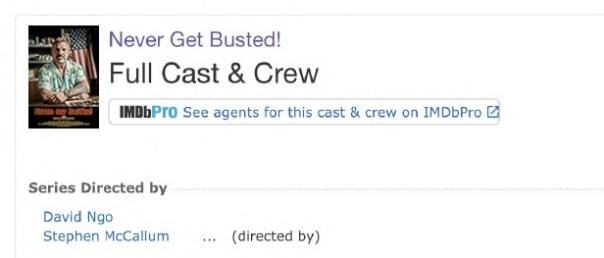
736 On 12 December 2024, Mr McCallum checked the Sundance Film Festival website and noticed that the NGB episodic listing showed credits without a director credit and in a “Meet the artist” section, it included a biography of Mr Ngo which included the words “Never Get Busted! is his directorial debut” (see extract at [892] below). Mr Ngo was also listed as “Director” in the credits section of the Episodic Showcase page of the Sundance website. On the same day, Mr Ngo made a post on his Instagram feed announcing the Sundance premiere, but did not credit Mr McCallum. That post appeared as follows:
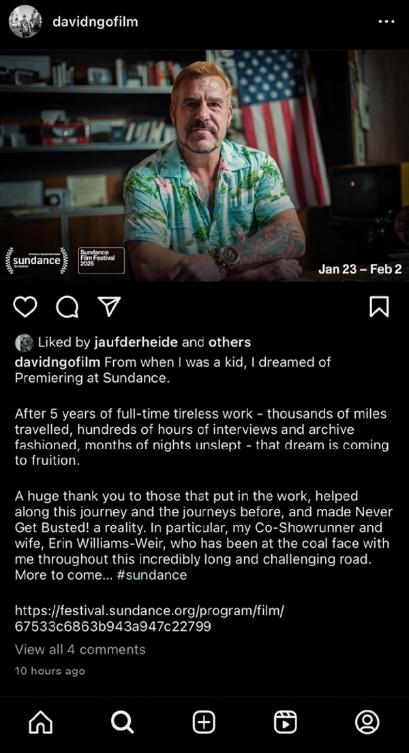
737 On 13 December 2024, the Australian film and television industry trade magazine called IF Magazine published an article entitled “‘Together’, ‘Never Get Busted!’, ‘Jimpa’ selected for Sundance” authored by Mr Sean Slatter which did not credit Mr McCallum or refer to him at all. Mr Ngo and Ms Williams-Weir were given “created by” credits.
738 On 18 December 2024, these proceedings were commenced.
739 On 20 December 2024, Screen Australia issued a press release arising from the Documentary’s acceptance into Sundance. Ms Islam then wrote to Screen Australia noting that Mr McCallum had commenced these proceedings and the nature of Mr McCallum’s claims. Ms Islam requested that the press release be amended so that the credits were corrected. Ms Islam sent an email in the same form to the SAFC.
740 On 20 December 2024, Mr McCallum checked the Sundance website and found a page called “Episodic Pilot Showcase 2025 of Never Get Busted” crediting Mr Ngo as Director.
741 On 23 December 2024, Mr McCallum checked the Sundance website and found an article called “Give me the Backstory” which was an interview with Mr Ngo and Ms Williams-Weir, and in which Mr Ngo was credited as “first time director” in the third paragraph. In a caption beneath a photo, both Mr Ngo and Ms Williams-Weir were credited as “directors” and in answer to a question posed in the article, Mr Ngo is reported to have stated “when I stepped into this role as director…”. In response to the final question, Mr Ngo is reported to have said:
Since I was a kid watching Soderbergh, Tarantino, the Coen Brothers and Robert Rodriguez films, I’ve dreamed of playing at Sundance, as do many filmmakers. So, it’s wild that my directorial debut [Never Get Busted!] is having its world premiere in Park City.
742 Mr McCallum was not mentioned at all.
743 On 22 January 2025, Mr McCallum checked the Documentary’s “IMDb Pro” page which depicted the film status as “completed”. Mr McCallum considered that as the Project was regarded as completed, he was entitled to be paid the remaining balance of $25,000 of his director’s fee which he had not been paid.
744 On or about 27 January 2025, Mr Ngo and Ms Williams-Weir were in Utah at a function in advance of the screening of the Sundance Version at the Sundance Film Festival, which was scheduled to occur the following day. Ms Williams-Weir says she received a telephone call from a friend, Ms Katie Found (Ms Found), who is also the partner of the director Mr auf der Heide. Ms Williams-Weir said that Ms Found told her that Mr Ngo should speak urgently with Mr auf der Heide. When Mr Ngo spoke to Mr auf der Heide, he was told that another person, Mr Shane McNeil (Mr McNeil), had sent a message to Mr auf der Heide and then had a telephone conversation in which Mr McNeil stated that Mr McCallum would be attending the screening the following day, and would cause a disruption and “attack” Mr Ngo. This serious accusation was based on hearsay upon hearsay.
745 The message apparently sent by Mr McNeil to Mr auf der Heide was as follows:
746 After apparently seeing this message, Mr Ngo and Ms Williams-Weir spoke to their publicist, which then resulted in Ms Williams-Weir forwarding the screenshot of the above message to Ms Laura Ryan (Ms Ryan), the Chief Operating Officer of the Sundance Film Festival. In that email, Ms Williams-Weir stated:
Hi laura,
Thanks for speaking with us today. Below is attached the screenshot explaining Stephen McCallum plans to disrupt the screening.
It’s important to note on top of this that we have a very credible source who was told over the phone that he plans to “attack” David at the premiere and cause further disruption. Considering his recent actions to disrupt the film in anyway possible by contacting financiers, publicists, journalist, filmmakers etc we would not be surprised if he chose to escalate this to violence.
Unfortunately our source is in Australia and by the time he wakes up the screening will be over however I can arrange a statement confirming more information from him after the screening if necessary for your office.
Please give us a call back when you can with the next steps.
(Emphasis added.)
747 Mr Ngo and Ms Williams-Weir had relied upon hearsay to convey a very serious accusation about Mr McCallum.
748 Ms Williams-Weir was informed that the Sundance Film Festival had investigated the matter and that Mr McCallum would not be permitted entry.
749 On 28 January 2025, Mr McCallum attended the Sundance Film Festival and was refused entry into the premiere screening of NGB by Ms Ryan. Ms Ryan asked if Mr McCallum was planning to disrupt the screening or had plans to get up on stage. Mr McCallum confirmed that he had no such intention and was only going to affirm his credit for the film he had directed during the Q&A. Ms Ryan told him that she could not let him do that, that she was denying him entry to the screening, and that his tickets had been cancelled and would be refunded. During the conversation, Mr McCallum says that two police officers were moving closer to him. He also says that Ms Ryan told him that there was information that he was planning to disrupt the screening, which Mr McCallum denied. Mr McCallum further stated that all he had done was talk about attending the screening of the film he had directed and that he had a right to attend.
750 Mr McCallum later corresponded with Ms Ryan who indicated that Sundance Film Festival organisers did not engage in or adjudicate disagreements by and among those involved in the films selected for screening, but that she had received “credible evidence” that Mr McCallum was going to confront crew at the Q&A.
751 On 14 January 2025, Mr McCallum checked the credits on the IMDb website for the Documentary and noticed that his “Directed by” credit had been removed again and that Mr Ngo was credited as the sole director. The website appeared as follows:
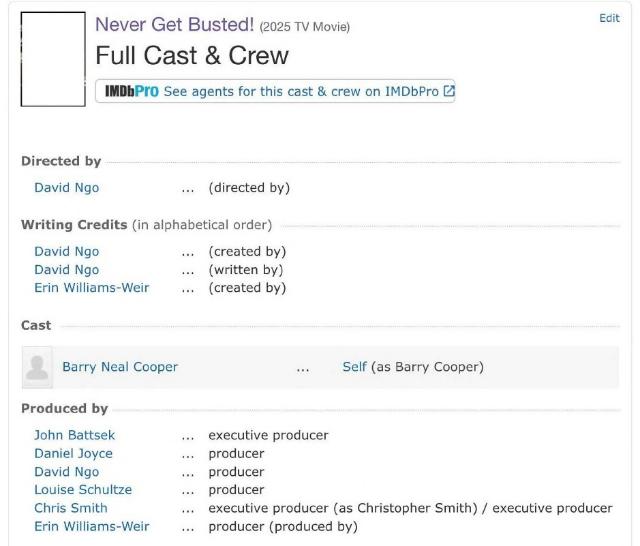
752 On 1 July 2025, Mr Ngo became alerted to the fact that NGB played at the “Dances With Films Festival” in Los Angeles, USA, where it was announced as its “world premiere”. The film screened was a 110-minute feature cut. Mr Ngo was credited in the festival program with a “Written and Directed by” credit. Mr McCallum was credited as a “Director”. The Documentary went on to win the Grand Jury Prize for Best Documentary at the festival.
753 On 10 July 2025, the solicitor for Projector Films sent an email to Mr McCallum’s solicitor stating that NGB would have its Australian premiere at the MIFF for 2025, which was due to commence on 7 August 2025. The program was released later that day. Mr Ngo was listed as the sole director of the Documentary. Mr McCallum was not mentioned or credited at all. All other main crew were credited.
754 Later, on 16 July 2025, after Mr McCallum’s solicitor indicated that urgent interlocutory relief would be sought, the MIFF program was changed to identify the “Director” as “David Anthony Ngo, Stephen McCallum” alongside a description that “David Anthony Ngo helms this Australian Production”. At the same time, Independent Film published an article about NGB playing at MIFF which stated that “[t]he documentary was written and directed by Australia’s David Anthony Ngo, who worked with director Stephen McCallum, producers Erin Williams-Weir and Daniel Joyce, and EPs John Battsek and Chris Smith”. The entry for the Documentary in the MIFF program relevantly appeared as follows:
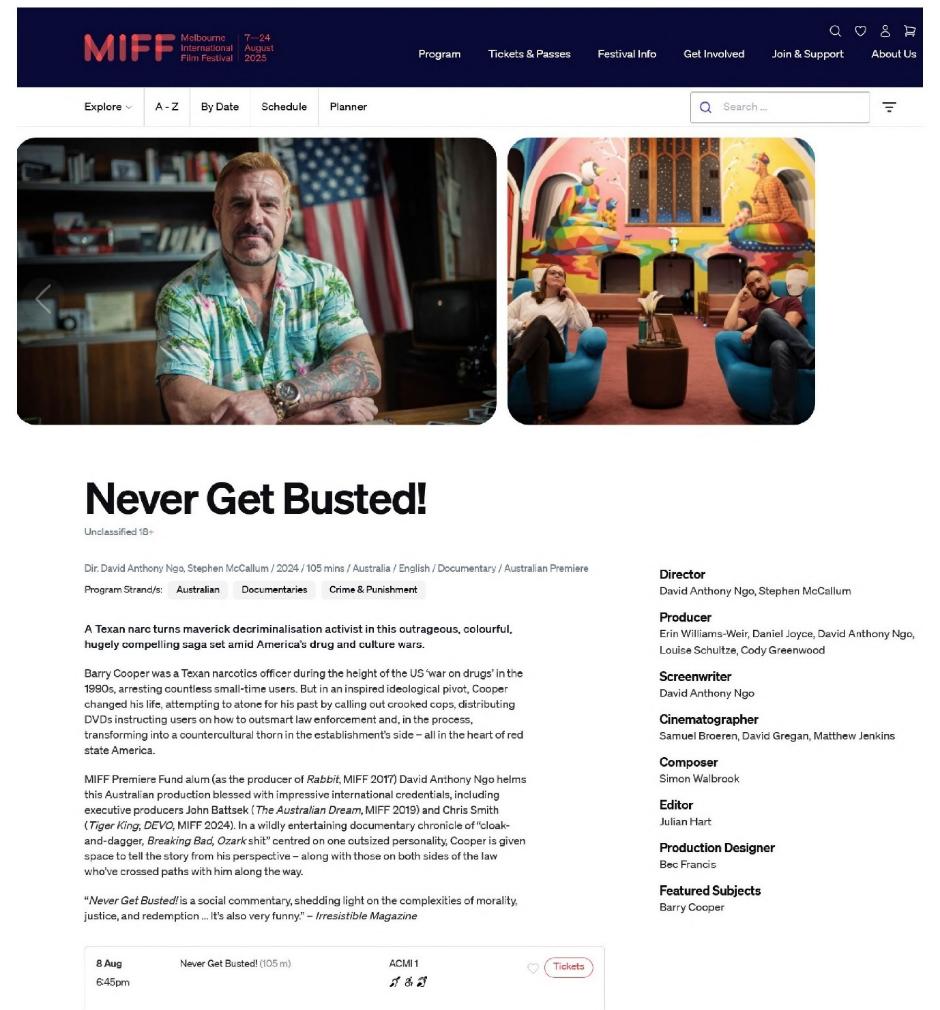
11.4 Mr McCallum’s case as to infringement
755 The Sundance and Feature Versions relevantly contain the following credits in the opening sequence:
PRODUCERS
LOUISE SCHULTZE
CODY GREENWOOD
EXECUTIVE PRODUCERS
MICHAEL AGAR
SHERARD KINGSTON
MARK FENNESSEY
LILLA HURST
ANDREW DEVLIN
DOUGLAS CHOI
MARTINA BASSENGER
EXECUTIVE PRODUCED BY
JOHN BATTSEK
CHRIS SMITH
PRODUCED BY
ERIN WILLIAMS-WEIR
DANIEL JOYCE
DAVID ANTHONY NGO
DIRECTOR
STEPHEN MCCALLUM
WRITTEN & DIRECTED BY
DAVID ANTHONY NGO
NEVER GET BUSTED!
CREATED BY
DAVID ANTHONY NGO & ERIN WILLIAMS-WEIR
(Original emphasis.)
756 The Sundance and Feature Versions relevantly contain the following credits in the closing sequence:
CREATED BY ……………… DAVID ANTHONY NGO
ERIN WILLIAMS-WEIR
WRITTEN AND DIRECTED BY ……………… DAVID ANTHONY NGO
DIRECTOR ……………… STEPHEN MCCALLUM
PRODUCED BY ……………… ERIN WILLIAMS-WEIR
DANIEL JOYCE
DAVID ANTHONY NGO
EXECUTIVE PRODUCED BY ……………… JOHN BATTSEK
CHRIS SMITH
PRODUCER ……………… LOUISE SCHULTZE
CODY GREENWOOD
EXECUTIVE PRODUCERS ……………… MICHAEL AGAR
SHERARD KINGSTON
ANDREW DEVLIN
MARK FENNESSEY
LILLA HURST
DOUGLAS CHOI
MARTINA BASSENGER
757 Mr McCallum’s case was that neither the Sundance Version nor the Feature Version attributed him as the “principal director” because the credits as affixed and published in those versions did not use the credit “Directed by”. He said that the corollary of this was that Mr Ngo was attributed as the “principal director” to his exclusion as the “principal director” and that this was an act of false attribution.
758 Mr McCallum says that there is threat of ongoing infringement because the respondents intend to maintain these credits including in future versions. The respondents admit that this is the case.
759 The resolution of the question requires an examination of the difference in the credit “Directed by” and the credit “Director” when there is more than one director.
11.5 The difference between the credit “Directed by” and the credit “Director” where there is more than one director
760 Mr McCallum submitted that to those within the Australian film and television industry, the credit “directed by” means that the credited person “actually undertook the principal directing work on the film or television project” and further that the credit “director” (as opposed to “directed by”) conveys that the credited person was not the principal director if another person was credited as “Directed by”: FASOC [8].
761 The respondents’ answer to the case was perplexing. The respondents submitted that the Copyright Act did not prescribe any particular form of credit to be used in the attribution of a person as a director or principal director of a cinematograph film. It was further said that the Copyright Act does not require an attribution as “the main principal director” but rather “requires an attribution as principal director”: T196.2-3.
762 However, as set out above, the respondents admitted that both Mr Ngo and Mr McCallum are principal directors of the Documentary. They also admitted that where there is more than one director, the person credited with the credit “Directed by” is “the main person who exercised creative control and oversight over the filmmaking process from concept through to delivery, including with regards to the storytelling, the visual style, the pacing, the music and the overall artistic direction” (original emphasis): Defence [8(a)(ii)].
763 In making this admission, the respondents accepted that there is a meaningful distinction between a “directed by” credit and a “director” credit but only in circumstances where both forms of credit are used within a single film. In addressing the distinction between these two forms of credit, the respondents submitted that, when used separately, “director” and “directed by” are “interchangeable ways to nominate the principal director of a film”, and whether one or the other is chosen is “purely for grammatical purposes”: RCS [167]. When used together, it was submitted that the credits “indicate that both people were principal directors, but the person with the ‘directed by’ credit is the main person who exercised creative control over the film”: RCS [167].
764 The respondents next submitted that the credit “[d]irector” is “a marginally lesser credit” than “[d]irected by” (RCS [165]) and contended that “although one is lesser than the other, they’re both above the line of what’s sufficient to identify a principal director”: T195.10-11. It was submitted, by way of contrast, that “the industry uses very different language to indicate that a director was not in creative control over a film”, such as “assistant director”, “second unit director”, “associate director” and “line director”: ROS [10]; Maclaren 2 [71].
765 The respondents’ position was distilled in the following way (RCS [169]):
The respondents say the credits properly attribute both men as principal directors for the purpose of the moral rights regime, but the credits do convey that Mr Ngo had a marginally more substantial role, which is correct on the facts.
766 Further to this, the respondents submitted that (T195.20-31):
…The Copyright Act doesn’t require any particular way of identifying a director. That’s the first point. And the second point is it doesn’t require that two directors, co-directors, be given the same credit. So, the Act acknowledges they can be co-directors. It doesn’t say both must get the same credit. The evidence was clear that the title that is used to identify someone who did directing work but was not a principal director is named such as second unit director, assistant director, etcetera, and that the terms “director” and “directed by” do indicate a person who’s in creative control of the film. So, we say when those credits are used together, although there’s some daylight between them, they are both on the principal director side of the line as opposed to the other side of the line, which is assistant director second unit director, etcetera, which does not indicate a principal director.
767 Putting to one side whether there can be two principal directors in circumstances where one of the directors can be characterised on the facts as the “main” director, or whether it is tautologous to speak of a “main principal director”, I am not satisfied that the evidence establishes the respondents’ argument.
768 It is correct that Ms Maclaren considered that both grammatical forms of credit (“director” / “directed by”) could be used to credit the principal director of a film. However, Ms Maclaren’s evidence was that in a given film, the grammatical form of credits would normally be consistent and that “it is unusual for a single film to include two separate grammatical forms, especially in respect of the same credit”: Maclaren 1 [37]. Consistent with this, where two individuals both directed a film, Ms Maclaren considered that one “would normally expect to see their two names under a ‘directed by’ or ‘director’” credit: T403.12-13. In her view, using both grammatical forms of credit in a single film “just looks a bit odd”: T403.21.
769 While Ms Maclaren considered that there was a “very fine line” between the two forms of credit (T401.45), and although she did not consider the difference to be “substantial” (T402.01), her opinion was more nuanced than as characterised by the respondents. Notably, Ms Maclaren acknowledged in cross-examination that there had been a trend of using the “directed by” form of credit and gave evidence that “it seems to be more fashionable at the moment” to use “directed by” rather than “director”: T402.08-12. This evidence is consistent with Mr de Heer’s evidence that he has “found a shift over the past decade or so” with the “by” form of credit being preferred: T402.24-29.
770 In addition to this, Ms Maclaren expressed the view that the “by” form of credit may carry an implication of “ownership”: T402.36. Importantly, she also accepted that different grammatical forms of credits could be used to convey inequality as between directors. In this regard, it was put to Ms Maclaren, and accepted, that a “written & directed by” credit given to three people indicated equality between directors, whereas a “co-directed by” credit and “directed by” credit (when used together) indicated inequality between directors: T 408.04-26; Exhibit 17; Exhibit 22. This evidence given by Ms Maclaren generally accorded with Mr de Heer’s opinion that where a “directed by” credit and “director” credit both appear in a film, the “directed by” credit conveys that the credited person was the principal director and the “director” credit conveys that the credited person was a subsidiary director: de Heer 1 [96]; de Heer 2 [16]. Although Mr de Heer did not refer to a particular example to substantiate his evidence, I do not accept the respondents’ submission that his opinion had no basis as he (like Ms Maclaren) was relying upon his experience in the industry over a long period of time.
771 Ultimately, it is my view that it is not helpful in the present case to fixate on the grammatical form of credit in insolation. The central question is whether Mr McCallum has been attributed as the principal director of the Documentary and will be so credited, whether there has been false attribution and whether that position will continue. In answering that question, it is necessary to look at the credits as a whole, including in relation to structure and placement of credits. It is also necessary to consider these issues in light of the respondents’ acceptance that, where there is more than one director, the credit “director” is marginally lesser and the credit “directed by” indicated the “main person” who exercised creative control and oversight over the filmmaking process.
772 In reviewing the evidence, it is apparent that the use of alternate forms of credit was a deliberate technique deployed by the makers of the Documentary. This can readily be seen by examining the closing credits that appeared in both the Sundance and Feature Versions of the Documentary: see Exhibit 25 at 0:47:24; Exhibit 25 at 1:47:07). Those credits are extracted above at paragraph [756].
773 As can be seen from these credits, it is not only the director credits that have been attributed in two forms—the producers and executive producers of the film have also been separated into distinct line entries with “produced by” and “producer” credits, and “executive produced by” and “executive producers” credits. It is noteworthy that the “directed by”, “produced by”, and “executive produced by” credits appear higher up than their respective counterparts (ie “director”, “producer”, and “executive producers”). I accept Mr McCallum’s submission (Applicant’s Closing Submissions (ACS) [215]), consistent with Mr de Heer and Ms Maclaren’s evidence, that by the order of the credits and the attribution of a “directed by” credit, Mr Ngo is given the most prestigious position and is recognised as the “driving force” or principal director of the Documentary: see de Heer 1 [94]; Maclaren 1 [39]-[40]; T402.4-6.
774 I am satisfied that the evident intention of delineating between individuals within role categories in this way is to distinguish between those who made a more substantial contribution in a particular role from others who made a less substantial contribution within that same role. This is consistent with the respondents’ submission that “Mr Ngo had a marginally more substantial role” than Mr McCallum as director: RCS [169]. I do not accept, however, that the division only reflects a marginal difference in substantive contribution. There is no evidentiary basis to support such a conclusion.
775 It follows that I reject the respondents’ submission that the credits convey that both Mr Ngo and Mr McCallum are principal directors but with “some daylight between them”: T195.28. Rather, I accept that there is presently “daylight” between how the two men have been attributed, such that Mr McCallum has not been attributed as the principal director (or for that matter, a principal director) and Mr Ngo has been falsely attributed as the principal director (and the only such principal director).
11.6 Infringement of the right of attribution and against false attribution
776 I am satisfied that Projector Films has infringed and continues to threaten to infringe Mr McCallum’s right of attribution. Projector Films admits that it intends to exhibit or communicate the Documentary to the public in Australia (Defence [22(a)]) and that it intends to do so by including the credit “Director” for Mr McCallum, while using the credit “Directed by” for Mr Ngo: Defence [26] and [30(b)]. For the reasons stated above, I am satisfied that this amounts to a failure to attribute Mr McCallum as the principal director of the Documentary and also amounts to false attribution.
777 It follows that Projector Films has infringed Mr McCallum’s rights and should be enjoined from doing so.
12. THE INFRINGEMENT CASE AGAINST MR NGO
778 Separate from but related to his claims against Projector Films, Mr McCallum claims that Mr Ngo infringed his moral rights. As with other claims, little attention was given to this claim.
779 At the outset, it is to be noted that neither Mr McCallum nor the respondents addressed whether Mr Ngo himself was a beneficiary of the “general waiver” in the first sentence of cl 6.2. If that waiver was granted in favour of Projector Films, it did not operate in favour of Mr Ngo. The parties did not address this issue and, as a result, it has been unnecessary to decide it.
12.1 The pleaded case and the parties’ submissions
780 The allegations advanced in the FASOC were two-fold. First, it was claimed that Mr Ngo “authorised” Projector Films to engage in the acts said to have infringed Mr McCallum’s right of attribution for the purposes of s 195AO of the Copyright Act: FASOC [32(a)]. Second, it was claimed that Mr Ngo “directed or procured” Projector Films to engage in the contraventions of ss 195AO and 195AP of the Copyright Act pursuant to a common design with Projector Films: FASOC [31(b)] and [32(b)].
781 These allegations relied on several other allegations pleaded in the FASOC at [31]. It was asserted that Mr McCallum engaged in the abovementioned acts (a) “knowing” the Documentary was directed by Mr McCallum and not himself, (b) in “deliberate or reckless disregard” of Mr McCallum’s rights and express wish to be credited in the manner “Directed by Stephen McCallum” and (c) “intending” that any copies of complete and final versions of the Documentary would attribute Mr Ngo as the director of the Documentary and, conversely, would not attribute Mr McCallum as the director within the meaning of ss 189 and 191 of the Copyright Act: FASOC [31]. The particulars to the claim were articulated as follows in the FASOC at [31]:
Particulars
i. The Second Respondent is and was at all material times a director of the First Respondent, and responsible for undertaking work as a producer of the Documentary.
ii. The Second Respondent was, from in or about January 2020, responsible for working and corresponding with the Applicant in relation to the Documentary, and accordingly was aware that he, the Second Respondent, did not direct the Documentary, and that the Applicant did.
iii. The Second Respondent negotiated and signed the Director's Agreement, and accordingly was aware of the Applicant's engagement as director of the Documentary, and of his wishes and entitlements concerning attribution expressed therein.
iv. The Second Respondent asserted in correspondence with the Applicant that he, the Second Respondent, was entitled to a director's credit and that the Applicant was only entitled to a shared director's credit, for example in emails dated 18 and 20 December 2023 and 31 May 2024, and accordingly it may properly be inferred that he caused the First Respondent to engage in the acts set out in paragraphs 9, 10, 11, 13 and13A hereof.
v. Further particulars may be provided.
(Original emphasis.)
782 The allegations that Mr McCallum had authorised, or had directed or procured, Projector Films’ infringements were necessarily tied back to the acts in respect of which it was claimed that there had been an infringement of Mr McCallum’s right of attribution and right against false attribution. These were relevantly pleaded in relation to:
(a) the Sundance Version as being those acts by which the opening and end credits to that Version of the Documentary were said to have failed to attribute Mr McCallum as principal director and falsely attributed Mr Ngo as a director (FASOC [13A], [16]-[21] and [27]-[28]); and
(b) the Further Versions of the Documentary, including the Feature Version, as being those acts by which the opening and end credits to that Version of the Documentary were said to have failed to attribute Mr McCallum as principal director and falsely attributed Mr Ngo as a director (FASOC [22]-[26] and [29]-[30]).
783 The moral rights claims against Mr Ngo were given fleeting attention by Mr McCallum in written and oral submissions. Other than a passing reference, the moral rights claims against Mr Ngo were not engaged with at all in Mr McCallum’s written opening submissions. That passing reference itself was limited to a conclusory submission that Mr Ngo “had authorised the breach” of Mr McCallum’s right not to have authorship falsely attributed. The submission was expressed as follows:
88. By means of the distribution agreements the Respondent has entered into, Projector Films, and David Ngo have also either themselves breached, threatened to breach, or authorised the breach of s 195AF(2)(b) and (c) of the Copyright Act, which should also be permanently enjoined.
784 Mr McCallum’s case against Mr Ngo went entirely undeveloped until closing submissions. Even then, scarce attention was given to these claims in Mr McCallum’s written submissions. In sum, there are only four paragraphs which squarely addressed the claims. Those submissions were as follows:
220. …where a person authorises the doing of an act which infringes the right of attribution, that is also an infringement of that right. A will authorise B where A has the power to prevent the acts of infringement, and/or there is a close relationship between A and B: s 195AVA of the Act. See also, Roadshow Films Pty Ltd v iiNet Ltd (2012) 248 CLR 42 at [63], [121]-[122], and also authorities about tortious liability of company directors: for example Truong Giang Corp v Quach (2015) 114 IPR 498 at [76]-[80].
221. Both are made out here. As is plain from the factual chronology in Section 3, Mr Ngo was the person with control of the entire project as producer. He was the person who provided the title credits to Mr Hart when he was cutting the Documentary (see paragraph 140). Further, he personally cut the Feature Version (V1T27 Ngo 1 [216]). The credits of the Sundance Version and Feature Version looked as they did because Mr Ngo wanted them to. Mr Ngo caused Projector Films to create those credits in a manner calculated to benefit him personally by crediting him as the principal director.
222. The Court should accordingly also grant Mr McCallum a declaration that Mr Ngo has infringed his right of attribution, by authorising Projector Film’s infringement referred to above, and grant Mr McCallum an injunction restraining threatened further infringement.
…
245. Mr Ngo not being a principal director of the Documentary, the following conduct constitutes infringement. First, by means of producing the Sundance Version and the Feature Version referred (see paragraphs 176 and 181 above), Projector Films inserted or affixed Mr Ngo’s name on the Documentary in such a way as to imply falsely that he was a principal director of the Documentary, infringing s 195AF(2)(a) of the Act. Second, for the same reasons as in paragraph 220, Mr Ngo authorised that infringement thus himself infringed s 195AF(2)(a) of the Act. Again, there does not seem to be any dispute that the affixing occurred in Australia, see paragraph 215 above.
(Original emphasis.)
785 It was not until the closing address that Senior Counsel for Mr McCallum sought to engage with the claims against Mr Ngo in a meaningful way. At that point in time, I expressed my concern with the manner in which allegations of a serious nature had been dealt with and Senior Counsel for Mr McCallum sought an opportunity to provide a further written submission on the point: T84.35 –T86.35.
786 Unsurprisingly, Counsel for the respondents contended that Mr McCallum had already had an opportunity to address the case against Mr Ngo but had chosen not to do so in any detail and should not now be given a second “bite of the cherry about Mr Ngo’s liability”: T188.32. Accordingly, the respondents submitted that Mr McCallum should not be permitted at such a late stage of the trial to be allowed to provide the Court with supplementary written submissions that properly enunciated the case against Mr Ngo: T189.01-02. The respondents further said that allowing Mr McCallum to have a second go at the case against Mr Ngo would not only result in a denial of fairness but would also be contrary to the principles of finality and proportionality: T189.05-08.
787 I accepted the respondents’ submissions. As the respondents submitted, the written submissions Mr McCallum provided to the Court were of considerable length. Whether, and to what extent, Mr McCallum chose to address his pleaded claims was ultimately a forensic matter for him and his legal representatives. In the circumstances, and as a matter of procedural fairness, I was not prepared to receive the written note that Mr McCallum sought to provide to the Court on the final day of the trial. I made it clear that I would consider the claims against Mr Ngo as pleaded and addressed during the trial.
788 It was submitted on behalf of Mr McCallum that “the question of Mr Ngo’s personal liability” was put “on the basis of joint tortfeasorship principles, and authorisation liability”: T84.12-14. It was further said that “these principles have applied in case where you have a company director – as Mr Ngo is – or some other … relevant person connected to it” and that there “has been a goodly amount of law in relation to the joint tortfeasorship principles”: T84.45-47; T85.18-19.
789 The respondents submitted that Mr McCallum’s submissions did not explain how Mr Ngo is said to have authorised Projector Films’ alleged infringement of his moral rights by reference to the matters that must be taken into account by the Court by virtue of s 195AVA of the Copyright Act. It was submitted that the question of whether a person’s involvement in an infringement was sufficient to amount to authorisation requires close focus upon all the facts: citing Real Estate Tool Box Pty Ltd v Campaigntrack Pty Ltd [2023] HCA 38; 278 CLR 240 at [64], [79] (Gageler CJ, Gordon, Edelman, Steward and Jagot JJ). The respondents further submitted that Mr Ngo was not a “joint tortfeasor” in any moral rights infringement as there was no suggestion that he was acting in any capacity other than as a director of Projector Films: citing Hashtag Burgers Pty Ltd v In-N-Out Burgers, Inc [2020] FCAFC 235; 159 IPR 186 at [138]-[140] (Nicholas, Yates and Burley JJ).
790 The respondents submitted that there was “no evidence to indicate that Mr Ngo was solely responsible for the alleged attributable acts committed” by Projector Films and that “the evidence indicates that other members of the production team, including the executive producers, had influence over the credits of NGB”: RCS [201].
12.2 Consideration
791 To determine whether Mr Ngo has himself infringed Mr McCallum’s moral rights, it is necessary to have close regard to the relevant infringement provisions of the Copyright Act, being ss 195AO and 195AP (which have been set out above).
792 It is necessary to observe that the liability under ss 195AO and 195AP is not tortious. The liability has its source in statute. The cause of action for such an infringement is also statutory and is found in s 195AZ. In light of this, it is perplexing that Mr McCallum relied upon the principles of “joint tortfeasorship” and that the respondents engaged with those submissions. The decisions upon which the parties relied were both ones which applied joint tortfeasorship principles in respect of the tort of passing off: see Truong Giang Corp v Quach [2015] FCA 1097; 114 IPR 498 at [76]-[80] (Wigney J); and Hashtag Burgers Pty Ltd v In-N-Out Burgers, Inc [2020] FCAFC 235; 159 IPR 186 at [138]-[141] (Nicholas, Yates and Burley JJ). The parties did not explain how these principles have any application to liability that is exclusively statutory.
793 Section 195AO appears to differ from s 195AP in its terms. For s 195AO, a person infringes an author’s right of attribution if the person does or authorises the doing of an attributable act without identifying the author. For s 195AP, however, a person only infringes an author’s right not to have authorship falsely attributed if the person does an act of false attribution. When s 195AP is read together with the provisions in Part IX, Div 3 (which deal with the right not to have authorship of a work falsely attributed), it becomes apparent however that this difference between ss 195AO and 195AP may not be material. In particular, s 195AF(2)(a) provides that it is an act of false attribution “to insert or affix, or to authorise the inserting or affixing of, a person’s name on the film or on a copy of the film in such a way as to imply falsely that the person is the director, producer or screenwriter, as the case may be, of the film”. This provision, together with s 195AC(2), has the effect that the authorisation of an act of false attribution is itself an act of false attribution. As such, despite the different paths, the end point of ss 195AO and 195AP is the same: a person can infringe an author’s moral rights either by doing or by authorising an attributable act or an act of false attribution.
794 The terminological differences between ss 195AO and 195AP may explain why Mr McCallum considered it necessary to advance his first claim, which focusses on s 195AO alone, rather than simply relying on his further and alternate claim that Mr Ngo is a joint tortfeasor with Projector Films in respect of the alleged infringements of both kinds of Mr McCallum’s moral rights.
795 In respect of the analogue provision applicable to copyright infringements in s 36 of the Copyright Act, it has been said that that there are two causes of action: “‘primary infringement’, namely direct infringement by the ‘doing [of] … any act comprised in the copyright’; and ‘secondary infringement’, namely the authorisation of the doing of the act or acts comprised in the copyright constituting the primary infringement”: Campaigntrack Pty Ltd v Real Estate Tool Box Pty Ltd [2021] FCA 809 at [268] (Thawley J) (this aspect not disturbed in subsequent appeals) citing Roadshow Films Pty Ltd v iiNet Ltd (No 2) [2012] HCA 16; 248 CLR 42 at [93] (Gummow and Hayne JJ).
796 The delineation between the “primary infringement” and “secondary infringement” is a useful way to conceptualise the claims made against Mr Ngo. Here, the claim against him in respect of s 195AO was as a secondary infringer (ie a person who authorised the infringement) but the case against him under s 195AP was as a primary infringer (ie he did the act of infringement, but that act was one of authorisation).
797 Where a claim is made that a person has authorised the doing of an act that infringes another person’s moral rights, the Court is required to have regard to the mandatory considerations specified in s 195AVA (as set out above). Those considerations require attention to be given to the infringing persons power to prevent to the doing of the act, the nature of the relationship between the relevant infringers, and whether the infringing person took any reasonable steps to prevent the or avoid the doing of the act. The first two considerations were adverted to by Mr McCallum in ACS at [220] and addressed in ACS at [221] (referring to and relying on earlier factual submissions). In their submissions, the respondents took issue with the inadequate articulation of the foundation of Mr McCallum’s claims against Mr Ngo.
798 Although the articulation of the case against Mr Ngo was less than satisfactory, I am satisfied that Mr Ngo authorised the infringement of Mr McCallum’s right of attribution within the meaning of s 195AO by authorising an “attributable act” without identifying Mr McCallum as the author of the Documentary by failing to attribute him as the principal director.
799 The word “authorise” has its ordinary meaning of “sanction, approve, countenance”: University of New South Wales v Moorhouse [1975] HCA 26; 133 CLR 1 at 12 (Gibbs J) and 20 (Jacobs J); Roadshow Films at [48]–[51] (French CJ, Crennan and Kiefel JJ) and [125] (Gummow and Hayne JJ). However, authorisation is not to be identified by deconstructing the dictionary definitions of notions such as “sanction”, “approve” and “countenance”: Real Estate Tool Box at [64]. Authorisation includes “circumstances in which one person is so involved in the infringement that the infringer can be said to act with the “permission” of the authorising person”: Real Estate Tool Box at [64]. The sufficiency of involvement in the infringement so as to amount to authorisation requires “close focus upon all the facts”; it is essentially a “question of fact”: Real Estate Tool Box at [64]-[65].
800 I am satisfied that the particulars to the FASOC at [31] adequately articulated the evidentiary basis of the claim. A credit dispute surfaced at the end of December 2023. The correspondence from that time discloses that Mr Ngo was the chief correspondent on behalf of Projector Films. He articulated the position that he should receive a co-directing credit and was aware of Mr McCallum’s countervailing position based on the Director’s Agreement that the Documentary should include the credit, “Directed by Stephen McCallum”. On his own account, Mr Ngo was the person who was managing the edit of the Sundance Version and the Feature Version of the Documentary. Mr Ngo had been zealous to ensure that he received credits as a writer, producer and director of the Documentary. Although there is no direct evidence that Mr Ngo was the person who affixed the opening and ending credits to the Sundance and Feature Versions of the Documentary, I am satisfied that it can be inferred that he was in a position to “sanction”, “approve” and “countenance” that act and that he did so. In coming to this conclusion and drawing this inference, I have taken into account the factors specified in s 195AVA. In particular, I am satisfied that as a producer, Mr Ngo was in a position to both do the infringing act or to prevent it from occurring and failed to take reasonable steps to avoid the infringement. In fact the evidence indicates that he was a chief protagonist and had a vested interest in authorising and ensuring that the opening and end credits to be presented and situated in a way that conveyed that he was the principal director, and that Mr McCallum was not.
801 The respondents’ contention that there is “no evidence to indicate that Mr Ngo was solely responsible for the alleged attributable acts committed” (RCS [201]) misses the point. Mr Ngo need not have been the sole person responsible. The question is whether he was a person who authorised the attributable act. On all the evidence, I am satisfied that he was.
802 In respect of s 195AP, slightly different issues are raised. The question here is whether Mr Ngo himself engaged in the attributable act, which by reason of s 195AF(2)(a) requires it to be shown that he engaged in an act “to insert or affix, or to authorise the inserting or affixing of, a person’s name on the film or on a copy of the film in such a way as to imply falsely that the person is the director, producer or screenwriter, as the case may be, of the film”. That act here was the authorisation of the affixation of credits in the opening and end credits to the Sundance and Feature Versions that attributed Mr Ngo as, in effect, the principal director of the Documentary and not Mr McCallum. The factual basis for Mr Ngo’s liability is the same as that under s 195AO. I am satisfied that Mr Ngo engaged in an attributable act by authorising the inserting or affixing of his own name so as to convey he was the principal director of the Documentary and that Mr McCallum was not, which was an act of infringement of Mr McCallum’s right against false attribution.
803 Accordingly, I am satisfied that Mr Ngo is liable under ss 195AO and 195AP in respect of the infringements of Mr McCallum’s right of attribution and right against false attribution.
PART C: THE BREACH OF CONTRACT CLAIMS
13. THE BREACH OF CONTRACT CLAIMS
804 Mr McCallum alleges that Projector Films breached the Director’s Agreement by:
(a) failing to provide Mr McCallum with a director’s credit as agreed under cl 9.1;
(b) adding a director to the credit line without his agreement as required under cl 9.2;
(c) failing to pay his fees as agreed under cl 3 and Sch 2; and
(d) failing to provide cuts of the Documentary for his notes and approval under cl 5(b).
805 These claims are addressed in turn below.
13.1 Breach of cl 9.1
806 The first of Mr McCallum’s contractual claims concerns his rights arising under cl 9.1 of the Director’s Agreement. Clause 9.1 of the Director’s Agreement is as follows:
Provided the Director substantially fulfils and completes all of his obligations under this document, the Producer shall provide the Director with a credit on all positive prints of the Documentary and all paid advertising and paid publicity issued by the Producer or under its control in connection therewith. Such credits shall read substantially as follows:
"Directed by Stephen McCallum"
807 Mr McCallum’s case is that, irrespective of his moral rights and irrespective of whether he is the sole principal director, Projector Films agreed that he would receive the credit as the director of the Documentary and that such credit would read “Directed by Stephen McCallum”. Mr McCallum contends that he has discharged the obligations that were required of him, but that in breach of cl 9.1, he has not been given the credit “Directed by Stephen McCallum” in the credits for the Documentary and in other promotional materials.
13.1.1 The respondents’ defence and the Cross-Claim
808 The respondents’ answer to the case overlaps with the first aspect of Projector Films’ Cross-Claim. The respondents contend that Projector Films’ obligation to provide Mr McCallum a director’s credit in substantially the form “Directed by Stepehen McCallum” is conditioned by the opening words of cl 9.2, “Provided [Mr McCallum] substantially fulfils and completes all of his obligations under this document…”.
809 As part of the Cross-Claim, Projector Films contend that cl 2.1(a) of the Director’s Agreement required Mr McCallum to “direct the Documentary” as that term is “generally understood and commonly used in the Australian film and television industry”. Relying upon Ms Maclaren’s evidence, Projector Films set out a long list of duties that were said to be required of a director in the Australian film and television industry: see Amended Statement of Cross-Claim (ASOCC) at [6]–[17], repeating [2]-[12] of Annexure A of the Defence. The claim was framed as follows.
810 Projector Films alleges that by entering into the Director’s Agreement, it engaged Mr McCallum to “direct” the Documentary as that term is generally understood in the Australian film and television industry: Annexure A [2]. It is alleged that in this context, “directing” a documentary is generally understood to involve at least: (i) taking an active role in crafting the story, (ii) driving the overall creative vision from inception to completion, and (iii) exercising creative control and oversight over each of the many phases including, for example, pre-production, shoot, post-production, edit, assembly edit, rough cut, further cut, and final cut: Annexure A [4].
811 In addition to this, Projector Films asserts that the Director’s Agreement contained an express term defining the scope of the “Services” Mr McCallum agreed to perform. These are relevantly said to include, among other things, developing, writing and revising Development Materials, overseeing and approving other creative elements, and directing the various “creative stage[s]” of the Documentary: Annexure A [3(a)]. Projector Films further alleges that, pursuant to cl 7.1 of the Director’s Agreement, Mr McCallum covenanted and warranted that he was available to provides the “Services” for the term of and pursuant to the terms of the Director’s Agreement, and also warranted to take direction from and cooperate with Projector Films, to conduct his duties in a professional manner and in good faith, and to do all things necessary and required by Projector Films in a timely manner: Annexure A [3(e)]–[3(f)].
812 Projector Films then pleads the work that it asserts Mr McCallum in fact performed and alleges that his work was limited to:
(a) conducting shoots in collaboration with Mr Ngo and Ms Williams-Weir, and based on their story Outlines and independent research, respectively;
(b) undertaking preparatory work related to the shoots, including the preparation of interview questions and interviewing subjects on the day;
(c) interviewing certain creative heads of departments in collaboration with Mr Ngo, Ms Williams-Weir, and Mr Joyce;
(d) directing the assembly editor, Grace Eyre, to a very limited extent, upon being prompted to do so by Mr Ngo;
(e) providing feedback on work done by others on the Documentary;
(f) preparing various pitch materials and the “Look Book” (being a collection of reference images that focusses on visual aspects of the film);
(g) preparing initial illustrations and preliminary storyboards to be used as a basis for animation;
(h) exercising partial creative oversight over illustration, location choices, and camera choices; and
(i) collaborating with Mr Ngo with respect to about half of the insert photography
(Annexure A [5]-[6]).
813 Projector Films then alleges that in or about January 2022, Mr McCallum, in effect, ceased cooperating. Specifically, it is alleged that Mr McCallum refused to deliver certain development materials unless he was paid more than what was provided for under the Director’s Agreement, indicated that he would be unable to work on the Documentary full time or on a first priority or an exclusive basis, and refused to direct the edit such that it was left to Projector Films and Mr Ngo to do so and to complete the Documentary in a director’s capacity: Annexure A [7].
814 Further or alternatively, Projector Films alleges that Mr McCallum indicated on 25 July 2023 that his work was done and he would only be available on a minimal basis: Annexure A [8]. Projector Films also alleges that his work was overall of poor quality and could not be used or used easily, including in particular his work on the assembly edit, his feedback on others’ work, and his initial illustrations and storyboards: Annexure A [9]–[10].
815 Projector Films alleges that Mr McCallum failed to direct the Documentary and provide the Services, and thereby breached cll 2.1, 2.2(a)-(b), 2.2(d), 7.1(a)(i) and 7.1(c)(i)–(iii) of the Director’s Agreement: Annexure A [11]–[12]. It is also alleged that Mr Ngo attended to each of the matters to which Mr McCallum failed to attend: Annexure A [13].
816 The respondents submitted that contrary to cl 2.1(a) and (b)(iii), Mr McCallum did not direct the editing of NGB in that his contribution to the First Rough Cut was insufficient, which resulted in a lacklustre first cut which failed to impress the Executive Producers. The respondents submitted that thereafter, Mr McCallum “fully stepped back from NGB” because “he needed to take on other work to make money”. It is claimed that “the result was that Mr McCallum stopped doing the work that would be expected of a director in the editing stage of a documentary” and Mr Ngo stepped into the role: RCS [205]-[206].
817 In addition, the respondents submit that Mr McCallum did not direct any of the post-production work, including the sound design, composition, grade, or finishing of NGB: RCS [209]. It was also submitted that Mr McCallum failed in his duty under cl 2.1(b)(v) to make all reasonable efforts to ensure the timely and on-budget completion and delivery of NGB: RCS [210]. It was further submitted that Mr McCallum failed in his duty to establish rapport with interviewees and the respondents rely upon Mr Cooper’s evidence that he did not remember speaking to Mr McCallum before shooting began: RCS [211]-[212]. Finally, it is claimed that Mr McCallum failed in his duty to exert creative control over the documentary: RCS [213].
13.1.2 Consideration
818 I reject the respondents’ contentions.
819 The respondents made no attempt to explain how their Defence and Projector Films’ Cross-Claim could be maintained in light of the admission made in the Defence as follows:
In answer to paragraph 4 of the SOC, the Respondents:
(a) admit that Mr McCallum undertook work as a director on the Documentary;
(b) admit that Projector Films and Mr Ngo undertook work as producers of the Documentary;
(c) otherwise deny the allegations in the paragraph;
(d) say further that Mr Ngo undertook directing work on the Documentary;
(e) say further that Mr Ngo was a director of the Documentary;
(f) say that both Mr Ngo and Mr McCallum were principal directors of the Documentary.
(Emphasis added.)
820 Having made admissions not only that Mr McCallum undertook work as a director on the Documentary and also that Mr McCallum was a principal director of the Documentary (together with Mr Ngo), the position advanced by the respondents in their Defence and in the Cross-Claim are, on their face, irreconcilable. No effort was made by the respondents to explain their inconsistent position, other than perhaps to contend that Mr McCallum was not entitled to the credit, “Directed by Stephen McCallum”. These claims should be rejected.
821 First, the respondents’ contentions paid little attention to the words of cl 2.1(a). The words of cl 2.1(a) provide that the “Producer engages the Director to direct the Documentary (Services), as those terms are generally understood and commonly used in the Australian film and television industry”. The respondents focused their attention on what was “generally understood” in relation to the tasks required to “direct the Documentary” but did not consider that the text of the claim also requires attention to be given to the role of a producer.
822 Second, the respondents’ contentions proceeded on the basis that Ms Maclaren’s evidence provided unqualified support for the tasks and duties involved in “directing” a documentary in Australia. That was not in fact the effect of her evidence. As set out above, in her first affidavit, Ms Maclaren stated that she was asked to express an opinion about the “typical phases and elements” involved in the production of a documentary. She then stated that in her experience, “the process of making a documentary film varies depending on” a number of “Core Elements”. She further explained that these elements “influence the order and manner” in which the different stages of the production are undertaken. Next, she explained that she was asked to opine on “the role of a director” in the production of a documentary in Australia and said that this “varies depending on the Core Elements” and thereafter set out her views as to what in her experience the role “generally” involves. Next, she set out her opinions, based on her experience, as to what she would “expect” the role of a director of a documentary such as NGB would involve.
823 As I have already addressed, Ms Maclaren’s opinions were qualified. Despite this, the respondents relied upon her general views and expectations to determine a list of tasks which they claimed were required to be discharged by Mr McCallum in whole and without variation.
824 Third, as already addressed, I do not accept that there is any singular way to “direct” a documentary as that term might generally be understood in the Australian film and television industry. Whilst I accept that the making of a documentary may involve particular phases in the production process, I do not accept that there is a conventional way that a director would attend to the direction of a documentary. The direction of a documentary will depend on the context of the production, and the style, method and manner of the director. This conclusion accords with the opinions of Mr de Heer. It also accords with the subtlety of Ms Maclaren’s opinions as referred to above.
825 Fourth, relatedly, the fact that a director’s role may vary depending on the exigencies and context of the production is reinforced by the text of cll 2.1(b)(i)-(vi). Although cl 2.1(b) does not limit the generality of cl 2.1(a), the words “as necessary” and “as required”, which appear at the conclusion of cll 2.1(b)(i), (ii), (iii) and (iv), and the words “if required” in cl 2.1(b)(vi) make it clear that the director is to attend to those matters subject to the direction and control of the producer and as necessary for the context of the production.
826 The respondents submitted that the words “as necessary” and “as required” do not mean that Mr McCallum was not required to perform those tasks unless a specific request is made by Projector Films. The respondents submitted that Mr McCallum was required to carry out those tasks insofar as those tasks were necessary or required on the Project. The respondents’ argument was circular and missed the point. On some projects, no request or direction may be required to be given, and on others, the producer may direct a different course to be taken. What is necessary or required to be done will depend on the context and the arrangements made for the production overall. This is not inconsistent with cl 2.1(a) and does not limit its generality because precisely what is required to be done in the direction of a documentary will depend on the context.
827 The respondents submitted that such a construction could not sit conformably with cl 2.1(b)(iv) which required Mr McCallum to “[d]irect any crew, service provider or subject of the Documentary as required”. It was said that it was contrary to common sense that Mr McCallum would not be required to direct crew unless a request is made. It may be that with respect to a documentary such as NGB, the director would be required to direct on set but not be required to direct service providers. That only serves to highlight the point that this is what was, or is, required in the making of NGB. These contentions ignore a more telling matter. The respondents admitted that Mr McCallum is a principal director. In view of that admission, it is frankly incomprehensible that Projector Films maintains that Mr McCallum did not perform his duties “as necessary” or “as required”.
828 The balance of the respondents’ contentions do not accord with the facts as I have found them. I reject the contention that Mr McCallum did not direct the Documentary. Nor do I accept that in January 2022, Mr McCallum stepped away from the edit altogether or abandoned his role.
829 After this time, Projector Films did not ask or require Mr McCallum to work on the edit in a hands-on way. Mr Ngo took that upon himself and did not seek to involve Mr McCallum. That is reflected by the fact that the extent of Mr Ngo’s involvement with Mr Hart was concealed from Mr McCallum. So too were the steps that Mr Ngo took to engage in the post-production steps himself without involving Mr McCallum. It is difficult to characterise the position that Mr Ngo and Projector Films took as anything other than opportunistic. Mr McCallum continued to perform extensive work on the Project, including performing critical work on interviews after January 2022. The parties affirmed the contract by way of the Deed of Variation. The complaint that Mr McCallum had not been discharging his duties was belatedly raised and propounded only after Mr McCallum objected to Mr Ngo gifting himself a co-director’s credit.
830 The respondents submitted that even if the obligation under cl 9.1 was enlivened, it only requires that Mr McCallum’s credit “read substantially as follows: ‘Directed by Stephen McCallum’”. The respondents submitted that the credit “Director Stephen McCallum” is substantially the same as “Directed by Stephen McCallum”. However, in light of the findings I have already made, I do not accept that the two types of credit are the same in the context of the present production.
831 As a result, I am satisfied that Projector Films breached cl 9.1.
13.2 Clause 9.2
832 Clause 9.2 provides that, “[a]dditional directors may be added to the Director’s credit line in a position to be mutually agreed between the Director and the Producer upon completion of the Documentary”.
833 Mr McCallum submitted that he had not agreed to Mr Ngo being added as an additional director to the credit line. The respondents submitted that cl 9.2 does not require Mr McCallum’s agreement to an additional director being retained but requires his agreement to the positioning of an additional director on the credit line. In other words, the respondents submitted that cl 9.2 only deals with the positioning of credits. Mr McCallum submitted that, even if that construction is accepted, Projector Films still breached because Mr McCallum’s consent was not sought, or obtained, to put Mr Ngo’s credit in the position it was placed, namely, in a position superior to Mr McCallum’s next to the main title, and at the start of the rolling credits.
834 Mr McCallum’s alternative submission should be accepted. The unassailable facts are that Mr McCallum did not give his agreement to the placement and positioning of Mr Ngo’s credit as a director in the Sundance or Feature Versions. It follows that Projector Films breached cl 9.2.
13.3 Clause 3 (Failure to pay invoices for Mr McCallum’s fees as director)
835 Mr McCallum’s next claim concerns the non-payment of two invoices for $20,000 and $5,000 respectively, which he contends are payable under cl 3 and Sch 2 of the Director’s Agreement as varied by the Deed of Variation.
836 Clause 3 of the Director’s Agreement provides that:
Subject to the Director's due compliance with his obligations under this document, the Producer agrees to pay the Director the Fee.
837 The word “Fee” was defined as follows:
Fee has the meaning given in Schedule 2, which the parties acknowledge and agree may be varied or amended by the Producer, pending the finalisation of the budget for the Film.
(Original emphasis.)
838 In March 2023, after the budget had been finalised, the parties entered into the Deed of Variation which amended Schedule 2 to provide as follows:
AU$100,000 (“Fee”, which is inclusive of any superannuation and holiday pay), to be paid by the Producer upon receipt of a valid invoice on the following terms:-
(a) 60% on or before commencement of shoot period scheduled 23 January 2023;
(b) 15% on or before commencement of shoot period scheduled 20 March 2023;
(c) 20% on or before conclusion of all shoot periods/pick up periods, or on delivery of rough cut of the Documentary, whichever is earlier;
(d) 5% on delivery of the Documentary.
Contingent Compensation
The Producer agrees to pay the Director ten percent (10%) of the Producer’s Net Profit, which shall be defined as all monies remitted to the Producer, or any entity for or on behalf of the Producer, by all third party sales agents, distributors and other assigns or licensees in connection with the acquisition and/or exploitation of any rights in the Documentary: less that amount of the budget of the Documentary; any hard, out-of-pocket production costs of the Documentary (including interest paid to the Producer’s third party investors in the Documentary at the rate set out in the principal financing agreements for the Documentary and reasonable direct out-of pocket marketing costs actually paid by the Producer to unaffiliated third parties and approved by the principal investors in the Documentary); and the amount paid by the Producer to investors in the Documentary (including the Producer’s share of any investment in the Documentary) as a percentage of the Documentary’ profit. The Contingent Compensation shall be payable within sixty (60) days of any money being distributed to the Producer.
(Original emphasis.)
839 In relation to the first invoice of $20,000, Mr McCallum says that he issued this invoice on or about 14 August 2024 and that all shoot periods and pick up periods have concluded and/or the first rough cut of the Documentary has been delivered: FASOC [39]–[40], [43]. He has not been paid.
840 In response, the respondents say that the obligation to make payment under cl 3 of the Director’s Agreement is contingent on “…the Director’s due compliance with his obligations under this document”. The respondents repeated their assertion that Mr McCallum had not complied with his obligations, and accepted Mr McCallum’s claim that the breach of cl 3 in relation to the first invoice “rises and falls” on whether Mr McCallum had fulfilled his obligations. As I have rejected the argument that Mr McCallum failed to comply with his obligations, I am satisfied that Projector Films has breached cl 3 and is indebted to Mr McCallum for the amount of $20,000 in respect of the first invoice.
841 As for the second invoice, Mr McCallum says that he issued this invoice on 29 January 2025 and that Projector Films has failed to make payment: FASOC [43C]–[43D]. He alleges that in so failing, Projector Films again breached cl 3, which required it to pay Mr McCallum $5,000 on “delivery of the Documentary”: FASOC [43A]–[43B], [43E]. Mr McCallum claims that the documentary has been delivered because (i) the Documentary had its Australian premiere at the MIFF, (ii) Projector Films entered into Australian distribution agreements with a distributor (Pinnacle Films Pty Ltd) on 17 April 2023 as varied on 1 July 2025, (iii) Projector Films entered into an international distribution agreement with a different distributor (Blue Ant International Limited) on 21 March 2025 (Distribution Agreement), and (iv) Projector Films uploaded the master of the Documentary to Blue Ant for distribution.
842 The Director’s Agreement as varied by the Deed of Variation does not define what “delivery” means. The word also appears in cll 2.1(b)(v) and 2.2(b) of the Director’s Agreement in respect of an obligation on the part of Mr McCallum to make all reasonable efforts to ensure timely completion and delivery of the Documentary.
843 It was submitted on behalf of Mr McCallum that the use of the word in cll 2.1(b)(v) and 2.2(b) tied the concept of “delivery” to what the director can do to ensure the outcome: ACS [258]. It was submitted that, therefore, on a commercial and business-like interpretation, the word “delivery” meant the provision of a product which Mr McCallum as a director could have a hand in, namely, the film itself: ACS [258]. It was said that the contrary construction advanced by the respondents focussed on “delivery” to a third-party, Blue Ant, under an agreement to which Mr McCallum is not privy and which was entered into in 2025: ACS [259].
844 The respondents deny that the Documentary has been delivered. The respondents submitted that the concept of “delivery” is not tied to any action required of the director because delivery is a stage in the process whereby Projector Films itself gets paid, so that it has the funds to pay the director. In their Defence (at [43B(a)(i)], the respondents claimed that in the Australian film and television industry, “delivery” of the Documentary means “acceptance of the Documentary and all materials related to the Documentary by an international sales agent and distributor”. It was further submitted that this has not occurred. The respondents relied upon Mr Ngo’s evidence, as follows:
Projector Films has a distribution agreement with Blue Ant International Limited. Delivery under that agreement has not yet completed. Delivery is not completed until Projector Films provides a final legal opinion and chain of title opinion, which are unlikely to be able to be provided until after judgment in these proceedings.
845 As with many aspects of the arguments advanced by the parties, they were bound up in conclusory assertions and evidence, and I received little assistance from them. For example, the respondents made assertions as to what was meant by “delivery” in the Australian film and television industry, but there was no direct evidence as to that point. Rather, in her second affidavit, Ms Maclaren claimed that Mr McCallum had not made all reasonable efforts to ensure the timely and on-budget completion and “delivery” of the film, which “was completed and delivered only after the editing and post-production stages with which he had little to do with.” Nor is there any evidence to support the contention advanced by the respondents that delivery had not occurred despite the fact that Executive Producers had clearly approved the documentary for distribution and screening at the Sundance and other festivals, including at the MIFF.
846 The parties tendered the Distribution Agreement between Projector Films and Blue Ant, which makes provision for Blue Ant to distribute the Documentary worldwide “excluding Australia and New Zealand”. The Distribution Agreement makes provision for the payment of a “Distribution Advance” of USD175,000 in tranches subject to conditions precedent, including, for the final tranche, “Delivery and Acceptance”. The “Delivery Date” is defined to mean “[n]o later than 12 May 20205, provided Producer shall deliver earlier if possible” and the “Delivery Method” is defined as being via a platform known as “Signiant. The word “Delivery” is defined to mean “the delivery to and receipt by Distributor of the Delivery Materials” and the word “Acceptance” is defined to mean “following Delivery, the acceptance by Distributor at its discretion of the Delivery Materials”. Schedule B sets out the “Delivery Materials”. One of those materials includes the requirement for “[a] signed statement from Producer listing any contractual obligations or restrictions with respect to key creatives and other individuals providing services in connection with the Program (such as editing, dubbing, language, paid and non-paid advertising and publicity, etc.) and, if no restrictions are applicable, a statement stating the same.” It may be that it is this clause that was said to support Mr Ngo’s conclusory evidence that the Documentary had not been delivered to Blue Ant, or it may be some other clause buried somewhere within the Distribution Agreement. I received no assistance as the matter. In any event, it does not matter.
847 I reject the contention that the word “delivery” for the purpose of Schedule 2 of the Director’s Agreement (as varied) means “acceptance of the Documentary and all materials related to the Documentary by an international sales agent and distributor”. The word “delivery” is to be viewed in the context in which it appears. Schedule 2 sets out the payment of the Fee by the Producer (Projector Films) to the Director (Mr McCallum) upon certain events occurring. The first tranche of 60% was payable on or before the shoot period scheduled for 23 January 2023, the second tranche of 15% was payable on or before the commencement of the shoot period scheduled for 20 March 2023, the third tranche of 20% was payable on or before the conclusion of all short periods or on delivery of the rough cut, and the final 5% on delivery of the Documentary. Each of these events on its face relates to conduct as between Projector Films and Mr McCallum, not as between Projector Films and a third party, and not as contingent upon Projector Films itself being paid. That position is to be contrasted with the “Contingent Compensation” which is an amount payable to Mr McCallum that is contingent on Projector Films’ net profit, which is determined by reference to, amongst other things, the money it receives less costs.
848 For the above reasons, I reject the respondents’ contention as to the proper construction of the word “delivery”. Rather, the proper meaning of the word “delivery” for the purpose of Schedule 2, when read in the context of cll 2.1(b)(v) and 2.2(b) of the Director’s Agreement, means the completion of the steps required of Mr McCallum and within his control to enable Projector Films to screen or distribute the Documentary. I am satisfied that Mr McCallum had done what was required of him and within his control to ensure that outcome. That is reinforced by the fact that Projector Films entered into Australian distribution agreements and thereafter the Documentary has in fact been screened in Australia.
849 Accordingly, I am satisfied that Projector Films has breached cl 3 and is indebted to Mr McCallum for the amount of $5,000 in respect of the second invoice.
13.4 Clause 5 (Failure to provide cuts of the Documentary for approval)
850 The final aspect of Mr McCallum’s contractual claims concerns Projector Film’s alleged failures to provide various cuts of the Documentary. Mr McCallum contends that cl 5(b) of the Director’s Agreement gave him an express right of approval of the “papercut, assembly, rough cut, fine cut, and final cut”. He contends that from about December 2023, Projector Films failed to provide any of these for his approval, including in relation to the Sundance Version and the Feature Version.
851 The respondents accepted that cl 5(b) requires Projector Films to provide copies of the papercut, assembly, rough cut, fine cut and final cut. They also accept that they did not send the fine cut or the final cut to Mr McCallum for his approval at the time they were completed. However, they claim that “any breach” of cl 5(b) has to be viewed in the context of the disputes that had arisen between the parties. It is also claimed that any relief flowing from a breach of the clause would be futile as Projector Films had the right of final approval.
852 I am not presently dealing with questions of relief. I am satisfied that Projector Films breached cl 5(b) by failing to provide all papercuts, assemblies, rough cuts, fine cuts and the final cuts of the versions of the Documentary for Mr McCallum’s approval.
PART D: THE ACL CLAIMS
14. THE ACL CLAIMS
853 Mr McCallum alleges that Projector Films engaged in misleading and deceptive conduct in contravention of s 18 of the ACL by making representations that Mr Ngo was the principal director or a principal director of the Documentary, and by failing to identify Mr McCallum as the director or the principal director: FASOC [33]-[35] (incorporating FASOC [9], [10], [11], [13], [13A], and [13B]). It is further alleged that Mr Ngo was involved in these contraventions within the meaning of s 236 of the ACL: FASOC [36]. Mr McCallum’s claims may be categorised into five broad instances of alleged misleading and deceptive conduct relating to:
(a) the webpage or database known as IMDb (the IMDb Representations);
(b) the video platform, Vimeo (the Sizzle Reel Representation);
(c) the Sundance Film Festival (the Sundance Representations);
(d) the Melbourne International Film Festival (the MIFF Representations); and
(e) the body, Screen Australia (the Screen Australia Representations).
14.1 The IMDb Representations
854 Mr McCallum’s case in relation to the IMDb Representations involve three distinct allegations:
(a) first, that in late 2023 or early 2024, Projector Films caused or authorised the directing credits displayed on the entry for the Documentary accessible via the URL “imdb.com” (the Documentary’s IMDb Page) to be changed from “directed by Stephen McCallum” to “directed by Stephen McCallum and David Ngo” (the First IMDb Representation): FASOC [9(a)];
(b) second, that in or about November 2024, Projector Films caused or authorised the directing credits displayed on the Documentary’s IMDb Page to be changed from “directed by Stephen McCallum and David Ngo” to “directed by David Ngo” (the Second IMDb Representation): FASOC [10]; and
(c) third, that in or about November 2024, Projector Films caused a poster to be displayed on the Documentary’s IMDb Page which contained the text “Written and directed by David Ngo” and “Director Stephen McCallum” (the Third IMDb Representation): FASOC [11].
855 In relation to each of these allegations, the respondents:
(a) admitted the First IMDb Representation in that they accept that Projector Films caused or authorised the directing credits displayed on the Documentary’s IMDb Page to be changed from "directed by Stephen McCallum" to "directed by Stephen McCallum and David Ngo”, and further admitted that in doing so they represented that Mr Ngo is the principal director of the Documentary and did not identify Mr McCallum as the sole principal director of the Documentary, but otherwise denied the allegations: Defence [9(a)] and [33]-[36];
(b) denied that they made the Second IMDb Representation and otherwise deny the allegations: Defence [10] and [33]-[36];
(c) admitted that they made the Third IMDb Representation in that they accept that Projector Films caused a poster to be displayed on the Documentary’s IMDb Page which contained the text "Written and directed by David Ngo" and "Director Stephen McCallum" which remained in place at least as at 22 August 2025, and further admit that in doing so they represented that Mr Ngo is a principal director of the Documentary and did not identify Mr McCallum as the sole principal director of the Documentary, but otherwise deny the allegations: Defence [11] and [33]-[36].
856 More generally, the respondents disputed that their admitted conduct in relation to the IMDb website was “in” trade or commerce.
857 As a result, in relation to the IMDb Representations the following issues arise for determination:
(a) were the admitted and alleged representations made in trade or commerce;
(b) did Projector Films cause or authorise the Second IMDb representation to be made;
(c) was the conduct misleading and deceptive in contravention of s 18 of the ACL; and
(d) if so, was Mr Ngo involved in the contraventions?
14.1.1 Were the IMDb representations made in trade or commerce
858 The reach of s 18 of the ACL is limited by the use of the preposition “in”. In relation to its predecessor (s 52 of the Trade Practices Act 1974 (Cth)), Mason CJ, Deane, Dawson and Gaudron JJ stated in Concrete Constructions (NSW) Pty Ltd v Nelson [1990] HCA 17; 169 CLR 594 at 604 that:
What the section is concerned with is the conduct of a corporation towards persons, be they consumers or not, with whom it (or those whose interests it represents or is seeking to promote) has or may have dealings in the course of those activities or transactions which, of their nature, bear a trading or commercial character. Such conduct includes, of course, promotional activities in relation to, or for the purposes of, the supply of goods or services to actual or potential consumers, be they identified persons or merely an unidentifiable section of the public.
859 It was submitted on behalf of Mr McCallum that the IMDb website or database is used for promotional purposes and, whilst accepting that any member of the public is free to provide contributions to the website, it did not change the fact that contributions are made to the website for the purposes of the commercial promotion of films and the crew involved in the production of such films, particularly in the context of films which are yet to be released. Reliance was placed on the decision of Thawley J in JWR Productions Australia Pty Ltd v Duncan-Watt (No 2) [2020] FCA 236; 149 IPR 400 where his Honour held at [623]-[625] that representations made by a writer on his promotional webpage was conduct that was in trade or commerce.
860 The respondents submitted that the IMDb website is no more than an “informational page” and operated like Wikipedia as any member of the public could make entries. It was said that IMDb does not promote professional services in the way that a professional might do so on his or her own dedicated webpage, as in JWR Productions, because “the IMDb page does nothing more than set out basic information about NGB”. It was submitted that “there is no ability to actually advertise or promote the services of the people mentioned on the page”: RCS [181].
861 I reject the respondents’ contentions.
862 The IMDb website is operated in a way to permit those who have an account to make contributions to the database maintained by the operators of that website: T213.36-42. Mr Ngo admitted that those in the industry “regularly use IMDb” as a means to check on other’s credits, and to “promote themselves by means of their credits”: T214.1-2. Although the information maintained on that website may seek to be informational, that does not exclude it from being promotional. Here, there is evidence consistent with Projector Films and Mr Ngo seeking to use the entries on the website for promotional purposes. It will be recalled that after the credit dispute surfaced in late December 2023, Mr Ngo wrote to Mr Joyce asking him to update the IMDb credits in relation to “‘director’ headshot” and to have “showrunners [credits] for [Mr Ngo] and [Ms Williams-Weir] so there’s no confusion”. When Mr Joyce baulked at the idea and assessed Mr Ngo’s request as a “credits grab”, Mr Ngo responded that “Showrunner is not an onscreen credit – it’s a term that can be used in press to mitigate Stephen trying to take credit for everything as a director”.
863 Although the website may promote the individuals in respect of whom credits are attributed, in doing so, it also necessarily promotes the film. That is apparent from the face of the IMDb website. For example, the IMDb entries for the Documentary over time included the following:
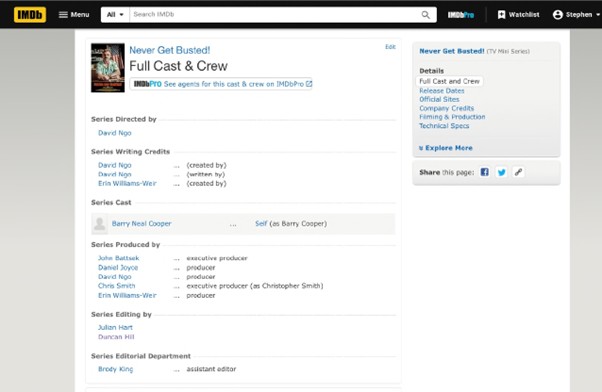
864 The fact that a film has a particular director, actor, editor, or producer, is likely to be of significance to consumers and influence their decision to watch or not watch the relevant film. It may not be the only means of promoting a film and may be of lesser reach than advertising in mainstream or social media channels, but it is nevertheless a platform for promotion.
865 In view of the evidence, I have no doubt that Projector Films used IMDb to promote the Documentary, which is quintessentially an activity that is of a commercial and trading character.
866 I am satisfied that the IMDb Representations were made in trade or commerce.
14.1.2 Did Projector Films cause or authorise the Second IMDb Representation to be made?
867 The objective factual context to the Second IMDb Representation is that the respondents admit that in or about late 2023 to early 2024, they caused or authorised the directing credits for the Documentary to be displayed on the IMDb website to be changed from “directed by Stephen McCallum" to "directed by Stephen McCallum and David Ngo": FASOC [9(a)] and Defence [9]. Then, from sometime in November 2024 to on or about 5 December 2024, the credits displayed on the website were changed to remove a reference to Mr McCallum altogether and the only credit for director was “directed by David Ngo”.
868 Mr McCallum came to notice this change because on 20 November 2024, he had been informed that the Documentary had been accepted into the Sundance Film Festival and on 27 November 2024, he had been informed that the Sundance Film Festival would only accept confirmations of attendance at the festival from Ms Williams-Weir. He then sent an email to Mr Ngo, Ms Williams-Weir and Mr Joyce, stating that he expected to be invited to the premiere at that Festival. He then looked at the IMDb website and noticed the removal of his name, and that Mr Ngo was the only person credited as a director. Mr McCallum submits that no one else had any interest in removing his name from the credits, other than the respondents and Ms Williams-Weir.
869 Mr Ngo denied being involved in the conduct. He produced his IMDb records and history of entries. Mr McCallum submitted that there were irregularities in these documents in that there was a large gap between 2020 and 2025, being the period during which Mr Ngo worked on the Documentary. Further, it was submitted that one of the relevant documents was “cropped”, meaning that it had been manipulated to remove a “delete” button that should have appeared on the printed page and which would have disclosed any entries that he had entered and later deleted. I reject the contention that Mr Ngo manipulated the document. He was an unsatisfactory witness, but I do not accept that he fabricated a document. It is a serious allegation, which I do not accept.
870 Ms Williams-Weir also denied being involved in the conduct. She produced her IMDb records as well but said that she “didn’t use the IMDb page much” and only admitted to making a change to it in May 2025: T256.9-37. She said that she had no idea as to who could have been editing the IMDb page for the Documentary.
871 Mr Joyce also denied being involved in the conduct. He also produced his IMDb records.
872 There are several aspects of the evidence called by the respondents that are unsatisfactory. Whilst each of Mr Ngo, Ms Williams-Weir and Mr Joyce produced records of the submissions and entries they had respectively made to the IMDb site, there were no records produced for Projector Films. None of the records produced by the respondents pointed to who had made the entries that were admitted. As a result, the documentary record appears to be incomplete or at least there is an unexplained lacuna.
873 The evidentiary lacuna is troubling in circumstances where the objective and contemporaneous documentary records establish that when Mr Ngo asked Mr Joyce to update the IMDb credits, Mr Joyce’s response included the statement, “Yes can update IMDB…”. Despite this statement, Mr Joyce said that he had nothing to do with the IMDb credits and was not responsible for that: T302.35-47. When pressed about who was responsible for updating the IMDb credits, Mr Joyce stated he was not responsible and surmised that it may have been Mr Cooper: T303.1-6. He then said that Projector Films did not have its own account for IMDb and did know who was updating its entries in relation to the Documentary, as Mr Ngo, Ms Williams-Weir and Mr Joyce only had their own individual accounts: T303.27-28.
874 When confronted with the admissions made by the respondents in relation to other entries made on IMDb, Mr Ngo was not aware of the basis for the admission: T217.35-47. He said that he had nothing to do with the IMDb credits or admissions and suggested it may have come from Mr Joyce: T217.38-40. Mr Ngo suggested that there were other people making submissions to IMDb including financiers such as Ms Louise Schultz, but stopped short of saying that the updates were made by her or her “team of interns” who were “doing stuff online”: T219.13-14.
875 I was not invited by Mr McCallum to draw an inference in accordance with the maxim enunciated in Blatch v Archer (1774) 1 Cowp 63; 98 ER 969. Clearly it was within Projector Films’ power to have produced or adduced evidence as to who was making entries on IMDb on its behalf. However, as the parties did not address me on the drawing of such an inference, it is not appropriate I do so.
876 The applicants submitted that the irresistible conclusion is that Projector Films made the impugned IMDb changes that constituted the second IMDB Representation. It was submitted that it was most likely undertaken by Mr Ngo, having regard to the above matters. Although I have regarded him as unsatisfactory witness, I do not consider that it was Mr Ngo who made the changes. The other contemporaneous evidence is that Mr Ngo had asked Mr Joyce to make changes to IMDb in relation to the Documentary, which is consistent with him only attending to his own credits and not those for the Documentary.
877 Although Mr Joyce was in a position to make changes to the IMDb website entries for the Documentary, I regarded him as an honest witness and do not believe he was untruthful in his denial that he had not removed Mr McCallum’s name as a director from the IMDb website. I also accept that Ms Willams-Weir was not being untruthful in this respect.
878 The civil standard of proof is not one of mathematical scales. The resolution of a controversy depends on reaching a state of satisfaction: see Hodgson DH, “The Scales of Justice: Probability and Proof in Legal Fact-finding” (1995) 69 ALJ 731. When the law requires proof of any fact, the tribunal of fact must feel actual persuasion as to its occurrence or existence before it can be found and the party bearing the onus will not succeed unless the whole of the evidence establishes a reasonable satisfaction on the preponderance of probabilities such as to sustain the relevant issue: Transport Workers’ Union of Australia v Qantas Airways Ltd [2021] FCA 873; (2021) 308 IR 244 at [284]-[288] (Lee J) citing Axon v Axon [1937] HCA 80; (1937) 59 CLR 395 at 403 (Dixon J).
879 In the present case, I am not satisfied that Projector Films made the Second IMDb Representation or caused it to be made.
14.1.3 Was the conduct misleading and deceptive in contravention of s 18 of the ACL?
880 The next question that arises is whether Projector Films’ conduct in making the First and Third IMDb Representations was misleading and deceptive. This issue can be dealt with in brief terms. As noted above, the respondents admitted in their Defence that the First and Third IMDb Representations represented that Mr Ngo is a principal director of the Documentary and did not identify Mr McCallum as the sole principal director of the Documentary: Defence [33(a)].
881 In the result, I have concluded that Mr McCallum was the sole principal director. It follows that the First and Third IMDb Representations misleadingly conveyed that Mr Ngo was the principal director or a principal director.
882 The respondents submitted that the First and Third IMDb Representations conveyed no more than that it was Projector Film’s and Mr Ngo’s opinion that Mr Ngo was a director of NGB: relying upon Global Sportsman Pty Ltd v Mirror Newspapers Ltd [1984] FCA 167; 2 FCR 82 at 88 (Bowen CJ, Lockhart and Fitzgerald JJ). It was submitted that any reader of the representations would understand that they were statements of opinion rather than fact.
883 I do not agree. The representations on the IMDb are not couched in the terms of an expression of an opinion and I do not accept that they would be so regarded by readers. Rather, they convey a fact as to who is the director, producer, writer, etc, of a film.
884 I am satisfied that Projector Films contravened s 18 of the ACL by making the First and Third IMDb Representations.
14.2 The Sizzle Reel Representation
885 Mr McCallum’s case in relation to the Sizzle Reel Representation is that Projector Films caused or authorised the credits displayed on a sizzle reel for the Documentary hosted on the internet platform Vimeo to be changed from "directed by Stephen McCallum" to "directed by David Ngo and Stephen McCallum": FASOC [9(b)].
886 The respondents said that the sizzle reel was accessible only via a password protected link to Vimeo, and was never shown to, or made available for viewing by, any third party: Defence [9(b)] and [33(d)].
887 Mr McCallum did not address these matters in his submissions and did not direct me to any evidence in support of this claim. In those circumstances, I cannot be satisfied that this claim has been established.
14.3 The Sundance Representations
888 Mr McCallum’s case in relation to the Sundance Representations involves two distinct allegations:
(a) first, Projector Films caused the entry for the Documentary on the website for the Sundance Film Festival:
(i) not to include any directing credits under the list of credits;
(ii) to state under the heading “Meet the Artist / David Anthony Ngo” that “Never Get Busted! is his directorial debut”; and
(iii) to include under the heading “Director(s)” the name “David Ngo”,
(the Sundance Website Representations): FASOC [13]; and
(b) second, Projector Films caused the Sundance Version to contain the following credits:
(i) in the opening credits, Mr McCallum is credited with “Director” on a sole card and Mr Ngo is credited with “Written and Directed By” on the final card before the Documentary begins; and
(ii) in the end credit roll, Mr Ngo is credited first with "Written and Directed by", and Mr McCallum is credited as "Director" below Mr Ngo’s credit,
(the Sundance Version Director Representations): FASOC [13A].
889 In relation to each of these allegations, the respondents:
(a) admitted that Projector Films requested there be an entry for the Documentary on the website for the Sundance Film Festival which did not include any directing credit under the list of credits, further admitted that it was requested that there be an entry under the heading “Meet the Artist / David Anthony Ngo” that “Never Get Busted! is his directorial debut”, further admitted that in doing these acts, they represented that Mr Ngo is a principal director of the Documentary and did not identify Mr McCallum as the sole principal director of the Documentary, but otherwise denied the allegations: Defence [13] and [33]-[36]; and
(b) admitted the Sundance Version Director Representations, further admitted that in making those Representations they represented that Mr Ngo is a principal director of the Documentary and did not identify Mr McCallum as the sole principal director of the Documentary, further admit that this conduct was engaged in trade or commerce, but otherwise denied the allegations: Defence [13A] and [33]-[36].
890 The respondents took no issue with the extraterritoriality of the representations. As the matter was not put in issue, I have not dealt with it and proceeded on the basis that the respondents accepted that the relevant conducted occurred in Australia (though aspects of it also occurred in the United States).
891 It is convenient to deal each of the Sundance Representations in turn.
14.3.1 The Sundance Website Representations
892 It was common ground that in advance of the screening of the Documentary at the Sundance Film Festival, the Festival’s website contained the following information on a single webpage:
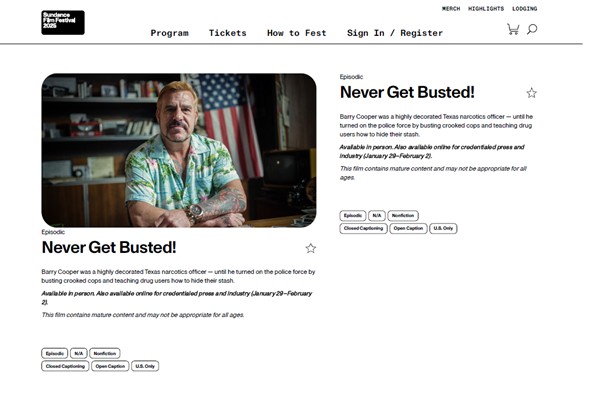
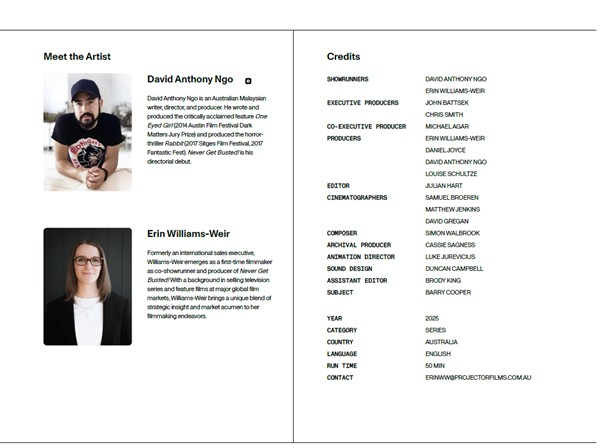
893 It will be apparent from the above that there were no credits listed for a director or directors. However, under the heading “Meet the Artist”, it was identified that the Documentary was Mr Ngo’s “directorial debut”. Although not admitted in the Defence, the respondents seem to agree with Mr McCallum’s assertion that there is no dispute that the above conduct was conduct in trade or commerce: ACS [264]; RCS [181]. I accept that it was. The respondents admitted that they caused these representations to be made but denied that they were misleading or deceptive: Defence [13] and [33]-[36].
894 The respondents submitted the wording that Mr Ngo was making his “directorial debut” was true. As I have found that Mr Ngo was a director of the Documentary, I accept that this statement is literally true.
895 However, there was no mention of Mr McCallum at all, as a principal director or as a director. That was intentional. Mr Ngo, Ms Williams-Weir and Mr Joyce had decided that in light of the dispute about credits, they would ask the organisers of the Sundance Film Festival to remove the directing credits on its website all together. That step may have been well-intentioned. However, the fact is that Projector Films nevertheless asked the Sundance Film Festival organisers to include information promoting Mr Ngo as making his directorial debut. The result was that Projector Films caused information to be published that would only identify Mr Ngo as a director of the Documentary and say nothing about Mr McCallum.
896 By removing all listing credits for the director of the Documentary but then seeking to have Mr Ngo referred to as making his “directorial debut” the position that was conveyed was that he was the sole and/or principal director of the Documentary.
897 I am satisfied that Projector Films engaged in conduct that caused the making of the Sundance Website Representation and thereby contravened s 18 of the ACL.
14.3.2 The Sundance Version Director Representations
898 As noted above, the respondents admitted that they made the Sundance Version Director Representations and, in doing so, represented that Mr Ngo was a principal director of the Documentary and that Mr McCallum was not identified as the sole principal director (the Sundance Version Credits): Defence [13A] and [33]-[36]. The respondents also admitted that this conduct was in trade or commerce.
899 Despite making these admissions, the respondents submitted that merely “preparing” a version which included certain credits “is not making a representation to anybody (or in any other way engaging in conduct that could mislead or deceive anyone)”. I reject this contention.
900 The FASOC at [13A] pleaded that Projector Films caused the Sundance Version to contain the credits that appear in that version and the respondents admitted that allegation in the Defence at [13A]. The FASOC at [33] then pleaded that by engaging in that conduct (amongst others), Projector Films had represented that Mr Ngo was the principal director and failed to identify Mr McCallum as such, which allegation was substantially admitted in the Defence at [33(a)]. The FASOC at [34]-[35] asserted that by engaging in this conduct, Projector Films had engaged in misleading and deceptive conduct.
901 It is plain that Mr McCallum was propounding a case that the misleading and deceptive conduct was not merely the affixing of the credits to the Sundance Version, but the making of the representations that would be conveyed by those credits in the screening of that Version. It is undoubtedly why the respondents admitted that the conduct was in trade or commerce: FASOC [33(b)]. The respondents did not explain why they had much an admission if they had perceived the case against them as being limited to the preparation of a version of the Documentary which was not screened to members of the public. The argument was a form of pedantic point taking, which did not accord with the way the respondents themselves had accepted the case was being put.
902 I am satisfied that by preparing the Sundance Version containing the Sundance Version Credits, which was to be screened at the Festival, Projector Films made the representation that Mr Ngo was a principal director of the Documentary and that Mr McCallum was not. In light of the findings I have made, this conduct was misleading and deceptive and, accordingly, Projector Films contravened s 18 of the ACL.
14.4 The MIFF Representations
903 Mr McCallum’s case in relation to the MIFF Representations involve three distinct allegations:
(a) first, on or about July 2025, Projector Films caused the credits for the Documentary in the MIFF promotional materials to state “Directed By” David Ngo with no reference to Mr McCallum (the First MIFF Representation): FASOC [33, particular (ii)(A)];
(b) second, on 10 and 11 July 2025, Projector Films sought to cause the credits for the Documentary in the MIFF promotional materials to state “Directed By” David Ngo and "Director" Stephen McCallum (the Second MIFF Representation): FASOC [33, particular (ii)(B)]; and
(c) third, on or about July 2025, Projector Films caused promotional material for the Documentary at MIFF to refer to Mr Ngo having "helmed" the production of the Documentary: (the Third MIFF Representation): FASOC [33, particular (ii)(C)].
904 The respondents denied these allegations. However, the respondents did not appear to take any issue as to whether these representations were made in trade or commerce: ACS [264]; RCS [181]. The representations were clearly contained in promotional materials and in the version of the Documentary that was to be filmed to the public. I am satisfied that the relevant conduct was in trade or commerce.
14.4.1 The First MIFF Representation
905 It was common ground that Ms Williams-Weir was responsible on behalf of Projector Films for submitting information to the MIFF in respect of the Documentary. Ms Williams-Weir submitted information to the MIFF using the “FilmFreeway” website, which is a site that allows filmmakers to upload information about a film and then apply to film festivals using that saved information.
906 Ms Williams-Weir says that she submitted information relating to NGB to FilmFreeway, which information included both Mr Ngo and Mr McCallum as directors but did not include Mr McCallum’s name and contact details. Ms Williams-Weir later took a screenshot of the information she had submitted and said that this information reflected what she had earlier submitted. That information has Mr Ngo and Mr McCallum both listed as directors.
907 However, the first information released by MIFF on its website contained the following information:
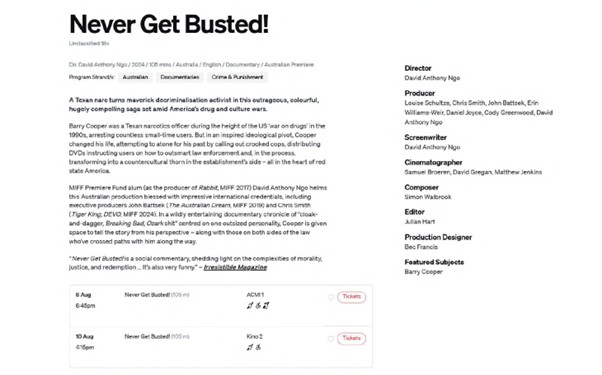
908 As will be apparent, it was only Mr Ngo that was listed as the director. Mr McCallum was not mentioned.
909 After Mr McCallum’s solicitor raised a complaint about the abovementioned information, on 10 July 2025, at 3:47 pm, Ms Williams-Weir sent an email to MIFF as follows:
Hi MIFF team,
Just wanted to check in when plan to release the program for MIFF? As we’ve had some adjustments since submission wanted to make sure in its announcement that the project will be following the current FilmFreeway information in terms of credits, specifications and distribution. Here’s the official lead credits below for reference.
a documentary by DAVID ANTHONY NGO and ERIN WILLIAMS-WEIR
written and directed by DAVID ANTHONY NGO
director STEPHEN MCCALLUM
produced by ERIN WILLIAMS-WEIR, DANIEL JOYCE and DAVID ANTHONY NGO
executive produced by JOHN BATTSEK and CHRIS SMITH
Best.
Erin Williams-Weir
910 Ms Williams-Weir denied that she had caused the earlier information to be published on the website and maintained that she had referred to Mr McCallum as a director: T263.11-36. Mr McCallum submitted that her evidence in this respect should be rejected as it is improbable that the MIFF would have prepared and published credits other than what they were told by Projector Films.
911 The respondents submitted that there was no good reason to reject Ms Williams-Weir’s evidence.
912 It is inconceivable that the MIFF published information as to Mr Ngo being the sole director of the Documentary without receiving information to that effect. I am satisfied that this information had to be communicated by Projector Films or on its behalf by Ms Williams-Weir. The only basis on which she seemed confident that her original submission to MIFF had included a reference to Mr McCallum was based on a record she retrieved much later. However, the document she later retrieved did not indicate when that information was uploaded.
913 Further, in her subsequent email dated 10 July 2025, Ms Williams-Weir told the organisers of the MIFF that “[a]s we’ve had some adjustments since submission [we] wanted to make sure in its announcement that the project will be following the current FilmFreeway information in terms of credits”. That contemporaneous record makes it plain that Ms Williams-Weir was seeking to change the information that had earlier been provided, which now included reference to Mr McCallum as a “director”.
914 As earlier stated, a finding of fact is to be made not based on mathematical scales but an actual persuasion as to the existence of the fact in question including by reference to the preponderance of probabilities. Based on the totality of the evidence, I am satisfied that in or about early July 2025, Projector Films caused the MIFF to publish on its website that Mr Ngo was the sole director of the Documentary. For the reasons I have already addressed, that representation was misleading and deceptive and, accordingly, Projector Films contravened s 18 of the ACL.
14.4.2 The Second MIFF Representation
915 The effect of the Second MIFF Representation is that Projector Films sought to cause the credits for the Documentary in the MIFF promotional materials to state "Directed By" David Ngo and "Director" Stephen McCallum.
916 In the result, this version of the Documentary was not screened by reason of the orders made by the Court on 6 August 2025. The respondents again submitted that the mere preparation of a version of a film which affixed credits did not amount to misleading and deceptive conduct. I reject that argument for the same reasons I have stated above. What was sought to be done was to convey a misleading impression as to who was the principal director of the Documentary in the screening at the MIFF. However, as this version of the Documentary was not ultimately screened, the alleged representation was not in fact conveyed. In those circumstances, I am not satisfied Projector Films in fact engaged in any misleading and deceptive conduct, as opposed to threatening to do so. I am satisfied that there was a threatened contravention of s 18 of the ACL. However, the applicants did not address me on what should flow from the threat alone and that is a matter that can be addressed in the further hearing as to remedies.
14.4.3 The Third MIFF Representation
917 By the Third MIFF Representation, it was alleged that Projector Films caused promotional material to be published by the MIFF that referred to Mr Ngo having "helmed" the production of the Documentary. The parties did not address this allegation in any detail in their submissions. In any event, I am not satisfied that the word “helmed” conveyed that Mr Ngo was the principal director of the Documentary and that Mr McCallum was not. The word is equally consistent with the true position that Mr Ngo was the creator, producer, writer and likely showrunner of the Documentary. In those circumstances, I am not satisfied that Mr McCallum’s case in relation the Third MIFF Representation has been established.
14.4.4 The Screen Australia Representation
918 Mr McCallum’s case in relation to the Screen Australia Representations is that Projector Films caused Mr Ngo to be identified as the director of the Documentary in agreements with Screen Australia dated 17 October 2023 and 23 January 2025.
919 The respondents denied these allegations and submitted that the contracts with Screen Australia were not made in trade or commerce as they were made in the course of dealing with a government body.
920 The facts are as follows.
921 On 17 October 2023, Projector Films entered into a Production Grant Agreement with Screen Australia (executed by Mr Ngo and Mr Joyce) in which Mr McCallum was described as the “Director”, while Mr Ngo was described as the “Creator/ Writer/ Director/ Physical Producer”. The relevant part of the document contains the following information:
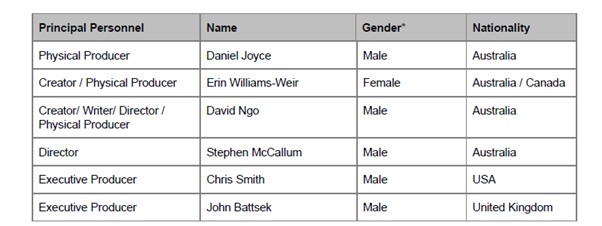
922 However, the Agreement also contained a budget, which only included a director’s fee for Mr McCallum and identified Mr Ngo as receiving a fee as a producer.
923 Putting to one side whether the conduct arose in trade or commerce, I am not satisfied that it was conveyed that Mr Ngo was the principal director or that Mr McCallum was not. In fact, a fair reading of the whole document suggests that Mr McCallum was identified as the principal director given that only he was recorded in the budget as the person to receive a director’s fee.
924 Then, on 23 January 2025, Projector Films appear to have sought and obtained an “Activity Grant” of $20,000 for the purpose of funding the trip to attend the Sundance Film Festival. The “Activity” was identified as:
The Key People will attend the 2025 Sundance Film Festival to screen and market the Project.
925 The Key People were identified as follows:
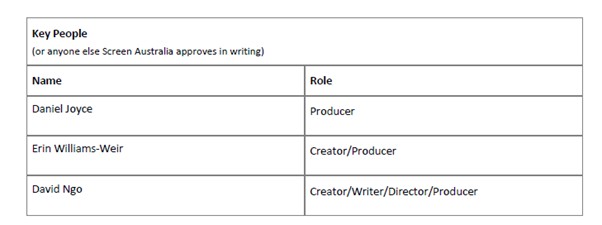
926 It was submitted on behalf of Mr McCallum that he was not mentioned as one of the “Key People” and this was misleading. However, I do not accept that this is what was being conveyed. Rather, Projector Films was seeking a grant of $20,000 to enable the persons identified as the “Key People” to attend the Sundance Film Festival. That application had to be viewed in the context of the earlier documentation that had identified Mr McCallum as a director, and, indeed, the only person to receive a director’s fee. To the extent that Mr Ngo was identified as a director, he was not identified as the principal director or the sole director. In those circumstances, I am not satisfied that any misleading or deceptive representation was conveyed.
927 It follows that I reject Mr McCallum’s case in relation to the Screen Australia Representations. In light of the conclusion I have reached, it is unnecessary to determine whether the alleged conduct arose in trade or commerce.
14.5 The case against Mr Ngo
928 Mr McCallum claimed that Mr Ngo was involved in Projector Film’s contraventions within the meaning of 236 of the ACL. The particulars to the claim merely stated that Mr Ngo was a director of Projector Films and then repeated the same allegations of fact and law as made against that entity. The claim as framed in this way was entirely conclusory.
929 Neither Mr McCallum’s written or oral submissions addressed how accessorial liability could be established against Mr Ngo in accordance with the principles enunciated in Yorke v Lucas [1985] HCA 65; 158 CLR 661 at 670 (Mason CJ, Wilson, Deane and Dawson JJ) and Productivity Partners Pty Ltd v Australian Competition and Consumer Commission; Wills v Australian Competition and Consumer Commission [2024] HCA 27; 281 CLR 338 at [82] (Gageler CJ and Jagot J), at [270] (Edelman J), and at [339] (Beech-Jones J).
930 The applicants made no effort to address how Mr Ngo had knowledge of essential elements of the contraventions. The position is unsatisfactory. In circumstances where the case was not addressed, I do not intend to do so. I reject the claim.
PART E: PROJECTOR FILMS’ CROSS-CLAIMS
15. THE CONTRACTUAL NON-PERFORMANCE CLAIMS
931 As set out above, the first aspect of Projector Films’ Cross-Claim related to asserted breaches by Mr McCallum of cll 2.1(a) and (b) of the Director’s Agreement, which overlapped with its defence to Mr McCallum’s claimed breach of cl 9.1 of the Director’s Agreement. For the reasons addressed above, I reject Projector Film’s claims and accordingly, this aspect of its Cross-Claim should be dismissed.
16. THE NON-DISPARAGEMENT CLAIMS
932 Projector Films brought two claims against Mr McCallum in respect of alleged breaches of cl 7.1(c)(iv) of the Director’s Agreement, which it described as a “non-disparagement clause”. Clause 7.1(c)(iv) provides that:
7.1 [Mr McCallum]:
…
(c) Further warrants to [Projector Films] that he shall:
…
(iv) not act in any way as to bring the Documentary or the Producer adverse publicity or notoriety at any time during the currency of this document
933 Although the clause itself does not refer to “non-disparagement”, Projector Films claimed that Mr McCallum had engaged in disparaging conduct towards the Documentary, Projector Films and Mr Ngo (as a company director of Projector Films) in two respects, which it claims had the effect of bringing “adverse publicity or notoriety” to Projector Films and the Documentary.
934 The first respect in which it is claimed that Mr McCallum disparaged the Documentary, Projector Films and Mr Ngo was by making, what it described as, the “IMDb Representation”. It is claimed that in or about November 2024 and January 2025, Mr McCallum sent correspondence, or caused correspondence to be sent, to various third parties in which he stated that Projector Films and/or Mr Ngo had removed Mr McCallum’s directing credit for the Documentary from the IMDb database.
935 The second respect in which it is claimed that Mr McCallum disparaged the Documentary, Projector Films and Mr Ngo was by making, what it describes as, the “Attribution Representation”. It is claimed that in or about March 2024 to in or about June 2024 and then in or about November 2024 to in or about January 2025, Mr McCallum sent correspondence, or caused correspondence to be sent, to various third parties, in which he stated that Projector Films and Mr Ngo had, without justification, refused to attribute him as the sole director of the Documentary (or at all), and instead had falsely attributed Mr Ngo as a director of the Documentary.
936 As will become apparent, Mr McCallum was not himself the author of the communications that were sent to third parties. They were sent by either Ms Harper (Executive Director of the ADG) or Ms Islam (Mr McCallum’s agent). There was a dispute between the parties as to whether the communications sent by Ms Harper were sent as Mr McCallum’s agent. It was accepted that the communications sent by Ms Islam were sent as Mr McCallum’s agent.
937 Before turning to address Projector Films’ case, it is necessary to set out the relevant evidence.
16.1 The evidence of the representations
938 On 27 November 2024, Ms Harper sent an email to Ms Deirdre Brennan (Ms Brennan) and Ms Grainne Brunsdon (Ms Brunsdon) at Screen Australia, and stated as follows:
Dear Deirdre and Grainne,
(cc Needeya Islam, Stephen McCallum’s agent)
I wanted to make you aware of a of a serious and ongoing credit dispute between director Stephen McCallum and David Ngo (Projector Films), on the Screen Australia-funded documentary series Never Get Busted.
There is an issue of false attribution we’ve been working on for close to a year. The producer has (falsely in our view, and in conflict with the contract) claimed a directing credit, refusing to acknowledge Stephen as sole director. Greg Duffy of Frankel Lawyers is engaged for Stephen.
Following the project’s selection for Sundance we are escalating the matter, given Projector Films' removal of Stephen's director credit from IMDB entirely this week.
I will be writing to SPA and the DGA today, as well as SAFC who also funded the production.
I am available should you wish to discuss.
939 Later that same day, Ms Harper then sent a similar email to Ms Kate Croser (Ms Croser) at the SAFC. Ms Leanne Saunders (Ms Saunders) from the SAFC responded on 5 December 2024, stating:
Thank you for making us aware of the situation, which we had no prior knowledge of.
We have been in touch with Screen Australia as well as the producer Daniel Joyce of Projector Film. We have let the producers know that you have been in touch with us, and that we await an update from them on resolving this dispute.
940 It was alleged that Ms Haper also sent an email to Mr Matthew Deaner and Mr Andy Barclay at Screen Producers Australia on similar terms to that which she had sent to Screen Australia and the SAFC. The fact that she had sent such an email was in a subsequent email she sent to Mr McCallum and his lawyer, copied to Ms Islam.
941 On 27 November 2024, Ms Islam sent an email to Ms Harding at Mind the Gap Film Finance, a financier of the Documentary, which stated:
I wanted to let you know that Projector Films have now removed Steve McCallum's name as director for NEVER GET BUSTED on IMDb pro.
The credit dispute has been a legal dispute for some months now and the producers have been refusing to acknowledge Stephen as sole director.
We are now escalating this, given Projector Films removal of Stephen's director credit entirely since the film has been selected for Sundance. The issue is one of false attribution so it's quite serious.
ADG is aware and very concerned about a producer falsely attributing themselves as the director of a project after the fact. Sophie Harper the Executive Director will be speaking with both Screen Australia and the DGA about this.
If there is anything Mind the Gap can do to help us sort out this very unfortunate situation, it would be greatly appreciated.
942 On 20 December 2024, Ms Islam sent an email to Ms Brennan and Ms Brunsdon at Screen Australia:
Dear Deirdre and Grainne,
I refer to the press release from Screen Australia below today regarding titles selected for Sundance.
https://www.screenaustralia.gov.au/sa/screen-news/2024/12-19-australian-titlessundance-2025
Please be aware that my client Stephen McCallum has filed a Statement of Claim in the Federal Court of Australia against Projector Films and David Ngo for:
- Failure to attribute (credit) Stephen McCallum as the Director in relation to the Documentary Never Get Busted including the version going to Sundance;
- Falsely attributing David Ngo as the sole Director of the Documentary; and
- Breaching the Director’s Agreement by failing to give Stephen McCallum a ‘Directed By’ credit on the film and all publicity.
Stephen has directed every aspect of the Film and wishes to be credited fairly as per his statutory, moral and contractual rights as Director, as currently he is being deliberately omitted.
Could you please amend the press release and any other publicity so it accurately reflects Stephen’s statutory, moral and contractual rights as Director?
943 Ms Brennan responded indicating that Screen Australia was aware of the matter and would consider its position when its office re-opened following the holiday break.
944 On 8 January 2025, Ms Islam sent an email to Ms Croser and Ms Saunders at the SAFC which was largely similar to the email she had sent to Screen Australia on 20 December 2024. Ms Saunders responded by thanking Ms Islam for the email and copied the Head of Marketing and Communications.
16.2 Ms Harper’s communications
945 The first issue that requires determination is whether in relation to the communications Ms Harper sent, she was acting as Mr McCallum’s agent.
946 An agency ordinarily means “an authority or capacity in one person to create legal relations between a person occupying the position of principal and third parties”: International Harvester Co of Australia Pty Ltd v Carrigan’s Hazeldene Pastoral Co [1958] HCA 16; 100 CLR 644 at 652 (Dixon CJ, McTiernan, Williams, Fullagar and Taylor JJ). In Scott v Davis [2000] HCA 52; 204 CLR 333, Gummow J (with whom Gleeson CJ relevantly agreed on this point) stated at [227] that there was “considerable terminological confusion” as to “agency” and repeated that “‘agency’ is best used … ‘to connote an authority or capacity in one person to create legal relations between a person occupying the position of principal and third parties’”. In NMFM Property Pty Ltd v Citibank Ltd (No 10) [2000] FCA 1558; 107 FCR 270, Lindgren J stated at [512]-[513]:
Terminological difficulties beset discussions of agency. Lord Herschell said, "No word is more commonly and constantly abused than the word 'agent'": Kennedy v De Trafford [1897] AC 180 at 188. Strictly speaking, apparent authority is no authority at all, but only an appearance of authority. Accordingly, a statement that "agency" necessarily involves "authority" immediately prompts the question whether the speaker means to refer to apparent authority as well as to actual authority. One could say that apparent authority, in the absence of any actual authority at all, gives rise only to an "apparent agency", reserving the notion of a "true" or "actual" agency for cases where at least some actual authority is present. On the other hand, one could use the word "agency" to refer to a legal construct that is brought into play whenever actual authority or apparent authority or both exist "in the real world". According to this approach, one could say that agency exists where A has "power" to affect P's legal relations with TP, as A will, so long as actual authority or apparent authority is present.
There is a distinction between commercial and legal usages of the term "agent". A manufacturer's distributor may be referred to commercially as the manufacturer's "agent", but if all the distributor does is to sell in its own right goods that it has bought from the manufacturer, in law it will not be an agent of the manufacturer and will not bring the manufacturer into legal relations with the end-purchaser: International Harvester Co of Australia Pty Ltd v Carrigan's Hazeldene Pastoral Co (1958) 100 CLR 644 (see at [584] below).
(Original emphasis.)
947 The respondents’ contentions were beset with the terminological conundrum. The respondents’ contentions did not involve seeking to establish a “true” agency but sought to propound a form commercial usage of the term to establish that Ms Harper was either acting on Mr McCallum’s behalf on the basis of an express or implied agency when she sent the relevant communications.
948 It was common ground that the ADG is a union and that Mr McCallum is one of its members. There have been historically a series of limitations identified with the application of the principles of agency when addressing whether a union has the authority to enter into or affect the legal rights and obligations of its members, especially in the context of collective bargaining: eg see Ryan v Textile, Clothing & Footwear Union of Australia [1996] 2 VR 235; 66 IR 258 (Brooking, Tadgell and Hayne JJA).
949 However, putting to one side all the many legal issues that create significant obstacles to the respondents’ case, the facts do not bear out that Mr McCallum either expressly or impliedly authorised Ms Harper to make the representations that she did in November 2024.
950 Much earlier in the year, Mr McCallum had sought out the ADG’s assistance in the credits dispute that had emerged. On 5 March 2024, Mr McCallum emailed Ms Harper asking for an update regarding whether the ADG’s legal advisors had looked into his case. There is nothing in that email chain suggesting that Mr McCallum was giving the ADG any general authority to communicate on his behalf with third parties. Then, on 2 May 2024, Mr McCallum followed up Ms Harper again asking for an update as he had not heard from her for “nearly two months”. He asked for some “reassurance and clarity about the ADG’s promise and dedication to help defend [his] rightfully earned directors credit going forward”. Ms Harper promptly responded, apologising for the delay and stating that a specialist advisor was reviewing Mr McCallum’s case. She then stated that, “Please be assured that your case is a priority for us. I am committed to ensuring directors are not left to fight alone and that their rights are staunchly defended”. She responded a few days later stating that the advice she had received was for a “cease and desist letter” to be sent from the ADG in the first instance.
951 On 5 June 2024, Ms Harper sent an email to Mr McCallum and Ms Islam in which she said, “I think we all agree that it would be preferable to lean on the producer to behave in a way that is respectful to directors…”. That was a position she conveyed at this time.
952 The impugned letters to Screen Australia, the SAFC and Screen Producers Australia were sent months later at the end of November 2024. There is no evidence of any communication from Mr McCallum to Ms Harper in November 2024 which authorised these communications or that he had given Ms Harper a general authority (either express or implied) to communicate on his behalf, let alone that that Mr McCallum approved their content. There is evidence that Ms Harper informed Mr McCallum that those communications had been sent after the fact, but not that he had authorised them before the fact.
953 On one view of the evidence, Ms Harper’s communications to Screen Australia, the SAFC and Screen Producers Australia were advocating the rights of a director, Mr McCallum. The respondents have not established that such advocacy was done as an agent of Mr McCallum, even if it was supportive of his interests.
954 I reject the contention that there was an actual or implied agency that arose by which Ms Harper had a general standing authority (including ostensible authority) to send communications on Mr McCallum’s behalf. The communications in May 2024 were seeking the ADG’s support and legal assistance. Those communications resulted in the ADG agreeing to send a cease and desist letter to Projector Films. The subsequent communication in June 2024 was one in which Ms Harper expressed concurrence that it would be preferable to lean on the producer but stopped well short of establishing that there was thereby a general implied authority to send communications on Mr McCallum’s behalf to other third parties. The respondents have failed to discharge their onus of establishing an agency in respect of these later communications.
16.3 Ms Islam’s communications
955 It is next necessary to consider the communications sent by Ms Islam. It was accepted that these communications were sent by Ms Islam as an agent of Mr McCallum.
956 The first of those communications was dated 27 November 2024 from Ms Islam to Ms Harding at Mind the Gap Film Finance. In that email, Ms Islam stated that Projector Films had “removed Steve McCallum's name” from the IMDb website as being associated with the Documentary. The email further informed Ms Harding that the dispute had been ongoing for some months and that the producers had been refusing to acknowledge Mr McCallum as “sole director”. She asserted that the issue was one of “false attribution” and was serious, and stated that “[i]f there is anything Mind the Gap can do to help us sort out this very unfortunate situation, it would be greatly appreciated”.
957 I am satisfied that by this email, Mr McCallum caused it to be communicated to a third party that Projector Films had been responsible for removing his name altogether from the IMDb website and were refusing to give him attribution as sole director.
958 The question that arises is whether by doing so, Mr McCallum acted in a way to “bring” the Documentary and Projector films “adverse publicity or notoriety”. The respondents did not address what those words meant. It is important to bear in mind that despite the respondents’ characterisation of cl 7.1(c)(iv) of the Director’s Agreement as a “non-disparagement” clause, it does not in fact use those words. Despite this, the respondents assumed that so long as it could be shown that the relevant communications disparaged the Documentary, Projector Films or Mr Ngo, it led to a breach of cl 7.1(c)(iv). If that was correct, then Mr McCallum would be in breach of the clause if he disparaged Mr Ngo or Projector Films to his family. In the context of the present dispute, that would be a patent absurdity.
959 Clause 7.1(c)(iv) requires something other or more than disparagement. In a different context, McDougall J in Fermiscan v James [2009] NSWSC 546 considered the meaning of a clause contained in a deed of release by which one party agreed not to “disparage, or make statements that might tend to injure or damage, [the other party’s] reputation or standing, their businesses, or their diagnostic tests, or the reputation, standing, ability or capability of any of their directors, officers or employees”. His Honour observed at [105] that the dictionary meaning of “disparage” is to “to speak slightingly of; deprecate” or to “bring discredit on”. His Honour further held at [108] that, “as a matter of language, one would not ordinarily be said to disparage the business, reputation or products of another unless one used language intended or calculated to achieve that result”.
960 Turning to the words actually used in cl 7.1(c)(iv), what they seek to proscribe is Mr McCallum acting in any way so as to “bring” about a particular result. The result is “adverse publicity or notoriety”. Projector Films further submitted that it did not need to prove that adverse publicity or notoriety did in fact result from the representations, but that the Court could readily infer that the communications must have brought adverse publicity and notoriety to Projector Films. It was said that the communications did “hit home” given that some of the recipients responded and may have also repeated the allegations to many others. It was also submitted that it was not strictly necessary to establish that the representations were untrue, but that they were nevertheless untrue. I do not accept these submissions. The word “bring” as used in the clause indicates the necessity for a causal relationship between the act and the result (i.e adverse publicity or notoriety). Whilst I accept the proscription applies to Mr McCallum “acting” in a way that has that effect, there needs to be some evidence as to the connection between the act and the effect.
961 The word “adverse” generally means “antagonistic in purpose or effect”, “opposing one’s interest or desire” or “opposite; confronting” (Macquarie Dictionary Online). In context, I consider that the word adverse means “negative”; that is, negative publicity or negative notoriety. The Macquarie Dictionary Online defines the word “publicity” as follows:
1. the state of being public, or open to general observation or knowledge.
2. public notice as the result of advertising or other special measures.
3. the state of being brought to public notice by mention in the mass media, or by any other means serving to effect the purpose.
4. the measures, process, or business of securing public notice.
5. advertising matter, as leaflets, films, etc., intended to attract public notice.
962 Each of these different meanings emphasises a “public” element.
963 The word “notoriety” means:
1. the state or character of being notorious or widely known: a craze for notoriety.
2. a widely known or well-known person.
(Original emphasis.)
964 This suggests that the focus of the word is on the character or standing of a person.
965 However, as with the process of statutory construction, the process of construing a contract does not turn on dictionary meanings. The question is one of context and one which does not require each word to be parsed, but to be read as a whole.
966 The obligation imposed on Mr McCallum is found in an agreement between a producer and director for the making of a documentary that it is hoped will be screened to audiences locally and worldwide. That context is important. It is also important that the obligation applies “during the currency of this document”; in other words, it applies whilst the director is engaged as a director in the making of the Documentary. That context supports a conclusion that what the clause imposes is an obligation that prevents Mr McCallum from, during the currency of his appointment as a director, acting in a way that draws or creates negative publicity to the Documentary or Projector Films, or casting them negatively so as to diminish their standing.
967 It is necessary to consider the conduct by reference to its effect on the Documentary separately to its effect on Projector Films.
968 Turning to the Documentary, I am not satisfied that Ms Islam’s email had the effect of bringing negative publicity to or diminishing the standing of the Documentary. Nothing was said about the Documentary itself or its quality so as to have that effect. Further, I do not accept that the single communication to Ms Harding had the effect of bringing negative publicity to the Documentary, especially given that Mind the Gap Film Finance was a financier. I am not satisfied that the identification of a credit dispute to one of the financiers was an act that bought negative publicity to the Documentary.
969 The position is different in relation to the effect on Projector Films. Ms Islam’s communication to Ms Harding at Mind the Gap Film Finance stated that Projector Films had “removed” Mr McCallum’s name as a director for the Documentary from the IMDb website and it also stated that Projector Films was refusing to acknowledge Mr McCallum as the “sole director”, which had given rise to an issue of “false attribution”. These statements were not being made in the context of legal letters articulating a legal position but were sent by Mr McCallum’s agent to a financier of the Documentary. The content of the communications conveyed that Projector Films was a company that had engaged in conduct that did not recognise the creative contribution of Mr McCallum. Even if the allegations were true (noting that I am not satisfied that Projector Films had removed Mr McCallum’s name from the IMDb website), the making of those statements were acts that were bound to diminish the standing of Projector Films in the eyes of its financier. That is because the communication conveyed that Projector Films was an organisation that had taken a positive step to remove any reference to Mr McCallum from being recognised as a director on a public website. It was suggestive of the fact that Projector Films was being dishonourable. I am satisfied that by acting in this way (through his agent) Mr McCallum brought adverse notoriety to Projector Films in breach of cl 7.1(c)(iv) of the Director’s Agreement.
970 The next email sent by Ms Islam was on 20 December 2024, addressed to Ms Brennan and Ms Brunsdon at Screen Australia. In that email, Ms Islam drew attention to the fact that Screen Australia had published a press release on its website relating to the Documentary and that Mr McCallum had that day commenced proceedings in this Court. Ms Islam’s email requested that the press release be amended to reflect Mr McCallum’s statutory, moral and contractual rights as a director. The email asserted a legal position in the context of legal proceedings that had been commenced and sought a correction to a press release having regard to that position. The final email sent by Ms Islam on 8 January 2025 was addressed to Ms Croser and Ms Saunders at the SAFC was similarly worded. It requested that any press releases or other publicity issued by the SAFC reflect Mr McCallum’s statutory, moral and contractual rights as a director. Again, the email asserted a legal position. I reject the respondents’ contention that these emails drew adverse publicity to the Documentary or Projector Films, or diminished their standing. Rather, the communications were clearly sent in the context of extant legal proceedings to assert and maintain a legal position.
971 It follows that I have upheld one part of Projector Films’ Cross-Claim asserting a breach of cl 7.1(c)(iv) of the Director’s Agreement but rejected the rest.
17. THE CONSUMER GUARANTEE CLAIMS
972 Projector Films also brought claims under State-based consumer laws in respect of the IMDb and Attribution Representations. It claimed that Mr McCallum made or caused the representations to be made, in trade or commerce, and that his conduct was misleading or deceptive, or likely to mislead or deceive, because both representations were false: ASOCC [29]–[31] and [34]–[36]. Projector Films claimed that, as a result, Mr McCallum contravened s 18 of the ACL as applied by the Fair Trading Act 1987 (NSW) (ACL (NSW)), the Fair Trading Act 1987 (SA) (ACL (SA)), and/or the Australian Consumer Law and Fair Trading Act 2012 (Vic) (ACL (Vic)).
973 These claims relied on the same evidentiary basis as the non-disparagement claims, being the communications sent to third parties by Ms Harper and Ms Islam.
974 In so far as the claims relied on the communications sent by Ms Harper, I reject them. The respondents have not established that Mr McCallum engaged in that conduct. The respondents submitted that Mr McCallum had nevertheless been “involved” in making the representations. However, that is not what is pleaded in the ASOCC at [29] and [34], where it is claimed that Mr McCallum made the representations or caused them to be made. The Cross-Claim advanced no case of accessorial liability and I reject the contentions to the contrary.
975 In so far as the claims relied on the communications sent by Ms Islam, these fail as the respondents have failed to establish that they were made in trade or commerce. The emails were sent by Ms Islam, as Mr McCallum’s agent, to Screen Australia, the SAFC and Mind the Gap Finance. As noted above, the reach of s 18 of the ACL as applied by the ACL (NSW), ACL (SA) and ACL (Vic) is limited by the use of the preposition “in”: Concrete Constructions at 604.
976 Mr McCallum is not a corporation, but the question remains the same: were the communications made in the course of his trading or commercial activities?
977 The respondents relied on the decisions in Seafolly Pty Ltd v Madden [2012] FCA 1346; 297 ALR 337 at [81]-[83] (Tracey J) and Infa-secure Pty Ltd v Crocker (No 3) [2018] FCA 605 at [47], [58], [59] (Reeves J). However, neither of those cases is on point. As Reeves J pointed out in Infa-secure at [47], [58] and [59], both that case and Seafolly were instances of a corporation making communications with third parties seeking to injure the interests of a trade competitor.
978 The communications here may have related to Projector Film’s trading and commercial activities, but it was not explained how they related to Mr McCallum’s trading and commercial activities. Met with this contention, the respondents submitted “There is no reason that a misrepresentation needs to give rise to a trading or commercial relationship between a person involved in the conduct and the recipient of the misrepresentation”. The submission misses the point. It needs to be established that in engaging in the conduct, the representor is doing so in the course of his or her trading or commercial activities. The respondents may have been able to better articulate the point, but they did not do so. They have not satisfied me that the relevant conduct occurred in trade or commerce.
979 Accordingly, I reject this aspect of the Cross-Claim.
18. ENTITLEMENT TO BE INDEMNIFIED
980 In addition to the above claims, Projector Films alleged that it is entitled to be indemnified under the Director’s Agreement in respect of Mr McCallum’s breaches of that Agreement. However, I have only found one aspect of its claim to be upheld. Projector Films did not articulate what indemnity it would be entitled to in respect of the different claims it had advanced. As the claim has not been properly articulated at this stage, I will invite the parties to address it as part of their respective submissions on remedies.
19. DISPOSITION
981 In light of the findings I have made as to liability, I will invite the parties to confer and provide me with consent or competing short minutes of order as to what orders should be made at this stage of the proceedings, and to otherwise progress the matter to a hearing on the question of relief, remedies and other orders.
I certify that the preceding nine hundred and eighty-one (981) numbered paragraphs are a true copy of the Reasons for Judgment of the Honourable Justice Shariff. |
Associate:
Dated: 27 February 2026


