

Federal Court of Australia
Karageozis (Trustee), in the matter of the bankrupt estate of Lamb [2026] FCA 164
File number(s): | QUD 648 of 2024 |
Judgment of: | COLLIER J |
Date of judgment: | 26 February 2026 |
Catchwords: | BANKRUPTCY – earlier defamation proceedings between debtor and petitioning creditor in District Court of Queensland and Court of Appeal of Queensland – unsuccessful strike-out application by debtor in District Court and specific costs order made in respect of strike-out application – petitioning creditor successful against debtor in defamation proceedings in District Court – bankruptcy notice issued in respect of strike-out costs order – debtor failed to comply with bankruptcy notice – sequestration order made by Federal Court of Australia – debtor unsuccessfully appealed sequestration order to Full Court of Federal Court – debtor successfully appealed defamation judgment of District Court to Court of Appeal – whether bankruptcy notice based on interlocutory costs order of District Court constituted “final judgment or final order” – Uniform Civil Procedure Rules 1999 (Qld) r 740 – s 41(3)(a) Bankruptcy Act 1966 (Cth) – whether stay order of District Court contravened contrary to s 41(3)(b) Bankruptcy Act – whether bankruptcy should be annulled – s 153B Bankruptcy Act PRACTICE AND PROCEDURE – oral application to rely on and file lengthy affidavit handed up at hearing – application refused PRACTICE AND PROCEDURE – principles of issue estoppel, Anshun estoppel and res judicata PRACTICE AND PROCEDURE – principles of stay of judgment of Federal Court PRACTICE AND PROCEDURE – amendment of suppression orders made pursuant to ss 37AF and 37AG(1)(a) Federal Court of Australia Act 1976 (Cth) |
Legislation: | Bankruptcy Act 1966 (Cth) ss 40(1)(g), 41(3)(a), (b), 153B, (1) Federal Court of Australia Act 1976 (Cth) s 37M Federal Court Rules 2011 (Cth) O 62 r 45(3) Uniform Civil Procedure Rules 1999 (Qld) r 740 |
Cases cited: | Australian and New Zealand Banking Group Limited v Menso [2006] FMCA 1522 Beaman v Bond (2017) 254 FCR 480; [2017] FCAFC 142 Bill Karageozis as trustee for the bankrupt estate of Siobhan Lamb v Sherman [2023] QCA 258 Blair v Curran [1939] HCA 23; (1939) 62 CLR 464 Cameron v Nominal Defendant [2000] QCA 137 Carr v Finance Corporation of Australia (No 1) (1981) 147 CLR 246; [1981] HCA 20 Colburt v Beard [1992] 2 QdR 67 Francis v Eggleston Mitchell Lawyers Pty Ltd [2014] FCAFC 18 Grey v City of Charles Sturt (1999) SASC 224 Hall v Nominal Defendant (1966) 117 CLR 423; [1966] HCA 36 Heinrich v Commonwealth Bank of Australia [2003] FCAFC 315 Ivory v Telstra Corporation Limited [2010] FMCA 123 Jeffery & Katauskas Pty Limited v SST Consulting Pty Ltd [2009] HCA 43 Lamb v Sherman [2021] QCA 290 Lamb v Sherman [2023] FCAFC 85 Makhoul v Barnes (1995) 60 FCR 572 National Retail Association v Fair Work Commission (No 2) [2014] FCA 664 Oshlack v Richmond River Council 193 CLR 72; [1998] HCA 11 Quach v MLC Limited [2022] FCAFC 202 Re Stubberfield; ex parte Paradise Grove Pty Ltd (1995) 134 ALR 169 Rigg v Baker (2006) 155 FCR 531; [2006] FCAFC 179 Shaw v Yarranova (2017) 252 FCR 267; [2017] FCAFC 88 Sherman v Lamb [2021] QDC 192 Sherman v Lamb [2022] QDC 215 Sherman v Lamb [2023] FCA 168 Smith v Ash [2010] QCA 112 Thomas v Raftopoulos [2020] FCCA 3515 Thompson v Lane (Trustee) [2023] FCAFC 32 Thorpe v Bristile Pty Ltd (1997) 80 FCR 330; [1997] FCA 720 Timbercorp Finance Pty Ltd (in liquidation) v Collins [2016] HCA 44 Tomlinson v Ramsey Food Processing Pty Limited [2015] HCA 28 Van Eps v Child Support Registrar [2024] FCAFC 127 Worchild v The Drink Nightclub (Qld) Pty Ltd [2005] FCAFC 240 |
Division: | General Division |
Registry: | Queensland |
National Practice Area: | Commercial and Corporations |
Sub-area: | General and Personal Insolvency |
Number of paragraphs: | 70 |
Date of last submission/s: | 23 June 2025 |
Date of hearing: | 16 June 2025 |
Counsel for the Applicant: | Mr M. J. Downes |
Solicitor for the Applicant: | Mahoneys Lawyers |
Counsel for the Respondent: | The respondent appeared in person |
Counsel for the Petitioning Creditor: | Mr J. R. Moxon |
Solicitor for the Petitioning Creditor: | Romans and Romans Lawyers |
ORDERS
QUD 648 of 2024 | ||
IN THE MATTER OF THE BANKRUPT ESTATE OF SIOBHAN LAMB | ||
BETWEEN: | BILL KARAGEOZIS AS TRUSTEE FOR THE BANKRUPT ESTATE OF SIOBHAN LAMB Applicant | |
AND: | SIOBHAN LAMB Respondent | |
SHELDON SHERMAN Petitioning Creditor | ||
order made by: | COLLIER J |
DATE OF ORDER: | 26 FEBRUARY 2026 |
THE COURT ORDERS THAT:
1. The oral application by Ms Lamb to rely on and file an affidavit dated 15 June 2025 be refused.
2. Ms Lamb’s application for a stay of enforcement of the decision of Logan J in Sherman v Lamb [2023] FCA 168 be refused.
3. Otherwise, Ms Lamb’s interlocutory application filed on 7 April 2025 be dismissed.
4. Ms Lamb pay the costs of and incidental to the proceedings, such costs to be taxed if not otherwise agreed.
5. Order 7 of the Orders of 16 June 2025 be amended to read as follows:
Pursuant to ss 37AF and 37AG(1)(a) of the Federal Court of Australia Act 1976 (Cth), on the ground that it is necessary to prevent prejudice to the proper administration of justice, the information specified in the Schedule of Materials to these Orders is not to be disclosed (by publication or otherwise), to any person other than:
(a) the Court;
(b) the parties and their legal representatives; and
(c) the Petitioning Creditor and his legal representatives,
except for referral to the contents of that information in any Judgment of this Court.
Note: Entry of orders is dealt with in Rule 39.32 of the Federal Court Rules 2011.
REASONS FOR JUDGMENT
COLLIER J:
1 On 28 October 2024, Mr Bill Karageozis, the trustee in bankruptcy of Ms Siobhan Lamb, (the trustee) lodged an originating application in QUD 648 of 2024 seeking the following relief:
Settlement sum is divisible property
1. Pursuant to s 30 of the Bankruptcy Act 1966, it be declared that:
(a) the Settlement Sum under the deed of settlement and release (page 54 of BK-1) (and all proceeds thereof) is divisible among the respondent's creditors pursuant to s 116 of the Bankruptcy Act 1966 (Act);
(b) Upon the payment of the Settlement Sum by RPS AAP Consulting Pty Ltd on 28 March 2024, the Settlement Sum (and all proceeds thereof) vested in the applicant pursuant to s 58(1)(b) of the Act.
Dissolution of the injunction not to sell real property
2. Pursuant to r 39.05(c) and (d) of the Federal Court Rules 2011, Order 3 of the orders dated 16 August 2023 in NSD824/2023, as extended by Order 1 made 29 August 2024, be set aside.
3. Costs.
(emphasis in original)
2 The matter presently before the Court is an interlocutory application lodged by the respondent bankrupt, Ms Lamb on 7 April 2025. In her interlocutory application Ms Lamb seeks numerous declarations. Ultimately however she seeks the following orders:
Justice must be done
40. For any one of or any combination of the orders and or declaration sought, the court order:
a. An order that the Sequestration Order made on 10 February 2023 by Justice Logan in the Federal Court Brisbane (Proceeding No. 209 of 2022) be set aside and declared void *ab initio*;
b. A declaration that the Bankruptcy Notice and consequent Sequestration Order ought not to have been made;
c. An order that the Official Trustee in Bankruptcy take no further steps pursuant to the Sequestration Order pending the final determination of this application;
d. An order staying all proceedings under the Sequestration Order, pending the applicant filing leave to appeal (out of time) the sequestration order made on 10 February 2023 ought not to have been made and should be set aside.
41. An order staying all proceedings or enforcement of the Sequestration Order, pending the final determination of this application.
42. Costs of this application.
43. A court-ordered mediation between Gorval Lynch, Lawcover and Lamb for fast resolution of the acts of negligence of the solicitor.
44. A declaration that media publications containing false or damaging allegations of Ms. Lamb and her photo be removed from online publication.
45. Such further or other orders as the Court considers appropriate.
3 It is helpful to set out the background to the present interlocutory application before turning to the substance of the claims before me.
Background
The defamation and bankruptcy proceedings
4 On 9 June 2020 the respondent to this interlocutory application, Mr Sheldon Sherman (Mr Sherman or the petitioning creditor), filed proceedings in the District Court of Queensland against Ms Lamb seeking, among other relief, damages for defamation (the defamation proceedings).
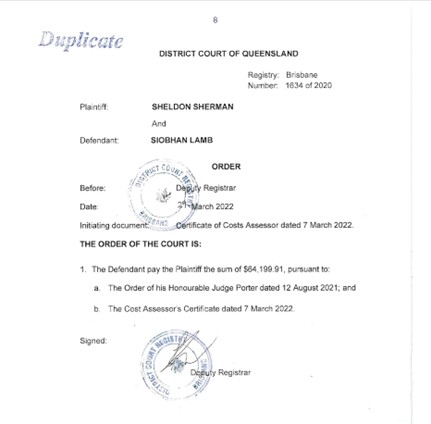
5 Importantly for present purposes, on 3 August 2021, Ms Lamb filed an interlocutory application to strike out the defamation proceedings. That interlocutory strike-out application was dismissed on 12 August 2021: Sherman v Lamb [2021] QDC 192. Ms Lamb appealed the strike-out decision however her appeal was dismissed: Lamb v Sherman [2021] QCA 290. On 29 March 2022, after a costs assessment, Ms Lamb was ordered to pay Mr Sherman’s costs of the strike-out application in the amount of $64,199.91 (the costs order):
6 On 23 September 2022, Jarro DCJ in the District Court handed down a final decision in the defamation proceeding, ordering judgment against Ms Lamb in the amount of $10,000: Sherman v Lamb [2022] QDC 215. His Honour also ordered the parties to file and serve written submissions in respect of interest and costs of the defamation proceeding.
7 On 22 April 2022, the Official Trustee issued a bankruptcy notice requiring Ms Lamb to pay to Mr Sherman the amount of $64,199.91 (the bankruptcy notice). On 25 May 2022, the bankruptcy notice was served on Ms Lamb. The last day of the period fixed for compliance with that bankruptcy notice was 15 June 2022. At 4.37pm on 15 June 2022, being seven minutes after the period fixed for compliance with the bankruptcy notice had ended, Ms Lamb electronically lodged an application and affidavit.
8 On 7 July 2022, Rosengren DCJ of the District Court ordered that enforcement of the costs order be stayed until seven days following the determination of the defamation proceeding including the costs of that proceeding.
9 On 14 July 2022, a Registrar of this Court extended the time for compliance with the bankruptcy notice to 6 October 2022. On 6 October 2022, a Registrar of this Court further extended the time for compliance with the bankruptcy notice to 24 November 2022. On 24 November 2022 the bankruptcy proceeding was heard. On 8 December 2022 the bankruptcy proceeding was dismissed (the bankruptcy proceeding).
Related Federal Court proceedings
10 On 16 June 2022, after the final day for compliance with the bankruptcy notice, Mr Sherman lodged a creditor’s petition. On 8 February 2023, the creditor’s petition was heard by Logan J. The creditor’s petition was opposed by Ms Lamb. Justice Logan noted that Ms Lamb had tendered monies towards the costs found as owing by her, but continued in Sherman v Lamb [2023] FCA 168 (the sequestration decision).:
13. It seems to me that this, in the circumstances as revealed by the earlier affidavit of Ms Lamb, and even taking into account her further affidavit, was a reasonable basis upon which to reject a tender made, as it was, on the very day upon which a creditor’s petition would be heard and in circumstances where, at the very least, on the evidence, there was a basis for the concern as to solvency voiced by Mr Sherman. Further, I am satisfied that the debt to which he deposes is owing and that there has been, in any event, no tender of an amount which would either satisfy it in full or even bring it below a threshold by reference to which a bankruptcy notice and later creditor’s petition might proceed in a court exercising Federal bankruptcy jurisdiction.
14. The overall position, then, is that I am satisfied that the formal proofs, in terms of the commission of an act of bankruptcy, service of the petition and that the debt is still owing, are made out by Mr Sherman. The real question is whether or not, as a matter of discretion, a sequestration order against Ms Lamb’s estate should be made?
11 His Honour gave detailed consideration to discretionary matters including whether Ms Lamb was actually solvent and whether there was occasion to go behind the judgments of the Queensland Courts resulting in costs orders. His Honour found that the evidence as to solvency was scant, and that there was no reason to go behind the judgment of the Queensland Courts. His Honour concluded:
45. In short, there has to be found, on the evidence, some occasion, though, for going behind the debt as evidence by judgments. It seems to me that, on the evidence to hand, whatever use or misuse of a letter or information occurred in District Court proceedings has already been explored or taken into account by the Queensland Court of Appeal. I do not see anything beyond that which would warrant, on the evidence upon which Ms Lamb relies, occasion for going behind any costs judgment. They look to me nothing more than discretionary value judgments where costs have followed the event. There is certainly no reason for going behind the judgment of the Queensland Court of Appeal, which dismissed with costs her appeal.
46. As to the substantive judgment in the defamation proceedings, that is the subject of an as yet unresolved application for leave to appeal to the Queensland Court of Appeal. Whether or not that court would be disposed to grant leave is moot. The sum involved in the damages award is quite modest. Submissions have been made already in writing by the parties, but quite when the leave application would be heard is not apparent from the material in evidence. What is apparent is that the submissions for Ms Lamb have been authored by senior and junior counsel instructed by solicitors. I have no evidence as to whether either counsel or solicitors are acting pro bono for her. In turn, that sounds a yet further interrogative note as to whether I have been given any or at least any full picture by Ms Lamb as to amounts owed in respect of costs as between the solicitor and client, including outlays.
47. It only comes to this. Whilst I accept that it is an open-ended discretion, ultimately, as to whether or not to make a sequestration order, Mr Sherman, as petitioning creditor, has proved the necessary formal elements. I am not satisfied, on the evidence, that Ms Lamb is solvent. As I have already mentioned, it is possible, but speculative, that she may be. Such is the ultimate breadth of discretion, it may be, if I were disposed to see the case as one where there was occasion for going behind judgments in the Queensland Courts, that even that possibility, in conjunction with the occasion for going behind, might persuade me not to make a sequestration order. I remind myself, though, that a countervailing consideration is the public interest in person who is prima facie insolvent, having committed an act of bankruptcy, being under insolvency administration. In summary:
(i) I am not satisfied that there is occasion to exercise a discretion not to make a sequestration order.
(ii) I am not satisfied on the balance of probabilities, on the evidence, that Ms Lamb is solvent.
(iii) I am not satisfied that there is occasion to go behind any judgment in respect of costs or otherwise against her in the Queensland Courts.
48. The end result, then, is that I am satisfied that the act of bankruptcy is proved and of all other necessary proofs required by s 52(1). I make a sequestration order against the estate of Siobhan Patricia Lamb, the respondent.
12 Accordingly his Honour ordered that a sequestration order be made against the estate of Ms Lamb.
13 On 17 February 2023, Ms Lamb filed a notice of appeal of the sequestration decision. The Full Court found on 25 May 2023, inter alia, that Logan J was correct in the sequestration decision to find that Ms Lamb had committed an act of bankruptcy on 15 June 2022. The Full Court relevantly held in Lamb v Sherman [2023] FCAFC 85 that, by operation of the Federal Court Rules 2011 (Cth), because Ms Lamb’s application was filed after the closure of the Registry, it was taken to have been filed the next day. As a result, the orders made by a Registrar of this Court extending the time for compliance with the bankruptcy notice by Ms Lamb were of no effect, and Ms Lamb was found to have committed an act of bankruptcy for failure to comply with the bankruptcy notice.
Decision of the Court of Appeal of Queensland in the defamation appeal
14 On 21 October 2022, Ms Lamb filed an appeal of the District Court decision in the Court of Appeal of Queensland (the defamation appeal). On 15 December 2023, the Court of Appeal handed down a decision in the defamation appeal: Bill Karageozis as trustee for the bankrupt estate of Siobhan Lamb v Sherman [2023] QCA 258. That decision relevantly:
set aside the decision of the District Court;
entered judgment for Ms Lamb;
ordered Mr Sherman to pay Ms Lamb’s costs of the defamation appeal; and
ordered that the parties make submissions in respect of costs.
Oral Application to Rely on and file a 150-Page Affidavit
15 On 1 April 2025, I ordered that, by 4.00pm on 7 April 2025, Ms Lamb file and serve any material in support of any interlocutory application to set aside the sequestration order. Ms Lamb did file submissions and materials in accordance with that order. However at the hearing before me on 16 June 2025 Ms Lamb sought to rely on an unfiled, 150-page affidavit which was provided to the petitioning creditor and trustee at 5.00pm on the afternoon of 15 June 2025 (150-page affidavit). Mr Moxon, Counsel for the petitioning creditor objected to this for a number of reasons, including:
the affidavit was very lengthy and did not include any page numbers or index outlining what was contained in the affidavit;
the other parties were not given sufficient opportunity to inspect the affidavit; and
Ms Lamb was out of time to file any additional material or evidence.
16 After hearing the parties I made the following case management orders referable to Ms Lamb’s application for leave to file her affidavit, noting particularly Orders 3, 4 and 6:
…
3. By 4.00pm on 18 June 2025, Ms Lamb file and serve a document, not exceeding 2 pages, by way of additional submissions setting out the addenda in her affidavit dated 15 June 2025 on which she seeks to rely.
4. By 4.00pm on 23 June 2025, Mr Bill Karageozis (as trustee for the bankrupt estate of Siobhan Lamb) (Trustee) and Mr Sheldon Sherman (Petitioning Creditor) file and serve submissions, not exceeding 2 pages, in response to the document filed by Ms Lamb in accordance with Order 3 of these Orders.
5. Judgment stand reserved in respect of the interlocutory application filed by Ms Lamb on 14 April 2025 immediately following the filing and service of submissions by the Trustee and Petitioning Creditor in accordance with Order 4 of these Orders.
AND THE COURT NOTES THAT:
6. The submissions referred to in Orders 3 and 4 of these Orders must be filed in A4 size, in no smaller than 12-point font, and with margins of at least 2.4cm on each side.
17 It appears that the orders were not complied with by Ms Lamb. Rather, on 18 June 2025, Ms Lamb filed additional submissions which loosely referred to the 150-page affidavit.
18 In response to those submissions, Mr Sherman submitted:
2. The respondent has not complied with that order. Instead of identifying those parts of her affidavit upon which she wishes to rely, the respondent has delivered two closely typed pages of submissions on the issue of solvency. Those submissions do not identify any part of the 15 June affidavit. It may also be noted that the submissions refer to ‘independent experts WLPR Restructuring’. No report from that firm is in evidence.
3. There are two possibilities:
(a) the respondent is incapable of identifying any part of the affidavit upon which she wishes to rely and so is taken to rely on none of it; or
(b) the respondent wishes to rely on all of the affidavit.
4. Despite request from the petitioning creditor’s solicitors (in terms attached to this note, and which the petitioning creditor seeks to tender), the respondent has not clarified whether she wishes to rely on any of the affidavit.
5. Out of an abundant sense of caution, if the respondent’s intention is to rely on the whole of the affidavit, the petitioning creditor confirms his objection on the following grounds:
(a) prejudice: the affidavit was served very late without any explanation. The petitioning creditor was not in a position to consider and make submissions in response to it. To admit it now would further delay these proceedings, compounding the prejudice;
(b) relevance: the affidavit is a screed against the petitioning creditor and Logan J. It also travels well beyond issues of solvency to re-agitate matters going to other issues the respondent raised as grounds for annulment, such as the matters on page 9;
(c) hearsay/opinion: parts of the affidavit evidently rely on out of court statements for the truth of their contents. The respondent has also exhibited documents which are not her documents (such as property valuations); and
(d) s 135 Evidence Act 1995 (Cth) discretion: the affidavit (especially the exhibits) is a confused and confusing jumble of invective, submissions and irrelevant material. The amount of time it would take for the Court to sift through the material and determine what, if anything, was admissible and helpful would be far outweighed by the affidavit’s probative value. The probative value of the evidence is diminished even further when:
(i) as the petitioning creditor pointed out at the hearing on 16 June, the respondent must prove solvency not only as at the date the order was made, but also at the time of the annulment application: Thredgold v Fyfe Pty Ltd [2013] FCA 1363 at [39] and the cases there cited; and
(ii) as the trustee pointed out at the hearing on 16 June, proof of solvency would not result in a conclusion that the primary Judge was bound not to make the order: Rigg v Baker (2006) 155 FCR 531 at [62].
In those circumstances, the Court should exercise its discretion to exclude the whole affidavit under s 135(c) of the Evidence Act on the ground that its probative value is substantially outweighed by the danger that it will cause or result in undue waste of time.
19 There was no explanation provided by Ms Lamb for the late service of the 150-page affidavit. It would ordinarily be expected that a party seeking to file an affidavit out of time would provide an explanation for their lateness: Van Eps v Child Support Registrar [2024] FCAFC 127 at [70]. Further, the late service of the 150-page affidavit meant that the other parties were not granted an opportunity to review and consider the affidavit and make submissions in response to it. The length of that affidavit further compounded this problem.
20 The 150-page affidavit itself contained material which was irrelevant to the present interlocutory application. It is difficult to follow, being made up of seemingly random documents with no references made to them in submissions.
21 Ms Lamb was given an opportunity to file submissions with respect to which pages or paragraphs of the 150-page affidavit were relevant and relied on by her in her submissions. The submissions filed by Ms Lamb on 18 June 2025 appeared to disregard those parameters and solely addressed the issue of Ms Lamb’s solvency.
22 In my view, Ms Lamb was given ample opportunity to file and serve materials and there was no apparent reason for relying on the 150-page affidavit. The affidavit handed up was not permissible and Ms Lamb did not comply with further case management orders regarding that affidavit. As such, the oral application by Ms Lamb to rely on and file the 150-page affidavit of 15 June 2025 should be refused, and I will not have regard to that affidavit.
The Present Application
23 Earlier in this judgment I set out paragraph 40 of Ms Lamb’s interlocutory application and the orders she ultimately seeks. The material in the interlocutory application is voluminous. In her application Ms Lamb set out – under the heading “Preliminary” – material which appeared to be in the nature of a pleaded case and submissions, including allegations of misconduct by the petitioning creditor.
24 Ms Lamb then sought what she described as “relief”, but which included considerable additional background information. The “Orders Sought” as set out in that interlocutory application included numerous declarations, as well as set aside orders, claims for pecuniary relief, and claims for factual findings referable to past conduct.
Previous Court proceedings
25 In my view Ms Lamb is precluded from prosecuting much of her interlocutory claim on the basis of principles of issue estoppel, Anshun estoppel, or res judicata. As the Full Court explained in Makhoul v Barnes (1995) 60 FCR 572, the starting point for any discussion of the law of issue estoppel and res judicata in Australia is the decision of Dixon J in Blair v Curran [1939] HCA 23; (1939) 62 CLR 464 at 531-533 where his Honour said:
A judicial determination directly involving an issue of fact or of law disposes once for all of the issue, so that it cannot afterwards be raised between the same parties or their privies. The estoppel covers only those matters which the prior judgment, decree or order necessarily established as the legal foundation or justification of its conclusion, whether that conclusion is that a money sum be recovered or that the doing of an act be commanded or be restrained or that rights be declared. The distinction between res judicata and issue estoppel is that in the first the very right or cause of action claimed or put in suit has in the former proceedings passed into judgment, so that it is merged and has no longer an independent existence, while in the second, for the purpose of some other claim or cause of action, a state of fact or law is alleged or denied the existence of which is a matter necessarily decided by the prior judgment, decree or order.
Nothing but what is legally indispensable to the conclusion is thus finally closed or precluded. In matters of fact the issue estoppel is confined to those ultimate facts which form the ingredients in the cause of action, that is, the title to the right established. Where the conclusion is against the existence of a right or claim which in point of law depends upon a number of ingredients or ultimate facts the absence of any one of which would be enough to defeat the claim, the estoppel covers only the actual ground upon which the existence of the right was negatived. But in neither case is the estoppel confined to the final legal conclusion expressed in the judgment, decree or order. In the phraseology of Coleridge J. in R. v. Inhabitants of the Township of Hartington Middle Quarter, the judicial determination concludes, not merely as to the point actually decided, but as to a matter which it was necessary to decide and which was actually decided as the groundwork of the decision itself, though not then directly the point at issue. Matters cardinal to the latter claim or contention cannot be raised if to raise them is necessarily to assert that the former decision was erroneous.
In the phraseology of Lord Shaw, "a fact fundamental to the decision arrived at" in the former proceedings and "the legal quality of the fact" must be taken as finally and conclusively established (Hoystead v. Commissioner of Taxation). But matters of law or fact which are subsidiary or collateral are not covered by the estoppel. Findings, however deliberate and formal, which concern only evidentiary facts and not ultimate facts forming the very title to rights give rise to no preclusion. Decisions upon matters of law which amount to no more than steps in a process of reasoning tending to establish or support the proposition upon which the rights depend do not estop the parties if the same matters of law arise in subsequent litigation.
The difficulty in the actual application of these conceptions is to distinguish the matters
(footnotes omitted, emphasis added)
26 More recently in Tomlinson v Ramsey Food Processing Pty Limited [2015] HCA 28 the High Court explained:
22. Three forms of estoppel have now been recognised by the common law of Australia as having the potential to result from the rendering of a final judgment in an adversarial proceeding. The first is sometimes referred to as "cause of action estoppel". Estoppel in that form operates to preclude assertion in a subsequent proceeding of a claim to a right or obligation which was asserted in the proceeding and which was determined by the judgment. It is largely redundant where the final judgment was rendered in the exercise of judicial power, and where res judicata in the strict sense therefore applies to result in the merger of the right or obligation in the judgment. The second form of estoppel is almost always now referred to as "issue estoppel". Estoppel in that form operates to preclude the raising in a subsequent proceeding of an ultimate issue of fact or law which was necessarily resolved as a step in reaching the determination made in the judgment. The classic expression of the primary consequence of its operation is that a "judicial determination directly involving an issue of fact or of law disposes once for all of the issue, so that it cannot afterwards be raised between the same parties or their privies". The third form of estoppel is now most often referred to as "Anshun estoppel", although it is still sometimes referred to as the "extended principle" in Henderson v Henderson. That third form of estoppel is an extension of the first and of the second. Estoppel in that extended form operates to preclude the assertion of a claim, or the raising of an issue of fact or law, if that claim or issue was so connected with the subject matter of the first proceeding as to have made it unreasonable in the context of that first proceeding for the claim not to have been made or the issue not to have been raised in that proceeding. The extended form has been treated in Australia as a "true estoppel" and not as a form of res judicata in the strict sense. Considerations similar to those which underpin this form of estoppel may support a preclusive abuse of process argument.
(footnotes omitted, emphasis added)
27 See also Timbercorp Finance Pty Ltd (in liquidation) v Collins [2016] HCA 44 at [27].
28 Having regard to Ms Lamb’s interlocutory application I consider that Ms Lamb is precluded from now raising the following issues, for the following reasons:
Alleged motivation of Mr Sherman in respect of the defamation proceedings.
* Such issues may have been of relevance in the defamation proceedings in the District Court and in the defamation appeal. Any rulings in that respect are now complete, and are not relevant in respect of Ms Lamb’s bankruptcy.
The allegation that Mr Sherman rejected full payment by Ms Lamb of the amount of $64,199.91 demanded by the bankruptcy notice, when that amount was tendered at the hearing before Rosengren DCJ.
* I note that this issue was addressed by Logan J in the sequestration decision at [13]. His Honour noted that there had been a second alleged offer of payment by Ms Lamb to Mr Sherman on 9 February 2023, being the day before the hearing in front of his Honour. His Honour found, however, that there was a reasonable basis for Mr Sherman to reject a tender made on the very day upon which a creditor’s petition would be heard and in circumstances where on the evidence there was a basis for the concern as to solvency voiced by Mr Sherman. Justice Logan similarly was satisfied that the debt to which Mr Sherman deposed was owing, and that there had been no tender of an amount which would either satisfy it in full or even bring it below a threshold by reference to which a bankruptcy notice and later creditor’s petition might proceed in a court exercising Federal bankruptcy jurisdiction. I note that this finding was not the subject of Ms Lamb’s appeal to the Full Court. Any rulings in respect of this issue are now complete, and principles of res judicata apply.
The manner in which the defamation proceedings unfolded, including Ms Lamb dropping “the truth defence”.
* Similarly, such issues were of relevance in the defamation proceedings in the District Court and in the defamation appeal. Any rulings in that respect are now complete, and are not relevant in respect of Ms Lamb’s bankruptcy.
Whether Mr Sherman’s conduct meant that the sequestration order ought not have been made, including allegations of criminality, harassment, extortion, coercion and economic coercion.
* Even assuming such allegations were relevant to whether a sequestration order ought to have been made against Ms Lamb, any such issues should have been raised before Logan J and the Full Court. Anshun estoppel applies.
Whether the bankruptcy notice was valid.
* Issues of the validity or otherwise of the bankruptcy notice served on Ms Lamb should have been, and indeed were, ventilated before Logan J and on appeal to the Full Court. Principles of res judicata and Anshun estoppel apply.
Whether Ms Lamb actually committed an act of bankruptcy.
* Issues concerning whether Ms Lamb committed an act of bankruptcy warranting a sequestration order should have been, and indeed were, ventilated before Logan J and on appeal to the Full Court. Principles of res judicata and Anshun estoppel apply.
Whether the sequestration order ought to have been made by Logan J, including whether Ms Lamb did or should have been allowed to file an application to set aside the bankruptcy notice, and whether valid set-off claims existed.
* The fundamental issue before Logan J was whether a sequestration order ought be made. His Honour made the order, and an appeal against that order was dismissed by the Full Court. In the Full Court their Honours specifically considered whether Ms Lamb’s application to set aside the bankruptcy notice was made within time. Any issues relevant to whether a sequestration order ought to have been made against Ms Lamb should have been raised in those proceedings. I further note that the question of set-off claims in Ms Lamb’s bankruptcy was specifically addressed by the Full Court in Lamb v Sherman [2023] FCAFC 85 at [19] and [36]-[37]. I am not persuaded that any valid set-off claims of Ms Lamb, to the extent that she raised them, were not properly considered. Principles of res judicata and Anshun estoppel apply.
Whether the costs orders of the District Court, including the costs order in the amount of $64,199.91 on which the bankruptcy notice was founded, should be set aside on the basis that they were, inter alia, obtained through fraud.
* The costs order of the District Court in the amount of $64,199.91 on which the bankruptcy notice was founded remains intact. The strike-out decision of the District Court (in respect of which costs in the amount of $64,199.91 were awarded against Ms Lamb) was upheld by the Court of Appeal in Lamb v Sherman [2021] QCA 290. Before Logan J, Ms Lamb sought that the Federal Court go behind the judgments of the Queensland Courts. Justice Logan considered the power of the Court on hearing a creditor’s petition to go behind the prima facie existence of a debt evidenced by judgment of another court, and whether in the circumstances of this case it was appropriate to do so. His Honour concluded:
45. In short, there has to be found, on the evidence, some occasion, though, for going behind the debt as evidence by judgments. It seems to me that, on the evidence to hand, whatever use or misuse of a letter or information occurred in District Court proceedings has already been explored or taken into account by the Queensland Court of Appeal. I do not see anything beyond that which would warrant, on the evidence upon which Ms Lamb relies, occasion for going behind any costs judgment. They look to me nothing more than discretionary value judgments where costs have followed the event. There is certainly no reason for going behind the judgment of the Queensland Court of Appeal, which dismissed with costs her appeal.
(emphasis added)
Issues relating to the alleged negligence of Ms Lamb’s lawyer.
* I am unable to identify how any negligence of Ms Lamb’s former lawyers is relevant in the circumstances of this case. I further note that the former lawyers were not parties to these proceedings.
29 In circumstances where I am satisfied that the bulk of Ms Lamb’s claims for relief have either been previously dealt with by either the Queensland or Federal Courts, or raise issues which ought to have been raised previously such that Ms Lamb is now precluded from raising them, I am satisfied that the only issues of substance remaining which Ms Lamb can properly ventilate in her interlocutory application are:
(1) whether the bankruptcy notice was based on an interlocutory costs order which did not constitute a "final judgment or final order" as required by s 41(3)(a) of the Bankruptcy Act 1966 (Cth);
(2) whether there was any contravention by either Mr Sherman or the trustee in bankruptcy of the stay ordered by Rosengren DCJ;
(3) whether the bankruptcy and/or sequestration order ought be set aside for some other reason of public interest or justice; or
(4) order for a stay of decision of Logan J on 10 February 2023.
30 I will now turn to each of these issues.
Issue 1: Whether the bankruptcy notice was based on an interlocutory cost order which did not constitute a "final judgment or final order" as required by Section 41(3)(a) of the Bankruptcy Act
31 Section 41 of the Bankruptcy Act relevantly provides:
(3) A bankruptcy notice shall not be issued in relation to a debtor:
(a) except on the application of a creditor who has obtained against the debtor a final judgment or final order within the meaning of paragraph 40(1)(g) or a person who, by virtue of paragraph 40(3)(d), is to be deemed to be such a creditor;
(emphasis added)
32 Ms Lamb submitted that the costs order made on 29 March 2022 in the District Court in the amount of $64,199.91, and which was the judgment debt founding the sequestration order, did not satisfy the statutory requirements for a bankruptcy notice for the purposes of s 41(3)(a) of the Bankruptcy Act.
33 The costs order was in the following form:

34 Ms Lamb submitted that the costs order was not a final order capable of supporting a bankruptcy notice. She referred to Hall v Nominal Defendant (1966) 117 CLR 423; [1966] HCA 36, Carr v Finance Corporation of Australia (No 1) (1981) 147 CLR 246; [1981] HCA 20 and Australian and New Zealand Banking Group Limited v Menso [2006] FMCA 1522, and submitted that a final order must dispose of the rights of the parties. Ms Lamb submitted that the costs order of 29 March 2022 did not dispose of the rights of the parties and, as a result, could not give rise to a sequestration order.
35 In response, Mr Sherman submitted that the costs order directed the payment of money to Mr Sherman, and as such was a final order for the purposes of ss 40(1)(g) and 41(3)(a) of the Bankruptcy Act.
36 A costs order of a Registrar of the District Court, after assessment, takes effect as a judgment of the District Court: see rule 740 Uniform Civil Procedure Rules 1999 (Qld) which provides:
740 Judgment for amount certified
(1) After a certificate of assessment is filed, the registrar of the court must make the appropriate order having regard to the certificate.
(2) The order takes effect as a judgment of the court.
(3) However, the order is not enforceable until at least 14 days after it is made and the court may stay enforcement pending review of the assessment on terms the court considers just.
(4) Unless the registrar orders otherwise, the costs assessor’s fees—
(a) are payable to the cost assessor in the first instance by the party who applied for the assessment; and
(b) are to be included in that party’s costs of the assessment.
(5) Amounts paid or payable under the order are charged with payment of the costs assessor’s fees.
37 The costs order of the Registrar of 29 March 2022 was plainly in accordance with rule 740. As explained by Wilson FM in Ivory v Telstra Corporation Limited [2010] FMCA 123:
[14] … the effect of the Uniform Civil Procedure Rules is that the order signed by the Deputy Registrar after an assessment of legal costs takes effect as a ‘money order’ and is enforceable in its own right. UCPR 740 makes it clear that the order made by the Deputy Registrar after the assessment of costs itself takes effect as a judgment of the court. The fact that the order of the Registrar is a money order, as defined in Schedule 2 to the Supreme Court Act 1991 means that it is a final judgment or order as required by s.40(3)(b) Bankruptcy Act 1966…
(emphasis added)
38 See also Thomas v Raftopoulos [2020] FCCA 3515 at [13].
39 The weight of authority favours the view that such an order is a final order. As Bleby J explained in Grey v City of Charles Sturt (1999) SASC 224:
19. … It is an order which operates regardless of the final outcome of the proceedings and imposes a financial liability on the appellant regardless of that outcome. That order may be enforced as any other order of the Magistrates’ Court made in its Criminal Division. It is an order which, although made in the course of proceedings, was not interlocutory in the sense of assisting in the proper resolution of the proceedings…
40 Decisions of this Court similarly favour the position that a costs order, including a costs order of a State Court, is a final order for the purposes of ss 40(1)(g) and 41(3)(a) of the Bankruptcy Act. In Re Stubberfield; ex parte Paradise Grove Pty Ltd (1995) 134 ALR 169 in response to a contention that an appeal court costs order was not a final order because the notice issued before the taxation of costs had been completed, Drummond J observed at 177:
The taxing officer’s certificate of 22 December 1993 was effective to quantify the amount of Mr Stubberfield’s liability to the judgment creditor under the costs order. It was not subject to review either on the date it was issued or on the date when it was served. Even though it was subject to a pending review by the court by the time the petition was issued and when the petition came on for hearing, that does not prevent the costs order in respect of which the certificate was issued being a final judgment for the purposes of s 50(1)(g)…
41 In Thorpe v Bristile Pty Ltd (1997) 80 FCR 330; [1997] FCA 720 Sundberg J observed:
In his reply counsel for the applicant contended that the costs order made by Walsh J was not a "final order" within s 40(1)(g) of the Act. The matter had not been mentioned in opening, and the respondent's counsel had not otherwise been alerted to the fact that the status of the order was an issue. However I allowed it to be raised, and the parties filed written submissions. In my view there is no substance in the contention. Th costs awarded by Walsh J were taxed and allowed by the taxing officer in the sum of $5002. Under O 66 r57 of the Rules of the Supreme Court, costs when taxed are deemed to be a judgment of the Court and are recoverable accordingly. Section 40(3)(b) of the Act provides that
"a judgment or order that is enforceable as, or in the same manner as a judgment obtained in an action shall be deemed to be a final judgment so obtained and the proceedings in which, or in consequence of which, the judgment or order was obtained shall be deemed to be the action in which it was obtained ...."
The order for costs is an order that is enforceable as a judgment in an action, and accordingly the order is deemed to be a final judgment obtained in the action.
In Re Skinner's and Smith's Application (1982) 45 ALR 553 Skinner and Smith were the defendants in proceedings in which the court dismissed an application by the plaintiff for an interlocutory injunction and awarded costs to the defendants. The costs were taxed and the defendants requested the issue of a bankruptcy notice based on the costs order. The Registrar referred the matter to a judge. Fitzgerald J held that the defendants were entitled to a notice since, by operation of s40(3)(b), the order for costs was a "final order ". See also his Honour's judgment in later proceedings between the same parties: Re Gould; Ex parte Skinner [1983] FCA 68; (1983) 72 FLR 393 at 407-408. To the same effect are Kayo Contractors v Fernandez (1984) 71 FLR 34, Re Smith; Ex parte Chesson [1992] FCA 64; (1992) 106 ALR 359 at 365-366 and Re Gibbs; Ex parte Triscott (1992) 133 ALR 718 at 724. The sole argument advanced by the applicant for the contention that the costs order was not "final" was that it was ancillary to the refusal of the interlocutory injunction, and thus had the interlocutory character of the principal order. Skinner and Smith and Gould dispose of this argument. See also Gibbs at 729.
42 In Worchild v The Drink Nightclub (Qld) Pty Ltd [2005] FCAFC 240, Cooper J at first instance had made an order for costs against the appellant in that case, with taxation of costs following. The amount certified was not paid by the appellant and an order pursuant to then Order 62 rule 45(3) of the Federal Court Rules was made by the Registrar of the Federal Court, ordering the appellant to pay the sum of costs to the respondents. It was the Registrar’s order which was attached to the bankruptcy notice in that case. The Full Court relevantly held:
7 The finality of the order made following taxation was also a matter raised by the appellant in connexion with another ground of appeal. He contended that his Honour was wrong in finding that the copy of the judgment or certificate of assessed costs relied upon was not required to be attached to the bankruptcy notice. His Honour made no such finding for the reason that this issue was neither raised before his Honour nor the Deputy District Registrar. In any event the ground is misconceived.
…
9 The appellant submits that the only order having the necessary finality, and the order which should have been attached to the bankruptcy notice, was Cooper J’s order. He submits that the order which was attached, that of the Deputy District Registrar following taxation, does not qualify as a final order. It was not apparent to us how the appellant arrived at such a conclusion.
10 In our view the order of 26 November 2004 is a final order within the meaning of the Bankruptcy Act, one in which the respondents’ rights were ascertained and given effect to…
43 Subsequently, in Francis v Eggleston Mitchell Lawyers Pty Ltd [2014] FCAFC 18 an appellant sought an order that a sequestration order against her be annulled pursuant to s 153B(1) of the Bankruptcy Act for reasons including that the bankruptcy notice was founded on an order of the Supreme Court of Victoria that she pay one of her former firms of solicitors their costs assessed in the sum of $11,847.40. The Full Court referred to s 40(1)(g) of the Bankruptcy Act and the requirement that a creditor have obtained against the debtor a final judgment or final order, being a judgment or order the execution of which has not been stayed, and continued:
29. A judgment or order for the payment of an amount of money is “final” within the meaning of the Act if it ascertains or establishes a pre-existing right of the party in whose favour it is given. In Clyne v Deputy Commissioner of Taxation (NSW) (1983) 48 ALR 545 at 547-548, Gibbs CJ, with whom Murphy, Wilson, Brennan and Deane JJ agreed, said of the phrase “final judgment” as used in ss 40(1)(g), (3)(d) and 41(3)(a) of the Act:
A final judgment within the meaning of the provisions of the Bankruptcy Act has been held to mean a judgment obtained in an action by which the question whether there was a pre-existing right of the plaintiff against the defendant is ascertained or established: ... In other words it is a judgment which finally disposes of the rights of the parties: ... The fact that a judgment is subject to appeal or that it may later be set aside or become inoperative does not mean that it is not final: ...
(Emphasis added).
30. The word “final” in the expression “final judgment or final order” in s 40(1)(g) is used in this sense: Autron Pty Ltd v Benk [2011] FCAFC 93; (2011) 195 FCR 404 at 411 [26] per Lander, Tracey and Yates JJ. An order for costs that are subsequently quantified in a sum certain by a taxation and, pursuant to rules of court, then inserted into an order that the amount be paid, is a final order for the purposes of s 40(1)(g) of the Act: Worchild v The Drink Nightclub (Qld) Pty Ltd [2005] FCAFC 240; (2005) 224 ALR 339 at 341 [10] per Kiefel, Jacobson and Greenwood JJ.
31. The Master’s order was a final order for the payment of money. That is because the order itself resolved a pre-existing dispute. It was made by a court for the payment of money by Ms Francis and had the effect of ascertaining the firm’s and her rights in respect of that dispute: Clyne at 547-548. It follows that the Master’s order was a final order for the purposes of ss 40(1)(g), (3)(d) and 41(3)(a). Therefore, the second ground of appeal fails.
44 Finally, there is also extensive authority that an order of the District Court awarding costs is a final judgment of that Court: Colburt v Beard [1992] 2 QdR 67 at 68, Cameron v Nominal Defendant [2000] QCA 137 at [6]; McMurdo P in Smith v Ash [2010] QCA 112 at [6].
45 Applying these authorities, I am satisfied that a costs order of the District Court directing the payment of money finally determines the parties’ rights in respect of that issue, and is a final order for the purposes of ss 40(1)(g) and 41(3)(a) of the Bankruptcy Act. The decision in Menso on which Ms Lamb relies has been superseded by amendments to the UCPR on 10 December 2007, as explained in Ivory and Thomas. I agree with the respondents that it is irrelevant at what stage of the proceedings the costs order was issued, or to what it related.
Issue 2: Whether there was any contravention by either Mr Sherman, or the trustee in bankruptcy, of the stay ordered by Rosengren DCJ
46 Materially, s 41(3)(b) of the Bankruptcy Act provides:
(3) A bankruptcy notice shall not be issued in relation to a debtor:
(a) …
(b) if, at the time of the application for the issue of the bankruptcy notice, execution of a judgment or order to which it relates has been stayed; or
…
47 Ms Lamb submitted that Mr Sherman contravened an order made by the District Court on 7 July 2022 staying enforcement of two costs orders until the determination of the defamation proceedings. Ms Lamb asserted that, as a result of the order, Mr Sherman contravened s 41(3)(b) of the Bankruptcy Act.
48 Judge Rosengren gave an ex tempore decision on 7 July 2022. Her Honour at the time noted that bankruptcy proceedings were on foot, however observed:
Further, the costs incurred by the plaintiff in relation to the assessment process have not been wasted. If a stay is ordered, then the plaintiff will have the benefit of the assessment process when the stay ends. A stay would not deprive the plaintiff of the benefits of the costs orders made by Judges Porter and Jarro and the money orders made by the registrar. It would simply delay their enforcement for what is likely to be a relatively short period of time. 1t is conceded by the plaintiff that the defendant's prospects of success in the substantive proceeding is at least arguable.
If the defendant succeeds at trial, then she can seek to set off the costs which she owes against the costs orders which will prima facie be made in her favour. While the defendant was self-represented for the purposes of this application, she was represented at the trial. It seems likely that should she be successful in her defence at the substantive proceedings and costs are awarded in her favour, that they will exceed the quantum of the subject two costs orders. On the other hand, if she loses at trial, then the stay will be lifted and the orders will be enforced.
It is necessary to ascertain what a stay would prevent the plaintiff from doing. He potentially loses the option of bankrupting the defendant, and proceedings are on foot to achieve this. The defendant has deposed to the fact that she has approximately $170,000 in her superannuation account currently and that she has made a formal application with the Australian Tax Office about withdrawing a portion of this to meet the money orders to prevent bankruptcy and the removal of her home from her. There is no reason on the material before me to cause any concern that the defendant's property or other financial resources available to her might be dissipated in the event that this stay is ordered. Further, there is no claim that the plaintiff will suffer financial hardship if the stay is ordered. For example, there is no evidence that the plaintiff needs the money to defray costs to replenish his funds for ongoing further litigation. Even if the defendant bas not satisfactorily proved that she is unable to pay the money orders, I am satisfied that she is likely to suffer more prejudice by being required to pay the nearly $81,300 at this stage than the plaintiff will suffer in the delay in executing the money orders.
49 Her Honour continued and ordered:
Balancing all of the relevant factors and keeping in mind, of course, that the applicant bears the onus of proof, I am satisfied and I conclude that it is appropriate to grant the stay in the particular circumstances of this case. I, therefore, order that, pursuant to rule 800 of the Uniform Civil Procedure Rules, the enforcement of the two orders made by the registrar on the 29th of March and the 26th of April 2022 respectively, be stayed until seven days after the termination of the substantive proceedings including a determination of the costs in those substantive proceedings.
50 Mr Sherman submitted that Ms Lamb had the dates confused when making her submissions as the bankruptcy notice was issued by the Official Receiver on 22 April 2022 – approximately two and a half months before the District Court stayed enforcement of the underlying costs order. The petitioning creditor asserted that s 41(3)(b) therefore has no application as the order was made after the application for issue of the bankruptcy notice.
51 The timeline of relevant events appears to be as follows:
(a) A costs order in the amount of $64,199.91 was made by a Registrar of the District Court on 29 March 2022.
(b) The bankruptcy notice was issued by the Official Trustee on 22 April 2022.
(c) Mr Sherman served the bankruptcy notice on Ms Lamb on 25 May 2022.
(d) Mr Sherman presented a creditor’s petition on 16 June 2022, and served Ms Lamb on the same date.
(e) On 15 June 2022 Ms Lamb filed an application to set aside and extend time for compliance with the bankruptcy notice (although it was deemed to have been lodged on 16 June 2022).
(f) On 7 July 2022 Rosengren DCJ ordered that the enforcement of the costs order in the amount of $64,199.61 and another order be stayed until seven days following the determination of the defamation proceeding including the costs of those proceedings.
52 The evidence before the Court demonstrates that the bankruptcy notice was issued before the stay order was made by Rosengren DCJ. I do not agree that the conduct of the petitioning creditor contravened her Honour’s orders. The stay of enforcement of the costs order of $64,199.91 has expired in accordance with the orders of Rosengren DCJ.
Issue 3: Whether the bankruptcy and/or sequestration order ought be set aside for some other reason of public interest or justice
53 Other than the reasons I have already set out in this judgment, Ms Lamb has contended in her interlocutory application that the bankruptcy notice and/or sequestration order against her be set aside for other reasons, including because of:
substantial injustice, and compromise of the integrity of the judicial process, would otherwise result; and
facilitation of the just resolution of disputes as contemplated by s 37M of the Federal Court of Australia Act 1976 (Cth).
54 The first order sought by Ms Lamb in paragraph 40 of her interlocutory application was that:
… the Sequestration Order made on 10 February 2023 by Justice Logan in the Federal Court Brisbane (Proceeding No. 209 of 2022) be set aside and declared void *ab initio*;
55 While Ms Lamb does not specifically rely on s 153B of the Bankruptcy Act, that section does permit the Court to annul a bankruptcy in the terms contemplated:
Annulment by Court
(1) If the Court is satisfied that a sequestration order ought not to have been made or, in the case of a debtor's petition, that the petition ought not to have been presented or ought not to have been accepted by the Official Receiver, the Court may make an order annulling the bankruptcy.
(2) In the case of a debtor's petition, the order may be made whether or not the bankrupt was insolvent when the petition was presented.
(3) The trustee must, before the end of the period of 2 days beginning on the day the trustee becomes aware of the order, give to the Official Receiver a written certificate setting out the former bankrupt's name and bankruptcy number and the date of the annulment.
(emphasis added)
56 Accordingly, I consider it appropriate to treat Ms Lamb’s application for her bankruptcy to be set aside, as an application for annulment of her bankruptcy.
57 The leading case considering s 153B of the Bankruptcy Act is Heinrich v Commonwealth Bank of Australia [2003] FCAFC 315 where the Full Court said:
19. Section 153B relevantly provides that if the Court is satisfied that a sequestration order ought not to have been made, it may make an order annulling the bankruptcy.
20. The Court must first consider whether the sequestration order ought not to have been made. If it so finds, then the Court must consider whether, in the exercise of its discretion, the bankruptcy should be annulled: Re Deriu (1970) 16 FLR 420. Later evidence of previously unknown facts may disclose matters which show that the sequestration order ought not to have been made. That is, the Court is entitled to consider not only the case as disclosed at the time when the sequestration order was made, but also those facts now known then to have existed. The Court excludes those facts which have occurred since the order was made. Later evidence of previously unknown facts may disclose matters which show that the sequestration order ought not to have been made: Re Frank; Ex parte Piliszky (1987) 16 FCR 396; Stankiewicz v Plata [2000] FCA 1185 at [19]; Re Williams (1968) 13 FLR 10 at 23; Re Ditfort; Ex parte Deputy Commissioner of Taxation (1988) 19 FCR 347. These authorities, all of which were cited by the learned primary judge in his judgment, were accepted at first instance as reflecting the relevant law.
(see also Beaman v Bond (2017) 254 FCR 480; [2017] FCAFC 142 at [79])
58 It is well established that a bankruptcy brought by a creditor’s petition may be annulled if the debtor establishes that the creditor’s petition was presented in circumstances amounting to an abuse of process, including because it was utilised as a form of judgment execution against a recalcitrant yet solvent debtor: Shaw v Yarranova (2017) 252 FCR 267; [2017] FCAFC 88; Thompson v Lane (Trustee) [2023] FCAFC 32 at [15]. Similarly in exercising the discretion to annul, the Court is to have regard not only to the interests of the parties but to the interests of the public, neither of which is paramount over the other: Beaman at [79]; Thompson at [14]. The conduct of the bankrupt is a relevant consideration in determining whether an order annulling a bankruptcy should be made, as is whether an annulment will be conducive of or detrimental to commercial morality and the interests of the public: Shaw at [112], Thompson at [119].
59 In respect of the exercise of the Court’s discretion, the Full Court in Rigg v Baker (2006) 155 FCR 531; [2006] FCAFC 179 said:
59. The power of the Court to annul a bankruptcy derives from s 153B of the Act. In the case of a bankruptcy created by a sequestration order on a creditor’s petition, the power involves two elements:
1. The Court’s satisfaction that the sequestration order ought not to have been made.
2. The Court’s exercise of a discretion to make an order annulling the bankruptcy.
…
61. In determining whether a sequestration order ought to have been made the Court may consider "not only the case as disclosed at the time that the order was made, but as it would have been disclosed had all the true facts been before the court on the making of the order": Re Cook (1946) 13 ABC 245 at 259 (Clyne J); Re Williams (1968) 13 FLR 10 at 23 (Gibbs J). But facts which have come into existence since the making of the order are not relevant to the question whether it ought to have been made: Re Scott [1975] Qd R 125 at 126-127 (Lucas J); Re Frank; Ex parte Piliszky (1987) 16 FCR 396 at 400 (Fisher J); Re Ditford; Ex parte Deputy Commissioner of Taxation (1988) 19 FCR 347 at 350 (Gummow J).
62. The circumstances under which a sequestration order "ought" not to be made were described by Fisher J in Frank (at 403):
‘... a judge "ought" not to have made an order only if he was "bound" not to make the order.’
And further (at 403):
‘In my opinion "ought" in s 154(1)(a) is of imperative significance and an order should not be annulled unless the judge was in the circumstances bound not to make it and even then there is a residual discretion not to annul.’
That proposition was quoted with evident approval by the Full Court in Hudson v Whalen [1999] FCA 189 at [10].
63. In Pollock v Deputy Federal Commissioner of Taxation (1994) 94 ATC 4148, Carr J set out five propositions relevant to applications for annulment. They were derived from the judgment of Riley J in Re Calderon (unrep Federal Court of Bankruptcy, 31 May 1977, No NSW 573 of 1976) as follows (at 4153-4154):
‘1. It is for the applicant for annulment who alleges, and it is therefore for him to bring himself within the section and satisfy the Court, that the sequestration order ought not to have been made.
2. The Court to whom the application is made seeks to ascertain the actual state of affairs at the time when the sequestration order is made.
3. In order to ascertain that actual state of affairs the Court hearing the application for annulment looks at the facts that were before the Court which made the sequestration order and at any other facts that were not before that Court but are shown on the hearing of the application for annulment to have been in existence when the sequestration order was made.
4. Having considered all the facts so looked at, the Court determines whether on those facts the applicant has satisfied it that the sequestration order ought not to have been made.
5. If it is so satisfied, the Court is not bound to annul the sequestration order but must consider in all the circumstances of the case whether it ought to be annulled.’
60 Further the Full Court in Rigg v Baker observed:
67. When the creditor’s petition is based upon a judgment debt, the existence of a pending appeal against that judgment may also be a ground for adjourning the petition. In Ahern v Deputy Commissioner of Taxation [1987] FCA 312; (1987) 76 ALR 137 the Full Court said that:
‘It is also well established that in general a court exercising jurisdiction in bankruptcy should not proceed to sequestrate the estate of a debtor where an appeal is pending against the judgment relied on as the foundation of the bankruptcy proceedings provided that the appeal is based on genuine and arguable grounds.’
61 Applying these principles I find as follows.
62 The evidence before the Court indicates that while Mr Sherman was ordered by the Court of Appeal to pay costs to Ms Lamb in respect of the defamation litigation before the Queensland Courts, the order of the District Court for Ms Lamb to pay Mr Sherman’s costs in the amount of $64,199.91 – which formed the basis of the bankruptcy notice – remains undisturbed. I have already found that that costs order was a final order of the District Court, and that there was no contravention of the stay orders of Rosengren DCJ in respect of conduct of either Mr Sherman or the trustee. I am also satisfied on the material before me that, as at the date of the sequestration order made by Logan J, Ms Lamb remained a debtor of Mr Sherman.
63 I am not satisfied that there is evidence of previously unknown facts which may disclose matters which show that the sequestration order ought not to have been made. Ms Lamb’s allegations of criminality are unsubstantiated and, in my view, irrelevant. I am not satisfied that the bankruptcy notice amounted to an abuse of process, noting that the issue of sequestration order being made against Ms Lamb was examined in detail by both Logan J and the Full Court. I am not satisfied that there is a public interest in annulling Ms Lamb’s bankruptcy, or that the interests of justice demand that annulment.
Issue 4: Order for a Stay of Decision of Logan J of 10 February 2023
64 Finally, I note that, in paragraph 22 of her interlocutory application, Ms Lamb sought the following order:
22. Alternatively, an order staying enforcement of the sequestration order made by Justice Logan on 10 February 2023, on the basis that Mr. Sherman improperly used a bankruptcy notice raised on the interlocutory cost order dated 29 March 2022 in proceeding 1634 of 2020 in the District Court of Queensland in the amount of $64,199.91 (before the trial was heard by a court) to obtain the sequestration order, pending an appeal to the High Court of Australia on multiple grounds including material nondisclosure and deceptive conduct by Mr. Sherman across both the bankruptcy and defamation proceedings.
65 Principles relevant to the grant of a stay of enforcement were set out in National Retail Association v Fair Work Commission (No 2) [2014] FCA 664 at [11]. In summary, those principles are:
* An order granting a stay is an interlocutory order at the discretion of the primary judge, although the discretion must be exercised judicially: National Australia Bank Limited v Norman [2009] FCAFC 13 at [44].
* Further, the discretion of the Court in granting a stay ought not be exercised lightly, and only in circumstances where there would be so adverse and serious a consequence that interlocutory intervention should take place notwithstanding that there has not been an opportunity for full consideration of the appeal: Nikolaides v Legal Services Commissioner [2005] NSWCA 91 per Bryson JA at [18]; Thomson v Young [2013] NSWCA 300 at [8]. Circumstances warranting the grant of a stay have been described as “exceptional” (Jennings Construction Ltd v Burgundy Royale Investments Pty Ltd (No. 1) [1986] HCA 84; (1986) 161 CLR 681 at 683; Rahme v Commonwealth Bank [1993] HCA 62; (1993) 117 ALR 618 at 620; Petrotimor Companhia de Petroleos S.A.R.L. v Commonwealth of Australia [2003] FCAFC 82 at [24]; Batistatos v Roads and Traffic Authority of New South Wales [2006] HCA 27; (2006) 226 CLR 256).
* To that extent the balance of convenience plays an important role in determining whether an order ought be made: Bannister & Hunter Pty Ltd v Transition Resort Holdings Pty Ltd [2014] NSWCA 87 per Ward JA at [18].
* The Court may be minded to refuse a stay where it is satisfied that there are no serious questions for the determination in the appeal or review: Kalifair Pty Ltd v Digi-Tech (Australia) Ltd [2002] NSWCA 383; (2002) 55 NSWLR 737 at [18]; ACES Sogutlu Holding Pty Ltd v Commonwealth Bank of Australia [2014] NSWCA 84 at [6]. Conversely, the Court may be minded to grant a stay where, on a preliminary assessment of the case, the Court is satisfied that grounds of appeal or review have merit: Alexander v Cambridge Credit Corporation Ltd (1985) 2 NSWLR 685 at 695; Attorney-General for the State of Queensland v Fardon [2013] QCA 299 at [15].
* The Court may be minded to grant a stay where it is satisfied that any subsequent appeal or review would be rendered nugatory should a stay be refused: Alexander v Cambridge Credit Corporation Ltd (1985) 2 NSWLR 685 at 695; Jennings Construction Limited v Burgundy Royale Investments Proprietary Limited [1986] HCA 84; (1986) 161 CLR 681; Paringa Mining & Exploration Co PLC v North Flinders Mines Ltd (No 2) [1988] HCA 53; (1988) 165 CLR 452; National Australia Bank Limited v Norman [2009] FCAFC 13 at [43].
* Decisions at first instance should not be treated as merely provisional. A successful party in litigation is entitled to the fruits of its judgment, and courts should not be disposed to delay the enforcement of orders. A sufficient basis must be shown to outweigh these considerations: Keane JA in Cook’s Construction Pty Ltd v Stork Food Systems Australasia Pty Ltd [2008] QCA 322; [2008] 2 Qd R 453 at 455; Attorney-General for the State of Queensland v Fardon [2013] QCA 299 at [15]; Julia Farr Services Inc v Hayes [2003] NSWCA 142 at [24].
* The Court will consider whether a stay is warranted in the interests of justice: Alexander v Cambridge Credit Corporation Limited (1985) 2 NSWLR 685 at 694; NSW Bar Association v Stevens [2003] NSWCA 95 at [83]; ACES Sogutlu Holding Pty Ltd v Commonwealth Bank of Australia [2014] NSWCA 84 at [5].
See also Quach v MLC Limited [2022] FCAFC 202 at [81].
66 In the present case I do not consider it appropriate to order a stay as sought by Ms Lamb, in circumstances where:
the sequestration decision, which Ms Lamb seeks stayed, was delivered on 10 February 2023, which is more than three years ago;
the sequestration decision was the subject of an unsuccessful appeal by Ms Lamb to the Full Court. I note that, at the Full Court hearing, Ms Lamb was represented by both Senior and Junior Counsel. I am satisfied that the appeal brought by Ms Lamb was comprehensive in respect of matters she sought to ventilate by way of appeal, and that she was adequately represented to ventilate such matters;
in such circumstances the petitioning creditor is entitled to the fruits of his judgments;
Ms Lamb contends that she has appealed to the High Court of Australia. It is unclear in respect of what, or which judgment(s), Ms Lamb has appealed. No material was filed by Ms Lamb in support of that contention; and
the balance of convenience favours the petitioning creditor and the trustee.
67 I refuse Ms Lamb’s application for a stay of enforcement of the decision of Logan J of 10 February 2023.
CONCLUSION
68 In conclusion:
I refuse the oral application by Ms Lamb to rely on and file her affidavit dated 15 June 2025.
I refuse Ms Lamb’s application for a stay of enforcement of the decision of Logan J in Sherman v Lamb [2023] FCA 168.
Otherwise, Ms Lamb’s interlocutory application filed on 7 April 2025 is dismissed.
69 I further note that, on 16 June 2025, I made orders suppressing publication of a number of documents. I consider it both necessary and appropriate to quote from those suppressed documents in this judgment. It may also be necessary to quote from those suppressed documents in future judgments. Accordingly, I will also make an order to that effect.
70 It is appropriate that costs follow the event: Oshlack v Richmond River Council 193 CLR 72; [1998] HCA 11; Jeffery & Katauskas Pty Limited v SST Consulting Pty Ltd [2009] HCA 43.
I certify that the preceding seventy (70) numbered paragraphs are a true copy of the Reasons for Judgment of the Honourable Justice Collier. |
Associate:
Dated: 26 February 2026


