

FEDERAL COURT OF AUSTRALIA
Container Rotation Systems Pty Ltd v Intermodal Solutions (Group) Pty Ltd [2026] FCA 161
File number: | VID 367 of 2022 |
Judgment of: | ROFE J |
Date of judgment: | 27 February 2026 |
Catchwords: | TRADE MARKS – infringement – container rotation systems – containerised bulk handling field – word mark – “rotainer” – whether “rotainer” is purely descriptive – genericism – where the infringer attempted to genericise the registered trade mark – where purported generic and descriptive meaning of the word mark is uncertain – evolution theory of changes in meaning of the word mark – relevant trader – good faith defence – good faith not established – same goods – goods of the same description – deceptive similarity – substantial identicality – flagrancy – additional damages – additional damages awarded – authorisation – joint tortfeasor TRADE PRACTICES – misleading or deceptive conduct – alleged breaches of s 18, 29(1)(a), (g) and (h) of Sch 2 of the Competition and Consumer Act 2010 (Cth) – where alleged descriptiveness of the mark is used to support a contention that use was not likely to mislead or deceive consumers – misleading or deceptive conduct established – passing off – elements of claims established PRACTICE AND PROCEDURE – Evidence Act – inadmissibility of chronology purportedly evidencing use of mark – overarching purpose under s 37M of the Federal Court of Australia Act 1976 (Cth) |
Legislation: | Sch 2 of the Competition and Consumer Act 2010 (Cth) Evidence Act 1995 (Cth) Federal Court of Australia Act 1976 (Cth) Intellectual Property Laws Amendment (Raising the Bar) Act 2012 (Cth) Trade Marks Act 1905 (Cth) Trade Marks Act 1955 (Cth) Trade Marks Act 1995 (Cth) |
Cases cited: | Accor Australia & New Zealand Hospitality Pty Ltd v Liv Pty Ltd (2017) 345 ALR 205 Advanced Hair Studio of America Pty v Registrar of Trade Marks (1988) 12 IPR 1 Anchorage Capital Partners Pty Ltd v ACPA Pty Ltd (2018) IPR 255 Anheuser-Busch Inc v Budejovicky Budvar (2002) 56 IPR 182 Apple Inc v Registrar of Trade Marks (2014) 109 IPR 187 Austereo Pty Ltd v DMG Radio (Australia) Pty Ltd (2004) 61 IPR 257 Australian Competition and Consumer Commission v TPG Internet Pty Ltd (2013) 250 CLR 640 Australian Postal Corporation v Digital Post Australia Pty Ltd (2013) 105 IPR 1 Australian Woollen Mills Ltd v FS Walton & Co Ltd (1937) 58 CLR 641 Bed Bath ‘N’ Table Pty Ltd v Global Retail Brands Australia Pty Ltd (2023) 182 IPR 393 Bed Bath ‘N’ Table Pty Ltd v Global Retail Brands Australia Pty Ltd [2025] HCA 50 Bendigo and Adelaide Bank Ltd v Community First Credit Union Ltd (2021) 157 IPR 251 Bohemia Crystal Pty Ltd v Host Corp Pty Ltd (2018) 129 IPR 482 Brick Lane Brewing Co Pty Ltd v Torquay Beverage Co Pty Ltd (2023) 170 IPR 195 Burger King Corporation v Registrar of Trade Marks (1973) 128 CLR 417 CA Henschke & Co v Rosemount Estates Pty Ltd (2000) 52 IPR 42 Cadbury Schweppes Pty Ltd v Darrell Lea Chocolate Shops Pty Ltd (2007) 72 IPR 261 Cantarella Bros Pty Ltd v Modena Trading Pty Ltd (2014) 254 CLR 337 Caporaso Pty Ltd v Mercato Centrale Australia Pty Ltd (2024) 181 IPR 78 Champagne Heidsieck et Cie Monopole Societe Anonyme v Buxton [1930] 1 Ch 330 Chocolaterie Guylian NV v Registrar of Trade Marks (2009) 82 IPR 13 Clark Equipment Co v Registrar of Trade Marks (1964) 111 CLR 511 Complete Technology Integrations Pty Ltd v Green Energy Management Solutions Pty Ltd [2011] FCA 1319 ConAgra Inc v McCain Foods (Aust) Pty Ltd (1992) 23 IPR 193 Diamond T Motor Car Company [1921] 2 Ch 583 Dunlop Aircraft Tyres Ltd v Goodyear Tire and Rubber Company (2018) 134 IPR 220 E & J Gallo Winery v Lion Nathan Australia Pty Ltd (2009) 175 FCR 386 E & J Gallo Winery v Lion Nathan Australia Pty Ltd (2010) 241 CLR 144 Fanatics, LLC v FanFirm Pty Ltd (2025) 185 IPR 383 FH Faulding & Co Ltd v Imperial Chemical Industries of Australia & New Zealand Ltd (1965) 112 CLR 537 Flexopack S.A. Plastics Industry v Flexopack Australia Pty Ltd (2016) 118 IPR 239 Fry Consulting Pty Ltd v Sports Warehouse Inc (No 2) (2012) 94 IPR 551 Fuchs Lubricants (Australasia) Pty Ltd v Quaker Chemical (Australasia) Pty Ltd (2021) 159 IPR 1 Futuretronics.com.au Pty Ltd v Graphix Labels Pty Ltd (No 2) (2008) 76 IPR 763 Goodman Fielder Pte Ltd v Conga Foods Pty Ltd (2020) 158 IPR 9 Homart Pharmaceuticals Pty Lt v Careline Australia Pty Ltd (2018) 264 FCR 422 Hornsby Building Information Centre Pty Ltd v Sydney Building Information Centre Ltd (1978) 140 CLR 216 Howard Auto-Cultivators Ltd v Webb Industries Pty Ltd (1946) 72 CLR 175 In-N-Out Burgers, Inc v Hashtag Burgers Pty Ltd (2020) 150 IPR 73 Johnson & Johnson Australia Pty Ltd v Sterling Pharmaceuticals Pty Ltd (1991) 21 IPR 1 Kenman Kandy Australia Pty Ltd v Registrar of Trade Marks (2002) 56 IPR 30 Killer Queen, LLC v Taylor (2024) 186 IPR 103 Knight v Beyond Properties Pty Ltd (2007) 74 IPR 232 Lift Shop Pty Ltd v Easy Living Home Elevators Pty Ltd (2013) 103 IPR 511 Lift Shop Pty Ltd v Easy Living Home Elevators Pty Ltd (2014) 106 IPR 419 Load and Move Pty Ltd v Container Rotation Systems Pty Ltd (2016) 341 ALR 458 Load and Move Pty Ltd v Australian Mobile Mining Equipment Systems and Accessories Pty Ltd (2017) 131 IPR 202 Mantra Group Pty Ltd v Tailly Pty Ltd (No 2) (2010) 86 IPR 19 Mark Foy’s Ltd v Davies Coop & Co Ltd (1956) 95 CLR 190 McCormick & Co Inc v McCormick (2000) 51 IPR 102 Nature’s Blend Pty Ltd v Nestlé Australia Ltd (2010) 87 IPR 464 Optical 88 Ltd v Optical 88 Pty Ltd (No 2) (2010) 89 IPR 457 Oxworks Trading Pty Ltd v Gram Engineering Pty Ltd (2019) 154 IPR 215 Phone Directories Co Australia Pty Ltd v Telstra Corp Ltd (2014) 106 IPR 281 Playgro Pty Ltd v Playgo Art & Craft Manufactory Ltd (2016) 117 IPR 489 Re Bali Brassiere Co Inc’s Trade Mark and Berlei Ltd’s Application (1968) 118 CLR 128 Red Energy Pty Ltd v Registrar of Trade Marks (2018) 135 IPR 252 Redbubble Ltd v Hells Angels Motorcycle Corporations (Australia) Pty Ltd (2024) 177 IPR 20 SAP Australia Pty Ltd v Sapient Australia Pty Ltd (1999) 48 IPR 593 Saville Perfumery Ltd v June Perfect Ltd (1939) 58 RPC 147 Self Care IP Holdings Pty Ltd v Allergan Australia Pty Ltd (2023) 277 CLR 186 Shell Co of Australia Ltd v Esso Standard Oil (Australia) Ltd (1963) 109 CLR 407 Solahart Industries Pty Ltd v Solar Shop Pty Ltd (2011) 92 IPR 165 Sports Warehouse Inc v Fry Consulting Pty Ltd (2010) 87 IPR 300 State Government Insurance Corporation v Government Insurance Office of New South Wales (1991) 28 FCR 511 Stone & Wood Group Pty Ltd v Intellectual Property Development Corporation Pty Ltd (2016) 120 IPR 478 Stone and Wood Group Pty Ltd v Intellectual Property Development Corp Pty Ltd (2018) 129 IPR 238 Swancom Pty Ltd v The Jazz Corner Hotel Pty Ltd (2022) 168 IPR 42 Sydneywide Distributors Pty Ltd v Red Bull Australia Pty Ltd (2002) 55 IPR 354 Urban Alley Brewery Pty Ltd v La Sirène Pty Ltd (2020) 150 IPR 11 Veda Advantage Ltd v Malouf Group Enterprises Pty Ltd (2016) 118 IPR 291 Woolworths Limited v BP plc (No 2) (2006) 70 IPR 25 Yarra Valley Dairy Pty Ltd v Lemnos Foods Pty Ltd (2010) 90 IPR 117 |
Division: | General Division |
Registry: | Victoria |
National Practice Area: | Intellectual Property |
Sub-area: | Trade Marks |
Number of paragraphs: | 574 |
Date of last submissions: | 26 August 2024 |
Date of hearing: | 2–6, 9 September 2024, 3–4 October 2024 |
Counsel for the Applicant | I Horak KC, M Fleming, S Kearney |
Solicitors for the Applicant | Richards and Evans Commercial Lawyers |
Counsel for the Respondents | C Dimitriadis SC, D B Larish, E Thompson, S K Yates |
Solicitors for the Respondents | Harris Gomez Group Lawyers |
ORDERS
VID 367 of 2022 | ||
| ||
BETWEEN: | CONTAINER ROTATION SYSTEMS PTY LTD (ACN 154 759 574) Applicant | |
AND: | INTERMODAL SOLUTIONS (GROUP) PTY LTD (ACN 115 243 171) First Respondent LOAD AND MOVE PTY LTD (ACN 116 435 360) Second Respondent GARRY PINDER Third Respondent | |
AND BETWEEN: | INTERMODAL SOLUTIONS (GROUP) PTY LTD (ACN 115 243 171) (and others named in the Schedule) First Cross-Claimant | |
AND: | CONTAINER ROTATION SYSTEMS PTY LTD (ACN 154 759 574) Cross-Respondent | |
order made by: | ROFE J |
DATE OF ORDER: | 27 February 2026 |
THE COURT ORDERS THAT:
1. If the parties agree on the appropriate orders to be made by the Court reflecting these reasons for judgment, including as to relief and costs, the parties are to file a minute of proposed orders by 4.00pm on 13 March 2026.
2. If the parties are unable to agree on the orders which should be made, each of the parties are to file and serve by 4.00pm on 13 March 2026:
(a) a minute of the orders that the party proposes; and
(b) any outline of submissions in support of the proposed orders (not exceeding five pages in length).
3. The matter be listed for a case management hearing at 9.30am on 23 March 2026.
Note: Entry of orders is dealt with in Rule 39.32 of the Federal Court Rules 2011.
REASONS FOR JUDGMENT
[1] | |
[15] | |
[18] | |
[20] | |
[27] | |
[34] | |
[38] | |
[42] | |
[44] | |
[45] | |
[55] | |
[58] | |
[71] | |
[75] | |
[80] | |
[91] | |
[97] | |
[100] | |
[109] | |
[122] | |
[123] | |
[123] | |
[125] | |
[125] | |
[143] | |
[155] | |
[167] | |
[173] | |
[178] | |
[179] | |
[184] | |
[184] | |
[204] | |
[208] | |
[212] | |
[218] | |
[224] | |
[229] | |
[231] | |
[233] | |
[233] | |
[236] | |
[238] | |
[239] | |
[241] | |
[255] | |
[258] | |
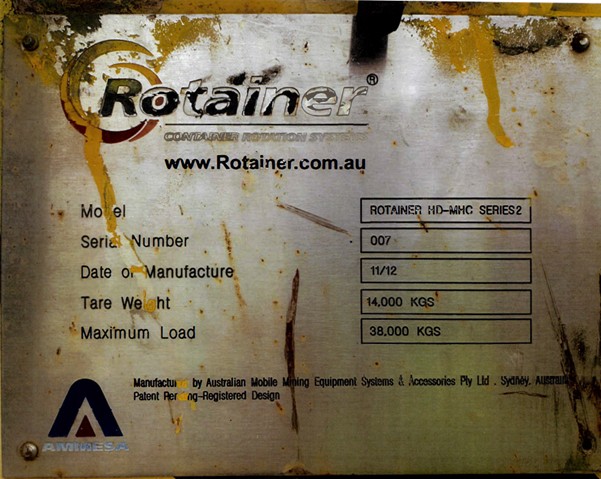
[267] | |
[273] | |
[290] | |
[295] | |
[297] | |
[298] | |
[298] | |
[300] | |
[303] | |
[309] | |
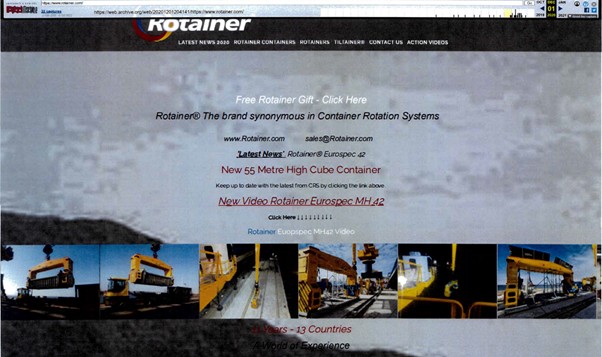
[312] | |
[315] | |
[318] | |
[326] | |
[330] | |
[333] | |
[340] | |
[347] | |
[357] | |
[363] | |
[385] | |
[392] | |
[401] | |
[406] | |
[410] | |
[413] | |
[413] | |
[417] | |
[418] | |
[419] | |
7.3.2 Mr Pinder’s inconsistent evidence on the purported descriptive meaning of “Rotainer” | [422] |
[424] | |
[427] | |
[428] | |
[428] | |
[432] | |
[439] | |
[446] | |
[455] | |
[455] | |
8.2 Good faith adoption of “rotainer” to describe the characteristic of the goods | [467] |
[481] | |
[489] | |
[490] | |
[494] | |
[494] | |
[502] | |
[504] | |
[506] | |
[507] | |
[507] | |
[510] | |
[515] | |
[524] | |
[528] | |
[534] | |
[551] | |
[554] | |
[559] | |
[573] | |
[574] |
ROFE J:
1. Introduction
1 This is a dispute regarding the mark “rotainer”, a portmanteau combining the terms “rotating” (or “rotatable” or “rotation”) and “container”, and its use in the containerised bulk handling (CBH) field in relation to rotating containers and transportation systems involving rotating containers.
2 On 29 June 2022, Container Rotations Systems Pty Ltd (CRS), a manufacturer in the CBH field, commenced proceedings against Intermodal Solutions (Group) Pty Ltd (ISG), Load and Move Pty Ltd (L&M) and Mr Garry Pinder (together, the Respondents), seeking a declaration that the Respondents have:
(a) infringed the Australian Trade Mark No. 1309643 (Registered Mark);
(b) contravened ss 18, 29(1)(a), 29(1)(g) and 29(1)(h) of Schedule 2 of the Competition and Consumer Act 2010 (Cth), being the Australian Consumer Law (ACL); and
(c) committed the tort of passing off.
3 CRS seeks further orders as follows:
(a) a permanent injunction restraining the Respondents from using any sign as a badge of origin that is substantially identical with or deceptively similar to the Registered Mark;
(b) pursuant to s 232(1) of the ACL, the Respondents be permanently restrained from representing that their goods have any consent, licence, approval, sponsorship or authority of CRS;
(c) pursuant to s 22 or 23 of the Federal Court of Australia Act 1976 (Cth) that the Respondents be restrained from passing off;
(d) an order that the Respondents deregister or transfer to CRS the domain name “www.rotainers.com” (Rotainers Website) and not register any other domain name which includes a sign which is substantially identical or deceptively similar to the Registered Mark; and
(e) an order that the Respondents deliver up for destruction all signs, cards, advertising material, packaging or other promotional material in the possession, custody or power or control of the Respondents, the continued use of which would offend any of the above injunctions.
4 CRS also sought orders as to damages. On 18 August 2022, I ordered that the proceeding be split as to liability and quantum. Accordingly, these reasons concern liability only.
5 ISG operates a competing business in the CBH field in Australia. ISG designs, manufactures and sells specialist containers for the mining, ship loading and agricultural sectors, including rotating containers and apparatus to rotate the containers. L&M is a subsidiary of, and nontrading intellectual property holding company for, ISG. Mr Pinder is the managing director of ISG, and one of its three (previously five) directors. Mr Pinder is also one of the three directors of L&M.
6 CRS contends that the alleged infringing conduct has occurred since at least 2016, through the use of the mark “rotainer” in emails, on ISG’s websites, initially at the domain names “www.pittoship.com” (Pit to Ship Website) and “www.pittoship.com.au”, later including the Rotainers Website and “www.rotainers.com.au” (Rotainers AU Website) (together, the Rotainers Websites) (altogether, the ISG Websites), and as part of product descriptions on the websites.
7 According to CRS, ISG incorporated the mark in misleading statements within the ISG Websites to divert customers who, when searching online for the Registered Mark, would instead be directed to ISG’s Websites. CRS contends that such customers, upon seeing the word “rotainer”, would perceive it as a badge of origin, associate it with CRS’s reputation, and proceed to make enquiries with ISG. The alleged conduct is said to have enabled ISG to attract customer inquiries for CBH equipment in direct competition with CRS. CRS alleges that this conduct was misleading or deceptive, or likely to be so, and involved the making of false representations in contravention of ss 18, 29(1)(a), 29(1)(g) and 29(1)(h) of the ACL.
8 CRS contends that although there are only two identified customers who have concluded transactions with ISG following enquiries through the ISG Websites, the contracts for sale to those customers were of significant value. Further, CRS submits that those two concluded transactions should not be seen as a full indication of all the enquiries ISG received from customers who were allegedly diverted to its websites (and away from CRS) as a result of the infringing conduct.
9 CRS also makes claims for contraventions of the same provisions of the ACL, deriving from representations made by ISG on the ISG Websites, including that:
(1) it provides a “rotainer container rotation system”, being a system provided by CRS or the same as that supplied by CRS under the trade mark “rotainer”, when it does not (Same System Representations); and
(2) the word “rotainer”:
(a) is and was generic and/or descriptive of apparatus for bulk handling equipment such equipment including:
(i) apparatus for tipping bulk goods and/or
(ii) containers for use in such apparatus;
(b) is not a brand name; and
(c) is interchangeable with and bears equivalent meaning to “tippler”.
(the Generic Representations).
10 CRS also alleged that L&M engaged in the infringing conduct and is directly liable, and that Mr Pinder is directly and indirectly liable for the infringing conduct. CRS no longer presses its claim as against L&M.
11 ISG contends that “rotainer” is, and has been since before 2015, widely used in the CBH industry as a shorthand description for rotating containers and/or rotating container transportation systems generally, and that at all relevant times, it has been entitled to use the word “rotainer” to indicate to its worldwide customers the very product it is selling. In that view, ISG submits that insofar as CRS contends that it has infringed on its Registered Mark under s 120(1) of the Trade Marks Act 1995 (Cth) (TMA), that argument must fail because its use of “rotainer” has not been “in relation to” container rotators. This is because ISG does not sell or provide customers with container rotators, and because any use has been in respect of a service relating to tipplers.
12 ISG denies the use of “rotainer” as a trade mark or “badge of origin”. Further, it contends that “rotainers” are not the same as, or of the same description as, any of the goods under the classes of the Registered Mark. If “rotainers” are held to be goods of the same description as any of the goods in respect of which the mark is registered, ISG relies on the proviso in s 120(2) of the TMA—i.e., using the word “rotainer” as ISG did is not likely to deceive or cause confusion—to contend that it should not be taken as to have infringed the Registered Mark. ISG also relies on the defence in s 122(1)(b) of the TMA—being, use in good faith to indicate the character of goods.
13 ISG also advances what it describes as a “largely defensive cross-claim”, which by the time of closing submissions was confined to seeking the cancellation of the Registered Mark—and the relevant goods asserted against ISG for infringement—pursuant to ss 41 and 88(2)(a) of the TMA. ISG alleges that the word “rotainer” was not capable of distinguishing containers, or goods of a similar description, from the goods of other persons within the meaning of s 41(3) of the TMA.
14 ISG did not press its cross-claim allegations of genericism (ss 24 and 87 of the TMA), misleading or deceptive conduct by CRS, or lack of intention to use or non-use of the word “rotainer” (ss 59, 88 and 92 of the TMA).
2. Registered Trade Mark
15 CRS is the owner of the Registered Mark, which has a priority date of 15 July 2009 (the Priority Date) and has been entered on the Register of Trade Marks since 1 March 2010. The Registered Mark is registered in respect of the following goods (the Registered Goods), all of which constitute class 7 goods:
Machines and machine tools; motors and engines (except for land vehicles); machine coupling and transmission components (except for land vehicles); industrial and mining implements and machinery (other than hand-operated); apparatus and equipment for lifting and transportation; machines, apparatus and installations for conveying goods; machines, apparatus and installations for loading or unloading containers, for loading goods into containers or for unloading goods from containers; apparatus and equipment for use in mining; haulage equipment and apparatus (mining); tools for mining machines and equipment; cranes; apparatus for loading or unloading cargo; cargo handling apparatus and machines; transportation conveyors; pumps; pumping systems; control mechanisms for pumps; hydraulic controls for pumps; pump diaphragms; and parts, fittings and accessories in this class for any of the aforementioned goods,
(Emphasis added.)
16 The goods underlined above are those upon which CRS does not rely for its allegations under s 120 of the TMA. The goods boldened are those upon which CRS relies for its allegations under s 120(1) (Asserted Same Registered Goods). The remaining goods—shown in ordinary script—are the goods relied upon by CRS for its allegations under ss 120(1) and (2) (Asserted Registered Goods).
17 In considering the scope of goods covered by the Registered Mark, ISG highlights that the Registered Goods do not expressly include “containers”, which fall within class 6 goods.
3. Background
18 Rotating or rotatable containers are used in the CBH industry for the transportation of dry bulk materials such as copper, iron ore, coal, grain and mineral sands. They are specifically designed to be rotated with a tippler (also referred to in the evidence as a “rotating spreader” or “container rotator”), for unloading the bulk material into a ship’s hold or other storage area. Rotating container systems are used in industries carried out by businesses around the world, including the mining, agricultural and transportation industries.
19 A tippler is a device for lifting and rotating the rotating container. The use of the rotating container with a tippler is a feature that distinguishes the rotating container from an ordinary shipping container. I discuss rotating containers and tipplers in more detail below.
3.1 CRS and related companies
20 CRS is a manufacturer in the CBH industry. CRS has been trading since around early 2014, as the successor of Australian Mobile Mining Equipment Systems and Accessories Pty Limited (AMMESA), which was incorporated in 1991. AMMESA was involved in the sale and supply of heavy-duty equipment and machinery and in the provision of manufacturing and maintenance services in relation to such equipment. The business of manufacturing and supplying machines, equipment and accessories for CBH was conducted through AMMESA from April 2009 until around late 2013.
21 CRS was incorporated in December 2011. Since then, Murray Bridle has been the director responsible for, and having control over, its operations. A dispute between the directors of AMMESA arose around late 2013. At around that time, CRS became involved in the field as a manufacturer and supplier of machines, equipment (including containers and parts) and accessories for CBH. Since that time and up until March 2022, the business was conducted through CRS with AMMESA holding and authorising the use of trade marks, including the Registered Mark. Mr Bridle has been, both during that time and at present, a director of both CRS and AMMESA. Mr Bridle has control over all aspects of the business conducted by those entities.
22 From approximately June 2009, AMMESA, and since at least March 2014, CRS, has used the Registered Mark in connection with the CBH equipment manufactured and supplied by it, including on tipplers, containers and other equipment, company vehicles, premises, documentation and its websites. AMMESA filed the application for the Registered Mark on 15 July 2009. The Registered Goods were the goods that Mr Bridle considered were part of a complete CBH system as AMMESA was intending to supply or to be able to supply at the time.
23 On 7 March 2022, AMMESA assigned its rights, including goodwill, in the trade marks, including the Registered Mark, to CRS by written assignment. A further written assignment dated 7 April 2022 confirmed that the goodwill in the Registered Mark was included in the assignment. The assignment was lodged with IP Australia occurred on 7 March 2022, and since 15 March 2022, CRS has been listed as the registered owner.
24 CRS has supplied a small volume of rotating containers using the marks “Rotorcon”, “Multibulker” and “Maxitainer”. CRS is the owner of Australian Trade Mark No. 1412633 for “Rotorcon”, which unlike the Registered Mark, is registered in class 6 in respect of various container-type goods.
25 In conducting its business and marketing its products, CRS has used the sign “Rotainer” in a variety of ways. These include use in plain text, as part of the domain names “www.rotainer.com.au” (Rotainer AU Website) and “www.rotainer.com” (together, the Rotainer Websites), and in stylised form including a stylised swirl as depicted below (the Rotainer Logo):

26 The first tippler manufactured by AMMESA was delivered to Flinders Ports and commissioned at the DP World Adelaide Terminal in December 2010. This tippler had affixed to it the Registered Mark. The sale of tipplers and accessories for them forms a large portion of CRS’s total revenue in Australia, and CRS is one of the three leading suppliers of tipplers in Australia.
3.2 ISG and related companies
27 Since about 2013, ISG has traded as “ISG”, “Intermodal Solutions Group”, and “Pit to Ship Solutions”, including under the logo owned and used by ISG, which depicts a rotating container (the ISG Logo):

28 The ISG Logo contains a visual depiction of a tippler tipping a rotatable container and the words “ISG Pit to Ship Solutions” beneath it, with “Pit to Ship Solutions” being in tiny and barely readable font.
29 The operations of ISG are described as providing “Pit to Ship Solutions” in the mining and agricultural grain sectors, i.e., covering the handling of bulk materials from the pit to the loading of the material onto ships for transportation.
30 ISG was incorporated on 12 July 2005, originally established to facilitate a sale for the related company, Intermodal Solutions (IS). IS designed, manufactured and supplied a range of shipping containers for rail, road and sea. Since September 2013, ISG has been involved in the manufacture, promotion and/or sale of CBH equipment, including rotatable containers designed for use with tipplers, and spare parts and accessories including lid lifters. ISG’s rotatable containers come in various forms suited for different purposes. For example, ISG has rotatable containers for fertiliser, grain, iron ore and salt. ISG also has a range of non-rotatable containers. However, unlike CRS, ISG does not manufacture or sell tipplers themselves.
31 Rotating containers account for around 70% of ISG’s overall business and sales. Approximately 80% of ISG’s sales of containers are to customers outside Australia, including to countries such as Argentina, Bahrain, Bolivia, Brunei, Canada, Chile, Congo, Cuba, India, Mexico, Mozambique, Peru, South Africa, Turkey, the United Arab Emirates and the United States of America.
32 ISG’s containers are all manufactured by China International Marine Containers (Group) Co Ltd (CIMC) in China, wherefrom they are exported and delivered, either to Australia first or directly to ISG’s overseas customers. ISG notes that, for the 80% of ISG rotating container sales made outside Australia, these never enter Australia. ISG contends that this ought to have a bearing on the alleged unauthorised use of CRS’s Registered Mark.
33 As I have stated above, L&M is a wholly owned subsidiary of, and the non-trading intellectual property holding company for, ISG. L&M owns various intellectual property, including patents and patent applications relating to the lid-lifting mechanisms for use with a rotating spreader and containers adapted for use with such spreaders, lifting apertures for attachment to the spreader, and reinforced corner cast designs. L&M is also the owner of various registered trade marks which appear on the ISG Websites. ISG pays a licence fee to L&M in respect of these patents and applications.
3.2.1 ISG and RAM
34 Ram-Smag Lifting Technologies (RAM) is a Singaporean shipping company which supplies cranes and tipplers under the brand name, “RAM Revolvers”. Until it was amended during the proceeding in 2023, Mr Pinder’s LinkedIn profile promoted ISG (Pit to Ship solutions) as supplying a logistic, storage and ship loading system, “[u]sing ISG containers & RAM Revolver tipplers”. ISG was also described as “the agent for RAM SPREADERS and licence their patented lid-lifted system to RAM for their container tipplers”.
35 ISG’s Pit to Ship Website displayed a picture of a RAM spreader and, at least from 31 December 2014 to 29 September 2020, stated:
Our designs are tippler friendly and we work in [sic] closely with RAM spreaders on a global basis. RAM spreaders supply the tippler, trade named the Revolver because of the fast turning [sic] action.
36 Similar statements were in evidence in a brochure produced by ISG, which described ISG and RAM as “two international companies [that] have combined their expertise to provide an environmentally sustainable pit to ship mining and grain solution” with ISG licensing its patented lid lifter to RAM Spreaders. Another undated brochure from Pit to Ship Solutions stated that “[t]wo international companies have combined their expertise to provide an environmentally sustainable pit to ship mining solution”. The “two international companies” referred to ISG and RAM Spreaders. RAM Spreaders are the manufacturer of the RAM Revolver “containerised bulk handling” The RAM Spreaders logo, website and address were also included on the brochure. The ISG products that were for use with the RAM Spreaders were called “containers” and spreaders were pictured under the heading “RAM REVOLVERS”. Throughout the ISG Pit to Ship Solutions brochures, the spreaders are referred to as “Revolver” or “revolver”. An undated Pit to Ship Solutions brochure is pictured below.

37 Mr Pinder denied ISG having ever been an agent for RAM, and that any description to that effect, including a statement to that effect on his 2023 LinkedIn page, was incorrect. However, Mr Pinder gave evidence that the two companies “have a handshake agreement” whereby ISG refers customers needing tipplers to RAM as its preferred supplier. He also accepted that in some very rare cases, ISG did provide quotations on behalf of RAM and agreed that RAM was an obvious commercial partner for ISG.
3.3 The relationship between ISG and CRS
38 ISG and CRS are commercial rivals in the CBH field. The parties have been competing since around May 2011, when IS (subsequently ISG) competed with AMMESA (subsequently CRS) in a tender process to provide containers for a project for OZ Minerals. Since then, the parties have participated in competitive tender processes on numerous occasions.
39 The parties first appear to have come into contact when Matthew Chalmers of ISG was introduced to Mr Bridle on or about 7 January 2011. ISG and CRS (or their related companies) have been involved in two earlier proceedings—a preliminary discovery application in 2016, and a patent opposition in 2017.
40 Mr Pinder gave evidence that there are only four buzz words in the industry. For the purposes of marketing and attracting customers, the availability of buzz words was regarded as “pretty slim pickings”. Each of ISG and CRS had two of the buzz words registered to them:
(a) Containerised bulk handling (registered to ISG/L&M);
(b) Container rotation systems (registered, in capitalised form, to CRS);
(c) Pit to Ship Solutions (registered to ISG/L&M); and
(d) Rotainer (registered to CRS).
41 Both parties use the initials or name of the other on their websites to attract customers. By way of example, as of 28 August 2016 and 28 August 2018, the ISG Websites were updated to add “(CRS)” at the end of “container rotation systems” in the headline at the top of the webpage, adjacent to the ISG Logo. Similarly, Mr Bridle conceded that he had caused “ISG” (and other terms referable to other competitors, such as “RAM Revolver”) to appear in the code of certain pages on CRS’s website at points in time, with the objective to have the website appear in the results of internet searches conducted using those keywords. Mr Bridle gave evidence that he considered this to be a legitimate objective and a practice of other competitors in the field.
3.4 Critical dates
42 There are several critical dates which demarcate time periods relevant to the matters in dispute in this proceeding, which I consider in more detail below:
(a) 1980s: first known use of tipplers in the evidence, in South Africa, according to Mr Pinder;
(b) 1991: first use of the word “rotainer”. The evidence showed the sign affixed to the top beam of a tippler at Swansea Container Terminal (SCT) in Wales, United Kingdom (UK), with the word used descriptively by Margaret Llewellyn to refer to the rotating container system. Mr Pinder first became aware of this usage in 2016;
(c) 15 July 2009: the Priority Date on which AMMESA applied for registration of the Registered Mark;
(d) December 2010: AMMESA supplies the first tippler it manufactured (the first of its design used and installed in Australia for use with iron ore) to Flinders Ports in Adelaide, which received substantial publicity in the CBH industry;
(e) August 2016: ISG posted a statement on the Pit to Ship Website which contained the word “rotainer” (the Generic Tippler Statement) on its Pit to Ship Website. ISG thereafter began using the word “rotainer” elsewhere on the ISG Websites and in other communications;
(f) Early 2021: ISG posted a statement on its Pit to Ship Website, conveying that “[c]ustomers have now come to use the generic word “rotainers” to describe the [rotatable] containers that are used with the tipplers to unload their bulk cargo. This has evolved to customers now asking for rotainers instead of containers making the word a “dual meaning”” (the Generic Container Statement).
43 Whilst tipplers had therefore been in use since the 1980s, for at least 20 years before the Priority Date, there was no documentary evidence of any published use of the word “rotainers” to refer to tipplers or rotatable containers, whether in Australia or elsewhere.
3.5 Earlier litigation involving CRS and ISG
44 As I have indicated, the parties in this proceeding have been parties to earlier litigation related to the current dispute. The below proceedings form part of the surrounding circumstances that characterise the relationship between the parties.
3.5.1 Patent preliminary discovery application
45 In Load and Move Pty Ltd v Container Rotation Systems Pty Ltd (2016) 341 ALR 458, L&M unsuccessfully sought preliminary discovery from CRS and AMMESA to ascertain whether it had grounds to bring proceedings against them for patent infringement.
46 In the preliminary discovery proceedings (L&M Proceedings), L&M contended that it reasonably believed that it may have the right to obtain relief in the Court from CRS or AMMESA in respect of infringement of its patents for “equipment known as spreaders or tipplers”. L&M argued that it believed that infringement arose from CRS’s and AMMESA’s manufacture of containers in the same factory in China used by ISG. It was alleged that those containers used the same technology as those claimed in the L&M patents and were sold and supplied directly to a mine in Eritrea. Justice Rares dismissed the application for preliminary discovery, finding that it was not reasonable for L&M to believe that it could seek relief for patent infringement based on a contract of sale, where the sale in question occurred overseas and the goods never entered Australia, or the relevant patent area.
47 Mr Chalmers is the general manager of ISG and its associated group companies, including L&M. Mr Chalmers swore four affidavits in the L&M Proceedings. One of those affidavits, dated 18 December 2015, was tendered by CRS in the present proceedings. Throughout his affidavit, Mr Chalmers referred to containers that could be used with a rotating spreader as “containers”, including in recounting his conversation with Mr Jans Vasquez and Mr Murari about the potential supply of ISG Containers. Mr Chalmers also included extracts from three L&M patents. In each of the extracts, the term “container” was used.
48 Mr Chalmers used the word “container” to describe ISG’s open top containers, which he defined as “ISG Containers”:
[17] The ISG Containers are designed to be handled by machines called rotating spreaders (also known as tipplers), which themselves are generally attached to cranes. The rotating spreader serves to pivot or tip the ISG Containers so as to discharge their contents into the desired location.
(Emphasis added.)
49 Mr Chalmers used the word “rotainer” in his affidavit in the context of CRS, acknowledging the word as CRS’s brand name for its rotating spreaders:
[41] CRS is a competitor of ISG's which supplies both containers and rotating spreaders. CRS currently uses the name Rotainer as a brand name for its rotating spreaders, although it has in the past operated its business under that name.
(Emphasis added.)
50 Mr Pinder accepted that Mr Chalmers’ description was an accurate description as at late 2015.
51 Mr Chalmers also deposed in his affidavit that he had (as of 18 December 2015) reviewed the website “www.containerrotationsystems.com” (CRS Website) (which he noted previously had the domain name of the Rotainer AU Website) at least once a month since 2011.
52 While Mr Pinder denied that he kept a close eye on CRS or the performance of the CRS Website, email exchanges between ISG staff suggest that the relative performance of the CRS Website in keyword searches was of continued interest to ISG and to Mr Pinder. In an email chain dated 27 October 2020 between Mr Chalmers, Mr Pinder and Julie Boden, after the Pit to Ship Website secured a favourable position in search results for “Rotainer”, Mr Chalmers stated that it “won’t be long” and circulated a reference to CRS announcing that its Rotainer Website was “up and running”. CRS submits that this indicates ISG was concerned about maintaining the search result position of the ISG Websites and was keeping a close eye on the CRS Website.
53 Mr Pinder’s evidence was that the L&M’s patents related to the lifting lid attachments for containers adapted for use with tipplers, among other things, but not for tipplers themselves.
54 Mr Pinder in cross-examination stated that although he did not attend the hearing of the L&M Proceedings, he read the reasons for judgment of Rares J around 27 July 2016. He accepted that around this time he was concerned that CRS was infringing L&M’s intellectual property, which made him “annoyed” with CRS. This was shortly before Mr Pinder posted the Generic Tippler Statement on the Pit to Ship Website in August 2016 and around the time when ISG began using the word “rotainer” on the ISG Websites.
3.5.2 Opposition to patent application by CRS
55 Load and Move Pty Ltd v Australian Mobile Mining Equipment Systems and Accessories Pty Ltd (2017) 131 IPR 202 (Patent Opposition Decision) was a decision by the Australian Patent Office, in which L&M opposed a Patent Application No. 2012253221 (Patent Application) made by AMMESA. The Patent Application pertained to a design for a bulk cargo container particularly suitable for use with tipplers, including AMMESA’s Rotainer system.
56 On 18 May 2017, Delegate Guinea decided that claims 1– 6 and 9 –11 in the Patent Application lacked novelty and claims 1–5 and 9–11 lacked inventive step. L&M’s opposition was therefore successful in respect of those claims. At [227]–[228] of the Patent Opposition Decision, Delegate Guinea makes clear reference to AMMESA’s “Rotainer system” as being a container-handling apparatus and a type of tippler, with the Patent Application itself referring to the “Rotainer system” with the “®” symbol indicating “Rotainer” was a registered trade mark. Reference to “rotainer” being a tippler was made in the evidence L&M filed in support of its opposition, including in a statutory declaration of a Mr Reid dated 29 February 2016.
57 CRS relied on the L&M Proceedings and the Patent Opposition Decision to:
(a) undermine Mr Pinder’s assertion that CRS’s use of “rotainer” did not factor into his mind when he published the Generic Tippler Statement; and
(b) establish that, at the time Mr Pinder posted the Generic Tippler Statement in August 2016, one of his motivations was to infringe on CRS’s trade mark rights and dilute the goodwill in the sign “rotainer”, while diverting trade.
3.6 Container bulk handling industry
58 The CBH field forms part of a wider industry concerning materials, goods, cargo handling, storage and shipping. CBH equipment can be used as an efficient and effective option for the storage, transport and shipping of dry bulk materials, such as grain, minerals and ore, especially when dust emissions need to be controlled. CBH equipment has been in operation in South Africa since around the mid-1980s. Bulk materials and goods can be handled, stored and shipped in several ways other than using a container system, but it is the CBH field that is relevant in this case.
59 CRS and ISG are competitors in the market for CBH equipment. Mr Bridle deposed in his affidavit:
Commencing in at least May 2011, ISG has been in competition with AMMESA (and subsequently CRS) in relation to the sale or supply of CBH machinery, equipment, and systems industry in Australia and in other countries. Since that time, AMMESA/CRS and ISG have provided quotes or pricing to customers or potential customers in competition with one another for a number of supply contracts for CBH equipment and systems in Australia and other countries […]
The first instance of competition between AMMESA and ISG is when both AMMESA and ISG competed for the supply of containers to OZ Minerals in 2011. Other examples where AMMESA or CRS and ISG have been seeking to obtain a supply contract to supply CBH equipment to the same customer or potential customer are to Ironclad Mining in Australia in 2012, to the Antofagasta Port in Chile in 2015, and to the Lynas Corporation in Australia in 2020.
60 Mr Bridle’s evidence was that a container rotator system has three main components—excluding the crane and supporting mechanism: the tippler or container rotator; the lid lifting attachment; and the container. These are typically sought by customers as a system and required together.
61 Components of CBH systems made by different manufacturers are competing systems with different design features and are not generally interchangeable. Mr Bridle also emphasised that in standard shipping containers, it is the floor, and not the walls, that are designed to take the weight and load of the materials inside it. Rotatable containers are specially designed with reinforced walls that can withstand the force created whilst the container is being rotated or tipped. Below are examples of a CRS Rotainer lifting a container with dry bulk material:
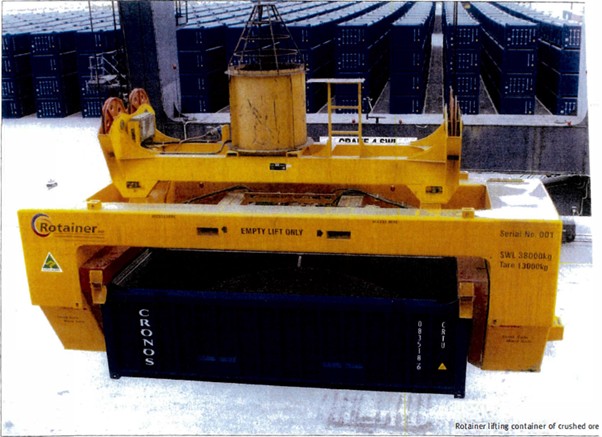
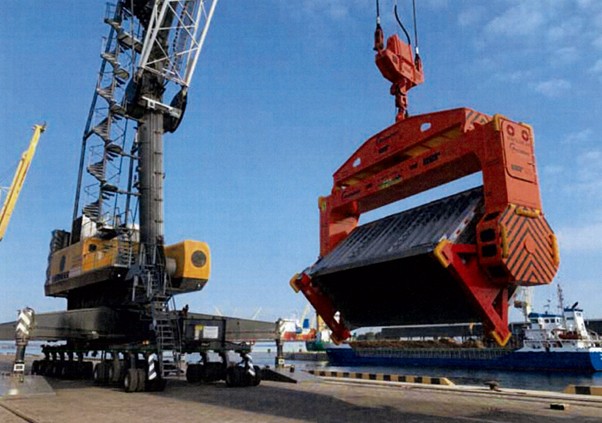
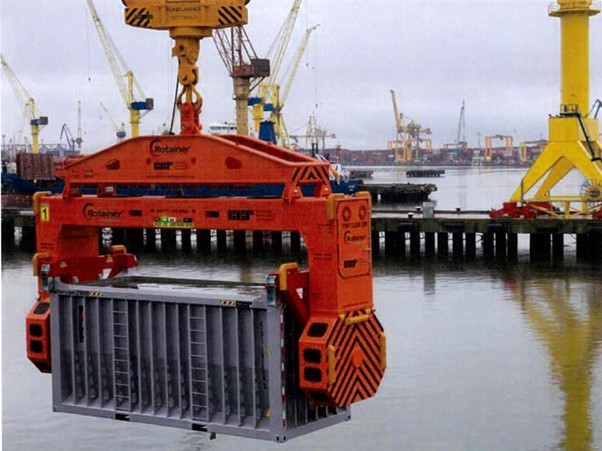
62 CRS contends that the terminology used in the CBH industry to describe an article for holding bulk material to be tipped or rotated by a container rotator is “container”. Other alternative words include “box”, “bulk container”, “bulk box”, “bulk”, “dry bulk”, “half-heights”, “three-quarter heights”, “high cubes” or “open tops”.
63 Moving bulk materials in this way involves the use of a type of machine referred to as a “tippler”. A tippler is a heavy-duty machine able to pick up and rotate a container holding dry bulk materials (such as iron ore or mineral concentrates) by “tipping” the container, to empty the dry materials from the container into the hold of the ship. Tipplers are also referred to as “spreaders” or “tipping adaptors” because they are used to tip and spread the contents of bulk containers in a hold or storage area. This equipment can also be referred to as a “container rotator”.
64 The process of using a rotatable container typically begins at a load site such as a mine, where the dry bulk material is loaded into the container. Once filled, the container is loaded onto a train or truck for dispatch to a port or other site. There, the container is lifted using a crane, which is affixed with the tippler, and moved directly above the ship’s hold or other storage area. The tippler has locking mechanisms which hold the rotatable container in place. Once in the required position, the rotatable container is then rotated so that its contents fall into the ship’s hold or other storage area.
65 Container rotation systems are expensive, with tipplers costing on average between $450,000 and $750,000. Rotatable containers themselves can cost, on Mr Bridle’s evidence, $8,000 each at the upper end of the range. ISG submits that customers typically purchase containers in bulk, in one full ship load or around 450 containers, estimating at $3–3.5 million. CRS contested this; Mr Bridle’s evidence was that some customers “just buy 10 because they load directly from the wharf”, suggesting that the amount of container sold varies. ISG submits that nonetheless, it is generally not cost-effective to use container rotation systems for low value, high volume products.
66 ISG gave evidence that each of its rotatable containers has a 20-year lifetime.
67 The parties agreed that it can take up to six months from customer inquiry to the purchase of a container rotation system, and potentially years until delivery of the products. The ultimate supply of the specialised transportation equipment is tailored closely to customers’ needs and the needs of a particular project for which the CBH equipment is required, including adaptations to the design of equipment.
68 Mr Pinder gave evidence as to the protracted purchase process, involving a series of discussions with customers and their logistics partners regarding their requirements and the options ISG can provide. The requisite CBH equipment crystallises as the parameters of a project are refined. There is then a competitive tendering process initiated by the customer detailing technical and commercial requirements. Mr Pinder’s evidence is that if ISG is selected after its tender response is proposed and any review process is finalised, the parties will then negotiate contractual terms to finalise the sale. These terms include terms stipulating warranties, quality assurance and shipping arrangements.
69 By way of example, Andrew Fitzgerald gave evidence of the long and complex process undertaken when OZ Minerals—a customer with sophisticated technical knowledge of the mineral resources field—acquired a “rotainer” tippler from AMMESA in mid-2011.
70 Rotatable containers, tipplers and attachments are not fast-moving consumer goods.
3.7 Suppliers of container rotators/tipplers
71 The parties accepted that the container rotation system market is small, with four suppliers of container rotation equipment globally. As of 2016, only three of those four suppliers supplied tipplers under three prominent brands:
(a) Qube—Rotabox;
(b) RAM—Revolver; and
(c) CRS—Rotainer.
72 The only two suppliers of tipplers in Australia are RAM and CRS. Qube also manufactures tipplers and containers for its own use and purposes, but not for sale to third parties in the commercial market.
73 ISG is one of the largest suppliers of rotatable containers for the mining, ship-loading and grain industries in the world. However, it does not itself manufacture or supply tipplers. ISG has a close commercial relationship with RAM, and at times has promoted its containers in conjunction with RAM Revolver tipplers.
74 Other participants in the CBH industry include engineering firms or manufacturers Doric Engineering, ZPMC, Sino Peak, Shanghai Metal Industries, Singamas and CIMC, as well as other manufacturers or suppliers of containers including Hero and Seaco Global (formerly Cronos).
3.8 Pre-Priority Date use of “rotainer”
75 The evidence from both parties was that tipplers have been in use since the mid-1980s, first in South Africa, and then in other places including Los Angeles and Geelong.
76 Early use of tipplers in Australia occurred in 1987, when a “ROCON” unit was installed at the Port of Geelong. The advertiser article about this event refers to the tippler as a “rotating spreader” for use with “standard open top containers”.
77 From the early 1990’s to around 2007, the word “rotainer” was used by the SCT and its employees at the Port of Swansea, Kings Dock in Wales, in respect of a system involving rotating containers and rotating spreaders for the transportation of coal from Wales to Ireland.
78 There was no documentary evidence of the published use of the word “rotainer” before the Priority Date in July 2009, either to refer to tipplers or to containers. The only evidence given of any use of the word “rotainer” anywhere before 2009 was that of Ms Llewellyn as to the use at the SCT. However, there was no evidence of any use of the word “rotainer” in Australia before the Priority Date.
79 ISG submitted that container rotation systems only became well-known and widely used since around 2011, and that use of the term “rotainer” increased exponentially since then. This reflected the evidence of Mr Pinder who said that he regularly heard the word “rotainer” being used at various Australian ports since 2011. ISG’s submission further aligned with the evidence of Mr Bridle, who agreed that container rotation systems have become well-known and used since approximately 2011 and of Mirel Rusu, who deposed that he first learnt about container rotation systems in about 2012. Greg Solly’s evidence that he first heard of the word “rotainer” in 2011 also supported ISG’s submission.
3.9 AMMESA’s use of the Registered Mark
80 The Rotainer Logo, domain name and plain text version of the Registered Mark have been displayed by AMMESA on goods it supplied, including on: tipplers; containers; parts and accessories; the Rotainer AU Website; advertisements published in industry journal articles and magazines; its product brochures and flyers promoting its equipment; the exterior of the AMMESA offices, the entry doors to the building and doormats at the entry; on utility vehicles, vans, coverings to tipplers during transport and truck sidings; on boxes containing accessories, packing tape sealing the boxes and on wrapping around pallets; expo banners, newsletters, letterhead and invoices to customers.
81 In about mid to late 2009, AMMESA registered the domain name “www.rotainer.com.au” and established the Rotainer AU Website for the purpose of marketing and promoting CBH systems and equipment under and by reference to the Registered Mark. Mr Bridle’s evidence was that the AMMESA website was operated separately to the Rotainer AU Website, but it contained links to the latter website. The Rotainer AU Website which featured the Rotainer Logo, was first made available to the public in early 2010. A Wayback Machine printout of the home page of the Rotainer AU Website from November 2010 shows the Rotainer Logo at the top left of the page (marked ®) and an image of a Rotainer branded tippler on the right.
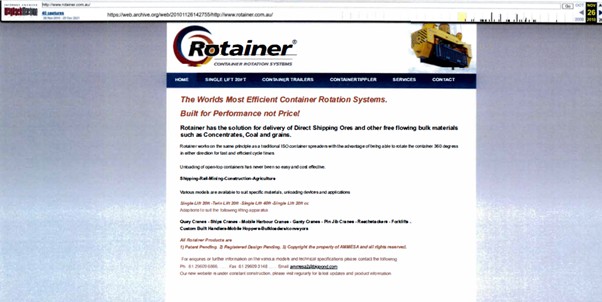
82 The Registered Mark was also used on YouTube video titles on the account maintained by AMMESA (and subsequently CRS) under the handles @rotainer and @rotainers.
83 The first tippler supplied by AMMESA was supplied to Flinders Ports and commissioned at the DP World Adelaide Terminal in December 2010. The tippler was branded with a form of the Rotainer mark which had the “Ro” inside a c-shaped swirl (Rotainer Logo). The swirl was a distinctive mark used by CRS on its other products such as Rotorcon. The Registered Mark, together with the Rotainer AU Website, also appeared on the manufacturer’s plate, which Mr Bridle deposed was equivalent to the example below.
84 This installation of the “Rotainer” branded tippler (Rotainer Tippler) attracted attention in the CBH industry with references to the tippler supplied by AMMESA as a “Rotainer” and “Rotainer System”.
85 Reports of the Rotainer Tippler installed at Port Adelaide appeared in numerous publications, some of which contained pictures of the tippler. These reports were annexed to the affidavit evidence of Mr Bridle and included:
(a) Adelaide Now (The Advertiser) article dated December 2010;
(b) IMX Resources press release dated December 2010;
(c) the cover of Australian Journal of Mining dated January–February 2011 (which appears to erroneously be dated 2010 on the front page, despite making references to the events of December 2010, and recording dates in 2011 later in the article) with a feature article titled, “Rotainer allows container ports to handle bulk”;
(d) Flinders Logistics media release dated 10 March 2011;
(e) Australian Bulk Handling Review articles dated January–February 2011 and May–June 2011;
(f) Australia’s Mining Monthly article dated January 2011;
(g) The Australian Mining Review article dated March 2011;
(h) Logistics Magazine (www.mhdsupplychain.com.au) article dated 8 March 2011;
(i) Proactive Investor article dated 19 October 2011 describing a “rotainer system” at Port Adelaide, though without reference to the AMMESA/CRS brand;
(j) OZ Minerals Sustainability Report dated 2011 which refers to the use of a “rotainer system” at Port Adelaide;
(k) ATN newsletter article titled, “Mining-specific container a first” and dated 12 December 2011;
(l) Australian Journal of Mining article dated January–February 2012;
(m) Dry Cargo International article dated February 2012;
(n) International Copper Association Australia webpage dated June 2012;
(o) Australian Journal of Mining article dated May–June 2013 on “AMMESA’s Rotainer container tipplers”; and
(p) Adelaide Now (The Advertiser) report dated February 2015.
86 Other published articles, magazines or newspapers with information or advertisements generally about AMMESA or CRS’s Rotainer Tipplers and referring to them as “rotainers”—often with pictures and at times with ®—include:
(a) Lloyd’s list DCN article dated September 2011;
(b) Nevsun Resources Press release dated June 2012;
(c) Terex-Gottwald brochure dated October 2013;
(d) Kin Communications article dated October 2013;
(e) Australian Bulk Handling Review article dated January–February 2014;
(f) E&MJ article dated September 2014;
(g) Australian Bulk Handling Review issues: March–April 2014, January–February 2015, March–April 2015, May–June 2015, July–August 2015, September–October 2015, November–December 2015, March–April 2016, May–June 2016, March–April 2018, May–June 2018;
(h) Dry Cargo International issues: July 2018, August 2018, November 2018, February 2019, March 2019, April 2019, May 2019, June 2019, October 2019, November 2019, January 2020, February 2020, March 2020, April 2020, May 2020, July 2020, September 2020, November 2020, February 2021, June 2021, July 2021, August 2021, September 2021, October 2021, November 2021, January 2022, February 2022, March 2022, April 2022, May 2022, June 2022, July 2022, August 2022;
(i) Dry Cargo Handling Directory issues 2019 and 2020;
(j) Australian Mining article dated March 2019;
(k) World Cargo News issues September 2019, January 2020, May 2020, October 2020 and November 2020;
(l) TLC Logistics article dated October 2019 (which appeared to erroneously refer to CRS as an “Austrian company”) October 2019; and
(m) Australia’s Mining Monthly issues May 2022 and July 2022.
87 In 2011, AMMESA supplied a further four Rotainer Tipplers which featured the Registered Mark, two of which were supplied in Australia to Flinders Ports in December 2011.
88 Between 2012 and 2015, AMMESA/CRS supplied five Rotainer Tipplers, each of which featured the Registered Mark, to destinations in Australia including:
(a) one tippler to Townsville Bulk Storage and Handling in August 2012; and
(b) one further tippler supplied to Flinders Ports in August 2013.
89 Since 2016, AMMESA/CRS has supplied a further 18 Rotainer Tipplers, each of which was branded with the Registered Mark. Five of these branded Rotainer Tipplers were supplied in Australia, including:
(a) one tippler to Wards in June 2018;
(b) two tipplers to Townsville Marine Logistics in August 2019;
(c) one tippler to Aurizon in February 2022; and
(d) one tippler to Tronox in May 2022.
90 The sale price of the AMMESA/CRS Rotainer Tipplers has varied from $450,000 to $750,000, with an average cost exceeding $550,000, excluding accessories, spare parts and items other than the tippler itself. Mr Bridle’s evidence is that most of CRS’s business in Australia has involved sales of tipplers and accessories, with the tipplers being the “big ticket item” within the container rotation system provided by CRS.
3.10 CRS adoption and use of the Registered Mark
91 CRS has used the Registered Mark since at least March 2014, under the licence or authority of AMMESA. Since 7 March 2022, CRS has been the owner of the Registered Mark, which it received by way of assignment from AMMESA.
92 In October 2013, CRS acquired the domains located at the CRS Website and “www.containerrotationsystems.com.au”. Mr Bridle deposed that while the “.com” domain housed the CRS Website, he did not establish a website at the “.com.au” domain and simply purchased it to prevent misuse by others. From early 2014, the Rotainer AU Website redirected to the CRS Website. CRS used both the Registered Mark and the Rotainer Logo on the CRS Website.
93 In February 2017, CRS obtained the domain located at www.rotainer.com which was priorly unavailable as it was registered in the name of a third party. Since around October 2020, CRS has used the “www.rotainer.com” (Rotainer Website) domain as the home of the Rotainer Website, used to promote CRS, and the systems and equipment of CRS including “rotainer” branded tipplers. A Wayback Machine printout of the 2020 version of the homepage of the Rotainer Website is below.
94 CRS has maintained the use of the Registered Mark on its goods and products, in the way described above regarding AMMESA’s use. In addition to those uses, CRS also operates two vehicles purchased in 2016 and 2021 which are used for on-site servicing, deliveries and domestic travel. The Registered Mark features prominently on these vehicles. Further, AMMESA since approximately 2010, and CRS since 2014, have promoted the Rotainer brand via “Rotainer” branded corporate “merchandise” used by CRS personnel and distributed to its customers or potential customers. This merchandise has included coffee cups, baseball caps, shirts and vests, key rings, cork screws, pens, USB sticks, soccer balls, notebooks, mats, banners, bags and stubby holders.
95 As I indicated above, CRS has also maintained the YouTube accounts under the handles @rotainer and @rotainers and has uploaded promotional videos to those accounts since November 2011 in relation to its CBH equipment.
96 Mr Bridle and other CRS representatives have attended trade events internationally. CRS has also exhibited at Australian events, including AIMEX in Sydney in 2013, where it displayed trade stand banners featuring the Rotainer brand. Mr Bridle’s evidence was that thousands of interested industry participants attended these events, and that either Mr Bridle or other CRS staff spoke to attendees, to whom they handed out promotional brochures, merchandise and advertising materials bearing the Registered Mark.
3.11 Impugned Conduct of ISG
97 CRS alleges that ISG used the ISG Websites, being the Pit to Ship Website and the Rotainers Websites, to attract customer inquiries for the purchase of CBH equipment.
98 CRS asserts that the term “rotainers” was presented on the ISG Websites to boost search engine rankings, drive traffic from searches for “rotainer”, and attract inquiries from customers seeking CBH equipment. ISG does not dispute this; Mr Pinder accepted that around 30% of ISG’s business was generated from customer inquiries through the ISG Websites.
99 Mr Pinder accepted that it was his decision to add the word “rotainers” to the ISG Websites. The evidence shows that the word “rotainer” was used very prevalently and intentionally on the ISG Websites, including as the domain name for the Rotainers Website, which differed from CRS’s domains only by the addition of the letter “s”. I discuss this evidence in more detail below.
3.11.1 ISG’s keyword strategy
100 Since September 2013, ISG has used a third-party contractor, Click Click Media, to maintain and update its ISG Websites.
101 In May 2017, Mr Pinder was part of the decision to select the words “containerised bulk handling”, “pit to ship”, “rotainer” and “container rotation systems” as key words for ISG’s Google advertising. On 3 May 2017, Ms Boden (Chief Financial Officer at ISG), sent an email to Click Click Media with the subject line “ISG campaign”. In that correspondence, Ms Boden stated:
We are going to continue the campaign as it is with the same spend […]
[…]
As we discussed the main focus for us is on the following three […]
[…]
Containerised bulk handling (we own this name)
We have this as a registered business name of Intermodal Solutions Group. Same ABN as us.
Container rotation systems (we are a maker of this system and its on our home page)
Our competitor comes up when this is searched with his Map add showing his location and contact details. His company is called Container Rotation Systems but it is also a generic name for our system.
Pit to ship Solutions (our name)
We are currently trying to trade name this but it’s very generic so they are fighting it.
For us we would like someone to search these and come up with our company Map add.
If not the add then we want to be ranked higher. Richard has been trying to achieve this. Today we are running 4th.
102 In a follow-up email dated 4 May 2017, Ms Boden clarified, “[f]ocus words/sentences as per my email and Garry’s addition of Rotainer today” (emphasis added). A further email was sent from Ms Boden to Click Click Media on 4 July 2017, in which she emphasised “[…] our hits for June are still low […] Garry wants the word Rotainer focused on now […]” (emphasis added).
103 Mr Pinder deposed that these search terms were selected because he considered them, both at present and at the time of giving the above instructions, to be ordinary and descriptive terms likely to be used by potential customers searching Google to find the relevant products that ISG supplies. Mr Pinder described these four terms as the key buzzwords in the CBH industry.
104 In an email to Mr Pinder dated 27 October 2020 with the subject line “ISG takes top positions”, Click Click Media stated “[w]e just noticed we have taken out top positions for the keyword r[o]tainer”. This email chain was forwarded by Mr Pinder to Mr Chalmers, who replied to him and Ms Boden saying “[w]on’t be for long” with a screenshot of an announcement from CRS (featuring the Rotainer® logo) dated October 2020 that their Rotainer Website was up and running. Ms Boden replied in that email chain, “I put in Rotainer and it came up with the map first with our address, then [Mr Bridle] then us. Just read your email Matt. Yep won’t be long.” Immediately after, Mr Chalmers proposed purchasing “some of the still available Rotainer domains […] like Rotainer.net”.
105 On 28 October 2020, Mr Chalmers emailed Mr Pinder advising that he had registered the following domains for ISG using “rotainer” (rather than ‘rotainers’) and had redirected them to ISG’s main website, the Pit to Ship Website:
(a) www.rotainer.org;
(b) www.rotainer.net; and
(c) www.Ramrotainer.com
(together, the Additional ISG Websites.)
106 In the same email, Mr Chalmers noted that “www.isgrotainer.com” and “www.isgrotainer.com.au” were already registered by another party (later accepted in cross-examination to be Mr Bridle), but that “www.isgrotainer.net” and “www.isgrotainer.org” remained available.
107 In an email to Click Click Media dated 11 January 2021, Mr Pinder instructed “I think we need to change the word containers for those types that are used with tipplers to Rotainers, leave the containers that are not used with tipplers to containers”. Mr Pinder then gave examples of Rotainers: “Mineral concentrate Rotainers, High cube Rotainers, Ore Rotainers, Rear tipping Rotainers, Multi Purpose -High cycle Rotainers and Heavy Duty -High cycle Rotainers”.
108 In an email dated 28 October 2021, Mr Buckley wrote to Mr Pinder:
Just a quick recap on the strategy. The micro website will be entirely focused around ranking for the ‘rotainer’ keywords. We will still keep it ISG branded, but that will be secondary to the word ‘rotainer’.
[…]
We are very confident that this will outperform CRS.
(Emphasis added.)
3.11.2 ISG’s Websites and the Additional ISG Websites
109 ISG summarised the evolution of the use of “rotainer” on its websites as follows:
(a) Until around August 2016, ISG did not use the word “rotainer” in any material.
(b) In or around August 2016, ISG posted the Generic Tippler Statement.
(c) In May 2017, ISG commenced using “rotainer”, among other keywords, as a keyword in its Google keyword advertising.
(d) In early to mid-2020, ISG released a new version of the Pit to Ship Website which contained the word “rotainer” in its content, e.g., “Patented Bulk Rotainer Containers For Loading Tipplers” and “Shipment Completed with Rotainers”.
(e) In 2020 and early 2021, ISG further updated the Pit to Ship Website, including to divide its “Containers” page into two sub-categories: “Browse Rotainers Category” and “Browse Non-Rotainers Category”.
(f) In around early 2021, ISG created a “rotainer” tab in the Pit to Ship Website’s upper menu and added content to the page.
(g) In November 2021, ISG launched the Rotainers Website as a dedicated website for ISG’s range of rotatable containers which it referred to as “rotainers”. The content was largely based on that developed for the “rotainers category” on the Pit to Ship Website. The Rotainers Website was launched as part of an ISG strategy to have dedicated websites for different aspects of its business. Mr Pinder deposed that other aspects include general freight, cargo and the shipping container markets, but that since these proceedings commenced, ISG has halted the expansion of additional websites for the other aspects.
110 The following email exchange between Mr Pinder and Mr Buckley of Click Click Media sheds light on the motivation behind these changes to the ISG Websites.
111 On 18 December 2020, in an email exchange about other updates to the Pit to Ship Website, Mr Buckley of Click Click Media sent an email to Mr Pinder:
[…] Would you also want to have a category for container types? We could also look to have a rotainer category. It might not be as relevant but if we could have a category for r[o]tainers it certainly would help the rankings.
112 On 6 January 2021, after a request from Click Click Media for wording to use in the categories, Mr Pinder replied with the following (which contains a fairly ambiguous sentence that could be interpreted to refer to container tipplers as “Rotainers”, despite the meaning conveyed in subsequent emails):
[…]
Mineral concentrates and grain transport containers
ISG supply various types of transport containers for the mining and grain sectors.
Our logistic storage and ship loading system (Pit to Ship) requires the usage of containers that are suitable for container tipplers called Rotainers.
Our Rotainer fleet is being utilised around the world by blue chip mining and logistic companies along with major bulk loading ports.
[…]
Our grain Rotainers allow the customers and the ports to load grain ships without the use of conveyor belts and silos.
Our fleet of non Rotainer bulk containers allows the customer to utilise the ISG designs and to load and unload the conventional way using rear and side hatches.
[…]
(Emphasis in original omitted.) (Emphasis added.)
113 On 11 January 2021, after the website went live with some of those changes, Mr Pinder wrote to Mr Buckley:
[…]
I think we need to change the word containers for those types that are used with tipplers to Rotainers , leave the containers that are not used with tipplers to containers .
Does that make sense ?
So some are rotainers others containers
(ie)
Rotainers
Mineral concentrate Rotainers
High cube Rotainers
Ore Rotainers
Rear tipping Rotainers
Multi Purpose -High cycle Rotainers
Heavy Duty -High cycle Rotainers
Containers
Flexitops containers
Waste and scrape containers
Half height containers
Side tipping containers
(Emphasis in original.)
114 In an email dated 3 February 2021, Mr Buckley set out a summary of actionable strategies yet to be finalised:
• Add “Browse Non-Rotainers Category” section to the container page to go under “Browse Rotainers Category”;
• Ensure wording is Rotainers not Rotainer across the website; and
• Change website URL’s to match Rotainer names (e.g. change https://pittoship.com/high-cube-containers to become https://pittoship.com/high-cube-rotainers/).
115 Mr Pinder’s email of 11 January 2021, and the instructions therein, suggest that ISG was in fact targeting CRS through its conduct rather than innocently using buzzwords to generate web traffic. ISG decided only then to rename its products—previously called “containers”—as “rotainers”.
116 This undermines ISG’s assertion that the word “rotainer” is inherently descriptive of rotatable containers and has always been necessary for ISG and other traders to refer to their products. An alternative interpretation is that the use of the singular “Rotainer” in the third dot point indicates (in light of what is said in the second dot point) that the aim was to change the website URL’s on the Pit to Ship Website to match the names of container products offered by CRS’s Rotainer brand. However, the fact that this was an email sent by Mr Buckley of Click Click Media makes that interpretation less likely; so too does the fact that CRS refers to its High Cube Containers as “containers”, not “rotainers”.
117 CRS submits that one of the purposes of ISG’s use of the word “rotainer” on its websites was an aim to make “rotainers” generic, or in other words, to diminish the value of CRS’s trade mark by encouraging use of “rotainer” to describe, in a generic form, certain CBH products. This aim is borne out by Mr Pinder’s emails to Click Click Media in 2021. For example, in an email Mr Pinder sent to Mr Buckley on 13 February 2021:
[…]
Also the word Rotainer in the red section, can you please change the capitol [sic] R to lower case so the word rotainers looks generic not a brand name?
[…]
2/ Also you have changed the containers and Rotainers (thank you) but you still have some containers in the Rotainers section these need to be deleted as they are on the Container section…..
1/ Under the Rotainers tab;
You have ISG Rotainer Containers (please change this to) ISG Rotainers
2/ Under the below tab, please add the closing statement after the below wording, we are trying to make the word Rotainers generic and this information provides proof:
[…]
Find out more on what rotainers are here.
Many people call the rotainers tipplers as the meaning is basically the same the container is rotated or tipped using this machine.
So what name is correct, rotainer or tippler? Both names are correct as they rotate and or tip the minerals from the container, so if you require a container rotation system for your loading facility call ISG and we can provide you with a rotainer.
Closing statement
Customers have now come to use the generic word rotainers to describe the containers that are used with the tipplers to unload their bulk cargo. This has evolved to customers now asking for rotainers instead of containers making the word a "dual meaning".
(Emphasis added.)
118 Despite the plain meaning of the email, Mr Pinder rejected the proposition that ISG was trying to make the word “rotainers” generic. He sought to explain his statement as follows:
By this, I was intending to convey that the word “Rotainers” is generic and descriptive, and that ISG’s use of the word on the Pit to Ship Website should be consistent with this […] I was not intending to convey that I did not already consider the word to be “generic”.
119 That “closing statement” was the initial version of what CRS termed the Generic Container Statement, which appeared on the Pit to Ship Website initially in early 2021, and remained until at least February 2023. Mr Pinder claimed that by the reference to “rotainers” having a “dual meaning”, he meant that “rotainers” carried two meanings, being “rotatable container” or “a container that rotates”—not that it meant both “rotating container” and “tippler”.
120 CRS contends that the second sentence of the “closing statement” was later altered, as it does not appear in March 2021 screenshots and may never have been published in that form. However, no email correspondence evidencing instructions to make this change was produced on discovery.
121 The specific uses of the word “rotainer” on the ISG Websites, along with the publication of the Generic Tippler Statement and Generic Container Statement, are discussed in more detail in section 7 below.
3.11.3 Use of “rotainer” by ISG
122 CRS alleges that ISG has used the Registered Mark in Australia in relation to the Pit to Ship Website, the Rotainers Website (including in various stylised forms adjacent to, and larger than, the ISG Logo at the top left of the page (ISG Rotainers Logo)), the ISG Video, the Generic Tippler Statement and the Generic Container Statement. I discuss these uses in detail under Infringement below.
3.12 Post priority-date use of “rotainer”
3.12.1 2009–2011
123 Between the Priority Date and 2011, there was no evidence of the use of “rotainer” in Australia by anyone other than CRS.
124 As above, the first tippler manufactured by AMMESA was supplied and delivered to Flinders Ports and commissioned at the DP World Adelaide Terminal in December 2010. The Registered Mark and the words “Container Rotation Systems” were prominently displayed on the tippler. Mr Bridle considered that the tippler, being the first of its design, would receive wide exposure in the CBH industry, particularly in the small Australian market, and he wanted the Registered Mark to be “prominent and visible”.
4. CRS Witnesses
4.1 Mr Bridle
125 Mr Bridle is the sole director and shareholder of both CRS and AMMESA. He joined AMMESA in 1994 as the Product Development, Engineering and Workshop Manager. He became a director and shareholder of AMMESA in December 1994. Mr Bridle has been involved in the sale and supply of heavy-duty equipment and machinery since at least 1994 and more specifically in relation to the design, development, and supply of CBH equipment since 2009.
126 On 1 April 2009, Mr Bridle was contacted by Andrew Towers from DP World Adelaide Pty Ltd with an enquiry about whether AMMESA could manufacture and supply a heavy-duty machine for use at Flinders Ports that could lift and tip containers with bulk ore materials. Mr Bridle’s evidence was that he had not seen a tippler prior to receiving Mr Towers’ email which attached images of tipplers used overseas, and he was not aware of any use of tipplers in the CBH industry in Australia. Indeed, he understood that to be the reason he was approached to manufacture such a machinery.
127 Mr Bridle, having discussed the needs of Flinders Ports, and researched the existing tippler designs used overseas, believed he could design a tippler that was more efficient and effective than the existing models in the market. The design would overcome certain limitations in the existing models, such as the excessive weight of the machine (which limited the total weight of materials that could be carried and tipped), a rotation capacity limited to 180 degrees, and slower than efficient cycle times.
128 Mr Bridle considered these limitations to be a gap in a growing market and therefore a business opportunity for AMMESA to develop, design and manufacture a CBH container rotation system for dry bulk goods. ISG questioned Mr Bridle on the extent of market research he undertook before devising the word “Rotainer”. In response to that query, Mr Bridle emphasised that he undertook hours of internet study, industry searches, product and historical reviews and discussions with potential clients.
129 From April 2009, Mr Bridle began working on and having AMMESA invest time and resources in the design of a CBH equipment system and, in mid-2009, he created the names “Rotainer” and “Container Rotation Systems” for AMMESA to use in the marketing and promotion of the equipment it was developing. Mr Bridle said the following about this creation:
I wanted a name that was easy to remember and which "rolled off the tongue", I created the name "Rotainer" by combining parts of the words "rotate" or "rotation", and "container", to reflect the nature and components of the system I was developing - namely, a system that could lift and rotate a container 360 degrees in both clockwise and anti-clockwise directions. When I created the name "Rotainer," I was not aware of it having any existing meaning, and I had not previously heard that word being used whether in relation to CBH systems and equipment or otherwise.
130 Mr Bridle deposed that AMMESA began using “Rotainer” in connection with the CBH equipment it was developing from June 2009.
131 In cross-examination, Mr Bridle accepted that the word “Rotainer” was chosen to describe container rotation systems that involve rotating containers and said that the word describes the container rotator. However, he contested ISG’s allegation that “rotainer” is a descriptive term because it is a registered trade mark owned and used by AMMESA and CRS, arguing that whether it is a descriptive term “depends who’s saying it”.
132 Mr Bridle disagreed with the proposition that people in the CBH field seeing the word “rotainer” used in relation to a system involving a rotatable container would immediately recognise it to be a combination of “rotate/rotation” and “container”. He said when people see the word “Rotainer”, the “[CRS] brand and product pops into their head”.
133 Mr Bridle accepted that he used in his evidence and would typically use “container rotation systems” to describe the system that CRS supplies and equivalent CBH systems that other suppliers provide.
134 Mr Bridle also accepted that there are only two instances in which AMMESA or CRS have sold any rotatable containers in Australia, being the sale to OZ Minerals in May 2011 and to Lynas Corporation in around 2022. The bulk of CRS’s Australian revenue, instead, is attributable to sales of container rotators and accessories rather than rotatable containers.
135 Mr Bridle accepted that the only ports in Australia that use CRS equipment are Flinders Ports in South Australia and Port of Townsville in Queensland, though he maintained that, beyond ports, other consumers also use CRS equipment. Mr Bridle also accepted that at both Flinders and Townsville ports, CRS equipment is used alongside tipplers supplied by RAM and other equipment supplied by Qube. To his knowledge, most ports in Western Australia (WA) use Qube equipment, but not exclusively, with others using RAM equipment. Mr Bridle’s evidence was that CRS has never supplied CBH equipment to WA ports, although it has made offers and engaged with prospective clients in that region.
136 Mr Bridle accepted that, on occasions, “very few” persons other than the Respondents have used the word “rotainer” to describe container rotation systems and rotatable containers but denied that this descriptive use was frequent. When it was put to Mr Bridle that he was resisting counsel’s propositions as to the descriptive use of the word “rotainer”, he replied “[n]o, not at all. You have to understand the people that are making these inquiries—their mental capability and industry knowledge”, adding that some people are using that term after Mr Bridle had already spoken with them, implying that he had already advertised his Rotainer tippler product or brand to them.
137 On other occasions, Mr Bridle accepted that email inquiries directed to CRS which requested quotes for “rotainers”, in reference to rotatable containers, used the term descriptively. He suggested, however, that such enquiries came from persons who had already visited the ISG’s Websites and been exposed to ISG’s terminology. Alternatively, those persons were from markets (such as Latin America) where ISG was using or marketing “rotainer” descriptively. In other words, Mr Bridle sought to characterise much of the descriptive use as being attributable to ISG’s wrongful use of the Registered Mark. Many of the examples ISG raised of descriptive use were also of enquiries made by persons whose first language appeared not to be English, including inquirers from Ecuador, Chile, Austria, and Turkey.
138 Mr Bridle’s unchallenged evidence was that he was not aware of the use of a tippler at SCT in Wales before he read the affidavit of Ms Llewellyn in the course of these proceedings. Whilst he first saw an image of that tippler in the January/February 2012 edition of the Australian Journal of Mining, he believed it to be a depiction of a container rotation system in South Africa due to the accompanying description.
139 Mr Bridle accepted that, at one point, he caused keywords such as “ISG”, “RAM Revolver” and “RAM Spreaders” to be embedded in the code for CRS’s Rotainer Website. He stated that, to his knowledge, those keywords no longer appear and that he sought their removal “some years back”. Mr Bridle’s evidence was that the purpose of using these keywords was to ensure the Rotainer Website appeared in search results for those terms and to “maintain a presence high on Google”—an objective he considered legitimate and commonly pursued by operators in the CBH industry.
140 Mr Bridle also accepted that he prepared the content of a Rotainer News page on the CRS Website dated July 2024, which announced the release of a new Rotainer Tippler model and described the product as follows:
This is another of our fully sealed, single beam, modulated design, it is supplied as standard with our newly developed 360 degree, slew ring drive system and does a complete rotation in less that [sic] 45 second +/-, furthermore it has our latest, Innovative Second Generation electrics with the RRM app (Rotainer Remote Monitoring)
(Emphasis in original.)
141 Mr Bridle denied in cross-examination that the use of the phrase “Innovative Second Generation electrics” with the I, S and G capitalised and bolded, had anything to do with ISG, which the Respondents submitted was implausible. The Respondents also criticised CRS’s use of “ISG” and other keywords and its purchase of the domains “www.isgrotainer.com” and “www.isgrotainer.com.au”. ISG contends that this conduct by CRS supports its submissions that no exemplary damages should be awarded, nor any finding of flagrancy made, should ISG ultimately be found liable for infringement.
142 There is no cross-claim in the proceeding against CRS concerning its conduct on the CRS Website. In any event, any such allegation is no defence to the trade mark infringement claim brought against ISG.
4.2 Mr Perkins
143 Antony Perkins is the Managing Director of Australian Amalgamated Terminals Pty Ltd (AAT). He has over 40 years’ experience working in maritime, shipping, stevedoring, transport logistics and rail industries.
144 He was a founding shareholder of Qube and from 2007–2016 was its Director of Business Development in Qube Ports & Bulk. Qube owns 100% of AAT, and Mr Perkins continues to be part of the Qube leadership team. Mr Perkins deposed that both parties to the proceedings are competitors of his company. Mr Perkins’ evidence was that WA is the largest market in Australia for rotating container dry bulk transportation, and, consequently, for rotating container systems.
145 Mr Perkins’ evidence was that he first heard and read about the term “Rotainer” used in relation to the system installed at Port Adelaide in late 2010, but that prior to this time he “had not heard the name “Rotainer” being used in relation to bulk handling equipment, or any other equipment used in transport or shipping”.
146 Mr Perkins gave evidence that he understood “Rotainer” to be a reference to the brand associated with CRS and Mr Bridle, rather than to the other two brands on the market, being Revolver from RAM and Rotabox from his company Qube:
[…] Rotainer is the brand name for Murray Bridle’s equipment. I typically would assume if someone used that, that they would mean that – Murray’s equipment. Normally, people would use “rotating tipper systems” or – or “tipplers” in reference to a common one as there are three brands on the market. So if they use “Rotainers”, I would typically take that to mean Murray’s equipment.
(Emphasis added.)
147 Mr Perkins’ unchallenged evidence was that the words “rotainer” or “rotainers” are not generally used to describe rotating container systems or tipplers, which would simply be called “tipplers”. Mr Perkins recalls hearing “rotainer” used descriptively only a few times during numerous discussions since 2011 about rotating container tipper systems and equipment.
148 When specific examples of descriptive uses in the evidence were put to him in cross-examination, Mr Perkins interpreted them to be mistaken or incorrect uses of the term. For example, when shown the 2013/14 Annual Report for the Port Hedland Port Authority in Pilbara Ports, WA (where Qube rather than CRS tipplers are used), which stated that “Copper loading rates using the Rotainer box system have also increased significantly…”, there was the following exchange:
Sitting here today, you understand the word “Rotainer box” in that paragraph to be describing Qube’s Rotabox; correct?--- I think it’s incorrectly describing it.
(Emphasis added.)
149 Mr Perkins gave evidence of the effectiveness of CRS and Mr Bridle’s marketing and advertising, noting that he had frequently encountered articles, advertisements, and other material concerning Rotainer dry bulk handling equipment in industry magazines, articles and at industry conferences.
150 Mr Perkins said his view was that examples of incorrect descriptive use were a biproduct of the extensive marketing undertaken by CRS, explaining:
Well, to me, having been intimately involved in this rotating system from the very beginning – to me, it’s incorrect to use it. But to the lay person, it’s a bit like – because Murray advertises extensively his equipment in all the industry, so he has probably got the leading brand name recognition. It’s a bit like “Hoover” for a vacuum cleaner. And so people use it to describe a system […]
151 In a further example in response to a reference to “Qube Bulk’s Rotainer system” in the 2014/15 Annual Report of Mid-West Ports in WA, Mr Perkins said:
It’s clearly great marketing by Murray that he’s hijacked the use of the “Rotabox” […] it’s clear that they’ve got it wrong – incorrect in the type of system […] and they’re using it incorrectly.
152 ISG submits that Mr Perkins’ perspective was “idiosyncratic” and that “descriptive use of the word “rotainer” by third parties to refer to Qube’s rotating container equipment simply reflects that the word is descriptive”.
153 Importantly, Mr Perkins also cast doubt on the use or need for use of “rotainer” by suppliers or manufacturers, and gave evidence of his confusion regarding ISG’s use of the Registered Mark:
Other than for lntermodal Solutions (Group) Pty Ltd (ISG), my experience is that suppliers and manufacturers have not and do not use the words “rotainer” or “rotainers” to describe rotating container tippers, systems, or equipment. Although I do not now recall a specific date when I first became aware of it, during the past 2 years approximately I became aware of ISG using these words in relation to its equipment. I recall that when I first saw this, because I know this word in relation to the equipment of Mr Bridle and his company's I assumed that ISG and CRS had entered into a business arrangement regarding equipment used in rotating container tipper systems.
(Emphasis added.)
154 I find that Mr Perkins gave responsive answers in cross-examination. Although Qube does not supply or sell its container rotation systems to third parties in Australia and is therefore not in direct competition with CRS or ISG, his perspective reflects that of one of the four major global CBH operators—one of only three that supply tipplers—and the largest player in CBH operations at Australian ports.
4.3 Mr Fedden
155 Richard Fedden is the Regional Vice President of Marketing for Seaco Global for the Oceania region. Mr Fedden’s employment at Seaco began in 2015, when his former employer, Cronos, was acquired by the parent company of Seaco. These companies are based in the UK and have long been involved in container sales and leasing. Mr Fedden described Cronos as a global leader in specialised container equipment.
156 Mr Fedden moved to Australia in 2018. Up to that point, he had worked from the UK but had been responsible for the company’s operations in the UK, Ireland and South Africa. From January 1998 to January 2003, Mr Fedden was the Regional Maintenance and Repair Coordinator for Cronos for regions including Europe, South Africa and Australia, but this role only saw him travel to Australia a couple of times and did not involve responsibility for marketing. His work as a Marketing Director for UK, Ireland and South Africa began in 2007.
157 Mr Fedden deposed that his roles have required detailed knowledge of container types and uses, and technology associated with containers, including knowledge of Seaco’s competitors. Some of that knowledge came from conferences concerning containers, as well as first-hand observation of their usage and discussions with people in the same field.
158 Seaco does not supply container rotators. However, as CRS supplies both tipplers and containers, the size and extent of Seaco’s container fleet create scope for collaboration between both companies to deliver a complete container rotation system. For example, Seaco has had some commercial dealings with CRS since approximately 2017, when Seaco leased containers to CRS for use with their Rotainer in removing earthwork materials from Barangaroo in Sydney. The leased containers were then returned to Seaco after the six-month lease. From time to time, the two companies have had further discussions about potential leasing arrangements.
159 Seaco is also a competitor to ISG in the supply of containers, particularly due to its supply of half-height containers suitable for use in container rotation systems. While Cronos had previously supplied containers for use with RAM Revolvers in Port Elizabeth in South Africa in around 2010 to 2011, Mr Fedden’s experience is that RAM has a closer relationship with ISG and they have collaborated “very often”.
160 Mr Fedden gave evidence that, in 2009, he became aware that Cronos was developing and supplying containers to Flinders Ports for use at Port Adelaide at the DP World Terminal in a containerised rotating system for use with iron ore. Mr Fedden deposed that this was not a common operation and was therefore of particular interest to him and Cronos generally. Mr Fedden’s evidence was that his role required him to remain informed about Cronos’s activities worldwide and industry developments. He monitored the Port Adelaide project through reports and trade publications, during which he first became aware of “Rotainer”, the name Mr Bridle used for his container rotation system.
161 Seaco and Cronos have on occasion supplied half-height containers to Qube, but not frequently. Mr Fedden recalls learning of the term Rotabox being used to refer to Qube’s container rotation system in 2018 when he moved to Australia.
162 Mr Fedden’s evidence was that he used “container rotation systems” as a generic term to refer to container rotators, but that this term didn’t encompass the containers themselves. He also deposed that the containers used in container rotation systems are a “specialised” form of container, which Seaco and Cronos would generally call “half-height containers”, which were classified in their “dry freight specials category”. As to the classification of containers, his evidence was that “[a]nything that’s not standard, such as flat racks, open tops […] trailers, generally within the industry gets classed as a specialised container”. Mr Fedden also observed that the type of containers supplied by Seaco and Cronos that can be used in container rotation dry bulk goods handling systems are also capable of being used in other discharge methods, such as rear tipping.
163 Mr Fedden was cross-examined on the word “Rotainer”. It was put to him that the term was an obvious combination of the words “rotate” or “rotation” and “container. He said that he did not make that link when he first encountered the word, and that he “just saw “Rotainer” as the name of the—the unit”. Mr Fedder agreed that looking at it now, he could see that it was an obvious combination of the words “rotate” and “container” and accepted that that probably became apparent to him at some point after he first encountered it, though he was not sure when exactly.
164 Mr Fedden’s evidence was that the words “Rotainer”, “Revolver” or “Rotabox” are referable to their respective brands and manufacturers, which he considered to be distinct with differing designs. In this regard, Mr Fedden deposed that:
Since 2009 I have had many discussions with people from all areas of the container and containerised bulk handling industry, and I have heard people speaking about containers and container rotation systems. I am not aware of any general or widespread practice in the container or containerised bulk handling industry in Australia, or any other country I have travelled to during my work for Cronos and Seaco Global, where any of the words “Rotainer”, “Revolver”, or “Rotabox” (noting that I don't have knowledge of Qube using its Rotabox system out of Australia) are used to mean anything other than the systems and equipment of the manufacturer or supplier of the each of those systems. I do not recall hearing any person using the words “Rotainer”, “Revolver” or “Rotabox” in a way that meant anything to me other than the CRS branded Rotainer, the Ram branded Revolver, or the Qube branded Rotabox equipment and systems.
(Emphasis added.)
165 In cross-examination, Mr Fedden acknowledged that his experience primarily relates to leasing or supplying containers to customers, and that he is rarely directly involved in discussions with clients regarding the source of other CBH system components, such as the brand of container rotator used.
166 Mr Fedden also deposed that his role did not take him to the Port of Swansea in Wales, which he did not consider a major seaport for containers.
4.4 Mr Fitzgerald
167 Mr Fitzgerald held various roles with OZ Minerals from 2010 to 2016, after which he left the CBH industry.
168 OZ Minerals was considering acquiring a CBH system from around 2010. OZ Minerals entered into a contract to purchase a tippler from AMMESA. Mr Fitzgerald prepared a container supply tender specification in May 2011 for the supply of containers. The tender considered potential supply by both AMMESA and ISG. The word “Rotainer” was used in the specification as it was the name of the system Mr Fitzgerald knew to be manufactured by AMMESA. The cost of the container rotator was close to one million dollars, and the cost of all the containers was “in the millions”.
169 Mr Fitzgerald deposed that the process of acquiring the tippler from AMMESA and then subsequently acquiring the containers from ISG was a long and complex process involving a number of operational and financial considerations. He further asserted that OZ Minerals conducted considerable research into the available products and suppliers before acquiring any container rotators or containers.
170 Mr Fitzgerald gave evidence that, while at OZ Minerals, the word “Rotainer” was used to refer to Mr Bridle’s company. He said “[…] for clarity, we often didn’t refer to AMMESA as AMMESA. We referred to them as “Rotainer” for the most part”. His evidence was that he had only used the word “Rotainer” in reference to the system of AMMESA.
171 Mr Fitzgerald was shown images from videos posted by OZ Minerals and was asked whether the words “Rotainer system” and “Rotainer” were used in the videos to describe the type of system that’s being shown in the video. He agreed with those propositions but confirmed in re-examination that the equipment pictured in the images was the Rotainer spreader supplied by AMMESA.
172 OZ Minerals purchased ISG containers to be used with the AMMESA tippler. Mr Fitzgerald said that at that time ISG was not using “Rotainer” in connection with its own containers.
4.5 Mr Solly
173 Mr Solly is the Operations and Maintenance Manager at Southern Ports Authority (SPA) for the Port of Esperance, WA. He also held roles as Port Superintendent and then Operations Manager with Qube for two years commencing in 2017. Esperance has a Qube Rotabox tippler in operation.
174 Mr Solly gave evidence of his understanding of terminology used to refer to equipment operated at ports. Since 2011 Mr Solly has understood the word “rotainer” to mean a brand of rotating container technology associated with Mr Bridle and his business. He also confirmed in cross-examination that he had dealings with Mr Bridle because the Southern Ports Authority was interested in purchasing a product branded with Rotainer from Mr Bridle’s company. Further, Mr Solly deposed that since 2011, he has spoken on several occasions with Mr Bridle in relation to trade inquiries for Mr Bridle’s equipment.
175 Mr Solly agreed that he did not correct Mr Rusu’s use of “rotainer” in a May 2023 email and accepted that there might have been other occasions on which he had heard people use “rotainer” to refer to a container.
176 Mr Solly annexed a SPA process flow diagram which he prepared in October 2022 to explain rotating container technology to potential customers. In that diagram, Mr Solly referred to containers being rotated and unloaded. He later prepared a revised diagram for the same customer and added the statement “ISG Containers + Rotainer are matched for efficiency”. The customer had advised Mr Solly that they would be using ISG containers. SPA intended to purchase a Rotainer Tippler from Mr Bridle.
177 Mr Solly’s evidence was that while preparing the revised process flow diagram, he had conducted an internet search to see whether ISG containers would be compatible with the Rotainer. Mr Solly recalled that on searching “rotainer”, he clicked the first search result and viewed a website that caused him to think that Mr Bridle had sold to, merged with, or had some association with the owner of that website. The website did not look like the CRS Website that Mr Solly had visited previously and contained repeated references to “rotainer”.
4.6 Mr Du Plessis
178 Jean-Pierre Du Plessis has qualifications and experience in computer forensics and is the owner of JP Forensics. Mr Du Plessis provides evidence on website capture, being a process to image pages of websites available at any given domain. Mr Du Plessis undertook website captures of the Rotainers Website and the Pit to Ship Website.
4.7 Mr Kwasniewski
179 Wojciech Kwasniewski is a digital strategist with qualifications and experience in search engine optimisation, the practice of improving the quality and quantity of traffic to a website by increasing its visibility in search engine (i.e., Google, Bing or Yahoo) results pages through organic, non-paid means. Mr Kwasniewski is the director of Kwasi Pty Ltd, a digital marketing agency that specialises in search engine optimisation. The goal of search engine optimisation is to ensure that the website of interest is easily discoverable and visible to internet users searching for relevant information.
180 According to Mr Kwasniewski, Google is the primary dominant search engine in Australia, holding 94.6% share of the search engine market in Australia.
181 Organic or free search results are a list of web pages that the search engine finds by “crawling” the internet. The search engine or crawler randomly follows each link it encounters and discovers the entire web this way. It then stores each web page in its own database that can be looked up and matched to a keyword entered by an internet searcher. Paid search results are paid for by an advertiser on Google via the Google Ads platform. These Ads will appear at the top and bottom of the search results and are allocated based on the advertiser's budget to bid. Budgets may limit the appearance of these ads as well as at the discretion of the platform's own algorithms in an attempt to “match the right internet searcher”. The word “Sponsored” or “Ads” will denote a paid ad type of result in search results.
182 Mr Kwasniewski gave evidence of the strategies that he has utilised to organically increase the ranking of a website in search results. These strategies include the use of particular keywords in titles, meta descriptions and in the text on web pages. In Mr Kwasniewski’s experience, it could take as little as a few days to see ranking changes, or as long as three months, depending on how competitive the relevant keyword is.
183 Mr Kwasniewski gave evidence explaining the operation of the ISG Websites, including how the composition of those websites causes the display of the word “Rotainer” in conjunction with ISG’s websites in response to searches for “Rotainer” on the Google and Bing search engines.
5. ISG Witnesses
5.1 Mr Pinder
184 Mr Pinder is the Managing Director of ISG and a director of L&M.
185 The evidence of Mr Pinder was that since 2011, he observed stevedores and operating staff at various ports, or staff at mine sites and logistics operators around Australia use, the word “rotainer” to refer to a rotatable container or a system using the same. Instances of such use include the staff at Flinders Port and Townsville Port, who referred to the system using ISG containers and a RAM Revolver as a “rotainer” and the operating staff at the Port of Bunbury in WA, who referred to Qube’s rotating containers as “rotainers”.
186 However, during cross-examination, Mr Pinder accepted that as at 2011, “containers” was an appropriate description for rotating containers. This concession directly contradicted Mr Pinder’s initial evidence.
187 Around 2012, Mr Pinder was aware that AMMESA supplied a machine called a “rotainer” and that it had a registered trade mark for “rotainer” and was using the mark “rotainer” in relation to the machine. He deposed “[…] I am aware that CRS has a registered trade mark for “rotainer”, including in light of the above matters […]”. Mr Pinder agreed that Mr Bridle’s AMMESA used “Rotainer” on the (tippler) machine to identify AMMESA as the manufacturer.
188 Mr Pinder’s written evidence was consistent with his stated belief that “rotainer” was descriptive. However, he prevaricated as to exactly what the term described: the rotating container or the system comprising rotating containers and a spreader or tippler. In his affidavit sworn 24 August 2023 (the First Pinder Affidavit), Mr Pinder sought to suggest that “[d]uring the last twenty years, rotainer systems” had been used in the mining and agricultural industries in Australia and overseas. There was no evidence of use of the word “rotainer” in Australia before the Priority Date. Nor was there any evidence of the use of a spreader in Australia before 2011.
189 Mr Pinder gave evidence that ISG expends a substantial sum on marketing to obtain leads and engage in customer education. He accepted that in circumstances where a site has not used rotating container technology, the customer comes to ISG without knowledge of the technology and ISG educates them in respect of that technology. His evidence was that he wrote the blog containing the Generic Tippler Statement—which purported to describe the underlying technology and define the word “rotainer”—because he was “educating the customers”.
190 Mr Pinder’s evidence at the hearing was that a “rotainer” is a specially designed rotatable container. According to Mr Pinder, ISG has about 15 different types of containers: side door containers, refrigerated containers, curtain side containers etc, and the rotainers which he described as being the rotating containers. Mr Pinder gave examples of “ISG’s rotainers” at [41] of the First Pinder Affidavit, and annexed copies of ISG’s Website from October 2021.
191 Notably, the ISG product brochures and tender documents annexed to the First Pinder Affidavit showed ISG using the term “container” rather than “rotainer”, up until at least 2022 in respect of its rotating containers. ISG videos from 2013 played during the hearing also did not use the word “rotainer”.
192 Photographs from a 2015 trade show in Peru annexed to the First Pinder Affidavit show ISG banners showcasing “Moving Mineral Sands From Broken Hill to Adelaide Using ISG Patented Containers with Lids” (emphasis added), alongside photographs of ISG containers. An undated ISG “container Innovations” brochure displays photographs of various “Tippler Friendly” containers including one labelled “The First Tippler Friendly Grain & Iron Ore Container with Roof Hatches” (emphasis added). Various media clippings also annexed to the First Pinder Affidavit related to spreaders and the ISG containers for use with them, without any reference to the word “rotainer”.
193 A 2015 ISG—Pit to Ship Solutions product brochure discussed a 2014 case study from NSW involving a tippler, ISG’s patented lid lifter and ISG containers. That same brochure introduced the “CONTAINERTIPP™” range of bulk containers for usage with tipplers. CONTAINERTIPP™ was noted as being “a trade mark name for bulk containers that can be used with tipplers around the world”. The product brochure listed CONTAINERTIPP™ for Mineral Sands, Iron Ore, Copper Concentrate Dangerous and Non-Dangerous Goods, Nickel Concentrate, Coal, Salt, and Grain, stating “[t]he forces from a tippler with pay loads of 28t-42t would destroy a normal container that is why ISG have designed their CONTAINERTIPP fleet”. A 2016 ISG product brochure contained similar descriptions and statements about the CONTAINERTIPP™. The CONTAINERTIPP™ containers are also featured in an ISG 2017 product brochure.

194 During cross-examination, Mr Pinder was taken to a confidential document that he had annexed to his affidavit: an undated ISG document that Mr Pinder said was normally handed in with tenders. He agreed that it was important to include accurate information as to the products to be supplied in such a document. The projects showcased in the document included ISG’s supply of half-height containers for use with a tippler to OZ Minerals, and the supply of mineral sands containers to Crystal Mining. There was also reference to a joint venture between ISG and RAM to supply a “tippler container operation” for grain. Importantly, the term “container” was used throughout the document; there was no mention of “rotainer”. Mr Pinder sought to suggest that the document was the start of the evolution of the term “rotainer”—as by 2018 all his customers were using the word “rotainer”, so ISG needed to “get to the next level […] because all of [their] customers [were] calling them rotainers”. However, as the document contained references to projects from 2021 and 2022, it must have been created after 2022, not in 2011 or 2018 as Mr Pinder suggested.
195 According to Mr Pinder, ISG’s transition to using “rotainer” on ISG material other than the ISG Websites was interrupted by the commencement of this proceeding. Pending resolution of the proceeding, ISG has decided not to take the further steps to progress that transition.
196 Mr Pinder was also taken to ISG documents responding to tender requests in 2017, 2018, in which word “containers” was used to describe the rotating container product that ISG was proposing to supply. Mr Pinder noted that he was not involved in tendering and Mr Chalmers was responsible for ISG tender submissions.
197 Mr Pinder explained the use of container in the ISG documents as follows:
[…] And so you were using the word container in 2018 to describe containers suitable for use in a container rotator, weren’t you?---I think that that was the start of the evolution into where we started to go to rotainers, although I think that might have been a little bit later. But if it’s written there, you are correct.
198 Mr Pinder also accepted that he referred to orders being placed for “containers and tipplers” in a FY2021 report to ISG’s bank. The FY2022 report also referred to “containers” rather than “rotainers”.
199 Despite the campaign with Click Click Media referred to above and the registering of several “rotainers” domain names (including the Rotainers Website and the Rotainers AU Website), Mr Pinder persisted in denying that he had any particular focus on the activities of CRS or that he kept a “close eye” on his commercial competitor, Mr Bridle, when ISG purchased the domain names. In light of Mr Chalmer’s evidence in the earlier proceeding, it is clear that ISG was keeping the activities of its competitor CRS under close watch from at least 2016.
200 In cross-examination, Mr Pinder advanced a theory of evolution of the term “rotainer”. He suggested that the term “rotainer” had evolved from around 2011 (later 2012), when he first heard people using “rotainer” to describe rotating containers. The use of “rotainer” on the ISG Websites did not support Mr Pinder’s theory of evolution. As at around 2014 to 2015, the ISG Websites used the term “container” when referring to containers that were for use with a spreader. At that time, ISG used its own CONTAINERTIPP™ trade mark in relation to those containers. The evidence did not disclose what happened to the CONTAINERTIPP™ trade mark, and why by 2016 all traces of it had been removed from the ISG Website.
201 Somewhat coincidentally at around the same time, L&M failed in its preliminary discovery application against CRS, and the Generic Tippler Statement was posted on the ISG Websites. The word container was used in relation to ISG products until mid-2020, at which time the word “Rotainer” was first used in relation to ISG containers.
202 Notwithstanding ISG’s repeated submission that “rotainer” was widely used and generally accepted in the CBH industry to refer to “rotatable containers”, the evidence showed that even after June 2016, flyers, product brochures, conference banners and other printed materials, and videos published and disseminated by ISG, continued to use the descriptor “container” to refer to its rotating container products. For instance, the product brochures disseminated by ISG dated from 2011 through to 2020 did not contain a single use of the word “rotainer” and instead referred repeatedly to its rotatable containers as “tippler friendly containers”, “containers suitable for use with tipplers”, “built for tippler use” or simply “containers”.
203 Mr Pinder explained that the absence of “rotainer” in ISG’s promotional materials was due to the commencement of this proceeding. The intended next step after updating the ISG Websites to include references to “rotainer” was to update the promotional materials and invoices to include “rotainer”. However, upon the commencement of the proceeding, Mr Pinder considered it prudent to defer this step until the matter was resolved.
5.2 Ms Llewellyn
204 Ms Llewellyn gave evidence as to a container rotator used on the docks at SCT in Wales in the 1990’s. Ms Llewellyn was not cross-examined.
205 Ms Llewellyn had over 40 years’ experience in transportation, logistics and shipping container operations. In 1988, she joined the board of Coastal Container Holdings Ltd (CCH) based in Ireland. At the time, CCH had 13 shipping container terminals in Ireland and the UK. Ms Llewellyn was the Managing Director of SCT plc, a subsidiary of CCH. SCT was the owner, operator and builder of a multi-purpose container terminal and associated railway link at Kings Dock, Swansea, Wales.
206 Ms Llewellyn’s evidence was that she referred to this tippler at the time using the word “rotainer” (that word being placed, in plain text and not any trade mark, on the spreader beam at an unknown time) for “internal operational reasons” to “identify and refer to the particular spreader and container type” and differentiate it from other equipment at the terminal.
207 This was the only instance where the evidence identified the word “rotainer” being used before the Priority Date. There was no evidence that the SCT operations or the terminology used to refer to the equipment there was known to anyone in Australia prior to July 2009. Indeed, Mr Pinder’s evidence was that he only became aware of the use of the word “rotainer” at SCT in Wales in 2016, when he was shown a photograph depicting the tippler with the word on the spreader beam.
5.3 Mr Bannatyne
208 Danny Bannatyne is a consultant in shipping, port operations and container logistics. Between January 2004 and February 2012, Mr Bannatyne was employed by DP World in various managerial roles. From 2007 to 2010, he worked in Canada. He then returned to DP World to the Sydney terminal in April 2010, where he supervised the loading and unloading of containers. Mr Bannatyne joined Flinders Logistics as its Port Operations Superintendent stationed at Port Pirie in South Australia in May 2014. In July 2015, he took up a role with APM Terminals based in Africa and the Middle East. Mr Bannatyne continued to work overseas until he commenced his current work at Port Kembla in January 2021.
209 Mr Bannatyne had no direct experience with rotating spreaders before he joined Flinders in 2014. He stated that he became aware of rotating container systems for transporting dry bulk material around 2011 as the DP World Adelaide Terminal—where he did not work—was using rotating containers and associated spreaders for iron ore transportation. He annexed an extract from the current Flinders Logistics website, which showed a picture of an AMMESA spreader to his first affidavit. Mr Bannatyne was shown an extract from the Flinders website dated 18 December 2014, which featured a picture of an AMMESA/CRS Rotainer spreader.
210 According to Mr Bannatyne “it is common” for port operators, stevedores and mine sites to use shorthand or colloquial expressions: “reefers” for refrigerated containers. “ro/ro” for roll-on, roll-off, “halfers” for half-height containers, “tanktainers” for tank containers filled with liquids and “fantainers” for containers which allow air circulation during a voyage.
211 Mr Bannatyne said that the word “rotainer” came up or was referred to in management meetings during his time at DP World and Flinders to refer to the containers in use at Port Adelaide and Port Pirie.
5.4 Mr Gallie
212 Paul Gallie has over 30 years' experience in logistics and supply chain management, principally in shipping, port terminal and container management.
213 Since making his affidavits, Mr Gallie has established his own company, PSL Advisors—an international port advisory and consultancy business advising port operators and investors. PSL has been appointed as a non-exclusive agent for ISG in the United Arab Emirates and Africa. The arrangement is commission based, which gives Mr Gallie a commercial interest in ISG selling more rotatable containers. However, at the time of the hearing, PSL had not made any sales of rotatable containers for ISG under that arrangement. PSL also has a project-by-project agency agreement with RAM Spreaders for Africa and the Middle East. PSL is involved in some ongoing projects with ISG and RAM Spreaders in Africa and the Middle East.
214 According to Mr Gallie, the main customers of rotating container systems are major port terminal, logistics and transportation companies such as DP World. The components used in rotating container systems may be purchased, used and maintained by different customer types. For example, the rotating spreader is, in Mr Gallie’s experience, usually purchased and maintained by the port terminal operator and not the bulk material owner or mine site. On the other hand, the fleet of rotating containers are typically purchased, used and maintained by the mine site, railway operator or logistics company, often in consultation with the port terminal operator.
215 Mr Gallie understood the word “rotainer” to refer to a system and not a container. Mr Gallie accepted that, when he first saw the system at SCT, he understood the term “rotainer” to be a reference to the basic functionality of the system, namely that it included a spreader that rotates the container. Mr Gallie accepted that he had not regularly used the word “rotainer” to indicate a “rotating container”.
216 Mr Gallie’s first encounter with a container rotator was at SCT in the late 1990’s. At that time, he worked for a banana company. His employer did not utilise the SCT container rotator. Mr Gallie’s first experience with a project involving the procurement and setting up of a rotating container system was at the Riga Universal Terminal in Latvia in 2017. Mr Gallie’s other experience with such systems has been in Africa and South America. While Mr Gallie had extensive international experience in dry bulk transportation but had little to no connection with Australia.
217 Despite accepting that projects for systems involving rotating container spreaders and containers would generate a considerable volume of documents, including tender documents, specification documents, and email communications, Mr Gallie did not annex to his affidavit a single document he authored to support the opinions he expressed regarding his use, or his asserted meaning, of the word “rotainer”. Instead, he annexed documents authored by third-party consultants in relation to two projects with his former employer, A.P. Moller Capital. Mr Gallie accepted that the first of those documents used the word “Rotainer” to refer to a rotating spreader. The evidence showed that the spreader pictured in that document is the CRS Rotainer Tippler located in Townsville.
5.5 Mr Towers
218 Mr Towers has over 20 years’ experience in transportation, logistics, shipping and container operations. Mr Towers worked at DP World in Adelaide as an Engineering Manager and then as a Director and General Manager from 2000 to July 2012. Following the sale of DP World’s share in the Port of Adelaide to the Flinders Port in July 2012, Mr Towers left and became Director of Engineering at DP World Australia based in Sydney, where he stayed until 2020.
219 Mr Towers gave evidence about the design, planning and tender process by which the AMMESA spreader came to be installed at Port Adelaide. RAMS Spreaders and AMMESA, being the market leaders at the time, both tendered for the design, fabrication, testing and installation of the new spreader. AMMESA delivered one rotating spreader to DP World in December 2010 and RAMS Spreaders delivered three rotating spreaders to DP World a few months later in April 2011. Mr Towers agreed that significant publicity had accompanied the introduction of the first spreader at Port Adelaide, stating that “[…] there were a lot of articles […]” published around May and June 2011, which promoted the bulk handling system.
220 Mr Towers accepted that he knew the tippler supplied by AMMESA was branded with “Rotainer” and that that brand was not present on the containers used with the tippler. He also agreed that the phrase “Rotainer supplied port operator DP World” in an article about the supply of the spreader in late 2010, was a reference to AMMESA.
221 Mr Towers accepted that the 15 April 2009 letter to Mr Bridle notifying him of DP World’s intention to go out to the market for the purchase of three tipping spreaders described the corresponding containers, to be used along the spreaders, as “open top container with the ability to rotate the container 360 degrees to dump the load in both directions” (emphasis added). When preparing the tender documentation, Mr Towers agreed that he used “spreader beams” to refer to the rotating spreader and “containers” to refer to the containers to be used with the spreader.
222 Mr Towers’ evidence was that he used “rotainer” to refer to rotating containers, although he also seemed to use the word in relation to the system involving the spreader and the containers, and at one point the spreader. When asked whether “rotainer” was a reference to products applied by Mr Bridle, and in particular a tippler, Mr Towers said: “[…] [W]e called them all rotainers […] Doesn’t matter whether it was RAM, whether it was AMMESA. They were all rotainers”. In his affidavit evidence, Mr Towers gave examples that “rotainer” was used in a broad array of circumstances: “[f]or example, it was very common for our rotating spreaders to break down during my time at DP World Adelaide. Whenever this occurred, I and stevedoring staff would say words to the effect of, “Rotainer 2 has broken down and needs replacing” […]”.
223 Mr Towers agreed that his verbal use of the word “rotainer” was not consistent with the use in documents that he prepared, where it was used to distinguish the tippler supplied by AMMESA from the other tipplers. During cross-examination, Mr Towers made the following concession:
So do you accept, then, that when – in writing when the unit needs to be referred to, the RAM unit will be referred to as Revolver and the units supplied by Mr Bridles’ companies will be referred to as Rotainer? Do you accept that, that that occurs in writing?---Yes. I do accept that.
(Emphasis added.)
5.6 Mr Rusu
224 Mr Rusu is a supply chain and logistics consultant at Rusu Consulting, which he established in August 2008. Mr Rusu has over 20 years’ experience in transportation, supply chains and logistics, practising predominantly in the mining and resources field. Mr Rusu has worked with a range of ports and railway operators, including Mid-West Ports, Pacific National, Southern Ports, Kiwi Rail, and various other logistics and supply chain operators such as Linfox, Aurizon, and Qube Logistics.
225 Mr Rusu’s evidence was that he had been familiar with rotatable containers since about December 2012. Mr Rusu said that he used the term “rotainer” to refer to rotating containers. He gave three examples of projects where he used the word “rotainer”: one from 2018, another, with Iluka Resources Ltd in 2021 and one involving a lithium project in WA in 2023.
226 In an email to Mr Bridle in December 2018, Mr Rusu wrote: “[w]e’re looking to purchase a rotainer system to be attached to our reach stacker”. Mr Rusu agreed that in that email he was asking for a rotating spreader. Mr Bridle responded by attaching a Rotainer® product brochure.
227 In an email of October 2021, Mr Rusu inserted his answers to questions asked in an earlier email from Mr Dowd of Iluka. Mr Rusu’s response included “LOLO with a leased reach stacker – containers would be more when I'll further investigate the bulk rotainer half-heights as we will need to make allowances for either a container revolver or a container tipper (tipptainer).” Mr Rusu explained that he considered a container revolver to be a mobile device that picks up containers and revolves them. Mr Rusu also explained his understanding of a tipptainer, as a:
[…] tipping container where basically a container is picked up on one end and then the front door is open and it’s tipped. But it’s elevated in the air, and so the contents of the container is dropped to the ground. And the fact that it’s called Tiptainer [sic] or tipper, you know, it’s a general term […]
228 Mr Rusu had been aware of ISG since about 2015, and he corresponded with ISG about the lithium project in June 2023. Perhaps unsurprisingly, given the proliferation of “rotainer” references on the ISG Website in 2023, Mr Rusu wrote “I’m investigating the bulk container/rotainer options”. In this context he was referring to a container for use with a spreader. In another 2023 email, Mr Rusu wrote to Mr Solly that he was looking at options including “product loose in bulk rotainers”—again, referring to containers, not spreaders.
5.7 Mr Holmes
229 Jason Holmes is the General Manager of Ports and Logistics at Mineral Resources Ltd. He has 30 years’ experience in transportation, shipping and logistics, practising principally in the transportation of materials for the mining and resources sector. From April 2000 to July 2021, Mr Holmes worked at the Toll Group in various managerial roles in WA. Mr Holmes was not cross-examined.
230 Mr Holmes’ experience with rotating container technology derived from his work at the Toll Group. His evidence comprises various assertions as to his own use of the word “rotainer” to refer to the type of “bulk materials supply chain”, “transportation system for dry bulk using rotating spreaders and rotating containers”, “transportation option” or “containers, spreaders and transportation system”. Mr Holmes did not provide any documents that were consistent with his asserted use of “rotainer”.
5.8 Mr Simonetti
231 Michael Simonetti is a business and digital strategist at AndMine. He has over 25 years’ experience in the fields of website development, software engineering and online media and marketing.
232 Mr Simonetti provided written responsive evidence to Mr Kwasniewski’s expert report, which included evidence on website captures of CRS’s websites and the appearance of the words “ISG” therein. Mr Simonetti was not cross-examined.
5.9 Other individuals not called as witnesses
5.9.1 Mr Chalmers
233 Mr Chalmers is a mechanical engineer. He is the General Manager of ISG and reports to Mr Pinder and acts under his authorisation. Mr Chalmers gave evidence in the L&M Proceedings in 2015, in which he deposed that he was responsible for ISG’s product design and its preparation of various tender responses.
234 On several occasions, Mr Pinder noted in response to questions that Mr Chalmers would have superior knowledge on the issue. One example was ISG’s response to the OZ Minerals tender. Mr Pinder annexed numerous ISG documents prepared by Mr Chalmers to his affidavit, including quotations and emails responding to customer enquiries, largely concerning overseas projects.
235 In response to email enquiries from potential customers in November 2020, Mr Chalmers referred to “containers” which were “designed specifically for rotation via 360 deg”. In an ISG “Container Quotation” in May 2022 (and another from October 2021), Mr Chalmers responded to an enquiry as to containers for use with a RAM Revolver: “Our Patented Open Top Container design has been developed specifically for use with a rotating tipping spreader” (emphasis added). The quotation also included pictures of containers and a list of "some of the patents and patent pending relating to the containers included in this quotation” (emphasis added). Mr Chalmers use of the word “containers” in relation to ISG’s rotatable containers was at odds with Mr Pinder’s evidence in which he used “rotainer” frequently. For example, Mr Pinder described the May 2011 OZ Minerals public tender being for the supply of “1,000 rotainers”.
5.9.2 Ms Boden
236 Ms Boden, the Chief Financial Officer at ISG, has acted as an intermediary between Mr Pinder and Click Click Media, conveying Mr Pinder’s instructions regarding ISG campaigns designed to embed keywords to enhance user searchability, ensuring ISG’s company map appears to the end user when those keywords are searched. For example, on 3 May 2017, by correspondence to Prem Jinadasa of Click Click Media, Ms Boden instructed that the words “containerised bulk handling”, “container rotation systems”, “pit to ship solutions” be used to enhance ISG’s searchability. Further, on 4 May 2017, Mr Boden instructed on behalf of Mr Pinder that a fourth term “Rotainer” be added.
237 During cross-examination, Mr Pinder gave evidence that Ms Boden is also responsible for producing ISG’s trading accounts, profit and loss sheets, balance sheets and statement of appropriations. Thus, whilst Ms Boden did not give evidence and was not cross-examined, she plays a critical role in ISG’S financial management and digital business strategy. Correspondence involving Ms Boden forms part of Mr Pinder’s evidence.
5.9.3 Mr Jans
238 Another affidavit from the L&M Proceedings which CRS tendered in the present proceedings was the affidavit of Carlos Jans Vasquez (also known as Mr Jans), dated 17 December 2015. Mr Jans is an agent of ISG in Chile and was not called to give evidence in this proceeding. Mr Jans’ affidavit recounts transactions supplying ISG and RAM products in Chile and describes the ISG products provided as “containers”. Emails from Mr Jans dated July 2017 and June 2018 are annexed to Mr Pinder’s affidavit and show Mr Jans’ referring to the ISG containers for use with a spreader as “containers”, rather than “rotainers”. Mr Pinder stated, in cross-examination, that while that is how Mr Jans defined the products as of 17 December 2015, Mr Pinder would not define them as containers at that point in time, and that Mr Jans’ description resulted from his limited English proficiency.
6. Cross-claim: Cancellation of Registered Mark
239 In closing submissions, the Respondents indicated that they no longer pressed the following allegations in their cross-claim: non-use, and ss 24, 59 and 87 of the TMA. Therefore, ISG’s cross-claim seeks cancellation of the Registered Mark in respect of the Asserted Goods on the basis that it ought not to have been registered due to lack of distinctiveness, pursuant to ss 41 and 88(2)(a) of the TMA.
240 It will be recalled that the Asserted Registered Goods are:
Machines […] ; industrial and mining implements and machinery (other than hand-operated); apparatus and equipment for lifting and transportation; machines, apparatus and installations for conveying goods; machines, apparatus and installations for loading or unloading containers, for loading goods into containers or for unloading goods from containers; apparatus and equipment for use in mining; haulage equipment and apparatus (mining); […] cranes; apparatus for loading or unloading cargo; cargo handling apparatus and machines; … and parts, fittings and accessories in this class for any of the aforementioned goods.
(Emphasis added.)
6.1 Section 41(3) of the TMA
241 ISG contends that “rotainer” is a descriptive portmanteau—an obvious contraction of the words “rotating” and “container”—that, given its lack of distinctiveness, ought not have been registered in respect of the Asserted Registered Goods as it was not to any extent inherently adapted to distinguish CRS’s goods at the Priority Date.
242 ISG bears the onus of proof in establishing this ground of cancellation.
243 It was common ground that the applicable form of s 41 of the TMA is that prior to the amendment of the legislation by the Intellectual Property Laws Amendment (Raising the Bar) Act 2012 (Cth) (the Pre-RTB Form), as the application for the Registered Mark was filed in July 2009. Justice Yates observed at [7] in Apple Inc v Registrar of Trade Marks (2014) 109 IPR 187 in relation to the Pre-RTB Form of s 41, that in effect a decision tree is provided in s 41, the first branch of which is s 41(3), which queries whether the mark is inherently adapted to distinguish the designated goods or services from the goods or services of other persons.
244 The principles for assessing whether a mark is capable of distinguishing goods or services for the purposes of s 41 of the TMA, including where the sign comprises an allegedly descriptive word, were summarised by the Full Court in Accor Australia & New Zealand Hospitality Pty Ltd v Liv Pty Ltd (2017) 345 ALR 205 at [236] (Greenwood, Besanko and Katzmann JJ).
245 The classic test for determining whether a trade mark is inherently adapted to distinguish the goods and services of a trader was formulated by Kitto J in Clark Equipment Co v Registrar of Trade Marks (1964) 111 CLR 511 at 514, where his Honour described the test as follows:
[…] the question whether a mark is adapted to distinguish [is to] be tested by reference to the likelihood that other persons, trading in goods of the relevant kind and being actuated only by proper motives—in the exercise, that is to say, of the common right of the public to make honest use of words forming part of the common heritage, for the sake of the signification which they ordinarily possess—will think of the word and want to use it in connexion [sic] with similar goods in any manner which would infringe a registered trade mark granted in respect of it.
(Emphasis added.)
246 The High Court in Cantarella Bros Pty Ltd v Modena Trading Pty Ltd (2014) 254 CLR 337 observed at [59] that the settled principles require that a word be examined from the point of view of the possible impairment of the rights of “honest traders” and from the point of view of the public, noting it is the ordinary meaning or “ordinary signification” of the word, in Australia, to persons who will purchase, consume or trade in the goods which permits a conclusion to be drawn as to whether the word contains a “direct reference” to the relevant goods, or whether the word makes a “covert and skilful allusion” to the relevant goods. The test formulated by Kitto J does not encompass the desire of other traders to use a word or words which in relation to the goods are “allusive or metaphorical”: Cantarella at [30], [59] (French CJ, Hayne, Crennan and Kiefel JJ).
247 At [50]–[52], the Court observed that the practical difference between a word making some “covert and skilful allusion” to the goods (prima facie registrable) and a word having a “direct reference" to goods (prima facie not registrable) was well illustrated in two Australian cases decided under the Trade Marks Act 1905 (Cth) (1905 Act): Howard Auto-Cultivators Ltd v Webb Industries Pty Ltd (1946) 72 CLR 175 (Rohoe Case); Mark Foy’s Ltd v Davies Coop & Co Ltd (1956) 95 CLR 190 (Tub Happy Case). At [51]–[52], the Court in Cantarella observed the following regarding the two cases:
[…] Because of the special nature of the goods to which “rohoe” was to be applied, Dixon J said the question was whether the word “rohoe” would appear as an obvious contraction of “rotary hoe” and be so understood by “a farmer, a horticulturist, a trader in agricultural and horticultural implements or a person otherwise concerned with them”.
By comparison, in Mark Foy's, the trade mark “TUB HAPPY” was found registrable by a majority in this Court as a trade mark having no direct reference to the character or quality of cotton garments. […] Citing with approval Lord Macnaghten in the Solio Case and Parker J in the Diabolo Case, Williams J illustrated why a covert and skilful allusive reference to goods does not render a word directly descriptive of goods as that expression is used in trade mark law. His Honour said the registration of “TUB HAPPY” for cotton goods did not prevent others from describing their cotton goods as having the characteristics or qualities of “washability, freshness and cheapness”.
(Emphasis in original.) (Citations omitted.)
248 At [11] of Apple Inc, Yates J observed the following regarding inherent adaptation:
[…] The notion of inherent adaptation is one that concerns the intrinsic qualities of the mark itself, divorced from the effects or likely effects of registration. Where the mark consists solely of words, attention is directed to whether those words are taken from the common stock of language and, if so, the degree to which those words are, in their ordinary use, descriptive of the goods or services for which registration is sought, and would be used for that purpose by others seeking to supply or provide, without improper motive, such goods or services in the course of trade.
249 At [16], Yates J further observed that:
The descriptive capacity of words and their capability to distinguish the goods or services of one person from those of others will vary, depending on occasion and circumstance. There are no hard and fast rules. It should also be recognised that language continuously changes and develops. New words and phrases will enter the vernacular. Their newness will not necessarily exclude them from the “common heritage” to which Kitto J referred if they nevertheless function descriptively.
250 The decision of whether a mark is inherently adapted to distinguish “requires a practical evaluative judgment about the effects of the relevant mark in the real world”: Kenman Kandy Australia Pty Ltd v Registrar of Trade Marks (2002) 56 IPR 30 at [47] (French J, as his Honour then was).
251 Consideration of the “ordinary signification” of any word or words, whether it be in English or in foreign language, said to constitute a trade mark is “crucial”: Cantarella at [71]. Once the “ordinary signification” of a word is established, an inquiry can then be made into whether other traders might legitimately need to use the word in respect of their goods: Cantarella at [71]. At [73], the High Court noted that what the “other traders” test means in practice is well-illustrated by the fate of the marks considered in FH Faulding & Co Ltd v Imperial Chemical Industries of Australia & New Zealand Ltd (1965) 112 CLR 537; Clark Equipment and Burger King Corporation v Registrar of Trade Marks (1973) 128 CLR 417.
252 Like “TUB HAPPY” in respect of cotton goods in the Tub Happy Case, the High Court in Cantarella considered that “ORO” and “CINQUE STELLE” were not shown to convey a meaning or idea sufficiently tangible to anyone in Australia concerned with coffee goods as to be words having a direct reference to the character or quality of the good. Therefore, the High Court found that Cantarella’s registered trade marks “ORO” and “CINQUE STELLE” were inherently adapted to distinguish the goods for which they are registered from the goods of other persons: Cantarella at [78].
253 The relevant date for assessing a trade mark’s capability to distinguish is the priority date of the trade mark application. The relevant honest traders are those who do or may wish to trade in Australia: Yarra Valley Dairy Pty Ltd v Lemnos Foods Pty Ltd (2010) 90 IPR 117 at [67] (Middleton J).
254 Of pertinence to this case, in Clark Equipment at 517, Kitto J identified an improper motive as a “desire to get for themselves a benefit from the appellant’s reputation”: see Chocolaterie Guylian NV v Registrar of Trade Marks (2009) 82 IPR 13 at [73] (Sundberg J).
6.1.1 Ordinary significations of “rotainer”
255 As the authorities elucidate, each case will depend on its own facts and context.
256 It is for the Court in the light of the evidence to make up its own mind on the meaning of the word “rotainer” in common usage: Advanced Hair Studio of America Pty v Registrar of Trade Marks (1988) 12 IPR 1 at 6 (Bowen CJ, Woodward and Lockhart JJ); Burger King at 421–422 (Gibbs J, as his Honour then was).
257 As the High Court observed in footnote 31 of Cantarella:
[…] an “invented word” was considered registrable at the time, not as a reward to the proprietor, but because “its registration deprives no member of the community of the rights which he possesses to use the existing vocabulary as he pleases”: Eastman Photographic Materials Co Ltd v Comptroller-General of Patents, Designs, and Trade Marks (Solio Case) [1898] AC 571 at 581 per Lord Herschell.
(Emphasis added.)
6.1.2 Relevant traders
258 As I have set out above, part of the assessment of whether a trade mark is inherently adapted to distinguish the relevant goods for the purpose of s 41 of the TMA, is whether honest traders are motivated to use the word to describe their goods or services. Accordingly, it is necessary to consider who the relevant traders are.
259 CRS notes that, consistent with the meaning of “trader” in Cantarella, traders in the CBH industry are those who trade in (i.e., offer to sell or sell) the relevant equipment.
260 According to CRS, traders are to be distinguished from consumers—those who purchase the equipment, and those who use the equipment, after installation (having, by then, left the course of trade) such as stevedores employed at ports or mines to unload bulk material. Traders are also to be distinguished from academics, government officials and journalists who authored documents reporting on the activities at ports, mines or otherwise using their own understanding of the terminology but are further removed from the industry and more prone to make errors in their use of terminology. Traders are traders in Australia.
261 ISG notes that the High Court in Cantarella observed at [59] that the settled principle requires that a word be examined from two points of view: first, the possible impairment of the rights of “honest traders” and second, the public. However, that principle applies to the analysis of distinctiveness of a foreign word. There was no suggestion that “rotainer” was a foreign word.
262 ISG proposes a broader definition of traders which is not limited to manufacturers and suppliers, encompassing participants in the CBH industry (both in Australia and overseas) such as port operators (including SCT in Wales), logistics, stevedoring and transportation service providers, and consultants. As such, ISG relies upon use by those participants of the word “rotainer” as a descriptive term.
263 CRS submits that other than use by CRS and ISG, there is no other relevant use of the Registered Mark by any traders of the CBH goods, whether in Australia or globally. The only possible exception in the evidence was use by Container Traders, a trader of second-hand modified shipping containers. However, CRS submits that the evidence did not show how such a trader falls within the CBH industry, and Mr Pinder disavowed knowledge of the operations of Container Traders.
264 CRS submits that there is no evidence of any desire by any traders, suppliers or manufacturers other than ISG to use the Registered Mark, either at the Priority Date or since then. Neither Mr Perkins (formerly from Qube) nor Mr Fedden (from Seaco) were asked in cross-examination whether their businesses had any legitimate desire to use the word “rotainer” in the event it was made available. ISG did not call evidence of witnesses from businesses it worked closely with, such as RAM or CIMC, to support this point. In addition, the evidence of Mr Fedden and Mr Fitzgerald was that the traders in the CBH field were aware that the word “rotainer” pertained to the brand of AMMESA and CRS.
265 ISG submitted in response that the limited use of the word “rotainer” by other manufacturers or suppliers is partly explained by the fact that there are few participants in the industry, and that other businesses may have been dissuaded by the trade mark registration by AMMESA and CRS. This is in direct contradiction with ISG’s own use of the word “rotainer” throughout the ISG Websites. Further, as CRS contends, this does not account for the lack of use by other global traders not bound by Australian trade mark registration, nor does it explain the absence of any use prior to the Priority Date, save for a single instance at SCT in Wales.
266 ISG then turned to the alleged descriptive use of “rotainer” by third parties as exemplified by the uses in the provisionally admitted chronology (discussed below) which included uses by journalists, government officials and academics, none of whom could be considered to be traders for the purposes of the s 41 assessment. Once this group is excluded from consideration, whether the relevant traders comprised the narrower group proposed by CRS or the broader group proposed by ISG makes no difference to my consideration below.
6.1.3 ISG’s submissions
267 ISG broader contention is that “rotainer” is a descriptive term. ISG breaks the mark into its components, contending that it is a portmanteau word, a contraction of two other words: rotate, rotatable or rotation, and container. ISG contends that “rotainer” is descriptive of a rotating container, or a system involving a rotating container.
268 ISG relies heavily on the purported “admission” of Mr Bridle to contend that “rotainer” is descriptive. ISG says that Mr Bridle’s evidence that he “created” the word by combining “rotate”/”rotation” and “container” to reflect a system that rotates a container is an admission to descriptiveness which should be given substantial weight for two reasons. First, it accords with commonsense and the evidence of other witnesses that “rotainer” is an obvious contraction of “rotating” (or “rotate”/”rotatable”) and “container”. Second, whilst accepting that the assessment is objective, ISG submits that the reasons why a word was chosen may reinforce the conclusion that it is descriptive in character: Stone & Wood Group Pty Ltd v Intellectual Property Development Corporation Pty Ltd (2016) 120 IPR 478 at [205] (Moshinsky J), Bendigo and Adelaide Bank Ltd v Community First Credit Union Ltd (2021) 157 IPR 251 at [95] (Middleton and Burley JJ).
269 ISG also places significant reliance on Rohoe case in its challenge to the inherent distinctiveness of “Rotainer”. Similar to this case, the Court in the Rohoe case considered whether portmanteaus are distinctive, and relatedly, whether the portmanteau would possess a meaning to the relevant audience or traders such that it would render the term descriptive.
270 ISG, relying on Cantarella, contends that CRS adopts an unduly narrow view of the relevant “traders” by limiting the term “traders” to “manufacturers and suppliers”. ISG submits that the relevant traders include those who purchase or consume the goods, as well as those who manufacture, sell or supply them. In this case, ISG contends that the relevant traders include procurement personnel at ports and mines, users of the equipment such as stevedores employed at ports and mines, government regulatory personnel in charge of managing ports, and journalists reporting on activities at ports and mines. ISG also contends that the trade in this case is a specialised one; consequently the focus should be on the narrower cohort of members of the specialised trade rather than the public at large.
271 ISG also placed reliance upon a “chronology” which contains occurrences of the word “Rotainer” sourced from internet searches. ISG submits that the chronology (the Amended Chronology by the end of the hearing) was “important and probative” evidence of the descriptive nature of “rotainer”. The Amended Chronology was the subject of objection, and I discuss my reasons for upholding that objection separately under the heading “Provisionally admitted Amended Chronology” below. ISG contends that the documentary examples of the use of “rotainer” in the Amended Chronology corroborate the evidence of the witnesses that the word is descriptive and in common usage as a descriptive term.
272 Three main points emerge from the Amended Chronology (and the documents remaining in the Amended Chronology after objection). First, there is no documented use of “rotainer” in Australia until after the Priority Date. ISG had undertaken inquires not limited to Australia and in the period prior to July 2009 and the use in Wales is the only instance of use of the term “rotainer” identified by the searches before the Priority Date. Second, for nearly two years after the Priority Date, from 2011 to 2012, documentary mentions of “rotainer” are in relation to ports where AMMESA tipplers were installed. For example, the photograph below from the Australian Journal of Mining is taken from Mr Bridle’s evidence. Third, there is no single descriptive meaning of the word “rotainer”. According to Mr Pinder, the term is used in relation to rotating containers, the tippler/spreader, rotating container equipment generally and/or a bulk container system involving rotating containers and/or tipplers.
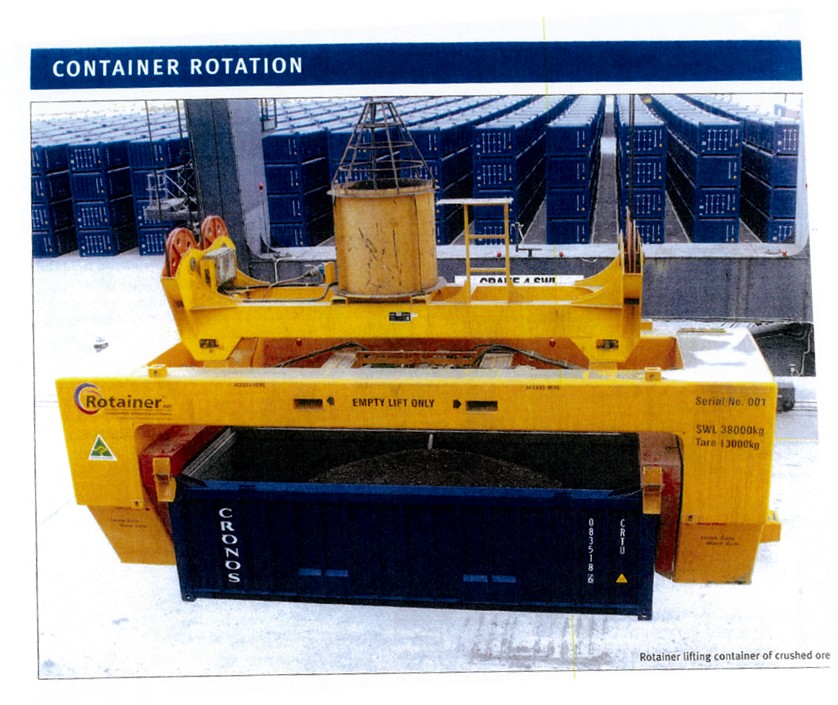
6.1.4 Analysis
273 Mr Bridle created the mark “Rotainer” in mid-2009. He applied for a trade mark registration in respect of “Rotainer” soon after in July 2009. His evidence was that he created the name whilst carrying out work on design and manufacture of a container rotator (tippler) and other components of a CBH system. He decided that AMMESA should have names that it could use in the marketing and promotion of the business it was planning in the realm of CBH systems and equipment:
I wanted a name that was easy to remember and which “rolled off the tongue”, I created the name “Rotainer” by combining parts of the words “rotate” or “rotation” and “container”, to reflect the nature and components of the system I was developing – namely, a system that could lift and rotate a container 360 degrees in both clockwise and anti-clockwise directions […]
274 The word “rotainer” was created to be applied to tipplers, not the rotating containers, as AMMESA did not (and CRS still does not) manufacture containers.
275 At the time he created “rotainer”, Mr Bridle was not aware of it having any existing meaning, nor had he previously heard of it being used, whether in relation to CBH systems equipment, or otherwise. Mr Bridle considered “rotainer” to be “catchy and distinctive”.
276 Whilst it appears that “rotainer” had been used in Wales well before the Priority Date, that use appears to have been limited and not carried to Australia. The word “rotainer” was not known or used in Australia by anyone immediately before the Priority Date.
277 As at the Priority Date, “rotainer” per se was not part of the common stock of knowledge in Australia. There was no evidence that at, or before, or indeed in the two years after the Priority Date, any “trader” (taken at its broadest conception) had any desire to use the word “rotainer” for the purpose of directly describing or otherwise referring to any CBH equipment or system.
278 Instead, ISG contends that “rotainer” is like “rohoe”, an “obvious” contraction of two words in the English language, which to the relevant traders has a direct reference to the goods for which it is registered, and thereby deprives honest traders of the ability to use the word. In doing so, ISG ignores the caution of Dodds-Streeton J in Fry Consulting Pty Ltd v Sports Warehouse Inc (No 2) (2012) 94 IPR 551 at [81], that “a combination mark should not be dissected into its individual elements in the context of assessing the distinctiveness of the totality, […] even a collection of entirely commonplace elements could achieve distinction to the requisite degree.”: citing Diamond T Motor Car Company [1921] 2 Ch 583.
279 Unlike “rohoe”, the word “rotainer” is not being used in relation to one implement (i.e., agriculture) which was well known to the relevant traders and consumers, and it is not an obvious contraction of the well-known name of the implement, as was the case with the rotary hoe in Rohoe.
280 First, there are multiple possible “ro” contraction sources to be combined with “tainer” to reach “rotainer”: rotation, rotating, rotate, and rotatable are four. Rotary is another possibility. Thus, it is not an obvious contraction or combination of two words—cf Advanced Hair Studio (hairfusion) or Rohoe (rotary hoe). The multiple potential source words from which a combination mark can be derived differs from circumstances where there is more than one potential meaning of a mark as discussed by the Full Court in Bendigo and Adelaide Bank Ltd v Community First Credit Union Ltd (2021) 157 IPR 251. In Bendigo, the Full Court rejected the contention that the “community bank” marks lacked any ordinary signification as there were multiple possible meanings for the word “community”. At [81], Middleton and Burley JJ held:
In any event, we do not see any basis for limiting the operation of the TM Act in the way contend for by Bendigo. The practical effect of Bendigo’s argument that “community bank” is not capable of ordinary signification is that, insofar as s 41 of the TM Act prevents the appropriation of ordinary language, its protections are limited to words and phrases that possess a singular meaning in the one context. Having regard to the cases outlined above we consider that such an approach would be unduly restrictive. As CFCU submits, establishing the ordinary signification of words is not so reductive a task as to exclude a word with more than one meaning or a potentially nuanced meaning.
(Emphasis added.)
281 Secondly, rather than one “ordinary signification”, there are several possible “ordinary significations” propounded by ISG for “rotainer”: the container, the spreader/tippler or a system involving both. In their closing submissions, ISG used “rotainer” to refer to rotating containers, “rotainer system” and a transportation system involving rotating containers and/or a container rotator. Mr Pinder’s evidence was that when he saw the word rotainer, he understood it to describe the basic function and purpose of the spreader. Thus, ISG is unable to identify with precision the goods for which the word “rotainer” is said to describe. Instead, ISG resorts to submitting that “rotainer” is descriptive of the function or properties of the containers or systems, which I consider is in the nature of an allusive reference, rather than being a direct reference to the goods.
282 Mr Pinder considers “rotainer” to be a rotating container. He draws a distinction between “rotainers” and other types of containers. Mr Pinder agreed during cross-examination that tipplers were not known as “rotainers”—despite what he said in the Generic Tippler Statement, which was on Pit to Ship Website, and one of the ISG Websites, for six years. Whilst the existence of multiple meanings does not preclude a term from bearing an ordinary signification, the inconsistency of Mr Pinder’s own usage is an indicium against “rotainer” possessing any inherent ordinary meaning.
283 Thirdly, ISG’s descriptive attack is focussed on a narrow subclass of goods within the class of Asserted Registered Goods. The Asserted Registered Goods are much broader than tipplers and rotatable containers and systems involving them. CRS describes the Asserted Registered Goods as “CBH equipment”. The Asserted Registered Goods include mining implements, tools for mining machines and parts, fittings and accessories for any of the goods listed. On no basis could “rotainer” be asserted to be descriptive of such goods.
284 Fourthly, there were and are other terms available to honest traders—however broadly that is construed—to describe container rotators, spreaders and/or tipplers and systems that use them which were in use at the Priority Date; these remain available to honest traders: Red Energy Pty Ltd v Registrar of Trade Marks (2018) 135 IPR 252 at [14(d)] (Beach J). For example, container, or open topped container, or rotating container or rotatable container were available for use, as well as “tipplers”, container rotators, which were also called spreaders. There is no legitimate desire or need for other traders to use the word “rotainer” in connection with their goods. Examples in the evidence of other words available to honest traders include:
(a) Rotating or rotatable containers;
(b) Rotating container system;
(c) Tipplers, spreaders, container rotators; and
(d) Container in - bulk out system
285 ISG relies on its post-Priority Date evidence to support its contention that “rotainer” is descriptive and that honest traders are thereby deprived of its use. In doing so, ISG points to post-Priority Date usage of “rotainer” by a broad class of persons it characterises as ‘traders’, including government port regulators, stevedores, and journalists.
286 According to Mr Pinder, there has been an “evolution” in the language since the Priority Date. Whilst the containers were described as containers or units at the time of tender and supply from 2011 to 2018, Mr Pinder says it is now correct to describe them as “rotainers”. He accepted that “rotainer” never meant just tippler. By the time Mr Pinder engaged Click Click Media in a campaign to genericise “rotainer”, he asserted that it was a generic term for rotating containers, and that usage had “evolved” to the point that customers requested for rotainers instead of containers. The suggestion of a post-Priority Date “evolution” of the meaning of “rotainer” is entirely inconsistent with the contention that the term had an inherent ordinary signification at the time it was coined and the application for registration was filed. Notably, ISG did not press the case that the Registered Mark had become generic under s 24 of the TMA.
287 Evidence of post-priority date use can only be given limited weight. At best it may show that there may be some likelihood that honest traders may want to use the mark. The notion of inherent adaptation is one that is concerned with the intrinsic qualities of the mark itself, divorced from the effects or likely effects of registration. It is difficult to separate the evidence of use of the term “rotainer” well after the Priority Date from the context in which that use arose, including the registration of the mark and AMMESA’s use of its Registered Mark, as well as Mr Pinder’s use and efforts. Much of the recent descriptive use of the term “rotainer” in Australia can be attributed in no small part to the assiduous efforts of Mr Pinder to adopt and “genericise” the term for ISG’s own purposes, including for the purpose of diverting business from CRS.
288 I consider that, at the date of filing, the term “rotainer” was a freshly coined word, which immediately prior to being coined had no inherent meaning, and which no honest trader had any desire to use. As at the Priority Date, no other trader (at its broadest), in Australia had coined the term, and the term was not known or used in Australia. There is no evidence of any manufacturers or retailers of CBH equipment in Australia having any desire to use the term “Rotainer” in connection with their own goods or services either in July 2009 or at any subsequent time. No Australian trader, other than Mr Pinder, gave evidence of any desire to use the term “rotainer”.
289 For completion, I note that neither of the two witnesses from manufacturers of CBH equipment, being Mr Perkins from Qube and Mr Fedden from Seaco, was asked in cross-examination whether their respective businesses had any legitimate desire to use the word “rotainer”, as at the Priority Date or subsequently.
6.2 Section 41(5) of the TMA
290 In the event that I were to conclude—contrary to my actual finding—that “rotainer” was not inherently adapted to distinguish for the purposes of s 41(3) of the TMA, CRS contends that the mark is nevertheless to some degree inherently adapted to distinguish and s 41(5) applies. In that scenario, CRS submits that ISG could not establish that the mark “rotainer” was incapable of distinguishing the goods at the priority date and that it was not registrable under s 41(5).
291 Section 41(5) provides:
If the Registrar finds that the trade mark is to some extent inherently adapted to distinguish the designated goods or services from the goods or services of other persons but is unable to decide, on that basis alone, that the trade mark is capable of so distinguishing the designated goods or services:
(a) the Registrar is to consider whether, because of the combined effect of the following:
(i) the extent to which the trade mark is inherently adapted to distinguish the designated goods or services;
(ii) the use, or intended use, of the trade mark by the applicant;
(iii) any other circumstances;
the trade mark does or will distinguish the designated goods or services as being those of the applicant; and
(b) if the Registrar is then satisfied that the trade mark does or will so distinguish the designated goods or services—the trade mark is taken to be capable of distinguishing the applicant’s goods or services from the goods or services of other persons; and
(c) if the Registrar is not satisfied that the trade mark does or will so distinguish the designated goods or services—the trade mark is taken not to be capable of distinguishing the applicant’s goods or services from the goods or services of other persons.
292 The principles applicable to s 41(5) were discussed by Finn J in Austereo Pty Ltd v DMG Radio (Australia) Pty Ltd (2004) 61 IPR 257 at [28]–[39], including:
[29] Whether the mark is capable of distinguishing the services of DMG Radio to which the application relates turns in consequence on whether I clearly cannot be satisfied that it meets the requirements of s 41(3) or (5): s 41(3), because it is not, of itself, inherently adapted to distinguish DMG Radio’s services; and s 41(5) because, though to some extent inherently adapted to distinguish those services, that, combined with its use, intended use and other circumstances does not or will not distinguish those services.
[30] The capability which s 41(3) and (5) address in their respective ways has been described as a test of “fitness for a future role”: Ocean Spray Cranberries Inc v Registrar of Trade Marks (2000) 47 IPR 579 at 586. Though this criterion is forward looking: cf Oxford University Press v Registrar of Trade Marks (1990) 24 FCR 1 at 17–18 […]; the required capability must be possessed by the mark at the priority date. It is insufficient that the mark may have the potential or capacity to acquire that capability in the future: cf Thompson v B Seppelt & Sons Ltd (1925) 37 CLR 305 at 312.
293 In Clark Equipment, Kitto J observed at 513–4:
That ultimate question must not be misunderstood. It is not whether the mark will be adapted to distinguish the registered owner’s goods if it be registered and other persons consequently find themselves precluded from using it. The question is whether the mark, considered quite apart from the effects of registration, is such that by its use the applicant is likely to attain his object of thereby distinguishing his goods from the goods of others […] the question whether a trade mark is adapted to distinguish [must] be tested by reference to the likelihood that other persons, trading in goods of the relevant kind and being actuated only by proper motives—in the exercise, that is to say, of the common right of the public to make honest use of words forming part of the common heritage, for the sake of the signification which they ordinarily possess—will think of the word and want to use it in connexion [sic] with similar goods in any manner which would infringe a registered trade mark granted in respect of it.”
294 I find that as at the Priority Date, the evidence is that no trader in the CBH field in Australia had used or had indicated a desire to use “rotainer”. There is also no evidence that “rotainer” possessed any ordinary signification. The evidence of post-Priority Date use as discussed above supports the conclusion that even if only partly adapted to distinguish, the term “rotainer” was, in fact, capable of distinguishing AMMESA (and subsequently CRS’s) goods as at the Priority Date. As I found above, the use of “rotainer” from 2009 to 2012 is associated with the AMMESA tippler. There was no evidence of any honest trader’s desire to use the word “rotainer” in relation to their respective goods.
6.3 Discretion
295 Section 88(1) of the TMA confers discretionary powers on this Court, on the application of an aggrieved person, to order that the Register of Trade Marks be rectified by cancelling the registration of a trade mark. The operation of s 88(1) is subject to s 88(2), which stipulates the grounds on which an application for rectification may be made. Section 89(1) confers a further discretion on this Court not to grant rectification where the application is made on the ground that the trade mark is liable to deceive or confuse, if the owner is not at fault. The interrelationship between the Court’s discretion under ss 88 and 89 has been subject of debate, with some proponents contending that the s 89 discretion overrides the discretion under s 88, and others contending that s 89 has no application where the claim for revocation is based on s 88(2)(a), i.e., where an applicant is relying on a ground not referred to in s 89 such as lack of distinctiveness under s 41: see, e.g., Anchorage Capital Partners Pty Ltd v ACPA Pty Ltd (2018) IPR 255 at [146], [148] (Nicholas, Yates and Beach JJ). In this instance, I do not propose to resolve this issue for the following reason.
296 In closing submissions, the Respondents contended that the Court’s discretion to order that the Register be rectified under s 88(1)(a) is enlivened because the Asserted Registered Goods are liable to cancellation pursuant to s 88(2)(a), that is, under any of the grounds on which the registration of the trade mark could have been opposed under the TMA. The only grounds of opposition—or, in this case, grounds of cancellation—asserted were ss 41(3) and 41(5) of the TMA. Questions of discretion therefore do not arise, as the grounds of cancellation required by s 88(2) are not satisfied for the reasons I set out above. Further, I do not consider that the Respondents are “aggrieved persons” within the meaning of the TMA.
6.4 Conclusion on Cross-claim
297 For the reasons above, ISG’s cross-claim seeking cancellation of the Registered Mark is unsuccessful. I will now consider the CRS’s infringement case.
7. Infringement
7.1 Introduction
298 CRS alleges that ISG has infringed the Rotainer Trade Mark under s 120(1) of the TMA and further, or alternatively, under s 120(2) of the TMA as a result of their use of the sign “Rotainer” or “Rotainers”.
299 ISG denies that any of their uses of “rotainer” or “rotainers” involve the use of the word as a trade mark for three reasons. First, for each alleged use, the brand ISG or the ISG Logo is prominently featured and used in a manner to distinguish ISG’s “rotainer products” from goods provided by other traders. Secondly, ISG argues that alleged uses must be assessed in the context of the relevant trade, i.e. the CBH field. According to ISG, those in the field are aware that “rotainer” is used as a description or shorthand for rotating container or systems containing them. Thirdly, each of the alleged infringing uses of “rotainer” is a descriptive use, to describe the product ISG is providing—“rotainers” —i.e., rotating containers.
7.2 Use as a trade mark
300 Section 7(4) of the TMA provides that “use of a trade mark in relation to goods” means “use of the trade mark upon, or in physical or other relation to, the goods (including second-hand goods)”.
301 According to the High Court in Self Care IP Holdings Pty Ltd v Allergan Australia Pty Ltd (2023) 277 CLR 186 at [22] (Kiefel CJ, Gageler, Gordon, Edelman and Gleeson JJ), there are two separate elements to establish trade mark infringement under s 120(1) of the TMA:
(1) that the person has used as a trade mark a sign in relation to goods or services; and
(2) that the trade mark was substantially identical or deceptively similar to a trade mark registered in relation to those goods or services.
302 The principles in relation to (1) and (2) were not in dispute. I recently summarised those principles in Bed Bath ‘N’ Table Pty Ltd v Global Retail Brands Australia Pty Ltd (2023) 182 IPR 393 at [347]–[373]. The controversy as to infringement lies in the application of the principles in relation to (1), being whether ISG has used the Registered Mark as a trade mark.
7.2.1 Use as a trade mark or badge of origin
303 The principles governing use as a trade mark are well established. As the High Court in Self Care explained at [24], by reference to E & J Gallo Winery v Lion Nathan Australia Pty Ltd (2010) 241 CLR 144 at [33] (French CJ, Gummow, Crennan and Bell JJ) which cited Shell Co of Australia Ltd v Esso Standard Oil (Australia) Ltd (1963) 109 CLR 407 and Champagne Heidsieck et Cie Monopole Societe Anonyme v Buxton [1930] 1 Ch 330. Whether a sign has been used as a trade mark is to be assessed objectively without reference to the subjective trading intentions of the user. The objective purpose and nature of use are assessed by reference to the context. The High Court in Self Care also observed at [24] that context includes “the relevant trade, the way in which the words have been displayed, and how the words would present themselves to persons who read them and form a view about what they connote”.
304 In Shell Co, Kitto J set out the relevant question of what constitutes “use as a trade mark” at 425:
[…] the question becomes whether, in the setting in which the particular pictures referred to were presented, they would have appeared to the television viewer as possessing the character of devices, or brands, which the appellant was using or proposing to use in relation to petrol for the purpose of indicating, or so as to indicate, a connexion [sic] in the course of trade between the petrol and the appellant […]
305 Justice Allsop (as his Honour then was) in an oft-cited passage from Anheuser-Busch Inc v Budejovicky Budvar (2002) 56 IPR 182 at [185]–[186] said:
The task is to examine the way the words are used in their context, including the totality of the packaging, to assess their nature and purpose in order to see whether they are used to distinguish the goods from goods of others.
The assessment is made from the perspective of what a person looking at the label would see and take from it, as to the purpose and nature of its use.
(Citations omitted.)
306 The display of a sign or mark in relation to goods may, of course, have more than one role. As Allsop J explained in Anheuser-Busch at [189]:
The usage of a word may fulfil more than one purpose on a label. For example a word may have a descriptive element, but also an element of trade mark or branding or distinguishing role. Equally, a word may have a role in identifying a geographical location, but also a trade mark or branding or distinguishing role. It depends on context.
(Citations omitted.)
307 Critically, and relevant to the current proceedings, the mere existence of a descriptive element or purpose in the use of a mark does not preclude the possibility of the sign being used as a trade mark. The Court in Self Care observed at [25]:
The existence of a descriptive element or purpose does not necessarily preclude the sign being used as a trade mark. Where there are several purposes for the use of the sign, if one purpose is to distinguish the goods provided in the course of trade that will be sufficient to establish use as a trade mark. Where there are several words or signs used in combination, the existence of a clear dominant “brand” is relevant to the assessment of what would be taken to be the effect of the balance of the label, but does not mean another part of the label cannot also act to distinguish the goods.
(Emphasis added.) (Citations omitted.)
308 Finally, it is well established that use of a mark that is a component of a larger composite mark, or a mark used in conjunction with other marks, can still constitute use of a trade mark: see Chocolaterie Guylian at [97] (Sundberg J); Sports Warehouse Inc v Fry Consulting Pty Ltd (2010) 87 IPR 300 at [133] (Kenny J); Phone Directories Co Australia Pty Ltd v Telstra Corp Ltd (2014) 106 IPR 281 at [245] (Murphy J).
7.2.2 Context
309 The CBH market is described in detail above. It is a specialised market dealing with very expensive equipment, the supply of which is a protracted process that may take many months. It is not a fast-moving consumer item market.
310 ISG contends that the use of systems with rotating containers and tipplers—which Mr Pinder terms “rotainer systems”—has only become well known and widely used in Australia since about 2011. Before then, such systems existed, but they were not well known or widely used in Australia. According to ISG, the level of understanding of container rotator based bulk handling systems has increased over time, as their use has increased. ISG submits that this provides important context for the consideration of whether its use of “rotainer” and “rotainers” constitutes trade mark infringement.
311 ISG did not use “Rotainer” prior to approximately June 2016. Even after June 2016, flyers, brochures, conference banners, other printed materials and videos published and disseminated by ISG in connection with its container products all used the descriptor “container”.
7.2.3 Impugned conduct
312 At trial, CRS contended that the following conduct involving use of “rotainer” or “rotainers” by ISG constitutes trade mark infringement:
(a) the Pit to Ship Website (and the Generic Tippler Statement and the Generic Container Statement therein);
(b) the Rotainers Website;
(c) Search results displaying “Rotainer”;
(d) ISG video published on LinkedIn and YouTube; and
(e) Customer communications and business documents, including:
(i) Quotation;
(ii) Specification sheet;
(iii) Tax invoice; and
(iv) LinkedIn.
313 CRS contends that a significant part of the infringing conduct involves the use of “Rotainers” on the ISG Websites. CRS handed up 14 examples of the ISG Websites during oral closing submissions.
314 ISG categorises the conduct as follows.
(a) In website names and content:
(i) the URLs www.rotainers.com and www.pittoship.com/rotainer, and content on the Websites (Type 1 (Websites));
(ii) the historical version of the Rotainers website (Type 2 (Historical Websites));
(iii) on the websites in a manner causing search results to refer to one or both websites (Type 8 (Search Results)), or for the word “rotainer” to appear in search results.
(b) In posts on LinkedIn, including:
(i) a video including in its title, text, and the LinkedIn post referring to the video (Type 3 (Video)); and
(ii) posts, including by the phrase “ISG Rotainers System” in Mr Pinder’s profile, and the hashtags “ISGRotainersSystem” (Type 9 (LinkedIn));
(c) In customer communications:
(i) in an agreement dated 14 June 2020 between ISG and Poti Sea Port Corporation and APM Terminals Poti (APMT Poti) (Type 4 (Agreement));
(ii) customer communications and business document—in the subject line of emails with ISG’s clients or potential clients, in responding using the subject line created by the client or potential client (Type 5 (Emails - Subject) or in the body of emails sent by ISG to clients or potential clients (Type 11 (Emails – Body));
(iii) in an ISG quote dated 13 October 2021 (Type 6 (Quote));
(iv) in an ISG invoice dated 29 November 2022, containing the phrase “ISG A TYPE Rotainer” (Type 7 (Invoice)); and
(v) in a product specification dated 21 February 2022, titled “ISG Mineral Concentrate Rotainers”, including in its title and describing the product as “A Type Rotainer” (Type 10 (Product Specification)); and
(d) In search result advertising.
7.2.4 Rotainer not descriptive
315 ISG’s non-infringement argument is, in part, tied to the success of its contention that “rotainer” is a descriptive term, and that it has used the word in that sense. ISG justifies its use of “rotainer” and “rotainers” as being the use of a descriptive word in an effort to attract business and submits that use does not involve any illegitimate intention. To the contrary, the use of the word is an entirely legitimate and necessary aspect of ISG’s “business of supplying rotainers”.
316 For the reasons set out above, I have rejected ISG’s cross-claim seeking cancellation of the registration of the Registered Mark due to lack of distinctiveness arising from the alleged descriptiveness. The Registered Mark is a validly registered trade mark.
317 I found that at the Priority Date, the Registered Mark had no ordinary signification and was therefore not inherently descriptive.
7.2.5 ISG Websites
318 A significant part of the conduct alleged to constitute trade mark infringement in this proceeding involves use of the sign “Rotainers” on the ISG Websites, either as part of the domain name or as text displayed on the website, including as part of an ISG Logo included at the top left-hand side of the Rotainers Website.
319 ISG conceded that a key motivation for the use of “rotainers” on the ISG Websites was to attract Google search traffic. Relying on the Full Court decision in Lift Shop Pty Ltd v Easy Living Home Elevators Pty Ltd (2014) 106 IPR 419, ISG rejects the proposition that such use constitutes use of “rotainers” as a trade mark.
320 The test of whether a sign has been used as a trade mark within the meaning of s 120 of the TMA is an objective one. Trade mark infringement is to be determined objectively, not on the basis of ISG’s subjective intention in using the mark.
321 In Lift Shop, a case involving competitors in the supply of customised lifts, the respondent added phrases such as “looking for a lift shop?” to its website homepage specifically to optimise its appearance in google searches for “lift” and “lifts”. As the Full Court comprising Besanko, Yates and Mortimer JJ noted at [6], the appellant’s case on trade mark infringement only concerned the use by the respondent of “Lift Shop” in the title of its web page as shown by search results. Similar to this case, the use on the webpages had various iterations, one of which was as follows:
Easy Living Lifts | Home Elevators | Lift Shop – Home Elevators …
322 The case did not concern the respondent’s use of Lift Shop on its website otherwise. There was no dispute that the respondent had used “Lift Shop” in respect of services that were closely related to registered goods. The question was whether those words had been used as a trade mark.
323 The appellant and the respondent were not the only businesses that appeared when an internet search for “lift shop” was carried out. This was held to be an important part of the context in which the respondent had used the sign. At [46], their Honours held that there was no infringement by the use of “Lift Shop” in the search entries:
Those searching the internet using the search term “lift shop” would have understood, on seeing the displayed results, and in particular the words “Lift Shop” in the title of the respondent’s web page, that the respondent was using those words to convey that its business was one of supplying “lifts” and “home elevators”. Although the use of the words “Lift shop” was given some prominence because of their use in the title of the respondent’s web page, neither that fact, nor the positioning of those words within the title, imbued them with the character of a trade mark. The use of the words “Lift Shop” as shown in the entries quoted in paragraphs [9]–[11], makes clear that their only functional significance was to describe the character of that business. Their use by the respondent was not to distinguish its business from others. To the contrary, in the larger setting provided by the results pages, the use of those words was to designate, and would have been understood as designating, that the respondent’s business was of the same character as, or at least of a similar character to, other businesses grouped and operating as “lift shops”. Such use is the antithesis of trade mark use.
(Emphasis added.)
324 Lift Shop provides no guidance on whether ISG’s use of “rotainers” on the ISG Websites constitutes trade mark infringement. The sole issue to which it is relevant is whether “rotainers” appearing in Google search results constitute trade mark infringement. However, there are some important factual differences which distinguish the present case from that in Lift Shop. First, the mark in suit was a composite mark with the words “LIFT SHOP” in grey and white on a green background, next to an up button, of the kind used to summon a lift. The registrability of the words “lift shop” as a composite mark, rather than as a word mark, is apparent given that “lift shop” comprises ordinary English words which other traders may wish to use to describe their businesses without any improper motive.
325 Second, there are no other traders using “rotainer”, the search results in this case only yielded websites from CRS and ISG. Thus, as opposed to Lift Shop, those searching the internet using the search term “rotainers” would not have understood that ISG was using those words to convey that its business was one of supplying “rotainers”. Rather, as Mr Solly recalled, the appearance of “rotainer” in the search results and in the ISG Websites caused him to think that “Mr Bridle had sold to, merged with, or had some association with the owner of that website”.
7.2.6 Use in Australia
326 The ISG Websites comprise both “.com” and Australian “.com.au” websites, which are alleged to divert consumers away from CRS via the infringing uses of the Registered Mark.
327 It was not in dispute that each of the websites are directed (at least in part) to, and are intended to be, and are accessible by consumers in Australia: Redbubble Ltd v Hells Angels Motorcycle Corporations (Australia) Pty Ltd (2024) 177 IPR 20 at [45] (Perram and Downes JJ).
328 Each of those websites references a business operating under a New South Wales Business name (Intermodal Solutions Group (ISG) and Pit to Ship). The ISG Websites also include Australian registered trade marks and refer to addresses of the business based in Australia.
329 I therefore consider that the uses forming part of ISG’s impugned conduct are uses in Australia. The volumes of sales and revenue attributable to Australian consumers is not a matter for this part of the proceeding.
7.2.7 Pit to Ship Website
330 The Pit to Ship Website was registered on 7 June 2013. Since then, it has undergone three iterations, each of which contained presentations that CRS contends have infringed on its Registered Mark.
331 CRS alleges that ISG has used the sign “Rotainer” as a trade mark in Australia in relation to the Pit to Ship Website in: the tagline at the top of the webpages beside the ISG Logo, the headings and sub-headings on various pages of the website, the drop-down menus used to navigate the website, in reference to or descriptions of ISG’s products, the long-form statements on the website, and in the URLs on the website (including “pittoship.com/rotainers/”).
332 Further, in about August 2016, ISG posted the Generic Tippler Statement on the Pit to Ship Website. Mr Pinder agreed that the name “Pit to Ship” was intended to convey the idea that ISG can provide all the relevant parts of a CBH system. The Generic Tippler Statement is discussed separately below. Prior to the posting of the Generic Tippler Statement in August 2016, ISG did not use the word “Rotainers” in any of its material.
7.2.7.1 First iteration
333 In early to mid-2020, ISG released a version of the Pit to Ship Website which, according to CRS, expanded their use of the Registered Mark “rotainer” (the First Presentation). The Pit to Ship Website now contained the word “rotainer” in its content, e.g., “We supply Container Rotation Systems (Rotainers) for mining, grain & ship loading industries”, a sub-heading “Patented Bulk Rotainer Containers for Loading Tipplers”. Part of the home page of the Pit to Ship Website at the time is reproduced below.
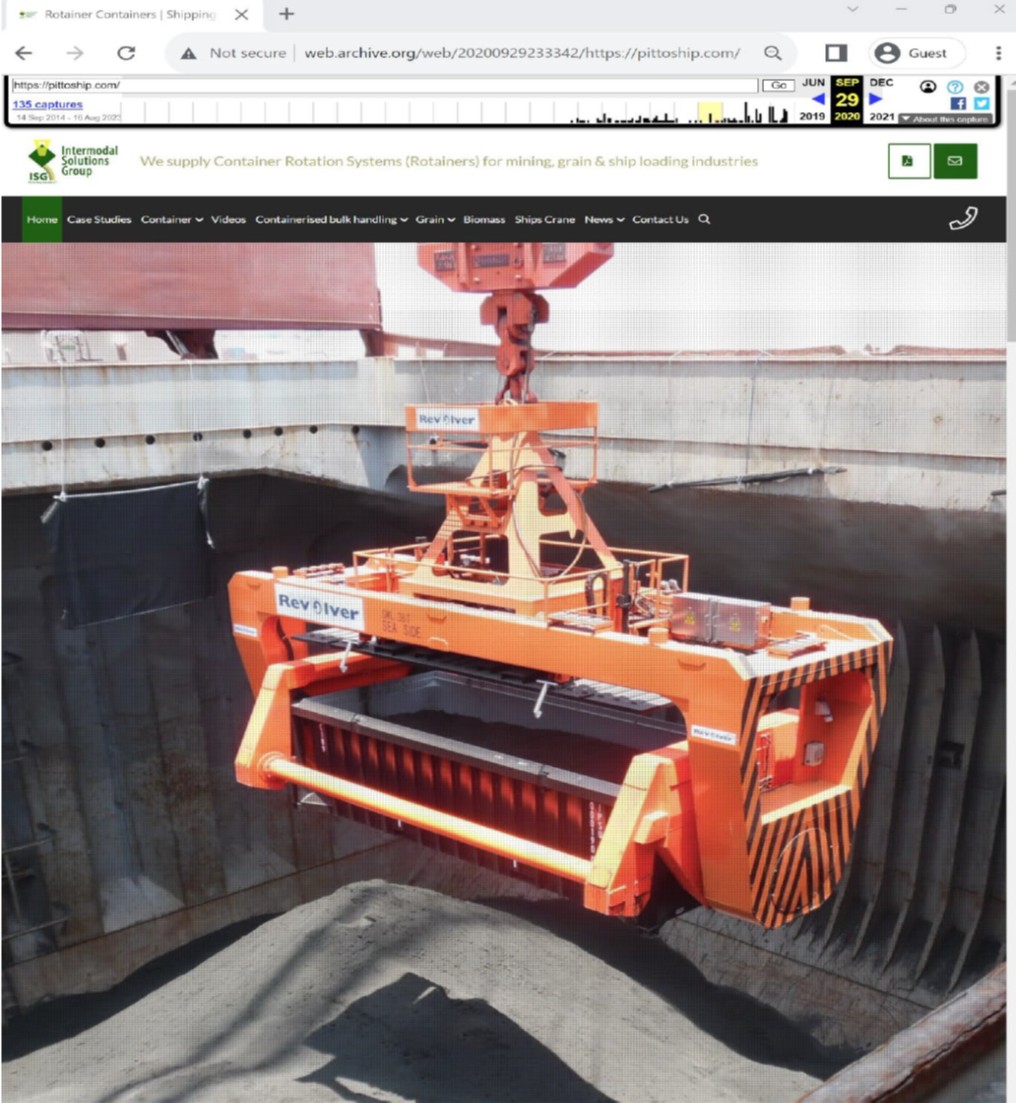
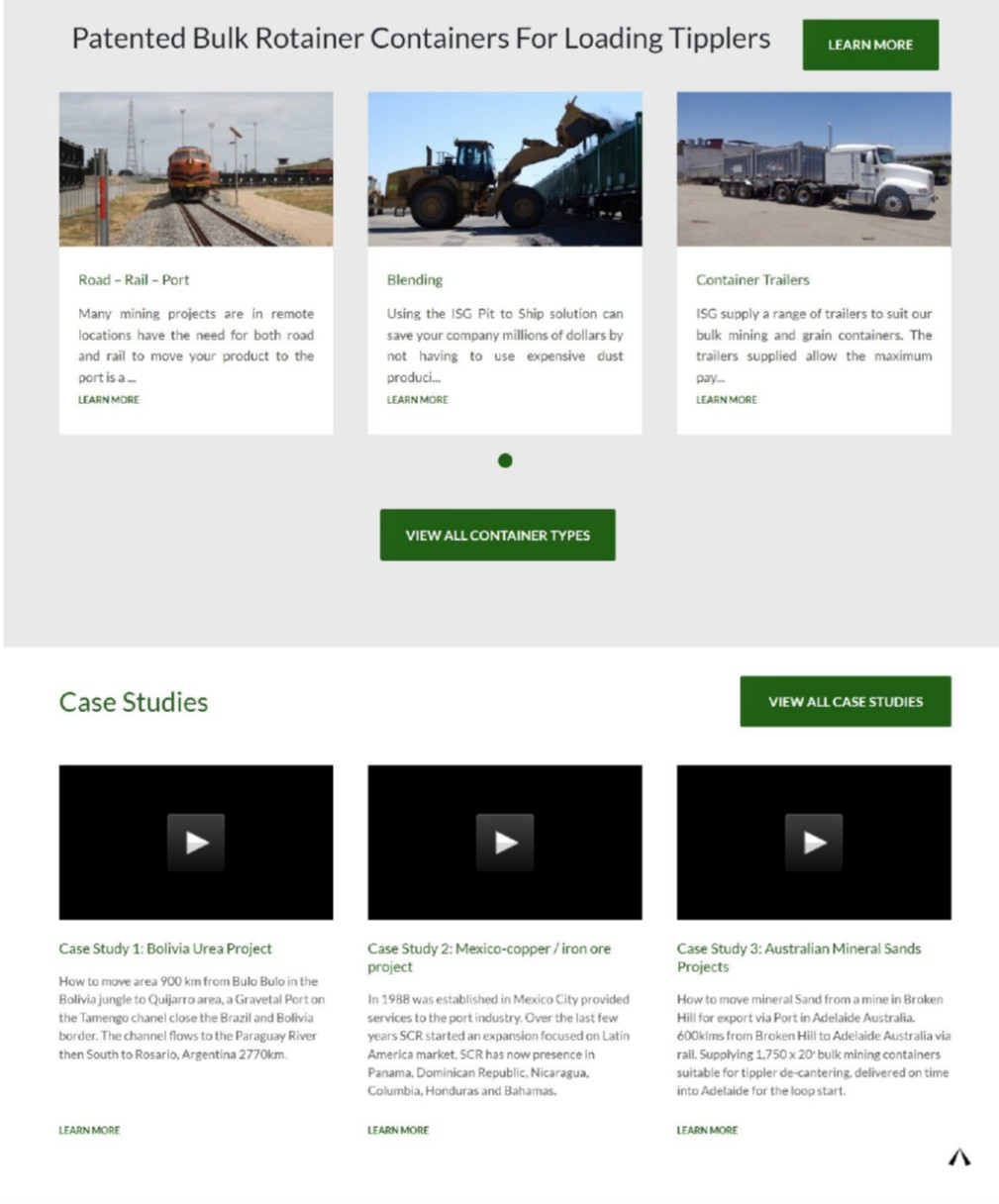

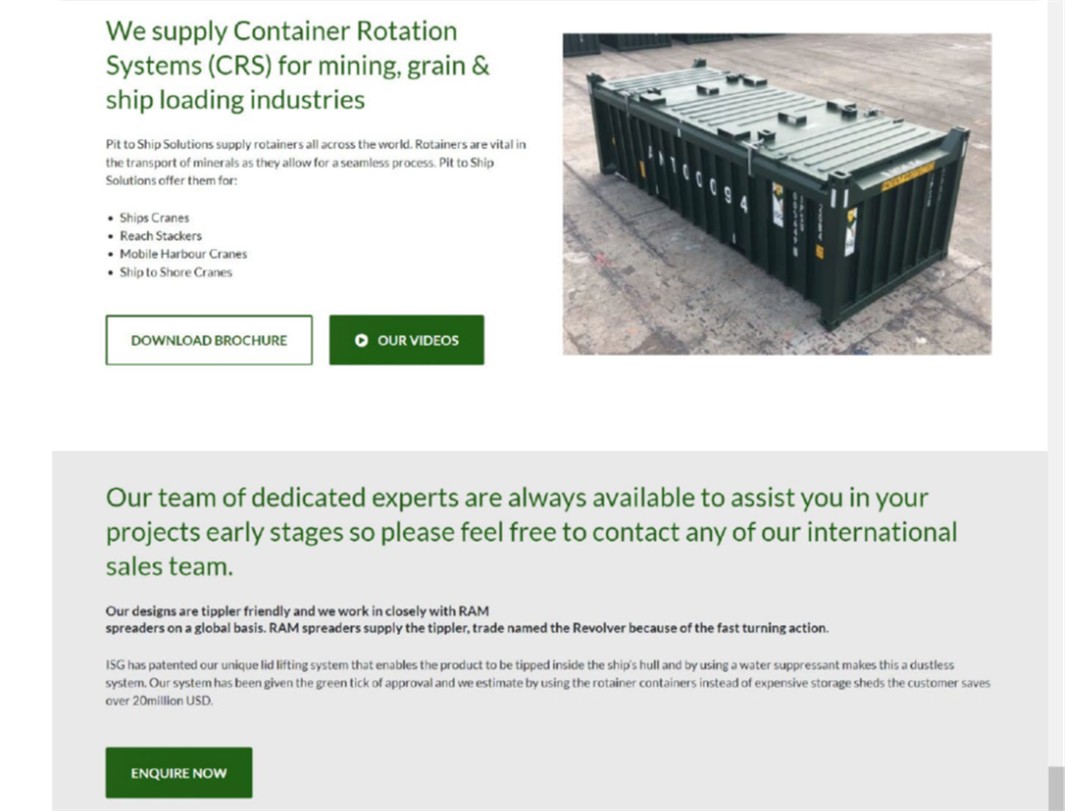
334 The First Presentation in early to mid-2020 involved expanded use of the sign “Rotainer”, which included:
(a) the change to the header of the website that stated “We supply Container Rotation Systems (Rotainers) for mining, grain & ship loading industries”;
(b) a sub-heading “Patented Bulk Rotainer Containers For Loading Tipplers” appearing on the home page;
(c) product descriptions on the home page referring to “Our rotainer container designs”, “ISG designed the first ever bulk rotainer container” and “Our rotainer designs”; and
(d) a sub-page at URL “https://pittoship.com/rotainer/”, accessible as a drop-down from the tab “Containerised bulk handling”, which included the tagline “We supply Container Rotation Systems (Rotainers) for mining, grain & ship loading industries”, the word “Rotainer” as the heading of the page and the phrase “Pit to Ship Rotainers” as a sub-heading above an image of a tippler carrying a rotatable container.
335 Below the second sub-heading “How Do Rotainers Work” was a use of “rotainer” to apparently refer to tipplers rather than rotatable containers. This is informed by the answer to the question: “The device tips the container in a 360 deg rotation emptying the product from the container”. However, subsequent to that statement were mixed uses of “rotainer” and “rotainer container”, both seemingly to refer to containers. A copy of the sub-page of the First Presentation of the Pit to Ship Website as at August 2020 is reproduced below:
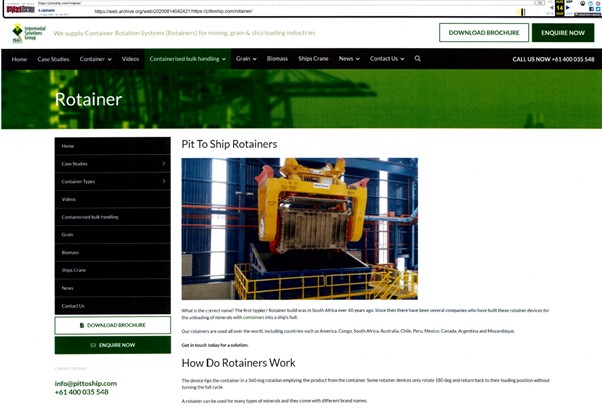
336 At the top left of the homepage is the ISG Logo with the words Intermodal Solutions Group stacked next to the ISG Logo. Next to the ISG Logo and Intermodal Solutions Group is a tagline in the heading of the page, which states: “We supply Container Rotation Systems (Rotainers) for mining, grain & ship loading industries”. Underneath is a large picture of a Revolver tippler.
337 The webpages include references to “Patented Bulk Rotainer Containers For Loading Tipplers”, “Our rotainer container designs”, “ISG designed the first ever bulk rotainer container” and “Our rotainer designs”.
338 The second page, as displayed above, is headed “Rotainer” on a green background. Underneath is a menu, which includes “Container Types”. To the right of that is a subheading “Pit To Ship Rotainers”. Underneath the subheading is a picture of a Revolver tippler, and below that image is text which confusingly notes that “[t]he first tippler/Rotainer build was in South Africa over 40 years ago”. The text then mentions “[o]ur rotainers”, even though ISG does not supply tipplers.
339 I consider that “Rotainer” (particularly when the letter “R” or the whole word is capitalised) is being used as a sub-brand or trade mark of the products offered by ISG. The pronoun “our” and the claims implying that ISG is the designer of the “Patented” Bulk Rotainer demonstrate an ownership or a trade source. Additionally, if, as asserted by ISG, rotainer is descriptive of a type of container, the use of “container” across the First Presentation is rendered redundant, unless “rotainer” serves to indicate trade origin.
7.2.7.2 Second iteration
340 In late 2020 and early 2021, ISG further updated the Pit to Ship Website. Screenshots of the historical version of the Pit to Ship Website between March and May 2021 show the following new uses of the sign “Rotainer” on the Pit to Ship Website:
(a) a division of the “Containers” page into two sub-categories (“Browse Rotainers Category” and “Browse Non-Rotainers Category”) and new names for various types of containers, which I describe further below
(b) on product-specific pages, such as the page for “Mineral Concentrate Rotainers”, the inclusion of the text “ISG is the Global market leader in Open Top Containers (Rotainers) for Mineral Concentrates” with accompanying description “shipping container has been designed, manufactured and tested for operation with Rotating Spreaders (Tipplers)”
(the Second Presentation).
341 The Second Presentation of the Pit to Ship Website continued to include the statement: “We supply Container Rotation Systems (Rotainers) for mining, grain & ship loading industries”. Part of the “Containers” page of the Pit to Ship Website at that time is reproduced below:
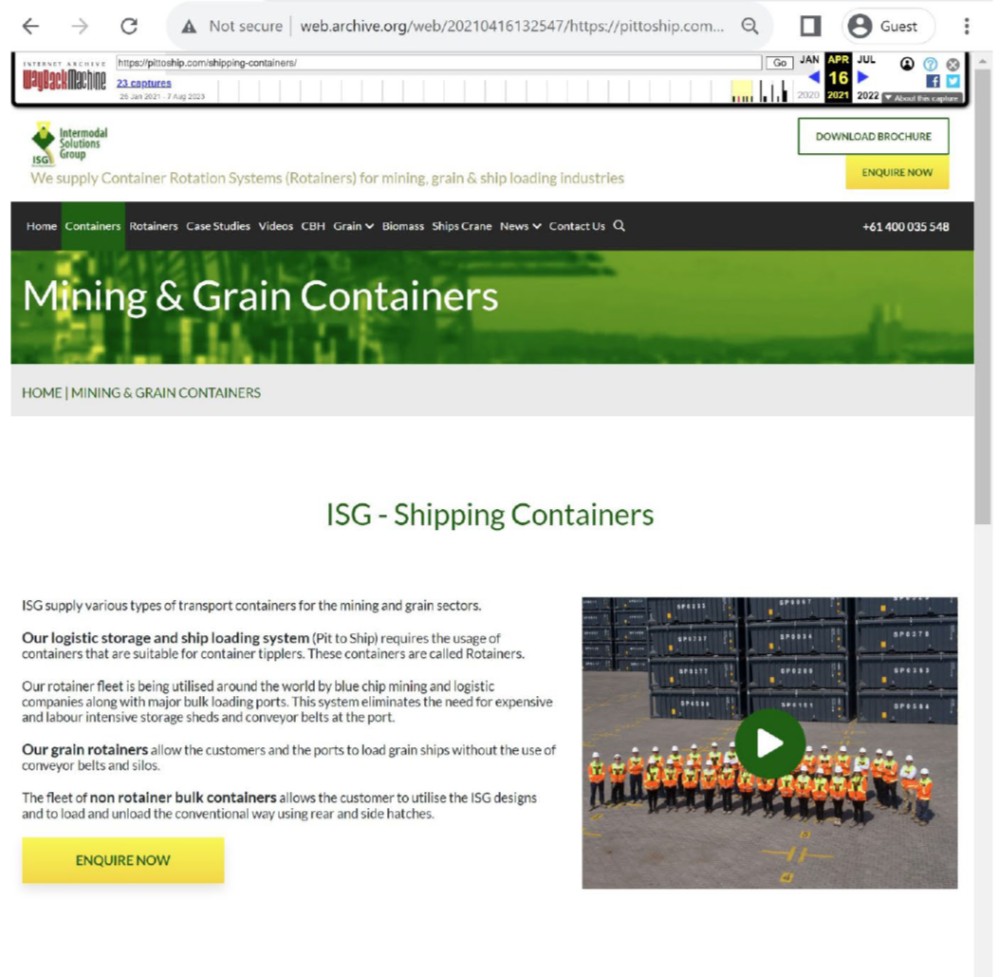
342 Under the “Browse Rotainers Category” on the sub-page for shipping containers, the Second Presentation included new names for various types of containers listed such as “Ore Rotainers”, “Rear Tipping Rotainers”, “Mineral Concentrate Rotainers”, “Ore Rotainers”, “Rear Tipping Rotainers”, “Multipurpose – High Cycle Rotainers” and “Heavy Duty – High Cycle Rotainers”: 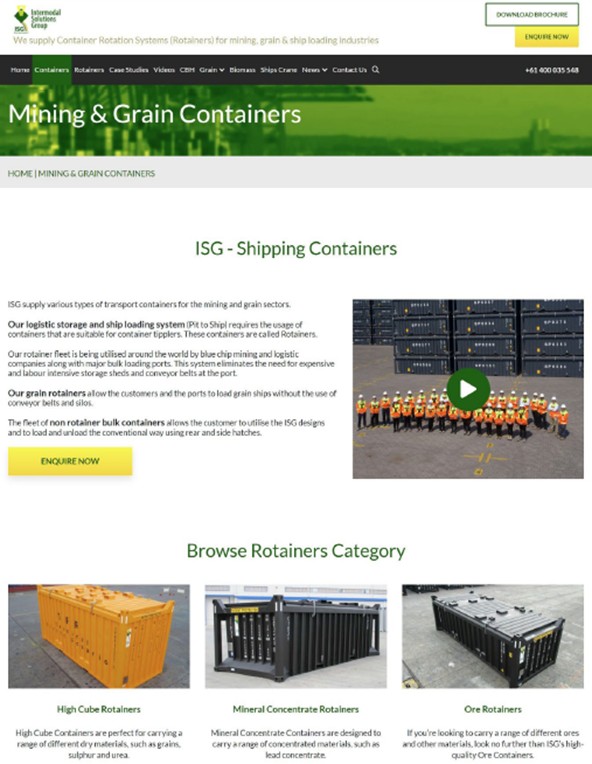
343 Contrary to the Respondents’ submissions, I find that the foregoing uses of “Rotainer” amount to use as trade mark as I consider they indicate a trade source. “Rotainer” is used categorically and as part of the product nomenclature, functioning as a badge of origin rather than as a mere descriptor. In contrast, the accompanying paragraphs describing each type of “Rotainer” consistently uses “container” as the generic noun or descriptor describing the product. This suggests that “Rotainer” is not being used descriptively as the Respondents contend. Instead, its role is to distinguish “Rotainers” from ordinary containers, including other rotatable containers or containers suitable for use in container rotation systems such as the “Half Height Container”, which is categorised under “Browse Non-Rotainers Category”:
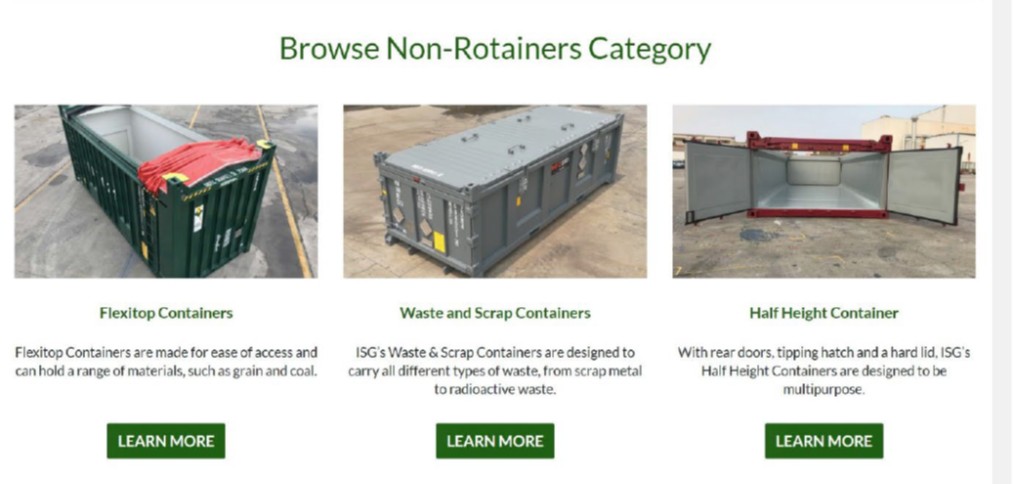
344 The categorisation of “Half Height Container” under “Browse Non-Rotainers Category” undermines the Respondents’ claim that “Rotainer” is used descriptively for rotatable containers. Evidence from Mr Fedden and Mr Pinder confirms that half-height containers are suitable for container rotation systems and therefore rotatable. If “Rotainer(s)” means “rotatable container(s)”, then “Non-Rotainer(s)” must mean “non-rotatable container(s)”, making this categorisation plainly incorrect. This hypothetical misclassification is indicative that “Rotainer” is not a generic descriptor for rotatable containers, but a distinctive term identifying products from a particular source, further supporting my view that it is used as a trade mark.
345 Product-specific pages for “Mineral Concentrate Rotainers” also included the text “ISG is the Global market leader in Open Top Containers (Rotainers)”, which indicates the sub-brand name given by ISG to the type of Open Top Containers. Again, if “Rotainers” is descriptive of a type of container, the use of “Containers” is rendered redundant, unless “Rotainers” serves to indicate trade origin.
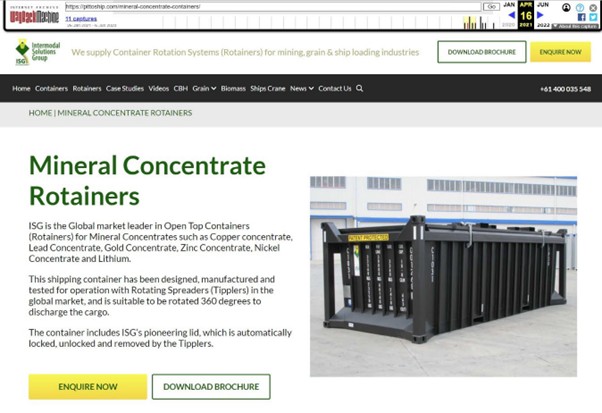
346 Accordingly, I find that the uses of “Rotainer(s)” in the Second Presentation amount to use as trade mark.
7.2.7.3 Third iteration
347 In around late 2021 to mid-2022, ISG made further changes to its Pit to Ship Website. Evidence shows that these changes include:
(a) amending the tagline in the header of all pages to “We supply rotainers for mining, grain & ship loading industries” around 25 May 2022;
(b) removing the word “Rotainer” from the statement “Patented Bulk Rotainer Containers For Unloading Tipplers” which appeared on the homepage around 26 July 2022;
(c) amending the statement at the bottom of the homepage which across the previous two presentations had read “We supply Container Rotation Systems (CRS) for mining, grain & ship loading industries” to “We supply Container Systems for mining, grain & ship loading industries” around 26 July 2022; and
(d) replacing the capital “R” with a lower case form in most, but not all, instances of use of the word “Rotainer” across the website.
(together, the Third Presentation).
348 An example of the home page of the website as at 26 July 2022 is below:
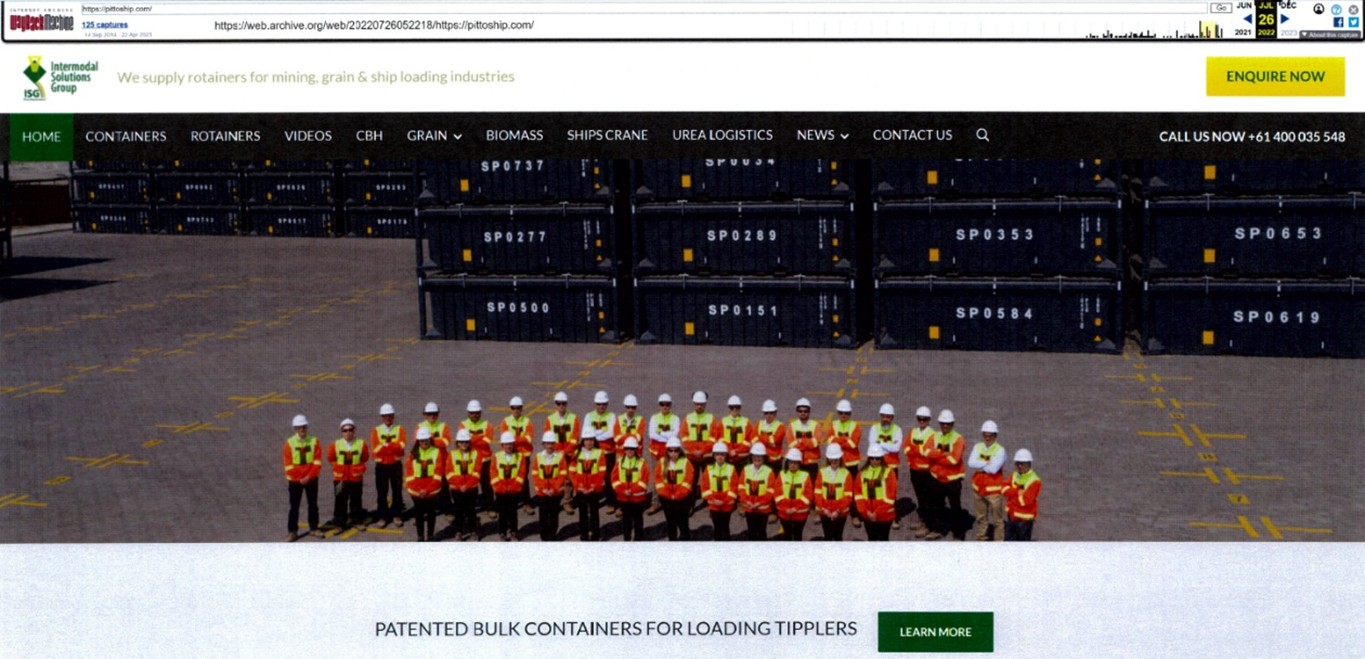
349 For the Third Presentation, ISG also retained the “Rotainers” tab in the Pit to Ship Website’s upper menu and the accompanying content to the page. In written submissions, both parties referred to a screenshot of the “Rotainers” tab in mid-2021 of “Mineral Concentrate Rotainers”, which is reproduced below:
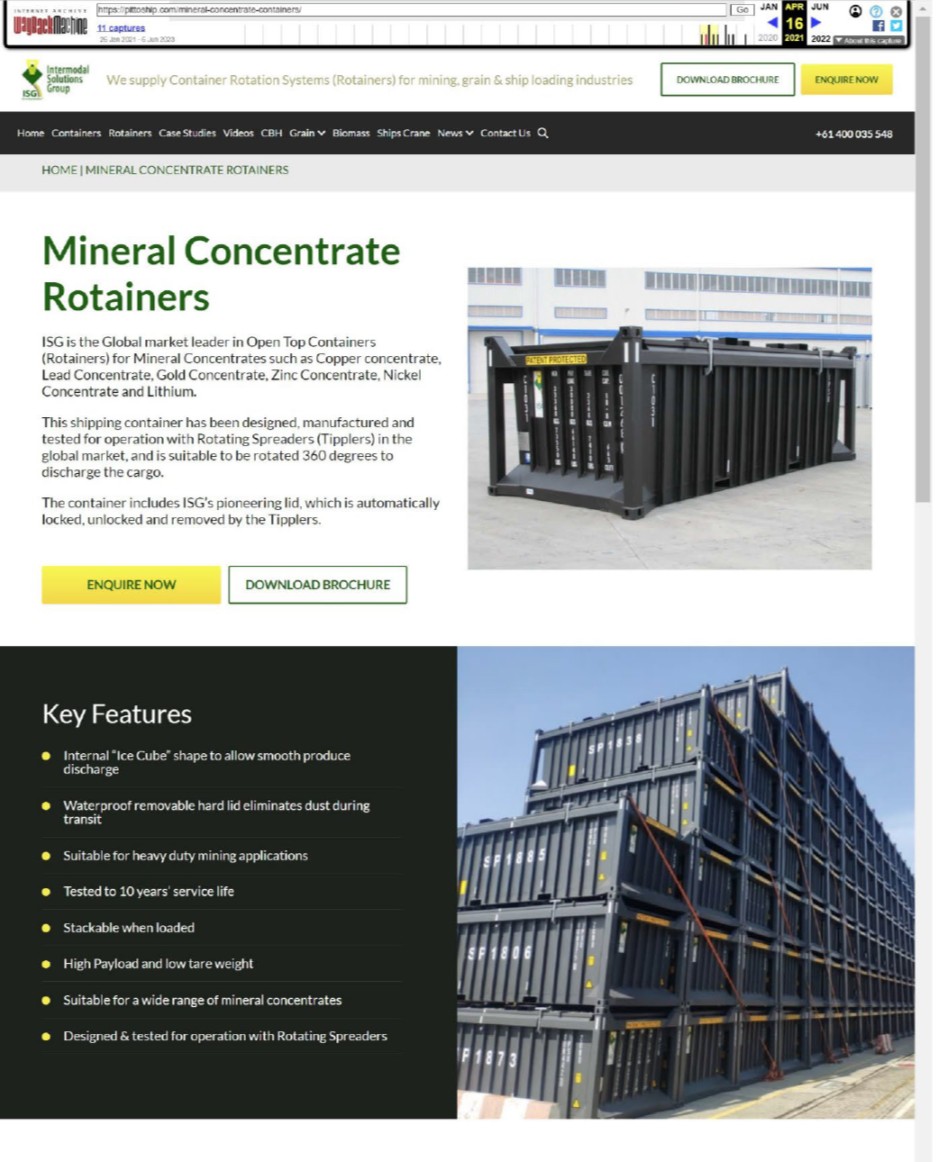
350 I note that mid-2021 is not within the prescribed period of the Third Presentation, which is defined as being between late 2021 to mid-2022. Nonetheless, given the parties’ written submissions and the fact that the “Rotainers” tab remain on the Pit to Ship Website at present, I consider that the “Rotainers” tab likely persisted during the Third Presentation.
351 To summarise, the evolution of the tagline in the header of the Pit to Ship Website is as follows. In around 31 December 2014, the Pit to Ship Website contained the statement on the top header: “We supply container rotation systems for the mining grain and ship loading industries”. The header underwent a first change in late July 2016, evolving into “we supply container rotation systems (CRS) for […]”. The header was further amended in June 2020, from “we supply Container Rotation Systems (Rotainers) for […]” to “we supply rotainers for mining […]” by May 2022.
352 The first of these changes was prompted in May 2016, when Mr Pinder asked Ms Boden to instruct Click Click Media to update the Pit to Ship Website to add “(CRS)” at the end of “container rotation systems” in the header at the top of the Pit to Ship Website, adjacent to the ISG Logo.
353 In cross-examination, and in response to the suggestion that ISG was including on its Pit to Ship Website three terms that it knew that the CRS was using—container rotation systems, CRS and rotainer—Mr Pinder replied that “there's only four buzzwords in this industry, and that’s three of them”. Mr Pinder rejected the suggestion that in using those terms, he was seeking to draw a connection to CRS or, alternatively, to draw a connection between “rotainer” and ISG. I consider this evidence unconvincing.
354 Notwithstanding that some of these changes, including the removal of the word “Rotainer” from the statement “Patented Bulk Rotainer Containers For Unloading Tipplers”, the Pit to Ship Website continued to use the word “rotainer” in various instances.
355 Further, whilst in the Third Presentation ISG has sought to remove the capitalisation of the letter “r” in “Rotainer”, capitalised uses of the sign persist, including in the product names and descriptions of its “Rotainers” offerings, for example, “Mineral Concentrate Rotainers”.
356 I do not accept that the selective removal of the word “Rotainer” in certain statements, or the selective change in the capitalisation of the letter “r”, are sufficient to negate that the various uses of “Rotainer(s)” continued to constitute use as a badge of origin.
7.2.8 The Rotainers Websites
357 The Rotainers Website domain was purchased in around January 2021, with Mr Pinder’s approval, and launched in about November 2021. CRS submitted that Mr Pinder also registered a second domain, the Rotainers AU Website on behalf of ISG in January 2021, which on the evidence appeared to redirect to the Rotainers Website. My references to and analyses of the Rotainers Website are therefore also applicable to the Rotainers AU Website.
358 Mr Pinder deposed that the motivation to create the Rotainers Website was that it would be commercially beneficial to have a dedicated website for what was becoming a significant category of containers supplied by ISG. The aim was to ensure that at least one of ISG’s Websites appeared high up in internet searches for “rotainer”.
359 The content of the Rotainers Website was largely based on that developed for the “rotainers category” on the Pit to Ship Website. Mr Pinder’s evidence was that the Rotainers Website was launched as part of an ISG strategy to have dedicated websites for different aspects of its business. Other aspects included general freight, cargo and the shipping container markets. Part of the home page of the Rotainers Website is reproduced below.

360 The home page of the Rotainers Website featured the word “Rotainer(s)” multiple times, including in the ISG Rotainers Logo, as a heading in large text, in the sub-headings “Patented Bulk Rotainer Containers for Loading Tipplers” and “Rotainer Containers” in various product descriptions. A printout of the front page of the Rotainers Website as at 13 March 2022 is below:

361 According to ISG, some changes were made to the Rotainers Website in October 2022, during the course of this proceeding. CRS resists that assertion, contending that there is no supporting evidence or any explanation as to why changes were made to the Rotainers Website at that time. Based on the evidence, I consider that the changes to the Rotainers Website around or after October 2022 include: making the heading “Rotainers” all capital letters, replacing instances of “Rotainer Container” with “Rotainer”, and replacing the ISG Rotainers Logo at the top left and bottom of the page with the a new logo that spelt out “Intermodal Solutions Group” rather than “Rotainers” (the ISG Composite Logo). Some of these changes are reflected in the current website which appears the same as the below image screenshot as at 16 February 2023:
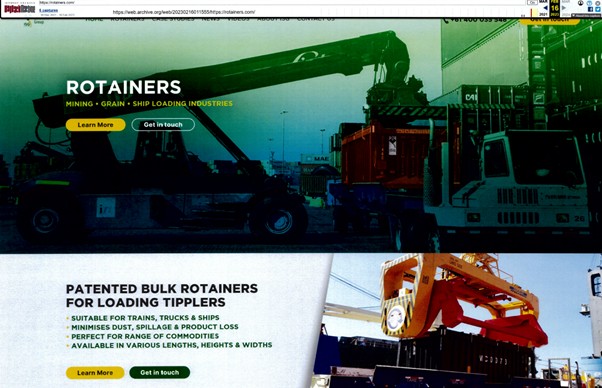
362 For the same reasons as discussed in relation to the three iterations of the Pit to Ship Website, I consider that the use of the words “Rotainer” and “Rotainers” on the Rotainers Websites is use as a trade mark.
7.2.8.1 ISG Rotainers Logo
363 Until at least October 2022, the Rotainers Website included the ISG Rotainers Logo on the top left corner of the homepage.
364 The ISG Rotainers Logo, which originally appeared on the Rotainers Website, was featured both at the top left of the page, and at the bottom of the page. Whilst it was written in sentence case as at March 2022 (the First ISG Rotainers Logo), as at 24 May 2022 it was written in uppercase letters only and in slightly reduced proportions (the Second ISG Rotainers Logo). Each version of the ISG Rotainers Logo is reproduced below:
(a) First ISG Rotainers Logo

(b) Second ISG Rotainers Logo

365 The word “Rotainers” is depicted in stylised form adjacent to the original ISG Logo. As I have described above, the ISG Logo contains a visual depiction of a tippler tipping a rotatable container and the words “ISG Pit to Ship Solutions” beneath it, with “Pit to Ship Solutions” being in tiny and barely readable font. Such depiction of the ISG Logo remains the same as used in the Rotainers Website.
366 The intention behind these design choices is reflected in an email sent from Mr Buckley of Click Click Media to Mr Pinder and Ms Boden on 28 October 2021 (shortly before the Rotainers Website went live in November), which stated:
Just a recap on the strategy. This micro website will be entirely focused around ranking for the ‘rotainer’ keywords. We will still keep it ISG branded, but that will be secondary to the word ‘rotainer’.
[…]
We are very confident that this will outperform CRS.
(Emphasis added.)
367 Mr Pinder accepted in cross-examination that the above correspondence reflected the instructions he had given to Mr Buckley to keep the branding of the ISG Logo secondary to the word “rotainer”.
368 According to CRS, evidence shows that the Rotainers Website continued to display the ISG Rotainers Logo on the home page as on 24 May 2022, and on ISG’s evidence until October 2022. While ISG alleges that the ISG Rotainers Logo has not been used on the Rotainers Website since 11 October 2022, there was no evidence supporting that assertion. The evidence shows that the ISG Rotainers Logo still appeared on parts of the “Case Studies” and “Container Categories” pages of the Rotainers Website until at least as late as 26 April 2023, as depicted below. This was notwithstanding that Mr Pinder disputed in cross-examination that the use was not use as a trade mark or badge of origin:
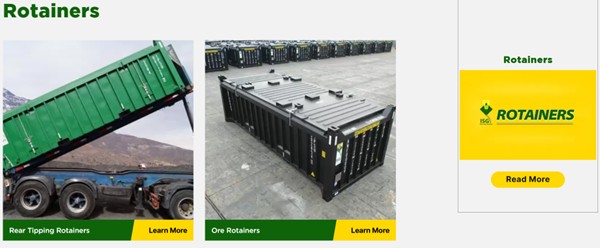
369 CRS submitted that ISG’s use of the ISG Rotainers Logo is plainly trade mark use which is deceptively similar to the Registered Mark.
370 In my view, the addition of the ISG Logo to the ISG Rotainers Logo at the top left of the page, and at the bottom of the page, and later in parts of the “Case Studies” and “Container Categories” pages, does not overcome the distinguishing badge of origin ISG has made of the word “Rotainers” to indicate that it is the origin of Rotainers, including goods such as the Rear Tipping Rotainers and the Ore Rotainers.
371 The word “Rotainers” is prominently depicted in stylised capitalised and underlined form adjacent to the ISG Logo. The ISG Logo contains a depiction of a tippler and the words “ISG” and “Pit to Ship Solutions”. The latter words are in tiny, essentially illegible font, especially in comparison with the large size of the word “Rotainers”. The ISG Logo is “dwarfed” by the large and/or capitalised “Rotainers” next to it.
372 It is further notable that the word “Rotainers” there takes the same position as the words “Intermodal Solutions Group” in the ISG Composite Logo on the Pit to Ship Website.
373 The word “Rotainers” is also depicted as a heading in white capital letters, above the words “Mining, grain, and ship loading industries”.
374 Any references to Pit to Ship Solutions or to ISG or Intermodal Solutions Group on this homepage are in very small font, so small as to be rendered insignificant relative to the prominent capitalised “Rotainers”.
375 The Rotainers Website also included various other uses of the sign “Rotainer” or “Rotainers” on the homepage, including in the phrase “Patented Bulk Rotainer Containers for Loading Tipplers”, in the sub-heading “Rotainer Containers”, and in the phrase “ISG Rotainers”.
376 ISG invites consumers to visit its Rotainers Website and its Rotainers AU Website. At those websites, containers are available for purchase under the word “rotainers” as part of the domain name, as well as being prominently displayed in page headings and in references to products. I consider that these uses constitute use of the “Rotainers” as a trade mark.
377 Contrary to ISG’s submission, I do not consider the Rotainers Websites make it clear that the mark under which the “rotainer goods” are offered is ISG. I reiterate that the ISG Logo is dwarfed by the prominent, capitalised and stylised “ROTAINERS” next to it, to the point where the ISG Logo on the printout above, is barely legible to the viewer. Any other references to ISG, Intermodal Solutions Group or Pit to Ship Solutions are so small that they do not strike the eye of someone viewing the website. The viewer needs to be actively searching for those brand names in order to find them. The prominent “ROTAINERS” coupled with the domain name of the same word would appear as branding or badge of origin to a consumer viewing the website.
378 CRS submits that the consumer would consider each of the ISG Logo and the capitalised, stylised “Rotainers” to be separate trade marks, rather than a single composite mark. CRS further submits that this is consistent with what is recorded in the communications leading up to the development of the Rotainers Websites:
Just a recap on the strategy. This micro website will be entirely focused around ranking the “rotainer” keywords. We will still keep it ISG branded, but that will be secondary to the word “rotainer’.
379 ISG contends that if it is found that its use of “rotainers” on the Rotainers Websites is use as a trade mark, that use is as part of the composite mark with the ISG Logo. The word “rotainers” is the same colour as the ISG in the ISG Logo and the line underneath the word “rotainers” is rendered in the same manner as the curved line adjacent to the word ISG in the ISG Logo—the stylised depiction of the contents falling out of an upended container. I disagree.
380 The word “rotainers” is capitalised, stylised and prominently displayed in white capitals below. It is also the name of the website. The eye of the consumer viewing the website would be drawn to the capitalised, stylised “rotainers”. This focus would be reinforced by that word also being the domain name and depicted in white capitals below.
381 The words of Williams J in the Tub Happy Case at 205, quoting Sir Greene MR in Saville Perfumery Ltd v June Perfect Ltd (1939) 58 RPC 147 at 161 are apt:
[…] In an infringement action, once it is found that the defendant’s mark is used as a trade mark, the fact that he makes it clear that the commercial origin of the goods indicated by the trade mark is some business other than that of the plaintiff avails him nothing, since infringement consists in using the mark as a trade mark, that is, as indicating origin.
(Emphasis added.)
382 Justice Williams added that “[n]eedless to say, if the defendant uses the words of the plaintiff’s trade mark as indicating origin it is still an infringement notwithstanding that the defendant always adds his own name”.
383 Ultimately, I do not consider that a different result is reached if the ISG Rotainers Logo is considered as a composite mark comprising the ISG Logo and the capitalised stylised “Rotainers”.
384 The word “rotainers” in its capitalised, stylised form dominates. The ISG Logo is small, the letters “ISG” are not clear. To the viewer the ISG Logo looks like a green diamond with a yellow wedge at the top. The ISG Logo is so small that it is not apparent that it includes a stylised tippler rotated container emptying. I consider that even if the mark were to be considered a composite mark it would be deceptively similar to the Registered Mark for reasons I discuss below.
7.2.8.2 The domain names of the Rotainers Websites
385 A domain name may constitute use of a trade mark: Sports Warehouse at [153] (Kenny J). However, the mere registration of the domain name is not sufficient to establish infringement. Where a person uses a domain name to attract consumers to a website which promises connections with goods or services relating to the registered mark, infringement may be established even if the owner of the domain name does not sell the goods or services and instead merely benefits from a flow of traffic over the website: Solahart Industries Pty Ltd v Solar Shop Pty Ltd (2011) 92 IPR 165 at [50] (Perram J).
386 In Fanatics, LLC v FanFirm Pty Ltd (2025) 185 IPR 383 at [102], the Full Court comprising Burley, Jackson and Downes JJ clarified that in circumstances where the domain name uses a registered mark as a badge of origin, it is necessary to differentiate the types of use in contemplation. This is because the use of a registered mark in the domain name, on the heading of the webpages and otherwise on the website to promote the retail sale of items on the website may not amount to trade mark use in respect of the registered classes of goods or services.
387 Thus, the Full Court determined in Fanatics at [109]–[112] that whilst evidence suggested that via the Fanatics website, Fanatics invited consumers to visit and acquire goods for purchase, the Fanatics website aggregated and sold an extensive range of third party branded products such that that invitation to acquire comprised an invitation to acquire a large range of apparel, much of which had no Fanatics branding on it. Further, for those products that were plainly branded with other prominent brands, the Full Court found that the consumer would not be likely to perceive that the use of Fanatics branding on the website extends beyond branding to the online retail sale of clothing in relation to those products. Therefore, unless the consumer’s attention is specifically drawn to the particular products that are branded with the relevant registered mark, the consumer is not likely to perceive that the general use of the registered mark on the website extends beyond branding relevant to, i.e., the online retail sale of the relevant goods rather than the use of the mark in respect of the goods themselves.
388 Importantly, where a domain name is used to conduct a website from which goods or services are sold, the same kinds of questions which arise in ordinary trade mark litigation will arise. In such cases, Perram J drew the analogy between the sign on the front of a shop and the goods sold within will be established: Solahart at [50].
389 The facts of this case regarding the use of the Registered Mark in the domain names of the Rotainers Websites are distinguishable from the facts in Fanatics. Unlike Fanatics, the goods marketed bear no branding other than the word “Rotainer” (i.e., Rear Tipping Rotainers and Ore Rotainers), wherein “Rear Tipping” and “Ore” are read as merely descriptive.
390 Indeed, the surrounding circumstances are more analogous to the facts in Mantra Group Pty Ltd v Tailly Pty Ltd (No 2) (2010) 86 IPR 19. In that case, Reeves J considered that the domain names using the registered mark constituted use of the mark as trade mark in light of the content of the impugned websites, including the fact that the Registered Mark was used in the banner heading, and used frequently and gratuitously throughout those websites. Further, similar to that case, the public visiting the Rotainers Websites are not invited to compare the “Rotainer” goods (i.e., containers) of ISG with the spreader or tippler of CRS but are being invited to purchase the goods. This is evident in the following statement on the Rotainers Website’s homepage:
Patented Bulk Rotainer Containers For Loading Tipplers
• SUITABLE FOR TRAINS, TRUCKS & SHIPS
• MINIMISES DUST, SPILALGE & PRODUCT LOSS
• PERFECT FOR RANGE OF COMMODITIES
• AVAILABLE IN VARIOUS LENGTHS, HEIGHTS AND WIDTHSs.
391 I refer to my analyses on the content of the Rotainers Websites above, and to my analysis of the goods advertised in the Rotainers Websites being the same goods as those under which the Registered Mark is registered and conclude that ISG’s use of the word “rotainers” in the domain name of the Rotainers Websites constitute use as a trade mark, rather than being descriptive or nominative uses.
7.2.9 Generic Tippler Statement
392 ISG posted the Generic Tippler Statement (which Mr Pinder termed a “blog”) on the Pit to Ship Website from around August 2016 until its removal on or around 11 October 2022, together with a photo of a tippler, used at SCT in Wales, which has “Rotainer” at the top right of the spreader bar. Mr Pinder accepted that at the time ISG posted the Generic Tippler Statement, he was aware that CRS had a registered trade mark for the word “rotainer” “for a machine”.
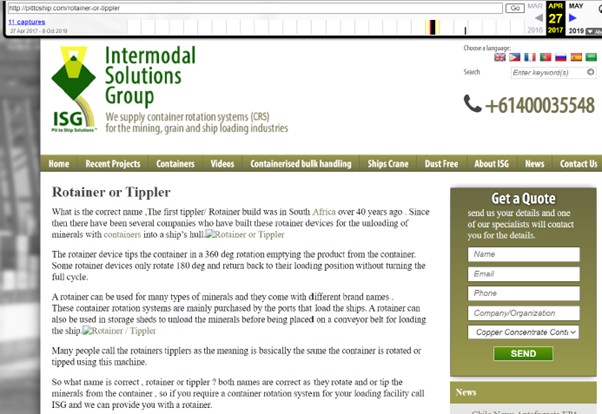
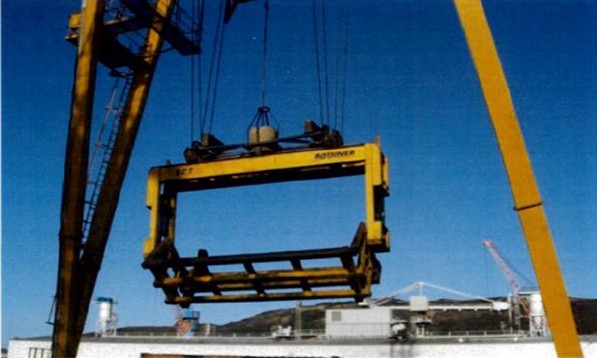
393 Mr Pinder explained his blog post:
Basically, it was a blog. The whole blog was all about the rotainer system, and at that time, I thought that basically, a lot of people were calling the tippler a rotainer, as well as the containers in the system, but I’ve since come to work out that basically, they don’t call them that. They call them tipplers, which is common knowledge.
394 Mr Pinder’s evidence was that ISG’s intention was to make “rotainer” a keyword on the Pit to Ship Website to generate internet traffic to the site, and to educate customers. Mr Pinder denied the suggestion that he was soliciting orders for tipplers via the blog.
395 Mr Pinder’s evidence was that as at August 2016:
I knew that they were calling the containers “rotainers” and the system rotainer. I thought that they were calling some of the tipplers rotainers, especially after you see the Swansea container rotainer, the first one, which was built 20 years before, that the tipplers were starting to be called that. But I’ve since worked out that they’re not. They’re actually calling the containers rotainers and the system, but not the tipplers. The tipplers are called tipplers.
396 Mr Pinder’s evidence was that when he published the blog, he believed that “rotainer” meant rotating container, not a tippler. He accepted that the use of “rotainer” in the Generic Tippler Statement was completely inconsistent with his asserted meaning for “rotainer” as a rotating or rotatable container. Mr Pinder accepted that “rotainer” was not a generic word for tippler and never had been.
397 At the time that the Generic Tippler Statement was published in August 2016, Mr Pinder’s evidence was that he believed “rotainer” to mean “rotating container, or the container rotation system as a whole”, but that he also thought at the time that “rotainer” was used to refer to tipplers. It is difficult to reconcile this with what Mr Pinder wrote in the Generic Tippler Statement, wherein tippler and rotainer were used interchangeably. Mr Pinder accepted that he did not, in that statement, say that “rotainer” could mean rotating or rotatable container. His evidence was that he had subsequently come to believe that “rotainer” is not a generic word for “tippler”, and it never has been.
398 Mr Pinder also denied that the Generic Tippler Statement was written in a context in which he knew that CRS was the owner of a registered trademark for the word “rotainer”. CRS submitted that Mr Pinder’s evidence was unreliable and should be given little weight. In this respect, CRS highlighted that Mr Pinder accepted himself that he was aware that AMMESA had supplied a machine called a “rotainer” in 2011 and that by 2012—and as of August 2016—he was aware that Mr Bridle’s companies had a registered trademark over the word “rotainer”, in Mr Pinder’s words, “for the tippler”, or “machine”.
399 I accept CRS’s submissions that Mr Pinder’s evidence regarding the Generic Tippler Statement is contradictory. To the extent that he sought to characterise his use of “rotainer” as a matter of opinion, namely that “rotainer” is descriptive, the incohesive evidence as to what Mr Pinder believed the term to mean tends to suggest that those opinions were neither honestly nor reasonably held. My view is reinforced by the contemporaneous Generic Tippler Statement, which suggests that “rotainer” was used, in a descriptive sense, only as a synonym to “tippler” (i.e., “Rotainer or Tippler” and “tippler/Rotainer”) rather than to denote a “rotating container” or the totality of the container rotation system.
400 However, I do not consider that the use of “rotainer” in the Generic Tippler Statement constitutes use as a trade mark. It is not used in this context to indicate a connection between ISG and particular goods or services.
7.2.10 Generic Container Statement
401 The Generic Container Statement was published on the Pit to Ship Website as early as 3 March 2021 on the “Rotainers” sub-page, and remained there until at least February 2023. It appeared in the following form under the header “ISG Rotainers” and below the subheading “Changing trends” which followed a shortened version of the Generic Tippler Statement that remained on the website at that time:
So what name is correct, rotainer or tippler? Both names are correct as they rotate and or tip the minerals from the container, so if you require a container rotation system for your loading facility call ISG and we can provide you with a rotainer.
Changing trends
The industry has now come to use the generic word rotainers to describe the rotatable containers that are used with the tipplers to unload their bulk cargo. Whereas the word “container” continues to be used for the non-rotatable containers.
(Emphasis added.)
402 In cross-examination, Mr Pinder was questioned about his understanding of the meaning of “rotainer” at the time he posted the Generic Container Statement, and how that differed from what he said had been his earlier understanding. Mr Pinder accepted that he continued to publish the Generic Tippler Statement—which asserted that “rotainer” is interchangeable with “tippler”—at least until 2022 but conceded that it “should have been pulled down before”.
403 It was put to Mr Pinder that the words “[t]he industry has now come to use […]” suggests a very recent evolution (i.e., around March 2021) in the use of the word “rotainer” to refer to rotatable containers. But Mr Pinder denied this and insisted that the evolution began in 2011 when he “first started to hear” people call rotatable containers “rotainers”. Mr Pinder further stated that the reference to “changing trends” was him giving a historical perspective harkening back to 2011, 10 years prior. That is, on Mr Pinder’s account and on ISG’s submissions, the word “rotainer” was used to refer to rotatable containers as early as 2011.
404 Notwithstanding that evidence, Mr Pinder published the Generic Tippler Statement in August 2016 asserting that “rotainer” means “tippler”, with no mention of it being referable to rotatable containers.
405 I do not consider that “rotainer” is used as a trade mark in the Generic Container Statement, for the same reasons set out in my analysis of the Generic Tippler Statement.
7.2.11 ISG Video using “Rotainers”
406 CRS alleged that a video titled “ISG Case Studies Series 25: The Safety and Environment on TPC – ISG Rotainers System” (ISG Video), used the word “Rotainer(s)” including in the title of the video, text displayed therein, and in a LinkedIn post referring to the video—including by use of the phrase “ISG Rotainers System” and the hashtag “#ISGRotainersSystem”. According to CRS, such uses also infringed the Registered Mark. The ISG Video was posted on the LinkedIn page, the Pit to Ship Website and YouTube in late 2021.
407 Mr Pinder deposed that the video was produced by one of ISG’s overseas customers, Terminal Puerto Coquimbo (TPC) in Chile, and that statements in it referring to an “ISG Rotainer System”, which were in Spanish with English subtitles, were statements of TPC. This was notwithstanding that ISG had asked TPC if it could use the video, to insert the ISG Logo into it, and to publish it with the title and hashtag referring to the same terminology.
408 According to Mr Pinder, the ISG Video was uploaded to the Pit to Ship Website, ISG’s YouTube channel and its LinkedIn page in about late 2021.
409 I consider that the use of “rotainers” in the ISG Video constitutes use as a trade mark, for the same reasons I set out in my analyses of the use of “rotainers” on the ISG Websites, excluding my reasons regarding the Generic Tippler Statement and the Generic Container Statement.
7.2.12 Search results
410 In May 2017, ISG commenced using “rotainer”, among other keywords, as a keyword in its Google keyword advertising. The detail of ISG’s keyword strategy is outlined above.
411 It was common ground, consistent with authority, that the use of “rotainer” as a Google metatag or keyword did not itself constitute use as a trade mark: Complete Technology Integrations Pty Ltd v Green Energy Management Solutions Pty Ltd [2011] FCA 1319 at [57], [62] (Kenny J); Veda Advantage Ltd v Malouf Group Enterprises Pty Ltd (2016) 118 IPR 291 at [136]–[137] (Katzmann J). This because metatags are invisible to the ordinary internet user. While their use in this case directs the user to the ISG Websites containing the word “rotainer”, they do not themselves indicate the origin of the advertised goods.
412 CRS relies on “the population of [ISG’s] website” with “rotainer” then causing the rotainers search results to appear in a particular way”. I have addressed the use of “rotainer” on the ISG Websites above, which I found to be use of “rotainer” as a trade mark. I do not consider that consideration of the use of “rotainer” on the website in order to optimise search result rankings adds anything to that consideration.
7.2.13 ISG communications
7.2.13.1 OZ Minerals tender
413 In August 2011, OZ Minerals invited suppliers to tender to design, fabricate and supply containers for its Prominent Hill mining operation. ISG tendered to supply OZ Minerals with rotating containers. In the tender document OZ Minerals specified that: “[t]he emptying of containers to ship hold shall be by a rotating tippler; the type of tippler to be used will be a “Rotainer”, and; “A description of the Rotainer is attached in Appendix 1”.
414 Mr Pinder contended that “Rotainer” was used in the tender document to identify AMMESA; he gave evidence that when he read “Rotainer”, he read it as a reference to AMMESA, and that the rotatable containers supplied would need to be compatible with AMMESA’s tippler. Mr Pinder acknowledged that the ISG rotatable containers are called “containers” in the ISG tender document.
415 In cross-examination, Mr Pinder explained the statement in his affidavit—“in May 2011, OZ Minerals released a public tender for the supply of 100 rotainers…”, as follows:
[…] I’m saying in this that they eventually evolved to be called rotainers, and we sell a lot of that design, and that design is probably our largest selling design. And they are rotainers, and the first one was built for the OZ Minerals tender.
[…]
I think by the time this was written that they were called rotainers, so, no, I disagree.
Sorry, Mr Pinder, what did you say? By the time this was written? By the time this affidavit was written; is that right? No. No. No. No. No. No, by the time that we were doing our marketing in our brochures, it had – […] the word “rotainer” had […] evolved.
It had evolved? Yes.
[H]ad it, Mr Pinder? So you say that in May 2011, the word “rotainer” was used synonymously – in other words, people in the industry saw “rotainer” and “rotating container” as being the same thing. Is that your evidence? In May 2011? Yes. Around 2011 people were calling them “rotainers”, yes.
Yes. And how do you explain that being consistent with the tender document that I have just taken you to? Yes. No. They’re completely different. I agree.
It’s completely inconsistent, isn’t it? That’s correct.
(Emphasis added.)
416 I consider that ISG’s use of “Rotainer” in its tender documents for OZ Mineral purported to draw a connection between ISG’s products and “Rotainer” as a badge of origin. For that reason, I conclude that the use of the Registered Mark in this instance also constituted use as a trade mark.
7.2.14 Conclusion
417 For the reasons above, I conclude the following regarding the uses by ISG of the Registered Mark across the ISG Websites:
No | Use | Conclusion |
Pit to Ship Website | ||
1. | First iteration | Use as trade mark of the Registered Mark by the following uses: (a) Tagline: “We supply Container Rotation Systems (Rotainers) for mining, grain & ship loading industries; (b) Heading: “Patented Bulk Rotainer Containers For Loading Tipplers”; (c) Phrases: “Our rotainer container design”, “ISG designed the first ever bulk rotainer container” and “Our rotainer designs”; (d) Heading: “Rotainer”; (e) Subheading: “Pit to Ship Rotainers”; and (f) “How do Rotainers Work” subheading. |
2. | Second iteration | Use as trade mark of the Registered Mark by the following uses: (a) Tagline: “We supply Container Rotation Systems (Rotainers) for mining, grain & ship loading industries” (b) Title: “Browse Rotainers Category”; (c) “Browse Non-Rortainers Category”; (d) Use of “rotainers” in reference to categorical nomenclature of container products, i.e., “Mineral Concentrate Rotainers”; and (e) Phrases in product specific pages: “ISG is the Global market leader in Open Top Containers (Rotainers)”. |
3. | Third iteration | Use as trade mark of the Registered Mark by the following uses: (a) Tagline: “We supply rotainers for the mining, grain & ship loading industries”; (b) “Rotainers” tab in the upper menu; and (c) Use of “rotainers” in reference to categorical nomenclature of container products, i.e., “Mineral Concentrate Rotainers” and analogous added content within the “Rotainers” tab. |
4. | Generic Tippler Statement | No use as trade mark of the Registered Mark. |
5. | Generic Container Statement | No use as trade mark of the Registered Mark. |
The Rotainers Website & The Rotainers AU Website | ||
6. | Rotainers Website | Use as trade mark of the Registered Mark by the following uses: (a) The ISG Rotainers Logos, being the First ISG Rotainers Logo and the Second ISG Rotainers Logo;
(b) Domain name: “www.rotainers.com”; (c) Heading: “Rotainers”; (d) Use of “rotainers” in reference to categorical nomenclature of container products, i.e., “Rear Tipping Rotainers” and “Ore Rotainers”; and (e) Statements such as “If you need a solution to loading or unloading materials from trains, trucks and ships. Our rotainers are the answer in conjunction with the RAM Revolver”. |
7. | Rotainers AU Website | Use as trade mark of the Registered Mark by the following uses: (a) Domain name “www.rotainers.com.au”; and (b) All uses on the Rotainers Website as above, by virtue of redirection. |
ISG Video | ||
8. | ISG Video titled “ISG Case Studies Series 25: The Safety and Environment on TPC – ISG Rotainers System” | Use as trade mark of the Registered Mark by the following uses: (a) The title of the ISG Video: “ISG Case Studies Series 25: The Safety and Environment on TPC – ISG Rotainers System”; (b) The text displayed in the ISG Video; and (c) LinkedIn post referring to the ISG Video, including by use of the phrase “ISG Rotainers System” and the hashtag “#ISGRotainersSystem”. |
Search Results | ||
9. | Use of “rotainer(s)” as keyword in its Google keyword advertising | No use as trade mark of the Registered Mark. |
ISG Communications | ||
10. | OZ Minerals Tender | Use as trade mark of the Registered Mark by the following use: (a) The tender document specifying that “[t]he emptying of containers to ship hold shall be by a rotating tippler. The type of tippler to be used will be a ‘Rotainer’. |


7.3 ISG’s intention in using “Rotainer”
418 CRS contends that ISG’s intention to draw a connection to CRS, and to genericise the Registered Mark, is relevant to the assessment of ISG’s alleged good faith use under s 122(1)(b), and flagrancy under s 126 of the TMA: Australian Woollen Mills Ltd v FS Walton & Co Ltd (1937) 58 CLR 641.
7.3.1 ISG’s campaign to genericise
419 On 13 February 2021, in an email to Richard Buckley of Click Click Media, Mr Pinder enumerated specific amendments to be made to the ISG Websites. This included a strategy to genericise the word “Rotainer” by inter alia, changing upper case “R” to lower case “r” and introducing an information section that used “Rotainer” in a descriptive manner:
[…]
1/ Can we place the below first red section at the bottom so the first thing customers see is Browse Rotainers Category:
Also, the word Rotainer in the red section, can you please change the capitol [sic] R to lower case so the word rotainers looks generic not a brand name?
[…]
2/ Under the below tab, please add the closing statement after the below wording, we are trying to make the word Rotainers generic and this information provides proof:
Find out more on what rotainers are here.
Many people call the rotainers: tipplers as the meaning is basically the same the container is rotated or tipped using this machine.
So what name is correct, rotainer or tippler? Both names are correct as they rotate and or tip the minerals from the container, so if you require a container rotation system for your loading facility call ISG and we can provide you with a rotainer.
[…]
(Emphasis in original omitted.) (Emphasis added.)
420 When Mr Pinder was cross-examined on the above correspondence, he did not accept that the plain language of the instructions to Click Click Media were to render the word “Rotainers” generic. Instead, Mr Pinder said that he was merely ensuring that he was documenting to Click Click Media “exactly how the content should look” so that it is said “the right way”.
421 I do not accept Mr Pinder’s evidence as it is in direct contradiction with the contemporaneous evidence, being the wording of the correspondence. The words “we are trying to make the word Rotainers generic” is open to only one interpretation, which is that at that time, Mr Pinder did not consider that the word “Rotainers” was generic and intended to genericise the Registered Mark. Whilst the words “this information provides proof” when read in isolation may evince, as Mr Pinder contends, an intention to ensure that “rotainers” is not inadvertently used as a trade mark or badge of origin, the surrounding circumstances are indicative that those words are more accurately construed as the prospective creation of “proof” in an attempt to genericise the Registered Mark.
7.3.2 Mr Pinder’s inconsistent evidence on the purported descriptive meaning of “Rotainer”
422 In cross-examination, Mr Pinder gave evidence that “Rotainer” meant rotatable or rotaining containers since 2011. Mr Pinder then changed his position, relying on an evolution theory, which propounded that the meaning of the word “Rotainer” evolved from 2011 to also mean the rotatable container system, which includes both the rotatable container and the tippler. Mr Pinder’s evidence on the Generic Tippler Statement that “Rotainer” never meant tippler was also in direct contradiction with the statement itself, which used “rotainer” and “tippler” interchangeably.
423 CRS submits, and I accept, that Mr Pinder’s evidence was confused and inconsistent. Mr Pinder sought to explain documentation that contradicted his position by then using the evolution theory that he hadn’t previously advanced. First, it is not established that Rotainer was a term describing a rotating container. Secondly, the Generic Tippler Statement itself contradicts that assertion. Thirdly, the descriptive reason was not revealed in the emails with the website developer, Click Click Media. In relation to that chain of correspondence, neither Mr Chalmers nor Ms Bowden were called to give evidence.
7.3.3 Use of ISG Logo in the Rotainers Websites
424 Mr Pinder gave further evidence in cross-examination that the ISG Logo is always prominent. When that assertion was contested by reference to the First and Second ISG Rotainers Logo, Mr Pinder contended that the First and Second ISG Rotainers Logo are to be read as the ISG Logo, along with the words of their product, being “Rotainers”.
425 For the reasons I set out above in the Rotainers Websites section, I reject Mr Pinder’s reading. I do not consider the Rotainers Websites make it clear that the mark under which the “rotainer goods” are offered is ISG. I further consider that the design of the First and Second ISG Rotainers Logo, as read against ISG’s instructions to render the ISG Logo subsidiary to the prominent stylised words “Rotainer” in its correspondence to Click Click Media dated 28 October 2021, evince a use that falls short of the requisite good faith.
426 My finding is consistent with FH Faulding, where McTiernan J held that the good faith defence will likely fail if particular prominence is given to the word in question. In that case, the registered trade mark was “Barrier Cream” and the defendant had used the word “barrier” to describe its own creams. Whilst the defendant succeeded in expunging the mark as descriptive, it was unsuccessful in establishing a good faith defence under the equivalent s 64(1)(b) of the Trade Marks Act 1955 (Cth). Though his Honour accepted that the word “barrier” was an apt description of the defendant’s creams, he was not satisfied that the defendant had used the word for a purely descriptive purpose. This was because “Barrier” appeared on the packaging in larger print than surrounding words, was set against a contrasting background and was repeated on three sides of the defendant’s carton. In that light, his Honour concluded that there was “[…] strong ground for finding objectively that the “get-up” was designed to promote the sale of the defendant’s creams by exploiting the possibility of confusion […]”: FH Faulding at 545.
7.3.4 Consideration
427 For the reasons above, I consider that ISG and Mr Pinder’s intentions in their various uses of the word “Rotainer” were not in good faith. I discuss this further in section 8.2 below.
7.4 Same goods or goods of the same description
7.4.1 Same goods—s 120(1)
428 For the purposes of s 120(1), CRS contends that ISG has used the Registered Mark in respect of the same goods for which the mark is registered, relevantly:
Apparatus for lifting and transportation; machines, apparatus and installations for conveying goods; […] apparatus and equipment for use in mining; haulage equipment and apparatus (mining)
429 ISG accepts that if it is found to have used the mark “Rotainers” in relation to tipplers, that use is in respect of the same goods as the goods for which the Registered Mark is registered. However, ISG contends that use in relation to rotating containers of the Registered Mark is not use in relation to the same goods for which the Registered Mark is registered, as containers are not specifically included in the list of goods for which the mark is registered. Further, ISG submits that containers fall in class 6 which, contrary to class 7, is directed to static metal objects and containers for storage or transport.
430 The Full Court in Killer Queen, LLC v Taylor (2024) 186 IPR 103 at [57] (Yates, Burley, and Rofe JJ) recently set out the appropriate approach to the task of construing the goods and/or services in respect of which a trade mark is registered. In particular, the classification of goods and services according to classes is primarily a matter of convenience in administration—for example, to facilitate searches. The nomination of a class for particular goods is not decisive as to the scope of a given registration.
431 The Register should be understood through the eyes of persons interested in knowing the scope of the monopoly. This is likely to include other traders who may be interested in using or licensing the trade mark: Woolworths Limited v BP plc (No 2) (2006) 70 IPR 25 at [58] ( Heerey, Allsop and Young JJ) and also persons interested in dealing with the trade mark, for instance by seeking a licence or taking an assignment of it. Generally, such persons can be expected to be familiar with the language and expressions used in the trade concerned: Killer Queen at [57].
7.4.1.1 Goods in the Rotainers Websites
432 In this section, I refer to the Rotainers Website as the Rotainers Websites. I refer to the Rotainers Websites specifically because they contain the bulk of ISG goods which ISG has associated with (by reference to) the Registered Mark, including because the Rotainers Websites replicate the Rotainer sub-pages found in the various iterations of the Pit to Ship Website. I have found the use of “Rotainers” on the Rotainers Websites to be use of the Registered Mark as trade mark.
433 The Registered Goods include “equipment” for various uses, including for “lifting”, “transportation”, “use in mining” and “haulage”. The word “equipment” is an ordinary English word. There is no evidence to suggest it has a special or technical meaning. The Macquarie Dictionary defines “equipment” as “anything used in or provided for equipping” or “a collection of necessary implements (such as tools)”. Thus, “equipment” for lifting or transportation or for use in mining or for haulage means anything used in, or provided for equipping, or a collection of necessary implements for transportation or use in mining or haulage.
434 The Registered Goods also include “apparatus” for various uses, including for “lifting”, “transportation”, “conveying goods”, “use in mining” and “haulage”. The word “apparatus”, like “equipment”, is an ordinary English word. The Macquarie Dictionary defines “apparatus” to mean “an assemblage of instruments, machinery, appliances, materials, etc., for a particular use” or “any complex appliance for a particular purpose”. An “apparatus” for lifting or transportation or conveying goods or use in mining or haulage means, inter alia, a complex appliance for those particular purposes. The evidence shows that containers used in container rotators are specifically adapted for their intended purpose, and that those containers are supplied assembled with other parts or accessories, including removable lids.
435 “Rotainer” is used as an indication of origin for goods offered for sale or supply on the Rotainers Websites. The Rotainers Websites:
(a) discuss products in terms of solutions for the transporting of materials such as grain and mined ores and commodities;
(b) speak of products being suitable for minimising dust and spillage and product loss during transportation on trains, trucks and ships; and
(c) describe how the products are changing the logistic, storage and ship loading process.
436 The Rotainers Websites emphasise the use of the “rotainers” for the transport or haulage of mined commodities. Three case studies are presented under the heading “Latest News & Articles”. Two uses relate to a use for mining and hauling and transporting the mined product from the mine; the other use conveys a product (urea) away from where it is produced. The Rotainers Websites also feature pictures of tipplers unloading containers. Under the heading “Tailored Solutions”, ISG makes the following offer: “[i]f you need a solution to loading and unloading materials from trains, trucks and ships. Our rotainers are the answer in conjunction with the RAM Revolver”.
437 Accordingly, I consider that the person interested in dealing with the trade mark, for instance by seeking a licence or taking an assignment of it, would understand the “rotainer” products featured on the Rotainers Websites to fall within the description “apparatus and equipment for us in mining; haulage equipment and apparatus (mining)”, as well as “apparatus and installations for conveying goods” of the Registered Goods.
438 I consider that the use of “Rotainers” on the Rotainers Websites to be use in respect of the same goods as the goods for which the Registered Mark is registered.
7.4.2 Goods of the same description—s 120(2)
439 In Goodman Fielder Pte Ltd v Conga Foods Pty Ltd (2020) 158 IPR 9 at [277]–[286], Burley J considered the authorities regarding whether certain goods are “goods of the same description as those appearing in the Register” for the purposes of ss 44, 101 and 120 of the TMA. At [280], Burley J set out the three principal factors used to assess whether goods are of the same description, none of which are decisive:
(1) the nature of the goods, including their origin and characteristics;
(2) the uses made of them, including their purpose; and
(3) the trade channels through which the goods are bought and sold.
440 As to the third factor, Kenny J in McCormick & Co Inc v McCormick (2000) 51 IPR 102 observed at [18] that:
[…] it may be relevant to consider whether the goods being compared are produced by the same manufacturer or distributed through the same channels; whether they are sold in the same shops; whether they are sold to the same sort of customers; and whether those engaged in the manufacture and distribution of the goods are considered as belonging to the same trade.
(Citations omitted.)
441 First, as to the nature of the goods, rotatable or rotating containers are specially designed to be used together with container rotators and accessories such as tipplers, and they form part of a container rotation system. The OZ Minerals project exemplifies this, where CRS’s tippler or spreader was explored for compatibility with ISG’s rotatable containers.
442 As discussed above, the Rotainers Websites emphasise that the “rotainers” offered are specifically designed to be used as equipment for the haulage of bulk commodities. Alternatively, the Pit to Ship Website emphasises that the “rotainers” are designed to be used as equipment for the transport and haulage of bulk commodities from “pit” to “ship”.
443 As to the trade channels, the goods under consideration are all sold though the same trade channels in these sense that the container rotator and containers—together, parts of a container rotation system—are offered through the same source, being the CBH field. An example of a third party which supplies both container rotators and containers, and therefore the container rotation system in its entirety, is Qube. The evidence shows that CRS also offers the entire system—including both container rotators and containers—and that it competes directly with ISG.
444 Third, the evidence shows that customers who purchase tipplers and containers often seek to do so from a single source.
445 I therefore consider that the containers offered for sale and supply by ISG on the ISG Websites are goods of the same description as the goods for which the Registered Mark is registered.
7.5 Substantially identical or deceptively similar
446 ISG accepts that “rotainer(s)” is substantially identical to the Registered Mark.
447 However, ISG observes that various allegedly infringing uses are use as part of a composite phrase, and not use of “rotainer(s)” or of the Registered Mark alone. This includes:
(a) ISG’s use of the ISG Rotainers Logo, being a stylised and capitalised “Rotainers” with the ISG Logo on the Rotainers Websites prior to October 2022;
(b) ISG’s use of “Rotainer” in its invoice, “ISG A TYPE Rotainer”; and
(c) ISG’s use of “Rotainers” on LinkedIn, “ISG Rotainers System”.
448 ISG submits that all uses from (a) to (c) are composite phrases or images that are neither substantially identical nor deceptively similar to the Registered Mark.
449 Critically, regarding (a), I note that ISG’s submission that the First and Second ISG Rotainers Logo involve use of “Rotainers” as part of one composite trade mark containing the word “ISG” sits at odds with Mr Pinder’s evidence, which was that there was no composite mark, just the ISG Logo and the word “Rotainers”.
450 The relevant test of deceptive similarity to be applied is the “imperfect recollection” comparison described by Windeyer J in Shell Co at 415:
On the question of deceptive similarity a different comparison must be made from that which is necessary when substantial identity is in question. The marks are not now to be looked at side by side. The issue is not abstract similarity, but deceptive similarity. Therefore the comparison is the familiar one of trade mark law. It is between, on the one hand, the impression based on recollection of the plaintiff’s mark that persons of ordinary intelligence and memory would have; and, on the other hand, the impressions that such persons would get from the defendant’s television exhibitions. To quote Lord Radcliffe again: “The likelihood of confusion or deception in such cases is not disproved by placing the two marks side by side and demonstrating how small is the chance of error in any customer who places his order for goods with both the marks clearly before him… It is more useful to observe that in most persons the eye is not an accurate recorder of visual detail, and that marks are remembered rather by general impressions or by some significant detail than by any photographic recollection of the whole […]
451 The High Court confirmed in Self Care at [3], [36] and [50] that the reputation of the registered trade mark plays no role in the analysis of deceptive similarity under s 120(1) of the TMA. The test of deceptive similarity “must be applied whether the mark of which infringement is alleged is newly registered and almost unknown or has been prominently displayed on well-known merchandise for many years”: Self Care at [21] (Kiefel CJ, Gageler, Gordon, Edelman and Gleeson JJ), quoting CA Henschke & Co v Rosemount Estates Pty Ltd (2000) 52 IPR 42 at [43] (Ryan, Branson and Lehane JJ). See also Swancom Pty Ltd v The Jazz Corner Hotel Pty Ltd (2022) 168 IPR 42 at [68] (Yates, Abraham and Rofe JJ).
452 As discussed above, I consider that the ISG Logo and the two versions of the “Rotainers” mark are separate marks when used on the Rotainers Websites.
453 If, the marks were instead to be considered as a composite mark, I consider that the composite mark would be deceptively similar to the Registered Mark. As I noted above, The ISG Logo portion of any composite mark on the Rotainers Websites is very small. It is barely possible to discern the letters “ISG” if looking hard. The stylised tippler appears more as a green diamond with a yellow wedge. The whole of the Registered Mark is contained within the purported composite mark. The only difference being the tiny ISG Logo on the left side of the stylised word “Rotainers”. The word “Rotainers” is the visually dominant part of the purported composite logo.
454 Regarding uses in (b) and (c), I consider that the use of “Rotainer(s)” is substantially identical or deceptively similar to the Registered Mark. This is for reasons including that ISG and “Rotainer(s)” would be read separately as two distinct marks.
8. Defences
8.1 Section 120(2) proviso
455 If, contrary to my conclusion, infringement is not established under s 120(1), and s 120(2) comes into play, ISG relies on the proviso to s 120(2), which states:
However, the person is not taken to have infringed the trade mark if the person establishes that using the sign as the person did is not likely to deceive or cause confusion.
456 ISG bears the onus of establishing that the proviso applies.
457 Both referred to the principles to be applied as set out in Goodman at [361]–[368].
458 CRS relied as a starting point upon the statement referred to in Goodman at [363] that, if an allegedly infringing mark has been found to be deceptively similar to a registered mark, “[…] then it would, in many instances, render it more likely (though not inevitable) that the actual use of the allegedly infringing mark was likely to deceive or cause confusion […]”: E & J Gallo Winery v Lion Nathan Australia Pty Ltd (2009) 175 FCR 386 at [76] (Moore, Edmonds and Gilmour JJ).
459 ISG contends that by reason of:
(a) all of ISG’s uses of “rotainer” being in conjunction with or alongside an ISG mark or the ISG Logo;
(b) the word “rotainer” being a term commonly used in the CBH field with an “understood generic connotation”;
(c) there being a specialised technical consumer base and where the goods cost large amounts of money;
(d) “Rotainers”, purportedly meaning rotatable containers or the container rotation system, are rarely bought individually—thereby increasing the cost;
(e) the purchasing process is frequently protracted; and
(f) there being inadequate evidence of actual confusion
no consumer is likely to be deceived by ISG’s use of the Registered Mark.
460 As to the first point, CRS submitted that the fact that the Registered Mark has been used in conjunction with, or in close proximity to, the ISG name or the ISG Logo, even if accepted — noting that the proximity in question varies across ISG’s numerous uses—would not dispel the likelihood of consumer deception or confusion. That is so because use in proximity does not answer the question of association. It is sufficient if the notional consumer would be caused to wonder whether there was some kind of commercial association: Self Care at [70]–[71].
461 CRS submitted that, in assessing the likelihood of deception or confusion resulting from ISG’s conduct, the Court should have regard to evidence that ISG has—and has actively promoted— an association with a third-party tippler manufacturer, RAM. CRS submits that, as a result, consumers familiar with ISG’s methods and reliance on other tippler manufacturers would not be surprised—and would therefore readily be deceived into thinking—that ISG would be promoting its goods in conjunction with another third-party manufacturer, being the owner of the trademark, CRS.
462 By using CRS’s marks including “Rotainer” and “Container Rotation Systems” on the ISG Websites and in other marketing materials without authorisation, ISG is therefore likely to confuse consumers into associating ISG with the reputational benefits of CRS. In counter to this submission, if sophisticated consumers are aware of the association ISG has with RAM, specifically—rather than RAM, as a third-party manufacturer in general—then the consumers may well be surprised to find that ISG had changed its primary tippler supplier and appeared to be associated with CRS instead. Viewed this way, confusion may not be likely for a consumer informed of ISG’s existing associations who sees its use of the Registered Mark.
463 The second point about genericism that ISG asserted in support of the s 120(2) proviso was not made out on the evidence. CRS also argued that the second point is a moot point; if a genericism argument were supported and consequently the Registered Mark was liable to be cancelled, the s 120(2) defence would not be enlivened.
464 As to the third point, ISG suggests that it is plain, in light of the technical consumer base who would be inquiring about ISG’s products, and the drawn-out purchasing process, that purchasers understand who they are purchasing their products from and are therefore not likely to be confused. ISG relies on Dunlop Aircraft Tyres Ltd v Goodyear Tire and Rubber Company (2018) 134 IPR 220 at [307] (Nicholas J). In rebuttal, CRS suggests that the evidence establishes varying levels of customers’ familiarity with CBH equipment, distinguishing the findings in Dunlop. In any case, CRS contends that the protracted nature of the purchasing process and the fact that, at the end of the process, consumers know where their products come from, is no answer to the likelihood that consumers would be confused at the stage of making an initial inquiry with ISG, thereby being induced into the “marketing web”. CRS submits that the relevant time for assessing the likelihood of deception or confusion is at the time of the trade mark use.
465 As to ISG’s last point about actual confusion on the evidence, there were two such examples in the evidence of Mr Perkins and Mr Solly, with a further two email exchanges that CRS referred to. For example, in Mr Solly’s evidence, when an internet search looking for “rotainers” led him to the impugned Rotainers Websites, he was confused and thought that its owner, ISG, had an association with Mr Bridle’s Rotainer business. At the time of making the internet search, Mr Solly was not well acquainted with ISG, although he had an email inquiry with ISG some seven years prior, which he had forgotten at the time of the search. While ISG sought to undermine the reliability of Mr Solly’s evidence based on inconsistencies in his accounts as to the confines of his search and his knowledge of ISG, CRS submitted that in any case, an inquiry into these examples of actual confusion is illusory, because actual confusion is not the test; the onus is on ISG to show that the conduct is not likely to deceive or cause confusion, and ISG has failed to discharge that onus.
466 For the reasons above, I consider that even if contrary to my findings, infringement is not established under s 120(1), infringement will be established under s 120(2) because ISG did not discharge its onus to prove that its various uses of the Registered Mark were not likely to deceive or cause confusion.
8.2 Good faith adoption of “rotainer” to describe the characteristic of the goods
467 ISG also relies on the defence in s 122(1)(b)(i) that it has used the word “rotainer(s)” in good faith to identify the kind of their goods.
468 Section 122(1)(b) of the TMA provides:
122 When is a trade mark not infringed?
(1) In spite of section 120, a person does not infringe a registered trade mark when:
[…]
(b) the person uses a sign in good faith to indicate:
(i) the kind, quality, quantity, intended purpose, value, geographical origin, or some other characteristic, of goods or services; or
[…]
(Emphasis in original.)
469 In Bohemia Crystal Pty Ltd v Host Corp Pty Ltd (2018) 129 IPR 482, Burley J explained at [296] the operation of this defence:
[…] Section 122(1)(b)(i) calls for consideration not of whether there is trade mark use, but rather whether there is use in good faith. The prefatory words in s 122(1) “in spite of s 120” make plain that an otherwise infringing use may be excused if the conditions of s 122(1) are satisfied, but the scope of this aspect of the subsection does not appear to have been expanded.
(Emphasis in original.)
470 The purpose of s 122(1) is to protect the fundamental right of a trader to honestly describe its product. Section 122(1) functions as a “second-line’ mechanism that preserves that right, with the “first line” mechanism being that a use of a registered mark will only infringe if it is used as a trade mark: Urban Alley Brewery Pty Ltd v La Sirène Pty Ltd (2020) 150 IPR 11 at [213] (O’Bryan J).
471 ISG relies on the following to establish their use in good faith:
(1) ISG has used “rotainer” in good faith to identify the kind of ISG’s goods, i.e., rotainers, purportedly meaning rotatable containers;
(2) while ISG was aware of the Registered Mark, it had an honest belief that no confusion would arise and no intention of wrongfully diverting business from CRS: see Urban Alley at [214], [222]; and
(3) ISG’s conduct following the commencement of proceedings, i.e., pausing its plans to use the word rotainer on material other than the ISG Websites and the Additional ISG Websites such as brochures, invoices, contracts and other business documentation until the final determination of the matter, is a sign of good faith.
472 “Good faith” as used in the context of s 122 is taken to mean “honest” use: Optical 88 Ltd v Optical 88 Pty Ltd (No 2) (2010) 89 IPR 457 at [161] (Yates J). This requires an honest belief, at least at the time of adopting the mark, that no confusion would arise by reference to the earlier trade mark’s reputation and a lack of intention to divert business or “sharp conduct with an eye on wrongly diverting business”: Australian Postal Corporation v Digital Post Australia Pty Ltd (2013) 105 IPR 1 at [73]–[74] (North, Middleton and Barker JJ).
473 The onus is on ISG to establish that it acted honestly and without any ulterior motive: Nature’s Blend Pty Ltd v Nestlé Australia Ltd (2010) 87 IPR 464 at [51], [54] (Stone, Gordon and McKerracher JJ).
474 Something less than a fraudulent intention in the common law sense will suffice to preclude use from being use in good faith: Johnson & Johnson Australia Pty Ltd v Sterling Pharmaceuticals Pty Ltd (1991) 21 IPR 1 at 32–33 (Gummow J). This can involve use of the mark for an ulterior motive or for the purpose of causing the detriment of the original mark or its owner. In Johnson & Johnson, an international strategy to make the word “Caplets” into a generic word, as a way to avoid infringement, was held to not be use in good faith: Johnson & Johnson at 33–34 (Gummow J).
475 For the reasons I have discussed above, I do not consider that the word “rotainer” was descriptive at the date of filing. I also reject Mr Pinder’s contention that “rotainer” evolved to become descriptive due to the inconsistencies in that argument, and the lack of any supporting evidence substantiating such an evolution theory.
476 Despite Mr Pinder’s stated belief that no one would be confused, his subjective opinion is at odds with the circumstances surrounding ISG’s use of the Registered Mark and Mr Pinder’s and ISG’s conduct from 2016 onwards.
477 Further, the chronology of ISG’s adoption of “Rotainer(s)” establishes an absence of good faith in ISG’s adoption and use of the “rotainer” mark. In summary:
(a) Mr Pinder had knowledge of the Registered Mark since 2012, around four years before ISG’s first use of “rotainer(s)”;
(b) An initial use by ISG of “Rotainer(s)” was in the Generic Tippler Statement on the Pit to Ship Website in August 2016, immediately after ISG’s failed preliminary discovery application, in circumstances where Mr Pinder was “annoyed” with CRS;
(c) Mr Pinder’s strategy was to “genericise” the Registered Mark. In his own words as recorded in contemporaneous evidence, he stated “we are trying to make the word Rotainers generic”;
(d) Mr Pinder’s intention in using “rotainer(s)” was to divert business from CRS by attracting customers from CRS. To that end Mr Pinder instructed Click Click Media to include the term “rotainer(s)” in the Google key words for advertising;
(e) ISG’s acquisition of five domain names with the word “rotainer”, including “rotainer.org”, “rotainer.net”, and “rotainers.com”, each of which redirected to ISG’s Pit to Ship Website; and
(f) Saturation references to “rotainer(s)” on the ISG Websites, including replacing references to containers with “rotainer(s)”.
478 None of the conduct outlined above is consistent with a good faith use of “rotainer(s)” by ISG. Rather, ISG’s conduct is more in the nature of the “assiduous efforts of an infringer” described by Windeyer J in Re Bali Brassiere Co Inc’s Trade Mark and Berlei Ltd’s Application (1968) 118 CLR 128 at 133.
479 Finally, I accept CRS’s submission that the fact that ISG did not make proper inquiries or seek to obtain legal advice notwithstanding its knowledge of the CRS’s Registered Mark goes against a finding of good faith. In this regard, the relevant facts of this case are analogous to that in Flexopack S.A. Plastics Industry v Flexopack Australia Pty Ltd (2016) 118 IPR 239 at [107], [150], [154] (Beach J), wherein the lack of evidence that ISG had sought or received any legal advice as to the use of the mark “rotainer” is indicative that good faith is not established. This is especially so when the impugned conduct continued after ISG received a letter of demand on 16 May 2022 (the Letter of Demand), in which CRS asserted its rights over the Registered Mark. I reject ISG’s submission that its conduct following receipt of the Letter of Demand is not determinative and that its conduct following the commencement of proceedings ought to be considered as indicative of good faith. The test of good faith is concerned with whether a defendant honestly believed, at the time of the impugned conduct, that no confusion would result and had no intention of wrongfully appropriating the plaintiff’s goodwill: Optical 88 at [37]–[49], [163] (Yates J). On the contrary, that ISG had the ulterior motive to seek to benefit from the word “Rotainer” is conclusive evidence of bad faith.
480 Accordingly, I consider that ISG has failed to lead sufficient evidence of its purported good faith and therefore cannot rely upon s 122(1)(b)(i) of the TMA as a defence to any infringement.
9. Flagrancy & Additional damages
481 CRS seeks orders for additional damages from ISG in the event that it succeeds on its infringement case. Given that the proceeding was bifurcated in liability and quantum, the only question to be determined at the liability stage is whether the conduct of ISG has enlivened an entitlement to CRS of an order for additional damages.
482 Section 126(2) sets out five relevant matters to which the Court must have regard in determining whether to award additional damages. Those matters, to which the Court must have regard, are not in the nature of preconditions which must be satisfied in order to make the award: Futuretronics.com.au Pty Ltd v Graphix Labels Pty Ltd (No 2) (2008) 76 IPR 763 at [17] (Besanko J). The statutory factors set out in the section do not exhaust all relevant matters for consideration, but they do indicate the considerations to which Parliament turned its attention. The five factors are:
(a) the flagrancy of the infringement; and
(b) the need to deter similar infringements of registered trade marks; and
(c) the conduct of the party that infringed the registered trade mark that occurred:
(i) after the act constituting the infringement; or
(ii) after that party was informed that it had allegedly infringed the registered trade mark; and
(d) any benefit shown to have accrued to that party because of the infringement; and
(e) all other relevant matters.
483 CRS submits that the following matters support its claim for additional damages:
(a) Mr Pinder’s decision to use “rotainer(s)” on the ISG Websites was deliberate and made with knowledge of the Registered Mark;
(b) ISG’s use of “rotainer(s)” was done with the intention of diverting consumers to the ISG Websites;
(c) ISG would have derived a benefit from its use of “rotainer(s)” on the ISG Websites;
(d) ISG continued its conduct after receipt of the Letter of Demand which put them on notice of CRS’s position and gave notice of possible infringing conduct; and
(e) the need to deter such conduct generally.
484 ISG contends that none of the matters on which CRS relies on in its pleading justify the award of additional damages or finding of flagrancy. ISG submits that the fact that it is and has been since at least 2010 a direct competitor with CRS and its knowledge of CRS’s business and the Registered Mark goes nowhere. The fact that an infringing entity is a competitor of the rightsholder does not justify an award of additional damages. For example, in Lift Shop Pty Ltd v Easy Living Home Elevators Pty Ltd (2013) 103 IPR 511 at [48], Buchanan J said that he would not have awarded additional damages if infringement had been shown, including because “[…] the respondent set out to position itself to compete with the applicant in its own right by drawing the attention of potential customers to its own capacity to satisfy their requirements. It was not seeking to profit from the applicant’s reputation. It was seeking to be chosen in its own right”.
485 ISG also contends that its defence—that “rotainer” was descriptive was a reasonable one—is an indicium against the award of additional damages. ISG relies on authorities in the patent context to submit that “the existence of a defence at trial may be […] [a] relevant factor” in assessing flagrancy, and more generally against the award of additional damages: Fuchs Lubricants (Australasia) Pty Ltd v Quaker Chemical (Australasia) Pty Ltd (2021) 159 IPR 1 at [405] (Beach, Moshinsky and Thawley JJ); Oxworks Trading Pty Ltd v Gram Engineering Pty Ltd (2019) 154 IPR 215 at [69] (McKerracher, Burley and O’Bryan JJ). The same logically applies in the context of s 126 of the TMA.
486 In light of the chronology of ISG’s adoption and use of “rotainer” set out above, I consider that conduct takes this case beyond that of a competitor using a too similar mark. There was a conscious adoption of the same mark, an intention to “genericise” the competitor’s mark, and an aim to divert trade from the competitor trade mark owner to ISG by use of the Registered Mark. In addition, there was the acquisition of the domain names featuring the competitor’s mark and the saturation use of “rotainer(s)” on the ISG Websites.
487 Against the background of the evidence regarding the lack of use of “rotainer” before the Priority Date, and ISG’s conduct with respect to the use of the mark “rotainer” as exhaustively discussed above, it is difficult to see how the view that the word “rotainer” was descriptive was a genuinely held belief by ISG.
488 I consider that in the circumstances of this case, the Court’s power to include an additional amount in the assessment of damages for trade mark infringement is enlivened.
10. Relief
489 All parties sought to be heard separately on the question of relief if trade mark infringement was established.
11. ACL & Passing off
490 CRS alleges that misleading or deceptive conduct and other contraventions of the ACL (ss 18, 29(1)(a), 29(1)(g) and 29(1)(h) of the ACL). The conduct said to contravene the ACL comprised the following:
(a) the Generic Tippler Statement published on the Pit to Ship Website from August 2016, and the Generic Container Statement published in as early as March 2021 (the Generic Statements); and
(b) ISG’s use of “Rotainer(s)” on the ISG Websites:
(i) to promote its products from February 2020, and in the presentation of internet search results; and
(ii) to represent that the products offered by ISG are those of, or are the same as, those supplied by CRS, which first appeared in early 2021
(together, the Website Conduct).
491 CRS accepts that to succeed in relation to the Website Conduct, it must establish that CRS has the requisite reputation in the word “Rotainer” at the relevant dates.
492 ISG denies the making of the representations. A significant part of the defence to the ACL case is based on ISG’s contention that “rotainer” is descriptive. I rejected that contention in the trade mark cancellation case under s 41 of the TMA and will not revisit it in the ACL context.
493 ISG also contends that the representations do not constitute conduct in Australia.
11.1 ACL
11.1.1 Principles
494 The High Court in Self Care at [80] summarised the well-established principles:
[…] Determining whether a person has breached s 18 of the ACL involves four steps: first, identifying with precision the “conduct” said to contravene s 18; second, considering whether the identified conduct was conduct “in trade or commerce”; third, considering what meaning that conduct conveyed; and fourth, determining whether that conduct in light of that meaning was “misleading or deceptive or … likely to mislead or deceive”.
(Emphasis in original.) (Citations omitted.)
495 It is always necessary to commence by asking: “what is the alleged conduct?”. If that conduct constitutes conduct in trade and commerce, the High Court in Self Care at [82] identified that the third and fourth steps then require the court to characterise, as an objective matter, the conduct viewed as a whole and its notional effects on the state of mind of the relevant class of persons, judged by reference to its context. Their Honours noted that the context includes both:
the immediate context—all the words in the document, or other communication and the manner in which those words are conveyed, not just a word or phrase in isolation; and
the broader context—the relevant surrounding facts and circumstances.
496 Conduct which engenders temporary or commercially irrelevant error, although persuasive, is not sufficient to enliven s 18 of the ACL or constitute passing off: SAP Australia Pty Ltd v Sapient Australia Pty Ltd (1999) 48 IPR 593 at [51] (French, Heerey and Lindgren JJ); Knight v Beyond Properties Pty Ltd (2007) 74 IPR 232 at [58] (French, Tamberlin and Rares JJ). Further, there is a difference between a customer who is “momentarily confused” and a customer who is “misled or deceived in a material sense”: Brick Lane Brewing Co Pty Ltd v Torquay Beverage Co Pty Ltd (2023) 170 IPR 195 at [112] (Stewart J).
497 Finally, an intention to deceive is highly relevant to the assessment of whether a conduct is likely to deceive potential consumers. As Dixon and McTiernan JJ said in an already quoted and frequently cited passage in Australian Woollen Mills at 657: “[…] when a dishonest trader fashions an implement or weapon for the purpose of misleading potential customers he at least provides a reliable and expert opinion on the question whether what he has done is in fact likely to deceive […]”. However, an intention to deceive is not determinative and must be weighed against other evidence; after all, an intention to deceive may nevertheless fail in its purpose: Telstra Corp at [553]–[555] (Murphy J).
498 More recently, in Bed Bath ‘N’ Table Pty Ltd v Global Retail Brands Australia Pty Ltd [2025] HCA 50 (BBnT HCA) at [48]–[57], the High Court comprising Gageler CJ, Gordon, Edelman, Jagot and Beech-Jones JJ fleshed out the manner in which state of mind evidence are to be dealt with under ACL claims. While a person’s dishonest intention is not an element of the statutory proscription under s 18(1) of the ACL, the person’s state of mind may nonetheless be relevant in the ways described by Australian Woolen Mills. Because s 18(1) of the ACL does not depend on a defendant’s dishonest intention, the defendant’s state of mind, directly or by analogy, may engage the approach to evidence explained. Thus, at [56], the High Court clarified that the evidentiary approach in Australian Woollen Mills is “not confined to cases of a subjective intention to mislead. Nor are they engaged in a “border line case”. And nor is such resulting evidence to be classified as “some evidence” only […]”.
499 When a trader adopts a mark or get-up to appropriate the rival’s reputation, the trader’s belief about market benefit can serve as a reliable expert opinion on likely deception, even without a dishonest intent to mislead. Wilful blindness, as opposed to proven dishonesty, can constitute relevant and cogent evidence toward the objective inquiry on the likelihood of deception.
500 Accordingly, I adopt my findings on ISG’s intention in using “rotainer(s)” and lack of good faith in its adoption of “rotainer(s)” in my analyses of CRS’s claims under s 18(1) of the ACL.
501 Finally, I note that the relevant date for assessing whether ISG’s conduct contravened the statutory proscriptions of the ACL is the date of commencement of the impugned conduct.
11.1.2 Relevant consumer
502 Container rotation systems are not marketed to, or purchased by, the general public. Customers or potential customers for CBH equipment can come from different segments of the industry including manufacturers, processors, port operators, and shipping, transport and logistics companies. ISG submits that the customer base in the CBH industry is sophisticated, with technical know-how and high levels of understanding in relation to CBH equipment, as the equipment is often purchased by procurement personnel from mining, port, or logistics companies. But CRS submits that this is not always the case and customer sophistication can vary based on factors like the location of the customer, the resources available to them, and the methods they have traditionally used for handling bulk materials, if any. CRS also submits that the knowledge of consumers tends to be lower at the inquiry stage, and grows throughout the purchasing process, which was consistent with the evidence of Mr Gallie and Mr Bridle.
503 On the evidence, the reasonable consumer in this case is someone with experience in, and familiarity with, the CBH industry. They are most likely to be primarily a port operator, or from a mining, shipping, transport or logistics company. The class would include consumers who have been involved in a previous purchase of a container rotation system or who have encountered such a system in their work. The class would also include first time consumers who have not been involved in a previous purchase, who may not be familiar with rotating containers or tipplers or the companies that supply or sell them.
11.1.3 Trade and commerce
504 ISG is incorporated in Australia. The content for each of the ISG Websites was uploaded in Australia. Each of the ISG Websites was accessible in Australia and addressed to all consumers, including those located in Australia.
505 ISG’s use of the mark “rotainer” on the ISG Websites and the posting of the Generic Statements was done in the course of ISG operating its business, and was done in the course of trade and commerce in Australia.
11.1.4 The conduct
506 CRS relies on two species of conduct: the Generic Statements, and the Website Conduct, each of which are discussed below.
11.1.4.1 Generic Statements
11.1.4.1.1 Generic Tippler Statement
507 I have set out the facts surrounding the Generic Tippler Statement above.
508 CRS submits that via the Generic Tippler Statement ISG represented that:
(a) “Rotainer” is a generic word for, or is descriptive of, a container rotator or tippler;
(b) “Rotainer” is not a trade mark or brand name; and
(c) the words “Rotainer” and “tippler” are interchangeable or equivalent terms.
509 ISG accepted that it represented on the Generic Tippler Statement that the words “rotainer” and “tippler” were interchangeable, albeit in contradiction to Mr Pinder’s subjective understanding of the word “rotainer” as being descriptive of a rotatable container or the container rotation system only. ISG also accepts that the use of “rotainer” solely to refer to a container rotator has not become widespread. However, ISG contends that the representation that “rotainer” was interchangeable with “tippler” was correct at the time it was made. ISG denies that the Generic Tippler Statement represented that rotainer is a generic word for tippler.
11.1.4.1.2 Generic Container Statement
510 The facts surrounding the Generic Container Statement are set out in section 7.2.10 above.
511 CRS submits that the Generic Container Statement represents that:
(a) the word “Rotainer” is a generic word for, or is descriptive of, a type of container (i.e., rotatable container); and
(b) the word “Rotainer” is not a brand name.
512 ISG accepts that via the Generic Container Statement it represented that “rotainer” is and was generic or descriptive of “containers” for use with an apparatus for tipping bulk goods. However, ISG denies that the website extract represents that “rotainer” is a generic or descriptive word for “tippler”. ISG contends that in the context of the website extract, the use of the word “generic” would be understood by those in the CBH field in its ordinary English usage (i.e., characteristic of a class) rather than in any trade mark sense (i.e., s 24).
513 ISG also accepts that by the website extract it represented that “rotainer” is and was descriptive of containers used in an apparatus for tipping bulk goods.
514 The Macquarie Dictionary relevantly defines “generic” as “relating to a genus”, “applicable or referring to all the members of a genus or class”, “an expression referring to all the members of a class, such as the French, the poor, etc” and “identified by the name of the product itself, not by a particular brand name”.
11.1.4.1.3 Consideration of Generic Statements
515 The parties bundled the two sets of Generic Statements up together in their submissions. I will therefore discuss them together.
516 In addition to the contention that “rotainer” is descriptive, ISG contends that the generic statements are not misleading or deceptive as they are both statements of opinion, and that the sophisticated reader would not perceive ISG to be making a statement of fact. Further, ISG contends that the generic statements were genuinely held opinions of Mr Pinder.
517 CRS takes the point that ISG did not plead that the statements were statements of opinion. Consequently, CRS was denied the opportunity to seek discovery as to whether Mr Pinder’s belief was honestly held, and ISG should not be able to rely on this assertion in closing submissions.
518 In any event, I do not agree that the Generic Statements were statements of opinion, or that the consumer reading them would consider them to be statements of opinion rather than fact. The reader would perceive the Generic Tippler Statement, as Mr Pinder intended, to be an educative statement as to terminology and industry expressions used in the CBH industry. There is nothing to convey that the statements are not statements of fact but the opinion of ISG or Mr Pinder. In an email to Click Click Media in February 2021 in relation to the addition of the Generic Container Statement to the Pit to Ship Website, Mr Pinder stated “[…] please add the closing statement after the below wording, we are trying to make the word Rotainers generic and this information provides proof”.
519 Mr Pinder’s evidence at the hearing was that “rotainer” had “evolved” by 2021 to become descriptive of rotatable containers and transportation systems using rotatable containers. Consistent with an aim to encourage the word “rotainer” to be generic, Mr Pinder’s written evidence was that “since I wrote the blog the use of the term “rotainer” to refer solely to the tippler has not become widespread”.
520 As at August 2016, it was not true that “rotainer” and “tippler” were synonymous or interchangeable. Nor was it true that “rotainer” was a generic—in any sense—word for, or descriptive of, a rotatable container. For a period of some five years, the Pit to Ship Website displayed both of the Generic Statements, despite their contradictory nature.
521 I do not consider that Mr Pinder held the honest belief as at August 2016, that “rotainer” meant “tippler” and that they were interchangeable, or that “rotainer” was descriptive. At that date, Mr Pinder was aware of CRS’s Registered Mark. Further, it was the aim of Mr Pinder to harness the word “rotainer” to generate internet traffic to the ISG Websites and to render the Registered Mark generic by encouraging the descriptive use of the term “rotainer” via the factual Generic Statements. Neither of these aims align with the Respondents’ proposition that Mr Pinder held the honest belief as at August 2016 that “rotainer” was interchangeable with “tippler” or that “rotainer” was descriptive of rotatable containers.
522 I consider that by making the Generic Statements, ISG has contravened s 18 of the ACL.
523 Implicit in the statements about “rotainer” being descriptive and interchangeable with tippler is the representation that “rotainer” is not a brand— as it could not be a brand if it were another word for a tippler or a rotatable container. However, I consider that that representation which might be understood by trade mark lawyers, is too subtle for the consumers from the CBH field reading the ISG Websites. Accordingly, I do not find that the Generic Statements represent that “rotainer” is not a brand.
11.1.4.2 Website Conduct
524 The conduct of which CRS complains is ISG’s use of the mark “Rotainer”, including on the ISG Websites, in a manner which causes ISG’s Websites to appear in internet search results (both paid and organic). By that conduct, CRS contends that ISG has engaged in misleading or deceptive conduct, or made false representations including by representing that the goods it supplies are those of CRS, or that they are the same as or of the same quality as the goods supplied by CRS, or that there is an association between ISG and CRS (the Website Conduct Representations). This is the conduct which also forms the basis of CRS’s passing off claim.
525 Considering the examples of ISG’s use of “rotainer(s)” on the ISG Websites in the Background section above, examples of the use on which CRS focussed for the purpose of its ACL claim include:
(a) “ISG […] can provide you with a rotainer”;
(b) “We supply Container Rotation Systems (Rotainers) for mining, grain & ship loading industries”;
(c) “Our rotainer container designs” and “Our rotainer designs”;
(d) using the word “Rotainer” as a title or sub-title of products, including on product-specific pages on the Pit to Ship Website;
(e) video using “Rotainers” entitled “ISG Case Studies 25: … ISG Rotainers System” on the Pit to Ship Website and a LinkedIn post in late 2021; and
(f) the domain names in the Rotainers Websites.
526 CRS submits that it had a significant and unique reputation in the sign “Rotainer” by August 2016—when the Generic Tippler Statement was first made—and that that reputation had increased by early-2020 when ISG expanded its use of “rotainer(s)” on the Pit to Ship Website.
527 CRS contends that consumers searching on the internet for CRS and its products using the term “rotainer” were “enticed” onto the ISG Websites by ISG’s use of “rotainer(s)” as a search term in searches, which caused the ISG Websites to be retrieved in search results and to be optimised in those search results. As consequence, consumer traffic that would otherwise have been directed to the CRS Website and the Rotainer Websites was diverted to the ISG Websites instead.
11.1.4.2.1 CRS’s reputation in “rotainer”
528 The evidence as discussed in the Background section above demonstrates the considerable use that has been made of the Registered Mark by CRS (and prior to it, by AMMESA) over more than a decade since 2011.
529 The number of sales of “Rotainer” branded tipplers by AMMESA and CRS, for installation in Australia, has not been extensive. However, the level of reputation required depends on the nature of the plaintiff’s business. The test is one of commercial relevance: ConAgra Inc v McCain Foods (Aust) Pty Ltd (1992) 23 IPR 193 at 272 (French J, as his Honour then was). Where the price of the relevant goods is high, fewer people need to have knowledge of the plaintiff’s indicium than if the goods are low-cost consumer items. Tipplers are very large and very expensive items of equipment. Further, the supply and installation of the first AMMESA “Rotainer” branded tippler at Flinders Ports in 2011, was a newsworthy event which generated many articles in the trade press.
530 In addition to published articles and advertisements in industry and trade press featuring the “rotainer” mark, promotional activities were also carried out by AMMESA and subsequently by CRS on their respective websites and in advertisements, brochures and newsletters; on physical signage on its goods, vehicles and premises; at trade shows; on YouTube videos, and; on other merchandise and promotional materials.
531 That CRS had acquired a reputation in “Rotainer” was further established by the evidence of:
(1) Mr Perkins, who gave evidence on the extensive marketing of CRS using the words “Rotainer” and his knowledge that “[…] Rotainer is the brand name for Murray Bridle’s equipment”.
(2) Mr Fedden, who gave evidence that the three prominent brands of container rotators included “Rotainer”, with the other two being “Revolver” and “Rotabox”. Mr Fedden also deposed that the names were widely used in industry publications and reports, in marketing and promotion of the systems and equipment sold or provided under those names by manufacturers and suppliers of that equipment. Mr Fedden further deposed that when he heard the word “Rotainer”, he understood it to mean container rotation equipment or systems of CRS.
(3) Mr Fitzgerald, who deposed that the word “Rotainer” is the name of the system he knew to be manufactured by AMMESA, associated with Mr Bridle’s company, and
(4) Mr Solly, who in cross-examination gave evidence that any mistaken use of “Rotainer” was a biproduct of the reputation and widespread knowledge of the AMMESA/CRS product. Mr Solly described the brand “Rotainer” as “possibly all we were aware of back then”, observing that he didn’t know if “Rotabox” existed around 2013–2014, and that “people were […] at the time, mainly aware of the word rotainer or the brand Rotainer”.
532 As a result of the continued use of “rotainer” since 2011 in relation to its tipplers and business, whilst considering that the relevant good is a high-cost specialised consumer item, I find that CRS had acquired a reputation in “rotainer” before 2016.
533 In so far as the Respondents contend that CRS has failed to establish a “secondary reputation”, that contention wrongly presumes that the word “rotainer” is descriptive such that CRS is required to show sufficient use to displace an inherently descriptive meaning.
11.1.4.2.2 Consideration of Website Conduct
534 The question to determine is what meaning does ISG’s use of the word “rotainer” on the ISG Websites as at 2016, 2020 and 2021, assessed in all the context—both broad and immediate, convey to the reasonable consumer.
535 The relevant broader context in which the conduct is to be judged is the CBH industry as I have described above, including that CRS and ISG are competitors in that industry, and that CRS had acquired a reputation in Australia amongst CBH consumers in the word “rotainer” before 2016. The CBH industry is a specialised market with a limited number of suppliers and brands. Also relevant is the evidence that companies selling and supplying CBH equipment such as containers may join forces with other companies that sell and supply other CBH equipment such as tipplers to sell the full suite of products—the container rotator system. As I have discussed in section 3.2.1 above, there was evidence of ISG representing that it was an agent for RAM SPREADERS.
536 The relevant immediate context includes the prevalent use of “rotainer” on the ISG Websites after 2020. The ISG Websites were replete with the word “rotainer” which seemed to have been inserted at every opportunity, in the body of the text, in category headings, and including as from 2021, in the domain names of the Rotainers Websites. The ISG Websites also displayed the ISG Logo.
537 It is highly relevant that ISG’s conduct began in 2016, with knowledge of CRS’s Registered Mark. Following the posting of the Generic Tippler Statement in 2016, the conduct increased from 2020, when—consistent with ISG’s twin aims to generate internet traffic while optimising its position in internet search results and to genericise the Registered Mark—ISG began to use the word “rotainer” throughout the remaining webpages of its ISG Websites.
538 For the purposes of ACL, ISG also contends that “rotainer” is descriptive and relies on the comments of Stephen J in Hornsby Building Information Centre Pty Ltd v Sydney Building Information Centre Ltd (1978) 140 CLR 216 at 229–30 to submit that a court will not grant a de facto monopoly in descriptive words. Should that be accepted, ISG submits that its use of a descriptive word in an attempt to attract business does not involve any illegitimate intention. ISG contends that the use of the word “rotainer” is an “entirely legitimate and necessary aspect of ISG’s business of supplying rotainers”. As I have found above, I do not consider that “rotainer” was descriptive or had “evolved” to become descriptive as at 2020 to 2021. I do not consider that it was a necessary aspect of ISG’s business at any time that it used the word “rotainer(s)”.
539 Mr Pinder’s evidence was that 30% of ISG’s business was generated from internet enquiries.
540 Consistent with the aim to attract internet traffic, ISG was aware of CRS’s prior and existing use of the word “rotainer” as a mark when it adopted the word for use on the ISG Websites. The internet traffic ISG sought to engender was the diversion of consumers from its competitor CRS as otherwise there would be no reason to the use of “rotainer”, especially where other terms such as rotatable container or tipplers or spreaders were available for anyone who wished to describe the article. As the term “rotainer” was not a descriptive term used by those in the CBH field, those consumers typing “rotainer” into an internet search must be assumed, as at 2016 and 2020–21, to have been looking for CRS and/or its products. ISG’s acquisition of the domain names of the Rotainers Websites immediately after CRS’s launch of its Rotainer Website further supports the conclusion that ISG was intentionally targeting consumers who were looking for CRS and/or its products.
541 CRS contends that once customers were “enticed” onto the ISG Websites by ISG’s use of “rotainer(s)”, ISG then had the opportunity to convert the customer enquiries into valuable contracts for the supply of CBH equipment. CRS described this as ISG using the Registered Mark to capture potential customers in its “marketing web” by an erroneous belief engendered by ISG. CRS submits that that is enough to constitute misleading or deceptive conduct, notwithstanding that the consumer could be expected to understand the correct position by the time they actually became a customer. The question of characterisation as to whether a conduct is misleading is “logically anterior to the question whether a person has suffered loss or damage thereby”: Australian Competition and Consumer Commission v TPG Internet Pty Ltd (2013) 250 CLR 640 at [50] (French CJ, Crennan, Bell and Keane JJ).
542 ISG responded that conduct which induces temporary or commercially irrelevant error, although persuasive, is not sufficient to enliven s 18 of the ACL or constitute passing off: SAP Australia at [51] (French, Heerey and Lindgren JJ); Knight at [58] (French, Tamberlin and Rares JJ). Further, ISG observed that there is a difference between a customer who is “momentarily confused” and a customer who is “misled or deceived in a material sense”: Brick Lane at [112] (Stewart J). ISG contends that by reason of the presence of the ISG Logo on the ISG Websites, consumers would at most be momentarily confused. Further, by the time any purchase contract was signed, the consumer would be aware that they are dealing with ISG and not CRS. By reason of the protracted purchase process involved in the acquisition of expensive CBH equipment, by the time the purchaser signed the purchase contract there would be no confusion as to who the consumer was dealing with.
543 In Sydneywide Distributors Pty Ltd v Red Bull Australia Pty Ltd (2002) 55 IPR 354, Weinberg and Dowsett JJ (with Branson J agreeing) observed at [117] that:
[…] where a trader, having knowledge of a particular market, borrows aspects of a competitor’s get-up, it is a reasonable inference that he or she believes that there will be a market benefit in so doing. Often, the obvious benefit will be the attraction of custom which would otherwise have gone to the competitor. It is an available inference from those propositions that the trader, with knowledge of the market, considered that such borrowing was “fitted for the purpose and therefore likely to deceive or confuse”. Of course, the trader may explain his or her conduct in such a way as to undermine the availability of that inference […]
544 I consider that such an inference of the kind described in Sydneywide at [117] is available to be drawn on the basis of the evidence in this case. ISG has tried unsuccessfully to explain its conduct to undermine that inference by contending that “rotainer” is or has evolved to become descriptive.
545 Whilst the effect of the conduct may dissipate as, in the course of lengthy discussions and negotiations for the purchase of CBH equipment, the consumer is likely to learn that they are not dealing with CRS, or that there is no association between ISG and CRS, there are likely to be some consumers that would be enticed to the ISG Websites in the belief that either they are visiting one of CRS’s websites or that there is some association between the two companies, such as ISG acting as an agent for CRS or ISG offering CRS tipplers for sale. But for being enticed to the ISG Websites in the first place, those customers who were looking for CRS products may not otherwise have come upon ISG in their purchase process.
546 The presence of the ISG Logo might help reduce the confusion that the consumer has reached a CRS website. However, that the ISG Logo is displayed in the ISG Websites will not reduce the likelihood that a consumer would be caused to wonder whether there is some association between the two companies, such as ISG acting as an agent for CRS or offering CRS tipplers for sale.
547 I am fortified in my conclusion that the reasonable consumer may be “caused to wonder” (see Self Care at [70]–[71]) whether there is an association between CRS and ISG by the existence of the evidence that consumers did in fact question whether there was such an association. That evidence included the following examples:
(a) Mr Perkins who was heavily involved in the CBH industry, and with knowledge of the main players in that industry, gave evidence of his confusion upon seeing ISG’s use of “rotainer” and his assumption that ISG and CRS had entered into an arrangement regarding equipment used in rotating container tipper systems. This is particularly because CRS manufactures tipplers but not rotatable containers or “boxes”, such that an alliance to become a one-stop shop would be a reasonable inference. During cross-examination, Mr Perkins gave the following evidence:
Well, I’m aware that Murray actually manufactures – or CRS manufactured their own rotating frames, but they don’t manufacture the boxes. I’m aware that ISG does manufacture boxes in China. So I assume that they had formed an alliance to sell the products that they manufactured.
(Emphasis added.)
(b) Mr Solly, who recalled that upon searching “rotainer”, he clicked the first search result and viewed a website that caused him to think that Mr Bridle had sold to, merged with, or had some association with the owner of that website. The relevant ISG website did not look like the CRS Website that Mr Solly had visited previously and contained repeated references to “rotainer”.
548 I give the alleged confusion of Mr Solly’s evidence little weight on its own, as Mr Solly could not recall with certainty the specific website he was taken to. However, the examples of confusion strengthen the inference I have independently reached that ISG’s conduct was misleading or deceptive: see State Government Insurance Corporation v Government Insurance Office of New South Wales (1991) 28 FCR 511 at 529 (French J, as his Honour then was). See also Homart Pharmaceuticals Pty Lt v Careline Australia Pty Ltd (2018) 264 FCR 422 at [56]–[57], [59] (Murphy, Gleeson and Markovic JJ).
549 I consider that when the conduct is viewed as a whole, in the immediate and broader contexts identified above, the reasonable consumer coming across “rotainer(s)” on the ISG Websites for the first time would question whether there was some kind of association between the ISG and CRS, or that perhaps ISG was acting as an agent for CRS and its tipplers.
550 I am satisfied that the Website Conduct constitutes misleading or deceptive conduct under s 18 of the ACL. Regarding CRS’s allegation that ISG also contravened ss 29(1)(a), (g) and (h), I refer to the High Court’s observation in Self Care at [84] that there is no relevant meaningful difference between the words “misleading or deceptive” in s 18 and “false or misleading” in s 29 of the ACL. Under s 29, and for present purposes, it is necessary to identify a representation made in connection with the supply or possible supply of goods, or in connection with the promotion of the supply or use of goods that is false or misleading and meets the descriptions in the foregoing subsections. For the reasons I set out above, I consider that the Website Conduct Representations also contravene ss 29(1)(a), (g) and (h) of the ACL for making false or misleading representations that the ISG goods are of a standard similar to that of CRS’s “rotainer” brand, and that the ISG and its goods have a sponsorship and affiliation with or approval of CRS.
11.2 Passing off
551 The elements for the tort of passing off are well established. The tort of passing off involves “three core concepts: reputation, misrepresentation and damage”: Stone and Wood Group Pty Ltd v Intellectual Property Development Corp Pty Ltd (2018) 129 IPR 238 at [82] (Allsop CJ, Nicholas and Katzmann JJ). At the same paragraph, the Full Court said that the tort “protects the right of property in business, goodwill or reputation”: see also Cadbury Schweppes Pty Ltd v Darrell Lea Chocolate Shops Pty Ltd (2007) 72 IPR 261 at [98] (Black CJ, Emmett and Middleton JJ).
552 It is well established that, although both claims generally run together, an ACL claim has broader application and is generally easier to establish than a passing off claim. The key distinction being that, unlike in passing off, reputation is not an element of the statutory cause of action under the ACL, even though it may be relevant: see In-N-Out Burgers, Inc v Hashtag Burgers Pty Ltd (2020) 150 IPR 73 at [182] (Katzmann J); Cadbury at [99].
553 For the same reasons that I consider that the Website Conduct constitutes misleading or deceptive conduct, I am satisfied that the Website Conduct also constitutes passing off given that CRS and AMMESA had the requisite reputation in “rotainer(s)”.
12. Authorisation
554 CRS alleges that Mr Pinder was either directly involved in the trade mark infringement and contravention of the ACL referred to above or that he was knowingly concerned in, authorised or engaged with ISG in that conduct as a joint tortfeasor. CRS accepts that Mr Pinder’s position as a director of ISG cannot of itself make him accessorily liable; more is required. CRS contends that Mr Pinder was more than just the managing director of ISG and, having regard to the nature and extent of his conduct, Mr Pinder was acting beyond his role as a director, in that he had a close personal involvement in the contravening acts and made ISG’s torts his own.
555 The relevant joint tortfeasor principles were usefully extracted by Moshinsky J in Playgro Pty Ltd v Playgo Art & Craft Manufactory Ltd (2016) 117 IPR 489 at [150]–[153].
556 CRS contends that Mr Pinder was an intentional participant in the alleged infringing conducts and that he had knowledge of the essential facts constituting the contraventions. CRS relies upon the following conducts of Mr Pinder to show that his involvement went beyond merely of his capacity as ISG’s director:
(a) his preparation of the Generic Tippler Statement;
(b) his directions to include “rotainer” on the ISG websites;
(c) his control over the ISG Websites’ content, including keyword choice and the decision to retain the Generic Tippler Statement on the Pit to Ship Website until 2022; and
(d) his knowledge of the activities of CRS and its Registered Mark.
557 Mr Pinder is one of three directors of ISG and a minority shareholder of ISG. Mr Pinder gave extensive evidence via three affidavits, whilst the other two ISG directors did not provide any evidence. Other than being introduced as directors, they did not feature in any of the evidence of Mr Pinder.
558 Mr Pinder’s state of mind was relied upon for the purposes of showing good faith under s 122(1)(b) of the TMA. I consider on the evidence outlined above, including Mr Pinder’s direct involvement in the conduct relied upon by CRS, that Mr Pinder had a close personal involvement in the contravening acts, which travelled beyond his role as a director of ISG. I therefore conclude that Mr Pinder did have a “common design” with ISG in engaging in the contravening acts, and therefore Mr Pinder was a join tortfeasor of ISG in those contravening acts.
13. Provisionally Admitted Amended Chronology
559 At the end of the hearing, ISG sought to tender an Amended Chronology of some 171 entries purporting to be evidence of third-party uses of “Rotainer” in a descriptive manner. I provisionally admitted the Amended Chronology on the basis that I would rule on its admissibility in my reasons. ISG’s reliance on the Amended Chronology resulted in the closing submissions being delayed to provide CRS an opportunity to consider and respond to it.
560 Aside from those documents that were separately tendered after they were put to witnesses in cross-examination, or those documents annexed to the evidence of witnesses other than Mr Gomez, I reject the remainder of the documents in the Amended Chronology on the basis of relevance.
561 Aside from the first entry (being evidence concerning use of “rotainer” at SCT in Wales), all the other entries in the Amended Chronology were after the filing date of the Registered Mark. Most of the entries were documents or screenshots of websites. These were interspersed with references to witness evidence. Reference to documents other than in English in the original Chronology (which had 256 entries) had been removed from the Amended Chronology. Only 42 of the entries in the Amended Chronology are dated before August 2016, when the Generic Tippler Statement was posted on the ISG’s Pit to Ship Website.
562 Some of the documents evidencing the “uses” of “rotainer” were collected from the evidence of the witnesses or documents put to witnesses during cross-examination, including Mr Pinder, Mr Bridle, Mr Towers and Mr Bannatyne. However, the bulk of the documents in the Amended Chronology were obtained by searches of the internet or from other sources and “exhibited” to three affidavits of Mr Gomez, a solicitor from Harris Gomez Group Lawyers, being the firm on record for the Respondents.
563 In his first affidavit, Mr Gomez explained how he carried out searches using Google and other online search tools for the term “rotainer” being used by persons other than ISG or CRS. He then exhibited a “bundle of documents found as a result of those searches” to his first affidavit as Exhibit HG-1. Given the “volume of the materials found” Mr Gomez then created a summary table extracting screenshots of the use of “rotainer”. The instances of use included uses outside Australia and uses up to May 2023.
564 Mr Gomez then carried out searches for “rotainer” using “Trove” and exhibited screenshots of the results of those searches. The total pages exhibited to Mr Gomez’ first affidavit, without the bundle of documents in exhibit HG-1, was in the order of around 200 pages.
565 In his second affidavit Mr Gomez exhibited a 50-page bundle of Latin American industry publications referring to the word “rotainer”, all of which post-dated the Priority Date, some LinkedIn posts from Latin America, and a “summary of excerpts of email correspondence and their English translations”.
566 In his third affidavit, Mr Gomez annexed an eclectic group of documents including an ASX announcement, a Bloomberg article, the Southern Ports Information Guide for the port of Esperance dated July 2022, all up totalling another 200 odd pages. There was no explanation as to how Mr Gomez came across the documents he annexed to his third affidavit.
567 ISG submitted that the documents purportedly evidencing the descriptive “uses” of “rotainer” in the Amended Chronology—other than those tendered during cross-examination—were admissible on three bases: to establish a non-hearsay purpose (the fact and nature of the use of “rotainer”) relying on Yarra Valley at [179]–[195]; as business records under s 190 of the Evidence Act 1995 (Cth) as it would be too expensive to call all the authors; and under s 219 of the TMA as being “usage of the trade concerned” and as evidence of use of the trade mark legitimately by other persons, citing Caporaso Pty Ltd v Mercato Centrale Australia Pty Ltd (2024) 181 IPR 78 at [296], [302] and [314] (Charlesworth J).
568 CRS contended that the documents in the Amended Chronology, other than those tendered during cross-examination, should be given no weight because:
(a) in most cases the person using the word “rotainer” in the documents is not a trader using the word “rotainer” as a badge of origin in relation to their equipment, or in the course of trade. Further, many of the authors would not fall within the expanded view of consumers;
(b) the onus is on ISG to establish that each document supports a descriptive meaning. It is not for CRS to rebut a presumption that the use is descriptive. No inference should be drawn in favour of ISG;
(c) the documents are not dictionaries or commonly used and accepted textbooks (cf Yarra Valley);
(d) the context of each document cannot be ascertained. The Court has no information as to the authors, the information to which the authors were privy, what caused the authors to use the word “rotainer”, and whether the authors had any connection with ISG or CRS. The relevant traders and consumers are specialised classes; they are not ordinary traders or consumers of fast-moving consumer goods; and
(e) in the case of the documents post-August 2016, and especially post-2020, ISG has made no effort to show that the use is unconnected with ISG’s use, in particular on the ISG Websites. For example, the documents include enquiry emails from potential ISG customers.
569 In addition to its general objections, CRS also responded to each individual entry in the Amended Chronology. CRS objects to the majority of entries in the Amended Chronology. For most of the entries, CRS disputed ISG’s assertion that the entry showed a descriptive use of “rotainer”, including because:
(a) the author was not a trader or a consumer;
(b) the author was not a fluent English speaker;
(c) the entry related to matters outside Australia;
(d) the extract was taken out of context from the full article, which was often lengthy, for example a 246 page report from Northparkes Mines, which contains one “rotainer” reference, or a 120 page Mining proposal that has two references to “rotainer”, both on the same page: the first being “specialised lidded containers (Rotainer/Rotabox)”, and the second being a photo labelled “Rotainer/Rotabox”;
(e) there was or may be a connection with AMMESA or CRS;
(f) the document was a customer enquiry from a potential customer (often outside Australia) of ISG who had seen ISG’s use of “rotainer” on the ISG Websites;
(g) the term “rotainer” was used to identify AMMESA’s equipment; and
(h) the term “rotainer” was an erroneous reference, for example, a mislabelling of a Qube Rotabox as a Rotainer box or a Qube Rotainer.
570 The following general observations can be made as to the Amended Chronology:
(a) there is no evidence of use of “rotainer” in Australia before the Priority Date.
(b) the post-Priority Date examples of use begin in 2011, coinciding with the installation of the AMMESA tippler in Flinders Ports and the associated publicity and media reporting as discussed above.
(c) according to the CRS responsive table, many of the entries in the Amended Chronology have a link to AMMESA/CRS, either the document discusses equipment supplied by AMMESA, or a facility where AMMESA equipment was installed.
(d) the word “rotainer”—whether as “Rotainer”, “rotainer”, “Rotainer®” or “#Rotainer” is used or applied inconsistently, sometimes in relation to tipplers, other times containers, sometimes to systems involving tipplers and containers, sometimes to “technology” and sometimes it is not possible to tell how it is being employed; and
(e) the extracts are from a wide variety of sources including emails, LinkedIn and Instagram posts (including videos), websites, meeting minutes, ASX announcements, to company annual reports.
571 I am then left with an Amended Chronology of which the majority of entries are the subject of dispute. I lack the time, evidentiary material and inclination to resolve the plethora of individual objections. Any, at its highest, minimal benefit would be swamped by the time required to resolve the disputed entries. Even then, the entries would be inconsistent in the use of “rotainer”. On no basis could the collection of “references” be considered a statistically valid survey of the use of “rotainer” in the CBH industry in Australia. There was evidence during the hearing from witnesses who were cross-examined as to the use of “rotainer” in Australia. The Amended Chronology adds nothing to that evidence.
572 The admission of a confined number of extracts from accepted reference and textbooks published well before the Priority Date and available in Australian libraries in Yarra Valley should not be seen as an invitation to those challenging the registration of a mark to scour the length and breadth of the internet, both current and historical, for any reference to the mark. The out-of-context results of such searches annexed to a solicitor’s affidavit and presented as examples of use of the mark are unlikely to be of any meaningful assistance to the Court. Further, the other party will be required to review and respond. This practice is antithetical to the well-known principles which underpin the purpose of s 37M of the Federal Court Act and should stop.
14. Costs
573 All parties sought to be heard on costs following the publication of my reasons. Accordingly, I will make orders for the provision of a further hearing on relief if the parties cannot agree on orders to reflect these reasons. The issue of costs of the proceeding will also be dealt with at that stage if no agreement can be reached.
15. Disposition
574 For the above reasons, the application filed by CRS on 29 June 2022 should be allowed. I will make orders for the parties to provide proposed minutes of orders to give effect to these reasons.
I certify that the preceding five hundred and seventy-four (574) numbered paragraphs are a true copy of the Reasons for Judgment of the Honourable Justice Rofe. |
Associate:
Dated: 27 February 2026
SCHEDULE OF PARTIES
VID 367 of 2022 | |
Cross-Claimants | |
Second Cross-Claimant: | LOAD AND MOVE PTY LTD (ACN 116 435 360) |
Third Cross-Claimant: | GARRY PINDER |


