FEDERAL COURT OF AUSTRALIA
Archbishop Makarios Griniezakis v Morelas (Trial Judgment) [2026] FCA 156
File number: | NSD 158 of 2022 |
Judgment of: | ABRAHAM J |
Date of judgment: | 27 February 2026 |
Catchwords: | DEFAMATION – where the applicant is the Archbishop of the Australian Greek Orthodox Church – where applicant sues in defamation over four articles published on a website – where publications were published online DEFAMATION – defences – honest opinion – s 31 Defamation Act 2005 (NSW) – lack of proper material – expressions of fact not opinion – defence of honest opinion not made out DEFAMATION – defences – statutory qualified privilege – s 30 Defamation Act 2005 (NSW) – where the respondent failed to have proper sources, fact-checking and supporting evidence – where the respondent failed to request comments from the applicant – defence of statutory qualified privilege not made out DEFAMATION – defences – justification – s 25 of the Defamation Act 2005 (NSW) – where the defence is relied on for one imputation contained in the Fourth Article –defence of justification not made out DAMAGES – where applicant claims for damage to reputation and hurt feelings – where applicant claims aggravated damages – broad injunction preventing the respondent from publishing any material about the applicant sought – narrower injunction granted |
Legislation: | Evidence Act 1995 (Cth) ss 126K, 136 Defamation Act 2005 (NSW) ss 10A(1), 25, 30, 31, 34, 35, 36 |
Cases cited: | Al Muderis v Duncan (No 3) [2017] NSWSC 726 Australian Broadcasting Corporation v Chau Chak Wing [2019] FCAFC 125; (2019) 271 FCR 632 Boyd v Mirror Newspapers Ltd [1980] 2 NSWLR 449 Carson v John Fairfax & The Sons Ltd [1993] HCA 31; (1993) 178 CLR 44 Channel Seven Sydney Pty Ltd v Mahommed [2010] NSWCA 335; (2010) 278 ALR 232 Channel Seven Adelaide Pty Ltd v Manock [2007] HCA 60; (2007) 232 CLR 245 Cheng v Pan [2022] NSWCA 21 Colagrande v Kim [2022] FCA 409 Deeming v Pesutto (No. 3) [2024] FCA 1430 Duma v Fairfax Media Publications Pty Ltd (No 3) [2023] FCA 4 Dutton v Bazzi [2021] FCA 1474 Edwards v Nine Network Australia Pty Ltd (No 5) [2024] FCA 422 Evatt v Nationwide News Pty Ltd [1999] NSWCA 99 Favell v Queensland Newspapers Pty Ltd [2005] HCA 52; (2005) 219 CLR 165 Goldsbrough v John Fairfax & Sons Ltd (1934) 34 SR (NSW) 524 Greek Herald Pty Ltd v Nikolopoulos & Ors [2002] NSWCA 41; (2002) 54 NSWLR 165 Greenwich v Latham [2024] FCA 1050 Hanson v Burston [2023] FCAFC 124; (2023) 413 ALR 299 Harbour Radio v Ahmed [2015] NSWCA 290; (2015) 90 NSWLR 695 Herron v HarperCollins Publishers Australia Pty Ltd [2022] FCAFC 68; (2022) 292 FCR 336 Herron v HarperCollins Publishers Australia Pty Ltd (No 2) [2022] FCAFC 119 Hockey v Fairfax Media Publications Pty Limited [2015] FCA 652; (2015) 237 FCR 33 John Fairfax Publications Pty Ltd v O’Shane [2005] NSWCA 164; [2005] Aust Torts Reports ¶81-789 Kazal v Thunder Studios Inc (California) [2023] FCAFC 174 KSMC Holdings Pty Ltd v Bowden [2020] NSWCA 28; (2020) 101 NSWLR 729 Kumova v Davidson (No 2) [2023] FCA 1 Lange v Australian Broadcasting Corporation [1997] HCA 25; (1997) 189 CLR 520 Lewis v Daily Telegraph Ltd [1964] AC 234 Marshall v Megna [2013] NSWCA 30 Mirror Newspapers Ltd v World Hosts Pty Ltd [1979] HCA 3; (1979) 141 CLR 632 Mond v Age Co Pty Ltd [2025] FCA 442 Nationwide News Pty Ltd v Rush [2020] FCAFC 115; (2020) 380 ALR 432 O’Brien v Australian Broadcasting Corporation [2016] NSWSC 1289; (2016) Aust Torts Reports ¶82-310 Pan v Cheng [2021] NSWSC 30 Peros v Nationwide News Pty Ltd (No 3) [2024] QSC 192 Radio 2UE Sydney Pty Ltd v Chesterton [2009] HCA 16; (2009) 238 CLR 460 Rogers v Nationwide News Pty Ltd [2003] HCA 52; (2003) 216 CLR 327 Rush v Nationwide News Pty Ltd [2018] FCA 357; (2018) 359 ALR 473 Rush v Nationwide News Pty Ltd (No 7) [2019] FCA 496 Rush v Nationwide News Pty Ltd (No 9) [2019] FCA 1383 Russell v Australian Broadcasting Corporation (No 3) [2023] FCA 1223; (2023) 303 FCR 372 Slim v Daily Telegraph Ltd [1968] 2 QB 157 Stead v Fairfax Media Publications Pty Ltd [2021] FCA 15; (2021) 387 ALR 123 Tribe v Simmons (No 2) [2021] FCA 1164 Triggell v Pheeney [1951] HCA 23; (1951) 82 CLR 497 Trkulja v Google LLC [2018] HCA 25; (2018) 263 CLR 149 V’landys v Australian Broadcasting Corporation (No 3) [2021] FCA 500 |
Division: | General Division |
Registry: | New South Wales |
National Practice Area: | Other Federal Jurisdiction |
Number of paragraphs: | 237 |
Date of hearing: | 15, 16, 17 and 22 September 2025 |
Counsel for the Applicant: | Ms S Chrysanthou SC, Mr N Olson |
Solicitor for the Applicant: | Lexington Law |
Counsel for the Respondent: | The Respondent was self-represented |
ORDERS
NSD 158 of 2022 | ||
| ||
BETWEEN: | ARCHBISHOP MAKARIOS GRINIEZAKIS Applicant | |
AND: | ALKIS MORELAS Respondent | |
order made by: | ABRAHAM J |
DATE OF ORDER: | 27 February 2026 |
THE COURT ORDERS THAT:
1. Judgment is entered for the applicant against the respondent.
2. The applicant is to provide to chambers draft orders to reflect these reasons, and the outcome of the proceedings, by a date to be determined after consultation with the parties.
Note: Entry of orders is dealt with in Rule 39.32 of the Federal Court Rules 2011.
REASONS FOR JUDGMENT
ABRAHAM J:
1 The applicant, Archbishop Makarios Griniezakis, is Archbishop of Australia and Primate of the Greek Orthodox Church in Australia and Oceania. He was enthroned on 29 June 2019. The respondent, Mr Alkis Morelas, is the publisher of a Greek-language website known as Greek Flash News (the Website). The Website purported to report on “Greek news from Greece and Australia”.
2 The applicant sues for defamation in relation to four Greek-language articles about Archbishop Makarios which were published on the Website in August and September 2021:
(1) First Article – titled “After the ‘management’ of the fundraiser for the fire victims of Australia, do you trust Makarios for the fundraiser for the fire victims of Greece?” Published on 13 August 2021.
(2) Second Article – titled “Confession of a priest to Greek Flash News”. Published on 17 August 2021.
(3) Third Article – titled “Bartholomew and Makarios in collusion loaded us with four new bishops!” Published on 31 August 2021.
(4) Fourth Article – titled “Archdiocese priest on trial for sexual harassment of minors!” Published on 24 September 2021.
(together, the Articles).
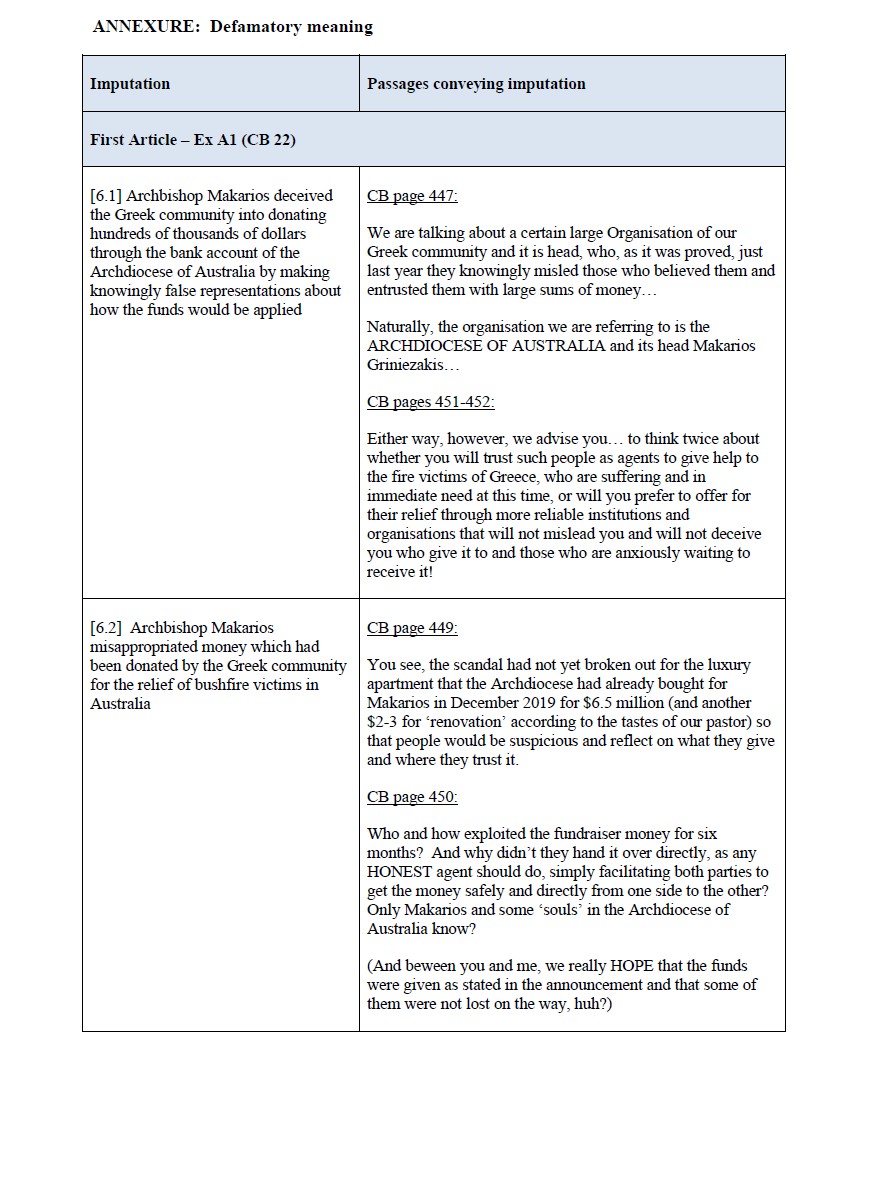
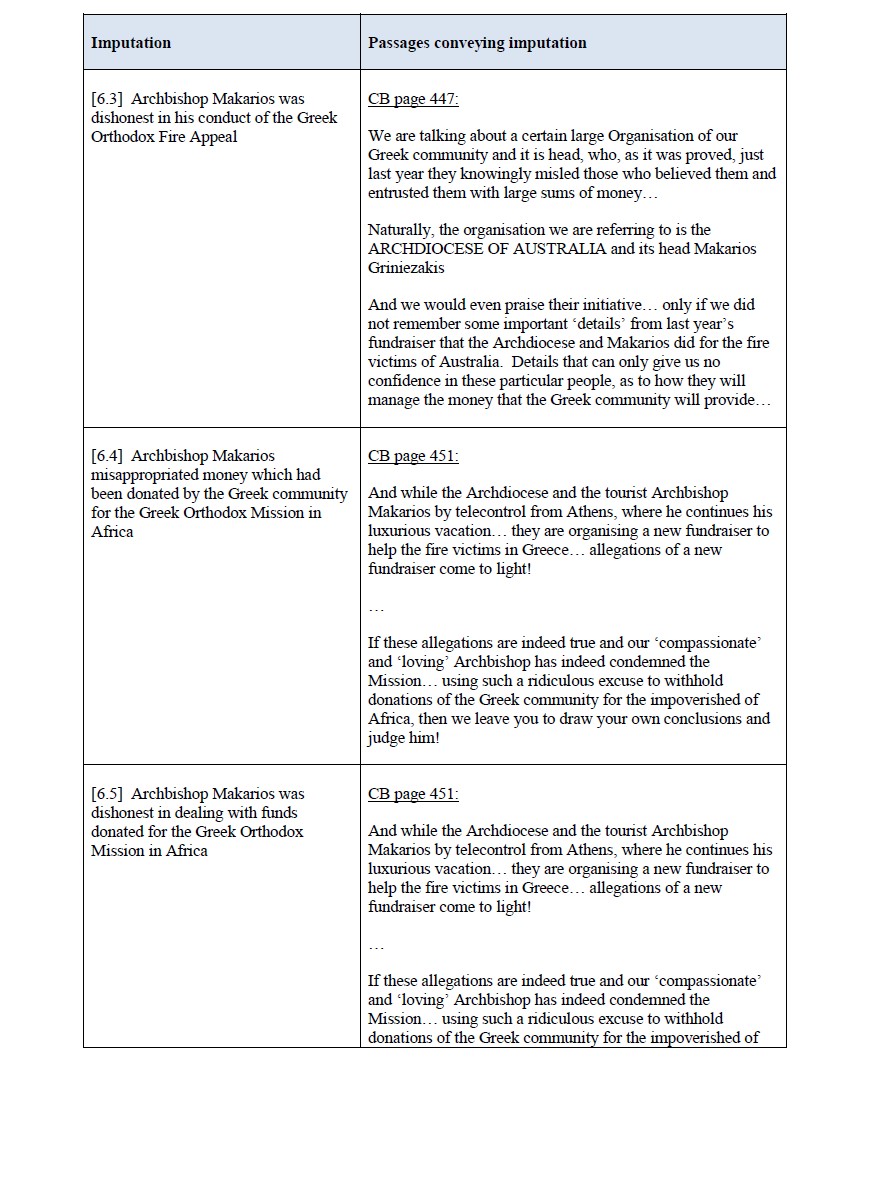
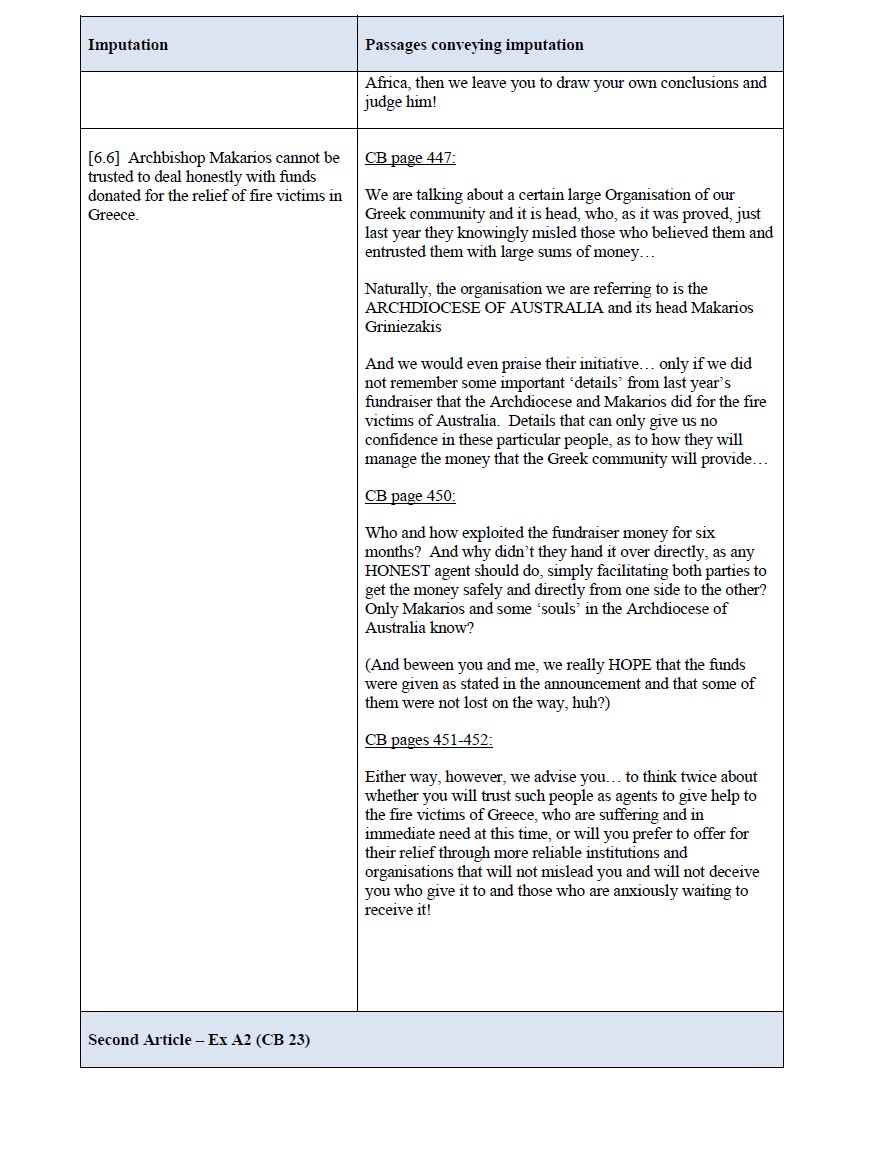
3 The English translations of the Articles are attached to these reasons as Annexures A-D respectively.
4 In relation to each of the Articles, Mr Morelas pleaded defences of honest opinion: s 31 of the Defamation Act 2005 (NSW) (the Act) and statutory qualified privilege: s 30 of the Act. In relation to the Fourth Article, Mr Morelas also pleaded a defence of justification to one imputation: s 25 of the Act.
5 The issues for determination in this proceeding are:
(1) whether the defamatory imputations pleaded in respect to each of the Articles are carried;
(2) if defamatory, whether serious harm is established;
(3) in the circumstance the above is established in respect to some or all the Articles, whether, in relation to relevant Articles, the respondent has established:
(a) the defence of honest opinion;
(b) the defence of statutory qualified privilege; or
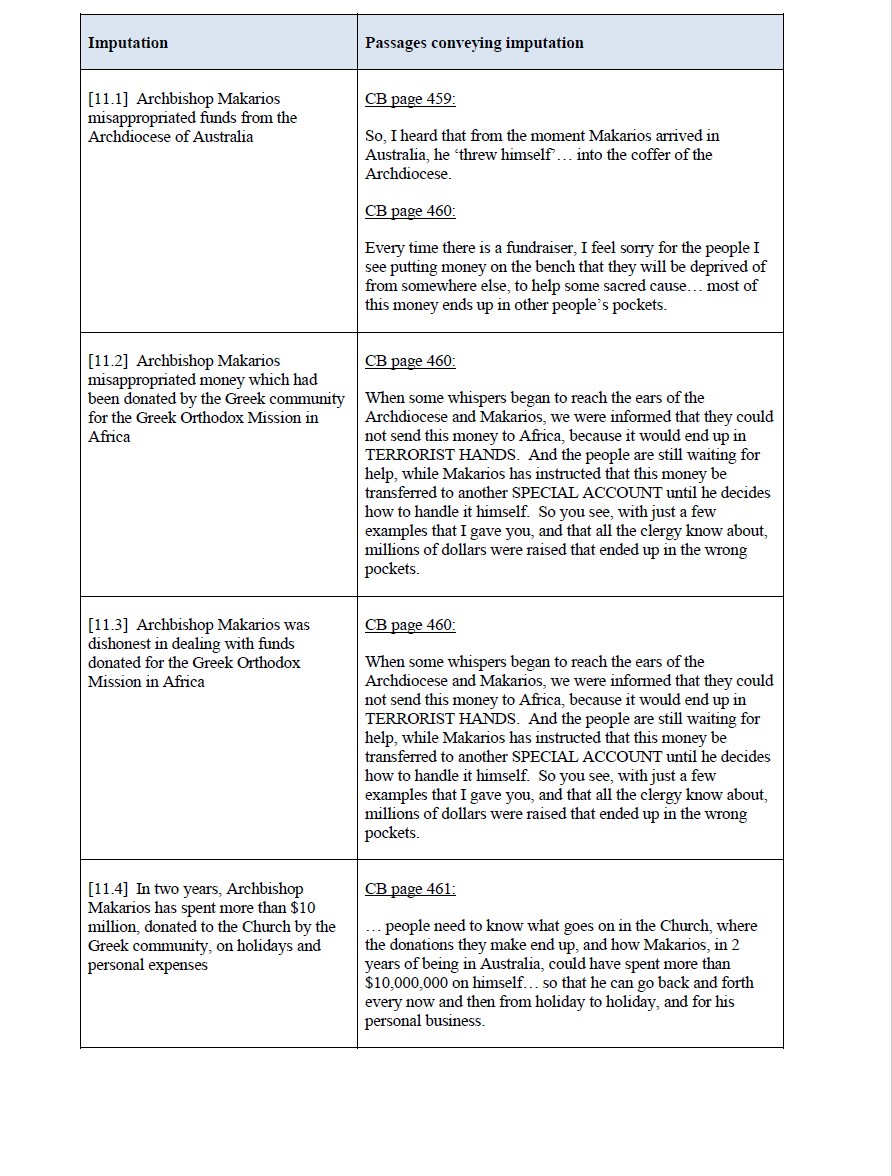
(c) the defence of justification;
(4) in the circumstances the respondent has not established any defence, the question of damages and aggravated damages.
6 For the reasons below, the applicant has established that in relation to each of the Articles, the imputations are carried and caused serious harm. Mr Morelas has not established any of the defences pleaded, in relation to any of the Articles. Accordingly, the application is established.
PRELIMINARY OBSERVATIONS
7 Before addressing the relevant legal principles, and the issues that arise, it is appropriate to make the following observations.
8 First, although Mr Morelas was a litigant in person at the hearing, he was represented by a solicitor and counsel during the procedural stages for the preparation of the proceedings. The parties were ordered to file their evidence in chief (on the issues on which they bore the onus) by 31 October 2023, and 13 November 2023 respectively, with evidence in reply to be filed by 12 February 2024. His solicitor filed a notice of ceasing to act on 6 February 2024. The respondent’s affidavit in reply was filed on 9 February 2024. It is readily apparent that from the face of the affidavit that although Mr Morelas stated at the beginning that he is now representing himself, lawyers had been involved in the preparation. Accordingly, his pleadings and evidence were prepared with assistance of his lawyers. He was also legally represented at the time interrogatories were answered and discovery provided (which occurred on two occasions).
9 Mr Morelas was also represented at the time of hearing the applicant’s applications to strike out his defence. The first application to strike out his defence generally succeeded but for the most part, leave was given to the respondent to replead. The applicant opposed leave being given to the respondent to file the Amended Defence (or, AD). It was apparent during that hearing that there had been different iterations of the pleading exchanged between the parties leading to the document that was the subject of the argument. The focus of the applications was on the drafting of the pleaded defences, primarily on the particulars provided in relation to each of the defences relied on, and whether the defences could be established. Much of the argument referred to factual matters, which are matters properly addressed at the hearing. Leave was granted to file the Amended Defence although, I observed I considered there were some deficiencies in the pleading. The respondent had every opportunity to plead what defences he was relying on, and to identify the relevant bases. Given the opportunities, it was made clear at the time of ruling that the conduct of the respondent case would be limited to the defences as pleaded. That said, in closing submissions the applicant did not confine his analysis of the evidence in respect to what formed proper material or steps taken to demonstrate reasonableness but addressed any additional evidence on those topics that was in Mr Morelas’ affidavit or arose in his cross-examination. I also take that approach. I note for completeness that at the time of the application for leave to file the Amended Defence, the respondent also sought to withdraw an admission in his defence that Imputation [21.2] was conveyed, which I rejected.
10 As already referred to, except for one imputation said to arise from the Fourth Article where justification was pleaded, the defences relied on were honest opinion, and in the alternative, statutory qualified privilege. The defences relied on were therefore relatively confined.
11 Second, this hearing relates only to whether the applicant’s claim that he has been defamed in relation to the four Articles has been established. In the circumstances of this case, that included whether the respondent had established the defences pleaded. As Mr Morelas was conducting the hearing himself, he was given latitude in the conduct of his case. That said, despite the nature and confines of the proceedings being repeatedly explained (before and during the hearing), he attempted to conduct the hearing as if it was an inquiry into Archbishop Makarios and the Greek Orthodox Church more generally. Mr Morelas appeared to well understand what he was told; he simply disagreed that certain matters were not relevant. He proceeded to answer questions and make submissions accordingly. As a result, some of what he said in evidence and during submissions (which included further new matters) does not assist in the resolution of the proceedings (e.g. Mr Morelas’ complaints in relation to the new Constitution of the Church, events well after the publication of the Articles, and unrelated to them). It is not relevant. This is not the appropriate forum for considering such issues. Importantly, this Court only decides the issues that arise for determination in this case. Those issues are determined only on the evidence before the Court.
12 A consequence of the approach taken by Mr Morelas was that in conducting his case, he did not generally engage with or focus on the issues for determination in the proceedings (e.g. whether imputations were carried, the elements of the defences etc). Rather, much of his submissions were asserting that the contents of his Articles and the assertions he more generally made about Archbishop Makarios were true.
13 Third, the applicant repeatedly submitted that various aspects of the evidence in his case are unchallenged. If that submission relates to evidence being challenged in cross-examination, it must be considered in the context of the respondent representing himself. It is to be recalled that evidence can be challenged in several ways, and not just by cross-examination. If the opposing party relied on evidence to the contrary (in affidavits or given orally) or made submissions about whether that evidence in an applicant’s case should be accepted or relied on, that evidence is challenged. Further, even if evidence is unchallenged, it does not follow that a court must accept it. It is fair to say that the respondent in this case challenged all aspects of the applicant’s case in that he said he did not accept it (whether that was effective is a different issue). That is, generally everything in evidence was in issue. That said, the respondent while still represented had an opportunity to put on evidence challenging the evidence filed by the applicant, which generally he did not do. He did not call or tender evidence to challenge much of the evidence given in the applicant’s case. This is in circumstances where he bore the onus of proof.
WITNESSES
Applicant’s case
Archbishop Makarios Griniezakis
14 The applicant read the following affidavits:
(1) the affidavit of Makarios Griniezakis, sworn on 31 October 2023; and
(2) the affidavit of Makarios Griniezakis, sworn on 12 February 2024.
15 Archbishop Makarios Griniezakis gave evidence that he has been the Archbishop of Australia and the Primate of the Greek Orthodox Church in Australia and all of Oceania since 2019. He explained what his role as Archbishop entailed, his reaction and hurt feelings regarding the publication of the Articles, and steps taken prior to the commencement of proceedings. He also gave evidence on the subject of each of the Articles which included: the governance of the Greek Orthodox Archdiocese of Australia, the Greek Orthodox Fire Appeal, fundraising for the so-called “African Mission”, the purchase of the Archbishop’s residence at Miller’s Point, an explanation of other supposed personal expenses, donations from Bishop Bartholomew, the Liverpool Parish community fundraiser, Father George Fayjloun and the alleged attempts by Mr Morelas to contact him. His evidence in cross-examination was interrupted by Mr Morelas’ attempts to ask questions that were on topics irrelevant to the proceedings or otherwise inadmissible. At times Archbishop Makarios appeared frustrated by the questions. At times he appeared upset. I accept him as a credible witness and on the relevant topics, his evidence was reliable.
Christophoros Krikelis
16 The applicant read the following affidavits:
(1) the affidavit of Christophoros Krikelis, sworn on 6 November 2023; and
(2) the affidavit of Christophoros Krikelis, sworn on 15 February 2025.
17 Father Christophoros Krikelis was ordained to the diaconate on 24 October 2019 and was at that time appointed as the private secretary to Archbishop Makarios. On 5 October 2021, he was appointed Chancellor of the Greek Orthodox Archdiocese of Australia. He provided evidence on the Archbishop’s reaction to the Articles. Father Christophoros also provided evidence in relation to the Fourth Article and the Archdiocese’s response to the allegations surrounding Father George Fayjloun. His evidence in cross-examination was also interrupted by Mr Morelas’ attempts to ask questions that were on topics irrelevant to the proceedings or otherwise inadmissible. I accept his evidence as credible and reliable.
Panayiotis Anastasiadis
18 The applicant read the affidavit of Panayiotis Anastasiadis, sworn on 9 February 2024.
19 In November 2021, Panayiotis Anastasiadis was consecrated as a Bishop and was bestowed the name Bishop Bartholomew. Prior to that he had been ordained as a priest and known under the name Father Prochoros. He provided evidence in relation to the Third Article which alleged Bishop Bartholomew made multiple donations to Archbishop Makarios. His cross-examination was very limited. I accept his evidence as credible and reliable.
Other evidence
20 In addition, the applicant read the following affidavits:
(1) the affidavit of Dimitra Micos, sworn on 29 October 2023; and
(2) the affidavit of Athinagoras Karakonstantakis, sworn on 31 October 2023.
21 Ms Micos provided evidence on the Greek Orthodox community’s response to the Articles Mr Morelas published about the Archbishop. Archdeacon Karakonstantakis provided evidence on the Archbishop’s response to the publication of the Articles. They were not required for cross-examination. Further, the applicant tendered documentary evidence in support of his case.
Respondent’s case
Mr Morelas
22 Mr Morelas read the following affidavits:
(1) the affidavit of Argyrios Morelas (aka Alkis Morelas), sworn 26 October 2023; and
(2) the affidavit of Argyrios Morelas (aka Alkis Morelas), sworn 9 February 2023.
23 Mr Morelas gave evidence that he is a career journalist with 55 years of experience. He described his career including that for 42 years he worked for a particular newspaper, published in Greek, based in Melbourne. From 1990 until 2003, he had his own Greek newspaper. From 2003 to 2019, he was retired. However, from 2003, Mr Morelas said he worked for Mr Theo Skalkos on a part-time basis and wrote articles about Greek people in the court system. At the time of his first affidavit, he said he was the administrator, sole author and webmaster for all articles appearing on the Website. Mr Morelas gave evidence that the Website was set up by his friend, Mr Bill Gonopoulos, who was a journalist and a translator. In 2019, Mr Gonopoulos suggested that he take over Greek Flash News. Mr Morelas gave evidence of the arrangement which is unnecessary to repeat here. Suffice to say, Mr Morelas gave evidence that he has made allegations of fraud against Mr Gonopoulos and reported him to the police. I address the substance of his evidence when considering the issues in the case.
24 Mr Morelas was cross-examined. His evidence was generally unsatisfactory. There are inconsistencies between his affidavits, discovery lists, and evidence given in cross-examination during this proceeding. As illustrated below, there were inconsistencies in his evidence on significant topics including: whether he was intending to publish facts or opinion; his sources; his research or fact-checking; and the opportunity provided to the applicant to comment on the publications before they were posted. General broad assertions in his affidavits were often inconsistent with his evidence or not supported by his evidence. He often did not answer the question asked but rather used his time giving evidence as a platform to make further allegations against the applicant, some for the first time. The same description applies to his closing submissions. His preparedness to do so, tells against his credibility and the reliability of his evidence.
25 Mr Morelas approached the case on the basis it was sufficient for him to assert a matter of fact, as establishing that fact. It was apparent during his evidence that he is prone to exaggeration (e.g. as to the extent of his sources in relation to the Articles, the purported basis for several claims is few and generally hearsay, often many times removed). When answers given were tested, Mr Morelas had the tendency to make broad assertions, unsupported by other evidence. Some evidence appeared to be made up to fit his narrative. It is apparent from his evidence that at times he misreads, misconstrues or distorts information he reads or hears (e.g. the press releases in relation to the First Article).
26 As explained further below, his repeated general assertions that he has documents and notes of his dealings with sources supporting his case in relation to the Articles, is unsubstantiated. It is inconsistent with his affidavits, the documents produced during discovery and answers he admitted he had given in interrogatories. His evidence was also inconsistent as to why that was so, ranging from he had chosen not to rely on them and therefore he had not produced them, through to, he had given the documents to his lawyers. That does not account for the inconsistencies. During his cross-examination, he produced documents he said he had with him. As discussed below, a consideration of them does not support the assertions he was making in relation to the issues relevant to the issues in these proceedings.
27 I am generally not prepared to accept his evidence unless it is supported by other evidence.
Other evidence
28 In addition, the respondent read the following affidavits:
(1) the affidavit of Ms Vassiliki Morali, sworn 10 September 2023; and
(2) the affidavit of Mr X, sworn 7 November 2023. This relates to the Fourth Article. I have anonymised the deponent of this affidavit – who reported allegations of sexual misconduct by Father George towards his wife and daughters to the Church – to prevent the identification of the victims.
29 Ms Morali and Mr X were not required for cross-examination. There were objections to aspects of their affidavits. I ruled on these matters shortly before the commencement of the hearing. Aspects of Ms Morali’s evidence were not read, were ruled inadmissible, or limited by a s 136 direction, under the Evidence Act 1995 (Cth). I discuss the evidence of these witnesses below. Suffice to say at this stage, amongst other issues, Ms Morali’s evidence did not support his evidence as to the extent of his relationship with her, and the material he said she provided. Further, as explained below, Mr X’s evidence in some respects also does not support his evidence, or the extent of the allegations.
30 The respondent also sought to rely on some documents said to support his case (initially in a supplementary court book). Objection was taken to these documents. An additional bundle of documents produced by the respondent during his cross-examination was also objected to by the applicant (although I note there is some overlap with those already produced). The number of documents was limited. The hearing proceeded on the basis that the documents were provisionally admitted and Mr Morelas could address the documents during the hearing and if any were not relevant (or otherwise inadmissible) they would not be admitted. I return to this below. Suffice to say, as explained below at [179] the documents are generally inadmissible (e.g. irrelevant to the issues, the provenance unknown).
PUBLICATION
31 While it was not possible to provide statistics for views of individual articles, Mr Morelas admitted that the number of views and visitors the Website had as a whole between August 2021 and April 2022:
Month | Views | Visitors |
August 2021 | 8,283 | 1,831 |
September 2021 | 10,946 | 2,577 |
October 2021 | 11,309 | 2,635 |
November 2021 | 8,317 | 1,783 |
December 2021 | 6,335 | 1,504 |
January 2022 | 9,079 | 2,194 |
February 2022 | 5,336 | 1,462 |
March 2022 | 7,996 | 2,454 |
April 2022 | 4,811 | 1,220 |
32 The applicant submitted the probable explanation for why the number of views was higher than the number of visitors was because there was a cohort of visitors who returned to the Website multiple times each month.
33 In cross-examination, Mr Morelas suggested the figures are correct “in some ways” but that more people have probably read the Articles than the number of visitors listed. He volunteered that there might be “another hundred people more” who viewed his Articles after they have been shared. There is evidence that the Website was in circulation overseas. An email dated 9 March 2021 was tendered by the applicant. It had been addressed to many people. The applicant submitted that the identities of some recipients can be discerned by the email addresses to which it was sent and they include recipients who appear to be media organisations or journalists in Greece, the Personnel Office and Chancellor of the Holy Archdiocese of Athens and many Holy Metropolises in Greece (i.e. dioceses of the Greek Orthodox Church). I accept that the addresses identified by the applicant to illustrate that submission, support the inference being drawn. Mr Morelas said he was not aware that his Articles were being distributed to people in Greece or that his Articles were often circulated via email. Mr Morelas said he feels “proud they are delivering [his] stories”.
34 Archbishop Makarios’ evidence was that people in the community often raised the topic of the Articles with him, and he was regularly asked about the allegations. He was questioned about the Articles by the president of a body representing journalists in Greece. He was contacted by the Ecumenical Patriarch of the Greek Orthodox Church, and senior leaders of the Church in Greece and elsewhere including the Archbishops of the United States and Great Britain.
35 I return to this topic below.
PLEADED IMPUTATIONS
36 The imputations pleaded to have been conveyed in respect to each of the Articles are detailed below. Mr Morelas’ pleading largely denied that the imputations pleaded are carried by the Articles, with the exception of Imputations [21.1], [21.2] and [21.4], which he admitted are carried by the Fourth Article.
Legal principles
37 The principles in relation to meaning are well established, and not in dispute between the parties: Favell v Queensland Newspapers Pty Ltd [2005] HCA 52; (2005) 219 CLR 165 at [6]-[12], [17]; Trkulja v Google LLC [2018] HCA 25; (2018) 263 CLR 149 (Trkulja) at [30]-[32]; Hanson v Burston [2023] FCAFC 124; (2023) 413 ALR 299 at [43]-[48]; and Kazal v Thunder Studios Inc (California) [2023] FCAFC 174 (Kazal) at [336]-[337].
38 An applicant bears the onus of establishing on the balance of probabilities that an ordinary reasonable reader, viewer or listener would understand that the publication sued upon bears the alleged defamatory meanings or imputations as pleaded and particularised.
39 The relevant question is whether the publication would have conveyed the alleged meanings to an ordinary reasonable person. It is to be objectively determined. The hypothetical individual is a person with various characteristics, including: they are of fair to average intelligence, experience, and education; are fair-minded and neither perverse, morbid, suspicious of mind, nor “avid for scandal”; and that they do not examine the publication overzealously. While they do not search for hidden meanings or adopt strained or forced interpretations, they nevertheless draw implications, especially derogatory implications, more freely than a lawyer would: Rush v Nationwide News Pty Ltd (No 7) [2019] FCA 496 (Rush (No 7)) at [75]-[77]; Kazal at [336]-[337]. The ordinary reasonable person is also taken to have read the entire publication, considered the context as a whole, and taken into account emphasis that may be given by conspicuous headlines or captions: see Rush (No 7) at [77]; Trkulja at [32]; and the summary in V’landys v Australian Broadcasting Corporation (No 3) [2021] FCA 500 (V’Landys) at [41]-[55]. They are more likely to consider a publication cautiously and carefully, and less likely to jump to conclusions or engage in loose thinking, where the publications purport to be serious investigative journalism concerning matters of importance.
40 However, it does not follow that each part of the publication must be given equal significance, as striking words or images may stay with the reader, viewer or listener and give them a predisposition or impression that influences all that follows: V’landys at [51]. A pleaded imputation, and whether it has been proven to be substantially true, requires attention to context, as provided by the balance of the publication and any wider context within which it is to be understood. The natural and ordinary meaning of words is not limited to their literal meaning. The ordinary reasonable person is not a lawyer or taken to have a detailed understanding of the law: Trkulja at [32]. The imputations are considered by reference to the ordinary meaning, not their legal meanings, because that is the way the terms would be understood by ordinary reasonable people. Words do not necessarily have a fixed meaning that applies in all circumstances; even benign words may convey a worse, or better, impression when regard is had to how and when they are deployed: see, for example, Greek Herald Pty Ltd v Nikolopoulos & Ors [2002] NSWCA 41; (2002) 54 NSWLR 165 at [21]-[27]; Lewis v Daily Telegraph Ltd [1964] AC 234 at 258. The meaning that an individual would attribute to a publication, or the impression that the reader forms, may be influenced by the overall tone or tenor of the article in question: Rush (No 7) at [80].
41 Given that the meaning is to be determined objectively, the audience is taken to have a uniform view of that meaning. The publisher’s intended meaning and that understood by individual readers of the matter complained of, are irrelevant: Rush (No 7) at [84]-[85]. The determination of the natural and ordinary meaning of words involves the application of the “single meaning” rule. Although different people might in fact have understood the meanings conveyed by a matter in different ways, the Court must arrive at a single objective meaning: Slim v Daily Telegraph Ltd [1968] 2 QB 157 at 171-175; Hockey v Fairfax Media Publications Pty Limited [2015] FCA 652; (2015) 237 FCR 33 at [73]; Australian Broadcasting Corporation v Chau Chak Wing [2019] FCAFC 125; (2019) 271 FCR 632 (Wing) at [32]. The issue is the single meaning that an objective audience composed of ordinary reasonable persons should have collectively understood the matter to bear: Wing at [32].
42 A matter is defamatory if it carries a meaning about the applicant which is calculated to: expose him or her to hatred, contempt, or ridicule; lower him or her in the estimation of ordinary right-thinking members of society; or cause others to shun and avoid him or her: Boyd v Mirror Newspapers Ltd [1980] 2 NSWLR 449 at 452-453; Mirror Newspapers Ltd v World Hosts Pty Ltd [1979] HCA 3; (1979) 141 CLR 632 at 638-639; Radio 2UE Sydney Pty Ltd v Chesterton [2009] HCA 16; (2009) 238 CLR 460 at [5].
Imputations conveyed
43 As apparent from the discussion below, with limited exception, the respondent denied in his Amended Defence that imputations were conveyed and, if they were, they caused or were likely to cause serious harm to the Archbishop’s reputation. However, in the conduct of his case the respondent generally did not address these issues.
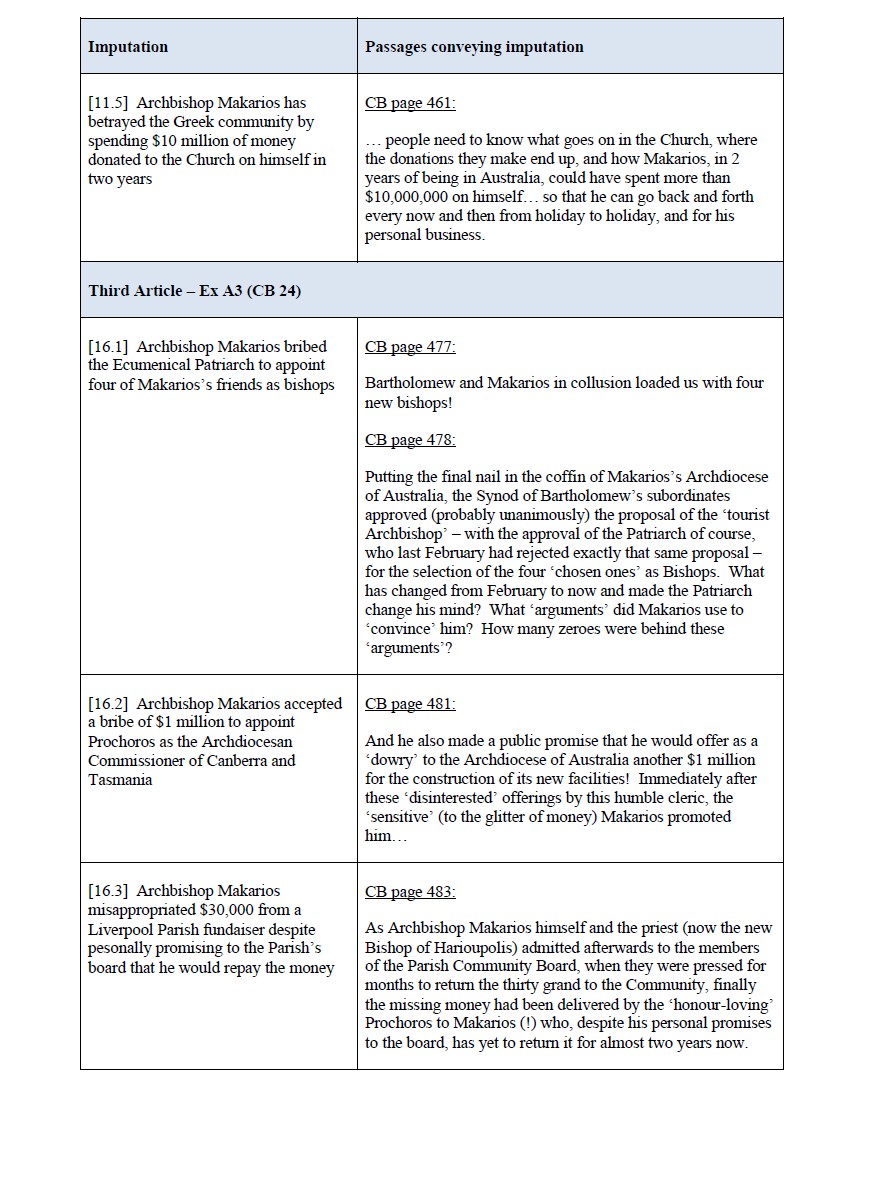
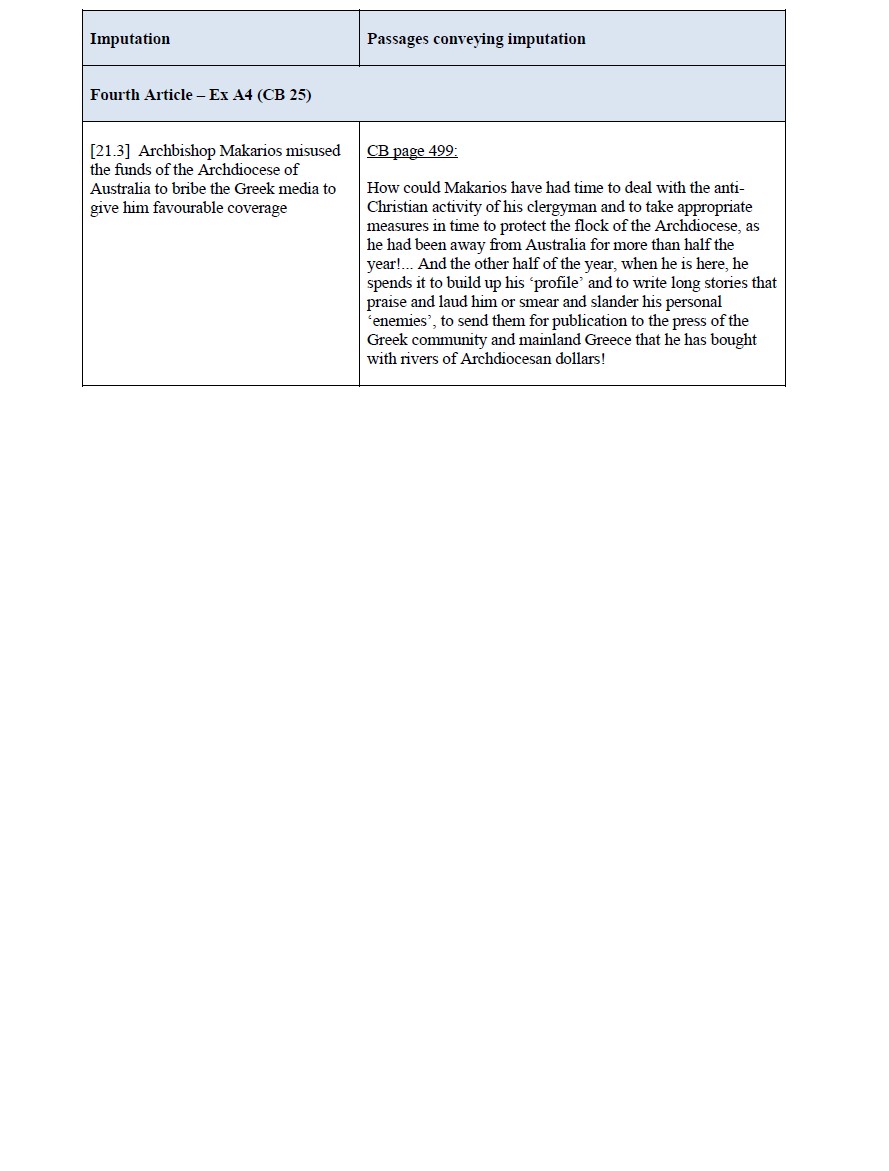
44 The applicant provided an annexure to his written submissions addressing each of the imputations said to be conveyed, which identified passages in the relevant Article in support of each imputation. Those passages must be read in the context of the whole Article from which they were extracted. In context, I accept those passages identified support the imputations having been conveyed. Accordingly, for ease of reference I attach Annexure E to these reasons.
First Article
45 The pleaded imputations in relation to the First Article are:
6. The First Article carries the following defamatory imputations (or imputations that do not differ in substance):
6.1. Archbishop Makarios deceived the Greek community into donating hundreds of thousands of dollars through the bank account of the Archdiocese of Australia, by making knowingly false representations about how the funds would be applied.
6.2. Archbishop Makarios misappropriated money which had been donated by the Greek community for the relief of bushfire victims in Australia.
6.3. Archbishop Makarios was dishonest in his conduct of the Greek Orthodox Fire Appeal.
6.4. Archbishop Makarios misappropriated money which had been donated by the Greek community for the Greek Orthodox Mission in Africa.
6.5. Archbishop Makarios was dishonest in dealing with funds donated for the Greek Orthodox Mission in Africa.
6.6. Archbishop Makarios cannot be trusted to deal honestly with funds donated for the relief of fire victims in Greece.
46 Mr Morelas denied the imputations are carried.
47 I am satisfied that an ordinary reasonable reader would have understood this Article was conveying those imputations. Those meanings are defamatory. This Article conveys that Archbishop Makarios knowingly made false representations about the application of donations raised by the Archdiocese in connection with bushfire relief, misappropriated money donated by the Greek community for the relief of bushfire victims and was dishonest in relation to the money donated by the Greek community for bushfire relief, and funds donated for the Greek Orthodox mission in Africa. It conveys he could not be trusted with funds donated. They are the stings from the imputations pleaded.
48 The Article is in clear terms, and the stings conveyed are plain. It is not just the content in the Article or the use of sensationalist language but Mr Morelas also uses various devices in this Article (and the other Articles) to emphasise and make clear the message he is conveying. For example, the headings of the Article include the use of what the applicant described as the “cynical application of inverted commas”. The heading is written as “After the “management” of the fundraiser for the fire victims of Australia” with the word management being placed in inverted commas, which colours what follows, and suggests the fundraiser has been improperly managed. Further, the first subheading is “Fundraisers and “Fundraisers”!” Mr Morelas also bolds phrases, underlines phrases, and puts writing in bold boxes to emphasise what is being said.
Second Article
49 The pleaded imputations in relation to the Second Article are:
11. The Second Article carries the following defamatory imputations (or imputations that do not differ in substance):
11.1. Archbishop Makarios misappropriated funds from the Archdiocese of Australia.
11.2. Archbishop Makarios misappropriated money which had been donated by the Greek community for the Greek Orthodox Mission in Africa.
11.3. Archbishop Makarios was dishonest in dealing with funds donated for the Greek Orthodox Mission in Africa.
11.4. In two years, Archbishop Makarios has spent more than $10 million, donated to the Church by the Greek community, on holidays and personal expenses.
11.5. Archbishop Makarios has betrayed the Greek community by spending $10 million of money donated to the Church on himself in two years.
50 Mr Morelas denied the imputations are carried.
51 I am satisfied the ordinary reasonable reader would have understood this Article was conveying those imputations, and that they are defamatory. As apparent from the passages in Annexure E, the language is plain and clear. The language used in the Article is designed to shock and is gratuitously derogatory. He also uses devices such as capitalising all the letters of a word or phrase and scare quotes (e.g. “A global daily battle, against an ‘unknown’ enemy”) to emphasise the message he is sending.
Third Article
52 The pleaded imputations in relation to the Third Article are:
16. The Third Article carries the following defamatory imputations (or imputations that do not differ in substance):
16.1. Archbishop Makarios bribed the Ecumenical Patriarch to appoint four of Makarios’s friends as bishops.
16.2. Archbishop Makarios accepted a bribe of $1 million to appoint Prochoros as the Archdiocesan Commissioner of Canberra and Tasmania.
16.3. Archbishop Makarios misappropriated $30,000 from a Liverpool Parish fundraiser, despite personally promising to the Parish's board that he would repay the money.
53 Mr Morelas denied the imputations are carried.
54 I am satisfied the ordinary reasonable reader would have understood this Article as conveying those imputations. They are defamatory. As with the First and Second Article, the language is plain and unambiguous. There is no subtlety in the message conveyed (e.g. in relation to Imputation [16.1], “What has changed from February [when the proposal was last rejected] to now and made the Patriarch change his mind? What ‘arguments’ did Makarios use to ‘convince’ him? How many zeroes were behind these ‘arguments’?”). The meaning conveyed by the Article is clear (as illustrated by the passages identified by the applicant in Annexure E).
Fourth Article
55 The pleaded imputations in relation to the Fourth Article:
21. The Fourth Article carries the following defamatory imputations (or imputations that do not differ in substance):
21.1. Archbishop Makarios failed to take any action against Father George Fayjloun for almost a year, even though he knew that Father George was accused of raping and sexually harassing underage girls.
21.2. Archbishop Makarios attempted to cover up the fact that Father George Fayjloun was accused of raping and sexually harassing underage girls.
21.3. Archbishop Makarios misused the funds of the Archdiocese of Australia to bribe the Greek media to give him favourable coverage.
21.4. Archbishop Makarios enables the misconduct of clerics like Father George Fayjloun by his negligent administration of the Archdiocese of Australia.
56 Mr Morelas admitted Imputations [21.1], [21.2] and [21.4] are carried, but denied Imputation [21.3] is carried.
57 I am satisfied the ordinary reasonable reader would have understood this Article was conveying Imputation [21.3]. It is the obvious meaning being conveyed as illustrated by the passage identified by the applicant in Annexure E. That imputation is defamatory as are the admitted imputations.
SERIOUS HARM
58 In relation to the First Article, there is no pleading in the Amended Defence to the allegation of serious harm. The applicant was represented at the time the pleading was filed. Mr Morelas is deemed to have admitted that the publication of the First Article caused or was likely to cause serious harm. In relation to the Second, Third and Fourth Articles, Mr Morelas denied they caused or were likely to cause serious harm to the Archbishop’s reputation.
Legal principles
59 Section 10A(1) of the Act provides:
It is an element (the serious harm element) of a cause of action for defamation that the publication of defamatory matter about a person has caused, or is likely to cause, serious harm to the reputation of the person.
60 The application of the provision has now been the subject of detailed judicial consideration: e.g. Deeming v Pesutto (No. 3) [2024] FCA 1430 (Deeming) at [518]-[534] and Mond v Age Co Pty Ltd [2025] FCA 442 (Mond) at [365]-[385].
61 Serious harm must be proved as an element of any instances of publication of a defamatory matter on or after 1 July 2021, even if the matter was first published before that date: Russell v Australian Broadcasting Corporation (No 3) [2023] FCA 1223; (2023) FCR 372 (Russell) at [258]; Mond at [366]. The provision was part of a reform which substituted serious harm as an element of the cause of action for the old defence of triviality. The history of its introduction is described by Wheelahan J in Mond at [373]-[377]. Suffice to say, it is apparent that it was introduced to prevent trivial, spurious, frivolous and vexatious defamation claims, which is reflected in the fact that the issue should be determined as soon as practicable before trial: s 10A(5) and (6). Wheelahan J observed at [377]:
In light of the object in s 3(c) of the Defamation Act to provide effective and fair remedies for persons whose reputations are harmed, s 10A(5) suggests that the serious harm element may be capable of ready determination prior to trial, thereby indicating that “serious harm to reputation” is harm that is at least not trivial or minor in nature, as the second reading speeches to the Victorian and New South Wales Bills would indicate, rather than establishing an especially high threshold requiring extensive evidence to be led by an applicant
62 The terms of s 10A suggest the causal relationship is with the publication of the matter in a defamatory sense: Mond at [369]. The Court is concerned with actual serious harm, and not serious harm amongst a notional cohort of ordinary reasonable readers: Greenwich v Latham [2024] FCA 1050 at [174]; Mond at [369].
63 Serious harm to reputation, or likely serious harm to reputation, are facts that must be proven by evidence, which may be direct evidence, or by inferences drawn from the circumstances of the case: Mond at [370]. As described by Wheelahan J in Mond at [370], those circumstances may include a combination of:
(1) the inherent tendency of the defamatory matter and its actual or probable impact on those to whom it was published, in other words, the gravity of the imputations;
(2) the extent of publication, any likely republication, and any likely “grapevine effect” or “percolation”;
(3) whether there was a prompt apology, and the breadth of the audience to which any apology was published;
(4) the reputation of the publisher – a defamatory publication by a generally reputable publisher that is represented as being reliable and the product of research might be more capable of causing serious harm than one by a publisher that is not so reputable;
(5) the medium of the publication – a transient publication might cause less harm to reputation than one in print or which is available for viewing online for an extended period or indefinitely;
(6) the situation of the applicant, including the applicant’s existing reputation in the relevant sector;
(7) the identity of the persons to whom the defamatory matter was published; and
(8) the inherent probabilities generally.
64 Where there are other defamatory publications to the same effect published at around the same time, it is recognised that it is likely to be impossible to isolate the harm caused by any one publication. That circumstance was addressed in Peros v Nationwide News Pty Ltd (No 3) [2024] QSC 192 (Peros) where Applegarth J observed at [75]:
[i]n such a case, in which neither the claimant nor the court can isolate the harm caused by the subject publication, a plaintiff may choose to sue over one publication that is alleged to have caused, along with other publications, indivisible damage to reputation. The combined and indivisible harm may be as a result of publications to the same effect by the same defendant or by other publishers. The claimant may seek to invoke another general principle that renders a defendant liable in tort where its wrong was “a cause” or materially contributed to damage that is indivisible. In those circumstances, it is sufficient that the wrong, along with other causes, caused the same loss or damage.
65 See also Deeming at [523].
Consideration
66 These four Articles are a series of related publications. Given there is more than one publication, the approach described in Peros, recited above, is appropriate.
67 They convey allegations of fraud, dishonesty, misappropriating funds donated for charitable purposes and church funds, bribery, and covering up of sexual offences within the Greek Orthodox Church.
68 The applicant submitted:
The publication of such imputations has an inherent tendency to cause serious harm to the reputation of a person in the position of Archbishop Makarios because of the special expectations which members of the community have (and are entitled to have) of him as a senior religious leader and a leader of the Greek diaspora community in Australia … as a religious leader, a person in Archbishop Makarios’s position is expected by the community to be above reproach. Any allegation of defects of conduct or character is especially likely to cause serious harm to the reputation of an archbishop, because people would expect an archbishop to be a person of high moral character, sanctity and piety.
69 I accept that is the context in which the assessment of serious harm should be undertaken.
70 I accept the applicant’s submission that the Website was written in the Greek language specifically for the Australian Greek community and focused on news (particularly relating to the Greek Orthodox Church in Australia) of special interest to that community.
71 Based on the evidence, I accept that the Website was read by a reasonably large number of people in the Greek community. I also accept that it can be inferred given the content of the publications that the import of the Articles is likely to have achieved wider secondary dissemination in the Greek community: Pan v Cheng [2021] NSWSC 30 at [169], approved in Cheng v Pan [2022] NSWCA 21 at [114]-[115].
72 Mr Morelas’ evidence was that he has been writing for Greek language newspapers in Australia for 55 years, and on his evidence has a “good profile” in the Australian Greek community. The Articles, given their content and that they are published in the Greek language, are directly targeted to readers in the Greek community and, in particular, readers with a connection to the Greek Orthodox Church and the Archbishop.
73 Mr Morelas published them on a medium which was not transient, but available for viewing online for an extended period or indefinitely: Mond at [370]. These Articles are not the only published articles by Mr Morelas about Archbishop Makarios of this ilk. As can be seen from reading the Articles, although they may be on different topics, they build on each other. They read like and are presented as a series of ongoing disclosures. There are repeated allegations being disseminated online. The particularly insidious “grapevine effect” that social media often has was likely to have spread those disparaging comments like a contagion, at least amongst those who choose to read such material. This was described by Lee J in Tribe v Simmons (No 2) [2021] FCA 1164 (Tribe (No 2)) at [23]-[24] by reference to X (formerly known as Twitter): see also Edwards v Nine Network Australia Pty Ltd (No 5) [2024] FCA 422 at [398]. Although this case does not involve X, the observations are apt. These publications were online. The evidence reflects that they were promoted by Mr Morelas on Facebook, and they were forwarded to others.
74 There was no apology given by Mr Morelas. Rather, the respondent has continued to publish like material about the Archbishop despite an undertaking to the Court to not publish further articles.
75 There is direct evidence of harm to the Archbishop’s reputation. For example, Ms Micos, Archdeacon Athinagoras, and Father Christophoros each gave evidence of being approached by persons raising with them allegations which obviously emanate from the Articles, in a manner adverse to Archbishop Makarios. The content of the Articles and gravity of imputations carried gives rise to an inference that they would adversely impact on how Archbishop Makarios may be viewed. The applicant described that the Articles would, in particular, lead “followers of the Church, to become disillusioned with a person who purports to exercise spiritual leadership and authority of them”. On the evidence, that could not be described as minor, or trivial.
76 The imputations conveyed are described above, and are unnecessary to repeat. Suffice to say, in relation to each of the Second, Third and Fourth Articles, I am satisfied that the threshold of serious harm has been established. Although this is not strictly necessary for the First Article, for completeness I record that in my view that is also established for that Article.
DEFENCES
77 The respondent pleaded the defences of honest opinion and statutory qualified privilege in respect to each Article. The defence of justification was pleaded in respect to one of the imputations in the Fourth Article. I will address each in turn.
78 As described above, the respondent’s approach to this hearing was focused on using the hearing as a forum to expose what he alleged was the conduct of the Archbishop and was not related or confined to the Articles. As such, generally, he failed to properly address or grapple with the submissions advanced by the applicant as to why he had not established the defences he relied on. The respondent was provided with a copy of the applicant’s written submission in closing before he was required to give his closing address. Moreover, this was in the context where the applicant had in advance of the hearing provided written opening submissions which set out, inter alia, the elements of the defences relied on and the applicant’s case. This was supplemented by the applicant making oral submissions in opening. That is, the respondent was on notice of the applicant’s case, and the onus was on him to establish his defences.
Honest opinion: s 31 Defamation Act
79 To establish the defence of honest opinion under s 31 of the Act, a respondent must relevantly prove that:
(1) the matter complained of was an expression of opinion of the respondent: s 31(a);
(2) the opinion related to a matter of public interest: s 31(b); and
(3) the opinion was based on proper material: s 31(c).
80 If those matters are established, the onus shifts to the applicant to prove by way of defeasance that the opinion was not honestly held by the respondent at the time the defamatory matter was published. If it is established that any of the Articles were conveyed as expressions of opinion, and were based on proper material, Archbishop Makarios does not press a submission that any such opinions were not honestly held by Mr Morelas.
81 The defence of honest opinion must be responsive to an applicant’s pleaded imputations because by the time the Court comes to consider it, the question of meaning will already have been determined adversely to the respondent: Channel Seven Adelaide Pty Ltd v Manock [2007] HCA 60; (2007) 232 CLR 245 (Manock) at [83]. The defence must respond to the level of substance of the imputation, not the particular form of words with which the imputation has been articulated divorced from its context within the matter: Harbour Radio v Ahmed [2015] NSWCA 290; (2015) 90 NSWLR 695 (Harbour Radio v Ahmed) at [44]; O’Brien v Australian Broadcasting Corporation [2016] NSWSC 1289; (2016) Aust Torts Reports ¶82-310 (O’Brien) at [45]-[46], [49]-[50].
82 As to s 31(a), an opinion is “something which is or can reasonably be inferred to be a deduction, inference, conclusion, criticism, remark, observation, etc”: John Fairfax Publications Pty Ltd v O’Shane [2005] NSWCA 164; [2005] Aust Torts Reports ¶81-789 (John Fairfax v O’Shane) at [25]; Marshall v Megna [2013] NSWCA 30 at [360]; Stead v Fairfax Media Publications Pty Ltd [2021] FCA 15; (2021) 387 ALR 123 (Stead) at [128]. The line between comment and statement of fact will often not be clear: John Fairfax v O’Shane at [27]; Stead at [129]. As observed in Manock at [36]:
[t]he question of construction or characterisation turns on whether the ordinary reasonable “recipient of a communication would understand that a statement of fact was being made, or that an opinion was being offered” - not “an exceptionally subtle” recipient, or one bringing to the task of “interpretation a subtlety and perspicacity well beyond that reasonably to be expected of the ordinary reader whom the defendant was obviously aiming at”.
83 As to an expression of opinion, the inquiry requires consideration of the meanings found to be conveyed but is not constrained or dictated by their terms: Stead at [131]; Dutton v Bazzi [2021] FCA 1474 (Dutton) at [72]-[74]; Kumova v Davidson (No 2) [2023] FCA 1 (Kumova (No 2)) at [272]. The question is whether the matter would have been understood by the ordinary reasonable person to be an expression of opinion: Kumova (No 2) at [271].
84 When conclusions or inferences are mixed up and intermingled with factual material, the matter cannot qualify as an expression of opinion for the purpose of s 31(1)(a): Manock at [41]-[42].
85 As to s 31(b), the respondent must establish that his expressions of opinion related to matters of public interest. This element is not in issue. Archbishop Makarios conceded that his conduct as Archbishop generally is a matter of public interest to the readers of the Website, many if not most of whom are likely to be adherents of the Greek Orthodox Church.
86 As to s 31(c), the respondent must prove that his expressions of opinion were based on “proper material”. Proper material is defined in s 31(5)-(6) of the Act. An opinion is based on proper material if:
(1) the material on which it is based is set out in specific or general terms in the published matter, or notorious, or accessible from a reference, link or other access point included in the matter (for example, a hyperlink on a web page), or otherwise apparent from the context in which the matter is published. The facts on which the comment is based must be stated or indicated with sufficient clarity in the published matter to make it clear that what is being said is a comment on those facts. The opinion must be sufficiently linked to the facts being commented on by either those facts being stated in the matter complained of, being sufficiently referred to within the matter complained of, or being notorious: Manock at [4]-[9], [45], [49], [68]; Harbour Radio Pty Ltd v Ahmed at [41]; Goldsbrough v John Fairfax & Sons Ltd (1934) 34 SR (NSW) 524 at 531-532; and
(2) the material is (relevantly) substantially true (which is the only basis relied on by the respondent in the Amended Defence).
87 Even if a respondent cannot establish that all of the material upon which the opinion is based is proper material, they may still succeed in the defence. An opinion does not cease to be based on proper material only because some of the material which the opinion is based on is not proper material, so long as the opinion might reasonably be based on the material that is proper.
88 There should also be some rational connection between the material relied on and the opinion expressed: Dutton at [149]; Kumova (No 2) at [285].
89 The material on which an opinion is based is determined by reference to what the ordinary reasonable reader would have understood from the matter to have been intended by the author to be considered as the basis for his or her comments: Dutton at [123].
Consideration
90 As explained below, in relation to matters of public record (e.g. the press releases, the price of the apartment) relied on as proper material to base the Articles, the content is uncontentious. However, they do not rationally support the assertions made. In relation to each of the other material relied on, the respondent led limited evidence that the material was substantially true, apart from assertions made by him (about what he says he was told or knows), and that he knew what he was saying was true. Given the respondent bears the onus of proof, as explained below, that is insufficient to establish that material relied on was substantially true such that it was proper material for the purposes of this defence. It follows that much of the discussion below is based on the evidence, which is primarily led by the applicant and identified in his submissions.
First Article
91 In relation to Imputations [6.1], [6.3], [6.5] and [6.6] the defence of honest opinion is pleaded: AD [7]. It is assumed that it is accepted by the respondent that the other imputations relate to matters of fact.
92 This defence is not established, as the respondent has not established that this Article is an expression of opinion, and in any event, if it is, it has not been established that it is based on proper material.
An expression of opinion/fact
93 Although Mr Morelas posed some questions in the Article, the ordinary reasonable person would have understood those questions as asserted statements of fact, not expressions of opinion. The questions posed are rhetorical questions and designed such that there is only one answer.
94 To take one example to illustrate the Article is asserting facts:
And if you think that the above is just empty talk and generalities, you are very much mistaken! We are talking about a certain large Organisation of our Greek community and its head, who, as it was proved, just last year they knowingly misled those who believed them and entrusted them with large sums of money which was to be given out IN AUSTRALIA, as soon as possible, in the time of great need of our fellow human beings after the terrible fires in Victoria, South Australia and New South Wales.
…
Naturally, the organisation we are referring to is the ARCHDIOCESE OF AUSTRALIA and its head Makarios Griniezakis…
95 That passage is reflective of the tenor of the Article. The Article would be understood by the ordinary reasonable person reading it as Mr Morelas conveying he is exposing factual matters. The Article refers to matters in a way that conveys only one conclusion to the reader.
Proper material
96 In the Amended Defence, Mr Morelas identified four matters said to be the basis of his opinions:
(1) the press release published by the Archdiocese on 4 January 2020 calling for donations to the Greek Orthodox Fire Appeal (“January Release”);
(2) the press release published by the Archdiocese on 24 March 2020 announcing how the funds raised by the Fire Appeal were to be distributed (“March Release”);
(3) the fact that a “luxury” apartment at Millers Point had been purchased as a residence for the Archbishop; and
(4) the fact that the Archdiocese had been calling for funds for the “African Mission” for many years, but no funds had been distributed to the Mission under Archbishop Makarios’ leadership.
97 The applicant accepted that those matters adequately encompass the material which the ordinary reasonable reader of this Article would understand to be the basis for any expression of opinion.
98 The content of the press releases is uncontentious. The January Release announced the Greek Orthodox Fire Appeal which included the following quotes:
(1) “Many of our compatriots need real material help at this time, having lost everything from the disasters caused by the fires around the country”;
(2) “All money collected from this fundraiser will reach the people who need it”; and
(3) “We must help our suffering sisters and brothers”.
99 The March Release addressed how the funds raised from the Greek Orthodox Fire Appeal were distributed:
(1) $325,000 to Bega Valley Shire Council;
(2) $200,000 to the Victorian Fire Service;
(3) $125,000 to the South Australian Fire Service; and
(4) $57,208.91 to the Port Macquarie Koala Hospital.
100 In my view, it is plain there is no rational basis connecting the January and March Releases and the statements made by Mr Morelas in the First Article that the Archbishop knowingly made false statements at the time of launching the bushfire appeal and was dishonest or misappropriated funds raised from that appeal. This reflects, at least, what I have described earlier as the misreading or misinterpreting of documents or information. That is, taking from documents a meaning they do not rationally have. The January and March Releases do not support the imputations conveyed in the Article.
101 There is nothing in the January and March Releases to support the allegation that at the time of launching the Bush Fire Appeal the Archbishop made knowingly false statements. Mr Morelas appears to have used the fact that some portion of the funds raised were given to fire services, a local council, and a koala hospital, to leap to those conclusions. That is not a rational basis to do so. The funds were used for the community impacted by the bushfires. The funds went to organisations involved in the response to the bushfires, or impacted by the bushfires, and who could put the funds to good use for the benefit of the community. I do not accept that there was any genuine discrepancy between the basis on which the funds were sought and the manner in which they were distributed. Regardless, even if there was a difference, the imputations of dishonesty and knowingly making false statements require proof that at the time the January Release was issued, the Archbishop knew that he was not going to distribute the funds for the purpose they were sought. There is no evidence to support that allegation. Further, it requires that the funds were misappropriated, and the conduct was dishonest, and again, that cannot rationally be said to have been implied by the January and March Releases. There is no other evidence led by the respondent to support the allegations.
102 In cross-examination, Archbishop Makarios explained the promise was to donate the funds raised to the community, not to specific people. It would have been impractical for the Archdiocese to attempt to distribute the funds to individual people. Funds were given to organisations such as fire services and a local council because those bodies were involved in the response to the bushfires and could put the funds to good use for the benefit of the community. I accept that evidence.
103 In any event, I note the evidence of Archbishop Makarios was that the funds were distributed in accordance with a unanimous decision of the Consolidated Trust, after informal consultation between the Archbishop, Ms Gladys Berejiklian and Mr Anthony Albanese. There is no basis to suggest that it incorrect.
104 Further, the purchase of a “luxury” apartment at Millers Point as a residence for the Archbishop also provides no proper basis for the allegations.
105 The First Article also claims that the Millers Point apartment was purchased for $6.5 million, it was purchased by the Archdiocese “for Makarios” in December 2019, and “another $2-3 [million]” was spent on renovations. It is accepted that the purchase price of the apartment was $6.5 million. However, it has not been established that the other two propositions are substantially true. The evidence was that the Millers Point apartment was purchased on the unanimous resolution of the Consolidated Trust to be an official residence for the Archbishop of Australia, whoever the holder of that office. The apartment is the property of the Greek Orthodox Church and the registered proprietor is the Consolidated Trust. Archbishop Makarios also gave evidence the renovations were carried out by Mr Greg Gavrilidis, a developer, using his own employees and materials as a donation and therefore did not come at the cost of the Archdiocese. The evidence was that the value of the renovations was not anything like $2-3 million alleged. There is no proper evidence to the contrary. I accept that evidence.
106 In so far as the respondent relied on the Archbishop calling for funds for the “African Mission” which he says had not been distributed to it, he has not established that assertion is substantially true. The respondent led no proper evidence in support. The only evidence is that of Archbishop Makarios, who explained that the funds were not just for the “African Mission” but Asia and Africa more generally. In evidence is a poster for a function on 22 November 2020 promoting a fundraiser held by the Greek Orthodox Church of Australia, led by Archbishop Makarios. The fundraiser was entitled “Share with the World”. The poster describes that “A function will be held to raise funds for philanthropic works of the Orthodox Church in Africa and Asia”. Archbishop Makarios explained that although there was a fundraiser called “Mission for Africa” during the late Archbishop Stylianos tenure, he was of the view it should be extended to missions within Australia’s region. As a result, the name of the charity was changed to “Share with the World”. This poster is consistent with the Archbishop’s evidence as to the nature of the fundraising. The First Article makes the claim that the Archbishop said the money was being withheld to prevent funds being distributed to terrorists. There is no evidence that the Archbishop ever said the funds had not been distributed because of a risk the funds would end up in the hands of terrorists. The Archbishop denied saying that. Further, he deposed that the funds from the “Share with the World” fundraiser was distributed in December 2020 and January 2021 to charitable causes in Korea, Kenya, Congo, Mexico and Central Africa. Close to half the funds raised were distributed to charitable causes in Africa. There is no evidence led challenging that evidence. I accept the evidence.
107 The respondent has not established that this Article is an expression of opinion, and in any event, if it is, it has not been established that it is based on proper material.
Second Article
108 The respondent pleaded this defence to all imputations: AD [11C].
109 It will be recalled that I accept that the ordinary reasonable reader would have understood this Article as conveying that Archbishop Makarios misappropriated funds from the Archdiocese of Australia, misappropriated money donated by the Greek community for the Greek Orthodox Mission in Africa, was dishonest in dealing with funds donated for the Greek Orthodox Mission in Africa, and in 2 years had spent more than $10 million donated to the Church on holidays and personal expenses.
110 The defence has not been established. The Article is not written as an expression of opinion, but rather that Mr Morelas was informing the readers of facts. So much was accepted by the respondent. Although the respondent in his affidavit said that it was an expression of personal opinion, in cross-examination he accepted he was stating facts, explaining what was printed was “confirmed” by a number of people.
111 In any event, even if it was an expression of opinion, the respondent has not established that it was based on proper material.
Proper material
112 In the Amended Defence, the respondent pleaded that he relied on what is described as notorious facts about the purchase of the Millers Point apartment, the Archbishop’s chauffeur-driven car, his overseas travel, and the expensiveness of his robes, as proper material. That is, facts said to be so recognised and acknowledged that no evidence is required to establish them.
113 The applicant also submitted that an ordinary reasonable reader would consider that two further matters are presented in the Second Article as the basis of an expression of opinion, being: (a) the withholding of funds raised to repair the roof of the Church of Saints Constantine and Helen in Melbourne; and (b) the withholding of money from the “African Mission”.
114 None of the matters relied on by the respondent constitute proper material for the purpose of this defence. The purchase of the apartment and the “African Mission” are addressed above, and they need not be repeated. Further, there is no evidence as to the withholding of funds for a roof repair, and as such, in the circumstances, it has not been established that that is proper material.
115 As to the chauffer-driven car, the applicant gave evidence that the Archdiocese has a Holden Caprice for the use of the Archbishop. The evidence was that having a car is consistent with practices elsewhere for an Archbishop. There is no chauffer, but deacons and priests volunteer to be the driver on occasion. The Archbishop explained that because of canon law, if he were to drive a vehicle and a death was caused, he would be forced to resign. He explained that this is the reason why Archbishops do not drive themselves. The respondent provided no evidence challenging this. I accept the applicant’s submission that the bare fact that the Archbishop has a car for official use, whether chauffeur-driven or not, could not provide a rational basis for the allegations of misappropriation of funds made in this Article. There is likely nothing unusual about a senior religious leader having a chauffeur-driven car.
116 There was no proper evidence for the allegation that the Archbishop used funds of the Greek Orthodox Church for personal travel. The evidence was that the travel was for business and the Archbishop travelled business class. The travel has been mainly to Greece or Constantinople and has always been on Church business. Archbishop Makarios gave evidence that his robes, mitres and crucifixes are worn as part of the tradition of the Greek Orthodox Church going back 2,000 years, and are what is required to be worn during services. I accept the applicant’s submission that there is nothing unusual or untoward about the fact that a senior leader of the Greek Orthodox Church would travel regularly to the historical and spiritual home of the Church in Greece and Constantinople. In any event, there is no evidence to the contrary. Again, I accept the applicant’s submission that there is no rational basis to conclude that because Archbishop Makarios wears such vestments, he must therefore be misappropriating Church funds.
117 There is no basis in the evidence to support the assertion that $10 million was used on personal expenses. The Archbishop gave evidence that the vestments were in the vicinity of $3,000-4,000 and many are donated. His evidence was that his personal expenses were nowhere in the vicinity of $10 million as alleged. Rather, he spent between $60,000-80,000 per year, most of which are expenses travelling around Australia attending to his duties. His evidence was that his strictly personal expenses were modest. There is no evidence to the contrary. The respondent bears the onus of establishing these matters.
118 The respondent has not established that any of the matters identified as the proper material, satisfy that characterisation. He has not established that the material is substantially true.
119 The respondent has not established that this Article is an expression of opinion, and in any event, if it is, it has not been established that it is based on proper material.
Third Article
120 The respondent pleaded this defence in relation to Imputations [16.2] and [16.3]: AD [16A].
121 As described above, I am satisfied the ordinary reasonable reader would have understood that this Article conveyed the imputations that the Archbishop Makarios accepted a bribe of $1 million to appoint Father Prochoros as the Archdiocesan Commissioner of Canberra and Tasmania; and misappropriated $30,000 from a Liverpool Parish fundraiser, despite personally promising the Parish’s board that he would repay the money.
122 The respondent has not established this defence.
123 The respondent has not established that the Article is an expression of opinion. Rather, properly read, a reader would understand that they are being informed of matters of fact. Again, the effect of the respondent’s answers in cross-examination is that he accepted he was publishing facts not opinions. In any event, even if the Article is an expression of opinion, it has not been established it is based on proper material.
Proper Material
124 The Amended Defence, only identified two bases for the opinions:
(1) a public promise by Father Prochoros to offer a “dowry” of $1 million, immediately after which he was promoted to Archdiocesan Commissioner; and
(2) the payment by Father Prochoros of $30,000 from a Liverpool Parish function to the Archbishop.
125 The applicant noted the alleged proper material includes nothing relating to the allegations about a supposed bribe paid by the Archbishop to the Ecumenical Patriarch. I accept that submission. The ordinary reasonable reader would understand that the following material in the Third Article was the basis for any expression of opinion in relation to that issue:
(1) the Patriarch’s rejection, a few years ago, of the late Archbishop Stylianos’ request for the appointment of only two new bishops; and
(2) the disproportionate number of bishops in Australia and the number of bishops in the United States despite the latter having a larger Greek Orthodox population.
126 As to those two matters, first, there is no evidence before this Court that any requests by Archbishop Stylianos for the appointment of new bishops were rejected. Second, the only evidence of the number of American bishops is that of the Archbishop, who said there are more bishops in America, and that the number stated in the Article is incorrect.
127 In any event, neither matter would provide a rational basis for the conclusion in the Article that Archbishop Makarios bribed the Patriarch. The applicant pointed to two flaws in the assertion about bribery. First, it is based on a misconception about the way in which bishops are appointed in the Greek Orthodox Church. Candidates must be elected by a vote of the Holy Synod. It is not a private arrangement between the Ecumenical Patriarch and the Archbishop. Second, the premise of the reasoning is that Archbishop Stylianos’ request was rejected because there was no need for more bishops in Australia. However, the Synod must approve both the creation of the position and the individual candidate. Therefore, if it were the case that requests by Archbishop Stylianos were denied, it would not follow that this was because the Synod considered that Australia did not need more bishops.
128 Further, Bishop Bartholomew gave evidence he never offered a donation of $150,000 to the Ecumenical Patriarchate, nor a donation of $1 million to the Archdiocese of Australia for the construction of new facilities, and has never even had that amount of money to offer. He also gave evidence that what had been described by the respondent as the Liverpool Parish fundraising event was not a fundraiser, but a luncheon to welcome the Archbishop to the parish. Tickets to the luncheon were sold to raise money to pay for the catering. A portion of the proceeds was paid to the Archdiocese to cover the cost of the catering, and the remainder was retained by the charitable organisation which had arranged the luncheon. There is no other evidence on these topics. There is no evidence before this Court to contradict his accounts. I accept his evidence.
129 The respondent has not established the Article was an expression of opinion, and in any event, if it was, has not established he has relied on proper material.
Fourth Article
130 The respondent pleaded this defence in relation to Imputation [21.4]: AD [21B]. That imputation is that Archbishop Makarios enables the misconduct of clerics like Father George by his negligent administration of the Archdiocese of Australia.
131 The respondent has not established that the Article is an expression of opinion. For example, at the outset of the Article it states, “A scandal-bomb bursts in the Archdiocese of Australia with what we reveal today exclusively in Greek Flash News…”, and later “we proceed to reveal the details of the unscrupulous priest and how he was covered up…”. Such statements would convey to the ordinary reasonable reader that the Article consists of facts, not opinions. In any event, even if it were opinion, the respondent has not established that it is based on proper material.
Proper Material
132 In the Amended Defence, the respondent, in effect, pleaded two matters as proper material:
(1) Archbishop Makarios delayed in removing Father George from his post after becoming aware of the allegations against Father George; and
(2) the Archbishop spent much of his time overseas.
133 The assertion about overseas travel is addressed above and unnecessary to repeat. In this context, I add that in so far as the respondent relied on the overseas travel to support the assertion that he therefore did not deal with Father George, there is no rational connection between being in the country and his ability to be involved in dealing with the allegations that arose. There is no rational connection between travelling overseas and the imputations conveyed. The respondent appears to proceed on the basis that the Archbishop was required to be in Australia for any steps to be taken to address misconduct allegations. Archbishop Makarios and Father Christophoros gave evidence of the procedure in place for the investigation of the allegations of the nature referred to in this Article, and the steps taken in respect to the case referred to. This evidence is referred to below at [203]-[204] in considering the defence of justification, and is unnecessary to refer to at this stage.
134 Suffice to say, the respondent has not provided any evidence that the allegation the Archbishop delayed in removing Father George from his position is substantially true or that the Archbishop did not take steps to address the allegations. The evidence is to the contrary.
135 The respondent has not established the Article was an expression of opinion, and in any event, if it is, has not established he has relied on proper material.
Statutory qualified privilege: s 30 of the Act
136 To establish the defence of qualified privilege pursuant to s 30 of the Act, the respondent must prove:
(1) the defamatory matter concerned issues of interest or apparent interest to their readers: s 30(1)(a);
(2) it was published to the readers in the course of giving them information on those issues: s 30(1)(b); and
(3) the conduct of the respondent in publishing that matter is reasonable in the circumstances: s 30(1)(c).
137 The Archbishop accepted that the requirements in s 30(1)(a)-(b) of the Act are made out.
138 As to s 30(1)(c), s 30(3) of the Act sets out a non-exhaustive list of factors that the Court may take into account in determining whether the conduct of the respondent in publishing the matter complained of is reasonable in the circumstances: see s 30(3A).
139 The list of factors should not be approached inflexibly as it is neither exhaustive, nor mandatory: Rush v Nationwide News Pty Ltd [2018] FCA 357; (2018) 359 ALR 473 at [139]; Rogers v Nationwide News Pty Ltd [2003] HCA 52; (2003) 216 CLR 327 at [30]. They include, inter alia: the seriousness of any defamatory imputation carried by the matter published; the extent to which the matter distinguishes between suspicions, allegations and proven facts; the nature of the business environment in which the defendant operates; and any other steps taken to verify the information in the matter published.
140 The assessment is dependent on the facts of the case, including what considerations apply and the weight to be given to them will necessarily vary. As recognised in Evatt v Nationwide News Pty Ltd [1999] NSWCA 99 at [39], “it may be that the deficiency in the defendant’s conduct in a particular respect was so marked that, viewed with the other circumstances, the deficiency in that respect means that the conduct can not be found to have been reasonable”: and see Duma v Fairfax Media Publications Pty Ltd (No 3) [2023] FCA 47 (Duma) at [222].
141 As a general rule, the conduct of a respondent in publishing a defamatory matter will be reasonable if they had reasonable grounds for believing the imputations to be true, took proper steps reasonably open to them to verify the accuracy of the material and did not believe the imputation to be untrue: Lange v Australian Broadcasting Corporation [1997] HCA 25; (1997) 189 CLR 520 (Lange) at 574. Furthermore, generally the conduct will not be reasonable unless the respondent sought a response from the person defamed and published any response, except where the seeking or publication of a response was not practicable, or it was unnecessary to give the applicant an opportunity to respond: Lange at 574.
142 Because the defence does not require the respondent to prove that the matter published is substantially true, it presupposes that there may be factual inaccuracies in what is published. The truth or falsity of the factual assertions in the matter is not in itself relevant to the defence: Duma at [239]-[265].
143 Section 30(4) of the Act also provides the defence is defeated if the applicant proves the publication of the defamatory matter was actuated by malice.
Consideration
144 The respondent pleaded that each of the publications were made on an occasion of qualified privilege.
145 Before addressing the respondent’s conduct and the Articles, the subject of these proceedings, it is appropriate to first address other aspects of the evidence, as they provide some context to the issues raised in this defence.
146 First, Mr Morelas emphasised that he is a journalist with 55 years of experience and relied on that experience in answers given during cross-examination. He relied on it to attempt to bolster his evidence or give credibility to his actions. I agree with the applicant that the assessment of this defence is in that context.
147 Second, Mr Morelas gave evidence during cross-examination that in approximately 2019, before the Archbishop arrived in Australia, Mr Morelas sent a letter of complaint to the Patriarch in Constantinople, the global head of the Eastern Orthodox Church, about what he knew about the Archbishop’s behaviour. Mr Morelas did this before he had met Archbishop Makarios, and before he had any opportunity to see what Archbishop Makarios would be like as the Archbishop of Australia. He gave evidence that:
I did send a letter to the Patriarch Bartholomew when he was coming to Australia, the new archbishop, and I was explaining to him according to my information that I had from my associates in Greece, in America, in Australia, that we are going to have a million of problems …
148 He said he did so “[b]ecause of [Archbishop Makarios’] previous actions and what I knew, which I don’t want to say to the court right now …”. He said the person who first gave him information, “works for the big government”. When then asked who, Mr Morelas replied, “[d]on’t worry about it”. This, together with other evidence, reflects that the respondent did not approach his research or the writing of his Articles with an open mind. (For example, often in cross-examination, when asked why he had not fact-checked something, it was “because I know the answer”, “I knew what the answer was going to be”, or words to a similar effect, which reflects Mr Morelas had a preconceived view of the facts, and a mind not open to change: see e.g. [168]-[176] below).
149 Third, Mr Morelas was cross-examined about how he addressed the applicant as “Mr Makarios”, with the suggestion that he did so to offend him. Mr Morelas’ explanations were unsatisfactory. They were not truthful. Initially, the explanation was he believed that in the courts, no matter your position, it is proper to refer to a person by their Christian name and gave an example. There are three problems with that. First, the respondent was not called by his Christian name. Second, the example provided used the person’s first name and surname and Makarios is not the applicant’s surname. When that was put to him, Mr Morelas said he used Makarios because his surname, Griniezakis, is very hard to pronounce the correct way. Third, the respondent addressed other witnesses by their title. For example, he addressed a witness as “Father Prochoros” because, on his evidence, “he is in the church”. The issue is not how the applicant ought to have been addressed, but rather Mr Morelas’ various explanations for addressing him in the manner he did. The topic may seem fairly minor, but it reflects on the respondent’s approach to giving evidence, and his attitude towards the Archbishop.
150 Fourth, Mr Morelas was cross-examined about some other publications written by him that were not the matters the subject of these proceedings. Mr Morelas accepted he has published articles about the Archbishop’s family (including that he grew up in a housing commission where some units were used as brothels, about the marital status of his parents, and a relative being in jail). He said in his evidence that the source for the information published was an unnamed priest from Greece, and he also received a photo of the apartment block. Mr Morelas accepted that he did not check the information given by this priest. Although he relied on the photograph he said he received as somehow supporting the information provided, he accepted he did not know if it was a photograph taken at the time the Archbishop was a child and that he did not check. He was asked in cross-examination whether he would be happy to believe any piece of gossip, to which he replied: “As long as I have the right information from my sources”. Mr Morelas also agreed in cross-examination that on 28 September 2021 he published an article that said the Archbishop had a gang of supporters who would execute “contracts of death” against those who went against him. He said the story went back to the early 1990s. He said he “had the information from people within the Greek church in Crete”. When it was put to Mr Morelas he had no evidence, he denied it saying the “interviews that I had with a number of people, and all of them, they confirmed that there is issues with the whole family”. His answers in cross-examination reflect the vagueness of his evidence as to his sources and the lack of any fact-checking. His evidence in cross-examination was inconsistent and reflected Mr Morelas attempting to avoid answering questions by making new allegations. It also reflected an attitude by the respondent as to what he considers amounts to appropriate material on which to then publish serious allegations.
151 Against that background, I turn to the Articles.
152 The respondent’s evidence in relation to his approach to the Articles is unsatisfactory.
Sources
153 As already referred to, his evidence of his sources or information relied on is inconsistent between his affidavit, answers he accepted he had given in interrogatories, discovery, and evidence in cross-examination. That is, his evidence as to the sources he had for each Article is inconsistent. The number of sources he said he had for each Article increased during his cross-examination (from that in his affidavit evidence, discovery, and interrogatories). When challenged about the Articles or information the respondent relied on, on many occasions Mr Morelas resorted to vaguely referring to how many “sources” he had received information from (without naming them and providing no evidence as to the circumstances of receiving the information, including when, where or what was imparted). For example, although not referring to a specific number, his evidence was replete with answers designed to reflect he had a large number of sources (e.g. having spoken to a “lot” of people, having a “lot” of information, having a “lot” of conversations, having a “lot” of contacts, being in contact with a “lot” of priests). Having been cross-examined about the discrepancy between the information set out in his interrogatories and Amended Defence in respect to the Second Article, it was put to him:
Ms Chrysanthou: You have made up a whole lot of other information that you say you had that you didn’t mention either in your defence or in your answers to interrogatories?
Mr Morelas: Well, as I said at the beginning, a lot of information was coming every day from all over the world…
154 Similarly, when challenged about accusing the Archbishop of crimes without a document in support, Mr Morelas denied doing so and stated “[a]ccording to my sources all over the world, he has a lot of issues”.
155 It also became apparent during cross-examination, that the respondent did not have any direct evidence of the assertions he published in the Articles. Rather, his evidence at its highest is that he relied on what amounts to hearsay statements of others (often second and third hand, and many times removed from the event). This is in a context where Mr Morelas accepted in cross-examination that he had no personal knowledge about what was happening in Sydney or the events he was writing about that occurred in Sydney in relation to the Archbishop.
156 The respondent’s evidence in his affidavits was that he primarily relied on information from Mr Gonopoulos and Ms Morali. The latter person provides an example of the respondent’s approach to his sources as described above.
157 In Mr Morelas’ first affidavit, Ms Morali is only listed as a source for the Second Article in relation to providing information on the general working of Archdiocesan Council and that approval was required before expenditure. However, the respondent’s second affidavit refers to Ms Morali having been a primary source for the Third Article but does not identify what specific information she provided for it. This is in circumstances where there is no reference in his first affidavit to Ms Morali having any involvement in the Third Article. Rather, Mr Morelas stated in that affidavit the information he had for that Article was from Mr Gonopoulos, internet searches, and sources within the Church and broader Greek community including the Liverpool Parish, members of the Parish Community’s Board, and a number of parishioners. By the conclusion of the respondent’s cross-examination on the topic of his sources for the Third Article, his evidence was that he had no direct contact with sources (i.e. those from the Liverpool Parish) but that it was information provided from Ms Morali (and Mr Gonopoulos).
158 Mr Morelas’ evidence in relation to the involvement of Ms Morali in the Third Article is just one example where in cross-examination he described her as having a more expanded role as a source which was inconsistent with his affidavit evidence. Other examples of information attributed to Ms Morali include: information in relation to the First Article as to financial mismanagement of charitable funds prior to August 2021; the $3.5 million cost of the renovations to the Millers Point apartment; the amount of money in the Archdiocese’s accounts during Archbishop Stylianos’ tenure; the exact communication Archbishop Stylianos had with Patriarch Bartholomew in relation to his request for the appointment of bishops; and the $1 million donation said to have been promised by Bishop Bartholomew.
159 Further, in cross-examination when pressed in relation to his use of the description of the Archbishop and others in the Second Article as “representatives of Satan”, he responded that “the article was presented by Mrs Vasso Morali”. That evidence suggests that the Second Article was written by Ms Morali, although the respondent published it. That is inconsistent with his affidavit where he deposed, he “wrote and published the Second Article”. That is also inconsistent with his affidavit in which he states that piece of information was a “direct quote made [to him] verbally” by an unnamed priest who was a source. Further, when questioned about his description, in another article, of the Archbishop as the “Rasputin of Australia” in 2021, Mr Morelas gave evidence that “this article was written by Vasso Morali” and accepted he published it.
160 Ms Morali’s evidence of the information she provided to Mr Morelas is limited in scope. In her affidavit, she deposed Mr Morelas approached her to discuss the purchase of the Millers Point apartment, and to having given him information about the workings of the Archdiocesan Council and the Constitution of the Archdiocese. Ms Morali did not give any evidence supporting the additional assertions made by the respondent in his second affidavit or his cross-examination regarding information she provided or her involvement in the Articles (for example, Ms Morali did not give evidence of the provision of any information in respect to the Third Article).
161 If Ms Morali had provided Mr Morelas with the information he said in his cross-examination, it would have been expected to have been included in his affidavit evidence, given its nature and the significance of it to his defences. If the events occurred as Mr Morelas ultimately described, there is no reason not to include that evidence in his affidavits, as Ms Morali is otherwise referred to there. There is no documentary evidence supporting Mr Morelas’ evidence of the nature and extent of the information provided by Ms Morali (and other sources). When asked about records of communications between them, initially Mr Morelas said that they were mostly by phone. At one stage, he said he did have some notes. None have been produced. When pressed in cross-examination on what happened to the written communication, he would not answer the question. Ultimately, he said:
You can ask me, and I’m saying to you and to your Honour that us professionals people, we don’t have to keep books of evidence or whatever, because even if we keep some notes, like I’ve got here, I can make a book – not a story, a book. That’s why I’m calling myself professional, because I can quote stories.
162 When it was suggested that a professional would keep notes and would keep evidence of what they have published, he responded: “That’s why we got brain”.
163 In relation to Mr Gonopoulos, Mr Morelas deposed in his first affidavit that Mr Gonopoulos was his “main and most reliable source” for almost all the Articles concerning the Archbishop. He gave evidence that he believed Mr Gonopoulos had “exclusive and trustful information” from within the Archdiocese because he worked as a Justice of the Peace and as a translator for the Archbishop’s former solicitor. Mr Morelas has since accused Mr Gonopoulos of fraud and reported him to the police. Mr Morelas gave evidence that Mr Gonopoulos contacted him in early February 2022 and told him that the Archbishop was going to sue him. Mr Gonopoulos asked Mr Morelas to delete all the evidence connecting him including 20-30 text messages and destroying a second sim. Mr Morelas said he had deleted whatever he had on his laptop involving Mr Gonopoulos. Mr Gonopoulos then ceased contact with Mr Morelas. Mr Morelas did not disclose destroyed documents and communications from Mr Gonopoulos in either of the two discovery lists he swore in these proceedings. The respondent did not call Mr Gonopoulos as a witness. Mr Morelas’ evidence also does not properly identify what information in which Article, if any, was provided by Mr Gonopoulos. Again, there is no evidence of any documents supporting Mr Morelas’ claims that he was provided information.
164 Apart from those persons, Mr Morelas’ evidence was, as referred to above, that he relied on various unnamed priests as sources for the Articles. He deposed to having sources within the Australian Greek Orthodox Church including priests, laity and other members of the public. There is no evidence to assess whether these sources, if they existed, would be in a position to have any reliable knowledge of the events. Mr Morelas gave evidence that many of his sources in the Church prefer to stay anonymous for fear of retribution. In cross-examination, Mr Morelas said he has plenty of emails from priests but accepted he has not produced them. When challenged the emails did not exist, Mr Morelas responded that he “didn’t want to present all my evidence that I had in my hands”.
165 The only other source identified is Mr X in relation to the Fourth Article. The applicant accepted there is no suggestion that he was not a reliable source. I accept that submission. He is the only identified direct source for any of the Articles. However, that does not assist the respondent as it is apparent from his cross-examination that on his case a significant aspect of the Fourth Article (the allegation of rape) is not based on Mr X’s evidence. There is nothing in Mr X’s affidavit evidence which could support that allegation. In so far as the respondent relied on Mr X for that assertion (which appears to be the case from the further Amended Defence), as explained further below, he misrepresented Mr X’s evidence.
166 As a general proposition, Mr Morelas’ evidence as to who his sources were in relation to the Articles and what information was provided to him is, at the very least, unreliable. Leaving aside Mr X, I cannot be satisfied that any particular person was the source of any particular information in the Articles. Nor can I be satisfied of what information was provided or that any information given is reliable.
167 The vagueness of the respondent’s assertions, the generality of his claims about having received information, the failure to identify the information given, the inconsistencies in his evidence as to the sources used for each Article (and the frequency with which the number of sources expanded during the evidence) and lack of any evidence in support, all reflects on the unreliability of Mr Morelas’ evidence. So too does his tendency to exaggerate, and to misrepresent what he heard or read, and to make allegations without identifying any factual foundation (or any foundation which could be assessed) reflect adversely on his evidence.
Fact-checking
168 There is no reliable evidence of appropriate fact-checking before publication.
169 Although the respondent gave evidence he did everything possible to confirm all the information he received from his sources and that he took all necessary steps to prove his story was a hundred per cent checked, the evidence does not support that. An affidavit of Mr Morelas attaches a schedule that sets out the fact-checking and research he had undertaken in relation to each Article, but the content is mostly empty (with only one entry). Although the body of his first affidavit in relation to each Article contains a paragraph which purports to set out “steps to verify the contents” of each Article, the content is scant. The import of those paragraphs is to repeat information he said he knew or was told. In respect to the first Article, the steps deposed to were checking with his sources and getting regular information from Mr Gonopoulos. For the Second Article, Mr Morelas deposed to no more than he spoke to the priest referred to in the Article, who is well known to him, and he accepted what he was told. For the Third Article, it was a recitation of information he was told, and an assertion it was confirmed by several people. (It is be recalled this is the Article referred to above where Mr Morelas made no reference in this affidavit to Ms Morali being a source, despite asserting in a second affidavit she was a primary source). For the Fourth Article, the respondent deposed he had information from sources and then received a phone call from Mr X. However, that does not address any steps in relation to the imputations conveyed by the Article which were directed to the conduct of Archbishop Makarios. Given the defences pleaded, the affidavits would be expected to contain all such details, if they existed. This reflects a lack of any evidence that he had appropriately fact-checked any information. That accords with his evidence, that he had no reason to disbelieve a source, and therefore did not need to check the information. That was his evidence in relation to his two main sources, Ms Morali and Mr Gonopoulos.
170 It is apparent from his evidence that Mr Morelas approached a publication on the basis that it was sufficient he was told something by someone. On his own evidence, he did not then seek to confirm what he was being told, as he accepted anything he was told. In cross-examination, when pressed about being happy to believe any piece of gossip, he responded “[a]s long as I have the right information from my sources”. Despite that, he repeatedly asserted that he knew the facts.
171 The applicant submitted that there were obvious steps that could have been taken to check the information he said he received before publishing the Articles.
172 They identified the following as examples. In respect to the First and Second Articles, while Mr Morelas agreed in cross-examination that he knew about the Consolidated Trust in 2021, including that it was in control of the Archdiocese’s finances, made decisions about spending, and kept minutes of the meetings, he did not request copies of the minutes or any other documents. He also knew that Archdeacon Athinagoras was in charge of finances but did not attempt to contact him for any information. He knew that Mr Gavrilidis was responsible for the renovation of the Millers Point apartment but did not seek any information from him. He also did not ask anyone at the Archdiocese to explain the distribution of funds for the Mission in Africa. In relation to not asking Mr Gavrilidis, the respondent made a general assertion that people associated with the Archbishop are “serving their own advantages”. His explanations for the other failures included that members of the Consolidated Trust were “puppets”, getting gifts and favours in return for following what the Archbishop says, and that he did not ask for the minutes because he “knew the answer”. Mr Morelas accepted that he did not ask the Archdiocese for an explanation on the funds because he did not care what their answer was.
173 In respect to the Third Article, the respondent repeatedly stated that there was evidence in the Liverpool Church minutes book in relation to the allegation Bishop Bartholomew handed the applicant $30,000 in November 2019. However, as the respondent accepted in cross-examination, he has not seen the minutes book, did not see it before he published the Article and did not ask to see it to fact-check the allegation before publishing it. Mr Morelas did not request the minutes book until after the publications, in order to prepare for his defence. Despite having never seen this book, the respondent described it as containing evidence of wrongdoing.
174 The respondent’s evidence about this minute book was inconsistent, varying during his evidence and submissions. Mr Morelas accepted that his contacts or sources could most probably have shown him the minutes book. When pressed in cross-examination, he suggested he was not shown it because “they gave it orders – most probably one of your [Ms Chrysanthou’s] clients – to destroy the evidence with White King”. He said, “if I have the book it will be a different story right now, and they know that and that’s why they’ve decided to destroy the book by dropping White King”. On the other hand, the respondent repeatedly complained that the minutes book still had not been produced to him. During argument, he was asked how it could be produced if, as he says, it has been destroyed. He replied, “maybe it is another book”. When asked what he meant, he replied “another minutes book, as a cover up”. This reflects his willingness to speculate or to make up answers to suit his narrative.
175 In respect to the Fourth Article, the respondent did not contact the Archdiocese to ask about the X family because “I knew what the answer was going to be. No comments”. He did not ask Bishop Seraphim about the claim that there were complaints against Father George in 2018, because he assumed the Bishop would not want to talk to him.
176 There were steps that could have been taken to verify the information in the Articles, but were not. His explanations for not doing so were unsatisfactory. His claim that he took all necessary steps to prove his story was checked, is not supported even on his own evidence. Rather, the evidence reflects that there was not appropriate fact-checking.
Supporting evidence
177 The respondent did not produce documents, or (with limited exception) any other evidence to support what he was purportedly told by his sources in relation to the assertions in the Articles.
178 His evidence was that he gave any material he had to his solicitor during the discovery process, although his evidence was inconsistent on this topic. He accepted the two lists of documents dated 8 March 2023 and 28 July 2023 were prepared with the assistance of his ex-solicitor. Those lists involved the respondent swearing as “[t]o the best of [his] knowledge, information and belief, there are no documents specified in the order that are or have been in [his] control, other than the documents specified in the list”. The lists do not refer to any documents over which he claimed privilege (relevantly under s 126K of the Evidence Act 1995 (Cth)). The lists addressed documents no longer in his control, of which Mr Morelas identified only one – letters he received from anonymous sources via Australia Post in 2020, which he said were destroyed. The lists do not support the respondent’s evidence that he had documents he did not want to disclose because they were confidential (because it would reveal his sources). Rather, if such material existed it would be listed as privileged. I do not accept Mr Morelas’ evidence in cross-examination when challenged on this topic, that he had told his ex-solicitors about the confidential documents and had given the documents to them and that he does not know why they were not included in the discovery lists. This evidence in cross-examination is also inconsistent with Mr Morelas’ evidence that he did not produce emails and messages he had from sources before publication because he “wanted to be fair with my sources because I knew the tactics” of the Archbishop.
179 As already explained, the respondent sought to rely on some documents which appear in the supplementary court book, and some produced during cross-examination when challenged on the lack of documents in support of his claims. The documents relied on were limited in number. They generally reflect the respondent’s approach, as earlier explained, as if this is an inquiry into the conduct of the Archbishop and the Archdiocese. The documents generally: were not material he said he had prior to the publications (as is evident from the dates of documents in so far as they exist, most post-date the Articles, with some documents being undated); were not identified in any affidavit or any other evidence as material he had relied on for the four Articles; do not support that sources provided particular information to him prior to publication relating to the Articles; and, do not relate to any evidence of fact-checking before publication. Further, the provenance of some documents is unclear, and not established, and some are wholly in Greek (which Mr Morelas accepted could not be taken into account). Most were not referred to in the hearing and where relevance was addressed, Mr Morelas generally submitted that the documents related to the Archbishop’s conduct which did not relate to the four Articles, the subject of these proceedings. For example, Mr Morelas repeatedly referred to a resignation letter of Bishop Emilianos (provided in Greek, although an English version which is not a certified translation was also provided by the respondent). The letter is dated March 2023, does not relate to the topics that are the subject of the imputations in the Articles, and Mr Morelas’ description in submissions and evidence as to its contents is inaccurate. It does not support the respondent’s case in relation to the issues in this hearing. Further, and fundamentally, given the basis of Mr Morelas’ submission as to relevance, it is also inadmissible as hearsay (as are other documents). It, and other documents, were relied on by Mr Morelas to establish the truth of the contents.
180 The attempt to rely on these documents is all in a context where the respondent gave evidence of his lack of fact-checking in relation to the Articles as described above.
181 The documents that were produced which were matters of public record, for example the January and March Releases, do not support his case in respect to the allegations made.
182 Mr Morelas read the affidavits of Ms Morali and Mr X in support of his case. As to Ms Morali, her evidence (as explained above) is very limited as to what she told Mr Morelas (and only on limited aspects of the Second Article). Her evidence was also vague as to what it was and provided no appropriate information as to when information was provided to Mr Morelas or as to the sources of her information. Rather, much of her affidavit expressed views as to her concerns about Archbishop Makarios (as mentioned above, aspects of the affidavit were objected to, and rulings made pre-trial). Further, if as Mr Morelas said in cross-examination she wrote the Articles with the allegations referred to above at [159], that reflects on her objectivity. General assertions by Ms Morali in her affidavit about her sources being reliable is not, in the circumstances, sufficient. The lack of detail in her evidence means its reliability cannot be assessed. In relation to Mr X, as explained below, his evidence in some respects does not support that of Mr Morelas and what was published by him.
Request for comment
183 Mr Morelas deposed in his affidavit that he gave the Archbishop “every opportunity to speak to [him] directly about each of the Four Articles … and provide any comments prior to publication” but the Archbishop “refused to make return contact”. That evidence is in a context where Mr Morelas accepted that it was important to give the Archbishop an opportunity to respond to the allegations before publishing them. Mr Morelas’ evidence in cross-examination of what he did and what steps he took does not support that assertion, and no reasonable person could describe his action in the manner he deposed to above. The statement is untrue.
184 Mr Morelas gave evidence that about two or three weeks before the First Article was published, he attempted to seek comment from the Archbishop by calling the phone number of the Archdiocese. His evidence was:
If I remember okay, I said, “My name is Mr Morelas, I’m from the Greek Flash News and I would like to ask some questions of the archbishop”, of course in the Greek language.
He said the Archbishop did not return his call. He accepted in cross-examination that in his answers to interrogatories he said he called on or about 9 or 10 August 2021, which would make it four days before the First Article was published (being 13 August 2021). That is the only step that Mr Morelas took. He did not say in that one phone call, what the questions were about. When pressed he said he did not do so because they were “sensitive matters”. However, the First Article related to the bushfire appeal, which could not properly be characterised that way. Mr Morelas accepted that at the time of the call he had never met or spoken to the Archbishop. There was no follow up call.
185 Mr Morelas’ evidence on this topic was unsatisfactory. If there was such a call to the Archdiocese, and there is no evidence to support the respondent’s assertion, it could not, in the circumstances, be described as a reasonable or sufficient attempt to give the Archbishop an opportunity to comment. Rather, as he otherwise described in evidence (as explained above), Mr Morelas did not care what the Archdiocese had to say in relation to his publications.
186 Mr Morelas also accepted he knew there was a media unit within the Archdiocese but did not contact them. When pressed as to why he had not, he said:
It goes around, they put you from one department to another. And I’ve decided to say, “Look, that’s my name, that’s the Greek Flash News, can you please ask Archbishop Makarios to be in contact with me for a very important reason.”
187 He also said: “I will say that if you try through the media, you’ve got no answers”. He did not call them, or send an email, or provide them with a list of questions he wanted to ask. He said that he did not email the Archbishop because he wanted to speak to him personally due to the rumours in the Greek community. He made no attempt to contact the Archbishop before the Second, Third or Fourth Articles.
188 As illustrated in relation to the Second Article, he said:
Ms Chrysanthou: You made no attempt to contact him before you published the second article?
Mr Morelas: Because I knew he will say what he has to say.
Ms Chrysanthou: You didn’t care what he had to say?
Mr Morelas: That’s why I didn’t call him.
189 In Lange at 574, the Court observed whether the making of a publication is reasonable will depend on the circumstances, but generally, inter alia, the “conduct will not be reasonable unless the defendant has sought a response from the person defamed and published the response made (if any) except in cases where the seeking or publication of a response was not practicable or it was unnecessary to give the plaintiff an opportunity to respond”. In the circumstances, Mr Morelas believing that he knew what the response would be did not make it unnecessary to give the Archbishop an opportunity to respond. Nor does the fact he did not care what the response would be: see e.g. Herron v HarperCollins Publishers Australia Pty Ltd [2022] FCAFC 68; (2022) 292 FCR 336 (Herron v HarperCollins) at [251].
190 I have considered this defence in relation to each of the Articles.
191 Mr Morelas purports to be a journalist with 55 years’ experience and the reasonableness of his conduct is assessed in that context. The respondent has not established his conduct in publishing any of the four Articles is reasonable in the circumstances. Each of the Articles contain serious allegations. He chose to use florid and offensive language in the Articles. The respondent has not provided any reliable evidence as to his sources for each of the Articles, the information provided to him (or that such information has been accurately relied on) and (with the exception of Mr X) his sources’ reliability. He has not established he undertook any appropriate steps to verify the accuracy of any information he said was given to him before relying on it to publish the Articles. Nor did he provide the applicant with an opportunity to respond to the allegations prior to publication of any of the Articles. The limited documentary evidence (the January and March Releases) and the uncontentious facts (e.g. the purchase of the apartment) do not support the assertions he made in the Articles (the First and Second Articles). The respondent has misrepresented information (e.g. that provided by Mr X) and relied on material to base allegations which bears no rational connection to the allegation (e.g. his use of the January and March Releases for the First Article).
192 The respondent has not established the defence of statutory qualified privilege in relation to any of the four Articles.
Justification
193 To establish the defence of justification in s 25 of the Defamation Act, the respondent must establish that every material part of an imputation is true, with the defence of substantial truth being concerned with meeting the sting of the defamation: Channel Seven Sydney Pty Ltd v Mahommed [2010] NSWCA 335; (2010) 278 ALR 232 at [138]. This defence is only relied on in respect to one imputation in the Fourth Article. It follows that this is not a defence to the publication of the Article, because of its confined nature: Herron v HarperCollins Publishers Australia Pty Ltd (No 2) [2022] FCAFC 119. That said, if the one imputation is established it may impact on the question of damages, and as such will be considered.
194 The imputation is [21.1] – that Archbishop Makarios failed to take any action against Father George for almost a year, even though he knew that Father George was accused of raping and sexually harassing underage girls. It can be addressed briefly. The respondent has not established that the imputation is substantially true.
195 Mr Morelas’ evidence of this in cross-examination is unsatisfactory.
196 During Mr Morelas’ cross-examination, he said that the allegation of rape referred to in this Article relates to an event that is said to have occurred in 2018 during Archbishop Stylianos’ tenure and it was dealt with by Bishop Seraphim at that time. I note the Article does not refer to either Archbishop Stylianos or Bishop Seraphim, or accuse them of anything. The respondent did not provide details to clarify what the 2018 incident constituted, beyond asserting that an accusation of rape had been made against Father George. There is no other evidence on that topic. Even if an event occurred in 2018, there is no evidence that Archbishop Makarios was aware of the alleged rape. Archbishop Makarios did not arrive in Australia until 2019. The only basis for the assertion of knowledge by Mr Morelas is that he said he believed they had files in the Archdiocese. He said he was told by members of the Church that there were files for a lot of people. He said, as a responsible person, the Archbishop had to “check everything regarding scandals of priests. He didn’t”. Again, there is no evidence before the Court of files existing. Mr Morelas’ assertion that they do because he was told so, is not evidence that they exist. Father Christophoros, who served as the private secretary to the Archbishop from the Archbishop’s arrival in Australia and is now the Chancellor gave evidence in cross-examination that he was not aware of any files. I accept his evidence. That said, as explained below, the Article does not convey that the respondent is referring to an event that occurred in 2018 before the Archbishop arrived in Australia.
197 In the hearing there is evidence of two allegations being made to the Archdiocese following the Archbishop’s arrival: first, in 2020, Ms A, a 16 year old woman in the United States, complained about inappropriate messages she received from Father George via Facebook and calls with Father George via FaceTime; and second, in 2021, Mr X complained to the Archdiocese about Father George’s conduct towards his wife and daughter. On the evidence neither complaint involved an allegation of rape.
198 The suggestion by the respondent in evidence that the reference to rape in the Article relates to a 2018 incident must be considered in the context of the further Amended Defence where the respondent pleaded that “I believe that Mr [X] actually reported the allegations of rape and sexual assault in May 2021”. That allegation of rape is not supported by Mr X evidence. For example, Mr X’s email to the Archdiocese made several complaints about Father George, and describes the conduct as follows:
He has made sexual advances and sexual harassed my wife and daughter. I have chats in which he has spoken about sexual desires and spoken in dirty, disgusting sexual language to my wife. I have pictures that he has sent in chat to my wife of him being sexually aroused whilst being semi naked. This is absolutely disgusting and an outright disgrace for this man to send sexual pictures to my wife, or anyone. He is a monk for Gods sake.
199 That description also accords with Mr X’s evidence in his affidavit of what he told Mr Morelas.
200 The terms of the Fourth Article also supports that the respondent was referring to an allegation of rape which relates to the X family. He published:
The families did not stay with their hands folded. They resorted to the Australian courts to try the rapist and essentially paedophile unworthy priests with the first trial set for October 7.
201 Those were proceedings in relation to the X family. In making reference to these proceedings, the Article alludes to the report made by Mr X in 2021, rather than an event that occurred in 2018. This supports the inference that although the respondent had direct contact with this source, being Mr X, he has misrepresented what occurred.
202 Turning to the two incidents in 2020 and 2021.
203 In relation to the first, the evidence is that Father Christophoros received two emails from Ms A on 31 October 2020 and 14 November 2020. He showed both emails to Archbishop Makarios who then directed that Father George be called in for a meeting. A meeting occurred in November 2020 between Father George, Bishop Emilianos and Father Christophoros. Father George denied sending the messages. Father George was told that the allegations would be investigated and if they were found to be true, he would be stood down. Father Christophoros sought further information from Ms A and asked her parents for further details, given she was underage. However, neither Ms A nor her parents responded and the Archdiocese lost contact.
204 In relation to the X complaint, the evidence is the following occurred. After Mr X complained to the Archdiocese on 10 May 2021, Father Christophoros brought Mr X’s email to Archbishop Makarios’ attention on the same day. The Archbishop instructed Father Christophoros to invite the X family to a meeting at the Archdiocese to discuss the allegations and get further information. On 12 May 2021, Father Christophoros sent an email to Mr X to arrange the meeting. On 16 June 2021, Mrs X and her daughters attended the Archdiocese and met with Bishop Emilianos, Father Christophoros and Father Nicholas Bozikis. Father Christophoros wrote a report which he provided to Archbishop Makarios. The Archbishop instructed Father Christophoros to summon Father George to a meeting to inform him that he was stood down and had no blessing to serve or continue any pastoral duties in the Archdiocese. On 18 June 2021, Father George attended that meeting at the Archdiocese with Bishop Emilianos and Father Christophoros. Father Christophoros conveyed the Archbishop’s message to him. Following the meeting Father Christophoros wrote a report of the meeting and provided it to the Archbishop. The documentary evidence relied on by the applicant included Mr X’s complaint, email exchanges between Father Christophoros and Mr X, notes of various meetings (as described above), and the canonical release.
205 Before leaving this event it is appropriate to make further reference to the canonical release.
206 The respondent did not have this document until after the Articles had been published. The point of mentioning it at this stage is that it illustrates Mr Morelas’ misreading of documents. He interpreted the document as Father George being given permission by the Archbishop to leave the country. He relied on the document to show the Archbishop was trying to cover up the allegation. That document does not do so, but rather is a canonical dismissal or spiritual release. Despite the fact that this was repeatedly explained to Mr Morelas, he continued to refer to it as having a different effect, and that it was done by the Archbishop to try and stop the police investigation concerning Father George. The evidence reflects the Archdiocese, and in particular through Father Christophoros, was actively engaging with the police investigation.
207 The evidence of Archbishop Makarios and Father Christophoros explained the procedure within the Church for investigating a complaint. I accept the applicant’s evidence of what occurred in respect to the investigation of the complaints.
208 The respondent has not established that the allegation that Archbishop Makarios did not take action in relation to the complaints about Father George is substantially true. The evidence establishes that the Archbishop did take action in relation to each complaint in 2020 and 2021. The complaints in those incidents which were before the Court, on the evidence, did not involve an allegation of rape. Nor has the respondent established that the applicant knew of an allegation that Father George was accused of rape in 2018 (if the Article relates to a 2018 incident).
209 The respondent has not established the Imputation [21.1] is substantially true.
Conclusion on defences
210 The respondent has not established the defences of honest opinion, or statutory qualified privilege in relation to any of the four Articles. The defence of justification, which only related to one imputation in the Fourth Article, could never succeed as a defence to publication of that Article. In any event, the respondent has not established the imputation.
RELIEF
211 The applicant sought relief in the form of general damages, aggravated damages and permanent injunctions to restrain the respondent in relation to future publications.
Damages
212 The principles applicable to the assessment of general and aggravated damages have been summarised in recent judgments of this Court: see e.g. Deeming at [755]-[767]; Mond at [489]-[506].
213 As explained in Carson v John Fairfax & The Sons Ltd [1993] HCA 31; (1993) 178 CLR 44 at 60-61, the purposes served by an award of damages for non-economic loss in defamation proceedings are: (1) consolation for the personal distress and hurt caused to the applicant by the publication; (2) reparation for the harm done to the applicant’s personal and (if relevant) business reputation; and (3) the vindication of the applicant’s reputation. The purposes overlap and the first two are often considered together. Vindication looks to the attitude of others to the applicant. The sum awarded must be at least the minimum necessary to signal to the public the vindication of the applicant’s reputation.
214 There are also features of the Act relevant to the award of damages in proceedings. First, the Court is to ensure there is an appropriate and rational relationship between the harm sustained by the applicant and amount awarded: s 34. Second, the maximum amount that may be awarded for non-economic loss is presently $500,000: Defamation Act s 35(1), (3) and see declaration of the Attorney General in NSW Gazette No 224 published on 6 June 2025. Third, the maximum damages amount is only to be awarded in a most serious case: s 35(2). Fourth, the Court is to disregard the malice or other state of mind of the respondent at the time of publication except to the extent it affects the harm sustained by the applicant: s 36.
Aggravated Damages
215 The Act provides for the provision of aggravated damages and that any award is to be made separate to an award of damages for non-economic loss: s 36(2B). Further, s 36(2A) provides that the maximum damages amount pursuant to s 35(1) may be exceeded where aggravated damages are warranted.
216 Aggravated damages are compensatory to the applicant where the respondent’s conduct was improper, unjustifiable or lacking in bona fides and aggravates the applicant’s hurt feelings they have already suffered: Deeming at [766]; Triggell v Pheeney [1951] HCA 23; (1951) 82 CLR 497 at 514. They are not punitive. The conduct relied on does not need to be independently actionable: Nationwide News Pty Ltd v Rush [2020] FCAFC 115; (2020) 380 ALR 432 at [441]. Relevant conduct might include that of the respondent after publication (i.e. during litigation, failure to apologise or continuing publication): see Deeming at [766], quoting KSMC Holdings Pty Ltd v Bowden [2020] NSWCA 28; (2020) 101 NSWLR 729 at [150]. As stated in Triggell v Pheeney at 514:
[T]he conduct of the defence may be taken into consideration not only as evidencing malice at the time of publication or afterwards, as, for instance, in filing a plea, but also as improperly aggravating the injury done to the plaintiff, if there is a lack of bona fides in the defendant’s conduct or it is improper or unjustifiable.
The threshold referred to prevents the proper conduct of a defence unfairly exposing a respondent to increased damages: Mond at [504].
217 A finding of increased harm to the applicant requires evidence, which may include direct evidence or an inference drawn from all the circumstances. Section 36 of the Act (mentioned above) also applies to the assessment of aggravating damages.
Consideration
218 The Archbishop deposed he was angered, saddened, offended, humiliated and shocked by the Articles. At the time of publication, the Archbishop had only been in Australia for a relatively short period of time and felt “under siege from Mr Morelas’ constant attacks”. The Archbishop gave evidence he feels very stressed and as though he has “a shadow on [him] on every action that [he does] and every word [he] say[s]”. He said it was unpleasant to read some of what the respondent wrote, particularly in relation to his family and family home.
219 Further, the Archbishop deposed how he felt about some of the allegations made in each of the Articles. For example, he was offended by the characterisation of his charitable initiatives as being motivated by personal gain. He was disturbed by the language used in the Second Article including reference to him and the other clergy as “representatives of Satan” and “Diabolical men hiding their filth under their cassocks”. He was shocked and outraged at being accused of bribing the Ecumenical Patriarch and accepting a bribe to appoint Father Prochoros as the Archdiocesan Commissioner of Canberra and Tasmania. He was shaken to be accused of covering up the serious allegations in the Fourth Article.
220 The Archbishop deposed to being approached regularly by people at the Archdiocese or at Church functions about the allegations. He was embarrassed the Articles came to the attention of the Patriarch himself and sickened that they were circulating in Greece. He became worried people thought he had something to answer for. He felt as though he “was being shamed in front of the entire Church”.
221 Archdeacon Athinagoros and Father Christophoros gave evidence of Archbishop Makarios’ good reputation. They also gave evidence of the effect of the Articles on him. Archdeacon Athinagoros deposed that when articles were published, he observed that the Archbishop would shut himself in his office with minimal contact with others and recalled seeing him cry on several occasions. The Archbishop also expressed to the Archdeacon worries about the impact of the Articles on the Church. Father Christophoros gave evidence he noticed the Archbishop appeared disheartened, stressed and anxious with a reluctance to go out in public for a period of time.
222 I note also the evidence referred to earlier from Ms Micos who is the Vice President of the Hellenic Lyceum, an organisation which works with the Greek Consulate and the Greek Orthodox Archdiocese of Australia for the preservation and promotion of Greek culture. She has developed a close working relationship with the Archbishop. Her evidence was that people approached her with allegations which obviously emanate from the Articles, in a manner adverse to Archbishop Makarios. She also gave evidence of Archbishop Makarios’ good reputation.
223 I accept the evidence of the Archbishop and his witnesses of the impact of the publications on the Archbishop.
224 The applicant seeks aggravated damages primarily by reason of:
(1) the respondent’s response to the concerns notice, submitting it is arrogant and contemptuous;
(2) the respondent’s continued publication of articles and social media posts making allegations against the applicant after the commencement of the proceedings, in circumstances where an undertaking was made not to publish further articles pending resolution of these proceedings; and
(3) the respondent’s cross-examination of the Archbishop was said to be improper and unjustified.
225 The applicant provided examples of the later publications and cross-examination to illustrate his submission.
226 In respect to the publications and social media posts, the applicant submitted a number of examples in evidence, including:
(1) a post on Mr Morelas’ Facebook page which read, “We are still waiting for the whore of the Archdiocese to give us accounts for the fundraisers, and to tell us where the money of our community went”;
(2) another Facebook post in which Mr Morelas calls the Archbishop a “pervert” and makes crude assertions about his sexuality;
(3) a lengthy post on the Greek Flash News Facebook page in which Mr Morelas made numerous serious allegations, including that the Archbishop granted a canonical dismissal to Father George so that Father George would leave Australia after being criminally charged, that he requested 50% of the takings from Church fundraisers, and that $50-80 million had “disappeared” from the Archdiocese’s accounts since he arrived in Australia;
(4) another post on the Greek Flash News Facebook page in which Mr Morelas made grossly offensive allegations about Archbishop Makarios’ family in Greece, including that his parents were divorced, his mother was mentally ill, and numerous relatives on his father’s side were in and out of prison;
(5) a publication that called the Archbishop’s childhood home a “place of prostitution” and that his siblings were involved in drugs;
(6) a publication where Mr Morelas described him as the “Rasputin of the Church” which Mr Morelas admitted in cross-examination was intended to invoke Rasputin’s infamous corruption and promiscuity; and
(7) a publication that alleged Archbishop Makarios had a gang of supporters who would execute “contracts of death” against those who went against the Archbishop.
227 In respect to his cross-examination, the applicant submitted examples of when Mr Morelas cross-examined the Archbishop in an improper and unjustifiable manner:
(1) from the outset of the cross-examination, Mr Morelas insisted on addressing him as “Mr Makarios”, refusing to address him by his correct title. This was seemingly intended to be insulting. When Mr Morelas was challenged on this in cross-examination, he attempted to explain why he had done so in a way which the Court would regard as ridiculous, and would reject;
(2) he alleged that “if someone goes against the Archbishop, he disappears from the country”;
(3) he unjustifiably accused the Archbishop of avoiding questions by pretending that he could not remember things;
(4) he alleged that the Patriarch Bartholomew attempted to extract a bribe from the former Archbishop Stylianos when the Patriarch visited Australia in 1990 or 1991;
(5) he alleged that when the Greek community started asking “hard questions” about the purchase of the Millers Point apartment, Archbishop Makarios tried to blame the purchase on a “dead man”, the former Archbishop Stylianos; and
(6) he asserted that questions about a “price list” for certain Church services (which was not particularised and had nothing to do with any of the Articles) were relevant because the document “proved” that Archbishop Makarios “is dealing with millions of dollars every week” and “is a money lover”.
228 I am of the view that the later publications (and the terms that they use), in a context where the proceedings were on foot and the respondent had given an undertaking not to publish further material, is an aggravating factor. The respondent’s evidence as to why he continued to publish articles is unsatisfactory. In his affidavit he deposed that it was because he did not fully understand what his lawyers told him when they advised him not to publish further articles due to his “lack of English comprehension” and his “ongoing medical condition”. I do not accept that explanation. His evidence in cross-examination made no reference to that, but rather suggested he published the articles because he had further material. So too, was the manner in which the respondent conducted the trial by using his evidence (and submissions) to make further allegations which were not relevant to the proceedings (although not necessarily the examples referred to by the applicant, and not confined to those examples). These actions resulted in further allegations being publicly aired. These matters add to the hurt suffered by the Archbishop. The respondent has not apologised, but rather took the opportunity to make further allegations. Similarly, when issued with a concerns notice, he responded by reiterating the defamatory statements from the Articles and levelling other allegations against the Archbishop.
229 The applicant provided a table of cases summarising awards given in other cases, submitting that the award should be at the top end of the range. There is no useful purpose in going through individual cases in that summary to identify the similarities and differences: Tribe (No 2) at [48]; Colagrande v Kim [2022] FCA 409 at [66]. I have taken them into consideration. That said, each case must be considered having regard to its own facts.
230 Weighing all the relevant factors I am satisfied that an award of damages is required on account of Archbishop Makarios’ hurt feelings, damage to his reputation, the need for vindication of his reputation, and the circumstances of aggravation. I assess the appropriate award is $250,000 and aggravated damages of an additional $50,000.
Injunction
231 The applicant sought a permanent injunction in the following form:
The respondent is permanently restrained from publishing, republishing, or causing to be published or republished, any matter of and concerning the applicant.
232 In the alternative, they sought an injunction in a more traditional form:
1. The respondent immediately remove the First, Second, Third and Fourth Articles (as defined in the Statement of Claim) and any republications of those Articles, or any matter to the same effect, from any internet site within the control of the respondent.
2. The respondent is permanently restrained from publishing or republishing the First, Second, Third and Fourth Articles, or any matter to the same effect.
3. The respondent is permanently restrained from publishing the defamatory imputations found by the Court to be carried by any of the First, Second, Third and/or Fourth Articles of and concerning the application, or any other imputations that do not differ in substance.
233 The applicant cited the relevant principles in respect to the grant of permanent injunctions: Rush v Nationwide News Pty Ltd (No 9) [2019] FCA 1383 at [9]-[31]:
(1) The degree of risk that the defendant will republish the defamatory matter or imputations;
(2) The nature of imputations;
(3) The undesirability of a multiplicity of actions; and
(4) The hardship to the parties if new proceedings had to be commenced to address further publication of the same defamatory matter.
234 The applicant submitted the risk was incredibly high because: Mr Morelas repeatedly published extremely defamatory material about the Archbishop; he breached an undertaking to the Court; used the proceedings as a platform to make new defamatory allegations about the Archbishop; and he has an unreasoned prejudice against the Archbishop. The applicant argued it would be costly, timely and undesirable for both the applicant and Mr Morelas to relitigate the same issues again. The applicant pointed to a case where the broader injunction in the terms identified in [231] above has been made, being Al Muderis v Duncan (No 3) [2017] NSWSC 726. He submitted that although it extends beyond the imputations established, there are limited circumstances in which it is appropriate, of which this is one.
235 I am satisfied that there is a real risk of republication of the imputations or other matters that are not different in substance to those in the four Articles, given Mr Morelas has shown no inclination to cease publishing such material. He has done so in the face of an undertaking to the Court not to do so, and he has continued to use these proceedings as a platform to make new allegations about the Archbishop. However, I am not persuaded that the order should be in the breadth sought by the applicant as identified in [231] above. The applicant could only point to one case in which an order of such breadth was made, and the facts were more extreme than in this case (e.g. the defendants had breached court orders to not publish material by creating new websites to do so). Rather, I am satisfied that the orders should be similar to the terms sought in the alternative at [232] above. Although the second and third orders restraining the respondent are clear, the reference to “immediately” in the first order sought is unhelpful and unworkable.
CONCLUSION
236 For the reasons above, the applicant has established his defamation claim. Damages in the amount of $300,000 is awarded (including aggravated damages). The applicant is to provide to chambers draft orders to reflect these reasons, and the outcome of the proceedings.
237 As the applicant succeeded in his application, the respondent is to pay the applicant’s costs.
I certify that the preceding two hundred and thirty-seven (237) numbered paragraphs are a true copy of the Reasons for Judgment of the Honourable Justice Abraham. |
Associate:
Dated: 27 February 2026
ANNEXURES
Annexure A — First Article
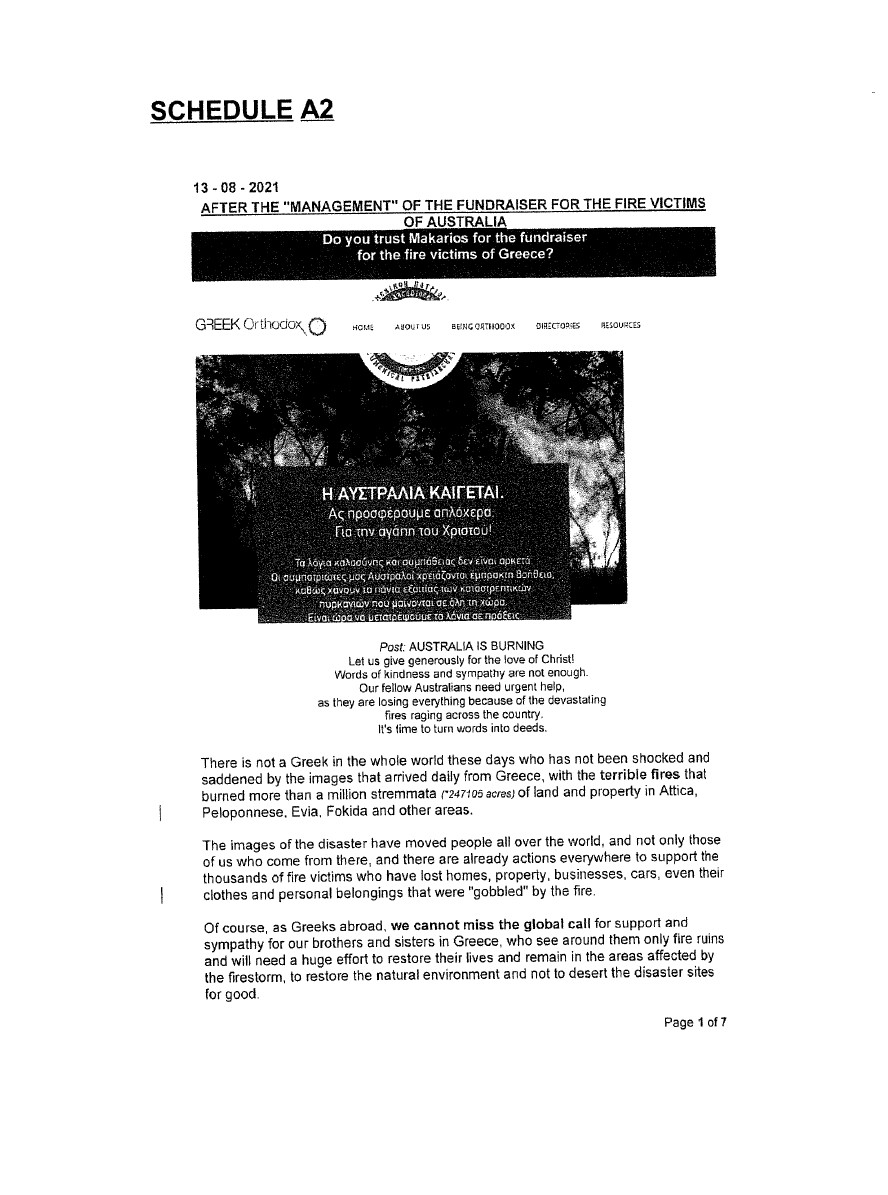
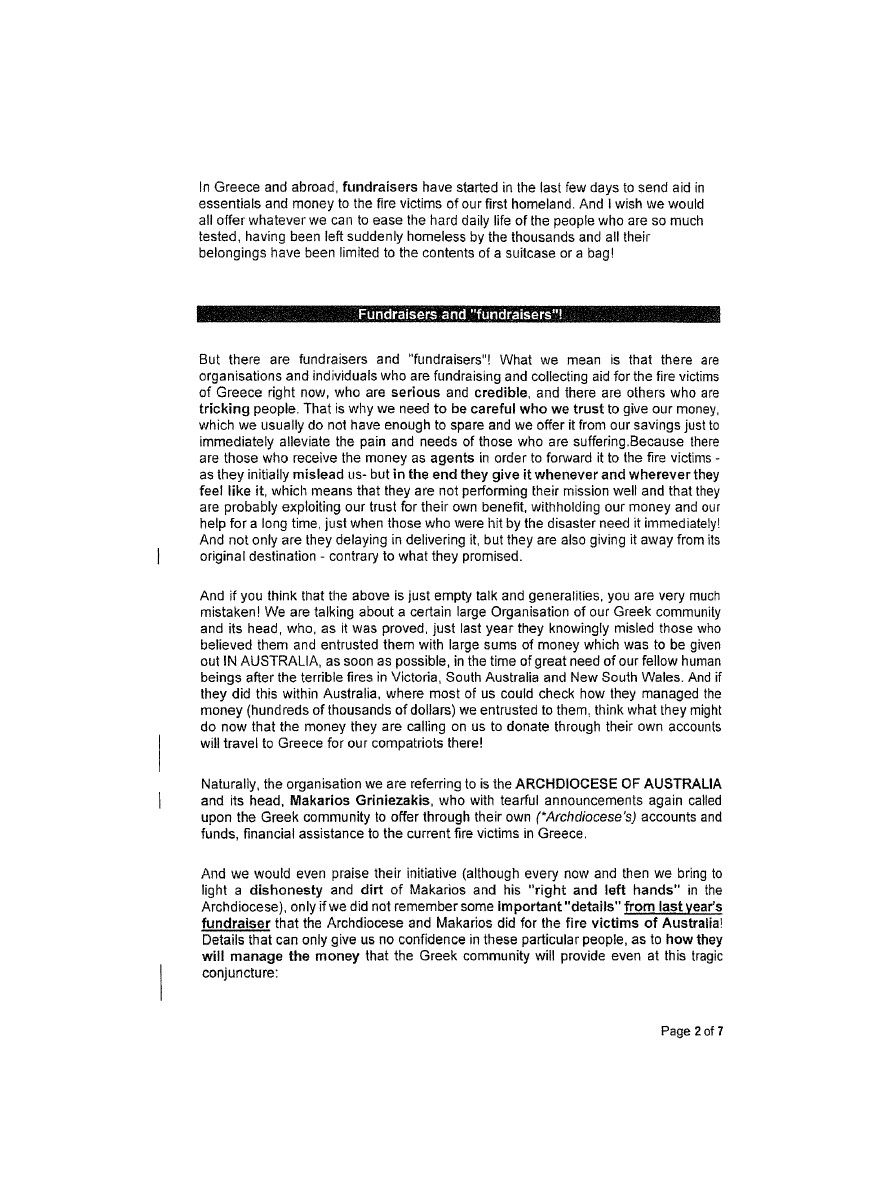
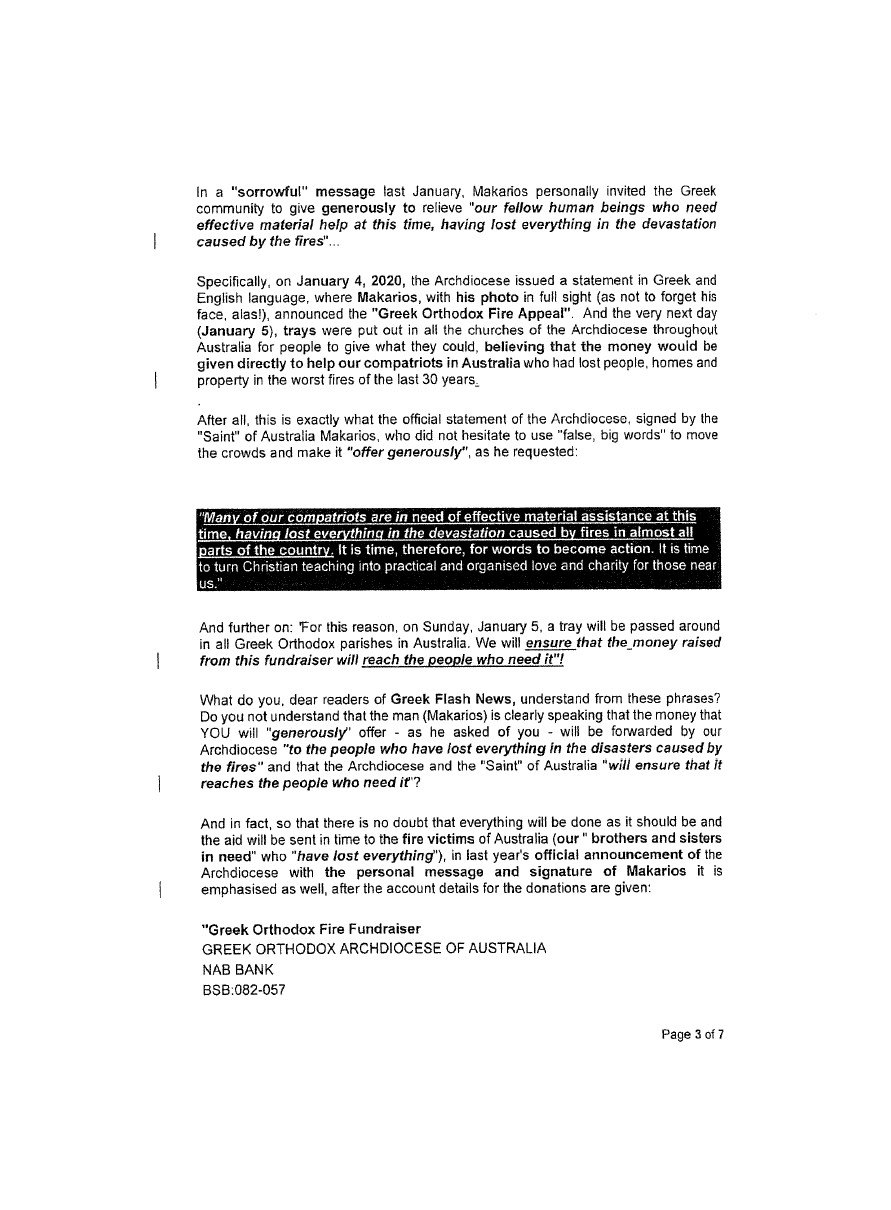
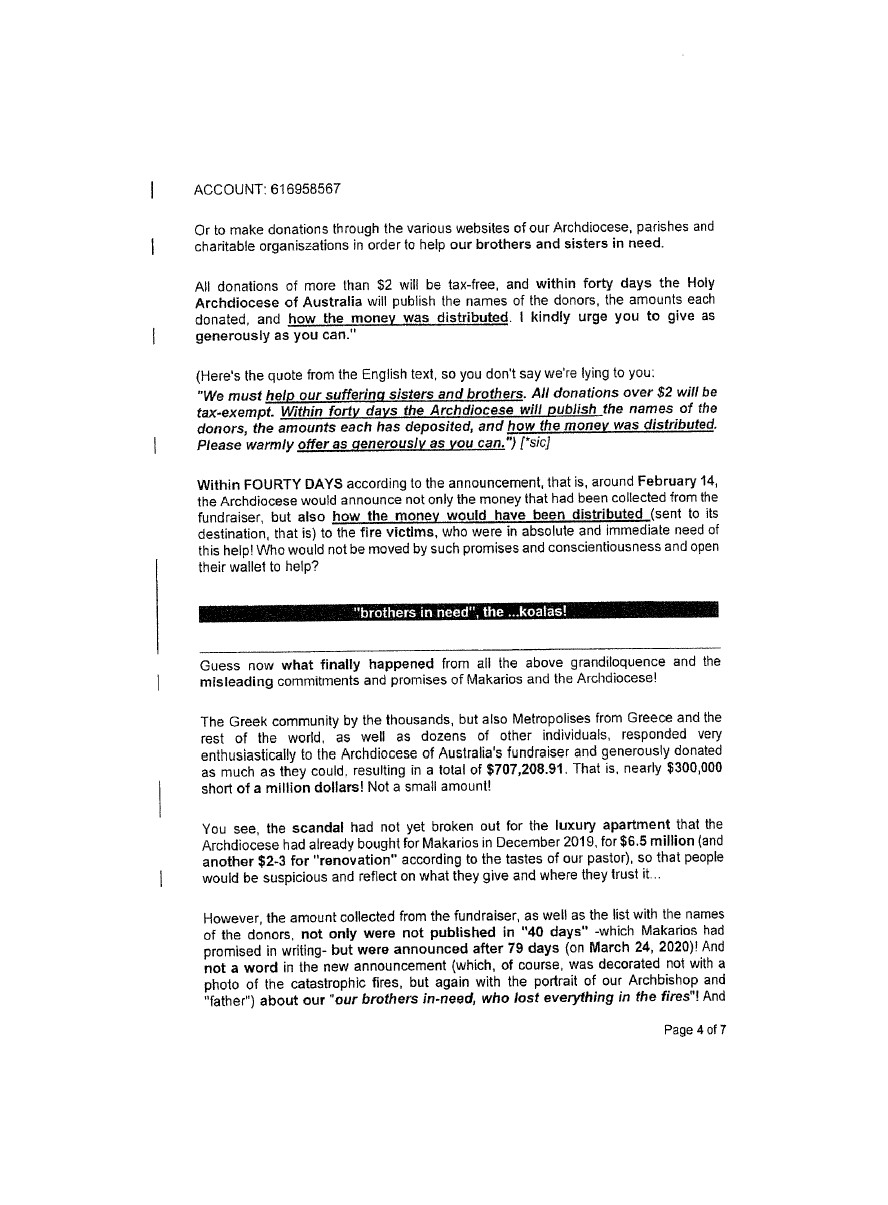
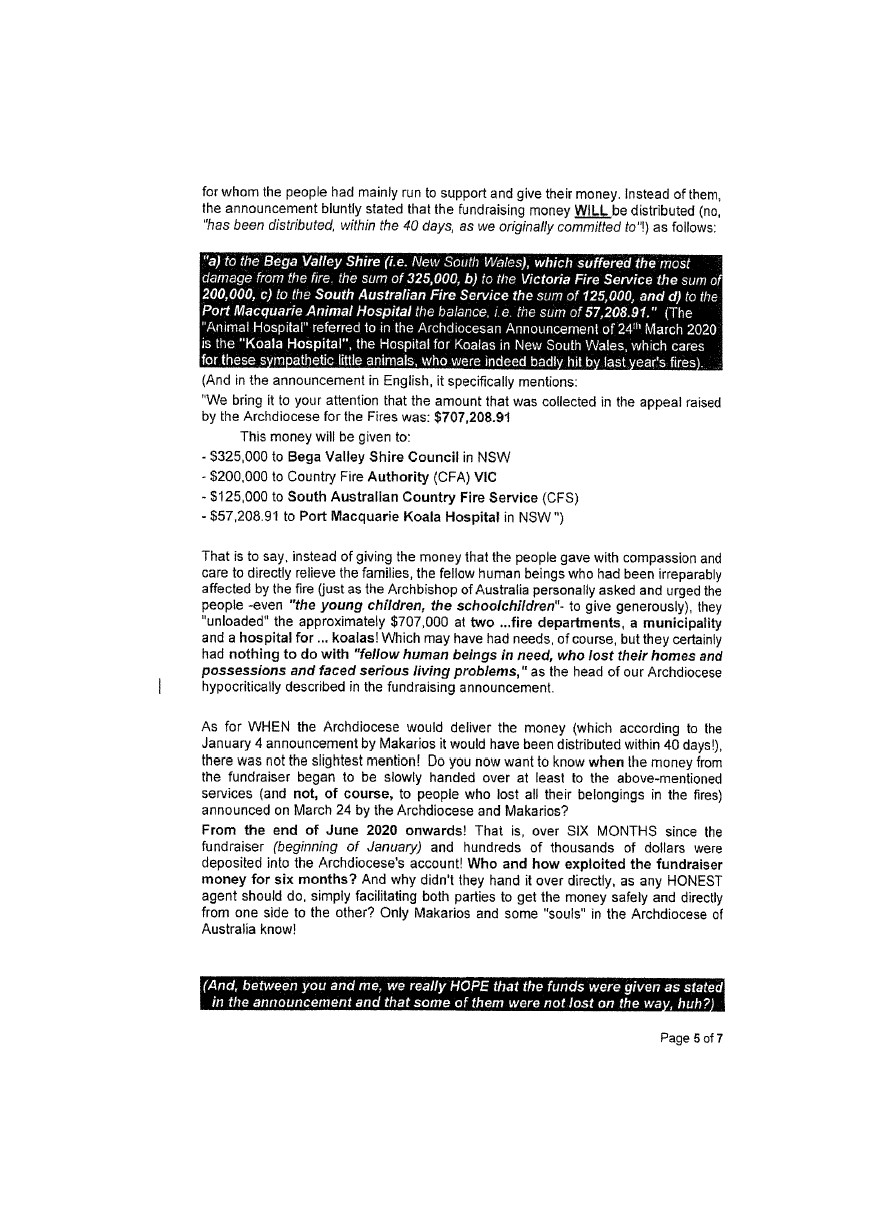
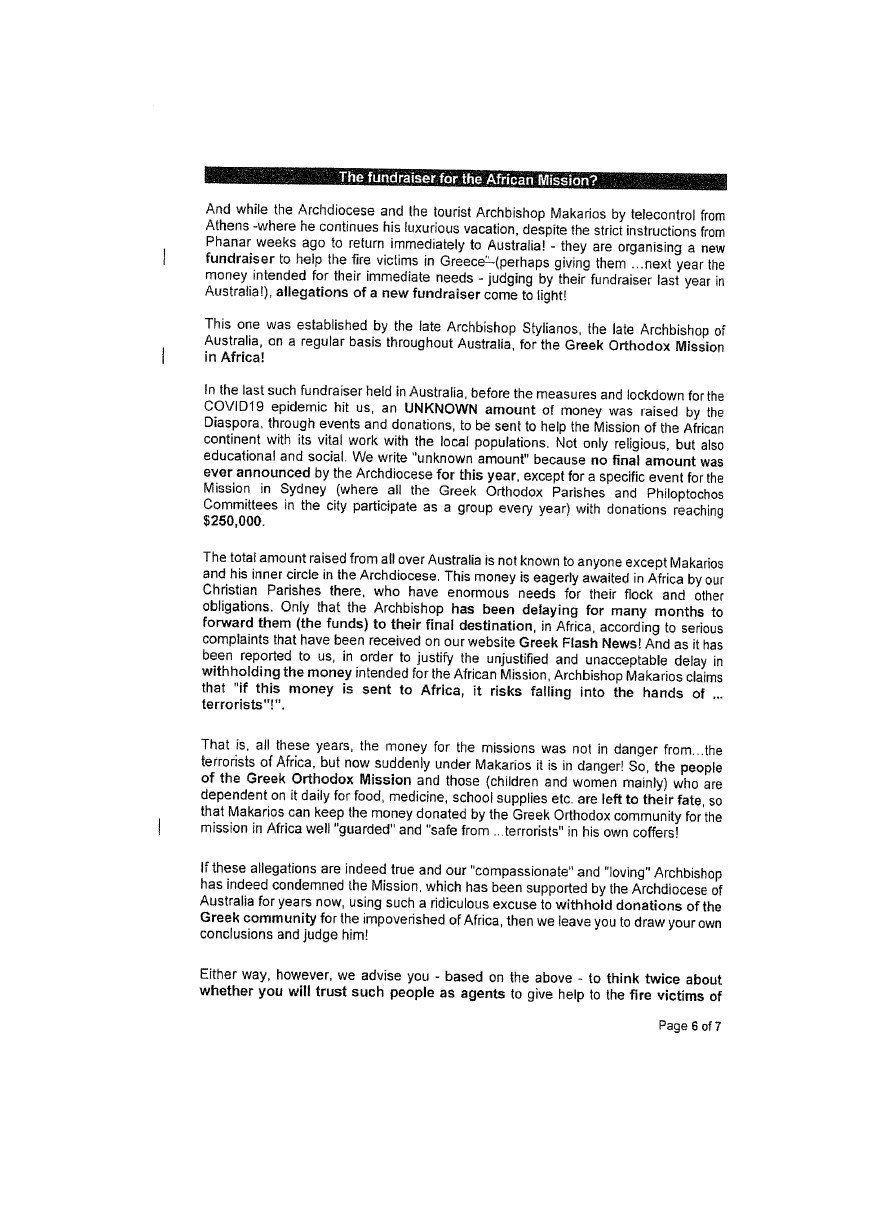
Annexure B — Second Article
Annexure C — Third Article
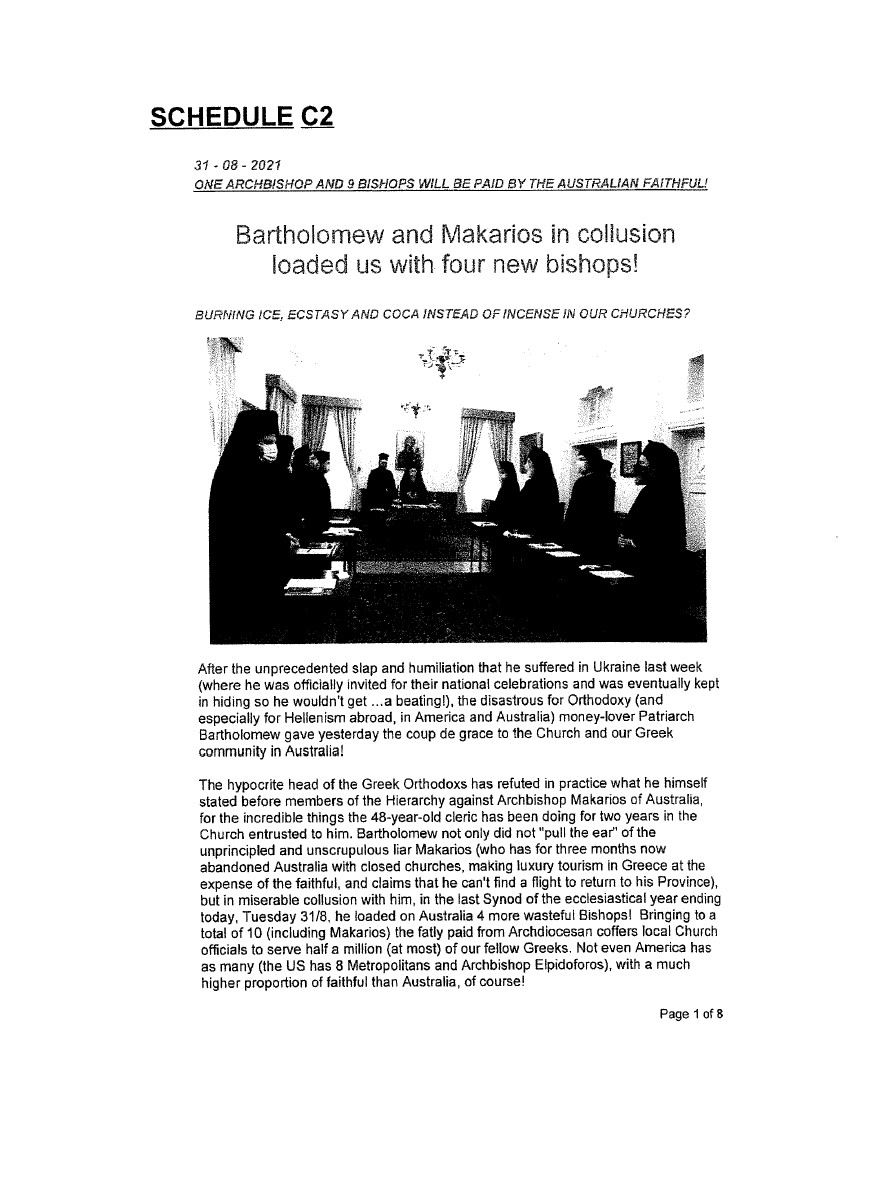
Annexure D — Fourth Article
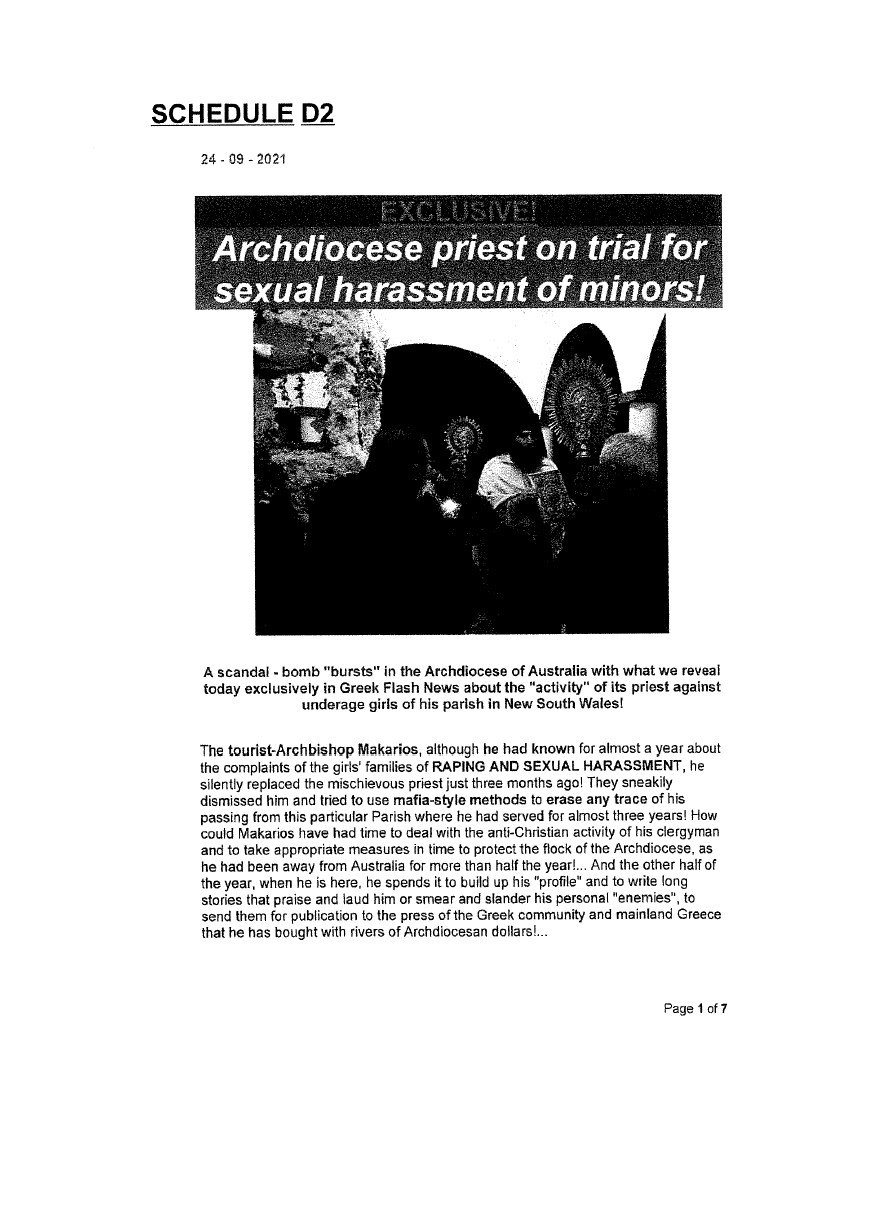
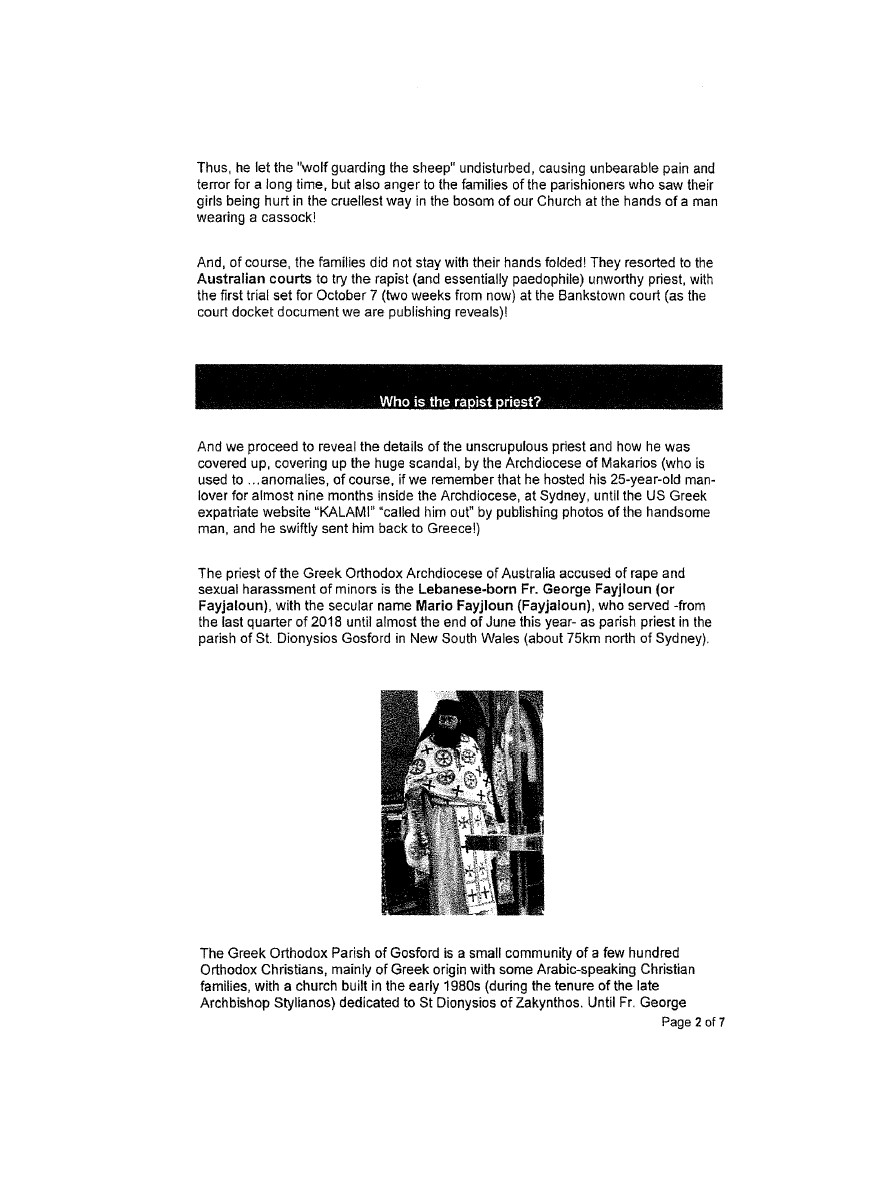
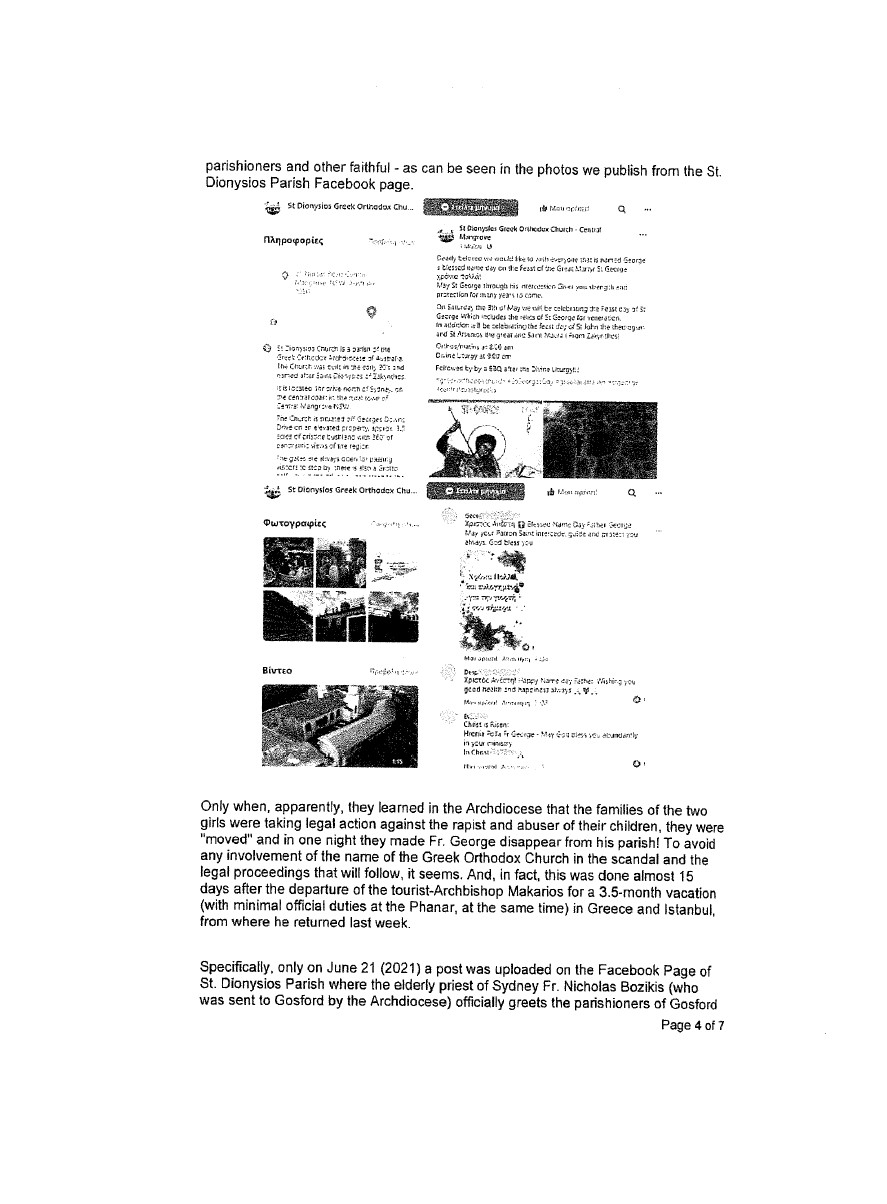
Annexure E — Defamatory meaning