FEDERAL COURT OF AUSTRALIA
Davey on behalf of the Gudanji, Yanyuwa and Yanyuwa-Marra Peoples v Northern Territory of Australia (No 5) (McArthur River Project Compensation Claim) [2026] FCA 153
File number: | NTD 25 of 2020 |
Judgment of: | BANKS-SMITH J |
Date of judgment: | 27 February 2026 |
Catchwords: | NATIVE TITLE – development of mine and port on land over which native title of Gudanji, Yanyuwa and Yanyuwa-Marra Peoples recognised – application by Claim Group for compensation for compensable acts under the McArthur River Project Agreement Ratification Act 1992 (NT) (Project Act) – application of principles analogous to those applied in compensation claims under Native Title Act 1993 (Cth) – where compensable act is one which extinguishes or diminishes native title – whether grant of mineral leases and other rights and licences to use land in claim area constitute compensable acts – whether validating legislation constitutes compensable act NATIVE TITLE – compensation for economic loss – where Claim Group have no claim to underlying minerals – whether economic loss to be assessed on the basis of a hypothetical comparable bargain that may permit regard to integers such as revenue and royalties – whether alternatively economic loss is to be assessed on the basis of the value of the freehold estate as proxy, following the approach endorsed in Northern Territory v Griffiths [2019] HCA 7; (2019) 269 CLR 1 (Griffiths) NATIVE TITLE – valuation methodology for freehold estate – whether valuation of freehold estate assumes a hypothetical unencumbered fee simple such that reservation of minerals may be ignored – whether vested interest premium may be applied NATIVE TITLE – expert evidence – application of freehold valuation principles to land the subject of compensable acts – evaluative judgment as to discount to freehold value to take account of nature of native title rights and interests – whether should be further discount for geographical and temporal limits of activities when compensable acts are non-extinguishing or of finite duration NATIVE TITLE – compensation for cultural loss – application of principles in Griffiths – effect of compensable acts on Claim Group's connection to country – evidence of law, custom and cultural landscape – pervasiveness of Dreamings – expert evidence of environmental legacy – temporal and geographic limitations – effect of mine's end-of-life – regard to collateral benefits – assessment of award that meets community standards STATUTORY CONSTRUCTION – whether notice of claims for compensation brought within statutory period in Project Act STATUTORY CONSTRUCTION – whether grants of non-pastoral use permits by the Pastoral Land Board (NT) were administrative acts within the meaning of the Project Act – consideration of Griffith University v Tang [2005] HCA 7; (2005) 221 CLR 99 in context of statutory construction STATUTORY CONSTRUCTION – pipeline licence granted under Energy Pipelines Act 1981 (NT) – where statutory right to compensation to person with interest in land who suffers damage – whether such right provided 'just terms' such that no further right to compensation under Project Act – scope of right to compensation under Energy Pipelines Act ESTOPPEL – equitable estoppel by reason of encouragement – long history of claims and attempts to negotiate agreements in relation to native title rights and interests – whether Northern Territory estopped by conduct from denying Claim Group gave requisite notice of compensation claims PRACTICE AND PROCEDURE – where Claim Group unilaterally proposed reference under s 54A of the Federal Court of Australia Act 1976 (Cth) to follow liability findings and finding on method of assessment of compensation for economic loss – whether application should precede hearing – matters relevant to consideration of whether reference appropriate PRACTICE AND PROCEDURE – application to re-open to adduce evidence of post-trial entry into Indigenous Land Use Agreement |
Legislation: | Aboriginal Land Rights (Northern Territory) Act 1976 (Cth) Atomic Energy Act 1953 (Cth) Environment Protection and Biodiversity Conservation Act 1999 (Cth) Evidence Act 1995 (Cth) ss 69, 72, 78A, 131, 136 Federal Court of Australia Act 1976 (Cth) ss 51A, 54A Native Title Act 1993 (Cth) ss 22G, 23B, 23C, 24CB, 24EA, 24EB, 24IC, 24ID, 44H, 46, 47, 51, 51A, 61, 64, 82, 84A, 86, 87, 223, 227, 232A, 238, 239, 251D Northern Territory (Self-Government) Act 1978 (Cth) s 69 Racial Discrimination Act 1975 (Cth) s 10 Federal Court Rules 2011 (Cth) rr 34.119-34.123 Crown Lands Act 1992 (NT) s 21 Energy Pipelines Act 1981 (NT) ss 3, 12, 13, 15, 59 Environmental Assessment Act 1982 (NT) Fisheries Act 1988 (NT) Heritage Act 2011 (NT) Lands Acquisition Act 1978 (NT) Sch 2 McArthur River Project Agreement Ratification Act 1992 (NT) ss 4, 4A, 4AB, 4B McArthur River Project Agreement Ratification Amendment Act 1993 (NT) s 3 McArthur River Project Amendment (Ratification of Mining Authorities) Act 2007 (NT) s 4 Mine Management Act 1990 (NT) Mineral Royalty Act 1982 (NT) s 50 Mineral Titles Act 2010 (NT) Mining Act 1980 (NT) ss 4, 60, 174B, 174C, 174D, 190 Mining Management Act 2001 (NT) s 35 Northern Territory Aboriginal Sacred Sites Act 1989 (NT) ss 22, 25 Pastoral Land Act 1992 (NT) ss 3, 11, 30, 86, 87, 88, 119 Minerals (Acquisition) Ordinance 1953 (NT) Mining Ordinance 1939 (NT) |
Cases cited: | ADCO Constructions Pty Ltd v Goudappel [2014] HCA 18; (2014) 254 CLR 1 Alcan (NT) Alumina Pty Ltd v Commissioner of Territory Revenue [2009] HCA 41; (2009) 239 CLR 27 Allianz Australia Insurance Limited v Delor Vue Apartments CTS 39788 [2022] HCA 38; (2022) 277 CLR 445 Australian Competition and Consumer Commission v Air New Zealand Limited (No 7) [2013] FCA 83; (2013) 209 FCR 361 Australian Education Union v Department of Education and Children's Services [2012] HCA 3; (2012) 248 CLR 1 Australian Financial Services and Leasing Pty Ltd v Hills Industries Ltd [2014] HCA 14; (2014) 253 CLR 560 Banjima People v State of Western Australia (No 2) [2013] FCA 868 Banjima People v State of Western Australia [2015] FCAFC 84; (2015) 231 FCR 456 Baxter v Obacelo Pty Ltd [2001] HCA 66; (2001) 205 CLR 635 BHP Billiton Nickel West Pty Ltd v KN (deceased) [2018] FCAFC 8; (2018) 258 FCR 521 Bodney v Bennell [2008] FCAFC 63; (2008) 167 FCR 84 Boland v Yates Property Corporation Pty Ltd [1999] HCA 64; (1999) 167 ALR 575 Braham v ACN 101 482 580 Pty Ltd [2018] VSC 575 Briggs on behalf of the Boonwurrung People v State of Victoria [2024] FCA 288 Broken Hill Pty Co Ltd v The Valuer-General [1970] AC 627 Bronzel v State Planning Authority (1979) 21 SASR 513 Campbell v Backoffice Investments Pty Ltd [2009] HCA 25; (2009) 238 CLR 304 Ceerose Pty Ltd v Building Products Australia Pty Ltd [2015] NSWSC 1886 Certain Lloyd's Underwriters Subscribing to Contract No IH00AAQS v Cross [2012] HCA 56; (2012) 248 CLR 378 CIC Insurance Ltd v Bankstown Football Club Ltd (1997) 187 CLR 384 Clark v Macourt [2013] HCA 56; (2013) 253 CLR 1 CMB No 1 Pty Ltd v Cairns City Council [1999] 1 Qd R 1 Commissioner for Railways (NSW) v Agalianos (1955) 92 CLR 390 Commissioner of Taxation v Consolidated Media Holdings Ltd [2012] HCA 55; (2012) 250 CLR 503 Commonwealth of Australia v Yunupingu [2025] HCA 6 Congoo v Queensland [2014] FCAFC 9; (2014) 218 FCR 358 Corrie v MacDermott (1914) 18 CLR 511; [1914] AC 1056 CPB Contractors Pty Ltd v Celsus Pty Ltd (No 2) [2018] FCA 2112; (2018) 268 FCR 590 Dasreef Pty Ltd v Hawchar [2011] HCA 21; (2011) 243 CLR 588 Davey on behalf of the Gudanji, Yanyuwa and Yanyuwa-Marra Peoples v Northern Territory of Australia [2023] FCA 303 Davey on behalf of the Gudanji, Yanyuwa and Yanyuwa-Marra Peoples v Northern Territory of Australia (No 3) [2023] FCA 521 Duncan v Independent Commission Against Corruption [2015] HCA 32; (2015) 256 CLR 83 Electricity Commission of New South Wales v Arrow (1994) 85 LGERA 418 Electricity Generation Corporation v Woodside Energy Ltd [2014] HCA 7; (2014) 251 CLR 640 Esso Australia Pty Ltd v Australian Workers' Union [2017] HCA 54; (2017) 263 CLR 551 Frigger v Trenfield (No 7) [2020] FCA 1740 Fuller v Lawrence [2024] HCA 45 Gollan v Randwick Municipal Council [1961] AC 82 Gould v Vaggelas (1984) 157 CLR 215 Griffith University v Tang [2005] HCA 7; (2005) 221 CLR 99 Griffiths v Northern Territory of Australia (No 3) [2016] FCA 900 Haines v Bendall (1991) 172 CLR 60 Hammond v JP Morgan Trust Australia Ltd [2012] NSWCA 295 Harrington-Smith on behalf of the Wongatha People v State of Western Australia (No 7) [2003] FCA 893; (2003) 130 FCR 424 Housing Commission of New South Wales v Falconer [1981] 1 NSWLR 547 Kramer v Stone [2024] HCA 48 Lansen v Minister for Environment and Heritage [2008] FCAFC 189; (2008) 174 FCR 14 Lansen v NT Minister for Mines and Energy [2007] NTSC 28 Lardil, Kaiadilt, Yangkaal, Gangalidda Peoples v State of Queensland [2000] FCA 1548 Law Society of New South Wales v Glenorcy Pty Ltd [2006] NSWCA 250 Lewis v Australian Capital Territory [2020] HCA 26; (2020) 271 CLR 192 Mabo v Queensland (No.2) (1992) 175 CLR 1 MacDermott v Corrie (1913) 17 CLR 223 Malone on behalf of the Western Kangoulu People v State of Queensland (No 3) [2022] FCA 827 Margarula v Northern Territory of Australia [2016] FCA 1018; (2016) 257 FCR 226 McArthur River Mining Pty Ltd v Lansen [2007] NTCA 5 McKay v Commissioner of Main Roads (No 7) [2011] WASC 223 McKay v Commissioner of Main Roads [2013] WASCA 135 Monroe Schneider Associates (Inc) v No 1 Raberem Pty Ltd (1991) 33 FCR 1 Mount Bruce Mining Pty Ltd v Wright Prospecting Pty Ltd [2015] HCA 37; (2015) 256 CLR 104 Narrier v State of Western Australia [2016] FCA 1519 National Insurance Co of New Zealand Ltd v Espagne (1961) 105 CLR 569 Nelungaloo Pty Ltd v The Commonwealth (1948) 75 CLR 495 Netdeen Pty Ltd t/as GJ Gardner Homes v Lindfield NSW Pty Ltd [2025] NSWCA 196 Newcrest Mining (WA) Ltd v The Commonwealth (1997) 190 CLR 513 Ngajapa v Northern Territory of Australia [2015] FCA 1249 Northern Territory of Australia v Alyawarr [2005] FCAFC 135; (2005) 145 FCR 442 Northern Territory of Australia v Griffiths [2017] FCAFC 106; (2017) 256 FCR 478 Northern Territory v Griffiths [2019] HCA 7; (2019) 269 CLR 1 One Step (Support) Ltd v Morris-Garner [2018] UKSC 20; [2019] AC 649 Palmanova Pty Ltd v Commonwealth of Australia [2025] HCA 35 Perilya Broken Hill Limited v Valuer-General (No. 6) [2015] NSWLEC 43 Perilya Broken Hill Ltd v Valuer-General [2015] NSWCA 400 Placer (Granny Smith) Pty Ltd v Thiess Contractors Pty Ltd [2003] HCA 10; (2003) 77 ALJR 768 Pointe Gourde Quarrying & Transport Company Ltd v Sub-Intendent of Crown Lands [1947] AC 565 Project Blue Sky Inc v Australian Broadcasting Authority (1998) 194 CLR 355 QGC Pty Limited v Alberts (No 2) [2021] FCA 540 Queensland v Congoo [2015] HCA 17; (2015) 256 CLR 239 Redding v Lee; Evans v Muller (1983) 151 CLR 117 Rinehart v Hancock Prospecting Pty Ltd; Rinehart v Rineheart [2019] HCA 13; (2019) 267 CLR 514 Roach v Page (No 11) [2003] NSWSC 907 Royal Sydney Golf Club v Federal Commissioner of Taxation (1955) 91 CLR 610 Rrumburriya Borroloola Claim Group v Northern Territory of Australia [2016] FCA 776; (2016) 255 FCR 228 SAS Trustee Corporation v Budd [2005] NSWCA 366 Sidhu v Van Dyke [2014] HCA 19; (2014) 251 CLR 505 Spencer v The Commonwealth of Australia (1907) 5 CLR 418 Springfield Land Corporation (No 2) Pty Ltd v State of Queensland [2011] HCA 15; (2011) 242 CLR 632 State of Queensland v Central Queensland Land Council Aboriginal Corporation [2002] FCAFC 371; (2002) 125 FCR 89 Sutherland Shire Council v Sydney Water Corporation [2008] NSWLEC 303 SZTAL v Minister for Immigration and Border Protection [2017] HCA 34; (2017) 262 CLR 362 The Commonwealth of Australia v Amann Aviation Pty Ltd (1991) 174 CLR 64 The Commonwealth v Reeve (1949) 78 CLR 410 Tjungarrayi v Western Australia; KN (deceased) v Western Australia [2019] HCA 12; (2019) 269 CLR 150 Top End Aboriginal Corporation RNTBC v Northern Territory of Australia [2022] FCA 74 Transport for London v Spirerose Ltd [2009] UKHL 44; [2009] 1 WLR 1797 Trentelman v The Owners – Strata Plan No 76700 [2021] NSWCA 242; (2021) 106 NSWLR 227 Turner v Minister of Public Instruction (1956) 95 CLR 245 Vitali v Stachnik [2001] NSWSC 303 Wade v New South Wales Rutile Mining Company Pty Ltd (1969) 121 CLR 177 Waltons Stores (Interstate) Limited v Maher (1988) 164 CLR 387 Western Australia v The Commonwealth (1995) 183 CLR 373 Western Australia v Ward [2002] HCA 28; (2002) 213 CLR 1 Wik Peoples v Queensland (1996) 187 CLR 1 Yunupingu on behalf of the Gumatj Clan or Estate Group v Commonwealth of Australia [2023] FCAFC 75; (2023) 298 FCR 160 Zheng v Cai [2009] HCA 52; (2009) 239 CLR 446 |
Division: | General Division |
Registry: | Northern Territory |
National Practice Area: | Native Title |
Number of paragraphs: | 1580 |
Date of last submissions: | 14 October 2025 (applicant – trial) 31 October 2025 (respondent – trial) 17 February 2026 (applicant – re-open) 23 February 2026 (respondent – re-open) |
Date of hearing: | 5-9, 13-16 and 19-23 June 2023, 21-23 November 2023, 13 February 2024 (amended application), 3 February 2026 (application to re-open) |
Counsel for the Applicants: | Mr SA Glacken KC with Mr T Keely SC and Ms J Wang |
Solicitor for the Applicants: | Northern Land Council |
Counsel for the Respondent: | Mr D O'Leary SC with Mr L Spargo-Peattie and Mr S Bryson |
Solicitor for the Respondent: | Hutton McCarthy Lawyers |
Counsel for the Intervener: | Ms N Kidson KC with Ms C Klease (now KC) |
Solicitor for the Intervener: | Australian Government Solicitor |
ORDERS
NTD 25 of 2020 | ||
BETWEEN: | CASEY DAVEY, REGGIE O'RILEY, CHRIS PLUTO, DEON LANSEN, DAVID HARVEY, JOY FINLAY AND ADRIANNE FRIDAY ON BEHALF OF THE GUDANJI, YANYUWA AND YANYUWA-MARRA PEOPLES First Applicant TOP END (DEFAULT PBC/CLA) ABORIGINAL CORPORATION RNTBC Second Applicant CASEY DAVEY, REGGIE O'RILEY, CHRIS PLUTO, DEON LANSEN, DAVID HARVEY AND ADRIANNE FRIDAY ON BEHALF OF GUDANJI, YANYUWA AND YANYUWA-MARRA PEOPLES Third Applicant | |
AND: | NORTHERN TERRITORY OF AUSTRALIA Respondent | |
ATTORNEY-GENERAL OF THE COMMONWEALTH OF AUSTRALIA Intervener | ||
order made by: | BANKS-SMITH J |
DATE OF ORDER: | 27 February 2026 |
THE COURT NOTES THAT:
A. The references in these orders to MLNs 1121-1126, the pre-1996 non-pastoral use permits, the post-1996 non-pastoral use permits, the road and the pipeline licence have the meaning given in the Reasons for judgment.
B. McArthur River Mining Pty Ltd wishes to be heard as to whether any parts of the Reasons that relate to the terms of the Indigenous Land Use Agreement made 14 December 2025 (ILUA) should be redacted before the Reasons are otherwise available publicly.
C. The Court intends to provide the parties, McArthur River Mining Pty Ltd and Gudanji Yanyuwa Garrwa Marra Aboriginal Corporation (GYGM) with the opportunity to be heard on this question of redaction, and may consider publishing a redacted form of its Reasons. However, it is the Court's intention that the Reasons will be made available publicly as soon as possible.
THE COURT ORDERS THAT:
1. The Claim Group is entitled to compensation under s 4B of the McArthur River Project Agreement Ratification Act 1992 (NT) (Project Act) in relation to the grant, validation and regrant of MLNs 1121-1126, the grant of the pre-1996 non-pastoral use permits, the construction of the road (as to 244 ha) and the grant of the pipeline licence (as to 110 ha) (compensable acts).
2. The compensation application is dismissed in relation to the enactment of s 4AB of the Project Act, the grant of MLN 582 and the post-1996 non-pastoral use permits.
3. The Claim Group is entitled to compensation for economic loss for the compensable acts in the total sum of $743,408.
4. Pre-judgment interest accrues on compensation for economic loss from the date of the compensable acts, in accordance with s 51A of the Federal Court of Australia Act 1976 (Cth) and at the rates referred to in the Interest on Judgments Practice Note (GPN-INT) until the date of judgment.
5. The parties are to confer and provide a joint minute that provides the interest calculation on economic loss calculated to the date of these orders, and a further order providing for the quantum of interest will be made.
6. The allocation of $743,408 that is attributable to each of the compensable acts and the dates of the compensable acts for the purpose of the interest calculation are to accord with the Reasons at [1578].
7. The Claim Group is entitled to compensation for cultural loss for the compensable acts in the sum of $54 million assessed at the date of this order.
8. Subject to order 9, McArthur River Mining Pty Ltd and GYGM may intervene for the sole purpose of making submissions in relation to whether it is in the interests of the administration of justice that any part of [1512]-[1561] and [1563] of Part M of the Reasons (which relate to the ILUA) be redacted.
9. The parties, McArthur River Mining Pty Ltd and GYGM are to file any submissions addressing any redactions that they contend should be made to the part of the Reasons identified in order 8 and why, and stating whether they seek an oral hearing on the issue, on or before 2.30 pm ACST on 6 March 2026.
10. Subject to further order, disclosure of the Reasons other than to the parties, McArthur River Mining Pty Ltd and GYGM, their legal representatives and members and staff of the Court is suppressed on an interim basis pursuant to s 37AI of the Federal Court of Australia Act.
11. Disclosure of these Reasons to the parties, McArthur River Mining Pty Ltd, GYGM, their legal representatives and members and staff of the Court under order 10 is permitted despite the terms of the suppression order made 16 January 2026 relating to the ILUA, which has effect subject to these orders.
12. The Northern Territory's application filed 3 February 2026 to re-open its case to tender the ILUA is granted.
13. The parties will be heard in relation to costs.
Note: Entry of orders is dealt with in Rule 39.32 of the Federal Court Rules 2011.
ORDERS
NTD 25 of 2020 | ||
| ||
BETWEEN: | CASEY DAVEY, REGGIE O'RILEY, CHRIS PLUTO, DEON LANSEN, DAVID HARVEY, JOY FINLAY AND ADRIANNE FRIDAY ON BEHALF OF THE GUDANJI, YANYUWA AND YANYUWA-MARRA PEOPLES First Applicant TOP END (DEFAULT PBC/CLA) ABORIGINAL CORPORATION RNTBC Second Applicant CASEY DAVEY, REGGIE O'RILEY, CHRIS PLUTO, DEON LANSEN, DAVID HARVEY AND ADRIANNE FRIDAY ON BEHALF OF GUDANJI, YANYUWA AND YANYUWA-MARRA PEOPLES Third Applicant | |
AND: | NORTHERN TERRITORY OF AUSTRALIA Respondent | |
ATTORNEY-GENERAL OF THE COMMONWEALTH OF AUSTRALIA First Intervener MCARTHUR RIVER MINING PTY LTD Second Intervener | ||
order made by: | BANKS-SMITH J |
DATE OF ORDER: | 9 March 2026 |
THE COURT ORDERS THAT:
1. Subject to further order, the reasons in Davey on behalf of the Gudanji, Yanyuwa and Yanyuwa-Marra Peoples v Northern Territory of Australia (No 5) (McArthur River Project Compensation Claim) [2026] FCA 153 published to the parties on 27 February 2026 be published generally by the Court with redactions made in accordance with the reasons of the Court dated 9 March 2026 (Redacted Judgment).
2. Disclosure of the words the subject of redaction in the Redacted Judgment be suppressed pursuant to s 37AF of the Federal Court of Australia Act 1976 (Cth) on the ground that suppression is necessary to prevent prejudice to the proper administration of justice.
3. To give effect to order 2, order 10 of the orders made 27 February 2026 in relation to suppression of the unredacted reasons for judgment remain in place until further order.
4. Order 1 be stayed until 2.30 pm ACST on 12 March 2026.
5. Disclosure of these reasons and orders other than to the parties, McArthur River Mining Pty Ltd (MRM), Gudanji Yanyuwa Garrwa Marra Aboriginal Corporation (GYGM), their legal representatives and members and staff of the Court be suppressed until 2.30 pm ACST on 12 March 2026.
6. Subject to and until further order, pursuant to s 37AF(1) of the Federal Court of Australia Act and because the order is necessary to prevent prejudice to the proper administration of justice:
(a) no third party be entitled to access any copy of the ILUA on the Court file other than in the redacted form prepared by the Claim Group and provided to Chambers on 24 February 2026 and as additionally redacted by the parties to reflect these reasons;
(b) no third party be entitled to access any affidavit that refers to those parts of the ILUA the subject of such redactions, unless such affidavit is similarly redacted by the parties; and
(c) the submissions filed by MRM dated 6 March 2026 be suppressed and are not to be made available other than to the parties, GYGM, their legal representatives and members and staff of the Court.
7. Subject to further order, the suppression order relating to the ILUA made 16 January 2026 be revoked with effect from 2.30 pm ACST on 12 March 2026.
8. Subject to order 9, the parties and MRM bear their own costs of and connected with MRM's intervention and the making of submissions relating to suppression of the Indigenous Land Use Agreement dated 14 December 2025.
9. If any party or MRM wishes to vary the costs order in order 8, they are to inform Chambers and file a minute of the orders they seek within 28 days, and the question of costs will be programmed for determination as appropriate.
Note: Entry of orders is dealt with in Rule 39.32 of the Federal Court Rules 2011.
Table of Contents
REASONS FOR JUDGMENT
BANKS-SMITH J:
PART A – INTRODUCTION
Summary of outcome
1 The McArthur River perpetual pastoral lease known as PPL 1051 covers an area of some 7225 square kilometres in the northeast of the Northern Territory of Australia. The McArthur River and its tributaries flow through the area, meeting the coast in the Gulf of Carpentaria. The McArthur River Project mine site and port operations are also located within the area.
2 This proceeding concerns an application by the Gudanji, Yanyuwa and Yanyuwa-Marra Peoples (Claim Group) for compensation from the Northern Territory for the extinguishment or diminution of their native title rights and interests as a result of a number of acts that facilitated the development of the mine and port.
3 Those acts include the grant of mineral leases to the mine owner, legislation validating the conversion from underground mining to open-cut mining, the grant of permits for dredge spoil storage at the port, construction of a connecting road and the grant of a pipeline licence.
4 The compensation claim is made under a particular statute, being the McArthur River Project Agreement Ratification Act 1992 (NT) (Project Act). The construction of provisions of the Project Act is central to addressing aspects of this claim. Save for one discrete claim pleaded in the alternative, the compensation claim is not made under the Native Title Act 1993 (Cth). However, in resolving this claim I have been guided by and applied the principles established by the High Court in the Timber Creek claim: Northern Territory v Griffiths [2019] HCA 7; (2019) 269 CLR 1 (Griffiths HC).
5 This proceeding raised many issues, both as to liability and the manner of assessment of compensation, some of which are novel.
6 I have determined that the Claim Group are entitled to compensation from the Northern Territory for economic loss and cultural loss caused by certain compensable acts. There was no dispute that these were appropriate components of the loss claimed, although the manner of assessment of compensation was very much in issue.
7 As to economic loss, I have applied the unencumbered freehold value comparator approach endorsed in Griffiths HC. In doing so, I have not assumed that it is the only method by which economic loss might be assessed in relation to acts that extinguish or diminish native title rights and interests. However, it is the appropriate method in this case. I have declined to adopt a model based on a 'hypothetical comparable bargain' that might have been entered into and that might have had regard to royalties and other commercial rights.
8 I have assessed economic loss (generally as at 30 June 1993) at $743,408, with an entitlement to statutory interest.
9 I have used the term 'cultural loss' in these reasons in accordance with the convention of the parties and as that term is explained in Griffiths HC at [154].
10 There is no doubt that the impact of the mine and port on the rights and interests of the Claim Group is felt beyond those particular sites, is intergenerational and is enduring. As the aphorism goes, sometimes the site of the pain is not the site of the injury. Cultural loss has regard to this impact: the irreversible disturbance of Dreaming sites and routes; the inability of the Claim Group to stop that disturbance or to continue to protect the Dreamings; the inability to access areas in a manner that permits the continuation of knowledge and customs between generations; the attenuation of such knowledge and customs over time; the inability to access sacred sites; the limitation on caring for country; and the cultural sensitivities that flow from what is regarded by some as a failure to care for country. This diminution of traditional connection to country – to receive from country and to take care of country – is compensable loss.
11 Subject to one qualification, I have found that the Northern Territory would be liable for compensation for cultural loss in the sum of $60 million, assessed at the date of judgment.
12 The qualification is this. In December 2025 the Claim Group and the mine owner entered into an Indigenous Land Use Agreement (ILUA) that provided for certain benefits to be paid to the Claim Group. I have determined that the ILUA is relevant and that some of the benefits affect the assessment of cultural loss for which the Northern Territory is liable, such that there should be a 10% reduction applied to the sum of $60 million. It follows that I have determined cultural loss at $54 million, assessed at the date of judgment.
Structure of these reasons
13 These reasons are dealt with in fourteen parts. Part A provides a general introduction. Part B provides a summary of the six acts on the part of the Northern Territory that the Claim Group contend entitles them to compensation. Part C sets out the trial process. Parts D and E provide the detail of how the McArthur River Project came to be approved and developed, and the statutory proclamations that facilitated it.
14 Part F introduces the relevant statutory provisions and identifies the three liability issues that were central to the determination of this proceeding. Those issues are (first) whether notice of a claim for compensation was duly given by the Claim Group, including the question of whether an estoppel otherwise arises; (second) whether the grant of non-pastoral use permits by the Pastoral Land Board constituted a relevant 'legislative or administrative act' so as to enliven the compensation provision of the Project Act; and (third) whether the compensable acts were 'acquisitions of property' within the meaning of the compensation provision. Those matters are dealt with in Parts G, H and I respectively.
15 Part J collects the principles in relation to compensation for extinguishment or diminution of native title rights and interests.
16 Part K addresses the first of the two heads of claimed loss – economic loss. This Part considers and determines economic loss having regard to the freehold proxy valuation method endorsed in Griffiths HC. It includes an assessment of the expert valuation evidence. It also includes the reasons for rejecting the Claim Group's 'hypothetical comparable bargain' model for assessing economic loss.
17 Part L deals with the second head of claimed loss – cultural loss. This Part documents the lay, expert anthropological and expert environmental evidence relating to cultural loss, and includes the assessment of cultural loss.
18 Part M is related to Part L. It addresses collateral benefits, such as payments to the Claim Group by third parties, and how they might impact the assessment of cultural loss.
19 The final part, Part N, deals with pre-judgment interest and miscellaneous matters.
Native title rights over area determined
20 In 2015 this Court recognised under s 87 of the Native Title Act that non-exclusive native title rights exist with respect to the land and waters the subject of pastoral lease PPL 1051: Ngajapa v Northern Territory of Australia [2015] FCA 1249 (Mansfield J) (Determination). Those rights are held respectively by the members of some eleven estate groups identified in the Determination.
21 The nature of the native title rights recognised in the Determination was varied by Jagot J in Top End Aboriginal Corporation RNTBC v Northern Territory of Australia [2022] FCA 74. The variation removed from the Determination an exclusion preventing the native title holders from exercising their native title rights for a commercial or business purpose, so achieving consistency as to the use of resources between different groups in the region. The native title rights and interests are described in full later in these reasons. The findings the subject of the Determination (as amended) are adopted pursuant to s 86(1)(c) of the Native Title Act. A map of the Determination area is attached to these reasons as Attachment 1.
22 As explained below, the claim area extends to an area outside the Determination area. However, there is no requirement under the Project Act that there be a determination of native title prior to determining compensation, and the parties agreed that it was open to proceed on this basis.
The McArthur River Project
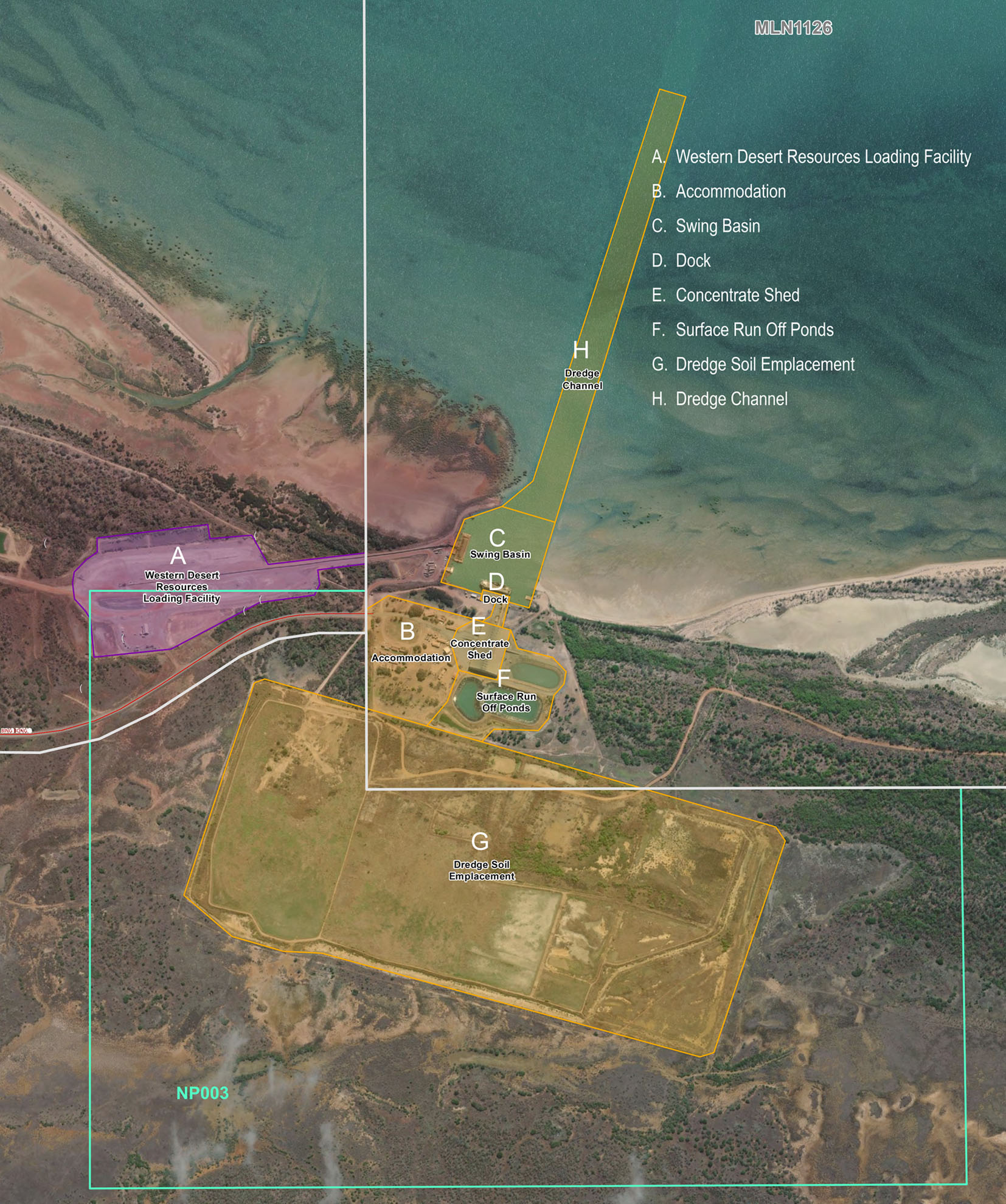
23 The McArthur River Project involves the mining, processing and transporting of zinc-lead-silver ore. It is the subject of the McArthur River Project Agreement made between the Northern Territory and Mount Isa Mines Limited (MIM) on 25 November 1992. The Project Agreement was entered into to provide for the grant of mineral leases by the Northern Territory to MIM and to facilitate the development, construction and operation of the Project. The Project Agreement was ratified by the Project Act (the Project Agreement is a schedule to that Act).
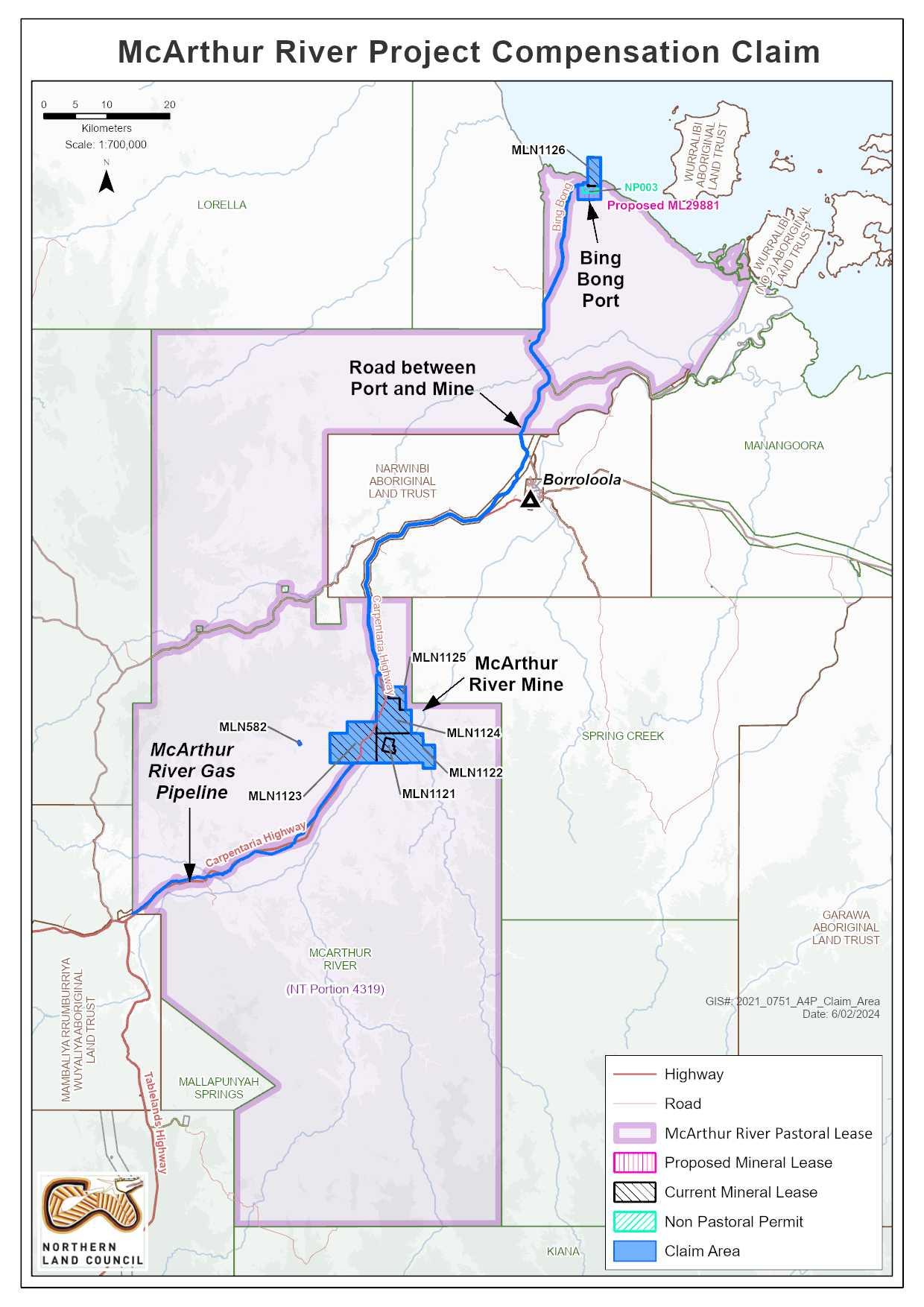
24 The Project mine site and associated processing sites are on five contiguous mineral leases, identified as MLNs 1121-1125 respectively, on Gudanji country. The site is about 45 km south-west of the town of Borroloola. The ore is transported to the coastal port at Bing Bong, within the area of a sixth mineral lease, MLN 1126, which is on Yanyuwa and Yanyuwa-Marra country. Non-pastoral use permits facilitate the storage of dredge spoil on areas adjacent to the port.
25 The following map shows the claim area marked in blue, with the four main features associated with the Project (mine, port, road and pipeline) identified:
26 The Project has had a significant impact on the land where it is situated and surrounding areas. The mine expanded from an underground mine to open-cut. Part of the McArthur River was diverted to accommodate its operations.
27 On the coast at Bing Bong, the mine's port facility was built, which required the dredging of a channel to accommodate barge access, and use of nearby areas on land to deposit the dredge spoil.
28 The Claim Group quoted the evidence of Billy Coolibah (deceased):
When that open cut mine happened, it destroyed the country real bad. They cut open the country and they moved the river. Now when I see that mine, it make me feel no good. That feeling you get when you're worried about country, it's called gurunulu. It means your heart is no good and you're feeling sad. And my mind is really sad too because I'm worried for my people because that country is hurt by the mine. The country been damaged up, they gone in like a mob of worms. Then they diverted the river, that snake is still there, nobody can change that snake, but when they diverted the river, they cut that snake dreaming. Bad things happen when you cut the dreaming. Bad things like people getting sick. I think some people have got sick from the mine. We're frightened all the time. (affidavit 28 January 2017)
29 There will be cause later in these reasons to examine a large body of lay and expert evidence about both the mine and the port, but Billy Coolibah's evidence captures some of the difficult issues that inform the history of this claim and the compensation sought.
Procedural background to the compensation claim
30 The Claim Group members are the native title holders recognised by the Determination.
31 On 14 December 2020 the first applicant (constituted by eight members) filed an application on behalf of the Claim Group for determination of compensation under s 61(1) of the Native Title Act (NTD 25 of 2020) for certain acts done in connection with the Project.
32 A procedural issue arose in relation to the original compensation application. After it was filed, the first applicant sought to amend it in a manner that purported to increase the area of lands and waters covered by the original application to areas which were outside the area of the original application. I found that the operation of s 64(1A) and s 64(1) of the Native Title Act did not permit an amendment in those circumstances, and accordingly refused the amendment application: Davey on behalf of the Gudanji, Yanyuwa and Yanyuwa-Marra Peoples v Northern Territory of Australia [2023] FCA 303 (Davey (No 1)).
33 Following that decision, a differently constituted applicant filed a further compensation application in June 2023 (NTD 16 of 2023). The application described the relevant area so as to include (relevantly) the two areas that the first applicant had unsuccessfully sought to include by the amendment application. The two areas are outside the area of the Determination, although the parties may separately seek a determination of native title over those areas in due course.
34 By orders made on 15 August 2023, NTD 25 of 2020 and NTD 16 of 2023 were consolidated into a single proceeding to continue as proceeding NTD 25 of 2020, and the application in NTD 16 of 2023 was taken to be the originating application in the consolidated proceeding from the date it was filed (6 June 2023).
35 On 13 February 2024 the respective applicants filed an amended consolidated application and unless the context requires otherwise, it is only necessary to refer to the consolidated application.
The parties
36 The first and third applicants are native title holders who are authorised by the Claim Group to seek compensation. It is not in issue that the applicants have standing to bring the compensation application.
37 Following the consolidation, the first applicant in NTD 25 of 2020 continues to be designated as the first applicant in this proceeding. Top End (Default PBC/CLA) Aboriginal Corporation RNTBC continues to be designated as the second applicant. The applicant in NTD 16 of 2023 is designated as the third applicant. What matters is that each application and the consolidated application is effectively brought by the Claim Group.
38 The second applicant is a registered native title body corporate. It is the native title body corporate for the area covered by the Determination.
39 The respondent, the Northern Territory, is the party liable to pay compensation under the Project Act and, if applicable, the Native Title Act, in relation to compensable acts.
40 The Attorney-General of the Commonwealth is an intervener in the proceedings under s 84A(1) of the Native Title Act. The Commonwealth's interest in the proceedings lies in the principles applicable to questions of liability and quantum under the Native Title Act, and the development of relevant methodologies for the assessment of the quantum of such compensation. The Commonwealth did not seek to be heard in relation to issues arising solely under the Project Act. References to 'the parties', unless the context suggests otherwise, do not include the Commonwealth.
The Claim Group
41 The Claim Group is described in the application as follows (renumbered for convenience):
The Claim Group on whose behalf the application is made are Gudanji, Yanyuwa and Yanyuwa-Marra Aboriginal Peoples:
(1) who are members of the following estate groups:
(a) Kamanja (Wuyaliya);
(b) Ngurrmu/Jawuma (Rrumburriya);
(c) Pupuwina (Rrumburriya);
(d) Mangurrungurru/Wulkuwulku (Wuyaliya);
(e) Mawuli (Wuyaliya);
(f) Wurruwiji (Wurdaliya);
(g) Jirrinmini (Mambaliya);
(h) Gulpalyi (Wurdaliya);
(i) Garambarini (Wurdaliya);
(j) Gulaurruna (Rrumburriya);
(k) Warrgi (Wuyaliya);
by reason of:
(i) patrilineal descent;
(ii) his or her mother, father's mother or mother's mother being or having been a member of the group by reason of patrilineal descent;
(iii) having been adopted or incorporated into those descent relationships;
(2) who, in accordance with traditional laws and customs, have rights in respect of the application area, subject to the rights and interests of the estate group members referred to at (1), being:
(a) members of estate groups from neighbouring estates, including Karranjini (Rrumburriya);
(b) spouses of the estate group members referred to at (a).
42 The description of the Claim Group corresponds to the description of the group determined to hold native title in the Determination, save for the reference to the neighbouring estate group (at (2)(a) in the description immediately above). However, the difference is not significant, as cl 7 of the Determination provides that:
In accordance with traditional laws and customs, other Aboriginal people have native title rights and interests in respect of the Determination Area, subject to the native title rights and interests of the estate group members, such people being:
(a) members of estate groups from neighbouring estates;
(b) spouses of the estate group members.
Nature of the native title rights
43 'Native title' or 'native title rights and interests' are defined extensively in s 223 of the Native Title Act. The parties agree that the native title rights of the Claim Group, consistent with the definition in s 223(1), have a physical or material aspect (s 223(1)(a) – rights in relation to land); and a cultural or spiritual aspect (s 223(1)(b) – connection with land).
44 The native title rights and interests of the Claim Group were pleaded in the (consolidated) application as follows (renumbered):
(1) Other than in relation to the [MLN 1126] seaward area, the native title rights and interests of the Claim Group in relation to the compensation application area for which compensation is claimed are the non-exclusive rights being:
(a) the right to travel over, to move about and to have access to the area;
(b) the right to hunt and to fish on the land and waters of the area;
(c) the right to gather and to use, and to take, for any purpose, the natural resources of the areas such as food, medicinal plants, wild tobacco, timber, stone and resin;
(d) the right to take and to use the natural water on the areas, but not including the right to take or use water captured by the holders of Perpetual Pastoral Lease No. 1051 (PPL 1051);
(e) the right to live, to camp and for that purpose to erect shelters and other structures on the area;
(f) the right to light fires on the area for domestic purposes, but not for the clearance of vegetation;
(g) the right to conduct and to participate in the following activities on the area:
(i) cultural activities;
(ii) cultural practices relating to birth and death, including burial rites;
(iii) ceremonies;
(iv) meetings;
(v) teaching the physical and spiritual attributes of sites and places on the area that are of significance under their traditional laws and customs;
(h) the right to maintain and to protect sites and places on the area that are of significance under their traditional laws and customs;
(i) the right to share or exchange resources obtained on or from the area;
(j) the right to be accompanied on to the area by persons who, though not native title holders, are:
(i) people required by traditional law and custom for the performance of ceremonies or cultural activities on the area;
(ii) people who have rights in relation to the area according to the traditional laws and customs acknowledged by the estate group members;
(iii) people required by the estate group members to assist in, observe, or record traditional activities on the area;
(k) the right to conduct activities necessary to give effect to the preceding rights.
(2) In relation to the [MLN 1126] seaward area, the native title rights and interests are the following non-exclusive rights:
(a) the right to access, to remain in and to use the area, alternatively, to travel over, to move about and to have access to the area;
(b) the right to gather and to use, and to take, for any purpose, the natural resources of the area.
(3) The native title rights and interests:
(a) do not confer on the Claim Group possession, occupation, use and enjoyment of the application area to the exclusion of all others;
(b) are subject to and exercisable in accordance with:
(i) the traditional laws and customs of the Claim Group;
(ii) the laws of the Northern Territory of Australia and the Commonwealth of Australia.
(4) There are no native title rights and interests in:
(a) minerals as defined in s 2 of the Minerals (Acquisition) Act (NT));
(b) petroleum (as defined in s 5 of the Petroleum Act (NT));
(c) prescribed substances (as defined in s 3 of the Atomic Energy (Control of Materials) Act 1946 (Cth) and/or s 5(1) of the Atomic Energy Act 1953 (Cth);
in the application area.
45 Leaving aside the inclusion of (2) relating to the MLN 1126 seaward area (which was not the subject of the Determination), the nature of the native title rights set out in the application are consistent with the native title rights recognised in the Determination.
46 As to the MLN 1126 seaward area, the Northern Territory agrees with the description of the native title rights and interests set out above but adds that after sovereignty, any native title right or interest of the Claim Group which amounted to a right to exclusive possession of the waters of the MLN 1126 seaward area could no longer exist by consequence of inconsistency with common law public rights of navigation and fishing, and the right of innocent passage. The Northern Territory also pleads that at all relevant times, the native title rights in the MLN 1126 seaward area were held solely by the Yanyuwa and Yanyuwa-Marra Peoples. These two qualifications do not have a practical effect on the outcome of the compensation claim.
47 The parties agree that there are no native title rights and interests in minerals, a matter made express in the Determination.
The claim area
48 The claim area comprises approximately 130.7 km2. As noted, PPL 1051 as a whole comprises some 7225 km2.
List of statutes referred to
49 There are many Acts referred to throughout these reasons. For convenience, the full titles of the Acts frequently referred to are listed here. I have condensed and defined the names of the Acts specific to the Project for convenience:
(a) Aboriginal Land Rights (Northern Territory) Act 1976 (Cth)
(b) Energy Pipelines Act 1981 (NT);
(c) McArthur River Project Agreement Ratification Act 1992 (NT) (Project Act);
(d) McArthur River Project Agreement Ratification Amendment Act 1993 (NT) (Project Amendment Act 1993);
(e) McArthur River Project Amendment (Ratification of Mining Authorities) Act 2007 (NT) (Project Amendment Act 2007);
(f) Mine Management Act 1990 (NT);
(g) Mineral Titles Act 2010 (NT); and
(h) Mining Act 1980 (NT);
(i) Mining Management Act 2001 (NT);
(j) Native Title Act 1993 (Cth);
(k) Northern Territory Aboriginal Sacred Sites Act 1989 (NT).
(l) Pastoral Land Act 1992 (NT); and
(m) Racial Discrimination Act 1975 (Cth).
PART B – THE COMPENSABLE ACTS
50 The Claim Group seeks compensation for economic loss and cultural loss.
51 The High Court in Griffiths HC (at [54], [84]) confirmed that assessment of compensation under the Native Title Act must include components for both economic and non-economic loss. The parties agree that similarly, compensation under the Project Act should include those two components. The Claim Group also seeks interest at a statutory rate.
52 I will use the term 'compensable acts' to describe the acts identified by the Claim Group as those for which compensation is sought.
53 The Claim Group revised the number and nature of compensable acts in iterations of the pleaded case before and during the trial. In the end, there were six compensable acts relied upon, based on the second further amended statement of claim, the written and oral closing submissions and the consolidated application. I introduce these acts at this point, together with a summary of the Northern Territory's position in relation to each. Further detail is provided later in these reasons.
(1) MLNs 1121-1126
54 The compensable act asserted is the grant by the Northern Territory to MIM of five contiguous mineral leases, being MLNs 1121-1125, located on PPL 1051, together with MLN 1126, separately located at Bing Bong on the coast. The acts are described as the grants of those mineral leases on 5 January 1993 under the Mining Act, and their validation and regrant on 30 June 1993 as a result of the Project Amendment Act 1993.
55 The Northern Territory admits liability for compensation under the Project Act in relation to the grant, validation and regrant of MLNs 1121-1126.
(2) Enactment of s 4AB of the Project Act – open-cut authorisation
56 The compensable act asserted is the enactment on 4 May 2007 of s 4AB of the Project Act (introduced by operation of the Project Amendment Act 2007) which validated the issue of the open-cut authorisation for the mine, including its conversion from underground to open-cut operation. The Claim Group disavowed any determination of claims based on the authorisation and its validation as separate acts. They submitted that in any event the effects (for example, of open-cut mining) remained relevant to the determination of compensation for cultural loss.
57 According to the Claim Group, little turns on whether or not the enactment of s 4AB was a compensable act in terms of compensation. They submitted that once it is accepted that economic loss flows from the grants of MLNs 1121-1126, there is no further economic loss that arises by way of the enactment of s 4AB. They also submitted that the Northern Territory appears to accept that the open-cut mine is relevant to the assessment of cultural loss. Despite these submissions, the Claim Group maintained their reliance on the enactment of s 4AB as a separate compensable act.
58 The Northern Territory denies the enactment effected an acquisition of property. It denies the Claim Group gave notice of a claim in relation to this act as required under the Project Act.
(3) MLN 582 renewals
59 The compensable act asserted is the renewals of MLN 582 on 25 July 2000 and 4 February 2020 under the Mining Act and the Mineral Titles Act respectively.
60 The Northern Territory admits the renewals effected an acquisition of property other than on just terms but only insofar as the Claim Group were subsequently deprived of the use of the surface of the land. The Northern Territory denies there has been any such deprivation or, as a matter of fact, any disturbance to the land. It denies the Claim Group gave notice of a claim in relation to these acts as required under the Project Act or gave notice of any claim that related to MLN 582.
(4) Dredge spoil non-pastoral use permits
61 This is the one compensable claim where a claim for compensation under the Native Title Act is brought in the alternative to a claim under the Project Act.
62 Between 1994 and 2010 the Pastoral Land Board and its delegates granted non-pastoral use permits under the Pastoral Land Act to McArthur River Mining Pty Ltd (MRM), a subsidiary of MIM. Fifteen permits were granted between 9 April 1994 and 26 February 2010 permitting use of certain land and waters within the PPL 1051 area for the establishment, operation and management of dredge spoil ponds in connection with the port operations.
63 The Claim Group maintains the grants of the permits constituted an acquisition of property not on just terms entitling them to compensation under s 4B of the Project Act. Further, or in the alternative, the Claim Group plead that the grant of permits after 1 January 1994 and before 23 December 1996 (of which there are three, referred to as the pre-1996 non-pastoral use permits) are intermediate period acts within the meaning of s 232A of the Native Title Act, for which the Claim Group is entitled to compensation under s 22G of the Native Title Act.
64 The Claim Group maintains no alternative Native Title Act claim in relation to the balance of the non-pastoral use permits, such claim having been abandoned at the end of the trial.
65 The Northern Territory denies liability under the Project Act in relation to (all) the non-pastoral use permits. It denies the permits were relevant administrative acts under the Project Act and contends that their legal force derives from the Pastoral Land Act. It denies the permits effected any acquisition of property. Other than for the pre-1996 non-pastoral use permits, it denies notice of any claim was made as required under the Project Act.
66 The Northern Territory accepts liability for the pre-1996 non-pastoral use permits under the alternative Native Title Act claim. It accepts such acts are compensable intermediate acts attributable to it in accordance with s 22G of the Native Title Act and that the Claim Group may recover compensation from the Northern Territory.
67 The Claim Group's position (stated in its 'topics for closing oral submissions') is that liability for compensation under the Native Title Act is only relevant if liability is not established under s 4B of the Project Act.
(5) Road
68 The claimed compensable act is the construction of a Road between the mine and the port by the Northern Territory, extending to adjacent areas incidental to the Road's construction, establishment or operation. The Project Agreement required the Northern Territory to construct and maintain the Road. Construction of the Road relevantly commenced in 1994.
69 The Northern Territory admits liability under s 4B of the Project Act insofar as new areas of the Road are concerned. It pleads that part of the Road was built over areas where native title interests had already been extinguished. Where such interests were extinguished, there was no acquisition of property by the construction of the Road. The only issue is the extent of prior extinguishment over the site of the Road. The Northern Territory assesses that the area of the deviation from the pre-existing road, and so the area for which compensation is payable, is an area of only 2.44 km2, and so comprises a relatively minor part of the Claim Group's claim.
(6) Pipeline Licence
70 The claimed compensable act is the grant by the Minister of Pipeline Licence No. 17 under the Energy Pipelines Act to NT Gas Pty Limited on 10 May 1994. The licence was granted to operate and maintain the gas pipeline to the mine, in order to generate electricity for its operations.
71 The Northern Territory admits that the grant of the Pipeline Licence was a relevant administrative act for the purpose of the Project Act but contends that there was no acquisition of property effected. However, it says that even if there were an acquisition, it was on just terms as the Claim Group were entitled to compensation under a compensation scheme provided by s 59(2) of the Energy Pipelines Act.
PART C – THE TRIAL
72 The trial proceeded with an on-country hearing over the course of four days in June 2023, followed by expert evidence given in Darwin over eight days. Closing submissions were delivered in Darwin in late November 2023.
73 It was then necessary to deal with the consolidation of the applications and certain amendments to the statement of claim, arising from a narrowing of the matters pursued by the Claim Group. The final amended statement of claim and amended compensation application were filed in January 2024 and February 2024 respectively. Supplementary submissions intended to be limited to identified topics were filed in October 2025. An application by the Northern Territory to re-open its case as a result of execution of the ILUA was made in February 2026 (the application is dealt with in Part M).
Lay evidence
74 In general, I will deal with relevant lay evidence progressively in these reasons when addressing the issues to which it relates. It is useful however, to provide an overview of the four days on country. Many sites and features are referred to in the summary and are explained further in the reasons dealing with cultural loss. I use the expression Court party to refer to not only those involved officially on behalf of the Court but the travelling group as a whole, which included Claim Group representatives, counsel, legal representatives and (when required for access and safety reasons) MRM representatives.
Evidence taken on country and in Borroloola
75 The members of the Claim Group who gave evidence on country in relation to the mine area were Casey Davey, Chris Pluto, Jack Green, Asman Rory and Ronnie Raggett.
76 The members of the Claim Group who gave evidence on country in relation to the port area were Mavis Timothy, David Harvey, T Simon (deceased) and Warren Timothy.
77 Each of these witnesses gave evidence in chief by affidavit. Those affidavits were tendered and remaining objections were determined at the time.
78 The on-country part of the hearing was documented by photographs taken by Registrar Colbran of this Court and various route maps, as well as by transcript. The parties subsequently agreed on a written description of the events of the first three days on country. This description together with route maps and photographs (Agreed Inspection Note) was received as an exhibit in the proceeding.
79 I acknowledge the assistance of MRM with the logistics for the site visit and various practical matters. The Northern Land Council (NLC) also assisted greatly in this regard, both on country and at the Borroloola Rodeo Ground hearing site.
Day one
80 Some of the features referred to in this section are marked in the extract of a map, part of which is included as Attachment 2. The source map is referred to in the evidence in Part L below as Map 4 and is part of the expert report of Dr David Trigger. Due to its size, it is not practical to reproduce the map as a whole and not all features are included, but Attachment 2 provides some assistance in understanding the course of the McArthur River, the mineral lease boundaries, and the proximity to the mine area of cultural sites and the paths of certain Dreamings. The numbers in the reasons reflect the identifying numbers used by Dr Trigger in Map 4.
Gulpalyi – Old McArthur River Station – Gudanji country
81 The Court party met at Borroloola and travelled to Gulpalyi (#29), also known as Eight Mile Waterhole, on the McArthur River. Gulpalyi is within PPL 1051, south of MLN 1123. The Court party was welcomed on country by members of the Claim Group. Asman Rory, supported by Casey Davey and others, explained the calling out to country when visiting with strangers, and provided a general introduction to the camping, hunting and cultural responsibilities at Gulpalyi.
82 The Court party travelled in convoy to the Old McArthur River Station, passing three burial sites and a rocky outcrop known as Jalyanini (#37) associated with Rainbow Serpent Dreaming. These features were pointed out by Ronnie Raggett.
83 The Old McArthur River Station (#47) is situated on Gudanji country. Claim Group members conducted a calling out and welcome ceremony, including a Gudanji dance.
84 Ronnie Raggett and Chris Pluto gave evidence at this site. The area and nearby surroundings are associated with Rainbow Serpent Dreaming. They pointed out a number of features including sacred ceremony and burial sites, the Coolibah Tree (#54) and sites of other camping and Gudanji customs.
Day two
McArthur River Mine – various viewing sites
85 On the second day on country the Court party participated in viewings at the McArthur River mine site. It viewed from identified safe vantage points the northern overburden emplacement facility (NOEF), the south perimeter runoff dam, the open pit, the southern overburden emplacement facility (SOEF), the mine levee wall and the tailings storage facility. A large geopolymer cover was observed. These sites are within MLNs 1122-1124.
86 Ronnie Raggett, Chris Pluto, Jack Green and Casey Davey assisted by pointing out sites.
87 From the NOEF viewing site within MLN 1124, Ronnie Raggett pointed out features including Mimbiri over to the east; Dardalani (a small spring, #59); Nanbadini (a waterhole, #42); Yukuwala (a rocky area associated with the Yukuwala Turtle Dreaming, #62); the Garbula Tree (a mature gum tree on the banks of the McArthur River, #58); Barney Hill (also known as Malayarrininni, within the mine site, #52); Bulwina (low hills west of the mine, a place of White Dingo Dreaming, #31); Surprise Creek; and Damangani (a rocky ridge in the mine area, #66). Some of these features are referred to in a register of sacred sites and other evidence, expanded upon in Part L.
88 From the Damangani viewing site within MLN 1122, it was possible to see a perspective of the size of waste rock relative to Damangani. Chris Pluto pointed out Damangani itself, and also the bund wall that 'cut the snake'. He also indicated the location of artefact scatters. Jack Green also described artefact scatters.
89 The open pit look-out site within MLN 1122 provided a view of the open pit in the area which was originally the path of the McArthur River. Jack Green explained the path of the Snake from Mimbiri to Barney Hill, down to the Garbula Tree, close to the old river path. Chris Pluto pointed out the meeting point of Surprise Creek and the McArthur River.
90 The SOEF site within MLN 1122 contains overburden that will eventually be relocated. From the viewing site Ronnie Raggett pointed out features including Mumunini (#60), which is a rock outcrop and rocky hill, also referred to as Green Snake Hill, relevant to the path of the Rainbow Snake (Yulanji or Walungudara) and regarded as a dangerous site, according to anthropological evidence; Balinmini (a high ridge, also part of the Snake Dreaming, #67); and Diwarra warra (also known as Slab Top Hill, #44).
91 The tailings storage facility was viewed, before the Court party stopped at a site within MLN 1123 for the taking of evidence. Each of Jack Green, Casey Davey, Chris Pluto and Asman Rory gave evidence at this location.
Day three
92 On day three the Court party travelled to the coast and observed the area around the port, including areas of MLN 1126. This area is culturally significant to hunting, fishing and camping.
Home Creek/Mawuli on the coast
93 The day commenced by the coast at Home Creek, also known as Mawuli. Mawuli is on Yanyuwa or Yanyuwa-Marra country and is the coastal area west of MLN 1126 within PPL 1051, outside the claim area. There was a calling out by Dinah Norman and a minute's silence led by Warren Timothy. Witnesses who gave evidence at this site were T Simon (deceased), David Harvey, Mavis Timothy and Warren Timothy.
94 Some of the features are identified by numbers on a site map in evidence through the expert anthropologist Dr John Bradley, and for convenience the numbers are again included with the descriptions below. An extract of the map, with some features identified, is Attachment 3 to these reasons. An extract of an aerial photo of the area with the port infrastructure and part of the MLN 1126 and non-pastoral use permit areas superimposed is Attachment 4.
95 From the site David Harvey pointed out features including Wilarri (#10, an area at the headwaters of Mule Creek, near where it enters the sea); Aburri-Babalungku (#12, reef area to the north of MLN 1126 and west of West Island (Mamadthamburi), and the site of the dreamtime Sea Turtle Dreaming); Wurruwiji (#2, which includes the coastal beach area on MLN 1126 that extends east of the port, sand flats and sea grass beds to the north and some of the hinterland to the south); and Arrinyanda (#1, the coastal area stretching north west of Wurruwiji (#2) from the port, including areas of the beach and saltpan).
96 Mavis Timothy pointed out features including Wurruwiji (#2); Wathangka (South West Island); casuarina trees (amarrabala); Mule Creek; the old boat ramp on Mule Creek; and Maban (#13, Maabayj, connected to Sea Turtle Dreaming) on West Island. Both West Island and South West Island are just off the coast and east of the port.
Bing Bong port facility viewing platform
97 A viewing was conducted from the Bing Bong port facility viewing platform west of MLN 1126. The barge used to transfer concentrate to vessels offshore could be seen, along with West Island, South West Island and Centre Island, the loading facility and concentrate storage shed.
98 The area of the dredge spoil ponds was also observed on the southern boundary of MLN 1126 and straddling non-pastoral use permit area NP003.
99 Warren Timothy, David Harvey and T Simon (deceased) pointed out the dredge channel; Arrinyanda #1; Aburri-Babalungku #12; Liwintha #11 (a large reef to the south of West Island); and Wimanda #4 (a small lagoon area inland and south-west of MLN 1126, associated with the Winter Rain Dreaming).
Wurruwiji – east of Bing Bong port facility
100 The final on country location was the coastal area east of the Bing Bong port facility and east of MLN 1126. Warren Timothy and T Simon (now deceased) gave evidence at this site.
101 Warren Timothy was able to point to features including Makukula (#5, one of the main camping areas at Bing Bong, near Home Creek); an island on the other side of the port where he camped as a child; Mule Creek; King Ash Bay; Jawuma (Black Rock Landing); Rosie Creek and a small creek that ran where the port channel is now sited. T Simon (deceased) pointed out Mule Creek and various tracks to the south, and brought a fishing harpoon for viewing.
102 The Court party then left the coast, travelling inland to the Rodeo Ground in the township of Borroloola, where David Harvey and T Simon (deceased) were cross examined.
Day four
103 The Court party re-convened at Borroloola, where Chris Pluto, Asman Rory, Ronnie Raggett, Mavis Timothy and Jack Green were cross examined.
Evidence from Claim Group members and cultural concerns
104 As noted, each of the witnesses who gave evidence on country gave evidence in chief by affidavit. Accordingly, there were affidavits in evidence from each of David Harvey, Warren Timothy, T Simon (deceased), Chris Pluto, Asman Rory, Ronnie Raggett, Casey Davey, Mavis Timothy and Jack Green.
105 The Claim Group also tendered affidavit evidence of Timothy Lansen (in relation to the mine) and Dinah Norman (in relation to the port), but neither were required for cross examination.
106 Affidavits of each of Bruce Joy (deceased), Harry Lansen (deceased) and Fred Raggett (deceased) were also tendered. The affidavits of Bruce Joy, Harry Lansen and Fred Raggett were made in 2001 in support of an objection to an expedited procedure for the grant of an exploration licence which covered part of the compensation application area. In relation to witnesses who are deceased, I sought guidance from the NLC on behalf of the Claim Group as to how those witnesses should be referred to in these reasons. I have followed the guidance provided.
107 An affidavit of Billy Coolibah (deceased) was also tendered. It was made in 2017. Martyn Gray, a solicitor working with the NLC, deposed to his understanding that the affidavit was made after Billy Coolibah informed the NLC that he had a terminal illness and he wished to provide evidence in relation to the Project compensation claim. Billy Coolibah died later that year.
108 In relation to all of the oral evidence of the Aboriginal witnesses, the parties were guided by a 'Statement of Cultural and Customary Concerns' prepared by the Claim Group with the assistance of anthropologists Dr Trigger and Dr Bradley. The statement provided assistance as to the manner in which evidence might best be taken from the Claim Group members, and covered such topics as varying facility in the English language, caution in changing topics without notice, mispronunciation of place names and language words, questions about time, numbers, dates and years, questions using kinship terms such as 'father' and 'mother', silence and delay in answering questions, questions about secret law and gender restricted evidence.
109 Section 82 of the Native Title Act provides that the Court is bound by the rules of evidence, except to the extent that the Court otherwise orders, and expressly permits the Court to take account of the cultural and customary concerns of Aboriginal peoples and Torres Strait Islanders in the conduct of proceedings under the Native Title Act. These powers are reflected in r 34.119 to r 34.123 of the Federal Court Rules 2011 (Cth). It was not in issue that these rules and powers applied, having regard to the alternative Native Title Act claims.
110 Section 72 and s 78A of the Evidence Act 1995 (Cth) also recognise these cultural and customary concerns by providing for the admissibility of evidence about the existence and content of the traditional laws and customs of an Aboriginal or Torres Strait Islander group, as an exception to the hearsay and opinion rules.
111 The Northern Territory consented to orders that the adducing of oral evidence from the Claim Group witnesses should be undertaken having regard to the guidance provided by the Statement of Cultural and Customary Concerns as to both the manner of questioning of Claim Group witnesses and the taking of evidence in consultation.
112 The parties were consulted about the transcript, having regard to the use of many language words, and requested a number of amendments by consent which were incorporated into a revised transcript.
113 For completeness, I note that the Claim Group also tendered affidavit evidence from two solicitors (Ben Kelly and Martyn Gray, both of the NLC) and a cartographer (Stewart Pittard). The evidence is referred to separately.
Tender of affidavit lay evidence by Northern Territory
114 Similarly, the Northern Territory tendered affidavit evidence. The deponents were not cross examined.
Maria Wauchope
115 Maria Wauchope was the Executive Director of Rangelands within the Northern Territory Department of Environment, Parks and Water Security (DEPWS) and gave evidence with respect to the historic pastoral activity over the area now the subject of PPL 1051. Ms Wauchope also adduced evidence of records of the administration of the pastoral lease, including its monitoring and inspection.
Chandan Kalase
116 Chandan Kalase was a civil engineer in the position of Executive Director of Transport Planning within the Transport and Civil Services of the Northern Territory Government Department of Infrastructure, Planning and Logistics. He gave evidence as to the Northern Territory's road network, including the history of grants relating to the Carpentaria Highway and Bing Bong Road corridors through the pastoral lease area, and the variation of alignment of those roads. Maps of the current alignment of those roads were provided.
Simon Gummer
117 Simon Gummer was the Manager of Environmental Operations, within Environmental Regulations in the Environment Division of the DEPWS. His evidence related to environmental assessments of the Project, monitoring of discharge under waste discharge licences and the identification and monitoring of environmental risks such as air quality and water quality.
Frank Daly
118 Frank Daly was the Chief Executive Officer of the Northern Territory Department of the Chief Minister and Cabinet. Mr Daly gave evidence, subject to certain relevance objections, as to other agreements under which the Northern Territory asserts that local Aboriginal groups have already received benefits from the Commonwealth, the Northern Territory or MRM, relevantly referred to later in these reasons as the 1994 Agreement and the 2007 Agreement (or the McArthur River Mine Community Benefits Trust). The evidence is said by the Northern Territory to be relevant to the question addressed in Part M of whether and how other benefits received by the native title holders are to be taken into account in the assessment of compensation.
Lijo John
119 Lijo John's evidence is relevant to the Pipeline Licence. Mr John was employed by the Northern Territory Department of Industry and Trade (DITT) as a facilities and pipeline engineer. Mr John gave evidence about those parts of the pipeline that overlap and traverse the pastoral lease area.
Ritnesh Syna
120 Ritnesh Syna was the Acting Director of Assessment and Compliance, Mining Operations in the Mines Division of the DITT. At the time of preparing his affidavit he was a mining officer under the Mining Management Act and was the internally designated controlling officer at DITT for the McArthur River mine.
121 By his affidavit (and a supplementary affidavit that edited a number of matters) Mr Syna gave general evidence as to the regulation of mining activities in the Northern Territory, including the statutory and practical processes for authorisation, security and remediation. More particularly, he provided copies of numerous documents that relate to the McArthur River mine, including historic records dating back to the 1960s, exploration licences, progress reports, annual reports, various reports to the Department (including in its previous iterations), mineral leases, maps, numerous and various communications with the DITT relating to matters such as environmental management plans, tailings and dredge spoil management plans, unplanned closure plans and communications as to the amount of rehabilitation security, mine authorisations and audits.
Expert evidence
122 Expert evidence was heard in Darwin over the course of eight days.
123 Expert anthropological evidence was adduced on behalf of the Claim Group by Dr Trigger (report dated 7 July 2022), Dr Bradley (report dated 16 September 2022) and Mr Gareth Lewis (report dated 22 September 2022). For convenience, and without meaning any disrespect, I generally refer to Associate Professor Bradley and Professor Trigger as Dr Bradley and Dr Trigger respectively. They were both cross examined. Mr Lewis was not cross examined.
124 The Claim Group also tendered a report of an expert historian, Dr Robyn Smith (report dated 22 September 2022). Numerous objections to the content of the report were conceded or otherwise agreed and a redacted form was in evidence. Dr Smith was not required for cross examination.
125 Expert environmental evidence was adduced on behalf of the Claim Group by Associate Professor Gavin Mudd (Dr Mudd) (report dated 23 September 2022) and Mr Renato D'Ercole (report dated 23 September 2022). The Northern Territory relied on evidence from Dr Alan Robertson (report dated 27 June 2023). The experts gave evidence and were cross examined in conclave.
126 Both the Claim Group and the Northern Territory called expert registered valuers who provided opinions as to the market value of the freehold of the claim area. The Claim Group called Mr Ross Copland (report dated 27 September 2022, supplemented by an addendum relating to the Road). The Northern Territory called Mr Pat Lyons (report filed 17 March 2023). These experts also gave evidence and were cross examined in conclave.
127 As to expert economists, the Claim Group called Mr Greg Houston (report dated 29 September 2022). The Northern Territory called Mr Euan Morton (report dated 22 March 2023). These experts gave evidence and were cross examined in conclave.
128 Various amendments to the expert reports were engrossed following the trial and the amended reports were inserted as exhibits in the Court Book.
PART D – HISTORY OF CLAIM AREA
The claim area
129 The claim area has a long history of pastoral interests and mineral exploration. The Northern Territory provided a useful summary of this history, and much of what follows in this Part is based on that summary and was not relevantly in issue.
130 The claim area became part of the colony of New South Wales on 7 February 1788: Rrumburriya Borroloola Claim Group v Northern Territory of Australia [2016] FCA 776; (2016) 255 FCR 228 at [43] (Mansfield J). It may be assumed that at that time the Claim Group members had exclusive native title: that is, their rights comprised the right to occupy, use and enjoy the claim area to the exclusion of all others: Borroloola at [43].
131 The acquisition of sovereignty by the Crown was not inconsistent with and did not extinguish native title, but the Crown acquired a radical title which enabled it to extinguish rights and interests in the claim area, including the native title rights and interests: Mabo v Queensland (No.2) (1992) 175 CLR 1, 48, 64 (Brennan J, Mason CJ and McHugh J agreeing). The Northern Territory proceeded on the basis that native title was vulnerable to extinguishment by the Crown, subject to constitutional limits and statutory protections, citing the conclusion of the Full Court in Yunupingu on behalf of the Gumatj Clan or Estate Group v Commonwealth of Australia [2023] FCAFC 75; (2023) 298 FCR 160 (Yunupingu FC) at [478]-[480], a conclusion not challenged by the Northern Territory in Commonwealth of Australia v Yunupingu [2025] HCA 6 (noting [113 fn 181]).
132 In 1863 the claim area became part of the colony of South Australia and the radical title passed to the Crown in right of that colony: Margarula v Northern Territory of Australia [2016] FCA 1018; (2016) 257 FCR 226 at [3] (Mansfield J). In 1911 South Australia surrendered the Northern Territory to the Commonwealth: Margarula at [6]. The Northern Territory was granted self-government in 1978: Margarula at [15].
Grant of pastoral interests
133 The first significant non-Indigenous settlement of the region occurred in the 1880s, through the statutory grant of successive pastoral interests over the whole of the claim area. The effect of the grant of pastoral leases was to extinguish exclusive native title rights but such rights continued to co-exist with pastoral rights: Western Australia v Ward [2002] HCA 28; (2002) 213 CLR 1 (Ward HC) at [52], [192], [219], [417]; and Griffiths HC at [69].
134 On 4 March 1993 the various pastoral leases were consolidated into pastoral lease PPL 1051, granted to MIM. MIM operates the pastoral lease as a commercial cattle station.
135 With two exceptions (the part of the road within the Narwinbi Aboriginal Land Trust area and the seaward side of MLN 1126, as explained in Davey (No 1)), the whole of the claim area falls within PPL 1051 and the native title rights are subject to those overlapping pastoral rights: s 44H of the Native Title Act ('Rights conferred by valid leases etc').
Mineral exploration and ownership
136 The 1880s also saw the commencement of mineral exploration within the claim area.
137 By about 1948, MIM had intensified its activities in the area. By this time radical title to the claim area, including the minerals within it, had passed to the Commonwealth: Margarula at [6]. The Mining Ordinance 1939 (NT) was enacted under the Northern Territory (Administration) Act 1910 (Cth), and it provided that all minerals or metals found on or below the surface of land in the Territory was deemed to be the property of the Crown. The Minerals (Acquisition) Ordinance 1953 (NT) provided that all minerals on or below the surface of land in the Territory were acquired by and vested in the Crown.
138 Therefore, the minerals of the claim area were the property of the Crown and available for its sale by grant of mineral leases.
139 The effect of the grant by the Crown of a mining or mineral lease was described by Windeyer J in Wade v New South Wales Rutile Mining Company Pty Ltd (1969) 121 CLR 177 at 192 as:
… really a sale by the Crown of minerals reserved to the Crown to be taken by the lessee at a price payable over a period of years as royalties.
This description was cited by the High Court in Newcrest Mining (WA) Ltd v The Commonwealth of Australia (1997) 190 CLR 513 at 616 (Gummow J), which was in turn cited in Ward HC at [285].
140 The Claim Group does not seek compensation for the effect of that vesting of title to minerals and no native title rights are claimed to minerals. Claims based on the enactment of the Mining Ordinance 1939 (NT) or the Minerals (Acquisition) Ordinance 1953 (NT) referred to in Yunupingu FC at [31]-[36] do not arise in this proceeding.
141 In 1955 MIM identified the 'Reward' lead prospect (now the subject of MLN 582) and the 'Here's Your Chance' (HYC) deposit (now the subject of MLNs 1121-1125). The Reward prospect has not been developed. Exploration focussed on the HYC deposit, described in the Project Agreement as a major zinc, lead and silver deposit.
142 As noted, the Northern Territory was granted self-government in 1978. By s 69 of the Northern Territory (Self-Government) Act 1978 (Cth), the Commonwealth's interests in the Territory, including all interests in minerals, vested in the Northern Territory (apart from prescribed substances, such as uranium under the Atomic Energy Act 1953 (Cth)). Accordingly, the Commonwealth's interests in the claim area, including title to minerals, were vested in the Northern Territory.
143 In 1979 MIM provided a feasibility and environmental report to the Northern Territory relating to the HYC deposit, which concluded that a mine was not economically viable in the then prevailing economic conditions if undertaken as an open-cut operation.
144 However, in 1989 the Northern Territory and MIM entered into an agreement under which MIM would investigate again the viability of a mine. The recitals to the agreement indicate that the Northern Territory wished to investigate such feasibility and MIM wished to carry out the necessary investigations.
145 As a result, according to the Northern Territory's submission, a mine was found viable if conducted as a more limited, underground operation.
PART E – FROM PROJECT AGREEMENT TO OPEN-CUT MINE
The Project Agreement (1992)
146 The Project Agreement facilitating the development of the mine was entered into on 25 November 1992 between the Northern Territory and MIM and is expressly stated to be for the purpose of granting mineral leases for the Project; facilitating its development, construction and operation; transporting concentrate for sale, export or further processing; exploration for minerals; and for such other incidental purposes.
147 The Project is defined in the Project Agreement as follows:
'McArthur River Project' means the project to be developed by the Company in the Northern Territory of Australia relating to the mining of zinc-lead-silver from the mineral deposit known as the HYC deposit and the subsequent treatment, storage and transport of Ore and Concentrate within and between the Mineral Leases within the external boundaries of the northern portion of R0581 as at the date of this Agreement and any adjoining areas and the area of one Mineral Lease on the Bing Bong Pastoral Lease No. 686 and adjacent Territory waters. The project is for the purposes of:
(a) mining of Ore;
(b) processing, treatment and concentration of Ore;
(c) storing Ore or Concentrate;
(d) transporting Concentrate for sale, export or further processing;
(e) exploration for minerals; and
(f) for such other purposes in connection with the McArthur River Project as are necessarily incidental to paragraphs (a), (b), (c), (d) and (e).
148 Consistent with those purposes, cl 4 of the Project Agreement provided that MIM could apply for and be granted mineral leases; that the Minister for Mines and Energy was obliged to renew MIM mineral leases for 25 years; and that those leases were to be deemed to be granted in substitution of certain pre-existing mining tenements held by MIM.
149 The Project Agreement also provided that the Northern Territory would use its best endeavours to grant mining tenements, licences, easements and rights of way reasonably required for the Project (cl 5); the Northern Territory would construct and maintain the Road (cl 8); and, subject to an electricity supply contract, it would supply electricity to the Project or grant interests to enable MIM to supply its own electricity (cl 11). The Project Agreement also provided for the construction of the Bing Bong port (cl 10).
150 Particular terms of the Project Agreement are set out and addressed below.
Ratification of Project Agreement by the Project Act (1993)
151 The Project Agreement was ratified by the Project Act, which commenced on 5 January 1993. It is a bespoke Act, specific to the Project.
Grant of mineral leases MLNs 1121-1126 (1993)
152 On 5 January 1993, the Minister granted MLNs 1121-1125 to MIM (for mining) and MLN 1126 (for the port and mining). The grants were made pursuant to the Mining Act and the Project Act. At that time, s 60(1)(a) of the Mining Act relevantly provided for the grant of a mineral lease by the Minister, in their discretion, for the mining of minerals specified in the lease document, including their removal from the area and the treatment of tailings and other mining material. However, s 4A of the Project Act statutorily granted MLNs 1121-1126 to MIM from June 1993, and they were taken to have been effectively granted without requiring an application under the Mining Act.
153 The terms of the mineral leases are set out more fully below, when considering whether they constituted acquisitions of property.
154 The purposes for which the leases were granted largely mirror the purposes anticipated by s 60 of the Mining Act at the time. Relevantly, it was a term of the mineral leases that MIM provide proposed mining plans for approval by the Secretary of the Department.
155 MLNs 1121-1126 will expire in 2043 but the projected life of mine extends beyond this date. Regardless, MIM will require ongoing access to the land for rehabilitation works. It was common ground that this will require renewals of MLNs 1121-1126 in the future.
Aboriginal Areas Protection Authority sacred sites consultations
156 Separately, in 1992 MIM sought authority certificates relating to mine and port works from the Aboriginal Areas Protection Authority (AAPA) under the Sacred Sites Act. The AAPA conducted consultations to identify sacred sites that might be affected by works and whether conditions on works were required. A community meeting was held with Claim Group elders. Consultations were also held in 2003 and 2012, when further certificate applications were made. The relevance of the AAPA consultations is addressed in detail in Part L.
First amendment to the Project Act – validation and compensation provisions (1993)
157 The Project Act had not long been in force when it was amended by the Project Amendment Act 1993, which commenced on 30 June 1993. The amendments were introduced following the decision in Mabo and pending the introduction of the Native Title Act.
158 Relevantly, the Project Amendment Act 1993 validated the grant of the mineral leases (s 3). It introduced into the Project Act s 4A ('Regranting of mining interests') and s 4B ('Compensation'). Section 4A(1)-(2) provided that MLNs 1121-1126 were statutorily regranted for a period of 50 years, as if they had been granted on 5 January 1993. Section 4B provided an entitlement to compensation for any 'acquisition of property otherwise than on just terms' effected by that validation or regrant, provided claims were made within three years of the commencement of the Project Amendment Act 1993.
159 Certain members of the Claim Group (represented by the NLC) made a compensation claim under s 4B of the Project Act on 25 June 1996. The circumstances and any limitations of this claim by the '1996 notice' are important to this proceeding and are addressed in Part G below.
Reference to the Project in the Native Title Act
160 The Native Title Act generally commenced on 1 January 1994. Section 46 specifically refers to the Project Act and the Project Amendment Act 1993. Section 46 provides that the non-extinguishment principle applies relevantly to the grant of the mineral leases validated by s 3 of the Project Amendment Act 1993 and granted by s 4A of the Project Act.
The first authorisation to carry out underground mining (2002)
161 The terms of MLNs 1121-1126 required approval of mining plans by the Secretary of the Department of Mines and Energy. The terms of the mineral lease did not purport to restrict the method of mining. A mine plan approved in 1993, which had been submitted in accordance with the mineral leases and which referred to underground mining, was in evidence.
162 The terms of the Mining Management Act are also relevant (the 2001 Act repealed the Mine Management Act 1990 (NT), but has subsequently been repealed).
163 The Mining Management Act was described in its preamble at the time as 'an Act to provide for the authorisation of mining activities, the management of mining sites and the protection of the safety and health of persons and of the environment on mining sites, and for related purposes'. Its stated objects included to ensure the development of the Northern Territory's mineral resources in accordance with best practice safety, health and environmental standards and to protect the environment through (relevantly) audits, monitoring and reporting requirements.
164 The Mining Management Act relevantly required an operator to apply to the Minister for Mines and Energy for an authorisation to carry out on the site the mining activities specified in the application (s 35). It provided that an application for an authorisation had to be accompanied by a mining management plan (s 35(3)). The operator could carry out mining activities only if the Minister granted the authorisation to do so (s 35(1)).
165 In September 2002, MRM as operator lodged with the department an application for authorisation and a mining management plan for 'underground lead/zinc/silver mine, processing plant and Bing Bong Facility'.
166 A delegate of the Minister granted the authorisation to carry out those mining activities on 21 January 2003 (authorisation 0059-01). The authorisation was not in terms limited by reference to the nature, scope or method of mining activities.
The purported second authorisation to convert to open-cut mining (2006)
167 During 2003, MRM proposed to convert the underground mine to open-cut in order to exploit the resources and extend the life of the mine. Conversion was no small thing. It required (amongst other things) diversion of 5.5 km of the McArthur River and an amended authorisation under the Mining Management Act.
168 On 13 October 2006 the Minister purportedly granted to MRM a second authorisation. That process involved two administrative decisions under the Mining Management Act. First, it involved the Minister accepting an amended mining management plan that provided for the change to open-cut. Second, it involved the grant of an authorisation (authorisation 0059-02) but its terms were limited to requiring independent environmental audits and increasing the amount of rehabilitation security.
169 Although members of the Claim Group at the time accepted that a change in mining activities could be approved by an amended mining management plan, they successfully challenged the acceptance of the particular mining management plan as a manner by which the change to open-cut could be approved: Lansen v NT Minister for Mines and Energy [2007] NTSC 28. In short, the Northern Territory Supreme Court held that the first authorisation was to carry out only the mining activities specified in the application; that is, it was for a mine of a particular generic description, namely an 'underground lead/zinc/silver mine'. Accordingly, authorisation 0059-01 as sought and granted did not comprehend an open-cut mine. Acceptance of the amended mining management plan did not and could not operate in relation to authorisation 0059-01. The Court declared the ministerial action invalid.
Second amendment to the Project Act – to validate and authorise open-cut and amend compensation provision (2007)
170 After Lansen, Parliament passed the Project Amendment Act 2007 which validated the ministerial action the subject of Lansen. The Project Amendment Act 2007 amended the Project Act by inserting s 4AB. In substance, s 4AB provided that authorisations 0059-01 and 0059-02 were valid and effective and authorised mining activity of any kind, including the conversion of the mine from underground to open-cut. Section 4AB also provided that the amended mining management plan was valid and effective and was validly approved by the Minister on 13 October 2006.
171 The terms of s 4AB were as follows:
4AB Ratification of certain instruments
(1) Despite any law to the contrary, the Authorisation:
(a) is valid and effective; and
(b) authorises mining activity of any kind (including the conversion of the Mine from an underground into an open-cut mine).
(2) Despite any law to the contrary, the Mining Management Plan:
(a) is valid and effective; and
(b) was validly approved by the Minister for Mines and Energy on 13 October 2006.
(3) This section operates retrospectively and prospectively as follows:
(a) subsection (1) operates on each of the constituent authorisations from the date on which it was purportedly made; and
(b) subsection (2) operates from 13 October 2006.
(4) In this section:
Authorisation means the constituent authorisations.
constituent authorisations means:
(a) the authorisation under section 36 of the Mining Management Act 2001 dated 21 January 2003 and numbered 0059-01; and
(b) the further authorisation under section 36 of the Mining Management Act 2001, varying that authorisation, dated 13 October 2006, and numbered 0059-02.
Mine means the mine that forms part of the McArthur River Project.
mining activity, see the Mining Management Act 2001.
Mining Management Plan means the mining management plan related to the Mine and purportedly approved by the Minister for Mines and Energy on 13 October 2006.
172 Due to the validation by the amending legislation, the Court of Appeal overturned the orders made by the primary judge: McArthur River Mining Pty Ltd v Lansen [2007] NTCA 5. It followed that MIM could proceed with the open-cut mine.
173 The Project Amendment Act 2007 also amended the compensation provision in s 4B of the Project Act by omitting the existing s 4B(1) and (2) and substituting different subparagraphs (both the original and amended versions of s 4B are extracted below in the section directed at statutory compensation provisions).
Other events
174 For completeness, I note two other matters relevant to the open-cut authorisations.
175 First, the proposal for the open-cut mine and diversion of the McArthur River was referred to the Commonwealth Minister for Environment and Heritage in February 2003. The proposal was assessed under the then Environmental Assessment Act 1982 (NT) and a report issued in August 2006. The Minister then received an updated mining management plan and a copy of the Northern Territory's authorisation for the open-cut mine. On 20 October 2006 the Minister granted an approval under the Environment Protection and Biodiversity Conservation Act 1999 (Cth) for MRM to conduct the open-cut mine: Lansen v Minister for Environment and Heritage [2008] FCAFC 189; (2008) 174 FCR 14 at [207]-[233]. The native title holders also succeeded in quashing the approval given under the Environment Protection and Biodiversity Conservation Act (Lansen v Minister for Environment and Heritage at [137], [172], [197]), but the Commonwealth Minister granted another approval in February 2009.
176 Second, as touched on, the AAPA conducted consultations to identify whether the works would impact on any sacred sites. In January 2004 AAPA issued certificates for those works, subject to conditions for sacred sites protection.
177 These matters, including the history of litigation, are relevant to the broader context of opposition by the Claim Group to the Project, a matter addressed in Part L in relation to cultural loss.
Phase 3 and life of mine
178 The open-cut mine was expanded in 2014. The expansion of the open-cut mine was referred to as 'Phase 3'. Phase 3 involved:
(a) an approximate doubling of the open pit surface area and depth;
(b) the addition of a new cell on the existing tailings storage facility to create additional capacity;
(c) expansion of the existing NOEF located primarily on MLNs 1122 and 1124 and the construction of new overburden emplacement facilities (waste rock dumps) to the east and south of the open pit; and
(d) construction of a new gas fired power station.
179 Phase 3 extended the life of the mine from 2027 to 2036 (subsequently extended to 2037), although the mine will be subject to rehabilitation under a life of mine closure plan which anticipates filling of the open pit by 2047. It is anticipated that the mine will be in 'active closure' until 2100. Further information about the scope and operations of the mine is addressed in Part L.
PART F - LIABILITY - STATUTORY ENTITLEMENT TO COMPENSATION
180 I turn now to a number of statutory provisions which are historically or currently relevant to liability on the part of the Northern Territory to compensate native title holders for the extinguishment or impairment of native title rights and interests.
Statutory entitlement to compensation
Mining Act
181 The Mining Act (now repealed) provided for compensation to be paid to an owner or occupier of private land comprised in a mining tenement over which a mineral lease was granted (the parties referred to the Mining Act as in force at 18 March 1993).
182 A mining tenement on 'private land', was defined to mean, relevantly, land alienated from the Crown for an estate of freehold: s 4(1).
183 By s 174B(1), the 'owner and occupier' of private land comprised in a mining tenement was entitled to certain compensation. Section 174B(1) provided that:
The owner and occupier of private land comprised in a mining tenement shall be paid, on account of their respective interests in the land, compensation for –
(a) being deprived of the use of the surface or part of the surface of the land;
(b) damage to the surface of the land through mining activities conducted thereon;
(c) being deprived of the use of improvements on the land;
(d) the severance of the land from other land owned or occupied by them; and
(e) all other damage to the land or improvements on the land arising out of mining or other work under the mining tenement.
184 Section 174B(2) provided that:
In determining the amount payable under subsection (1), no account shall be taken of minerals known or supposed to be on or under the land.
185 Section 174C(1) provided that:
Subject to this section, a mining tenement shall not be granted in respect of land comprised of private land or partly of private land unless the Minister is satisfied that negotiations have been conducted between the applicant for the mining tenement and the owner and occupier of that land for the payment of compensation under section 174B and that payment has been made or an enforceable agreement for making the payment has been entered into.
186 Section 174C(2) provided that if the amount of compensation payable under s 174B had not been agreed:
… the Minister shall, either at the request of the owner or occupier or the applicant, direct that the matter be referred to a warden, who shall determine what, in his opinion, is the appropriate compensation to be paid, and the amount so determined shall be payable accordingly on the grant of the mining tenement.
187 Section 174C(3) dealt with cases where the applicant was unable to locate the owner or occupier prior to the grant, in which event the Minister could grant the tenement subject to conditions they considered fit for the payment of compensation if the owner or occupier was located after the grant.
188 Section 174D(1) dealt with compensation relating to adjoining land and provided that:
Where land adjoining or in the vicinity of a mining tenement area comprised of private land is injured or depreciated in value by or as a result of mining or work carried out on the tenement area, the owner and occupier of that land shall be entitled to be paid compensation by the holder of the mining tenement for their respective loss or damage thereby sustained.
189 If the amount of compensation payable under s 174D(1) had not been agreed, either party could refer the question to a warden for determination: s 174D(2).
190 Without more, according to the Northern Territory, this compensation provision was directed at the time to interests in private land and provided no correlative right to compensation for extinguishment or impairment of native title interests.
Racial Discrimination Act
191 Regardless, the Racial Discrimination Act supplied a source of correlative rights to compensation.
192 The Racial Discrimination Act commenced on 11 June 1975. Section 10(1) provides for the right to equality before the law. It provides that:
If, by reason of, or of a provision of, a law of the Commonwealth or of a State or Territory, persons of a particular race, colour or national or ethnic origin do not enjoy a right that is enjoyed by persons of another race, colour or national or ethnic origin, or enjoy a right to a more limited extent than persons of another race, colour or national or ethnic origin, then, notwithstanding anything in that law, persons of the first-mentioned race, colour or national or ethnic origin shall, by force of this section, enjoy that right to the same extent as persons of that other race, colour or national or ethnic origin.
193 By force of this provision, although native title rights and interest have different characteristics from common law land title, just as common law land title holders could not be deprived of their interests without payment of just compensation, native title holders were not to be deprived of their rights and interests without the payment of just compensation: Griffiths HC at [75], citing Western Australia v The Commonwealth (1995) 183 CLR 373 and Ward HC.
194 Native title holders could receive parity of treatment in their assessment of compensation by reference to conventional tools of economic valuation, adapted as necessary to reflect the unique nature of their interests, including adaptation for circumstances where the bundle of native title rights and interests were something less than full exclusive native title: Griffiths HC at [76].
195 The recognition that the Racial Discrimination Act required parity of treatment in relation to native title rights and interests, including in the context of rights under the Mining Act, provided the backdrop to the Project Act.
Project Act
196 The Project Act created a framework by which the Project Agreement could be given effect notwithstanding anything to the contrary in any Act in force in the Northern Territory, including the Mining Act (s 4(3) of the Project Act).
197 Section 4(4) of the Project Act provided:
Where a provision of the [Project] Agreement provides for the modification of an Act or law in force in the Territory, the Act or law shall, for the purposes of the Agreement, operate and take effect as provided for in the Agreement as if the Act or law had been so modified.
Project Amendment Act 1993
198 The Project Amendment Act 1993 validated the grants of MLNs 1121-1126 and introduced a specific regime for compensation relating to the Project.
199 As to validation, s 3 of the Project Amendment Act 1993 stated:
The Principal Act is, and all actions taken or purported to have been taken, or things done or purported to have been done, under, in pursuance of or in accordance with the Principal Act before the commencement of this Act are, hereby validated.
200 As noted, the amending Act also inserted s 4A and s 4B into the Project Act.
201 Section 4A of the Project Act relevantly re-granted to MIM MLNs 1121-1126 for a period of 50 years. Section 4A(4) of the Project Act provided:
For the avoidance of doubt and notwithstanding any other law in force in the Territory, a mineral lease … is validly and effectively granted by subsection (1) notwithstanding that an application has not been made nor any action that would be required before an equivalent lease … could be granted under the Mining Act (including the giving of any notices and a hearing by and recommendation of the Warden) has not been taken.
202 Section 4B established the compensation regime:
4B. COMPENSATION
(1) To the extent that a grant effected by section 4A, a validation effected by section 3 of the McArthur River Project Agreement Ratification Amendment Act 1993 or anything done or action taken under or in pursuance of this Act before or after the commencement of this section, results or resulted in the acquisition of property otherwise than on just terms, the Territory is liable to pay or provide such compensation as is agreed on between the Territory and the person from whom the property was acquired or, if agreement cannot be reached, compensation on just terms determined in an action by the person against the Territory in the Supreme Court.
(2) A person is not entitled to compensation under this section unless, within 3 years after the commencement of this section, the person lodges with the Administrator a claim in writing for compensation in respect of the property acquired, specifying the land in relation to which the claim is made, the nature of the right claimed in respect of the property, the amount of compensation claimed, and the person's address in the Territory for service.
(3) If, at any time after a person has lodged a claim under this section, the Administrator serves on the person a notice in writing that the Administrator is satisfied, on reasonable grounds, that no agreement, or no further agreement, can be reached in respect of the claim, an action by the person against the Territory under this section for compensation shall not be instituted later than 6 months after service of the notice.
(4) Where an action has been instituted under this section in the Supreme Court and, on application by the Territory for an order under this subsection, the Court is satisfied that the person claiming compensation is not diligently prosecuting the action, the Court may dismiss the action for want of prosecution.
(5) A notice by the Administrator for the purposes of this section may be served by post on the claimant at the claimant's address in the Territory for service set out in the claim lodged with the Administrator.
(6) In this section:
'acquisition of property' includes –
(a) the extinguishment or diminution of an interest in or right in relation to land; and
(b) any effect on such an interest or right, being an effect of a kind referred to in section 174B or 174D of the Mining Act in relation to private land;
'compensation' may include –
(a) facilities or services agreed on between the claimant and the Territory provided or to be provided to the claimant or as the claimant directs; and
(b) property in substitution for property acquired.
203 Therefore, by the amendments introduced by the Project Amendment Act 1993, the grants of the mineral leases under the Project Act were validated, regardless of whether the Mining Act extended to providing for compensation in relation to native title interests and regardless of whether there had been non-compliance on the part of the Northern Territory with any requirements of the Mining Act in that regard, including as to negotiation. They also had the effect that the Project Act provided a statutory entitlement to compensation for the effects of those mineral leases and their validation.
Project Amendment Act 2007
204 In 2007, and in addition to ratifying the open-cut authorisations, s 4 of the Project Amendment Act 2007 amended s 4B of the Project Act so that it read:
4B Compensation
(1) To the extent that a relevant legislative or administrative act results in the acquisition of property on terms that would not (apart from this section) be just, the Territory is liable to pay compensation sufficient to remedy the injustice.
(1A) The compensation is to be determined by agreement between the person from whom the property was acquired and the Territory or, in default of agreement, by the Supreme Court.
(2) A person is not entitled to compensation under this section unless, within 3 years after the acquisition, the person lodges a claim with the Administrator setting out:
(a) the person's name and an address for service in the Territory; and
(b) the nature of the property acquired; and
(c) the amount of compensation claimed.
(3) If, at any time after a person has lodged a claim under this section, the Administrator serves on the person a notice in writing that the Administrator is satisfied, on reasonable grounds, that no agreement, or no further agreement, can be reached in respect of the claim, an action by the person against the Territory under this section for compensation shall not be instituted later than 6 months after service of the notice.
(4) Where an action has been instituted under this section in the Supreme Court and, on application by the Territory for an order under this subsection, the Court is satisfied that the person claiming compensation is not diligently prosecuting the action, the Court may dismiss the action for want of prosecution.
(5) A notice by the Administrator for the purposes of this section may be served by post on the claimant at the claimant's address in the Territory for service set out in the claim lodged with the Administrator.
(6) In this section:
acquisition of property includes:
(a) the extinguishment or diminution of an interest in or right in relation to land; and
(b) any effect on such an interest or right, being an effect of a kind referred to in section 174B or 174D of the Mining Act in relation to private land.
compensation may include:
(a) facilities or services agreed on between the claimant and the Territory provided or to be provided to the claimant or as the claimant directs; and
(b) property in substitution for property acquired.
relevant legislative or administrative act means:
(a) a grant effected by section 4A; or
(b) a validation effected by section 3 of the McArthur River Project Agreement Ratification Amendment Act 1993 [Project Amendment Act 1993]; or
(c) the enactment of section 4AB; or
(d) anything done under this Act.
Native Title Act – specific reference to MLNs 1121-1126
205 As noted, the Native Title Act generally commenced on 1 January 1994 and by s 46 expressly refers to the Project.
206 Section 46 provides that the non-extinguishment principle applies to the grant and validation of MLNs 1121-1126 under the Project Act.
207 The non-extinguishment principle is described in s 238 of the Native Title Act. Section 238(2) relevantly provides that an act that 'affects' native title in relation to land or waters does not extinguish native title wholly or partly.
208 An act is said to 'affect' native title if it extinguishes the rights and interests or is otherwise wholly or partly inconsistent with their continued existence, enjoyment or exercise: s 227 Native Title Act.
209 Section 238 provides for scenarios where rights and interests no longer have effect (where an act is wholly inconsistent), continue to have effect in part (where an act is partly inconsistent) or may again have effect (where an act is partially or completely removed).
210 Relevantly in this case, the parties agreed that MLNs 1121-1126 did not extinguish the native title rights and interests. The life of the mine is limited and there will be a time when the mineral leases come to an end, although when that might be and whether there was practical extinguishment in some cases is addressed further below when considering compensation.
Native Title Act – compensation for pre-1996 non-pastoral use permits
211 As noted, there is only one claim that invokes the compensation regime under Part 2 Division 5 of the Native Title Act ('Determination of compensation for acts affecting native title etc').
212 This is the alternative claim in relation to the pre-1996 non-pastoral use permits for dredge spoil ponds by the port. The Northern Territory denies liability under the Project Act but admits that these permits are compensable intermediate acts within the meaning of s 22G of the Native Title Act to which the just terms entitlement in s 51(1) would apply.
213 The Claim Group initially also sought compensation under the Native Title Act in relation to post-1996 non-pastoral use permits, but this claim was not pursued.
214 Section 51(1) of the Native Title Act relevantly provides that the entitlement to compensation under Division 2A of the Native Title Act is an entitlement on just terms to compensate the native title holders for any loss, diminution, impairment or other effect of the act on their native title rights and interests.
215 Section 51A(1) provides that:
The total compensation payable under this Division for an act that extinguishes all native title in relation to particular land or waters must not exceed the amount that would be payable if the act were instead a compulsory acquisition of a freehold estate in the land or waters.
216 As it happens, it has not been necessary to consider liability under the Native Title Act. Regardless, I have included these provisions because they are important for the purpose of considering the application of the compensation approach in Griffiths HC, once I turn to the question of economic loss.
The three liability issues that arise under the compensation provisions
217 By the end of the closing submissions, and after the abandonment and narrowing of a number of issues, the dispute as to whether the Northern Territory is liable for the compensable acts under the compensation legislation (leaving aside questions of quantum) distilled to three matters.
218 The first matter is notice. The Northern Territory accepts that notice of a compensation claim as required by the original s 4B of the Project Act was given by the applicant in relation to MLNs 1121-1126. It takes no point as to absence of notification of a claim in relation to the Road, Pipeline Licence and pre-1996 non-pastoral leases, presumably because such acts were at least anticipated by the scope of the Project Agreement and incidental to the 1996 notice. However, the Northern Territory disputes that notice of a claim was given in relation to the enactment of s 4AB in 2007 (under either the original s 4B or amended s 4B), the MLN 582 renewals or the post-1996 non-pastoral use permits. The question is whether the 1996 notice is to be understood as claiming compensation for those post-1996 acts, whether by way of its interpretation, or, in relation only to the enactment of s 4AB, by estoppel.
219 The second matter relates to the non-pastoral use permits. Accepting that there was notice of a claim as required for the pre-1996 non-pastoral use permits, there remains an issue as to whether any of the non-pastoral use permits constituted a relevant administrative act for the purpose of s 4B(1) of the Project Act. The question as ultimately framed by the Claim Group, having regard to s 4B(1) of the Project Act as in force at that time, is whether those acts were properly defined as 'anything done or action taken under or in pursuance of [the Project Act] before or after the commencement of s 4B'.
220 The third matter relates to each of the s 4AB enactment, the MLN 582 renewals, the non-pastoral use permits and the Pipeline Licence. The question is whether they constitute an 'acquisition of property' within the meaning of s 4B(6) of the Project Act.
221 These matters are determined in Parts G, H and I respectively.
222 The matters also give rise to separate questions of statutory interpretation. For example, questions arise as to the meaning of the notice provisions in s 4B(2) of the Project Act and the construction of 'anything done' under an Act in considering the non-pastoral use permits and the definition of a relevant legislative or administrative act as defined in s 4B(6). The latter question was the source of more detailed submissions on statutory interpretation, and for that reason I have collected the applicable principles in Part H (relevantly at [374]-[378] below).
PART G – NOTICE OF CLAIMS
223 I deal with matters relevant to whether notice of a claim was given, or is taken to have been given, in the following order:
(a) context – claims or agreements relating to compensation for the Project made prior to 1996;
(b) the 1996 notice in full;
(c) how the 1996 notice is to be interpreted; and
(d) the events and communications after the 1996 notice relied on in relation to the estoppel claim, and its determination.
Context – prior land rights claims and 'compensation' agreements
224 The Claim Group emphasised that they had a long history of land rights claims and requests or recommendations for compensation in relation to the area surrounding Borroloola, between the mine and the port: they had sought recognition and had opposed the Project long before 1996.
225 For example, the Claim Group referred to a 3 March 1978 report by the Aboriginal Land Commissioner (Justice Toohey) presented to the Minister for Aboriginal Affairs which addressed a Borroloola Land Claim, concerning the area in Borroloola between the mine and the port. Justice Toohey made a number of recommendations, including the potential acquisition and transfer of Bing Bong Station to an Aboriginal Trust for use by the traditional owners.
226 The Claim Group also referred to discussions and negotiations in 1979 and 1980 between groups of Aboriginal people, the NLC, MIM, the Northern Territory and the Commonwealth as the respective stakeholders sought to negotiate an agreement that would have regard to Justice Toohey's recommendations and the areas of land not only around Borroloola, but the islands off the coast.
227 This and other history of claims in the area are documented in a 1996 report published by the then Aboriginal Land Commissioner Justice Gray in relation to a second Borroloola Land Claim, which extended to the Sir Edward Pellew Group of Islands. The Claim Group noted that Justice Gray referred to those islands being proclaimed as towns, apparently to prevent a land claim at the time, and without any attempt to procure the consent of the Aboriginal people of the area.
228 The Claim Group submitted that such reports recorded the Northern Territory's long-term dismissal of the efforts by the native title holders to oppose or raise concerns about the Project.
229 Against such backdrop, the Claim Group's position is that the Northern Territory was well aware in 1996 of long-standing opposition to the Project by the native title holders and their attempts to reach some form of agreement that included compensation.
230 On the other hand, the Northern Territory referred to previous compensation agreements entered into with the native title holders. It contends that such agreements must be taken into account. For example, it referred to the 1994 Agreement, which was made in March 1994, and finalised negotiations between the Commonwealth and the Borroloola Aboriginal community in relation to the mine to port land corridor. It provided for the transfer by the Commonwealth of Bauhinia Downs station, its stock, plant and equipment (valued at some $1.7 million) to the Gurdanji-Bingbinga Aboriginal Corporation and a commitment of funding from the Minister for Employment, Education and Training for the implementation of the 'Borroloola Employment Enterprise Development Plan', instituting projects designed to increase employment opportunities for the local Aboriginal people.
231 The 1994 Agreement was in evidence. It provided that the arrangements were accepted as full compensation in respect of any liability of the Commonwealth to members of the Aboriginal groups for any effect on their native title because of any act or omission of the Commonwealth relating to the grant or validation of the mineral leases under the Project Act by the Northern Territory. I will return in the context of the cultural loss claim to how and whether benefits provided by the Commonwealth under the 1994 Agreement are to be accounted for in this compensation assessment.
232 But for the present purposes of the question of notice, it should be accepted at a general level that the Northern Territory was well aware in 1996 of long-standing opposition to the Project by the native title holders and their attempts to reach some form of agreement that included compensation.
The 1996 notice
233 The NLC, on behalf of 13 native title holders, lodged the 1996 notice, dated 25 June 1996, expressly making a compensation claim under s 4B of the Project Act. As the date reflects, the claim was made under s 4B as inserted by the Project Amendment Act 1993. Where it assists to understand the context, I will refer to this version of s 4B as the original s 4B and the version of s 4B as substituted by the Project Amendment Act 2007 as the amended s 4B.
234 The NLC's covering letter enclosing the 1996 notice included the following:
My clients now claim compensation in respect of any of their native title rights or interests which may have been extinguished or impaired as a result of the validation effected by section 3 of the McArthur River Project Agreement Ratification Amendment Act 1993 or anything done or action taken under or in pursuance of that Act. My clients state that any such extinguishment or impairment amounted to an acquisition of property otherwise that on just terms.
235 The letter attached 13 separate signed notices, but their content is consistent. The 1996 notice provided (emphasis added):
1. I … hereby claim compensation pursuant to Section 4B of the McArthur River Project Ratification Act 1992 (as amended) in respect of any extinguishment or impairment of native title rights or interests:
(a) which may have been caused by or resulted from the execution of the McArthur River Project Agreement;
(b) which may have been caused by or resulted from the ratification of the McArthur River Project Agreement by the McArthur River Project Agreement Ratification Act 1992, or by its subsequent validation and amendment by the McArthur River Project Agreement Ratification Amendment Act 1993;
(c) which may have been caused by or resulted from the grant of any interests in land or waters, including any mineral leases, exploration licences, or permits, pursuant to the McArthur River Project Ratification Act 1992 (as amended);
(d) which may have been caused by or resulted from any other action taken by the Northern Territory, Mount Isa Mines Ltd (ACN 009 661 447) or any other person pursuant to the McArthur River Project Agreement or the McArthur River Project Ratification Act 1992 (as amended); or
(e) which may have been caused by [or] resulted from a validation effected by section 3 of the McArthur River Project Agreement Ratification Amendment Act 1993 or anything done in pursuance of that Act.
2. This claim is made on my own behalf and on behalf of all persons who hold, or did hold, native title rights or interests which are referred to in clause 1.
3. The native title rights or interests which may have been extinguished or impaired by the matters referred to in clause 1 are asserted to be the same as those identified in Mabo v Qld (No. 2) 107 ALR 1 in respect of the Murray Islands. That is, prior to the implementation of any matters referred to in clause 1, I and other native title holders were (pursuant to our native title) 'entitled as against the whole world to possession, occupation, use and enjoyment' of the land and waters which may now be subject to the matters referred to in clause l (per Brennan J, p. 56).
4. The amount of compensation claimed raises complex legal issues and is therefore difficult to specify, but it is asserted to be an amount sufficient to compensate on just terms any extinguishment or impairment of native title which may have resulted from the matters referred to in clause 1.
5. This claim relates to all those native title rights or interests held in all that land in any way affected by the McArthur River Project (as that term is defined in the [Project Act] (as amended)) and, without limitation, includes all that land included on the date of grant of [EL8070 and MLN 1121-MLN 1126].
Analysis – requisite notice
Construction question
236 The Northern Territory takes no issue with the form of the 1996 notice or its compliance with the original s 4B, other than submitting that the 1996 notice only operates in relation to acts done under the Project Act prior to 25 June 1996. It accepts that the 1996 notice conforms with the requirements and makes a claim for compensation in relation to the grants of MLNs 1121-1126.
237 It also accepts that the 1996 notice covers the grant of the pre-1996 non-pastoral use permits, the Road and the Pipeline Licence. Although these later acts were not referred to in it, construction of the Road was referred to in the Project Agreement as ratified by the Project Act (cl 8), and so anticipated by cl 1 of the 1996 notice, and the other acts occurred prior to 1996 and relate to the Project.
238 The Northern Territory proposed a strict interpretation of the original s 4B of the Project Act, such that any claim for compensation was limited to acts the subject of a notice under s 4B(2) and that occurred either prior to the enactment of the amending Act on 30 June 1993, or after that date but within the subsequent three-year period.
239 The Claim Group propounded a broader approach that would result in the 1996 notice preserving a claim for compensation arising out of all compensable acts upon which they rely, including those that occurred after 25 June 1996.
240 The drafting of the original s 4B is not without difficulty. The amending Act commenced prior to the Native Title Act and well before the conversion from an underground to open-cut mine. The Claim Group seeks to rely on the 1996 notice in circumstances which did not pertain at the time it was in fact drafted.
241 Read strictly, the specific nature of the notice prescribed by s 4B(2) assumes that it is given at a time when there is certainty about the 'property acquired', the 'nature of the right claimed' and the amount of compensation claimed. It assumes knowledge of such matters within three years of commencement of the amending Act on 30 June 1993 in order to bring such claim. For context, it also assumes knowledge of the 'nature of the right claimed' at a time prior to the commencement of the Native Title Act and its regime for recognition of native title rights. It does not expressly seek recitation of the conduct or acts relied upon but requires a statement of the 'property acquired'. There is no doubt that drafting a notice that meets those requirements in the context of an ongoing project may create practical difficulties for claimants.
242 Further, the wording of s 4B(1) assumes the relevant conduct resulting in an acquisition of property may occur in the future. It refers to conduct by way of 'anything done or any action taken under or in pursuance of the [Project Act]', whether 'before or after' the commencement of the amending Act. These words are both inclusive and anticipate future conduct.
243 The nature of an acquisition of property may be such that it is not a single event that occurs at a finite time. The definition of 'acquisition of property' in s 4B(6) encompasses rather than excludes this proposition. It extends to the diminution of an interest in or right in relation to land; and any effect on such an interest or right, including being deprived of the use of land or damage to land by mining activities (by cross reference to s 174B of the Mining Act). Such a diminution may well be ongoing and its effects on matters such as cultural loss not initially observed.
244 According to the Claim Group, these textual matters favour a broad approach to the notice requirement, further endorsed, they say, by the absence of a requirement to refer to any particular act in the notice that effected the acquisition. The Claim Group contended that the absence of any such requirement supported the view that it was sufficient for a notice under s 4B(2) to specify the property acquired, so that any future act that might also affect that same property would be captured by the claim.
245 According to the Claim Group, if all claims were required to be notified by 30 June 1996, then no claim could be brought for action taken under or in pursuance of the Project Act after 30 June 1996, a result which would be capricious.
246 Despite the attraction of the Claim Group's submissions on this difficult issue, the text of the relevant provisions does not support their argument.
247 I accept that the three-year period prescribed by s 4B(2) is on its face strict and somewhat impractical, having regard to the information sought. The difficulties in meeting its requirements are apparent from the NLC's attempt to do so in the 1996 notice. For example, the Claim Group does not state the amount of compensation claimed with any precision, despite the terms of s 4B(2).
248 However, for the following reasons, which are largely consistent with the submissions of the Northern Territory, I consider the regime prescribed by the original s 4B purported to address only claims for compensation in relation to acquisitions of property that occurred prior to 30 June 1996.
249 First, the compensation regime is directed solely at the Project. It is project-specific legislation. It is therefore appropriate to have regard to the broader context of the Project. It was expected at the time that the mineral leases for the Project had been issued and were to be validated. According to the MIM Mine Plan in evidence (dated 2 July 1993), the milestones for the Project would see the development and construction of the mine completed by July 1995 with production underway by August 1995. It was expected that the dredging for the shipping channel at Bing Bong would have been completed and that the Road upgrade to Bing Bong would have been undertaken by 1995. Viewed against this timeline, the three-year period for lodging claims has some rationale and is not capricious.
250 Second, and turning to the text, the entitlement in s 4B(1) is drafted having regard to the date of commencement of the provision (30 June 1993). It operates on acts in the past and acts into the future relative to that date. That language may be contrasted with the use of the past tense in s 4B(2), limiting compensation claims to 'property acquired' by the 30 June 1996 deadline. The use of the different tenses in s 4B(1) and s 4B(2) is explicable and coherent. The text supports an interpretation that any claim made under s 4B(2) must relate to an acquisition of property within the meaning of s 4B(1) that has occurred by the time of the claim.
251 Third, the requirements of the notice are consistent with the acquisition having already occurred. Relevantly, the notice had to specify (a) the land in relation to which the claim is made, (b) the nature of the right claimed in relation to the property, and (c) the amount of compensation claimed. If the Claim Group's construction were correct, a notice could not necessarily specify those matters. The land the subject of or affected by an acquisition might change as the Project expanded, as could the nature of the property affected. Further, it would be impossible to state the amount of compensation claimed before the existence of a relevant act is known. Those matters are underscored by the requirement that they be 'specified', which connotes particularity.
252 Fourth, the regime provided for a three-year period for claims to be made, followed by a process whereby the Administrator could issue a notice that introduced a six-month limit on the time period in which proceedings seeking compensation were to be commenced. This process contemplated that the acts in respect of which compensation was payable would have been identified so that proceedings could be commenced within a relatively short time frame, a course consistent with the narrower interpretation of s 4B(2).
253 Fifth, the Claim Group's contention that the narrow approach would lead to a capricious outcome by barring claims after June 1996 must be viewed in context. The three-year time limit under the original s 4B cannot be viewed in a vacuum. The potential for a claim for compensation to arise based on a post-June 1996 acquisition of property appears to have been anticipated and addressed under the Project Amendment Act 2007. The most significant post-June 1996 action relied upon by the Claim Group is the enactment of s 4AB by that Act. The amendment to s 4B introduced by the Project Amendment Act 2007 expressly provided for compensation, and provided that a claim could be brought within three years of the date of the acquisition.
254 On the Claim Group's construction of the original s 4B, there would have been no need to introduce a three-year claim period under the Project Amendment Act 2007. It would have been unnecessary because on their case a claim had already been made in 1996 which extended to the validation effected by the enactment of s 4AB. The inclusion of the three-year time period in the Project Amendment Act 2007 supports the narrow view of the original s 4B for which the Northern Territory advocates.
255 Sixth, it is important to recall that a construction of the original s 4B, which limits the relevant acts to acquisitions of property prior to 30 June 1996 and which have been the subject of a claim, does not thereby limit the regard by the Court to events after that date in assessing compensation for those acts. The events that transpired on the claim area after 30 June 1996 remain highly relevant and are addressed in the context of the cultural loss compensation assessment.
256 Having found the regime prescribed by the original s 4B purported to address only claims for compensation in relation to acquisitions of property that occurred prior to 30 June 1996, it is necessary to consider the scope of the claims made by the 1996 notice.
The interpretation of the 1996 notice
257 The 1996 notice repeatedly refers to extinguishment or impairment of native title rights or interests that may have been 'caused by or resulted from' the various conduct listed in cl 1 of the notice. That conduct is described broadly and includes the ratification of the Project Agreement, the validation of the grant of the mineral leases and 'any other action' taken pursuant to the Project Act as amended. The phrase 'caused by or resulted from' utilises the past tense, consistent with the text of s 4B(2).
258 However, and in contrast, cl 5 of the 1996 notice expresses the compensation claim broadly as relating to all native title rights or interests held in all the land 'in any way affected by the McArthur River Project' including all the land the subject of (relevantly) MLNs 1121-1126. 'McArthur River Project', by reference to the Project Agreement and Project Act, is defined broadly to include 'mining of ore' and encompasses future conduct. The definition does not restrict such mining to underground or open-cut mining. Nor is it time limited. It refers to the project 'to be developed' and speaks in the language of ongoing and future events, drafting consistent with the fact that the Project was by its nature a long-term operation.
259 For convenience, the definition is reproduced:
'McArthur River Project' means the project to be developed by the Company in the Northern Territory of Australia relating to the mining of zinc-lead-silver from the mineral deposit known as the H. Y. C. deposit and the subsequent treatment, storage and transport of Ore and Concentrate within and between the Mineral Leases within the external boundaries of the northern portion of R0581 as at the date of this Agreement and any adjoining areas and the area of one Mineral Lease on the Bing Bong Pastoral Lease No. 686 and adjacent Territory waters. The project is for the purposes of:
(a) mining of Ore;
(b) processing, treatment and concentration of Ore;
(c) storing Ore or Concentrate;
(d) transporting Concentrate for sale, export or further processing;
(e) exploration for minerals; and
(f) for such other purposes in connection with the McArthur River Project as are necessarily incidental to paragraphs (a), (b), (c), (d) and (e).
260 This context, according to the Claim Group, makes it clear that read as a whole, cl 5 of the 1996 notice is to be understood as encompassing all actions with an extinguishing or impairing effect on native title rights arising from the Project, whether past or future, within the original s 4B's definition of an acquisition of property, including over the mine site and port areas. They submit that the fact that notices were lodged five days before the cut-off date was simply due to the limitation on claims being submitted after that date.
261 Whilst the submission has some attraction, I do not accept it. Although both the terms of cl 5 of the notice as to the nature of rights and the definition of 'McArthur River Project' are expressed broadly, the past tense utilised in the operative parts of the notice (consistent with the covering letter) persuades me that the notice cannot properly be read as purporting to satisfy any statutory requirement for notice of a claim for compensation in relation to compensable acts occurring after 30 June 1996.
Conclusion – scope and effect of 1996 notice
262 For the reasons given, the regime prescribed by s 4B of the Project Act purported to address only claims for compensation in relation to acquisitions of property that occurred prior to 30 June 1996. The 1996 notice was given having regard to the terms of s 4B at the time and cannot be understood as constituting notice in relation to compensable acts that occurred after 30 June 1996.
263 Therefore, the Claim Group gave notice of a claim for compensation in relation to MLNs 1121-1126, the Road, the Pipeline Licence and the pre-1996 non-pastoral use permits.
264 Notice of a claim was not given in relation to post-30 June 1996 compensable acts. Those acts are, relevantly, the enactment of s 4AB (2007), the MLN 582 renewals (25 July 2000 and 4 February 2020) and the post-1996 non-pastoral use permits (granted over the period 10 April 1997 to 26 February 2010). No other notice of claim was issued under the amended s 4B of the Project Act purporting to make a claim for any acts within the stipulated three-year period or otherwise.
265 However, the Claim Group pursues their estoppel argument, which is relied upon only in relation to the enactment of s 4AB (reply [4]).
266 I find below that the enactment of s 4AB of the Project Act is not a compensable act because it was not an acquisition of property within the meaning of s 4B(6). Therefore, it is not strictly necessary to determine the estoppel argument. However, in case that finding is wrong, I will address it, noting the obligations on a primary judge as summarised by Emerton JA in Braham v ACN 101 482 580 Pty Ltd [2018] VSC 575 at [268]-[272].
Estoppel
The estoppel plea and principles
267 As discussed, the Northern Territory pleads that no claim was made for the purpose of s 4B of the Project Act after the 1996 notice. More particularly as to the open-cut conversion, it pleads that if the enactment of s 4AB by way of the Project Amendment Act 2007 resulted in an acquisition of property otherwise than on just terms (which is denied), no claim was made to the Administrator concerning those acts for the purpose of s 4B(2) of the Project Act and so no entitlement to compensation under s 4B of that Act arises.
268 The Claim Group pleads in reply that to the extent the Northern Territory pleads the absence of a claim lodged with the Administrator under or within the relevant three-year time period referred to in s 4B(2) of the Project Act as a defence to the claims for compensation for the enactment of s 4AB of the Project Act on 4 May 2007, the Northern Territory is estopped from relying on such a defence.
269 The Claim Group's estoppel case (having regard to the pleaded reply and submissions) is that:
(a) after the members of the Claim Group lodged notice of their claims by the 1996 notice, the NLC on their behalf sought to reach agreement with the Northern Territory on compensation including in relation to the conversion of the mine from underground to open-cut;
(b) the Northern Territory stated (prior to 2017) that its position on compensation was that it first required the Claim Group to obtain a determination of native title;
(c) the Claim Group did so, and the Determination was made in 2015;
(d) in 2017, after the Determination, the Northern Territory said it was prepared to engage in discussions to explore settlement options;
(e) in those circumstances, the Northern Territory represented, alternatively the Claim Group assumed, that provided there was first a determination then the Northern Territory would negotiate with them about compensation including as to the mine conversion and it was not necessary to lodge any further notice or claim;
(f) the Northern Territory induced or encouraged the Claim Group to assume the truth of the representation, or alternatively, adopt the assumption, by omitting to inform them (through the NLC) that if they did not lodge a further claim for compensation with respect to the enactment of s 4AB that validated the conversion of the mine, any entitlement to compensation under s 4B(1) of the Project Act would be disputed on that ground;
(g) in reliance on the representation, alternatively, on the assumption, the Claim Group abstained from lodging any further claim for compensation with respect to the conversion of the mine before securing recognition of their native title rights, and instead pursued the proceedings that culminated in the Determination;
(h) the Claim Group will suffer detriment if the representation or assumption as to the ability to seek compensation for the mine conversion is not fulfilled because the Northern Territory now seeks to rely on the absence of a claim within the three-year period under s 4B(2) of the Project Act as a defence to the claim for compensation;
(i) in the circumstances it would be unfair or unjust for the Northern Territory to resile from the position that it remained open to the Claim Group to pursue compensation by taking advantage of the absence of a claim being lodged with the Administrator within the relevant time period; and
(j) the Northern Territory is therefore estopped from resiling from that position.
270 There was a suggestion in the pleading of an estoppel by convention claim (that is, that the parties were bound by a convention of treating the 1996 notice as extending to a claim based on the validation of open-cut mining). However, senior counsel for the Claim Group confirmed during submissions that the Claim Group rely on an equitable estoppel of the nature identified in Waltons Stores (Interstate) Limited v Maher (1988) 164 CLR 387.
271 In Waltons Stores Brennan J (at 428) identified the six elements of an equitable estoppel:
In my opinion, to establish an equitable estoppel, it is necessary for a plaintiff to prove that (1) the plaintiff assumed that a particular legal relationship then existed between the plaintiff and defendant or expected that a particular legal relationship would exist between them and, in the latter case, that the defendant would not be free to withdraw from the expected legal relationship; (2) the defendant has induced the plaintiff to adopt that assumption or expectation; (3) the plaintiff acts or abstains from acting in reliance on the assumption or expectation; (4) the defendant knew or intended him to do so; (5) the plaintiff's action or inaction will occasion detriment if the assumption or expectation is not fulfilled; and (6) the defendant has failed to act to avoid that detriment whether by fulfilling the assumption or expectation or otherwise.
272 As explained by the majority in Kramer v Stone [2024] HCA 48 (Gageler CJ, Gordon, Edelman and Beech-Jones JJ), those requirements were formulated at a level of generality sufficient to include an equitable estoppel which arises by reason of encouragement, as well as by reason of acquiescence: at [36].
273 In this case, having regard to the nature and content of ongoing communications between the Northern Territory and the Claim Group, I consider the Northern Territory's conduct is readily described as encouragement.
274 The majority in Kramer at [37]-[40] developed the six Brennan J elements in relation to equitable estoppel by encouragement by way of four observations.
275 First, the majority noted that as with all representations, there must be a 'clear and unequivocal' promise.
276 Second, a reasonable person in the promisor's position must have expected or intended (or the promisor actually expected or intended) the promisee would rely on the promise by some action or omission (the 'encouragement').
277 Third, the promisee must have relied upon the promise and acted in the general manner that would have been expected – it must usually be shown that the reliance on the representation 'made a difference… to the course of action or inaction' (citing Sidhu v Van Dyke [2014] HCA 19; (2014) 251 CLR 505 at [91]).
278 Fourth, the promisee must suffer detriment in the sense that they will be in a worse position as a consequence of reliance upon the promise than if it had not been made. The focus is on the conduct of the promisee in acting upon the expectation.
279 Further as to detriment, the majority in Allianz Australia Insurance Limited v Delor Vue Apartments CTS 39788 [2022] HCA 38; (2022) 277 CLR 445 (Kiefel CJ, Edelman, Steward and Gleeson JJ) confirmed that the detriment with which estoppel is concerned is not limited to loss that can be measured in monetary terms, but that a promisee will need to establish detriment such as an adverse consequence, a source of prejudice or the loss of something of value if their position was altered by the reversal of the assumption: at [80]-[81].
280 Detriment might be established by showing a lost opportunity of real and substantial value even if the promisee cannot prove that the opportunity would have realised benefit: majority at [81], and Gageler J at [166], [168]. The plurality in Australian Financial Services and Leasing Pty Ltd v Hills Industries Ltd [2014] HCA 14; (2014) 253 CLR 560 at [88] (Hayne, Crennan, Kiefel, Bell and Keane JJ) similarly confirmed the broad nature of the enquiry as to detriment.
281 Given that it has been established that the Northern Territory's conduct constituted encouragement, it is unnecessary to consider the Claim Group's submission that the conduct also comprised estoppel by acquiescence. I further note that, as the Northern Territory submitted, the Claim Group did not plead estoppel by acquiescence.
The reliance issue
282 In this case, the content of the representation or promise as pleaded was to the effect that the Northern Territory was willing to negotiate compensation once the pre-condition of a determination of native title was made, and that no further formal notice of a claim was required to be lodged.
283 The Claim Group submitted that the conduct was reasonably capable of giving rise to the representation: Hammond v JP Morgan Trust Australia Ltd [2012] NSWCA 295 at [52]-[53]. However, the Northern Territory submitted that the Claim Group had not made out any issue of reliance so as to ground an estoppel.
284 The reliance question therefore became highly relevant: that is, despite any other contributing factors, would the Claim Group have adopted a different course by making a claim under s 4B after the enactment of s 4AB of the Project Act, rather than omitting to do so, had the relevant representation not been made or assumption induced? The parties disagreed as to whether such reliance on the representation or inducement could be inferred.
285 A number of authorities assist in this regard. The High Court confirmed in Sidhu that in the absence of express evidence of reliance, reliance can be established by inference, provided there is evidence of objective circumstances from which an inference of reliance can be drawn: at [58], [62]-[64] (French CJ, Kiefel, Bell and Keane JJ), [95] (Gageler J). The Court must attend closely to all the evidence that is adduced that bears upon the question: Sidhu at [62]-[64], citing Campbell v Backoffice Investments Pty Ltd [2009] HCA 25; (2009) 238 CLR 304 at [143], referring to Gould v Vaggelas (1984) 157 CLR 215 at 236 (Wilson J). The party claiming estoppel bears the legal burden of proving they were induced to rely upon the representor's promises: Sidhu at [61]; Trentelman v The Owners – Strata Plan No 76700 [2021] NSWCA 242; (2021) 106 NSWLR 227 at [156].
286 Whist it will always depend on the facts, it is possible to properly draw an inference of reliance based on inaction. In Sidhu, the plurality said:
[51] In Newbon v City Mutual Life Assurance Society Ltd [(1935) 52 CLR 723 at 735] Rich, Dixon and Evatt JJ, speaking of a case where the party setting up the estoppel asserted a failure to take action in reliance upon an assumption allegedly induced by the conduct of the defendant, said:
Where inaction is the natural consequence of the assumption, the prima facie inference may be drawn in favour of the causal connection … Any general presumptive connection between inaction and a belief in a state of facts must depend upon probabilities which arise from the common course of affairs, and accordingly must be governed by circumstances.
[52] In Gould v Vaggelas Wilson J, with whom Gibbs and Dawson JJ agreed, speaking of an action in deceit, said:
If a material representation is made which is calculated to induce the representee to enter into a contract and that person in fact enters into the contract there arises a fair inference of fact that he was induced to do so by the representation.
[53] It is apparent that in the passage cited from the plurality judgment in Newbon v City Mutual Life Assurance Society Ltd, their Honours were speaking of a 'presumptive connection' as the equivalent of the 'fair inference' of which Wilson J spoke.
[54] In Gould v Vaggelas, Brennan J said (footnotes omitted):
An inference of inducement may be drawn when a party enters into a contract after a material representation has been made to him, but it is no more than an inference of fact and it is settled law that such an inference may be rebutted by the facts of the case.
287 As confirmed by the plurality in Sidhu at [71] and the majority in Kramer at [39], to establish estoppel it is not necessary that the conduct of the party estopped should be the sole inducement operating on the mind of the party setting up the estoppel. However, it is necessary to establish that the belief was a contributing cause. As explained by Gageler J in Sidhu at [91]:
To establish that the belief to which she was induced by the appellant's representations was a contributing cause to the course of action or inaction which she took, the respondent needed to establish more than that she had the belief and took the belief into account when she acted or refrained from acting. She needed to establish that having the belief and taking the belief into account made a difference to her taking the course of action or inaction: that she would not have so acted or refrained from acting if she did not have the belief.
288 It was not necessary in order to make out equitable estoppel that the Northern Territory have actual knowledge of the Claim Group's reliance on its representation: Kramer at [58]-[59].
289 Having regard to these principles, I now turn to consider the communications and conduct that inform the estoppel plea.
Events after the 1996 notice
290 There is no question that the Northern Territory received the 1996 notice and NLC covering letter.
291 On 27 August 1996 the NLC wrote to the solicitor for the Northern Territory querying when a reply might be received.
292 By letter dated 17 September 1996, the solicitor for the Northern Territory responded, stating that the Northern Territory was of the view that the previous grant of pastoral leases and other leasehold interests had extinguished any native title which may have existed in the area, and suggested that it was premature to discuss compensation as the effect of pastoral leasehold interests on native title interests was at that time before the High Court in the Wik proceedings (Wik Peoples v Queensland (1996) 187 CLR 1). It was suggested that discussions be held in abeyance pending the decision.
293 On 8 April 1997, after Wik was delivered, the NLC again wrote to the Northern Territory, stating:
In the event that the compensation claims do proceed to the Supreme Court due to a lack of progress on the negotiations, it will obviously be necessary for the appropriate Court to have made a determination as to the existence of native title before the Supreme Court could consider the issue of compensation. My clients consider the most appropriate Tribunal to determine the existence of native title is the Federal Court under the auspices of the Native Title Act. Accordingly, I have today lodged at the National Native Title Tribunal two separate Applications for Determination regarding native title. These Applications will give our negotiations somewhat of a hybrid flavour in that they could be considered to be taking place under either the McArthur River Project Agreement Ratification Act or under the Native Title Act. At this stage, I do not consider it of great note pursuant to what legislation the negotiations are considered to be taking place provided both parties have in fact entered bona fide negotiations.
294 On 8 April 1997 the NLC also wrote to the general manager of MRM, informing MRM that the compensation claims had been lodged with the Administrator of the Northern Territory and that two native tile applications had been lodged with the National Native Title Tribunal (NNTT). The letter relevantly said:
Clearly, neither application will have any effect upon the operation of your mine or the port facility. The Applications do not seek any form of compensation from your company. Further the Applications do not seek to challenge the validity of the mineral leases which you hold. Accordingly, neither Application can have any impact upon the commercial operations of your mine or the port facility.
…
There is one possible way that your company could become involved in the compensation issue but that would only arise with your complete co-operation. I envisage that my clients who are claiming native title in respect of the mine site would be prepared to accept as compensation for the impairment of their native title rights the ability to purchase on commercial terms McArthur River Station. My clients wish to have the ability to have McArthur River Station scheduled pursuant to Schedule I of the Aboriginal Land Rights (Northern Territory) Act 1976 so that the land became Aboriginal land.
…
We will be raising this possibility with the Northern Territory Government in the course of our compensation discussions. However, obviously such a proposal could not proceed without the agreement of your company as the present proprietor of the pastoral lease over McArthur River Station.
I would be grateful if you could provide us with some preliminary indication as to whether such a proposal would be of interest to you.
295 On 15 April 1997 the solicitor for the Northern Territory (Tom Anderson) acknowledged receipt of the 8 April letter and said that he had sought instructions from his client.
296 On 2 May 1997 the Territory advised the NLC that it would not commence negotiations prior to the NNTT accepting the native title determination applications.
297 On 8 May 1997 the NLC (Paul Hayes) telephoned Mr Anderson expressing frustration with the delays in negotiations. According to Mr Hayes' file note, the topic of negotiations was raised:
I noted that this conversation was basically not getting anywhere and I suggested to him that the Northern Territory Government has no intention of ever considering any native title claim until such time as the Court obliges them to do so. Tom agreed that this may well be the case. I then pointed out that in that case, the concept of bona fide negotiations would be a difficult one for the Northern Territory to entertain: notwithstanding that the Northern Territory's own legislation specifically contemplates this. Tom pointed out that the legislation also contemplates that the matter will be resolved in the Supreme Court. I pointed out that that provision is on the assumption that negotiations have taken place that had not proved fruitful. In other words, the legislation does entertain that the matter could be resolved by negotiation.
298 Mr Hayes informed Mr Anderson on 16 May 1997 that the applications to the NNTT had been accepted and again urged that negotiations commence.
299 On 5 June 1997 Mr Hayes wrote to Mr Anderson asking when a response might be received.
300 On 23 June 1997 Mr Anderson confirmed that his office had been advised by the NNTT that the applications had been accepted but was awaiting 'formal notification of the acceptance' from the NNTT. Mr Anderson said once formal notification was received he would take instructions on commencing negotiations. Mr Anderson informed the NLC that those steps may take 'some time'. Mr Hayes replied on 1 July 1997, recording frustration for the delay.
301 On 9 July 1997 MRM informed Mr Hayes that it would not consent to any regime whereby future exploration and mining activities on the area of McArthur River Station might become subject to the Aboriginal Land Rights (Northern Territory) Act but asked to be kept informed of the NLC's discussions with the Northern Territory government.
302 Communications (at least those in evidence) relating to the 1996 notice and compensation applications appear to have stalled until 2003, when the NLC wrote to the Chief Minister of the Northern Territory.
303 In February 2003 the NLC wrote to the Northern Territory Chief Minister raising its concerns:
I refer to the recently announced proposed conversion and expansion of the McArthur River mine to an open cut operation, and consequent considerable increase in output and potential effect in relation to Aboriginal interests and environmental issues.
The McArthur River mine was the first mining development to be approved after the High Court's decision in Mabo No 2 in 1992 - although it predated the enactment of the Native Title Act 1993 (NTA). The legality of the mining lease was guaranteed by the McArthur River Project Agreement Ratification Act (1992) (NT), and is the subject of a specific provision in the NTA which ensures that native title has not been extinguished (s 46).
Negotiations were conducted in 1993 which resulted in a limited arrangement with the Commonwealth, but did not involve agreement with either McArthur River Mine Pty Ltd or the Northern Territory. Consequently in 1996 the traditional owners lodged a claim for compensation with the Administrator under s 4B of the McArthur River Project Agreement Ratification Act which, if resolution cannot be achieved, may be referred to the Supreme Court for decision. Relevantly, in Ward the High Court expressly declined to decide whether native title may include minerals in the Northern Territory (in contrast to Western Australia where it was held that native title to minerals was extinguished by legislation in the late 19th century: see Ward High Court para 461, cf WA at para 376 to 385).
The traditional owners in the 1993 negotiations did not have the benefit of mediation or arbitration before the National Native Title Tribunal under the current 'right to negotiate' procedures - since the NTA had not been enacted. Compensation discussions under s 4B have not yet been held.
The proposed conversion and expansion of the mine raises site and environmental issues which it is anticipated may be of significant concern to traditional owners. Depending on the nature of the proposal, native title issues may also arise. The Northern Land Council (NLC) is committed to ensuring that consultations are conducted in a manner which ensures that the interests of the traditional owners are incorporated regarding the proposed conversion and expansion of the mine.
In that regard the NLC considers that the proposal is an important opportunity to resolve the outstanding compensation issue. An important consequence of the enactment of the NTA is that there has been significant improvement regarding the recognition of Aboriginal interests by major mining companies. This has included negotiated benefits intended to recognise Aboriginal interests regarding, for example, Century Zinc in Queensland and the Merlin mine in the Northern Territory. Importantly some companies have taken the important step of negotiating agreements in relation to existing mines (eg Weipa, and current negotiations regarding Argyle).
I would appreciate if the Government would consider its position regarding the question of compensation, with a view to supporting negotiations (between the traditional owners, NT Government, and McArthur River Mine Pty Ltd) to resolve compensation issues as part of the consultations for the proposed conversion and expansion of the mine.
304 Receipt of this letter was acknowledged by the Office of the Chief Minister on 18 February 2003. No further response was received until the NLC raised the matter again in October 2006.
305 On 10 October 2006 the NLC wrote to the Northern Territory Minister for Mines and Energy on a without prejudice basis (references to 'Kurdanji' being to Gudanji, as different spellings are accepted). In summary, the letter and attached paper refer to three matters. The first is the 'outstanding compensation claim against the Northern Territory', with specific reference to both the 1996 notice and the February 2003 letter. Relevantly, the paper stated that:
The Northern Land Council (NLC), on the basis of comprehensive anthropological research, has no doubt that the Kurdanji would succeed before a Court in establishing that non-exclusive native title rights to the maximum extent … existed in 1992, and that the enjoyment of those rights was impaired (but not extinguished) by the grant and operation of the mining lease.
This means that the Kurdanji will succeed in their compensation claim against the Territory, and that the NT Government with respect must proceed on the basis that it is subject to an unquantifiable financial liability. This liability, I understand, is not presently disclosed in the NT Treasury's financial statements.
…
The law of native title compensation is presently unclear, there having been no decided cases. It is clear, however, that the operation of [the] mine has damaged and interfered with major sacred sites and culturally significant areas, and thus impaired the important native title rights to access, maintain and protect those sites and to engage in cultural activities. This includes:
• damage to Mumunini, a major site, by a company bulldozer in the 1970s;
• damage to Malayarinini, a major site, by a company bulldozer in the 1970s;
• damage to Jirrinmini, a major site connected with a rainbow snake, by the intrusion of a water pipe.
Access to many sites has also been considerably restricted by the development.
This damage and interference is continuing, and would be substantially increased if the proposed river diversion and open cut expansion occurs.
Specifically, given concerns publicly expressed by traditional owners, the NLC has recently sought anthropological advice as to the cultural effect of the proposed expansion and river diversion. That advice, from an experienced anthropologist who interviewed custodians of sites and Kurdanji traditional owners, is that the proposed river diversion will have major and significant impacts in relation to the 'totemic essence' of the rainbow snake (which is strongly associated with water including the McArthur River on the mining lease), with further research required to ascertain whether rainbow snake and associated sites are directly affected. The cultural significance of the river vis-a-vis the diversion has been raised for some years, and was indicated as far back as 1976 in research conducted for the NT Museum.
This research suggests that, bearing in mind information now available, review and reconsideration is required regarding the adequacy of current Authority certificates.
Separately, regardless of whether current certificates are adequate, it is clear that the proposed diversion concerns land and sites of great cultural significance and that Kurdanji traditional owners will be entitled to considerable compensation from the Territory for impairment of their native title rights.
The NLC considers that compensation for impairment of these, and other, native title rights would be considerable.
Notwithstanding that the damage and interference to sacred sites and culturally significant areas has been (or would be) caused by the mining company, which is extracting considerable wealth from the mine, it is the Territory which is liable for compensation …
306 The NLC then proposed in the paper that the Northern Territory assist in securing an agreement with MRM for compensation, such that the Northern Territory would be released from its liability to pay compensation. That is, although the paper anticipated seeking compensation for the proposed diversion and expansion from MRM, it maintained the Northern Territory had an existing obligation to pay compensation. In the same paper the NLC challenged the validity of the AAPA certificates issued on 30 January 2004 (an issue developed further in Part L).
307 The paper also sought the Northern Territory's assistance to ensure that appropriate information be provided to the Aboriginal community as to both the diversion of the river and potential pollution from the storage of tailings above ground.
308 On 16 February 2007 the then Chief Minister for Indigenous Policy (Claire Martin) responded to the NLC's letter. The Chief Minister noted that the expansion of the mine had been approved; that whilst it was not intended to address native title compensation, the mine owner (referred to at the time as Xstrata) had provided a community benefits package 'which comprises $32M over 25 years' for projects to benefit Aboriginal groups; that the Chief Minister had legal advice that the impugned AAPA certificates were valid; and that environmental issues were 'adequately addressed' in various environmental impact reports on the public record. As to compensation, the response said:
The issues relating to compensation are complex. As you would be aware, my Government's policy is to, where possible, attempt to negotiate agreements rather than proceed to litigation. In this case, it remains the Government's view that any liability for native title compensation would be dependent on the establishment of native title. Therefore, I am not convinced that there is any realistic option available to us that does not first require a determination of native title in the area.
I understand that following discussions in 2003 over these matters between senior Northern Territory Government and Northern Land Council officers, you were invited to put your views on the legal position relating to compensation. Presumably this was overtaken by the events relating to the Xstrata take over bid and subsequent events. I am now inviting you to provide that advice in order that an informed discussion of the options available to us can occur.
309 Section 4AB of the Project Act was enacted shortly after, on 4 May 2007 (with the three-year notice period for compensation claims prescribed by s 4(1) of the Project Amendment Act 2007).
310 It must also be recalled that in 2006 and 2007 the Claim Group actively opposed the expansion of the mine and the authorisation in the Lansen litigation, referred to above.
311 Experience shows that the process towards securing a native title determination may take many years.
312 It was not until 2015, when the reasons in Ngajapa were delivered, that the Claim Group's native title rights and interests were recognised by the Determination. The time period for formal compliance with s 4B(2) of the Project Act had by then long expired.
313 Efforts to negotiate compensation were renewed by the NLC in May 2017. The then CEO of the NLC (Joe Morrison), wrote to the then Chief Minister of the Northern Territory (Michael Gunner) on 11 May 2017 referring to the recognition of native title, and providing a history of the attempts to negotiate a compensation settlement with the Northern Territory (and the spelling of 'Gurdanji' is utilised, another accepted spelling for Gudanji). The letter relevantly stated:
The native title holders to the areas covered by the relevant mineral leases on which the mine is situated are Gurdanji and Yanyuwa Peoples. They have asked the Northern Land Council (NLC) to negotiate with your government in order to try and achieve agreed compensation outcomes without the need for litigation, and to right the historic wrong by which the mine was established on their country without consultation. The opportunity to settle this long overdue and outstanding matter is in keeping with your government's commitment to dialogue with Aboriginal Territorians about a treaty.
…
However, compensation is payable for the effects of the grants, and the mining activities done under the grants, pursuant to both the Ratification Act and the Native Title Act. The Ratification Act provides that compensation may include providing facilities, services and property (s 4B) and the Native Title Act has similar provision for non-monetary compensation (s 51).
Representatives of the Gurdanji and Yanyuwa Peoples lodged a claim for compensation under the Ratification Act for the effects of the mine on their native title rights on 25 June 1996. In a series of correspondence between 27 August 1996 and February 2007, the NLC sought to negotiate the quantum and nature of this compensation with the [Northern Territory Government] without success. The then-Territory government would not entertain such negotiations unless a native title application was lodged and successfully determined in relation to the mineral lease areas … The then-Territory government maintained that position during the time plans were made to expand the mine to an open cut operation that involved diversion of the McArthur River.
On 26 November 2015, native title was determined in respect of the McArthur River Pastoral Lease (Ngajapa v Northern Territory of Australia [2015] FCA 1249), including in relation to the mineral lease areas (the non-extinguishment principle applies in respect of the mineral leases, meaning that when the mineral leases come to an end in 2043, the native title will have full force and effect: Native Title Act, section 46). As such, we see no reason why negotiations cannot now commence in respect of the NTG's liability for the grant of the mineral leases. Such negotiations would address liability under the Native Title Act and the Ratification Act.
…
The NLC, on behalf of the Gurdanji and Yanyuwa Peoples, therefore invites the Territory to engage in a dialogue to settle the compensation claim centred on the acquisition or surrender of the McArthur River Station pastoral lease and its scheduling as Aboriginal land. The arrangements of the kind I have outlined should be in place before approval of the latest revised mine project as a measure integral to the success of an approved closure plan for the mine.
The Gurdanji and Yanyuwa Peoples, through the NLC, are also seeking to engage with Glencore to make an agreement for the operation of the mine beyond 2018, that is, for the renewed term of the mineral leases up to 2043, and further beyond that for the rehabilitation and closure of the mine as may be required under the revised mine project.
Although compensation by the Territory for the effects of validating the mineral leases on the native title rights of the Gurdanji and Yanyuwa Peoples is distinct from any agreement they may make with Glencore about the future operation of the mine, it is desirable that a dialogue be opened up among all interested parties …
314 Mr Gunner replied by letter dated 18 July 2017. His letter acknowledged that the Northern Territory's position on negotiating compensation had depended upon native title being recognised and the identification of the native title holders. The letter also acknowledged that this had now occurred.
315 However, at the time of the letter the appeal from Griffiths v Northern Territory of Australia (No 3) [2016] FCA 900 (Griffiths TJ) was reserved before the Full Court and Mr Gunner relied upon this in saying that the issue of calculating native title compensation was not settled.
316 Mr Gunner said that:
Notwithstanding this, the Northern Territory Government is prepared to engage in discussions with the native title holders/NLC on a confidential, and without prejudice, basis in a spirit of goodwill to explore what settlement options might be available. The Northern Territory Government prefers to resolve these issues by agreement, rather than through litigation, wherever possible.
317 In October 2017 emails were exchanged on behalf of the Northern Territory and the NLC in order to set up discussions about compensation.
318 As this proceeding indicates, nothing was ultimately resolved.
Determination - estoppel
319 The evidence referred to reveals disclosure by the Claim Group of the basis and breadth of their claims for compensation over a long period of time and a pattern on the part of the Northern Territory of deferring any compensation negotiations.
320 The Northern Territory deferred negotiations initially pending the outcome of Wik, then pending the acceptance of native title applications by the NNTT, and then pending the formal notification of the acceptance of those applications.
321 When the prospective conversion to open-cut was announced, the NLC on behalf of the Claim Group moved quickly in its letter of February 2003 to raise concerns about the stalled negotiations. The Claim Group referred expressly to the need for consultations that ensure 'that the interests of the traditional owners are incorporated regarding the proposed conversion and expansion of the mine', and asked the Northern Territory to consider its position 'to resolve compensation issues as part of the consultation for the proposed conversion and expansion of the mine'.
322 It was therefore readily apparent that the Claim Group expected compensation negotiations to extend to and take into account the mine expansion. The Northern Territory was on notice of this.
323 Following apparent inaction, it was the NLC that raised the matter again, in October 2006. Its letter and paper referred not only to the 1996 notice but to the February 2003 letter and referred to the Northern Territory's 'unquantifiable financial liability'. The paper expressly referred to the fact that anthropological evidence was being obtained as to the proposed mine expansion and river diversion, observing in particular that 'it is clear that the proposed diversion concerns land and sites of great cultural significance and that [Gudanji] traditional owners will be entitled to considerable compensation from the Territory for impairment of their native title rights'.
324 Again, by these communications the Claim Group through the NLC had squarely disclosed that their claim for compensation extended to the mine expansion, and was not limited to the matters in play at the time of the 1996 notice.
325 The Northern Territory in 2007 again deferred any compensation negotiations, this time on the basis that it first required the Claim Group to obtain a determination in relation to their native title. In so doing the Northern Territory did not suggest or disclose that it required the Claim Group to provide any different or additional form of notice of their compensation claim. The apparent impediment to participating in negotiations was put only on the basis of the requirement for a determination.
326 Further, there was no question that the Northern Territory was on notice of the Claim Group's objection to the expansion, the Northern Territory having been a party to the Lansen litigation.
327 The Determination was finally made in 2015. By the time the Determination was made, it was not possible for the Claim Group to give formal notice within the prescribed Project Act time period relating to the enactment of s 4AB.
328 Having regard to that context, I am satisfied that the Northern Territory made a clear representation to the Claim Group through its written communications with the NLC, and in particular by the letter of 16 February 2007, to the effect that it knew that the Claim Group were seeking compensation including in relation to the mine conversion, and that such claim for compensation would be the subject of negotiation but not until a native title determination was made.
329 Whilst not express, the Northern Territory also implicitly represented by the communications that it was already on notice of the claim, and that either no further formal notice would be required, or that the failure to provide a formal notice would not be an impediment to pursuit of their claim.
330 The Northern Territory encouraged the native title holders by its conduct to postpone (not abandon) the pursuit of their claim, regardless of the need for any further formal notice, and to first seek a determination of native title. Even once the amendment to the Project Act was enacted (shortly after the 16 February 2007 letter), the Northern Territory did not inform the Claim Group of any need for formal notice under the Project Act to confirm what it already knew, and did not disabuse the Claim Group of any assumption to the contrary.
331 Despite the Northern Territory repeatedly deferring negotiations, its communications do not indicate that at any point it required any further formal notice, either prior to or after the 2007 amendment to the Project Act, in order to negotiate with the Claim Group or so that the Claim Group might preserve their rights.
332 The relevant communications after the period for any formal notice and after the Determination are consistent with this assessment. The NLC's May 2017 communication to the Chief Minister squarely addressed the repeated deferral of negotiations including 'during the time plans were made to expand the mine to an open-cut operation that involved diversion of the McArthur River'. Nothing in the communication suggested that the Claim Group had abandoned or did not seek compensation relating to the expansion at any point.
333 The Chief Minister's letter of 18 July 2017 which opened the door to pursuing confidential discussions with the Claim Group did not suggest the absence of any prior formal notice was a bar to compensation.
334 In making the representation, the Northern Territory knew or would reasonably have expected that the Claim Group would rely on it when pursuing the Determination and compensation. The Northern Territory was responsible for deferring compensation negotiations (pending the outcome of Wik, pending the filing, approval and formal notification of native title determination applications by the NNTT, then pending the making of a determination).
335 Self-evidently, time passed while those events progressed.
336 The Northern Territory knew that in terms of formal notice, only the 1996 notice had been provided. It knew from at least October 2006 that the Claim Group (through the NLC) were investigating the effects of the mine expansion and river diversion, including by engaging anthropologists, and that the Claim Group would be seeking 'considerable compensation' in that regard. It knew that despite communicating with MRM about potential financial agreements, the Claim Group continued to seek compensation from the Northern Territory.
337 The fact that the Claim Group, having informed the Northern Territory of their opposition to and claim for compensation relating to the mine expansion, then proceeded with the course stipulated by the Northern Territory in seeking the Determination, without receiving any request for or providing any further formal notice of their claim, was to be expected and is unsurprising.
338 Reliance by the Claim Group is also established to the requisite standard. The evidence makes clear that the Claim Group, both before and from the time of the disclosure of mine expansion plans, were keen to negotiate and to preserve their rights to compensation. The objective circumstances clearly support a finding of fact, that arises by fair inference, that the Claim Group would not have omitted to provide or notify a further formal claim under the Project Act after the enactment of s 4AB and within the relevant three-year period, but for the Northern Territory's representation to the effect that it would at a point in the future continue to negotiate a compensation claim, including in relation to the mine expansion, regardless of whether there was any further written notice of such claim.
339 Even if there were other reasons as to why a further formal notice of claim was not filed (and there was no evidence as to this), I am satisfied that the Claim Group (through the NLC) was influenced in their action (or inaction) by the conduct of the Northern Territory, as discussed in Sidhu. Such a finding arises objectively from the importance to the Claim Group of giving notice of a claim, if strict reliance on s 4B(2) of the Project Act had otherwise been maintained by the Northern Territory.
340 Detriment is apparent. The Claim Group did not formally notify a claim within the three-year time period prescribed under the (amended) Project Act. If the Northern Territory is permitted to rely on its defence based on the absence of notice relating to s 4AB, and assuming (for argument's sake) the enactment of s 4AB otherwise constituted an acquisition of property, then the Claim Group is unable to pursue a claim for compensation based on such acquisition. That prejudicial loss of a valuable opportunity constitutes sufficient detriment within the meaning of the authorities addressed and developed in Delor Vue.
341 In the circumstances it would be unfair and unjust for the Northern Territory to seek to rely on the absence of a notice of claim being lodged relating to the enactment of s 4AB, and so to resile from the position that it remained open to the Claim Group to pursue their claim regardless. Were it relevant, the elements of equitable estoppel are made out.
PART H – WERE GRANTS OF NON-PASTORAL USE PERMITS RELEVANT ADMINISTRATIVE ACTS?
342 The 15 non-pastoral use permits were granted to MRM by the Pastoral Land Board under the Pastoral Land Act between 9 April 1994 and 26 February 2010, for the establishment, operation and management of dredge spoil ponds in connection with the port operations. The area is onshore, abuts the area covered by MLN 1126 and is within PPL 1051 (it can be seen on Attachment 3 marked NP003).
Relevant Project Act provisions
343 Section 4(6) of the Project Act, which ratified the Project Agreement, provides:
The Territory, its Ministers, instrumentalities and authorities and any local government authority are authorised, empowered and required to do all things necessary or expedient for the carrying out or giving full effect to the Agreement.
344 Relevantly, the Northern Territory admitted that the Board is an instrumentality or authority of the Territory for the purpose of s 4(6) of the Project Act.
345 To recap, s 4B of the Project Act as amended in 2007 relevantly provides:
4B Compensation
(1) To the extent that a relevant legislative or administrative act results in the acquisition of property on terms that would not (apart from this section) be just, the Territory is liable to pay compensation sufficient to remedy the injustice.
…
(6) In this section:
…
relevant legislative or administrative act means:
(a) a grant effected by section 4A; or
(b) a validation effected by section 3 of the McArthur River Project Agreement Ratification Amendment Act 1993; or
(c) the enactment of section 4AB; or
(d) anything done under this Act.
346 The definition in s 4B(6) of 'relevant legislative or administrative act' was introduced by the Project Amendment Act 2007. The Claim Group observed in closing that there was some confusion on the pleaded case as to whether it was the original s 4B wording that should apply, because it applied at the time of the 1996 notice. The original s 4B used the language of 'anything done or action taken under or in pursuance of this Act'. It did not contain any equivalent definition to s 4B(6)(d). The Claim Group pleaded the terminology of the amended s 4B and the parties proceeded on that basis, making submissions as to the meaning of a 'relevant administrative act'. The Claim Group submitted there was no material difference and the Northern Territory did not contend otherwise. Accordingly, I will proceed on the basis of the case as put by the parties.
347 The question then is whether the grant of the permits by the Board was 'anything done under the Project Act' within the meaning of s 4B(6)(d). This requires consideration of the powers of the Board but also the Project Act and the Project Agreement.
The Pastoral Land Act
348 The Board was established by s 11 of the Pastoral Land Act as a statutory authority. Division 2 of Pt 3 of the Pastoral Land Act describes the structure and composition of the Board while Div 3 outlines its powers and functions. Section 30(3) of the Pastoral Land Act provides that the Board may act as agent for the Territory or a statutory corporation. It is admitted on the pleadings that the Board is an instrumentality of the Territory.
349 Part 7 of the Pastoral Land Act provides for non-pastoral use of pastoral land. The Northern Territory referred to the version of the Act in force as at 1 December 1993. Relevantly, it provides:
86 Application for permission
(1) A pastoral lessee who wishes to use all or any part of the land the subject of his or her lease for a purpose that is not a pastoral purpose may, in such form as the Board requires, apply to the Board for permission to do so.
(2) Before considering an application under subsection (1) the Board may request from the applicant such additional information relating to the proposed use as it thinks fit and may defer its consideration until the information is provided.
87 Assessment of application
(1) In considering an application under section 86(1) the Board shall:
(a) take into account current government policy known to it in relation to the type of use proposed; and
(b) consider the likely effect of the proposed use on the environment and the pastoral enterprise of the lessee,
and may consider or take into account such other matters as it thinks fit.
(2) For the purposes of subsection (1)(a) the Minister may issue guidelines to the Board.
88 Decision of Board
(1) After considering an application under section 86(1) the Board may, in its discretion, give its written permission for the use of the land by the pastoral lessee for a purpose that is not a pastoral purpose and, subject to subsection (2) and section 4(d) and Part 6, but notwithstanding anything else in this Act or a provision of the relevant lease document, the lessee may use the land accordingly.
(2) Permission under subsection (1) may be granted for such period, not exceeding 5 years, and subject to such conditions (including as to the payment of an annual fee, if any, prescribed under section 7 by the Minister) as the Board thinks fit and specifies or provides for in the permission document.
350 The permit decisions determining the permits are in a relatively standard one or two-page form. Each refers to an application brought under s 86 by or on behalf of MRM and notes (in the same or similar terms):
Application lodged under section 86 of the Pastoral Land Act by McArthur River Mining Pty Ltd of …Winnellie NT on [date] for permission to use part of Perpetual Pastoral Lease No.1051 McArthur River Station for a non pastoral use being the continued operation and management of dredged spoil ponds.
351 Each permit decision is to the effect that the Board determined to grant permission for the use of the land as outlined in the application for the specific period of time, subject to payment of an annual fee ($100). Permits issued between 1994 and 2005 required compliance with environment and dredging management plans and maintenance of a bank guarantee of $100,000 for final rehabilitation. Permits issued between 2005 and 2010 required compliance with mining and dredging management plans and provision of a bank guarantee of $150,000 for final rehabilitation.
352 I observe that the first of the permits (9 April 1994) included a notation that:
In the granting of this permission the Pastoral Land Board does not authorise the doing of any act that may affect any native title rights and interests (as defined in the Native Title Act) that may exist over the land the subject of this permission.
353 This notation was not included in the subsequent permits, but in the end it does not appear to make any difference to the question being addressed.
354 None of the permit decisions make reference to the Project Agreement or the Project Act. The conditions do not expressly refer to the Project Act. However, and for example, the permits that date from 2005 contain the following or similar condition:
All activities shall be in accordance with the Mining Management Plan and Dredge Management Plan approved by the Chief Executive, Department of Primary Industry, Fisheries and Mines.
355 Each permit decision attaches a map that shows the permit area shaded and an area marked 'spoil disposal', located next to the boundary of the 'Bing Bong Loadout Facility'.
356 Each permit decision also refers to a right of appeal under s 119 of the Pastoral Land Act to the Registrar of the Pastoral Land Appeal Tribunal.
Project Agreement terms
357 Clause 4 of the Project Agreement provides for MIM to apply for mineral leases in accordance with the provisions of the Mining Act for the purposes of the Project (including one over a designated area within what was then the Bing Bong Pastoral Lease No 686).
358 Clauses 5 and 10 of the Project Agreement impose obligations on the Territory to use its best endeavours to grant or cause to be granted certain interests.
359 Clause 5 of the Project Agreement provides:
5. LEASES, LICENCES, EASEMENTS AND RIGHTS OF WAY
The Territory shall use its best endeavours to grant or cause to be granted to the Company, upon such terms and conditions as shall be agreed upon in writing between the parties, mining tenements, licences, easements and rights of way reasonably required or incidental to the construction and operation by the Company of the McArthur River Project, for a term terminating no later than the termination or expiration of the Mineral Leases or any renewals of the Mineral Leases.
360 Clause 10 of the Project Agreement provides:
10. PORT
(1) Construction of the barge loading facility (in this clause referred to as the 'port') to be located within the Mineral Lease over an area situate within the Bing Bong Pastoral Lease No. 686 and adjacent Territory waters, shall be the responsibility of the Company.
(2) The Company shall be the manager and operator of the port and shall be entitled to license or permit the use of the port or parts of the port by other persons and to charge users of the port such fees as are necessary to recover the Company's costs of the port.
(3) The Territory shall use its best endeavours to issue all necessary consents, permits, licences and approvals to allow construction, maintenance and operation of the port and if requested so to do will join with the Company in seeking any consents, permits, licences and approvals which may be necessary from any Commonwealth Department or Authority.
Respective positions of the parties
361 The Claim Group plead that although the grants of the permits were made to MRM under the Pastoral Land Act, they were 'relevant administrative acts' done in accordance with cl 5 of the Project Agreement and under the Project Act within the definition in s 4B(6)(d) (the reference to cl 5 was extended to a reference to cl 10 in submissions, and both cl 5 and cl 10 were addressed by the Northern Territory). The Northern Territory relies on Griffith University v Tang [2005] HCA 7; (2005) 221 CLR 99 in submitting that the grants were not 'anything done' under the Project Act because they were made under the Pastoral Land Act.
Tang
362 The High Court in Tang was concerned with the meaning of the phrase 'made … under an enactment'. Tang concerned a decision made by a subcommittee, established by Griffith University, to exclude Ms Tang from candidature for a PhD program on the basis of academic misconduct. The decision was confirmed by an internal appeals committee, also established by the University. The majority in Tang held that the disputed decisions were not 'made … under an enactment' within the meaning of the Judicial Review Act 1991 (Qld). The University was established under the Griffith University Act 1998 (Qld).
363 The Judicial Review Act 1991 (Qld) conferred (by s 4(a)) statutory rights of judicial review in relation to:
a decision of an administrative character made, proposed to be made, or required to be made, under an enactment (whether or not in the exercise of a discretion).
364 The language of s 4(a) of the Judicial Review Act 1991 (Qld) is similar to that used in other review legislation.
365 In Tang, Gummow, Callinan and Heydon JJ traversed the authorities on the meaning of the expression 'a decision of an administrative character made … under an enactment' in the Administrative Decision (Judicial Review) Act 1977 (Cth).
366 The High Court in Fuller v Lawrence [2024] HCA 45 recently summarised the plurality's treatment of a number of arguments in Tang as follows (at [12]) (footnotes omitted):
The plurality rejected a construction of s 4(a) turning upon the identification of the 'immediate' or 'proximate' source of power to make the relevant decision as deflecting attention from the interpretation of the Review Act (and the AD(JR) Act) in the light of legislative subject, scope and purpose. They also rejected a construction turning upon the 'true lawful source' of the power to make the decision. Their Honours identified cases in which a decision, required or authorised by an enactment, is nevertheless not 'made under' that enactment. These included where the decision derived its capacity to bind from contract or some other private law source; where a decision to vote at a creditors meeting was not given statutory effect by the sections relied upon and only affected legal rights because of the cumulative effect of votes later cast; and where the power to make the decision was not sourced in a relevant statute, even though the decision, once made, had a critical effect for the operation of that statute.
367 The plurality in Tang fixed the construction as follows (at [89]):
The determination of whether a decision is 'made … under an enactment' involves two criteria: first, the decision must be expressly or impliedly required or authorised by the enactment; and, secondly, the decision must itself confer, alter or otherwise affect legal rights or obligations, and in that sense the decision must derive from the enactment. A decision will only be 'made … under an enactment' if both these criteria are met. It should be emphasised that this construction of the statutory definition does not require the relevant decision to affect or alter existing rights or obligations, and it will be sufficient that the enactment requires or authorises decisions from which new rights or obligations arise. Similarly, it is not necessary that the relevantly affected legal rights owe their existence to the enactment in question. Affection of rights or obligations derived from the general law or statute will suffice.
368 In Tang, as to the first criterion, it was found that the decisions were authorised by the University Act, as the decision-making committees involved depended for their existence and powers upon the delegation by the Council of the University under provisions of that Act (at [96]). However, the second criterion was not met. There was at best a consensual mutual relationship between the parties, and that mutuality was brought to an end, but not by way of any decision under the University Act. The plurality concluded (at [96]):
The decisions did not affect legal rights and obligations. They had no impact upon matters to which the University Act gave legal force and effect. The respondent enjoyed no relevant legal rights and the University had no obligations under the University Act with respect to the course of action the latter adopted towards the former.
369 The Tang criteria have been applied on numerous occasions in the context of administrative and judicial review and were applied in Fuller v Lawrence in upholding a decision that a direction made by a corrective services officer in accordance with a supervision order made under the Dangerous Prisoners (Sexual Offenders) Act 2003 (Qld) (DPSO Act) was subject to review. It was held that the direction was a decision made 'under an enactment' (that is, the DPSO Act) as that phrase was explained in Tang.
370 However, in the overwhelming majority of the numerous occasions on which the Tang criteria at [89] have been applied by superior courts, that application has been in the context of the search for a right of review, or in relation more generally to review provisions. There are a small number of cases where in a contractual or other statutory sense the word 'under' is construed with reference to Tang, but unsurprisingly, the specific circumstances of those cases do not provide particular assistance in this case.
371 Here, Tang is relied on by the Northern Territory in a context outside review.
372 The question as to whether the grants of the permits were acts done under the Project Act must be answered with reference to the statutory context in which the phrase appears and the particular circumstances of the case.
373 So, whilst Tang provides some useful guidance, it is necessary to have regard to the established principles of statutory interpretation in construing the bounds of s 4B(6)(d).
Principles of statutory interpretation
374 The meaning of a provision must be determined by reference to the language of the instrument viewed as a whole: Project Blue Sky Inc v Australian Broadcasting Authority (1998) 194 CLR 355 at [70]. But context is a guide to meaning: Commissioner for Railways (NSW) v Agalianos (1955) 92 CLR 390 at 397; and Project Blue Sky at [69]. Therefore, the statutory text must be considered in its context, including legislative purpose, legislative history and extrinsic materials: Alcan (NT) Alumina Pty Ltd v Commissioner of Territory Revenue [2009] HCA 41; (2009) 239 CLR 27 at [47]; Commissioner of Taxation v Consolidated Media Holdings Ltd [2012] HCA 55; (2012) 250 CLR 503 at [39]; SZTAL v Minister for Immigration and Border Protection [2017] HCA 34; (2017) 262 CLR 362 at [14]; and Palmanova Pty Ltd v Commonwealth of Australia [2025] HCA 35 at [5].
375 Context should be regarded in its widest sense to include such things as the existing state of the law and the mischief which the statute was intended to remedy: CIC Insurance Ltd v Bankstown Football Club Ltd (1997) 187 CLR 384 at 408; and SZTAL at [14].
376 As to the importance of purpose and policy, Gageler J said in Esso Australia Pty Ltd v Australian Workers' Union [2017] HCA 54; (2017) 263 CLR 551 (at [71], citing Project Blue Sky at [69]):
Difficult though it is, the constructional choice can and must be made in the application of workaday interpretative methodology. Nothing simpler or more sophisticated is involved than attempting sympathetically to determine which construction of the contested statutory text better fits the context of the statutory scheme of which that text forms part. Linguistic indications are important. More important is the 'purpose and policy' reasonably attributed to the provision within the statutory scheme.
377 However, the search for the purpose of a provision is to be derived from the legislation. The purpose is not to be derived from an assumption about a desired policy or operation of the provision, which is imputed to the legislature, and then characterised as a statutory purpose: Certain Lloyd's Underwriters Subscribing to Contract No IH00AAQS v Cross [2012] HCA 56; (2012) 248 CLR 378 at [26]; and Australian Education Union v Department of Education and Children's Services [2012] HCA 3; (2012) 248 CLR 1 at [28].
378 Identifying a purpose of the legislation as a whole does not mean that every provision has that purpose: ADCO Constructions Pty Ltd v Goudappel [2014] HCA 18; (2014) 254 CLR 1 at [29]. For example, in ADCO it was accepted that workers compensation legislation had a beneficial purpose, but that did not mean that every provision was to be construed beneficially in favour of the worker. The purpose of the relevant provision must be identified.
379 With these principles in mind, I turn to the provision in question and its context.
Construction of s 4B(6)(d) of the Project Act
380 The Northern Territory's position rests upon an application of Tang such that for compensation to be payable under s 4B of the Project Act, it is the Project Act that must give the permits legal force or effect. That is, it relies on the second Tang criterion. At first blush it is a persuasive argument. It is clear that the permits were issued 'under' the Pastoral Land Act.
381 However, it does not follow that they were not also a thing 'done under the Project Act', if that phrase is given a broad meaning. It can be accepted that in the majority of circumstances that address the meaning of 'under', including those where the search is for a right of review, there is a search for a direct connection between the statutory authority for the doing of the act and the act itself. However, the phrase 'anything done under this Act' in s 4B(6)(d) must derive its meaning from the context in which it is found.
382 The Project Agreement, to recall, expressly defines the McArthur River Project in a manner that includes the transporting of concentrate for sale, export or further processing and incidental purposes. It always anticipated and permitted the construction of a Port. Clause 10 of the Project Agreement expressly deals with it. Clause 10(3) gives contractual force to an obligation on the part of the Northern Territory to use its best endeavours to issue, relevantly, all necessary permits to allow construction, maintenance and operation of the Port. A non-pastoral use permit would fall within this permit description.
383 The Project Act adopts the definition of the McArthur River Project outlined in the Project Agreement, ratifies the Project Agreement and includes it as a schedule. Section 4(6) expressly requires the Territory and its instrumentalities to do all things necessary or expedient for the carrying out of the Project Agreement.
384 Section 4B was introduced to provide for compensation for the acquisition of property otherwise than on just terms resulting from the Project. There is no apparent reason why a limitation should be placed on access to compensation, so that only some acquisitions of property authorised by the Project Act might lead to a right to compensation.
385 I will turn separately to the meaning of 'acquisition of property', but at a general level the introduction of the compensation regime was to compensate for the Project generally, and the Project includes both the open-cut mine and the Port. It would be an odd result if compensation for an administrative act, anticipated and required for the purpose of the Project but necessarily done under a different Act, is thereby denied.
386 As noted, the original s 4B compensation provision used different language. Section 4B(1) provided for compensation for an acquisition of property as a result of 'anything done or action taken under or in pursuance of this Act'. Arguably, that phrase, and its reference to anything done 'in pursuance of this Act' is broader than the amended s 4B(1) and the phrase 'anything done under this Act' in s 4B(6).
387 Although the Claim Group did not emphasise this difference, I have considered whether the amendment was intended to bring about any narrowing of any entitlement to compensation. That does not seem to have been the intention of the Parliament. To the contrary, the explanatory statement at the time the Bill was introduced said this of the proposed amendment to s 4B:
This clause amends existing sections 4B(1) and (2) to include the ratifications effected by section 4AB in the class of actions for which just terms compensation is payable should an acquisition of property be effected. Any existing claims under section 4B are not affected by the amendment.
388 In other words, there is no suggestion that the amendment and the inclusion of the definition of a relevant legislative or administrative act in s 4B(6) was intended to bring about any narrowing of an entitlement to compensation under the Project Act.
389 It can be accepted that the permits were issued by the Board under the Pastoral Land Act. That Act was the direct source of power. The Board, in making its administrative decision, was obliged to consider the application and have regard to the matters in s 87(1)(a) (current government policy) and s 87(1)(b) (likely effect of the proposed use on the environment and the pastoral enterprise of the lessee), and such other matters as it thought fit.
390 Little can be gleaned from the permit decisions themselves, but it can be inferred that the Board was aware of both the Port (from the annexed maps) and, at least from 2005, the existence of mining management plans. The applicant itself, MRM, was a mining company. It is true, as the Northern Territory submitted, that there is no express evidence that the obligation on the Northern Territory under the Project Agreement (cl 10) or any government policy connected with the Project operated upon the Board in the making of the permit decisions. However, it is also artificial to consider the permit decisions were made in isolation.
391 As a matter of fact, it cannot be surprising that dredge spoil sites would be required close to the Port to deposit the material dredged for the purpose of facilitating barge access to the Port. The dredge spoil would not have existed independently of the functions of the Port. It cannot be surprising that proposed sites for disposal would already be the subject of the pastoral lease so that permits to use it for a non-pastoral use might be required. The timing of the grants of the permits (first issued in April 1994) coincides in a general sense with the Project Act coming into effect (initially in January 1993): that is, it is not as if the permits were issued in circumstances disconnected from the Project.
392 The grant of the permits was connected with the Project, even if the power to grant the permits lay in the Pastoral Land Act and technically could be exercised under that Act regardless of the Project Act. More importantly, the Northern Territory, and the Board as its instrumentality, was obliged under s 4(6) of the Project Act to do all things necessary or expedient for the carrying out or giving full effect to the Agreement. Its role in relation to the Port was also express under cl 10(3) of the Project Agreement.
393 Having regard to the text of the amended s 4B and the contextual matters referred to above (all of which are quite particular to the circumstances of the Project Act), it can properly be said that although the permits were granted under the Pastoral Land Act, they were nevertheless also granted pursuant to an obligation under the Project Act. The explanation for the Board acting as it did is in part because as an instrument of the Territory it was required to do so under the Project Act.
394 There is no reason having regard to the text and context to read into s 4B(6)(d) a requirement that to fall within the definition any relevant act must be done only under the Project Act.
395 Accordingly, I consider the grant of the permits falls within the scope of 'anything done under' the Project Act and therefore the grants were relevant legislative or administrative acts for the purpose of s 4B. I consider, returning to what was said in Esso Australia and Project Blue Sky, that this construction of the contested statutory text better fits the context of the statutory scheme for compensation relating to the Project of which that text forms part.
396 Understanding the expression in this way does not open up some right to compensation from any act whatsoever contemplated by the Project Act. It must be recalled that compensation is linked to an act that constitutes an acquisition of property. Section 4B(6)(d) is to operate within this constraint, as addressed in Part I.
397 Finally, I note that the Northern Territory accepted in its defence that the renewal of MLN 582 was a relevant administrative act under the Project Act but sought to distance itself from that 'unwarranted' admission in submissions. It also accepted in its defence that the grant of the Pipeline Licence fell within the scope of s 4B(6)(d), but later submitted the admission was 'unwarranted'. The admissions were not formally withdrawn. Similarly to the position with the non-pastoral use permits, neither MLN 582 nor the Pipeline Licence were directly renewed or granted under the Project Act. Therefore, although the Northern Territory's admissions do not resolve this construction question, they are inconsistent with its position on the non-pastoral use permits. Perhaps unsurprisingly in the circumstances, I received no submissions from the Northern Territory explaining how s 4B(6)(d) did or did not extend to the renewals of MLN 582 or the grant of the Pipeline Licence.
PART I – WERE COMPENSABLE ACTS ACQUISITIONS OF PROPERTY?
The pleaded acquisition – diminution or impairment
398 The native title interests held by the Claim Group are those described in Part A.
399 Aside from in relation to the Road, the Claim Group does not allege that any of the compensable acts led to extinguishment of their native title interests. Rather, they plead that the compensable acts are not inconsistent with the continued existence of any native title rights, but resulted in an acquisition of property within the s 4B(6) definition by virtue of the conferral on the grantees of inconsistent rights that have diminished and impaired the Claim Group's native title rights.
400 As noted above, s 4B(6) defines 'acquisition of property' for the purpose of compensation under s 4B of the Project Act in an inclusive manner. It is said to include:
(a) the extinguishment or diminution of an interest in or right in relation to land; and
(b) any effect on such an interest or right, being an effect of a kind referred to in section 174B or 174D of the Mining Act in relation to private land.
401 The kinds of effects referred to in s 174B of the Mining Act were:
(a) being deprived of the use of the surface or part of the surface of the land;
(b) damage to the surface of the land through mining activities conducted thereon;
(c) being deprived of the use of improvements on the land;
(d) the severance of the land from other land owned or occupied by them; and
(e) all other damage to the land or improvements on the land arising out of mining or other work under the mining tenement.
402 The kind of effect referred to in s 174D of the Mining Act was where adjoining or neighbouring land is injured or depreciated in value by or as a result of mining or work carried out on the tenement area. The Claim Group made no substantive submissions in relation to s 174D and did not suggest it was relied upon.
MLNs 1121-1126
403 The Claim Group plead that the diminution in relation to MLNs 1121-1126 arises in the manner provided by s 46 of the Native Title Act, which applies the non-extinguishment principle (s 238(4) of the Native Title Act) to the grants of those mineral leases. That is, although the native title rights continue to exist, those rights have no effect in relation to MLNs 1121-1126 to the extent of any inconsistency until those acts cease to operate or their effects are removed. They submitted that regardless of the application of s 46 to MLNs 1121-1126, each compensable act is inconsistent with the continued enjoyment and exercise of native title rights and interests.
404 The Northern Territory admits that the grant and regrants of MLNs 1121-1126 resulted in an acquisition of property as defined in s 4B(6)(b) from the Claim Group but only insofar as the Claim Group were subsequently deprived of the use of the surface of the land (referring to s 174B(1)(a) of the Mining Act).
405 Whilst the Northern Territory's admission is acknowledged, it remains necessary to consider the nature of the interests granted under MLNs 1121-1126 in order to consider the Claim Group's argument that a diminution of native title rights was effected by the enactment of s 4AB.
406 The terms of each of MLNs 1121-1125 allow MIM to use the lease area for the purpose set out in cl 4, which lists:
(a) Mining, processing, treatment and concentration of the Ore including the treatment of tailings or other mining material and removal of Ore, Concentrate, tailings or other mining material from the Lease Area;
(b) the erection of machinery, conveyor apparatus, plant, buildings or other structures, or use thereof;
(c) impounding and retaining of waste resulting from the Mining, treatment or processing operations;
(d) the erection and use of residential premises or recreational facilities for persons engaged in or connected with the McArthur River Project;
(e) the cutting and construction of water races, drains, dams and roads for use in connection with the McArthur River Project;
(f) the boring or sinking for, pumping or raising of, water for the use of that water for or in connection with the McArthur River Project;
(g) exploring for minerals on the Lease Area;
(h) the Mining and use of extractive minerals for or in connection with all or any of the purposes specified in paragraphs (a), (b), (c), (d), (e), and (f) of this clause; and
(i) such other purposes necessarily incidental to or in connection with paragraphs (a), (b), (c), (d), (e), (f), (g) and (h) of this clause, including the management, protection and rehabilitation of the Environment.
407 The purpose set out in cl 4 of MLN 1126 is in similar terms to that for MLNs 1121-1125, although it has specific additional purposes relevant to a port, such as the dredging of a channel and swing basin for a barge loading facility.
408 The phrase 'McArthur River Project' where used in the leases bears the same meaning as in the Project Agreement (set out in full above at [147]). That is, it refers to mining from the HYC deposit, storage and transport but makes no distinction between underground or open-cut mining. Nor does it otherwise refer to the method of mining.
409 The method of mining operations is addressed in the context of what is called in the leases a 'Mine Plan'. Under cl 6(1), MIM was obliged to submit 'as soon as practicable after the grant of the lease' a proposed mine plan to the Secretary (being the departmental head of the Department responsible for the Mining Act). Once approved by the Secretary, such a plan would stand as the mine plan.
410 It is the mine plan that describes matters such as the construction, development, mining and processing to be conducted by MIM on the lease area in carrying out any of the purposes (cl 6(3)). The terms of the mineral leases provided for rolling mine plans, such that a proposed mine plan was to be provided to the Secretary for approval at least three months prior to the expiry of an existing mine plan (cl 6(1)). Once approved, a mine plan would supersede previous mine plans (cl 6(5)). MIM was to conduct its operations on the lease area in substantial accordance with the mine plan (cl 6(6)).
411 Clause 6(8) of each of MLNs 1121-1126 provides that:
(8) The Company may from time to time vary or modify its operations on the Lease Area, but should those variations or modifications substantially affect the method, scale or location of those operations as set out in the Mine Plan, the Company shall, prior to the commencement of such variations or modifications of those operations, submit an amendment to the Mine Plan to the Secretary for approval in accordance with sub-clause (4) of this clause.
412 The terms of the mineral leases for MLNs 1121-1126 also required MIM to provide environmental management plans to the Secretary within six months of the grant of the mineral leases and on a rolling basis (cl 8(1)). MIM was obliged to describe in the environmental management plan the controls to be applied in relation to its activities on the lease area, and remedial steps to be taken which, if not implemented, would be likely to cause material damage to water, soil and air (cl 8(3)). MIM was obliged to comply substantially with the terms of an approved environmental management plan (cl (8(6)).
413 By cl 14, (cl 15 in MLN 1126), MIM's right to conduct operations for the mine were to be construed solely by reference to the terms of each lease, the Mining Act subject to the Project Act and all other applicable laws in force in the Territory, and to any documents or returns required to be lodged by MIM with the Minister.
414 Therefore, in summary, from the time MLNs 1121-1126 were granted, MIM had a right to use the mineral lease areas for mining, and on the face of it, mining operations would be inconsistent with and affect the ability of native title holders to continue to exercise native title rights and interests (at least) in the areas of the mining and port operations within the mineral lease areas.
415 Further to these mining rights, MIM was subject to an obligation under the terms of the leases to have mine plans, modifications to such mine plans and environmental plans approved by the Secretary of the Department responsible for the Mining Act. The mine plans had to set out matters such as the construction, development, mining and processing to be conducted by MIM on the lease area. Information such as whether a mine was to be constructed underground or developed as an open-cut mine inevitably would have been information that MIM would have been obliged to set out in a mine plan, or modification of a mine plan, submitted for the approval of the Secretary. So, although the terms of the lease did not proscribe the manner of mining, the Department could in effect do so.
416 The Mine Management Act in force at the time did not provide separately for the approval of mine plans. Its focus was the inspection, safety and work practices at mine sites (regulations made under the Act required environmental management plans to be submitted for approval).
417 However, from 1 January 2002, when the Mining Management Act commenced, additional statutory obligations in relation to authorisations and mining management plans were imposed. These affected mines generally, and not only the Project, but relevantly led to the enactment of s 4AB of the Project Act.
Enactment of s 4AB
418 The Claim Group plead that the enactment of s 4AB of the Project Act resulted in an acquisition of property from the Claim Group by virtue of the diminution and impairment of the native title rights, because it conferred rights that are inconsistent with the enjoyment or exercise of all those native title rights, and the rights conferred by the enactment prevail over the exercise of the native title rights to the extent of the inconsistency. The Claim Group submitted that their rights were diminished because the enactment authorised additional activities on the land.
419 The Northern Territory says that the enactment of s 4AB had no greater effect on native title than rights or interests historically granted over the grant areas, including the grant of PPL 1051 and MLNs 1121-1126 and so denies it resulted in any acquisition of property.
420 The rights and interests granted under MLNs 1121-1126 have been described. Mining was permitted without restriction or qualification as to method, provided it was undertaken in substantial accordance with an approved mine plan.
421 In addition, from its enactment on 1 January 2002 the Mining Management Act required approval by way of an authorisation and mining management plan.
422 As set out above (at [165]), in September 2002 MRM as operator lodged with the Department an application for authorisation and a mining management plan for the underground lead/zinc/silver mine, processing plant and Bing Bong Facility, culminating in authorisation 0059-01. During 2003 MRM proposed the conversion to open-cut mining and an authorisation was purportedly given, culminating in authorisation 0059-02. As determined in Lansen, authorisation 0059-02 was invalid and authorisation 0059-01 did not authorise open-cut mining, and so at that time it was statutorily prohibited.
423 It was the enactment of s 4AB of the Project Act that made authorisations 0059-01 and 0059-02 valid and effective. Section 4AB also provided that the amended mining management plan was valid and effective and was validly approved by the Minister on 13 October 2006.
424 According to the Northern Territory, those authorisations and the mining management plan are directed at mining rights already granted under the mineral leases and their validation did not bring about any further extinguishment or diminution.
425 There are a number of steps relevant to the Northern Territory's submission.
426 First, and the Claim Group did not contend otherwise, the historic grant of pastoral leases had extinguished the Claim Group's rights to control access to the land the subject of MLNs 1121-1126 and to decide how it should be used: Griffiths HC at [69], citing Ward HC at [52], [192], [219], [417]. Therefore, the Claim Group could not exclude others from the land and it was open to the Territory to grant other co-existing rights and interests in and over the land, provided such further rights were not inconsistent with the continued existence of native title holders' rights.
427 Second, when assessing the extinguishing (or diminishing) effect of a compensable act, the emphasis must be on the incidents of the native title rights, rather than on the way in which they might or might not be exercised at the relevant date. These must be considered in the context of the co-existing rights already granted to others. This submission has its foundation in Griffiths HC at [80]-[83].
428 Therefore, it is necessary to address the co-existing interests already granted to MIM over the land the subject of MLNs 1121-1126 by the time of the enactment of s 4AB.
429 Those co-existing interests included all those rights to use and occupy land granted under PPL 1051. Such rights are those relevantly referred to in the Pastoral Land Act, which provided for the grant of a pastoral lease. A pastoral lease is defined (in s 3(1)) to mean a lease granted over Crown land for pastoral purposes. 'Pastoral purposes' is defined (in s 3(1)) as follows:
pastoral purposes means the pasturing of stock for sustainable commercial use of the land on which they are pastured or agricultural or other non- dominant uses essential to, carried out in conjunction with, or inseparable from, the pastoral enterprise, including the production of agricultural products for use in stock feeding and pastoral based tourist activities such as farm holidays, but does not include a use which, under section 91, is declared by the Board not to be a use for pastoral purposes.
430 The co-existing rights are also those interests granted by MLNs 1121-1126 as already described, including the right to use the land for mining.
431 Third, the fact that legislation or regulations might impose conditions on the lease holder's right to mine in a particular manner does not diminish native title rights – rather, the requirement of such conditions controls how a pre-existing right to mine might be implemented.
432 This third aspect has its foundation in Banjima People v State of Western Australia (No 2) [2013] FCA 868 (Barker J), a decision which traverses a range of matters including the determination of native title over land and waters in the East Pilbara region of Western Australia and identification of the claimant group.
433 Relevantly, BHP Billiton held mining interests in the claim area pursuant to the Marillana State Agreement, an agreement ratified and authorised by the Iron Ore (Marillana Creek) Agreement Act 1991 (WA) which commenced on 27 May 1991. Amongst other things, the Marillana State Agreement empowered the State to make lands available to BHP for mining (Banjima at [997]).
434 The regime under the Marillana State Agreement permitted the grant of mining leases and licences for the purposes of the company's mining activities, on reasonable terms and conditions and in accordance with proposals approved by the Minister. The Marillana State Agreement also provided for additional proposals.
435 A mining lease was granted to BHP under the Marillana State Agreement, and one of the issues which Barker J was required to determine was whether it effected further extinguishment of native title, having regard to pre-existing pastoral leases in the area, and whether such further extinguishment was complete (as apparently contended as an alternative argument by the State – see [1067]-[1068]). His Honour found that native title rights were not extinguished by the grant of the mining lease, that there was no necessary inconsistency with the native title rights subsisting at the time of the grant, and that the grant was a validated act to which the non-extinguishment principle under the Native Title Act applies (at [1061]-[1078]).
436 In contrast to the position in Banjima, it was not contended in this proceeding that there has been extinguishment of native title rights by the grants of MLNs 1121-1126 or the enactment of s 4AB of the Project Act. Further, Barker J was considering the future acts regime under the Native Title Act. Regardless of these distinctions, the reasons remain useful and, to my mind, applicable by analogy.
437 Importantly, the reasons in Banjima also address the effect of contractual requirements in the Marillana State Agreement that BHP obtain permission and approvals to conduct certain activities pursuant to the mining lease (at [1089]-[1119]).
438 The State and BHP argued that such approved proposals only regulated activities done pursuant to the mining lease as between the State and (relevantly) BHP and did not expand rights granted by the mining lease. They argued that the contractual requirement for approval of these proposals was a condition on the exercise of BHP's contractual rights granted under the mining lease and that it did not affect native title (at [1099], [1109]).
439 His Honour made clear that the question was not whether as a matter of fact approvals resulted in conduct that impaired a particular activity that was being undertaken pursuant to native title. In other words, it was not necessary to provide and compare evidence of the activities being undertaken at the time of the grant of a mineral lease and at the time of the approval of a proposal. Rather, the focus is on the 'continued ability' of the relevant native title rights to exist or be enjoyed (at [1098]).
440 His Honour, having also considered the construction of s 44H of the Native Title Act, concluded:
[1110] I accept … that, in the circumstances, the approvals of proposals do not affect native title to any greater extent than the grant of the initial mining lease in respect of which the Marillana State Agreement controls or regulates the location and rate of mining thereafter.
[1111] While each proposal, when approved, crystallises the mining to be undertaken, in my view the existence or enjoyment of native title is not relevantly affected because it has already been affected to the same extent contended for by the grant of the mining lease.
441 An appeal from Barker J's decision did not disturb these findings: Banjima People v State of Western Australia [2015] FCAFC 84; (2015) 231 FCR 456.
442 Fourth, the Northern Territory submitted that s 4AB, being validating legislation, did no more than retrospectively validate an administrative act so it was to be treated as if the administrative decision was valid. The administrative acts related to mining rights that were already conferred by the mineral leases. The validating legislation attributed the consequences of legal validity to past acts: Nelungaloo Pty Ltd v The Commonwealth (1948) 75 CLR 495, in particular at 545-546 (Starke J) and 579-580 (Dixon J); and Duncan v Independent Commission Against Corruption [2015] HCA 32; (2015) 256 CLR 83 at [15].
443 In challenging the Northern Territory's position, the Claim Group focused on whether native title was affected by the authorisations, as validated by s 4AB. There is no doubt that the validation brought about by the enactment of s 4AB permitted the mine operator to undertake works on the area of the mineral leases that could not have been undertaken without approvals. However, from the time of the grant of the mineral leases, and in accordance with their terms, rights to mine were granted, restricted by approval processes. To my mind, focus on the effect of an approval of a method or expansion of a method of mining does not accord sufficient regard to the underlying extant rights to mine. The question viewed properly is whether s 4AB expanded or otherwise changed the nature of the rights to mine conferred by the grants of MLNs 1121-1126.
444 Although the enactment of s 4AB validated decisions that prescribed, defined or otherwise conditioned the manner of exercise of mining rights on the lease areas, it does not follow that such rights were thereby expanded, or that the Claim Group's native title rights were thereby diminished or affected. The underlying rights granted to MIM to enter on and use the leased areas to mine arose from the mineral leases, and there is no question that such rights may impair or diminish the exercise of subsisting native title rights from the time of their grant. So much is reflected in the Northern Territory's concession that the grants of the mineral leases were acts that constituted acquisitions of property.
445 It follows that I accept the Northern Territory's submission that, having regard to the useful (although incomplete) analogy provided by Banjima, the rights granted to MIM by the validation and authorisations given effect by the enactment of s 4AB did not bring about an acquisition of property within the inclusive definition in s 4B(6).
446 Mining rights were already granted over the lease areas, rights which extended to use of the land for processing, treatment, extraction, concentration of ore, cutting and sinking for water and other purposes in connection with the Project. There were no specified restrictions as to mining method. I note the High Court's observation in Ward HC at [308] that phrases such as 'mining purposes' or 'mining operations' have generally been interpreted broadly. Importantly, however, the exercise of mining rights was initially subject to contractual approval requirements and later statutory approval requirements. Variations of mining plans were anticipated by the mineral leases. The authorisations and mining management plans, as validated by s 4AB, to adopt the language of Banjima, did not affect native title to any greater extent than the grants of the mineral leases. Rather, they crystallised the mining to be undertaken on the lease areas.
447 Finally, I note that the Claim Group also placed weight on a statement about s 4AB 'altering rights' in the Court of Appeal's decision in McArthur River Mining Pty Ltd v Lansen. The Court of Appeal heard the appeal from the decision in Lansen that had declared the Minister's decision relating to open-cut mining authorisation invalid. The appeal, by way of re-hearing, obliged the Court to have regard to the facts before it and the law as it existed at the time of its decision. That is, it was obliged to have regard to the intervening enactment of s 4AB of the Project Act. In that context the Court of Appeal said (Martin CJ, Riley and Southwood JJ agreeing, at [12]):
In my view the legislature has plainly evinced an intention to set aside the result of the litigation and to alter the rights of the parties to the benefit of the appellant and to the detriment of the first to seventh respondents. This Court must determine the rights of the parties in accordance with the facts before this Court and in accordance with the law today as it governs those rights.
448 I do not consider the Court of Appeal's reference to altering the rights of the parties was intended to do any more than acknowledge that the validating Act changed the outcome of the litigation so that the invalid authorisation purportedly granted to MRM was deemed to be valid by Parliament. Clearly that was a decision in MRM's favour and brought about by Parliament. The Court of Appeal was not purporting to analyse particular rights or interests granted or effected by the respective mineral leases, invalid authorisations and mining plans or the validation effected by s 4AB. Nor was it purporting to address native title rights. The meaning of the sentence in that context cannot properly be enhanced or extended as suggested by the Claim Group.
MLN 582 renewals
449 As to the renewals of MLN 582, the Claim Group similarly plead that they confer rights that are inconsistent with the enjoyment or exercise of native title rights, and the rights conferred by the renewals (if valid) prevail over the enjoyment or exercise of the native title rights to the extent of the inconsistency.
450 The Northern Territory admits that the renewals resulted in an acquisition of property from the Claim Group within the meaning of s 4B(6) of the Project Act, insofar as the Claim Group were subsequently deprived of the use of the surface of the land. It also contended that the acts of the renewals had no greater effect on native title than rights or interests historically granted over the subject land, including by the grant of PPL 1051.
451 MLN 582 is over the site of the 'Reward' lead prospect, which has not been developed. It is some 4.5 km to the west of MLNs 1121-1125 and some 13 km west of the main mining area. There was no evidence that MIM has carried out any activities on the area of MLN 582. There was no evidence that MIM had exercised any rights in a manner which is inconsistent with native title. Although there was a suggestion that there may have been some fencing at some point, there was no evidence of impact or impairment in relation to the exercise or enjoyment of native title rights.
452 The mineral lease was originally granted in 1958 and has been renewed on some three occasions (1979, 2000 and 2020). The 2020 renewal is due to expire on 31 December 2040. Expenditure and annual reports have been provided to the Minister. Extracts from annual reports and technical reports over the period 2012 to 2021 were in evidence, and they disclosed that no drilling or exploration has been conducted on MLN 582 but that 'the area will continue to be utilised for mining operations'. What is meant by that phrase is not explained. The Northern Territory submitted that despite its conditional admission there has been no acquisition of property within the meaning of s 4B(6)(b) of the Project Act because there has been no suggestion that the surface of the land has been disturbed or that MIM has exercised its rights under MLN 582 in a manner inconsistent with native title.
453 Factual evidence of historical use of a leased area is not decisive in this context. As observed in Banjima at [1098], it is not necessary to point to relevant conduct at the time of an act in question to establish any conflict or inconsistency between rights granted under that act and native title rights – the focus need not be on 'instant conflict' but rather on the continued ability of a native title holder to exercise and enjoy rights after the act. This approach recognises that (for example) conduct pursuant to the provisions of a renewed lease might be undertaken at some point during its term.
454 Whilst in Banjima Barker J was considering s 227 of the Native Title Act and whether acts might be relevantly inconsistent with native title rights, rather than diminishing them, there is little to distinguish those terms in this particular context, and I would follow Barker J's approach (see generally Banjima at [1095]-[1098]). Whilst an inconsistency might not always connote an impairment or diminution, objectively, and in the context of competing interests, it can be assumed that it will frequently do so.
455 The Claim Group did not explore the impact of the subsisting risk of inconsistency or diminution on the enjoyment or exercise of their rights. However, the fact that MIM has maintained that it will continue to use the area for mining operations cannot be ignored. Use for mining operations on its face would extend beyond rights of access or grazing that might have previously been exercised under the pastoral lease. Further, the Northern Territory admitted in its pleading that MIM had occupied and used the area, although the extent of use was unknown.
456 Although the matter is not without difficulty, in those circumstances, and having regard to the subsisting rights in favour of MIM affected by the renewals, I am prepared to accept in the Claim Group's favour that the grant of the MLN 582 renewals effected an acquisition of property within the meaning of the Project Act.
Dredge spoil non-pastoral use permits
457 As to the non-pastoral use permits, the pleaded basis for the claimed acquisition of property is similarly the conferral of prevailing inconsistent rights.
458 The Northern Territory pleads that the grant of the non-pastoral use permits had no greater effect on native title than rights or interests historically granted over the renewal areas, including the grant of PPL 1051.
459 This requires a comparison of rights granted to MIM under PPL 1051 and under the non-pastoral use permits.
460 I have set out above the meaning of 'pastoral purposes'. I have also referred to the purpose of the grant of the non-pastoral use permits (described variously in the non-pastoral use permits as 'disposal of dredged spoil', 'the continued operation and management of dredged spoil ponds' or 'the continued management of dredge spoil ponds').
461 In contrast to the position with MLNs 1121-1126, where approvals were required but in relation to methodologies captured by the overarching grants of rights to mine, PPL 1051 permitted use for defined purposes that clearly did not capture non-pastoral use.
462 If a pastoral lessee sought to use the area of a pastoral lease for a non-pastoral purpose, they were obliged to apply for a permit under the Pastoral Land Act. That process has already been described.
463 Therefore, I accept the Claim Group's submission that the grants had an acquisitive effect. It can readily be inferred that the use permitted by the non-pastoral use permits would (at least) impact the surface area of the subject land in a manner beyond the permitted pastoral use. It can be inferred from the nature of the rights granted by the non-pastoral use permits that their grant diminished the Claim Group's native title rights. At minimum, whilst the pre-existing pastoral lease may have brought about some change to the manner in which the native title holders could exercise their non-exclusive access rights, the nature of the non-pastoral use permits imposed additional limitations on such exercise.
464 Separately, it is to be recalled that the Northern Territory accepts liability for the three pre-1996 non-pastoral use permits under the alternative Native Title Act compensation claim (by its further amended defence). It accepts such acts are compensable intermediate acts attributable to it in accordance with s 22G of the Native Title Act and that the Claim Group may recover compensation from the Northern Territory in relation to those acts. The Claim Group did not press any claim under the Native Title Act in relation to the post-1996 non-pastoral use permits.
Road
465 The Northern Territory was obliged by the Project Agreement to construct and maintain the Road connecting the mine and the port. The Road was built in part by upgrading pre-existing public roads constructed by the Commonwealth, being the Old Bing Bong Road and parts of the Carpentaria Highway (constructed in approximately 1963 and 1966 respectively). Native title over those public roads and adjacent road reserve had already been extinguished when their construction began (as previous exclusive possession acts by the Commonwealth within the meaning of s 23B(7) of the Native Title Act, s 23C(2) as to extinguishment and s 251D as to adjacent areas). The Claim Group did not contend otherwise.
466 However, parts of the Road were new, referred to in the Northern Territory's pleaded case as Deviations. The Northern Territory accepted these Deviations resulted in an acquisition of property. The factual issue is the extent of the area covered by the Deviations.
467 It is convenient to resolve that issue at this point.
468 The Northern Territory relied upon and accepted the affidavit evidence of Stewart Pittard tendered by the Claim Group. Mr Pittard is a cartographer with a Bachelor of Environmental Science. Mr Pittard prepared a series of maps relating to the historic Bing Bong Road and Carpentaria Highway and the current Road. He referred to parts of the Road relevantly as the Bing Bong Port Road and the Mine-Port Road. As his evidence is not disputed, it is not necessary to set it out in detail. It is sufficient to say that by a scientific process of reviewing historical maps, and georeferencing them by way of coordinate reference systems, Mr Pittard was able to overlay the relevant parts of the current path of the Bing Bong Port Road and Mine-Port Road against historic maps in order to ascertain the areas of four major and some minor deviations from earlier road corridors.
469 Mr Pittard found that the total estimated area comprising the Deviations is approximately 2.44 km² (244 ha). I accept Mr Pittard's evidence, and it follows that the extent of the area over which the Road effected an acquisition of property is 244 ha.
Pipeline Licence
470 The Pipeline Licence was granted by the Minister to NT Gas Pty Ltd for a period of 21 years from 10 May 1994. It remained in place until May 2015, on the grant of a further licence to a third party.
471 The pipeline totals 332 km in length and runs for approximately 50.75 km within the external boundaries of PPL 1051, crossing the Carpentaria Highway in three locations. The Northern Territory calculated that the area of the Pipeline Licence that crossed the Road where native title interests had already been extinguished was 0.9 ha. Accordingly, I proceed on the basis that the compensable area is 111.2 ha (the area stated by Mr Copland in his report) less 0.9 ha, a total I will round for convenience to 110 ha.
472 The Claim Group refers to the clearing of land covered by and adjacent to the pipeline and adjacent fencing, and pleads that the grant of the Pipeline Licence conferred inconsistent rights that prevail over the native title rights and prevent the enjoyment or exercise of such rights to the extent of the inconsistency.
473 The Northern Territory denies that the grant of the Pipeline Licence effected any acquisition of property for two reasons.
474 First, it asserts that as to the compensable area, the grant did not effect an acquisition because the licence conferred no rights to go onto and use the land, but merely relaxed the prohibitions in s 12(1) and (2) of the Energy Pipelines Act to construct and operate a pipeline, and had no greater effect on native title than PPL 1051.
475 In this regard the Northern Territory takes too narrow a view of the rights encompassed by the licence. It is necessary to consider the difference between rights granted under PPL 1051 and by the licence.
476 Section 12 of the Energy Pipelines Act provided that a person shall not commence or continue the construction of or operate a pipeline except pursuant to a licence. 'Pipeline' was defined in s 3(1) to mean:
… a pipe or system of pipes used or intended to be used for the conveyance of an energy-producing hydro-carbon, and includes:
(a) all structures for protecting or supporting a pipeline; and
(b) all loading terminals, works and buildings and all fittings, pumps, tanks, appurtenances and appliances, used in connection with a pipeline. …
477 Relevantly, the definition expressly excluded 'a pipeline … designed for use solely for the residential, business, agricultural, commercial or industrial purposes carried on that land and situated wholly within the boundaries of that land'.
478 Section 13 made provision for an application for a licence. The application was to include particulars of the design and construction, the manner of cathodic protection, the substance to be conveyed, the machinery and equipment involved, and of other matters such as the route and land to be used for access to the pipeline. Section 15 empowered the Minister to grant to the applicant a licence in respect of the proposed pipeline.
479 The Pipeline Licence describes the pipeline as 'the pipeline [that] commences at the existing piping connection for the future compressor at Daly Waters and terminates at the outlet flange at the perimeter fence enclosing McArthur River Power Station'. It was clearly not for usual pastoral purposes (as to which no permit would have been required).
480 The licence includes detailed requirements relating to coating systems, markings and fencing. It was intended to convey an energy-producing hydro-carbon which required physical protection and support. The objects of the Energy Pipelines Act and the terms of the licence indicate that the use of the land permitted by the licence was quite different to that permitted by PPL 1051.
481 I consider its grant further restricted access and use of the land in a manner at least partially inconsistent with the incidents of the non-exclusive native title access rights. In that sense there was a diminution of native title rights and an acquisition within the meaning of s 4B(6) of the Project Act.
482 Second, the Northern Territory asserted that in any event, if the grant did result in an acquisition of property, there is no entitlement to compensation because such acquisition was on terms that were just (s 4B(1) of the Project Act). It contends this follows from the compensation regime provided under s 59(2) of the Energy Pipelines Act (as in force at May 1994, emphasis added):
59 Pipelines to remain property of owner
(1) Notwithstanding any Act or rule of law to the contrary, a pipeline constructed under the authority of this Act shall remain the property of the licensee or former licensee, as the case may be, or his assigns whether or not the pipeline is affixed to land and whether or not the licence granted in respect of the pipeline has been wholly or partly cancelled.
(2) A licensee, in constructing, testing, maintaining or operating a pipeline in respect of which a licence is granted under this Act, shall do as little damage as is possible and shall make full compensation to the owner of and any party having an interest in land, for damage sustained by them in consequence of the exercise of a power by the licensee in constructing, testing, maintaining or operating the pipeline, and the compensation shall, in default of agreement between the licensee, the owner or other party, be determined by a court of competent jurisdiction.
483 It is apparent that s 59(2) imposed an obligation upon NT Gas Pty Ltd to pay compensation in certain circumstances.
484 The Northern Territory submitted that the Claim Group were entitled to claim compensation under the provision as 'a party having an interest in land'. It also submitted that 'damage' is to be understood broadly. Therefore, it submitted, as a right to compensation was available, any acquisition was on 'just terms'.
485 The Claim Group submitted that s 59(2) had no application to deny any right to compensation under the Project Act because it was concerned only with damage to land from an activity done in the construction and operation of the pipeline, rather than the effects on native title rights and interests which may arise from the grant. Accordingly, it did not provide 'just' terms for the acquisition effected by the grant of the Pipeline Licence.
486 Further, the Claim Group submitted that even if s 59(2) is relevant, NT Gas Pty Ltd did not make 'full compensation' for the effect of the grant of the licence on native title rights and interests in the land as required by the provision. As a result, the Territory's liability to compensate under s 4B of the Project Act for the grant of the Pipeline Licence remains extant.
487 The question raised by the respective submissions is by no means straight-forward, and it received little analysis from the parties. In short, the question distils to whether the acquisition effected by the grant of the Pipeline Licence was on terms that were 'just' for the purpose of s 4B of the Project Act, because compensation was available to the Claim Group under the compensation regime in s 59(2) of the Energy Pipelines Act.
488 I gained some assistance from the Full Court reasons on a stated case in Congoo v Queensland [2014] FCAFC 9; (2014) 218 FCR 358 (North, Logan and Jagot JJ) (affirmed on appeal although the issue of just terms was not considered: Queensland v Congoo [2015] HCA 17; (2015) 256 CLR 239). In Congoo, the Bar-Barrum people claimed native title rights and interests in land the subject of certain military orders made under the National Security (General) Regulations 1939 (Cth). The majority found that the Commonwealth, in making the orders, acquired property from the Bar-Barrum people but that the acquisition was on just terms: at [75] (North and Logan JJ). The regulations included a compensation regime, which was broadly drafted.
489 The compensation regime is set out at [13] of the majority's reasons, but in summary it provided that any person who has suffered or suffers loss or damage by reason of anything done in pursuance of any identified regulations, or in pursuance of any order made under the regulations, in relation to any property in which they have a legal interests or any legal right, shall be paid such compensation as is determined by agreement, by making a claim to the Minister within a certain time. Compensation would then be assessed by a compensation board, with the power to approach a court of competent jurisdiction for a review of the assessment.
490 The Native Title Act did not apply in the particular circumstances, and extinguishment questions were determined in accordance with common law. But, relevantly, it was held that 'any person' who had suffered loss or damage included holders of native title rights and that the concept of market value of what was taken could be applied, such that just terms could be provided. The potential for the court to review compensation ensured just terms.
491 I accept that the Claim Group were a 'party having an interest in land' within the meaning of s 59(2) of the Energy Pipelines Act. On its face there are other similarities between the respective statutory provisions. Both Acts included a compensation regime, and both provided the potential for compensation to be determined by a court.
492 However, there are textual differences that distinguish them.
493 In Congoo, the subject of compensation extended broadly to include loss or damage caused by anything done under both the regulations (which would extend to the making of an order) and in pursuance of any order made under the regulations.
494 The text of s 59(2) of the Energy Pipelines Act is markedly different. It is directed at compensation by the grantee, rather than the entity which granted the licence, being the Northern Territory. The fact that the compensation obligation rests with a third party would not of itself deny just terms, but it focuses attention on the obligations of the grantee which arise once the grant is made and acted upon. It does not purport to extend to damage from the grant itself. It obliges the grantee to minimise damage 'in constructing, testing, maintaining or operating a pipeline'. It then obliges the grantee to pay compensation for any such damage – that is, damage connected to those activities. If the grantee undertook no work at all of that nature, for example, there would be no obligation on it to provide compensation.
495 Section 4B of the Project Act contemplates compensation for something broader. It contemplates (to paraphrase) compensation from the Territory to the extent that the legislative or administrative act of the grant of the Pipeline Licence results in the diminution of the Claim Group's native title rights and interests in the land or any effect on such interest.
496 Depending upon the nature and scope of any compensation agreed with the grantee under s 59(2) of the Energy Pipelines Act, it is possible that it might have contributed to compensating the Claim Group for the effects of an act that interfered with or was inconsistent with native title rights and interests insofar as cultural loss is concerned. That possibility is, however, speculative.
497 No compensation was sought or received in this case and regardless, there would remain a broader entitlement to compensation from the Northern Territory than that anticipated by s 59(2).
498 Having regard to the identified activities and the identified damage to be guarded against or compensated for, I do not consider the text of the provision supports the Northern Territory's construction. The obligations on the grantee are not directed at compensation for the diminution in native title rights and interests as a result of the grant. Noting the text of s 4B, to that extent the s 59(2) compensation regime does not afford just terms and the Northern Territory remains liable under s 4B to pay compensation sufficient to remedy the injustice.
Summary of findings
499 Pulling together the various strands from Parts G, H and I, the findings in relation to liability for the compensable acts may be summarised as follows:
Notice of claim? | Administrative Act? | Acquisition of property? | Liability? | |
MLNs 1121-1126 | Yes (1996 notice) | Yes | Yes | Yes |
Section 4AB | Yes (estoppel) | Yes | No | No |
MLN 582 | No (post 1996, no estoppel claim) | Yes | Yes | No |
Non-pastoral use permits Pre-1996 Post-1996 | Yes No (no estoppel claim) | Yes Yes | Yes Yes | Yes under Project Act and admitted under Native Title Act No under Project Act and no claim pursued under Native Title Act |
Road | Yes | Yes | Yes, where native title not previously extinguished (244 ha) | Yes |
Pipeline Licence | Yes | Yes | Yes, where does not overlap with Road where native title previously extinguished (110 ha) | Yes |
PART J – COMPENSATION – GENERAL
Starting point is the statutory scheme
500 Any entitlement to compensation and the heads under which it can be assessed depends upon the nature of the statutory scheme. I have considered the meaning and effect of the provisions having regard to the conventional principles of statutory construction set out in Part H (at [374]-[378]).
501 In this case, the starting point is the Project Act.
502 Under the Project Act, the Claim Group is entitled to compensation for an acquisition of property otherwise than on just terms, which includes the extinguishment or diminution of an interest or right in relation to land, or an effect on such interests referred to in (relevantly) s 174B of the Mining Act.
503 Under s 51 of the Native Title Act, an applicant is entitled to compensation on just terms for any loss, diminution, impairment or other effect on their native title rights and interests. The Northern Territory accepts that s 51 of the Native Title Act creates a relevantly analogous entitlement to compensation. Both schemes are concerned with compensation that is 'just' – whether it be expressed as compensation on just terms or on terms that 'remedy the injustice'.
504 There are some distinguishing features. Section 51(4) of the Native Title Act provides that the Court may have regard to the principles or criteria set out in the Lands Acquisition Act 1987 (NT) when determining compensation. Section 51A of the Native Title Act provides a 'cap' on compensation. These features are not included in the Project Act.
505 I will return to these distinctions in the statutory schemes where relevant.
Introduction to Griffiths HC
506 The next point is to acknowledge the significance of the reasons and outcome of Griffiths HC, the first occasion on which the High Court considered compensation for acts which partially or completely extinguished native title rights and interests under the Native Title Act.
507 In Griffiths HC, native title holders claimed compensation under Pt 2 of the Native Title Act with respect to compensable acts affecting native title rights over a 127-ha area of Timber Creek in the Northern Territory. The trial judge found that the rights and interests affected by the compensable acts were non-exclusive and included the right to travel, hunt, gather resources and engage in cultural activities over the application area (similar to the native rights and interests in the present case).
508 The High Court confirmed that an assessment of compensation having regard to the terms of s 51(1) of the Native Title Act must take into account both the economic and the non-economic value of the native title rights and interests: the plurality (Kiefel CJ, Bell, Keane, Nettle and Gordon JJ) at [44]-[46], [84]. Such a bifurcated approach was said to be appropriate and consistent with the conventional manner of assessing compensation for the infringement of common law land rights and interests: at [84].
509 Economic loss reflects the loss of capacity to use land. The objective economic value of exclusive native title rights and interests, in general, equates to the objective economic value of the unencumbered freehold estate in the land: at [3]. Where the rights and interests are non-exclusive, their value may be discounted by comparison with full exclusive native title, and the same percentage reduction applied to the freehold value: at [91].
510 The plurality and each of Gageler J and Edelman J, both writing separately, concluded that the value of the non-exclusive native title rights for the purpose of an assessment of compensation was 50% of the freehold value of the land: at [3], [106], [250], [301]-[303]. The trial judge had assessed their value at 80% of the unencumbered freehold value, and the Full Court had varied that figure to 65% of the unencumbered freehold value: Northern Territory of Australia v Griffiths [2017] FCAFC 106; (2017) 256 FCR 478 (Griffiths FC) at [139]. Although concurring in the percentage value of 50%, there were some differences in views between the plurality and each of Gageler J and Edelman J as to the method of valuing economic (or exchange) loss, as addressed below.
511 It was accepted by the High Court that interest was payable on the compensation for economic loss: at [3]. Interest was payable from the date of the compensable act and does not form part of the compensation: at [43], [150]-[151].
512 Non-economic loss, or 'cultural loss', reflects the loss of cultural connection to the land. 'Cultural loss' was the preferred term utilised by the High Court to encompass loss or diminution of traditional attachment to the land or connection to country, and for loss of rights to gain spiritual sustenance from the land: at [3], [154], [187]. It reflects the reference in the Native Title Act to the statutory definition of native title (s 223), which includes connection with the land by reason of traditional laws and customs.
513 The plurality stated that compensation for such loss or diminution is 'the amount which society would rightly regard as an appropriate award for the loss': at [3]. The trial judge had assessed compensation for such loss at $1.3m as at the date of judgment, observing that it was not a matter of science or of mathematical calculation: Griffiths TJ at [383]-[384]. It followed that no question of interest on that sum arose.
514 Neither the Full Court nor the High Court disturbed that assessment or the date of assessment (noting Edelman J agreed in the result but said it was wrong to assess compensation for cultural loss at the date of judgment rather than the date of the compensable acts: at [253]-[254], [315], [318]-[325]).
515 The High Court's approach to the valuation methodology is addressed more fully below.
Claimed heads of loss
516 Some matters were agreed between the parties.
517 Consistent with Griffiths HC, the parties in this case agreed that compensation is to be assessed having regard to economic loss, interest on economic loss and cultural loss.
518 It was also accepted, citing Griffiths HC at [84], that the valuation approach to the assessment of just compensation should proceed according to the bifurcated approach of first determining the economic value of the native title rights and interests that had been lost or diminished, and then estimating the cultural loss occasioned by the consequent diminution in the Claim Group's connection to country.
Time of assessment
519 The parties were largely in agreement as to the date of assessment of loss. In their points of claim on quantum, the Claim Group pleaded that the date for the assessment of the compensation is the date of the compensable act. Therefore, according to the Claim Group, for MLNs 1121-1126, economic loss is to be assessed at 30 June 1993, being the date of their validation and re-grant (it being unlikely that there would have been any substantive change in the value of the rights between the grant date in January 1993 and the re-grant date in June 1993).
520 The Northern Territory generally agreed with this approach, stating that other than for the Road, the date of each compensable act is the date of grant; and in relation to the Road, the date is the date of construction.
521 As to cultural loss, the Claim Group claimed that, subject to an election prior to trial, compensation was to be assessed at the date of the compensable acts, with allowance for pre-judgment interest reckoned on assessed cultural loss; or at the date of judgment, with no allowance for pre-judgment interest.
522 The Northern Territory admitted that cultural loss may be assessed on either of those dates, as did the Commonwealth intervening.
523 The Claim Group elected in their written submissions to have compensation for cultural loss assessed at the date of judgment. The Northern Territory agreed that it was appropriate in this case that cultural loss should be assessed at the time of judgment, with no pre-judgment interest payable on that component. The assessment of cultural loss therefore has proceeded on that basis.
524 Having regard to the agreed position of the parties and its consistency with the approach of the trial judge in Griffiths TJ, undisturbed by the Full Court or High Court (Edelman J in dissent on this point), I will proceed on the basis that compensation for cultural loss is assessed at the date of judgment.
PART K – COMPENSATION FOR ECONOMIC LOSS
Summary of Claim Group's alternative cases
525 The Claim Group ran what they called a primary and an alternative case.
526 The primary case, which is limited to MLNs 1121-1126, is that economic loss is measured by the loss of what the Claim Group could fairly and justly have demanded, in a hypothetical voluntary bargain, for their assent to the infringement of their native title rights by the grant of the mineral leases. Accordingly, a hypothetical voluntary bargain might be, for example, a revenue sharing arrangement negotiated between the Claim Group and the Northern Territory. The Claim Group described this variously as a hypothetical comparable bargain, hypothetical consensual bargain or hypothetical voluntary bargain case.
527 The Claim Group submitted that this properly reflects the measure of economic loss under s 4B of the Project Act. They made no separate claim for economic loss for later compensable acts because on their case the hypothetical comparable bargain is taken to occur upon the grant of MLNs 1121-1126 under the Project Agreement, which makes provision for other later acts, and there was, at that time, the uncertain but known possibility of open-cut mining occurring.
528 Whilst this was not the basis upon which economic loss was assessed in Griffiths HC, the Claim Group contended that the hypothetical comparable bargain method adapts conventional tools of economic valuation (citing Griffiths HC at [66], [76]) and is appropriate.
529 The Claim Group did not tender evidence of alleged comparable bargains (other than in a limited manner and as addressed with Mr Houston, to which I will return). The Claim Group did not provide a calculation of the quantum of their claim for economic loss assessed on the hypothetical comparable bargain basis. They contended that if I agreed that this was the appropriate method of valuation, then they would apply for a referral to a referee for inquiry and report under s 54A of the Federal Court of Australia Act 1976 (Cth).
530 It is true that the Claim Group foreshadowed an application for a reference in their points of claim. However, it was not something apparently pursued at the time before the case management judge, and no directions were sought at any time as to important issues such as the scope of the reference, the evidence to be relied upon, the identity of a proposed referee, the questions that might be asked of them or the proposed nature of their powers. I will return to these procedural issues.
531 The Claim Group's alternative case measures loss by reference to the value of a hypothetical freehold estate in the land as a proxy for the economic value of the full exclusive native title, discounted to reflect the limitations of the non-exclusive native title rights in issue. That is essentially an adapted Spencer test, being the methodology used by the High Court in Griffiths HC, albeit there are certain textual and factual differences to be taken into account.
532 The Northern Territory disputes the hypothetical comparable bargain case. It says Griffiths HC is inconsistent with such a case, both as it relates to the Native Title Act and the Project Act. It says that by reason of Griffiths HC, measurement by comparison with freehold value is binding to the limited extent that the Claim Group claim compensation under the Native Title Act, and there is no reason why the same approach should not also be applicable to the Project Act.
533 It submitted that the hypothetical comparable bargain case assumes compensation is payable for the loss of an opportunity to negotiate or bargain by way of statutory processes, and that such an assumption is wrong, because it is not what compensation under s 4B of the Project Act is for. Compensation is for an acquisition of property, defined by s 4B(6) as 'extinguishment or diminution of an interest in or right in relation to land, and any effect on such an interest or right'.
534 The Commonwealth intervening also submitted that the hypothetical comparable bargain approach is fundamentally incompatible with the purpose of compensation under the Native Title Act and that nothing in Griffiths HC suggests otherwise.
The approach to economic loss in Griffiths HC
535 The trial judge and the Full Court in Griffiths both adopted the comparison with freehold approach to valuing economic loss. For this approach the full freehold value of the land is considered as a proxy for exclusive native title over the relevant area, and then discounted to take into account the limitations and restrictions arising from the non-exclusivity of the native title rights.
536 In their joint judgment, the plurality in Griffiths HC also adopted the comparison with freehold method, summarising their endorsed approach at [91]:
Consistently with the aim of the Native Title Act that the economic value of full exclusive native title in land be equated to the economic value of a freehold title in that land, the economic value of non-exclusive native title in land falls to be determined by making an evaluative judgment of the percentage reduction from full exclusive native title which properly represents the comparative limitations on the non-exclusive title relative to a full exclusive native title and then applying that percentage reduction to the economic value of a freehold estate in the land as proxy for the economic value of a full exclusive native title in the land.
537 The first step for such an approach is to identify the nature of the non-exclusive rights and interests, so a sensible contrast can be drawn with full exclusive rights. This accords with the exercise at common law of comparing an estate in fee simple, which ordinarily has the greatest economic value, with lesser estates which have lesser rights, lesser control and generally lesser economic value: at [67]-[68], [75]-[76].
538 Having identified the incidents of those rights and interests, deciding on the percentage reduction from full exclusive native title is an evaluative judgment, which necessitates making a fairly broad-brush estimate: at [70], [87].
539 Another step is to acknowledge the s 51A 'cap' on compensation payable to native title holders under the Native Title Act. However, whilst s 51 and s 51A apply a cap which is linked to freehold value, the cap does not limit compensation for cultural loss. The plurality said (at [54]):
What the Native Title Act requires to be compensated is the cultural loss arising on and from the extinguishment of native title rights and interests. Given that the Native Title Act is a Commonwealth Act which, under Div 5, equates native title rights and interests to freehold for the purposes of dealing with native title, and is intended to provide compensation for the extinguishment of those rights and interests on just terms to all native title holders affected by a compensable act, ss 51 and 51A are to be read as providing that the compensation payable to the native title holders is to be measured by reference to, and capped at, the freehold value of the land together with compensation for cultural loss. Principles or criteria set out in a compulsory acquisition law for the Commonwealth, or for the State or Territory to which the compensable act is attributable, may be of assistance but they are not determinative of the issues arising under s 51(1).
540 The plurality then confirmed that the economic value of the native title rights should be determined by application of an adapted Spencer test (at [66]):
In this Court, all parties accepted that the economic value of the native title rights and interests should be determined by application of conventional economic principles and tools of analysis, and, in particular, by application of the Spencer test adapted as necessary to accommodate the unique character of native title rights and interests and the statutory context. The difference between the parties was as to how the Spencer test should be applied.
541 The Spencer test is the recognised shorthand for the valuation approach enunciated by Griffith CJ in Spencer v The Commonwealth of Australia (1907) 5 CLR 418 at 432:
the test of value of land is to be determined, not by inquiring what price a man desiring to sell could actually have obtained for it on a given day, ie, whether there was in fact on that day a willing buyer, but by inquiring 'What would a man desiring to buy the land have had to pay for it on that day to a vendor willing to sell it for a fair price but not desirous to sell?'
542 In other words, the Spencer test asks what price a willing but not anxious purchaser would pay to a willing but not anxious vendor in a hypothetical transaction. It is a conventional method of valuation but 'not a mandated legal rule': Griffiths HC at [275] (Edelman J).
543 The plurality, under the heading 'Bifurcated approach to valuation', described the approach to valuing compensation as follows (emphasis added, citations omitted):
[84] … Just as compensation for the infringement of common law land title rights and interests is ordinarily comprised of both a component for the objective or economic effects of the infringement (being, in effect, the sum which a willing but not anxious purchaser would be prepared to pay to a willing but not anxious vendor to achieve the latter's assent to the infringement [footnoting Spencer]) and a subjective or non-economic component (perhaps the most common instance of which is an allowance for special value), the equality of treatment mandated by s 10(1) of the Racial Discrimination Act, as reflected in s 51 of the Native Title Act, necessitates that the assessment of just compensation for the infringement of native title rights and interests in land include both a component for the objective or economic effects of the infringement (being, in effect, the sum which a willing but not anxious purchaser would have been prepared to pay to a willing but not anxious vendor to obtain the latter's assent to the infringement, or, to put it another way, what the Claim Group could fairly and justly have demanded for their assent to the infringement) and a component for non-economic or cultural loss (being a fair and just assessment, in monetary terms, of the sense of loss of connection to country suffered by the Claim Group by reason of the infringement).
[85] Admittedly, there is a degree of artificiality about applying an adapted Spencer test in circumstances where it may be assumed that the Claim Group would not have been at all interested in selling their native title rights and interests and it is plain that no one could lawfully have bought them. But, at the same time, the native title rights and interests unquestionably existed and they had a recognisable economic worth which lay in the sum that might fairly and justly have been demanded for their lawful extinction in favour of the Crown. In those circumstances, it is no more artificial to seek to assess their economic value by means of the Spencer test of what a willing but not anxious purchaser would have been prepared to pay to a willing but not anxious vendor in order to buy them (or, more accurately, to obtain the latter's assent to their extinguishment) than it is to apply the Spencer test to the assessment of just compensation for the compulsory extinguishment of, say, a general law easement or profit à prendre.
[86] At one point in the Full Court's reasons, their Honours reflected as to whether it might have been preferable to approach the assessment task on an 'holistic' basis without the division of value into economic and non-economic components. Their Honours were correct to avoid that approach. There may be exceptions, but ordinarily the only way of achieving the degree of precision envisaged by s 51A of the Native Title Act – which, as has been seen, stipulates that the total compensation payable for an act which extinguishes native title must not exceed the amount that would be payable if the act were instead a compulsory acquisition of a freehold estate in the land or waters – is by the determination of economic value according to established precepts for the valuation of interests in land. Given that there is no range of decided comparable cases such as those which may be called in aid, for example, in sentencing or when fixing damages for personal injuries, an holistic approach would mean that the determination of the economic value of native title rights and interests would be largely dependent on idiosyncratic notions of what is fair and just.
544 In summary, the plurality in Griffiths HC accepted that the Spencer test requires the assessment of compensation for economic loss to result from a two-sided hypothetical transaction for the extinguishment (wholly or in part) of native title rights and interests. In its adaptation, the hypothetical seller is the native title holders. The hypothetical buyer is the Northern Territory. The subject of the transaction, being the native title rights and interests, has an economic value to both the hypothetical seller and the hypothetical buyer.
545 The reasons provide assistance on other particular aspects of the valuation task. For example, the plurality held that inalienability of native title is irrelevant to the assessment of economic value for the purpose of s 51 of the Native Title Act: at [101].
546 Certainly a theme considered in the decisions of each of the trial judge, the Full Court and High Court in the application of an adapted Spencer test was the extent to which the value to the Northern Territory of acquiring rights and interests and so extinguishing native title was relevant to the assessment of value of those rights.
547 The Full Court, citing Latham CJ in The Commonwealth v Reeve (1949) 78 CLR 410 at 418, held that the primary judge erred in taking into account the economic value to the Northern Territory of achieving such extinguishment: Griffiths FC at [89]-[91]. It concluded that an allowance for the benefit of the acquisition was not available on a proper assessment and was prone to inflate the figure for compensation: at [92]. However, the High Court plurality said (emphasis added, citations omitted):
[104] It is not clear that the trial judge made that error. It may be that all his Honour had in mind was that, as with the economic value of any other encumbrance, the economic value of native title rights and interests accords to what a willing but not anxious purchaser is prepared to pay to a willing but not anxious vendor to obtain the latter's assent to their extinguishment. But either way, the benefit of extinguishment to the Northern Territory was relevant only in so far as it would have informed the amount that the Northern Territory, as the sole, hypothetical willing purchaser, would have been prepared to pay for the consensual extinguishment of the native title rights and interests.
548 The Claim Group contended, and the Northern Territory and the Commonwealth disputed, that this reasoning implicitly recognises that the Pointe Gourde principle does not apply in assessing the economic value of native title rights. I deal with this later in these reasons.
549 The plurality in Griffiths HC also rejected specific alternative valuation methods. For example, it rejected a method proposed by Mr Lonergan (expert witness called by the Northern Territory) that in effect valued not the economic value of the native title rights and interests in the subject land as required by the Native Title Act, but rather what the Claim Group might have been prepared to pay to acquire other land on which they might have exercised their native title rights and interests: at [88]-[91], [94]. In particular, the plurality said (at [89]):
As will be apparent, the principal difficulty with Mr Lonergan's thesis is that what it purports to value is not the economic value of the native title rights and interests in the subject land as required by the Native Title Act, but rather what the Claim Group might have been prepared to pay to acquire other land at a different location on which they might have lived and behaved in much the same way that they had been entitled to live and behave in the exercise of their native title rights and interests in the subject land.
550 Importantly, the plurality also emphasised the importance of a pragmatic approach to valuation, stating (at [92]):
There is, too, a further, pragmatic reason to eschew the sort of approach favoured by Mr Lonergan. An opinion of the kind that the Northern Territory commissioned Mr Lonergan to produce is a complex and expensive exercise, and, as experience shows in litigation, where one party introduces an expert report of that complexity and expense it more often than not leads to another party commissioning another expert to produce a similarly complex and expensive report to rebut the thrust of the first, leaving it to a trial judge, often after extensive cross-examination of both experts at further considerable cost, to decide between the two. That degree of complexity and cost can be avoided if economic value is determined by the comparatively simple and relatively thrifty means of assessing the freehold value of the subject land and applying the appropriate percentage discount according to the nature of the native title rights and interests in suit. Given the presumably limited resources of most native title claimants, such simplicity and economy is surely to be encouraged.
551 Applying the endorsed method, the plurality considered that the trial judge's estimate of the economic value of non-exclusive native title and interests as 80% of the freehold value of land was manifestly excessive, as was the Full Court's estimate of 65%, so as to bespeak error of principle. They reduced the value of the native title rights and interests compared to freehold to 50%, stating (at [106], citations omitted):
Given the Claim Group's native title rights and interests were essentially usufructuary, ceremonial and non-exclusive, without power to prevent other persons entering or using the land or to confer permission on other persons to enter and use the land, without right to grant co-existing rights and interests in the land, and without right to exploit the land for commercial purposes, the trial judge's estimate of the economic value of the native title rights and interests as 80 per cent of the freehold value of the land was manifestly excessive. But so, too, with great respect, was the Full Court's estimate of 65 per cent. Granted, the determination of the appropriate percentage calls for an evaluative judgment about which reasonable minds might sometimes differ. But here, given the native title was devoid of rights of admission, exclusion and commercial exploitation, a correct application of principle dictates on any reasonable view of the matter that those non-exclusive native title rights and interests, expressed as a percentage of freehold value, could certainly have been no more than 50 per cent.
552 Before returning to this case, I note that Edelman J, writing separately, agreed with the joint judgment but differed in the approach to Spencer. His Honour emphasised that both the trial judge and the Full Court had accepted the claim group were not willing to surrender their rights. As the Spencer test pre-supposes a willing seller, the Spencer test must be further adapted. The appropriate approach was to focus only on the willing but not anxious purchaser, that is, the price the Northern Territory would reasonably pay to obtain a surrender of the native title rights: at [277]-[284].
553 Justice Gageler, writing separately, preferred a method of discounting from freehold value indicated by Mr Lonergan that recognised both a usage and negotiation value, although observed that on the facts the outcome would have been no different: at [241]-[250]. Subject to this qualification, his Honour also approved the application of an adaptation of the Spencer test and agreed with the reasoning in the joint judgment: at [240], [245].
The approach in this case
554 Griffiths HC does not purport to address the many valuation issues that might arise depending upon the circumstance of a particular case. Writing extra-curially when a judge of this Court, Justice Jagot identified a number of issues that will remain to be addressed over time as the jurisprudence relating to compensation claims develops: 'Compensation for Economic Loss' (2022) 96 ALJ 832 at 832-836. Justice Jagot referred to the common law's ready acceptance that valuation must accommodate a lack of certainty (at 837), citing the observation in Electricity Commission of New South Wales v Arrow (1994) 85 LGERA 418, that (at 419, citations omitted):
Valuation is not a science. It is an imprecise, opinionative activity involving the consideration of many variables, sometimes with equally legitimate outcomes.
555 It was not surprising, Justice Jagot observed, that the plurality of the High Court would reason by analogy with other forms of compensation, statutory and otherwise, when assessing the approach for calculating economic loss required by s 51(1) of the Native Title Act, and choose to adapt the fundamental principle of market value established in Spencer, with its two-sided notional bargain, such notional bargain being 'now deeply rooted in common law psyches', and its hypothetical nature meaning it is 'infinitely adaptable' (at 838). Justice Jagot then set out a number of indicia from Griffiths HC that point to the plurality applying an orthodox approach to the valuation of land and interests in land: the identification of the date of assessment; the identification of the nature of the affected native title rights and interests; the bifurcation into economic and non-economic loss; and confirmation that compensation is to be assessed by reference to the potentialities of use of the land or interest in land at the acquisition date and not its actual use (at 839, 842).
556 At a general level, it can be accepted that different valuation methods could be applied in the context of compensation for loss or diminution of native title rights and interests. As stated in Bronzel v State Planning Authority (1979) 21 SASR 513 at 516 (Wells J) the court should be slow to reject any valuation method that yields an assessment of compensation within reasonable bounds (cited by Callinan J in Boland v Yates Property Corporation Pty Ltd [1999] HCA 64; (1999) 167 ALR 575 at [283]).
557 As a trial judge determining this application, it is appropriate that I apply by analogy the reasoning of the Full Court (where unchallenged) and the High Court in the Griffiths decisions, despite the fact that this application concerns the Project Act. I have foreshadowed minor textual distinctions. There are also other factual distinctions that I must consider.
558 However, the purpose and objects of s 4B of the Project Act (insofar as native title rights and interests are concerned) and s 51 of the Native Title Act are so closely aligned that there should be a real and substantial point of distinction before I would consider it appropriate to embrace a different valuation methodology. Fundamentally, both are seeking to address interference with native title rights and interests.
559 Compensation is concerned with and connected to a claimant's loss.
560 The meaning of 'compensation' was addressed by Dixon J in Nelungaloo at 571 as follows:
Now 'compensation' is a very well understood expression. It is true that its meaning has been developed in relation to the compulsory acquisition of land. But the purpose of compensation is the same, whether the property taken is real or personal. It is to place in the hands of the owner expropriated the full money equivalent of the thing of which he has been deprived. Compensation prima facie means recompense for loss, and when an owner is to receive compensation for being deprived of real or personal property his pecuniary loss must be ascertained by determining the value to him of the property taken from him.
561 The plurality in Griffiths HC cited this passage (at [87]).
562 As observed by Edelman J in Griffiths HC at [337], the term where used in s 51 of the Native Title Act 'is used … in its nearly universally accepted sense, which focuses upon the claimant', and is consistent with the approach to compensation for compulsory acquisition 'which focuses upon the effect on the owner' (citing relevantly Nelungaloo at 571 (Dixon J)). Edelman J continued (at [337], citations omitted):
This accords with the widely prevailing meaning of compensation adopted for decades in this Court. There are many authorities affirming that the role of compensation is to 'put that party in the same position as he or she would have been in if the contract had been performed or the tort had not been committed'. As Mason CJ, Dawson, Toohey and Gaudron JJ said in Haines v Bendall, the concept of compensation was cognate with 'the rule, described by Lord Reid in Parry v Cleaver, as universal, that a plaintiff cannot recover more than he or she has lost'.
563 The entitlement to compensation under the Native Title Act is assessed according to the rights and interests that are lost or affected: Griffiths HC at [87]. Notably, the plurality rejected an alternative valuation methodology that purported to value something different (at [89], extracted at [549] above).
564 Section 4B of the Project Act provides for compensation when there is an acquisition of property other than on just terms. Compensation is 'to remedy the injustice' of the acquisition. It is the acquisition that s 4B seeks to address by obliging the Northern Territory to pay compensation. The acquisition is defined to include either the extinguishment or diminution of an interest or right in relation to land, or an effect on such an interest. It is such extinguishment, diminution or effect on the native title rights and interests that are compensable under s 4B.
565 Accordingly, 'compensation' and its purpose are analogous under both the Native Title Act and the Project Act and it is right to apply the Griffiths HC principles in this case.
566 The approach endorsed by the High Court in Griffiths HC is workable, based on orthodox principles and open to consistent application. The plurality's encouragement of the need for efficiency and simplicity in the approach to economic loss valuation (at [92]) in such native title compensation claims must be respected and embraced.
567 Consistency in an approach to compensation is also more likely to provide workable parameters for consensual negotiations, empowering and assisting claim groups and other parties to agree compensation without the uncertainty of expensive, divisive and time-consuming litigation.
568 It follows that I intend to assess economic loss having regard to the Claim Group's alternative argument. I will then return to their 'primary' case and further explain why I have declined to adopt it.
The extent of the non-exclusive native title rights
569 As the parties agreed that it was necessary to consider the nature of the native title rights and interests, I will commence with that exercise.
570 The parties agree that the native title rights and interests held by the Claim Group are those described in Part A above (at [44]). It is those rights and interests that may have been extinguished, diminished or affected by the compensable acts. The uses that are authorised by those rights and interests are determinative of their nature and so their economic value, and not what uses were in fact made of the land at the time of the compensable act (Griffiths HC at [81]).
571 This claim does not concern native title rights or interests that were exclusive. The claim area was the subject of pastoral leases prior to the time of the compensable acts.
572 Nor were the Claim Group's non-exclusive native title rights and interests permanently extinguished by the compensable acts (leaving aside parts of the Road). Rather, their diminution or impairment may have been partial, temporary, or effectively permanent, having regard to the nature of the rights, the geographic areas and the life of the mine.
573 A comparison of the description of the native title rights and interests of the claim group in the Griffiths line of cases, as set out by the High Court in Griffiths HC at [10], reveals that such rights and interests are common with those of the Claim Group in the present case. The only difference of substance is that in Griffiths, the claim group had the right to share or exchange subsistence and other traditional resources obtained on or from the land and waters 'but not for commercial purposes'. The Claim Group in this case similarly may share or exchange resources obtained on or from the area, but following the decision in Top End, are not prevented from exercising their native title rights for a commercial or business purpose (noting again that it was accepted by the parties that the Claim Group have no native title interests in minerals).
574 Having regard to the largely analogous rights and entitlements, the following passages from Griffiths HC are relevant (footnotes omitted):
[68] … Native title rights and interests are not the same as common law proprietary rights and interests but the common law's conception of property as comprised of a 'bundle of rights' is translatable to native title, and, as has been held, draws attention to the fact that, under traditional law and custom, some but not all native title rights and interests are capable of full or accurate expression as rights to control what others may do on or with the land. So, therefore, just as it is necessary to determine the nature and extent of common law proprietary rights and interests as a first step in their valuation, it is necessary to identify the native title rights and interests in question as the first step in their valuation.
[69] As the trial judge found, the Claim Group's rights and interests were essentially usufructuary, ceremonial and non-exclusive. The Claim Group's rights and interests were perpetual and objectively valuable in that they entitled the Claim Group to live upon the land and exploit it for non-commercial purposes. But they were limited. As earlier mentioned, the historic grant of the pastoral leases extinguished the Claim Group's traditional right to control access to the land and to decide how the land should be used; and, once so extinguished, the right did not revive. Thereafter, the Claim Group had no entitlement to exclude others from entering onto the land and no right to control the conduct of others on the land. Nor did the Claim Group have the right to grant co-existing rights and interests in the land. And because the Claim Group's native title rights and interests were non-exclusive, it was also open to the Northern Territory to grant additional co-existent rights and interests in and over the land, including grazing licences, usufructuary licences of up to five years' duration and licences to take various things from the land.
575 Having regard to these matters and the Determination, in this case:
(a) native title was non-exclusive;
(b) the Claim Group had no right to determine who could come onto the land or make decisions about who and by whom the land and its resources could be used (Ward HC at [88]);
(c) the native title rights were limited and essentially usufructuary (Griffiths HC at [69]);
(d) the Claim Group could only be accompanied by non-native title holders on the land in limited circumstances but could not invite them to exploit the resources;
(e) the Claim Group could not grant co-existing interests, for example, by leasing or mortgaging their interests;
(f) because the rights were non-exclusive, the native title co-existed with other rights and interests. The exercise of such other rights prevailed over the native title rights, leaving native title vulnerable to the grant of other prevailing interests, such as miscellaneous licences or other mineral leases (Northern Territory of Australia v Alyawarr [2005] FCAFC 135; (2005) 145 FCR 442 at [131]-[133]; and Griffiths HC plurality at [69], [79]-[80], Edelman J at [297]).
576 I note for completeness that in relation to the seaward area of MLN 1126 (700 ha), the native title rights to access and use the area and its resources also co-existed with public rights to navigate tidal waters or waters of the sea, and that rights to fish those waters may be granted under the Fisheries Act 1988 (NT).
577 Two relevant distinctions from the rights and interests the subject of Griffiths are apparent.
578 Under the Determination it was open to the Claim Group to be accompanied by others onto the land as required by traditional laws and customs, and so there was a limited right to allow others to enter (people required by traditional law and custom for the performance of ceremonies or cultural activities on the areas; people who have rights in relation to the areas according to the traditional laws and customs acknowledged by the estate group members; and people required by the estate group members to assist in, observe, or record traditional activities on the areas).
579 Further, the Determination recognised that the exercise of rights to use the natural resources of the land was not limited to domestic or traditional subsistence purposes, but could include commercial purposes. However, as the Commonwealth observed, that potential remains subject to limitations such as the limits on who may come onto the land, the fact that the native title holders cannot decide how the land is to be used or control access to the land and that such rights are subject to the lawful exercise by others of any granted rights: s 238 of the Native Title Act.
580 I accept, however, that for assessment purposes, other things being equal, those distinguishing features support an argument that the Claim Group's non-exclusive native title rights and interests are somewhat greater in scope than the non-exclusive rights in Griffiths.
Summary of the position of the parties on assessment
581 The Claim Group's position is that the exercise of comparison with the freehold valuation in Griffiths HC permits these distinctions to be taken into account. They submitted that their non-exclusive bundle of native title rights and interests should be valued at no less than 60% of exclusive native title, and so equivalent to no less than 60% of the freehold value of the claim area for which they contend. However, the Claim Group submitted that freehold value was to be assessed having regard to a hypothetical fee simple (which disregarded the reservation of minerals) and that further premiums were to be applied to the freehold valuation before the 60% adjustment was to be applied.
582 The Northern Territory submitted that this case required a greater discount to that applied in Griffiths. It submitted that if compensation were being assessed under the Native Title Act, then the starting point, citing Griffiths HC at [106], would be a 50% adjustment. It accepted this was also the appropriate starting point for compensation under the Project Act. However, it submitted that because there is no equivalent in the Project Act to s 51A of the Native Title Act, this Court should have regard to the inalienability of native title rights and interests, so that the starting point for compensation would not be 50% of freehold value, but no more than 25%. It said further discounts for predicted temporal and geographic limitations on the suppression of rights, assessed at the date of valuation, should be applied to that 25% base, culminating in a valuation of 5% to 10% of freehold value depending on the particular part of the claim area.
583 The Commonwealth intervening did not seek to be heard on an appropriate percentage reduction but proposed 'new' principles for determining economic loss if compensation were being determined under the Native Title Act. Consistent with the approach of Griffiths HC, it accepted there should be a percentage reduction to represent the comparative limitations of non-exclusive title as compared with full exclusive native title. However, it submitted there should be a further percentage reduction that reflects the extent of inconsistency between the compensable act and the enjoyment or exercise of the native title rights and interests. This second aspect appears to mandate a similar assessment to that required by the Northern Territory's submission on temporal and geographic limitations, but the Commonwealth proposed a more liberal approach to the use of evidence of events that post-date the compensable acts.
584 The issues these competing positions raise include:
(a) whether there should be a discount for inalienability of native title rights where compensation is sought under the Project Act;
(b) whether other discounts should be applied to the proposed compensation having regard to so-called temporal and geographic limitations, and the extent to which evidence of subsequent events might be called upon in that regard;
(c) whether the freehold value is to be assessed on the basis of a hypothetical or actual freehold title;
(d) what finding should be made as to the freehold value of the relevant claim area; and
(e) whether any premiums are to be applied to such freehold value.
585 It is only after those matters are considered that an assessment of compensation for economic loss can be undertaken.
Whether discount for inalienability
586 It is to be recalled that in Griffiths FC, the Full Court reduced the trial judge's assessment that the native title rights were to be valued at 80% of the unencumbered freehold value to 65%.
587 The trial judge acknowledged that native title rights cannot be sold or transferred, and are not capable of alienation: Griffiths TJ at [211]. However, Mansfield J said (at [213]):
[213] While [s 51(A)] sets an upper limit for the economic compensation representing the direct value of the estate or interest in land or waters which has been acquired by the Territory, it does not follow that the value of exclusive native title is necessarily less than that freehold value because it is not inalienable, and is not transferrable. Such an assumption would fail to have regard to the real character of native title held by Indigenous Australians. Indeed, in the case of exclusive native title rights, where they are lost, I see no reason why their value should not be taken as the equivalent of freehold value. That appears to have been the undebated premise in Geita Sebea [Geita Sebea v The Territory of Papua (1941) 67 CLR 544] and in Amodu Tijani [Amodu Tijani v The Secretary, Southern Nigeria [1921] 2 AC 399].
[214] Indeed, having regard to the express purposes of the NTA, and the recognition of the Aboriginal peoples as the original inhabitants of Australia, it would be erroneous to treat the nature of their original interests in land as other than the equivalent of freehold and the economic value of those interests as other than the equivalent of freehold interests.
588 His Honour accordingly commenced the comparative task by considering that the value of exclusive native title rights was equivalent to freehold value.
589 The Full Court also started from freehold value but said the trial judge had erred by not discounting that value because the title was inalienable (at [119], [122]). For a number of reasons, including the reference in [213] to the 'real character' of native title rights, the Full Court suggested that his Honour had wrongly taken into account both economic and non-economic elements in assessing economic loss. Further, it considered the Spencer test permitted reference to restrictions on a right to sell, citing relevantly Corrie v MacDermott (1914) 18 CLR 511 (at 514); [1914] AC 1056, where it was said that 'if … the old owner holds the property subject to restrictions, it is a necessary point of inquiry how far these restrictions affect the value'. The Full Court concluded that it was necessary to discount the value of the claim group's rights and interests because they were inalienable (at [115], [117]), 'although not necessarily significantly' (at [122]). The Full Court does not apparently rely on s 51A in its consideration of this issue. The Full Court's view that inalienability should be taken into account was one of the reasons it reduced the trial judge's assessment of value of native title rights and interests from 80% to 65% of freehold value.
590 The High Court rejected the Full Court's approach on inalienability of native title rights and interests, concluding that it was not a relevant discounting factor in the assessment of economic value. The plurality accepted that the alienation of a freehold estate is a relevant, although not always significant consideration in the determination of its economic value, and that the cases reflect a range of discounted values of between 10% and 80%, according to the extent of inalienability. The cited example where freehold land was wholly inalienable resulted in the lowest discounted value, being 10%: at [100].
591 However, as to the valuation of native title rights, the plurality said:
[101] By contrast, although native title rights and interests are inalienable, s 51A of the Native Title Act equates the economic value of full exclusive native title to the economic value of unencumbered, freely alienable freehold title and thus, in practical terms, deems the inalienability of full exclusive native title to be irrelevant to the assessment of its economic value. Similarly, just as the inalienability of full exclusive native title is deemed to be irrelevant to the assessment of its economic value, so too must it follow that the inalienability of non-exclusive native title is irrelevant to its economic value; for the latter, as has been explained, falls to be determined by applying the appropriate percentage to the economic value of a freely alienable freehold title.
[102] The trial judge drew support for that conclusion from the decision of the Privy Council in Amodu Tijani and the decision of this Court in Geita Sebea. Those decisions, however, turned on the specific legislation under which land was acquired in those cases. The Native Title Act is different. Here it is s 51A of that Act, read in light of the extrinsic materials, which makes clear that inalienability of native title is irrelevant to the assessment of its economic value.
592 It must be accepted that s 51A has a role in this debate insofar as the assessment of compensation under the Native Title Act is concerned, as it 'makes clear that inalienability of native title is irrelevant to the assessment of its economic value'.
593 Does it follow that absent a statutory equivalent to s 51A, inalienability of native title rights must be factored into a valuation for the purpose of the Project Act, which is otherwise carried out by analogy with the valuation model endorsed in Griffiths? In my view, it does not. The High Court refers to s 51A 'making clear' the position. That does not suggest that the position is otherwise necessarily different.
594 It must be recognised that the rights being considered are inalienable native title rights. There is no call for a hierarchy that starts with 'alienable' native title rights at its peak. Rather, as a matter of principle there is much to be said for comparing the most ample estate in land (freehold) with the most ample view of native title rights (which are inalienable) for the purpose of the valuation task. That s 51A expresses this, and provides structure to the assessment of the economic value of native title rights, does not mean that the position would otherwise be different. I have not ignored the potential for native title rights to be surrendered, which might suggest native title rights should not always be considered 'inalienable', but I received no substantive submissions on how the potential for a surrender of rights might be taken into account in regard to the assessment of a discount on freehold valuation or native title valuation.
595 Further, to assume that under the Project Act there must be a discount for inalienability when assessing the comparison with freehold title (albeit that the Northern Territory otherwise submitted that the Griffiths methodology is 'appropriate', irrespective of the relevant statutory context), carries a risk of disproportionately low assessments of the value of native title rights, when there is no indication such an approach is required to give effect to the purpose of the Project Act and the requirement of 'just terms'. Although the Northern Territory sought a 25% discount from freehold value for inalienability in this case, the High Court observed that a discount was generally around 50% and referred to an example where the fact that land was wholly inalienable and non-saleable resulted in effectively a 90% discount.
596 There is much to be said for a consistent approach across the Native Title Act and the Project Act in assessing economic loss by reference to freehold value, so I would need to be persuaded that the application of principles and the proper construction of the statutory text of the Project Act required a reduction for inalienability of land. I am not so satisfied. I am not persuaded that the absence of an equivalent to s 51A of the Native Title Act is a distinction that directs a different outcome.
597 Further, even if I am wrong, in this case, it is unclear how the Northern Territory arrived at a figure that further reduced the value of the native title rights and interests to 25% of freehold. It might be that this reflects a 50% discount on an existing 50% valuation of freehold. However, the position is uncertain. Regardless, accepting that the task is broad brush, I note that the Full Court in Griffiths applied a further reduction of 15% (from 80% to 65%) from freehold for a number of reasons, including inalienability. In those circumstances I would have allowed for a further deduction on account of inalienability of 10%.
Whether other discounts for temporal and geographic limitations
Northern Territory's position
598 The Northern Territory contends that the exercise of valuing loss must have regard to the differing effects of the compensable acts. It cites Griffiths HC at [46]:
Section 51(1) thus recognises that the consequences of a compensable act are not and cannot be uniform. The act and the effect of the act must be considered. The sub-section also recognises not only that each compensable act will be fact specific but that the manner in which the native title rights and interests are affected by the act will vary according to what rights and interests are affected and according also to the native title holders' identity and connection to the affected land. As the trial judge held, s 51(1) does not in its terms require that the consequence directly arise from the compensable act. The court's task of assessment under s 51(1) is to be undertaken in the particular context of the Native Title Act, the particular compensable acts and the evidence as a whole.
599 For example, the Northern Territory submitted, for an act that extinguished native title, the Claim Group's loss will be equivalent to the full value of the native title rights and interests, as was the case in Griffiths. It also accepted that where a suppression is practically permanent, it may be appropriate to treat the act in the same way as extinguishing native title. However, it submitted that on the current evidence, the term of the non-extinguishing compensable acts will cease at some point, as the Project has a prescribed mine life and will eventually be closed, with the land subject to rehabilitation obligations. Accordingly, it submitted, there should be a discount in value for those compensable acts, as their effect was to only suspend native title rights.
600 The Northern Territory submitted that compensable acts which have a lesser effect on native title will result in a smaller economic loss and less compensation. The temporary suppression of native title has a different quality to its permanent extinguishment: 'it would be plainly incorrect to equate the loss from the permanent extinguishment of native title with the loss flowing from its suppression for a single day'. It submitted that the extent of the loss falls to be evaluated between those two extremes, depending on the evidence.
601 The Northern Territory relied on the approach of the trial judge in support of this approach. It observed that in Griffiths, the Territory had said that there was no foreseeable prospect of the compensable acts being removed or coming to an end with native title reviving. In those circumstances, and in the context of economic loss, Mansfield J made no deduction for such a contingency. However, his Honour considered that conceptually there may be circumstances where a deduction may be made (at [392], emphasis added):
In a practical sense, where [a compensable act] suppresses native title rights and interests in whole, for the period while those acts are suppressed, they have the same effect as a previous exclusive possession act. For the purposes of compensation, the difference between such acts is the existence of the contingency of the act or its effects being wholly or partially removed or otherwise ceasing to operate so that the native title rights and interests again have full, or partial, effect. In my view it is conceptually appropriate to make a downward adjustment for this contingency. There is no real evidence upon which that contingency can be assessed. That is why I have referred to it as a conceptual contingency. I have endeavoured to give it more than a nominal value or percentage. I do not think that it has any real significance. I would not, therefore, reduce the freehold value in those circumstances at all. In making that conclusion I considered that the removal either wholly or partially of the act or its affects is not likely ever to arise. …
602 In this case, there was a prospect of the acts being limited or coming to an end, and so scope for the downgrade adjustment endorsed at a conceptual level by Mansfield J.
603 The Northern Territory submitted that I should further discount value by reference to geographic and temporal limitations. It acknowledged that under the Spencer test compensation is to be determined in the circumstances that pertain at the date of acquisition, but submitted that it was permissible and within the scope of the Spencer test to undertake a 'predictive assessment' about future possibilities, potentialities and contingencies, noting that the Spencer test postulates hypothetical parties in full possession of knowledge generally available on the date of acquisition.
604 It focused on the grants of MLNs 1121-1126 (to which, it is to be recalled, the non-extinguishment principle applies under s 46 of the Native Title Act) and the pre-1996 non-pastoral use permits.
605 As to MLNs 1121-1125, it referred to evidence from Mr Lyons that in his experience valuing land for other mining operations, only approximately 50% of the land covered by mineral leases is used. Mr Lyons referred to the cattle fence on MLN 1121-1125 and said that it indicated, in his view, that it operated as an access exclusion to about 50% of the leased areas. The Northern Territory accepted that in areas of intensive activity (the areas of the mine and the port within boundary fences) the Claim Group are effectively prevented from exercising their native title rights. Although it was somewhat unclear, the Northern Territory appeared to contend that for each of MLNs 1121-1125, the economic loss award should be reduced by 50% to take into account this geographic limitation.
606 As to the duration of the acts, the Northern Territory relied on the fact that the leases were statutorily granted for 50 years, after which time the native title rights (where suppressed) will revive and can be exercised again. The mineral leases are not of the nature of perpetual leases and will need to be renewed if necessary to undertake rehabilitation activities. Plans exist to rehabilitate the land and there is no evidential reason to conclude that MIM will not comply with its obligations to do so (the evidence relating to the life of the mine is dealt with in more detail when cultural loss is considered). The Northern Territory submitted that the economic loss award should be reduced by a further 20% to take into account this temporal limitation.
607 The end result of these submissions is that for each of MLNs 1121-1125, the Northern Territory submitted that the value of native title rights was to be assessed at 10% of the freehold value.
608 This result of 10% of freehold value for MLNs 1121-1125 was reached in this manner:
(a) starting point of 100% for freehold value;
(b) less 50% because non-exclusive and a further 25% because non-alienable, leaving a value of 25% of freehold;
(c) the 25% of freehold value is then reduced by 50% for geographic limitations, leaving a value of 12.5% (25 x 0.5 = 12.5); and
(d) the 12.5% is then reduced by 20% for temporal limitations, leaving a value of 10% (12.5 x 0.8 = 10).
609 For MLN 1126, with its significant seaward aspect, the calculation is the same save that the Northern Territory said that the economic loss award should be reduced by a further 75% (as it submits only 25% of the area would be occupied by the port), leaving a value of 5% of freehold value for that area.
610 This result of 5% of freehold value for MLN 1126 was reached in this manner:
(a) starting point of 100% for freehold value;
(b) less 50% because non-exclusive and 25% because non-alienable, leaving a value of 25% of freehold;
(c) the 25% of freehold value is then reduced by 75% for geographic limitations, leaving a value of 6.25% (25 x 0.25 = 6.25); and
(d) the 6.25% is then reduced by 20% for temporal limitations, resulting in a value of 5% (6.25 x 0.8 = 5).
611 As to the pre-1996 non-pastoral use permits, the Northern Territory relied on the plans for the permit area to support a submission that only approximately 50% of the permit area would be used by MIM. It indicated that a 50% reduction should be applied to reflect the geographical limitation. It also observed that each permit was for a period of one year, so that the cumulative effect was to authorise the use of the land for three years. Having regard to those matters, it submitted there should be a further 50% reduction to the reduced value to reflect the temporal limitations, leaving the value of native title rights for that area at 6.25% of freehold value.
612 The result of 6.25% for the non-pastoral use permits was reached in this manner:
(a) starting point of 100% for freehold value;
(b) less 50% because non-exclusive and 25% because non-alienable, leaving a value of 25% of freehold;
(c) the 25% of freehold value is then reduced by 50% for geographic limitations, leaving a value of 12.5% (25 x 0.5 = 12.5); and
(d) the 12.5% is then reduced by 50% for temporal limitations, leaving a value of 6.25% (12.5 x 0.5 = 6.25).
Claim Group's position
613 The Claim Group denied there was any reason for further reduction of the value of the native title rights due to geographic or temporal limits.
614 The Claim Group denied there was any room for a 'predictive assessment' of the type suggested by the Northern Territory; denied any role for 'flipping hindsight to foresight' in the context of an assessment of market value (a reference to Hope JA's dictum in Housing Commission of New South Wales v Falconer [1981] 1 NSWLR 547 at 558); suggested the Northern Territory was sliding into impermissible fact inquiry about the manner of exercise of native title rights that post-dated the acts; and denied in any event that there was evidence upon which the suggested contingencies could be established.
615 In particular, the Claim Group submitted that as the mineral leases granted rights to MIM over the whole of the relevant areas, it would be wrong to proceed from a speculative assumption that not all of the areas will in fact be used. The potential for MIM to use the whole of the mineral lease area remains, a potential referred to by Mr Copland. The fact that the terms of the mineral leases do not require that all of the area be used does no more than point to the uncertainty, at the time of the valuation date, as to the extent of actual use in the future.
616 The Claim Group submitted that Mr Lyons' evidence that 50% of the areas the subject of the mineral leases would be available for non-mining related uses does not assist and reveals only economic uncertainty. It was proffered in the context of his 'before and after' valuation methodology which was subsequently abandoned by the Northern Territory (and rejected by Mr Copland). Further, they submitted, the evidence should not be accepted. When asked under cross examination to provide the evidential foundation for his opinion as to 50% usage, Mr Lyons said it was 'just a matter of judgement' and 'that is all I can say'. Mr Lyons' reference to the cattle exclusion fence was undermined in cross examination: there was a mining management plan in evidence that suggested the relevant cattle exclusion area (and therefore the associated fence line) had only been present since 2006, and that the location and size of the utilised area had been refined as mining operations changed.
617 As to whether a temporal limitation should be recognised based on the expiry of the term of a compensable act, the Claim Group submitted that the argument artificially suggests an immediate revival of native title rights on the expiration of a term. They denied there would be any 'bright line' date upon which the act or its effects would be removed, referring to the application to the mineral leases by s 46 of the Native Title Act of the non-extinguishment principle which provides that native title rights and interests again have effect 'if the act or its effects' are later wholly or partially removed. According to the Claim Group, when the effects might be wholly or partially removed is unclear as they may be ongoing. In relation to the mineral leases, the Claim Group submitted no temporal reduction should be made because the period of suppression is lengthy enough to exceed the lifespan of a single generation.
618 The Claim Group accepted, however, that there may be a distinction insofar as the shorter terms of the non-pastoral use permits are concerned. The Territory approaches the pre-1996 permits cumulatively, which the Commonwealth flagged as a possibility in the context of the Native Title Act. A pragmatic approach supports treating the permits cumulatively.
Consideration – temporal and geographic limitations
619 The issue of predictive assessment raised by the Northern Territory (and augmented by the Commonwealth) directs attention to the extent to which regard may be had to evidence of later events in the valuation process.
620 In this case and context, as becomes apparent in the freehold valuation section below, the experts opined on the market value of freehold. It is not a case that involved assessment of special value (leaving aside Mr Copland's vested interest premium argument).
621 The principles as to the use of later events as evidence were collected, after a thorough review of the authorities, by Beech J in McKay v Commissioner of Main Roads (No 7) [2011] WASC 223 (summary of principles not challenged on appeal in McKay v Commissioner of Main Roads [2013] WASCA 135 at [21] (Murphy JA, Martin CJ and Buss JA agreeing)). Relevantly, Beech J said at [377] (citations omitted):
(1) Outside of the sphere of valuation, there is no general limit on the use of later events as evidence relevant to and assisting in determining a situation at an earlier point in time: Minister v NSW Aboriginal Land Council [68]. In other contexts relating to compensation and assessment of damages, the courts often express a preference for subsequent facts (occurring between the date of assessment and trial) over prophesies.
(2) In valuation cases, different considerations apply depending on whether the subsequent event is said to bear upon market value, real value, special value, injurious affection, severance or other notions of value.
(3) Special considerations apply when the question is one of market value. That is because the basic principle by which value is determined - the notional bargain of the hypothetical purchaser and vendor - directs attention to what was known and knowable at the time of valuation, and not to subsequent material.
(4) Because of that, in cases involving market value, the general preference of the court for subsequent facts over prophesies that applies in relation to questions of compensation and assessment of damages, has little role to play.
(5) The dictum of Hope JA that subsequent events may be admissible to prove a foresight was made in the context of a claim for special value, not market value. Moreover, the cases upon which Hope JA relied were not concerned with market value.
(6) Some subsequent cases have proceeded on the basis that the dictum applies to questions of market value. See, for example, Chino v TIDC; Sorell Council v Downie; Maggiotto v Roads and Traffic Authority (NSW); and Maidment v Roads and Traffic Authority (NSW). However, in none of those cases did application of the dictum result in the admission of any evidence of any real significance to the outcome of the case.
(7) I am not persuaded that, on a question of market value, post-taking evidence is admissible to 'confirm a foresight'. In other words, I do not consider that Hope JA's dictum applies to a determination of market value. I agree with the observations of Mahoney JA in Housing Commissioner (NSW) v Falconer (576-577); Talbot J in Multari v Roads and Traffic Authority (NSW); and Evans J in Sorell Council v Downie that I have referred to in section 3.3. I also agree with the summary in Hyam A, The Law Affecting Valuation of Land in Australia (4th ed, 2009), 502. In my view, acceptance of a 'confirmation of a foresight' exception on a question of market value is not consistent with the fundamental principles about the process by which market value is determined.
622 The Claim Group relied on this extract in asserting that in the context of the freehold proxy exercise endorsed by Griffiths HC, there was no basis upon which the Court should have regard to evidence of post-act or subsequent events.
623 However, the Northern Territory contended that it does not seek to rely on events that post-date the compensable acts in a manner which offends these principles. Rather, it submitted that the Spencer test postulates hypothetical parties in full possession of knowledge generally available at the date of acquisition, and that future potentialities or contingencies are not irrelevant. Although the Northern Territory referred to Hope JA's much-quoted dictum in Falconer, it did not seek in its submissions about this part of its case to rely on detailed evidence of subsequent events (in contrast to its position in relation to cultural loss, as will become apparent).
624 Rather, the manner in which the Northern Territory sought to rely on geographic and temporal limits in this part of its case was expressed at a general level. It did not seek to emphasise the actual or particular activities that have subsequently occurred on the claim areas over the years since the compensable acts. It referred to potential subsequent use having regard to 'facts' readily identifiable at the time of the grants, such as the area that Mr Lyons' evidence anticipated would likely be used (relevantly by MIM) and the anticipated duration of the acts, taking into account the planned mine life and the term of the various grants.
625 Although on occasion the Northern Territory swayed into evidence of subsequent facts (such as the inability of the Claim Group to enter operational parts of the mine), its submissions as to the manner in which a discount should be applied focused on the objectively available information at the date of the compensable acts, including by reference to Mr Lyons' evidence. Indeed, when it referred in its written and oral submissions to a 'predictive assessment', it seemed (properly) to take some care not to overstate any reliance on evidence of post-act activities on the claim area, instead focusing on predictions based on objectively known information at the valuation date.
626 As a matter of principle, I agree that the Spencer test as adapted and applied in Griffiths HC potentially accommodates reference to such matters. Once freehold value is determined in accordance with orthodox valuation principles, it is necessary on an application such as this for the Court to evaluate the comparative value of the bundle of native title rights and interests.
627 In considering the price at which the hypothetical seller (the Claim Group) and the hypothetical buyer (the Northern Territory) might meet, knowledge of available information about the nature of the rights and interests is attributed to both. Accordingly, as already discussed, the adapted Spencer test provides for information about the non-exclusivity of the native title rights and interests to be taken into account. I consider that objectively-known potential that those rights and interests will be suppressed for only a limited time (rather than extinguished or suppressed indefinitely) and over only parts of the claim area might well be factors that affect the price the buyer would be willing to pay for those interests, and the amount the native title holders may have been prepared to accept for their extinguishment or diminution.
628 Whilst not expressly referred to in Griffiths FC or Griffiths HC, there is support for this view in the reasons of Mansfield J in Griffiths TJ at [392], as extracted at [601] above.
629 However, there are four matters that require some comment.
630 First, whether there should be any discount to take into account such matters must be informed by evidence.
631 Second, any attempt to rely on evidence of subsequent activities or events to retrospectively inform the economic loss valuation task should be avoided. I do not go so far as to say it will never be relevant in a native title compensation case. However, the Northern Territory has not pursued its case on that basis, and the Claim Group contends that 'subsequent events have no place in assessing market value', referencing McKay at [377].
632 Third, an assessment of post-act evidence that is undertaken and purportedly applied in the context of economic loss carries a risk that some allowance for cultural loss might be included. As will be seen, there is a large body of evidence to be considered for the purpose of the cultural loss claim. Its consideration for the cultural loss component is uncontroversial between the parties. There is no general limit on the use of later events as evidence relevant to determining a situation at an earlier point in time (McKay at [377(1)]), and in any event, the cultural loss in this case is to be assessed at the time of judgment.
633 Fourth, the task of evaluating what further discount might be applied to have regard to such matters, and in assessing what might be an overall fair and just result, is by no means straightforward. That does not mean the Court is relieved from the responsibility of making some estimation: The Commonwealth of Australia v Amann Aviation Pty Ltd (1991) 174 CLR 64 at 83 (Mason CJ and Dawson J); Placer (Granny Smith) Pty Ltd v Thiess Contractors Pty Ltd [2003] HCA 10 at [38] (Hayne J); and Griffiths HC at [87].
634 Against that backdrop, I have reached the view that the Northern Territory has failed to establish that there should be any discount in compensation based on geographic limits. The difficulty for the Northern Territory in this case is that I am not satisfied that there is evidence of sufficient weight to justify a reduction in compensation by reason of any predicted limited use of the mineral lease areas for mining purposes.
635 The foundation for Mr Lyons' opinion as to the predicted 50% usage of areas the subject of the mineral leases for mine purposes was not established. In order for this part of the opinion to be admissible, it was necessary that the factual findings or assumptions upon which his opinion was based and the reasons for his opinion were disclosed: Dasreef Pty Ltd v Hawchar [2011] HCA 21; (2011) 243 CLR 588 at [37] (French CJ, Gummow, Hayne, Crennan, Kiefel and Bell JJ). To the extent he sought to rely on the cattle-fence as supporting his opinion, such reliance was undermined. Even assuming in the Northern Territory's favour that this part of the opinion was admissible, I am unable to give it probative weight, having regard to its general nature and the dilution of its basis under cross examination.
636 Even taking into account objective knowledge of the terms of the mineral leases at the time, the Northern Territory has not satisfied me that it could properly be predicted that any particular portion or percentage of the tenement areas might not be used in a manner that would suppress, limit or be inconsistent with the exercise of native title rights and interests. Even if identified areas were expected to be fenced, access to other parts of those tenements might be affected by mine access and operations. Although there was information available at the time relating to whether there would be an underground mine and the level of development (in particular, the Draft Environmental Impact Statement dated May 1992), it was also foreseeable that the requirements and methods of operations might change from time to time, underlying the uncertainties of the predictive task.
637 Similarly with the coastal MLN 1126, whilst superficially it might appear that MIM's use of much of the seaward aspect of the mineral lease might not give rise to any inconsistency with native title rights, there was no reliable evidence that would inform such a prediction. It is to be recalled that although not determined, the parties accept that the Claim Group have native title rights over the seaward part, which include the right to access, to remain in and to use the area, alternatively, to travel over, to move about and to have access to the area (noting the Northern Territory contends that only the Yanyuwa and Yanyuwa-Marra people had native title in the seaward area of MLN 1126). However, it is unclear whether there is a geographical area within MLN 1126 where it could be predicted that there would be no or limited suppression of such interests and whether that would have any impact upon the economic value of the rights. These are matters of evidence and that practical burden was not met by the Northern Territory in this case. Whilst it can be accepted that the Court is undertaking a difficult evaluative task, it cannot speculate.
638 There may well be examples where an inconsistency with native title rights is confined to a particular area within the geographic area of a claim area. There may well be evidence contemporaneous with the grant of a lease that demonstrates this and demonstrates that such geographic limitations will be consistent over the relevant period. However, the Northern Territory has not satisfied me that such geographic limitations have been established in this case. Accordingly, I would not apply any further discount for any geographic limitation.
639 The position is marginally different in relation to reliance on temporal limitations.
640 I accept that a downward adjustment should be made in the case of the pre-1996 non-pastoral use permits, having regard to their short (12-month) terms. Duration of the interference with rights was tempered. I will treat the three permits cumulatively because to do otherwise is to tinker around the edges of what is already a difficult evaluation. The 12-month terms alone are a reasonable basis upon which I can properly infer that compensation should be modified to reflect that suppression of native title rights and interests would likely end in the relative short term.
641 It will be necessary to take into account that dredge spoil was deposited not only under the pre-1996 permits but under subsequent permits. However, the Claim Group contend, and I accept, that the initial grant authorised the disposal of the dredge spoil and implicitly caused the majority of the impact.
642 Apart from the pre-1996 non-pastoral use permits, I am not satisfied that there should be any adjustment to compensation on the basis of a temporal limitation. I accept that conceptually the 50-year term of the mineral leases supports an inference that the suppression of native title rights will end at some point and that this contrasts with the effect of an act that extinguished, or for all intents and purposes extinguished, native title rights and interests.
643 However, there is no real evidence upon which that contingency can be assessed. How the potential removal or alleviation of the effect of the compensable act some 50 years down the track from the date of valuation might affect the economic value of the native title rights and interests is speculative.
644 I do not dismiss the prospect that the effect on value of such a contingency might be capable of evaluative assessment, but in this case the Northern Territory's submission that there would be some effect on economic value was based on no more than assumption. In contrast, there is evidence that addresses the long-term implications of the suppression and potential revival of native title rights in the context of compensation for cultural loss. That is discussed below.
The Commonwealth's submissions
645 As noted above, the Commonwealth intervening sought to put forward 'new' principles to accommodate assessment of compensation for acts not covered by Griffiths HC, being acts that effected only impairment.
646 It submitted that where compensable acts are non-extinguishing or of finite duration, once the exercise of applying a percentage reduction to the proxy freehold value to take into account non-exclusive title is undertaken, there should be a further percentage reduction so that the compensation for economic loss reflects the extent of inconsistency with the exercise or enjoyment of the native title rights and interests. There must therefore be consideration of the nature of the inconsistency, and an enquiry as to what extent the act affects the ability of the native title holders to enjoy their native title rights.
647 It submitted that this involves a predictive assessment as at the date of the act which considers the extent to which the granted rights will likely be inconsistent with the existence of native title rights and the ability of the native title holders to enjoy or exercise these rights.
648 To some extent this is a similar approach to that of the Northern Territory's predictive assessment, but the Commonwealth submitted that it is permissible for the Court to consider each of:
(a) the terms of the grant and its constating legislation;
(b) evidence contemporaneous with the grant that demonstrates the likely manner, nature, duration and geographic extent of the activities to be undertaken pursuant to the grant; and
(c) the subsequent activities actually undertaken pursuant to the grant and their effect on the ability of native title holders to exercise their native title rights.
649 The third integer goes further than the approach ultimately propounded by the Northern Territory.
650 The Commonwealth referred to a number of lines of authority addressing different interests which it submitted permit a reduction in compensation to take into account subsisting underlying interests, and which permit use of evidence of subsequent events.
651 For example, it contended that an analogy can be drawn with easement cases, where compensation is similarly assessed having regard to co-existing interests. For example, it referred to Sutherland Shire Council v Sydney Water Corporation [2008] NSWLEC 303. The Court directed compensation be paid by Sydney Water Corporation to the Shire for the reduction in value of land burdened by three separate easements, each of which had different impacts. Easement A was for subsurface sewerage works and included rights of access. The Court determined the easement reduced the value of the land by 20%. Easement B conferred more significant rights, including unlimited rights to build permanent towers, and was found to have reduced the value of the land by 80%. Easement C conferred rights confined to the sub-surface and was said to be only a 'blot on title'. Compensation was determined at 10% of land value (interestingly, the expert valuers disagreed as to each of these valuations, except the valuation for Easement A).
652 The Commonwealth contended that the position of the Shire in Sutherland Shire Council can be equated with that of native title holders, with the easements being the equivalent to the grant of non-extinguishing rights. It submitted:
Using this analogy, the assessment required is consideration of the 'natural and reasonable' consequences of the granted rights, including the likely frequency and magnitude of the disturbance and restriction on the underlying interest holder's use of the land. This analogy provides a direct parallel in existing authority as to how to ascertain the diminution in value caused by a non-extinguishing act.
653 As to its third integer involving use of subsequent evidence, it pointed to other fields of valuation where a distinction is drawn between market value and other heads of compensation in considering what evidence can be taken into account. It cited relevantly CMB No 1 Pty Ltd v Cairns City Council [1999] 1 Qd R 1, where it said a 'more liberal approach' was taken to the receipt of subsequent evidence. In that case a distinction was drawn between resumption of land (where an owner is permanently deprived of their interest in the land) and injurious affection, where ownership is retained despite a restriction, and utility and value might be affected, but full ownership might be restored once the restriction is removed. The Commonwealth contended an analogy could be drawn with principles that might apply to injurious affection and impairment, and that (implicitly) a more liberal approach to the evidence that might be received should be applied in relation to impairment of native title.
654 It submitted that the evaluation of a further discount in assessing compensation for economic loss is in any event distinct from the freehold market valuation exercise, and so any restriction on reference to subsequent evidence should not apply.
655 The Northern Territory did not purport to engage with the Commonwealth's submissions on its model, and did not purport to provide an analysis of subsequent activities or effects of the nature anticipated by the Commonwealth's third integer.
656 The Claim Group criticised reliance on a predictive assessment model for the reasons they enunciated in relation to the Northern Territory's case but in addition contended that to the extent the Commonwealth suggested Mr Copland had endorsed Mr Lyons' approach of 'impact percentage' assessment, the submission should be rejected. The Commonwealth referred to part of Mr Lyons' evidence that related to his 'before and after' opinion evidence which was no longer relied upon by the Northern Territory.
657 As is apparent from the Commonwealth's submissions, much remains to be seen as the law works itself out in this area. There may well be cases in the future where the economic value of native title rights might be the subject of expert valuation evidence that relies on and draws comparison with valuations of different interests. Further, compensation claims might include other components of economic loss such as special value, injurious affection, disturbance or severance, again, with appropriate expert evidence that addresses such loss and how valuation principles might be applied or adapted in the context of native title rights.
658 However, those are not matters that arose in this case. I accept the Claim Group's observation that Mr Lyons did not relevantly provide expert evidence that assisted on this issue. Mr Copland attempted to do so only at a general level and I refer to the difficulties with his evidence in this regard below (under the heading 'The vested interest premium').
659 The Claim Group initially pleaded claims for special value, severance and disturbance above market value. As the Northern Territory acknowledged, the test in Spencer is directed to assessing the market value of property, to which in a compensatory scheme may be added further elements to reflect the added value of the property to the owner (citing Turner v Minister of Public Instruction (1956) 95 CLR 245 at 262 (Dixon CJ) and the Lands Acquisition Act, Sch 2, rr 1-2). But the Claim Group led no evidence about such claims and did not pursue them. They claimed only economic loss based on market value (but with certain premiums to which I will turn).
660 I have summarised the Commonwealth's position in deference to the considered and thoughtful approach it took to the issue, and having regard to the evolving nature of the jurisprudence in this area. However, I do not need to determine whether its proposed 'new' principles should be adopted. The Commonwealth did not engage in any factual exercise necessary to give effect to its proposed methodology (although it suggested the sort of evidence that might be relevant to the claim relating to the non-pastoral use permits, being the only acts that may potentially have led to liability under the Native Title Act). The restrained approach of the Commonwealth is understandable, having regard to its position as intervener. But the Court should not engage in that evidentiary exercise absent any assistance. The Northern Territory did not seek to undertake that task, and there is no cause for me to assess compensation under the Native Title Act.
661 However, accepting that the Spencer test is directed to assessing market value of property, to which in a compensation scheme other elements may be added, and acknowledging the adaptability of the Spencer test, I consider the approach to the use of subsequent evidence promoted by the Commonwealth in the context of the bifurcated compensation regime endorsed in Griffiths HC requires some caution.
662 The Commonwealth's suggested third integer involves a level of granularity and focus on the effects of activities pursuant to the relevant grant which tends in my view to risk consideration and weighing of matters that will be and are more properly considered as part of the assessment of cultural loss.
663 The suggested application of it in this case would undoubtedly veer into an assessment of the actual restrictions imposed by the use of the land, including by the mine in its various iterations of scope and design, and the actual manner of the exercise of native title rights after the date of the compensable act. It must be recalled that the plurality in Griffiths HC said (at [81]) 'it is the incidents of native title rights and interests and not the way in which they might be or not be exercised that is determinative of their nature and thus their economic value'. Why and how subsequent evidence of the effects of particular acts and how rights were exercised informs the assessment of economic value or economic loss at the date of freehold valuation was not adequately explained.
664 Compensation to the Claim Group for economic loss is not being assessed in a vacuum. Separately the Court must also assess compensation for cultural loss, and in that context a large body of evidence was presented, including subsequent evidence about the physical and environmental impact of the mine, limitations on access to parts of the claim area, land rehabilitation and the practical effect on the exercise of native title rights. Clearly care must be taken not to take into account such matters in the context of both economic loss and cultural loss in a manner that would lead to double-recovery. I consider the risk is minimised in this case by the Northern Territory's more conservative approach reflected in its further discount model.
Freehold - an actual or 'hypothetical fee simple' estate?
665 The Claim Group submitted that properly understood, Griffiths HC permitted a hypothetical fee simple to be assumed, being relevantly a fee simple that is not subject to the reservation of minerals to the Commonwealth. It was submitted that the references to 'unencumbered freehold' in Griffiths HC permit such interpretation. The phrase 'hypothetical fee simple' was not used by the High Court.
666 The relevance of the distinction is that the Claim Group's expert valuer, Mr Copland, included in his freehold valuation an allowance for an income stream for all compensable acts (except the Road and the pre-1996 non-pastoral use permits), on the assumption that the relevant estate being valued was a hypothetical unencumbered fee simple estate.
667 That is, he took into account the benefit of a reservation of minerals, which he took to be a rental stream and mineral royalties. He adopted prescribed rental rates for mining tenements as a proxy, calculated as a net present value, to be added to the freehold value assessment for the claim area.
668 If it is correct that such income stream is to be taken into account, on Mr Copland's calculations it would add an additional (approximately) $1,776,000 to the freehold value assessment for those compensable acts for which liability has been established (p 8 Copland Report less $1,960.90 for MLN 582). The Claim Group acknowledged that Mr Copland relied on this proxy methodology in circumstances where he had no information to calculate the value of mineral royalties.
669 The Claim Group contended that the plurality in Griffiths HC referred on a number of occasions to 'unencumbered freehold value' when benchmarking native title rights, and had said that s 51A of the Native Title Act equates the value of full exclusive native title to the value of unencumbered freehold. The plurality referred to 'full freehold value' (at [70]). The plurality acknowledged that at common law, freehold ownership, or an estate in fee simple, is 'the most ample estate which can exist in land' (at [67]). The Claim Group submitted this may encompass a hypothetical fee simple.
670 The Claim Group relied on Royal Sydney Golf Club v Federal Commissioner of Taxation (1955) 91 CLR 610 and Perilya Broken Hill Ltd v Valuer-General [2015] NSWCA 400 (Perilya Broken Hill FC) in support of their argument that what falls to be valued is a hypothetical fee simple that disregards the actual estate of the registered proprietor, and so disregards any qualification that might be attached to that estate, including any reservation of minerals to the Crown.
671 Royal Sydney Golf Club concerned the meaning of 'unimproved value' in s 3 of the Land Tax Assessment Act 1910 (Cth), defined to mean 'the capital sum which the fee simple of the land might be expected to realize'. The High Court held that 'the fee simple' for the purpose of s 3 meant an unencumbered fee simple estate without restrictions attaching to the title, so that the land was to be taxed without those restrictions. The provision required the nature of this fee simple to be assumed – hence the phrase 'hypothetical fee simple': at 623-624. Royal Sydney Golf Club did not address mineral reservations: Perilya Broken Hill FC at [81].
672 Next in the chronology is Gollan v Randwick Municipal Council [1961] AC 82. Gollan was a case stated on appeal from the Full Court of the Supreme Court of New South Wales. A question for the Judicial Committee of the Privy Council was whether Royal Sydney Golf Club was correct, and, if so, whether the same construction of 'unimproved value' applied to s 6 of the Valuation of Land Act 1916 (NSW) (as then in force), the terms of which were materially identical.
673 It was determined in Gollan that the hypothetical fee simple disregards conditions amounting to reservations and conditions attaching to the grant and so excludes a reservation (in that case) for the taking of gravel, timber and stone. The hypothetical fee simple is therefore not an actual but an artificial and 'absolute or pure title': Gollan at 101.
674 The Court of Appeal in Perilya Broken Hill FC considered it was bound by Gollan and applied it: at [3] (Macfarlan JA), [77] (Leeming JA, Bathurst CJ agreeing). In issue was the meaning of 'the land value of land' in s 6A(1) of the Valuation of Land Act, defined to mean relevantly 'the capital sum which the fee-simple of the land might be expected to realise'.
675 The Court of Appeal held that the hypothetical fee simple contemplated by s 6A is an absolute or pure title which includes ownership of minerals: at [3], [85]. In doing so, it was acknowledged that there is a difference between a grant in fee simple subject to a reservation of minerals to a Crown grant, such that title to the minerals is never obtained by the grantee, and a grant in fee simple subject to a reservation permitting the taking of gravel or stone by the Crown (as was the case in Gollan). It did not consider this was to the point, having regard to the hypothetical fee simple. It concluded that Gollan establishes that the hypothetical fee simple disregards conditions amounting to reservations in the strict sense (including reservations of minerals), and also conditions attaching to the grant: at [82]. So much is so regardless of whether the fee simple included minerals, a position that is possible in New South Wales: at [84].
676 The question is whether the consideration of a hypothetical fee simple in those cases, in their context of ratings and tax statutes, has a role to play in valuations for native title compensation purposes. There are a number of reasons that tell against its relevance.
677 First, and most significantly, is the recognition that the statutory context of those authorities is particular and creates an artificial conception that is not imported generally into other contexts.
678 The policy behind the requirement to assume an unencumbered fee simple in Royal Sydney Golf Club was explained by the High Court at 623 (Dixon CJ, McTiernan, Webb, Fullagar and Kitto JJ):
It seems evident that the fee simple mentioned must be taken as free from encumbrances which, if they impaired the value of his estate, nevertheless operated to confer upon some other person or persons an estate or interest in the land. Were it otherwise the taxable value of the land would be diminished but the correlative estate or interest would not come into tax, unless by some chance it were an interest falling under some specific provision imposing liability.
…
The interpretation of the Act which seems best to accord with the policy appearing from its provisions and also to flow from its language is that in assessing the unimproved value an estate in fee simple must be taken as the hypothesis unencumbered and subject to no condition restricting the use or enjoyment of the land.
679 As Leeming JA observed in Perilya Broken Hill FC at [54]-[56], the High Court's reasoning in Royal Sydney Golf Club was closely tied to the provisions of the federal Act as a whole.
680 And as explained by Biscoe J at first instance in Perilya Broken Hill Limited v Valuer-General (No. 6) [2015] NSWLEC 43 at [33] (upheld in Perilya Broken Hill FC):
The phrase 'the fee-simple of land' in s 6A(1) is a hypothetical and artificial concept adopted for rating and taxing purposes: Valuer-General v Fivex Pty Ltd [2015] NSWCA 53 at [44]. It enables the government to bring the first estate of land into tax irrespective of how the estate in the land may in fact be divided between various estate holders and interests.
681 In Gollan, Lord Radcliffe, giving the advice of the Judicial Committee, noted that the unimproved value under the Valuation of Land Act was 'employed primarily for a rating scheme': for example, at 95, 100. Significantly, it was said (at 101-102):
For while burdens on individual titles may naturally enough be treated as irrelevant under a general rating scheme, it would hardly be possible to expect that similar treatment was intended to be given when it came to valuing a person's individual interest for any of these other purposes [being various purposes such as death duties, resumption and mortgage valuations].
…
'Improved value' and 'unimproved value' are special terms to which is allotted a particular statutory meaning. They will be resorted to only where the taxing or other Act in question requires a valuation to be made with reference to these concepts. As has been pointed out, 'unimproved value' is fundamentally a rating concept and, it seems, is resorted to for virtually no other purpose.
…
The scheme of the Act, therefore, does not require that the highly artificial conception of unimproved value should be imported into valuations of estates and interests required for other purposes served by the Act.
682 This conclusion was also referred to by the Privy Council in Broken Hill Pty Co Ltd v The Valuer-General [1970] AC 627 in the context of the non-ratings part of the Valuation of Land Act, where their Lordships found there would be 'grave injustice' and 'unfairness' if the principles applicable to a rating purpose (including the hypothetical unencumbered fee simple) were applied in such different contexts (at 640-642).
683 Once the limited application of the hypothetical fee simple model to particular rating and tax statutory contexts is recognised, there is no rationale, in my view, to adopt it and apply it in the context of s 4B native title compensation, when there is nothing in the purpose or text of s 4B of the Project Act that directs such an approach.
684 There is no suggestion in Royal Sydney Golf Club, Gollan and Perilya Broken Hill FC that the particular valuation principles have any generic operation – in fact the contrary conclusion is apparent from the extracts above. Even acknowledging the proxy nature of the task, there is no reason why the 'highly artificial conception' of a hypothetical fee simple should be imported into a valuation for native title compensation purposes. Compensation is concerned with what is diminished or lost. It is not concerned with diminution or loss of a hypothetical greater interest that was not and could not have been held.
685 This first reason, applying orthodox principles of statutory construction regarding text and purpose, is sufficient to reject the Claim Group's submission that the freehold equivalent of the claim area should be valued on the basis of a hypothetical fee simple, or otherwise providing for the allowance included in Mr Copland's valuation.
686 Second, however, and again having regard by analogy to the Native Title Act compensation provisions, the presence of s 51A in the Native Title Act does not direct a different outcome. The Claim Group emphasised that the High Court in Griffiths HC equated full exclusive native title with 'unencumbered freehold'. So much is clear. However, there is no indication in Griffiths HC that the reference to 'unencumbered freehold' was intended to mean a hypothetical fee simple.
687 It is true that the plurality referred to Royal Sydney Golf Club when describing, in orthodox terms, the nature of an actual fee simple estate; the one reference is at [67, fn 101]. However, the Claim Group's submission that the High Court had regard to Royal Sydney Golf Club does not assist it. To my mind the submission merely emphasises that if the High Court had in mind that the freehold referred to in s 51A had some equivalency with the hypothetical fee simple at the centre of the discussion in Royal Sydney Golf Club, it would have said so. The High Court did not at any point refer to a hypothetical fee simple or use other words that might have directed attention to a hypothetical, pure or artificial assessment of freehold.
688 The focus on the hypothetical was the distinguishing feature of Royal Sydney Golf Club, which was the subject of subsequent Privy Council attention in Gollan. The significance of the hypothetical fee simple in those cases dissuades me from assuming that the High Court may have had such a hypothetical interest in mind in Griffiths HC but simply omitted to explicitly say so.
689 Further, and for completeness, the text of s 51A, with its reference to 'a freehold estate in the land', does not use the language of 'fee simple' included in, for example, s 6A(1) of the Valuation of Land Act the subject of Perilya Broken Hill FC. Nor are there other textual matters in the drafting of s 51 or s 51A that would seem to assist the Claim Group on this particular issue.
690 Finally, the unorthodoxy of the introduction of such an approach should not be ignored. As observed earlier in these reasons, all title in minerals in the Northern Territory was vested in the Crown in right of the Commonwealth and subsequently the Northern Territory. Further, by s 21 of the Crown Lands Act 1992 (NT) an estate in fee simple, however acquired, is subject to a reservation to the Crown of all minerals. In short, having regard to the legislative framework, the Northern Territory submitted that there is no fee simple estate in the Northern Territory that does, or can, include a title to minerals. The Claim Group did not submit otherwise.
691 This highlights the artificiality of introducing a hypothetical fee simple in a context where comparative freehold valuations are routinely and consistently carried out without regard to minerals that are not owned by the grantee of the relevant freehold estate. So much is reinforced by Mr Copland's acceptance under cross examination that he had never valued an interest in the Northern Territory on such a basis before, despite his extensive valuation experience. He also observed in his report that there are no sales of which he is aware that do not exclude mineral rights and reserves and that might otherwise indicate such value.
692 Nor is the exclusion of mineral rights in this particular valuation or compensation context a surprising development. Section 174B(2) of the Mining Act provided that in determining the amount of compensation payable to any owner and occupier of private land comprised in a mining tenement, no account was to be taken of minerals known or supposed to be on or under the land.
693 Having rejected reliance on a hypothetical fee simple, focus returns to a freehold estate as the most ample estate in land.
Freehold value determination
Terminology
694 Each of the Claim Group and the Northern Territory relied on expert valuation evidence to assess value of the freehold of the claim area. The experts tended to refer to each of the separate mineral leases, non-pastoral use permit area, the Pipeline Licence area and the Road as parcels or tenements. Consistent with their approach, I will use 'tenements' in this section of the reasons to distinguish each of those compensable act areas from PPL 1051 as a whole. The experts also referred to the PPL 1051 area as McArthur River Station. To accurately reflect their evidence, I will also generally refer to PPL 1051 in this part as McArthur River Station.
The experts
695 The Claim Group relied on evidence given by Mr Copland. The Northern Territory relied on evidence given by Mr Lyons. Both provided written reports and were examined and cross examined in conclave.
696 Mr Copland is an experienced valuer, having worked in the Valuer General's Office and in private valuation firms for many years. He is a licensed valuer in Western Australia and Queensland (I was told no licence is required in the Northern Territory). He has been involved in compulsory acquisitions, court proceedings (including the Griffiths litigation) and is a registered panel valuer with a number of banks and credit institutions. He has spent 30 years working across the Northern Territory and knows many of the individual properties referred to in his evidence, having 'farmed them, driven them, stayed there'. He has inspected most of the 220 or so pastoral leases in the Northern Territory and most small parcels around Katherine or the Douglas-Daly area. He has undertaken remote area valuations in the Northern Territory and areas such as the Eyre Peninsula, the Kimberley, Western and Northern Queensland for over 32 years. He has traversed through the McArthur River Station area, and inspected many of the local stations, over that time. He conducted an aerial inspection of McArthur River Station in June 2023 as well as the Jandanku Aboriginal Land Trust land (formerly Bauhinia Downs) and the Leila Creek land, both of which are referred to in his report. He also conducted on-ground inspections of Bauhinia Downs and Leila Creek. He explained in oral evidence that his many visits to the properties over the years and his opportunities to talk to people, including the owners at the time, gave him accumulated local knowledge. It also provided him with an opportunity to better inspect improvements or evidence of improvements that may have once stood on the land.
697 Mr Lyons similarly is an experienced valuer. He has been a practising valuer in Queensland and the Northern Territory for over 40 years. He has extensive experience valuing rural and pastoral properties in both jurisdictions, though mainly in the southern parts of the Territory. His evidence was that he had inspected sites in the Northern Territory for valuation purposes on some five to six occasions. He has also valued cattle grazing pastoral properties in the Gulf Country to the east of the Northern Territory border, but 'not that far away' from the claim area. He considered there to be similarities between the Gulf Country in Queensland and the claim area.
698 Mr Lyons accepted that Mr Copland had the advantage of working in the Northern Territory and the opportunity to inspect some of the relevant properties over periods of time. In preparing his report Mr Lyons was required to use other techniques, such as land-mapping and satellite imagery which permitted him to look at past point-in-time imagery. He accepted these tools were inferior to an on-site inspection (which would be 'the optimum') in terms of assisting with a valuation.
699 Both experts originally undertook their valuations on a desktop basis but subsequently viewed some of the properties from the air or on ground and as a result made certain adjustments or confirmed their initial views.
700 The experts proceeded on the basis that the valuation date was 30 June 1993 (as instructed) and on the same body of sales evidence. Although the compensable act date for each of the non-pastoral use permits (relevantly 9 April 1994), Pipeline Licence (10 May 1994) and Road sections (April to December 1994) post-dated 30 June 1993, the experts agreed that there would be no material difference in value between 30 June 1993 and those respective dates.
701 The experts both undertook the valuations on an unimproved land value basis. The area size in hectares of each tenement was agreed.
702 Both Mr Copland and Mr Lyons acknowledged that there were very few useful comparator sales of properties, whether of PPLs or freehold tenure, and few sales on dates proximate to June 1993. As will be seen, the experts disagreed as to the use that could be made of the sales information and the ultimate rates per hectare to be applied to the respective tenements.
Outcome
703 Before embarking on an analysis of their approaches and conclusions, for context I note the contrast in the respective conclusions of the valuers as to the freehold value of the mineral leases, pre-1996 non-pastoral use permits, Pipeline Licence area and Road. This table uses areas adopted by both Mr Copland and Mr Lyons in their reports, save that the Road area has been adjusted to 244 ha (rounded) and the Pipeline Licence area has been adjusted to 110 ha (in accordance with clarification from the Northern Territory):
Tenement | Area (ha) | Copland freehold $ | Copland $/ha | Lyons freehold $ | Lyons $/ha |
MLN 1121 | 372.4 | 65,000 | 175 | 8,379 | 22.50 |
MLN 1122 | 3,348 | 295,000 | 87.50 | 37,665 | 11.25 |
MLN 1123 | 3,884 | 310,000 | 80 | 40,782 | 10.50 |
MLN 1124 | 3,283 | 290,000 | 87.50 | 36,934 | 11.25 |
MLN 1125 | 656.8 | 82,000 | 125 | 12,315 | 18.75 |
MLN 1126 | 900 | 225,000 | 250 | 23,625 (Note) | 26.25 |
Non-pastoral use permits | 255 | 51,000 | 200 | 6,503 | 25.50 |
Road | 244 | 29,500 | 120 | N/A | N/A |
Pipeline Licence | 110 | 22,000 | 200 | 3,300 | 30 |
Total | 13,053.2 | $1,369,500 | $169,503 |
704 The Note in relation to MLN 1126 reflects that Mr Lyons adopted an area of only 200 ha for MLN 1126, being the area estimated to be above the high-water mark, and on that basis he adopted a value of only $5,250 for this tenement. In closing, the Northern Territory accepted that following the consolidation of the applications, the seaward area of MLN 1126 is to be taken into account, so that the correct area is 900 ha and Mr Lyons' freehold value should be re-calculated. It was accepted that this would be a mathematical exercise, so (absent any other guidance) I have applied Mr Lyons' rate of $26.25/ha for the 900 ha, deriving the figure of $23,625. The submissions at times gave areas in km²: the equivalent to 13,053.2 ha is 130.53 km².
Summary of respective approaches of the experts
Mr Copland's approach
705 Mr Copland's valuation had (relevantly) three components. He valued the market value of the freehold title of each tenement through a comparable sales method. He added the net present value of an income stream over the lifespan of the tenements (because under the hypothetical fee simple model, he disregarded the reservation of minerals to the Crown). Mr Copland also added a 'vested interest premium', said to reflect the added benefit which a landowner (MIM as pastoral lessee) would obtain from acquiring an interest in land it already owns (by PPL 1051). I have already rejected the hypothetical fee simple model. I address the 'vested interest premium' separately below. This section deals with the comparable sales valuation.
706 Although concerned with a valuation date of June 1993, Mr Copland referenced records of sales of freehold and PPL properties obtained from the Registrar General across a valuation period of 1986 to 2022. He acknowledged that freehold valuation was the more appropriate basis for assessing compensation, observing that a PPL interest is only one component of the bundle of rights in land.
707 However, Mr Copland said there were few freehold sales in the Northern Territory of property with similar physical attributes to McArthur River Station: the sales were typically of smaller, better located property but they better represented certain physical components of the tenements. There was also an absence of PPL sales for areas the size of the tenements. He therefore considered and compared PPL sales and the few larger identified freehold sales to ascertain the relativity between PPL and freehold values as at 1993.
708 Mr Copland undertook a similar task using information available at 2022 to obtain a benchmark relativity between PPL and freehold values at that time.
709 Having regard to this information and knowledge, Mr Copland determined a rate per hectare, and a value of McArthur River Station as a whole, on both a PPL and freehold tenure basis as at 1993.
710 Mr Copland then determined the unimproved land value of each tenement on both a PPL and freehold tenure basis as at 1993.
711 He observed that each tenement had different characteristics. Using his knowledge acquired over many years, he made allowances for the variation in physical attributes of the properties in order to determine the appropriate unimproved land value for each tenement.
712 Mr Copland concluded:
I consider that in the absence of PPL sales data of a similar relative size to the much smaller individual tenements of the subject, a far higher value rate is applicable to the land contained within each individual tenement (assuming a PPL tenure). In this instance, the land value rates are more appropriately compared to the freehold sales, as this data is far more comparable in physical attribute to the subject tenements, in particular relative size comparisons which influences the rate per hectare of the individual property. In this regard I consider the smaller freehold sales provide a more comparable guide to value of the subject tenements, albeit a superior tenure than a PPL interest. As such, I consider the freehold sales set an upper limit of value comparison to the subject tenements, with the far larger PPL sales evidence considered to set the lower limit of value for the subject tenements.
713 Mr Copland further explained in the joint session that the comparative process he undertook included consideration of a myriad of matters and how they integrate on the particular property. The comparative exercise involved synthesizing not only physical size but 'the shape, the access, the location, its proximity to water' and a number of such variables, drawing upon his accumulated local knowledge. Distance from major centres might be relevant. Land systems and rainfall might be relevant. The bundle of rights attached to the type of tenure (such as pastoral lease, as against perpetual pastoral lease) is relevant. He observed that there is 'no measurement' of such things.
714 Having described his methodology, I turn now to Mr Copland's property-by-property assessment and results.
715 The first group of sales were collected as '1993 Sales Analysis – PPL 1051'. Mr Copland listed seven sales of PPL tenure. For each sale he determined a rate per hectare, and stated whether he considered a higher or lower rate would apply to McArthur River Station.
716 He assessed the value of McArthur River Station (722,500 ha) assuming a direct comparison on a PPL tenure to be a range of $3.50/ha (totalling $2,528,750) to $5.00/ha (totalling $3,612,500), adopting a mid-range figure of $3 million ($4.15/ha).
717 This assessment does not result in a flat rate per hectare for the separate tenements, as it does not have regard to their physical differences and variables.
718 Taking the direct comparison and various physical variable matters into account, Mr Copland assessed a rate per hectare on a PPL tenure basis for each of the tenements. Those rates were:
Tenement | Copland PPL $/ha |
MLN 1121 | 35 |
MLN 1122 | 17.50 |
MLN 1123 | 16 |
MLN 1124 | 17.50 |
MLN 1125 | 25 |
MLN 1126 | 50 |
Non-pastoral use permits | 40 |
Pipeline Licence area | 40 |
Road | 25 |
719 The second group of sales were collected as '1993 Sales Analysis – Freehold'. Mr Copland assessed the sales data for five freehold properties. Similarly, he assessed whether by comparison a higher or lower rate per hectare would apply to McArthur River Station, generally concluding that lower rates would apply (with one exception) but that 'given the size relativity', higher rates are applicable to the tenements.
720 Mr Copland assessed the value of McArthur River Station on direct comparison assuming a freehold tenure to be a range of $15.00/ha (totalling $10,837,500) to $20.00/ha (totalling $14,450,000) and adopted $12 million as a midrange ($16.61/ha).
721 I interpolate to note that Mr Copland originally landed on a higher freehold value for McArthur River Station, and so the adoption of $12 million in the final iteration of his report was, as senior counsel for the Claim Group said, a 'significant revision down'. Mr Copland explained that the change resulted from analysing extra sales (Taylors Park) and having further regard to the ratio and relativities with PPL valuations, as those valuations were easier to identify on a direct comparison basis.
722 Mr Copland then apportioned unimproved land value rates per hectare to each tenement on a freehold basis in accordance with the sales data and 'the methodology and relativity reasoning' he had detailed. He had concluded based on his analysis of sales that PPL unimproved land value is equivalent to 'broadly 20%' of the freehold unimproved land value. Accordingly, applying that ratio and in the context of his knowledge of the attributes of the properties, Mr Copland assessed the freehold rate for each tenement as:
Tenement | Copland freehold $/ha |
MLN 1121 | 175 |
MLN 1122 | 87.50 |
MLN 1123 | 80 |
MLN 1124 | 87.50 |
MLN 1125 | 125 |
MLN 1126 | 250 |
non-pastoral use permits | 200 |
Pipeline Licence area | 200 |
Road | 120 |
723 Mr Copland then undertook a similar task of gauging the relativities by a sales analysis as at 2022, first on a PPL basis and then on a freehold basis. It is not necessary to set these out in detail. Mr Copland relevantly relied upon the 2022 assessment to compare PPL and freehold unimproved land values for the purpose of informing the relativities he had applied. He found that the 2022 analysis revealed the incremental relativity to convert a PPL tenure to freehold sat at between four and five times the PPL value. Therefore, according to Mr Copland, the relativities whether in 1993 or 2022 were relatively constant, providing support for his initial (20%) approach.
724 It follows that three integers are of particular importance to Mr Copland's freehold valuation of the tenements: first, the PPL rate per hectare for McArthur River Station; second, the PPL rate per hectare estimated for each tenement having regard to its particular features; and third, the 20% PPL to freehold ratio.
725 Mr Copland confirmed in his oral evidence that in assessing these values he did not have any regard to interests in minerals. He also undertook the task on the basis that the highest and best use relied upon for his valuation purposes was pastoral.
Mr Lyons' approach
726 Mr Lyons was provided with a copy of Mr Copland's report before providing his own valuation. His report was in many ways, and unsurprisingly, a critique of Mr Copland's report, although he proceeded on the basis of a different methodology.
727 Mr Lyons approached the valuation task relevantly applying three methods. He developed a 'before and after' approach, said to be a common method for the valuation of partial acquisition or encumbrances of land. This assessed compensation to be the difference in market value before and after a relevant event. In the end, this approach was abandoned by the Northern Territory.
728 As part of this task, however, Mr Lyons assessed the rate per hectare value of McArthur River Station as one parcel as at 1993. He rejected Mr Copland's approach of assessing value for each tenement, stating that it inflates value, because:
(a) smaller lots have a different value on a rate per hectare basis, attracting a premium when compared with larger lots; and
(b) the notional tenements could not be sold separately as they have no separate title and no prospect of separate sale (a contention which, I note, ignores the hypothetical nature of the exercise).
729 Having considered the freehold sales evidence referred to by Mr Copland for the 1993 assessment, Mr Lyons rejected its relevance, save for Leila Creek. He assessed the unimproved freehold value for the Leila Creek sale at $5.72/ha. He concluded that having regard to this and his experience of the sale of large properties in Queensland and the Northern Territory, the unimproved land valuation for McArthur River Station as one parcel was $1/ha for leasehold tenure ($722,500) and $1.50/ha ($1,083,750) for freehold tenure.
730 However, to enable a comparison between the respective reports, Mr Lyons also calculated a rate per hectare for each tenement. This course enabled the Claim Group to provide to the Court in closing submissions a useful 'overall positions table'. The table was said to relevantly reflect the respective cases as to the economic loss on the freehold proxy model. The Northern Territory did not challenge its contents.
731 Mr Lyons in his report relied on comparisons between values ascertained from sales of freehold and leasehold values in Western Queensland. He listed seven sales, all with sale dates in 2022. Two were freehold and five were leasehold (of which four were 'rolling term leases'). The rate per hectare ranged between $159 and $302. The rate per hectare for one of the freehold sales was the same as the rate for one of the leasehold sales. According to Mr Lyons, this analysis indicated that there was 'no significantly discernible difference in value in the current market between leasehold and freehold', and that there was a 'relative ambivalence' in the market about the nature of tenure. Mr Lyons relied on this analysis to challenge Mr Copland's assessment that the value of PPL tenure was relevantly around 20% of freehold tenure.
Property sales compared
732 The PPL tenure sales referred to by the expert valuers were sales of the properties known as Wave Hill/Cattle Creek, Kiana Station, Nathan River, Billengarrah, Bauhinia Downs, Broadmere Station and Benmarra. The freehold sales were of properties known as Maneroo, Leila Creek, Ceres Downs, Bonalbo and Katherine Downs. Three additional properties referred to during the conclave were Taylors Park (freehold) and Wombungi and Wongalara (both of which were term pastoral leases rather than perpetual).
733 Four factors underlay the difference in the values ascribed to those sales and properties by the experts: the use of 2022 sales information; the assessment of improvements; the assessment of features of particular properties; and the treatment of freehold sales.
Use of 2022 sales
734 Mr Lyons did not examine in his report the assessment of sales as at 2022 referred to by Mr Copland. He noted that there had been a 'very significant increase in value' over the period from 1993 to 2023 of somewhere between a 25-times and 40-times increase in market value of pastoral properties in the Northern Territory. He considered it inappropriate to have regard to sales subsequent to 1993 when conducting a retrospective valuation, which should not have regard to hindsight knowledge. However, he stated in oral evidence that he did not disagree with the commentary provided by Mr Copland in relation to the more recent sales.
735 Mr Copland explained the use he made of the 2022 sales. He did not purport to use the 2022 sales data as evidence of comparable sales. Rather, he ascertained ratios from the PPL and freehold sales in 2022 and used those ratios for the 1993 values as a relativity check. For example, he used them in assessing the relative component of improvements to the land, and felt comfortable in doing so because he was familiar with the properties, having inspected them. He said he was conscious of and took into account the fact that the cost of improvements has not increased at the same rate as the market value of the land. He had regard to the increasing level of development in the Northern Territory over the period. He considered that the ratios of added value by improvements compared with capital value were reasonably consistent, ranging between 10% and 25%. On that basis he was comfortable to draw on the ratios from information obtained in 2022 and apply them in respect to 1993.
Assessment of improvements
736 As to the assessment of improvements, Mr Lyons' unimproved land values were consistently lower than Mr Copland's. Mr Copland considered Mr Lyons overstated the value of improvements. The experts worked through one example (Broadmere Station PPL) to explain the differential.
737 Broadmere comprised a 259,000 ha PPL sold in August 1984 for $350,000. Both Mr Lyons and Mr Copland said there was insufficient information to determine the added value of the structures as at 1984. They applied different methodologies to therefore assess value.
738 Mr Lyons assessed its unimproved land value at $200,000 ($0.77/ha) allocating $150,000 to the improvements. Mr Lyons had not inspected this property. He worked off satellite imagery. He said that it was 'extremely difficult' to assess improvements 'because we are dealing with stuff we haven't seen – we were not there in 1984 to see'. He considered Broadmere to be in a 'marginally superior location' but far smaller than PPL 1051.
739 Consistent with his evidence about use of later data, Mr Copland had regard to a sale of Broadmere in July 2022 for $10,500,000. He had inspected the property. He looked through the structural improvements with the vendor. He observed that the main homestead site was close to the river and was prone to flooding. The improvements comprised an elevated house, quarters and various sheds, bores and modest fencing. There had been another sale in 2002 and based on what the vendor reported to Mr Copland (in 2022) and his own inspection, it appeared that the improvements were onsite in 1984. He apportioned $280,000 of the 2002 sale price to improvements, being 21.54%. He then applied this ratio to the 1984 sale price of $350,000, resulting in an unimproved land value of $274,615, or $1.06/ha as at May 1984. Mr Lyons suggested that Mr Copland's ratio was an 'arbitrary percentage'. Mr Copland denied this, noting that the percentage was applied taking into account what he had already seen on the ground on the actual property, and having some basis to estimate what was likely on site in 1984. In other words, there was a check process. The ratios were not arrived at or applied in isolation.
740 The different allocation to improvements explains the difference between Mr Lyons' $0.77/ha and Mr Copland's $1.06/ha rates for Broadmere.
741 It is not necessary to work through the other sales – the experts agreed that this difference in assessment of improvements led to Mr Copland's values being higher.
Comparison of features
742 A third matter that led to the difference was the approach to comparability and relativity – that is, how the features of the other properties were compared to McArthur River Station. The experts both in their reports and in oral evidence gave brief comments on the features of the properties and relativities, and it is not necessary to reprise them. I briefly record some by way of example:
Property | Copland comment | Lyons comment |
Wave Hill | Inferior property. Location far inferior, with one way road access that requires long drive for the transport of cattle, no through road, very different country to McArthur River Station (which has good year round access to bitumen roads), land system is inferior as on the edge of the desert and subject to risk of drought, may be more cost in running cattle but rainfall provides security to pastoral production, sale price to be treated with some caution as it required an apportionment for cattle. | Similar. Stronger cattle country. McArthur River requires greater expenditure to run cattle, higher rainfall affects cattle fertility, but 'pound for pound' the two properties 'square off', no basis to treat sale price with caution. |
Kiana Station | Has inspected a number of times, more comparable physical attributes. Updated information received about 1985 sale that was 'internal' (same purchaser/vendor, potentially for an upgrade to PPL tenure, records consistent). Ascertained further sale in 2005 and took that into account for relativity (had previously referred to 2021 sale for relativities). | Close proximity to McArthur River Station. Is on the southern boundary. More consistent values in this area. |
Bauhinia Downs | Reduced initial rate per hectare assessment after further aerial and on-ground inspection, to take into account improvements. Observes non-standard sale. Prepared to put weight on the valuation as knows the property and has inspected it, smaller property. | Gave higher value to improvements, is smaller property, is an outlier compared with other larger properties, disregarded. Fails Spencer test. |
743 Mr Copland also assessed rates per hectare for two pastoral leases, Wombungi (sold 1995) and Wongalara (sold 1997), at $3.49/ha and $4.18/ha (not referred to in his report). He considered these assessments helpful because the land was unimproved and in relative proximity to McArthur River Station. They reinforced his view. However, I do not consider these sales assisted, because during the conclave it became apparent that there were factual issues as to whether the Wombungi sale was an adjoining owner sale, and the relativities of valuing and comparing a term pastoral lease (as against a perpetual pastoral lease) were unclear.
Freehold sales comparison
744 The points of distinction were primarily Mr Copland's choice of freehold sales, and the comparative value of Leila Creek.
745 Mr Lyons was critical of Mr Copland's reliance on the identified freehold sales (apart from Leila Creek), because of their superior locations and distance from McArthur River Station.
746 However, Mr Copland said he had taken into account locality in his approach. Importantly, as the task was to assess freehold, and he was concerned with each tenement rather than the whole of McArthur River Station, the freehold sales assisted him in terms of their areas, which were more similar to the tenement sizes.
747 Mr Copland again considered relativities – using those rates per hectare to assess a range of freehold tenure rates per hectare for the whole of McArthur River Station. He also used the analysis he had undertaken for the PPL rates per hectare, multiplying those figures by five for freehold. He considered the information he obtained to be the most relevant freehold sales information in the Northern Territory, even though the properties varied in location.
748 His analysis revealed a range per hectare for freehold sales, but he applied a lower rate to McArthur River Station. The fact that a lower rate might apply to the Station as a whole did not mean a higher rate would not apply for particular tenements. Leaving aside Leila Creek, having regard to size relativities, Mr Copland concluded on the basis of his assessment that the rate per hectare unimproved freehold value for each of the four sales he considered was higher than the rate that would apply to McArthur River Station but lower than the rate that would apply to the tenements. He took into account the physical features of the sale properties and compared them with the tenements.
749 Mr Lyons considered Leila Creek to be the best and only evidence of a freehold sale that was comparable. It adjoins McArthur River Station and is used for grazing. It comprises 8,743 ha. Both Mr Lyons and Mr Copland initially relied upon a 1987 sale for $75,000 by way of comparator. Mr Lyons, having driven along the western boundary of the property was 'quite surprised' by it and saw a number of good creek flats.
750 Mr Copland had inspected Leila Creek with the owner in 2002 and also had discussions with the owner more recently. He ascertained from those discussions that there was cause to doubt whether the 1987 sale was an arms-length transaction, and that the tenure at that time may have been a crown lease term, rather than freehold (and records confirmed this latter concern had substance). Mr Copland considered the 5 May 2000 sale for $220,000 to the current owner to be more reliable. The rate per hectare he assessed for Leila Creek for the 2000 sale was the lowest of the freehold rates he assessed. Mr Copland agreed that 'the road country looks pretty good' and that there are some nice areas, but said that a lot of the property is steep, rocky outcrop. Mr Copland acknowledged that the sale was some time after 1993 but considered that if the property was to be taken into account (as it was by Mr Lyons), then it was still relevant to have regard to the 2000 sale, given the lack of other sales information available.
751 Mr Copland revised the freehold rate per hectare for Leila Creek in his expert report at the same time he revised his freehold rate per hectare for McArthur River Station down to $16.61/ha (referred to above), and an overall value of $12 million. Some of Mr Lyons' criticism of Mr Copland's values hinged on Mr Copland's initial reliance on the 1987 Leila Creek sale, so the basis of this criticism was somewhat undermined.
Analysis – adoption of Mr Copland's freehold value
752 The question then, is what can be made of the competing valuations?
753 Unsurprisingly, I was urged by the Claim Group and the Northern Territory to adopt the reports of either Mr Copland or Mr Lyons respectively and to reject the other. The freehold valuation task has not been straightforward, having regard to both the different bases upon which the respective experts were instructed to assess value and the relatively limited amount of data for a comparative value assessment.
754 However, despite some misgivings about certain aspects of Mr Copland's evidence, I have preferred and accepted it.
755 Both Mr Copland and Mr Lyons were clearly highly competent and experienced valuers, and no credibility issues arose. However, it was apparent, particularly from observing them during the joint evidence session (that ran for two days), that Mr Copland had a superior and intimate knowledge of land tenure in the Northern Territory, and in particular was familiar with vast tracts of land and many properties, including most PPLs. He knew landowners, flood sites, roads and backroads, routes for trucks and a range of other information that displayed a deep understanding of the properties he was asked to value. He had been involved in or was familiar with sales of many of the identified properties over the years.
756 I considered this depth of knowledge underpinned the task Mr Copland undertook of attributing a range of values to the tenements, rather than applying a flat rate based upon the whole of PPL 1051.
757 It also underpinned his analysis of the respective sales and properties that constituted the source comparative data. It gave him a considerable advantage over Mr Lyons in assessing the comparability of other features of the properties.
758 Mr Copland also had the advantage of being on the ground to view improvements, or the scars of former improvements, and to obtain information from some of the owners, whereas Mr Lyons largely relied upon satellite imagery. Mr Lyons acknowledged that he had less familiarity with the areas and that Mr Copland had an advantage in this regard. I consider Mr Copland was better positioned to allocate a sale price as between unimproved and improved value as a result.
759 Mr Copland also changed his position on a number of occasions, which indicated that he did not approach the task with a fixed predetermined view, but was open to adjustment on reflection. For example, he readily conceded that an 'aggregate premium' he initially included was not appropriate and withdrew it as part of his valuation. He reduced his initial valuation assessments in some cases.
760 It is these matters that led me to prefer Mr Copland's evidence and valuations. It is not the case that I considered Mr Lyons to be an unsatisfactory witness.
761 I foreshadowed at [724] the three steps in Mr Copland's approach that required attention: the PPL rate per hectare for McArthur River Station; the PPL rate per hectare estimated for each tenement, having regard to its particular features; and the 20% PPL to freehold ratio. I will address each of these.
PPL rate per hectare for McArthur River Station
762 As to the rate per hectare for McArthur River Station, the respective conclusions were:
Tenure | Copland $/ha | Lyons $/ha |
1993 PPL | Sales range $3.50 to $5.00, adopts $4.15 | Sales range $0.50 to $1.86, adopts $1.00 |
1993 freehold | Sales range $15.00 to $20.00, adopts $16.61 | Adopts $1.50 |
763 It is necessary to say something about Mr Lyons' freehold assessment of $1.50/ha. It commences with his analysis of the unimproved value of the only freehold property he considered relevant, being Leila Creek. He apportioned $25,000 of the $75,000 sale price to improvements, resulting in a value of $5.72/ha.
764 However, he concluded as follows:
I would apply a significant discount to the rate per hectare derived from the [Leila] Creek sale when assessing the freehold value of PPL 1051. In my opinion, having regard to my experience of the sales of large properties in Queensland and the Northern Territory, a freehold ULV of $1.50/ha for PPL 1051 is in relativity with the analysed ULV of $5.72 for the sale of [Leila] Creek.
765 The rationale for the differential between $5.72/ha and $1.50/ha is said to be the inflated estimate that results if the value of a rate per hectare for a small property (for example Leila Creek) is applied to a large property. However, apart from a general reference to his opinion being based on his experience in observing transactions, Mr Lyons does not explain why a differential of such a degree should be applied in this case. Further, and having regard to the documentary records, as it appeared the 1987 Leila Creek sale was of a crown lease term rather than freehold, the veracity of relying on its sale price of $75,000 is unclear. Mr Copland properly retreated from his initial assessment of the 1987 sale, taking this doubt into account.
766 It must also be acknowledged that Mr Lyons commenced with a lower range of rates from PPL sales. This is in part because he disregarded reliance on Bauhinia Downs but also because he generally allocated a greater proportion of the sale prices to improvements. In general, and having carefully considered the conflicting evidence, I accept Mr Copland's assessment of a range of $3.50/ha to $5.00/ha. I have formed this view because Mr Copland's improved/unimproved allocations of sale price are more likely to reflect the true position, in light of his knowledge of the properties and the more detailed explanations as to likely improvements on site at the time of the sales that pre-date 1993.
767 I acknowledge that Mr Copland had recourse to sales dating well after 1993. Although the Northern Territory pointed to a line in Mr Copland's report where he referred to utilising the 2022 sales relativity 'to assist in the historic valuations as at 30 June 1993', his evidence as a whole does not suggest he sought to use those sales as evidence of comparable sales as at 1993. Whilst there might be some debate in the authorities as to the use of subsequent sales as comparators (see generally the discussion in A Hyam, The Law Affecting Valuation of Land in Australia, 2020 Federation Press at 617-619), the debate does not arise here, having regard to the context in which Mr Copland used those sales. I consider evidence of those sales to be admissible for the purpose of his relativity ratios and check. Indeed, Mr Lyons used 2022 Queensland sales for a similar 'relativity' purpose, as already described (at [731]).
768 Mr Copland explained his relativity model and also explained that he did not use the percentages derived from that model in an arbitrary or conclusive sense. He took into account changes in the land development market in the Northern Territory. Although he had regard to Bauhinia Downs, he reduced his assessment for that property following an inspection, and his valuation of that property sits above the range he settled on as appropriate for McArthur River Station. On the evidence before me, I do not consider Mr Copland was obliged to ignore the sale completely but it was appropriate to approach it with some careful qualification.
769 Further, I take into account that in assessing the relativities between properties the subject of PPL sales in order to come up with his range, Mr Copland took into account the features of the various properties, and did so with accumulated knowledge, as I have already discussed. His evidence in relation to Wave Hill revealed his local knowledge as to the inferior location of the property.
PPL rate for the separate tenements
770 Turning to the application of the rate per hectare to the separate tenements, I accept that this was an appropriate exercise, having regard to the size of PPL 1051 and the fact that this compensation action is concerned not with the whole, but with the claim area. For context, however, it must be recalled that the combined areas of the tenements is only a small percentage of the area of PPL 1051. Reference to PPL 1051 provided useful information, as both valuers accepted, but it was appropriate for Mr Copland to attempt to consider and apply different rates per hectare for different tenements, if the features of those tenements justified that approach. It is apparent that Mr Copland considered that the different physical features he had observed over his years of experience in this part of the Northern Territory justified such an approach.
771 This answers to some extent an issue rightly raised by the Northern Territory. As noted, Mr Copland in the last iteration of his report reduced the rate per hectare for the PPL value of McArthur River Station as a whole, having considered all the materials. That did not lead him to alter the rates allocated for the separate tenements. Senior counsel for the Claim Group foreshadowed this issue and directly raised it with Mr Copland in the joint session, asking Mr Copland whether there was a 'knock-on' effect that would follow those adjustments to the 'baseline' or 'englobo' figure. Mr Copland said there was not. Although he varied the englobo figure for McArthur River Station having regard to all the evidence, he considered the position with the tenements 'very different' and did not seek to reduce those rates. He referred to the 'swath' of evidence that caused him to vary the McArthur River PPL rate per hectare but emphasised the manner in which he had regard to other freehold sales in assessing the PPL and freehold rates for the tenements. I accept that the answer was not entirely illuminating but it was not inconsistent with his earlier evidence as to his methodology.
772 Mr Copland was asked clearly and on more than one occasion whether there was a knock-on effect and on each occasion he answered quite categorically that there was not. Mr Lyons was asked if he wished to say anything in response on this issue, but he did not. Mr Copland was not challenged on this evidence in cross examination. In those circumstances, although one might expect to see some corresponding change in rate across the tenements, Mr Copland's expert evidence on the point was not challenged. He explained it in a manner consistent with much of his other evidence as to the many matters he took into account relating to the tenements, and whilst I accept that there is room for some qualification as to the reliability of this result, in the face of Mr Copland's unequivocal and unchallenged oral evidence on the precise point, I am not persuaded that I should reject it.
The 20% ratio applied to PPL tenure
773 Mr Copland explained the basis for his 20% ratio. I have summarised this above when setting out his methodology.
774 Mr Copland was cross examined as to this ratio. He said that in relation to both the 1993 and 2022 sales and having regard to the upper and lower limits of PPL versus freehold, there was a range of ratios between some 15% and 30%, and he settled on 20%. He accepted that in doing so, and in testing the relativities, he had regard to some of the variables as to size and features.
775 Mr Lyons criticised this ratio, primarily by reference to his comparison with Queensland sales, which included sales of 'rolling term leases'. There was no explanation as to how such tenure compared with that of a PPL, and this has diminished the value of the evidence. Mr Lyons admitted that his conclusion that there was no significant discernible difference in value between the different types of tenure sales in Queensland was 'difficult to comprehend' but assumed that the market considered both types of tenure to be secure. That may be so, but (absent more information) the assumption does not readily assist with the relevant comparison of Northern Territory tenures. Mr Lyons decided to adopt a ratio with freehold value being 1.5 times PPL value. McArthur River Station freehold was accordingly valued at 1.5 times its PPL value. Mr Lyons stated his ratio was 'generous' on the 'available evidence', which I take to include the Queensland evidence.
776 I am not satisfied that there is sufficient evidence that supports Mr Lyons' assessment that freehold should be valued at 1.5 times PPL. In the circumstances, I prefer Mr Copland's evidence, particularly as the check undertaken by reference to 2022 sales suggested there was some consistency in the differential between freehold and PPL, although the differential is not precise but covers a percentage range.
777 The Northern Territory criticised Mr Copland's evidence on the basis that (relevantly) he appeared to take into account variables (such as size) both when initially applying a PPL rate to the particular tenement and when fixing on the 20% ratio. So much may well be so, but there is a role for considering such variables when comparing the freehold and PPL properties the subject of the sales and when considering the application of rates to each particular tenement. I accept there is a risk that the variables may have been given a generous weighting as a result, but on the whole, I am satisfied that Mr Copland suitably reflected on the variables and features pertaining to the sales properties and the tenements, and applied a cross-check by way of relativities.
Highest and best use – Pipeline Licence and MLN 1126
778 The Northern Territory queried whether Mr Copland had (incorrectly) assessed the freehold value of MLN 1126 and the Pipeline Licence tenement on a basis other than PPL tenure. In the introductory part of his report, Mr Copland described all of the tenements and in doing so referred to their highest and best use. Mr Copland's report extended to a number of valuation methods and inputs, and in this introductory part he also calculated fees for the purpose of his hypothetical fee simple income stream component of value (which I have rejected). The reference to best use is not directed at the comparative sales valuation process.
779 As to MLN 1126, he noted that the 700-ha seaward side is utilised as part of the port facility and is supported by the residual 200-ha dryland, and so he treated the 900 ha as dryland. He said the tenement has a best use as an export port facility ancillary to the mine. He then calculated the income stream. Similarly, having introduced its physical features and before calculating the income stream, he refers to the Pipeline Licence tenement as having a highest and best use as a supply pipeline. He undertook a similar task with each tenement, also including highest and best use for MLNs 1121-1125, being for mining.
780 It is by no means apparent to me that the description of best use of the tenements in this part of the report was otherwise relied upon by Mr Copland for the purpose of the freehold valuation, including for the purpose of the comparative sales valuation.
781 Mr Copland was cross examined about highest and best use but to be fair to him, that process seemed to confuse rather than clarify matters. The cross examination appeared largely directed to the hypothetical fee simple point. For example, the questions related to the consideration given to rights that could not be exploited by a seller, and the circumstances where underlying minerals might be taken into account.
782 On a number of occasions in the joint session Mr Copland said that he valued the tenements for the purpose of the comparative sales exercise on the basis of PPL use. This was also stated elsewhere in his report, where he refers to a 'critical assumption as to the highest and best use' and states that he has provided his assessment of unimproved land value on the basis of perpetual lease tenure. Mr Copland was also clear in re-examination on this point. He confirmed he had applied a best use of 'pastoral' when assessing the PPL and freehold values for McArthur River Station (ts 852, line 14 second reference to 'fee simple' is an obvious error).
783 In those circumstances, I am not persuaded that Mr Copland inflated values for MLN 1126 and the Pipeline Licence (if that was the Northern Territory's contention) by inconsistent reference to best and highest use. I am satisfied that he relevantly assumed pastoral lease use for the tenements.
784 I have not accepted all aspects of Mr Copland's evidence. For example, at one point he sought to rely on a sale that was 'equidistant' in time between other sales and effectively rely on an averaging. This (without more) would assume a linear rate of increase in value, rather than one that has regard to the market. Mr Lyons rightly criticised this, but in the end, it was not a calculation that undermined Mr Copland's approach so as to render his overall evidence unreliable. I have also rejected a different aspect of his evidence (the vested interest premium, discussed below).
785 In the end, however, where there have been doubts as to competing valuations, I resolve them in favour of Mr Copland, and therefore in favour of the Claim Group.
786 Accordingly, I find that the freehold value of the claim areas the subject of the established compensable acts as at 30 June 1993 is $1,369,500.
The 'vested interest premium'
787 I reject the Claim Group's claim that a 'vested interest premium' is to be added to the freehold value. The Claim Group did not plead any 'special value' of this nature, but more to the point, Mr Copland's evidence about the nature of this premium was confused and confusing and I was not satisfied that his opinion was well-founded.
788 To calculate the premium, Mr Copland started with his 1993 freehold value of the whole of the area of PPL 1051 (722,500 ha) of $12 million. He calculated 10% of this value, being $1,200,000, or $1.66/ha. He then applied the premium of $1.66 for each hectare of each tenement and added that to his freehold value.
789 Mr Copland described two components of economic premium which he referred to as the 'vested interest premium' and the 'aggregate' premium respectively. He described the first in his report as attaching to 'ownership of overlying land' which negates the requirement to 'negotiate with the land holder for access, compensation or authority', and that a rate of 10% is traditionally seen 'where the purchaser has a vested interest in the land or resources contained within the land, and is equivalent to an intangible and non-pecuniary advantage, resulting from the acquisition or ownership of that land overlying the various mineral tenements'. He referred to the 'art of sales' and said that it would make sense to approach the mining company and an adjoining owner if the vendor was looking to sell.
790 Under cross examination Mr Copland said that 10% was an 'industry standard' that might go up or down depending on the circumstances, but that 'that's about where the premium should lie in terms of the adjoining owner premium'. When asked where that industry standard might be seen, he referred to his own personal experience in approaching the neighbour of his own station to negotiate a sale.
791 Whilst somewhat unclear, Mr Copland therefore seemed to align his 'vested interest premium' with an 'adjoining owner premium', but what circumstances might see the amount move up or down and why it should be 10% in this case were not adequately explained.
792 Mr Copland then went on to describe the second component, the 'aggregate premium', noting it may be 'aligned with an adjoining owner premium'. He said it 'provides a pecuniary advantage to the mine in having a fully integrated operation which results from having an aggregation of adjoining interconnected tenements, and which allows the mine operator contiguous access of the land from extraction site to export port'.
793 As can be seen, from his descriptions, both premiums seemed to encompass a perceived advantage to an owner in seeking to sell to an adjoining owner, because the adjoining owner might benefit from easier access and negotiations relating to mine operations.
794 In the end Mr Copland abandoned the aggregate premium, stating that the aggregate premium would only be applicable to the operator of the mine, but the overlap in his descriptions of both premiums revealed uncertainty as to what the vested interest premium was intended to recognise, who might pay it, why it would be applied to the market value of the tenements, or how it would apply in this case.
795 To the extent access to other tenements, roads and the port were live issues, Mr Copland had already taken into account particular features of each tenement in setting his respective rates per hectare.
796 During his oral evidence, it was also apparent that Mr Copland was unclear as to whether the premium would be paid at all, whether by a mine or adjoining owner. He said:
I think it's over and above market value. It becomes a special value attributable under a circumstance to a particular vendor, and the circumstance must be there in order for it to be achieved. So if there was no underlying mine, potentially not. However, that would still be achievable, potentially, to an adjoining owner anyway, so it – it wouldn't necessarily. If the adjoining owner didn't want to buy it, then it's not achievable, and they revert to a market terms and condition, so that's why I say it would be above the market value as a special value applicable under circumstances to that vendor. That's how I treat it.
797 At most the evidence rose to an opinion that a premium could apply and it could be set at 10%. Such evidence is not compelling. Mr Lyons denied any such premium should apply and observed that premiums should only be applied to transactions with caution.
798 Having regard to all of these uncertainties and the unclear foundation for Mr Copland's opinion, I am not satisfied the 'vested interest' premium would be payable or should be taken into account.
The assessment of economic loss
799 It is now necessary to determine the appropriate quantum for compensation for economic loss.
800 It follows from my rejection of the hypothetical freehold model and the failure on the part of the Claim Group to establish a right to a 'vested interest premium' that the starting point for economic loss is the fair value of a freehold interest in the subject land.
801 I have accepted Mr Copland's freehold valuations in relation to each of MLNs 1121-1126, the pre-1996 non-pastoral use permits, the relevant part of the Road and the relevant part of the Pipeline Licence area.
802 The question then is the value of native title interests compared with freehold value. This requires an evaluative judgment of the percentage reduction from full exclusive native title which represents the comparative limitations on the non-exclusive title relative to a full exclusive native title, and an analogous adjustment to freehold value: Griffiths HC at [87]; Griffiths FC at [134].
803 The High Court considered in Griffiths that the appropriate percentage reduction in that case on a correct application of principle, was such that the value of the non-exclusive rights on that comparison 'could certainly have been no more than 50 per cent': at [106]-[107].
804 Whilst the rights in this case are very similar to those the subject of Griffiths, there are distinctions. I have accepted that the distinguishing features support an argument that the Claim Group's non-exclusive native title rights and interests were somewhat greater than the rights of the claim group in Griffiths.
805 The Claim Group submitted (if this model of assessment was applied), that having regard to such distinctions, the native title rights and interests should be valued in this case at not less than 60% of freehold value. The Northern Territory submitted the starting point should be 50%.
806 I do not suggest there is some tariff or baseline of 50%. However, having regard to each of Griffiths HC and the position of the Northern Territory and the Commonwealth in this case, I consider it appropriate that the percentage reduction be slightly less than that applied in Griffiths. To do otherwise is to pay insufficient regard to the great care taken by claim groups and the courts in assessing and recording the nature of native title rights and interests in consent determinations and contested determinations of native title. I do not consider the distinctions are significant, but I wish to reflect them in the assessment.
807 Accordingly, I assess the estimate of the economic value of the native title rights and interests at 55% of the freehold value.
808 To the 55% value in relation to the non-pastoral use permits I apply a further 35% discount, having considered and taken into account the temporal limitations I have discussed at [640]-[641] above.
809 Accordingly, I assess compensation for economic loss for the compensable acts for which I have found the Northern Territory to be liable as at 30 June 1993 to be $743,408.
810 The figure is calculated as follows:
(a) freehold value of all compensable areas ([703], [785], [786] above) = 1,369,500;
(b) subtracting from 1,369,500 the non-pastoral use permits value (51,000) = 1,318,500;
(c) 55% x 1,318,500 = 725,175;
(d) 55% x non-pastoral use permit value (51,000) = 28,050;
(e) 65% (35% discount) of 28,050 = 18,232.50, rounded = 18,233;
(f) sum of 725,175 + 18,233 = 743,408.
811 I note by way of a check that:
(a) had I accepted Mr Lyons' approach to economic loss, allowing only the flat rate per hectare for PPL 1051 for each of the tenements, and applied the same 45% reduction to freehold value with a further 35% reduction for the non-pastoral use permits, the economic loss would have been approximately $10,695; and
(b) had I applied Mr Lyons' differential rates assessed for each of the tenements, and applied the same 45% reduction for freehold with a further 35% reduction for the non-pastoral leases, the economic loss would have been approximately $91,975 (not including the Road).
812 Objectively either outcome would appear low, which provides some support for preferring Mr Copland's assessment.
Rejection of the hypothetical comparable bargain model in this case
813 I turn to why I have rejected the hypothetical comparable bargain model propounded by the Claim Group.
Pleaded case
814 The Claim Group pleaded by way of their points of claim on quantum that they are entitled to compensation 'for the objective economic effects of the compensable acts upon their native title rights'. They pleaded:
This economic loss is to be assessed:
(1) as the sum that might fairly and justly have been demanded by the Claim Group (as native title holders) for their assent to the infringement of their native title rights by the compensable acts;
(2) by adaptation of the Spencer (market) test to arrive at a sum that a willing but not anxious purchaser would be prepared to pay to a willing but not anxious vendor to obtain the latter's assent to the infringement;
being the principle identified in Griffiths (2019) 269 CLR 1 at [84]-[85].
815 To this extent, the claim is therefore expressed in a manner consistent with the approach in Griffiths HC. In Griffiths HC, the Spencer test was 'adapted' because instead of inquiring into the price that hypothetical parties would agree upon for a transaction of the rights themselves (which by their nature cannot be obtained), the plurality asked what price would be agreed for their extinguishment.
816 However, the Claim Group pleaded that the objective economic effects of the compensable acts upon the native title rights is loss of the value of the compensation arrangements 'that would have arisen on a hypothetical, voluntary bargain over [MLNs 1121-1126]'.
817 They pleaded that their primary economic loss case is that:
(1) The economic loss is represented by the terms that might fairly and justly have been demanded by the Claim Group (as native title holders) for their assent to the infringement of their native title rights by [MLNs 1121-1126] in a hypothetical, voluntary bargain.
(2) The terms of a hypothetical, voluntary bargain include a risk and value sharing arrangement, referenced to returns contingent on Project outcomes (royalty stream), designed to compensate for the effects on the native title rights resulting from the compensable acts making up the Project established by … [MLNs 1121-1126].
(3) The terms of a hypothetical, voluntary bargain are ascertained by comparison with instances where the holders of analogous rights had negotiated and agreed the terms upon which they assented to the infringement of their rights by the grant of mining interests over the land, that is, comparable bargains.
818 They assert that the Spencer test is to be applied in circumstances where the Claim Group would not have been interested in relinquishing their rights; the hypothetical willing purchaser is a body politic (the Northern Territory); and the body politic and the proponent seeking the grant of rights in the claim area (MIM) will obtain benefits from the compensable act and surrender of native title rights.
819 They plead that assessing economic loss on a hypothetical, voluntary bargain with terms that include a risk and value sharing arrangement 'is supported by economic (market) principles'.
820 As became apparent through their submissions and the expert evidence, it is the alleged loss of this bargain that underlies much of the Claim Group's hypothetical bargain case. This approach begs the question – what is being compensated for under the Project Act?
The expert economists
Different approaches
821 In support of the hypothetical comparable bargain case, the Claim Group relied on the expert evidence of economist Mr Greg Houston. The expert economist called by the Northern Territory was Mr Euan Morton. Both are highly regarded specialists with extensive experience in providing expert evidence. For example, Mr Houston was briefed by the Commonwealth in the Griffiths matter. No issue arises as to expertise or independence. In the end, it has not been necessary to prefer the evidence of one over the other as they addressed different questions.
822 Mr Houston assumed that compensation has the implied economic objective of returning the Claim Group to the economic position they would be in today had the compensable acts not deprived them of the opportunity to bargain over the time-limited surrender or infringement of their native title rights at the time of the compensable acts. He prepared his report on the basis that compensation under the Project Act, Native Title Act and Mining Act each had that same economic objective. He was asked to assume that there were no native title rights to minerals.
823 Mr Houston accepted under cross examination that he understood the compensable acts to be acts that deprived the Claim Group of the opportunity to bargain:
And so that's the event that I say should be undone – or at least we should put ourselves in the position of the hypothetical circumstances of where that bargain did take place.
824 Mr Morton, on the other hand said:
My starting point … was a very different starting point of seeking to compensate the native title holders for the native title rights they lost, rather than for an opportunity to negotiate.
Mr Houston
825 Mr Houston outlined in his report what were in his opinion the general economic principles related to an assessment of compensation in the terms he had described. In summary, those principles were:
(a) the negotiation of a unique bundle of property rights is undertaken through the lens of a bilateral bargaining framework. Each party would approach such a negotiation with a perceived value of the relevant property rights which determines their respective willingness to make or accept an offer from their counterpart;
(b) where the price a buyer is willing to pay is equal to the price a seller is willing to accept, the negotiating parties can reach agreement. The maximum price a buyer is willing to pay is the upper boundary of where the parties may voluntarily reach agreement, and the lowest price a seller is willing to accept forms the lower boundary;
(c) in the mining context of the present case, the perceived value of surrender of the native title rights to the seller, and hence the minimum price the seller would accept, reflects the value forgone by consequence of the surrender of these rights, reflecting the benefit that could otherwise be derived by way of continuing to enjoy the rights as they are;
(d) the perceived value of the native title rights to the buyer, and hence the maximum price the buyer would offer, reflects the value of the economic profit the buyer would receive as a result of surrender of the native title rights. That is so irrespective of whether the buyer is the Northern Territory or a mining company, because the objective economic value of mining activity is the same to both;
(e) the buyer's economic gains from trade are indicated by the difference between the agreed price and the maximum price they would be willing to pay. Similarly, the seller's economic gains from trade are indicated by the difference between the agreed price and the minimum price they would be willing to accept;
(f) most individuals and investors exhibit a degree of risk aversion, and so prefer outcomes or payments that are known with a higher degree of certainty over outcomes that are less certain, even when the expected return of all outcomes is the same. It follows that an increase in the degree of uncertainty involved in a transaction will reduce the buyer's maximum willingness to pay and increase the seller's minimum willingness to accept, resulting in a narrower price range at which parties may reach agreement and a reduction in economic gains from trade; and
(g) in the presence of uncertainty, parties can structure agreements to include risk sharing mechanisms. Such arrangements can be used to share the gains from trade arising under various potential future states of the world, such that both parties face less risk and are therefore better off. For example, a buyer negotiating the long-term supply of a key input to its production process from which returns may be substantial, modest or negative, may negotiate a risk sharing mechanism that compensates the seller based on a share of the revenue the buyer later obtains.
826 Taking into account these principles, Mr Houston explained that in his opinion, the most appropriate reference point from which to identify the compensation that would have been likely to arise from a hypothetical bargain involving the Claim Group is by the terms of comparable bargains. Comparable bargains in similar circumstances are likely to feature a similar balance between the parties' economic gains from trade, and so the observed compensatory terms are likely to be apposite for determining the terms of the hypothetical bargain. Empirical evidence of comparable bargains can be drawn upon to identify the nature, value and timing of a 'representative agreement' that would most likely have been agreed by the Claim Group in the hypothetical bargain scenario.
827 Mr Houston opined that there is a strong likelihood some form of royalty arrangement would feature in a representative agreement because the circumstances at the time of the compensable acts were such that the parties to the hypothetical bargain faced significant uncertainty in relation to the potential value of the benefits or losses associated with the exchange. Uncertainty for the Claim Group would have been present in relation to the extent of degradation of the land, potential extensions to the period over which their rights would be suspended and the extent of rehabilitation works. Uncertainty for the buyer would have been present in relation to the potential profitability of the mine.
828 It is likely there would have been a correlation between the variation in benefits and costs experienced by the parties. For example, more intensive or expansive mining operations would be associated with higher levels of profitability for the buyer, but increased damage to the land, and therefore greater loss to the native title holders.
829 Because of those circumstances, according to Mr Houston, and the general principles outlined above, a willing buyer and willing seller would have agreed to share the gains from trade through a risk and value sharing arrangement, such as a royalty agreement contingent on mining outcomes. Such an arrangement would have allowed the parties to share risks and returns in a manner that advanced both their economic interests. For example, in a world where mining operations were unsuccessful in the early stages of the project, an ad valorem royalty arrangement would ensure the buyer pays less compensation for its infringement of native title rights in line with its reduced economic benefit from the mining operation. Native title holders would be better off as a result of less extensive damage to the land and having their native title rights returned earlier, while also receiving less compensation in return. In a world where mining operations were successful, the reverse would be true.
830 By contrast, a lump sum compensatory arrangement may have resulted in unacceptably high levels of risk for both parties, such that, consistent with the general principles above, no agreement may have been reached.
831 Mr Houston caveated his opinion by saying that although economic principles strongly imply a royalty arrangement would feature in such a representative agreement, that must be informed by an empirical assessment of comparable bargains. In oral evidence he observed that any comparable bargains involving native title over minerals would need to be excluded from the exercise of constructing a representative agreement.
832 It is presumably against that backdrop that the Claim Group submitted that any assessment of economic loss should be deferred so that evidence of comparable bargains could be sought and considered. The Claim Group sought to have that task undertaken by a referee after this judgment was otherwise delivered. I return to this procedural approach below. However, it explains why Mr Houston, other than affirming a very indicative draft (also addressed below) did not proceed to assess the value of compensation for economic loss on the basis of an alleged representative or hypothetical bargain.
Mr Morton
833 Mr Morton endorsed the methodology in Griffiths HC. However, he also reviewed Mr Houston's report, providing commentary on whether the methodology was the correct approach having regard to the proper subject of the proposed compensation. I accept the Claim Group's submission that some of what Mr Morton said about the purpose of compensation regimes under the respective legislation comprised legal submission and lacked the application of economic expertise (for example, Pt 2.3 of his report), but other aspects of Mr Morton's comments properly reflected his opinion, based on his specialised knowledge, as to factors which from an economic perspective might undermine or complicate the model proposed by Mr Houston. In particular, Mr Morton pointed to the following difficulties in implementing the comparable bargain model:
(a) the comparable bargains approach involves bargain of the right to benefit from exploitation of mineral rights, which the native title holders did not have;
(b) the bilateral bargaining framework adopted by Mr Houston will be more extensive and the scope for disagreement greater if the value of minerals extracted is taken into account. Further, the parties' willingness to accept and willingness to pay appears to be assessed through their particular perception of value rather than through an objective lens, as would be applied in the adapted Spencer test;
(c) the scope for disagreement in his bargaining framework is understated and will be informed by many matters, including information asymmetry, bargaining strategies and individual biases;
(d) contrary to Mr Houston's contention that the willingness to pay of both the Territory and MIM is equivalent, the identity of the buyer may affect the buyer's willingness to pay. This is because the Northern Territory and MIM may have different perspectives, incentives, interests or assessments of material issues such as the expected profitability of the mine;
(e) it is not necessarily the case that contractual arrangements such as a royalty can be developed to mitigate uncertainty from the perspectives of both parties. For instance, the native title holders might be so risk averse or have a high rate of time preference such as to prefer a lump sum payment over any royalty; and
(f) although there would be merit in reviewing native title agreements to assess whether a comparison exercise would be useful or warranted, it is likely to be a complex, uncertain and expensive exercise.
834 Mr Morton said that if, contrary to his view, Mr Houston's starting point (loss of opportunity to bargain) was correct, he did not disagree with the framework Mr Houston proposed, but that he would 'draw the lines in very different places', for the reasons outlined above, in particular on the issues of mining rights and the identity of the counterparties. Both experts agreed having regard to Mr Houston's model that even if economic principles imply that a representative agreement in this case would include some kind of royalty arrangement, that can only be determined in a confident way by engaging in the process of assessing comparable contracts.
The preferable approach
835 The evidence of Mr Houston was useful in that it informed the issue of the kinds of matters that might be involved in identifying some 'representative agreement' that might have been entered into between the Claim Group and the Northern Territory (and potentially MIM), including the difficulties that might be faced in identifying other contractual bargains and how they might be assessed as comparable having regard to the different circumstances that apply in each case. It may be accepted that some of these are difficulties that are common to other aspects of valuation theory based on comparable transactions. It may also be the case that in other circumstances, economic loss might be assessed having regard to a loss of opportunity to bargain and to the framework Mr Houston proposes for a representative agreement. That will depend upon the particular statutory compensation rights in issue and the existence and usefulness of comparable bargains.
836 In this case, I do not accept the legal basis for the hypothetical comparable bargain, and so the evidence of Mr Houston for practical purposes falls away. However, even had I accepted that basis, I would prefer and would implement the comparison with freehold approach endorsed in Griffiths HC because it is more certain and consistent in its application. In contrast, the hypothetical comparable bargain involves the deferral of the question of economic loss to an undeveloped notion of a reference under which it is unclear whether comparable bargains would be identified. It also separates the determination of compensation for economic and cultural loss in circumstances where there may well be overlapping matters to be taken into account.
837 In coming to this view I have had regard to the detailed submissions made by the parties and the Commonwealth as intervener, but consider the important matters are the following.
What impairment is the compensation to meet?
838 The method of assessing economic loss must be tied to the statutory scheme for compensation.
839 The starting point is to return to Griffiths HC and recall that compensation including the economic component sum calculated by reference to a Spencer-type bargain was said to be for an infringement of the claim group's native title rights and interests (at [84]). The hypothetical bargain was not directed at a bargain encompassing access to minerals or royalties in which the native title holders have no interest. Nor was it directed at compensation for loss of a process of negotiation. It is the infringement of native title rights and interest that is compensable.
840 The Claim Group in this case by their submissions focused on the loss of an opportunity to bargain under the Mining Act (albeit this arguably differed from the manner in which the points of claim on quantum were drafted). The Claim Group contended that the Racial Discrimination Act afforded their native title rights equal treatment as other property rights under the Mining Act, which obligated negotiation between the native title holders and MIM. As such, the loss for which they seek compensation is the loss derived from the alleged lost opportunity to bargain under the Mining Act, a right they submitted was abrogated by the enactment of the Project Act.
841 That is inconsistent with compensable loss under s 4B of the Project Act, which provides a right to compensation for the extinguishment or diminution of an interest in or right in relation to land (being relevantly native title rights and interests). Such rights and interests were the starting point in Griffiths HC at [66]. The Project Act directs attention to those same interests.
842 Therefore, whether under the Native Title Act or the Project Act, the focus is on compensation for an infringement of native title rights and interests. The Project Act is not concerned with compensation for the loss of any opportunity that a native title holder may have had to engage in a statutory process about the grant of a compensable act.
843 Statutory rights do not form part of the bundle of native title rights and interests. As the Northern Territory and Commonwealth submitted, State of Queensland v Central Queensland Land Council Aboriginal Corporation [2002] FCAFC 371; (2002) 125 FCR 89 at [151]-[153] is highly persuasive to that effect. Kiefel J (Beaumont and Lee JJ agreeing) relevantly held that removing or amending the right to negotiate (by way of a determination under s 26A of the Native Title Act) was not an act which 'affects native title', stating at [153] that (emphasis added):
There is a further difficulty in the contention that the means by which a right to negotiate is removed can be described as an act which 'affects native title' in the way described in s 227, although it is not strictly necessary to deal with it. It treats procedural rights under the NTA (defined in s 253) as if they were part of the bundle of rights which are native title rights. Clearly that is not correct: see s 223 of the NTA, which defines 'native title' and 'native title rights and interests' and Western Australia v Ward at [17] and [18].
The right to negotiate
844 A number of difficulties arise if compensation were to be assessed by reference to a hypothetical outcome of a statutory process under the Mining Act.
845 Although the Mining Act included a negotiation process, and a right to have compensation assessed if that were unsuccessful, s 174B(2) provided that in determining the amount payable for compensation no account was to be taken of minerals known or supposed to be on or under the land. Therefore, the Claim Group had no right to require that minerals (to which they had no rights) or their exploitation were in some manner incorporated in a compensation negotiation or assessment.
846 It is of course possible that in a negotiation under the Mining Act, a consensual result may have been achieved that had regard to royalty streams or other profits or mineral exploitation. However, whether a negotiation on that basis would have succeeded is speculative. Such a result may have been desired but could not be considered a given.
847 Indeed, in this case there is evidence that negotiations did proceed prior to 1993, that those negotiations did not succeed, and that as part of those negotiations the Claim Group requested and the Northern Territory refused to accede to a deal that involved a royalty stream (summarised below).
848 Tethering the economic value of native title rights and interests to minerals under the ground also gives rise to questions about whether compensation might vary according to location, even within a claim area.
849 As a practical matter, it is difficult to conceive of a lost opportunity in those circumstances, although I accept that is not the legal test. It does point, however, to the likelihood that no opportunity to negotiate a deal that granted access to a royalty stream or a share in profits from an owner or operator was in fact lost.
850 And whilst it can be accepted that contractual arrangements that may be negotiated may address a range of benefits, that does not mean such benefits are directed at compensation for the infringement of rights. Further, contractual arrangements may have regard to loss that properly understood overlaps with the matters to be compensated by any award of cultural loss.
851 Mr Houston's model assumed an incorporation of an amount of compensation for cultural significance in the proposed hypothetical bargain ([343] and [344] of his report). Under cross examination, Mr Houston accepted that the proposed hypothetical bargain model deals with all compensation, and 'doesn't contemplate that people would have been negotiating on the basis that the hypothetical agreement only contains one aspect of compensation'. The Northern Territory and the Commonwealth, referring to this evidence, submitted that if the Claim Group's case for economic loss based on a hypothetical comparable bargain were to succeed, the Court could not award any additional compensation for cultural loss without the risk of awarding the Claim Group double-recovery.
852 The Claim Group contended that these submissions misapprehend Mr Houston's evidence. They submitted that the inclusion of cultural significance in Mr Houston's hypothetical bargain model serves two purposes, neither of which results in a double counting of cultural loss. First, it increases the seller's willingness to accept an offer, but it does not necessarily affect the final price as the outcome must be negotiated and agreed with the buyer. Second, it helps to identify comparable bargains on which to base the outcome of the hypothetical bargain, because transactions in which the land being valued did not carry a cultural significance component would not be an appropriate example for comparison. They also contended that any compensation for cultural significance incorporated in the hypothetical bargain is distinct from compensation for cultural loss, as the former is presumably a much broader consideration. They submitted that the inclusion of cultural significance in the hypothetical bargain is akin to provision for cultural protection in mining agreements.
853 The risk of double compensation is not allayed by the Claim Group's submissions. Rather, the submissions suggest that there is a real risk that aspects of compensation for cultural loss might form part of the comparative exercise and be reflected in a 'comparable' negotiated price. It might be the case, as the Claim Group suggests, that different elements of cultural loss or 'protection' might be compartmentalised, with some encompassed by the comparable bargain model, and others left to be addressed separately by way of compensation for cultural loss.
854 However, an approach which requires identification and compartmentalisation of different elements of the cultural significance of land to native title holders and their connection to country reveals the potential uncertainties and complexities inherent in the hypothetical comparable bargain model. It would be necessary to understand what elements of cultural loss might have been addressed and were the subject of an agreed sum in any 'comparable' bargain. It would then be necessary to consider what elements of a claim for cultural loss might remain outside that process and be compensated separately by an award for cultural loss. Without careful attention to such matters, reliance on the hypothetical bargain model may well involve a risk of double compensation.
855 These matters all support an approach to economic loss under the Project Act that is consistent with that applied in Griffiths HC, with its focus on the rights held and infringed.
856 Insofar as negotiations with MIM or MRM are concerned, I was informed during the trial that negotiations had been underway for some time in relation to a potential ILUA. As foreshadowed, an ILUA was in fact executed in December 2025. This does not affect my decision on economic loss. It would not be safe to assume that an ILUA negotiated in 2025 that refers to this litigation and was executed when the litigation was on foot provides any objective assistance or is probative in relation to what might have been negotiated in 1993. There is no transparency as to the bargaining process undertaken.
857 Before leaving this topic there are four further matters:
(a) the Claim Group's submission that Griffiths HC utilises the language of and is consistent with user or licence fee damages, and so justifies reference to a hypothetical comparable bargain;
(b) the evidence of pre-1993 negotiations;
(c) the Pointe Gourde debate; and
(d) the procedural aspects that relate to this case.
User damages
858 The Claim Group submitted that the test in Griffiths HC (presumably at [84]-[85]) is 'in the language of the measure used for common law negotiation, user or licence fee damages', referring to a number of cases that use similar language, including One Step (Support) Ltd v Morris-Garner [2018] UKSC 20; [2019] AC 649 at [54], [62], [74], and the cases referred to by Edelman J in Lewis v Australian Capital Territory [2020] HCA 26; (2020) 271 CLR 192 at [144]. The Claim Group submitted that those cases reflect the principle that if a person, for their own purposes, uses someone else's land without consent, a reasonable payment ought to be made. In that context, the Claim Group asserts that compensation is reflected by the objective value of use of the land, measured by a fair market value on a hypothetical negotiation for use, having no regard to the actual benefit that accrued from the improper use of the land.
859 They submitted that the same approach has been used in compulsory acquisition of land that required access to other land for a development; cases where third party rights such as an easement are overridden by an exercise of statutory power; and compensation for the extinguishment of a restrictive covenant.
860 The Claim Group refer to these principles in support of their contention that Griffiths HC allows for an assessment of economic loss on different bases, including a hypothetical negotiation, particularly when it is recalled that the Spencer test is 'infinitely adaptable'.
861 I do not suggest by my conclusions in this case that there may not be other methods of assessing economic loss relating to an impact upon native title rights. But I am not satisfied that the Claim Group's primary approach is to be endorsed in the circumstances of this case.
862 Here, I am concerned with the purpose and construction of the Project Act, the liability of the Northern Territory to pay compensation outside of any contractual arrangements, the purpose of the Project Act in terms of compensation, and how compensation might best be assessed, having regard to the guidance of the High Court in Griffiths HC in the specific and analogous context of injury to native title rights and interests.
863 I will therefore deal only briefly with aspects of the respective submissions addressing compensation in different scenarios and for different effects on interests in land.
864 The Northern Territory submitted that the United Kingdom user damages cases relied on by the Claim Group concerned the infringement of exclusive rights conferring control over use, where damages were awarded in lieu of an injunction to enforce their control. In contrast to these cases, in the present case the native title rights are not exclusive and the rights could not prevent the granting of mineral leases over the land. Likewise, the Northern Territory submitted the analogy to way-leave royalty cases does not assist. It is irrelevant to what is asked by s 4B of the Project Act (or indeed s 50(1) of the Native Title Act) whether some landowners and some miners may have separately negotiated agreements in the form of royalty arrangements. The Northern Territory submitted (in effect) that attempting to reason by analogy with these different scenarios did not assist.
865 I agree with the Northern Territory's submission that cases involving negotiation, user or licence fee damages, are not directly analogous. The principal issue at hand is what s 4B of the Project Act encompasses by way of compensable loss.
866 The Commonwealth intervening additionally submitted that the plurality in Griffiths HC at [84]-[85] should not be understood as using the language of user damages, or be regarded as making a statement of principle about the availability of user damages for the extinguishment or impairment of native title rights.
867 The Commonwealth contends that the first mention at [84] of Griffiths HC of 'the sum which a willing but not anxious purchaser would be prepared to pay to a willing but not anxious vendor to achieve the latter's assent to the infringement' is undisputedly a reference to the sum that is realised by a hypothetical market sale prescribed by the Spencer test, because the authorities cited in the following footnote (fn 226 in (2019) 269 CLR 1) are Spencer itself and two authorities applying Spencer. In the Commonwealth's submission, the reason why the plurality then provided an alternate description of the test as 'what the Claim Group could fairly and justly have demanded for their assent to the infringement', is because the plurality was aware of the artificiality of applying the Spencer test in circumstances where there could in fact be no sale, as it described in the following paragraph ([85]). This is, in effect, the 'adaptation' of the Spencer test.
868 Further, the Commonwealth submitted, reference to 'established precepts for the valuation of interests in land' in [86] of Griffiths HC is properly understood as a reference to the Spencer test, given the absence of any citation of any different authority. Again at [96], there is a reference to the test described as 'how much a willing but not anxious purchaser would be prepared to pay to a willing but not anxious vendor to obtain the latter's assent to their extinguishment', with an express citation to Spencer.
869 More fundamentally, the Commonwealth referred to statements in Lewis to the effect that user damages are restitutionary as well as compensatory, because their purpose is not only to compensate the plaintiff but also to deny the defendant the value of the property that has been improperly interfered with. In contrast, the plurality in Griffiths HC made it clear (at [136]) that a claim for just compensation is to put the claim group, so far as money can do, in the position in which they would have been if the native title had not been extinguished. It is not in any sense to provide restitution of benefits which it might be supposed the Crown derived by reason of the extinguishment of native title.
870 I prefer the submissions of the Northern Territory and the Commonwealth in relation to this issue. I do not read [84] and [85] of Griffiths HC as endorsing any direct analogy with the principles relating to user damages.
871 The Claim Group does not characterise the damages they claim as damages based on the value of the right to control use of the native title rights. Their argument is rooted in what they argue they have lost as a consequence of the compensable acts, or, in other words, what is required to restore the native title holders to their position if the compensable acts did not happen. The Claim Group's characterisation of their loss is loss of a specific statutory right to negotiate.
872 That is distinguishable from cases of user damages where compensation is awarded for loss of use of land in a more general sense, and is distinguishable from the concept of lost opportunity as it is explained in cases involving the user principle: Lewis at [82]-[83] (Gordon J), [145]-[146] (Edelman J); and One Step (Support) at [95].
Opportunity to negotiate in this case
873 The Northern Territory submitted that in any event, the Claim Group were not deprived of the opportunity to negotiate under the Mining Act and did in fact have that opportunity to negotiate. It refers to the historical negotiations that occurred between the NLC and MIM (and at times the Territory and the Commonwealth) between 1992 and 1993, which resulted in the Claim Group rejecting an offer from MIM, the Commonwealth and the Territory, including because it did not include royalty arrangements.
874 The detail of various documents in evidence indicates that no negotiated agreement was reached at the time, but the inference can be drawn from those documents that the Claim Group did in fact have the opportunity to bargain with MIM, the Commonwealth and the Territory. The Territory submitted it cannot be concluded as a matter of fact that the effect of the Project Amendment Act 1993 was to deprive the Claim Group of an opportunity to negotiate.
875 The Claim Group submitted that this argument is 'misdirected'. There is force to the Claim Group's submission, in the sense that the Court is not concerned with a civil claim for an actual lost opportunity, but (on the Claim Group's case) with the mechanism of a hypothetical comparable bargain.
876 The Claim Group frame their hypothetical comparable bargain argument on the basis that Griffiths HC at [84] and [85], and Spencer, envisage a hypothetical transaction in order to assess what the Claim Group could fairly and justly have demanded for their assent to the infringement.
877 However, that is not to say that the particular circumstances of the Claim Group's past negotiations would not be relevant in a world where a fact-finder was obliged to determine by reference to 'comparable' bargains the hypothetical transaction that might have been agreed. Indeed, in assessing what other arrangements may be 'comparable', the circumstances and the parties' indications as to what they would or would not have agreed may well be relevant. As I have rejected this model, I do not need to make findings about such matters, but I am satisfied that negotiations were undertaken, access to royalties was one subject of the negotiations, and the negotiations did not result in agreement.
878 In particular, the history of these negotiations and source evidence is set out in the Northern Territory's closing submissions. I summarise the chronology based on those submissions and the underlying documents:
(a) communications in July 1992 between the NLC and MIM indicated that the Claim Group had made a number of serious criticisms of the Project to the Northern Territory Conservation Commission – the NLC said it did not oppose the Project in principle but opposed its then current form because of environmental risks and social impact, and sought negotiation of an agreement with MIM to resolve such concerns;
(b) the NLC suggested a Heads of Agreement between the NLC and MIM including 'mining payments' (these did not include royalties, but concerned matters such as payment for loss of natural resources and social community disturbance, and support of community projects);
(c) MIM indicated in August 1992 it would not enter into a private agreement with the NLC;
(d) in February 1993 the NLC was instructed to negotiate with the Northern Territory, the Commonwealth and MIM, and informed them of this;
(e) MIM sought further details from NLC of the type of arrangement envisaged;
(f) in March 1993 the NLC informed MIM that some of the Claim Group may have rights to ownership of minerals and for compensation for minerals that were mined (and I note this was despite s 174B(2) of the Mining Act);
(g) in around May to June 1993 the NLC, MIM, the Northern Territory and the Commonwealth began negotiating a 'Social Justice Package' for the Project, and a number of meetings occurred;
(h) the McArthur River Project Agreement Ratification Amendment Bill 1993 (NT) was introduced on 27 May 1993;
(i) a draft 'Just Terms Agreement' was circulated by the NLC which included, for the first time, proposed payments in the nature of ad valorem royalties to the Claim Group;
(j) on 10 June 1993 the Commonwealth wrote to the NLC about the negotiations, indicating a new proposal would be presented to take account of discussions;
(k) on 14 June 1993 a new proposal was presented by the NLC to MIM (copied to the Commonwealth) that involved the grant of appropriate land interests in a cattle station or joint venture management of cattle stations, and did not refer to royalty payments;
(l) on 15 June 1993 the NLC wrote to the Commonwealth expressing concern about the status of the negotiations. The NLC noted that the Claim Group principally sought compensation by way of an income stream for the term of the Project (in contrast to what had been indicated to MIM the previous day), the provision of land and certain ongoing funding, and the NLC said the Claim Group's non-opposition to the Project had been based on the fact it would receive fair and just terms compensation;
(m) on 22 and 23 June 1993 the Claim Group met and rejected an offer from MIM, the Commonwealth and the Northern Territory and instructed the NLC to commence litigation to stop the Project proceeding until they received a proper agreement for adequate compensation. One of the matters apparently relied upon by the NLC in rejecting the offer was the fact that the Commonwealth, the Northern Territory and MIM refused to make mining payments in the form of royalties to the Claim Group; and
(n) the Project Amendment Act 1993 was assented to and commenced on 30 June 1993.
879 In summary, and accepting this chronology, it is apparent that prior to enactment of the Project Amendment Act 1993 negotiations involving a number of compensatory measures were proposed by MIM, the Northern Territory and the Commonwealth but those measures were not accepted by the Claim Group, in part because they did not include royalty payments.
Pointe Gourde
880 There was considerable debate between the parties as to whether the High Court in Griffiths HC implicitly excluded the application of the Pointe Gourde principle or its equivalent in the assessment of compensation in relation to native title.
881 The Pointe Gourde principle is derived from Pointe Gourde Quarrying & Transport Company Ltd v Sub-Intendent of Crown Lands [1947] AC 565, a compulsory acquisition case. Lord MacDermott said (at 572):
It is well settled that compensation for the compulsory acquisition of land cannot include an increase in value which is entirely due to the scheme underlying the acquisition.
882 However, there is no common law principle derived from Pointe Gourde. It is a principle of statutory interpretation applied to explain and amplify the term 'value' as used in particular statutory provisions for compensation for compulsory acquisition: Transport for London v Spirerose Ltd [2009] UKHL 44; [2009] 1 WLR 1797; and Springfield Land Corporation (No 2) Pty Ltd v State of Queensland [2011] HCA 15; (2011) 242 CLR 632 at [17] (French CJ, Gummow, Hayne and Crennan JJ).
883 For example, it finds statutory expression in the Northern Territory's acquisition law: Lands Acquisition Act, Sch 2, r 8(c).
884 The Claim Group submitted that Griffiths HC indicates that, contrary to the principle in Pointe Gourde, the benefits to the Northern Territory of infringing native title rights may be taken into account for the purpose of and as a measure of compensation.
885 The Claim Group relied on a passage from Justice Jagot's article, Compensation for Economic Loss. Having observed that the entitlement to compensation under s 51 of the Native Title Act is for the effect of the act on the holder's native title rights, Justice Jagot said at 842 (footnotes omitted):
Accordingly, in the context of s 51(1) of the NTA, there appears to be no room for any equivalent to the Pointe Gourde principle which, in compulsory acquisition law, requires any increase or decrease in value resulting from the government scheme of which the compulsory acquisition forms part to be disregarded. The majority of the High Court in Timber Creek [Griffiths HC] implicitly accepted this when they said 'the benefit of extinguishment to the Northern Territory was relevant only in so far as it would have informed the amount that the Northern Territory, as the sole, hypothetical willing purchaser, would have been prepared to pay for the consensual extinguishment of the native title rights and interests' [at [104]]. The fact that ss 51 and 51A of the NTA appear to operate differently in this respect from other compensation statutes may be significant in future claims depending on the value of the extinguishment to the government body.
886 Both the Northern Territory and the Commonwealth rejected the Claim Group's contention that what was said by the plurality in Griffiths HC at [104] (extracted in full above at [547]) should be understood as generally excluding the operation of the Pointe Gourde principle or its equivalents in the assessment of compensation in relation to native title.
887 The Commonwealth relevantly submitted that:
(a) the authorities cited by the plurality in Griffiths HC at [104] are to the opposite effect of excluding Pointe Gourde or equivalent principles;
(b) having cited those authorities, one would expect the plurality to make it clear if they intended to depart from them;
(c) when the plurality did intend to depart from established precepts for the valuation of interests in land, it said so quite clearly, such as at [99] where it held that the inalienability of native title rights was not a relevant discounting factor in the assessment of their value; and
(d) it is not clear whether Justice Jagot offered support for the Claim Group's interpretation of [104] of Griffiths HC, particularly as later in her Honour's paper (at 848) the observation of the plurality at [104] was described as 'orthodox'.
888 The sentence in [104] of particular importance is:
But either way, the benefit of extinguishment to the Northern Territory was relevant only in so far as it would have informed the amount that the Northern Territory, as the sole, hypothetical willing purchaser, would have been prepared to pay for the consensual extinguishment of the native title rights and interests.
889 The High Court cited three authorities to support this contention: MacDermott v Corrie (1913) 17 CLR 223; Corrie v MacDermott (Privy Council); and Reeve.
890 The High Court in MacDermott considered how the value of land owned by the 'Acclimatization Society of Queensland' was to be assessed when resumed by the Crown. The land was subject to conditions, reservations, and restrictions. Regrettably the following extracts are lengthy, but they are important in informing this debate. Barton ACJ relevantly said at 233, 237, 239-240 (footnotes omitted):
In my judgment, the word 'value' in the grant prima facie means the value to the owner arrived at by the process therein laid down, all the circumstances likely to affect the price upon a voluntary sale being taken into consideration. I do not think that there is any fact in this case which fastens on the word any other than its prima facie meaning. … There can be no question that among the circumstances likely to affect the price are the nature of the title, assuming it to be good, with such restrictions as may affect sale value, and any restriction upon alienation, either by the terms of the grant or aliunde, or any other circumstance which may limit the number of probable buyers or the price which they may be expected to give. A good example is a set of restrictive building covenants in a lease. A broad rule for ordinary cases of resumption is laid down in Spencer v. The Commonwealth, where it was held that the basis of valuation is the price that a willing purchaser would at the date in question have had to pay for the land to a vendor not unwilling, but not anxious, to sell. That is the value to the owner. But, of course, the valuer must have regard to such circumstances as I have indicated, if they exist.
…
The question is, what is the loss that the Society has sustained by the taking of its land-that question being tested by the value of the land to them, not its probable value to the Government or the [National Association]. They are not to be put in a better position than they would have held if the land had not been taken from them. Hence any restriction or other circumstance which diminishes the value in their hands must be allowed for in arriving at the value.
… That being so, neither the value to the Crown, as the authority taking the land, nor the value to the National Association, the body in whose interest it is said to have been taken, are direct factors in this case.
Further, I am of opinion that, in ascertaining the value of the land in the sense which belongs to the term in this case, the right principle for a valuer to follow is that he should consider every circumstance that directly and materially affects or may reasonably be expected to affect the price which, on the basis laid down in Spencer v. The Commonwealth, any probable and capable purchaser would have to pay in order to obtain it.
891 In the same judgment, Isaacs J said:
The fundamental conception is the same whether the short and simple special provision of the grant is made by way of contract, or the more elaborate and general system is established by Statute. And the matter cannot be better stated than in the words of Lord Moulton (then Fletcher Moulton L.J.) in In re Lucas and Chesterfield Gas and Water Board [(1909) 1 KB 16 at 29]. The learned Lord Justice said:-'The principles upon which compensation is assessed when land is taken under compulsory powers are well settled. The owner receives for the lands he gives up their equivalent, i.e., that which they were worth to him in money. His property is therefore not diminished in amount, but to that extent it is compulsorily changed in form. But the equivalent is estimated on the value to him, and not on the value to the purchaser, and hence it has from the first been recognized as an absolute rule that this value is to be estimated as it stood before the grant of the compulsory powers. The owner is only to receive compensation based upon the market value of his lands as they stood before the scheme was authorized by which they are put to public uses. Subject to that he is entitled to be paid the full price for his lands, and any and every element of value which they possess must be taken into consideration in so far as they increase the value to him.'
It is not unworthy of observation, because it is confirmatory of the view above expressed, that the legislature evidently regards the value of land paid on resumption as unquestionably in the nature of compensation. …
892 The Privy Council in Corrie v MacDermott affirmed the decision of the High Court, confirming that the value to be assessed is the value to the owner – including restrictions – not the value to the purchaser (at 514).
893 In Reeve, Latham CJ said (at 418, emphasis added):
It is often said in compensation proceedings that that which is to be assessed is the value of the land to the owner, and this expression is sometimes understood and applied as if the proposition meant that the owner is entitled to recover whatever loss he may suffer from losing his land. But the point of the phrase 'value to the owner' is not that the owner is entitled to damages for all his loss consequent upon acquisition of his land, but that the value to the acquiring authority is not the measure of compensation. The principle excludes any increase in value due to the necessities of the authority which acquires the land. Where, for example, a large enterprise is in contemplation on a block of land and a single allotment in the middle of the block is required and accordingly is acquired, it may well be that the value of that allotment to the acquiring authority is tremendously greater than the value which it would possess if it were not included within the area which the acquiring authority was about to use. Such a circumstance, however, is excluded in computation of value (Cedars Rapids Manufacturing and Power Co. v. Lacoste [(1914) AC 569]).
The value of land to the owner is what he can get for it. He can never get for it more than other people will give for it. But what other people will give for it is not unaffected by what the owner is prepared to take for it, and if the sale of the land would involve him in costs and expenses that fact may be an element which would affect the amount which he is willing to take.
894 Analysis of these authorities supports the submissions of the Commonwealth, but I consider the focus on Pointe Gourde is apt to mislead. The principles set out in the above authorities, read with the passage from Dixon J in Nelungaloo (at 571) as to the meaning of compensation, are important. For convenience I repeat the passage from Nelungaloo:
Now 'compensation' is a very well understood expression. It is true that its meaning has been developed in relation to the compulsory acquisition of land. But the purpose of compensation is the same, whether the property taken is real or personal. It is to place in the hands of the owner expropriated the full money equivalent of the thing of which he has been deprived. Compensation prima facie means recompense for loss, and when an owner is to receive compensation for being deprived of real or personal property his pecuniary loss must be ascertained by determining the value to him of the property taken from him.
895 Whilst I do not need to decide this point, I do not consider that the plurality at [104] in Griffiths HC went so far as to say that the Pointe Gourde principle is excluded. It did not need to do so. The plurality observed at [54] that principles or criteria set out in compulsory acquisition law for the relative Commonwealth, State or Territory are not determinative of the issues arising under s 51(1) of the Native Title Act but 'may be of assistance'. The plurality approached the question of compensation for impairment or extinguishment of native title rights and interests having regard to (relevantly) the text of s 51 and s 51A of the Native Title Act, the above authorities and the purpose of compensation as expressed in Nelungaloo. There is some commonality with the Pointe Gourde principle in that regard, but the High Court was not purporting to either apply or distinguish it.
896 Rather, the statement that the benefit of extinguishment was relevant 'insofar as it would have informed the amount the Northern Territory … would be prepared to pay' is reminiscent of what was said by Latham CJ in Reeve: 'But what other people will give for it is not unaffected by what the owner is prepared to take for it'. That is, a purchaser will no doubt consider what they think the vendor would be willing to accept having regard to the nature of the property when considering what they are willing to pay. However, that does not bring into play the value of profits that might be reaped by the acquirer as a measure of compensation. So much was made clear by Latham CJ. The value to the acquirer is not factored in (Barton ACJ in MacDermott).
897 Therefore, the extracts above to which the plurality in Griffiths HC referred are consistent with an approach to compensation that focuses on the value to the owner of the land and not on the measure of benefits that might be reaped by an acquirer who is able to exploit or otherwise gain from its acquisition.
898 Pointe Gourde did not feature in the reasons in Griffiths HC (or those of the trial judge or Full Court).
899 Rather, what is said at [104] of Griffiths HC is consistent with the Spencer test, adapted for the purpose of considering native title rights and interests, which recognises that both a notional seller and a notional buyer are taken to know what can be known about the land at the date of the relevant transaction. Such knowledge in turn may influence what a willing purchaser may be willing to pay. What is said about regard to the position of the Northern Territory as acquirer at [104] is limited and does not, in my view, purport to convert the compensation task to one which is based on an assessment of benefits, profits or revenue that might be received by a successful purchaser.
900 Further, I note that there is nothing in the text of the Project Act that would exclude the application of the Pointe Gourde principle. The operation of s 174B(2) of the Mining Act was also to similar effect to the principle, in that in determining compensation, no account was to be taken of minerals.
Coherence
901 This is a short but practical point. The Claim Group sought economic loss on the basis of the hypothetical comparable bargain in relation only to MLNs 1121-1126. It was unclear what was said to follow in relation to the other compensable acts. It appeared that a separate claim for compensation for economic loss in relation to those acts would be abandoned by the Claim Group if their primary case was accepted. Compensation under this model was self-evidently linked to whether there were mineral leases.
902 An advantage of the freehold proxy approach of Griffiths HC is that it may be applied consistently across all areas the subject of compensable acts.
The procedural issues in this case
903 A unilateral forensic decision was made by the Claim Group to carve out the question of the identification of 'comparable bargains' and the formulation of what might be a representative agreement for its hypothetical comparable bargain case and address it in a proposed second stage of proceedings. They proceeded on the basis that I should refer that matter to a referee if I found, after trial, that it was the appropriate manner for the assessment of compensation for economic loss. Upon a referee providing a report, it would then (presumably) be necessary to undertake an adoption hearing.
904 As I have noted above, it is true that the Claim Group foreshadowed an application for a reference in their points of claim. However, no application was pursued before the case management judge, and no directions were sought at any time as to important issues such as the identity of a proposed referee, the questions that might be asked of them or the proposed nature of their powers. The Northern Territory in its points of claim in defence as to quantum opposed referral, noting extant issues with confidentiality and the absence of comparable data.
905 The Northern Territory continued to oppose the deferral of the issue and referral to a referee in its oral opening and during the trial, and approached the trial on the basis that it was a trial of all issues.
906 I raised this matter with senior counsel for the Claim Group during the course of the trial, because significant issues arose from this approach.
907 The absence of evidence of alleged comparable bargains created an evidentiary lacuna in the sense that the Court was invited to consider whether the hypothetical comparable bargain methodology might be deployed, but without an understanding of the existence, prevalence or content of such purported comparable agreements or factual or legal matters relevant to negotiations of any identified bargains which might impact their comparative weight.
908 I have not overlooked the reference by Mr Houston to certain information. In particular, Mr Houston referred to work undertaken by Professor Ciaran O'Faircheallaigh on native title mining agreements: Native Title and Agreement Making in the Mining Industry: Focusing on Outcomes for Indigenous Peoples (Native Title Research Unit, Australian Institute of Aboriginal and Torres Strait Islander Studies, Issues Paper No 25, February 2004); and Negotiations in the Indigenous World – Aboriginal Peoples and the Extractive Industry in Australia and Canada (Routledge, 2016). Although these works precede Griffiths HC and are not focused solely on compensation but on agreement-making more generally, Mr Houston drew from them that a comparative process can be undertaken and was likely to be a valuable process. If a range of agreements had common terms, and negotiation entities had prior experience involving established Aboriginal organisations, then there could be 'greater confidence' in the comparative process.
909 Mr Houston also had access to an affidavit of Ben Kelly of the NLC, who deposed to the fact that the NLC kept an Aboriginal Land Titles and Agreement Register that recorded 'dealings' in Aboriginal land and native title land in the NLC area.
910 Mr Kelly stated that his assistant undertook a search, which he reviewed, to identify mining and exploration agreements in the NLC area. Based on his review, Mr Kelly identified what he described as 35 potentially comparable agreements that span the time period 1978 to 2013, and include agreements made under both the Native Title Act and the Aboriginal Land Rights (Northern Territory) Act, as well as one 'voluntary agreement'. Mr Kelly said he undertook the review of the search results with a view to compiling information on comparable bargains, having regard to the matters in the Houston report.
911 Mr Kelly said that many of the agreements contained confidentiality clauses, although they provided for exceptions, including disclosure with the prior written consent of the other parties to the agreement or to the extent disclosure was required by law. He located two agreements he considered comparable which did not have confidentiality agreements, one being the Ranger Uranium Project Agreement (1978) and the other being the Narbarlek Mining Agreement (1979).
912 Mr Kelly also observed that a number of the counterparties to potentially comparable agreements have either assigned their interests or no longer exist.
913 Mr Kelly said that as at the date of his affidavit (29 May 2023), he had written to counterparties of eight of the agreements 'by way of initial tranche' to seek consent to disclosure on the basis that the NLC would seek confidentiality arrangements to limit the publication of the information to the Court, the parties' lawyers and relevant expert witnesses. Mr Kelly said that if consent was not forthcoming, then the Claim Group had provided instructions to issue subpoenas 'at a later point' for use in the referral being sought.
914 In relation to this affidavit, Mr Houston indicated that it appeared that the NLC had 'an important reservoir of expertise' in assessing agreements and also had access to agreements, if confidentiality limitations could be overcome, experience which helped to 'give confidence in a process'.
915 Mr Houston also had access to certain mineral production returns of MRM and general information as to the 'average annual price of mineral revenue'.
916 Although at the date of his report he had limited data, by the end of his evidence Mr Houston had been given general Northern Territory mineral production data for the years 1999 to 2022 and an 'indicative royalty rates' range of between 0.125% to 0.5% (being within the lower range of what Professor O'Faircheallaigh referred to as a 'wide range of outcomes' in relation to financial provisions: Negotiations in the Indigenous World – Aboriginal Peoples and the Extractive Industry in Australia and Canada, p 88).
917 The Claim Group provided Mr Houston with 'indicative calculations' (which he affirmed as 'representing the ultimate outcome of his methodology') to illustrate the potential application of an ad valorem rate as a royalty equivalent for the period 1999 to 2022 based on revenue from production, indicating a range of economic loss in this lower range of between approximately $13 million and $55 million (the Northern Territory disputed the 1999 inputs). The Claim Group summarised these calculations (a reference in their submissions to 2020 rather than 2022 appears to be a typographical error) as follows:
Revenue | 0.5% | 0.25% | 0.125% |
$11,068,274,315 | $55,341,372 | $27,670,686 | $13,835,343 |
918 However, the Claim Group did not purport to rely on this calculation as establishing their case. Nor could they. There were too many uncertainties and challenges to the basis of the underlying information for the calculation to be considered reliable. In fact, the exercise revealed the many factual findings that would need to be made in order to undertake any robust comparative task.
919 Rather, the indicative exercise was relied upon by the Claim Group in order to show that their proposed manner of assessment was potentially workable: that comparative data might exist and that a calculation might be undertaken. It was also relied on by them in closing submissions to show the 'contrast' with the result for economic loss on the freehold proxy assessment basis.
920 That contrast is indeed prima facie striking. According to the Northern Territory, the figures suggest an assessment of economic loss on this basis would be between 830% and 3,840% of freehold value (having regard to Mr Copland's freehold estimates) and 'it cannot be that the temporary suppression of native title rights in the claim area should result in far greater compensation than total extinguishment of native title rights by compulsory acquisition of the whole area'. The analogy with a compulsory acquisition of the whole area is by no means complete, but neither is the exercise irrelevant when it comes to assessing a level of just compensation. Consideration of such matters, without making any finding, provides another form of check on the parameters of quantum sought.
921 The evidential lacuna was not filled by a later affidavit of Mr Kelly, filed on 17 November 2023 (four days before closing submissions commenced). Mr Kelly provided an update to his previous evidence, stating relevantly that eight of the twelve entities to whom he had written had indicated their in principle consent to the disclosure of the terms of 19 of the 33 agreements with confidentiality provisions (eight of the 35 agreements being ancillary to other agreements within the 35), subject to suitable confidentiality agreements. Of the remaining four to whom he had written, three had refused consent and one had not yet responded.
922 It follows from this evidence that there was not any or any sufficient evidence of comparable bargains before the Court by the end of closing submissions. There was no evidence that any subpoenas had been issued to seek them. Indeed, any instruction to issue subpoenas was limited to seeking them at a later time. The two 1978 and 1979 agreements were insufficient to provide any reliable basis for comparison.
923 In the context that there was no application for separate trials of the issues, no application for a reference out, nor any agreement to any reference, during the course of the trial I inquired as to why subpoenas had not issued (for example, ts 340). A decision as to whether to adduce any evidence of alleged comparable bargains was a forensic one for the Claim Group. The Claim Group raised the 'impediment' that such contractual arrangements are usually confidential, but as is well understood, the recipient of a subpoena is able to address issues relating to confidentiality, including how it might be managed, prior to or at the time of the return of the subpoena.
924 At the end of the evidence (with the date for closing submissions some five months off), senior counsel for the Claim Group sought liberty to apply. I assumed that may have been to facilitate the issue of subpoenas in relation to the comparable bargain evidence, but that did not come to pass.
925 Another aspect was the manner in which the Claim Group assumed that Court resources, and those of the other parties, would be deployed in the manner they proposed by a reference out after judgment on all other issues, but did not agitate such step prior to trial.
926 The assessment of a representative agreement as proposed by the Claim Group by its hypothetical comparable bargain case would require, at minimum, consideration and appropriate findings in relation to matters such as: access to comparable bargains; whether such bargains had been identified; the indicia by which comparability was to be ascertained; how statutory limitations on access to records and data were to be addressed (such as s 50(4A) of the Mineral Royalty Act 1982 (NT), by which the Northern Territory and MIM are prohibited from producing any assessment, return, statement, notice, record or other document made or given for the purposes of that Act); how the commercial interests of MIM (and contracting parties in other third party bargains) would be taken into account; and issues of comparison that might arise from data that relates to compensation negotiated by persons who hold different forms of title in the land (including non-native title interests and interests under the Aboriginal Land Rights (Northern Territory) Act).
927 This Court has expressed reservations about reference out to a referee in circumstances where issues, both factual and legal, are novel and hotly contested and it may be preferable for a judicial officer to make relevant findings of fact: CPB Contractors Pty Ltd v Celsus Pty Ltd (No 2) [2018] FCA 2112; (2018) 268 FCR 590 at [99], [103] (Lee J).
928 In the circumstances of this case, for the reasons I have already given, I have preferred and proceeded on the basis that economic loss is to be determined under the freehold proxy model.
929 However, the absence of evidence of comparable bargains and any analysis of the matters I have referred to at [922] and [926] has compromised my ability to assess whether it would have been appropriate to award compensation on the basis of a hypothetical comparable bargain.
930 Deferring those matters undermined an assessment of that model as a whole. It prejudiced my ability to assess the utility of a potential reference and has not provided an appropriate level of clarity as to whether a just-terms compensation sum could sensibly be assessed under that model. It is not reasonable to decide whether just compensation might result from that process, when there are so many indicia that need to be considered and findings made for the operation of that model, and potentially highly relevant evidence is not before the Court.
931 In the end, the risk of their forensic choices lay with the Claim Group. Indeed, they accepted that it was only upon the Court 'accepting' their primary case for economic loss that the Court would need to decide upon an application for referral.
932 For those reasons, had I not been satisfied that economic loss should be assessed on the freehold proxy model, I would not have been satisfied that the Claim Group had met their onus of establishing that the hypothetical comparable bargain methodology should be implemented. I would not have accepted the model on the basis that a referral application would then be brought. One question, not properly explored by the Claim Group, is what would have happened if I had accepted the hypothetical comparable bargain model but declined an application for a reference. They seemed to assume that there would be a re-opening of the trial and the Court would then undertake a further hearing and assessment. The inefficiencies, including the cost and resources that would be expended by the parties and the Court in such a scenario, tell against the suitability of the Claim Group's procedural approach.
PART L – COMPENSATION FOR CULTURAL LOSS
933 The Determination recognised that the ancestors of the relevant Aboriginal estate groups occupied the area of PPL 1051 prior to European settlement, and that they have enjoyed rights as traditional owners of the land since that time: Determination at [14], [24].
934 It was not in issue, having regard to Griffiths HC at [237], that compensation for cultural loss was to be assessed at a monetary figure arrived at as a result of a social judgment to be made by this Court of what in the Australian community, at this time, is an appropriate award for what has been done. The task to address is what figure is appropriate, fair or just.
935 The difficulty in undertaking this assessment is superficially but starkly exposed by the difference in the respective submissions about the appropriate level of compensation for cultural loss. The Claim Group submitted that the amount should be no less than $225 million. The Northern Territory submitted that the amount should be no more than $10 million, or, if the ILUA is taken into account, no more than $5 million.
The pleaded loss
936 The Claim Group pleaded that they are entitled to compensation for cultural loss comprising the non-economic effects of the compensable acts on their native title rights inherent in the connection or relationship with the land they have under their traditional laws and customs.
937 They pleaded that this loss is to be assessed by reference to the nature and extent of the native title holders' connection to the land by their laws and customs, and the effects of compensable acts on that connection.
938 These pleaded claims were admitted by the Northern Territory.
939 The Claim Group pleaded that the effects of the compensable acts in relation to cultural loss are of two kinds:
(a) loss from diminution or disruption to traditional attachment to country, which they stated may be manifest in perceived damage and harm to country, Dreamings, laws and customs, self, kin, and community; and
(b) loss of rights to live on, and gain spiritual and material sustenance from, the land, which they stated may be manifest in an inability to hunt and gather, to conduct cultural activities, on the land, and to 'rehearse country in situ'.
940 The Northern Territory admitted the first effect but denied the second, insofar as (it contended) it reflects components of economic loss.
941 As noted, by their written closing submissions, the Claim Group elected that cultural loss be assessed at the date of judgment with no allowance for pre-judgment interest on assessed cultural loss. Neither the Northern Territory nor the Commonwealth opposed this approach.
Principles
Griffiths HC and the Project Act
942 Griffiths HC (building on the decisions of the trial judge and the Full Court) provides guiding principles relevant to the assessment of cultural loss under s 51(1) of the Native Title Act. The Claim Group pleaded and the Northern Territory admitted that the same guiding principles should apply in relation to compensation for cultural loss payable under s 4B of the Project Act. This is so despite textual differences between the respective provisions.
Agreed matters
943 Consistent with the approach in Griffiths HC (at [214]) the parties in this case agreed that the following considerations are appropriate in assessing cultural loss:
(a) the award is to be made on an in globo basis for the totality of the claim area, not on any parcel-by-parcel basis, and for the native title holders as a whole, not on any individual group, sub-group or intramural basis;
(b) the loss is intergenerational as the composition of the native title holders changes, and has changed, over time, and the entitlement to compensation is a communal or group entitlement, consistent with s 223(1) of the Native Title Act;
(c) the effects of compensable acts are to be understood from the viewpoint of the laws and customs, and cultural beliefs and practices, of the native title holders; and
(d) the effects of compensable acts are not confined to the area or areas covered by particular or individual compensable acts. The effects need to be understood in a wider setting informed by the laws and customs, and cultural beliefs and practices, of the native title holders.
Approach in this case
944 It is inherent in the assessment exercise that many of the matters to be taken into account will overlap. So, whilst I will address matters distilled from the evidence and submissions under headings, they should not be regarded as compartmentalised or capable of independent calculation or assessment.
945 The various matters are collected under the following headings:
(a) the nature of the Claim Group's connection to country;
(b) the effect of compensable acts on connection to country;
(c) the exclusion of effects not derived from compensable acts – that is, prior diminution of native title rights and interests;
(d) environmental impact;
(e) temporal limits;
(f) geographical issues;
(g) protection of sacred sites and AAPA-conducted consultations;
(h) the relevance of agreed benefits as informing the assessment; and
(i) the risk of double-recovery.
The evidence
946 I have referred to the witnesses who provided lay evidence related to cultural loss in Part C.
947 In addition to the evidence of those witnesses, the Claim Group sought the adoption of certain findings and evidence in other hearings to be received under s 86(1) of the Native Title Act and the Northern Territory did not object to that course.
948 In relation to the mine area and gas pipeline corridor, the Claim Group rely in particular on the anthropology reports of Dr Trigger and Mr Lewis.
949 In relation to the coastal port area and the Road between the mine and the port, they rely in particular on the anthropology report of Dr Bradley.
950 There was some overlap in the evidence of Dr Trigger and Dr Bradley, who indicated that they had discussed their respective instructions in advance of preparing their reports. Both experts were present when lay witnesses gave evidence, and said during oral evidence that the lay witness evidence was consistent with the opinions they had expressed in their reports.
951 It was recognised by the experts that there is a wealth of largely consistent anthropological sources documenting traditional law and custom in the claim area and the southwest Gulf of Carpentaria country generally. Dr Trigger observed that such materials have been collected over a period of some 45 years of anthropology and related studies and surveys. Both experts identified and drew on such materials. Dr Bradley also referred to a trove of books and films about the Yanyuwa men and women at Bing Bong which he said provided a view into their lifestyle and utilisation of the area over time.
952 It is established that experts are entitled to rely upon reputable publications (articles and other materials) produced by others as a basis for their opinions and can give evidence about the matters stated in such publications, notwithstanding that the publications constitute hearsay: Bodney v Bennell [2008] FCAFC 63; (2008) 167 FCR 84 at [92].
953 The position was summarised in the context of an expert anthropologist witness relying upon opinions of other anthropologists who are not called as witnesses in Malone on behalf of the Western Kangoulu People v State of Queensland (No 3) [2022] FCA 827. O'Bryan J, referring to the body of law permitting experts to rely on other reputable sources, said at [40]:
As further observed by the Full Court in Bodney (at [93]), there is nothing in the Evidence Act that displaces this body of law. Indeed, it is accommodated by s 60(1) of the Evidence Act which provides that the hearsay rule does not apply to evidence of a previous representation that is admitted because it is relevant for a purpose other than proof of an asserted fact. Under that provision, hearsay basis material referred to in an expert report is rendered admissible for the purpose of showing the basis or foundation for the opinions expressed in the report: Quick v Stoland Pty Ltd (1998) 87 FCR 371 at 377 per Branson J and 382 per Finkelstein J; Neowarra at [38] per Sundberg J. Unlike the position at common law, hearsay evidence admitted under s 60 is admitted for all purposes (including proof of a fact asserted in such evidence): Lee v R (1998) 195 CLR 594 at [39]-[40]. The Court may, however, exclude such hearsay evidence under s 135 of the Evidence Act if its probative value is substantially outweighed by the danger that the evidence might be unfairly prejudicial to a party, might be misleading or confusing or might cause or result in undue waste of time. The Court may also limit the use to be made of such hearsay evidence under s 136 if there is a danger that a particular use of the evidence might be unfairly prejudicial to a party or might be misleading or confusing.
954 See also Roach v Page (No 11) [2003] NSWSC 907 at [74(j)] (care must be taken to avoid a disadvantage through 'happenstance' by reference to other materials); Harrington-Smith v Western Australia (No 7) [2003] FCA 893; (2003) 130 FCR 424 at [38] (s 136 of the Evidence Act may be invoked if there is a suggestion that the hearsay form was chosen to prove the asserted facts by hearsay evidence); and Netdeen Pty Ltd t/as GJ Gardner Homes v Lindfield NSW Pty Ltd [2025] NSWCA 196 at [203]-[207] (appellate Court citing Malone with approval).
955 No objection was raised by the Northern Territory in relation to the admission of the written reports of Dr Trigger or Dr Bradley or their reliance on the material of others. No issues such as those raised in Roach or Harrington-Smith were identified. Both Dr Trigger and Dr Bradley were cross examined. They were highly qualified to give their respective evidence and no relevant issues as to the reliability of their evidence arose. I have accepted their evidence.
956 Objections were taken to parts of the reports of Mr Lewis and they were ruled on during the trial, with a marked-up version which accommodated those rulings then relied upon. Following those rulings, Mr Lewis was not required for cross examination.
957 Much of the Claim Group's lay evidence in relation to their connection to country and the effects of the compensable acts on that connection was not contested by the Northern Territory or Commonwealth. There were no challenges to credibility. There was no suggestion that any Claim Group witness was doing anything other than attempting to give a genuine, accurate and reliable account of the matters they addressed. There were minor conflicting points of detail but they were of little consequence in the context of the whole. Where such contests were more significant, I examine them in the reasons. Where I had a concern that the evidence might be misunderstood, I have said so and explained my concern.
958 Otherwise, it can be taken that I accept the evidence of the lay witnesses to which I refer. I have also made findings in each section that I draw upon in my conclusion.
959 I consider that all counsel who questioned witnesses, whether in chief or by cross examination, had proper regard to the guidance provided by the Statement of Cultural and Customary Concerns. Assistance was appropriately permitted from support persons where requested. In the case of one witness who was unable to read, he was carefully taken through the content of what was said to be the written statement of his evidence.
The nature of the Claim Group's connection to country
The different estates
960 This claim is brought by the Gudanji, Yanyuwa and Yanyuwa-Marra native title holders. Expressed generally, the Gudanji people and language is centred around the old McArthur River Station, the present McArthur River mine area and the present McArthur River Station. The Yanyuwa and Yanyuwa-Marra people are associated with country that includes the Bing Bong coastal area.
961 The Determination recognised in accordance with s 223 of the Native Title Act that 11 estate groups, together with spouses and members of estate groups from neighbouring estates, have communal rights and interests in relation to the land or waters (and see [22] above in relation to the undetermined area).
962 Lay witnesses affiliated with all but one of the 11 estate groups listed in the Determination gave evidence as either ngimirringki, a spouse of ngimirringki or jungkayi for identified estates.
963 Dr Trigger referred to and confirmed much of the work of Dr Frank McKeown, who provided an anthropology report (2014) for the purpose of the Determination. Dr McKeown's report was separately tendered. For example, Dr Trigger confirmed Dr McKeown's explanation of ngimirringki and jungkayi. Dr McKeown stated that the persons affiliated to an estate through their father's father are known as ngimirringki and possess rights such as passing on the ritual and corporate property of their country to their patrilineal descendants, performing as actors in ceremony and in making decisions about access to their country's economic and spiritual resources. The persons affiliated to an estate through their mother's father and father's mother are known as jungkayi and 'possess traditional rights that are important in ceremonial duties and in ensuring site protection'.
964 Dr Bradley explained that although a gloss, ngimirringki are often referred to as 'owners' and jungkayi are referred to as 'guardians' or 'policemen'.
965 Dr Trigger also confirmed the work of Dr McKeown in stating that there is a network of relationships between the various estates, and among those persons with a variety of descent and related connections. It is the estate groups that speak for country in the claim area, including, according to Dr McKeown, 'in relation to mining or other development proposals'.
Composition of Claim Group
966 It was an agreed fact at the time of closing submissions that there were between 799 and 804 living adult members of the estate groups. The size and composition of the Claim Group changes with births, deaths, marriages and adoptions, and is not a finite group. As one would expect, there have been deaths within the Claim Group between 1993 and the trial. It was an agreed fact that there were 153 adult deaths in this intervening period, and this includes senior leaders who were mentioned in the evidence.
Laws and customs and the effect when country is harmed
967 The Northern Territory did not take issue with any of the following explanations, relied upon by the Claim Group.
968 Dr Bradley said that:
In a Yanyuwa view of their Law (narnu-yuwa), it is the Dreamings (yijan) which give them the rights and responsibilities entailed in belonging to a particular land-owning group and associated tracts of land, rivers, islands and sea. Each area of land has associated with it a patrilineal clan group. The Dreamings which gave meaning to each area of land also have the same patrilineal clan classification.
969 Dr Bradley also quoted the explanation of what is Dreaming given by the Yanyuwa-Marra elder Mussolini Harvey (deceased) that:
This is a hard question because Dreaming is a really big thing. The Dreamings made our Law. This Law is the way we live, our rules. This Law, is our ceremonies, our songs, our stories; all of these things came from the Dreaming. The Dreamings are our ancestors, no matter if they are fish, birds, men, women, animals, wind or rain. It was these Dreamings that made our Law. All things in our country have Law, they have ceremony and song, and they have people who are related to them. The Dreamings named all of the country and sea as they travelled, they named everything they saw. The Dreamings gave us our songs. Those songs are sacred and we call them kujika. These songs tell the story of the Dreamings as they travelled the country, everything the Dreaming did is in the songs, the country is in the songs, the names of people are in the songs.
970 Dr Trigger referred to the 'skin' system or 'essence':
The concept is of an inner essential distinguishing feature of many kinds of things, including areas of country, totems (Dreamings), people, animals and songs. The concept also refers to a person's sweat. In this sense, people affiliated to particular areas (estates) through patrifiliation, thereby standing as [ngimirringki] for the country, share an internal spiritual essence with the land and its Dreamings. Similarly, a person's maternal grandfather's country, for which they stand as jungkayi, is associated with one's mother's (and her patriline's) spiritual essence.
971 Mr Lewis observed that these features mean that cultural loss is a broad range of 'spiritual and emotional, yet very much physical and bodily, impacts on Aboriginal individuals and groups'. He said that the effect of the cosmology of people and landscape is that:
Damage to, or failure to protect, sites and country associated with this spiritual essence can generally be viewed as rupturing the connection between people and their ancestors, representing a failing of carefully balanced and reciprocal social responsibilities.
972 A central custom is that ngimirringki and jungkayi together speak for country and make decisions about whether people who are not from a particular country are permitted to enter and use that country.
973 A person who enters or uses country without permission is liable to suffer spiritual sanctions. Ronnie Raggett said that a person 'might get sick or something bad might happen to them'.
974 Where country is harmed, spiritual sanctions are likely to result, and can be visited upon the ngimirringki or jungkayi of the country, even though they did not have the power to stop the damage.
975 The ngimirringki and jungkayi together have the responsibility of looking after the country, and older people emphasise this to younger people. Chris Pluto said that his father had told him that he had to look after their country, 'like being a carer for it, to keep it safe and to stop it from getting disturbed'. David Harvey said that his mother told him that after she died, he and his brother would be 'boss jungkayi' and would have to look after her country.
976 Asman Rory described how people look after their country by:
Performing different ceremonies, passing on knowledge to the younger generations, going out hunting and fishing, burning country and living on country … which help us look after country and keep the connection between our people and the land strong.
977 There is a reciprocal relationship between the people for a particular country and the country itself: if the people look after that country, it will look after them, for example, by providing them with food and keeping them safe. Warren Timothy said: 'If you look after the land properly, the country gives back to you, feeds you and the spirits of that country keep you safe'.
Cultural landscape – Dreamings for the areas and the presence of ancestors
Mine area
978 Dr Trigger provided a map (Map 4) which showed the boundaries of the McArthur River mine interests MLNs 1121-1125, the pipeline corridor, numbered archaeological and sacred sites, estates and Dreaming tracks. Numbers of sites referred to in this section match the designated numbers in Map 4. As I noted above, due to its size, Map 4 cannot be extracted in a useful form. However, Attachment 2 to these reasons is an extract of part of Map 4, showing in particular the area around the mine site and nearby features. It should be noted that the boundaries of MLNs 1121-1125 are shown on Attachment 2 in white, the blue borders being historical. The pipeline is shown in red. The route of the Snake Dreamings (addressed below) is marked in orange.
979 Map 4 identifies the estate group for the mine area as Jirrinmini Mambaliya. Dr Trigger notes that the group was referred to by Dr McKeown as the Jirrinmini (Coolibah Old Station Mob) Mambaliya estate group. One of the cultural sites is Jirrinmini (#51), a section of McArthur River after which the general estate is named.
980 A preliminary matter when considering the mine area evidence is the use of familiar names for certain sites. Relevantly, the old McArthur River Station homestead site (#47, according to the Agreed Inspection Note) was in the vicinity of what is now the mine area. The site is close to the western side of the river. According to Dr Trigger, the McArthur River Station homestead was moved to its present location to the south, near Bessie Spring (Kanjarani, outside the area of Attachment 2), in the 1960s. As Ronnie Raggett explained, people from the area talk about Old McArthur and New McArthur when they refer to these different sites.
981 Of particular importance in relation to MLNs 1121-1125 are the two Walungudara (or Yulanji) Rainbow Snake Dreamings and the Yukuwala Stinking Turtle Dreaming.
982 There was a significant body of evidence about the Snake Dreamings on McArthur River Station, including the mine area.
983 Dr Trigger cites Dr McKeown's description of the two Rainbow Snake Dreamings. The Snakes, both named Walungudara, are noted as travelling to sites on the mineral lease areas. One (also known as Coolibah Snake) came from the south-east at Catfish Hole, located on the Glyde River on McArthur River Station, and travelled north and west to remain at Wurrunini (or Wurrini) (#48), on the McArthur River near the location of Old McArthur River Station homestead. The second (also referred to as Davey Snake) came from north-east of the mineral leases, starting at Mimbiri on Large Creek and travelled west and south. It passed through Dardalani spring (#59) and went to Jirrinmini (#51) on the McArthur River, close to Wurrunini (#48).
984 Ronnie Raggett, who is jungkayi for the Jirrinmini Mambaliya (and jungkayi and ngimirringki for other estates), explained that the Snake from Mimbiri is also called the Davey Snake because it belongs to the Davey family. The Snake from Catfish Hole is also known as the Coolibah Snake because it belonged to old Billy Coolibah (deceased) and now belongs to his children.
985 The route depicted in Map 4 (and in part in Attachment 2) shows that the two Rainbow Snake Dreamings travelled over substantial distances and finished in close proximity to one another. Between them they visited a number of sites within the mineral lease areas: Nanbadini (#42); Garbula Tree (#58); Coolibah Tree (#54); Mumunini (#60); Jirrinmini (#51) and Wurrunini (#48).
986 In 2006, the anthropologist Michael Niblett prepared a provisional report for the NLC ahead of the proposed mine expansion in which he noted 'a major tradition' of 'critical importance' related to the activities of the Rainbow Dreaming Snakes in the vicinity of the mine. Dr Trigger referred to the Niblett report, and it was separately in evidence.
987 Mr Niblett observed in his report that:
Although the accounts of the Rainbow Snake's presence in the river at around Jirrinmini vary in some specific details, there appears to be a general consensus amongst the custodians that it lies in the river with its head (damangga) located at Jirrinmini and its tail (wurrgaliyama) extending downstream to Bullocky Crossing. This makes the whole area including Jarimajbinna, the nearby Kabula [Garbula] tree, Bullocky Crossing and Jirrinmini a site 'complex' containing not only the separate and 'distinct' 'sites' mentioned here, but also the extant 'spiritual' or 'totemic' 'essence' of the Dreaming entity spread along the river and over the adjacent areas of land.
988 According to Mr Niblett, Harry Lansen (deceased) gave an alternative description, with the Rainbow Snake's head at the Garbula Tree, or in the river adjacent to that tree, and the tail extending downstream almost as far as the junction with the Glyde River.
989 Ronnie Raggett described Jirrinmini and Wurrunini as very important. He described the route of the Coolibah and Davey Snakes, and said they are still present at Jirrinmini and Wurrunini, which are about 100m apart.
990 Billy Coolibah (deceased), who was ngimirringki for the Jirrinmini Mambaliya, described his Snake, being the one from the south, coming up the Glyde River to the mine. He said the Davey Snake from the north came 'through the mine', stopping close to his Snake.
991 Ronnie Raggett also spoke of the Davey Snake coming from Mimbiri through various sites to the sacred Garbula Tree (#58) near the mine site, poking its head up at the Garbula Tree, then following the McArthur River to Jirrinmini (#51). The Garbula Tree is a Dreaming for the Davey Snake. There is a gujiga for the Snakes, a song known by the old people who have passed away and sung at Marndiwa (initiation) ceremonies. Ronnie Raggett knows 'a bit of that song'.
992 Casey Davey, ngimirringki for the Jirrinmini Mambaliya (and jungkayi for other estates), also spoke of the songline for the Mambaliya (Davey) Snake that came from Mimbiri and was stretched out along the McArthur River where the mine is today. He said his grandfather gave the songline to his father to carry on. He also said:
Mimbiri is on McArthur River Station; it's north-east from the Mine. I went there on a helicopter with Bruce Joy [(deceased)] and the sacred sites mob a long time ago. Bruce told me that the Snake went from Mimbiri to Warunguri. I don't know of any roads going in there; Bruce just followed the songline through the country. The Snake then went to Dadalani. He chased a kangaroo and went to Nanbadini and then to the Garbula Tree. This is a big white gum tree, really close to the open-cut. The Mine put up a fence around that tree; I've seen it. The Garbula Tree is where our family's Snake was looking at the Coolibah family Snake. Our Snake stopped at the Garbula Tree, and then lay along the River and finished there. Our family's Snake was cut when the McArthur River was moved around the open-cut.
993 Jack Green (spouse of ngimirringki for the Jirrinmini Mambaliya, Josie Davey) explained that the Davey Snake travelled down past Barney Hill and kept going to the Garbula Tree and:
when he got there he knew he was in the right place. Then he stretch himself along that creek … and he stand up and he said 'I'm happy, I'm back my home, my Mamabaliya country'.
994 Jack Green said the other (Coolibah) Snake also came out in the same place but next to it and stayed there. He said they (the mine) dug up the hole through where the Snake was lying.
995 Chris Pluto (ngimirringki for the Jirrinmini Mambaliya) said he had heard from his father that the mine had knocked over a tree where the Davey Snake went through before going to the Garbula Tree.
996 I have referred to the gujiga or songline for the Snake, but there was other evidence that revealed what the Claim Group described as the 'depth and strength of the attachment between the native title holders and the Snake Dreaming'. There was evidence that the Davey and Coolibah Snakes have the same mark which has been handed down by the old people and is still worn by the ngimirringki at Marndiwa ceremonies. Harry Lansen (deceased) was said to have a mark, (which the Claim Group suggest was presumably a birth mark) on his back that came from the Snake at Jirrinmini. Some native title holders were given bush names that are the names of places on the Snake Dreamings line.
997 As foreshadowed, the McArthur River was diverted for the purpose of the open-cut mine, and this included what Casey Davey described as cutting his family's Snake. The 'cut' was undertaken between Jirrinmini (#51) and the Garbula Tree (#58). The McArthur River was blocked off and its waters diverted towards the east and around the mine by the 5.5 km man-made diversion channel.
998 The Stinking Turtle Dreaming is also on the mineral lease area. Dr Trigger explained that it features, together with the Rainbow Snake, in the significant male restricted Gunabibi ceremony that was historically practised in the southwest traditional society region (Dr Bradley suggested it was last practised in Borroloola in 1992). Dr Trigger referred to Dr McKeown's report that the Stinking Turtle Dreaming engaged with the Dreaming Snake from the south at the site Mumunini (#60), and is believed to have metamorphosed into a boulder at Malayarrininni (#52). This area is located close to what is now the open-cut mine. It is part of the Rainbow Snake story.
999 The rocky ridge geographical feature known as Damangani (#66) is inside MLNs 1122 and 1124, and as explained by Chris Pluto is a Wurdaliya Barramundi Dreaming place. It is now fenced and is close to the waste rock pile at the mine. Chris Pluto said his father used to talk about Damangani when they drove past the mine and went hunting at places on the river like Gulpalyi (#29). Casey Davey also gave evidence about the Barramundi Dreaming. He said the Dodd family are the main ngimirringki for Damangani and that he is jungkayi for the Dodd family. Accordingly it is his job and the job of the other jungkayi to look after that place and that country, and that no-one is allowed to go to Damangani without him or another jungkayi:
There's also a Barramundi Dreaming place called Damangani; that's Wurdaliya country. Damangani is a big ridge inside my family's Mambaliya country; the Dodd family are the main ngimirringki for Damangani. I'm jungkayi for the Dodd family; it's my job and the job of the other jungkayi to look after that place and that country. No one is allowed to go to Damangani without me or another jungkayi. There is a fence between the Mine and Damangani. The waste rock dump is so big and so close to Damangani that you can barely see that Dreaming from the Carpentaria Highway anymore. The only real way to see it is by asking the Mine mob to let you in. That makes me worry; if I can't see the Damangani I don't feel like I can look after it properly.
1000 Dr Trigger concluded, having reviewed an extensive body of reports relating to traditional law and custom, and acknowledging that the Gudanji people were traditionally mobile (mainly through association with the cattle industry), that the old McArthur River Station in the vicinity of the mine was 'historically a focus for a major centre of Aboriginal ceremonial life and related everyday living activities'.
1001 There was also evidence from Jack Green that 'the spirits of the old people from the mine area look out over the country'. Chris Pluto explained that people call out or speak to their ancestors when out on country, to let them know that they are there. He said he worries about the spirits of old people watching what is happening in the area. Asman Rory (connected relevantly to the Wurdaliya country near the McArthur River mine area through his grandmother, Eileen Lansen (deceased)) similarly gave evidence of calling out to spirits when they visit country so that the spirits can recognise who they are and where they are from. Casey Davey said that the spirits of his father, grandfather and old people are still around McArthur River. Ronnie Raggett said that when their old people pass away, their spirits go back to look after their ngimirringki country, and so the spirit of old Billy Coolibah (deceased) would be in the ngimirringki country in the mine area.
Port Area
1002 There are also a number of Dreamings that feature in the port area.
1003 Witnesses referred to the Winter Rain (Murnnyi) Dreaming, a Wuyaliya Dreaming. David Harvey (jungkayi for Mangurrungurru Wulkuwulku Wuyaliya) referred to Wimanda (#4), a lagoon which is part of the Dreaming, and is close to the non-pastoral use lease and the port. He said the Dreaming stays close to the lagoon. T Simon (deceased) (ngimirringki for Wurruwiji Wurdaliya) also referred to the Winter Rain Dreaming at Wimanda (#4).
1004 Dinah Norman (ngimirringki for Mangurrungurru Wulkuwulku Wuyaliya) spoke of the Winter Rain Dreaming place at Warangala (Butchers Lagoon) (#7), close to the port. Mavis Timothy (jungkayi for Mangurrungurru Wulkuwulku Wuyaliya, ngimirringki for Ngurrmu/Jawuma Rrumburriya) gave similar evidence.
1005 Warren Timothy (jungkayi for Wurruwiji Wurdaliya, ngimirringki for Ngurrmu/Jawuma Rrumburriya) said the Winter Rain Dreaming is around Bing Bong and Wimanda lagoon (#4), on the east side of Bing Bong Road.
1006 According to Dr Bradley, the Winter Rain Dreaming is also associated with ceremonies that used to be performed at Makukula (#5). Dr Bradley referred to an example of a ngimirringki being named for Warangala (#7). He also identified reports from 1901 (Spencer and Gillen) that stated that sacred objects including a headdress related to the Dreaming were collected at Bing Bong (now held in the Melbourne Museum), demonstrating a long attachment to that area. He said the Winter Rain Dreaming has a wider influence that pervades the entire area of the Wuyaliya country at Bing Bong.
1007 The Sea Turtle (Wundanyuka) is a Wurdaliya Dreaming that is closely associated with places in the Mule Creek area (from Wilarri (#10) north to Yawurrangka on the coast (#9)) and on West Island, the Liwintha Reef (#11) and the Aburri Reef (#12). David Harvey said:
An important Wurdaliya Dreaming in the Port area is the Wundunyuka (Sea Turtle) Dreaming. In Yanyuwa language, we call the sea turtle wundunyuka and in Marra we call it yundanyuka. The Sea Turtle comes down Mule Creek from Wilarri, then heads across the sea to Liwintha. Liwintha is a reef in the sea between West Island and the mainland. The Wundunyuka went along the coast of West Island and stopped at Maabayj too, on the north western side of West Island. In the sea to the north of the Port is a reef we call Aburri. This is a sacred and dangerous place … The Wundunyuka also visited Aburri. Through my mother, I'm jungkayi for that Wundunyuka Dreaming
1008 Mavis Timothy told a similar story of the Dreamtime green turtle that came from Aburri Reef and crawled along Mule Creek to Walangkurra (#3) on the coast and went back into the sea.
1009 T Simon (deceased) explained that the Wurdaliya country includes West Island and Aburri Reef. There is also land around the port that is Wuyaliya country. The sea between the port and Aburri Reef belongs to Wurdaliya people but is shared in common with the Wuyaliya people. He learned about the Sea Turtle Dreaming from his father and other old people. There is also a Sea Turtle songline that goes past Riyinbirr Island, near Maabayj (#13) (these sites are outside the border of Attachment 3).
1010 Warren Timothy explained that the Wurdaliya and Wuyaliya people come together to look after the lands and waters around Bing Bong, and that the Sea Turtle Dreaming is one of the main Dreamings of the area. Dr Bradley reported that the beach area of Wurruwiji (#2) also comes under the control of the Sea Turtle Dreaming.
1011 Another Dreaming in the area is the Black Nosed Python (A-buburna or Bubunarra) Dreaming. David Harvey described how it comes from Marra country and goes through Wurdaliya country, through the Home Creek area, close to the port area. It travels past Makukula (#5) and meets the Winter Rain Dreaming near the Bing Bong Station turn-off, then keeps going south-east (prior to the consolidation of pastoral leases into PPL 1051, Bing Bong Station was a separate station, but is now part of the larger McArthur River Station – according to Dr Bradley, people still often refer to the relevant area as Bing Bong Station).
1012 There is also a Wuyaliya Groper (A-Kuridi) Dreaming. Dinah Norman explained that her bush name came from the Groper Dreaming country on South-West Island. T Simon (deceased) described how the Groper Dreaming goes past West Island and the port towards Limmen Bight. David Harvey said he worried about the Groper Dreaming and the Sea Turtle Dreaming because they are in the area where the mine barges go out to sea.
1013 As with the mine area, there was evidence from the witnesses that the spirits of the old people from the port area still inhabit that country and people call out or speak to them when on country. For example, Dinah Norman said the whole area around the port has always been an important place for Yanyuwa people and her mother, father and ancestors are 'still there in their countries'. When she goes to that country she speaks in her language to the old people, tells them what she is doing and lets them know if new people are with her.
1014 Dr Bradley referred to the opportunities he has had to visit the country of the Claim Group over the course of some 42 years. In particular, he said that in the early 1980s he spent a lot of time camping at Bing Bong, and over subsequent years visited those parts that could be accessed. He said that in his opinion, over these years 'attachment to Bing Bong has always been a constant amongst the Yanyuwa and Marra families associated with the area'. In this context he also touched on the trove of books and films (including footage from 1966 and 1978) to which I referred earlier, which he said highlight the desire that the Claim Group still feel for the Bing Bong area.
1015 Having regard to and accepting the evidence I have collected above, I find in relation to the mine and the port that they were both important areas of cultural significance, rich in Dreamings and with associated spiritual nodes and sacred sites, and that the spiritual connection with those areas remains.
Ancestral, family and other connections
Mine area
1016 Chris Pluto gave evidence that his adopted father, Billy Coolibah (deceased), told him his father (Chris's grandfather) was born under a coolibah tree at Old McArthur (the old homestead site, near the McArthur River and where the mine is now), and that he grew up there and worked there as a stockman. The tree was subsequently fenced. Both Chris Pluto and Casey Davey said that Harry Lansen (deceased) was born around Old McArthur, so he could talk for that place. He was ngimirringki for the mine area.
1017 Ronnie Raggett talked about Bruce Joy (deceased), who he said was one of his main teachers and taught him about the country around Old McArthur, the Dreamings and sacred places. He said Bruce Joy was born on the station, and worked there for a long time. He was the head stockman. He 'knew every bit of country' on McArthur River Station. He was the main jungkayi for the area around the mine. Ronnie Raggett also referred to a number of other people born in the area, including the Dodd family.
1018 Mr Niblett's report set out consistent information. It stated that the old station homestead area was a significant focus over a long period spanning several generations, and that several Kurdanji people were born in the immediate area (including Harry Lansen (deceased) and Billy Dodd (deceased)) and many have ancestral relatives buried at locations in the vicinity.
Port area
1019 Similarly, there was evidence of ancestral connections to the port area. David Harvey's mother was conceived at Wurruwiji (#2) in the 1940s. T Simon (deceased) said that two of his aunties were born in the area. Warren Timothy said that he went through ceremony in the area, caught his first dugong and turtle, and it was where he learned the 'law of the sea' from his uncles.
1020 The evidence in relation to both the mine area and the port area establishes ancestral connections with members of the Claim Group.
Previous access and use of country
Mine area
1021 Ronnie Raggett grew up at Old McArthur 'about half a mile upstream' from the waterhole Jirrinmini (#51) and recalled that it was 'really free, big free' to move around before the mine. He tells the young people that he used to run around free. He said there was plenty of bush food on the station, and they would go hunting and fishing. His mother's father and mother's mother used to tell him about places and stories.
1022 Billy Coolibah (deceased) stated in his affidavit that when he was 18 (in about 1969), the river was 'still OK', there were lots of trees and fish, and his father showed him 'how to live on that country around the mine and taught me the stories and dreaming for that country'.
1023 Jack Green described how in the early 1970s, when he was first married, he worked on New McArthur with Bruce Joy (deceased) and about ten or twelve other Aboriginal people. They would muster through the country where the mine is now, using portable yards. There was some drilling being done on the south side of the river, and he recalls some sheds and machinery and a 'no entry' sign, but there were no fenced areas and no mining. There were no restrictions and there was still free access. It was easy to move around the country. On weekends they would come to the area to fish at places like Jirrinmini (#51) and Wurrunini (#48) on the river.
1024 Jack Green recalled that in the early 1990s he worked from New McArthur at Bessie Spring and went to the mine area. There was an underground mine. He recalled that Ronnie Raggett's brother was working at the mine. He did not recall the mine being fenced off at that time, and remembered still fishing along the river in the area.
1025 I note that the Northern Territory pointed to a conflict between the evidence of Jack Green and Chris Pluto in relation to access before the 1993 compensable acts. I deal with this later in the reasons (at [1164]-[1165]). For present purposes it suffices to say that I accept Jack Green's evidence recited in the preceding paragraphs. He was a thoughtful and impressive witness.
1026 Casey Davey recalled being taken to Old McArthur in about 1977 on the way to Borroloola for his Marndiwa ceremony. He recalls parts of the old station (concrete blocks, cars) still being there at the time. The old men took him there and told him it was his ganggu's (father's father's) country. It was close to where the mine is now. There were only a few hills and the McArthur River in the mine area at the time.
1027 He gave evidence about ceremonies near Old McArthur. He said that he was told by others including Bruce Joy (deceased) and Harry Lansen (deceased) that people would come from the coast for 'big' ceremonies near Old McArthur. Some would walk from Borroloola. His father was a senior man for that country. The old people would hunt, fish and camp along the river near there.
1028 Casey Davey spent time away from the area but returned to Borroloola in the early 1990s. He said the following about access to the country around the mine at that time:
The country around the Mine still looked alright in the early 1990s. It wasn't badly damaged like it is now. People used go fishing and hunting around there. I used to go out for the day with the old men. Before the River was diverted and the open-cut went in, I used to go hunting and fishing with them on the eastern side. To get there, we used to cross the McArthur River at Eight Mile crossing on the road to Merlin Mine, and then swing back towards the River on a bush track. The crossing is a bit downstream from Gulpalyi (Eight Mile waterhole). There were cattle fences and gates, but they weren't locked. I used to sit down by the River and listen to those old men's stories. If we caught fish or short-neck turtles, we often sat there and cooked them up. If we caught a wallaby, sometimes we cooked it up by the River, but we mostly brought it back to town for family. If we needed water, we used to fill up a billy can from the River and boil it up for tea.
After getting back to Borroloola in the early 1990s, I started trying to visit my country in the Mine site. To get into the Mine area and visit a sacred site like the Garbula Tree, we had to go through the Mine's front gate. We had to ring the Mine mob and ask to go on the site; it still works that way. I didn't like ringing the Mine mob. I think I might have only rung them once to ask to go onto my country. If they let us in, they would take us around on a tour. It's still the same today, we can't visit any of the country around the Mine without supervision. I feel a bit shamed about having to ask the Mine mob to go onto my own country. In our law, I'm supposed to look after my father's and ganggu's country. It feels wrong that I should have to ask permission from a stranger to do that.
1029 Asman Rory recalled going to the area to go hunting and fishing as a child before the open-cut mine started, driving south on the highway then travelling to Jirrinmini (#51) on a bush track, or from the highway along Emu Creek and down to Damangani (#66). Sometimes they would stop at places for berries, or detour to a rock hole near Old McArthur. He said he had many early memories, driving up and down the Carpentaria Highway with the old people 'in our old 4WD bus and Uncle Harry's red hilux', learning bush skills and learning about different parts of the country, and going fishing and hunting at a number of places, including Old McArthur. He said there were plenty of kangaroo, goanna and bush turkey around Jirrinmini.
1030 The evidence establishes that despite early drilling and mining initiatives, until the works to develop the mine in the early 1990s, access to the area was unrestricted and native title holders could move around freely. It was a place for fishing and hunting and some people worked across Old McArthur. The area near what is now the mine was an important place for ceremonies. The old people would teach the younger ones about the area. The area was replete with bush food. Despite the passage of time, the level of detail provided by the witnesses and its consistency was such that I have no difficulty in accepting it.
Port area
1031 The evidence about the port area similarly indicated that before the port, the Claim Group moved freely across the coastal areas, including the port area.
1032 Dinah Norman described how when she was younger, all of her family and other families travelled to and used the whole area around the port. Her parents and other older people taught her about country and how to catch and make things. They used to travel there in dug-out canoes, and go camping, including at Mawuli (#6), Wurruwiji (#2), Warangala (#7) and Walangkurra (#3) (Mule Creek). They would get all kinds of fish and shellfish, as well as other food from the area such as goanna, blue-tongue lizard, long-neck turtles and kangaroos. There were also trees they used for making harpoons, paddles for canoes and clapsticks. There were shells around there that indicated old people had been using the area for a long time.
1033 Dinah continued:
There were hardly any white people around in those days. Bing Bong was an outstation for McArthur River Station back then. Some people came up there from McArthur to muster but, other than that, there were no whitefellas around. We just about had the place to ourselves – we like it that way. It was free land.
1034 Dinah Norman also gave evidence of taking the school children out to the Home Creek area, with Mavis Timothy and others. They travelled in cars and had big camps in the school holidays.
1035 Jack Green described fishing and camping around where the port is today as an adult, sometimes taking his children. When he worked for Borroloola council he and some of the other workers used to take families out to the port area for the weekend in council trucks. It was not uncommon to camp away from Borroloola on weekends. He said that in those days there were 'hardly any whitefellas' around Bing Bong. Jack gave detailed and evocative descriptions of some of his fishing and camping trips, including waiting for the tide to push them in to shore when their dinghy lost power, long walks back to camp, and crossing Mule Creek slowly to avoid crocodiles; 'as we were walking away, I could hear crocodiles sliding into the water and saw their heads popping up'.
1036 David Harvey similarly said that they rarely saw a whitefella in the area before the port. He said that before the port he felt free on his country, but 'everything at Bing Bong just feels hard now'. They never needed to ask permission to be there. They would drive in by car on the old dirt road. When asked in cross examination about camping at Home Creek, David Harvey said, 'We used to go - go there and since - since this port came up and them just shut it. So we not allowed to go'.
1037 T Simon (deceased) gave similar evidence. He said that before the mine, Wurruwiji (#2) was a peaceful place to hunt and camp; 'we used to be there with all the other families and stayed there for as long as we wanted'. They were free to walk around, free to hunt, free to do 'what we all did before'. They would travel by foot on the bush track from Mule Creek or come by boat from West Island. They started to camp there less and less after they started seeing workers building up the port area, and then stopped. It became harder to access the area and find good and peaceful camp sites. He said that before the mine, 'the pastoral mob' started putting gates up and locking them out. They had to call the manager at Bing Bong Station, who would let them in, but they had to call ahead.
1038 Mavis Timothy said the area around the port used to be 'all bush'. She said there were a few whitefellas up at Bing Bong Station homestead before the port started. Apart from them, they did not see whitefellas in the port area when they went camping. It was a place where (Aboriginal) people came together from everywhere, although it was mainly Yanyuwa and Marra people.
1039 Warren Timothy also said the Aboriginal owners used to go freely in that country before the port.
1040 The evidence of T Simon (deceased) about the locked road gate was consistent with evidence given by Dr Bradley. Dr Bradley said that:
… 1985 represents a time when there were no more sizable camps of Yanyuwa and Marra families attempted at Bing Bong and people moved at the other favoured cold season camping place at 'The Landing' on the McArthur River, just downstream from the King Ash Bay Fishing Club. [There was a] gradual decline in camping at Bing Bong associated with gates being locked which restricted access and then the subsequent development of the haul road and Port Facility, further complicated by the Western Mining developments all of which have precluded Yanyuwa and Marra people from camping at Bing Bong.
1041 Dr Bradley said that the Claim Group were reluctant to request the use of a key from others and they experienced the situation as one of being 'locked out' of one of their key resource utilisation areas. He continued, 'From my own experiences … this had been the common theme through the mid to late 1980s, and the use of the coastal area for hunting, foraging and camping declined as a result'.
1042 The evidence establishes that until the gate was installed by the Bing Bong station pastoralists, the Claim Group could move freely without any need to seek permission. There was a strong tradition of hunting, fishing and camping, including bringing families and children from Borroloola so that they could spend weekends in the area. It was a peaceful area, with an abundance of food sources in the water and on land. There were few 'whitefellas' there and they felt free when on their country.
1043 Although the gate introduced a restriction on access, both practical and cultural, and camping and use of the area had already declined, the evidence did not establish that camping had ceased altogether before the port development. I accept the evidence of T Simon (deceased) that use for camping was 'less and less' but had not stopped.
1044 This evidence also informs and to some extent overlaps with a topic raised by the Northern Territory ('Effects not derived from compensable acts - prior diminution') which I address later in these reasons.
Effect of compensable acts on connection to country
Context – the pervasiveness of Dreamings
1045 I have referred above to the Dreamings that are relevant to the claim area. The evidence often described particular sites of the Dreamings, or what Dr Trigger referred to as 'nodes' for spiritual significance. It is also recognised that within the claim area there are numerous protected sacred sites. Although it submitted that it is relevant, the Northern Territory did not suggest that protection of sacred sites somehow protected it from liability for cultural loss, or ameliorated such loss in a significant way. So much is obvious from its acceptance that there should be an award of compensation for cultural loss. The treatment of sacred sites by the Northern Territory or MIM and consultation about them is discussed further below.
1046 However, as the anthropological evidence established, the Dreamings are pervasive and extend beyond their particular pathways or sites.
1047 As noted, Dr Trigger in his report referred to the works of a number of other researchers including Mr Niblett. He also referred to the researcher Mr Dehne McLaughlin, who mapped sites and Dreaming tracks in the Borroloola area during 1975-1977. The Claim Group tendered Mr McLaughlin's map that recorded his cultural mapping work with explanatory notes, and a submission he prepared on 'Sacred Site Desecration'. Dr Trigger referred to and endorsed a number of passages from these documents. Dr Trigger said Mr McLaughlin's summary comments about connections under traditional law to the country he documented and visited with relevant Aboriginal people accurately portrayed key aspects of relationships with country and its spiritual characteristics across the southwest Gulf Country traditional society. Dr Trigger extracted the following quote from Mr McLaughlin's explanatory note:
Aboriginals view total clan areas as being acted upon by particular mythological beings who have enriched the local land both ritually and economically i.e. people talk of Snake country, dingo country, shark country etc. Within these overall areas though, there are focal sites of particular significance which contain important evidences of the continued presence and creative power of the 'dreaming' creature that was, and continues to act on the total area. Places where the beings left part of their bodies, sacred ritual objects, performed ceremonies, where they made specific marks on the landscape with their bodies, usually constitute these focal sites.
1048 Dr Trigger also said the following, referring to Mr McLaughlin's Sacred Site Desecration submission:
In June 1975, McLaughlin documented a visit to the mine with traditional owners and a future possible river diversion was raised. Aboriginal people present indicated focal sites to be avoided. McLaughlin's opinion (pp.6-7) was that 'the total landscape in the mine area was regarded as "Dreaming" country' so that the mine's undertakings to avoid specific areas did not encompass 'the traditional outlook'. To quote, McLaughlin concluded that 'promised protection of small areas was really a travesty of their privately expressed idea that the total country should not be changed'.
(The reference to visiting a 'mine' must in context be a reference to early drilling and mining discussed at [1161]-[1162] below).
1049 The Claim Group also referred to a passage from Mr Niblett's 2006 report:
… the effects will be felt nevertheless as a result of the pervasive presence of the Rainbow Snake and other associated Dreamings within the totality of the landscape in this area. It is expected that there will be 'flow on' effects at sites in the river, namely Jirrinmini and Wurrinini.
1050 Dr Trigger said this sense of spirituality across the landscape was also exemplified by the oral evidence of Jack Green, who spoke of the Rainbow Dreaming being asleep (guluga) along the course of the McArthur River. Dr Trigger understood this to mean it was not confined to a named place or location (which might still be a node of spiritual significance) but instead the reference suggested the Rainbow Dreaming was extending across that landscape.
1051 Dr Trigger concluded in his report that:
The spiritual significance of the Dreamings that have been documented extends across the landscape of the mining interests and the gas pipeline route with named sites a focus for particular cultural meanings and traditional rights.
1052 And as I observed above, Dr Bradley said the Winter Rain Dreaming has a wider influence that pervades the entire area of the Wuyaliya country at Bing Bong.
1053 The context and concept of the pervasiveness of the Dreamings is accepted when considering the effects of the compensable acts. Having regard to the evidence I accept that the spiritual significance extends beyond particular pathways and sites, and across the landscape of the claim area.
Harm to Dreamings, country and native title holders
Mine area – harm to the Dreamings
1054 There was a rich body of evidence relating to the Snake Dreamings in the mine area, and in particular around Old McArthur, Jirrinmini (#51), the Garbula Tree site (#58),Wurrunini (#48), within MLN 1122 (or in the case of Wurrunini, close to MLN 1122 and within MLN 1123).
1055 The conversion of the mine to an open-cut operation in 2007 involved the redirection of 5.5 km of the McArthur River in the area of these sites and Dreamings into a diversion channel that headed east around the mine site and then north-east, reconnecting with the original McArthur River channel east of Damangani (#66).
1056 This was the moving of the river and the cutting of the Snake Dreaming, referred to in the introductory part of these reasons.
1057 Harm to the Rainbow Snake Dreamings from disturbance to the Rainbow Snakes was anticipated in the 2006 Niblett report, cited by Dr Trigger. For example, Dr Trigger stated that:
Niblett … concluded that local beliefs included a conviction that disturbances to the Rainbow Snake potentially involved dangers to individuals and to human health, cataclysmic events, betrayal of responsibilities to living custodians, and inability to transmit traditional spiritual knowledge to younger generations.
1058 In particular, Mr Niblett reported that Harry Lansen (deceased) told him 'cutting that river will cut me'. Gordon Lansen (deceased) told him 'big wind, Snake might get sick. I'll get sick'.
1059 Billy Coolibah (deceased) reflected on what eventuated from the diversion. He said in 2017:
… when they diverted the river, they cut that snake dreaming. … I think some people have got sick from the mine. We're frightened all the time.
1060 Jack Green described the open pit as 'the guts of the Snake'. He said that:
When the Mine dug the open-cut, they dug right into the Davey Snake. … When they moved the River and dug up the country around it, they took the spirit away from the country … . The spirit of the country is important to Aboriginal people; it's like our wealth. It's what we pass on to the next generation.
1061 Jack Green also spoke of the country being 'cut open'. He depicted the 'desecration' in his painting reproduced below. He explained:
The left of the painting shows a time when we had control over our country. The right of the painting shows what it's like now when we have no control over our country and how the resting place of the Rainbow Serpent has been smashed by the Mine. The men standing up the top of the painting are the minggirringi and jungkayi. On the left the eyes of the Snake are guarded by the minggirringi and jungkayi. On the right the minggirringi and jungkayi are worried about the Snake being desecrated. The two eyes are the living spirit of the Snake watching the damage that the Mine mob are doing, wondering when they are going to stop and leave us alone.
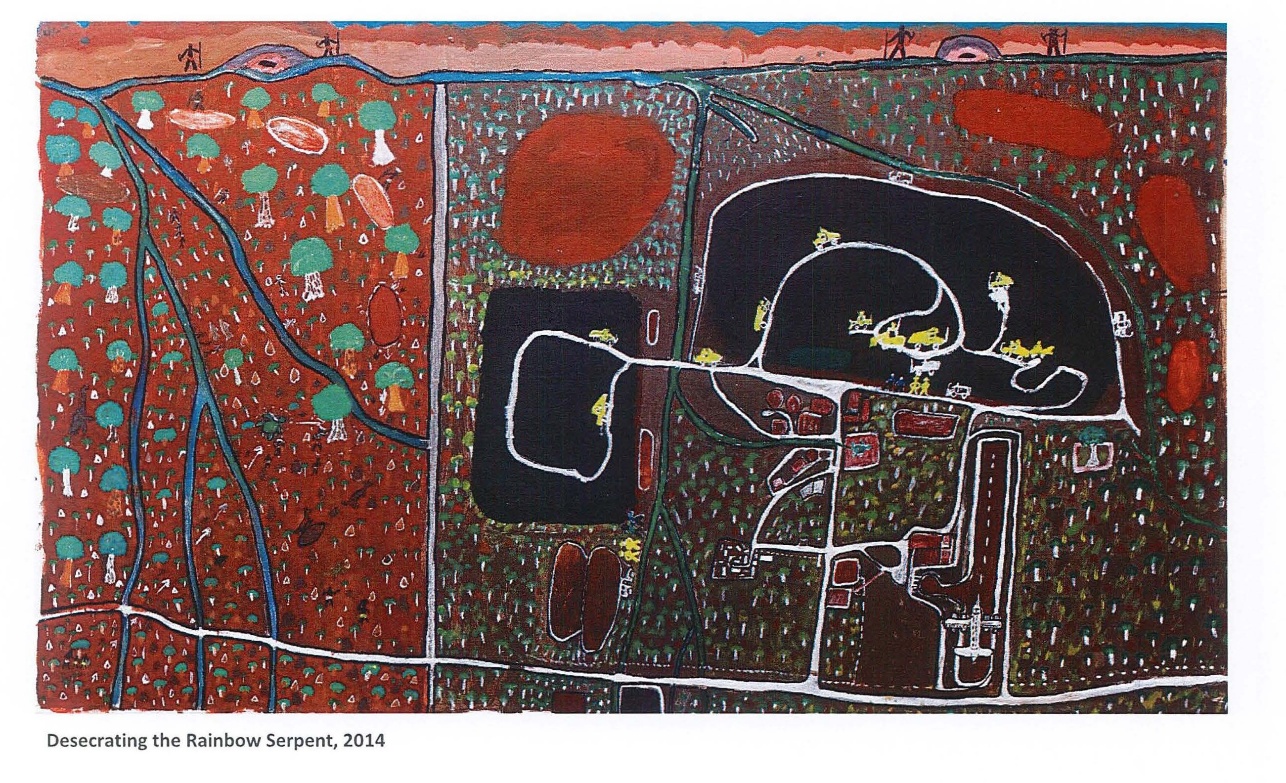
1062 Casey Davey said the mine cut the Davey Snake next to the Garbula Tree when the river was diverted. He said the mine is just too close to where the Snakes come through. He said he feels like the mining company is digging up the family Snake: the shape of the land and the river has changed.
1063 Other Dreamings were affected by the mine.
1064 There are ongoing fears about Damangani (#66), the Wurdaliya Barramundi Dreaming place, and that the NOEF (the overburden/waste rock hill) is too close. Damangani is within MLNs 1122 and 1124. According to Casey Davey, Damangani can now hardly be seen from the highway. He said if he cannot see Damangani, he does not feel like he can look after it properly.
1065 Chris Pluto said his father told him of his fears that the NOEF was getting too close to Damangani and going too high.
1066 Casey Davey raised fears it might 'fall' on some of the artefacts in the area. He depicted his fears about the height of the NOEF in his painting reproduced below. He explained:
[This]is a painting I also did in March 2020 called 'Open cut mining at McArthur River Mine'. This painting is about the Mine site and shows the Mine mob digging and clearing the country to make that big man-made hill. You can't see the open-cut because I was mainly thinking about the man-made hill. In this painting, Mine workers are piling up waste rock to make the man-made hill.Where the Mine mob have cleared the country, it doesn't look good, it's not healthy. Today, that man-made hill is just getting bigger and bigger. I feel no good in my stomach when I see that place. No one in my family feels good seeing our country at the Mine anymore.
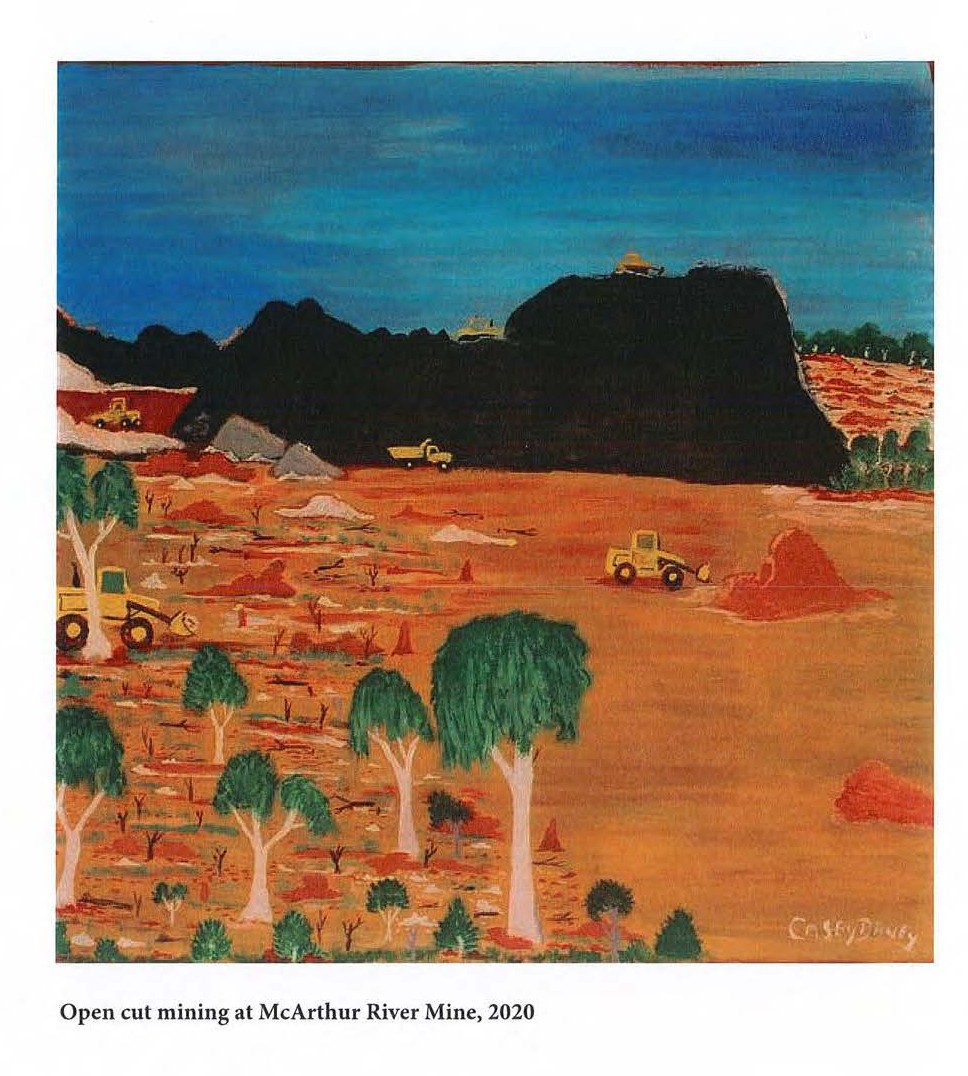
1067 A number of witnesses spoke of their concern about proposals to raise the height of the NOEF. The proposal caused worry and some dispute among the Claim Group. For example, Ronnie Raggett referred to the difficulty of a compromise that might mean if the NOEF did not go higher, more trees would need to be cleared as the footprint would be increased. Jack Green referred to talk in the community about deals being done about the height of the NOEF, but without other people knowing.
1068 Chris Pluto said his father Billy Coolibah (deceased) told him he was worried about the mine being built too close to the Stinking Turtle Dreaming at Yukuwala (#50) (on MLN 1122). He asked Chris Pluto to keep an eye on everything to see this did not happen. Chris Pluto explained that he 'feels no good' when he drives past Yukuwala when he is working at the mine. He said the mine mob have built a mound on the northern side of the airstrip and it sends water runoff towards the Yukuwala Dreaming. He said it looks like the Yukuwala is 'sinking into the ground'.
Mine area – harm to country
1069 It is obvious that an open-cut mine, including the infrastructure required to operate such a mine, has a dramatic physical effect on country. The evidence in this regard, unsurprisingly, was compelling.
1070 In his 2017 affidavit, Billy Coolibah said:
When that open cut mine happened, it destroyed the country real bad. They cut open the country and they moved the river. … I'm worried for my people because that country is hurt by the mine. The country been damaged up, they gone in like a mob of worms.
1071 Warren Timothy, who had seen the mine site when he was in primary school and when underground exploration was being undertaken, commented on how it now looks:
As part of my job at the Port, I sometimes drive out to the Mine site to pick up stores. I've seen a few places at the Mine site. The country is unrecognisable from what it used to be when I was a kid; the river has been moved, there are buildings and machinery everywhere, a huge open cut pit and a waste rock pile. I've looked into the open cut from a lookout they have at the Mine site. It's a very deep pit; the trucks at the bottom look tiny. Nowadays, that country is not the lush, green and beautiful country I remember seeing as a kid. It is badly damaged. I feel sorry for that country.
1072 Ronnie Raggett said the whole country looks different now. The river used to go right through where the open-cut mine is located. Before the open-cut there were big trees along the banks, like the sacred Garbula Tree: 'now there is no river where the Garbula Tree is, it stands there by himself'.
1073 Asman Rory portrayed the effects as follows:
When you push over trees, dig things out of the ground, change the creeks and the rivers, you take our history away from us. … Now it's been desecrated, disturbed, demolished and it's disappearing. They're tearing the country up, damaging our sites ... That kills our souls and our spirits.
Mine area – effect on Claim Group
1074 There was a range of evidence about the effects of the mine and its expansion on the people and community.
1075 Some witnesses hold the belief that some of the older people passed away after the river diversion and the mine expansion were approved, and the events were connected. Chris Pluto said that Harry Lansen (deceased) took it hard as he had been fighting for years. He visited Harry shortly before he died in 2011. He said Harry was sad and told him he was going to pass away soon because of what had happened. Asman Rory also spoke of Harry Lansen's distress. He said that nothing he said to Harry Lansen after the expansion could make him comfortable, and that even on his sick bed he was talking about it. Chris Pluto gave evidence that his father (Billy Coolibah) said in the last few months before he died that he was getting sick because he and his jungkayi ('in front') had been saying yes to the mine people 'when they were humbugging him' (the evidence about such dealings is addressed below). He kept saying he was worried about the open-cut and what he was leaving behind for his kids 'that might never be fixed up'.
1076 Others referred to binji or bad feelings in the stomach. Casey Davey said when he looked at country he feels 'no good binji', 'sick in my stomach'. He said he feels sick in his stomach when he looks at the NOEF. Asman Rory said he feels shame about what they are doing to Gudanji country; he said that it 'hurts me in my guts'.
1077 Dr Trigger explained that in his field work with the Claim Group for the purpose of reporting on cultural loss, he would ask questions in general terms (cited more fully at [1175] below). He said the participants returned fairly quickly to matters of cultural loss through impacts on Dreamings and inability to access and use country on the mining interests area. He said that responses to his questions encompassed feeling 'no good binji' for country, or feeling 'sorry for that country', and experiencing 'shame' for what has happened to the country. Dr Trigger concluded that the term binji was used by those he spoke to mean an ongoing sense of bad feeling about the country that has impacted on the mining interests and gas pipeline area. He said:
… the key modes of expression of experience of this cultural loss have been that people feel deeply a somatic bodily sense of unease and disquiet that is summarised in the sense of being afflicted with having a 'bad stomach'. This is expressed in the words of feeling 'no good binji'. The related concepts are feelings of shame and embarrassment in the face of the Dreamings that have been interfered with and damaged.
1078 Others spoke of 'feeling like your heart is no good' (Billy Coolibah (deceased)). Another painting by Jack Green depicted the mine 'digging a hole in our hearts'.
1079 These feelings would extend beyond the Gudanji people. Dr Trigger (referring to the research of Jennifer Holt), stated that others apart from the Gudanji would feel bad witnessing damage to country because of the interconnection of estates, emphasising in particular connection between the Gudanji, Yanyuwa and Garawa people.
1080 Witnesses also spoke of a sense of shame or guilt (for example, Jack Green, Asman Rory, Casey Davey). Dr Trigger noted that a number of the Claim Group to whom he spoke referred to such feelings. He said the concept of 'shame' in Aboriginal English is broader than that in standard English. He concluded that:
Feeling 'shame' for country, then, is related to feeling 'sorry' and uncomfortable about what has impacted the spiritual and physical features embedded in the land and waters.
1081 Blame was also a feature of the evidence, with the ngimirringki and jungkayi being blamed, or sensing blame, for the damage that has occurred. Jack Green said that their blame gets passed down to kids.
1082 Billy Coolibah explained how blame might be accorded:
When that mine changed from underground to open cut maybe 10 years ago, you have to blame me for that because I'm the nimarringki. That mine talked to Bruce Joy [(deceased)] and me about changing the mine from underground to open cut. I talked to Bruce Joy. Because my junggayi man he say yeah, we'll have to let the mine go ahead, and I had to follow that line. When that junggayi man go to you, you got to follow what he say. If you say no, then he might kill you for that. I had to say yes, there was too much asking from the mine for open cut, for changing the river around. Now I look back and I was just stupid and young, and today I'm feeling sad for what happened. I should have blocked off that area. I should of blocked it off before. The mine, they brainwashed me. I had no power.
…Today, I'm sad, sick and worried. I'm wondering why all these things happened. I'm worrying about that mine. I'm worried about all my people. It's not changing, I'm going to feel sorry all my life.
1083 Casey Davey said:
Even though it was the mining company that put the Mine there, we are still blamed for what has happened. People from Borroloola, like the Yanyula mob down the McArthur River, sometimes ask me and my brother: 'Why did you let the Mine happen?' They say that we should have worked harder to stop the Mine and the expansion of the Mine. I feel ashamed when I think about this.
1084 Chris Pluto referred to feelings of being disrespected, because the mine and the government 'didn't ask us if it was okay to build a mine there' (as far as he was aware), and that under their law they should have been asked. Ronnie Raggett gave similar evidence.
1085 Dr Trigger also recorded an example given to him by Harry Lansen (deceased):
… if there were to be an agreement to 'give this tree away', i.e. allow it to be impacted negatively or destroyed, other jungkayi who know its significance will blame the decision-makers.
1086 A number of Claim Group witnesses also worried about pollution from the mine. This evidence is addressed separately when I deal with the environmental legacy.
Port area – harm to the Dreamings
1087 The Winter Rain Dreaming is close to the port area and pervades it. The Black-Nosed Python Dreaming and Sea Turtle Dreaming are also in the areas near the port. Because the Claim Group uses the area less and has reduced access since the mine and the port, a significant issue is that the Dreamings are 'lonely'.
1088 David Harvey said this:
The Dreamings in the Bing Bong area are lonely; they need us to look after them. It feels hard to do that with the Mine mob making such a mess of the Bing Bong area. Everything has been interrupted there. Every day, big mining trucks from the Mine drive across the Black Nosed Python track and through the Winter Rain area. The Bing Bong road goes through this area and has big trucks crawling all over it, spilling dust. … I don't feel free to look after my country.
1089 The Groper Dreaming is also affected by the Aburri barge (for the port). T Simon (deceased) explained that it goes too close to the Groper Dreaming and Aburri Reef, and his family worries that bad things might happen and they might get sick because they are responsible for the country.
1090 Dr Bradley reported that 'senior ngimirringki and jungkayi know how the country should be looked after but are in an impossible position to do so'. So much accords with David Harvey's evidence.
Port area – harm to the country
1091 Much of the evidence relevant to this issue comes from the report of Dr Bradley.
1092 He commented:
From my own observations and listening to men and women such as Dinah [Norman] and Mavis [Timothy] their comments speak to a twofold process as they see it; first, that the Port Facility has created at Bing Bong, a site that has destroyed a history of Indigenous Law in the area and Bing Bong as a gathering place for many of the other language groups in the south west Gulf of Carpentaria; and, secondly, it has created a despoilment of the environment and further restricted access to places where people would once access desired resources.
1093 Dr Bradley reported on a number of discussions with senior ngimirringki for the port area, Ronnie Miller (deceased). Ronnie told Dr Bradley in 1994 that 'they have cut that place so deeply, all the Law has bled out'. Ronnie told Dr Bradley in 2018 that 'it's not Bing Bong anymore, it's buggered, it's stuffed up altogether'.
1094 Dr Bradley reported that in 2017 another senior ngimirringki, Roddy Harvey (deceased), told him 'Bing Bong is proper dead now, that place, they finally been kill im'.
1095 Dr Bradley also said that Mavis Timothy in 2022 had echoed concerns that were expressed by other family members, including Ronnie Miller, about the dredged channel. Mavis told him, 'The new river (the dredged channel), they made it and it cut through the sea grass, all that food for dugong and sea turtle, they throw that mud, there in the south, all that country dies, tree, grass too much salt, we never see that before'.
1096 In his evidence, Warren Timothy said the spirits at Bing Bong are restless. He said that they want to be at peace and see that their country is taken care of. He said that they cannot do much now to help the spirits rest.
Port area – effect on Claim Group
1097 Mavis Timothy recalled the first time she went fishing at Mule Creek with some of the other Aboriginal women after the port was built. She recalled that some of the other women were crying for the country when they saw it was different. Mavis cried for it, too.
1098 Warren Timothy said he feels like crying when he sees his mother's country damaged at the port. He spends a lot of time at the port for work. Sometimes when he is there for nightshift, he feels like the spirits of the old people are watching and judging him, because he was jungkayi and he should not have let the country be dug up and damaged. He tells himself there is nothing he can do to reverse it, but by working at the port he can be on country, 'watching and keeping an eye on it'.
1099 T Simon (deceased) worried that if the kujika (songlines) are damaged then it might make his family sick because they are responsible for the country. He said he thinks that is why his father got sick. Dr Bradley reported that in 2000 T Simon's father, Tom Simon Snr (deceased), a ngimirringki for Wurruwiji, commented not long before his death, 'I can't even look at that country, that boat [the Aburri barge] with name from my country, I can't look, I am too shamed, I am too sick'.
1100 Similarly to the mine witnesses, witnesses in relation to the port spoke of bad feelings in the stomach and binji.
1101 According to T Simon (deceased), when he thought about his family's country around Bing Bong he felt 'no good in my guts'.
1102 Dinah Norman said:
It makes me feel no good in my stomach (binji) that we can't go where the Port is, and that we can't show our kids and our grandchildren the country there. They have buggered up the Port properly; it was free country before. We have to tell the kids that the way we used to be able to use Bing Bong is now finished
1103 There were a number of references to shame. Dr Bradley reported a particular example:
In 1994 I took Roddy Harvey (deceased), Jemima Miller (deceased) and Dinah Norman for a drive to Bing Bong. We drove to the look-out area and on the way back we stopped near Warangala lagoon [#7] to collect some bark which could be burnt to make white ash. Roddy was talking about how her ardirri, her spirit child, came from Wurruwiji [#2] and she stood up, and with what can only be described as a sense of deep physical and emotional pain faced towards Wurruwiji and cried out in Yanyuwa:
Ah dear me! This is all too much I am telling you! They have cut you! They have emptied you! My stomach burns with shame for you! I walked here when I was young with my father, with my mother, my father found me in this country, I come from this country, my spiritual essence is from here, this country is the place of my origin. I am crying, tears are falling, they have cut you deeply, so far down, they have flattened you, wiped you out completely. I am finished now, I just had to tell you this.
1104 According to Dr Bradley, such expressions of sadness, anger and shame have been observed by him and expressed to him in conversations and have continued over the years. He stated (acknowledging the work of the anthropologist Toni Bauman) that the emotion of shame is perhaps the most powerful in Aboriginal life. He said that in the case of the Claim Group, shame emanates from a perception that the Yanyuwa and Marra ngimirringki and jungkayi have no way to respond to what they see and understand has happened at Bing Bong. There is 'an inability to manage and regulate the land' in a way appropriate to the law and customs relating to the roles of ngimirringki and jungkayi.
1105 All the Claim Group witnesses who gave evidence about the port expressed that they were 'worried' about the country at Bing Bong.
1106 As with the mine witnesses, a number of port witnesses expressed concern about pollution, which is dealt with below in relation to the environmental legacy.
1107 I conclude that the evidence viewed collectively paints a profound picture of the harm done by the compensable acts in a number of ways: some relating to the Dreamings; some to the physical country; some to the inability to pass on knowledge; and some related to shame from disempowerment and the inability to take care of country.
1108 A striking example was the diversion of the river and its effect on the Snake Dreamings, and the concern, worry and guilt felt by the witnesses about such damage. Added to this was a sense of fear that disturbances of the spirit of the Dreamings might lead to dangers to health.
1109 The evidence was similar in relation to the port. In particular, the evidence of T Simon (deceased) portrayed the perceived link between taking care of the songlines for Dreamings and illness upon a failure to do so. Many witnesses spoke of feeling binji when they thought about the damage to country.
1110 The evidence portrayed the concern about the inability to transmit spiritual knowledge to younger generations about the Dreamings, sacred sites and use of the land, with damage already done to some areas, and other areas left inaccessible.
1111 Physical damage to country was also important (and related to the damage to Dreamings). Asman Rory's evidence of the distress felt by Harry Lansen (deceased) about the open-cut conversion reveals the complex nature of some of the responses to the mine, with evidence that some who were (or were perceived to be) decision-makers for the estates were left open to criticism about consultations in which they were involved, adding to their distress. Billy Coolibah (deceased) and Casey Davey gave similar evidence. Dr Bradley explained, and I accept, that the inability to manage and regulate the land in accordance with customs led to a deep sense of shame.
Ongoing loss of access and use of country
1112 I deal separately below with the Northern Territory's submission that there are geographic limits on the effects of the compensable acts. I will deal here with some of the specific evidence from the Claim Group witnesses about limitations on physical access to the mine and port areas.
Mine area
1113 Some Claim Group members work on site, so have limited access. It should also be acknowledged that exclusion from parts of the mine area is required by MRM for safety reasons: see generally Davey on behalf of the Gudanji, Yanyuwa and Yanyuwa-Marra Peoples v Northern Territory of Australia (No 3) [2023] FCA 521.
1114 However, these matters can be put to the side for present purposes, as they do not affect the assessment of cultural loss.
1115 Consistent with the evidence, signposting on fencing, seen by the Court party during the on-country hearings, was labelled 'McArthur River Mine Site' and stated 'No Unauthorised Entry'. There were also signs on gates, stating for example 'Private Road' and 'No Unauthorised Entry Project Site'.
1116 The witnesses gave evidence that much of the mine area within the mineral leases is fenced off. They said they are generally unable to access the mine areas without the permission of MRM. Ronnie Raggett said that the fence goes about three or sometimes four kilometres out from the actual mine.
1117 Chris Pluto said:
There's a fence around the area where they dig up the minerals and for the other things like the tailings dam, the waste rock pile and the airport. The open-cut where they get the minerals, the waste rock pile and the tailings dam are all really big.
1118 Important places, including Jirrinmini (#51), Yukuwala (#50), Damangani (#66), the Garbula Tree (#58), Wurrunini (#48) and Malayarrininni (#52) cannot be accessed without permission.
1119 Casey Davey also said:
A lot of the Mambaliya country around the Mine is fenced off now; you can't get in there without calling the Mine people first. Then, they have to follow you around, escort you. The Mine mob say that we can come and visit our sacred sites, but we can only do that if someone from the Mine comes with us. … I can't go there and fish or camp with my family whenever we want to and without other people being with us. It feels wrong to have to call them.
1120 A number of witnesses (Casey Davey, Jack Green, Timothy Lansen, Chris Pluto and Asman Rory) spoke of the shame of having to ask permission to go onto their own country. Timothy Lansen said as a senior ngimirringki for that country, he should not have to ask anyone, and he would not have to ask permission if it were just a cattle station. Casey Davey said that he is supposed to look after the country and it feels wrong that he should have to ask permission from a stranger to do that. Asman Rory said:
Now, Gudanji people are losing our connection there because we can't go to the country and use it in the proper way, like our old people did. We don't have the same opportunity to learn and to teach the next generation about places like Jirrinmini, Damangani, Yukuwala and the Garbula Tree; that's because we can't go there without permission from the Mine. Going there as part of sacred site surveys doesn't give us the same opportunity to learn and teach about these places as being able to go there freely when we want and with who we want. … We can still get to Gulpalyi, but not to Jirrinmini or sacred places like the Garbula Tree. There's a boom gate at that track stopping us from going in. If we want to go in there, we have to get permission from the Mine mob and follow their rules. … Asking someone else to go on your own country is shame job.
1121 Jack Green said:
We weren't comfortable to walk with the bloke from the Mine because we want to be able to go to sacred sites, talk to our ancestors and talk about our culture among ourselves. This isn't something that whitefellas who we don't know should be able see. They haven't been through ceremony, and they don't understand.
1122 Some Claim Group members are on occasion permitted to enter the mine area when MRM invites them. A number of witnesses, including Casey Davey, Timothy Lansen, Ronnie Raggett and Chris Pluto, referred to MRM asking a few Gudanji peoples in from time to time 'when something comes up'. Casey said 'they usually get Ronnie Raggett, Chris Pluto or [four other names]'. They have a meeting, sometimes the mine makes a barbecue or picnic, and they have a look around the mine.
1123 Chris Pluto recalled going with the traditional owners for a meeting about the waste rock pile and talking about extending the height, as against increasing the footprint (of the NOEF). It is apparent that such access is supervised.
1124 Ronnie Raggett said:
We tell the Mine mob whether they are clear to do something there. The Aboriginal Areas Protection Authority is usually part of these talks. I'd like it if the Mine wasn't there, but we can't stop it, so we try and make sure some things are looked after if we can. Sometimes they listen to us and do what we ask.
1125 There was also consistent evidence (for example, from Chris Pluto and Ronnie Raggett) that the Gudanji people no longer hunt, fish or camp inside the fenced area at the mine. A number of witnesses spoke of their desire to take their children and grandchildren to show them the country and to teach them about it. Casey Davey said it is hard to explain the Dreamings when you cannot show the places on country. He said, 'If my kids do not understand the story, it will probably stop in our family with me and my brother'.
1126 Dr Trigger also explained the importance of access: that for the Claim Group to be able to access these places is 'to check it or to engage with the spiritual significance of the country in the mineral leases'.
Port area
1127 As discussed above, the evidence established that the Claim Group used the Bing Bong area for camping, hunting and fishing before the port was built.
1128 The port is situated between two of the Claim Group's main former camping areas, Arrinyanda (#1) and Wurruwiji (#2). There was consistent evidence that the Claim Group members no longer camp there (for example, from Mavis Timothy, Dinah Norman and David Harvey), although people still fish but on day trips and not as much as they used to. Mavis Timothy said that she sometimes still went fishing in the Mule Creek area at Wurruwiji, but just for day trips. She said the mine people would not let them camp 'like before' and they would have to ask permission at the mine or the port.
1129 David Harvey said the mine has a security gate at the port, and the Claim Group members cannot go inside the fenced area without an invitation. He said they 'need to ask permission to be able to go on to their own country; that's just not right'.
1130 He described the scene as follows:
Today, there is a big, fenced area at the Port. Inside there is a wharf on the channel that they have dug for the Aburri barge to come in and out; it comes in and out all the time. There are buildings inside the fenced area; one of them is a really big shed. There is also a kind of dam inside this area and some tracks and roads. The channel keeps getting dredged and it looks like the mud that is dredged up has been dumped on the land to the south side of the buildings. Lots of roadtrains bring the stuff that is mined from the Mine to the Port. It's loaded onto the Aburri by a big loader. The place is noisy.
1131 I note that under cross examination David Harvey accepted that the channel had not been dredged since 2014, and that he did not think people would stop him camping in the Mule Creek area if he wanted to (but there was no camping permitted at Home Creek). Nevertheless, it was not something he did anymore, neither at Mule Creek nor Home Creek.
1132 There are now many non-Aboriginal people present in the area including port workers, tourists and people fishing. Part of the development included the building of a new boat ramp at Mule Creek which provides easier boat access, although the old, simpler boat ramp remains at a separate location on Mule Creek. The sealed Road carries trucks that travel between the mine and the port, and this has made tourist access easier. Dinah Norman and Mavis Timothy both gave evidence of these changes. Mavis said:
There are a lot more whitefellas in the Port area than there used to be. There's whitefellas who work at the Port; some of them go out on boats or go fishing in the area in their time off. Plenty of tourists now take their boats down to the new boat ramp at Mule Creek. Since the good road was put in for the Port, there are a lot more tourists at Bing Bong. Every day, lots of big trucks come to the Port area, bringing what they dig up at the Mine so that it can be unloaded and then loaded on to the barge, Aburri. The area is quite noisy now with all the trucks and machines.
1133 This has also affected the way the group practise their culture. Warren Timothy referred to traditional burning ceremonies for those who have passed away that are held on the person's country. These can be conducted at West Island but not at Bing Bong, because:
the Port stuff was there - all the buildings, trucks and whitefellas everywhere. We also knew we'd get in trouble if we burned that country; the Mine mob own it, it's not free land where we can do what we want.
1134 Being able to practise their culture away from the gaze of non-Aboriginal people is also important. Warren Timothy continued:
I don't want to hunt in the Bing Bong area in front … of the Port and all the whitefellas that are around. There's nowhere private out at Bing Bong where we could bring in our catch, butcher it properly away from people watching us, make a ground oven and have a feed.
1135 Dr Bradley said that:
The causal impacts of locking of gates, having to ask permission to enter certain areas and the developments of the road and Port Facility have all had a very constraining impact on how families might now choose to move through Bing Bong and access resources.
1136 He concluded that Bing Bong (which he clarified in cross examination was from Home Creek across to Mule Creek) has been reduced to a point of access and return, with little to no time being spent there before returning to Borroloola. Dr Bradley also clarified that Home Creek is no longer accessible, so people do not hunt or fish from there, but Mule Creek is still used for boat access, although people now take their catch back to Borroloola.
1137 This evidence about ongoing limits on access in the mine and port areas confirms and enhances the evidence about the impact of an inability to access places. Access is essential to both take care of country and to ensure the continuity of spiritual connection and learning. Access has been compromised by the compensable acts and that circumstance will endure for many years to come.
1138 The need to seek permission to access fenced off parts of their country also gave rise to feelings of shame, and even when permission was granted, the witnesses did not feel that they could carry out law and customs while others were watching. They were constrained. Their capacity to pass on knowledge was constrained. They could not comply with their obligation to take care of country because without access, they could not engage with its spiritual significance or continue their customary activities.
The pipeline corridor and the Road
1139 The evidence in relation to the corridor of the Pipeline Licence and the Road was more limited.
1140 Dr Trigger said the pipeline passes through the Jirrinmini Mambaliya, Gulpalyi Wurdaliya and Kamanja Wuyaliya estates, and that it crosses significant Dreamings.
1141 There was no reliable evidence that sacred sites were impacted or that access was restricted. The principal concern expressed by the Claim Group related to the Dreamings.
1142 Ronnie Raggett referred to four Dreamings that cross the pipeline corridor. The first is the Pupuwina or Black Head Python, which crosses over the pipeline twice. The second is the Yungumala, or Long Neck Kangaroo. Yungumala crosses the gas pipeline between New McArthur Station at Bessie Springs and Whistleduck, on the north side. The third is Judama, a Hill Kangaroo. Judama comes from Hodgson Downs and crosses to the south of the gas pipeline next to the Yungumala, before both Kangaroo Dreamings meet at Bamburrungu (Crawford Point). Judama is Rrumburriya and Yungumala is Wuyaliya. The fourth is another Mambaliya Snake, called Walungudara, that goes from Hot Spring to Gandini (#39). This Snake goes east along Hot Spring Creek on the north-west side of the highway, then crosses the gas pipeline before he stops at Gandini (#39), the waterhole on the McArthur River just upstream from the mine. Gandini is Mambaliya country, same as the Davey Snake. This snake is that same Rainbow Snake as the Coolibah and Davey Snakes at the mine site.
1143 Jack Green added that Cape Crawford is on the highway, just inside Balbirini. Jack said further:
Even where the pipeline doesn't cut through a sacred site, it still interferes with those Dreamings if it crosses them. It doesn't matter that they put the pipeline in underground; in our law, and culture, we're connected all the way through the country, not just the surface.
1144 Ronnie Raggett similarly told Dr Trigger that 'they still done the damage' because the Dreaming went across the area. Jack also expressed concerns about the risk of various things going wrong with the pipeline.
1145 Ronnie Raggett said the Road does not bother the Dreamings as much as the pipeline, which is deeper.
1146 There were some complexities in relation to the Road because it had both upsides and downsides for the Claim Group. Dr Bradley observed that the Road was 'a useful thing with lots of baggage'. It permitted better access between Bing Bong and Borroloola and was welcomed by residents of Borroloola and tourists. Dr Bradley reported that Mavis Timothy told him in 2022 that the Road was good, and the previous road was corrugated and it took longer to travel. But as Mavis Timothy said in her evidence, it also meant that more tourists and non-Aboriginal people would come into the area. Dr Bradley also reported that in 1994 Mussolini Harvey (deceased) (David Harvey's father) had told him that the road works had resulted in spirit children looking for new homes, 'darting across the road from both sides', and that it makes him feel 'really sorry'.
1147 I accept, having regard to the evidence of Dr Trigger and Ronnie Raggett, that the pipeline interferes with the Dreamings, and that it does so not just on the surface but underground. However, the evidence of its impact on the Dreamings and on connection to country was limited in comparison with the other areas.
1148 I also accept, having regard to Dr Bradley's evidence, that aspects of the Road have caused worry about cultural obligations, such as looking after the land so that the spirits are taken care of, but the evidence in this regard was limited and somewhat equivocal.
Effects not derived from compensable acts - prior diminution
Competing positions
1149 The Northern Territory emphasised that the Court must have regard to the effects of prior developments in the claim area on the Claim Group's connection with country, and 'the incremental effect of the compensable acts on that connection'. It submitted that the effects of the compensable acts must be considered taking into account the effects of pre-1993 acts which had already affected the Claim Group's enjoyment and connection to country, citing Mansfield J in Griffiths TJ at [376]. See also Griffiths FC at [318]-[319], confirming there was no error in this approach.
1150 To this end, the Northern Territory closely examined the history of the grant of successive pastoral leases, grazing licences and pastoral permits in the mine and port areas, together with mining activities that dated back to exploration in the 1880s. It stressed that the Claim Group had initially sought compensation for earlier acts but abandoned them in their pleading. Presumably they did so (at least in part) to emphasise the need for delineation.
1151 According to the Claim Group, the evidence they adduced did in fact concern the effects of the compensable acts. They contended that although there was reference to some historical events, the earlier events were relevant to illustrate the effect on them when their country is harmed, and the longevity of such effects.
1152 The Claim Group did not challenge the proposition that account must be taken of the extent to which spiritual attachment to land has already been impaired. However, a further sense of loss which does not specifically relate to a particular site may still be felt. In this context the following passages from Griffiths HC provide guidance:
[205] The earlier acts, which were not compensable, punched holes in what could be likened to a single large painting – a single and coherent pattern of belief in relation to a far wider area of land. The subsequent compensable acts punched further holes in separate parts of the one painting, and the damage done was not to be measured by reference to the holes created by the compensable acts alone, but by reference to the effect of those holes in the context of the wider area: for example, an area which, as the trial judge found, remained important to the Ngaliwurru and Nungali Peoples despite the fact that the area was no longer able to be used as a ritual ground.
[206] This analysis reinforced what his Honour had said earlier: the consequences of acts can be incremental and cumulative; the people, the ancestral spirits, the land and everything on it are 'organic parts of one indissoluble whole'; the effects on the sense of connection are not to be understood as referable to individual blocks of land but understood by the 'pervasiveness of Dreaming'; the effects are upon an Aboriginal person's feelings, in the sense of his or her engagement with the Dreamings; an act can have an adverse effect by physically damaging a sacred site, but it can also affect a person's perception of and engagement with the Dreamings because the Dreamings are not site specific but run through a larger area of the land; and as a person's connection with country carries with it an obligation to care for it, there is a resulting sense of failed responsibility when it is damaged or affected in a way which cuts through the Dreamings.
The Northern Territory's submission on the 'pre-existing state of affairs'
1153 The Northern Territory referred to the history of grants of pastoral leases and interests in the area. It referred to the report of historian Dr Robyn Smith tendered by the Claim Group. Dr Smith reported that pastoral leases were first granted in the claim area in the 1880s; the McArthur River Station was founded in 1883 and covered almost the entire traditional country of the Gudanji, Yanyuwa and other estates; and that successive pastoral leases and grazing licences were granted up until the 1960s.
1154 By the early 1960s the pastoral interests settled into three broad areas, referred to as Bing Bong, Tawallah and McArthur River. The Northern Territory relied on numerous historical maps and reports tendered through Maria Wauchope. Ms Wauchope's evidence indicated that there were periodic Government inspections and mapping of the pastoral lease areas. It appears this was done (relevantly) to monitor compliance by pastoral lessees with the terms of the pastoral lease grants. The maps and reports annexed to Ms Wauchope's affidavit revealed infrastructure, which the Northern Territory described as 'extensive development' and 'significant infrastructure' at Bing Bong Station and McArthur River Station. Such descriptors are not particularly helpful. A review of identified documents reveals infrastructure consistent with the presence of station homesteads and running cattle on large pastoral lease areas.
1155 In relation to Bing Bong Station, the Northern Territory referred to a 7 March 1973 pastoral plan for PL 686. It shows the Bing Bong homestead, the road to it, tank area, a windmill and paddocks (which appear to be fenced although the plan is somewhat unclear).
1156 The Northern Territory also relied on a report relating to McArthur River Station (then PL 664). It appears to date from 1987 and was prepared in anticipation of the consolidation of the pastoral leases into PPL 1051. The report refers to a homestead, quarters and other outbuildings, internal and boundary fencing, cattle yards, watering points (bores, dams), an abattoir, airstrip and hangars. Cattle numbers were included, although the relativities of those numbers was unclear.
1157 The Claim Group objected to the tender of these reports on the basis of relevance. I consider them relevant and admissible in providing context to the Northern Territory's submission about the nature of the native title rights and interests at the time of the compensable acts. However, the evidence of infrastructure and the pastoral industry must be viewed having regard to any impact it may have had.
Port
1158 Insofar as the port area was concerned, there was evidence that during the 1980s the station owners started to lock a gate on the road to the coastal area. I have set out the relevant evidence above. The Aboriginal people retained access but had to ask for a key. Asking for a key was a disincentive to use the road, both for practical and cultural reasons. There was a decline in camping during the 1980s. I have not accepted that the evidence went so far as to establish it had stopped. There was a gradual increase in the number of non-Aboriginal people present by way of tourists. However, the evidence did not establish that the earlier pastoral leases or interests, including the station operations or fencing, otherwise caused the native title holders' sense of loss of connection to country in the port area. I accept that the presence of white pastoralists and a small number of tourists, and the practice of locking of the gates by pastoralists, a by-product of the pastoral industry that had developed in the area, had an effect on connection to country prior to 1993. The events of the 1980s referred to by Dr Bradley can perhaps be described as the start of events that escalated dramatically with the introduction of the port. I do not dismiss those earlier events, but such history was by no means the cause of the cultural loss reflected in the evidence. The port was, for the Claim Group, a turning point.
Mine
1159 As to the mine area, the history is more complex. In addition to referring to the pastoral lease infrastructure, the Northern Territory referred to the extent of earlier mining exploration and prior damage to sacred sites.
1160 I have already referred to a report on infrastructure relating to the previous McArthur River pastoral lease. None of the evidence suggested the historic presence of pastoral or cattle fencing was an issue for the Claim Group, and it was not entirely clear where such fencing ran or its impact upon the mine area. A number of witnesses said such pastoral fencing/gates were not locked and no permission to enter was needed (for example, Casey Davey, Timothy Lansen). Some of the maps from earlier times show the areas of the current mine to be accessible by road and track. Further, some of the infrastructure referred to (new homestead, abattoir) is further to the south and away from the mine area.
1161 According to Dr Smith, mineral exploration commenced in the area in the 1880s. Records adduced by the Northern Territory (through Ritnesh Syna) indicated that prospecting continued off and on including during the 1940s and 1950s, but no significant prospects were discovered. MIM began activities in 1948 and commenced drilling in the vicinity of the HYC deposit in the late 1950s. A base camp was established on the western side of the McArthur River near the HYC deposit, and by 1960 enough work was being undertaken to make the camp permanent. An airstrip was in place to allow access. Mining leases were granted within the areas now covered by MLNs 1121-1125 and further infrastructure was developed, including a horizontal passage for ore access. In 1977 the Commonwealth entered into an agreement with MIM authorising it to occupy and mine the reserved area. In the same year a pilot plant and test pit were constructed, and some 50 tonnes of ore were extracted each day for a period of two years. In 1989 the Northern Territory and MIM entered into a further agreement under which MIM would investigate the viability of the mine, including by testing a 10,000-tonne sample.
1162 There was a large amount of historical evidence tendered relating to the history of drilling and exploration, and mapping mineral lease boundaries. In the end, it was not of great significance as the Claim Group do not deny such history. What is important from their perspective is that the level of exploration, drilling and mining undertaken, and the infrastructure in place during the pre-1993 period, did not impact their loss in a significant way when compared with the later events.
1163 As already observed, Jack Green recalled the days of the early mining and said that despite the mining, there were no restrictions and there was still free access. The fencing which the Claim Group referred to as shutting them out of the mine area appears to have been primarily a product of the further development of the mine after 1993 and again for the open-cut conversion. Even so, even in the 1970s there was opposition to the proposed drilling, but the Aboriginal leaders at the time had no power to stop it. Jack Green said that the old people knew it was their land and their culture and ceremony was tied into the land:
But in the 1970s, we didn't have rights to stop anything from happening. We were just workers. I remember Harry [Lansen (deceased)] and old Gordon [Lansen (deceased)] talking about how they couldn't stop the Mine when it first got going in the 1970s. They were saying that they knew in their hearts that McArthur was blackfella country but the government treated it as whitefella country.
1164 I must deal with a purported conflict in the evidence. The Northern Territory refers to evidence of Chris Pluto that it says conflicts with that of Jack Green as to pre-1993 access. Whereas Jack Green referred to the mine operations at the time not preventing access to places such as Wurrinini (#48), the Northern Territory contended that Chris Pluto's evidence was that even before 1993 'we never went anywhere near that place' and 'you could not go near the mine site' because those were the 'mine's rules'. Chris Pluto said he only went as far as Gandini (#39).
1165 Jack Green's evidence was supported by the evidence of Asman Rory (who gave evidence of access tracks to Jirrinmini across the river and upstream, and having access around where the mine is now) and Ronnie Raggett (who said before the open-cut they would 'go right through', there was no need to talk to anyone). Chris Pluto's evidence does not cast doubt on the evidence of the other Claim Group witnesses, and the difference is explicable on the objective basis that Chris Pluto gave evidence of his own personal experience. When asked if he had seen the pilot plant, he said he had never been into that area. On that basis the evidence about the mine's rules appears to have been an assumption on his part. I prefer the evidence of Jack Green, who spoke candidly from years of personal experience in the area.
1166 I also give no weight to certain evidence of Dr John Avery in this regard. Dr Avery prepared a report in 1992 tendered by the Northern Territory, but he did not give evidence. His report therefore was not tested. It is also subject to a suppression order, the circumstances of which are set out later in these reasons. I will paraphrase the evidence in one of its impugned paragraph in only general terms. The opinion in the impugned paragraph purported to conclude that the mine site was not used as an Aboriginal resource since 'the mine' was established. There is ambiguity in relation to the evidence. I am asked to speculate that Dr Avery must have been referring to the early mining undertaken by way of the pilot plant. That may be so having regard to the date of his report, but it is unclear. Dr Avery's evidence in the impugned paragraph is not sufficiently probative to otherwise assist in evaluating the effect of pre-1993 events.
1167 Further, the Claim Group submitted that the Northern Territory had overstated the extent of the impact of the early drilling, mining and the pilot plant. The Claim Group noted that it was 'only 1/200th of full-scale' (citing a 1980 'Review of Feasibility and Environmental Report' prepared for the Department of Mines and Energy), and was in operation for a year and a half. This submission is supported by the evidence of a more relaxed attitude to access to the area when the pilot plant was in place, and I accept it.
1168 Turning to evidence of prior damage to sacred sites, the Northern Territory relied on Dr Trigger's reporting of findings made by Mr McLaughlin, including:
(a) in 1975 the hill Mumunini (#60), described as the most important site at the time connected to the Rainbow Snake, was damaged by a bulldozer; and
(b) throughout the 1970s and as identified in 1976, the site Malayarrininni (#52), the Stinking Turtle or Yukuwala Dreaming, was cut by roads and surface bulldozing, resulting in half of the boulders being covered or bulldozed away.
1169 Dr Trigger also said that additional site damage was recorded in relation to the waterhole Jirrinmini (#51), caused in the 1960s or 1970s when a metal pipe, 60cm in diameter set in concrete, was embedded in underlying rock. Dr Trigger reported that Harry Lansen (deceased) later described that damage as the pipe being placed 'right in the mouth' of the Dreaming Snake.
1170 The Claim Group accept that this damage to sacred sites occurred. Indeed, there was lay evidence from the witnesses consistent with it. Mr McLaughlin said that the Gudanji people were 'at a loss as to how to deal with mining people'. Dr Trigger cites Mr Lewis's report that Billy Coolibah (deceased), referring to Yukuwala, said that 'they already broke that one'.
1171 However, the fact that there was prior damage to sacred sites does not justify proceeding on the simplistic basis that 'the damage had been done'. Whilst I take into account the occurrence of such events, I accept the Claim Group's evidence, as already discussed, that sacred sites are 'nodes' for spiritual significance, and that the Claim Group's sense of spirituality extends across the landscape, not simply at particular sites. Further, even if there is prior acknowledged damage, it does not lessen the effects of later damage. It is not a form of conditioning. Later acts may build on it, adding further holes in the single large painting, to adopt the analogy drawn in Griffiths HC at [205].
1172 In the end, it is established that prior to the compensable acts there were activities associated with the pastoral leases on McArthur River Station, including areas where the mine is located on the relevant mineral leases. However, the evidence supports a conclusion that the perimeter or other cattle fencing had little relevant effect on access or use of those areas or otherwise on native title rights and interests.
1173 There was also prior exploration, drilling and limited mining on part of the claim area. To the extent fencing was in place at the time, again it does not appear to have limited access in any significant way. Some of those operations caused damage to sacred sites. It is also apparent that there was some resistance expressed in the early days to the level of exploration and mining. It is not as if these past activities have no relevance. They are relevant, and I take them into account. I accept that prior to the compensable acts there had been conduct that resulted in cultural loss, reflected in hurt and concern about the early mining and pilot plant and damage to sacred sites.
1174 However, it is important that compensation extend only to the compensable acts. The evidence of prior effects on native title rights and interests was comparatively sparse when compared with the evidence about the actual and anticipated impact of the development of the mine and port following the grants of MLNs 1121-1126, and the conversion to open-cut. Such evidence of prior diminution as there was does not lessen the actual loss flowing from the compensable acts.
Environmental impact
Claim Group concern
1175 In addition to the impact of the mine on the Claim Group's access and use of the land, the Claim Group contend that the environmental impact of the Project is relevant to cultural loss because it has created cause for worry and concern about pollution and uncertainty about the mine closure and its future impact. Such concerns were observed by Dr Trigger during his fieldwork, although it appeared to be of less significance than other matters:
[209] My approach to investigating whether there has been loss, diminution and impairment of native title rights and interests was to ask the question in general terms and in a way that would be receptive to a range of responses. In my opinion, this is not always an easy or straightforward issue to be addressed, and interlocuters responded with a wide range of views and musings. … The issue of possible environmental impacts on country was raised occasionally but the inquiries returned fairly quickly to matters of cultural loss through impacts on Dreamings and inability to access and use country on the mining interests area.
…
[220] Concern about the spirituality of the country, in the form of Dreamings and spirits of deceased forebears and other relatives, at times was mixed with uncertainty regarding environmental pollution.
1176 Dr Trigger noted that although some people he spoke to expressed concern about river pollution downstream of the mine, those assertions were not supported by all those he spoke to, with some observing that 'fish move around', and that the wet season will kill fish, as occurred before the mine (at [221]).
1177 Although limited, there was some evidence from the lay witnesses for the mine area about their worry and concern about pollution.
1178 Ronnie Raggett gave evidence that:
I don't know what they can do about putting the river right when they stop mining. If all of the waste rock is back in the open-cut and they put the river back where it used to be, I'd be worried that the waste rock would end up in the river and get washed downstream. … I wouldn't want to live on that country around the Mine again. I'd be worried that I might get poisoned. Thinking about the river getting polluted makes me worry and feel no good. I love fishing. Gulpalyi is my favourite place. I also fish downstream from Gulpalyi at Gandini. I don't go further downstream because the Mine lease starts about there. … I grew up there, drinking that water until I was 11 years old. [I am] happy to drink the water from the river on the upstream side of the Mine, but [I] won't do that on the downstream side.
1179 Chris Pluto said:
Some people like Jack Green and Nancy McDinny are worried about pollution from the Mine. They might be right; [I] don't know what's going down the McArthur River.
…
Sometimes, I fish downstream from the Mine but usually at places that are a little bit off the McArthur River. I have not seen bad fish or gotten sick from eating fish caught in the River but I try to avoid fishing downstream of the Mine.
…
When I fish on the McArthur River down from the Mine, I usually go to Didilini which is about halfway between the Mine and Borroloola; it's close to Frog Lagoon. If I have the time, I go fishing upstream of the Mine. If I don't, I fish downstream closer to Borroloola. I am still worried about eating stuff from the river. I used to eat water mussels from the river with my grandmother .... She showed me how to find them on the riverbank. I don't eat them now because I worry they are taking up poison from the river; I have told my kids not to eat them.
1180 Asman Rory said:
I am afraid of contamination in the River so I don't like fishing downstream of the mine now. Other members of my family have told me they have the same fear. …
I've recently seen fish floating in the River and I'm worried that it's because of the Mine. I've always liked fishing. I fish in different places including Gulpalyi, Amelia Springs, Top Crossing on Balbirini, Batten Creek, the Robinson River and the Wearyan River. I also still fish in the McArthur River near the Borroloola Crossing, even though I am afraid of contamination. I fish there because of the history of Aboriginal people fishing there and because it's so close; it's in my DNA.
1181 In relation to the port area, Warren Timothy referred to the barge loading concentrate onto ships, and said:
I'm worried about the mud under the sea out there. … But the stuff that we get at the Port is mixed with other chemicals, and has much more lead than the environment would naturally have. [I am] really worried about contamination to our sea foods, especially to oysters, shellfish and crabs. I remember getting oysters over at Maabayj on West Island. I don't any more, and think other families are also scared to eat them. I don't know how much lead is in the fish or crab or whatever it is we eat. Not knowing is scary.
1182 There was some general evidence of worry and concern about the port area from T Simon (deceased):
I want that country back for our future. That country was a big part of our lives. It was valuable for us. I want them to fix what they have broken. It's not country for whitefellas just to come in and destroy. It's part of our homeland and it's really hurting us that they are polluting and wrecking it.
1183 Some of the port witnesses also expressed concern about red dust arising from the separate operations of Western Desert Resources, but I have not taken that into account (see [1385] below).
Expert environmental evidence
1184 There was extensive evidence adduced from environmental experts, the purpose of which, according to the Claim Group, was to establish that there was a foundation for the Claim Group's ongoing concern and uncertainty about the environmental impact of the Project. The Northern Territory did not dispute the relevance of the expert evidence at that general level.
1185 In addition to preparing detailed reports, the three environmental scientists, Dr Mudd, Mr D'Ercole and Dr Robertson, gave evidence in conclave over the course of two days. They were instructed to comment on the impact of the mine from an environmental perspective. There was considerable agreement between them. In the end, however, the assessment of the impact of the environmental legacy in the context of cultural loss is not dependent upon broad-ranging, detailed factual findings. Further, it was not entirely clear what findings of fact the Claim Group sought, acknowledging the issues were not addressed in the more conventional contexts of a claim in tort, for breach of contract or for breach of statutory duty.
1186 As the Northern Territory submitted, it is not necessary to overcomplicate the environmental impacts of the mine: it accepted that there have been impacts and there is a risk of impacts into the future, as is to be expected in a development of the nature of a mine. What might happen in the future must be viewed having regard to adaptive management, advancements over time in the knowledge of the mine and its operations, and rehabilitation plans.
1187 All experts were highly qualified to give their respective evidence and no relevant issues as to the reliability of their evidence arose. To the extent there were relevant differences, they are addressed where they arise. Otherwise, I have accepted their evidence as set out below.
1188 Dr Mudd is an Associate Professor in environmental engineering, with some 30 years' experience researching, lecturing and consulting in relation to contaminated sites, environmental assessments, mine waste, groundwater resources and sustainable mining.
1189 Mr D'Ercole is qualified as an industrial and environmental chemist and has over 35 years' experience in geo-environmental consulting (to government and the private sector), including groundwater compliance, soil monitoring, mine site laboratories, soil and plant chemistry, drinking water health chemistry, emergency pollution responses and the preparation of environmental management plans.
1190 Dr Robertson is qualified as a geochemist, and has over 30 years' industrial and consulting experience in geochemical and acid and metalliferous drainage (AMD) projects for the mining and mineral processing industry. He has expertise in mine waste characterisation, development of AMD management plans, design of mine waste storage facilities from project conception through to mine closure, potential downstream impacts of mining activities and mitigation measures and environmental auditing.
1191 Dr Robertson was the only one of the three to have visited the mine and port ahead of the trial, and I consider this added to the depth of his understanding, in particular in regard to Surprise Creek seepage and revegetation (described below). Whilst instructed on behalf of the Northern Territory to provide an opinion as to the environmental impacts of the Project, his principal focus was to conduct a review of the reports prepared by Dr Mudd and Mr D'Ercole.
Sources of information and future plans
1192 The McArthur River mine is subject, unsurprisingly, to a range of statutory monitoring and supervision, including by the appointed Independent Monitor who reviews and publicly reports on the mine's environmental and regulatory performance. Data and reports were available to the experts by way of Independent Monitor reports (IM reports), responses from MRM, environmental impact statements and associated government and statutory reports. For example, other available resources included environmental reporting by MRM and MIM to the Northern Territory Environment Protection Authority (EPA) and the Australian National Pollutant Inventory.
1193 Mr D'Ercole had particular regard to the 2018 IM report undertaken by the ERIAS group, which contained references to environmental performance data sets (which were not available to Mr D'Ercole) and summaries about the data. IM reports after that date (conducted by Advisian) focused on compliance with the regulatory conditions of the mining authorisations. The experts also took into account an MRM 'Surface Water Monitoring Report 2014-2016' prepared by Klohn Crippen Berger (KCB Report).
1194 In terms of future operations and closure, it is to be recalled that in 2014, Phase 3 extended mining operations to 2037.
1195 In 2014 MRM sought approval from the EPA to re-design the overburden management structures at the mine. The proposal was called the Overburden Management Project and included significant alterations to the principal overburden facilities at the mine. The Overburden Management Project involved a modified system of classification for waste rock.
1196 As part of the approval process, the EPA required MRM to provide an environmental impact statement (EIS). MRM submitted a draft (March 2017) and an Overburden Management Project EIS detailed supplement (March 2018) with an indicative project timeline. MRM also provided a draft life of mine Closure Plan. These documents provided the source of an outline as to the proposed future of the mine.
1197 That outline (drawing on the Overburden Management Project EIS, the Northern Territory's instructions to Dr Robertson and appendix 2 of the Claim Group's closing submissions) suggests the following:
(a) there will be further development of the NOEF (until 2031) and the tailings storage facility (until 2037);
(b) mining in the open-cut will continue until 2037;
(c) as MLNs 1121-1126 expire in 2043, renewal applications are foreshadowed;
(d) tailings reprocessing will be undertaken until 2047, representing the end of the life of the mine. Tailings will be removed, reprocessed and deposited into the pit void, with the area of the tailings storage facility to be restored as close as possible to its pre-mining landform;
(e) the NOEF will be rehabilitated by 2047. It will be left in situ with a height of 140m, a footprint of 525 ha and with a protective cover system in place;
(f) the open pit, which on plans as at 2023 would be developed to a footprint of 368.5 ha, will be filled with tailings to within 175 m of its crest by 2047, and then filled with water, a process that might proceed until around 2052. Monitoring of the water quality will continue. Whether or not plans to reconnect the pit to the McArthur River (indicatively scheduled for 2062 and 2072) will be approved by the relevant regulatory bodies is unclear;
(g) the McArthur River diversion will be maintained; and
(h) at the Bing Bong port facility, above-ground infrastructure will be removed, unless there are opportunities to transfer ownership to third parties. The dredged channel will be left as is, but the dredge spoil area will be rehabilitated.
1198 According to the Overburden Management Project EIS (part 6.4 'Project Phases'), the mine will be in 'active closure' between 2048 and (nominally) 2100. The majority of the large-scale rehabilitation activities will be undertaken in this stage (apart from the NOEF which will be complete), such as the demolition and removal of most infrastructure and rehabilitation of disturbed areas. Newly rehabilitated areas are anticipated to require active maintenance to assist with establishment and to maintain intended functionality, with maintenance reducing as the landforms and revegetation mature. It is expected that rehabilitated areas will achieve a low-maintenance, stable and largely self-sustaining state by the conclusion of this phase and that the majority of areas will achieve such a status within a period of 25 years. From 2101 until 3017, there will be proactive monitoring (routine) and reactive monitoring (in response to any particular event).
1199 MRM also has in place an Adaptive Management Framework, included in the Overburden Management Project EIS, which dictates timeframes for the closure phases and guides ongoing decision-making and environmental management.
1200 There is also an Unplanned Closure Plan, updated annually by MRM, to address unexpected closure. In summary, the plan would leave the tailings storage facility in situ as a permanent landform and implement hydraulic isolation of the mine pit lake from the McArthur River. It provides for a contaminated land assessment, and preliminary and detailed site investigations, and remediation of contamination. Dr Robertson included in his report a summary of MRM's proposed staged approach to unplanned closure, which provided for a period of planning and executing remedial works and adaptive management for 100 years followed by proactive monitoring and then reactive monitoring over the period of 100 years to 1000 years.
1201 In 2020 MRM submitted an amended Mining Management Plan and authorisation 0059 was further varied by the Department.
1202 There is also rehabilitation security in place which was set to $476,476,968 in 2022.
1203 Although many other source documents were referred to by the experts, those referred to in this section were the core.
1204 To corral the extensive evidence, I will generally follow the order of topics used in the closing submissions.
Historical and ongoing environmental impacts
Background – drainage/seepage
1205 An issue common to a number of topics concerned seepage from tailings and waste rock into the environment, particularly streams.
1206 The experts agreed that seepage or drainage is an environmental risk and referred to three types of AMD, all of which involve discharge as a result of some level of oxidation of sulphides: (1) acid rock or acid mine drainage (high salt load including sulphates, range of acid production levels, often characterised by elevated levels of heavy metals); (2) neutral mine drainage (neutralised acid components, elevated sulphates, moderate levels of heavy metals and salinity); and (3) saline discharge (high sulphates, low level of metals, high salinity). I note that Dr Robertson observed that saline discharge was not 'acid' or 'metalliferous' drainage but acknowledged that saline drainage is relevant and the term AMD is used broadly to include it.
1207 As to testing, Dr Mudd explained that in the case of freshwater ecosystems, there has not been much research to date, but a manner of assessing risk is to try and compare changes in concentration of things like sulphates measured against a background or baseline. It is also possible to collect samples and measure the levels of sulphate and other metals against guidelines. Guidelines (for example the ANZECC Water Quality Guidelines) based on toxicity testing might provide regulatory trigger values, being a threshold or level that if exceeded leads to consequences or responses. There may be owner-led internal trigger values.
1208 Certain compliance points for testing might be identified. For example, a number of surface water quality monitoring points were identified following the MRM conversion to open pit, and they bear site number numbers such as 'SW11' and 'SW15'. They might be subject to site-specific trigger values. Physical impacts might also be observed in the environment.
1209 For example, Dr Mudd referred to historic photos (2008 and 2012) from IM reports of Surprise Creek (downstream of the tailings storage facility) that indicated there had been seepage of sulphates, evidenced by evaporation that had left salts behind. The IM report also referred to monitoring data that showed seepage of high levels of sulphate. Dr Robertson agreed that the photos showed saline seepage but observed that he had visited the site prior to trial, and so could confirm that solutions had been provided to the seepage, including the introduction of an interception trench (commissioned in 2020), and that the occurrence of salt at Surprise Creek was no longer occurring.
1210 Other matters relevant to drainage testing include whether it is groundwater or surface water. Dr Mudd said that surface water is flushed through the wet season and surface rains, and generally it would be expected to be lower in salts than slow-moving ground water sourced from bores. Dr Robertson added that if testing is undertaken in a mineralised area, one would expect to see the 'signature' of the minerals within that area. A comparison with results from testing outside the mineralised area may not be appropriate.
1211 Mr D'Ercole explained generally that potential contaminants in drainage discharge may be harmful to a freshwater aquatic ecosystem, such as fish, and may also affect vegetation which lines the banks of rivers and creeks. If fish are consumed, there may be 'an edible risk'. If in groundwater, drainage can bubble up into surface waterholes and provide a potential risk to recreational use.
1212 In terms of the amount (percentage) of tailings and waste rock generated from mine operations that pose an environmental risk through seepage, the experts did not entirely agree. The issue involved consideration of the classification of waste rock. To the extent there were historical deficiencies with such classification system, the experts agreed that the advances brought about and planned under the Overburden Management Plan were significant. This is addressed in further detail below. The differences expressed as to percentages and classifications were largely absorbed by the consideration of developments in management of the waste rock and it has not been necessary to resolve specific differences as to percentage quantifications in order to undertake the current task.
Waste rock classification
1213 Waste rock in mining terms is rock that has to be excavated but has no mineral or economic worth. It is sometimes referred to as overburden.
1214 The 2020 Mine Management Plan attached a Waste Characterisation Report 2018. This report set out six waste rock classes, based on 3976 drill core samples. The classification regime takes into account the ability to generate AMD (including saline drainage). The various classes carry different levels of risk. MRM stated in the plan that one category (25% of samples), being LS-NAF(HC) [low salinity, non-acid forming, high capacity to neutralise acid], is in effect benign. Dr Robertson observed that the last two categories in the list, PAF(RE) [potentially acid forming, reactive] and PAF(HW) [potentially acid forming, hanging wall pyrite] have increased risk, particularly PAF(RE) which can generate spontaneous combustion. The report states that apart from LS-NAF(HC), all other categories are not considered environmentally benign, carry some risk of generating one or other specified type of AMD (including saline) and require some form of management strategy including encapsulation, or, in the case of PAF(HW), segregation for disposal at end of mine life.
1215 The experts raised issues with the manner in which waste rock had previously been classified by MRM. For example, it was not controversial that a 1992 EIS and 2005 EIS had underestimated the percentage of waste rock that would be PAF material. The IM report for 2012/2013 had called for an urgent need for re-assessment of the design of the NOEF given the higher extent of PAF and reactive NAF waste rock and misclassification that it reported.
1216 MRM proposed its new Overburden Management Project EIS in response to the IM report.
Surface water quality
1217 The experts agreed that there had been localised effects on Barney Creek and Surprise Creek and the immediate vicinity of the mine area from mining activities.
1218 Seepage from the tailings storage facility discharging into the adjacent Surprise Creek had been documented by MRM and in IM reports since the early 2000s. I have referred to Dr Robertson's evidence that seepage had been addressed through seepage mitigation strategies including an interception trench.
1219 Other than this evidence of localised seepage, the Claim Group rely on exceedance of the approved trigger values for sulphates in surface water for the monitoring period 2013/2014 and 2014/2015 at SW11, a surface monitoring point downstream of the mine and the Glyde River, and outside the mineral lease area. The trigger value was 341 mg\L. Maxima of 633 mg/L and 593 mg/L were reported for those respective periods. Recorded values have been below the trigger levels since that time.
1220 There was some evidence of historic base-line data of sulphate testing from before the mine at a site presumably close to SW11, which indicated sulphate levels were lower than current guideline trigger values. Mr D'Ercole referred to data from 1975 and 1976 included in the 1992 EIS.
1221 Similarly, Dr Mudd referred in his report to historical water quality data from the 1960s and 1970s upstream of the mine that showed a mean sulphate level of 15 mg/L.
1222 Dr Robertson said historic data must be used cautiously, as it would have been gathered using methods which may or may not have been appropriate, and noted that guidelines have changed.
1223 He also noted that upstream data may not be of particular relevance, as it does not necessarily reflect the mineralised area of the mine.
1224 Dr Robertson said that guideline trigger values at 2014 (used to assess the 2013-2015 figures) were based on information that has been available on both surface water and groundwater and also eco-toxicological tests which have been done, limited to a small number of species, and that further work should be undertaken prior to mine closure.
1225 Mr D'Ercole noted that sulphate and salinity are not all that well-understood in terms of toxicity.
1226 There was also evidence by way of the KCB Report of trigger value exceedances on select occasions during the 2014-2016 period at SW11 for nitrate, aluminium and iron. Dr Robertson noted that elevated nitrate and iron levels were not directly compared or related to source data, so that they might reflect naturally elevated levels or non-mine causes.
1227 Testing of dissolved phase levels does not provide a complete picture. The trigger value testing addressed dissolved phase heavy metals, but the experts agreed that more work was required in regard to contamination by particulates. Dr Mudd observed that the KCB Report indicated that heavy metal loads are higher in the particulate phase than in the dissolved phase. However, as Dr Robertson explained, contamination pathways and receptors for heavy metals in particulate form remain uncertain:
Well, it depends on the particulates and, I guess, the particle size, distribution, and – and whether they will settle out, compared to what's dissolved and flows through the system, or whether they will actually get entrained in – in the system and flow through the system, and it will depend on rainfall as well. So, yes, there's – there's a number of factors, and it's actually quite complex, and it's part of the reason why I think that the – the three experts agree that the model that the site is preparing for dissolved components should be extended to particles as well.
1228 Mr D'Ercole said that sediment/particulate contamination had been part of water contamination testing for some time, but Dr Robertson observed that third-party Water Quality Guidelines (ANZG 2018) that include the concept of particulates in water as well as soluble components, were only introduced in 2018, and this reflected a greater need to focus on particulates.
Spontaneous combustion
1229 Spontaneous combustion, like the Surprise Creek seepage, was another event that occurred during a particular period. Following the conversion of the mine to open-cut, waste rock was generated and dumped on site. At that time, the classification of the reactivity of waste rock was deficient, as acknowledged by all experts. Dr Robertson expressed the view that the waste dump at that time was not in accordance with best practice. Between 2013 and in or around 2016 there were spontaneous combustion episodes when the NOEF was observed to be on fire. Isolated occurrences were also observed in 2017. In 2014 the Northern Territory EPA required MRM to conduct emission audits.
1230 However, improvements to the waste rock classification scheme, as discussed above, and redesign of the emplacement model have reduced the risk of further combustion with none observed since 2017. All experts agreed that the issue has been subsequently managed appropriately and the probability of the combustion process happening again was much reduced. Dr Mudd and Mr D'Ercole accepted that the current approach and designs for the overburden emplacement facilities are effective.
1231 That effectiveness is reflected in the air quality monitoring that recorded results significantly below the guidelines for sulphur dioxide at Borroloola and Devil Springs (the nearest communities), with the only six instances of exceedance occurring on site at the monitoring point identified as 'Caravan NOEF' (500m from the NOEF) between September and October 2016, and limited to periods of one hour on each occasion.
River diversion
1232 At the time of trial, the river (and creek) diversions had been in place for some 14 years.
1233 Dr Mudd accepted that there was revegetation success at the Barney Creek diversion channel, superior to that of the McArthur River diversion.
1234 Dr Robertson had the benefit of having observed during his site visit 'a fair amount' of the McArthur River diversion and Surprise Creek. He was able to discern the state of the vegetation along the McArthur River diversion and said that although parts of the vegetation on the diversion were indiscernible from that on the area that had not been diverted, about 10 to 20 per cent of the diversion remained impacted by lack of vegetation. He said that the ecosystem at Surprise Creek was 'progressing in the right direction'. He observed ongoing revegetation and rehabilitation works along the diversions.
1235 Dr Robertson was asked about a statement in a Northern Territory EPA 2018 assessment report of the Overburden Management Project:
The NT EPA accepts that the presence of the mine and the diversion of the river, as well as pastoral activities, has led to a moderate level of disturbance to the river at this reach and considers that the diverted reach of the river and remnant channels should be regarded as highly disturbed.
1236 In its 2022 IM report, Advisian referred to the Northern Territory's revised template for its environmental reporting in mining management plans, including adoption of a Trigger Action Response Plan for various monitoring programs. According to the 2022 IM report, MRM reporting indicated that for the McArthur River diversion channel revegetation, the Trigger Action Response Plan was 'level 3', a level described by MRM as 'adverse environmental harm may be occurring'.
1237 Dr Robertson agreed that by the time of his inspection, the rocky outcrops (which were a result of the diversion) where re-vegetation had been less successful could properly be described as highly disturbed. Therefore, he did not disagree with either what was said in the EPA report or the 2022 IM report reference to 'level 3', but said that only parts of the diversion required further work. He accepted that those rocky areas he had identified needed additional work.
Fish and terrestrial fauna
1238 There were examples referred to in an IM report, cited by Dr Mudd, of elevated metals in fish in the area close to the mine, 'elevated' meaning above levels considered safe. 'Maximum permitted concentrations' (MPCs) are set to protect health, and are based on an average dietary intake. Dr Mudd said there is an elevated level of minerals in the mine site area, and that leads to risks associated with biodomes.
1239 Dr Mudd was questioned as to whether it is possible to differentiate between levels that might exist because of the nature of the mineralised area, and those that might be a product of mining operations. He was taken to specific examples. He was asked about an IM environmental performance report from 2012-2013 that disclosed that metal exceeded MPCs in various fish at eight sites. He was taken to tests from surface water point SW19 in 2013 that showed nine of ten fish collected exceeded the MPC for lead. Dr Mudd was taken to an IM report for 2014 which he said (in his own report) showed that there was 'significant lead concentration in many aquatic species' at SW19 that exceeded MPCs.
1240 Dr Mudd noted in his report that it remained difficult to ascertain whether such levels are due to natural processes or specific impacts from MRM's operations. He noted that the isotopic signature of lead aligns with the McArthur River deposit and the region, so that lead isotopes are not a conclusive approach for deducing the source of lead in biota. Under cross examination he confirmed that there were only very limited baseline studies, and that in trying to understand the source of concentrations in fish and how they are exposed to (say) lead, other aspects of the ecology might be important.
1241 Mr D'Ercole had reviewed pre-mining data about lead in fish presented in a 1992 EIS. That data recorded exceedances of MPCs in commonly consumed fish. He also reviewed the 2018 IM report, extracting the following passages in his report:
The results from the late dry season in 2016 and early and late dry season in 2017, indicate that the regular consumption of barramundi, sooty grunter, archer fish and cherabin from the McArthur River catchment (and the Limmen and Robinson catchments) presents a very low risk to human health. Consumption of freshwater mussels should however be limited, irrespective of where they are found, given high concentrations of Pb [lead] (and Al, Mn, Fe and As) have been recorded in freshwater mussels throughout the region, including catchments outside of the influence of the mine site.
The results from the reporting period indicate an improvement in Pb concentrations, with no exceedances of the MPC for environmental indicator species for the first time since 2013. However, freshwater biota found close to the mine site continue to be impacted by MRM operations particularly within the Barney Creek diversion channel (i.e., at SW3, SW6, SW19 and SW20) and at SW16 in the McArthur River diversions channel, although a decline in Pb concentrations has continued at these sites.
1242 Mr D'Ercole emphasised that the reference to the impact of MRM operations was the conclusion of the author of the IM report. Mr D'Ercole's own opinion was that having regard to natural mineralisation it would be difficult to confirm whether lead results were a result of the mine operations.
1243 Dr Robertson referred to the same extract and said he did not agree (with the IM report) that it could confidently be said that there was an impact from the mine compared to natural and occurring levels of these metals. He acknowledged that there was a lack of data in this regard.
1244 However, the relevance of naturally occurring levels was made apparent when Dr Mudd explained that evidence of elevated levels of cadmium in oysters at Bing Bong (recorded in an IM report) cannot properly be attributed to the mine, because cadmium in marine ecosystems accumulates naturally and can be seen in areas regardless of any mine presence.
1245 There was also some evidence in IM reports about cattle management by MRM, commented on by Mr D'Ercole. There are cattle fences in place to keep cattle from the mine area, and an exclusion fence upgrade apparently commenced in 2017. Despite the fencing, cattle do enter the fenced area and are regularly mustered. Mustered cattle are tagged and quarantined in a cattle yard while blood samples can be analysed for lead levels. Cattle with acceptable lead levels remain tagged but are released back to McArthur River Station. Cattle that have unacceptable lead levels remain restricted and are ineligible for live-export or human consumption.
1246 Mr D'Ercole concluded:
The fact that cattle caught within the mine site are subjected to blood screening for lead indicates that elevated lead within cattle (which could subsequently be consumed) has been acknowledged by MRM as a potential adverse impact. No data is provided pertaining to the lead levels measured in the cattle blood, nor is any detail provided about what level of lead is considered 'unacceptable'. The management measures detailed by the IM seem appropriate to manage the risk, but it is unclear how the success of these management measures would be confirmed.
1247 There was uncertainty on Mr D'Ercole's part as to the extent to which naturally-occurring lead would be relevant to testing levels. He accepted that the area is highly naturally mineralised. He proceeded on the basis that MRM inferred that elevated levels in mustered cows were mine-related, but the foundation for that view or any such inference was unknown or unclear. As the Northern Territory submitted, MRM's approach may have been no more than an acknowledgement that elevated lead is a potential adverse impact and so it sought to manage that risk. Mr D'Ercole was of the opinion that appropriate steps were in place to manage the risk, despite some uncertainties.
The port
1248 Exceedances of site specific trigger values were recorded at the Bing Bong monitoring site for heavy metals such as copper (twice), lead (once), manganese (once) and zinc (twice) on three testing dates during the 2014-2016 reporting period, as set out in the KCB Report. It was concluded in the KCB Report that lead and zinc concentrations had shown increasing trends over the long term (although this conclusion was left general and unexplained). KCB concluded that appropriate management of the dredge spoil and containment facility would be important in ensuring the receiving environment is not at risk of contamination.
1249 Dr Robertson described the exceedances reported in the KCB Report as 'slightly elevated'. He said they could be present in seepage from the dredge spoil emplacement area. As a result of those exceedances, Dr Robertson was of the view that prior to closure there would need to be further investigations. He noted the very limited data pool in terms of KCB's conclusion about trends over the longer term.
1250 Mr D'Ercole referred to the 2018 IM report section on marine sediment assessment, and said the IM acknowledged exceedances of sediment quality guideline values for lead and zinc within the swing basin. Mr D'Ercole said in his report that the IM had noted that a third party (engaged by MRM to investigate metal levels) had considered it likely that these were associated with dust emissions from the concentrate storage shed or dust generated during loading of concentrate onto the Aburri barge. Dr Robertson also suggested that in the swing basin area the materials used to build the facility itself might be a source. The Claim Group submitted that the elevated metals as recorded are the result of either the dredge spoil material or from the material used to build the facility itself, and that either way, the impacts are associated with the port.
1251 Mr D'Ercole said that exceedances for lead and zinc may have adverse impacts on aquatic and marine flora and fauna and, potentially, human health or marine animal health via bioaccumulation, but noted that risks to human and ecological receptors have not been ascertained.
1252 Dr Robertson agreed that there were risks of adverse impacts from exceedances for lead and zinc, subject to contamination levels. The swing basin may need to be dredged at the end of the life of the port, if contamination is established. That is, there should be a contamination assessment of the swing basin area, and remediation (including dredging) if required.
1253 A very short and general submission was made by the Claim Group that there is evidence of adverse impacts of operations on biota within a 700 m area of the Bing Bong port facility. This appeared to be based on information in the 2018 IM report considered by Mr D'Ercole, who cited the IM's conclusion that the measurable impacts from MRM operations are limited to biota and sediments from sites within 700 m of the loading facility, beyond which there is no measurable impact on the environment. As Mr D'Ercole observed, the IM makes no comment about the risk to receptors (both human and ecological). Further, there is no suggestion that the port or dredge spoil facility has had an effect on seagrass communities, or that the presence of zinc in oysters is a consequence of anything other than natural causes. I have already referred to Dr Mudd's evidence that elevated levels of cadmium in oysters at Bing Bong (recorded in the IM report) cannot properly be attributed to the mine.
Future environmental impacts
NOEF
1254 The NOEF will remain in situ under both the Closure Plan and the Unplanned Closure Plan, and so remains a potential source of contamination which must be managed well into the future.
1255 I have referred to the revised method of management of the waste rock or overburden after the re-classification of waste material and the spontaneous combustion events, as outlined in the Overburden Management Project EIS.
1256 The design changes were implemented from August 2019. That methodology involves an intensive process for storing reactive material within a cell within the core of the overall overburden dump. Dr Robertson explained that this prevents the generation of heat and oxygenic conditions, therefore reducing the risk of acid and metalliferous drainage and spontaneous combustion.
1257 In summary, as described by Dr Robertson (and by reference to cross-sections from the Overburden Management Project EIS), the overall structure within which waste is dumped under the post-2019 regime has a compacted base and 5 m of non-acid forming rock (as re-classified by MRM) along with a 7.5 m halo of non-acid forming rock material, and a batter and plateau cover which includes a geosynthetic liner (the liner was variously referred to as the bituminous cover or liner, a geomembrane or a geopolymer or geosynthetic cover).
1258 Prior to the revised management system, roughly 300 million tonnes of waste rock was not managed in this way (according to Dr Mudd). That waste rock was encapsulated under the old system. Part of that material would have been reactive PAF material. However, as Dr Robertson observed, that material was retrospectively sealed by the bituminous cover system to avoid water and oxygen ingress. The encapsulation under the new regime of the waste rock on top of the old rock further isolates that material and Dr Mudd agreed that this has improved the overall management of the overburden facility. His evidence was that the successful implementation of that approach is reflected in water monitoring results, with declining concentrations of sulphate, therefore improving the management of risks to the McArthur River.
1259 Dr Robertson said that liners are a demonstrated measure to safely encapsulate waste rock long term, and the trial of the bituminous cover used at the mine is a leading practice. He had seen the liner in place. He said it was 'above and beyond' any trial he had seen in any mining operation over the past 30 years, and permits better control of drainage direction and erosion. Dr Mudd said the cover design was innovative. According to MRM's 2022 Unplanned Closure Plan, the service life of the bituminous cover liner has been endorsed by the American Nuclear Safety Agency for a design life of 1000 years and, based on current knowledge, is the geomembrane with the longest service life.
1260 The experts were asked about risks that remained despite use of the bituminous cover. Mr D'Ercole referred to the risk of moisture ingress, although he accepted that a number of uncertainties would have to materialise in order for that to happen. For moisture ingress to interact with the cell that stores PAF material and give rise to a risk of seepage, it would need to first penetrate a top cover layer, the bituminous cover and pass through a layer of NAF. He said that over time, fracturing might occur, and the bituminous cover might be compromised.
1261 However, he accepted that the material chosen for the cover was selected because it is not the type of material that breaks down or degrades in a climate like that of the Northern Territory. Both Mr D'Ercole and Dr Mudd referred to uncertainties about the long-term performance of the cover. Mr D'Ercole referred to the potentially catastrophic risk of the release of particulates if the storage facility became unstable for some reason. However, they also acknowledged that monitoring and management of the facility would continue and extend over time, and in the context of a mine that is subject to regulatory control.
Tailings storage facility
1262 The Claim Group's submission is essentially that if the tailings storage facility fails then there will be environmental consequences. The Northern Territory did not disagree with such a proposition. However, risk scenarios with the tailings storage facility, including the risk of seepage and embankment failure, have already been considered by MRM and are factored into its ongoing monitoring and management (as the building of the effective interception trench revealed).
1263 Under the Closure Plan, the tailings are to be relocated into the open pit, significantly reducing the risk of seepage at the site of the facility, a proposition with which Mr D'Ercole did not disagree.
1264 In the event of an unplanned closure, the tailings storage facility will remain in situ. However, according to Dr Robertson, the design of the facility and the use of the cover system follows industry best practice with respect to tailings management. There would be a requirement to continue to monitor and manage the facility for some amount of time depending on the performance of the site.
Open pit
1265 Similarly, the Northern Territory accepted that there is uncertainty about the future of the open pit post closure. The likely outcome is that the tailings from the TSF will be deposited in the open pit in an anoxic environment, and whilst there was some disagreement between the experts as to the different nature of the risks involved, they agreed that there are inherent risks in whatever plan is proposed at present, with more work to be done and outcomes to be determined. Dr Robertson said that by 2043 there should be a much better understanding of the potential associated risks, and that there would need to be ongoing management and monitoring of the pit, regardless.
Impacts on groundwater
1266 At a very general level, it might be accepted on the available evidence that there is a risk that sulphates levels in groundwater might increase post mine closure, noting the KCB Report referred to increased sulphate loads during the life of mine that would need to be managed. However, the evidence of Mr D'Ercole, which extrapolated results over a 1000-year period, was heavily qualified. He noted there was insufficient available data and acknowledged his lack of expertise, it properly being the area for the expert opinion of a hydrogeologist. Regardless, it is apparent that the risks are to be monitored and are a reason that it is proposed that tailings will be deposited in the pit under the Closure Plan.
Long term monitoring
1267 The experts agreed that the site model for managing the environmental risk will evolve over time. So much may be readily accepted, as MRM and statutory bodies continue to monitor and respond to its environmental impact. I also note in this regard some concern expressed by the Claim Group as to changes in trigger levels, and whether testing will therefore be compromised, but it seems to me that regulatory bodies would be unlikely to accept such changes if safety or environmental standards might be compromised. There are clearly active and ongoing statutory reporting and compliance obligations in place and there is no reason to think that position would change. It is apparent, however that there is some uncertainty as to the level of monitoring and what it may involve over time.
1268 Both Dr Robertson and Dr Mudd accepted that monitoring after the 100-year period would continue. Dr Robertson said it would progressively decrease over the period of 100-1000 years, being scaled down depending on site testing and performance. Mr D'Ercole accepted that provided anoxic zones are maintained in the pit, then monitoring could be reduced or removed over time.
1269 The Claim Group points to the period of monitoring as an extension of ongoing interference with native title rights, and states that it is only in the reactive monitoring phase that a custodial transfer to native title holders or other land users is contemplated as being achievable. The closure plan anticipates continued access, at least to relevant parts of the mine area, to undertake adaptive management and monitoring. The Northern Territory's response to this submission is that in the abstract, the extent to which any monitoring activity, such as periodic checking, would interfere with native title rights is unclear, and may be no more than requiring access to confined areas, such as the pit lake, from time to time.
1270 On the other hand, if monitoring ceases, risk to the land would increase. The Claim Group suggested this may occur in the future if there is a lack of resources. Whilst that might be a speculative contingency, the Northern Territory points to not only the existence of the security bond, but the evidence of Ritnesh Syna that the Northern Territory has in place a mining remediation business unit which manages a Mining Remediation Fund established for the sole purpose of addressing legacy mines.
Conclusions on environmental evidence
1271 The evidence supports the Claim Groups' concern that there have been errors in the past in the management of the environmental impact of the mine.
1272 The evidence of historic seepage from the tailings storage facility into Surprise Creek and Barney Creek and the impact on surface water is accepted, particularly having regard to the 2012 photographs relating to Surprise Creek and historic IM reports. However, the data evidence in relation to sulphates and surface water more generally must be treated with caution, for the reasons given by Dr Robertson. It is not sufficiently probative to establish that all sulphate levels above (say) 15 mg/L were caused by the mine. The data does not adequately provide a foundation for differentiating mine-caused sulphate levels from naturally occurring mineralisation. Further, Mr D'Ercole's evidence that sulphate and salinity are not all that well-understood in terms of toxicity limits the conclusions that might be drawn in terms of toxicity.
1273 I accept Dr Robertson's evidence, having regard to his site view prior to trial, that the seepage issue at Surprise Creek has been mitigated by MRM.
1274 I consider the Claim Group overstate in their submissions the evidence of risk in relation to heavy metal contamination in surface water caused by the mine. Apart from isolated examples, there is insufficient evidence of a pattern of contamination caused by the mine in the past. As to the future, whilst there are of course serious risks involved in mine operations, the question is one of risk management. The experts all agreed that improved testing, including in regard to heavy metal particulates, must form part of what is ongoing or planned, and it is to be expected that the Northern Territory EPA will be cognisant of that advice.
1275 The manner in which waste rock had been classified prior to the Overburden Management Project had led to underestimation of reactive waste. Whilst Dr Mudd criticised MRM for its failure to properly classify waste rock earlier, there was agreement by the experts that the system implemented and referred to in the Overburden Management Project EIS was effective in terms of ameliorating the risk of spontaneous combustion and excessive sulphur dioxide emission and there have been no relevant episodes since that time.
1276 Revegetation has been a slow process in some parts of the river diversion scheme, and work remains to be done, particularly on the McArthur River diversion where rocky areas remain. As the length of the diversion is some 5.5 km, even if only 20% required further work, a significant length of the channel is yet to be remediated to improve habitat conditions.
1277 The evidence in relation to heightened levels of heavy metals in fish was equivocal. The experts were unable to opine with any certainty that raised levels were associated with the mine as against related to the natural processes and naturally occurring mineralisation. Further, there was insufficient or no relevant baseline data to assist in any comparative task.
1278 The uncertainty extended to the similarly equivocal evidence about lead screening in cattle. The existence of preventive steps (testing and triaging) on the part of MRM is not conduct from which an admission that the mining operations have caused elevated lead levels can properly be inferred.
1279 There was evidence of exceedances of heavy metals trigger values at the port during the 2014-2016 period, whether the source be the port infrastructure, dust from loading or the dredge spoil. Whilst it was agreed that there may be adverse impacts depending on the level of contamination, the risks for human and ecological receptors have not been ascertained. Levels would need to be monitored and further investigations carried out prior to closure, with works to be undertaken if contamination is established.
1280 As to future impact, the long life of a resource project such as the mine leads to an inevitable risk that at some point in the future there may be operations or an event that have a detrimental environmental impact. The expert evidence established that the mine is highly regulated and systems exist to identify risks and manage them. The management steps are constantly reviewed by MRM, the Northern Territory and statutory bodies. The scope for improvement and adaptation will no doubt continue. The investment in the bituminous cover indicates a commitment to best practice. There is no reason to believe that environmental monitoring, compliance testing and rehabilitation will not proceed. Such steps do not remove completely the risk of environmental harm, but indicate a current commitment to risk mitigation.
1281 Having said that, and acknowledging the life of the mine, I accept that there is a basis upon which the Claim Group hold fears about future risk and further impact by way of cultural loss through alteration, pollution and compromised access to parts of the claim area. This risk will persist for many years. At minimum, the open pit, the McArthur River diversion and the NOEF will remain in place effectively in perpetuity, will remain subject to monitoring, and will remain as permanent scars on parts of the claim area.
1282 Having regard to the evidence of the Aboriginal witnesses and that of Dr Trigger, pollution associated with the presence of the mine featured as less of a concern to the Claim Group than the physical presence of the mine in an area that is rich in Dreamings and important in terms of access and culture. There is evidence that environmental risk has reduced the preparedness of some of the Claim Group to fish in either the McArthur River downstream of the mine or near the port, and in light of the state of the uncertainty of the nature of that risk, one can understand their position. That is an impact on their use of and connection to country. But the environmental risks appeared to be of less significance to the Claim Group than the permanent physical damage done to country by way of the open pit and the diversion of the McArthur River, and the associated loss of access.
Temporal limits
1283 There was a theme within the Northern Territory's submissions to the effect that the compensable acts (other than the Road) are time limited and have suppressed, rather than extinguished, native title rights and interests.
1284 This theme has its foundation in the finite term of the mineral leases, so that in theory there will be a time when the Claim Group can again freely exercise their native title rights and interests over the whole of the lease areas, taking into account s 46 of the Native Title Act.
1285 This contention has superficial appeal as a basis for distinguishing the level of compensation that might be granted where such rights and interests are otherwise extinguished.
1286 Practically speaking, however, the 50-year life of the mineral leases, with their expiry date of 2043, and the continued presence of the mine after that time (whether operating or not), result in the effects of the mine being ongoing and inter-generational. The Claim Group submitted that the effects of the mine are in substance perpetual. If that is accepted, they submitted, it follows that no distinction should be made for compensation purposes between extinguishment and perpetual suspension. They note that in Narrier v State of Western Australia [2016] FCA 1519 at [1090], Mortimer J considered that successive grants of long leases may in substance constitute perpetual leases (a consideration not the subject of the subsequent line of appeals: BHP Billiton Nickel West Pty Ltd v KN (deceased) [2018] FCAFC 8; (2018) 258 FCR 521 and Tjungarrayi v Western Australia; KN (deceased) v Western Australia [2019] HCA 12; (2019) 269 CLR 150). The Claim Group observed that in Griffiths some of the compensable acts resulted in perpetual suspension, but for those acts no distinction was drawn with extinguishment (citing Griffiths TJ at relevantly [391]-[392]; Griffiths FC at [9]-[27]; and as explained by Edelman J in Griffiths HC at [258]-[260]).
1287 There are differences between extinguishment, partial extinguishment and partial or perpetual suspension that must be considered.
1288 In this case, at some point in the distant future, the Claim Group will again have access to parts of the claim area now constrained by the mine and port and be able to exercise and enjoy their cultural laws and customs. For example, there should again be access to some of the sacred sites. Access may be available to some of the mine area that is now fenced. There are contingencies such that precision about such matters is impossible, but it can fairly be said that as to some aspects of the exercise of those rights, the compensable acts have led to a partial suspension, rather than perpetual suspension.
1289 The evidence also indicates that some effects of the compensable acts are, in substance, permanent. In that regard, rights are forever compromised. In particular, the open pit, the NOEF and the 'cutting' and diversion of the river channel, all effects of the compensable acts, prevent any return of country and the exercise of rights and interests to the way they were before the compensable acts.
1290 The parties referred to a statement by Mansfield J in Griffiths TJ at [358]:
The anthropological opinion evidence of Professor Sansom is that unless dispossession ends, and land is restored and things are put back in order, these hurt feelings continue and are persistently aggravated.
1291 The Northern Territory suggested that this supported the view that cultural loss would end once dispossession ends. But as the Claim Group observed, Professor Sansom's evidence assumed that 'the land is restored and things are put back in order', and in this case, that is to some extent impossible.
1292 There are other related matters of importance in play, being the life expectancy of the members of the Claim Group, the intergenerational nature of rights and interests in country and the inevitably attenuated capacity to pass on practices and customs when access and other connections are diminished for periods as long as (at least) 50 years. There was evidence that senior members of the Claim Group have died since the grant of the mineral leases. There will inevitably be further deaths as time goes on and diminished capacity to teach and pass on the cultural law and customs of the Claim Group members and estates.
1293 In summary, the compensable acts have in part, but not fully, permanently suppressed the exercise of native title rights and interests. I consider that as part of the assessment there should be a small reduction from what may have been ordered in the case of permanent extinguishment to accommodate this distinction.
Geographical issues
1294 It was not in dispute that there are other areas on PPL 1051 where the Claim Group may freely go to hunt, fish, camp and otherwise exercise their native title rights and interests. For example, it is possible to access Gulpalyi and other Gudanji country without going through any fences. Nor is it in issue that there are sacred sites within the boundaries of MLNs 1121-1126, but there are also many outside those boundaries but within PPL 1051.
1295 It was suggested to Dr Trigger in cross examination that this capacity to access other places offered the Claim Group the opportunity to continue to practise their laws and customs – for example, to bring their children to go fishing at particular spots and engage in the type of activities that they would normally engage in.
1296 Dr Trigger responded to the effect that such activities were not a substitute for having access to the mine area. They cannot take children to fish on the river where it no longer exists, and the ability to fish at Gulpalyi was in any event quite separate from the ability to visit the Dreaming places inside the fenced area according to customary rules. There remains an awareness within the Claim Group of what has happened inside the fences and the scale of the impact on the Dreamings, and that awareness gives rise to the negative and bad feelings previously described. The members cannot engage with the spiritual significance of the country in the mineral lease areas.
1297 Nor, according to Dr Trigger, does the ability to access other places diminish the difficulty and the impacts of what has happened at the open-cut pit itself and the modifications to the physical landscape that have occurred.
1298 Similarly, the fact that the Claim Group may be able to access other areas within the mineral leases but outside the fenced and gated mine area at particular times does not mean that the effect of cultural loss does not extend to such areas (and these are matters of evidence). The assessment task is not premised on any such geographic limitations: Griffiths HC at [216], [217] and [219]. Indeed, as the plurality made clear (at [225]), given the nature and extent of the collateral detrimental effects of the compensable acts found by the trial judge, his Honour would have been wrong had he failed to take into account:
the extent to which the compensable acts affected not only the precise geographical area of the lot on which the act took place, and the fact that each of the compensable acts to some degree 'chipped away' at the geographical area resulting in incremental detriment to the enjoyment of the native title rights and interests over the entire area leading to a collective diminution of the Claim Group's cultural and spiritual connection with the land and a sense of failed responsibility, under the traditional laws and customs, to have cared for and looked after the land.
1299 However, it is also necessary to assess compensation having regard to the land affected, but relative to other land that remained available to the Claim Group for the exercise of native title rights and interests. So much was said in Griffiths TJ at [302], [319]-[323]; in Griffiths FC at [370]-[373]; and by the plurality in Griffiths HC at [223].
1300 In Griffiths, the relatively small area of the lots the subject of the compensable acts compared with other neighbouring land over which the claim group (or some of them) had rights and interests gave rise to an enquiry as to whether the loss of rights was significant: Griffiths FC at [370]. The trial judge did not set out precisely the relative sizes. His Honour 'properly approached the matter as an intuitive evaluation on the basis of the evidence and arguments before him': Griffiths FC at [372].
1301 The Northern Territory in this proceeding set out relative sizes. It submitted that the claim area the subject of compensable acts comprises 130.69 km2 (and this figure included MLN 582). The Determination area (PPL 1051) as a whole comprises some 7225 km2. Accordingly, the Northern Territory calculated that the compensable area comprises approximately 1.81% of the area the subject of the Determination.
1302 The Northern Territory asserted that the Claim Group, or estates within the Claim Group, also have access to other areas of land and waters 'in the McArthur River Region', on which they can exercise native title rights and interests. These include lands surrounding the town of Borroloola, granted in 1981 to the Narwinbi Aboriginal Land Trust. Some estate groups also hold traditional rights in Bauhinia Downs, now held by the Jandanku Aboriginal Land Trust. I will not detail all the land or waters referred to, but they are set out in the Northern Territory's written submissions. The Northern Territory submitted that if all such land were taken into account, the Claim Group hold rights to an area of 9,975.31 km2, such that the areas the subject of the compensable acts comprise only 1.31% of the total area over which they hold traditional rights and interests.
1303 I accept the Claim Group's submission that this mathematical exercise is of limited value when one has regard to the failure to 'disentangle' different estate groups with different rights and interests in these other areas and the fact that it cannot be assumed that all rights and interests can be exercised over all parts of such land and waters. As the Claim Group submitted, and as the anthropologists' evidence confirmed, the mine area and the port area are not 'just any areas'. Each was of high cultural value to the native title holders, with a rich cultural landscape.
1304 In my assessment I take into account the existence of other areas, in particular the balance of the Determination area, and the evidence about incremental detriment within the claim area but outside the particular sites taken up by the mine and port, but I do so in the context of the intuitive evaluation that must be undertaken, rather than as any purported mathematical exercise.
Future rehabilitation and renewals
1305 The Northern Territory submitted that the Court should take into account the fact that compensation will be payable in the future for ongoing operations of the mine and rehabilitation activities pursuant to renewals of the mineral leases. The argument rests on the current statutory position under the Native Title Act to the effect that renewals of the leases would be valid as future acts under s 24IA(b) and s 24IC(1) (subject to a right to negotiation) and that the Claim Group would be entitled to compensation under s 24ID(1).
1306 The concern appeared to be that there might be a risk of double compensation if, for example, the effects of rehabilitation works were compensated for under this proceeding. The Northern Territory pointed to negotiations between the Claim Group and MIM that have or continue to be in play in relation to the operation of the mine.
1307 The Northern Territory's submission was that the Court should be 'cognisant' of the fact that compensation for the rehabilitation works pursuant to the renewals will be assessed at a future time. This is a complex area and, as the Claim Group submitted, subject to numerous uncertainties and contingencies. As it happens, after these submissions were made an element of certainty in relation to some effects was provided by the execution of the ILUA, but I deal with that separately.
1308 However, I reject the implicit suggestion that 2043 is some form of line in the sand for the assessment of cultural loss from the compensable acts in issue in this proceeding.
1309 Leaving aside the ILUA, I acknowledge that there may be additional compensation assessed in the future limited to the effects of the 'new' compensable acts (and subject to statutory interventions or amendments), such as particular rehabilitation activities that arise as a result of those future compensable acts. I would not reduce the quantum of compensation I might otherwise grant in this proceeding by speculating as to compensation that might be assessed in relation to the effects of different compensable acts that are expected to arise in the future. Accepting there is a possibility of some overlap of such effects, in this case, the foundation for any such reduction is too uncertain and bound in contingencies.
Protection of sacred sites and AAPA-conducted consultations
The role of the AAPA
1310 The Claim Group tendered extracts from the AAPA register relating to eleven sacred sites. Five were recorded as registered in August 1992, relating respectively to Jirrinmini (#51), Mumunini (#60), Yukuwala (Bull Creek) (#62), Yukuwala (mine site) (#50) and Wurrunini (#48). An extract for Dardalani (#59) was dated March 2021. The balance were dated March or August 2004 and related to Bulwina (#31), Coolibah Tree (#54), Damangani (#66), Garbula (#58) and Nanbadini (#42). All apart from Yukuwala (#62) and Dardalani are within the boundaries of the mineral lease areas, according to Map 4. Yukuwala (#62) and Dardalani are close to the boundaries of MLN 1122 and MLN 1124 respectively.
1311 The Northern Territory submitted that to the extent the cultural loss claim rested on damage to sacred sites, it is necessary to take into account that prior consultation was undertaken about the various stages of work and their potential impact with senior members of the Claim Group.
1312 Such consultations were undertaken pursuant to the Sacred Sites Act (as in place at 1993). The purpose of the Sacred Sites Act stated in its long title is:
to effect a practical balance between the recognized need to preserve and enhance Aboriginal cultural tradition in relation to certain land in the Territory and the aspirations of the Aboriginal and all other peoples of the Territory for their economic, cultural and social advancement, by establishing a procedure for the protection and registration of sacred sites, providing for entry onto sacred sites and the conditions to which such entry is subject, establishing a procedure for the avoidance of sacred sites in the development and use of land and establishing an Authority for the purposes of the Act and a procedure for the review of decisions of the Authority by the Minister, and for related purposes.
1313 A 'sacred site' is defined by reference to s 3 of the Aboriginal Land Rights (Northern Territory) Act as one that is sacred to Aboriginal people or is otherwise of significance according to Aboriginal tradition.
1314 Under the statutory regime, a person who proposes to carry out works on land may apply to the AAPA for an authority certificate. The AAPA must then consult with the custodians of sacred sites on or in the vicinity of the land that are likely to be affected by the proposed works.
1315 Under s 22 of the Sacred Sites Act, the AAPA can issue a certificate where it is satisfied that the works can proceed without a substantive risk of damage to or interference with a sacred site on or in the vicinity of the land; or an agreement has been reached between the custodians and the applicant.
1316 Under s 25, the effect of a certificate is that it permits a person to enter land on which work is to be carried out and to do such things on the land as are reasonably necessary for carrying out that work. A certificate operates as a defence to the offence of entering or remaining on a sacred site or carrying out work on a sacred site.
1317 A number of applications to the AAPA, reports provided by anthropologists to the AAPA in response to the applications, and AAPA certificates were tendered by the Northern Territory.
Non-publication order
1318 The AAPA (through the Northern Territory) sought non-publication orders over the anthropologists' reports. Initially this may have been because of secrecy provisions in the Sacred Sites Act, but various Court orders and undertakings facilitated access to reports obtained from the AAPA. Access was relevantly limited to legal representatives, expert anthropologists and the Court, and for the purpose of this proceeding.
1319 It has not been necessary to replicate in these reasons information from the reports that would appear to be of a secret or confidential nature. However, in light of the non-publication orders in place, I have been circumspect in paraphrasing matters put to the witnesses from the reports, and have avoided disclosing details of substantive matters contained within them. It has not been necessary to make further disclosure to properly address the reports and give reasons.
1320 I note that one apparent purpose of the secrecy provisions is to guard against the public disclosure of the location of sacred sites. In a matter such as this, disclosure about sacred sites has been necessary and has been made via the evidence of others in any event.
Northern Territory in closing disavowed contention that works approved through consultations
1321 The Claim Group suggested the Northern Territory was relying on consultations carried out by the AAPA as evidence that the Claim Group purportedly 'approved' the Project or the works required for its development and operations. Some of the Northern Territory's submissions tended to give this impression (for example, ts 202, closing submissions [334]). However, in oral closing address, senior counsel for the Northern Territory expressly disavowed any such reliance or contention (ts 128 of November 2023 hearing).
1322 Rather, the Northern Territory relied on the fact that the AAPA consultations had been undertaken with native title holders about sacred sites, and said such history should not be overlooked in the assessment process. It submitted that the consultations supported an understanding that the cultural landscape is complex, with some parts of more significance than others; and that the consultations resulted in steps being taken to protect certain sites from damage.
1323 In any event, it must be recalled that the Claim Group had protested the expansion of the mine by litigation, as discussed in Part E above. There is no evidence that established that the Claim Group approved the Project, nor the works described in the AAPA certificates (addressed below). Their history of protest litigation belies any contrary finding, even though some of the Claim Group members commented on certain upsides (such as the improvement in the Road), and even though there was the potential for opportunities from the Project, opportunities that (according to Dr Bradley) added to the complexities of the consultation process for some of the Claim Group.
Experts considered the AAPA reports
1324 There were relevantly three periods of consultation about sacred sites leading to reports provided to the AAPA for its consideration of certificate applications. The first involved Dr John Avery in or about 1992. The second involved Walter Zukowski and John Dymock in or about October 2003 prior to the mine open-cut expansion. The third involved Peter Madden and related to the 'Phase 3 Development Project' mine expansion. None of the authors were called to give evidence.
1325 For the purpose of his expert evidence, Dr Trigger was briefed with reports and videos produced by the AAPA in response to a subpoena about these consultations and addressed them in his report. In particular, he reviewed and referred to the 1992 Avery report and 20 reports prepared by Mr Zukowski and Mr Dymock. Three subsidiary Avery reports or 'notes' and the Madden report were also provided to Dr Trigger (Appendix A, Index of supplementary materials, subheading B, items 7, 12, 13 and 54).
1326 Dr Trigger prepared a schedule of archaeological and sacred sites cross-referenced to the AAPA records. Dr Trigger also separately consulted with Claim Group members as part of his fieldwork. He stated in the summary of his opinion that:
While there is awareness on the part of several persons that the mine has sought to avoid damage to particular sites, the general view among those consulted is that much of the country on the mining interests area can no longer be accessed freely to exercise traditional rights, and that the spiritual and cultural integrity of the Dreamings has been damaged.
1327 Dr Bradley was also relevantly provided with a copy of the Avery report.
The objection to cross examination
1328 The Claim Group objected to certain lay witnesses being cross examined about the AAPA consultations at which, according to the reports, they had been present. The objection, seeking an 'advance ruling', was made on country on the day the witnesses were being called, and was accompanied by written submissions. In particular, the Claim Group submitted that they had raised in their points of claim the matter of consultation, and the Northern Territory could have but did not respond to that pleading to expressly raise the AAPA consultations. Relevantly, the pleading referred to by the Claim Group states:
The effects of compensable acts are not confined to the way rights and interests held under traditional laws and customs are translated as recognised native title rights. So, for example, the rights and duties of the native title holders under their laws and customs to speak for and look after country remain relevant to the assessment of the effects of compensable acts despite earlier legal extinguishment of exclusive native title.
1329 This pleading was general in nature. I did not consider the pleading so clearly drew attention to the role of sacred site consultations so that the failure on the part of the Northern Territory to plead a response that directly raised the AAPA consultations led to any particular prejudice.
1330 In the circumstances, I declined to make the ruling excluding cross examination. I also took into account the apparent relevance of damage to sacred sites to the question of cultural loss; the fact that Dr Trigger (in particular) had extensively referred to both the Avery report and his own consultations with some of the people referred to in the Avery report and who were witnesses in the trial; the disclosed intention on the part of the Northern Territory to take Dr Trigger and Dr Bradley to the Avery report in their conclave; and the potential prejudice to the Northern Territory if cross examination were proscribed, with no other opportunity available to question the witnesses.
1331 Instead, I determined that the Claim Group could make submissions as to the use that might be made of the evidence given, with the prospect of seeking a direction under s 136 of the Evidence Act left open. I permitted tender of the Avery report on the same basis. The Northern Territory included the AAPA certificates and reports in a tender bundle index prior to trial, thereby providing notice that they would be relied upon, at least in some manner. Further, a number of witnesses in the tendered witness statements referred to consultations or permissions with 'the government' or MRM (for example Billy Coolibah (deceased), Timothy Lansen, Mavis Timothy, Asman Rory).
1332 In short, it appeared to me at the time of the ruling that sacred site consultation was a matter relevant to the proceeding and the assessment of cultural loss, as highlighted by the evidence of Dr Trigger.
The submissions on use of the AAPA reports
1333 I have already observed that Dr Trigger referred to the Avery, Zukowski and Dymock reports in some detail in his own report. The Northern Territory submitted that the certificates and reports (and that of Mr Madden) are business records of the AAPA, having been prepared by anthropologists for use by the AAPA in discharge of its statutory duties, and are admissible for all purposes as exceptions to the hearsay rule under s 69(1) of the Evidence Act.
1334 The Claim Group did not appear to contest that the business records exception might apply to the reports, but sought a limitation under s 136 of the Evidence Act on the basis that the hearsay in the reports was said to be unfairly prejudicial. The suggested limitation was that 'the material be received only as context for the witness testimony, limited to the extent that particular information in the reports had been put to a witness, and as showing the foundation for the Trigger report, and that they are not received for the purpose of proving the facts asserted in the hearsay material'. The Claim Group did not take issue with the admissibility of the AAPA certificates that were issued.
1335 Even without a limitation on use, it is not the case that hearsay evidence is to be accepted unconditionally. The mere fact of admissibility of hearsay evidence in a business record does not determine its weight. A court is able to evaluate the weight or cogency of the material contained in a document and draw relevant inferences.
1336 For example, it is open to take into account the absence of any cross examination or testing of the evidence. It is open to take into account the atmosphere or context in which a document is prepared that might cause it to be self-serving: Vitali v Stachnik [2001] NSWSC 303 at [12] (Barrett J). It is open to take into account the nature of the document and whether it is a 'canonical business record' to which s 69 of the Evidence Act is directed or something created with, for example the purpose of persuasion: Australian Competition and Consumer Commission v Air New Zealand Limited (No 7) [2013] FCA 83; (2013) 209 FCR 361 at [23] (Perram J).
1337 As Cooper J observed in Lardil, Kaiadilt, Yangkaal, Gangalidda Peoples v State of Queensland [2000] FCA 1548 at [26], the question of how much weight should be given to a piece of evidence is an independent inquiry from whether a limitation should be applied on its use pursuant to s 136:
For reasons given earlier, s 60 [of the Evidence Act] does not give to the hearsay evidence a weight or cogency which the circumstances do not warrant. The absence of an order under s 136 of the Act does not prevent the respondents from contending that in the circumstances of this case the hearsay statements should be given little or no weight and should not be relied upon. Relevantly, those circumstances include the fact that no attempt has been made to tender original evidence of the contents of the hearsay statements when the witnesses gave evidence, the failure to call some witnesses at all, and that fact that certain oral evidence is inconsistent with the previous hearsay statement.
1338 In all of the circumstances, I consider the reports are admissible but there will be a narrower limitation on their use under s 136 of the Evidence Act than that sought by the Claim Group. Otherwise, concerns about the hearsay nature of the reports may be dealt with as issues of weight.
1339 I address these matters in more detail once the evidence is examined, but in summary:
(a) the reports, accepting for present purposes that they formed part of the business records of the AAPA, also formed part of the basis or foundation of opinions expressed by Dr Trigger in his report and were admissible on that basis, having regard to the principles, including Malone;
(b) Dr Bradley and Dr Trigger were briefed with at least some of the reports, were able to comment on them, and had the opportunity to speak with some of the witnesses who consulted with the AAPA (relevantly Ronnie Raggett and David Harvey) as part of their own field work; and
(c) a limitation on use of the reports under s 136 is appropriate to avoid their use in a manner apt to mislead or confuse. Although the Northern Territory's concession (at [1321] above) is important and ordinarily would mean that an express limitation is not required, there was some suggestion to the witnesses in cross examination that the reports and their involvement in consultations meant that they had approved the underlying works (some of which were extensive), rather than agreeing the conditions that might be attached in order to protect sites on the assumption the works proceeded. This revealed itself in some confusing evidence, justifying the exercise of my discretion to limit the use of the reports.
Avery consultations 1992
1340 The Northern Territory relied on certificates issued by the AAPA in 1992, informed by the Avery report, in relation to each of the port and the mine.
1341 Dr Avery listed a number of people in the report, some of whom he said related to the area south of Borroloola to the mine area (including Ronnie Raggett) and some for the area north of Borroloola to Bing Bong (including Dinah Norman, Mavis Timothy and David Harvey).
1342 Dr Avery concluded (as reflected in the certificates) that sacred sites in the Project area could be avoided by imposing conditions on the work. He provided a brief history of use of the areas. He set out concerns about damage that had already occurred to sacred sites. The report is in narrative form and there are few references to specific sources of his information.
1343 Dr Avery concluded (as disclosed in the submissions) that the AAPA had sought to communicate with the Aboriginal community; that a community meeting had been held attended by leaders of the relevant Marra, Yanyuwa and Gudanji groups; and that at the meeting the sites affected by the Project and the conditions for their protection were 'discussed and approved'.
1344 Dr Avery then listed places of significance near the Project sites and what conditions were to be attached 'to avoid any substantial risk of damage to or interference with places of significance according to Aboriginal tradition'. I will refer only to sites the subject of some of the certificates that issued following his report. For example, for works near the sacred site of Yukuwala, the condition imposed was that it must not be disturbed by activities associated with the mine site and the road west of the site must not be extended any closer to the site. For the port area, the condition for issue of the certificate was that the reefs must not be disturbed by works associated with loading and shipping facilities. The AAPA also issued certificates that required certain restoration works to sites that had already been damaged. Certificates were issued with conditions about certain road work and pipeline deviations to avoid impinging on sites.
1345 Some of the matters stated by Dr Avery were put to witnesses by senior counsel for the Northern Territory. For example, David Harvey confirmed he recalled meeting with people from the AAPA in about 1992 about Bing Bong, with his father, uncles and grandparents. He recalled that Dr Avery was there. The following exchange ensued:
Mr O'Leary: Now, the point of the consultation was in consideration of the proposed project at - the point of you talking to Dr Avery at the time was about seeking the custodians' views on the construction of the facility at Bing Bong. Do you remember that? No? You don't remember why you spoke to him at the time?
David Harvey: I think we - I think we wanted to stop it but I …
…
Mr O'Leary: ... I'm not suggesting that [you're the only one]; what I'm suggesting to you is you were part of the group who approved it - the group of custodians who approved it.
David Harvey: Well, that's my elders, they approved it.
Mr O'Leary: Your elders approved it.
David Harvey: I don't know - yeah, they approved it, not us. We can just go out and just stand there one side of my fathers and my mum.
1346 I have extracted this exchange because it indicated some lack of distinction in the questioning between custodians allegedly having been asked whether the port development should proceed, rather than what steps might be taken to protect sacred sites. I would not accept David Harvey's evidence as proof that custodians 'approved' the development at Bing Bong. Dr Avery spoke in the cited extract of approval of site protection. Having observed the testimony, David Harvey was somewhat confused as to what was being asked of him and in my view, all that could reasonably be understood from his evidence was that decisions might have been made by his elders, but he was not authorised to make a decision. I do not consider David Harvey's evidence sheds light on what steps were in fact undertaken by Dr Avery, what was explained to those present, what in particular was approved, or which custodians were authorised to approve conditions.
1347 The same extract was read to Ronnie Raggett. Ronnie was assisted by Chris Pluto when giving his evidence. Ronnie confirmed that he recalled a meeting at which Dr Avery was present. He observed that Dr Avery now lives in Canberra. Ronnie was asked whether he remembered being asked about the custodians' views about particular works and how they might affect the sacred sites in the area. He appeared at one point to agree with a statement that Mavis Timothy, David Harvey and others were present, but later said he did not remember whether they were all there. For example, he later recalled about six names from the list as being present at a meeting, but could not recall whether David Harvey was there and made no specific mention of Mavis.
1348 The Claim Group fairly draw attention to the number of occasions in the transcript when Ronnie Raggett said 'yeah' in response to what was being put to him, and queried whether there was an element of gratuitous concurrence. I do not consider that was the case with Ronnie. In my view he followed the questioning without difficulty, asking for it to be repeated when he did not hear, and generally keeping track of what was going on during the hearing. He often said 'yeah' in a manner that confirmed he was listening (rather than answering), but was quick to pick up on things he did not agree with. He also did not hesitate to ask counsel to speak up from time to time.
1349 For example, when asked whether he recalled the community meeting 'where you approved the works for the mine to take place in 1993', Ronnie was quick to say, 'What do you mean approved that mine to go ahead or which way?' Ronnie clearly understood the distinction between approving conditions for the protection of sites, and any broader approval of the Project. He also said that he recalled 'doing that', which I take to be approval of the conditions.
1350 Mavis Timothy, listed as a custodian in the Avery report, said (quite emphatically) that she did not go to any meeting in 1992 about the port and did not remember speaking to John Avery about the port or Bing Bong. Mavis appeared to have a good memory of events and was focused and astute. So much was apparent when she was taken through amendments to her witness statements. David Harvey was not asked if Mavis Timothy was involved in the 1992 consultations. Ronnie Raggett, despite his first response, in his clarification did not refer to Mavis being present. I accept Mavis's evidence in this regard and consider that to the extent the Avery report suggested she spoke to Dr Avery in 1992 about Bing Bong sacred sites, he was mistaken.
Zukowski and Dymock consultations 2003
1351 The Zukowski and Dymock 2003 consultations relate to 19 separate applications for certificates for works for the purpose of the mine expansion to open-cut, being the diversion of the McArthur River, the diversion of Barney Creek, the overburden storage facility, the building of the bund wall and open pit, and the tailings expansion. Two of the applications were withdrawn.
1352 Certificates were issued in January 2004 in relation to the relevant applications, with conditions endorsed. For example, the certificate for the bund wall and open pit included the following conditions to protect the Garbula Tree (#58, sacred site 6165-65):
5. No entry; no ground disturbing works, no damage to vegetation, no storage of material and parking of machinery allowed within the radius of 30 meters of sacred site 6165-65 made up by a mature gum tree, as shown on the attached map …
6. A highly visible temporary protective fence is to be erected along the outer perimeter of the works areas in the vicinity of sacred site 6165-65 and maintained while the construction works are in progress.
1353 The certificates were informed by the field work of Zukowski and Dymock, and their reports contained largely identical information.
1354 Ronnie Raggett agreed under cross examination that he was one of the people spoken to in relation to these applications, but said he was not a leader then. He remembered Walter Zukowski. Ronnie said he was 'behind' other old people who were still alive then (such as Bruce Joy (deceased), Billy Coolibah (deceased) and Norman Kingsley (deceased)) and he was only learning. He said if he did not follow behind them when they were consulted about the mine, he would not learn.
1355 Senior counsel for the Northern Territory took Ronnie Raggett to a photo in the Zukowski/Dymock report. Ronnie agreed that he had been consulted at the time of the photo. He said he remembered that a certificate issued in relation to the river diversion and that the custodians had said there were no sacred sites in the area of the diversion. He agreed that he was consulted about Barney Creek. He agreed he was consulted about the bund wall and open pit. When asked about the tailings expansion, he said that there was 'nothing there' (no sacred sites) and so the custodians had said 'yes'. He agreed he was consulted about the overburden storage and that the custodians required protection of Damangani as a condition of the works.
Madden consultations (phase 3 development) 2012
1356 Peter Madden's report related to an application made by MRM in 2012 for proposed additional works for the mine's accommodation village (area A of application in evidence), the development of the overburden emplacement facility (area C) and the development and expansion of the overburden emplacement facility (area D) (area B was excluded from the application).
1357 The report referred to consultation in Borroloola with four custodians including Asman Rory and Jack Green. There was no site visit. A certificate was issued which provided for a restricted works area surrounding Damangani, where 'no work shall take place and no damage shall occur'.
1358 Asman Rory was a charismatic and forthright witness. However, even allowing for those matters, his evidence in relation to consultation must be treated carefully.
1359 Asman did not initially recall being consulted by Peter Madden on behalf of AAPA. However, having been taken to extracts of the Madden report in cross examination, he recalled his involvement.
1360 The Northern Territory relies on evidence given by Asman Rory in cross examination. Counsel took him to an extract of the report, being a note of a consultation dated 29 June 2012, which named him as a custodian.
1361 Counsel read out an extract to Asman Rory, which I will paraphrase. The report conveyed that to protect the sacred site of Damangani, the custodians indicated boundaries for restricted and excluded works.
1362 There was then the following exchange:
Mr O'Leary: So it was as a result of that consultation that the certificate was issued by the Aboriginal Areas Protection Authority and you were one of the custodians that had agreed to those works being undertaken in Areas A, C and D, subject to conditions that were imposed, particularly with respect to Damangani. You agree with that?
So, in that sense, it's clear that there have been times when you have been consulted by the mine and you have – sorry, not consulted by the mine; I withdraw that – consulted by the Aboriginal Areas Protection Authority in relation to works that were proposed to be undertaken by the mine. You – yes – you're nodding yes. We're recording, so - - -
Asman Rory: Yep.
Mr O'Leary: Yes.
Asman Rory: Sorry.
Mr O'Leary: No, that's alright. And you have agreed, at least on this occasion, to those works being undertaken.
Asman Rory: Yeah.
1363 On its face, Asman Rory's evidence was to the effect that the custodians agreed to the works the subject of the application (which were extensive) being conducted. As counsel for the Claim Group observed at the time, the line of questioning, but not the actual extracts of the report, suggested that the custodians had been asked to approve the works rather than comment or agree on protections. Whilst related, they are different matters.
1364 The AAPA process itself was not seeking any form of overarching approval of the underlying works. There was no suggestion the custodians were empowered either by statute or by their own groups to provide any such approval. In the circumstances, the line of questioning was apt to confuse. I do not understand Asman Rory's evidence to be probative of any such approval of the works. Understood properly, I consider Asman Rory was doing no more than agreeing that he had been consulted and the four custodians present at the consultation had agreed on the nature of the physical steps required to be implemented in order to protect (relevantly) the Garbula Tree and Damangani on the assumption the proposed works proceeded.
1365 Jack Green agreed that he spoke to Mr Madden (not in a group but with the AAPA staff and his partner present). He denied he gave approval for any works to go ahead. He said he could not give any indication during the meeting because he did not have the okay to say anything because his jungkayi and ngimirringki were not present and had not given him authority. He also could not remember attending any meeting at Borroloola on 29 June 2012 and when asked about sacred sites near the accommodation site, he said it was not his area, and repeated that he could not speak for that country anyway without the approval of his jungkayi and ngimirringki.
1366 Ronnie Raggett was not cross examined about further consultations in 2012.
Section 136 Evidence Act limitation
1367 In the circumstances, having regard to the manner in which the reports were deployed with Ronnie Raggett, David Harvey, Asman Rory and Jack Green, the use of the reports is to be limited in that they are not taken to be evidence that the Claim Group or custodians involved in the consultations for the purpose of the AAPA certification consented to the Project or consented to the underlying works the subject of the certificates proceeding.
Weight to be accorded to the AAPA reports
1368 In considering the weight to be attributed to the Avery, Zukowski and Dymock and Madden reports, the matters I have taken into account include the following (again noting the limitation on what can be disclosed about the reports):
(a) there was no opportunity for the Claim Group to cross examine the authors of the reports;
(b) Dr Bradley in his oral evidence raised reservations about Dr Avery's report, particularly as Dr Avery referred to only certain and not all sacred sites in the port area;
(c) the reliability of the Avery report insofar as it purported to state who was involved in the consultations was called into question by the evidence of Mavis Timothy;
(d) Dr Trigger raised concerns based on his fieldwork experience about the extent to which the Zukowski/Dymock consultation process would have informed those present of the real size and scope of what was being considered, a concern he said was informed by later expressions made to him of surprise about scale from some of those consulted. Although he accepted that some knowledge of the physical landscape would assist in interpreting (for example) maps or models, he was not confident that in a consultation people present would accurately foreshadow what a development was going to look like or appreciate the scale of proposed physical changes;
(e) there was some direct oral evidence that was inconsistent with what was stated in the reports about aspects of the consultations, including whether there had been consultation with estate groups which accorded with law and custom (for example, Jack Green's denial that he could speak for the mine area with Mr Madden);
(f) the NLC expressed concern in communications to the Minister for Mines and Energy (Northern Territory) in October 2006 about the validity of the sacred site certificates and whether they should be revisited, and although the Northern Territory apparently dismissed such concerns, it is not irrelevant that there was criticism at the time of the processes that had been employed; and
(g) a ministerial review of an AAPA decision published in 2021 cast doubt on aspects of the method of identifying custodians for the purpose of agreement-making under s 22 of the Sacred Sites Act. The Minister considered that a list of custodians who could speak for Damangani that had been relied upon was incomplete. It appears an application by MRM for a further sacred site certificate relating to an increase in the height of the NOEF near Damangani is extant.
1369 These matters lead me to approach the various AAPA reports with caution. I would accord them only limited weight. I consider they are relevant but not in the manner anticipated and opposed by the Claim Group.
What is to be made of this evidence?
1370 The reports are relevant because they provide a history of consultations that led to certain conditions being imposed on MRM and MIM as to physical works to be undertaken or avoided in order to protect against and mitigate further damage to identified sacred sites in areas where the Project was to proceed. Such protection, in contrast, for example, to destruction, is important.
1371 The evidence confirms that there was consultation between the AAPA and certain representatives for the Claim Group about works that the AAPA considered might impact upon sacred sites. The evidence confirms that the AAPA attempted to identify those who could speak for country. It confirms that the AAPA considered there was some consensus that particular conditions (fencing, clearance distances) would aid in protecting damage or further damage to sacred sites. The fact that damage to sacred sites may have been mitigated or prevented as a result is relevant. The fact that some of the ngimirringki and jungkayi were consulted and so able to have some say is also relevant. I take these matters into account.
1372 However, the evidence highlights that although ngimirringki and jungkayi were consulted for the limited purpose of considering (some) sacred sites, they were powerless in terms of stopping or limiting the manner in which the Project might proceed more generally. The evidence also reveals practical difficulties faced by the Claim Group in anticipating the ultimate scale of the works, and the guilt that some of them carry as a result of what they perceive to be their misunderstanding of the scale and effect of the works.
1373 In light of a number of doubts raised, I am not satisfied that the AAPA reports establish to the requisite standard that on each occasion all custodians were consulted or that those custodians who were consulted could make decisions that bound the Claim Group. They do not establish agreement for the Project works to be undertaken. Nor do they establish that any particular custodian made a decision on their own behalf or on behalf of the Claim Group that would amount to any agreement with MRM or MIM within the meaning of s 22 of the Sacred Sites Act.
1374 The reports addressed consultations which were limited to protection of sacred sites, and cannot otherwise be construed as compromising a claim for cultural loss, which requires an assessment of matters far beyond the preservation of the 'nodes', to utilise the language of Dr Trigger. The reports do not purport to engage with the broader effect of the conduct or outcome of works close to sacred sites on the Dreamings or access to country.
1375 Taking into account these qualifications, it follows that I accept the Northern Territory's submission, made in closing ([1322] above), as to the narrow relevance of the AAPA reports.
Relevance of benefits received as informing the assessment of cultural loss
1376 The Northern Territory submitted that the Court could look to the 1994 Agreement, and particular acts such as the provision of vehicles to certain members of the Claim Group linked to historic damage to sacred sites, to guide an assessment of how they valued loss or damage to their rights and interests.
1377 I did not find this to be a useful exercise in this case, particularly as the task is to assess cultural loss on an objective basis. I address this further in Part M.
Risk of double-recovery – economic loss and material and spiritual sustenance
1378 This issue was given scant attention, so I will deal with it only briefly. It relates to the manner in which cultural loss was pleaded and the Northern Territory's submission that there is a risk of double counting (see [940] above). Relevantly, the Northern Territory focused on the second pleaded component of cultural loss: that is, a component for loss of rights to live on, and gain spiritual and material sustenance from, the land, said to be manifest in an inability to hunt and gather, to conduct cultural activities on the land, and to rehearse country in situ. It submitted that it is important to exclude economic effects in the assessment of cultural loss and that the manner in which cultural loss was pleaded was 'apt to give rise to the potential to engage in double counting'. The Northern Territory submitted that it was necessary to ensure the physical or material aspects 'that are likely to have an objective economic value' were addressed only in relation to economic loss (citing the dual aspect of native title referred to by the plurality in Griffiths HC at [23]).
1379 The pleaded case followed closely the manner in which the elements of non-economic loss were pleaded in Griffiths TJ (noted at [295], [372]), referred to in Griffiths FC at [240] and relevantly confirmed by Edelman J in Griffiths HC at [309].
1380 However it is to be observed that the plurality in Griffiths HC ultimately described the object of compensation for non-economic loss at [3(3)] in these terms:
the compensation for loss or diminution of traditional attachment to the land or connection to country and for loss of rights to gain spiritual sustenance from the land is the amount which society would rightly regard as an appropriate award for the loss.
1381 It might be that the Northern Territory's concern was the Claim Group's reference to material sustenance measured against the High Court's description at [3(3)]. It was not entirely clear what potential double recovery the submission was otherwise intended to capture.
1382 There was some limited evidence from the lay and expert witnesses about the use of resources from certain parts of the claim area, such as clapsticks or bark, for bartering or sale to tourists (and Dr Trigger was taken to this in cross examination).
1383 It was apparent that Dr Trigger was not entirely convinced that these practices could properly be described as 'commercial exploitation' of resources, particularly without knowledge of how much items like clap sticks were sold for. I share his doubts in this regard, but in any event no part of the assessment of compensation for economic loss took this into account. Nor was this part of the claim given any particular attention by the Claim Group.
1384 Rather, the Claim Group focused on loss of traditional attachment or connection to country and the loss of rights to gain spiritual sustenance from the land, matters clearly within the parameters of a grant of compensation for cultural loss. To the extent hunting and gathering was addressed in the evidence, it was linked to connection with country, the carrying out of cultural activities, and the emphasis not only on access, but on spiritual integrity of the landscape. I have borne in mind the Northern Territory's concern about double counting but have not found it to be a difficulty in the assessment, having regard to the evidence in this case.
Western Desert Resources
1385 I have not taken into account the effects of the grant of an access licence to Western Desert Resources close to the port area at Bing Bong. This was not pleaded as a compensable act and although witnesses referred to effects such as red dust from that area by the coast, I have not brought that to bear in the circumstances. It is not a compensable act that can give rise to compensation in this proceeding.
Conclusion on cultural loss
1386 Where there is no algorithm, no tariff and little precedent, forming a reasoned view as to a figure that the Australian community would rightly regard as an appropriate award is complex. Reasonable judicial minds might differ, on the same evidence, as to the appropriate level of compensation.
1387 The Claim Group put forward a mathematical comparison with the figure awarded in Griffiths. On their methodology, on relative areas of affected country, an equivalent amount for cultural loss in this case would be in the order of $133.79 million. They calculated this on the basis that the $1.3 million awarded in Griffiths referenced an area of 127 hectares. An application of that rate/ha to an area of 13,070 hectares the subject of their claim in this case leads to the sum of $133.79 million. They acknowledged that not all areas the subject of the mineral leases are subject to major disturbance but suggested that other areas may be affected in the future.
1388 The Claim Group also sought to distinguish the severity of impact of the compensable acts in this case as compared to that in Griffiths. Amongst other things, they pointed to more limited impact on Dreamings in Griffiths, submitting the interference with the Dingo Dreaming the subject of Griffiths was 'slight' compared with the impact, in particular, to the Snake Dreamings in this case. They pointed to the vastly different impact in this case on the landscape, the development of infrastructure, and the inability to access certain sacred sites. The Claim Group submitted that most of the recorded sites of significance discussed in Griffiths were not nodes of Dreaming tracks, and note by contrast their inability to access protected sacred sites such as Jirrinmini (#51), Wurrunini (#48), Yukuwala (#50), Malayarrininni (#52), Damangani (#66) and the Garbula Tree (#58), and to access the part of the McArthur River that has been diverted.
1389 The Claim Group relied on these matters as supporting an award of compensation of not less than $225 million (being 173 times greater than the sum awarded in Griffiths).
1390 I accept that the exercise undertaken of applying a rate per hectare provides a form of check on parameters, but it must be approached with caution.
1391 Cultural loss is not dependent upon size. Size is relevant in that substantive infrastructure is likely to be undertaken on larger tracts of land. However, if there had already been development in the area, there may already have been a diminution in the sense of connection. On the other hand, land may be remote with a strong sense of uninterrupted connection maintained (Griffiths HC at [217]).
1392 Depending on location, there may be more sacred sites and Dreaming paths affected on larger tracts of land, and other more far-ranging impacts. On the other hand, there may be a concentration of sacred sites and cultural law associated with a small area, and minimal connection with a large area.
1393 Such matters should all be considered and diminish the appropriateness of adopting a per hectare rate. In the end the focus must remain on the compensable acts and their effects on the particular native title rights and interests, and the task of recognising such effects in terms of compensation.
1394 Although a comparison of cultural loss can never be precise, and my comments must not be seen as diminishing in any way the loss for which compensation was granted in Griffiths, it is otherwise appropriate to have regard to matters of scale raised by the Claim Group and I have done so. I consider the Australian community would readily accept that the impact of the compensable acts the subject of this proceeding greatly exceeds that considered in Griffiths.
1395 The quantum must reflect and recognise the very real impact of the compensable acts on the Claim Group over a long period of time. The effects have been ongoing, and in some regards escalating, since 1993. Their effect has not dissipated over time. The impact will continue.
1396 Nevertheless, I agree with the Northern Territory's submission that the amount of $225 million is excessive, having regard to all the circumstances. In saying this I recognise that the award is assessed at the date of judgment, and so may appear excessive when compared with the economic loss assessment (Edelman J in Griffiths HC at [321]-[322]). Even allowing for that appearance, the amount of $225 million is excessive.
1397 I have had regard to all of the matters addressed by way of the various topics above but note in particular the following.
1398 The native title rights are non-exclusive, with pastoral leases, including PPL 1051, in place long before the compensable acts. The practical impact of the pastoral leases appears to have been minimal, in that McArthur River Station was primarily run as a cattle station. Despite the non-exclusive nature of the rights and interests, the evidence indicated that the Claim Group's access to and connection to country was not negatively impacted in any substantive way by the pastoral leases.
1399 The compensable acts that give rise to the most significant cultural loss are the grants of the mineral leases that facilitated the development of the mine and the port.
1400 The nature of the Claim Group's connection to country, discussed at [960]-[1044] above, is complex and founded in Dreamings. There is a wealth of sacred sites and Dreamings centred around those areas.
1401 The Dreamings give meaning to each area, give rights and responsibilities, and are pervasive. Whilst there are particular sacred sites or nodes of importance, the Dreamings extend beyond those sites and across the landscape. People share an internal spiritual essence with the land and its Dreamings. There are obligations to look after country. This concept includes making decisions about country and speaking for country, responsibilities that lie with the estates and primarily with the ngimirringki and jungkayi. Looking after country extends to passing on knowledge, performing ceremonies, hunting and fishing and living on country to help keep the connection between the Aboriginal people and their land strong. It is a reciprocal arrangement: the native title holders look after the land, and the land feeds them and the spirits keep them safe. If country is harmed, people feel a sense of unease, or binji, and spiritual sanctions may follow.
1402 This is the connection to country that underlies the assessment of cultural loss.
1403 I have taken into account the presence of the cattle station and its operations and the limited drilling and mining initiatives in the mine area prior to the compensable acts. As to the port area, I have also taken into account the evidence of its declining use for activities such as camping and hunting during the preceding decade, and the restriction on access that resulted from pastoralists locking the road gate. However, on the evidence, the diminution of rights and interests prior to the compensable acts was limited, particularly in the mine area, where Claim Group members were still able to move around freely and exercise their custom and law.
1404 The effect of the compensable acts, discussed at [1045]-[1148], is significant and ongoing.
1405 The impact in the mine area is striking. It is not only the irreversible cutting of the Snake and the disturbance of its home and route that has caused cultural loss, but the inability of the Claim Group to stop that course or to continue to protect the Dreamings by accessing the sites along their routes. It is the inability to access those areas in a manner that permits the continuation of knowledge and customs between generations. It is the inability to access the fenced sacred sites, albeit that they may be protected from physical harm by the fencing. It is the limitation on caring for country and attenuation of such knowledge and customs over time, and the cultural sensitivities that flow from what is regarded as a failure to undertake these obligations. It is the ongoing impact of anticipating harm and sanctions from failure to look after country.
1406 There was ample evidence of such matters. Such loss is evidenced not only in relation to the Snake Dreamings but the other Dreamings and sacred sites around the mine site and those around the port. Other clear examples include the concerns about Damangani, and the encroachment of the NOEF; and the close proximity of the mine to the Stinking Turtle Dreaming at Yukuwala.
1407 Harm to Dreamings is not confined to the sites of the activities of the mine and port but has a 'flow on effect' due to the pervasiveness of the Dreamings.
1408 There was also evidence of the concern about damage to country from the digging and river diversion - 'taking away' the history because it can no longer be demonstrated.
1409 Even though supervised access to certain areas within the mine fence is permitted by MRM from time to time, it is not possible to properly exercise aspects of culture when being watched, and because the area has changed. Even where access was permitted, there was a sense of failure or an inability to speak for country; even ngimirringki had to ask permission to go on their own country.
1410 Witnesses felt shame and a sense of guilt or binji about what had happened to country and its impact, both spiritual and physical. Even though, as Casey Davey said, it was the mining company that built the mine, some of the members of the Claim Group feel blamed by others for what has happened, evidence confirmed by Dr Trigger.
1411 In the port area there is ongoing concern about abandonment of the 'lonely' Dreamings, and that they are no longer cared for because access to the port and surrounding areas has been limited or restricted. There are concerns about no longer being able to gather on country and take care of the restless spirits. There have been physical impacts or despoilment of the environment which have compromised their connection to country. As with the mine area, there was sorrow and binji about the inability to show children and grandchildren the way it used to be, and sorrow that they could not practise or teach cultural customs away from the gaze of non-Aboriginal people.
1412 In my view, these effects of the compensable acts are the primary loss in the context of compensation for cultural loss in this case.
1413 I have had regard to a number of other matters in accordance with the reasons set out above.
1414 I accept that the Road and Pipeline Licence corridor fall within what the trial judge described in Griffiths TJ as 'areas less significant' than areas of 'particular significance', but I have not ignored the limited evidence about the impact of those compensable acts on connection to country. I have generally considered the non-pastoral use permit area as part of the broader port area in my assessment.
1415 I have also had regard in the assessment exercise to the evidence of prior effects on native title rights and interests, and for the reasons given, have been careful to focus on the loss that has actually flowed from the compensable acts.
1416 Considerable time was devoted to environmental issues and I have accepted that there is a basis for the concerns expressed by the Claim Group, although in some regards I have qualified those concerns. I accept that in the context of an operating mine, the enduring physical impacts and risk of pollution and environmental harm are matters of concern to the Claim Group that affect their connection to country, and their ability to take care of it, well into the future. This is compensable cultural loss.
1417 I have found on the evidence that involvement in the AAPA consultations is not to be understood as evidence of consent by the Claim Group to works. However, I take those consultations into account as indicating that processes were undertaken with the intent of preventing undue harm to sacred sites by works, and that such course has potentially guarded against additional loss. It does not reduce the loss for which compensation is to be granted but it has potentially mitigated further loss. Nor does it change the fact that some of those protective steps involved fencing or other outcomes such that sacred sites remain inaccessible.
1418 Although the Claim Group exercise aspects of their law and culture in other areas (such as Gulpalyi), it does not make up for the diminution of such rights and interests in relation to the specific parts of the claim areas where the damage has been the deepest – the mine and port areas. In assessing the appropriate level of compensation, I have focused on what has been lost, whilst accepting that the Claim Group's native title rights and interests have not been completely compromised.
1419 Similarly, I have accepted that those rights and interests have not been extinguished or permanently suppressed. However, having regard to (relevantly) the term of the mineral leases and the nature of the open-cut mine, in some regards connection to country has been permanently impaired. It has been compromised for over 30 years and will be forever compromised.
1420 Taking into account all of these factors, I consider an appropriate award to compensate the Claim Group for their cultural loss is $60 million.
1421 It must be acknowledged, however, that this is the position that pertains absent any regard to the ILUA, which is addressed below.
PART M – BENEFITS IN THE ASSESSMENT OF CULTURAL LOSS
Benefits – the case at the end of the trial
1422 The Northern Territory pleaded that the assessment of compensation for the compensable acts should take into account compensation which has already been paid and economic benefits which have otherwise accrued to the Claim Group by reason of the compensable acts occurring. This matter was initially pleaded only in relation to economic loss, but was raised in closing submissions only in relation to cultural loss, and those submissions were addressed by the Claim Group. The Northern Territory did not seek to cross examine the lay witnesses in relation to benefits.
1423 The rationale for the submission was that benefits received inform the loss that 'remains' to be compensated. It therefore assumes that the benefits are directed towards the same loss that is said to be payable by the Northern Territory.
1424 The benefits which the Northern Territory submitted are to be accounted for include benefits provided by each of the Commonwealth, MRM and the Northern Territory. The Northern Territory bears the practical onus in this regard.
1425 The benefits referred to in closing submissions were those purportedly provided pursuant to the 1994 Agreement (see [230]), the 2007 Agreement (also referred to as the McArthur River Mine Community Benefits Trust) and by way of the Road and employment opportunities.
1426 The parties' closing submissions about these particular alleged benefits addressed authorities including Redding v Lee; Evans v Muller (1983) 151 CLR 117; and Zheng v Cai [2009] HCA 52; (2009) 239 CLR 446 (discussed below). The Commonwealth did not address this issue.
1427 Significantly, on 12 January 2026, after this judgment was otherwise complete and with delivery and publication scheduled for 29 January 2026, I was informed by the solicitors for the Northern Territory that the Claim Group had entered into the ILUA with MRM. It was apparently executed on 14 December 2025. The Northern Territory said it had not been aware of execution of the ILUA until a media release was issued on 17 December 2025. The Court had been in contact with the parties, including during December 2025, about the impending delivery of judgment but the Claim Group had not mentioned the negotiation or signing of the ILUA to the Court.
1428 The ILUA was not produced to the Northern Territory voluntarily. At its request, a subpoena with urgent return was issued to the second applicant for production of the ILUA, and it was produced on 16 January 2026. The scheduled listing for delivery of this judgment was vacated on request.
1429 It was said by the Northern Territory during the course of closing submissions that the Claim Group were at that time continuing to negotiate with MRM (or its owner, Glencore) in relation to the mine going forward, but no details of such negotiations were provided. The fact that there were ongoing negotiations was hardly unusual having regard to the history between the parties. For example, it was apparent from the following extract from the NLC letter to the Chief Minister of 11 May 2017 (see [313] above) that for some time the NLC had been seeking to engage with the mine owner, in addition to negotiating with the Northern Territory, and considered those sources of potential payment to be distinct:
Although compensation by the Territory for the effects of validating the mineral leases on the native title rights of the Gurdanji and Yanyuwa Peoples is distinct from any agreement they may make with Glencore about the future operation of the mine, it is desirable that a dialogue be opened up among all interested parties …
1430 The Claim Group had submitted at trial that reliance on any future potential Indigenous land use agreement, the terms of which were unknown, would be pre-emptive and speculative.
1431 It is to be recalled that the Claim Group had elected to have damages for cultural loss assessed at the date of judgment.
1432 With negotiations having progressed to the formality of an executed ILUA, it is unsurprising that following its production, the Northern Territory applied for leave to re-open its case to tender the ILUA and make submissions about its relevance. Prima facie, questions arise as to whether the compensation sought from the Northern Territory in this proceeding under the Project Act is distinct from the negotiated payments or benefits to be received from MRM under the ILUA, and whether they are in any event relevant to the assessment, having regard to the 'social judgment' of what is fair and just.
Application to re-open in relation to ILUA
1433 The applicable principles on an application to re-open are well-established and are usefully collected in Frigger v Trenfield (No 7) [2020] FCA 1740 at [22]-[25] (Jackson J); and Briggs on behalf of the Boonwurrung People v State of Victoria [2024] FCA 288 at [20]-[28] (Murphy J). The power to re-open is discretionary. As the cases cited in these authorities indicate:
(a) the ultimate question is where the interests of justice lie;
(b) although the categories are not closed, there are recognised classes of cases where leave to reopen may be given, and, relevantly, one of those is where there is new evidence;
(c) likely prejudice to the party revisiting the application is relevant;
(d) the public interest in the timely resolution of litigation is relevant; and
(e) the probability that the additional evidence will affect the result is also relevant – if success in reopening is not likely to make any difference to the outcome of the trial, that would weigh against putting the parties and the court to the trouble of reopening.
1434 Assessing these issues requires by way of a threshold examination an assessment of the probability that the new evidence, if received, will affect the result: Frigger at [25].
1435 The Claim Group opposed any grant of leave to re-open to introduce the ILUA into evidence. Their opposition was based on what they said was the width of issues raised by it and the delay in raising it when the Northern Territory had at least some knowledge of prior negotiations of the ILUA. The Claim Group submitted the Northern Territory should have 'moved earlier' having regard to its knowledge.
1436 However, this is not a case where the Northern Territory deliberately refrained from tendering the evidence. It is the final terms of the ILUA that are important in terms of contractual obligations. That did not eventuate until 14 December 2025.
1437 Nor am I persuaded that the Northern Territory had knowledge of any terms of the ILUA or certainty about its execution such that it should have approached the Court any earlier.
1438 The scope of the Northern Territory's prior knowledge about the ILUA was the subject of six affidavits, two filed on behalf of the Claim Group and four filed on behalf of the Northern Territory.
1439 The Claim Group referred to knowledge which it apparently suggests should be inferred from media releases and disclosure by MRM on its website about a Cooperation Agreement and a Cultural Heritage Management Agreement (defined below), together with other limited communications. There was evidence that from time to time representatives of the Northern Territory (for example, from the Northern Territory Department of Chief Minister and Cabinet (DCMC)) made inquiries of both MRM and GYGM (defined below) about the progress of negotiations in regard to an ILUA or other agreements to see if it could assist in any regard.
1440 For example, Mr Thomas Archbold-Manning deposed to the fact that he attended certain meetings in his capacity as the Regional Executive Director of the Big Rivers Region with the DCMC. He attended a meeting in October 2025 convened by MRM and GYGM, but was not present during any conversation about negotiation of an ILUA. He had no knowledge of how progressed any negotiations were at that time, or the terms of any ILUA that might be negotiated. Mr Archbold-Manning provided a detailed chronology of his involvement between this period and when he was informed (by the media release of 17 December 2025) of the execution of the ILUA. As at 23 February 2026 he had not seen the ILUA. Mr Archbold-Manning accepted that it was possible that he was told about the ILUA during a phone call with Mr Furlotte of MRM on 15 December 2025, but he had no specific recollection. At its highest, the evidence indicates that on 10 December 2025 Mr Archbold-Manning was told by a representative of GYGM that 'there will be an agreement', and that he understood this to mean there may be some form of agreement between GYGM and MRM, but he had no sense of when that would occur or its terms.
1441 Mr Christopher Stewart, the Director of the Aboriginal Land and Waters Unit in the DCMC, gave evidence of his involvement in certain meetings that indicated he knew that MRM and GYGM were negotiating a cooperation agreement, but he was not present during a meeting relevantly attended by MRM. Mr Stewart received copies of a draft cooperation agreement in October 2024. The Northern Territory was not a party to the Cooperation Agreement.
1442 Mr Stewart was told by a legal representative of GYGM on 24 November 2025 that an 'authorisation meeting' was being conducted in relation to the ILUA, but he did not understand from that information that negotiations had progressed to the point that an ILUA would be approved and he did not know its terms. He was not aware until he received a copy of the media release on 17 December 2025 that an ILUA had been formally agreed. He saw a copy of the ILUA only when it was produced on subpoena.
1443 The evidence about communications with other witnesses (including text messages) similarly did not rise to establishing that a representative of the Northern Territory was told about the ILUA or its terms at any time earlier than mid-December 2025.
1444 The Claim Group purported to rely on evidence contained in a without prejudice communication. I uphold the Northern Territory's objection to its tender under s 131(1)(a) of the Evidence Act. The content is not inconsistent with the evidence of the witnesses for the Northern Territory, nor does it contradict it. I do not consider any of the exceptions in s 131(2) apply. The without prejudice evidence does no more than refer to a matter that was disclosed as being potentially possible under the ILUA, and as to which the Northern Territory said it would make inquiries. It does not disclose any knowledge of the culmination of any agreement in that regard. Had I admitted it into evidence, it would have made no difference to the outcome of the application to re-open.
1445 In summary, the evidence on the part of Mr Casimir Zichy-Woinarski, a legal representative for the Northern Territory in this matter, was that the Northern Territory is not a party to the ILUA; the Northern Territory was not aware of the execution of the ILUA until 17 December 2025; and the legal representatives of the Northern Territory were not aware of the ILUA until 22 December 2025. So much has not been impugned by the Claim Group. Two qualifications to this were disclosed by the Northern Territory. The first was that apparently Mr Furlotte told Mr Alister Trier (Chief Executive Officer of the Department of Mines and Energy) about an agreement being reached on 9 December 2025. Mr Trier recalled speaking to Mr Furlotte on about that date and was told an agreement had been reached, but he was not told any details of the agreement. The second was the possibility to which I have referred that Mr Archbold-Manning was told about the ILUA during a phone call with Mr Furlotte on 15 December 2025, but was given no details.
1446 Neither knowledge of the existence or terms of either the Cooperation Agreement or the Cultural Heritage Management Agreement, nor references to them on the MRM website, constitute knowledge about the ILUA. Nor do the terms of those agreements permit any inference to be drawn of knowledge about the terms or timing of the execution of an ILUA. Indeed, the Cooperation Agreement referred to the potential signing of an ILUA by 1 January 2027.
1447 The Northern Territory is not a party to the ILUA. It moved quickly to seek a copy of the ILUA and to ascertain its position once it became aware of its execution in December 2025. There has been no relevant delay on its part.
1448 Objectively, the ILUA is relevant to benefits payable to the Claim Group. This was a matter in issue at trial and the parties made submissions about it in the context of other agreements (the 1994 Agreement and the 2007 Agreement).
1449 No party suggested that tender of the ILUA would require any other evidence to be adduced or any witnesses to give evidence. The parties agreed consent orders that limited the scope of the interlocutory application to re-open; provided that the Court would deal with the application and, if successful, the effect of the ILUA, on the papers; and limited the page numbers for respective submissions. No party sought any variation of those consent orders.
1450 The Claim Group knew about the ILUA before the Northern Territory. In light of their election to have compensation for cultural loss assessed at the date of judgment, they might reasonably have foreshadowed that the ILUA would be considered relevant. They had time to consider their position. They were the party with the most complete knowledge of all events relating to negotiations with MRM, both before and after the trial.
1451 Viewed objectively, there is a real prospect that consideration of the ILUA would make some difference to the outcome. I consider that probability to be high and to outweigh prejudice to the Claim Group from its late tender, particularly in circumstances where issues about benefits from third parties were raised at trial and the Claim Group were the party involved in the negotiation of the ILUA. I am also concerned about the artificiality of proceeding to assess compensation for cultural loss without regard to the ILUA in circumstances where its potential was foreshadowed at trial and that potential has now crystallised.
1452 Having regard to these matters, I consider it is in the interests of justice to allow the Northern Territory to re-open its case to tender the ILUA so that the Court may receive and consider the written submissions made by the parties about its effect on the assessment of cultural loss.
1453 If I am wrong and the ILUA should not have been received into evidence, then as foreshadowed in Part L, I have disclosed my findings as to the quantum of compensation for cultural loss that would have been assessed without regard to it.
Principles as to third party benefits
Not a standard case of 'double compensation'
1454 The issue raised in this proceeding is not a standard one of 'double compensation', as that expression is widely used in the context of joint tortfeasors as co-defendants, civil procedure rules aimed at joint and several liability of co-defendants or a statutory regime that expressly proscribes double compensation.
1455 The circumstances with which I am concerned are specific. As developed further below, only the Northern Territory has a statutory liability to pay compensation to the Claim Group for the diminution of native title rights and interests caused by the compensable acts. There is no suggestion by the Claim Group, nor the Northern Territory, that the Claim Group have a cause of action against the Commonwealth or MRM for such loss. It is in this context that I must consider the appropriate approach to a number of benefits provided to the Claim Group by the Commonwealth, MRM or the Northern Territory.
Principles
1456 The 'universal' principle is that the amount of compensation should be no more nor less than a plaintiff's loss: Haines v Bendall (1991) 172 CLR 60 at 63; Baxter v Obacelo Pty Ltd [2001] HCA 66; (2001) 205 CLR 635 at [57]-[58]; Clark v Macourt [2013] HCA 56; (2013) 253 CLR 1 at [59] (Gageler J).
1457 Having regard to this universal principle, the benefits cases address how payments towards loss made by third parties are to be accounted for. The scenarios that arise raise questions as to the appropriate manner of resolving, on the one hand, the potential for over-recovery by the injured person and, on the other hand, the potential for the benefit of payments by third parties to enure for the benefit of the tortfeasor: see generally, Sappideen C, Vines P, Eldridge J, Giliker P, Handford P, McDonald B, Fleming's The Law of Torts (11th ed, Thomson Reuters, 2024) at [10.100].
1458 As observed by Windeyer J in National Insurance Co of New Zealand Ltd v Espagne (1961) 105 CLR 569, although there are certain recognised categories where payments from others may not reduce damages, it is not possible to enunciate an exhaustive rule. The question cannot be answered in the abstract but depends on the terms of the particular contract, scheme, charitable benefaction or statute concerned (at 598-600).
1459 The rules that guide application of the universal principle in the context of third-party payments primarily developed in cases relating to social welfare and personal injuries. In each instance, the matter was resolved by consideration of the nature of the benefit, gleaned from the terms of the relevant Act: see for example, Redding v Lee; Haines.
1460 In Redding v Lee, Mason and Dawson JJ (at 137) said in relation to such situations:
[T]he issue turns on the character and purpose of the particular financial benefit which the plaintiff receives: Was the benefit conferred on [the plaintiff] independently of any right or redress against others and so that he might enjoy the benefit even if he enforced the right?
1461 In Haines, the High Court referred to the fact that the legislation directed that no payment under the relevant Act was to be retained upon the award of common law damages. There existed a statutory indication that common law damages were considered to replace any workers' compensation payments: the same purpose was served by both payments under the Act and an award of damages at common law.
1462 One of the recognised categories to which Windeyer J referred in Espagne is benevolent payments. In Zheng it was held that benevolent payments made by a religious organisation to an injured person were not to be taken into account in assessing past and future economic loss in her personal injuries damages claim. The High Court held that the donor's intention and generosity are of importance. In order for the injured applicant's damages award to be reduced to take account of benevolent payments, it would be necessary to find an intention that the payment was made by the donor to benefit the respondent by diminishing his liability for damages at the expense of the award recovered by the applicant.
1463 The question of the appropriate treatment of benefits from others arises in circumstances 'whether or not arising under statute': Zheng at [29].
1464 It has arisen in the context of private insurance law. A plaintiff's private insurance is not generally available to a tortfeasor in relief of liability: Fleming's The Law of Torts at [10.110].
1465 It has arisen in contract. In Clark, the majority held that a doctor provided with defective sperm in breach of warranty could claim the costs of buying replacement donor sperm, despite having recovered costs from patients. It was relevant that damages were assessed at the date of breach. The outcome was reached having regard to the principle that the promisee was to be placed in the same position with respect to damages as if the contract had been performed: at [22].
1466 It has arisen in claims for misleading or deceptive conduct: Monroe Schneider Associates (Inc) v No 1 Raberem Pty Ltd (1991) 33 FCR 1. Damages awarded to the plaintiff were not reduced to take account of a settlement with a third party. The settlement with the third party was not a consequence of the breach by the respondent, but was conferred independently: at 21, 24-26.
1467 The question often arises in circumstances in which the party seeking recovery from one party also recovered compensation from another party asserted to be liable for that loss. However, (and beyond benevolent payments) the principles may apply to payments received 'in any form' and paid in the absence of any legal duty to do so. Further, regardless of how payments might be described by the payer and recipient, it is open to the court to determine their nature and character. So much is apparent from the following line of cases.
1468 In SAS Trustee Corporation v Budd [2005] NSWCA 366, Mason P explained at [33]:
The rule against double compensation may be invoked by one or more defendants. If it can be shown that the plaintiff/claimant has already received recompense in any form in respect of the loss for which compensation is claimed against the defendant invoking the rule, then the plaintiff's loss requiring compensation from that defendant is regarded as discharged pro tanto. To award compensation with respect to that loss against that defendant would be to permit double recovery by the plaintiff in respect of a loss no longer calling to be compensated.
1469 In Law Society of New South Wales v Glenorcy Pty Ltd [2006] NSWCA 250, Mason P further explained at [75]:
The rule against double compensation does not involve being captive to the payer's intent or the juridical reason for the payment. Thus, money recoverable under one cause of action from one defendant may be reduced because a third party owing a different legal duty (or none at all) has paid money that is viewed by the law as covering the loss for which compensation is claimed.
1470 In Ceerose Pty Ltd v Building Products Australia Pty Ltd [2015] NSWSC 1886, Beech-Jones J found that, consistent with Mason P's statement in Glenorcy, the principle may also apply to payments made under a 'legitimate contract' rather than because of any assertion of legal liability: at [27].
Approach in this case
1471 As foreshadowed, neither the Commonwealth nor MRM have a statutory obligation to pay compensation for the effect of the compensable acts relating to the Project on the Claim Group's native title rights and interests. Such obligation falls on the Northern Territory under s 4B(1) of the Project Act and, had it been relevant, under s 24ID(2) and s 239 of the Native Title Act. Under the 1994 Agreement and the ILUA, payment obligations rest with the Commonwealth and MRM respectively. The issue of benefits provided by the Commonwealth and MRM therefore arises squarely in the context of a contractual payment obligation agreed to by a party with no statutory obligation to pay compensation for cultural loss. As recognised in Glenorcy and Ceerose, such payments may reduce moneys otherwise recoverable from a party.
1472 I must be guided by the above principles. However, I approach them with some circumspection, acknowledging that none are directly analogous to this compensation claim. None are concerned with a statutory entitlement to 'compensation on just terms' in the area of native title law. Many involve the subtraction of one identifiable monetary sum from another identifiable monetary sum in a straightforward arithmetic exercise. That is not this case. However, the overarching common law compensatory principles apply: the compensation claim is for just compensation for the loss caused to the Claim Group by the diminution of native title rights and interests: Griffiths HC at [136]. An award that exceeds what would be required to provide just compensation, in view of other benefits that the Claim Group have received, would go further than s 4B(1) allows.
1473 The task I must undertake is not discretionary. It would not be appropriate to embrace an holistic approach to what has or will be received by the Claim Group by any range of potential pathways. Nor should the 'social judgment' be considered against the backdrop of any holistic approach.
1474 I must start with s 4B of the Project Act and the loss to which the right to compensation on just terms is addressed. That loss relevantly is the diminution of native title rights and interests. Compensation for such loss, as Griffiths HC determined, includes compensation for cultural loss.
1475 The context in which benefits are relied upon by the Northern Territory is cultural loss. I must focus on cultural loss and the nature of that loss as claimed by the Claim Group.
1476 I must also have regard to the nature and terms of the payments or benefits provided (Espagne; Redding v Lee) but I am not bound by the manner in which the payer and the recipient might describe those payments and benefits (Glenorcy). While any such description of them will be relevant, it is necessary to look to their substance and the loss they seek to address.
1477 Regardless of the absence of legal liability for cultural loss on the part of the Commonwealth or MRM, if the payments under contractual arrangements they have entered into address in substance the same loss the object of compensation under s 4B of the Project Act, it might be that the loss has been ameliorated, and so the amount of compensation that would otherwise constitute compensation on just terms might be reduced.
1478 Before moving to the particular agreements, I acknowledge that, with one exception (see [1486 below), the Northern Territory submitted that there is no obligation for the Court to undertake a formal accounting of payments received, nor an obligation to calculate a deduction from the amount that would otherwise be assessed by way of cultural loss. However, it submitted that the various payments or benefits cover the same loss for which compensation is sought from the Northern Territory, and so the loss is thereby reduced. Therefore, they must be taken into account in assessing the compensation that might otherwise be awarded. This approach is consistent with the approach I have outlined.
Compensation for commercial contracts in Griffiths
1479 I have not ignored the necessarily brief consideration of an Indigenous land use agreement and certain commercial contracts in Griffiths FC at [347]-[352], and also addressed in Griffiths HC at [232]-[233]. The particular contracts were not relevant to the assessment of loss. Those contracts, which contained only pre-estimates of loss, apparently were not the subject of any detailed treatment at trial and it does not appear that the issues raised by the parties before me were developed.
1994 Agreement
1480 The Northern Territory contended that benefits that constituted 'prior compensation' were provided under the 1994 Agreement made between the Commonwealth, 'Members of Local Aboriginal Groups' (being named 'Gurdanji, Yanyuwa and Mara' people and their successors) and the Gurdanji-Bingbinga Aboriginal Corporation (based in Borroloola). An annexure set out a list of names of the Members.
1481 I have summarised the effect of the 1994 Agreement made in March 1994 at [230]. By its terms, the Commonwealth undertook to facilitate the transfer of all its title and interest in Bauhinia Downs Station to the Corporation. The Commonwealth also undertook to implement the 'DEET Employment Package' for the benefit of residents of the McArthur River district, including Borroloola and Aboriginal outstations. The package was said to respond to strategies developed by a 'Borroloola Employment and Enterprise Development Plan', commissioned to 'optimise employment, training and enterprise opportunities expected to arise for the McArthur River Mine, for local Borroloola residents'. The summary of the package in the 1994 Agreement stated in effect that with the construction of the mine in progress, enterprise opportunities for local residents were increasingly evident, but without funded feasibility studies and good management, opportunities could be missed.
1482 The Members undertook under the 1994 Agreement as follows:
4.1 The Members of Local Aboriginal Groups agree to accept the arrangements provided in this deed as full compensation in respect of any liability of the Commonwealth to any of the Members of Local Aboriginal Groups for any effect on any native title that might exist in the land the subject of the Mining Interests as a result of any act or omission of the Commonwealth, including any act or omission of the Commonwealth relating to the granting or validation of the Mining Interest by the Northern Territory.
4.2 The Members of Local Aboriginal Groups and the Association agree to make no claim against, and to release the Commonwealth from liability to them for any effect on any native title that might exist in the land the subject of the Mining Interests as a result of any act or omission of the Commonwealth, including any act or omission of the Commonwealth relating to the granting or validation of the Mining Interest by the Northern Territory.
1483 Bauhinia Downs was transferred to the Corporation on 6 June 1994 at a value of $900,000. Taking into account the amount specified for stock, plant and equipment, the Northern Territory submitted that the value of the transfer was $1.7 million.
1484 Dr Trigger and Dr Bradley were asked by the Claim Group to provide an opinion on whether the land in Bauhinia Downs is part of the estates held by the Claim Group. They were also asked to comment on the contention that the persons listed in the 1994 Agreement belonged to at least eleven estate groups that comprise the Claim Group.
1485 The anthropologists concluded that while some members of the Claim Group also hold native title rights in Bauhinia Downs, there are traditional owners of that country who are not native title holders for McArthur River. They also concluded that the list of persons in the 1994 Agreement includes both Claim Group members and others who are not recognised as holding native title rights over the McArthur River claim area the subject of the mineral leases.
1486 The Northern Territory did not contend that benefits from the DEET Employment Package under the 1994 Agreement should be taken into account. However, it submitted that $1.7 million should be deducted from any compensation payable for the effects of the grants of MLNs 1121-1126, because the compensation under the 1994 Agreement was for any liability of the Commonwealth related to the same effect on native title for which compensation is sought from the Northern Territory. It relied on s 46 of the Native Title Act (as an enactment of the Commonwealth) in this regard, which, it is to be recalled, in effect provides that the validation and granting of the mineral leases by the Northern Territory did not extinguish native title rights but applies the non-extinguishment principle to them.
1487 The undertakings under the 1994 Agreement constitute neither ex-gratia payments nor statutory benefits. The Commonwealth's undertakings under the 1994 Agreement are not benevolent but the product of an arrangement that provides a benefit to both it and to the Members.
1488 The Northern Territory has not satisfied me that the transfer of Bauhinia Downs is rightly to be characterised as a benefit to the Claim Group that relates to compensation for cultural loss. The terms of cl 4.1 and cl 4.2 of the 1994 Agreement reveal no more than an unspecified risk on the part of the Commonwealth that it might be pursued by the Members as a result of its own acts or omissions and that it has entered into an agreement which in effect manages that unspecified risk in consideration for the provision of benefits to the Members.
1489 The fact that cl 4.1 and cl 4.2 also extend to the 'package' benefits that are expressly provided not only to Members but for the benefit of residents of the McArthur River district, including Borroloola and Aboriginal outstations, tells against inferring an intention that the benefits address the same loss. The fact that, on the evidence of Dr Trigger and Dr Bradley, the group of native title holders who have interests in Bauhinia Downs extends beyond the membership of the Claim Group also tells against such inference, as does their evidence that the list of Members includes persons who are not Claim Group members.
1490 Nothing in its terms suggests that the benefits under the agreement were conferred otherwise than independently of the Claim Group's right to recover compensation for the effects of the compensable acts from the Northern Territory, bearing in mind also that the claim for compensation under the Project Act was not on foot at that time. Indeed, native title had not been determined at that time.
1491 Nor does the Northern Territory's reference to s 46 of the Native Title Act assist in this consideration (a submission neither developed by the Northern Territory nor meaningfully responded to by the Claim Group). That s 46 preserves the Claim Group's native title rights in circumstances where they might otherwise be extinguished by the compensable acts of the Northern Territory does not (without more) relevantly inform the nature of the Commonwealth's undertakings under the 1994 Agreement.
2007 Agreement
1492 In 2007, as part of the approval of the open-cut authorisation, the Northern Territory negotiated with MRM for the creation of a community benefits trust.
1493 The (then) Northern Territory Chief Minister for Indigenous Policy wrote to the NLC on 16 February 2007, responding to a number of matters but relevantly stating (emphasis added):
Firstly, it is important to note that the expansion of the mine has been approved. While it was not intended and did not address native title compensation, the Government expended considerable effort in securing from [the mine owner] a substantial community benefits package which comprises $32M over 25 years. I am advised that this will be administered by a trust which will disburse funds to projects, with a clear preference for projects which will secure Indigenous people into employment at the mine and/or commence new ancillary businesses in support of the mine. Other projects which substantially benefit local Aboriginal groups will also be considered.
1494 The charitable trust was established by an agreement dated 4 July 2007 (2007 Agreement). The recitals state:
A MRM and [the Northern Territory] are eager to deliver social and economic benefits to the Community in the Region.
B For this reason, MRM and [the Northern Territory] have agreed to establish the Trust, the Trustee and to perform associated activities in accordance with the terms of this Agreement
1495 The 'Region' is defined as the region surrounding Borroloola including the Edward Pellew Islands. The 'Community' is defined as the community or communities of the Region including Borroloola.
1496 The corporate trustee comprises a mixture of representatives from local Aboriginal groups, MRM, the Northern Territory government and the local community. Under the 2007 Agreement, four of the nine board members must be nominated by the Gudanji, Marra, Garawa and Yanyuwa people. According to the Northern Territory, MRM agreed to contribute $1.35 million to the trust in the first year and $1.25 million (indexed) during each following year (this interpretation of the obligations may not be entirely accurate but nothing turns on it for the purpose of the submission). The Trustee can expend those funds only for projects and charitable purposes within the region. The Northern Territory contended that by 2022 the trust had made grants of approximately $17.2 million, comprising payments for purposes including cultural, arts, education, enterprise and environmental projects. According to a 2022 KPMG 'Social and Economic Evaluation of Community Benefits Trust Investment', across various projects the benefits outweighed the initial investment from the trust of between $2 and $5.80 for every dollar invested.
1497 The Northern Territory accepts that these benefits cannot be neatly quantified and cannot be 'netted-off' in the same way as the assets transferred by the Commonwealth under the 1994 Agreement. It submitted, however, that they represent a large pool of funds that have been expended for the benefit of the Claim Group. It submitted they are relevant to the assessment of the amount which the community would consider fair and just for the award of non-economic loss.
1498 The Claim Group contend that the community benefits trust under the 2007 Agreement is irrelevant to the assessment. They submitted that the character and purpose of the particular financial benefits does not evidence any intention to reduce the Northern Territory's liability to pay compensation for cultural loss. Their submissions are supported by the express statement in the Chief Minister's letter that the benefits to be provided under the trust '[were] not intended and did not address native title compensation'. In my view it would be wrong, in the face of this statement, and having regard to the recitals of the 2007 Agreement, to diminish the liability of the Northern Territory because of these benefits. The Northern Territory at the time expressly disavowed that such payments were for the purpose of such compensation. Rather, the purpose of the payments should be regarded exactly as described – to deliver social and economic benefits to the community in the region.
1499 That being so, I am unable to accept the Northern Territory's submission about the 2007 Agreement. Further, the provision of benefits such as infrastructure and charitable relief, without more cannot be assumed to in some manner address the loss of connection to country, to which compensation for cultural loss from the Northern Territory is directed.
1500 For completeness I note that the Claim Group objected to the admissibility of the 1994 Agreement, the 2007 Agreement and associated records on the basis of relevance and sought a ruling in these reasons. The documents are relevant to the issue of accounting for collateral benefits in an assessment of compensation raised by the Northern Territory. The fact that the Claim Group deny that the benefits are to be taken into account does not render the documents inadmissible.
Road and employment
1501 The Northern Territory referred to other intangible 'benefits' which it asserted should be taken into account in a general sense.
1502 It submitted, for example, that members of the Claim Group gave evidence that the upgraded Road has improved access to country. Where the overall sense of loss might be tempered by some positive views of the Road, it is appropriate to have regard to such views. I have already factored the mixed responses to the Road into the overall assessment.
1503 Further, the Northern Territory referred to evidence from some of the members of the Claim Group that they and their family members have worked at the mine. A submission along these lines must be treated with caution. Any superficial attraction is dispelled having regard to Mr Houston's observation that wages are received by a worker for undertaking their job. Wages are not paid to an employee for any other purpose. As Mr Houston explained, from an economic perspective, it might be that if the mine offered higher wages to a Claim Group member for doing the same job as a non-Claim Group member, there might be some 'benefit', but there was no suggestion that such circumstances arose in this case. Even then, questions would arise as to whether such benefits were directed at cultural loss. Although Mr Morton considered employment might 'theoretically' be taken into account, he considered very little weight and value should be placed on such benefits.
1504 In the circumstances, the Northern Territory has not satisfied me that the benefit of employment at the mine reduces the compensation otherwise payable by the Northern Territory for cultural loss.
The ILUA
1505 The signing of the ILUA gives rise to more difficult issues, bearing in mind that the parties to the ILUA had knowledge of this proceeding when it was executed.
1506 By the ILUA, MRM has assumed contractual obligations to make certain payments or provide other benefits to the Claim Group.
Parties
1507 There are four parties to the ILUA:
(a) the second applicant in this proceeding (Top End (Default PBC/CLA) Aboriginal Corporation RNTBC, referred to in the ILUA as the Native Title Party) on its own behalf and as agent for the Claim Group;
(b) Gudanji Yanyuwa Garrwa Marra Aboriginal Corporation (GYGM) representing the Traditional Owners and Custodians of the Mine and the Port (being the 'traditional Aboriginal owners' under the Aboriginal Land Rights (Northern Territory) Act, the Claim Group and custodians of sites under the Sacred Sites Act);
(c) 'Claimants', being identified persons as agents for those who claim to hold native title where there has not been a determination of native title (relevantly the area of MLN 1126 outside PPL 1051); and
(d) MRM.
ILUA to take effect under Native Title Act
1508 Clause 14.1 of the ILUA confirms that it is an 'area agreement', intended to be registered in accordance with the terms of the Native Title Act (Subdiv C of Div 3 of Pt 2 of the Native Title Act).
1509 Relevantly, an ILUA may concern the doing of acts, the relationship between native title and pre-existing interests, and compensation for any act (past or future) in an area. The scope of an ILUA is not limited to addressing future acts, nor matters under the Native Title Act. It takes effect as a contract and may incorporate agreement as to 'any other matter concerning native title rights and interests': s 24CB(a), (c) and (ea).
1510 The 'Agreement Area' the subject of the ILUA is substantially the same as the claim area. It covers MLNs 1121-1126 and the dredge spoil emplacement area, but also extends to areas that are not the subject of compensable acts, such as MLN 582 and mineral titles described in the ILUA as MA 366, MA 455 and MA 456. The Agreement Area does not include the relevant Road or Pipeline corridor areas the subject of compensable acts.
1511 Once registered, the ILUA will be deemed to have contractual effect between the parties and bind any person who holds native title in the area: s 24EA(1) of the Native Title Act; cl 16(e) of the ILUA. This statutory effect is in addition to the contractual effect which it has from execution: s 24EA(1) of the Native Title Act; cl 16(c) and cl 16(d) of the ILUA. Under cl 14.1(c) of the ILUA, the Claim Group (in effect) covenant that they will not take any action to hinder the registration of the ILUA.
Context and terms
1512 In background recitals to the ILUA, it is explained that, at least to some extent, the 2021 report of the 'Inquiry into the Destruction of Heritage Sites at Juukan Gorge' acted as a catalyst for MRM to take steps to rectify its relationship with the traditional owners through 'adequate and lawful consultation, engagement and negotiation practices'.
1513 As a result, a Cooperation Agreement was entered into between MRM and GYGM on 31 March 2025, which included an engagement process for the exercise of traditional owners' rights and responsibilities for sacred sites and cultural heritage on PPL 1051. It was agreed that the processes could be relied upon by MRM to demonstrate consultation processes where relevant to the AAPA and responsible Ministers.
1514 The ILUA also discloses that on 26 August 2025, MRM and GYGM executed a Cultural Heritage Management Agreement for 'the protection and management of significant, sensitive and culturally recognised heritage and sacred sites on the McArthur River Mine supported by a Traditional Owner Ranger Group'.
1515 The ILUA was said to record the conditions on which 'consent' is provided to certain matters the subject of it, and to acknowledge that it resolves certain obligations under the Cooperation Agreement, including what was described in Recital M as:
(a) The need to acknowledge and redress impacts on Traditional Owners occasioned by the McArthur River Mine without the free, prior and informed consent of Traditional Owners (MRM Apology);
(b) The need for MRM to have approvals and agreements for future Mining Activities, including approvals required under the NTA, the Sacred Sites Act and the Heritage Act 2011 (NT) (Specific Support for the Mine).
1516 Recital R provides that:
The Parties wish to enter into this agreement to complement the existing and continuing obligations under the Cooperation Agreement and the Cultural Heritage Management [Agreement] and to record the agreement of the Native Title Holders to:
(i) agreements and commitments between the Parties to improve their relationship;
(ii) MRM's agreement to provide benefits to the Traditional Owners from the operation of the Mine; and
(iii) the consent and support of Traditional Owners, Claimants, the Native Title Party and GYGM in relation to the continued operation of the Mine.
1517 Clause 1.3(c) provides that MRM enters into the ILUA to 'address the wrongs of the past and to make a better future' by (relevantly) adopting agreed improvements to sacred sites and cultural heritage protection and mine closure planning. MRM agrees that subject to unreasonable interference with the mine and safety matters, it will minimise interference with access and the exercise of native title rights (cl 2.2(a)(iii)).
1518 Clause 3 of the ILUA provides for the creation of a new 'Benefits Trust'. The beneficiaries of the trust include the Claim Group. Certain payments (detailed below) are to be made to the Benefits Trust under the ILUA.
1519 Clauses 8.1 to 8.5 deal with 'specific support' by (relevantly) the Claim Group for the mine. This support relates to the grant of an additional interest, being MLA 29881; access to the intertidal part of MLN 1126 should it become Aboriginal land under the Aboriginal Land Rights (Northern Territory) Act; approval for salvage and relocation of archaeological objects at an area referred to as MRM 4 and support as required for work approvals under the Heritage Act 2011 (NT); consents as required to support the procurement under the Sacred Sites Act of sacred site clearances permitting works for an increase in height of the NOEF in the vicinity of Damangani; and consents as required to support the procurement under the Sacred Sites Act of sacred site clearances permitting works for an increase in height of the tailings storage facility, having regard to sacred sites in its vicinity.
1520 Clause 12.1 of the ILUA provides:
(a) The Native Title Party consents to the Mining Rights, whether or not they are Future Acts.
(b) The Native Title Party must take reasonable steps to enable the Mining Rights and must not:
(i) object to the Mining Rights; or
(ii) do or omit to do anything that would prevent or delay the Mining Rights.
1521 Clause 12.2 has similar provisions relating to that part of the Agreement Area 'outside the Determination Area' (presumably the seaward part of MLN 1126).
1522 Clause 12.4 provides that cl 12.1(a) and cl 12.2(a) are statements for the purpose of s 24EB(1)(b) of the Native Title Act, which applies when a 'future act' is done; that the non-extinguishment principle applies to 'Mining Rights' or the doing or validation of 'Future Acts' consented to under cl 12.1(a) and cl 12.2(a); and that the right to negotiate (Subdiv P of the Native Title Act) does not apply to future acts consented to under cl 12.1(a) and cl 12.2(a). 'Future Act' bears the same meaning as under the Native Title Act.
1523 'Mining Rights' is defined broadly in the ILUA to include the grant, variation, extension or renewal of the 'Mineral Titles' (which includes MLNs 1121-1126), mining authorisations, the construction of mining infrastructure, the undertaking of mining activities and the making and amendment of the Project Act.
1524 Clause 17 is headed 'Satisfaction of Compensation'. Clause 17.1(a) relevantly provides:
17.1 Benefits
(a) The Native Title Party for and on behalf of the [Claim Group], and the Claimants for and on behalf of the holders of native title in the Agreement Area outside the Determination Area:
(i) agree that the benefits provided under this agreement are:
(A) in full and final satisfaction of any Compensation for which MRM or the holder of the Mining Rights is liable arising from any act or activity on or after the Execution Date;
(B) received on behalf of all holders of Native Title of land within the Agreement Area;
(ii) irrevocably release and discharge MRM and any other holder of the Mining Rights from time to time from any liability to Compensation for which MRM or the holder of the Mining Rights is liable arising from any act or activity on or after the Execution Date.
1525 Clause 17.1(c) relevantly provides:
(c) nothing in this clause 17 releases or limits in any way the right of the Native Title Party and [Claim Group] to compensation or damages:
(i) from either the Northern Territory or the Commonwealth, including in the matter of Davey on behalf of the Gudanji, Yanyuwa and Yanyuwa-Marra Peoples & Ors v Northern Territory of Australia & Ors (NTD 25 of 2020) or any appeal from that matter, and including in respect of any act or activity by any person before or after the Execution Date.
1526 'Compensation' is defined to mean:
any rights or entitlements to compensation … under any law, common law and new legal principles established from time to time arising from the effect of:
(a) the Mining Rights;
(b) the undertaking of activities at the Mine; or
(c) any Future Act consented to under this agreement,
on the rights or interests (including Native Title rights or interests) of the [Claim Group] or Traditional Owners.
The issues that arise
1527 According to the Northern Territory, the ILUA reveals critical matters that are relevant to the assessment of cultural loss. It submitted that the ILUA contains expressions of consent to the mine by the Claim Group that are both forward and backward looking, encompassing consent to the grants of MLNs 1121-1126 and the enactment of the Project Act, and intended works that relate to impact upon areas of sacred sites such as Damangani. Further it submitted that the benefits payable under the ILUA are also forward and backward looking, and address major incidents of cultural loss the subject of evidence at trial.
1528 It is to be recalled that the nature of the Claim Group's connection to country that underlies their claim for cultural loss includes obligations to look after country, a concept that includes making decisions about country and speaking for country. Both the Claim Group and the Northern Territory proceeded on the basis that compensation for cultural loss has regard to the effects of the compensable acts.
1529 In support of its submissions about the ILUA, the Northern Territory relied on six points. First, it submitted that the ILUA reflects that the mine and its operation are now proceeding with the consent of the Claim Group. It submitted that the Claim Group have by the ILUA secured the capacity to speak for country and have made decisions consistent with their law and customs, and have agreed to a system of consultation going forward.
1530 In particular, the Northern Territory relied on Recital R (above) and cl 12.1(a) in support of its submission.
1531 I consider the Northern Territory's submission as to 'consent' overstates the intention and legal effect of the ILUA. I acknowledge that the definition of 'Mining Rights' is broad, but the fact that the Claim Group, faced with the (partly) irreversible presence and effects of a mine, entered into a commercial agreement whereby they 'consent' to mineral leases that must be renewed, in consideration for certain payments and other benefits, does not to my mind transform the history of loss and diminution of rights by way of the compensable acts into something that was 'consensual'.
1532 As a matter of contractual construction, the Northern Territory's submission in relation to retrospective consent is not supported. The principles that guide the task to be undertaken in determining the meaning of a commercial contract are well known. As confirmed by QGC Pty Limited v Alberts (No 2) [2021] FCA 540 at [64] (Rares J), those principles apply in the case of an Indigenous land use agreement, even where registered as a statutory contract.
1533 The meaning is to be determined by what a reasonable businessperson would have understood those terms to mean. It will require consideration of the language used by the parties, the surrounding circumstances known to them and the commercial purpose or objects to be secured by the contract. Each of the events, circumstances and things external to the contract to which recourse may be had is objective. See generally Electricity Generation Corporation v Woodside Energy Ltd [2014] HCA 7; (2014) 251 CLR 640 at [35]; Mount Bruce Mining Pty Ltd v Wright Prospecting Pty Ltd [2015] HCA 37; (2015) 256 CLR 104 at [50]-[52]; Rinehart v Hancock Prospecting Pty Ltd; Rinehart v Rinehart [2019] HCA 13; (2019) 267 CLR 514 at [44].
1534 The evident commercial purpose of the ILUA is to facilitate the future of the project by cooperation between MRM and the Claim Group, and to discharge MRM's liability in respect of acts or activities that are undertaken on or after the date of the ILUA. So much is apparent from cl 8 (works to be undertaken); cl 12.4 (statements and obligations as to proposed future acts); and cl 17 (compensation for acts by MRM 'on or after the Execution Date'). Objectively, MRM's acknowledgement in the ILUA of 'the long history of hurt … as a result of the Mine' (cl 1.1(a)) is hardly consistent with a grant of retrospective consent to the mine and port.
1535 The Claim Group's agreement to provide support, consent or non-objection going forward, in circumstances where the mine already exists, is a different matter. It can be accepted that the ILUA reflects that the Claim Group, in consideration of the matters encompassed by the ILUA, have agreed to provide support, consent or non-objection to certain activities to be undertaken by MRM going forward in accordance with its terms.
1536 Second, the Northern Territory submitted that as the Claim Group have 'consented' under the ILUA to certain activities going forward, any ongoing effects of the mining infrastructure and activities are therefore 'acceptable to the Group' and the ILUA is a 'complete answer'. For example, it submitted that despite the evidence of concern about the raising of the height of the NOEF and the impact upon Damangani, the Claim Group now consent to its height being increased (cl 8.4). I have referred to such concerns about Damangani at, for example, [1064]-[1067], [1076] and [1406] above. The Northern Territory submitted that the Claim Group have also 'consented' by the ILUA more generally to the open cut authorisation and the consequent diversion of the McArthur River, having regard to the broad definition of 'Mining Rights' (and 'Mining Authorisations') under the ILUA.
1537 This submission overlaps with the first submission. It is to be recalled that some effects of the mine are for all intents and purposes irreversible, one being the diversion of the McArthur River. In Griffiths TJ at [365] (endorsed by Griffiths HC at [195]) it was recognised that some development might be acceptable under traditional law and custom, and that in such cases, there may not be a sense of grievance. In contrast to the position in Griffiths, there was no evidence before me that the mine was considered acceptable by the Claim Group, and the evidence was to the contrary. To infer that an effect such as the diversion is now 'acceptable', when the Claim Group had no real choice but to tolerate it, colours the nature of what has been 'agreed' by the Claim Group. The ILUA, unsurprisingly and objectively, constitutes a compromise. The Claim Group's tolerance of such effects of the mine will continue, but with greater say, control, access and mutual cooperation, and with the provision of certain benefits. For reasons I will turn to shortly, the ILUA is important in the context of cultural loss. Going forward, things are to be done differently. But I do not accept that the ILUA is to be understood as an 'acceptance' of the effects of the compensable acts on cultural loss going forward.
1538 Third, the Northern Territory submitted that difficulties in relation to access to sacred sites and the land the subject of the mine and port areas are addressed by the ILUA going forward, as it provides for access arrangements to be agreed. I accept that the ILUA reduces uncertainty for the Claim Group in this regard, gives them greater scope to speak for and take care of country in relation to aspects of cultural heritage and potentially ameliorates some of the interference with the exercise of native title rights and interests which was the subject of evidence at trial, as recorded in these reasons.
1539 Other matters referred to by the Northern Territory are less connected with loss caused by the compensable acts. [REDACTED] [REDACTED] [REDACTED] [REDACTED] [REDACTED] [REDACTED] [REDACTED] [REDACTED] [REDACTED] [REDACTED] [REDACTED] [REDACTED] [REDACTED] [REDACTED] [REDACTED] [REDACTED] I am not persuaded on the face of the limited information in the ILUA that [REDACTED] affects the cultural loss the subject of the Claim Group's evidence.
1540 [REDACTED] [REDACTED] [REDACTED] [REDACTED] [REDACTED] [REDACTED] [REDACTED] [REDACTED] [REDACTED] [REDACTED] [REDACTED] [REDACTED] [REDACTED] [REDACTED] [REDACTED] [REDACTED] [REDACTED] [REDACTED] [REDACTED] [REDACTED] [REDACTED] [REDACTED] [REDACTED] [REDACTED] [REDACTED] [REDACTED] [REDACTED] [REDACTED] [REDACTED] [REDACTED] [REDACTED] [REDACTED] [REDACTED] [REDACTED] [REDACTED] [REDACTED] [REDACTED] [REDACTED] [REDACTED] [REDACTED] [REDACTED] [REDACTED] [REDACTED] [REDACTED] [REDACTED] [REDACTED] [REDACTED] [REDACTED] [REDACTED] [REDACTED] [REDACTED] [REDACTED] [REDACTED] [REDACTED] [REDACTED] [REDACTED] [REDACTED] [REDACTED] [REDACTED] [REDACTED] [REDACTED] [REDACTED] [REDACTED] [REDACTED] [REDACTED] [REDACTED] [REDACTED] [REDACTED].
1541 [REDACTED] [REDACTED] [REDACTED] [REDACTED] [REDACTED] [REDACTED] [REDACTED] [REDACTED] [REDACTED] [REDACTED] [REDACTED] [REDACTED] [REDACTED] [REDACTED] [REDACTED] [REDACTED] [REDACTED] [REDACTED] [REDACTED] [REDACTED] [REDACTED] [REDACTED] [REDACTED] [REDACTED] [REDACTED] [REDACTED] [REDACTED] [REDACTED] [REDACTED] [REDACTED] [REDACTED] [REDACTED] [REDACTED] [REDACTED] [REDACTED] [REDACTED] [REDACTED] [REDACTED] [REDACTED] [REDACTED] [REDACTED] [REDACTED] [REDACTED] [REDACTED] [REDACTED] [REDACTED] [REDACTED] [REDACTED] [REDACTED] [REDACTED] [REDACTED] [REDACTED] [REDACTED] [REDACTED] [REDACTED] [REDACTED]. Having regard to the uncertainties associated with [REDACTED] [REDACTED]…., I take it into account in this exercise but consider it of less significance than other benefits in the ILUA.
1542 Fourth, the Northern Territory referred to environmental principles and improved consultations addressed by the ILUA. I have already addressed what I consider to be the highly regulated nature of the environmental risks in relation to the mine (see, for example at [1280]). That regime is in place regardless of the ILUA. However, the ILUA provides for greater access to information. I accept that this additional information and consultation is likely to bring about some amelioration of the Claim Group's fears about the environmental issues going forward. The Gudanji Rangers (see identified benefits below) are expected to have a role in this regard.
1543 Fifth, the Northern Territory submitted that concerns expressed by the Claim Group about the mine closure plans and uncertainty about the future of the Project are now addressed by an agreed consultation framework and process under the ILUA, and that the Claim Group have now agreed to storage of tailings and ongoing monitoring, despite previously objecting to such steps. As with the fourth submission above, I accept that this additional involvement by the Claim Group under the terms of the ILUA and their voice in consultations is likely to bring about some amelioration of the Claim Group's fears about the mine plans going forward.
1544 Sixth, the Northern Territory referred to the reference in the ILUA to there being some 'good stories about the mine', and about the signing of the ILUA, which the Claim Group agree under the ILUA to share. It submitted that positive impacts of the mine should be taken into account. So much can be accepted, although there was limited evidence relating to this. Matters such as employment, and other community benefits that might reflect 'good news' are touched on elsewhere. It does not follow that they constitute compensation for the effects of the compensable acts. The submission is at a general and speculative level.
What is addressed by the particular benefits?
1545 The Northern Territory submitted that the benefits provided under the ILUA clearly address past cultural loss as well as future effects. It refers to statements in the ILUA that MRM intended to 'redress impacts … occasioned by the … Mine without the free, prior and informed consent of Traditional Owners'; that MRM acknowledged 'the long history of hurt to Traditional Owners as a result of the Mine'; that it acknowledged the effects of not having an agreement with all Traditional Owners in the past; and that it entered into the ILUA 'to address the wrongs of the past'.
1546 Those statements included in the ILUA are important for a number of reasons, not the least of which is recognition by MRM of the effects of the mine on the Claim Group, but I do not consider it follows that the benefits payable and the compromise reached under the ILUA are intended to constitute some complete answer to historic cultural loss. As noted above, the focus of the ILUA in the context of liability and payments by MRM is forward-looking.
1547 It is necessary to direct attention to the particular benefits. In addition to [REDACTED] [REDACTED], the Northern Territory identified the following benefits under the ILUA, and submitted that they address the same incidents of cultural loss the subject of the evidence in this proceeding.
[REDACTED] [REDACTED] [REDACTED] (cl 3.2), [REDACTED] [REDACTED] [REDACTED] (cl 3.3), [REDACTED] [REDACTED] [REDACTED] (cl 3.4)
1548 These payments are to be made to the new 'Benefits Trust' to be established under the ILUA. As to the royalties, the prospective amounts cannot presently be quantified. The payments are part of the total consideration under the ILUA.
1549 The terms upon which the payments are to be made do not suggest they are directed at compensating for cultural loss. The payments appear to be a manner by which a limited amount of revenue from the mine can be shared with the Claim Group but under the control of a trustee. In short, no particular purpose or restriction on their use is apparent from the ILUA. Objectively in its context, it would be open to assume the payments might be intended to serve a broad purpose, such as delivering social and economic benefits and other infrastructure to the Claim Group and community in the region.
Lump-sum payment to fund a keeping place for significant cultural artefacts (cl 3.5(a))
1550 The ILUA provides for the funding by MRM of a keeping place for cultural artefacts. The evidence supports a finding that the scattering or damage to cultural artefacts as part of the Project, and concern about such activities, is relevant to taking care of country and so to cultural loss. I accept that remedial and ameliorative steps to protect such artefacts and to reduce the risk of further loss are relevant and important to cultural loss.
Lump-sum payment for the establishment of a Gudanji Rangers group (cl 3.6)
1551 The ILUA provides for payment of a fund by MRM to establish the Gudanji Ranger Group. The group is intended to provide traditional owner-led services in relation to environmental, mine-site and related exploration, and cultural management monitoring where appropriate. The rangers will provide services for fees.
1552 Objectively, the establishment of the ranger services is relevant to the Claim Group taking care of country and speaking for country, and so is also relevant and important to cultural loss. The Rangers will potentially have an important and far-reaching role. The fact that the funding from MRM assists with the foundation of this group is relevant.
Continued entitlements under the Community Benefits Trust (cl 3.8)
1553 The ILUA refers to the 2007 Agreement. The Claim group relevantly acknowledge under the ILUA that they benefit from the Community Benefits Trust created by the 2007 Agreement. The ILUA provides that nothing in the ILUA is intended to reduce the entitlements of the Claim Group under the 2007 Agreement.
1554 I have already explained why I do not consider the payments under the 2007 Agreement can properly be treated as payments in compensation of cultural loss. Nothing in the ILUA affects this outcome. Acknowledgement of a benefit does not go so far as to constitute acknowledgement that the benefit compensates for cultural loss.
Participation in employment, training and business opportunities (cl 7)
1555 For reasons explained at [1503] above, I do not consider the provision of such opportunities (on the minimal information available) is properly regarded as ameliorative of cultural loss.
[REDACTED] [REDACTED] [REDACTED] [REDACTED] [REDACTED] [REDACTED] [REDACTED] [REDACTED] [REDACTED] (cl 9.3)
1556 [REDACTED] [REDACTED] [REDACTED] [REDACTED] [REDACTED] [REDACTED] [REDACTED] [REDACTED] [REDACTED] [REDACTED] [REDACTED] [REDACTED] [REDACTED] [REDACTED] [REDACTED] [REDACTED] [REDACTED] [REDACTED] [REDACTED] [REDACTED] [REDACTED] [REDACTED] [REDACTED] [REDACTED] [REDACTED] [REDACTED]. Another express purpose is that the cooperative processes, including committee formation, may be relied upon by MRM to demonstrate to the responsible Minister and AAPA that it has undertaken appropriate consultations with the Claim Group and that the Claim Group will support MRM as required (cl 9.1, cl 9.2).
1557 The Northern Territory submitted that having regard to these various benefits, a significant amount will be paid to the Claim Group by MRM over the next 17 years (when the mining leases are due for renewal). The Northern Territory included the [REDACTED] [REDACTED], keeping place funding and Gudanji Rangers funding in this calculation. It is apparent from my reasons that whilst there is no doubt the Claim Group stand to receive significant funds in the future under the ILUA, the particular benefits referred to in this section that are sufficiently connected to amelioration of the effects of the compensable acts on cultural loss are the payments relating to the keeping place and establishment and support of the Gudanji Rangers.
1558 Whether or how payments and benefits under the ILUA should be taken into account requires some consideration of cl 17.
The relevance of clause 17 – 'Satisfaction of Compensation'
1559 As discussed in the cases, it may be possible for the terms of an agreement to specify that a payment is being provided on the basis there will be no diminution of the liability of the respondent or no diminution in the damages that the applicant may otherwise receive.
1560 Clause 17 operates to release MRM from any obligation that it might have (and none has been identified) to pay compensation (including in relation to an act or activity after the execution date that effects native title rights and interests), without limiting the right of the Claim Group to pursue compensation from the Northern Territory.
1561 Although the release of MRM in consideration of the benefits provided does not limit the rights of the Claim Group to pursue compensation from the Northern Territory or Commonwealth, cl 17 says nothing about the treatment of concurrent payments or benefits that might address the same loss. It says nothing about double compensation. Although cl 17 purports to release MRM from any liability it might have, it does not follow that in assessing the Claim Group's entitlements, contributions made by MRM are to be ignored. Payments may achieve a release of MRM but still be relevant to what is received by the Claim Group. Nor does it follow that payments under the ILUA cannot in substance address the same loss addressed by any award of compensation against the Northern Territory.
Conclusion – assessment of compensation for cultural loss having regard to ILUA
1562 Having regard to Glenorcy, the Court is not captive to the manner in which the parties to the ILUA might purport to characterise payments. What the parties have said is not irrelevant, but is not determinative. Regardless of whether MRM has any statutory or common law liability to pay compensation for diminution in the native title rights and interests of the Claim Group (and none has been identified), MRM has a contractual obligation to make payments and the Court may have regard to their effect.
1563 I consider that certain benefits to be provided under the ILUA will ameliorate some of the concern and uncertainty experienced by the Claim Group and mitigate further loss of connection to country. In particular, the ILUA enhances the capacity of the Claim Group to speak for country going forward about cultural heritage matters and sacred sites. There will be enhanced access to sacred sites to facilitate the Claim Group in taking care of them and sharing and preserving knowledge about them. The evidence at trial revealed these were important matters for the Claim Group. Although objectively concerns about the environmental impact of the mine will continue, those concerns may be mitigated to some extent by better consultation and sharing of information. The benefits that I consider relevant are those I have referred to at [1538], [1541], [1542] and [1543], also relevantly given effect by the benefits referred to at [1550] (keeping place) and [1551] (Gudanji Rangers).
1564 These benefits are directly connected to elements of cultural loss the subject of the compensation claim against the Northern Territory. They address the same loss. The elements were the subject of a body of evidence that revealed their importance.
1565 The benefits have little impact on the last 30 years of cultural loss endured by the Claim Group, but they do have an impact in terms of reducing the cultural loss associated with the continued presence and operation of the Project going forward. That amelioration is by no means complete, and cultural loss will subsist. However, access to and protection of sacred sites and Dreaming pathways, concern and worry about country, and restrictions on the ability to speak for country were integral parts of the cultural loss claim. Progress by way of the identified steps to be taken under the ILUA is not to be trivialised. Objectively, the agreed steps will have a real effect into the future.
1566 I do not accept the Northern Territory's submission that the ILUA is a complete answer to cultural loss from the compensable acts from 2043. It does not purport to cover the field in terms of addressing the effects of cultural loss from the compensable acts, although I accept that there is a prospect that under the ILUA, and having regard to any further compensation that might be agreed or payable, there is a prospect of overlap. Having regard to such uncertainties, I consider the more relevant matter is that the ILUA operates to ameliorate the effects of the compensable acts from the present day.
1567 For reasons I have explained, the task I must undertake cannot fairly involve any precise calculation. Having regard to what I consider would be the community's social judgment of what is appropriate, fair and just, I consider a reduction to the amount that I would have otherwise awarded by way of cultural loss of 10% is appropriate to reflect the impact of the identified ILUA benefits on cultural loss. Accordingly, I find that the Northern Territory is liable to pay compensation to the Claim Group for cultural loss in the sum of $54 million.
1568 I acknowledge the Northern Territory's submission that public funds are involved in such compensation payments. However, stepping back, it must also be recalled that the Northern Territory has facilitated by the compensable acts the development of an open-cut mine and a port on the Claim Group's country. That is no small thing. It is unsurprising that an award of cultural loss would be a substantial sum but still be an amount that society would regard as an appropriate award.
1569 Before leaving this topic, I confirm that I am not suggesting that an Indigenous land use agreement (or any contractual arrangement) cannot have a more far-reaching effect on a native title compensation claim. There may well be examples where benefits reflect a full or more expansive double recovery. Similarly, such arrangements may be in terms that have no effect on a compensation claim. The outcome will depend upon the particular agreement and its context.
Suppression order
1570 The ILUA contains a confidentiality clause that contractually binds the parties. The Claim Group suggested the amounts of certain payments under the ILUA should not be disclosed in these reasons, and it has not been necessary to make such disclosure. However, MRM as a party to the ILUA has informed the parties and the Court that it seeks suppression of broader parts of the ILUA.
1571 It is not possible, without hearing from MRM, to assess whether there is any basis upon which redactions might properly be made in order to suppress the disclosure of information contained in the ILUA.
1572 On that basis there will be an interim suppression order in relation to disclosure of these reasons, which will be dealt with urgently following publication, having regard to the terms of s 37AI of the Federal Court of Australia Act.
PART N – VARIOUS – MLN 582 ALTERNATIVE FINDING, INTEREST
Alternative MLN 582 finding
1573 If I am wrong as to the failure on the part of the Claim Group to establish that the grant of MLN 582 was a compensable act, economic loss relating to the grant would be assessed in the same manner as for the other mineral leases. The additional loss, calculated with regard to Mr Copland's valuation and applying the relevant discount, is $2,200. The figure is calculated as follows:
Freehold value of MLN 582 as at 30 June 1993 = 4,000
Applying the 45% discount = 0.55 x 4,000 = 2,200.
1574 Pre-judgment interest would accrue from 25 July 2000, being the date of the first renewal relied upon.
1575 In relation to cultural loss, there was no evidence of relevant disturbance to this relatively small parcel of land, nor of any restriction on entry to the area. The Claim Group did not adduce evidence of any additional or particular cultural loss relating to MLN 582.
1576 Accordingly, I am not persuaded that there would need to be any adjustment to the award of compensation for cultural loss assessment already undertaken, even if MLN 582 were to be considered a compensable act.
Pre-judgment interest on economic loss
1577 Pre-judgment interest is to accrue from the date of the respective compensable acts until the date of judgment, in accordance with s 51A of the Federal Court of Australia Act and at the rates referred to in the Interest on Judgments Practice Note (GPN-INT) at para 2.2.
1578 Accordingly, failing agreement, calculations must be undertaken to reflect the interest component of economic loss (having regard to the value per tenement at [703] and the methodology at [810]) from the following respective dates:
(a) MLNs 1121-1126 – 30 June 1993 (suggested by Claim Group and date of validation of leases);
(b) Road – 1 April 1994 (date construction commenced);
(c) Pipeline Licence – 10 May 1994 (date of grant of licence); and
(d) non-pastoral use permits – 9 April 1994 (grant of first permit).
1579 I accept the Claim Group's submission that it is appropriate that the parties confer as to the interest calculations and provide a minute of a proposed order that addresses it.
CONCLUSION
1580 For the above reasons, the Claim Group has established an entitlement to compensation under the Project Act from the Northern Territory.
I certify that the preceding One thousand five hundred and eighty (1580) numbered paragraphs are a true copy of the Reasons for Judgment of the Honourable Justice Banks-Smith. |
Associate:
Dated: 27 February 2026
ATTACHMENT 1 – MAP OF DETERMINATION AREA
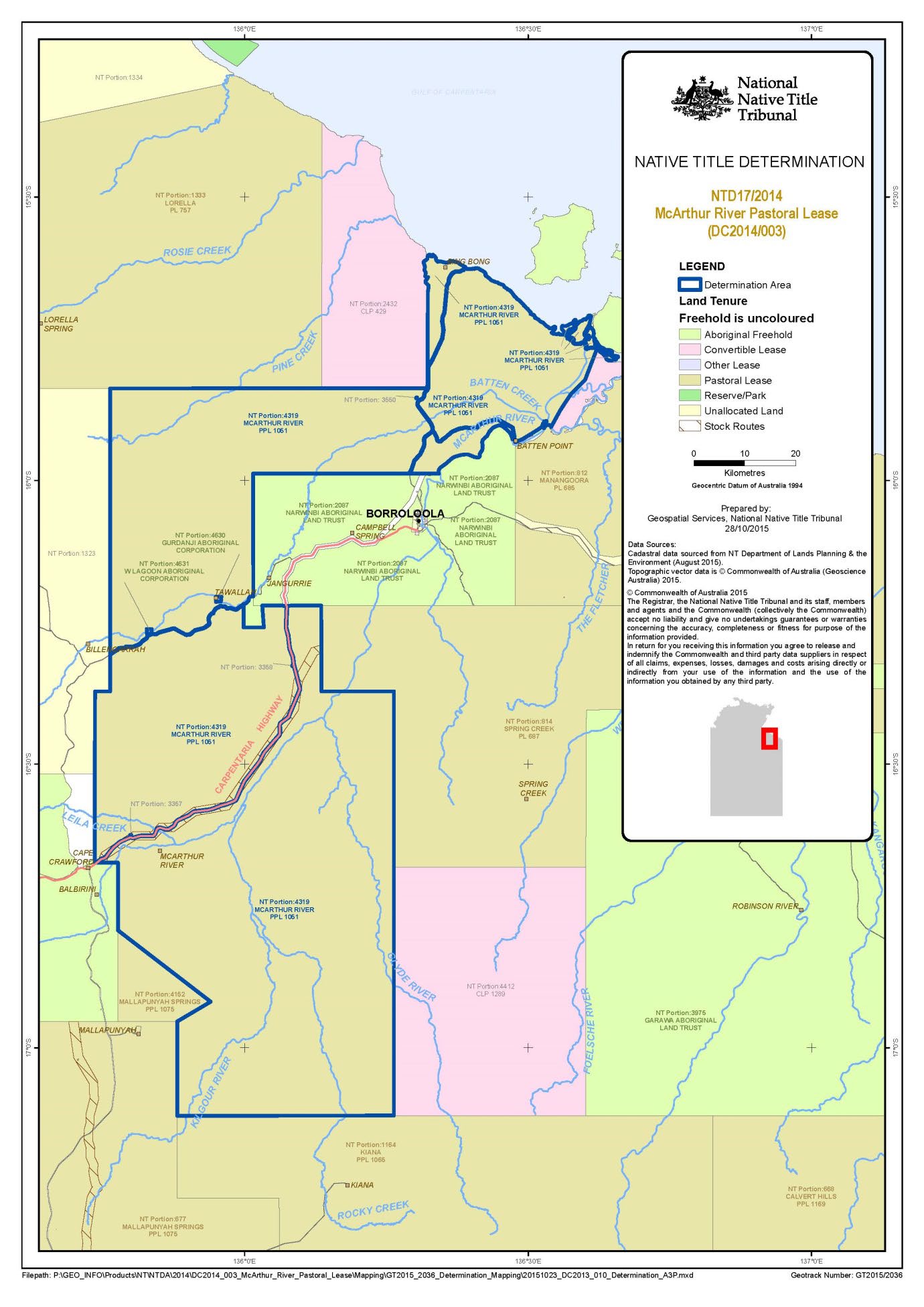
ATTACHMENT 2 – MAP OF MINE AREA
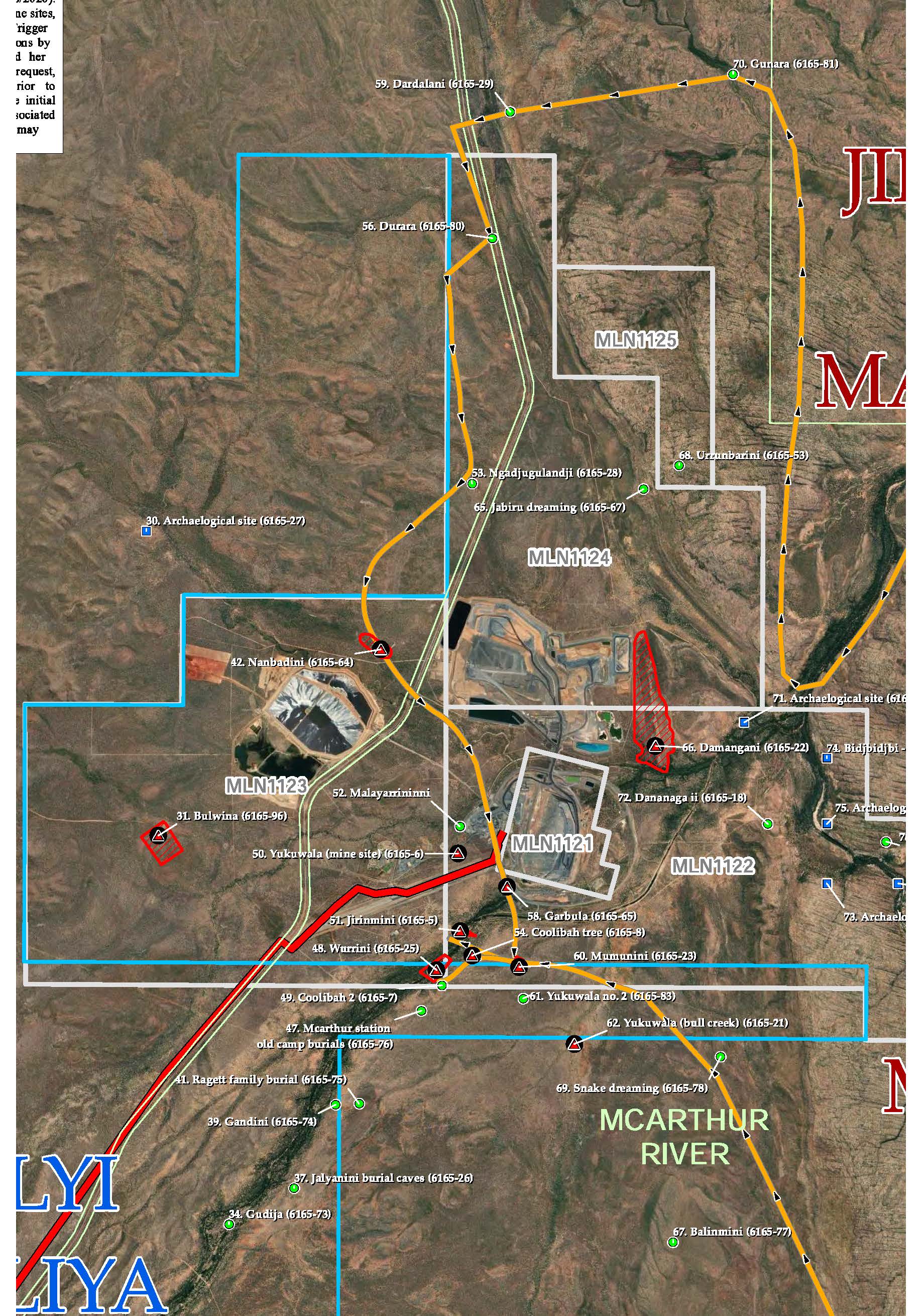
ATTACHMENT 3 – MAP OF PORT AND COASTAL AREA
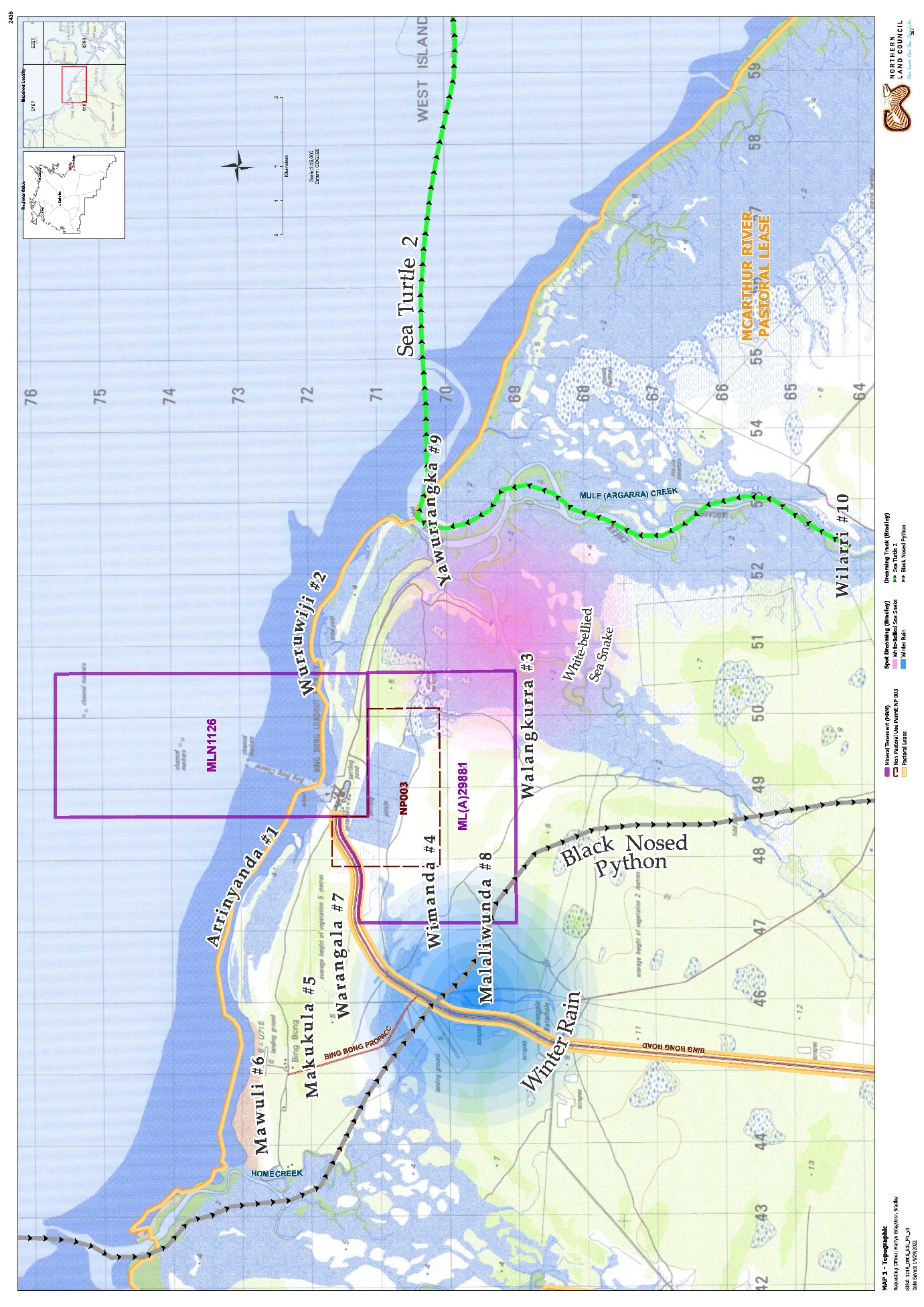
ATTACHMENT 4 – PHOTO IMAGE PORT AREA