FEDERAL COURT OF AUSTRALIA
Waterhouse v City of Sydney [2026] FCA 120
File number: | NSD 624 of 2025 |
Judgment of: | PERRY J |
Date of judgment: | 20 February 2026 |
Catchwords: | PRACTICE AND PROCEDURE – interlocutory applications to strike out parts of amended statement of claim – where amended statement of claim fails to disclose reasonable cause of action – where amended statement of claim does not plead material facts necessary to establish cause of action – where pleadings are evasive, ambiguous, likely to cause prejudice, embarrassment or delay in the proceeding – pleadings struck out in part PRACTICE AND PROCEDURE – where leave is granted to amend interlocutory application to seek summary dismissal – where no cause of action is pleaded against first respondent – where applicants afforded opportunity to replead PRACTICE AND PROCEDURE – where applicants seek leave to further amend statement of claim – where prior amendments did not address deficiencies in the pleadings – where particulars indicated no cause of action against first respondent – where applicants afforded opportunity to seek leave to further amend the amended statement of claim |
Legislation: | Australian Human Rights Commission Act 1986 (Cth), s 46PO(4) Age Discrimination Act 2004 (Cth), ss 15, 27(b), 27(c), 27(e), 28(b) Disability Discrimination Act 1992 (Cth), ss 4(1), 5(1), 5(2), 5(2)(b), 5(3), 6, 6(1), 6(2), 6(3), 6(4), 23(b), 23(b), 23(c), 23(e), 24(b), 32 Federal Court of Australia Act 1976 (Cth), s 31A Federal Court Rules 2011 (Cth), rr 1.34, 16.02(1), 16.21, 16.21(1)(c), 16.21(1)(d), 16.21(1)(e), 26.01, 26.01(a), 26.01(b), 26.01(c), 26.01(d), 26.01(3) |
Cases cited: | Australian Iron & Steel Pty Ltd v Banovic (1989) 168 CLR 165 Australian Parking and Revenue Control Pty Ltd v Reino International Pty Ltd [2016] FCA 744 Australian Securities and Investments Commission v Cassimatis [2013] FCA 641; (2013) 220 FCR 256 EIX20 v State of Western Australia (No 2) [2025] FCA 28 EIX20 v Western Australia [2022] FCA 1357 Fleet v Royal Society for the Prevention of Cruelty to Animals NSW [2005] NSWSC 926 Izzo v State of Victoria (Department of Education and Training) [2020] FCA 770 KTC v David [2022] FCAFC 60 Lambert v Victoria [2014] FCA 1064 Munday v Commonwealth (No 2) (2014) 226 FCR 199; [2014] FCA 1123 Polar Aviation Pty Ltd v Civil Aviation Safety Authority [2012] FCAFC 97; (2017) 203 FCR 325 Ponraj v Wycombe Services Pty Ltd [2023] FCA 118 Shammas v Canberra Institute of Technology [2014] FCA 71 Przybylowski v Australian Human Rights Commission (No 2) [2018] FCA 473 Sklavos v Australian College of Dermatologists [2017] FCAFC 128; (2017) 256 FCR 47 Sluggett v Human Rights & Equal Opportunity Commission [2002] FCA 987; (2002) 123 FCR 561 Varasdi v State of Victoria [2018] FCA 1655 Walker v State of Victoria [2012] FCAFC 38 Waters v Public Transport (1991) 173 CLR 349 Waters v Public Transport Corporation (1991) 173 CLR 349 Watts v Australian Postal Corporation (2014) 222 FCR 220 |
Division: | General Division |
Registry: | New South Wales |
National Practice Area: | Administrative and Constitutional Law and Human Rights |
Number of paragraphs: | 133 |
Date of hearing: | 5 December 2025 |
Counsel for the Applicants: | Mr I Neil SC with Ms A Perigo |
Solicitor for the Applicants: | Swan Lawyers |
Counsel for the First Respondent: | Ms K Nomchong SC with Mr A H Edwards and Mr C R Taylor |
Solicitor for the First Respondent: | City of Sydney |
Counsel for the Second Respondent: | Ms C L Bembrick |
Solicitor for the Second Respondent: | Sparke Helmore Lawyers |
ORDERS
NSD 624 of 2025 | ||
| ||
BETWEEN: | MICHAEL WATERHOUSE First Applicant KATHRYN GREINER Second Applicant JANICE ROUND Third Applicant | |
AND: | THE CITY OF SYDNEY First Respondent TRANSPORT FOR NEW SOUTH WALES Second Respondent | |
order made by: | PERRY J |
DATE OF ORDER: | 20 fBERUARY 2026 |
THE COURT ORDERS THAT:
1. The applicants’ application for leave to further amend the statement of claim in the terms annexed to the affidavit of Richard John Bain Allsop, solicitor, sworn on 23 October 2025 is refused.
2. Leave to amend the first respondent’s interlocutory application in terms of the first respondent’s proposed amended interlocutory application dated 4 December 2025 is granted.
3. Pursuant to rule 1.34 of the Federal Court Rules 2011 (Cth), the requirement in rule 26.01(3) to serve the amended interlocutory application on the applicants at least 14 days before the time fixed for the hearing is dispensed with.
4. Pursuant to rule 16.21 of the Federal Court Rules 2011 (Cth), the whole of the Amended Statement Claim filed on 5 August 2025 is struck out as against the first respondent.
5. Pursuant to rule 16.21 of the Federal Court Rules 2011 (Cth), paragraphs 12, 17, 18D, 27 to 28A, 31 to 34B, 35 to 40E, 44A to 44D, 44I to 44L and 56 to 58 of the Amended Statement of Claim filed 4 August 2025 is struck out as against the second respondent on the grounds that the pleadings:
(a) are evasive or ambiguous;
(b) are likely to cause prejudice, embarrassment or delay in the proceeding; and
(c) fail to disclose any reasonable cause of action.
6. The applicants are to pay the first respondent’s costs of and incidental to the first respondent’s interlocutory application filed on 1 September 2025 as amended pursuant to order 2 above.
7. The applicants are to pay the second respondent’s costs of and incidental to the interlocutory application filed on 10 September 2025.
8. The applicants have leave to apply no later than 4pm on 20 March 2026, for leave to further amend the amended statement of claim.
9. In the event that the applicants do not apply for leave to amend the amended statement of claim in accordance with order 8 above in respect of any claim against the first respondent, the application insofar as it seeks relief against the first respondent is summarily dismissed pursuant to r 26.01 of the Federal Court Rules 2011 (Cth), with costs to be agreed or assessed.
Note: Entry of orders is dealt with in Rule 39.32 of the Federal Court Rules 2011.
REASONS FOR JUDGMENT
PERRY J:
1. INTRODUCTION
1 This matter concerns interlocutory applications by the City of Sydney and TNSW to strike out, in whole or in part, the Amended Statement of Claim filed on 5 August 2025 (ASOC), an application for summary dismissal by the City of Sydney, and an application by the applicants to further amend the statement of claim.
2 The substantive proceeding relates to the existing and proposed construction of a two-way cycleway on Oxford Street in Sydney (the Oxford Street Cycleway). The first respondent, the City of Sydney, is responsible for the existing cycleway that is located on the eastern side of Oxford Street, running from the corner of Flinders Street in Taylor Square through to Whitlam Square (Oxford Street East Cycleway). The second respondent, Transport for New South Wales (TNSW or TfNSW), is responsible for the cycleway that is proposed to be constructed along the western side of Oxford Street. This cycleway is proposed to run from the corner of Flinders Street in Taylor Square to the intersection located on the corner of Queen Street and Lang Road in Paddington (Oxford Street West Cycleway).
3 The applicants, Mr Michael Waterhouse, Ms Kathryn Greiner and Ms Janice Round, allege that the first and second respondent have engaged in age discrimination and disability discrimination by reason of the existing and proposed construction of the Oxford Street Cycleway. It is alleged that the Oxford Street Cycleway restricts, or will restrict, the applicants’ ability to access bus stops on Oxford Street with actual or perceived safety.
4 The applicants seek declarations under s 46PO(4) of the Australian Human Rights Commission Act 1986 (Cth) (AHRC Act) that the respondents have engaged in unlawful discrimination under the Disability Discrimination Act 1992 (Cth) (DDA), Disability Standards for Accessible Public Transport 2002 and the Age Discrimination Act 2004 (Cth) (ADA). The applicants also seek orders under s 46PO(4) of the AHRC Act requiring the respondents to cease the unlawful discrimination and make various changes to the cycle lanes. These changes include, but are not limited to, installing speed humps and accessible pedestrian signals, as well as traffic lights and cameras. The applicants also seek orders requiring the respondents to collect and publish certain data, to amend the road rules in certain respects, to provide education programs for cyclists, and to consult with older and disabled bus passengers in the local community. As against TNSW, the applicants also seek orders requiring that the proposed route of the Oxford Street West Cycleway be altered such that it runs along Flinders Street in Darlinghurst and then along Moore Park Road in Paddington.
5 Each of the respondents applies to strike out parts of the ASOC. By an amended interlocutory application which it seeks leave to file, the City of Sydney also applies for summary dismissal of the claims against it. Taken together, the respondents’ strike out applications and the first respondent’s summary dismissal application target the entirety of the applicants’ claims, other than a claim under the DDA in relation to alleged breaches of the Disability Standards in paragraphs 45 to 52 of the ASOC.
6 The applicants object to the applications but seek an opportunity to replead in the event that the strike out applications succeed. They also apply for leave to file a further amended statement of claim (FASOC) but accept that the FASOC is not directed towards addressing the objections raised by the respondents in their strikeout and summary dismissal applications.
7 For the reasons set out below:
(1) the applicants’ application for leave to further amend the statement of claim in the terms annexed to the affidavit of Richard John Bain Allsop, solicitor, sworn on 23 October 2025 should be refused;
(2) the amended statement of claim is struck out as against the City of Sydney on the ground that neither the pleadings nor the particulars subsequently given by the applicants identify any use by the applicants of bus stops along the Oxford Street Cycleway which would require them to cross any part of the cycleway for which the City of Sydney has responsibility;
(3) paragraphs 12, 17, 18D, 27 to 28A, 31 to 34B, 35 to 40E, 44A to 44D, 44I to 44L and 56 to 58 inclusive of the ASOC are struck out as against TNSW on the grounds that the pleadings are evasive or ambiguous, are likely to cause prejudice, embarrassment or delay in the proceedings, and/or fail to disclose any reasonable cause of action;
(4) the applicants have leave to apply no later than 4pm on 20 March 2026, for leave to further amend the amended statement of claim; and
(5) in the event that the applicants do not apply for leave to further amend the amended statement of claim by 4pm on 20 March 2026, the application insofar as it seeks relief against the first respondent is dismissed with costs to be agreed or assessed.
2. EVIDENCE
8 The City of Sydney relies on the affidavit of Greg Garrett affirmed on 1 September 2025. The City of Sydney also tendered a letter from Swan Lawyers to Greg Garrett dated 8 August 2025, as well as a map of the Oxford Street Cycleway. I note that the tendered letter from Swan Lawyers is, on its face, dated 8 August 2025. However, it responds to prior correspondence from 1 September 2025. From this, I infer that the date 8 August 2025 is in error.
9 TNSW relies on the affidavit of Felicity Edwards affirmed on 10 September 2025.
10 The applicants rely on the affidavit of Richard John Bain Allsop sworn on 23 October 2025 and a letter from City of Sydney to the applicants dated 1 September 2025. The applicants also tendered the expert report of David McTiernan dated 16 October 2025. This expert report was tendered only for the purpose of supporting the applicants’ interlocutory application to further amend the statement of claim.
3. BACKGROUND
11 On 24 April 2025, the applicants filed an originating application under the AHRC Act, seeking:
(1) orders pursuant to s 46PO(4) of the AHRC Act, declaring that the City of Sydney and TNSW have committed unlawful discrimination;
(2) orders pursuant to s 46PO(4)(a) of the AHRC Act, directing each of the respondents to not repeat or continue such unlawful discrimination; and
(3) orders pursuant to s 46PO(4) of the AHRC Act, requiring the respondents to perform the following acts:
(a) as to those Bus Stops in respect of which construction has begun or been completed by the date of this application, such Risk Mitigation Measures as the Court finds to be reasonable be included, applied, installed, or added in or to the design and construction of the Bus Stop;
(b) as to those Bus Stops in respect of which construction has not begun by the date of this application, such Risk Mitigation Measures as the Court finds to be reasonable be included, applied, or added to the design of the Bus Stop; and
(c) as to TNSW, altering the proposed route of the Oxford Street Cycleway so that, rather than running along Oxford Street from Taylor Square to the Queen Street Intersection as is presently proposed, it would instead run along Flinders Street in Darlinghurst and Moore Park Road in Paddington to the Queen Street Intersection.
12 Relevantly, the originating application contains the following definitions:
(1) ‘Bus Stops’ means “each one or more of the bus stops constructed, or proposed to be constructed, on or adjacent to Oxford Street, such that they are or are proposed to be accessed by crossing the Oxford Street Cycleway, and which constitute means of access, and immediate boarding points, for Public Transport Services.”
(2) ‘Risk Mitigation Measures’ means “any measure the application of which would enhance the actual or perceived safety of an Aggrieved Person, and reduce their actual or perceived danger, when crossing the Oxford Street Cycleway to access a Bus Stop, and includes, without limitation, those measures set out in a document, a copy of which is attached, entitled ‘risk mitigation measures’.”
13 The ‘Risk Mitigation Measures’ set out in the document attached to the originating application are largely the same as the ‘reasonable adjustments’ pleaded at paragraph 32 of the ASOC (which are discussed below), save for the originating application seeking amendments to “Road Rules” (a term that is not defined by the applicants).
14 On 16 June 2025, the applicants filed a statement of claim (SOC).
15 On 17 June 2025, orders were made for the respondents each to file a defence to the SOC (by 25 July 2025) and for the applicants to file any reply (by 4 August 2025).
16 On 25 June 2025, the City of Sydney wrote to the applicants raising “several matters concerning their SOC that required attention because the pleadings were unclear, deficient and embarrassing in a legal sense”. The letter explained in detail the alleged deficiencies in the SOC. The City of Sydney expressed the view that, as a result of these deficiencies, the SOC required substantial repleading and particularisation before the City of Sydney could sensibly plead to it. The letter also “requested further and better particulars of certain allegations that were necessary before the [City of Sydney] could file a defence to the SOC”. The letter further foreshadowed the possibility that the City of Sydney may bring a strike out application if the opportunity to amend the SOC was not taken up.
17 On 30 June 2025, TNSW wrote to the applicants raising several issues and deficiencies with the SOC that required attention before TNSW could file its defence and requesting further particulars in relation to the SOC. The alleged issues and deficiencies were explained in detail in TNSW’s letter.
18 On 5 August 2025, the applicants filed the ASOC. In essence, the respondents claim that the ASOC does not satisfactorily address the deficiencies which were drawn to the applicants’ attention in the previous correspondence.
19 On 7 August 2025, orders were made for the respondents to each file a defence to the ASOC (by 16 September 2025) and for the applicants to file a reply (by 30 September 2025).
20 On 1 September 2025, the City of Sydney wrote to the applicants repeating its request for further particulars of the claims at paragraphs 15, 18 and 18E of the ASOC. The particulars requested by the City of Sydney were as follows:
(1) nomination of the bus routes regularly used by the applicants;
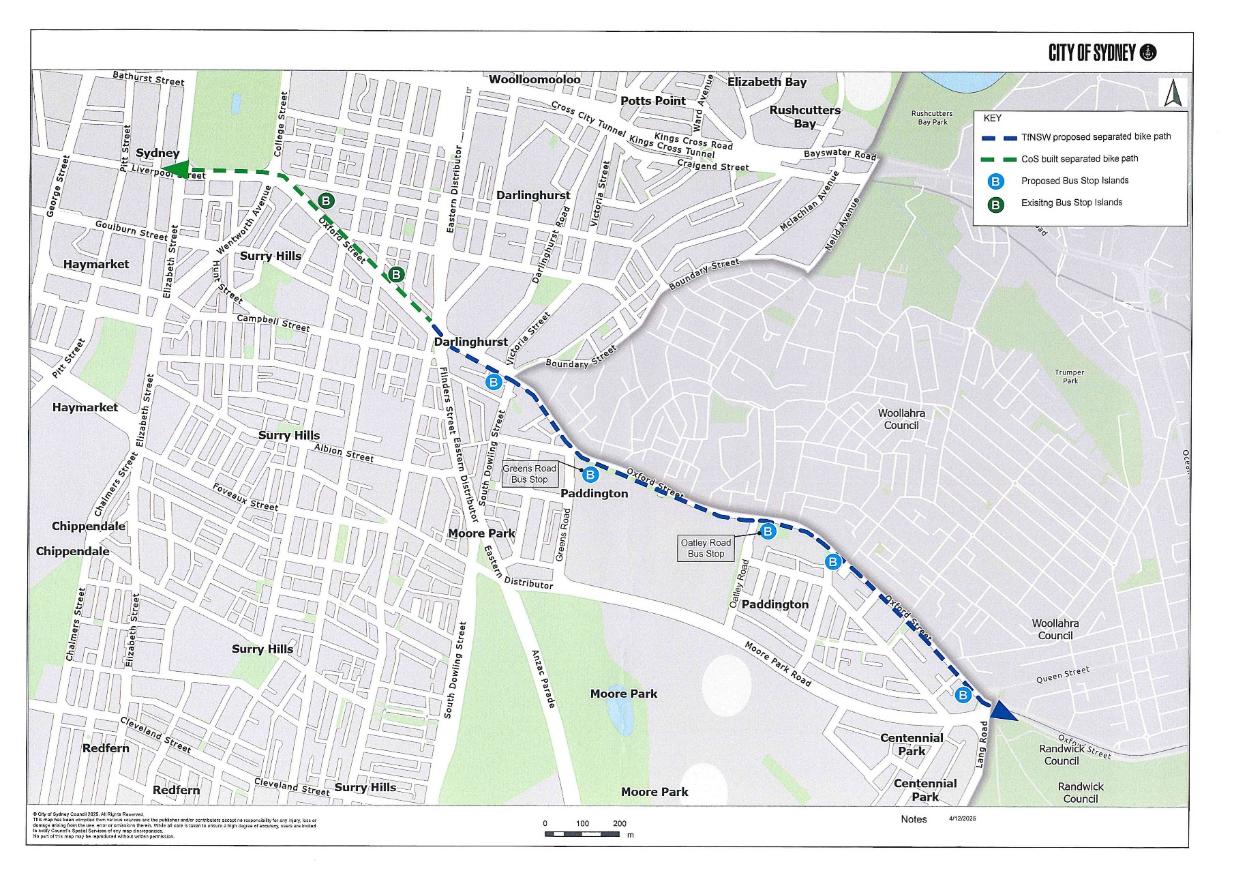
(2) particularisation of the term "regularly" by reference to the days of the week, times of day, and number of times (on average), that the applicants use the bus routes;
(3) precise location of the bus stops that the applicants currently utilise to access the bus services that they regularly use; and
(4) location of the proposed bus stops that the applicants allege that they will utilise to access the bus services that they will regularly use once the Cycleway is constructed.
21 On 1 September 2025, the City of Sydney filed an interlocutory application, seeking:
(1) an order striking out some or all of the following paragraphs of the ASOC, pursuant to rr 16.21(1)(c), (d) and/or (e) of the Federal Court Rules 2011 (Cth) (the FCR):
(a) paragraphs 12, 17 and 18D;
(b) paragraphs 27 to 28A insofar as they refer to "perceived safety";
(c) paragraphs 32(e) to 32(i);
(d) paragraphs 31 to 34B and 41 to 44L; and
(e) paragraphs 35 to 40E and 55 to 58.
(2) an order that the applicants provide the following further particulars of the claims in paragraphs 15, 18 and 18E of the ASOC pursuant to r 16.45 of the FCR:
(a) nomination of the bus routes regularly used by the Applicants;
(b) particularisation of the term "regularly" by reference to the days of the week, times of day and number of times (on average) that the Applicants use the bus routes;
(c) precise location of the bus stops that the Applicants currently utilise to access the bus services that they regularly use; and
(d) location of the proposed bus stops that the Applicants allege that they will utilise to access the bus services that they will regularly use once the Cycleway is constructed.
(3) The Applicants pay the First Respondent’s costs of and incidental to this Interlocutory Application and that such costs be payable forthwith.
22 I note that the City of Sydney’s interlocutory application at paragraph 1 refers to rr 16.12(1)(c), (d) and/or (e). I take this to be a typographical error, and that the City of Sydney intended to refer to r 16.21(1)(c), (d), and/or (e) of the FCR. I also note that the City of Sydney no longer presses for the order set out in paragraph 2 of the interlocutory application dated 1 September 2025 (quoted above).
23 On 5 September 2025, TNSW emailed the applicants, enclosing a draft interlocutory application seeking orders that part of the applicants’ pleadings be stuck out. The applicants, in turn, asked whether TNSW intended to request further particulars to the paragraphs identified in the draft interlocutory application. On 9 September 2025, TNSW advised the applicants that it did not intend to make a further request for particulars in relation to the ASOC.
24 On 8 September 2025, the applicants wrote to the City of Sydney responding to the applicants’ requests for further and better particulars in relation to the bus stops utilised by the applicants, and the pleading deficiencies raised in the City of Sydney’s letter of 25 June 2025. As I previously mentioned, this letter from the applicants to the City of Sydney appears to be erroneously dated 8 August 2025.
25 On 11 September 2025, TNSW filed an interlocutory application, seeking an order, pursuant to r 16.21 of the FCR, striking out the same paragraphs of the ASOC as those sought by the City of Sydney to the extent they apply to TNSW, being paragraphs 12, 17, 18D, 27 to 28A, 31 to 34B, 35 to 40E, 44A to 44D, 44I to 44L and 56 to 58.
26 On 24 September and 9 October 2025, timetabling orders were made in respect of the respondents’ interlocutory applications.
27 On 24 October 2025, the applicants filed an interlocutory application seeking leave to file a further amended statement of claim (FASOC) in the form annexed to the affidavit of Richard Allsop dated 23 October 2025. As I later explain, the draft FASOC does not address the difficulties which form the basis of the respondents’ strike out applications.
28 On 26 November 2025, orders were made directing that the interlocutory applications of the respondents and the applications be heard and determined together.
29 On 4 December 2025, the City of Sydney sought to file an amended interlocutory application, seeking, in the alternative, summary dismissal of the proceedings. I note the amended interlocutory application was served at the 11th hour, given that the interlocutory hearing was listed for 5 December 2025. The parties were therefore heard orally on this issue.
4. LEGAL PRINCIPLES
4.1 Summary dismissal
30 By amended interlocutory application, the City of Sydney seeks that the proceedings against it be summarily dismissed on the grounds specified in rr 26.01(1)(a) and/or (c) of the FCR. Those provisions state:
A party may apply to the Court for an order that judgment be given against another party because:
(a) the applicant has no reasonable prospect of successfully prosecuting the proceeding or part of the proceeding; or
…
(c) no reasonable cause of action is disclosed…
31 The test for summary dismissal laid down in r 26.01(a) of the FCR (“no reasonable prospect of successfully prosecuting the proceeding”) is the same test for summary dismissal as that in s 31A of the Federal Court of Australia Act 1976 (Cth) (FCA Act): Shammas v Canberra Institute of Technology [2014] FCA 71 at [13], [51] (Foster J). Rule 26.01 also provides for summary judgment to be given against a party where the proceeding is frivolous or vexatious, no reasonable cause of action is disclosed, or the proceeding is an abuse of Court process (r 26.01(b), (c) and (d) respectively).
32 The principles governing the application of s 31A are well established and were summarised in Przybylowski v Australian Human Rights Commission (No 2) [2018] FCA 473 at [7] (Perry J) as follows:
(1) The respondent as the moving party bears the onus of persuading the Court that the application has no reasonable prospects of succeeding: Australian Securities and Investments Commission v Cassimatis [2013] FCA 641; (2013) 220 FCR 256 (Cassimatis) at 271 [45] (Reeves J).
(2) With respect to the scope of s 31A, French CJ and Gummow J explained in Spencer v Commonwealth [2010] HCA 28; (2010) 241 CLR 118 (Spencer) at [22], that the section:
… will apply to the case in which the pleadings disclose no reasonable cause of action and their deficiency is incurable. It will include the case in which there is unanswerable or unanswered evidence of a fact fatal to the pleaded case and any case which might be propounded by permissible amendment. It will include the class of case in the long-standing category of cases which are “frivolous or vexatious or an abuse of process”. The application of s 31A is not, in terms, limited to those categories.
(3) Section 31A sets a lower threshold than the previous test for summary dismissal which required that the claim be “manifestly groundless” or “hopeless”: Spencer at [52]-[53] (Hayne, Crennan, Kiefel and Bell JJ). Nonetheless, the discretion must still be exercised with caution (Spencer at [24] (French CJ and Gummow J) and [60] (Hayne, Crennan, Kiefel and Bell JJ)).
(4) An assessment of whether a proceeding has no reasonable prospects of success for the purposes of s 31A involves the making of value judgments in the absence of a full and complete factual matrix and argument, with the result that the provision vests a discretion in the Court: Kowalski v MMAL Staff Superannuation Fund Pty Ltd [2009] FCAFC 117; (2009) 178 FCR 401 (Kowalski) at [28] (the Court).
33 Consistently with these principles, Reeves J in Australian Securities and Investments Commission v Cassimatis [2013] FCA 641; (2013) 220 FCR 256 explained at [46] that:
… the determination of a summary dismissal application therefore does not require a mini-trial based upon incomplete evidence to decide whether the proceedings are likely to succeed or fail at trial. Instead, it requires a critical examination of the available materials to determine whether there is a real question of law or fact that should be decided at trial. Each application for summary judgment or summary dismissal has to be determined according to its particular circumstances. What is required is a practical judgment of the case at hand. The relevant circumstances will partly depend upon the stage which the proceedings have reached. Among other things, this will affect the materials available to the Court considering the application, for example, whether pleadings have been exchanged, or discovery of documents has occurred.
34 His Honour illustrated the application of these principles at [47]–[48] as follows:
Accepting there can be no “hard and fast” rule about this, as a general principle, these authorities show that the moving party on an application for summary dismissal of the present kind is likely to succeed on its persuasive onus if it is able to demonstrate to the Court that the applicant’s success in the proceedings relies upon a question of fact that can be truly described as fanciful, trifling, implausible, improbable, tenuous or one that is contradicted by all the available documents or other materials. Conversely, as a general principle, it is unlikely to succeed where, on a critical examination of all the available materials, the Court is satisfied that there appears to be a real question of fact to be determined between the parties. This is more likely to be the case where the available materials include pleadings that raise factual disputes that can be truly described as significant, substantial, plausible or weighty. A real question of fact is also more likely to exist where the question/s of fact concerned is/are complex, eg involving numerous different events or transactions over a long period of time.
Similarly, as a general principle, the moving party on an application for summary dismissal is likely to succeed on its persuasive onus if it is able to demonstrate to the Court that the applicant’s success in the proceedings relies upon a question of law that is straightforward and confined, or is trite in the sense that it is well settled on authority, such that the question can be resolved summarily without the necessity for a full trial. On the other hand, the moving party would be unlikely to succeed if the Court is satisfied that the applicant’s success in the proceedings relies upon a question of law that is serious or important, or is difficult and therefore likely to require lengthy argument for its resolution, or involves conflicting authority, or is apparently arguable, yet novel.
35 In line with these principles, summary dismissal is not necessarily warranted simply because the claim is poorly drafted, because a deficiency of that nature may be addressed by the grant of leave to amend.
4.2 Strike out applications
36 In their strike out applications, both respondents rely on r 16.21(1)(c), (d) and/or (e) of the FCR. Those provisions provide that:
A party may apply to the Court for an order that all or part of a pleading be struck out on the ground that the pleading:
…
(c) is evasive or ambiguous; or
(d) is likely to cause prejudice, embarrassment or delay in the proceeding;
(e) fails to disclose a reasonable cause of action or defence or other case appropriate to the nature of the pleading; …
37 With respect to sub-paragraph (e), a ‘reasonable cause of action’ is one that has some chance of success having regard to the pleaded allegations: Polar Aviation Pty Ltd v Civil Aviation Safety Authority [2012] FCAFC 97; (2017) 203 FCR 325 at [42]-[43]; KTC v David [2022] FCAFC 60 at [123].
38 In considering a strike out application under r 16.21 of the FCR, the function of pleadings must be borne in mind: Fleet v Royal Society for the Prevention of Cruelty to Animals NSW [2005] NSWSC 926 at [47]-[53]; Australian Parking and Revenue Control Pty Ltd v Reino International Pty Ltd [2016] FCA 744 at [19]. In this regard, r 16.02(1) sets out the requirements with which a pleading must positively comply, namely:
(1) A pleading must:
(a) be divided into consecutively numbered paragraphs, each, as far as practicable, dealing with a separate matter; and
(b) be as brief as the nature of the case permits; and
(c) identify the issues that the party wants the Court to resolve; and
(d) state the material facts on which a party relies that are necessary to give the opposing party fair notice of the case to be made against that party at trial, but not the evidence by which the material facts are to be provided; and
(e) state the provisions of any statute relied on; and
(f) state the specific relief sought or claimed.
39 I summarised the relevant principles in relation to a strike out application in Australian Parking and Revenue Control Pty Ltd v Reino International Pty Ltd [2016] FCA 744 at [19].
The relevant principles may be summarised as follows.
(1) The requirements of r 16.02(1) and (2) reflect the function of pleadings, namely, to state with sufficient clarity the case that must be met so as to ensure the basic requirement of procedural fairness that a party should have the opportunity of meeting the case against it and incidentally to define the issues for decision: Banque Commerciale SA en Liquidation v Akhil Holdings Ltd(1990) 169 CLR 279at 286 (Mason CJ and Gaudron J). Equally, in considering a strike out application under r 16.21, the function of pleadings must be borne in mind: Fleet v Royal Society for the Prevention of Cruelty to Animals NSW [2005] NSWSC 926 at [47]-[53].
(2) The power to strike out pleadings is not to be lightly exercised. As the Full Court held in Young Investment Group Pty Ltd v Mann [2012] FCAFC 107; (2012) 293 ALR 537 (Young Investment Group) (at 540 [6]). :
[A]ll of the facts alleged in the relevant pleading are to be accepted as true, and it is to be taken for granted that, on all other points, the pleading is unassailable. Provided that a pleading fulfils its basic function of identifying the issues, disclosing an arguable cause of action and apprising the other party of the case that it has to meet at trial, the pleading should be allowed to stand and the proceeding should be allowed to go to trial.
(3) While a respondent has no absolute right to insist on the applicant pleading every material fact necessary to demonstrate a complete cause of action, all of the material facts necessary to formulate a complete cause of action should in general be pleaded: FCR r 16.02(2); Young Investment Group at 540 [7]. In this regard, a distinction has been drawn between pleadings and particulars even though to some degree they may overlap: McKellar v Container Terminal Management Services Ltd [1999] FCA 1101; (1999) 165 ALR 409 (McKellar) at 417 [21]–420 [31] (Weinberg J). As Scott J explained in Bruce v Odhams Press Ltd [1936] 1 KB 697 at 711–713 (quoted with approval by Goldberg J in Mitanis v Pioneer Concrete (Vic) Pty Ltd (1997) 19 ATPR 41-591 at 44,152):
…it is beyond question that there is a radical distinction [between a statement of material facts and particulars] none the less so that in cases near the dividing line there is a penumbra where the two may and often do overlap, just as between night and day there is a zone of doubt which we call dusk …
The cardinal provision in r 4 is that the statement of claim must state the material facts. The word “material” means necessary for the purpose of formulating a complete cause of action; and if any one “material” fact is omitted, the statement of claim is bad; it is “demurrable” in the old phraseology, and in the new is liable to be “struck out” …
The function of “particulars” under r 6 is quite different. They are not to be used in order to fill material gaps in a demurrable statement of claim – gaps which ought to have been filled by appropriate statements of the various material facts which together constitute the plaintiff’s cause of action. The use of particulars is intended to meet a further and quite separate requirement of pleading, imposed in fairness and justice to the defendant. Their function is to fill in the picture of the plaintiff's cause of action with information sufficiently detailed to put the defendant on [her or] his guard as to the case [she or] he has to meet and to enable [her or] him to prepare for trial. Consequently in strictness particulars cannot cure a bad statement of claim. But in practice it is often difficult to distinguish between a "material fact" and a "particular" piece of information which it is reasonable to give the defendant in order to tell [her or] him the case [she or] he has to meet; hence in the nature of things there is often overlapping.
(4) A pleading which simply pleads a conclusion from unstated facts is embarrassing and is liable to be struck out: Trade Practices Commission v David Jones (Australia) Pty Ltd (1985) 7 FCR 109at 114–5; Young Investment Group at 540 [7]. A pleading is also embarrassing where it is unintelligible, ambiguous, vague or too general, so as to embarrass the opposite party who does not know what is alleged against her or him: Priest v New South Wales [2006] NSWSC 12 at [34] (Johnson J). Equally, it may be embarrassing where inconsistent allegations are made, alternatives are confusingly intermixed, or the material facts alleged are couched in expressions which leave difficulties or doubts about recognising or piecing together what is referred to (Priest at [35]-[36]. However, as PT Consultants submit, this does not prevent a party from pleading alternative and inconsistent allegations of material facts where those facts are stated separately, and not comingled, so as to show the specific facts on which each alternative cause of action is based: JC Decaux Pty Ltd v Adshel Street Furniture Pty Ltd [2000] FCA 1118; (2000) 178 ALR 339 at 342–343[19].
40 As the respondents submit, the general principles and rules that apply to pleadings apply equally to pleadings with respect to claims arising under anti-discrimination legislation: Izzo v State of Victoria (Department of Education and Training) [2020] FCA 770 at [8]; Varasdi v State of Victoria [2018] FCA 1655 at [3]. In this regard, it is important to emphasise that the DDA and, equally, the ADA, do not afford a vehicle for addressing all complaints that an individual with disabilities, or who is elderly, might have relevantly concerning the provision of services or access to premises; nor do these anti-discrimination laws empower the Court to undertake a general inquiry in the best interests or vulnerabilities of the individuals to whom the laws are directed: Varasdi at [7] (O’Callaghan J). It follows, as the Full Court observed in Walker v State of Victoria [2012] FCAFC 38 at [114], that:
[T]he legal representatives engaged on behalf of a vulnerable person have a particular duty to ensure that complaints and grievances that are not capable of being brought within the [DDA] are not pursued, and that those that are pursued are related clearly and directly to the provisions of the [DDA].
41 The related need to plead a direct discrimination claim with precision was highlighted by O’Callaghan J in Varasdi who explained at [10]-[12] that:
10 In a proceeding alleging direct discrimination, it is necessary to identify with particularity the matters said to give rise to the claim of direct discrimination under the DDA: Kirk v Industrial Court of New South Wales; Kirk Group Holdings Pty Ltd v WorkCover Authority of New South Wales (2010) 239 CLR 531 at [28] (French CJ, Gummow, Hayne, Crennan, Kiefel and Bell JJ); Wade v State of Victoria [2012] FCA 400 at [6] (Bromberg J).
11. An allegation that a reasonable adjustment is required must be pleaded with precision: Wade v State of Victoria [2012] FCA 400 at [6]; Lambert v State of Victoria [2014] FCA 1064 at [36].
12. A precise articulation of what is said to constitute discrimination is particularly pertinent in light of s 29A of the DDA. Parliament has chosen in this section to provide an exception to otherwise discriminatory conduct if a purported discriminator can establish that avoiding the discrimination would impose an unjustifiable hardship on the discriminator. A respondent cannot seek to establish, and a Court cannot determine, whether such an unjustifiable hardship would arise unless there is a precise articulation of that which constitutes the discrimination: cf Watts v Australia Post (2014) 222 FCR 220) at [25] (Mortimer J).
42 It is also the case that precision is required in relation to the pleading of an indirect discrimination case, including with respect to the alleged ‘requirement or condition’: Waters v Public Transport (1991) 173 CLR 349 at 406.
43 Finally, I agree with the City of Sydney that:
(1) a reasonable adjustment must be an adjustment or modification ‘for’ the person with a disability: Watts v Australian Postal Corporation (2014) 222 FCR 220 at [23] (Mortimer J (as her Honour then was)); and
(2) an applicant must plead the causal link between the respondent’s alleged failure to make the adjustments and the applicant’s disability, as well as the causal link with less favourable treatment: Lambert v Victoria [2014] FCA 1064 at [25] and [37] (Davies J); Sklavos v Australian College of Dermatologists [2017] FCAFC 128; (2017) 256 FCR 47 (Bromberg J, Griffith and Bromwich JJ agreeing); Varasdi at [33]. Thus, for example, Davies J in Lambert, in finding that a pleading was embarrassing, held at [37]-[38] that:
[A]s with the less favourable treatment allegation, the causal link between the alleged failure to make the adjustments and the applicant’s disabilities are missing: no material facts are pleaded to establish that the alleged failure to make the “reasonable adjustments” occurred because of the applicant’s disabilities.
Moreover, this pleading also suffers from the defect that it does not plead the next necessary causal link between the failure to make the adjustments and the effect that the applicant was treated less favourably than a person without her disabilities would have been treated in the relevant circumstances.
(Emphasis in the original.)
(3) In Sklavos at [21]-[22], Bromberg J explained both the commonality and difference between the causation elements required by the definitions of direct and indirect discrimination under ss 5 and 6 respectively of the DDA:
As the objects (s 3) of the DDA emphasise, what is sought to be achieved is the elimination (as far as possible) of discrimination against persons “on the ground of disability”. The DDA is concerned with addressing disadvantage, or less favourable treatment, brought about or caused by a person’s disability. That fundamental concern applies irrespective of whether the discrimination is direct or indirect.
Each of s 5(1) and (2) and s 6(1) and (2) [of the DDA] raise a number of elements which must be satisfied to establish discrimination within the meaning of each of those subsections. The factors specified are varied but, in each case, a causation question is raised by the common phrase “because of the disability”. A point of distinction, and in my view the fundamental distinguishing feature between s 5 and s 6 is to be found in the different causation question which those sections raise.
(Emphasis added.)
4.3 Relevant provisions of the Disability Discrimination Act
44 As explained below, the applicants contend that the respondents discriminated against Mr Waterhouse and Ms Round within the meaning of s 5(2) and s 6(1) of the DDA contrary to s 23(b), (c) and (e) and/or s 24(b) of the DDA. Section 23 relevantly provides that:
It is unlawful for a person to discriminate against another person on the ground of the other person’s disability:
…
(b) in the terms or conditions on which the first-mentioned person is prepared to allow the other person access to, or the use of, any such premises; or
(c) in relation to the provision of means of access to such premises; or
…
(e) in the terms or conditions on which the first-mentioned person is prepared to allow the other person the use of any such facilities; …
45 Section 24 in turn relevantly provides that:
It is unlawful for a person who, whether for payment or not, provides goods or services, or makes facilities available, to discriminate against another person on the ground of the other person’s disability:
…
(b) in the terms or conditions on which the first-mentioned person provides the other person with those goods or services or makes those facilities available to the other person; …
46 In the present case, the applicants’ case embraces allegations of both direct and indirect discrimination under the DDA and indirect discrimination under the ADA. The essential distinction between direct and indirect discrimination was explained by Dawson and Toohey JJ in Waters v Public Transport Corporation (1991) 173 CLR 349 as follows (at 392):
A distinction is often drawn between two forms of discrimination, namely "direct" or "disparate treatment" discrimination and "indirect" or "adverse impact" discrimination. Broadly speaking, direct discrimination occurs where one person is treated in a different manner (in a less favourable sense) from the manner in which another is or would be treated in comparable circumstances on the ground of some unacceptable consideration (such as sex or race). On the other hand, indirect discrimination occurs where one person appears to be treated just as another is or would be treated but the impact of such "equal" treatment is that the former is in fact treated less favourably than the latter. The concept of indirect discrimination was first developed in the United States in relation to practices which had a disproportionate impact upon black workers as opposed to white workers. Both direct and indirect discrimination therefore entail one person being treated less favourably than another person. The major difference is that in the case of direct discrimination the treatment is on its face less favourable, whereas in the case of indirect discrimination the treatment is on its face neutral but the impact of the treatment on one person when compared with another is less favourable.
(Citations omitted.)
(Emphasis added.)
47 Direct and indirect discrimination are mutually exclusive and the same conduct cannot amount to both, as is alleged by the applicant in this matter: Sklavos at [13]-[16] (Bromberg J) (citing Australian Iron & Steel Pty Ltd v Banovic (1989) 168 CLR 165); Waters at 392-393 (Dawson and Toohey JJ) and 400-402 (McHugh J); Munday v Commonwealth (No 2) (2014) 226 FCR 199; [2014] FCA 1123 at [157] (Katzmann J).
48 Sections 5 and 6 of the DDA set out the elements necessary to establish, respectively, a claim of direct discrimination and indirect discrimination. Relevantly, s 5(2) provides that:
(2) For the purposes of this Act, a person (the discriminator) also discriminates against another person (the aggrieved person) on the ground of a disability of the aggrieved person if:
(a) the discriminator does not make, or proposes not to make, reasonable adjustments for the person; and
(b) the failure to make the reasonable adjustments has, or would have, the effect that the aggrieved person is, because of the disability, treated less favourably than a person without the disability would be treated in circumstances that are not materially different.
49 Subsection 5(3) also provides that “[f]or the purposes of this section, circumstances are not materially different because of the fact that, because of the disability, the aggrieved person requires adjustments.”
50 With respect to the concept of a “reasonable adjustment”, s 4(1) provides that “an adjustment to be made by a person is a reasonable adjustment unless making the adjustment would impose an unjustifiable hardship on the person.” Furthermore, a reasonable adjustment must be an adjustment “for” the person. In Watts at [23], for example, concerning a claim of disability discrimination in the employment context, Mortimer J (as her Honour then was) held that the adjustment “is not made ‘to’ the position the person occupies. It is not made ‘to’ the equipment a person uses”, but is an adjustment “for the person”. Thus, her Honour rejected the proposition that a return-to-work plan, of itself, would fall within the concept of a reasonable adjustment for the purposes of s 5(2) of the DDA. Rather, Mortimer J held at [231] that;
The respondent is correct to submit it is too removed from the work to be performed. The adjustment must be “for” the person, so the person can perform work. While an adjustment can be generally described …, it must in my opinion be a nominated alteration or modification to a matter related to the work the person is employed or contracted to perform.
51 With respect to indirect discrimination, subsections 6(1) and (2) of the DDA provide that:
(1) For the purposes of this Act, a person (the discriminator) discriminates against another person (the aggrieved person) on the ground of a disability of the aggrieved person if:
(a) the discriminator requires, or proposes to require, the aggrieved person to comply with a requirement or condition; and
(b) because of the disability, the aggrieved person does not or would not comply, or is not able or would not be able to comply, with the requirement or condition; and
(c) the requirement or condition has, or is likely to have, the effect of disadvantaging persons with the disability.
(2) For the purposes of this Act, a person (the discriminator) also discriminates against another person (the aggrieved person) on the ground of a disability of the aggrieved person if:
(a) the discriminator requires, or proposes to require, the aggrieved person to comply with a requirement or condition; and
(b) because of the disability, the aggrieved person would comply, or would be able to comply, with the requirement or condition only if the discriminator made reasonable adjustments for the person, but the discriminator does not do so or proposes not to do so; and
(c) the failure to make reasonable adjustments has, or is likely to have, the effect of disadvantaging persons with the disability.
52 Subsections 6(3) and (4) also provide that:
(3) Subsection (1) or (2) does not apply if the requirement or condition is reasonable, having regard to the circumstances of the case.
(4) For the purposes of subsection (3), the burden of proving that the requirement or condition is reasonable, having regard to the circumstances of the case, lies on the person who requires, or proposes to require, the person with the disability to comply with the requirement or condition
53 McElwaine J explained first in Ponraj v Wycombe Services Pty Ltd [2023] FCA 118 at [120] that, broadly speaking, s 6(1) of the DDA has three express elements:
…the complainant must comply with a requirement or condition; because of the disability, that requirement or condition cannot be complied with and the requirement or condition has the effect, or likely effect, of disadvantaging persons with the disability. If those elements are made out by the complainant, the discriminator may answer by discharging the onus at s 6(3) and (4) of proving that the requirement or condition is reasonable having regard to the circumstances of the case.
54 Secondly, his Honour explained that, while direct discrimination under s 5(1) and indirect discrimination under s 6(1) of the DDA both required the existence of a causal link, the link in each case was different:
An essential difference between direct and indirect discrimination that is of importance for the purposes of this case was explained by Bromberg J in Sklavos at [23]:
Under s 5, for the disadvantage (less favourable treatment) experienced by the aggrieved person to constitute discrimination, the disability must be a basis or reason for the conduct of the discriminator. Under s 6, for the disadvantage to constitute discrimination, the disability need only be a reason or basis for the disadvantage. In other words, for direct disability discrimination it is necessary that the disability explains (or partially explains: s 10) the treatment or conduct of the discriminator which resulted in the less favourable treatment. In contrast, for indirect disability discrimination it is sufficient that the disability explains the disadvantage, that is, that the disability explains the effect or impact of the discriminator’s conduct. In each case there is a causal link with the victim’s disability. In the case of s 5, the causal link is to a reason for the treatment of the disabled person by the discriminator. In the case of s 6, the causal link with the disability is with the impact of the discriminator’s conduct upon the disabled person.
55 Thirdly, his Honour explained at [130] that in providing that requirement or condition “has or likely has the effect of disadvantaging persons with the disability”, s 6(1) of the DDA focuses “upon apparently neutral requirements with differential impacts. Such requirements are often described as ‘facially neutral’ but discriminatory in their effect” (citing Bromberg J in Sklavos at [18]).
4.4 Relevant provisions of the Age Discrimination Act
56 In contrast to the DDA claims, no claim of direct discrimination on the ground of age is made by any of the applicants under the ADA. However, each applicant makes a claim of indirect discrimination against each respondent in the provision of services and/or access to premises on the ground of age contrary to s 15, s 27(b), (c) and (e) and/or s 28(b) of the ADA.
57 Section 15 provides that:
(1) For the purposes of this Act, a person (the discriminator) discriminates against another person (the aggrieved person) on the ground of the age of the aggrieved person if:
(a) the discriminator imposes, or proposes to impose, a condition, requirement or practice; and
(b) the condition, requirement or practice is not reasonable in the circumstances; and
(c) the condition, requirement or practice has, or is likely to have, the effect of disadvantaging persons of the same age as the aggrieved person.
(2) For the purposes of paragraph (1)(b), the burden of proving that the condition, requirement or practice is reasonable in the circumstances lies on the discriminator.
58 Sections 27 and 28, in turn, relevantly provide that:
27. It is unlawful for a person to discriminate against another person on the ground of the other person’s age:
…
(b) in the terms or conditions on which the first-mentioned person is prepared to allow the other person access to, or the use of, any such premises; or
(c) in relation to the provision of means of access to such premises; or
…
(e) in the terms or conditions on which the first-mentioned person is prepared to allow the other person the use of any such facilities; …
28. It is unlawful for a person who, whether for payment or not, provides goods or services, or makes facilities available, to discriminate against another person on the ground of the other person’s age:
…
(b) in the terms or conditions on which the first-mentioned person provides the other person with those goods or services or makes those facilities available to the other person;
5. THE IMPUGNED PLEADINGS AND RELEVANT STATUTORY PROVISIONS
5.1 The actual/perceived safety restrictions at the heart of the discrimination claims
59 Under the heading “The services and premises”, paragraphs 27, 28 and 28A of the ASOC allege that each applicant, because of their age and/or disability, “is unable or will be unable to access the bus stops with actual or perceived safety” (the applicants’ actual/perceived safety restrictions). Taking the pleading at [27] with respect to Mr Waterhouse as the example, the particulars assert that:
Mr Waterhouse’s disability and/or the characteristics of his age that are set out at sub-paragraphs 12(a) to (d) objectively do or will restrict [their] ability to safely cross the Oxford Street Cycleway in order to access the bus stops, particularly where the cycleway is used by bicycles travelling in both directions, both electric and otherwise, and [their] consciousness of that restriction destroys or substantially diminishes [their] subjective perception of their ability to safely do the same.
60 The pleadings with respect to Ms Greiner and Ms Round are relevantly identical save that, in the case of Ms Greiner, the pleading is limited to characteristics of her age.
61 These pleadings underlie the direct and indirect discrimination claims under the DDA and the indirect discrimination claims under the ADA. Thus, the applicants submit, for example, that a person with a disability “is entitled both to be safe and to perceive that they are safe – that is to feel safe”. However, in their submission, if a person does not perceive or feel safe in attempting to cross the cycleway in order to access a bus stop:
they will do so feeling a fear that a person who does not perceive themselves to be unsafe does not have to endure. This is less favourable treatment for the purposes of s 5(2) of the DDA. It also is a serious disadvantage in complying with the requirement or condition for the purposes of section 6 of the DDA: Hurst v Queensland (2006) 151 FCR 562 at [134] and makes the requirement or condition not reasonable in the circumstances for the purposes of section 15 of the ADA.
… the Applicants’ claims are that they will suffer disadvantage because of their age or disability and they will suffer disadvantage or are less favourably treated because of their subjective perception of the effects or characteristics of age or disability.
(Emphasis in the original.)
5.2 The direct discrimination claims under the Disability Discrimination Act
62 Paragraphs 31 to 34B of the ASOC set out the allegations on the basis of which Mr Waterhouse and Ms Round respectively contend that the respondents discriminated directly against them within the meaning of s 5(2) of the DDA contrary to s 23(b), (c) and (e) and/or s 24(b) of the DDA. The alleged contraventions arise out of the first and second respondents’ alleged failures to make, or propose not to make, certain “reasonable adjustments” to the Oxford Street Cycleway (the TNSW reasonable adjustments and the City and TNSW reasonable adjustments).
63 Paragraphs 31 and 32 of the ASOC plead the alleged reasonable adjustments which the respondents failed to make as follows:
31. TfNSW altering the proposed route of the Oxford Street Cycleway so that it would run along Flinders Street in Darlinghurst and Moore Park Road in Paddington, thereby avoiding bus stops on Oxford Street between Taylor Square in Darlinghurst and the intersection of Oxford Street, Queen Street and Lang Road in Paddington would constitute a reasonable adjustment within the meaning of section 5(2) of the DDA Act (TfNSW reasonable adjustments).
32. The City and TfNSW taking measures that would enhance the actual or perceived safety of Mr Waterhouse and Ms Round, and reduce their actual or perceived danger, when crossing the Oxford Street Cycleway to access a bus stop, including:
(a) constructing flat topped sinusoidal [a smooth repeating curve] profiled humps at every pedestrian crossing that intersects with a cycle lane associated with a bus stop;
(b) constructing similar humps at intervals on the long straight stretches in Oxford Street;
(c) all pedestrian crossings adjacent to bus stops to have Accessible Pedestrian Signals;
(d) all pedestrian crossings in Moore Park Road, Flinders Street, Taylor Square and Oxford Street to have dedicated traffic lights for cyclists, set at cyclist eye level;
(e) each of the lights for cyclists to have cameras to record the incidents in which cyclists fail to stop for pedestrians at crossings, including accidents and near misses;
(f) publishing of three monthly reports on the data collected by the cameras detailed at subparagraph (e) above;
(g) providing for, or facilitating or encouraging, penalties on cyclists who cross a pedestrian crossing in contravention of a red light and for any physical contact that occurs as a result and require every cyclist who has physical contact with a pedestrian to stop and render assistance and report the incident to the police;
(h) providing, or facilitating or encouraging, ongoing education programmes for cyclists in relation to the safety of persons crossing the Oxford Street Cycleway in order to access bus stops;
(i) consulting directly with older people and people with disabilities who use bus services on Oxford Street,
would, separately or together, constitute reasonable adjustments within the meaning of section 5(2) of the DD Act (the City and TfNSW reasonable adjustments)
(Emphasis in the original.)
64 The applicants allege that, by reason of their disabilities and their actual/perceived safety restrictions, the respondents’ failure to make the City and TNSW reasonable adjustments have, or would have, the effect of treating Mr Waterhouse and Ms Round less favourably than a person without the pleaded disability in circumstances which are not materially different for the purposes of s 5(2)(b) of the DDA. The particulars to paragraphs 34 and 34B set out the characteristics of the “appropriate comparator’” for Mr Waterhouse and Ms Round respectively by reference to which it is alleged that the failure to make reasonable adjustments resulted in less favourable treatment. The particulars at paragraph 34, which are identical to those at paragraph 34B save for the applicant’s name, state that:
An appropriate comparator for Mr Waterhouse is a person who:
(a) lives in the same geographical area as Mr Waterhouse;
(b) is reliant on public transport in the same or similar way as Mr Waterhouse;
(c) uses the same bus services as Mr Waterhouse;
(d) is required to cross Oxford Street Cycleway in order to access the bus stop and access the bus services; and
(e) does not have Mr Waterhouse’s disability.
5.3 The indirect discrimination claims under the Disability Discrimination Act
65 In the alternative, Mr Waterhouse and Ms Round allege that they were indirectly discriminated against by the respondents within the meaning of s 6(1) or 6(2) of the DDA in the provision of services and/or access to premises in breach of ss 23(b), (c) and (e) and/or s 24(b) of the DDA: ASOC [35]-[44L].
66 First, the basis of the indirect discrimination claims under s 6(1) is that, by providing Mr Waterhouse and Ms Round with services and access to premises, the respondents individually and/or collectively require them, or will require them, as a requirement or condition of accessing bus stops and using bus services:
…to be able to, and to in fact, see, hear and perceive moving mechanical and electrical bicycle traffic using the Oxford Street Cycleway with sufficient clarity, accuracy and timeliness to eliminate or reduce the risks of collisions or other unsafe accidents involving [the applicants] and such traffic, and to be able to, and in fact to take, steps to avoid or ameliorate that risk, in order to:
a. cross the Oxford Street Cycleway in reasonable safety to access bus stops and use bus services, and
b. to feel reasonably safe while doing so.
(Paragraphs 36 and 40A, ASOC.)
67 Mr Waterhouse and Ms Ground claim that they cannot access the bus stops with actual or perceived safety (as pleaded at ASOC [27] and [28A]) because of their disabilities, and that this requirement or condition is not reasonable and has the effect, or would have the effect, of disadvantaging persons with Mr Waterhouse’s and/or Ms Round’s disabilities: ASOC [37]-[40] (Mr Waterhouse) and [40B]-[40E] (Ms Round).
68 Secondly, the basis of the indirect discrimination claims under s 6(2) is that, by providing Mr Waterhouse and Ms Round with services and access to premises, the respondents individually and/or collectively impose the requirement or condition pleaded at ASOC [36] and [40A] with which they are unable to comply by reason of:
(1) their disabilities and the perceived safety restrictions; and
(2) the respondents’ failure to make, or propose to make, the City and TNSW reasonable adjustments and/or, in the case of TNSW, the TNSW reasonable adjustments;
thereby disadvantaging persons with Mr Waterhouse’s and Ms Round’s disabilities: ASOC [41]-[44L].
5.4 The indirect discrimination claims under the Age Discrimination Act
69 It will be recalled that, in relation to the ADA, the applicants only make claims of indirect discrimination pursuant to s 15 of the ADA. These allegations are contained in paragraphs 55-58 of the ASOC and are substantially the same as those made in respect of s 6 of the DDA, save that the claims under the DDA relate to Mr Waterhouse and Ms Round, whereas the claims under the ADA relate to all three applicants.
70 Paragraphs 12, 17, and 18D of the ASOC plead that the characteristics of a person of the age of each applicant include that they:
(a) have less stability, balance and co-ordination than a younger person;
(b) are less mobile than a younger person:
(c) are less able to hear and see their environment, including traffic and pedestrians, than a younger person;
(d) are less able to react to hazardous circumstances than a younger person; and
(e) are more likely to be reliant on public transport than a younger person.
71 The basis of these claims is the same as the claims of indirect discrimination within the meaning of s 6(1) of the DDA, namely that: each respondent will require Mr Waterhouse, Ms Greiner and/or Ms Round, as a condition of accessing bus stops and using bus services, to “see, hear and perceive moving mechanical and electrical bicycle traffic using the Oxford Street Cycleway with sufficient clarity, accuracy and timeliness” in order to “cross the Oxford Street Cycleway in reasonable safety to access bus stops and use bus services” and “to feel reasonably safe while doing so.”
72 The pleaded ‘requirement or condition’ is also identical to the requirement or condition referred to in paragraphs 36 and 40A of the ASOC, as set out at paragraph 66 above. By reason of the characteristics of a person of their age (as pleaded at ASOC [12], [17] and [18D]) and the perceived safety restrictions, the applicants contend that:
(1) they cannot comply with this requirement or condition;
(2) the requirement or condition has the effect of disadvantaging persons of the same age as the applicants; and
(3) the requirement or condition is not reasonable having regard to the circumstances of the case.
(ASOC at [57]-[58].)
73 The particulars of the alleged disadvantage given at [58] are that:
Persons who, by reason of their age, have the characteristics of age that are set out in sub-paragraphs 12(a) to (d), 17(a) to (d) and 18D(a) to (d), are, or will be, unable or are less able that a person who does not have those characteristics to cross the Oxford Street Cycleway in safety or perceived safety.
6. FIRST RESPONDENT’S SUMMARY DISMISSAL APPLICATION
6.1 Particulars as to the bus stops used by the applicants along the route of the Oxford Street Cycleway
74 The applicants allege at paragraphs 15, 18 and 18E of the ASOC that they “regularly use” the bus services along Oxford Street. This is essential for the applicants to establish their standing to seek relief under the DDA and the ADA. However, neither the SOC or the ASOC identify which bus routes and stops are used by the applicants.
75 Accordingly, as earlier mentioned, the respondents sought further particulars of these matters. First, in the City of Sydney’s letter of 25 June 2025, the City of Sydney requested further and better particulars in relation to paragraphs 15, 18 and 26 of the SOC as follows (emphasis added):
(a) Please identify which bus routes are utilised by each of the Applicants.
(b) Please specify the location of the bus stop/s that each of the First and Second Applicant utilise travelling in either direction on Oxford Street on the bus routes specified in sub-paragraph 17(a) [of the SOC].
76 Similarly, in TNSW’s letter of 30 June 2025, among other things TNSW requested further and better particulars in relation to paragraphs 15, 18 and 26 of the SOC as follows:
The SOC concerns the use of bus services along the proposed Oxford Street Cycleway by access to bus stops.
(a) Please identify which bus routes are utilised by each of the Applicants “along Oxford Street”.
(b) Please specify the location of the bus stop/s that each of the First and Second Applicant utilise (by way of boarding and alighting the bus) travelling in either direction on Oxford Street on the bus routes specified in (a).
(Emphasis added.)
77 Secondly, following the applicant’s ASOC filed on 5 August 2025, the City of Sydney wrote to the applicants on 1 September 2025 repeating its request for further particulars in relation to the claims at paragraphs 15, 18 and 18E of the ASOC. In particular, the City of Sydney sought particulars in relation to the following:
(a) Nomination of the bus routes regularly used by the Applicants;
(b) Particularisation of the term “regularly” by reference to the days of the week, times of day and number of times (on average) that the Applicants use the bus routes;
(c) Precise location of the bus stops that the Applicants currently utilise to access the bus services that they regularly use; and
(d) Location of the proposed bus stops that the Applicants allege that they will utilise to access the bus services that they will regularly use once the Cycleway is constructed.
(Emphasis added.)
78 On 8 September 2025, the applicants’ solicitors responded to the City of Sydney’s letter (I note that the letter appears to be dated 8 August 2025 in error). In this letter, the applicants state, amongst other things that:
The bus route utilised by all the Applicants is the 333 route. Mr Greiner and Ms Round also use the 440 route.
The bus stops utilised by the Applicants which will be affected by the proposed cycleway are the bus stops adjacent to Oatley Road and Greens Road Paddington.
79 The City of Sydney tendered a map of the cycleway along Oxford Street which is reproduced at Annexure A to these reasons (the cycleway map).
80 The cycleway map identifies seven bus stops along the cycleway. The map also depicts the location of the cycleway as follows:
(1) a blue dotted line depicts the two-way cycleway that is proposed to be constructed along the western side of Oxford Street: this cycleway is proposed to run from the corner of Flinders Street in Taylor Square to the intersection located on the corner of Queen Street and Lang Road in Paddington (the Oxford Street West Cycleway); and
(2) a green dotted line depicts the two-way cycleway that has been constructed and is in operation on the eastern side of Oxford Street: this cycleway runs from the corner of Flinders Street in Taylor Square to Whitlam Square (the Oxford Street East Cycleway).
81 Two of the bus stops depicted on the cycleway map are existing bus stop islands which run along the Oxford Street East Cycleway. The remaining five bus stops run along the Oxford Street West Cycleway. If the Oxford Street West Cycleway is constructed, those five bus stops will also become bus stop islands.
82 The map shows that the two bus stops which the applicants identified in their particulars (the Greens Road bus stop and the Oatley Road bus stop) are located along the route of the Oxford Street West Cycleway and not the Oxford Street East Cycleway. It is not in dispute that the City of Sydney is responsible only for the design, construction and operation of the Oxford Street East Cycleway: ASOC [20]. It follows that the City of Sydney does not have responsibility for either of the bus stops which the applicants stated are utilised by them in their particulars.
6.2 Leave to amend the interlocutory application
83 The City of Sydney lodged an amended interlocutory application on 4 December 2025 seeking summary judgment in its favour against the applicants pursuant to r 26.01(a) and/or (c) of the FCR. The amended interlocutory application was lodged following the provision of particulars by the applicants on 8 September 2025 in relation to the bus stops utilised by the applicants. The application was lodged one day before the hearing listed on 5 December 2025. As such, the City of Sydney also seeks an order pursuant to r 1.34 of the FCR dispensing with the requirement in r 26.01(3) to serve the amended interlocutory application on the applicants at least 14 days before the time fixed for the hearing. The applicants oppose the amended interlocutory application, given the delay and lateness in making the application.
84 In my view, orders dispensing with the requirement in r 26.01(3) of the FCR and allowing leave to amend the interlocutory application should be made. First, it was only when particulars were given by the applicants on 8 September 2025 that the City of Sydney could reasonably have become aware of the issue given that the bus stops utilised by the applicants were not disclosed by the SOC or the ASOC. I note also that these particulars were only provided after three requests. Secondly, while the amended interlocutory application was filed on the eve of the hearing, the City of Sydney foreshadowed this as a potential issue at [25]-[26] of its written submissions filed on 11 November 2025, stating that:
25. The particulars identify that the Applicants use the bus stops adjacent to Oatley and Greens Road in Paddington. The First Respondent only has responsibility for that portion of the Cycleway between the City and Bourke Street. That portion does not include the stops used by the Applicants personally. This is not a class action. It is difficult to see how there is any cause of action against the First Respondent with respect to the subject matter of the pleading.
26. In those circumstances, the First Respondent reserves its position on whether an amendment to their application seeking further relief is required depending on an explanation proffered by the Applicants. It may (or may not) be a matter that can be clarified in response submissions.
85 The applicants responded to the City of Sydney in their submissions filed on 25 November 2025 at [38] to [41] by providing an explanation as to why relief was sought against the City of Sydney. The applicants were also able to respond orally at the hearing to the summary dismissal application. Thirdly, if the City of Sydney’s contention is accepted, then there was no basis in the pleadings or particulars subsequently given for seeking relief against the City of Sydney and it would not be in the interests of justice to permit the claim to proceed against it, subject to the question of whether an opportunity to amend the pleadings should be allowed.
86 In short, therefore, the failure by the applicants to identify any use of bus stops requiring them to cross the cycleway in their particulars, and the consequential need for an explanation by the applicants as to why they sought relief against the City of Sydney, was brought to the applicants’ attention in a timely manner. The summary dismissal application was the logical consequence of that failure in circumstances where the City of Sydney did not consider the applicants’ explanation for that failure in their submissions as sufficient. In these circumstances, I consider that the interests of justice in favour of the grant of leave to amend the City of Sydney’s interlocutory application outweigh any prejudice that the applicants may have suffered as a result of the lateness of the amendment.
6.3 Should the proceeding be summarily dismissed insofar as relief is sought against the City of Sydney?
87 The City of Sydney submitted during oral argument that the proceeding should be summarily dismissed insofar as the applicants seek relief against it. This submission is made on the basis that there is no cause of action against the City of Sydney in circumstances where it has no control over the pleaded services or the bus stops utilised by the applicants.
88 The applicants, however, submitted that nothing was said in the particulars which limited the generality of the pleadings in the ASOC that, in order to utilise TNSW’s bus services, the applicants “are or will be required to access the bus stops by crossing the Oxford Street Cycleway”. In this regard, the applicants emphasised, on the one hand, that “bus stops” were (effectively) defined in paragraph 22 of the ASOC as “[e]ach bus stop that has been constructed or is proposed to be constructed on or adjacent to Oxford Street is accessed or proposed to be accessed by crossing the Oxford Street Cycleway and constitute the means of access to bus services provided by TfNSW”. On the other hand, the applicants submitted that the particulars were only of those bus stops used by them when leaving their residences and that, inherent in every passenger’s use of a bus, is the ability to get on and off at any bus stop along the route. The applicants also contend that the claim based on the Disability Standards is not tied to any question concerning the bus stops that are utilised by the applicants, either in the pleading or as a matter of law.
89 I do not agree that the particulars provided by the applicants can fairly be read in the narrow way for which the applicants contend. The City of Sydney’s request for particulars on 1 September 2025 sought particulars of the precise location of the bus stops that the applicants currently utilise to access the bus services they regularly use, and the location of those they will regularly use once the Oxford Street West Cycleway is constructed. As such, the City of Sydney’s request was not limited to those bus stops which the applicants regularly used, or will use on completion of the cycleway, when leaving home but extended to all those stops regularly used by them. Nor were the particulars provided in response to that request limited in the way suggested by the applicants. Furthermore, even though the claim based on the Disability Standards was not expressed to be made by reference to bus stops used by the applicants, the claim cannot be a hypothetical one and so must be tied to the question of whether the bus stops used by the applicants comply with the Disability Standards.
90 It follows that insofar as the applicants seek relief against the City of Sydney, the application as presently pleaded is not an arguable one. This includes the claim at paragraphs 45 to 52 of the ASOC which plead a breach of s 32 of the DDA on the grounds of contravention of the Disability Standards.
91 Nonetheless, I consider it appropriate to afford the applicants a further opportunity to amend ASOC to plead a case against the City of Sydney given that the applicants’ submissions indicated that, notwithstanding their terms, the applicants’ particulars may not comprehensively particularise the bus stops which the applicants contend they regularly use or intend to use along the Oxford Street Cycleway. In those circumstances, I have decided in the exercise of my discretion to allow the applicants the opportunity to seek leave to further amend the ASOC. However, it follows that, subject to any grant of leave to the applicants to file a further amended statement of claim seeking relief against the City of Sydney which addresses this and the other deficiencies in the ASOC as presently pleaded, the claim against the City of Sydney should be dismissed in its entirety.
7. STRIKE OUT APPLICATIONS
7.1 “Perceived safety”
92 It is convenient to begin with a common issue which arises by reason of the reliance in support of the direct and indirect discrimination claims under the DDA and the indirect claims under the ADA upon the allegations in paragraphs 27 to 28A. Paragraphs 33 to 34B plead that the respondents treated Mr Waterhouse and Ms Round less favourably for the purposes of s 5(1) of the DDA by reason relevantly of the matters pleaded in paragraphs 27 and 28A. Similarly, paragraphs 37 to 40E and 57 to 58 of the ASOC plead that the alleged requirement or condition disadvantaged each of the applicants for the purposes of indirect discrimination under s 6(1) of the DDA and s 15 of the ADA respectively. It will be recalled that at paragraphs 27 to 28A, the applicants plead that because of their disabilities, they are “unable or will be unable to access the bus stops with actual or perceived safety”, particulars of which include that each applicant’s consciousness of the alleged restriction on their ability to safely cross the cycleway “destroys or substantially diminishes [their] subjective perception of [their] ability to safely cross”. Paragraph 32, which contains a non-exclusive list of the City and TNSW reasonable adjustments, similarly refers to the adjustments as “measures that would enhance the actual or perceived safety of Mr Waterhouse and Ms Round, and reduce their actual or perceived danger” when crossing the cycleway to access a bus stop (emphasis added).
93 The City of Sydney seeks an order that paragraphs 27 to 28A of the ASOC be struck out insofar as they refer to “perceived safety”. TNSW seeks that paragraphs 27 to 28A be struck out in their entirety. Given the reliance upon these paragraphs in the pleadings of direct and indirect discrimination under the DDA and the ADA save for the indirect discrimination claim under s 6(2) of the DDA, if these pleadings are defective and should be struck out, those pleadings which rely upon them must logically also fall.
94 For the following reasons, I consider that the pleadings in paragraphs 27 to 28A inclusive are defective in a number of fundamental respects, with the consequence that the pleadings of direct and indirect discrimination are also defective insofar as they rely upon the allegations in these paragraphs.
95 First, the allegations are impermissibly rolled up and consist of multiple alternatives. As, for example, TNSW submits:
[T]he First Applicant is said to be unable to access the bus stop because of: (a) his disability, with actual safety; (b) his disability, with perceived safety; (c) his age, with actual safety; and (d) his age and his disability, with perceived safety (and so on). The alternatives are confusing and intermingled.
96 Secondly, the applicants’ submission that the pleadings do not call for a subjective assessment in referring to “perceived safety” and perceptions is contradicted by the terms of the pleadings themselves. Indeed, the particulars to paragraphs 27 to 28A expressly refer to the applicants’ “subjective perception” of their ability to safely cross the cycleway.
97 Thirdly, that being so, the applicants’ reliance upon their “perceptions” is particularly concerning.
98 The applicants allege that, due to the pleaded disabilities or characteristics of age, the applicants do not perceive themselves to be safe when accessing the bus stops. Yet, in their submission, the applicants submit that a person with a disability is “entitled” to “be safe and to perceive that they are safe”. The applicants contend that if such a person were to attempt to cross the cycleway, they would do so “feeling a fear” that a person without a disability or a younger person would not have to endure. The applicants contend that this feeling of fear amounts to ‘less favourable treatment’ for the purposes of s 5(2) of the DDA. The applicants also contend that it amounts to a serious disadvantage in complying with the requirement or condition imposed by s 6 of the DDA and makes the requirement or condition under s 15 of the ADA not reasonable.
99 However, as TNSW submits, the pleadings do not reveal the basis on which the applicants allege that they are “unable” to access a bus stop by reference to their respective perceptions and how those perceptions arise. More fundamentally, as the City of Sydney submits, “the introduction of the concept of ‘perceived safety’ in this case takes the Applicants’ claims into a different – and entirely novel – dimension, calling for a subjective assessment of less favourable treatment and disadvantage” in contrast to the objective assessment by reference to an appropriate comparator without the relevant characteristics of the aggrieved person which is required to be undertaken under ss 5(1) and 6(1) of the DDA and s 15 of the ADA. As such, I do not consider that an arguable case is pleaded in these respects.
100 Thirdly, I agree with the City of Sydney’s submission that the applicants cannot rely on standards, guidelines and technical notes that apply to pedestrian safety generally. Thus, for example, in Varasdi the Court struck out an allegation that the respondent discriminated against the applicant by failing to comply with its policies or procedures. Specifically, O’Callaghan J held at [44] that:
By its pleading, the applicant seeks to enforce various policies or procedures (both in operation now, and those previously in force, none of which are particularised). These attempts are misconceived. In Walker v State of Victoria [2012] FCAFC 38, the Full Court considered an appeal from a judgment concerning allegations of direct and indirect discrimination in a school environment. The Full Court emphasised that it was the terms of the DDA itself that identified when conduct would or would not be unlawful. Policies and procedures do not have the force of law, and cannot be given that force in the manner contemplated by the applicant. As Gray J observed in [2012] FCAFC 38 at [73]:
No provision of the [DDA] empowers the court to undertake a general enquiry into the best interests, or the vulnerability, of a child with disabilities. Whatever provisions guidelines adopted by a State with respect to students with disabilities might make, and whatever benefits or expectations such guidelines might create, they are not the subject of enforcement under the [DDA].
101 Furthermore, as the City of Sydney submitted, this Court does not have jurisdiction under the AHRC Act to determine conclusory allegations focused on outcomes which fail to plead material facts, such as the applicants’ generalised complaints about the respondents’ alleged failure to construct the cycleway “in reasonable safety”. Similarly, for example, in striking out an alleged “failure to provide a safe environment” on the basis that it did not describe a reasonable adjustment to be made for a person with a disability, O’Callaghan J explained at [22], that a reasonable adjustment was one “made for a person with a disability that is to be enabling or facultative to enable a person to obtain ‘any benefit provided by the educational authority’ or the absence of which subjects the student to ‘any other detriment’. It is not an outcome in itself”.
102 It follows for these reasons the pleadings at paragraphs 27 to 28A of the ASOC inclusive must be struck out.
7.2 Direct discrimination allegations under the Disability Discrimination Act
103 It will be recalled that paragraphs 31-34B allege direct discrimination within the meaning of s 5(2) of the DDA by reason of the respondents’ failures to make, or propose not to make, the TNSW and City reasonable adjustments to the Oxford Street Cycleway contrary to ss 23(b), (c) and (e) and s 24(b). The respondents contend that paragraphs 31 to 34B of the ASOC should be struck out in their entirety on multiple grounds including that they are vague and uncertain, they fail to plead the material facts necessary to establish that the adjustments are reasonable adjustments for the purposes of the Act, and they contain alternatives that are confusingly intermixed: EIX20 v Western Australia [2022] FCA 1357 at [31]. (I note that while, in the amended interlocutory application, the City of Sydney sought to strike out sub-paragraphs 32(e)-(i) only, the City of Sydney ultimately submitted that the entirety of paragraph 32 should be struck out.)
104 On the other hand, the applicants contend that the pleadings are sufficiently clear for the respondents to meet their cases. They assert that the chapeau to paragraph 32 identifies to whom the reasonable adjustments are to be made and identifies with precision the effect that the making of the reasonable adjustments would have for them. The applicants otherwise contend that how those adjustments are ‘for’ each of the applicants in the relevant sense is a matter for evidence and that the complaint attached to the originating application is wide enough to encompass “any adjustment”.
105 Paragraphs 31 and 32 of the ASOC plead two categories of ‘measures’ that, if they were to be implemented at the cycleway either separately or together, would allegedly constitute a “reasonable adjustment” for the purposes of s 5(2) of the DDA, namely:
(1) the TNSW reasonable adjustments calling for TNSW to alter the proposed route of the Oxford Street West Cycleway so that it runs along Flinders Street in Darlinghurst and Moore Park Road in Paddington (ASOC at [31]); and
(2) the City and TNSW reasonable adjustments, being a non-exhaustive list of nine measures (ASOC at [32]).
106 I agree with the respondents that these pleadings are fundamentally flawed and should be struck out.
107 First, as the respondents submit, there is no pleading that any of the adjustments in either category were requested and refused prior to the issuing of the AHRC Complaint. Rather, the ASOC does no more than plead that the cycleway has been constructed without the features listed in paragraph 32 and that the failure to make the adjustments resulted in less favourable treatment on the grounds of the applicants’ disabilities. Yet, as is apparent from Mortimer J’s reasons in Watts at [28]-[34], a failure to make, or a proposal not to make, a reasonable adjustment involves a consideration of the factual question of when the refusal arose. It is not sufficient merely to assert that something is a reasonable adjustment, and then further assert that the reasonable adjustment was not provided resulting in less favourable treatment, as the applicants have done in the present case. It follows, as the respondents contend, that, by virtue of the applicants’ failure to plead any circumstances in which any request was made to implement the reasonable adjustments, no reasonable cause of action under the DDA is disclosed.
108 Secondly, as the respondents submit, paragraph 32 of the ASOC sets out a non-exhaustive list of adjustments, thereby leaving open the door for the applicants to rely upon further unknown adjustments limited only by the vague and potentially subjective aims that the adjustments would:
(1) “enhance” the “actual or perceived safety” of Mr Waterhouse and Ms Round; and
(2) “reduce” their “actual or perceived danger” when crossing the Cycleway.
109 These difficulties are compounded by the fact that the listed adjustments are said to be reasonable adjustments within the meaning of s 5(2) “separately or together”, thereby giving rise to the potential for the applicants to rely upon a vast array of potential combinations of adjustments as reasonable. Furthermore, most of the adjustments are not identified with precision, using terms such as “encouraging” penalties on cyclists, “facilitating or encouraging” ongoing education programmes, or “consulting” with the community. As such, the vague, open-ended and embarrassing nature of the pleadings mean that they fail to provide fair notice to the respondents of the applicants’ case against them. How, it might be asked, are the respondents to determine as against such pleadings whether making adjustments of the kind listed or others which might potentially meet the stated aims in paragraph 32 would impose an unjustifiable hardship on them?
110 Thirdly, none of the pleaded City and TNSW reasonable adjustments are accompanied by material facts capable of establishing that they are “reasonable adjustments” in the relevant sense. Thus, as the City of Sydney submits, the pleadings fail to address:
(1) how the adjustments are “for” each of the applicants;
(2) what the causal nexus between the adjustments and the applicants’ disability or age would be; and
(3) how each adjustment would enable the applicants to cross the Oxford Street Cycleway to access the bus stop.
111 As such, the pleadings fall well short of the requirement that a reasonable adjustment be pleaded with precision: Varasdi at [11] (O’Callaghan J) and the authorities cited therein.
112 As to (1) above, an adjustment must be “for” the person so that (relevantly) each applicant can (safely) access and use the bus stops. Yet here, it is simply asserted that general measures, such as publishing three-monthly reports on data recorded by cameras at pedestrian crossings, providing education programmes for cyclists, and consulting with older people and people with disabilities who use the bus services, would constitute reasonable adjustments within the meaning of s 5(2). As such, the measures identified by the applicants as reasonable adjustments are even further removed from the concept that an adjustment be “for” each of the applicants than the return-to-work plan considered in Watts.
113 Related to this, the adjustments do not on their face enable or facilitate access to and use of the bus stops. Yet it has been held that an adjustment under the DDA bears its ordinary meaning, namely, something that is “enabling or facultative” relevantly in this context, to access bus services and premises: EIX20 (No. 2) at [18]-[19], [31]; Watts at [23]; Varasdi at [22]. How the pleaded adjustments in the present case are said to be of this nature, however, is left unaddressed in the ASOC. Further, several adjustments included in the list are clearly not enabling or facultative on their face, such as the publication of reports and use of cameras to record incidents. The pleading that the listed (and potentially other unidentified) adjustments would enhance the applicants’ safety and reduce their actual or perceived danger does not meet these deficiencies in the ASOC. To the contrary, the pleading is akin to the proposed pleading in Varasdi that there was a failure to provide a safe environment and protection from bullying which O’Callaghan J held could not be allowed “because it does not describe a reasonable adjustment to be made for a person with a disability. Rather, it is impermissibly expressed as an absolute outcome” (at [23]).
114 Finally, as to (2) and (3) above, the applicants plead at paragraphs 33 to 34B of the ASOC that the respondents individually or collectively have or will treat them less favourably on the ground of their disabilities than a person without their disabilities by reason of not making or proposing to make the City and TNSW reasonable adjustments and/or the TNSW reasonable adjustments. That pleading also fails to plead the relevant causal nexus between the failure to make the reasonable adjustments and the less favourable treatment despite causation being a necessary element of the statutory cause of action. As O’Callaghan J held in Varasdi at [31] and [34], a failure to make a reasonable adjustment cannot, by itself, constitute “less favourable treatment” for the purposes of s 5(2) of the DDA. Rather, what is required, but not pleaded here, is that the applicants establish that the failure to make the reasonable adjustments had, or had the effect that, they were treated less favourably because of their disability: ibid. The failure to identify how the applicants were treated less favourably than a person without their disabilities also has the consequence that no proper cause of action in direct discrimination has been pleaded: Varasdi at [34]-[35] and [39], and EIX20 v State of Western Australia (No 2) [2025] FCA 28 (EIX20 (No. 2)) at [75] and [78].
7.3 Indirect discrimination allegations under the Disability Discrimination Act
115 There are also fundamental deficiencies in the manner in which claims of indirect discrimination under s 6(1) of the DDA are pleaded.
116 First, given the centrality of the requirement or condition to a claim of indirect discrimination under s 6(1), it is vital that the alleged requirement or condition be pleaded with precision: Ponraj at [121], (McElwaine J). However, the “requirement or condition’ with which the respondents allegedly required the applicants to comply, as pleaded at paragraphs 36 and 40A of the ASOC (quoted at paragraph 66 above), is unintelligible in that it is “a rolled up, intermingled number of allegations” and therefore lacks the precision required to fairly put the respondents on notice of the applicants’ case. As TNSW submits, this alone is sufficient to dispose of this part of the applicants’ claim.
117 Secondly and relatedly, the applicants do not plead how it is that the respondents require the applicants to comply with the alleged requirement or condition. Yet, as TNSW contends, the concept of a “requirement or condition” with which the aggrieved person is required to comply, as an element of a claim under s 6(1), necessarily involves the notion of compulsion or obligation. This “notion of compulsion or obligation” is an essential element of a claim of indirect discrimination: Sluggett v Human Rights & Equal Opportunity Commission [2002] FCA 987; (2002) 123 FCR 561 at [56] (Drummond J); Ponraj at [120]-[121], [128]-[129] and [132]. Thus, as Drummond J held in Sluggett at [56]-[57]:
whether a “requirement or condition” within s 6 has been imposed in the context of the Disability Discrimination Act will take its colour from the particular setting in which it is said a prohibition against discrimination created by the Act has been infringed by indirect discrimination.
It is only if the University can be said to have required, in the sense of “obliged” or “compelled”, Ms Sluggett to do something in relation to the Health Service premises that involved access to those premises that it could be said to have required her to comply with a requirement or condition in relation to the provision of means of access to those premises capable of amounting to indirect discrimination against her contrary to s 23(1)(c).
118 Thirdly, as TNSW contends, the applicants do not plead how they are unable to comply with the requirement or condition save for referring generally to having a disability, being required to access the bus stops, and their concerns regarding their actual or perceived safety at paragraphs 27 to 28A of the ASOC (which I have already addressed). As such, the pleading simply states a conclusion from unstated facts and is therefore embarrassing.
119 Fourthly, the pleading of indirect discrimination under s 6(2) as to the alleged effect of the failure by the respondents to make reasonable adjustments necessary to enable the applicants to comply with the alleged “requirement or condition”, rely upon the pleaded requirement or condition and alleged “reasonable adjustments”. For the reasons given earlier, the pleadings as to the “requirement or condition” with which compliance was allegedly required, and the “reasonable adjustments” which the respondents were allegedly required to make, are manifestly deficient. It follows for the same reasons that the pleadings of indirect discrimination under s 6(2) should be struck out.
7.4 Indirect discrimination allegations under the Age Discrimination Act
120 The respondents submit that paragraphs 12, 17 and 18D of the ASOC which plead the “characteristics” of a person of each applicant’s age (81, 78 and 85 years) should be struck out. I have summarised these paragraphs at paragraph 70 of this judgment. The characteristics in each case are allegedly the same. The respondents also seek to strike out paragraphs 55 to 58 of the ASOC (the applicants’ indirect discrimination claims). I have summarised these claims at paragraph 69 of this judgment.
121 On the other hand, the applicants contend that Mr Waterhouse and Ms Round are permitted to make complaints of discrimination on the basis of age and disability, and both have specified disabilities that are distinct from the characteristics pleaded with respect to their age. The applicants otherwise submit that, to the extent it is argued that the applicants have failed to plead material facts, such matters are matters of evidence.
122 In my view, the indirect discrimination claims by the applicants under the ADA must also be struck out.
123 First, s 6 of the ADA provides that a reference to discrimination on the ground of a person’s age “is taken not to include a reference to discrimination against a person on the ground of a disability of the person within the meaning of the Disability Discrimination Act (1992).” It follows that, to the extent to which the applicants rely on characteristics allegedly attributable to age but which are in fact disabilities, these claims must be determined under the DDA, as the City of Sydney submits. (This is not to suggest that if, in a particular case, a person is discriminated both on the grounds of age and disability, the person is prevented from making a complaint under both the ADA and the DDA, as acknowledged in the Age Discrimination Bill 2023, Revised Explanatory Memorandum (Senate) at [16].) While the point was not fully argued, alleged characteristics such as reduced stability, mobility, hearing, sight, and reaction times, as pleaded in paragraphs 12, 17 and 18D of the ASOC prima facie would fall within the definition of a “disability” in s 4(1) of the DDA, being partial loss of the person’s bodily or mental functions.
124 Secondly and in any event, the pleaded characteristics are open-ended in that they are inclusive and thereby leave open the possibility that the applicants will seek to rely upon further unknown characteristics contrary to the purpose of pleadings being to give fair notice to the opposing parties of the case against them. The pleaded characteristics are also vague, confusing and susceptible to different meanings. Thus, as TNSW contends, each characteristic is defined by reference to an unspecified “younger person”. As TNSW also submits, the applicants have failed to plead the material facts necessary to establish those characteristics, or how the applicants have or display those characteristics. These deficiencies are not mere matters of evidence, as the applicants contend. How, as TNSW contends, is a respondent to plead to an allegation that an applicant “is less mobile than a younger person” or “is more likely to be reliant on public transport than a younger person”.
125 Thirdly, the deficiencies in the pleaded characteristics not only render vague and uncertain the pleadings that, because of their ages, the applicants are disadvantaged. The uncertainty as to the applicants’ cases is further aggravated by the rolled up, uncertain, and confusing, pleading as to the disadvantage allegedly suffered, namely that, because of the applicants’ ages, they are unable to access the bus stops with “actual or perceived safety”. The particulars further compound the difficulties in alleging, among other things, that:
(1) the characteristics of age “objectively do or will restrict [their] ability to safety cross” the Oxford Street cycleway; and
(2) each of the applicants’ “subjective perception” of their ability to safely cross the cycleway is diminished.
126 Fourthly, the pleaded requirement or condition that TNSW has allegedly imposed is in the same terms as that pleaded with respect to the applicants’ indirect discrimination claims under s 6 of the DDA and suffers from the same difficulties: see above at paragraph 114. This alone is fatal to the pleading of indirect discrimination under the ADA.
127 Fifthly, as TNSW submits:
The pleaded requirement or condition in ASOC [56] is not one that the Applicants (or people of the same age) cannot comply with because of their age. It must be accepted that there are many people [of the applicants’ ages] that do not have the pleaded characteristics.
(Emphasis in original.)
128 Finally, I agree with the City of Sydney that the applicants have not pleaded how they have been disadvantaged or discriminated against on the basis of their age. In other words, no causal link is identified in the ASOC between the applicants’ age and either their inability to cross the cycleway or the City of Sydney’s alleged failure to provide reasonable adjustments.
129 It follows for these reasons that the ADA claims are unsustainable and should be struck out.
8. APPLICATION FOR LEAVE TO RELY ON THE FURTHER AMENDED STATEMENT OF CLAIM
130 It will be recalled that the applicants seek leave to amend the ASOC in terms of the proposed FASOC annexed to the affidavit of Richard John Bain Allsop sworn on 23 October 2025. The proposed FASOC seeks to provide particulars to Mr Waterhouse’s disability and to significantly expand the pleaded list of “reasonable adjustments” at paragraph 32. The proposed FASOC is otherwise unchanged from the ASOC. The City of Sydney does not object to the proposed particulars to Mr Waterhouse’s disability but contends that the amendments to paragraph 32 in the proposed FASOC do not remedy the deficiencies in the pleading of “reasonable adjustments”. TNSW also contends that the proposed FASOC does not address any of the deficiencies in the ASOC and submits that leave should be refused. TNSW further contends that if a proposed pleading in respect of which leave to amend is sought would be liable to be struck out, then leave should not be granted.
131 Given that the proposed FASOC does not remedy any of the deficiencies in the pleadings which I have held should be struck out, it follows that the application for leave to amend in terms of the FASOC should be refused with costs.
9. SHOULD THE APPLICANTS BE AFFORDED LEAVE TO APPLY TO AMEND THE AMENDED STATEMENT OF CLAIM?
132 Finally, it will be recalled that the City of Sydney seeks summary dismissal of the proceeding against it given, in particular, that the pleadings, when read with the applicants’ particulars, do not raise issues with respect to any bus stops in respect of which the City of Sydney has responsibility. Alternatively, the City of Sydney accepts that the applicants should be provided one further and final opportunity to replead subject to the condition that critical elements of the applicants’ statutory causes of action are pleaded with specificity, including the pleadings with respect to reasonable adjustments, unfavourable treatment in the context of direct discrimination, and disadvantage in the case of indirect discrimination.
133 In my view, it is appropriate to afford the applicants an opportunity to apply to further amend their pleadings in light of my decision, as against the City of Sydney and TNSW, notwithstanding the extent of the deficiencies in the ASOC as presently pleaded. That opportunity should be extended within a limited timeframe, particularly given among other things that, at present, no arguable cause of action is pleaded against the City of Sydney and the only cause of action left intact (and not the subject of the strike out application by TNSW) is that against TNSW under the DDA relating to the Disability Standards.
I certify that the preceding one hundred and thirty three (133) numbered paragraphs are a true copy of the Reasons for Judgment of the Honourable Justice Perry. |
Associate:
Dated: 20 February 2026
ANNEXURE A - Map depicting the cycleway