

Federal Court of Australia
Doyle v Cooper as Liquidator of NQ Minerals PLC (in liq), in the matter of Doyle (No 2) [2026] FCA 117
File number(s): | QUD 401 of 2025 |
Judgment of: | COLLIER J |
Date of judgment: | 18 February 2026 |
Catchwords: | BANKRUPTCY – application to set aside bankruptcy notice issued under s 41, Bankruptcy Act 1966 (Cth) – whether bankruptcy notice valid – where bankruptcy notice related to a registered foreign judgment and orders of Supreme Court of Queensland under pt 2, Foreign Judgments Act 1991 (Cth) – whether notice of registration of foreign judgment validly served – service of notice of registration of foreign judgment under Uniform Civil Procedure Rules 1999 (Qld) – whether personal service required – last known place of business or residence – where debtor outside Australia when act of bankruptcy occurred – whether jurisdiction to make sequestration order under s 43(1)(b), Bankruptcy Act 1966 (Cth) – whether debtor ordinarily resident in Australia at time of act of bankruptcy – whether debtor carried on a business in Australia at time of act of bankruptcy – where debtor was director and shareholder of Australian companies BANKRUPTCY – whether act of bankruptcy committed under s 40(1)(g), Bankruptcy Act 1966 (Cth) – whether debtor had a counter-claim, set-off or cross demand – whether amount of prospective counter-claim exceeded the amount of judgment debt or sum payable under final order – whether debtor could not have set up prospective counter-claim in the action or proceeding in which the judgment or order was obtained BANKRUPTCY – extension of time to comply with bankruptcy notice – whether automatic extension under s 41(7), Bankruptcy Act 1966 (Cth) enlivened – whether discretionary extension under s 41(6A), Bankruptcy Act 1966 (Cth) – whether s 41(6C), Bankruptcy Act 1966 (Cth) engaged to confine discretion PRACTICE AND PROCEDURE – application for injunction restraining the presentation of a creditor's petition – whether injunction sought was interlocutory or permanent – relevant principles explained in Australian Broadcasting Corporation v O’Neill (2006) 227 CLR 57 |
Legislation: | Bankruptcy Act 1966 (Cth) ss 30(1)(b), 40, (1), (g), 41, (3)(b), (6A), (6C), (7), 43, (1)(b), (i), (iii), 306 Corporations Act 2001 (Cth) ss 201A, 204A Federal Court of Australia Act 1976 (Cth) ss 23, 43(2) Foreign Judgments Act 1991 (Cth) pt 2 Transport Operations (Road Use Management – Driver Licensing) Regulation 2021 (Qld) r 363 Uniform Civil Procedure Rules 1999 (Qld) rr 112, (1)(e), (3), 120, (1)(b), 129C, (1), 129D, 947J, (1), 947K, (1), (2), (3), 947M, (1), ch 20A pt 2 Uniform Civil Procedure Rules 2005 (NSW) r 53.6 Bankruptcy and Deeds of Arrangement Act 1913, 3 & 4 Geo 5, c 34 Civil Procedure Rules 1998 (UK) SI 1998/3132 rr 6.9, 6.23, 32.8, 42.3 |
Cases cited: | Adams v Lambert (2006) 228 CLR 409 Australian Broadcasting Corporation v O’Neill [2006] HCA 46; (2006) 227 CLR 57 Byron v Southern Star Group Pty Ltd (1997) 73 FCR 264 Cawood v Cawood, in the matter of Cawood (2000) 27 Fam LR 403 CFB18 v Reader Lawyers & Mediators [2018] FCA 611 Culleton v Balwyn Nominees Pty Ltd (2017) 343 ALR 632 Dalgety Wine Estates Pty Ltd v Rizzon (1979) 141 CLR 552 Deputy Commissioner of Taxation v Cranswick (No 2) [2010] FCA 1155 Doherty v Allman [1878] 3 App Cas 709 Donoghue v Russells [2021] FCA 798 Doyle v Cooper as Liquidator of NQ Minerals PLC (in liq), in the matter of Doyle [2025] FCA 1008 Ebert v Union Trustee Company of Australia Ltd (1960) 104 CLR 346; [1960] HCA 50 Foots v Southern Cross Mine Management Pty Ltd (2007) 234 CLR 52; [2007] HCA 56 Fuller v Alford [2017] FCA 782 Gelonesi v G. Abignano (Investment) Pty Limited [2020] FCA 898 Guss v Johnstone (2000) 74 ALJR 884; 171 ALR 598; [2000] HCA 26 In re a Debtor (No 75 of 1982); Ex parte The Debtor v National Westminster Bank Plc [1984] 1 WLR 353 In re Clark; Ex parte Pope & Owles [1914] 3 KB 1095 Jensen v Queensland Law Society Inc [2004] FCA 1630 KMS Imports (Aust) Pty Ltd (In Liq) v Wang [2016] FCA 1571 Kuhadas v Gomez [2014] FCCA 1130 Lipov v Alexander Fraser & Son Ltd (1978) 36 FLR 126 Lucas Stuart Pty Ltd v Hemmes Hermitage Pty Ltd [2010] NSWCA 283 Marsh v Hospital Cost Consultants Pty Ltd (unreported, Fed Ct of Aust, Branson J, 11 December 1997) Midland Brick Company Pty Ltd v Welsh [2006] WASC 122 Napiat Pty Ltd v Salfinger (No 7) (2011) 202 FCR 264; [2011] FCA 1322 National Road Transport Association Ltd v Road Safety Remuneration Tribunal [2016] FCAFC 56 Nugawela v Federal Commissioner of Taxation [2016] FCA 578 Oshlack v Richmond River Council (1998) 193 CLR 72; [1998] HCA 11 Palaniappian v Westpac Banking Corporation (2017) 252 FCR 486; [2017] FCAFC 121 Patane v Asteron Life Ltd [2004] FCA 232 R v Williams [2010] NTSC 74 Re A Debtor (1958) 1 Ch 81 Re Brauch; Ex parte Britannic Securities & Investments Ltd [1978] Ch 316 Re Conte; Ex parte Federal Commissioner of Taxation (1990) 27 FCR 120 Re Judd; Ex parte Pike (1924) 24 SR (NSW) 537 Re Lentini; Ex parte Lentini v CSR Ltd (t/a Readymix Group) (1991) 29 FCR 363 Re Ling; Ex parte Commonwealth (1995) 58 FCR 129 Re Munson; Ex parte Deputy Commissioner of Taxation (1977) 29 FLR 479 Re Sterling; Ex parte Esanda (1980) 44 FLR 125 Re Stokvis (1934) 7 ABC 53 Re Taylor; Ex parte Deputy Commissioner of Taxation (1983) 74 FLR 377; [1983] FCA 316; Re Taylor; Ex parte Natwest Australia Bank Ltd (1992) 37 FCR 194 Reasonable Endeavours Pty Ltd v Dennehy (2001) 107 FCR 144 Salomon v A Salomon and Co Ltd [1897] AC 22 Singh v Fobupu Pty Ltd, in the matter of Singh [2021] FCAFC 14 StarTrack Express Pty Ltd v TMA Australia Pty Ltd [2023] FCAFC 200 Thorpe v Bristile Ltd (1997) 80 FCR 330 TSG Franchise Management Pty Ltd v Cigarette & Gift Warehouse (Franchising) Pty Ltd (No 2) [2016] FCA 674 Turner v Trevorrow (1994) 49 FCR 566; [1994] FCA 1091 Wilson v Arwon Finance Pty Ltd [2021] FCA 1052 Woolley v Dunford (1972) 3 SASR 243 |
Division: | General Division |
Registry: | Queensland |
National Practice Area: | Commercial and Corporations |
Sub-area: | General and Personal Insolvency |
Number of paragraphs: | 162 |
Date of last submission/s: | 8 January 2026 |
Date of hearing: | 17 December 2025 |
Counsel for the Applicant: | Mr FM Douglas KC |
Solicitor for the Applicant: | JCL Pty Ltd |
Counsel for the First Respondent: | Mr S Walpole |
Solicitor for the First Respondent: | Mills Oakley Lawyers |
Counsel for the Second Respondent: | Mr S Walpole |
Solicitor for the Second Respondent: | Mills Oakley Lawyers |
ORDERS
QUD 401 of 2025 | ||
IN THE MATTER OF WALTER DOYLE | ||
BETWEEN: | WALTER DOYLE Applicant | |
AND: | PAUL COOPER AND PAUL APPLETON AS JOINT LIQUIDATORS OF NQ MINERALS PLC (IN LIQUIDATION) First Respondent NQ MINERALS PLC (IN LIQUIDATION) Second Respondent | |
order made by: | COLLIER J |
DATE OF ORDER: | 18 FEBRUARY 2026 |
THE COURT ORDERS THAT:
1. The originating application lodged on 23 June 2025 (Originating Application) be dismissed.
2. The interim and final orders sought by the applicant in the Originating Application be refused.
3. The applicant pay the costs of the respondents of and incidental to the Originating Application, such costs to be taxed if not otherwise agreed.
Note: Entry of orders is dealt with in Rule 39.32 of the Federal Court Rules 2011.
REASONS FOR JUDGMENT
COLLIER J:
1 Mr Walter Doyle is the subject of Bankruptcy Notice BN276396 dated 4 March 2025. The Bankruptcy Notice is founded on a registered foreign judgment against him, being a judgment of the High Court of Justice, Business and Property Courts of England and Wales (UK Court). By an originating application lodged on 23 June 2025, Mr Doyle seeks relief to the effect that the Bankruptcy Notice be set aside and an injunction be ordered restraining the respondents from presenting a creditor’s petition against him. Mr Doyle also seeks interim relief.
2 Before turning in more detail to the relief sought it is helpful to summarise relevant – as I understand, substantially undisputed – background to the present proceedings before the Court.
Background
3 Mr Doyle was appointed a director of NQ Minerals PLC (in liquidation) (NQMPLC) on 14 April 2015, the same date the company was incorporated. NQMPLC was domiciled in the United Kingdom. On 9 August 2021 NQMPLC entered voluntary administration, with the first respondent, Mr Cooper and Mr Appleton, appointed as voluntary administrators. On 5 August 2022 Mr Cooper and Mr Appleton were appointed as liquidators of NQMPLC (Liquidators).
4 On 31 January 2023 the Liquidators filed an application against Mr Doyle in the UK Court (UK Proceedings). The amount sought by the Liquidators in that application was in the sum of £1,350,341.61, comprising the following:
in respect of a director loan in the amount of £783,675.00 the Liquidators claimed was owed by Mr Doyle to NQMPLC; and
remuneration in the amount of £566,666.61 paid to Mr Doyle for his services as director of NQMPLC for the period from January 2020 to May 2021, in circumstances where the Liquidators contended that there was no documentation approving Mr Doyle’s remuneration as director for that period.
5 Mr Doyle contended that he did not owe the money claimed by the Liquidators. On 4 November 2024 the UK Court delivered a default judgment against Mr Doyle in the amount of £1,350,341.61 plus interest of £312,724.32, costs (including £50,000.00 on account for costs), pre-judgment interest on costs, and an “additional amount” of £75,000.00 (UK Judgment).
6 The Liquidators filed an application in the Supreme Court of Queensland in proceeding BS16273/2024 seeking to register the UK Judgment in Australia under Part 2 of the Foreign Judgments Act 1991 (Cth) (Foreign Judgments Act). On 19 December 2024 Bowskill CJ ordered that the UK Judgment be registered. On 10 January 2025, the Supreme Court of Queensland registered the UK Judgment (Registered UK Judgment).
7 On 13 January 2025, Ms Georgia Gamble, the respondents’ then solicitor, emailed Mr Doyle a notice of registration of foreign judgment. Mr Doyle acknowledged in his evidence that he received that email (affidavit of Walter Doyle dated 23 June 2025 para 12).
8 Also on 13 January 2025, Ms Gamble instructed a skip tracing and document service company to attend the registered address of Intergroup Mining Limited ACN 163989553 (Intergroup Mining), of which Mr Doyle was a director, and attempt service of a copy of the notice of registration of foreign judgment on Mr Doyle at that address. On 16 January 2025, a process server attended Intergroup Mining’s address at the Gold Coast, which turned out, in fact, to be the location of PKF Accountants (PKF). The receptionist of PKF Accountants confirmed that Intergroup Mining and Mr Doyle were active clients of PKF, but did not inform the process server of the location of Mr Doyle. A copy of the notice of registration of foreign judgment was left at that address.
9 Again, on 13 January 2025, Ms Gamble emailed a copy of the notice of registration of foreign judgment to Ms Chambers of Maddox Legal, London. Maddox Legal had acted for Mr Doyle in the UK Proceedings.
10 Further, on 13 January 2025, Ms Gamble emailed a copy of the notice of registration of foreign judgment to lawyer Mr McMahon, who was based in the UK. Ms Gamble requested that the notice be posted to an address in Monaco. The Monaco address was Mr Doyle’s registered address in ASIC records. I note that Mr Doyle made an interlocutory application in these proceedings to give evidence remotely from the Monaco address: see Doyle v Cooper as Liquidator of NQ Minerals PLC (in liq), in the matter of Doyle [2025] FCA 1008.
11 Finally, on 13 January 2025, Ms Gamble caused the notice of registration of foreign judgment to be sent by registered post to an address in Condon, Queensland. The address, namely U 282, 60 Beck Drive, Condon 4815, Queensland (Condon address) was the address used by Mr Doyle for service in the UK Judgment. The Condon address was also the address on Mr Doyle’s Queensland Driver’s Licence. Mr Doyle informed the Court that the Condon address was the residence of his brother, and has been Mr Doyle’s mailing address for some 15 years.
12 On 7 February 2025, an affidavit of service regarding the actions of Ms Gamble on 13 January 2025 was filed in the Supreme Court of Queensland regarding the service of the notice of registration of foreign judgment.
13 On 4 March 2025 bankruptcy notice BN276396 was issued by the Official Receiver (Bankruptcy Notice). Relevantly the Bankruptcy Notice provided:
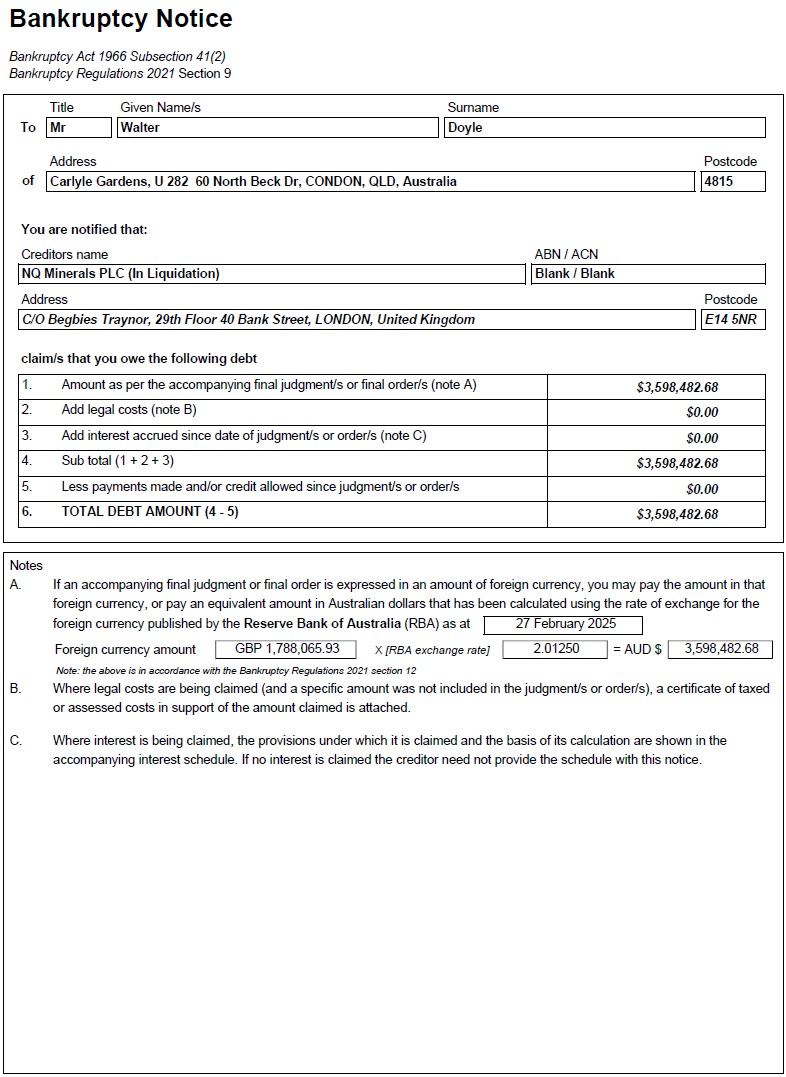
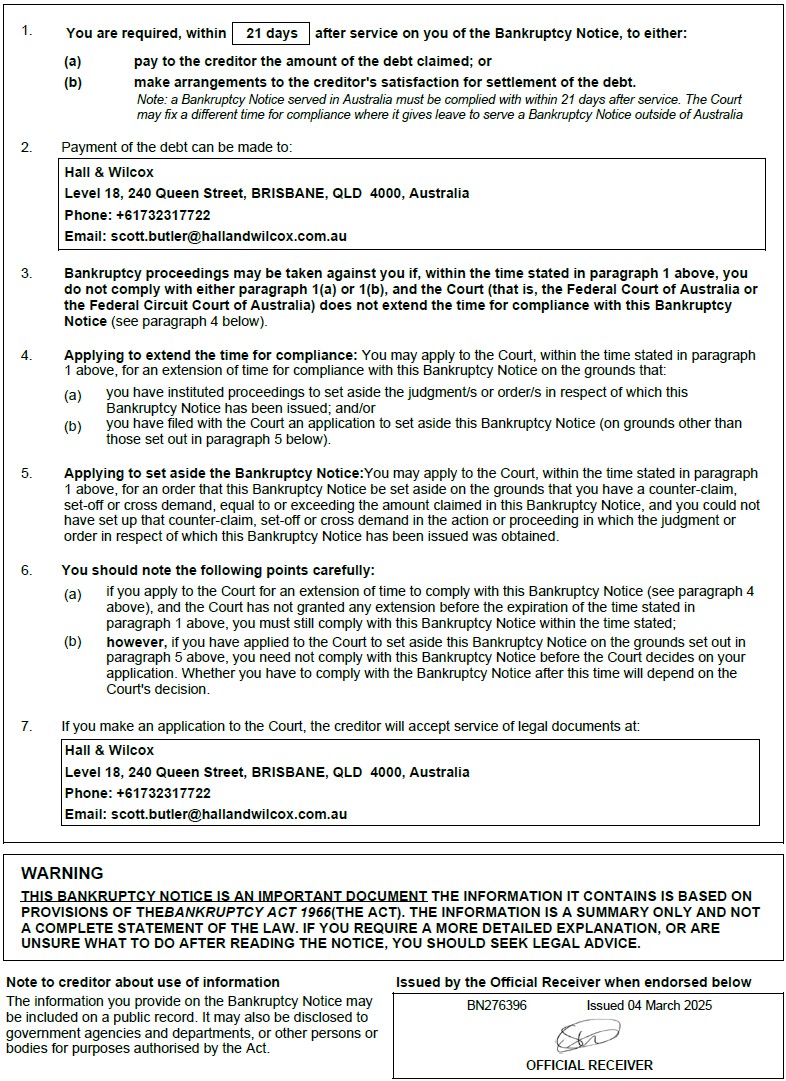
14 On 6 May 2025 the Liquidators made an application in the Federal Court of Australia for substituted service of the Bankruptcy Notice on Mr Doyle. On 21 May 2025 Registrar Buckingham made the following orders:
1. Service of Bankruptcy Notice No BN276396 of 2025 to WALTER DOYLE (the respondent) together with a sealed copy of this order may be effected by the following means occurring on or before 28 May 2025:
(a) by pre-paid express post addressed to the respondent at Unit 282, 60 Beck Drive, Condon in the State of Queensland, 4815; and
(b) by pre-paid international express post addressed to the respondent at 16 Boulevard Princess Charlotte, 98000 Monaco; and
(c) by pre-paid express post addressed to the respondent at care of Intergroup Mining, Level 6, 9 Beach Road, Surfers Paradise in the State of Queensland, 4217; and
(d) by pre-paid international express post addressed to the respondent at care of Sarah Chambers of Maddox Legal, Octagon Point, 5 Cheapside, London EC2V 6AA; and
(e) by telephoning the mobile telephone number +61 400 664 177 and informing the person who answers of the order for substituted service, or alternatively, if the mobile telephone number is not answered, sending a short message service (SMS) to the mobile number and providing details of the order for substituted service; and
(f) by sending correspondence by email to the respondent at walter@intergroupmining.com and wd2020@icloud.com and to care of respondent at schambers@maddoxlegal.co.uk.
2. Service in accordance with this order shall be deemed good and sufficient service of the Bankruptcy Notice upon the respondent.
3. The Bankruptcy Notice shall be deemed to be served on the respondent on 5 business days after the last method of service provided for in order 1.
4. Costs of this application be reserved to the determination of any creditor’s petition based on this Bankruptcy Notice.
15 On 27 May 2025 Mr Doyle was served by email with the Bankruptcy Notice BN276396 dated 4 March 2025 issued on behalf of the respondents.
16 An email communication dated 23 June 2025 from Ms Georgia Gamble (annexed to Mr Adam James Carr’s 10 July 2025 affidavit) indicated that compliance with Order 1 of Registrar Buckingham’s Order was completed on 27 May 2025. Consequently, the Bankruptcy Notice was deemed to be served on Mr Doyle 5 business days after that date.
The Application before the Court
17 In his originating application before the Court Mr Doyle seeks the following relief:
Details of claim
Final Orders sought by Applicants
On the grounds stated in the accompanying affidavits, the Applicants claim:
1. That Bankruptcy Notice BN276396 dated 04 March 2025 issued on behalf of the Respondents and deemed to be served on 27 May 2025 (the Bankruptcy Notice) be set aside on the grounds that:
a. the Respondents have failed to comply with Rule 947M(1) of the Uniform Civil Procedure Rules 1999 (Qld) by not filing an affidavit of service of the Notice of Registration as required before enforcement of the registered foreign judgment, rendering the Bankruptcy Notice invalid under section 40(1)(g) of the Bankruptcy Act 1966 (Cth) (the Act); and
2. An injunction pursuant to section 30(1)(b) of the Act and section 23 of the Federal Court of Australia Act 1976 (Cth) restraining the Respondent from presenting a creditor's petition against the Applicant on the grounds that:
a. the Court would lack jurisdiction to make a sequestration order under section 43(1)(b) of the Act as the Applicant:
i. does not ordinarily resident in Australia;
ii. does not have a house or place of business in Australia;
iii. does not carry on business in Australia: and
iv. nor is he a member of a firm or partnership carrying on a business in Australia.
b. The Applicant has a counterclaim, set-off or cross demand pursuant to section 40(1)(g) of the Act.
c. Alternatively, the debt claimed in the Bankruptcy Notice is not owing and presenting a creditor's petition would constitute an abuse of process where the Respondent knows or ought to know the debt is genuinely disputed on substantial grounds.
3. An order that the respondents pay the costs of this application.
4. Such further or other order as the Court deems appropriate.
Interim Orders sought by Applicants
5. That pursuant to section 41(6A) of the Act and rule 3.03(4) of the Federal Court (Bankruptcy) Rules 2016, the time for compliance with the Bankruptcy Notice be extended to the first directions hearing in this proceeding.
6. Such further or other order as the Court deems appropriate.
Para 1: Failure to serve notice of registration of foreign judgment
The parties’ submissions
18 In relation to para 1 of his originating application, Mr Doyle submitted that:
Under s 41(3)(b) of the Bankruptcy Act 1966 (Cth) (Bankruptcy Act), a bankruptcy notice shall not be issued to a debtor, if at the time of the application for the issue of the bankruptcy notice, execution of a judgment or order to which it relates has been stayed. Here, the Registered UK Judgment was essentially stayed because it was not capable of immediate enforcement. The notice of registration of foreign judgment had not been validly served on Mr Doyle, which means the Registered UK Judgment cannot be enforced immediately. Mr Doyle has not committed any acts of bankruptcy because the relevant judgment on which the Bankruptcy Notice was premised is stayed.
Rule 947J of the Uniform Civil Procedure Rules 1999 (Qld) (UCPR) provides that a judgment creditor must, within 28 days from registration of a foreign judgment, serve a notice of registration of the judgment on the judgment debtor. Rule 947K(1) of the UCPR further details that the person who serve the notice of registration must, within 3 days of service, write on the duplicate notice, or a copy of the notice, the day of service and the way in which the notice was served. A judgment creditor cannot enforce a judgment unless r 947K(1) has been complied with: UCPR r 947K(2). The service referred to in r 947K must be lawful and valid service, and not simply the day of purported service where that purported service was not lawful or valid.
The affidavit of Ms Gamble affirms that the respondents rely on the sending of the notice of registration to the Monaco address as the lawful and valid method of service. Service on the Monaco address is not good in law as r 129C(1) of the UCPR required the respondents to obtain leave of the Supreme Court to serve the notice on Mr Doyle outside of Australia, which they did not.
Where the rules of the Court that issued the relevant judgment (here the Supreme Court of Queensland) require leave of the Court for a warrant of execution to issue, the judgment creditor is not in a position to effect immediate execution of the relevant judgment: Reasonable Endeavours Pty Ltd v Dennehy (2001) 107 FCR 144 at [27]. The judgment creditor “ha[s] to be a person who ha[s] taken all steps which entitled [them] to reap the fruits of the judgment.”: Cawood v Cawood, in the matter of Cawood (2000) 27 Fam LR 403 at [18] – [20].
By the Foreign Judgments Act, the Queensland Supreme Court is the rule-making authority in respect of the registration of the UK Judgment as if it were its own judgment, and the UCPR applies as an exercise of the Queensland Supreme Court’s rule making authority, prohibiting enforcement unless certain steps have been taken. Rules 947J(1), 947K(2) and 947M(1) impose express requirements and, by use of the words “must” and “must not”, are mandatory. Unless and until they are complied with, the respondents are unable to issue execution on the judgment.
The respondents’ purported service by way of email to Mr Doyle was unlawful and invalid. Rule 112(1)(e) of the UCPR only permits a document to be served by email “if the person has given … an email address under [the UCPR]”. Mr Doyle has not given an email address under the UCPR.
As Mr Doyle was and is situated overseas and outside of Queensland, leave was required to serve him under r 129C of the UCPR. Rule 129D of the UCPR makes clear that the requirement of personal service does apply, but is only disapplied “as long as it is served on the person in accordance with the law of the country in which service is effected”. In any event, the respondents have not demonstrated that, irrespective of leave, service was effected in accordance with the laws of Monaco.
19 In relation to ground 1, the respondents submit that:
The UK Judgment, as registered pursuant to orders of Bowskill CJ, has not been stayed. It follows that the judgment debt was a judgment of the kind described in s 40(1)(g) of the Bankruptcy Act. The judgment debt became payable immediately upon registration by the Queensland Supreme Court: R v Williams [2010] NTSC 74 at [6].
The issuing of a bankruptcy notice is not one governed by ch 20A pt 2 of the UCPR as it is not a form of judgment execution; rather, “it is directed to the estate of a person who is insolvent”: Culleton v Balwyn Nominees Pty Ltd (2017) 343 ALR 632 at [40].
Alternatively, to the extent that ch 20A pt 2 of the UCPR is relevant, it has been complied with by the respondents. To that end, the notice of registration of the judgment was served on Mr Doyle pursuant to r 947J of the UCPR. Service of that notice did not require personal service under the UCPR: UCPR r 112. Pursuant to r 112(1)(e) of the UCPR, service by email was sufficient service. Following that sufficient service, the respondents’ then solicitors endorsed a duplicate notice of registration pursuant to r 947K of the UCPR and filed an affidavit of service pursuant to r 947M.
While Mr Doyle contends that r 947M(1) of the UCPR has not been complied with by reason of non-compliance with r 947K(1), the fact remains that the text of r 947M(1) itself has been complied with. An affidavit of service has been filed with the Court.
In addition, the respondents have complied with, or alternatively, have substantially complied with r 947K(1). It follows that the UK Judgment is capable of execution.
The respondents do not solely rely on service by way of post to the Monaco address, but also by email to Mr Doyle. The fact that an invalid method of service was also endorsed on the duplicate notice does not invalidate an effective method of service that was also endorsed.
The purposive construction of the UCPR, which is plainly to make the debtor aware of the registration of a judgment against them, has been achieved. Mr Doyle was made aware of the registration, such that he could apply to set it aside within a prescribed timeframe.
In the alternative, even if there was non-compliance with r 947M(1) of the UCPR, and that non-compliance is relevant to the validity of the bankruptcy notice, it would be an irregularity, rather than something which renders the notice a nullity.
The effect of s 306 of the Bankruptcy Act is that any such irregularity does not invalidate the Bankruptcy Notice. The High Court has settled that s 306 of the Bankruptcy Act can apply to an irregularity in a bankruptcy notice: Adams v Lambert (2006) 228 CLR 409 at [16]-[18]. One must consider whether the defect is a formal defect or irregularity and then, whether substantial injustice has been caused and cannot be remedied. At its highest, Mr Doyle’s complaint is that the respondents’ then solicitors wrote an invalid date and method of service on the duplicate notice of registration. That would be so in circumstances where valid service was still effected by email to Mr Doyle, and Mr Doyle was aware that the UK Judgment had been registered.
There is no substantial injustice to Mr Doyle that would preclude reliance upon s 306 of the Bankruptcy Act. That is especially so where Mr Doyle admits he received Ms Gamble’s email and chose not to apply to set aside the registration of the UK Judgment by the Queensland Supreme Court.
Consideration
Was personal service required?
20 Following the registration of the UK Judgment in the Queensland Supreme Court, it was a “final judgment” within the meaning of s 40(1)(g) of the Bankruptcy Act. Rule 947J of the UCPR provides that:
(1) The judgment creditor under a registered judgment must, within 28 days from registration of the judgment or the period as extended by the court, serve notice of registration of the judgment on the judgment debtor.
(2) The notice must be in the approved form.
21 The text of r 947J merely requires that the notice of registration be “serve[d]” on the judgment debtor. Rule 112 of the UCPR states, relevantly, that:
(1) If these rules do not require personal service of a document, the following are ways by which the document may be serviced on the person to be served –
…
(d) posting it to the relevant address
(e) if the person has given—
…
(ii) an email address under these rules—emailing the document to the person;
…
(3) In this rule —
"relevant address", of a person to be served, means—
(a) the person’s address for service; or
(b) for an individual who does not have an address for service—
(i) the individual’s last known place of business or residence; or
(ii) if the individual is suing or being sued in the name of a partnership—the principal or last known place of business of the partnership; or
(c) for a corporation that does not have an address for service—its head office or its principal or registered office.
22 It follows that, as r 947J of the UCPR does not expressly require personal service, ordinary service of the notice of registration of judgment is sufficient. That conclusion is supported by the fact that other civil procedure rules expressly do require personal service of a notice of registration of judgment: see for example Uniform Civil Procedure Rules 2005 (NSW) r 53.6. I am satisfied that the legislature did not intend for personal service of a notice of registration to be required in Queensland.
Was service validly effected?
23 Rule 947M of the UCPR provides that:
947M Enforcement of judgment
(1) A judgment creditor who wishes to enforce a registered judgment must file with the registrar—
(a) an affidavit of service of the notice of registration of the judgment; and
(b) all orders made by the court in relation to the judgment.
24 Rule 120 of the UCPR prescribes the requirements for an affidavit of service in the ordinary course. Additional requirements for an affidavit of service filed pursuant to r 947M are outlined in r 947K of the UCPR. Relevantly, r 947K requires that a duplicate or copy of the notice of registration have written on it “the day of service” and “the way in which the notice was served”, and that the affidavit of service state the day on which that information is written down. Counsel for Mr Doyle submitted, and I agree, that “service” in r 947K refers to lawful and valid service. Any other interpretation of r 947K would render it obsolete.
25 When the proceeding came before me for closing submissions in December 2025, the respondents primarily relied on two methods of service that, in their submission, were valid and effective. The two methods of service relied on by the respondents are service by post to the Condon address, and service by email. Counsel for the applicant submitted that both of those methods were invalid and unlawful.
26 The respondents submitted, and I agree, that only one method of service of the notice of registration need be valid and lawful for service to have been effective. The fact that other methods of purported service were noted on the duplicate notice signed by Ms Gamble would not invalidate a lawful method of service. It follows that if I am satisfied that any of the methods of purported service attempted by Ms Gamble on behalf of the respondents were valid and lawful, service will have been validly effected for the purposes of r 947J of the UCPR.
27 Turning to the purported service on Mr Doyle by way of post to the Condon address, I am satisfied, for the following reasons, that this method of service was both valid and lawful.
Mr Doyle’s last known address
28 The Condon address was a “relevant address” of Mr Doyle for the purposes of r 112(3) of the UCPR as it was Mr Doyle’s “last known place of business or residence”. In the UK Proceedings, Mr Doyle filed a witness statement dated 31 August 2023 (Witness Statement) which opened with the text “I, Walter Doyle, of [Condon address]…”. Under the rules of civil proceedings in the High Court of England and Wales, a witness statement must state the witness’s
“… place of residence or, if he is making the statement in his professional, business or other occupational capacity, the address at which he works, the position he holds and the name of his firm or employer …”
(para 18.1, Practice Direction 32, Civil Procedure Rules 1998 (UK) SI 1998/3132)
29 Mr Doyle was represented by UK legal practitioners at the time of the making of his Witness Statement. I consider it likely that he would have been informed by them of the UK Court’s requirements relating to the address he provided in his Witness Statement.
30 Furthermore, in the UK Judgment dated 7 November 2024, the Court relevantly ordered:
9. The Applicants shall serve a copy of this Order on [Mr Doyle] as follows:
a. at U 282, 60 Beck Drive, Condon, 4815, Australia;
b. by email where it is known and the email address will serve the Respondent in the jurisdiction.
31 Moreover, during cross-examination of Mr Doyle in this proceeding, a scanned copy of Mr Doyle’s Queensland driver’s licence, which was current at the time of the hearing, was shown to him by Mr Walpole, after which the following exchange ensued:
And I will just ask my instructor to scroll down, so you can see both sides, and you see the address recorded there, Mr Doyle?---Yes.
And it’s the address in Condon?---It is.
And why did you give this address?---Because it’s my most consistent Australian mailing address prior to back, prior, I used my parent’s address for the first 30, 40 years, until they passed, and, since then, I’ve been using my brother’s address.
Even though you don’t reside there?---Correct.
Are you aware that you’re not eligible for a Queensland licence if you don’t reside in Queensland?---No. I’m not aware of that, actually.
Your Honour, I tender the document.


(personal details and identifying information redacted)
32 In view of the evidence, I am satisfied that, at least as at 13 January 2025, the Condon address was Mr Doyle’s last known place of business or residence. It follows that service on Mr Doyle of the notice of registration by post to the Condon address was valid and lawful.
33 The respondents’ evidence demonstrates that Ms Gamble wrote on a duplicate of the notice of registration of the UK Judgment the method of service on Mr Doyle at the Condon address, and an affidavit of service was filed in the Queensland Supreme Court: Exhibit 23(r). It is apparent from Exhibit 23(r), being Ms Gamble’s affidavit of service dated 6 February 2025, that the main method of purported service relied on was that by post to the Monaco address. The fact that Ms Gamble apparently at that time thought service at the Monaco address was most likely to be valid service does not vitiate her affidavit being one in compliance with the UCPR. The fact remains that the affidavit deposes to the respondents having effected service on Mr Doyle by multiple ways, including by post to the Condon address, in compliance with r 120(1)(b) of the UCPR. Compliance with r 120(1)(b), in conjunction with the evident compliance with r 947K(1) and (3) in Ms Gamble’s affidavit, is sufficient to satisfy the requirements of r 947M(1) of the UCPR.
Conclusion
34 It follows that the respondents complied with the requirements of the UCPR in serving the notice of registration of a foreign judgment on Mr Doyle, and, necessarily, that ground 1 is not substantiated.
35 For the above reasons, it is not necessary to decide the question raised by the respondents as to whether ch 20A pt 2 of the UCPR applies in the instant proceeding. It is also not necessary to decide whether the other methods of service were valid.
Para 2(A): Jurisdiction of this Court
36 Section 43 of the Bankruptcy Act relevantly provides:
43 Jurisdiction to make sequestration orders
(1) Subject to this Act, where:
(a) a debtor has committed an act of bankruptcy; and
(b) at the time when the act of bankruptcy was committed, the debtor:
(i) was personally present or ordinarily resident in Australia;
(ii) had a dwelling‑house or place of business in Australia;
(iii) was carrying on business in Australia, either personally or by means of an agent or manager; or
(iv) was a member of a firm or partnership carrying on business in Australia by means of a partner or partners or of an agent or manager;
the Court may, on a petition presented by a creditor, make a sequestration order against the estate of the debtor.
37 Paragraph 2(a) of the originating application pleads that the Court has no jurisdiction to make a sequestration order against Mr Doyle because of a want of compliance with s 43(1)(b) of the Bankruptcy Act, and accordingly the Court should grant an injunction restraining the respondents from presenting a creditor’s petition against Mr Doyle.
Interlocutory or permanent injunction sought?
38 Before examining the jurisdictional issues, a threshold question appears to arise on the submissions of the applicant for determination by the Court. In his written submissions dated 26 September 2025, Mr Doyle submitted that he sought an “interlocutory injunction” restraining the respondents from presenting a creditor’s petition without first obtaining the leave of this Court to do so. However this submission is inconsistent with the originating application which describes the injunction sought by ground 2(a) as a “final order” pursuant to s 23 of the Federal Court of Australia Act 1976 (Cth) (FCA Act), as well as s 30(1)(b) of the Bankruptcy Act which empowers the Court to make:
… such orders (including declaratory orders and orders granting injunctions or other equitable remedies) as the Court considers necessary for the purposes of carrying out or giving effect to this Act in any such case or matter.
39 Plainly the considerations for the Court in determining whether to grant an interlocutory injunction are different from those the Court should consider in assessing whether a permanent injunction ought to be granted.
40 In relation to interlocutory injunctions, I note the criteria explained by the High Court in Australian Broadcasting Corporation v O’Neill [2006] HCA 46; (2006) 227 CLR 57, namely that in considering whether interlocutory relief should be granted, it is appropriate for the primary Court to give consideration to such factors as:
whether the applicant has established a prima facie case, namely a sufficient likelihood of success to justify the preservation of the status quo pending the trial;
whether damages are an adequate remedy; and
where lies the balance of convenience.
(see also for example StarTrack Express Pty Ltd v TMA Australia Pty Ltd [2023] FCAFC 200 at [50]-[57], National Road Transport Association Ltd v Road Safety Remuneration Tribunal [2016] FCAFC 56 at [15]).
41 On the other hand, the grant of a permanent restraining injunction pursuant to s 23 of the FCA Act and s 30(1)(b) of the Bankruptcy Act is, by reference to the terms of those statutes, dependent on the discretion of the Court and referable to the application of equitable principles, including, inter alia:
whether the plaintiff has a legal right of proprietary nature which has been infringed or is under threat of infringement;
whether the infringement is likely to continue or to be repeated without a restraining order;
whether the future doing of the thing sought to be restrained would produce an injury to the plaintiff seeking the injunction;
the adequacy of available alternative legal remedies to the plaintiff, including damages; and
the justice of the case.
(See Doherty v Allman [1878] 3 App Cas 709; Mason J in Dalgety Wine Estates Pty Ltd v Rizzon (1979) 141 CLR 552 at 573-574; Woolley v Dunford (1972) 3 SASR 243 at 298-299; Lucas Stuart Pty Ltd v Hemmes Hermitage Pty Ltd [2010] NSWCA 283 at [3]-[10]; Midland Brick Company Pty Ltd v Welsh [2006] WASC 122 at [409]-[411]; TSG Franchise Management Pty Ltd v Cigarette & Gift Warehouse (Franchising) Pty Ltd (No 2) [2016] FCA 674 at [109]-[110].)
42 In written submissions dated 6 October 2025, handed up in court on 8 October 2025 and filed on 8 January 2026 (Reply Submissions), Mr Doyle referred to “interim relief sought by Mr Doyle [as] directed only to precluding the respondents from proceeding to present a petition unless and until they can establish the jurisdictional facts under s 43(1) as a precondition to further vexing Mr Doyle” (at [20]). However, the proposition that Mr Doyle was seeking permanent relief in respect of paras 1-4 of his originating application, as distinct from interlocutory relief, is consistent with:
his written submissions filed on 12 December 2025, which made no reference to the relief sought being interlocutory;
his submission at [21] of the Reply Submissions, namely:
21. Further, the requirement for such an undertaking does not apply in respect of Mr Doyle’s alternative application for a final perpetual injunction, which seeks to restrain the presentation of a petition for a sequestration order on the grounds that no Australian bankruptcy court would have jurisdiction under s 43(1) of the Bankruptcy Act by reference to the Bankruptcy Notice premised as it is on the Registered UK Judgment.
(footnote omitted)
the manner in which Mr Doyle conducted his case in the hearing before me – namely, without any reference to the injunction sought being interlocutory or to the criteria required for the grant of interlocutory relief, but instead with reference to substantive issues relating to Mr Doyle’s connection with Australia; and
the fact that the originating application only describes paras 5 and 6 as “Interim Orders sought by Applicants”.
43 In the circumstances of the case, I will consider para 2(a) of the originating application as an application for a permanent injunction.
The date by reference to which the Court’s jurisdiction is to be assessed
44 As evidenced by the language of s 43(1)(b), plainly an issue to be determined by the Court is whether Mr Doyle has committed an act of bankruptcy within the meaning of s 40(1) of the Bankruptcy Act, and if so, the date on which Mr Doyle committed that act of bankruptcy. The only relevant paragraph in s 40(1) of the Bankruptcy Act for present purposes is s 40(1)(g) which provides:
(g) if a creditor who has obtained against the debtor a final judgment or final order, being a judgment or order the execution of which has not been stayed, has served on the debtor in Australia or, by leave of the Court, elsewhere, a bankruptcy notice under this Act and the debtor does not:
(i) where the notice was served in Australia—within the time fixed for compliance with the notice; or
(ii) where the notice was served elsewhere—within the time specified by the order giving leave to effect the service;
comply with the requirements of the notice or satisfy the Court that he or she has a counter‑claim, set‑off or cross demand equal to or exceeding the amount of the judgment debt or sum payable under the final order, as the case may be, being a counter‑claim, set‑off or cross demand that he or she could not have set up in the action or proceeding in which the judgment or order was obtained;
45 As Judge Manousaridis observed in Kuhadas v Gomez [2014] FCCA 1130:
19. A person in Australia is made bankrupt when a court makes a sequestration order under s.52(1) of the Bankruptcy Act 1966 (Cth) (Act). Before a court can make a sequestration order, it must be satisfied the person against whom it is sought has committed one of the “act[s] of bankruptcy” defined in s.40(1) of the Act.
20. One act of bankruptcy is defined in paragraph (g) of s.40(1) of the Act. That paragraph applies to persons who are judgment debtors; that is, persons against whom a final judgment for an amount of money has been obtained in a court. A judgment debtor commits an act of bankruptcy if he or she fails to comply with a bankruptcy notice issued under the Act demanding payment of the amount of the debt recorded in, or to be more accurate, constituted by the judgment.
21. The reason s.40(1)(g) of the Act requires that it be a judgment debt rather than some other debt which the debtor must fail to pay before the court can be satisfied a person has committed an act of bankruptcy is the nature of a judgment debt: a judgment debt “creates an obligation of its own force” and “for most purposes as between the parties, it is conclusive evidence of the existence of the obligation which it creates”. In other words, a judgment debt constitutes the highest proof of a debt that can be obtained, and thus provides the surest grounds for inferring a judgment debtor’s inability to pay his or her debts when the judgment debtor does not pay the judgment debt in response to a bankruptcy notice issued under the Act.
…
31. In my opinion, when an order is made under s.6 of the FJ Act to register a foreign money judgment, once registered, the foreign judgment becomes a judgment debt of the court in which it is registered. The judgment debt so created is no different from any other judgment debt that is entered in a court in Australia. At common law, a money judgment of a foreign court (as, indeed, a money judgment of a municipal court) could have been recovered in an action for debt. The foreign judgment was a “pre-existing obligation” which the judgment based on it was “intended to enforce”; and, when a judgment based on it was entered, thereby creating “an obligation of its own force”, the pre-existing obligation “merge[d] in the new obligation so created”. The same analysis applies to a foreign judgment registered under the FJ Act. Before registration, the foreign judgment is a pre-existing obligation that could found an application for an order under s.6 of the FJ Act. After registration, that obligation is merged to the obligation that arises under s.6(7) of the FJ Act when the foreign judgment is registered.
(footnotes omitted)
46 In this case, the act of registration of the UK Judgment merged:
an obligation to pay a debt that arose at general law but was not backed by the coercive powers of an Australian Court (namely the judgment debt imposed on Mr Doyle by the UK Judgment), with
an obligation to pay a judgment debt under Australian law, backed by the coercive powers of the Supreme Court of Queensland, that was created following that Court’s registration of the UK Judgment.
47 This merged obligation is the basis on which the Bankruptcy Notice is founded. Noting my earlier findings on the service issue, Mr Doyle has not established any grounds on which the Bankruptcy Notice may be invalidated or set aside. Accordingly, any failure on the part of Mr Doyle to comply with the Bankruptcy Notice dated 4 March 2025 (set out earlier in this judgment) would amount to an act of bankruptcy unless Mr Doyle establishes a counter-claim, set-off or cross demand in the way required by s 40(1)(g) of the Bankruptcy Act.
48 The parties agreed that the final date for compliance with that Bankruptcy Notice was 25 June 2025.
49 There is no evidence that Mr Doyle has complied with the Bankruptcy Notice on or before that date. Hence, subject to the discussion below about the counterclaim and abuse of process issues, I am satisfied that Mr Doyle has committed an act of bankruptcy on 25 June 2025 by failing to comply with the Bankruptcy Notice on that date. For that reason, the date by reference to which the Court’s jurisdiction must be assessed is 25 June 2025.
Onus of proof
50 It is not in dispute that the respondents bear the onus of proof that Mr Doyle had the requisite connection with Australia required by s 43(1)(b) of the Bankruptcy Act on 25 June 2025.
51 The respondents submitted that the Court has jurisdiction to make a sequestration order either on the basis that Mr Doyle was ordinarily resident in Australia (s 43(1)(b)(i)) or that he was carrying on a business in Australia (s 43(1)(b)(iii)) on that date. It is convenient to consider these grounds separately.
Was Mr Doyle ordinarily resident in Australia for the purposes of s 43(1)(b)(i) Bankruptcy Act at the time of the act of bankruptcy?
The parties’ submissions
52 In respect of this question, Mr Doyle submitted in summary as follows:
A debtor may be ordinarily resident in more than one country at a time. Accordingly, even if it were established that Mr Doyle was ordinarily resident in Monaco, the result of that inquiry cannot and does not determine whether Mr Doyle is, in any event, ordinarily resident in Australia.
Mr Doyle gave evidence to the effect that he has no residence in Australia.
The only evidence adduced by the respondents to establish that Mr Doyle was ordinarily resident in Australia as at 25 June 2025 is a copy of the Witness Statement dated 31 August 2023 and filed by Mr Doyle in the UK Proceedings. The nomination by Mr Doyle of the Condon address in that Witness Statement is not determinative of his place of ordinary residence, but merely his place of residence at the time of swearing the Witness Statement. Even if Mr Doyle was resident at the Condon address on 31 August 2023, the UK Judgment was dated 31 October 2024, and the orders of the Supreme Court registering the UK Judgment were made on 19 November 2024 (with the notice of registration of foreign judgment being dated 13 January 2025). There is no evidence that Mr Doyle was ordinarily resident at the Condon address on any of those dates.
53 The respondents submitted in summary as follows:
Mr Doyle was not a credible witness in respect of his residential address.
Whether a debtor is ordinarily resident in Australia is a question of fact and degree based upon the totality of the evidence. A debtor may be ordinarily resident in more than one country at a time.
The address given by Mr Doyle in the present proceeding as his residential address was the address for a hotel in Monaco. However it appeared by the time of the hearing that he no longer had a permit to live in Monaco. Previously in the UK Proceedings, Mr Doyle gave his address as one in Condon, Queensland.
Consideration
Mr Doyle’s credit
54 I consider that Mr Doyle was not a credible witness, such that where he denied either residency in Australia or (as will be discussed later) doing business in Australia, I am not minded to accept his evidence. In particular I note:
Mr Doyle did not satisfactorily explain why he had a Queensland driver’s licence nominating the Condon address as his residential address, while at the same time denying that he had a residential address in Australia. I note that the nomination of a residential address for the purposes of a driver’s licence in Queensland is a serious matter, such that a change of address must be notified within 14 days, and that failure to do so constitutes an offence: r 363 Transport Operations (Road Use Management – Driver Licensing) Regulation 2021 (Qld).
Mr Doyle’s denial, under oath, that he was a director of any companies in Australia after 20 June 2025 (transcript 8 October 2025 pp75-76), when in closing submissions several months later he conceded through counsel that he continued to be a director of “some” of them (transcript 17 December 2025 p14).
Although Mr Doyle submitted that he did not come to Australia in connection with his fundraising business (transcript 17 December 2025 p36 lines 1-2), he gave the following evidence under cross-examination on 8 October 2025:
Mr Doyle, you just mentioned there were two categories of work you were doing: speaking to fundraisers or potentially introducing fundraisers to the company; correct?---Yes.
When did you last speak to a fundraiser for the purpose of raising capital for InterGroup Mining or Direct Energy Proprietary Limited?---Indirectly ..... like recently, like last week. In other words, I coordinated an introduction to the directors and consultants that work for the company. I didn’t speak to them directly myself, though.
How did you do that?---Not yet, anyways.
How did you do that, Mr Doyle?---By – that’s a good question. The – initially by introducing the – suggesting to the introducer of the funder to introduce the funder to one of the consultant’s directors, and then subsequently some direct communication with the director about that funder. But then I haven’t spoken directly to the funder myself. That may happen now.
And you’ve been remunerated for these services you’re providing?---Sporadically, yes.
How?---..... primarily reimbursement of expenses, but – in other words, cash.
And when did you last receive a cash payment from one of these companies?---Probably a couple of months ago.
And you said that primarily through reimbursement of expenses. Have you made claims for reimbursement of expenses more recently?---No.
How does it work, then? How are you – you how does the process work for you being reimbursed?---The – there’s no formal process per se. The – but if there’s successful investment that is tied back to myself, I can generally claim a fee on that investment, which includes the reimbursement of expenses.
And you claim that fee personally?---Usually, yes.
And you’re paid by the company into one of your personal bank accounts?---Usually, yes.
(transcript 8 October 2025 p25 lines 6-43)
Earlier that day Mr Doyle, who was giving evidence from Dubai, stated:
And where are you located today, Mr Doyle?---In Dubai.
Are you in a hotel?---Correct.
Which hotel?---It’s called the Palace Downtown.
And when did you check into the hotel?---About a week ago. A bit less. Six days ago.
And how long is your booking for?---About 10 days. A week, 10 days.
And you said you checked in about six days ago. Were you in Dubai before then?---No. I was in Australia for about a week.
Where in Australia, Mr Doyle?---Primarily Gympie, in Queensland, north of Brisbane.
(transcript 8 October 2025 p4 lines 20-35)
The appropriate inference to draw from this evidence was that, a week before Mr Doyle gave his evidence on 8 October 2025, he had been present in Australia to do business, referable to the Australian companies InterGroup Mining or Direct Energy Proprietary Limited.
Monaco and Dubai
55 There is little evidence on the part of Mr Doyle as to where he actually was ordinarily resident. In his affidavit dated 23 July 2025, he deposed that he resided at 16 Bld Princess Charlotte Monaco 98000, and that he had a “current address in Monaco”. However, during cross-examination he gave the following evidence:
MR WALPOLE: Mr Doyle, so I’m just going to read now from paragraph 33 of your first affidavit in this proceeding, and then I will ask you a question about it. I will tell you when I’m finished reading the quote. I – the quote starts:
I am not a resident and do not ordinarily reside in Australia. I don’t have a property or place of business in Australia. I currently hold a French visa and reside at 16 Boulevard Princesse Charlotte, Monaco, 98000.
When you say in that paragraph “reside”, you mean that that is your residence, but you’re saying you’re not a resident of Monaco?---Not at all. I’m saying I was residing there at the time. So what? You don’t need to be a resident to reside somewhere.
Mr Doyle, you’re an Australian citizen, aren’t you?---Correct.
Are you a citizen of any other countries?---No.
…
Are you aware there is a requirement to hold a residence permit to reside in Monaco?
MR DOUGLAS: I object to that.
THE WITNESS: Yes, which I had for 14 years.
MR WALPOLE: So you said you had it for 14 years. You no longer have such a permit?---Correct.
When did you cease to hold that permit?---End of ’23.
Are you aware that you had to demonstrate financial self-sufficiency to reside in Monaco – or to – sorry. I withdraw that – to be a resident of Monaco?---Correct.
How did you do that?---Yes. Well, when I first moved there 15 years ago, the requirement was A$500,000, 300,000-odd euro. The financial commitment is not an actual payment. It’s a deposit in a local bank, and it doesn’t have to be cash. It can be equity, and, at that time, I had equity in different public companies. So that’s the extent of the financial requirement. That has changed, obviously. Now, it’s, like, two or three million is the minimum. But I was grandfathered from original.
And you’ve told me that you ceased to have a residence permit at the end of 2023?---Yes.
Did you then cease to comply with that requirement?---I ceased prior to that because I ran out of money. So that – it became, basically, a default situation. It was only a matter of time before I couldn’t renew. Ran out of money and equity, so there was no ability to renew it for longer.
(transcript 8 October 2025 pp8-10)
(emphasis added)
56 In light of that evidence, in particular Mr Doyle’s lack of a residency permit in Monaco from the end of 2023, I consider that Mr Doyle cannot claim that he was ordinarily resident in Monaco on 25 June 2025. Notwithstanding that Mr Doyle had apparently conducted business in the United Kingdom, there is also no evidence that he was ordinarily resident in the United Kingdom as at 25 June 2025.
57 Mr Doyle gave evidence from Dubai on 8 October 2025. He gave evidence under cross-examination that he had a one-year visa to reside in Dubai commencing on 5 May 2025. He also gave the following evidence:
MR WALPOLE: All right. Mr Doyle, I just want to ask you some questions about the residence permit that’s attached to that email. So I will just ask my instructor to scroll down, so we can see – and, Mr Doyle, there’s two – there are – there’s an expiry date for this document that says 4 May 2026; correct?---That’s what it says.
And there’s another date on the right – the right of that, that says 5 May 2025?---Yes. Yes.
Is that - - -?---Issue date.
Yes. Is that when you obtained it, Mr Doyle?---Correct. That’s the issue date.
So you obtained this permit before you swore your affidavits in this proceeding?---You would have to remind me of the dates of the affidavit.
Of course?---If they don’t match, then it’s possible.
Okay. The dates of your affidavits are 23 June and 23 July this year?---Then I would say it’s – well, what was your question?
My - - -?---Then, obviously, the dates don’t match, so, obviously, yes, I think is the answer to your question.
I will just ask it again, so you can be clear on your answer. You obtained this permit before you swore the two affidavits, one on 23 June and one on 23 July?---It appears that way. Yes.
Why isn’t this document referred to in your affidavit?---Well, to which question? Are you referring back to the residing question? If so, I was, at the time, residing in Monaco, not Dubai.
But you had a residence permit for the UAE?---Yes. But I wasn’t in the UAE. I wasn’t here. So I don’t know what to tell you, but I wasn’t here. So - - -
But you were planning to move to the UAE?---Well, what’s your definition of moving? I mean, I don’t move – intend to move anywhere. I move enough. A – it is – a residence card doesn’t require myself to be a resident. I can stay or go. I don’t intend to live here. It’s too bloody hot, for number 1.
What are the requirements to obtain a residence permit in the UAE, that you are aware of?---That’s a very long story, because there’s so many different types. But in this instance, it’s – the – the requirement was the formation of a company, which is right there, Pentland Holding, and an employment agreement with that company.
And why did you obtain this residence permit?---That’s also a long story. The – we have a – I don’t have, but an associate has a company in the UK, which had entered into agreements to raise money with a group out of the UAE. A requirement of that agreement was that a UAE company be set up to facilitate that agreement, and so that’s what was done, and, of course, along with the company set up, the – these policy documents would be done. A permission to reside.
(transcript 8 October 2025 pp16-17)
58 The effect of the above evidence was that Mr Doyle:
claimed to be residing in Monaco at the time of his act of bankruptcy (notwithstanding his lack of a residency permit),
had a visa permitting him to reside in Dubai for one year, effective 5 May 2025,
affirmed his affidavit of 23 June 2025 in Dubai,
gave evidence in this proceeding from Dubai on 8 October 2025, but
had no intention of permanently residing in Dubai because of his difficulties in obtaining residency and acclimatising to the weather in Dubai.
Applicable principles
59 Where a person is ordinarily resident is a question of fact. If a person’s ordinary residence is in Australia, a merely temporary absence would not prevent him or her being “ordinarily resident in Australia”.
60 As the learned authors of Australian Bankruptcy Law and Practice explain:
[43.1.15] Section 43(1)(b)(i): “ordinarily resident:
“Ordinarily resident” is not a technical term and has its ordinary English meaning: Re Taylor; Ex parte Natwest Australia Bank Ltd (1992) 37 FCR 194 at 197 (Lockhart J). Whether the debtor is ordinarily resident in Australia is a question of fact and degree, depending on whether Australia is his or her “settled and usual place of abode”: Inland Revenue Commissioners v Lysaght [1928] AC 234 at 245; Re Vassis; Ex parte Leung (1986) 9 FCR 518; 64 ALR 407 at 524-525 (FCR)…. There must be “an element of permanence” and “some habit of life” about the debtor’s presence in Australia, as “contrasted with temporal or occasional residence”: Re Taylor; Ex parte Natwest Australia Bank Ltd… Where the debtor viewed him or herself as living at the relevant time “is an important factor in assessing his ordinary residency”: Restom Battenberg [2007] FCA 46 at [47] (Stone J)… Departure abroad with the intention to stay abroad for a substantial period can be enough to stop a debtor being ordinarily resident in Australia, unless there is some other factor, such as employment with an Australian State, Federal or Territory Government or company that maintains the debtor’s link with Australia during that period: Turner v Trevorrow (1994) 49 FCR 566….; see also Deputy Commissioner of Taxation v Cranswick (No 2) (2010) 189 FCR 287…
A person can be “ordinarily resident” in more than one place or country at the same time: Re Taylor… Cranswick….
61 I further note the following comments of McKerracher J in Deputy Commissioner of Taxation v Cranswick (No 2) [2010] FCA 1155 (Cranswick):
30. “Ordinarily resident in Australia” denotes some kind of habit. A person may be ordinarily resident in more than one place provided it is a place where he or she regularly and customarily lives (Re Taylor; Ex parte Natwest Australia Bank Ltd (1992) 37 FCR 194)…
62 Mr Doyle’s evidence draws a somewhat complex picture of his residential arrangements. I am satisfied that such evidence as is before the Court of Mr Doyle’s residency indicates that one place where Mr Doyle was ordinarily resident as at 25 June 2025 was Dubai (although Mr Doyle did not provide a specific Dubai address). However, and noting the point accepted by both parties that a person may be “ordinarily resident” in more than one place (see also Re Taylor; Ex parte Natwest Australia Bank Ltd (1992) 37 FCR 194 and Cranswick), I am satisfied that, as at 25 June 2025, Mr Doyle was also ordinarily resident in Australia, and specifically at the Condon address.
Queensland driver’s licence
63 First, I repeat my previous findings concerning Mr Doyle’s residential address as stated in his Queensland driver’s licence. Mr Doyle’s licence was current at the time of the hearing, and the residential address he nominated on that licence was the Condon address.
Mr Doyle’s address in the UK Proceedings and the requirements under the Civil Procedure Rules
64 Second, I note that, in the UK Judgment dated 7 November 2024, the Court relevantly ordered:
9. The Applicants shall serve a copy of this Order on [Mr Doyle] as follows:
a. at U 282, 60 Beck Drive, Condon, 4815, Australia;
b. by email where it is known and the email address will serve the Respondent in the jurisdiction.
65 The evidence before the Court was that, by the time the UK Judgment was delivered, Mr Doyle was no longer legally represented by his former lawyers Maddox Legal Limited. On 31 October 2024, the UK Court ordered that Maddox Legal Limited be removed from the court record (see Court Order annexed to affidavit of Gregory Roy McMahon dated 22 July 2025). Rule 42.3 of the Civil Procedure Rules 1998 (UK) SI 1998/3132 (Civil Procedure Rules) relevantly provides:
Order that a solicitor has ceased to act
42.3 (1) A solicitor may apply for an order declaring that he has ceased to be the solicitor acting for a party.
(2) Where an application is made under this rule—
(a) notice of the application must be given to the party for whom the solicitor is acting, unless the court directs otherwise; and
(b) the application must be supported by evidence.
(3) Where the court makes an order that a solicitor has ceased to act—
(a) a copy of the order must be served on every party to the proceedings; and
(b) if it is served by a party or the solicitor, the party or the solicitor (as the case may be) must file a certificate of service.
66 Practice Direction 42 under the Civil Procedure Rules issued on 1 October 2023 provides:
New address for service where order made under rules 42.3 or 42.4
5.1 Where the court has made an order under rule 42.3 that a solicitor has ceased to act or under rule 42.4 declaring that a solicitor has ceased to be the solicitor for a party, the party for whom the solicitor was acting must give a new address for service to comply with rules 6.23(1) and 6.24.
(Rule 6.23(2)(a) provides that a party must give an address for service within the United Kingdom or where a solicitor is acting for a party, an address for service either in the United Kingdom or any other EEA state.)
(Until such time as a new address for service is given rule 6.9 will apply.)
(emphasis added)
67 Rule 6.9 of the Civil Procedure Rules requires an individual defendant to be served at their usual or last known residence if the person does not give an address for service.
68 Rule 6.23 of the Civil Procedure Rules relevantly provides:
6.23 – Address for service to be given after proceedings are started
(1) Unless the court orders otherwise, a party to proceedings must give an address at which that party may be served with documents relating to those proceedings. The address must include a full postcode.
(2) Except where any other rule, practice direction or order makes different provision, a party’s address for service must be –
…
(c) where there is no solicitor acting for the party –
(i) an address within the United Kingdom at which the party resides or carries on business.
…
(3) When none of sub-paragraphs 2(a) or (c) applies, unless the court orders otherwise the party must give an address for service within the United Kingdom.
69 Two inferences are open on these facts. Either:
in compliance with these rules, after Maddox Legal ceased acting for him in the UK Proceedings, Mr Doyle sought an order from the UK Court nominating the Condon address, which was his residential address, as his address for service; or
in breach of these rules, Mr Doyle did not provide an address for service, and the Court ordered Mr Doyle to be served at his usual or last residential address known to the UK Court in accordance with rule 6.9.
70 Either of these possibilities support the proposition that Mr Doyle continues to be resident in Australia, at least until the end of 2024 or the start of 2025. There is no evidence before me to suggest that, after Maddox Legal ceased acting for Mr Doyle, he failed to receive any documentation referable to the UK Proceedings prior to the entry of default judgment against him. Certainly, insofar as I am aware, Mr Doyle has not sought to have the UK Judgment against him set aside for want of service on him. In any event, it appears that he had no address within the United Kingdom at which he resided or carried on business, and which he could nominate as his address for service in those proceedings.
Mr Doyle’s directorships and the requirements under the Corporations Act
71 Counsel for Mr Doyle conceded in closing oral submissions that Mr Doyle was a director of “some” Australian based companies, including at least Intergroup Mining, until “after 20 June [2025]”. I have also had the benefit of affidavit of Adam Richard Marsh dated 15 September 2025, which was read into the evidence unchallenged. This affidavit included, as annextures, ASIC database search results of various companies as at 2 September 2025.
72 Collectively, the evidence shows that, in respect of the following Australian companies as at 25 June 2025, Mr Doyle remained:
a director of ASSET CONSOLIDATION PTY LTD ACN 636726782;
a director of AXATAN PTY LTD ACN 603194967;
a director of CRYPTOFARM PTY LTD ACN 650400034;
a director of DIRECT ENERGY HOLDINGS PTY LTD ACN 163758156;
a director of ENERGY STORAGE PTY LTD ACN 607726358;
a director of EQUITY SPECIALISTS PTY LTD ACN 636727181;
a director of HEDGE TRADING PTY LTD ACN 636725561;
a director of INTERGROUP MINING LIMITED ACN 163989553;
a director of INTERGROUP NOMINEES PTY LTD ACN 632687944;
a director of JODO GOLD PTY LTD ACN 150427679;
the sole director of KAEVA PTY LTD ACN 635346851; and
a director of SELECTED VENTURES PTY LTD ACN 610564406.
73 Mr Doyle’s office as the sole director of Kaeva Pty Ltd is noteworthy. Section 201A of the Corporations Act 2001 (Cth) (Corporations Act) relevantly provides:
201A Minimum number of directors
Proprietary companies
(1) A proprietary company must have at least 1 director. That director must ordinarily reside in Australia.
…
…
(emphasis added)
74 The evidence before the Court indicates that Mr Doyle also continued to be the sole company secretary of Kaeva Pty Ltd until at least 2 September 2025, which is well after the date of his act of bankruptcy (Affidavit of Adam Richard Marsh dated 15 September 2025, p54). Section 204A of the Corporations Act provides:
204A Minimum number of secretaries
Proprietary companies
(1) A proprietary company is not required to have a secretary but, if it does have 1 or more secretaries, at least 1 of them must ordinarily reside in Australia.
…
(3) An offence based on subsection (1) or (2) is an offence of strict liability.
(emphasis added)
75 The evidence before me indicated that Kaeva Pty Ltd entered liquidation on 9 July 2023. Given that Mr Doyle was the sole director of that company at that time, replacing him as a director after that date may have been difficult. However, such speculation adds nothing to the case before me.
76 Under cross-examination, in response to a question by Mr Walpole for the respondents as to whether Mr Doyle was a director of a list of companies, he answered “No” in respect of Kaeva Pty Ltd (transcript 8 October 2025 p76 line 35). However, the ASIC search indicates that Mr Doyle continued to be the sole director and company secretary of Kaeva Pty Ltd as at 2 September 2025. There is no evidence before me of Mr Doyle’s resignations as sole director or company secretary of Kaeva Pty Ltd, such as, for example, a letter of resignation, or any evidence from Mr Doyle indicating an attempt to resign, or any document executed by the liquidators in respect of replacement of Mr Doyle in those positions (cf observations of Gilmour J in KMS Imports (Aust) Pty Ltd (In Liq) v Wang [2016] FCA 1571 at [51]).
77 Section 201A of the Corporations Act provides that a sole director of a proprietary company must “ordinarily reside” in Australia. It is appropriate to draw an inference that Mr Doyle, as sole director and company secretary of Kaeva Pty Ltd, was ordinarily resident in Australia at the time of the act of bankruptcy on 25 June 2025.
78 I also note the evidence that Mr Doyle was the sole director of the following Australian companies until 23 June 2025:
ASSET CONSOLIDATION PTY LTD ACN 636726782;
AXATAN PTY LTD ACN 603194967;
ENERGY STORAGE PTY LTD ACN 607726358;
EQUITY SPECIALISTS PTY LTD ACN 636727181; and
HEDGE TRADING PTY LTD ACN 636725561.
79 On 23 June 2025, namely just before the act of bankruptcy, Mr John Bohringer was appointed a director of each of those companies. I infer that Mr Doyle, as the sole director of each of those companies until 23 June 2025, was “ordinarily resident” in Australia as required by s 201A of the Corporations Act until that date. In the absence of any evidence to the contrary, I consider it reasonable to infer that he continued to be “ordinarily resident” in Australia two days later on 25 June 2025.
Finding – Mr Doyle’s residency
80 While Mr Doyle submitted in the present proceedings that there was no evidence that he had maintained the Condon address as his residential address in Australia as at 25 June 2025, in the circumstances I consider it likely that he did continue to maintain the Condon address as his residential address. Accordingly, I find that Mr Doyle was ordinarily resident in Australia on 25 June 2025. I also make this finding in light of my view of the credibility of Mr Doyle’s evidence, and conclude that Mr Doyle’s denial of being ordinarily resident in Australia as at 25 June 2025 was not credible.
Was Mr Doyle carrying on a business in Australia at the time of the act of bankruptcy for the purposes of s 43(1)(b)(iii) of the Bankruptcy Act?
Nature of businesses contended
81 During the hearing the parties made submissions as to whether Mr Doyle was carrying on business in Australia as at 25 June 2025. The respondents submitted in summary that Mr Doyle’s business interests, some of which were conducted in Australia, could be described as either a “venture capital business” or a “fundraising business”.
82 The respondents described “venture capital business” as a business of the type described in Re Brauch; Ex parte Britannic Securities & Investments Ltd [1978] Ch 316, where Mr Doyle was at the head of a web of companies that he used for his own business interests (transcript 17 December 2025, p28 lines 11-14). The respondents described the “fundraising business” as a business, which included business activities in Australia, for arranging finance for companies, including Australian companies (transcript 17 December 2025, p28 lines 15-17).
83 In written submissions, Mr Doyle rejected the proposition that he had conducted a venture capital business in the terms advanced by the respondents. He conceded that he was carrying on a fundraising business, however, he claimed that he did not carry on the fundraising business “in Australia” although the beneficiaries of the fundraising included Australian companies.
The parties’ submissions
84 In respect of this issue, Mr Doyle’s submissions can be summarised as the following:
On the proper construction of s 43(1)(b)(iii) of the Bankruptcy Act, a debtor is not “carrying on business” in the jurisdiction merely by being the director or a shareholder of a company (or even the sole director or shareholder) incorporated in that jurisdiction that itself carries on business in that jurisdiction.
It may be accepted that Mr Doyle was a “director” or “shadow director” of relevant companies, but as the respondents themselves acknowledged this is not itself sufficient. There is no evidence that Mr Doyle controlled companies of which he had been a director.
Mr Doyle carried on a business of venture capital raising. Venture capitalists in turn assist companies, which themselves carry on a business or perform an undertaking separate and distinct from the raising of the venture capital itself (that is, Mr Doyle’s business), by raising for them and investing in them capital for the purpose of the separate companies applying that capital in the performance of their own separate business or undertaking. As such, even though Mr Doyle’s own business facilitated the separate company carrying on its own business, they are not the same thing.
Although Mr Doyle came to Australia from time to time, he had never come to Australia in connection with his business of raising funds from abroad. Mr Doyle gave evidence that he never organised finance from Australia for investment in companies.
Mr Doyle operated a “consultancy”, but was a consultant operating elsewhere in the world than Australia. The fact that Mr Doyle’s clients are present or resident in Australia does not mean that the personal services performed by him involves Mr Doyle carrying on that consulting business itself in Australia. His personal exertion occurred outside of the territory of Australia.
In the result, to the extent the respondents relied upon Mr Doyle’s appointment as a director of one or more Australian companies, he was not thereby carrying on the relevant business on his own account, but (to the extent he remained a director as at the date of any act of bankruptcy) he was an agent of the company carrying on the company’s business.
Mr Doyle relied on authorities such as Turner v Trevorrow (1994) 49 FCR 566. Cases on which the respondents relied such as Re Brauch; Ex parte Britannic Securities & Investments Ltd [1978] Ch 316 and Donoghue v Russells [2021] FCA 798 were distinguishable, and Donoghue v Russells may have been wrongly decided.
85 In summary the respondents submitted as follows:
Whether Mr Doyle was carrying on a business in Australia is a question of fact.
The courts have taken a broad view of what constitutes “carrying on a business” but the business must be the debtor’s own business.
As explained by Rangiah J in Donoghue v Russells [2021] FCA 798 at [50], a debtor may carry on business “in” Australia even though the bulk of the business is conducted overseas. Acts ancillary to activities or transactions overseas are sufficient, and a single transaction in Australia may be sufficient if made in the course of a business otherwise conducted overseas. A place of business in Australia is not required.
As to the “Venture Capital Business”:
* Until after the Bankruptcy Notice was issued, Mr Doyle was the director of 12 Australian companies. Two of those companies, Intergroup Mining and Jodo Gold Pty Ltd, have interests in mining tenements in Queensland.
* While Mr Doyle claimed in his 23 July 2025 affidavit that he resigned his directorship in those 12 companies on 20 June 2025, Mr Doyle in fact remained as either a director or a shadow director in at least two of those companies, (Intergroup Mining and Selected Ventures Pty Ltd) until after 20 June 2025.
* Although being a director of a company is not itself sufficient to constitute the carrying on of a business by the debtor, discharging such a role is relevant where it indicates that the debtor is carrying on a separate business of managing companies, or where the companies are the machinery through which the debtor carries on his business activities.
As to the “Fundraising Business”, which Mr Doyle conceded that he carried on but contended that he did not do so “in Australia”:
* Mr Doyle held himself out as an “independent consultant”, “in the business of funding early stage of companies” and was paid for his services by reimbursement for expenses or a fee for funds raised. Mr Doyle received payments in Australian Dollars into Australian bank accounts in his name.
* Mr Doyle gave evidence that he had engaged in fundraising activities in the week before the hearing.
* Mr Doyle admitted in cross-examination (transcript 8 October 2025 pp77-78) that he had been exchanging text messages with a “fundraiser guy” – Mr Neil Miller – during the course of his cross-examination relating to the listing of an Australian company on the NASDAQ.
Mr Doyle gave evidence that he was aware, on 20 June 2025, that the date for compliance with the Bankruptcy Notice would expire shortly thereafter and he stated that he discussed this and the resignations with his solicitors. The Court should infer that Mr Doyle’s purported resignations on 20 June 2025 were an attempt to defeat the Bankruptcy Notice and the consequences that would follow from failing to comply with it.
86 It is convenient to examine whether Mr Doyle was carrying on a business by reference to an alleged venture capital business, separately from an alleged fundraising business.
Consideration – venture capital business
87 As I have already found, according to company searches produced from ASIC records (annexed to the affidavit of Adam Richard Marsh dated 15 September 2025), Mr Doyle was a director of twelve Australian companies as at 25 June 2025. I note that he was the sole director and company secretary of Kaeva Pty Ltd on that date.
88 I have also noted, as appears from the relevant company searches, that Mr Doyle was the sole director of five of those Australian companies (not including Kaeva Pty Ltd) until 23 June 2025. The respondents also contended that, after 25 June 2025, Mr Doyle remained a “shadow director” of a number of companies of which he had previously been listed as a director within the meaning of s 9 of the Corporations Act.
89 Whether a debtor “carried on a business” within the meaning of s 43(1)(b)(iii) of the Bankruptcy Act is a question of fact. However, there are specific legal principles referable to the question of whether he or she has carried on a business through the vehicle of corporations. The leading case in this respect is the decision of the Court of Appeal in Re Brauch; Ex parte Britannic Securities & Investments Ltd [1978] Ch 316.
90 Re Brauch concerned a property developer, Mr Ernest Brauch, whose business was finding properties, arranging valuations and making requisite financial arrangements for their acquisition by approximately 90 companies under his control. Mr Brauch’s domicile of origin was Austria, and he claimed that his domicile of choice was the United States of America. In any event, the Court accepted that he was not at any material time domiciled in England. Relevantly, the Court considered whether the petitioning creditor had established that, within the relevant year, Mr Brauch had (inter alia) carried on business in England personally or by means of an agent or manager.
91 Lord Justice Goff observed in Re Brauch at 324-325:
… It is clear that the properties were found by the debtor, he arranged the necessary valuations and he made all the requisite financial arrangements. In this connection he gave personal guarantees in the majority of cases and he also made loans to the companies. It is clear on the evidence that he was not a director of more than a few of these companies, and what his shareholding was, whether beneficial or otherwise, is extremely obscure, but it is clear that by some link in the chain he intended to make a profit for himself out of these transactions. It is also clear that he controlled them all, and in the case of the transaction which led to the debt to the petitioning creditors the minute of the directors authorising him to effect the transaction has been produced, and it will be seen that the board authorised him to use the proceeds of the loan at his discretion.
92 His Lordship noted at 326 the argument of Mr Brauch that the only “business” was that of the companies, and to hold that he was carrying on his own business would, notwithstanding the evidence that he was in complete control, fly in the teeth of Salomon v A Salomon and Co Ltd [1897] AC 22. His Lordship later continued at 329:
In my view, the evidence of Mr. Cadot, which the registrar accepted, and the evidence of the debtor himself in the light of all the circumstances compels one to find that the debtor was carrying on personally the business of promoting companies, or acquiring shell companies, to speculate in land, or alternatively that of finding suitable sites for development or investment, negotiating a price, including of course obtaining all necessary valuations, and financing the purchase. He then caused the properties to be vested in companies, which the “one company per project” scheme shows that he must have promoted or acquired for the purpose. Once the property came to the company, its future management, development and realisation was, of course, the business of the company, and any liabilities which it incurred, for example for breach of covenant as landlords or for defective work or anything of that sort, would be the company's liability, not the debtor's; but all the preliminary stages I have described were, in my judgment, his business.
93 Lord Justice Buckley held in the same case at 335-336:
There is, in my opinion, no doubt on the evidence that the debtor in this case carried on a business in England, which I would describe as that of a property developer. For the implementation of his projects he made use of a large number of limited liability companies, each company being apparently concerned with only one project at any one time. The fact that the contractual liabilities of the companies occurred in connection with the developments with which they were severally concerned may have been the companies' liabilities and not in any way liabilities of the debtor does not, in my judgment, in the least deprive those parts of the entire operations which were undertaken by the debtor himself from constituting a business carried on by him on his own behalf. It was he who found and selected the properties to be developed; it was he who had them valued. The correspondence between Mr. Maydwell's firm and the debtor, as well as Mr. Maydwell's own evidence, clearly indicates, in my opinion, that they were dealing with him on valuations as a principal and not as an agent of any company or companies. The debtor and not the companies seems to have organised the financing of the transactions. It was he who selected the company to carry out any particular project; he either promoted the companies or acquired them specifically for the purpose of carrying out those projects; he enabled and procured the companies to acquire their properties and carry out the developments, and in doing so he undertook very considerable personal liabilities in the form of guarantees and in other ways. Informally the debtor controlled these companies in the sense that the boards of directors, of many, and perhaps most, of which he was not formally a member, did whatever he told them to; and the debtor had a beneficial interest in the ultimate profits arising from these activities. The precise nature of this interest and whether he was or was not the only beneficiary does not appear clearly, but that he had such an interest is clear.
The role assumed by the debtor in these transactions was, in my judgment, certainly not confined to that of an investor in companies engaged in property developments, as he claimed. Nor was he acting in all respects merely on behalf of the companies: on the contrary I think on a true view of the evidence it would be more accurate to say that the companies were part of the machinery by which the debtor implemented his business projects. It is probable that in the course of doing so the several companies entered into contracts and incurred liabilities in respect of which the debtor could not have been made personally liable. There is no inconsistency between this and the debtor's having carried on a business which was distinct from the companies' activities, although associated with them, just as in In re Clark [1914] 3 K.B. 1095 Mrs. Clark's activities in her personal capacity and not as managing director of the hotel companies constituted a business of her own distinct from the business of those companies. I am consequently of opinion that the registrar was right in finding that the debtor in this case was carrying on a business of his own in England.
94 The case of In re Clark [1914] 3 KB 1095, discussed in Re Brauch, concerned a debtor who had, in summary, acquired interests in hotels, which were transferred to companies in which the debtor obtained large holdings of shares, and of which the debtor was managing director. The Court of Appeal found that the debtor was “carrying on business” for the purposes of the Bankruptcy and Deeds of Arrangement Act 1913, 3 & 4 Geo 5, c 34. In particular, the debtor was carrying on the business of a promoter of hotel companies (at 1104, 1111).
95 In Turner v Trevorrow (1994) 49 FCR 566; [1994] FCA 1091, Mr Turner was a director and secretary of, and the controlling interest behind, a building company. He and his family relocated to Germany. Before leaving Australia, Mr Turner gave instructions to his mother to pay outstanding debts of the building company. A bankruptcy notice was subsequently issued in Australia against Mr Turner by Mr Trevorrow and the company R & P Trevorrow Pty Ltd. Upon failure by Mr Turner to comply with the bankruptcy notice, the creditors issued a creditor’s petition based on that act of bankruptcy. Mr Turner opposed the granting of the creditor’s petition on the basis that, at the time the act of bankruptcy was committed, he was not carrying on business in Australia or ordinarily resident in Australia.
96 The Full Court relevantly observed at 572-575 ([22]-[31]):
In our opinion it must be shown that the debtor was carrying on his or her own business. It is not sufficient that the debtor was engaged as an employee in the business of somebody else. That conclusion follows, we think, as a matter of the ordinary and natural meaning of the language of the statute. It is harmonious with s 43(1)(b)(iv) which speaks of a debtor as "a member of a firm or partnership carrying on business"; both paragraphs are concerned with debtors carrying on business as principals, either as sole traders (par (iii)) or in partnership (par (iv)).
There is long-established authority to the same effect. In Graham v Lewis (1888) 22 QBD 1 the English Court of Appeal held that a clerk employed by a solicitor in London did not "carry on business within the City of London" for the purposes of s 12 of the Mayor's Court of London Procedure Act 1857 (UK). Lord Esher MR said (at 3):
" ... we ought to give the words their primary business sense, already well known in the City, namely, the carrying on of business by the person whose business it is."
The next question is whether the respondents are right in their contention that the business of the company really was Mr Turner's. In Re Brauch; Ex parte Britannic Securities and Investments Ltd [1978] Ch 316 the English Court of Appeal rejected a similar argument. Goff LJ said (at 328) after referring to Salomon v A Salomon & Co Ltd [1897] AC 22
“ ... it would be wrong to hold that s 4(1)(d) [of the Bankruptcy Act 1914 (UK) which conferred jurisdiction where a debtor 'has carried on business in England, personally or by means of an agent or manager'] applies to a man who is running his company's business even though he be the sole beneficial shareholder and in complete control.”
The present case is stronger. Mr Turner did not hold any shares in the company. There was no evidence to suggest that his mother held her shares on his behalf. Such a contention was not put to her in cross-examination. The evidence shows that in reality the company traded as a separate entity. Debts to suppliers such as Readymix Concrete and BBC Hardware were incurred in the name of the company. No doubt if the company had prospered Mr Turner would have received financial benefits. As to what form these would have taken there is no evidence. The topic was not raised. As a matter of management Mr Turner clearly controlled the company, but that did not make the company's business his business.
Finally there is the question whether, even assuming the company was carrying on its own business, Mr Turner was "also conducting a separate business of his own" (Brauch at 328). It was this issue which the learned trial judge found determinative against Mr Turner. His Honour held that Mr Turner was
" ... engaged in business, at the very least, of managing and controlling the affairs of the company ... "
and that on his departure he appointed his mother as his agent to carry on that business by arranging for payment of the company's debts.
We would respectfully reach a different conclusion. The point can perhaps best be made by contrasting the facts of the present case with those in Brauch where the Court of Appeal also held that the debtor conducted a separate business…
Sparse though the evidence is in the present case, it is only consistent with the view that there was no separate business carried on by Mr Turner. There was only the one company. It carried on a typical small building business. It dealt with suppliers in its own name. It does not appear that Mr Turner provided guarantees to the two suppliers mentioned in the evidence or any other creditors of the company, although, even if he did, the provision of guarantees to creditors would not of itself point to the existence of a separate business carried on by the guarantor.
Mrs Seelenmeyer's evidence that "it was costing Alan a lot of money submitting quotes for jobs" is equivocal. It is consistent with him providing working capital for the company out of his own pocket - an understandable course once his parents ceased to provide funds as a result of their losses with the Pyramid Building Society. There is no evidence (the onus of course being on the respondents) to show that Mr Turner incurred contractual liabilities as principal, like the debtor in Brauch.
Mr Turner did not carry on the business of managing building companies. He was the director and controller of the one company which itself carried on the business of building. If Mr Turner did not carry on business himself, it follows there was no business in respect of which his mother could have acted as his agent.
97 In Napiat Pty Ltd v Salfinger (No 7) (2011) 202 FCR 264; [2011] FCA 1322, Foster J found at [77] that although the courts have taken a broad view of what constitutes “carrying on a business”, the business must be the debtor’s own business, and he or she must be carrying on the relevant business on his or her own account.
98 In Fuller v Alford [2017] FCA 782, the debtor was a director and secretary of numerous Australian companies. He described himself as a “corporate advisor at Fernshaw Securities”, which was one of those companies, and of which he was also apparently the Managing Director. The debtor resided, inter alia, in Singapore, although he had consistently given an Australian address both before and after his relocation to Singapore. Justice Perry found as follows:
50. Finally and in any event, I agree with the applicant that the evidence was more than sufficient to establish that the debtor was also carrying on a business in Australia at the time of the act of bankruptcy. As the creditor accepted, a distinction must be drawn between a debtor carrying on business on her or his own account, on the one hand, and a debtor managing and even controlling the business of a company, on the other hand, which will not in general suffice to establish that the person is carrying on business in Australia: Turner v Trevorrow [1994] FCA 1091; (1994) 49 FCR 566 (Turner) at 572-574 (following In re Brauch (a debtor) Ex parte Britannic Securities & Investments Ltd [1978] 1 Ch 316 (Re Brauch)). Thus in Re Brauch, the Court of Appeal held based upon the totality of the evidence that the debtor was not merely employed in another’s business, but was carrying on his own business as a property developer…
51. That decision was distinguished by the Full Court in Turner. First, the Full Court held that while as a matter of management the debtor clearly controlled the company of which he was a director and secretary, that did not make the company’s business his own business (at 573). Secondly, the evidence was consistent only with the view that no separate business was carried on by the debtor: “There was only the one company. It carried on a typical small building business. It dealt with suppliers in its own name. It does not appear that [the debtor] provided guarantees to the two suppliers... or any other creditors of the company, although, even if he did, the provision of guarantees to creditors would not of itself point to the existence of a separate business carried on by the guarantor.” Furthermore, while the evidence suggested that the debtor provided working capital for the company out of his own pocket, there was no evidence to show that the debtor incurred contractual liabilities as a principal, like the debtor in (at 574).
52. Notably, while as at the date of the bankruptcy (27 June 2016), the debtor was a director, and in most cases, secretary, of twelve Australian companies, he did not describe his work as a company director or executive. Rather, the debtor described himself as a “corporate adviser”, which he explained meant “advising clients on different aspects of investment banking, structured finance and capital raising”. He also said that he had pursued this as his career in Australia and subsequently in Singapore. However, as the creditor submitted, it is apparent that both before and after the date of bankruptcy, the debtor was seeking to promote his Australian entities to the Australian market. This included the proposed public listing of two of those companies, Asia Pacific Infrastructure Limited and Woolwich Capital, on the Australian Stock Exchange in September and October 2016, being companies in which he had invested significant funds personally. This demonstrates, in my view, that he did not cease carrying on the business of a corporate adviser in Australia when he went to Singapore. This is also consistent with my finding earlier that the debtor’s intentions in going to Singapore was not to move there permanently, but to finalise a particular transaction before returning to Australia. As a consequence I accept the creditor’s submission that the respondent was carrying on business in Australia as at 27 June 2016 and that the Court would have had jurisdiction under s 43(1)(b)(iii) of the Act in any event.
99 More recently, in Donoghue v Russells (A Firm) [2021] FCA 798, the debtor had been engaged in litigation with the Commissioner of Taxation. The creditor was a firm of solicitors which had acted for the debtor in that litigation. The debtor was unsuccessful in his litigation, and departed Australia in around July 2014. The legal fees owed to the creditor were unpaid. The creditor had, however, obtained an interlocutory costs order of the District Court of Queensland dated 12 March 2018 against the debtor in the sum of $10,000.00. On 22 March 2018 a bankruptcy notice was issued at the request of the creditor in respect of the debt of $10,000.00 referable to the District Court order. The date for compliance with the bankruptcy notice was 12 June 2018, however there was no compliance by the debtor. On 10 December 2018 the creditor filed a creditor’s petition alleging an act of bankruptcy based on the failure of the debtor to comply with the bankruptcy notice. Further, the creditor alleged that the debtor had a dwelling house in Australia, a place of business in Australia, and was carrying on business in Australia.
100 Justice Rangiah summarised relevant principles as follows:
50 Section 43(1)(b)(iii) of the Act requires that the debtor “was carrying on business in Australia” at the time of the act of bankruptcy as a foundation for the jurisdiction of a court to make a sequestration order. Applying the cases that have considered a similar phrase in broadly similar contexts, it can be concluded that:
(1) Whether a company is “carrying on business in Australia” is a question of fact.
(2) The words “carrying on” imply the repetition of acts and activities which possess something of a permanent character; and it is generally insufficient for there to be a single transaction or a number of isolated transactions.
(3) A single transaction in Australia may be enough if it has been made in the course of business which the debtor is carrying on overseas.
(4) A debtor may carry on business “in” Australia even though the bulk of his or her business is conducted overseas.
(5) It may be sufficient that there are acts done in Australia ancillary to activities or transactions that make up a business. In this regard, trading is not regarded as completed until a business has performed all the obligations imposed by the fact of trading. Therefore, it is not essential that a business engage in actual trading activity in Australia. Examples of such ancillary acts may include the raising of capital in Australia for use by a business overseas, or the winding up of a business and the payment of debts after a business has ceased to actually trade in Australia.
(6) A person may carry on business in Australia without necessarily having a place of business in Australia.
101 Examining these authorities, there are consistent legal principles emerging, as summarised by the Full Court in Turner v Trevorrow at 572-573, Perry J in Fuller v Alford at [50], and by Rangiah J in Donoghue at [50]. Mr Doyle’s lawyers cast doubt on the authority of the decision of Rangiah J in Donoghue, however in my view Rangiah J’s summary of principles at [50] in that case is correct in law, and not inconsistent with prior authorities such as Turner v Trevorrow or Re Brauch.
102 Turning back to the present case, I consider that the application of principles articulated in these authorities means that Mr Doyle was, in fact, carrying on a business in Australia as at 25 June 2025.
103 First, it does not appear to be in dispute that the Australian companies in respect of which Mr Doyle was cross-examined were involved in the business of mining or mining exploration (see, for example, in respect of Intergroup Mining and Jodo Gold Pty Ltd, evidence of Mr Doyle under cross-examination at transcript 8 October 2025 p38 lines 10-34), energy storage (see, for example, in respect of Energy Storage Pty Ltd and Direct Energy Holdings Pty Ltd, evidence of Mr Doyle under cross-examination at transcript 8 October 2025 p39 lines 6-28) or otherwise connected with those businesses as holding companies (see, for example, evidence of Mr Doyle under cross-examination at transcript 8 October 2025 pp39-40).
104 Second, in the Witness Statement dated 31 August 2023 in the UK Proceedings (annexed to the affidavit of Gregory Roy McMahon dated 22 July 2025), Mr Doyle gave the following evidence:
14. … I have over 35 years of experience of mining and resource properties principally in Australia. My family has three generations of mining history and has participated in the discovery of several large resource properties, including the initial discovery and exploration of the Century mine, one of Australia’s primary silver/lead deposits.
15. Outside of the Company I was behind the resurrection of Sirius Minerals Plc (AIM:SXX) which was transformed from a destitute shell company into a potash business where the share price went from 2p to 32p. Sirius Minerals Plc was subsequently acquired by Anglo America for approximately £405 Million.
16. I have experience in the venture capital business and notably in public equity markets worldwide and long term contacts in North American and London capital markets.
17. While my experience straddles both finance and mining, I and others consider my expertise to lie in discovery and exploration of mines and getting major projects off the ground. I had considerable experience prior in the Company in developing and promoting junior mining companies, particularly in Australia.
105 I accept this summary of Mr Doyle’s experience and expertise, and consider that it is entirely consistent with the businesses conducted by the Australian companies.
106 Third, the evidence clearly demonstrates that Mr Doyle could in no way be described, in the language of the Full Court in Turner v Trevorrow, as “an employee in the business of somebody else”. During the hearing before me, Mr Doyle described himself as “a consultant” (see, for example, transcript 8 October 2025 at p23 lines 17-18). However, searches of the ASIC records reveal a different situation compared with the more modest picture which Mr Doyle sought to paint in his evidence. I have already found that Mr Doyle was the sole director of a number of trading companies until 23 June 2025, namely two days before the act of bankruptcy. The evidence also shows that, until at least 18 July 2025, Mr Doyle was the sole shareholder of a number of these companies, namely:
ASSET CONSOLIDATION PTY LTD ACN 636726782;
EQUITY SPECIALISTS PTY LTD ACN 636727181;
HEDGE TRADING PTY LTD ACN 636725561;
INTERGROUP NOMINEES PTY LTD ACN 632687944;
KAEVA PTY LTD ACN 635346851; and
SELECTED VENTURES PTY LTD ACN 610564406.
107 It is reasonable to infer that these entities, of which Mr Doyle was the only shareholder at relevant times, were Mr Doyle’s companies.
108 Fourth, the conclusion that Mr Doyle is running a business of his own through the vehicle of companies is strengthened by the evidence of Mr Doyle’s instructions in respect of financial affairs referable to a number of these companies on or after 25 June 2025, and the level of his authority to do so as recognised by professional advisors to those companies. As submitted by the respondents:
It appears that Mr Doyle continued to give instructions to accounting firm PKF in relation to matters concerning Intergroup Mining. In particular, I note an email exchange between Mr Doyle and Ms Joan Sim, corporate accountant in PKF Gold Coast, on 1 July 2025, concerning whether taxation statements of Intergroup Mining could be provided to Dr Nigel Purves. Mr Doyle instructed Ms Sim to “proceed” with giving those documents to Dr Purves (Exhibit 5(R)). In this regard, I note that, as at 1 July 2025, Intergroup Mining – a public company – had two other directors listed in the ASIC records. In my view, the email correspondence between Ms Sim and Mr Doyle reflects the level of continuing control by Mr Doyle alone over Intergroup Mining, and the recognition of this control by PKF.
Mr Doyle continued to sign documents as a director of Intergroup Mining, including bank authorisation documentation for audit purposes on 14 July 2025 (Exhibit 6(R)), and give directions to PKF Gold Coast concerning the day-to-day operations of Intergroup Mining, including directions about pay runs and payment of debts on and around 21 August 2025 (Exhibit 9(R)).
It appears that Mr Doyle made payments on or about 12 July 2025 on behalf of Intergroup Mining (Exhibit 11(R)).
As demonstrated by his evidence under cross-examination (transcript 8 October 2025 pp66-67) and his email to Ms Bianca Bobbett of PKF Gold Coast on or about 25 July 2025 (Exhibit 17(R)), Mr Doyle continued to direct as at 25 July 2025 who had authority of Intergroup Mining to authorise PKF Gold Coast to make payments out of company bank accounts. Indeed, his evidence under cross-examination was that he himself continued to have authority to deal with the company’s Suncorp Bank account as at 8 October 2025, and there were no monetary limits on that authority (transcript 8 October 2025 p67 lines 1-28).
109 Plainly, Mr Doyle both before and after 25 June was a key decision-maker for companies in Australia, in particular Intergroup Mining.
110 Finally, and unlike the position in respect of a mere employee of a company, Mr Doyle’s evidence was that he did not regularly receive any salary, dividend or other payment from any company except reasonable expense reimbursements for travel from Intergroup Mining (transcript 8 October 2025 p60 lines 20-24). This is plainly consistent with him not being a person “engaged as an employee in the business of somebody else”. Rather, this circumstance was consistent with him using the companies as his vehicles for his own personal business, being mining and mining exploration, and finance.
Finding – venture capital business
111 I am satisfied that, at the date of the act of bankruptcy, Mr Doyle was personally carrying on a mining and/or mining exploration business in Australia for the purposes of s 43(1)(b)(iii) of the Bankruptcy Act.
Consideration – fundraising business
112 As I have already noted, Mr Doyle conceded that he was carrying on a fundraising business at the date of the act of bankruptcy, however he contended that he was doing so outside Australia.
113 While I accept that Mr Doyle was carrying on a fundraising business at the relevant date, I do not accept Mr Doyle’s contention that he was doing so outside Australia on 25 June 2025. I have already found that Mr Doyle’s evidence lacked credibility. As Mr Walpole, Counsel for the respondents, put it in oral closing submissions:
MR WALPOLE: … What is striking, in my submission, from the applicants supplementary submissions and closing submissions today is how much Mr Doyle has now conceded on this point. He has now conceded that he is a director or shadow director of – it’s said in the supplementary submissions, the relevant companies.
HER HONOUR: Yes. You might recall I did ask Mr Douglas what that meant.
MR WALPOLE: Yes.
HER HONOUR: And Mr Douglas responded that he could not tell me exactly, but he was able to identify certainly IGML.
MR WALPOLE: Yes. And, your Honour, I would submit that the court can go further than that. I took Mr Doyle in cross-examination to a list of a number of companies.
HER HONOUR: I do recall.
MR WALPOLE: And he maintained his denial that he was a director under cross-examination. He also swore affidavit evidence that he had ceased to be a director and he now – has now conceded that he was a director or shadow director of at least relevant companies. I would submit the court can find that he was a director or shadow director of all of those companies. But he maintained that submission until – or that assertion until very late in the case. Mr Doyle has also conceded in his supplementary submissions that he is carrying on a business of raising capital or fundraising – my clients have termed the fundraising business. So that’s conceded he carries on that business.
He also conceded in cross-examination that he was receiving payments for services rendered, including from companies such as IGM. And so really the only debate on the fundraising business theory of the jurisdiction point is whether that business was being carried on in Australia.
…
(transcript 17 December 2025 p27)
114 In particular, while Counsel for Mr Doyle submitted that Mr Doyle did not come to Australia in connection with his fundraising business (transcript 17 December 2025 p36 lines 1-2), Mr Doyle’s evidence under cross-examination on 8 October 2025 indicated that he was in Australia on at least one occasion following his act of bankruptcy when he was engaging in his fundraising business. In particular:
Mr Doyle gave evidence that he was in Australia on or about six days prior to 8 October 2025, for approximately one week, “primarily” in Gympie, north of Brisbane (transcript 8 October 2025 p4 lines 20-35), and
Later the same day Mr Doyle gave the following evidence:
When did you last speak to a fundraiser for the purpose of raising capital for InterGroup Mining or Direct Energy Proprietary Limited?---Indirectly ..... like recently, like last week. In other words, I coordinated an introduction to the directors and consultants that work for the company. I didn’t speak to them directly myself, though.
How did you do that?---Not yet, anyways.
How did you do that, Mr Doyle?---By – that’s a good question. The – initially by introducing the – suggesting to the introducer of the funder to introduce the funder to one of the consultant’s directors, and then subsequently some direct communication with the director about that funder. But then I haven’t spoken directly to the funder myself. That may happen now.
(transcript 8 October 2025 p25 lines 10-23)
Finding – fundraising business
115 In summary, the inference than can be drawn on this evidence is that Mr Doyle conducted his fundraising business while he was present in Australia, at least in or about September/October 2025. As Rangiah J observed in Donoghue at [50], a single transaction in Australia may be enough if it has been made in the course of business which the debtor is carrying on overseas. I am satisfied that this specific instance of conduct was representative of a pattern of behaviour, whereby Mr Doyle conducted a business fundraising for (inter alia) Australian companies, and his activities were both inside and outside Australia for the purposes of s 43(1)(b)(iii) of the Bankruptcy Act.
Conclusion
116 The Court has jurisdiction to make a sequestration order under s 43(1)(b) of the Bankruptcy Act. Mr Doyle was ordinarily resident in Australia, and he was carrying on either the Venture Capital Business, or alternatively, the Fundraising Business as at 25 June 2025.
Para 2(B): Counter-claim, Set-off or Cross Demand PUrsuant TO S 40(1)(g) of the Bankruptcy Act
The parties’ submissions
117 In respect of this ground Mr Doyle submitted, in summary:
Although Mr Doyle had not applied to the Court for an order setting aside the Bankruptcy Notice on the ground that he has a counter-claim, set-off or cross demand as referred to in s 40(1)(g), he sought to restrain the respondents from presenting a creditor’s petition on that basis.
Time for compliance with the Bankruptcy Notice was deemed to have been automatically extended pursuant to s 41(7) of the Bankruptcy Act.
Mr Doyle genuinely disputed that the debt in respect of the Registered UK Judgment was owed by him, such that going behind the Registered UK Judgment would show that the debt relied upon by the respondents was not a real debt. The Court should go behind the Registered UK Judgment (which was obtained by default) because, on Mr Doyle’s evidence, the respondents were not real creditors because the debt represented by that judgment was not real, such that it should not be accepted as satisfactory proof.
Mr Doyle’s evidence to this point was in his affidavit dated 23 June 2025 and could be summarised as follows:
* Although the books of the NQMPLC recorded a director’s loan by NQMPLC to Mr Doyle, the monies were not actually owed by Mr Doyle because accountants of NQMPLC would allocate any unallocated expenses to the director’s loan account; entries in the director’s loan account, although originally recorded as loans, were actually genuine expenses incurred by NQMPLC; the director’s loan account was not credited with Mr Doyle’s agreed commission; and the respondents reversed 17 months of wages in the director’s loan account, claiming that Mr Doyle should be unremunerated for his role from January 2020 until May 2021 (at [18]).
* The entries recorded as the director’s loan transactions were all attributable to expenses incurred by NQMPLC. The entries were explained by Mr Doyle in his affidavit (at [22]) as follows:
(a) Entry 4 is an invoice from Bishara Toura Inc. This is a travel expense which was incurred by me but on behalf and for the benefit of the Company. The reason for travelling to France, and in particular Monaco, on behalf of the Company, is to meet with high net worth individual [sic] who often frequent, or live, in the area, in order to meet introducers of business or investors.
(b) Entries 5, 125 and 126 are rent invoices for the apartment I have use of in Monaco. It was thought to be cheaper by the Company to rent a semi-permanent residence rather than pay out for hotels each and every time I visited Monaco in order to meet the Company's business acquaintances.
(c) Entries 6 to 88 related to Cyberline fees, expenses and interest payments. I have not yet seen any proof from the liquidators that these payments were made and the payment references for the same. I require the same before I can comment further. The reason for that is, I know Cyberline issued invoices for both expenses incurred by me, loaned monies to NQ Minerals Group. I can see from the DLA there is an internal reference to sum payments being interests on loans. As to expenses, what is relevant, though, is that I did not actually have use of a credit card for the Company and I often used the Cyberline bank account as if it was the Company's bank account. I in fairness and consistent with being a CEO of an international public mining company and the additional tasks I performed like fund raising, I incurred considerable expenses, properly attributable to the Company. This wouldn't normally be an issue as the Company accountants (who are also my accountants and those for most of my related companies) would reallocate payments to the correct place and offset the intercompany loans as required.
(d) Entries 83, 84, 165-168 relate to payments to Elmer Trekofski, a consultant for the Company who is based in Canada. J would sometimes pay Mr Trekofski from personal funds but I did make one or two payments to him from the Company from time to time. He was always engaged on behalf of the Company and only carried out tasks for the Company, such as occasionally assisting with introductions to related business associates.
(e) Entry 85 relates to a payment to Floriep LLC, this again is a consultant of the Company who carried out public relation tasks for the Company and not me.
(f) Entry 91 is a payment to M Bejjani Claude Consulting, who again was engaged on behalf of the Company and not me. He operated a transport business in Monaco and often provided transport to the Company's business associates as well as to me.
(g) Entry 92 is a payment to Maitland Advisory. This is the Company's lawyers who would have carried out instructions on behalf of the Company, not me in my personal capacity.
(h) Entries 132 - 133 relate to the apartment in Monaco, being Company travel expenses.
(i) Entries 159 - 163 are loans from Cyberline to the Company at a time when the Company did not have funds coming into its bank account.
(j) Entry 172 is a payment to Susan Joy Heath. I exhibit an invoice from "Susie Heath" in relation to "Quarterly interest" addressed to Cyberline LLC in the sum of £4,800. This is again, the Company repaying the Cyberline LLC debt.
(k) Entries 173 - 179 are part of my remuneration.
* Where additional expenses were incurred by a director of NQMPLC, the board would advise the accountancy firm that the expense payment had occurred, the expense would then be recorded in the profit and loss, and the director loan would be reduced. This did not occur in 2020 or 2021. Adrian Moroz was a director of NQMPLC from 12 January 2021 to 15 March 2023 (at [23]-[24]).
* In 2020, Mr Doyle sourced funding for NQMPLC rather than using a third-party broker. As a result, Brian Stockbridge, David Lenigas, Adrian Moroz and Mr Doyle agreed that he would receive a fee of £975,000 for this service. The respondents had not acknowledged this fee (at [25]).
Mr Doyle had a prima facie case demonstrating the existence of a counter-claim, set-off or cross demand with respect to £975,000 of agreed commission and £566,666.61 of reversed wages for the period 1 January 2020 to May 2021. These combined amounts exceeded the Registered UK Judgment debt, and accordingly his counter-claim had a fair chance of success.
118 In respect of this ground the respondent submitted, in summary:
The matters set out in Mr Doyle’s evidence should have been argued in the UK Proceedings in defence of those proceedings. Those proceedings concerned the director’s loan account and the conduct of Mr Doyle in relation to that account. Mr Doyle referred to these alleged facts in his Witness Statement (annexed to the affidavit of Gregory Roy McMahon dated 22 July 2025 at p108).
That Mr Doyle could have argued such claims in the UK Proceedings is sufficient to reject Mr Doyle’s assertion that he has a “counter-claim, set-off or cross demand” that meets the requirements of s 40(1)(g) of the Bankruptcy Act.
Mr Doyle’s application does not meet the required level of satisfaction to show the existence of a prima facie case. The UK Judgment gives rise to a res judicata or, in the alternative, an issue estoppel as to the debt owed by Mr Doyle to NQMPLC. Therefore, as Mr Doyle is precluded from reagitating these issues, there is no prima facie case.
The matters raised in evidence by Mr Doyle do not reduce the UK Judgment debt to zero. The unpaid commission claimed by Mr Doyle is the only claim with potential to be a counter-claim, set-off or cross demand, however that claim alone does not reduce the amount owing to zero.
The Court ought to infer that there is no genuine dispute for the following reasons:
(a) the fact that these matters were the subject of allegations in the UK Proceedings;
(b) the fact that the Applicant has not appealed or applied to set aside the UK Judgment;
(c) the fact that the Applicant has not applied to stay or set aside the registration of the UK Judgment in Queensland; and
(d) the fact that the Applicant does not appear to have commenced any proceeding based upon the matters which are said to amount to a counter-claim, set-off or cross-demand.
Consideration
The applicable principles
119 Section 40 of the Bankruptcy Act relevantly provides:
(1) A debtor commits an act of bankruptcy in each of the following cases:
…
(g) if a creditor who has obtained against the debtor a final judgment or final order, being a judgment or order the execution of which has not been stayed, has served on the debtor in Australia or, by leave of the Court, elsewhere, a bankruptcy notice under this Act and the debtor does not:
(i) where the notice was served in Australia—within the time fixed for compliance with the notice; or
(ii) where the notice was served elsewhere—within the time specified by the order giving leave to effect the service;
comply with the requirements of the notice or satisfy the Court that he or she has a counter‑claim, set‑off or cross demand equal to or exceeding the amount of the judgment debt or sum payable under the final order, as the case may be, being a counter‑claim, set‑off or cross demand that he or she could not have set up in the action or proceeding in which the judgment or order was obtained;
120 Before granting an injunction in the terms sought by Mr Doyle pursuant to s 40(1)(g), I must first be satisfied that Mr Doyle has a genuine counter-claim, set-off or cross demand, such that that the debtor has a prima facie case even if he or she does not adduce admissible evidence to support its existence: Roxburgh J in Re A Debtor (1958) 1 Ch 81 at 99, Ebert v Union Trustee Company of Australia Ltd (1960) 104 CLR 346; [1960] HCA 50, Singh v Fobupu Pty Ltd, in the matter of Singh [2021] FCAFC 14 at [36]. The process of determining satisfaction required under s 40(1)(g) of the Bankruptcy Act involves weighing up legal and factual considerations that go to the merit of the claim, and whether it would be in the interests of justice to allow the bankruptcy proceedings to go ahead parallel to the counter-claim, set-off or cross demand: Guss v Johnstone [2000] HCA 26 at [40] per Gleeson CJ, Gaudron, McHugh, Kirby and Callinan JJ.
121 Second, I must be satisfied that the counter‑claim, set‑off or cross demand is equal to or exceeds the amount of the judgment debt or sum payable under the final order, as the case may be. If the asserted cross-claim, set-off or cross demand exists but is neither equal to nor greater than the amount of the judgment debt, the proper course is to refuse the orders sought.
122 Third, I must be satisfied that the counter‑claim, set‑off or cross demand is one which the debtor could not have set up in the action or proceeding in which the judgment or order was obtained: Jensen v Queensland Law Society Inc [2004] FCA 1630 at [10] per Kiefel J, Re Ling; Ex parte Commonwealth (1995) 58 FCR 129 at 132, 137 per Hill J. A “mere failure to take advantage of the opportunity [to set up a counter-claim, set-off or cross demand] can hardly be said to be inability”: Re Stokvis (1934) 7 ABC 53 at 57, cited in Palaniappian v Westpac Banking Corporation (2017) 252 FCR 486; [2017] FCAFC 121, at [32].
123 Mr Doyle bears the onus of satisfying the Court of each of these elements: Patane v Asteron Life Ltd [2004] FCA 232 at [100]-[101] per Lander J; Wilson v Arwon Finance Pty Ltd [2021] FCA 1052 at [28].
“has a counter-claim, set-off or cross demand”
124 The terms “counter-claim”, “set-off” and “cross demand” were considered at length in Re Judd; Ex parte Pike (1924) 24 SR (NSW) 537 at 539 (approved in Gelonesi v G. Abignano (Investment) Pty Limited [2020] FCA 898 at [64]):
There is no authority of which I am aware deciding what limits (if any) ought to be placed on the words “counter-claim, set-off or cross-demand”. I think that the Legislature by the word “counter-claim” probably referred to those claims which might be the subject of a counter-claim in equity and by the word “set-off” to those claims which might be the subject of a set-off at common law. The other term “cross-demand”, however, is not a technical term and must in my opinion refer to claims other than those which would be comprised in the two expressions “counter-claim” and “set-off”.
125 Discretionary considerations for the Court in considering whether to set aside a bankruptcy notice for reasons referable to s 40(1)(g) of the Bankruptcy Act were explained by Colvin J in CFB18 v Reader Lawyers & Mediators [2018] FCA 611:
33. Where an application is made to set aside a bankruptcy notice on the basis of such an offsetting claim, the Court must weigh up considerations as to the legal and factual merit of the claim relied upon by the debtor and the justice of allowing the bankruptcy proceedings to go ahead or requiring them to await the determination of the claim: Guss v Johnstone [2000] HCA 26 at [40]. The offsetting claim must sound in money and it must be a claim that it is proper and reasonable for the debtor to litigate: Vogwell v Vogwell (1939) 11 ABC 83, 85. It must be raised in the same right as the claim the subject of the bankruptcy notice: Ebert v Union Trustee Company of Australia Ltd [1960] HCA 50; (1960) 104 CLR 346, 351-352. So, for example, a claim made in a trustee capacity can only be met by an offsetting claim against the debtor in the same trustee capacity.
34. The various formulations in the cases as to what must be established by the party seeking to set aside the notice were summarised by Lindgren J in Re Glew; Glew v Harrowell [2003] FCA 373 at [9]. They include, the existence of a 'prima facie case', 'a fair chance of success' or the party is 'fairly entitled to litigate' the claim and that the party is advancing a 'genuine' or 'bona fide' claim. However, it is not simply a matter of evaluating whether there is a claim with the requisite strength. Rather, the question is whether the claim is of a kind that, in all the circumstances (including the Court's view of the strength of the offsetting claim), it is just to allow the party to pursue rather than face bankruptcy. One aspect of the claim to consider is its strength. A weak claim will not suffice. Otherwise, an assessment of strength is to be considered in the context of other considerations that bear upon the justice of allowing the bankruptcy proceedings to continue without the claim first being determined.
(emphasis added)
126 It is not in dispute between the parties in this case that the Court is empowered to go behind the order of the Supreme Court of Queensland registering the UK Judgment to ascertain whether there is a counter-claim, set-off or cross demand. The general proposition that the Court has power to set aside an order of an Australian Court registering a foreign judgment was discussed in depth by Manousaridis FCCJ in Kuhadas v Gomez [2014] FCCA 1130 at [28]-[35]. I respectfully agree with the principles articulated by his Honour.
127 Turning now to the present case, Mr Doyle has adduced evidence supporting a case for a counter-claim, set-off or cross demand against the respondents referable to amounts he claims they owe him (which I will refer to, from now on, as Mr Doyle’s prospective counter-claim). However, notwithstanding that evidence, and the possibility that there may be some substance in Mr Doyle’s prospective counter-claim, for the reasons that follow I am not satisfied that the Court ought to go behind the order of the Supreme Court of Queensland registering the UK Judgment against him.
“equal to or exceeding the amount of the judgment debt or sum payable under the final order”
128 First, there is a serious question as to whether the monetary value of Mr Doyle’s prospective counter-claim exceeds the amount of the judgment debt or sum payable under the final order within the meaning of s 40(1)(g) of the Bankruptcy Act.
129 As contended by Mr Doyle, the monetary value of his prospective counter-claim is in the amount of £1,541,666.61 (written submissions filed 26 September 2025 p8 para 31). Mr Doyle, in his written submissions, has made this claim by reference to amounts he claims NQMPLC owed him.
130 The amount payable under the final order in this case plainly exceeds the amount in Mr Doyle’s prospective counter-claim. The sum payable under the final orders of Bowskill CJ – and which appeared on the bankruptcy notice – is £1,788.065.93 (including £312,724.32 interest, and £50,000.00 on account of costs). The amount ordered by Bowskill CJ was the same as the amount ordered in the UK Judgment.
131 The apparent explanation for the discrepancy between the amount in the final order, and the amount in Mr Doyle’s prospective counter-claim, is that Mr Doyle has taken the view that the “amount of the judgment debt or sum payable under the final order” for the purposes of s 40(1)(g) of the Bankruptcy Act was the amount originally claimed against him by the respondents in the UK Proceedings, being £1,350,341.61 (written submissions filed 26 September 2025 p8 para 31).
132 In my view, this is an incorrect interpretation of the phrase “amount of the judgment debt or sum payable under the final order” in s 40(1)(g).
133 While the debt claimed by the respondents against Mr Doyle was in the amount of £1,350,341.61, the final order of the UK Court (as registered by the Supreme Court of Queensland) was in the amount of £1,788.065.93. It is this amount, not merely the debt as claimed by the respondents, which constituted the judgment debt. It is this amount which could, because it was the subject of a final order or judgment, found a bankruptcy notice. The interest component on the amount claimed by the respondents, in the final order as made by the Supreme Court of Queensland and the UK Court, was pre-judgment interest, as it was plainly calculated to the date of the judgment of the UK Court. Inclusion of pre-judgment interest in a final order of a Court is entirely orthodox. It can be distinguished from, for example, post-judgment interest to the date of the bankruptcy notice, which does not form part of the sum payable under the final judgment or order: Lockhart J in Re Munson; Ex parte Deputy Commissioner of Taxation (1977) 29 FLR 479.
134 It may very well be that Mr Doyle was assuming that any successful counter-claim on his part in the UK would also result in interest being payable to him. However, any such assumption was not quantified by him. As explained in such cases as In re a Debtor (No 75 of 1982); Ex parte The Debtor v National Westminster Bank Plc [1984] 1 WLR 353 at 362:
…the affidavit or affidavits must show that the cross-demand equals or exceeds the amount of the judgment debt. For that purpose the cross-demand need not be for a liquidated sum or even for a sum of money at all. But it must be capable of being quantified in terms of money and the affidavit or affidavits must quantify it.
(emphasis added)
135 In circumstances where Mr Doyle’s prospective counter-claim is less than the amount of the judgment debt or the sum payable under the final order, and Mr Doyle has not quantified or given affidavit evidence that could quantify any amount (including for example interest) which could result in his counter-claim matching or exceeding the judgment debt, there is no valid counter-claim, set-off or cross demand for the purposes of s 40(1)(g) of the Bankruptcy Act.
“being a counter-claim, set-off or cross demand that he or she could not have set up in the action or proceeding in which the judgment or order was obtained”
136 Further, and in any event, as the respondents have submitted, no real evidence has been adduced to explain why Mr Doyle could not have set up, in the action or proceeding in which the judgment or order was obtained, the counter-claim, set-off or cross demand on which he now seeks to rely.
137 I note that the circumstances referenced in relation to the prospective counter-claim, namely that Mr Doyle was allegedly owed £975,000.00 of agreed commission and £566,666.61 of reversed wages between January 2020 and May 2021, were raised by Mr Doyle at paragraphs 35 to 50 in his Witness Statement in the UK Proceedings. I do not accept that Mr Doyle could not have raised this issue before the UK Court for the purposes of s 40(1)(g) of the Bankruptcy Act, when plainly he has had the opportunity to do so, and in fact did.
138 Mr Doyle also contended that he was unable to advance a proper defence in the UK proceedings due to his financial difficulties and, as a result, his solicitors ceased to act for him. As explained by Kiefel J (as her Honour then was) in Jensen (at [10]), external factors such as practical matters are immaterial to the assessment of whether the applicant had the opportunity to raise the matters which may form a counter-claim in the original proceedings.
Conclusion
139 I am not satisfied that Mr Doyle has a counter-claim, set-off or cross demand which satisfies the requirements of s 40(1)(g) of the Bankruptcy Act.
Para 2(C): Abuse of Process
140 In circumstances where I am not satisfied of a counter-claim, set-off or cross demand of Mr Doyle which meets the requirements of s 40(1)(g) of the Bankruptcy Act, an alternative ground of application of Mr Doyle is that the debt claimed in the Bankruptcy Notice is not owing, and presenting a creditor’s petition would constitute an abuse of process, where the respondents “know or ought to know” that the debt is genuinely disputed on substantial grounds.
The parties’ submissions
141 In written submissions filed on 26 September 2025, Mr Doyle contended:
25. For the reasons stated above under Headings B and C, the Bankruptcy Notice is a nullity and liable to be set aside on that basis. “Once the Court acquires knowledge that the jurisdictional facts for which s 40(1)(g) of the [Bankruptcy Act] provides cannot be established, because the bankruptcy notice is a nullity, it is impossible for the Court to proceed to make a sequestration order.”
26. This Court has power to grant injunctive relief, either as a court of bankruptcy under s 30(1) of the Bankruptcy Act, or under s 23 of the Federal Court of Australia Act 1976 (Cth). The powers conferred by the former provision are additional to the powers conferred by the latter provision. Where a court of bankruptcy exercises its power to grant injunctive relief pursuant to s 30(1)(b) of the Bankruptcy Act, it is not constrained by the equitable approach to such relief. Rather, the test expressed in the provision itself is whether “the Court considers [it] necessary for the purposes of carrying out or giving effect to [the] Act”. Typically, where a court restrains a creditor’s petition, insofar as it is a motion to stop the proceedings in limine, the applicant must show a prima facie case that the petition will fail and, therefore, be an abuse of process.
27. This Court is required to determine the matter completely and finally. In circumstances where a court of bankruptcy would not have power to make a sequestration order upon the presentation of a creditor’s petition upon the Bankruptcy Notice because it is a nullity, Mr Doyle should not be vexed by the prospect that the JL might seek to rely upon the Bankruptcy Notice to that end. The grant of injunctive relief to restrain them from seeking to do so is thus necessary to give effect to the Bankruptcy Act.(footnotes omitted)
142 No further submissions were made by the applicant in respect of this issue.
Consideration and conclusion
143 I have found that proper service of process was effected, that the Court has jurisdiction to make a sequestration order under s 43(1)(b) of the Bankruptcy Act, and that there is no effective counter-claim, set-off or cross demand for the purposes of s 40(1)(g) of the Bankruptcy Act. While the respondents may be aware that Mr Doyle disputes the debt claimed against him by the respondents, I am not satisfied that this constitutes a reason to restrain the respondents from presenting a creditor’s petition in circumstances where Mr Doyle has had opportunity in both the UK Court and the Supreme Court of Queensland to dispute that debt. I am not persuaded that the presentation of a creditor’s petition against Mr Doyle would constitute an abuse of process.
Para 5: Interim Orders Sought by Mr Doyle
144 In the originating application, Mr Doyle sought an order that the Court grant an extension of time for compliance by him with the Bankruptcy Notice until the first directions hearing in this proceeding. That date has long expired.
The parties’ submissions
145 Mr Doyle submitted in summary:
The date for compliance with the bankruptcy notice was 25 June 2025. Because Mr Doyle filed his application in this Court to set aside the bankruptcy notice on 23 June 2025, his application to extend time was filed before expiry. Accordingly, Mr Doyle is not out of time to apply for an extension of time to comply with the bankruptcy notice.
Under s 41(7) of the Bankruptcy Act, the date for compliance with the bankruptcy notice is deemed to have been automatically extended. This principle is enlivened on the basis that Mr Doyle seeks to restrain the respondents from presenting a creditor’s petition because he has a counter-claim, set-off or cross demand. As such, the automatic extension should apply. Although Mr Doyle does not seek to set aside the UK judgment on the basis of the cross-claim, set-off or cross demand, the principle is still enlivened as there is an asserted cross-claim, set-off or cross demand.
In the alternative, the Court should extend the time for compliance with the bankruptcy notice as Mr Doyle’s application was made before the expiration of the time fixed for compliance. If the Court does not extend the time for compliance with the bankruptcy notice, the respondents will have a basis upon which to present a creditor’s petition.
146 The respondents contended that time for compliance with the bankruptcy notice by Mr Doyle should not be extended. In summary, they submitted:
With respect to s 41(7) of the Bankruptcy Act, the applicant had not applied to set aside the bankruptcy notice pursuant to s 40(1)(g). Seeking to restrain the respondents from presenting a creditor’s petition on the basis of a potential counter-claim, set-off or cross demand does not enliven s 41(7). In any event, s 40(1)(g) is not satisfied as the applicant could not demonstrate a bona fide assertion of a genuine counter-claim, set-off or cross demand.
While s 41(6A) of the Bankruptcy Act allows for discretionary extensions of time in some cases, the circumstances of this case favour the refusal of the extension. Mr Doyle’s asserted counter-claim, set-off or cross demand cannot succeed. The Court’s discretion has also not been enlivened because s 41(6C) prevents there from being an extension because Mr Doyle has not taken proceedings on the evidence to set aside the UK judgment or its registration.
147 Following Mr Doyle’s cross-examination, the respondents made written submissions in the following terms:
10. There is one final matter to address. At RS[54(b)], the Respondents submit that the time for compliance with the Bankruptcy Notice should not, in all the circumstances, be extended. This conclusion is even more readily reached after Mr Doyle’s cross-examination. The weight of the evidence supports a conclusion that the resignations as a director purportedly signed by him were attempts to defeat the Bankruptcy Notice. In the alternative, it ought to have been apparent to Mr Doyle that he was continuing to carry on the Fundraising Business in Australia and there was, therefore, no reasonable basis to have raised a jurisdictional objection. As a consequence, the date for compliance with the Bankruptcy Notice has already passed.
(supplementary written submissions filed 28 November 2025)
148 Finally, in closing submissions Counsel for the respondents submitted as follows:
MR WALPOLE: One final issue, your Honour, which is the extension of time sought. So Mr Doyle seeks an extension of the time to comply with the bankruptcy notice. In my submission, for reasons I will set out shortly, the time should not be extended in this case. The effect of an extension is quite significant, because with no extension granted the time for compliance of the bankruptcy notice was 21 June 2025. I apologies, your Honour. I withdraw that. 25 June 2025. Whereas, if an extension is granted – an extension could be granted up to, for example, the date of your Honour’s decision if your Honour were so persuaded – the effect is the date for the act of bankruptcy is pushed back significantly. So this issue is of quite substantial significance and may also be relevant to the jurisdictional question when one comes to present a creditor’s petition.
In my submission, the extension that’s requested should be refused. There’s no – in my submission, no automatic extension in this case under section 41 sub (7) of the Bankruptcy Act because Mr Doyle has not in fact applied to set aside the bankruptcy notice under section 41G. So that’s under on the basis of a counterclaim, set-off or cross-demand. He said instead seeks an injunction based on that purported counterclaim, but he does not seek to set aside the bankruptcy notice. And he has not – on that ground he has not complied with the Rules that have to be followed to do that.
Again, I will deal with that in writing, but all that’s to say is that section 41(7), the automatic extension cannot apply here. So the only way in which the date for compliance can be extended is through compliance with the general discretion in section 41, subsection 6A of the Bankruptcy Act. Now I have two responses to that. The first is that the discretion is not enlivened because subsection 6C applies, and it prevents there being extension because Mr Doyle has not taken proceedings on the evidence to set aside the UK judgment or its registration. There’s a requirement in subsection 6C that if those proceedings are taken for them to be instituted bona fide and to be prosecuted with due diligence. I say you can’t make that here because there is no - - -
HER HONOUR: Even if it was instituted tomorrow, it’s too late.
MR WALPOLE: It’s too late. It should have been started with this.
HER HONOUR: Yes, that’s your submission.
MR WALPOLE: So there is actually no discretion to extend time, my submission.
(transcript 17 December 2025 pp31-32)
Consideration
149 Section 41 of the Bankruptcy Act relevantly provides:
(6A) Where, before the expiration of the time fixed for compliance with a bankruptcy notice:
(a) proceedings to set aside a judgment or order in respect of which the bankruptcy notice was issued have been instituted by the debtor; or
(b) an application has been made to the Court to set aside the bankruptcy notice;
the Court may, subject to subsection (6C), extend the time for compliance with the bankruptcy notice.
(6C) Where:
(a) a debtor applies to the Court for an extension of the time for complying with a bankruptcy notice on the ground that proceedings to set aside a judgment or order in respect of which the bankruptcy notice was issued have been instituted by the debtor; and
(b) the Court is of the opinion that the proceedings to set aside the judgment or order:
(i) have not been instituted bona fide; or
(ii) are not being prosecuted with due diligence;
the Court shall not extend the time for compliance with the bankruptcy notice.
(7) Where, before the expiration of the time fixed for compliance with a bankruptcy notice, the debtor has applied to the Court for an order setting aside the bankruptcy notice on the ground that the debtor has such a counter - claim, set - off or cross demand as is referred to in paragraph 40(1)(g), and the Court has not, before the expiration of that time, determined whether it is satisfied that the debtor has such a counter - claim, set-off or cross demand, that time shall be deemed to have been extended, immediately before its expiration, until and including the day on which the Court determines whether it is so satisfied.
150 Section 41(6C) only applies to applications by debtors which are based on the existence of proceedings to set aside the judgment or order on which the bankruptcy notice is based: Re Conte; Ex parte Federal Commissioner of Taxation (1990) 27 FCR 120 at 121, Marsh v Hospital Cost Consultants Pty Ltd (unreported, Fed Ct of Aust, Branson J, 11 December 1997) at 12.
151 To enliven the automatic extension of time, an application referred to in s 41(7) of the Bankruptcy Act must be an application seeking an order to set aside the bankruptcy notice. However, the Court is liberal in its approach to this issue, in that applicants need not file an affidavit with the Registrar, but must still apply to the Court for an order setting aside that notice: Thorpe v Bristile Ltd (1997) 80 FCR 330 (Burchett, Carr and RD Nicholson JJ). See also Guss v Johnstone (2000) 74 ALJR 884; 171 ALR 598; [2000] HCA 26 (Gleeson CJ, Gaudron, McHugh, Kirby and Callinan JJ). As with applications under s 41(6A), s 41(7) is only enlivened if the application is made “before the expiration of the time fixed for compliance with the requirements of a bankruptcy notice”: Nugawela v Federal Commissioner of Taxation [2016] FCA 578, at [2], [18], [40] (McKerracher J). In this case, it is not in dispute that Mr Doyle filed his application before the expiration of time for compliance with the Bankruptcy Notice. The application was filed on 23 June 2025 and the time for compliance with the Bankruptcy Notice expired on 25 June 2025.
152 Turning now to the present case, as the respondents have pointed out, Mr Doyle has not made an application to set aside either the orders of the UK Court or the Supreme Court of Queensland for the purposes of s 41(6A)(a) or s 41(6C). Rather, in his originating application Mr Doyle sought an injunction to restrain the respondents from presenting a creditor’s petition against him. I agree with the respondents that the discretion of the Court is not enlivened in respect of s 41(6A)(a) and consequently, s 41(6C) does not apply.
153 Mr Doyle has, however, before the expiration of the time fixed for compliance with the bankruptcy notice, made an application to the Court (in para 1 of his originating application) to set aside the bankruptcy notice within the meaning of s 41(6A)(b) of the Bankruptcy Act. The basis on which Mr Doyle sought to have the bankruptcy notice set aside was because, he claimed, the bankruptcy notice was invalid in light of the alleged failure of the respondents to comply with rule 947M(1) of the UCPR. I have found in this judgment that there is no merit in this claim, however this finding does not prevent the enlivening of the Court’s discretion under s 41(6A)(b) to extend the time for Mr Doyle to comply with the Bankruptcy Notice.
154 The discretion of the Court to extend compliance with a bankruptcy notice under s 41 of the Bankruptcy Act has been described as being “at large”: see Sheppard J in Re Taylor; Ex parte Deputy Commissioner of Taxation (1983) 74 FLR 377; [1983] FCA 316 at 379 [10]. See, for example, Re Lentini; Ex parte Lentini v CSR Ltd (t/a Readymix Group) (1991) 29 FCR 363 at 372:
The discretion may be exercised so as to set a notice aside where it is shown that the judgment upon which the notice is based has itself been set aside in proceedings of the kind to which s 41(6A)(a) refers. It may also be so exercised where the judgment on which the notice is based has been shown, on appeal, not to be correct. Another situation in which a notice may be set aside is where, notwithstanding the existence of the judgment on which the notice is based, the court is satisfied that there is a dispute genuinely based on substantial grounds as to the correctness of that judgment.
155 In Byron v Southern Star Group Pty Ltd (1997) 73 FCR 264 Lehane J, in considering an application to extend the time for compliance with a bankruptcy notice, said at 270-271:
….[T]he principles to be applied where the question is whether a petition should be adjourned or dismissed are not necessarily those which should guide the exercise of the discretion to set aside, or extend time for compliance with, a bankruptcy notice. The commission of an act of bankruptcy is, undoubtedly, a serious matter; it is, however, of a different order of gravity from the change of status brought about by the making of a sequestration order; and there is also to be taken into account the interest of both the judgment creditor and other creditors of the judgment debtor in ensuring that, if ultimately a sequestration order is made, the relevant act of bankruptcy occurs earlier rather than later.
I think, therefore, that considerable weight should be given to the circumstance that here, as in Geard, no stay has been granted (or, apparently, sought) of the judgment supporting the bankruptcy notice. It does not follow that other matters are not to be taken into account: the discretion is “at large” (Re Taylor; Ex parte Deputy Commissioner of Taxation (Cth) (1983) 74 FLR 377 at 379). For example, the authorities suggest that, reluctant as the Court may in most cases be to enter into the merits of an appeal, the merits may be relevant, at least where the Court is able to regard the prospects of success as “slight” (for example, Bryant) or, possibly, in a case where it is apparent that the prospects of success are unusually strong (Kiefel J, in Baker, discussed the merits of the appeal in some detail, considering it desirable to do so as further applications were likely; it is evident that her Honour's view was that the appeal had substantial prospects of success). It may be that different considerations apply where the proceedings instituted for the purpose of setting aside the judgment are, rather than an appeal, separate proceedings seeking to set the judgment aside (Olivieri; Agrillo) particularly where, as in Agrillo, the judgment was entered by consent. I think it is relevant, as a consideration reinforcing the Court's reluctance to extend time in the absence of a stay, that an appeal has already been dismissed and the proceeding in question is (as here) an application for special leave to make a further appeal.
156 The institution of an appeal, which appears to be bona fide, has been considered a good reason for adjourning the hearing of a bankruptcy petition based upon the judgment subject to the appeal: Sweeney J in Lipov v Alexander Fraser & Son Ltd (1978) 36 FLR 126 at 130. The rationale for this proposition was that:
In these circumstances, the grant of an extension of time for compliance will enable the applicant, should his appeal succeed, to avoid the commission of an act of bankruptcy, based upon a judgment which should not, on this assumption, have been given against him in the first place.
157 Further, in Re Sterling; Ex parte Esanda (1980) 44 FLR 125, Lockhart J observed at 129, 130:
Nothwithstanding that the filing of the application to set aside the bankruptcy notice within the specified time is a condition precedent to the exercise of the court's power to extend time, and is perhaps a ground for granting the extension, in truth the power to extend time is in aid of the setting aside of the notice itself. Unless the court is to hear the application to set aside the notice, there is no purpose to be served in having power to extend time for compliance with the requirements of the notice. I leave aside, of course, the power conferred by s 41(6A)(a)…
…
In some cases the determination of the question may not be difficult and take little time. Other cases may involve complex issues and require days of hearing. The judge needs time to properly consider the matter. Hence, in practice over the years, until the court has been able to resolve the issues raised on the application to set aside the notice, it has exercised power to extend time for compliance with its requirements so as to ensure that in the intervening period no act of bankruptcy is committed.
158 Justice Lockhart later continued in Sterling at 131, 132:
It is neither necessary nor desirable for me to state exhaustively the matters which an applicant for extension of time must show to obtain an order for extension. This will depend on the facts of each case. Orders for extension of time will not be made as of course. Grounds must be established. It is as well to remember that the power to set aside the notice and the power to extend time for compliance are necessarily related. For instance, if the application to set aside is made on the basis that no debt lies behind the judgment, the court may conduct a preliminary enquiry as to whether it should go behind the judgment. This approach is taken sometimes on the hearing of petitions for sequestration where the debtor alleges that he is not indebted to the petitioning creditor notwithstanding the judgment: see Corney v Brien (1951) 84 CLR 343; Wren v Mahony (1972) 126 CLR 212; Re Wong; Ex parte Kitson (1979) 38 FLR 207.
159 In the circumstances of this case, I am satisfied that no order should be made extending the time for compliance with the Bankruptcy Notice by Mr Doyle. I take this view in light of the facts that:
there is no evidence before me of any appeal lodged by Mr Doyle against either the UK Judgment (notwithstanding that it was a default judgment) or the Orders of the Supreme Court of Queensland on which the Bankruptcy Notice is founded;
I am not satisfied, on the evidence and arguments put to me, that there is a dispute, genuinely based on substantial grounds, as to the correctness of either the UK judgment or the Orders of the Supreme Court of Queensland;
I have found that the basis on which Mr Doyle sought to have the Bankruptcy Notice set aside, namely the circumstances surrounding the service of the Bankruptcy Notice, were without merit; and
in circumstances where, ultimately, I am not persuaded on the case before me that there are even prima facie grounds on which the Bankruptcy Notice should be set aside, there is no basis in substance for an order to extend time for compliance with the Bankruptcy Notice.
Conclusion
160 The application for interim orders sought by Mr Doyle in para 5 of his originating application is refused.
Costs of the Proceeding
161 The originating application will be dismissed. The respondents have been entirely successful in the proceeding. The respondents have sought orders that Mr Doyle pay their costs.
162 The award of costs is a discretionary matter: s 43(2) FCA Act. As a general rule, in the absence of reasons to the contrary, costs follow the event: Oshlack v Richmond River Council (1998) 193 CLR 72; [1998] HCA 11, Foots v Southern Cross Mine Management Pty Ltd (2007) 234 CLR 52; [2007] HCA 56. In my view, it is appropriate that the costs of the respondents of and incidental to the originating application be paid by Mr Doyle, such costs to be assessed if not otherwise agreed.
I certify that the preceding one hundred and sixty-two (162) numbered paragraphs are a true copy of the Reasons for Judgment of the Honourable Justice Collier. |
Associate:
Dated: 18 February 2026


