FEDERAL COURT OF AUSTRALIA
Australasian Centre for Corporate Responsibility v Santos Limited [2026] FCA 96
File number: | NSD 858 of 2021 |
Judgment of: | MARKOVIC J |
Date of judgment: | 17 February 2026 |
Catchwords: | CORPORATIONS – “greenwashing” – where representations made by a publicly listed company are alleged to be misleading or deceptive or likely to mislead or deceive in contravention of provisions in the Corporations Act 2001 (Cth) and the Australian Consumer Law – whether representations made with respect to future matters – characteristics of the target audience – whether reasonable grounds for making assumptions underpinning objectives – where representations relate to long term objectives – where satisfied the representations were not misleading or deceptive in the manner alleged – application dismissed |
Legislation: | Australian Consumer Law being Sch 2 to the Competition and Consumer Act 2010 (Cth) ss 4, 18, 33 Carbon Credits (Carbon Farming Initiative – Carbon Capture and Storage) Methodology Determination 2021 (Cth) Corporations Act 2001 (Cth) ss 769C, 1041H National Greenhouse and Energy Reporting Act 2007 (Cth) Federal Court Rules 2011 (Cth) rr 16.42, 16.43 United Nations Framework Convention on Climate Change (UNFCCC) Paris Agreement 2015 |
Cases cited: | Addenbroke Pty Ltd v Duncan (No 2) (2017) 348 ALR 1 AHG WA (2015) Pty Ltd v Mercedes-Benz Australia/Pacific Pty Ltd (2023) 303 FCR 479 Australian Competition and Consumer Commission v ACM Group Limited (No 2) [2018] FCA 1115 Australian Competition and Consumer Commission v Coles Supermarkets Australia Pty Ltd (2015) 327 ALR 540 Australian Competition and Consumer Commission v Dateline Imports Pty Ltd [2015] FCAFC 114 Australian Competition and Consumer Commission v Google LLC (No 2) [2021] FCA 367; (2021) 391 ALR 346 Australian Competition and Consumer Commission v Mazda Australia Pty Ltd [2023] FCAFC 45 Australian Competition and Consumer Commission v TPG Internet Pty Ltd (2020) 278 FCR 450 Australian Competition and Consumer Commission v Woolworths Group Ltd (2020) 281 FCR 108; [2020] FCAFC 162 Australian Competition and Consumer Commission v Woolworths Limited [2019] FCA 1039 Australian Consumer and Competition Commission v HJ Heinz Co Australia Ltd (2018) 363 ALR 136 Bonham atf Auchman Super Fund v Iluka Resources Ltd (2022) 404 ALR 15; [2022] FCA 71 Campomar v Nike International (2000) 202 CLR 45 City of Botany Bay Council v Jazabas Pty Ltd [2001] NSWCA 94 Commercial Union Assurance Co of Australia Ltd v Ferrcom Pty Ltd (1991) 22 NSWLR 389 Crowley v Worley Limited (2022) 293 FCR 438 Doppstadt Australia Pty Ltd v Lovick & Son Developments Pty Ltd [2014] NSWCA 158 Forrest v Australian Securities and Investments Commission (2012) 247 CLR 486; [2012] HCA 39 Husseini v Girchow Enterprises Pty Ltd [2024] FCAFC 143 Ireland v WG Riverview Pty Ltd (2019) 101 NSWLR 658 Jones v Dunkel (1959) 101 CLR 298 Kuhl v Zurich Financial Services Australia Ltd (2011) 243 CLR 361 Liberty Mutual Insurance Company Australian Branch trading as Liberty Specialty Markets v Icon Co (NSW) Pty Ltd [2021] FCAFC 126; (2021) 396 ALR 193 Lin v Zheng [2023] NSWCA 174 Minister for the Environment v Sharma [2022] FCAFC 35 Pabai v Commonwealth of Australia (No 2) [2025] FCA 796 Self Care IP Holdings Pty Ltd v Allergan Australia Pty Ltd [2023] HCA 8; (2003) 277 CLR 186 Sykes v Reserve Bank of Australia (1998) 88 FCR 511 at 520 Taco Company of Australia Inc v Taco Bell Pty Ltd (1982) 42 ALR 177 |
Division: | General Division |
Registry: | New South Wales |
National Practice Area: | Commercial and Corporations |
Sub-area: | Regulator and Consumer Protection |
Number of paragraphs: | 854 |
Date of hearing: | 28 – 31 October 2024, 1, 4, 5, 7, 8, 11, 12, 14 and 15 November 2024 and 3 and 6 December 2024 |
Counsel for the Applicant: | Mr N Hutley SC, Mr S Hartford-Davis, Mr J Entwisle and Ms Z Bush |
Solicitor for the Applicant: | Environmental Defenders Office Ltd |
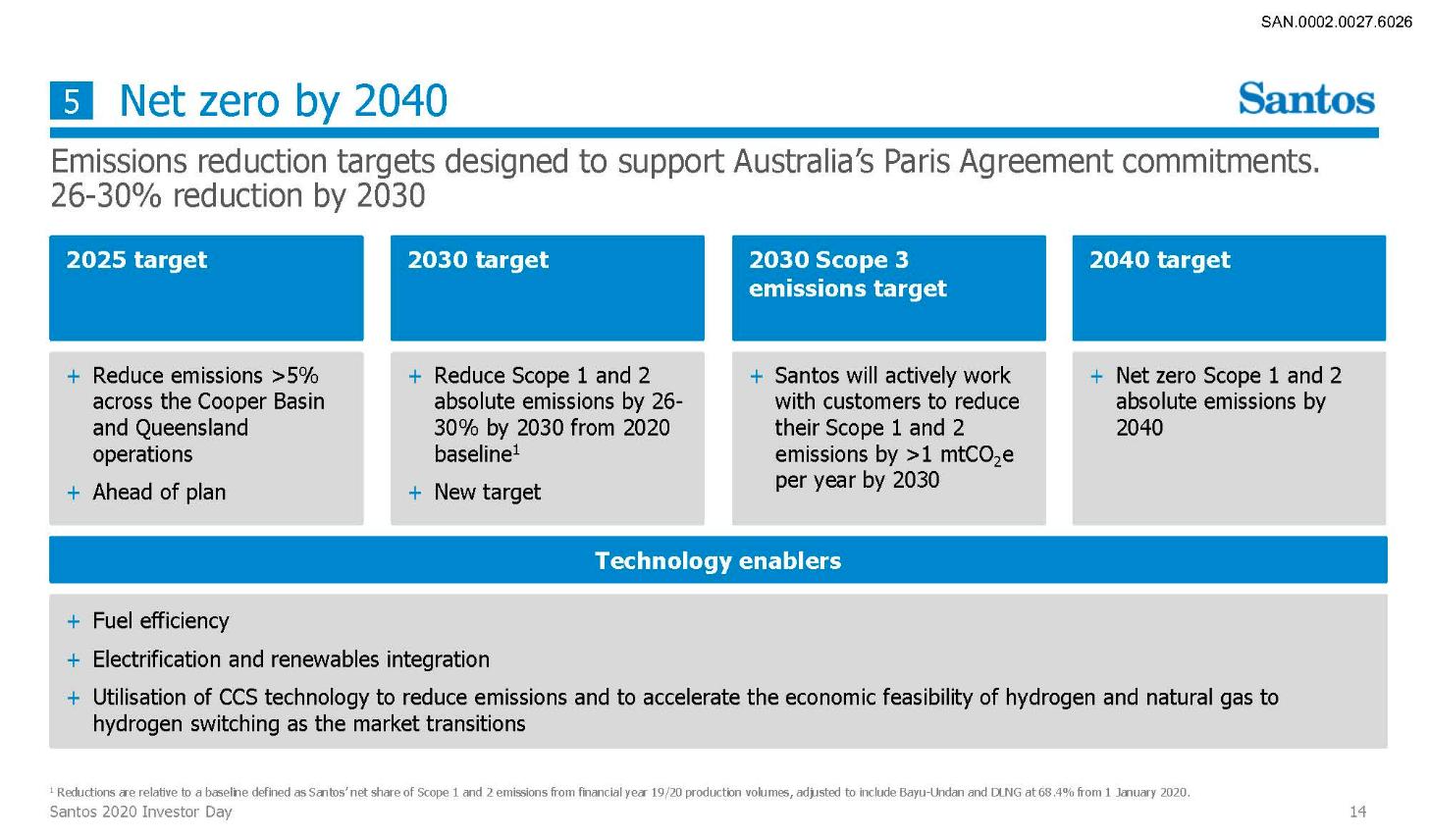
Counsel for the Respondent: | Mr N Young KC, Mr B Lim and Ms C Trahanas |
Solicitor for the Respondent: | Herbert Smith Freehills Kramer (formerly Herbert Smith Freehills) |
ORDERS
NSD 858 of 2021 | ||
| ||
BETWEEN: | AUSTRALASIAN CENTRE FOR CORPORATE RESPONSIBILITY Applicant | |
AND: | SANTOS LIMITED (ACN 007 550 923) Respondent | |
order made by: | MARKOVIC J |
DATE OF ORDER: | 17 February 2026 |
THE COURT ORDERS THAT:
1. The further amended originating process and the further amended concise statement each filed by the applicant on 26 August 2023 are dismissed.
2. The applicant is to pay the respondent’s costs of the proceeding.
3. Any party that wishes to apply to vary Order 2 is to notify the Associate to Markovic J of their intention to do so by 3 March 2026.
4. The text of the reasons for judgment published today is to be published and disclosed only to the parties and their legal advisors.
5. By midday AEDT on 20 February 2026 the parties are to confer and to inform the Associate to Markovic J of any redactions that they propose are to be made to the reasons as a result of and in accordance with orders made to date in this proceeding pursuant to s 37AF of the Federal Court of Australia Act 1976 (Cth).
THE COURT NOTES THAT:
6. The reasons for judgment will be published on 23 February 2026 at 10 am AEDT and any redactions made in the reasons are made in accordance with the orders made to date in this proceeding pursuant to s 37AF of the Federal Court Act.
Note: Entry of orders is dealt with in Rule 39.32 of the Federal Court Rules 2011.
REASONS FOR JUDGMENT
MARKOVIC J:
1 “Greenwashing”, a term coined relatively recently, occurs when a company makes itself, its products or services appear more environmentally friendly, sustainable or ethical than they are in fact. It is that concept which is at the heart of this proceeding.
2 The applicant, Australasian Centre for Corporate Responsibility (ACCR), is an incorporated not for profit. It is, according to its website, a “shareholder advocacy and research organisation” which uses “shareholder strategy to enable investors to escalate engagements with heavy-emitting companies in their portfolios”. ACCR’s mission is “to influence changes to the strategies of [its] portfolio companies to decrease absolute, real world emissions”.
3 ACCR is and was at all material times a shareholder in the respondent, Santos Limited, a leading producer and supplier of natural gas in Australia and a publicly listed company whose shares are traded on the Australian Securities Exchange (ASX).
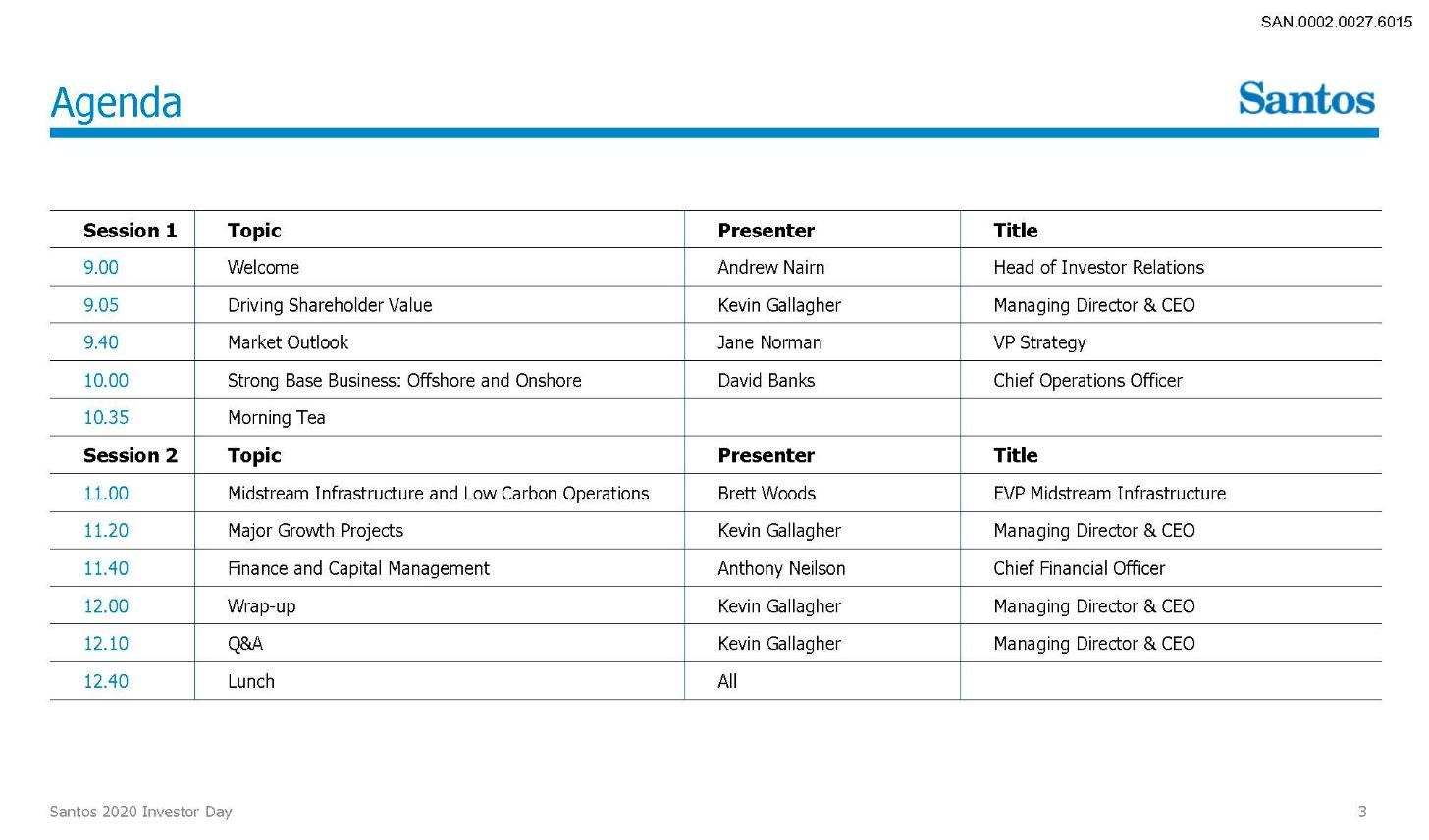
4 ACCR contends that Santos engaged in conduct that was misleading or deceptive or likely to mislead or deceive in contravention of s 1041H of the Corporations Act 2001 (Cth) and s 18 and s 33 of the Australian Consumer Law being Sch 2 to the Competition and Consumer Act 2010 (Cth) (ACL). That conduct was, according to the ACCR, engaged in by Santos via Santos’ Investor Day Presentation published on 1 December 2020, its Annual Report published on 18 February 2021 (2020 Annual Report) and its Climate Change Report published on 18 February 2021 (2021 Climate Change Report).
5 In summary, the ACCR alleges that:
(1) in the 2020 Annual Report Santos represented that it is a producer of “clean energy” and that natural gas provides “clean energy”, whereas in fact gas is not “clean” and Santos is a heavy emitter of greenhouse gases (GHG); and
(2) in the Investor Day Presentation and 2021 Climate Change Report Santos represented that:
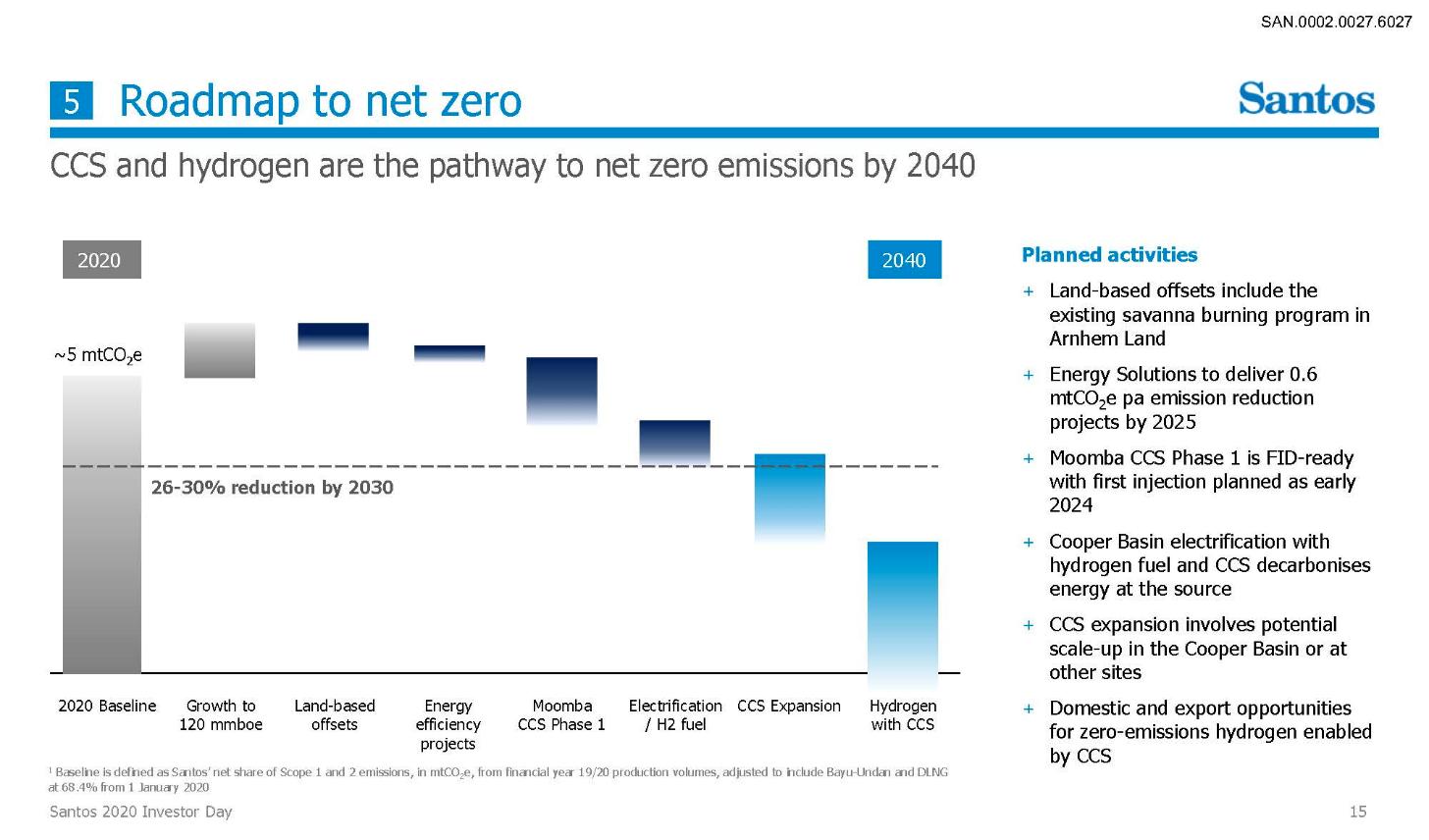
(a) it has a credible and clear plan, based upon reasonable assumptions, to reduce Scope 1 and 2 GHG emissions by 26-30% by 2030 (from its 2019-2020 financial year baseline) (2030 Target) and achieve “net zero” Scope 1 and 2 GHG emissions by 2040 (as depicted in slide 15 of the Investor Day Presentation) (Net Zero Roadmap) but that Santos did not disclose that:
(i) the 2030 Target and Net Zero Roadmap did not account for additional Scope 1 and 2 emissions associated with expected hydrocarbon growth and exploration opportunities beyond 2025, and Santos’ proposed carbon capture and storage (CCS) and hydrogen produced from natural gas using CCS (blue hydrogen) production plans; and
(ii) the 2030 Target and Net Zero Roadmap depend upon a range of undisclosed and/or unreasonable qualifications and assumptions to reduce or offset Santos’ Scope 1 and 2 GHG emissions, including reductions or offsets which are “nominal”, “notional” and “speculative”; and
(b) it can, in future, deliver “zero-emissions” or “clean” hydrogen, and hydrogen with “no emissions in its production (‘Scope 1 and 2’)”, whereas in fact Santos is proposing to produce blue hydrogen, which generates material additional emissions.
6 The ACCR seeks declarations of contravention and an injunction. It does not seek damages. It explains, in line with its stated mission, that it brings its claim to vindicate the public interest in ensuring that commitments by Australian companies regarding climate change are reasonably based and not misleading.
7 Santos contends that its statements were not misleading or deceptive as alleged. In summary it contends:
(1) in relation to the alleged “clean energy” representation that it did not convey that consumption of natural gas produced no emissions and that no reasonable member of the target audience could have been led into that error;
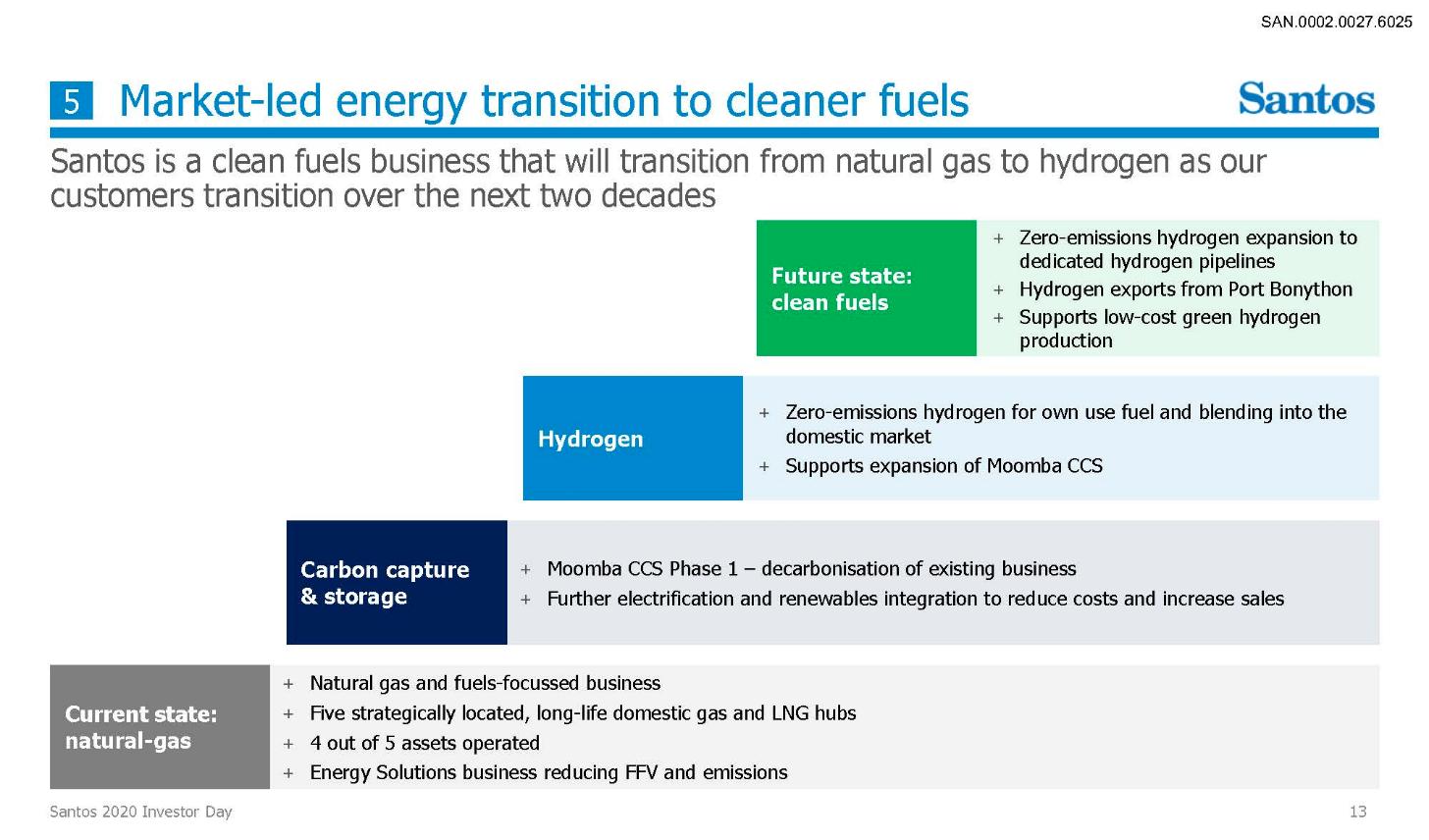
(2) in relation to zero-emissions hydrogen, it did not convey that it could produce hydrogen with literally no emissions. Rather, at the relevant time “zero-emissions” as a descriptor of hydrogen was synonymous with other adjectives like “clean” and “carbon neutral” which referred to hydrogen produced from natural gas with CCS and with the use of offsets for residual emissions; and
(3) in the Net Zero Roadmap, it was setting long term targets which were based on assessments about potential developments and opportunities in a highly uncertain future in an industry marked by rapid changes in markets, technology, economics and regulation. The reasonable member of the target audience would have understood this and would not have otherwise been misled. Santos says that it exercised judgements about potential developments that would favour development of CCS hubs and the emergence of a market for hydrogen and that its climate change targets were the result of many years work, reflection on its competitive advantages in evolving energy markets and the continual adjustment of its strategies to adapt to changing circumstances.
8 I have included definitions for all terms used in these reasons. In order to assist the reader, I also attach to these reasons, as Annexure A, a glossary of the more often used defined terms and a dramatis personae which includes a description of the roles of the various key Santos employees who either gave evidence before me or are referred to in these reasons.
1. The Facts
9 I set out below a summary of the relevant facts, some of which were agreed.
1.1 The witnesses
10 I commence with a description of the backgrounds, and, to the extent necessary, my impressions of the lay witnesses relied on by Santos and the experts relied on by each of the ACCR and Santos. The ACCR did not call any lay witnesses.
1.1.1 Santos’ lay witnesses
11 The following lay witnesses gave evidence on behalf of Santos.
12 Brett Kenneth Woods who has over 25 years’ experience in the oil and gas industry, commencing in 1994 as a contractor for Woodside Energy.
13 Mr Woods commenced his employment with Santos in 2013:
(1) prior to May 2020 he held the role of Executive Vice President (VP), Developments; and
(2) from May 2020 to February 2022 (which is the period relevant to this proceeding), he held the role of EVP, Midstream Infrastructure and Low Carbon Operations although, from May 2021 to February 2022, Mr Woods’ title was Chief Operating Officer, Midstream Infrastructure & Clean Fuels but his role was functionally the same as when he was VP.
14 In his role as VP, Midstream Infrastructure and Low Carbon Operations, Mr Woods reported to Kevin Gallagher, Santos’ managing director and chief executive officer (CEO), and was involved in overseeing Santos’:
(1) midstream gas processing facilities, which process both natural gas and liquified natural gas (LNG), at Moomba, Port Bonython and Darwin LNG;
(2) Energy Solutions team;
(3) CCS projects; and
(4) joint venture, the Papua New Guinea (PNG) LNG project.
15 In overseeing the Energy Solutions team and CCS projects, Mr Woods received regular written updates and detailed technical reviews and had regular team meetings and one-on-one briefings with team members about the progress of projects and studies being undertaken.
16 Mr Woods was involved in the development of projects to support the emissions targets announced by Santos at its Investor Day on 1 December 2020 (see below) being:
(1) the 2030 Target which, as set out above, was a target for Santos to reduce its Scope 1 and 2 emissions by 26-30% by 2030; and
(2) a 2040 Scope 1 and 2 net zero emissions target (2040 Target),
(referred to collectively as Targets).
17 Mr Woods was responsible for ensuring that the Targets reflected Santos’ CCS projects and the activities of the Energy Solutions team, including proposed or possible future activities, and the analysis conducted by that team. He was also involved in discussions about the Targets during their development and provided input to ensure they were aligned to Santos’ corporate strategy, including its clean energy strategy.
18 From February 2022 to 1 September 2023, when he went on “gardening” leave, Mr Woods was President, Midstream and Clean Fuels at Santos and, in that role, was a member of Santos’ Executive Committee (ExCom) and also reported to Mr Gallagher.
19 Since February 2024 Mr Woods has been the CEO of Beach Energy Limited.
20 Mr Woods graduated from Curtin University with a Bachelor of Science with Honours in geology and geophysics in 1996 and is a graduate of the Harvard Business School Advanced Management Program, which he undertook in 2018.
21 Mr Woods was cross-examined.
22 Angus John Jaffray who joined Santos in February 2016 as a consultant. From shortly after his appointment until 2023 Mr Jaffray held the following roles:
(1) from May 2016, Executive VP, Strategy and Corporate Services. In 2017, while in that role, Mr Jaffray established the Energy Solutions team;
(2) from September 2018, VP, Organisation Integration at Santos. In that role, Mr Jaffray focused on the integration of Quadrant Energy, which Santos acquired in August 2018;
(3) from about March 2019 to January 2021, VP, People and Sustainability, reporting to Mr Gallagher. In that role, Mr Jaffray’s responsibilities included human resources, remuneration and performance, organisational and learning development, public affairs, sustainability and organisational integration. Insofar as sustainability was concerned, Mr Jaffray’s responsibilities included:
(a) managing the team with carriage of reporting on sustainability matters, including consolidating and reporting on emissions data, preparing Santos’ Climate Change Reports and engaging with local communities. That team was headed by Alicia Genet who at the time held the position of Head of Public Affairs and Sustainability, who reported to Mr Jaffray, and included Anshul Jain, Manager Carbon and Sustainability, who reported to Ms Genet; and
(b) presenting to Santos’ Environment, Health, Safety and Sustainability Board Committee on sustainability-related matters; and
(4) from January 2021, VP, People, Culture and Transformation. Mr Jaffray’s responsibilities in this role were the same as in his previous role save that he was no longer responsible for public affairs and sustainability. Responsibility for the sustainability team, headed by Ms Genet, moved to Jodie Hatherly, at the time Santos’ general counsel. Notwithstanding this change, Mr Jaffray continued to be involved in the finalisation of the 2021 Climate Change Report.
23 Prior to joining Santos Mr Jaffray held various leadership and consulting roles: from 1991 to 1999 he held various roles in the United Kingdom (UK), French and German offices of Crown Cork and Seal, a global packaging group; in 2001, after obtaining his Master of Business Administration (MBA), he joined The Boston Consulting Group where he was a member of the Mining and Metals Practice, the Energy Practice and the Operations Practice. He became a partner of The Boston Consulting Group in 2011 and headed up its West Australian office from 2010 to 2014; and in May 2014 until he joined Santos in 2016, he was a director of Azure Consulting Australia where he worked on projects involving operations, transformation and strategy for industrial clients.
24 Mr Jaffray holds a Bachelor of Arts with Honours in geography from the University of Cambridge and an MBA from the Australian Graduate School of Management, University of New South Wales.
25 Mr Jaffray was cross-examined.
26 Ying Luo who joined Santos in February 2009. From that time until September 2021, she held various positions as an engineer, an operations supervisor, an analyst, and a project and strategy lead. In particular, from November 2017 to September 2021 Ms Luo held the position of Project and Strategy Lead, Energy Solutions. In that capacity her role included:
(1) leading a team of engineers to deliver emissions reduction and renewable integration projects across Santos’ portfolio;
(2) implementing aspects of Santos’ strategy for positioning its business for a low carbon future (Clean Energy Strategy);
(3) leading the development of hydrogen project opportunities across Santos’ portfolio; and
(4) embedding emissions reduction into the day-to-day operations of Santos’ business.
27 In this role Ms Luo reported to Rowan Mackay, Manager Strategy Energy Solutions, until March 2020 and Chad Wilson, VP Energy Solutions, from April 2020 until September 2021.
28 From October 2021 to April 2023, Ms Luo was a Senior Advisor Hydrogen Development at Australian Gas Infrastructure Group (AGIG) and in May 2023 she commenced her current role as Chief Advisor and General Manager Strategy at Cooper Energy Ltd.
29 Ms Luo holds a Bachelor of Engineering and Bachelor of Science from Monash University, which she obtained in 2008, an MBA from the University of South Australia, which she obtained in 2013 and a Graduate Certificate, Energy and Resources: Policy and Practice from University College London, which she obtained in 2013.
30 Ms Luo was cross-examined.
31 Nicholas Hugh James Harley who from February 2020 to August 2024 held the role of Project Manager, Carbon Capture and Storage within the Energy Solutions division. In that role Mr Harley was responsible for the development and delivery of a large-scale CCS project at Santos’ gas fields in the Cooper Basin (Moomba CCS Project). He was accountable for bringing the Moomba CCS Project online, including the engineering, procurement, construction and commissioning of the CCS facility, the transport pipeline and the field injection wells and oversaw a team tasked with delivering the Moomba CCS Project (Moomba CCS Project Team). At the time Mr Harley gave evidence, the Moomba CCS Project Team comprised approximately 30 people but during 2020 was smaller, comprising approximately six people.
32 In August 2024, Mr Harley’s title changed to Subsurface and Approvals Manager as part of a restructure. Mr Harley became responsible for managing subsurface elements of the Moomba CCS Project and project approvals. He is no longer responsible for the development and delivery of the whole of the Moomba CCS Project.
33 From February 2007 to August 2010 Mr Harley was employed by Santos as an engineer. After completing an MBA in 2011 Mr Harley worked at McKinsey & Company in London in their oil and gas practice, working across Africa, the UK, Europe and South East Asia.
34 In about August 2013 Mr Harley rejoined Santos. Since that time and until taking on his current role he held the following roles:
(1) from August 2013 to March 2015, Strategy and Commercial Advisor, Exploration;
(2) from April 2015 to October 2015, Team Leader Southern Assets;
(3) from November 2015 to July 2017, Transformation Program Lead/Manager; and
(4) from July 2017 to February 2020, Field Development Planning Manager which involved early-stage concept planning for various upstream projects for the extraction of natural gas in the Cooper Basin and eastern Queensland assets.
35 Mr Harley holds a Bachelor of Engineering (Hons, Mechatronics) and a Bachelor of Economics from the University of Adelaide, obtained in 2006, and an MBA from Judge Business School, University of Cambridge, obtained in 2011.
36 Mr Harley was cross-examined.
37 The ACCR submits that in making factual findings about what “grounds” Santos had at the time of the announcements in question I should adopt the “helpful working hypothesis” that “contemporaneous documents written in the ordinary course of business are of great importance” (citing Liberty Mutual Insurance Company Australian Branch trading as Liberty Specialty Markets v Icon Co (NSW) Pty Ltd [2021] FCAFC 126; (2021) 396 ALR 193 at [239] (Allsop CJ, Besanko and Middleton JJ)) and that Santos’ decision-making process can be seen through those contemporaneous documents to have materialised relatively spontaneously and organically. Coupled with that the ACCR submits that I should place little to no weight upon what Santos’ lay witnesses purport to recall thinking at the time of the announcements in December 2020 and January 2021, except where the recollection is supported by a contemporaneous document.
38 While I accept that the contemporaneous documents created at the relevant time are of “great importance”, I also accept that it does not follow that, in light of the documents that were relied on before me, I would give little or no weight to the oral evidence. The documents are to be viewed in context. That is having regard not only to the whole of the documentary record but also where relevant to the oral evidence.
39 As Santos submits, this is not a case where the oral evidence is superfluous or might be rejected because it is inconsistent with the contemporaneous documents. The documents reveal and record the roles of the various individuals within Santos and the development of material by those with relevant responsibility. Material was submitted to senior management and discussed. Evidence of those discussions is not always evident on the face of the documents, and the oral evidence serves to fill the gaps.
40 The oral evidence given by the lay witnesses also explained why and how certain options were developed and/or included in the material, particularly in the Net Zero Roadmap. Evidence of that nature can assist in providing context and background.
41 That said, I am acutely aware of the caution given against “reliance on subjective evidence from the representor as being necessarily likely to give an accurate picture of what information the representor ‘had’ as a basis for any prediction or forecast made”: see Australian Competition and Consumer Commission v Woolworths Limited [2019] FCA 1039 at [135] (Mortimer J as her Honour then was). I will proceed with that caution in mind and having regard to the overall circumstances of the case.
42 As to the evidence given by Santos’ lay witnesses, the ACCR submits that I would have little confidence in the affidavits of Messrs Woods and Jaffray and Ms Luo given they were sworn in late November 2023, around three years after the relevant events. It contends that the ordinary processes of human recollection would make it virtually impossible to recall what set of considerations were playing upon a person’s mind at the time of making a decision three years ago and that the affidavits adopt “a dubious trope” with the witnesses purporting to recall precisely what he or she did or did not believe or think at the time the Targets were announced.
43 That the affidavits were sworn three years after the relevant events is not an uncommon occurrence and of little moment or indeed, relevance. As Santos submits, the ACCR did not suggest to the witnesses in cross-examination that their key recollections were only formed at the time their affidavits were sworn. Their recollections were not challenged on that basis, and the ACCR cannot sustain such a submission having not taken that step.
44 The ACCR also challenges the reliability of each of Messrs Woods and Jaffray and Ms Luo as witnesses based on their demeanour and the evidence they each gave in cross-examination.
45 The ACCR submits that Mr Woods’ evidence should not be accepted unless it was against interest or corroborated by a contemporaneous document. It supports that submission based on the following contentions: first, Mr Woods could not remember a whole range of important details, for example whether he spoke to Ms Luo about hydrogen emissions, whether he told Ms Luo in about mid July 2020 that it was important that the proposal be “zero emissions hydrogen” and which Santos employee had suggested that Santos calculate 50% market share by volume of hydrogen; secondly, Mr Woods was otherwise argumentative and unreliable and was shown to be a partisan witness including by using his time in cross-examination to deflect attention away from areas in which he perceived Santos’ case may be weak; thirdly, Mr Woods was prone to giving pre-prepared speeches that were non-responsive to questions; fourthly he repeatedly sought clarification of questions which needed no clarification, instead of giving frank answers; and finally, on several occasions he contradicted himself where his perception of Santos’ interest changed.
46 I did not find Mr Woods to be argumentative, unreliable or partisan. Certainly, Mr Woods held his ground when challenged on aspects of his evidence. But that is not a reason why I would not accept any of his evidence. While Mr Woods may in some respects have been defensive, I did not find him to be partisan. That Mr Woods, or any other witness, could not recall particular matters is also not a reason to discount the totality of that persons’ evidence. Human memory is fallible and more so as time passes. Overall, I found Mr Woods to be a satisfactory witness who did his best to assist the Court.
47 The ACCR accepts that Ms Luo was generally an honest and intelligent witness, a sentiment with which I agree. However, it goes on to submit that the frequency with which Ms Luo could not recall important events and circumstances again means that the Court should place little weight on what she claims in her affidavit to have had in mind at particular points in time, illustrating that point by reference to examples. I disagree. As I have said, that a witness may not recall the answer to a specific question does not undermine the whole of their evidence. Ms Luo gave evidence four years after the relevant events and a year after she completed her affidavit. That she could not recall some matters of detail or events is hardly surprising. As I have already observed I found Ms Luo to be an honest witness, who did her best to assist the Court and who gave her evidence in a considered way.
48 The ACCR describes Mr Jaffray’s evidence as relatively inconsequential in the context of the case but submits that, to the extent he purported to give evidence of what he subjectively had in mind in 2020, the Court should place little weight on that evidence for the reasons set out at [37] above. I do not accept that Mr Jaffray’s evidence is “inconsequential”. His evidence discloses that, given his role at Santos as VP of People and Sustainability during the relevant period, he had a significant role overseeing the preparation of papers submitted to the Santos Board about the Targets and the Net Zero Roadmap. Mr Jaffray’s evidence, supplemented by documentary evidence, provides a fuller chronology of the development of the Targets and the Net Zero Roadmap.
49 I have no reason to doubt that Mr Jaffray is anything other than a truthful witness whose evidence was largely not challenged and which I would accept.
1.1.2 The expert witnesses
50 The parties relied on extensive expert evidence which covered different fields of specialised knowledge including, described at a high level: hydrogen production; hydrogen transportation; carbon credit schemes; climate change and the meaning of net zero; lifecycle analysis of GHG emission; CCS; corporate strategy; and economics. I note that the ACCR and Santos did not necessarily engage experts in the same fields of expertise nor did they both engage experts to address all areas. For example, only Santos engaged experts in the latter two fields.
51 I set out below a short biography for each of the experts relied on and, where relevant or necessary, my observations of them.
52 The ACCR relied on the following experts.
53 Paul Martin who is a consultant at Spitfire Research Inc. Mr Martin obtained Bachelors and Masters degrees in Applied Science (Chemical Engineering) from the University of Waterloo, Ontario Canada in 1990 and 1991 respectively. Since 1993 he has been a Licensed Professional Engineer in the province of Ontario (as well as in other provinces from time to time). Since 1991 Mr Martin has worked in the field of chemical engineering.
54 From 1996 to 2022 Mr Martin:
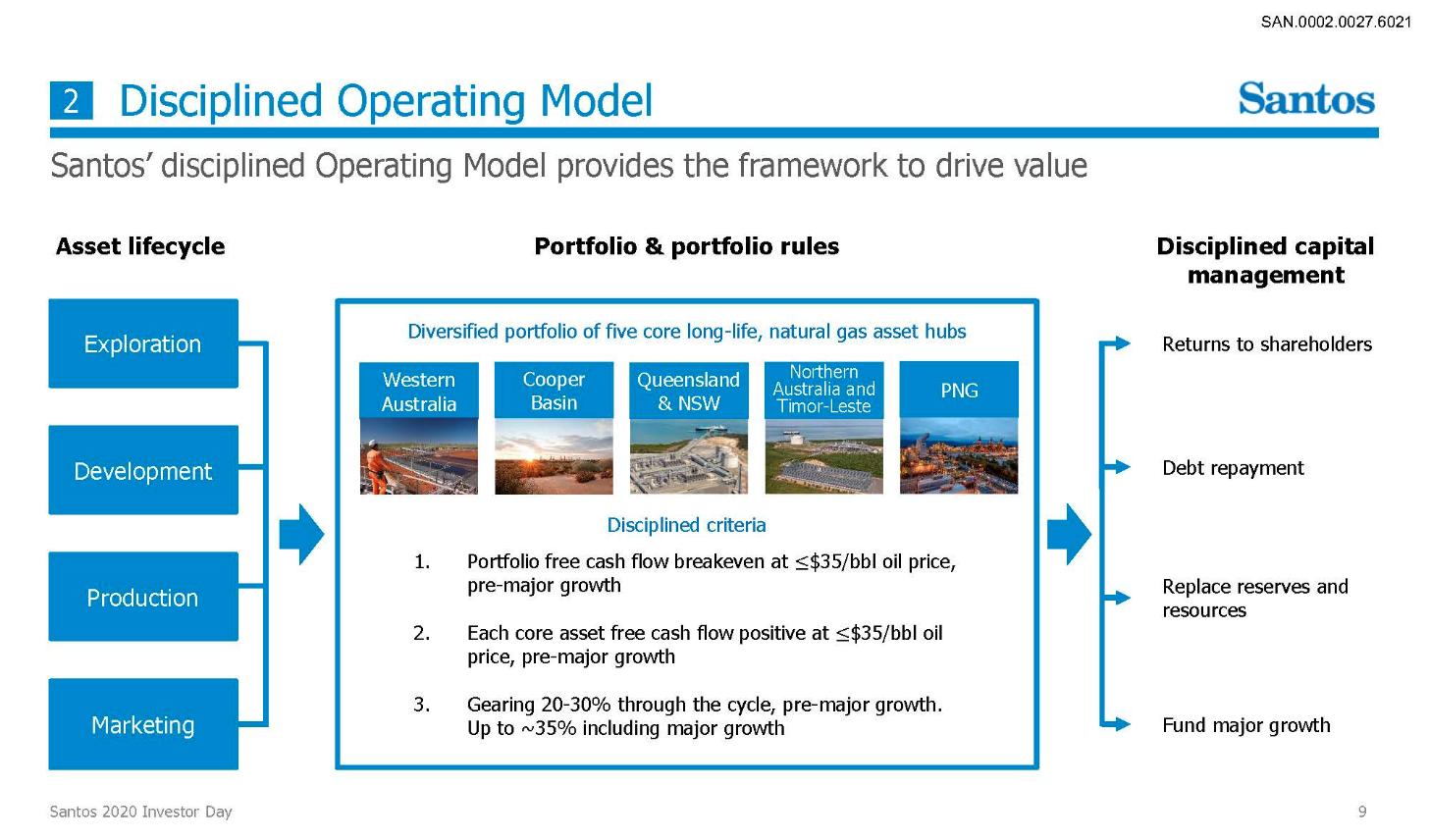
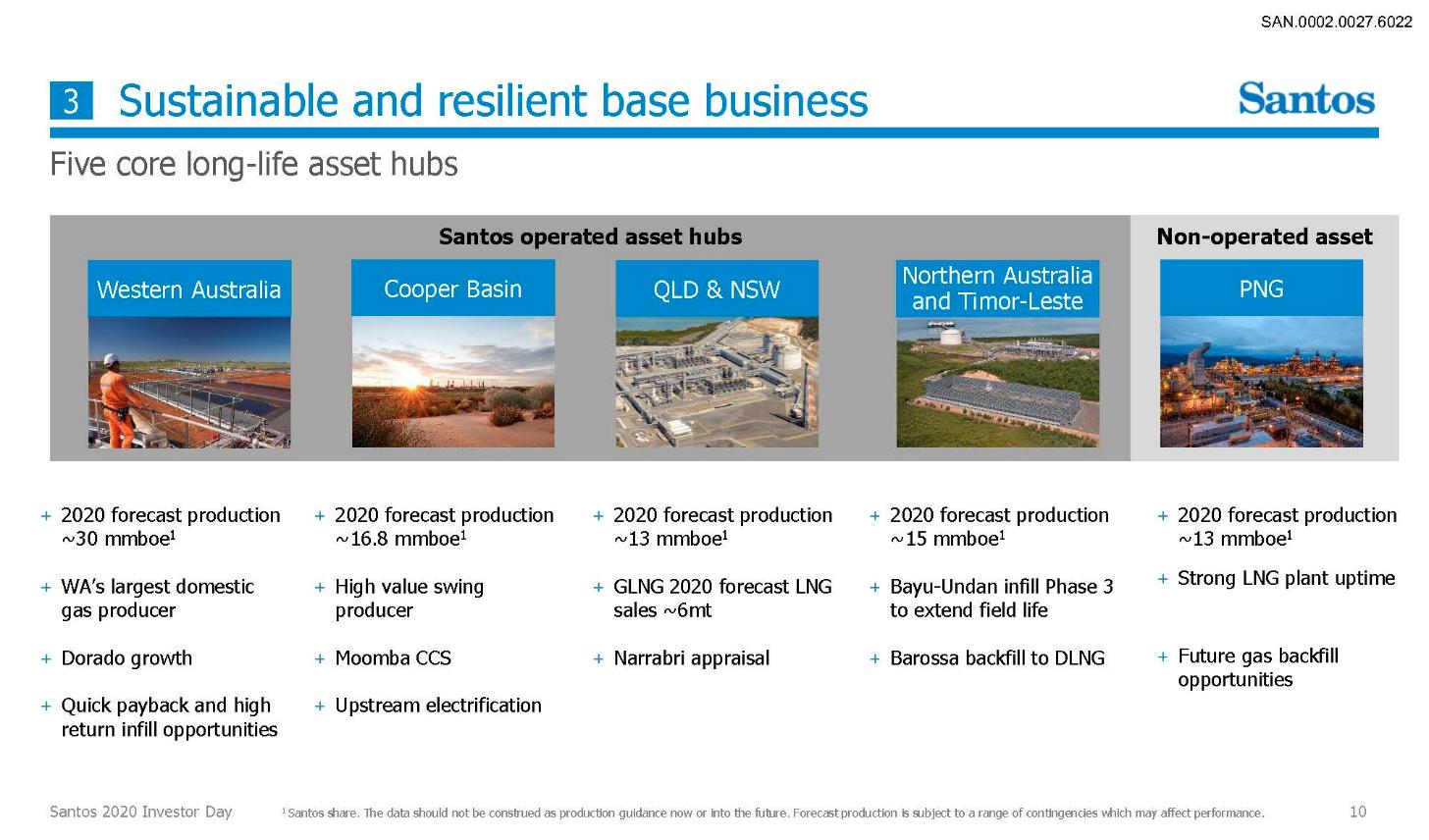
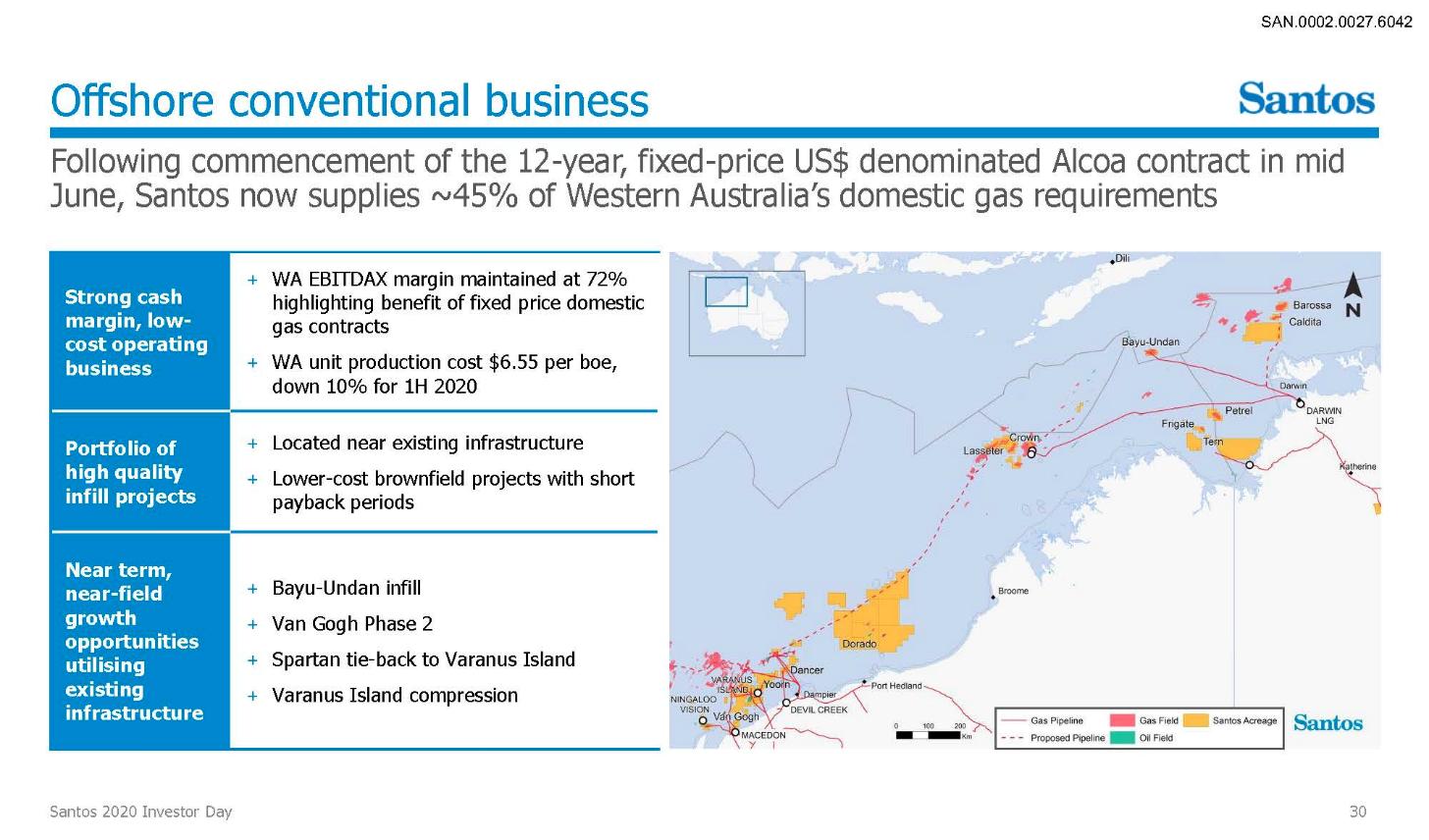
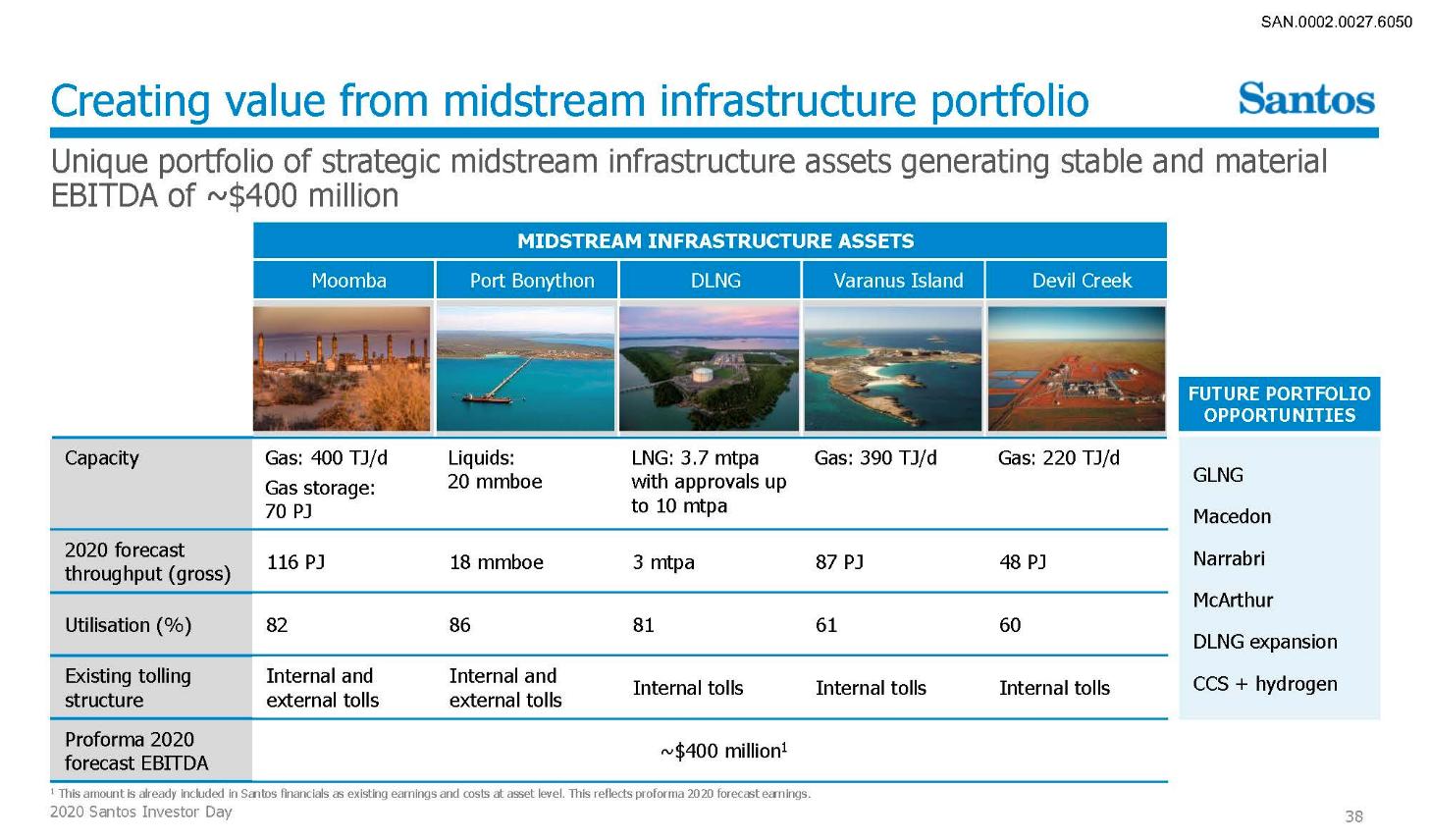
(1) was a program manager and senior technical fellow at Zeton Inc where, as senior or principal project engineer and project manager or senior project manager/mentor, he was responsible for the completion of pilot and demonstration plant projects and engineering/cost studies for plants for chemicals, polymers, primary metals/hydrometallurgy and alternative energy/alternative chemical feedstocks sectors. He also acted as a design consultant for the early stages of process development work, including in the design teams of client firms as they developed intellectual property related to new process technology; and
(2) maintained a private scientific/technical consultancy practice, Spitfire. Spitfire undertakes work related to decarbonisation of production and energy projects, early stage technology development assistance, technoeconomics, evaluation of technological readiness level, expert witness work, assistance with strategy for scale-up and path to commercialisation, and evaluation of research and development claims as part of investment due diligence.
55 Mr Martin claims he has expertise in relation to hydrogen and its derivatives in terms of their manufacture and use as chemicals and their roles in the decarbonisation of the economy. He has been responsible for the selection of construction materials for corrosion service, and for the design and construction of piping systems for fuel gas, hydrogen, synthesis gas mixtures containing hydrogen, and hydrogen-derived products handled at both low and very high temperatures and pressures, as well as piping systems to convey other chemicals and mixtures. He wrote and served as gatekeeper of the corporate piping specifications for Zeton Inc.
56 Mr Martin prepared three reports addressing the blending of hydrogen into existing gas networks.
57 It became apparent in cross-examination that Mr Martin was opposed to hydrogen playing any part in the decarbonisation of energy and that he had both expressed and defended that view. He expressed the view in an article published on LinkedIn on 6 November 2024 titled “Distilled Thoughts on Hydrogen” (Martin LinkedIn Article) and accepted in cross-examination that he “stridently” objects to the use of hydrogen as a fuel, including its use as an industrial fuel in industrial processes.
58 The Martin LinkedIn Article included by way of summary:
Why do you hate hydrogen so much? I DON’T HATE HYDROGEN! I think it’s a dumb thing to use as a fuel, or as a way to store electricity. That’s all. It’s too expensive, for reasons that are structural and which can’t be fixed by innovation. Even black hydrogen, made from fossils with over 10 kg CO2 and perhaps 14 kg CO2e/kg emissions going right to the free atmospheric sewer, for the low-low price of $1.50/kg, is already $11/MMBTU or $11/GJ of higher heating value (HHV). It’s just too expensive to waste as a fuel for heating or transport. It’s expensive because it’s inefficient, but the real deal killer is that it is also ineffective as a fuel, i.e. difficult and expensive to move and store.
I also think it’s part of a bait and switch scam being put forward by the fossil fuel industry. And what about the electrolyzer and fuelcell companies, the technical gas suppliers, natural gas utilities and the renewable electricity companies that are pushing hydrogen for energy uses? They’re just the fossil fuel industry’s unwitting accomplices- their “useful idiots” in this regard.
59 Santos submits that in light of Mr Martin’s publicly held views, his evidence about the reasonableness of solving the challenges associated with the transmission and transport of hydrogen domestically and internationally should be accorded no weight. It says that the views he expresses on this topic very much resemble those expressed in the Martin LinkedIn Article and, in any event, he has no experience in Australia or in large scale infrastructure investment and did not conduct any detailed study to support his views about “economic sensibility”. As to the latter after accepting that it was technically possible to build a new transmission pipeline to transmit hydrogen from Moomba to Port Bonython, but not economically sensible, Mr Martin had the following exchange with senior counsel for Santos, Mr Young KC, in cross-examination:
Mr Young: Not only. Now, in point of fact, you have not done any analysis of the cost of building, for instance, a new transmission pipeline between Melbourne and the East Coast of Australia, have you?
Mr Martin: No.
Mr Young: No. Your concern is simply that it would be a very large capital expenditure, a vast sum of money; correct?
Mr Martin: My concern is that it’s a vast sum of money per unit of delivered energy, and hence it would be a considerable cost to whoever is using that material for energy, that hydrogen for energy.
Mr Young: Yes. Well, it may depend on the volume of the market, may it not, Mr Martin?
Mr Martin: Of course.
Mr Young: Yes. And it may depend upon demand in the market, and whether any alternatives exist and at what cost, may it not?
Mr Martin: Correct. Yes.
Mr Young: Yes.
Mr Martin: Fair enough.
Mr Young: And you haven’t analysed any of that?
Mr Martin: Well, I have looked at the cost of each of the steps. They’re laid out in the various reports.
Mr Young: Yes. You haven’t looked at any kind of financial analysis of the net present value of infrastructure that might need to be built between Moomba and the East Coast, have you?
Mr Martin: I was not retained
Mr Young: Yes.
Mr Martin: for that purpose. No.
60 On the one hand, Mr Martin’s steadfast and publicly aired beliefs about the use of hydrogen as a fuel undermine his impartiality and thus the assistance he can give the Court. On the other, Mr Martin was prepared to make concessions in cross-examination and, as the extract above demonstrates, accept weaknesses or gaps in his own analysis. For that reason, while I would decline to accept Santos’ invitation to accord no weight to Mr Martin’s evidence, I would give it only limited weight.
61 Malte Meinshausen who is an Associate Professor in the School of Geography, Earth and Atmospheric Sciences at the University of Melbourne. Associate Professor Meinshausen holds a Ph.D. in Climate Science & Policy from the Swiss Federal Institute of Technology (ETH Zurich) and an M.Sc. in Environmental Change and Management from the University of Oxford. He has written on topics relating to climate change and the Paris Agreement (see [117]-[119] below).
62 Associate Professor Meinshausen has held and/or continues to hold the following positions:
(1) from 2000 to 2005 he worked as a freelance consultant for government bodies and environmental non-government organisations on climate policy issues;
(2) from 2005 to 2015 he was a Scientific & Technical Advisor for the German Ministry of Environment on international climate policy. In that role he was a member of the German delegation to the Intergovernmental Panel on Climate Change meetings and the United Nations Framework Convention on Climate Change (UNFCCC) negotiations;
(3) from 2007 to 2009 he also held the position of founding co-director of the not-for-profit research institute and think tank, Climate Analytics, Berlin; and
(4) since 2020 he has been a co-director of a new start-up, Climate Resource.
63 Associate Professor Meinshausen provided three expert reports addressing whether the production, distribution and end-use of natural gas contribute to anthropogenic climate change and global warming, the current and expected impacts of anthropogenic climate change and global warming on the environment, the accounting system for GHG emissions as it existed in February 2021 and whether the documents provided to him (including the Net Zero Roadmap, the 2021 Climate Change Report and the Investor Day Presentation) disclosed a reasonable basis for Santos to have claimed, as at February 2021, that it could achieve “net-zero” Scope 1 and 2 GHG emissions by 2040.
64 Fiona Beck who is a senior lecturer at the School of Engineering, College of Engineering and Computer Science at the Australian National University (ANU). Associate Professor Beck holds a Ph.D. in “[d]esigning plasmonic nanoparticles for light trapping applications in solar cells” from the Research School of Engineering, ANU and a M.Sc. (Physics), 1st Class from the University of Glasgow. Her research focuses on clean energy technologies.
65 Among other things, Associate Professor Beck:
(1) is the convener of the ANU’s Hydrogen Fuels project and the Hydrogen Economy research cluster for the Institute of Climate, Energy and Disaster Solutions;
(2) leads a research group designing new ways to selectively drive chemical reactions to capture carbon dioxide (CO2) from the atmosphere and produce solar fuels;
(3) convened the Hydrogen Fuels project for “ZCEAP - ANU’s Zero-Carbon Energy for the Asia-Pacific Grand Challenge” and in that role she published academic articles and provided submissions to government regarding zero carbon industries and exports; and
(4) has authored or contributed to analysis about hydrogen’s role in the energy transition.
66 Associate Professor Beck provided three expert reports outlining calculations on the emissions intensity and the amount of emissions associated with the production of hydrogen. Santos submits that a number of the assumptions underpinning Associate Professor Beck’s evidence, in particular her calculations on the emissions intensity and amount of emission associated with the production of hydrogen, were unsound. To the extent necessary I address that submission below when considering Associate Professor Beck’s evidence in context.
67 Shohini Parker who is the principal and founder of Carbon Transition Consulting. Ms Parker holds a B.Sc. (1st Hons) and Bachelor of Chemical Engineering (1st Hons) from Monash University. She has over 15 years of consulting experience working with resource sector companies and across the industrial and financial sectors in Australia.
68 Ms Parker has held the following positions:
(1) from 2002 to 2006 she worked at ExxonMobil Corporation as a Gas Reservoir Surveillance Engineer (2002 to 2005) and a Production Planner (2003 to 2004); and
(2) from 2006 to 2015 she worked at Energetics Pty Ltd where she held various roles including consultant, senior consultant, Victorian regional manager and principal consultant.
69 Ms Parker provided two expert reports in relation to company strategies to reduce GHG emissions and plans to achieve net zero emissions. She opined on whether reliance on carbon credits or offsets was a material consideration for companies and their investors in achieving those plans and whether it was reasonable or credible for Santos to make certain of the assumptions it made as a part of its net zero plan.
70 Santos submits that I would find Ms Parker to be an unreliable witness. It says that Ms Parker provided opinions for which she had no expertise or foundation and failed to make appropriate concessions about those matters when challenged.
71 In support of that submission Santos points to Ms Parker’s claim to work on behalf of investors. Relevantly, Ms Parker says at [20] of her first report:
In my work on behalf of investors reviewing companies’ net zero plans during this time, I was specifically asked to provide my views on whether the plans were aligned with the latest science on emissions reduction pathways required to limit global temperature goals to 1.5°C by the end of the century.
a. In forming my views, I drew on the most recent science-based emissions reduction pathways available during 2020, which were from the IPCC 1.5°C Special Report (released June 2018).
b. In this IPCC report, ‘carbon removals’ were a necessary contributor to reach a global net zero emissions position for ‘hard-to-abate’ sectors by 2050. However, the pathways and report conclusions indicated that carbon removals should not be used as an alternative to the implementation of decarbonisation technologies wherever these technologies were available, notwithstanding the need for substantial investment to ‘scale-up’ these technologies to commercially viable levels.
c. In my reports delivered to my investor clients during this time, I therefore considered and commented on the scale of carbon offset use in the net zero plan of the company I was reviewing and whether this scale was aligned with the IPCC 1.5°C Special Report. I also reviewed and commented on how the scale of carbon offset use compared to net zero targets published by other companies in the sector.
(Footnotes omitted.)
72 Santos submits that Ms Parker has not undertaken work on behalf of investors as claimed in her report and is not qualified to opine on their attributes, views or expectations.
73 In order to test Ms Parker’s claim to have undertaken work on behalf of investors, Santos served a subpoena on Ms Parker seeking documents relevant to [20] of her first report. In response Ms Parker produced two documents relating to a single entity, Regnan Pty Ltd. Those documents are a proforma document titled “engagement guide – climate change XYZ Company Inc” and an invoice made out to that entity. The invoice from Ms Parker’s consulting firm to Regnan disclosed that Ms Parker’s work was to undertake environmental, social, and governance (ESG) assessment scores for two different entities.
74 Ms Parker described Regnan as an investor research and engagement firm which provides services to the investment community but is not itself an investor. Regnan develops reports and disseminates a range of different materials to its clients who are institutional investors, asset managers and banks. Ms Parker was a contractor to Regnan for several years and undertook her work for it using its servers. Thus, she did not have further documents to produce in answer to the subpoena served on her. Ms Parker’s evidence was that that work gave her insight into what investors were interested in, based on what those investors asked Regnan to produce.
75 That evidence clearly supports Santos’ submission that Ms Parker has not undertaken work on behalf of investors and is not qualified to opine on their attributes, views or expectations. Based on the documents produced in answer to the subpoena served on her, the closest she came was the limited work she undertook for a research firm which, in turn, produced material for investors. Even accepting that Ms Parker was a contractor to the research firm for “several years” does not assist to qualify her to provide an opinion about investors’ views or expectations. Ms Parker did not refer to that work in her curriculum vitae, and it is impossible to assess her qualifications in that regard. I would reject Ms Parker’s asserted expertise about investors.
76 There were also other aspects of Ms Parker’s evidence which were troubling.
77 Ms Parker expressed opinions in areas where she did not have the requisite expertise and/or the proper foundation. For example, she gave evidence about the availability of carbon credits including by reference to the development of future policy. However, in cross-examination she conceded that she had not read the “relevant Australian government reports concerning the gas industry”. In another example Ms Parker said that she had no opinion on whether “as a potential supplier of hydrogen, … Santos would have substantial bargaining power in the circumstances of those industries as one of the only credible large scale suppliers of such services … likely to emerge” but then went on to deny, in my view somewhat implausibly, that such matters would have any bearing on Santos’ bargaining power.
78 Ms Parker also expressed a view in her first report (at [38]) that it was “likely that many of Santos’ industrial natural gas customers in Australia using gas for heating and other industrial purposes are likely to exceed 100,000 tonnes CO2-e of operational emissions annually and therefore be captured under the [Safeguard Mechanism]”. In cross-examination Ms Parker accepted that she had not undertaken any investigation or analysis to support that opinion. She said that it was “a general statement based on the size of the gas facilities”. Despite the fact that in a later joint report Ms Parker accepted the analysis of Santos’ expert, Mr Snow, which impacted the opinion she expressed at [38] of her first report, she refused to accept or concede that her opinion was erroneous. Rather, she came up with a new and alternative basis to justify her opinion.
79 Ms Parker was also shown to be selective in her evidence. In her first report at [19] she gave evidence about the stakeholder concerns that she recommends her clients consider in relation to carbon offsets. However, she did not include in her report by way of balance the benefits perceived by stakeholders in relation to carbon offsets. This omission was highlighted by an advice she in fact gave to one of her clients which included both the negative and positive features of offsets perceived by stakeholders. In cross-examination Ms Parker tried to explain the disparity in an unconvincing and argumentative way.
80 Santos also raised concerns about Ms Parker’s understanding of the Taskforce for Climate-Related Financial Disclosures (TCFD) and contends that she misrepresented the TCFD framework. I address the TCFD framework and Santos’ submissions in relation to Ms Parker’s evidence below.
81 The ACCR submits that Ms Parker was a careful witness who properly acknowledged when she did not have expertise to answer a question. That was not the impression I had of her as a witness. While on a few occasions Ms Parker said she did not have the relevant expertise to answer a question, more frequently she tried to explain away evidence that she did not perceive would assist the opinion she gave in her reports in an unconvincing and argumentative way. She was not prepared to make concessions. I have set out some examples above. Overall, I did not find Ms Parker to be a satisfactory witness and would place very little weight on her evidence.
82 Timonthy Grant who is the founder and director of Lifecycles, a supplier of life cycle assessments and circular economy services across Australia. Mr Grant established Lifecycles in 2003. He holds a Master of Engineering (Cleaner Production) from RMIT University and a Bachelor of Applied Science in Environmental Assessment and Land Use Policy from Deakin University.
83 Mr Grant has also held the following positions:
(1) from 1996 to 2003 he was a program manager, LCA, Centre for Design, RMIT University;
(2) in 2003 he was an assistant director, Centre for Design, RMIT University;
(3) from 2005 to 2013 he was an adjunct research fellow, CSIRO Division of Atmospheric Research; and
(4) from 2008 to 2010 he was an adjunct professor, Centre for Design, RMIT University.
84 Mr Grant provided two expert reports in relation to lifecycle GHG emissions assessment for different energy sources.
85 Santos relied on the following experts.
86 Peter Cook who is an earth scientist in the areas of energy, resources, and GHG technologies. Professor Cook holds the degrees of B.Sc. (Hons) (University of Durham), M.Sc. (ANU), Ph.D. (University of Colorado) and D.Sc. (University of Durham). He is a Fellow of the Academy of Technological Sciences and Engineering.
87 Professor Cook is currently a Professorial Fellow, University of Melbourne, a position he has held since 2012. He is also a Consultant and Chair (Expert Panel) to the New South Wales (NSW) Government on Gas, a consultant to BHP on CCS and the Victorian Government on unconventional gas, Chair of the BHP-sponsored GeoCquest Project involving Melbourne, Stanford and Cambridge Universities, Distinguished Scientist CO2CRC, a member of the CarbonNet Advisory Board and Chair of the Academies (ACOLA) Review of Unconventional Gas.
88 Prior to 2012 Professor Cook held the following positions:
(1) from 1968 to 1976 he was a Senior Geologist, Bureau of Mineral Resources;
(2) from 1976 to 1982 he was a Senior Research Fellow, RSES, ANU;
(3) from 1982 to 1990 he was a Division Chief/Associate Director, Bureau of Mineral Resources;
(4) from 1988 to 1989 he was a Professor at Université Louis Pasteur;
(5) from 1990 to 1998 he was a Director, British Geological Survey;
(6) from 1998 to 2003 he was a Director, Australian Petroleum CRC; and
(7) from 2003 to 2011 he was Chief Executive, CO2CRC.
89 Professor Cook prepared one report concerning CCS. There was no dispute that Professor Cook is an acknowledged expert in CCS and that his evidence should be accepted to the extent it is relevant.
90 David Collis who since 1986 has been a professor of strategy at the Harvard Business School specialising in corporate and global strategy. From 1997 to 2002 Professor Collis was a professor at the Yale School of Management and from 1985 to 1986 and in the Autumn of 2003 at Columbia Business School. In those roles he taught and continues to teach MBA students across the full range of strategy courses and has developed corporate and global strategy courses. Professor Collis also teaches strategy in all of Harvard’s Executive Programs, including specialised courses on corporate and global strategy. From 1978 to 1982 Professor Collis was a management consultant with The Boston Consulting Group in London where he specialised in corporate strategy.
91 Professor Collis has a Bachelor of Arts (in economics) and M.A. (Cambridge University), an MBA (Harvard Graduate School of Business Administration) and a Ph.D. in business economics (Harvard University).
92 Professor Collis prepared one report in relation to long term corporate strategy. Once again, there was no dispute that Professor Collis is an acknowledged expert and that his evidence should be accepted to the extent it is relevant.
93 James Arthur Snow who since 2008 has been an executive director at Oakley Greenwood, a consulting firm.
94 Among other things, Mr Snow has led, designed, and implemented extensive renewable gas and energy projects for groups such as the Commonwealth Department of Industry, Science, Energy and Resources (DISER), Water Authorities (Yarra Valley Water, BAWB), the Energy Network Association, Australian Hydrogen Council, APA Group, Victorian Department of Environment, Land, Water and Planning, Tasmanian State Development Department and the New Zealand Gas Network Businesses. He has also led the development of stretch goals for the Low Emissions Technology Statement (LETS) working with the LETS Taskforce (Messrs Finkel, Clarke and King) focussing on energy storage and the role of renewable gases (hydrogen and renewable methane). Mr Snow is also engaged with developments related to hydrogen markets and how hydrogen technology can be monetised, including as dispatchable (demand side) load, liquid fuel replacement and through methanation, and has assisted State Governments and the Federal Government on renewable gas policy matters.
95 Mr Snow has been involved in the design, construction and operation of gas pipelines, gas distribution systems, coal, naphtha and natural gas fuelled steam methane reforming (SMR) plants producing hydrogen syngas and towns gas, LNG and compressed natural gas facilities, natural gas, diesel, CSG and LNG power stations, high voltage electricity power lines, heavy trucking motive power such as mine trucks, gas cleaning equipment including CO2 extraction, coal handling and coke oven facilities in steelmaking, ammonium nitrate plants, brown coal gasification and the gasification of biomass, water and waste water treatment facilities and associated biomass rendering plants and anerobic diesters. He also has a background in the production, distribution, storage and end use of hydrogen through his work with ammonia, SMR, towns gas, coal to gas, and liquids to gas.
96 Prior to joining Oakley Greenwood Mr Snow held the following roles:
(1) from 1978 to 1990 he had various roles at AGL;
(2) from 1990 to 1991 he was marketing director, Energetics Pty Ltd (Newcastle);
(3) from 1991 to 1992 he was the CEO of Hunter Electricity;
(4) from 1993 to 2001 he held roles of CEO Consulting/CFO/General Manager at Energetics Pty Ltd;
(5) from 2001 to 2004 he was VP, Charles River Associates, Asia Pacific;
(6) from 2005 to 2006 he was executive GM development, Energy Developments Ltd; and
(7) from 2006 to 2008 he was a senior advisor, Charles River Associates, International.
97 Since 2016 Mr Snow has been an adjunct professor at the University of Queensland, Energy Initiative, although this honorary title and departmental affiliation is under review given the recent establishment of the ARC Centre of Excellence for Green Electrochemical Transformation of Carbon Dioxide (GETCO2), where Mr Snow is a key Industry Participant, and the closure of the Energy Initiative.
98 Mr Snow is also a Fellow of the Institution of Chemical Engineers, Past Chair of the Australian Chemical College and Fellow of the Institute of Engineers Australia. He has a B.E. (Chemical) Honours.
99 Mr Snow prepared one report which addressed a number of areas including a life cycle analysis, the meaning of net zero emissions, the domestic and export hydrogen markets, infrastructure for hydrogen and blue hydrogen.
100 While the ACCR accepts that Mr Snow has a long history working in or with the gas industry, it submits that I would treat his evidence with caution and only accept it where it was supported by other experts or documentary evidence. This approach is urged because the ACCR says that Mr Snow was willing to venture opinions on topics on which he had no expertise and without a proper basis.
101 Mr Snow provided an extensive report (as well as participating in the preparation of a number of joint reports – see below). Overall, I found him to be a frank witness who had a deal of practical experience which he brought to bear in his report and in giving evidence. Where a question strayed into an area that was not within his area of expertise, he informed the cross-examiner accordingly or, as necessary, informed the Court and the cross-examiner of his source of the information relied on to address the gap in his own expertise, for example in relation to the material used to construct a pipeline to transport hydrogen.
102 The ACCR refers to Mr Snow’s evidence about the meaning of the term “zero emissions hydrogen” which is set out in Part 4.2 below. In summary, he expressed the view in his report that at the relevant time the Australian energy industry used that term to refer to green and blue hydrogen. In cross-examination Mr Snow frankly accepted that he could not locate any published work that expressed that view and also acknowledged that in an article he had co-authored he and his junior colleague had referred to blue hydrogen as “low net emissions”. He conceded these matters without prompting or the need for repeated questions from the cross-examiner.
103 The view expressed by Mr Snow and his co-author in November 2021 is at odds with the view Mr Snow expressed when asked about the definitions at an earlier but proximate point in time. That evidence is addressed further below (see [557]). However, it does not cause me to discount the whole of Mr Snow’s evidence or treat it in the manner the ACCR contends.
104 Sanjay Unni who is the managing director of the Berkeley Research Group (BRG), an expert services firm specialising in economics and financial analysis. Dr Unni leads BRG’s securities practice which addresses a wide range of issues relating to transactions in financial instruments. Dr Unni joined BRG in October 2010. From May 2000 to September 2010 he worked at LECG LLC, another expert services firm, in the positions of senior economist (May to December 2000), managing economist (January to December 2001), senior managing economist (January 2002 to April 2006), principal (April 2006 to November 2007) and director in the securities practice (November 2007 to September 2010).
105 From August 1984 to May 2006 Dr Unni had various teaching roles at Southern Methodist University, Dallas, Texas, University of Texas at Dallas, University of Strathclyde, Glasgow and University of California, Berkeley.
106 Dr Unni has a B.A. (Honours), Economics, University of Delhi (1984), M.A., Economics, Southern Methodist University (1994) and Ph.D., Economics, Southern Methodist University (1994).
107 Dr Unni prepared two reports. In his first report he addressed three questions: first, what if any impact did the announcements at the Investor Day Presentation of the target to reduce Scope 1 and Scope 2 absolute emissions by 26‐30% by 2030 from a 2020 baseline, a target of net zero Scope 1 and Scope 2 absolute emissions by 2040 and the Net Zero Roadmap (together Target Information) have on the price of Santos’ shares; secondly, what if any impact did the restatement of the Target Information in the 2020 Annual Report and the 2021 Climate Change Report and/or statements made in relation to the Target Information in those reports have on the price of Santos’ shares; and thirdly, from an economic perspective why did the Target Information, when provided to the market, affect or not affect (as the case may be) the price of Santos’ shares as set out in the answers to questions 1 and 2? In his second report Dr Unni responded to aspects of Ms Parker’s evidence.
108 Dr Unni was of the opinion that neither the announcement of the Target Information on 1 December 2020 or the restatement of that information on 18 February 2021 had any impact on the stock price of Santos’ shares. Dr Unni set out the bases on which he had formed those views including by carrying out event studies which, he explains, is a methodology developed by financial economists to analyse whether an event that discloses information to market participants about a company affected the price of the company’s shares. More particularly, an event study examines the returns on a company’s shares (i.e. percentage change in share price from one day to the next) and identifies how much of the return is attributable to the events in issue, after controlling for other factors influencing the share price on the same day.
109 The event study for 1 December 2020 showed that:
(1) the market index increased by 1.08%;
(2) the industry index declined by -0.08%;
(3) based on the historical relationship between Santos and the market and industry indices, the predicted return for Santos was -0.57%;
(4) by close of trade on 1 December 2020 Santos’ share price increased by 0.81%; and
(5) since the predicted return on 1 December 2020 was -0.57%, the abnormal return was 1.38% (0.81% - (-0.57%)), which was not statistically significant under the terms provided by the event study model.
110 An event study was undertaken for 18 February 2021 on two bases: one by reference to the ASX200 and the ASX200 Energy and the other with those same indices but removing two companies: Origin Energy; and Woodside. Those event studies showed abnormal returns of 3.16% and 2.36% respectively. Once again, those returns were not statistically significant.
111 Dr Unni was cross-examined about the event study as at 1 December 2020. He had the following exchange with senior counsel for the ACCR, Mr Hutley SC:
Mr Hutley: Yes. Now, there’s a table there. And that records your event study analysis for 1 December 2020, is that correct?
Dr Unni: That is correct, yes.
Mr Hutley: And your model predicted that Santos’ shares would decrease by 0.057 per cent – 0.57 per cent, I’m sorry?
Dr Unni: Yes, that is correct.
Mr Hutley: But in fact, the shares went up by 0.81 per cent, is that correct?
Dr Unni: The shares went up by 0.81 per cent
…
Mr Hutley: Therefore, you observed an abnormal return on that date, of 1.38 per cent?
Dr Unni: Yes, that is correct.
Mr Hutley: However, your view is that this return was not statistically significant, under the test provided by the event study model, correct?
Dr Unni: Yes, that’s right.
Mr Hutley: And that is because it was less than 1.96 per cent, correct?
Dr Unni: That is because the figure described in this chart as the: T statistic Was less than 1.96.
Mr Hutley: Quite. And that meant that you could not exclude, to a 95 per cent degree of confidence level, that the abnormal return you observed was caused by factors other than the release of the information by the company. Is that correct?
Dr Unni: Yes, that’s correct.
Mr Hutley: It may have been caused by the release of the information by the company, if the company released fresh information. But you can’t tell, because it may have been caused by other factors, correct?
Dr Unni: This abnormal return is within a range of fluctuations that one observes, even on days without any news released by the company. And so, we don’t have an objective basis to conclude that this return was attributable to the release of news.
Mr Hutley: Quite. So what you’re saying – it may have been, but you can’t say whether it was, or it wasn’t, because it may have been caused by what you call ordinary fluctuations, correct?
Dr Unni: I think a more precise statement would be that I had no basis to say that it was caused by the news.
Mr Hutley: You had no basis to say it wasn’t, also, correct?
Dr Unni: The nature of the hypothesis being tested here, is whether we have a basis to know that this news – this price was – reaction was caused by information. And so that’s
Mr Hutley: Yes?
Dr Unni: the reason I’m – that I’m reporting the test of that hypothesis. Yes.
Mr Hutley: Now would you address my question, if you would be so kind. You have no basis for saying it wasn’t caused by the release of the information, have you?
Dr Unni: I have no basis to identify any particular causal factor for this fluctuation. Yes.
Mr Hutley: So is the answer to my question “yes”?
Dr Unni: To – yes, to the extent it’s consistent with what I said. Yes
112 In relation to the event study carried out for 18 February 2021 Dr Unni accepted in cross-examination that there was an abnormal return, but he could not say one way or the other whether that was caused by the release of the information he was studying.
113 The effect of Dr Unni’s evidence was that any movement in the Santos share price was small, i.e. not statistically significant, and, in effect, the cause of the movement was not known. That result and Dr Unni’s evidence based on the event studies, namely that there was no meaningful change in the share price at the time of the announcement, was consistent with analysts’ commentary at the time which Dr Unni also examined.
114 The ACCR submits that I would give limited weight to Dr Unni’s evidence because he is not an expert in disclosures of the type in question in this case and, ultimately, he accepted that he could not say one way or the other whether the share price movement was or was not caused by the release of the relevant information. I do not accept that Dr Unni does not have the expertise to give the evidence he gave in the context of this case nor do I accept that his evidence should be given limited weight for the reasons given by the ACCR. Dr Unni answered the questions about the result of the event studies and how they are to be understood thoughtfully and frankly. I have referred above to the effect of his evidence. Ultimately the question of the role of and weight to be given to Dr Unni’s evidence is dependent on its relevance to, and what assistance, if any, it provides, in the resolution of the questions before the Court.
115 The parties also relied on joint expert reports which were prepared following conferral between the parties’ independent experts identifying the matters upon which the experts agree and disagree. Joint reports were provided by:
(1) Mr Grant and Mr Snow;
(2) Associate Professor Meinshausen, Professor Cook and Mr Snow;
(3) Associate Professor Beck and Mr Snow;
(4) Ms Parker and Mr Snow;
(5) Mr Martin and Mr Snow; and
(6) Ms Parker and Professor Collis.
1.2 Some background
116 Before proceeding further, it is convenient, in order to understand the evidence and to put it and the representations in context, to set out the prevailing policy backdrop, some background about Santos, the nature of the production of natural gas and the process and purpose of CCS.
1.2.1 The Paris Agreement
117 The United Nations Framework Convention on Climate Change (UNFCCC) Paris Agreement 2015 (Paris Agreement) entered into force in Australia and globally in 2016. It establishes both temperature and emission goals to address climate change. The objective of the Paris Agreement is set out in Art 2.1 which relevantly provides:
1 This Agreement, in enhancing the implementation of the Convention, including its objective, aims to strengthen the global response to the threat of climate change, in the context of sustainable development and efforts to eradicate poverty, including by:
(a) Holding the increase in the global average temperature to well below 2°C above pre-industrial levels and pursuing efforts to limit the temperature increase to l .5°C above pre-industrial levels, recognizing that this would significantly reduce the risks and impacts of climate change;
(b) Increasing the ability to adapt to the adverse impacts of climate change and foster climate resilience and low greenhouse gas emissions development, in a manner that does not threaten food production; and
(c) Making finance flows consistent with a pathway towards low greenhouse gas emissions and climate-resilient development.
…
118 Article 4 of the Paris Agreement requires all parties to prepare, communicate and maintain nationally determined contributions aimed at reducing emissions so that GHG emissions reach net zero in the second half of this century (i.e. 2050 or later). Article 4 of the Paris Agreement relevantly provides:
1. In order to achieve the long-term temperature goal set out in Article 2, Parties aim to reach global peaking of greenhouse gas emissions as soon as possible, recognizing that peaking will take longer for developing country Parties, and to undertake rapid reductions thereafter in accordance with best available science, so as to achieve a balance between anthropogenic emissions by sources and removals by sinks of greenhouse gases in the second half of this century, on the basis of equity, and in the context of sustainable development and efforts to eradicate poverty.
2. Each Party shall prepare, communicate and maintain successive nationally determined contributions that it intends to achieve. Parties shall pursue domestic mitigation measures, with the aim of achieving the objectives of such contributions.
3. Each Party’s successive nationally determined contribution will represent a progression beyond the Party’s then current nationally determined contribution and reflect its highest possible ambition, reflecting its common but differentiated responsibilities and respective capabilities, in the light of different national circumstances.
4. Developed country Parties should continue taking the lead by undertaking economy-wide absolute emission reduction targets. Developing country Parties should continue enhancing their mitigation efforts, and are encouraged to move over time towards economy-wide emission reduction or limitation targets in the light of different national circumstances.
…
13. Parties shall account for their nationally determined contributions. In accounting for anthropogenic emissions and removals corresponding to their nationally determined contributions, Parties shall promote environmental integrity, transparency, accuracy, completeness, comparability and consistency, and ensure the avoidance of double counting, in accordance with guidance adopted by the Conference of the Parties serving as the meeting of the Parties to this Agreement.
…
119 Article 6 relevantly provides:
1. Parties recognize that some Parties choose to pursue voluntary cooperation in the implementation of their nationally determined contributions to allow for higher ambition in their mitigation and adaptation actions and to promote sustainable development and environmental integrity.
2. Parties shall, where engaging on a voluntary basis in cooperative approaches that involve the use of internationally transferred mitigation outcomes towards nationally determined contributions, promote sustainable development and ensure environmental integrity and transparency, including in governance, and shall apply robust accounting to ensure, inter alia, the avoidance of double counting, consistent with guidance adopted by the Conference of the Parties serving as the meeting of the Parties to this Agreement.
3. The use of internationally transferred mitigation outcomes to achieve nationally determined contributions under this Agreement shall be voluntary and authorized by participating Parties.
4. A mechanism to contribute to the mitigation of greenhouse gas emissions and support sustainable development is hereby established under the authority and guidance of the Conference of the Parties serving as the meeting of the Parties to this Agreement for use by Parties on a voluntary basis. It shall be supervised by a body designated by the Conference of the Parties serving as the meeting of the Parties to this Agreement, and shall aim:
(a) To promote the mitigation of greenhouse gas emissions while fostering sustainable development;
(b) To incentivize and facilitate participation in the m1t1gation of greenhouse gas emissions by public and private entities authorized by a Party;
(c) To contribute to the reduction of emission levels in the host Party, which will benefit from mitigation activities resulting in emission reductions that can also be used by another Party to fulfil its nationally determined contribution; and
(d) To deliver an overall mitigation in global emissions.
5. Emission reductions resulting from the mechanism referred to in paragraph 4 of this Article shall not be used to demonstrate achievement of the host Party’s nationally determined contribution if used by another Party to demonstrate achievement of its nationally determined contribution.
…
7. The Conference of the Parties serving as the meeting of the Parties to this Agreement shall adopt rules, modalities and procedures for the mechanism referred to in paragraph 4 of this Article at its first session.
8. Parties recognize the importance of integrated, holistic and balanced non-market approaches being available to Parties to assist in the implementation of their nationally determined contributions, in the context of sustainable development and poverty eradication, in a coordinated and effective manner, including through, inter alia, mitigation, adaptation, finance, technology transfer and capacity building, as appropriate. These approaches shall aim to:
(a) Promote mitigation and adaptation ambition;
(b) Enhance public and private sector participation in the implementation of nationally determined contributions; and
(c) Enable opportunities for coordination across instruments and relevant institutional arrangements.
9. A framework for non-market approaches to sustainable development is hereby defined to promote the non-market approaches referred to in paragraph 8 of this Article.
120 Although the Paris Agreement has legal effect in Australia under international law, no Federal legislation has been enacted to create a source of rights and obligations under Australian domestic law: Minister for the Environment v Sharma [2022] FCAFC 35 at [5] (Allsop CJ, Beach and Wheelahan JJ); Pabai v Commonwealth of Australia (No 2) [2025] FCA 796 at [8] (Wigney J).
1.2.2 The TCFD
121 The TCFD is a body established by the International Bank of Settlements and comprises senior executives of major corporations from around the world. The TCFD describes its remit to be “to develop climate-related disclosures that ‘could promote more informed investment, credit [or lending], and insurance underwriting decisions’ and, in turn, ‘would enable stakeholders to understand better the concentrations of carbon-related assets in the financial sector and the financial system’s exposures to climate-related risks’”. The TCFD developed four recommendations in relation to climate related financial disclosures around four thematic areas that “represent core elements of how organisations operate”. They are: governance; strategy; risk management; and metrics and targets.
122 The 2021 Climate Change Report referenced the TCFD recommendations and was expressed to be “TCFD aligned”.
123 There is some disagreement between the parties about the scope or role of the TCFD framework. It concerns “financial filings” and “financial reporting”. For example, the TCFD “believes disclosures related to the Governance and Risk Management recommendations should be provided in annual financial filings”, “[f]or disclosures related to the Strategy and Metrics and Targets recommendations, the [TCFD] believes organizations should provide such information in annual financial filings when the information is deemed material” and “[c]ertain organizations—those in the four nonfinancial groups that have more than one billion USDE in annual revenue—should consider disclosing information related to these recommendations in other reports when the information is not deemed material and not included in financial filings”.
124 Ms Parker suggested that financial disclosure was one of “four different pillars of disclosure” in the TCFD. I do not accept that evidence. The four “pillars” of the TCFD are as set out above. It is clear on a review of the TCFD framework document each “pillar” concerns financial disclosure.
1.2.3 Santos’ operations
125 As set out above, Santos in a leading producer and supplier of natural gas in Australia.
126 Santos’ operations were organised around five core asset hubs:
(1) Cooper Basin in northeast South Australia and southwest Queensland;
(2) Queensland and NSW;
(3) PNG;
(4) Northern Australia and Timor-Leste; and
(5) Western Australia (WA).
1.2.4 Natural gas
127 The parties were agreed about the following properties in relation to the production, use and emissions of and from natural gas.
128 The production and end use of natural gas involves the release of greenhouse gases, mostly CO2 as well as methane (CH4), into the atmosphere. The emission of CO2 and CH4, together with nitrous oxide (N2O), into the earth’s atmosphere, contributes to the harms associated with the impacts of climate change, otherwise known as anthropogenic climate change.
129 A company’s GHG emissions can be classified into three “scopes”:
(1) Scope 1 emissions are direct emissions from a company’s activities;
(2) Scope 2 emissions are indirect emissions from the generation of energy purchased or acquired by the company; and
(3) Scope 3 emissions are all indirect emissions (not included in Scope 2) that occur in a company’s value chain but are not directly owned or controlled by a company, including both upstream and downstream emissions.
130 Reduction of Scope 1 and 2 emissions reduces the amount of GHG emissions released into the atmosphere. If CCS is used successfully to capture and permanently store Scope 1 emissions, it reduces the amount of Scope 1 emissions that a company releases into the atmosphere.
131 Emissions are reported in units of CO2 equivalent (CO2e) in order to take into account the warming effects of different types of GHGs. This is achieved by assigning each GHG a global warming potential (GWP) relative to the warming potential of CO2. Therefore, CO2 has a GWP of 1. Over a 100-year time period, CH4 has a GWP of 28. Over a 20-year time period, it has a GWP of 86.
132 During the lifecycle of natural gas, GHGs can be released into the atmosphere due to:
(1) a process known as venting, which involves the deliberate release of gases into the atmosphere as part of the gas production process. The main source of venting for many gas processing facilities around the world is CO2 that is removed from an unprocessed gas stream;
(2) a process known as flaring, which involves waste gases containing hydrocarbons being combusted, releasing gases into the atmosphere;
(3) the combustion of fossil fuels to provide energy, for example, to generate electricity or compress gas; and
(4) fugitive emissions, which are the unintentional release of GHGs into the atmosphere, such as through leaks.
133 The quantum of GHG emissions associated with the lifecycle of natural gas varies depending on a range of factors including extraction approach, raw gas composition, processing technologies, transportation methods and end use.
134 Natural gas releases less CO2 than coal when combusted. However, a comparison of the climate impacts of the two fuels can also incorporate their indirect emissions, which include the CO2 and CH4 released during production, transport and processing, as well as their full lifecycle emissions.
1.2.5 Carbon capture and storage
135 CCS is a process for capturing and storing CO2. It can also capture small quantities of CH4. In general terms CCS involves:
(1) capturing CO2 that would otherwise be emitted into the atmosphere;
(2) dehydrating and compressing the captured CO2;
(3) transporting the compressed CO2 to injection sites; and
(4) injecting the CO2 into geological formations which is intended to trap the CO2 for storage underground.
136 CCS may capture CO2 before it is emitted (for example, from equipment used at power generation or industrial facilities) or by removing it from the atmosphere after it has been released via direct air capture (DAC).
1.2.6 Carbon credits
137 Carbon credits (or offsets) allow a company emitting GHGs to pay another actor (by purchasing a credit) to remove GHG emissions from the atmosphere or to avoid GHG emissions it would otherwise have released into the atmosphere and in return notionally account for this removal or avoidance against its own, actual, GHG emissions. This can be contrasted to a circumstance where a company reduces its emissions by ceasing to emit GHGs from its activities or capturing and permanently storing the GHGs it would otherwise have emitted. Australian Carbon Credit Units (ACCUs) are one variety of offset/credit.
138 At all relevant times, the industrial electricity and fuel efficiency method, which includes “changing the fuel source or the mix of fuel sources used”, was an eligible activity for the purposes of earning ACCUs. ACCUs generated by one entity can be sold or transferred to a third party by agreement. If this occurs, the entity that generates the ACCU would only be entitled to claim the carbon abatement associated with the ACCU if it is a safeguard facility and the purchasing entity is the Commonwealth. The generating entity would not be entitled to claim the carbon abatement associated with the ACCU if it is sold or transferred in any other manner.
1.2.7 Blue hydrogen
139 Blue hydrogen is hydrogen produced using natural gas with CCS. Common methods for production of blue hydrogen include a SMR process or an ATR process. There are Scope 1 and 2 emissions associated with the production of blue hydrogen.
140 During SMR, CH4 is reacted with steam to produce CO2 and hydrogen in the following steps:
(1) natural gas is pre-treated to remove any impurities that may interfere with the SMR reaction process or damage parts of the infrastructure. Commonly sulphurous compounds are removed at this stage;
(2) the natural gas is mixed with steam and heated as it passes through tubes filled with a nickel catalyst. The catalyst triggers a reaction to create syngas, a mixture of carbon monoxide (CO) and hydrogen. This step requires the addition of energy as heat, generated by combusting natural gas in a reformer furnace;
(3) the mix of gases is then sent to a water gas shift reactor, where CO will be further reacted with steam to produce more hydrogen and CO2;
(4) hydrogen is separated out of the mix of hydrogen and CO2, with small amounts of unreacted CH4 and CO that come out of the water shift reaction. The separation occurs in a pressure swing adsorption unit, which produces very pure hydrogen (99.999%) and a waste gas stream known as tail gas which contains CO2, CH4, CO and a small amount of hydrogen; and
(5) the tail gas is mixed with natural gas and sent back to the reformer furnace to be combusted to generate the heat needed in the reforming step. The exhaust from this is called flue gas.
141 The SMR process requires energy to run. The amount of CO2 generated during the reaction described in the preceding paragraph (called the stoichiometric ratio) is 5.5 kilograms of CO2 per kilogram of hydrogen (kgCO2/kgH2) produced. This increases to between 8 and 11 kgCO2/kgH2 in traditional hydrogen production facilities with no carbon capture mitigation in place.
142 ATR is another method used to make syngas. The main difference between ATR and SMR is that CH4 is reacted with oxygen as well as steam during the reforming process. When CH4 reacts with oxygen, known as partial oxidation, it generates heat which can be used to drive the reformer reaction. The ratio of hydrogen to CO in the syngas that is produced is also different to SMR. Once the syngas is produced using ATR, the water shift reaction and pressure swing adsorption can be applied to produce pure hydrogen.
1.3 Santos’ Clean Energy Strategy: 2016 - 2019
143 Since about 2016 an aspect of Santos’ corporate strategy has been to prepare its business for a lower carbon future, including to position itself to take advantage of opportunities arising out of the transition to a low carbon economy. This included the development of clean energy business opportunities.
144 Mr Jaffray explains that when he joined Santos, its business looked very different, was facing several challenges and was under some financial pressure. Santos’ operating environment was changing and there was a view at the executive level that it required a longer-term strategic plan to adapt to the changes and help it achieve its full potential as a business, including a strategy to transition its business to a lower-carbon future. As part of his role at the time, Mr Jaffray worked with Mr Gallagher, who had been recently appointed as CEO, to develop a new longer-term strategic plan and implement a new operating model to enable Santos to deal with the challenges it was facing.
145 As part of his work Mr Jaffray prepared a board paper outlining a longer term strategy (2016 Strategy) which was based on three pillars: transform; build; and grow. Among other things, the 2016 Strategy included:
(1) streamlining Santos’ business to focus on five core, long-life assets (Gladstone LNG, a liquefied natural gas project in Queensland also referred to as GLNG, PNG, Northern Australia, Cooper Basin and WA domestic gas), and focusing growth and exploration activities aligned with these assets;
(2) establishing a pathway to a new lower emissions business including developing a new business as part of the “grow” pillar, referred to as the “Energy Solutions” business (i.e. the Energy Solutions team described below) to identify lower carbon solutions that could be used in Santos’ own operations or supplied to others; and
(3) Santos’ objective to become a net zero emitter of carbon by 2050.
146 In 2018, consistent with the 2016 Strategy and as outlined in its 2018 Climate Change Report which was released to the ASX on 21 February 2018, Santos announced a long term aspiration of achieving net zero Scope 1 and 2 emissions by 2050 (2050 Aspiration). In the 2018 Climate Change Report Santos also announced that it was working to develop medium term emissions reduction targets by the end of 2018. Mr Jaffray’s understanding of the rationale at the time was that the 2050 Aspiration was intended to provide an anchor point for the further emissions reduction targets being developed and to signpost Santos’ intended strategic direction in the longer-term, including its commitment to emissions reduction and decarbonisation.
147 In 2019, in its 2019 Climate Change Report which was released to the ASX on 21 February 2019, Santos announced its medium term (2025) emissions reduction targets strategy (2025 Targets). As described in the 2019 Climate Change Report, the three elements of the 2025 Targets were:
(1) Target 1 – grow LNG exports to at least 4.5 million tonnes per annum by 2025, to contribute to global emissions reduction;
(2) Target 2 – reduce emissions by more than 5% across Santos’ existing operations in the Cooper Basin and Queensland; and
(3) Target 3 – assess the feasibility and, if feasible, invest in technology and innovation that can deliver a step-change in emissions, such as CCS and solar thermal technology.
148 Mr Jaffray explains that the 2025 Targets reflected the continued implementation by Santos of the 2016 Strategy and its commitment to reducing emissions over the medium-term, working towards the 2050 Aspiration. In working to frame the 2025 Targets, Mr Jaffray considered that it was important for Santos to set specific targets which were ambitious but achievable, and towards which the business could drive. His view at the time was (and remains) that the 2025 Targets were achievable, although the exact solutions that would be implemented to achieve them would be likely to evolve, including with new technological developments.
149 In pursuing its Clean Energy Strategy Mr Woods notes that:
(1) between May 2019 and May 2020, the Energy Solutions team conducted a detailed review of several alternative medium and long-term clean energy business opportunities. The production of hydrogen was one of three projects selected for further analysis and the Board endorsed a proposal to prepare a budgeted plan to pursue hydrogen production;
(2) Santos was assessing and developing projects to create land-based carbon offset opportunities, such as reforestation projects in Australia, and avoided deforestation projects in PNG and a savannah burning project in the Northern Territory. Prior to 2019 these types of projects were progressed by the Energy Solutions team but in 2019 Santos created a Carbon Solutions team to oversee their development. These projects would enable Santos to own and generate voluntary carbon credits or ACCUs that could be traded and used to offset its emissions;
(3) climate targets became regular topics in Board meetings. The Board was interested in Santos’ progress towards achieving its targets;
(4) Santos publicly reported its progress against its announced climate targets, and it was a regular topic at investor days. The Clean Energy Strategy was also a focus of discussions with banks and the investment community, in particular superannuation funds. Santos relies heavily on external financing and the banks with which it dealt expressed a need to understand more about Santos’ climate strategy. Superannuation funds also wanted to see demonstrable pathways to decarbonise; and
(5) emissions reductions targets (as described below) were included in the individual scorecards of Santos executives and senior leaders and in the company scorecard. Performance on delivery of emission reductions was discussed in weekly operational meetings and performance against plan was a key item in each monthly ExCom meeting. In addition, the Board Risk Appetite Statement, which is a risk assessment statement undertaken by Santos in relation to all transactions, was revised to ensure impact of emissions on any key project approval was highlighted to the Board.
1.4 The Energy Solutions team
150 In 2017, as part of the 2016 Strategy, Mr Jaffray established the Energy Solutions business (which became the Energy Solutions team). At inception the Energy Solutions business consisted of Mr Jaffray and two other team members. However, it grew and, by the time Mr Jaffray handed over responsibility for the Energy Solutions team in September 2018, the core team comprised approximately eight members, in addition to a number of other people working on Energy Solutions projects throughout Santos.
151 The Energy Solutions business was, and the Energy Solutions team continues to be, an evolving business with an entrepreneurial culture and mindset. As set out above, its purpose is to identify and pursue emissions reduction and low-emissions technologies to reduce or remove emissions across Santos’ portfolio, but also for the purposes of developing products that can generate revenue by being offered and supplied to third parties.
152 When the Energy Solutions business was first established, the team focussed on researching and investigating a broad range of potential technologies and options as part of a global technology review. This included looking at opportunities that could be available in relation to a number of by-products produced in Santos’ operations, including carbon, salt and water. It became apparent relatively quickly that there were a number of interesting opportunities in relation to carbon, and over time, the Energy Solutions business became more focussed on technologies relating to reducing carbon emissions. At an early stage, the Energy Solutions business identified CCS technology as a potential opportunity given Santos’ existing infrastructure and assets, including its gas processing facilities and associated pipeline infrastructure at Moomba, as well as a number of depleted gas fields in the Cooper Basin with significant storage capacity. That said, CCS was not the only technology the Energy Solutions business identified. Early on, it also identified DAC and hydrogen production as opportunities and looked into technologies to reduce energy consumption, such as solar technologies and wind and heat recovery.
153 Ms Luo was a member of the Energy Solutions team. She was involved in the following initiatives being developed by that team:
(1) Moomba CCS Phase 1 (see [185] below) – prior to January 2019 (when she went on leave) Ms Luo had a key role in the development of the Moomba CCS Project in relation to the design of the above-ground facilities required to support the project, led by Christian Winterfield who was principally responsible for its progress. After returning from leave in August 2019 Ms Luo did not have a direct ongoing role in the Moomba CCS Project but remained aware of its progress as it related to the assessment of other potential CCS opportunities;
(2) energy efficiency projects – the Energy Solutions team conducted a series of workshops when it was initially formed in 2017 to identify emissions reduction projects across Santos’ five core assets. These projects were assessed and grouped into three tiers:
(a) tier one projects which were typically small-scale, operational changes that could be implemented directly by the each of the Santos business units that manage Santos’ assets (referred to as the Asset teams), with support where required from Energy Solutions;
(b) tier two projects which were medium term projects that required capital investments, but utilised existing, well understood technology. These were usually led by the Energy Solutions team until the project was ready for final investment decision (FID); and
(c) tier three projects which were longer term projects, incorporating new technology, such as integration of renewables, which were usually led by the Energy Solutions team;
(3) land-based offsets – Santos had an existing portfolio of land-based offset projects which were managed through a collaboration between the Carbon and Sustainability team and the Asset teams. Ms Luo was aware of these projects and ensured that they were correctly incorporated into the Net Zero Roadmap;
(4) in early 2020 the Energy Solutions team began considering other potential CCS opportunities, either at Moomba (beyond Moomba CCS Phase 1) or another site. Ms Luo was involved in the assessment of those opportunities;
(5) hydrogen with CCS – in mid 2020 Santos conducted a concept study into the production of blue hydrogen at Moomba (Moomba Hydrogen Concept Study) which included engaging a consulting firm to conduct an assessment of hydrogen production at Moomba. Ms Luo led the activities being undertaken as part of the concept study;
(6) Cooper electrification/hydrogen fuel – from late 2019 the Energy Solutions team had been assessing the potential electrification of Santos’ operations in the Cooper Basin (Cooper Electrification) and a proposal for Santos to use hydrogen as fuel to power those operations once electrified (Hydrogen Fuel). The use of Hydrogen Fuel was an opportunity Ms Luo had identified arising from the Moomba Hydrogen Concept Study that could operate in tandem with the Cooper Electrification assessment; and
(7) embedding emissions reductions within day-to-day operations – this involved working with the Asset teams to develop ways in which achieving emissions reductions could be embedded in the structure of Santos’ operations.
1.5 The Portfolio team
154 At the relevant time Santos had a team known as the Portfolio team which was part of the Corporate Planning team. It was responsible for aggregating data and estimates, including production and emissions estimates, from each of the Asset teams, to support portfolio analysis, including Santos-wide production estimates. The Portfolio team updated the portfolio data annually as part of a formal refresh process linked to the setting of annual budgets for each asset.
155 Mr Jaffray explains that as at December 2020, the Asset teams were responsible for developing long term plans (LTPs) and an annual budget, each of which related to a different time horizon and involved different levels of approval and processes. The Asset teams provided the LTPs to the Portfolio team, which aggregated the data for a portfolio-wide view of the business.
156 Mr Jaffray explained the LTP and budget processes in the following way:
(1) the Asset teams created LTPs for each asset (e.g. the Cooper Basin). LTPs involved a forecast of the potential activities year-on-year for the life of the asset and were initially prepared as part of the FID approval process. The potential activities in an LTP over the life of an asset included exploration, development and production. In this context exploration means discovering new subsurface resources within existing or new basins and development means the activities undertaken to convert those resources into production, such as drilling wells and building surface infrastructure. The time horizon for LTPs could range from 10 to 30 years;
(2) the building blocks for LTPs were:
(a) the attributes of the subsurface asset, including geology, temperature, pressure and gas/liquid composition (such as hydrocarbons, CO2 and other gases). As geological data is inherently uncertain, the Asset team undertook a probabilistic analysis of its confidence of success for each field;
(b) engineering and construction activities required to commercialise the gas over a given timeframe, including drilling and well construction and building pipelines, compression and gas processing facilities;
(c) regulatory and stakeholder processes, including environmental and operating approvals and relevant native title and land-holder agreements; and
(d) Santos’ overall strategy or corporate objectives at the time of development of the LTPs;
(3) the LTPs were also subject to changes in Santos’ overall strategy. Significant portions of the LTPs at any given time remained subject to formal project approval. Closer to the date of any projected development, investment decisions had to be approved by Santos’ senior executives, as part of the project approval process. This, combined with the long time horizon, meant that the data reflected in the LTPs was the least certain of the Portfolio data and could be subject to change; and
(4) the annual budget was Santos’ principal organisational and operational planning process and was overseen by executives and management. As part of the annual budget process, the Board and executives would approve operating expenditure and capital expenditure for the following financial year and review years two and three. The annual budget process was informed by the business and the strategic direction determined by management and the Board.
157 In relation to the annual budget process Mr Woods explains that:
(1) asset teams sought budget support for their intended programs which would be based on a bottom-up view of what the team wished to do and how it wished to deploy its capital for the following year; and
(2) the CEO and Chief Financial Officer set limits or parameters with which Asset teams would need to comply based on the strategic direction at the time, for example, capital allocation or production growth. These limits became parameters which would go out to each of the asset score cards.
158 From 2017 a critical aspect of Santos’ approach to the annual budget process was its adherence to its disciplined operating model. This involved ensuring that each of Santos’ core assets remained free cash flow positive at about USD40 per barrel of oil. Once the budget had been set the asset was required to operate within those limits. An asset manager may be able to modify his or her budget within the approved limits or on an individual item basis by approximately +/- 5%, but it was managed via the corporate delegation of authority for anyone within the asset to make a decision to do something different outside of the budget process.
159 At any point in time the CEO could decide to depart from the approved budget for an asset, for example by changing the production level compared to the production forecast on which the budget approval had been based. If an asset manager needed to change the forecasts in the budget, he or she would need to get approval from the CEO. Generally, Santos tried to treat the forecasts set for each budget year as firm unless something material changed or the CEO made a different decision.
160 The Portfolio team was the central repository for the budget forecasts and the LTPs for each asset. Mr Woods considered that the long-term production and emissions estimates maintained by the Portfolio team represented the Asset team’s best view at the time of potential activities for the expected life of a particular asset based on various assumptions. As set out above, the LTPs included estimated production from developed, undeveloped, contingent and exploration projects. Production estimates for undeveloped projects were subject to investment decisions to be made by the asset at the time those projects were to commence development. In addition, all of the Portfolio team’s longer term estimates were subject to the decisions, limits or parameters set by the CEO, generally during the annual budget process. As a result of the nature of the LTPs, they were susceptible to change and would be updated each year to reflect the latest external and internal conditions, including strategic direction.
1.6 Executive and company scorecards
161 Santos has executive and company scorecards to incentivise its employees. The executive scorecard sets out the metrics by which an individual executive’s performance is assessed and performance based remuneration is determined. The company scorecard is determined by the Board and used by the Board to measure performance of the business and determine the size of the bonus pool each year.
162 Mr Jaffray was involved in the development of the 2020 and 2021 company scorecards in furtherance of the 2016 Strategy. In about 2020, an emissions reduction target was first included in the company scorecard. The 2020 company scorecard provides that the aim of the scorecard is to “align, motivate and reward Santos employees to deliver results which are aligned to the Santos strategy and which create shareholder value” (an almost identical statement is included in the 2021 company scorecard).
163 Slide 3 of the 2021 company scorecard (and slide 4 of the 2020 company scorecard) is split into four quadrants: sustainability; growth; production; and cost/financial. Each quadrant has a 25% weighting. Those quadrants are then further broken down into rows indicating sub-categories with different weightings. For example, in the 2021 company scorecard (and in the 2020 company scorecard) for “Sustainability”, the allocations were 5% to carbon emissions, 5% to culture and 15% to health, safety and environment and for “Growth” 7.5% was allocated to low carbon growth projects (no weighting had been given to this item in 2020). Together, carbon emissions and low carbon products amount to 12.5% of the goals set in the 2021 company scorecard.
164 Mr Jaffray describes each of the 2020 and 2021 company scorecards as balanced, meaning that all four quadrants are weighted equally and no single quadrant has more impact than any other. Each quadrant, and each sub-category within each quadrant, is measured independently in that the metrics for each quadrant are required to be achieved whether or not metrics in other quadrants are achieved. By measuring each metric independently, the business and its employees are discouraged from focussing their performance upon certain metrics at the expense of others. There are financial consequences, in terms of the size of executive bonuses, for missing the threshold on any metric, and corresponding rewards, increasing in size, for achieving “target” or “stretch” on any metric.
165 For each sub-category, the company scorecards specify a “Threshold”, “Target” and “Stretch” goal, each of which increases in ambition, with Threshold being the baseline performance expectation. By way of example Mr Jaffray explains that:
(1) in the 2020 company scorecard, the carbon emissions sub-category indicates that the “Threshold” for 2020 was for Santos’ equity share Scope 1 and 2 emissions from operated assets to be within budget based on production online at the start of the year where “budget” refers to the budgeted emissions reductions across all assets, which would typically require emissions to be lower than the previous year. The “Target” for 2020 was for Santos’ equity share Scope 1 and 2 emissions from operated assets to be greater than or equal to 1.5% lower than the emissions in 2019 or to obtain government approval of CCS eligibility for carbon credits. “Stretch” was a more ambitious goal, namely achievement of both of the options set out in the Target, instead of only one; and
(2) in the 2021 company scorecard, the carbon emissions sub-category shows that the “Threshold” for 2021 was for Santos’ Scope 1 and 2 emissions reductions from its Cooper Basin and Queensland operated assets to be greater than or equal to its “2025 glidepath”, being 33 kilotons of CO2e (ktCO2e) per annum gross reduction, while the “Target” for that year was for Santos’ equity share Scope 1 and 2 emissions from operated assets to be less than or equal to the emissions in 2020, and “Stretch” was to reduce those emissions by more than or equal to 1.5%.
166 The 2021 company scorecard also:
(1) included a new “Low Carbon Growth Projects” sub-category;
(2) at slide 9 lists a number of projects which are each scored on a points basis, with 100 points meaning that “Threshold” has been reached and 225 points meaning that “Stretch” has been reached;
(3) at slide 12 identifies a list of goals for the “Low Carbon Growth Projects” sub-category, with each goal being associated with a planned project or activity and each of which has a point rating. For example, the goal of “Take Moomba CCS FID” is given a point score of 100 points which, if achieved in that year, would reach “Threshold” for that sub-category; and
(4) contains other goals within the Growth quadrant, although not represented in either the “Carbon Emissions” or the “Low Carbon Growth Projects” sub-category, which are low carbon projects. For example, in the “Offshore Oil & Gas” sub-category of the Growth quadrant, one goal, worth 50 points, was to “Agree Bayu Undan re-purposing agreement with Timor Leste and Australian Governments to utilise infrastructure for next 10-20 years for CCS/liquids stripping etc & materially reduce decommissioning liabilities with no value loss to Barossa Project” and in the “Onshore Oil & Gas” sub-category of the Growth quadrant, another goal, worth 25 points, was to “[a]chieve approval of Cooper Basin electrification Concept Select & FID Phase 1 of UNO”.
167 Since around 2020, emission reduction targets and goals relating to lower carbon products have formed part of Santos’ executive scorecards. Executive scorecards are typically settled and signed in January of each year. The emissions reduction targets contained in the executive scorecards relevantly incentivise executives to reduce emissions from the previous year. For example, in Mr Woods’ 2021 executive scorecard, the emissions aspect was aligned to the 2021 company scorecard, and a goal was set to keep Santos’ equity share Scope 1 and 2 emissions from operated assets to equal to or less than the previous year. Mr Woods also set goals, under “Low Carbon Growth Projects”, to have a “[m]ethodology approved by government for ACCUs from CCS projects”, “Take Moomba CCS FID”, and to “[e]nter FEED [Front End Engineering Design] for WA Hydrogen/CCS project”.
168 Although each executive scorecard also included goals associated with production growth, Mr Jaffray did not consider this to be inconsistent with the emission reduction targets contained in them. That was because each of the metrics was assessed independently, and, as outlined in the Low Carbon Growth Projects sub-category of the company scorecard and Santos’ long-term strategy, Santos was progressing projects to reduce emissions over the long term and had a strategy to achieve revenue growth over time through projects that would be carbon neutral, and/or from projects other than oil and gas, such as CCS and hydrogen.
169 I pause in setting out the evidence in relation to relevant aspects of Santos’ operations at the time to address evidence given by Mr Woods in relation to an email from Ms Genet sent on 18 February 2021 to Ms Hatherly in which, among other things, she expressed a view that the weighting in the scorecards should change in order, in turn, to change the attitude within Santos about emissions. Ms Genet’s email included (as written):
If we want the business to take emissions reductions seriously and continue to innovate to address both production and emissions, the most effective and quickest way to do this is to increase the weighting of emissions in relevant business scorecards. At the moment it is 5%, compared to much higher weightings for cost and production. The operating assets are openly resigned to sacrificing this 5% of scorecards on the basis that they can’t do all 3 and this is the least impactful in terms of scorecard outcome.
Similarly, my recommendation would be to introduce a decently-weighted metric on Climate reporting in the CFO scorecard, Climate risk in the Head of Risk and Audit and Climate targets (2025 LNG >4.5mtpa target and 2030 1mtpa displacement) to the EVP Marketing scorecard – this will mean that we really have a chance of embedding our climate strategy delivery, external disclosures and risk management into our business.
Outside of this, our team are somewhat toothless – as you can see form sustainability reporting – we do our best to drive for change and influence business priorities – but this is an outward-in push rather than the business truly owning or being committed to outcomes, and it shows.
170 Mr Woods was vigorously cross-examined about Ms Genet’s email. The ACCR submits that the answers Mr Woods gave illustrate the “unreliability of his testimony”. I have already set out my observations about Mr Woods as a witness. But to reinforce those observations I do not accept that Mr Woods’ evidence about this email cause me to have any concerns about his reliability as a witness. Critically Mr Woods had never seen Ms Genet’s email before it was shown to his in cross-examination. Thus, that he denied he was aware of the Ms Genet’s particular concern is hardly surprising. Mr Woods explained that, while Ms Genet’s particular concern was not raised with the ExCom, the substance of her concern, namely that people within the organisation were not taking emission reductions seriously, was raised. However, Mr Woods did not accept that was the experience in Santos. He explained:
So every month we get judged on our performance and every budget cycle we get judged on our performance against our emissions. The purpose of building a energy solutions group was specifically to address emissions in the organisations. Emissions were a very important part of the narrative through the Executive Committee.
171 Mr Woods then had the following exchange with Mr Hutley SC:
Mr Hutley: Now – so is it your evidence that – just so I can be clear, that the Executive Committee of which you’re a member never heard of Ms Genet’s concerns as expressed in the paragraph of the email to which I have taken?
Mr Woods: Just so I’m clear on your question, I have not heard of specific Ms Genet’s comments. However, it was common to talk about, the Executive Committee, of the importance of emissions and the concerns that some parts of the business would push production over emissions reduction.
And:
Mr Hutley: So her Honour – just to close this off, her Honour can take it, is before the Executive Committee, Ms Genet’s concerns were never discussed, correct?
Mr Woods: Sorry - - -
Mr Hutley: Please just address the question?
Mr Woods: I’m addressing the question. The question is Ms Genet’s concerns, so no. The - - -
Mr Hutley: That’s sufficient?
Mr Woods: Can I please
Mr Hutley: That’s the answer to my question. It was never?
Mr Woods: I don’t think it is the answer to your question, because at the Executive Committee we talked about emissions reduction all the time. I think what you’re asking is is Ms Genet’s specific concern. We talked about delivering against emissions reductions constantly through the Executive Committee.
172 When permitted to respond, Mr Woods’ evidence was clear. He was not aware of Ms Genet’s particular concerns about the attitude to emissions at Santos but emissions were discussed regularly at ExCom, both in relation to a concern or risk that some parts of the business may put production before emissions and in relation to delivering against emission reductions targets.
1.7 CCS at Santos
173 Mr Woods explains that CCS is a significant component of Santos’ Clean Energy Strategy. When applied to Santos’ natural gas projects, CCS has the potential to be used to reduce most Scope 1 and 2 emissions involved in the extraction and processing of natural gas. Mr Woods considers CCS to be an important capability in supporting the significant role that natural gas is playing, and will continue to play, in the global transition to a lower carbon future. He believes that natural gas will be a significant part of that global transition, principally because:
(1) while renewable energy can be used for the generation of electricity, most of the world’s energy consumption is from the use of fuels, such as coal, petroleum products and natural gas, which have a high energy density to produce the heat required in a range of industrial processes;
(2) even where electricity can be used for energy consumption, natural gas can generate electricity to keep the electricity grid stable due to the intermittency of supply from renewable energy sources, known as firming generation; and
(3) it is widely accepted as a scientific fact that the burning of natural gas for energy results in significantly lower emissions of carbon and other pollutants than coal or petroleum products, a fact of which Mr Woods was aware from his university studies and various scientific and government journals. For example in 2020 Mr Woods was aware of:
(a) a publication by the United States Energy Information Agency of its frequently asked questions which included a question “How much carbon dioxide is produced when different fuels are burned?” and the response provided; and
(b) an article published by the RMIT ABC Fact Check Team in November 2020 in relation to a statement by Adam Bandt that “gas is as dirty as coal” which stated that “[f]or electricity generation, gas is, on average, less emissions-intensive than coal, even after factoring in ‘fugitive emissions’ lost in the transportation of gas, as well as other ‘upstream’ and ‘downstream’ sources of emissions linked to power generation. How much less depends on the type of technology used.”
174 CCS also enabled a number of other emissions reduction activities including storing CO2 emissions from third parties (Third Party CCS) or from the atmosphere through DAC or to enable blue hydrogen production.
175 In 2020, Mr Woods believed that there was international recognition that CCS would play a pivotal role in the global transition to a lower carbon future. By way of example, Mr Woods refers to a report released in September 2020 by the International Energy Agency (IEA) titled “Special Report on Carbon Capture Utilisation and Storage: CCUS in clean energy transitions” which he read at the time and which included a statement that “in a path towards meeting international goals, [carbon capture, utilisation and storage] is the only group of technologies that contributes both to reducing emissions in key sectors directly and to removing CO2 to balance emissions that cannot be avoided. This is a critical part of reaching ‘net’ zero targets. Without [CCS], our energy and climate goals will become virtually impossible to reach”.
1.7.1 Moomba CCS Project
176 The Moomba gas field in the Cooper Basin presented a key opportunity for CCS development. The Energy Solutions team supported the development of the Moomba CCS Project and, from shortly after February 2020, when Mr Woods became responsible for that team, the Moomba CCS Project was managed by Mr Harley in his role as Project Manager, Carbon Capture and Storage. Mr Harley reported to Chad Wilson who, in turn, reported to Mr Woods.
177 The evidence establishes that as Project Manager, Moomba Carbon Capture and Storage, Mr Harley was intimately involved in all aspects of the planning, development and implementation of the Moomba CCS Project. It is not necessary to set out the extent of his activities.
178 The purpose of the Moomba CCS Project is to reduce GHG emissions by permanently and safely storing around 1.7 MtCO2e per annum in depleted gas reservoirs. Santos’ equity emissions reduction from the Moomba CCS Project is estimated by Santos to be 1.1 MtCO2e per annum, net of additional emissions from extra fuel gas burned in the CCS process.
179 The accuracy and basis for the estimated 1.1 MtCO2e per annum emissions reductions from Moomba CCS Phase 1 (see below) was not in dispute except to the extent that the ACCR alleges that, as at December 2020 and February 2021, Santos was still considering using CCS (both as part of the Moomba CCS Project and any further CCS projects) for enhanced hydrocarbon recovery (EHR) or enhanced oil recovery (EOR) and that EHR/EOR would result in emissions that had not been accounted for in the 2030 Target and Net Zero Roadmap.
180 Mr Harley explains that the Moomba CCS Project is a key component of Santos’ emissions reduction target in that it materially reduces GHG emissions and demonstrates the technical and commercial viability of large-scale CCS in Australia. The Cooper Basin has a storage capacity of up to 20 million tonnes per annum (Mtpa) of CO2 and, as at 1 December 2020 and 18 February 2021, Mr Harley was aware that Santos was considering options to store more than the 1.7 MtCO2e per annum through the Moomba CCS Project in the Cooper Basin. At that time Mr Harley had been involved in conceptual discussions about the use of the Cooper Basin’s storage capacity through the production of hydrogen with CCS (blue hydrogen), DAC CCS (technologies that capture CO2 directly from the earth’s atmosphere) and/or the creation of a commercial CCS hub to store CO2 transported from the east coast of Australia. Future expansion of the Moomba CCS facilities could support injection of CO2 from these sources.
181 Mr Harley considers that Santos is well-placed to store CO2 in the Cooper Basin, a very stable geological environment, with very low natural seismic activity, meaning that there is low risk of subsurface disruptions. Santos has operated in the area since the 1960s and so has a significant amount of production, drilling and seismic data from the Cooper Basin fields. This accumulated knowledge enables it to decide which reservoirs are best suited to store CO2.
182 Mr Harley describes the Moomba CCS Project as Santos’ most mature CCS project to date. It will reduce the GHG emitted into the atmosphere by capturing CO2 from the Moomba gas plant before it is emitted and store the captured CO2 in geological formations in the Cooper Basin that have held various gases (including CO2) underground for tens of millions of years. There are three stages to the Moomba CCS Project:
(1) capturing and processing highly concentrated CO2 from the Moomba gas plant in the Moomba CCS facility. As at November 2023 construction of the Moomba CCS facility was in progress and was about 75% complete;
(2) transporting the CO2, via a pipeline of approximately 50 km, from the Moomba CCS facility to the Marabooka and Strzelecki field injection sites. The pipeline was constructed as part of the Moomba CCS Project; and
(3) permanently storing the CO2 by injecting it into injection wells at the storage reservoir, where it will be contained within the Toolachee storage reservoir below geological seals. Once the CO2 is injected, ongoing reservoir monitoring will be conducted to ensure that it remains permanently and safely stored.
183 There is no issue in dispute in this proceeding as to whether it was reasonable for Santos to assume that the Moomba CCS Project would permanently and safely store CO2.
1.7.2 Progress of the Moomba CCS Project
184 During November and December 2020 Mr Harley was managing the progression of the Moomba CCS Project through a FID gate review process. This is the point at which Santos must be satisfied that final investment is appropriate, which is a high threshold.
185 The Moomba CCS Project was referred to in two phases, Moomba CCS Phase 1 and Moomba CCS Phase 2. In about February 2021 the definition of those phases changed:
(1) initially, Moomba CCS Phase 1 was a reference to the Moomba CCS Project’s injection and storage of concentrated CO2 at the initial target fields (Strzelecki and Marabooka) and Moomba CCS Phase 2 was a reference to other injection targets once the Strzelecki and Marabooka storage reservoirs reached capacity, meaning they would no longer be injected with CO2; and
(2) in February 2021 the terminology changed. The Moomba CCS Project as a whole (injection and storage of CO2 at the Strzelecki and Marabooka storage reservoirs, as well as additional future storage reservoirs to store 1.7 MtCO2e per annum) became known as Moomba CCS Phase 1 and another development that would increase the annual injection rate above 1.7 Mtpa was referred to as Moomba CCS Phase 2.
The latter terminology was in place and defined the scope of the Moomba CCS Project at the time the FID was taken.
1.7.2.1 No enhanced hydrocarbon recovery
186 Mr Harley explains that EOR, also known as EHR, refers to techniques allowing for the extraction of additional oil from mature oil and gas fields, including by injecting CO2 into a reservoir. In addition to injection of CO2, other gasses, steam or water may also be used for EOR.
187 The 2030 Target and Net Zero Roadmap assume no emissions from CCS being used for EOR. The parties agreed that the use of EOR can result in Scope 1 and 2 emissions associated with processing oil and gas that would not otherwise have been able to be extracted but that the use of CCS for dedicated geological storage would not result in these emissions, including because CCS does not result in any additional hydrocarbon extraction and associated processing.
188 As at 1 December 2020 and 18 February 2021 EOR was not part of the project scope for the Moomba CCS Project. As at November 2023, the time at which Mr Harley affirmed his first affidavit, that continued to be the case. Mr Harley explains that:
(1) when he first started as Project Manager, Moomba Carbon Capture and Storage in February 2020 there were some individuals within Santos who expressed the view that including EOR in the Moomba CCS Project would be a better development concept;
(2) however, not long after he started in the role, although he cannot recall exactly when, he was advised that Mr Gallagher had made a decision that the Moomba CCS Project was not to include EOR;
(3) accordingly, all involvement he had in planning for, and the implementation of, the Moomba CCS Project from shortly after he started in his role was done on the basis that the project did not involve EOR;
(4) in the course of preparing for the FID gate review, Santos’ economics team issued a Project Economics Report dated 4 December 2020 based on modelling of the economic and technical inputs of the Moomba CCS Project. The possibility of EOR is not mentioned in the Project Economics Report and a key assumption of that report was that the Moomba CCS Project would be eligible for ACCUs whereas EOR projects are not eligible for ACCUs. FID on the Moomba CCS Project was also conditional on modification of the ACCU methodology to allow the Moomba CCS Project to generate ACCUs;
(5) as at 1 December 2020 and 18 February 2021 he had no reason to believe that EOR projects would become eligible to generate ACCUs, although in cross-examination Mr Harley accepted that Santos’ methodology preference was for carbon capture, utilisation and storage (CCUS) to be included in the ACCUs accreditation scheme for Australia (which was not the case at the time); and
(6) at the time he understood that the ACCU methodology being developed for CCS specifically excluded EOR.
189 On 27 November 2020 Mr Harley sent Mr Wilson a presentation titled “Moomba CCS FID Dec 2020” which had embedded in it two excel documents setting out economic modelling which, according to Mr Harley, do not include any inputs associated with EOR. Nor do other key project documents as at 1 December 2020 or 18 February 2021 disclose any intention to use CO2 from the Moomba CCS Project for EOR. That approach was confirmed by Mr Woods who said that, over a period, the possibility of utilising CO2 for EOR in the Cooper Basin was assessed by Mr Winterfield, who at the time was principally responsible for the progress of the Moomba CCS Project.
190 Mr Woods explains that through the analysis of core samples at a target reservoir, and modelling any benefits of using EOR, it was determined that the results were not favourable for economic recovery. In about early 2020, Mr Woods presented these results to Mr Gallagher who agreed that Santos would not pursue any further EOR in the Cooper Basin. Mr Woods then directed his team to cease all work on EOR and only focus on CCS (for permanent storage). EOR was also considered for a short time at Bayu-Undan (see below) but it was soon decided that there were no opportunities for EOR at that site because Bayu-Undan is a gas condensate field and the addition of a CO2 did not add any significant recovery. Mr Woods was aware that Santos stopped referring to EOR (or EHR) in conjunction with CCS in its climate change reports and instead referred to CCS (which does not include using EOR) as reflected in the Climate Change Report released to the ASX on 20 February 2020 (2020 Climate Change Report).
191 As Mr Harley continued the design process for the Moomba CCS Project he learned more about the specific equipment that would be acquired and its capability. One of the significant pieces of equipment that determines the CCS facility throughput is the gas turbine. In about mid 2020, the gas turbine that had been identified for acquisition was a standardised item not designed specifically for the project. That turbine had additional power capacity to support higher injection than 1.7 MtCO2e per annum. By October 2020 Mr Harley understood that the additional power generated by this turbine meant that the total capacity of the project could reach approximately 1.9 MtCO2e per annum for very little additional cost.
1.7.2.2 Capacity of the Moomba CCS Project
192 Modelling for the FID gate review included in the Project Economics Report was undertaken on a number of bases including “Scenario 4-Value Improvement-Full Life Cycle”. Scenario 4 involved a 25-year life for the project and injection of 1.95 MtCO2e per annum, resulting in an estimated net reduction for the Moomba CCS Project of 1.89 MtCO2e from 2026 to 2046.
193 Mr Harley explains that in the development of the Moomba CCS Project, the Moomba CCS Project Team assessed the optimum target size for the project. In the first quarter of 2020, he determined that the optimum size was to target capture and sequestration of 1.7 Mtpa CO2e and project documentation was prepared on the basis of a targeted injection of 1.7 MtCO2e per annum.
194 The Facilities Basis of Design Document for the Moomba CCS Project dated 2 October 2020, and approved in December 2020, records the key design parameters and requirements for the Moomba CCS Project. The purpose of such a document is to specify the performance requirements of the facility that the design engineering contractors needed to design the facility. The Facilities Basis of Design Document records that the design accommodated a “turn-up capacity” of 1.9 MtCO2e per annum meaning that the project parameters, including the gas turbine and all other infrastructure, would enable the Moomba CCS Project to achieve injection of up to 1.9 MtCO2e per annum.
195 As a result, in the period December 2020 to February 2021, while the target for the project was 1.7 MtCO2e per annum, the approved design parameters accommodated a project that was capable of injecting up to 1.9 MtCO2e per annum. Once the Moomba CCS Project was built, achieving the higher level of injection would largely be a matter of injecting the CO2 available at the Moomba gas plant.
196 As set out above, economic analysis had been conducted by Santos’ in-house economics team together with the Moomba CCS Project Team on a number of injection scenarios for the purpose of assessing how the Moomba CCS Project should operate and was summarised in the Project Economics Report. The “Analysis Summary” in that report includes:
The analysis shows that the base case for Moomba CCS Project does not meet Investment Decision Metrics. The value improvement case provides line of sight towards a project that nears the Investment Decision Metrics, so may be considered for progress to FID.
The “value improvement case” referred to is Scenario 4 (see [192] above).
197 Mr Harley explains that, as a result, by December 2020 both the technical development and execution planning of the Moomba CCS Project, and the economic analysis, was being progressed to achieve a higher capacity than the target of 1.7 MtCO2e per annum.
198 In December 2020, based on the work that had been done by that time, including the Facilities Basis of Design Document and the Project Economics Report, Mr Harley believed that injection of 1.9 MtCO2e per annum through the Moomba CCS Project was technically and economically feasible, if the project had sufficient CO2 supply. By this time, Santos had already publicly announced the Moomba CCS Project, including that it was targeting injection of 1.7 MtCO2e per annum. As a result, Santos maintained its public target of 1.7 MtCO2e per annum. While Mr Harley was conscious of the risk of teething problems that might arise to delay achieving full capacity, he was confident that either 1.7 MtCO2e per annum or 1.9 MtCO2e per annum could be achieved. Injection of 1.9 MtCO2e per annum instead of 1.7 MtCO2e per annum would not require additional environmental approvals because the fields identified for Moomba CCS Phase 1 could accommodate the additional injection rate and Mr Harley did not believe that the difference between 1.7 Mtpa and 1.9 Mtpa would have any impact on Santos’ ability to generate ACCUs under the applicable regulations.
199 Since February 2021 the development of the Moomba CCS Project has continued in accordance with the parameters in the Facilities Basis of Design Document as updated from time-to-time, although the key design parameters have not changed significantly. The Moomba CCS Project, which as at October 2024 was nearly operational, has been designed and built to have a “turn-up capacity” of 1.9 MtCO2e per annum.
1.7.2.3 Mr Woods’ role
200 Mr Woods had regular meetings and received briefings about the progress of the Moomba CCS Project, delivered and/or participated in updates on the project to other senior executives and the Board and reviewed and approved project documentation. As a result, prior to December 2020 Mr Woods was aware that:
(1) the Moomba CCS Project Team was working on Moomba CCS Phase 1 and had partnered with third parties, including Occidental Petroleum and BP, in conducting analysis and obtaining assurances in relation to the project. From that work, the Moomba CCS Project Team had a high degree of confidence that Santos could permanently store CO2 in depleted gas reservoirs in the Cooper Basin based on its extensive knowledge of the features of those reservoirs from its gas extraction activities over decades;
(2) based on the assessments of the features of the Cooper Basin that had been conducted by the team and third parties, the Moomba CCS Project Team had assessed that:
(a) the project could store up to 20 MtCO2e per annum in the Cooper Basin for more than 50 years before reaching capacity;
(b) Moomba CCS Phase 1 would involve storing 1.8 MtCO2e per annum and would generate emissions of approximately 0.1 MtCO2e per annum resulting in a net emissions reduction of 1.7 MtCO2e per annum; and
(c) Santos would be able to store CO2 at a cost of less than AUD30/tonne. This was one of the lowest cost CCS projects and was competitive with Santos’ projections for the price of ACCUs by 2030, which was AUD35/tonne;
(3) the Moomba CCS Project Team had also assessed future CCS opportunities at Moomba, including using Moomba’s CCS infrastructure to store CO2 from other sources, including Third Party CCS, DAC and blue hydrogen production at Moomba;
(4) Moomba CCS Phase 1 was well advanced in the front end engineering design (FEED) phase of Santos’ project development process and the next step was the technical assurance gate. Corporate assurance sign off was given on 17 December 2020. The next step in the process was to move to the FID phase, which involves preparing a FID paper that attaches the assurance findings and is presented to Mr Gallagher and the ExCom for endorsement. By December 2020, the Moomba CCS Project was technically ready to move to the FID phase. However, that step was dependent on confirmation that Santos would be eligible to obtain ACCUs for the emissions reductions expected from the project;
(5) in addition to the studies being undertaken as part of the Moomba CCS Project, the Energy Solutions team had commenced three studies that would support the Moomba CCS Project. Those studies, which were approved by Mr Woods on 17 August 2020 concerned infrastructure routes that could assist Moomba projects (including the Moomba CCS Project), potential further reservoirs near expected points of high emissions likely to reduce cost of future CCS, and potential pipeline routes out of Moomba; and
(6) Santos had been in discussions with the AGIG in relation to a potential pipeline project that would link the Cooper Basin to the McArthur River in the Northern Territory, through the Amadeus gas fields near Alice Springs. On 19 August 2020, Mr Woods sent Mr Gallagher and others an email about the proposed pipeline in which he referred to its potential benefits including, among others, the potential to process CO2 and to use Moomba’s CCS capacity, as well as the possibility of installing a dedicated CO2 line from Darwin to Moomba. Mr Woods considered that a pipeline of this type would enable Moomba to receive and store CO2 generated from projects in Northern Australia and would shore up the gas supply into Moomba that could be used to produce hydrogen. Mr Woods was also aware that early testing of the Dukas prospect in the Amadeus gas fields indicated that it could contain between 5% and 11% hydrogen.
201 By February 2021, the Moomba CCS project had completed FEED and the technical assurance process and on 1 November 2021, following the Federal Government’s announcement regarding an ACCU methodology for CCS on 1 October 2021, Santos announced FID on the Moomba CCS Project.
1.8 The Targets and the Net Zero Roadmap
202 On 1 December 2020 at the Investor Day Santos announced the 2030 Target and published the Net Zero Roadmap. Put another way it announced the Targets. Relevantly at the Investor Day, as recorded in the transcript of the presentations given, Mr Gallagher said:
So leading with the net zero emissions by 2040, and what I’m really pleased about is we’ll be able to show you a roadmap to how we’re going to do that. It’s not just a number that’s beyond all four retirement dates and we’re all very comfortable putting out there to get us over immediate pressure, and from your perspective, and certainly from my own cynical perspective, I look at some of the targets other companies and other industries are making, some governments are making, with a bit of cynicism, because I don’t see the plan. I don’t see a roadmap on how they’re going to achieve that.
What we wanted to share with you today was targets with a plan and a realistic, doable plan on how we’re going to achieve that, and we’ll share that with you later on this morning. Also pleased with the interest we’re getting in that project, from all over the globe, and we’ve announced this morning some MOUs with SK in particular, our Barossa partner, looking at CCS expansion into National Carbon Credit bilateral agreement, so that’s basically getting access to foreign carbon credits, qualify for foreign carbon credits from CCS here in Australia, and foreign investment funding, clean energy funding support for those types of projects, and of course the development of zero emissions hydrogen.
And why do we call it zero emissions hydrogen? Because it’s the development of hydrogen with zero emissions, and what I mean by that is we can - we believe we’ve got a roadmap to creating hydrogen from our natural gas today at the long-term target prices government are putting out there for the mid 30s, we could make that today if there was a market to support it, and coupled with CCS be able to handle the CO2 that you would generate from that process. So it becomes a zero emissions hydrogen capability.
…
That’s my favourite chart. That’s why I laboured on it. Take note of that chart. That’s my favourite chart. This chart is really talking about the way forward, right? This is the growth, and obviously you can see that bump that used to be 2025 is going to the end of 2025 now, and it’s moved out a bit of time because of the impacts of COVID this year, because of the fact that we had to slow everything down. That won’t surprise you. I think that that’s probably what you all expect to see.
However, the quantum’s the same. I think the other - and it took a lot for the organisation to do this, is to show you such a long-term outcome into the future, and I think the key takeaway I want to highlight here is the base business profile, going out as far as 2030. It’s essentially a flat production profile. That would make sense, the long life natural gas assets, right, they typically have flat production profiles for long periods. The bumps are really either late life assets like Bayu-Undan or the oil and liquids projects, as you’d expect where you see higher decline rates. But the base business, which is predominantly long-life natural gas assets, you can see is a very steady, core business through to 2030.
…
I want to give you a little snippet of how you should think about switching to, say, hydrogen, right? One of the problems we have here on the east coast gas market is lack of infrastructure. That’s after 50 to 60 years of operating a natural gas market. How quick do you think we’ll build a hydrogen infrastructure to replace it. Fifty to 60 years, and we haven’t built the natural gas infrastructure we need for the market. It’s not going to happen overnight, and it will cost trillions - not billions - trillions of dollars to build that infrastructure. Now, put that on a global scale, because I’ve told you already, we could deliver hydrogen around $2 per kilogram or even less, today. Who’d buy it on scale? Nobody can take it, because the transportation challenges haven’t been worked out yet. The infrastructure at the other end to process it, transport it, hasn’t been worked out.
…
That’s how we see our transition, and we think we’re very well placed as Santos to lead that effort across our industry. We’ve got some unique opportunities to be a leader in that space. So this morning, particularly CCS has allowed us to talk about our new targets, and I’ll quickly touch on those. And really, these reduction targets are designed to support Australia’s commitment to the Paris Agreement, and so we had existing 2025 targets. They are maintained, and the good news is, we’re ahead of those targets. Every year we set those targets, we’re beating those targets, so that’s good, and you can read about that in our climate change report, which will be issued earlier in the year. Riveting reading. I recommend it to everyone in the room. It actually is riveting reading. You should read it. It’s a great report.
But today, we’ve announced some new 2030 targets, and pleasingly, the one around Scope 1 and Scope 2 emissions is to reduce those emissions from our existing business by 26% to 30% by 2030, based on our 2020 baseline, and what’s important about that, we’re actually ignoring the savings we’ve already made over the last few years. So those savings we’ve made in recent years with those Energy Solutions projects, we’re banking them and we’re starting from today’s baseline, so it’s a further 26% to 30% by 2030.
In addition to that, Santos is committed to reduce customer emissions, customer Scope 1 and 2 emissions - or Scope 1 emissions - by 2030 by greater than 1 million tonnes per annum, and we will do that by fuel switching, by either converting someone from coal to gas or diesel to gas or certainly cleaner fluids than they’re using today. And so we’ll work with our customers to do that, and ultimately, as I said, our roadmap to zero emissions by 2040.
Now, there’s a number of technology enablers I won’t go through at the bottom of this slide, as we’ve already talked about some of those on the previous slides. I talked earlier about how we want to be able to present a roadmap, and we’re putting out there, you can hold us accountable to this if we’re all around long enough to do so, but ultimately, we put our roadmap out there. You can see, I think it’s a very logical roadmap. This is not timeline, so our emissions won’t increase like this first bar shows. It just builds in the additional emissions that growth brings to the portfolio. We’re building it from an accounting purpose, so you don’t miss it. So you can see the true extent of the reduction that we’re actually committing to.
…
And then we see CCS expansion, and there’s a number of opportunities we’re working on for CCS expansion, and of course the 2040 plan assumes that we will push our hydrogen business. We’ll start to generate some hydrogen, and the great thing about that is that, as I say, we already have done studies and worked on that. We’re not announcing a study today. We’re announcing a plan. This is our roadmap to 2040 net zero emissions, and it’s one that we’ll share that journey and the progress on that journey with you as we go forward.
203 Mr Woods then took over. His presentation, again as recorded in the transcript, included:
… I’m the Executive Vice President for Midstream Infrastructure and Low Carbon. I’d like to take you through a very interesting presentation this morning, giving you a heads-up of where we are within our business, given it’s a journey that’s not too long established within Santos.
…
One thing additional, and I have a video later in the presentation, CCS is a critical enabler for our hydrogen, so, with CCS as a partner, we can convert our sales gas into hydrogen, and sequester all the CCS - all the carbon dockside, to enable that to be zero emissions hydrogen, moving forward. This is a fantastic opportunity for Santos, and as Kevin said, this is not something we’re going to do lightly. We have our own market, through our own more than 70 terajoules a day of fuel, that we can convert through hydrogen, so we can build our own market base, but we really have to follow what the rest of the market signals look like, until we can deploy that.
…
Hydrogen produced at Moomba with CCS can be used to reduce Santos’ own emissions, as well as customer emissions, by blending into the domestic east coast gas market through existing infrastructure. Through scale, hydrogen can be piped to Port Bonython and exported by ship to the end users around Australia, Asia and worldwide.
…
CCS is a critical enabler for hydrogen. It delivers zero emissions hydrogen, and that’s what we’re working with, not only internally, through our engineering capability, but through our markets being more customer centric, to make sure that we understand the hydrogen market, so that we can respond in a timely manner to make sure we deliver that.
204 At the end of the presentations Mr Gallagher wrapped up before moving into a question and answer (Q&A) session with attendees. In wrapping up, among other things, Mr Gallagher said:
I’m really excited about the new emissions reduction targets, not just because it’s reducing emissions, but because I think we’re now at a point where we can talk confidently about a realistic roadmap, real activities and a plan to achieve net zero by 2040. I haven’t seen, as I said earlier, too many folks who can do that yet, as much as we have aspirations, and that’s why we had a previous aspiration to be net zero by 2050, not a target, because we didn’t know how. At that point in time, it was an aspiration. Now, we’ve got a clear 2040 target and we’ve got a plan to get there.
205 In the Q&A session in response to a question posed by “Mark” in relation to “transporting out”, among other things, Mr Gallagher said:
Once we start to generate hydrogen though from methane, and as we say we’ve got a lot of low-cost ingredients around us that make that possible at $2 or less, today per kilogram. One of the benefits to that is that you produce CO2 through the processing, and so by being able to capture that and inject that, and that qualifying for carbon credits to create zero emissions hydrogen, we can generate a lot there as well. If you think of carbon credits as your revenue stream, that becomes a revenue stream that heavily subsidises the cost of the hydrogen generation, and then use the hydrogen for your fuel. That’s why having that ready-made market, internal market, can become a real lever for us to accelerate that process instead of waiting for the infrastructure build for export and of course the customer market to do that.
Other opportunities include bringing other peoples’ CO2 back from other oil and gas operations elsewhere, and you’d be surprised at some of the things we’ve been asked to investigate, including CO2 from other parts of the world. Now I don’t know how that works, but people want to talk to us about bringing their – importing CO2 into the Cooper Basin if we can permanently store it. So I think there’s a long way to go to see what that will play out like, Mark; I don’t think we understand and know yet what all the potential opportunities will be. But I think the exciting thing is because we’re opening this opportunity up, opportunities are developing, and this is very much a new market, right, it’s a new business if you like, and opportunities are opening up. But the Cooper Basin, just has the natural ingredients that gives it a competitive advantage that we haven’t seen replicated anywhere else globally, and that might be good fortune – I’d love to say is good planning, I’m not sure I can. It’s good planning to get the team to get us to where we are today, but Mother Nature’s been pretty fortunate to us in terms of giving us the right location for this.
206 The oral presentations given at the Investor Day were accompanied by the Investor Day Presentation which was released to the market on 1 December 2020. The media release and attached Investor Day Presentation is Annexure B to these reasons. For present purposes I note that the media release included:
Santos has today also announced an ambitious roadmap to net-zero emissions by 2040 and new emissions targets designed to support Australia’s commitment to the Paris Agreement, including a 26-30 per cent reduction in scope 1 and 2 emissions by 2030, and a commitment to actively work with customers to reduce their emissions.
207 The attached Investor Day Presentation stated at slide 14 “[e]missions reduction targets designed to support Australia’s Paris Agreement commitments. 26-30% reduction by 2030” and included as slide 15 the Net Zero Roadmap which is reproduced below:
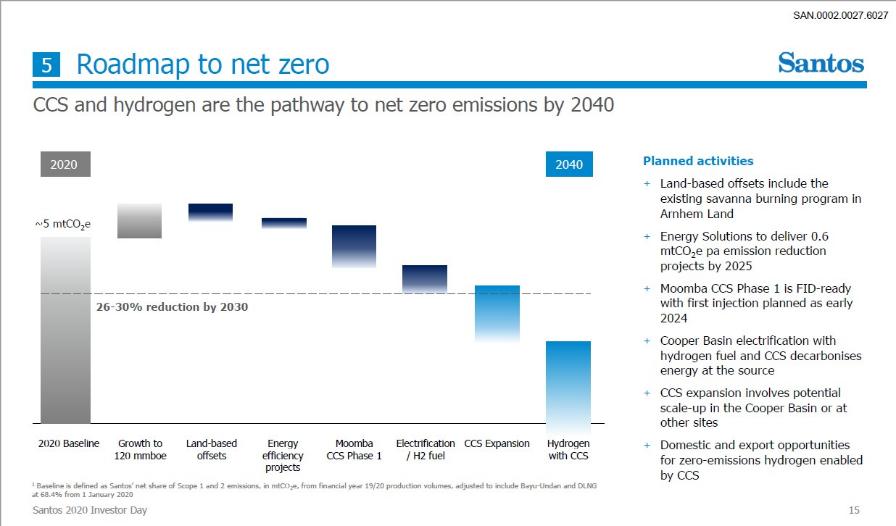
208 Mr Woods gave the following evidence about the Net Zero Roadmap.
209 At the time the Targets were announced, Mr Woods did not believe that Santos was committing to the Net Zero Roadmap as a fixed pathway by which the 2040 Target would be achieved. Rather, the 2040 Target was a long-term strategy that Santos was committing to pursue and, given its long term nature, the Net Zero Roadmap would continue to evolve over time if certain activities could not be pursued, or if different opportunities presented themselves because of developments in technology, regulation and economics. The Net Zero Roadmap contained a variety of projects, some of which were more mature (e.g. Moomba CCS Phase 1), and others which were less mature (e.g. hydrogen), which gave Santos a pathway to get to net zero. It included activities that Santos had materially progressed and other opportunities that it was working up which it believed it could execute. In particular:
(1) hydrogen was still in the early phases of the detailed engineering required to progress the project. Mr Woods believed that Santos’ opportunity to produce hydrogen would be dependent on the development of a hydrogen market. Mr Woods made this point at the Investor Day where he said:
This is a fantastic opportunity for Santos, and as Kevin said, this is not something we’re going to do lightly. We have our own market, through our own more than 70 terajoules a day of fuel, that we can convert through hydrogen, so we can build our own market base, but we really have to follow what the rest of the market signals look like, until we can deploy that.
If there was a market today, we’d be able to execute our hydrogen project, but at the moment, there isn’t anyone really able to take hydrogen at scale, for us to build this opportunity, …
(2) “CCS Expansion” represented a number of potential opportunities which were at an early stage of consideration but which Mr Woods was confident Santos could progress based on the work conducted on Moomba CCS Phase 1 as well as its preliminary analysis of those opportunities. Mr Woods also considered that hydrogen with CCS and CCS Expansion were generally not limited by scale and could be larger or smaller depending on the market demand in 2040, with the potential for Santos to go further than net zero as demonstrated by the last bar in the Net Zero Roadmap extending past the zero point on the roadmap; and
(3) another potential pathway to which Mr Woods had regard was that, if Santos was unable to reduce or offset its emissions through its own projects or activities, it could acquire offsets to assist it to reach net zero.
210 The Net Zero Roadmap incorporated Santos’ strategy for growing its production to 120 million barrels of oil equivalent (mmboe) to 2025 (2025 Production Strategy). Mr Woods explains that the 2025 Production Strategy was supported by a number of proposed growth projects that Santos had identified and was pursuing:
(1) the proposed Dorado liquids and gas development. In December 2020, this project was in the “Select” phase of Santos’ project development process;
(2) the Barossa Gas Project which is an offshore gas and condensate project. In December 2020, this project was in the FEED phase of Santos’ project development process;
(3) the Narrabri Gas Project which is a gas project in NSW. In December 2020 this project was in the “Select” phase of Santos’ project development process; and
(4) PNG expansion, which referred to Santos’ plans to add another train to its base business in PNG, which would add more production volume as well as an opportunity to build two additional trains for a joint venture operating in PNG with Oil Search, ExxonMobil and Total.
211 The Net Zero Roadmap included Santos’ forecast that its emissions in 2025 would be 5.9 MtCO2e if the projects referred to in the preceding paragraph were successfully implemented. It did not include Santos’ forecast that by 2030 its production levels would decline to approximately 100 mmboe. That information was recorded on slides 12 and 15 of the Investor Day Presentation. The Net Zero Roadmap also did not include emissions from other potential growth projects to which Santos did not have line of sight, but which could present themselves in the future. Mr Woods did not think that any of those projects would materially increase Santos’ emissions beyond 5.9 MtCO2e because:
(1) Santos’ forecasts for existing projects and approved growth projects were for production to peak in 2025 and, absent further growth projects, to decline to approximately 100 mmboe by 2030 and even further by 2040. Mr Woods believed that Santos’ intention was to seek to maintain production at 2025 levels through other growth projects. Relevantly, as at December 2020 Mr Woods was aware of the following matters:
(a) in 2020 the Cooper Basin Asset team shifted its approach to production from seeking to grow production to maintaining broadly flat production. In about mid 2020 Mr Woods attended a meeting of Santos’ senior executives at which Mr Gallagher informed the meeting that the production strategy for the Cooper Basin asset should be to achieve flat production at levels of approximately 17 mmboe focused on supporting the long term backfilling of production to preserve the life of the asset in line with the disciplined operating model. Mr Woods understood that a key reason for this decision was that sustaining significant growth in the Cooper Basin would be capital intensive and Santos was committed to its disciplined operating model approach, including by ensuring that the Cooper Basin continued to be free cashflow positive. Another reason was to ensure the longevity of that asset. Mr Woods cannot now recall the specific type of management meeting at which this decision was made; and
(b) in 2019 and continuing through 2020 the Cooper Basin Asset team had been assessing a new set of fields in an area called Moomba South. In April 2019 Santos announced the results of its phase 1 appraisal program which included that the preliminary indications were that those fields had “approximately 50% lower CO2 compared to adjacent field production”. Santos continued to assess the Moomba South fields during 2020 and the Cooper Basin Asset team was planning to increase the amount of production from Moomba South into its plans. The analysis of Moomba South continued after 2020. Production from Moomba South could displace other potential sources of production that the Cooper Basin Asset team had been factoring into their plans. One such source was called “DD Coal” which refers to coal that is deeper than a few hundred meters under the surface. Mr Woods was aware that emissions intensity of gas production from DD Coal was higher than from other sources;
(2) he believed that future growth projects to maintain production levels were likely to be at no greater emissions intensity than the current portfolio of projects. This was because other opportunities available to Santos were generally from lower emissions intensity fields, such as PNG and the Dorado fields development (an offshore development project near Port Hedland, Western Australia), when compared to Santos’ current portfolio including assets such as those in the Cooper Basin. Mr Woods gave examples of the potential growth assets with low emissions intensity that could increase production above the approximately 100 mmboe in 2030 on which he based his belief;
(3) Santos’ commitment to the Targets meant that any decision about whether to pursue any growth project in the future would have regard to whether to do so was consistent with those Targets or otherwise could be further offset from additional activities considered as part of that project that were not in contemplation as part of the Net Zero Roadmap. This could include further land based offsets projects, or acquisition of voluntary credits or ACCUs from the market. From June 2021 this strategy was reflected in a change to Santos’ Risk Appetite Assessment. The assessment includes a strategic risk exposure for “Carbon Emissions” which provides that there is no tolerance for a decision or activity that will result in Santos failing to meet its emissions reduction targets;
(4) it was possible for further production growth or revenue growth to come from projects that did not result in net positive emissions, such as the CCS Expansion and hydrogen with CCS opportunities; and
(5) the Net Zero Roadmap did not account for any future potential divestments Santos might make that had not yet been announced to the market.
212 On 18 February 2021 Santos published the 2020 Annual Report and its 2021 Climate Change Report.
213 The 2020 Annual Report included the following statements:
(1) on the cover:
A clear pathway to net zero emissions by 2040
(2) under the heading “About Santos An Australian energy pioneer”:
A proudly Australian company, Santos is a leading supplier of natural gas, a fuel for the future, providing clean energy to improve the lives of people in Australia and Asia.
Santos is already Australia’s biggest domestic gas supplier, a leading Asia–Pacific LNG supplier and aims to be a world-leading clean fuels company, achieving net zero emissions by 2040.
Santos will grow its clean fuels capability as customer demand evolves for zero-emissions LNG, hydrogen and other products through carbon capture and storage, nature-based offsets, energy efficiency and use of renewables in its operations.
(3) in the “Message from the Chairman and the [CEO]” (Chairman and CEO Message):
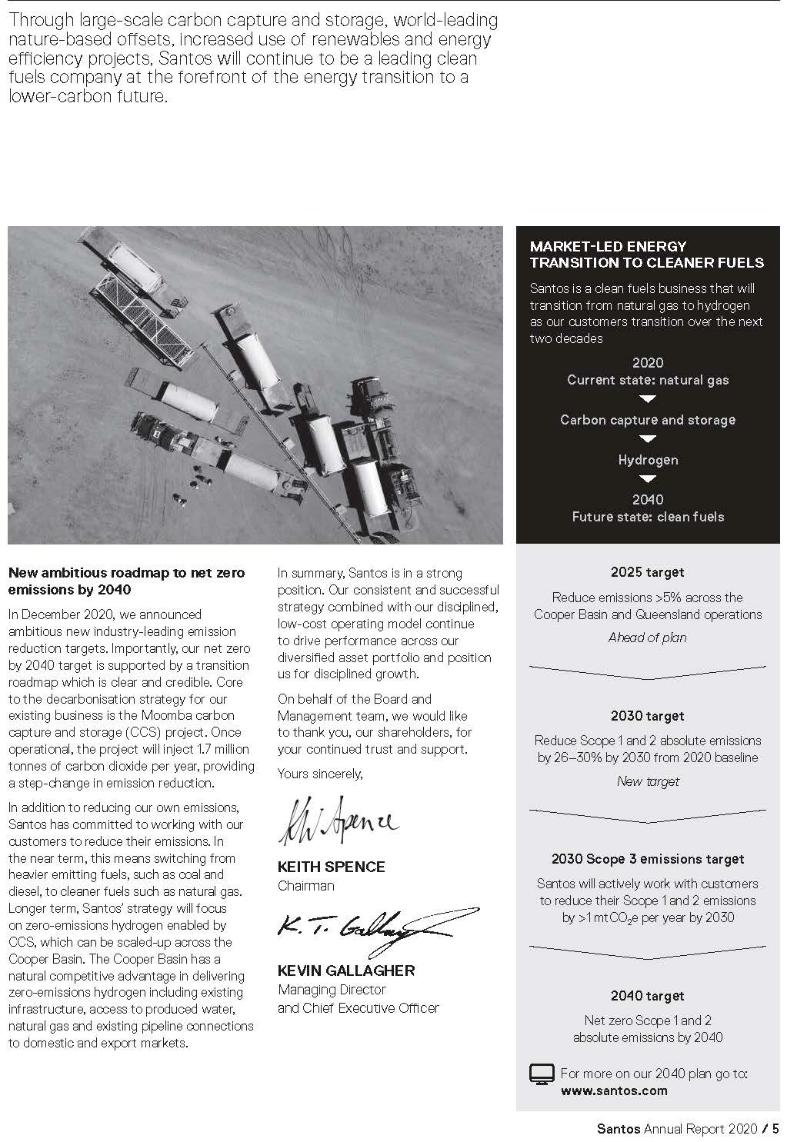
(4) in the message from Yasmin Allen, Chair, People, Remuneration and Culture Committee included in the remuneration report:
During 2020, Santos set a target to achieve net zero Scope 1 and Scope 2 emissions by 2040. Importantly Santos has outlined a tangible roadmap to achieve these reduction targets. Through large-scale carbon capture and storage, world-leading nature-based offsets, increased use of renewables and energy efficiency projects, Santos will continue to be a leading clean fuels company at the forefront of the energy transition to a lower-carbon future. Following a successful injection trial in October, we have continued to progress our Moomba carbon capture & storage project, which will be ready for FID subject to the project qualifying for Australian carbon credits.
214 The 2021 Climate Change Report included:
(1) the Targets and the Net Zero Roadmap;
(2) in the “CEO statement”:
In parallel, at Santos we are evolving our business to drive deeper emission abatement through our leading position in the critical technology of CCS. This will drastically lower our operating emissions and provide permanent, low-cost CO2 abatement for other industries. Eventually, it will unlock production of zero-emission hydrogen produced from natural gas, by sequestering the CO2 emissions released during the process.
This proven technology can produce clean hydrogen for half the cost of hydrogen created with electricity (electrolysis), while using half the volume of water. Our existing LNG customer base in Asia will be the hydrogen customers of the future, and as they transition to new clean fuels, Santos will transition with them.
(3) in the “Executive Summary”:
Aligned with our strategy, Santos is positioned to be a leading domestic and export supplier of natural gas and liquified natural gas (LNG) with progressively lower emissions through our world-leading CCS project. Moving forward, these core capabilities enable us to accelerate development of clean, zero-emission hydrogen, to fulfill future needs of our customers.
And:
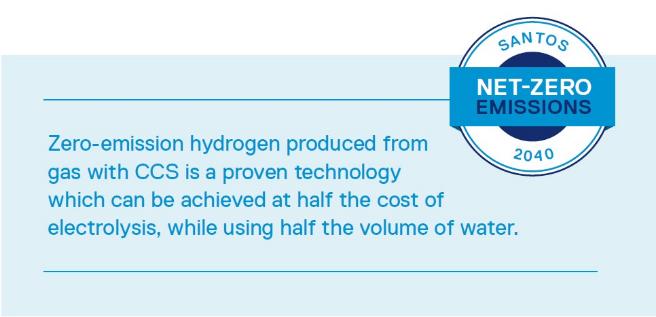
And:
Metrics and Targets
+ Santos has set a new medium-term target to reduce Scope 1 and 2 emissions and emissions intensity by 26-30 per cent by 2030 from our 2019-20 financial year baseline in keeping with Australia’s Paris Agreement commitment.
+ In addition, the company has a further medium-term target to reduce customer Scope 1 and 2 emissions by more than 1 million tonnes per annum by 2030 through direct switching to cleaner fuels.
+ Santos has set a new long-term target of achieving net-zero Scope 1 and 2 emissions by 2040.
+ This strong ambition is enabled by excellent progress against previous targets and commercialising of step-change technology in CCS.
+ Santos transparently reports its greenhouse gas emissions, including fugitive emissions.
215 The above extracts from the 2020 Annual Report and 2021 Climate Change Report are a selection of the statements included in those publications about which ACCR makes its complaints. They should not be taken as an exhaustive list of its complaints, nor should they be considered in isolation.
216 I set out below facts relating to the development and announcement of the Targets and the Net Zero Roadmap.
1.9 2020 Board Strategy Day
217 Work in relation to a strategy for the Targets began at a strategy day for the Board and senior management held on 13 May 2020 (2020 Board Strategy Day). Messrs Woods and Jaffray and Ms Luo each attended a part of the 2020 Board Strategy Day.
218 At the 2020 Board Strategy Day, the ExCom presented its five-year strategy about sustainability, emissions reporting and compliance titled “Vision 2025” for the Board’s consideration (May 2020 Board Presentation) which included recommendations for the Board to approve:
(1) the 2025 Production Strategy;
(2) the preparation of a new medium-term emissions reduction target, the 2030 Target, to support Santos’ 2050 Aspiration and to demonstrate a strong and credible commitment to emissions reductions; and
(3) the development of a business plan (by year-end 2020 to obtain Board approval as part of the 2021 budget process) to commercialise hydrogen production using existing infrastructure, including blue hydrogen.
219 Mr Woods recalls that at around the time of the 2020 Board Strategy Day and throughout the development of the Targets, Mr Gallagher informed him that Santos needed to set ambitious climate reduction targets which would encourage and support efforts being made by it to reduce emissions and establish its clean energy businesses.
220 The minutes of the 2020 Board Strategy Day record, among other things, that the Board supported and endorsed the strategy proposed in the May 2020 Board Presentation and, among other things, supported management’s plan to develop plans for the 2030 Target and endorsed the development of a budgeted plan for hydrogen production for 2021, noting that Santos’ management would revert to the Board for further discussion in relation to both items.
221 In summary, and as more fully described below, the Targets were developed between May and October 2020, approved by the Board in October 2020 and, as is apparent from the matters set out above, announced at the Investor Day together with the publication of the Net Zero Roadmap.
1.10 Development of the Targets and the Net Zero Roadmap
222 Each of Messrs Woods and Jaffray and Ms Luo gave evidence about their respective roles in the development of the Targets and the Net Zero Roadmap.
223 Mr Woods was involved in developing the strategy for the Targets and the Net Zero Roadmap. At the time, he was also responsible for Santos’ midstream gas processing facilities at Moomba, Port Bonython and Darwin LNG, its PNG LNG project and CCS projects. Given those responsibilities, Mr Woods was the executive with responsibility for a number of the projects and initiatives that would form part of Santos’ strategy to achieve the Targets and the pathway reflected in the Net Zero Roadmap, but which were being progressed independently of the development of the Targets and the Net Zero Roadmap.
224 Each paper that was submitted to the Board was sponsored by a member of ExCom whose responsibilities included the area to which the paper related, referred to as the Executive Sponsor. As VP, People and Sustainability and as part of his responsibility in relation to sustainability, Mr Jaffray was the Executive Sponsor of Board papers about the Targets and the Net Zero Roadmap. In that role, from May to December 2020 he oversaw the direction and framing of the development of the strategy for the Targets and preparation of Board papers and presentations in relation to them and what would ultimately become the Net Zero Roadmap.
225 Jane Norman, Santos’ Chief of Staff and VP Strategy who reported to Mr Gallagher, was the senior executive with responsibility for corporate strategy and also assisted with developing the strategy for the Targets and the Net Zero Roadmap.
226 In developing the strategy for the Targets and the Net Zero Roadmap, Messrs Woods and Jaffray and Ms Norman were supported by a number of teams at Santos, each of which was responsible for different aspects of the strategy, including the development and verification of data contained in Board papers and presentations. Primary support came from Ms Luo, as part of her role in the Energy Solutions team and because of her involvement in the initiatives described at [153] above, and Ms Genet.
227 More particularly, Ms Luo assisted Messrs Woods and Jaffray and Ms Norman by gathering and analysing data and information in relation to the relevant projects and initiatives being progressed or considered at the time, and which were considered as potential options to enable Santos to achieve the Targets.
228 It was apparent that the process of preparing the various presentations that led to the development of the Targets and the Net Zero Roadmap was collaborative and involved obtaining inputs from several parts of Santos’ business and strategic direction, which came primarily from Messrs Woods and Jaffray and Ms Norman. Ms Luo observes that the information and data that she had in relation to the Targets changed over time, with new information becoming available and some information becoming outdated during the process, particularly as work on the underlying initiatives developed.
229 Messrs Woods and Jaffray and Ms Norman were also supported by other Santos teams which had operational responsibility for various initiatives, many of which were being progressed independently of the development of the Targets and the Net Zero Roadmap but which were also considered to be initiatives that could form part of Santos’ strategy for achieving the Targets. This included Mr Harley, whose role at the time as Project Manager, Moomba Carbon Capture and Storage, sat within the Energy Solutions team.
1.10.1 May 2020 to August 2020 – development of the 2030 Target
230 From May to August 2020, work was undertaken to develop potential options for the 2030 Target for consideration by Mr Gallagher and the rest of the Board. This included consideration of an appropriate emissions baseline, the nature of the emissions reduction target (e.g. whether it would be an absolute target or whether it would be adjusted for Santos’ equity interests and, if so, how those adjustments would be made), the size of the target reduction in emissions, projected future emissions, and the potential initiatives, projects and activities that might enable Santos to meet the target.
231 In the week following the 2020 Board Strategy Day Mr Jaffray, Ms Norman and Ms Genet met to discuss the Board’s expectations around targets, key internal and external strategic drivers for the 2030 Target, target options at an exploratory level and a work plan to further develop target options for review.
232 On 18 May 2020, following their meeting, Ms Norman sent an email to, among others, Messrs Woods and Jaffray, Ms Genet and Ms Luo with subject “[n]otes from 2030 Carbon emission reduction target discussion” which recorded notes from the discussion and “[a]ctions”.
233 From June 2020 to August 2020 Messrs Jaffray and Woods, Ms Norman, Ms Genet and Ms Luo, among others, were involved in reviewing and commenting upon several drafts of a presentation entitled “Emissions Strategy and Targets” to be presented to the Board in August 2020 (August 2020 Board Presentation). That process included meetings between Messrs Jaffray and Gallagher, Ms Norman and Ms Genet, among others.
234 In preparing the presentation for the 2020 Board Strategy Day Ms Luo drafted the emissions forecast to 2030 (slide 56) using data contained in a spreadsheet attached to an email dated 9 May 2020 from Adam Bermingham, a member of the Portfolio team.
235 On 5 June 2020 Mr Bermingham forwarded an email dated 3 June 2020 to Ms Luo. The email dated 3 June 2020, which was addressed to Mr Wilson, provided “requested source data” and attached “latest portfolio production and emission forecasts (absolute emissions + emission intensity) split by asset on a full lifecycle basis”. The email included:
*Please note:
* Cooper and emission profiles have been refined post the 2020 Strategy Day based on a review undertaken by Randall Yeates with regards to a separate request from [Ms Luo]
* GLNG emission profiles were also reviewed post the 2020 Strategy Day by Matt Woolley – some minor variances were noted – they have not been updated in the attached as they are not material
* Northern Australia (BC + DLNG) emission profiles have been refined post the 2020 Strategy Day to reflect updated emission intensity profiles
236 On 19 June 2020 Ms Luo sent an email to, among others, Messrs Woods and Jaffray attaching a draft of the August 2020 Board Presentation for discussion at a meeting scheduled to take place on 23 June 2020. Ms Luo’s email included:
We propose a three target approach, similar to the 2025 target structure, (1) benefits of natural gas, (2) reducing the footprint of our portfolio and (3) assessing clean energy options.
* Target 1: Sell 10 carbon-offset LNG cargoes per year to reduce global emissions by 2.3-2.9 MtCO2e per year ·
* Target 2:
* Option 1: Santos aims to reduce Scope 1 & 2 emissions intensity by 5-25% by 2030 from 2016/17 levels
* Option 2: Santos aims to maintain flat Scope 1 & 2 equity emissions across its current portfolio by 2030
* Target 3: Santos will assess the feasibility and, if feasible, invest in hydrogen opportunities, which can deliver a step change in emissions
These targets keep Santos in-line with industry – committing to an emissions intensity target puts Santos ahead of Australian peers and in-line with international majors, and allows for production for growth.
237 The attached draft presentation included (at slide 3) a forecast of Santos’ Scope 1 and 2 equity emissions between 2020 and 2030 (emissions forecast slide), which was based on the forecast that she had prepared for the 2020 Board Strategy Day but updated to reflect the further information obtained on 5 June 2020 from Mr Bermingham. One effect of the updates was that the forecast emissions in 2030 had increased from 6.0 MtCO2e per annum to 6.2 MtCO2e, which was a sum of rounded numbers for each asset resulting in a higher number than rounding from 6.13 MtCO2e.
238 On 16 July 2020 Ms Luo sent a revised draft of the August 2020 Board Presentation to Messrs Woods and Jaffray, among others. Ms Luo’s covering email included:
…
Key messages:
* The first slide now speaks to why we believe we need to update our medium-term emissions targets.
* We had some confusion over what the final recommendation was so we have proposed two options:
1. Replace all the existing 2025 targets with a single target to reduce Scope 1 & 2 emissions by 30% by 2025 – this can be met only if CCS is online and the growth projects are not online
2. Update the existing 2025 targets, with Target 2 being updated to reduce Scope 1 & 2 emissions by 30% by 2025.
* These target options keep Santos in-line with industry
…
239 In the revised draft of the August 2020 Board Presentation Ms Luo amended the emissions forecast slide (slide 6) to distinguish between existing production plans and “Growth” projects which were the Barossa, Dorado, PNG expansion and Narrabri projects. Ms Luo explains that the change did not affect the total emissions forecast and was only a re-characterisation of the existing data. The main reason for it was because the revised draft proposed two options for emissions reduction, both of which involved an emissions reduction target that was proposed to be met prior to the growth projects coming online.
240 On 21 July 2020 Mr Jaffray, Ms Norman and Ms Genet met with Mr Gallagher to discuss the work done on the 2030 Target and the draft August 2020 Board Presentation. Mr Jaffray recalls that at the meeting Mr Gallagher told him that he wanted further analysis to be conducted to assist with developing the 2030 Target. Mr Jaffray understood that Mr Gallagher wanted to understand all available or potentially available options to reduce emissions by 2030, which included use of CCS, reductions in customers’ emissions by displacing their use of coal or diesel with natural gas and LNG, reductions in fuel, flare and vent (FFV) activities, purchasing of carbon credits as well as various potential hydrogen projects, both for producing hydrogen to be used in Santos’ own operations, and to be supplied to third parties.
241 On 21 July 2020, after the meeting referred to in the preceding paragraph, each of Ms Norman and Ms Genet, sent an email to, in the case of Ms Norman, Messrs Woods and Jaffray and Ms Genet, and in the case of Ms Genet, Messrs Jaffray, Jain and Wilson, Ms Norman and Ms Luo, setting out notes of the meeting with Mr Gallagher and actions or next steps.
242 In the period that followed, further work was undertaken on the August 2020 Board Presentation.
243 On 23 July 2020 Ms Luo sent Mr Jaffray, among others, two emails attaching drafts of the August 2020 Board Presentation:
(1) in her first email Ms Luo wrote that “[u]sing hydrogen in [Santos’] own fuel gas for 100% of Moomba, Port Bonython and centralised power generation from Cooper Electrification” would be expected to deliver approximately 434 ktCO2e emissions reduction per year. However, that “assumes that hydrogen production is completely carbon neutral and additional fuel and power consumption for hydrogen production is captured”; and
(2) in her second email Ms Luo said:
In our hydrogen production study that we are currently progressing, we are in the process of technology selection with vendors to understand our options to minimise CO2 production and water use. I have assumed in this analysis that any CO2 produced through the reforming process will be captured separately, and therefore isn’t added onto our Scope 1 & 2.
244 At the time of receipt of these emails Mr Jaffray was aware that Santos was progressing a study by GHD, a global engineering consultancy firm, about the production of hydrogen as part of the Moomba CCS Project which is the GHD Review described more fully below. Mr Wilson provided Mr Jaffray with periodic updates on the GHD Review.
245 On 29 July 2020 Ms Luo sent an email to Ms Norman, copying Messrs Wilson and Jain and Ms Genet, attaching a further draft of the August 2020 Board Presentation and responding to Ms Norman’s earlier comments. In her covering email, among other things, she explained that on slide 3 she had removed “the additional emissions from Exploration” because she thought this “was confusing” and that all the “reduction calculations” were “done on 6.2 MtCO2e”.
246 Ms Luo said that she understood that the emissions described as “Exploration” in slide 3 were high-level estimates of emissions that may arise from Santos developing and producing the exploration opportunities referred to in the information provided by the Portfolio team on 5 June 2020. She said that she proceeded as she did because she considered those exploration activities, and any potential projects and emissions that might arise from them, to be too contingent at that time. The result of this change was that the chart showed total forecast emissions for 2025 and 2030 of 6.7 MtCO2e and 6.2 MtCO2e, respectively. Ms Luo also included text on the slide stating that there would be “increasing intensity in the Cooper Basin”, which was based on the data provided by the Portfolio team and not on any direct information she had received from the Asset team about the likely future emissions intensity in the Cooper Basin.
247 Later that day, Mr Jaffray provided Mr Gallagher with a further draft of the August 2020 Board Presentation. This draft presented three possible emissions reduction targets which could be achieved through a combination of Santos’ energy solutions projects, supplemented by purchasing carbon credits, and included the potential cost of purchasing those credits.
248 On 3 August 2020 Ms Norman sent Mr Jaffray an email setting out her notes from a discussion with Mr Gallagher. Mr Jaffray cannot specifically recall the meeting but says that, as Ms Norman often sent summaries to attendees of meetings with Mr Gallagher shortly after the meeting took place, it is possible that he attended. In her email, Ms Norman records that one of the points discussed was to “[s]how us what a compound annual growth rate of 5% per annum looks like to 2030 from 2025?”. It was Mr Jaffray’s general understanding at the time that production levels decline over time from existing oil and gas assets, and that Santos’ strategy was to seek to replace production from declining assets with production from other projects. He understood from this statement in Ms Norman’s email that 5% compound annual growth rate (CAGR) was being proposed as one possible assumption to be considered for the purposes of understanding Santos’ potential future production levels, taking into account the strategy that declining production from existing assets would be replaced.
249 On 5 August 2020, following her discussions with Mr Jaffray and Ms Norman, Ms Luo sent them an email, copying Ms Genet and Messrs Wilson and Jain, attaching a draft of the August 2020 Board Presentation in which Ms Luo wrote:
A couple of key points for you to note:
- Anshul was able to find that we published an emissions number for 2005 in the 2005 Sustainability Report. Therefore, we recommend using this number of 3.9 MtCO2e.
- We were not able to include 2010 data as this is not readily available / published. We don’t think this adds anything to the chart to include anything not accurate.
- With a 3% CAGR on production from 2025 to 2030, 2030 production increases from 104 mmboe to 139 mmboe. This increases our 2030 forecast emissions from 6.2 MtCO2e to 8.1 MtCO2e. This requires a reduction of 5.2 MtCO2e to meet a 26% reduction from a baseline of 3.9 MtCO2e.
- The bulk of the reduction therefore needs to come from our “credits”. To give you a sense of the scale, to generate the credits on top of the hydrogen opportunity, would require 60-130 PJ of gas (equivalent of 1.1-2.5 Mtpa LNG) being sold as direct substitution.
- Achieving this 2030 target would give us an emissions intensity of 21 ktCO2e/mmboe, which is in line with the OGCI announced target for 2025.
250 In the attached draft of the August 2020 Board Presentation Ms Luo had amended the emissions forecast slide to:
(1) undo her re-characterisation of “Growth” projects returning to the forecast by asset category that had been used in the draft presentation circulated on 19 June 2020 (see [236] above); and
(2) increase the forecast for 2030 from 6.2 MtCO2e to 8.1 MtCO2e. This change, which was requested by Mr Jaffray, reflected the emissions that would result if Santos increased its production from 2025 to 2030 using a CAGR of 3%.
The slide itself included the following notation:
Santos’ emissions are forecast to increase from 3.9 MtCO2e in 2005 to 8.1 MtCO2e in 2030 as production grows (including additional growth of 3% CAGR from 2025). Without action, the emissions intensity of Santos’ portfolio increases from 54 to 60 ktCO2e/mmboe from today to 2030, due to higher carbon intensity of the Barossa project and increasing intensity in the Cooper Basin.
251 According to Mr Jaffray 3% CAGR is a commonly used long-term growth assumption across industrial industries as it aligns with long-term Gross Domestic Product growth. It therefore did not seem unusual to Mr Jaffray at that time. However, Mr Jaffray does not (and did not) remember 3% CAGR being used in this context previously and 3% CAGR was, in his view, probably at the top end of the range of potential production growth given that, at the time, Santos was already actively planning to transition the business to focus upon alternative revenue streams.
252 In cross-examination Ms Luo explained that she prepared the revised projections by applying a 3% CAGR as requested by Mr Jaffray to the portfolio as a whole (rather than to each individual asset) from 2025. Ms Luo accepted that the bulk of the reduction in emissions would need to come from credits and Santos would have to buy the number of credits depicted in the slide in the attached draft titled “Plan to reduce Santos’ scope 1 & 2 by 2030” which was the sum of 2.42 MtCO2e and 0.87 MtCO2e. As to the emissions reduction component described as “Customer offsets/credits” in that slide, Ms Luo gave evidence that that item referred to two potential emissions reduction activities:
(1) the possibility of Santos supplying hydrogen as a substitute for natural gas, the customer obtaining the ACCU under the Fuel Switching ACCU Methodology and Santos reaching a commercial agreement with the customer to agree to transfer of those ACCUs to it; and
(2) an opportunity to obtain credits from customers who currently used coal or diesel fuel but who would significantly reduce their emissions by switching to natural gas. Similarly, this relied on the customer obtaining an ACCU under the Fuel Switching ACCU Methodology and Santos reaching a commercial agreement with the customer to agree to transfer those ACCUs to Santos. While this opportunity was included as part of the October 2020 Board Presentation, it did not form any part of the Net Zero Roadmap in the Investor Day Presentation.
253 On 6 August 2020 Ms Luo sent an email to Messrs Jaffray and Wilson and Ms Norman, among others, attaching an updated draft of the August 2020 Board Presentation. Slide 7 of the draft titled “Risks associated with proposed target” included the following comment which had been suggested for inclusion by Ms Norman in her email sent earlier that day:
Hydrogen production could potentially increase Santos’ Scope 1 & 2 emissions, which will need to all be sequestered, or offset with credits
254 On 9 August 2020 Mr Jaffray sent an email to Mr Gallagher attaching a draft of the August 2020 Board Presentation. Slide 3 of the draft presentation, titled “Santos’ emissions increase to 2030 with production growth”, included:
Santos’ emissions are forecast to increase from 3.9 MtCO2e in 2005 to 8.1 MtCO2e in 2030 as production grows (including additional growth of 3% CAGR from 2025)
255 In relation to the draft referred to in the preceding paragraph Mr Jaffray:
(1) did not consider that the August 2020 Board Presentation had to reflect emissions associated with the production of hydrogen because, based on Ms Luo’s email of 23 July 2020 (see [243(2)] above), he understood that emissions associated with the production of hydrogen once CO2 had been sequestered using CCS would be negligible and could otherwise be offset. He understood that as the potential reduction in emissions associated with the sale and use of hydrogen was much greater than any potential emissions, Santos would be well placed to offset any emissions via commercial arrangements with its customers; and
(2) removed from slide 7 the statement that Ms Luo had included in the draft circulated on 6 August 2020 (see [253] above). He cannot now specifically recall why he did so but believes that he most likely made the amendment because he considered that any emissions associated with the production of hydrogen in the way proposed by Santos at that time would be negligible, would otherwise be able to be offset (if they could not be captured) and the impact was unlikely to be material. He also thinks that the amendment was made to simplify the content on the slide and to make it more business facing and commercial, rather than technical.
256 By email sent on 10 August 2020 at 9.25 pm Mr Gallagher provided his comments to Mr Jaffray on the draft presentation referred to at [254].
257 On the morning of 11 August 2020 Messrs Gallagher and Jaffray and Ms Norman met. Mr Jaffray recalls that, in relation to the emissions intensity from the Cooper Basin, Mr Gallagher said “we will select the fields with lower emissions and over time this will reduce the average emissions”. While he cannot recall the actual words used, Mr Jaffray also recalls that Mr Gallagher said in effect that the average emissions from Santos’ Cooper Basin gas fields would be expected to decrease after 2025 and the emissions intensity from Santos’ portfolio would be lower on average in 2030 than in 2025. Following their meeting Ms Norman sent an email to Mr Jaffray at 10.11 am summarising the points discussed which provided:
What’s the philosophy
* Why are Cooper emissions increasing? Moomba South and Inglewood are huge fields which are lower CO2 fields and therefore CO2 emissions will drop in absolute and intensity terms.
* Barossa is the last offshore field we will develop with offshore venting
* 2030 will be lower CO2 than the average portfolio intensity in 2025.
* Dorado numbers look very high for an oil development?
* Show any “growth” in 2030 as a range to reflect the variable intensity.
* Conversation with Board is about how we are going to construct the targets, rather than focus on specific targets
* Narratives: do we offset all domgas emissions, or do we offset all of our onshore emissions? This would be doable with H2.
* 2030 target: reduce customers scope 1 & 2 emissions by eg 0.5MtCO2 pa. show what that would require in gas sales.
* Come back in Oct with targets for approval.
* Narrabri lower CO2
* DLNG plant emissions are ~0.6MtCO2
* 2035 target, should be reducing customers emissions by displacing diesel and coal with gas
Strategic rationale:
1. Switch from aspiration to target in 2050
2. Reduce our scope 1 & 2 emissions through CCS and other Energy Solutions projects (FFV) by 2025
* CCS would reduce net equity emissions by 1.06Mt from 2019/20 is ~25% reduction
* Reduce all Domgas emissions (remove Horizon supply from Cooper from calculation)
* Reduce all Onshore emissions (incl domgas emissions GLNG and DLNG emissions)
* Reduce ??
* For 2035 target: reduce our customers’ scope 1 and 2 emissions by displacing diesel and coal with cleaner gas
* Capturing third party emissions and sequestering in Moomba (eg Inpex’s Ichtyus emissions piped to Moomba).
State we are seeking approval at October board to support a launch for 1 Dec investor day.
258 In the meantime, at 9.12 am on 11 August 2020 Ms Norman forwarded Mr Gallagher’s email sent at 9.25 pm the previous evening to Ms Luo, copying Messrs Jaffray and Jain, and adding some further comments about the meeting with Mr Gallagher earlier that day. Among other things, she noted that Mr Gallagher had “requested that we re-work the emissions targets from a 2016 baseline (i.e. start of his tenure) and show what this would look like as a 2025 target assuming we sanction CCS. The 2030 target would be more ambitious and rely on additional projects eg H2 – see below”. Ms Norman asked Ms Luo “to work up a waterfall and the table for a 2016 start date”. Ms Norman’s direction to the recipients to “see below” was a reference to Mr Gallagher’s email sent on the evening of 10 August 2020 which was included in the email chain. Mr Gallagher’s email provided (as written):
Angus we need to finalise this tomorrow.
I think we need to look at this via another lens. I’d suggest that we consider targets such as;
1. A target that reduces emissions to offset our entire onshore scope 1 & 2 emissions including from LNG production., or
2. Simply set a target based on a % reduction from our 2016 emissions, or
3. Or build it up as we have done to date based on a project based line of sight end game and state as a % of 2016 emissions.
I do however want to understand why the Cooper Basin emissions between now and 2030 increases from 2.0 to 2.5 mmtpa?
If we assume Cooper stays flat at 2.0mmtpa, Queensland (mainly LNG related I assume) is 0.8 mmtpa, Narrabri around 1mmtpa and DLNG around 0.6mmtpa then this equates to 3.5mmtpa.
maybe we therefore present to the board the info and discuss the options we are working up to come back with a recommendation in October. In this case I would then state that we are looking to do the following;
1. Change the 2050 aspiration to a 2050 target
2. Set a 2025 emissions reduction target (could simply be 1.6mmtpa) and state that this is 26% reduction from our 2016 emissions.
3.Set a 2030 or 2035 target that is more ambitious.
We should then state that we will achieve our targets by;
1. Emissions reduction / efficiency measures/projects across existing oil & gas operations
2. CCS projects
3. Reducing customer scope 1 & 2 emissions via switching from higher emission fuels to gas or hydrogen.
Lets try and finalise a paper along these lines for me to review tomorrow.
I’d suggest you, Jane and myself review sometime tomorrow to finalise.
259 On 11 August 2020 at 10.27 am Ms Norman sent a further email to Ms Luo, copied to Messrs Jain and Jaffray, which referred to her notes from the discussion with Mr Gallagher and included:
…
Also, can we get a good explanation please of why Cooper CO2 is increasing and what assumptions have been made? Kevin thinks that lower CO2 fields (Moomba South, Inglewood) would reduce emissions, not increase them and he still hasn’t seen the LTSP for Cooper so is not convinced that there is a robust plan before these forecasts.
…
260 Ms Luo says that she understood Ms Norman’s reference to “Cooper CO2 is increasing” to refer to the increasing estimated emissions in the Cooper Basin between 2025 and 2030 on slide 3 of the draft August 2020 Board Presentation that she had sent to Ms Norman and Messrs Jaffray and Wilson on 6 August 2020 where the increasing estimated emissions in the Cooper Basin was based on the data in the worksheet titled “Cooper Updates — Randall Yeates” included in the updated data provided by Mr Bermingham on 5 June 2020. Ms Luo understood the reference in Ms Norman’s email to “the LTSP for Cooper” to be a reference to the long term supply plan for the Cooper Basin, which is a model owned by the Cooper Basin Asset team in which they model the selection of fields to be developed.
261 On 11 August 2020 at 12.08 pm Mr Jaffray sent an email to Ms Luo and Mr Jain, copied to Ms Norman, attaching a “draft deck” in which he had highlighted in yellow “all the areas that need data/input”. On the emissions forecast slide (slide 4) Mr Jaffray had included the following comment:
These comments reflected Mr Jaffray’s discussion with Mr Gallagher and Ms Norman that morning in relation to Santos’ strategy for project selection in the future (see [257] above).
262 On 11 August 2020 at 12.26 pm Ms Luo sent an email to, among others, Yosef Raharjo, Group Planning and Portfolio Analyst and a member of the Portfolio team, noting that she was using “the attached emissions forecast from Portfolio for the 2030 emissions target work” and asking Mr Raharjo to review the material and advise if he had “any better data for Dorado” because Mr Gallagher “thinks that the numbers look too high for Dorado but I don’t know if he has seen something different”. The “attached emissions forecast” was the updated material provided to Ms Luo by the Portfolio team on 5 June 2020 (see [235] above), although Ms Luo accepted that in fact in undertaking her work on this issue she was actually using the spreadsheet she had prepared in which she took the updated material provided on 5 June 2020 by the Portfolio team and overlaid the asset data on to the totals.
263 On 11 August 2020 at 1.39 pm Mr Raharjo responded by email to Ms Luo’s inquiry stating:
Portfolio (and Strategy Day May 2020) CO2-e numbers are based on Nov-2019 case (Oil + Gas). The CO2 emissions were calculated by multiplying the boe production with the emissions intensity of 0.04 MtCO2-e/mmboe. Which means the emission profile will follow the production rate.
The emission intensity number of 0.04 was referring to the number in this sheet: ‘[Portfolio carbon and production profiles_StrategyDay2019_20190629.xlsx]Strategy Day 2019 Portfolio (file is attached)
In March 2020 Asset team provided the emission number which is a flat 271ktCO2-e/yr and is not linked to the production rate. Furthermore this emission number is only for the oil only case, no gas production is modelled in the asset economic case.
The spreadsheet of CO2 emission calc is also attached ([200811 Bedout Carbon Emission estimate.xlsx])
Let me know if you have further questions. For the CO2-e in the Mar-2020 asset economic case I’d suggest to speak with Aditi Dey the Dorado project engineer.
264 By email sent on 11 August 2020 at 2.26 pm Ms Luo responded to Ms Norman’s email sent at 10.27 am that morning (see [259] above) and relevantly noted:
Cooper Basin emissions are increasing due to higher CO2 % in the raw gas stream increasing emissions intensity. This does depend on the development program and the areas we choose to develop. We can overlay Kevin’s view that Cooper Basin emissions will remain at 2.2 MtCO2e, assuming the same production as Portfolio. We will just note that this is not supported by any existing Portfolio case.
265 Through Ms Luo’s work with the Portfolio team, she understood that the Cooper Basin Asset team would undertake a detailed process to produce a number of scenarios aimed at achieving the goals set for them by management. For example, if they were told to improve their cash flow, they might seek to select fields that they considered could achieve this goal. Asset teams would then choose a subset of those scenarios to provide as inputs to the Portfolio team. The Portfolio team would then review these and select scenarios to feed into the overall corporate portfolio outlook. Ms Luo understood that the Portfolio team would select scenarios in accordance with guidelines set by management.
266 At the time Ms Luo sent her response to Ms Norman she considered that it was acceptable to overlay the estimates maintained by the Portfolio team with an assumption that emissions from the Cooper Basin would remain flat from 2025 to 2030 because the Cooper Basin Asset team could be directed to select fields and wells to drill that would maintain a flat emissions profile as part of implementing an overall emissions reduction strategy. Ms Luo was aware that there were fields within the Cooper Basin that had lower CO2 content and that there were different potential combinations of fields in the Cooper Basin that could be modelled to try to achieve a strategic direction.
267 On 11 August 2020 at 5.36 pm Ms Luo sent an email to Mr Jaffray and Ms Norman, among others, attaching an updated draft of the August 2020 Board Presentation. In the emissions forecast slide (slide 4) included in the presentation, Ms Luo:
(1) updated the forecast emissions data for the Dorado project following the further enquiries she had made with the Portfolio team and the relevant Asset team. The result of this update was that the emissions estimate in 2025 of 1.5 MtCO2e for the WA component of the forecast was revised down to 0.7 MtCO2e; and
(2) as requested by Mr Jaffray, reduced the emissions forecast for the Cooper Basin from 2.5 MtCO2e to 2.2 MtCO2e.
As a result of these changes the overall emissions forecasts for 2025 and 2030 respectively changed from 6.7 MtCO2e and 6.2 MtCO2e to 5.9 MtCO2e in each case with the emissions forecast slide appearing as follows:
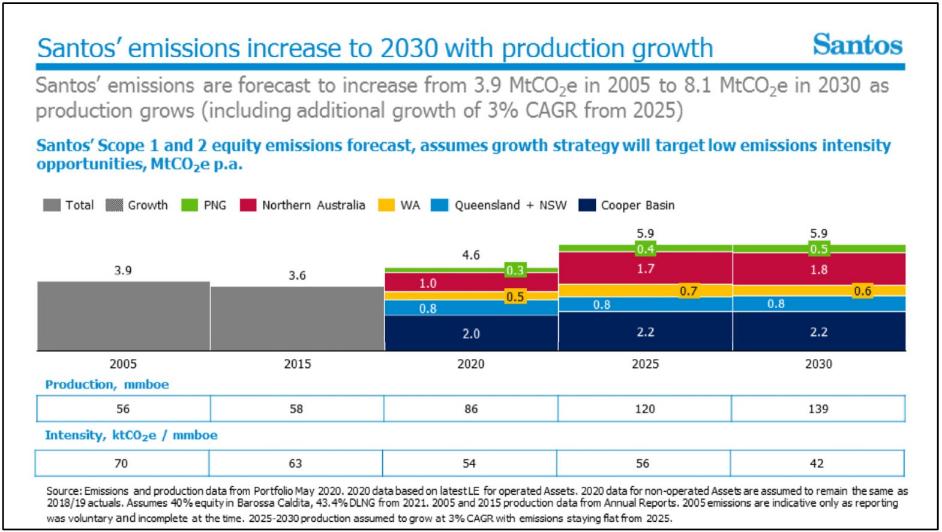
268 In cross-examination Ms Luo accepted that in making these changes she undertook an arithmetic calculation as instructed including by applying a 3% CAGR to production from 2025 to 2030. Ms Luo had no view as to whether the resulting production number and level of emissions for 2030 was reasonably possible.
269 On 11 August 2020 at 7.18 pm Mr Jaffray sent Mr Gallagher a “[s]lightly updated deck” of the August 2020 Board Presentation noting that:
Big thing is that the graph with emissions forecast goes out to 2035
* Production assumption is that 3% CGR from 2025 to 2035
* Emissions assumed to remain flat from 2025 because we select fields with lower emissions intensity
We haven’t updated the 2005 emissions yet. That will be tomorrow
270 The attached “slightly updated deck” included the following version of the emissions forecast slide (slide 4) prepared by Ms Luo which reflected the production assumption referred to above:
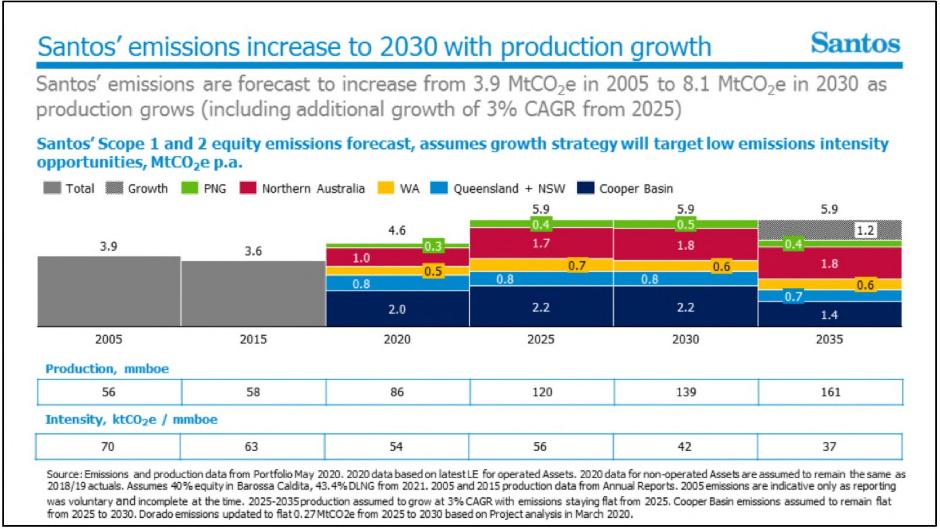
271 In cross-examination Ms Luo accepted that she had extended the forecast out to 2035 and in doing so, in accordance with her instructions, had assumed emissions remained the same and that production continued to grow at 3% CAGR which resulted in decreasing emissions intensity. She accepted that the decreasing emissions intensity depicted was just an arithmetic output of the assumptions as to growth and emissions. In other words, it did not reflect the emissions intensity forecast by the Portfolio team.
272 In relation to the production assumption of 3% CAGR Mr Jaffray understood at the time that data from the Portfolio team was based on variable assumptions about future growth and strategic decisions based on the long-term plan for each asset as well as the annual budget framework (which at the time was a three-year forward looking plan). As such, and based on his understanding of this assumption, Mr Jaffray considered that this was just one of a number of possible assumptions in terms of future production values that could be utilised.
273 By email sent to Mr Jaffray and Ms Norman on the evening of 11 August 2020 at 10.20 pm Mr Gallagher provided his comments on the draft August 2020 Board Presentation. Mr Gallagher added his amendments to slide 4 of the draft in handwriting as follows:
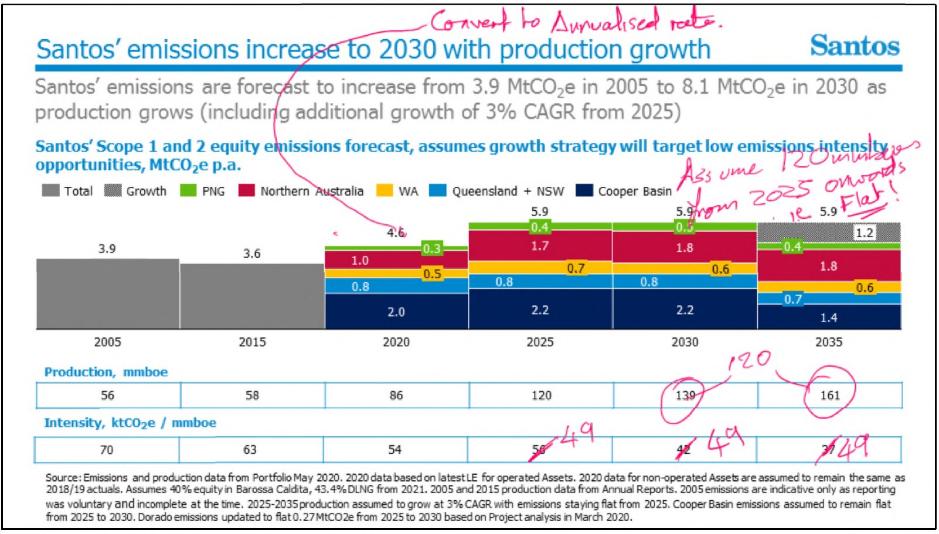
274 By those amendments Mr Jaffray understood Mr Gallagher to be indicating that revenue growth after 2025 would come through projects that would be carbon neutral, and/or from projects other than oil and gas, such as CCS and hydrogen. The amendments reflected Mr Jaffray’s understanding of an evolution of Santos’ longer-term strategy, first developed in the 2016 Strategy, to transition the business towards lower carbon products. At the time of the 2016 Strategy, low carbon products were a nascent idea. By 2020, the Transform, Build, Grow strategy was still in place, and it was evolving with business needs and environment. Mr Jaffray understood that Santos’ business would continue to evolve into the future as it adapted to the changing operating environment for the oil and gas sector.
275 On 12 August 2020 at 10.48 am Ms Luo responded to Mr Raharjo’s email sent on 11 August 2020 (see [263] above). In doing so she noted that she had spoken with Aditi Dey who had “confirmed that the flat 271 ktCO2e per annum is the latest estimate for emissions for Dorado” and that it was “based on a constant gas compression rate for re-injection” and had indicated that, from an Asset perspective, the flat 271 ktCO2e should be used for the Board. As a result of her conversation with Ms Dey, Ms Luo had altered the number for Dorado in the spreadsheets provided by Portfolio.
276 On 12 August 2020 at 11.24 am Ben Ali, manager group planning and portfolio (strategy and planning), sent an email to Ms Luo and Mr Raharjo, among others, which included:
Thanks Yosef, and I agree with you that the refresh is the appropriate time to propose potential changes.
It is really important to reiterate here that there should be no changes made outside of the portfolio refresh cycle and definitely not for use in a board paper. It is effectively unauthorised and unapproved and will only serve to inflame Kevin if it is not underpinned by a fully formed process. The portfolio refresh, which has been kicked off, will introduce a number of potential, broad ranging portfolio updates (many no doubt impacting carbon). These will be appropriately QC’d and EVP approved.
Post May 2020 Strategy Day a process was defined and agreed (refer below).
Perhaps in the interim Yosef, flag Ying’s comment for our watchlist.
…
277 By email sent on 12 August 2020 at 11.33 am Ms Luo responded to Mr Ali in the following terms:
I completely agree with you – unfortunately we are being directed specifically to update these numbers (including other “management overlay” changes) from Kevin.
The paper is now going to show Cooper Basin maintains flat emissions from 2025 and the Portfolio maintains flat emissions to 2035 with effectively no basis. I have reiterated with both Jane and Angus that we should be using the Portfolio as the source of truth. If we start changing one thing (like Dorado down), we should also be flagging the fact that Narrabri emissions in the Portfolio are less than half of what I believe they will be following the update…
278 In sending her email Ms Luo intended to convey to the Portfolio team that a decision had been approved by Mr Gallagher (as reported to her by Mr Jaffray) that the emissions forecast to be included in the August 2020 Board Presentation would maintain flat emissions from the current peak in 2025 through to 2035, rather than using the estimates maintained by the Portfolio team which were significantly lower than 5.9 MtCO2e per annum as a result of expected declines from existing gas fields by 2030 and 2035. Ms Luo intended to reflect the uncomfortable position in which she found herself vis-a-vis her professional relationship with the Portfolio team. In particular, she was aware of the practice at Santos of treating the Portfolio team’s estimates as the central “source of truth” to avoid inconsistencies that might be difficult to track, and which could generate mistakes or misunderstandings within the organisation. Thus, Ms Luo wanted to demonstrate to Mr Ali that she was sensitive to the fact that this presentation did not use the Portfolio team’s estimates, that she had communicated that to Ms Norman and Mr Jaffray, but that the decision to maintain emissions at 2025 levels was approved by Mr Gallagher.
279 Ms Luo accepted in cross-examination that: the numbers and assumptions adopted in preparing the emissions forecast slide had “no bottom-up analysis” and she simply followed her instructions; and where in her email to Mr Ali she said that “[t]he paper is now going to show Cooper Basin maintains flat emissions from 2025 and the Portfolio maintains flat emissions to 2035 with effectively no basis” she was referring to the emissions forecast slide provided as part of the draft August 2020 Board Presentation.
280 That said, at the time that Ms Luo sent her email to Mr Ali she was aware:
(1) that incorporating the Portfolio team’s estimates for 2030 and 2035 within the emissions reduction targets would indicate to the market that Santos was expecting a declining production forecast. Mr Jaffray had told Ms Luo that his and Mr Gallagher’s view was that Santos should be aiming to replace declining production with other opportunities. Ms Luo believed this was appropriate given that it would not be an accurate representation of Santos’ corporate strategy, in effect to be, publicly announcing that Santos was intending to wind down its operations in the way suggested by the Portfolio estimates;
(2) that the long-term nature of the emissions reduction targets under consideration meant that Santos was required to make assumptions about its future production and emissions profile. At the time the emissions reductions targets were being considered, Ms Luo believed that Santos was continuing to develop its clean energy strategy and that the decisions being made as part of that would not have yet been reflected in the assumptions behind the emissions estimates from the Asset teams; and
(3) of the adjustments made to the emissions estimated from the Dorado growth project and the Cooper Basin.
Ms Luo thus believed and understood that the decision to depart from the Portfolio team’s estimates and adopt an assumption to maintain emissions for 2030 and 2035 at the levels expected in 2025 was logical for the purpose of setting emissions reduction targets.
281 In her email to Mr Ali, Ms Luo also commented that “we should also be flagging the fact that Narrabri emissions in the Portfolio are less than half of what I believe they will be following the update...”. Ms Luo explains that this comment reflected her understanding of discussions she had with the Carbon and Sustainability team and the team managing the Narrabri growth project. While Ms Luo cannot now recall the detail of those discussions, she recalls that the impact on the overall emissions forecast (as described at [267] above), if that change had been made, would have been so small that it would not have increased that forecast above the 5.9 MtCO2e that had been assumed for 2030 or 2035.
282 On 13 August 2020 at 10.07 am Mr Jaffray sent the final draft of the August 2020 Board Presentation to Amanda Devonish, Santos’ Company Secretary.
283 Slide 4 of the August 2020 Board Presentation set out an estimate for Santos’ emissions profile to 2035 which was adjusted for Santos’ equity share in the assets that generated the emissions. The slide showed a potential rise in emissions from 5.1 MtCO2e per annum in 2020 to 5.9 MtCO2e per annum by 2025, after which emissions and production were assumed to stay flat to 2035 at 5.9 MtCO2e and 120 mmboe respectively. The slide appeared as follows:
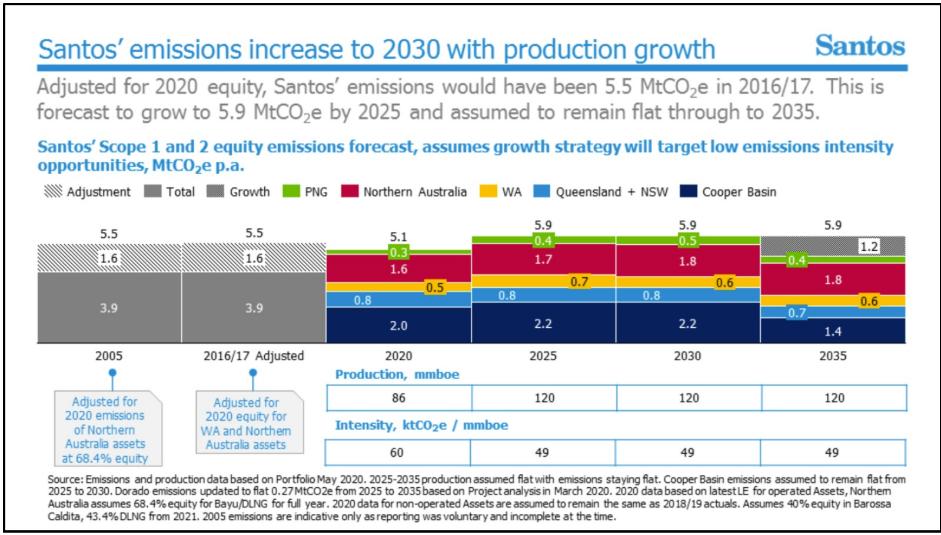
284 As depicted in the slide extracted above, emissions were broken down by Santos’ five core asset hubs: PNG; Northern Australia; WA; Queensland + NSW; and the Cooper Basin. Mr Jaffray understood that the potential emissions up to 2025 were based on estimates prepared by the Portfolio team and the emissions estimate from 2025 to 2035 reflected the further work described below.
285 The August 2020 Board Presentation also:
(1) set out (at slide 5) several available options for Santos to consider in relation to the setting of the new targets including in respect of the baseline year, e.g. 2005, 2016, 2019 or 2020, and target year, e.g. 2025, 2030, 2035 or 2050;
(2) outlined (at slide 6) four key groupings of initiatives for potential emission reductions that could be developed by Santos, which included:
(a) Moomba CCS Phase 1, which had an estimated reduction of 1.1 MtCO2e per annum. Mr Jaffray understood this figure to be based on estimates prepared by the Moomba CCS Project Team that adjusted for Santos’ equity in the project;
(b) internal efficiency projects, which included FFV projects (estimated reduction of 0.8 MtCO2e per annum), the electrification of the Cooper Basin, and Hydrogen Fuel. Mr Jaffray understood that the estimate for Hydrogen Fuel, of a further 0.4 MtCO2e per annum estimated reduction, had been prepared by Ms Luo (see [243] above);
(c) obtaining customer offsets or credits from reducing their Scope 1 and 2 emissions (estimated reduction of 2.1 MtCO2e per annum), through the coal/diesel customer offsets initiative (representing 1.2 MtCO2e per annum) and replacing 10% of natural gas sales from Moomba with hydrogen (representing 0.9 MtCO2e per annum); and
(d) utilising Third Party CCS at Moomba (estimated reduction of 2.0 MtCO2e per annum); and
(3) set out an example pathway (on slide 8) to a potential target of a 26% reduction by 2030 from 2005 baseline emissions, which also included land-based offsets.
286 On 13 August 2020 at 10.46 am Ms Luo sent an email to Ms Genet and Messrs Jain and Wilson the purpose of which was to “document the changes that have been made in the last couple of days on this pack going to the Board and make sure that [the recipients] all understand the basis of the current document”. The pack to which Ms Luo was referring was the final August 2020 Board Presentation sent by Mr Jaffray to Ms Devonish earlier that day. In relation to the emissions forecast slide (slide 4) Ms Luo noted that the following adjustments had been made:
a. 2005 emissions have been adjusted to include 2020 emissions for Northern Australia at a full year of 68.4% equity. This will not match any number that we publish or report, given that our equity change occurred on 28th May in 2020.
b. 2016/17 emissions have been adjusted for changes in equity between 2016/17 and 2020 – this includes for Varanus Island, Devil Creek and Northern Australia. This includes Northern Australia at 68.4% for a full year.
c. 2020 emissions are based on our LE for Operated assets, but with Northern Australia at a full year of 68.4% equity. Non-operated assets are assumed to remain flat from the latest published number from 2018/19. 2020 production is based on LE provided by Finance.
d. 2025 emissions are based on Portfolio with Dorado emissions adjusted. The Dorado Portfolio case assumed an emissions intensity from historical WA oil fields. The Dorado number shown here has been provided by the Project team, who calculated this based on flat gas compression and injection from 2025 to 2035 for Phase 1 development.
e. 2030 emissions are based on Portfolio with Dorado and Cooper Basin emissions adjusted. Dorado has been adjusted as per 2025. Cooper Basin emissions are assumed to remain flat from 2025. 2030 production is assumed to be flat – there is no basis for the production growth compared to Portfolio. This allows no emissions associated with production growth.
f. 2035 emissions are based on Portfolio with Dorado emissions adjusted as per 2025 and 2030. 2035 production is assumed to be flat and emissions associated with growth keeps the Portfolio emissions flat. There is no basis behind these assumptions.
…
287 Ms Luo gives the following evidence about the commentary in her email in relation to the 2030 and 2035 emissions (at e and f in the extract above):
(1) in relation to the 2030 emissions, when she said: “Cooper Basin emissions are assumed to remain flat from 2025”, she was referring to the adjustment to Cooper Basin emissions requested by Mr Jaffray. At the time Ms Luo was aware that there were lower intensity fields in parts of the Cooper Basin and that it was open to the Asset team to select such fields;
(2) when she said “2030 production is assumed to be flat - there is no basis for the production growth compared to Portfolio” in relation to the 2030 emissions and “[t]here is no basis behind these assumptions” in relation to the 2035 emissions, she was intending to convey that the assumption was not reflected in the Portfolio team data provided to her on 5 June 2020; and
(3) in relation to the 2030 emissions, when she said “[t]his allows no emissions associated with production growth”, she was intending to convey that the 2030 estimate did not include a bottom-up emissions assessment for the production growth that would maintain production at 120 mmboe, as forecast to be achieved in 2025. She believed this approach was logical for the reasons set out at [280] above.
288 Ms Luo was cross-examined about her 13 August 2020 email. She had the following exchange with Mr Hutley SC:
Mr Hutley: You were saying Portfolio showed production at 103 barrels – million barrels of oil at 2030, with emissions of about 5.9 million tonnes per annum; correct?
Ms Luo: Yes. I was saying that the numbers differed from the Portfolio analysis. Yes.
Mr Hutley: And there was no basis to justify the production of an extra 13 million barrels of oil – 17 million barrels of oil, to get it right – without any emissions, was there?
Ms Luo: There was no analysis, as we discussed earlier. Yes.
Mr Hutley: Well, you were a bit more concerned that there was no analysis. You were saying:
There is no basis for the production growth compared to Portfolio.
Correct?
Ms Luo: That’s what I – that’s what I state in that email. Yes.
Mr Hutley: Continuing:
This allows no emissions growth associated with production growth.
Correct?
Ms Luo: Yes. There was no analysis supporting the production and emissions numbers.
Mr Hutley: No. What it meant was if you accepted Portfolio – which I think you thought was the source of truth within this company; correct?
Ms Luo: We had previously been directed by Mr Gallagher to treat Portfolio data as the central source of truth. Yes.
Mr Hutley: Right. And treating it as the central source of truth, this document provided for 17 million barrels of oil being produced with zero emissions; that’s correct, isn’t it, as you understood it?
Ms Luo: Or changes in, yes, production and emissions intensity.
Mr Hutley: Or possibly anything, but you didn’t know how it could be done; correct?
Ms Luo: No. We didn’t have any analysis supporting that.
Mr Hutley: And that was your concern; correct?
Ms Luo: The purpose of this email was to document the changes that had been made over the past several days, just to ensure that it was all together in one location – that it was clear, the source of data.
…
Mr Hutley: You were saying this because you were worried that what was happening here didn’t make sense; that’s correct, isn’t it?
Ms Luo: I state in my affidavit that I believe the changes were – made sense to me, at least some of them. The purpose of this email was to ensure that the decision-makers had the source of data for the inputs.
Mr Hutley: And when you said that some of them make sense, what you’re referring to, the changes to Cooper and the changes to Dorado; that’s correct, isn’t it?
Ms Luo: Yes, I believe that’s what I said in my affidavit, yes.
Mr Hutley: Yes. None of the other changes made any sense to you, did they?
Ms Luo: They were top-down assumptions, as I’ve stated.
Mr Hutley: Do you agree with what I have put to you? The other changes did not make any sense to you, did they?
Ms Luo: I think the change specifically to hold emissions flat rather than to allow them to decline did make sense to me because we didn’t want to start from a lower emissions base than what would be aligned to the corporate strategy.
Mr Hutley: But what didn’t make sense is to assume that you would produce 120 million barrels of oil if you made the assumption with respect to emissions; that’s correct, isn’t it?
Ms Luo: Specifically for the 2030 number, there was no analysis supporting those two numbers.
Mr Hutley: Do you agree with the proposition I put to you: keeping the emissions at one hundred and – the production at 120 million barrels of oil if you assumed emissions at 5.9 million did not make sense to you, did it?
Ms Luo: Specifically for the 2030 numbers, there was no analysis supporting that. Yes.
…
Mr Hutley: The proposition is you thought there was no basis to assume flat production at 120 million barrels at 2030 with emissions of 5.9 million tonnes per annum; that’s correct, isn’t it?
Ms Luo: Yes.
1.10.2 The August 2020 Board meeting
289 The Board met on 18 and 19 August 2020. Among other things, at that meeting Santos management put before the Board: a paper which gave the Board an introduction to the potential production and sale of hydrogen; a paper providing a project update on the Moomba CCS Project; and the August 2020 Board Presentation. These materials among other things addressed Santos’ forecast emissions and production and set out several options for the setting of new targets, including in respect of the baseline year and the target year.
290 Ms Genet took the lead in the presentation of the August 2020 Board Presentation. Mr Jaffray was also present for that part of the Board meeting. The Board provided feedback on the proposed emissions strategy and the 2030 Target, including in relation to the baseline and the size of the proposed targets, and agreed with senior management’s proposal to undertake further analysis and provide a finalised proposal for the 2030 Target for the Board meeting to be held in October 2020.
1.10.3 September to October 2020 – Board approval of the Targets
291 In the period between the August 2020 Board meeting and the October 2020 Board meeting, Messrs Woods, Jaffray, Wilson and Jain, Ms Genet, Ms Norman and Ms Luo continued to develop the 2030 Target. That work included preparation of a presentation about the 2030 Target for the October 2020 Board meeting of which Mr Jaffray was the Executive Sponsor (October 2020 Board Presentation).
292 On 18 September 2020, Messrs Gallagher, Woods and Jaffray, Ms Norman, Ms Genet and Ms Luo met to discuss a draft of the October 2020 Board Presentation (18 September 2020 Meeting). At that meeting, among other things, they discussed:
(1) revising the baseline for the 2030 Target to Santos’ current 2020 emissions;
(2) that Santos would only buy another oil and gas core asset after 2025 if the emissions from the project could be offset; and
(3) the possibility of revising the 2050 Aspiration to the 2040 Target for approval by the Board at the October 2020 Board meeting. Mr Jaffray explains that this would involve revising the strategy to bring forward the timeline by which Santos intended to achieve net zero from 2050 to 2040, a suggestion made by Mr Gallagher in the context of discussions about the opportunity that CCS presented for Santos to achieve significant emissions reductions having regard to its progress in implementing CCS at the time, in particular Moomba CCS, and the potential for the development of a hydrogen business over the next two decades. Mr Jaffray considered that setting a target to achieve net zero by 2040, like any long-term corporate objective, would motivate the business to work actively and positively toward achieving it and would help to frame Santos’ strategy over that time period, although the precise way in which Santos would achieve the target was likely to continue to evolve given the 20 year timeframe.
293 On 18 September 2020 Ms Norman sent an email to, among others, Messrs Woods and Jaffray, Ms Genet and Ms Luo setting out her notes from the 18 September 2020 Meeting which included:
…
* Use current year 2020 emissions as the baseline, but adjust for current equity in B-U/DLNG.
…
* Could we set a target to be net zero carbon by 2040, ie we are moving forward from a 2050 aspiration, to a
* We can say the Board has approved Santos to develop a hydrogen business over the next 2 decades, which along with other emission reduction initiatives will get our portfolio to net zero by 2040.
294 Mr Woods and Ms Luo accepted that it was after receipt of this email that work began on setting a target of net zero by 2040.
295 On 20 September 2020 Ms Luo sent an email to Ms Genet and Mr Jain attaching an updated iteration of the October 2020 Board Presentation. In her email Ms Luo observed that:
I have updated the following:
1. Target is 26-30% reduction from calendar year 2020
a. 2020 emissions were already adjusted for a full year of Bayu/DLNG at 68.4% equity - in the footnotes
2. Added a slide at the back on Australian government target showing where reductions have come from to date and how much remaining is required
3. Changed the wording on the hydrogen technology target
4. Added wording to the Scope 3 target that this is “over and above” the Paris Agreement
5. Added a slide showing net-zero to 2040 - I’ve just assumed emissions stay flat at 5.9 MtCO2e. I don’t think anything else will make sense at this stage. I actually don’t have any other “real” projects to include in the cost curve. I’ve just added a note saying that offsets / credits could come from some of the Scope 3 reduction activities we are doing.
296 In the draft attached to her email Ms Luo:
(1) amended the emissions forecast slide (slide 4) to reflect the decision, made at the 18 September 2020 Meeting, to use a 2020 baseline adjusted for current equity. That decision was also recorded in Ms Norman’s email dated 18 September 2020 (see [293] above); and
(2) added a slide containing a cost curve chart that outlined the cost (in AUD per tonne of CO2) of each of the components identified to meet the proposed 2040 Target (slide 7) which appeared as follows:
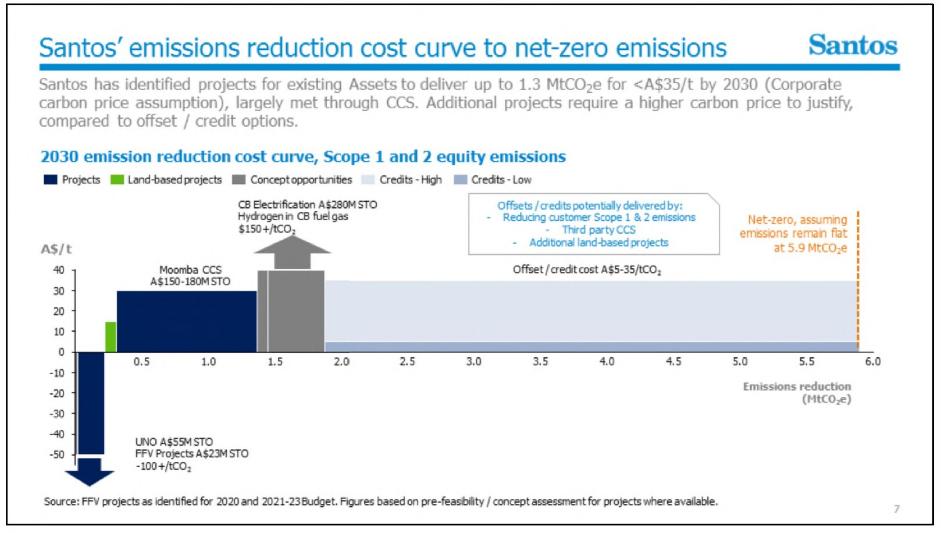
In relation to this slide, in her covering email Ms Luo wrote that she had “just assumed emissions stay flat at 5.9 MtCO2e. I don’t think anything else will make sense at this stage”. Ms Luo says that in making this comment she was referring to the fact that she had extended the assumption that emissions would remain flat from 2025 to 2035 to include 2040 as well. As with the 2030 and 2035 forecast, this did not reflect the Portfolio team’s estimate for 2040 emissions at that time, which was significantly lower than 5.9 MtCO2e.
297 Ms Luo’s comment in her email that she did not “have any other ‘real’ projects to include in the cost curve” at slide 7 was the subject of further evidence. She said that by use of the adjective “real” she meant that she did not have any specific projects that “[Santos] had under study or analysis or assessment at the time”. More particularly, at the time: she believed that after making a presentation on Bayu-Undan, it had been “on pause” and she did not know if Bayu-Undan was moving forward; she was aware that the CCS team was doing some work on CCS Expansion and had seen material indicating that the carbon costs associated with CCS Expansion would be very high. It was not a project she included in the “cost curve”; and the “hydrogen project at the time” was focused on reducing Scope 3 emissions.
298 The following exchange took place between Mr Hutley SC and Ms Luo:
Mr Hutley: Well, your role in this company was, was it not, to keep an eye out in relation to matters concerning the reduction of emissions, was it not? That was part of your duties, wasn’t it?
Ms Luo: Yes, to be working with the assets on potential emissions reduction opportunities. Yes.
Mr Hutley: Right. And you had been diligently pursuing that throughout 2020; correct?
Ms Luo: Yes, trying to be aware of all the opportunities, as much as possible.
Mr Hutley: And you, with those duties, as at 20 September 2020, could not identify any other real projects to include in what you call “the cost curve”, which I understand is the slide behind tab 237, at 2621; that’s correct, isn’t it?
Ms Luo: Yes, based on this slide. Yes.
Mr Hutley: That’s because nobody had really thought about what was going to happen that far out, at this time, in any detail, had they, within the company, so far as you’re aware?
Ms Luo: I don’t think I would agree with that statement. I think that we were actively working on potential opportunities. Obviously, based on this slide, it was my judgment at the time that they were not worth including specifically in this chart at the time.
Mr Hutley: And it was a central – one of your duties within this company to be aware of matters which might be real projects which were before Santos; that’s correct, isn’t it?
Ms Luo: Yes. It was an aspect of my role, especially given that I was preparing materials like this, which would require me to be aware of the projects.
299 I accept, as the ACCR submits, that Ms Luo’s role required her to be informed about any projects that were being progressed or considered at the relevant time and that she diligently performed her role throughout 2020. However, Ms Luo’s refence to “real” projects was, as she said in cross-examination, a reference to “specific projects” that were under study, analysis or assessment or, as she later said, “specific projects that [Santos was] working on, that had gone through at least to the screening level assessment of the project process”. Ms Luo’s evidence is that Santos was working on potential opportunities at the time. That she considered that at that stage hydrogen or CCS Expansion should not be included in her slide because they were not “real” in the sense she described, would not make it unreasonable ultimately to include them in the Net Zero Roadmap.
300 On 21 September 2020 at 1.02 pm Ms Genet sent an email to Ms Luo copied to Mr Jain with two comments in relation to the updated draft October 2020 Board Presentation including a comment that “[s]lide 7 needs to have a time axis. I know why this would be challenging, but we need to try to represent this as a roadmap to 2040 rather than focus on 2030”. In her email in response sent at 1.17 pm Ms Luo said in relation to slide 7:
* This slide shows exactly the same projects as Slide 5 so that would the timescale.
* There are no additional, defined projects that we can put dates on.
* I’ve changed the carbon price referenced on this slide to the carbon price assumption for 2040.
* What slide 7 adds is the cost associated with these projects, which I think is really important.
* I’m assuming that 2040 emissions will grow to 5.9 MtCO2e, as per the assumption for 2035 shown in slide 4. If we use Portfolio data for this, our emissions are forecast to decline to 2.9 MtCO2e, which would contradict our ability to continue to inject 1.1 MtCO2e (STO share) in the Cooper Basin.
* Let me know if you want me to add 2040 to Slide 4 – although I assume we will want to keep Cooper Basin flat and show growth that makes up to 5.9 MtCO2e.
301 Ms Genet responded to Ms Luo at 1.24 pm. In relation to slide 7, referred to as the “cost curve”, she wrote:
We do need to show slide 7 in timeline format, we need to speculate the reductions to be generated by hydrogen in that 2030 decade, and show this as only a potential/estimation. The purpose of the slide is a roadmap to 2040 net zero so we need to show that, even if there’s a lot of speculation post 2025/30 – it’s intended to be a visionary slide of what’s possible if CCS and hydrogen take off.
302 On 22 September 2020 at 9.30 am Ms Luo circulated an updated draft of the October 2020 Board Presentation to Ms Genet and Mr Jain. Her covering email included:
Key updates:
* Northern Australia emissions for 2020 updated based on latest 2020LE, with production and emissions normalised to 68.4% equity from 1 January 2020
* Slide 7 updated to use the timeline format as per Slide 5, including some notional numbers that we discussed for offsets from Customer Scope 1 + 2 emissions reductions
* I’ve moved my cost-curve slide to back-up
303 The attached updated pack for the October 2020 Board Presentation included as slide 7:
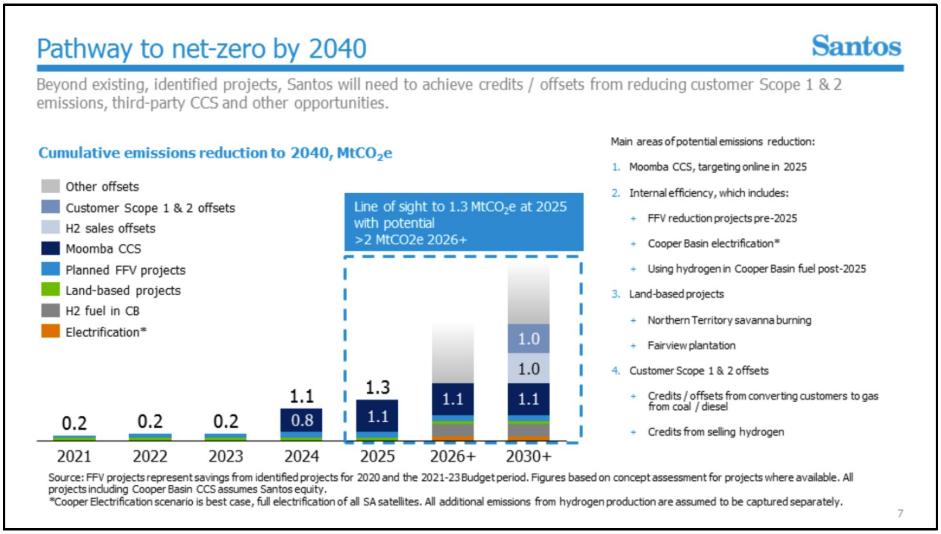
Ms Luo accepted that the numbers included in that slide were notional or assumed in relation to the potential credits that Santos could generate through the identified opportunities. There was no specific project in mind. However, by way of further explanation Ms Luo said that Santos “had the hydrogen study underway. But that was at that time focused on export” and that there was “[s]ome consideration for domestic customers, but there was no specific project looking at generating offsets, even though [Santos] thought it could be a possibility off the back of the hydrogen production project”.
304 On 22 September 2020 at 10.23 am Ms Luo, in response to Ms Genet’s comments on the updated draft October 2020 Board Presentation, sent a further email to Ms Genet and Mr Jain which included, in relation to slide 7 of the presentation:
I agree on the 2040 pathway slide – maybe I’ll try a waterfall chart? Or do you think it’s the content that’s the issue? I don’t really have any other projects to add in at this point so I think the message is we have to consider credits/offsets.
305 Ms Genet responded by email sent at 10.47 am. Her email included:
On 2040 one maybe wander up to 10 and catch up with Brett if you can today (let me know if any issues on this) and see how he wants to portray this? I agree it’s all very high level/speculative as we have no idea of emissions or opportunities in the 203-40 window so the narrative and how we represent the hydrogen opportunity in that window is key.
306 On 23 September 2020 Ms Genet sent an email to Ms Norman and Messrs Woods and Jaffray, copying, among others, Ms Luo which included:
Please see attached the updated emissions target deck based on Friday’s meeting.
In particular, we’re aware that the 2040 net zero target + hydrogen narrative needs more work – Ying and Brett will discuss today.
Some additional notes:
* Using forecast calendar year 2020 emissions (with full year of B/U current equity) as a baseline drops our baseline from 5.5 (the adjusted 2016/17 FY level) to 4.89 MtCO2e. This obviously makes the 26%-30% target reduction level from forecast 5.9 MtCo2e harder to achieve (2.3-2.5 rather than 1.8-2.0)
* We have dropped reference to 2005 – as discussed in the meeting, it is not a credible target reference. We can refer to it as part of our narrative but in relation to agreeing a target level, which is the focus of this paper, it’s not relevant.
…
307 The updated October 2020 Board Presentation attached to Ms Genet’s email included the following as slide 8 “Pathway to net-zero by 2040” (Waterfall Slide):
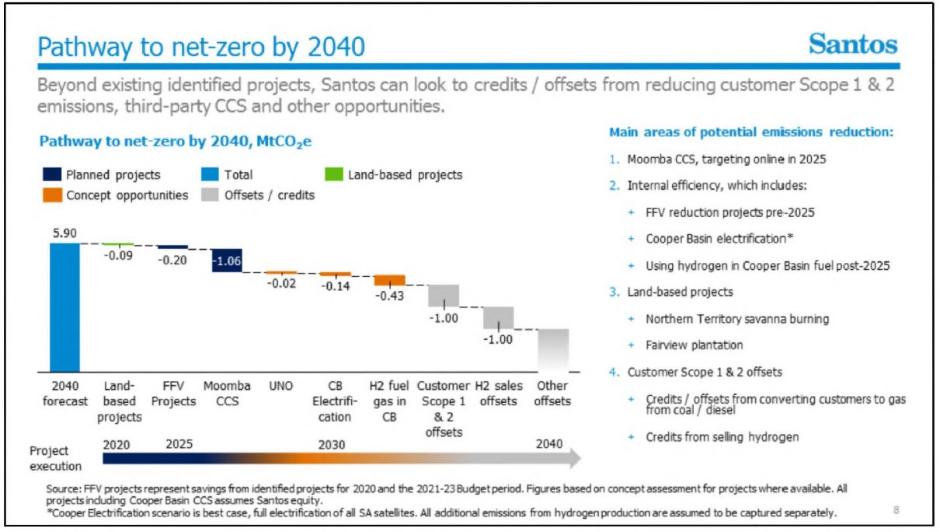
In cross-examination Ms Luo accepted in relation to the timeline from 2030 to 2040 in the Waterfall Slide that she included notional sums for “Customer Scope 1 & 2 offsets” and “H2 sales offsets” and that whatever gap there was thereafter had to be found through “other offsets”.
308 On 25 September 2020 Ms Genet sent an email to, among others, Messrs Gallagher, Woods, Jaffray and Jain, Ms Norman and Ms Luo attaching an “updated emissions target deck” based on the 18 September 2020 Meeting. As recorded in Ms Genet’s email the updated deck included, among other things, “Scope 1 & 2 net zero 2040 target with high-level roadmap”.
309 On 26 September 2020 Mr Gallagher responded to Ms Genet’s email referred to in the preceding paragraph. His email included:
Overall looks good. I have however a few comments aimed at sharpening up the pack to take to the board.
My comments are as follows;
1. The order of the slides needs to reflect how we want to take our audience on the journey. Hence Id build up to the targets and have the peer benchmarking etc ahead of this.
2. The scope 1 & 2 targets are fine, however I would like us to simplify the waterfall chart somewhat. I would also simply lump the gap to 2030 as one block and list separately the initiatives that we will pursue to close that gap.
…
4. Our waterfall should first of all go to 2030 showing what is required to make the 26%-30% target and then continue to 2040.
…
6. For our 2040 target should be achieved by additional projects that include;
a. CCS growth projects (including 3rd party CCS reductions – we may not get the credits but our business will be reducing global emissions nonetheless)
b. Hydrogen production and sales
c. Further energy efficiency improvements etc
d. Replacement of customer scope 1 & 2 emissions by direct switching to cleaner fuels i.e. coal or diesel to natural gas, or natural gas to hydrogen.
In cross-examination Ms Luo accepted that, despite the work she had been undertaking, she had been unable to identify the projects listed by Mr Gallagher at item 6 of his email as concrete proposals.
310 On 28 September 2020 Ms Luo sent an email to Ms Genet and Mr Jain attaching an updated iteration of the draft October 2020 Board Presentation in which she had addressed items 2 to 6 of Mr Gallagher’s email sent on 26 September 2020. Ms Luo explains that in response to Mr Gallagher’s comments in relation to the Waterfall Slide she added a bar called “Other offsets” with an emissions reduction amount of 2.0 MtCO2e, which related to Third Party CCS and land-based projects. She did so on the basis that there were a number of CCS opportunities which could enable Santos to meet its 2040 Target, although she was not aware of any specific projects. The result was that the Waterfall Slide now appeared as follows:
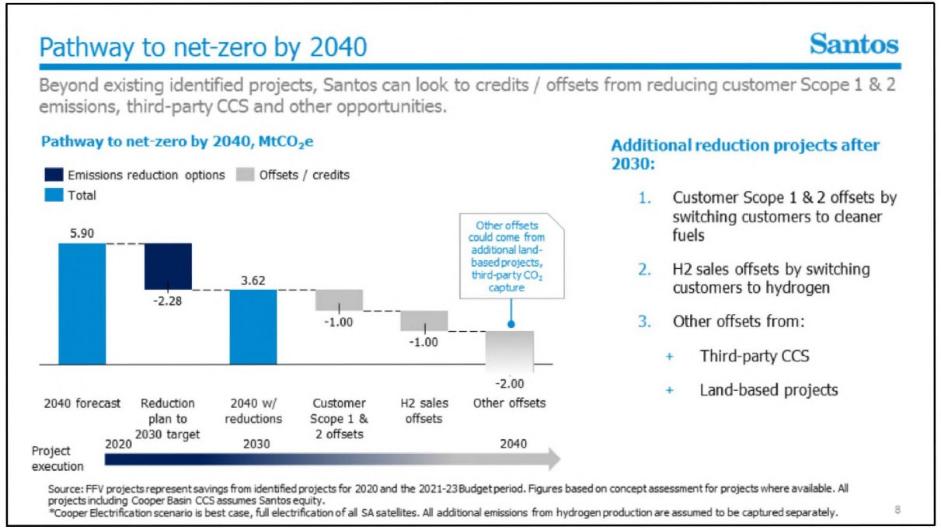
311 On 29 September 2020 Ms Luo, Mr Woods and Ms Genet met to discuss the October 2020 Board Presentation and the incorporation of the changes requested by Mr Gallagher in his email sent on 26 September 2020. After that meeting Ms Luo sent an email to Mr Woods and Ms Genet attaching a further draft of the October 2020 Board Presentation. Her email included:
I’ve had a go at updating the pack with:
1. FY2019/20 adjusted baseline as discussed
2. Two graphic options for the 2040 pathway to net-zero, including higher % of hydrogen in the domestic gas market
3. Separated out the Cooper Basin emissions breakdown
312 In the attached draft the Waterfall Slide appeared as follows:
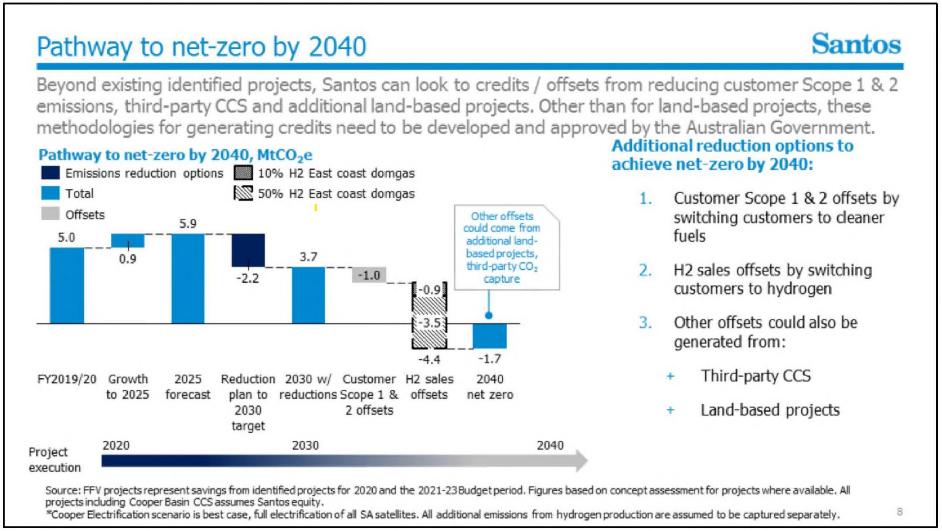
313 Ms Luo explains that she made further amendments to the Waterfall Slide by including a larger emissions reduction amount for “H2 sales offsets” (for the reasons set out at [394] below) such that it was not necessary to include the “Other offsets” bar from the previous draft. However, Ms Luo continued to include a note that further credits were available from Third Party CCS in the Waterfall Slide. This was to indicate that, given the uncertainty out to 2040, Santos may not ultimately pursue the opportunities in the chart but that it could pursue one of multiple other opportunities to achieve the 2040 Target.
314 The revised Waterfall Slide had two figures for “H2 sales offsets”: 0.9 and 3.5. Ms Luo said that at her meeting with Mr Woods and Ms Genet there would have been agreement around achieving offsets by hydrogen sales at the lower and upper ends of 10% and 50% by volume of the east coast domestic natural gas market and she would have gone away to calculate the figures based on the 2030 market for inclusion in the Waterfall Slide. Ms Luo also said that at the meeting they would have discussed the external market studies they had reviewed as part of the work leading to the decision to pursue the Moomba Hydrogen Concept Study. Ms Luo said that the 50% by volume of the east coast domestic gas market included in the Waterfall Slide (which equated to 16% to 17% by energy) was an assumption based on the discussion which took place and their understanding at the time of the potential future market for hydrogen in 20 years’ time.
315 On 30 September 2020 Ms Luo circulated a further draft of the October 2020 Board Presentation to Ms Genet, copied to Mr Jain. Her covering email included:
I’ve included offsets achieved through Customer Scope 1 & 2 emissions reductions in Slide 6-9 as a part of the reduction to 2030 since this is also one of our targets for 2030. This now shows that if we achieve offsets of 1 Mtpa as per the target, then we have enough opportunities to also meet the 30% reduction by 2030 target.
In the waterfall/pathway slides I’ve only included enough offsets to achieve the 30% target, which means that the remaining offsets can be used to offset emissions to 2040.
316 After a further iteration and feedback the final version of the Waterfall Slide included in the October 2020 Board Presentation which went to the Board was as follows:
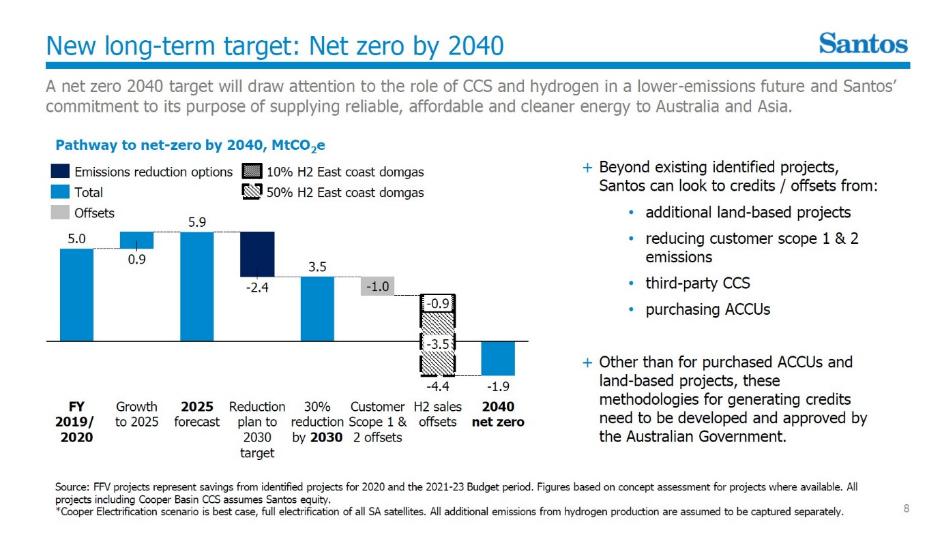
317 Ms Luo accepted that at the time she completed her work on the October 2020 Board Presentation it represented the output of all discussions and the various drafts that had been considered. Ms Luo was aware that the presentation was going to be put to the Board for consideration and, if thought appropriate, adoption and that it was essential that it include the best information that Santos believed and understood at the time.
318 Ms Luo accepted that none of the four projects to which Santos could look for credits/offsets listed in the Waterfall Slide was an existing identified project. Indeed, the Waterfall Slide in terms indicates that is the case. Ms Luo explained that when she was talking about “identified projects”, she was “referring to the specific projects that [Santos] was working on, that had gone through at least to the screening level assessment of the project process”.
319 The Waterfall Slide included in the October 2020 Board Presentation did not make mention of CO2 emissions likely to arise out of the production of hydrogen. That was because, as Ms Luo explained, the assumption made was that the Scope 1 and 2 emissions associated with producing hydrogen would either be physically sequestered or offset with credits. Relatedly, Ms Luo accepted that there could be emissions above the 5.9 MtCO2e, which was set as the 2025 Forecast (see Part 1.11.1 below), through the production of hydrogen. However, the decision was made not to alter that amount but rather to assume any further emissions would be sequestered or offset by credits. Ms Luo said that was the assumption in the Moomba blue hydrogen study.
320 Further, while CCS Expansion was not included in the pathway to net zero in the Waterfall Slide, it was mentioned in that slide and the following slide titled “Summary: Overview of targets proposed” such that the Board was made aware that the prospect of CCS and hydrogen development made the 2040 Target a possibility.
1.10.4 The October 2020 Board meeting
321 The Board met on 20 and 21 October 2020. Mr Jaffray was Executive Sponsor of the Board paper titled “Item 6 — Emissions Strategy: New emissions reduction targets” which attached the October 2020 Board Presentation and a risk appetite assessment matrix. The paper outlined four targets that required Board approval and key risks associated with those targets. The targets included the 2030 Target and the 2040 Target. Ms Genet delivered the October 2020 Board Presentation and the Board approved the Targets, including for them to be publicly announced at the Investor Day scheduled for 1 December 2020.
1.10.5 November 2020 - Preparation of the Investor Day Presentation
322 Following the October 2020 Board meeting, Ms Genet took responsibility for working with the Energy Solutions and Investor Relations teams to prepare slides about the Targets for inclusion in a presentation to be given on the Investor Day, i.e. the Investor Day Presentation.
323 As part of the preparation of the Investor Day Presentation summarising Santos’ pathway to the 2040 Target, Ms Luo assisted with the design of a waterfall chart on slide 15 i.e. the Net Zero Roadmap. This included assisting with the order, sizing, colouring and description of the bars in that chart representing the opportunities that formed part of the Net Zero Roadmap (which is included in Annexure B to these reasons).
324 The Net Zero Roadmap did not show precise amounts for each of the bars. As part of developing the Net Zero Roadmap Ms Luo considered what amounts might reasonably be achievable for each of the projects based on the information and level of assessment that had been completed by that point in time. The size of the bars was scaled to reflect those amounts.
325 On 12 November 2020 Andrew Nairn, Head of the Investor Relations team, circulated a working draft of the Investor Day Presentation to, among others, Mr Gallagher which included a draft of the Net Zero Roadmap. The draft did not include a component for “Customer Scope 1&2 offsets” but did include “CCS scale-up”. The ACCR submits that there is no evidence about who decided to amend the Net Zero Roadmap in this way, their reasons for doing so, or evidence of any further work or modelling having been carried out since it was approved by the Board at the October 2020 Board meeting. The ACCR submits that the Court should infer that there was no such work or modelling, it was simply a name change by the Investor Relations team.
326 But that inference is not available. First, the Board did not approve the Net Zero Roadmap at the October 2020 Board meeting. It approved the Targets and their announcement at the Investor Day. Secondly, the Investor Relations team was responsible for collating the Investor Day Presentation but not for the accuracy of its content. Thirdly, and critically, it is inconsistent with Mr Woods’ evidence that he would have been spoken to about the inclusion of “CCS scale up” in the draft Net Zero Roadmap as he was the “point person” in relation to it. The evidence before me, some of which is set out below, shows that drafts were circulated for review of, and meetings convened to discuss, the Investor Day Presentation. Mr Woods was both a recipient of the drafts for review and attended meetings to discuss them.
327 On 19 November 2020 Mr Nairn circulated a working draft of the Investor Day Presentation which included “a number of updates for discussion” to Messrs Gallagher and Woods, among others. In the draft “CCS Scale-up” had been renamed to “Moomba CCS Phase 2”.
328 On 20 November 2022 Julia Grewar, manager, Investor Relations team, circulated a further draft of the Investor Day Presentation to Mr Woods, copied to Ms Norman and Mr Nairn. In her covering email Ms Grewar asked Mr Woods to “update the energy transition and emissions reduction roadmap” following the review which had taken place earlier that day. Mr Woods forwarded the draft to Messrs Wilson and Nicholas Pembshaw, General Manager, Commercial Midstream Infrastructure and Low Carbon Operations team.
329 On 22 November 2020 Mr Wilson returned the draft Investor Day Presentation with his “answers and comments included”. In relation to the Net Zero Roadmap included in the draft Mr Wilson added a comment next to the descriptor “Moomba CCS Phase 2” that:
I would leave it as CCS Phase 2 instead of Moomba CCS Phase 2. Most likely expansion of CCS outside of hydrogen will happen in WA or NT, not Moomba. Would need to change the comment on the right to reflect options described.
330 On the morning of 23 November 2020 Mr Pembshaw sent an email to Mr Wilson, copied to Mr Woods and Vicki Chan, after having “a run through with [Mr Woods] on the IR slides”. He then set out the things on which Mr Wilson’s help was needed in relation to the draft presentation. In relation to the Net Zero Roadmap, which had become slide 13 in the attached draft pack, Mr Pembshaw wrote:
Slide 13: Want to show hydrogen ph 1 with Moomba CCS expansion in the dark blue before 2030. Then hydrogen and more CCS expansion after 2030. This CCS could be Moomba or elsewhere. Can you please add an appropriate scale bar in the pre-2030 piece.
It is apparent that Mr Woods did not disagree with Mr Wilson’s comment and his suggested amendment to the slide.
331 On 23 November 2020 at 9.08 pm Mr Wilson circulated the updated slides to Messrs Pembshaw and Woods, among others. The Net Zero Roadmap included in the updated draft now referred to “CCS Expansion” and stated that “CCS expansion involves potential scale-up in the Cooper Basin or other sites”.
332 On 24 November 2020 Mr Wilson sent an email to a number of people including Ms Luo in relation to the Investor Day Presentation in which he noted that Ms Luo was “making sure slide 14 matches what went to the board”. Slide 14 was the Net Zero Roadmap and Mr Wilson sought confirmation that it was the same as the slide that went to the Board in October 2020, i.e. that it was the same as the Waterfall Slide.
333 Ms Luo noticed that a difference between the Net Zero Roadmap in the draft Investor Day Presentation and the Waterfall Slide in the October 2020 Board Presentation was that the former did not include a bar for “Customer Scope 1&2 Offsets” which related to the coal/diesel customer offsets opportunity.
334 On 24 November 2020 Ms Luo sent an email to Messrs Woods and Wilson, among others, with her comments on the waterfall slide in the draft Investor Day Presentation (i.e. the Net Zero Roadmap) which included:
Please see the updated waterfall chart in the attached:
- Updated the block sizes to be more reflective of the actual abatement
- Renamed the electrification block to include H2 fuel for centralised fuel consumption at Moomba and PB
- Included emissions reduction from our other projects – I’ve named this “energy efficiency projects”
- Updated the order of project execution, in line with the Board paper The original Board pack included the offsets from Customer Scope 1 & 2 emissions
– I’ve assumed we don’t want to include this in the public water fall. It’s been replaced with “CCS expansion”
In the attached revised draft of the Investor Day Presentation Ms Luo amended the Net Zero Roadmap including by moving “CCS expansion” to the end of the Net Zero Roadmap and changing the emissions reduction amounts represented by the “CCS expansion” bar from
-0.5 MtCO2e to -1.5 MtCO2e.
335 Ms Luo’s role was to verify the draft Net Zero Roadmap which she referred to as the waterfall chart or public waterfall. By her comment in her email referred to in the preceding paragraph that “I’ve assumed we don’t want to include this in the public water fall” she intended to convey that she had not any discussion about why the “Customer Scope 1 & 2” emissions block had been removed and that Santos would be relying instead on a block titled “CCS expansion”. In making that comment she wanted to “call out” that difference between the Waterfall Slide in the October 2020 Board Presentation and the Net Zero Roadmap in the Investor Day Presentation. Ms Luo was not otherwise aware of the reason why the “Customer Scope 1 & 2” emissions block was removed. In cross-examination she said that she was simply referring to the fact that someone else had removed that item in the draft.
336 On 29 November 2020 Ms Devonish sent an email attaching the draft Investor Day Presentation to members of ExCom, including Messrs Woods and Jaffray, asking them to verify the information in the slides as specified in her email. Relevantly:
(1) as VP, Midstream Infrastructure and Low Carbon Operations, Mr Woods was allocated responsibility for verification of slides 13, 35, 37-45 and 52; and
(2) as VP, People and Sustainability, Mr Jaffray was allocated responsibility for verification of slides 14 to 16, which included the Targets and the Net Zero Roadmap.
337 On 30 November 2020 Mr Jaffray forwarded Ms Devonish’s email to Ms Genet noting that they needed to verify slides 14 to 16 and asking that she “make the appropriate enquiries”. By email also sent on 30 November 2020 Ms Genet informed Mr Jaffray that she had “reviewed the slides and sought input from others where necessary” and made “[s]uggested changes for accuracy” as set out in her email. In turn, on 30 November 2020 Mr Jaffray provided his comments on slides 14 to 16 in the draft pack to Ms Devonish.
338 Mr Jaffray’s evidence is that at the time that he sent his email to Ms Devonish on 30 November 2020 he considered (and still considers) that the statements in slides 14 to 16 of the draft Investor Day Presentation accurately described Santos’ strategy to set the Targets and its intention to achieve them. Mr Jaffray also considered (and still considers) that the Net Zero Roadmap (on slide 15) accurately described a pathway by which Santos could achieve the Targets, and that it was a pathway that Santos intended to implement. Taking into account the long-range nature of the Targets, it was Mr Jaffray’s understanding at the time (and remains his understanding) that, while the Net Zero Roadmap represented a pathway that Santos intended to implement, the precise pathway to achieving the Targets would continue to evolve over the 20 year period to 2040 in light of future technological, economic, regulatory and other developments.
339 Mr Jaffray was confident that the team involved in developing the Targets and the Net Zero Roadmap had undertaken sufficient analysis to identify and develop a high level pathway that centred on CCS and hydrogen. Mr Jaffray was of the view at the time that CCS and hydrogen were known, existing and technically viable technologies. The challenge was making these technologies commercially viable. However, Santos had 20 years, which Mr Jaffray considers to be a significant period in the industry, equating to two or three business cycles, to achieve the Targets and he was confident that there were likely to be technological, regulatory and economic developments over that period that would positively impact commercial viability.
340 Mr Jaffray’s confidence was based, at least in part, on his observations at the time of an increase in focus and commitment to decarbonisation globally, including the adoption of the Paris Agreement. This, in turn, was generating an increase in global demand for emissions reduction solutions. In Mr Jaffray’s experience, an increase in demand can have a positive impact on technological development over time, as well as the emergence of necessary regulatory and economic developments to meet the demand. At the time Mr Jaffray considered that the pressure on governments to decarbonise was likely to continue to increase, and that this would occur over time through regulation, supported by economic incentives.
341 Mr Jaffray considered that an example of demand leading to significant technological, economic and regulatory change over a similar time period was the development of the LNG market. He was aware that, as recently as the late 1980s, there was very little LNG infrastructure globally and the LNG market did not exist in Australia. However, from the late 1980s, global demand for gas grew stronger, particularly in Asia. In order to meet the demand, the market needed to develop a way to transport gas to these markets, which is what occurred. By 2000, the technology had developed rapidly to enable a significant market in the transport of LNG, including large numbers of LNG transport ships and the establishment of LNG import and export terminals globally, including in Australia.
342 Mr Jaffray was also confident in Santos’ ability to achieve the Targets because he knew Santos to be a business that was very good at setting a target and then implementing a strategy to achieve that target. For example, by 2020 Santos had successfully implemented a number of aspects of the 2016 Strategy. This included streamlining its business to focus on five core assets and significantly improving its financial standing. In addition, in the four years since the 2016 Strategy was developed, Santos had made significant progress in relation to the emissions reduction aspect of it. The Energy Solutions team had grown to become a significant and important division within Santos, Santos was on-track to achieve the 2025 Targets announced in 2018, and the Moomba CCS Project was at an advanced stage of development.
343 Mr Jaffray also understood at the time, in relation to the 2040 Target, that in addition to the emissions reduction activities that Santos intended to implement as set out in the Net Zero Roadmap, there would be the opportunity in the future for Santos to generate or obtain carbon credits, including ACCUs, to offset some of its emissions. He considered this to be another mechanism by which Santos could supplement its emissions reduction activities, if needed, to achieve the 2040 Target. For example, on 29 July 2020 Mr Jaffray provided Mr Gallagher with a further updated draft of the August 2020 Board Presentation. That draft presented three possible emissions reduction targets which could be achieved through a combination of Santos’ Energy Solutions projects, supplemented by purchasing carbon credits, and included the potential cost of purchasing those credits.
344 On 30 November 2020 Mr Woods sent an email to Ms Luo with subject line “Can I have the numbers for each of the columns in the Roadmap to net zero slide”. The email had no other content apart from Mr Woods’ sign off. Mr Woods wanted to check how the waterfall chart in the draft Investor Day Presentation sent to him, I infer by Ms Devonish, reflected the emissions reductions from the projects on which he was working.
345 Later that day Ms Luo sent Mr Woods the figures he requested, which she said were the amounts for each of the bars in the Net Zero Roadmap, by providing the following table (Project Estimates Table) and additional commentary:
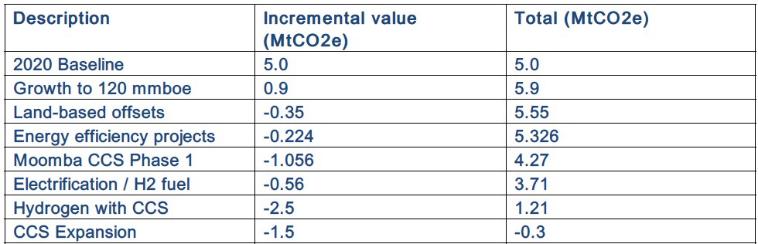
* Land-based offsets includes ALFA – an additional 0.26 MtCO2e of offsets, assuming Santos only (i.e. not Barossa JV)
* Energy efficiency projects are currently identified emissions reduction projects across our assets
* Moomba CCS Phase 1 represents 66% equity of a 1.6 MtCO2e net reduction project
* Electrification / H2 fuel includes UNO Phase 1 & 2, Cooper Gas Upstream Electrification and all fuel at Moomba / Cooper Electrification / Port Bonython being replaced with hydrogen
* The 2.5 MtCO2e reduction from “Hydrogen with CCS” is representative of ~30% H2 blend into East Coast domestic gas
* The CCS Expansion is a nominal number making up the difference
346 At the time Ms Luo prepared the Project Estimates Table she appreciated that the estimates for each of the bars in the waterfall slide had different levels of certainty. The intent of the shading and colouring of the bars was to reflect degrees of uncertainty about those estimates. Specifically, the bars were shaded so that their exact size was unclear and were coloured so that the projects to be undertaken later were lighter in colour.
347 The dimensions of the bars for “Hydrogen with CCS” and “CCS Expansion” were the most uncertain because they were opportunities to be undertaken by 2040 and, as at November 2020, had only been assessed to an early concept stage. Ms Luo put the “CCS Expansion” bar last because she considered that the opportunities which formed part of that bar were potentially much larger than was shown in the Net Zero Roadmap and the Project Estimates Table. She believed that the CCS Expansion opportunities would enable Santos to achieve the 2040 Target even if some of the other projects did not ultimately result in the emissions reductions referred to in the Project Estimates Table.
348 Mr Woods gave the following evidence about Ms Luo’s email sent on 30 November 2020:
(1) the estimated emissions reduction for each of the components (with the exception of hydrogen with CCS) were estimates that had been developed as part of the projects on which he was working;
(2) in relation to hydrogen with CCS, while he was involved in the part of that project that assessed the viability of hydrogen production and the amount of hydrogen that could be produced, he was not involved in estimating the amount of carbon credits that could be expected from the project and thus was not aware of the work that had been done in relation to that amount; and
(3) in relation to CCS Expansion and Ms Luo’s comment that “[t]he CCS Expansion is a nominal number making up the difference”, Mr Woods knew that the emissions reductions from the CCS Expansion opportunities were more than large enough to cover the remaining emissions necessary for Santos to reach net zero. He understood Ms Luo’s email to mean that the precise number used in the Net Zero Roadmap was “nominal” in that sense. In particular, having regard to the matters about which he was aware concerning CCS generally and the CCS Expansion projects set out in these reasons, he considered that if all of those projects were successfully pursued, the total emissions reduction amount from those projects would be vastly higher than the amount included in Ms Luo’s email for CCS Expansion.
349 It was not the case that Mr Woods sought this information from Ms Luo because he did not know it or the numbers that underpinned the Net Zero Roadmap, as the ACCR contends. Rather, as Mr Woods explained in cross-examination, he wanted to check the elements of the Net Zero Roadmap for which he was responsible.
350 Nor is it the case that the Project Estimates Table is the only contemporaneous document which records the numbers in the Net Zero Roadmap. That characterisation of the evidence by the ACCR ignores the evidence which demonstrates that work had been undertaken in the lead up to the preparation of the Net Zero Roadmap, some of which is set out above.
1.11 The components in the Net Zero Roadmap
351 Much evidence was given about the components in the Net Zero Roadmap or, in the case of Ms Luo, the amounts in the Project Estimate Table which underpinned the bars in the roadmap. In particular each of Mr Jaffray and Ms Luo and, to a lesser extent, Mr Woods addressed:
(1) the 2020 baseline;
(2) the 2025 Production Strategy;
(3) Moomba CCS Phase 1 which involved establishing a CCS facility to store vented CO2 as part of the processing of Santos’ natural gas from Moomba and was the first phase in the development of a CCS project at Moomba;
(4) Cooper Electrification/Hydrogen Fuel which, as set out at [153] above, referred to two related activities being considered by the Energy Solutions team:
(a) the Cooper Electrification project which was a project to reduce the use of fuel gas in the Cooper Basin through the centralised electrification of some or all of the gas driven compression in the Cooper Basin; and
(b) Hydrogen Fuel which was a project in relation to the use of the hydrogen that would be produced at Moomba as fuel (instead of natural gas) to power Santos’ operations in the Cooper Basin and Port Bonython;
(5) CCS Expansion which referred to a number of potential CCS initiatives and opportunities, beyond Moomba CCS Phase 1; and
(6) Hydrogen with CCS which referred to an opportunity to develop a hydrogen production facility at Moomba which could use natural gas and CCS infrastructure to produce “blue hydrogen” for sale to customers.
Given his role, Mr Harley’s evidence was confined to the Moomba CCS Project.
352 To the extent it is not already addressed in the background or in relation to the development of the Targets and the Net Zero Roadmap, I set out below that evidence insofar as it is relevant.
1.11.1 “2020 Baseline” and the 2025 Production Strategy
353 The 2030 Target and the Net Zero Roadmap adopt a 2020 baseline of 5.0 MtCO2e and forecast further growth projects that will result in a 2025 emissions amount of 5.9 MtCO2e i.e. the 2025 Forecast. The baseline for the 2030 Target and the Net Zero Roadmap represents Santos’ equity share of Santos’ Scope 1 and 2 emissions from the financial year ended 30 June 2020 production volumes, adjusted to include the Bayu-Undan project and the Darwin LNG at 68.4% from 1 January 2020.
354 Ms Luo explains that the 2020 baseline represented Santos’ net share of Scope 1 and 2 emissions from FY2019/2020 production volumes, with some adjustments to reflect equity interest changes that had occurred during that year. The 2025 Forecast reflected data concerning further planned growth projects which Ms Luo had obtained from the Portfolio team. The 2020 baseline was finalised and the 2025 Forecast developed from about May to September 2020 and, according to Ms Luo, were subject to a number of changes throughout that period, as set out above.
355 Mr Jaffray says that prior to settling on the 2020 baseline, he was involved in discussions about whether a baseline from earlier years should be used for the 2030 Target. As set out at [292] above, during the 18 September 2020 Meeting Messrs Gallagher, Woods and Jaffray, Ms Norman, Ms Genet and Ms Luo discussed revising the baseline for the 2030 Target to Santos’ 2020 emissions (adjusted for current equity). At the time, Mr Jaffray understood that the decision was made in part because selecting 2020 as the baseline, instead of an earlier year such as 2005, would mean that multiple adjustments would not need to be made for changes in emissions due to acquisitions or declines in production (except for the Bayu-Undan reservoir which was rapidly declining).
356 Mr Jaffray also understood that the Targets were based, in part, on the assumption that Santos’ net share of Scope 1 and 2 emissions would increase from the 2020 baseline to 2025, as Santos achieved the 2025 Production Strategy, and then stay constant at 5.9 MtCO2e from 2025 into the 2030s. This was an assumption which arose in the context of his discussions with Mr Gallagher and Ms Norman in August 2020 in preparation for the August 2020 Board meeting.
357 Mr Jaffray understood that there would be a range of growth opportunities from which Santos would need to choose to achieve that objective, including for example its selection of gas asset fields which would result in lower levels of emissions intensity. The opportunities to be pursued by Santos would be influenced by Santos’ long-term strategy to achieve revenue growth over time through carbon neutral projects, and from projects other than oil and gas, such as CCS and hydrogen.
358 Mr Jaffray observes that the assumption that Santos’ net share of Scope 1 and 2 emissions would increase from the 2020 baseline to 2025 and then stay constant at 5.9 MtCO2e from 2025 into the 2030s was reflected in the overall evolution in Santos’ operational strategy to manage more proactively and reduce emissions, including as part of the continued implementation and evolution of the 2016 Strategy. There were a number of initiatives and activities of which Mr Jaffray was aware that reflected this strategy, including the inclusion of an emissions reduction target in Santos’ company scorecard and the inclusion of emission reduction and associated targets in the Santos executive scorecards (see Part 1.6 above).
359 Relevantly, Santos excluded from its emissions forecast for the 2030 Target any exploration opportunities where no decision had been made to pursue them to production and the May 2020 Board Presentation had provisional amounts for “Other potential growth” to accommodate this variable. At the time, Mr Jaffray understood that the “Other potential growth” referred to exploration activities around Dorado, the Beetaloo Basin, McArthur Basin and offshore Darwin LNG. Given the uncertainty in relation to them, these activities were not included in Santos’ emissions forecast for the 2030 Target.
1.11.2 CCS Expansion
360 CCS Expansion is one of the activities shown in the Net Zero Roadmap. This component represented an estimated reduction of approximately 1.5 MtCO2e per annum and related to a number of potential CCS opportunities (other than Moomba CCS Phase 1) either at Moomba or another Santos site, which the Energy Solutions team had been considering since early 2020. Ms Luo was aware of:
(1) a CCS opportunity involving Santos’ Bayu-Undan gas field, which is located near Santos’ proposed Barossa project, as well as gas projects operated by third parties (Bayu-Undan CCS). Ms Luo was involved in the initial assessment;
(2) a CCS opportunity in WA involving Santos’ WA gas fields (WA CCS); and
(3) other opportunities to store CO2 at the Moomba CCS Project (beyond those included in Moomba CCS Phase 1) including:
(a) Third Party CCS at Moomba or potentially at another site; and
(b) use of DAC at Moomba.
361 Ms Luo explains that the estimated reduction of 1.5 MtCO2e per annum in the Project Estimates Table for CCS Expansion represented the remaining reduction required for Santos to achieve the 2040 Target. At the time Ms Luo believed that Santos would be able to achieve emissions reductions of at least that amount from one, or potentially more than one, of the opportunities referred to in the preceding paragraph. She believed that the estimated reduction for CCS Expansion was conservative as the opportunities underlying that component could potentially generate a much larger emissions reduction. She also considered that the available CCS opportunities would enable Santos to reach its 2040 Target even if other activities in the Net Zero Roadmap were not progressed or did not result in the emissions reductions she had estimated for those activities. It was for that reason that she referred to the CCS Expansion amount in the Project Estimates Table as a “nominal number making up the difference” (see [345] above).
362 Mr Jaffray had a high degree of confidence in CCS as a technology and believed it would become a major growth opportunity for Santos over the coming decades. As at 2020 he was aware that CCS was a technology that was in use globally and recalls that in about 2017 or 2018, members of the Energy Solutions team visited a number of fully operational CCS sites in the United States of America as part of their research and analysis into CCS. He also considered that Santos already had many years of experience in parts of the CCS process at that time. For example, Santos had been capturing and separating CO2 from the gas streams of its assets as part of the venting process and had also been reinjecting gas into the wells of its assets (which was a well-established industry process) for a number of years. In addition, the Cooper Basin had a number of depleted reservoirs with large storage capacity. Accordingly, Mr Jaffray was confident that Santos had the technical expertise and capability to successfully implement CCS in its own fields. That confidence was also in large part based on the work Santos had undertaken and the milestones it had achieved since the establishment of the Energy Solutions team in 2017. CCS was identified as a potential opportunity from an early stage in the work of that team and Santos had since undertaken significant work in developing CCS, which had resulted in Moomba CCS Phase 1.
363 At the time of the Investor Day Presentation, Mr Jaffray understood that Santos also had been conducting work on additional projects that could be considered for CCS and which could replicate the success it had achieved with Moomba. Mr Gallagher identified “CCS growth projects” as “additional projects” which could assist in achieving the 2040 Target. Mr Jaffray also observed that the opportunity of utilising Third Party CCS to achieve emissions reductions had been under consideration since the August 2020 Board Presentation. Given the success of Moomba CCS Phase 1 and the opportunities of which he was aware in relation to other CCS projects, he had a high degree of confidence in the technical and strategic ability of Santos to implement Third Party CCS in the future.
364 At the time, Mr Jaffray understood that there was no established methodology for Santos to obtain carbon credits for the storage of carbon emissions generated and captured by third parties. However, he understood that third party customers could generate carbon credits by Santos storing their CO2 and that those carbon credits could be transferred to Santos as part of a commercial arrangement, or that Santos could use the revenue from sequestering the third party CO2 to purchase carbon credits. Mr Jaffray understood that there was an active market for carbon credits at that time, and that the ability to generate and sell those credits had the effect of incentivising businesses to reduce their carbon emissions. In Mr Jaffray’s experience, it was also a common practice in commercial dealings for contracts between entities to contain clauses relating to peripheral instruments. He was aware, for example, that at the time there was discussion in the industry regarding “Green LNG Shipments”, which he understood to be shipments which were contracted on the basis of a guarantee that all the emissions relating to the shipments had been offset, and that customers were prepared to pay a premium for such shipments.
365 Mr Jaffray was confident in the CCS technology and the demand for CCS in the future, given there had been significant national and international support for the development and expansion of the use of CCS. For example, prior to December 2020 he was aware that:
(1) in May 2020 an expert panel appointed by the Federal Government to consider low cost carbon abatement opportunities had recommended that legislative amendments be pursued to enable a method for CCS. The Federal Government agreed with the recommendation and, in its response to the expert panel’s report, said that it had already given industry early stage involvement in the initial scoping of a CCS methodology for awarding ACCUs; and
(2) in September 2020 the IEA released a report titled “Special Report on Carbon Capture Utilisation and Storage in Clean Energy Transitions: CCUS in clean energy transitions”. In the report the Executive Director of the IEA, Dr Fatih Birol, expressed the view that CCS would play an important role in energy transition, CCS was “a critical part of reaching ‘net’ zero targets” and that the world’s “energy and climate goals will become virtually impossible to reach” without that technology.
366 Mr Jaffray was also aware, through his responsibility for the Public Affairs team at Santos, of Santos’ engagement with the Federal Government in relation to the ACCU scheme and the methodology for CCS and received updates through meetings and discussions with that team about the progress, status and outcomes of this engagement. Based on those updates, Mr Jaffray was confident that government would be supportive of such a scheme.
367 Ms Luo gave evidence about the other CCS opportunities identified at [360] above.
1.11.2.1 Bayu-Undan CCS
368 In early to mid 2020 Ms Luo had several conversations with Thyl Kint, Barossa Project Director, and Allan McDiarmid, Commercial Manager Operated Assets, about the Bayu-Undan CCS project focussing on the Energy Solutions team and ensuring that the work it had done in relation to the Moomba CCS Project could be leveraged to support a Bayu-Undan CCS project. Throughout 2020 Ms Luo continued to be involved in the development of the Bayu-Undan CCS project. Relevantly:
(1) in May 2020 Ms Luo participated in the preparation of a draft project initiation note for a framing study in respect of the Bayu-Undan CCS project with Mr McDiarmid. As a member of the Energy Solutions team, Ms Luo’s role was to provide support in relation to this opportunity. The purpose of the framing study was to inform whether to progress the opportunity and to feed into CO2 reduction opportunities at Santos;
(2) by 29 June 2020 a draft report for the Bayu-Undan framing study was complete. The draft study referred to the Bayu-Undan CCS opportunity as a “a 6.2 MtCO2 per annum Bayu-Undan carbon capture and storage (CCS) opportunity, completed jointly between Ichthys, Barossa and [Darwin LNG] could deliver abatement at ~A$35/tCO2”. On the same day Ms Luo sent Messrs Kint and Wilson a presentation she had prepared with Mr McDiarmid for the Bayu-Undan CCS project for their review and discussion at a meeting scheduled to take place on 3 July 2020;
(3) in July 2020 Ms Luo attended a meeting with Messrs Kint and Wilson where they discussed the presentation to be given to Mr Gallagher about the Bayu-Undan CCS project;
(4) on 30 June 2020 Adrian McManus, Senior Economic Analyst in the Economics team, sent Ms Luo an economics report which he had completed for Bayu-Undan CCS. The purpose of that report was “to assess potential project viability and enable a decision to take the project further into a Concept level study”. The “analysis summary” concluded that:
Whilst all scenarios do not meet corporate hurdle rates, the preliminary economics for the 6.2 Mtpa scenario indicate it would be competitive in the context of global large scale CCS projects.
(5) on 13 July 2020 Ms Luo sent Mr Woods and others a presentation for the Bayu-Undan CCS opportunity for “Wednesday’s discussion”;
(6) on 27 July 2020 Mr Kint approved a climate change resilience assessment which recommended that “the Barossa upstream facility be upgraded to allow for future export of all reservoir CO2”. The rationale for that decision included that feasibility studies were “underway to determine viability of Bayu-Undan CCS project” and that the “[c]oncept would require Barossa to export reservoir CO2 to a ‘common user’ carbon project based in Darwin”;
(7) after the presentation in July 2020 (see above), the Bayu-Undan project was paused. Work then recommenced in November 2020. On 23 November 2020 Ms Luo sent an email to Brian Siddall, Asset Retirement Manager, attaching an updated version of the presentation on the Bayu-Undan CCS project which included amendments reflecting comments from Messrs Kint, Wilson and Gallagher after the meetings held in July 2020. The presentation recommended that the project was “worth progressing further”; and
(8) after presenting at workshops in November 2020 in relation to the Bayu-Undan CCS project, Ms Luo handed over to Mr Winterfield who had more capacity to attend to that project than Ms Luo.
369 Ms Luo explains that in December 2020 the Bayu-Undan CCS project was being considered by the Northern Australia Asset team and the Energy Solutions team for several reasons including:
(1) the Bayu-Undan field was approaching end of life and reusing the Bayu-Undan facilities could defer approximately AUD300 million in abandonment liabilities;
(2) the Bayu-Undan reservoir has sufficient capacity to store more than 100 MtCO2;
(3) the existing Bayu-Undan to Darwin pipeline has sufficient capacity to transport the proposed 6.2 MtCO2e per annum from Darwin LNG (supplied by the Barossa field) and Icthys LNG to the Bayu-Undan reservoir with no requirement for additional pressure boosting offshore;
(4) the project would be cost competitive at approximately AUD35 per tonne of CO2, compared to the average cost of other global CCS projects at approximately AUD61 per tonne of CO2; and
(5) a revenue stream could be delivered by reducing the carbon liabilities for the Barossa, Darwin LNG, Ichthys and other CO2 emitters or through the generation of carbon credits for CCS.
370 Mr Woods was also aware of the matters set out in the preceding paragraph. He explains that Santos was very familiar with the reservoirs and had extensive experience with injecting gas into the reservoir over several years as, when the Bayu-Undan project commenced, it produced more gas than was required to go into Santos’ LNG plant for production. Thus Santos had experience in injecting the extra gas back into the reservoir.
371 Santos continued to work on developing this project throughout and after 2020. On 9 March 2022 Santos announced it had entered the FEED phase for the project.
1.11.2.2 WA CCS
372 The WA CCS project was a possible offshore CCS project in WA which Santos was considering in 2020. It would primarily involve storing CO2 emissions from third party gas projects or CO2 producing projects in the area. There were some Santos gas projects near Varanus Island, which could use CCS at that location, but the larger opportunity for WA CCS was in relation to Third Party CCS.
373 The WA Asset team was developing the WA CCS opportunity. Ms Luo did not work directly with the WA Asset team in developing the opportunity but received information from the team in relation to WA CCS from time to time. Ms Luo was aware that there was some activity ongoing in WA but was not close to the detail.
374 The principal gas reservoirs being considered in relation to WA CCS were the Reindeer gas field and the gas fields surrounding Varanus Island. Santos knew these reservoirs very well and understood the CCS opportunity because of the work completed in relation to the Moomba CCS Project. The cost of the opportunity was also likely to be significantly less than the cost assessed for Third Party CCS at Moomba as any new pipelines to obtain CO2 from third parties would be much shorter.
375 In September 2022 Santos was granted permits to undertake evaluation and appraisal work for the potential storage of CO2 in the offshore Carnarvon and Bonaparte basins, WA.
376 Mr Woods explains that in December 2020, WA CCS was a lower priority opportunity than Moomba or Bayu-Undan as the Reindeer gas field was still in production. Nevertheless, it represented a significant opportunity.
1.11.2.3 Third Party CCS and DAC
377 The Energy Solutions team conducted assessments of Third Party CCS and DAC opportunities at Moomba. The results of that assessment were summarised in the May 2020 Board Presentation.
378 At the time the Targets were announced Mr Woods believed that Third Party CCS was a viable opportunity and would enable Santos to offset its Scope 1 and 2 emissions. He believed that:
(1) it could be developed as an opportunity at Moomba or at another future CCS site;
(2) the work undertaken as part of Moomba CCS Phase 1 gave him confidence in the technical and commercial viability of CCS projects, and demonstrated that CCS could be undertaken at a low cost;
(3) a key cost for Third Party CCS is the transportation of CO2 to the CCS site which could be managed by:
(a) conducting studies such as those being undertaken by the Energy Solutions team at the time which were in relation to infrastructure routes that could assist Moomba projects (including the Moomba CCS Project); potential further reservoirs near expected points of high emissions likely to reduce cost of future CCS and potential pipeline routes out of Moomba;
(b) studying locations where it was possible to obtain the highest volumes of CO2 within a concentrated area, i.e. CO2 hubs. The mapping of these hubs would enable the most cost effective locations for developing infrastructure to capture and transmit CO2 to a Santos CCS site. The Energy Solutions team conducted these assessments regularly and communicated the results to Mr Woods; and
(c) continuing to engage with industry and governments to develop initiatives to support Third Party CCS;
(4) the demand for Third Party CCS would increase as:
(a) companies emitting CO2 sought to identify ways to decarbonise their operations in line with the global transition to net zero; and
(b) the price of carbon credits increased, which would make the direct decarbonisation offered by Third Party CCS competitive with opportunities for companies to offset their emissions through acquiring carbon credits;
(5) an ACCU methodology for CCS would be established (which occurred on 1 October 2021 pursuant to the Carbon Credits (Carbon Farming Initiative – Carbon Capture and Storage) Methodology Determination 2021 (Cth)). I note that it was not in dispute that it was reasonable for Santos to assume, as at December 2020 and February 2021, that an ACCU methodology for CCS would be established. While the methodology for Santos to obtain carbon credits for the storage of carbon emissions generated and captured by third parties had not been established as at December 2020, Mr Woods believed it likely that Santos would be able to obtain carbon credits for Third Party CCS given the environmental benefits of decarbonisation and government support for CCS. This would either be through a new ACCU methodology, international credits (for storage of CO2 captured in other countries) or as part of a commercial arrangement entered into with the third party that generated and captured the carbon emissions. As to any commercial arrangements, Mr Woods believed that the sequestering of a third party’s emissions would enable the third party to generate ACCUs via existing methodologies and, as part of the commercial negotiation for providing CCS, Santos would seek to have those ACCUs transferred to it; and
(6) Santos would be able to identify a large number of potential customers for Third Party CCS. The sectors that Mr Woods considered as potential Third Party CCS customers, because they emit significant quantities of CO2, which are hard to abate, were coal power plants, ammonia producers, other gas facilities, critical metals producers, brickworks, plastics manufacturers and fertiliser producers, and other emitters that have net emissions baseline obligations across a variety of industries. At the Investor Day, Mr Woods said:
Yesterday we concluded an arrangement with our Barossa joint venture… to work on an MOU for CCS expansion for our international bilateral arrangements. We’re working with not just Korea, but also Japan, about seeking how we can attract additional value for our carbon credits in Australia. We’re also very, very close signing those arrangements with a couple of very significant parties, which is exciting for us.
In making this statement, Mr Woods was intending to convey that Santos was taking steps to explore the potential for the storage of CO2 transported from other jurisdictions and obtaining credits for that activity, which included the arrangement entered into the day prior with the Barossa joint venture. A further memorandum of understanding (MOU) was entered into by the Barossa joint venture and other parties including Eni, Inpex, SK E & S Co., Ltd and Jera on 8 September 2021 in relation to CCS opportunities in Northern Australia. The arrangements with “very significant parties” to which Mr Woods referred in the final part of his statement made on the Investor Day were ultimately signed with Inpex and Jera in January 2021.
379 At that time Mr Woods also believed that DAC would be viable by 2040 because:
(1) the Moomba CCS Project had confirmed Santos’ ability to store large amounts of CO2 at a low price;
(2) the cost of running DAC would reduce over time. By December 2020 Santos had commenced a project with the Commonwealth Scientific and Industrial Research Organisation (CSIRO). Mr Woods understood at the time that the project was examining a potential DAC method that might significantly reduce the cost of DAC, potentially to about AUD70/tonne due to significantly lower energy requirements of the technology and materials developed by the CSIRO. On 5 November 2021 Santos announced its partnership with the CSIRO to develop low cost DAC technology; and
(3) he expected the breakeven point of carbon reduction activities to increase significantly over time to meet the costs of DAC through a rising carbon price.
380 Ms Luo was involved, as part of the Energy Solutions team, in conducting a preliminary assessment of other storage opportunities at Moomba, including Third Party CCS in respect of emissions on the east coast of Australia transported to the Moomba CCS project via a pipeline, and DAC. The preliminary assessment was summarised in the presentation for the 2020 Board Strategy Day in a slide titled “CCS Future Opportunities”. As a result of the assessment, Ms Luo was aware that:
(1) the Moomba CCS Project represented a significant emissions reduction opportunity beyond Moomba CCS Phase 1. Ms Luo was aware that Moomba had a storage capacity of 20 MtCO2 per annum (while Moomba CCS Phase 1 only related to storing 1.7 MtCO2 per annum) and that this could support blue hydrogen production;
(2) for third party CO2 at Moomba, the estimated cost for carbon capture, transport from the east coast and storage at Moomba was between AUD96-165 per tonne of CO2 which was too high to be viable at that time as companies, including Santos, could obtain carbon credits (which could be generated by other carbon removal or reduction projects) to offset their emissions for significantly less. For example, the price at that time for an ACCU was around AUD15 per tonne of CO2; and
(3) for DAC, the estimated costs for carbon capture, transport and storage based on Santos’ understanding of the technology at the time was between AUD193-262 per tonne of CO2. Ms Luo derived the capture cost of this range from an article published on 15 August 2018 by David W Keith and others titled “A Process for Capturing CO2 from the Atmosphere” and undertaking a calculation which she describes. The cost was too high to be viable at that time for the same reason as outlined in sub-para (2) above.
381 Despite the results of the preliminary assessment, the Energy Solutions team continued to assess both opportunities throughout 2020 and 2021 as there was the potential for the costs to be reduced over time through new technologies and processes, as well as the likelihood of carbon credit prices increasing. To that end, Ms Luo was aware:
(1) based on the World Energy Outlook 2018 report published by the IEA, carbon prices were projected to increase significantly by 2040, which would have a significant impact on the viability of Third Party CCS and DAC. The Sustainable Development Scenario (which is the scenario in which global climate, air quality and energy access goals are met in full) in that report assumes a CO2 price in 2040 of USD140 per tonne (for advanced economies);
(2) in relation to Third Party CCS, the CCS team within the Energy Solutions team:
(a) conducted a mapping analysis of potential emissions hubs, i.e. where there were a number of emissions-generating projects and processes, that could enable sufficient scale to support the economics of building a CO2 pipeline between that area and Moomba; and
(b) was assessing the possibility of identifying deep saline aquifers that could potentially be used to store CO2 and would be closer to the source of the CO2; and
(3) in relation to DAC, the CCS team within the Energy Solutions team was engaging with the CSIRO in relation to a trial of their DAC technology.
382 As at 31 December 2020, the spot price for an ACCU was AUD16.55.
1.11.3 Hydrogen with CCS
383 The Hydrogen with CCS component of the Net Zero Roadmap concerned the substitution of natural gas supplied by Santos to the east coast domestic gas market with hydrogen.
384 Insofar as the transportation options for hydrogen are concerned, it was agreed between the parties that:
(1) blending of up to 10% of hydrogen by volume with natural gas could be done with minimal adjustments to existing infrastructure and appliances;
(2) a 10% hydrogen blend by volume is equivalent to 3.2% blend by energy content because hydrogen’s energy density is less than one third of a typical natural gas per unit volume meaning that a given volume of hydrogen will contain about one third as much heat energy as the same volume of natural gas; and
(3) it is technically feasible to blend 10% hydrogen by volume into existing natural gas networks and 20% hydrogen blend by volume is generally considered the upper limit for hydrogen blending into existing natural gas networks. Blending above this level is likely to require, at least, changes to the operation of gas transmission pipelines and changes to domestic appliances.
385 Mr Jaffray understood:
(1) the substitution of natural gas could occur by replacing 10% of natural gas sales from Moomba with hydrogen and by Santos supplying to large industrial customers that could take larger blends of hydrogen;
(2) it was common industry knowledge that blends of up to 10% hydrogen could be “spiked” into domestic supply and recalls that Australian energy infrastructure company, APA Group, had been running live trials in reticulated gas networks using this percentage of hydrogen; and
(3) based on discussions he had with Mr Wilson, Ms Norman and Ms Luo at about the time of developing the Net Zero Roadmap, that the technology required to achieve such blending was possible for reticulated networks and large industrial customers would be able to “re-tool” their facilities to enable receipt of the blends.
386 By the end of November 2020 Mr Jaffray was not aware of the precise level of emissions, if any, expected to be generated from the production of hydrogen by Santos. However, having reviewed work undertaken by Ms Luo in connection with preparation of the August 2020 Board Presentation he understood that any emissions would be negligible and sequestered.
387 At the end of November 2020, Mr Jaffray was comfortable including the Hydrogen with CCS component in the Net Zero Roadmap for the following reasons.
388 First, Mr Jaffray was confident a market for hydrogen would be established (with the necessary incentives from the Federal Government and other countries, including Korea and Japan), because of the significant pressure on companies and Australia as a whole to decarbonise and because renewable energy sources are not sufficient for certain industries. For example, renewable energy sources are not sufficient for industries with high power intensity requirements, such as some industrial processes (e.g. cement/brickmaking) or long-distance haulage. Mr Jaffray believed that hydrogen provided a solution for these types of applications.
389 Secondly, Mr Jaffray was aware, through his responsibility for the Public Affairs team, that State and Federal Governments had been progressing policies in relation to Australia’s hydrogen industry. For example, in 2019 the Council of Australian Governments Energy Council published a document titled “Australia’s National Hydrogen Strategy” which, among other things, referred to the expected future international demand for hydrogen and the potential for hydrogen with CCS. Mr Jaffray recalls that as at November 2020 hydrogen was seen in the industry as the answer for emissions reduction in the future, being a technology that could achieve the required transition to low emissions energy and given that solar and wind had limited large-scale application.
390 Ms Luo also gave evidence about this component of the Project Estimates Table.
391 Ms Luo was aware that the estimated reduction associated with this opportunity in the Net Zero Roadmap represented the emissions reductions that would be achieved if approximately 30% of the natural gas used in the east coast domestic gas market in a year was replaced with hydrogen supplied by Santos. In referring to a percentage substitution or percentage blend of hydrogen Ms Luo is referring to a percentage calculated by volume (rather than by mass or by energy output). At the time of preparation of the Net Zero Roadmap Ms Luo believed there was a reasonable prospect that Santos could produce and supply that amount of hydrogen by 2040 and that Santos would be able to reduce its Scope 1 and 2 emissions by an amount reflecting the emissions reductions that would result from Santos producing and supplying that amount of hydrogen (based on [436]-[441] below).
392 Ms Luo estimated the reductions associated with the Hydrogen with CCS opportunity to be 2.5 MtCO2e per annum (as set out in the Project Estimates Table). The emissions reduction estimates were based on the National Greenhouse Accounts Factors (NGA Factors) published by DISER. The NGA Factors state the emissions associated with the burning of natural gas distributed in a pipeline is 51.53 kg of CO2 equivalent per gigajoule (Natural Gas Emissions Factor). To determine the emissions reduction that would result from replacing an equivalent energy content of natural gas with hydrogen, Ms Luo multiplied the amount of hydrogen in gigajoules that would replace natural gas by the Natural Gas Emissions Factor. She did this as she believed that producing and selling hydrogen to consumers in place of natural gas would result in emissions reduction equal to the amount of emissions associated with the burning of natural gas and that there would be no emissions associated with the burning of hydrogen. Accordingly, the emissions reduction amount that Ms Luo included in the Project Estimates Table for Hydrogen with CCS did not account for any increase in emissions by Santos that would be generated in producing the hydrogen for sale to customers.
393 At the time Ms Luo was focusing on the possibility of Santos producing “zero emissions hydrogen” which, if implemented, would have resulted in no net increase in Santos’ emissions.
394 The Waterfall Slide in the October 2020 Board Presentation (slide 8) included a range of potential emissions reductions between 0.9 and 4.4 MtCO2e per annum associated with hydrogen sales. Ms Luo explains:
(1) the 0.9 MtCO2e estimated reduction was based on an estimated sale of 0.18 million tonnes of hydrogen per annum, which represented the replacement of 10% of the natural gas in the east coast gas market. The calculations supporting this estimate were recorded in a spreadsheet prepared by Jenny Day, an engineer in Ms Luo’s team; and
(2) the 4.4 MtCO2e estimated reduction reflected a substitution of 50% of natural gas to the east coast domestic gas market. The 50% represented a reasonable best case scenario and was based on a combination of potential pathways for selling hydrogen being considered by the Energy Solutions team at that time including:
(a) blending hydrogen into general gas distribution pipelines for users across the east coast, which was at least based on a 10% hydrogen blend, but which may be able to increase with further studies and government support;
(b) selling higher blends of hydrogen to industrial customers whose equipment could, by 2040, handle it; and
(c) selling pure hydrogen to customers in Australia that already use hydrogen (such as ammonia or fertiliser producers).
395 The Energy Solutions team had been investigating the amount of hydrogen that could be taken by Santos’ industrial appliances. Ms Luo believed that if Santos’ industrial appliances could take higher blends, then so could Santos’ industrial customers.
396 As set out above, the Project Estimates Table included an amount of emissions reduction that reflected replacing approximately 30% of the natural gas used in the east coast domestic gas market in a year with hydrogen supplied by Santos. That amount fell within the 10%-50% range included in the October 2020 Board Presentation. Ms Luo considered that:
(1) 10% was a conservative estimate given the potential pathways for selling hydrogen and the studies referred to at [424(1)] below which led her to believe that substituting 10% of the natural gas with hydrogen was likely to be achievable with minimal changes to infrastructure;
(2) 50% represented a reasonable best-case scenario; and
(3) 30% was an ambitious, but doable, amount based on the information available at the time.
397 Ms Luo was also aware of and had regard to the likely market demand for hydrogen, the work performed and results of Santos’ Moomba Hydrogen Concept Study, and the possibility of Santos being able to reduce its Scope 1 and 2 emissions from producing and supplying hydrogen. The activities undertaken in relation to each of these matters is set out below.
1.11.3.1 The likely market demand for hydrogen
398 In August 2019 Ms Luo led a review of several alternative medium and long-term clean energy business opportunities (Clean Energy Review) which included hydrogen production as one of three opportunities selected for further analysis. The results of the Clean Energy Review were presented to the Board at the 2020 Board Strategy Day. At the time of the 2020 Board Strategy Day Ms Luo was of the view that the best opportunity arising from the Clean Energy Review was the production of blue hydrogen because she believed that there was a significant opportunity for the development of a hydrogen market. This was because she considered that:
(1) hydrogen is an energy source that does not generate GHG emissions when burned as a fuel;
(2) the forecasts by Deloitte in their report commissioned by the National Hydrogen Strategy Taskforce titled “Erratum: Australian and Global Hydrogen Demand Growth Scenario Analysis” dated May 2020, in which Deloitte corrected an erroneous assumption in its earlier report on the same topic, predicted substantial increases in demand for hydrogen in Australia and globally;
(3) blue hydrogen would build on Santos’ existing gas business, utilise Santos’ CCS capability, and could be achieved at Moomba because of the very large CO2 storage potential in the Cooper Basin (up to 20 MtCO2 per annum) and the low cost profile for CCS that had been developed through the Moomba CCS Phase 1 project (approx. AUD30/tonne of CO2);
(4) it would not be possible to electrify all the world’s energy demand. Therefore, some form of molecule-based energy would be required in a net zero future. Ms Luo’s belief was based on the electrification scenarios published by the IEA in its “World Energy Outlook 2018” in November 2018 which found that there is a maximum technical potential of around 65% of final energy being met by electricity; and
(5) government incentives and support were necessary to assist with the required research, development and commercialisation of hydrogen. At that time, Ms Luo believed there was significant government support for the development of a clean hydrogen industry in Australia.
399 Mr Woods explains that the opportunity to produce and sell hydrogen was dependent on a large-scale market for hydrogen developing and that Santos’ hydrogen strategy would be led by the features of that market as it developed. As a result of his interactions with, among others, the Energy Solutions team prior to December 2020 Mr Woods was aware that:
(1) in November 2019, the IEA published its annual World Energy Outlook which indicated that electricity accounted for less than 20% of final energy consumption and, under the IEA’s “Stated Policies Scenario”, which is its central case, fossil fuels would continue to supply most energy demand in 2040;
(2) it was possible for hydrogen to be a replacement fuel for natural gas that could help further reduce emissions in the same circumstances as those set out in [173] above; and
(3) there was a need for very substantial government support to enable a hydrogen market to develop. A number of major economies had set targets for hydrogen and committed billions of dollars to strategies to produce and use clean hydrogen. This included steps taken by the Australian and other governments including that several other countries had announced major commitments to produce and use clean hydrogen. That said, Mr Woods accepted in cross-examination that the policy of those other governments was to pursue green, rather than blue, hydrogen.
400 Mr Woods had also engaged with the Australian Government on behalf of Santos in relation to the development of an ACCU methodology for CCS. In late July 2020, Mr Woods attended a meeting with Minister Birmingham (Federal Government) and Minister Ridgway (South Australian Government) to discuss CCS and hydrogen. The presentation given at that meeting, among other things, outlined the support that Santos was asking the Federal and South Australian Governments to provide. This included:
(1) progressing the findings of the Expert Panel appointed by the Australian Government to consider low cost carbon abatement opportunities, including the development of CCS methodology to access ACCUs and for blue hydrogen projects to be eligible for the Advancing Hydrogen Fund; and
(2) the negotiation of bilateral agreements with other countries that would be aligned with Art 6 of the Paris Agreement. Mr Woods understood that this would enable the possibility of obtaining credits to offset emissions reductions arising from the sale of hydrogen to other countries or enable overseas countries to generate ACCUs (or equivalent credits under a bilateral agreement) for exporting CO2 for storage to Australia.
Mr Woods recalls that at the meeting both Ministers made positive statements about CCS and hydrogen.
401 Mr Woods explains that the MOUs into which Santos entered with various companies also related to exploring hydrogen production and export. The purpose of the MOUs was to work collaboratively on understanding the full lifecycle costs of making and exporting hydrogen to a variety of domestic and international markets. Mr Woods believed the primary export market for large scale-hydrogen purchase was Japan and Korea, which had announced the most aggressive timelines to establish hydrogen importation. A key component of the MOUs was to determine market size and customer demands.
402 As a result of these matters, as at December 2020 Mr Woods was confident that a significant domestic and export market for hydrogen would develop by 2040.
1.11.3.2 The Moomba Hydrogen Concept Study
403 Following the 2020 Board Strategy Day Santos commenced the Moomba Hydrogen Concept Study. In about June 2020 Ms Luo prepared a draft project initiation note for the Moomba Hydrogen Concept Study. This forms part of Santos’ project staging framework and is required to commence each phase of a project opportunity and determine if the project should progress to further stages of analysis and studies.
404 The Moomba Hydrogen Concept Study included the assessment of:
(1) production of hydrogen at Moomba, an assessment to be carried out by GHD (see [407]-[413] below);
(2) the ability to capture and store CO2 generated at Moomba, which involved engagement with the Moomba CCS Project Team;
(3) pipeline transport via existing transmission pipelines or a dedicated pipeline through engagement with potential commercial partners (including Epic Energy, APA, Jemena, Kawasaki Heavy Industries (KHI) and Chiyoda) and the South Australian Government Hydrogen Export Modelling study;
(4) Santos’ use of hydrogen in its own facilities, through internal assessment and engagement with equipment vendors;
(5) domestic gas blending of hydrogen through engagement with AGIG and the Australian Hydrogen Centre; and
(6) future export opportunities for hydrogen through engagement with the South Australian Government Hydrogen Export Modelling study, KHI and Chiyoda.
405 For the remainder of 2020 and in early 2021 Ms Luo worked on each of the aspects of the Moomba Hydrogen Concept Study. She gives the following evidence about the key activities she undertook.
1.11.3.2.1 Production of hydrogen
406 Following the 2020 Board Strategy Day, Santos commenced a concept study into the technical feasibility and cost of blue hydrogen production at Moomba.
407 In June 2020 Santos engaged GHD to undertake an aspect of the Moomba Hydrogen Concept Study, focussing on the production of blue hydrogen at Moomba i.e. the GHD Review. Ms Luo oversaw GHD’s work.
408 Ms Luo instructed GHD to assess two potential hydrogen production projects: first, the production of 100 tonnes of hydrogen per day utilising a SMR process (SMR Model); and secondly, the production of 800 tonnes of hydrogen per day utilising an ATR process (ATR Model). The size of the ATR Model reflected a potential export opportunity Santos was exploring with KHI.
409 Another aspect of the GHD Review was to determine the cost of producing blue hydrogen using CCS and the amount of emissions that would arise from production. Ms Luo instructed GHD that Santos’ intention was to seek to reduce emissions associated with the production of blue hydrogen as far as was technically and economically feasible, and to obtain credits in respect of any remaining emissions to enable the sale of a zero emissions hydrogen product. Accordingly, Ms Luo instructed GHD to include in its assessment of the production cost a carbon price of AUD30 per tonne of CO2 for expected emissions (Proxy Carbon Price).
410 On 14 July 2020 Santos publicly announced the GHD Review including:
Santos has commenced a concept study on a hydrogen future for the Cooper Basin. The concept study has been awarded to GHD, one of the world’s leading professional services firms in resources, energy and environment.
Santos Managing Director and Chief Executive Officer Kevin Gallagher said that natural gas can be de-carbonised at its source to make “zero-emissions” or “blue” hydrogen. The carbon dioxide produced as a result can then be safely and permanently captured and stored in the same reservoirs that the gas came from.
“The Cooper Basin hydrogen concept study builds on our progress towards the 1.7 million tonne Cooper Basin Carbon Capture and Storage Project for which Santos is targeting a final investment decision later this year, subject to a CCS methodology being approved for the Emissions Reduction Fund,” Mr Gallagher said.
“Carbon capture and storage (CCS) is the fastest and most efficient route to a hydrogen economy, using less water, de-carbonising natural gas at its source and eliminating Scope 3 emissions.”
“CCS enables the capture of carbon dioxide from the production of blue hydrogen, making it a ‘zero-emissions’ fuel.
“With over 65 years of experience in the safe production of natural gas, Santos has the operational knowledge, capability and infrastructure to be a leader in the creation of a hydrogen industry right here in Australia.”
Mr Gallagher said the development of blue hydrogen from natural gas in combination with CCS will be critical in our transition to a low-carbon future.
“A CCS and hydrogen future proves that emissions reduction and job-creating resource development can work hand-in-hand.”
…
Santos’ proposed Moomba CCS Project in South Australia would capture the 1.7 million tonnes of carbon dioxide currently separated from natural gas each year at the Moomba Gas Plant and reinject it into the same geological formations that have safely and permanently held oil and gas in place for tens of millions of years.
“With the Cooper Basin’s reinjection capacity assessed at up to 20 million tonnes of carbon dioxide per year for 50 years, it has the potential to de-carbonise energy at its source,” Mr Gallagher said.
“This exciting opportunity could create high-skilled, well-paying and secure jobs, drive regional development, create new industries and deliver good outcomes for climate and the environment.”
Santos and GHD aim to complete the concept study by the end of 2020.
411 In cross-examination Mr Woods accepted that at the time of this announcement he believed that emissions would be released into the atmosphere through the production of hydrogen, even with the use of CCS and that he and Mr Gallagher had discussed, and he had informed Mr Gallagher of, that fact before the announcement was published. The decision to express the announcement as it was, that is to refer to blue hydrogen produced using CCS as “zero-emissions” hydrogen or fuel, came from the Strategy group which was responsible for the portfolio process and, among other things, building the investor packs. Mr Woods was content with the announcement, although he was not responsible for it. He said that it referred to a net solution, that is hydrogen with CCS plus offsets which would lead to zero emissions. He accepted that despite that view, the announcement did not use the word “net” but he thought it was implied.
412 Ms Luo received an advanced draft of GHD’s report for the Moomba Hydrogen Concept Study (GHD Report) on 13 November 2020 and the final GHD Report on 7 December 2020.
413 According to Ms Luo the GHD Report confirmed that:
(1) both the SMR Model and ATR Model were technically feasible production methods that could be implemented at Moomba;
(2) the Scope 1, 2 and 3 emissions associated with the production of hydrogen using SMR with pre-combustion CCS was at least 68% lower (potentially even lower with other technologies) for hydrogen with CCS than natural gas with precombustion CCS, so would generate significant emissions reductions; and
(3) it was possible to produce blue hydrogen at AUD2.11/kg, which included the Proxy Carbon Price and an instruction Ms Luo had given to assume a natural gas supply cost of AUD6/GJ. That latter cost was not the precise natural gas supply cost as the precise figure was commercially sensitive. Ms Luo was not directly aware of the costs of natural gas supply from Moomba at that time. She believes that she would have discussed the amount to provide to GHD with someone at Santos but cannot recall with whom.
414 Throughout 2020 Mr Wilson and Ms Luo kept Mr Woods updated on the results of the GHD Review. By December 2020 Mr Woods was aware that the GHD Report had confirmed the technical feasibility of the production of blue hydrogen at Moomba for about AUD2/kg.
415 Mr Woods considered that the production of blue hydrogen could be described as “zero-emissions hydrogen” as:
(1) Santos intended that it would reduce emissions associated with the production of hydrogen as far as technically and economically feasible and acquire carbon credits or offsets for any remaining Scope 1 and 2 GHG emissions. Mr Woods also believed this to be the case at the time the Targets were announced; and
(2) the price estimate of AUD2/kg confirmed by the GHD Report, which incorporated a carbon price of AUD30/tonne of CO2, fortified Mr Woods’ view that Santos could obtain offsets in respect of any emissions that could not otherwise be captured. The production of blue hydrogen at Moomba for about AUD2/kg was a key milestone for demonstrating commercial feasibility that would be domestically and globally competitive.
416 Mr Woods cannot recall whether he was specifically aware at the time that the Targets were announced that the estimated emissions reduction from the Hydrogen with CCS and Hydrogen Fuel components did not include any emissions associated with the production of hydrogen that would not be captured by using CCS.
417 On 22 January 2021 Ms Luo delivered a presentation on the results of the Moomba Hydrogen Concept Study to Ms Norman and Mr Woods. In doing so she outlined the estimates, based on the results of the GHD Report, of the costs of producing hydrogen using the SMR Model and the ATR Model. This included, as a separate item, an additional cost of making the hydrogen “zero emissions”, which was the cost of obtaining credits to offset the emissions associated with the production of hydrogen. For the ATR Model, Ms Luo’s estimate was AUD1.99/kg of hydrogen, assuming a natural gas supply cost of AUD5/GJ. The cost of making the “zero emissions” hydrogen was AUD0.06/kg.
418 Ms Luo considered that Santos’ ability to produce “zero emissions” hydrogen at around AUD2/kg established the potential for the product to be commercially viable because it met the Federal Government’s goal of producing clean hydrogen (which included hydrogen made from natural gas using CCS) for under AUD2/kg. This goal was referred to in the First Low Emissions Technology Statement issued by the Federal Government in September 2020.
419 Ms Luo also considered that the ATR Model could be scaled up to a much larger production capacity than the 800 tonnes per day project assessed by GHD by adding further ATR modules. Ms Luo was not aware of any barriers that would prevent Santos from expanding the ATR Model, given the considerable space and resources at the Moomba site to support this. Ms Luo thought that scaling up the production could generate further economies of scale and reduce production costs further.
420 Ms Luo’s presentation included a slide titled “Moomba ‘zero-emissions’ hydrogen study outputs” which recorded, among other things, that the daily production of 800 tonnes of hydrogen would result in the emission of 0.6 Mt of CO2. Mr Woods’ view was that if that volume of CO2 was offset, then the hydrogen with CCS that Santos contemplated producing would be net zero. In cross-examination Mr Woods accepted that when Santos referred to “zero emissions hydrogen” that was only true if offsets for significant emissions of CO2 to the atmosphere were included but went on to explain that they used the language of “zero emissions” to account for the net effect of blue hydrogen and ultimately transitioning to green hydrogen.
1.11.3.2.2 Work conducted on challenges identified with the supply of hydrogen
421 As part of the Moomba Hydrogen Concept Study in July 2020 Ms Luo identified the following challenges in selling hydrogen to customers:
(1) blending hydrogen into existing gas infrastructure;
(2) blending hydrogen into end-user appliances;
(3) transport of hydrogen over large distances;
(4) hydrogen safety;
(5) energy losses associated with hydrogen; and
(6) the cost-competitiveness of hydrogen compared with existing fuels.
At Mr Wilson’s request, Ms Luo prepared a presentation summarising those challenges for Mr Gallagher which she provided to Mr Wilson on 7 July 2020.
422 Although Ms Luo’s work identified that there were challenges involved with the sale of hydrogen, she did not believe that they were insurmountable. Santos had committed to continue to study the challenges with a view to identifying ways to address them. Ms Luo was also aware that there were other companies, scientists and experts confronting the same challenges and seeking to address them. She believed that, if a market for hydrogen developed, customer demand and government support would drive new infrastructure investment and development to overcome the challenges in relation to the transport and use of hydrogen. According to Ms Luo this collective effort, together with the benefits that hydrogen could provide as part of the net zero transition, made hydrogen production and sale a reasonable and desirable strategy.
423 Ms Luo gave evidence about the challenges of blending hydrogen into existing gas infrastructure and the transport of hydrogen through a dedicated hydrogen construction line.
424 In relation to blending hydrogen into existing gas infrastructure, in May 2020 Ms Luo:
(1) was aware that studies had been conducted into the blending of hydrogen into existing natural gas networks and that the results of these studies were that the blending of up to 10% of hydrogen with natural gas could be done with minimal adjustments to existing infrastructure and a number of appliances and industrial equipment. Relevantly at the time Ms Luo was aware of the Future Fuels Co-operative Research Centre; Gas Vision 2050 Report; and the Federal Government’s National Hydrogen Strategy;
(2) understood that a higher blend of hydrogen might be possible with some adjustments to pipelines, but there were technical challenges to overcome. Specifically, she was aware that hydrogen blending could cause “embrittlement” for high tensile steel pipelines (i.e. cause the steel to be weakened). However, she believed that it might be possible to address this problem by relining those pipelines (i.e. internally lined with an alternative material) or by operating them at a lower pressure. Ms Luo was also aware that embrittlement did not occur in plastic pipelines; and
(3) understood, based on identified studies, what other entities and countries were doing and from Santos’ own investigations at the time, that higher blends than 10% hydrogen might be possible for use in appliances and industrial equipment with some modifications.
425 Mr Woods believed that the capacity for blending could increase with government and infrastructure owner support for the adjustments set out in the preceding paragraph and in supporting pipeline operators whose revenue would be impacted by the lower energy density of hydrogen as a fuel (as they generally get paid for use of pipelines based on energy throughput).
426 The Energy Solutions team had been undertaking reviews of studies into potential solutions of the issues, which Mr Woods understood could include new lining for pipelines or “looping” pipelines (the installation of new pipelines alongside and parallel to the existing pipelines). He also understood that the distribution pipelines (the pipelines that deliver gas from the transmission pipelines to customers) in Australia would be suitable for high hydrogen content because they had previously been used for distribution of “town gas”, which was a blended gas containing hydrogen that was generally used in Australia decades ago and some distribution pipelines were constructed from carbon steel.
427 Mr Woods was aware that, even if pipelines were limited to lower blends hydrogen, it was possible to enable the delivery of hydrogen blends higher than 20% to specific customers who had or, by 2040, would have equipment that could handle higher blends of hydrogen. He explains that this could be achieved through the use of Pressure Swing Adsorbers, a concept which had been mentioned to him by Mr Wilson in early 2020, which enabled the separation of hydrogen from other gas to a purity of greater than 99%, and that Pressure Swing Adsorbers were being used in other countries, such as Norway and the Netherlands. As a result, gas with a blend of, for example, 10% hydrogen could be transmitted through the pipelines, with the hydrogen being separated out by the Pressure Swing Adsorbers at a point closer to where the customer was located, which could then be delivered through shorter dedicated pipelines to that customer.
428 In relation to a dedicated pipeline for hydrogen transportation, Ms Luo:
(1) considered as an option for hydrogen transportation a dedicated hydrogen pipeline, either directly to customers or to a city gate where hydrogen could be blended into natural gas and transported through existing infrastructure;
(2) was aware that work was being conducted at Santos on returning the Santos non-operational Moonie to Brisbane pipeline and Jackson to Moonie pipeline to service as dedicated hydrogen pipelines; and
(3) throughout 2020 had discussions with Epic Energy about the possibility of dedicated hydrogen pipelines which progressed to the point of Epic Energy engaging GHD to conduct a study of a dedicated hydrogen pipeline to feed into two separate joint hydrogen export studies: the first with Santos, Epic Energy and KHI; and the second with Santos, Epic Energy and Chiyoda. The conclusion of these studies indicated that the cost of a hydrogen pipeline was not a significant proportion of the value chain and therefore was a viable solution for transporting hydrogen from Moomba to market.
429 Mr Woods met regularly with members of the Energy Solutions team, principally with Mr Wilson and Ms Luo, attended updates on the Hydrogen with CCS project given by Mr Wilson and Ms Luo to other senior executives and the Board and attended industry conferences and seminars and meetings with customers in relation to hydrogen. As a result, prior to December 2020 Mr Woods was aware that:
(1) while there was only a small existing market for hydrogen, there was a significant opportunity for the development of domestic and export markets and a range of different potential customers; and
(2) following approval by the Board in May 2020 of the preparation of a budgeted plan for the development of a hydrogen with CCS business, the Energy Solutions team progressed the Moomba Hydrogen Concept Study, which included the GHD Review, the review by that team of a range of potential uses for hydrogen production at Moomba and the assessment of options for the transportation of hydrogen, including in relation to the possibility of dedicated pipelines for that transport.
1.11.3.3 Reducing Santos’ Scope 1 and 2 emissions from selling hydrogen
430 In mid 2020 Mr Woods was aware that Santos’ production and supply of hydrogen to its customers would not directly reduce its Scope 1 and 2 GHG emissions. However, he formed the view that Santos would be able to receive some of the benefit of those emissions reductions to offset its Scope 1 and 2 GHG emissions, by obtaining credits.
431 Mr Woods explains that in 2020, there was no existing ACCU methodology that would enable Santos to obtain ACCUs directly from the sale of hydrogen to its customers and there was a difficulty in being able to develop an ACCU methodology specific to hydrogen sales because, if both Santos and the customer could obtain ACCUs, there would be a risk of double counting, i.e. two ACCUs being generated for the same reduction in carbon emissions.
432 Despite this, at the time the Targets were announced, Mr Woods thought that it might be possible for an ACCU methodology to be developed to overcome this issue which was being managed by the Strategy and Sustainability teams. But, even if it could not, Mr Woods considered that Santos could try to rely on its customers generating carbon credits by substituting their existing natural gas usage for hydrogen (for which there was an existing ACCU methodology), and that Santos could negotiate the transfer of those credits to it as part of the commercial arrangement for supplying hydrogen or hydrogen-blended natural gas. That is, Santos could either offer to supply the hydrogen at a low price in exchange for the transfer of the ACCUs to it or supply the hydrogen at a higher price without the transfer of the ACCUs and use that additional income to purchase offsets. Mr Woods considered that a commercial arrangement of that type was possible given that the production and supply of hydrogen would provide the customer with the valuable opportunity of using existing methodologies to generate and surrender or sell credits.
433 Mr Woods also believed that it was possible for a range of government incentives to be introduced to support the development of the hydrogen market which could enable the reduction of Santos’ Scope 1 and 2 emissions, either directly or by supporting the purchase of offsets. These could include incentives like those provided to energy producers that supply renewable energy into the National Energy Market, for example feed-in tariffs or large-scale generation certificates (LGC), created as part of the Federal Government’s Renewable-Energy Target, tax-incentives to support hydrogen projects or infrastructure support. Such incentives could enable the reduction of Santos’ Scope 1 and 2 emissions, either directly or by supporting the purchase of offsets.
434 Accordingly, at the time Mr Woods considered that the Federal Government would likely provide for hydrogen an incentive similar to the LGC for solar power, as the inclusion of hydrogen would lower the total number of emissions generated by households in a similar way to solar power, which would reduce Australia’s total emissions. LGCs are generated where electricity produced by solar panels is fed into the National Energy Market. They can then be traded and used by, for example, coal-fired power stations to offset emissions. Mr Woods thought that LGCs were appropriate because, like renewable energy, if Santos’ hydrogen was blended into the domestic gas supply (i.e. not supplied to customers directly), it would generally not be possible to identify which customers would be the end users of the hydrogen and therefore eligible for ACCUs (unless the hydrogen was removed from the pipeline by specific users, for example, by the Pressure Swing Adsorbers referred to above).
435 Mr Woods also believed that it was possible that by 2040, international bilateral agreements could be in place to generate international credits that Santos could use to offset its Scope 1 and 2 emissions. Relevantly, Mr Woods was lobbying the Federal Government to negotiate bilateral agreements aligned with Article 6 of the Paris Agreement (see [119] above), which was designed to enable the generation and transfer of carbon credits between countries. Mr Woods believed that the Federal Government was supportive of trying to achieve these agreements and that they would support the achievement of global emissions reduction. Mr Woods was also aware that, across Australia, there was considerable interest from international companies in investing in the development of carbon credit generating projects within Australia. He was aware from conversations he had with Santos’ corporate customers in Japan and Korea that they were also seeking the support of their respective governments and the Federal Government to establish bilateral agreements to enable the trading of carbon credits across borders.
436 Ms Luo also believed that there was a prospect that Santos would be able to reduce its Scope 1 and 2 emissions by obtaining credits as a part of a commercial arrangement from Santos producing and supplying hydrogen. While the sale of hydrogen by Santos, domestically or internationally, would reduce Santos’ Scope 3 emissions, Ms Luo believed there were two mechanisms or incentives that could improve commerciality and enable the sale of hydrogen to reduce its Scope 1 and 2 emissions.
437 The first of these involved Santos entering into a commercial arrangement with potential hydrogen customers that might enable Santos to obtain ACCUs.
438 Relevantly, in about August 2020 Ms Luo was involved in discussions with Mr Jaffray and Ms Norman about the possibility of Santos entering into a commercial arrangement with potential hydrogen customers that might enable Santos to obtain ACCUs. Ms Luo can no longer recall what precisely was said in those discussions but recalls that Mr Jaffray and Ms Norman discussed the existing ACCU methodology available for customers using coal who could apply for an ACCU if they switched to gas (Fuel Switching ACCU Methodology). The Fuel Switching ACCU Methodology was an eligible activity for the generation of ACCUs. Ms Luo was familiar with the Fuel Switching ACCU Methodology having considered its application to various opportunities that had been explored by the Energy Solutions team.
439 Ms Luo recalls that Mr Jaffray and Ms Norman suggested, and she agreed, that the Fuel Switching ACCU Methodology could conceptually be applied for customers switching to hydrogen. Under that methodology customers could obtain ACCUs for the emissions reductions resulting from the use of hydrogen instead of natural gas and, as part of the negotiations for the supply and price of the hydrogen, Santos could negotiate the transfer of some or all of the ACCUs generated by the customer. Ms Luo believed that an arrangement of that type was possible given that the production and supply of hydrogen would provide the customer with the valuable opportunity of using the Fuel Switching ACCU Methodology to generate and surrender or sell ACCUs.
440 The second methodology to improve commerciality and enable the sale of hydrogen to reduce its Scope 1 and Scope 2 emissions concerned government incentives such as: the development of a new ACCU methodology for hydrogen production (although any new methodology would need to overcome the issue of double counting referred to above); incentives similar to those provided to energy producers that supply renewable energy into the National Energy Market, for example feed in tariffs or LGCs created as part of the Federal Government’s Renewable Energy Target (RET); and tax incentives to support hydrogen projects.
441 Ms Luo explains that these incentives could result in either a direct reduction to Santos’ Scope 1 and 2 emissions or could generate additional income for Santos that could be used to acquire credits. The need for a carbon incentive or feed-in tariff to offset the supply cost differential between natural gas and blue hydrogen was referred to in slide 10 of the draft August 2020 Board Presentation which Ms Luo sent to Mr Jaffray and Ms Norman on 5 August 2020. Ms Luo believed that there was a good possibility that an incentive of this type could be introduced and compared the need for incentives for clean hydrogen to the incentives provided by State and Federal Governments to support the growth of the renewable electricity industry (solar and wind power) which included grants, feed-in tariffs and the RET, which enabled the generation of LGCs, which certified the electricity being produced as renewable and created an additional revenue stream for producers. Ms Luo believed that, in light of the government support demonstrated in the National Hydrogen Strategy and by various State governments, it was likely that similar incentives would be provided for clean hydrogen production in Australia.
1.11.4 Electrification/hydrogen fuel
442 The Cooper Electrification/Hydrogen Fuel component of the Net Zero Roadmap involves two aspects.
443 The “electrification” aspect of this component related to the Cooper Electrification project. Santos forecast that the potential emissions reductions that could be achieved from the Cooper Electrification project was approximately 0.12 MtCO2e per annum.
444 The Hydrogen Fuel aspect of the “Cooper Electrification/Hydrogen Fuel” component of the Net Zero Roadmap related to Santos producing and using hydrogen, instead of natural gas, as fuel within its own operations. This could reduce Santos’ Scope 1 emissions as it would mean that Santos would not be releasing GHG emissions through the burning of natural gas to fuel its operations. The estimated emissions reduction arising from Hydrogen Fuel was 0.434 MtCO2e per annum. This also formed part of the Moomba Hydrogen Concept Study. Ms Luo considered that the use by Santos of hydrogen fuel was technically and commercially viable between 2030 and 2040.
445 The estimated reduction of 0.56 MtCO2e per annum included in the Project Estimates Table for “Electrification/Hydrogen Fuel” represented the emissions reduction that could be achieved if, after Santos completed Cooper Electrification, it then used hydrogen to generate power for its operations in the Cooper Basin (including Moomba and Port Bonython).
446 The accuracy and basis for the estimated emissions reduction from the Cooper Electrification and Hydrogen Fuel is not in dispute save in relation to the estimated emissions reductions from the use of Hydrogen Fuel to the extent that the ACCR alleges that the Scope 1 and 2 emissions associated with the production of hydrogen fuel has not been accounted for in the 2030 Target and Net Zero Roadmap.
447 Ms Luo explains that, at a high level, the calculation of the reductions that could be achieved from using Hydrogen Fuel started by taking the total amount of fuel gas being used by certain sites within Santos’ operations as part of the Cooper Basin asset (including Moomba and Port Bonython), calculating the net fuel gas savings associated with Cooper Electrification (i.e. accounting for fuel gas savings in the upstream gas and oil fields and any additional fuel gas usage required at Moomba), and calculating the emissions that would be saved by using hydrogen as fuel instead of natural gas, using the Natural Gas Emissions Factor referred to at [392] above.
448 The emissions reduction amount for Hydrogen Fuel included in the Project Estimates Table did not account for any increase in emissions by Santos that would be generated in producing the hydrogen for use by Santos. This was because Ms Luo was focusing on assessing Santos’ capability to produce “zero emissions hydrogen”.
1.12 Acquisition of offsets as an alternative pathway
449 Mr Woods also had regard to the possibility that, if Santos was unable to reduce or offset its emissions through Santos’ own projects or activities as described above, it could acquire offsets to assist it to reach net zero. Mr Woods was aware at the time that there was an active market for voluntary credits, which could be used to offset Santos’ emissions. Those credits were being used by other companies, e.g. Shell and BP, to offset emissions associated with LNG cargos.
450 Mr Woods was aware that the cost of those credits was low as at December 2020, and he understood that the cost of acquiring enough credits to offset the whole of Santos’ emissions was about AUD5-10 per tonne equivalent credit unit. Therefore, excluding those emissions that require a compliance obligation (i.e. those that meet Santos’ compliance obligations regarding baseline mechanisms or other regulatory obligations), if Santos has a two million tonne deficit in carbon credits to achieve neutrality, it could purchase those credits on market. This additional expense, at the 2020 voluntary carbon price (for two million carbon credits), was between AUD10 million and AUD20 million.
451 Mr Woods notes that the fact that voluntary credits from land based projects could assist Santos achieve net zero led to the establishment of Carbon Solutions, the group within Santos that is now responsible for generating and trading in voluntary and compliance carbon credits. It would also be possible for Santos to acquire ACCUs, a possibility that was referred to in the October 2020 Board Presentation. Mr Woods was aware of the price of ACCUs in December 2020 but for the purposes of giving evidence he refreshed his memory and noted that the price was AUD15 per tonne of CO2.
2. Legal principles
452 ACCR alleges that certain representations made by Santos in relation to the 2030 Target and in the Net Zero Roadmap contravened s 18 of the ACL and s 1041H of the Corporations Act and that the representations made by Santos about its natural gas and hydrogen products contravened s 33 of the ACL.
453 Section 18 of the ACL prohibits a person in trade or commerce from engaging in conduct that is misleading or deceptive or is likely to mislead or deceive. Section 1041H of the Corporations Act imposes a like restriction in relation to, relevantly, a financial product. Section 33 of the ACL prohibits a person, in trade or commerce, from engaging in conduct that is liable to mislead the public as to the nature, manufacturing process, characteristics, suitability for their purpose or quantity of any goods.
454 It was agreed between the parties that the representations relied on by the ACCR were made in relation to a financial product, namely Santos shares, for the purposes of s 1041H of the Corporations Act, and in trade or commerce for the purposes of s 18 and s 33 of the ACL.
455 The principles in this area are well settled.
456 In Self Care IP Holdings Pty Ltd v Allergan Australia Pty Ltd [2023] HCA 8; (2003) 277 CLR 186 the High Court (Kiefel CJ, Gageler, Gordon, Edelman and Gleeson JJ) set out the four steps involved in determining whether a person has breached s 18 of the ACL at [80]:
… first, identifying with precision the “conduct” said to contravene s 18; second, considering whether the identified conduct was conduct “in trade or commerce”; third, considering what meaning that conduct conveyed; and fourth, determining whether that conduct in light of that meaning was “misleading or deceptive or ... likely to mislead or deceive”.
(Footnote omitted.)
457 At [81] of Self Care the High Court observed that each of the steps identified involved “quintessential questions of fact”. The Court noted that the third and fourth steps required an objective characterisation of the conduct as a whole and its notional effects on the state of the mind of the relevant person or class of persons and highlighted the importance of context to that exercise observing at [82]:
… That context includes the immediate context – relevantly, all the words in the document or other communication and the manner in which those words are conveyed, not just a word or phrase in isolation – and the broader context of the relevant surrounding facts and circumstances. It has been said that “[m]uch more often than not, the simpler the description of the conduct that is said to be misleading or deceptive or likely to be so, the easier it will be to focus upon whether that conduct has the requisite character”. That said, the description of the conduct alleged and identified at the first step should be sufficiently comprehensive to expose the complaint, because it is that conduct that will ultimately, as a whole, be determined to be or not to be misleading or deceptive.
(Footnotes omitted.)
458 The High Court also set out the principles that apply where the conduct was directed to the public or a part of the public saying at [83]:
Where the conduct was directed to the public or part of the public, the third and fourth steps must be undertaken by reference to the effect or likely effect of the conduct on the ordinary and reasonable members of the relevant class of persons. The relevant class of persons may be defined according to the nature of the conduct, by geographical distribution, age or some other common attribute, habit or interest. It is necessary to isolate an ordinary and reasonable “representative member” (or members) of that class, to objectively attribute characteristics and knowledge to that hypothetical person (or persons), and to consider the effect or likely effect of the conduct on their state of mind. This hypothetical construct “avoids using the very ignorant or the very knowledgeable to assess effect or likely effect; it also avoids using those credited with habitual caution or exceptional carelessness; it also avoids considering the assumptions of persons which are extreme or fanciful”. The construct allows for a range of reasonable reactions to the conduct by the ordinary and reasonable member (or members) of the class.
(Footnotes omitted.)
459 Conduct is likely to mislead or deceive if there is a real or not remote chance or possibility of it doing so. It is not necessary to prove an intention to mislead or deceive or to prove that the conduct in question actually deceived or misled anyone: Australian Competition and Consumer Commission v TPG Internet Pty Ltd (2020) 278 FCR 450 (ACCC V TPG) (Wigney, O’Bryan and Jackson JJ) at [22(a)-(c)].
460 In Australian Consumer and Competition Commission v HJ Heinz Co Australia Ltd (2018) 363 ALR 136 (at [37]) White J observed that conduct which is “liable to mislead” for the purposes of s 33 of the ACL “applies to a narrower range of conduct than does conduct which is ‘likely to mislead or deceive’” and that “what is required is that there be an actual probability that the public would be misled”.
461 An aspect of the ACCR’s claim is that the alleged misleading or deceptive conduct arose by reason of an omission or non-disclosure. Such conduct may constitute misleading or deceptive conduct although silence without more is unlikely to be sufficient. But, staying silent will constitute misleading or deceptive conduct if the circumstances are such as to give rise to a reasonable expectation that, if some relevant fact does exist, it will be disclosed: see Addenbroke Pty Ltd v Duncan (No 2) (2017) 348 ALR 1 at [482] (Gilmour and White JJ).
2.1 Reasonable grounds for assessing future matters
462 The ACCR alleges that Santos made misleading representations with respect to future matters. The principles to be applied for assessing whether there are reasonable grounds for making a representation as to a future matter were also not in dispute although, as will become apparent, whether the representations relied on were in relation to future matters was in contest.
463 If a person makes a representation with respect to any future matter and the person does not have reasonable grounds for making the representation, the representation is taken to be misleading. The person is taken not to have had reasonable grounds for making the representation unless evidence is adduced to the contrary: ACL subss 4(1) and (2); Corporations Act s 769C.
464 Whether there are reasonable grounds for making a representation is a question of fact to be determined at the time of making the representations. There will not be reasonable grounds for making a representation if, at the time it was made, the person making it did not have facts sufficient to induce in the mind of a reasonable person a basis for making the representation. That is to be assessed objectively and not by reference to the maker’s subjective state of mind: Australian Competition and Consumer Commission v ACM Group Limited (No 2) [2018] FCA 1115 at [173] (Griffiths J).
465 In Australian Competition and Consumer Commission v Mazda Australia Pty Ltd [2023] FCAFC 45 at [108] Mortimer J (as the Chief Justice then was) and Halley J observed, citing Australian Competition and Consumer Commission v Dateline Imports Pty Ltd [2015] FCAFC 114 at [98]-[102], that:
108 In Dateline, the ACCC had characterised the underlying representations made by the respondent as representations of fact not opinion. Nevertheless, we consider that the following passages in Dateline apply with equal force where the relevant enquiry arises in circumstances where it is alleged that reasonable grounds are represented, by implication or otherwise, for a representation of opinion:
98 Dateline submits that its success on the truth of the underlying representation is enough to defeat these grounds. In other words, so long as the represented fact is right, Dateline submits that the ACCC has not shown that it was misleading or deceptive for Dateline to have made the representation on incomplete or wrong reasons that it believed were correct and complete, and did not include the reasons showing it to be correct.
99 We do not accept this submission. It is not a question as to Dateline’s subjective belief. Rather, the representation that Dateline had reasonable grounds for making the several representations of fact is to be considered in light of the grounds which Dateline actually then knew and whether those grounds, objectively, were reasonable.
100 There will not be reasonable grounds for making a representation if, at the time of making, it, the representor did not have facts sufficient to induce, in the mind of a reasonable person, a basis for making the representation: Australian Competition and Consumer Commission v Jones (No 5) [2011] FCA 49 at [32]–[33]; George v Rockett (1990) 170 CLR 104 at 112.
101 It matters not that it transpires, in due course, that the fact represented is true. That may simply be serendipitous. The representation, “I have reasonable grounds” for making the representation of fact is a discrete representation, indeed one which is likely to reinforce in the representee the reliability of the representation of fact.
102 Moreover the reasonable grounds representation is also one of fact. It is not directed to grounds which may become known but are not then known. Consumers should be protected against such conduct where, in fact, objectively assessed, there were no reasonable grounds known to the representor.
466 Whether a person had reasonable grounds for expressing an opinion or making a prediction as to a future matter, is to be judged as at the date of the representation. However, examination of evidence of later events which may throw light “upon the overall probabilities” is not precluded: see City of Botany Bay Council v Jazabas Pty Ltd [2001] NSWCA 94 (Mason P with whom Beazley JA agreed save in one respect) at [83].
467 In Husseini v Girchow Enterprises Pty Ltd [2024] FCAFC 143 a Full Court of this Court (Feutrill J with whom SC Derrington and Stewart JJ agreed) summarised the principles at [110]-[114], including:
110 In general, it is not possible to verify or falsify an opinion, promise or prediction at the time it is expressed or made. However, a statement of an opinion, a promise or a prediction may convey an express or implicit statement about the state of mind of the person making the statement to the effect that the person genuinely holds the opinion or believes that the promise or prediction will eventuate. The statement about the person’s state of mind is a statement about an existing fact that may be verified or falsified. Likewise, a statement of an opinion, a promise or a prediction may convey an express or implicit statement to the effect that the person has reasonable grounds for holding the opinion or believing that the promise or prediction will eventuate: see, e.g., Global Sportsman Pty Ltd v Mirror Newspapers Ltd [1984] FCA 167; 2 FCR 82 at 88.
111 Where a statement is made about a future matter (such as a promise or prediction) it may be quite difficult for the person to whom the statement is made to demonstrate that the person who made the statement had no reasonable grounds for it. As a consequence, s 51A was introduced into the Trade Practices Act 1974 (Cth) and equivalent provisions in the Fair Trading Acts of the States and Territories. Section 51A is now reflected in s 4 of the ACL. However, s 4 does not establish a norm of conduct. The norm is contained in s 18. Section 4 operates as an evidentiary provision that facilitates proof that a representation as to a future matter was misleading or deceptive or likely to mislead or deceive: see, e.g., North East Equity Pty Ltd v Proud Nominees Pty Ltd [2012] FCAFC 1; 285 ALR 217 at [28]-[31] (Mansfield, Greenwood and Barker JJ).
112 Representations as to future matters may be qualified in such a manner that the relevant question is whether there were reasonable grounds for the qualified representation not reasonable grounds as to an unqualified representation: Tomasetti v Brailey [2012] NSWCA 399 at [21], [37], [57] (Macfarlan JA, McColl and Campbell JJA agreeing). …
113 Section 4(1) of the ACL must also be understood in the context in which a representation as to a future matter is taken to be misleading not because the prediction is inaccurate, but because an element of such a representation is that the person making it has not reasonable grounds for making the representation. Therefore, if a person does not have such reasonable grounds the representation is taken to be misleading. Section 4(2) operates to place an evidentiary burden on the person who made the representation to adduce evidence that there were reasonable grounds for making the representation, otherwise it is taken that there were not such grounds.
114 Understanding the nature of the ‘conduct’ that is taken to be misleading in the context of future representations is important for at least two reasons. First, the person’s conduct, as a whole, may not be misleading if the representation is qualified so as to indicate that the person making the representation does not, in fact, have reasonable grounds for making a representation with respect to a future matter. Similarly, subsequent conduct of the person who made the representation may indicate that the person did not have reasonable grounds for making the representation when made or no longer has reasonable grounds for maintaining the representation. …
468 Here, the ACCR attacks the process by which Santos developed the Targets and the Net Zero Roadmap. Relevantly, in Bonham atf Auchman Super Fund v Iluka Resources Ltd (2022) 404 ALR 15; [2022] FCA 71 Jagot J observed at [670]:
As a matter of substance, a statement made as a result of a reasonable process, may be one made without reasonable grounds. Equally, as a matter of substance, a statement made as a result of an unreasonable process, may be one made with reasonable grounds. However, I accept that the character of the process by which a statement has been formulated as reasonable or not will be relevant to the drawing of inferences about the character of the statement as reasonable or not, but it is not determinative of that issue. In short, if the evidence establishes that a reasonable process has been implemented by well-qualified, informed and experienced people who must be inferred to have been doing their best at the time to provide accurate information, then there needs to be something in the evidence before it would be concluded that those people had all reached conclusions lacking reasonable grounds.
3. Two preliminary questions
469 In the reasons that follow I have adopted the headings and structure used by the parties in their written closing submissions.
3.1 Were the Targets future matters?
470 The parties are at odds as to whether the Targets were “future matters” for the purposes of s 4(1) of the ACL.
471 Santos submits that its statements were not representations as to future matters and that the ACCR’s case wrongly proceeds on the basis that Santos represented that it “expects” to be net zero or even “intends” to be in 2040. Santos says that it was representing that it had set a target of being net zero by 2040 and had a strategy to pursue it which, at most, was a present intention or belief. It submits that the difference is between representing that Santos has set a target that it intends to pursue and representing that Santos believes that in 2040 it will have achieved the target.
472 A representation will be in relation to a “future matter” if it is “in the nature of a promise, forecast, prediction or other like statement about something that will only transpire in the future”: see Australian Competition and Consumer Commission v Woolworths Group Ltd (2020) 281 FCR 108; [2020] FCAFC 162 at [132] (Foster, Wigney and Jackson JJ).
473 A representation as to a future matter does not lose that character because it also implies a representation as to the maker’s existing or present state of mind: see Sykes v Reserve Bank of Australia (1998) 88 FCR 511 at 520 (Sundberg J). In Doppstadt Australia Pty Ltd v Lovick & Son Developments Pty Ltd [2014] NSWCA 158 Gleeson JA (Ward JA (as her Honour then was) and Emmett JA agreeing) put it thus at [171]:
Whether an expressed belief related to a future matter depends on the words used and the context in which they were used: Digi-Tech (Australia) Ltd v Brand [2004] NSWCA 58; 62 IPR 184 at [99]-[102]. Here the context is that identified in the preceding paragraph. The words used by Mr Davis clearly concerned the future performance of the shredder and thus related to future matters. The mere fact that the representation is expressed as a statement of belief or opinion does not prevent it from being a representation with respect to a future matter. Nor does the fact that the representor state his or her reasons for making a statement prevent it from being a representation with respect to a future matter: see Digi-Tech (Australia) Ltd v Brand at [99]-[102]; Willett v Thomas [2012] NSWCA 97 at [160] per Macfarlan A (Young JA agreeing).
474 The characterisation of a statement as to one of belief or opinion or as to a matter of fact is to be assessed from the perspective of the person or “ordinary” or “reasonable” audience to whom the statement or representation is directed, rather than from the perspective of the maker of the statement: Ireland v WG Riverview Pty Ltd (2019) 101 NSWLR 658 at [30] (Bell ACJ, as his Honour then was, Barrett AJA agreeing).
475 Statements such as “Santos has today announced an ambitious roadmap to net-zero emissions by 2040”, that Santos has a “realistic roadmap, real activities and a plan to achieve net zero by 2040” and that Santos expects to be net zero by 2040 are, in my view, statements about the future and, it follows as to “future matters”. They are inherently statements about the future and convey an expression by Santos about where it expects its emissions to be as at 2040. That the statements may involve an element of opinion or belief does not change that characterisation.
476 In any event, as the parties seemed to accept, the characterisation of the Targets as “future matters” or as representations of present intention and opinion may not matter at a practical level. That is because Santos accepts that there was an implied representation that it had objectively reasonable grounds for identifying the Targets. That is, in its concise statement in response Santos says in relation to the impugned representations in relation to the 2030 Target and the Net Zero Roadmap (at [11A]), among other things, that “the net zero target was represented to be, and would have been understood to be, a target, plan or ‘roadmap’ based on reasonable forecasts, predictions and judgments about the kinds of future opportunities likely to enable Santos to achieve net zero emissions by 2040 ...”.
477 As is apparent from the facts set out above and the analysis which follows, Santos has adduced evidence that it had reasonable grounds to support the representations such that the representations are not deemed to be misleading: see ACL, s 4(2) and Corporations Act, s 769C(1). Thus, on either analysis, the question is whether Santos had reasonable grounds, objectively assessed, for making the representations.
3.2 What are the characteristics of the target audience?
478 The ACCR submits that because of the “pervasively deceptive nature” of Santos’ conduct, the case is unlikely to turn upon the characteristics attributable to the target audience but, nonetheless addresses the question. Contrary to that, Santos submits that the characteristics to be attributed to the target audience is a critical issue in the case.
479 Santos is a publicly listed company. Its impugned conduct was directed towards a section of the public generally rather than only to identified individuals. That being so, the Court approaches the question of whether the conduct is likely to mislead or deceive at a level of abstraction and must consider: the likely characteristics of the persons who comprise the relevant class to whom the conduct is directed; and the likely effect of the conduct on ordinary or reasonable members of the class, disregarding reactions that might be regarded as extreme or fanciful: see ACCC v TPG at [22(e)]. The principles were summarised in Self Care at [83] (see [458] above).
480 In Self Care the High Court cited with approval the decision in Australian Competition and Consumer Commission v Google LLC (No 2) [2021] FCA 367; (2021) 391 ALR 346 (Thawley J) at [90]-[98] in connection with the proposition that “it is necessary to isolate an ordinary and reasonable ‘representative member’(or members) of that class, to objectively attribute characteristics and knowledge to that hypothetical person (or persons), and to consider the effect or likely effect of the conduct on their state of mind”. The ACCR submits that the following three principles can be distilled from the Google (No 2): firstly, where the class has variable characteristics, it may be necessary to isolate a number of hypothetical persons within the class, there being no single hypothetical person (at [91]); secondly, the identified hypothetical person is not capable of only one response or reaction, there may be a number of different “reasonable” responses to conduct (at [92]); and thirdly, the attribution of knowledge and characteristics is to be informed by the statutory purpose of protecting ordinary or reasonable consumers (at [96]).
481 The ACCR submits that therefore the Court is required to objectively attribute characteristics and knowledge to one or more hypothetical persons and that, when properly applied, this intellectual construct advances the normative purpose of the statute: the protection of consumers, by allowing a range of reasonable responses; and making due allowance for the “heavy burdens” created by the statute, by discarding reactions that would not be ordinary and reasonable.
482 In contrast, Santos supports the attribution of characteristics and knowledge to a single hypothetical person and rejects a test that involves isolating a number of hypothetical people. Santos submits that it is very doubtful that the concept of multiple hypothetical persons is consistent with what the High Court has said in a line of decisions about the attribution of characteristics, knowledge and a range of reasonable reactions to a representative member of the class, relying, by way of example, on Campomar v Nike International (2000) 202 CLR 45 at [103].
483 The Court must identify the effect or likely effect of the impugned conduct on the ordinary reasonable members of a class by isolating an ordinary and reasonable representative member or members: see Self Care at [83]. I accept that it is open to identify more than one representative member of the class of persons to whom the impugned conduct was directed.
484 However, Santos submits that this is not a case where the approach in Google (No 2) of identifying multiple hypothetical persons is appropriate. That is because, although existing and potential investors in Santos may have variable characteristics, the target audience is a specific subset of those investors, and it is common ground that this subset has relevantly the same or similar characteristics. The ACCR disputes that there is any common ground that the target audience is a “specific subset of investors or potential investors”, which is a “particularly interested and educated investor” and who is “relatively sophisticated”.
485 The parties agree that the target audience comprises existing and future investors in Santos and financial institutions and corporate advisors. The ACCR says that this is sufficient identification of the target audience, and it is “not necessary to identify the audience more precisely” (referring to Forrest v Australian Securities and Investments Commission (2012) 247 CLR 486; [2012] HCA 39, [36] (French CJ, Gummow, Hayne and Kiefel JJ)) whereas Santos adds a qualification that the knowledge and sophistication of financial institutions and corporate advisors is likely to be greater than other investors. From that point the parties diverge, each attributing different characteristics to the target audience.
486 The ACCR submits that the audience is not homogenous or uniform and encompasses a diverse range of the investing public, large and small and sophisticated and unsophisticated, as evidenced by the following breakdown of shareholders in the 2020 Annual Report:
(1) approximately 80% of Santos shareholders held less than 5,000 shares, comprising approximately 7.38% of the total shares on issue. These shareholders can be taken to represent the ordinary investing public and, generally speaking, as holders of small parcels they might be assumed to have a relatively lower level of sophistication. The ACCR contends that they would include people interested in the effects of Santos’ operations on climate change;
(2) approximately 16% of Santos shares were held in parcels ranging between 5,000 and 100,000 shares. Holders of medium parcels of shares might be assumed to be more sophisticated than the smaller shareholders and might be taken to have paid attention (for example) to market analysts’ reports. The ACCR submits that the fact that these holders were equally vulnerable to Santos’ conduct can be seen from market analysts covering Santos who hailed its “[i]mpressive new carbon emissions targets” and identified its “clear plans to decarbonise” as one of the reasons it was a “preferred Energy exposures”; and
(3) 77.46% of Santos shares were held by 284 persons, each holding more than 100,000 shares. These holders are generally speaking the most sophisticated and would include institutional investors. The ACCR submits that the evidence established that these investors were acutely interested in emissions reduction strategies and that “it was a concern for institutional investors to understand the economic risks posed by the climate exposure of these companies”.
487 The ACCR submits that each of these groups within the target audience will have different attributes, characteristics and knowledge, and would necessarily have a range of reasonable responses. It says that at a minimum reasonable members of the audience would have the following characteristics and knowledge:
(1) they would have a sufficient interest in anthropogenic climate change and global warming, and/or the impact of fossil fuel companies on those matters, to pay attention to the impugned announcements but would have varying levels of interest and knowledge about those matters;
(2) they would not be assumed to have scientific training, for example so as to already know that the production of “blue hydrogen” can never be entirely emissions-free;
(3) they will have varying degrees of knowledge about Santos’ previous announcements. Some would appreciate for example that Santos was upgrading its 2050 Aspiration to the 2040 Target but not all reasonable members of the target audience would necessarily have read all of Santos’ past ASX announcements or even all of its past climate change reports; and
(4) they would have varying degrees of familiarity with the three impugned publications, the Investor Day Presentation, 2020 Annual Report and the 2021 Climate Change Report. Some investors will have only read the 2020 Annual Report, which unlike the other two, was a mandatory corporate communication and would have been sent directly to at least some of Santos’ shareholders. Not all of those investors would have taken the further step of searching out the Investor Day Presentation and the 2021 Climate Change Report. Similarly, some members of the target audience may have attended the Investor Day, perceived the representations made there, and acted on those representations shortly thereafter without necessarily having read the later announcements. Santos did not cross-refer between all three publications in such a way as to make it unreasonable for a person to have read one but not all three of the publications.
488 The ACCR says that further refinement in the process of attributing knowledge or characteristics to the target audience risks frustrating the statutory norms referring to Taco Company of Australia Inc v Taco Bell Pty Ltd (1982) 42 ALR 177 at 202.
489 Santos submits that it is appropriate to attribute to investors a degree of knowledge and awareness about matters relevant to the investment. Here, the audience is confined to those who would take the trouble to read the impugned publications or to attend the Investor Day in the first place. Santos adds that within that subset, the target audience is confined to those who have a sufficient interest in climate change and the impact of fossil fuel companies to take notice of the statements and to have any reaction at all to them. It contends that the audience is situated in a context of “heightened concern, both within financial markets and more generally” about global warming, within a real-world, practical, Australian context.
490 Santos submits that the attributes and knowledge of the audience in this situation in 2020 and 2021 include awareness of the following general facts and themes relevant to climate change, none of which posits specialised scientific knowledge:
(1) production and consumption of fossil fuels, including natural gas, produces GHGs and contributes to anthropogenic global warming;
(2) there is an ongoing energy transition to reduce reliance on fossil fuels, abate their emissions, and increase the use of renewable and other low-carbon energy and fuel sources. There is a mainstream view that natural gas will play an essential role in this transition both as a fuel and as a source of firming generation for electricity production;
(3) companies in the oil and gas sector, such as Santos, operating in such a time of transition, may set long-term strategic objectives which involve judgments about potential developments in markets, technology, economics and regulation, which may change; and
(4) long-term strategic objectives may be achieved in a variety of ways with the precise pathway liable to continual update and change over time. The intended audience would expect the pathway to change as circumstances change, and for this ongoing evolution to be reflected by Santos in future climate change and annual reports.
491 Santos submits that, given the nature of investments in the oil and gas industry, inherently exploratory, capital intensive and attended by risk, the target audience would not assume that all announcements were of viable projects, rather than exploratory opportunities. It contends that investors in the oil and gas sector, in a context of heightened concern about climate change, would also have knowledge of the energy transition and would have understood that, with global ambitions to achieve net zero by 2050, the Net Zero Roadmap comprehended a timeframe within which the Australian, and also the global, energy transition would not likely be complete. Investors would have understood a mainstream view that natural gas had an important role.
492 Santos contends that a reasonable member of the target audience would have understood that the Targets were long-term, uncertain and subject to factors outside of Santos’ control and that those uncertainties and exogenous factors were magnified for the 2040 Target and the Net Zero Roadmap because they were for two decades into the future in an evolving environment. It says that a reasonable member of the intended audience would also have understood that the Targets were very different from a short-term forecast.
493 I do not accept that the target audience is as specific a subset of investors as contended for by Santos. Nor is it as broad as the ACCR submits. In my view the target audience had the characteristics described below.
494 First, the target audience comprised a large and diverse group of investors, both individuals and institutional, and the impugned representations were of interest to that audience. The 2020 Annual Report discloses that as at 31 January 2021 there were 127,809 shareholders in Santos. As Santos seemed to acknowledge, existing and potential shareholders may have variable characteristics.
495 Further, Santos gave prominence to the impugned statements in each of the publications in issue, for example leading with the “net zero emissions by 2040” item at the Investor Day and placing a statement to that effect on the cover of the 2020 Annual Report. This belies the submission that the target audience was as narrow as Santos would have it.
496 The objective evidence supports a finding that the Targets were of interest to a broad target audience. For example, on 18 December 2020 Marco Beenen, CEO BW Offshore Norway AS sent an email to Brett Dale at Santos, copied to, among others, Mr Gallagher which included:
During the Santos Investor Day on 1st December we noted Santos’ announcement of emissions reduction targets to achieve ‘net-zero’ emissions by 2040, and the broader discussion on your portfolio approach to carbon management including use of CCS and offset strategies. We also note the subsequent announcement to investigate opportunities for carbon-neutral LNG supply from the Barossa project under the terms of the LNG SPA with DGI / Mitsubishi on 9th December.
When sounding with 20 international Project Finance lenders for financing of Barossa, there were several banks that raised queries over the long term carbon footprint of the Barossa project; both FPSO and field/DLNG. Our equity investors in the FPSO, ITOCHU Corporation and Macquarie, have also raised clarifications on GHG emission abatement strategies
In order for BW Offshore to provide clarity on this matter, and to support closing our ongoing capital raising, we would like to request a meeting between BW Offshore and Santos soonest so that we can fully understand the options, solutions and strategy proposed for the overall Barossa Project carbon abatement so that we can communicate in a seamless and integrated manner the combined strategy for how both BW Offshore and Santos will manage carbon emissions to all direct stakeholders and interested parties. We are planning to submit our financing package to lenders beginning of January and would need to include a summary of the strategy as part of that submission.
…
497 An internal presentation titled “Sustainability Reporting – Forward Plan” dated in September 2020 included a slide titled “Sustainability/ESG Management in Santos” which highlighted the importance of ESG considerations to investors noting that interest in those considerations had moved from “fringe” to “mainstream” investor considerations as follows:
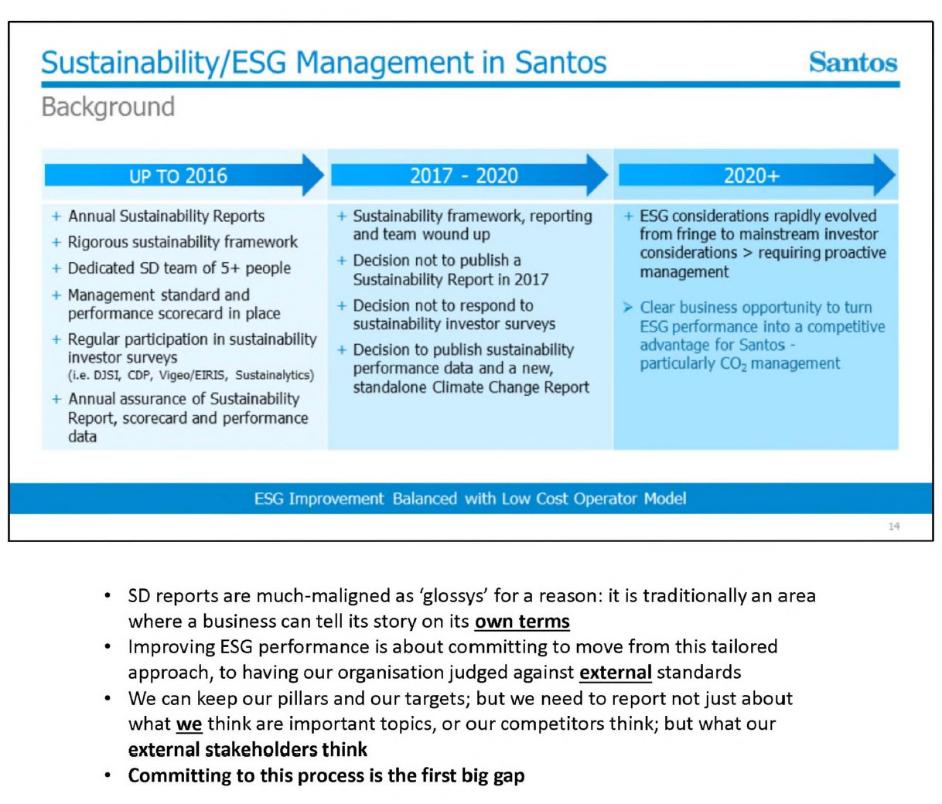
498 Secondly, the analysis cannot be restricted to a single member of the target audience. Nor am I satisfied, even if it were, that the hypothetical single member would know all of the matters which Santos attributes to that person.
499 In my view the characteristics to be attributed to the members of the target audience are as follows:
(1) they have a sufficient interest in anthropogenic climate change and global warming, and/or the impact of fossil fuel companies on those matters but have varying levels of knowledge about and interest in them;
(2) they are not assumed to have scientific training;
(3) they understand that there is an ongoing energy transition to reduce reliance on fossil fuels and thus emissions and to increase the use of renewable and low carbon energy and a desire in Australia and globally to pursue clean energy solutions. However, they do not possess any precise familiarity with the means or technologies by which that objective may be reached;
(4) they understand that long-term strategic objectives, which may be set by companies operating in the oil and gas sector, such as Santos, at the time, may be achieved in a variety of ways and would expect the pathway to achieve those objectives to change as circumstances change, and for the ongoing evolution of the objectives to be reflected, relevantly, by Santos in future climate change and annual reports;
(5) similarly, they would expect Santos to respond and/or adapt to technological and regulatory developments in the area; and
(6) they have some degree of familiarity with the Investor Day Presentation, the 2020 Annual Report and/or the 2021 Climate Change Report, having read at least one of them.
4. Alleged representations about Santos’ products
500 This part of the ACCR’s case concerns statements made by Santos about natural gas and hydrogen.
4.1 “Clean Energy”
4.1.1 The ACCR’s contentions
501 In its further amended concise statement (at [5]-[8]) the ACCR alleges that Santos made statements to the public (including “Relevant Users” as defined) in the 2020 Annual Report that the natural gas it produces is a “clean fuel” and provides “clean energy” in that the 2020 Annual Report states:
(1) “Santos is a leading supplier of natural gas, a fuel for the future, providing clean energy” (at p.1), implying that the generation of energy using natural gas does not have a material adverse effect on the environment;
(2) “Santos will grow its clean fuels capability” (at p.1), implying that Santos presently has that capability including because natural gas provides clean fuel;
(3) “Santos will continue to be a leading clean fuels company at the forefront of the energy transition to a lower-carbon future” (at pp.5 and 31), implying that Santos is presently a “leading clean fuels company” including because natural gas is a clean fuel and/or provides clean energy; and
(4) “Santos is a clean fuels business that will transition from natural gas to hydrogen” (at p.5), implying that Santos is presently a “clean fuels business” including because natural gas provides clean fuel and/or clean energy.
502 The ACCR contends that these statements, alone or in combination, conveyed that: the extraction of natural gas, and the generation of energy using natural gas, does not have a material adverse effect on the environment; and the extraction of, and generation of energy from, natural gas does not release material amounts of GHGs into the atmosphere (together, Clean Energy Representations).
503 The ACCR also alleges that the 2020 Annual Report did not disclose that:
(1) the extraction of natural gas involves the release of significant quantities of CO2 and CH4 into the atmosphere, through flaring, venting and fugitive emissions, and Santos’ operations emitted approximately 7.74 MtCO2e emissions in 2019-2020;
(2) the end-use of natural gas releases material amounts of CO2 into the atmosphere, and approximately 28.6 MtCO2e was emitted from Santos’ gas in 2019-2020;
(3) CO2 and CH4 are both GHG that contribute to anthropogenic climate change and global warming, and are harmful to the environment (including because of the environmental harms caused by global warming); and
(4) there are alternative energy sources presently available, which Santos does not produce or intend to produce, that do not release any or any material GHG emissions,
(together, Clean Energy Omissions).
504 The ACCR contends that the Clean Energy Representations and/or the Clean Energy Omissions have a tendency to lead the public, and/or investors and potential investors in Santos (including Relevant Users), into error, in that:
(1) natural gas, including as produced by Santos, is not a source of “clean” energy and is not “clean fuel”;
(2) the extraction and consumption of natural gas as an energy source is harmful to the environment; and
(3) the continued production and use of natural gas as an energy source is a material contributor to anthropogenic climate change and global warming.
505 However, by the time of its closing submissions, the ACCR’s case had shifted. It no longer alleges that Santos represented that there were no material emissions and global warming associated with the production of natural gas. The ACCR’s allegation in that regard now only concerns emissions from the consumption of natural gas.
506 In its written closing submissions, the ACCR contends that the “clean fuel” and “clean energy” representations were repeatedly made in the 2020 Annual Report. The following parts of the report are relied upon:
(1) at p.1 where Santos says that it “is a leading supplier of natural gas, a fuel for the future, providing clean energy”, that it “aims to be a world-leading clean fuels company, achieving net zero emissions by 2040” and that it “will grow its clean fuels capability as customer demand evolves”, implying that it already has that capability; and
(2) at pp.4-5 in the message from the Chairman and Managing Director and CEO where Santos says that:
(a) it “will continue to be a leading clean fuels company at the forefront of the energy transition to a lower-carbon future”, implying that it already has “clean fuels” capability; and
(b) it “is a clean fuels business that will transition from natural gas to hydrogen as our customers transition”, implying that natural gas, which is the “Current state”, is a clean fuel. The sequence of arrows under the text (see [512] below) indicates that CCS will lead to hydrogen so that Santos’ “Future state” will be “clean fuels” which explains what Santos means when it says that it will “continue to be a leading clean fuels company”. That is, its present state is natural gas, which provides “clean energy” and its future state is hydrogen which is also “clean fuel”.
507 The ACCR contends that Santos did not disclose in its 2020 Annual Report that the end use of natural gas releases material amounts of CO2 and CH4 into the atmosphere, nor that CO2 and CH4 are GHGs that contribute to climate change and global warming.
4.1.2 The impression conveyed by the conduct
508 The ACCR submits that the representations set out above were about an attribute of Santos’ natural gas product and about the use to which it could be put, i.e. to generate “clean energy”. It says that the impression overwhelmingly conveyed is that the material GHG emissions associated with Santos’ business arose in the production process, which Santos is addressing through the CCS process and its net zero target, rather than through the consumption of its product, which is “clean fuel” and provides “clean energy”.
509 The ACCR submits that, read fairly and in the context of the 2020 Annual Report as a whole, Santos’ use of the adjective “clean” conveyed that the consumption of gas produced by Santos was not a material contributor of GHG emissions by reason of the fact that it is a “clean fuel”. It contends that the ordinary and reasonable reader of the 2020 Annual Report, who would not have had scientific training and may (for example) have a gas cook-top or barbeque at home, would come away with the impression that the consumption of Santos’ natural gas has only relatively minor GHG emissions. It says this is a meaning not only supported by the context in which the adjective “clean” was used but is consistent with the ordinary meaning of “clean fuel” recorded in the Macquarie Dictionary: “a fuel which produces minimal greenhouse gas emissions”. The ACCR submits that it does not rigidly rely on dictionary definitions but merely observes that the dictionary records the common usage of the term, which is consistent with how it was deployed by Santos to promote its product.
510 As both parties accept, the representations about which complaint is made must be read in the context of the 2020 Annual Report as a whole.
511 The first of the impugned representations appears at p.1 of the 2020 Annual Report under the heading “About Santos An Australian energy pioneer” as follows:
512 The second and third of the impugned representations appear in the Chairman and CEO Message at p.5 of the 2020 Annual Report reproduced at [213(3)] above.
513 The statement at p.1 of the 2020 Annual Report that Santos is “providing clean energy” was in the introduction to the report situated in a part of the 2020 Annual Report which described Santos’ business at a high level. That part of the 2020 Annual Report spoke to Santos’ plans for the future namely that Santos “aims to be a world-leading clean fuels company, achieving net zero emissions by 2040” and that Santos “will grow its clean fuels capability as customer demand evolves for zero-emissions LNG, hydrogen and other products …”.
514 The statements at p.5 of the 2020 Annual Report in the Chairman and CEO Message also speak of Santos’ plans to transition to a clean fuels business by 2040. The current state was natural gas which is described as a cleaner, rather than “clean” fuel, while the future is for “clean fuels”. The chart showing the transition to the “Future state” is followed by Santos’ emissions reduction targets after which the reader is directed to the Santos website should he, she or it wish to obtain more information about the “2040 plan”.
515 This topic is also referred to in other parts of the 2020 Annual Report, which emphasise Santos’ plan to become a clean fuels company. For example, the Directors’ Report commencing at p.16 of the 2020 Annual Report includes at p.24:
As the world transitions to a lower carbon future, Santos has a plan to become a clean fuels company, has set ambitious emission reduction targets and outlined a clear and credible roadmap to achieve them. Further information is available in Santos’ 2021 Climate Change Report available on the Company’s website.
516 Santos submits that the impugned statements would be understood not only in the context of the 2020 Annual Report but also together with the Investor Day Presentation and 2021 Climate Change Report. It observes that the Investor Day Presentation included statements that the consumption of gas by Santos’ customers generated Scope 3 emissions, and that Santos was transitioning to cleaner fuels. The statements concerning Santos’ strategy for the transition to a low-carbon future provided the context in which “clean energy” and “clean fuels” were used, and the 2021 Climate Change Report was expressly referred to proximate to the impugned phrases (referring to the extract from the Directors’ Report set out in the preceding paragraph).
517 As set out above, I do not accept that the target audience would necessarily be familiar with all of the impugned publications, but would be familiar with at least one such publication.
518 That said, I accept that the impression conveyed by the impugned statements was as set out below.
519 First, the 2020 Annual Report used “clean” to convey that “natural gas” was cleaner than coal and diesel, not to convey that natural gas had no GHG emissions on consumption. As is apparent from the extract from the Chairman and CEO Message set out above, Santos stated that it “has committed to working with [its] customers to reduce their emissions. In the near term, this means switching from heavier emitting fuels, such as coal and diesel, to cleaner fuels such as natural gas”. That statement does not convey that natural gas is “clean” but that it is in relative terms cleaner than coal and diesel.
520 Santos also refers to the 2021 Climate Change Report which states that natural gas “produces half the greenhouse gas emissions of coal when used to generate electricity”. To the extent a member of the target audience was familiar with that publication, he, she or it would have had that additional context. In any event, as Santos submits the ordinary person’s understanding of the properties of natural gas is that when burnt it does emit GHGs.
521 Secondly, the description by Santos of it as a “clean fuels company” was made in the context of its statements about the “transition to a lower-carbon future” and “the transition from natural gas to hydrogen.” That and the associated statement of Santos as a “clean fuels business” spoke of Santos’ future aims. That is, as Santos put it, the type of company that Santos wanted to be as it transitioned to net zero by 2040. Santos aimed to use and supply fuels that would facilitate this transition. Contrary to the ACCR’s submissions, read in context, those terms did not convey that Santos’ present state is natural gas, which is a clean energy, while its future state is hydrogen which is a clean fuel.
522 The ACCR refers to the dictionary definition and the ordinary meaning or usage of the term “clean fuel”. It says that it does not rely rigidly on the definition. I take that to mean that it does not rely on the dictionary definition alone. Nor should it. Sole reliance on the dictionary definition ignores the context in which the term is used. Further, as Santos points out the Macquarie Dictionary provides for a range of meanings of “clean” in collocation with other words including fuel and even coal and, given that taxonomy, it is unlikely that the reasonable reader would have understood Santos’ use of the phrase “clean fuel” in the manner alleged by ACCR. Putting that to one side the dictionary meaning of “clean fuel” is a fuel which “produces minimal”, not no, GHG emissions.
523 Thirdly, to the extent they were familiar with the 2021 Climate Change Report and/or the Investor Day Presentation, the reasonable member of the target audience would have understood that consumption of natural gas was a material contributor of GHG emissions. They would have been aware that those publications disclosed, among other things, Santos’ Scope 3 emissions associated with the consumption of natural gas and CH4 emissions, in accordance with the National Greenhouse and Energy Reporting Act 2007 (Cth).
524 Fourthly, that Santos was addressing emissions from production through CCS and the Targets did not convey that material GHG emissions associated with Santos’ business only arose in the production process and not through consumption. The emissions reductions targets listed in the 2020 Annual Report included a “2030 Scope 3 emissions target”. Given that, a reasonable member of the target audience would not have understood the references to “clean energy” and “clean fuels” to convey that the consumption of natural gas did not release material GHGs into the atmosphere or contribute to global warming.
525 Lastly, the ACCR relies on an email from Peter Hearl, a director of Santos and a member of its Environment, Health, Safety and Sustainability (EHSS) Committee, dated 14 December 2020 in which Mr Hearl provided comments on a draft of the 2021 Climate Change Report. Among other things he commented that:
The terms “clean”, “cleaner” and “decarbonisation” are used at various points in the report and I am wondering if these shouldn’t be clearly defined early on in the report Eg..I interpret “clean” to mean totally CO2 emission free?, “cleaner” to be lower CO2 emissions than either coal or oil (but we don’t call out oil, is this deliberate because we produce oil?) When “Decarbonisation” is used is it used to mean CO2 elimination all together or a reduction in CO2 or either?
The ACCR submits that Mr Hearl, who it describes as the “quintessential sophisticate” in the market, interpreted the word “clean” to be “carbon dioxide free”.
526 Mr Hearl was commenting on a draft of the 2021 Climate Change Report. He raised one possible interpretation of the term “clean” as used in the draft report for consideration and discussion. The version of the report on which he gave his comments is not included nor provided in evidence. In those circumstances, as Santos submits, Mr Hearl’s queries cannot be used to inform a reasonable member of the target audience’s understanding of Santos’ publications. In any event, Mr Hearl was at the Board meeting at which the 2021 Climate Change Report was approved. In doing so the Board minutes note that the EHSS Committee had endorsed it. I would infer that Mr Hearl was satisfied with the report in the form approved.
527 The ACCR also refers to a comment made by Nadia Smith, Strategy Adviser, in an email sent on 11 September 2020 to Ms Norman titled “Investor Day clean fuels messaging 20200905.pptx”. Ms Smith queried whether “we need to be careful to only say ‘cleaner fuels’” and referred to the IEA’s 2020 Energy Technology Perspectives definition. The presentation on which Ms Smith provided her comments was not in evidence nor was her email put in context. Given its date, the comments, insofar as they concerned a draft of the presentation for the Investor Day Presentation, clearly related to an early draft. The context in which the term “clean” was used in the draft is not disclosed – the way in which the term is used may have changed. As I have already observed, the impugned statements must be considered in context.
4.1.3 The representations are not misleading or deceptive
528 It follows from the above that the ACCR’s allegations concerning the use of the terms “clean energy” and “clean fuel” are not made out. I am not satisfied that the representations in the 2020 Annual Report relied on by the ACCR in that regard are liable to lead the public and/or investors or potential investors into error as alleged.
4.2 “Clean” and “zero emissions” hydrogen
4.2.1 The alleged conduct
529 The ACCR’s claims in relation to the statements made by Santos about “clean” and “zero emissions hydrogen” in the Investor Day Presentation, 2020 Annual Report and the 2021 Climate Change Report are set out at [15A] to [15E] of the further amended concise statement. There the ACCR contends that:
(1) in those publications Santos made statements to the public, including “Relevant Users”, that it would produce “zero-emissions” or “clean” hydrogen, and that its hydrogen could “have no emissions in its production (Scope 1 and 2)”. Santos’ ability to do so was expressed to be “enabled by” the use of CCS;
(2) Santos thereby represented that any Scope 1 and 2 emissions generated by it in its production of blue hydrogen would be captured by CCS, such that there would be zero emissions from Santos’ hydrogen production (Zero-Emissions Hydrogen Representation);
(3) the Investor Day Presentation, 2020 Annual Report and 2021 Climate Change Report did not disclose that blue hydrogen production would increase Santos’ Scope 1 and 2 emissions and that it was not practical or commercially viable for Santos to capture all of the increased Scope 1 and 2 emissions using CCS (Zero-Emissions Hydrogen Omissions);
(4) further or alternatively, the Zero-Emissions Hydrogen Representation was a representation with respect to a future matter within the meaning of s 4 of the ACL and s 769C of the Corporations Act; and
(5) by reason of the matters alleged in (3) and/or (4) above, the Zero-Emissions Hydrogen Representation and/or the Zero-Emissions Hydrogen Omissions have a tendency to lead the public, and/or investors and potential investors in Santos (including Relevant Users), into error.
530 In the Investor Day Presentation, there were multiple uses of the term “zero emissions hydrogen”. For example in:
(1) slide 5 titled “Today’s headlines”:
MOU with Barossa partner SK to collaborate on
…
+ Zero-emissions hydrogen
(2) slide 13 titled “Market-led energy transition to cleaner fuels”:
(a) in relation to the topic hydrogen:
+ Zero-emissions hydrogen for own use fuel and blending into the domestic market
(b) in relation to the topic “Future state: clean fuels”:
+ Zero-emissions hydrogen expansion to dedicated hydrogen pipelines
(3) slide 15, the Net Zero Roadmap, under the subheading “Planned activities”:
+ Domestic and export opportunities for zero-emissions hydrogen enabled by CCS
531 During the address that accompanied the Investor Day Presentation Mr Gallagher explained what was meant by zero emissions hydrogen as follows:
And why do we call it zero emissions hydrogen? Because it’s the development of hydrogen with zero emissions, and what I mean by that is we can - we believe we’ve got a roadmap to creating hydrogen from our natural gas today at the long-term target prices government are putting out there for the mid 30s, we could make that today if there was a market to support it, and coupled with CCS be able to handle the CO2 that you would generate from that process. So it becomes a zero emissions hydrogen capability.
Mr Woods made comments to similar effect (see [203] above).
532 It was not in dispute that Mr Woods’ comment that “CCS delivers zero emissions hydrogen” was made in conjunction with slide 44 of the Investor Day Presentation (see Annexure B). That slide provided:
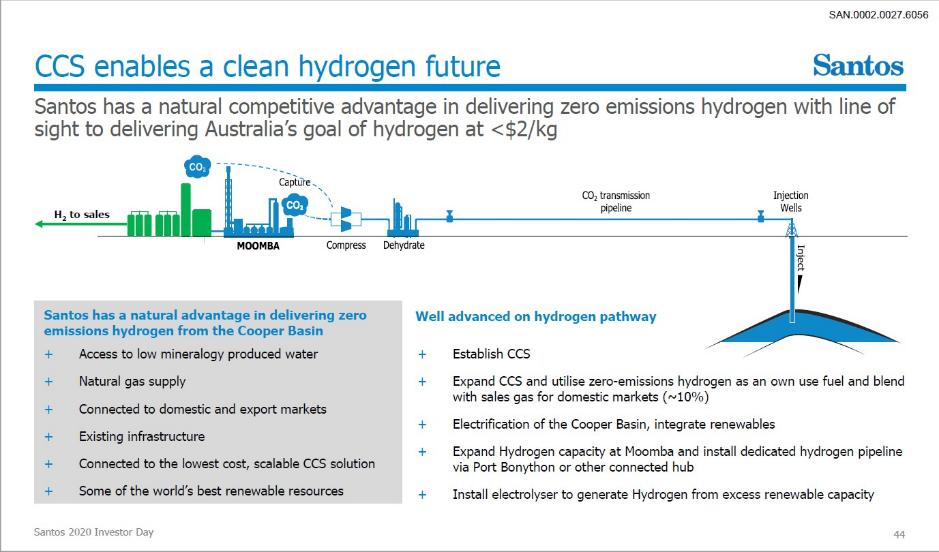
533 In the 2021 Climate Change Report, there were again multiple references to “zero emissions hydrogen”, including for example:
(1) on the first page under “[r]eport highlights” the following statement was made:
“Zero-emissions technologies: clean hydrogen”
(2) on p.6 in the “CEO statement”:
Santos’ role in this low-carbon journey is built around natural gas, which produces half the greenhouse gas emissions of coal when used to generate electricity. It is the perfect partner for renewable energy sources and can be made even cleaner with carbon capture and storage (CCS), eventually allowing low-cost zero-emission hydrogen, a fuel of the future.
(Footnote omitted); and
(3) on pp.8-9, in the “Executive summary”:
Aligned with our strategy, Santos is positioned to be a leading domestic and export supplier of natural gas and liquified natural gas (LNG) with progressively lower emissions through our world-leading CCS project. Moving forward, these core capabilities enable us to accelerate development of clean, zero-emission hydrogen, to fulfill future needs of our customers Aligned with our strategy,
And:
Zero-emission hydrogen produced from gas with CCS is a proven technology which can be achieved at half the cost of electrolysis, while using half the volume of water.
And under the heading “Strategy”:
…
+ CCS and zero-emission hydrogen have critical roles in meeting global climate change goals, with exponential growth of clean fuels required over the next 20 years.
…
+ Santos’ unique opportunities in CCS and clean hydrogen enable us to capture additional upside from the transition to a low-carbon world.
…
534 In the 2020 Annual Report in the Chairman and CEO Message at p.5 Santos said that its “strategy will focus on zero-emissions hydrogen enabled by CCS, which can be scaled up across the Cooper Basin” and that the “Cooper Basin has a natural competitive advantage in delivering zero-emissions hydrogen …”.
535 The ACCR submits that the statements made by Santos in the Investor Day Presentation and in the 2021 Climate Change Report convey the same meaning and that members of the audience who read only one of the publications would come to the same view. It submits that it is possible that members of the target audience who read only the 2020 Annual Report would have a different understanding to that conveyed to the Investor Day Presentation and/or the 2021 Climate Change Report audience but any difference is unlikely to be material and could not assist Santos. That is because the literal meaning of “zero emissions” is consistent with the meaning conveyed by Santos in the other publications and means no (i.e. zero) emissions in production.
536 The ACCR submits that use of “zero emissions” was consistent and deliberate, with the only “slip” from the dominant message appearing in the 2021 Climate Change Report under the heading “The road to 2030”, but that does not counterbalance the overwhelming use of the phrase.
537 Santos takes a different view. It submits that the terms “clean” and “zero-emissions” were used interchangeably or in association with one another in the publications, with reference to “carbon neutral” hydrogen and in a forward looking way, linked to CCS, an increasing use of renewable energy and a market transition to cleaner fuels.
538 Santos observes that:
(1) in the Investor Day Presentation, slide 13 situated the production of “zero-emissions hydrogen” in a market-led transition to “cleaner fuels” over the next two decades. It depicted a step-change from the current state of “natural gas” to, ultimately, the future state of “clean fuels”, including “[z]ero-emissions hydrogen expansion to dedicated hydrogen pipelines”, “[h]ydrogen exports from Port Bonython” and support for “low-cost green hydrogen production”. Slide 14 identified Santos’ emissions reductions targets and listed “Technology Enablers”, including renewables integration and CCS to “accelerate” the economic feasibility of hydrogen. Slide 15, the Net Zero Roadmap, indicated that “hydrogen” and “zero-emissions hydrogen”, enabled by a CCS potential scale-up in the Cooper Basin or at other sites, were relevant to “the pathway to net zero emissions by 2040”. Other slides, which provided an update on Santos’ Midstream Infrastructure & Low Carbon Operations, stated that CCS enabled “clean” and “zero-emissions” hydrogen;
(2) the statements made by Mr Gallagher and Mr Woods at the Investor Day accompanied the Investor Day Presentation and a video shown at the Investor Day stated that “CCS unlocks the production potential of clean hydrogen …” and “[w]ith further electrification of the Cooper Basin, and ongoing deployment of renewable technology, hydrogen could … be produced from renewable energy at Moomba. …” and “[z]ero-emissions hydrogen, produced from natural gas and renewables, would create a whole new export industry for Australia ….”;
(3) in the 2021 Climate Change Report:
(a) “clean” and “zero-emissions” hydrogen were referred to together;
(b) the production of hydrogen was described as “carbon neutral” in two places. The description of “hydrogen fuel” accompanying the Net Zero Roadmap provided “[w]e will capture and store the CO2 produced in our Moomba CCS facility, so the hydrogen we use will be carbon neutral”. In explaining “[t]he role of clean hydrogen in a lower-carbon future” Santos stated: “[w]hen used in conjunction with CCS, the hydrogen produced can be carbon neutral and also eliminates scope 3 emissions”. The use of the term “carbon neutral” was not, as the ACCR contends, a “slip”;
(c) the hydrogen opportunity was relevant to future components of the road to net zero by 2040. The ACCR relies on the statements at p.11 of the 2021 Climate Change Report that the hydrogen sold to customers “could have no emissions in its production (‘Scope 1 and 2’) or its end use (‘Scope 3’)”. Santos points out that it did not say that hydrogen “would” have no emissions. The 2021 Climate Change Report acknowledged (at p.28) that “generating hydrogen from natural gas produces CO2”, which “can be captured and stored”; and
(d) future production of hydrogen, or “clean” or “zero-emission” hydrogen, was generally tied to CCS and to the transition to lower CO2 emissions. However, the 2021 Climate Change Report also foreshadowed that hydrogen production with CCS would increasingly use renewable energy and (at p.28) that the Cooper Basin has “significant hydrogen production potential [through] hydrogen production from electrolysis using the Cooper Basin’s world-class solar and viable wind resources”; and
(4) the statements in the 2020 Annual Report extracted at [534] above, would have been understood in the context of the references to hydrogen, including “clean”, “zero-emissions” and “carbon neutral” hydrogen, in the 2021 Climate Change Report and at the Investor Day.
539 The parties’ competing submissions set out above are addressed below in considering the impressions conveyed by the conduct.
4.2.2 The impressions conveyed by the conduct
540 The ACCR submits that an ordinary and reasonable member of the target audience would understand “zero-emissions” and “clean” hydrogen to convey precisely what Santos said those phrases were intended to convey: i.e. hydrogen with “no emissions in its production (Scope 1 and 2)”. It contends that a reasonable member of the target audience would understand from Santos’ statements that it presently had the ability to produce hydrogen from natural gas using a production process which would generate zero emissions, because all production emissions would be captured by CCS. An ordinary and reasonable member of the target audience would not understand “zero emissions” to mean that all emissions would be offset by the purchase (and retirement) of carbon credits. In cross-examination Mr Woods accepted that “zero emissions hydrogen” involved a “net story” and, when confronted with the fact that Santos’ representations did not include the word “net”, he suggested that the “net” was “implied”.
541 The ACCR submits that: the ordinary and reasonable user, who did not have scientific training, would not have inferred that “net” was implied; Santos was very deliberate in its use of the terminology “net zero” and “offsets”; and it used that terminology to refer to the Net Zero Roadmap and specifically identified the components of the roadmap that involved offsets. The same distinction was not made for blue hydrogen.
542 The ACCR observes that in its opening submissions Santos contended that the expressions “clean hydrogen” and “zero-emissions” hydrogen “were associated with” the production of hydrogen that involved low-carbon emissions and with hydrogen having the ability to reduce carbon emissions, referring to the evidence of Professor Cook and Mr Snow. However, in cross-examination Mr Snow accepted that his view as at November 2021 was that blue hydrogen is “low net emissions” not “zero emissions”, and that he would have expressed that view to a client if asked for his opinion on the matter. He also accepted that “zero emissions” was the terminology that was being used at the time to describe green hydrogen and that he could not identify one publication that referred to blue hydrogen as “zero emissions”.
543 The ACCR observes that, in relation to “clean” hydrogen, the highest Santos’ evidence goes is that the term did not have “an accepted meaning”. The ACCR submits that if the term had no accepted meaning, then it was likely to mislead an ordinary and reasonable member of the target audience who, having read what Santos said about “zero emissions” hydrogen with “no emissions in its production”, credibly believed that what Santos said was literally true.
544 The ACCR submits that it is important to observe that Santos does not submit that an ordinary or reasonable member of the target audience should be attributed with knowledge that the hydrogen production process involves the emissions of material amounts of GHG emissions. As Santos has been at pains to point out, blue hydrogen is a new product. The ACCR submits that the Court cannot infer any pre-existing knowledge about its properties or associated emissions.
545 In my view a reasonable member of the target audience would have understood “clean”, “zero-emissions” and “carbon neutral” hydrogen to mean the production of hydrogen from natural gas with CCS with no net emissions. As explained below, a reasonable member of the target audience would not have understood those terms to mean hydrogen with no production emissions because all production emissions would be captured by CCS.
546 As Santos submits, “clean” and “zero-emissions” meant hydrogen produced from natural gas with CCS. That understanding was conveyed by the publications in issue. It is evident from the examples set out above that the expressions “clean hydrogen” and “zero-emissions hydrogen” were, in some places, used together and, in others, used interchangeably. Doing so conveyed that they were the same, namely hydrogen made from natural gas enabled by CCS with no net emissions.
547 As the examples set out above illustrate and as a review of each of the publications clearly demonstrate, each explains and conveys the impression that clean or zero emissions hydrogen is hydrogen produced with CCS. For example, in the 2021 Climate Change Report, the CEO statement clearly explained that it is CCS that “will unlock production of zero emission hydrogen”.
548 That is, the publications in question conveyed that CO2 emissions generated from the production of blue hydrogen would be captured by CCS.
549 Santos submits that the reasonable member of the target audience would not have understood that absolutely all CO2 emissions would be caught by CCS but would have understood that most emissions would be caught, and Santos could purchase carbon credits to offset any residual emissions from the production of hydrogen. I accept that is so for the following reasons.
550 First and most critically, in the publications Santos indicates that it will be relying on offsets or carbon credits to achieve the 2040 Target. This included references to the use of “land-based offsets” and relevantly, the eligibility or finalisation of an ACCU methodology for CCS. Santos says that offsets had been a long-standing feature of its climate change policy. A review of Santos’ Climate Change Reports in evidence before me bears out that submission:
(1) the 2018 Climate Change Report, which was Santos’ first such report, includes references to “identifying opportunities to reduce, and where relevant, offset greenhouse gas emissions” in response to various identified risks;
(2) the 2019 Climate Change Report includes in the CEO’s statement:
In this year’s report we announce our medium-term (2025) carbon targets, which centre on the crucial role of natural gas in reducing global emissions. The three targets look to reduce emissions from our operated activities and work on step-change technologies with the potential to provide significant carbon offset opportunities
The actions identified in Santos’ climate change policy included that Santos will “[i]dentify and pursue opportunities to offset greenhouse gas emissions where relevant in further support of achievement of emissions targets”; and
(3) the 2020 Climate Change Report included as part of the climate change policy the same action to identify and pursue offset opportunities for GHGs. It also referred to a project at Devil’s Creek, WA at which new infrastructure had been introduced which reduced carbon emissions by 25% as well as power costs. The project was approved by the Clean Energy Regulator to generate ACCU’s under the Emissions Reduction Fund (ERF), which was “the first time an upstream oil and gas company has accessed ACCUs through the ERFs electricity and fuel efficiency methodology”.
551 Similarly, in the 2021 Climate Change Report Santos stated that it would “identify and pursue opportunities to offset greenhouse gas emissions where relevant in further support of achievement of the emissions targets”, conveying that Santos would rely upon offsets where necessary to do so.
552 In addition:
(1) the 2021 Climate Change Report described the production of hydrogen as “carbon neutral”. Professor Cook’s view is that carbon neutrality and net zero have the same meaning and involve the balance between a company’s total GHG emissions and its total mitigation activities including the purchase of carbon credits, the concept of net zero, and balancing emissions against reductions and offsets. Mr Snow expresses a similar view;
(2) Santos’ publications indicated its hydrogen initiative was relevant to its transition to net zero by 2040. As Professor Cook explains, at the time of those publications, offsets or carbon credits were an accepted tool for mitigating emissions to achieve net zero. For example, after re-iterating (at [143] of his report) that the term net zero is not defined or used in the Paris Agreement, and as a consequence, there are various interpretations of the term, how it will be achieved, and how it will be maintained once it is achieved, Professor Cook explains:
144. In my experience, gained in my role as Chief Executive of CO2CRC and my professorial capacity within the Peter Cook Centre for CCS Research, in discussions with industry and government officials, through attendance at industry-research symposia and in chairing a focused workshop on negative emissions in 2019, the term “net zero” was used and understood by the energy industry in 2020 and before to mean balancing emissions and offsets, using a range of mitigation and removal options, including through CCS. Whilst recognising that “net zero” had a global context that I described above, the term has tended to be applied more “locally” by the energy industry, such that the total greenhouse gas emissions emitted to the atmosphere by a company or a facility or a region or a country, expressed in CO2e units, were balanced by offsets used by the company or entity or the national/global community, also expressed in CO2e units. A company may choose to confine its net zero target to its Scope 1 and Scope 2 emissions because it is largely responsible for their production, and it can realistically take responsibility for their mitigation. The term “net zero emissions” is frequently used to denote this objective. A company may also aspire to attain net zero for all its emissions including Scope 3, by encouraging or assisting its customers to attain net zero, including through the use of offsets and carbon credits and the application of CCS where appropriate.
And:
147. Net zero can potentially be achieved within the confines of a defined entity, solely through its own mitigation efforts, or through the purchase of credits (removal and avoidance) arising from the emission reduction efforts of another entity. In the case of a gas company, the emissions it generates are principally CO2, with some CH4, small amounts of N2O and other trace contaminants. Commonly, companies and other entities, including countries and cities, use carbon credits to “balance the books”. The premise is that a CO2e unit released through an organisation’s activities can be offset by removing/sequestering/reducing/avoiding an equal amount of CO2e (encompassing all greenhouse gases) by another entity and that this offset can be purchased through a carbon market, for example, to provide “net zero”. The term “offset” is defined by the IPCC (2014), as a “unit of CO2-equivalent emissions that is reduced, avoided, or sequestered to compensate for emissions occurring elsewhere”.
(Footnotes omitted.)
(3) Mr Snow expresses a similar view to that of Professor Cook, albeit in less technical terms. For example, he explained that, at the time of the relevant publications:
47. There was no “accepted energy industry meaning of net zero emissions for Scope 1 and 2 GHG emissions”.
48. There was though a base presumption that to reach “net zero” emissions a company or jurisdiction (Australia and within Australia) was reducing their greenhouse gas emissions to a low level where a combination of direct GHG emissions reduction, GHG emission avoidance credits and/or carbon dioxide removal and storage credits would render the actual emissions for that company or jurisdiction to be at a net zero outcome.
49. There was effectively a self-fulfilling logic to the use of a term like “net” as in “netted off” jurisdictionally, by sector or by an individual company. It was not taken to mean for example that there would be no GHG emissions in 2050.
50. The use of the term “net zero emissions” was about a destination or end point by a given date, and there were variances in what this end point looked like or how it could be measured. It was not so much the pathway to achieving that outcome, and its most consistent use was in describing, and not actually setting, those target outcomes.
51. It was also about the context within which it was being used, politically for example was different to regulatory, and there were technical definitions, but this did not mean they were the accepted understanding within the Australian energy industry.
(4) the National Hydrogen Strategy acknowledged that not all emissions from the production of hydrogen using gas would be caught by CCS and it was technically feasible to produce hydrogen from natural gas at “acceptably low levels of carbon emissions” with capture rates of 90% or more. Relevantly, Associate Professor Beck and Mr Snow agreed in their joint report that most or nearly all CO2 emissions are captured from this process but not all. The rest are emitted to the atmosphere.
553 Santos submits that having regard to the target audience’s awareness of the ongoing energy transition, a reasonable member, who took interest in what Santos said about hydrogen, would likely have been generally aware of the Australian government’s and energy industry’s nomenclature to describe hydrogen, which would have informed their reading of Santos’ publications. That may be so of some of the members of the target audience but not necessarily all. For those who may have been aware of that nomenclature, Santos submits that in both the National Hydrogen Strategy and the First Low Emissions Technology Statement “clean hydrogen” included hydrogen produced using fossil fuels with substantial CCS and that, while documents did not expressly refer to “zero-emissions hydrogen”, they would have informed the manner in which the target audience understood that term in Santos’ publications because there “clean” and “zero-emissions” hydrogen were used interchangeably. That may be so for those members of the target audience who were aware of those publications.
554 That said, I accept Professor Cook’s evidence that, at the relevant time, “the place of hydrogen in mitigating climate change, the preferred methodologies to produce hydrogen, and the nomenclature were all in a state of flux”.
555 In his report Mr Snow gave evidence to the same effect. He was asked if, as at 1 December 2020 and, if different, 18 February 2021, there was an accepted industry meaning of the terms “clean hydrogen” and “zero emissions hydrogen”? In response to that question Mr Snow said at [847] of his report:
These were not settled terms and were often used in various ways by leading bodies in their early hydrogen reports (prior to the dates) to describe the use of hydrogen as “clean”, the production of hydrogen from fossil fuel sources with CCS as also “clean hydrogen” and for describing hydrogen produced from electrolysis of renewable electricity as “clean hydrogen”. There was no accepted Australian energy industry meaning of the terms “clean hydrogen” and “zero emissions hydrogen”, just as there was no accepted Australian energy industry meaning of the term “net zero” emissions, as I have outlined in my responses to Question 3 at Section 5.1.
556 Mr Snow referred in his report to a number of reports which were dated prior to February 2021 that used the terms “clean hydrogen” and “zero emissions hydrogen”. In cross-examination Mr Snow did not accept that, based on these reports, the accepted industry meaning of zero emissions hydrogen was green hydrogen. This was so despite the fact that he had not located any reports that referred to blue hydrogen as “zero emissions hydrogen”. According to Mr Snow, at the time, the terms were not used in any precise way and were bandied about. Mr Snow had the following exchange with counsel for the ACCR, Mr Entwisle:
Mr Entwisle: It’s true to say that the accepted industry meaning of zero emissions hydrogen was, in fact, green hydrogen, wasn’t it?
Mr Snow: No, I don’t believe that. No.
Mr Entwisle: Well, you haven’t found one publication that refers to blue hydrogen as zero emissions hydrogen, have you?
Mr Snow: Correct.
Mr Entwisle: But you have found at least two publications that refer to green hydrogen as zero emissions hydrogen.
Mr Snow: Correct.
Mr Entwisle: So that was a terminology that was being used at the relevant time to describe green hydrogen; correct?
Mr Snow: It was, yes.
Mr Entwisle: And you can’t say it was a terminology that was being used to describe blue hydrogen.
Mr Snow: Well, I can.
Mr Entwisle: On what basis, Mr Snow?
Mr Snow: As I said, that was the recall from my days in the industry.
Mr Entwisle: Yes.
Mr Snow: We were going through a period of great change, and the federal government had gone through, supporting, as we’ve seen, you know, the generation of hydrogen from gas, in terms of blue hydrogen. And what – what – what – let me finish. And so the industry itself – it’s government, people with assets, investors, and people in the industry itself that use it. And so amongst that group, there was confusion about all of these terminologies. There may have been within the scientific journals an understanding of what zero emission meant to them. But in terms of the energy industry in Australia, it was quite distinctly variable. It was used – all of these terms were used like lay terms. We didn’t have agreed standards for these. Now, there may have been within some of those areas people understanding that. And I think that’s something that will come out later in one of the other conclaves, is that you can have a distinct understanding, as you’re pointing out here, about what zero emissions means within these papers. But within the industry itself, there was quite a wide variety of lay terms being thrown around. Net zero, clean hydrogen, zero emission hydrogen, all those things were being used within the industry. But I do agree with you. Look, you know, the references here are more focused on the green hydrogen for zero emissions. But that’s not my recall from what has happened in the industry and the way it was being used. That doesn’t mean it had to appear in a publication.
557 An article dated November 2021 which was co-authored by Mr Snow, among other things, referred to blue hydrogen with CCS as a source of “low emissions hydrogen”. A footnote to that part of the paper provided that “[t]here are inevitably small amounts of carbon emissions even when paired with CCS technology, hence it is low emissions, not zero emissions”. Mr Snow agreed that was his view at the time the article was published and was the view he would have expressed to a client at the time had he been asked to give an opinion. The cross-examination on this topic concluded with the following exchange between Mr Snow and Mr Entwisle:
Mr Entwisle: I’m going to put it to you again, Mr Snow, the accepted industry meaning of zero-emissions hydrogen as at 2020 and 2021 was a reference to green hydrogen, correct?
Mr Snow: No.
Mr Entwisle: And the terminology that you considered to be appropriate to use when speaking to the industry for blue hydrogen was low net emissions.
Mr Snow: Correct.
558 Relatedly, Professor Cook, Mr Snow and Associate Professor Beck agreed that “clean hydrogen” was used as a catch all term to describe the production of hydrogen from fossil fuels with CCS and the production of hydrogen from electrolysis using renewable energy but there was no such agreement in relation to the term “zero emissions hydrogen”. Santos observes that the debate is most pronounced in the evidence of Mr Snow and Associate Professor Beck but that Mr Snow’s evidence should be preferred.
559 In my view, the evidence before me establishes that there was no settled meaning of the terms “clean hydrogen”, as the experts relied on agreed to be the case, and “zero emissions hydrogen” within the Australian energy industry at the relevant time. As to the latter I prefer the evidence of Professor Cook and Mr Snow.
560 Insofar as Mr Snow is concerned, as observed above, he brought a deal of practical, industry based experience which is reflected in his evidence. That was true of this topic and is seen in his answers in cross-examination about the meaning of the terms “clean energy” and “zero emissions hydrogen”. That evidence (see [556] above) is ignored by the ACCR but it should not be. It clearly reflected Mr Snow’s experience and his understanding at the relevant time. It was clear that Mr Snow, who had worked in the energy industry at the relevant time, had given much thought to the questions put to him about the meaning of the terms. As Santos points out Mr Snow’s view was also supported by an article co-authored by Associate Professor Beck titled “‘Clean’ hydrogen? An analysis of the emissions and costs of fossil fuel based versus renewable electricity based hydrogen” published on 3 March 2021 which included:
…. In fact, many countries’ strategies effectively treat ‘zero-emission’ and ‘low-emission’ hydrogen as equivalent technological options. For example, the Japanese strategy describes hydrogen produced from fossil fuels with CCS as “carbon-free” or “zero-emission”. The US Department of Energy’s plan for scaling up hydrogen describes fossil fuel with carbon capture use and storage as a potential means of supplying “carbon-neutral” hydrogen.
…
(Footnotes omitted.)
And under the heading “Conclusions”:
A number of government strategies foresee ‘low-emission’ hydrogen production from fossil fuels with CCS as an element of their hydrogen strategies. We find that these ‘low-carbon’ production methods create significant greenhouse gas (GHG) emissions when realistic capture rates and fugitive emissions from feedstock extraction are taken into account. The extent of the emissions is often downplayed or ignored in governments’ public statements about future hydrogen supply chains, with many treating low-emission and zero-emission production as functionally equivalent or interchangeable. …
561 An article titled “Green hydrogen characterisation initiatives: Definitions, standards, guarantees of origin, and challenges” by Anthony Velazquez Abad and Paul E. Dodds published on 6 February 2020, expressed similar views about the uncertainty in the definition and use of terms when discussing green and blue hydrogen. This article was referenced by Associate Professor Beck in her first report.
562 Having regard to these matters I accept Santos’ submission that I should accept Mr Snow’s evidence on this issue over that of Associate Professor Beck. Further it is supported by Professor Cook’s evidence. Accordingly, I am satisfied that at the relevant time the terms “clean hydrogen” and “zero emission hydrogen” were used interchangeably to refer to blue hydrogen.
4.2.3 The representations are not liable to mislead
563 As set out above, in my view, the reasonable member of the target audience would have understood that in referring to “clean” and “zero emissions hydrogen” Santos was referring to the production of hydrogen from natural gas with CCS and offsets. It follows that in making the statements about “clean” and “zero emissions hydrogen” in the Investor Day Presentation, 2020 Annual Report and the 2021 Climate Change Report Santos did not engage in conduct that was liable to lead the public and/or investors or potential investors into error or that had the tendency to do so in the manner alleged by the ACCR.
564 The ACCR makes submissions about the quantity of emissions associated with the production of blue hydrogen based on the GHD Report. Given my conclusion set out above it is not necessary to address those submissions in any detail at this stage save to observe that they ignore the fact, as the evidence disclosed, that the GHD Report was a preliminary study and, as Associate Professor Beck accepted in cross-examination, its purpose included the gathering of “technical information for Santos to use in structuring the project and in engaging with contractors and technology vendors in subsequent phases of the project” and that it “was an early stage concept study”. The purpose of the GHD Report was not to provide a final recommendation about the actual plant and hydrogen production process to be implemented. The GHD Report, its role and the additional calculations carried out by Associate Professor Beck and Mr Snow are further considered in section 5.2.2 below.
565 The ACCR also submits that, if the Court concluded that the representations in question were liable to mislead (which it has not), it would find that the misleading impression conveyed by the conduct was deliberate because the use of “zero emissions” and “clean” hydrogen was motivated by a desire to be “lumped in” with green hydrogen and the chronology discloses an intention to persist with that terminology, despite the receipt of falsifying information and concerns raised by those familiar with the information.
566 That allegation was not pleaded, as it should have been, nor squarely put to any of Santos’ lay witnesses: see Forrest v Australian Securities and Investments Commission (2012) 247 CLR 486; [2012] HCA 39 at [26] (French CJ, Gummow, Hayne and Kiefel JJ); Federal Court Rules 2011 (Cth), r 16.42 and r 16.43. Any suggestion that it is just a question for evidence as the ACCR suggests is rejected. Accordingly, if, contrary to my findings, I had been satisfied that the representations were liable to mislead the public as alleged, I would not entertain the ACCR’s submission that the misleading impression conveyed by the conduct was deliberate.
5. The Targets and the Net Zero Roadmap
567 The ACCR’s case in relation to the 2030 Target and the Net Zero Roadmap has distinct aspects.
568 First, the ACCR alleges that Santos made representations about characteristics or qualities of the Targets which were misleading in context. It contends that Santos sought to and did convey a clear, powerful message, announced the Targets with fanfare and wanted to, and did, convey that they were credible targets in which the company had a lot of confidence, commensurate with the language of commitment and in the statement that it will achieve the Targets. Santos deliberately drew comparisons with its peers on the basis that it was unlike its peers, it now knew the way to achieve the Targets and so was upgrading its “aspiration” to a “target”.
569 The ACCR contends that, as pleaded by it in the further amended concise statement, the Court should find that Santos represented that:
(1) the 2030 Target and the Net Zero Roadmap were clear, credible and tangible;
(2) the 2030 Target and the Net Zero Roadmap were not just a number or an aspiration, but instead were a realistic emissions reduction roadmap based upon real planned activities; and
(3) the Net Zero Roadmap was based upon reasonable assumptions.
570 Secondly, the ACCR alleges that the Targets were with respect to future matters, or alternatively were opinions, and were misleading because Santos lacked reasonable grounds.
571 Thirdly, the ACCR alleges that Santos omitted certain key assumptions from its announcements which rendered its conduct misleading. In that regard the ACCR contends that the Court should find that Santos omitted to disclose the following matters as set out in its further amended concise statement which, assessed objectively, the target audience would have been entitled to expect or infer would be disclosed:
(1) the Targets and the Net Zero Roadmap do not account for emissions associated with the production of blue hydrogen;
(2) the Targets and the Net Zero Roadmap do not account for expected production and/or emissions growth from oil and gas exploration opportunities beyond 2025; and
(3) the Net Zero Roadmap was based upon offset-generating activities (CCS Expansion and Hydrogen with CCS), which were not based upon proper modelling but were “speculative”, “nominal” or “notional”.
5.1 The character/nature of the representations
572 The ACCR submits that in assessing the character and nature of the representations what matters is the contextual prominence given to the messages and the strong and forceful way in which Santos projected its confidence in those messages.
573 The ACCR submits that Santos represented at the Investor Day that the Net Zero Roadmap was “clear and credible” and supported by “a realistic, doable plan” and that it was a “realistic roadmap, real activities and a plan to achieve net zero by 2040”. It contends that Santos did so in order to convey its own confidence and credibility to the target audience, and to encourage them to trust the integrity and reliability of the long-term targets. The ACCR refers to Mr Gallagher’s statement that it was these features of Santos’ “net zero” plan that distinguished Santos from its competitors, whom he suggested either lacked a “plan” or were merely announcing “aspirations”. The ACCR submits that the implication of Mr Gallagher’s language was that investors and other stakeholders should trust Santos’ targets, which were “credible”, “doable”, “realistic” and based upon “real activities”.
574 The ACCR submits that the Court should find that Santos’ purpose in making the impugned statements was to meet what it perceived to be the expectation of its stakeholders and to make announcements that would be useful to the decision-making of the target audience.
575 The ACCR submits that the real question is whether a reasonable person in the position of Santos at the time would have considered that it had an appropriate basis for announcing not only a 20 year plan, but a 20 year plan that was different to and better than other plans of the same genre. It says that the Court can dismiss submissions to the effect that Santos’ liability would have a stifling or stultifying effect because the Court is concerned with the enforcement of statutory norms, not the facilitation of (misleading) corporate plans and, in the enforcement of the statutory norms, what matters is making sure that consumers have access “to reliable, truthful and accurate information”, referring to Australian Competition and Consumer Commission v Coles Supermarkets Australia Pty Ltd (2015) 327 ALR 540 at [95]. The ACCR submits that to uphold its claims would not stultify diligently prepared and honestly announced transition plans.
576 The ACCR contends that, in part, what makes Santos’ conduct so egregious is that Santos is sophisticated at long range planning. According to Mr Jaffray, it routinely produces LTPs ranging generally from 10-30 years for each asset, which involve “a forecast of the potential activities year-on-year for the life of the asset and were initially prepared as part of the process for FID approval”. In addition, the ACCR observes that Santos was aware that “[c]arbon reporting has seen increased internal and external focus”, and the role of its Portfolio team, includes to “provide line of sight to longer-term carbon forecasting”. The ACCR submits that these matters underscore Professor Collis’ evidence that 20 years is not an unusually long period of time for a long-term corporate strategy.
577 The ACCR submits that the fact that the impugned announcements relevantly concerned long-term targets does not free Santos from the need for rigour and robustness over the plan period. The purpose of the reasonable grounds criterion “is to require an appropriate basis for the state of mind (being the opinion or prediction) disclosed by the representation”, referring to Australian Competition and Consumer Commission v Woolworths Limited [2019] FCA 1039 at [103]. Referring to evidence given by Professor Collis, the ACCR says that a reasonable company in the position of Santos would have a “well documented analysis which is data driven, quantifiable and externally validated” and would have spent “months (typically at least four or five and possibly up to twelve)” developing it, rather than a matter of weeks. The ACCR contends that it is striking that Santos fell well short of Professor Collis’ standards and that he was not asked to look at any of Santos’ relevant processes despite his obvious expertise to do so. The ACCR submits that the Court should infer that such evidence would not have assisted Santos’ case.
578 In considering these submissions, it is first necessary to have regard to the impugned statements in context.
579 On 1 December 2020 the Investor Day Presentation was given and released to the ASX. The ASX media release included a statement that Santos had announced “an ambitious roadmap to net zero emissions by 2040 and new emissions targets designed to support Australia’s commitment to the Paris Agreement”. The Chairman and CEO Message in the 2020 Annual Report used similar language, referring to the announcement in December 2020 of “industry leading emission reduction targets” as did the 2021 Climate Change Report in referring to “Industry-leading targets”.
580 True it is that Santos used emphatic language including Mr Gallagher’s statement at the Investor Day about a “realistic, doable” plan and the statements in the 2020 Annual Report and the 2021 Climate Change Report respectively that its transition roadmap was “clear and credible” and that Santos has “a clear, tangible pathway” to reach the Targets. However, it did so in the context of announcing the Targets and in order to express its view that there was a real possibility of achieving them if, as Santos submits, markets and regulations evolved in particular ways, consistent with a view taken of the energy transition and global ambitions to achieve net zero by or after 2050.
581 Both ACCR and Santos refer to and rely on different aspects of Professor Collis’ evidence. It is convenient to set out the relevant parts of his evidence.
582 As set out above, Professor Collis was asked four questions. The first of those was to describe the purposes of a company setting a long term corporate strategy including targets. In his detailed response to that question Professor Collis considered the purpose and elements of a strategy, its timeframe and strategy implementation.
583 Professor Collis explained that the elements of a strategy are its objective, scope, competitive advantage and strategy statement.
584 As to scope, Professor Collis explained that it concerns the precise domain in which the firm will play and establishes boundaries around the markets in which the firm will compete which can cover products, technologies, industries, geographies and value chain activities. Relevantly, Professor Collis says that no strategy can be precise about exactly what it will do in the plan period and that setting out specific initiatives years in advance is impossible in a world of continuous change. Professor Collis also observes that the actual path taken, and tactics adopted during execution of a strategy are not set in concrete in advance but adapted over time as required to meet the stated strategic objective.
585 In relation to timeframe for a strategy Professor Collis explains that the length of a plan period for a corporate strategy will vary by industry. One driver of a plan period is the life of asset investments. Professor Collis also notes that while a company expects and hopes that a chosen strategy can be followed over the entire plan period, if circumstances change, the appropriate thing to do is to adapt the strategy to meet those new circumstances. Professor Collis describes two types of change: the first, continuous tactical adaptations that must occur in response to evolving external conditions while implementing the strategy; and the second, a radical change in strategy when external changes are so far-reaching that they invalidate the assumptions and logical underpinnings of the original strategy. Professor Collis observes that at every point in time the strategy should be set as one that is best for the next five or 10 years, being the appropriate strategy time frame.
586 Question 2 asked Professor Collis to describe the nature of the processes, the characteristics of the information or data, and of the assumptions, that would be appropriate for a company to use when setting a long-term corporate strategy or target, including but not limited to a long term ESG or net zero target.
587 Usually, the substantive corporate strategy review would be undertaken by an internal group of strategy experts and senior executives bolstered by specific outside expertise and the many individual workstreams would typically be synthesised by a steering committee and integrated into a coherent strategy for the company setting out its objective, scope and the competitive advantage to be pursued. According to Professor Collis, a thorough review of a large company’s corporate strategy may take months, usually at least four or five and possibly up to 12 and can be expensive.
588 As a general proposition Professor Collis notes that corporate strategy will typically be set by senior executives and approved by the company’s board and that most companies will undertake a substantial strategic review periodically, say every five or 10 years, while a less extensive review and update will usually take place annually.
589 Professor Collis also notes that there are many frameworks for strategic analysis but that all agree on the need for a “well documented analysis which is data driven, quantifiable and externally validated”, which explains why the development process must be so extensive.
590 One aspect of Professor Collis’ response to question 2 concerns data sources. He notes that strategic objectives typically require external data for their development and that long term ESG targets are “perhaps based on the most complex set of data inputs and subject to the most external contingencies”. Professor Collis says that the selection of a target can be drawn for a wide variety of metrics and, as it is to be achieved over a long term, the extent of variability in the external environment that must be considered can be enormous. To understand the variability, data has to be collated on a number of relevant issues and from a wide range of sources. Professor Collis notes that, unlike in the case of short term financial forecast, the data available in setting a long term ESG target is typically uncertain and disparate and accordingly, the uncertainties inherent in a long term strategic objective (including a long term ESG target) will often reflect the limitations in the available data, will involve a degree of managerial judgment and the ultimate formulation of the strategy will typically involve an evaluation of a number of different scenarios, each of which is highly uncertain.
591 Another aspect of Professor Collis’ response to question 2 concerns the assumptions made for long term strategic objectives. In summary Professor Collis said:
(1) long term corporate strategic objectives are subject to the same assumptions and uncertainties that surround choice of strategy and start from assumptions about the future industry structure, sources of competitive advantage, competitor moves and so on;
(2) many of these assumptions are external factors beyond the company’s control;
(3) assumptions on which a long term ESG target are based include “all the exogenous factors at work over a long period of time that drive the relative costs of different fuel sources” and “might include consumer willingness to pay for renewable energy; government policies and regulations; levels of infrastructure investment in ecosystems surrounding each fuel; rates of progress in all the different technologies, such as CCS; global economic growth and so on”; and
(4) the date at which a long term ESG target is set so far into the future and the factors determining whether the right path has been chosen to reach the target are so many, interdependent and unpredictable, that it is likely that there will be some variance from what is initially assumed along that path.
592 The third question posed to Professor Collis asked:
Are the methods or processes deployed, the characteristics of the information or data relied upon and/or the nature of the assumptions made that would be appropriate for a company or organization to use when setting a long-term corporate strategy or target (including but not limited to a long-term ESG or net zero target), as described in your answer to question 2 above, different from those that would be appropriately used by a company in setting a short-term corporate target or forecast (such as short-term earnings forecasts)? If so, please describe those differences.
593 In answering this question Professor Collis considered a number of things including “assumptions and uncertainties”. His response was similar to that which he gave to question 2 (see above). He said that assumptions on which a long term ESG target are based “include all the exogeneous factors at work over a long period of time that drive the relative costs of different fuel sources; consumer willingness to pay for renewable energy; government policies and regulations; levels of infrastructure investment in ecosystems surrounding each fuel; rates of progress in all the different technologies, such as CCS; global economic growth and so on”. He noted that the greatest uncertainty surrounds the ability to realise a long term ESG target. This is because the date of the target is so far into the future, the factors determining whether the right path has been chosen to reach the target are so many, interdependent and unpredictable that it is likely that there will be some variance from what is initially assumed somewhere along that path. There is also the risk of the unknown.
594 Given the extent of the uncertainty, an effective process will regularly review future scenarios in preparation for altering the target when assumptions on which the original target was premised are invalidated.
595 The fourth question was whether the Net Zero Roadmap was a long-term corporate target or strategy of the kind Professor Collis had described in his answers to questions 1 to 3. Professor Collis answered yes to that question providing his reasons for doing so.
596 In summary Professor Collis’ evidence establishes that long range ESG targets necessarily involve assumptions about external future contingencies and do not require a basis only in existing, objective or verifiable facts. To the extent Ms Parker gave evidence to the contrary I would give it very little weight (for the reasons set out at [72]-[79] above). That said, as Professor Collis accepted in cross-examination, that a plan is long term or attended with uncertainty does not mean that there is no need to analyse the robustness of the assumptions over the plan period.
597 I accept Santos’ submission that it developed its targets as part of an annual review process of the type described by Professor Collis and that they were the culmination of work over a number of years towards a wider strategy. So much can be gleaned from the work commenced in 2016 as described by Mr Jaffray (see [145] above) and the development of the 2016 Strategy, the establishment of the Energy Solutions team and a review of the 2018, 2019 and 2020 Climate Change Reports. Those reports recognised the role of natural gas in the energy transition and the opportunities for CCS. As to the latter, by way of example the 2018 Climate Change Report referred to longer term developments such as CCS, noting that it “will be required to meet both emission reduction targets and growing energy demand”; the 2019 Climate Change Report, which announced the 2025 Targets, included as target 3 the assessment of the feasibility and potential investment in technology that can deliver a step change in emissions such as carbon capture, utilisation and storage; and the 2020 Climate Change Report noted that as part of its strategy Santos was actively pursuing CCS which it saw as a “critical technology to limit global temperature increases to well below 2 degrees Celsius”.
598 By the Investor Day Presentation, the 2020 Annual Report and the 2021 Climate Change Report, Santos further developed its thinking and announced the Targets together with the Net Zero Roadmap which provided a plan for how it proposed to meet the 2040 Target in particular. The Targets were long term and, as Professor Collis explained, must of their nature have included a number of interdependent and unpredictable assumptions which were sensitive to factors beyond Santos’ control.
599 The Targets were announced at a time when there appeared to be heightened scrutiny by investors on companies about their decarbonisation strategies. In a paper titled “Valuing ESG: Doing Good or Sounding Good”, B. Cornell, Anderson Graduate School of Management and A. Damodaran, Stern School of Business, dated 20 March 2020, which was in evidence before me, the authors observed that “[u]sing criteria based on environmental, social and governance (ESG) considerations has become an increasingly important aspect of investment decision- making, particularly for high profile institutional investors” and “[o]n the corporate side, there has been a growing awareness of the need to be or at least appear to be socially responsible, either to fend off pressure from interest groups and media, or to market themselves to customers”.
600 Dr Unni was asked about that paper. Contrary to the ACCR’s submission, his evidence was not that many investors do take ESG information into account when making investment decisions. Dr Unni’s evidence was about the premise on which the authors proceeded in the paper. After agreeing that the paper did not say that investors were not concerned with ESG performance, Dr Unni had the following exchange about the paper with Mr Hutley SC:
Mr Hutley: To the contrary, it is premised on the fact that many investors do take ESG information into account when making their respective investment decisions. Is that correct?
Dr Unni: It is a proposition that is tested in the paper, I believe is a more accurate way for saying it.
Mr Hutley: All right. And, again, it is premised on the fact that many investors do take ESG information into account when making investment decisions. That’s correct, isn’t it?
Dr Unni: That is correct, yes.
601 That said, Dr Unni agreed that as at September 2020, and possibly even earlier, institutional investors were focused on seeking disclosures about climate related risks and an understanding of the economic risks posed by climate exposure.
602 Professor Collis opined that the clearer a strategy, the easier it is for stakeholders to make their own decisions about whether to buy the product, work for the company, invest in it, or invite the organisation to reside in the community, “confident that the firm’s intent matches their own interests and values”.
603 It is clear from Professor Collis’ evidence and evidence given by Mr Jaffray that targets are also set to motivate the company and its employees. In addition to his observations set out in the preceding paragraph Professor Collis was of the view that a strategy aligns employees’ actions and each department in implementing it. It sets a clear statement of objective which the whole of the company then aspires to achieve. Mr Jaffray considered that the purpose of setting the 2040 Target was to set a long term objective for Santos and that doing so would motivate the business to work actively and positively toward achieving it and would help to frame Santos’ strategy over the 20 year period, although the precise way in which Santos would achieve the target was likely to continue to evolve over time. Relatedly, in June 2021 after announcing the Targets, Santos’ risk appetite assessment was changed to state for the strategic risk exposure of “Carbon emissions” that there was “No tolerance” for “Decision/activity that will result in the company failing to meet its emissions reduction targets” (see too [211(3)] above).
604 The Net Zero Roadmap was, as the name suggests, a roadmap. It implicitly and explicitly expressed a level of uncertainty. For example:
(1) the bars on the roadmap were in graduated shading and the colours were lighter for the later years, which depicted a level of imprecision; and
(2) the activities were described as “planned” and included “CCS expansion”, which was said to involve “potential scale up at the Cooper Basin or at other sites”, in other words whether, and where the scale up would occur was not known, and “domestic and export opportunities for zero-emissions hydrogen enabled by CCS” about which no detail was given.
605 At the Investor Day both Mr Gallagher and Mr Woods spoke of the need to develop a market for hydrogen that would support investment in the necessary infrastructure.
606 The 2021 Climate Change Report also distinguished between things that will occur, those which were conditional and those which were more uncertain. For example:
(1) “The road to 2030” included:
(a) that Santos’ planned growth projects means that its “emissions will rise over the 2020-2025 period”;
(b) the initiatives include:
(i) nature based offsets that Santos “will maintain and expand”;
(ii) Moomba CCS Phase 1 to be implemented once an approved methodology for CCS to earn ACCUs is implemented;
(iii) that work is progressing to validate concept studies for electrification of the Cooper Basin assets; and
(iv) that once power is centralised there is potential for an economically viable hydrogen plant to be constructed to convert natural gas to hydrogen; and
(2) “The road to 2040” included that:
(a) once an export pipeline for hydrogen is built, Santos could export hydrogen from the Cooper Basin which could have no emissions in its production and end use; and
(b) in parallel Santos intends to work with other companies to capture and store the CO2 in the Moomba CCS Project.
607 I accept, as Santos submits, that given the long range nature of the Targets the reasonable member of the target audience understood that they involved assumptions about future markets and developments, including regulatory developments, that were beyond Santos’ control and that the elements of the Net Zero Roadmap were based on Santos’ judgment about the types of opportunities that may enable it to achieve net zero emissions by 2040. That is, it is a long term target that predicts what Santos can do if markets, technologies and regulatory regimes emerge as anticipated.
608 The reasonable member of the target audience would not think that Santos had substantiated a range of future scenarios and undertaken detailed economic or market analysis and that it would not need to adapt to changing circumstances over the following two decades. It would be clear to a reasonable member of the target audience that one or more elements may need to change and that the pathway may need to be adapted dependent on changes to the internal and external environment which would inevitably occur over a 20 year period.
5.2 The 2030 Target
609 The ACCR raises two issues about the 2030 Target: first, the emissions baseline; and secondly, emissions from the production of blue hydrogen, which impact the “Electrification/Hydrogen Fuel” component of the 2030 Target.
5.2.1 The emissions baseline
610 As set out above the 2030 Target and the Net Zero Roadmap assumed that Santos’ emissions baseline as at 2030 and 2040 would be 5.9 MtCO2e per annum on the basis that emissions “will remain flat” between 2025 and 2040. The ACCR contends that the Court should find that this was not a reasonable assumption.
611 The ACCR submits that the evidence establishes that critical elements of the emissions baseline for the 2030 Target and the Net Zero Roadmap were changed and then finalised, effectively overnight between 10 and 11 August 2020, as a result of directions from Mr Gallagher who chose not to give evidence. It contends that there is no evidence that Mr Gallagher or anyone else spoke to any of the managers of the numerous assets covered by the Portfolio estimates to inquire about the potential for emissions savings on current production, let alone its replacement and augmentation to arrive at 120 mmboe by 2030. The ACCR says that the change to 120 mmboe and 5.9 MtCO2e by 2030 was effectively done in the middle of the night on 11 August 2020 with no analysis and was contrary to the Portfolio team’s growth estimates and management’s agreed approach of 3% CAGR.
612 Santos submits that the annual emissions depicted in the Net Zero Roadmap were its actual emissions of 5.0 MtCO2e for FY2019/2020 growing to 5.9 MtCO2e in 2025 due to “Production growth to 120 mmboe” (Growth Bar). It says that the Growth Bar accounted for Santos’ target to achieve yearly production of 120 mmboe by 2025 through additional growth projects chosen for development at that time. Santos submits that the Net Zero Roadmap assumed annual emissions of 5.9 MtCO2e from 2025 to 2040 which reflected Santos’ production strategy of growing production to maintain annual output at around 120 mmboe and Santos’ ability, and strategic decision, to select growth projects with lower CO2 content, so that emissions could be maintained at the 2025 levels of 5.9 MtCO2e per 120 mmboe.
613 Santos submits that the Court should not accept the ACCR’s attack on the assumptions that: after 2025 Santos could maintain 5.9 MtCO2e per 120 mmboe because the Portfolio data showed about 5.9 MtCO2e for 103 mmboe modelled for 2030; and emissions at the Cooper Basin would be flat at 2.2 MtCO2e per annum because Portfolio data showed increasing emissions. Santos submits that the ACCR’s submissions depend on a mischaracterisation of what Portfolio data represents, on an unfounded assumption that, on and after August 2020, the Portfolio data accurately reflected prevailing and future conditions at Cooper Basin, when the evidence showed that was not the case, and that they give insufficient weight to the strategic optionality available to Santos which was properly determined at a senior executive level, rather than at lower levels within Portfolio or other teams.
5.2.1.1 The nature of Portfolio data
614 The evidence before me in relation to the role of the Portfolio team is set out above. The following emerges from that evidence.
615 The Portfolio team estimates were an aggregation of data provided by the Asset teams.
616 In order to provide that data, each of the Asset teams developed LTPs and annual budgets for the assets for which that team was responsible. LTPs involved a forecast of the potential activities year on year for the life of the asset, including exploration, development and production and uncommitted and contingent projects which might not be implemented. In short, the LTP (and thus the data provided to the Portfolio team and on which it relied) was an Asset team’s view of its asset with significant parts of it remaining subject to formal project approval.
617 The Portfolio team’s data was only updated annually, as part of a formal refresh process linked to the setting of the annual budget for each asset. The annual budget was Santos’ principal organisational and operational planning process. It was overseen by executives and management. The production and emissions estimates in the Portfolio data, drawn from the LTPs, provided an appropriate starting point for budget setting but other factors were also potentially relevant, and Portfolio data was subject to management and strategic decisions, including through the formal budget process.
618 While each year, as part of the budget process, Asset teams sought budget support for their proposed programs in relation to their asset, it was the CEO and chief financial officer who set limits and parameters, based on Santos’ strategic direction, with which the Asset teams were required to comply. At any point in time, the CEO could make a decision to depart from an approved budget, for example, by changing production levels, as was the case here. In fact all of the Portfolio team’s longer-term estimates were subject to the decisions, choices, limits or parameters set by the CEO, and an Asset team could be directed to select fields and wells to drill that would maintain a flat emissions profile.
619 The Portfolio estimates represented long-term modelling of options that were available to be pursued by Santos, taking into account economic, commercial, engineering and strategic considerations. They did not reflect strategic decision-making.
620 The Portfolio data in question in this proceeding was from May 2020, with some corrections made in June 2020 for reporting errors at Cooper Basin. Those figures did not reflect the production problems that developed at the Cooper Basin commencing in July 2020 or the solutions which management implemented as a result.
5.2.1.2 The development of the emissions baseline
621 The evidence in relation to the development of, and the decision to maintain, the emissions baseline at 5.9 MtCO2e per 120 mmboe is set out in detail earlier in these reasons.
622 In summary, the evidence shows that the process that led to the setting of the Targets commenced in May 2020 and was focused around the 2020 Board Strategy Day, the August 2020 Board meeting and the December 2020 Board meeting. Senior members of Santos’ management team were involved in the preparation of relevant Board papers, principally supported by Ms Genet and Ms Luo. The following emerges from the evidence.
623 At the 2020 Board Strategy Day the Board endorsed a 2025 production target of 120 mmboe as part of its support and endorsement of the strategy presented to it. This was included in the May 2020 Board Presentation (at slide 88) as follows:
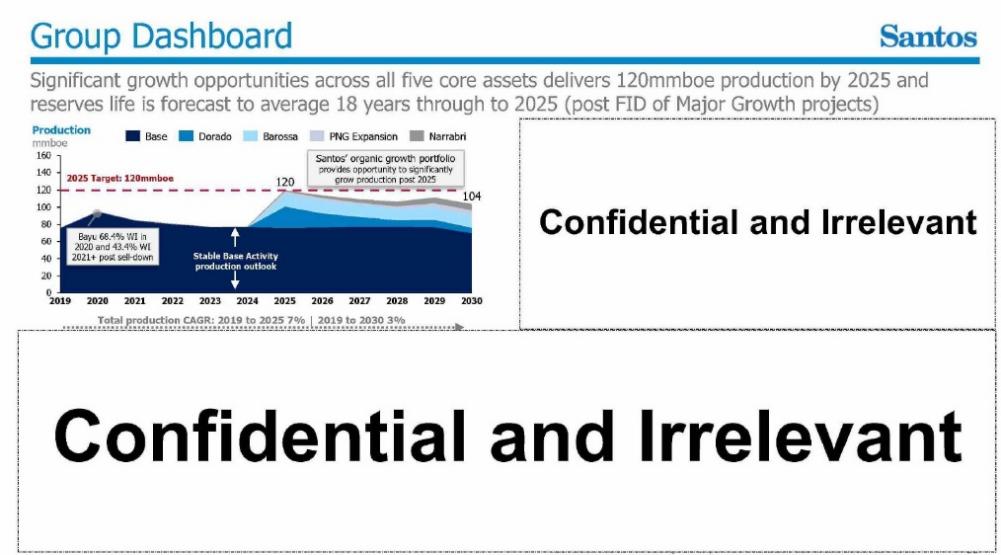
While there was no modelling of potential growth opportunities, the notation on the slide recorded that “Santos’ organic growth portfolio” provided an opportunity to significantly grow production after 2025.
624 The May 2020 Board Presentation also included (at slide 56) an analysis of Santos’ emissions profile as follows:
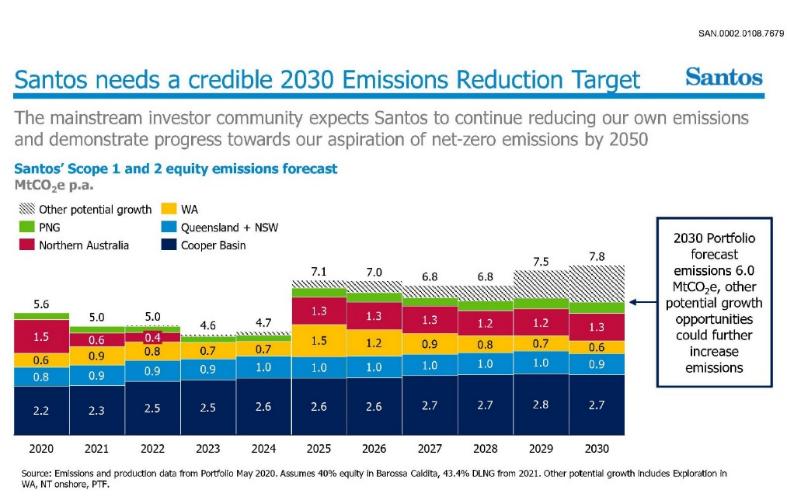
This slide clearly recorded “2030 Portfolio forecast emissions 6.0 MtCO2e” and that “other growth opportunities could further increase emissions” (my emphasis). The potential growth in emissions from these other growth opportunities was to 7.8 MtCO2e. As Santos submits, this was not a forecast of emissions at that level but a depiction of potential emissions associated with Santos’ Portfolio options.
625 Subsequently, adjustments were made to the emissions forecast. In particular on 29 July 2020 Ms Luo removed the emissions associated with “exploration” (see [245] above). These were high level estimates of emissions that may arise from Santos developing and producing the exploration opportunities referred to in the tab titled “Organic Growth Summary” in the spreadsheet provided to her by Mr Bermingham on 5 June 2020. Ms Luo considered them to be “too contingent” at the time. In her covering email circulating the updated slides for the August 2020 Board Presentation Ms Luo described the inclusion of the additional emissions from exploration as “confusing” hence she stripped them out. In cross-examination Ms Luo explained that the “exploration emissions that were in the previous versions assumed a success case for all the exploration assets” and adding them was confusing because “it implied it had the same amount of certainty as the other emissions forecasts on the chart”.
626 The ACCR submits that it would have been reasonable for Santos to use Portfolio estimates of current and future growth opportunities to set its projected future emission baseline. However, that is not what Ms Luo thought at the time she was considering the data for the purpose of preparing revised slides for the August 2020 Board Presentation. Further, as Santos submits, it would not be reasonable to assume as at 2020 that its emission in 2030 would include emissions from every opportunity available to it. As Mr Woods explained, Santos had a disciplined operating model which constrained its deployment of capital and it made strategic decisions at the relevant time about which growth projects to pursue. Relevantly, Santos’ strategy was not to develop all potential options but to target 120 mmboe per annum.
627 In a subsequent draft of the August 2020 Board Presentation Ms Luo amended the emissions forecast slide at Mr Jaffray’s request, by, among other things, increasing production from 2025 to 2030 by a 3% CAGR. This of course had a corresponding effect on emissions (see [249] above). As set out above, Mr Jaffray’s unchallenged evidence was that the application of a CAGR was considered at the time as one possible assumption for the purposes of understanding future production levels, taking into account the strategy that declining production from existing assets was to be replaced.
628 The ACCR submits that it would have been reasonable for Santos to adopt 3% CAGR as a proxy for the emissions it was forecasting for its activities in 2030 or 2040 and notes that Mr Jaffray’s evidence is that 3% CAGR is a commonly used long term growth assumption across industrial industries, although he now claims, without relying on any contemporaneous evidence, that he thought at the time it was on the high side. But the adoption of a 3% CAGR was no more than, as Mr Jaffray describes it, one possible assumption to be considered in the course of developing and modelling the Targets. Ultimately, that assumption was not pursued. I infer that is because it was not consistent with the strategy that was set, the maintenance of production at 120 mmboe.
629 There was much activity in the period 9 to 11 August 2020 leading up to the finalisation of the August 2020 Board Presentation (see [254]-[274] above). This included meetings with Mr Gallagher reviewing drafts of the presentation. The ACCR attacks two aspects of the instructions given by Mr Gallagher over this period, namely his instructions to hold overall emissions flat at 5.9 MtCO2e; and to hold emissions for Cooper Basin flat at 2.2 MtCO2e.
630 The direction to hold emissions flat at 5.9 MtCO2e from 2025 and to hold production flat at 120 mmboe from 2025 came from Mr Gallagher, although the former was conveyed by Mr Jaffray to Ms Luo after he met with Mr Gallagher. While the two instructions were given at different times, they are clearly related.
631 As set out at [261] above, on 11 August 2020 Mr Jaffray sent a marked up draft of the August 2020 Board Presentation to Ms Luo reflecting his earlier discussion with Mr Gallagher. The emissions forecast slide included the instruction to “Adjust forecasts” and relevantly “Cooper flat at 2.2”, “Growth bar holds emissions flat at 2025 levels, …” and to “Forecast out to 2030”. Ms Luo followed Ms Jaffray’s instructions and provided an updated draft of the August 2020 Board Presentation later that afternoon. That is, Ms Luo implemented the instruction to “hold emissions flat” with no adjustment made to production levels. Rather, the 3% CAGR assumption was maintained for production in Ms Luo’s draft. As the ACCR submits this gave rise to an “absurdity”. Production was increasing without any change to emissions. But the “absurdity” was obviously an error which was subsequently corrected by the instruction from Mr Gallagher in his email sent on 11 August 2020 at 10.20 pm attaching the draft August 2020 Board Presentation in which he had annotated the emissions forecast slide with his instruction to “Assume 120 mmboe from 2025 onwards ie Flat!”.
632 The emissions baseline as settled by Mr Gallagher, with flat emissions and corresponding flat production, was included in the final August 2020 Board Presentation.
633 The ACCR submits that Mr Gallagher’s directions were objectively unreasonable. In support of that submission, it observes: first, Portfolio was forecasting that production from existing and “major growth” assets would decline to 103.8 mmboe by 2030; secondly, Portfolio was forecasting that Santos’ emissions at 2030 for existing and “major growth” assets at a production level of 103.8 mmboe would be 6.13 MtCO2e. If adjusted to reflect the other changes to the baseline, with Cooper Basin held “flat” at 2.2 MtCO2e and Dorado (referred to as “Bedout”) at 0.27 MtCO2e, then emissions at that level of production would be 5.9 MtCO2e at 2030; and thirdly, Santos was not planning to allow production to decline to 103.8 mmboe by 2030. Mr Gallagher’s instruction was to hold production flat at 120 mmboe by 2030.
634 The ACCR submits that the absurdity of the baseline assumption is that the 5.9 MtCO2e per annum budget was already exhausted by assets which Portfolio was estimating would produce only 103 mmboe by 2030 and for Santos to emit only 5.9 MtCO2e per annum by 2030, whilst holding production at 120 mmboe as Mr Gallagher apparently intended, it would need to increase its production by 16.5% (17 mmboe) on top of Portfolio’s estimates without any material increase in emissions associated with that increased production.
635 These submissions ignore the evidence that Santos could choose lower CO2 fields that would allow it to deliver on its production and emission targets. When cross-examined about her email sent on 13 August 2020 explaining the changes to the emissions forecast slide, Ms Luo accepted that the slide no longer incorporated Portfolio data and that there was no analysis supporting the production and emissions numbers. But when Ms Luo was asked whether it was correct that the emissions forecast slide “provided for 17 million barrels of oil being produced with zero emissions” she responded, “or changes in, yes, production and emissions intensity” (see [288] above). That is, Ms Luo recognised that the forecast emissions could be achieved by changing production.
636 The Portfolio data captured in a series of spreadsheets titled “Portfolio Carbon Emission Forecasts” dated May 2020 supports and illustrates this position and the ability for Santos to choose the opportunities it wished to pursue in accordance with its strategy. The spreadsheet titled “SKIN 4 May 2020” recorded average emissions intensity in the period 2025 to 2030 for existing projects to be between approximately 52 and 55 KtCO2e/mmboe with declining production, while the spread sheet titled “Organic Growth Summary” recorded average emissions intensity in the same period for growth options to be between approximately 27 and 36 KtCO2e/mmboe.
637 Mr Woods was Chair of the Reserves Committee and accordingly was aware of field developments and their respective emissions. Relevantly, he gave evidence in relation to the Net Zero Roadmap including that the roadmap itself did not include the forecast that by 2030 Santos’ production levels would decline or include emissions from potential growth projects that might present themselves in the future. Mr Woods did not think that the latter would materially increase Santos’ emissions beyond 5.9 MtCO2e as disclosed in the Net Zero Roadmap because among other things:
(1) Santos’ forecasts for existing and approved growth projects showed that production would peak in 2025 and, absent further growth projects, decline to approximately 100 mmboe by 2030 and decline even further by 2040. Mr Woods believed that Santos’ intention was to seek to maintain production at 2025 levels through other growth projects; and
(2) future growth projects to maintain production levels were likely to be at no greater emissions intensity than the current portfolio of projects because other opportunities available to Santos were generally from lower emissions intensity fields by comparison to Santos’ current portfolio. Those other opportunities, not all of which had yet been identified as growth options in the Portfolio data but which Mr Woods knew from his role as a senior executive to have low emissions intensity, particularly when compared to production from the Cooper Basin, included exploration opportunities in the Petrel/Tern/Frigate field, Crown-Lassiter, Breakwater, the adjacent opportunities to the Dorado field at Pavo, Apus, Dancer, Yoorn and Cozza, and the Northern Onshore area including the Betaloo basin, Amadeus and South Nicolson regions as well as further growth areas surrounding GLNG including Bowen Tight Gas.
638 The ACCR submits that, based on her role as described by her and Mr Jaffray, Ms Luo’s state of mind at the time of the development of the Targets and the Net Zero Roadmap was very significant. The ACCR submits that it is quite clear that Ms Luo did not, at the time, support all of the decisions that Mr Gallagher made in relation to the emissions baseline and the Court should find the direction to hold production and emissions flat made no sense to Ms Luo at the time. The ACCR relies on Ms Luo’s contemporaneous emails and evidence she gave in cross-examination.
639 However, the ACCR overstates and, to an extent, takes Ms Luo’s evidence out of context. The ACCR relies on emails sent by Ms Luo in relation to the changes in the emission forecast on 12 August 2020 to Mr Ali, a member of the Portfolio team, and on 13 August 2020 to Ms Genet, copied to Messrs Wilson and Jain. Ms Luo’s evidence of her reasons for sending these emails is set out respectively at [277] and [286] above.
640 The email exchange with Mr Ali in fact included an email from Mr Ali who raised a concern about changes made outside of the “portfolio refresh cycle” which were unauthorised and may “serve to inflame [Mr Gallagher] if it is not underpinned by a fully informed process”. In response Ms Luo informed Mr Ali that the instructions to hold emissions and production flat came from Mr Gallagher. In her email, Ms Luo also said that the flat emissions for Cooper Basin and for the whole portfolio had “effectively no basis”. As was clear Ms Luo considered that Portfolio data was the “central source of truth”. She wished to explain to Mr Ali why the emissions forecast slide did not reflect the Portfolio data and the source of her instructions.
641 Ms Luo’s evidence in cross-examination that there was no “bottom up analysis” of the numbers included in the emissions forecast slide and that it was a “top down assumption” was consistent with the fact that the instruction to proceed with the flat emissions and production numbers came from Mr Gallagher. Ms Luo’s evidence was that the departure from the Portfolio data made sense to her and the decision to keep the emissions flat was reflective of Santos’ strategy to grow its portfolio and thus not to use Portfolio data which showed a declining production and emissions profile.
642 In her email sent on 13 August 2020 Ms Luo recorded the changes she made to the emissions forecast slide. She sent the email to ensure that the decision makers had the source of data for the inputs. While some of the changes made sense to her, she described others as “top-down assumptions”. Ms Luo accepted that there was no basis to assume flat production at 120 mmboe at 2030 with emissions of 5.9 MtCO2e per annum. But, that evidence must be understood in the context of Ms Luo’s explanation that there was no Portfolio data to reflect the assumptions that were adopted.
643 Ms Luo’s evidence must also be considered in the context of her role. As Santos submits, in developing the Targets and the Net Zero Roadmap, Ms Luo’s role was to support Santos executives, including Messrs Woods and Jaffray, by gathering and analysing data and other information. She provided “inputs” by collecting information and undertaking analysis for those executives who had oversight of the initiatives referred to in the Net Zero Roadmap. She did not have a decision-making role. Strategic decisions about production and emissions were made by the CEO and senior executives and not by more junior employees like Ms Luo. Portfolio data was only prepared annually. Unsurprisingly, intervening strategic decisions may need to be made after preparation of the data. That is what occurred in 2020 with the development of the Targets and the Net Zero Roadmap.
644 That Ms Luo was attuned to deviations from Portfolio data is entirely consistent with her role. Santos submits and I accept that the practice of treating the Portfolio estimates as a source of truth by employees at Ms Luo’s level of the organisation ought not to be understood as precluding strategic choices or decisions being made by the CEO, in consultation with other senior executives, based on up-to-date operational data and strategic imperatives.
645 The ACCR submits that Santos’ lay witnesses were completely silent on the absurdity to which Mr Gallagher’s direction gave rise, that it should be inferred that their evidence on that question would not have assisted Santos case, referring to Commercial Union Assurance Co of Australia Ltd v Ferrcom Pty Ltd (1991) 22 NSWLR 389 at 418-419, and that the Court should not draw any inferences favourable to Santos from other evidence in relation to the baseline issue, referring to Kuhl v Zurich Financial Services Australia Ltd (2011) 243 CLR 361 at [63].
646 However, the “absurdity”, which is said to be the growing of production without growing emissions (see [631] above), is answered by Santos’ documented intention, ability and incentive to replace production with lower CO2 opportunities. That appears from the evidence before me, including the unchallenged evidence given by Messrs Woods and Jaffray. They addressed the topic and no Ferrcom inference is available.
647 The ACCR also submits that an inference of the kind formulated in Jones v Dunkel (1959) 101 CLR 298 should be drawn in relation to Mr Gallagher who was not called. The ACCR submits that there is no contemporaneous record of what Mr Gallagher was thinking in issuing the key directions, and no probative evidence that his directions had any basis in any work actually done by Santos. They contend, to the contrary, that Mr Gallagher’s directions were inconsistent with Portfolio, and were contrary to the forecasts which management prepared based upon the best available data, the decision not to call Mr Gallagher is therefore significant and the Court should infer that his evidence would not have assisted Santos on this issue.
648 There was no requirement that Santos call Mr Gallagher. As it submits, it is entitled to select its witnesses: see AHG WA (2015) Pty Ltd v Mercedes-Benz Australia/Pacific Pty Ltd (2023) 303 FCR 479 at [263]. Mr Gallagher’s decisions and instructions about the emissions and production targets and about the ability to select lower CO2 fields are recorded in emails and in drafts of the presentation documents. The question for the Court is whether Santos had reasonable grounds for assuming flat emissions from 2025. This can be evaluated by reference to the knowledge of relevant employees as Santos’ agents: see Crowley v Worley Limited (2022) 293 FCR 438 at [117], [120]. Santos is entitled to rely on Messrs Woods and Jaffray and Ms Luo. It is not limited to Mr Gallagher. In the circumstances I would not draw the inference the ACCR urges in relation to Mr Gallagher.
5.2.1.3 Cooper Basin emissions
649 A related sub-issue raised by the ACCR concerns whether it was reasonable to hold Cooper Basin emissions flat. The ACCR submits that Santos’ approach to the Cooper Basin emissions is demonstrative of the absence of reasonable grounds generally.
650 The ACCR submits that the May 2020 Portfolio data forecast that emissions at Cooper Basin between 2020 and 2030 would remain flat at 2.03 MtCO2e per year. That data was then reviewed by Randall Yeates in late May 2020 who, on 27 May 2020, sent the “latest Portfolio case” to Ms Luo. Mr Yeates’ updated data showed emissions from Cooper Basin increasing between 2020 and 2030 from 2,019 KtCO2e in 2020 to 2,480 KtCO2e in 2030. The reason for the increase in emissions for the Cooper Basin was explained by Ms Luo to be “due to higher CO2 % in the raw gas stream increasing emissions intensity”. The ACCR observes that, from as early as 19 June 2020 until 11 August 2020 when Mr Gallagher directed that Cooper Basin emissions should also be held flat, Ms Luo included the updated Portfolio case for Cooper Basin in the draft August 2020 Board Presentation.
651 The ACCR relies on the following evidence:
(1) an email from Ms Norman to Ms Luo sent on 4 August 2020 at 9.10 pm in which Ms Norman observed that in “looking through the Board Strategy Day slides” the emissions forecast they had shown the Board “look very different to the numbers in the new pack” and queried what had changed;
(2) an email from Ms Norman sent to Ms Luo on 5 August 2020 at 11.03 am in which she asked “who actually prepares the carbon forecasts?” and whether “we have confidence that the new approach is correct, or could it change again”;
(3) Ms Luo’s response to Ms Norman sent on 5 August 2020 at 11.09 am which included:
[Mr Jain’s] team prepares a template for the Portfolio / Asset teams to use for emissions forecasting.
My understanding is that the Asset team prepares the forecasts, then this data is firstly QC’d by Portfolio, and then by [Mr Jain’s] team.
The Cooper Basin data currently being used is the best long-term forecast we have. My wording may be not quite correct – it’s more a review of the inputs to align it better with actuals, rather than the approach taken. We do have some very recent numbers for Budget 2021-23, but there are a number of cases, which depend on what ultimately gets funded. Therefore, I suggest that for this purpose looking at 2025+, using the Portfolio data is the best option.
(4) Ms Luo’s evidence given in cross-examination about her email set out in the preceding subparagraph was as follows:
Mr Hutley: You express the view that it’s best to use portfolio data. You see that?
Ms Luo: Yes. I’m saying in this case, for this purpose, the portfolio data was the best option we had at the time.
Mr Hutley: Right. Because it had been subjected to the rigour which you’ve described to her Honour?
Ms Luo: Yes. And also that was the most recent information that I was aware of at the time.
652 The ACCR submits that Ms Luo’s email sent on 5 August 2020, explained in cross-examination, is more reliable than her hindsight justification given in her evidence in chief without supporting data (see [287(1)] above), and that the Court should give no weight to the latter. Rather the Court should find that Ms Luo’s view at the time was as recorded in her email sent on 5 August 2020 at 11.09 am and as clarified in cross-examination.
653 For much the same reasons as set out above in relation to the development of the emissions baseline I do not accept that I should give no weight to Ms Luo’s evidence. While, as explained by Ms Luo, she expressed the view in her email that the Portfolio data was the best data available to her at the time, she also accepted in an email she sent on 11 August 2020 to Ms Norman that (my emphasis):
Cooper Basin emissions are increasing due to higher CO2 % in the raw gas stream increasing emissions intensity. This does depend on the development program and the areas we choose to develop. We can overlay Kevin’s view that Cooper Basin emissions will remain at 2.2 MtCO2e, assuming the same production as Portfolio. We will just note that this is not supported by any existing Portfolio case.
654 That is, as at 11 August 2020 Ms Luo was aware that Santos could choose the fields it proposed to develop. Her evidence in chief was not “hindsight justification” but is supported by this contemporaneous email.
655 The ACCR next refers to Mr Gallagher’s email sent on 10 August 2020 (see [258] above) and the meeting on the morning of 11 August 2020 attended by Messrs Gallagher and Jaffray and Ms Norman (see [257] above) at which it says the Cooper Basin emissions were evidently discussed. The ACCR submits that the difficulty is that Ms Luo was not at the meeting and, as Ms Norman noted in her email reporting on the meeting “Mr Gallagher still hasn’t seen the LTSP for Cooper so is not convinced that there is a robust plan before these forecasts”. The ACCR submits that the Court should therefore find that Mr Gallagher had not seen the Portfolio numbers and, nevertheless, made decisions to override Portfolio’s data. The ACCR also observes that the marked up slide deck forward by Mr Jaffray to Ms Luo on 11 August 2020 at 12.08 pm contained an instruction that Cooper Basin emissions should be held flat at 2.2 MtCO2e and submits that there is no evidence explaining this instruction (as distinct from the 2.0 MtCO2e instructed by Mr Gallagher) which reversed Mr Yeates’ review in May 2020 and overrode the latest Portfolio case.
656 The evidence before me provides support for Mr Gallagher’s view about lower emissions in the Cooper Basin. First, in Ms Norman’s notes of the 11 August 2020 meeting with Mr Gallagher she records his view that “Moomba South and Inglewood are huge fields which are lower CO2 fields and therefore CO2 emissions will drop in absolute and intensity terms”. In other words, Mr Gallagher understood that to be the case and that understanding was recorded by Ms Norman in her email sent to Ms Luo on 11 August 2020 at 10.28 am in which Ms Norman says that “[Mr Gallagher] thinks that lower CO2 fields (Moomba South, Inglewood) would reduce emissions, not increase them …”. Secondly, as Mr Woods explained, in 2019 and continuing into 2020 the Cooper Basin Asset team had been assessing a new set of fields in Moomba South and was planning to increase the amount of production from Moomba South into its plans (see [211(1)(b)] above). There is nothing before me to suggest that the slide presentation titled “Moomba South YE2019 Reserves and Contingent Resources (Prelim.)” dated 14 September 2020 which recorded modelling for Moomba South, Moomba North and Big Lake was already included in Portfolio data.
657 As set out above, Ms Luo had no difficulty overlaying Mr Gallagher’s “view that Cooper Basin emissions will remain at 2.2 MtCO2e” and in doing so adding a note that “this was not supported by any existing Portfolio case”. Ms Luo’s unchallenged evidence is that it was acceptable to overlay the estimates maintained by the Portfolio team because the Cooper Basin Asset team could be directed to select fields and wells to drill that would maintain a flat emissions profile as part of implementing an overall emission reduction strategy.
658 Mr Woods’ evidence is that in 2020 the Cooper Basin Asset team shifted its approach to production from seeking to grow production to maintaining flat production, a decision made for free cash flow reasons and to ensure that Santos stayed within its disciplined operating model. In cross-examination Mr Woods gave the following evidence about the Cooper Basin asset in 2020 and the instruction to maintain flat emissions for Cooper Basin:
Cooper flat was a problem associated with Cooper performance and cost. So, through the portfolio process, they were maintaining the trajectory that we wanted to achieve through the Cooper Basin. But, unfortunately, we had seen production roll off and fall. And then Cooper also had a challenge that it had deep coal as the incremental resource. And, with Moomba South, we had a different resource to chase. So, in terms of making effect, the Cooper flat production was effectively what we were seeing coming through our plant and the conversations I had with Kevin that production from Beach Energy, the company I now have, and production from Cooper Basin had rolled off. Therefore Santos’ costs had got high and it was in breach of its discipline operating model. So we needed to get the operating model back under control.
659 Mr Woods explained that there were monthly operating committee meetings at which there was discussion about the Cooper Basin asset’s performance and that ultimately in about August or September Mr Gallagher made the decision to hold emissions at 2.2 MtCO2e.
660 Having regard to the available evidence, it was not unreasonable for Mr Gallagher to direct that Cooper Basin emissions should remain flat.
5.2.1.4 Conclusion in relation to the emissions baseline
661 It follows from the above that the assumption in the 2030 Target and the Net Zero Roadmap that Santos’ emissions baseline would be 5.9 MtCO2e per annum on the basis that emissions would remain flat from 2025 to 2040 was, in the circumstances, reasonable.
5.2.2 Electrification/Hydrogen Fuel
662 As set out above, the “Electrification/Hydrogen Fuel” component of the 2030 Target and the Net Zero Roadmap involves two aspects.
663 The “Electrification” aspect was a project Santos was assessing to reduce the use of fuel gas by it in the Cooper Basin through the centralised electrification of some or all of the gas-driven compression infrastructure. The parties agreed that the potential emissions reductions that could be achieved from this project was approximately 0.12 MtCO2e per annum. The basis for the estimated reductions for the Cooper Electrification project is not in dispute.
664 The “Hydrogen Fuel” aspect related to a project under consideration by the Energy Solutions team to use some of the hydrogen that would be produced at Moomba as fuel (instead of natural gas) to power Santos’ operations in the Cooper Basin and Port Bonython. This could reduce Santos’ Scope 1 emissions as it would mean that Santos would not be releasing GHG emissions through the burning of natural gas to fuel its operations. The parties also agreed that the “Hydrogen Fuel” component of the Net Zero Roadmap represented “potential emissions reductions” of approximately 0.434 MtCO2e per annum.
665 The accuracy and basis for the estimated reductions from the use of “Hydrogen Fuel” is not in dispute except to the extent that the ACCR submits that those emissions reductions did not account for the Scope 1 and 2 emissions that Santos knew would be generated from the production of the “blue hydrogen” in the 2030 Target and the Net Zero Roadmap.
666 The ACCR submits that Associate Professor Beck and Mr Snow have calculated that the additional emissions from production would result in at least 80,000 tonnes of additional Scope 1 emissions (reducing this aspect of the Net Zero Roadmap from 0.434 to 0.35 MtCO2e per annum), assuming constant natural gas production, referring to the joint report of Associate Professor Beck and Mr Snow (Beck/Snow Joint Report) at [39]. The ACCR says that this figure would be greater if gas production was increased to produce the hydrogen, and if CH4 emissions were included, referring to Associate Professor Beck’s opinion at [43] of the Beck/Snow Joint Report.
667 The calculations undertaken by Associate Professor Beck and Mr Snow, the results of which are summarised at [39] of the Beck/Snow Joint Report, were included in answer to the following question:
Question 2: Amount of blue hydrogen that Santos would need to produce to achieve a 2.5 MtCO2e reduction in emissions for the “Hydrogen with CCS” component of its Net Zero Roadmap.
668 Associate Professor Beck and Mr Snow understood this to mean that they were being asked to calculate the amount of hydrogen that would be needed to displace 2.5 MtCO2e emissions from the combustion of Santos’ natural gas by its customers. They undertook that calculation (see [715] below) and then at [30] of the Beck/Snow Joint Report repeated the same calculation “with the same assumptions” for “the other hydrogen component of Santos’ net zero plan”. They set out the results of that calculation, which like the earlier calculation, relied on data in the GHD Report and assumed production of 800 tonnes per day (tpd) ATR plant assessed by GHD. That was the proposed method of hydrogen production that was forecast to produce 600,000 tonnes of CO2 emissions once CCS had been applied. However, Santos had not made any decision about the type of plant it would construct. My observations about the GHD Report at [564] above apply equally here. That no decision had been made is evident from a draft of the Moomba Blue Hydrogen Export Concept dated December 2020 prepared by GHD for Santos, Epic Energy and Kawasaki (referred to as Project Partners in the draft) which included:
1. Hydrogen production scale and technology
In the next phase of the project, the Project Partners will need to confirm the preferred project scale. Once the project scale is finalised, a formal technology selection will need to be completed to deliver an optimal outcome. Partial Oxidation (POX) is also a potential technology for the full commercial scale project. Although it was not the preferred option at this Concept phase, it should be considered as a part of Pre-FEED if it is suitable for the selected project scale.
669 Relevantly, Associate Professor Beck accepted that her view about the emissions intensity based on the GHD Report did not account for the fact “that there was no final decision made about any production planned, and there was scope for improvements in emissions” and agreed that, following the GHD Report, there would have been further investigation and development of any hydrogen production plant.
670 Mr Snow expressed a similar view at [653] of his report:
The GHD study was at a concept level, and I would also expect that, as this study work progressed to the more detailed front-end engineering and design (FEED) phase, more of the technical options would also be examined that would focus on process improvements and, in this case, potential impacts on emission reductions.
671 Both Associate Professor Beck and Mr Snow gave evidence to the effect that the plant and design choices for a hydrogen production process or plant would affect the quantity of emissions from the production of hydrogen. Relatedly, Mr Grant said in his report:
3.9.1.2 The blue hydrogen estimates vary partly as the upstream impacts of gas supply vary, but more so as the assumptions vary around impacts and efficiency of carbon dioxide capture and storage.
3.9.1.3 For green hydrogen, the variation is due to different renewable energy sources used to drive the electrolysis. As wind and solar do not directly supply thermal energy with solar being slightly higher and wind power lower.
672 Mr Grant accepted in cross-examination that, in relation to emissions, “the quantum relative differences between technologies can vary depending on a range of technological and commercial choices made by producers of the technology”.
673 A similar view is expressed in the IEA report “Towards hydrogen definitions based on their emissions intensity” dated 13 April 2023 which relevantly noted that “emissions associated with the production of hydrogen can vary significantly between production routes, depending on the fuel, technology and the rate at which CCS is applied” and that “[l]ow-emission hydrogen production is more costly, but scale-up and technology innovation can make low-emission hydrogen competitive in the short term in regions with abundant renewable resources or access to cheap fossil fuels and geological CO2 storage”.
674 Relatedly, as set out at [409] above, in carrying out the GHD Review, Ms Luo on behalf of Santos instructed GHD that Santos’ intention was to seek to reduce Scope 1 and 2 emissions associated with the production of blue hydrogen as far as was technically and economically feasible and then to use carbon offsets in order to achieve a net zero hydrogen product. An acknowledgment of that intention is included in the GHD Report. The ACCR seems to ignore this evidence or to assume that Santos would not proceed in accordance with that stated intention.
675 Associate Professor Beck’s evidence, which supports Santos’ stated intention, was that any subsequent phase of hydrogen development could explore an increased overall capture rate for its hydrogen production plant and could explore increased variable renewable energy (VRE), both of which could reduce emissions associated with the production of blue hydrogen.
676 Mr Snow gave evidence about potential advancements in technology or operations including VRE and improvements in CCS efficiency and their impact on the level of emissions included in the GHD Report. Given the confidential nature of an aspect of Mr Snow’s evidence in this respect, I will not set it out in full. However, it demonstrates that the introduction of these two improvements would have a seemingly significant positive impact. In her third report Associate Professor Beck broadly agrees with Mr Snow that improving CCS capture rates and VRE were important process improvements to reduce emission from hydrogen production and that the latter was a possible and sensible next step for Santos, although she did not believe it was likely in the short term.
677 As to CCS capture rates, Santos could construct a plant with an overall capture rate of 90%-95%. As acknowledged by Associate Professor Beck in cross-examination, as at December 2020, ATR technologies capable of achieving overall capture rates of 95% were available. Associate Professor Beck opined in her third report that it was “highly unlikely” that such a system would be “retrofitted” at Moomba. However, in giving that opinion Associate Professor Beck assumed that the 800 tpd ATR plant assessed in the GHD Report would be the plant that Santos built, and any process improvements would only be considered subsequent to construction of that plant, i.e. improvements would be “retrofitted”. As I have already observed, no specific plant configuration had been selected.
678 As to VRE, both Associate Professor Beck and Mr Snow agreed that using 80% VRE was a possible and sensible step for Santos to take. As set out above, Mr Snow’s evidence establishes that doing so would reduce emissions associated with hydrogen production in a not insignificant and, I accept, as Santos submits, material way. Further, as Santos submits and as was apparent from cross-examination of Associate Professor Beck, assuming that:
(1) Santos constructed the exact ATR plants the subject of the calculations carried out by Associate Professor Beck and Mr Snow in their joint report;
(2) the plants produced sufficient hydrogen to avoid 2.5 MtCO2e from the combustion of natural gas;
(3) the production of natural gas stayed constant; and
(4) Santos used 80% VRE to provide power during hydrogen production,
Scope 1 and 2 emissions from production would be 0.35 MtCO2e which is significantly less than the Scope 1 and 2 emissions calculated by Associate Professor Beck and Mr Snow under the same assumptions but assuming 8% VRE.
679 In her third report Associate Professor Beck expressed the view that achieving 80% VRE was unlikely. That view can be given no weight. In cross-examination Associate Professor Beck clarified that her view was limited to the short term and was based on a single slide summarising the assess phase outcomes of the Cooper Electrification Project. Associate Professor Beck understood that the “assess phase” of a project is a preliminary phase in its development and is followed by a “select” phase where the project opportunity is refined. Associate Professor Beck’s view was not based on any assessment undertaken by her of the technical or economic feasibility of increasing VRE at Moomba.
680 The ACCR says that Santos’ contentions and the calculations on which it relies do not take the matter very far because they nevertheless demonstrate that the production of hydrogen by Santos will involve material GHG emissions, 350,000 tonnes per annum which is 5% of the emission baseline of 5.9 Mtpa. The ACCR also says that there was no evidence that Santos was contemplating increasing the amount of VRE as posited in the alternative scenario i.e.with 80% VRE.
681 These submissions and the associated submission that there is no evidence for the suggestion that Santos would have departed from the proposals in the GHD Report are not to the point. Although GHD proposed certain models for hydrogen production, there is no evidence that Santos was going to build those models. The ACCR’s position assumes that Santos was bound to proceed in accordance with the GHD Report. It was not and there is no evidence that any decision had been made about the hydrogen production model that would be pursued.
682 Santos makes a number of other submissions about the emissions calculations carried out by Associate Professor Beck insofar as they provide for additional CH4 emissions. Given my views expressed above and that the calculation relied on by the ACCR to support its submission proceeds on an uncertain assumption, I do not intend to address those submissions.
5.3 The 2040 Target and the Net Zero Roadmap
683 The ACCR focusses on four aspects of the 2040 Target: first, the emissions baseline, which is addressed above; secondly, emissions from the production of blue hydrogen; thirdly, the “Hydrogen with CCS” component in the Net Zero Roadmap; and fourthly, the “CCS Expansion” component in the Net Zero Roadmap.
684 The chronology of the development of the 2040 Target and the Net Zero Roadmap is set out above. I accept that work on developing the Net Zero Roadmap commenced following the 18 September 2020 Meeting. As Mr Jaffray explains (see [292] above), Mr Gallagher suggested revising the 2050 Aspiration to the 2040 Target, bringing forward the timeline by which Santos intended to achieve net zero to 2040, in the context of discussions about the opportunity that CCS presented for Santos to achieve significant emissions reductions in light of its progress in implementing CCS at that time, in particular the Moomba CCS project, and the potential for the development of a hydrogen business over the next two decades.
685 To the extent they have not been addressed above in relation to the 2030 Target, I address the issues raised by the ACCR in turn below.
5.3.1 Hydrogen production emissions in the Net Zero Roadmap
686 The ACCR submits that a major flaw with the Targets, which impacts the 2030 Target, the 2040 Target and the Net Zero Roadmap, is that Santos did not account for the Scope 1 and 2 emissions it knew would be generated from the production of “blue hydrogen”. The ACCR contends that instead of honestly accounting for those emissions, Santos falsely and dishonestly represented that it could produce “zero emissions” blue hydrogen.
687 The ACCR submits that Santos knew that producing 800 tpd of hydrogen would result in an additional 600,000 tonnes of CO2 emissions per year once CCS had been applied and that the Targets did not incorporate these emissions, nor any initiatives to reduce or even offset them. The ACCR submits that for the following reasons, the Court should find that Santos persisted with the “zero emissions” terminology despite knowing it was false.
688 The ACCR relies on evidence which it says shows in summary that:
(1) Santos persisted with the term “zero emissions hydrogen” despite not knowing the level of hydrogen production emissions and before the GHD Review was complete;
(2) Ms Luo recognised in July 2020 in relation to the hydrogen component of the then waterfall slide that it assumed that hydrogen production was carbon neutral and that additional fuel and power consumption for hydrogen consumption is captured;
(3) Ms Norman commented on the “risks” slide of the draft emission reduction target in the August 2020 Board Presentation noting that “Hydrogen production could potentially increase [Santos’] scope 1 & 2 emissions” which would require Santos to sequester the increase but that it had “only shown the sequestering benefit on the waterfall”;
(4) Mr Jaffray considered that the Scope 1 and 2 emissions associated with hydrogen production would be negligible due to high capture rates which he nominated as between 95% and 99% but there was no evidence to support his view. The expert evidence was, in the main, contrary to it, and the first evidence that Santos received in late August 2020 about likely CO2 capture rates was not of that order;
(5) after the decision to develop a 2040 Target on 18 September 2020, Ms Luo said that she was instructed by Mr Woods that his and Mr Gallagher’s view was that, as part of a clean energy strategy, it was important that the proposal to produce hydrogen be to produce “zero-emissions” hydrogen;
(6) on 13 November 2020 Santos received the GHD Report. Ms Luo summarised GHD’s analysis in a presentation she delivered to Mr Woods in January 2021 which stated that producing 800 tpd of hydrogen would emit 600,000 tonnes of CO2 per annum: and
(7) on 22 November 2020, Ms Norman again raised the issue that the draft Net Zero Roadmap did not include hydrogen production emissions.
689 The ACCR submits that despite these facts, Santos persisted in making grossly misleading statements that it could capture all the CO2 involved in the production of hydrogen, and persisted with the language of “zero emissions hydrogen”, whilst at the same time omitting to make any reference to the emissions generated in the production of blue hydrogen and to its apparent intention to purchase a large number of offsets. Mr Woods was unable to explain why the word “net” had not been used to describe Santos’ hydrogen plans. His evidence was that “most people who understand hydrogen, blue hydrogen in particular, know that you have to offset your emissions. I think that’s not news to anyone”. The ACCR submits that evidence should be rejected.
690 The ACCR submits that the Court should find that Santos determined to persist with the terminology of “zero emissions” and “clean” hydrogen, despite knowing that it would be producing material volumes of CO2, that it is open to find that the misleading impression created by the conduct was deliberate and, in any event, the Court should find that Santos did not have a reasonable basis for assuming that its hydrogen would be emissions-free. The ACCR contends that this fatally undermines the reasonableness and credibility of the 2030 Target, the 2040 Target and the Net Zero Roadmap.
691 Before proceeding further I will address the ACCR’s submission that Santos engaged in deliberate or dishonest conduct. To the extent the ACCR contends that is so, my findings at [566] apply equally. That submission is not open on the pleaded case and I do not intend to address it further.
692 I turn to consider the balance of the ACCR’s submissions. Santos says they are based on an incorrect premise, namely that it assumed that “its hydrogen would be emission free”. Santos submits that it did not make that assumption but that it reasonably assumed that emissions from the production of blue hydrogen would be captured by CCS, addressed through technology improvements or offset through carbon credits.
693 The following evidence relied on by Santos bears out that submission:
(1) at the time the Targets were announced Mr Woods held that belief (see [415(1)] above);
(2) Mr Woods was regularly updated on the progress of the GHD Review by Mr Wilson and Ms Luo and by December 2020 he was aware that GHD had confirmed the technical feasibility of production of blue hydrogen at Moomba for about AUD2/kg. Mr Woods explains how that outcome fortified his view that Santos could obtain offsets in respect of any emissions that could not otherwise be captured and also demonstrated commercial feasibility (see [415(2)] above);
(3) when Ms Luo instructed GHD to undertake the GHD Review, among other things, she informed GHD that Santos’ intention was to seek to reduce emissions associated with the production of blue hydrogen as far as was technically and economically feasible, and to obtain credits in respect of any remaining emissions (see [409] above);
(4) Ms Luo also considered that Santos’ ability to produce zero emissions hydrogen at around AUD2/kg established the potential for the product to be commercially viable (see [418] above);
(5) in cross-examination Mr Woods candidly accepted that he always understood that, even with CCS, there would be some emission of CO2 into the atmosphere in the production of hydrogen;
(6) Mr Woods explained that a decision was made within Santos that it would refer to blue hydrogen with CCS and carbon offsets as zero emission hydrogen;
(7) contrary to the ACCR’s submission, Mr Woods’ evidence was that Santos understood the broad range of likely emissions from the production of hydrogen. The GHD Report provided precision;
(8) Mr Woods explained that at the time he made statements at the Investor Day he understood that Santos’ proposed production of blue hydrogen was zero emission hydrogen because it included CCS and because Santos was going to offset any emissions through carbon credits. His evidence was that the oral presentation (recorded in the transcript) and the video shown at the Investor Day explained Santos’ intention to start with blue hydrogen with offsets and then transition to green hydrogen;
(9) Ms Luo was also aware that hydrogen production would have Scope 1 and 2 emissions associated with it production which Santos would need to sequester or offset with carbon credits and that the majority of the emissions would be sequestered with the remainder then offset;
(10) Ms Luo explained in cross-examination that the assumption in the Moomba blue hydrogen study was that any Scope 1 and 2 emissions generated through the production of hydrogen would be captured and sequestered or offset;and
(11) Ms Luo also gave evidence in cross-examination that the assumption underpinning the Net Zero Roadmap in relation to hydrogen production is that the emissions would be either captured and sequestered or offset. For that reason the buying of offsets relating to the manufacture of hydrogen does not appear in the roadmap.
694 In addition, the evidence referred to and my findings at Part 5.2.2 (Electrification/Hydrogen Fuel) and Part 4.2.2 (“clean” and “zero emissions” hydrogen) above apply equally here.
695 Based on the relevant evidence and my earlier findings, I am not satisfied that Santos falsely and dishonestly represented that it could produce “zero emissions” blue hydrogen in the manner the ACCR alleges.
5.3.2 “Hydrogen with CCS” in the Net Zero Roadmap
696 The ACCR observes that the largest emissions reduction component of the Net Zero Roadmap is “Hydrogen with CCS”. It is agreed between the parties that the Net Zero Roadmap “assumed that Santos could achieve an estimated 2.5 MtCO2e per annum emissions reductions or offsets from what was described as ‘Hydrogen with CCS’ after 2030”. The ACCR notes that Ms Luo’s evidence was that the 2.5 MtCO2e “represented the emissions reductions that would be achieved if approximately 30% of the natural gas used in the east coast domestic gas market in a year [by volume] was replaced with hydrogen supplied by Santos” (see [391] above). As Mr Woods explained in cross-examination that assumed volume represented 10% of the east coast gas market which, as Santos points out, aligned with Santos’ share of the east coast gas market which was estimated to be around 11% at the time.
697 The ACCR submits that the Court should find that the “Hydrogen with CCS” component of the Net Zero Roadmap was not reasonable because: first, it was almost pure speculation; secondly, it was not technically and economically feasible, even over the timeframes being contemplated; and thirdly, the assumption that Santos would be acquiring all of its customers’ credits was unreasonable.
698 Before addressing each of those contentions it is convenient to make a number of observations. The Net Zero Roadmap did not contain precise quantities for blue hydrogen production or precise associated emission reductions. The “Hydrogen with CCS” component of the Net Zero Roadmap concerned Santos’ intention to develop a facility for the production of blue hydrogen at Moomba as a component of achieving the 2040 Target.
699 In its announcements Santos explained that the transition to hydrogen would be subject to market transition, investment and infrastructure changes. For example:
(1) at the Investor Day, Mr Gallagher said:
And why do we call it zero emissions hydrogen? Because it’s the development of hydrogen with zero emissions, and what I mean by that is we can - we believe we’ve got a roadmap to creating hydrogen from our natural gas today at the long-term target prices government are putting out there for the mid 30s, we could make that today if there was a market to support it, and coupled with CCS be able to handle the CO2 that you would generate from that process. So it becomes a zero emissions hydrogen capability.
And:
I want to give you a little snippet of how you should think about switching to, say, hydrogen, right? One of the problems we have here on the east coast gas market is lack of infrastructure. That’s after 50 to 60 years of operating a natural gas market. How quick do you think we’ll build a hydrogen infrastructure to replace it. Fifty to 60 years, and we haven’t built the natural gas infrastructure we need for the market. It’s not going to happen overnight, and it will cost trillions - not billions - trillions of dollars to build that infrastructure. Now, put that on a global scale, because I’ve told you already, we could deliver hydrogen around $2 per kilogram or even less, today. Who’d buy it on scale? Nobody can take it, because the transportation challenges haven’t been worked out yet. The infrastructure at the other end to process it, transport it, hasn’t been worked out.
…
And we want to stay predominantly a gas company, and we believe the transition for gas will be from natural gas over the decades to hydrogen gas, but it will still be a gas industry. It’ll be a very strong gas industry, and we believe we have the skills and the capabilities and the natural resources to be part and a very successful part, and there will be huge opportunities, I believe, for us, if we can get first mover advantage in that transition.
But the timing of that transition will be dictated, in my view, by how quickly the market transitions. It’s not about the suppliers transitioning, because we need people to sell it to. We need buyers who want it, and we will transition as the market requires, and we’re very plugged into that. We’re dealing with various organisations across Japan, Korea and elsewhere, and we’re involved in those conversations, so we’ve got a very good feel for what the pace of that will be from our buyer environment, and that’s important, because we believe that buyers of hydrogen tomorrow are the buyers of LNG today. It’s the same buyers. It’s the same industries. It’s the same companies, and so we will transition with them.
(2) the 2021 Climate Change Report included:
In parallel, at Santos we are evolving our business to drive deeper emission abatement through our leading position in the critical technology of CCS. This will drastically lower our operating emissions and provide permanent, low-cost CO2 abatement for other industries. Eventually, it will unlock production of zero-emission hydrogen produced from natural gas, by sequestering the CO2 emissions released during the process.
This proven technology can produce clean hydrogen for half the cost of hydrogen created with electricity (electrolysis), while using half the volume of water. Our existing LNG customer base in Asia will be the hydrogen customers of the future, and as they transition to new clean fuels, Santos will transition with them.
700 Bearing those matters in mind, I turn to consider each of the ACCR’s contentions.
5.3.2.1 Were the emission reductions speculative?
701 The ACCR’s first contention is that the “Hydrogen with CCS” aspect of the Net Zero Roadmap was speculative. It submits that a reasonable person would not have made the announcements and would not have assumed 2.5 MtCO2e per annum reductions of offsets from “Hydrogen with CCS”, unless that person had a reasonable basis for thinking that it was achievable. It says that “reasonable grounds for making a representation about a person’s intention in relation to a future matter involve both an intention to perform the representation and an ability to perform it”, referring to Lin v Zheng [2023] NSWCA 174 at [36] (Payne JA, Bell CJ and White JA agreeing).
702 The ACCR submits that the Court should find that a reasonable person, before announcing the 2040 Target or this element of the Net Zero Roadmap, would have at least sought to estimate the prospective size of the market for hydrogen at 2040, and would have considered whether there were any major variances related to the source of hydrogen (e.g. competition from green hydrogen) that may impact Santos’ ability to take market share. Mr Snow, Santos’ expert, identified these as the matters that would be “necessary to consider” when assessing the market for hydrogen by 2040 thus supporting such a finding. The ACCR submits that Santos did not do either of those things but rather:
(1) at the 2020 Board Strategy Day Santos considered the possibility of “blending” 10% hydrogen into the existing gas network as a way to reduce or offset Santos’ emissions at the time;
(2) following Mr Gallagher’s intervention on 18 September 2020, Ms Luo initially postulated “H2 sales offsets” of 1 Mtpa CO2e which equated, roughly, to the 10% blending figure that had earlier been calculated and considered. In cross-examination, Ms Luo conceded that these were “notional numbers for the potential credits [Santos] could generate through those opportunities” and that it was an assumption she made “to the best of [her] ability”;
(3) there was evidently discussion of higher potential offsetting figures for the “H2 sales offsets” at a meeting which took place on the morning of 29 September 2020 between Ms Luo, Mr Woods, Ms Genet and Mr Jain. Ms Luo agreed that the 50% figure was “obviously an output of that discussion” but no-one could remember quite how the participants arrived at 50%, and it is not otherwise explained in the evidence. According to Ms Luo, it was the result of a discussion in which she provided “the market and technical specifics on how much hydrogen could potentially be blended” and Mr Woods provided “the direction on commercial strategy”. But Mr Woods said that he thought that “they were just ranges” and could not “be specific on who suggested the figure of 50 per cent”. He could not recall seeing any documents (other than the draft Board presentation) that explained the basis for the assumption, and none have been discovered. There seems to have been no further analysis following the 29 September 2020 meeting. By 1.21 pm the same afternoon, Ms Luo had produced a new draft of the Board presentation that included the “50% H2 East coast domgas” assumption, equating to 4.4 Mtpa CO2e in offsets;
(4) the assumption as settled in the meeting on 29 September 2020 was then presented to, and approved by, the Board at the October 2020 Board meeting. No further changes were made, and no more analysis was done in the approximately three hours between 10.30 am and 1.21 pm appearing to be the total time spent on this major assumption; and
(5) at some unspecified point following the October 2020 Board meeting, Santos settled on 30% as the appropriate market share by volume. How this occurred is opaque in the contemporaneous documents. The 30% market share assumption does not appear anywhere in the documentary record until 30 November 2020, one day prior to the Investor Day Presentation. The only modelling that had been performed by Ms Luo or her team at the time was on the basis of 10% market share by 2030. No contemporaneous work was done to justify the 30% assumption, either in terms of the market share or in terms of the delivery method. Santos can point to no real analysis that it did in 2020 of the identity of its customers for the 30% by volume, nor the transportation method to those customers of that volume of hydrogen, nor what basis it had for predicting that Santos would be able to acquire sufficient credits from its customers.
703 As to the blending assumption, the ACCR observes that in Santos’ early work, it is clear that it was assuming as a delivery method that 10% hydrogen by volume would be “blended” into natural gas pipelines which the parties agree could be done with minimal adjustments to existing infrastructure and appliances. The parties also agree that a 20% blend by volume into natural gas pipelines is the upper limit. The ACCR submits that if Santos was assuming it could blend 30% hydrogen by volume into the east coast gas network, its assumption was patently unreasonable. It also says that if Santos was making some other assumption, it would have been documented but, as no other assumption was documented, the Court should find that no other assumption was made; or, if some other assumption was made, it was made without Santos having conducted any appropriate analysis to justify a “clear”, “credible” plan based upon “real activities” which was “not just a number”.
704 I do not accept that Santos did not estimate the prospective size of the market for hydrogen at 2040 or consider whether there were any major variances related to the source of hydrogen that might impact its market share. That is for two reasons.
705 First, Ms Luo’s evidence demonstrated that she understood the likely hydrogen market. For example: she was aware of studies undertaken by third parties about the potential to develop hydrogen; she understood in 2020 the amount of gas that would be required to produce the posited volume of hydrogen, including taking into consideration the volume of gas that Santos was producing at Moomba; she considered the likely competitive environment for hydrogen in 2040; she believed 50% by volume of the east coast domestic market by 2040 was a reasonable assumption based on the understanding at the time of the potential future market for hydrogen in 20 years’ time and that 50% blend of hydrogen by volume into the east coast gas market represents approximately 16% to 17% by energy; and she brought her understanding of the future potential hydrogen market and the technical specifics on how much hydrogen could potentially be blended to the discussion, while Mr Woods provided the direction on commercial strategy for Santos in selling that hydrogen to the market.
706 Ms Luo also explained that calculations had been undertaken by Jenny Day, an engineer in her team, to support the estimate of the projected size of the east coast gas market in 2030, measured in petajoules by reference to projected natural gas consumption, and the volume of hydrogen needed to meet a proportion of that energy requirement. Ms Luo explains those calculations.
707 Secondly, the evidence relied on by the ACCR to underpin its submission that the “hydrogen with CCS” component of the Net Zero Roadmap was speculative and that Santos did not estimate the prospective size of the market for hydrogen as at 2040 or consider whether there were any major variances related to the source of hydrogen that might impact its market share cannot be viewed in isolation. It must be considered against other work which the evidence shows had been undertaken by Santos both prior to and after the October 2020 Board meeting and the Investor Day.
708 More particularly, by the time the Net Zero Roadmap was prepared, Santos had been engaged in thinking about, and had undertaken work in relation to, the potential market for hydrogen. This was evident from the following:
(1) there were a number of available external market studies concerning the potential to develop a hydrogen industry, and government support for a hydrogen industry both within Australia and elsewhere including the COAG Energy Council National Hydrogen Strategy dated November 2019, the Gas Vision 2050 Report dated September 2020 and the Future Fuels CRC into industrial equipment dated February 2020 of which Mr Woods and Ms Luo were variously aware. Based on reports of this type Mr Woods recognised that, while there was only a small existing market for hydrogen at the time, there was a significant opportunity for the development of a domestic and export market and a range of different potential customers and Ms Luo believed there was significant government support for development of a clean hydrogen industry in Australia;
(2) internal Santos documents reflected the sentiments referred to in the preceding subparagraph. For example a presentation titled “Hydrogen: Creating a Hydrogen Future” dated November 2020 acknowledged that meeting climate change targets will require carbon neutral fuels such as hydrogen and explained current hydrogen use, why hydrogen was important, that hydrogen demand growth would depend on policy and incentives, global demand for hydrogen, Australian domestic demand, potential for hydrogen use in industrial equipment, hydrogen project strategic options for Santos and so on. An updated version of this presentation titled “Moomba Hydrogen Project’ was prepared by Ms Luo in January 2021 (2021 Moomba Hydrogen Presentation);
(3) in cross-examination, in response to a question as to whether she considered what the competitive advantage for hydrogen might be in 2040, Ms Luo said that she did consider that, based on the studies and reviews done to date and that “[i]n moving forward with the Moomba blue hydrogen study, we believed that Santos had a competitive advantage in developing blue hydrogen for both domestic as well as export use”;
(4) as is evident from the presentation referred to at (2) above, Santos considered the potential market for hydrogen. That is, domestic and global demand as well as potential use in industrial equipment. As to the latter Ms Luo explains that Santos had been looking into the potential to use hydrogen as a fuel gas in some of its equipment in the Cooper Basin and GHD conducted an assessment on what hydrogen blends certain equipment could tolerate. Ms Luo believed that if Santos’ industrial appliances could take higher blends, then so could its industrial customers;
(5) Santos was aware of export options for hydrogen. For example, in the “Moomba Hydrogen Project Initial Gate Review” prepared and approved in January 2021 there is reference to the project targeting both domestic and export markets and the need for “conversion technologies” to enable export of hydrogen to international markets. In 2020 Santos and potential partners undertook joint hydrogen export concept studies. One of its partners, KHI, completed a “Concept Assess Phase study to assess the feasibility of hydrogen liquefaction and export at Port Bonython”. In addition, as set out above, Santos entered into MOUs with various companies to explore hydrogen production and export demonstrating the potential for opportunities to export hydrogen; and
(6) Santos recognised the long term potential for the production of green hydrogen. In its 2021 Climate Change Report, under the heading “Why hydrogen?”, it said:
The Cooper Basin has a bright future with significant hydrogen production potential. Once large-scale development of hydrogen from electricity and water (electrolysis) is established and technology improves, Santos has a further opportunity to introduce hydrogen production from electrolysis, using the Cooper Basin’s world-class solar and viable wind resources. This will take advantage of markets and infrastructure developed in the shorter term by our low-cost clean hydrogen produced from natural gas with CCS.
(Footnote omitted.)
Santos also observed in its 2021 Climate Change Report (and elsewhere) that the cost of blue hydrogen production was half of the cost of green hydrogen production and used half the volume of water.
709 Having undertaken this work and analysis, the 2021 Moomba Hydrogen Presentation recommended as a next step the building of a dedicated project team to deliver the hydrogen strategy and that the “A$1.2M Select phase will refine the potential hydrogen opportunity in the Cooper Basin ready for FEED entry”. On 20 January 2021 Mr Woods approved the “initial gate review” for the Moomba Hydrogen Project, the objectives of which were to:
+ Establish whether a range of concepts have been identified as an adequate basis for further study in the Select phase
+ Develop a view of the opportunity/project readiness and support for the opportunity moving into the Select phase
+ Determine whether the objectives / activities / resources / timing / costs / technology applications are supported.
710 In light of that evidence, I do not accept that the “Hydrogen with CCS” component of the Net Zero Roadmap was speculative. The evidence does not suggest that Santos merely plucked figures out of the air or that it made assumptions without foundation. It considered the potential market for hydrogen out to 2040 and whether there were any potential major impacts on its ability to take market share based on the material available to it at the time and its understanding of the market.
711 Given the matters set out above, ACCR has not established that Santos did not have a reasonable basis to assume 2.5 MtCO2e per annum by supplying hydrogen to its customers.
5.3.2.2 Were the assumptions technically and economically feasible?
712 The ACCR next contends that, based on the expert evidence, there was no reasonable basis for Santos to assume: first, that it could produce sufficient hydrogen to achieve the estimated emissions reductions; and secondly, that it could transport all of the hydrogen produced to end users.
713 In relation to production of hydrogen, the ACCR submits that the amount of hydrogen required to achieve a 2.5 MtCO2e reduction in customers’ emissions was calculated by Associate Professor Beck and Mr Snow in their joint report as the amount necessary to displace 0.93 Mt or 48.6 petajoules of natural gas. According to Associate Professor Beck and Mr Snow, due to the greater energy density of hydrogen by mass, that would have involved Santos producing and supplying 0.34 Mt of hydrogen per annum which is more than the entire capacity of the 812 tonne per day ATR plant that Santos was contemplating building. The ACCR contends that even 0.34 Mt of hydrogen per annum would have proven inadequate unless Santos obtained carbon credits for every single tonne of hydrogen supplied by Santos to a customer and, if only some of those customers were able and willing to generate credits and sell those credits to Santos, then it would need to supply even more hydrogen.
714 In June 2020 Santos commissioned the GHD Review. Among other things, GHD was instructed to assess two potential hydrogen production projects: an SMR Model and an ATR Model. The GHD Report was provided to Ms Luo on 7 December 2020. It confirmed, among other things, that both the SMR Model and the ATR Model were technically feasible and could be implemented at Moomba (see [413] above).
715 As explained above, in their joint report Associate Professor Beck and Mr Snow were asked to address the amount of blue hydrogen that Santos would need to produce to achieve a 2.5 MtCO2e reduction in emissions for the “Hydrogen with CCS” component of the Net Zero Roadmap. Relevantly they responded to that question as follows:
The experts agree that combusting roughly 0.93 Mt or 48.5 PJ NG,HHV of natural gas would result in 2.5 MtCO2e emissions, using an emissions intensity of combustion of 51.53 gCO2e/MJNG,HHV from the Australian National Greenhouse Accounts Factors. To avoid this amount of combustion emissions, we would need to replace the natural gas with hydrogen with the same amount of energy, that is 48.5 PJH2,HHV. To produce this amount of hydrogen, equivalent to 0.34 Mt H2 per annum, Santos would need to be operating one 812 tpd ATR plant at full capacity, and one at 17% capacity (assuming they operate 99%, of the time over the year).
716 In expressing that view (and their view discussed at [668] above in relation to the “Electrification/Hydrogen Fuel” component of the Net Zero Roadmap) Associate Professor Beck and Mr Snow assumed that Santos planned to construct the ATR Model assessed in the GHD Report. Associate Professor Beck made that clear in cross-examination. However, as I have already found to be the case and, at risk of repeating myself, Santos had not made any decision about which plant was to be constructed and, as is evident on its face, the GHD Report was preliminary in nature. The GHD Report notes “the intention during the Assess Phase is not to make a final technology selection or a vendor selection”. Its intention is to:
* Make a reasonable selection to provide confidence that the cost estimate and preliminary business case is based on a good option and representative of what a project may achieve.
* Gather technical information and knowledge for Santos in order to be able to make well informed decisions in structuring the project and in engaging with contractors and technology vendors in subsequent phases.
717 Other evidence also bears out the preliminary nature of the GHD Report and the fact that no final decisions had been made about the design to be adopted for the hydrogen production plant. As Associate Professor Beck acknowledged the object of the GHD Report was “to provide Santos with representative information about what a blue hydrogen project looked like” and it was an “early concept study”. Associate Professor Beck accepted that she was not aware of, and had not seen anything to suggest, that Santos had selected a specific plant configuration and that the final choice of plant design for any hydrogen production process would affect the quantity of emissions from the production of blue hydrogen. To like effect, Mr Snow indicated the preliminary nature of the GHD Report at [653] of his report (see [670] above).
718 The GHD Report estimated that producing 800 tpd of hydrogen would result in an additional 0.6 MtCO2 to offset based on the ATR Model. However, Associate Professor Beck accepted that, following the GHD Report there would have been subsequent investigation and development of any hydrogen production plant.
719 The ACCR has not established that there was no reasonable basis for Santos to assume it could produce sufficient hydrogen to achieve the estimated reduction of 2.5 MtCO2e. I address the role of carbon credits below.
720 As for transportation, the ACCR contends that the ability to economically transport the amount of hydrogen Santos needed to achieve the “Hydrogen with CCS” component of its Net Zero Roadmap was an essential assumption underlying this part of its plan.
721 One option for transportation was blending into existing pipelines. The ACCR observes that Santos’ internal documents identify that blending 10% hydrogen into existing transmission pipelines would allow for transportation of a maximum of 161 tonnes of hydrogen (equivalent to 22 TJ) per day which equates to 58,765 tonnes per year, significantly less than the amount required to fulfill the 30% assumption (which equates to 340,000 tonnes per year).
722 The ACCR refers to evidence given by Messrs Martin and Snow in relation to hydrogen transportation and the issues they raised about blending hydrogen in natural gas and the effect on customer appliances and transmission pipelines and their agreement that the problems identified were “not in fact fully solved” at the relevant time. The ACCR submits that the issue of long-distance transmission ultimately came down to whether it was reasonable for Santos to assume that an entirely new pipeline network would be constructed to carry hydrogen. The ACCR submits that, while the experts accepted that this was technically feasible, Santos had no basis to assume this would occur over the timeframe covered by the Net Zero Roadmap, there is no evidence that any government or private body had announced plans to do this and no indication that Santos was proposing to pay for it.
723 The ACCR notes that Santos’ internal documents identify a range of nascent hydrogen transport options, none of which supports an assumption that Santos could transport hydrogen sufficient to supply 30% of the east coast gas market by 2040. The domestic transport options are listed in the 2021 Moomba Hydrogen Presentation in a slide titled “Pipeline transport assessment”. The ACCR submits that, even if the significant challenges noted in the slide could be overcome, the maximum they could cumulatively supply (together with 10% blending into existing transmission pipelines) was approximately 350 tpd of hydrogen (or 127,750 tonnes per annum), which is significantly less than the amount required to supply 30% of the east coast domestic market. The ACCR observes that the only transportation option under consideration that would allow Santos to transport 800 tpd of hydrogen was a dedicated pipeline from Moomba to Port Bonython for export which was estimated to require CAPEX of approximately AUD950 million and, evidently, the economics of long-distance transport of hydrogen were effectively unknown to Santos. The ACCR submits that, in any event, export options were not relied on in the contemporaneous documents to support the “Hydrogen with CCS” numbers, no doubt because there were even greater barriers to obtaining credits for international customers’ emissions reductions.
724 The issue raised by ACCR in relation to transportation of any hydrogen produced and its submissions proceed on the basis that before including “Hydrogen with CCS” in the Net Zero Roadmap, Santos had to have in place a solution for transporting hydrogen to end users. As the ACCR points out, Messrs Martin and Snow agreed that there were problems with transporting hydrogen by blending into existing pipelines which had not been solved at the time. But Santos was aware of those problems and, indeed, made the market so aware.
725 At the Investor Day Mr Gallagher, in speaking about the switch to hydrogen, made the comments set out at [699(1)] above. That included a statement that at the time nobody could take hydrogen at scale because “the transportation challenges haven’t been worked out yet” and “[t]he infrastructure at the other end to process it, transport it, hasn’t been worked out.”
726 The 2021 Climate Change Report included in relation to the Net Zero Roadmap and “The road to 2040”:
+ Initially, we are studying options to blend up to 10 per cent hydrogen with natural gas which would not require new pipelines or infrastructure, reducing our customers’ CO2 emissions.
+ Once an export pipeline for hydrogen is built, we could export hydrogen from the Cooper Basin. …
727 In oral submissions, the ACCR said that I would understand Mr Gallagher’s statement at the Investor Day set out above to mean that Santos would use existing infrastructure and that “Santos was not assuming a whole new hydrogen transmission network” because “Mr Gallagher had already explained that this was a ludicrous assumption – by 2040”. I would not understand Mr Gallagher’s comments that way. At the Investor Day Mr Gallagher expressed criticism of the gas market and “its lack of infrastructure” and said that, insofar as hydrogen was to be transported to Port Bonython, new infrastructure would be required.
728 Mr Woods and Ms Luo were also aware of the challenges of blending more than 10-20% of hydrogen into existing pipelines and of distributing that hydrogen into existing appliances (see [424]-[425] above). They considered, among other things, the required infrastructure could be developed with support from governments, scientists and infrastructure owners.
729 At the time, the Energy Solutions team was looking at potential solutions to the challenges that had been identified. In particular, although there was no final solution, Santos identifies the following work that was undertaken:
(1) pipeline transport was to be considered as part of the GHD Review;
(2) from mid 2020 to early 2021 Ms Luo prepared presentations which, among other things, concerned this topic. For example, a presentation dated June 2020 “Hydrogen fuel of the Future” referred to the blending of hydrogen into existing gas infrastructure and into end user appliances as well as the transport of hydrogen over long distances as technical and commercial challenges as well as identifying “enabling activity” for each challenge; and a presentation dated titled “Hydrogen project update for CEO” dated July 2020 noted that pipeline options were being assessed with key partnerships and that non-disclosure agreements and MOUs were under discussion, set out the hydrogen transport opportunities and identified key challenges which included both blending and transportation;
(3) a presentation to the Board at the August 2020 Board meeting titled “Hydrogen: Creating a Hydrogen Future” also identified the technical challenges such as transporting hydrogen over long distances and blending into end user appliances;
(4) in October and December 2020 Mr Woods, among others, was briefed on the status of the Jackson to Brisbane oil pipelines and whether they could be returned to service for hydrogen transmission. The accompanying slide deck identified the technical challenges, risks, costs and timing associated with the proposal, noting that it would take about two and a half years to return the pipelines to service. The proposed next steps were to “define commercial opportunity” and “refine project plan”;
(5) in December 2020 Santos, Epic Energy and KHI prepared joint concept studies which included a preliminary assessment of the transport of hydrogen via a dedicated pipeline from Moomba to Port Bonython and port storage, loading, shipping and unloading;
(6) the minutes of a hydrogen monthly meeting which took place on 1 February 2021 show ongoing work on pipeline blending and transportation options; and
(7) in February 2021 Santos and Chiyoda Corporation prepared a Moomba hydrogen export concept study which assessed options for transporting hydrogen to Port Bonython by hydrogenation or a dedicated pipeline.
730 Mr Snow’s evidence about what was happening in relation to the issues that arose for transporting hydrogen at the time is also relevant. He observed that Government “would have been conducive to co-fund studies or trials as to suitability or technical options for using hydrogen at high pressure in transmission pipelines”, that “the Government envisaged research, pilot projects, trials, and demonstration projects that considered the eventual use of 100% hydrogen in gas networks, and either the Government, or the private sector, would have been charged with funding or co-funding these activities” and that Government may well have considered a “broader suite of subsidies to support a transition to 100% hydrogen in gas networks if the other earlier work showed promise and benefits for customers and emission reductions”.
731 Mr Snow referred to a number of studies being undertaken at the time to explore solutions for the blending and transportation of hydrogen. He was of the view that “there was a consensus that hydrogen could be introduced to distribution gas networks with some changes and updates, but that a lot more work would need to be undertaken to examine the use of hydrogen in existing high pressures gas transmission pipelines”. He gave evidence about the level of work being undertaken to explore solutions. Relevantly, Mr Snow was of the view that, while some options may have proved to be not technically feasible and commercially unattractive, others may well have proved attractive, which is the nature of research work and trials in industry.
732 As Santos submits, it was reasonable for it to investigate options for the transport of hydrogen as the evidence set out above demonstrates that it did, with the expectation that a technically and commercially viable solution could be identified. That the solution may be costly (potentially trillions of dollars) is not a reason to conclude that Santos had no reasonable grounds to include “Hydrogen with CCS” in the Net Zero Roadmap. To the contrary, Santos was aware of the potentially high costs but continued to investigate and consider how it could meet the technical and commercial challenges of transportation.
733 It follows that I am not satisfied that the ACCR has established that there was no reasonable basis for Santos to assume that it could transport the hydrogen produced to end users.
5.3.2.3 The role of carbon credits
734 It was not in dispute that Santos assumed that it would obtain about 2.5 million carbon credits per annum from supplying its blue hydrogen produced at Moomba to customers.
735 However, the ACCR submits that assumption on the part of Santos was unreasonable and, considering the sheer number of credits it proposed to acquire from its customers (equivalent to 2.5 MtCO2e), the assumption was so material that it ought to have been disclosed in any event.
736 The ACCR submits that Santos’ assumption about obtaining 100% of the carbon credits generated by its hydrogen customers was unreasonable for the following reasons.
737 First, the ACCR says that carbon credits had value to customers and that carbon credits such as ACCUs are valuable fungible assets with a market value. The ACCR submits that the likelihood was that Santos would not be able to acquire 100% of any credits generated by its hydrogen customers because those customers would have their own uses for the credits and, as Ms Luo said, whether Santos could acquire them would be a matter for commercial negotiation. The ACCR submits that to assume that Santos could acquire 100% of the credits forecloses the result of the nuanced commercial negotiation that would need to take place, which would generate different outcomes on a case-by-case basis. It contends that no one within Santos can be shown to have turned their mind to this issue at the time and, in reality, there was simply no time to do so. The ACCR submits that the Court should find it was unreasonable for Santos to assume that it would acquire 100% of credits whilst at the same time having a financially viable hydrogen business.
738 The ACCR also refers to Mr Snow’s evidence in cross-examination to the effect that if Santos was proposing to supply hydrogen to the full range of customers in the east coast gas market (residential, industrial and gas generation), it could not assume that ACCUs would be generated from all of those sales under existing methodologies and the only way that Santos could receive credits from every sale was if it only sold hydrogen to industrial customers and made it a “condition of sale” that the customer transfer the credit back to Santos. The ACCR observes that there is no evidence that Santos intended to do the latter and that, in the absence of evidence, it should be seen as hindsight justification, seemingly invented during the trial by Santos’ senior counsel and should be ignored. The ACCR also submits that, even if Santos had considered bundling the credits with the hydrogen as a “condition of sale”, there would be a huge question as to whether this scheme contravened s 45 or s 46 of the Competition and Consumer Act 2010 (Cth) and develops that submission.
739 The question that arises for resolution is whether Santos had reasonable grounds for considering that it could obtain carbon credits for supplying blue hydrogen.
740 Mr Woods’ and Ms Luo’s evidence about the way in which they considered that Santos could obtain carbon credits for its supply of hydrogen produced at Moomba is set out respectively at [430]-[434] and [436]-[441] above.
741 One possibility, to which the ACCR does not refer, is that the Government could introduce a new regulatory scheme providing carbon credits to suppliers of accredited injected and blended hydrogen or hydrogen used by industry to replace fossil fuels as well as to accredited CCS schemes. As the evidence shows, Mr Woods and Ms Luo recognised, as at December 2020 and February 2021, that there was no method for Santos to obtain ACCUs from supplying blue hydrogen but considered that one could be introduced. Their belief was based on analogous developments in the renewable energy space, such as large-scale generation certificates (LGCs), and the potential for developing a fuel-switching methodology for switching from natural gas to hydrogen.
742 I accept that it was reasonable for Santos to consider that a methodology to obtain ACCUs from supplying blue hydrogen would develop by 2040. As of December 2020, and February 2021, offset projects that could be eligible for ACCUs (or another form of carbon credits) in future decades were not fixed. As Professor Cook opined, this was an evolving area and new emission abatement opportunities would likely arise which could provide credible pathways for governments to support in the future, including through the development of new policies relating to offsets, among other things. Professor Cook also considered that third party CCS is a significant abatement opportunity and one he expects will be supported through carbon credit arrangements of some type.
743 The following matters provide further support for the conclusion I have reached:
(1) according to Mr Snow, in October 2021 the Australian Government was considering a scheme or methodology of value to the providers of renewable energy and CCS providers. An LGC scheme had previously been introduced to encourage additional generation of renewable electricity. That scheme was valuable to those producers;
(2) the Government’s “First Low Emissions Technology Statement – 2020” published in September 2020 reported in relation to CCS:
Collaboration and partnerships between governments, industries and communities will be necessary to enable large-scale CCS development and deployment in Australia. Governments play a role through investments in research, development and demonstration and by providing targeted incentives for technology adoption. CCS hubs and shared pipeline and storage infrastructure could provide pathways to scale and lower costs, and enable emissions to be safely stored from a range of sources including hydrogen production, power generation, gas and oil production, and hard-to-abate industrial processes.
The Australian Government has begun work on a new method for CCS to incentivise adoption through the Emissions Reduction Fund. Recommendations of the King Review, such as below-baseline crediting under the Safeguard Mechanism and a technology neutral remit for ARENA and the CEFC, will also encourage technology development and adoption in industry. Establishing CCS as a priority technology and working towards this stretch goal will build on and reinforce these commitments, and accelerate the development of this critical technology as a potential decarbonisation pathway for key industries.
(Footnote omitted.)
As explained by Mr Snow by reference to the “Clean Energy Regulator Consultation Hub”, the ERF is:
… a voluntary scheme that aims to reduce Australia’s greenhouse gas emissions by providing incentives for a range of organisations and individuals to adopt new practices and technologies to reduce their emissions.
Emissions Reduction Fund projects must be conducted according to an approved method. A number of activities are eligible under the scheme. Individuals and organisations taking part in these activities may be able to earn Australian carbon credit units (ACCUs). One ACCU is earned for each tonne of carbon dioxide equivalent (tCO2-e) stored or avoided by a project. ACCUs may be sold to generate additional income, either to the government through a Carbon Abatement Contract, or on the secondary market.
(3) the Explanatory Statement to the Carbon Credits (Carbon Farming Initiative – Carbon Capture and Storage) Methodology Determination 2021 (Cth) included that “the Australian Government’s first Low Emissions Technology Statement – 2020 (the Statement) identified carbon capture and storage as one of Australia’s priority low emissions technologies, setting a stretch goal of getting the cost of carbon capture and storage down to $20 per tonne stored” and that “in December 2020, carbon capture and storage was announced as one of 5 priority Emissions Reduction Fund methods to be developed in 2021”;
(4) on 1 October 2021 the Government announced that it had “developed an Emissions Reduction Fund (ERF) method to credit abatement from new carbon capture and storage projects” and that “[f]or the first time globally, a national government will award large-scale CCS projects that capture and permanently store carbon underground with tradeable high-integrity units (Australian Carbon Credit Units or ACCUs)”. The Government’s announcement also noted that the ERF method would support the production of clean hydrogen from existing energy sources like coal and gas and that in 2022, after public consultation, it would develop five new ERF methods, one being for hydrogen, including injection of clean hydrogen into the gas network and its use in electricity generation or other uses such as low carbon steel; and
(5) on 2 October 2021 the Carbon Credits (Carbon Farming Initiative-Carbon Capture and Storage) Methodology Determination 2021 (Cth) commenced. It applies to CCS projects where the GHGs would otherwise be released into the atmosphere and enables the award of ACCUs to large-scale CCS projects that capture and permanently store CO2 underground. While these latter two events post date publication of the 2020 Annual Report, the Investor Day Presentation and the 2021 Climate Change Report, they were foreshadowed before their publication in February 2021.
744 Contrary to the ACCR’s submissions it was also reasonable for Santos to consider that it could acquire ACCUs by entering into commercial arrangements. For the reasons set out above, it was not the case that Santos would need to acquire 100% of any ACCUs generated by its hydrogen customers. Santos had reason to believe that it may have the benefit of an ACCU methodology for the supply of hydrogen which was to be developed. In any event, as Mr Snow explains ACCUs were largely created to provide a monetary benefit for offsetting the additional costs of developing emissions reduction opportunities and for customers to implement them. They are a financial instrument and a way for a customer to make money. He notes that a form of bundling ACCUs and hydrogen supply may be attractive to a producer and buyer of hydrogen given the history of bundling in the renewable energy space.
745 The second matter raised by the ACCR concerns restrictions on transfers and double counting. The ACCR refers to evidence given by Ms Parker and Mr Snow about carbon credits. They identified two potential mechanisms for credits to be generated: under the Industrial Electricity and Fuel Efficiency (IEFE) methodology, industrial users could generate ACCUs by reducing their GHG emissions through “fuel switching” from higher emissions fuels; and an entirely new methodology that would allow Santos to generate certificates by supplying hydrogen into pipelines.
746 As to the first of the two methods the ACCR submits, based on Ms Parker’s evidence, that many of Santos’ potential hydrogen customers would not be eligible to generate, let alone sell, ACCUs from this activity and, even those who were eligible may require the emissions reductions to be credited against their baseline under the “Safeguard Mechanism”. This meant they could not sell the ACCUs without engaging in impermissible “double counting” of the emissions reduction. While it seems that Santos does not dispute this, the ACCR notes that it cross-examined Ms Parker on the basis that “double counting” was not unlawful.
747 Ms Parker’s evidence is that under the IEFE methodology, electricity generators with over 30MW capacity which are connected to the national grid are not eligible and thus if any of Santos’ natural gas customers were electricity generators connected to the grid, they would therefore not be eligible to generate carbon credits for switching from natural gas to hydrogen. Ms Parker also says that for small energy users, such as households and businesses, there is currently no ACCU scheme available for the generation of carbon credits from fuel switching. That is, Ms Parker, and thus the ACCR’s submission, assumes, without any basis, that Santos’ customers are either electricity generators with over 30MW capacity or small energy users. The ACCR also assumes, again without any basis, that Santos’ customers are covered by the Safeguard Mechanism.
748 As to the second of the two methods, the ACCR observes that it was a scheme that Mr Snow was involved in promoting at the time and submits that no such scheme existed as at December 2020 and February 2021 and there was no public announcement that any Australian Government was contemplating such a scheme. The ACCR contends that, even if such a scheme had been in Santos’ reasonable contemplation, it is not at all clear that it would have actually resulted in carbon credits being generated that could be used to offset Santos’ Scope 1 and 2 emissions. The ACCR also points out that Mr Snow accepted that any such methodology would give rise to a double counting issue.
749 Any contention by the ACCR that no ACCU methodology existed or was contemplated or could have been developed in December 2020 or February 2021 is rejected. The evidence referred to above shows that as at September and December 2020 the Government was contemplating and then announced CCS as one of five priority ERF methods to be developed in 2021.
750 The ACCR refers to the Safeguard Mechanism. Mr Snow explains that it commenced in 2016, covers designated Safeguard Facilities emitting more than 100,000 tonnes of CO2e per year and sets legislated limits, known as baselines, on the GHG emissions of these facilities. Safeguard Facilities are eligible to participate in the ERF and create ACCUs from eligible projects, bid in ERF auctions, or sell their ACCUs through the secondary market. This has led to addressing the potential issue of double counting.
751 An Australian Government fact sheet titled “The Safeguard Mechanism: Carbon Offsets and Avoiding Double Counting of Emissions Reductions” explains that double counting can occur if a safeguard facility receives ACCUs for reducing its emissions and then surrenders those ACCUs to further reduce its net emissions under the safeguard mechanism or if a safeguard facility receives ACCUs for reducing emissions and sells them to another safeguard entity for use as an offset.
752 Mr Snow explained in cross-examination that the Safeguard Mechanisms do not prevent a safeguard mechanism facility from selling its ACCUs provided it does not claim the benefit of the reduction towards its own baseline. Equally, as Ms Parker acknowledged, a safeguard facility can purchase ACCUs from a non-safeguard facility.
753 Finally, contrary to Ms Parker’s evidence and as Santos explains, it is possible to step out of the Safeguard Mechanism. The way in which that can occur is set out in the National Greenhouse and Energy Reporting Act 2007 (Cth) (NGER Act). Section 22XJ of the NGER Act provides for when a facility is a “designated large facility” for a financial year. Relevantly, that occurs when:
(a) the total amount of covered emissions of greenhouse gases from the operation of the facility during the financial year has a carbon dioxide equivalence of a particular number of tonnes; and
(b) that number exceeds the number specified in the safeguard rules.
754 Section 22XI of the NGER Act provides that covered emissions of GHG means “scope 1 emissions of one or more greenhouse gases, other than emissions of a kind specified in the safeguard rules”. Section 22XK of the NGER Act concerns the net emission number and relevantly provides:
(1) For the purposes of this Act, the net emissions number for a facility for a period is the number of tonnes of carbon dioxide equivalence of the total amount of covered emissions of greenhouse gases from the operation of the facility during the period.
Reduction—surrender of prescribed carbon units
(2) If:
(a) a number of prescribed carbon units are surrendered on a particular occasion; and
(b) the notice surrendering the units contains a statement to the effect that the units are being surrendered for the purpose of reducing the net emissions number for a facility for a period;
the net emissions number for the facility for the period is reduced (but not below zero) by:
(c) if the safeguard rules provide that this paragraph applies to the surrender of those units—the number worked out in accordance with the safeguard rules for that surrender; or
(d) otherwise—the number of units surrendered.
755 Section 22XK(4) of the NGER Act is concerned with double counting and ensures that ACCUs cannot be double counted against the “net emissions number”. It has no effect on the “covered emissions”. If a facility, by switching to hydrogen, reduced its Scope 1 emissions, its “covered emissions” would decrease and it would cease to be a “designated large facility”. It could then generate an ACCU for the use of hydrogen and sell it to a safeguard facility.
756 The ACCR submits that there is no evidence that Santos actually considered the possibility for international offsets at the time of the Net Zero Roadmap as recounted, in particular, by Mr Woods and Ms Luo. The ACCR contends that their evidence should be rejected as a hindsight justification without any evidence of contemporaneous consideration and that, as Ms Parker explains, obtaining international credits was even more fraught than assuming Santos would acquire credits from local customers.
757 Some of the evidence relied on by Santos about the possibility for international offsets is set out above at [399]-[402] (Mr Woods), [398(2)], [404(6)] and [428(3)] (Ms Luo) and [388] (Mr Jaffray). The ACCR relies on the lack of reference to the possibility of obtaining international offsets in three documents in support of its submission that I would treat that evidence as hindsight justification. Those documents are the Waterfall Slide, Ms Luo’s email sent on 30 November 2020 which included the Project Estimates Table and a version of the Net Zero Roadmap and related slides dated 5 April 2021. It is true that none of these documents refer to the possibility of international bilateral agreements that would allow for the generation of international credits. But other evidence before me did refer to that possibility:
(1) in Santos’ “CCS and Hydrogen Briefing” dated 24 July 2020 prepared for a presentation to the Australian and South Australian Governments, the slide titled “Government Support is Key to a Hydrogen Economy” included a reference to the “Negotiation of bilateral agreements aligned with Article 6 of the Paris Agreement”. Article 6 of the Paris Agreement (see [119] above) sets out the principles for carbon markets and establishes a framework for the voluntary international cooperation for countries to reduce emissions to meet their climate targets including for the geological storage of third party emissions from one country in another country;
(2) at the Investor Day Mr Gallagher, after referring to the CCS project in the Cooper Basin and the 2040 Target, said:
... Also pleased with the interest we’re getting in that project, from all over the globe, and we’ve announced this morning some MOUs with SK in particular, our Barossa partner, looking at CCS expansion into National Carbon Credit bilateral agreement, so that’s basically getting access to foreign carbon credits, qualify for foreign carbon credits from CCS here in Australia, and foreign investment funding, clean energy funding support for those types of projects, and of course the development of zero emissions hydrogen.
(3) the Investor Day Presentation released to the ASX included a slide titled “Today’s headlines” which, in turn, referred to the “MOU with Barossa partner SK” which was “to collaborate on”:
+ CCS expansion
+ International carbon credit bilateral agreements
+ Zero emissions hydrogen
(4) the MOU between SK E&S Co, Ltd and its affiliated companies and Santos set out the way in which the parties were intending to work together in investigating the possibility of developing a project together in relation to carbon emissions abatement energy, efficiency projects, hydrogen and related matters in particular as they relate to their joint activities in the Darwin region. This included exploring opportunities for exporting hydrogen to certain overseas markets.
758 The ACCR submits that the non-binding MOU Santos signed one day prior to the Investor Day, which says only that Santos and its partner for the Barossa project would “design and agree” engagement strategies with governments for “funding, international finance and ACCU trading”, cannot provide a reasonable basis for forecasting material international offsets from the supply of hydrogen. But the MOU demonstrates that Santos was pursuing international offsets in a meaningful way with its partner. That the MOU was not binding does not change that view.
759 In light of the matters set out above, I would not dismiss the evidence that Santos was exploring the possibility of international offsets at the time as hindsight justification. Such a possibility was clearly in contemplation and was discussed within Santos and externally.
760 The ACCR also relies on Ms Parker’s evidence but, when carefully considered particularly in light of evidence she gave in cross-examination, it does not take the matter any further.
761 In summary Ms Parker gave evidence that outside of Australia, the international carbon offset market was in a state of flux during 2020 and early 2021. After referring to Art 6 of the Paris Agreement, Ms Parker notes that as at the end of 2020 there had been no agreement on how Art 6 would function and refers to developments in Art 6 of the Paris Agreement between December 2020/February 2021 and April 2024. These developments included:
Also in December 2021, some key areas of ITMO definition under Article 6 were progressed, including an agreement that these UN-issued carbon offsets may only be generated from carbon removal projects.28 Carbon avoidance projects, requiring assumptions to define how the project results in future emissions being avoided, are excluded from carbon offset generation activities under Article 6. This exclusion would apply to projects where Santos’ customers switched from fossil fuels to hydrogen fuel purchased from Santos, as this would be classified as a future carbon avoidance activity.
This does not preclude the possibility that carbon offsets could be generated from these projects under other credible voluntary carbon offset schemes if these do not align themselves with Article 6 (e.g. under the VERRA Verified Carbon Standard). I also note that a technical group has been assigned to assess whether avoided emissions could be included in future under the Article 6 agreement in some form.
Footnote 28 referred to the United Nations Framework Convention on Climate Change, Report on the Conference of the Parties serving as the meeting of the Parties to the Paris Agreement on its third session, held in Glasgow from 31 October to 13 November 2021 at p.11.
762 Ms Parker was also asked by her clients with whom she was working on carbon offset strategies as at December 2020 and February 2021 to review domestic carbon offset trading programs in key market jurisdictions such as Japan, China and Korea. At the time she advised her clients that these regions all had partial emissions trading schemes in place, varying by design and industry coverage. She expressed the view that:
… The schemes all required or gave high priority to compliance offsets sourced from domestic projects and companies within the respective jurisdictional boundary. Any emissions reductions achieved by these companies could therefore feasibly be more valuable to the customer as a direct reduction in carbon liability costs under these schemes. Alternatively, were carbon credits to be generated by these companies instead, there would likely be an active domestic secondary market which would compete with my Australian clients in the acquisition of these carbon credits.
Ms Parker set out the specific programs in place in Japan, China and Korea.
763 Ms Parker was cross-examined about her evidence concerning the availability of international offsets. In relation to the international carbon offset market generally, she accepted that there would be a scheme for the trading of international credits relating to hydrogen but, what was to be covered by Art 6 of the Paris Agreement was not yet clear.
764 As to the development she described to Art 6 of the Paris Agreement in December 2021 (see [761] above), Ms Parker accepted that the opinion she expressed that the “exclusion would apply to projects where Santos’ customers switched from fossil fuels to hydrogen fuel purchased from Santos” because it would be classified as a future carbon avoidance activity was not based on any particular reference source but was her view based on her personal knowledge. She described it as a conclusion borne of common sense because for her “a fossil fuel being replaced by hydrogen means that the emissions that would otherwise be there will not be there” and “[t]hat’s a carbon avoidance activity”.
765 Ms Parker accepted that the document at footnote 28 in support of the proposition that “some key areas of ITMO definition under Article 6 were progressed, including an agreement that these UN-issued carbon offsets may only be generated from carbon removal projects” recorded that what was agreed at the time was that the Subsidiary Body for Scientific and Technological Advice would undertake certain work including considering whether “internationally transferred mitigation outcomes could include emissions avoidance”. She also accepted that there was still a possibility that this could happen, i.e. that transferred mitigation outcomes could include emissions avoidance. As at the end of 2021 the Subsidiary Body was instructed to develop recommendations for consideration at the meeting of the parties to the Paris Agreement in November 2022 as set out in the “Report of the Conference of the Parties serving as the meeting of the Parties to the Paris Agreement on its third session, held in Glasgow from 31 October to 13 November 2021” including “[c]onsideration of whether internationally transferred mitigation outcomes could include emission avoidance”.
766 The final matter relied on by the ACCR is cost. The ACCR submits that Santos’ credit acquisition assumption was unreasonable in the absence of modelling of the kind that it carried out for the 2030 Target, including a sensitivity analysis of the potential quantum of credits required with and without Santos’ emissions reduction projects and of credit prices ranging from $5-$35 per tonne of CO2. The ACCR submits that a reasonable person would have done the same analysis for the 2040 Target. The ACCR contends that if Santos used internally consistent assumptions, then it would have modelled the impact of the USD140 per tonne of CO2 carbon price that Ms Luo relies on in relation to Third Party CCS and, at that price, the cost of the 2.5 million credits to be acquired would be in the range of USD350 million per annum.
767 It is true that Santos did not do any modelling in relation to the 2040 Target as it did for the 2030 Target. However, that omission needs to be understood in the context of the relative timeframes for the 2030 Target and the 2040 Target. As Santos submits, the projects relevant to the 2030 Target were further advanced than the initiatives identified as relevant to the 2040 Target and thus amenable to financial modelling.
768 Further, the ACCR selects USD140 per tonne of CO2 as the carbon price to be modelled based on Ms Luo’s evidence in relation to Third Party CCS (see [381] above). However, when instructing GHD in relation to the GHD Review, Ms Luo instructed GHD to include in its assessment of production cost a carbon price of AUD30 per tonne of CO2 for expected emissions (see [409] above). That is, there is no certain or actual carbon price referred to in the evidence before me on which any reliable modelling could be undertaken.
769 It follows that the ACCR has not established that Santos’ assumption that it would obtain about 2.5 million carbon credits per annum from the supply of its blue hydrogen to customers was unreasonable.
5.3.2.4 “Hydrogen with CCS” - conclusion
770 I do not find that this component of the Net Zero Roadmap was not reasonable. I am satisfied that Santos has adduced evidence in relation to its reasonable grounds for the assumptions it made in respect of the “Hydrogen with CCS” component of the Net Zero Roadmap and that those assumptions and the “Hydrogen with CCS” component of the Net Zero Roadmap, were not unreasonable.
5.3.3 “CCS Expansion” in the Net Zero Roadmap
771 The second largest component of the Net Zero Roadmap was “CCS Expansion”. The parties agreed that the Net Zero Roadmap assumed Santos could achieve estimated emissions reductions or offsets of 1.5 MtCO2e per annum from what was described as “CCS Expansion” after 2030.
772 The ACCR observes that Santos’ witnesses identify three “CCS Expansion” projects which they claim to have had in mind at the time: Bayu-Undan CCS, WA CCS and Third party
CO2/DAC at Moomba, each of which is addressed below. The ACCR submits the Court should find that Santos lacked a reasonable basis at the time for predicting that it would achieve anything like a 1.5 MtCO2e emissions reduction in reliance upon the “CCS Expansion” projects. It says that the chronology of the development of this part of the Net Zero Roadmap shows that the 1.5 MtCO2e number was not the product of any reasoned calculation or assessment of any existing CCS opportunities, but, as recorded by Ms Luo, simply “represented the remaining reduction required for Santos to achieve the 2040 Target” and that the contemporaneous documents present a clear view that Santos had no basis at the time to justify including these “projects” in the Net Zero Roadmap and, indeed, did not even regard them as “real projects”.
773 I address the submissions made in relation to the CCS Expansion component of the Net Zero Roadmap in turn below.
5.3.3.1 Bayu-Undan CCS
774 The ACCR submits that the Court should find that a reasonable person in possession of the work that Santos had done on Bayu-Undan by December 2020 or February 2021 would not have regarded that work as providing a sufficient basis for predicting that Santos would achieve all or any part of 1.5 MtCO2e of reductions or offsets, as part of what was supposed to be a “credible” roadmap based upon “real planned activities”.
775 The ACCR relies on the following chronology to make good its contention:
(1) the idea of a CCS opportunity for the Barossa project was first introduced to the Energy Solutions team in May 2020 and a decision was made to undertake a small scale internal study in order to determine, among other things, whether to progress this CCS opportunity any further;
(2) in June 2020, Santos employees including Ms Luo prepared a framing level study in order to “assess potential project viability and enable a decision to take the project further into a Concept level study”. The focus at the time was “whether to initiate early engineering and commercial studies to progress the project further”. The analysis undertaken showed that “the project currently does not meet corporate economic hurdle rates based on the assumed Corporate Carbon price assumptions”;
(3) in early July 2020, a presentation seems to have been made to Mr Woods. In the absence of any evidence of what was discussed at the meeting the ACCR says that it should be inferred that the outcome of the meeting was not to develop the Bayu-Undan CCS project any further. This inference is based on Ms Luo’s evidence in cross-examination that “after we put forward the presentation on Bayu-Undan, it had been on pause at this point in time” and “I don’t think I knew if it was moving forward at this point in time”;
(4) as at 20 September 2020, when Ms Luo first attempted to map out the Net Zero Roadmap to 2040, she did not think to include Bayu-Undan CCS. Her view was that she did not have “any other real projects to include in the cost curve” at the time and this was so despite her being aware of the work that had been done on Bayu-Undan at that time;
(5) at the time Santos made its announcements on 1 December 2020 nothing had changed. On 20 December 2020, Santos’ chairman, Mr Keith Spence, circulated some comments on a draft of the 2021 Climate Change Report. He proposed a correction to the use of the plural, “projects”, in a reference in the report to “our world-leading CCS projects”: His comment was:

(6) by email dated 7 January 2021, Ms Luo circulated a presentation on the “Bayu-Undan CCS Opportunity” in which she identified three scenarios and in relation to which Mr Woods agreed that scenarios 1 and 2 were wholly uneconomic and that the only way scenario 3 could become economic was to aggregate CO2 volumes with, among others, INPEX. The total CAPEX for scenario 3 was $986 million and there is no evidence to show that Santos was contemplating funding that amount of CAPEX; and
(7) on 10 January 2021, Mr Gallagher emailed members of his executive team explaining in relation to Bayu-Undan that he wanted his team to “build a plan around (and a government strategy)” to the effect that “Bayu Unden (sic) to be pushed as a CO2 storage hub that can help a developing nation such as the East Timorese (sic)”. The ACCR says that Mr Gallagher’s outline of what “[t]he Santos model here could be” shows that Santos did not yet have anything more than the vaguest of ideas about how Bayu-Undan CCS might work at a strategic level. Mr Gallagher’s last point in his email shows the company had not yet even reached “internal alignment”.
776 Mr Woods’ and Ms Luo’s evidence and aspects of relevant documents in evidence before me in relation to Bayu-Undan CCS are set out at [368]-[371] above. That evidence establishes that Santos was considering the opportunity for Bayu-Undan CCS in the first half of 2020 and again from November 2020, after the project was temporarily paused. As Ms Luo explains the presentation she circulated on 23 November 2020 was updated to include matters discussed at earlier meetings and workshops. It included information about key risks and opportunities, key stakeholder actions, recommended immediate actions and next steps. In other words, contrary to the ACCR’s submissions, by 1 December 2020 there had been a change. The recommendation remained that the Bayu-Undan CCS project proceed but with developed next steps to be taken to progress it.
777 As set out above, after the November 2020 presentation, Ms Luo handed the carriage of the Bayu-Undan CCS project to Mr Winterfield. Following completion of the preliminary assessment and framing workshop, as at January 2021 he was progressing to the “Assess phase” and was engaging stakeholders to establish a project team. The project was on the Energy Solutions team scorecard for 2021. The ACCR relies on Mr Gallagher’s email sent on 10 January 2021 to Tracey Winters, Strategic Adviser External Affairs, and Ms Norman in support of its submission that Santos did not yet have anything more than the vaguest of ideas about how Bayu-Undan CCS might work at a strategic level.
778 In the email sent on 10 January 2021, which concerned the subject “Exporting CO2 to other countries” and which responded to Ms Winters’ email reporting on some information she had come across which was important to Bayu-Undan’s CCS potential, Mr Gallagher set out his vision for building a plan and government strategy involving both the Australian and Timorese governments and his view of what the Santos model could be in relation to Bayu-Undan. He concluded his email with:
[Ms Norman] I would like you and your team to try and write this strategy up for me to review and then we can work to get internal alignment on before we take external. We need to move fast on this one.
779 I do not accept that this email demonstrates that Santos had only the vaguest idea of how the project might work. First, the email cannot be viewed in isolation. In the background the Bayu-Undan CCS project was progressing as can be seen from Mr Winterfield’s report. In his email Mr Gallagher set out a proposed high-level strategy for working with, among others, relevant governments. He wanted the strategy worked on immediately. This suggests that Bayu-Undan CCS was in fact an important project which management at the most senior level wished to progress. That work was undertaken. On 12 January 2021 Rowan Mackay sent a work in progress commercial framing for Bayu-Undan CCS to Ms Norman and Mr Wilson.
780 After February 2021 work on Bayu-Undan continued. On 9 March 2022 Santos announced “entry into the front-end engineering and design (FEED) phase for the proposed Bayu-Undan [CCS] project”. On 29 August 2022 Santos as operator of the Barossa joint venture announced FID had been taken to proceed with the Darwin Pipeline Duplication Project, located offshore the Northern Territory. That decision was said to extend the “Barossa Gas Export Pipeline to the Santos-operated Darwin LNG (DLNG) facility and allow for the repurposing of the existing Bayu-Undan to Darwin pipeline to facilitate [CCS] options”. This project was contemplated as part of the framing study referred to above.
781 As Santos submits, whether the Bayu-Undan CCS exploration and analysis work was at a sufficient level to be called a project is not to the point and is not determinative of whether Santos reasonably relied on Bayu-Undan CCS in forming its views about CCS Expansion. As the facts establish, Santos was actively considering the opportunity to develop Bayu-Undan CCS in the first half of 2020 and again from November 2020. That was sufficient to provide reasonable grounds for Santos to consider that it could contribute to achieving the 2040 Target.
782 While the announcements in March and August 2022 about progress in relation to the project post-date the impugned publications, given the other evidence before me they can be viewed as reasonably predictable developments. That they occurred within a relatively short period casts light on the overall probability that it was objectively reasonable for it to consider that the Bayu-Undan CCS opportunity could be part of CCS Expansion in the Net Zero Roadmap.
5.3.3.2 WA/Varanus Island CCS
783 This CCS opportunity involves the storing of third party CO2 at Santos’ Reindeer gas field in WA.
784 The ACCR submits that Santos had done even less work on WA/Varanus Island CCS than it had done on the Bayu-Undan CCS Project at the time of the announcements, noting that even Mr Woods describes “WA CCS” only as a “possible offshore CCS project” and concedes that WA CCS was a “lower priority opportunity than Moomba or Bayu-Undan” because the Reindeer gas field was still in production.
785 The ACCR contends that a reasonable person in possession of the work that Santos had done on WA/Varanus Island CCS by December 2020 or February 2021 would not have regarded it as providing any basis whatsoever for making a prediction that Santos would achieve all or any part of 1.5 MtCO2e of reductions or offsets, as part of what was supposed to be a “credible” roadmap based upon “real planned activities”.
786 The ACCR submits that the only contemporaneous evidence of the status of the WA CCS project at around the time of the announcements is Mr Winterfield’s email dated 7 January 2021 in which he summarised the state of Santos’ knowledge in relation to the WA CCS project at that time and which, given its terms, demonstrate that at the time Santos had not even reached internal alignment between key personnel on the possible future approach.
787 The evidence before me about the WA CCS opportunity is limited. As set out at [373] above, Ms Luo was not involved in work in relation to it but received information about it from time to time. Mr Woods’ evidence about the WA CCS opportunity is recorded at [372], [374]–[376] above. He considered that while it was a lower priority in December 2020, it still represented a significant opportunity.
788 The ACCR relies on Mr Winterfield’s email sent on 7 January 2021 to demonstrate that little, if any, work had been undertaken on the WA CCS opportunity as at the time of the announcements. It is convenient to have regard to that email in context.
789 On 6 January 2021 Mr Mackay sent an email to Messrs Wilson, Winterfield and Jay Feeney which included:
Referring the CEO blog please note ‘Strategic priorities - CCS at all Australian operated asset hubs’
Jane has asked Jay to pull together CCS reservoir opportunities across WA Offshore.
Propose you jointly develop this framework noting the Bayu repurposing opportunity AND I recall Christian previously engaged Marcia Evans (WA Offshore) and CSIRO regarding northern Australia opportunities. I think Varanus Island produced a CO2 stream of nominally 50,000 tonnes per day.
790 In an email in reply, also sent on 6 January 2021, Mr Wilson noted that they “had already kicked off this work previously with some high level screening”, that Matt Densley “has some focused projects on WA specifically” and that Ms Norman may not have been aware that “[Mr Woods] already had us working through this”.
791 On 7 January 2021 Mr Winterfield sent his email to Messrs Feeney, Wilson and Mackay. In that email he relevantly said in relation to WA CCS:
Summarising our discussion yesterday:
…
Western Australia CCS
* Work to date framed around addressing Santos emissions at Varanus Island, injecting offshore
* As framed in 2020, insufficient magnitude to justify standalone project (~90ktpa vented emissions vs ~1.7Mtpa scale required for Moomba CCS to be <$30/tCO2)
* Subsequently propose the following approach:
1. Frame opportunity as CCS Hub to achieve scale, targeting storage in Santos depleted fields, with reservoir CO2 sourced from both Santos and non-Santos assets (developed and undeveloped).
2. Screening assessment & ranking of potential storage reservoirs (capacity/injectivity) – leverage established Moomba CCS reservoir screening methodology
3. Assess potential CO2 sources in the Canarvon Basin considering all discoveries (both producing fields/facilities and also fields not yet producing that would seek a CO2 solution to sanction)
4. Compile a portfolio of potential CO2 sources and sinks to inform a screening gate.
Marcie Evans has some good foundations already established to tackle Task 2 above if available. For Task 3 Matt Densely has commenced some of this work and is well positioned to continue.
Next steps:
1. Socialise WA CCS approach with Joe Aryaratnam for his input.
2. Matt Densely and I had a brief discussion yesterday – we are aligned but will also seek his input on the proposed approach.
3. I will begin to pull together a Project Initiation Note and flesh out some details (pending feedback on above from Chad/Rowan).
792 In his email Mr Winterfield sets out a plan for developing the WA CCS opportunity. But as Mr Wilson had observed in his email sent on 6 January 2021, some work had been undertaken earlier on this opportunity. While it was limited, there is some evidence of that earlier work before me. An email sent on 12 February 2020 by Mr Mackay to, among others, Ms Luo and Mr Winterfield with subject “WA Varanus Island CCS” included (as written):
I just spoke with Tony and then Helen – I propose we assess ad study a Varanus Island CCS option. My understanding is a pure stream of CO2 is vented ~ 80ktCO2e p.a. and we could make this part of the DLNG net zero plan.
I’ll do the rounds whilst in Perth and work out best contacts.
…
793 As foreshadowed, on 14 February 2020 Mr Mackay sent a follow up email noting “Marcie Evans as opportunity lead and Courtney Gibson for VI processing equipment have been identified as the focal points to form a working group to assess WA CCS” and directing some next steps.
794 On 20 February 2020 Ms Evans prepared a presentation titled “Varanus Island – CCS Carbon Capture and Storage Initial Discussion - Meeting with Christian Winterfield”. I would infer that they met to discuss the opportunity. The slide pack included a slide “[c]oncept – VI Carbon Capture & Storage” which set out a proposed project for “capture of carbon emissions and storage into abandoned fields near VI” with the “identify” phase to be completed by “30 June”.
795 On 8 January 2021 Ms Luo sent an email to Mr Winterfield with subject “RE: Strategic priorities - CCS at all Australian operated asset hubs (WA Offshore request)” in which she relevantly noted:
I spoke to Matt Densley about a WA based hydrogen opportunity late last year and was also planning to catch-up with him early this year to progress further.
I think your approach on the CCS opportunity makes sense and should progress as a separate opportunity to any hydrogen opportunity. The hydrogen project will then become a potential source of CO2 for the CCS hub. Matt / I will write a separate PIN for the hydrogen opportunity.
796 Although the content of the discussion which took place in “late” 2020 referred to by Ms Luo in her email is not clear, her email is contemporaneous evidence of discussions taking place within Santos about the best method to utilise the WA asset. That said, I accept that what actually occurred between February 2020 and January 2021 on the WA CCS opportunity is not clear. Given Mr Woods’ evidence that it was a lower priority and the lack of evidence about any further developments, I would infer that there was little, if any, work undertaken in that period. However, the opportunity was not new. It had been identified and some work done in relation to it at least in early 2020. In January 2021 a more concrete plan was proposed for its further development. On that basis I am satisfied that it was reasonable for Santos to consider at the relevant time that WA CCS could be part of “CCS Expansion”.
797 Subsequent events in 2022 throw light on that reasonableness. First, on 16 May 2022 Santos entered into a “Joint Study Agreement for A West Australian CCS Project” with three other parties, the purpose of which was to assess the feasibility of a CCS project in WA; and secondly, on 5 September 2022 Santos announced that it had been “awarded CO2 storage permits for more CCS opportunities” which were to undertake evaluation and appraisal work for the potential storage of CO2 in the offshore Carnarvon and Bonaparte basins, off the coast of WA.
5.3.3.3 Third Party CO2/DAC at Moomba
798 The ACCR acknowledges that “third party CCS” was included as one of the options for “potential additional offsets” that Santos could obtain beyond “existing identified projects” in the October 2020 Board Presentation. But it submits, relying on Ms Luo’s evidence that Third Party CCS comprised no “specific projects that we were working on, that had gone through at least to the screening level assessment of the project process”, that the Court should not accept that this was a matter relied upon by Santos at the time or, at the very least, does not meet the description of “real planned activities”.
799 To the extent the Court has regard to the storage of third party CO2 at Moomba including via DAC, i.e. Phase 2 of the Moomba CCS Project, the ACCR submits that the Court should find that it was not a real project at the time Santos made its announcements. In that regard, the ACCR contends that I should prefer the following evidence given by Ms Luo in cross-examination:
Mr Hutley: You were also aware of Moomba phase 2 at this time; correct?
Ms Luo: Are you referring to CCS expansion in – in Moomba?
Mr Hutley: Yes, CCS expansion; correct?
Ms Luo: I – I was aware that the CCS team was doing some work on it. Yes.
Mr Hutley: Well, you had seen documents which demonstrated to you that it was uneconomic; that’s correct, isn’t it?
Ms Luo: I had seen documents indicating that the carbon costs associated with that would be very high. Yes.
Mr Hutley: Right. And you didn’t consider that was a real project to put forward in this document to Ms Genet, did you?
Ms Luo: Yes. It was not a project that – that I included in the chart.
800 The ACCR submits that Ms Luo’s evidence is corroborated by the contemporaneous documents: the May 2020 Board Presentation recorded that storage in the Cooper Basin from third party CO2 pipeline imports or DAC was “too high cost to be viable” in relation to which nothing changed prior to February 2021; while Ms Luo was prepared to speculate that there was “potential for those costs to be reduced over time through new technologies and processes”, the carbon price she mentions, USD140/tCO2 by 2040, is the IEA 2018 World Energy Outlook’s “Sustainable Development Scenario” which Mr Woods agreed was “too ambitious” and “unlikely to be achieved”; and Ms Luo’s view that she did not consider that Moomba CCS Phase 2 was “a real project to put forward in this document”, was also the view of other relevant persons at the time, in particular Ms Genet and Mr Wilson.
801 In my view, it was reasonable for Santos to consider that third party CO2/DAC at Moomba could form part of “CCS Expansion”.
802 Mr Woods gave evidence about Third Party CCS. In summary, as Mr Woods explains, Santos believed that by 2040 there would be demand from emitters of CO2, particularly in hard-to-abate sectors, to engage Santos to store their CO2 as they sought to decarbonise their operations in line with the global transition to net zero, and as the prices for carbon credits increased (see for example [378(4)] and [200(6)] above). That evidence was not challenged.
803 The ACCR relies on evidence it says was given by Mr Woods in cross-examination to undermine Ms Luo’s evidence that there was potential for the costs for CCS to be reduced. In giving that evidence, among other things, Ms Luo referred to the projected increase of carbon prices based on the World Energy Outlook 2018 report published by the IEA which assumes a CO2 price in 2040 of USD140 per tonne (Ms Luo’s evidence is set out at [380]-[381] above). But Mr Woods was not asked expressly about the carbon price in the World Energy Outlook 2018. He was asked a more general question about “sustainable development” numbers as opposed to “stated policies scenario” numbers and why he chose the latter in referring to the IEA’s prediction in that report “that Fossil fuels would continue to supply the majority of energy demand in 2040”. In that context Mr Woods gave the following evidence:
Mr Hutley: All right. I just wanted to understand why you chose stated policies as opposed to sustainable development?
Mr Woods: These – the stated policies are the ones that most organisations felt that they could deliver against? Right.
Mr Hutley: Yes. And was most organisations of the view that the sustainable development numbers were too ambitious?
Mr Woods: I think there was a range of uncertainty, like any of these reports that reflect uncertainty about support and government uptake, etcetera.
Mr Hutley: So was the answer to my question yes?
Mr Woods: Sorry, could you please repeat the question?
Mr Hutley: Was it your view that the sustainable development numbers were too ambitious, they were unlikely to be achieved?
Mr Woods: I think they were challenging to be achieved, so I think the answer is yes.
804 That general evidence cannot be interpreted to apply to Ms Luo’s reference to the carbon price in the IEA’s World Energy Outlook 2018. Mr Woods was not asked an express question about that. In any event, as Santos submits, even if Ms Luo’s assumption of a CO2 price was ambitious, it does not negate the fact that the price of carbon credits was set to increase.
805 In addition, Professor Cook’s evidence is to the effect that it was technically, environmentally and commercially realistic to anticipate that third party demand for storing CO2 would increase. Based on his experience, including his analysis of events between 2010 and 2020 in relation to the need for third party CCS for major emitters of CO2, he concluded that “in December 2020 and February 2021, it was feasible that by 2040, third party emitters of greenhouse gases would procure a company that utilises CCS in relation to its own operations to store the greenhouse gas emissions from those third parties. The type of third-party emitters that would procure such a service could include other gas producers, iron and steel, cement, urea, blue hydrogen producers and power companies, as well as DAC and BECCS projects”.
806 Further, Santos’ unchallenged evidence was that Cooper Basin had ample storage capacity as it could store up to 20 MtCO2e per annum for more than 50 years (see [180] and [380(1)] above).
807 Finally, Santos recognised that cost was a key factor for third party CCS and DAC at Moomba. It first recognised that to be so in the May 2020 Board Presentation. However, the evidence before me was that Santos considered that cost could be managed.
808 For Third Party CCS, Mr Woods identified a key cost as the transportation of CO2 to the CCS site but explained the ways in which that cost could be managed (see [378(3)] above). Mr Woods also gave evidence that the Energy Solutions team continued to assess alternatives to decrease the costs of Third Party CCS at Moomba. He believed that joint venture projects, government initiatives, repurposing of existing pipelines and the construction of new pipelines alongside existing ones were all possibilities that could occur over the next 20 years that would allow the cost of transporting CO2 to the Moomba CCS Project to become profitable, particularly in light of the increase in demand for CCS (see [378] above). Similarly, Professor Cook formed the view that although distance and transportation adds to the cost of Third Party CCS projects “by 2020, it did not pose an insurmountable technical challenge for the development of CCS hubs”.
809 Santos also considered that DAC costs could be managed. Again, Mr Woods gives evidence that those costs would go down over time. He notes that Santos had commenced a project with the CSIRO to examine a potential DAC method that might significantly reduce the costs of DAC (see [379(2)] above).
810 Notably, Professor Cook expressed the view, based on his experience and analysis, that “whilst there is no basis for accurately forecasting future trajectory of costs, [he is] of the opinion that in 2020, it was reasonable to assume that capture costs of third party CCS and the cost of DAC would improve (ie decrease) in response to developing technologies, increased deployment and industry and government initiatives”. This supports the reasonableness of Santos’ views at the relevant time.
5.3.3.4 Arrangements relating to third party CO2
811 The ACCR observes that in opening, Santos submitted that it was reasonable for it to “expect that there was a real chance that it could enter into commercial arrangements with third parties to capture and store their CO2 emissions at Moomba or elsewhere, and to receive carbon credits from those third parties for storing their emissions”. It submits that this assumption was unreasonable for the same reasons as given in relation to “Hydrogen with CCS” and the role of carbon credits set out at Part 5.3.2.3 above. It contends that a reasonable person would not think it appropriate to make an announcement of a “real”, “credible” target based upon supposition in the nature of a “real chance” unsupported by any analysis at the time.
812 I have addressed the ACCR’s submissions in this regard at that part of my reasons above. Those reasons apply equally here.
5.3.3.5 Alleged role of EOR
813 It was agreed between the parties that EOR is a term describing a number of techniques for the extraction of additional oil or gas from mature oil and gas fields, including by injecting captured CO2 into the reservoir. The ACCR says that EOR is significant in the context of this case because it is an activity associated with CCS, which Santos was touting as an emissions reduction opportunity, that would, if implemented, result in increased Scope 1 and 2 emissions from Santos’ CCS projects.
814 The ACCR submits that the Court should find, based on Mr Harley’s oral evidence, that the use of EOR would detrimentally impact the emissions associated with the CCS Expansion activity because it would increase hydrocarbon recovery and because of the “emissions associated with running equipment to process that oil if additional equipment was required to process that oil”. The ACCR also submits that the Court should find that Santos positively intended at all times prior to the announcements in question, and was actively planning, to pursue EOR at Moomba beyond Phase 1 and in any other CCS projects. The ACCR refers to the evidence it relies on in support of that submission.
815 The ACCR submits that the Court should therefore reject Santos’ pleaded defence, that it was “not the case that Santos intended to use CCS for enhanced oil recovery” (at [12(f)] of Santos’ concise statement in response). It contends that the defence is contrary to the objective evidence and Mr Harley’s concessions.
816 It is convenient to have regard to Mr Harley’s evidence in considering whether, as the ACCR contends, Santos engaged in misleading conduct by not disclosing that it positively intended to pursue EOR opportunities at Moomba or at other CCS projects. Mr Harley was cross-examined about the role of EOR.
817 Mr Harley was first asked a question about [36] of his affidavit affirmed on 23 November 2023 where, after noting that the modelling for FID for the Moomba CCS Project did not include any inputs associated with EOR, he said that “[u]sing CO2 for EOR in Moomba CCS Phase 1 would affect both the net emissions associated with and economics of the Moomba CCS Project in a potentially significant way” and “[i]f EOR formed any part of the Moomba CCS Project at that time, [he] would have required it to be modelled and considered as part of the preparation for FID”, but no such modelling was undertaken nor did Mr Harley give instructions for that to occur. Mr Harley had the following exchange with counsel for the ACCR, Mr Hartford-Davis, about that evidence:
Mr Hartford-Davis: Could you now just direct your attention back to point 5162, and could I just ask you to turn up paragraph 36 of your affidavit – your first affidavit?
Mr Harley: 36, sorry?
…
Mr Hartford-Davis: You say there that using CO2 for EOR in Moomba CCS phase 1 would affect both the net emissions associated with an economic ..... potentially significant way. Just directing your attention to the emissions, the net emissions aspect of this – of your evidence there, it’s true, isn’t it, that if EOR were to be used as part of Moomba CCS phase 1 or any other phase, that would detrimentally or adversely impact the emissions associated with the activity?
Mr Harley: Yes.
Mr Hartford-Davis: And the reason it would adversely impact net emissions is first because it would, if successful, increase hydrocarbon recovery?
Mr Harley: It would increase hydrocarbon recovery, yes
818 Mr Harley also explained in cross-examination that another reason why EOR would detrimentally impact the net emissions “would be the emissions associated with running equipment to process that oil if additional equipment was required to process that oil”.
819 This evidence constitutes the admission on which the ACCR says I would find that the use of EOR could detrimentally impact the emissions associated with “CCS Expansion” activity.
820 But the ACCR’s submissions, and its contention in this regard, fail to recognise that, while in a Santos environmental impact report about Moomba dated June 2020, Santos was at the time considering undertaking EOR with CO2 in the future in the Cooper Basin, Mr Harley explained that EOR was not part of Moomba CCS Phase 1 and, while it remained a possibility in the future, it was not “the intent of the project” and there were no immediate plans to undertake EOR. There is no reason to doubt that evidence, which I accept. Further, Mr Woods’ unchallenged evidence is that in early 2020 he had directed his team to cease all work on using CO2 for EOR in the circumstance described at [190] above. Contrary to the ACCR’s submissions, Mr Woods’ evidence is that while it was briefly considered, it was determined that there were no opportunities for EOR at Bayu-Undan.
821 The ACCR’s contention that Santos engaged in misleading conduct because it did not disclose that it intended to pursue EOR opportunities at Moomba or other CCS sites is not made out.
5.3.3.6 “CCS Expansion” – conclusion
822 It follows that I am not satisfied that Santos lacked a reasonable basis for predicting that it could achieve 1.5 MtCO2e emissions reduction from “CCS Expansion”. Santos had reasonable grounds for considering that each of the identified projects could contribute to the 2040 Target and form part of “CCS Expansion”. Nor did Santos engage in misleading or deceptive conduct or conduct that was likely to mislead or deceive because it did not disclose an intention to pursue EOR at Moomba or elsewhere.
5.3.4 Conclusion on the 2040 Target and Net Zero Roadmap
823 It follows from the above that the ACCR’s allegations of misleading or deceptive conduct in relation to the 2040 Target and Net Zero Roadmap are not made out.
6. The alleged positive misrepresentations
824 The ACCR submits that the evidence it relies on in support of its contentions concerning the 2040 Target and Net Zero Roadmap also supports findings that Santos made statements about its Targets which were misleading and deceptive. The ACCR relies on three categories of statements or representations, each of which is addressed below.
6.1 Series of steps sufficient to achieve the 2030 Target and the Net Zero Roadmap
825 The ACCR alleges that Santos conveyed by its conduct and by the language it used in the relevant announcements and at the Investor Day, including the emphasis given to the realistic, clear and credible nature of its targets, that it had identified a series of steps that were sufficient to achieve the 2030 Target and the Net Zero Roadmap. The ACCR submits that these positive representations were misleading because Santos did not have a clear and credible plan to achieve its targets by means of emissions reductions or offsets.
826 The ACCR submits that Santos’ plans were rushed and speculative and that the evidence supports a finding that at the time the impugned announcements were made Santos had no real idea of opportunities from 2030 onwards and did not have any specific projects that it had been working on, of a kind which a reasonable person would have required before announcing a “clear and credible”, “realistic” plan based upon “real activities”.
827 In support of that contention the ACCR relies on evidence given by Professor Collis that “general corporate practice” is for there to be “substantive corporate review performed by an internal group of strategy experts and senior executives bolstered by specific outside expertise” which would typically take four or five months, and possibly up to 12 months. While Professor Collis accepts there are many different frameworks available to perform this sort of strategic planning, he says “all agree on the need for well documented analysis which is data driven, quantifiable and externally validated” which the ACCR says is clearly distinct to the process adopted by Santos.
828 Santos submits, and I accept, that the impugned statements must be considered in context. Santos did not represent that it was committing to undertake a series of inflexible steps to achieve the 2030 Target and the Net Zero Roadmap. The impugned statements concern Santos’ long-term objectives which necessarily and reasonably remained subject to uncertainty and contingencies and dependent upon the emergence of new markets.
829 The target audience would understand expressions like “realistic and doable” or “clear and credible” as measured descriptors setting expectations lower than certainty. That a plan is realistic suggests that it can be achieved but not that it will be achieved. That is particularly understood when those expressions are read in context.
830 At the Investor Day (see the extracts at [699(1)] above) Mr Gallagher noted among other things the need for “a market to support [zero emissions hydrogen]”, the need for “trillions of dollars” of investment in infrastructure to overcome challenges that “[have not] been worked out”, and about the fact that Santos “will transition as the market requires” because it “need[ed] buyers”.
831 The 2020 Annual Report noted that Santos “aims to be a world-leading clean fuels company, achieving net zero emission by 2040” and that it “will grow its clean fuel capability as customer demand grows”. Similarly the 2021 Climate Change Report spoke of Santos “evolving its business” and set out the pathway to do so stepping through the type of initiatives and work that needed to be undertaken on a stepped basis and subject to outside factors which were not within Santos’ control including for example the establishment of an approved methodology to earn ACCUs.
832 The statements made were, as Santos submits, about a long term strategic objective, subject to uncertainty given its nature and timeline. Putting to one side the importance of reading the statements in context, for the detailed reasons set out above I do not accept that at the relevant time Santos did not have a clear and credible plan as the ACCR contends. The evidence shows that Santos’ plans were considered at numerous levels of the organisation in the period leading up to the announcement of the 2030 Target and the Net Zero Roadmap.
833 In the circumstances I am not satisfied that Santos’ representations about the steps leading to the 2030 Target and the Net Zero Roadmap were misleading in the way the ACCR contends.
6.2 Reductions, not offsets
834 The ACCR observes that Santos used the term “reduction” in connection with the Targets, repeatedly. The ACCR alleges that in so doing Santos represented that it intended to reduce its Scope 1 and 2 emissions to achieve its 2040 Target. However, it did not disclose that the Net Zero Roadmap did not involve any further reduction in Santos’ Scope 1 and 2 emissions from 2030 but depended entirely upon the acquisition of carbon credits. The ACCR submits that this was a matter which, assessed objectively, a representee would have been entitled to expect or infer would be disclosed, especially given the prominent use of the term “reduction” and the absence of discussion of “offsets” in the places a reasonable user would expect to find that discussion.
835 The ACCR submits that this conduct was misleading because Santos’ “true ‘plan’” was to seek to obtain millions of carbon credits for its customers’ Scope 1 and 2 emissions reductions, which would then be used to offset, not “reduce”, the substantial Scope 1 and 2 emissions from Santos’ natural gas and hydrogen operations. The ACCR says that the “CCS Expansion” component of the Net Zero Roadmap involved Santos obtaining offsets from its customers’ fuel switching or storing third parties’ CO2 and the “Hydrogen with CCS” component involved obtaining offsets by way of a hypothetical plan to supply 30% of the east coast domestic gas market with hydrogen. The ACCR contends that Santos did not disclose that the 2030 to 2040 components of its Net Zero Roadmap were credit acquisition schemes rather than reduction initiatives.
836 The ACCR observes that in opening Santos suggested that its reliance on offsets was of no moment, and therefore it was not misleading not to disclose this reliance, because Australia’s regulatory regimes allowed for offsetting. The ACCR submits that Santos’ submission misses the point and that there is no suggestion that offsetting was illegal but an undisclosed reliance on offsetting was significant for at least two reasons:
(1) reliance on offsets may delay companies engaging in actual decarbonisation activities at a time when where there was an increasing focus on carbon offsetting and increasing criticism of emissions-intensive companies’ use of carbon offsets in their long-term decarbonisation strategies. The ACCR relies on aspects of Ms Parker’s evidence which it says is given further support when considered alongside a letter Santos received from Climate Action 100+ dated 1 September 2020 which notes, among other things, that:
… the use of offsetting or carbon credits should be avoided and limited if at all applied. Offsetting or ‘carbon dioxide removal’ should not be used by companies operating in sectors where viable decarbonisation technologies exist. …
(2) offsetting actual GHG emissions with an avoidance of an emission somewhere else necessarily means that one tonne of CO2e is being released to the atmosphere. This is inconsistent with a “net zero” world and such credits are thus “not useful” once the world reaches and seeks to maintain a state of net zero.
837 For the following reasons I am not satisfied that the use by Santos of the descriptor “reduction” or “reduce” in connection with its Targets was misleading as alleged.
838 The Net Zero Roadmap concerned a pathway to a net zero target. It showed both increases in actual emissions and reductions. Santos submits and I accept that if the negative side of the ledger were all reductions of Santos’ Scope 1 and 2 emissions (without any offsets) then it would represent absolute zero by 2040, rather than net zero, and no reasonable investor could have read the Net Zero Roadmap that way.
839 The ACCR relies on Ms Parker’s evidence at [21] to [28] of her first report where she said:
21. There were several external developments through 2020 which also indicated that investors and companies were considering the use of carbon offsets in net zero plans. I describe some examples in paragraphs 22 to 28.
22. In November 2020, a private sector-led initiative called the ‘The Taskforce on Scaling Voluntary Carbon Markets’ (TSVCM) was launched. The goal of the Taskforce was to upscale the size and functionality of the voluntary carbon offset market over the next decade, partly in response to a perceived supply shortage based on current market trends.
23. The TSVCM Phase 1 report was published in January 2021, stating that ‘if a large-scale, voluntary carbon market takes shape...’ this will ‘…help companies achieve carbon neutral, net-zero and net-negative goals…our estimate is that voluntary carbon markets need to grow by more than 15-fold by 2030 in order to support the investment required to deliver the 1.5-degree pathway’.
24 The TSVCM included institutional investors, asset managers and industry representatives; oil and gas companies intending to use carbon offsets in their net zero plan which were participating in the Taskforce included Shell (Taskforce member) and Chevron (Consultative group).
25. High-profile investor initiative Climate Action 100+ published a Net Zero Company Benchmark Tool in December 2020, comprised of a set of disclosure indicators against which companies could be consistently assessed. Under the Decarbonisation strategy metrics in the Tool, Disclosure indicator 5.1 was as follows:
“The company has a decarbonisation strategy to meet its long, medium and short-term GHG reduction targets;” with corresponding footnote:
“use of offsetting or carbon credits should be avoided and limited, if at all applied. Offsetting or ‘carbon dioxide removal’ should not be used by companies operating in sectors where viable decarbonisation technologies exist. For example, offsetting would not be considered credible if used to offset emissions for a coal-fired power plant because viable alternatives exist to coal-fired power plants.”
26. In September 2020, the Climate Action 100+ Steering Committee and lead investors had sent letters accompanied by a provisional copy of the Benchmark tool and supporting information to CEOs and lead independent director(s) of the CA100+ focus companies. I was working with several companies on the Climate Action 100+ focus list at the time that they received these letters and I was provided with a copy of the Benchmark Tool to review and incorporate into the work I was doing on carbon offset use in their net zero plans. Santos was on the Climate Action 100+ focus list since 2018 and I expect that the company CEO and lead independent directors would have also received this letter.
27. During 2020, several oil and gas companies were scaling up their capabilities in carbon offset generation via strategic acquisitions of project developers as well as investing in large-scale carbon offset projects to secure future supply. For example, Shell acquired carbon farming project developer Select Carbon in August 2020, and BP acquired a majority stake in forest carbon-management company Finite Carbon in December 2020.
28. Through 2020, NGOs and activist groups were expressing strong negative views in the public domain regarding emissions-intensive companies’ use of carbon offsets in their long-term decarbonisation strategies. Mainstream media was also reporting ‘exposures’ of carbon credit schemes or projects, particularly questioning the heavy reliance on carbon offsets in the international aviation sector’s long-term aspirational goal of net-zero carbon emissions by 2050. In my work with companies developing their Carbon Offset Strategy, I was specifically asked to consider reputational and litigation risks associated with their use of carbon offsets. This was partly driven by these trends in the media and by activists.
(Footnotes omitted.)
840 Putting to one side the limited weight I would give Ms Parker’s evidence in light of my overall impression of her as a witness, in my view Ms Parker’s evidence does not assist. Ms Parker sets out what she describes as “developments” in 2020 that indicated that investors and companies were considering the use of carbon offsets in net zero plans. Those examples, and that there was some criticism of companies using carbon offsets as part of their net zero strategies, do not make the language used by Santos misleading.
841 In any event the 2021 Climate Change Report expressly stated under the heading “[t]he road to 2030” that “… we will reduce our emissions by 26-30 per cent through a series of carbon abatement, emissions reduction and offset initiatives”. Santos did not fail to disclose that it would rely on offsets. That is the reduction in emissions would occur through both “reduction and offset” initiatives. There are other references in the 2021 Climate Change Report, for example the hydrogen with CCS component of the Net Zero Roadmap will involve “reducing our customers’ CO2 emissions” and Santos’ intention to “work with other companies and industries to capture and store their CO2 in the Moomba CCS project”. The ACCR submits that these references do not fairly disclose the extensive reliance on credits and would be understood as reflecting Santos’ intention to reduce its Scope 3 emissions. I do not think that is necessarily so. The intention to work with customers and other companies and industries in relation to their CO2 emissions clearly indicates that Santos was not speaking about reduction of emissions in the sense of only its own emissions.
842 Insofar as the 2021 Climate Change Report refers to CCS at Moomba depending on “an approved methodology for CCS to earn ACCUs” the ACCR accepts that part of the plan does involve physical reductions and is not contested.
843 Santos submits that the complaint that its reliance on offsets is inconsistent with a “net zero” world is misconceived. To that end, the appropriateness of carbon credits in the context of net zero was canvassed in the joint expert report of Associate Professor Meinshausen, Professor Cook and Mr Snow. The experts “distinguish between the so-called ‘transitional use’ of offsets and the ‘end-point’ use” explaining that:
…The ‘transition use’ regards the pathway between now and the time when we reach (or are close) to net-zero or a jurisdictional, or company, etc. net-zero target. The ‘end-point’ use refers to the time when the state of net-zero is reached and the time thereafter when the state of net zero is maintained. It could also be applied to a time beyond the current target defined by the Paris Agreement, if there were to be a decision to subsequently set a lower target, which would require additional net negative emissions via the removal of more CO2 from the atmosphere.
844 After discussing the “usefulness of avoidance credits in the ‘transitional use’ case” from climate science, regulatory and practical perspectives, Associate Professor Meinshausen, Professor Cook and Mr Snow conclude that offsets “have a key role and are ubiquitous in the Australian jurisdictional (regulated) emissions reduction schemes, and greenhouse credit trading markets”.
845 Article 4(1) of the Paris Agreement contemplates reaching global net zero emissions “in the second half of this century” (i.e.by not before 2050). This target post-dates the timeframe contemplated in the Net Zero Roadmap by a full decade which period should otherwise be understood as the “transitional” timeframe explained by Associate Professor Meinshausen, Professor Cook and Mr Snow. The evidence of the experts is that offsets will play “a key role” during this period. I accept their evidence.
6.3 Material sources of emissions or forecast production and emissions growth
846 The ACCR alleges that Santos represented that the “Targets”, which I infer to be the 2030 Target and the Net Zero Roadmap, took into account all material sources of emissions of which it was aware over the relevant time period. The conduct relied on by the ACCR is that in announcing the Net Zero Roadmap, Santos stated in the 2021 Climate Change Report that its “planned growth means that our emission will rise over the 2020-2025 period and our emissions reduction initiatives factor this growth into our reductions” and the “2020 emissions baseline” and “[p]roduction growth to 120mmboe” columns in the “waterfall graph” in the 2021 Climate Change Report represented the likely maximum level of CO2e to 2040.
847 The ACCR submits that at the time Santos made these statements it did not disclose that the 2030 Target and the Net Zero Roadmap did not account for hydrogen production emissions or expected production and/or emissions growth from oil and gas exploration opportunities beyond 2025.
848 The ACCR submits that the emissions baseline did not include any additional emissions for growth projects that Santos was planning to pursue or the material additional emissions associated with its plans to produce hydrogen. It contends that, insofar as it was an omission, the emissions baseline is the first integer of Santos’ 2030 Target and Net Zero Roadmap and Santos chose to disclose the baseline it was adopting. The ACCR submits that any emissions reduction target with any degree of credibility would require that an accurate baseline be disclosed and that the baseline was necessary and material information because, to be able to plan the emissions reductions initiatives required to reduce its emissions by 26-30% and then to ultimately reach “net zero” within the specified time frame, Santos needed to be able to understand, and its audience would need to know, what Santos’ forecast emissions would be.
849 I do not accept that Santos’ conduct was misleading or deceptive in the manner alleged. I have addressed the emissions baseline in detail above. But, in any event, once again, the ACCR urge an overly rigid interpretation of the Net Zero Roadmap. There was no representation in the 2021 Climate Change Report or elsewhere that the Targets considered all material sources of emissions of which Santos was aware. The Net Zero Roadmap presented various pathways at Santos’ disposal that could, in combination, reduce or offset likely emissions over the relevant period. It was reasonable and consistent with the overall impression conveyed by the Net Zero Roadmap that emissions from Santos’ growth projects, including from hydrogen production, could be captured and otherwise offset without requiring those emissions to be expressly referred to in the Net Zero Roadmap.
850 Moreover, for the reasons already set out above I accept that there was a degree of flexibility in the elements of the Net Zero Roadmap and the method by which the Targets were to be achieved. As Santos submits, focus on single aspects of the Net Zero Roadmap, without regard to the flexibility of the activities, results in the application of an artificial rigidity to what would be regarded by a member of the target audience as an adaptable roadmap designed to achieve the Targets.
6.4 Statements about the Targets not misleading or deceptive
851 The ACCR has not established that any of the alleged positive misrepresentations about the Targets was misleading or deceptive or likely to mislead or deceive as alleged.
7. Conclusion
852 It follows from my findings set out above, that the ACCR has failed to make out any of its claims. Thus the further amended originating process and the further amended concise statement should be dismissed. As the ACCR has been unsuccessful, it should pay Santos’ costs of the proceeding. Should any party wish to apply to vary that order, that party should notify my Associate within 14 days of the date of the Court’s orders. If that occurs the parties will be requested to confer and provide a proposed timetable for submissions on the proposed variation.
853 I will publish these reasons to the parties first and allow three business days for the parties to notify any redactions to be made in accordance with the Orders made to date pursuant to s 37AF of the Federal Court Act. Thereafter the reasons will be published subject to any redactions made pursuant to the Court’s previous orders.
854 I will make orders accordingly.
I certify that the preceding eight hundred and fifty-four (854) numbered paragraphs are a true copy of the Reasons for Judgment of the Honourable Justice Markovic. |
Associate:
Dated: 17 February 2026
ANNEXURE A
Glossary
Term | Definition |
18 September 2020 meeting | Meeting which took place on 18 September 2020 attended by Messrs Gallagher, Woods and Jaffray, Ms Genet and Ms Luo at which a draft of the October 2020 Board Presentation was discussed. |
2016 Strategy board paper | Prepared by Mr Jaffray in 2016 outlining a longer term strategy to transition Santos’ business to a lower carbon future based on three pillars: transform, build and grow. |
2018 Climate Change Report | Santos Climate Change Report published on 21 February 2018. |
2019 Climate Change Report | Santos Climate Change Report published on 21 February 2019. |
2020 Annual Report | Santos’ Annual Report published on 18 February 2021. |
2020 Board Strategy Day | Strategy day for the Board and senior management of Santos held on 13 May 2020. |
2020 Climate Change Report | Santos Climate Change Report published on 20 February 2020. |
2021 Climate Change Report | Santos Climate Change Report published on 18 February 2021. |
2025 Forecast | The forecast further growth projects that will result in a 2025 emissions amount of 5.9 MtCO2e from a baseline of 5.0 MtCO2e. |
2025 Production Strategy | Santos’ strategy for growing its production to 120 mmboe to 2025. |
2025 Targets | Santos’ medium terms (2025) emissions targets announced in the 2019 Climate Change Report. |
2030 Target | Santos’ target to reduce its Scope 1 and 2 emissions by 26-30% by 2030. |
2040 Target | Santos’ target to achieve net zero Scope 1 and 2 emissions by 2040. |
2050 Aspiration | Santos Longterm aspirations announced in 2018 Climate Change Report of achieving net zero Scope 1 and 2 emissions by 2050. |
ACCR | Australasian Centre for Corporate Responsibility. |
ACCU | Australian Carbon Credit Unit. |
AGIG | Australian Gas Infrastructure Group. |
Asset teams | The business units that manage each of Santos’ assets. |
ASX | Australian Securities Exchange. |
ATR | Autothermal reforming. |
August 2020 Board Presentation | A presentation titled “Emissions Strategy and Targets” to be presented to the Board at its August 2020 meeting. |
Bayu-Undan CCS | CCS opportunity involving Santos’ Bayu-Undan gas field. |
Blue hydrogen | Hydrogen produced from natural gas using carbon capture and storage to store CO2 produced through that process. |
Board | Santos’ board of directors. |
CCS | Carbon capture and storage. |
CCS Expansion | potential CCS initiatives and opportunities, beyond Moomba CCS Phase 1. |
CCUS | Carbon Capture, Utilisation and Storage. |
CEO | Chief executive officer. |
CH4 | Methane. |
Clean Energy Review | Review led by Ms Luo in August 2019 of several alternative medium and long-term clean energy business opportunities. |
Clean Energy Strategy | Santos’ strategy for positioning its business for a low carbon future. |
CO | Carbon monoxide. |
CO2 | Carbon dioxide. |
CO2e | Carbon dioxide equivalent. |
Cooper Electrification project | A project Santos was assessing to reduce the use of fuel gas by Santos in the Cooper Basin through the centralised electrification of some or all of the gas driven compression in the Cooper Basin. |
Cooper Electrification/Hydrogen Fuel | Two related activities being considered by Santos – the Cooper Electrification project (see above) and Hydrogen Fuel (see below). |
DAC | Direct air capture. |
DISER | Department of Industry, Science, Energy and Resources. |
Emissions forecast slide | Slide3 of August 2020 Board Presentation which forecast Santos’ Scope 1 and 2 equity emissions from 2020 to 2030. |
EOR | Enhanced oil recovery. |
ESG | Environmental, social and governance. |
ERF | Emissions Reduction Fund. |
ExCom | Santos’ Executive Committee. |
Facilities Basis of Design Document | Document that records the key design parameters and requirements for the Moomba CCS Project. |
FEED | Front end engineering and design. |
FFV | Fuel, flare and vent. |
FID | Final investment decision. |
Fuel Switching ACCU Methodology | Existing ACCU methodology for customers using coal who could apply for an ACCU if they switched to gas. |
GHD Report | Final report delivered by GHD to Santos following the GHD Review (see below) in December 2020. |
GHD Review | A review conducted by GHD, a global engineering consultancy, in relation to the technical feasibility and cost of blue hydrogen production at Moomba. |
GHG | Greenhouse gas. |
GLNG | Gladstone liquified natural gas. |
GLNG Gladstone LNG | A liquified natural gas project in Queensland. |
GWP | Global Warming potential. |
Hydrogen Fuel | A project being considered by the Energy Solutions team in relation to using some of the hydrogen that would be produced at Moomba as fuel (instead of natural gas) to power Santos’ operations in the Cooper Basina and Port Bonython. |
IEA | International Energy Agency. |
IEFE | Industrial Electricity and Fuel Efficiency methodology. |
Investor Day | Santos Investor Day on 1 December 2020. |
Investor Day Presentation | The presentation shown at the Investor Day Presentation and released to the market on 1 December 2020. |
kgCO2/kgH2 | kilograms of CO2 per kilogram of hydrogen. |
KHI | Kawasaki Heavy Industries. |
ktCO2e | kilotons of CO2e. |
LGC | Large scale generation certificate. |
LNG | Liquified natural gas. |
LTPs | Long term plans. |
May 2020 Board Presentation | Five year strategy about sustainability, emissions reporting and compliance titled “Vision 2025” presented to the Board at the 2020 Board Strategy Day. |
MBA | Masters of Business Administration. |
MCH | Methyl cyclohexane. |
mmboe | Million barrels of oil equivalent. |
Moomba CCS Project Moomba CCS Phase 1 Moomba CCS Phase 2 | A large-scale CCS project at Santos’ Moomba gas facility in the Cooper Basin which is referred to in two phases: (1) before February 2021 Moomba CCS Phase 1 was a reference to the Moomba CCS Project’s injection and storage of concentrated CO2 at the initial target fields (Strzelecki and Marabooka) and Moomba CCS Phase 2 was a reference to other injection targets once the Strzelecki and Marabooka storage reservoirs reached capacity, meaning they would no longer be injected with CO2; and (2) from February 20201 the Moomba CCS Project as a whole (injection and storage of CO2 at the Strzelecki and Marabooka storage reservoirs, as well as additional future storage reservoirs to store 1.7 mtpa CO2e) became known as Moomba CCS Phase 1 and another development that would increase the annual injection rate above 1.7 mtpa was referred to as Moomba CCS Phase 2. |
Moomba CCS Project Team | Team tasked with delivering the Moomba CCS Project. |
Moomba Hydrogen Concept Study | A concept study into the production of blue hydrogen at Moomba undertaken in mid 2020. |
MtCO2e | Million tonnes of CO2 equivalent. |
Mtpa | Million tonnes per annum. |
Natural Gas Emissions Factor | The statement in the National Greenhouse Account Factors published by the Department of Industry, Energy and Resources that the emissions associated with the burning of natural gas distributed in a pipeline is 51.53 kg of CO2 equivalent per gigajoule. |
Net Zero Roadmap | Defined in the further amended concise statement as Santos’ credible and clear plan, based upon reasonable assumptions, to achieve “net zero” Scope 1 and 2 greenhouse gas emissions by 2040 and as depicted in slide 15 of the Investor Day Presentation. |
NGA Factors | National Greenhouse Accounts Factors published by the Department of Industry, Energy and Resources. |
NSW | New South Wales. |
October 2020 Board Presentation | Presentation prepared for and presented at the October 2020 Board Meeting. |
Paris Agreement | United Nations Framework Convention on Climate Change (UNFCCC) Paris Agreement 2015. |
Project Economics Report | A report dated 4 December 2020 prepared by Santos’ economic team which was based on modelling of the economic and technical inputs of the Moomba CCS Project. |
Project Estimates Table | Table of numbers depicted in the roadmap to net zero slide in the draft Investor Day Presentation provided by Ms Luo to Mr Woods in her email sent on 30 November 2020. |
RET | Australian Government's Renewable Energy Target. |
Santos | Santos Limited. |
Scope 1 emissions | The direct emissions from a company’s activities. |
Scope 2 emissions | The indirect emissions from the generation of energy purchased or acquired by the company. |
Scope 3 emissions | All indirect emissions (not included in Scope 2) that occur in a company’s value chain but are not directly owned or controlled by a company, including both upstream and downstream emissions. |
Scenario 4 | Scenario 4 – Value Improvement Full Life Cycle which was one of the bases on which the modelling for the FID gate review for the Moomba CCS Project included in the Project Economics Report was undertaken. |
SMR | Steam methane reforming. |
Targets | The 2030 Target and the 2040 Target. |
TCFD | Taskforce for Climate-Related Financial Disclosures. |
Third Party CCS | The storage of CO2 emissions from third parties. |
UNFCCC | United Nations Framework Convention on Climate Change. |
VP | Vice President. |
WA | Western Australia. |
WA CCS | CCS opportunity involving Santos’ gas fields in WA. |
Waterfall Slide | Slide 8 titled “Pathway to net-zero by 2040” included in the October 2020 Board Presentation. |
Dramatis personae
Santos employees and their roles at the time of the events the subject of the proceeding. More detailed descriptions for some employees are included in the accompanying reasons.
Name | Role |
Bermingham, Adam | A member of the Portfolio team |
Day, Jenny | Engineer, Energy Solutions team |
Devonish, Amanda | Company Secretary |
Gallagher, Kevin | Managing Director and Chief Executive Officer |
Genet, Alicia | Head of Public Affairs and Sustainability |
Grewar, Julia | Manager Investor Relations |
Harley, Nicholas | Project Manager, Carbon Capture Storage |
Hatherly, Jodie | General Counsel |
Jaffray, Angus | Executive Vice President People and Culture 2019 – 2021 – Executive Vice President, People and Sustainability January 2021 – Executive Vice President, People, Culture and Transformation |
Jain, Anshul | Manager Carbon and Sustainability |
Kint, Thyl | Barossa Project Director |
Luo, Ying | Project And Strategy Lead, Energy Solutions |
MacKay, Rowan | Manager Strategy, Energy Solutions |
McDiarmid, Allan | Commercial Manager Operated Assets |
Nairn, Andrew | Head of Investor Relations |
Norman, Jane | Chief of Staff and VP, Strategy |
Pembshaw, Nicholas | General Manager, Commercial, Midstream Infrastructure and Low Carbon Operations |
Raharjo, Yosef | Group Planning and Portfolio Analyst |
Wilson, Chad | Vice President, Energy Solutions |
Woods, Brett | EVP Midstream Infrastructure and Low Carbon Operations |
 ANNEXURE B