

Federal Court of Australia
AstraZeneca AB v Pharmacor Pty Ltd [2026] FCA 88
File number(s): | NSD 2359 of 2025 |
Judgment of: | DOWNES J |
Date of judgment: | 16 February 2026 |
Catchwords: | PATENTS – patent entitled “C-aryl glucoside SGLT2 inhibitors and method” which relates to the chemical compound ‘dapagliflozin’– consideration of principles relating to selection patents and whether they form part of Australian law PRACTICE AND PROCEDURE – patents – interlocutory injunction application to restrain launch of generic products prior to expiry of term of patent – prima facie case established – infringement not in dispute – strength of case that claims are invalid – novelty – inventive step – manner of manufacture – balance of convenience – application granted |
Legislation: | Competition and Consumer Act 2010 (Cth), sch 2, s 18 Patents Act 1990 (Cth) ss 7(2), 7(3), 18(1) |
Cases cited: | Apotex Pty Ltd (formerly GenRx Pty Ltd) v Sanofi-Aventis (2008) 78 IPR 485; [2008] FCA 1194 Apotex Pty Ltd v Sanofi-Aventis (2009) 82 IPR 416; [2009] FCAFC 134 Biogen International GmbH v Pharmacor Pty Ltd (2021) 165 IPR 64; [2021] FCA 1591 Dura-Post (Aust) Pty Ltd v Delnorth Pty Ltd (2009) 81 IPR 480; [2009] FCAFC 81 Eli Lilly and Co Ltd v Apotex Pty Ltd (2013) 100 IPR 451; [2013] FCA 214 General Tire & Rubber Co v Firestone Tyre and Rubber Co Ltd (1971) 1A IPR 121; [1972] RPC 457 Hanwha Solutions Corp v REC Solar Pte Ltd (2023) 180 IPR 315; [2023] FCA 1017 Re IG Farbenindustrie AG’s Patents (1930) 47 RPC 289 Imperial Chemical Industries Pty Ltd v Commissioner of Patents (2004) 63 IPR 476; [2004] FCA 1658 InterPharma Pty Ltd v Hospira, Inc (No 5) (2019) 149 IPR 182; [2019] FCA 96 Janssen Pharmaceutica NV v Juno Pharmaceuticals Pty Ltd [2025] FCA 1538 Lockwood Security Products Pty Ltd v Doric Products Pty Ltd (2005) 68 IPR 459; [2005] FCAFC 255 Lockwood Security Products Pty Ltd v Doric Products Pty Ltd (No 2) (2007) 235 CLR 173; [2007] HCA 21 Merck & Co Inc v Arrow Pharmaceuticals Limited (2006) 68 IPR 511; [2006] FCAFC 9 Patrick Stevedores Operations No 2 Pty Ltd v Maritime Union of Australia (No 3) (1998) 195 CLR 1; [1998] HCA 3 Ramset Fasteners (Aust) Pty Ltd v Advanced Building Systems Pty Ltd (1999) 44 IPR 481; [1999] FCA 898 Ranbaxy Australia Pty Ltd v Warner-Lambert Co LLC (2008) 77 IPR 449; [2008] FCAFC 82 Samsung Electronics Co Ltd v Apple Inc & Anor (2011) 217 FCR 238; [2011] FCAFC 156 Sanofi-Aventis Deutschland GmbH v Alphapharm Pty Ltd (2019) 139 IPR 409; [2019] FCAFC 28 |
Division: | General Division |
Registry: | New South Wales |
National Practice Area: | Intellectual Property |
Sub-area: | Patents and associated Statutes |
Number of paragraphs: | 111 |
Date of hearing: | 6 February 2026 |
Counsel for the Applicants: | Mr N Murray SC, Ms M Evetts and Ms S Yates |
Solicitor for the Applicants: | Corrs Chambers Westgarth |
Counsel for the Respondent: | Mr J Cooke SC, Mr D Larish and Ms J McKenna |
Solicitor for the Respondent: | Maddocks |
ORDERS
NSD 2359 of 2025 | ||
| ||
BETWEEN: | ASTRAZENECA AB First Applicant ASTRAZENECA PTY LTD (ABN 54 009 682 311) Second Applicant | |
AND: | PHARMACOR PTY LIMITED (ABN 58 121 020 835) Respondent | |
AND BETWEEN: | PHARMACOR PTY LIMITED ABN 58 121 020 835 Cross-Claimant | |
AND: | ASTRAZENECA AB Cross-Defendant | |
order made by: | DOWNES J |
DATE OF ORDER: | 16 February 2026 |
In these orders:
Patent means Australian Patent AU 2003237886.
Forxiga Product means the Applicants’ dapagliflozin product with ARTG registration 180147.
Combination Products means the Applicants’ products containing dapagliflozin and another active pharmaceutical ingredient, with ARTG registrations 211294, 211295, 211296, 255632, 405540.
PBS means the Pharmaceutical Benefits Scheme maintained under the National Health Act 1953 (Cth)
Pharmacor Products means the Respondent’s dapagliflozin products with ARTG registrations 322440, 322441, 322442, 322443.
THE COURT ORDERS THAT:
1. Upon the giving of the undertakings below, and until the earlier of:
(a) the determination of this proceeding; or
(b) the expiry of the Patent,
or further order, the Respondent, whether by itself, its directors, officers, servants, agents, related bodies corporate or otherwise, be restrained from engaging in any of the following acts within Australia, without the licence or authority of the Applicants:
(c) selling, supplying or otherwise disposing of any of the Pharmacor Products;
(d) offering to sell, supply or otherwise dispose of any of the Pharmacor Products;
(e) causing any of the Pharmacor Products to be listed pursuant to the PBS on a date before expiry or revocation of the Patent;
(f) authorising any other person to do any act referred to in sub-paragraphs (c)-(e) above; and
(g) procuring or inducing or joining in a common design with any other person to do any act referred to in sub-paragraphs (c)-(e) above.
2. As soon as practicable but by no later than 12:00pm AEDT on 17 February 2026, the Respondent notify the Department of Health, Disability and Ageing (Director of the PBS Price Changes Section, Pricing and Policy Branch of the Technology Assessment and Access Division) and the Minister for Health, Disability and Ageing:
(a) of the granting of the interlocutory injunction in Order 1 above, and of its terms; and
(b) for the purpose of the Respondent seeking the listing of any of the Pharmacor Products on the PBS effective on 1 April 2026, the Respondent is no longer able to continue to provide the assurance or guarantee of supply it has given.
3. As soon as practicable but by no later than 4:00pm AEDT on 17 February 2026, the Respondent take reasonable steps to withdraw any application(s) for the Pharmacor Products to be listed on the PBS.
4. The parties confer and provide a proposed form of orders encompassing agreed pre-trial steps in this proceeding to the Chambers of Downes J by 23 February 2026.
5. The costs of and incidental to the interlocutory application be reserved.
AND THE COURT NOTES THAT:
6. The Applicants by their counsel give the usual undertaking as to damages to the Court, such that the Applicants undertake, jointly and severally, to:
(a) submit to such order (if any) as the Court may consider to be just for the payment of compensation, (to be assessed by the Court or as it may direct), to any person, (whether or not that person is a party), affected by the operation of Orders 1 to 3 above or any continuation (with or without variation); and
(b) to pay the compensation referred to in (a) to the person(s) affected by the operation of any of Orders 1 to 3.
7. The Applicants by their counsel undertake to the Court, jointly and severally, to:
(a) give written notice to the Respondent immediately if they are informed or become aware of any person other than the Respondent intending to exploit, prior to the date of expiry of the Patent, in Australia a pharmaceutical product that includes dapagliflozin; and
(b) diligently commence and prosecute a claim for interlocutory injunctive relief against any person in Australia intending to exploit a pharmaceutical product containing dapagliflozin other than the Forxiga Products or the Combination Products and will provide written notice to the Respondent within two business days of commencing any such proceeding.
8. The Applicants by their counsel undertake jointly and severally to the Court that they will not themselves, nor authorise any other person to, cause to list under the PBS a pharmaceutical product which includes dapagliflozin which would cause the Forxiga Product to move from the F1 formulary to the F2 formulary for as long as the Respondent is restrained pursuant to Order 1 above.
9. The Applicants by their counsel undertake jointly and severally to the Court to not themselves, nor authorise any other person to, exploit (as that term is defined in Sch 1 to the Patents Act 1990 (Cth)) an “authorised generic” of a pharmaceutical product which includes dapagliflozin for as long as the Respondent is restrained pursuant to Order 1 above.
10. The Applicants by their counsel undertake jointly and severally to the Court that they will prosecute their claim for final relief as set out in their originating application dated 16 December 2025 (or in any subsequently amended pleading) expeditiously.
Note: Entry of orders is dealt with in Rule 39.32 of the Federal Court Rules 2011.
REASONS FOR JUDGMENT
DOWNES J:
Synopsis
1 The first applicant (AZ AB) is the registered proprietor of Australian Patent No. 2003237886 for “C-aryl glucoside SGLT2 inhibitors and method” (the Patent), which relates to the chemical compound ‘dapagliflozin’. Dapagliflozin is used in the treatment of diabetes, chronic kidney disease and heart failure.
2 The Patent has a priority date of 20 May 2002 and expires on 22 October 2027. The Patents Act 1990 (Cth) (Act) as in force on 20 May 2002 is thus applicable.
3 AZ AB acquired the Patent from Bristol-Myers Squibb Co (BMS). The change of ownership is recorded on the patent Register as occurring on 2 April 2014.
4 As is common ground on the pleadings, the second applicant (AZ AU) is a subsidiary of AZ AB.
5 Dapagliflozin tablets are marketed in Australia under the brand name ‘FORXIGA’. FORXIGA has been approved for sale in Australia for diabetes since 2012, and is indicated for glycaemic control, prevention of hospitalisation for heart failure, heart failure and chronic kidney disease. In addition to FORXIGA, certain combination products are also marketed and supplied in Australia which contain dapagliflozin (as propanediol monohydrate) in combination with an additional active ingredient (metformin hydrochloride, saxagliptin (as hydrochloride) and sitagliptin (as phosphate monohydrate)) (Combination Products).
6 On 14 November 2025, the respondent (Pharmacor) was entered on the Australian Register of Therapeutic Goods (ARTG) as the sponsor of four products containing dapagliflozin (Pharmacor Products). In response to a letter of demand, Pharmacor informed the applicants (together, AZ) on 3 December 2025 that it expected two of those products would be listed on the Pharmaceutical Benefits Scheme (PBS) with effect from 1 April 2026.
7 AZ commenced these proceedings on 17 December 2025, and seeks an interlocutory injunction restraining Pharmacor from exploiting the Pharmacor Products and other associated relief. Timetabling orders were made for the purposes of hearing the interlocutory application, which hearing took place on an expedited basis on 6 February 2026.
8 If the interlocutory injunction sought by AZ is granted, Pharmacor would need to take certain steps to withdraw its PBS listing including submitting a request to change the forecast effective date or withdrawing the application. The cut-off date for it to do so is 18 February 2026, and so a decision on this application is required by that date.
9 There is no factual debate on the pleadings or evidence that the Pharmacor Products fall within the scope of claims 1–3 of the Patent, and that Pharmacor will provide instructions to use the products in accordance with claim 16 of the Patent (and has reason to believe they will be used accordingly).
10 Pharmacor’s only answer to AZ’s infringement case concerning claims 1 and 2 is asserted invalidity, and, notwithstanding the written submissions filed by the parties, it was common ground at the hearing that the interlocutory application should focus on claims 1 and 2 only. For that reason, I will not address claims 3 and 16, although they will remain part of AZ’s case for trial.
11 For the following reasons, the orders sought by AZ will be made with minor changes.
12 What follows is extracted from the evidence as relevant to the present application. It does not represent final findings of fact, nor a final determination of the applicable legal principles.
Prima facie case – infringement
Overview
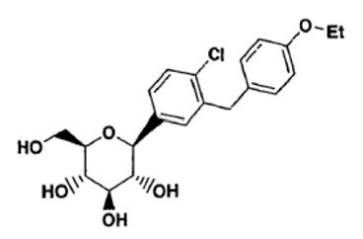
13 The compound claimed in Claims 1 and 2 of the Patent (that is, dapagliflozin) is:
14 Pharmacor contends that claims 1 and 2 are invalid on the basis of lack of novelty, lack of inventive step and lack of manner of manufacture. Pharmacor’s position is that it has a sufficiently strong case of invalidity of these claims that qualifies or negates the conclusion that there is a prima facie case of infringement: see Sanofi-Aventis Deutschland GmbH v Alphapharm Pty Ltd (2019) 139 IPR 409; [2019] FCAFC 28 at [14] (Jagot, Yates and Moshinsky JJ). It is therefore necessary to assess the strength of the case that claims 1 and 2 are invalid.
15 AZ maintains that none of the invalidity grounds has any reasonable likelihood of success, and characterise Pharmacor’s arguments as misconceived and inconsistent with established Australian authority.
16 The foundation of Pharmacor’s invalidity attack is WO 01/27128 (or WO 128 as described by the parties), which is a patent application entitled “C-aryl glucoside SGLT2 inhibitors and method” published 19 April 2001 and filed by BMS. WO 128 concerns C-aryl glucosides which are inhibitors of sodium-dependent glucose transporter 2 (SGLT2) for treatment of diabetes, especially type 2 diabetes (T2D). It explains that selective inhibition of SGLT2 is expected to normalise plasma glucose by enhancing the excretion of glucose in urine and thus be useful in the treatment of T2D.
17 WO 128 provides the chemical structure for the “Formula I” (or “Structure I”) class of compounds, each a selective SGLT2 inhibitor useful to treat T2D.
18 Formula I is depicted as follows:
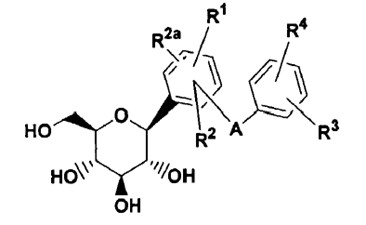
19 Formula I compounds may be modified by using potential substituents for R1, R2, R2a, R3, R4 and A. Professor Bernard Flynn, who was relied upon by AZ, gave evidence that (my emphasis):
In summary, WO 128 is directed to a broad class of C-aryl glucoside compounds defined by a Markush structure referred to as Formula I, which is identified in the abstract and on pages 8-9 of WO128; and which is the subject of claim 1. Formula I encompasses an immeasurably large number of potential individual compounds, which as discussed in sub-paragraph 80 below in the context of a narrower Formula IB Markush structure, comfortably exceeds millions of distinct combinations. The precise number of compounds is not readily calculable, given the extensive number of permitted substitutions and stereochemical variants allowed by the Markush definition.
20 The “most preferred” compounds of Formula I have “Structure IB”.
21 Structure IB is depicted as follows:
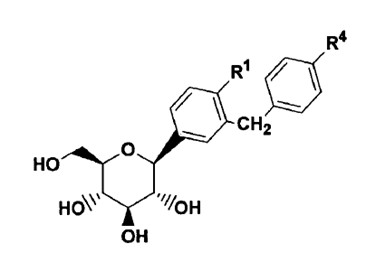
22 The lefthand and lower most ring is the glucoside, which is attached by a carbon-carbon bond to an aryl middle ring, which is also attached to another aryl ring on the righthand side. The middle aryl ring may only be modified by substituting a hydrogen, halogen or lower alkyl at R1, while the right-hand aryl ring may only be modified by substituting a lower alkyl, R5AO, -OCHF2 or - SR5e at R4.
23 It is not in dispute that the compound disclosed in claims 1 and 2 of the Patent falls within Structure 1B.
24 The Structure IB class of compounds fall within, and are narrower than, the Formula I class of compounds. However, Professor Flynn’s evidence is that although that is so:
[T]hey nevertheless each encompass an immeasurably large number of potential compounds whose structures differ significantly from one another. The precise number of individual compounds encompassed by Formula IA and IB is not readily calculable. However, even on conservative estimates, the number of distinct chemical structures encompassed by each formula would comfortably exceed millions of distinct compounds.
(Emphasis added.)
25 WO 128 provides information on 80 Examples, including, for Examples 1–15, the chemical structure and steps to synthesize the exemplified compounds. There is no dispute that dapagliflozin is not one of the 80 compounds specifically identified in the Examples in WO 128, nor the specific compounds identified in the claims of WO 128.
26 The Patent is similarly titled “C-aryl glucoside SGLT2 inhibitors and method”. Like WO 128, the applicant was BMS. There are many similarities between the content of the specification of the Patent and WO 128, which similarities were apparent from a colour coded version of the Patent provided by AZ. However, contrary to Pharmacor’s submission, the Patent and WO 128 are not “nearly identical”.
Novelty
27 The well-established test for novelty under Australian law is whether there are “clear and unmistakable directions to do what the patentee claims to have invented”, and whether “carrying out the directions contained in the prior inventor’s publication will inevitably result in something being made or done which … would constitute an infringement of the patentee’s claim”: see General Tire & Rubber Co v Firestone Tyre and Rubber Co Ltd (1971) 1A IPR 121; [1972] RPC 457 at 485-6 at 138 (Sachs, Buckley and Orr LJJ); see also Middleton J in Eli Lilly and Co Ltd v Apotex Pty Ltd (2013) 100 IPR 451; [2013] FCA 214 at [269].
28 The application of the established test to a case where there is a prior disclosure of large numbers of compounds by reference to a chemical formula was addressed by Middleton J in Eli Lilly at [272]–[273]:
The view I have reached in this proceeding is that even if the prior art theoretically includes all of the integers of the invention (among other possible combinations), this is not necessarily to anticipate a later patent. Such a view is particularly apt where the prior art discloses a class of chemical compounds, often by way of a generic formula, as in the present case. Everything will depend upon the extent of disclosure in the prior art document, and the context in which that disclosure appears. It will be necessary to consider the disclosure in its entirety to determine what it clearly and unmistakably discloses. It is true to say as a matter of logic that a very generalised prior description in a prior art document does not necessarily disclose a specific item falling within that generalised description.
Undoubtedly, a prior document may disclose more than one thing. It may disclose many things, and in doing so, anticipate a later invention. However, a prior disclosure of many things must still provide “clear and unmistakable directions” to the claimed invention: see ICI Chemicals & Polymers Ltd v The Lubrizol Corporation Inc (2000) 106 FCR 214.
(Emphasis in original.)
29 At [274]–[292], his Honour provided a helpful summary of the relevant authorities, which is convenient to set out in these reasons and to adopt:
In Bristol-Myers Co v L’Oreal (1989) 16 IPR 652 at 657, Acting Supervisory Examiner of Patents Kendall said that a generic formula in a prior patent described “countless permutations and combinations of chemical formulae which could have been produced by a gorilla mindlessly producing chemical formulae with no knowledge of what they mean, nor whether any suggested formula was capable of manufacture”. Examiner Kendall stated (at 657–8):
I do not think the proper approach is to consider that the generic formula in [the prior patent] discloses all the structural formulae which a gorilla might derive by choosing any of the substituents and by choosing any substitution pattern of the benzene ring. Rather I think the generic formula has to be considered in conjunction with the compounds specifically described in the citation in order to determine which combinations of substituents, and which substitution patterns are disclosed in the citation. To do otherwise is to ignore a molecule as an entity and merely regard it as a collection of substituents which can be interchanged at any positions of the benzene ring.
In ICI Chemicals, the Full Federal Court upheld the conclusion of the primary judge that a prior art patent did not anticipate, notwithstanding that it was possible to find the claimed composition within the broad range of compositions disclosed in it. In doing so, the court elaborated on the “planting the flag” metaphor originally used by the court in General Tire at 138 (in ICI Chemicals at [50]-[51]; emphasis added):
The primary judge proceeded on the basis that the Williamitis patent, including its cross reference to the Midgley patent, was to be read as a whole in order to assess whether it disclosed the invention sought to be protected by any of the claims (other than the abandoned claims) of the patent in suit. In adopting that approach his Honour was, in our view, plainly correct. That approach involves having regard not merely to the literal meaning of the terms used or the width of the class of refrigerants disclosed in the Midgley patent but also to important other aspects of the Williamitis patent: to the circumstances, for example, that the only refrigerants exemplified in the Williamitis patent are CFCs and HCFCs, that the Williamitis patent does not disclose any tests or experiments involving refrigerants other than CFCs and HCFCs and that, though a refrigerant is an integer of each of its claims, none of those refrigerants is an HFC.
In those circumstances, and in the absence of relevant expert evidence, we think that the primary judge was correct to conclude that Williamitis did not anticipate the claims of the patent in suit. A familiar metaphor illustrating the concept of anticipation is that the prior inventor must clearly be shown to have planted his flag at the precise destination before the patentee … In the present case, the appellants’ argument involved the skilled addressee rummaging through the Williamitis flag locker to find a flag which Williamitis possessed and could have planted.
A similar issue was considered by the High Court in Commissioner of Patents v Ethyl Corp (1969) 120 CLR 594. The claim related to a gasoline composition that contained, inter alia, from 3 to 65% of methyl benzenes having from one to four methyl groups. The question was whether a prior art document which claimed a gasoline composition having from 13 to 55% aromatic gasoline components anticipated the claim of the patent in suit. Justice McTiernan of the Appeal Tribunal accepted that the term “aromatic gasoline components” may — but need not necessarily — include methyl benzenes. Justice McTiernan held that the prior art document was not novelty destroying, and stated that (at 596):
the invention claimed … differs from the composition claimed [in the prior document] in that the latter in referring to a fuel containing from thirteen to fifty-five volume per cent aromatic gasoline components need not have in it any methyl benzene groups which are an essential feature of the former.
Nor did the prior document suggest the limitation of from one to four methyl groups, as did the patent in suit in that case.
In Imperial Chemical Industries Pty Ltd v Commissioner of Patents (2004) 213 ALR 399; 63 IPR 476; [2004] FCA 1658 (ICI v Commissioner of Patents), Crennan J stated the issue as follows (at [64]):
Questions of anticipation can be difficult in cases where a broad chemical claim in an alleged anticipatory document, in its terms, encompasses many, even thousands of compounds. Questions can arise as to whether such a broad claim in a patent (or even a divisional thereof) discloses, sub silentio, a particular compound from the broad class, which is the subject matter of a later application.
Justice Crennan recognised that literal satisfaction of the basic test of “reverse infringement” for a prior disclosure of a generic chemical formula is not necessarily sufficient to anticipate a later claim to a compound within the formula (at [66]):
Those cases [Beecham Group Ltd’s (Amoxycillin) Application [1980] 97 RPC 261, Bristol-Myers Squibb Co v FH Faulding & Co Ltd (2000) 97 FCR 524; 170 ALR 439; 46 IPR 553; [2000] FCA 316 and University of Georgia Research Foundation v Biochem Pharma Inc (2000) 51 IPR 222] … highlight the danger of applying the “reverse infringement” test to broad chemical claims by reference to whether a description of a broad class of compounds encompasses a specific compound later disclosed. It is possible to imagine many cases where asking the question “does a prior claim encompass a later disclosure?” will give the same practical result as the Meyers Taylor question which is “would a prior claim constitute an infringement of a later disclosure (if a patent therefore were valid)?” However, with a claim to a broad class of chemical compounds, such an approach will not always or necessarily dispose of the question of what is taught to a skilled addressee … Such an approach in these circumstances might leave little room for patents of addition and selection patents.
…
In the field of chemistry fine distinctions are often necessary between a “fleeting” or “paper” disclosure or the “intellectual content” of a disclosure on the one hand, and a “disclosure for novelty purpose” or an “enabling disclosure” on the other. Not every disclosure is a “disclosure for novelty purposes”. Beecham’s case … illustrates this difficult point: Buckley LJ refers (at 288) to the fact that the parent patent in that case encompassed “the entire field of α-aminopenicillins … and literally thousands of these compounds could be made.” Buckley LJ also noted (at 286) that an inclusive claim in a patent of addition for “broad spectrum penicillins” must be treated as specifically claiming amoxycillin. Then (at 290) he found that the prior patent of addition contained “no disclosure or promise” or “teaching” that taught amoxycillin. Accordingly, there was no want of novelty, arising out of a paper disclosure in an inclusive phrase. [Emphasis in original.]
With respect to the evidence in that case, Crennan J observed (at [80]):
It is clear that each skilled addressee, qualified as an expert for the purposes of explaining the technology, does not regard the Lubrizol patent as teaching the specific ternary mixture which the applicant now claims. Each recognises however that the broad disclosure of integer (A) of the Lubrizol patent encompasses the specific ternary mixture. Such distinctions are the distinctions deployed by the majority in the Court of Appeal in Beecham’s case. It is therefore clear that the specific ternary mixture the applicant claims required some further inventive ingenuity as that phrase is used in the established authorities. [Emphasis in original.]
Justice Crennan concluded, at [82] (para (ii)):
Integer (A), and the consistory clause, of the Lubrizol patent are broad enough to encompass ternary compositions of HFCs and broad enough to encompass the specific ternary mixture which the applicant now claims …
But her Honour found and held, at [82] (para vi):
There is no disclosure for novelty purposes, that is, no teaching, on page 9 or anywhere in the Lubrizol patent of any specific ternary mixtures of HFCs or the particular ternary mixture of HFCs which the applicant now claims.
In H Lundbeck the question was whether the disclosure of a racemic compound (that is a compound having two enantiomers in equal proportions) anticipated a later claim to a single enantiomer of the compound. The Full Court gave a detailed analysis of novelty, in particular, Bennett J (with whom I concurred) stated at [173] (emphasis added):
Where the prior disclosure is to a broad chemical claim encompassing many compounds, there may not be anticipation in the absence of the skilled addressee understanding or perceiving a specific compound in the disclosure (Imperial Chemicals Industries Pty Ltd v Commissioner of Patents (2004) 213 ALR 399; 63 IPR 476; [2004] FCA 1658 at [64]- [65]). That is, there is no actual description of the particular compound to the skilled addressee; there is no relevant disclosure. There may be a distinction, albeit fine, between a “fleeting” or “paper” disclosure or the “intellectual content” of a disclosure on the one hand and a “disclosure for novelty purposes” or “enabling disclosure” on the other (Imperial Chemicals at [68]; University of Georgia Research Foundation v Biochem Pharma Inc (2000) 51 IPR 222, a decision of Dr Barker of the Patent Office described by Crennan J in Imperial Chemicals as a “sound account of the relevant distinctions between a ‘paper disclosure’ and an ‘enabling disclosure’ in the field of chemistry” (at 412)). It depends on what the skilled reader would understand.
In H Lundbeck, the patent in suit claimed the (+)-enantiomer of citalopram (otherwise called the S-enantiomer), which exists in a racemic form (that is equal parts of (+)- and (-)-enantiomers).
At [168], the majority held that, for lack of novelty to be made out, “the earlier disclosure must point unmistakably to the (+)-enantiomer of citalopram”.
One of the prior art documents was the earlier patent of Lundbeck that claimed citalopram in racemic form. At [194], the majority held (emphasis added):
It is the case that the skilled addressee knew that the racemate could be resolved into the enantiomers but there was nothing to tell him or her to do so … There were no clear and unmistakable directions to obtain the enantiomers.
The second prior art document, the Smith article, disclosed that citalopram had two enantiomers. However, it wrongly predicted that the R-enantiomer would be the most potent.
At [209]-[210], the majority held (emphasis added):
The Smith article does not describe the (+)-enantiomer. It does not disclose whether the R- or the S-enantiomer is the (+)-enantiomer. It does not give directions to obtain the (+)-enantiomer. The skilled addressee wishing to obtain an enantiomer of citalopram would … have to conduct further experiments, conduct research and gain further information to hit upon the present invention. Such experimentation and the steps that it would entail were not inevitable …
The Smith article does not contain information equivalent to the disclosure of the (+)-enantiomer of Claim 1. It does not anticipate Claim 1 of the Patent.
Thus, in H Lundbeck, the bare disclosure of two enantiomers of a compound was not sufficient to destroy the novelty of a claim to a single enantiomer of the compound.
In the end, as accepted by Apotex, the question is one of clarity of disclosure. If the prior disclosure is clear and unmistakable enough in making directions and includes all the essential integers of the invention as claimed, then the invention will not be novel. However, there does not necessarily need to be a literal disclosure – see Nicaro Holdings Pty Ltd v Martin Engineering Co (1990) 91 ALR 531; 16 IPR 545 at 563 per Gummow J. If there is not literal or exact disclosure, then if the skilled addressee would add the missing information as a matter of course (without the application of inventive ingenuity or undue experimentation), that would lead to anticipation.
In my opinion, the analysis is not helped by reference to any general rule that disclosure of a class prima facie deprives its members of novelty: see for example Blanco White QC, Patents for Inventions 4th ed (1974) p 120 fn 60, fn 62 and p 121 as cited in Dr Reddy’s Laboratories (UK) Ltd v Eli Lilly and Co Ltd [2010] RPC 9 at 238 [35] (Dr Reddy Laboratories).
The correct approach, not constrained by any presumption, consistent with the approach of Crennan J described above, is that described by Bennett J in H Lundbeck at [191]:
Where the prior disclosure is of large numbers of compounds by reference to a chemical formula, evidence will establish whether or not such a form of disclosure in the context of the examples and the discussion in the specification is disclosure of any particular subsequently claimed compound.
30 In summary, Middleton J observed that: (a) the fact that the prior art discloses a class of chemical compounds by way of generic formula that theoretically includes all of the integers of the invention (amongst other possible combinations) does not mean there is anticipation. It depends what the skilled reader would understand; and there is a critical difference between the disclosure of something that encompasses the claimed compound, and one that gives specific directions to obtain the claimed compound: [272]; [279]–[283]; and (b) if there is not literal or exact disclosure, there will be no anticipation unless the PSA would add the missing information as a matter of course, without the application of inventive ingenuity or undue experimentation: [290]. Thus, in Eli Lilly, it was held that there was no disclosure of the claimed compound (olanzapine) in a prior art document directed to a general formula (I), which encompassed millions of compounds, and 86,000 “most preferred” compounds, even if olanzapine was one of the “most preferred” compounds: [321]; [330].
31 Pharmacor submits that “principles relevant to selection patents” are relevant to the question of novelty and presses that such principles are to be applied instead of the established test for anticipation referred to in General Tire.
32 By its submissions, Pharmacor submits that the Full Court decision of Ranbaxy Australia Pty Ltd v Warner-Lambert Co LLC (2008) 77 IPR 449; [2008] FCAFC 82 (Emmett, Weinberg and Bennett JJ) is either binding authority, or contains obiter dicta of an intermediate appellate court. However, at this interlocutory stage, I am not persuaded of either of these propositions, especially as Pharmacor did not grapple with the statements in Eli Lilly referred to above, and with the authorities cited and applied by Middleton J, in any satisfactory way. That is for the following reasons.
33 In Eli Lilly at [371], Middleton J referred to the principles of selection as an alternative basis for a conclusion that the invention claimed was nonetheless valid based on the “principles of selection (if applicable under Australian law)”. This caveat is an important one, as will be seen.
34 At [372], Middleton J stated that:
Selection patents are not a sui generis category of patents. A “selection patent” refers to a patent for an invention that is selected from a broader invention disclosed in a prior publication. The typical “chemical selection patent” arises where a group of chemical substances has been disclosed (together with methods for their manufacture) in general terms as being useful for a particular purpose.
35 His Honour then went on from [375] to address the principles as derived from the decision of the UK High Court in Re IG Farbenindustrie AG’s Patents (1930) 47 RPC 289, and to consider other cases from the United Kingdom.
36 In Eli Lilly at [379], Middleton J stated:
Notwithstanding the foregoing discussion, it is not settled that the concept of selection patents forms part of the current law of novelty in Australia.
37 At [381]–[385], his Honour referred to the single judge decisions of Imperial Chemical Industries Pty Ltd v Commissioner of Patents (2004) 63 IPR 476; [2004] FCA 1658 (Crennan J) (ICI Chemicals) and Apotex Pty Ltd (formerly GenRx Pty Ltd) v Sanofi-Aventis (2008) 78 IPR 485; [2008] FCA 1194 (Gyles J) (Apotex SJ), as well as decisions of the Australian Patent Office, which referred to or applied the principles of selection as derived from Re IG Farbenindustrie.
38 Justice Middleton then referred to the decision on appeal from Apotex SJ, namely Apotex Pty Ltd v Sanofi-Aventis (2009) 82 IPR 416; [2009] FCAFC 134 (Apotex FC). Middleton J was a member of the Full Court which heard that appeal (along with Emmett and Bennett JJ). At [386] of Eli Lilly, his Honour stated that:
On appeal (Apotex Pty Ltd v Sanofi-Aventis (2009) 82 IPR 416; [2009] FCAFC 134 (Sanofi-Aventis)), Bennett J and I said there is no room for the application of the principles of selection where a compound is “disclosed and claimed” in a prior patent and its properties have been predicted for a later claimed use (at [117]):
It is not necessary to decide whether or not there is a special category of “selection patents” which, if they satisfy the test in IG Farbenindustrie, may overcome a claim of lack of novelty. Any such category was not, in our view, intended to exclude from the requirement of novelty a compound (here, the d-enantiomer) that was previously disclosed and claimed as one of a class of inventive compounds that demonstrated, or were predicted to demonstrate, particular activity and tolerance at various levels, and the compound was then shown to demonstrate that same activity at a high level, with high tolerance.
39 At [387] of Eli Lilly, Middleton J indicated that there was real doubt about whether the principles relating to selection patents form part of Australian law, stating that:
It is clear from the foregoing authorities that patents for selection inventions (if such patents form part of Australian law) are based on the discovery of particularly desirable properties arising from the use of a specific material that has been broadly encompassed by a prior disclosure of a family of related materials …
(Emphasis added.)
40 Notably, his Honour did not refer to the Full Court decision of Ranbaxy. Yet Ranbaxy was referred to by Gyles J in Apotex SJ at [76] and was the foundation for his Honour’s statement in that case at [79] that “it is too late in the day to find that the principles … are not relevant to the question of anticipation …” (which Pharmacor emphasises on this application). As Middleton J was a member of the Full Court in Apotex FC, he must have been aware of Ranbaxy; and yet not only did it not form part of the list of authorities identified in Eli Lilly as dealing with the selection principles, his Honour did not consider that he was bound by Ranbaxy. My preliminary view is that there is good reason for this, and that I am also not bound.
41 The relevant passage in Ranbaxy appears at [101]–[107] of that decision, with the critical paragraph emphasised:
On 14 October 1991, an examiner in the commissioner’s office wrote to Warner-Lambert’s patent attorneys in response to their request for normal examination of the application for the enantiomer patent. The examiner said that the application had been examined and that it had been found that the invention, as defined by Claims 1–12, “was prior published and not novel”, in the light of the broader patent.
The examiner asserted that the broader patent disclosed the trans-isomeric compound of the claimed invention of the enantiomer patent. The examiner also said that, in the enantiomer patent, it appeared that the [R(R*R*)] isomer exactly depicts the trans-isomeric compound of the broader patent, with the appropriate stereo chemistry. The examiner noted that the S isomer had a different structural arrangement from the R isomer but that the former isomer was specifically excluded from the broader patent. The examiner’s statement that the S isomer was excluded from the broader patent was erroneous.
The examiner’s letter also said as follows:
[Warner-Lambert] is probably relying on the present application as a “selection patent” by providing the comparative results of the tests on the compound of the present invention over the prior art [set out in that part of the Enantiomer Specification that contains the CSI Table]. However, it is not clear what the “racemate” [in the CSI Table] refers to. If “the racemate of these two compounds” refers to a mixture containing the [R enantiomer], then it is not entirely clear if the comparative “CSI” data given [in the CSI Table] establishes any advantage of the present invention over the prior art because it appeared that the [Broader Patent] specifically excludes the [S enantiomer]. Therefore it is submitted that the present specification does not clearly establish any advantage of the present application over the compounds disclosed in [the Broader Patent].
Warner-Lambert’s patent attorneys, in a letter to the commissioner of 26 June 1992, in response to the objection raised by the examiner, wrote that:
...the [Broader Patent] discloses a racemic trans-isomeric compound which exists as a mixture of enantiomers. Both the trans- and cis-geometric isomers in [the Broader Patent] are capable of having two optical isomers for each geometric isomer disclosed. However, although [the Broader Patent] states that the preferred diastereomer is the trans-isomer, [the Broader Patent] does not state nor indicate which particular R-trans or S-trans isomer is the more active. The present invention discloses a biologically and enantiomerically pure optically active trans-isomeric compound which is synthesised by resolution techniques and the compound and its method of preparation are not disclosed nor obvious from [the Broader Patent].
A patent application will overcome a prior publication, as a selection patent, if the following criteria are met:
• there must be some substantial advantage to be secured by the use of the selected members;
• the whole of the selected members must possess the advantage in question;
• the selection must be in respect of a quality of a special character, which can fairly be said to be peculiar to the group; and
• the advantage possessed by the selected members must be clearly disclosed in the specification.
(see Re IG Farbenindustrie AG’s Patents (1930) 47 RPC 289 at 322–3). The patent attorneys must be taken to have understood the examiner’s reference to a selection patent in that way.
In that context, the patent attorneys’ letter to the commissioner of 26 June 1992 also said the following:
Furthermore, we draw the attention of the Examiner to the amoxicillin opposition (Beecham Group Limited’s Application (1980) 10 RPC 261) where it was held that Beecham’s claims to a particular epimer of amoxicillin was not prior published by its prior patent application of 1962 which disclosed the racemic or epimeric mixture p-hydroxy alpha-amino penicillanic acid capable of being in existence in both the D and the L form at the asymmetric carbon atom of the alpha-amino group. Not only was it held that it was not prior published they also found that it was not obvious even though the (-) epimer, amoxicillin, was only four times more active than the opposite epimer and only twice as active as the racemic or epimeric mixture. Reliance was made on the superior blood levels.
In relation to the second part of [the Examiner’s Letter], [Warner-Lambert] has found that the optically active R-trans isomer is 100 times more active that [sic; scilicet than] the optically active S-trans isomer and 10 times more active that [sic; scilicet than] its racemic mixture. Thus, we submit that the [the CSI Table] establishes a clear advantage of the optically active [R enantiomer] over the corresponding [S enantiomer].
In addition, we respectfully submit that there is no exclusion to [sic; scilicet of] the optically active S-trans isomer in [the Broader Patent]. Only the cis-isomer and thus the corresponding R and S optical isomers were excluded from [the Broader Patent].
We respectfully submit that the present invention is both novel and non obvious over [the Broader Patent].
Further consideration of the application is requested. [Emphasis added]
Warner-Lambert contended that the letter should be characterised as making only a comparison between the activity of the R enantiomer and the activity of the S enantiomer and not a comparison of the R enantiomer with the racemate. That contention should be rejected: the comparison is not only between the R enantiomer and the S enantiomer but, importantly in the context of an alleged selection, is also between the R enantiomer and the racemate.
False suggestion is not limited to information in the claims of a specification. Ranbaxy claimed that the statement in the patent attorney’s letter, that the R enantiomer is ten times more active than its racemic mixture, was a false or misleading representation because, in fact, the R enantiomer is only approximately twice as active as its racemic mixture, which is the level of activity that would be expected of the active enantiomer as compared to the racemic mixture. Having found that the data available to Warner-Lambert established, on the balance of probabilities, that the R enantiomer had an activity level that is only approximately two times greater than the racemate, the primary judge found that that statement in the patent attorney’s letter was false and misleading.
(Original emphasis omitted, emphasis added.)
42 It appears that the reference by the Full Court to the selection patent principles was to explain the context of the inquiry from the examiner about whether there was reliance on the patent application as a “selection patent”. This is made plain by the final sentence of [105] and by the opening words of [106], namely “In that context…”.
43 Thus, the Full Court did not find that such principles form part of Australian law, nor did the statement in [105] form part of the ratio decidendi for the purposes of deciding that there had been a false suggestion to the Commissioner.
44 Had the Full Court made such a finding or endorsed such principles in Ranbaxy, even by way of obiter dicta, then one would not have expected to see two judges of a later Full Court (including Bennett J who was a member of the Full Court in both decisions) refer at [111] of Apotex FC to the doubt expressed by Gyles J about the applicability in Australia of the concept of selection patents, and state at [117] of that decision that “[i]t is not necessary to decide whether or not there is a special category of “selection patents” which, if they satisfy the test in Re IG Farbenindustrie, may overcome a claim of lack of novelty”. At [118], the majority in Apotex FC also stated “Assuming for the purposes of this appeal, without deciding, that there is a category of “selection patents” …” (emphasis added.). With respect, their Honours could not have made their reluctance to embrace the principles around selection patents any plainer, and these observations were made without any discussion as to whether they should depart from an earlier decision of a Full Court.
45 Further, even if (for argument’s sake) the principles relating to selection patents do form part of Australian law, they appear to operate in circumstances where there has been anticipation on the application of the General Tire test of novelty. In other words, the principles might be relied upon to save a selection patent which might otherwise be invalid for want of novelty if the General Tire principles are applied, without more. In this way, the principles relating to selection patents would be said to “overcome” a claim of lack of novelty (to use the words of the majority in Apotex FC). This was the way in which these principles were applied by Crennan J in ICI Chemicals.
46 If that proposition is correct, these principles would not be standalone principles with which all selection patents must comply in order for anticipation to be avoided.
47 Applying the established test for anticipation forming part of Australian law, there is no controversy between the experts that WO 128 is directed to a large class of C-aryl glucoside compounds defined by a Markush structure of Formula I, as well as a narrower “most preferred” Formula IB; and that dapagliflozin is not one of the 80 compounds specifically identified in the Examples in WO 128, nor the specific compounds identified in the claims of WO 128. Rather, like the compound in Eli Lilly, dapagliflozin is merely “encompassed” by Formula I and Formula IB in WO 128. However, Formula I encompasses an immeasurably large number of potential individual compounds, and the precise number encompassed by the narrower Formula IB is also not readily calculable but would exceed millions of compounds.
48 The expert evidence adduced by Pharmacor does not suggest that WO 128 contains a specific direction to obtain dapagliflozin, nor that dapagliflozin would be arrived at as an inevitable result. Further, Professor Flynn’s evidence is that he does not consider dapagliflozin to be disclosed in WO 128 or there to be any direction in WO 128 to make it.
49 It follows that, for the purposes of this application, I am not persuaded that there is a strongly arguable case that WO 128 anticipates claims 1 and 2. That is because it does not contain “clear and unmistakable directions to do what the patentee claims to have invented”, and nor can it be said that “carrying out the directions contained in the prior inventor’s publication will inevitably result in something being made or done which … would constitute an infringement of the patentee’s claim”.
50 It is not necessary to proceed to consider whether the principles relating to selection patents have been satisfied because of this conclusion. In any event, I am not persuaded for the purposes of this application that such principles form part of Australian law in light of the statements by the majority of the Full Court in Apotex FC at [111], [117] and [118] and by Middleton J in Eli Lilly at, in particular, [379].
51 For these reasons, while the invalidity attack on claims 1 and 2 on the basis of lack of novelty is arguable, it does not diminish the strength of the prima facie case on infringement.
Lack of inventive step
52 By s 18(1)(b)(ii) of the Act, the invention must, in summary and so far as claimed in any claim, involve an inventive step. By s 7(2) of the Act, an invention is taken to involve an inventive step when compared with the prior art base unless the invention would have been obvious to a person skilled in the relevant art in the light of the common general knowledge as it existed in the patent area before the priority date of the relevant claim, whether that knowledge is considered separately or together with the information mentioned in subsection (3).
53 Thus, the onus will be upon Pharmacor at trial to demonstrate that the invention claimed in claims 1 and 2 of the Patent does not involve an inventive step.
54 The general principles for assessing inventive step under Australian law are well-established: see, for example, Hanwha Solutions Corp v REC Solar Pte Ltd (2023) 180 IPR 315; [2023] FCA 1017 at [414]–[424] (Burley J). Whilst various formulations have been used, the modified Cripps question is the formulation most routinely adopted (including in cases where the prior art discloses a class of compounds encompassing a later claimed compound, such as Eli Lilly). That question asks whether the notional team at the relevant date in all the circumstances, including knowledge of all the prior art to which it is permitted to refer, would be directly led as a matter of course to try the claimed invention in the expectation that it might well produce a useful or better alternative.
55 The test has been alternatively expressed as inviting consideration of whether the steps that would have been taken by the person skilled in the art (PSA) were of a “routine” character to be tried as a matter of course.
56 As to the applicable test in this case, Pharmacor submits that a claim is obvious unless it is “beyond the skill of the calling” such that there is “some difficulty overcome, some barrier crossed” and cites Lockwood Security Products Pty Ltd v Doric Products Pty Ltd (No 2) (2007) 235 CLR 173; [2007] HCA 21 at [52] (Gummow, Hayne, Callinan, Heydon and Crennan JJ). However, this form of submission appears to invert the deeming effect of s 7(2) of the Act, and it also fails to refer to the additional proposition in Lockwood that a “scintilla of invention” remains sufficient in Australian law to support the validity of a patent.
57 Pharmacor also submits that the statutory inquiry does not require analysis based on the Cripps question. So much may be accepted, and I did not understand AZ to submit otherwise. Pharmacor submits that the Cripps question is not appropriate to this case, and nor does it always require consideration of whether the PSA would have “arrived at” the claimed invention. It submits that such questions are antithetical to considering whether a claimed invention in a selection patent has an inventive step because the PSA will never be “directly led” to a selection of a compound from a prior art class of compounds where the selected compound has no advantage over other members of the class. Pharmacor submits that the selection patent principles apply to the law of inventive step in Australia if they do not apply to novelty and relies on the statement by Middleton J in Eli Lilly at [380] that selection principles “technically pertain to whether an invention involves an inventive step” based upon the judgment in Re IG Farbenindustrie. No other authority was cited by it.
58 However, I am not persuaded for the purposes of this application that such principles form part of Australian law in light of the statements by the majority of the Full Court in Apotex FC at [111], [117] and [118] and by Middleton J in Eli Lilly at, in particular, [379]. No mention is made of these principles in Hanwha, for example.
59 Pharmacor then presses for a provisional conclusion that claims 1 and 2 lack an inventive step, as they do not involve a “technical advance” over WO 128. It submits that the “technical advance” test is well-established in the United Kingdom. It further submits that:
A patent is invalid where the claimed invention is an “arbitrary selection” from the prior art which cannot be justified by a useful technical property, i.e. a “technical advance”, compared with the previously disclosed class or group: e.g., Dr Reddy’s v Eli Lilly [2009] EWCA Civ 1362 at [50]-[52], [109]; and UK Appeal Decision at [38]-[40], quoting with approval the summary of the law in UK Trial Decision at [59] (noting the UK Trial/Appeal Decisions concerned the UK equivalent to the Patent):
If the patent claims a compound selected from a previously disclosed genus of compounds which are said to have a particular property, then [the technical advance] requirement is not satisfied if the compound does not in fact have some different or improved property compared to those previously individually disclosed (a new effect or an increase in an effect), or the patent does not make such improved property plausible.
This is an alternative inquiry to “classical obviousness”, which concerns whether the PSA would have been “pointed to” and/or arrived at the invention (UK Appeal Decision at [39]; UK Trial Decision at [263]-[265]), an area in which the Cripps test is more apt.
(Emphasis omitted.)
60 Pharmacor did not cite any Australian authority which has adopted the “technical advance” test, and it does not appear to form part of Australian law on inventive step for that reason. It also appears to conflict with the long-standing tenet of Australian law that there is no obligation for the applicant to identify the inventive step in the specification: see Lockwood Security Products Pty Ltd v Doric Products Pty Ltd (2005) 68 IPR 459; [2005] FCAFC 255 (Heerey, Sundberg and Bennett JJ) at [195].
61 To the extent that Pharmacor wishes to seek to persuade an Australian court that the “technical advance” test should be adopted in Australia notwithstanding this conflict, then that is a matter for trial.
62 As to the application of this test, it is relevant to observe that dapagliflozin is not disclosed in WO 128, but is disclosed and claimed in the Patent; the evidence shows that it is a highly prescribed treatment for diabetes and other conditions; and Pharmacor wants to enter the Australian market and sell products which contain dapagliflozin, rather than select a different compound from WO 128 which does not infringe the claims of the Patent. For the purposes of this application, these matters tend to indicate that the Patent discloses something having an advantage over other compounds which are encompassed by the claims in WO 128.
63 Pharmacor also relies upon the evidence of its expert, Dr Robert Dow. Dr Dow is a Director and Partner at BioPharmaWorks LLC and is a medicinal chemist with over 45 years’ experience in the research, discovery, design and synthesis of molecules for the treatment of disease, and he gave evidence regarding an asserted lack of “advantages or special characteristics” of the invention in the Patent compared to that disclosed in WO 128. However, Professor Flynn, a medicinal chemist, a Professor at the Monash Institute of Pharmaceutical Science and Founder and the Chief Executive Officer of Cincera Therapeutics Pty Ltd, contests Dr Dow’s evidence.
64 Pharmacor submits that I should give less weight to the evidence of Professor Flynn to that of Dr Dow for reasons associated with their qualifications and experience. Conversely, AZ submits that Dr Dow is not representative of the non-inventive PSA in Australia because he is (a) an American medicinal chemist with no experience working in Australia, who worked at Pfizer in the USA from 1985 to 2021; (b) is a named inventor on 62 patents; and (c) has discovered seven lead clinical development candidates.
65 However, I am not persuaded that I should prefer one expert’s evidence over another at the interlocutory stage in the absence of the evidence of these witnesses being tested under cross-examination. The short point is that the evidence of Dr Dow is contested by Professor Flynn, and the resolution of the dispute between these experts is a matter for trial. Whether Dr Dow is better qualified than Professor Flynn such that Dr Dow’s evidence should be preferred, and whether Dr Dow is representative of the non-inventive PSA in Australia such that his evidence should be given less weight on the issue of inventive step, are also matters for trial.
66 Pharmacor also relies upon an affidavit of Dr Joanne Marks, a biologist, who is an Associate Professor in the Department of Neuroscience, Physiology and Pharmacology at the University College London, Medical School. While the evidence of Dr Marks is not contradicted by an expert biologist called by AZ, that is explained by the fact that AZ had very limited time to file and serve responsive evidence. Instead, AZ criticises the instructions given to Dr Marks, and urges that her evidence should be treated with significant caution. Whether the evidence of Dr Marks should be accepted, and the weight to be attached to it, is a matter for trial, and I do not propose to address the criticisms which are made about her evidence at this stage of the proceeding.
67 For the same reasons given by Burley J in Janssen Pharmaceutica NV v Juno Pharmaceuticals Pty Ltd [2025] FCA 1538 at [127], this ground of invalidity (that is, lack of inventive step) is ill suited to the objective that Pharmacor seeks to attain, which is to demonstrate weakness in the prima facie case of infringement asserted against it.
68 Finally, it is relevant to note that there is a dispute on the evidence as to whether WO 128 would have constituted information within the meaning of s 7(3) of the Act as it applied pre-Raising the Bar. The resolution of that issue is also a matter for trial.
69 For these reasons, while the invalidity attack on claims 1 and 2 on the basis of lack of inventive step is arguable, it does not diminish the strength of the prima facie case on infringement.
Manner of manufacture
70 As to this ground of invalidity, Pharmacor submits that, because the Patent admits that the compound was disclosed within WO 128 (albeit in generic terms) and claims it for a use that was also known (treating diabetes), it is not a “new” manner of manufacture but just an old disclosure in another guise.
71 The principles relating to manner of manufacture are well-established in the case of pharmaceutical patents: see Merck & Co Inc v Arrow Pharmaceuticals Limited (2006) 68 IPR 511; [2006] FCAFC 91 (Heerey, Kiefel and Dowsett JJ) at [63]; InterPharma Pty Ltd v Hospira, Inc (No 5) (2019) 149 IPR 182; [2019] FCA 960 (Kenny J) at [453]–[467].
72 In essence, a patent insofar as claimed will be a manner of manufacture and satisfy s 18(1) of the Act if, on the face of the specification, the subject matter has the necessary quality of inventiveness under the Statute of Monopolies and is new.
73 Thus, if there is a new substance, new characteristic of the known substance, new use of the known substance or new method disclosed on the face of the specification, there will be a manner of manufacture: see, generally, Arrow Pharmaceuticals at [75]; Dura-Post (Aust) Pty Ltd v Delnorth Pty Ltd (2009) 81 IPR 480; [2009] FCAFC 81 at [31] (Kenny and Stone JJ).
74 In this case, there appears to be disclosure on the face of the Patent that describes and claims a “manner of manufacture”: see, by analogy, Eli Lilly at [722]. That is, it discloses a specific compound structure (dapagliflozin) (being a new substance) that was not explicitly disclosed before, including in WO 128, plus detailed methods to make it and use it. That is apparent even if, at best for Pharmacor, WO 128 is incorporated by reference into the Patent, or the PSA would look at WO 128 and would recognise that dapagliflozin was encompassed within the large number of potential individual compounds which fall within WO 128.
75 Pharmacor also submits that “If contrary to the above, the Court considers “selection principles” do not apply for novelty or inventive step, they can be applied under the manner of manufacture ground, based on either the Philips or Microcell arguments”. However, there is no authority cited for this submission, and I am not persuaded that they can be so applied in Australia, having regard to the statements by the majority of the Full Court in Apotex FC at [111], [117] and [118] and by Middleton J in Eli Lilly at, in particular, [379].
76 For these reasons, while the invalidity attack on claims 1 and 2 on the basis of lack of manner of manufacture is arguable, it does not diminish the strength of the prima facie case on infringement.
Prima facie case – Australian Consumer Law
77 AZ AU submits that Pharmacor should be restrained from exploiting the Pharmacor Products because such exploitation would constitute misleading or deceptive conduct in contravention of s 18 of Sch 2 of the Competition and Consumer Act 2010 (Cth), being the Australian Consumer Law (ACL).
78 Specifically, AZ AU alleges that there is a prima facie case that Pharmacor will, or is likely, to mislead or deceive its customers, being pharmacists and wholesalers, by failing to warn them that their exploitation of the Pharmacor Products could infringe the Patent.
79 It is uncontroversial that a failure to warn of an infringement may constitute misleading or deceptive conduct: Ramset Fasteners (Aust) Pty Ltd v Advanced Building Systems Pty Ltd (1999) 44 IPR 481; [1999] FCA 898 at [66]–[68] (Burchett, Sackville and Lehane JJ).
80 As to the extent to which this cause of action brought by a non-exclusive licensee requires separate consideration to the infringement case at an interlocutory stage, a similar issue arose in Biogen International GmbH v Pharmacor Pty Ltd (2021) 165 IPR 64; [2021] FCA 1591.
81 In that case, Rofe J stated at [161]–[166]:
Biogen Australia is not an exclusive licensee of the Patent. Its claim for relief is based on the allegations of contravention of s 18 of the ACL. Biogen alleges that by marketing and supplying the Pharmacor products in Australia before the expiry of the Patent, Pharmacor is representing to pharmacists that they are entitled to dispense the Pharmacor products for the same indication, or same purposes, as Tecfidera without infringing the Patent. Biogen referred to the proposed packaging of the Pharmacor products in a confidential annexure to Mr Mallela’s affidavit to support its case as to the representations to be made by Pharmacor in marketing and supplying the Pharmacor products.
Biogen submits that the strength of the ACL claim is equal to the strength of the prima facie case for relief for infringement of the Patent.
Pharmacor submits that the present case is distinguishable from H Lundbeck A/S v Sandoz Pty Ltd (2018) 137 IPR 408 (Lundbeck), and the cases reviewed by Jagot J at [538]-[544] as each of those cases involved misleading and deceptive conduct on the basis of a “failure to warn” customers of the risk of infringement. It submits that the case against Pharmacor is pleaded not as a failure to warn, but rather that Pharmacor will make positive representations that the pharmacist is entitled to dispense the Pharmacor products for the same indication or purposes as Tecfidera without infringing the Patent.
The representation alleged by Biogen in this case is of the same kind set out in Lundbeck in the second dot point at [536]: that Sandoz impliedly represented to customers and potential customers that the customers or potential customers could use the Respondent’s Escitalopram Products without infringing AU 144.
The failure to warn customers of infringement as discussed in the cases reviewed by Justice Jagot in Lundbeck is implied from the conduct of the alleged infringer in promoting the goods for sale without regard to the patent monopoly. The positive offer of the products constitutes the “failure to warn”. The alleged infringer’s failure to warn its customer of the liability they are inducing them to incur gives rise to an implied representation that the customer can freely deal with the goods. The Full Court said in Ramset Fasteners (Aust) Pty Ltd v Advanced Building Systems Pty Ltd (1999) 44 IPR 481; [1999] FCA 898 at [67]:
Whether or not Ramset’s conduct should be analysed as conveying an implicit misrepresentation, it acted misleadingly when it promoted and sold face-lift tilt-up equipment in the way that it did, without informing its customers of the liability it was inducing them to incur. This was conduct calculated to cause a mistaken impression about a significant consequence of the transaction proposed to those customers.
As recognised by Bennett and Yates JJ in Apotex Pty Ltd v Sanofi-Aventis Australia Pty Ltd (No 2) (2012) 96 IPR 185 at [91], the misrepresentation issue in claims based on patent infringement depends on the existence of patent infringement. As such, for the provisional purposes of the application, it is not necessary to consider the ACL claim separately to the threatened patent infringement case. The ACL case stands or falls with the patent infringement case.
82 Adopting the same approach as Rofe J, with respect, I accept that for the purposes of this application that it is not necessary to consider the ACL claim separately from the patent infringement claim.
83 The ACL case stands or falls with the patent infringement case, which I consider to be strong for the reasons explained above.
Balance of convenience
84 In considering the balance of convenience, it is necessary to assess the harm to AZ if there is no injunction, and the prejudice or harm to Pharmacor if there is an injunction imposed. As observed by Burley J in Janssen at [200]:
In this context whether or not one or the other will suffer “irreparable harm” is one of the matters that must ordinarily be factored into the Court’s consideration of the balance of convenience and justice: Samsung Electronics Co Ltd v Apple Inc [2011] FCAFC 156; 217 FCR 238 at [61] (Dowsett, Foster and Yates JJ). Included in this is the consideration of whether or not damages are likely to be an adequate remedy for the applicants, in the event that its rights are vindicated in a final hearing but no injunction is granted; Samsung at [62]. On the other hand, given that a condition for the grant of interlocutory relief is the provision by Janssen of an undertaking as to damages, a countervailing consideration is whether or not a claim on the undertaking as to damages is likely to give adequate recompense to Juno and any affected third party in the event that Juno is successful in the substantive trial, and, in a related context, whether Juno is likely to suffer irreparable harm.
(Emphasis omitted.)
Consequences if Pharmacor is not restrained
Damage suffered by AZ generally
85 The evidence shows that FORXIGA and the Combination Products are critically important to AZ in Australia. FORXIGA is AZ’s largest brand by revenue in Australia. Based on near-term performance and its long-term market presence, AZ expects that under the current conditions, FORXIGA will be the number one revenue growth driver for AZ in Australia in 2026 and 2027.
86 Pharmacor criticises the evidence adduced by AZ on the basis that it does not delineate between the loss of revenue (rather than profit) which would be suffered by AZ AB and its subsidiary and non-exclusive licensee, AZ AU. However, I do not accept these complaints. It is not the case that neither company will suffer financial loss if Pharmacor is not restrained, and Pharmacor did not submit otherwise. Whether one takes into account AZ AU’s prospective loss as being that of a third party on AZ AB’s application, or as a source of loss to AZ AB by reason of its corporate relationship with AZ AU, is of little moment. It was unnecessary for AZ to adduce evidence to the level of granular detail demanded by Pharmacor.
87 Pharmacor submits that any damage suffered by AZ AU (as a third party) should be given less weight in assessing the balance of convenience, and relies on the following passage from Samsung Electronics Co Ltd v Apple Inc & Anor (2011) 217 FCR 238; [2011] FCAFC 156 (Dowsett, Foster and Yates JJ) at [69(c)]:
In Patrick at [65] and [66], Brennan CJ and McHugh, Gummow, Kirby and Hayne JJ, in a joint judgment, expressly adopted a passage from Spry, The Principles of Equitable Remedies (5th ed, 1997) at pp 402-403, which may be summarised as follows:
…
(c) Hardship visited upon third persons or the public generally by the grant of an interlocutory injunction will rarely be decisive.
88 However, while not decisive, the relevant passage from Spry referred to in Samsung explains that “the interests of the public and of third persons are relevant and have more or less weight according to the other material circumstances”, which passage was adopted in Patrick Stevedores Operations No 2 Pty Ltd v Maritime Union of Australia (No 3) (1998) 195 CLR 1; [1998] HCA 30 at [65] (Brennan CJ, McHugh, Gummow, Kirby and Hayne JJ).
89 Indeed, this issue was addressed by Rofe J in Biogen, where her Honour noted at [183]:
Even though Biogen Australia does not have a right to bring infringement proceedings in respect of the Patent, the Court is required to assess and compare the prejudice and hardship likely to be suffered by third parties, which includes Biogen Australia, in the exercise of its discretion to grant or refuse an injunction: see Samsung at [66].
90 It is notable that her Honour referred to Samsung when determining that the impact on an Australian subsidiary of the patentee is a relevant consideration. I agree with this approach, with respect.
Diminution of AZ AB’s rights
91 The value of the property rights that AZ AB acquired from BMS will be diminished if not destroyed as AZ AB will never be in a position to recover its monopoly. This is an irreparable harm.
Immediate price reduction
92 Pharmacor’s intended PBS listing on 1 April 2026 will likely trigger a 25% reduction to the approved ex-manufacturer price (AEMP) of FORXIGA. [REDACTED].
93 The estimated revenue losses attributable to Pharmacor entry, based on AZ’s assumed 2025 and projected 2026 sales volume data for FORXIGA, are significant. Ms Cecelia Bagley, Business Unit Director of AZ AU, has estimated the losses to revenue solely attributable to Pharmacor entry, based on assumed 2025 and projected 2026 sales volume data for FORXIGA. Using 2025 data, the estimated revenue loss caused by Pharmacor entry is [REDACTED]. Using forecasted 2026 sales data, and assuming AZ’s exclusivity in the dapagliflozin market, the estimated loss is [REDACTED]. No figures have been estimated for the revenue in 2027 prior to the expiry of the Patent, but it may be expected that further losses would be suffered in that period also.
94 Pharmacor criticises AZ for not disclosing its estimated loss of profits, but I do not consider that this detracts from the force of this evidence having regard to the scale of these numbers.
Longer-term pricing implications
95 The evidence demonstrates, and I am satisfied that, further statutory price reductions to the maximum AEMP would be likely to continue, because of aggressive discounting and incentives commonly employed by generics like Pharmacor (which drive market net pricing down for the purpose of calculating the weighted average disclosed price (WADP) and because AZ’s price data will be removed from the WADP calculations 30 months after FORXIGA is moved to Formulary 2. These would occur in earlier price cycles than would otherwise occur upon expiry of the Patent. In this regard, it is significant that no undertakings were offered by Pharmacor concerning the manner in which it would market the Pharmacor Products and the discounts and incentives which it would offer and provide. All that the evidence disclosed was Pharmacor’s “expectation” as to how it would offer discounts, but that is just a statement of its present intention which statement is not binding on it, and its expectation as to its conduct could prove wrong if and when other generics enter the market.
96 As to this, there is also a very real possibility of rapid, multiple generic entry prompted by Pharmacor’s own entry, such as by Sandoz, which would intensify pricing competition. Pharmacor’s own evidence underscores the “real risk” that at least 15 generics may already have commenced their dapagliflozin ARTG applications, such that they would be in a position to obtain PBS listing before expiry of the Patent.
Loss of opportunity to mount an effective authorised generic strategy
97 It is common ground that AZ is unable to bring its authorised generic to market before Pharmacor obtains listing on 1 April 2026, with the earliest possible date being 1 May 2026. This means that, unless it is restrained, Pharmacor will have the benefit of being the only generic dapagliflozin product on the PBS for at least one full month, during which time it will gain a significant first mover advantage. Although the launch of an authorised generic by AZ one month later will offer AZ some protection, this strategy would have to be deployed more than 18 months earlier than would occur upon expiry of the Patent — with limited profits from the authorised generic, but significant decline in volume and sales for each of the FORXIGA and Combination Products.
98 In the same month that AZ will be unable to mitigate its loss, Pharmacor will likely pursue an aggressive “forward selling” strategy. During forward-selling, which occurs in the first month after PBS listing, the evidence shows that “a substantial volume of product, typically at a higher discount” is sold by generics, such that pharmacies accumulate “a significant stockpile of the first generic product for an extended period after launch”. Each of Pharmacor’s four generic products has a shelf life of three years and so the effects of this strategy will resonate well beyond April 2026, because customers will buy in significant volumes, lessening demand for subsequent new entrants.
99 Pharmacor submits that AZ’s complaints that they cannot launch their own generic earlier than 1 May 2026 is of their own making, particularly their decision not to commence preparing an authorised generic before being notified of Pharmacor’s proposed launch and despite having faced equivalent litigation in the United Kingdom and lost. However, I do not accept this submission. AZ cannot be criticised for its failure to foresee that loss in the United Kingdom (based on UK patent law) would lead to Pharmacor deciding to launch generic products in Australia such that AZ should scramble to do the same, at significant direct and indirect cost, notwithstanding that the Patent does not expire until October 2027.
Organisational harm to AZ and to third parties
100 [PARAGRAPHS 100–101 REDACTED].
101 [PARAGRAPHS 100–101 REDACTED].
102 While there was other evidence adduced by AZ of prejudice which would be suffered, it is not necessary to address this additional evidence having regard to the serious impacts on AZ as outlined above.
Undertakings offered by Pharmacor
103 If not restrained, Pharmacor undertakes to keep comprehensive, complete and accurate accounting records of Pharmacor Product sales during the relevant period. This would assist in any claim for an account of profits derived from exploitation of the Pharmacor Products in the event that AZ succeeded at trial.
Consequences if Pharmacor is restrained
Loss of first mover advantage
104 If Pharmacor is restrained, it will miss the opportunity to be the first generic on the market for dapagliflozin. The evidence shows that this first mover opportunity is strategically very valuable to Pharmacor. If the launch of the Pharmacor Products is permitted to proceed, Pharmacor could capture and maintain a market share ranging from [REDACTED] based on experiences with other products. It will be able to “forward sell” a large volume of products and take advantage of the opportunity for it to develop relationships with pharmacy wholesalers, pharmacy groups, individual pharmacies and hospitals with whom Pharmacor does not have an existing relationship, including in respect of products other than the Pharmacor Products.
105 AZ submits that many aspects of Pharmacor’s potential losses, and those of its parent company Alkem Laboratories Ltd, can be compensated by an award of damages under the usual undertaking. While there is force in this submission, the evidence shows that if Pharmacor loses the first mover position, there are likely to be difficulties in assessing what market share it would have obtained but for the injunction, because there will be no actual track record of its performance as first entrant. Pharmacor’s forensic accounting witness, Ms Rebecca Conoulty — the only expert who addresses the issue — explains that calculating Pharmacor’s loss in any restraint period would be considerably more complex and uncertain than calculating the Applicants’ loss during any non-restraint period. Further, Pharmacor’s anticipated revenue loss from an injunction in the first year is considerable, equating to [REDACTED] of its most recent annual revenue.
106 Further, if Pharmacor is wrongly enjoined, it is likely that the Commonwealth will also be entitled to recover on the undertaking as to damages, and the evidence is that there will be “challenges likely to be associated in calculating the loss to the Commonwealth”, according to Ms Conoulty.
Undertakings offered by AZ
107 As reflected in the order which I propose to make, AZ offers a range of undertakings which address many of Pharmacor’s concerns and provide protection to its position and that of third parties, such as the Commonwealth and Alkem Laboratories Ltd. Importantly, there was no undertaking which Pharmacor submits that AZ should offer which AZ did not then provide.
Conclusion
108 AZ AB has exclusive patent rights now, until 22 October 2027. The status quo is that AZ AB is entitled to exploit the invention of the Patent until then on an exclusive basis. If Pharmacor is not restrained, the status quo will be disrupted by a party which admits that its proposed conduct will infringe claims 1 and 2 of the Patent, but which has made a commercial decision to proceed to engage in that conduct. This is in circumstances where my preliminary view is that its invalidity attack on the claims of the Patent do not diminish the accepted strength of the prima facie case on infringement.
109 While it may be accepted that it is in the interests of the Commonwealth and the public for FORXIGA to be sold at a cheaper price (which tells against the grant of the interlocutory injunction), it must also be remembered that the grant of a patent confers a statutory monopoly which is designed to encourage and reward invention, which invention is for the benefit of all. It is therefore in the interests of the Commonwealth, and the public generally, that such invention occurs and is encouraged to continue to occur in the future. A failure to restrain a party from exploiting generic products in the circumstances of this case could have the result that the patent system in Australia is undermined with a consequential negative impact on future research and development, and upon the licensing of patented pharmaceutical products, in Australia.
110 Taking into account the strength of the prima case on infringement, which was not undermined by Pharmacor’s validity attacks; the various factors addressed above including the undertakings offered by AZ (which Pharmacor accepted were appropriate if the orders sought by AZ were made); and that the proceeding has been listed for trial commencing on 31 August 2026 (being a trial which the Court has accommodated on an expedited basis and which trial dates the parties accepted), the balance of convenience favours the grant of the interlocutory injunction.
111 Although AZ pressed for an order that the costs order be its costs in the cause and notwithstanding its success, I consider it appropriate to reserve the costs.
I certify that the preceding one hundred and eleven (111) numbered paragraphs are a true copy of the Reasons for Judgment of the Honourable Justice Downes. |
Associate:
Dated: 16 February 2026


