

Federal Court of Australia
Global Uranium and Enrichment Limited, in the matter of Global Uranium and Enrichment Limited (No 2) [2026] FCA 84
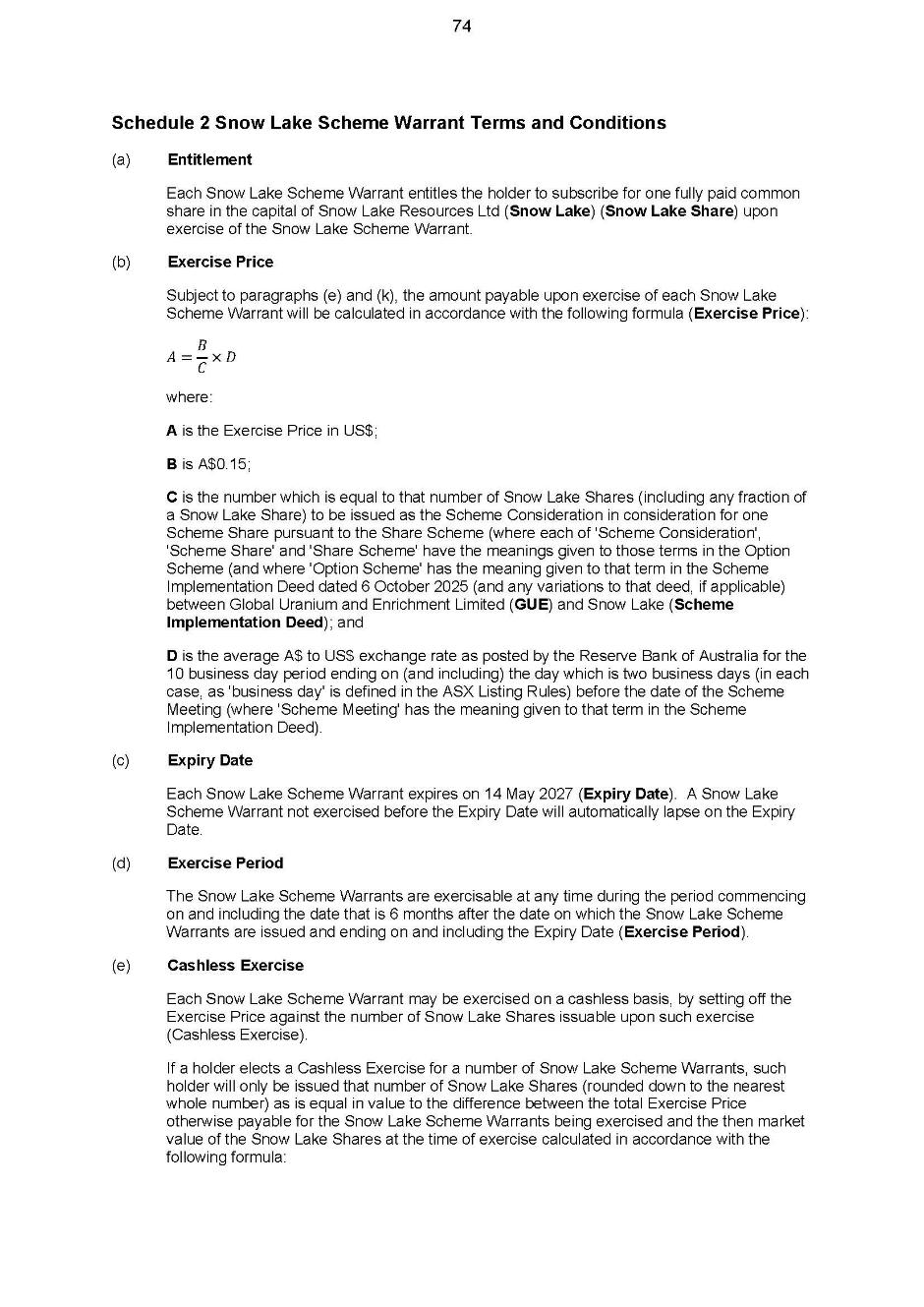
File number: | WAD 387 of 2025 |
Judgment of: | VANDONGEN J |
Date of judgment: | 3 February 2026 |
Date of publication of reasons: | 12 February 2026 |
Catchwords: | CORPORATIONS - scheme of arrangement - second court hearing for scheme - application for orders under s 411 of the Corporations Act 2001 (Cth) - whether statutory requirements satisfied - whether Court should exercise discretion in favour of making orders sought - orders made |
Legislation: | Corporations Act 2001 (Cth) ss 411, 412 |
Cases cited: | Allkem Limited, in the matter of Allkem Limited (No 2) [2023] FCA 1657 Atlassian Corporation Pty Limited, in the matter of Atlassian Corporation Pty Limited [2013] FCA 1451 Carbon Revolution Limited, in the matter of Carbon Revolution Limited (No 3) [2023] FCA 1270 Envirosuite Limited, in the matter of Envirosuite Limited (No 2) [2025] FCA 941 Global Uranium and Enrichment Limited, in the matter of Global Uranium and Enrichment Limited [2025] FCA 1684 In the matter of Brickworks Limited; In the matter of Washington H. Soul Pattinson and Company Limited (No 2) [2025] NSWSC 1068 iProperty Group Limited, in the matter of iProperty Group Limited [2015] FCA 1507 In the matter of Afterpay Limited [2021] NSWSC 1709 Seven Network Limited (ACN 052 816 789), in the matter of Seven Network Limited (No 3) [2010] FCA 400 |
Division: | General Division |
Registry: | Western Australia |
National Practice Area: | Commercial and Corporations |
Sub-area: | Corporations and Corporate Insolvency |
Number of paragraphs: | 57 |
Date of hearing: | 3 February 2026 |
Counsel for the Plaintiff: | Mr J Sippe |
Solicitor for the Plaintiff: | Thomson Geer |
Counsel for the Interested Party: | Mr C Hood |
Solicitor for the Interested Party: | Hamilton Locke |
ORDERS
WAD 387 of 2025 | ||
IN THE MATTER OF GLOBAL URANIUM AND ENRICHMENT LIMITED (ACN 619 387 085) | ||
GLOBAL URANIUM AND ENRICHMENT LIMITED (ACN 619 387 085) Plaintiff | ||
SNOW LAKE RESOURCES LTD Interested Party | ||
order made by: | VANDONGEN J |
DATE OF ORDER: | 3 FEBRUARY 2026 |
THE COURT ORDERS THAT:
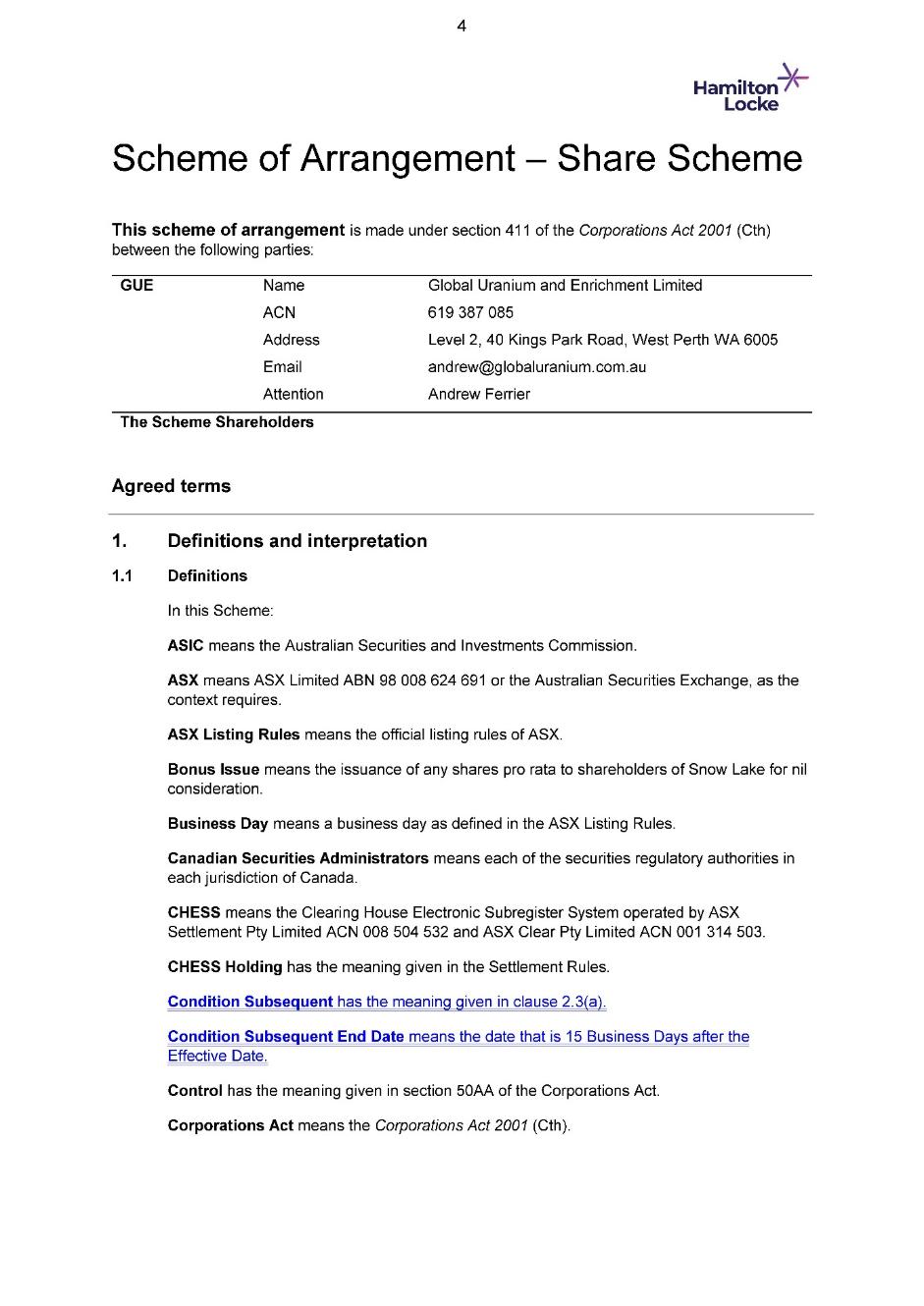
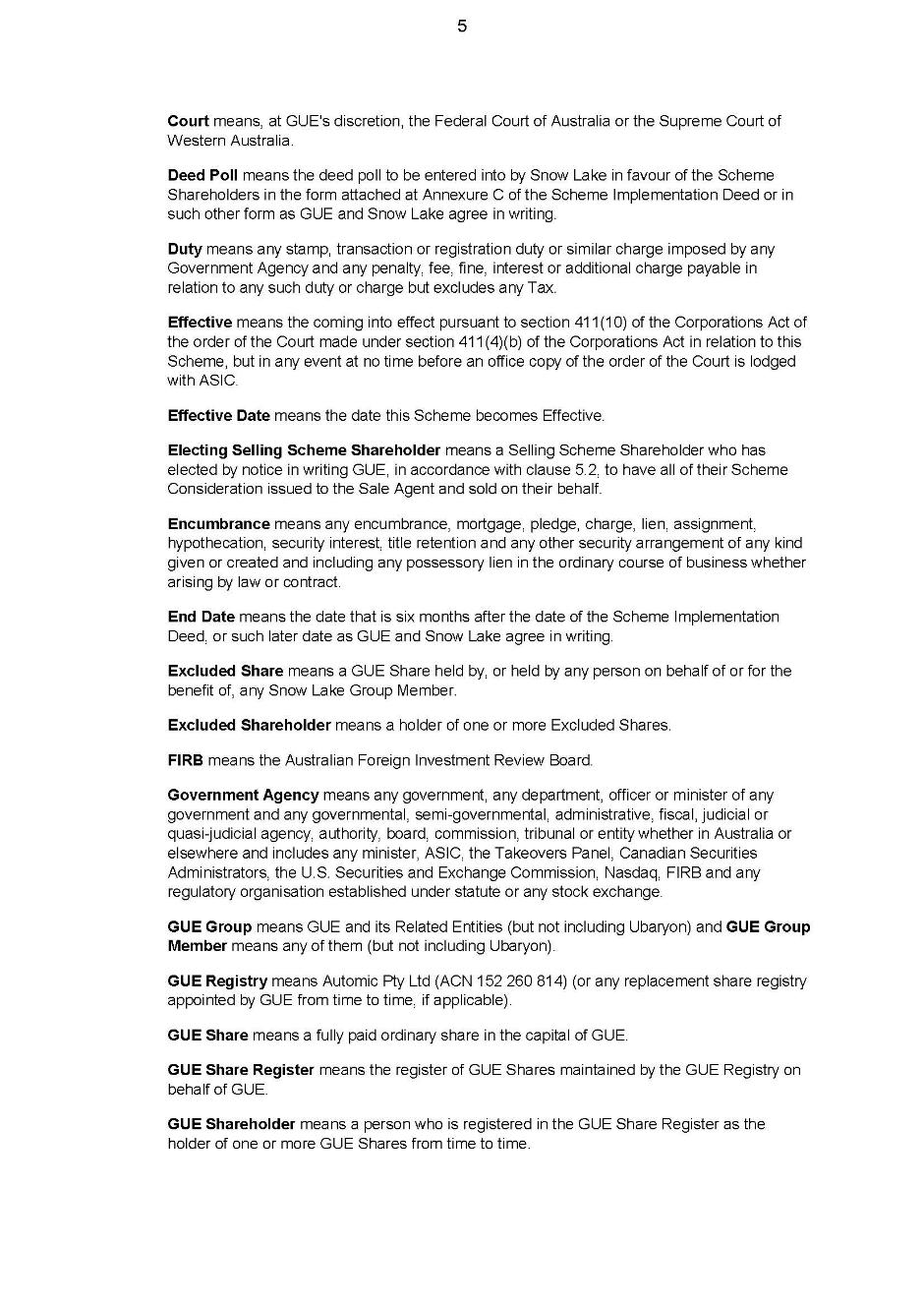
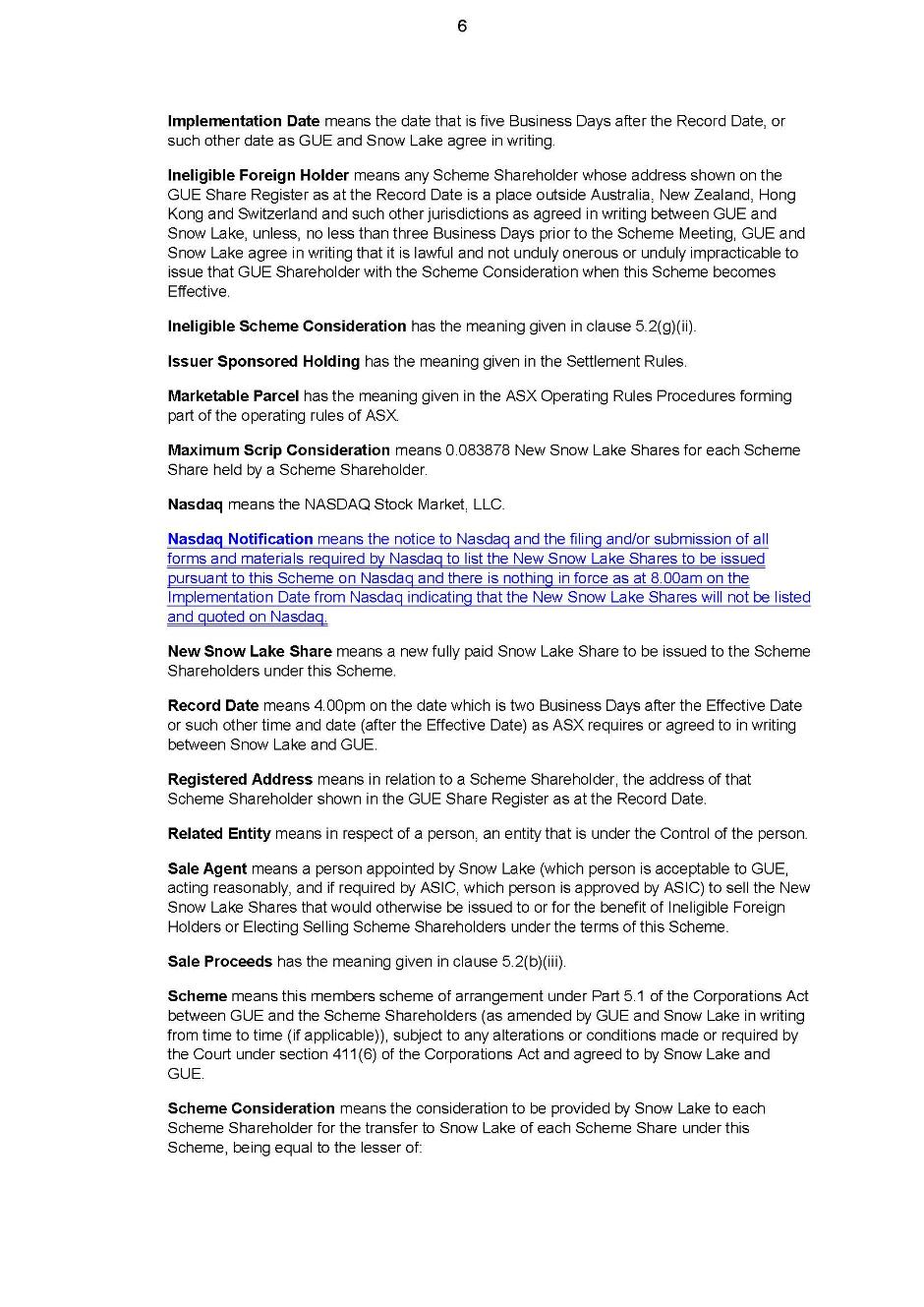
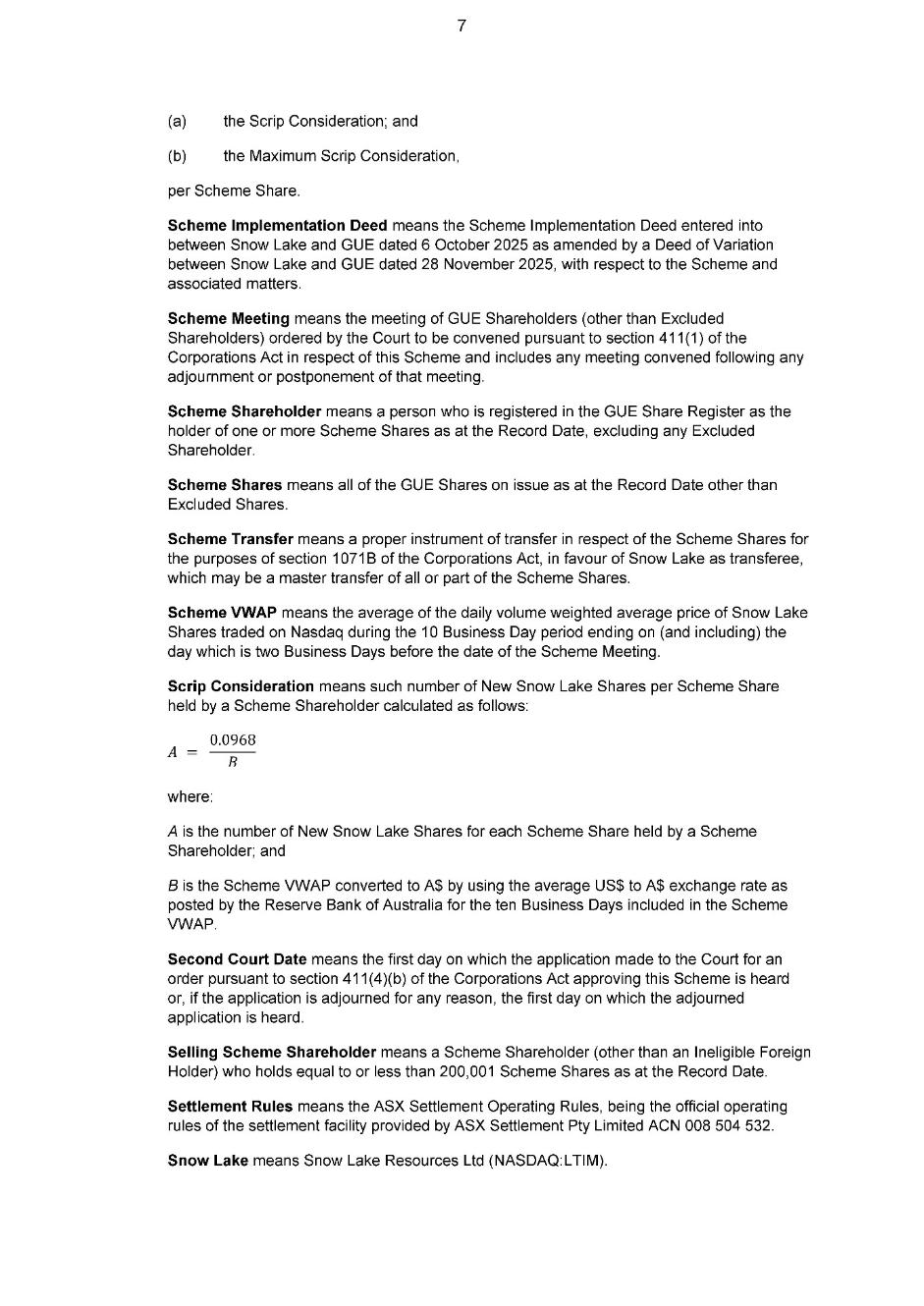
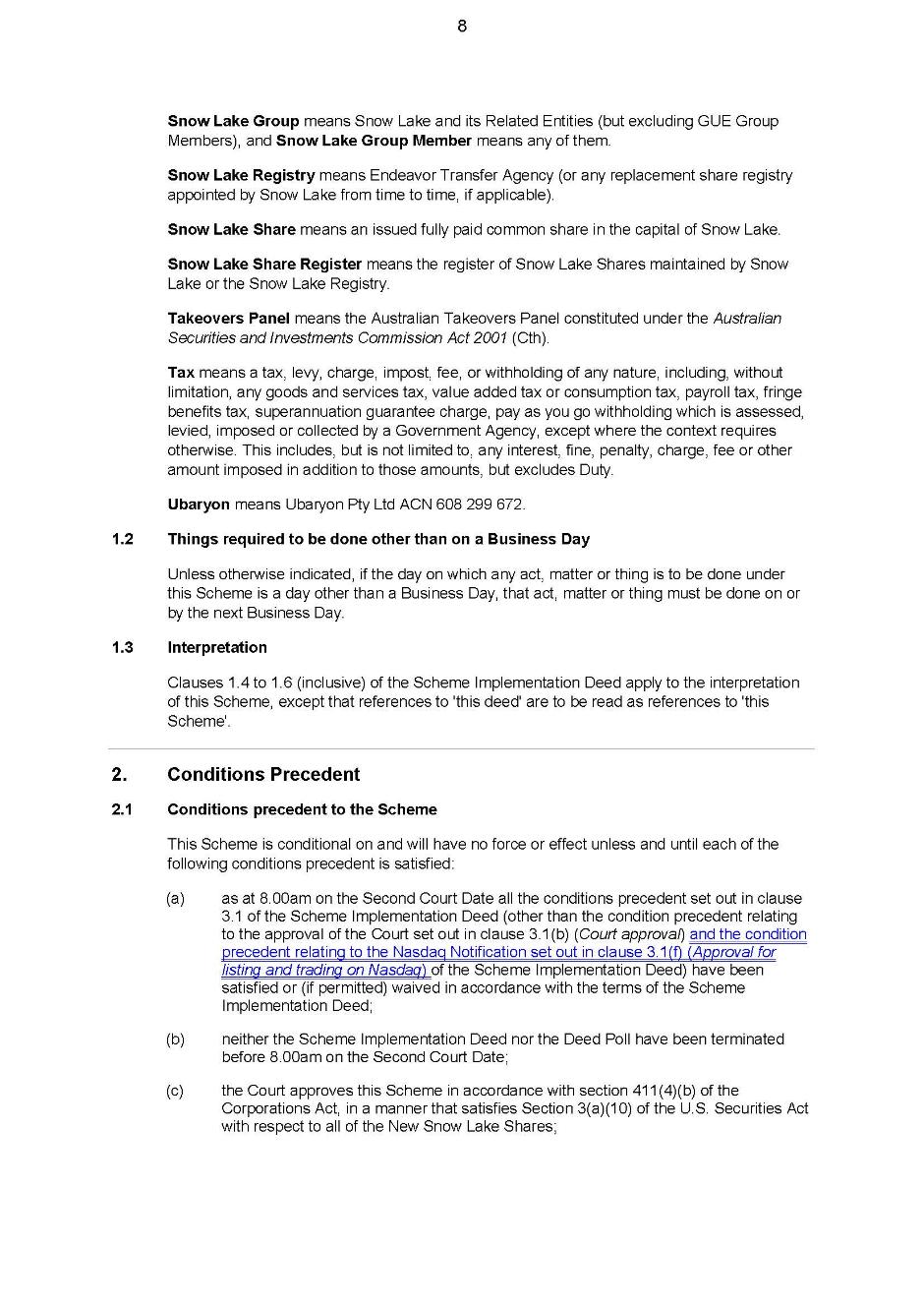
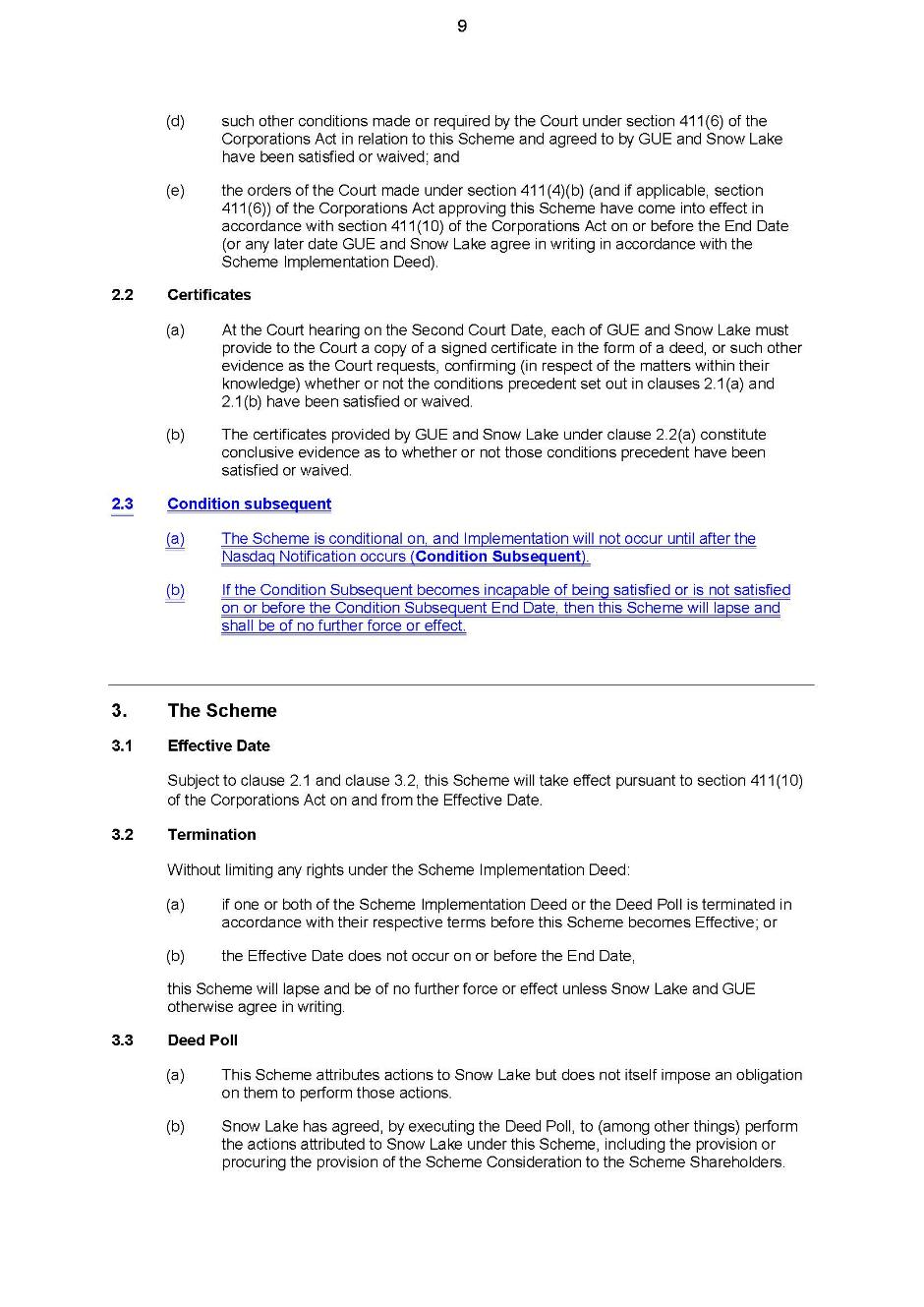
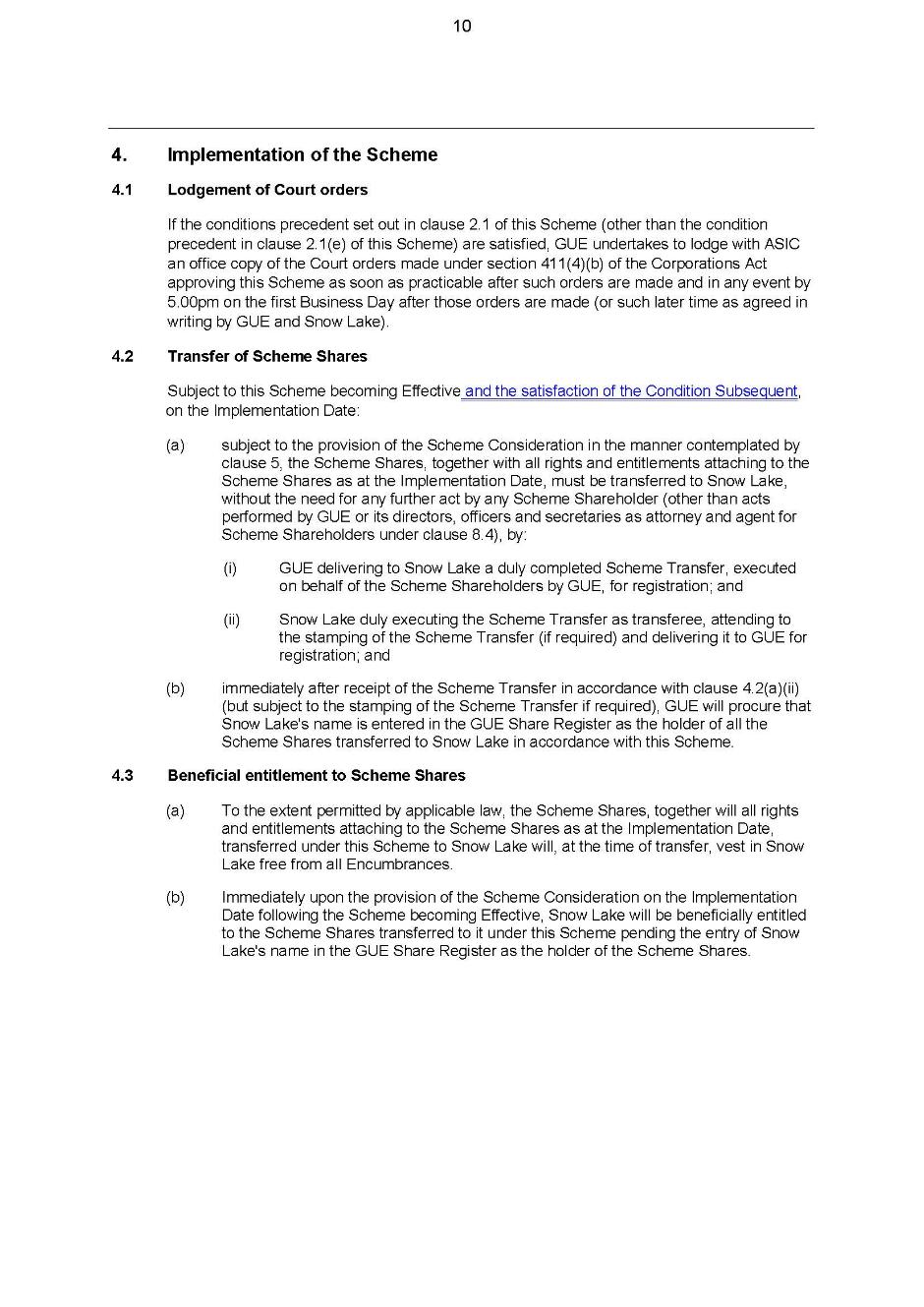
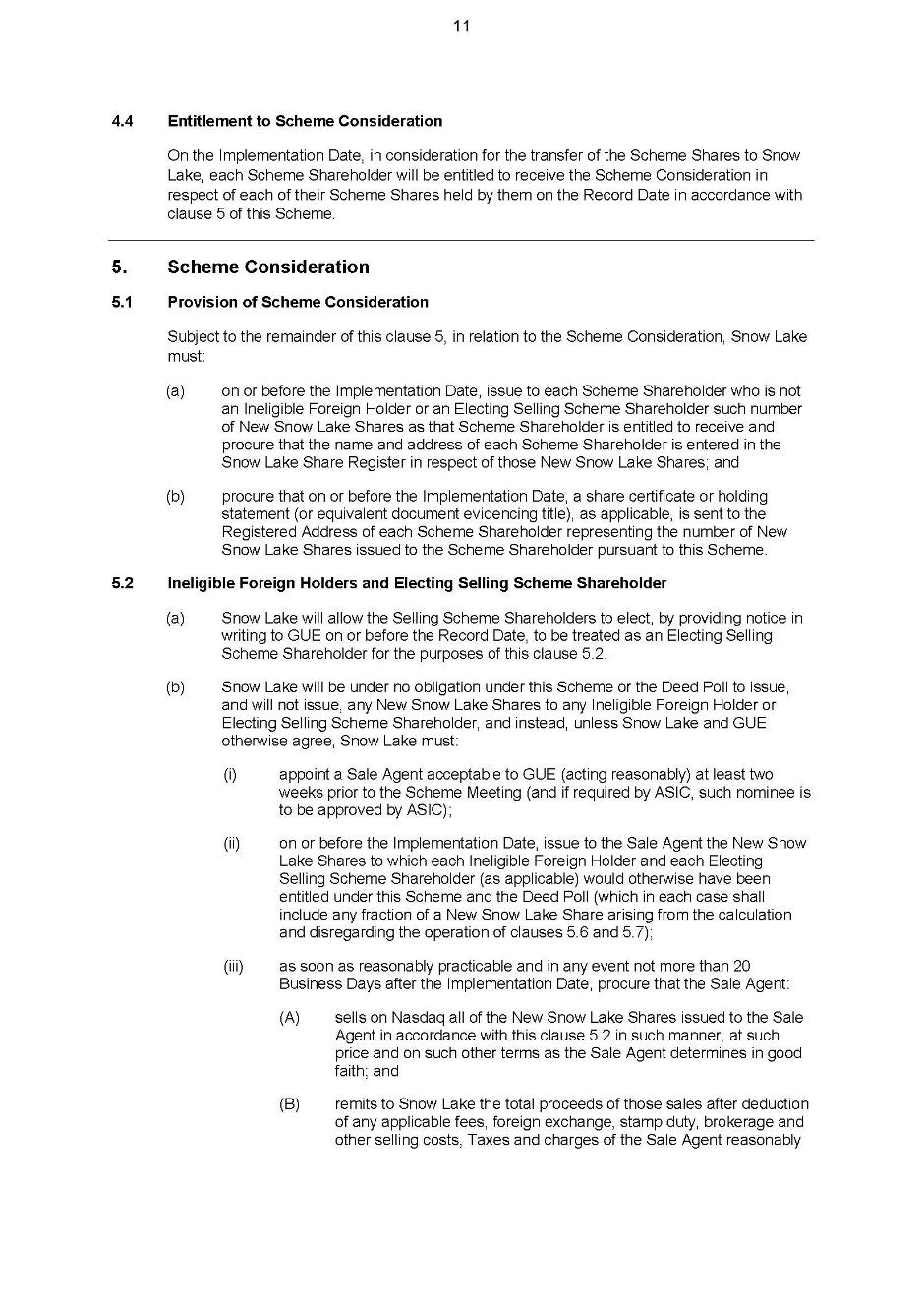
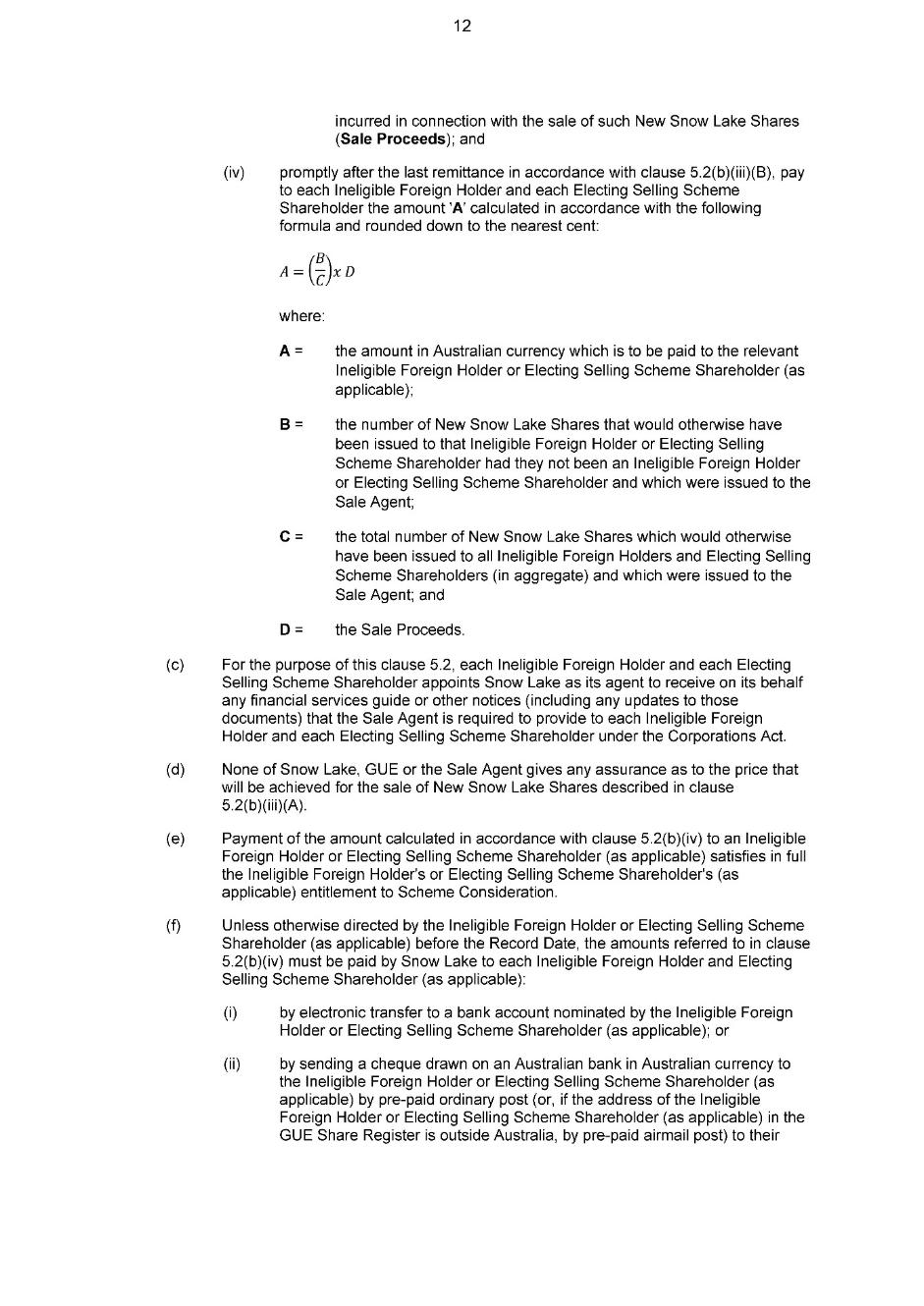
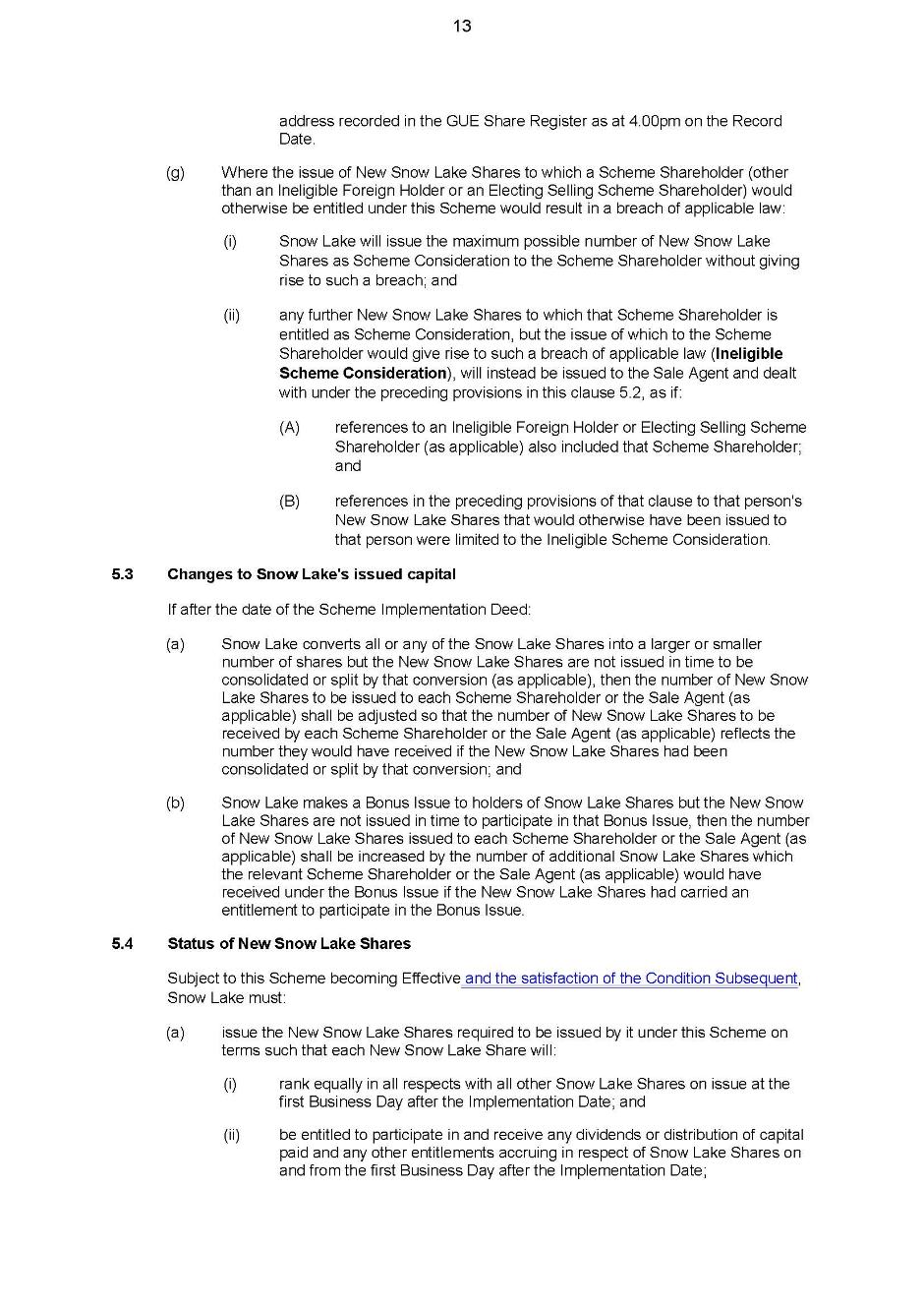
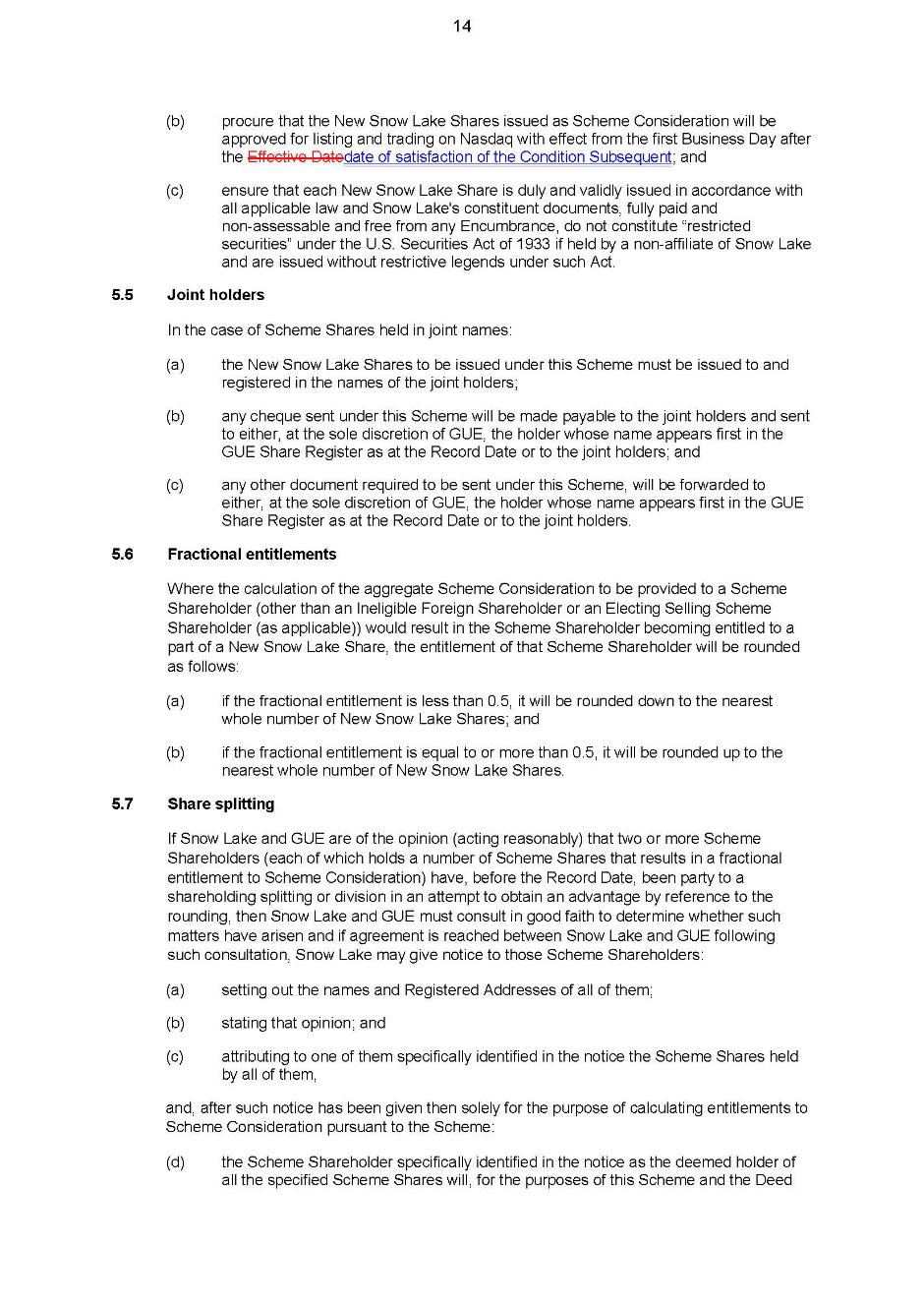
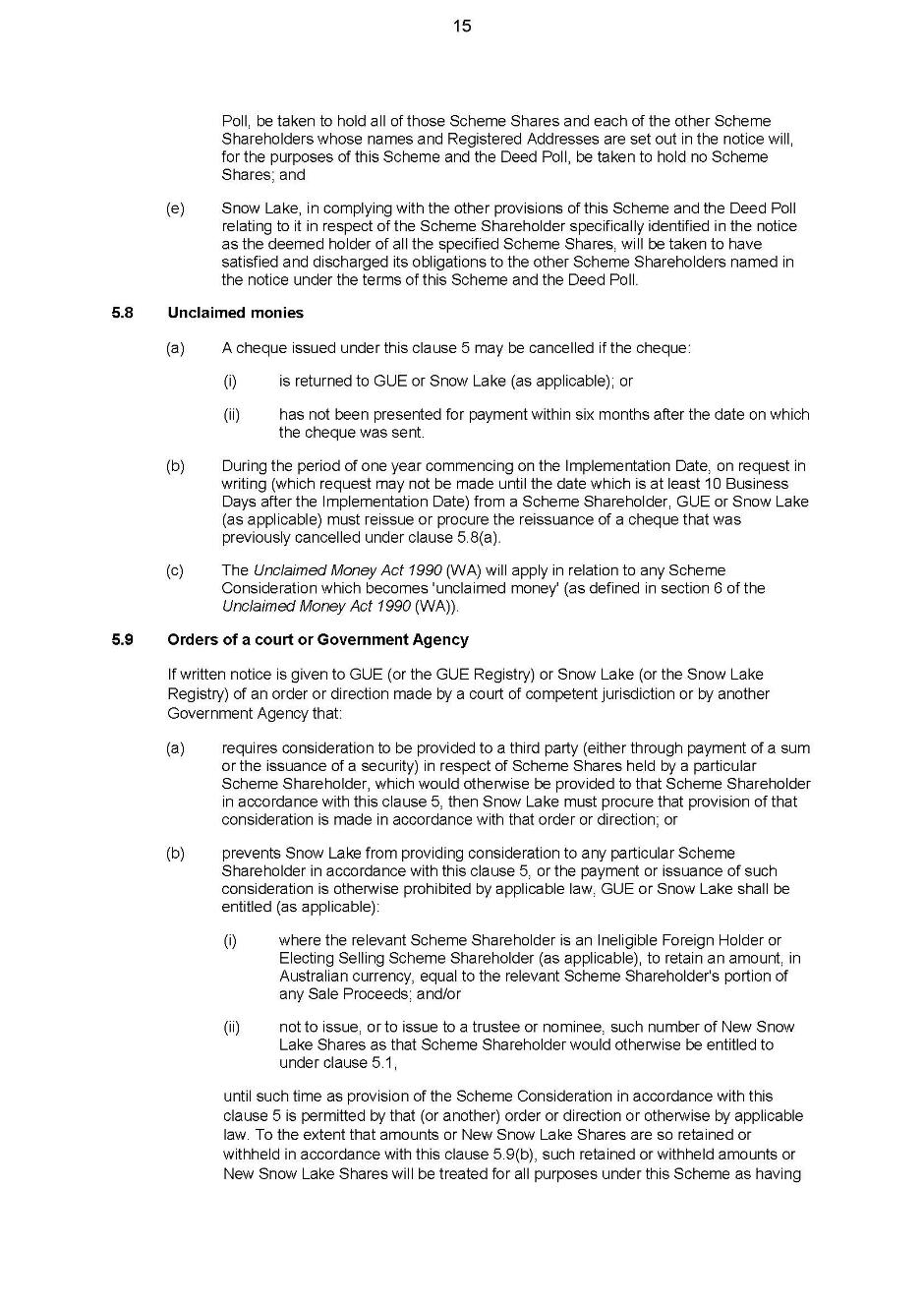
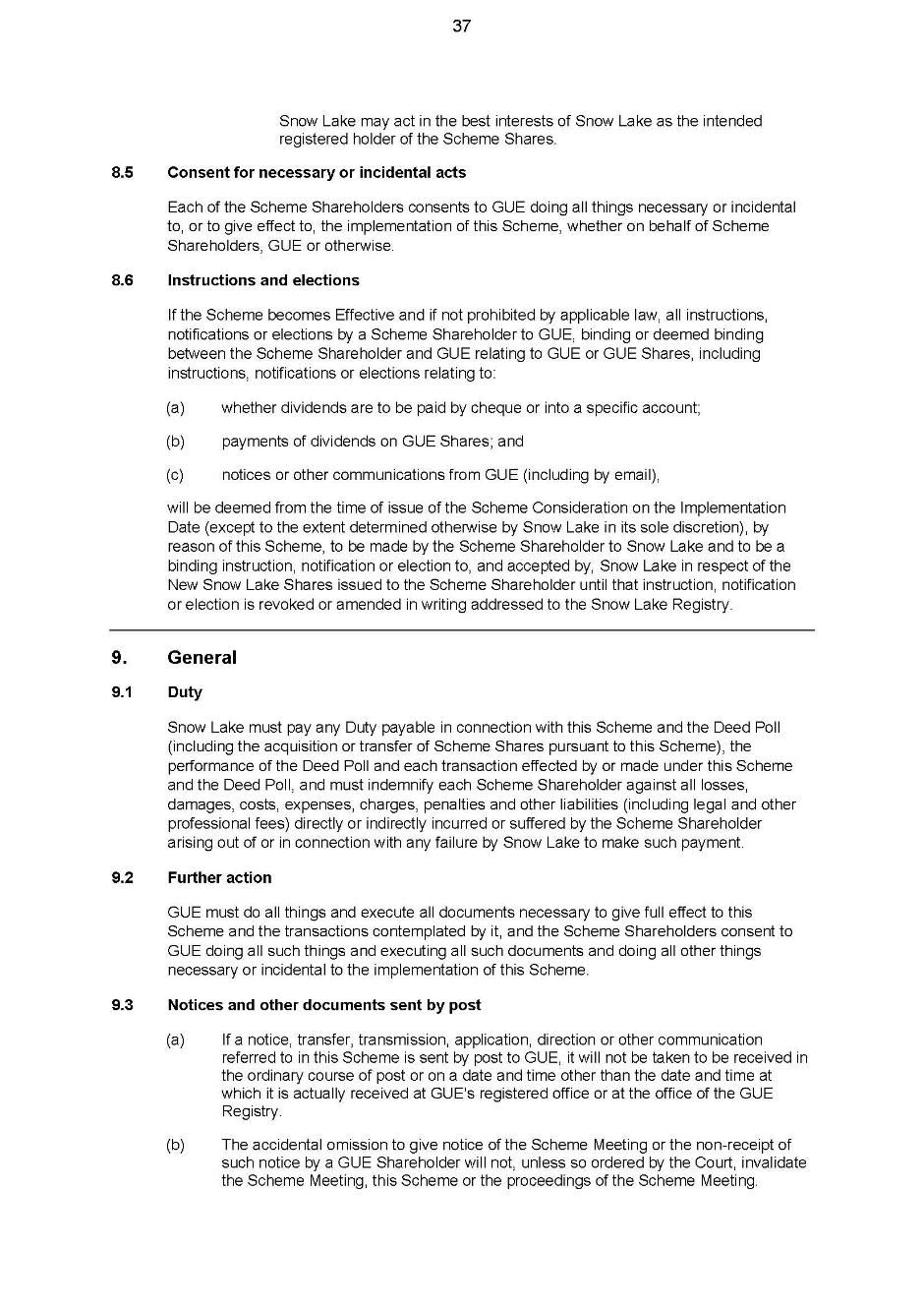
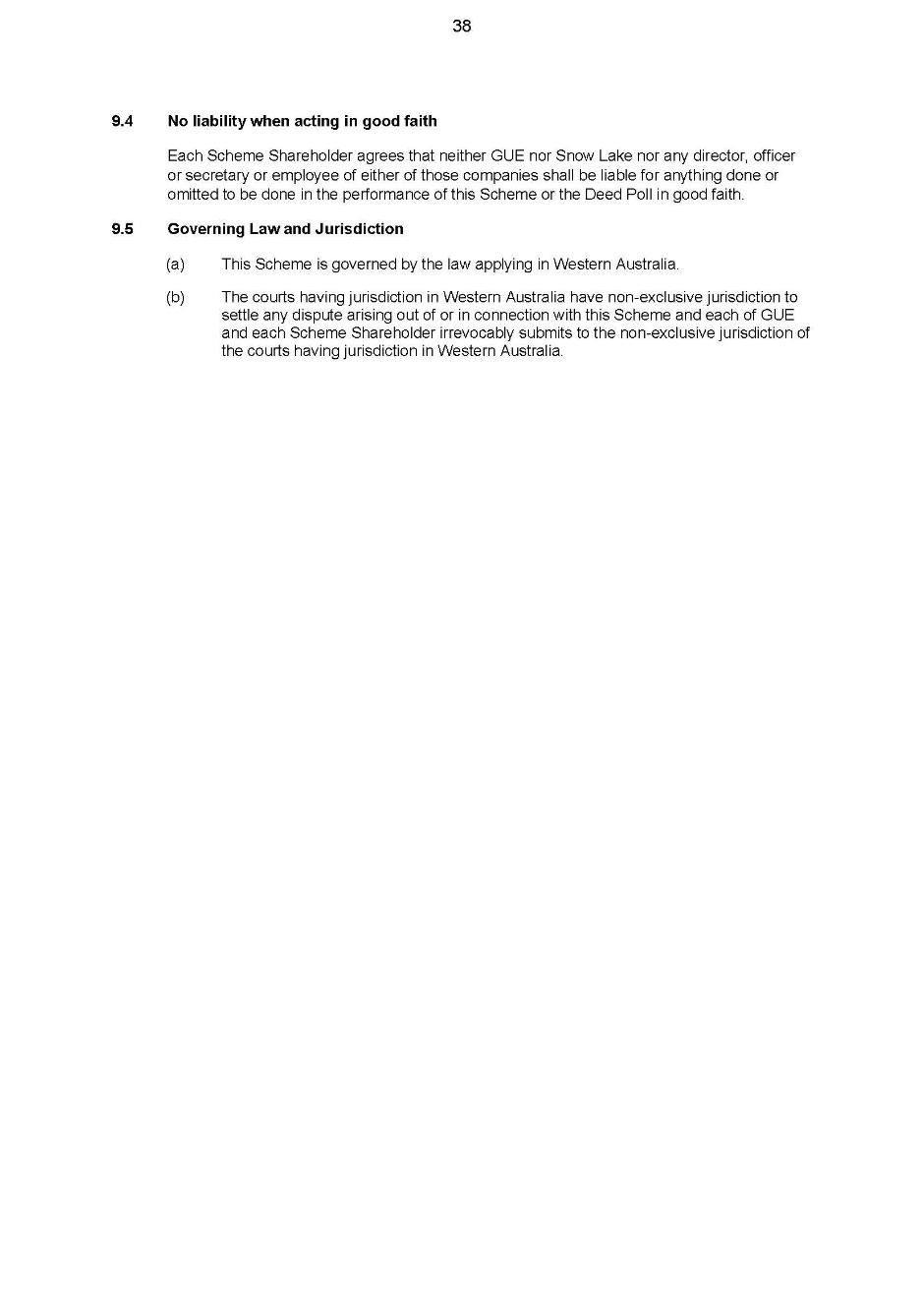
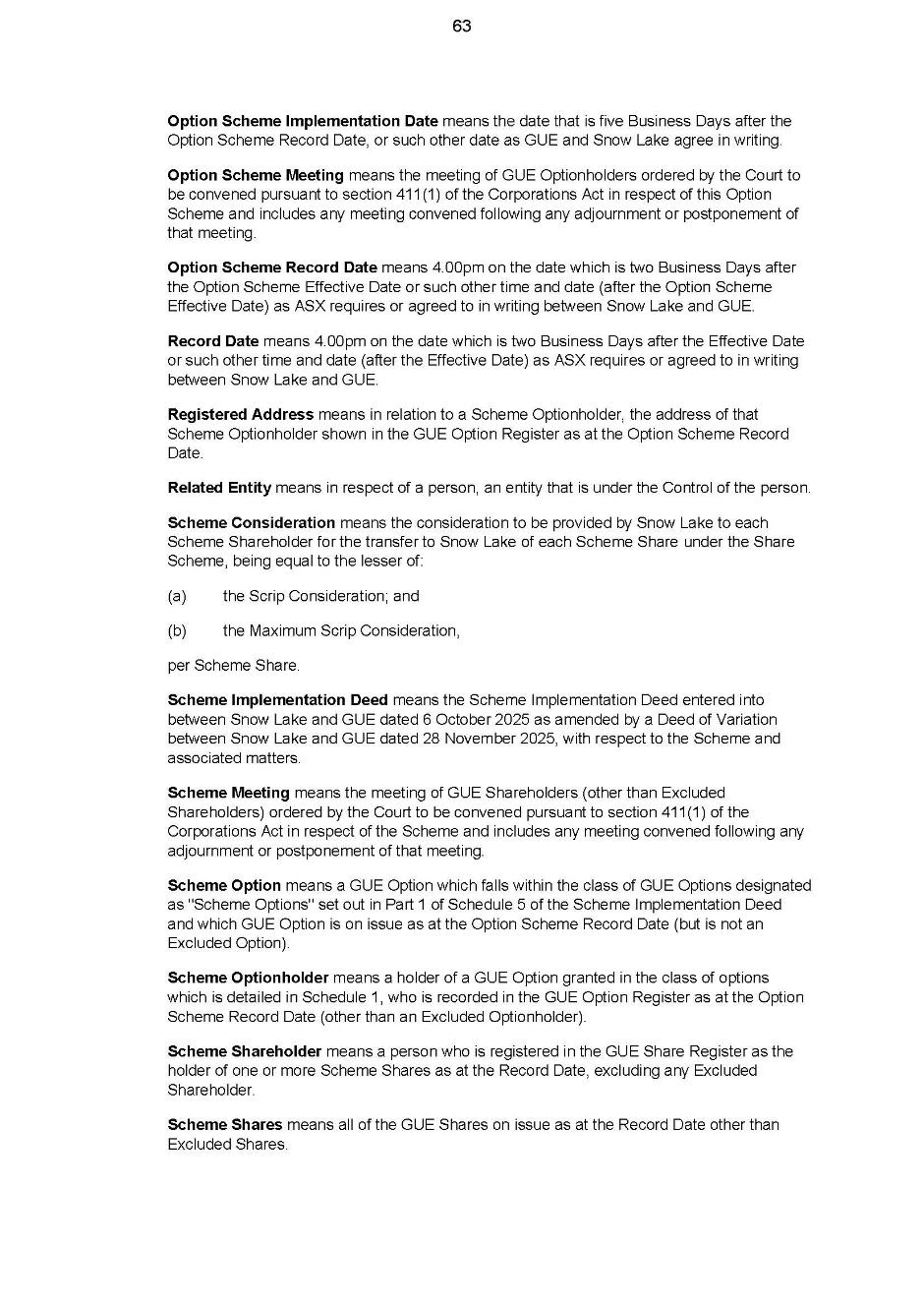
1. Pursuant to ss 411(4)(b) and 411(6) of the Corporations Act 2001 (Cth) (Act) the proposed scheme of arrangement (Share Scheme) between the plaintiff and the holders of fully paid ordinary shares in the plaintiff, in the form set out at pages 678-693 of the third affidavit of Hendrik van Aswegen sworn 17 December 2025 as amended as shown in mark-up in Annexure A to these orders, be approved, such that the Share Scheme as so amended and approved is as set out in Annexure B to these orders.
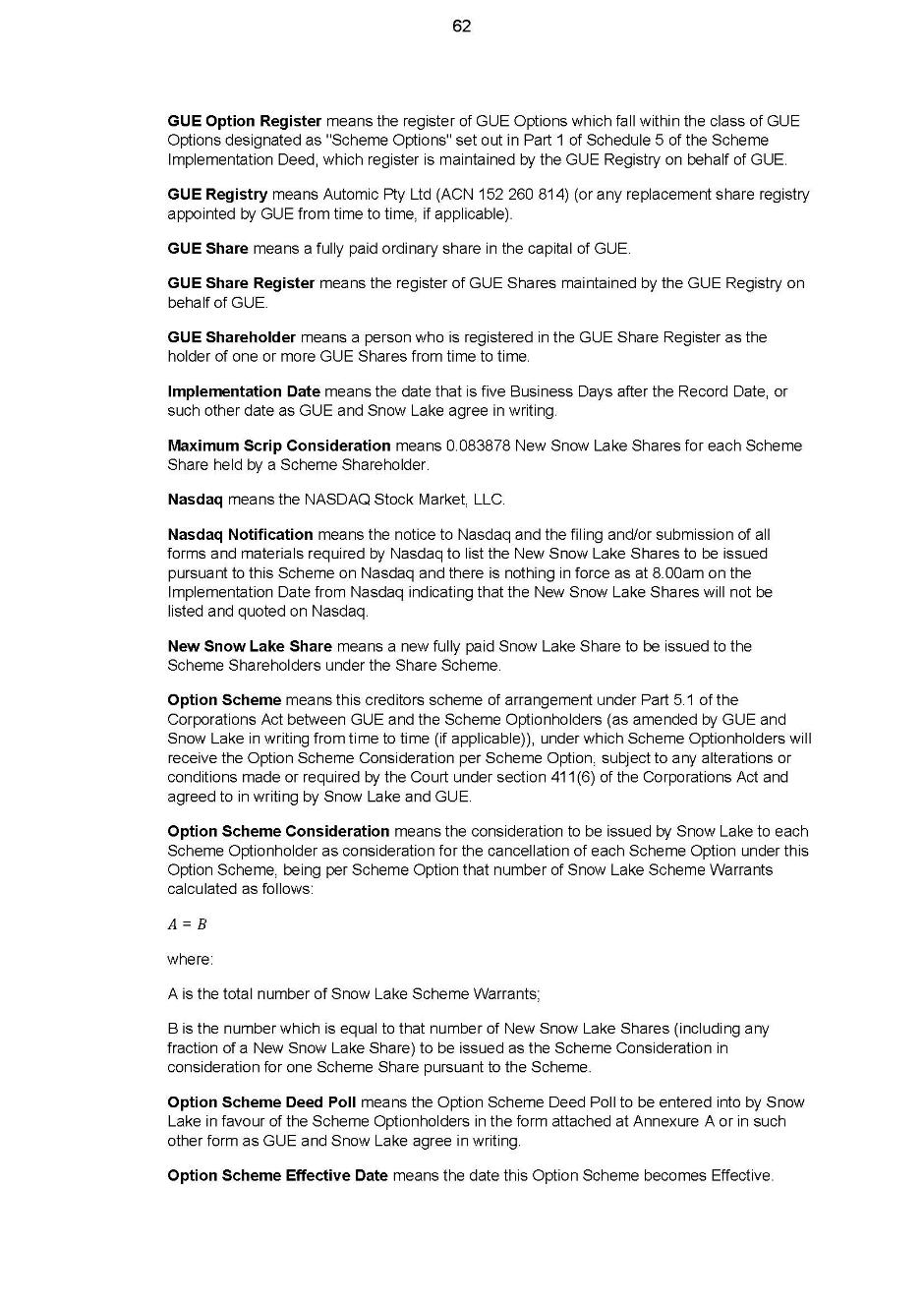
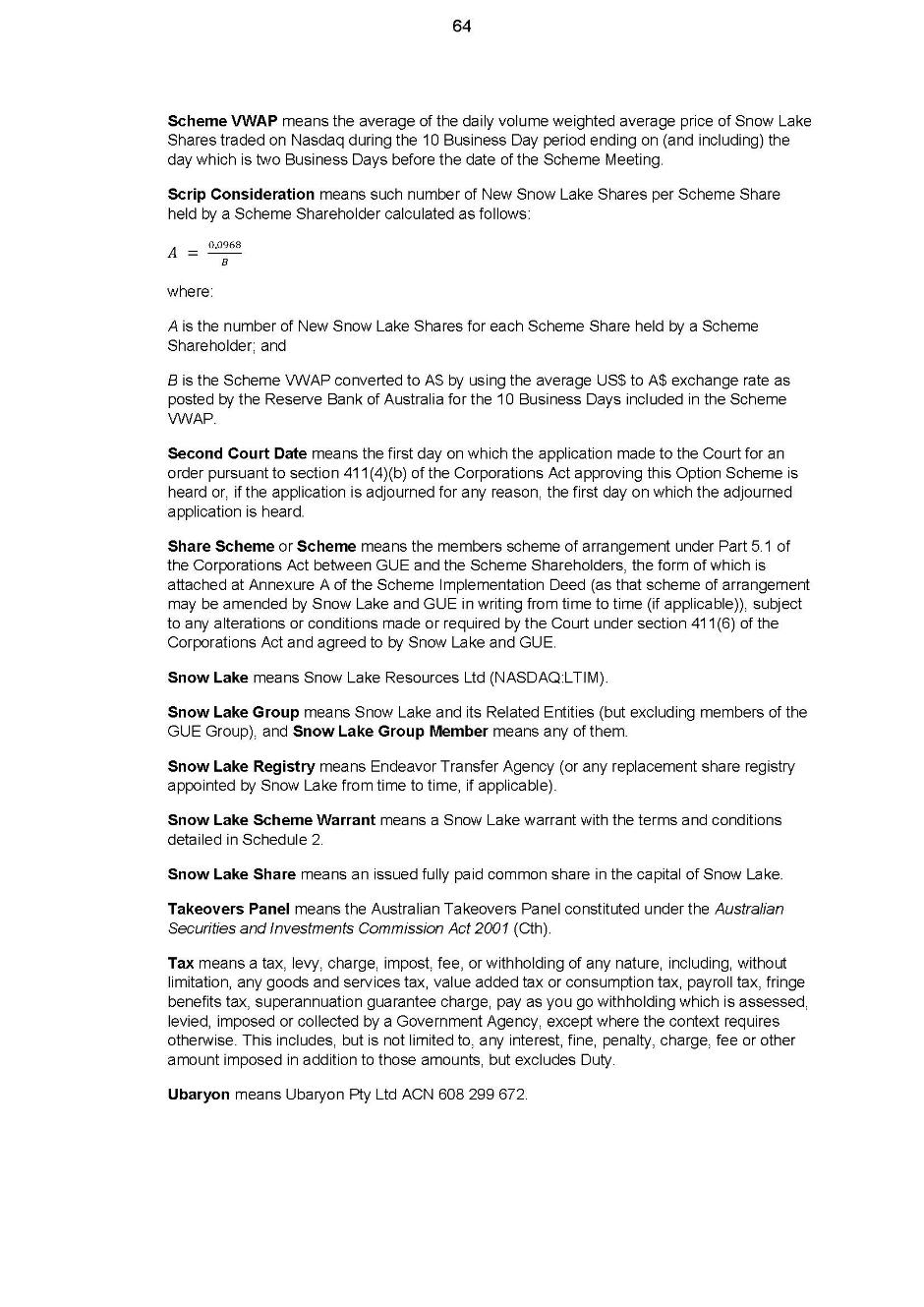
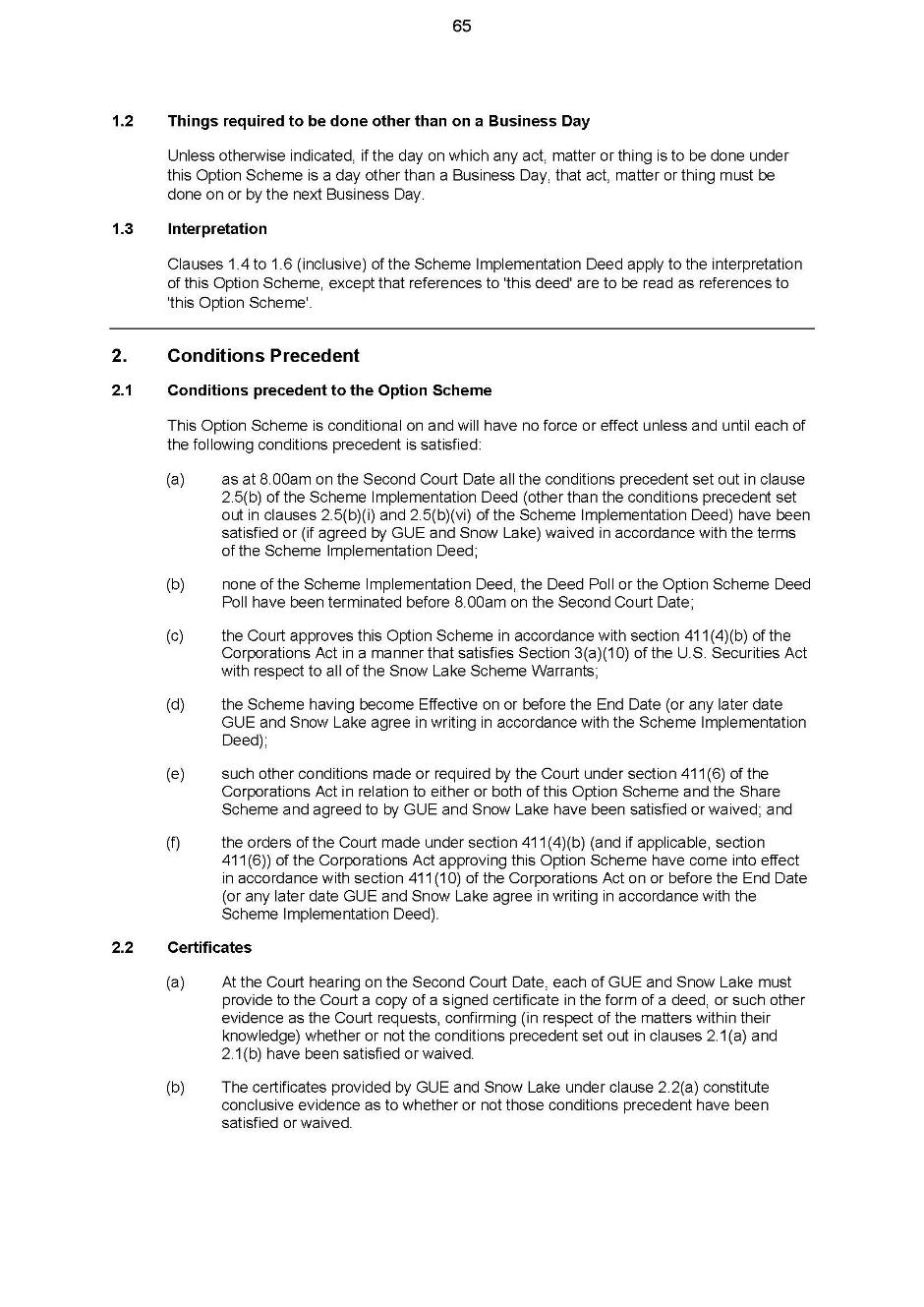
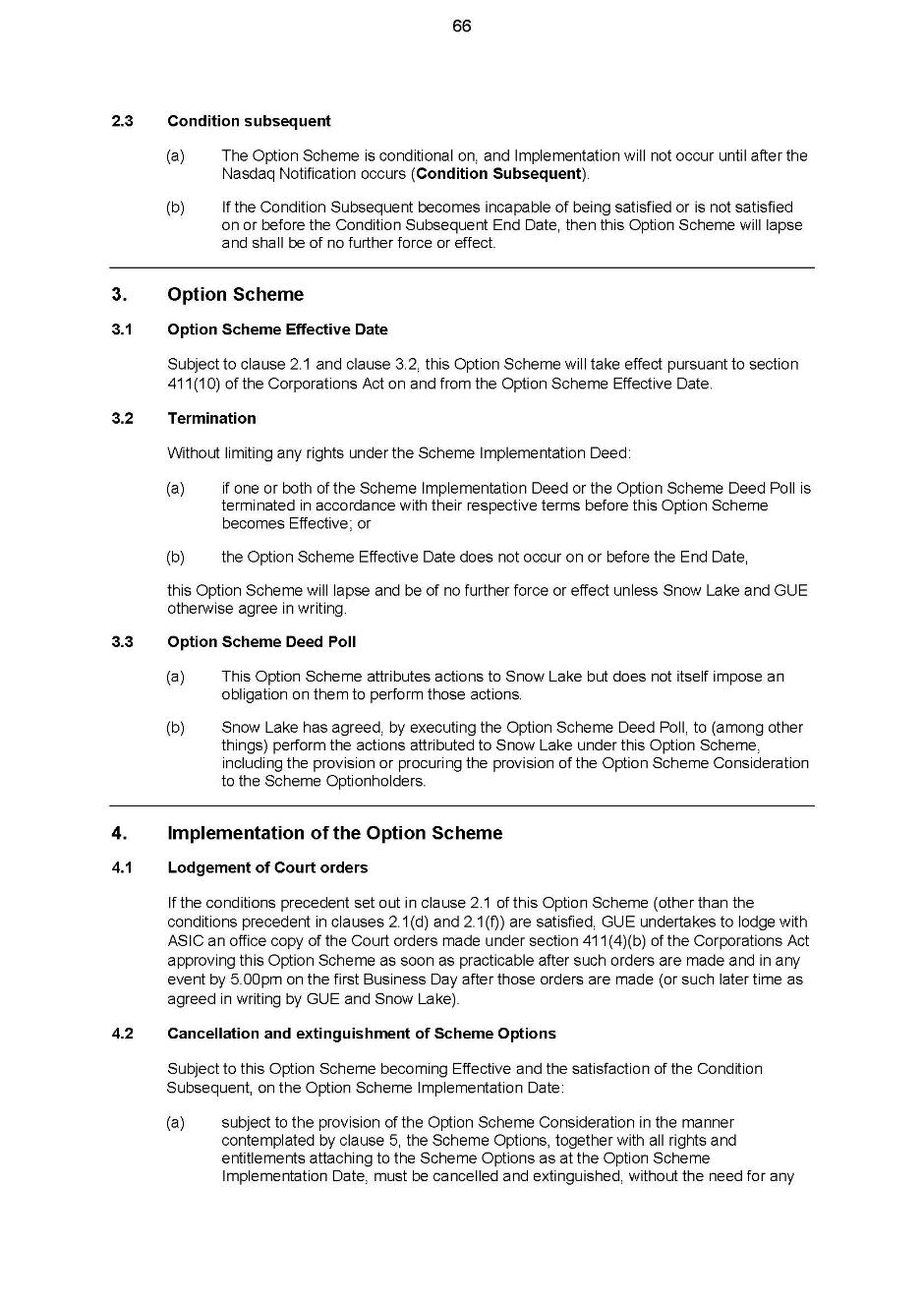
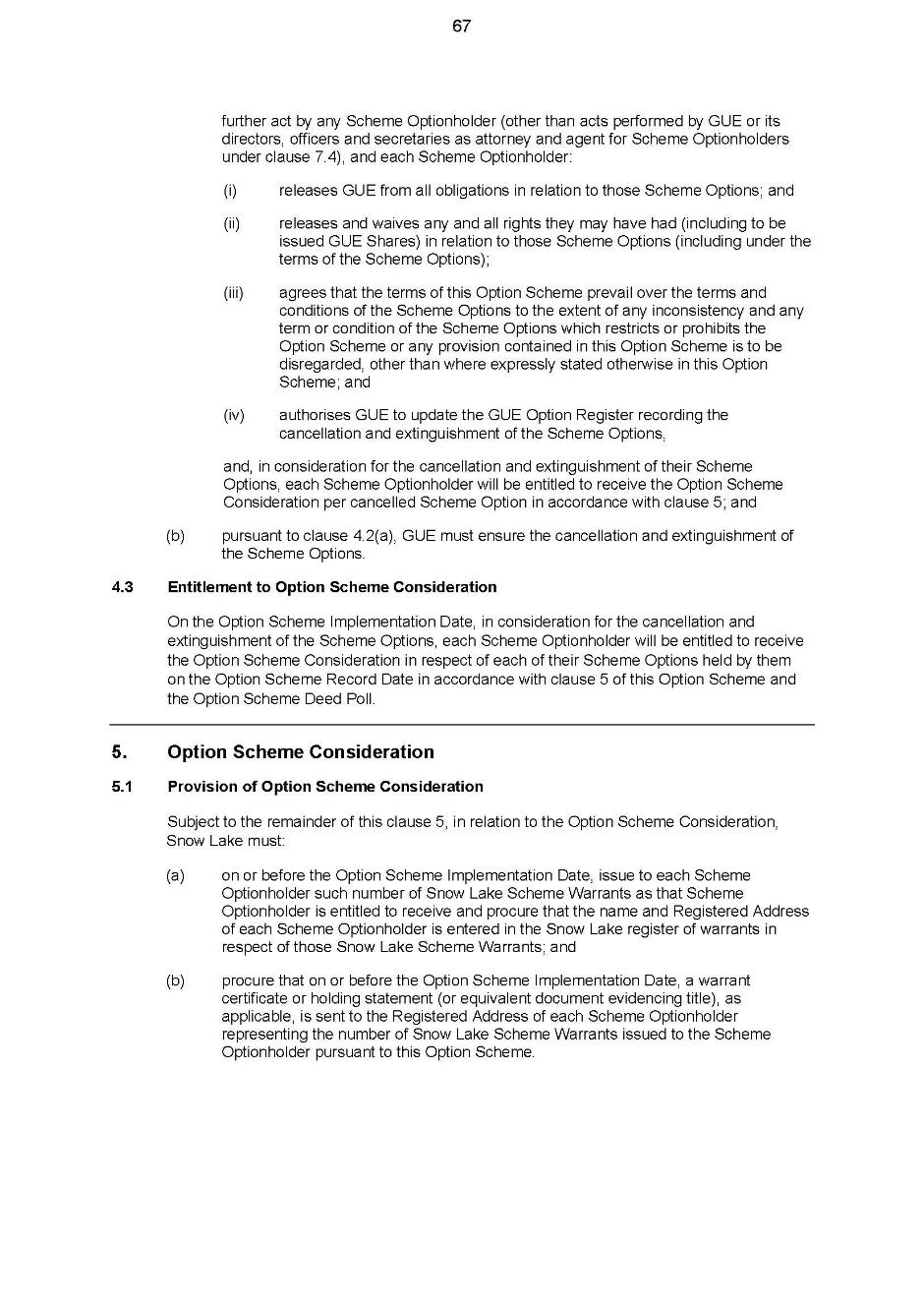
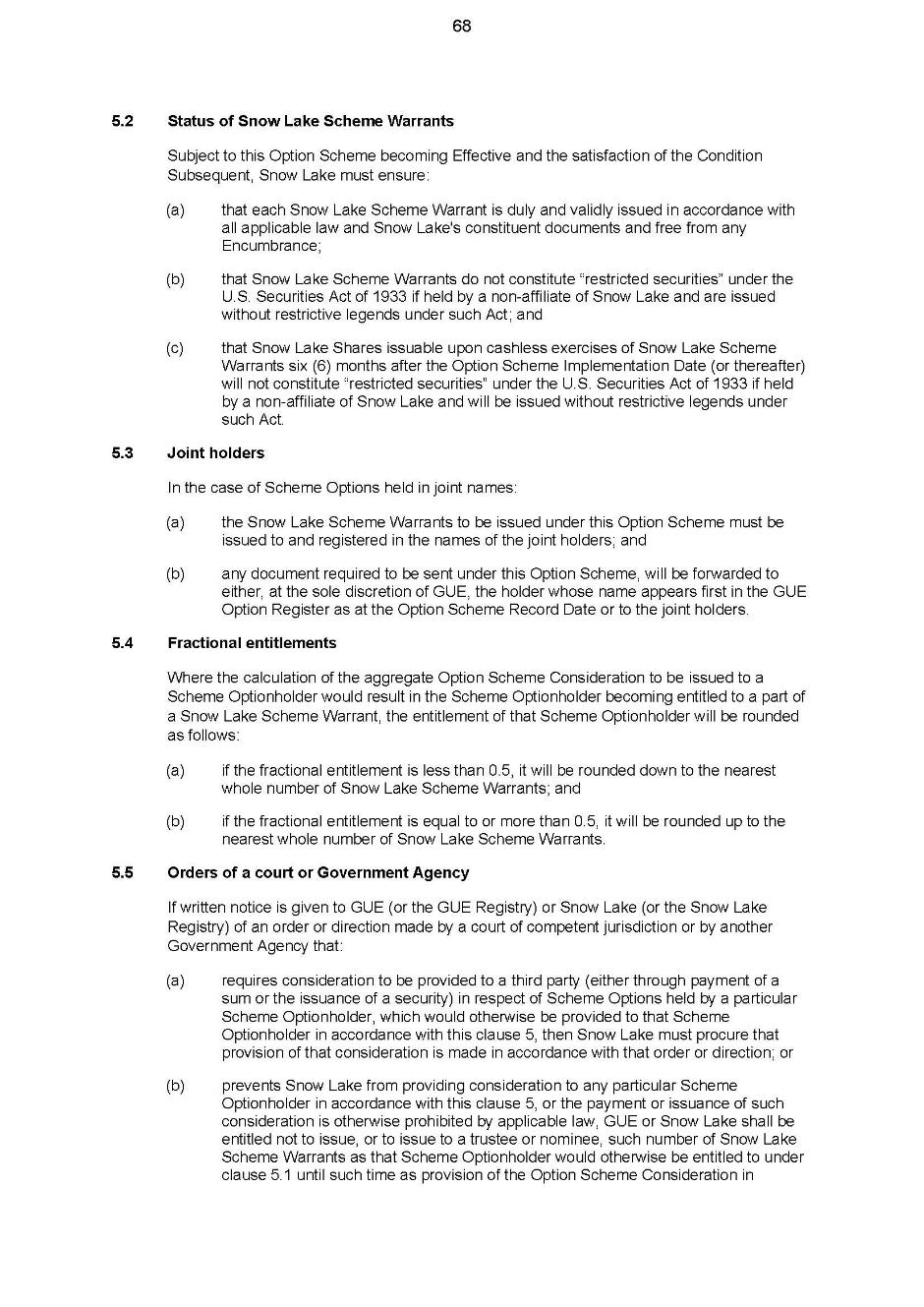
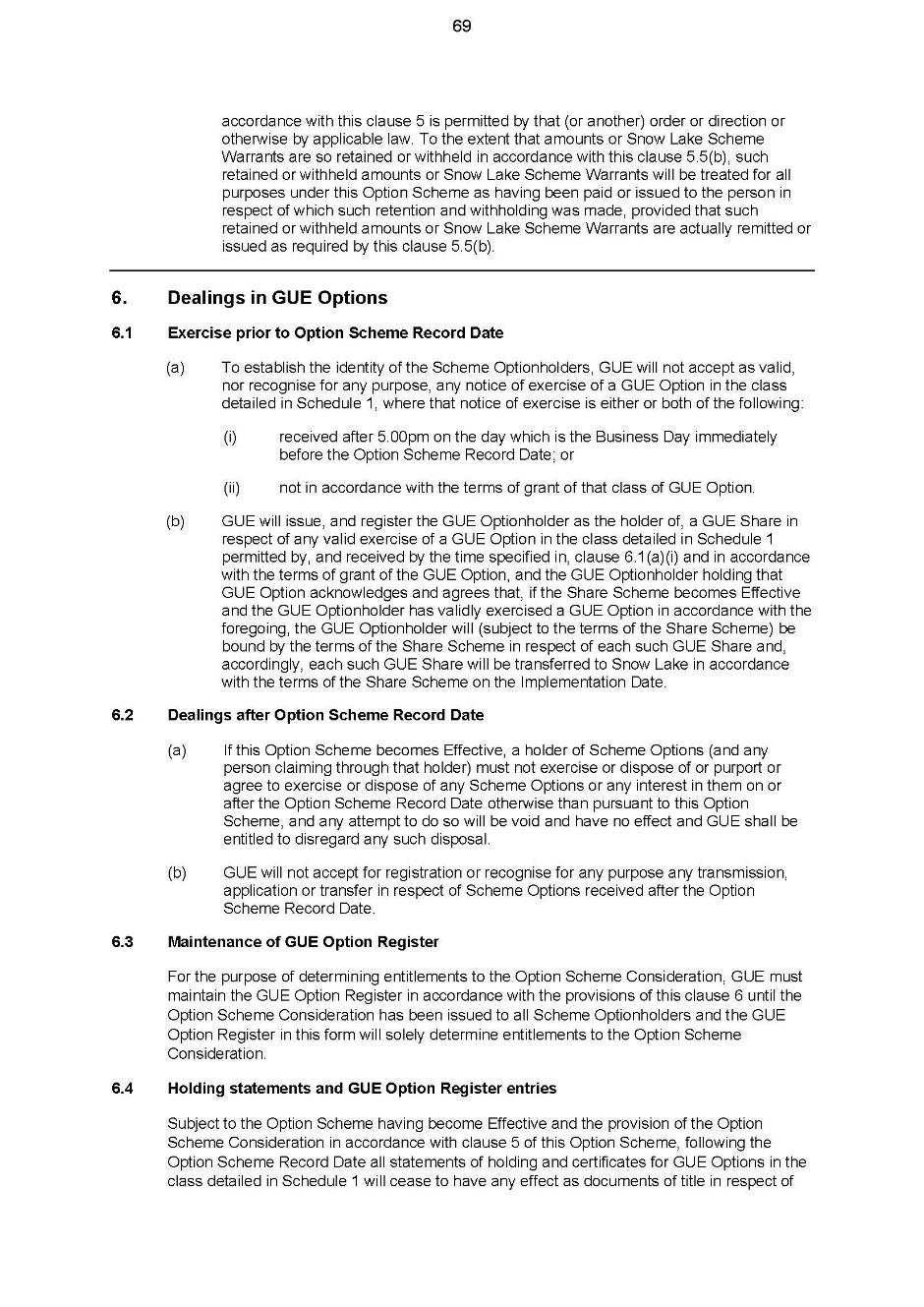
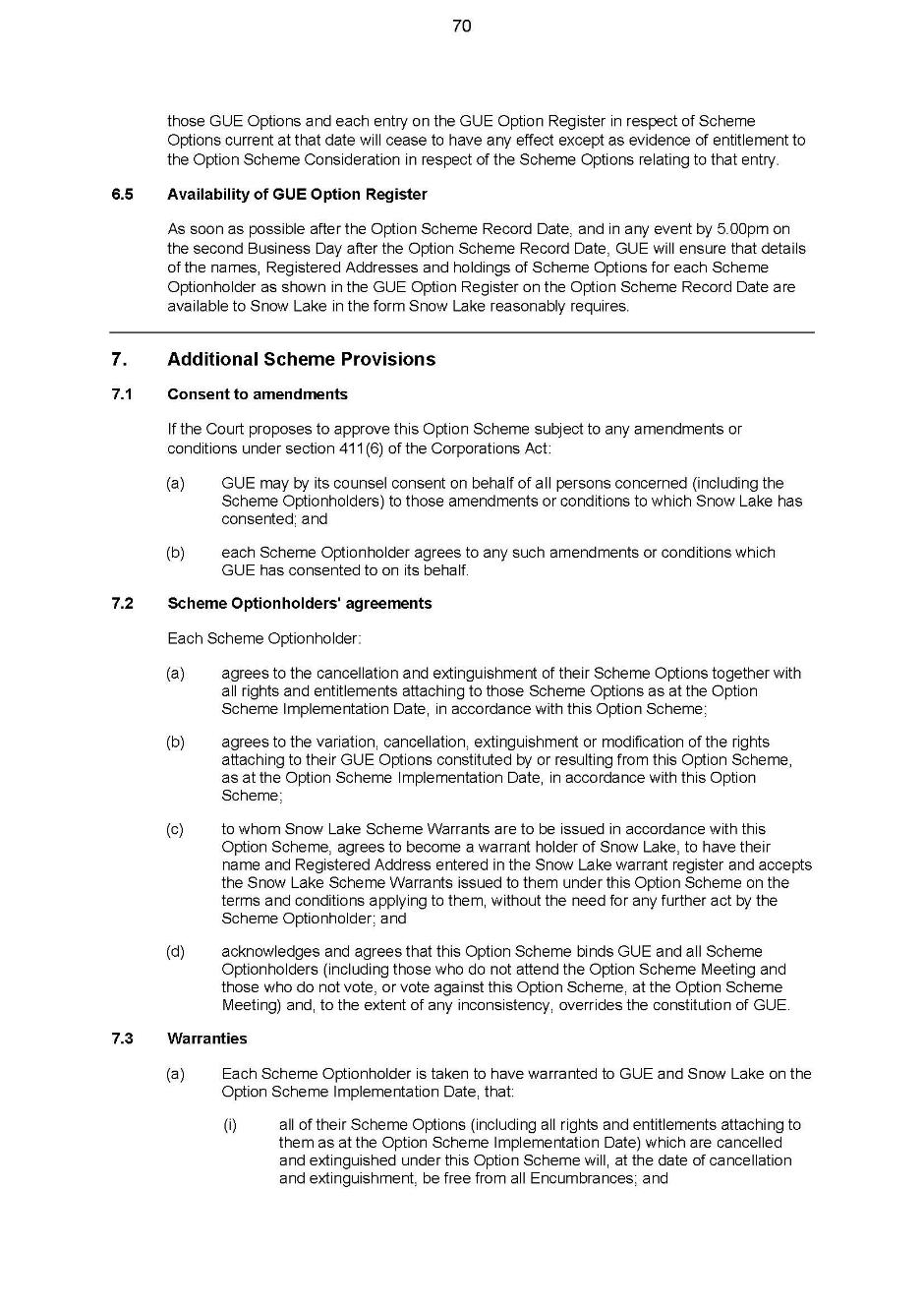
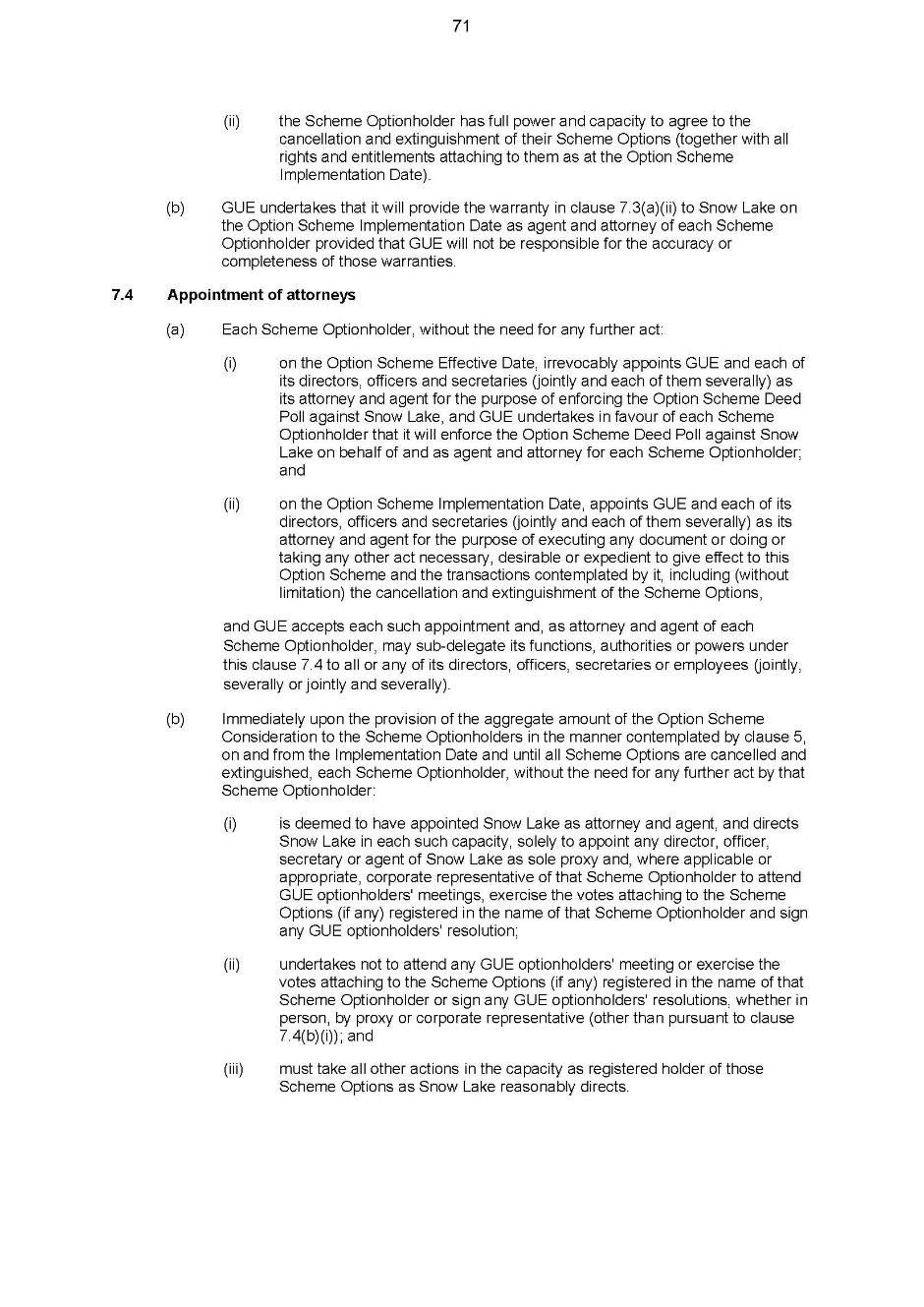
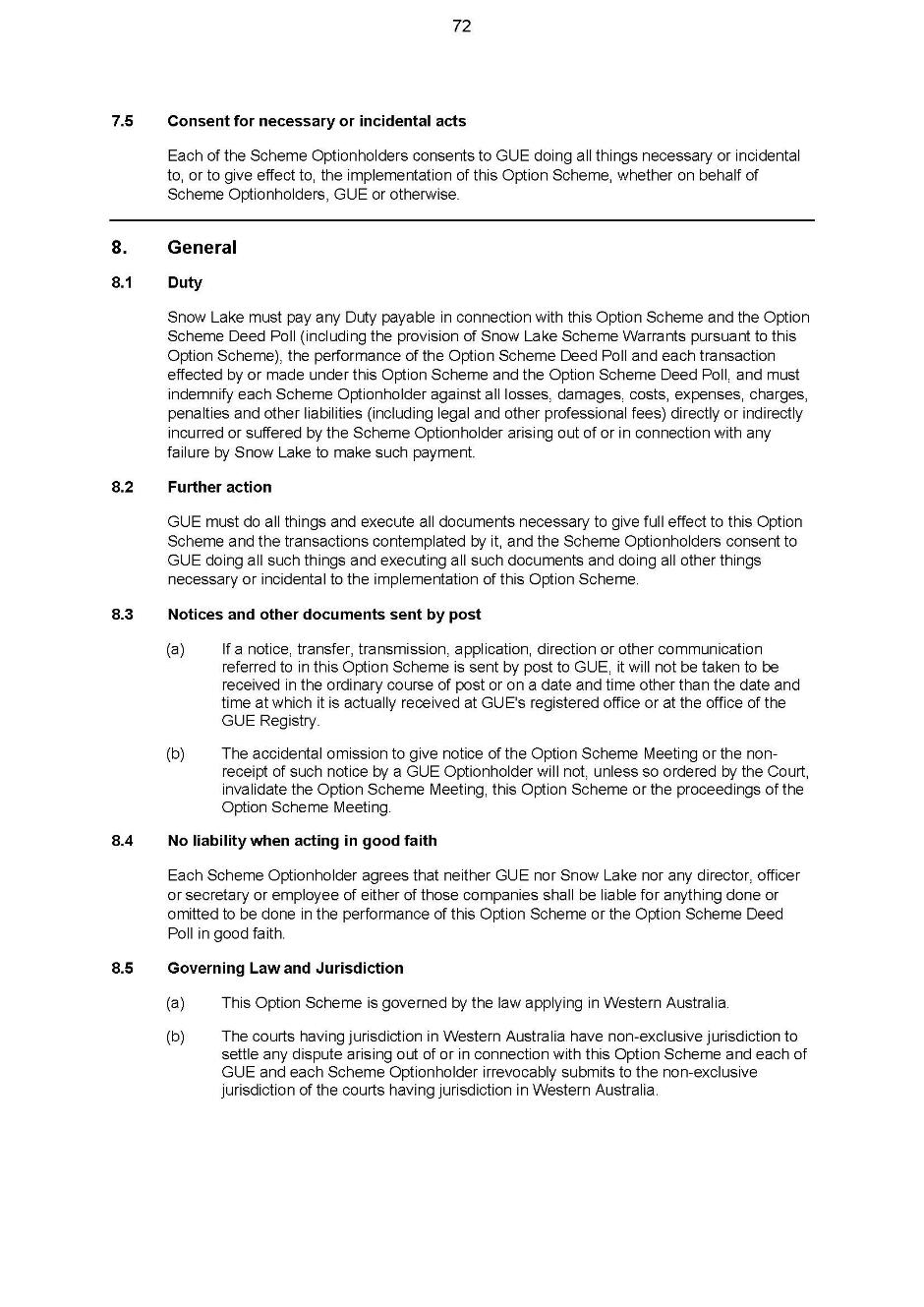
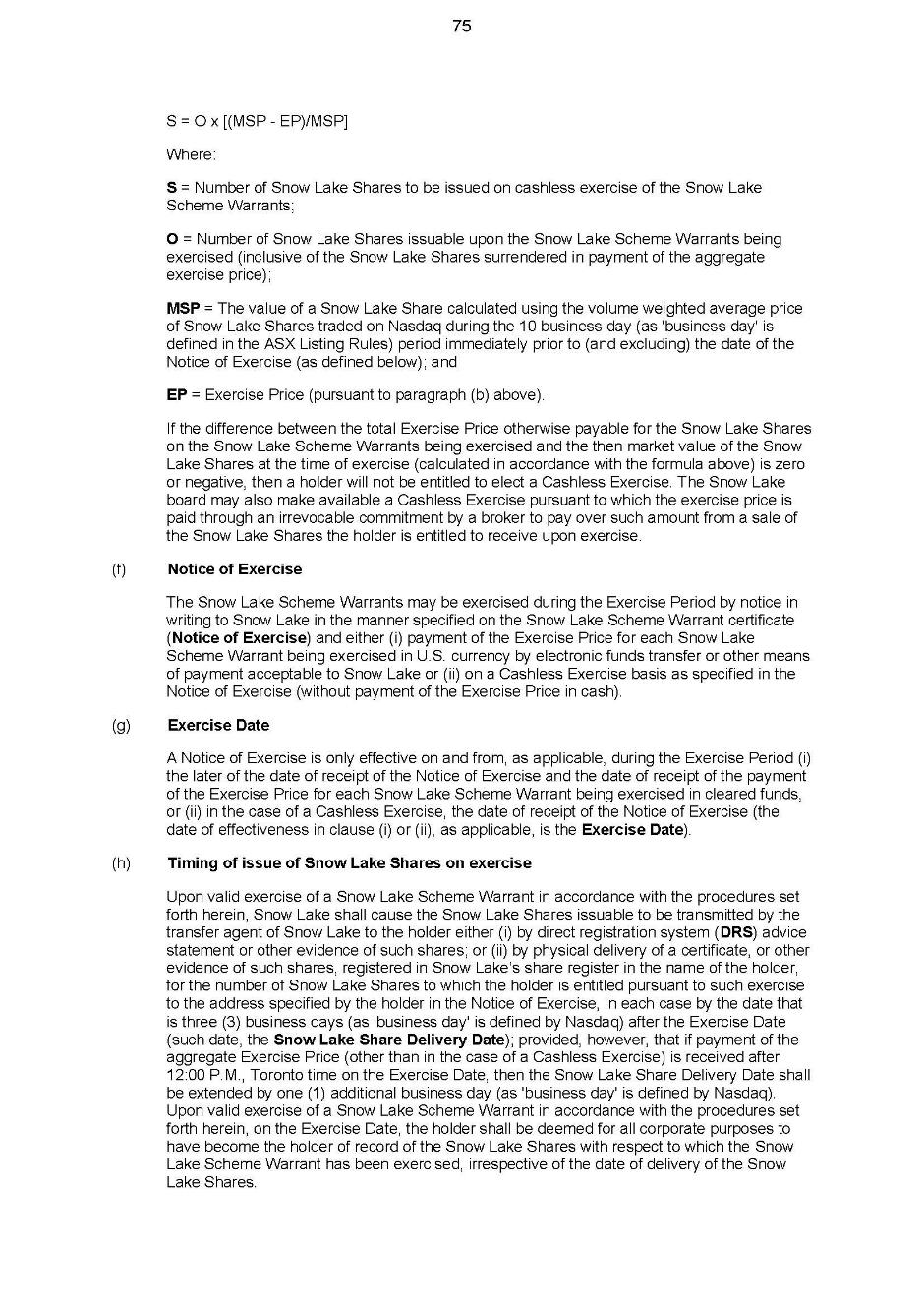
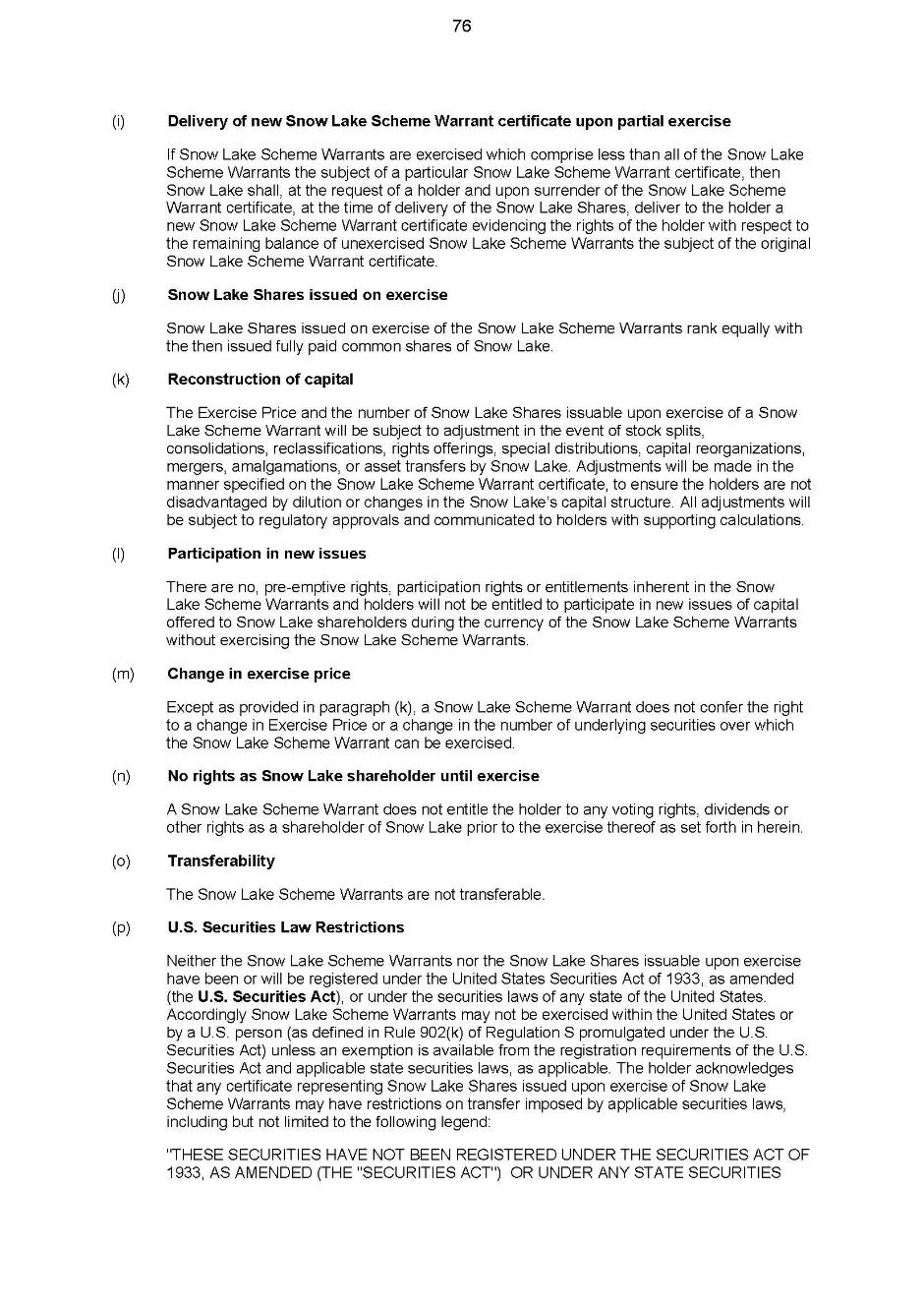
2. Pursuant to ss 411(4)(b) and 411(6) of the Act, the proposed scheme of arrangement (Option Scheme) between the plaintiff and the holders of the 'Scheme Options' in the plaintiff (as defined in the Option Scheme), in the form set out at pages 695-713 of the third affidavit of Hendrik van Aswegen sworn 17 December 2025 as amended as shown in mark-up in Annexure C to these orders, be approved, such that the Option Scheme as so amended and approved is as set out in Annexure D to these orders.
3. Pursuant to s 411(12) of the Act, the plaintiff be exempt from compliance with s 411(11) of the Act in relation to the Share Scheme and the Option Scheme.
4. The plaintiff lodge an office copy of these orders with ASIC as soon as practicable after the orders are issued.
THE COURT NOTES THAT:
The plaintiff and Snow Lake Resources Ltd intend to rely on:
A. the Court's approval of the Share Scheme and the Option Scheme as set out in the orders and reasons for judgment as the basis of a claim to an exemption pursuant to s 3(a)(10) of the Securities Act of 1933 (US) (as amended) from the registration requirements otherwise imposed by that Act, in connection with the implementation of, and provision of consideration under, the Share Scheme and the Option Scheme;
B. the fact the Share Scheme and Option Scheme have proceeded under the statutory procedures of the Corporations Act 2001 (Cth); and
C. the approval of the Share Scheme and Option Scheme by the Court for the purpose of qualifying for the exemption from the prospectus requirements of s 2.11 of the harmonised Canadian National Instrument 45-106 – Prospectus Exemptions in connection with the implementation of, and provision of consideration under, the Share Scheme and Option Scheme.
Note: Entry of orders is dealt with in Rule 39.32 of the Federal Court Rules 2011.
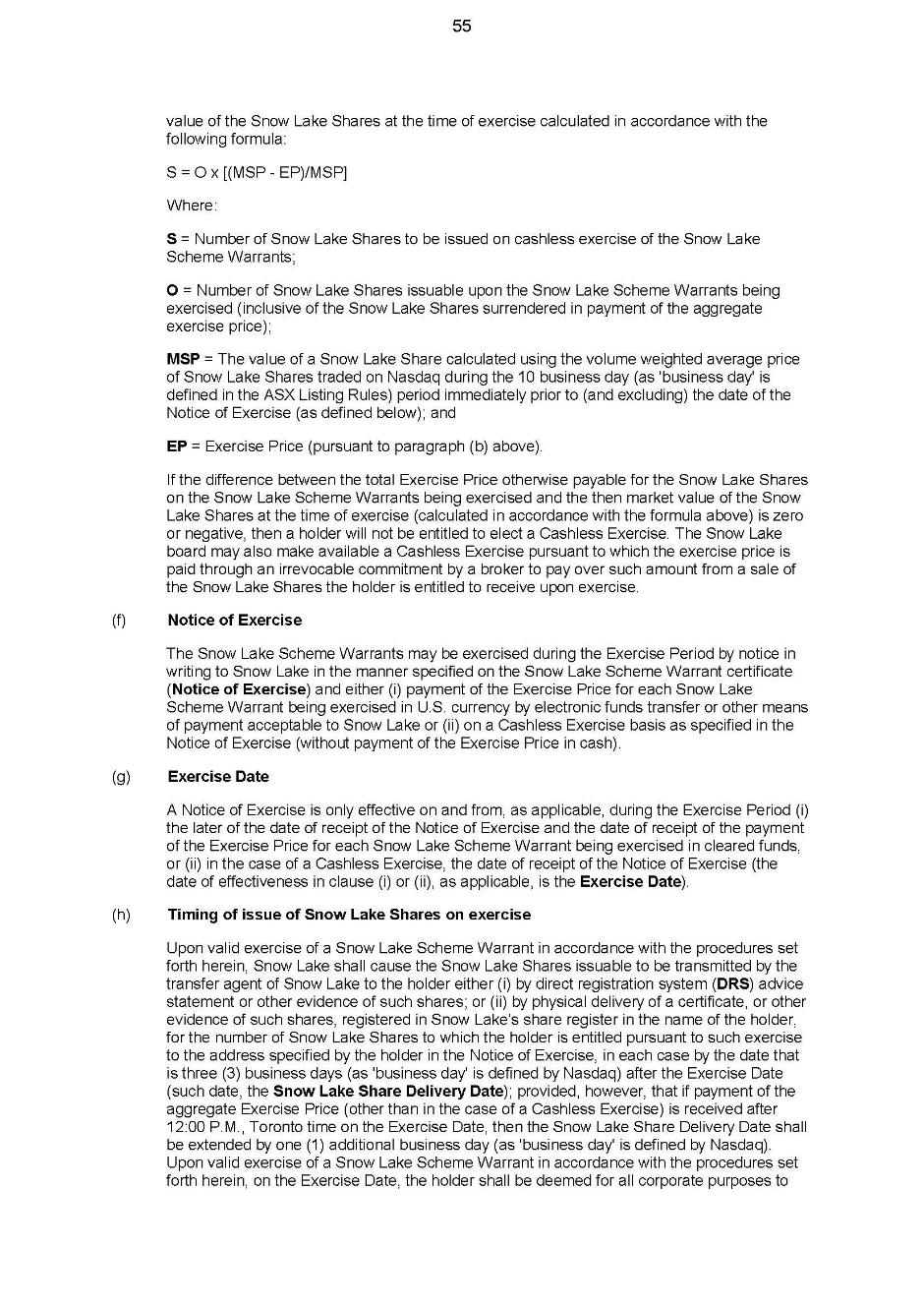
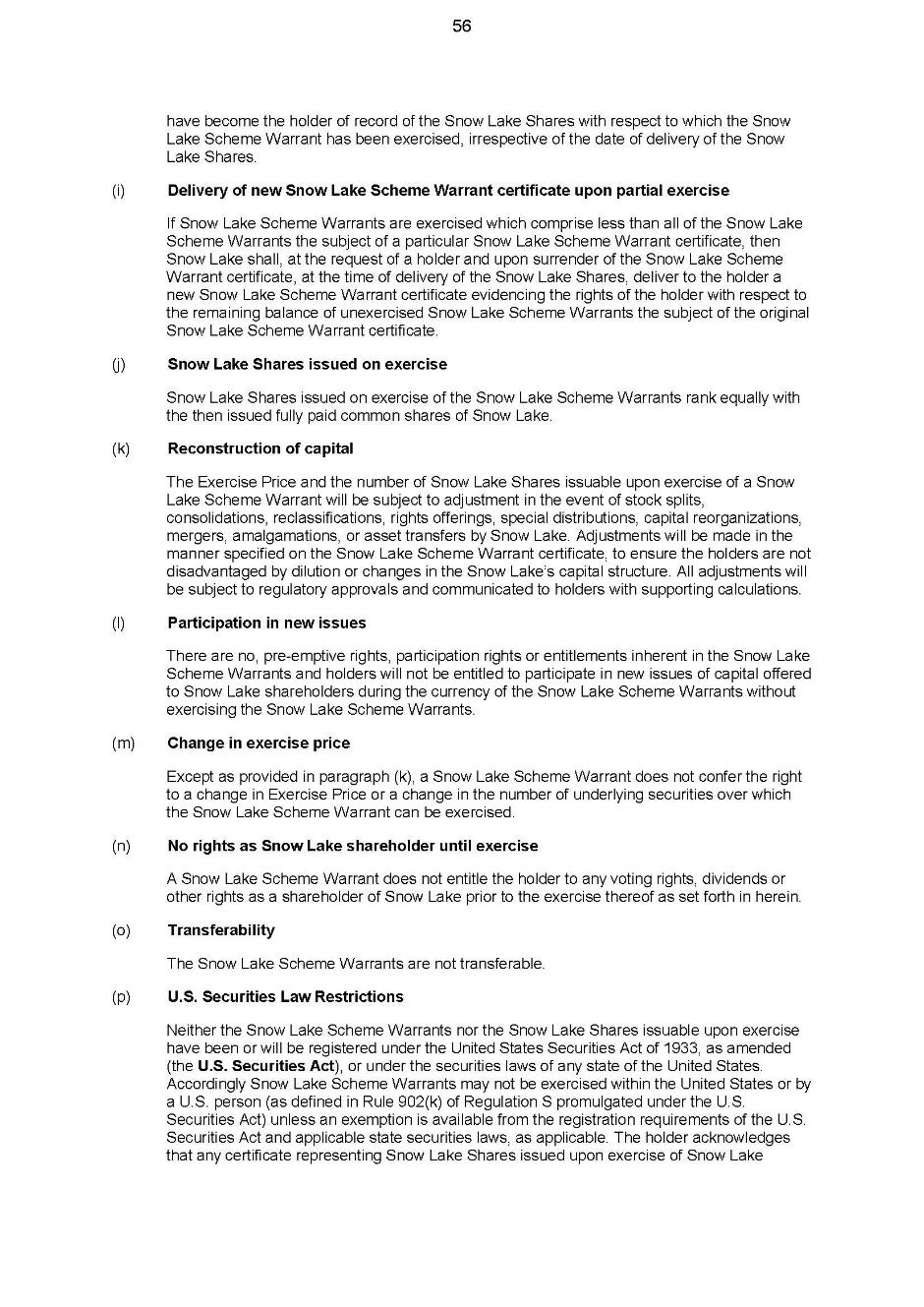
Annexure A: Amended Share Scheme - Mark up
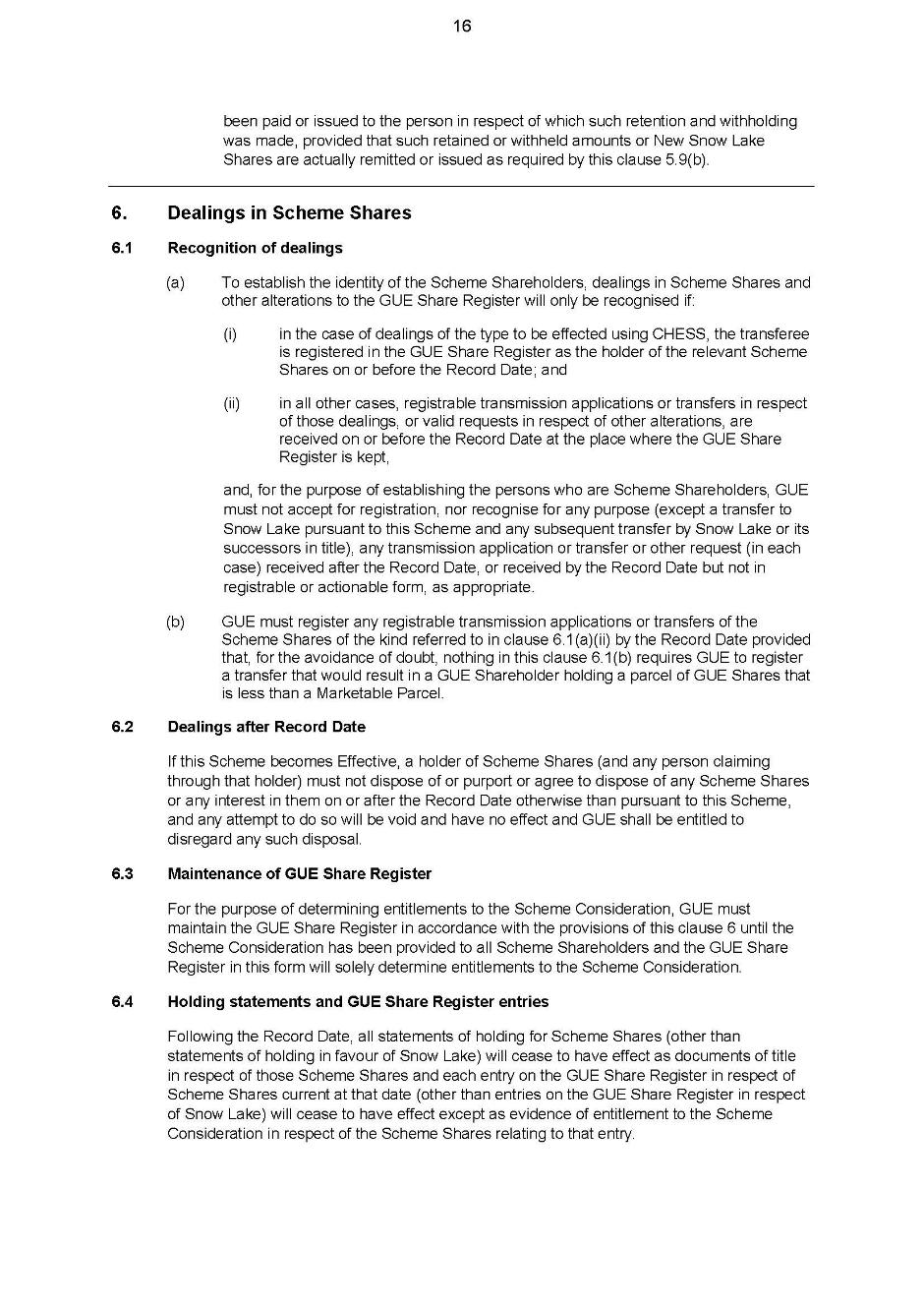
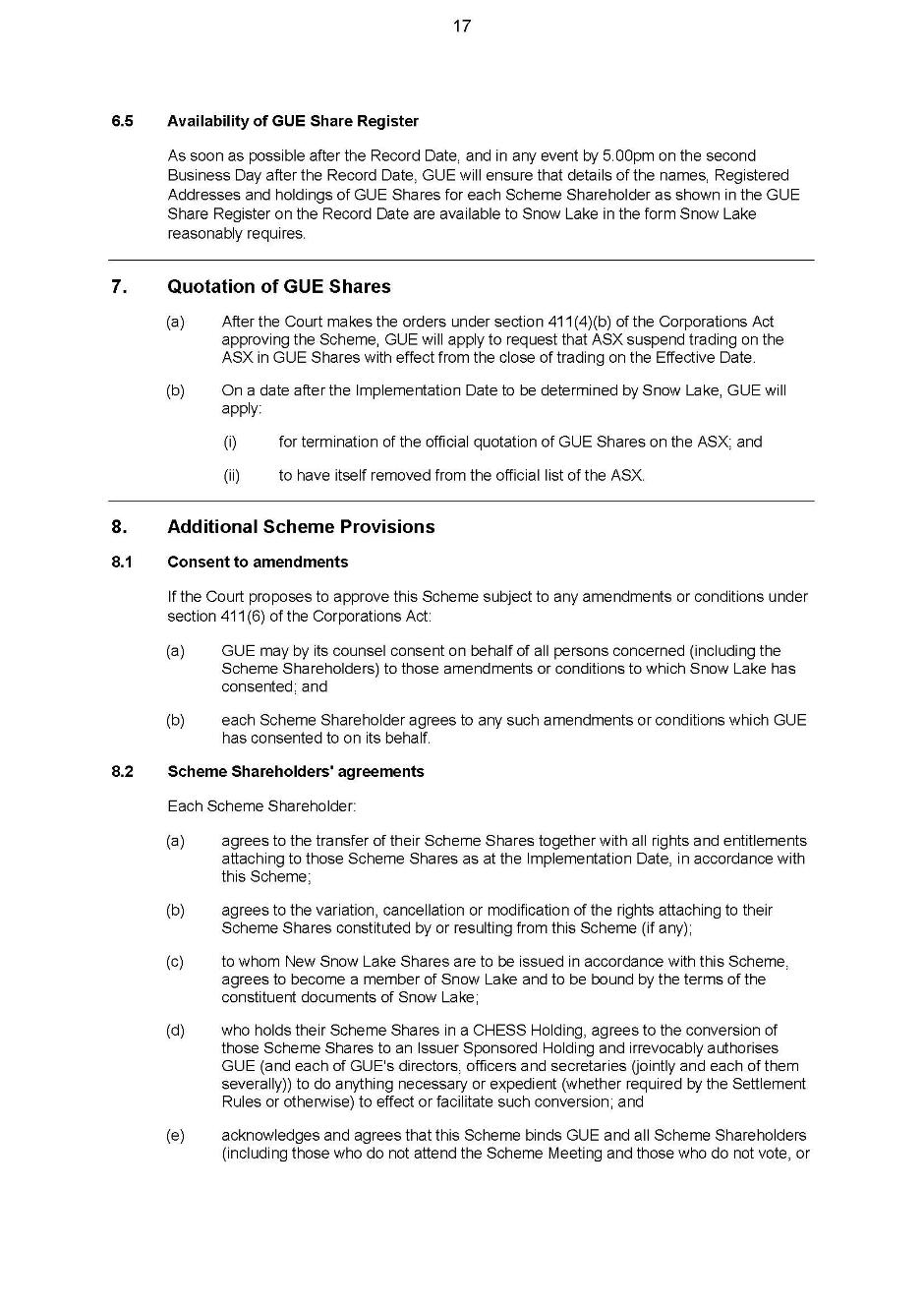
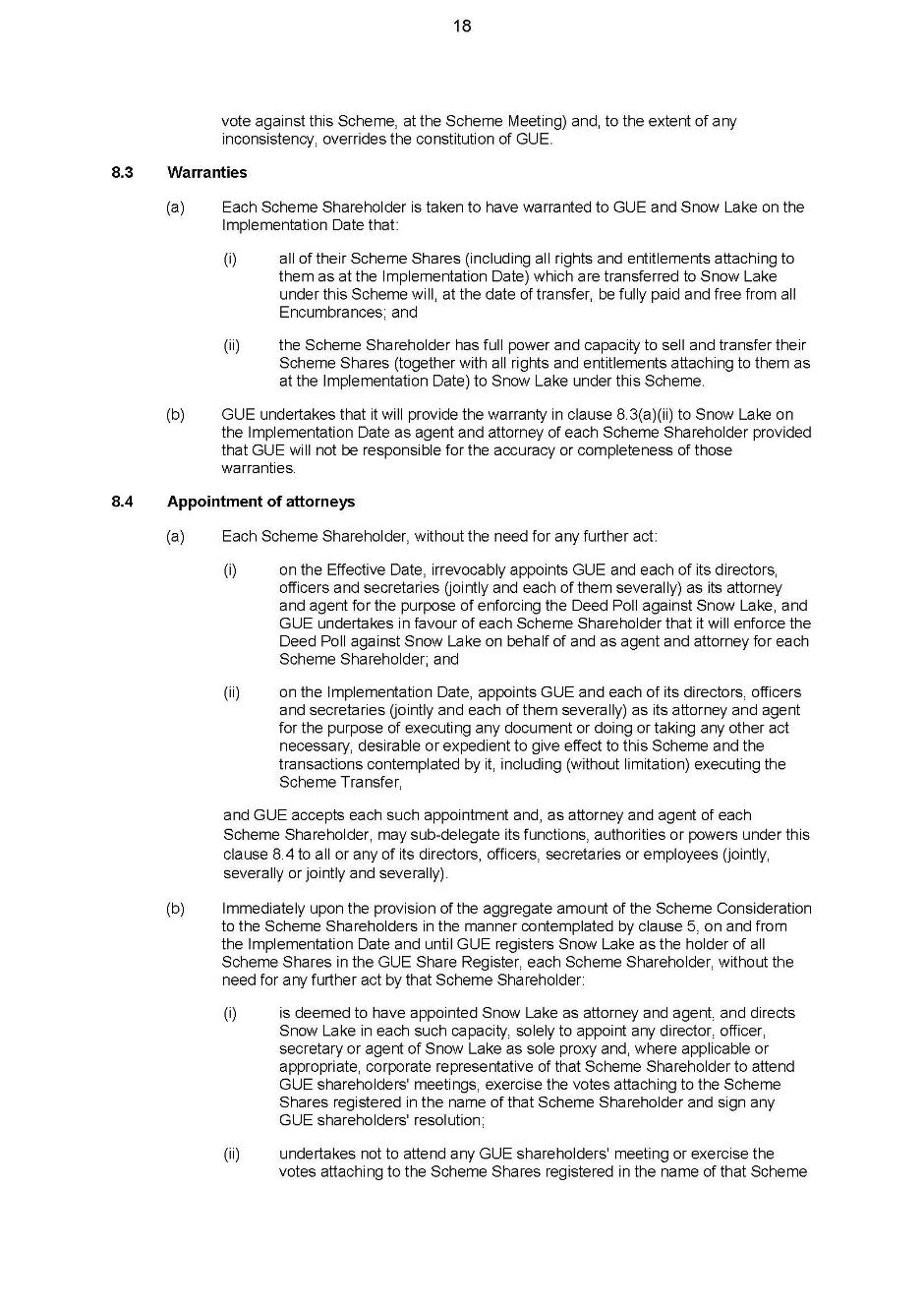
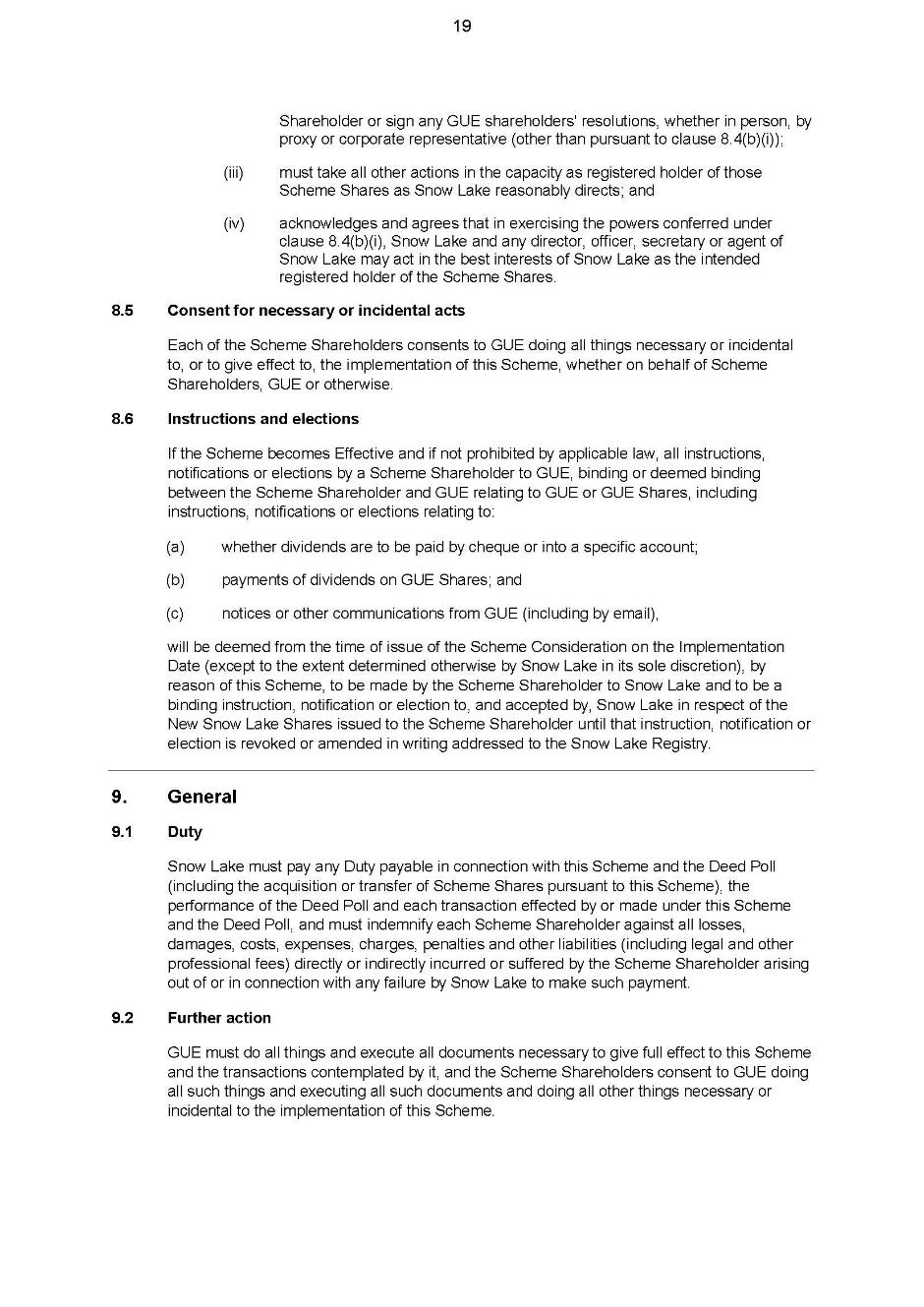
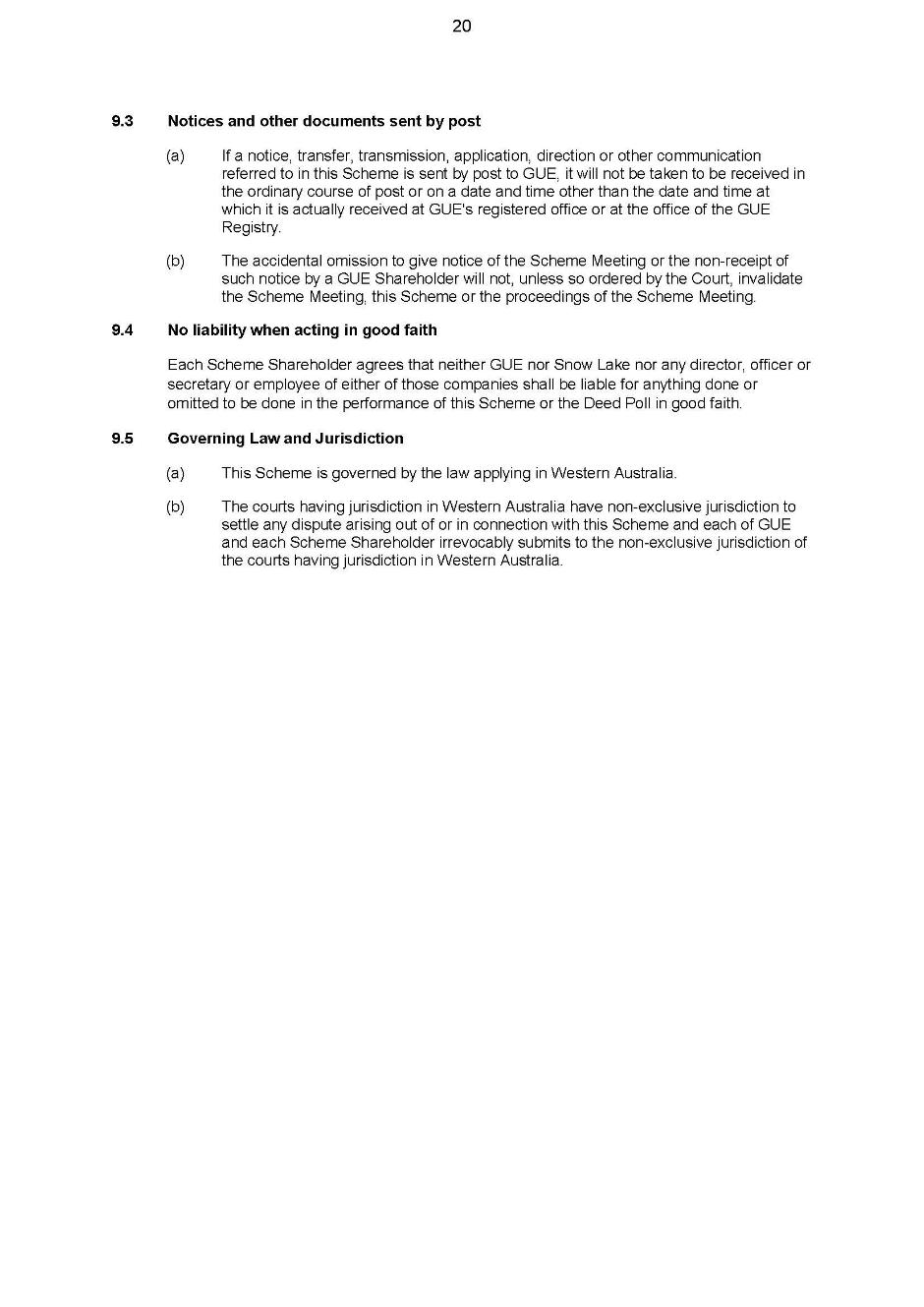
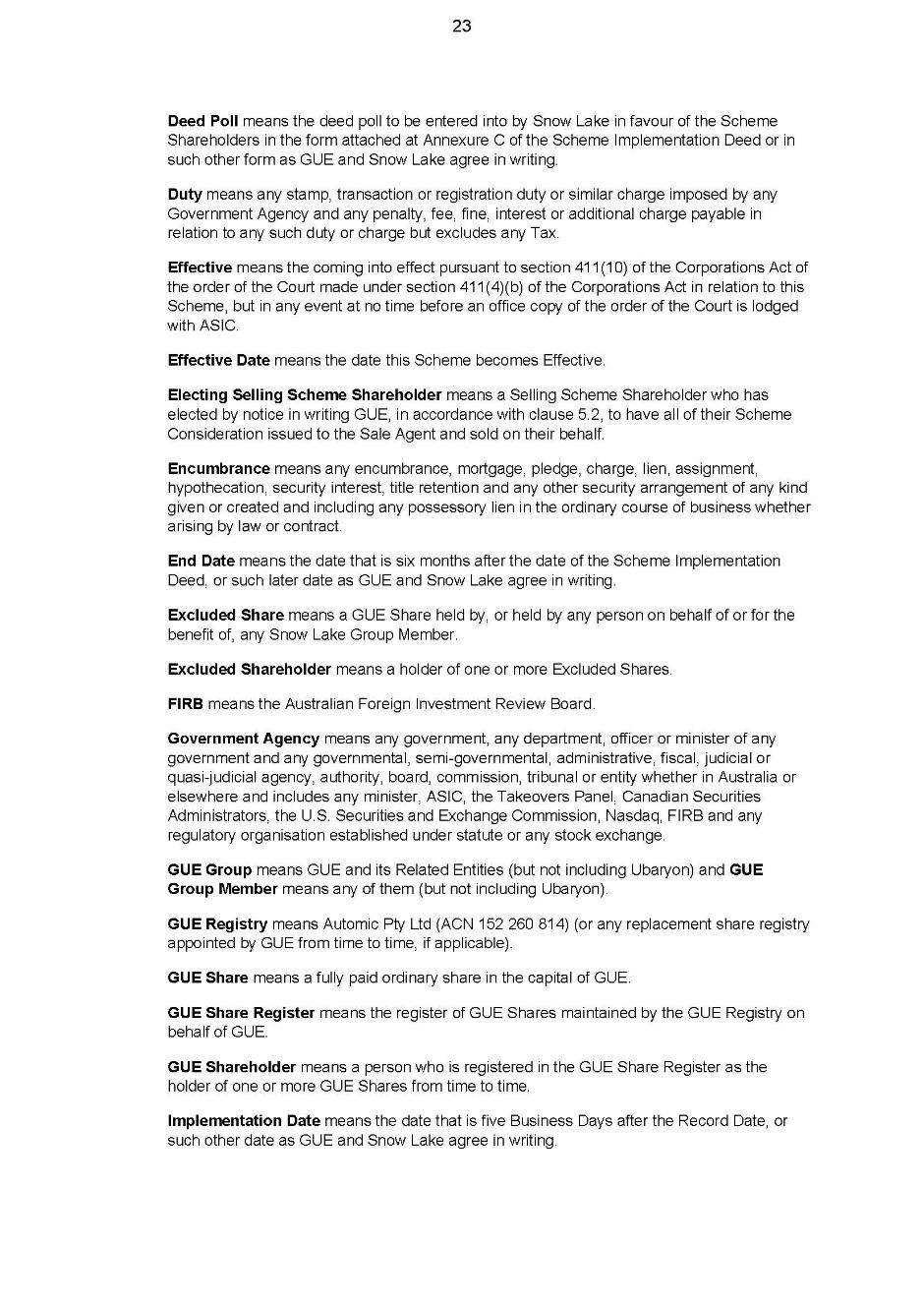
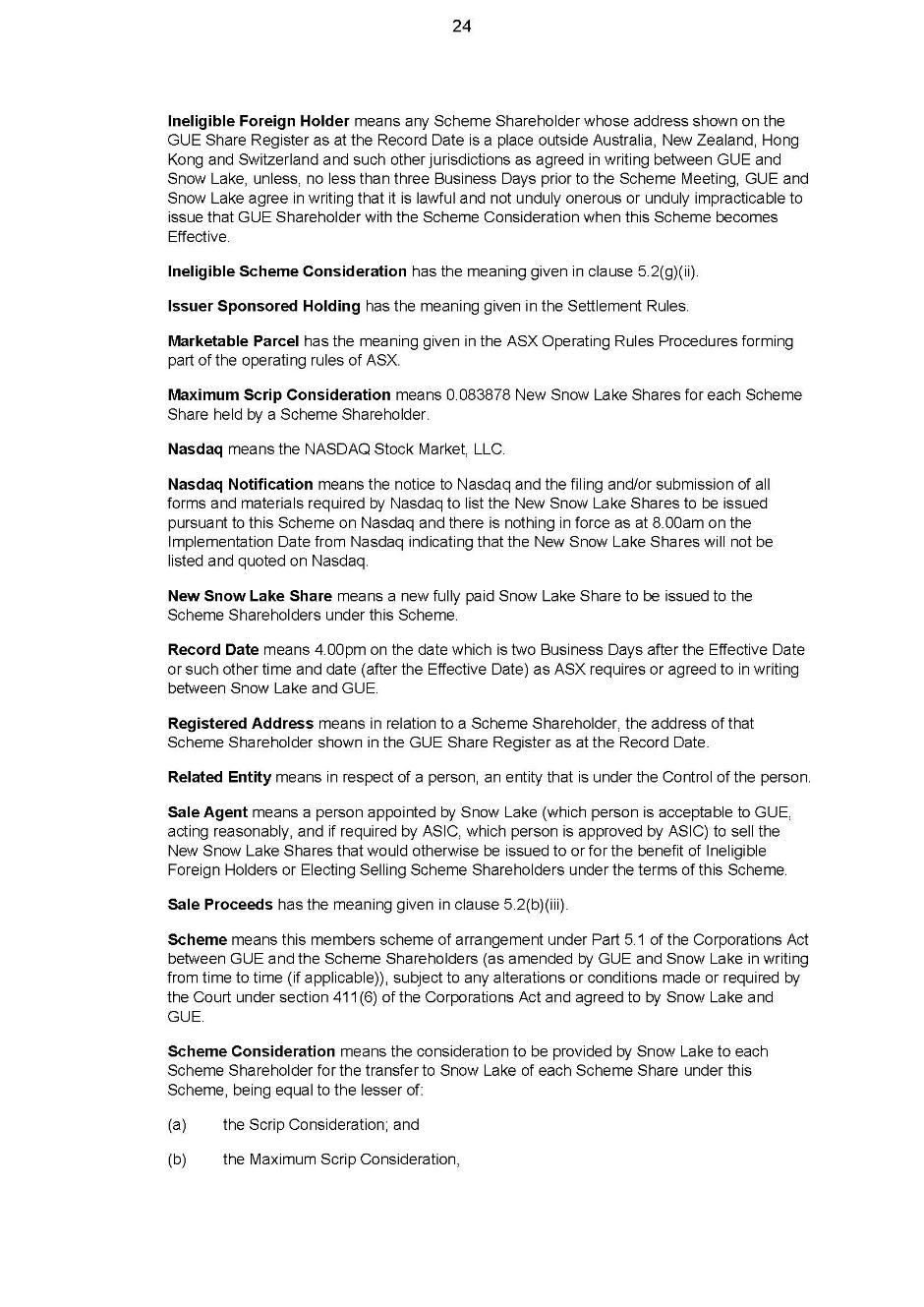
Annexure B - Amended Share Scheme
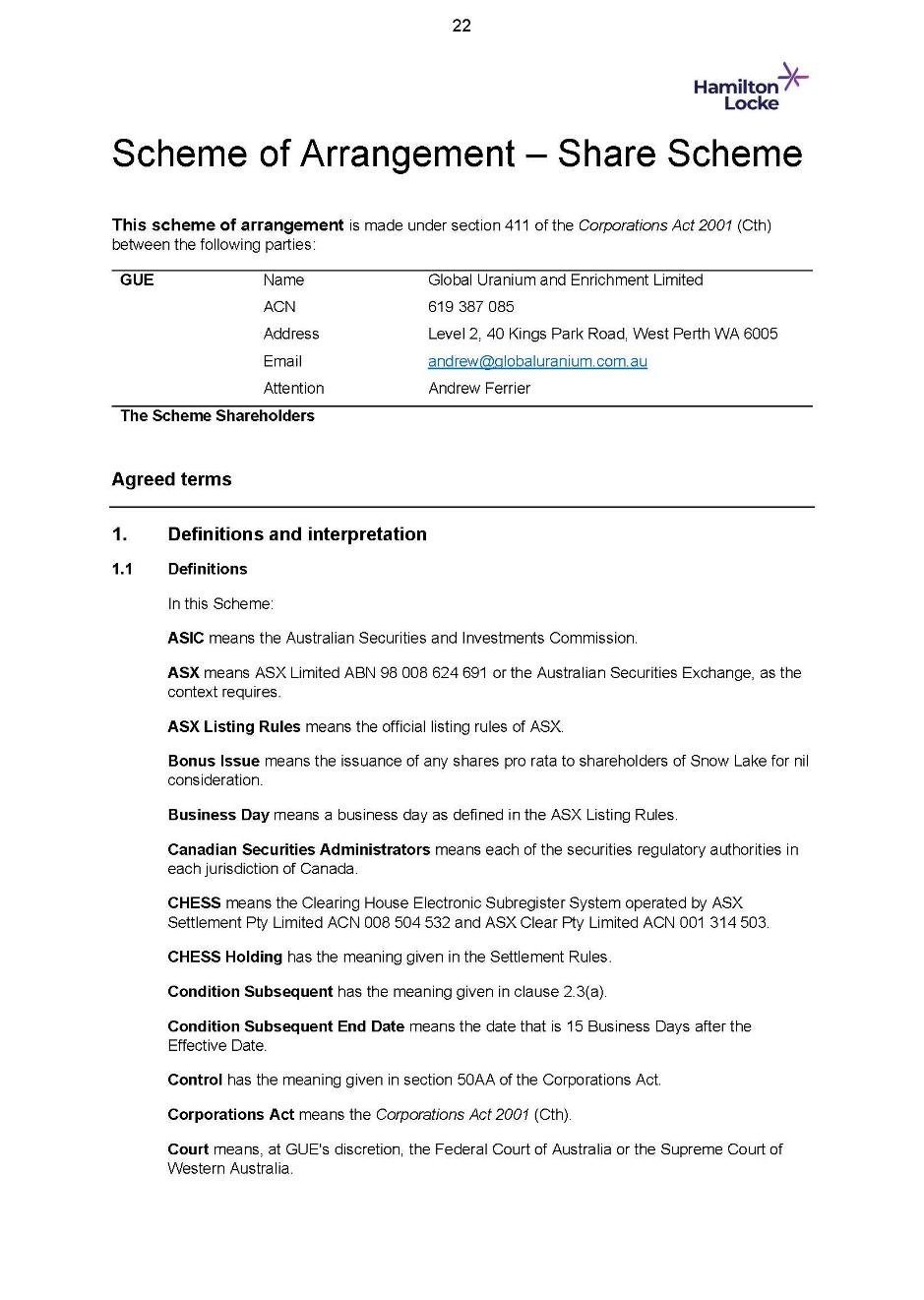
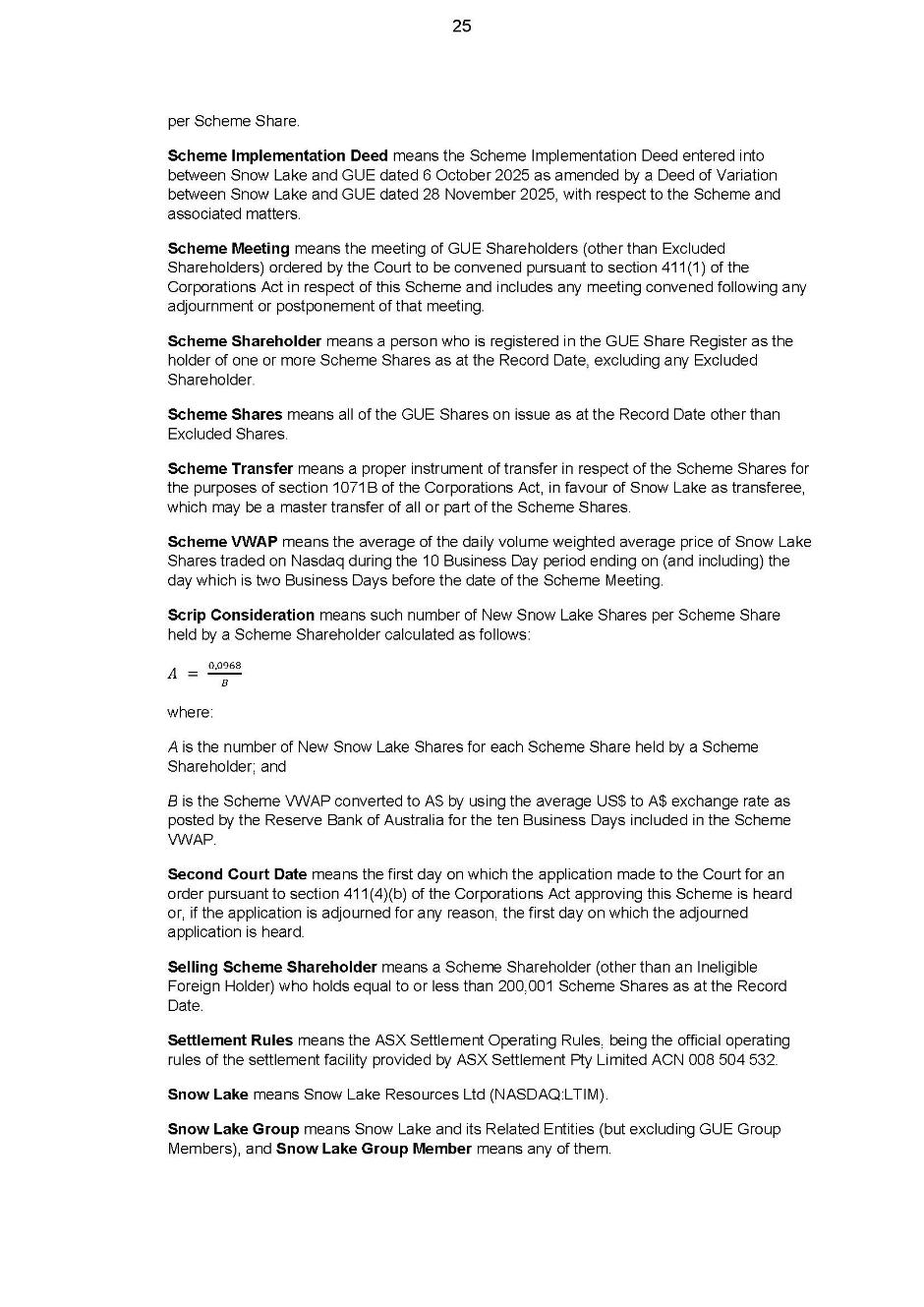
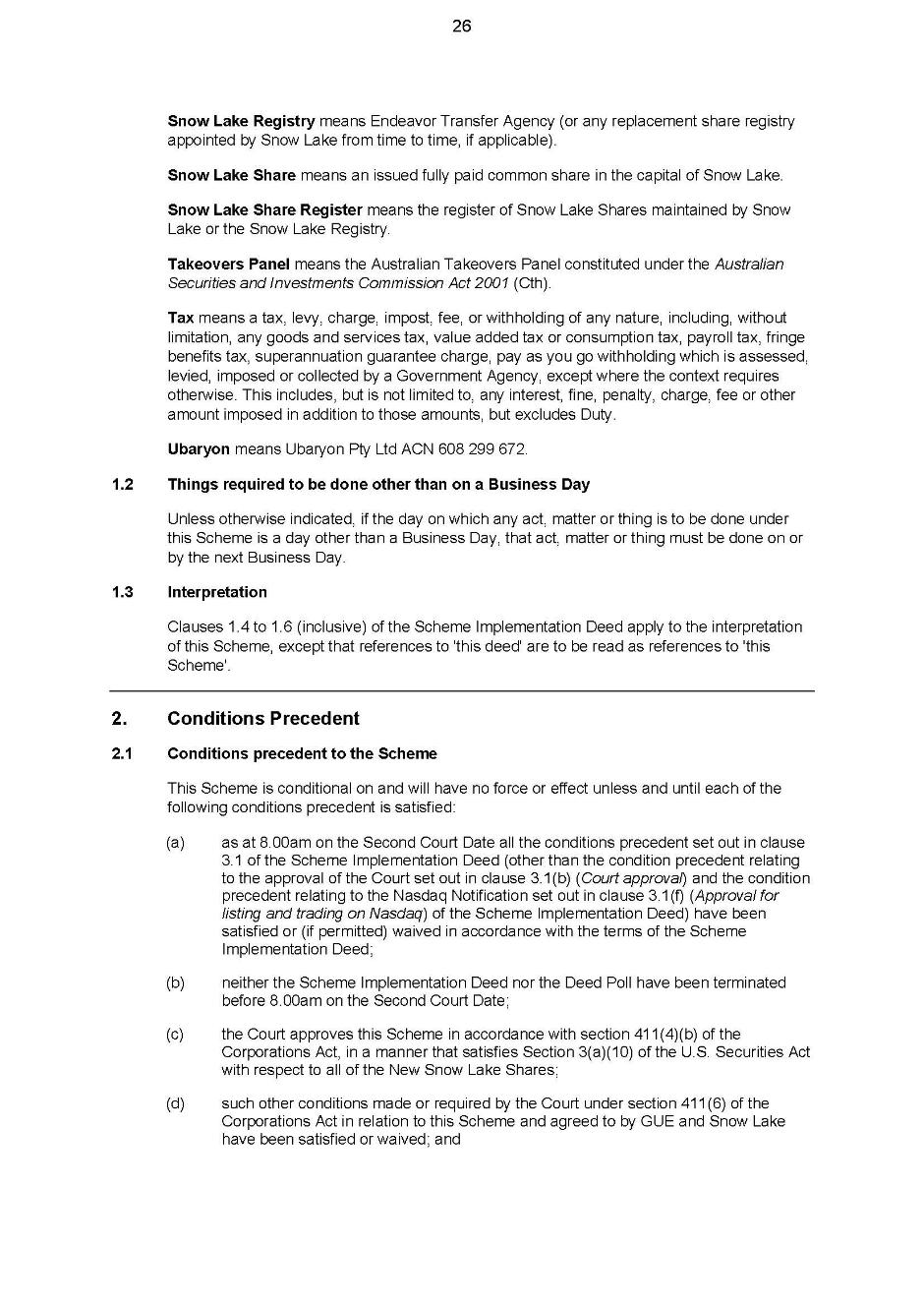
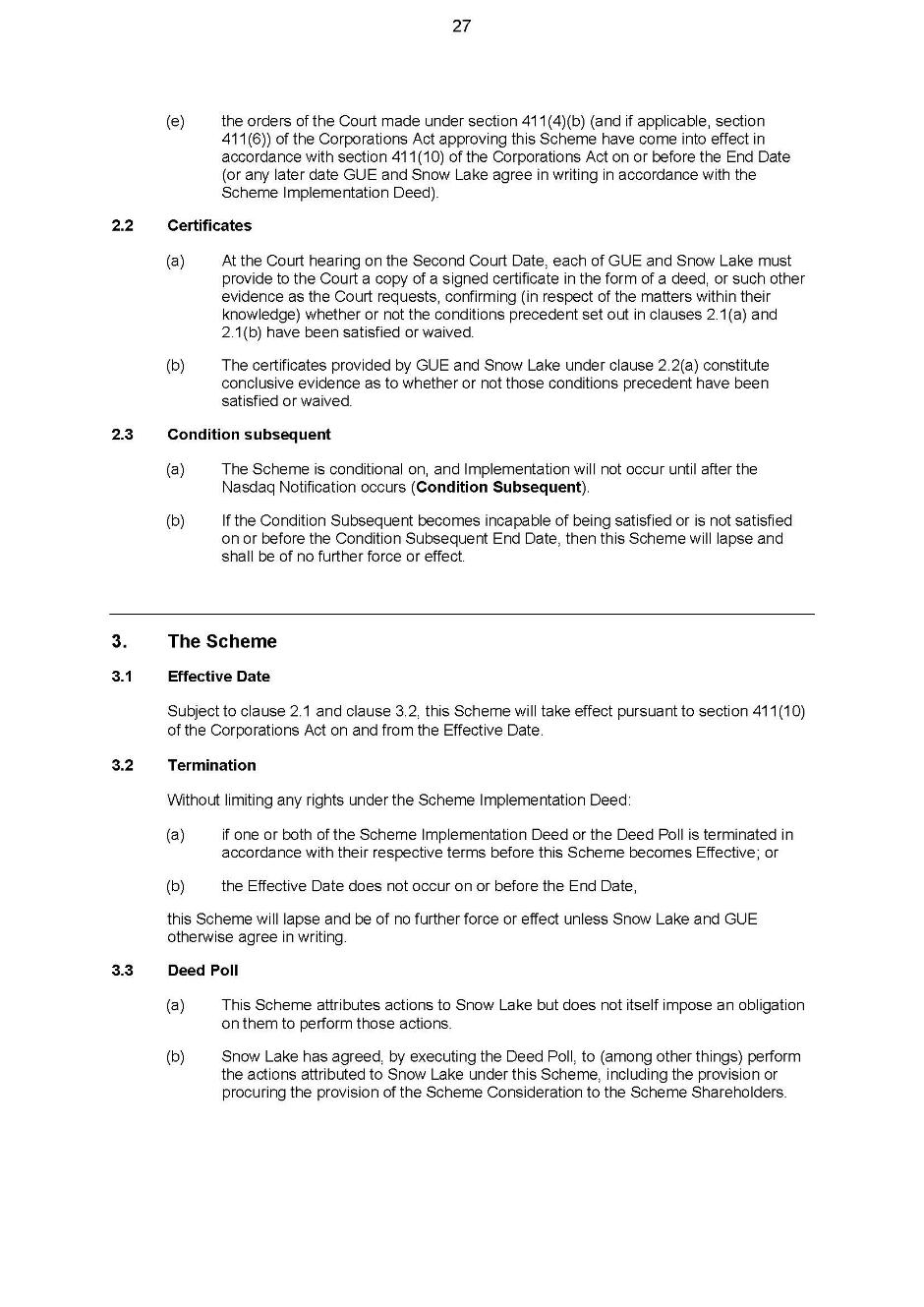
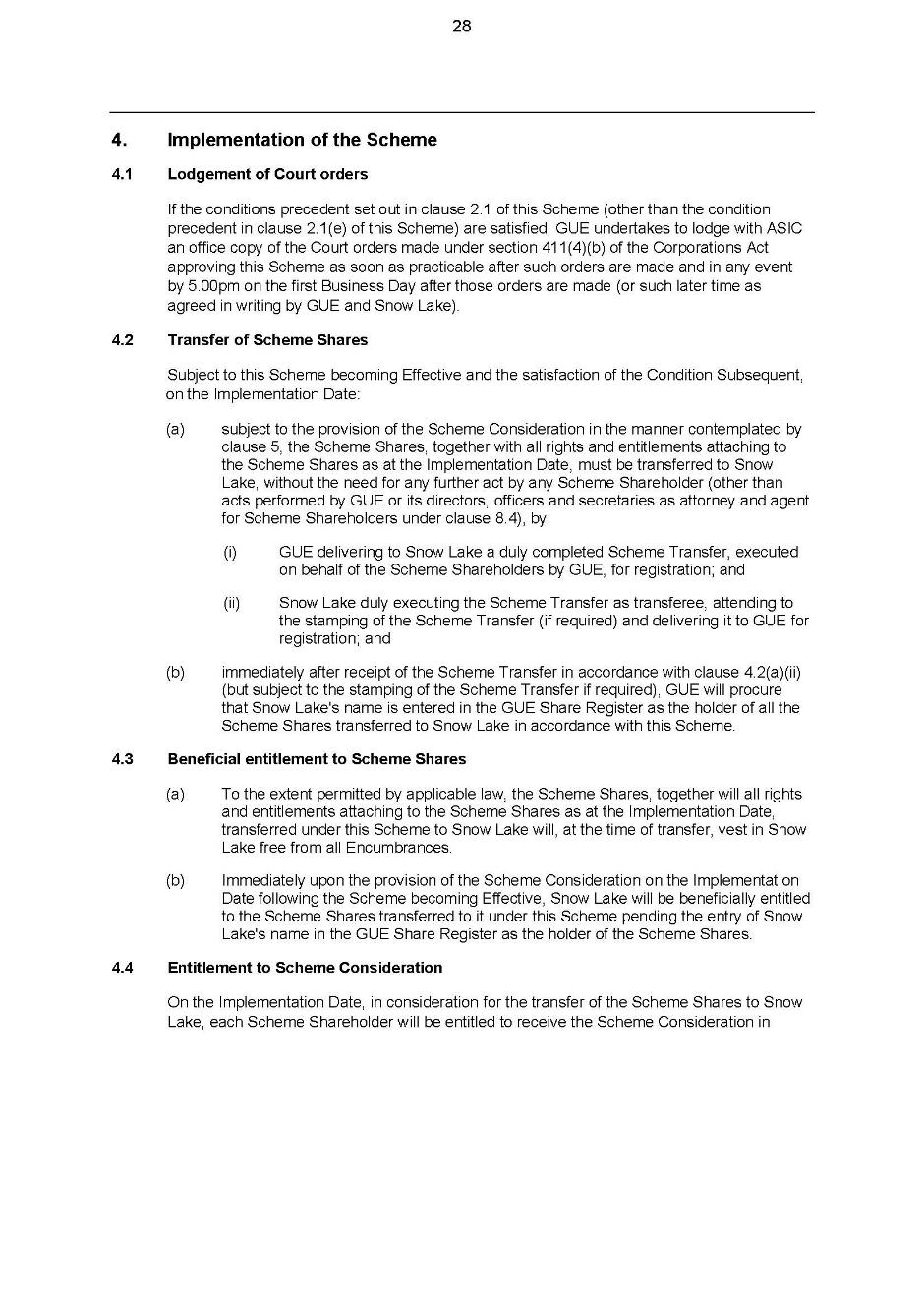
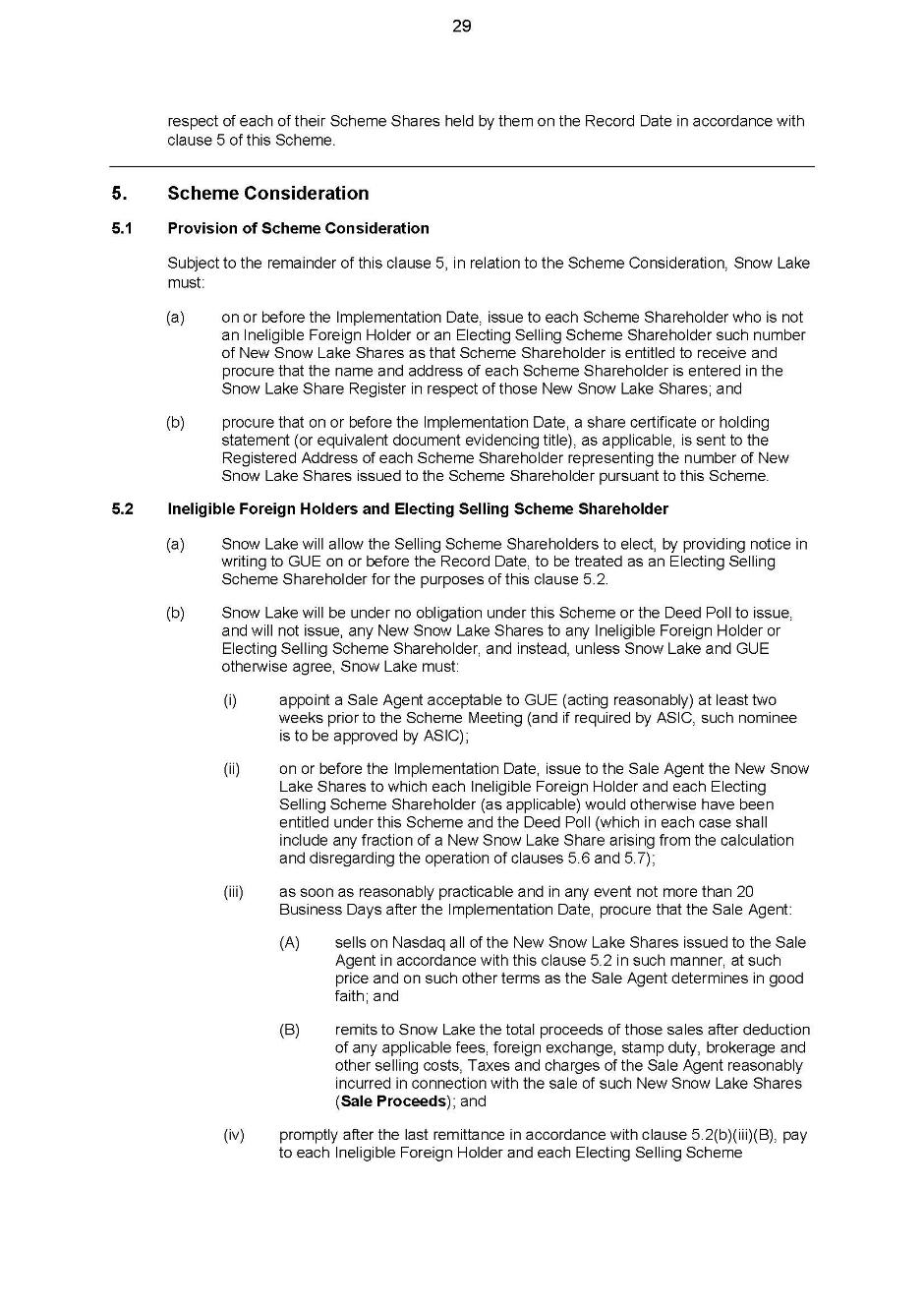
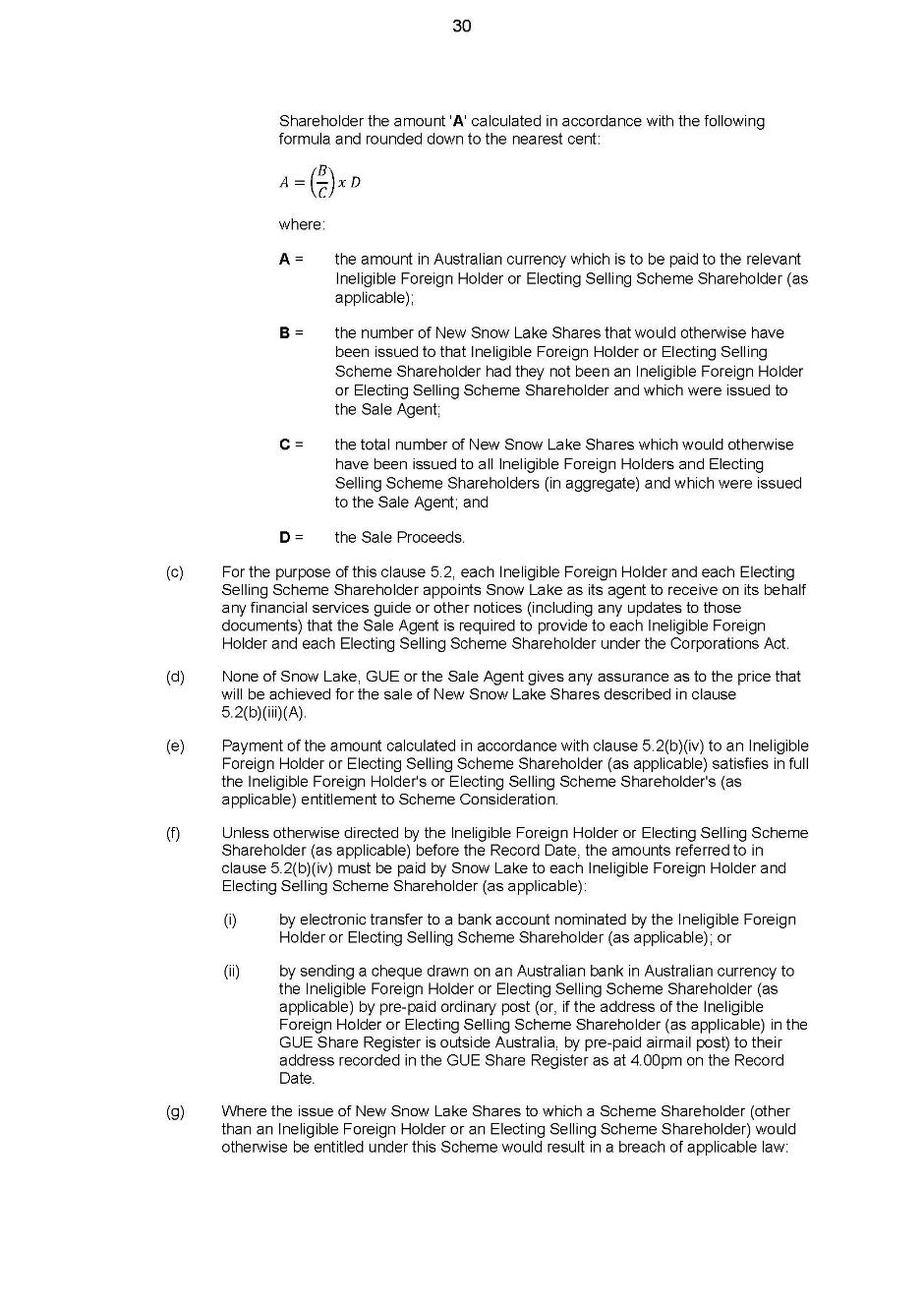
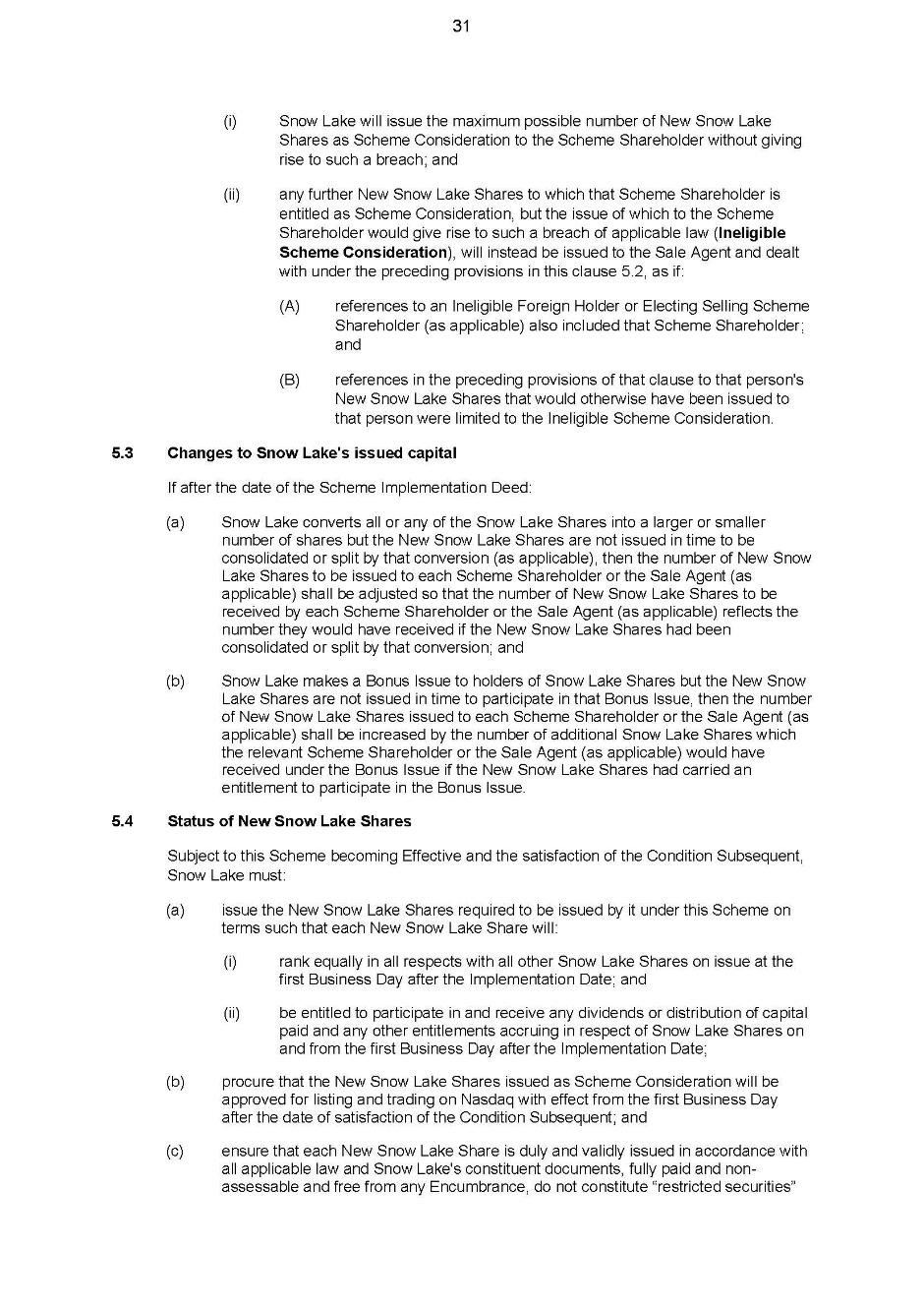
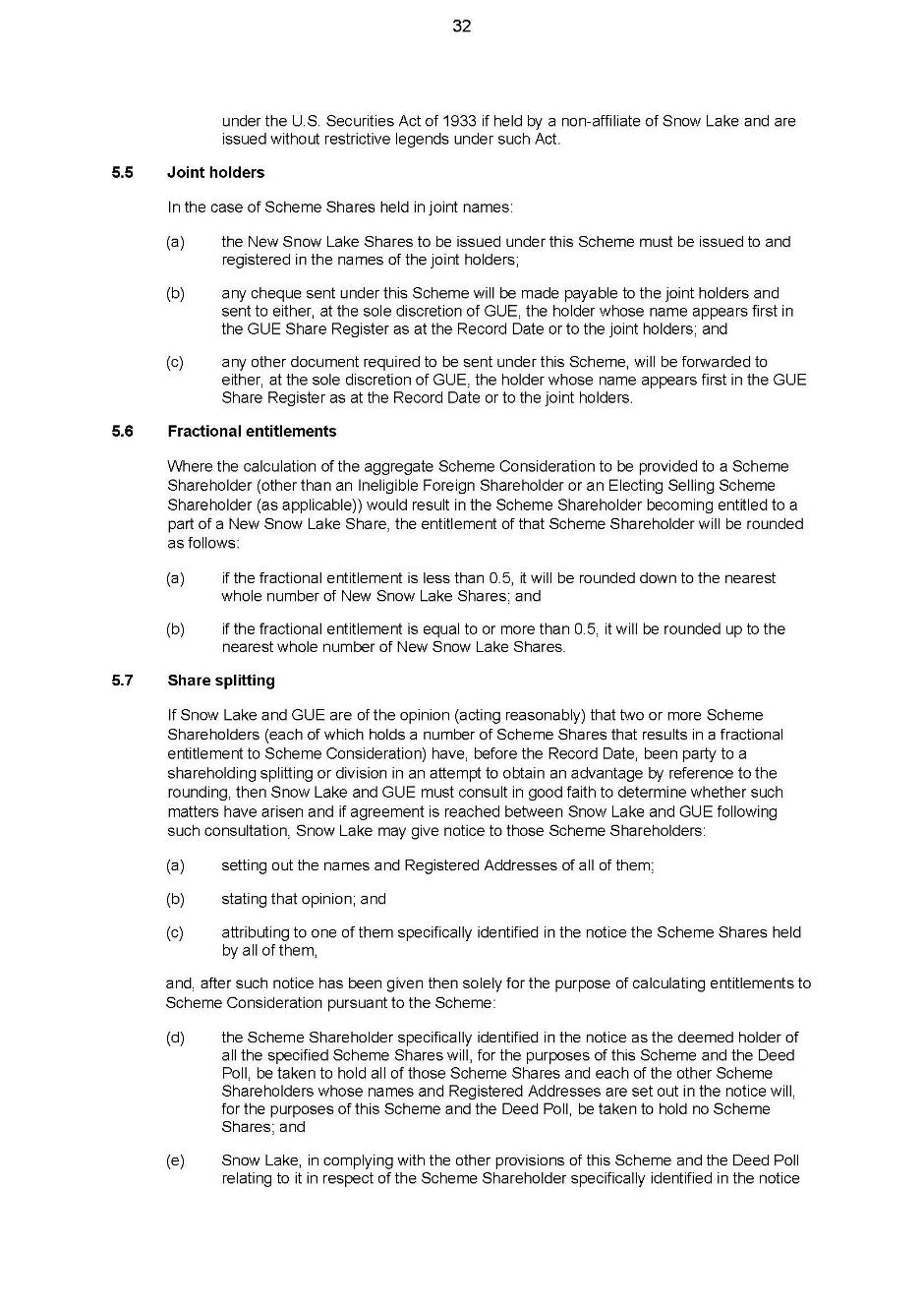
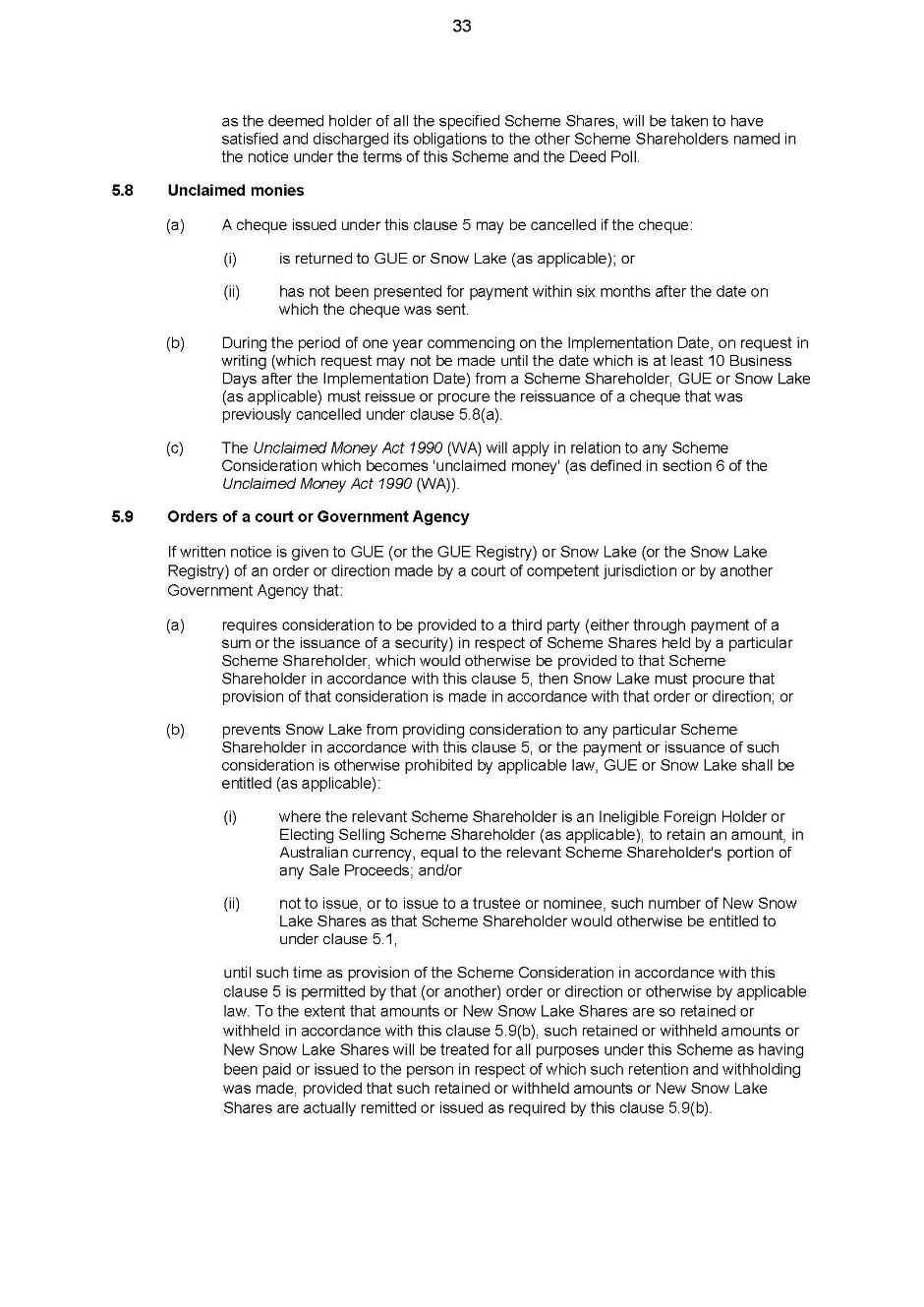
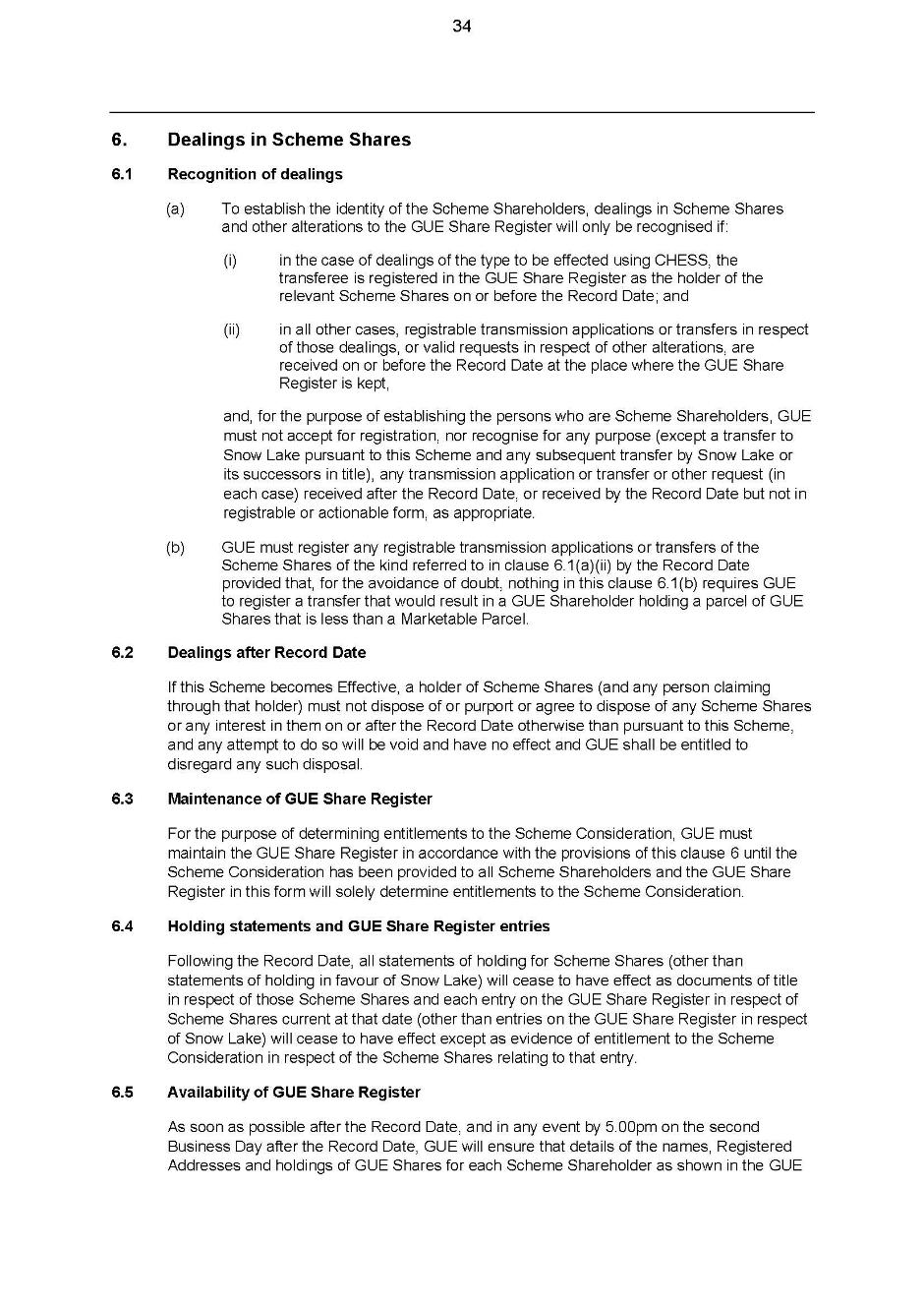
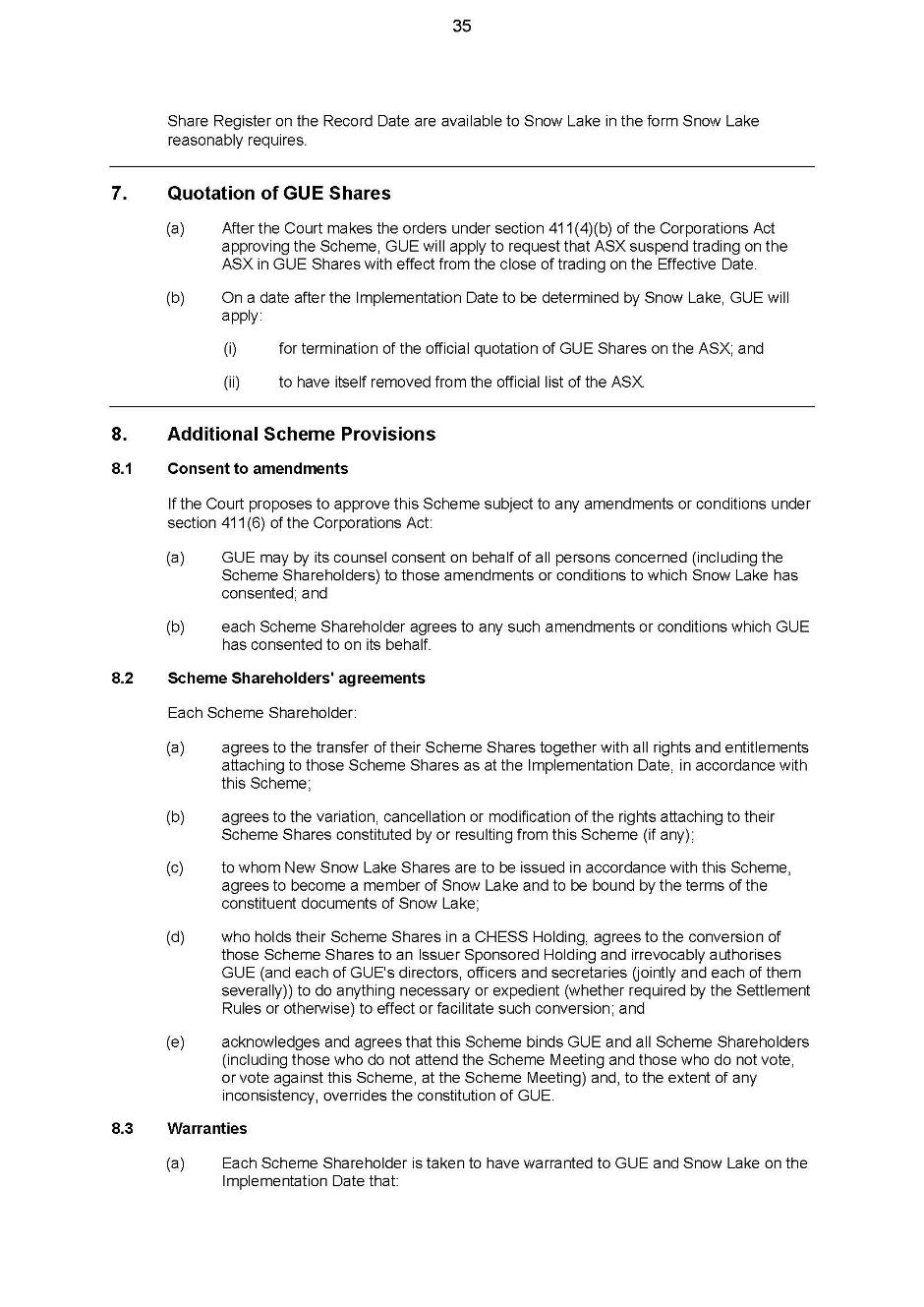
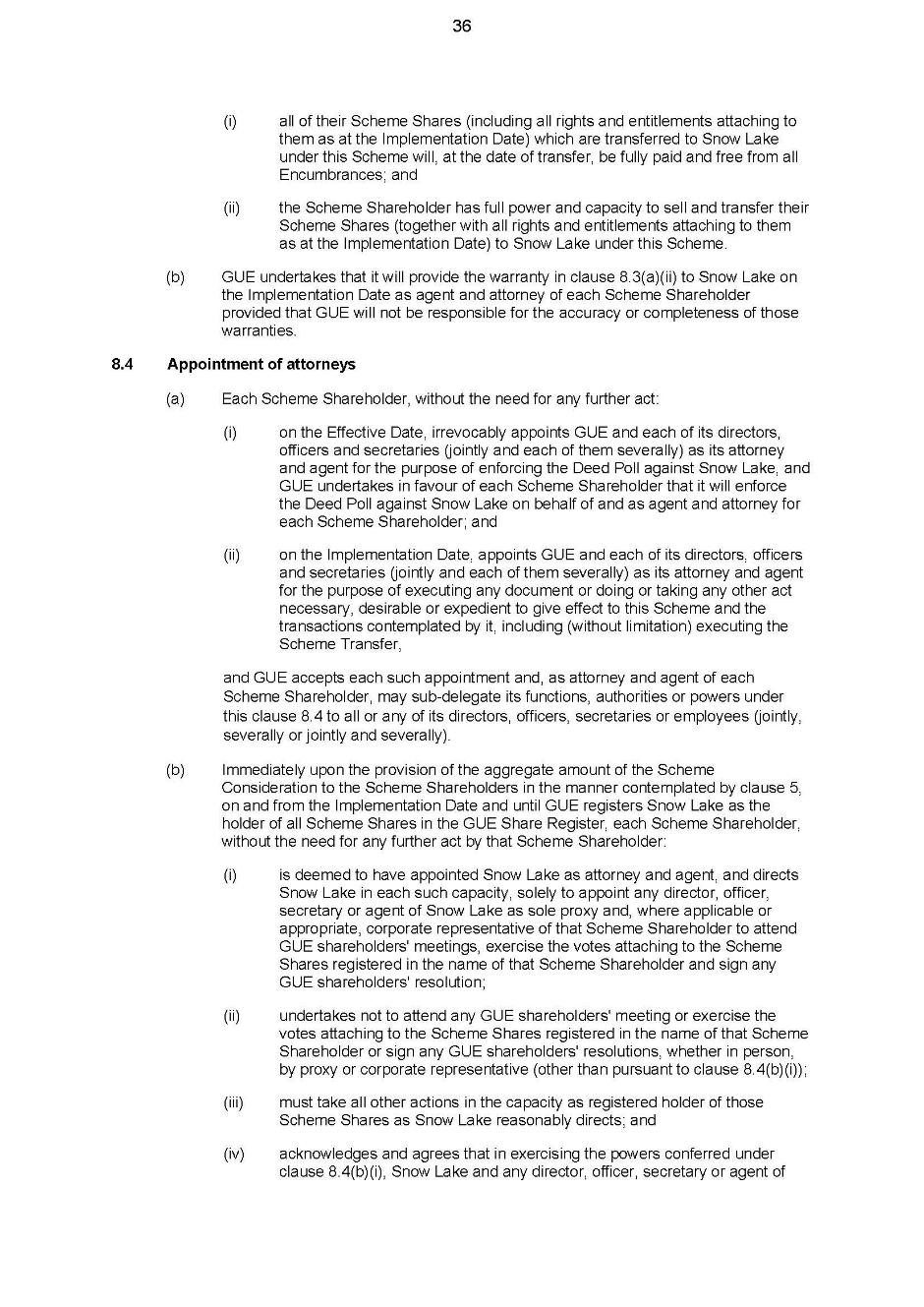
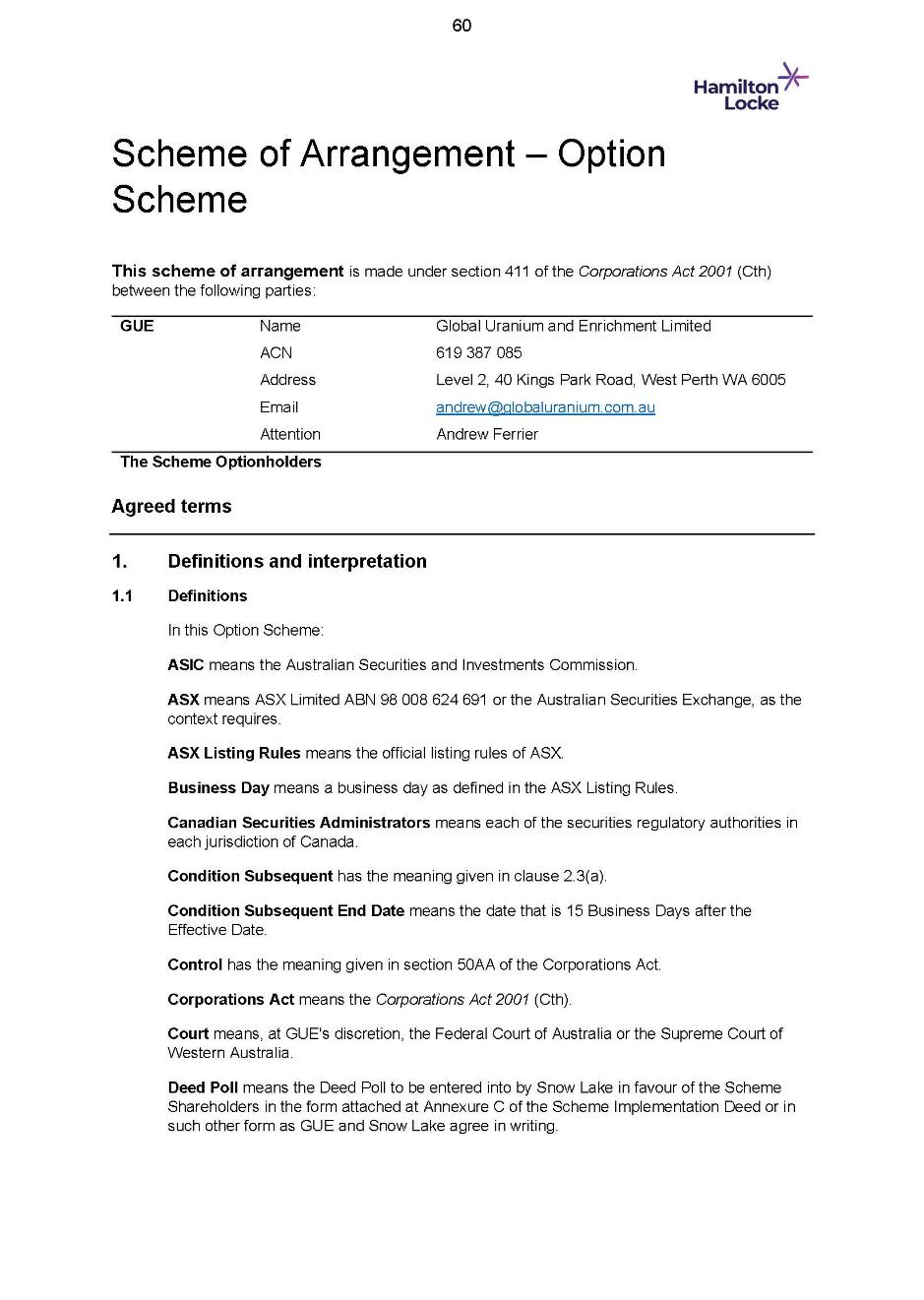
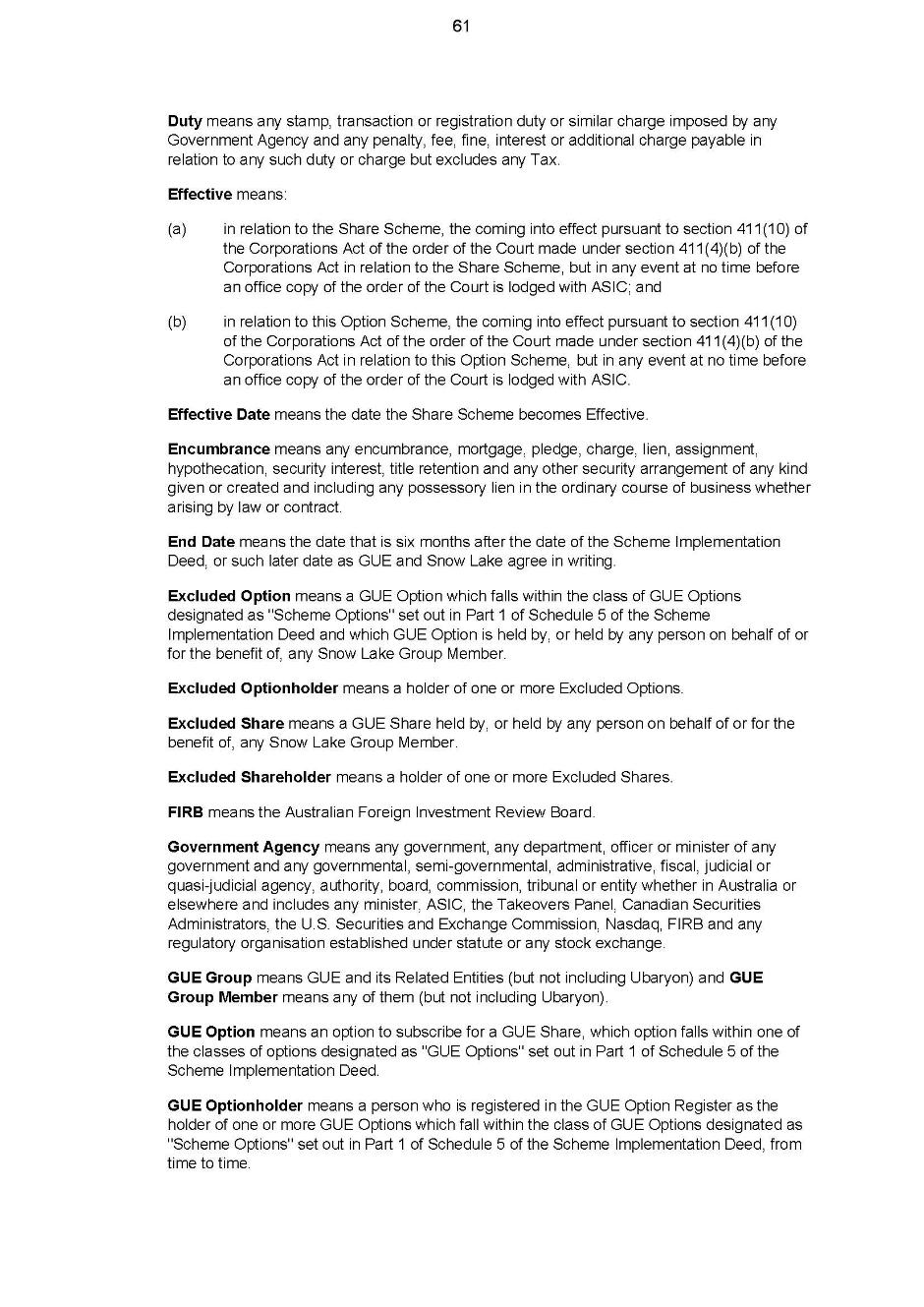
Annexure C - Amended Option Scheme - Mark-up
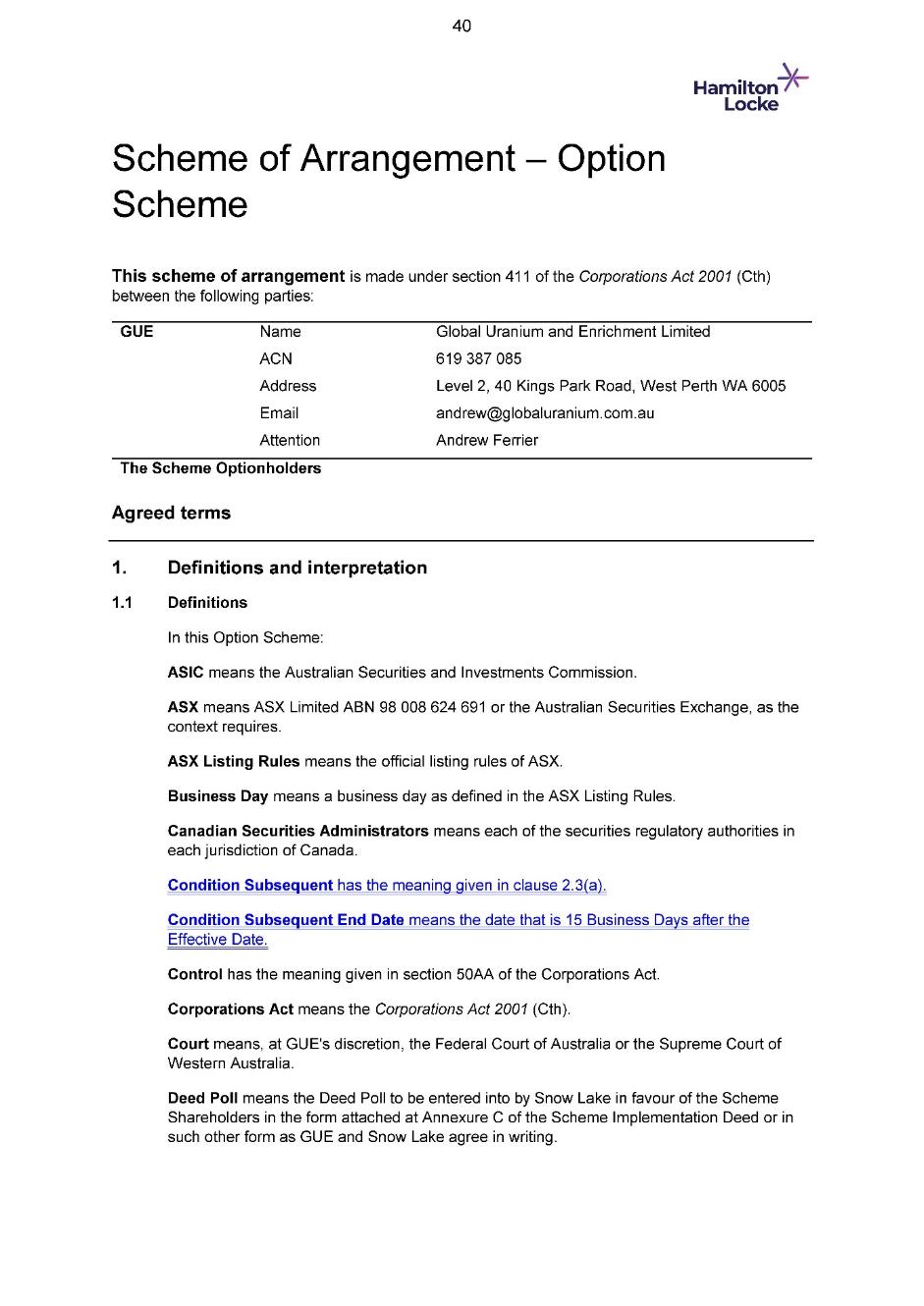
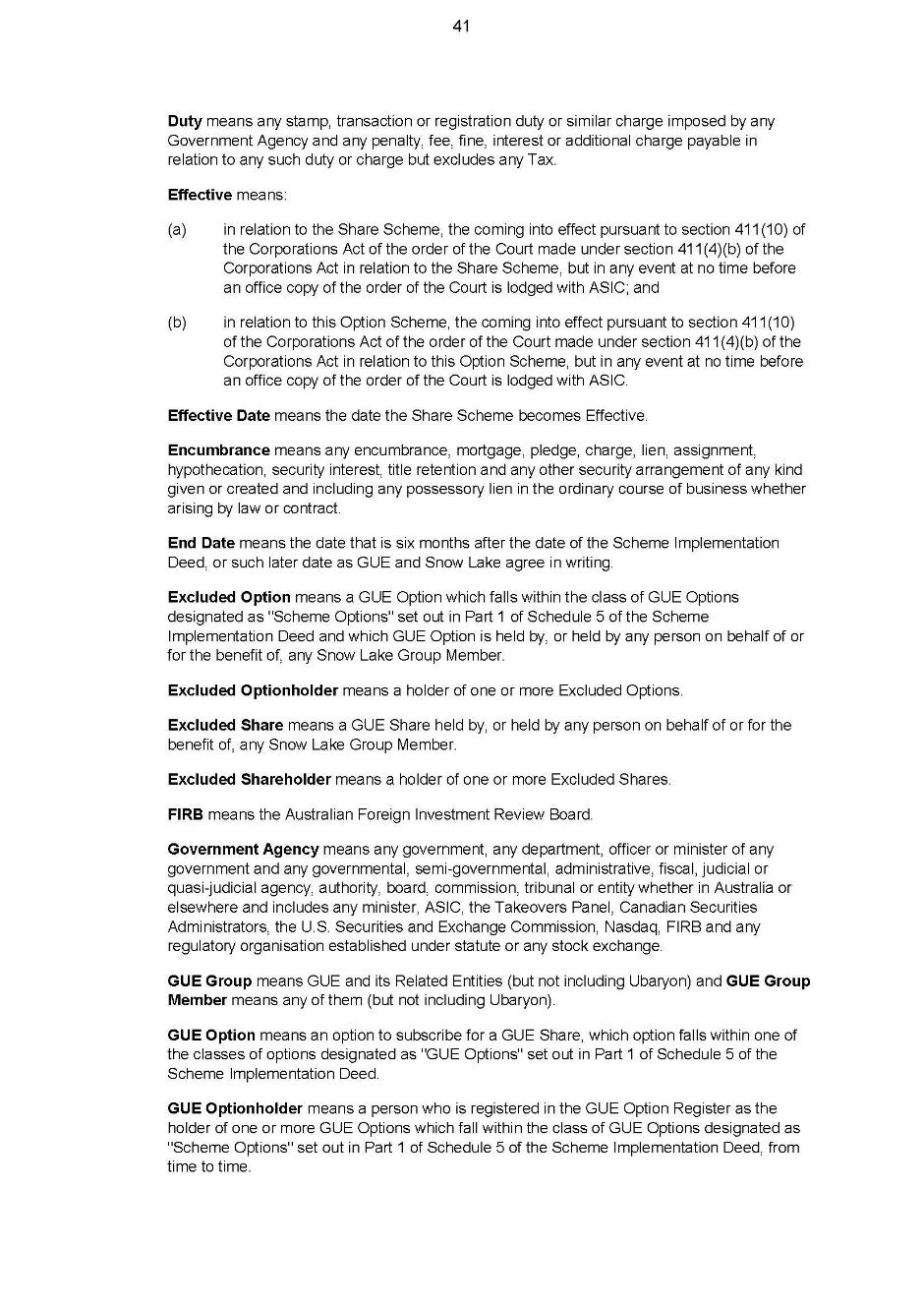
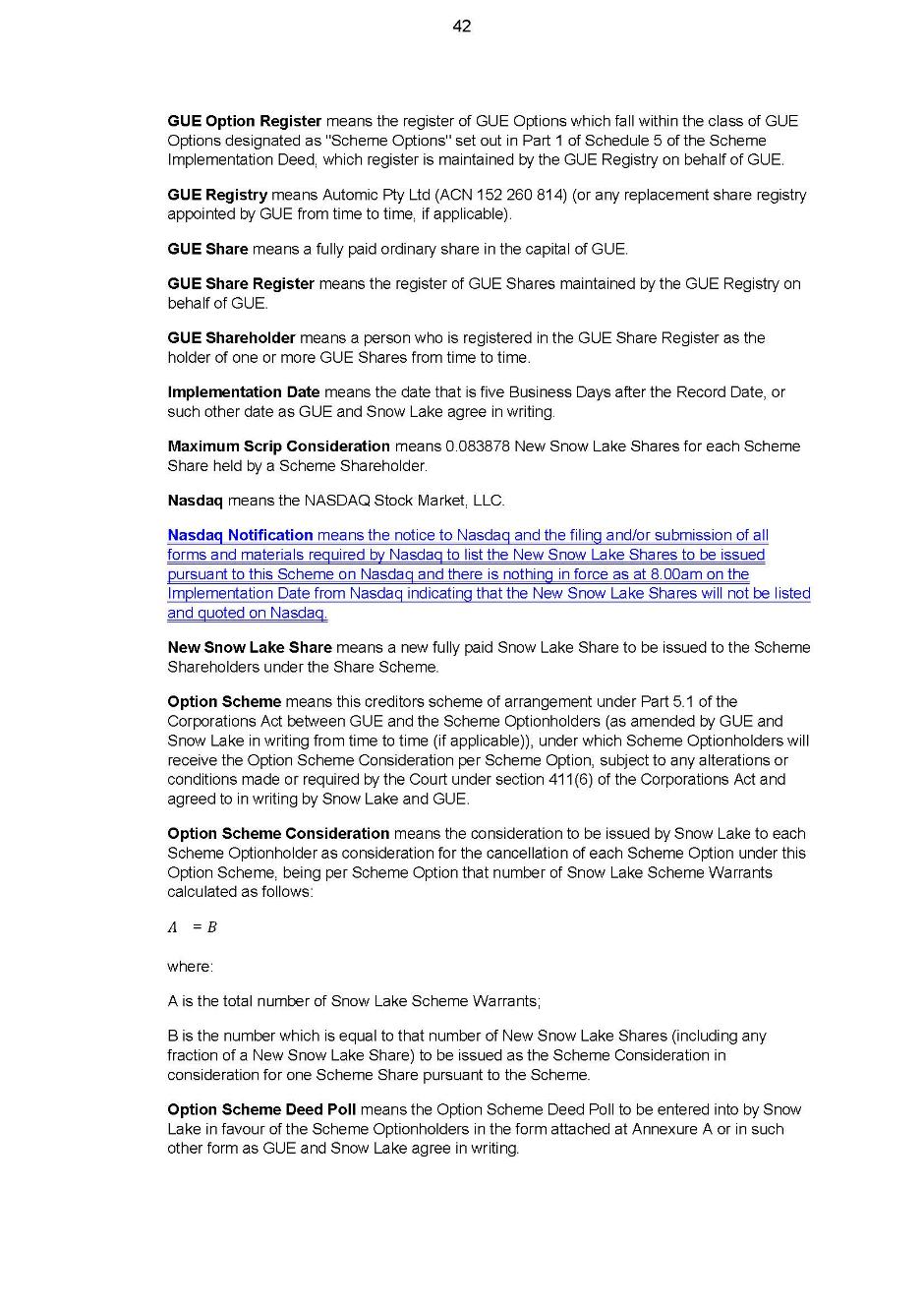
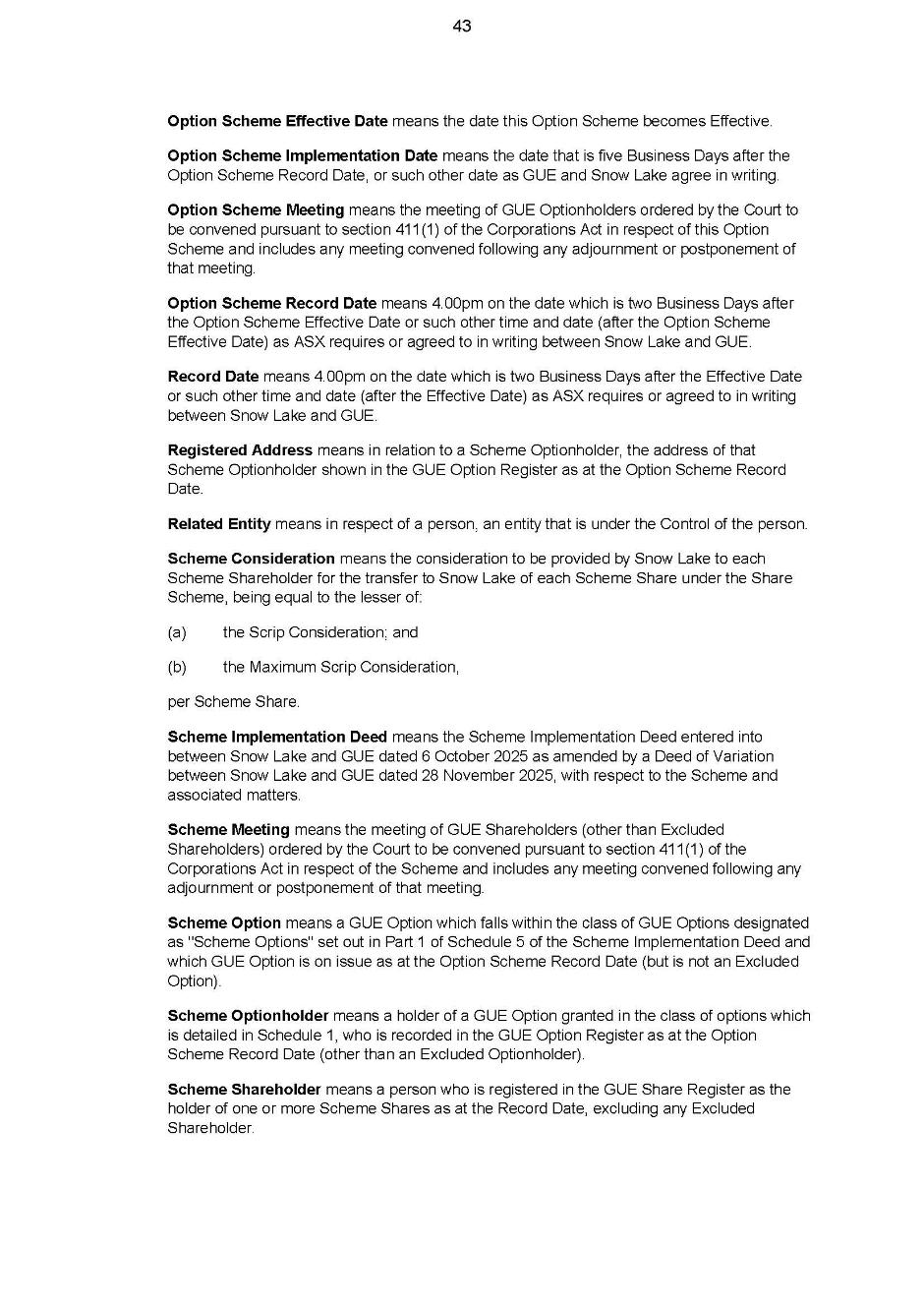
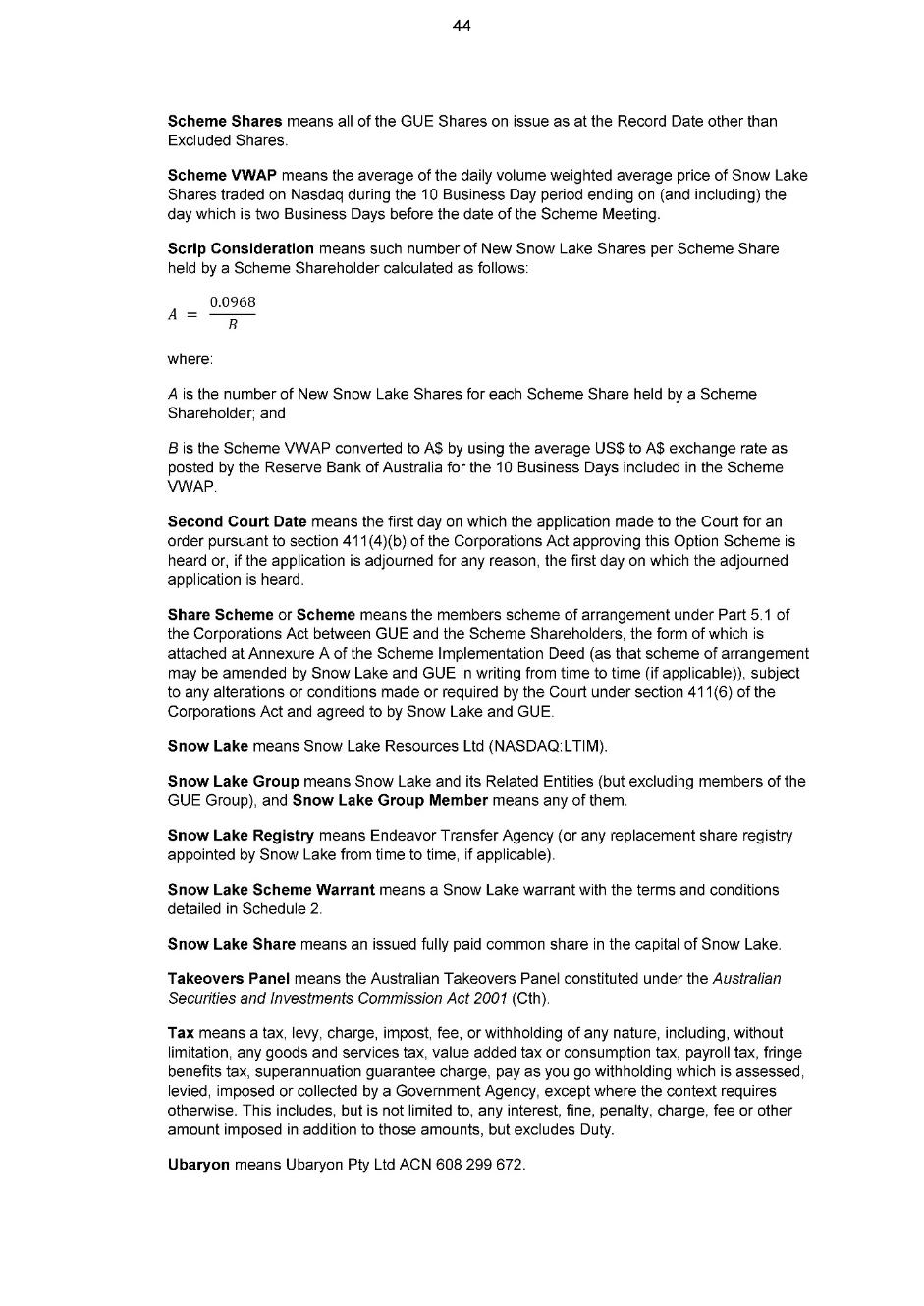
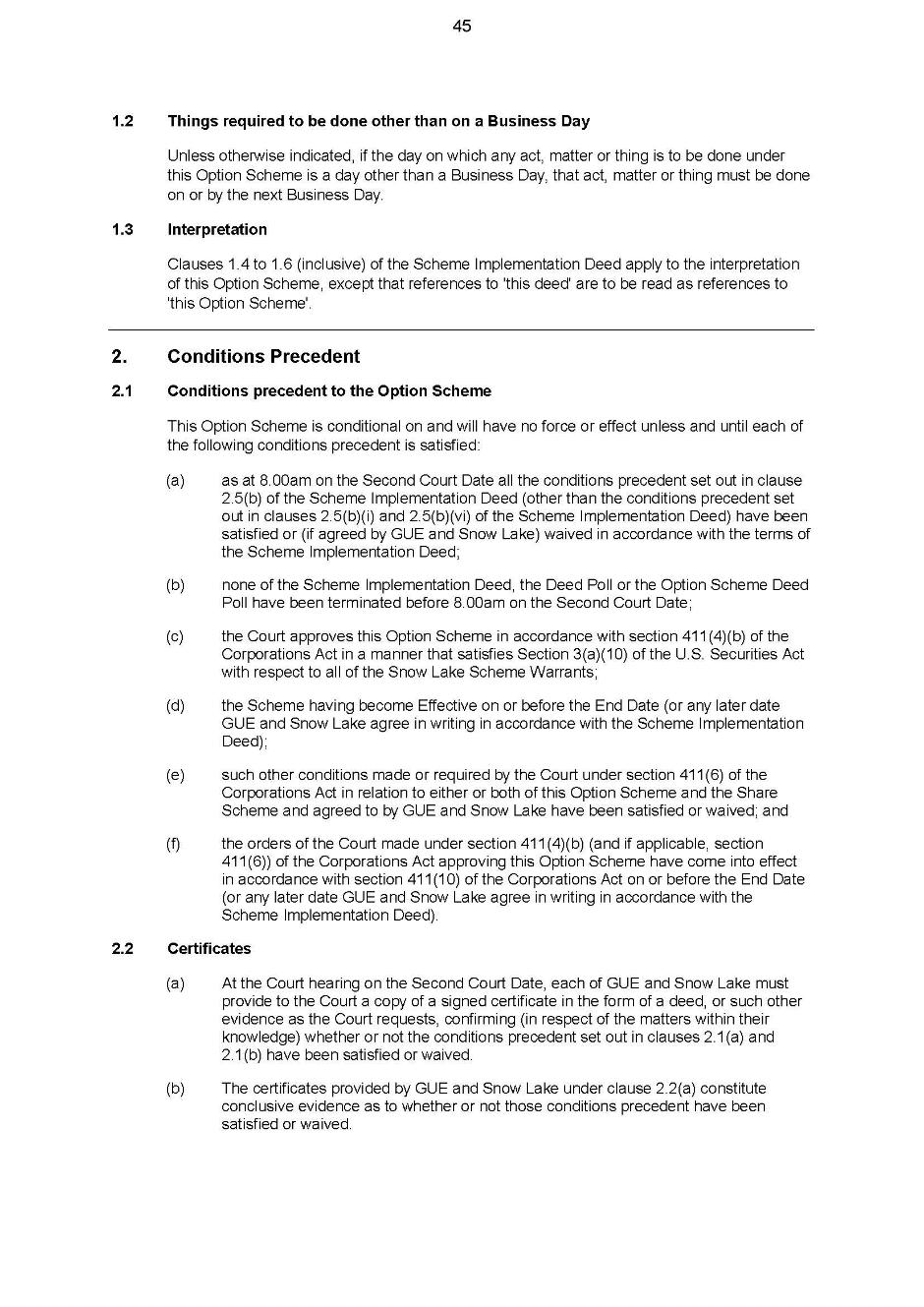
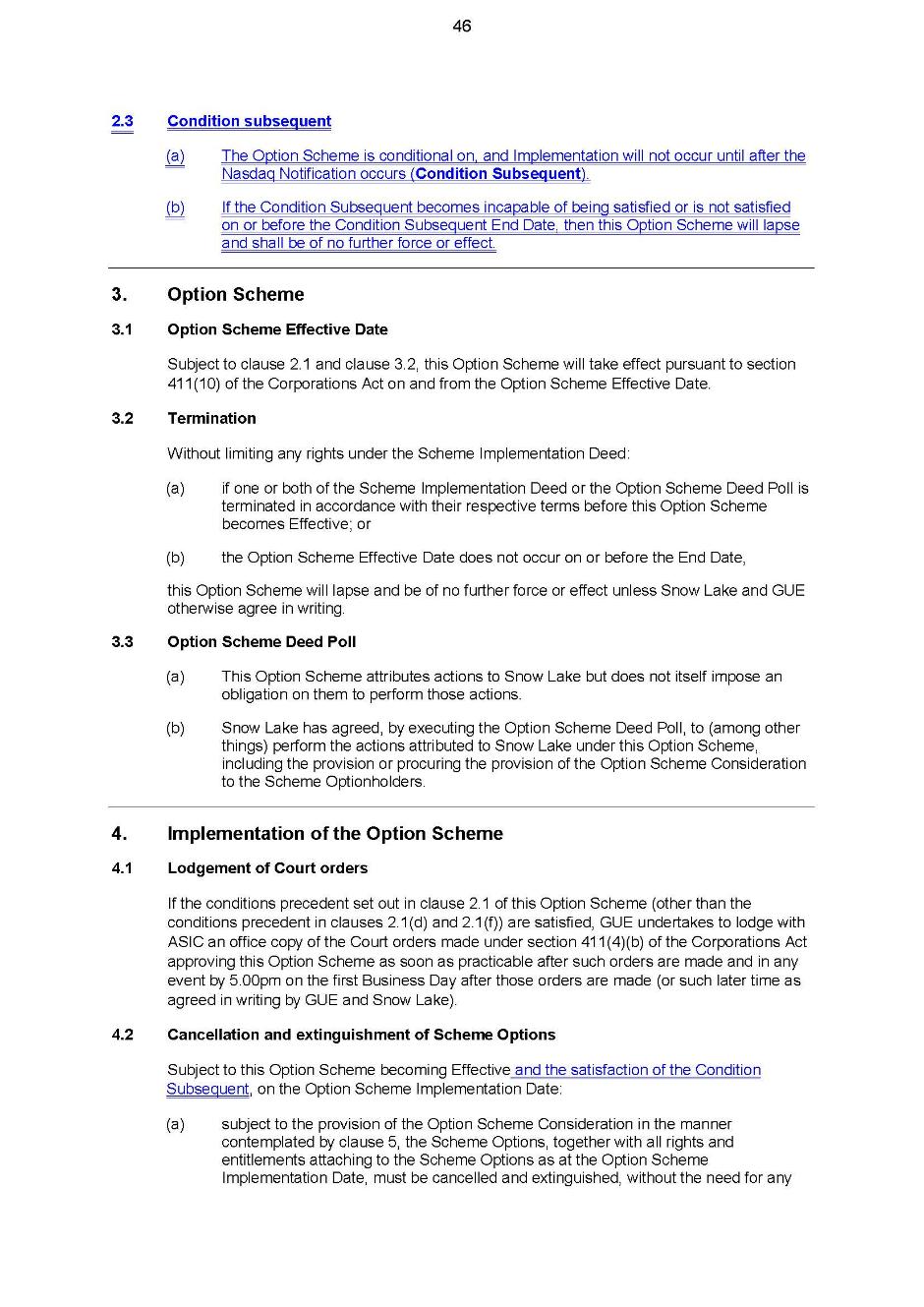
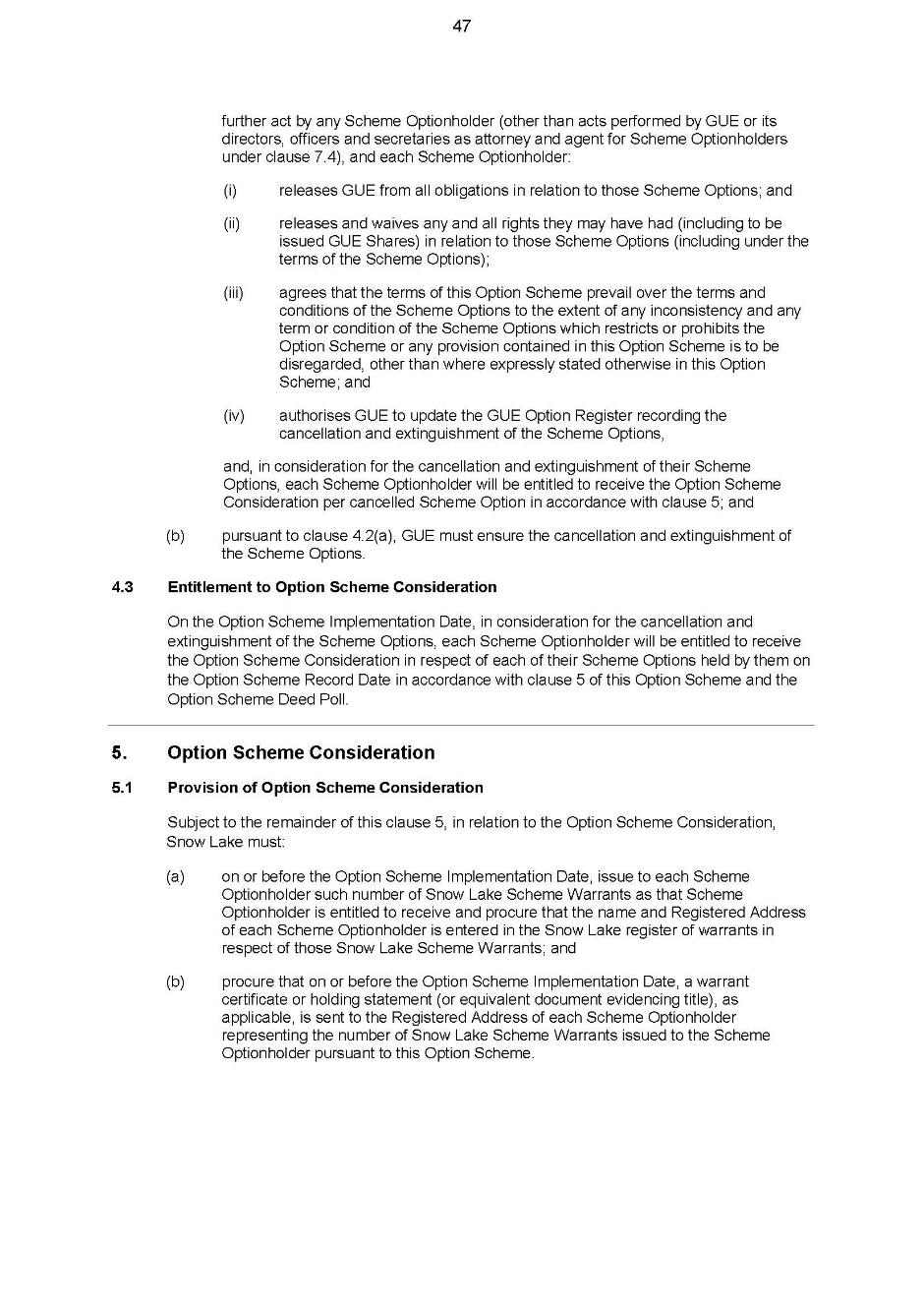
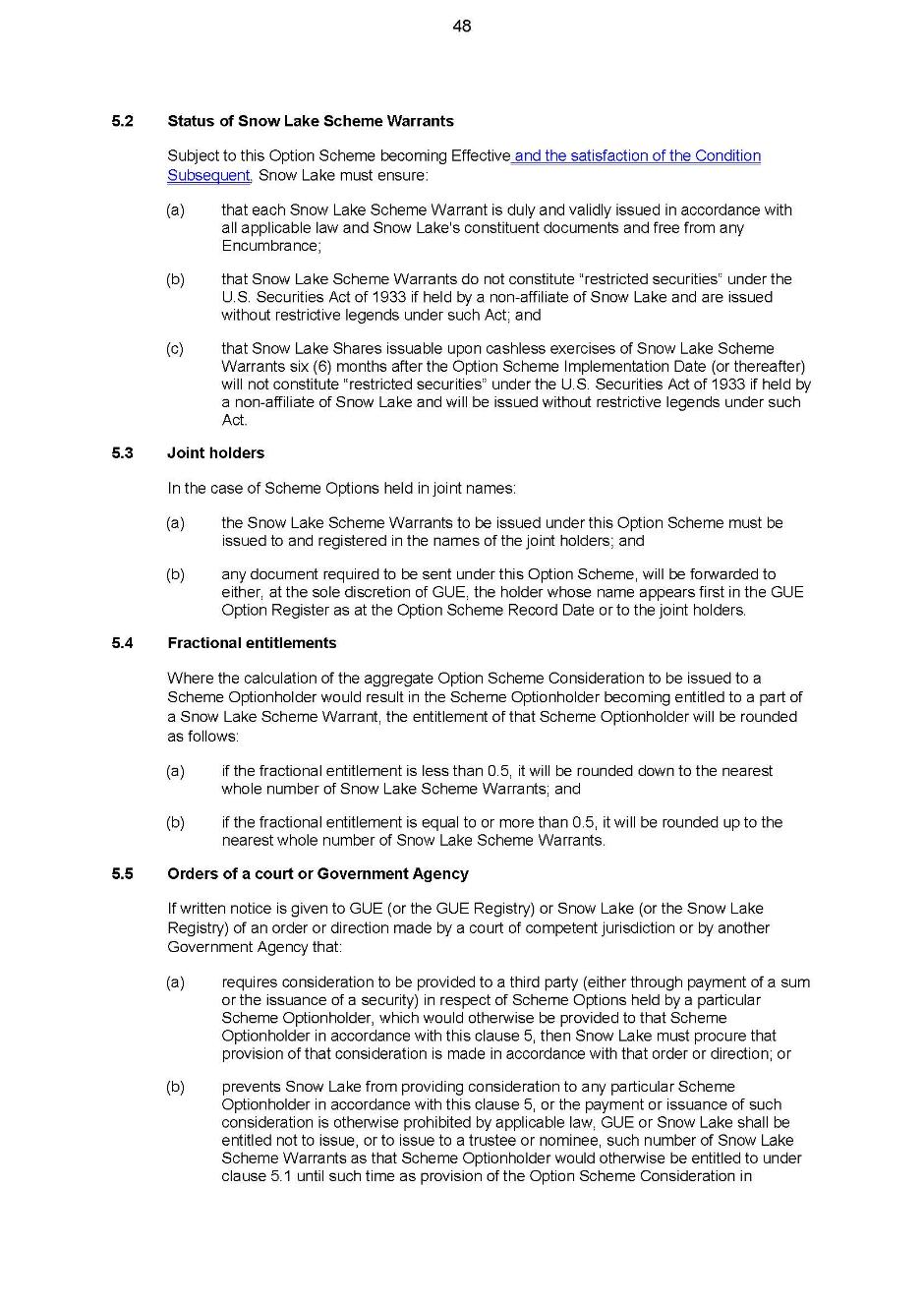
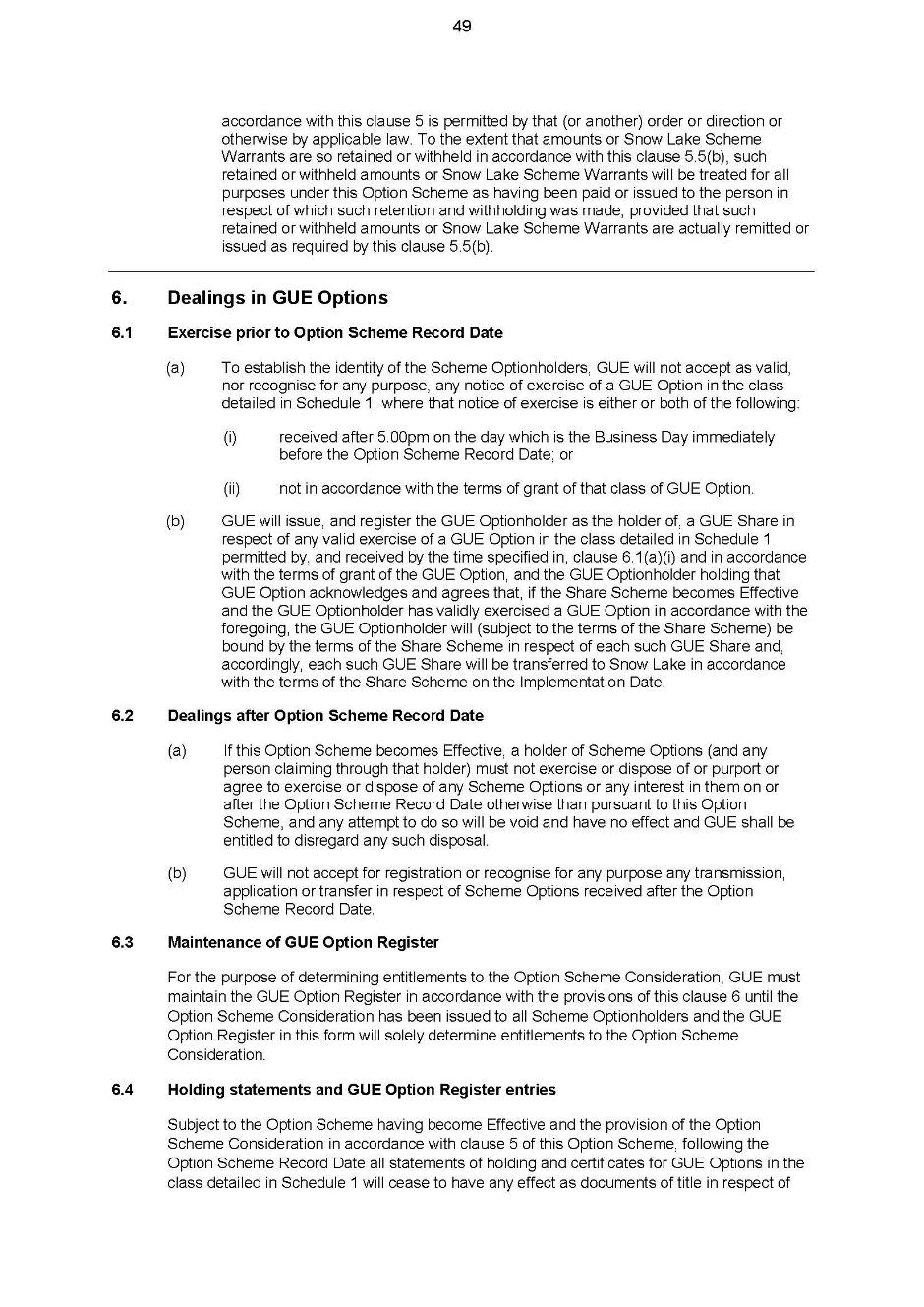
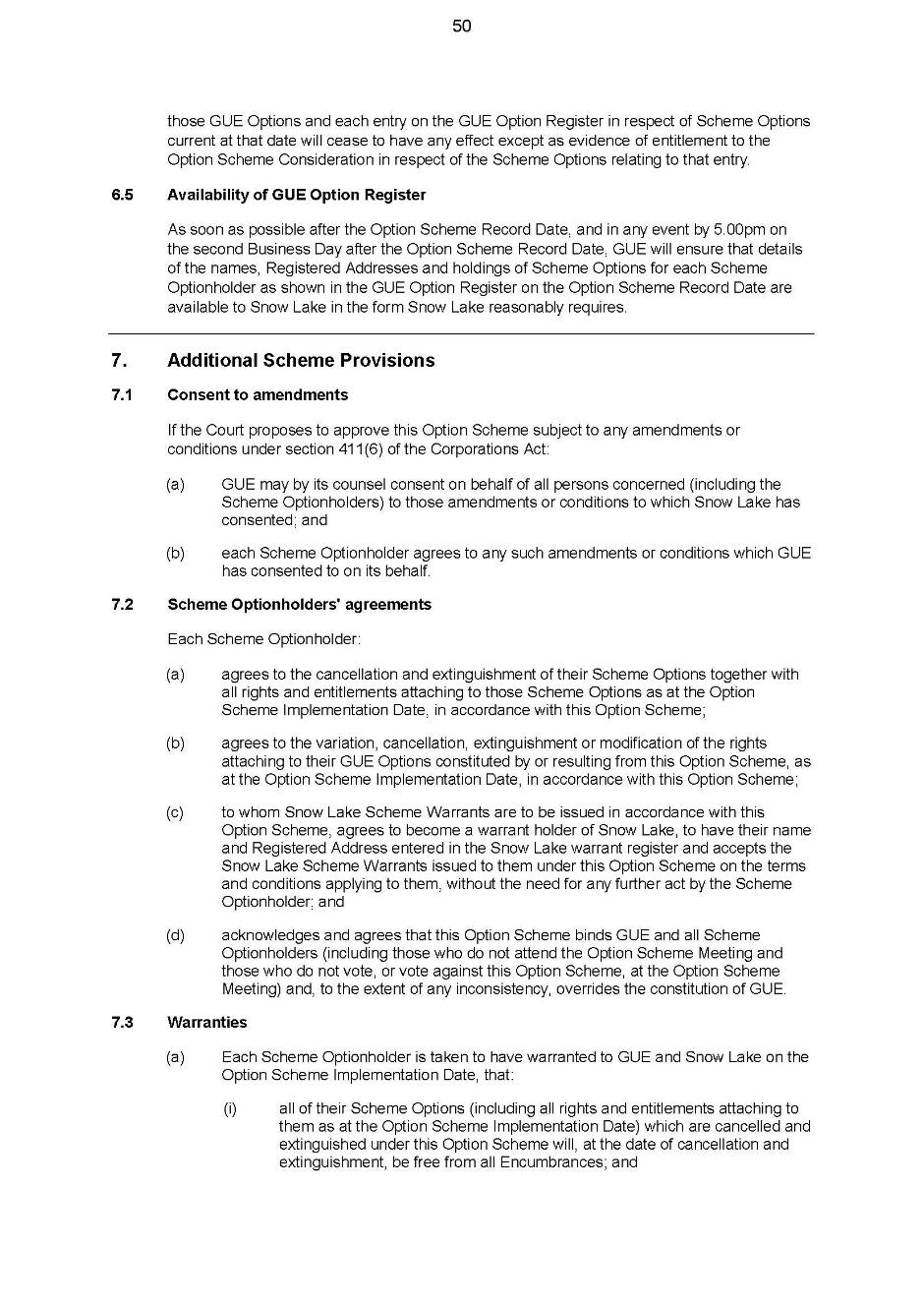
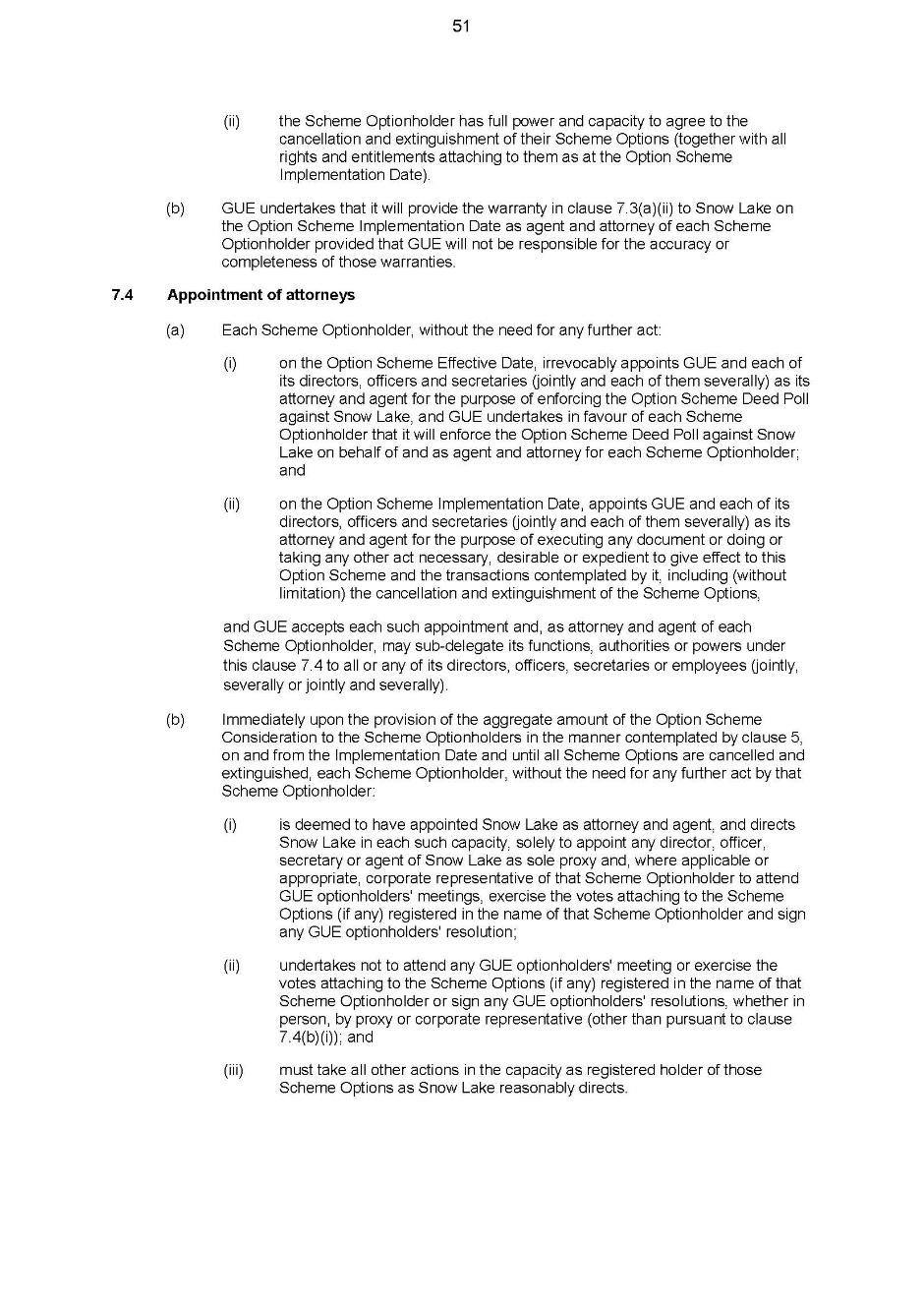
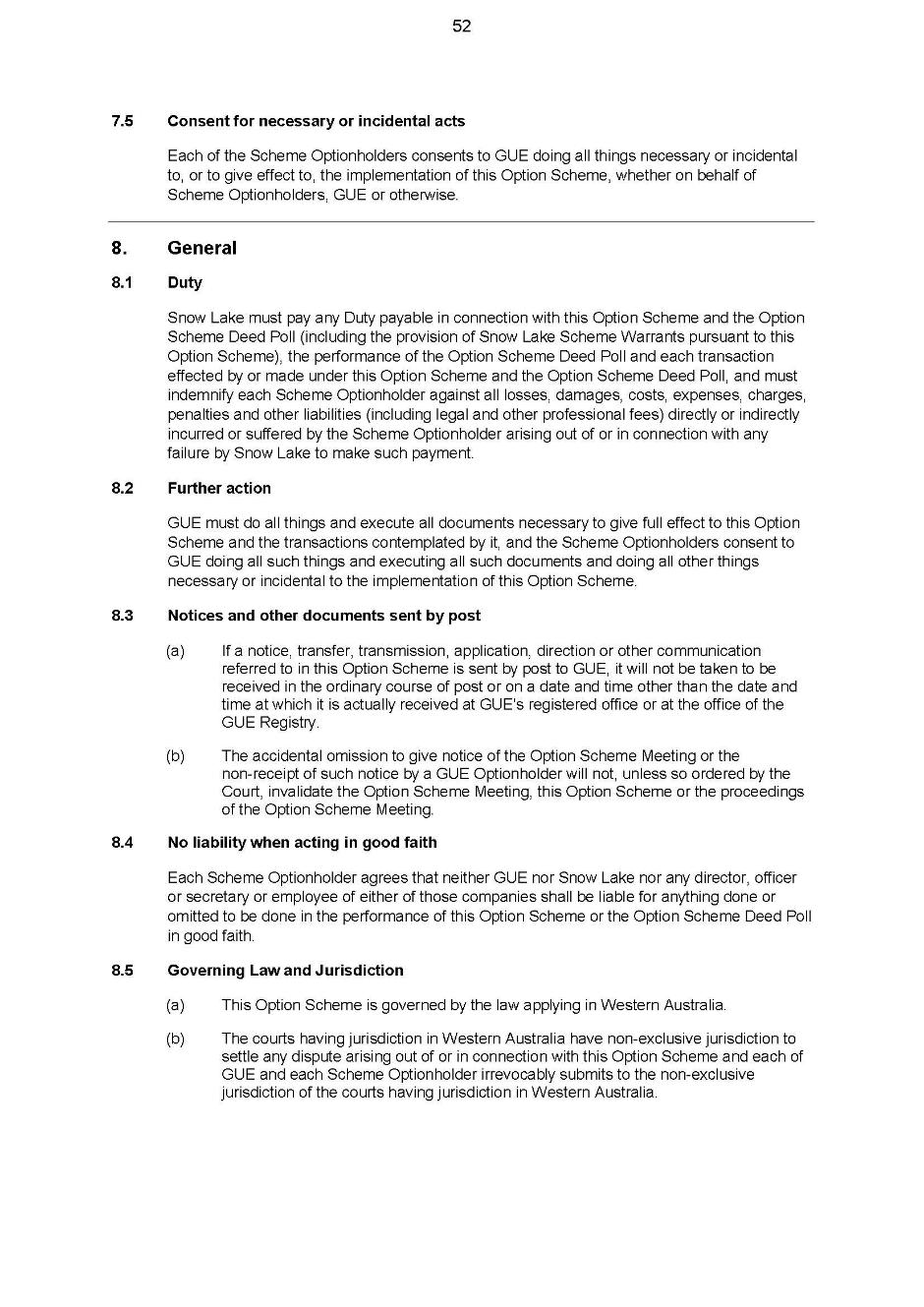

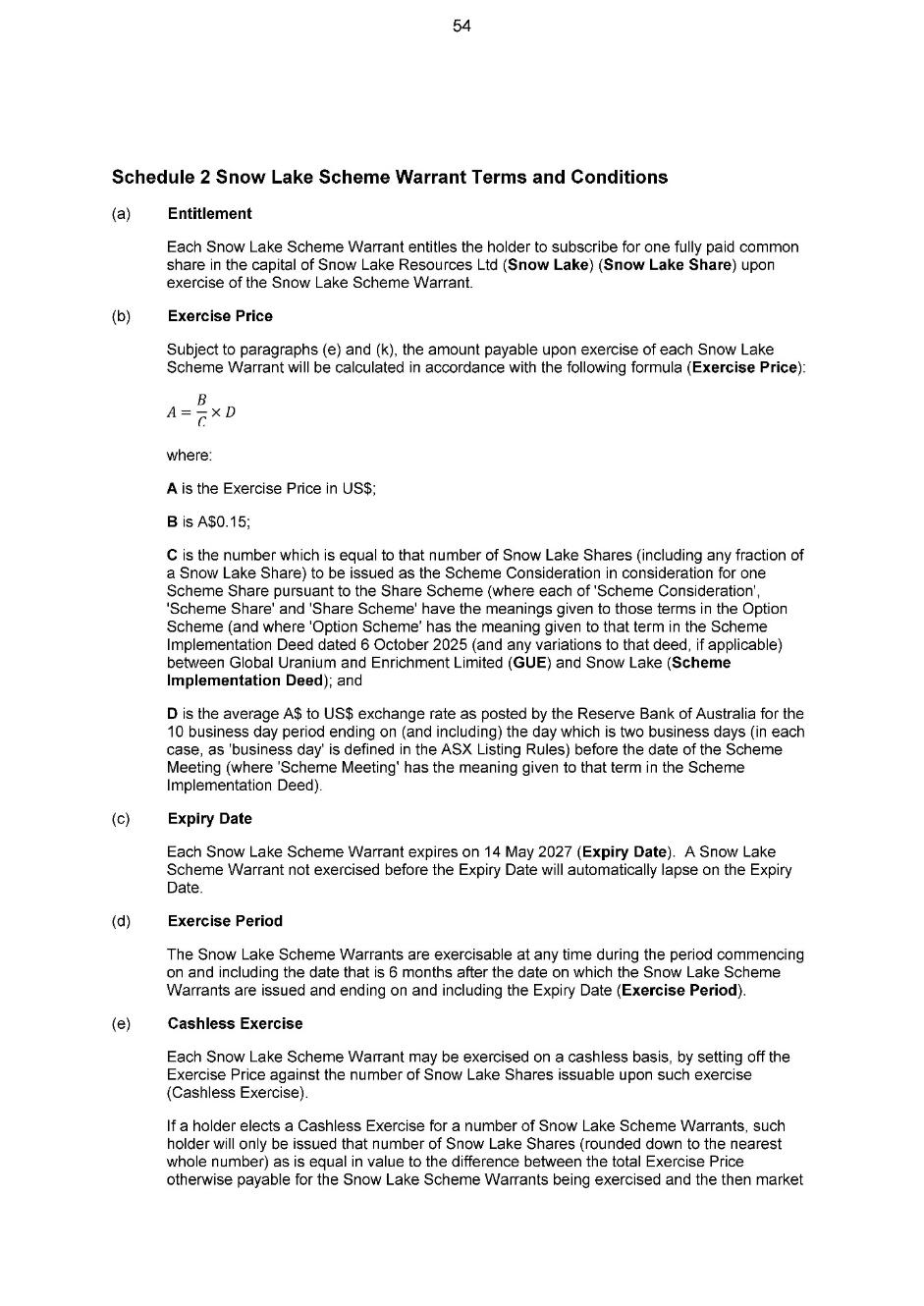

Annexure D - Amended Option Scheme


REASONS FOR JUDGMENT
VANDONGEN J:
1 These reasons should be read with my reasons in Global Uranium and Enrichment Limited, in the matter of Global Uranium and Enrichment Limited [2025] FCA 1684 and will use the defined terms that I adopted in that decision. In that case I made orders, on 19 December 2025 (the December orders), requiring the convening of a meeting of GUE shareholders, as well as a meeting of relevant option holders, to consider and, if thought fit, to agree to the Share Scheme or Option Scheme, respectively.
2 The scheme meetings that were the subject of the December orders made in Global Uranium and Enrichment took place on 27 January 2026, and resolutions to approve both schemes of arrangement were put to a poll and approved. Subject to the satisfaction of certain conditions subsequent, to which I will refer later in these reasons, under the Share Scheme, Snow Lake will acquire all of the fully paid ordinary shares in GUE that it does not already own in consideration for the issue of new Snow Lake shares to GUE ordinary shareholders, based on a formula and adjusted for the USD/AUD exchange rate. Under the Option Scheme, the holders of certain unlisted GUE options will receive new Snow Lake warrants in exchange for the cancellation of their options, based on a determined ratio and exercise price. The number of Snow Lake warrants to be issued will also be determined by a formula.
3 Pursuant to s 411(4) of the Corporations Act 2001 (Cth), a scheme of arrangement is binding on the members of a corporation, or a class of such members, if at a meeting convened in accordance with an order of the Court under s 411(1), a resolution is passed by the necessary majority provided for in s 411(4)(a)(ii) and if the arrangement is approved by order of the Court under s 411(4)(b).
4 A second hearing took place before me on 3 February 2026 (the second hearing), at which time counsel for GUE sought this Court's approval of the schemes of arrangement as required by s 411(4)(b). However, and as I will explain in more detail later in these reasons, counsel also sought that the Court grant that approval subject to making certain alterations to the arrangements pursuant to s 411(6).
5 Snow Lake, which was previously granted leave to appear as an interested party, also appeared at the second hearing, represented by counsel. However, no other person sought to be heard.
6 Having considered the evidence and written submissions filed in advance of the second hearing, and after hearing brief submissions from counsel for GUE, I made the orders sought by GUE pursuant to subss (4) and (6) of s 411 of the Corporations Act, approving the schemes of arrangement. These are my reasons for making those orders.
The evidence
7 In its written submissions, GUE informed the Court that it relied on the various affidavits on which it had previously relied on at the first hearing. Those affidavits are referred to and summarised at [7] to [19] of Global Uranium and Enrichment. In addition, GUE relied on six further affidavits.
8 In his affidavit sworn on 30 January 2026, Mr Andrew James Ferrier, the Managing Director of GUE, gave evidence about matters relating to the registration by ASIC and subsequent dispatch of the scheme booklet, the further communications that took place with GUE shareholders and option holders in the lead up to the scheme meetings, ASX announcements that were made by GUE and the scheme meetings themselves. Mr Ferrier also gave evidence about the fact that on 19 January 2026, GUE had drawn down $2.5 million under a standby facility and issued Summit a further $2.5 million of unsecured convertible notes, and that he is not aware of any alternative proposal to the Share Scheme or Option Scheme proposed to GUE prior to the scheme meetings, or between the conclusion of the scheme meetings and the time he swore his affidavit.
9 Ms Sanushka Seomangal is a solicitor and Partner at Thomson Geer Lawyers, the solicitors for GUE. Ms Seomangal acted as the chairperson for the scheme meetings. In her affidavit sworn 30 January 2026, Ms Seomangal gave evidence about the conduct of those meetings.
10 Ms Shelene Antoinette Watson is a law clerk employed by Nauth LPC, who are Snow Lake's Canadian legal advisers in connection with the schemes of arrangement. In her affidavit affirmed on 1 February 2026, she gave evidence about the steps taken on behalf of Snow Lake to comply with a condition precedent of the SID, which relevantly required that by 8.00 am on the date of the second hearing, Nasdaq approve the new Snow Lake shares to be issued under the Share Scheme for listing and trading on Nasdaq. Ms Watson also gave evidence to explain why this condition precedent could not be satisfied.
11 Mr Daniel Devindra Nauth is a partner at Nauth LPC. In his affidavit affirmed on 1 February 2026, Mr Nauth confirmed the accuracy of Ms Watson's affidavit, insofar as it refers and relates to him. Further, and based on his own experience with Nasdaq, Mr Nauth said in his affidavit that he believes:
(a) the quotation and trading of the New Snow Lake Shares will occur:
(i) after the Schemes have become effective, that is after the official copy of the Court's order has been lodged with ASIC; but
(ii) before the Implementation Date when the New Snow Lake Shares are actually issued to GUE shareholders;
(b) Snow Lake will be required to provide Nasdaq with confirmation that the transaction has closed (that is, become effective) and the relevant final transaction documents, including any Court orders approving the Schemes;
(c) Nasdaq's post-completion review process typically takes seven to ten business days from receipt of confirmation that the transaction has been completed; and
(d) given that the Implementation Date is the seventh Business Day after the Effective Date (as defined in the Watson Affidavit), there will be sufficient time for Nasdaq to complete its review of the transaction before the New Snow Lake Shares are listed for quotation and issued to GUE shareholders on the Implementation Date.
12 In his affidavit, Mr Nauth also said that he is not aware of, does not believe, and has no reason to believe that the new Snow Lake shares will not be issued and listed for quotation on Nasdaq before the 'Implementation Date', being the date new Snow Lake shares are to be issued to GUE shareholders in accordance with the Share Scheme.
13 Mr Hendrik Christofell van Aswegen is a Partner at Thomson Geer Lawyers. He has previously sworn several affidavits in this matter, and GUE now relies on two further affidavits sworn by Mr van Aswegen on 2 February 2026 and 3 February 2026, respectively. In the first of those affidavits (the 2 February affidavit), Mr van Aswegen gives evidence about the steps taken to deal with the issues concerning the quoting and listing of the new Snow Lake shares on Nasdaq, as identified in the affidavits of Ms Watson and Mr Nauth. According to what Mr van Aswegen describes as a 'signed letter deed' dated 2 February 2026, a copy of which is annexed to his 2 February affidavit, GUE and Snow Lake agreed to amend the Share Scheme and the Option Scheme to address the Nasdaq timing issues. I will say more about these amendments later in these reasons. In his 2 February affidavit, Mr van Aswegen also gave evidence about various communications with ASIC since 30 January 2026, including communications about the agreed amendments to the schemes of arrangement.
14 To his affidavit of 3 February 2026 (the 3 February affidavit), Mr van Aswegen annexed a copy of a second 'letter deed' dated 2 February 2026, which incorporated some minor amendments that were made to the Option Scheme and Share Scheme at the request of ASIC. Mr van Aswegen also attached a letter from ASIC advising that under s 411(17)(b) of the Corporations Act, it has no objection to either of the schemes of arrangement. Finally, attached to that affidavit are also several 'Condition Precedent Certificates' executed by GUE and Snow Lake, respectively, on 2 February 2026. Those certificates certify that certain conditions precedent in the Share Scheme and in the Options Scheme have been satisfied.
The relevant principles that must be applied
15 It has been said on several occasions that the principles that apply when the court is considering whether to grant its approval to a scheme under s 411(4) are well established. Those principles were recently summarised by Moshinsky J in Envirosuite Limited, in the matter of Envirosuite Limited (No 2) [2025] FCA 941 at [10] to [11], as follows:
In approving a scheme of arrangement, the role of the Court is supervisory, requiring the Court to be satisfied that there has been no oppression and that the compromise or arrangement is one that is capable of being accepted by shareholders looking to their own commercial advantage. In Re NRMA Ltd (No 1) [2000] NSWSC 82; 156 FLR 349 (Re NRMA Ltd) at [41], Santow J quoted with approval the following passage from Renard IA and Santamaria JG, Takeovers and Reconstructions in Australia (Butterworths, Sydney, 1990, loose-leaf), at 15,061:
… the court will determine: (1) whether all the conditions required by s 411 have been complied with; (2) whether the majority of members or creditors, though acting regularly, have acted in good faith and not in pursuit of some illegitimate purpose; and (3) whether the proposal was 'at least so far fair and reasonable, as that an intelligent and honest man, who is a member of that class, and acting alone in respect of his interest as such member, might approve it'.* Fundamentally, the jurisdiction is supervisory; the court is concerned to be satisfied that there has been an absence of oppression and that the compromise or arrangement is one which is capable of being accepted: see Re Dorman Long & Co Ltd [[1934] Ch 635]; Scottish Insurance Corp Ltd v Wilsons and Clyde Coal Co Ltd [1949] AC 462 at 486.
* Per Fry LJ in Re Alabama, New Orleans, Texas and Pacific Junction Railway Co [1891] 1 Ch 213 at 247.
In deciding whether to give final approval to a scheme of arrangement, the Court will typically wish to be satisfied of the following matters:
(a) that the orders of the Court convening a meeting of members were complied with;
(b) that the meeting of members so convened has approved the scheme with the requisite majority;
(c) that all the statutory requirements have been complied with;
(d) that the majority of members have acted in good faith and not for any illegitimate purpose;
(e) that there is no suggestion of oppression of any minority;
(f) that the scheme is fair and reasonable so that an intelligent and honest person, who is a member and acting alone in respect of his or her interest as a member, might approve it;
(g) that there was full and fair disclosure to members of all information material to the decision whether to vote for or against the scheme; and
(h) that the plaintiff has brought to the attention of the Court all matters that could be considered relevant to the exercise of the Court's discretion.
(citations omitted)
Formal matters
Lodgment of December orders and registration of the scheme booklet
16 Based on Mr Ferrier's affidavit of 30 January 2026, I am satisfied that GUE's solicitors registered the scheme booklet with ASIC pursuant to s 412(6) of the Corporations Act, in substantially the form approved by the Court, and that a sealed copy of the December orders were lodged with ASIC as soon as possible after they were made.
Dispatch of the scheme booklet
17 I accept Mr Ferrier's evidence that scheme booklets were dispatched to each shareholder and option holder, in accordance with the December orders.
Advertising of hearing
18 Following the conclusion of the scheme meetings on 27 January 2026, GUE published via the ASX an announcement advertising the second hearing, in accordance with the December orders.
Conduct of scheme meetings
19 Based on Ms Seomangal's affidavit of 30 January 2026, I am satisfied that the scheme meetings were conducted in accordance with the December orders.
The schemes were approved by the requisite majorities
20 The Share Scheme was passed by the requisite majorities provided for in s 411(4)(a)(ii) of the Corporations Act. Based on Ms Seomangal's affidavit of 30 January 2026, 93.02% of shareholders present and voting at the scheme meeting voted in favour of the Share Scheme, amounting to 99.19% of the votes cast. Ms Seomangal's affidavit of 30 January 2026 also establishes that the Option Scheme was passed by the requisite majorities, with 100% of the option holders present and voting at the relevant meeting voting in favour of the Option Scheme, amounting to 100% of the votes cast. These results were announced to the market on 27 January 2026.
21 The evidence before me established that there was a low shareholder turnout at the Share Scheme meeting, as only 28.45% of GUE voting shares on issue were voted at the meeting by 4.79% of shareholders eligible to vote. There was, however, a larger turnout of option holders with 68.52% of voting options in GUE having been voted at the Option Scheme meeting by 35% of option holders eligible to vote.
22 In Allkem Limited, in the matter of Allkem Limited (No 2) [2023] FCA 1657 at [19], Banks-Smith J observed that while the 3.96% shareholder turnout in that case was not the lowest recorded in the authorities, it was close to it. The same might well be said of the turnout in this case. However, as Banks-Smith J further noted at [20], 'low shareholder turnout does not prevent the Court from making orders approving a scheme of arrangement'.
23 Mr Ferrier's affidavit of 30 January 2026 establishes that at GUE's annual general meetings held on 22 November 2024 and 26 November 2025, the GUE shares that were voted on reflected 3.41% and 4.15% of shareholders then on the register, respectively, and 17.10% and 29.83% of shares then on issue, respectively. Therefore, the low turnout at the Share Scheme meeting was consistent with the low attendance of shareholders at other recent shareholder meetings. Further, there was nothing to suggest that the low turnout indicated that there may have been an issue with the dispatch of the scheme booklet or that there was any other factor that had improperly deterred shareholders from attending or voting at the scheme meetings.
24 Accordingly, I was satisfied that the low voter turnout was not a reason to decline to approve the Share Scheme.
25 There was no relevant issue with the turnout of option holders with respect to the Option Scheme.
Satisfaction of conditions precedent
26 With one exception, I was satisfied that all the conditions precedent to the implementation of the Share Scheme and the Option Scheme had been satisfied or waived. The exception concerned cl 3.1(f) of the SID, which is picked up by cl 2.1(a) of the Share Scheme.
27 In supplementary written submissions, counsel for GUE drew the Court's attention to those clauses, the combined effect of which is that the Share Scheme that was approved by GUE shareholders was to be conditional on the new Snow Lake shares being approved for listing and trading on Nasdaq before 8.00 am on the date of the second hearing.
28 The evidence of both Ms Watson and Mr Nauth established that after the Share Scheme meeting had taken place, it became apparent that formal approval for the new Snow Lake shares to be listed and traded on Nasdaq would not be forthcoming. As Ms Watson explained, on 27 January 2026, she submitted a Listing of Additional Shares notification form (LAS Form) to Nasdaq providing notice of the proposed issuance of new Snow Lake shares in connection with the transaction contemplated by the SID. She did not provide the LAS Form earlier because, based on her experience, Nasdaq generally requires that a LAS Form only be submitted when the share issue is imminent.
29 Ms Watson then contacted Nasdaq on 29 January 2026 to ascertain the status of the LAS Form and to determine the form of approval or confirmation Nasdaq would provide regarding the quotation of the new Snow Lake shares. She then learned that the purpose of the LAS Form is only to notify Nasdaq of the transaction and that there is no approval or denial of the notification. According to Ms Watson, Nasdaq will only review the transaction relating to the new Snow Lake shares if it completes. Nasdaq will then only contact Snow Lake if any discrepancies between the information provided on the LAS Form and the final transaction are noted.
30 Accordingly, based on her discussions with Nasdaq, Ms Watson understands that:
(a) the process of listing of additional shares on Nasdaq is a notification process only, and not an approval process;
(b) Nasdaq will not formally approve the issue of the new Snow Lake shares pursuant to the SID; and
(c) Nasdaq will only review the transaction after it has closed, that is after the scheme comes into effect, but before the new Snow Lake shares are issued.
31 Ms Watson explained that this information only came to light after she contacted Nasdaq on 29 January 2026.
32 GUE submitted that all of this meant that cl 3.1(f) of the SID and cl 2.1(a) of the Share Scheme could not be satisfied. It also meant that although Snow Lake had started the process of having the new Snow Lake shares listed on Nasdaq, GUE and Snow Lake would not know whether Nasdaq's notification process had been satisfied until after the second hearing, and after the orders of the Court under s 411(4) come into effect pursuant to s 411(10) of the Corporations Act.
33 However, GUE relies on the evidence of Mr Nauth, one of Snow Lake's legal advisers, which is to the effect that he is not aware of, does not believe, and has no reason to believe that the new Snow Lake shares will not be issued and listed for quotation on Nasdaq. GUE submitted that it is only a matter of the process by which that occurs.
34 To resolve this issue, GUE and Snow Lake proposed that the Court make alterations to the Share Scheme to effectively remove cl 3.1(f) of the SID as a condition precedent for the purposes of cl 2.1(a) of the Share Scheme, and to replace it with a condition subsequent. The terms of the proposed amendments were shown in a marked up copy of the Share Scheme attached to Mr van Aswegen's 2 February affidavit.
35 It was submitted that the effect of the new condition subsequent would be that:
(a) Snow Lake must have provided Nasdaq with all necessary information as required by its notification process; and
(b) as at 8.00 am on the date GUE shares are otherwise due to be transferred to Snow Lake and Share Scheme shareholders are to receive new Snow Lake shares, there is nothing from Nasdaq to indicate that the new Snow Lake shares will not be listed and quoted.
36 A further alteration to the Share Scheme was proposed, namely, that if this condition subsequent was not satisfied within 10 business days after the Share Scheme comes into effect, then the Share Scheme would not be implemented and it would terminate. Following feedback from ASIC in relation to the Share Scheme, GUE and Snow Lake proposed an extension of the time allowed from 10 to 15 business days.
37 Similar consequential amendments were sought by GUE and Snow Lake to the Option Scheme because of its interconnectedness with the Share Scheme.
38 The Court has the power to grant its approval to a scheme of arrangement 'subject to such alterations or conditions as it thinks fit': s 411(6) of the Corporations Act. The applicable principles to be applied were helpfully summarised by Moshinsky J in Carbon Revolution Limited, in the matter of Carbon Revolution Limited (No 3) [2023] FCA 1270 at [34] as follows:
(a) the discretion may be exercised if the alteration is of a minor or technical kind which does not really affect the details of, or recast, the scheme;
(b) likewise, the discretion may be exercised if the alteration is of a minor or technical kind which improves the smooth working of the scheme or which does not affect the substantive operation of the scheme;
(c) the Court will not make an alteration to a scheme unless it is satisfied that the scheme as proposed to be altered would still have been agreed to by the requisite majorities if the members or creditors (as the case may be) had considered and voted on the scheme as proposed to be altered; and
(d) any alteration should not impinge upon or affect the 'spirit and intendment of the scheme as a whole'.
(citations omitted; paragraph numbering altered)
39 GUE submitted, and I accepted, that the Court may exercise its discretion under s 411(6) to approve a scheme that is subject to a condition subsequent, and that this has previously occurred in circumstances in which the condition subsequent does not cause the scheme to become unclear or uncertain, or where it would not introduce a new decision-making process after the court has already approved the scheme: Carbon Revolution at [52]; citing Atlassian Corporation Pty Limited, in the matter of Atlassian Corporation Pty Limited [2013] FCA 1451 at [28] to [30]; iProperty Group Limited, in the matter of iProperty Group Limited [2015] FCA 1507 at [26] to [27]; and In the matter of Afterpay Limited [2021] NSWSC 1709 at [17].
40 Having considered the condition subsequent, which appears in the marked-up versions of the Share Scheme and the Options Scheme, and which are attached to the Court's order as Annexures A and C respectively, I accepted that it would not cause either scheme to become unclear or uncertain. The condition subsequent requires that Snow Lake must have provided Nasdaq with all necessary information as required by its notification process, and that as at 8.00 am on the date GUE shares are otherwise due to be transferred to Snow Lake and Share Scheme shareholders are to receive new Snow Lake shares, there is nothing from Nasdaq to indicate that the new Snow Lake shares will not be listed and quoted. Significantly, if that condition subsequent is not satisfied then implementation of the schemes will not occur.
41 I was conscious of the fact that the shareholders and option holders who participated in the scheme meetings, and who voted in favour of the schemes, did not vote with knowledge of the alterations that were later proposed to be made to those schemes. However, and as GUE submitted, the shareholders and option holders did vote to pass resolutions approving the schemes on the basis that 'the GUE Board is authorised to agree to such alterations or conditions as are thought fit by the Court and consented to in writing by GUE and Snow Lake'.
42 The purpose of the condition precedent in cl 3.1(f) of the SID is to ensure that when the new Snow Lake shares are issued to GUE shareholders in accordance with the Share Scheme they are listed and quoted on Nasdaq. It seems clear that when GUE and Snow Lake entered into the SID it was understood that a form of approval would be required before the new Snow Lake shares could be listed and traded on Nasdaq. Based on the evidence before me, that understanding appears to have been inaccurate. However, I was satisfied that the proposed alterations to the Share Scheme and to the Option Scheme will bring about the outcome that was originally intended in accordance with those schemes.
43 I also note, for completeness, that ASIC provided its statement of no objection for the purposes of s 411(17)(b) of the Corporations Act with knowledge of, and having had input into the wording of, the proposed alterations to the Share Scheme and to the Option Scheme.
Discretionary considerations
Good faith and proper purpose
44 I was satisfied that the shareholders and relevant option holders voted in good faith and not for an improper purpose. In that context I noted that the independent expert, BDO, had concluded that the schemes were fair and reasonable and in the best interests of shareholders and option holders, respectively, in the absence of a superior proposal. Further, no shareholder or option holder sought to appear at the second hearing to object to the Court granting its approval to either of the schemes of arrangement.
Fair and reasonable schemes
45 I was also satisfied that both schemes are fair and reasonable such that an intelligent and honest securityholder, properly informed and acting alone, might approve it: Seven Network Limited (ACN 052 816 789), in the matter of Seven Network Limited (No 3) [2010] FCA 400 at [36]. In that regard, I again refer to the opinion of the independent expert and the fact that the schemes were the subject of unanimous recommendations from the directors of GUE (other than Mr Frank David Wheatley, given his role as the Chief Executive Officer of Snow Lake) in the absence of a superior proposal.
Full and fair disclosure
46 I was satisfied there had been full and fair disclosure. In that regard I note that I was previously satisfied in Global Uranium and Enrichment that there would be full and fair disclosure to shareholders and option holders through distribution of the scheme booklet. I also note the evidence of Mr Ferrier concerning further communications that took place with shareholders and option holders after the orders were made on 19 December 2025. That evidence satisfies me that there have been no communications that may have undermined the integrity of the scheme booklet or the scheme process in general.
Satisfaction of s 411(17) of the Corporations Act
47 Attached to Mr van Aswegen's 3 February affidavit is a copy of a letter from ASIC dated the same date, in which ASIC advised that it had no objection to either scheme of arrangement. Accordingly, although the Court need not approve of a scheme of arrangement merely because such a statement has been provided by ASIC, it means that one of the statutory preconditions to approving a scheme of arrangement under s 411(17)(b) of the Corporations Act was met.
Public policy and oppression of minorities
48 There was no evidence of any relevant oppression or to suggest that either of the schemes offend public policy.
Other matters
49 In its written submissions, GUE drew the Court's attention to three specific matters.
50 Firstly, GUE drew the Court's attention to the evidence that was before the Court at the first hearing on 19 December 2025 about the proposed communications with shareholders and option holders through telephone information lines. As I have already said, based on Mr Ferrier's affidavit of 30 January 2026 I am satisfied that those communications were consistent with the scheme booklet, and that there is no evidence to suggest that they compromised the integrity of the voting process that took place at the scheme meetings.
51 Secondly, GUE drew the Court's attention to the existence of authorities to the effect that where a scheme of arrangement is proposed to be made between a company and its shareholders other than a category of excluded shareholders, then the scheme should be amended at the approval hearing to ensure that any excluded shareholders are clearly identified: In the matter of Brickworks Limited; In the matter of Washington H. Soul Pattinson and Company Limited (No 2) [2025] NSWSC 1068 at [16]. However, as the only excluded shareholder under the Share Scheme is Snow Lake, a fact that has been clearly addressed in the scheme booklet, I am of the view that there is no need to formally amend the Share Scheme for the sake of clarity.
52 Thirdly, Snow Lake wishes to rely on the Court's approval of the schemes to qualify for:
(a) an exemption under s 3(a)(10) of the Securities Act of 1933 (USA) registration requirements in connection with the issue and exchange of the scheme consideration under the schemes; and
(b) an exemption from the prospectus requirements of s 2.11 of the harmonised Canadian National Instrument 45-106 in connection with the implementation of, and provision of consideration under, the schemes.
53 As Banks-Smith J noted in Allkem at [36], there are many examples of second court hearings for schemes where an issue about an exemption under s 3(a)(10) of the Securities Act has arisen, and that the courts have proceeded on the basis that the exemption would be available if the court holds a hearing to determine whether the proposed terms and conditions of a scheme of arrangement are fair to those who receive securities. Her Honour also said that it is not for the court to express any view as to whether its procedures or processes are sufficient to satisfy the requirements of the exemption, and that the court does not act as the valuer of shares, but is assisted by expert opinion on that matter.
54 A standard approach has been adopted by the courts in relation to the exemptions, by noting particular matters: Allkem at [37]. Therefore, I note the following matters:
(a) GUE advised this Court before the hearing to approve the schemes that reliance would be placed on the exemption provided for by s 3(a)(10) of the Securities Act and the exemption that is the subject of s 2.11 of the harmonised Canadian National Instrument on the basis of the Court's approval of the schemes;
(b) GUE has advised this Court that Snow Lake shares and Snow Lake warrants will be offered as consideration, and that BDO concluded that the proposal is in the best interests of shareholders and option holders;
(c) this Court held a hearing in open court to consider the fairness and reasonableness of the proposed schemes, and it was open to any member of the public, including any shareholder or scheme option holder of GUE to attend;
(d) notice of the date of the hearing to approve the schemes:
(i) was included in the scheme booklet circulated to all shareholders and option holders prior to the proposal being considered at the scheme meetings; and
(ii) was advertised on the ASX,
so that those to whom the securities are to be issued have had the opportunity to oppose or otherwise raise any objection to the schemes; and
(e) no shareholder or option holder had given notice of any intention to appear at the second court hearing to oppose the approval of the schemes, and the Court will have regard to whether any shareholder or option holder in fact opposed the approval of the schemes at the hearing.
55 I also made the following notations in the Court's orders approving the schemes:
(a) the Court's approval of the Share Scheme and the Option Scheme as set out in the orders and reasons for judgment as the basis of a claim to an exemption pursuant to s 3(a)(10) of the Securities Act of 1933 (US) (as amended) from the registration requirements otherwise imposed by that Act, in connection with the implementation of, and provision of consideration under, the Share Scheme and the Option Scheme;
(b) the fact the Share Scheme and Option Scheme have proceeded under the statutory procedures of the Corporations Act 2001 (Cth); and
(c) the approval of the Share Scheme and Option Scheme by the Court for the purpose of qualifying for the exemption from the prospectus requirements of s 2.11 of the harmonised Canadian National Instrument 45-106 – Prospectus Exemptions in connection with the implementation of, and provision of consideration under, the Share Scheme and Option Scheme.
Conclusion
56 In light of the matters to which I have referred, I exercised my discretion at the second hearing to approve the Share Scheme and the Option Scheme.
57 Although it was not the subject of any submissions, I also granted the exemption from the requirements of s 411(11) of the Corporations Law to annex a copy of every order of this Court to every copy of GUE's constitution as no change will be made to the constitution as a consequence of those orders.
I certify that the preceding fifty-seven (57) numbered paragraphs are a true copy of the Reasons for Judgment of the Honourable Justice Vandongen. |
Associate:
Dated: 12 February 2026


