

Federal Court of Australia
Capic v Ford Motor Company of Australia Pty Ltd (Supplementary Common Questions and Other Issues) [2026] FCA 38
File number(s): | NSD 724 of 2016 |
Judgment of: | PERRAM J |
Date of judgment: | 2 February 2026 |
Catchwords: | CONSUMER LAW – representative proceedings – where respondent manufacturer was found at trial to have supplied vehicles in Australia which did not comply with the guarantee of acceptable quality under s 54 of the Australian Consumer Law (‘ACL’) – where affected vehicles have been on-sold into the second-hand market and subsequent owners have acquired their affected vehicle by private sale or by re-supply by a car dealer – whether subsequent owners are entitled to claim reduction in value damages under s 272(1)(a) ACL calculated by reference to the original supply to the first consumer CONSUMER LAW – representative proceedings – where the class member definition was amended after trial to expand the class – where information about the proceedings was reported by the press and available online – whether class members ought to have been aware that the guarantee of acceptable quality had not been complied with – whether claims of new class members are time barred REPRESENTATIVE PROCEEDINGS – where orders are sought under s 33Z of the Federal Court of Australia Act 1976 (Cth) to crystallise claims of class members – where entitlement to claim reduction in value damages runs with title – where proceedings commenced many years ago – whether the Court has power to make the orders under s 33Z(1)(e) and/or s 33Z(1)(g) – whether crystallisation orders should be made |
Legislation: | Competition and Consumer Act 2010 (Cth) sch 2 ss 2, 7(1)(e), 54, 143(2), 271, 272, 273 Federal Court of Australia Act 1976 (Cth) ss 33Z(1)(e), 33Z(1)(g) Trade Practices Act 1974 (Cth) ss 74B(1), 74C(1), 74D(1), 74E(1) Trade Practices Amendment Act 1978 (Cth) Trade Practices Revision Act 1986 (Cth) Trade Practices Amendment Bill 1978 (Cth) Trade Practices Amendment (Australian Consumer Law) Bill (No. 2) 2010 (Cth) Trade Practices Revision Bill 1986 (Cth) Manufacturers Warranties Act 1974 (SA) ss 3(1), 9 Manufacturers Warranties Bill 1974 (SA) Law Reform (Manufacturers Warranties) Ordinance 1977 (ACT) s 3(3)(b) |
Cases cited: | Anthony Hordern & Sons Ltd v Amalgamated Clothing & Allied Trades Union of Australia [1932] HCA 9; 47 CLR 1 BE Australia WD Pty Ltd (Subject to a Deed of Company Arrangement) v Sutton [2011] NSWCA 414; 82 NSWLR 336 Capic v Ford Motor Company of Australia Pty Ltd [2021] FCA 715; 154 ACSR 235 Capic v Ford Motor Corporation of Australia Pty Ltd [2024] HCA 39; 419 ALR 437 Capic v Ford Motor Company of Australia Pty Ltd (Remitter) [2025] FCA 670 Commissioner of Taxation v Runcity Pty Ltd [2025] FCAFC 152; 312 FCR 291 David Grant & Co Pty Ltd v Westpac Banking Corp [1995] HCA 43; 184 CLR 265 Dwyer v Volkswagen Group Australia Pty Ltd [2023] NSWCA 211; 381 FLR 32 Electricity Trust of South Australia v Krone (Australia) Technique Pty Ltd [1994] FCA 461; 51 FCR 540 Ford Motor Company of Australia Pty Ltd v Capic [2023] FCAFC 179; 300 FCR 1 Kain v R&B Investments Pty Ltd [2025] HCA 28; 423 ALR 413 Mount Bruce Mining Pty Ltd v Wright Prospecting Pty Ltd [2015] HCA 37; 256 CLR 104 Palmanova Pty Ltd v Commonwealth of Australia [2025] HCA 35; 99 ALJR 1362 Project Blue Sky Inc v Australian Broadcasting Authority [1998] HCA 28; 194 CLR 355 Vautin v By Windown, Inc (Formerly Bertram Yachts) (No 4) [2018] FCA 426; 362 ALR 702 Williams v Toyota Motor Corporation [2024] HCA 38; 419 ALR 373 |
Division: | General Division |
Registry: | New South Wales |
National Practice Area: | Commercial and Corporations |
Sub-area: | Regulator and Consumer Protection |
Number of paragraphs: | 150 |
Date of last submissions: | 9 December 2025 |
Date of hearing: | 30-31 October 2025 |
Counsel for the Applicant: | Dr F Roughley SC with Mr S Gerber |
Solicitor for the Applicant: | Corrs Chambers Westgarth |
Counsel for the Respondent: | Mr M Borsky KC with Ms E Bathurst and Mr J Waller |
Solicitor for the Respondent: | Allens |
ORDERS
NSD 724 of 2016 | ||
| ||
BETWEEN: | BILJANA CAPIC Applicant | |
AND: | FORD MOTOR COMPANY OF AUSTRALIA PTY LTD ACN 004 116 223 Respondent | |
order made by: | PERRAM J |
DATE OF ORDER: | 2 February 2026 |
THE COURT ORDERS THAT:
1. The parties bring in short minutes of order to give effect to these reasons within 7 days, being 9 February 2026.
Note: Entry of orders is dealt with in Rule 39.32 of the Federal Court Rules 2011.
REASONS FOR JUDGMENT
PERRAM J:
Introduction
1 These reasons deal with some post-judgment issues which have arisen in a class action proceeding concerning defective transmissions in vehicles manufactured by the respondent, Ford Motor Company of Australia Pty Ltd (‘Ford’). The lead applicant is Ms Capic. All of the issues concerning Ms Capic and her vehicle have been resolved but there remain other issues yet to be determined for the class members. Although Ms Capic remains the lead applicant and is the party before the Court, in a practical sense the submissions now made on her behalf are made on behalf of the class members only. Her case nevertheless provides the necessary context for the issues which now require consideration.
Ms Capic’s case
2 On 29 June 2021, Ms Capic successfully proved at trial that the Powershift transmission known as the ‘DPS6’ in her car, a Ford Focus, was not of acceptable quality within the meaning of s 54 of the guarantee contained in Schedule 2 to the Competition and Consumer Act 2010 (Cth), also known as the Australian Consumer Law (‘ACL’): Capic v Ford Motor Company of Australia Pty Ltd [2021] FCA 715; 154 ACSR 235 (‘trial reasons’). Appeals to the Full Court and the High Court followed.
3 By the time Ms Capic’s case reached the High Court, the findings of fact about her car were that it suffered from three component deficiencies and two architectural deficiencies. The component deficiencies were input shaft seals which tended to leak, clutch lining which was inadequate in several ways, and a transmission control module (‘TCM’) which could develop solder cracks following repeated cycles of heating and cooling. The component deficiencies were associated with a constellation of mechanical symptoms the principal one of which is known as clutch shudder. Another symptom was sudden and pronounced drops in power.
4 The architectural deficiencies were inadequate management of heat in the transmission and inadequate management of the torsional vibrations which emanated from the crankshaft, and which were transmitted through the drivetrain. The latter gave rise to a slight shudder at slow speeds. The Full Court found that the architectural deficiencies also increased the propensity of the component deficiencies to give rise to the mechanical symptoms with which they were associated.
5 Ms Capic brought her case that the guarantee in s 54 had been breached under s 271(1) of the ACL which confers on an ‘affected person’ the right to bring an action for damages against the manufacturer of the goods. In this case, Ford was the Australian subsidiary of a United States company, the Ford Motor Company, which was the manufacturer of the vehicle. However, Ford had imported the vehicles in Australia and by s 7(1)(e) of the ACL was taken to be their manufacturer.
6 The damages which may be claimed in an action under s 271(1) are specified in the two heads of damages set out in s 272(1). They consist of reduction in value damages (s 272(1)(a)) and consequential damages (s 272(1)(b)). Ms Capic claimed both heads. These reasons are principally concerned with the class members’ claims for reduction in value damages.
7 Ms Capic pursed her claim for reduction in value damages on the basis that the identified defects gave rise to risks that the symptoms associated with them would in the future become manifest. It was said that the existence of these risks at the time of purchase meant that her vehicle was worth less than what she had paid for it.
8 In the trial reasons, the Court accepted this argument and awarded Ms Capic $6,820.91 in reduction in value damages under s 272(1)(a). The Court also awarded her consequential damages under s 272(1)(b) to compensate her for having paid too much goods and services tax (‘GST’) on the purchase of the vehicle. This was because the GST had been calculated on the price she paid rather than the price she ought to have paid (which was $6,820.91 less). By congruent reasoning, she was also awarded damages to compensate her for the fact that the amount borrowed under the finance lease used to purchase the vehicle had been for an amount which was $6,820.91 more than it should have been.
9 In assessing her reduction in value damages, the Court declined to reduce them to reflect the fact that after Ms Capic acquired the vehicle fixes for some of the problems became available. The Court reasoned that the question of what Ms Capic’s car was worth when she purchased it turned only on the risks which existed at the time of purchase. On such an understanding, subsequent events such as whether the risk of symptoms matured into actual symptoms or whether those future symptoms would be remediated were logically irrelevant.
10 The Court did not consider or assess a case that the two architectural defects presented a superadded risk of the component defects becoming manifest. The Court awarded Ms Capic interest on her reduction in value damages under s 272(1)(a) but due to an oversight did not award interest on her damages under s 272(1)(b). In total, Ms Capic was awarded $17,248.19.
11 On appeal, the Full Court found that Ms Capic had run a case that the architectural defects created a superadded risk of the component defects becoming manifest which the trial court had overlooked: Ford Motor Company of Australia Pty Ltd v Capic [2023] FCAFC 179; 300 FCR 1 (‘Full Court reasons’) at 48 [222] per Yates, Beach and Downes JJ. It also corrected the trial court’s slip and awarded Ms Capic interest on her damages under s 272(1)(b). In addition, it concluded that the trial court ought to have regarded as relevant when assessing reduction of value damages the fact that fixes would in the future become available: at 65 [315].
12 Special leave to appeal to the High Court was granted in relation to the assessment of Ms Capic’s reduction in value damages. On appeal, the High Court concluded that the fact that future fixes became available was irrelevant since the reduction in value damages were to be assessed at the time of purchase: Capic v Ford Motor Corporation of Australia Pty Ltd [2024] HCA 39; 419 ALR 437 at [18] per Gageler CJ, Gordon, Steward, Gleeson and Beech-Jones JJ. But it also concluded that the possibility at the time of purchase that future fixes might become available was a relevant matter to be taken into account at the time of purchase. If the purchaser in the counterfactual narrative was to be equipped with the knowledge that the vehicle was afflicted by risks of symptoms developing in the future, equivalent reasoning suggested that the purchaser should also be imbued with the knowledge that the symptoms, if they developed, would be remediated.
13 No findings about this had been made by the trial court since Ford had not run such a case at trial. The High Court therefore remitted the matter to the trial court to reassess Ms Capic’s reduction in value damages in light of its reasons. The Court did so and concluded that the same amount as initially awarded should be awarded, i.e., $6,820.91. It also awarded Ms Capic interest on her damages under both s 272(1)(a) and (b): Capic v Ford Motor Company of Australia Pty Ltd (Remitter) [2025] FCA 670.
The class action
14 Turning then to the class action, Ms Capic brought her claim against Ford not only for herself but as the representative applicant for a large class of persons each of whom had purchased Ford vehicles containing the DPS6 transmission. The proceeding was brought under the class action provisions of Part IVA of the Federal Court of Australia Act 1976 (Cth) (‘the Federal Court Act’). At trial, the class consisted of all persons who had purchased a Ford Focus, Fiesta or EcoSport during the period between 1 January 2011 and 29 November 2018. All of these vehicles were fitted with the DPS6 transmission.
15 During the period 1 January 2011 to 29 November 2018, 73,451 such vehicles were sold in Australia. However, the class is larger than the raw number of vehicles may suggest since many of the vehicles were subsequently on-sold into the second-hand market, often more than once. Consequently, the class includes not only those persons who continue to own a vehicle they originally purchased new but also those who purchased a vehicle second-hand where second-hand is understood to include third-hand and higher order purchasers as well.
16 After the trial reasons, the class was further expanded to include persons who had acquired an interest in the vehicles between 30 November 2018 and 29 November 2024. In practical terms, this means that the class now consists of persons who acquired an interest in a Focus, Fiesta or EcoSport between 1 January 2011 and 29 November 2024, a period of just under 14 years.
17 The findings in favour of Ms Capic resolved several issues common to the whole class. In particular, the findings in her favour: establish the defects from which the DPS6 suffers; explain how the identified possibility of future fixes is to be brought to account in the assessment of reduction in value damages; determine that excess GST and finance costs are recoverable; and affirm that interest is to be awarded on damages under s 272(1)(a) and (b). The findings also establish the times at which each defect was present in the production process for all three models.
The principal remaining issue: quantification
18 Because it is known when each defect was present in the production process for each model of vehicle, it is also possible to assess for each vehicle the particular constellation of risks by which it was beset. It is proposed that the quantification of each class member’s reduction in value damages will be assessed by populating a matrix of possible combinations of the five defects, recalling of course that all vehicles suffer from at least the two architectural deficiencies. For that eventual purpose, sample group members (‘SGMs’) have now been identified for whom this process will be carried out. The matrix is as follows:
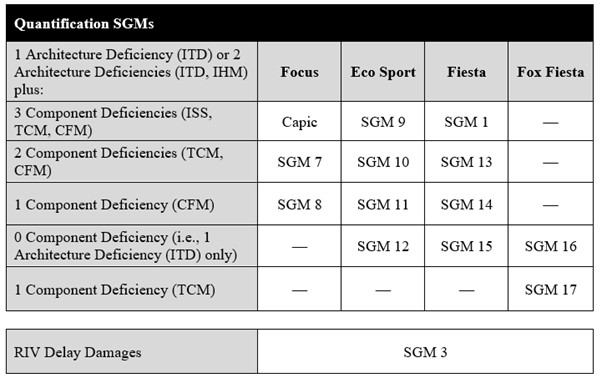
19 Ms Capic’s vehicle had all three component deficiencies and, as with the whole class, both architectural deficiencies. In her case, that constellation of defects led to an award of reduction in value damages of $6,820.91 which is 30% of the amount she paid for her vehicle. The percentage reduction will be entered in the top lefthand corner of the matrix.
20 What is now proposed is that the Court will, in due course, assess the reduction in value damages for the other sample group members in the matrix and populate it with the resulting percentage reductions. At the same time, the Court will assess the sample members’ entitlements to other consequential damages. This will occur at a hearing scheduled for 14-18 September 2026.
21 However, before that hearing can proceed there are some issues which must first be resolved.
First Issue: the section 54 guarantee and subsequent owners
22 This issue involves the statutory construction of the definition of an ‘affected person’ in s 2 of the ACL which occurs in the context of the guarantee of acceptable quality in s 54(1) and the right conferred on an affected person by s 271(1) to claim reduction in value damages under s 272(1)(a) under that guarantee. These provisions are as follows:
2 Definitions
affected person, in relation to goods, means:
(a) a consumer who acquires the goods; or
(b) a person who acquires the goods from the consumer (other than for the purpose of re supply); or
(c) a person who derives title to the goods through or under the consumer.
54 Guarantee as to acceptable quality
(1) If:
(a) a person supplies, in trade or commerce, goods to a consumer; and
(b) the supply does not occur by way of sale by auction;
there is a guarantee that the goods are of acceptable quality.
271 Action for damages against manufacturers of goods
(1) If:
(a) the guarantee under section 54 applies to a supply of goods to a consumer; and
(b) the guarantee is not complied with;
an affected person in relation to the goods may, by action against the manufacturer of the goods, recover damages from the manufacturer.
23 It is convenient to refer to the three limbs of the definition of an affected person as limb (a), limb (b) and limb (c). S
24 There are two issues between the parties which arise in the following context: each time a vehicle is supplied in trade or commerce (usually by a dealer), the effect of s 54 is that a guarantee that the vehicle is of acceptable quality comes into existence. By s 271(1) an affected person is given the right to sue the manufacturer of the vehicle for a breach of that guarantee. In the life of a single vehicle, it is possible that it may be sold more than once by a dealer (and hence in trade or commerce). For example, the vehicle may be sold new by a dealer and then later sold two or more times through second-hand dealers.
25 The apparent effect of s 54 is that on each supply in trade or commerce (i.e. each sale by a dealer) s 54 guarantees come into existence in relation to the same vehicle. When the cause of action in s 271(1) is added to the picture, it then appears that the affected person in the three-limbed definition may be able to claim reduction in value damages under more than one s 54 guarantee. Working out under which s 54 guarantee an affected person is entitled to claim reduction in value damages (or if reduction in value damages can be claimed under both guarantees) is one issue between the parties. I will refer to it as the ‘multiple guarantees issue’.
26 However, the parties have a more general issue between them as well. Not every vehicle which is supplied second-hand to a new owner is supplied in trade or commerce because many second-hand sales are by private sale. Limb (b) of the definition clearly extends the right to sue under s 271(1) for reduction in value damages to the first person who purchases the vehicle from its original owner even if that sale is a private one. Indeed, once it is understood that a s 54 guarantee arises each time a vehicle is supplied in trade or commerce, the effect of limb (b) is to extend the right to claim reduction in value damages to the first purchaser from any person whose acquisition of the vehicle gave rise to a s 54 guarantee. In practical terms: not only does the purchaser of a vehicle from a second-hand dealer obtain the benefit of a s 54 guarantee but so does any person who acquires the vehicle by private sale from that purchaser under limb (b).
27 The class submits that on its proper construction, limb (c) extends to any successor in title of the original consumer in relation to which the s 54 guarantee arose. I will call this the ‘successor in title issue’. Ford denies this.
28 Before embarking on those two issues, it is useful to note some other matters for completeness. First, although the ACL provisions apply to goods generally, this case is about motor vehicles which, to an extent, have their own status under the ACL. That status consists principally of the fact that, although the definition of a ‘consumer’ in s 3 is reasonably complex, the ACL accepts that a person who purchases a vehicle other than for re-supply is always a consumer: see ss 3(1)(b), 3(1)(c) and 3(2)(a)(i).
29 Secondly, s 54 is enlivened by the supply of a vehicle in trade or commerce to a consumer which, as already noted, will mean in the case of most vehicles that they have been supplied by a dealer.
30 Thirdly, s 54 is not directly affected by whether the vehicle is new but the content of the s 54 guarantee of acceptable quality may be affected by where the vehicle is in its life cycle. This flows from ss 54(2) and (3):
(2) Goods are of acceptable quality if they are as:
(a) fit for all the purposes for which goods of that kind are commonly supplied; and
(b) acceptable in appearance and finish; and
(c) free from defects; and
(d) safe; and
(e) durable;
as a reasonable consumer fully acquainted with the state and condition of the goods (including any hidden defects of the goods), would regard as acceptable having regard to the matters in subsection (3).
(3) The matters for the purposes of subsection (2) are:
(a) the nature of the goods; and
(b) the price of the goods (if relevant); and
(c) any statements made about the goods on any packaging or label on the goods; and
(d) any representation made about the goods by the supplier or manufacturer of the goods; and
(e) any other relevant circumstances relating to the supply of the goods.
31 The same vehicle might be supplied to a consumer by a dealer new in year 1 for $40,000 and by a dealer second-hand for $5,000 in year 10. Although a s 54 guarantee arises on each supply, it is clear that the nature of the vehicle and its price will usually be different 10 years apart and those matters will inform what would be regarded as acceptable: see s 54(3)(a) and (b).
32 Fourthly, short reflection on the terms of s 271(1) shows that it is not immediately obvious what the relationship between the consumer referred to in s 271(1)(a) and the consumer referred to in limb (a) of the definition of affected person is. The multiple guarantees issue is a function of this uncertainty.
33 Having made those remarks, it is useful to begin with the successor in title issue.
The successor in title issue: facts
34 Ramair Packaging Pty Ltd (‘Ramair’) purchased a new 2015 Ford Focus sedan from a dealer in Melbourne on a date that the evidence does not disclose. A part of its business was known as Australian Visual Solutions (‘AVS’) and the vehicle was used as part of that business. In around mid-2017, Ramair sold the AVS business to Metal Manufactures Pty Ltd (‘Metal Manufactures’) and with it the vehicle.
35 Ms Toni Dunn was the financial controller for the AVS business both when it was owned by Ramair and afterwards when it was acquired by Metal Manufactures. On 14 June 2018, Ms Dunn purchased the vehicle from Metals Manufactures for $6,500.
36 Ms Dunn was therefore the third owner of the vehicle (excluding any ownership by the dealer in Melbourne from whom Ramair had purchased the vehicle).
The successor in title issue: statement of the issue
37 There is no dispute either that Ramair’s purchase of the vehicle from the dealer in Melbourne gave rise to a guarantee under s 54 or that Ramair could maintain a claim for reduction in value damages under limb (a) of the definition of an affected person. There is also no debate that Metal Manufacturers could have maintained a claim for reduction in value damages under Ramair’s s 54 guarantee under limb (b).
38 What the parties disagree upon is whether Ms Dunn is an affected person under limb (c). The class’s primary submission is that she is such a person because she derived her title to the vehicle ‘through or under’ Ramair. Its secondary position is that Ms Dunn falls within limb (b) because she acquired the vehicle from Ramair. The class submits that this apparently outlandish reading of limb (b) is supported by appellate authority. I will return to this issue below.
The successor in title issue: contentions on limb (c)
39 The class submits that limb (c) should be given a broad construction so that it refers to any successor in title. Ford submits that if read in that way limb (c) renders limb (b) unnecessary. This is because a person who purchases a vehicle from a consumer under limb (b) is necessarily already a successor in title under limb (c). Ford makes the further point that reading limb (c) so broadly neuters the parenthetic exclusion in limb (b). This is because a person who purchases a vehicle from a consumer for the purposes of re-supply is a successor in title. While that person will not be within limb (b) because of the parenthetic exclusion they will be within in limb (c) because they will nevertheless be a successor in title.
40 Ford also submits that construing limb (c) as applying to successors in title carried with it three consequences which Parliament ought not be taken to have intended. First, it had the practical consequence that for each new owner the limitation period would begin to run afresh potentially creating a situation where the claim might never be statute barred under s 273. However, this is a feature of Ford’s approach as well. In particular, an affected person under limb (b) (or for that matter limb (c)) might not acquire the vehicle for a very long period of time after the vehicle’s initial purchase new.
41 I am also unpersuaded by Ford’s submission concerning s 143(2) of the ACL. That provision provides a ten-year ultimate limitation period for a defective goods action. As I understood the point, it was that it was less likely that s 273 would have an unlimited operation when the defective goods action was subject to a ten-year ultimate bar. This was because the action for defective goods was a more serious kind of case. I do not accept that s 143(2) has anything to say about the proper construction of limb (c).
42 Secondly, Ford submitted that the class’s construction could entail that the claims of a limb (c) successor in title might be assessed by reference to the circumstances of the original purchaser. However, this is a corollary of the fact that the claim for reduction in value damages runs with the title to the vehicle.
43 Thirdly, Ford submitted that it was possible that the class’s construction would give rise to the phenomenon of persons purchasing vehicles for the purpose of acquiring a pre-existing claim for reduction in value damages appended to its title. That strikes me as speculative.
44 Despite the unattractiveness of those three points, Ford’s main point about the textual relationship between limb (b) and limb (c) is not without force. Reading limb (c) in the manner suggested by the class renders limb (b)’s positive operation unnecessary and frustrates its negative operation. The former effect runs counter to the principle that otiose constructions should be avoided: Project Blue Sky Inc v Australian Broadcasting Authority [1998] HCA 28; 194 CLR 355 (‘Project Blue Sky’) at 382 [71] per McHugh, Gummow, Kirby and Hayne JJ. The latter results in the general words of one provision being used to outflank a particular prohibition in another: David Grant & Co Pty Ltd v Westpac Banking Corp [1995] HCA 43; 184 CLR 265 (‘David Grant’) at 276 per Gummow J (Brennan CJ, Dawson, Gaudron and McHugh JJ agreeing at 269); Anthony Hordern & Sons Ltd v Amalgamated Clothing & Allied Trades Union of Australia [1932] HCA 9; 47 CLR 1 (‘Anthony Hordern’) at 7 per Gavan Duffy CJ and Dixon J; cf. Commissioner of Taxation v Runcity Pty Ltd [2025] FCAFC 152; 312 FCR 291 at [67]-[71] per O’Bryan, Button and Owens JJ.
45 On the other hand, if Ford’s submissions about this are accepted it becomes necessary to circumscribe the operation of limb (c) in some way. Ford does not shy away from this. It submits that its submission entails that limb (c) ‘should be construed conformably as limited to an immediate successor in title’ (at [44]) which it identifies as including liquidators, trustees in bankruptcy or donees (at [53]).
46 In some circumstances, a liquidator may be seen as a person who claims under or through the company to which they have been appointed. The authorities on this are collected in footnote 171 of the reasons of Edelman J in Williams v Toyota Motor Corporation [2024] HCA 38; 419 ALR 373 (‘Williams’). I am a little sceptical that this reasoning would apply in a consumer claim where it would seem more likely that the plaintiff would be the company in liquidation rather than the liquidator noting, by parity of reasoning, that the property of the company does not vest in its liquidator. However, these reasons are no place for that sort of nicety.
47 In any event, I propose to accept Ford’s submissions about this for the sake of argument and to proceed on the basis that its proposed construction of limb (c) as applying to liquidators, trustees in bankruptcy and donees creates a coherent genus of meanings. Ford also submits that its construction is supported by the principles of interpretation embodied in the maxims noscitur a sociis and ejusdem generis. I do not really think that these add to the interpretative picture.
48 Against these textual matters, the class makes these points. First, the definition of ‘affected person’ is not materially different to the language used in provisions of the Trade Practices Act 1974 (Cth), namely, ss 74B(1), 74C(1), 74D(1) and 74E(1). I accept that each of these provisions in subs (d) or (e) uses the expression ‘derives title to the goods through or under, the consumer’ and that this is materially the same as the wording of limb (c).
49 Secondly, the class submits that the former provisions have been held to apply to successors in title citing Williams at [44] per Gageler CJ, Gordon, Steward, Gleeson and Beech-Jones JJ. I do not accept that this is what [44] says. Rather, what the plurality said was that the former provisions provided remedies for ‘the consumer or a person who acquired the goods from, or derived title to the goods through or under, the consumer’.
50 Thirdly, the class cites the New South Wales Court of Appeal’s decision in BE Australia WD Pty Ltd (Subject to a Deed of Company Arrangement) v Sutton [2011] NSWCA 414; 82 NSWLR 336 at [204]-[205] per Campbell JA (McColl JA agreeing) as authority for the proposition that the wording of the former provisions concerns successors in title. I agree that in that case Campbell JA assumed that a person who derived title to the goods through or under a consumer included a successor in title. However, this is not the main point which was being discussed at [204]-[205] and there is no substantive consideration of the issue. I do not regard this statement as very persuasive although it is not irrelevant.
51 Fourthly, the class relies upon the Minister’s remarks on the second reading of the Trade Practices Amendment Bill 1978 (Cth) which introduced the former provisions including, in relation to s 74D, the phrase ‘derives title to the goods through or under the consumer’ into the Trade Practices Act 1974 (Cth) as the Competition and Consumer Act 2010 (Cth) was then known. These included the statement that an effect of the amendments would be that ‘a manufacturer’s liability, where his goods are of unmerchantable quality, will be extended to the successors in title to a consumer’: Australia, House of Representatives, Parliamentary Debates (Hansard), 17 October 1978 at 1922. A similar statement appeared in the accompanying Explanatory Memorandum: Australia, House of Representatives, Trade Practices Amendment Bill 1978, Explanatory Memorandum on Amendments to the Bill at amendments (5)-(7). The class also relies on the Explanatory Memorandum to the Trade Practices Revision Bill 1986 (Cth) which amended ss 74B, 74C, 74D and 74E to introduce the phrase ‘acquires from, or derives title to the goods through or under, the consumer’. It included a statement that the manufacturer’s liability ‘follows title in the goods’ and that ‘persons who acquire goods from a consumer or derive title to the goods under a consumer (eg by way of gift) may seek redress’: Australia, House of Representatives, Trade Practices Revision Bill 1986, Explanatory Memorandum, 46 [156]. This material supports the class’s interpretation of the definition of limb (c).
52 Fifthly, the class drew attention to the fact that the plurality in Williams had referred to these extrinsic materials at [77]. This is true, but the plurality also noted that it thought that ‘little assistance on this question of construction can be gained from considering the extrinsic materials’. Against that, the question the Court was examining was the different one of whether the ability of a later owner to make a claim was at the expense of the first consumer. Since the Court was not looking at the present question, I do not think the reference in Williams at [77] takes the matter any further than the extrinsic materials themselves take it. As I have explained, I accept that the extrinsic materials do suggest that the former provisions were thought by the government responsible for the introduction of the legislation to apply to successors in title.
53 Sixthly, the class sought to demonstrate that the legislation from which the former provisions were themselves derived recognised that the expression ‘derives title to the goods through or under, the consumer’ extended to successors in title. The predecessor legislation to the former provisions were the Manufacturers Warranties Act 1974 (SA) (‘Manufacturers Warranties Act’) and the Law Reform (Manufacturers Warranties) Ordinance 1977 (ACT).
54 As to the Manufacturers Warranties Act, it is apparent from the second reading speech accompanying the introduction of the Manufacturers Warranties Bill 1974 into the South Australian House of Assembly that the origins of the regulation making power in clause 9 of the Bill lay in a report by Ontario Law Reform Commission: South Australia, House of Assembly, Parliamentary Debates (Hansard) 12 September 1974 at 923. What the Minister said was this:
Clause 9 enables the Governor to regulate written warranties of the kind that commonly accompany goods at the time of sale. The Ontario Law Reform Commission found that these warranties were frequently used to mislead consumers rather than for conferring any substantive rights upon them. For this reason, a provision is inserted enabling the Governor to proscribe undesirable practices in the use of such written warranties.
55 Section 9 of the Manufacturers Warranties Act as passed says this:
9 Regulations
The Governor may make such regulations as he thinks necessary or expedient to prevent any misleading practice in the use of written warranties, and, without limiting the generality of the foregoing, those regulations may—
(a) regulate the form of any such warranties; and
(b) prescribe, or regulate, the manner in which they are to be written, typed or printed; and
(c) prescribe penalties (recoverable summarily) not exceeding five hundred dollars for breach of any regulation.
56 There is a definition of ‘consumer’ in s 3(1) of the Manufacturers Warranties Act which uses identical wording (‘derives title to the goods through or under’) to the wording in limb (c) and may well be the origin of the wording of the former provisions:
consumer, in relation to manufactured goods, means any person (including a body corporate) who purchases the goods when offered for sale by retail and includes any person who derives title to the goods through or under any such person
57 However, the reference in the second reading speech to the report of the Ontario Law Reform Commission related to cl 9 and had nothing to do with the definition of a consumer. It is true that the Ontario Law Reform Commission did deal extensively with the problem that successors in title posed. But I am unable to see that its exegesis of that problem, or the solution it proposed to that problem, bears upon the construction of the definition of ‘consumer’ in s 3(1) in the South Australian Act. The best that one can say is that it is apparent that the drafters of the legislation were aware of the report. But to say that is not to say very much. There is nothing in the second reading speech which indicates that the source of the definition of the consumer is the report of the Ontario Law Reform Commission.
58 Jagot J touched on this issue in Williams at [162] in these terms:
The Second Reading Speech for the Manufacturers Warranties Act refers to a report of the Ontario Law Reform Commission as one source for the legislation. This report expressly adverts to the problem presented by successors in title. The problem identified is that a private purchaser from a consumer would not be protected by the legislation (because of requirements equivalent to that in s 54(1) that the supply be in trade or commerce) or by contract (as there would be no privity of contract between a person deriving title from the consumer and the supplier). This is why express provision to extend the warranties to the successors in title to the consumer was considered appropriate.
59 Read with some care, I do not think that Jagot J said any more in this paragraph than I have just said. However, in a sense none of this matters. The fact is that at the time of the passage of the Trade Practices Amendment Act 1978 and then the Trade Practices Revision Act 1986 the former provisions used the phrase ‘acquires the goods from, or derives title to the goods through or under, the consumer’ and this was described in both the second reading speech and the explanatory memoranda as extending to successors in title.
60 As to the Law Reform (Manufacturers Warranties) Ordinance 1977, I accept that s 3(3)(b) extended the concept of a consumer to include any person who derived title to the goods through or under the consumer. However, I was not taken to anything which suggested that s 3(3)(b) was understood to apply to successors in title or that the Federal Parliament was aware of s 3(3)(b) when it introduced the former provisions.
61 Ford also submitted that its approach to limb (c) was supported by a decision of von Doussa J in Electricity Trust of South Australia v Krone (Australia) Technique Pty Ltd [1994] FCA 461; 51 FCR 540 at 551-552. In that case it is true that von Doussa J did examine the definition of a consumer in the Manufacturers Warranties Act. However, all that his Honour said was that the definition of consumer would extend to include a person who was the donee of a gift or a member of a family on whose behalf goods were purchased by another family member. This does not advance Ford’s contention.
62 Does limb (c) apply to successors in title or is it limited in the way Ford submits? One of Ford’s submissions can be dispatched immediately. Whilst I accept that limb (c) should not be read as overcoming the parenthetic excision in limb (b), this does not entail that the class’s broader interpretation of limb (c) should not be accepted. It just means that as a matter of construction, the carve-out in limb (b) applies to limb (c) as well (or, more accurately, that limb (c) does not apply to the parenthetic excision). This is just the application of the principle in David Grant and, perhaps, Anthony Hordern (noting Commissioner of Taxation v Runcity Pty Ltd [2025] FCAFC 152; 312 FCR 291). Once that is accepted, this part of Ford’s submission falls away.
63 But that still leaves Ford’s argument that unless limb (c) is confined as it suggests then it will render the balance of limb (b) otiose.
64 The question at hand concerns the meaning of the words ‘through or under’ in limb (c). ‘Through or under’ takes its meaning from the context in which it appears (Mount Bruce Mining Pty Ltd v Wright Prospecting Pty Ltd [2015] HCA 37; 256 CLR 104 at [96] per Kiefel and Keane JJ) as does the word ‘under’ (Kain v R&B Investments Pty Ltd [2025] HCA 28; 423 ALR 413 at 422 [30] per Gageler CJ (‘Kain’)). Thus, context is a central part of the current interpretative enterprise. Accepting that, three concepts are in play:
(1) the statements in the second reading speech and explanatory memoranda that the former provisions applied to successors in title;
(2) the fact that if that approach is taken to the meaning of limb (c), then limb (b) becomes otiose apart from its parenthetic excision which, as explained above, should be construed as applying to both limbs (b) and (c); but
(3) if limb (c) is read in a circumscribed fashion for which Ford contends then it will only apply to immediate successors in title such as liquidators, trustees in bankruptcy and donees.
65 In relation to (3) above, it should be observed that the class’s construction of limb (c) as meaning successors in title would include the whole of what Ford proposes limb (c) means. This is because liquidators, trustees in bankruptcy and donees are also successors in title.
66 Having made that observation, the extrinsic materials do not provide any explanation for why it was thought appropriate to afford consumer remedies to persons who derived their title from a consumer by devolution (such as a trustee in bankruptcy or a legatee) but to deny it to persons who derived their title to goods more conventionally by an act of acquisition such as a purchase. Further, leaving aside the extrinsic materials, it is difficult to see what end could have been intended by such an idiosyncratic operation for limb (c).
67 Thus, whilst I accept that generally otiose constructions should be avoided under the principle in Project Blue Sky at [71], this is one of those cases, like Palmanova Pty Ltd v Commonwealth of Australia [2025] HCA 35; 99 ALJR 1362 at [60] per Gageler CJ, Gordon, Jagot and Beech-Jones JJ, where the context and purpose of the provisions are a surer guide to limb (c)’s interpretation. Ford’s submission should therefore be rejected. Limb (c) applies to all successors in title and it follows that Ms Dunn is entitled to claim reduction in value damages under Ramair’s s 54 guarantee.
The class’s secondary submission: limb (b)
68 Since I have accepted that Ms Dunn is an affected person via limb (c) it is not necessary to consider her more ambitious submission that she was also an affected person because of limb (b). Here the point was that limb (b) applied to successors in title on the basis that such persons acquired the goods ‘from’ the consumer. This submission was based on the New South Wales Court of Appeal’s decision in Dwyer v Volkswagen Group Australia Pty Ltd [2023] NSWCA 211; 381 FLR 32 at [236] per Gleeson JA, Leeming and White JJA agreeing). Since it is not necessary to do so, I need not consider the correctness of this view.
69 Ms Dunn’s facts relate to supplementary common question 4 which should be answered as follows:
If an Affected Vehicle was:
• supplied as new to a person (the Original Owner) in trade or commerce by a Ford authorised dealer;
• subsequently acquired by a different person (the Second Owner) from the Original Owner (other than in trade or commerce and other than for the purpose of re-supply);
• then subsequently acquired by a third person (the Third Owner) from the Second Owner (other than in trade or commerce and other than for the purpose of re-supply),
can the Third Owner bring an action against Ford to recover RIV damages:
(a) calculated by reference to the purchase price paid by the Original Owner; and/or
(b) alleging a failure to comply with the s 54 guarantee that applied to the supply as new to the Original Owner?
Answer: Yes as to (a) and (b).
The multiple s 54 guarantees issue: facts
70 On 21 October 2014, Mr Owen Bryden purchased a new 2014 Ford Focus hatchback from Challenger Ford. According to its log book, the vehicle was Candy Red but this does not on its own require the dismissal of the proceeding. There is no dispute Mr Bryden was a consumer for the purposes of s 3 and it is clear that Challenger Ford supplied the vehicle to him in trade or commerce. It follows that Mr Bryden had the benefit of a guarantee of acceptable quality under s 54. Mr Bryden then had to go overseas and no longer needed his vehicle. He sold it to a dealer, Rockingham Hyundai Suzuki, on or about 30 October 2015. Rockingham Hyundai Suzuki was not a consumer because it obtained the vehicle for the purposes of resupply: s 3(2)(a)(i) of the ACL.
71 On 20 November 2015, Ms Jennifer Meneghini acquired the vehicle second-hand from Rockingham Hyundai Suzuki and continues to own it to this day. The vehicle is an affected vehicle (because it has a DPS6 transmission) and was purchased by Ms Meneghini during the class definition period between 1 January 2011 to 29 November 2024 (i.e. on 20 November 2015).
72 The class submits that Ms Meneghini is able to rely upon the s 54 guarantee that arose on Mr Bryden’s acquisition of the vehicle. Because she purchased the vehicle from a dealer, Rockingham Hyundai Suzuki, she also has the benefit of a second s 54 guarantee although, as explained above, it is not necessarily the case that the content of this second s 54 guarantee must be the same as the first. For nomenclatural purposes, it is convenient to refer to the initial s 54 guarantee as Mr Bryden’s s 54 guarantee and the second s 54 guarantee as Ms Meneghini’s s 54 guarantee.
73 It useful to observe at this point that it is obvious that Ms Meneghini is an affected person for the purposes of her own s 54 guarantee. This is because she falls squarely within limb (a) of the definition. Under that guarantee she has an entitlement to bring a claim against Ford under s 271(1). In that claim, she can seek reduction in value damages under s 272(1)(a) and consequential damages under s 272(1)(b).
74 However, this is not the basis upon which the Court is invited to consider Ms Meneghini’s position. Instead, the class submits that Ms Meneghini is entitled to claim reduction in value damages by reference to Mr Bryden’s s 54 guarantee and to the quantum of what his claim under that guarantee would have been had he made it.
The multiple s 54 guarantee issue: resolution
75 Although Ms Meneghini is not at this point claiming reduction in value damages under the guarantee which arose on her purchase of the vehicle from Rockingham Hyundai Suzuki, there is no doubt that she has the benefit of such a guarantee. However, whilst Ms Meneghini does not assert her own s 54 guarantee neither does she deny it. Consequently, what the class now argues is that not only can Ms Meneghini claim under her own s 54 guarantee (although choosing not to) but that she can also claim under the s 54 guarantee which arose when Mr Bryden purchased the vehicle from Challenger Ford.
76 In my view, this is not how s 271(1) operates. There are three reasons for this.
77 First, the consumer referred to in s 271(1)(a) is the same consumer who is referred to in the definition of an affected person. If not read this way, then the consequence will be that the most recent consumer will be able to claim reduction in value damages under all of the anterior s 54 guarantees (see Williams at [71]). Further, since it is not necessary to prove loss in order to make a claim under s 271(1), it is no answer to that outcome to say that double recovery would not be permitted. Nor am I persuaded that the consumer has both sets of rights and is entitled to elect between them. For example, it is not self-evident that successive claims under multiple guarantees would be inconsistent in any sufficient sense to enliven concepts such as election.
78 Consequently, whilst the acquisition of the same vehicle on multiple occasions from persons who supply it in trade or commerce (such as dealers) may give rise to multiple s 54 guarantees, each s 54 guarantee remains associated with the consumer whose acquisition of the vehicle generated it in the first place. The affected persons who may claim reduction in value damages under s 271(1) for a failure to comply with that s 54 guarantee will be that consumer (limb (a)) and that consumer’s successors in title (limb (b) or (c)).
79 Secondly, this conclusion is not contradicted by the High Court’s statement in Williams. It is true that Williams establishes that once a claim for reduction in value damages under s 271(1) exists in relation to a s 54 guarantee, it runs with title to the vehicle. However, the Court was not dealing with a situation where, as here, there is more than one s 54 guarantee in relation to the same vehicle. In particular, the Court did not have to address what would occur where the owner of a vehicle sells it to a person who acquires it for re-supply, that is to say, to a second-hand dealer.
80 However, the following is true in that situation. First, the second-hand dealer cannot be a consumer since having acquired the vehicle for re-supply it is specifically excluded from the definition of a consumer by s 3(2)(a)(i). Secondly, the second-hand dealer is therefore not an affected person under limb (a) of the definition of an affected person. Thirdly, because the second-hand dealer has acquired the vehicle for re-supply it does not fall within limb (b) either. Fourthly, as I have explained above, the parenthetic excision in limb (b) applies equally to limb (c). Thus limb (c) only extends to successors in title who have not acquired the vehicle for the purposes of re-supply. The dealer is not therefore an affected person under limb (c).
81 From those four matters it follows that the second-hand dealer cannot bring a claim under s 271(1) because it is not an affected person. More generally, if the chain of title for a given vehicle includes as one of its links a purchaser who cannot as a matter of law be an affected person (such as a second-hand dealer), the claim for reduction in value damages ceases to exist on that acquisition.
82 I do not accept that when the dealer thereafter supplies the vehicle to another consumer that the former claim for reduction in value damages can spring back to life. This would be odd and it is unnecessary because the second consumer has their own claim for reduction in value damages under their own s 54 guarantee (although obviously for a different amount).
83 Thirdly, the rationale the Court in Williams adopted for concluding that a claim for reduction in value damages ran with the title to the vehicle does not support the conclusion that a claim for reduction in value damages can survive the coming into existence of a subsequent s 54 guarantee on the supply of the vehicle in trade or commerce to a fresh consumer. That rationale was to avoid the possibility that a manufacturer might be sued by successive owners of the same goods: Williams at [70]-[71]. That rationale has no application once it is accepted that the claim for reduction in value damages ceases to exist once the goods are acquired by a person who cannot as a matter of law be an affected person.
84 It follows that I do not accept that when Ms Meneghini purchased the vehicle she obtained not only a claim for reduction in value damages under her own s 54 guarantee but also, at the same time, Mr Bryden’s claim for reduction in value damages under his s 54 guarantee. In truth, once Mr Bryden sold the vehicle to Rockingham Hyundai Suzuki, his claim for reduction in value damages under his s 54 guarantee passed out of existence. Whilst the claim for reduction in value damages runs with the title to the vehicle, it cannot run through a person who cannot lawfully bring the claim.
85 The facts relating to Ms Meneghini and the issues to which they give rise are relevant to supplementary common questions 1 and 2. Question 1(a) is as follows:
If an Affected Vehicle was supplied as new to a person (the Original Owner) in trade or commerce by a Ford authorised dealer and was subsequently re-supplied in trade or commerce to a different person (the Subsequent Owner), can the Subsequent Owner:
(a) bring an action against Ford under ss 271(1) and 272(1)(a) of the ACL to recover reduction in value damages (RIV damages) calculated by reference to the purchase price paid by the Original Owner;
86 Ford’s proposed answer to question 1 was that the creation of the new s 54 guarantee had the effect of extinguishing any pre-existing claim under an earlier s 54 guarantee. Although it makes no difference in the real world, I think that it is the acquisition of the vehicle by a person who cannot be an affected person which has that effect. I would answer the question this way:
Answer: The acquisition of the vehicle by a person who cannot as a matter of law be an affected person extinguishes any earlier s 54 guarantee. This will include the situation where a person, such as a dealer, acquires the vehicle for the purposes of re-supply.
87 Question 1(b) is:
If an Affected Vehicle was supplied as new to a person (the Original Owner) in trade or commerce by a Ford authorised dealer and was subsequently re-supplied in trade or commerce to a different person (the Subsequent Owner), can the Subsequent Owner:
(b) bring an action against Ford to recover RIV damages calculated by reference to the purchase price paid by the Subsequent Owner?
88 I agree with Ford’s proposed answer:
Answer: Yes. The Subsequent Owner may bring a claim against Ford for reduction in value damages calculated by reference to the purchase price paid by the Subsequent Owner.
89 Question 2 is:
If the answer to SCQ 1 is yes, must the action relate to the s 54 guarantee (if any) that applied to:
(a) the supply as new to the Original Owner; or
(b) the subsequent supply to the Subsequent Owner?
90 I agree with Ford’s proposed answer:
Answer: The action must relate to the subsequent supply to the Subsequent Owner.
91 Question 3 is:
If an Affected Vehicle was supplied as new to a person (the Original Owner) in trade or commerce by a Ford authorised dealer and was subsequently acquired by a different person (the Second Owner) from the Original Owner (other than in trade or commerce and other than for the purpose of re-supply), can the Second Owner bring an action against Ford to recover RIV damages:
(a) calculated by reference to the purchase price paid by the Original Owner; and/or
(b) alleging a failure to comply with the s 54 guarantee that applied to the supply as new to the Original Owner?
92 This should be answered:
Answer: Yes as to (a) and (b). The Second Owner can bring an action against Ford to recover RIV damages pertaining to the supply to the Original Owner because in the circumstances of that supply the Second Owner is an ‘affected person’ within limb (b) of the definition of that term.
Second Issue: Crystallisation orders under section 33Z
93 The second issue is whether an order can now be made which would permit class members to sell their vehicles but maintain their right as class members to claim reduction in value damages.
94 As a matter of substantive law, a class member may maintain a claim for reduction in value damages under s 272(1)(a) of the ACL only if they own their vehicle. So much was established by the High Court’s decision in Williams.
95 On the class’s behalf it is submitted that many of the vehicles are now quite old and that the proceeding is having the adverse effect of preventing class members from selling their vehicles. Although Ms Capic did not rely on this next observation, it is also true that as class members sell their cars the incoming purchasers will not become class members since they will each acquire their vehicles after the class cut-off date of 29 November 2024. Consequently, each vehicle sold after that date will reduce the size of the class-wide claim for reduction in value damages although not the claim for other losses under s 272(1)(b).
96 This state of affairs has the potential to impact not only those members of the class who wish to divest themselves of their vehicles whilst maintaining a claim for reduction in value damages in the class action, but also for the funder of the class action who is likely to see the pool of reduction in value damages shrink over time and, with that, its slice of that pool.
97 Ford’s submission at [105] was that there was no problem for class members in losing their claims for reduction in value damages under s 272(1)(a) because they still had their claims for consequential loss under s 272(1)(b). I reject this submission which is, with respect, silly.
98 The class therefore seeks orders which it says will have the effect of permitting class members to sell their vehicles whilst retaining the entitlement to claim reduction in value damages in the class action. She proposes orders to crystallise their claims. The final version of the crystallisation order is order 6 in some short minutes of order proposed after the hearing. Proposed order 6 is in these terms:
Pursuant to ss 33Z(1)(e) and/or (g) of the Act, and in respect of each action brought by Ms Capic on behalf of a group member (other than a Bought and Held Member) against Ford in respect of a failure to comply with the s 54 guarantee applicable when the Affected Vehicle was supplied new to a consumer:
(a) damages are awarded, pursuant to ss 271 and 272(1)(a) of the ACL, to each such group member who, as at the date of this order:
(i) has title to, or an ownership interest in, the relevant Affected Vehicle;
(ii) has not opted out of the proceeding; and
(iii) has not given in Ford’s favour a release with respect to any s 272(1)(a) entitlement the group member has relating to the Affected Vehicle, as part of a customer redress programme run by Ford; and
(iv) has an action that is not barred by operation of s 273 of the ACL;
(b) the amount of the damages the subject of the award in order 6(a) are to be worked out at a later stage of the proceeding by application of the statutory formula in s 272(1)(a);
(c) the damages the subject of the award in order 6(a) are to be paid and distributed to the group members entitled in accordance with a scheme to be approved by further order of the court. Such scheme must:
(i) make provision for the constitution and administration of a fund consisting of the money to be paid and distributed;
(ii) identify the manner in which a group member is to establish his or her entitlement to share in the damages and provide for notice to be given to group members of the fund;
(iii) specify:
(A) the manner in which a group member is to make a claim for payment out of the fund and establish his or her entitlement to payment;
(B) the date by which group members are to make a claim for payment out of the fund; and
(C) the date before which the fund is to be distributed to group members who have established an entitlement to be paid out of the fund;
(iv) make provision for the costs of administering the scheme and fund; and
(v) make provision for entitlements to interest earned on the money in the fund;
(d) the award of damages in order 6(a) is without prejudice to any entitlement to damages such a person or other group member may have:
(i) pursuant to ss 271 and 272(1)(b) in respect of the relevant Affected Vehicle; and
(ii) in respect of any other vehicle.
99 As will be apparent from the terms of the order, the class identifies the source of the Court’s power to make order 6 as being either s 33Z(1)(e) or (g) of the Federal Court Act. Section 33Z provides:
(1) The Court may, in determining a matter in a representative proceeding, do any one or more of the following:
(a) determine an issue of law;
(b) determine an issue of fact;
(c) make a declaration of liability;
(d) grant any equitable relief;
(e) make an award of damages for group members, sub-group members or individual group members, being damages consisting of specified amounts or amounts worked out in such manner as the Court specifies;
(f) award damages in an aggregate amount without specifying amounts awarded in respect of individual group members;
(g) make such other order as the Court thinks just.
(2) In making an order for an award of damages, the Court must make provision for the payment or distribution of the money to the group members entitled.
(3) Subject to section 33V, the Court is not to make an award of damages under paragraph (1)(f) unless a reasonably accurate assessment can be made of the total amount to which group members will be entitled under the judgment.
(4) Where the Court has made an order for the award of damages, the Court may give such directions (if any) as it thinks just in relation to:
(a) the manner in which a group member is to establish his or her entitlement to share in the damages; and
(b) the manner in which any dispute regarding the entitlement of a group member to share in the damages is to be determined
100 I do not accept that proposed order 6 is authorised by s 33Z(1)(e). I agree with the class that s 33Z(1)(e) does contemplate that an award of damages in favour of group members need not specify an actual amount but that it will suffice to specify the manner by which such an amount can be determined. The class submits that this work is done by proposed order 6(b) above because it specifies the manner in which the amounts are to be determined.
101 However, in order to satisfy the requirements of s 33Z(1)(e), there must be a manner specified by the Court and that manner must be such that it is possible to determine the amounts of damages to which group members are entitled. As explained at the outset of these reasons, the reduction in value claims of the sample group members will be determined by the Court in September 2026. Proposed order 6(b) suggests, incorrectly, that all that the Court will do at this time is to apply the statutory formula in s 272(1)(a). In fact, the first task the Court will perform will be to determine the value of each sample group member’s claim to reduction in value damages which will be used to populate the matrix described earlier in these reasons. It is only then that the statutory formula in s 272(1)(a) will be applied. Proposed order 6(b) does not, therefore, specify the manner by which the claims of the group members may be determined. In truth, it merely determines when those claims will be determined. Proposed order 6(b) is not authorised by s 33Z(1)(e).
102 In relation to the power in s 33Z(1)(g), there are four issues:
(1) Is the width of s 33Z(1)(g) sufficient to contemplate an order whose effect would be to crystallise the group members claims?
(2) If it is, can s 33Z(1)(g) be used to achieve what cannot be achieved by means of s 33Z(1)(e)?
(3) If it can, would it be just to do so?
(4) If the Court would think it just to make an order under s 33Z(1)(g), should the power then arising be exercised?
103 As to the first issue, I accept that s 33Z(1)(g) is sufficiently broad to make an order crystallising the claims of the class members so as to allow them to sell their vehicles. What is just for the purposes of s 33Z(1)(g) is not confined by what is independently recognised at law or in equity: Kain at 420 [21] per Gageler CJ. Further, as the joint judgment of Gordon, Steward, Gleeson and Beech-Jones JJ shows at 432 [69] the power is of considerable breadth and wide discretion and is not to be read subject to limitations which are not found in the express words; see to the same effect Edelman J at 446 [125]. I am unable to distinguish the present proposed order from the situation of the common fund order involved in Kain. As a matter of power, s 33Z(1)(g) is sufficiently broad to sustain the order the class seeks.
104 As to the second issue, I would not read s 33Z(1)(e) as evincing a negative stipulation that only that provision may be utilised for the purposes of specifying how damages are to be assessed. Such an implication does not arise from the language of the provision. Further, it would be inconsistent with s 33Z(1)(f) and s 33Z(4) both of which show that methods can exist outside of s 33Z(1)(e).
105 As to the third issue, it would be just to crystallise the group members’ claims so as permit the vehicles to be sold. It is true that the effect of proposed order 6 will be that when vehicles are sold the purchasers will not receive with their title to each vehicle the right to claim reduction in value damages under the relevant guarantee. But that is a legal aspect of the right to claim reduction in value damages. Once claimed, they cannot be claimed a second time. This follows from the logic of Williams at [71] (of course this does not mean that a subsequent sale by a dealer will not generate a fresh s 54 guarantee under which a claim may be made). I have contemplated whether the interests of those persons who will in the future purchase a vehicle need to be separately represented and heard on the making of this order. However, since this was not an argument advanced by Ford, I do not think that it would be procedurally fair on the class to decline to make the order on this basis.
106 As to the fourth issue, having concluded that it would be just to make the order, I can see no reason why it would be appropriate not to exercise the discretion to make the order. Crystallisation orders should be made.
Third Issue: Limitation periods
107 Section 273 of the ACL provides:
273 Time limit for actions against manufacturers of goods
An affected person may commence an action for damages under this Division at any time within 3 years after the day on which the affected person first became aware, or ought reasonably to have become aware, that the guarantee to which the action relates has not been complied with.
108 The relevant guarantee is that in s 54 which is the guarantee that the goods are of acceptable quality. Ford no longer asserts a limitation defence against the class members as the class was initially defined. However, it does assert a limitation defence against all the class members who were added to the class by orders made on 19 December 2024. It will be recalled that the effect of those orders was to add to the class persons who had acquired an interest in a vehicle fitted with a DPS6 between 30 November 2018 and 29 November 2024. Although the class expansion orders were made on 19 December 2024, they were expressed to be retroactive to 29 November 2024.
109 Ford’s claim is to be determined in the first instance by reference to the facts concerning Ms Delisa Francis. Ms Francis acquired a second-hand 2014 EcoSport wagon on 31 January 2023 from a Ms Narain, the two women having become acquainted through Facebook Marketplace. Ms Narain herself had acquired the vehicle new with the likely necessary implication that it had been supplied to her in trade or commerce. On that apparently undisputed assumption, Ms Narain was a consumer within the meaning of s 3 at the time she acquired the vehicle. On Ms Narain’s acquisition of the vehicle, she therefore obtained the benefit of s 54 guarantee and with it an entitlement to claim reduction in value damages under s 272(1)(a) against Ford.
110 When Ms Narain sold the vehicle to Ms Francis and title it to it was transferred to her, Ms Narain’s reduction in value claim travelled with that title and became vested in Ms Francis. Ms Francis acquired the vehicle from Ms Narain on 31 January 2023. This was because Ms Francis was a limb (b) affected person.
111 Ford accepts that at all material times, Ms Francis has had no actual knowledge of any problems with the DPS6 and therefore does not seek to rely upon the reference to actual knowledge in s 273.
112 Ford does however submit in terms of s 273 that Ms Francis ought reasonably to have been aware that Ms Narain’s s 54 guarantee had not been complied with by any of the following dates:
(a) 18 May 2016. This was when Ms Capic’s proceeding was commenced. Ford also relies on the fact that Ms Capic’s case received some coverage in the press during this time.
(b) July 2017. At this time, it was widely reported in the press that the ACCC had commenced proceeding against Ford over its handling of customers who had problems with Focus, Fiesta and EcoSports vehicles fitted with DPS6 transmissions.
(c) 26 April 2018. It was on this date that the Federal Court ordered Ford to pay $10 million in penalties in relation to the manner in which Ford had handled its customers.
(d) 29 June 2021. It was on this date that the trial reasons were delivered, the actual defects in Ms Capic’s vehicle identified and Ford’s non-compliance with her s 54 guarantee established. The decision received some coverage in the press.
(e) 3 November 2021. It was on this date that the Court delivered its reasons in Capic v Ford Motor Company of Australia Pty Ltd (Revised Common Questions) [2021] FCA 1320. Although there was nothing especially new in this judgment it also received coverage in the press.
113 What all these dates have in common is that they are all more than three years before 29 November 2024. The significance of 29 November 2024 is that it was the date upon which the class was expanded to include persons who acquired an interest in a vehicle fitted with a DPS6 transmission between 30 November 2018 and 29 November 2024.
114 If Ford is correct about any of the dates in (a)-(e) then it will be entitled to rely upon s 273 to defeat the claims of all of the new members of the class. This issue, however, was initially to be determined by reference to the position of just one of those new members, Ms Francis. A determination of Ms Francis’s situation will not result in a finding which determines the limitation issues for a new class member who acquired their vehicle before 29 November 2021. This emerged during argument. By 9 December 2025, the parties had submitted documents relating to a new sample member (‘SGM 6’), to deal with this issue. I deal with SGM 6 below.
115 Returning to Ms Francis’s position, I do not accept that her claim is defeated by s 273 for a number of reasons. First, whilst an argument may be available that a defence under s 273 to a claim for reduction in value damages runs with title to the vehicle, no such argument is available in relation to consequential loss under s 272(1)(b). If it were available it would follow, as Mr Borsky KC accepted in argument, that time could begin to run against Ms Francis before she acquired the vehicle and became an affected person. It would also follow that it would be possible for such a claim to become statute barred before she even acquired the vehicle.
116 Since that result is absurd, I do not accept the premise from which it flows. Time cannot begin to run under s 273 in relation to a claim for consequential loss under s 272(1)(b) until at least the time at which the owner of the vehicle first became an affected person. Further, this does not mean that time does begin to run at that point merely that it cannot run before that time.
117 Nor do I accept that Ford is entitled to rely upon s 273 in answer to Ms Francis’s claim for reduction in value damages under s 272(1)(a). Ford does not submit that its defence to Ms Narain’s reduction in value damages travels with the title to the vehicle as well so that Ms Francis not only inherited Ms Narain’s claim but also Ford’s defence to that claim. There is no occasion therefore to consider the position of Ms Narain. The parties’ debate was instead confined to inquiring into whether Ms Francis had constructive knowledge under s 273 of the fact that Ms Narain’s s 54 guarantee had not been complied with.
118 I do not accept that Ms Francis ought reasonably to have been aware of the fact that Ms Narain’s s 54 guarantee had not been complied with by any of the dates relied upon by Ford at (a)-(e) above. This is for a number of reasons.
119 First, Ms Francis ought reasonably to have become aware that the s 54 guarantee had not been complied with when she ought reasonably to have been aware that the vehicle was not of acceptable quality under s 54(2). The relevant defects for the purposes of s 54(2)(c) are the three component deficiencies and the two architectural deficiencies.
120 Secondly, it is not enough that Ms Francis may have been aware that the vehicle had something wrong with it. She also needed to know that the something was a failure to comply with the s 54 guarantee. Of course, Ms Francis did not need to be aware of the legal infrastructure attending s 54 but she did need to know the defect in respect of which suit is now contemplated.
121 Thirdly, as the case has been run the defects were not the miscellany of symptoms to which the component and architectural deficiencies could from time to time give rise. Such a case would have required no proof of the underlying cause of the symptoms and it would have sufficed merely to prove that symptoms existed in order to establish (at least in principle) that the vehicle was not of acceptable quality. However, such a case could not have been run in a class action context since the class would not have presented any common issues suitable for determination under Part IVA of the Federal Court Act. Necessarily, therefore, the case brought was about the risk of failure presented by the existence of the three component deficiencies and the two architectural deficiencies. The defects consisted of the mechanical circumstances which gave rise to the various risks that symptoms might develop and not the symptoms themselves.
122 Fourthly, to approach the operation of s 273 on the basis that symptoms were relevant would be wrong having regard to the way the case was run.
123 Fifthly, given the way the case was run, Ms Francis ought reasonably to have been aware of the fact that the s 54 guarantee had not been complied with when she ought reasonably to have been aware of at least one of the three component and two architectural deficiencies.
124 Until judgment was delivered on 29 June 2021, it was not known by anyone that vehicles fitted with a DPS6 transmission suffered from the three component deficiencies and one of the architectural deficiencies (the second architectural deficiency being added by the Full Court): cf. in a slightly different context, Vautin v By Windown, Inc (Formerly Bertram Yachts) (No 4) [2018] FCA 426; 362 ALR 702 at 760-761 [262] and [266] per Derrington J. Thus, the dates in (a)-(c) cannot be dates at which Ms Francis ought to have been aware that the s 54 guarantee had not been complied with.
125 Although there was coverage of the position of the vehicles in the press prior to 29 June 2021, I am not satisfied that any of that coverage ought reasonably to have been read by Ms Francis. Even if I were satisfied of that, I am not satisfied that any of that press coverage could reasonably have indicated to Ms Francis that the vehicle suffered from any of the component or architectural deficiencies where that had not yet been definitively determined. What was reported was litigation contested by Ford.
126 Sixthly, if Ms Francis had read the primary reasons sometime after 29 June 2021, she would have become aware that the s 54 guarantee had not been complied with. But the short of the matter is that there is no evidence that Ms Francis did read the primary reasons. The question therefore is whether she ought reasonably to have done so. I can find no principled basis upon which I could conclude that she ought to have done so. The question of what Ms Francis ought reasonably to have known is to be determined by reference to her own circumstances. There is nothing in the evidence concerning Ms Francis which provides a basis to conclude that her circumstances were such that she ought to have located and read (carefully I might add) the primary reasons for judgment.
127 Seventhly, I am not satisfied that Ms Francis ought reasonably to have read the press coverage after 29 June 2021 either. There may be some circumstances where a matter is so widely reported in the press that it may be possible to say that everyone ought reasonably to be aware of that matter. That proposition may to an extent be legally controversial but even assuming it is not, it calls for a line to be drawn between those matters of which coverage is so extensive that everyone may reasonably be taken to know of them and those of which coverage is not so wide as to justify that conclusion. Assuming in Ford’s favour that such a line can legitimately be drawn, I am not persuaded that the coverage of these proceedings in the press after 29 June 2021 is sufficient to fix Ms Francis with constructive knowledge of the defects in her vehicle.
128 Eighthly, there is also the problem that Ms Francis acquired her vehicle on 31 January 2023 which is after all of the dates in (a)-(e) above. As I have noted, Ford has not submitted that its s 273 defence to Ms Narain’s claim for reduction in value damages, like the claim itself, travels with the title to the vehicle. Instead, the matter has been approached on the basis that the conception of constructive knowledge in s 273 is to be applied to Ms Francis (and not Ms Narain). Viewed through that lens, I am unable to accept that Ms Francis ought reasonably to have been aware of the fact that Ms Narain’s s 54 guarantee had not been complied with anytime before Ms Francis acquired the vehicle on 31 January 2023. The dates in (a)-(e) were of no significance at all to Ms Francis until she decided to purchase the vehicle some, presumably short, time before that date.
129 Ninthly, I do not accept that Ms Francis was obliged to conduct internet research on her vehicle prior to purchasing it, i.e., shortly before 31 January 2023. During argument the concept of research was clarified so that it was synonymous with performing a Google search.
130 I would reject this submission for two reasons. First, I do not accept that a reasonable person acquiring a vehicle second-hand would conduct research on the vehicle on the internet before doing so. No doubt some do but many do not, and I do not think that the latter class can be said to be acting unreasonably.
131 Secondly, assuming that is not correct, it would next be necessary to do the following:
(1) posit a set of Google searches which Ms Francis ought to have done; and
(2) prove what the outcome of those Google searches would have been as at January 2023.
132 Voluminous Google searches were put in evidence by Ford’s solicitor, Ms Thompson. Ms Thompson had requested a member of the Allens library staff, Ms Grabar, to conduct Google searches. Ms Thompson’s evidence about this was at [15]-[17]:
15. Between 14 August 2025 and 18 August 2025, Ms Grabar conducted the following Google searches:
(a) on Google's 'standard' search engine (ie the 'All' tab on Google), a search (filtered by Australia and by date between 1 January 2011 and 29 November 2021) for material containing:
(i) "Ford" or "Fiesta" or "Ford Focus" or "EcoSport";
(ii) "DPS6" or "powershift" or "power shift"; and
(iii) "transmission"; and
(b) using the 'News' tab on Google's search engine, a search (filtered by Australia and by date between 1 January 2011 and 28 November 2021) for material containing:
(i) "Ford"; and
(ii) "transmission"; and
(iii) "powershift" or "DPS6".
16. Between 14 August 2025 and 18 August 2025, Ms Grabar conducted a number of site-specific Google searches, limiting the results to websites including drive.com.au, goauto.com.au, Carsales.com.au and news.com.au.
17. Copies of the relevant items retrieved from the Google searches in paragraphs 15 and 16 above (excluding those that contain no mention of issues affecting the transmissions of Affected Vehicles) appear at pages 452–814 of Exhibit BHT-151.
133 There are three problems with this evidence. First, it does not strike me as plausible that Ms Francis would have searched on ‘DPS6’, ‘powershift’ or ‘transmission’. Someone versed in the issues in this litigation might conduct such a search, but Ms Francis was not such a person. Secondly, as [17] shows, Ms Thompson has included in her evidence the Google searches which mentioned the issues affecting the transmissions but not those which did not. This means that one cannot gauge where on the search pages the hits occurred and, in particular, one cannot tell whether the hits were returned on page one. Without that information, the salience of the evidence cannot be assessed. Thirdly, the searches were conducted between 14 August 2025 and 18 August 2025 and a date range of 1 January 2011 to 28 November 2021 was selected. It strikes me as unlikely that this is what Ms Francis would have done shortly before 31 January 2023. Much more likely is that she would not have selected a date range.
134 In those circumstances, I do not accept that it has been proven that even if Ms Francis ought reasonably to have conducted Google searches prior to the purchase, that these searches would have revealed that the s 54 guarantee had not been complied with. Cognate observations may be made about [18]-[21] of Ms Thompson’s affidavit.
135 I do not therefore accept that Ms Francis ought reasonably to have become aware that the s 54 guarantee had not been complied with by 29 June 2021 (i.e. the date in (d)). For the same reasons, I am not satisfied that she ought to have become so aware by the date in (e) or the date in (f) being the date that the class definition was retroactively amended. Section 273 was not engaged by any of those dates. Ms Francis’s claims under s 271(1) are not statute barred by s 273.
136 I have not disregarded Ford’s submission that this construction meant that s 273 could operate such that a manufacturer might be exposed to liability many years after the vehicle had first entered the market. Here Ford placed reliance upon the explanatory memorandum accompanying the bill which introduced the ACL, the Trade Practices Amendment (Australian Consumer Law) Bill (No. 2) 2010 (Cth). From [7.120] the memorandum discusses the action for damages against a manufacturer. At [7.129] it deals with the position of proposed s 273 in these terms:
Time limit for actions against manufacturers of goods
7.129 An action against the manufacturer of goods to recover damages can only be commenced within 3 years after the consumer becomes aware, or reasonably should have become aware, of a failure to comply with a guarantee [Schedule 1, item 1: Chapter 5, Part 5-4, Division 2, section 273]. This is intended to provide manufacturers with some degree of certainty about their potential liability to consumers for damages. Without this limitation, manufacturers may experience difficulties obtaining finance or insurance coverage as their long-term contingent liabilities might be indeterminate.
137 I accept that this exhibits a concern to curtail long-term contingent liabilities. However, I am unable to perceive a textual foothold in s 273 on to which this view could be plausibly engrafted. In particular, I do not see how the concept of an affected person who ought reasonably to have been aware of the non-compliance with the guarantee can be stretched to cover the situation of a person who, at the relevant time, was not an affected person.
138 For completeness, one final matter should be noted. There is an obiter dictum in the Full Court reasons at [280]-[282] which suggests that time will begin to run when the owner becomes aware of serious symptoms. Neither party contended for this outcome before me and neither suggested that I was bound to implement that statement. It is difficult to square the statement with the fact that the case was brought as one based on risks not symptoms. Knowing that a car is a lemon does not tell one that its citrus qualities derive, for example, from the fact that its transmission inadequately manages heat and torsional vibrations. Yet it is knowledge of those matters, not the aberrant behaviours to which they may eventually give rise, which constitutes the knowledge that the s 54 guarantee has not been complied with.
139 During the course of argument on the operation of s 273 in relation to Ms Francis (who purchased her vehicle on 31 January 2023) it emerged that a resolution of her claim would not result in a determination which would bind new class members who acquired their vehicles prior to 29 November 2021. That date is three years prior to the end date of the expanded class definition. Subsequent to the hearing, a fresh sample group member was selected as SGM 6, Ms Alison Sparkman, who acquired her vehicle before 29 November 2021.
140 Ms Sparkman purchased a second-hand 2011 Ford Focus LW Titanium Sedan automatic from Ms Danielle White on 10 January 2020. Ms Sparkman is therefore a new class member who acquired her vehicle prior to 29 November 2021. Ms White purchased the vehicle second-hand from Mr Patrick Hayes on 13 February 2017. Mr Hayes purchased the vehicle new from a car dealer on or around 4 August 2011.
141 Apart from the limitation issue, Ms Sparkman’s situation is therefore the same as Ms Dunn’s (discussed above) and I reach the same conclusions as I did in her case; i.e., Ms Sparkman is entitled to bring a claim for reduction in value damages on the s 54 guarantee that arose on Mr Hayes’ acquisition of the vehicle and is entitled to have the claim determined by reference to the price he paid for the vehicle.
142 Turning then to the s 273 issues in Ms Sparkman’s case, these should be answered the same way that they were answered for Ms Francis. In relation to question 5, Ms Sparkman stands in the same position as Ms Francis. In relation to question 6, for the same reasons given in Mr Francis’s case, none of the matters in (a)-(e) means that Ms Sparkman’s claim is barred under s 273. The matters in (f) and (g) are not appropriate to answer in the absence of facts.
143 The supplementary common questions for this issue were questions 5 and 6 which should be answered as follows:
Question 5: If a subsequent owner (the Present Owner) can bring an action against Ford to recover damages pursuant to ss 271 and 272 of the ACL based on non-compliance with s 54 when the vehicle was supplied to a former owner (the Former Owner), is that action barred by s 273 in circumstances where:
(a) any action for RIV damages by the Former Owner based on that non-compliance was barred by operation of s 273 of the ACL before the Present Owner obtained title to the vehicle?
(b) a hypothetical action for RIV damages by the Former Owner based on that same non-compliance would be barred by operation of s 273 of the ACL at the time the Present Owner commences their action for RIV damages?
Answer: No to (a) and (b).
Question 6: In what circumstances, if at all, ought a relevant person in Australia reasonably to have become aware that the s 54 guarantee to which their action against Ford relates had not been complied with:
(a) upon the institution of the present proceeding alleging non-compliance with the s 54 guarantee on 18 May 2016;
(b) upon the institution by the ACCC of proceedings against Ford alleging unconscionable conduct and misleading or deceptive conduct in respect of Ford’s handling of customer complaints in respect of DPS6 repairs in July 2017;
(c) upon the declaration by the Federal Court, by consent, in the ACCC proceeding ordering Ford to pay $10 million in penalties on 26 April 2018;
(d) upon the pronouncement of judgment in Capic v Ford Motor Company of Australia Pty Ltd [2021] FCA 715 on 29 June 2021;
(e) upon the pronouncement of judgment in Capic v Ford Motor Company of Australia Pty Ltd (Revised Common Questions) [2021] FCA 1320 on 3 November 2021;
(f) by 20 December 2021; and/or
(g) at any other point in time?
Answer: None of the circumstances in (a)-(e). It is not appropriate to answer (f)-(g) in the absence of facts.
Other issues and orders
144 The parties prepared draft orders on 5 November 2025. The parties should now bring in short minutes of order to give effect to these reasons within 7 days.
Proposed orders 1 and 2: answers to supplementary common questions
145 These related to the answers to the supplementary common questions. The parties agreed on the form of orders 1 and 2 but disagreed on the answers. The answers should be drafted in light of these reasons.
Proposed orders 3 to 5: crystallisation for bought and held members
146 If the Court was of the view that it had power to crystallise the class members claims for reduction in value damages (as I am), the parties were in agreement as to the form that order should take in relation to those members of the class who had bought and continued to hold their vehicles. This was in the form of orders 3 to 5 of the draft orders provided on 5 November 2025. I will remove the reference to s 33Z(1)(e) from those orders.
Proposed orders 6 to 8: crystallisation for other group members
147 The parties were also in agreement as to the form such a crystallisation order should take in relation to all other class members save for one matter. The agreed orders were in the form of orders 6 to 8 in the draft orders provided on 5 November 2025. The single dispute concerned proposed order 6(a)(iv). Proposed order 6(a)(iv) is as follows:
(a) damages are awarded, pursuant to ss 271 and 272(1)(a) of the ACL, to each such group member who, as at the date of this order:
…
(iv) has an action that is not barred by operation of s 273 of the ACL;
148 As explained by Mr Borsky, the purpose of proposed order 6(a)(iv) is to preserve the entitlement of Ford to maintain a defence under s 273 where a class member has subjective awareness of the fact that the s 54 guarantee has not been complied with. It will be recalled that the position of Ms Francis deals only with constructive knowledge. Ford was not able to explain how the assertion of subjective knowledge fitted into the assessment process to be undertaken next September. The highest it seemed to rise was that it was possible that Ford might by some unspecified means come to know that a particular class member had actual knowledge for the purposes of s 273.
149 It is appropriate in fashioning case management orders for the resolution of the quantification component of the proceeding to take into account both the forensic purpose of a proposed order but also the risk the order poses to the orderly conduct of the proceeding. Since Ford has offered no plausible explanation for why the order is necessary such an assessment leaves me unpersuaded that it should be made. In those circumstances, I will make the crystallisation orders (with the reference to s 33Z(1)(e) deleted and order 6(a)(iv) not made).
Proposed orders 9 to 18: case management
150 These concerned procedural directions which needed to be made in order to allow for the addition to the present issues of the position of SGM 6 and issues concerning quantification and interest. I made those orders on 11 November 2025.
I certify that the preceding one hundred and fifty (150) numbered paragraphs are a true copy of the Reasons for Judgment of the Honourable Justice Perram. |
Associate:
Dated: 2 February 2026


