

FEDERAL COURT OF AUSTRALIA
DC Rd DC Pty Ltd v Zhang (Trial Judgment) [2026] FCA 16
File number(s): | NSD 247 of 2023 |
Judgment of: | JACKMAN J |
Date of judgment: | 23 January 2026 |
Catchwords: | EQUITY – application for equitable relief and personal remedies for breaches of fiduciary duties – where applicant relied on respondents (property developers and an accountant) identifying and proposing properties to be purchased on applicants’ behalf – where respondents informed applicants that property would be purchased in applicant-company’s name for $45m – where respondents fashioned a back-to-back contract to purchase property in own name for $14m and misappropriated remaining $33m profit into various entities and properties owned by respondents EQUITY – whether first respondent personally owed fiduciary duties – where fiduciary duties owed by director to a company not concurrent with duties owed to shareholders on same subject matter – where any implicit undertaking was done so in capacity as director of company – where first respondent not a de facto director of applicant – where first respondent did not personally receive property that would render him constructive trustee with associated fiduciary duties – where knowing assistance not pleaded – no personal fiduciary duty owed by first respondent as distinct from those owed by company EQUITY – whether second respondent personally owed fiduciary duties – where legal principles of accountant-client relationship considered – where second respondent required to comply with tax agents’ code of professional conduct and certified practising accountants’ code of ethics – where second respondent personally undertook activities to considerable extent – second respondent did not undertake fiduciary obligations as distinct from accounting company – accounting company undertook fiduciary duties – whether second respondent knowingly assisted in generating proceeds – where dishonest and fraudulent design found – where actual knowledge of back-to-back contracts found – where no traceable money received personally by second respondent (as distinct from entities under his control) – knowing assistance found in relation to second respondent’s role as constructive trustee of sale proceeds and subsequent breaches EQUITY – consideration of tracing principles – consideration of volunteer in Black v Freeman trust (defined in reasons) being personally liable from time of knowledge – where mixed trust money – where re-mortgaging property in breach of constructive trustee duties – where inability to trace into debt – where lowest intermediate balance rule applied – where bona fide purchasers for value without notice – where trustee who pays off mortgage entitled to equitable subrogation to position of original mortgagee – where equitable subrogation available on pro rata basis – respondents’ actual knowledge imputed to entities controlled by them and tracing available where entities breached fiduciary duties CONSUMER LAW – application for relief for misleading or deceptive conduct under s 18 of the ACL (defined in reasons) concerning development potential and value of property – whether circumstances objectively gave rise to reasonable expectation that relevant facts would have been disclosed to applicants – disclosures and non-disclosures made by first respondent, second respondent (including entities) and fourteenth respondent found to be misleading or deceptive – causation and reliance found – measure of loss calculated by price paid less true value of what was acquired – apportionment applied pursuant to s 87CD(1) of the CC Act (defined in reasons) and s 35(1) of the CLA (defined in reasons) CONSUMER LAW – whether contributory negligence defence applicable under s 137B of the CC Act – where findings of intention to cause loss or damage – where applicants exercised reasonable care in the circumstances – defence not available |
Legislation: | Competition and Consumer Act 2010 (Cth) Corporations Act 2001 (Cth) Evidence Act 1995 (Cth) Federal Court of Australia Act 1976 (Cth) Tax Agent Services Act 2009 (Cth) Civil Liability Act 2002 (NSW) Fair Trading Act 1987 (NSW) Law Reform (Miscellaneous Provisions) Act 1965 (NSW) Professional Standards Act 1994 (NSW) Real Property Act 1900 (NSW) Mercantile Act 1867 (Qld) |
Cases cited: | ABN Amro Bank NV v Bathurst Regional Council [2014] FCAFC 65; (2014) 224 FCR 1 Addenbrooke Pty Ltd v Duncan (No 2) [2017] FCAFC 76; (2017) 348 ALR 1 Aged Care Services Pty Ltd v Kanning Services Pty Ltd [2013] NSWCA 393; (2013) 86 NSWLR 174 Agip (Africa) Ltd v Jackson [1990] Ch 265 Amann Aviation Pty Ltd v Commonwealth (1990) 22 FCR 527 Austin v Royal [1999] NSWCA 222; (1999) 47 NSWLR 27 Australian Conference Association Ltd v Mainline Constructions Pty Ltd (in liq) [1978] HCA 45; (1978) 141 CLR 335 Barclays Bank Ltd v Quistclose Investments Ltd [1970] AC 567 Barnes v Addy (1874) LR 9 Ch App 244 BCEG International (Australia) Pty Ltd v Xiao [2022] NSWSC 972; (2022) 162 ACSR 601 Birmingham and District Land Company v London and North Western Railway Company (1886) 34 Ch D 261 Bishopsgate Investment Management Ltd (in liq) v Homan [1995] Ch 211 Black v S Freedman & Co (1910) 12 CLR 105 Bofinger v Kingsway Group Ltd [2009] HCA 44; (2009) 239 CLR 269 Boscawen v Bajwa [1996] 1 WLR 328 Briginshaw v Briginshaw [1938] HCA 34; (1938) 60 CLR 336 Brunninghausen v Glavanics [1999] NSWCA 199; (1999) 46 NSWLR 538 Burston Finance Ltd v Speirway Ltd (in liq) [1974] 1 WLR 1648 Buzzle Operations Pty Ltd (in liq) v Apple Computer Australia Pty Ltd [2011] NSWCA 109; (2011) 81 NSWLR 47 Byrnes v Kendle [2011] HCA 26; (2011) 243 CLR 253 Caron v Jahani (No 2) [2020] NSWCA 117; (2020) 102 NSWLR 537 Chetwynd v Allen [1899] 1 Ch 353 Chu v Lin, in the matter of Gold Stone Capital Pty Ltd (Trial Judgment) [2024] FCA 766 Cochrane v Cochrane (1985) 3 NSWLR 403 Cohen v Cohen [1929] HCA 15; (1929) 42 CLR 91 Day v Tiuta International Ltd [2014] EWCA Civ 1246 DC Rd DC Pty Ltd v Zhang (No 3) [2024] FCA 221 Demagogue Pty Ltd v Ramensky (1992) 39 FCR 31 Director of the Serious Fraud Office v Lexi Holdings plc [2008] EWCA Crim 1443; [2009] QB 376 Eastern Shipping Company v Quah Beng Kee [1924] AC 177 Elanor Funds Management Ltd v Alceon Group Pty Ltd [2024] FCA 121; (2024) 424 ALR 601 Eugenie Holdings Pty Ltd v Stratford (unreported, Supreme Court of New South Wales, Giles J, 12 November 1991) 61–66 Farah Constructions Pty Ltd v Say-Dee Pty Ltd [2007] HCA 22; (2007) 230 CLR 89 Federal Commissioner of Taxation v BHP Billiton Limited [2019] FCAFC 4; (2019) 263 FCR 334 Fistar v Riverwood Legion and Community Club Ltd [2016] NSWCA 81; (2016) 91 NSWLR 732 Gandel Meats Pty Ltd, in the matter of Centennial Mining Ltd (subject to a deed of company arrangement) v Centennial Mining Ltd (No 2) [2020] FCA 633 Grimaldi v Chameleon Mining NL (No 2) [2011] FCAFC 6; (2011) 200 FCR 296 Hagan v Waterhouse (No 2) (1991) 34 NSWLR 308 Harstedt Pty Ltd v Tomanek [2018] VSCA 84; (2018) 55 VR 158 Hasler v Singtel Optus Pty Ltd [2014] NSWCA 266; (2014) 87 NSWLR 609 Heperu Pty Ltd v Belle [2009] NSWCA 252; (2009) 76 NSWLR 230 Herrod v Johnston [2012] QCA 360; [2013] 2 Qd R 102 Hopcraft v Close Brothers Ltd [2025] UKSC 33; [2025] 3 WLR 423 Hospital Products Limited v United States Surgical Corporation [1984] HCA 64; (1984) 156 CLR 41 HTW Valuers (Central Qld) Pty Ltd v Astonland Pty Ltd [2004] HCA 54; (2004) 217 CLR 640 In re Stapleford Colliery Company (1880) 14 Ch D 432 In the matter of Fellmane Pty Ltd (in liq) [2020] NSWSC 595 Independent Trustee Services Ltd v GP Noble Trustees Ltd [2012] EWCA Civ 195; [2013] Ch 91 John Alexander’s Clubs Pty Ltd v White City Tennis Club Ltd [2010] HCA 19; (2010) 241 CLR 1 Johnson v Mackinnon [2021] NSWCA 152 Jones v Dunkel [1959] HCA 8; (1959) 101 CLR 298 Korda v Australian Executor Trustee (SA) Ltd [2015] HCA 6; (2015) 255 CLR 62 Kuhl v Zurich Financial Services Australia Ltd [2011] HCA 11; (2011) 243 CLR 361 Legal Services Board v Gillespie-Jones [2013] HCA 35; (2013) 249 CLR 493 Lewis v Nortex Pty Ltd (in liq) [2006] NSWSC 480 Li v Ye [2025] NSWCA 227 Michael Wilson & Partners Ltd v Nicholls [2011] HCA 48; (2011) 244 CLR 427 Miller & Associates Insurance Broking Pty Ltd v BMW Australia Finance Ltd [2010] HCA 31; (2010) 241 CLR 357 Mitchell v Al Jaber [2025] UKSC 43; [2025] 3 WLR 849 Naaman v Jaken Properties Australia Pty Ltd [2025] HCA 1; (2025) 421 ALR 227 Nadilo v Souris [2019] NSWSC 108 Nguyen v Sage Consultant Group Pty Ltd [2021] NSWSC 753; (2021) 20 BPR 41,989 Oliver v Renwick Street Pty Ltd [2024] NSWSC 346 Padovan v MCG Group Pty Ltd (in liq) [2011] NSWSC 1080 Patten v Bond (1889) 60 LT 583 Paul A. Davies (Australia) Pty Ltd (in liq) v Davies [1983] 1 NSWLR 440 Paul v Speirway Ltd [1976] Ch 220 Pilmer v Duke Group Ltd (in liq) [2001] HCA 31; (2001) 207 CLR 165 Porter v Mulcahy & Co Accounting Services Pty Ltd [2021] VSC 572 Potts v Miller [1940] HCA 43; (1940) 64 CLR 282 Re Diplock [1948] Ch 465 Re Elizabethan Theatre Trust; Lord v Commonwealth Bank of Australia (1991) 30 FCR 491 Re Global Finance Group Pty Ltd (in liq); Ex parte Read [2002] WASC 63; (2002) 26 WAR 385 Re Goldcorp Exchange Ltd [1995] 1 AC 74 Re Hallett’s Estate (1880) 13 Ch D 696 Re Montagu’s Settlement Trusts [1987] Ch 264 Re Oatway [1903] 2 Ch 356 Re Sirrah Pty Ltd (in prov liq) [2021] NSWSC 413; (2021) 152 ACSR 212 Re Sutherland; French Caledonia Travel Service Pty Ltd (in liq) [2003] NSWSC 1008; (2003) 59 NSWLR 361 Robb Evans of Robb Evans & Associates v European Bank Ltd [2004] NSWCA 82; (2004) 61 NSWLR 75 Roscoe (Bolton) Ltd v Winder [1915] 1 Ch 62 Russell Gould Pty Ltd v Ramangkura [2014] NSWCA 310; (2014) 87 NSWLR 552 Scott v Scott [1963] HCA 65; (1963) 109 CLR 649 Shalson v Russo [2003] EWHC 1637 (Ch); [2005] Ch 281 Silversea Cruises Australia Pty Ltd v Abellanoza [2019] NSWCA 306 Sinclair v Brougham [1914] AC 398 Smits v Cugola [2022] QCA 262 State Bank of New South Wales v Geeport Developments Pty Ltd (1991) 5 BPR 11,947 Sze Tu v Lowe [2014] NSWCA 462; (2014) 89 NSWLR 317 Torlonia v Wright [2016] NSWSC 1139 Turner v O’Bryan-Turner [2022] NSWCA 23; (2022) 107 NSWLR 171 United States Surgical Corporation v Hospital Products International Pty Ltd [1983] 2 NSWLR 157 Walker v Corboy (1990) 19 NSWLR 382 Walsh v Permanent Trustee Australia Ltd (1996) 21 ACSR 213 Westdeutsche Landesbank Girozentrale v Islington London Borough Council [1996] AC 669 Wilkes v Spooner [1911] 2 KB 473 Xiao v BCEG International (Australia) Pty Ltd [2023] NSWCA 48; (2023) 111 NSWLR 132 Yeung Kai Yung v Hong Kong and Shanghai Banking Corporation [1981] AC 787 Zervas v Burkitt (No 2) [2019] NSWCA 236 |
Division: | General Division |
Registry: | New South Wales |
National Practice Area: | Commercial and Corporations |
Sub-area: | Commercial Contracts, Banking, Finance and Insurance |
Number of paragraphs: | 478 |
Date of hearing: | 10 December – 23 December 2025 |
Counsel for the Applicants: | Mr C Colquhoun SC with Mr B Smith and Ms M Kearney |
Solicitors for the Applicants: | Corrs Chambers Westgarth |
Counsel for the 1st, 5th, 9th and 15th Respondents: | Mr V Bedrossian SC with Mr D Elliott |
Solicitors for the 1st, 5th, 9th and 15th Respondents: | Amberlake Lawyers |
Counsel for the 2nd, 3rd, 6th, 10th, 11th, 12th, 13th and 16th Respondents: | Mr D Pritchard SC with Mr J Parrish and Mr N Lennings |
Solicitors for the 2nd, 3rd, 6th, 10th, 11th, 12th, 13th and 16th Respondents: | Kells |
Counsel for the 14th Respondent: | Mr M Condon SC with Mr A Smith |
Solicitors for the 14th Respondent: | Emerson Lewis Lawyers |
ORDERS
NSD 247 of 2023 | ||
| ||
BETWEEN: | DC RD DC PTY LTD First Applicant STANLEY XUE Second Applicant SIT FAMILY PTY LTD ACN 617 947 065 Third Applicant FAI KEUNG (PHILLIP) SIT Fourth Applicant | |
AND: | DONG (TONY) ZHANG First Respondent ZHENGJUN (BOB) CAI Second Respondent CENTRAL ADVISORY GROUP PTY LTD ACN 163 958 843 Third Respondent (and others named in the Schedule) | |
order made by: | JACKMAN J |
DATE OF ORDER: | 23 January 2026 |
THE COURT:
1. Notes that defined terms and abbreviations used in these orders bear the same meaning as set out in the Glossary in the reasons for judgment dated 23 January 2026 at [1].
Tony Parties
2. Orders Tony to pay damages to DC Rd pursuant to s 236 of the ACL in the amount of $36,866,947.94, plus interest pursuant to s 51A of the FCA Act.
3. Orders Link to account to DC Rd in the amount of $19,739,471.93, plus compound interest at the FCA Interest Rates with yearly rests.
4. Orders Belrose COB to account to DC Rd in the amount of $18,299,990, plus compound interest at the FCA Interest Rates with yearly rests.
5. Declares that Belrose COB holds the whole of the Belrose Property on constructive trust for DC Rd.
6. Declares that DC Rd is entitled to an equitable charge over the proceeds of sale of lots in the Smithfield Property to secure the amount of $3,718,601 plus simple interest at the FCA Interest Rates.
Bob Parties and Lian Parties
7. Orders Bob to pay equitable compensation to DC Rd in the amount of $36,866,947.94, plus compound interest at the FCA Interest Rates with yearly rests.
8. Orders each of Bob and CATA to pay damages to DC Rd pursuant to s 236 of the ACL in the amount of $36,866,947.94, plus interest pursuant to s 51A of the FCA Act.
9. Orders CTD to account to DC Rd in the amount of $12,073,962, plus compound interest at the FCA Interest Rates with yearly rests.
10. Orders CAC to account to DC Rd in the amount of $5,000,000, plus compound interest at the FCA Interest Rates with yearly rests.
11. Orders CAGA to account to DC Rd in the amount of $5,357,657.21 plus compound interest at the FCA Interest Rates with yearly rests.
12. Orders Lian to account to DC Rd in the amount of $1,571,000, plus interest pursuant to s 51A of the FCA Act from 14 February 2023.
13. Declares that Lian holds the Turramurra Property on constructive trust for DC Rd to the extent of securing the amount of $1,571,000 plus interest as referred to in the previous order.
14. Declares that Lian holds $1,000,000 plus simple interest at the FCA Interest Rates in the Lian CBA Account 7759 as a constructive trustee for DC Rd and orders that Lian pay that amount to DC Rd.
15. Declares that DC Rd has an equitable charge over the Herbert Street Property to secure the amount of $590,000 plus simple interest at the FCA Interest Rates.
16. Declares that Saiala holds the Saiala Property on constructive trust for DC Rd to the extent of securing the amount of $1,900,000 plus simple interest at the FCA Interest Rates from 14 February 2023, and is liable to account to DC Rd for that amount including interest.
17. Declares that Clarence 104 holds the Clarence 104 Property on constructive trust for DC Rd to the extent of securing the amount of $266,657.21 plus simple interest at the FCA Interest Rates, and is liable to account to DC Rd for that amount plus interest.
18. Declares that DC Rd is entitled to an equitable charge over the DSZ Clarence Street Properties to secure the amount of $930,000 plus simple interest at the FCA Interest Rates.
Joinder of Mortgagees and Caveator
19. Grants leave to the Applicants to join as respondents NAB, CBA and Green Route Pty Ltd, and directs that they be served with an amended originating application joining them by 30 January 2026.
20. Directs that NAB, CBA and Green Route Pty Ltd file and serve any affidavits and written submissions in relation to whether there should be an order for the sale by Court-appointed trustees of the Belrose Property and the DSZ Clarence Street Properties (in the case of NAB), the Turramurra Property and the Herbert Street Property (in the case of CBA), and the Clarence 104 Property (in the case of Green Route Pty Ltd), or any other relief by 16 February 2026.
21. Directs that the Applicants and respondents file and serve any affidavits and written submissions in response by 23 February 2026.
22. Fixes the matter for further hearing in relation to the matters raised in those affidavits and submissions on 27 February 2026 at 9.30am.
John
23. Orders John to pay damages to DC Rd pursuant to s 236 of the ACL in the amount of $5,530,042.19, plus interest pursuant to s 51A of the FCA Act.
24. Orders John to account to DC Rd in the amount of $150,000, plus interest pursuant to s 51A of the FCA Act from 13 December 2024.
Costs
25. Directs the Applicants to file and serve any affidavits and written submissions in relation to costs by 6 March 2026.
26. Directs the respondents to file and serve any affidavits and written submissions in relation to costs by 10 April 2026.
27. Directs the Applicants to file and serve any affidavits and written submissions in reply in relation to costs by 1 May 2026.
Note: Entry of orders is dealt with in Rule 39.32 of the Federal Court Rules 2011.
REASONS FOR JUDGMENT
JACKMAN J:
Glossary
1 In these reasons, I have used the following capitalised terms with the following meanings (noting that in using first names for the principal protagonists I am merely following the practice adopted by the parties and do not intend any disrespect).
Defined Term | Meaning |
4FASOC | Fourth Further Amended Statement of Claim |
30 Denham | 30 Denham Pty Ltd, the purchaser of the Denham Court Property from Khengs |
132 Irwins Rd East Kurrajong | 132 Irwins Rd East Kurrajong Pty Ltd |
471 Hunter Street Newcastle | 471 Hunter Street Newcastle Pty Ltd |
Accounting WeChat Group | HYG Accounting Circle WeChat Group, which from 8 July 2019 included Bob, Tony, John, Phillip, Stanley and two employees of CATA (Ms Sissi Qu and Mr Kevin Zhao) |
ACL | Australian Consumer Law, being Sch 2 to the Competition and Consumer Act 2010 (Cth) in relation to corporations, and the same text as applies to natural persons under ss 27–32 of the FTA. |
Alice | Ms Yu Chun (Alice) Lam, the wife of Phillip and mother of Stanley |
ANZ | Australia and New Zealand Banking Group Ltd |
ANZ Turramurra Loan Account 8143 | A home loan account with ANZ in the names of Bob and Lian for the Turramurra Property, being BSB 012217 and account number 6852 78143 |
Applicants | DC Rd, Stanley, Sit Family and Phillip |
Arthur Street Property | The property located at 6 Arthur Street, Ryde NSW 2112 |
ASIC | Australian Securities and Investments Commission |
ATO | Australian Taxation Office |
Back-to-Back Contracts | The First Contract and the Second Contract whereby 30 Denham purchased the Denham Court Property from Khengs for $14 million plus GST on 25 July 2019 and sold it on 25 July 2019 to DC Rd for $45 million plus GST |
Belrose COB | Belrose COB Pty Ltd, the registered proprietor of the Belrose Property |
Belrose Property | The property located at 3 Minna Close, Belrose NSW 2085 |
Bob | Mr Zhengjun (Bob) Cai, the second respondent |
Bob 1 | Bob’s first affidavit dated 1 August 2024 |
Bob 2 | Bob’s second affidavit dated 1 August 2025 |
Bob 3 | Bob’s third affidavit dated 5 December 2025 |
Bob Parties | Bob, CAG, CAC and CATA |
Bob and Lian ANZ Account 1814 | An ANZ bank account in the name of Bob and Lian, being BSB 012 217 and account number 4231 91814, and is an offset account linked to the ANZ Turramurra Loan. |
Bob and Lian St George Account 7741 | A St George bank account in the name of Bob and Lian, being BSB 112 879 and account number 4894 17741, and is an offset account linked to the St George Arthur Street Loan. |
Bob St George Account 8334 | A St George bank account in the name of Bob, being BSB 112 879 and account number 442538334, and is an offset account |
Burwood Development | The development at 17–23 Esher Street, Burwood NSW 2134 |
CAC | Central Advisory Capital Pty Ltd, the sixth respondent |
CAC Account | The ANZ bank account in the name of CAC, being BSB 012 071 and account number 2304 85648 |
Caddens Development | The development at 29 and 46–66 O’Connell Street, Caddens NSW 2747 |
CAG | Central Advisory Group Pty Ltd, the third respondent |
CAGA | Central Advisory Group Asia Ltd, a company incorporated in Hong Kong, and the seventh respondent |
CAGA Account | The ANZ bank account in the name of CAGA, being BSB 012 013 and account number 4653 92227 |
Capitive | Capitive Pty Ltd, now known as HYG Property Pty Ltd |
CATA | Central Accounting and Taxation Advisory Pty Ltd, the tenth respondent |
CB | Court Book |
CBA | Commonwealth Bank of Australia |
CBA Arthur Street Loan Account | A home loan account with the CBA in the name of Bob and Lian for the Arthur Street Property, being BSB 062 370 and account number 5680 79321 |
CBA Herbert Street Loan Account | A home loan account with the CBA in the name of Bob and Lian for the Herbert Street Property, being BSB 062 370 and account number 5680 38861 |
Central Quarry | Central Quarry Project Pty Ltd |
CIA | Central Institute Advisory Pty Ltd |
CLA | Civil Liability Act 2002 (NSW) |
Clarence 104 | Clarence 104 Pty Ltd, the thirteenth respondent and registered proprietor of the Clarence 104 Property |
Clarence 104 Property | The property located at 104/50 Clarence Street, Sydney NSW 2000 |
Code of Ethics | Code of Ethics for Professional Accountants (APES 110) |
Coombes Contractors | Coombes Contractors Consulting C Pty Ltd, being the trustee of the Coombes Trust |
Corporations Act | Corporations Act 2001 (Cth) |
CC Act | Competition and Consumer Act 2010 (Cth) |
CSSS Holdings | CSSS Holdings Pty Ltd |
CTD | Charm Team Development Ltd, a company incorporated in Hong Kong and the fourth respondent |
CTD Account | The ANZ bank account in the name of CTD, being BSB 012 071 and account number 2327 21923 |
DC Rd | DC Rd DC Pty Ltd, the first applicant |
DC Rd Proceeds (or DCP) | The net proceeds of $33,232,962 from the Back-to-Back Contracts received by 30 Denham |
Denham Court Property | The property located at 30 Denham Court, Denham Court NSW 2565, comprising about 82 hectares of land |
Deposit | The deposit of $4.5 million paid on or about 18 July 2019 by DC Rd for the purchase of the Denham Court Property |
DSZ Accountants | DSZ Accountants Pty Ltd, the sixteenth respondent, and registered proprietor of the DSZ Clarence Street Properties |
DSZ ANZ Loan Account | A loan account with the ANZ in the name of DSZ Accountants in its own capacity and as trustee for DSZ Partners Trust, being BSB 012 402 and account number 4005 29026 |
DSZ ANZ Mortgage | The mortgage granted over the DSZ Clarence Street Properties |
DSZ Clarence Street Properties | The properties situated at 78, 105 and 106/50 Clarence Street, Sydney NSW 2000 |
East Kurrajong Development | The development of 132 Irwins Road, East Kurrajong NSW 2758 and 157, 159–283 and 300 Irwins Road, Blaxlands Ridge NSW 2758 |
Elton Report | Draft Report by Elton Consulting in relation to the Denham Court Property dated 26 June 2019 |
EOI | Expression of Interest |
Evidence Act | Evidence Act 1995 (Cth) |
FCA Act | Federal Court of Australia Act 1976 (Cth) |
FCA Interest Rates | The rates set out in para 2.2 of the Interest on Judgments Practice Note (GPN-INT) issued on 18 September 2017 |
First Contract | The contract for the purchase of the Denham Court Property for $14 million plus GST between 30 Denham and Khengs dated 25 July 2019 |
First EOI | The EOI submitted by Tony on behalf of Vantager to purchase the Denham Court Property for $12 million plus GST on or about 4 July 2019 |
First Loan Agreement | Loan Agreement dated 15 July 2019 between 30 Denham and CTD |
FTA | Fair Trading Act 1987 (NSW) |
Harvest Land | Harvest Land Group Pty Ltd |
He Charis | He Charis Investments Pty Ltd |
Herbert Street Property | The property located at 48/20 Herbert Street, West Ryde NSW 2114 |
His Charis Investments | His Charis Investments Pty Ltd |
Howard 1 | Mr Howard’s first expert report dated 26 March 2025 |
Howard 2 | Mr Howard’s second expert report dated 26 September 2025 |
Howard 3 | Mr Howard’s third expert report dated 29 October 2025 |
HYG | Hong Yang Group |
ING | ING Bank (Australia) Ltd |
Investx | Investx Investments Pty Ltd |
Investx Holding | Investx Investments Holding Pty Ltd |
John | Mr Fan (John) He, the fourteenth respondent |
John 1 | John’s first affidavit dated 21 October 2025 |
John 2 | John’s second affidavit dated 16 December 2025 |
John Loan | The interest-free loan of $2 million advanced by Sit Family to John on 29 October 2019 for the purchase by John of the Warrawee Property |
Khengs | Khengs Pty Ltd, the registered proprietor of the Denham Court Property until its sale to 30 Denham |
KOB001 Pty Ltd ITF Cai & Li Family CBA Account 4601 | A CBA account in the name of KOB001 Pty Ltd ITF Cai & Li Family, being BSB 067 167 and account number 10914601 |
KPL | KPL Lawyers, the solicitors for 30 Denham in relation to the Back-to-Back Contracts |
Langkawi | Langkawi Investments Ltd, a company incorporated in the British Virgin Islands |
Lian | Ms Lian Li, the wife of Bob and the eleventh respondent |
Lian 1 | Lian’s first affidavit dated 9 August 2024 |
Lian 2 | Lian’s second affidavit dated 1 August 2025 |
Lian 3 | Lian’s third affidavit dated 16 December 2025 |
Lian ANZ Account 2964 | An ANZ bank account in the name of Lian, being BSB 012 306 and account number 6472 92964 |
Lian CBA Account 2814 | A CBA bank account in the name of Lian, being BSB 062 799 and account number 1359 2814, and an offset linked to the Arthur Street Property |
Lian CBA Account 7759 | A CBA bank account in the name of Lian, being BSB 062 799 and account number 1358 7759, and an offset account |
Lian CBA Account 7767 | A CBA bank account in the name of Lian, being BSB 062 799 and account number 1358 7767, and an offset account |
Lian NAB Account 2340 | A NAB bank account in the name of Lian, being BSB 082 062 and account number 8610 22340 |
Lian Parties | Lian, Saiala, Clarence 104, and DSZ Accountants |
Lian St George Account 7185 | A St George bank account in the name of Lian, being BSB 112 879 and account number 433587185 |
LIB | Lowest intermediate balance |
Link | Link Investments Ltd, a company incorporated in Hong Kong, and the fifth respondent |
Management WeChat Group | HYG Management Circle WeChat Group, which from 8 July 2019 included Phillip and his two sons (Stanley and Henry), John, Tony and Alice |
Miriam Park | Miriam Park West Ryde Pty Ltd |
Miriam Park Facility | Miriam Park’s loan facility with ING Bank |
Miriam Park Property | The property located at 4 and 6–8 Miriam Road, West Ryde NSW 2114 |
Newcastle Development | The development at 471 Hunter Street, Newcastle NSW 2300 |
Nguyen 1 | Mr Anh Nguyen’s first expert report dated 25 August 2025 |
Nguyen 2 | Mr Anh Nguyen’s second expert report dated 23 September 2025 |
Oasis | Oasis International Pty Ltd |
O’Connell Street Caddens | O’Connell Street Caddens Pty Ltd |
Perpetual Burwood | Perpetual Burwood Pty Ltd |
Perpetual DC Rd | Perpetual DC Rd DC Pty Ltd |
Perpetual Pymble | Perpetual Pymble Pty Ltd |
Phillip | Mr Fai Keung (Phillip) Sit, the fourth applicant, and the father of Stanley |
Phillip 1 | Phillip’s first affidavit dated 16 May 2024 |
Phillip 2 | Phillip’s second affidavit dated 8 October 2024 |
Phillip 3 | Phillip’s third affidavit dated 14 August 2025 |
Phillip 4 | Phillip’s fourth affidavit dated 18 November 2025 |
Phillip 5 | Phillip’s fifth affidavit dated 4 December 2025 |
Pleasant Land | Pleasant Land Pty Ltd |
PS Act | Professional Standards Act 1994 (NSW) |
Pymble Stage 1 Development | The development at 14 Park Crescent, Pymble NSW 2073 |
Pymble Stage 2 Development | The development at 16 Park Crescent, Pymble NSW 2073 |
QBI Burwood | QBI Burwood Pty Ltd |
Ryde Development | The development at 270–272 Quarry Road, Ryde NSW 2122 |
SAF | Statement of Agreed Facts |
Saiala | Saiala Holdings Pty Ltd, the twelfth respondent |
Saiala Property | The land located at 32 Saiala Road, East Killara NSW 2071 |
Scheme | CPA Australia Ltd Professional Standards (Accountants) Scheme |
Second Contract | The contract for the purchase of the Denham Court Property between 30 Denham and DC Rd for $45 million plus GST dated 25 July 2019 |
Second EOI | The EOI submitted by Tony on behalf of Vantager to purchase the Denham Court Property for $14 million plus GST on or about 12 July 2019 |
Settlement Sum | The amount of $30,162,735.03 paid by DC Rd pursuant to the Second Contract on or about 5 September 2019 |
Simultaneous Settlement | The completion of the First Contract and the Second Contract on 5 September 2019 |
Sit Family | Sit Family Pty Ltd, the third applicant |
SL2 | Secured Lending 2 Pty Ltd |
SL2 Facility | Loan Facility between Smithfield 40 and SL2 entered into on 27 September 2023 |
Smithfield 40 | Smithfield 40 Pty Ltd, the fifteenth respondent |
Smithfield Property | The property located at 40 Pavesi Street, Smithfield NSW 2164, which on 10 April 2024 was subdivided into Lots 1 to 33 and Common Property in Strata Plan 107847 |
Supp CB | Supplementary Court Book |
SPV | Special purpose vehicle |
Stanley | Mr Stanley Xue, the second applicant, and the son of Phillip |
Stanley 1 | Stanley’s first affidavit dated 19 May 2024 |
Stanley 2 | Stanley’s second affidavit dated 8 October 2024 |
Stanley 3 | Stanley’s third affidavit dated 17 November 2025 |
St George | St George Bank |
St George Arthur Street Loan Account | A home loan account with St George in the names of Bob and Lian for the Arthur Street Property, being BSB 112 912 and account number 2245 32700 |
St George Herbert Street Loan Account | A home loan account with St George in the name of Bob for the Herbert Street Property, being BSB 112 912 and account number 2285254000 |
TAS Act | Tax Agent Services Act 2009 (Cth) |
TECP Burwood | TECP Burwood Pty Ltd |
TECP Family | TECP Family Pty Ltd |
TECP Pymble | TECP Pymble Pty Ltd |
Tony | Mr Dong (Tony) Zhang, the first respondent |
Tony 1 | Tony’s first affidavit dated 8 August 2024 |
Tony Parties | Tony, Link, Belrose COB and Smithfield 40 |
Turramurra Property | The property located at 36 Warrangi Street, Turramurra NSW 2074, of which Lian is the registered proprietor |
Vantage Pymble | Vantage Pymble Pty Ltd |
Vantager | Vantager Group Pty Ltd (now known as HYG Development Pty Ltd) |
Vantager Burwood Development | Vantager Burwood Development Pty Ltd |
Vantager Construction | Vantager Construction Pty Ltd |
Vantager Development | Vantager Development Consolidation Group Pty Ltd (now known as Pacific Oasis Consolidation Group Pty Ltd) |
Vantager Esher | Vantager Esher Development Pty Ltd |
Vantager Pymble Development | Vantager Pymble Development Pty Ltd |
Vantager Pymble Park | Vantager Pymble Park Pty Ltd |
Vantager Pymble Park Development | Vantager Pymble Park Development Pty Ltd (now known as Sit Family Pacific Pymble Park Development Pty Ltd) |
Variation Agreement | Variation of Loan Agreement dated 30 July 2019 between 30 Denham and CTD |
Warrawee Property | The property located at 45 Cherry Street, Warrawee NSW 2074, of which John is the registered proprietor |
Yanquin Holdings | Yanquin Holdings Pty Ltd |
Introduction
2 These proceedings concern the purchase of the Denham Court Property by DC Rd. DC Rd is controlled by Stanley and Phillip and ultimately owned by Sit Family, as the trustee of the Sit Family Trust No 2. The directors of Sit Family are Stanley and Alice, his mother. Phillip is the father of Stanley and the husband of Alice.
3 On 25 July 2019, DC Rd agreed to purchase the Denham Court Property for $45 million plus GST. Phillip and Stanley were introduced to the Denham Court Property by Tony and John. John and Tony each made representations and, as I find in these reasons, omitted to disclose matters about the Denham Court Property, and its potential for development, to Phillip and Stanley, and accordingly to DC Rd.
4 At the time that DC Rd agreed to purchase the Denham Court Property on 25 July 2019, Bob (through his company, CATA) was Stanley, Phillip and DC Rd’s accountant, appointed by them on the recommendation of Tony. Bob (through CATA) was also Tony and John’s accountant, and had been since prior to 2016.
5 In the period from 2016 to 2019, Phillip had invested in a number of property developments with Tony and John (through the Vantager group) such that by the time Tony and John recommended the Denham Court Property to Phillip and Stanley, Phillip and Stanley trusted Tony and John and the representations they made about the Denham Court Property and its potential for development.
6 When purchasing the Denham Court Property, Phillip and Stanley were not aware of the following matters:
(a) Tony had already negotiated to purchase the Denham Court Property from Khengs for $14 million plus GST through a company incorporated for that purpose, 30 Denham. The director of 30 Denham was an associate of Bob’s, Mr Derrick De Souza;
(b) the Denham Court Property was sold by Khengs to 30 Denham by a contract which exchanged and settled simultaneously with DC Rd’s purchase from 30 Denham. Funds paid by DC Rd to purchase the Denham Court Property were used by 30 Denham to pay Khengs; and
(c) the DC Rd Proceeds of about $33 million, being the difference between the $14 million plus GST paid by 30 Denham to Khengs and the $45 million plus GST paid by DC Rd to 30 Denham, were funnelled through entities controlled by Tony and Bob respectively:
(i) $26.5 million of the DC Rd Proceeds was transferred to Investx, a company controlled by Tony; and
(ii) $6,732,961 from the DC Rd Proceeds was paid to CTD, a company incorporated in Hong Kong and controlled by Bob.
7 The parties agree that, as at 25 July 2019, the Denham Court Property was not worth $45 million but was worth $10,800,000: Ex I. As at 2 April 2025 and 22 July 2025, the parties agree that the Denham Court Property was worth $15,312,500 (Ex I), although I do not regard the valuation at that date as relevant.
8 The Applicants contend that Tony, Bob and other entities (including 30 Denham as constructive trustee) breached fiduciary duties owed to the Applicants (or that Bob knowingly assisted Tony’s and 30 Denham’s breaches) by reason of their involvement in the Back-to-Back Contracts through which about $33 million was misappropriated from the Applicants and transferred to companies controlled by Tony and Bob. The Applicants seek equitable relief, including personal remedies (by way of equitable compensation and account) and proprietary remedies (by way of constructive trusts and equitable subrogation) in relation to assets acquired with the misappropriated funds.
9 The Applicants also contend that Tony, Bob and John engaged in misleading or deceptive conduct (including by omission) concerning the Denham Court Property and its development potential, on which Phillip, Stanley and DC Rd relied in entering the contract to purchase the Denham Court Property and thereby suffered loss.
10 That summary is intended to provide a very short overview of the matters dealt with in detail below. As the summary indicates, the case involves brazen fraud and dishonesty perpetrated by Tony through 30 Denham towards the Applicants, which even the most morally calloused reader will find breathtaking in its audacity. Bob knew of and assisted in Tony’s and 30 Denham’s fraud and dishonesty. In making findings as to those matters, I bear in mind the nature of the causes of action, the subject matter of the proceedings, and the gravity of the matters alleged: s 140 of the Evidence Act; Briginshaw v Briginshaw [1938] HCA 34; (1938) 60 CLR 336 at 362 (Dixon J). While John also acted wrongfully, the Applicants do not allege that he was fraudulent or dishonest, or that he knowingly assisted in Tony’s and 30 Denham’s fraud and dishonesty. For the reasons given below, the Applicants have succeeded in very large (but not complete) measure in seeking the relief which they claim. I should also emphasise at the outset that no issue has been raised concerning the competence or integrity of the two firms of solicitors engaged by the purchasers in the transactions, namely Dentons and KPL.
Credibility of Witnesses
11 I note at the outset that Tony did not give evidence. To the extent that I have drawn inferences against Tony, I have drawn them with greater confidence because Tony did not give evidence in circumstances where he was in a position to cast light on whether such inferences should be drawn: Jones v Dunkel [1959] HCA 8; (1959) 101 CLR 298 at 308 (Kitto J), 312 (Menzies J) and 320–21 (Windeyer J); Kuhl v Zurich Financial Services Australia Ltd [2011] HCA 11; (2011) 243 CLR 361 (Kuhl) at [63] (Heydon, Crennan and Bell JJ).
Stanley
12 I regard Stanley as an honest and credible witness. He accepted candidly that the quality of his memory of events in 2019 was variable, depending on how important matters were to him at the time: T93.11–15. In general, I accept his evidence. There was, however, an internal inconsistency in his evidence concerning what he recalls John saying in the voice call on 4 July 2019, as to which I prefer the evidence given in his affidavits over that given in cross-examination, as I explain at [110] below. I regard Stanley’s evidence as much more reliable than that of Bob or John where their evidence is in conflict.
Phillip
13 Phillip was an impressive witness, who was clear and precise in his evidence. He has an unusually good memory of the detail of events in 2019 and thereafter. Phillip showed some understandable frustration at times with the repetitious nature of some of his cross-examination, but I do not regard that as adversely affecting his credibility. There was, however, an inconsistency between the evidence in his affidavits and that given in cross-examination concerning what he recalls John saying on 3 and 4 July 2019, as to which I prefer Phillip’s affidavit evidence (see [108]–[110] below). I regard Phillip’s evidence as much more reliable than that of Bob or John where their evidence is in conflict.
Bob
14 I regard Bob as a thoroughly unreliable witness. His cross-examination was riddled with self-contradiction and inconsistency with his affidavits, his previous testimony in his public examination, and with contemporaneous documents sent to or by him. He refused to accept the plain and obvious meaning of a number of documents. He was evasive and non-responsive. His cross-examination descended into theatre of the absurd when he solemnly denied knowing who Phillip was in 2019 (T406.16–409.35), in direct contradiction of his affidavit evidence (for example, Bob 1 at [35] and [44]). That contradiction cannot be explained away by reference to confusion over Anglicised Chinese names, as Bob referred to Phillip by that name in his affidavits and those affidavits are presumably in Bob’s own words (except perhaps for matters of legal jargon which Bob had translated for him: T321.29–323.37). I also find that Bob gave knowingly false instructions to CTD’s solicitor when preparing a proof of debt in the winding up of 30 Denham to the effect that $4.5 million had actually been drawn down under the loan facility from CTD to 30 Denham: CB11/6861 and T472.22–477.2. In sum, Bob would say anything that he thought would be to his forensic or commercial advantage. I reject his evidence except where it was uncontroversial, or consisted of admissions against interest, or was corroborated by contemporaneous documents.
Lian
15 I do not regard Lian as a reliable witness. Lian gave implausible evidence as to her reaction to being served with freezing orders on 14 February 2023, to the effect that she did not read past the first page or look through the freezing orders and only wanted to understand the orders “very briefly”, despite being distressed by the orders and regarding them as a serious matter: T519.34–522.36. Lian also implausibly denied that Bob told her that the freezing orders related to a property transaction he had been involved in at Denham Court and an allegation that he had received money from the Back-to-Back Contracts: T522.41–523.2. Lian struck me as a shrewd, intelligent and financially sophisticated person who would have demanded an explanation from Bob, who in turn would probably have told her what had led to the freezing orders, namely the Back-to-Back Contracts and the use of DC Rd Proceeds. Further, as I discuss in detail below at [321]–[324], Lian’s evidence concerning the purported gift of $4.4 million from her mother-in-law is beset with difficulties.
John
16 John was also an unreliable witness, whose evidence I do not accept except where it is uncontroversial, consists of admissions or is corroborated by contemporaneous documents. He was hesitant before agreeing with propositions, was frequently evasive and non-responsive, and at times refused to accept the plain meaning of documents. There were inconsistencies between his affidavit evidence and his cross-examination concerning his recollection of events, and he had a poor memory of events and conversations in mid-2019 and generally. Indeed, he accepted that he had no real memory of the conversations on 3 and 4 July 2019: T597.1–20. An example of his lack of credibility was when he claimed in his cross-examination that Phillip had asked him and Tony to look for land banking in addition to development land (T548.33–549.12), which is not mentioned in his affidavits.
Cheng Lu, Hongguang (Steve) Shen, Mark Ma and Mario Quintiliani
17 These witnesses made affidavits which were read by the Bob Parties and the Lian Parties, but they were not required for cross-examination. In the absence of any challenge to their affidavit evidence, I accept that evidence.
Mr Andrew Howard and Mr Anh Nguyen
18 Mr Howard and Mr Nguyen were called as expert accountants in relation to tracing. I have relied heavily on Mr Howard’s tracing analysis in ways that were not the subject of any criticism by Mr Nguyen. It is not necessary for me to form a view as to their respective credibility as experts compared with each other. The main issue which divided them concerned the treatment of Lian’s claim for a beneficial interest in certain bank accounts, which does not arise on the factual findings which I have made at [321]–[327] below.
Mr Anthony Rowan, Mr David Lunney and Mr Galanos
19 Mr Rowan is an expert town planner, and Mr Lunney and Mr Galanos are expert valuers of real property. None of them were required for cross-examination, and I accept their evidence. The parties agreed to adopt the mid-point between the respective opinions as to the value of the Denham Court Property as an agreed fact: Ex I; see [7] above.
Relevant persons and entities
The Sit family and their related entities
20 DC Rd was incorporated on 16 July 2019. Since 6 September 2019, DC Rd has been the registered proprietor of the Denham Court Property. The sole shareholder of DC Rd is Perpetual DC Rd: SAF [1].
21 Stanley is the sole director of DC Rd and Perpetual DC Rd: SAF [2].
22 Sit Family was incorporated on 14 March 2017. Sit Family is the sole shareholder of Perpetual DC Rd and is the trustee of the Sit Family Trust No 2. Stanley is also a director and shareholder of Sit Family: SAF [3]. Alice is the other director of Sit Family: Stanley 1 at [5].
23 Phillip is Stanley’s father and Alice’s husband. Phillip was born in Fujian Province in South–East China. He first travelled to Australia in 1992: Phillip 1 at [4], [9]. He moved his young family to Australia in 2001, but continued to operate his Chinese businesses between Australia and China from that time: Phillip 1 at [12]–[15]. Phillip has lived in Australia since 2021: Phillip 1 at [15].
24 Phillip is the director of Oasis, which was incorporated for the purpose of investing in property development in Australia during the period 2015 to 2023: Stanley 1 at [4]; CB14/8673. It was through Oasis that Phillip invested in his first Sydney property development project in Ryde with Tony and John (referred to below at [59]–[61]).
Tony and his related entities
25 Tony and John founded the Vantager group of companies in about 2016, which identified and developed properties for profit: SAF [5].
26 In this capacity, Tony was a director of Vantager from 3 August 2016 to 30 July 2019 and Vantager Development from 11 May 2018 to 30 July 2019: SAF [6].
27 Tony was also the sole director and shareholder of TECP Family, which held 50% of the shares in Vantager, Vantager Development and Capitive until 30 July 2019. Tony was also the sole director and shareholder of FS Vantager Pty Ltd (now deregistered), which held 50% of the shares in Vantager Development and Capitive until 30 July 2019: SAF [7].
28 Investx and Investx Holding were incorporated on 18 July 2019. Until at least 30 July 2020, Tony was the sole director of Investx and Investx Holding, Investx Holding was the sole shareholder in Investx and Tony was the sole shareholder in Investx Holding: SAF [8].
29 Link was incorporated in Hong Kong on 10 September 2019. Tony is the sole director of Link. Tony is also the sole director of Langkawi, a company incorporated in the British Virgin Islands, which is the sole shareholder of Link: SAF [9]. At the time of the incorporation of Link, CAGA was its company secretary: Supp CB2/769 at 772. Bob was a (or the) director of CAGA at the time (as indicated by his resignation as director in a notice filed on 7 December 2022 but purportedly, and I find (at [38]) falsely, dated 1 October 2022: CB12/7619).
30 Belrose COB was incorporated on 16 April 2020. Belrose COB is, and since 13 October 2020 has been, the registered proprietor of the Belrose Property. Tony is the sole director of Belrose COB and, until at least 27 January 2023, was its sole shareholder: SAF [10].
31 Smithfield 40 was incorporated on 2 November 2021. Smithfield 40 was the registered proprietor of the Smithfield Property until 10 April 2024, at which time the land was subdivided into Lots 1 to 33 and Common Property in Strata Plan 107847. Tony and John are the directors of Smithfield 40: SAF [11].
Bob, Lian and their related entities
32 Bob is a certified practising accountant and chartered tax adviser. He is, and has been at all times relevant to the allegations made against the respondents in the 4FASOC, a member of CPA Australia who held a current public practice certificate issued by CPA Australia. Bob is also a member of NTAA Plus Ltd and The Tax Institute and is registered with the Tax Practitioners Board: SAF [12].
33 Tony met Bob in around 2015 through a mutual business acquaintance (Bob 1 at [22]), and since that time Tony has engaged Bob to establish companies and unit trusts for Tony and John and to attend to the accounting work for those companies: Bob 1 at [23]. Bob was also introduced to John in 2016: Bob 1 at [23]. Shortly afterwards, in 2017, Bob’s accountancy company, CATA, attended to the incorporation of various entities and trusts on behalf of the Sit family on the instructions of John, including Sit Family itself: Bob 1 at [38]–[39]; CB13/7840–7842.
34 Bob is, and has been since 31 December 2019, a registered proprietor of the Arthur Street Property. Bob is, and has been at all times relevant to the allegations made against the respondents in the 4FASOC, the registered proprietor of the Herbert Street Property: SAF [13].
35 CAG was incorporated on 27 May 2013, and Bob is the sole director of CAG: SAF [14]. CAG has never traded: Bob 1 at [15]. The Applicants submit that Bob has previously admitted that CAG is a vehicle through which he operates a business (citing his public examination at CB13/7834, lines 14–17), but the relevant question was put by reference to “an organisation known as the Central Advisory Group”, which is also the second registered business name of CATA (see at [39] below), and I regard Bob as having understood the question to relate to CATA rather than to CAG. There is thus no evidence that CAG has ever traded.
36 CTD was incorporated in Hong Kong on 12 June 2015, and Bob was the sole director and shareholder of CTD until at least 15 June 2022: SAF [15]. The Applicants submit, and I accept, that any changes in control of CTD were not effected until 28 November 2022, being the date on the relevant form which was filed on 7 December 2022: CB12/7654, 7656.
37 CAC was incorporated on 18 August 2017. Bob is the sole director of CAC. The sole shareholder of CAC is CIA. Bob is the sole director and shareholder of CIA: SAF [16].
38 CAGA was incorporated in Hong Kong on 25 April 2016. Bob was the sole director and shareholder of CAGA until at least 1 October 2022: SAF [17]. Given that the document recording Bob’s resignation as a director purportedly on 1 October 2022 was not lodged until 7 December 2022 (CB12/7619), it was probably back-dated.
39 CATA operates an accounting practice under the registered business names “Central Accounting Taxation Advisory” and “Central Advisory Group”. CATA is also registered with the Tax Practitioners Board. Bob is the sole director and shareholder of CATA, as well as an employee: SAF [18]. From 2017 to 2024, CATA had about eleven staff (including Bob) and provided accounting services to about 1,900 clients per year: Bob 1 at [11]. In 2017 to 2019, Bob was not personally involved in the services which CATA provided to many of those clients: Bob 1 at [12]. I accept those aspects of Bob’s evidence. The evidence is also supported by Mr Shen’s unchallenged affidavit as to matters of general practice by Bob. Bob’s primary role within CATA was to create and maintain relationships with clients and referrers, and Bob says that he is only involved in complex accounting and tax work: Bob 2 at [13]. However, I do not accept that the last sentence was true of Bob and CATA’s approach to their work for the Applicants, as explained at [98]–[102] below.
40 At all times relevant to the allegations made against the respondents in the 4FASOC, CATA generated total fee income of $10 million or less in each financial year and held a professional indemnity insurance policy insuring it and its employees (including Bob) up to a limit of indemnity of $2 million for any one claim: SAF [19].
41 Bob is the husband of Lian. Lian is, and since 16 October 2019 has been, the registered proprietor of the Turramurra Property: SAF [20].
42 Saiala was incorporated on 15 March 2021. Saiala is, and has been since about 12 May 2021, the registered proprietor of the Saiala Property. The sole director of Saiala is Lian and its sole shareholder is Lian Studio Pty Ltd. The sole director of Lian Studio Pty Ltd is Lian and its sole shareholder is Lian Equity Pty Ltd. Lian is the sole director and shareholder of Lian Equity: SAF [21].
43 Clarence 104 was incorporated on 8 September 2021. Clarence 104 is, and since about 22 October 2021 has been, the registered proprietor of the Clarence 104 Property. The sole director of Clarence 104 is Lian and its sole shareholder is Pang Equity Investments Pty Ltd. The sole director of Pang Equity Investments and its sole shareholder is Pang Equity Pty Ltd. Lian is the sole director and shareholder of Pang Equity: SAF [22].
44 DSZ Accountants was incorporated on 8 November 2012. DSZ Accountants is, and has been at all times relevant to the allegations made against the respondents, the registered proprietor of the DSZ Clarence Street Properties. Lian is, and has been since at least 22 October 2022, the director of DSZ Accountants: SAF [23].
John
45 John has been an acquaintance of Phillip’s since John was a child. Phillip was close friends with John’s mother (a pastor) through their church in Fujian: Phillip 1 at [20]. Phillip and John became reacquainted in around 2008 in Australia: Phillip 1 at [21]. Phillip lent money to John in about 2012 to 2014 to purchase his first residential property development in West Ryde: Phillip 1 at [22]. Phillip later advanced John $2 million to purchase the Warrawee Property on an interest free basis and without any repayment date: Phillip 3 at [10]–[15]; John 1 at [64], [236]. John introduced Phillip to Tony in 2016: Phillip 1 at [23]. Phillip trusted John’s advice and judgment: Phillip 1 at [24].
46 John was a director of Vantager from 3 August 2016 to 30 July 2019. He was a director of Vantager Development from 11 May 2018 to 30 July 2019. He was a director of Capitive from 25 October 2018 to 30 July 2019. He was a director of Vantager Construction from 7 August 2019 to 30 March 2021. He is also (currently) the sole director and shareholder of He Charis, which held 50% of the shares in Vantager until 30 July 2019. He is also a director of Smithfield 40. John is the sole shareholder of Pleasant Land and has been its sole director since its registration on 11 December 2019: Supp CB3/1597–8. He is, and has been since 2 December 2019, the registered proprietor of the Warrawee Property: SAF [24].
The Vantager Group
Operation of the Vantager group of companies
47 From about 2016, Tony and John conducted a property development business through the Vantager group of companies. The Vantager group of companies included the following companies, which did not hold any land assets:
(a) Vantager, which was incorporated on 3 August 2016;
(b) Vantager Development, which was incorporated on 11 May 2018, to act as the ultimate holding company for each development management company. TECP Family was the sole shareholder of Vantager Development from incorporation until 15 January 2019, at which time TECP Family and FS Vantager became 50% shareholders;
(c) Vantager Pymble Development, which was incorporated on 11 May 2018 to manage the development (along with Vantager) of the Pymble Stage 1 Development and was wholly owned by Vantager Development;
(d) Vantager Pymble Park Development, which was incorporated on 11 May 2018 to manage the development (along with Vantager) of the Pymble Stage 2 Development and was wholly owned by Vantager Development; and
(e) Vantager Esher, which was incorporated on 11 May 2018 to manage the development of the Burwood Development and was wholly owned by Vantager Development: SAF [44].
48 The Vantager group of companies also included:
(a) Capitive, which was incorporated on 25 October 2018 and acted as the sales agent in respect of certain developments.
(b) Vantager Construction, which was incorporated on 9 July 2019 and provided construction services in respect of certain developments. Vantage Pymble as trustee for the Vantage Pymble Unit Trust entered into a written construction agreement on 30 September 2019 with Vantager Construction for construction of the Pymble Stage 1 Development: SAF [45]
(c) In addition, SPVs were incorporated to hold the land in respect of developments. The SPVs acted as corporate trustees of unit trusts in respect of the developments. Investors in each development would acquire shares in the SPVs and units in the unit trusts: SAF [46].
49 Ordinarily, the Vantager group of companies charged at least the following fees (SAF [47]):
(a) a development management fee; and
(b) a sales commission.
50 Vantager’s development management fee was usually 2% plus GST of total sales value, and the sales commission was usually 2.25% plus GST of each sale: Stanley 1 at [34]. Ordinarily, the Vantager group also charged a construction management fee usually of 10% plus GST of the construction cost: Stanley 1 at [34].
51 Prior to Stanley commencing work for the Vantager group of companies, Tony was primarily responsible for identifying properties for development, undertaking feasibility analysis, financial matters, researching zoning requirements, obtaining DA approval and marketing and sales, whereas John was primarily responsible for construction: SAF [48]. One of Tony’s roles was to identify potential properties for Phillip to purchase and provide details to Phillip, including the advantages and disadvantages and significant or important matters relating to potential properties for purchase: T538.46–539.19. As for John, the advice he gave Phillip sometimes extended beyond construction, such as in relation to East Kurrajong in August 2019: T540.24–542.21. As discussed below, at [105]–[110] and elsewhere, the Denham Court Property provides another example. In June 2019, Phillip wanted Tony and John to identify land that could be developed by subdivision, building and sale: T543.34–42.
52 The Applicants submitted that Vantager was not involved in any pre-acquisition activities in relation to properties, but only in the development and sale of properties once they were purchased, as a step towards their submission that Tony (rather than Vantager) owed duties to the Applicants in relation to the pre-acquisition phase. I reject that submission. It is contrary to the fact that Vantager was Elton Consulting’s client in Elton Consulting preparing and sending the Elton Report on 26 June 2019, about a month before contracts were exchanged for the Denham Court Property: CB8/4706. It was Vantager which paid Elton Consulting’s invoice: Ex F. It is also contrary to the agreed fact that on or about 4 July 2019, Tony submitted the First EOI “on behalf of Vantager” to purchase the Denham Court Property for $12 million plus GST (SAF [70]), and submitted the Second EOI on or about 12 July 2019 on behalf of “Vantager Group Pty Ltd or nominated”: SAF [71]. It is also contrary to the normal scope of operations of a “property development business”, as the business of the Vantager group of companies is described in SAF [44]. Indeed, it is an agreed fact that the Vantager group of companies not only developed properties for profit but also identified such properties: SAF [5].
53 Stanley commenced working for the Vantager group of companies (on around 5 July 2018), initially working three to four days a week (after he completed his university studies) before moving to full time shortly thereafter (SAF [49]: the bracketed words are established by Stanley 1 at [7] and Stanley 2 at [8]–[9].)
Investments by the Sit family in Vantager developments
54 Before 2021, Phillip spent most of his time living in China, travelling to Australia multiple times a year to visit his wife, Alice and their sons, Stanley and Henry: Phillip 1 at [15]. From 2016, Phillip began investing in Australian property development at the invitation of John, his long–term acquaintance. As noted above, John introduced Phillip to Tony: Phillip 1 at [23].
55 From about 2016 to around mid–2019, Phillip and Stanley invested (through entities associated with them) in the Ryde Development, Pymble Stage 1 Development, Pymble Stage 2 Development, Burwood Development, Caddens Development, East Kurrajong Development and Newcastle Development: SAF [50].
56 The investments referred to above were made by Sit Family, Oasis and other companies controlled by Phillip and Stanley:
(a) owning shares in SPV companies incorporated for the purpose of the developments; and
(b) owning units in unit trusts established for the purpose of the developments: SAF [51].
57 Tony, John, Phillip and Stanley held interests in the Ryde Development, the Pymble Stage 1 Development, the Pymble Stage 2 Development and the Burwood Development (through entities associated with them) and shared (or intended to share) in the profit from them. In addition, Phillip and Stanley (through Sit Family or Oasis) paid development management fees, construction fees and sales commissions in respect of these developments: Phillip 1 at [42], [49], [61].
58 As Phillip did not speak English very well, was spending most of his time in China and was not familiar with the Australian property market, he trusted John and Tony to make decisions about investing in and developing property in Australia: Phillip 1 at [24].
Ryde Development
59 The Ryde Development was the first project developed by Tony and John through Vantager: Phillip 1 at [23]. John introduced Phillip to the Ryde Development in 2016: Phillip 1 at [23]. The planning and development of the Ryde Development were undertaken by John and Tony through Vantager: Phillip 1 at [38].
60 In respect of the Ryde Development:
(a) the Ryde Development consisted of 10 residential townhouses located at 270–272 Quarry Road, Ryde NSW 2112;
(b) the His Charis Investments Trust was established for the purposes of the Ryde Development pursuant to a Unit Trust Deed made on 29 April 2016, with His Charis Investments as trustee. The His Charis Investments Trust and His Charis Investments were set up by CATA;
(c) the original unitholders of the units in the His Charis Investments Trust were He Charis and TECP Family, with one unit each. Subsequently, on 30 June 2016, further units were issued such that TECP Family held two units, He Charis held 3 units, Central Quarry (a company controlled by Bob) held one unit, the trustee for the Lunlun Chan Company Trust held two units and Oasis as trustee for the Pacific Oasis Trust held four units. Later, on 30 November 2018, Oasis became the sole unitholder in the His Charis Investments Trust when Oasis paid the unitholders the value of their original investment plus 10% and their units were cancelled;
(d) the original shareholders in His Charis Investments were TECP Family with two shares, He Charis with three shares, Oasis with four shares, Central Quarry with one share and Coria and Samuel Chan with two shares. Later, on 30 November 2018, the shareholding in His Charis Investments changed, such that TECP Family held two shares, He Charis held two shares and Oasis held four shares;
(e) His Charis Investments as trustee for the His Charis Investments Trust purchased the land the subject of the Ryde Development for $5.17 million. His Charis Investments entered into a loan facility with NAB for the Ryde Development in or about February 2017. Phillip also advanced funds to His Charis Investments for the Ryde Development by way of loan;
(f) the Ryde Development commenced in 2016 and was completed in 2020, with gross sales of around $15 million; and
(g) following the completion of the Ryde Development, John and Tony (through entities associated with them) received a total of 50% of the total profit derived from this development, by TECP Family receiving 50% of the profits of the project to be held on trust for John and Tony. The total profit was $540,000: SAF [53].
61 The other 50% of the profit was paid to Phillip’s benefit (presumably via Oasis), and Phillip had provided most of the $5.17 million for the purchase of the land, and most of the additional funds for the construction costs: Phillip 1 at [36], [38].
Pymble Stage 1 Development
62 In 2017, Tony and John asked Phillip if he would be interested in investing in a property development project at Pymble, which became the Pymble Stage 1 Development: Phillip 1 at [39]. Phillip agreed to invest 50% of the purchase price through Sit Family, on the understanding that Tony and John would provide the remaining 50%: Phillip 1 at [40], Stanley 1 at [24]. Tony and John undertook the development of the Pymble Stage 1 Development.
63 In respect of the Pymble Stage 1 Development:
(a) the Pymble Stage 1 Development consisted of 10 residential apartments located at 14 Park Crescent, Pymble NSW 2073;
(b) the Vantager Pymble Unit Trust was established for the purposes of the Pymble Stage 1 Development pursuant to a Unit Trust Deed dated 25 May 2017, with Vantage Pymble as trustee;
(c) the original unitholder of the Vantager Pymble Unit Trust was Sit Family as trustee for the Sit Family Trust No 2, with one unit. On 26 May 2017, one unit was issued to each of TECP Family as trustee for TECP Family Trust and He Charis as trustee for Charis Investments Trust. From 4 June 2017, the unitholders were TECP Family with five units, He Charis with five units, Sit Family with fifty units, and Naturalwell Commercial Pty Ltd with nineteen units. On 6 June 2017, ZL Investment Group Pty Ltd subscribed for nineteen units. On 21 June 2021, AUD Advance Alliance Pty Ltd as trustee for the Aus Advance Alliance Trust subscribed for two units;
(d) the original shareholder in Vantage Pymble was Sit Family with one share. Subsequently, from 26 May 2017, the shareholders were Sit Family with ten shares, TECP Family with nine shares and He Charis with one share. From 21 June 2018, Sit Family increased its shareholding to fifty shares, TECP Family decreased its shareholding to five shares and He Charis increased its shareholding to five shares. From 26 June 2018, AUD Advance Alliance Pty Ltd held two shares, Naturalwell Commercial Pty Ltd held 19 shares and ZL Investment Group Pty Ltd held nineteen shares;
(e) Vantage Pymble as trustee for the Vantager Pymble Unit Trust purchased the land the subject of the Pymble Stage 1 Development for $6.75 million. The Sit family contributed to that purchase price. A loan was obtained from ING to pay for the construction costs;
(f) the Pymble Stage 1 Development commenced in 2017 and was completed in 2021, with gross sales of around $19 million;
(g) Vantage Pymble as trustee of the Vantager Pymble Unit Trust entered into a written construction agreement on 30 September 2019 with Vantager Construction for construction of the Pymble Stage 1 Development;
(h) the final distribution of profits from the Pymble Stage 1 Development was governed by a Settlement Deed executed on 31 October 2022 to which Tony, John, Stanley, Vantager, Vantage Pymble, Sit Family and Sit Family Pacific Pymble Development Pty Ltd, amongst others, were parties; and
(i) all of the units in the Vantager Pymble Unit Trust and all of the shares in Vantage Pymble are presently owned by entities controlled by the Applicants: SAF [54].
64 Sit Family received approximately 50% of the $1.45 million profit: Phillip 1 at [44].
Pymble Stage 2 Development
65 In 2018, Tony and John invited Phillip to invest in another development project in Pymble, which became the Pymble Stage 2 Development. Phillip ultimately invested 60% of the purchase price through Sit Family, with other investors contributing the remaining 40%: Phillip 1 at [46]–[47]; Stanley 1 at [25].
66 In respect of the Pymble Stage 2 Development:
(a) the Pymble Stage 2 Development consisted of twenty residential apartments, located at 16 Park Crescent, Pymble NSW 2073;
(b) the Vantager Pymble Park Unit Trust was formed for the Pymble Stage 2 Development, with Vantager Pymble Park Pty Ltd as trustee, pursuant to a Unit Trust Deed dated 20 April 2018;
(c) the original unit holders of the Vantager Pymble Park Unit Trust were Perpetual Pymble Pty Ltd with five units, CSSS Holdings with one unit, Yanqin Holdings Pty Ltd with one unit, T&L Yang Pty Ltd with one unit and TECP Pymble with two units. By 25 July 2019, Perpetual Pymble held six units in the Vantager Pymble Park Unit Trust;
(d) the original shareholders in Vantager Pymble Park were Sit Family Pty Ltd with five shares from incorporation until 25 September 2017; TECP Family with one share from incorporation until 25 September 2017; He Charis with one share from incorporation until 25 September 2017; and Legend Investment 101 Pty Ltd with one share from incorporation until 23 April 2018. Subsequently, the shareholders in Vantager Pymble Park were Perpetual Pymble with five shares from 25 September 2017, which increased to six shares from 27 May 2019 and then to ten shares from 1 June 2022; TECP Pymble with one share from 25 September 2017 until 1 June 2022; QBI Pymble Pty Ltd with one share from 3 October 2017 until 23 April 2018; Yangqin Holdings with one share from 20 April 2018 until 1 June 2022; T&L Yang with one share from 20 April 2018 until 1 June 2022; and CSSS Holdings with one share from 20 April 2018 until 27 May 2019;
(e) Vantager Pymble Park as the trustee for Vantager Pymble Park Unit Trust purchased the land the subject of the Pymble Stage 2 Development for $14.5 million. The Sit Family contributed to that purchase price;
(f) the development commenced in 2018 and was completed in 2022, with gross sales of around $44 million;
(g) the final distribution of profits from the Pymble Stage 2 Development was governed by a Settlement Deed executed on 2 June 2022, to which Tony, John, Stanley, Vantager, Vantager Pymble Park, Vantager Construction, Sit Family Pacific Pymble Park Development, amongst others, were parties; and
(h) all of the units in the Vantager Pymble Park Unit Trust and all of the shares in Vantager Pymble Park are presently owned by entities controlled by the Applicants: SAF [55].
67 Sit Family received approximately 60% of the profit of about $2.8 million: Phillip 1 at [50].
Burwood Development
68 In early 2017, Tony and John identified an opportunity to enter into an option to purchase land in Burwood: Phillip 1 at [51]. Tony subsequently invited Phillip to join the Burwood Development inviting him to invest in a 1/3 share, with Tony and John also holding a 1/3 share each: Phillip 1 at [52]. Subsequently, it was agreed between Phillip, Tony and John that Phillip would have a 95% interest, with Tony and John holding 5%.
69 In respect of the Burwood Development:
(a) the Burwood Development consists of a site of approximately 1681 square metres located at 17–23 Esher Street, Burwood NSW 2134;
(b) the Burwood Development was acquired subject to a put and call option in 2017;
(c) the Vantager Burwood Development Unit Trust was formed for the Burwood Development, with Vantager Burwood Development as trustee, pursuant to a Unit Trust Deed dated 28 February 2017;
(d) by 25 July 2019, Sit Family held 95% of the units in the Vantager Burwood Development Unit Trust, with TECP Burwood and QBI Burwood each holding 2.5% of the units;
(e) Vantager Burwood Development had 200 shares, with 190 owned by Perpetual Burwood until 12 October 2022, when it acquired the five shares owned by TECP Burwood and QBI Burwood;
(f) the purchase price for the site at Burwood was approximately $22 million and was subject to a specified Floor Space Ratio. Settlement has not yet completed. Vantager Burwood paid an option fee of around $2.2 million; and
(g) all of the units in the Vantager Burwood Development Unit Trust and all of the shares in Vantager Burwood Development are presently held or owned by entities controlled by the Applicants: SAF [56].
Caddens
70 In early 2019, John and Tony identified a property for Phillip to purchase in Caddens. John told Phillip it was a good investment for Phillip (Phillip 1 at [57]), so Phillip proceeded with the purchase: Phillip 1 at [58]. The Caddens Development was the first property investment by Sit Family or Oasis without outside investors, but it was still to be developed by Tony and John through Vantager: Phillip 1 at [61].
71 In respect of the Caddens Development:
(a) the Caddens Development consists of properties located at 46–66 O’Connell Street, Caddens and 29 O’Connell Street, Caddens NSW 2747;
(b) the land the subject of the Caddens Development was purchased by O’Connell Street Caddens as trustee for the O’Connell Street Caddens Unit Trust for $28.2 million pursuant to a contract for sale dated 13 March 2019;
(c) the ultimate sole shareholder of O’Connell Street Caddens is Sit Family and the sole director is Stanley: SAF [57].
72 An additional fee of $1.8 million was paid for the acquisition of the Caddens Property, which Tony told Phillip was required to be paid as an agent’s fee. John and Tony took responsibility for the acquisition of the Caddens Property, including dealing with the agents (Savills) and lawyers: Phillip 1 at [58].
East Kurrajong Development
73 In mid–July 2019, Tony and John recommended to Phillip that he purchase properties in East Kurrajong: Phillip 1 at [59]–[60]. Phillip purchased the properties in East Kurrajong on Tony and John’s recommendation, and also on the basis that Vantager would undertake the development of the East Kurrajong Development: Phillip 1 at [61]–[62].
74 In respect of the East Kurrajong Development:
(a) the East Kurrajong Development consists of properties located at 132 Irwins Road, East Kurrajong NSW 2758 and 157, 159–283 and 300 Irwins Road, Blaxlands Ridge NSW 2758;
(b) the land the subject of the East Kurrajong Development was purchased by 132 Irwins Rd East Kurrajong as trustee for the 132 Irwins Rd East Kurrajong Unit Trust for $12.6 million pursuant to a contract for sale dated 9 August 2024; and
(c) the ultimate sole shareholder of 132 Irwins Rd East Kurrajong is Sit Family and the sole director is Stanley: SAF [58].
Newcastle Development
75 In around August 2019, Tony and John introduced Phillip to a property at 471 Hunter Street Newcastle 2300, which Phillip purchased through Sit Family: Phillip 1 at [140].
76 In respect of the Newcastle Development:
(a) the Newcastle Property consists of a property located at 471 Hunter Street, Newcastle 2300;
(b) the land the subject of the Newcastle Development was purchased by 471 Hunter Street Newcastle as trustee for the 471 Hunter Street Newcastle Unit Trust, for $5,250,000 pursuant to a contract for sale dated 13 August 2019; and
(c) the ultimate sole shareholder of 471 Hunter Street Newcastle is Sit Family and the sole director is Stanley: SAF [59].
Acquisition of Vantager group of companies
77 By 2019, Phillip had invested substantial sums in Vantager group developments, and as such he expected Tony and John to mentor Stanley in property development: Phillip 1 at [63], [66]. However, when Phillip returned to Australia at the end of June 2019, he formed the view that Tony and John were doing little to mentor Stanley: Phillip 1 at [66]–[69]. Phillip had a conversation with John about this, which Phillip recorded in his diary for 29 June 2019: Phillip 1 at [68], CB8/4744. Phillip’s diary notes indicate he said to John that the options included separating his dealings from Tony and John. Phillip was also unhappy about the payment of fees to Vantager, which he thought were excessive, and he expressed that unhappiness to Tony and John: Phillip 2 at [14].
78 On 1 July 2019, Phillip and John spoke again at Phillip’s home, at which time Phillip gave John options as to how their property dealings could continue: Phillip 1 at [69]–[70]. Ultimately it was agreed between Phillip, Tony and John on 2 July 2019 that Sit Family would acquire the Vantager group of companies and Tony and John would be paid an annual salary of $300,000 each for providing services to Vantager, together with a 20% share of the profits: Phillip 1 at [71]; Phillip 2 at [18]. That agreement was then documented in a set of minutes of a meeting between Phillip, Tony and John on 8 July 2019: CB8/4841.
79 Thus, in early July 2019:
(a) Phillip, John and Tony agreed that Sit Family would acquire the Vantager group of companies, including the shares held in Vantager, Vantager Development and Capitive by TECP Family and FS Vantager Pty Ltd: SAF [60(a)];
(b) as part of the acquisition, $300,000 per annum each was to be paid to Tony and John as a salary, as well as a 20% share of dividends: Phillip 1 at [71], [75]; and
(c) Tony was aware that Sit Family would be acquiring the interest he held in the Vantager group of companies through the shareholdings of TECP Family in Vantager and Vantager Development and the shareholding of FS Vantager Pty Ltd in Capitive: SAF [60(b)].
80 On 30 July 2019 the acquisition of the Vantager group of companies by Sit Family completed, such that:
(a) Sit Family became the sole shareholder of Vantager;
(b) Stanley became the sole director of Vantager;
(c) Sit Family became the sole shareholder of Vantager Development;
(d) Stanley became the sole director of Vantager Development;
(e) Sit Family became the sole shareholder of Capitive; and
(f) Stanley became the sole director of Capitive: SAF [61].
81 I note that that series of transactions took place five days after the Back-to-Back Contracts were entered into.
82 Following the acquisition, $300,000 per annum was paid to entities associated with each of Tony and John whilst they continued to provide services to Vantager. That can be inferred from the fact that the evidence does not reveal any complaint about the agreement to that effect not having been performed.
83 On 30 July 2019, Tony sent an email to Bob confirming the change in the Vantager group ownership: CB9/5581. Bob arranged the restructure: Phillip 1 at [76]–[78].
84 From 30 July 2019 to August 2021, the following properties were identified by Tony for potential purchase and/or development:
(a) 845 Pacific Highway, Chatswood;
(b) 5 Wongala Crescent, Beecroft;
(c) 211 Northumberland Street, Liverpool;
(d) 219–231 Botany Road, Waterloo;
(e) 727 & 731–733 Hunter Street, Newcastle West;
(f) 498 King Street, Newcastle West;
(g) 27–29 Argyle Street, Parramatta.
(h) 76–90 Evaline Place and 21–23 Claremont Street, Campsie NSW 2194; and
(i) 16–18 Wentworth Street, Parramatta: SAF [63].
Retainer of CATA
Retainer of CATA by Tony
85 From around 2013 or 2014 to January 2023, CATA provided accounting and taxation services to Tony and companies of which Tony was a director: SAF [64].
86 From around mid-2016 to January 2023, CATA provided accounting and taxation services to the Vantager group of companies: SAF [65].
Retainer of CATA by Sit Family
87 In around May or June 2019, Phillip and Stanley interviewed accountants in Australia to manage the affairs of Sit Family: Stanley 1 at [41]; Phillip 1 at [80]. One of the accountants recommended to Phillip by Tony was Bob (Phillip 1 at [82]), who at that time was the accountant for Tony, John and Vantager. A WeChat message recorded a meeting taking place between Tony, Phillip and Bob shortly after 6 May 2019: CB8/4644.
88 On 8 May 2019, Phillip met Bob to discuss the services Bob could offer to Sit Family: Phillip 1 at [83]. Although Tony and John both strongly recommended Bob to Phillip, Phillip did not appreciate at this time that Tony and John had such a close relationship with Bob: Phillip 1 at [83], [85]. Phillip later became aware that Bob had worked with Tony and John on the Ryde Development: Phillip 1 at [85]. Bob was also one of the initial investors in that project: Bob 1 at [27]–[28].
89 On 8 July 2019, during a meeting to discuss the logistics of the restructure of Vantager, Tony and John again discussed with Phillip the appointment of Bob as Sit Family’s accountant: Phillip 1 at [84]. After this conversation, Phillip called Bob to inform him that he was taking over the Vantager group and that he was engaging him as the accountant for the Vantager group and Sit Family: Phillip 2 at [46]. This call is recorded in Phillip’s diary: Phillip 2 at [46]; CB8/4745. I accept Phillip’s evidence that he insisted on 8 July 2019 that Bob would personally supervise and provide guidance on this work and do the important matters himself, which Bob agreed to do, saying that he would personally handle the activities in relation to the transfer of shares in the Vantager group and the finance for the Vantager group: T216.7–39. Although the evidence in the previous sentence was given during his cross-examination and was not in terms stated in Phillip’s affidavits, I regard that as an oversight rather than reflecting an inability to recall those statements at the time, and the evidence, which I accept, strikes me as inherently plausible.
90 Following the telephone conversation, Phillip was added to the Accounting WeChat Group, which also included Bob, Tony, John, Stanley, and two CATA employees, Ms Sissi Qu and Mr Kevin Zhao: Phillip 2 at [47] and [56]; Stanley 2 at [34(a)]. CATA provided accounting support and advice in relation to Vantager and Sit Family matters through the Accounting WeChat Group. Shortly afterwards, at 2.53 pm on 8 July 2019, Bob sent a message stating “Thank you, everyone”: CB8/4846. Bob gave evidence that he is a member of about 100 client WeChat groups and that his “usual practice” is to “mute the notifications” of them, but might be specifically requested by some other means to respond: Bob 3 at [27]; T402.34–35. In his cross-examination, Bob’s evidence of his usual practice hardened into a claimed invariable practice in relation to all WeChat groups with clients (T401.22–402.35), which I reject. The messages of 8 July 2019, for example, demonstrate that Bob did pay attention to notifications of, and actively participated in, the Accounting WeChat Group from at least that date: CB8/4843, 4845 and 4847, and see his cross-examination at T412.25–414.3.
91 Then, at 2.59 pm on 8 July 2019, the following exchange took place in the Management WeChat Group (Supp CB1/266;):
Tony: @Xuehuiqiang Chairman [ie Phillip], we are planning to incorporate a new construction company, the name of the company is Vantager Construction Pty Ltd (Hongyang Construction Company), the company Chairman will be Stanley Xue. The company shareholder is Sit Family Trust. Please approve.
Tony: As for the other companies we need to incorporate, I will confirm with the accountants first to see what needs to be incorporated and I will report back to you.
John: @Tony confirm it’ll be using the sit family trust 2.
Tony: Okay, understood
Phillip: @Tony can you confirm?
Tony: Okay.
Tony: @Xuehuiqiang Chairman, just now the accountants have confirmed that the Sit Family Trust 2 can be the shareholder for the construction company, suggesting the new company be called Vantager Construction Pty Ltd. The Chairman will be Stanley Xue. Please approve.
Phillip: Okay.
Tony: Then tomorrow I will confirm with the accountants in the accountant group chat.
92 As noted at [48(b)] above, Vantager Construction was incorporated by CATA the next day, on 9 July 2019: Stanley 1 at [77]; CB15/8788.
93 On 18 July 2019, Tony sent the following messages in the Management WeChat Group (CB9/5371):
[Price List – with notes.pdf 117KB]
Hello everyone, below is our firm’s price list for accounting and associated consulting services. In it we have noted the following:
1) Do Chairman Xue and his family’s Tax Return every year free of charge.
2) For some dormant companies (e.g., Holding Company), those that do not require the issue of financial statements, we can assist you with the taxation office filings for just $150, the original price is $800 per company.
3) Complete the initial setup of accounting software and the initial setup of employee salary and wages payment system free of charge.
If you are happy with it, we will include this price list in our service agreement and produce a complete fee list. Thank you.
In a separate message, Tony said (CB9/5371):
@Xuehuiqiang Chairman, this is the quote the accountants sent us yesterday, we had a look at it and felt that compared to the past the prices are more favourable, some simpler services are now free of charge, please advise.
94 This price list had been sent by a CATA accountant on 17 July 2019: CB9/5352–5355.
95 I infer that the price list was accepted, as on the same day (18 July 2019) Bob sent a letter to Stephen LQ Gao & Co, Phillip and Stanley’s former accountants, noting that he had been approached by Phillip and Stanley to attend to their accounting and taxation matters. The letter asked whether there was any professional or other reason not to accept the appointment, and if not, requested individual and entity information: CB9/5376. Ms Annie Fung responded on behalf of Stephen LQ Gao & Co on 19 July 2019, advising that the firm had no objections against Bob attending to the future financial and taxation affairs of Phillip and Stanley and confirming that the requested documents would be sent in separate emails: CB9/5378. These files were transferred to Bob in July 2019: Stanley 2 at [34(c)].
96 From 8 July 2019 to January 2023, CATA provided accounting and taxation services to entities related to Phillip and Stanley, including the Vantager group of companies after those companies were acquired by Sit Family: SAF [66]. CATA issued invoices for this work. For example, on 22 July 2019 at 10.44am Stanley received an email attaching invoice #9826 dated 22 July 2019 addressed to Perpetual DC Rd, and invoice #9825 dated 22 July 2019 addressed to DC Rd DC Unit Trust: CB9/5381–5383.
97 Some of the services were provided by CATA on the instruction of Tony. At the instruction of Tony, CATA prepared and lodged forms with ASIC which recorded the acquisition of the Vantager group of companies by Sit Family: SAF [66]. Phillip relied on Tony to manage these matters: Phillip 1 at [88].
98 There are numerous documents which demonstrate that Bob was personally involved in the services provided by CATA to the Sit family, consistently with what Bob told Phillip on 8 July 2019 he would do (see [89] above). They include the following, without being exhaustive. First, on 8 July 2019, Bob gave advice to Phillip’s wife, Alice, about how to move money safely from China to Australia: Bob 1 at [45].
99 Second, the following exchange took place in the Management WeChat Group (of which Bob was not a member) on 23 July 2019 concerning the restructure of the Vantager group (CB9/5409–5411):
Phillip: Is the adjustment of each company’s shareholding structure completed?
Tony: Now the managing company is just starting to prepare for adjustment, because the accountant BOB just came back to the company today and he is needed to personally give instructions. The other project companies’ shareholding structures are all good now, including that of BU and PY–2 which have been adjusted.
Tony: Recently the BU [presumably the Burwood Development] and PY–2 [presumably the Pymble Stage 2 Development] projects have been adjusted here.
Phillip: I had a look, there are still a few companies whose directors and shareholdings are not yet adjusted.
Tony: Yes, as there are more adjustments related to the managing company, I was worried that other people would make mistakes so I asked BOB to personally give instructions.
Phillip: @Tony Please hurry up and have all the companies adjusted and send a complete copy here like above.
Tony: I understand, Chairman.
Phillip: cd is not in here. They don’t have this deed?
Tony: They don’t, it’s with Deloitte, now it’s being handed over.
100 Third, on 18 July 2019, Bob himself sent the letter referred to at [95] above to the former accountants for Phillip, Stanley and their related entities requesting whether there was any reason why CATA should not accept the appointment to act in relation to those clients’ accounting and taxation matters and requesting the transfer of documents: CB9/5376.
101 Fourth, on 22 July 2019, Ms Sissi Qu of CATA sent an email to Bob (among others) attaching a structure map for the Vantager group, consisting of ten diagrams, the first of them being for the “Denham Court Project”: CB9/5392–5402.
102 Fifth, on 30 July 2019, Tony sent an email to Bob alone attaching a file for the proposed change of the company structure of the Vantager group to reflect Stanley as a director and Sit Family as a shareholder: CB9/5581; CB9/5584. Bob forwarded that email to Ms Qu: CB9/5881.
103 The accounting and taxation services provided by CATA to entities related to Phillip and Stanley included:
(a) arranging the incorporation of DC Rd, including the preparation of its constitution;
(b) arranging the incorporation of Perpetual DC Rd, including the preparation of its constitution;
(c) arranging the creation of the DC Rd Unit Trust, including the preparation of the Unit Trust Deed;
(d) preparing the Business Activity Statement for DC Rd for the quarter ended 30 September 2019 and obtaining a refund of GST;
(e) providing advice about a land tax exemption for DC Rd and lodging a land tax exemption application on behalf of DC Rd;
(f) preparing the Financial Report for the DC Rd Unit Trust for the year ended 30 June 2020;
(g) preparing the Financial Report for the DC Rd Unit Trust for the year ended 30 June 2021;
(h) preparing the Annual Company Statement for DC Rd for the year ended 30 June 2021;
(i) preparing the solvency resolution for DC Rd to be executed by Stanley for the year ended 30 June 2021;
(j) preparing the Financial Report for the Sit Family Trust No 2 for the year ended 30 June 2020; and
(k) incorporating Oasis: SAF [67].
Purchase of Denham Court Property
104 The position by early July 2019 was as follows:
(a) Phillip and Stanley had invested in four property developments being undertaken by Tony and John and had shared (or intended to share) profits with them (namely the Ryde, Pymble Stage 1, Pymble Stage 2 and Burwood Developments);
(b) Phillip and Stanley had purchased two additional properties recommended by Tony and John, with the intention that Tony and John would develop them for shared profit (the Caddens Development and East Kurrajong Development);
(c) Tony and John were working exclusively with Phillip and Stanley in identifying and developing properties for profit;
(d) Stanley was working with Tony and John full time at Vantager, but Phillip remained in China;
(e) discussions had occurred about Phillip and Stanley acquiring the Vantager group of companies, but with Tony and John continuing to identify and develop properties and sharing in the profits from doing so; and
(f) Bob (through CATA) had been engaged as the accountant and taxation adviser for Phillip, Stanley and entities associated with them. Bob (through CATA) also continued to be engaged as the accountant and taxation adviser for Tony, John and the Vantager group of companies (which Phillip and Stanley were in the process of acquiring).
First EOI and Second EOI
105 At some time in 2019, Tony, John, Phillip and Stanley discussed the Denham Court Property: SAF [68]. These discussions are outlined below.
106 On 26 June 2019, John and Tony obtained the Elton Report in relation to the Denham Court Property from Elton Consulting. The Elton Report noted that there were considerable constraints and difficulties with respect to the Denham Court Property limiting its ability to be rezoned and developed: CB8/4703–4738, especially at 4710. The significant constraints on the site made it difficult for a planning proposal to obtain support locally or strategically: CB8/4710. The final paragraph of the Elton Report says that despite the identified constraints, a partial rezoning of lands where endangered vegetation is less established or present could be explored, but does not say whether (or to what extent) any such exploration might be worthwhile. The Elton Report was never provided to Phillip and Stanley: Stanley 2 at [21]; Phillip 4 at [49].
107 In or about June 2019, Khengs was the registered proprietor of the Denham Court Property. Colliers International issued an information memorandum inviting EOIs to purchase the Denham Court Property by 4 July 2019: SAF [69]. Phillip and Stanley were not provided with a copy of the information memorandum: Phillip 4 at [34]; Stanley 3 at [21].
108 On 3 July 2019, John invited Phillip to visit the Denham Court Property (and a second property) which John and Tony considered would be a good investment for Phillip: Phillip 1 at [89]. That day, Phillip and John visited the Denham Court Property, an 82-hectare site in South–Western Sydney: Phillip 1 at [89]. During the site visit, John said to Phillip that the site would be rezoned in the future which would significantly increase its value, and was close to a well–established community and a train station: Phillip 1 at [91]. I do not accept Phillip’s evidence given in cross-examination (but not in his affidavits) that John said that the site would be re-zoned in the “near” future: T235.32–236.42; T239.1–38; T243.15–18; and see the translator’s evidence at T237.27–238.35. Phillip may well have understood that the property would be rezoned in the near future for development based on what John had told him on 3 July 2019 (Phillip 2 at [23]), but that is not what he actually said in his affidavit evidence John had stated: see Phillip 1 at [91]. John also told Phillip the vendor of the Denham Court Property was asking for $45 million for the Denham Court Property: Phillip 1 at [92]. Phillip recorded the visit to the Denham Court Property in his diary: Phillip 1 at [93], CB8/4745.
109 The next day, 4 July 2019, Tony messaged Phillip in the Management WeChat Group that any bid Phillip wanted Tony to put in for the Denham Court Property had to be submitted that day: Phillip 1 at [94].
110 Phillip then initiated a voice call in the Management WeChat Group: T133.14–22. Stanley recalls joining the call despite being on holiday in Bali. During that call, Tony said that the agent had told him that the land would at least double in value if it was rezoned, and Tony then said that the rezoning might take at least five years, that it would definitely be rezoned and the rezoning would be just a matter of time: Stanley 1 at [46]. Tony also said on that call that the vendor wanted $45 million: Phillip 1 at [95]; Stanley 1 at [46]. I also accept Stanley’s evidence that John occasionally spoke to emphasise aspects of what Tony was saying (Stanley 1 at [46(h)]), but that evidence suggests that Stanley could not recall what those aspects were which John emphasised. I do not accept Stanley’s evidence given in his cross-examination that he recalls John saying that there were strong prospects of rezoning (T98.41–43; T138.1–11), or that the property will be rezoned in the future in five or more years (T99.10–13; T144.39–145.14), because that is inconsistent with Stanley’s affidavit evidence (in which he sought to set out his best recollection: T138.24–29) that he could not recall the specific occasions when John spoke about the ability to rezone the property: T100.14–44, and see Stanley 1 at [46(h)]. I also do not accept Phillip’s evidence that John repeated during the voice call on 4 July 2019 what he had said the previous day (implicitly including that the property would be rezoned in the near future) (T254.20–22), because it is inconsistent with Phillip’s affidavit evidence which did not refer to John saying anything in that voice call: Phillip 1 at [95]. In his affidavit, Phillip set out his best recollection: T236.44–237.1; T238.39–44; T249.33–43.
111 Phillip instructed Tony to put an offer for the Denham Court Property of between $40 and $42 million, being less than the vendor apparently wanted, however Phillip could offer the vendor a short settlement: Phillip 1 at [95].
112 On or about 4 July 2019, Tony submitted the First EOI on behalf of Vantager to purchase the Denham Court Property for $12 million plus GST. The First EOI (see CB8/4813–4816) was not accepted by Colliers on behalf of Khengs: SAF [70].
113 On 10 July 2019, Phillip returned to China: Phillip 1 at [96].
114 On or about 12 July 2019, Tony submitted the Second EOI on behalf of “Vantager Group Pty Ltd or Nominated” to purchase the Denham Court Property for $14 million plus GST. The Second EOI (CB8/4858–4859) was accepted by Colliers on behalf of Khengs: SAF [71]. That acceptance appears to have been communicated by Colliers to 30 Denham’s solicitor (Mr Domenic Portolesi of KPL) and Tony on 15 July 2019.
115 Tony did not submit an EOI of $45 million plus GST to Colliers in respect of the Denham Court Property on behalf of Sit Family: SAF [72].
116 Tony and Bob did not inform Phillip or Stanley of the First EOI, the Second EOI or that an EOI of $45 million plus GST had not been submitted to Colliers: SAF [73].
Incorporation of 30 Denham and 30 Denham Holdings
117 On or about 10 July 2019, 30 Denham and 30 Denham Holdings were incorporated and Mr Derrick De Souza was appointed as their sole director: SAF [74].
118 Mr De Souza was an associate of Bob, whom Bob first met at a CPA conference in 2011 or 2012: Bob’s public examination at CB13/7835, lines 7–21.
119 Bob introduced Mr De Souza to Tony for the purposes of “buying and selling … a property”: Mr De Souza’s public examination at CB12/7717, lines 1–5. Bob asked Mr De Souza to form 30 Denham (CB12/7718–7719) which was set up to conceal Tony’s purchase and ownership of the Denham Court Property (CB12/7719–7720) and Mr De Souza had nothing to do with finding the Denham Court Property nor was he involved in the negotiations for the purchase price: CB12/7722. The evidence of Mr Portolesi, 30 Denham’s solicitor, in his public examination was that Bob spoke to Mr Portolesi about three times during the course of the transaction (CB12/7697), and Bob was in the background with Mr De Souza although Mr Portolesi never took instructions from Bob: CB12/7693; part of Ex 8 which was admitted in relation to the Bob Parties. I accept that evidence of Mr De Souza and Mr Portolesi.
120 I reject Bob’s evidence that he was not involved in the incorporation of 30 Denham: Bob 3 at [38]. On 10 September 2020, Mr Anthony Mufale of the accounting firm LCI Partners, which had incorporated 30 Denham, copied Bob into an email to Mr De Souza asking Mr De Souza to ensure that the annual ASIC lodgement fee for 30 Denham is paid: CB11/6541. It is difficult to understand why Mr Mufale included Bob in that email if he had not been involved in 30 Denham’s incorporation, consistently with Mr De Souza’s evidence in his public examination.
121 At all times, Mr De Souza acted for the benefit of Tony on Tony’s instructions in relation to the purchase of the Denham Court Property by 30 Denham: CB12/7719; 7738–7740. Mr De Souza also regarded himself as helping Bob with the Back-to-Back Contracts: CB12/7408.
122 30 Denham and 30 Denham Holdings were incorporated for the purposes of purchasing the Denham Court Property: SAF [78]. On the same day that 30 Denham was incorporated (10 July 2019), but before the Second EOI had been submitted (12 July 2019) or accepted (15 July 2019), Mr De Souza provided instructions to Mr Portolesi of KPL in relation to the Back-to-Back Contracts for the Denham Court Property: CB8/4854–4855.
123 The Second EOI was submitted by Tony on behalf of 30 Denham: CB8/4858–9. As noted above, the Second EOI appears to have been accepted on 15 July 2019, and on 16 July 2019 Mr De Souza requested Mr Portolesi to prepare a draft contract and provided details of the purchaser (“Vantager Group Pty Ltd or Nominee. ABN 40 614 041 057”), price (“$45,000,000 plus GST”) and legal adviser (“Anson Pang, Senior Associate, Dentons Australia Limited”): CB8/5003. It is unclear how Mr De Souza obtained this information, but I infer that it was provided by Tony or Bob.
124 Tony and Bob did not inform Phillip or Stanley that 30 Denham and 30 Denham Holdings had been incorporated or that the Second EOI was submitted by Tony on behalf of 30 Denham: SAF [75].
Notification of acceptance of EOI
125 From 9.16 am on 15 July 2019, the following exchange took place in the Management WeChat Group (CB8/4964):
Tony: @Xue Huiqiang Good morning Chairman, confirmed with the agent for DC Southwest big land today, he will have a meeting with the vendor at 11:00 Sydney time today and will contact me. He will primarily apply for our quote. I will update you once I have any news
Phillip: Okay
126 On 15 July 2019, Phillip received a call from Tony asking for a higher bid for the Denham Court Property. Tony told Phillip that an existing neighbour was bidding $45 million for the Denham Court Property, and he had to match that bid: Phillip 1 at [99], [103]. Tony’s statement was plainly false to Tony’s knowledge. Phillip instructed Tony to bid $45 million for the Denham Court Property and Tony said he would: Phillip 1 at [99].
127 At 2.27 pm on 15 July 2019, Tony confirmed that the $45 million bid had been accepted (CB8/4964):
Tony: @Xue Huiqiang Hello Chairman, the agent just called saying that vendor for the Southwest DC project has accepted our quote, we will now set up a land purchase trust and company holding the trust. We suggest that, pursuant to the naming of prior CD projects, the land purchase trust for this project be called Denham Court St, Denham Court Unit Trust. The company holding the trust be called Denham Court St, Denham Court Pty Ltd. The company’s shareholder is Stanley Xue, and the Company director is Stanley Xue. Please give your instructions.
128 Later, Phillip recorded the acceptance of this bid in his diary: “Today, for the DC project, the other party has chosen us”: CB8/4746. Thus, on 15 July 2019, Tony informed Phillip that the agent for the Denham Court Property had informed him that the vendor of the Denham Court Property had accepted the offer of $45 million plus GST: SAF [76].
129 Shortly afterwards, the following exchange occurred (CB8/4969, 4967):
Tony: @Xuehuiqiang Chairman, will DC company be using Dacheng (Dentons) Law Firm, please advise.
Phillip: Yes.
Tony: Sure, Chairman, just now the accountants said we still need to incorporate another holding company, it will follow the same structure as the PY–2 project and the BU project, this holding company will be called Perpetual Denham Court Pty Ltd, please approve.
Phillip: Yes. The land will be purchased under the sit Family Trust–2, right? Then the shareholder should be that Family Trust? Why is it Chenghao?
Tony: Yes, the shareholder is the Family Trust.
130 The purchase of the Denham Court Property for $45 million was the Sit family’s most expensive land acquisition in Australia at the time: Stanley 1 at [52].
Incorporation of DC Rd and Perpetual DC Rd
131 At 2.38 pm on 15 July 2019, Tony sent the following message in the Accounting WeChat Group (which was copied to Bob) (CB8/4992):
@Sissi Qu @Kevin Zhao Hello everyone, please help us set up a new land purchase company structure as soon as possible. Name of the land purchase trust: Denham Court Street, Denham Court Unit Trust. Corporate trustee company: Denham Court Street, Denham Court Pty Ltd. The shareholder of the trust and the company is Stanley Xue. The director of the trust and the company is Stanley Xue.
132 Shortly afterwards, a CATA employee sent a diagram with the structure for the acquisition of the Denham Court Property: CB8/4970–4971. Following further messages, a CATA employee sent a message to Tony at 9.28 am on 16 July 2019 that “[t]he new company’s name is rejected by ASIC, because it’s too similar to a government agency name”: CB8/4977.
133 At 9.58 am on 16 July 2019, the following exchange took place in the Management WeChat Group (CB5005–5006):
Tony: @Xuehuiqiang Chairman, just now the accountant provided feedback saying the name of the new company we’re incorporating, Denham Court Rd Denham Court, the word Court is a restricted name, its meaning in Chinese means a court of law, ASIC does not allow terms of such meaning to appear in company names. We have discussed adopting the abbreviation DC Rd DC unit trust, please approve.
Phillip: Okay
134 Shortly afterwards, Tony instructed Bob and CATA in the Accounting WeChat Group to “[u]se DC Rd DC Unit Trust”: CB8/4977.
135 On or about 16 July 2019, DC Rd and Perpetual DC Rd were incorporated and Stanley was appointed as their sole director: SAF [77]. DC Rd and Perpetual DC Rd were incorporated by CATA: SAF [77]. Although Stanley was the director, the final decision about whether DC Rd should make a purchase was for Phillip to make: T185.1–13.
136 At 1.43 pm on 16 July 2019, Kevin Zhao of CATA sent an email to Stanley (copied to Tony, John and Ms Qu) confirming that “Perpetual DC Rd DC Pty Ltd, DC Rd DC Pty Ltd and DC Rd DC Unit Trust have been successfully setup”, and attaching ASIC certificates and extracts. The email also attached a bank kit and a copy of the company constitution and meeting minutes for signing by Stanley: CB9/5009. Shortly afterwards, at 3.14 pm, Stanley responded, attaching signed execution pages: CB9/5192.
137 On 22 July 2019 at 10.44 am, the Vantager accountant sent a message in the Accounting WeChat Group asking for the “DC project company establishment information” to be sent to her email address. Bob was copied this message: CB9/5387. Later that day, on 22 July 2019 at 5.21 pm, Bob was copied an email from Ms Qu of CATA to the Vantager accountant stating: “Please find attached Structure map for Vantager Group as per your request”:CB9/5392–5402. Page 1 of the attached document contains the following diagram for the “Denham Court Project”:
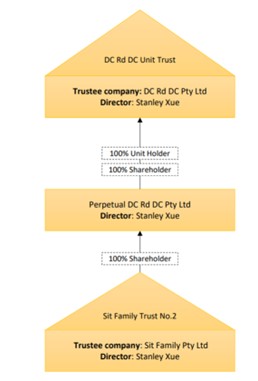
138 Bob was on a family holiday at the time and says that, in accordance with his typical practice, he noticed having received the email from Ms Qu and, upon briefly reading the body of the email, concluded that it was neither highly important nor highly urgent, so left the email to be filed or deleted and does not recall opening or reading the attachments: Bob 3 at [23]. I find that Bob did in fact open and read the attachments, in light of the importance of the Back-to-Back Contracts to Bob, particularly given the large amount of money which Bob’s entities stood to gain, the need to conceal the true nature of the transactions from the Sit family, and the imminent exchange of the Back-to-Back Contracts.
139 DC Rd and Perpetual DC Rd were incorporated for the purposes of purchasing the Denham Court Property: SAF [78].
140 Tony was aware that DC Rd was the vehicle by which Sit Family would acquire the Denham Court Property: SAF [79]. I find that Bob was also aware of that, including by reason of the email referred to at [137]–[138] above (in addition to the evidence referred to at [170] and [173] below).
Dentons appointed as DC Rd’s solicitor
141 At around the time that Phillip was interviewing potential accountants, he was also looking for an Australian law firm to provide legal services to Sit Family. Tony recommended Dentons to Phillip: Phillip 1 at [107]–[108]. Phillip first met with Dentons on 10 May 2019: Phillip 2 at [30].
142 On 15 July 2019 Tony sent a message to Phillip in the Management WeChat Group, stating “@Xuehuiqiang Chairman, will DC company be using Dacheng (Dentons) Law Firm, please advise”, to which Phillip answered “Yes”: CB8/4969.
143 On or about 15 July 2019, Dentons was appointed as DC Rd’s solicitor in relation to the purchase of the Denham Court Property: SAF [80]. Bob knew by 21 August 2021 that Dentons were acting for the incoming (ie the ultimate) purchaser of the Denham Court Property, as he admitted in his public examination (CB13/7870), and I reject his denial of that fact in his cross-examination: T356.29–359.25.
144 In the period from 16 July 2019 to at least 25 September 2019, Tony gave instructions to Dentons on behalf of DC Rd in relation to the purchase of the Denham Court Property: Tony Parties’ Defence to the 4FASOC at [43].
145 There are many email communications between Tony and Anson Pang of Dentons in relation to the acquisition of the Denham Court Property. Without seeking to be exhaustive, Tony provided extensive instructions to, and received legal advice from, Dentons on behalf of DC Rd:
(a) On 16 July 2019, Mr Pang reviewed the draft contract of sale for the Denham Court Property and emailed Tony providing advice on the contract, including cautioning against accepting a term which provided for early release of the deposit monies payable on exchange: CB9/5618–5619. The email also attached a draft EOI by Tony on behalf of Vantager for $45 million and a draft contract for sale: Supp CB1/506–574. Later that day, Tony sent an email to Mr Pang stating that the vendor wanted to release the Deposit: CB9/5618.
(b) On 17 July 2019, Tony informed Mr Pang that the purchasing entity for the contract of sale would be DC Rd as trustee for the DC Rd Unit Trust, and Mr Pang provided Tony with an execution page from the contract of sale for the Denham Court Property, for Tony “to arrange for Stan to sign”: CB9/5358–5361. Later that day Mr Pang sent an email advice about the contract to Tony on behalf of DC Rd: CB9/5616–5618. Mr Pang stated at point 2 of that email: “2. the vendor is not the registered proprietor. Settlement will be conditional on the vendor becoming the registered proprietor. In our opinion, it would be prudent for there to be a sunset date so that if the vendor is unable to satisfy this condition for whatever reason, the parties can walk away from the deal”.
(c) Later that day, Mr Pang wrote in an email to Tony that he had limited the proposed amendments to the contract to three points concerning: (1) removal of the requirement for a personal guarantee, (2) reducing the default interest from 12% to 8% and (3) inserting a standard set of vendor warranties: CB9/5615–6. Tony responded by email that evening on behalf of DC Rd saying that (2) and (3) were agreed (Supp CB2/576), and a second email saying that (2) and (3) were accepted and that the purchasers were “happy to release the deposit”: CB9/5615.
(d) On 19 July 2019, Tony emailed Mr Pang to confirm that DC Rd (as purchaser) had paid the Deposit to the vendor’s solicitor, stating “we have transferred the deposit”: CB9/5612.
(e) On 22 July 2019, Mr Pang received the revised contract from 30 Denham’s solicitors, KPL. Mr Pang called Tony to discuss the contract: CB9/5611. Following this call, Mr Pang received approval from Tony to insert the purchaser’s signing page into the contract of sale for exchange: CB9/5610. It also appears that Tony and Mr Pang discussed the GST treatment of the sale: CB9/5609), following which Dentons and KPL negotiated amendments to the contract in relation to the GST treatment of the sale: Supp CB2/662–4.
(f) On 23 July 2019, Mr Pang sent the purchaser’s contract by courier to KPL and updated Tony as to the GST treatment of the sale, noting that the margin scheme would not be used: CB9/5607–5608.
(g) On 24 July 2019, KPL confirmed receipt of the contract from Mr Pang, executed by the purchaser but noted that the personal guarantee in the contract was not signed: Supp CB2/674. Following receipt of this email, Mr Pang emailed Tony requesting he obtain Stanley’s signature on the guarantee and confirm that the Deposit of $4.5 million would not be invested: CB9/5606. On receipt of the signed guarantee from Tony, Mr Pang emailed the signed guarantee to KPL and confirmed that DC Rd agreed that the Deposit would not be invested: Supp CB2/677.
(h) On 25 July 2019, Mr Pang attended to exchange of the contracts of sale for the purchase and notified Tony that exchange had taken place: CB9/5605.
(i) On 29 July 2019, Mr Pang received a request from KPL for the early release of the Deposit paid by DC Rd: Supp CB2/684. At 2.16 pm that day, Mr Pang wrote to Tony referring to an earlier discussion and relaying the request for early release of the Deposit on an unconditional basis, despite the fact that the contract “clearly provides otherwise”, and Mr Pang also stated that in releasing the Deposit, there was a risk that recovering the Deposit if the contract was rescinded would be difficult: CB9/5604–5605. At 2.19 pm that day, Tony responded to Mr Pang’s email, confirming DC Rd’s agreement to release the Deposit, stating “We are agreed”: CB9/5604.
(j) On 30 July 2019, Mr Pang wrote to Mr Portolesi confirming that DC Rd agreed to the release of the Deposit: Supp CB2/685.
(k) On 8 August 2019, Dentons wrote to Tony setting out the process prior to settlement for the purchase of the Denham Court Property: CB9/5602–5603.
(l) On 15 August 2019, and following an earlier discussion, Mr Pang provided Tony with a PEXA authorisation form for instructions: CB9/5634–5635. Tony confirmed the PEXA authorisation form was “fine”: CB9/5634)
(m) On 22 August 2019, Mr Pang provided Tony with estimated settlement figures for completion of the purchase: CB9/5632–5633.
(n) On 2 September 2019, Tony emailed Mr Pang to confirm that DC Rd had transferred the funds required for settlement to Dentons’ trust account: CB9/5630. Mr Pang subsequently confirmed that Dentons had received the amount of $47,738,253.07 in its trust account: CB9/5629–5630.
(o) On 3 September 2019 at 4.30 pm, Mr Pang spoke to Tony by telephone. Mr Pang then emailed Tony, referring to the conversation he had with Tony earlier that day. In his email Mr Pang stated as follows: “You have asked us to transfer the settlement funds from our trust account to the vendor solicitor’s trust account today in preparation for settlement. We do not in any circumstances recommend transferring your settlement funds to the vendor before settlement because there is a substantial and material risk of a third party misappropriating or fraudulently using the funds”: CB9/5628.
(p) On 3 September 2019 at 4.47 pm, Tony responded to Mr Pang’s email, referring to a further telephone discussion with Mr Pang and requesting the funds be sent to KPL’s trust account to prepare for settlement: CB9/5627.
(q) On 4 September 2019, Mr Pang received an email from Mr Chris Fabiansson, the Dentons partner acting on the purchase, referring to an earlier discussion on the telephone. Mr Fabiansson informed Mr Pang that there were unacceptable risks in transferring the settlement monies to the vendor prior to settlement: Supp CB2/855. Mr Pang and Mr Fabiansson subsequently discussed this issue, including with Tony. Following the discussion with Tony referred to above, Mr Fabiansson emailed Tony restating his advice that settlement funds should not be transferred to KPL prior to settlement: CB9/5626.
(r) On 5 September 2019, Dentons received from KPL (the solicitors for 30 Denham) cheque directions for settlement, which recorded payment to Solari & Stock (the solicitors for Khengs) in the sum of $14,040,360.62, and a payment to KPL’s trust account in the sum of $30,162,735.03: CB10/6108. Tony also gave instructions to withdraw $27,908.96 from the funds for the East Kurrajong purchase for the purposes of the settlement of the purchase of the Denham Court Property by DC Rd: CB9/5624–5625. Mr Pang then sent an email confirming that settlement had taken place, and attaching “as requested” the statement from PEXA indicating how the funds were disbursed: CB9/5624. Mr Pang then sent a breakdown of all purchase funds, which “should include all information that you have requested”: CB9/5623–5624.
(s) On 5 September 2019, following the settlement of the purchase of the Denham Court Property by DC Rd, Mr Pang emailed Tony to confirm settlement had taken place: CB9/5624.
(t) On 13 September 2019, Mr Pang issued an invoice on behalf of Dentons to Tony, for acting on the purchase of the Denham Court Property on behalf of DC Rd: Supp CB2/995, 1006–8. The invoice was issued to “DC Rd DC Pty Ltd as trustee for DC Rd DC Unit Trust C/– Tony Zhang”.
(u) On 4 October 2019, Mr Pang received a call from the NSW Valuer General with respect to the discrepancy between the prices for the sale of the Denham Court Property by way of Simultaneous Settlement: Supp CB2/1024.
(v) On 15 November 2019, Mr Pang emailed Tony noting the purchase of the Denham Court Property was by way of Simultaneous Settlement and informing Tony that Dentons had received a query from the Valuer General with respect to the calculation of land tax for the Denham Court Property. The Valuer General had informed Dentons that there was a substantial discrepancy between the two prices paid in the Simultaneous Settlement: Supp CB2/1070.
(w) On 17 November 2019, Tony responded to Mr Pang’s email that they could discuss “next week”: Supp CB2/1070.
146 None of these communications were copied or otherwise sent to Phillip or Stanley, neither of whom had any direct communications with Dentons regarding the transaction: see Phillip 1 at [111]; Stanley 1 at [70]–[72]. Further, Tony provided Stanley (as director of DC Rd) with the signing page of the contract and the guarantee clause, which Stanley signed prior to the sale contract being exchanged, but the full contract was never provided to him: Stanley 1 at [68]–[69]; CB10/5417–5419.
Loan Agreement between 30 Denham and CTD
147 It is clear from the unchallenged affidavit evidence of Mr Cheng Lu and Mr Mark Ma that in July 2019 Bob was actively seeking potential investors in CTD or 30 Denham to enable 30 Denham to purchase the Denham Court Property. Bob explained to Mr Ma that he was seeking investment funds of about $10 million, being the approximate difference between the purchase price of $14 million and the $4.5 million that CTD had already agreed to advance to the purchaser (see [149] below), and gave a similar explanation to Mr Lu. Bob also gave evidence, which I accept, that he spoke to other private investors to seek investment for this transaction, including a Mr Wang: Bob 2 at [181]. Bob was thus undoubtedly assisting Tony in relation to the Back-to-Back Contracts by seeking to raise funds to enable 30 Denham to purchase the Denham Court Property, so as to be able then to on-sell it to DC Rd.
148 Bob’s evidence is that in June or July 2019, Tony contacted him in relation to the potential purchase of land linked to the Western Sydney Airport which he said was very undervalued and he needed someone else to “put their name on it”, explaining that if the vendor was aware that Tony was the purchaser then that would increase the price because the vendor knew that Tony was a property developer: Bob 1 at [59]. Bob put the suggestion to Mr De Souza whom he had known since about 2011 or 2012: Bob 1 at [61]. I note at this point that Bob’s affidavits did not disclose that Mr De Souza was shown alongside Bob as a “Partner” on CAG’s website under the “Our Team” tab (Ex B) at some time during or after 2016 (the date being taken from the claim for copyright as shown in Ex B). A discussion ensued between Mr De Souza and Tony, and Mr De Souza then requested Bob’s assistance to cover the purchase price: Bob 1 at [62]. Bob told Mr De Souza that he would lend him $4.5 million without security and proceeded to draft a loan agreement himself using a proforma loan agreement template (ie the First Loan Agreement): Bob 1 at [63]–[68]; Bob 3 at [11].
149 The First Loan Agreement, which is dated 15 July 2019, provides for a loan of $4,500,000 for a term of 24 months at an interest rate of 0.17% per day: CB8/4980 at 4988. That would translate into an annual interest rate of 62.05% if calculated by way of simple interest (although interest accrued daily and interest on the outstanding amount of the loan compounded monthly: cl 4.1(3). The First Loan Agreement does not provide for any line fee or establishment fee or any other payment in the event that 30 Denham did not draw down against the facility. Bob gave evidence that the fact that the First Loan Agreement contemplates that interest will only be paid on money lent was neither his intention nor, as he understood it, did it reflect the agreement that he had reached with Mr De Souza: Bob 1 at [69]. I reject that evidence because it is inconsistent with the document which Bob drafted on a matter of considerable importance commercially. Bob also says that he trusted Mr De Souza to pay him the interest that they had agreed, irrespective of whether he had actually paid over the money or not: Bob 1 at [69]. However, Bob gives no evidence of any conversation or other communication which would support any such understanding, other than a generalised suggestion that Bob wanted a fixed and certain return, which I reject and which finds no expression in the document Bob drafted.
150 I regard the First Loan Agreement as a genuine agreement which was intended to take effect according to its terms. As at 15 July 2019, there was no agreement for the release of the Deposit, with the result that 30 Denham would need to find $1.4 million itself to pay the deposit on its purchase of the Denham Court Property. In addition, there was a real risk that, even if the Back-to-Back Contracts were entered into, the Simultaneous Settlement which was anticipated might not eventuate. The most obvious source of that risk was that DC Rd might discover that it was being defrauded through the Back-to-Back Contracts, and rescind its contract with 30 Denham, as it would have been fully entitled to do. Bob was aware that Mr De Souza definitely lacked the financial capacity to purchase the Denham Court Property for $14 million, and was not quite sure about Tony’s capacity to do so: T443.32–37. Accordingly, as at 15 July 2019 Mr De Souza would have been understandably concerned, as the sole appointed director of 30 Denham, that 30 Denham may not have had the wherewithal to perform its obligations, and pay the debts which it had incurred. I accept Bob’s evidence in cross-examination that he saw his role as a financier (also described as a financial contributor or lender) for the transaction whereby 30 Denham would purchase the Denham Court Property, and that it was important to him to work out how Mr De Souza (on behalf of 30 Denham) would settle the transaction: T359.41–45, T360.38–42, T361.9–13, T368.11–17, T442.19–443.30, T444.14–446.36. Accordingly, it was important for Bob to know how the Back-to-Back Contracts would settle: T360.41–45, T444.4–18.
151 Bob says that on about 22 July 2019, Mr De Souza told him that he did not need CTD’s funding for the deposit on the purchase as the purchaser (which I note was DC Rd) had agreed to release enough money to pay the deposit to the vendor: Bob 1 at [70]. Bob says that Mr De Souza said that he was worried that there was still a chance that the purchaser could delay settlement or the purchase could fall through, and thus he might still require some money for the settlement: Bob 1 at [70]. I accept that evidence, in light of the risks facing 30 Denham and Mr De Souza (other than not now having to fund the $1.4 million deposit independently of DC Rd’s Deposit) to which I have referred in the preceding paragraph. Bob says that on about 25 July 2019, he received a telephone call from Mr De Souza in which Mr De Souza said that he had exchanged contracts to purchase the Denham Court Property for $14 million and then to sell the property for $45 million, and also that he did not need to draw down on the funds that CTD had agreed to lend for the deposit as the purchaser had agreed to release the deposit, but that there was still a chance that the purchaser could delay the settlement or it could fall through so he still might need the money that CTD had promised him: Bob 1 at [72]. Bob says that he was surprised that Mr De Souza was selling the property for $45 million instead of the price which Mr De Souza had previously referred to of $30–35 million, and that because he was making an extra $10 million, Bob wanted a minimum of 12 months’ interest, to which Mr De Souza agreed: Bob 1 at [73]; Bob 2 at [176]. Bob claims that Mr De Souza did not tell him who the buyer was and that he did not know that it was the Sit family until about March 2021 (Bob 1 at [74]), which I reject (see [173] below).
152 Bob then gives evidence that on 30 July 2019, he met with Mr De Souza and provided him with the Variation Agreement, which Bob says he had prepared himself using a proforma template: Bob 1 at [75]. The Variation Agreement bears the signatures of Bob and Mr De Souza and provides that 30 Denham will pay a “Line Fee” in the same amount as the “Applicable Interest Rate” in the First Loan Agreement (namely 0.17% per day) on the undrawn amount of the loan facility, and that the minimum amount of interest that will be paid by 30 Denham will be equal to 12 months’ interest (cl 2): CB9/5585. Bob understood the minimum 12 months’ interest to apply to the “Line Fee,” such that even if 30 Denham did not draw down on the loan, it would have to pay 0.17% per day on $4,500,000 for 365 days: T480.1–36. Bob understood that the interest would compound monthly: T482.39–483.5. Bob claims that he thought that the minimum of 12 months’ interest was reasonable because he says he still believed there was a risk that the Back-to-Back Contracts might not occur simultaneously or at all, and he had a continuing obligation to advance the $4.5 million to 30 Denham without any security: Bob 2 at [177]. Bob says that he has been unable to locate the original signed versions of the First Loan Agreement and the Variation Agreement: Bob 3 at [16].
153 The Variation Agreement makes no commercial sense from 30 Denham’s perspective. It obliges 30 Denham to pay a “Line Fee” of 0.17% per day on the undrawn facility of $4,500,000. I note that that would amount to $7,650 per day (and $2,792,250 over 12 months plus capitalised unpaid interest) for a facility which, under the terms of the existing First Loan Agreement, would not have cost 30 Denham anything if 30 Denham did not draw down against the facility. The Bob Parties helpfully calculated the amount of the “Line Fee” on the undrawn facility amount of $4,500,000 for 12 months at 0.17% compounding monthly as $3,674,197: Closing Written Submissions at [11] and Sch 2. There was no consideration provided by CTD for the Variation Agreement, because it was already legally obliged under the First Loan Agreement to make the facility available. The Variation Agreement was therefore not contractually binding. The only reason given by Bob for requesting the Variation Agreement was that 30 Denham was making an extra $10 million above what Mr De Souza had previously foreshadowed. I do not think that Bob ever contemplated seeking a “Line Fee” from 30 Denham when the First Loan Agreement was entered into. Although Bob had to ensure that he had $4.5 million available to advance to 30 Denham if required, and thus he could not commit that money to other investments unless they were highly liquid, the more important matter for Bob was ensuring Mr De Souza’s cooperation, and assuaging Mr De Souza’s understandable concern that DC Rd’s purchase may fall over and 30 Denham would then be left with a liability to Khengs for $14.5 million which it did not have. In addition, Bob knew that he would be more than handsomely rewarded for his financial assistance from his share of the DC Rd Proceeds, as arranged between him and Tony, consistently with the payments later made to Bob’s companies from the DC Rd Proceeds. Moreover, it would have been irrational for Mr De Souza to have agreed to Bob’s request which, in substance, was for a gift of about $3.7 million if the loan was not drawn down.
154 Accordingly, I do not regard the Variation Agreement as genuinely reflecting the intentions of the parties. I regard it as an attempt by Bob and Mr De Souza to conceal the true nature of their dealings, which was to reward Bob for his assistance in relation to the Back-to-Back Contracts. I do not, however, think that the evidence is sufficient to establish that the Variation Agreement is not an authentic document. In sum, the document was authentic, but it was a sham. I reject Bob’s evidence concerning the Variation Agreement, and I reject the submission by the Bob Parties that $3,635,949 of the money received by CTD from the DC Rd Proceeds was paid pursuant to a “contractual entitlement” under the Variation Agreement. The fact that that amount differs by only a relatively small amount from the Bob Parties’ calculation of the “Line Fee” (including compound interest) is of no significance unless one also accepts Bob’s evidence concerning the so-called litigation funding which Bob also claims is the explanation for the additional $5.341 million paid to CTD and CAGA. I reject that explanation (at [328]–[331] below).
155 On 31 July 2019, 30 Denham’s solicitors (KPL) gave CTD a cheque for $1.5 million on Mr De Souza’s instructions: Bob 1 at [76]–[78]. Bob says he understood that the payment of $1.5 million was made pursuant to the Variation Agreement (Bob 2 at [178]), which I reject, as Bob and Mr De Souza both knew that the Variation Agreement was a sham.
Payment of Deposit
156 On or about 18 July 2019, the Deposit was paid on behalf of DC Rd to the trust account of 30 Denham’s solicitors, KPL, in the sum of $4.5 million: SAF [82]. That was done at Tony’s request: Phillip 1 at [123].
157 As DC Rd had only just been incorporated and its “financial accounts” (or perhaps its bank account) had not yet been set up, Oasis made the payment on behalf of DC Rd: Phillip 1 at [123]; and see bank statements of Oasis, which show a transfer to “Kpl Lawyer Law Pract” of $4,500,035.00 on 18 July 2019: CB8/4753. In effect, Oasis paid the Deposit at the implied request of DC Rd, the implication arising from the circumstances proved by Phillip’s affidavit evidence. DC Rd thereby had an obligation to indemnify Oasis for the payment of the Deposit, and is entitled to claim that liability as part of its loss: Birmingham and District Land Company v London and North Western Railway Company (1886) 34 Ch D 261 at 272 (Cotton LJ), 274 (Bowen LJ); Eastern Shipping Company v Quah Beng Kee [1924] AC 177 at 182–3 (Lord Wrenbury); Yeung Kai Yung v Hong Kong and Shanghai Banking Corporation [1981] AC 787 at 796 (Lord Scarman); Amann Aviation Pty Ltd v Commonwealth (1990) 22 FCR 527 at 540 (Davies J); 573 (Burchett J); Eugenie Holdings Pty Ltd v Stratford (unreported, Supreme Court of New South Wales, Giles J, 12 November 1991) at 61–66.
158 On 25 July 2019, the amount of $1.4 million was paid from the Deposit to the Colliers International trust account, as the deposit for 30 Denham’s purchase of the Denham Court Property from Khengs: Supp CB2/682–3.
Incorporation of Investx and Investx Holdings
159 On or about 18 July 2019, Investx and Investx Holding were incorporated by CATA on Tony’s instructions: SAF [83]. Bob assisted personally with the incorporation of Investx: CB13/7850, lines 5–7; CB13/7906, lines 27–34.
160 From 18 July 2019, Tony was the sole director of Investx and the sole director and shareholder of Investx Holding, which was the sole shareholder in Investx: SAF [84].
161 Also on 18 July 2019, Tony (on behalf of Investx) and Mr De Souza (on behalf of 30 Denham) signed a confidential “letter agreement” confirming the terms on which 30 Denham would work with Investx in respect of the opportunity to buy and sell the Denham Court Property, including payment by 30 Denham to Investx of a success fee of $26.5 million from the sale proceeds if Investx assisted 30 Denham in buying the property for $14 million and selling it for $45 million to Stanley or his nominee company: Supp CB2/584.
Exchange of Back-to-Back Contracts
162 On 17 July 2019, the following exchange took place in the Management WeChat Group (CB9/5356–3537):
Phillip: Can we sign DC today?”
Tony: @Xuehuiqiang will you be able to talk on the phone, Chairman?
163 On 22 July 2019, Phillip recorded the following in his diary that “Today lawyers from both sides of the DC project signed, just waiting for the handover!”: CB8/4747.
164 On 23 July 2019, Tony sent the following message to Phillip in the Management WeChat Group (CB9/5416):
Tony: @Xuehuiqiang Chairman, here is the report on the DC project: the vendor’s lawyer agrees with our side’s adjustment on return of GST, i.e. if our GST is not returned from the taxation office in full, the vendor is obliged to return our GST. Both sides have signed the contract, now we are waiting for the lawyers on both sides to have a final confirmation of the consistency of the contract/s.
165 Later that evening, Tony sent the following message in the same group (Supp CB1/238):
Tony: @Fai Keung Sit Chairman, I just confirmed with the lawyer; both sides’ contracts have no issues, but it is already past 5 p.m. They will exchange contracts tomorrow morning.
166 On 25 July 2019, 30 Denham and Khengs entered into the First Contract for the purchase of the Denham Court Property for $14 million plus GST: SAF [85]; CB9/5427.
167 Also on 25 July 2019, 30 Denham and DC Rd entered into the Second Contract for the purchase of the Denham Court Property for $45 million plus GST: SAF [85]; CB9/5505.
168 At 12.44 pm on 25 July 2019, Tony sent a message in the Management WeChat Group: “@Xuehuiqiang Chairman, Haohao lawyer called the DC project exchanged contracts!”: CB9/5578.
169 Tony was aware of the Back-to-Back Contracts: SAF [86]. Tony did not inform Phillip and Stanley of the Back-to-Back Contracts: Phillip 1 at [120] and [144]; Stanley 1 at [73], [85] and [93]. During Tony’s public examination on 22 February 2023, he made the following admissions (CB13/7931–7932):
Mr Stack: No, you see, what you did was, you engineered a deal whereby you would purchase this property for 14 million and on sell it immediately to the Xue family for 45 million, didn’t you?
Tony: Privilege. Yes.
Mr Stack: That was the deal? Was it?
Tony: Privilege. Yes
…
Mr Stack: You made a bid for this property at 14 million dollars; correct?
Tony: Privilege. Yes.
Mr Stack: When the property was on the market; correct?
Tony: Privilege. Yes.
Mr Stack: Yes. And you, at the same time, you told the Xues that they could have the property for 45 million, didn’t you?
Tony: Privilege. Yes.
Mr Stack: A mark up of 31 million dollars; correct?
Tony: Privilege. Yes.
Mr Stack: Did you tell them that they were going to buy the property for – that you were going to buy the property for 14 million?
Tony: Privilege. No, I didn’t tell them.
170 Bob was also aware of the Back-to-Back Contracts: CB13/7855–6; CB13/7864; CB13/7866–7; CB13/7868. During his public examination, Bob made the following admissions (CB13/7866–7):
Mr Stack: Yes. And you were aware, were you not, by – and you will see the contract is dated 25 July 2019; do you see that? And you were aware by 25 July 2019 that Denham Court had sold the property, on–sold the property, to another entity for $45 million; is that right?
Bob: Yes. Privilege. Yes.
Mr Stack: At exactly the same time?
Bob: Privilege. Yes.
Mr Stack: Yes. And was that–the purchasing entity, was that an entity that was associated with Mr Zhang, as far as you were concerned?
Bob: Privilege. Yes.
…
Mr Stack: Was it associated with the Xue, Stanley Xue and …
Bob: Yes. Privilege. Yes
Mr Stack: As well as Tony Zhang; is that right?
Bob: Privilege. From my understanding, they all mixed around at that time.
I reject Bob’s evidence in his cross-examination that his admission concerning his knowledge that Stanley was associated with the ultimate purchaser was with respect to his state of mind in 2023 rather than in 2019 (T441.24–41), as it is inconsistent with the ordinary meaning of his admission when read in context, and inconsistent with the objective facts referred to below as to the information available to Bob in July 2019.
171 Bob also admitted that he knew that Mr De Souza and 30 Denham were acting as Tony’s representatives in relation to the purchase and sale of the Denham Court Property, saying that Tony handled all the matters in relation to the purchase and sale for Mr De Souza: CB13/7856 lines 23–29. In his cross-examination, Bob claimed that he knew nothing about a deal between Mr De Souza and Tony or that they were doing a deal together (T373.23–32, T435.30–438.23), which I reject. Bob admitted in his affidavit evidence that he was the one who recommended Mr De Souza to Tony for a property transaction in Western Sydney in June or July 2019: Bob 1 at [59]–[61].
172 Bob did not inform Phillip or Stanley of the Back-to-Back Contracts: SAF [87].
173 However, Bob says that he had no involvement in the work associated with the establishment of Perpetual DC Rd, DC Rd and the DC Rd Unit Trust, and none of Stanley, Phillip, Tony, John or any employee of CATA explained to him what was the intended purpose of incorporating those entities or that they were intended to be used as a vehicle to purchase the Denham Court Property: Bob 1 at [53(a) and (c)]. Further, Bob says that the first time he knew that the Sit family had been the ultimate purchasers of the Denham Court Property was in about late March 2021: Bob 1 at [105], [118]; Bob 2 at [197]. I reject that evidence. Apart from my adverse impression of Bob’s credibility as a witness, Bob’s evidence is inconsistent with the following:
(a) the ordinary and natural meaning in its context of Bob’s admission in his public examination that he was aware by 25 July 2019 that the sale of the Denham Court Property for $45 million was associated with Stanley: CB13/7866–7 and see [170] above;
(b) Bob’s receipt and (on my findings) reading of the email from Ms Qu on 22 July 2019 and its attachments, including the diagram for the “Denham Court Project” showing the Applicants as purchasers of the Denham Court Property: CB9/5392–3 and see [137]–[138] above;
(c) Bob’s role in arranging finance for 30 Denham’s purchase of the Denham Court Property in the event that 30 Denham required loan finance, and the importance to Bob as the financier to know how the Back-to-Back Contracts would settle (see [150] above);
(d) Mr Portolesi’s evidence in his public examination that Bob spoke to Mr Portolesi about three times during the course of the transaction: CB12/7697;
(e) the email from Mr De Souza to Bob on 22 August 2019 (referred to at [179] below), in which the subject line referred expressly to the sale by 30 Denham to DC Rd of the Denham Court Property and in which the text told Bob that Mr Portolesi was waiting for an email from Dentons regarding their proposal for settlement: CB9/5694; and
(f) the fact that (on my findings at [153]–[154] above) Bob created the Variation Agreement to provide a knowingly false explanation for payments by 30 Denham to CTD, and gave false testimony in relation to that matter, bearing in mind that the conduct of a party calling or giving testimony known to be false can be treated as an implied admission or circumstantial evidence permitting an adverse inference: Kuhl at [64] (Heydon, Crennan and Bell JJ).
174 Bob also claims that he did not know in 2019 that Tony had assisted the purchaser (ie 30 Denham) in the purchase of the Denham Court Property: Bob 2 at [261]. I reject that evidence as completely implausible in light of my findings as to Bob’s knowledge of the Back-to-Back Contracts and his personal involvement in those transactions. That is reinforced by Bob’s own evidence that Tony asked Bob in June or July 2019 if Tony could put Bob’s name on the purchase of a property in Western Sydney, which Bob refused to do and then put Tony in touch with Mr De Souza: Bob 1 at [59]–[61]. It must have been obvious to Bob by mid-July 2019 that the land in question was the Denham Court Property, especially when Bob and Mr De Souza agreed upon the First Loan Agreement. Bob knew the property in question was about 80 hectares and near Edmondson Park (T419.40–420.7), and he was shown the location of it on Google Maps by Mr De Souza: Bob 2 at [194]. The fact that Bob knew exactly where the Denham Court Property was located is reinforced by his evidence that in estimating its value at that time he relied on Dahua’s development of an “adjacent” piece of land in 2019: T364.31–41. In addition, I accept Mr De Souza’s evidence in his public examination that Bob asked Mr De Souza to form 30 Denham (CB12/7718–9) and that it was set up in a way which was designed to conceal Tony’s purchase of, and ownership of, the Denham Court Property: CB12/7719–20.
Early release of Deposit and payment to Tony and Bob
175 On or about 30 July 2019, Tony on behalf of DC Rd authorised the early unconditional release of the Deposit to 30 Denham: SAF [88]. He did so without obtaining any instructions from Phillip or Stanley: Phillip 1 at [124]; Stanley 1 at [75].
176 On or about 31 July 2019, payments of $1.5 million were made from the Deposit held in the trust account of KPL to each of Investx and CTD by cheques collected by Mr Steve Shen, Bob’s cousin and an employee of CATA: SAF [89].
177 As at 31 July 2019, Tony was the sole director of Investx and the sole director and shareholder of Investx Holding, which was the sole shareholder in Investx, and Bob was the sole director and shareholder of CTD: SAF [90].
178 Tony and Bob did not inform Phillip or Stanley that payments had been made from the Deposit to entities controlled by them: SAF [91].
Simultaneous Settlement
179 On 21 August 2019, Mr Portolesi of KPL sent an email to Mr De Souza referring to 30 Denham’s sale to DC Rd, and saying that he understood that he should be receiving an email from Dentons regarding their proposal for settlement: CB9/5694. Mr De Souza forwarded that email to Bob on 22 August 2019 with the subject line “Fwd: 30 Denham Pty Ltd sale to DC Rd DC Pty Ltd – 30 Denham Court Road, Denham Court” and saying: “Bob, Domenic [Portolesi] is waiting for email from Dentons for the settlement matter discussed yesterday”: CB9/5694.
180 On 23 August 2019, Tony sent Phillip a series of messages about the upcoming settlement of the purchase of the Denham Court Property in the Management WeChat Group (CB9/5696):
Tony: [Final payment to complete the DC project transaction (1).pdf 63KB]
Tony: [Final payment for the Blue Mountains greenery project (1).pdf 63KB]
Tony: @Xuehuiqiang Chairman, here are the final payments to complete the transactions for the DC project and the greenery project. @Hefan please review and then @Xuehuiqiang Chairman, please approve. Chairman, the amount for both payments are approximations at the moment, as the counterparty's lawyer cannot confirm the final apportionment of water fee and land tax yet, so there will be a slight discrepancy in the final settlement amount. In order to not affect the completion of transaction, our lawyer will collect a little more and return it when the transaction is complete.
Tony: Both include 10% value–added tax, to be claimed back by us after the transaction is complete.
John: @Xuehuiqiang Chairman, the final payment to complete the transaction has been reviewed, please approve.
181 On 26 August 2019, the following messages were sent in the Management WeChat Group (CB9/5698, 5700, 5703):
Tony: Chairman, when you have time, please review and advise on the final payment request agreement for the DC project and the greenery project that we applied for last Friday
…
Phillip: The final payment requests for both projects are in English. Add Chinese annotations alongside, handwritten is fine.
Tony: Okay, Chairman. I'll add annotations now …
Tony: [Final payment for the DC project].pdf 18KB]”
Tony: [Final payment for the Blue Mountains greenery project (2).pdf 17KB]
Tony: @Xuehuiqiang Chairman, please examine and approve.
Tony: Chairman, at the moment these two final payments are estimates only, they will vary slightly when we eventually complete the transactions. Before the transactions are complete, the counterparty’s lawyer will send a final confirmed amount. We will transfer these amounts to our lawyer's account and then adjust them against the actual amount.
Phillip: So we will cover the value–added tax first, and have it refunded later?
Tony: Yes.
Phillip: The final payments for the DC and Blue Mountain can be scheduled for disbursement.
Tony: Okay, Chairman.
182 On or about 2 September 2019, the Settlement Sum of $47,738,253.07 was paid in respect of the Second Contract into Dentons’ trust account: SAF [92].
183 On 3 September 2019, KPL sent an email to “30 Denham Pty Ltd (Purchaser)” which confirmed that $14,894,914.24 was required to complete the First Contract and that $45,057,922.90 was due to be paid by DC Rd to 30 Denham under the Second Contract: CB10/5789–5792.
184 On or about 5 September 2019, Dentons paid the Settlement Sum of $30,162,735.03 in respect of the Second Contract into the trust account of 30 Denham’s solicitors: SAF [93].
185 On 5 September 2019, the following exchange took place in the Management WeChat Group: CB10/5801, 5804:
Tony: @Xuehuiqiang Chairman, the DC project transaction is being finalised today, but our lawyers have just discovered that a fee had been under–calculated, at around AUD$150,000. As our greenery project’s transaction is being finalised tomorrow, we can transfer the money from the greenery project first, but in this case, there will be insufficient funds for tomorrow's transaction. The solution for us now is for Auntie Lin to do an expedited transfer or issue a bank cheque tomorrow morning. We are waiting for the lawyers to contact us. We will keep you posted when we receive an update.
Phillip: Lin Yuzhen to make the payment of $150,000.
Phillip: @Tony Send the final confirmed transaction price list for the two projects to me to have a look.
Tony: Ok.
Tony: Chairman, do I need to mark it up with Chinese?
Phillip: Of course!
Tony: Okay.
Tony: [DC project vendor’s lawyer’s table of adjusted settlement figures.pdf 34KB]
Tony: @Xuehuiqiang Chairman, this is the table of adjusted figures prepared by the vendor’s lawyer for the DC project, excluding stamp duty and other transaction fees for transaction platforms. Our lawyers are checking the table of adjusted figures prepared by our party and will send it to me later. I feel that our lawyers have miscalculated the stamp duty.
Tony: The parties are now in the transaction process and I will let you know when the land transaction has been completed!
Tony: @Xuehuiqiang Chairman, the transaction of the DC project has been completed!
186 The First Contract and the Second Contract settled on 5 September 2019 by way of Simultaneous Settlement: SAF [94]. The funds paid by DC Rd were used by 30 Denham to pay Khengs; DC Rd were directed by KPL (30 Denham’s solicitors) to advance purchase moneys to Solari & Stock (Kheng’s solicitors) via PEXA: CB10/5809–5818.
187 The KPL trust account recorded the deposit of $30,162,735.03 on the same day, with the description “Received from: DC RD DC Pty Ltd Reason: Vendor’s Settlement Monies”: Supp CB3/1327.
188 Bob did not inform the Applicants of the Simultaneous Settlement: SAF [95]. Nor did Tony.
189 On 6 September 2019, the transfer of the Denham Court Property from Khengs to 30 Denham was registered. Immediately after the registration of the transfer from Khengs to 30 Denham, the transfer of the Denham Court Property from 30 Denham to DC Rd was registered: SAF [96].
Deregistration of Investx
190 On or about 30 July 2020, Tony (with the assistance of CATA) filed forms with ASIC which recorded that: (a) Tony had resigned as a director of Investx; (b) Mr David Dawson was appointed a director of Investx; and, (c) shares had been issued in Investx to Mr Dawson on 29 July 2019: SAF [97]. Bob was personally involved in effecting this change: CB13/7850–7851.
191 The Applicants submit, and I accept, that this attempt to backdate Tony’s removal as a director of Investx was obviously done in an attempt to disguise Tony’s involvement with Investx. According to Tony, Mr Dawson was appointed as a director of Investx just prior to the company being wound up, having been introduced to Tony by a taxi driver whom Tony met when he was in a taxi: CB13/7907.
192 On 28 August 2020, Investx was subject to a members’ voluntary liquidation. Investx was deregistered on 9 January 2021: SAF [98].
Fund transfers: Agreed Facts
193 As noted above (at [176]), the Deposit was used to pay Investx and CTD the amount of $1.5 million each on 31 July 2019: SAF [89].
194 The Settlement Sum was used by 30 Denham to pay:
(a) Investx the amount of $25 million on 9 September 2019; and
(b) CTD the amount of $5.23 million on 14 November 2019: SAF [100].
195 Tony and Bob did not inform Phillip and Stanley that those payments had been made from the Settlement Sum to Investx and CTD and that those companies subsequently transferred funds to other entities controlled by them: SAF [101]. In addition, I note that neither Phillip nor Stanley were otherwise aware of any of those payments: Phillip 1 at [137]–[138]; Stanley 1 at [86]–[87].
Fund transfers by Investx
196 Investx transferred $341,000 to the CAGA Account on 10 September 2019: SAF [102].
197 Investx also made the following fund transfers to the CAC Account:
(a) $2,500,000 on 10 October 2019; and
(b) $2,500,000 on 19 December 2019: SAF [103].
198 Investx also made the following fund transfers to Link:
(a) $500,000 on 21 February 2020;
(b) $5,000,000 on 6 April 2020;
(c) $8,000,000 on 27 April 2020; and
(d) $6,239,471.93 on 29 May 2020: SAF [104].
Fund transfers by CAGA
199 On 12 September 2019, $407,000 was transferred from the CAGA Account to the CTD Account: SAF [105].
Fund transfers by CAC
200 The following funds were transferred from the CAC Account:
(a) $2,500,000 to the CTD Account on 10 October 2019;
(b) $3,097,012 to the ATO on 28 November 2019; and
(c) $2,500,000 to the CTD Account on 19 December 2019: SAF [106].
Fund transfers by CTD
201 The following funds were transferred from the CTD Account:
(a) $7,160 to the CAC Account on 12 September 2019;
(b) $245,010 to the CAC Account on 19 September 2019;
(c) $1,571,000 to the CAC Account on 14 October 2019;
(d) $2,400,000 to the Bob and Lian ANZ Account 1814 on 16 October 2019;
(e) $3,100,000 to the CAC Account on 28 November 2019;
(f) $930,000 to DSZ Accountants on 27 December 2019;
(g) $6,000,000 to the CAGA Account on 2 December 2020; and
(h) $620,000 to the CAC Account on 7 March 2020: SAF [107].
Funds received by CAC
202 On 8 January 2020, $1,900,000 was transferred from the Lian NAB Account 2340 to the CAC Account: SAF [108].
Purchase or finance of other properties: Agreed Facts
Purchase of the Belrose Property
203 Link made the following fund transfers to Pleasant Land:
(a) $499,980 on 30 March 2020;
(b) $999,980 on 14 April 2020; and
(c) $3,999,980 on 15 April 2020: SAF [109].
204 On 16 April 2020, Pleasant Land transferred $2,600,030 to the general trust account of CBRE, as the deposit for the purchase of the Belrose Property: SAF [110].
205 Pleasant Land transferred $1,900,000 to Belrose COB on 25 June 2020: SAF [111].
206 The following fund transfers in respect of Belrose COB also occurred:
(a) Link transferred $6,999,980 to Belrose COB on 22 June 2020;
(b) Link transferred $4,199,980 to Miriam Park on 24 June 2020;
(c) Link transferred $2,799,980 to Belrose COB on 25 June 2020; and
(d) Miriam Park transferred $4,000,000 to Belrose COB on 30 June 2020: SAF [112].
207 The amount of $10,567,690.84 from these funds was used by Belrose COB to purchase the Belrose Property for $26 million on 13 October 2020: SAF [113].
Purchase of the Turramurra Property
208 The following funds were transferred from the CAC Account to IEN Legal:
(a) $245,010 on 19 September 2019;
(b) $771,000 on 14 October 2019; and
(c) $800,000 on 14 October 2019: SAF [114].
209 The funds referred to in sub-para (a) in the previous paragraph were used by Lian to pay the stamp duty applicable to the purchase of the Turramurra Property. The funds referred to in sub-paras (b) and (c) were used by Lian to purchase the Turramurra Property. On 16 October 2019, the amount of $2,400,000 was transferred from the CTD Account to the Bob and Lian ANZ Account 1814. On 28 November 2022, $2,357,588 was transferred from the Bob and Lian ANZ Account 1814 to the Lian ANZ Account 2964. On 29 November 2022, $2,340,000 was transferred from the Lian ANZ Account 2964 to the ANZ Turramurra Loan Account 8143: SAF [116].
Purchase of the Arthur Street Property
210 On or about 7 January 2020, $1,000,000 was transferred from the CAC Account to the Bob and Lian St George Account 7741. On 18 November 2022, $1,000,000 was transferred from the Bob and Lian St George Account 7741 to Lian St George Account 7185. On 31 January 2023, $1,000,000 was transferred from the Lian St George Account 7185 to the St George Arthur Street Loan Account: SAF [117].
211 The St George Arthur Street Loan was refinanced by the CBA Arthur Street Loan Account for $2,000,000. The proceeds from the CBA Arthur Street Loan Account in the amount of $999,650 were transferred to the Lian CBA Account 2814 on 8 February 2023. On 11 February 2023, $1,100,000 was transferred from the Lian CBA Account 7759 to the Lian CBA Account 2814. On 19 February 2023, $2,000,000 was transferred from the Lian CBA Account 2814 to the Lian CBA Account 7759. On 22 February 2023, $2,000,000 was transferred from the Lian CBA Account 7759 to the Lian CBA Account 2814: SAF [118].
Purchase of the Herbert Street Property
212 On or about 7 March 2020, $620,000 was transferred from the CAC Account to the Bob and Lian St George Account 7741. On 13 March 2020, $605,000 was transferred from the Bob and Lian St George Account 7741 to Bob St George Account 8334. On 8 December 2022, $590,000 was transferred from the Bob St George Account 8334 to the St George Herbert Street Loan Account: SAF [119].
213 The St George Herbert Street Loan was refinanced by the CBA Herbert Street Loan Account. The proceeds from the CBA Herbert Street Loan Account in the amount of $2,958,630.34 were transferred into the Lian CBA Account 7759 on 30 January 2023. On 31 January 2023, $600,000 was transferred from the Lian CBA Account 7759 to the Lian CBA Account 7767. On 11 February 2023, $600,000 was transferred from Lian CBA Account 7767 to the KOB001 Pty Ltd ITF Cai & Li Family CBA Account 4601. On 14 February 2023, $600,000 was transferred from the KOB001 Pty Ltd ITF Cai & Li Family CBA Account 4601 to the Lian CBA Account 7767: SAF [120].
Purchase of the Saiala Property
214 On or about 29 March 2021, $190,000 was transferred from the CAGA Account to Yingke Law Firm as the deposit for the Saiala Property: SAF [121].
215 The following funds were also transferred from the CAGA Account to IEN Legal:
(a) $909,000 on 10 May 2021; and
(b) $900,000 on 11 May 2021: SAF [122].
216 The funds referred to in the previous paragraph were used by Saiala to purchase the Saiala Property: SAF [123].
Purchase of the Clarence 104 Property
217 On or about 8 September 2021, $123,000 was transferred from the CAGA Account to the CAC Account and then $123,000 was transferred from the CAC Account to Lindale Investments Pty Ltd or its agent as the deposit for the Clarence 104 Property: SAF [124].
218 The following funds were also transferred from the CAC Account and the CAGA Account:
(a) $196,000 was transferred from the CAGA Account to IEN Legal on 18 October 2021;
(b) $1,100,000 was transferred from the CAGA Account to the CAC Account on 18 October 2021;
(c) $900,000 was transferred from the CAC Account to IEN Legal on 18 October 2021; and
(d) $200,000 was transferred from the CAC Account to IEN Legal on 19 October 2021: SAF [125].
219 The funds referred to in the previous paragraph were used by Clarence 104 to purchase the Clarence 104 Property: SAF [126].
Purchase of the Smithfield Property
220 Miriam Park has had Tony and John as its directors and equal shareholders since its incorporation on 20 May 2020: SAF [127].
221 Miriam Park was previously the registered proprietor of the Miriam Park Property: SAF [128].
222 Between 30 March 2020 and 15 April 2020, Link transferred $5,499,940 to Pleasant Land: SAF [129].
223 On or around 29 May 2020, Pleasant Land transferred $380,000 from the Pleasant Land Trust Funds to Etheringtons Solicitors, who were acting for the vendor of the Miriam Park Property. This was payment of the deposit for the acquisition of the Miriam Park Property, made on behalf of, and for the benefit of, Miram Park: SAF [130].
224 The following transactions were made to Belrose COB, totalling $15,699,960:
(a) on 22 June 2020, Link transferred $6,999,980 to Belrose COB;
(b) on 24 June 2020, Link transferred $4,199,980 to Miriam Park which transferred $4,000,000 to Belrose COB on 30 June 2020;
(c) on 25 June 2020, Link transferred $2,799,980 to Belrose COB; and
(d) on 25 June 2020, Pleasant Land transferred $1,900,000 from the Pleasant Land Trust Funds to Belrose COB: SAF [131].
225 On 1 September 2020, Belrose COB transferred $471,792 to Revenue NSW. This was for the payment of stamp duty for the acquisition of the Miriam Park Property, and made on behalf of, and for the benefit of, Miriam Park: SAF [132].
226 The following transfers took place:
(a) on 26 August 2020, Miriam Park transferred $100,000 to a St George bank account in John’s name;
(b) on 15 October 2020, John transferred $177,478 from that St George Account to an ANZ bank account in his name;
(c) on 19 October 2020, Belrose COB transferred $4,500,000 to an ANZ account belonging to John with the description “Payment From Dong Zhang REF:2320M01IMT02 3718”; and
(d) on 30 October 2020, John transferred $4,600,000 to Miriam Park from the funds referred in sub-paras (b) and (c) above: SAF [133].
227 From those funds received by Miriam Park, on 26 November 2020 Miriam Park transferred $4,425,365 to Etheringtons Solicitors, who were acting for the vendor of the Miriam Park Property. The transfer constituted part of the purchase price for the acquisition of the Miriam Park Property: SAF [134].
228 The balance of the purchase price for the acquisition of the Miriam Park Property was financed by the Miriam Park Facility from ING in the amount of $3,000,000: SAF [135].
229 On 8 December 2020, Miriam Park became the registered proprietor of the Miriam Park Property, and between 8 December 2020 and April 2023, Miriam Park subdivided, developed and sold the Miriam Park Property: SAF [136].
230 On 18 August 2021, the facility limit of the Miriam Park Facility was increased to $8,700,000: SAF [137].
231 In December 2021, the Miriam Park Facility was varied so as to be cross–collateralised against the Smithfield Property: SAF [138].
232 As part of the funding for Smithfield 40 to purchase the Smithfield Property, Smithfield 40 obtained a loan facility of $10,550,000 from ING, which was cross–collateralised against both the Smithfield Property and the Miriam Park Property: SAF [139].
233 On 28 November 2022, $3,718,600.64 was transferred to the Smithfield Loan Account: SAF [140].
DSZ Accountants Increased Equity
234 On or about 11 November 2015, DSZ Accountants became the registered proprietor of the DSZ Clarence Street Properties, paying the purchase price of $1,150,000: SAF [141].
235 DSZ Accountants financed the purchase price of the DSZ Clarence Street Properties by obtaining the DSZ ANZ Loan Account secured by the DSZ ANZ Mortgage: SAF [142].
236 As noted at [193]–[194] above, CTD received the following transfers:
(a) on or about 31 July 2019, the amount of $1.5 million from the Deposit; and
(b) on or about 14 November 2019, the amount of $5.23 million from the Settlement Sum: SAF [143].
237 On 27 December 2019, $930,000 was transferred from the CTD Account to the DSZ ANZ Loan Account. This transfer reduced the balance of the loan account to nil, and the loan account was closed on 31 January 2020. The transfer also enabled the discharge of the DSZ ANZ Mortgage: SAF [144].
238 As a result, the equity of DSZ Accountants in the DSZ Clarence Street Properties was increased by $930,000: SAF [145].
Warrawee Property Settlement Payment
239 As noted at [176] and [193] above, Investx received $1,500,000 from the Deposit: SAF [146].
240 On 10 October 2019, $150,000 was transferred to an ANZ account in John’s name: SAF [147].
241 On 29 October 2019, Sit Family advanced $2,000,000 to John by way of interest free loan, for the purposes of John’s purchase of the Warrawee Property, being the John Loan: SAF [148].
242 John made the following transfers:
(a) $2,000,000 from the ANZ account in his name to a St George account in his name on 28 November 2019; and
(b) $1,656,665.88 from that St George account with the description “Settlement Drawing”. Those funds were applied to the acquisition of the Warrawee Property: SAF [149].
John Loan Repayment
243 As set out above (at [203]), between 30 March 2020 and 15 April 2020, Link transferred $5,499,940 to Pleasant Land: SAF [150].
244 On 4 June 2020, Pleasant Land transferred $500,000 from the Pleasant Land Trust Funds to an account held by He Charis: SAF [151].
245 Between 4 June 2020 and 9 June 2020, He Charis transferred $500,000 from the He Charis Investments Account in five separate transactions to Sit Family on behalf of John as repayment of the John Loan: SAF [152].
Subsequent Events
246 For some years, Phillip and Stanley had no knowledge of 30 Denham, nor its receipt of the DC Rd Proceeds from the Back-to-Back Contracts, or that entities controlled by Tony and Bob also received the DC Rd Proceeds: Phillip 1 at [138], [142]–[144].
247 In August 2021, Tony and John left Vantager, to Stanley’s surprise: Stanley 1 at [91]. Stanley has been managing the daily operations of Vantager since that time and subsequently became aware that on 27 April 2021 John and Tony had established Harvest Land: Stanley 1 at [92]; CB15/8919.
248 In November 2022, Stanley as director of DC Rd was served with Federal Court proceedings commenced by the liquidator of 30 Denham with respect to the Back-to-Back Contracts: Stanley 1 at [87]–[88]. This was the first time Stanley and Phillip became aware of the Back-to-Back Contracts and the involvement of 30 Denham, Tony and Bob in the Back-to-Back Contracts. The present proceedings were commenced in March 2023.
Breach of fiduciary duties
Legal principles
249 Relevantly to the present case, a fiduciary relationship can arise in two broad ways. The most common way is by reason of a fiduciary obligation being undertaken by a party, whether by undertaking one of the legal relationships which are recognised as giving rise to fiduciary obligations (such as trustee-beneficiary, agent-principal, director-company or solicitor-client), or by way of an ad hoc undertaking in the particular circumstances to act exclusively in the interests of another party (subject to benefits received with the fully informed consent of that other party, such as fees charged by professional trustees or other fiduciaries). The other category of case is where fiduciary obligations are imposed because of the circumstances of the transaction, such as by way of the imposition of a constructive trust on a party liable for fraud or dishonesty or other unconscionable conduct. There is no dispute in the present case that a fiduciary owes duties to the principal not to obtain any unauthorised benefit from the relationship and not to put himself or herself in a position of conflict without fully informed consent.
250 In relation to the first of those categories, namely where the fiduciary relationship is voluntarily undertaken by the fiduciary, the following passage from the judgment of Mason J in Hospital Products Limited v United States Surgical Corporation [1984] HCA 64; (1984) 156 CLR 41 at 96–97 is often cited:
The accepted fiduciary relationships are sometimes referred to as relationships of trust and confidence or confidential relations…, viz., trustee and beneficiary, agent and principal, solicitor and client, employee and employer, director and company, and partner. The critical feature of these relationships is that the fiduciary undertakes or agrees to act for or on behalf of or in the interests of another in the exercise of a power or discretion which will affect the interests of that other person in a legal or practical sense. The relationship between the parties is therefore one that gives the fiduciary a special opportunity to exercise the power or discretion to the detriment of that other person who is accordingly vulnerable to abuse by the fiduciary of his position.
251 The reference to “vulnerability” has been clarified recently by a majority of the High Court in Naaman v Jaken Properties Australia Pty Ltd [2025] HCA 1; (2025) 421 ALR 227 at [43], where Gageler CJ, Gleeson, Jagot and Beech-Jones JJ said:
But vulnerability is not the touchstone of a fiduciary relationship. Vulnerability is relevant to the existence of a fiduciary relationship only to the extent that the vulnerability in question is suggestive of a responsibility on the part of the putative fiduciary to act in the interests of the vulnerable party to the exclusion of the interests of the putative fiduciary.
252 The importance of focusing on whether the putative fiduciary has undertaken to act for and on behalf of and in the interests of another person was emphasised by the Full Court in ABN Amro Bank NV v Bathurst Regional Council [2014] FCAFC 65; (2014) 224 FCR 1 (ABN Amro) at [1066] (Jacobson, Gilmour and Gordon JJ). The Full Court also expressed the view that it is inappropriate to treat the existence of a fiduciary obligation as being dependent upon whether the principal and beneficiary fall into a particular status relationship: at [1066], proposition (4).
253 To similar effect, the United Kingdom Supreme Court recently affirmed the following propositions in answer to the question “What brings a fiduciary duty into being?” in Hopcraft v Close Brothers Ltd [2025] UKSC 33; [2025] 3 WLR 423 (Lords Reed, Hodge, Lloyd-Jones, Briggs and Hamblen):
(a) a fiduciary is someone who has undertaken to act for or on behalf of another in a particular matter in circumstances which give rise to a relationship of trust and confidence, the distinguishing obligation of the fiduciary being one of loyalty, and the principal is entitled to the single-minded loyalty of the fiduciary: [89];
(b) the key principle is therefore that a fiduciary acts for and only for another: [90];
(c) the existence in a commercial context of trust and confidence between parties to a transaction is not of itself sufficient for equity to impose fiduciary duties on one of the parties towards the other: [97];
(d) there must be the assumption of responsibility by the fiduciary to act exclusively on behalf of the other in the conduct of the other’s affairs, which can arise either by way of express undertaking or by way of objectively assessed circumstances whereby such an undertaking can be identified: [100];
(e) the relationship of trust and confidence, and the vulnerability which is the typical characteristic of a person to whom a fiduciary duty is owed, are consequences and not causes of a fiduciary relationship: [108]; and
(f) it is because the fiduciary has undertaken to act solely in the best interests of the principal, and the latter trusts the fiduciary to do so, in a situation where it is usually possible for the fiduciary to act in a self-interested way, that the vulnerability typically arises: [108].
See also Mitchell v Al Jaber [2025] UKSC 43; [2025] 3 WLR 849 at [38]–[42] (Lords Hodge, Briggs and Sales with whom Lords Stephens and Richards agreed).
254 Those propositions, together with the statement that the fiduciary must “put aside his or her own interests and act altruistically in the interests of another” at [83], must be qualified in an important respect. Many fiduciaries are professional people who make their living by charging fees to their principal, often in large amounts. The fiduciary relationship does not require unnatural altruism on the part of the fiduciary. However, the benefits which are derived from a business or career of acting in a fiduciary position can be obtained only with the fully informed consent of the principal.
255 As a separate matter, fiduciary obligations can be imposed by the Court by reason of the circumstances of the relevant transaction, typically by way of constructive trust. A pertinent example concerns the two limbs of the rule in Barnes v Addy (1874) LR 9 Ch App 244 (Barnes v Addy), as analysed by the High Court in Farah (cited below). As to the first limb, a person who receives property subject to a fiduciary duty with knowledge of the breach is chargeable with that property and on receipt holds it on trust for the true owner: Farah Constructions Pty Ltd v Say-Dee Pty Ltd [2007] HCA 22; (2007) 230 CLR 89 (Farah) at [112] (Gleeson CJ, Gummow, Callinan, Heydon and Crennan JJ); Grimaldi v Chameleon Mining NL (No 2) [2011] FCAFC 6; (2011) 200 FCR 296 (Grimaldi) at [254] and [555] (Finn, Stone and Perram JJ). As to the second limb, a knowing assistant who has knowledge of a dishonest and fraudulent design is also amenable to a proprietary remedy by way of constructive trust: Grimaldi at [254]; Turner v O’Bryan-Turner [2022] NSWCA 23; (2022) 107 NSWLR 171 (Turner) at [117] and [119] (White JA, with whom Meagher and McCallum JJA agreed).
256 In relation to the first (knowing recipient) limb of Barnes v Addy, a person is not to be treated as a recipient where the person acts in the ministerial role of a “mere depositary” or “channel”: Robb Evans of Robb Evans & Associates v European Bank Ltd [2004] NSWCA 82; (2004) 61 NSWLR 75 at [175] (Spigelman CJ, with whom Handley and Santow JJA agreed). There is no such principle, however, in relation to the conceptually distinct cause of action, which I discuss at [287] below, whereby a volunteer receiving trust property who acquires (either immediately or subsequently) knowledge of the trust is liable to account to the beneficiary for the property thereby received.
257 In relation to a proprietary remedy being granted over real property which is subject to Torrens title, there is an issue (in principle) as to whether such a remedy is precluded by the provisions as to indefeasibility of title, such as s 42 of the Real Property Act 1900 (NSW). In Farah at [193]–[198], the High Court held that a proprietary claim under the first limb of Barnes v Addy did not fall within the in personam exception to indefeasibility. As I am bound by that reasoning, I will say no more about it. However, as White JA cogently explained in Turner at [109]–[121], the High Court’s reasoning on that point in Farah did not deal with the second limb of Barnes v Addy, and White JA held that a proprietary remedy is available where Torrens title land has been acquired by an accessory who is liable under the second limb in Barnes v Addy, irrespective of whether the fraud exception under the Torrens legislation is established. I respectfully agree. In any event, in the present case none of the respondents relied on indefeasibility of title as a defence to the Applicants’ case for constructive trusts (or equitable charges) over various pieces of real property which are subject to the Real Property Act 1900 (NSW) and thus the issue does not arise.
258 Another line of cases concerns property which is obtained by theft or fraud, in which case equity ordinarily imposes a constructive trust on the thief or fraudulent recipient. That principle was stated in the case of theft by O’Connor J in Black v S Freedman & Co (1910) 12 CLR 105 (Black v Freedman) at 110, and approved by the Full Federal Court in Grimaldi at [255]. In the case of fraud, the principle was stated by Lord Browne-Wilkinson in Westdeutsche Landesbank Girozentrale v Islington London Borough Council [1996] AC 669 (Westdeutsche) at 716C–D. The two passages by O’Connor J and Lord Browne-Wilkinson respectively were approved by the NSW Court of Appeal in Heperu Pty Ltd v Belle [2009] NSWCA 252; (2009) 76 NSWLR 230 (Heperu) at [92]–[94] and [155] (Allsop P, with whom Campbell JA and Handley AJA agreed); Sze Tu v Lowe [2014] NSWCA 462; (2014) 89 NSWLR 317 (Sze Tu) at [141]–[162] (Gleeson JA, with whom Meagher and Barrett JJA agreed); and Fistar v Riverwood Legion and Community Club Ltd [2016] NSWCA 81; (2016) 91 NSWLR 732 (Fistar) at [36]–[39] (Leeming JA, with whom Bathurst CJ and Sackville AJA agreed).
259 Putting proprietary remedies by way of constructive trusts to one side, liabilities under the two limbs in Barnes v Addy also expose the persons to whom they apply to personal liabilities: Grimaldi at [253]. Thus, in knowing receipt cases, the recipient can be required to pay compensation for loss arising from the misapplication of the trust property, or to account for gains made from it, and those liabilities do not depend on the third party retaining any part of the property received (or its traceable proceeds) in his or her hands (although if such property is retained, it must be accounted for specifically): Grimaldi at [253]. The personal remedy is therefore useful where the recipient has not retained the property. A claimant who establishes breach of fiduciary duty and knowing receipt or knowing assistance claims against multiple respondents is entitled to make a split election in seeking an account of profits from some respondents and equitable compensation from others: Michael Wilson & Partners Ltd v Nicholls [2011] HCA 48; (2011) 244 CLR 427 at [106] (Gummow ACJ, Hayne, Crennan and Bell JJ); Xiao v BCEG International (Australia) Pty Ltd [2023] NSWCA 48; (2023) 111 NSWLR 132 at [60], [68]–[70] (Gleeson JA, with whom Mitchelmore JA and Griffiths AJA agreed).
Did Tony owe fiduciary duties to the Applicants?
260 The Applicants put their case on this issue in four ways, namely allegations that: first, Tony was an agent for the Applicants; second, Tony undertook to act in the exclusive interests of the Applicants thereby giving rise to a fiduciary relationship on a factual or ad hoc basis; third, Tony was a de facto or shadow director of DC Rd; and fourth, Tony was a constructive trustee of the kind considered in Black v Freeman and cognate cases.
261 As to the first of the two suggested bases for fiduciary duties owed by Tony to the Applicants, it is important to bear in mind the role of Tony with Vantager. I have already rejected the Applicants’ submission that Vantager was not involved in the pre-acquisition activities for potential development projects, such as identifying and researching suitable properties and negotiating the purchase of them with their owners (see [52] above). Until 30 July 2019, Tony was a director of Vantager and thus owed fiduciary duties to Vantager of a comprehensive nature in relation to Vantager’s activities in development projects and assessing potential projects. Sit Family had agreed to become a shareholder of Vantager orally on 2 July 2019 (and documented on 8 July 2019), and that agreement was completed on 30 July 2019, with Sit Family being the sole shareholder of Vantager from 30 July 2019.
262 The question whether a director owes concurrent fiduciary duties to both the company and its shareholders has been considered in a number of cases. The judgment of Handley JA (with whom Priestley and Stein JJA agreed) in Brunninghausen v Glavanics [1999] NSWCA 199; (1999) 46 NSWLR 538 (Brunninghausen v Glavanics) at [57]–[58] is authority for the following propositions:
(a) the general principle is that a director’s fiduciary duties are owed to the company and not shareholders;
(b) where a director’s fiduciary duties are owed to the company, this prevents the recognition of concurrent and identical duties to its shareholders covering the same subject matter;
(c) however, the proposition in subpara (b) does not preclude the recognition of a fiduciary duty to shareholders in relation to dealings in their shares where this would not compete with any duty owed to the company.
263 In my view, that reasoning applies also to the analogous case of those about to become shareholders during the period between entering into an agreement to acquire shares and the completion of that agreement. In addition, in my view, it extends to related companies of the shareholder or imminent shareholder which share the same economic interest as a matter of substance.
264 In the present case, the fiduciary duties owed by Tony to Vantager were comprehensive in nature. Although the conduct of Tony and Vantager in relation to the Denham Court Property in July 2019 was contemporaneous with the uncompleted agreement whereby Sit Family would acquire all the shares in Vantager (which was agreed orally on 2 July 2019, documented on 8 July 2019 and completed on 30 July 2019), the allegedly wrongful conduct on Tony’s part did not directly concern that subject matter. Rather, the relevant conduct concerned the purchase by DC Rd of the Denham Court Property. In my view, there is no room for recognising a concurrent fiduciary duty owed by Tony personally to the Applicants.
265 It may well be that Vantager was acting as agent for the Applicants, and had also undertaken an ad hoc fiduciary relationship to act exclusively in their interests. However, that has not been alleged in the 4FASOC, and Vantager is not one of the parties in these proceedings. To the extent that Tony may be regarded as having implicitly undertaken to act exclusively in the Applicants’ interests, as a factual matter and separately from the legal principles arising from Brunninghausen v Glavanics, I regard him as having done so in his capacity as a director of Vantager, and thus any fiduciary duty was owed by Vantager rather than Tony personally.
266 As to the third of the Applicants’ contended bases for a fiduciary duty on Tony’s part, I am not persuaded that Tony acted as a director of DC Rd. The definition of a “director” in s 9AC of the Corporations Act includes a person who, though not validly appointed as a director, acts in the position of a director (typically referred to as a de facto director) or who is a person in accordance with whose instructions or wishes the directors of the company are accustomed to act (typically referred to as a shadow director). I do not regard Tony’s acts of instructing Dentons on behalf of DC Rd in relation to the purchase of the Denham Court Property, and directing the Applicants as to the payment of the Deposit and Settlement Sum for the purchase of that property as sufficient to give rise to a finding of de facto or shadow directorship, as they generally did not involve Tony in any decision-making capacity. In two particular respects, Tony did arrogate to himself decisions which were not his to make, namely authorising the early release of the Deposit on 17 and 29 July 2019, and accepting proposed contractual amendments by giving instructions to that effect to Dentons on 17 July 2019. However, those instances were isolated breaches of his limited authority and do not establish a pattern of behaviour subsisting over a substantial period of time such as would be sufficient to give rise to a finding of de facto directorship. Nor, given Phillip’s and Stanley’s ignorance of that conduct, does it establish shadow directorship having regard to the principles stated in Buzzle Operations Pty Ltd (in liq) v Apple Computer Australia Pty Ltd [2011] NSWCA 109; (2011) 81 NSWLR 47 at [180]–[232] (Young JA, with whom Hodgson and Whealy JJA agreed), approved by the Full Federal Court in Federal Commissioner of Taxation v BHP Billiton Limited [2019] FCAFC 4; (2019) 263 FCR 334 at [91] (Thawley J, with whom Allsop CJ agreed) and [29] (Davies J).
267 As to the Applicants’ contention that Tony was a fiduciary by reason of a constructive trust on the model of Black v Freeman and cognate cases, Tony certainly acted fraudulently and dishonestly in implementing the Back-to-Back Contracts through 30 Denham, from which entities under his control derived very substantial gains. However, Tony did not himself (as distinct from his companies) receive property which could be made the subject of a constructive trust, with associated fiduciary duties on Tony’s part. Accordingly, I do not accept this basis for a finding of fiduciary duty.
268 Accordingly, I do not accept the Applicants’ contention that Tony personally owed fiduciary duties to them. I note that, perhaps surprisingly, there is no pleaded case of Tony knowingly assisting in 30 Denham’s breaches of fiduciary duties as constructive trustee of the DC Rd Proceeds, such as would lead in principle to equitable compensation for liability under the second limb of Barnes v Addy, as stated in Grimaldi at [253].
Did Bob and CATA owe fiduciary duties to the Applicants?
269 The relationship of accountant and client is not one of the recognised fiduciary relationships. That might seem odd given that the similar relationship of solicitor and client is a recognised fiduciary relationship. However, the Applicants do not submit that the accountant-client relationship should be recognised generally as a fiduciary one, and the Full Court in ABN Amro (at [1066]) regarded the identification of particular status relationships as an inappropriate guide to the existence of a fiduciary relationship.
270 Be that as it may, the authorities certainly acknowledge that the accountant-client relationship can in particular circumstances be a fiduciary relationship: Pavan v Ratnam (1996) 23 ACSR 214 at 223–4 (Beazley JA, with whom Meagher JA agreed). In that case, Beazley JA described the factors relevant to whether a relationship should be characterised as being of a fiduciary nature as including vulnerability, reliance, loyalty, trust and confidence. Importantly, her Honour also referred with approval to the following statement of principle by Professor (later Justice) Finn:
… fiduciary responsibilities will be exacted where the function the adviser represents himself as performing, and for which he is consulted, is that of counselling an advised party as to how his interests will or might best be served in a matter considered to be of importance to his personal or financial well-being, and in which the adviser would be expected both to be disinterested, save for his remuneration, and to be free of adverse responsibilities unless the contrary is disclosed at the outset.
While in that case, the Court of Appeal held that, in the circumstances, the tax accountant did not owe fiduciary obligations to his client in respect of advice to a client to invest in a property which the accountant himself proposed to develop, so as to reduce the client’s tax liability, there are other cases in which a relationship of accountant and client has been held to be a fiduciary one, such as Torlonia v Wright [2016] NSWSC 1139 at [21] (Brereton J).
271 It is relevant also to take into account the provisions of the TAS Act and the Code of Professional Conduct to which it refers. A professional code of conduct can inform the existence and content of a fiduciary duty: Pilmer v Duke Group Ltd (in liq) [2001] HCA 31; (2001) 207 CLR 165 at [138]–[139] (Kirby J). Further, a professional code of conduct is readily implied as a term of an accountant’s retainer because the parties must be presumed to have intended that the accountant would be bound by the code: Porter v Mulcahy & Co Accounting Services Pty Ltd [2021] VSC 572 at [398]–[399] (Delany J). In that case, Delany J referred to obligations in the relevant professional code to avoid conflicts of interest and to maintain confidentiality of information, which his Honour observed are consistent with fiduciary obligations: at [516]–[519]. I note, however, that no contractual claim (for example, one based on breach of an implied contractual term) has been alleged in the present case against either Bob or CATA.
272 In the present case the TAS Act required Bob to comply with the Code of Professional Conduct because he was a registered tax agent (s 30–5). Bob was therefore required to act with honesty and integrity (s 30–10(1)), to act lawfully in the best interests of his clients (s 30–10(4)), to have in place adequate arrangements for the management of conflicts of interest (s 30–10(5); being a modification of the equitable obligation to avoid being in a position of conflict), and not to disclose any information relating to a client’s affairs to a third party without the client’s permission (s 30–10(6)).
273 Further, as a certified practising accountant, Bob was subject to the Code of Ethics. Accordingly, Bob was required to comply with the “Five Fundamental Principles of Ethics” set out in s 110 and subss 111–115 of the Code of Ethics, namely:
(a) Integrity: to be straightforward and honest in all professional and business relationships;
(b) Objectivity: to exercise professional or business judgment without being compromised by bias, conflict of interest, or undue influence of (or undue reliance on) individuals, organisations, technology or other factors;
(c) Professional Competence and Due Care: (i) to attain and maintain professional knowledge and skill at the level required to ensure that a client or employing organisation receives competent Professional Activities, based on current technical and professional standards and relevant legislations; and (ii) to act diligently and in accordance with applicable technical and professional standards.
(d) Confidentiality: to respect the confidentiality of the information acquired as a result of business and professional relationships; and
(e) Professional Behaviour: (i) to comply with relevant laws and regulations; (ii) to behave in a manner consistent with the profession’s responsibility to act in the public interest in all Professional Activities and business relationships; and (iii) to avoid any conduct that the Member knows or should know might discredit the profession.
274 There is an issue concerning the extent to which Bob personally undertook accounting activities in relation to the Applicants’ affairs, which I have decided favourably to the Applicants’ contention that Bob was personally involved to a considerable extent (see [98]–[102] above). That does not in itself mean that Bob personally undertook fiduciary obligations as distinct from CATA doing so. In addition, I have found at [89] above that Bob expressly undertook to Phillip on 8 July 2019 that he would personally handle the activities required for the transfer of shares in the Vantager group and the finance for the Vantager group and other important matters, and would supervise and provide guidance on all other work for the Sit family. However, in my view, in the context of CATA proposing to undertake the accounting work for the Sit family and their entities, Bob’s undertaking on that occasion merely identified the role that he would perform within CATA, rather than any role outside what CATA itself was undertaking to do. Accordingly, I do not regard Bob as having expressly undertaken fiduciary obligations personally to the Applicants.
275 I have referred at [103] above to the wide range of activities undertaken by CATA in relation to the Applicants, including the incorporation of companies, the creation of a unit trust, advising on and preparing taxation documents and preparing financial reports. In my view, CATA held itself out as an adviser on those professional matters, with the expertise to advise the Applicants in a disinterested way as to how their interests would or might be best served in relation to those matters. In sum, CATA undertook in its role as accountant and tax adviser to the Applicants to act on their behalf and in their exclusive interests so as to advance those interests in their corporate and taxation affairs. In particular, CATA undertook to do so in relation to the purchase of the Denham Court Property, including by advising the Applicants with respect to an appropriate corporate structure for the purchasing entities and then implementing that structure. In my view, CATA did thereby undertake fiduciary duties to the Applicants.
276 The Applicants also contend that fiduciary duties should be imposed on Bob by reason of the second of the two limbs of the rule in Barnes v Addy, whereby a third party who (i) has knowingly received property as a result of a breach of fiduciary duty, or (ii) has knowingly assisted in a breach of fiduciary duty, will be liable as a fiduciary. The Applicants recognise that in relation to the second limb of knowing assistance, the breach of fiduciary duty must involve a dishonest and fraudulent design on the part of the trustee or other fiduciary: Farah at [160]–[164] (Gleeson CJ, Gummow, Callinan, Heydon and Crennan JJ). A dishonest and fraudulent design is one that involves a degree of opprobrium beyond an innocent breach of trust or duty, and which involves a transgression of ordinary standards of honest behaviour: Re Sirrah Pty Ltd (in prov liq) [2021] NSWSC 413; (2021) 152 ACSR 212 at [152] (Black J) citing with approval Hasler v Singtel Optus Pty Ltd [2014] NSWCA 266; (2014) 87 NSWLR 609 at [124] (Leeming JA, with whom Barrett and Gleeson JJA agreed). There will be assistance where, but for the action or inaction of the third party, the breach of fiduciary duty would not have occurred, and there may also be assistance where the third party has facilitated a breach of fiduciary duty that would have occurred in any event or which was a foregone conclusion, given the concern with preventing unconscionability: Harstedt Pty Ltd v Tomanek [2018] VSCA 84; (2018) 55 VR 158 at [116]–[118] (Santamaria, McLeish and Niall JJA).
277 As to the requirement of knowledge, the High Court held in Farah at [174]–[178] that the knowledge necessary for knowing assistance under the second limb of Barnes v Addy comprises any of the following four categories: (i) actual knowledge; (ii) wilfully shutting one’s eyes to the obvious; (iii) wilfully and recklessly failing to make such enquiries as an honest and reasonable person would make; and (iv) knowledge of circumstances which would indicate the facts to an honest and reasonable person. However, the High Court held that it is insufficient merely to prove knowledge of circumstances which would put an honest and reasonable person on enquiry (being referred to as category (v)). The same principles have been held to apply to the first limb in Barnes v Addy: Grimaldi at [268]–[269]. I note at this point that the High Court in Farah at [174] treated categories (i) to (iii) as involving actual knowledge, and categories (iv) and (v) as instances of constructive knowledge, and I have adopted that reasoning in making findings of actual and constructive knowledge
278 It follows from the findings which I have already made that Bob knowingly assisted 30 Denham in 30 Denham’s dishonest and fraudulent design in generating the DC Rd Proceeds. That assistance was primarily in seeking to provide sufficient finance for 30 Denham to purchase the Denham Court Property in the event that 30 Denham needed funds independently of the Deposit and other purchase money provided by DC Rd, through the First Loan Agreement for a $4.5 million facility and through negotiations by Bob with others to finance an additional $10 million. Bob’s assistance was also provided by: (a) Bob arranging for Mr De Souza to incorporate 30 Denham and to act as its sole appointed director; (b) Bob communicating with 30 Denham’s solicitor, Mr Portolesi of KPL, in relation to the Simultaneous Settlement; and (c) Bob assisting in the incorporation of Investx and providing CAGA as the company secretary of Investx. Further, Bob had actual knowledge of the dishonest and fraudulent design by way of the Back-to-Back Contracts. However, Bob did not personally receive traceable money or other property from that knowing assistance, as distinct from entities under his control and his wife doing so. Accordingly, there was no property obtained by Bob himself of which he could have been a constructive trustee for the Applicants.
279 Having said that, I have referred above to the principle that liabilities under the two limbs in Barnes v Addy expose the persons to whom they apply to personal liabilities, including equitable compensation for loss: Grimaldi at [253]. Bob knowingly assisted in 30 Denham’s dishonest and fraudulent design, and in its breaches of fiduciary duty as a constructive trustee of the DC Rd Proceeds. Accordingly, it is not necessary to find that Bob was a fiduciary in order to hold him liable for equitable compensation to DC Rd for its loss arising from the Back-to-Back Contracts.
280 I consider below the principles concerning tracing in equity, and the pre-requisite to find a fiduciary relationship for such tracing to be available. In that regard, 30 Denham and then CAC, CTD and CAGA did receive substantial payments from 30 Denham’s dishonest and fraudulent Back-to-Back Contracts, with Bob’s actual knowledge being imputed to CAC, CTD and CAGA as their director. Initially, 30 Denham and, subsequently, CAC, CTD and CAGA thus held those funds on constructive trusts of the Black v Freeman kind, which provides the necessary fiduciary relationship for the tracing of those funds.
Did CATA breach its fiduciary duties to the Applicants?
281 The Applicants put a very brief submission in their Closing Written Submissions (at [200]) to the effect that CATA breached its fiduciary duties to the Applicants by reason of Bob’s conduct which was in his capacity as a director of CATA. However, CATA did not itself obtain any unauthorised profit. Nor in my view did it put itself in a position of conflict, as distinct from Bob personally being conflicted in capacities other than as a director of CATA.
Personal remedies against Bob
282 As I have said above (at [278]), Bob knowingly assisted 30 Denham’s dishonest and fraudulent design, and thus became liable for personal remedies to the Applicants, including the payment of equitable compensation for loss caused to the Applicants. That loss should be quantified in the principal amount of $36,866,947.94, calculated as follows:
(a) DC Rd was liable to indemnify Oasis for the Deposit of $4,500,000;
(b) DC Rd paid an additional $47,766,162.03 at settlement, from which GST of $4,505,265.72 should be deducted as that was refunded by the ATO (totalling $43,260,896.31);
(c) the true value of the Denham Court Property on 25 July 2019 is agreed to have been $10,800,000, which should be deducted; and
(d) DC Rd received a dividend of $93,948.37 in the winding up of 30 Denham (Ex O), which should also be deducted.
Tracing, equitable subrogation and recovery against recipients
Legal principles
283 The Applicants seek to trace various payments made from the DC Rd Proceeds by way of equitable tracing. Tracing is a process, not a remedy, but it is an important step towards the remedies sought by the Applicants. The principles relevant to the tracing issues which arise on the facts of this case are as follows.
284 It is not in dispute that the right to trace in equity depends on the existence of a fiduciary obligation owed to the claimant in respect of the particular asset. As the UK Court of Appeal expressed the matter in Re Diplock [1948] Ch 465 (Re Diplock) at 540 (Lord Greene MR, Lords Wrottesley and Evershed agreeing):
Lord Parker and Lord Haldane [in Sinclair v Brougham [1914] AC 398] both predicate the existence of a right of property recognised by equity which depends on there having existed at some stage a fiduciary relationship of some kind (though not necessarily a positive duty of trusteeship) sufficient to give rise to the equitable right of property. Exactly what relationships are sufficient to bring such an equitable right into existence for the purposes of the rule which we are considering is a matter which has not been precisely laid down. Certain relationships are clearly included, eg, trustee (actual or constructive) and cestui que trust; and “fiduciary” relationships such as that of principal and agent. Sinclair v Brougham itself affords another example. There, a sufficient fiduciary relationship was found to exist between the depositors and the directors by reason of the fact that the purposes for which the depositors had handed their money to the directors were by law incapable of fulfilment.
285 The House of Lords in Westdeutsche unanimously overruled Sinclair v Brougham, but Lord Browne-Wilkinson (at 714) expressly stated that no doubt was thereby cast on the principles of tracing as established in Re Diplock.
286 As the passage extracted above from Re Diplock indicates, there are two main categories of cases in which the requisite fiduciary relationship can arise. The first consists of cases where a fiduciary obligation has already been undertaken by the respondent before the relevant transfer of property takes place, such as in the examples given of trustee-beneficiary and principal-agent. Having undertaken to exercise his or her powers for the benefit of the claimant, there is no difficulty in concluding that property acquired at law by the respondent within the scope of that fiduciary relationship, which the respondent has no entitlement to retain against the claimant, is property which should be treated in equity as belonging to the claimant. The second category of case, indicated by the reference to constructive trusts and the analysis of Sinclair v Brougham, is where a fiduciary obligation is imposed on the respondent by the Court by reason of the circumstances in which the property was acquired and retained by the respondent. I have referred above to constructive trusts being imposed by reason of the two limbs of the rule in Barnes v Addy and by reason of the claimant being the victim of fraud or theft.
287 Separately from liability under Barnes v Addy, where a volunteer receives funds which are subject to a constructive trust of the Black v Freeman kind, the claimant has an action against the volunteer to recover those funds from the time that the volunteer acquires notice of the circumstances amounting to fraud or theft: Heperu at [92] and [154] (Allsop P, with whom Campbell JA and Handley AJA agreed); Sze Tu at [142]–[145] (Gleeson JA, with whom Meagher and Barrett JJA agreed). The same principle applies to a volunteer who receives trust property generally (ie without a Black v Freeman type of constructive trust having been imposed): Fistar at [44]–[47] (Leeming JA, with whom Bathurst CJ and Sackville AJA agreed). In other words, a volunteer can be subject to a constructive trust of the property received and a personal obligation to account for that property to the beneficiary of such a constructive trust, but only from the time that the volunteer acquires knowledge of the wrongdoing: Sze Tu at [142]–[143]; Fistar at [45]. For that purpose, constructive notice is sufficient: Heperu at [74]–[75]; Sze Tu at [143]; Fistar at [45] (the last two cases citing with approval Agip (Africa) Ltd v Jackson [1990] Ch 265 at 291 (Millett J)); Silversea Cruises Australia Pty Ltd v Abellanoza [2019] NSWCA 306 at [57] (Bathurst CJ). However, the volunteer does not come under personal liabilities independently of the obligation to restore the fund or asset and any attendant obligation, and (unlike a knowing participant in fraud) is not liable to pay damages for the moneys received that led to the fund or asset being created: Heperu at [154]; Sze Tu at [145]. Importantly, the liability of a volunteer who receives trust property, and later acquires notice of the trust and deals with it inconsistently with the trust is conceptually distinct from the first (knowing recipient) limb in Barnes v Addy, as Leeming JA cogently explained in Fistar at [45].
288 Pausing there, I note that Sir Robert Megarry V-C in Re Montagu’s Settlement Trusts [1987] Ch 264 at 277–8 doubted whether constructive notice suffices for the imposition of a constructive trust on a volunteer who receives trust property, as part of a broader scepticism as to whether constructive notice by any third party recipient (whether a volunteer or not) is sufficient to justify the imposition of a constructive trust (see 272–3 and 285). A portion of the reasoning in that case was referred to with apparent approval in Grimaldi at [252], although the Full Court held at [251] that a third party purchaser who has no more than knowledge of facts which would put a reasonable person on inquiry when receiving trust property in breach of trust (ie merely constructive knowledge) is liable to make specific restitution to the true owner of the property that remains in his or her hands. I do not regard the Full Court in Grimaldi as having dealt with the position of a volunteer with no more than constructive notice, and I respectfully regard the decisions of the NSW Court of Appeal referred to in the previous paragraph as correct in relation to the liability of volunteers to both personal and proprietary remedies. In any event, the issue whether constructive knowledge is sufficient in relation to volunteers is of no practical consequence in the present case in light of my findings as to the actual knowledge of Tony and Bob (at all material times), Lian (from 14 February 2023: see [335] below) and John (from 13 December 2024: see [338] below).
289 In general, where property is acquired in breach of fiduciary duty with mixed trust money and personal money, the remedy in an appropriate case will be to restrict the profit or gain to be accounted for to a proportionate part of the total profit or gain, based on the amount of the trust money used compared with the amount of the personal contribution: Scott v Scott [1963] HCA 65; (1963) 109 CLR 649 at 660–664 (McTiernan, Taylor and Owen JJ). However, the general principle does not apply where the trustee or other fiduciary uses the beneficiary’s money as part of the purchase money for the property, and raises the balance by mortgaging the property, in which case the beneficiary will be entitled to the whole of the profit, subject to any just allowances for the fiduciary’s contribution in skill and effort: Paul A. Davies (Australia) Pty Ltd (in liq) v Davies [1983] 1 NSWLR 440 (Paul A. Davies) at 448 (Moffitt P), 450–1 (Hutley JA), 458 (Mahoney JA). As Hutley JA expressed the point, the trustee commits a further breach of trust by mortgaging the property without the beneficiary’s consent, and the resources gained by the trustee by that breach cannot be treated as the trustee’s own resources for the purpose of apportionment between the trustee and beneficiary in accordance with their respective contributions. While that case involved the original defaulting fiduciary himself purchasing a property partly with money obtained from the breach of fiduciary duty, I regard the principle as equally applicable to a constructive trustee who is (a) a knowing recipient of property under the first limb of Barnes v Addy, or (b) a volunteer who receives money with notice (actual or constructive) from the defaulting fiduciary and then uses that money as a cash contribution to the purchase price of property, and (c) in either case who mortgages the property in breach of the constructive trust in order to raise the balance of the purchase price.
290 A significant limitation of equitable tracing is that it is not possible to trace into the repayment of a debt, whether by way of complete discharge or merely reduction of the indebtedness. While such a payment is plainly beneficial in an economic sense to the party whose debt is repaid or reduced, the transaction is regarded as the reduction of a liability rather than the acquisition of an asset, and one can only trace into assets which continue to exist as property. The many authorities for the inability to trace into the repayment of a debt (or an overdrawn account) include Re Diplock at 521 and 548–50; Re Goldcorp Exchange Ltd [1995] 1 AC 74 (Re Goldcorp Exchange) at 104–5 (Lord Mustill); Bishopsgate Investment Management Ltd (in liq) v Homan [1995] Ch 211 (Bishopsgate Investment) at 218 and 220 (Dillon LJ, with whom Henry LJ agreed), and 221–2 (Leggatt LJ); Shalson v Russo [2003] EWHC 1637 (Ch); [2005] Ch 281 at [140] (Rimer J); Director of the Serious Fraud Office v Lexi Holdings plc [2008] EWCA Crim 1443; [2009] QB 376 at [50] (Keene LJ for the Court of Appeal); Re Global Finance Group Pty Ltd (in liq); Ex parte Read [2002] WASC 63; (2002) 26 WAR 385 at [129]–[135] (McLure J); Russell Gould Pty Ltd v Ramangkura [2014] NSWCA 310; (2014) 87 NSWLR 552 (Russell Gould) at [33] (Barrett JA, with whom Bathurst CJ and Ward JA agreed). However, as discussed at [295]–[300] below, there is a principle of equitable subrogation in favour of a person who pays off or reduces a secured debt.
291 A cognate principle, also stemming from the basal principle that one can only trace into assets which continue to exist as property, is that where a claimant traces into a mixed fund comprising a fiduciary’s own money as well as the money of one or more beneficiaries or innocent volunteers, the claimant can trace only such amount of the balance of the account as did not exceed the lowest balance of the account since the relevant payment into the account was made: Roscoe (Bolton) Ltd v Winder [1915] 1 Ch 62 (Sargent J); applied in Re Goldcorp Exchange at 108–10 (Lord Mustill); Bishopsgate Investment at 220 (Dillon LJ, with whom Henry LJ agreed) and 221–2 (Leggatt LJ); Re Sutherland; French Caledonia Travel Service Pty Ltd (in liq) [2003] NSWSC 1008; (2003) 59 NSWLR 361 at [178] (Campbell J); Caron v Jahani (No 2) [2020] NSWCA 117; (2020) 102 NSWLR 537 at [110]–[116] (Bell P, with whom Bathurst CJ and Macfarlan JA agreed). The “lowest intermediate balance rule” has been followed by Mr Howard in his expert evidence, as can be seen from the many references to “LIB” in the diagrams which I have extracted below.
292 In general, in the case of a mixed fund comprising a fiduciary’s own money as well as the money of one or more beneficiaries or innocent volunteers, the fiduciary is presumed to have drawn out the fiduciary’s own money first, as otherwise the fiduciary would be committing a breach of fiduciary duty by drawing out and dissipating the money of those to whom the fiduciary obligation is owed: Re Hallett’s Estate (1880) 13 Ch D 696. However, the general rule is not applied mechanically, given that it is based on how, in conscience and consistently with the fiduciary obligation, the fiduciary should treat the mixed fund. The obligation of a fiduciary, including one in default, is to preserve rather than dissipate the property of others wrongly obtained: Heperu at [114] (Allsop P, with whom Campbell JA and Handley AJA agreed). Thus, if the money which was initially withdrawn from the mixed fund is used to purchase an asset which the trustee continues to hold, and the money subsequently withdrawn is dissipated, then the trustee is treated as having withdrawn for the trustee’s own purposes the money which has been dissipated: Re Oatway [1903] 2 Ch 356 (Joyce J). Accordingly, the rule governing a fund comprising in part the fiduciary’s own money is more accurately expressed in terms of the fiduciary first bearing any losses to the fund, rather than in terms of withdrawals being first attributable to the fiduciary. In other words, when a trustee of a mixed fund acquires a non-wasting asset, and the balance of the fund is dissipated, equity treats the non-wasting asset as having been acquired, so far as is possible, from trust funds, irrespective of the timing of the withdrawals from the mixed fund: Nadilo v Souris [2019] NSWSC 108 at [94] (Leeming JA).
293 In general, if traceable property comes into the hands of a bona fide purchaser for value, the tracer’s proprietary right in equity will be defeated: Re Diplock at 530, 534 and 536–7; Sinclair v Brougham at 442–3 (Lord Parker). Accordingly, as a matter of general principle, where a bona fide purchaser for value without notice subsequently transfers the property to a volunteer or even to persons with notice of a prior equitable interest, those transferees nevertheless take free of such interests: In re Stapleford Colliery Company (1880) 14 Ch D 432 (Barrow’s Case) at 445 (Jessel MR); Wilkes v Spooner [1911] 2 KB 473 at 483–4 (Vaughan Williams LJ); Independent Trustee Services Ltd v GP Noble Trustees Ltd [2012] EWCA Civ 195; [2013] Ch 91 (Independent Trustee Services) at [47] and [49] (Patten LJ); [89]–[91] (Lloyd LJ). However, as those passages expressly recognise, there are exceptions where a trustee who has sold property in breach of trust, or a person who has acquired property by fraud, cannot protect himself by purchasing it from a bona fide purchaser without notice. The rationale for the principle that a purchaser for value without notice can give an effectively valid and clear title by a subsequent transfer, even to a person with notice of the beneficiary’s title, has been said to be that otherwise the purchaser, having acquired for value without notice, would be capable of being blighted by the later assertion of the breach of fiduciary duty: Independent Trustee Services at [90] (Lloyd LJ). That rationale, however, has no application to a volunteer who receives property and subsequently transfers it to another volunteer. One can trace property into the hands of a volunteer irrespective of any question of notice. But, as discussed at [287] above, a volunteer will not become subject to a constructive trust of the property or a personal liability to account for it unless the volunteer has notice (actual or constructive) of the original breach of fiduciary duty.
294 These qualifications to the general principle that the tracer’s interest in traceable property will be defeated where the property comes into the hands of a bona fide purchaser for value highlight the good sense in avoiding expressions which suggest that the equitable title of the beneficiary is “extinguished”. The better view is that the beneficiary’s title continues to subsist, subject to restrictions concerning those against whom it may be enforced, and in the case of a bona fide purchaser without notice it will once again become enforceable if the property returns to the hands of the person responsible for the original breach of trust or a person who acquires the property by fraud: see Independent Trustee Services at [90]–[91].
295 Turning from principles concerning tracing to those concerning subrogation, a person who pays off a mortgage is entitled in equity to be subrogated to the position of the original mortgagee, unless it is established that that was not the payer’s intention (for example, because of a contract to the contrary effect or because the payer expressly lent the money on an unsecured basis for general purposes): Paul v Speirway Ltd [1976] Ch 220 at 232 (Oliver J); Cochrane v Cochrane (1985) 3 NSWLR 403 at 405 (Kearney J); Boscawen v Bajwa [1996] 1 WLR 328 (Boscawen v Bajwa) at 338 (Millett LJ, with whom Waite and Stuart-Smith LJJ agreed); Aged Care Services Pty Ltd v Kanning Services Pty Ltd [2013] NSWCA 393; (2013) 86 NSWLR 174 at [49]–[59] (Gleeson JA, with whom Meagher and Leeming JJA agreed).
296 In Boscawen v Bajwa (at 334–5), Millett LJ explained how equitable tracing and subrogation can be combined in the one case at different stages of the analysis. Tracing is the process by which the claimant traces what has happened to the property, identifies the persons who have handled or received it, and justifies the claim that the money which they handled or received (and, if necessary, which they still retain) can properly be regarded as representing the claimant’s property: at 334D–E. If the claimant succeeds in tracing the property, whether in its original or in some changed form, into the respondent’s hands, the claimant may be entitled to either a personal remedy, or a proprietary remedy typically by way of the Court treating the defendant as holding the property on a constructive trust for the claimant: at 334H–335A. If the claimant’s money has been used to discharge a mortgage over the respondent’s land, then the Court may achieve a similar result by treating the land as subject to a charge by way of subrogation in favour of the claimant. Lord Justice Millett concluded in relation to the equity of subrogation (at 335D–E) as follows:
The equity arises from the conduct of the parties on well settled principles and in defined circumstances which make it unconscionable for the defendant to deny the proprietary interest claimed by the plaintiff. A constructive trust arises in the same way. Once the equity is established the court satisfies it by declaring that the property in question is subject to a charge by way of subrogation in the one case or a constructive trust in the other.
297 The first sentence of that last statement was approved by the High Court in Bofinger v Kingsway Group Ltd [2009] HCA 44; (2009) 239 CLR 269 (Bofinger) at [94] (Gummow, Hayne, Heydon, Kiefel and Bell JJ). The High Court emphasised that the remedy must be fashioned to meet the nature of the case: at [1] and [91]. The analysis of Millet LJ was approved by the NSW Court of Appeal in Heperu at [135] (Allsop P, with whom Campbell JA and Handley AJA agreed), and in Russell Gould at [37] (Barrett JA, with whom Bathurst CJ and Ward JA agreed).
298 The right of subrogation is a new and independent equitable security interest which prima facie replicates the original mortgagee’s interest but need not resemble it in every respect: Day v Tiuta International Ltd [2014] EWCA Civ 1246 at [43] (Gloster LJ, with whom Vos and Moses LJJ agreed). In that case, the UK Court of Appeal rejected a submission that a party purporting to exercise subrogated rights had to do so pursuant to the powers contained in the subrogated security: at [45]. The Court of Appeal also recognised that the interest rate on the money applied by the subrogated party may well differ from that to which the original mortgagee was entitled: at [43(iii)]. Those propositions are not affected by the unfortunate references to unjust enrichment theory in the reasoning of Gloster LJ (at [44]) and Vos LJ (at [79]–[81]), which I do not accept in light of the High Court’s reasoning in Bofinger at [85]–[98].
299 Importantly to the present case, equitable subrogation is available on a pro rata basis in circumstances where a secured debt is reduced by the payment from the party seeking to be subrogated, rather than entirely discharged: State Bank of New South Wales v Geeport Developments Pty Ltd (1991) 5 BPR 97421 (Geeport) at 11,953 (Cohen J). Justice Cohen identified three UK cases which supported pro rata subrogation namely Patten v Bond (1889) 60 LT 583 (Kay J), Chetwynd v Allen [1899] 1 Ch 353 (Romer J), and Burston Finance Ltd v Speirway Ltd (in liq) [1974] 1 WLR 1648 at 1652 (Walton J). Justice Cohen’s decision has been followed in Padovan v MCG Group Pty Ltd (in liq) [2011] NSWSC 1080 (Padovan) at [30] (Black J); and Gandel Meats Pty Ltd, in the matter of Centennial Mining Ltd (subject to a deed of company arrangement) v Centennial Mining Ltd (No 2) [2020] FCA 633 at [76]–[82] (Middleton J). The Bob Parties and the Lian Parties submitted to the contrary, relying on the High Court’s proposition in Bofinger at [4] to the effect that subrogation is available where a surety has paid the mortgagee’s debt in full. But the High Court did not say that that was the only circumstance in which subrogation was available, and there was no issue in that case concerning partial discharge of the mortgagee’s debt. For completeness, I note that Geeport was doubted in In the matter of Fellmane Pty Ltd (in liq) [2020] NSWSC 595 at [51] (Gleeson JA), but I do not share his Honour’s doubts. I do not see why the unconscionability on the part of the property owner in denying an equitable charge to a person who discharges the owner’s secured indebtedness should be treated as confined to the case where the debt is wholly discharged. The position is different where a statutory right of subrogation is sought to be relied on, such as s 3 of the Law Reform (Miscellaneous Provisions) Act 1965 (NSW) (see Austin v Royal [1999] NSWCA 222; (1999) 47 NSWLR 27 at [6] and [20] (Cole AJA, with whom Meagher and Handley JJA agreed)), and s 4 of the Mercantile Act 1867 (Qld) (see Smits v Cugola [2022] QCA 262 at [51]–[68] (Mullins and Bond JJA, and Henry J)). That position turns on a question of statutory construction which does not arise in the present case.
300 In Geeport, Cohen J said that it “may well be”, in the case of a reduction in the secured debt, that the right to exercise the entitlement to subrogation may not come into existence until the whole of the debt has been paid, as a matter of enforcement. The cautious and measured language of possibility has undergone a change of register in some later cases which refer to a supposed established and absolute principle denying enforcement until the whole of the debt has been paid: Nguyen v Sage Consultant Group Pty Ltd [2021] NSWSC 753; (2021) 20 BPR 98964 at [266] (Robb J); Oliver v Renwick Street Pty Ltd [2024] NSWSC 346 at [236] (Hmelnitsky J). In my view, and with respect, that is too inflexible an approach. I accept that a court would not appoint a trustee for sale of the property pursuant to equitable subrogation in favour of a claimant who has only reduced (and not extinguished) the secured debt without giving the mortgagee a right to be heard (and being joined as a party because its legal interests would be directly affected by such a sale: see the principle referred to at [408] below). Reasoning to similar effect as to the mortgagee’s right to be heard is reflected in Padovan at [31]. However, if the existing mortgagee has no objection to a judicial sale, or if any grounds of objection are unpersuasive, then I do not see any reason why the right to equitable subrogation should not be enforced, which would ordinarily be by way of court-ordered sale. I regard the matter as a question of fashioning the remedy to the circumstances of the case, as the High Court in Bofinger insisted should be done. In any event, in the present case, the mortgages which existed at the time of payments made in reduction of the mortgage debts have now been discharged, and in some cases replaced with new mortgages, so that the only question concerns the joinder of the new mortgagees in order to ascertain their views on a court-ordered sale or other relief.
301 Before dealing in detail with the particular aspects of the tracing evidence and the remedies sought in relation to various property transactions, it is necessary to deal with some general matters concerning this aspect of the case.
Pleading Points
302 The Tony Parties submit that the claims made against Link (4FASOC at [84A]–[86]), Belrose COB (4FASOC at [93B]–[93AAA]) and Smithfield 40 (4FASOC at [93BO]–[93CW]) are entirely dependent upon the allegation that Tony breached his fiduciary duties allegedly owed to the Applicants. I have found at [260]–[268] above that Tony personally did not owe the alleged fiduciary duties to the Applicants. To the extent that the claims against Link and Belrose COB seek to invoke the two limbs of Barnes v Addy, the Tony Parties’ submission as to the pleaded case is correct. However, that is not the only legal basis on which the Applicants seek to establish the liability of Link, Belrose COB and Smithfield 40.
303 As to Link, the 4FASOC contains allegations to the following effect:
(a) Tony was the sole director of Investx and Link: [9(f)–(h)];
(b) Tony submitted the First EOI and Second EOI ([28]–[33]), gave instructions for the incorporation of 30 Denham and for Mr De Souza as a director to purchase the Denham Court Property ([35]–[37]), gave instructions to incorporate DC Rd ([41]) and to Dentons ([43]), authorised the early release of the Deposit ([52]), and was aware of the Back-to-Back Contracts: [49];
(c) Tony’s conduct in relation to the Back-to-Back Contracts was a dishonest and fraudulent design: [72A], together with its particulars, and [86(b)];
(d) the $26.5 million received by 30 Denham from the DC Rd Proceeds and on-paid to Investx were misappropriated funds and were impressed with a constructive trust in favour of the Applicants, the trustee implicitly being 30 Denham and then Investx: [73AAA];
(e) 30 Denham, Investx and Link were alter egos of Tony: [79], [82] and [84A]; and
(f) Investx and Link were recipients of payments from the DC Rd Proceeds (there being no pleading of any quid pro quo): [53], [60]–[61].
304 Those allegations sufficiently disclose a case that Link is liable to account to the Applicants, having received payments from the DC Rd Proceeds as a volunteer fixed with Tony’s knowledge of 30 Denham’s and Investx’s breaches of constructive trust by their dealings with that money. As I have indicated at [287] above, that liability is conceptually distinct from the two limbs of the rule in Barnes v Addy: see Fistar at [45].
305 As to Belrose COB, the 4FASOC contains allegations to the following effect:
(a) Tony is the sole director of Belrose COB, who controls it: [9(k)] and [15A(b)];
(b) the $19,739,471.93 received by Link from Investx was impressed with a constructive trust in favour of the Applicants: [93B];
(c) Belrose COB received traceable payments from that amount as a volunteer: [93E]–[93H] and [93N(b)];
(d) Belrose COB was the alter ego of Tony: [93O];
(e) Tony engaged in a fraudulent and dishonest design: [93X(b)];
(f) Belrose COB received $18,299,960 of the funds originally paid to Link as a volunteer, and from the moment Belrose COB received those funds as a volunteer they were impressed with a constructive trust in favour of DC Rd, and Belrose COB has retained the benefit of that money by its continued ownership of the Belrose Property with knowledge of DC Rd’s entitlement to the DC Rd Proceeds: [93AA].
306 Those allegations sufficiently disclose a case that Belrose COB is liable to account to the Applicants for the amount of the DC Rd Proceeds which it received as a volunteer, fixed with Tony’s knowledge of the various breaches of constructive trusts by 30 Denham, and various companies of which Tony was a director, and that Belrose COB holds the Belrose Property on constructive trust for the Applicants. That case is conceptually distinct from a Barnes v Addy case: see [287] above.
307 As to Smithfield 40, the only remedy now sought by the Applicants is a court-ordered sale to enforce an equitable charge over the proceeds of sale of lots comprising the Smithfield Property by reason of equitable subrogation to ING’s mortgage over the Smithfield Property: [93CSA] as modified in the Applicants’ final address to refer to the proceeds of sale (see [463] below). The 4FASOC sufficiently discloses the basis for that case in [93BO]–[93CR], which does not depend on allegations that Tony personally breached his alleged fiduciary duties.
308 The Bob Parties also take a pleading point that the only claim premised on the first (knowing recipient) limb of Barnes v Addy is against CAC, but that claim is based on CAC knowing of Bob’s breaches of fiduciary duty: 4FASOC at [90]. In fact, a similar claim is also made against CAGA (although CAGA is not among the Bob Parties): 4FASOC at [92] and [93A]. There are claims premised on the second (knowing assistance) limb of Barnes v Addy against CTD (4FASOC at [87]–[88] and [89A])), CAC (4FASOC at [91]–[91A]), and CAGA (4FASOC at [93]–[93A]), but they are also based on Bob’s or Tony’s alleged breaches of fiduciary duty. I have found at [274]–[278] and [260]–[268] that Bob and Tony did not owe fiduciary duties to the Applicants.
309 However, in my view, the 4FASOC also sufficiently discloses a case that each of CTD, CAC and CAGA is liable to account to the Applicants for amounts received by them as volunteers with notice. The 4FASOC alleges Bob’s directorship and control of each of those companies: at [10]–[15]. It alleges that Bob incorporated 30 Denham and gave instructions to Mr De Sourza as director for the purchase of the Denham Court Property ([35]–[37]), incorporated DC Rd for the purpose of purchasing the Denham Court Property ([41]), and was aware of the Back-to-Back Contracts (at [49]). It then makes a series of allegations as to payments made to CTD, CAC and CAGA whereby the money came from the Deposit or the DC Rd Proceeds: at [53], [60]–[61]. It is then alleged that the amounts initially received by CTD were misappropriated funds and were impressed with a constructive trust in favour of the Applicants in accordance with Black v Freeman: at [78AAA]. Those allegations of material facts give rise to the legal characterisation of liability on the part of CTD, CAC and CAGA to account as volunteers fixed with Bob’s knowledge.
310 The Bob Parties also submit that the Applicants’ tracing claims arise only if it is established that (a) Bob breached fiduciary duties, or (b) the entities which transferred the funds had knowledge of Tony’s alleged breaches of fiduciary duty: Bob and Lian Parties’ Closing Written Submissions at [414]. I reject that submission. The 4FASOC also expresses the tracing claims in an alternative way to the effect that the funds which were the subject of the various transfers to volunteers were impressed with a constructive trust by reason of the constructive trusts relating to the moneys previously held by 30 Denham, Investx and CTD (see [73AAA] and [78AAA]) and the further transfers of those moneys to people and entities with knowledge: see [93AC(d)] and [93AD]–[93AI] (Turramurra Property), [93AIB(d)] and [93AIC]–[93AIEA] (Arthur Street Property), [93AII(d)] and [93AIJ]–[93AIKA] (Herbert Street Property), [93AK]– and [93AV]–[93AY] (Saiala Property), [93AZ] and [93BJ]–[93BN] (Clarence 104 Property), and [93CZ]–[93DI] (DSZ Clarence Street Properties).
Was Lian a beneficiary of CTD’s fund?
311 Lian gives evidence to the following effect in Lian 2 concerning the purchase of the Turramurra Property. Between August and November 2018, Lian says she had a number of conversations with Bob’s mother, Mrs Meishan Shen, about purchasing a large family home closer to her son’s school: at [26]. Lian says she asked Mrs Shen whether she would be able to assist her and Bob with purchasing such a property, and Lian said that the properties in the areas they were looking at sold for at least $4 million: at [27]. By about November 2018, Lian claims that Mrs Shen said to Lian that she would support her with purchasing a house closer to her son’s school, but did not then say how much money she would give Lian: at [28]. Lian says that Bob suggested to Lian and to his mother that it would be best to pay Mrs Shen’s gift into a family trust: at [32]–[33].
312 In about mid-December 2018, Lian claims that Bob told Lian that he had received $2.2 million from his mother, which was paid to Coombes Contractors as trustee of the Coombes Trust: at [34]. I note that the director of Coombes Contractors at the time was Mr De Souza: T329.28–330.6; Ex A. The Coombes Trust is a discretionary trust of a conventional kind (CB7/3832–68), and the evidence does not show any determination by the trustee in favour of Lian as to either capital or income. Lian says she did not need the money at that time as she had not yet found a new house to buy, and Bob asked her whether she wanted him to hold the money in one of his businesses’ accounts until she had found a home to buy and told her that his business account received a higher interest rate: at [34]. Lian says she agreed, saying that she understood that Bob carried out investment activities and that he may use the money in an investment if a good opportunity arose: at [34]. Lian then refers to her earlier evidence (Lian 1 at [11]) in which she claims she said that she asked Bob to take her money and use it in his business and investment activities but to repay it to her on demand, and understood that Bob would deposit the money with one of the Hong Kong companies that he controlled. Lian then adds, in Lian 2, that she and Bob discussed, and she agreed to, Bob holding the money to take advantage of the higher interest rate his business account received, and Lian understood that Bob may use her money in an investment if a good opportunity arose: at [35].
313 In June 2019, Lian says she had a conversation with Mrs Shen, during which she said to Lian that she would be making another payment and that it would be paid into the same account as the first payment: at [37]. In mid-June 2019, Lian claims that Bob told Lian that he had received the second $2.2 million from his mother: at [38]. According to Lian, that money was also paid into the Coombes Trust, and as Lian was still looking for a new house to buy, Bob again asked her whether she wanted to put the money in the same account as the first $2.2 million, to which Lian agreed: at [38].
314 In about late June 2019, Lian says she came across the Turramurra Property, which she and Bob inspected and decided to try to purchase it at auction: at [39]. Around that time, Lian says she had several conversations with Bob about the purchase of the Turramurra Property, during which she said to him that if she was successful in purchasing the Turramurra Property, she would need the $4.4 million that his mother had gifted her to fund the purchase price, to which Bob replied that he would make sure that the money was available: at [40]. The property was passed in at auction, but Lian then negotiated with the vendor’s agent, and on 29 June 2019 exchanged contracts to purchase the Turramurra Property for $4.35 million: at [42]. Lian says she asked Bob to pay a holding deposit of $10,875, and she understood that the source of the funds which would be used to pay the deposit would be the $4.4 million that was gifted to Lian by Mrs Shen: at [42]. Lian says that she now knows that Bob paid the deposit from CAC, but had no knowledge of that company at the time the money was paid: at [42]. On 4 July 2019, Lian received an email from the vendor’s agent advising that the balance of the 10% deposit was due on 5 July 2019: at [43]. Bob told Lian later that day that he would arrange the payment: at [44]. That money was paid on 5 July 2019, and Lian says she understood that the source of the funds which would be used to pay the deposit would be the $4.4 million that was gifted to her by Mrs Shen: at [45]. Lian says she is now aware that Bob made that payment from CAC, but had no knowledge of that company at the time the funds were paid. On 19 September 2019, Lian was copied into an email from Bob to their solicitors, IEN Legal, advising that he had paid the sum of $245,000 to the solicitors’ trust account for the stamp duty payable on the purchase of the Turramurra Property: at [46]. Lian says she understood that this payment was also made from the $4.4 million, and is now aware that Bob made the payment from CAC, of which Lian had no knowledge at the time: at [46].
315 Bob and Lian obtained a home loan of $2.35 million from ANZ for a term of five years, requiring monthly payments of interest only, converting to monthly principal and interest payments after five years (the ANZ Turramurra Loan): at [47]. Lian understood that the bank required Bob to be a party to the loan as he had an income to service the interest payments: [47].
316 Lian says that while Mrs Shen had given her enough money to purchase the Turramurra Property, Bob and she had several discussions at this time to the effect that they wanted to have funds readily available in the event that they became aware of an investment opportunity, and that was the reason that Bob and Lian applied to ANZ for a home loan in respect to the Turramurra Property: at [48].
317 On 10 October 2019, Lian received an email from IEN Legal attaching a draft settlement statement and requesting that the sum of $1,571,000 be paid into their trust account to cover the shortfall of the purchase price: at [49]. Around that time, Lian had a conversation with Bob during which he said to her that he would arrange for the shortfall of the purchase price to be paid to IEN Legal: at [50]. Lian says she understood that the source of the funds used to pay the shortfall would be the $4.4 million that was gifted to her from Mrs Shen, and is now aware that Bob caused payments to be made to IEN Legal’s trust account of $800,000 from CAC on 13 October 2019, and $771,000 from CAC on 14 October 2019: at [50].
318 On 16 October 2019, Lian’s purchase of the Turramurra Property completed and she became the registered proprietor, and remains the registered proprietor: at [51]. On or about 16 October 2019, Lian received the sum of $2.4 million into the Bob and Lian ANZ Account 1814, being an offset account linked to the ANZ Turramurra Loan Account 8143: at [52]. Lian says she understood that that amount was the balance of the $4.4 million that was gifted to her by Mrs Shen and invested with Bob: at [52]. Lian says that she now knows that these funds came from CTD, but had no knowledge of that company at the time those funds were paid: at [52].
319 Shortly after receiving the $2.4 million into the Bob and Lian ANZ Account 1814, Lian claims that Bob told Lian that the broker who assisted them with the home loan for the Turramurra Property had asked Bob to remove Lian’s money from the Bob and Lian ANZ Account 1814 for a short while so that she could receive her commission, to which Lian agreed: at [53]. Bob then transferred $2.3 million out of that offset account on 8 November 2019, and paid the same amount back into that account on 11 November 2019: at [53].
320 Bob gives substantially similar evidence in relation to this matter to that given by Lian: Bob 2 at [199]–[228].
321 I do not accept Lian’s and Bob’s evidence concerning this matter, and in particular that the amount of $4.4 million was a gift from Mrs Shen, rather than money which Bob sourced from his companies, CAC and CTD. Lian’s evidence confronts the following difficulties. First, there is the incongruity that Bob and Lian did not act consistently with the purported sole purpose of the claimed gift, namely to use the $4.4 million to purchase a new residential home. In fact, they used about half that amount for the purported purpose, keeping the balance in an offset account so that the money was readily available in the event that they became aware of an investment opportunity. Lian sought to modify that evidence in cross-examination, limiting the potential investment opportunity to another residence (T528.32–47), which I reject. I also reject Lian’s evidence that she thought that depositing the money in an offset account was using the money to purchase the property: T527.43–46. More fundamentally, Lian neither repaid the portion of the $4.4 million which had not been used to purchase the Turramurra Property at settlement, nor did she even tell Mrs Shen that she had used only about half that amount for the avowed purpose: T527.17–528.11. That strikes me as odd, given that Lian says she has always had a “close relationship” with Mrs Shen and speaks to her regularly by telephone: Lian 2 at [26]. Lian’s explanation for not telling Mrs Shen what she had done with the money was that she believed that Mrs Shen “will be okay with my arrangement”: T528.13–15. That too is an odd explanation for not having been open with Mrs Shen, because it would mean that there was not likely to have been any financial downside in Lian being candid with Mrs Shen.
322 Second, Lian said that her evidence on this matter had been the subject of discussion between her and Bob before affirming her affidavit (namely Lian 2): T509.15–27. Accordingly, the evidence is the product of collaboration between witnesses, both of whom I regard as unreliable.
323 Third, Lian gave evidence concerning the $4.4 million amount in Lian 1, but made no mention of Mrs Shen as the source: at [10]–[11]. I reject Lian’s explanation for leaving out the source of the money, namely that she understood that affidavits should be short and essential: T502.3–37. The source of the $4.4 million could not have been regarded by Lian as an inessential detail for her case, which is to a large extent dependent on providing an innocent explanation separate from any traceable DC Rd Proceeds for payments which accrued to Lian’s benefit, as counsel for the Bob Parties and the Lian Parties appeared to accept: T886.34–47.
324 Fourth, there is a paucity of contemporaneous documents to support Lian’s evidence.
325 Even if I had been of the view that the $4.4 million had been a gift from Mrs Shen, I still would not have found that that money was held on trust by CAC and CTD respectively for Lian. Whether or not an express trust arises depends on the intention of the parties, assessed objectively: Byrnes v Kendle [2011] HCA 26; (2011) 243 CLR 253 at [17] (French CJ), [59] (Gummow and Hayne JJ) and [114]–[115] (Heydon and Crennan JJ). Regard must be had to the language used and all the circumstances of the case: Byrnes v Kendle at [49] (Gummow and Hayne JJ), [105] (Heydon and Crennan JJ); Legal Services Board v Gillespie-Jones [2013] HCA 35; (2013) 249 CLR 493 at [119] (Bell, Gageler and Keane JJ). It has been said that, where the parties have refrained from using the terminology of trust, an intention to create a trust will be imputed to them only if and to the extent that a trust is the legal mechanism which is appropriate to give effect to the relationship: Korda v Australian Executor Trustee (SA) Ltd [2015] HCA 6; (2015) 255 CLR 62 at [109] (Gageler J). In my view, the evidence falls well short of establishing any intention to create an express trust. On the contrary, the language which Lian claims was used by Lian and Bob (especially in Lian 1 at [11]) indicates that Lian intended the transaction to be a loan from her to one or more of Bob’s companies in Hong Kong which would be repayable on demand. That is reinforced by the fact that Bob’s companies were not bound to keep the money separate, but were expressly entitled to mix it with their own money and deal with it as they pleased, and when called upon, to hand over an equivalent sum of money. Those circumstances are strongly indicative of a debtor-creditor relationship rather than a trustee-beneficiary relationship: Cohen v Cohen [1929] HCA 15; (1929) 42 CLR 91 at 101 (Dixon J); Walker v Corboy (1990) 19 NSWLR 382 at 384–5 (Priestley JA), 388–9 (Clarke JA), and 397–8 (Meagher JA).
326 The Bob Parties and the Lian Parties also contend that the funds were held pursuant to a so-called “Quistclose trust”, whereby if money is advanced by A to B with the mutual intention that it should not become part of the assets of B but should be used exclusively for a specific purpose, there will be implied (in the absence of a contrary intention) a stipulation that if the purpose fails, the money will be repaid, and the arrangement will give rise to a fiduciary relationship or trust: Barclays Bank Ltd v Quistclose Investments Ltd [1970] AC 567 (Lords Reid, Morris, Guest, Pearce and Wilberforce). That kind of trust can be characterised either as involving an express trust which is subject to a condition being fulfilled, or as an express trust associated with an automatic resulting trust to the extent that there was an incomplete or failed disposition of the beneficial interest: Re Elizabethan Theatre Trust; Lord v Commonwealth Bank of Australia (1991) 30 FCR 491 at 500–2 (Gummow J); Australian Conference Association Ltd v Mainline Constructions Pty Ltd (in liq) [1978] HCA 45; (1978) 141 CLR 335 at 353 (Gibbs ACJ); Li v Ye [2025] NSWCA 227 at [32] (Kirk JA, with whom Mitchelmore JA agreed). In the present case, that contention would fail (even if I had accepted Lian and Bob’s evidence concerning the $4.4 million) in the absence of any intention that the funds would not form part of the assets of Bob’s companies, CAC and CTD.
327 Accordingly, the money provided to Lian by CAC and CTD was the money of those companies. The funds held by CAC and CTD respectively were accounts which mixed the money of only one beneficiary, namely DC Rd, with the money of CAC and CTD. No issue thus arises as to any apportionment between beneficiaries, or between a beneficiary and an innocent volunteer, of the money held by CAC and CTD in their bank accounts.
Payments to CTD and CAGA by Investx
328 There is a dispute as to the circumstances concerning three payments by Investx to CTD and CAGA, namely:
(a) $341,000 on 10 September 2019 to CAGA;
(b) $2,500,000 on 10 October 2019 to CTD; and
(c) $2,500,000 on 19 December 2019 to CTD.
329 Bob gave evidence concerning those payments in Bob 1 to the following effect. Bob says that these payments were made to CTD as part of an investment to fund litigation proceedings in China pursuant to a litigation funding agreement: at [82]. Bob says that in September 2019, he informed Tony about an investment opportunity in China that he was pursuing, involving funding an applicant in legal proceedings who was pursuing various rights for a tourist site under a public-private program. Bob says that the application was going to arbitration and the payments made by Tony on behalf of Investx to CTD (and, I interpolate, CAGA) were paid as funding for this investment: at [83]. Bob says that he did not ask Tony where he got the money from to fund the investment and it did not occur to him to do so: at [84]. Bob says that from 10 October 2019 to 6 October 2021, he transferred the sums invested by Investx with CTD and CAGA to accounts designated in accordance with the litigation funding agreement: [85]. By mid-October 2021, Bob says that he was concerned with the progress of the litigation and, due to his concerns, he decided to stop any further investments in the litigation funding and accept any loss of the investment: at [86]. At about this time, Bob says that he told Tony that the litigation funding investment was losing money and that he had decided to stop any further investments, whereupon Tony demanded repayment of $4 million, to which Bob replied that he could not give him that amount of money, and eventually they agreed that Bob would pay Tony $2.5 million: at [87]. Bob says that Tony subsequently asked him to pay the $2.5 million to one of his companies, Harvest Land, and provided an account number into which he paid the $2.5 million: at [88]. Between 16 and 20 December 2021, Bob says that he caused CAGA to transfer a total of $2.5 million to Harvest Land: at [89].
330 In his cross-examination, Bob denied that the three payments from Investx to CAGA and CTD were made on account of assistance that Bob had provided to Tony with respect to the Back-to-Back Contracts, in addition to the payments of $1.5 million and $5.23 million that CTD had already received: T382.32–41. When it was put to Bob that the three payments had nothing to do with a litigation funding agreement in China, Bob accepted that the payments were not for the purpose of funding litigation: T383.1–384.3. Bob described the payments as being for another kind of investment in a cooperation project between the public sector and the private sector for the purpose of reaching an out-of-court settlement or mediation before the Chinese court conducted the hearing, “as well as to leverage whatever connections it has to be leveraged with the government agencies”: T383.29–33. The meaning of that expression was not explored in Bob’s cross-examination. Bob also described the investment in terms that the investment fund was only for the purpose of making monetary contribution to the arbitration and to the coordination with relevant government agencies as well as the “authorisation funds” in relation to the selling and buying of the pieces of land in China: T383.41–47.
331 The explanation given in Bob’s cross-examination is inconsistent with that provided in Bob 1 and Bob 2. I do not accept Bob’s explanation that the difference should be attributed to problems of translation: T383.47–384.3. I reject Bob’s evidence of the circumstances concerning these three payments, and I find that the payments were part of Bob’s reward for the assistance that he had provided with the Back-to-Back Contracts.
332 In any event, even if I had accepted Bob’s evidence on this matter, I would have rejected the Bob Parties’ submission that the $5.34 million was held by CAGA and CTD respectively on trust for Investx. There is no evidence of a declaration of trust (in Bob 1 at [83]–[86] or elsewhere), and evidence merely that money is transferred for a particular purpose is insufficient to create an express trust. The Bob Parties accept that if no trust was created, the evidence concerning the supposed litigation funding has no further role to perform in the legal analysis: T877.29–34.
CAC’s payment to the ATO on 28 November 2019
333 On 28 November 2019, CAC made a payment of $3,097,012 to the ATO in relation to a taxation liability owed by 30 Denham: Bob 3, pp 146 and 170. That has been taken into account by Mr Howard in applying the LIB rule: Howard 1 at CB3/1082.
334 The Bob Parties and Lian Parties accept that whether the payment made to the ATO has any further significance depends on whether CAC held that money as trustee for 30 Denham, in which case they submit that the money is 30 Denham’s beneficial property rather than part of the DC Rd Proceeds: T880.1–18. However, there does not appear to be any evidence of an intention to create a trust by CAC, whether by an express communication or by other objective circumstances. The Bob Parties rely on Bob’s evidence of a conversation with Mr De Souza in early November 2019, in which Bob claims that Mr De Souza said that he was going to pay CTD the outstanding balance of the “interest” he had agreed to pay under the Variation Agreement, and asked if Bob could hold the remaining amount of about $3 million until Mr De Souza needed it to pay 30 Denham’s taxes: Bob 1 at [90]. I reject that evidence as it pre-supposes that the Variation Agreement was not a sham, but in any event it does not prove a declaration of trust. Accordingly, I do not regard the $3,097,012 amount as having been held on trust by CAC for 30 Denham.
Lian’s knowledge
335 The Applicants contend that Lian had, at the least, constructive knowledge of 30 Denham’s breaches of fiduciary duty and the series of payments of the DC Rd Proceeds through entities controlled by Bob from 14 February 2023, when she was served with freezing orders in these proceedings. I accept that submission and I find that Lian had actual knowledge of 30 Denham’s breaches from that date. I have referred above (at [15]), in discussing Lian’s credibility as a witness, to her reaction when served with those orders and I have found that Bob probably told her that day about the Back-to-Back Contracts concerning the Denham Court Property and the use of the DC Rd Proceeds which had led to the freezing orders.
336 In any event, upon reading these reasons for judgment, Lian will have actual knowledge of the wrongdoing which has led to the receipt of money as a volunteer by her and entities of which she is a director. To the extent that Lian still holds the relevant property, she is liable to account to the Applicants for the amounts received, the Applicants being beneficiaries of a constructive trust over that property to the extent of Lian’s liability to account.
John’s knowledge
337 There are three potential dates from which John had knowledge (either actual or constructive) of 30 Denham’s breach of constructive trust. The Applicants contend that John had such knowledge from 14 February 2023, when Miriam Park and Harvest Land (of which he was a director with Tony) were served with freezing orders in these proceedings by the liquidators of 30 Denham: Applicants’ Closing Written Submissions at [267]. However, the cross-examination of John as at that time (which I note mistakenly referred to January 2023) went no further than establishing that the liquidators of 30 Denham were making claims relating to DC Rd and the Denham Court Property (in which Tony had been involved) and were claiming that Miriam Park and Harvest Land had received money from that transaction: T604.33–607.30. In my view, the evidence is insufficient to prove even constructive knowledge by John personally at that time.
338 The second potential date is 13 December 2024, when John was joined as the fourteenth respondent to these proceedings by the filing of the Second Further Amended Statement of Claim. Although the only cause of action alleged against John was for misleading or deceptive conduct pursuant to s 18 of the ACL, John accepted in his cross-examination that his lawyers explained the case more generally as being about a back-to-back transaction, and an alleged fraudulent scheme involving misappropriated funds of over $30 million: T604.1–18. In my view, it is more likely than not that John then had actual knowledge of the facts giving rise to a constructive trust over those misappropriated funds, and 30 Denham’s breach in dealing with those funds rather than paying them to the Applicants. It is also probable that John then knew that the money which he received personally of $150,000 and $500,000 was derived from the misappropriated funds. In any event, John certainly had constructive knowledge at that time.
339 The third potential date is 26 June 2025, when the Third Further Amended Statement of Claim was filed, making allegations for the first time that John had received amounts totalling $150,000 and $500,000 from the misappropriated funds. John concedes that he was then put on notice that those amounts were derived from the misappropriated funds: John’s written submissions in reply at [2.19]; T922.5–34. However, I regard John as having acquired actual knowledge about six months earlier, as at 13 December 2024.
The Turramurra Property
340 On 29 June 2019, Lian entered into a contract to purchase the Turramurra Property for the price of $4,350,000, with completion on 21 November 2019: Howard 1 at [6.2.1]. Mr Howard ascertained that the purchase was funded as follows: (i) the deposit of $435,000 was paid in cash on 1 and 5 July 2019; (ii) there were two additional cash contributions on 14 October 2019 of $771,000 and $800,000 respectively; (iii) there were loan proceeds from ANZ on 16 October 2019 of $2,350,000; and (iv) the balance of $6,000 was unable to be traced (that balance relating to settlement day adjustments and fees): Howard 1 at [6.2.2]. In addition, stamp duty of $245,010 was paid in cash on 19 September 2019: Howard 1 at [6.2.2].
341 Mr Howard sets out his tracing of the cash contributions as follows (Howard 1 at [6.2.4]):
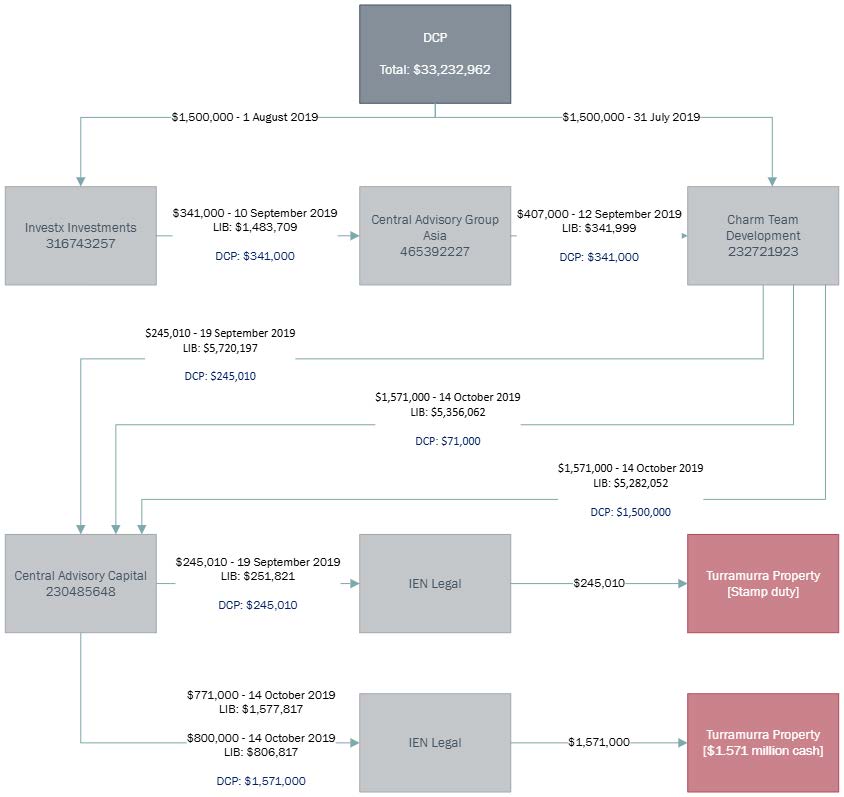
342 Mr Howard thus says that he has traced $1,816,010 of the DC Rd Proceeds as having been used in the purchase of the Turramurra Property, comprising the cash contributions for the purchase in the total amount of $1,571,000 and the cash used to pay the stamp duty of $245,010: Howard 1 at [6.2.5].
343 Thus far, the legal characterisation of the transactions is as follows. The Deposit (for the purchase of the Denham Court Property) forming part of the DC Rd Proceeds was received by 30 Denham and disbursed to the extent of two payments of $1.5 million each to Investx and CTD in breach of 30 Denham’s fiduciary duty as constructive trustee, both of which were volunteers with actual knowledge of the breach through the knowledge of their sole directors, Tony and Bob respectively. Further payments were made to CAGA, CTD and CAC, each of which was a volunteer with actual knowledge of the breach through the knowledge of Bob, who was the sole director of each company, and each of which is therefore liable personally to account for what it received. CAC paid the deposit on the Turramurra Property of $435,000 before the Deposit was received by 30 Denham and before the two payments of $1.5 million were made, and thus the deposit is not traceable. An amount of $245,010 was paid by CAC to IEN Legal for stamp duty to the NSW Government as an innocent third party with an enforceable legal entitlement, and is thus not traceable. The two payments made by CAC on 14 October 2019 totalling $1,571,000 were paid to IEN Legal and used by Lian to purchase the Turramurra Property. Lian was a volunteer, who at that stage took without notice of the breach by 30 Denham, and thus did not then become a constructive trustee of the money in her solicitors’ trust account or of the Turramurra Property for the Applicants. Although loan proceeds from ANZ were also used in the purchase, the whole of the Turramurra Property was used as security for ANZ, and it could not have been a breach of trust for Lian to do so, as there was no constructive trust over the property at the time, unlike in Paul A. Davies. As Lian acquired notice of 30 Denham’s breach of fiduciary duty from 14 February 2023, and still holds the Turramurra Property, she has a personal obligation to account to the Applicants for $1,571,000 and the Applicants can apply their beneficial interest under a constructive trust over the Turramurra Property (which has existed since 14 February 2023) to that extent to recover that amount with interest. However, the Applicants are not entitled to a constructive trust over the whole of the Turramurra Property, nor are they entitled to any increase in its value since its purchase in 2019.
344 Mr Howard then considers the tracing of the DC Rd Proceeds to loan repayments in relation to the loan of $2,350,000 which was taken out on the acquisition of the Turramurra Property. Mr Howard makes the following observations (Howard 1 [6.3.2]):
(a) the loan was taken out by Bob and Lian, being the ANZ Turramurra Loan Account 8143;
(b) there was an offset account for this loan, the nature of an offset account being that the interest payable on the loan is reduced as the interest is calculated on the value of the loan less any funds in the offset account, the particular offset account being the Bob and Lian ANZ Account 1814;
(c) on the completion date of the purchase, CTD transferred $2,400,000 to the Bob and Lian ANZ Account 1814;
(d) those funds largely remained in the Bob and Lian ANZ Account 1814 for approximately three years until 28 November 2022, when approximately $2,357,000 was transferred to the Lian ANZ Account 2964;
(e) on 29 November 2022, $2,340,000 was transferred from the Lian ANZ Account 2964 to the ANZ Turramurra Loan Account 8143 (ie the original home loan), leaving an outstanding balance of about $10,000 in that loan account; and
(f) the outstanding balance of around $10,000 was refinanced on 30 January 2023.
345 The tracing of the repayment of $2,340,000 of the ANZ Turramurra Loan Account 8143 is set out diagrammatically by Mr Howard (Howard 1 at [6.3.4]) as follows:
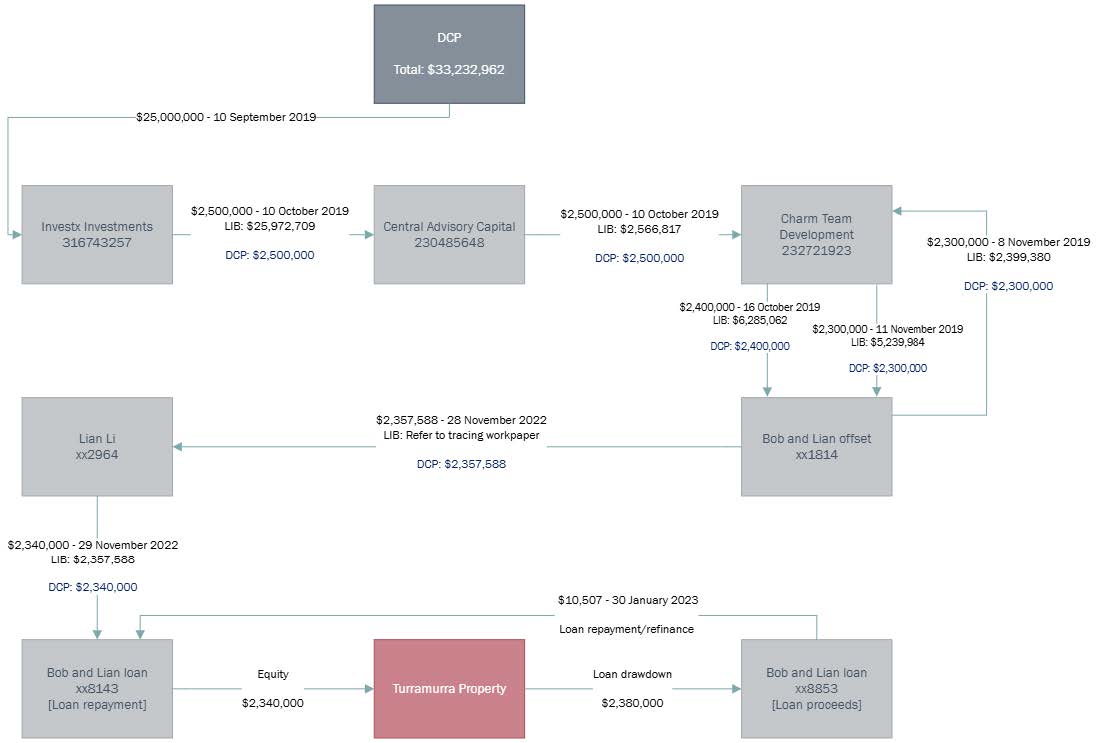
346 In terms of legal analysis, the amount of $2.4 million paid into the Bob and Lian ANZ Account 1814 was received indirectly from the DC Rd Proceeds through payments to Investx, CAC and CTD, each of which took as a volunteer, with actual knowledge of the breach of fiduciary duty, and each is thus liable personally for the amounts received. In relation to the Bob and Lian ANZ Account 1814, that was a joint account and thus the knowledge of Bob binds Lian also as a joint owner: Diemasters Pty Ltd v Meadowcorp Pty Ltd [2001] NSWSC 495; (2001) 52 NSWLR 572 at [16]–[17] (Windeyer J). Bob and Lian received the $2.4 million as volunteers with notice on 16 October 2019 and became constructive trustees of that money. However, when Lian alone received approximately $2,357,588 of that money on 28 November 2022 (into the Lian ANZ Account 2964), she did so without notice and thus did not hold that money on 28–29 November 2022 on constructive trust for the Applicants.
347 The $2.34 million paid in reduction of the ANZ Turramurra Loan Account 8143 on 29 November 2022 cannot be traced, because it was paid in reduction of a debt. Nor are the Applicants entitled in equity to be subrogated pro tanto to the ANZ mortgage, to the extent of the reduction in the debt secured by that mortgage, because they were not the beneficial owners of the money which Lian paid to reduce the mortgage debt (for want of a constructive trust at that time). Lian did not acquire notice until three months later, on 14 February 2023. Accordingly, the Applicants are not entitled to an equitable charge over the Turramurra Property to secure the amount of $2.34 million.
348 Mr Howard then turns in his analysis to the loan secured by the Turramurra Property, being the mortgage to CBA which was taken out on 30 January 2023. The loan was in the amount of $2,380,000 and was borrowed by Bob and Lian. Most of the proceeds of the loan, together with other proceeds from other loans, were then paid into an offset account in Lian’s name, being the Lian CBA Account 7759. Mr Howard identifies the most material transactions in the Lian CBA Account 7759 as including:
(a) the receipt of $2,958,630 on 30 January 2023, being the proceeds from the loans relating to the Turramurra Property and the Herbert Street Property;
(b) three subsequent withdrawals occurring on 31 January 2023 and 11 February 2023, resulting in a nil balance in the account; and
(c) three subsequent receipts on 14 February 2023, replenishing the account balance to $2,379,965: Howard 1 at [6.4.4].
349 Mr Howard observes that there were a number of other transactions in the period to 12 April 2023 involving the Lian CBA Account 7759, including the receipt and withdrawal of $2 million on 19 and 22 February 2023 respectively, which appear to be transactions with the Lian CBA Account 2814. The account balance as at 12 April 2023 was $2,379,965. Mr Howard’s analysis of tracing of DC Rd Proceeds to amounts held by Lian is limited to the three receipts on 14 February 2023, as those amounts largely comprise the account balance as at 12 April 2023, the three receipts on that day being in the amounts of (i) $99,142; (ii) $1,271,823; and (iii) $1,009,001: Howard 1 at [6.4.6].
350 Mr Howard sets out the tracing of those amounts diagrammatically as follows (Howard 1 at [6.4.7]):
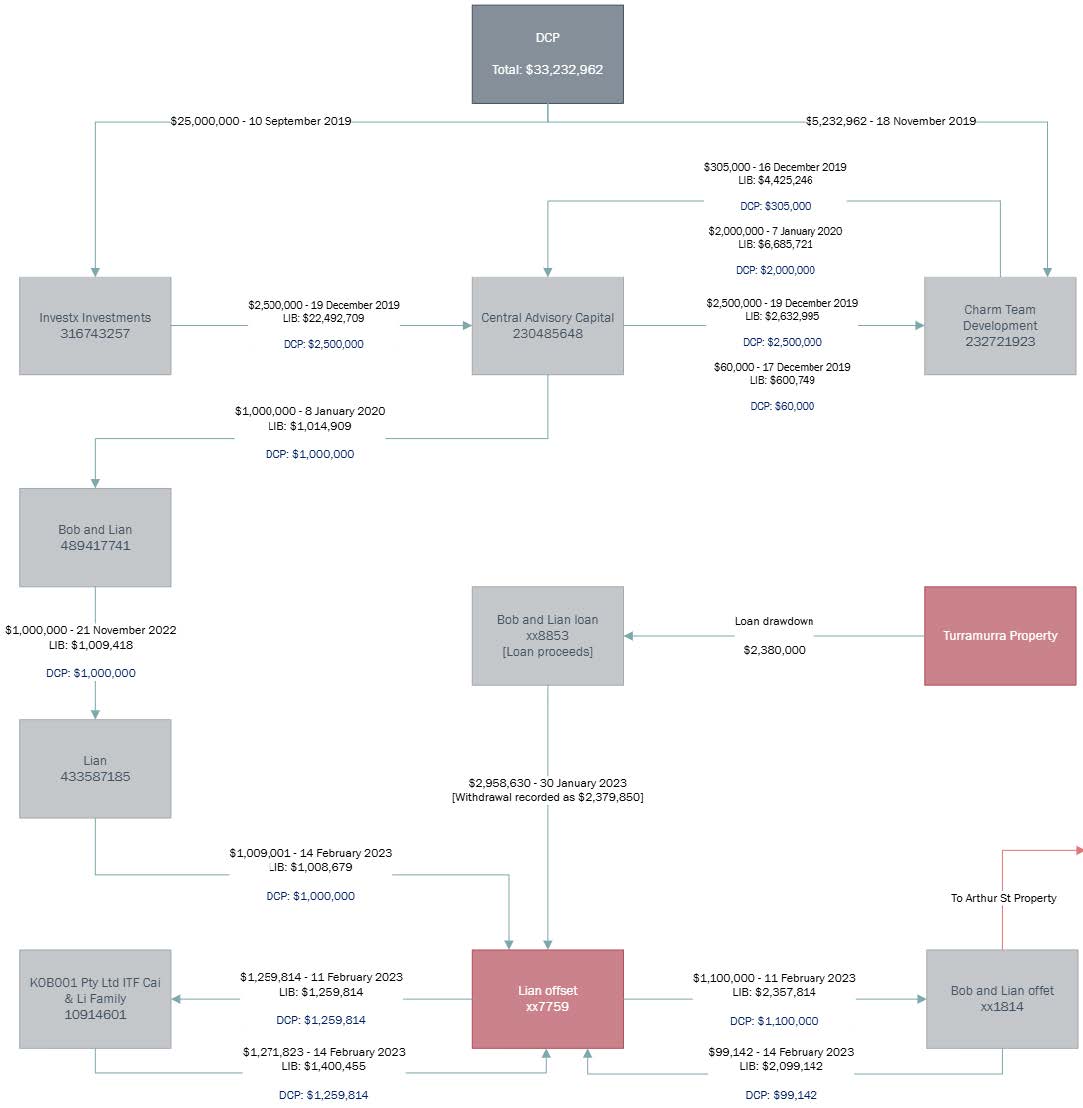
351 Accordingly, Mr Howard claims to have traced a total of $2,358,956 of DC Rd Proceeds to amounts held by Lian, comprising (i) $99,142; (ii) $1,259,814; and (iii) $1,000,000: Howard 1 at [6.4.8]. The first two of those items were traced by Mr Howard to DC Rd Proceeds through the loan drawdown on the refinance of the Turramurra Property, and the third payment (being $1 million) was traced to DC Rd Proceeds through other sources. The remainder of the funds from the loan drawdown being $981,045 (to the value of the loan repayment of $2.34 million) is dealt with in relation to the Arthur Street Property (see [364] below).
352 In terms of legal analysis, when Lian mortgaged the Turramurra Property to CBA on 30 January 2023 there was no constructive trust over the Turramurra Property in favour of the Applicants. Nor can the Applicants trace into and through the $2.34 million payment in reduction of the mortgaged debt over the Turramurra Property as one cannot trace into the repayment of a debt. However, the $1,000,000 which was paid into the Lian CBA Account 7759 on 14 February 2023 was traceable to the DC Rd Proceeds and was received by Lian as a volunteer (via other volunteers). When Lian acquired notice of 30 Denham’s breach on 14 February 2023 she became liable to account personally and as a constructive trustee for the $1,000,000 in the Lian CBA Account 7759.
Arthur Street Property
353 Mr Howard observes that the Arthur Street Property was owned by Lian prior to the receipt of any of the DC Rd Proceeds, having been acquired by her on 6 March 2017 and the title later transferred by her to Bob and Lian jointly on 31 December 2019: Howard 1 at [7.1.2].
354 A loan of $2 million secured by the Arthur Street Property was taken out in the name of Bob and Lian in December 2019, being the St George Arthur Street Loan Account: Howard 1 at [7.2.1]. A repayment of $1 million was made on 31 January 2023 and the remaining balance of $1 million was refinanced in February 2023: Howard 1 at [7.2.2].
355 Mr Howard sets out the tracing of the $1 million repayment on 31 January 2023 from the DC Rd Proceeds diagrammatically as follows (Howard 1 at [7.2.4]):
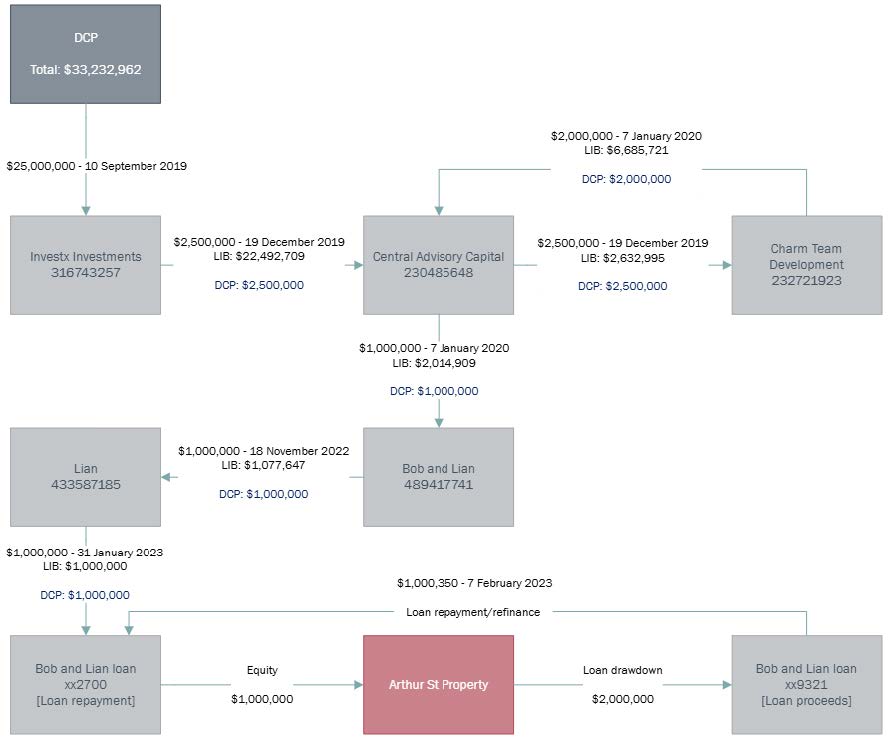
356 I reject Lian’s evidence that the payment of $1 million by CAC on 7 January 2020 was by way of loan (Lian 2 at [58]–[61]) in the absence of corroboration from contemporaneous documents.
357 Thus far, the legal characterisation of the transactions is as follows. The $1 million loan repayment on 31 January 2023 was made with funds traced to the DC Rd Proceeds through various volunteers, ultimately to Lian. However, Lian did not have notice between 18 November 2022 and 31 January 2023 when she held the $1 million in her bank account, and thus was not a constructive trustee of that money for the Applicants. The repayment of the loan was thus not made with money beneficially owned by the Applicants, and the Applicants are not entitled to an equitable charge pro tanto over the Arthur Street Property to the extent of $1 million by way of subrogation to the mortgage to St George.
358 In relation to the refinancing in February 2023, the new loan secured by the Arthur Street Property was for $2 million in the name of Bob and Lian, and the surplus proceeds following the repayment of the St George Arthur Street Loan Account were directed into an offset account in Lian’s name, being the Lian CBA Account 2814: Howard 1 at [7.3.2].
359 In relation to the Lian CBA Account 2814:
(a) surplus proceeds following the repayment of the St George Arthur Street Loan Account of $999,650 were deposited on 8 February 2023;
(b) a net amount of $1,000,858 from the Lian CBA Account 7759 (being another offset account) was credited in February 2023, resulting in an account balance of $2 million; and
(c) $2 million was transferred to the Lian CBA Account 7759 on 19 February 2023 before receiving the same funds back into the Lian CBA Account 2814 on 22 February 2023: Howard 1 at [7.3.4].
360 There were a number of other immaterial transactions from 22 February 2023 to 12 October 2023, but the account balance as at 12 October 2023 was still a little over $2 million. Mr Howard says that his tracing of DC Rd Proceeds to amounts held by Lian relates to the receipt of the $2 million on 22 February 2023, as this is the amount that largely comprises the account balance as at 12 October 2023: Howard 1 at [7.3.7].
361 Mr Howard sets out the tracing of those amounts held by Lian diagrammatically as follows (Howard 1 at [7.3.8]):
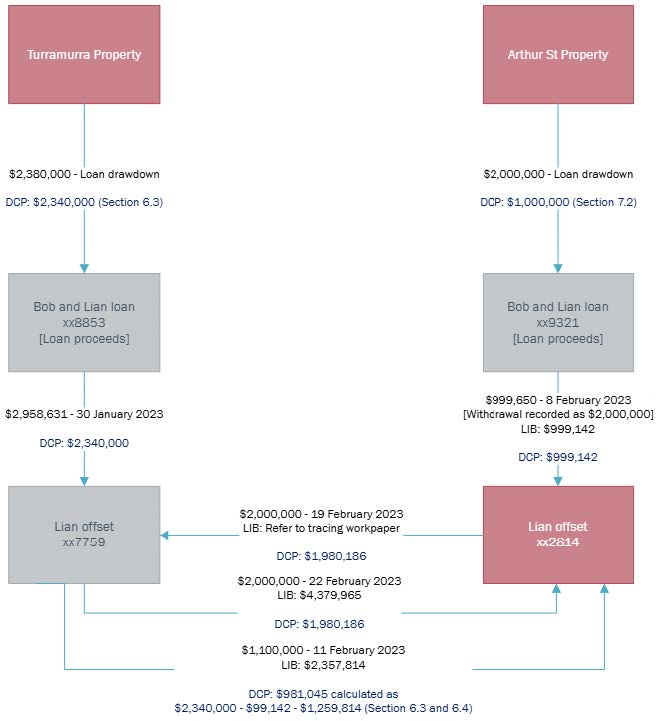
362 The above analysis identifies an amount of $1,980,186 which is said to be traceable to DC Rd Proceeds. Those amounts are held in the Lian CBA Account 2814 (being the offset account associated with the loan for the Arthur Street Property), and include:
(a) $999,142 said to be traced to DC Rd Proceeds relating to the Arthur Street Property; and
(b) an additional $981,045 traced to DC Rd Proceeds that has originated from the Turramurra Property.
363 The attempted tracing of the amount of $999,142, however, breaks down at the point when, on 31 January 2023, $1 million of DC Rd Proceeds was used to repay the St George Arthur Street Loan Account, as one cannot trace into the repayment of a debt. Further, as discussed at [357] above, the Applicants are not entitled to an equitable charge over the Arthur Street Property to the extent of $1 million.
364 The legal characterisation of the amount of $981,045 is based on that being part of the $2.34 million paid into the Lian CBA Account 7759 from the refinance of the Turramurra Property on 30 January 2023 (referred to at [348] above). The difference between (i) $2.34 million, and (ii) the two payments of $99,142 and $1,259,814 already considered (at [351]–[352]) in relation to the Turramurra Property, is $981,045 (with rounding). As I have said at [347] above, that drawdown of a loan secured over the Turramurra Property was not a breach by Lian of any constructive trust in favour of the Applicants over the Turramurra Property, as she did not have notice at the time. Accordingly, the Applicants are not entitled to any proprietary relief in relation to this amount. In fact, the Applicants withdrew their claim in respect of the amount of $981,045 in their Closing Written Submissions (at [235]).
The Herbert Street Property
365 Bob has been the registered proprietor of the Herbert Street Property at all times relevant to the allegations made against the respondents (SAF [13]), and thus preceding the receipt of any of the DC Rd Proceeds.
366 A loan of $600,000 secured by the Herbert Street Property was taken out by Bob in February 2020, being the St George Herbert Street Loan Account: Howard 1 at [8.2.1]. The balance of the loan was $600,000 until: (a) a repayment of $590,000 was made by Bob on 8 December 2022; and (b) the remaining balance of about $10,000 was refinanced in January 2023.
367 Mr Howard sets out diagrammatically what he says is the tracing of the $590,000 repayment as follows (Howard 1 at [8.2.4]):
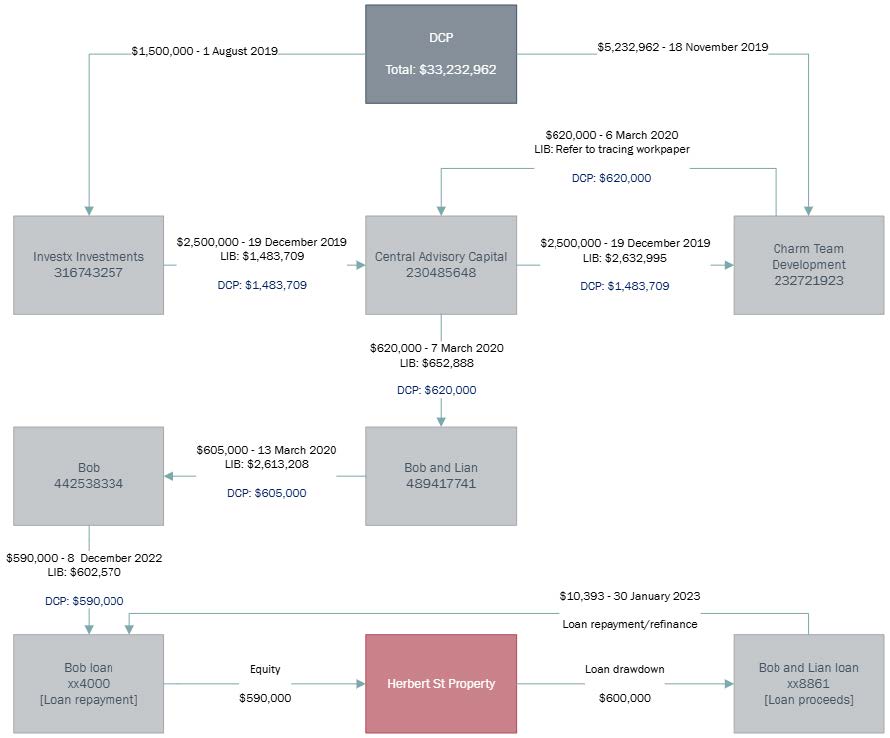
368 Mr Howard thus claims to have traced $590,000 of DC Rd Proceeds to loan repayments for the Herbert Street Property.
369 Mr Howard then turns to the refinancing of the Herbert Street Property undertaken in January 2023. A new loan secured by the Herbert Street Property for $600,000 was taken out by Bob and Lian into the CBA Herbert Street Loan Account. The proceeds of that loan were then paid into the Lian CBA Account 7759 (which also received funds from the refinance of the Turramurra Property), before being transferred into another offset account held in Lian’s name, being the Lian CBA Account 7767: Howard 1 at [8.3.2]. The Lian CBA Account 7767 received $600,000 from the Lian CBA Account 7759 on 31 January 2023, transferred $600,000 on 11 February 2023, and received $600,000 on 14 February 2023. Although there were a number of immaterial transactions in the period up to 12 April 2023, the account balance at 12 April 2023 was still slightly more than $600,000: Howard 1 at [8.3.5].
370 Mr Howard sets out his tracing of DC Rd Proceeds to the receipt of $600,000 on 14 February 2023 diagrammatically as follows (Howard 1 at [8.3.7]):
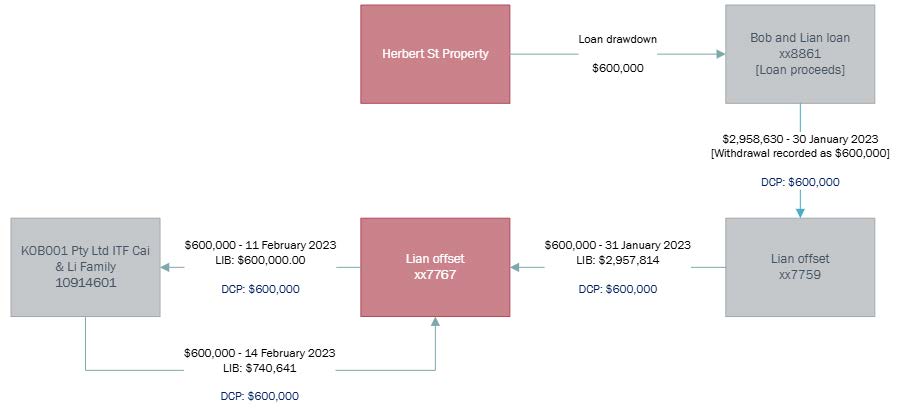
371 As the amount of the initial loan repayment of $590,000 is less than the amount held by Lian of $600,000, Mr Howard says that the lower of the two amounts is the appropriate amount to be identified as traceable to DC Rd Proceeds: Howard 1 at [8.4.1].
372 While one can well understand an accountant, looking at the question as a matter of economic substance, treating money used to repay or reduce debts as traceable benefits, as a matter of legal principle, one cannot trace into the repayment or reduction of a debt. However, Mr Howard’s analysis serves to demonstrate that the $590,000 paid by Bob on 8 December 2022 can be traced from the DC Rd Proceeds through the hands of volunteers into the Bob St George Account 8334 (see also [212] above). That money was held by Bob (who had notice) on constructive trust for the Applicants. When Bob used that $590,000 (which the Applicants owned beneficially) to reduce the secured debt over the Herbert Street Property, the Applicants became subrogated pro tanto to the security, and are therefore entitled to an equitable charge over the Herbert Street Property to the extent of $590,000. The Herbert Street Property thus illustrates the point made by Millett LJ in Boscawen v Bajwa, that equitable subrogation can pick up where tracing leaves off when money is used to repay a mortgage debt.
373 The Applicants cannot trace into the refinancing of the Herbert Street Property in January 2023 or the subsequent payments from the loan proceeds because the tracing exercise had come to an end on 8 December 2022 when Bob used the $590,000 to repay the debt. The result is that the Applicants remain entitled to an equitable charge over the Herbert Street Property to the extent of $590,000.
The Saiala Property
374 The Saiala Property was purchased by Saiala for $1.9 million under a contract dated 31 March 2021: Howard 1 at [9.2.1]. The purchase price was paid entirely in cash, as too was the stamp duty of $89,525.
375 Mr Howard sets out his tracing of the cash contributions diagrammatically as follows (Howard 1 at [9.2.4]):
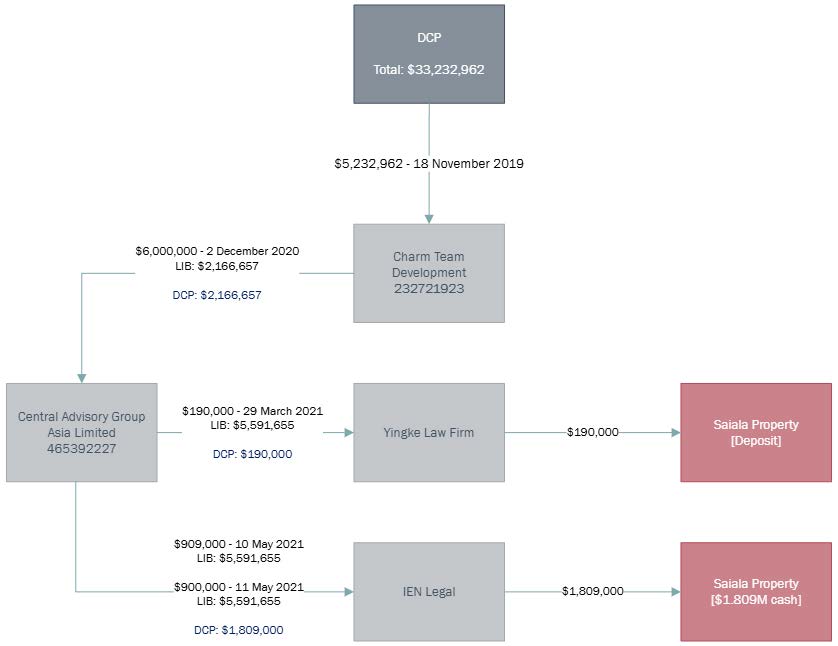
376 Mr Howard thus says he has traced $1,999,000 from the DC Rd Proceeds, comprising the deposit of $190,000 and two cash contributions (including the payment for stamp duty) of $909,000 and $900,000 respectively: Howard 1 at [9.2.5].
377 Lian attempted to suggest that the funds provided by Bob’s companies for the purchase of the Saiala Property were by way of loan: Lian 2 at [85]. I reject that evidence. It was not referred to in Lian’s first affidavit, and depends on Lian’s vague and generalised assertions (Lian 2 at [85] and in her asset disclosure affidavit in Ex 2) without any contemporaneous documentary support.
378 As a matter of legal principle, the payment of $89,525 in stamp duty is not a traceable payment, as it is a payment to the NSW Government which was an innocent recipient of the money with a legal entitlement to the payment. It appears that there was another $9,475 in fees and other charges paid to innocent third parties which are not traceable: Howard 1 at [9.2.2]. The purchase price of $1,900,000 is traceable from the DC Rd Proceeds, through the hands of CTD and then CAGA which took as volunteers. In turn, CAGA paid $1,900,000 to Saiala, which used it for its purchase of the Saiala Property. As Saiala took as a volunteer, at a time when Lian (as its sole director) did not have notice, Saiala has held the Saiala Property on constructive trust for the Applicants only from 14 February 2023 (when Lian acquired notice) to the extent of $1,900,000. Saiala has had a personal liability to account for that amount since it acquired notice on 14 February 2023, and the Applicants can enforce their equitable interest in the Saiala Property to recover that amount.
The Clarence 104 Property
379 The Clarence 104 Property was purchased by Clarence 104 for a purchase price of $1,230,000 under a contract dated 10 September 2021: Howard 1 at [10.2.1]. The vendor was Lindale Investments Pty Ltd: CB12/7403. Mr Howard observes that the settlement sheet indicates that the total amount paid by the purchaser was $1,353,000, which he assumes to be the correct amount, including stamp duty: Howard 1 at [10.2.3].
380 The Clarence 104 Property was purchased using cash of $1,419,000, which Mr Howard traces to DC Rd Proceeds as follows (Howard 1 at [10.2.6]):
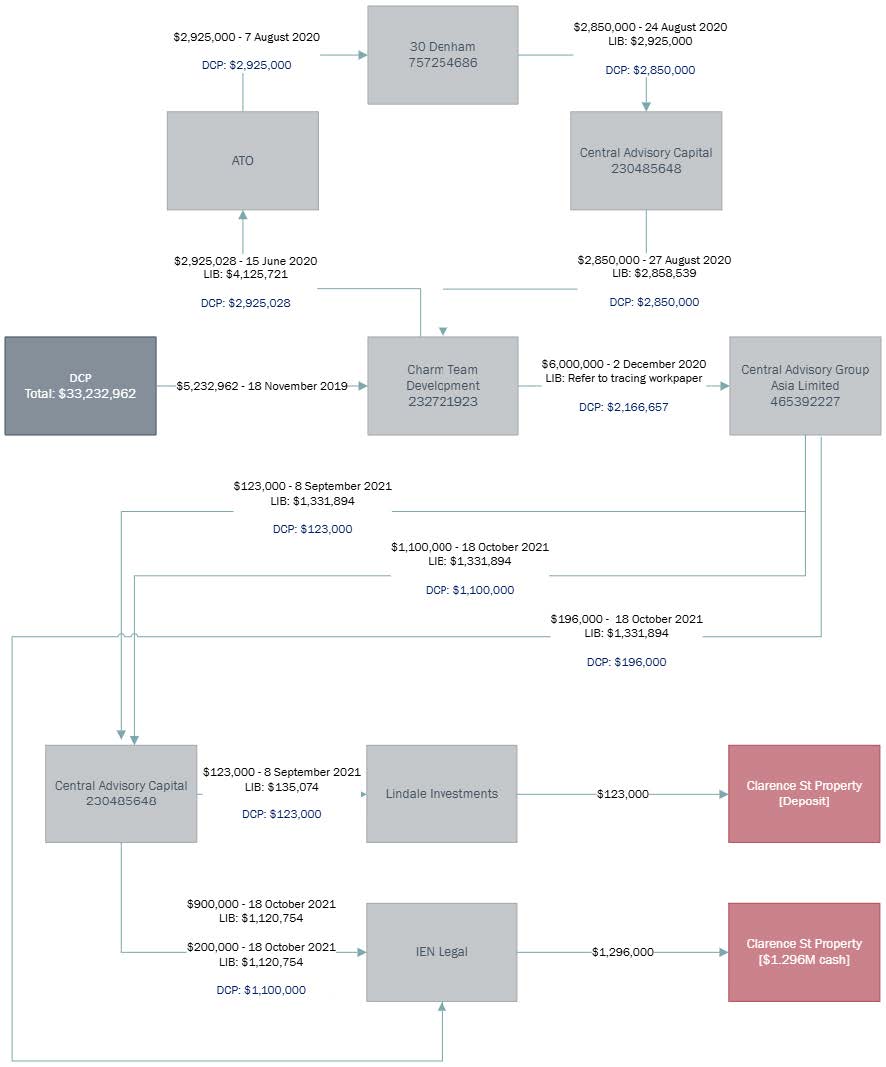
381 The total amount of $1,419,000 is made up of the deposit of $123,000 and three cash contributions (including the payment of stamp duty) of (i) $900,000; (ii) $200,000; and (iii) $196,000: Howard 1 at [10.2.7].
382 Lian again attempted to suggest that the funds advanced by Bob’s companies were by way of loan: Lian 2 at [104]. I reject that contention. There was no reference to a loan in Lian’s first affidavit, and her contention depends on a generalised assertion in her asset disclosure affidavit (see Ex 2) and a supposed discussion about four months after the event referred to in her second affidavit: Lian 2 at [104].
383 As noted at [343] and [378] above, the payment of stamp duty, as well as fees and charges, paid to innocent third parties are not traceable. DC Rd Proceeds amounting to the purchase price of $1,230,000 have been traced through the hands of volunteers with notice and ultimately to Clarence 104 (of which Lian is the sole director), which applied that amount to purchase the Clarence 104 Property. Accordingly, Clarence 104 has held the Clarence 104 Property on constructive trust for the Applicants from 14 February 2023 when Lian acquired notice to the extent of $1,230,000 (plus interest), less a deduction to take into account the overlap in the DC Rd Proceeds between the Applicants’ claim against Saiala and Clarence 104 (see diagram above). The deduction is necessary because: (a) the tracing of DC Rd Proceeds for both the Saiala Property and the Clarence 104 Property involves a payment on 2 December 2020 by CTD to CAGA of $6 million, of which $2,166,657 is traceable to DC Rd Proceeds; (b) the Applicants are entitled to a constructive trust over the Saiala Property to the extent of $1,900,000; and (c) the difference of $266,657 represents the additional amount which may be recovered pursuant to the constructive trust over the Clarence 104 Property. Therefore, since 14 February 2023 when Lian acquired notice, Clarence 104 has had a personal liability to account to the Applicants for the balance in the amount of $266,657, and the Applicants can apply their beneficial interest in the Clarence 104 Properties to recover that amount.
DSZ Clarence Street Properties
384 Mr Howard says that the loan statements for the period 24 January 2019 to 31 January 2020 for the DSZ ANZ Loan Account indicate (Howard 1 at [14.2.1]):
(a) as at 24 January 2019, the balance of the loan was $930,000;
(b) interest was charged and paid on the loan on a monthly basis;
(c) the loan balance of $930,000 was repaid on 27 December 2019; and
(d) the loan was closed on 31 January 2020.
385 Mr Howard says that the tracing of the $930,000 repayment on 27 December 2019 can be shown diagrammatically as follows (Howard 1 at [14.2.2]):

386 Accordingly, Mr Howard says that he has been able to trace the amount of the $930,000 payment to the DSZ ANZ Loan Account to DC Rd Proceeds.
387 Lian and Bob both assert that the amount of $930,000 advanced by CTD was by way of loan: Lian 2 at [21]; Bob 2 at [250]. I reject that evidence in light of my adverse view of their credibility and the generalised way in which the evidence is given in their affidavits.
388 The DSZ ANZ Loan Account was secured over the DSZ Clarence Street Properties. Although one cannot trace into the repayment of a debt, the $930,000 payment was made from money beneficially owned by the Applicants, as CTD had received it as a volunteer with notice. The Applicants are therefore entitled to be subrogated to the rights of ANZ in the DSZ ANZ Mortgage over the DSZ Clarence Street Properties. Accordingly, the Applicants have an equitable charge over the DSZ Clarence Street Properties to the extent of $930,000.
The Belrose Property
389 The Belrose Property was purchased by Belrose COB for $26 million under a contract dated 10 August 2020: Howard 1 at [11.2.1]. The stamp duty was in the amount of $1,415,025: Howard 1 at [11.2.2] footnote 72. Mr Howard has identified that the deposit of $2,600,000 was paid in cash, and there were additional cash contributions (including funds for stamp duty) of $10,567,721. The total cash contributions were thus $13,167,721, but if one excludes the stamp duty then the cash contributions for the purchase amounted to $11,752,696. In addition, loan proceeds of $14,288,500 were applied in the purchase: Howard 1 at [11.2.2]. A mortgage to ING was registered on the title on 14 October 2020, following settlement on 13 October 2020: see DC Rd DC Pty Ltd v Zhang (No 3) [2024] FCA 221 at [6].
390 Mr Howard sets out the tracing of the cash contributions diagrammatically as follows (Howard 1 at [11.2.4]):
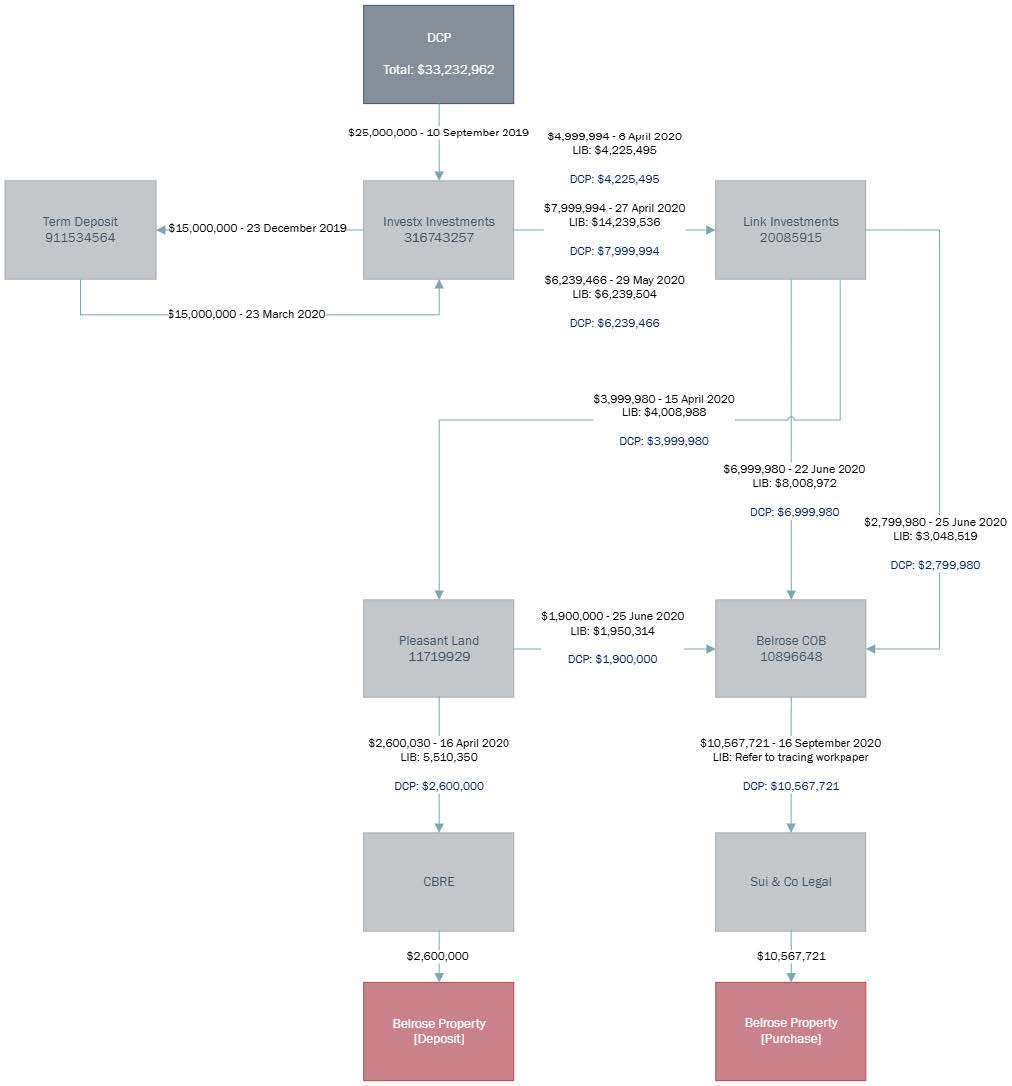
391 Mr Howard says that he has identified the total amount advanced for the purchase of the Belrose Property, of $13,167,721, as traceable to DC Rd Proceeds: Howard 1 at [11.2.5].
392 In terms of legal analysis, the cash contributions totalling $11,752,696 (excluding stamp duty) are traceable to the DC Rd Proceeds through Investx and Link and ultimately to Belrose COB and Pleasant Land (whose director is John: Supp CB3/1597). Those companies were all volunteers. The money was applied to purchase the Belrose Property in Belrose COB’s name, its sole director being Tony. Belrose COB is thus fixed with Tony’s actual knowledge of 30 Denham’s original breaches of fiduciary duty and of the traceable payments from the DC Rd Proceeds. The balance of the purchase price ($14,288,500) was raised by a secured loan. Following Paul A. Davies, the whole of the Belrose Property is held on constructive trust for the Applicants, subject to discharging the mortgagee’s secured debt. As Belrose COB had notice of the original breach of fiduciary duty (through Tony as its sole director), Belrose COB has a personal liability to account as a knowing volunteer recipient of DC Rd Proceeds, which can be recovered through the Applicants’ beneficial interest in the Belrose Property. I deal below (at [405]–[406]) with the Tony Parties’ contention as to an entitlement to an equitable charge by way of subrogation over the Belrose Property.
Miriam Park Property
393 The Miriam Park Property was purchased by Miriam Park under two contracts dated 1 June 2020, one contract being for the property at 4 Miriam Road for $3,377,440 and the other being for the property at 6–8 Miriam Road for $4,222,560: Howard 1 at [13.2.1].
394 Mr Howard identifies the source of funding of the purchase, together with stamp duty, as follows (Howard 1 at [13.2.2]–[13.2.3]):
(a) the deposit of $380,000 was paid in cash;
(b) the stamp duty of $471,792 was paid in cash;
(c) there was an additional cash contribution of $4,423,365; and
(d) loan proceeds of $2,820,000 were applied.
395 Mr Howard says that the total cash contributions of $5,275,157 can be traced to DC Rd Proceeds in the amount of $5,227,936, shown diagrammatically as follows (Howard 1 at [13.2.5]):
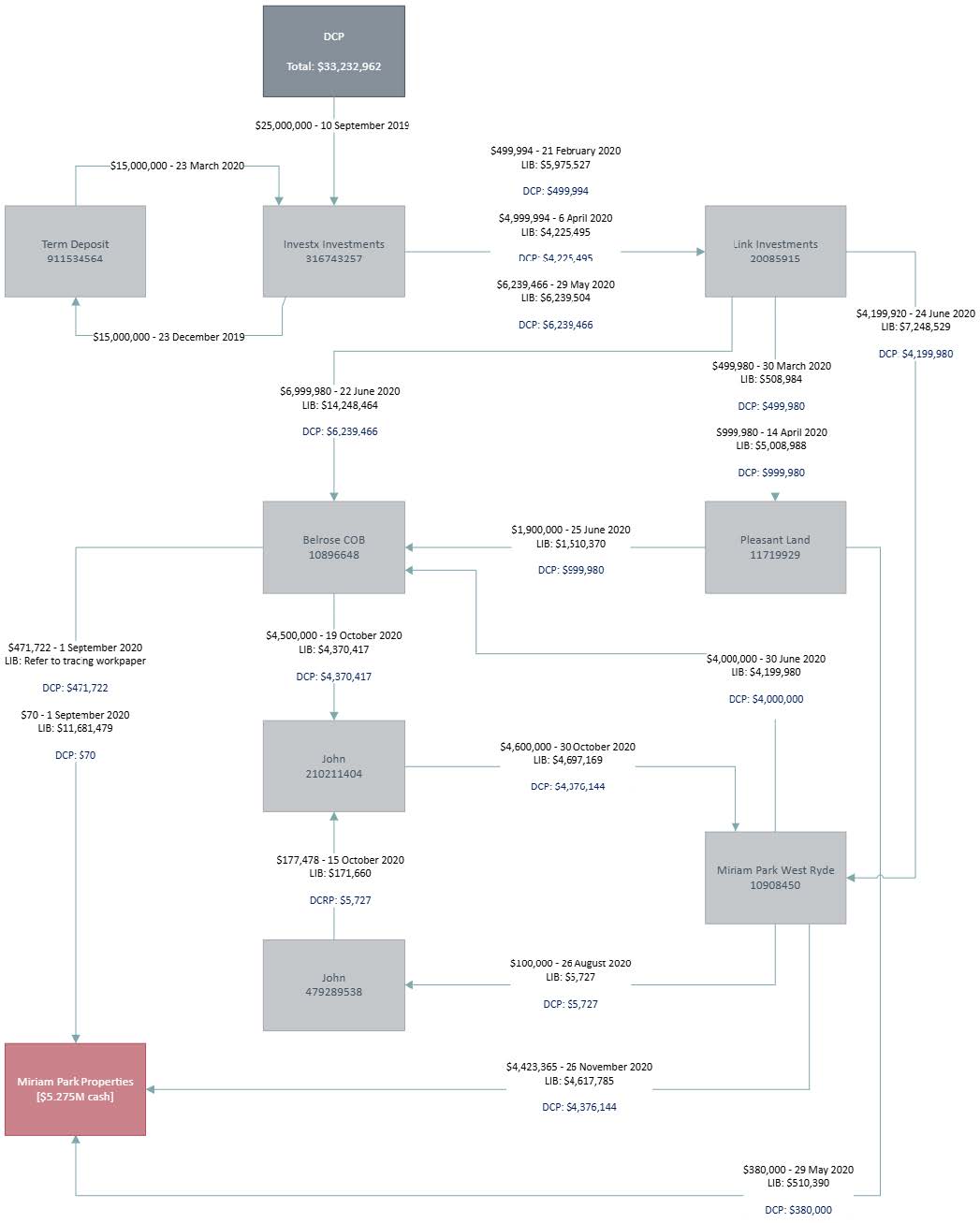
396 It should be noted that the “LIB” figure of $1,510,370 shown in the transfer from Pleasant Land to Belrose COB on 25 June 2020 is not correct. The correct figure of $1,950,314 is shown in the diagram for the Belrose Property above (at [390]).
397 The total amount which is said to be traceable of $5,227,936 comprises the deposit of $380,000 and the three amounts of: (i) $471,722; (ii) $70; and (iii) $4,376,144.
398 The legal analysis is as follows. The stamp duty of $471,792 is not a traceable payment for the reason given at [343] above. The balance of the cash contributions, being $4,756,144, is traceable from the DC Rd Proceeds through the hands of various volunteers, and ultimately to Miriam Park which took as a volunteer, and also with notice (one of its directors being Tony). Although Miriam Park also used loan proceeds of $2,820,000 to purchase the Miriam Park Property (secured by the Miriam Park Property and the Smithfield Property: CB12/7457), the whole of the Miriam Park Property was held by Miriam Park on constructive trust for the Applicants, subject to the secured lender’s mortgage, following Paul A. Davies. Accordingly, Miriam Park held the Miriam Park Property on constructive trust for the Applicants until the sale of the Miriam Park Property after its subdivision. There is thus no claim now for a constructive trust over the Miriam Park Property, but the historical position is relevant to Smithfield 40 and the Belrose Property.
Smithfield 40
399 In Howard 1 at [13.2.6], Mr Howard said that he was able to trace $5,227,936 of the DC Rd Proceeds to the purchase of the Miriam Park Property, of which I regard $4,756,144 as traceable: see [398]. Between 26 November 2020 and April 2023, Miriam Park subdivided, developed and sold the Miriam Park Property. Separately, Smithfield 40 obtained a loan facility of $10,550,000 from ING to acquire the Smithfield Property. The loan was cross-collateralised against both the Smithfield Property and the Miriam Park Property. On 25 November 2022, three of the lots contained in the Miriam Park Property were sold for a total of $4,400,049: Howard 2 at [5.2.2]–[5.2.3]. The sale proceeds from the three lots were applied in repaying Smithfield 40’s ING loan in the amount of $4,003,551, as well as in withholding $302,260 for GST, and paying $94,238 in other amounts.
400 The repayment of $4,003,551 to ING was allocated as to $284,950 in repayment of Miriam Park’s loan, and as to $3,718,601 in repayment of Smithfield 40’s loan: Howard 2 at [5.3.1].
401 On the basis that Mr Howard treats the proceeds of sale of lots in the Miriam Park Property as DC Rd Proceeds up to the value of $5,227,936 (or in my view $4,756,144), he says that he has traced $3,718,601 of DC Rd Proceeds to the repayment of Smithfield 40’s loan with ING, shown diagrammatically as follows (Howard 2 at [5.3.6]):
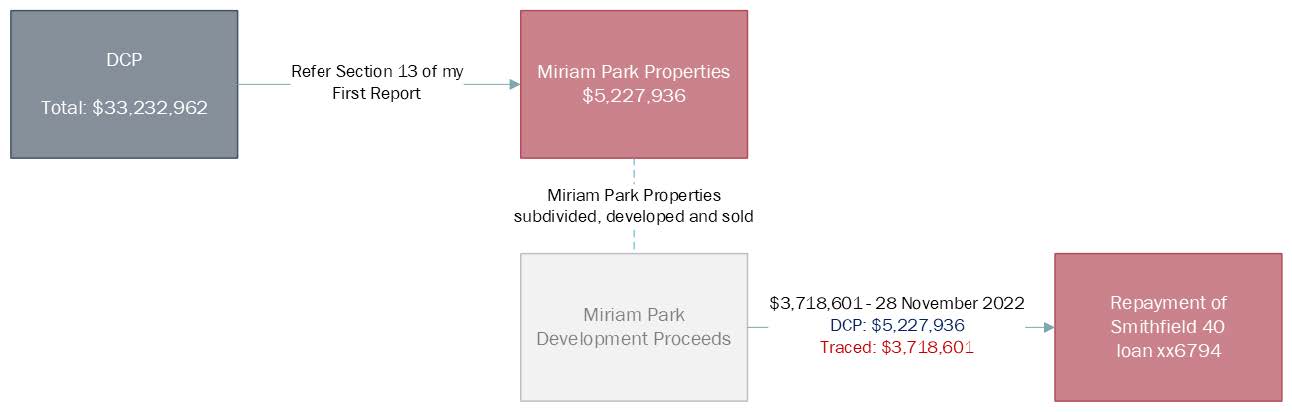
402 Mr Howard observes that it is necessary to avoid double-counting of the DC Rd Proceeds which he has traced. Accordingly, if $3,718,601 can be traced into the repayment of Smithfield 40’s loan with ING, then the amounts traced into the Miriam Park Property must be reduced by that amount. On that basis, the revised amount traced to the Miriam Park Property would be $1,509,335 using Mr Howard’s figure of $5,227,936: Howard 2 at [5.4.1]–[5.3.3].
403 As the Miriam Park Property has now been subdivided and sold to bona fide purchasers for value without notice, it is no longer possible to trace DC Rd Proceeds into the Miriam Park Property. Nor is it possible to trace DC Rd Proceeds into the repayment of Smithfield 40’s loan with ING because one cannot trace into the repayment or reduction of a debt. There is therefore no double-counting issue as contemplated by Mr Howard.
404 However, as the Miriam Park Property was held on constructive trust for the Applicants, the Applicants can trace into the proceeds of sale of that property (or more precisely into the proceeds of sale of subdivided lots which were in direct substitution for the Miriam Park Property). Those proceeds, beneficially owned by the Applicants, were then used to repay Smithfield 40’s loan with ING to the extent of $3,718,601. The Applicants were thus entitled to equitable subrogation pro tanto to ING’s mortgage over the Smithfield Property to the extent of $3,718,601 (plus interest).
405 The Tony Parties submit that Smithfield 40 is entitled to recover its contribution to the realisable value of the Belrose Property, either by way of equitable subrogation or as just allowances in equity. The relevant facts are as follows. As indicated above at [399], when Smithfield 40 borrowed from ING to purchase the Smithfield Property, security was given over both the Smithfield Property and the Miriam Park Property: CB12/7457. On 29 May 2023, ING required Belrose COB to remedy defaults under Belrose COB’s secured loan with ING: Ex 3, pp 17–20. On 27 September 2023, Smithfield 40 as borrower entered into the SL2 Facility with SL2 in the sum of $6,355,200: Ex 3, pp 25–36. The SL2 Facility was secured (inter alia) by mortgages over the Smithfield Property (Ex 3, pp 65–67) and the Belrose Property: Ex 3, pp 68–70. On 9 October 2023, Smithfield 40 drew down $3,107,488 from the SL2 Facility in reduction of Belrose COB’s secured debt to ING (Ex 3, pp 77 and 82), and other amounts were drawn down for other purposes: Ex 3, p 41. On 15 May 2024, SL2 discharged the mortgage granted to it by Belrose COB over the Belrose Property. At the heart of the Tony Parties’ submission is the proposition that the amount of $3,107,488 was raised on the security of more than the tainted Belrose Property, and it would confer a windfall on the Applicants if they were also to have the benefit of a loan secured by the Smithfield Property, which the Tony Parties treat as untainted. However, the Smithfield Property is not properly described as untainted by the DC Rd Proceeds, as the loan proceeds used to acquire the Smithfield Property were raised on the security of the Miriam Park Property (as well as the Smithfield Property), and the Miriam Park Property was held on a constructive trust for the Applicants. Further, there is no evidence in relation to what portion (if any) of the $3,107,488 should be attributed to the mortgage over the Smithfield Property, rather than to the other security (including the mortgage over the Belrose Property) provided for the SL2 Facility.
406 Moreover, as I have held above, the whole of the Belrose Property was (and is) held on constructive trust for the Applicants, and it was in fact used by Belrose COB for its own benefit. It was a breach of fiduciary duty for Belrose COB (to Smithfield 40’s knowledge of the facts) to grant SL2 a mortgage over the Belrose Property and to draw down on the SL2 Facility. In other words, Smithfield 40 is contending that the benefit of the Applicants’ equitable interest in the Belrose Property should be reduced or qualified in circumstances where Smithfield 40 used the Applicants’ own beneficial property to reduce Belrose COB’s secured indebtedness over the Belrose Property. As the High Court recognised in Bofinger at [94], the entitlement to equitable contribution arises from circumstances which make it unconscionable for the defendant to deny the proprietary interest claimed by the plaintiff. In the present case, the opposite has occurred in relation to Smithfield 40’s claim: it would be unconscionable for Smithfield 40 to be subrogated by way of equitable charge over the Belrose Property where the circumstances arise from Smithfield 40’s knowledge of a breach of constructive trust by Belrose COB.
407 I also reject Smithfield 40’s claim for “just allowances” in relation to its payment of $3,107,488. In general, a person should not be rewarded by way of “just allowances” for fraudulent conduct: United States Surgical Corporation v Hospital Products International Pty Ltd [1983] 2 NSWLR 157 at 241–3 (Moffitt P, Hope and Samuels JJA). That might not be an invariable proposition, but in the present case it is a powerful factor against any exercise of discretion in favour of Smithfield 40, of which Tony is a director. In the present case, Smithfield 40 (through one of its directors, Tony) knew of the fraudulent conduct which led to the money being available to purchase the Miriam Park Property, which was used as security to purchase the Smithfield Property, and also to purchase the Belrose Property, and hence of the facts giving rise to a constructive trust over the Miriam Park Property (historically) and over the Belrose Property in favour of the Applicants. As indicated at [405] above, the Smithfield Property was not an untainted asset. In my view, there is no ground established for conferring on Smithfield 40 the claimed just allowance. Nor is there any evidentiary basis for finding that the amount of $3,107,488 is entirely separate from traceable DC Rd Proceeds, and thus untainted by the fraudulent conduct.
408 The Tony Parties also submit that if the Applicants can claim an equitable charge over the Smithfield Property, then Miriam Park likewise would have been able to do so, and the failure to join Miriam Park as a party is fatal to the Applicants’ claim. I reject that submission. The Tony Parties are correct to the extent that they submit that where the orders sought establish or recognise a proprietary or security interest in land, chattels or a monetary fund, all persons who have or claim an interest in the subject matter are necessary parties: John Alexander’s Clubs Pty Ltd v White City Tennis Club Ltd [2010] HCA 19; (2010) 241 CLR 1 at [131]–[132] (French CJ, Gummow, Hayne, Heydon and Kiefel JJ). However, Miriam Park neither has nor claims an interest in the Smithfield Property. As I have found above, the whole of the Miriam Park Property and the proceeds of sale were held by Miriam Park on constructive trust for the Applicants. Miriam Park thus held no more than the bare legal title to the relevant property. Further, there is no evidence of Miriam Park ever making a claim to an interest in the Smithfield Property, whether by legal proceedings, caveat, letter of demand or otherwise, as the Tony Parties accepted: T778.36–39; T779.21–25.
The Warrawee Property
409 The Warrawee Property was purchased by John for $5,350,000 under a contract dated 28 September 2019: Howard 1 at [12.2.1]. The amount of stamp duty was $314,222: Howard 1 at [12.2.2] footnote 79. Mr Howard says that the purchase of the Warrawee Property and stamp duty were funded as follows: (i) the deposit of $535,000 was paid from an unidentified source; (ii) there was a cash contribution of $1,656,666; (iii) there were loan proceeds applied of $3,744,871; and (iv) the balance of $262,685 has not been able to be traced: Howard 1 at [12.2.2].
410 Mr Howard sets out his tracing of the cash contribution of $1,656,666 diagrammatically as follows:
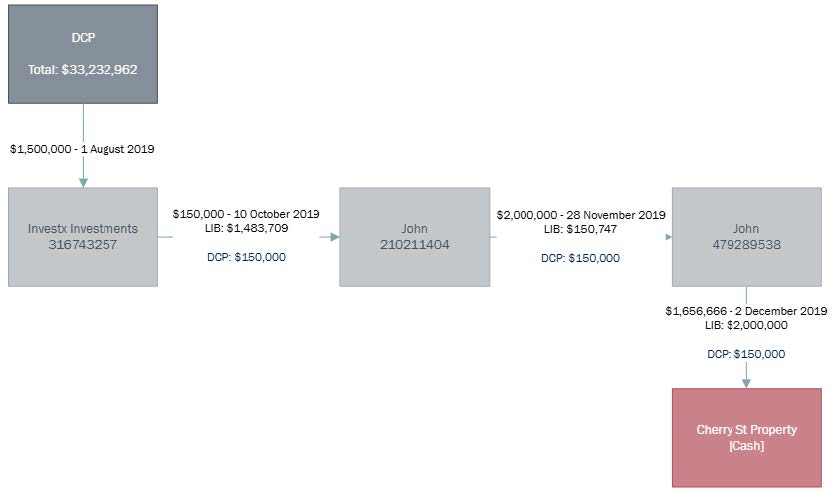
411 Mr Howard thus concludes that an amount of $150,000 can be traced to DC Rd Proceeds being used in the purchase of the Warrawee Property: Howard 1 at [12.2.5].
412 In terms of legal analysis, the amount of $150,000 is traceable through Investx (being a volunteer) to John who also took as a volunteer. I reject John’s evidence that the payment to him of $150,000 was a loan from Tony (John 1 at [235]; John 2 at [14]–[24]), in the absence of any contemporaneous documentary evidence supporting such a loan and in light of my adverse view of John’s credibility. I have found above that John probably had actual knowledge (and certainly had constructive knowledge) of 30 Denham’s breach of trust and the derivation of the $150,000 amount from the funds misappropriated by 30 Denham from 13 December 2024. John accepts that he has retained the $150,000 through his equity in the Warrawee Property: T920.44–921.31. The Applicants are entitled to a personal remedy by way of account against John, and I note that they do not seek a constructive trust over the Warrawee Property to that extent.
John Loan
413 The agreed facts include that:
(a) on 29 October 2019, Sit Family advanced $2 million to John by way of the John Loan, being an interest-free loan, for the purposes of John’s purchase of the Warrawee Property (SAF [148]);
(b) on 4 June 2020, Pleasant Land transferred $500,000 from the Pleasant Land Trust Fund to He Charis’s bank account (SAF [151]); and
(c) between 4 and 9 June 2020, He Charis transferred $500,000 in five separate transactions to Sit Family on behalf of John as repayment of the John Loan: SAF [152].
414 Mr Howard sets out his tracing of the five payments to Sit Family between 4 and 9 June 2020 to the DC Rd Proceeds diagrammatically as follows (Howard 2 at [4.2.1]):
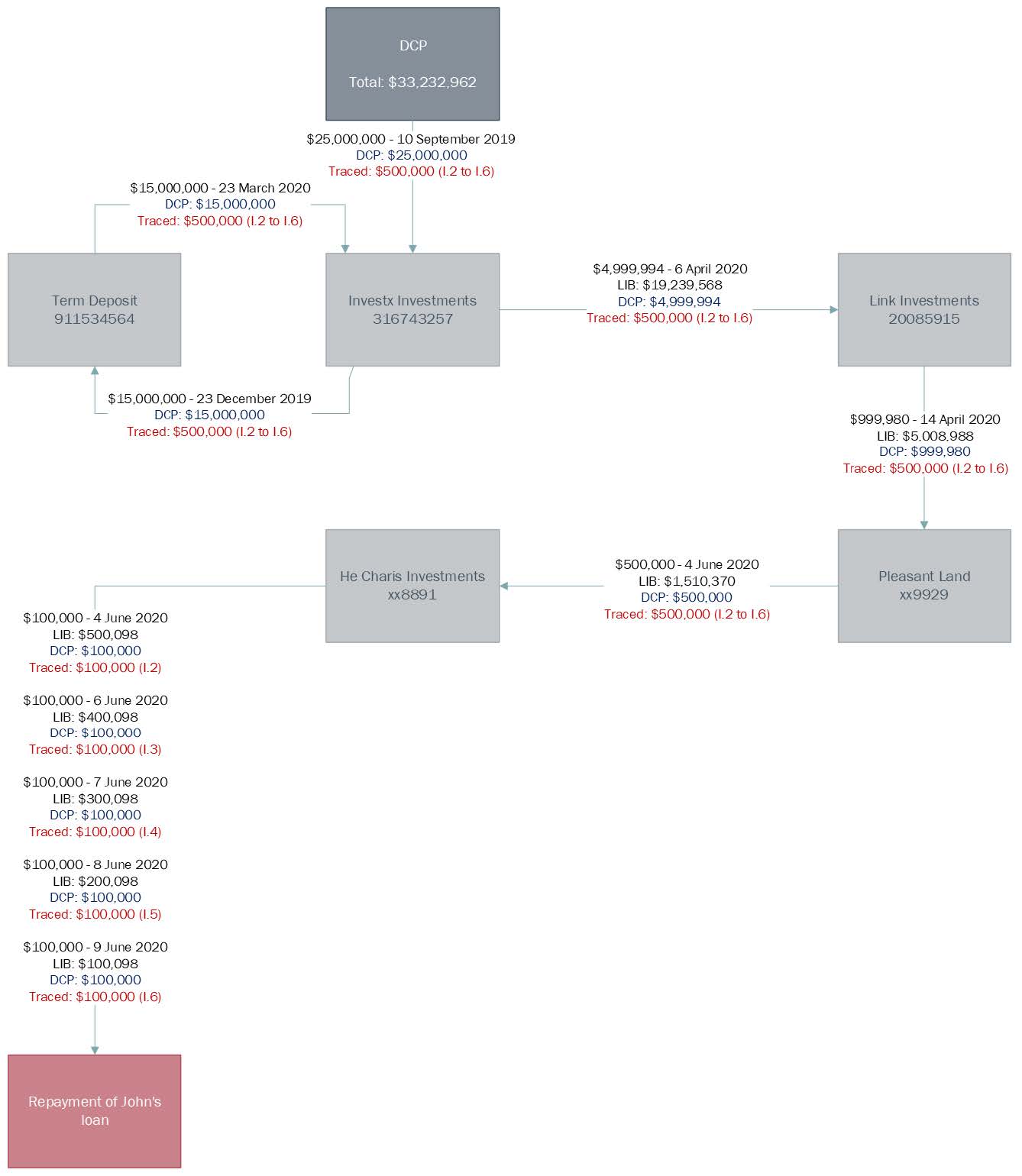
415 Accordingly, Mr Howard says that he has been able to trace $500,000 of repayments of the John Loan to DC Rd Proceeds: Howard 2 at [4.2.2].
416 John thus obtained a benefit of $500,000, which he received as a volunteer after it passed through the hands of other volunteers. I reject John’s evidence that the $500,000 was a loan from Tony: John 2 at [10]–[13]. However, the Applicants submit that John acquired knowledge (whether actual or constructive) only from 14 February 2023: Applicants’ Closing Written Submissions at [267]. I have found above that John did not have constructive knowledge at that date, but he probably did acquire actual knowledge (and certainly acquired constructive knowledge) from 13 December 2024. Accordingly, John did not have a personal liability to account to the Applicants for the $500,000 when he received it and paid it to Sit Family in June 2020, and nor were the Applicants beneficially entitled to that money as against John at that time. The agreed fact that the $500,000 was paid to Sit Family on behalf of John “as repayment of the John Loan” (at SAF [152]) thus reflects the correct legal position.
417 The Applicants are thus not entitled to judgment for their claim in debt against John for $500,000.
Compound interest
418 The Applicants make a claim for pre-judgment interest in respect of the amounts which are the subject of equitable remedies to be calculated by way of compound interest at yearly rests at the rates set out in para 2.2 of the Interest on Judgments Practice Note issued on 18 September 2017 (referred to in these reasons as the FCA Interest Rates), namely:
(a) in respect of the period from 1 January to 30 June in any year – the rate that is 4% above the cash rate last published by the Reserve Bank of Australia before that period commenced; and
(b) in respect of the period from 1 July to 31 December in any year – the rate that is 4% above the cash rate last published by the Reserve Bank of Australia before that period commenced.
Section 51A(2)(a) of the FCA Act provides that s 51A(1) does not authorise the giving of interest upon interest, but a claim for compound interest can be made pursuant to the general power under s 23 of the FCA Act, conferring on the Court the power to make orders of such kinds as the Court thinks appropriate. The Court clearly has power to award compound interest: Grimaldi at [547]–[552].
419 The question of the availability of compound interest in relation to breaches of trust or fiduciary duty was the subject of extensive analysis by the Queensland Court of Appeal in Herrod v Johnston [2012] QCA 360; [2013] 2 Qd R 102. The reasons of Muir JA (with whom Gotterson JA and Applegarth J agreed) identified two main circumstances relevant to the present case in which compound interest may be awarded: at [25]–[50]. Those circumstances are: (a) where a trustee or fiduciary is guilty of fraud, serious misconduct or contumelious disregard for the interests of beneficiaries; and (b) where a trustee or fiduciary has wrongfully made a profit out of the breach. In my view, that reasoning applies equally to third parties who have either knowingly procured or induced the breach of trust or fiduciary duty, or who have knowingly assisted in a dishonest and fraudulent design by the trustee or fiduciary, as I held in Chu v Lin, in the matter of Gold Stone Capital Pty Ltd (Trial Judgment) [2024] FCA 766 at [251]. Further, I regard the principles as applicable to a constructive trustee, including where the constructive trustee is a knowing recipient under the first limb of Barnes v Addy, or a volunteer who receives money or other property with actual or constructive notice that the asset has been derived from a breach of trust or other fiduciary duty.
420 On the findings which I have made, Bob is liable to pay compound interest, by reason of having knowingly assisted in the dishonest and fraudulent design of 30 Denham. In addition, Belrose COB is liable to pay compound interest as a constructive trustee of the money which it wrongfully received and profited from in not accounting to the Applicants from the moment of its receipt, being money which it obtained from the DC Rd Proceeds. CTD, CAC and CAGA are also liable for compound interest as constructive trustees who are fixed with knowledge of Bob’s fraudulent conduct in paying the DC Rd Proceeds to persons and entities other than the Applicants. However, I do not regard the conduct of Lian (and the companies of which she was a director) after Lian acquired actual knowledge of the wrongdoing on 14 February 2023 as itself amounting fraud, serious misconduct or contumelious disregard for the Applicants’ interests.
421 As to the rate of interest, although the interest rates set out in the Court’s Interest on Judgments Practice Note are intended to apply to pre-judgment interest under s 51A(1)(a) of the FCA Act, and that provision does not allow the award of compound interest, I regard those rates as appropriate for the calculation of the compound interest at yearly rests which I have decided should be awarded in order to properly compensate the Applicants for the time-value of the principal amounts claimed, and to ensure that the relevant respondents do not profit from the misappropriated amounts. I note that in the Supreme Court of New South Wales, orders for compound interest are typically made at the rates set out in the Supreme Court’s Practice Note applicable at the time, and such interest is compounded on yearly rests: Hagan v Waterhouse (No 2) (1991) 34 NSWLR 308 at 393 (Kearney J); Lewis v Nortex Pty Ltd (in liq) [2006] NSWSC 480 at [13] (Hamilton J); BCEG International (Australia) Pty Ltd v Xiao [2022] NSWSC 972; (2022) 162 ACSR 601 at [394] and Order 11 (Rees J). I followed those decisions in Chu v Lin, in the matter of Gold Stone Capital Pty Ltd (Trial Judgment) [2024] FCA 766 at [252], and I do so again in the present case.
Misleading and Deceptive Conduct
Tony
422 The Applicants make a claim against Tony pursuant to s 18 of the ACL which prohibits a person from engaging in conduct in trade or commerce that is misleading or deceptive or is likely to mislead or deceive. I note that the Tony Parties did not put any submissions in their closing written and oral submissions in relation to the misleading or deceptive conduct case against Tony. The allegations against Tony concern both representations and non-disclosures. In relation to misleading conduct by non-disclosure, the fundamental principle is that remaining silent will constitute misleading or deceptive conduct if the circumstances are such as to give rise to a reasonable expectation that, if some relevant fact does exist, it will be disclosed, and the existence or otherwise of such a reasonable expectation is to be determined objectively: Addenbrooke Pty Ltd v Duncan (No 2) [2017] FCAFC 76; (2017) 348 ALR 1 at [482(c)–(d)] (Gilmour and White JJ), citing (at [481]) Demagogue Pty Ltd v Ramensky (1992) 39 FCR 31 at 41 (Gummow J), and Miller & Associates Insurance Broking Pty Ltd v BMW Australia Finance Ltd [2010] HCA 31; (2010) 241 CLR 357 at [20]–[22] (French CJ and Kiefel JJ).
423 The representations alleged against Tony, and my findings as to whether they were made, are as follows:
(a) it is alleged that Tony represented that the Denham Court Property was an appropriate property for purchase and development by Sit Family. In my view, this representation reflects the substance of what Tony conveyed during the voice call on 4 July 2019 in the Management WeChat Group as set out at [110] above;
(b) it is alleged that Tony represented that the Denham Court Property had a value of $45 million. In my view, Tony did not make that representation. Tony did say that the vendor wanted $45 million, but I do not regard a statement as to the vendor’s asking price as tantamount to an expression of opinion as to the actual value of the property;
(c) it is alleged that the owner of the Denham Court Property was willing to accept $45 million plus GST. In my view, this representation was made expressly by Tony during the voice call on 4 July 2019 in the Management WeChat Group, as set out at [110] above. It was repeated by Tony in a phone call to Phillip on 15 July 2019 (at [126] above), in which Tony asked for a bid of $45 million from Phillip;
(d) it is alleged that Tony represented that he would submit an EOI of $45 million plus GST for the Denham Court Property. In my view, this representation was the obvious implication of what was said by Tony in the phone call with Phillip on 15 July 2019, following which Tony sent a message to Phillip confirming that the $45 million bid had been accepted (see [126]–[127]);
(e) it is alleged that Tony represented that the Denham Court Property was being purchased by Phillip on an arm’s length basis. In my view, this representation was implied from Tony’s representations that he had identified the Denham Court Property as a suitable purchase for Phillip, and was placing offers with the vendor’s agent on Phillip’s behalf, as set out in relation to the representations discussed above;
(f) it is alleged that Tony represented that the vendor of the Denham Court Property had accepted the EOI of $45 million plus GST, which Tony submitted to the agent on behalf of the Sit family. In my view, this representation was made expressly by Tony through the WeChat message sent by Tony to the Management WeChat Group on 15 July 2019 (at [127] above), saying that the vendor had accepted the $45 million bid; and
(g) it is alleged that Tony said that the Denham Court Property would be rezoned in the near future. In my view, this representation was not made because, as I have found (at [110] above), the word “near” was not expressed by Tony during the voice call on 4 July 2019 in the Management WeChat Group.
424 As to those representations which I have found to have been made (that is, excluding those referred to in subparas (b) and (g) above), my findings as to whether the representations were misleading or deceptive are as follows:
(i) as to (a), this representation is falsified by the Elton Report (at [106] above), which clearly indicated that the zoning did not permit the kind of residential development which was contemplated by all relevant participants in the process of identifying the appropriateness of the Denham Court Property for purchase and development, and which indicated that it would be difficult for a planning proposal to obtain support. The Elton Report is reinforced by Mr Rowan’s unchallenged expert report at [68] to the effect that it was highly unlikely, as at 25 July 2019, that the Denham Court Property would have had any potential of being rezoned to enable additional urban development beyond that which existed as at that date;
(ii) as to (c), this representation was false because the owner of the Denham Court Property was evidently willing to accept $14 million plus GST, and the party which was willing to accept $45 million plus GST (namely 30 Denham) was not yet the owner of the property at the time the representation was made;
(iii) as to (d), this representation was literally true, but it conveyed the false impression that the offer of $45 million would be submitted to the then owner of the Denham Court Property, which was false, and the representation was therefore misleading;
(iv) as to (e), this representation was false because an arm’s-length purchase of the Denham Court Property would have been between DC Rd and Khengs, rather than between DC Rd and 30 Denham, which was not the nature of the contract that Tony represented to Phillip; and
(v) as to (f), this representation is literally true, but it is misleading in substance because it conveyed that the owner of the property at the time the statement was made (namely Khengs) was the vendor to DC Rd and that it agreed a price of $45 million plus GST.
425 As to the allegations concerning non-disclosure by Tony, the Applicants allege twelve non-disclosures as follows:
(a) Tony had submitted the First EOI and Second EOI to Colliers, the agent appointed by Khengs to sell the Denham Court Property. Tony admits that he did not disclose this to the Applicants;
(b) Tony did not submit an EOI on Phillip’s behalf to Colliers in the sum of $45 million plus GST. Tony admits that he did not disclose this to the Applicants;
(c) 30 Denham and its shareholder, 30 Denham Holdings, had been incorporated on the instructions of Tony and Bob to purchase the Denham Court Property. Tony admits that he did not disclose this to the Applicants;
(d) the director of 30 Denham (Mr De Souza) was acting on Tony and Bob’s behalf. Tony admits that he did not disclose this to the Applicants;
(e) the Back-to-Back Contracts had been entered into. Tony admits that he did not disclose this to the Applicants;
(f) payment had been made from the Deposit to entities controlled by Tony (namely Investx) and Bob (namely CTD). Tony admits that he did not disclose this to the Applicants;
(g) the Back-to-Back Contracts settled by way of Simultaneous Settlement. I accept the evidence of Phillip and Stanley that Tony did not disclose this to the Applicants;
(h) following settlement, Investx, CTD and other entities associated with or controlled by Tony and Bob received payments from DC Rd Proceeds. Tony admits that he did not disclose this to the Applicants;
(i) there was a difference of $31 million between the purchase price paid by DC Rd for the Denham Court Property and that paid to Khengs by 30 Denham. I accept the evidence of Phillip and Stanley that Tony did not disclose this to the Applicants;
(j) the value of the Denham Court Property was $14 million rather than $45 million. Tony admits that he did not disclose this to the Applicants (and in fact, on the agreed fact as to value on 25 July 2019, the value was even lower at $10.8 million: Ex I);
(k) Tony would receive a significant financial benefit if DC Rd purchased the Denham Court Property. Tony admits that he did not disclose this to the Applicants; and
(l) Tony and John had received the Elton Report prior to Phillip being shown the Denham Court Property, which stated that there were significant constraints on rezoning and development of the Denham Court Property. I accept the evidence of Phillip and Stanley that this was not disclosed by Tony.
426 Given Tony’s role as an adviser in relation to potential properties for purchase and development, and his responsibility for conveying relevant and material information to the Applicants, it was reasonable for the Applicants to expect that the matters which were the subject of the non-disclosures above would be disclosed by Tony.
427 As to causation and reliance, I am comfortably of the view that if Tony had not made the representations which I have found to be misleading and deceptive, and had disclosed the matters as to which I have found non-disclosure by Tony to have been misleading and deceptive, then DC Rd would never have proceeded to purchase the Denham Court Property. I reach that conclusion as a matter of overwhelming objective probability. I also accept the evidence of Phillip and Stanley that if they had been aware of the Back-to-Back Contracts, then they would have been unwilling to proceed with the transaction in the absence of a detailed and satisfactory explanation from Tony: Phillip 1 at [145]; Stanley 1 at [93]. I also accept Phillip’s evidence that if at any time prior to settlement he had been aware that Tony, Bob and their related entities would receive a significant benefit from the proceeds of the Back-to-Back Contracts, he would not have agreed to proceed with the transaction: Phillip 4 at [52].
428 In terms of damages pursuant to s 236 of the ACL, the Applicants rely on the so-called rule in Potts v Miller [1940] HCA 43; (1940) 64 CLR 282 (Starke, Dixon and Williams JJ) (Potts v Miller) in submitting that the measure of their loss is the price paid less the true value of what was acquired. Although that principle is not universal, inflexible or rigid, it is certainly an available (and in this case the appropriate) measure of loss on the part of DC Rd: see HTW Valuers (Central Qld) Pty Ltd v Astonland Pty Ltd [2004] HCA 54; (2004) 217 CLR 640 at [34]–[40] (Gleeson CJ, McHugh, Gummow, Kirby and Heydon JJ).
429 At settlement, DC Rd paid $47,766,162.03 (Supp CB2/858–61), and DC Rd was liable to indemnify Oasis for the Deposit of $4,500,000 (see [157] above). That is a total of $52,266,162.03. That amount includes GST of $4,505,265.72, which the Applicants accept was refunded by the ATO and cannot be claimed as damages. The resulting amount is $47,760,896.31. The true value of the property as at 25 July 2019 is agreed to be $10.8 million: Ex I. There should also be deducted the amount of $93,948.37, which DC Rd received as a dividend to creditors in the winding up of 30 Denham: Ex O. The difference of $36,866,947.94 is the appropriate amount of damages.
The Bob Parties
430 The Applicants’ case against Bob, CAG and CATA for misleading or deceptive conduct is confined to a series of non-disclosures. There are eleven alleged non-disclosures as follows:
(a) the First EOI and Second EOI had been submitted to Colliers. Bob admits that he did not disclose this to the Applicants but claims that he had no knowledge of this matter. In my view, it is probable that Tony told Bob at the time that he had submitted the two EOIs to Colliers as part of keeping Bob up-to-date with the negotiations for what Tony and Bob anticipated to be a highly lucrative transaction for them;
(b) an EOI was not submitted to Colliers in the sum of $45 million plus GST. Bob admits that he did not disclose this to the Applicants, but again alleges that he had no knowledge of that matter. In my view, it is obvious that Bob would have inferred that matter for himself given the nature of the transaction which Bob and Tony were seeking to implement;
(c) 30 Denham and its shareholder, 30 Denham Holdings, had been incorporated on the instructions of Tony and Bob to purchase the Denham Court Property. Bob admits that he did not disclose this to the applicants, and I find that those entities were incorporated on Tony and Bob’s instructions (see [119]–[122] above);
(d) the director of 30 Denham (namely Mr De Souza) was acting on Tony and Bob’s instructions. Bob admits that he did not disclose this to the Applicants but denies that Mr De Souza was acting on his instructions. As I have indicated at [119]–[121] above, I accept Mr De Souza’s evidence to the effect that he was acting on their instructions;
(e) the Back-to-Back Contracts had been entered into. Bob admits that he did not disclose this to the Applicants, and I have found (at [170]) that he knew that fact;
(f) payment had been made from the Deposit to entities controlled by Tony (namely Investx) and Bob (namely CTD). Bob admits that he did not disclose this to the Applicants but denies having any obligation to disclose. It follows from my findings at [176]–[177] that Bob knew that the Deposit had been released before completion, and that payments of $1.5 million were made by 30 Denham to each of Investx and CTD from the Deposit;
(g) Simultaneous Settlement occurred. Bob admits that he did not disclose this to the Applicants but denies knowledge of the matter. On my findings at [150] and [179], Bob knew of the Simultaneous Settlement, and indeed regarded it as a matter of importance to him given his role as financier;
(h) following settlement, Investx, CTD and other entities associated with or controlled by Tony and Bob received payments from the DC Rd Proceeds. Bob admits that he did not disclose this to the Applicants but denies any obligation to disclose. In my view he knew of the payments;
(i) the difference between the Back-to-Back Contracts was $31 million. Bob admits that he did not disclose this to the Applicants but denies knowing that DC Rd was the ultimate purchaser of the Denham Court Property. On my findings at [147], [170] and [173], Bob knew of the difference between the two contracts and he knew that DC Rd was the ultimate purchaser of the Denham Court Property;
(j) the value of the property was $14 million rather than $45 million. Bob admits that he did not disclose this to the Applicants but denies any knowledge of DC Rd being the ultimate purchaser. On my findings, Bob knew that the value of the Denham Court Property was no greater than $14 million, being the price agreed between 30 Denham and Khengs; and
(k) Bob would receive a significant financial benefit if DC Rd purchased the Denham Court Property. Bob admits that he did not disclose this to the Applicants but denies knowing that DC Rd was the ultimate purchaser. On my findings, he did know that fact and knew that he would receive a significant benefit if DC Rd purchased the Denham Court Property.
431 In relation to each of the matters which I have found were known but not disclosed by Bob, the circumstances are such as to give rise to a reasonable expectation that, if those facts existed, they would be disclosed. Accordingly, Bob engaged in misleading and deceptive conduct by not disclosing each of the matters set out in the previous paragraph.
432 As to CATA, Bob in his capacity as a director of CATA was aware that the ultimate purchaser of the Denham Court Property was a company owned and controlled by Phillip and Stanley, as the email from Ms Qu of 22 July 2019 (CB9/5392–3) attaching the diagram for the “Denham Court Project” was sent to him in that capacity. It was reasonable for the Applicants to expect that CATA would disclose each of the eleven matters of non-disclosure, given that Bob (as the director of CATA) knew that CATA’s own clients were the victims of the scheme involving the Back-to-Back Contracts and the disbursal of the DC Rd Proceeds. The Bob Parties accepted that CATA was providing services to the Sit family relating to the Denham Court transaction: T850.46–851.1. Accordingly, CATA is liable for misleading and deceptive conduct.
433 As CAG never traded, it has no liability for misleading or deceptive conduct under s 18 of the ACL.
434 Causation is established by the findings and evidence which I have referred to above in relation to the allegations against Tony. The loss claimed is the figure of $36,866,947.94, on the same basis as the damages claimed against Tony (see [429] above). In my view, that is the appropriate amount of damages to be awarded.
435 The Bob Parties raise an issue concerning proportionate liability for Bob’s and CATA’s misleading conduct, pursuant to Pt VIA of the CC Act in relation to CATA, and pursuant to Pt 4 of the CLA in relation to Bob. In relation to a claim under s 18 of the ACL against a natural person, the relevant ACL is that of the State in which the alleged conduct is alleged to have occurred, relevantly New South Wales pursuant to s 28 of the FTA: Zervas v Burkitt (No 2) [2019] NSWCA 236 at [52]–[60] (Bell P, with whom Macfarlan and McCallum JJA agreed). It follows that the relevant proportionate liability regime for the claim against Bob is that provided for by Pt 4 of the CLA. The Commonwealth and State legislation applies to a claim for damages made under s 236 of the ACL for economic loss caused by conduct that was done in contravention of s 18: s 87CB(1) of the CC Act (and s 34(1)(b) of the CLA). If the claim is an “apportionable claim” then the liability of a defendant who is a concurrent wrongdoer in relation to that claim is limited to an amount reflecting that proportion of the damage or loss claimed that the Court considers just, having regard to the extent of the defendant’s responsibility for the damage or loss: s 87CD(1) of the CC Act (and s 35(1) of the CLA). In apportioning responsibility between defendants in the proceedings, the Court is to exclude that proportion of the damage or loss in relation to which the plaintiff is contributorily negligent under any relevant law, and the Court may have regard to the comparative responsibility of any concurrent wrongdoer who is not a party to the proceedings: s 87CD(3) of the CC Act (and s 35(3) of the CLA). However, nothing in Pt VIA operates to exclude the liability of a concurrent wrongdoer in proceedings involving an apportionable claim if the concurrent wrongdoer intended to cause, or fraudulently caused, the economic loss that is the subject of the claim: s 87CC(1) of the CC Act (and s 34A(1) of the CLA).
436 In my view, both limbs of s 87CC(1) of the CC Act (and s 34A(1)(a) and (b) of the CLA) apply to CATA (through Bob as its sole director) and Bob. That is: (a) Bob and CATA intended to cause the economic loss that is the subject of the Applicants’ claim, because it was only by causing that loss to the Applicants that the transaction would generate the DC Rd Proceeds which could then be paid to the benefit of Tony, Bob and their related entities; and (b) Bob and CATA fraudulently caused the economic loss that is the subject of the Applicants’ claim, firstly because of Bob’s knowing assistance in the fraudulent and dishonest design of Tony, and secondly because of Bob’s and CATA’s dishonesty in failing to disclose the alleged matters of non-disclosure to the Applicants. Although one hardly needs authority for the proposition, it has been held that a person who causes loss by deceit does so fraudulently within the meaning of the relevant legislation in New South Wales: Johnson v Mackinnon [2021] NSWCA 152 at [286] (Brereton JA, with whom Macfarlan JA and Simpson AJA agreed).
437 In addition, Bob and CATA contend that any liability against them in this proceeding is limited by the operation of the Scheme, being a scheme under s 4 of the PS Act. Bob and CATA contend that pursuant to ss 21 and 28 of the PS Act and cl 3 of the Scheme, any liability of Bob and CATA to the Applicants founded on the alleged acts or omissions of Bob and CATA is limited to $2 million.
438 Section 21 of the PS Act provides:
A scheme may provide that if a person to whom the scheme applies and against whom a proceeding relating to occupational liability is brought is able to satisfy the court that:
(a) the person has the benefit of an insurance policy insuring the person against the occupational liability to which the cause of action relates, and
(b) the amount payable under the policy in respect of that occupational liability is not less than the amount of the monetary ceiling specified in the scheme in relation to the class of person and the kind of work to which the cause of action relates,
the person is not liable in damages in relation to that cause of action above the amount of that monetary ceiling.
439 Section 28 of the PS Act provides, relevantly:
(1) To the extent provided by this Act and the provisions of the scheme, a scheme limits the occupational liability, in respect of a cause of action founded on an act or omission occurring during the period when the scheme is in force, of any person to whom the scheme applied at the time when the act or omission occurred.
(2) The applicable limitation of liability is the limitation specified by the scheme as in force at the time at which the act or omission giving rise to the cause of action concerned occurred.
(3) A limitation of liability that, in accordance with this section, applies in respect of an act or omission continues to apply to every cause of action founded on it, irrespective of when the cause arises or proceedings are instituted in respect of it, and even if the scheme has been amended or has, in accordance with section 32, ceased to be in force.
440 Clause 3.1 of the Scheme in place as at 2019 provides as follows:
The Scheme only limits the liability of a Participant for damages arising from a claim to the extent to which the liability results in damages exceeding $2 million.
441 There is an initial issue between the parties as to the proper construction of the word “damages” in cl 3.1 of the Scheme and s 21 of the PS Act. The Applicants contend that equitable compensation and an account in equity for traceable proceeds, as well as statutory compensation for misleading or deceptive conduct, do not fall within the term “damages”. I reject that submission, for the following reasons.
442 Damages are not defined by the PS Act or the Scheme. The object of the PS Act is, among other things, to enable the creation of schemes “to limit the civil liability of professionals”: s 3(a) of the PS Act. The term “occupational liability” means “civil liability arising (in tort, contract or otherwise) directly or vicariously from anything done or omitted by a member of an occupational association acting in the performance of his or her occupation”: s 4(1) of the PS Act. The term “scheme” means “a scheme for limiting the occupational liability of members of an occupational association”: s 4(1) of the PS Act. Section 5(1)(c) of the PS Act provides relevantly that the Act does not apply to “liability for damages arising from … a breach of trust”. As the Bob Parties submit, s 5(1)(c) provides a strong indication that the word “damages” was intended to extend beyond common law damages. As Brownie J said in Walsh v Permanent Trustee Australia Ltd (1996) 21 ACSR 213 at 215–6, while it is not correct to speak of awarding “damages” for breach of trust, it is a convenient shorthand expression and a succession of statutes have spoken of damages for breach of trust in the past; thus using the word “damages” is apt to extend to equitable relief. In my view, the term “damages” for the purposes of the PS Act and the PSA Scheme means broadly monetary compensation for loss, whether that be common law damages, equitable compensation, other pecuniary relief of a compensatory nature (whether in equity or at common law), or statutory compensation. The claims made against Bob and CATA for monetary compensation all fall within that broad concept.
443 The insuperable problem, however, for the Bob Parties arises under subs 5(1) of the PS Act, which provides that the Act does not apply to liability for damages arising from “a breach of trust” or “fraud or dishonesty”. On my findings, Bob’s and CATA’s liability for damages arises from fraud or dishonesty on their part. I need not consider whether it also arises from a breach of trust. Accordingly, Bob’s and CATA’s liability is not limited by the operation of the Scheme and the PS Act.
John
444 The Applicants’ case against John for misleading or deceptive conduct involves both representations and non-disclosures. There are three representations which John is alleged to have made, namely:
(a) the Denham Court Property was an appropriate property for purchase and development by Sit Family;
(b) the Denham Court Property had a value of $45 million plus GST; and
(c) the Denham Court Property would be rezoned for development in the near future which would increase the value of the property.
445 In my view, John made the first of those representations to Phillip on 3 July 2019 when he took Phillip to a site visit at the Denham Court Property (see [108] above). The representation set out in subpara (a) captures the substance of what John conveyed to Phillip that day. As to subpara (b), in my view, the evidence does not support the allegation that John said that the Denham Court Property had a value of $45 million plus GST, as distinct from a representation that $45 million plus GST was the asking price for the property. As to subpara (c) and the allegation that John said that the Denham Court Property would be rezoned for development in the “near” future, I have found at [108] and [110] that John did not use the word “near” in what he represented to Phillip. He did, however, represent that the Denham Court Property would be rezoned in the future, which is relevant to the alleged non-disclosure which I discuss below.
446 The representation set out in subpara (a) was misleading and deceptive, because the Elton Report established that the Denham Court Property was not appropriate for purchase and development by Sit Family, given the constraint on residential development under the current zoning and the difficulty in obtaining a rezoning of the land to permit such a development (see [106] above). That is reinforced by Mr Rowan’s expert report at [68] (see [424(i)] above).
447 Turning to the non-disclosure alleged against John, this is a failure to disclose to the Applicants that Tony and John had received the Elton Report which stated that there were significant constraints in rezoning and developing the Denham Court Property. There is no doubt that John received the Elton Report: CB8/4703. Contrary to John’s evidence, I find that John read the Elton Report, and did so carefully when he received it, and understood its contents. The Elton Report was of great importance on the question whether John should recommend the Denham Court Property for purchase by the Applicants, and I have no doubt that John would have ensured that he understood the Elton Report fully at the time.
448 As I have found at [51] above, John’s responsibilities extended beyond building and construction and included providing information and recommendations to the Applicants in relation to the potential purchase of properties. That was certainly true of the Denham Court Property, given that it was John rather than Tony who conducted the site visit on 3 July 2019. Accordingly, the circumstances were such as to give rise to a reasonable expectation on the part of the Applicants that a report by town planners on the prospects of rezoning the land (such as the Elton Report) would be disclosed by John. Indeed, John admitted that he understood that Phillip expected him to provide advice about the due diligence work he had done, and understood that the due diligence was important to Phillip’s consideration as to whether to purchase a property: T589.1–10. Accordingly, John engaged in misleading and deceptive conduct by not disclosing that report.
449 I reject John’s evidence that he did disclose the Elton Report or that he referred to it in some way in his communications with the Applicants. John’s position on this question was internally inconsistent. In his defence, John claimed that he printed off a copy of the Elton Report and provided it to Stanley (at [26(j)]). There is no mention of that in John’s affidavit evidence in which he claims the Elton Report was disclosed by Tony during a meeting on 27 June 2019: John 1 at [169]. In his cross-examination, John said that this was a telephone call: T574.25–575.34. Objectively, it is extremely unlikely that the Applicants would have proceeded with the purchase of the Denham Court Property if they had been aware of the Elton Report. That conclusion is reinforced by the conduct of John in requesting that Elton Consulting withdraw its invoice pertaining to their report on the Denham Court Property and include that amount in their invoice relating to a different property in Newcastle, the Wallsend property: T579.1–11; and see Elton Consulting’s original invoice for their report on the Denham Court Property at Supp CB2/658–9, and their email acting upon the request from John to combine it with the invoice for Wallsend at CB10/5832. I regard that as a precaution taken by John to ensure that the Applicants would remain ignorant of the fact that the Elton Report had been sought and obtained, knowing how significant that report would have been to the Applicants’ decision-making.
450 As to causation, as mentioned, if the Elton Report had been disclosed, then as a matter of overwhelming objective likelihood, the Applicants would not have proceeded to purchase the Denham Court Property. The only way of justifying the price of $45 million paid by DC Rd would be by reference to DC Rd believing that there was a tangible and realistic prospect of the land being rezoned in the foreseeable future for the purposes of subdivision and residential development, which disclosure of the Elton Report would have revealed to be a misplaced hope. Phillip put the matter forcefully in his cross-examination, saying that if he had known of the Elton Report, you could have cut his head off before he would ever buy this parcel of land: T263.34–42. Similarly, I regard John’s representations that the Denham Court Property was appropriate for Sit Family to purchase and develop as a material cause of the Applicants purchasing the property and thereby suffering loss.
451 As to the measure of loss, the Applicants claim that they have suffered loss in the sum of $36,866,947.94, which I regard as appropriate for the reasons given at [429] and [434] above in relation to the damages claimed against Tony, Bob and CATA. There is, however, an issue of apportionment between concurrent wrongdoers, given that the Applicants make no allegation against John that he intentionally or fraudulently caused their loss. As indicated at [435] above in relation to Bob and CATA, s 87CD(1) of the CC Act provides that in any proceedings involving an apportionable claim, the liability of a defendant who is a concurrent wrongdoer in relation to that claim is limited to an amount reflecting that proportion of the damage or loss claimed that the Court considers just, having regard to the extent of the defendant’s responsibility for the damage or loss. In relation to John as a natural person, s 35(1) of the CLA is to the same effect.
452 John submits, and I accept, that Tony and Bob were concurrent wrongdoers who caused the Applicants’ loss. In undertaking any apportionment, the Court is required to consider who bears what level of responsibility and culpability, and the Court does so by having regard to relevant considerations in a broad sense, taking into account that one wrongdoer received a benefit, or a greater benefit, than another wrongdoer: Elanor Funds Management Ltd v Alceon Group Pty Ltd [2024] FCA 121; (2024) 424 ALR 601 at [491] (Bromwich and Thawley JJ).
453 In my view, John’s responsibility for the Applicants’ loss is less than that of Tony or Bob, who were the principal protagonists who orchestrated the fraudulent and dishonest design at the Applicants’ expense and who derived a greater share of the DC Rd Proceeds than John. However, the responsibility of John was significant. He was a highly trusted adviser in relation to potential property acquisitions by Sit Family and knew that the Elton Report was an important document which undermined his representation that the Denham Court Property was an appropriate property for purchase and development by Sit Family, and he knew that the disclosure of that document would have stood in the way of the decision to purchase the Denham Court Property at all, and certainly at a price of $45 million plus GST. He knew that the Denham Court Property was not an appropriate purchase by Sit Family given his knowledge of the Applicants’ objectives in property development and the price of $45 million plus GST. In my view, the appropriate apportionment of John’s responsibility is 15% of the Applicants’ loss. Accordingly, the damages to be awarded against John are 15% of $36,866,947.94 namely $5,530,042.19.
454 John’s counsel put a submission orally to the effect that the Applicants are not entitled to interest on that damages award without bringing to account the capital gain which they have obtained on the value of the Denham Court Property since 2019: T914.17–917.36. I reject that submission. Interest is awarded for the period between when the cause of action arose and when judgment is delivered to compensate the claimant for the time-value of the money to which the claimant is entitled. Where damages are awarded on the Potts v Miller basis, damages are the difference between the price paid for, and the true value of, the asset. Any subsequent capital gain on the value of the asset is not deducted from those damages. That is because any subsequent capital gain is the claimant’s reward for the risk involved in deciding to continue to hold the asset and expose its value to the vagaries of the market. By parity of reasoning, any capital gain is not to be deducted from the pre-judgment interest, because the capital gain is not attributable to the time-value of the money awarded in the judgment, but to the Applicants’ decision to continue to hold a risk-laden asset.
Should the damages be reduced on the ground that the Applicants failed to take reasonable care?
455 A defence of contributory negligence is raised by Bob, CATA and John. Pursuant to s 137B of the CC Act, if a person makes a claim under s 236 of the ACL in relation to economic loss because of the conduct of another person which contravened s 18 of the ACL, and the claimant suffered the loss or damage as a result partly of the claimant’s failure to take reasonable care and partly of the conduct of the other person, and the other person did not intend to or fraudulently cause the loss or damage, then the amount of the loss or damage that the claimant may recover is to be reduced to the extent to which the Court thinks it just and equitable to do so, having regard to the claimant's share in the responsibility for the loss and damage. I note that the Applicants did not put any submission to the effect that s 137B arguably might not be applicable to the claims against Bob and John as natural persons, who are liable under the ACL as enacted by ss 27–32 of the FTA, rather than as enacted by the CC Act. I therefore make no decision on that matter, but assume that s 137B is applicable to the claims against Bob and John.
456 That defence is not available to Bob and CATA, given my findings that they intended to cause, and fraudulently caused, the loss or damage.
457 As to John, I reject the contention that the Applicants suffered loss partly as a result of their own failure to take reasonable care. The Applicants engaged John and Tony to undertake due diligence in relation to the potential acquisition of the Denham Court Property. The Applicants trusted in John and Tony’s proven competence and apparent integrity in doing so. Tony and John had established a good track-record with Phillip and Stanley through the properties which they had identified and recommended for purchase and development during the period from 2016 to 2019. Phillip and Stanley were fully justified in relying on their advice when it came to the Denham Court Property, and were entitled to expect that Tony and John would act in the Applicants’ best interests, including by obtaining and providing accurate information about the Denham Court Property and disclosing all relevant and material facts in relation to the property. In my view, the Applicants thereby exercised reasonable care. There was no need for the Applicants to make their own inquiries independently of the work which they had engaged Tony and John to perform and which they were entitled to assume Tony and John were undertaking, nor was there any need to require documentary proof of the inquiries they had made. Whether or not the Applicants exercised a higher standard of care than the reasonable standard in relation to other projects at about the same time (such as the Wallsend project in Newcastle) is irrelevant.
Conclusion
458 Drawing the threads of the above analysis together, the Applicants are entitled to the following relief.
Tony Parties
459 Tony is liable to pay damages to DC Rd pursuant to s 236 of the ACL in the amount of $36,866,947.94, plus simple interest pursuant to s 51A of the FCA Act. Tony is not liable for knowing assistance in 30 Denham’s breach of fiduciary duty as constructive trustee of the DC Rd Proceeds for want of a pleaded case against him to that effect.
460 Link is liable to account to DC Rd in the amount of $19,739,471.93, comprising the four payments which it received from Investx from the DC Rd Proceeds referred to in the SAF (at [104]), namely:
(a) $500,000 on 21 February 2020;
(b) $5,000,000 on 6 April 2020;
(c) $8,000,000 on 27 April 2020; and
(d) $6,239,471.93 on 29 May 2020.
That liability arises because Link was a volunteer with actual knowledge of 30 Denham’s breaches through the knowledge of Tony as its sole director. Link is not liable to pay equitable compensation as a knowing assistant in 30 Denham’s breaches in the absence of a pleaded case to that effect. Link is liable for compound interest on those amounts at the FCA Interest Rates with yearly rests.
461 Belrose COB (which is also a volunteer fixed with Tony’s knowledge) is liable to account to DC Rd in the principal amount of $18,299,990, comprising:
(a) $2,600,030 paid by Pleasant Land to CBRE on 16 April 2020 for the deposit on the Belrose Property;
(b) $6,999,980 paid by Link to Belrose COB on 22 June 2020;
(c) $2,799,980 paid by Link to Belrose COB on 25 June 2020;
(d) $4,000,000 paid by Miriam Park to Belrose COB on 30 June 2020; and
(e) $1,900,000 paid by Pleasant Land to Belrose COB on 25 June 2020.
In addition, Belrose COB is liable to pay compound interest to DC Rd on that amount, assessed at the FCA Interest Rates at yearly rests.
462 DC Rd is also entitled to a declaration that Belrose COB holds the whole of the Belrose Property on constructive trust for DC Rd, following Paul A. Davies. The current registered mortgagee of the Belrose Property is NAB. I grant leave to the Applicants to join NAB as a respondent, and I will give consideration to whether to order a sale of the Belrose Property and appoint trustees for sale at a further hearing on 27 February 2026. My preliminary view is that a sale should be ordered unless it is opposed by NAB on reasonable and sufficient grounds, and that the debt to NAB as the registered mortgagee should be repaid in priority to DC Rd.
463 DC Rd was entitled to an equitable charge over the Smithfield Property to secure the amount of $3,718,601, together with interest at the FCA Interest Rates. The Applicants accepted in final address that all 33 lots in the Smithfield Property have now been sold (the sale of the final lot having been completed on 22 December 2025), and thus the equitable charge should now be over the proceeds of sale of those lots.
Bob Parties
464 Bob is liable as a knowing assistant in 30 Denham’s breaches of fiduciary duty (as a constructive trustee of the DC Rd Proceeds) to pay equitable compensation to DC Rd in the amount of $36,866,947.94, plus compound interest at the FCA Interest Rates with yearly rests. Bob and CATA are liable to pay damages to DC Rd pursuant to s 236 of the ACL in the amount of $36,866,947.94, plus simple interest at the FCA Interest Rates.
465 CTD is a volunteer and knowing recipient (being fixed with Bob’s knowledge) of the amount of $12,073,962, for which it is liable to account to DC Rd, that amount comprising:
(a) $1,500,000 paid by 30 Denham to CTD on 31 July 2019;
(b) $5,232,962 paid by 30 Denham to CTD on 14 November 2019 (SAF [100]; Howard 1 at [3.3]);
(c) $341,000 of the $407,000 paid by CAGA to CTD on 12 September 2019 (CAGA having been paid that money by Investx on 10 September 2019);
(d) $2,500,000 paid by CAC to CTD on 10 October 2019 (CAC having received that money from Investx); and
(e) $2,500,000 paid by CAC to CTD on 19 December 2019 (CAC having received that money from Investx).
CTD is liable to pay compound interest on those amounts at the FCA Interest Rates, with yearly rests.
466 CAC is a volunteer and knowing recipient (being fixed with Bob’s knowledge) of $5,000,000, for which it is liable to account to DC Rd, that amount comprising the two payments of $2,500,000 each from Investx on 10 October 2019 and 19 December 2019. CAC is liable to pay compound interest on those amounts at the FCA Interest Rates with yearly rests.
467 CAGA is a volunteer and knowing recipient (being fixed with Bob’s knowledge) of $5,357,657.21, for which it is liable to account to DC Rd, that amount comprising:
(a) $341,000 paid by Investx to CAGA on 10 September 2019;
(b) $5,016,657.21 of the $6,000,000 paid by CTD to CAGA on 2 December 2020, comprising:
(i) the LIB of the CTD Account of $2,166,657.21 between 19 December 2019 and 27 August 2020; and
(ii) $2,850,000 paid by CAC to CTD on 27 August 2020.
CAGA is liable to pay compound interest on those amounts at the FCA Interest Rates with yearly rests.
468 Lian has had a liability to account to DC Rd for the $1,571,000 applied in the purchase of the Turramurra Property since she acquired notice on 14 February 2023. Lian is liable also for simple interest at the FCA Interest Rates running from 14 February 2023. In addition, Lian holds the Turramurra Property on constructive trust for DC Rd, but only to the extent of securing the payment of $1,571,000 plus simple interest at the FCA Interest Rates. Lian also holds $1,000,000 in the Lian CBA Account 7759 as a constructive trustee and is liable to account for that amount plus simple interest at the FCA Interest Rates.
469 The Turramurra Property is currently subject to a registered mortgage in favour of CBA. I grant the Applicants leave to join CBA as a respondent. I will consider whether to order a sale of the Turramurra Property after hearing from CBA on 27 February 2026. My preliminary remarks concerning NAB as mortgagee of the Belrose Property at [462] above apply also to CBA’s position.
470 DC Rd is entitled to an equitable charge over the Herbert Street Property to secure the amount of $590,000 plus simple interest at the FCA Interest Rates. However, the Herbert Street Property is currently mortgaged to CBA. I will therefore also consider whether to order a sale of the Herbert Street Property after hearing from CBA on 27 February 2026.
471 Saiala holds the Saiala Property on constructive trust for DC Rd, but only to the extent of $1,900,000 plus simple interest at the FCA Interest Rates running from 14 February 2023. Saiala is liable to account for $1,900,000 plus simple interest at the FCA Interest Rates.
472 DC Rd is entitled to a constructive trust over the Clarence 104 Property, but only to the extent of $266,657.21 plus simple interest at the FCA Interest Rates running from 14 February 2023. I grant leave to the Applicants to join Green Route Pty Ltd, a caveator claiming an interest in the Clarence 104 Property as mortgagee, and will hear from that entity on 27 February 2026 as to whether to order a sale of the property. I note that I am not presently aware of any evidence as to whether Green Route Pty Ltd is related to any of the respondents (which is not to say that the needle may not exist in an extremely large quantity of hay).
473 DC Rd is entitled to an equitable charge over the DSZ Clarence Street Properties to secure the amount of $930,000 together with simple interest at the FCA Interest Rates. I grant leave to join NAB, as the current registered mortgagee of the DSZ Clarence Street Properties, and will hear from NAB on 27 February 2026 as to whether to order a sale of the DSZ Clarence Street Properties.
John
474 John is liable to DC Rd in damages pursuant to s 236 of the ACL in the amount of $5,530,042.19 plus simple interest at the FCA Interest Rates.
475 John is also liable to account to DC Rd in the amount of $150,000, plus simple interest running from 13 December 2024 at the FCA Interest Rates. That liability is in addition to the damages pursuant to s 236 of the ACL referred to in the previous paragraph.
Costs
476 The parties have agreed that I should deal with the question of costs after delivering these reasons. Accordingly, I have set a timetable for the filing and service of affidavits and written submissions on costs. It is conceivable that there will be applications for special orders as to costs, such as indemnity costs and lump-sum orders. To the extent that lump-sum orders are sought, I expect that the affidavits and written submissions will deal with the question not only of any entitlement to such orders but also as to their quantification, so that I will be in a position to decide the quantum of costs myself rather than burdening a Registrar with that task. I anticipate deciding the question of costs on the papers.
A Note of Gratitude
477 The trial in this matter concluded two days before Christmas. That was already well into the Court’s vacation. I am grateful to counsel and solicitors for the parties for their industry and efficiency in ensuring that the hearing finished within the allotted timeframe, and for the quality of their advocacy.
478 I am also immensely grateful to my personal staff (Ms Elisabeth Woodcock as my associate, and Ms Sam Moore as my executive assistant) for devoting much of the traditionally “holy” month of January in assisting me to deliver judgment promptly. All cases are urgent, but especially those which involve freezing orders against a background of fraud. Their dedication has been exemplary.
I certify that the preceding four hundred and seventy-eight (478) numbered paragraphs are a true copy of the Reasons for Judgment of the Honourable Justice Jackman. |
Associate:
Dated: 23 January 2026
SCHEDULE OF PARTIES
NSD 247 of 2023 | |
Respondents | |
Fourth Respondent: | CHARM TEAM DEVELOPMENT LTD CR NO 2249958 |
Fifth Respondent: | LINK INVESTMENTS LTD CR 2871791 |
Sixth Respondent: | CENTRAL ADVISORY CAPITAL PTY LTD ACN 621 169 015 |
Seventh Respondent: | CENTRAL ADVISORY GROUP ASIA LIMITED CR NO 2367749 |
Ninth Respondent: | BELROSE COB PTY LTD ACN 640 327 153 |
Tenth Respondent: | CENTRAL ACCOUNTING AND TAXATION ADVISORY PTY LTD ACN 161 148 572 |
Eleventh Respondent: | LIAN LI |
Twelfth Respondent: | SAIALA HOLDINGS PTY LTD ACN 648 681 930 |
Thirteenth Respondent: | CLARENCE 104 PTY LTD ACN 653 506 640 |
Fourteenth Respondent: | FAN (JOHN) HE |
Fifteenth Respondent: | SMITHFIELD 40 PTY LTD ACN 654 991 063 |
Sixteenth Respondent: | DSZ ACCOUNTANTS PTY LTD ACN 161 148 545 |


