

Federal Court of Australia
First Class Securities Limited v Global Future Holdings Pty Ltd [2026] FCA 1
File number(s): | NSD 2433 of 2025 |
Judgment of: | SHARIFF J |
Date of judgment: | 5 January 2026 |
Date of publication of reasons: | 7 January 2026 |
Catchwords: | PRACTICE AND PROCEDURE – urgent ex parte application for freezing orders under r 7.32 of the Federal Court Rules 2011 (Cth) – consideration of applicable principles – consideration of suspicious, irregular and unusual explanations for the non-repayment of an acknowledged debt of USD $7.5 million – orders made |
Legislation: | Competition and Consumer Act 2010 (Cth), Sch 2, Australian Consumer Law, s 18 Federal Court Rules 2011 (Cth) r 7.32 |
Cases cited: | Deputy Commissioner of Taxation v Huang (2021) 273 CLR 429 EVP Opportunities Master Pty Ltd as trustee for The EVP Opportunities Master Fund v Strong Room Technology Pty Ltd (Receiver and Manager Appointed) (Administrators Appointed) [2025] FCA 548 Patterson v BTR Engineering (Aust) Ltd (1989) 18 NSWLR 319 UFC Enterprise Morley Pty Ltd v UFC Enterprise Northbridge Pty Ltd [2024] FCA 1396 |
Division: | General Division |
Registry: | New South Wales |
National Practice Area: | Commercial and Corporations |
Sub-area: | Commercial Contracts, Banking, Finance and Insurance |
Number of paragraphs: | 31 |
Date of hearing: | 5 January 2026 |
Counsel for the Applicant: | Mr D Ratnam |
Solicitor for the Applicant: | HWL Ebsworth Lawyers |
Solicitor for the Respondents: | The Respondents did not appear |
ORDERS
NSD 2433 of 2025 | ||
| ||
BETWEEN: | FIRST CLASS SECURITIES LIMITED Applicant | |
AND: | GLOBAL FUTURE HOLDINGS PTY LTD ACN 624 797 397 First Respondent PARAGON FINANCE GROUP PTY LTD ACN 637 102 295 Second Respondent MR ALANDE MUSTAFA SAFI Third Respondent | |
order made by: | SHARIFF J |
DATE OF ORDER: | 5 JANUARY 2026 |
THE COURT ORDERS THAT:
1. Upon the undertaking of the solicitor for the Applicant to pay any filing fees, leave be granted to the Applicant to file in Court:
(a) this Originating Application dated 29 December 2025;
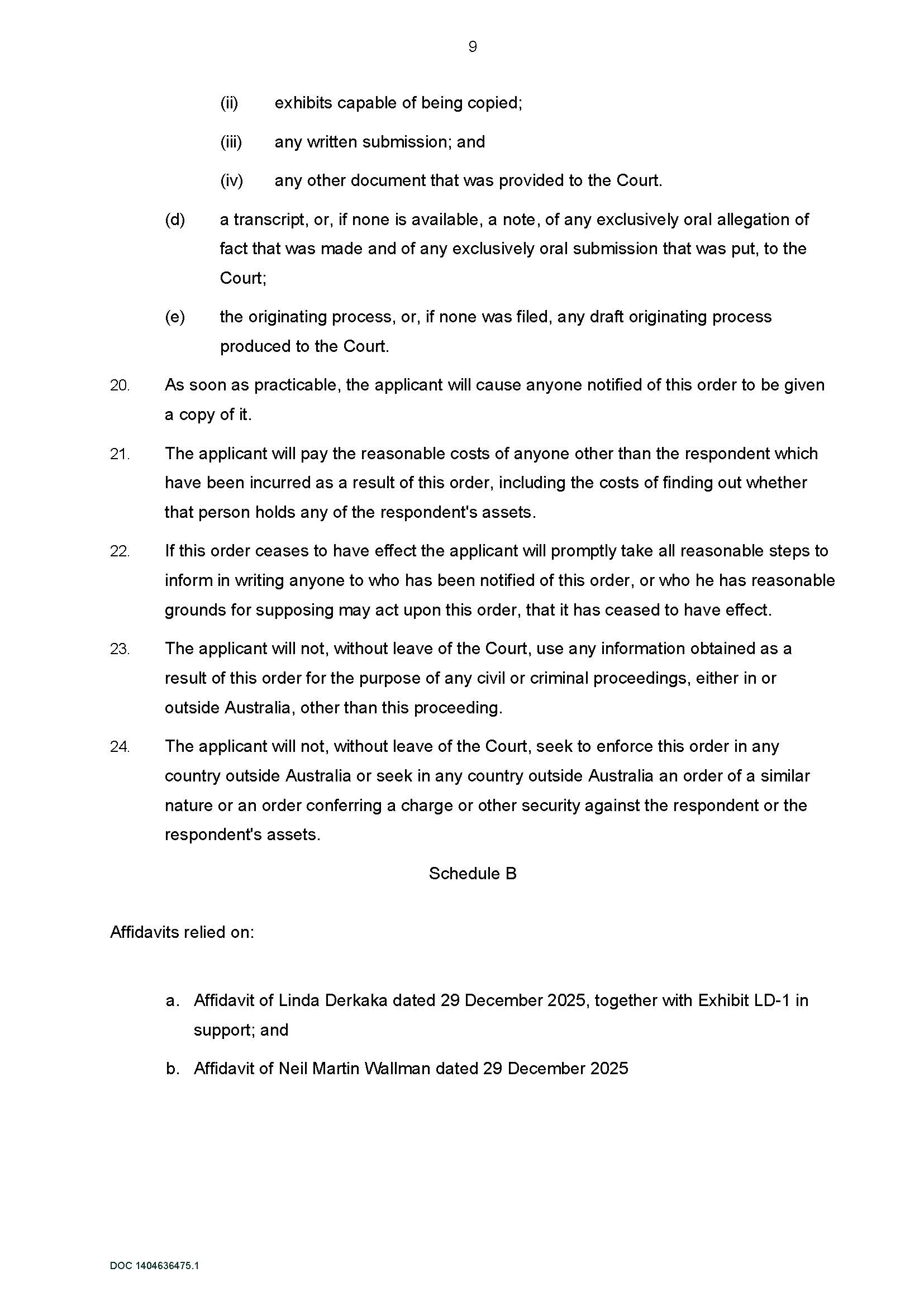
(b) the affidavit of Linda Derkaca dated 29 December 2025, together with Exhibit LD-1 in support; and
(c) the affidavit of Neil Martin Wallman dated 29 December 2025
(together, Documents)
2. An order that the Originating Application dated 29 December 2025 be returnable and heard instanter as to the orders sought in paragraphs 1, 3, 4, 5, 6, 7 & 8.
3. An order that the time for service of the documents referred to in paragraph 1 above be abridged to 12pm on 6 January 2026.
4. An order that service of the documents referred to in paragraph 1 above and a sealed copy of these orders be effected by serving the Respondents via:
(a) mobile telephone numbers;
(i) 0402 755 582;
(ii) 0428 222 736; and
(iii) +971 562 088 088
(b) email addresses:
(i) alandesafi@pnhl.com.au;
(ii) alandesafi@paragonbg.com;
(iii) alandesafi@hotmail.com;
(iv) alandesafi@gmail.com;
(v) alandesafi@protonmail.com; and
(vi) alandesafi@paragonfg.net.
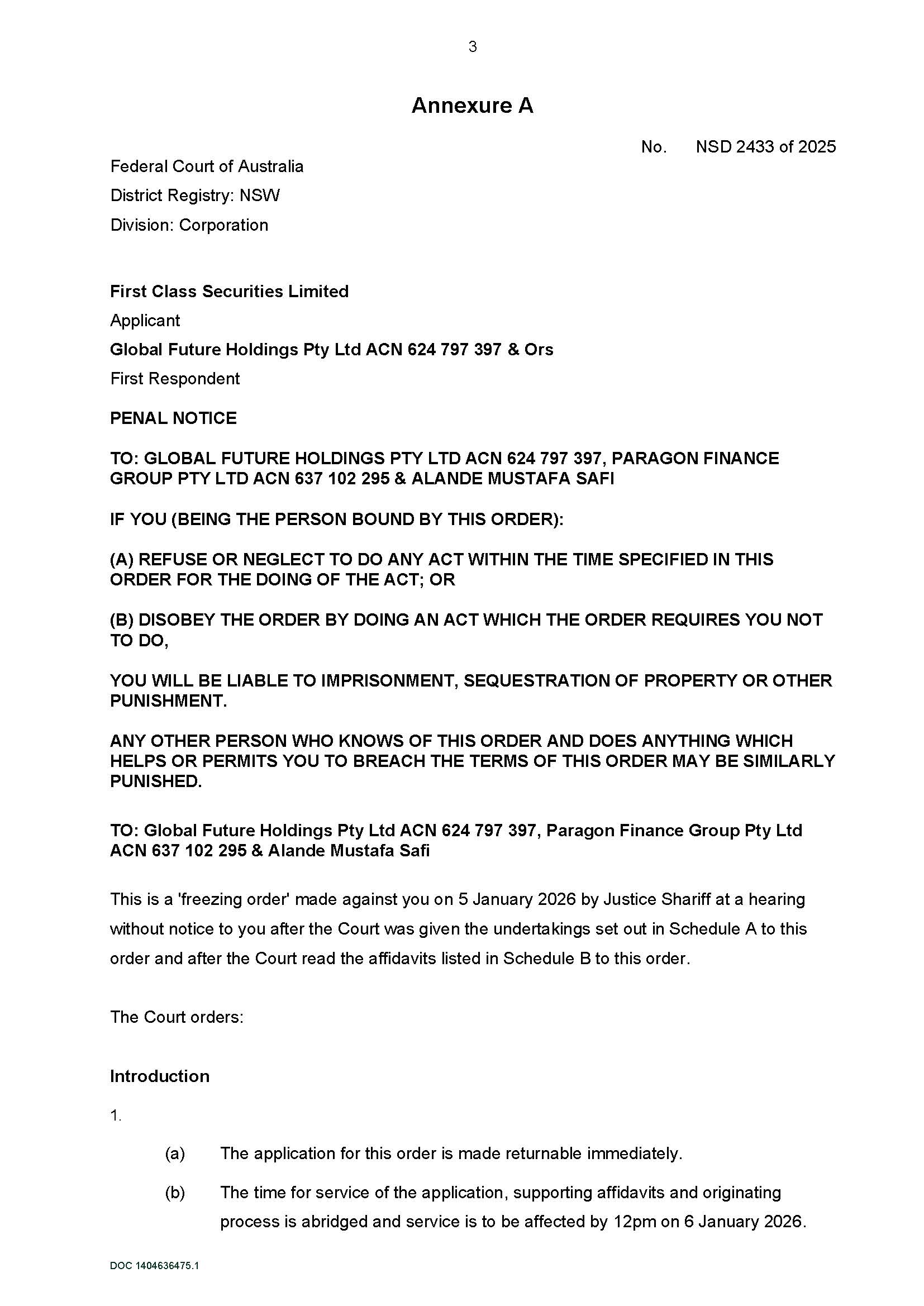
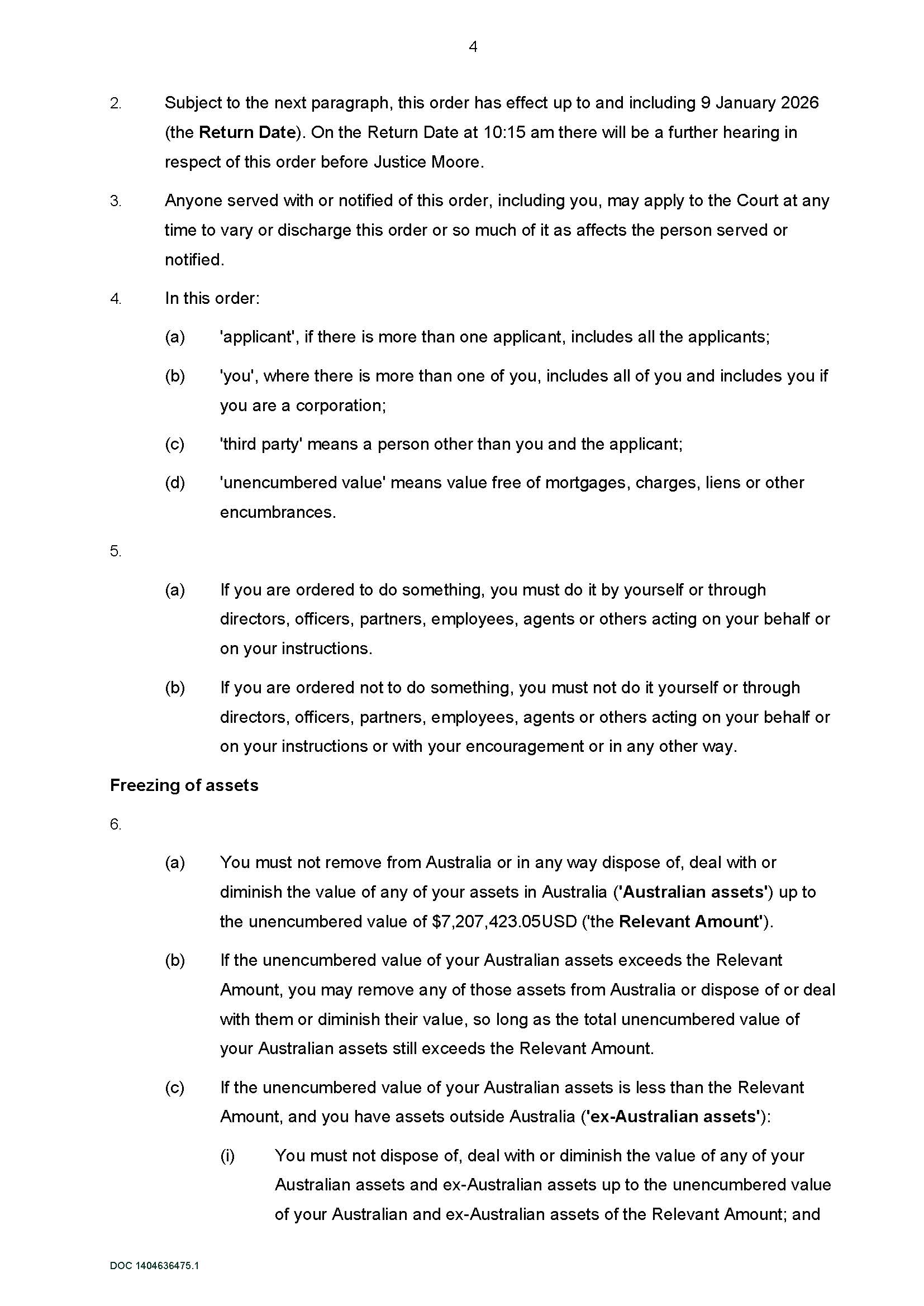
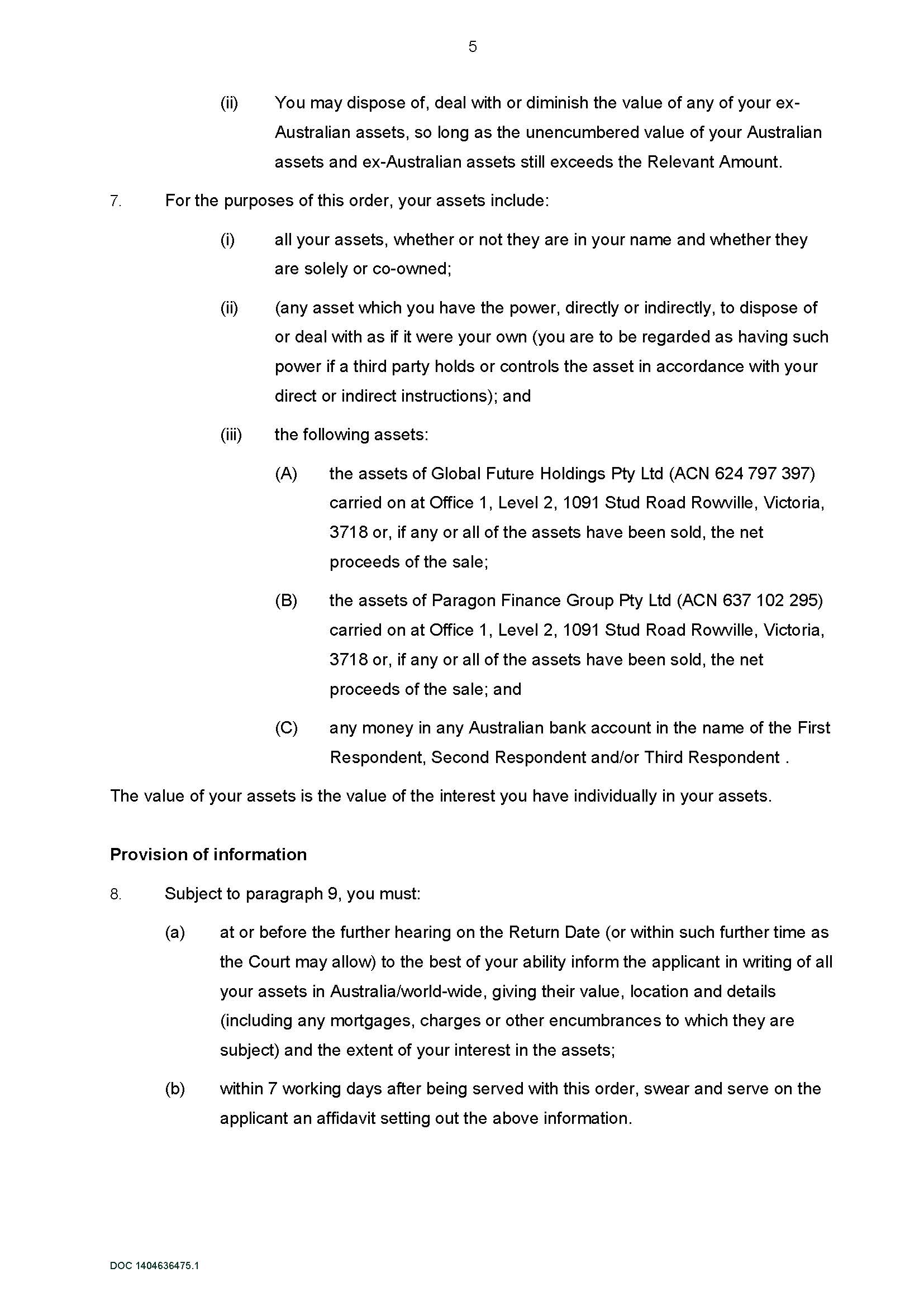
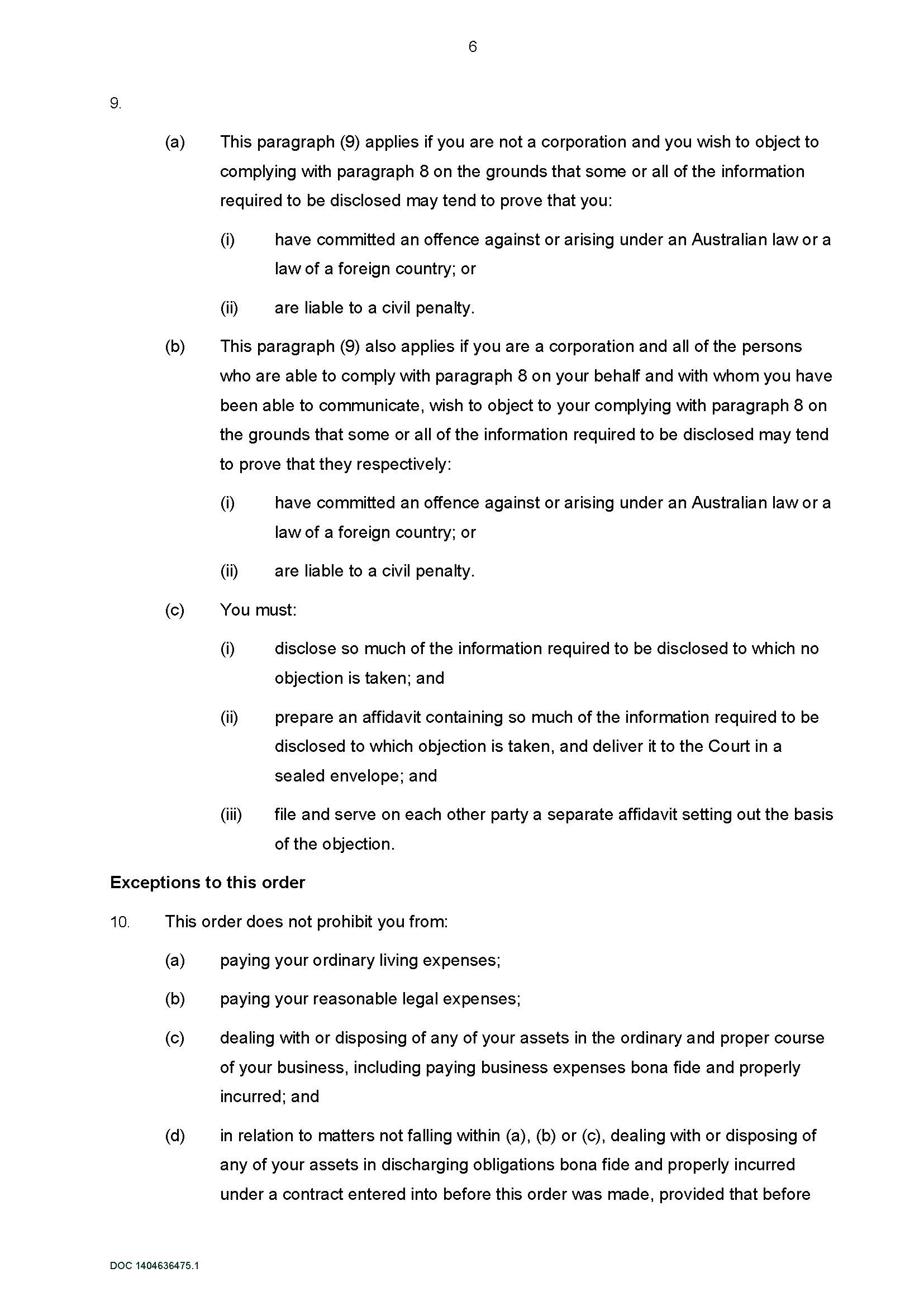
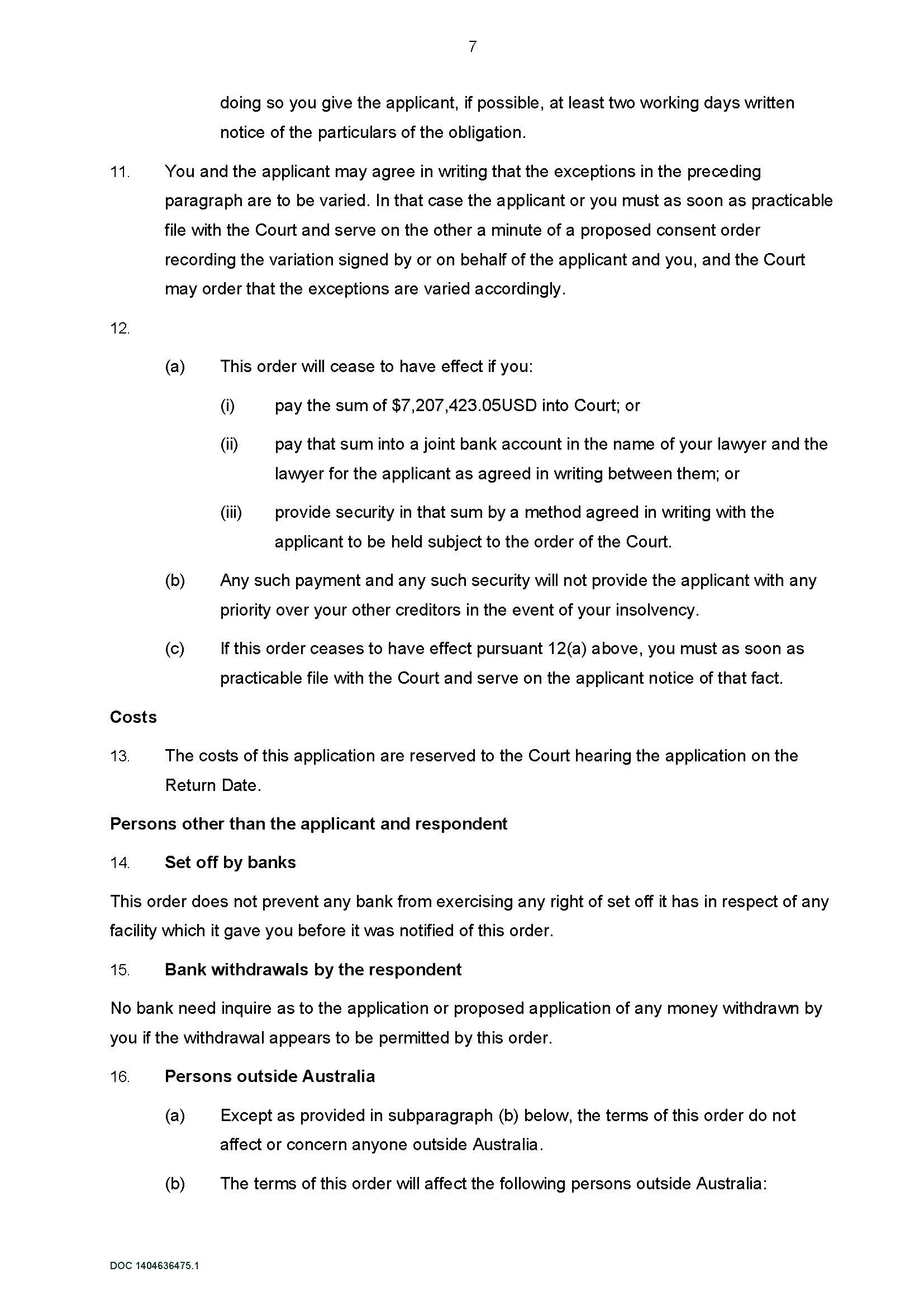
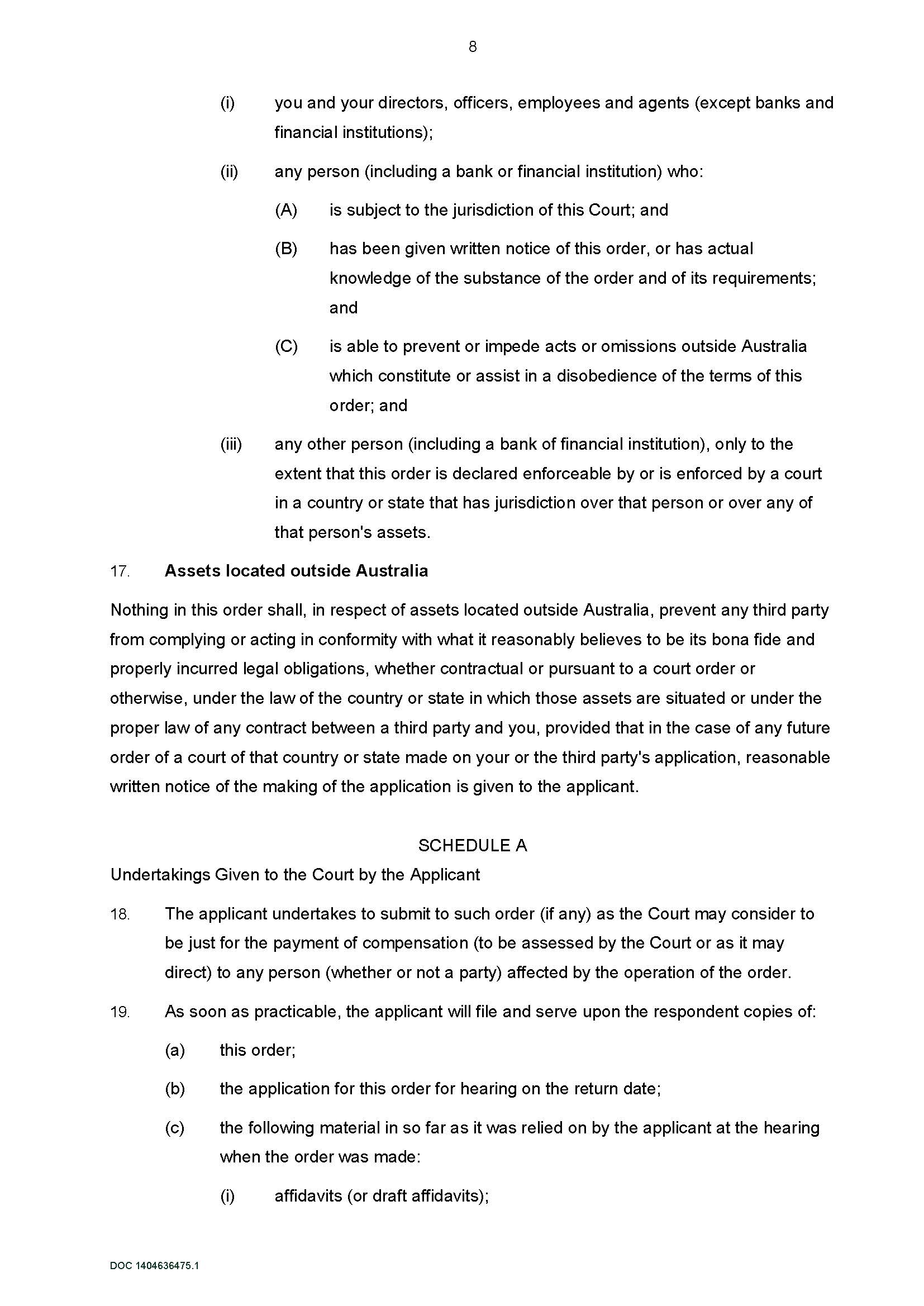
5. Pursuant to rule 7.32 of the Federal Court Rules 2011 (Cth), until further order, and upon the Applicant giving the undertaking as to damages (which has been given), an order against the First Respondent, Second Respondent and Third Respondent in the form set out in Annexure A to these orders.
6. There be liberty to the parties to apply on 48 hours’ notice.
Note: Entry of orders is dealt with in Rule 39.32 of the Federal Court Rules 2011.
REASONS FOR JUDGMENT
SHARIFF J:
1. INTRODUCTION
1 The applicant has made an urgent ex parte application for the making of freezing orders pursuant to r 7.32 of the Federal Court Rules 2011 (Cth) (FC Rules) against the first respondent (GFH), the second respondent (Paragon Finance) and the third respondent Mr Alande Mustafa Safi (Mr Safi). The application initially came before Longbottom J on 29 December 2025 and was stood over for hearing before me today as the Court’s vacation duty judge.
2 In brief, the relevant facts, matters and circumstances that give rise to the application are as follows:
(a) the applicant is a company domiciled in Mauritius which provides brokerage services to fund managers and high net worth individuals worldwide;
(b) the relevant officers and employees of the applicant include Ms Linda Derkaca (director), Mr Tom Derkaca (employee) and Mr John Kazal (employee);
(c) Mr Kazal’s role was to make recommendations and introduce investment opportunities to the applicant;
(d) GFH and Paragon Finance are both entities that promote themselves as providing private equity to major infrastructure and other high value projects including those located in Australia;
(e) Mr Safi is the sole director and a beneficial interest holder in each of GFH and Paragon Finance, and appears to be based in Dubai but promotes business opportunities for investments to be made in Australian infrastructure projects;
(f) Mr Kazal introduced Ms Derkaca to Mr Safi and thereafter Mr Safi identified a short-term investment opportunity involving a debt facility relating to an apparent infrastructure project referred to as the “South East Melbourne Airport Project landholding”;
(g) the applicant and GFH entered into an Investment Agreement pursuant to which:
(i) the applicant agreed to invest a sum of up to USD $10 million in three tranches with the first tranche to be invested being USD $2.5 million, a further tranche to be invested of USD $2.5million and a final tranche to be invested of USD $5 million;
(ii) the guaranteed return on the first and second tranche invested was to be 55% equating to USD $2.75 million, and the guaranteed return on the third tranche was to be 30% equating to USD $1.5 million;
(iii) upon “maturity” of the agreement, GFH was required to repay the principal sum along with the agreed guaranteed return;
(iv) the term of the Investment Agreement was specified to be a period of 10 business banking days;
(h) in furtherance of the Investment Agreement, the applicant invested the first and second tranche totalling a sum of approximately USD $5 million, but did not proceed with making an investment as contemplated by the third tranche;
(i) the applicant claims that the investment had reached maturity such that the due date for repayment was 5 November 2025 and at that time GFH was obliged to repay the principal sum invested of USD $5 million together with the guaranteed return of USD $2.75 million, with the total amount owing from 5 November 2025 being USD $7.75 million;
(j) the applicant claims that:
(i) GFH acknowledged a debt of USD $7.75 million was owing and has repaid a sum of approximately USD $552,563, leaving a sum of USD $7,207,423.05 owing;
(ii) since early November 2025, GFH and Mr Safi have repeatedly represented that the outstanding debt has been repaid by way of purported bank transfers which have not eventuated, and have subsequently represented that the transfers were unsuccessful due to certain unidentified “compliance issues”;
(iii) since late November 2025, GFH and Mr Safi have repeatedly assured the applicant that the outstanding debt would be repaid shortly in cash including by way of arrangements with third parties requiring the applicants to collect cash from unidentified individuals in various locations throughout Dubai and elsewhere;
(iv) by 9 December 2025, GFH and Mr Safi contended that the amount of the debt due is less than USD $7,207,423.05, by in effect “changing the goal posts” as to the makeup of the debt;
(v) despite these various assurances and the highly suspicious and irregular arrangements that have purported to be made for repayment, the outstanding debt has not in fact been paid.
3 In light of the above, the applicant claims that:
(a) it has a prima facie case against GFH for breach of contract, as well as a case against each of GFH, Paragon Finance and Mr Safi for misleading and deceptive conduct in contravention of s 18 of the Australian Consumer Law; and
(b) there is a danger that a prospective judgment of the Court could go unsatisfied because there is a risk or danger of the respondents’ assets being dissipated.
4 For the following reasons, I have decided that the orders sought by the applicant should be made. As the matter is urgent, these reasons are necessarily brief.
2. APPLICABLE PRINCIPLES
5 As stated in Deputy Commissioner of Taxation v Huang (2021) 273 CLR 429 at [16]-[18] (Gageler, Keane, Gordon and Gleeson JJ):
Rule 7.32, in Div 7.4 of the Rules, supplements s 23 of the Federal Court Act 1976 (Cth) (the Federal Court Act) and the Federal Court’s implied power as a superior court, each of which confers power upon the Court to make such orders as are appropriate for the proper exercise of its statutorily conferred jurisdiction and powers. That relationship is emphasised by r 7.36, which provides that nothing in Div 7.4 diminishes the inherent, implied or statutory jurisdiction of the Court to make a freezing order or ancillary order.
The power conferred by r 7.32(1) is expressly subject to two limitations: first, the purpose of the order must be “the purpose of preventing the frustration or inhibition of the Court’s process”; and secondly, the order must address that purpose “by seeking to meet a danger that a judgment or prospective judgment of the Court will be wholly or partly unsatisfied”. The first limitation corresponds with the established scope of the Federal Court’s general powers to grant a freezing order, being the power to make such orders as the Court may determine to be appropriate to prevent the abuse or frustration of its process in relation to matters coming within its jurisdiction. Rule 7.32 states explicitly the requirement, stated by this Court in relation to the Federal Court’s general powers to grant a freezing order, that the power must be exercised for the purpose for which it is conferred. Where the order is made in proceedings in which substantive relief is sought against the defendant, that purpose is “to prevent a defendant from disposing of his actual assets (including claims and expectancies) so as to frustrate the process of the court by depriving the plaintiff of the fruits of any judgment obtained in the action”. More broadly, a freezing order is directed to dispositions “which are intended to frustrate, or have the necessary effect of frustrating, the plaintiff in his attempt to seek through the court a remedy for the obligation to which he claims the defendant is subject”.
The second limitation, that an order made under r 7.32 must serve the specified purpose “by seeking to meet a danger that a judgment or prospective judgment of the Court will be wholly or partly unsatisfied”, also corresponds with the scope of the Federal Court’s general powers to make a freezing order. Since Jackson v Sterling, it has been accepted in Australia, as a general proposition, that a freezing order could be granted if the circumstances are such that there is a danger of the defendant absconding, or a danger of the assets being removed from the jurisdiction or disposed of within the jurisdiction, or otherwise dealt with so that there is a danger that the plaintiff, if successful in obtaining a judgment, will not be able to get it satisfied. The danger must be sufficiently substantial to warrant the freezing order. The need to identify a relevant danger was first articulated in Mareva Compania Naviera SA v International Bulkcarriers SA, where Lord Denning MR stated:
“If it appears that the debt is due and owing — and there is a danger that the debtor may dispose of his assets so as to defeat it before judgment — the Court has jurisdiction in a proper case to grant an interlocutory judgment so as to prevent him disposing of those assets.”
(Footnotes omitted.)
6 In UFC Enterprise Morley Pty Ltd v UFC Enterprise Northbridge Pty Ltd [2024] FCA 1396, Feutrill J set out the principles applicable to the circumstances in which freezing orders will be made at [13]-[15]. I gratefully adopt that summation of principles:
The principles applicable to circumstances in which a freezing order will be made are well established. These may be summarised as follows:
(1) The language of r 7.32 of the Rules reflects what has been considered to be a general power of the Court to grant a Mareva injunction under s 23 of the Federal Court of Australia Act 1976 (Cth): Jackson v Sterling Industries Ltd [1987] HCA 23; 162 CLR 612 at 622 –623 (Deane J).
(2) As a general proposition, a freezing order may be granted if the applicant demonstrates a prima facie or good arguable case for final relief and the circumstances are such that there is a danger of the respondent absconding, or a danger of the assets being removed out of the jurisdiction or disposed of within the jurisdiction or otherwise dealt with so that there is a danger that the applicant, if it gets judgment, will not be able to get it satisfied: Deputy Cmr of Taxation v Hua Wang Bank Berhad [2010] FCA 1014; 273 ALR 194 at [8] (Kenny J) and the authorities there cited.
(3) The reference in r 7.32 to a ‘danger’ that a judgment or prospective judgment will go wholly or partly unsatisfied is a reference to a risk of that outcome. The risk must be real or substantial as opposed to a remote or speculative or theoretical possibility. The applicant must prove facts from which the Court can infer the existence of a real or substantial risk on the balance of probabilities: Duro Felguera Australia Pty Ltd v Trans Global Projects Pty Ltd (in liq) [2018] WASCA 174; 53 WAR 201 at [42] –[43] (Buss P, Murphy and Mitchell JJA) and the authorities there cited.
(4) It is not necessary to establish that judgment will be unsatisfied unless a freezing order is made. Nor is it necessary to demonstrate that a respondent has a positive intention to frustrate a judgment. However, there must be facts from which ‘a prudent, sensible commercial’ person can ‘properly infer a danger of default if assets are removed from the jurisdiction’. That may include facts concerning a lack of available information about a respondent: Hua Wang Bank Berhad at [9]–[12] (Kenny J) and the authorities there cited. See, also, Severstal Export GmbH v Bhushan Steel Ltd [2013] NSWCA 102; 84 NSWLR 141 at [59]–[60] (Bathurst CJ, Beazley P and Barrett JA agreeing); Trans Global Projects at [45].
(5) The mere fact of removal or danger of removal of assets from the jurisdiction will not necessarily give rise to a danger or risk that a judgment will go unsatisfied. In this regard, it is necessary to take into account any reciprocal regimes for the registration and enforcement of judgments and other means by which a judgment may be enforced: Trans Global Projects at [47]–[48]; Severstal Export at [63]–[65].
(6) Ultimately, it is a question for evaluation by the Court as to whether the degree of the danger or risk is sufficient to justify an order in the terms made. In making that evaluative assessment, the Court will bear in mind that a freezing order is a drastic remedy which imposes a severe restriction on a respondent’s right to deal with its assets, and that the purpose of the order is not to provide security for a judgment which the applicant hopes to obtain and fears might not be satisfied: Trans Global Projects at [44] and the authorities there cited.
…the principles applicable to the grant of interlocutory injunctions pending resolution of a dispute are also relevant to the dispute concerning ownership of the issued shares in UFC Northbridge and control of the management, and, therefore, control of the assets of that company including the money in its bank account. Again, these principles are well established. The principles require there to be a serious question to be tried and that the balance of convenience favour the order for an interlocutory restraint pending determination of the substantive dispute. The Full Court set out the ‘correct approach’ in Samsung Electronics Co Ltd v Apple Inc [2011] FCAFC 156; 217 FCR 238 at [52]–[74]. Applicants must first show that they have a prima facie case in the sense of ‘a sufficient likelihood of success to justify in the circumstances the preservation of the status quo pending the trial’: Australian Broadcasting Corporation v O’Neill [2006] HCA 46; 227 CLR 57 at 65 (Gummow and Hayne JJ, Gleeson CJ and Crennan J agreeing). This is commonly referred to as a serious question to be tried. What will be sufficient will depend on ‘the nature of the rights [the applicant] asserts and the practical consequences likely to flow from the order he seeks’: Beecham Group Ltd v Bristol Laboratories Pty Ltd [1968] HCA 1; 118 CLR 618 at 622. Secondly, a party must also demonstrate that the balance of convenience and justice favour the grant of an injunction.
7 It is unnecessary to demonstrate that the respondent or defendant intends to frustrate the prospective judgment or that it is more likely than not to happen. It is sufficient to demonstrate a risk. While the inference of risk cannot usually be drawn from the fact alone that an applicant has a sufficiently arguable case, evidence that the respondent has engaged in dishonesty or other forms of misconduct may provide a more ready basis upon which to draw such an inference: Patterson v BTR Engineering (Aust) Ltd (1989) 18 NSWLR 319 at 325-326 (Gleeson CJ with whom Meagher JA and Rogers AJA broadly agreed).
8 In addition to these principles, it is important to bear in mind that the application here is being made ex parte. The considerations that the Court must bear in mind in the determination of such applications include those set out by Derrington J in EVP Opportunities Master Pty Ltd as trustee for The EVP Opportunities Master Fund v Strong Room Technology Pty Ltd (Receiver and Manager Appointed) (Administrators Appointed) [2025] FCA 548 at [5]-[6]:
First, the current application seeks interim relief by way of an ex parte order: see r 7.32(1) of the Federal Court Rules 2011 (Cth). As such, the defendants have neither been served with the application nor had the opportunity to respond to the material tendered or contest it in any way: see International Finance Trust Co Ltd v New South Wales Crime Commission (2009) 240 CLR 319, 363–364 [88]–[89]. Indeed, they are seemingly unaware of the present proceedings. That necessarily has the consequence that any observations made with respect to the issues are, at best, preliminary: see generally Farrell v Delaney (1952) 52 SR (NSW) 236, 238; WEA Records Ltd v Visions Channel 4 Ltd [1983] 1 WLR 721, 727. They are unassisted by argument from the defendants and made in the absence of any countervailing evidence.
Second, the orders sought are for the freezing of assets pending the return of the matter to Court. The nature of that order is somewhat significant. In effect, it has the consequence of preventing persons utilising assets which they may perceive to be their own (and indeed, may well be their own) before any opportunity has arisen for them to defend the claim against them. Orders of this general nature have been labelled “draconian”: see, eg, Deputy Cmr of Taxation v Huang (2021) 273 CLR 429, 449 [34]; Cmr of Taxation v Regent Pacific Group Ltd [2013] FCA 36 [26]: and that may not be an unjustified observation. However, for present purposes, it must be kept steadily in mind that the orders sought are of a limited duration, being some 72 hours. To that end, any interference with the assets of the defendants will be minimal, and they will soon have the opportunity to vary the orders or otherwise have them dissolved.
9 It is next necessary to address the relevant consideration in the circumstances of the instant case.
3. SUFFICIENT LIKELIHOOD OF SUCCESS TO JUSTIFY PRESERVATION OF THE STATUS QUO
10 On the evidence before me, which I accept remains untested and unchallenged, I am satisfied that the applicant has established that it has a sufficient likelihood of success in its causes of action against each of the respondents so as to justify the preservation of the status quo. That is so for the following reasons.
11 First, the Investment Agreement appears to operate in the way that the applicant contends. At first blush, the arrangement is one that appears almost too good to be true in that it apparently assures the applicant a guaranteed return of USD $2.75 million for an investment of USD $5 million and appears to make provision for the entire amount to be repayable within 10 business banking days. That is an extraordinary arrangement with an extraordinary guaranteed return. Although I had some doubt as to the genuineness of the arrangement, the evidence before me indicates that the respondents acknowledged in correspondence that this was the way the arrangement was to work: there would be a guaranteed return in a short period of a substantial amount of money.
12 Second, in relation to the case against GFH, I am presently satisfied that it has failed to repay an outstanding debt which on the evidence before me it has acknowledged is due and owing. Whilst I accept that there may be room for debate as to the proper meaning of particular terms of the Investment Agreement (such as whether the maturity date had arisen and whether the principal amount and the guaranteed return were to be repayable within 10 business working days), the evidence before me at this stage indicates that GFH and Mr Safi acknowledged that the debt was due and payable as claimed by the applicant.
13 Whilst I also accept that Mr Safi later sought to quibble with the total amount of the debt owing, the evidence before me suggests that these matters were a somewhat belated attempt to justify the ongoing non-repayment of the amount claimed by the applicant to be due.
14 Third, in relation to the case against Paragon Finance and Mr Safi, based on the evidence of Ms Derkaca, I am satisfied that various representations were made by each of them to the applicant (both orally and through promotional materials) including that the repayment of the invested amount would be prompt and that each of GFH, Paragon Finance and Mr Safi had the funds available to them to ensure prompt payment of the principal amount and the guaranteed return on the investment within a short period of time. On the evidence before me, having regard to the events that have come to pass, there is a reasonably arguable case which I consider to have sufficient prospects of success that those representations were misleading. That is so because the amounts have not in fact been repaid contrary to the indications that the respondents would be in a position to ensure that this would occur promptly.
15 Given the stage of these proceedings and the fact that the applicant’s claims have not been tested or otherwise challenged, it is unnecessary to say anything further as to this topic.
4. DANGER THAT A PROSPECTIVE JUDGMENT OF THE COURT WILL BE WHOLLY OR PARTLY UNSATISFIED
16 On the evidence before me, I am satisfied that there are highly suspicious, irregular and unusual circumstances that are indicative of dishonest or other underhand conduct that gives rise to a danger that a prospective judgment of the Court will go wholly or partly unsatisfied by reason of the dissipation of such assets as are held by the respondents. I have arrived at this state of satisfaction for the following reasons.
17 The evidence before me indicates that GFH and Paragon Finance are the providers of private equity to highly sophisticated infrastructure and other projects, which tends to suggest that they and Mr Safi have considerable assets at their disposal. That evidence is supported by other evidence indicating that Mr Safi represented to the applicant that GFH would be in a position to procure prompt repayment under the terms of the Investment Agreement. In other words, what was assured and indicated was that the respondents had substantial assets and could easily repay the amounts that would fall due. Despite this, the current position is that the outstanding debt has not been repaid which gives rise to an inference that assets that the respondents claimed to hold or have access to are being dissipated or otherwise managed in a way to avoid repayment of that debt.
18 The evidence establishes that as early as 29 October 2025, Mr Safi represented to Mr Kazal and Mr Derkaca that the outstanding debt would be repaid. On 5 November 2025, Mr Safi sent a message attaching an apparent bank confirmation that USD $7.5 million was being transferred and likely to clear within 24 to 48 hours. Then, on 7 November 2025, Mr Safi sent Mr Kazal and Mr Derkaca what he claimed to be a “SWIFT copy” and “official request receipt” confirming that the outstanding debt was in the process of being cleared by the National Australia Bank (NAB). His message attached a document purporting to be such a receipt issued by NAB. Despite these assurances, and apparent business records, the debt had not been repaid and no amount of money has in fact been transferred as claimed.
19 By 10 to 13 November 2025, Mr Safi was claiming that the funds had not cleared to be transferred to the applicant due to “compliance issues” raised by the relevant banks. The precise nature of these so-called compliance issues is not clear.
20 On 18 November 2025, Mr Safi sent a message to Mr Kazal and Mr Derkaca asserting that he now had “formal bank communication” with “a hundred percent confirmed clearance time” that the debt would be paid on Friday, 21 November 2025. This did not eventuate.
21 Thereafter, Mr Safi’s communications appear to have taken an unusual and irregular course. From late November 2025, it appears that Mr Safi was no longer suggesting that the debt would be repaid by way of bank transfer but was claiming that it would be paid in cash. He sent a photo of what appears to be a pallet of substantial amounts of cash that he later said was in the process of being counted and would be made ready for delivery to the applicant. Although the evidence appears fantastical, it is supported by messages that Mr Safi appears to have sent stating he was in fact in the process of having the cash counted.
22 Then, having assured the applicant that he had the money in cash to repay the applicant, Mr Safi appears to have sent messages changing the proposed method of payment. He informed Mr Kazal and Mr Derkaca that the money would be repaid by them picking up the cash from certain unidentified individuals at various locations throughout Dubai and elsewhere. When pressed for details, Mr Safi was unable or unwilling to provide them even when it was being drawn to his attention that the circumstances were highly unusual and appeared to be illegitimate. Mr Safi was also unable to provide any cogent explanation as to why the earlier bank transfers had not succeeded and was unable or unwilling to give an explanation for the sudden about turn.
23 Then, having acknowledged the quantum of the amount owing, from late November 2025, Mr Safi started to raise arguments that the debt owing was less than that claimed by the applicant on account of expenses and other costs, as well as amounts which Mr Safi claimed he had the discretion to withhold. This culminated in Mr Safi on 9 December 2025 providing the applicant with a “Discharge Agreement” which revised the amount of the debt said to be owing to the applicant and required the applicant to sign this Agreement as a condition of payment.
24 Given the state of this evidence, I am satisfied that there is a danger that prospective judgment of the Court in these proceedings may be wholly or partly unsatisfied including because of a real risk that dissipation of the respondents’ assets or other conduct that could put them out of reach. The fact that the respondents appear to have had sufficient money to transfer to the applicant, but have not done so suggests that the money has been used for other purposes or is being dissipated. If, however, the respondents never had the money, then, the evidence indicates that the respondents have been dishonest. My concerns about the state of affairs is heightened by the apparent correspondence sent by Mr Safi seeking to make payments of substantial amounts of money by cash and/or arrangements involving the collection of cash from third parties. These irregular circumstances suggest that there is a real risk that a prospective judgment of this Court would be unsatisfied.
5. BALANCE OF CONVENIENCE AND THE DICTATES OF JUSTICE
25 In assessing the balance of convenience and the dictates of justice, I have been troubled by the applicant’s delay in bringing the present application.
26 It seems to me that given the highly unusual and irregular circumstances, the applicant ought to have been aware by at least mid-November 2025, that there was a risk that a prospective judgment of the Court may be unsatisfied and the risk of the dissipation of the respondents’ assets. The applicant submitted that for a period of time it continued to engage with Mr Safi in order to secure payment as quickly as possible and that was an appropriate commercial response.
27 The applicant submitted that it was not until Mr Safi sought to resile from the acknowledged debt through the Discharge Agreement that it was considered necessary to make the present application to the Court.
28 It may be accepted that the applicant took some time to engage in correspondence with Mr Safi to secure repayment of the loan. Even so, the Discharge Agreement was put to the applicant on 9 December 2025, which does not explain why the applicant did not approach the Court until 29 December 2025. The only explanation given for this delay (from the bar table) was the need to compile the evidentiary materials which took some time having regard to the time of year and the availability of solicitors and counsel. I do not consider that to be an acceptable or adequate explanation for the delay in respect of the repayment of a substantial debt.
29 Having said that, an assessment of the balance of convenience and the dictates of justice involves an evaluative exercise that in the case of a freezing order must be viewed from the overall interests in the administration of justice. The Court’s concern is to ensure that a prospective judgment of the Court is not left unsatisfied by reason of a risk or danger of the dissipation of assets. In assessing the interests of the administration of justice, delay is but one factor to consider. Another fact to consider is the draconian effect of freezing orders and their impact on the regular commercial and financial affairs of the respondents. However, on the evidence before me, the commercial and financial affairs of the respondents appear to be highly irregular.
30 Albeit there was an unsatisfactory delay involved here, I have been persuaded that the greater interest is to ensure that the processes of the Court are not frustrated. Thus, despite the delay, I am nevertheless satisfied that the freezing orders should be made. That is because in my view, the interests of the administration of justice in ensuring that a prospective judgment of this Court is not thwarted outweighs the other considerations given the unique and peculiar circumstances of this case.
6. DISPOSITION
31 For the foregoing reasons, the orders sought by the applicant should be made. The matter will be returnable before the vacation duty judge on the return date.
I certify that the preceding thirty-one (31) numbered paragraphs are a true copy of the Reasons for Judgment of the Honourable Justice Shariff. |
Associate:
Dated: 5 January 2026


