

FEDERAL COURT OF AUSTRALIA
Dimer on behalf of the Marlinyu Ghoorlie Claim Group v State of Western Australia (No 6) [2025] FCA 1641
File number(s): | WAD 647 of 2017 WAD 38 of 2022 |
Judgment of: | O'BRYAN J |
Date of judgment: | 19 December 2025 |
Catchwords: | NATIVE TITLE – overlapping applications for determination of native title in the Goldfields region of Western Australia – claims brought on behalf of the Marlinyu Ghoorlie claim group (the Karlamaya Kapurn people) and the Karratjibbin people – applications contested by indigenous respondents – trial of separate questions concerning the existence, possession and content of native title rights and interests in claim area – joint trial conducted pursuant to s 67 of the Native Title Act 1993 (Cth) – whether the Aboriginal people who occupied the claim area at effective sovereignty were the Karlamaya Kapurn people or a Western Desert society – finding that the Karlamaya Kapurn people occupied the claim area at sovereignty – the apical ancestors of the Marlinyu Ghoorlie claim group were Karlamaya Kapurn people who held rights and interests in the claim area at sovereignty – adaptations to the traditional laws and customs of the Karlamaya Kapurn people necessitated by European settlement of the claim area – the Karlamaya Kapurn people presently possess native title rights and interests in the claim area under their traditional laws and customs – the Karlamaya Kapurn people, by their traditional laws and customs, have a connection with the claim area – separate questions answered in favour of the Marlinyu Ghoorlie claim group in relation to the whole of the land and waters of the claim area – Karratjibbin claim group failed to prove that any of their claimed apical ancestors were Karlamaya Kapurn people who held rights and interests in the claim area at sovereignty EVIDENCE – significance of evidence from forebears of native title claimants who were deceased at the time of trial – where evidence from deceased forebears demonstrates ongoing vitality of the Aboriginal society since sovereignty EVIDENCE – expert anthropological evidence – principles governing admissibility and probative value of expert anthropological evidence and basis material – where expert anthropological witness relied upon written opinions of other anthropologists who were not called as witnesses and whose reports were not tendered in evidence – considerations affecting the probative value of such written opinions EVIDENCE – expert anthropological evidence – where evidence demonstrated a lack of professionalism and independence – where expert witness’s contribution to the preparation of an expert report was limited |
Legislation: | Evidence Act 1995 (Cth), ss 60, 63, 79, 135 Native Title Act 1993 (Cth), ss 61, 67, 84, 223, 225 Aborigines Act 1905 (WA) Noongar (Koorah, Nitja, Boordahwan) (Past, Present, Future) Recognition Act 2016 (WA) |
Cases cited: | Alyawarr, Kaytetye, Warumungu, Wakay Native Title Claim Group v Northern Territory [2004] FCA 472; 207 ALR 539 Ananda Marga Pracaraka Samgha Ltd v Tomar (No 4) (2012) 202 FCR 564 Bennell v State of Western Australia (2006) 153 FCR 120 Blucher on behalf of the Gaangalu Nation People v State of Queensland [2025] FCAFC 177 Bodney v Bennell (2008) 167 FCR 84 Bradken Resources Pty Ltd v Lynx Engineering Consultants Pty Ltd (2012) 210 FCR 21 Brownley on behalf of the Gulgoordi-Garlgurla Wongi People v State of Western Australia [2024] FCA 208 CG (Deceased) on behalf of the Badimia People v State of Western Australia [2015] FCA 204 Colbung on behalf of the Karratjibbin People v State of Western Australia [2023] FCA 1065 Colbung on behalf of the Karratjibbin People v State of Western Australia (No 2) [2023] FCA 1449 Croft (on behalf of the Barngarla Native Title Claim Group) v South Australia [2015] FCA 9; 325 ALR 213 Daniels v Western Australia [2000] FCA 858; 178 ALR 542 Daniel v Western Australia [2003] FCA 666 De Rose v State of South Australia [2002] FCA 1342 De Rose v South Australia (No 2) (2005) 145 FCR 290 Dimer on behalf of the Jardu Mar People v State of Western Australia [2022] FCA 64 Dimer on behalf of the Marlinyu Ghoorlie Claim Group v State of Western Australia [2023] FCA 930 Dimer on behalf of the Marlinyu Ghoorlie Claim Group v State of Western Australia (No 2) [2023] FCA 1060 Dimer on behalf of the Marlinyu Ghoorlie Claim Group v State of Western Australia (No 5) [2023] FCA 1417 Drill on behalf of the Purnululu Native Title Claim Group v State of Western Australia [2020] FCA 1510 Griffiths v Northern Territory (2006) 165 FCR 300 Griffiths v Northern Territory of Australia (2007) 165 FCR 391 Gumana v Northern Territory of Australia (2005) 141 FCR 457 Harrington-Smith on behalf of the Wongatha People v State of Western Australia (No 9) [2007] FCA 31; 238 ALR 1 Lewis on behalf of the Nyalpa Pirniku Native Title Claim Group v State of Western Australia [2023] FCA 1294 Mabo v Queensland (No 2) (1992) 175 CLR 1 Malone on behalf of the Western Kangoulu People v State of Queensland (No 3) [2022] FCA 827 Malone on behalf of the Western Kangoulu People v State of Queensland (No 6) [2025] FCA 363 Malone v Queensland (2021) 287 FCR 240 Malone v State of Queensland (the Clermont Belyando Area native title claim) (No 5) [2021] FCA 1539; 397 ALR 397 Manado (on behalf of Bindunbur Native Title Claim Group) v Western Australia [2017] FCA 1367 Members of the Yorta Yorta Aboriginal Community v State of Victoria (2002) 214 CLR 422 Narrier v Western Australia [2016] FCA 1519 Neowarra v State of Western Australia [2003] FCA 1402 Northern Territory v Alyawarr, Kaytetye, Warumungu, Wakaya Native Title Claim Group (2005) 145 FCR 442 Rush v Nationwide News Pty Ltd (No 5) [2018] FCA 1622 Sambo v State of Western Australia (No 2) [2010] FCA 927 Sambo v State of Western Australia [2009] FCA 940 Sambo v State of Western Australia [2015] FCA 954 Sampi (on behalf of the Bardi and Jawi People) v Western Australia [2005] FCA 777 Sampi (on behalf of the Bardi and Jawi People) v Western Australia [2010] FCAFC 26; 266 ALR 537 Sandy on behalf of the Yugara People v State of Queensland (2017) 254 FCR 107 Starkey v South Australia (2018) 261 FCR 183 State of Western Australia v Fazeldean on behalf of the Thalanyji People (No 2) (2013) 211 FCR 150 State of Western Australia v Sebastian (2008) 173 FCR 1 Strickland on behalf of the Maduwongga Claim Group v State of Western Australia [2023] FCA 270 Stuart v South Australia [2025] HCA 12; 99 ALJR 731 Velickovic v State of Western Australia [2012] FCA 782 Western Australia v Ward (2002) 213 CLR 1 Worimi Local Aboriginal Land Council v Minister for Lands (NSW) (No 2) (2008) 181 FCR 300; [2008] FCA 1929 Wyman v Queensland (2015) 235 FCR 464 Wyman v Queensland (No 2) [2013] FCA 1229 |
Division: | General Division |
Registry: | Western Australia |
National Practice Area: | Native Title |
Number of paragraphs: | 2166 |
Date of hearing: | 20-23 February 2023; 2-19 October 2023; 5, 7, 11-15 December 2023; 18-20 March 2024 |
WAD 647 of 2017 | |
Counsel for the Applicant: | A McAvoy SC with M Pudovskis |
Solicitor for the Applicant: | Blackshield Lawyers |
Counsel for the State of Western Australia: | C Taggart |
Solicitor for the State of Western Australia: | State Solicitor’s Office |
Counsel for Gary Cooper, Maria Bandry, Norman Cooper and Victor Cooper | A Sharpe |
Solicitor for Gary Cooper, Maria Bandry, Norman Cooper and Victor Cooper | MPS Law |
Counsel for Elizabeth Sambo | A McLean (at the hearings on 2-10, 12-19 October 2023; 5, 11-15 December 2023; 18-20 March 2024) and C Beetham (at the hearing on 22 February 2023) |
Solicitor for Elizabeth Sambo | Ross Mackay |
WAD 38 of 2022 | |
Counsel for the Applicant: | S Hegedus |
Solicitor for the Applicant: | Apix Law Group |
Counsel for the State of Western Australia: | C Taggart |
Solicitor for the State of Western Australia: | State Solicitor’s Office |
ORDERS
WAD 647 of 2017 | ||
| ||
BETWEEN: | HENRY DIMER (and others named in the Schedule of Parties) Applicants | |
AND: | STATE OF WESTERN AUSTRALIA (and others named in the Schedule of Parties) Respondents | |
order made by: | O'BRYAN J |
DATE OF ORDER: | 19 DECEMBER 2025 |
THE COURT ORDERS THAT:
1. The separate questions be answered as follows:
(a) But for any question of extinguishment, native title exists in relation to the whole of the land and waters of the claim area.
(b) The native title is held by the Marlinyu Ghoorlie claim group which comprises those Aboriginal people who:
(i) are descended from one or more of four apical ancestors, being Nellie Champion, Kaddee, Warada and Lucy Sambo, including by adoption in accordance with the traditional laws and customs of the rights-holding group;
(ii) identify themselves as Karlamaya, Kapurn and/or Karlaku (including alternate spellings of those names) or any combination of those names; and
(iii) are recognised by the other members of the rights-holding group as members of that group in accordance with the traditional laws and customs of the group.
(c) The nature and extent of the native title rights and interests held by the Marlinyu Ghoorlie claim group is appropriately described (at this stage of the proceedings) as the right to possession, occupation, use and enjoyment of the land and waters of the claim area being:
(i) the right to live, being to enter and remain, camp and erect temporary shelters and other temporary structures for that purpose and to travel over and visit any part of the claim area;
(ii) the right to hunt, fish, gather and use the traditional resources of the claim area;
(iii) the right to take and use water on the claim area; and
(iv) the right to engage in cultural activities and the transmission of cultural knowledge on the claim area, including:
A. visiting places of cultural or spiritual importance and protecting those places by carrying out lawful activities to preserve their physical or spiritual integrity; and
B. conducting burials, ceremony and ritual.
2. Pursuant to s 84(8) of the Native Title Act 1993 (Cth), each of Gary Cooper, Maria Bandry, Norman Cooper and Victor Cooper cease to be a party to the proceeding.
3. The proceeding be listed for case management to determine the next procedural steps to be taken in the proceeding at 9.30 am (AWST) on 6 February 2026.
Note: Entry of orders is dealt with in Rule 39.32 of the Federal Court Rules 2011.
ORDERS
WAD 38 of 2022 | ||
| ||
BETWEEN: | JASON COLBUNG (and others named in the Schedule of Parties) Applicants | |
AND: | STATE OF WESTERN AUSTRALIA (and others named in the Schedule of Parties) Respondents | |
order made by: | O'BRYAN J |
DATE OF ORDER: | 19 DECEMBER 2025 |
THE COURT ORDERS THAT:
1. The application be dismissed in so far as it relates to land and waters within the claim area of the Marlinyu Ghoorlie native title determination application (WAD 647 of 2017).
2. Within 60 days of the date of these orders, the applicant give written notification to the Court and all parties to this proceeding whether the applicant intends to proceed with the application in so far as it relates to land and waters outside the claim area of the Marlinyu Ghoorlie native title determination application (WAD 647 of 2017).
Note: Entry of orders is dealt with in Rule 39.32 of the Federal Court Rules 2011.
REASONS FOR JUDGMENT
O’BRYAN J:
A. INTRODUCTION
1 These reasons concern two native title determination applications made under s 61 of the Native Title Act 1993 (Cth) (NTA) which cover, in part, the same area.
2 The first of the applications was filed on 22 December 2017 and given the proceeding number WAD 647 of 2017. It is known as the Marlinyu Ghoorlie claim. The Marlinyu Ghoorlie applicant claims native title rights and interests in the claim area on behalf of the Karlamaya (Kalamaia) Kapurn (Gubrun, Kaparn) people, also known as Karlaku (Kalaako, Kalarku) people. The significance of those names will be discussed in the course of these reasons. The first-mentioned name uses the preferred spelling adopted by the Marlinyu Ghoorlie applicant, with alternative spellings in parentheses. For simplicity, these reasons adopt the preferred spelling used by the Marlinyu Ghoorlie applicant (save where quoting directly from the evidence given by a witness or from historical sources), and will refer to the Marlinyu Ghoorlie claim group as the ‘Karlamaya Kapurn people’. For present purposes, it is sufficient to note that: the name Karlamaya is the name of an Aboriginal language used in the Marlinyu Ghoorlie claim area by Aboriginal people occupying the area at the time of European settlement; Karlaku is likely an alternative word for Karlamaya; and the name Kapurn is the word for ‘man’ or ‘person’ in the Karlamaya language and was used to refer to the Aboriginal people occupying the land and waters in or around the Marlinyu Ghoorlie claim area at the time of European settlement. In each of the words Karlamaya, Karlaku and Kapurn, the letter ‘k’ is pronounced as a ‘g’.
3 The words ‘Marlinyu Ghoorlie’ are not a language or social name. The words refer to two species of tree that are characteristic of the landscape of the Marlinyu Ghoorlie claim area in the Karlamaya language. The word marlinyu is used to refer to salmon gums (eucalypt), and the word ghoorlie (also spelt kurli) refers to a sheoak tree (casuarina), both of which are common in the claim area.
4 The land and waters the subject of the Marlinyu Ghoorlie claim comprise an area in the Western Goldfields region of Western Australia that is approximately 89,797 square kilometres in size. The eastern part of the claim area includes the area surrounding Kalgoorlie and Coolgardie, extending south to Widgiemooltha and north to a point south of Comet Vale. The western part of the claim area extends past Southern Cross and Mukinbudin. The town of Merredin is beyond the south-western border of the claim area. The claim area extends north past Mount Jackson. Originally, the claim area extended west past Kalannie. However, on 21 June 2023, the claim area was amended to exclude an area in the north-west of the claim area (including the area around Kalannie), as part of a settlement with the Badimia people.
5 A significant location for the Karlamaya Kapurn people is Mount Burges, which is located to the north of Coolgardie. It is known as Muluuri to Karlamaya Kapurn people. Throughout the evidence, the location is frequently spelled Mount Burgess, even though the name that appears on maps is Mount Burges, and a nearby pastoral station is named Mount Burges Station. The confusion in spelling appears to have arisen because certain facilities and enterprises located in the area have adopted the spelling Mount Burgess (for example, the Mount Burgess Station Road and the Mount Burgess Gold Mine). Curiously, the confusion in spelling also appears to be historic, because the early European settler, David McDonald, and the ethnographer Daisy Bates, also use the spelling ‘Mt Burgess’. Despite the use of different spelling, there was no confusion in the evidence as to the location being described. As the European name that appears on maps is Mount Burges, these reasons adopt that spelling (even where a witness used the alternative spelling Mount Burgess).
6 The second of the applications was filed on 18 February 2022 and given the proceeding number WAD 38 of 2022. It is known as the Karratjibbin claim. The significance of the name ‘Karratjibbin’ will be discussed later in these reasons. For present purposes, it is sufficient to note that the Karratjibbin applicant contends that the name ‘Karratjibbin’ is derived from the place name of one of the main camps of the Karratjibbin people located between Southern Cross and Mount Jackson. The Karratjibbin applicant claims native title rights and interests in the Karratjibbin claim area on behalf of the Karratjibbin people. The application was subsequently amended on 2 September 2022.
7 When it was first filed, the Karratjibbin claim concerned an area of more than 49,600 square kilometres and was wholly within the Marlinyu Ghoorlie claim area, comprising a smaller part of the Marlinyu Ghoorlie claim area. It shared the south-western boundary, and part of the north-western boundary, of the Marlinyu Ghoorlie claim area, and extended east past Southern Cross to Boorabin, and to the north included Mount Jackson. However, when the Marlinyu Ghoorlie claim area was amended on 21 June 2023 (to exclude an area in the north-western part of the claim area), the same amendment was not made to the Karratjibbin claim area. As a result, the Karratjibbin claim area is no longer wholly within the Marlinyu Ghoorlie claim area.
8 A map showing the Marlinyu Ghoorlie and Karratjibbin claim areas is attached to these reasons as Annexure A.
9 As required by s 67 of the NTA, the applications have been heard together in so far as the Karratjibbin claim area overlaps the Marlinyu Ghoorlie claim area.
10 A joint trial of the Marlinyu Ghoorlie claim and the Karratjibbin claim was conducted in respect of the area covered by the Marlinyu Ghoorlie claim (trial area) and in respect of separate questions which can be stated as follows:
(a) But for any question of extinguishment of native title, does native title exist in relation to any and, if so what, land and waters of the trial area?
(b) In relation to that part of the trial area where the answer to (a) above is in the affirmative:
(i) Who are the persons, or each group of persons, holding the common or group rights comprising the native title?
(ii) What is the nature and extent of the native title rights and interests?
(separate questions).
11 The trial occurred in a number of phases between February 2023 and March 2024 inclusive. In the period 20-23 February 2023, preservation evidence was given in Kalgoorlie. In the period 2-19 October 2023, further lay evidence was given in Kalgoorlie and at locations throughout the trial area. In the period 11-15 December 2023, expert evidence was given in Perth. In the period 18-20 March 2024, closing submissions were heard in Perth.
12 At the trial, the Marlinyu Ghoorlie applicant pursued its claim for native title in respect of the trial area. It contended that the Marlinyu Ghoorlie claim group, and not the Karratjibbin claim group, held native title rights and interests in the whole of the trial area.
13 During the trial, the Karratjibbin applicant maintained its claim for native title in respect of that part of the trial area that was subject to the Karratjibbin claim. However, its position with respect to the Marlinyu Ghoorlie applicant altered during the trial. In closing submissions, the Karratjibbin applicant agreed that the Marlinyu Ghoorlie claim group held native title rights and interests in the trial area that was not the subject of the Karratjibbin claim.
14 Three respondents, or groups of respondents, participated in the trial of the separate questions: the State of Western Australia (State); members of the Cooper family (comprising Gary Cooper, Maria Bandry, Norman Cooper Jnr and Victor Cooper (Cooper respondents)); and Elizabeth Sambo.
15 Prior to the trial, the State had indicated its preparedness to resolve the Marlinyu Ghoorlie claim by agreement under s 87 of the NTA. The State informed the Court that the Marlinyu Ghoorlie applicant and the State were well advanced in reaching an agreement of that kind. However, the filing of the Karratjibbin claim and the opposition of other respondents to the Marlinyu Ghoorlie claim meant that the State and the Marlinyu Ghoorlie applicant could not resolve the Marlinyu Ghoorlie claim by agreement. At trial, the State put the parties to proof of their respective claims. In its written closing submissions at trial, the State stated its position on the claims and contentions advanced by the applicants and the Cooper respondents as follows:
In answer to the separate question, the State contends that neither the Karratjibbin nor Cooper parties have proved their cases. In the case of the MG Applicant, whilst there is some persuasive evidence in support of that case, there is a real question as to whether the evidence overall is sufficient to establish the existence of native title rights and interests.
Whilst the State’s preference remains that there be a determination recognising that the MG claim group possesses native title rights and interests, it does not consider that the evidence supports such a finding.
Accordingly, on the State’s assessment of the evidence, the appropriate conclusion is that no person possesses native title rights and interests in the MG Claim Area.
16 The Cooper respondents became respondents to the Marlinyu Ghoorlie claim to defensively assert native title rights and interests in the eastern portion of the trial area, which encompasses Bullabulling, Coolgardie, Kalgoorlie and Kanowna. The Cooper respondents do not seek a positive determination of their asserted native title rights and interests in that area, recognising that to seek such a determination they would be required to make an application of the kind listed in s 61(1) of the NTA. As respondents, they oppose the Marlinyu Ghoorlie claim and contend that the Marlinyu Ghoorlie claim group do not hold native title rights and interests in that area. In their written closing submissions at trial, the Cooper respondents submitted that the trial area is part of an ‘interstitial’ (or transitional) zone between the Noongar regional society (in the west) and the Western Desert regional society (in the east and north-east) and that, in the eastern portion of the interstitial zone (being the eastern portion of the trial area), Western Desert law and custom apply and have applied since the assertion of British sovereignty.
17 Elizabeth Sambo also became a respondent to the Marlinyu Ghoorlie claim to oppose certain aspects of the claim. Although Ms Sambo is recognised by the Marlinyu Ghoorlie applicant as a member of the claim group, prior to the trial she contested the extent and boundaries of the trial area and disputed the composition of the claim group. However, by the time of the completion of the trial, Ms Sambo’s position had altered. She no longer opposed the Marlinyu Ghoorlie claim. In her written closing submissions, Ms Sambo articulated a basis upon which she asserts a stronger affinity with and knowledge of certain areas within the trial area, but she stated expressly that she accepted that native title rights and interests in the whole of the trial area were held by the Marlinyu Ghoorlie claim group as a whole.
18 Many of the names of Aboriginal societies or languages referred to in these reasons have alternative spellings. I have already referred to the alternative spellings of the names Karlamaya (Kalamaia), Kapurn (Gubrun, Kaparn) and Karlaku (Kalaako, Kalarku). Alternative spellings for the name Noongar include Nyungar and Nyoongah. An alternative spelling for the name Badimia is Badimaya. Alternative spellings for the name Wongai include Wongi and Wangkayi. An alternative spelling for the name Mirning is Mirniny. For reasons of simplicity and consistency, these reasons adopt the spellings Noongar, Badimia, Wongai and Mirning, unless quoting direct speech.
19 In these reasons, it has been necessary to refer to Aboriginal people who are deceased. In many, if not most, Aboriginal communities across Australia, it is customary to avoid using the first names of deceased persons, at least for a period of time. However, because these reasons refer to many people who have the same family name, I have considered it necessary to refer to deceased persons by both their first and second names to avoid any ambiguity. No disrespect is intended by doing so. It is also appropriate to explain at the outset that, in those sections of the reasons that contain a discussion of the evidence given by a witness, I have generally used the witness’s full name (first and family name), again to avoid any ambiguity. That is because many witnesses have the same family name. Where a father and son share the same name, the suffix ‘Senior’ (Snr) or ‘Junior’ (Jnr) has been used, consistently with the usage adopted by the parties. Where possible, I have ameliorated the excessive formality of repeatedly using a witness’s first and family name by, on occasions, using their first name only, again consistently with the usage adopted by the parties. Again, no disrespect is intended by the use of first names.
20 The preparation of these reasons has taken a considerable period of time. This was due to the wide range of issues that were contested in the proceedings and the volume and complexity of the evidence adduced to address all contested issues. I note, though, that my findings with respect to the credit of all witnesses who gave evidence were prepared during or shortly after the trial of the proceeding.
B. BACKGROUND AND PROCEDURAL HISTORY
21 There has been a long history of native title claims in and around the trial area. It is unnecessary to survey the previous claims in detail. However, it becomes relevant in the course of these reasons to refer to certain of the earlier claims and previous decisions of the Court. The remainder of this section then describes each of the Marlinyu Ghoorlie claim and the Karratjibbin claim and the relevant procedural history of those claims before the trial of the separate questions.
B.1 Earlier claims
22 In and around 1998, numerous native title determination applications were filed in areas that included large parts of the trial area, including the applications known by the following names: Gubrun (WAD 2 of 1998); Central West Goldfields (WAD 65 of 1998); Kalaako (WAD 128 of 1998); Kabul (WAD 6196 of 1998); Kalamaia Kabu(d)n (WAD 6216 of 1998); Dimer (WAD 6225 of 1998); and Widji (WAD 6243 of 1998). None of those applications proceeded to trial.
23 In Harrington-Smith on behalf of the Wongatha People v State of Western Australia (No 9) [2007] FCA 31; 238 ALR 1 (Harrington-Smith (No 9)), Lindgren J conducted a lengthy trial of a native title determination application referred to as the Wongatha claim and seven overlapping applications. The southern boundary of the Wongatha claim area was some 85 kilometres north of Kalgoorlie (Harrington-Smith (No 9) at [5]). When it was originally filed, the Wongatha claim partly overlapped the Gubrun claim and the Kalamaia Kabu(d)n claim. However, the Wongatha claim was amended to excise the areas of overlap (Harrington-Smith (No 9) at [4]), with the result that neither the Gubrun nor the Kalamaia Kabu(d)n claims were heard with the Wongatha claim.
24 The Central West Goldfields claim was not accepted for registration under s 190A of the NTA. In Sambo v State of Western Australia [2009] FCA 940, McKerracher J noted disagreements between members of the applicant, but decided not to dismiss the application under s 190F(6) at that time. Subsequently, in Sambo v State of Western Australia (No 2) [2010] FCA 927, McKerracher J dismissed the application because a deadlock between members of the applicant had not been resolved. His Honour’s reasons for judgment reveal that the dispute in the present proceeding also afflicted the earlier Central West Goldfields claim. His Honour recorded (at [26]) evidence given by Sue Wyatt that the Cooper family sought the dismissal of the Central West Goldfields claim to allow a new native title claim to be lodged “to accommodate the true customary and spiritual boundaries of our traditional Aboriginal ancestry and heritage in accordance with out ethical [sic] ancestor, Anida Nala Bilbear of the original tribe of Kalgoorlie, the Maduwongga people”. His Honour also recorded (at [28]) a submission of Mark Champion that the application wrongly excluded certain branches of the Champion family from the claim group, including his father Brian Champion Snr.
25 The Ballardong claim (WAD 6181 of 1998) was filed in 1998 on behalf of the Ballardong people who are part of the Noongar nation. One of the named applicants was Reginald (Reg) Yarran Snr who is the father of one of the Karratjibbin applicants, Reginald (Reg) Yarran Jnr. The Ballardong claim covered an area to the south-west of the trial area but, in its original form, included a large part of the Karratjibbin claim area (and, therefore, that part of the Marlinyu Ghoorlie claim area that was overlapped by the Karratjibbin claim), including, for example, Mount Jackson, Southern Cross, Marvel Loch, Westonia and Kalannie. The Ballardong claim was amended in 2008 to withdraw the boundary of the claim area to what is now the south-west boundary of the trial area. The Ballardong claim was subsequently resolved as part of the South West Native Title Settlement. By that settlement, the constituent groups of the Noongar nation (including the Ballardong people) resolved their respective native title claims in the south-west of Western Australia in exchange for a package of benefits. The settlement is constituted by six indigenous land use agreements (ILUAs) and was given legislative recognition in the Noongar (Koorah, Nitja, Boordahwan) (Past, Present, Future) Recognition Act 2016 (WA): see Dimer on behalf of the Marlinyu Ghoorlie Claim Group v State of Western Australia [2023] FCA 930 (Dimer (No 1)) at [51]. The Ballardong ILUA was entered into in 2016. One of the representatives of the Ballardong people who signed the ILUA was Reg Yarran Jnr.
26 The Kaparn claim (WAD 420 of 2013) was filed on 11 November 2013. Elizabeth Sambo was a named applicant. However, it was refused registration under the NTA. On 26 August 2015, Barker J made an order under s 190F(6) of the NTA dismissing the claim: Sambo v State of Western Australia [2015] FCA 954.
B.2 Maduwongga claim
27 The Maduwongga claim (WAD 186 of 2017) was filed on 21 April 2017, shortly prior to the filing of the Marlinyu Ghoorlie claim. The Maduwongga claim was made on behalf of a group of people called the Maduwongga, who were said to comprise a distinct land-holding group descended from one apical ancestor known as Kitty Bluegum (referred to in the judgment by her initials, ‘KB’). The two named applicants for the Maduwongga claim were Marjorie Strickland and her sister Anne Nudding. The Maduwongga claim area was situated in the Goldfields region of Western Australia, stretching from Coolgardie in the south-west to the Edjudina Range in the north-east. Relevantly, the Maduwongga claim area overlapped in the south-west with the trial area, and in the north-east with a claim seeking a determination of native title rights and interests on behalf of the Nyalpa Pirniku claim group (WAD 91 of 2019).
28 In late 2020 and early 2021, the Court heard evidence and submissions on a separate question, which was intended to determine a dispute between the Maduwongga applicant and the Nyalpa Pirniku respondent as to who held native title rights and interests in relation to the overlap area between the Maduwongga claim and the Nyalpa Pirniku claim. That area of overlap was to the north-east, and outside, of the trial area. By orders made on 27 March 2023, the Court determined that the apical ancestor of the Maduwongga applicant, Kitty Bluegum, held rights and interests in the relevant overlap area under the normative system of traditional laws and customs of the Western Desert, but not under the normative system of a distinct land-holding group of which Kitty Bluegum’s descendants are the only identifiable surviving members: Strickland on behalf of the Maduwongga Claim Group v State of Western Australia [2023] FCA 270 (Strickland). As a result of that decision, the Maduwongga claim was dismissed by orders of the Court made on 28 April 2023 on the basis that there was no separate land-holding group known as Maduwongga.
29 On 18 October 2023, Marjorie Strickland’s daughter, Jacqueline Spurling, applied to be joined as a respondent to the Marlinyu Ghoorlie proceeding pursuant to s 84(5) of the NTA. On the application, Ms Spurling asserted that she holds native title rights and interests in part of the trial area under Western Desert laws and customs (which marked a significant change in the position taken by Ms Spurling’s family in the Maduwongga claim, as summarised in the preceding paragraph). On 16 November 2023, Ms Spurling’s application was dismissed for the reasons given in Dimer on behalf of the Marlinyu Ghoorlie Claim Group v State of Western Australia (No 5) [2023] FCA 1417.
30 It is noted for completeness that, on 31 October 2023, the Court made a consent determination of native title in respect of the Nyalpa Pirniku claim: Lewis on behalf of the Nyalpa Pirniku Native Title Claim Group v State of Western Australia [2023] FCA 1294 (Lewis). In that determination, the Court acknowledged the finding in Strickland that Kitty Bluegum, the paternal grandmother of the Maduwongga applicants, held rights and interests in the overlapping claim area of the Maduwongga claim and the Nyalpa Pirniku claim under the traditional laws and customs of the Western Desert and not as part of a Maduwongga society (Lewis at [13]). As a result of the findings made in Strickland, the description of the native title holders in the Nyalpa Pirniku claim was amended to include the descendants of Kitty Bluegum (Lewis at [16]). As noted above, the Nyalpa Pirniku determination area is to the north-east of, and does not overlap, the trial area.
B.3 Marlinyu Ghoorlie claim
31 The Marlinyu Ghoorlie claim was filed on 22 December 2017 and entered on the Register of Native Title Claims on 28 March 2019. The claim was notified by the Native Title Registrar with a notification date of 14 August 2019. A further amended application was filed on 21 June 2023.
32 At the time of the further amended application, the named applicants were Henry Richard Dimer, Maxine Patricia Dimer, James Champion, Raelene Peel, Tania Champion, Darren Indich, Simon Champion, Darryl Trott and Leechelle Hammat.
33 The Marlinyu Ghoorlie claim group is described as those Aboriginal people who:
(a) are descended from one or more of four apical ancestors, being Nellie Champion, Kaddee, Warada, and Lucy Sambo, including by adoption in accordance with the traditional laws and customs of the rights-holding group, or though not descended from those ancestors, have been incorporated into the rights-holding group in accordance with the traditional laws and customs of the rights-holding group, or are descended from persons who have been so incorporated; and
(b) identify themselves as Karlamaya, Gubrun, Kapurn or Karlaku (including alternate spellings of these names, or any combination of them); and
(c) are recognised by the other members of the rights-holding group as members of that group in accordance with the traditional laws and customs of the group.
34 The application claims the following native title rights and interests in the trial area:
(a) where there has been no extinguishment to any extent of native title or where any extinguishment is required to be disregarded:
(i) except in relation to flowing and underground waters, the right to possession, occupation, use and enjoyment to the exclusion of all others; and
(ii) in relation to flowing and underground waters, the right to use and enjoy the flowing and underground waters, including the right to hunt on, fish from, take and use the traditional resources of the flowing and underground waters and the right to take and use the flowing and underground waters;
(b) otherwise, the following non-exclusive rights and interests:
(i) the right to live, being to enter and remain, camp and erect temporary shelters and other temporary structures for that purpose and to travel over and visit any part of the trial area;
(ii) the right to hunt, fish, gather and use the traditional resources of the trial area;
(iii) the right to take and use water on the trial area; and
(iv) the right to engage in cultural activities and the transmission of cultural knowledge on the trial area, including visiting places of cultural or spiritual importance and protecting those places by carrying out lawful activities to preserve their physical or spiritual integrity and conducting burials, ceremony and ritual.
B.4 Jardu Mar claim
35 The Jardu Mar claim (WAD 4 of 2021) was filed on 15 January 2021. The named applicants were Allison Dimer, Dorothy Dimer, Leonne Velickovic, Yvonne (Nyunala) Brownley and Donald Vincent Ballinger. The claim was made on behalf of the Jardu Mar people who were described as, amongst other things, the descendants of Kaddee, Lady Jayne and Kitty Bluegum. The claim area overlapped the eastern half of the trial area and extended in a north-easterly direction to Mount Margaret (overlapping numerous other claims including the Maduwongga and the Nyalpa Pirniku claims referred to earlier). The claim was refused registration. By orders made on February 2022, the Court dismissed the Jardu Mar claim under s 190F(6) of the NTA: Dimer on behalf of the Jardu Mar People v State of Western Australia [2022] FCA 64.
B.5 Karratjibbin claim
36 The Karratjibbin native title application was filed on 18 February 2022 and was subsequently amended on 2 September 2022. As at the date of the amended application, the named applicants were Jason Colbung, Reginald Yarran (Jnr), Norman Pickett, Murray Yarran and Nancy Henry.
37 In the amended application dated 2 September 2022, the Karratjibbin claim group was described as all those persons who are the biological descendants of Karratjibbin traditional owners and apical ancestors Polly, Billy Yambinut, Eva, Nimmo and Toby, or who have been adopted by one or more of those biological descendants in accordance with the traditional laws and customs of the Karratjibbin people. However, at the commencement of the trial, the Karratjibbin applicant filed an amended concise statement dated 2 October 2023 which acknowledged that the ancestors Polly and Eva are affinal ancestors for the members of the current Karratjibbin claim group insomuch as Polly and Eva are not known to have any current living descendants. The Karratjibbin applicant also acknowledged that Nimmo was the son of apical ancestor Toby and is not strictly an apical ancestor (as all descendants of Nimmo are also descendants of Toby). Accordingly, the Karratjibbin applicant redefined the Karratjibbin claim group as the descendants (biological or by adoption) of apical ancestors Billy Yambinut and Toby.
38 At the conclusion of the trial, the Karratjibbin applicant conceded that they had not adduced any positive evidence establishing that Toby was an apical ancestor for the purposes of the claim. Accordingly, the Karratjibbin applicant proceeded on the basis that the members of the Karratjibbin claim group are the descendants (biological or by adoption) of Billy Yambinut. A difficulty for the Karratjibbin applicant is that each of the lay witnesses who gave evidence for the Karratjibbin applicant claimed to be Karratjibbin through descent from Nimmo (who was also known as Toby Williams) and not Billy Yambinut.
39 It can be seen that the Karratjibbin claim group is entirely separate from the Marlinyu Ghoorlie claim group (there are no common apical ancestors). Further, the native title application filed by the Karratjibbin claim group did not refer to any connection with the Karlamaya or Kapurn people or claim to be part of the Karlamaya or Kapurn people. Nevertheless, during the trial, the Karratjibbin applicant advanced the contention that they are also entitled to be identified as Karlamaya or Kapurn people.
40 The Karratjibbin application claims the following native title rights and interests in the Karratjibbin claim area:
(a) where there has been no extinguishment of native title rights and interests, or where any extinguishment must be disregarded, the applicants claim the right to possess, occupy, use and enjoy the lands and waters the subject of the application against the whole world;
(b) where native title rights and interests have been partially extinguished, the applicants claim the following non-exclusive native title rights and interests:
(i) to enter and remain on the land, camp, erect temporary shelters and travel over and visit any part of the land and waters;
(ii) to hunt, fish, gather and take and use traditional resources of the land for any purpose;
(iii) to take and use water;
(iv) to make decisions regarding the use and enjoyment of the land and waters by Aboriginal people who recognise themselves to be governed by the traditional laws and customs acknowledged by the native title claim group; and
(v) to engage in cultural activities and the transmission of cultural knowledge on the determination area, including visiting places of cultural and spiritual importance and maintaining, caring for and protecting those places by carrying out activities to preserve their physical and spiritual integrity and conducting ceremony and ritual, including burial and burial rites.
B.6 Respondents to the Marlinyu Ghoorlie claim
41 On 22 December 2022, the Court made orders requiring each respondent to the Marlinyu Ghoorlie proceeding other than the State to file a notice stating whether the respondent wished to take an active part in the hearing of the separate questions. The following respondents filed such a notice, although some of the respondents subsequently withdrew, or were removed, as parties to the proceeding.
Elizabeth Sambo
42 By orders of the Court made on 25 November 2019, Elizabeth Sambo became a respondent to the Marlinyu Ghoorlie proceeding, having given notice in the prescribed form of her intention to become a party on 4 October 2019, within the notification period. Ms Sambo actively participated in the trial of the separate questions.
43 Ms Sambo is a member of the Marlinyu Ghoorlie claim group as she is a descendant of both Lucy Sambo and Nellie Champion. However, as at the commencement of the trial of the separate questions, Ms Sambo opposed aspects of the Marlinyu Ghoorlie claim. Having regard to Ms Sambo’s case as stated in her concise statement filed on 28 April 2023, the bases for her opposition were twofold. First, Ms Sambo contested the extent of the area of land and waters that is the subject of the Marlinyu Ghoorlie claim. Second, Ms Sambo disputed the composition of the claim group as defined in the Marlinyu Ghoorlie application. Ms Sambo also disputed the claims made by other respondents in this proceeding, including those of the Cooper respondents (referred to below).
44 Prior to the commencement of the trial, the State brought an interlocutory application seeking to have Ms Sambo removed as a respondent to the proceeding. The application was supported by the Marlinyu Ghoorlie applicant. That application was dismissed on 9 August 2023: Dimer (No 1).
45 As discussed further below, by the conclusion of the trial, Ms Sambo had altered her position and supported the Marlinyu Ghoorlie claim.
The Cooper respondents
46 By an interlocutory application dated 21 December 2022, the Cooper respondents applied to be joined as respondents to the Marlinyu Ghoorlie proceeding pursuant to s 84(5) of the NTA, having not otherwise sought to be joined during the notification period. The application was, in substance, unopposed by any party to the proceeding and, on 20 February 2022, the Court made orders for their joinder.
47 The Cooper respondents contend that they hold native title rights and interests in the eastern portion of the trial area, which encompasses Bullabulling, Coolgardie, Kalgoorlie and Kanowna, and that the Marlinyu Ghoorlie claim group do not hold any such native title rights and interests in that area. The native title rights and interests claimed by the Cooper respondents include rights to access and use lands and waters, to speak for country, and to protect sacred sites. The Cooper respondents contend that they acquired native title rights and interests in respect of the relevant area by descent from their apical ancestor Nada Bilbear (also known as Aneida). Nada Bilbear is said to be a member of a pre-sovereignty society, the “original tribe of Kalgoorlie”, that held native title rights and interests in the eastern part of the trial area at the time of effective sovereignty. That society is separate and distinct from those which are asserted by the Marlinyu Ghoorlie and Karratjibbin applicants respectively.
48 The Cooper respondents acknowledge that, in the present proceeding, they seek only to defensively assert their native title rights and interests as respondents. They do not seek a positive determination of their native title rights and interests, recognising that in order to seek such a determination they would be required to make an application of the kind listed in s 61(1) of the NTA.
49 Prior to the commencement of the trial, the State brought an interlocutory application seeking to have the Cooper respondents removed as respondents to the proceeding. The application was supported by the Marlinyu Ghoorlie applicant. On 9 August 2023, the Court adjourned that application indefinitely, but gave the State liberty to re-apply at a later date: Dimer (No 1). On 18 September 2023, orders were made granting the Cooper respondents leave to file an amended concise statement and dismissing the State’s application for their removal.
The Badimia respondents
50 By orders of the Court made on 30 November 2022, Darryl Fogarty, Ashley Bell and Beverley Slater (Badimia respondents) were joined as respondent parties to the Marlinyu Ghoorlie proceeding pursuant to s 84(5) of the NTA.
51 The Badimia respondents gave notice that they wished to participate in the trial of the separate questions and, on 5 May 2023, they filed a concise statement. By their concise statement, the Badimia respondents asserted native title rights and interests (which they wished to protect) in a relatively small area in the western part of the original Marlinyu Ghoorlie claim area. The area abuts the area of the Badimia native title determination.
52 However, on 9 June 2023, the Badimia respondents were given leave to withdraw as parties to the Marlinyu Ghoorlie proceeding. Their withdrawal followed an agreement reached with the Marlinyu Ghoorlie applicant that the Marlinyu Ghoorlie application would be amended to exclude the area of land and waters in which the Badimia respondents claim an interest. In accordance with that agreement, on 21 June 2023 the Marlinyu Ghoorlie claim area was amended to exclude that area.
Denise Colbung
53 On 20 February 2023, at the commencement of the preservation evidence hearing, the Court made orders for the joinder of Denise Colbung as a respondent to the Marlinyu Ghoorlie proceeding pursuant to s 84(5) of the NTA. On 5 May 2023, Ms Colbung filed a concise statement for the purposes of the trial of the separate questions. In that statement, Ms Colbung contended that the persons holding native title in the trial area are the “Muddawonga-Wongi” people.
54 On 16 May 2023, the Marlinyu Ghoorlie applicant brought an application seeking the removal of Ms Colbung as a party to the proceeding under s 84(8) of the NTA. The removal application was brought on the basis that Ms Colbung had been permitted to join the proceeding in order to advance certain contentions, but her concise statement advanced different contentions. Ms Colbung sought leave to withdraw from the proceeding and, on 29 June 2023, orders were made granting that leave.
Njaki Njaki respondents
55 On 21 June 2023, Sharmain Nelson, Reginald Hayden and Michael Hayden filed an application seeking to be joined as respondents to the Marlinyu Ghoorlie proceeding pursuant to s 84(5) of the NTA. The basis for the application was a claim that Ms Nelson and the Haydens each hold native title rights and interests in relation to the land or waters in the west of the trial area. Ms Nelson and the Haydens asserted rights and interests as members of the Njaki Njaki people, who they claim are a distinct society or group of people who possess native title rights and interests in that part of the trial area.
56 On 9 August 2023, the application by Ms Nelson and the Haydens to be joined as respondents to the Marlinyu Ghoorlie proceeding was dismissed for the reasons given in Dimer (No 1).
Native Title Services Goldfields
57 On 27 November 2019, Native Title Services Goldfields Limited (NTSG) was recognised as a native title service provider for the Goldfields region of Western Australia pursuant to s 203FE of the NTA. With the consent of the Marlinyu Ghoorlie applicant, the State and NTSG, on 10 September 2020 the Court made an order joining NTSG as a respondent to the proceeding, but subject to the following limitation:
Without leave of the Court, the active participation of the Native Title Services Goldfields Limited is to be limited to issues arising in the proceeding which relate to membership of the Marlinyu Ghoorlie native title claim group and the extent of the Marlinyu Ghoorlie claim area within those parts of the application contained within the Goldfields region of Western Australia, as shown on the map at Attachment A to these orders.
58 On 5 May 2023, NTSG filed a concise statement for the purposes of the trial of the separate questions. By the concise statement, NTSG indicated that it did not know how the separate questions should be answered.
59 On 12 July 2023, NTSG filed an application seeking an order removing the limitation on its participation as a respondent in the proceeding. On 25 August 2023, NTSG filed a further application seeking an order vacating the trial dates or an order that the trial area be partitioned with the trial proceeding in respect of part of the area only. On 5 September 2023, both applications were dismissed for the reasons given in Dimer on behalf of the Marlinyu Ghoorlie Claim Group v State of Western Australia (No 2) [2023] FCA 1060 (Dimer (No 2)).
60 Subsequently, on 15 September 2023, NTSG filed a notice with the Court stating that it wished to cease to be a party to the proceeding and, on 27 September 2023, the Court granted leave under s 84(7) of the NTA.
B.7 Respondents to the Karratjibbin claim
61 On 22 December 2022, the Court made orders requiring each respondent to the Karratjibbin proceeding other than the State to file a notice stating whether the respondent wished to take an active part in the hearing of the separate questions. The following respondents filed such a notice, but the Badimia respondent subsequently withdrew their notice and the Njaki Njaki respondents were removed as parties to the proceeding.
The Badimia respondents
62 On 26 October 2022, the Badimia respondents filed an application to be joined as respondent parties to the Karratjibbin proceeding pursuant to s 84(5) of the NTA. Subsequently, on 23 March 2023, the Badimia respondents filed a notice of intention to become a party to the Karratjibbin proceeding pursuant to s 84(3) of the NTA and became parties by operation of that section. On 4 April 2023, the application made under s 84(5) was dismissed by the Court (as it was unnecessary).
63 As noted in the context of the Marlinyu Ghoorlie proceeding, the Badimia respondents gave notice that they wished to participate in the trial of the separate questions and, on 5 May 2023, they filed a concise statement (in both the Marlinyu Ghoorlie proceeding and the Karratjibbin proceeding). By their concise statement, the Badimia respondents asserted native title rights and interests (which they wished to protect) in a relatively small area in the western part of the original Marlinyu Ghoorlie claim area and the Karratjibbin claim area. The area abuts the area of the Badimia native title determination.
64 As stated above, in June 2023 the Badimia respondents reached an agreement with the Marlinyu Ghoorlie applicant that the Marlinyu Ghoorlie application would be amended to exclude the area of land and waters in which the Badimia respondents claim an interest. However, the Badimia respondents were unable to reach the same agreement with the Karratjibbin applicant in respect of that area. Accordingly, they remain respondents to the Karratjibbin proceeding. As that area is no longer within the Marlinyu Ghoorlie claim area, it is not part of the trial area for the purposes of the separate questions. On 21 September 2023, the Badimia respondents filed a notice stating that they no longer wished to take an active part in the hearing of the separate questions.
Njaki Njaki respondents
65 On 13 June 2023, Sharmain Nelson, Reginald Hayden and Michael Hayden filed a notice of intention to become a party to the Karratjibbin proceeding pursuant to s 84(3) of the NTA (on the basis that they hold native title rights and interests in part of the Karratjibbin claim area) and became parties to the Karratjibbin proceeding by operation of that section.
66 On 7 September 2023, an order was made removing Ms Nelson and the Haydens as parties to the Karratjibbin proceeding for the reasons given in Colbung on behalf of the Karratjibbin People v State of Western Australia [2023] FCA 1065.
Native Title Services Goldfields
67 On 7 March 2023, NTSG filed a notice of intention to become a party to the Karratjibbin proceeding pursuant to s 84(3) of the NTA (on the basis that it has statutory functions as a representative body in respect of the Karratjibbin claim area) and became a party to the Karratjibbin proceeding by operation of that section.
68 As noted above in the context of the Marlinyu Ghoorlie proceeding, on 5 May 2023, NTSG filed a concise statement for the purposes of the trial of the separate questions (in both the Marlinyu Ghoorlie proceeding and the Karratjibbin proceeding). By the concise statement, NTSG indicated that it did not know how the separate questions should be answered.
69 As also noted above in the context of the Marlinyu Ghoorlie proceeding, on 15 September 2023 NTSG filed a notice with the Court stating that it wished to cease to be a party to the Marlinyu Ghoorlie proceeding and, on 27 September 2023, the Court granted leave under s 84(7) of the NTA. For reasons not explained, NTSG did not file an equivalent notice in the Karratjibbin proceeding and accordingly remains a respondent in the Karratjibbin proceeding. Despite that, and consistently with its position with respect to the Marlinyu Ghoorlie proceeding, it took no part in the trial of the separate questions.
B.8 Gulgoordi-Galgurla Wongi claim
70 The Gulgoordi-Galgurla Wongi claim (WAD 330 of 2023) was filed on 14 December 2023. The application sought a determination of native title in respect of an area of land and waters that took in Kalgoorlie and Coolgardie and was wholly within the boundaries of the Marlinyu Ghoorlie claim. The named applicants were Linden Brownley, Allison Dorothy Dimer and Donald Vincent Ballinger and the application was brought on behalf of the “Gulgoordi-Galgurla Wongi” people who were said to acknowledge and observe the traditional laws and customs of the “Wongi people”.
71 At the time that the Gulgoordi-Galgurla Wongi claim was filed, the Court had heard both lay and expert evidence in the Marlinyu Ghoorlie and Karratjibbin proceedings. Each of the State and the Marlinyu Ghoorlie applicant filed interlocutory applications seeking the dismissal of the Gulgoordi-Galgurla Wongi claim as an abuse of process. On 8 March 2024, the Gulgoordi-Galgurla Wongi claim was dismissed: Brownley on behalf of the Gulgoordi-Garlgurla Wongi People v State of Western Australia [2024] FCA 208.
B.9 Conduct of the trial of the separate questions
72 On 5 October 2022, Bromberg J relevantly made the following orders in each of the Marlinyu Ghoorlie, Maduwongga and Karratjibbin proceedings:
(a) That the following separate question be listed for hearing and heard separately from any issues of extinguishment of native title:
Who are the holders of native title rights and interests in accordance with s 223 of the Native Title Act 1993 (Cth) in relation to the land and waters covered by the Marlinyu Ghoorlie native title determination application (WAD 647 of 2017)?
(b) That the Marlinyu Ghoorlie native title determination application, the Karratjibbin native title determination application and the Maduwongga native title determination application be heard together as one proceeding in relation to the separate question.
73 On 22 December 2022, timetabling orders for the hearing of the separate questions were made in each of the proceedings. Relevantly, the orders provided for:
(a) the filing of notices by each respondent other than the State indicating whether the respondent wished to take an active part in the hearing of the separate questions;
(b) the filing of concise statements describing the facts and issues in relation to the identity of those persons who hold common or group rights comprising the native title in the land and waters of the trial area and the nature and extent of those rights and interests;
(c) the filing of expert witness reports;
(d) the filing of lay witness statements of evidence and other documents to be tendered through each lay witness; and
(e) the hearing of opening submissions and lay evidence in October 2023 in and around Kalgoorlie, followed by the hearing of expert evidence in Perth and then closing oral submissions in Perth.
74 In subsequent interlocutory hearings, the parties were informed that the separate questions that would be addressed at trial were:
(a) But for any question of extinguishment of native title, does native title exist in relation to any and, if so what, land and waters of the trial area?
(b) In relation to that part of the trial area where the answer to (a) above is in the affirmative:
(i) Who are the persons, or each group of persons, holding the common or group rights comprising the native title?
(ii) What is the nature and extent of the native title rights and interests?
75 In February 2023, on application by the Marlinyu Ghoorlie applicant and Elizabeth Sambo in the Marlinyu Ghoorlie proceeding, and by the Maduwongga applicant in the Maduwongga proceeding, the Court received oral and written preservation evidence from three individuals. Those individuals were Brian Champion Snr (the former lead applicant in the Marlinyu Ghoorlie proceeding), Gary Sambo (the brother of Elizabeth Sambo, a respondent in the Marlinyu Ghoorlie proceeding), and Anne Nudding (the second named applicant in the Maduwongga proceeding). The preservation evidence was heard in Kalgoorlie over four days in February 2023. The evidence given by Ms Nudding was given in support of the Maduwongga claim. Gary Sambo died in February 2024.
76 During the preservation evidence hearing, the Marlinyu Ghoorlie applicant applied for orders to restrict certain of the evidence of Brian Champion Snr, being his affidavit dated 3 February 2023, the exhibits to that affidavit, and his oral testimony in respect of the contents of the affidavit. On 10 February 2023, the Court made orders restricting the disclosure of the evidence to:
(a) any male expert engaged by a participating party;
(b) any male counsel, solicitor or necessary staff of a participating party; and
(c) the presiding Judge and those male staff as directed by the Judge.
77 As noted above, the Maduwongga proceeding was dismissed on 28 April 2023. Since that date, none of the individuals comprising the representative applicants in the Maduwongga proceeding have had any role in this proceeding.
78 During April and May 2023, all of the parties participating in the trial of the separate questions filed concise statements describing the facts and issues in relation to the identity of those persons who hold common or group rights comprising the native title in the land and waters of the trial area, and the nature and extent of those rights and interests, for which they contend.
79 Between 2 and 19 October 2023, the lay evidence was heard in Kalgoorlie at the Town Hall and other locations across the trial area. Site evidence was given on the following dates, at the following locations, by the following witnesses:
(a) on 9 October 2023, evidence was given:
(i) at Lake Koorkoordine by Reg Yarran Jnr (for the Karratjibbin applicant);
(ii) at Lake Deborah West by Reg Yarran Jnr (for the Karratjibbin applicant);
(iii) at a corroboree ground near Lake Deborah by Brian Champion Snr (for the Marlinyu Ghoorlie applicant); and
(iv) at a camp ground at Southern Cross by Brian Champion Snr (for the Marlinyu Ghoorlie applicant);
(b) on 10 October 2023, evidence was given:
(i) at Mukinbudin Cemetery by Brian Champion Snr (for the Marlinyu Ghoorlie applicant);
(ii) at Culculling by Brian Champion Snr (for the Marlinyu Ghoorlie applicant);
(iii) at Beribooding Rock by Brian Champion Snr and Brian Champion Jnr (for the Marlinyu Ghoorlie applicant);
(iv) at Elachbutting by Brian Champion Jnr (for the Marlinyu Ghoorlie applicant); and
(v) at an ochre site by Brian Champion Jnr (for the Marlinyu Ghoorlie applicant);
(c) on 13 October 2023, evidence was given:
(i) at Mount Burges Station by Henry Dimer (for the Marlinyu Ghoorlie applicant);
(ii) at Warden Finnerty’s House in Coolgardie by Elizabeth Sambo;
(iii) at the Kulkurti rock hole near Warden Finnerty’s House in Coolgardie by Henry Dimer and Maxine Dimer (for the Marlinyu Ghoorlie applicant);
(iv) at a traditional meeting place near Coolgardie by Gary Cooper (for the Cooper respondents);
(v) at the Bluff in Coolgardie by Gary Cooper and Maria Bandry (for the Cooper respondents); and
(vi) at the Seven Sisters rock holes near Coolgardie by Maria Bandry (for the Cooper respondents);
(d) on 17 October 2023, evidence was given:
(i) at Koorara rock hole by Simon Champion (for the Marlinyu Ghoorlie applicant);
(ii) at the Seven Sisters rock holes near Kalgoorlie by Maria Bandry (for the Cooper respondents);
(iii) at the Mount Charlotte Reservoir Lookout in Kalgoorlie by Gary Cooper (for the Cooper respondents); and
(iv) at a Sorry Camp in Kalgoorlie by Maria Bandry (for the Cooper respondents).
80 Expert anthropological evidence was filed between March and September 2023 by:
(a) Nell Taylor (report dated 30 June 2023), Ray Wood (report dated 12 July 2023) and Dr Fiona Powell (report dated 23 July 2023) on behalf of the Marlinyu Ghoorlie applicant;
(b) Dr Brendan Corrigan (report dated 11 July 2023) on behalf of the Karratjibbin applicant; and
(c) Daniel Leo (report dated 30 March 2023, but which was filed on 26 June 2023, and a further report dated 25 September 2023) on behalf of the Cooper respondents.
81 The parties were permitted to provide supplementary reports from their experts in accordance with the orders of the Court (being order 27 made on 22 December 2022, as varied on 10 July 2023), which were to the effect that the supplementary reports must be strictly limited to the following matters:
(a) a reply to any matter raised in an expert report filed by another party that has not been addressed by the expert in their principal report; and
(b) a change to the expert’s opinion as a result of lay evidence given during the hearing of lay evidence.
82 Supplementary expert reports were filed by:
(a) Ms Taylor (report dated 3 November 2023), Mr Wood (report dated 6 November 2023) and Dr Powell (report dated 6 November 2023) on behalf of the Marlinyu Ghoorlie applicant;
(b) Dr Corrigan (report dated 17 November 2023) on behalf of the Karratjibbin applicant.
83 A conference of experts occurred in the week commencing 20 November 2023, with a joint expert report prepared on 23 November 2023. Expert evidence was heard in the week commencing 11 December 2023.
84 Closing submissions were heard in the week commencing 18 March 2024.
C. ISSUES IN DISPUTE AND THE PARTIES’ CONTENTIONS
85 The primary issues that are required to be determined on the basis of the evidence adduced at trial, in order to answer the separate questions, are the following:
(a) Who were the Aboriginal people who held rights and interests in the land and waters of the trial area under their traditional laws and customs prior to the assertion of British sovereignty over that area?
(b) What were the traditional laws and customs of the Aboriginal people referred to in question (a), so far as can be known?
(c) Under the traditional laws and customs of the Aboriginal people referred to in question (a), were rights and interests in the land and waters of the trial area acquired by descent or by other means?
(d) In so far as rights and interests in the land and waters of the trial area are acquired by descent, are the members of the Marlinyu Ghoorlie claim group and/or the Karratjibbin claim group the descendants of the Aboriginal people referred to in question (a)?
(e) In so far as the members of the Marlinyu Ghoorlie claim group and/or the Karratjibbin claim group are the descendants of the Aboriginal people referred to in question (a), do they continue to acknowledge and observe the traditional laws and customs under which rights and interests in the land and waters of the trial area are possessed and by which they have a connection to the land and waters of the trial area?
(f) If so, what are those rights and interests?
86 As noted above, each of the parties participating in the trial of the separate questions was required to file a concise statement (as an alternative to formal pleadings). The concise statements were intended to contain the parties’ contentions with respect to the identity of the persons who hold common or group rights comprising the native title in the land and waters of the trial area, and the nature and extent of those rights and interests. In closing submissions, the positions of some of the parties had altered from their concise statements. Each of Elizabeth Sambo and the Karratjibbin applicant sought leave to file an amended concise statement reflecting their changed position. Leave was granted in the case of Elizabeth Sambo, but was refused in the case of the Karratjibbin applicant. This section of the reasons summarises the principal contentions advanced by each of the parties in their concise statements with respect to the issues in dispute and notes where the contentions were altered in closing submissions.
C.1 The Marlinyu Ghoorlie applicant
87 The Marlinyu Ghoorlie concise statement is dated 17 April 2023. The contentions advanced by the Marlinyu Ghoorlie applicant in its concise statement aligned with its application.
88 The Marlinyu Ghoorlie applicant advanced the following principal contentions:
(a) At sovereignty, there was only one body of normative laws and customs in the trial area. Rights and interests in land in the trial area were acquired and transmitted by descent from ancestors who themselves were descended from the original owners of the trial area. The primary means of descent was biological descent, though children and, rarely, adults, could be adopted or incorporated by rights-holders and thereby themselves acquire transmissible rights and interests in land. At sovereignty, none of birth on country, long-term residence on country, knowledge of the sites or mythology of the country, or status as a “law man” or a person who has been through men’s law, conferred rights and interests in land, though each of these matters may have conferred prestige or status.
(b) At sovereignty, the people who were united in and by their acknowledgement and observance of the body of normative laws and customs of the trial area were the Karlamaya Kapurn people. The language of the Karlamaya Kapurn people was the Karlamaya / Kapurn language, also known as the ‘Karlamaya Kapurn’ language. The Karlamaya / Kapurn language was the language for the whole of the trial area. The society to which the Karlamaya Kapurn people belonged was distinct from both the Noongar society to the west and south-west and from the Western Desert society to the east and north. At sovereignty, the three features of laws and customs that were together diagnostic of the Karlamaya Kapurn people and country were:
(i) corporate totemic clans, and recruitment through the male line by presumptive biological descent, each clan possessing an intramural estate carved out of the wider communal Kapurn country (which distinguished the Karlamaya Kapurn from the Western Desert people to their north and east);
(ii) named generation moieties called Beerungoomat and Jooamat, each with a bird totem (which distinguished the Karlamaya Kapurn from both the Noongar to their west and south-west and the Western Desert people to their north and east); and
(iii) male initiation that included circumcision (which distinguished the Karlamaya Kapurn from the Noongar people to their west and south-west).
(c) The normative system of laws and customs of the Western Desert Cultural Bloc did not govern the acquisition, transmission and/or exercise of rights and interests in land in any part of the trial area at sovereignty. Western Desert laws and customs for the acquisition and transmission of rights in land are fundamentally different from those of the Karlamaya Kapurn people because they are far less structured and ordered, with descent, birth on country, long-term residence on country, knowledge of the sites and mythology of country, and status as a ‘law man’ or person who has been through men’s law all being normative means for acquiring rights and interests in land. Western Desert people did not permanently reside in the trial area until after effective sovereignty (in the mid-1890s for the eastern part of the trial area), when the establishment of the towns of Kalgoorlie and Coolgardie became an attractant for Western Desert people who migrated to places near the trial area, such as Laverton and Edjudina, from places far away in the desert such as the Warburton Ranges.
(d) Since the Karlamaya Kapurn normative system of laws and customs allowed acquisition of rights and interests in land only through descent from a Karlamaya Kapurn ancestor who held rights in the trial area, the normative system does not allow Western Desert persons who are not descended from a Karlamaya Kapurn person to acquire rights in the claim area.
(e) By the early 20th century, the Western Desert four-section kinship system was coming into some degree of use in the north-eastern part of the trial area, laid over but not displacing the pre-existing generation moiety system of the Karlamaya Kapurn people. Through the whole of the 20th century until at least the 1980s, Western Desert law men (called wati) acknowledged and respected the authority of Karlamaya Kapurn law men (such as the late Ted Champion and Jack Champion).
(f) Karlamaya Kapurn law men made a collective decision to end the practice of men’s law (in the sense of male initiation with circumcision) in the trial area in the 1940s for various reasons.
(g) In or around the 1980s, Karlamaya Kapurn law men allowed certain Western Desert law men from Coonana, Cundeelee and Tjuntjunjarra, whom they had taught the details of some sites in the Coolgardie area, to look after those sites in a ‘regent’ capacity. Some Western Desert women are still permitted use of an increase site in the Coolgardie area. To the extent any Western Desert people currently carry out any activities with respect to sites in the eastern part of the trial area it is through the express or tacit permission of the Karlamaya Kapurn people. The sites remain the property of the Karlamaya Kapurn people, who have the right under their laws and customs to refuse entry to these Western Desert people.
(h) At a meeting in the early 1990s, Western Desert elder Don Sinclair and Karlamaya Kapurn elder Phil Donaldson and others agreed the boundary between Karlamaya Kapurn country and Western Desert country at the location of the current eastern boundary of the trial area. This agreed boundary reflects the traditional boundary between the two societies in this area.
(i) The Karlamaya Kapurn people have continued to acknowledge and observe the laws and customs governing acquisition, transmission and exercise of rights and interests in land, and other, related, laws and customs, substantially uninterrupted since sovereignty, including by each generation since effective sovereignty. For example, the Karlamaya Kapurn people have continued to acknowledge and observe: the requirement of descent as the means for acquiring rights and interests in land; the laws and customs governing use and management of country, including sites; transmission of knowledge of the sites and mythology of the trial area to subsequent generations; acknowledgement of the presence of Karlamaya Kapurn ancestor spirits in the trial area; and the laws and customs governing use of resources.
(j) There have been some modifications to relevant laws and customs since sovereignty, but these modifications have not changed the fundamental pre-sovereignty traditional nature of the relevant laws and customs. For example, the pre-sovereignty patrilineal form of the descent rule (tracing descent through the male line) has been replaced by the cognatic form of descent (tracing descent through either male or female parents or ancestors). The intramural rights of the totemic patriclans are now held communally at the language group level, such that all Karlamaya Kapurn people may exercise the same rights and interests throughout the trial area, subject to observance of particular laws and customs.
89 The Marlinyu Ghoorlie applicant contends that the persons who presently hold native title rights and interests in the trial area are all the descendants of the identifiable Karlamaya Kapurn apical ancestors who are known to have descendants, namely Warada and Kaddee (husband and wife under traditional law), Lucy Sambo and Nellie Champion (also known as Kajjaman). Many of their descendants are referred to in the evidence. Although the fact of descent is disputed in some cases, it is helpful in understanding the evidence to identify the relationships for which the Marlinyu Ghoorlie applicant contends. Those relationships are reflected in the following descriptions of family descent which are organised in a generational structure (with the names of significant people from an evidentiary perspective highlighted in bold type):
(a) Warada and Kaddee (born around 1840) are the parents of Nyuumani (also known as King Billy) (born around 1860 in Coolgardie and died in 1935), as well as Kandowela and Walbong Bulbongandnoon.
(i) Nyuumani / King Billy and Karan / Mary-Ann are the parents of Tom Roundhead (born around 1879 and died about 1920), Frank Roundhead (born in the 1880s and died 1959), Elizabeth Wilson, Johnny Wilson (born around 1895 and died 1929) and Alice Wilson (also known as Minjin) (died 1948).
(A) Tom Roundhead and Eva Roundhead (born around 1892 and died 1952) are the parents of Don Roundhead (born 1916 and now deceased). Frank Roundhead was Don Roundhead’s adoptive father after Tom Roundhead died.
(B) Johnny Wilson (born around 1895 and died 1929) and Greta Rule are the parents of George Wilson (born 1914 and died 1997); and Johnny Wilson and Lily Kalimara are the parents of Cecil Wilson (born 1917 and now deceased).
(C) Alice (Minjin) Wilson (born 1899 and died 1948) and Richard (Dick) Donaldson (born 1895 and died 1976) are the parents of Phil Donaldson (born 1921 and now deceased), Clem Donaldson (born 1923 and now deceased), Henry Richard Donaldson (born 1925 and died 1977), Robert Donaldson (born 1927 and now deceased) and Dorothy Dimer (née Donaldson) (born 1929 and now deceased).
(1) The children of Dorothy Dimer and Ollan Dimer (born 1928 and now deceased) include Henry (Ricky) Dimer (born 1952) and Maxine Dimer (born 1954).
(2) The children of Henry Donaldson and Olive Donaldson (née McGrath) include Trevor Donaldson (born 1956).
(b) Lucy Sambo (born around 1894 and died 1939) and Cordi Sambo are the parents of Willie (Bill) Sambo (born 1917 and died 1956), William Sambo (born 1921 and died 1999), Arthur (Aussie) Sambo (born 1922 and died 1964), Rita Sambo (born 1927 or 1929 and died 2000), Cadley Sambo (born 1929 and now deceased) and Bert (Bertie) Sambo (born 1935 and died 1988).
(i) Willie Sambo and Lillian Sambo (née Ellis) are the parents of Desmond Sambo (born 1940 and now deceased), Vina Maude Sambo (born 1942), Malcolm Sambo (born 1948) and Clive Sambo (born 1951).
(A) The children of Desmond Sambo and Rosina Sambo (née Humphries) include Lillian Bonney (née Sambo) (born 1960).
(ii) William Sambo and Linda Champion (born 1923 and died 2011) are the parents of Dennis Sambo (born 1942), William (Bill) Maxwell Sambo (born 1944 and died 1999), Shirley Trott (née Sambo) (born 1945), Gary Sambo (born 1947 and died 2024), Elizabeth Sambo (born 1949), Davina Sambo (born 1955), Desley Sambo (born 1957) and Saul Timothy Sambo (born 1963).
(A) The children of Shirley Trott and Martin Trott include Darryl Alan Trott (born 1964).
(iii) Arthur (Aussie) Sambo and Rosie Ellis are the parents of Angelina Mary Ellis, Lillian Ellis, Maureen Ellis, Clarence Ellis and Arthur Dean Sambo.
(iv) Rita Sambo and Reginald Rule are the parents of Clive Rule.
(v) Cadley Sambo and Gertrude Champion are the parents of Isobel Sambo, Bobby Sambo, Richard Sambo, Trevor Sambo, Tessa Sambo, Casey Sambo, Billy-Joe Sambo, Cynthia Sambo and Robin Sambo.
(vi) Bert Sambo and Mary Mead Narkle are the parents of Lyall Sambo, Sandra Narkle, and Eugene Narkle.
(c) Nellie Champion (also known as Kajjaman) (born around 1865 and died in 1929) and Jim Champion are the parents of Edward (Ted) Champion (born around 1898 and died 1968) and Jack (also known as Nokkana) Champion (born around 1900 and died 1981).
(i) Edward (Ted) Champion and Elsie Champion (née Nelson) are the parents of Linda Champion (born 1923 and died 2011), Kathleen Champion (born 1925 and died 1964), Neil Champion (born 1929 and died 1977), David John Champion (born 1930 and now deceased), Malcolm Ben Champion (born 1934 and now deceased), Gertrude (Gertie) Champion (born 1936 and died 1997), Brian Champion (referred to herein as Brian Champion Snr) (born 1937), Bruce Champion (born 1943), Greta Alison Champion (born 1945 and died 2013), Robert Tex Champion (born 1949 and died 1950).
(A) The children of Linda Champion and William Sambo are recorded in the Sambo genealogy in para (b).
(B) The children of Kathleen Champion and Perry Jackson include Trixie Jackson (née Champion) (born 1949).
(C) The children of David (Dave) John Champion and Miriam Eva Champion (née Yarran) (died 2024) include Charles Stevan Champion (born 1963) and Simon Hayley Champion (born 1964).
(D) The children of Malcolm Ben Champion and Mary Constance Tucker (née Reynolds) include Jacqueline Shep Bilney (née Champion) (born 1957) and Malcolm Edward Champion (born 1959).
(1) The children of Jacqueline Bilney and Malcolm Bilney include Leeroy Bilney (born 1983).
(E) The children of Brian Champion Snr and Mavis Laura Wilson are Mark Champion (born 1966), Lionel Champion (born 1967), Tania Champion (born 1970), Darren Champion (born 1970 now deceased), Robyn Champion (born 1972) and Brian Champion Jnr (born 1973).
(ii) Jack (Nokkana) Champion and Ethel Balladonia are the parents of Laurie Champion (born 1935). Jack (Nokkana) Champion and Margaret (Topsy) Abraham are the parents of Colin Champion (born 1939), Sylvia Champion (born 1941 and died 1942), Rita Champion (born 1945 and died 1946), Betty Champion (born 1945 and died 2013), Irma Champion (born 1951), Johnny Champion (born 1954) and Doreen Champion (born 1967).
90 During the trial, there was no change to the contentions advanced by the Marlinyu Ghoorlie applicant and its closing submissions were consistent with its concise statement.
91 With respect to the Karratjibbin claim, the Marlinyu Ghoorlie applicant contends that:
(a) there was no Aboriginal group called the Karratjibbin people in any part of the trial area at sovereignty; and
(b) claimed Karratjibbin apical ancestors Billy Yambinut and Toby Williams were not Karlamaya Kapurn and, accordingly, rights and interests in the Karratjibbin claim area cannot be acquired through descent from either of these persons.
92 As noted above, in closing submissions the Karratjibbin applicant acknowledged that none of the members of the claim group were descended from Polly or Eva. For completeness, it can be noted that the Marlinyu Ghoorlie applicant contends that:
(a) the Karratjibbin applicant had mistakenly conflated two different women called Polly — a Noongar woman known as “Pretty Polly” who was married to claimed Karratjibbin apical ancestor Toby and a Karlamaya Kapurn woman named Polly from Southern Cross;
(b) rights and interests in the Karratjibbin claim area cannot be acquired through descent from the woman known as Pretty Polly;
(c) none of the Karratjibbin claim group are descended from Polly from Southern Cross;
(d) Eva was a Karlamaya Kapurn woman and any living descendants of Eva are descended from Karlamaya Kapurn ancestors Warada and Kaddee; and
(e) none of the Karratjibbin claim group are descended from Eva.
93 With respect to the contentions advanced by the Cooper respondents, the Marlinyu Ghoorlie applicant contends that there is insufficient evidence to find that their claimed ancestor, Aneida / Nada Bilbear, held rights and interests in the trial area. The Marlinyu Ghoorlie applicant contends that Aneida / Nada Bilbear was most likely a Western Desert person, and was not a Karlamaya Kapurn person.
C.2 Karratjibbin applicant
94 The contentions advanced by the Karratjibbin applicant shifted markedly during the course of the trial, including in closing submissions. It is necessary to identify the movement in the Karratjibbin applicant’s contentions, because the changes had the effect of undermining their claim to hold native title in any part of the trial area and to reinforce the Marlinyu Ghoorlie claim.
95 The Karratjibbin applicant filed a concise statement dated 14 April 2023. Consistently with their native title application, the contentions advanced in the concise statement were to the effect that the Karratjibbin people were a distinct group of people, being the descendants (biological or by adoption) of apical ancestors Polly, Billy Yambinut, Eva, Nimmo and Toby, who had their own language which was not associated with the language group known as Karlamaya. Despite that, the Karratjibbin applicant contended that their traditional laws and customs included:
(a) a system of social organisation based on generation moieties called Beerungoomat and Jooamat, each with a bird totem; and
(b) male initiation that included circumcision and subincision.
96 In that concise statement, the Karratjibbin applicant also claimed that Karratjibbin people observe in their spiritual beliefs the existence of the creative being called the Waugal, a snake which made a trail from Uluru, to Warburton, Laverton, Bullfinch and ultimately to the Swan River in Perth, forming the hills and gullies. The use of the name Waugul is significant, as that is the name of the snake creative being in the Noongar language (also spelled Wagyl).
97 On the first day of the trial of the separate questions (2 October 2023), the Karratjibbin applicant applied for leave to amend the concise statement. The application was not opposed and leave was granted. Three significant amendments were made:
(a) First, the Karratjibbin applicant redefined the Karratjibbin claim group as the descendants (biological or by adoption) of apical ancestors Billy Yambinut and Toby. The Karratjibbin applicant acknowledged that the ancestors Polly and Eva are affinal ancestors for the members of the current Karratjibbin claim group insomuch as Polly and Eva are not known to have any current living descendants. The Karratjibbin applicant also acknowledged that Nimmo was the son of apical ancestor Toby and is not strictly an apical ancestor (as all descendants of Nimmo are also descendants of Toby).
(b) Second, the Karratjibbin applicant no longer contended that the Karratjibbin language was distinct from the Karlamaya language. Instead, the Karratjibbin applicant contended that the Karratjibbin language was a dialect of the Karlamaya language group.
(c) Third, the Karratjibbin applicant altered the name of the snake creative being from Waugal to Waarlu.
98 The trial was conducted on the basis of the amended concise statement dated 2 October 2023. The contentions in that document were structured in two parts. In the first part, the Karratjibbin applicant advanced a series of contentions about the Karratjibbin people and the laws and customs acknowledged and observed by them at sovereignty and today. In the second part, the Karratjibbin applicant addressed the contentions advanced by the Marlinyu Ghoorlie applicant and, to some extent, identified the similarities and differences in the respective contentions advanced.
99 At the conclusion of the trial, the Karratjibbin applicant conceded that they had not adduced any positive evidence establishing that Toby was an apical ancestor for the purposes of the claim. Accordingly, the Karratjibbin applicant proceeded on the basis that the members of the Karratjibbin claim group are the descendants (biological or by adoption) of Billy Yambinut. A difficulty for the Karratjibbin applicant is that each of the lay witnesses who gave evidence for the Karratjibbin applicant claimed to be Karratjibbin through descent from Toby Williams (that is, Nimmo) and not Billy Yambinut. It will be necessary to return to that inconsistency in the evidence presented by the Karratjibbin applicant.
100 The facts concerning Billy Yambinut and his descendants are disputed. Nevertheless, it is helpful in understanding the evidence to identify the relationships for which the Karratjibbin applicant contends in respect of Toby Williams and Billy Yambinut (while recognising that there were numerous inconsistencies and changes in the evidence and submissions advanced on behalf of the Karratjibbin applicant). Those relationships are reflected in the following descriptions of family descent which are organised in a generational structure (with the names of significant people from an evidentiary perspective highlighted in bold type):
(a) Toby and Pretty Polly are the parents of Pompey Williams (born around 1879), Nimmo (also known as Toby Williams) (born around 1884 and died 1910) and Teddie Williams (born around 1889).
(i) Nimmo and Julia Penny (also known as Dunniyan) are the parents of Beatrice Winmar (born 1908, died 1975).
(A) Beatrice Winmar and Norman Yarran Snr are the parents of Norman Yarran (also known as Doy) (died 1997), Conway Yarran (died 1986), Reg Yarran Snr (born 1944 and died 2004), Dorcas May Pickett (née Yarran), Rhoda, Laurel and Ivy (also known as Bertha) Colbung (née Yarran).
(1) The children of Norman (Doy) Yarran and Myrtle Yarran (née Mead) (died 2019) include Gail Lorraine Yarran (born 1952).
(2) The children of Reg Yarran Snr and Glenys Yarran (née Lawrence) include Reg Yarran Jnr (born 1977).
(3) The children of Dorcas May Pickett and Joseph Frederick (Fred) Pickett include Norman Lawrence Pickett (born 1959).
(4) The children of Ivy Colbung and Peter Colbung include Jason Colbung (born 1974).
(b) Billy Yambinut (born around 1856) and Annie (Yamin or Yamier) Donald / McIntyre are the parents of Julia Penny (Dunniyan) (born 1893 and died 1952).
(i) Julia Penny (Dunniyan) and Nimmo (Toby Williams) are the parents of Frances Nimmo (born 1907) and Beatrice Winmar (born 1908, died 1975).
(A) The children of Beatrice Winmar and Norman Yarran Snr are referred to above in para (a)(i)(A).
101 The principal contentions advanced about the Karratjibbin people and the laws and customs acknowledged and observed by them at sovereignty and today are as follows:
(a) The traditional laws acknowledged and the traditional customs observed by the Karratjibbin people which underpinned land ownership and land usage of the Karratjibbin people included a requirement that children were taught the ‘Lore’ and customs of the Karratjibbin people, including through a process of being taught about places created during the period when the land was created, ceremonies, songs and stories related to them and the laws and customs related to the land which the Karratjibbin people acknowledge and observe.
(b) The Karratjibbin people, in accordance with the laws they acknowledge and customs they follow, inherit rights to the Karratjibbin claim area through descent from ancestors with recognised rights and interests.
(c) The Karratjibbin people historically followed a system of social organisation based on endogamous alternate generation divisions and had no section system. Those of one generation belonged to one division and married within the same division. Their children belonged to a second division, being the same division as their grandparents. The two divisions are Beerungoomat and Jooamat, the names of two birds, the kingfisher and the bee-eater, Beerungoomat being a lighter colour than Jooamat. Marriage was endogamous within the divisions of this group, but exogamous for the local group: ie, a Beerungoomat would always marry a Beerungoomat from another area. For example, a Karratjibbin person of Southern Cross might go to Mount Jackson to find a partner. If a Karratjibbin person married a person from a neighbouring district who belonged to a four-section system of social categories, the Karratjibbin person might adopt the section names derived from the other group.
(d) Karratjibbin people historically followed initiation practices which differentiated them from their western neighbours. This included circumcision and subincision.
(e) The Karratjibbin people have maintained a continuous connection with the land and waters of the Karratjibbin claim area, including by the following activities:
(i) Regular visits to the area for the purposes of hunting and cooking in the traditional manner. Animals obtained from the area by hunting include kangaroo, emu and bush turkey, setting lizard traps in rocky areas and duck hunting at Lake Deborah.
(ii) Collecting traditional bush foods, tools and medicines, including crustaceans from the creeks and lakes, berries for jams, prickly bush for medicinal purposes, manna gum for sores and emu eggs for art and exchange with other groups and using the waters of the country.
(iii) Activities related to the observation and protection of places of traditional significance, including taking part in heritage surveys.
(iv) Teaching their children the history of the Karratjibbin people, their traditional stories and songs and dances, the history of songs, including the use of natural ochres for bodily decoration, bush skills, and about areas of traditional and religious significance, their association with rights to land and obligations and activities related to their protection.
(f) While the ritual initiation of men is no longer carried out and the ritual performance at sacred sited by initiated men no longer takes place among the Karratjibbin people, as it was by their ancestors, “Law” grounds remain places of special significance as places continuing to be the locus of spiritual forces for the Karratjibbin people. Numerous rock holes in the landscape containing water are regarded as “living” sites with spiritual potency in relation to which Karratjibbin people show due respect, knowing that, in their tradition, a failure to do so may result in personal calamity. Karratjibbin people who are not initiated “Lawmen” respect, by avoiding, sites of spiritual significance to Karratjibbin people which are potentially dangerous to them, including certain known places where their tradition is that they should get away from those places before dark for fear of their children being stolen away.
(g) Karratjibbin people observe a relationship between the stars in the night sky and creation stories forming part of their cultural beliefs, including the connection between the Milky Way and the Sun being created by the Emu, as a creation figure and an emu egg.
(h) Karratjibbin people observe in their spiritual beliefs the existence of the creative being, the Waarlu, a snake which made a trail from Uluru, to Warburton, Laverton, Bullfinch, Bardoc, Mount Stirling, Beverley, York and Northam to the Swan River, forming the hills and gullies. In their belief system other animals at the time of creation followed the Waarlu trail: the Wayud (emu), kangaroo, dingo, goanna and Yuwan (bobtail goanna). Ancestors of the Karratjibbin become part of the country with which they are associated. The rules of the Karratjibbin require calling out to the country of the ancestral spirits and other specific rituals when visiting sites such as waterholes.
(i) Karratjibbin people have historically been assigned, attributed with or gained one or more totems (borongur), placing them in a special relationship with particular animals and obliging them not to kill, eat or harm those animals. An example is the dog totem (dwerd borongur) based on a legend about two big dogs who ate two men and vomited them up. Some current Karratjibbin people have inherited totems from their parents.
102 The foregoing contentions have several similarities with the contentions advanced on behalf of the Marlinyu Ghoorlie applicant. Those similarities were highlighted in the second part of the concise statement, where the Karratjibbin applicant addressed the contentions advanced by the Marlinyu Ghoorlie applicant. Indeed, the concise statement stated that the laws and customs by which the Karratjibbin people are connected to their claim area are distinct from the Noongar and Western Desert societies but share commonalities with some peoples who are attributed with the Kapurn label. In that regard, the following contentions advanced by the Karratjibbin applicant reflected strong similarities to the contentions advanced by the Marlinyu Ghoorlie applicant:
(a) With respect to transmission of rights and interests in land and waters, the Karratjibbin applicant contends that, at sovereignty, rights and interests in land in the Karratjibbin claim area were acquired and transmitted by descent from ancestors who themselves descended from the original owners of the Karratjibbin claim area. The primary means of descent was biological descent, however children could be adopted or incorporated by rights-holders and acquire transmissible rights and interests in land. At sovereignty, neither birth on country nor long term residence on country conferred rights and interests in land, though birth on country may have impacted upon totemic associations.
(b) With respect to the laws and customs acknowledged and observed at sovereignty, the Karratjibbin applicant contends that the laws and customs that were together diagnostic of Karratjibbin people and country were:
(i) corporate totemic clans, and recruitment through the male line by presumptive biological descent, each clan possessing an intramural estate carved out of the wider communal Karratjibbin country;
(ii) named generation moieties called Beerungoomat and Jooamat, each with a bird totem, which distinguished the Karratjibbin people from their neighbours; and
(iii) male initiation that included circumcision and subincision, and female initiation, which distinguished the Karratjibbin from the Noongar people to their west and south-west.
103 Following the hearing of lay evidence, the Karratjibbin applicant applied for leave to further amend its concise statement. In broad terms, the amendments were to advance alternative contentions to the original contentions advanced by the Karratjibbin applicant. The alternative contentions concerned, first, the Karratjibbin claim area and, second, the balance of the Marlinyu Ghoorlie claim area (that is, the trial area that does not overlap with the Karratjibbin claim area). The alternative contentions were as follows:
(a) With respect to the Karratjibbin claim area, the Karratjibbin applicant acknowledged in the alternative that other persons may also possess native title rights and interests in that area, including the descendants of Kaddee and Warada and the descendants of Lucy Sambo (that is, three of the four apical ancestors in the Marlinyu Ghoorlie claim).
(b) With respect to the balance of the trial area, the Karratjibbin applicant contended in the alternative that the Karratjibbin people also hold native title rights and interests in that area and that the rights are held and exercised in common with other persons holding native title rights and interests within that area (including the descendants of Kaddee and Warada and the descendants of Lucy Sambo).
104 On 21 November 2023, the Karratjibbin applicant was refused leave to further amend its concise statement for the reasons given in Colbung on behalf of the Karratjibbin People v State of Western Australia (No 2) [2023] FCA 1449 (Colbung (No 2)).
105 By its closing submissions at trial, the contentions advanced by the Karratjibbin applicant changed in the following ways:
(a) First, the Karratjibbin applicant conceded that it had not adduced any positive evidence establishing that Toby (father of Nimmo) was an apical ancestor for the purposes of the claim. Accordingly, the Karratjibbin applicant proceeded on the basis that the members of the Karratjibbin claim group are descendants of Billy Yambinut and that Billy Yambinut “had an association with the Karratjibbin claim area” at the time of effective sovereignty.
(b) Second, the Karratjibbin applicant conceded that it had been unable to establish that the Karratjibbin people constituted (at sovereignty) a distinct society in their own right. The Karratjibbin applicant contends that at sovereignty the Karratjibbin claim area was occupied by estate groups who were clustered around specific site locations and whose rights in county were largely transmitted on a patrilineal basis. The Karratjibbin applicant contends that the Karratjibbin people constitute a subsidiary group within a broader normative system. The rights and interests held by the Karratjibbin applicant are derived from laws and customs acknowledged and observed in common with other estate holding groups, members of whom variously identify as Kapurn, Karlamaya, Karlaku or otherwise (the broader normative system).
(c) Third, the Karratjibbin applicant recognises the rights and interests of the descendants of Lucy Sambo and Kaddee and Warada in country adjacent to the Karratjibbin claim area. The Karratjibbin applicant further concedes that the descendants of Nellie Champion are more likely than not to be part of the broader normative system and to hold rights and interests as part of that broader normative system in at least part of the area subject to the Marlinyu Ghoorlie claim.
106 In many respects, the closing submissions advanced by the Karratjibbin applicant reflected the contentions advanced in their proposed amended concise statement for which leave to amend was refused. As observed in Colbung (No 2) at [61], the difficulty with the Karratjibbin applicant advancing those contentions is that the contentions were refuted by evidence given by the lay witnesses on behalf of the Karratjibbin applicant:
(a) Reg Yarran Jnr denied that Karratjibbin people possessed native title rights and interests with the descendants of Warada and Kaddee and Lucy Sambo and denied that the Karratjibbin claim area is Kapurn country. Mr Yarran also gave evidence that he believed that Warada and Kaddee were “Wongi” people.
(b) Gail Yarran gave evidence that she did not know any Karlamaya or Kapurn people, she was unsure whether Elizabeth Sambo was a Kapurn person and that of the one or two Dimer people she knows, she is unaware of where they come from. Ms Yarran did not consider herself to be Kapurn and did not know whether the Kapurn people were the same as Karratjibbin people.
(c) Jason Colbung gave similar evidence that he did not know who Kapurn people were.
(d) Norman Pickett gave evidence that he does not know where Kapurn country is, he does not know anything about the laws and customs of Kapurn people, he could not say he is a Kapurn person and he did not believe that Kapurn “was a part of him”.
C.3 Elizabeth Sambo
107 The contentions advanced by Ms Sambo also shifted markedly during the course of the trial.
108 Ms Sambo filed a concise statement dated 28 April 2023. At that time, Ms Sambo contended that four groups of Aboriginal people hold native title rights and interests in separate parts of the trial area, being the Kapurn people, the Noongar people (specifically, a subset of the Noongar people sometimes known as the Ballardong people), the Badimia people and the Ngadju people. In respect of those parts of the trial area in which the Kapurn people hold native title rights and interests, Ms Sambo’s contentions as to the traditional laws and customs acknowledged and observed by them were largely the same as those advanced by the Marlinyu Ghoorlie applicant. However, Ms Sambo contended that the apical ancestors of the Kapurn people are Lucy Sambo, Kaddee and Warada, but not Nellie Champion. Ms Sambo contended that Nellie Champion was a Noongar (Ballardong) person who held rights and interests in the Ballardong part of the trial area and was not a Kapurn person who held rights and interests in the Kapurn part of the trial area. Consistently with the Marlinyu Ghoorlie applicant, Ms Sambo contended that the normative system of laws and customs of the Western Desert Cultural Bloc did not govern the acquisition, transmission and/or exercise of rights and interests in land in any part of the trial area at sovereignty and Western Desert people did not permanently reside in the trial area until after sovereignty.
109 In February 2024 after the conclusion of the hearing of the lay and expert evidence in the proceeding, Ms Sambo applied for leave to file an amended concise statement. The application was not opposed and leave was granted on 8 February 2024. The amendments made by Ms Sambo were material. In short, Ms Sambo’s amended contentions align completely with those of the Marlinyu Ghoorlie applicant. Ms Sambo contends:
(a) At sovereignty, there was a single group of people, united by and in their acknowledgement and observance of their laws and customs, who held rights and interests within trial area. Those people included the ancestors Lucy Sambo, Kaddee and Warada, and Nellie Champion.
(b) The single society has continued to exist from effective sovereignty to the present as a body united by its acknowledgement and observance of laws and customs, despite the dislocation caused by colonisation.
(c) At sovereignty, there existed within the single society sub-groups or clans, with recruitment though biological descent, which enjoyed particular rights and responsibilities and accordingly had responsibility for and control of discrete parts of the trial area. These particular rights found their basis in the observance of the traditional laws and customs of the society. However, due to the pressures of European incursion and colonisation after effective sovereignty, these sub-groups or clans folded into broader groupings. Amongst those who hold the common or groups rights within the trial area today, there remains people who hold a stronger affinity and knowledge to areas within the trial area.
(d) The primary means of acquisition of rights and interests is via biological cognatic descent, though children and, rarely, adults, could be adopted or incorporated by rights-holders in accordance with the traditional laws and customs of that system and thereby themselves acquire rights and interests in land.
(e) The persons holding the common or group rights comprising the native title in the trial area are those people descended from one or more of the ancestors referred to above. The members of that group of people identify themselves by numerous different terms, none of which are determinative of the group of people. Ms Sambo herself uses the term ‘Kaparn’. The words ‘Kapurn’, ‘Gubrun’, ‘Kaboon’, ‘Kabul’ and ‘Kabu(d)n’ are alternate spellings of ‘Kaparn’.
110 Consistently with her original concise statement, Ms Sambo contends that the normative system of laws and customs of the Western Desert Cultural Bloc did not govern the acquisition, transmission and/or exercise of rights and interests in land in any part of the trial area at sovereignty, and Western Desert people did not permanently reside in the trial area until after effective sovereignty.
111 Ms Sambo’s closing submissions were consistent with her amended concise statement.
C.4 Cooper respondents
112 The Cooper respondents filed a concise statement on 28 April 2023 and an amended concise statement on 19 September 2023. The amendments reflected, to some extent, the opinions advanced by the anthropological expert retained by the Cooper respondents, Daniel Leo. Nevertheless, the contentions advanced by the Cooper respondents remained relatively consistent between the original and the amended concise statements.
113 The Cooper respondents contend that they hold native title rights and interests in the eastern portion of the trial area including Bullabulling, Coolgardie, Kalgoorlie and Kanowna. The native title rights and interests held by the Cooper respondents are communal rights and interests in the sense that the Cooper respondents hold those rights and interests as members of a community but they assert those rights and interests as personal rights and interests in the Marlinyu Ghoorlie proceeding and not in any representative capacity.
114 The area in respect of which the Cooper respondents assert native title rights and interests is similar to, although not identical to, that part of the Maduwongga claim that overlapped the Marlinyu Ghoorlie claim. In relative terms, it is a modest portion of the Marlinyu Ghoorlie claim area (and therefore of the trial area), and does not overlap the Karratjibbin claim area. In respect of the trial area outside of the eastern portion in respect of which the Cooper respondents assert native title rights and interests, the Cooper respondents advanced no contentions.
115 The Cooper respondents advanced the following principal contentions:
(a) At effective sovereignty, the trial area and an area immediately to the east of the trial area were an ‘interstitial zone’ where the cultural practices of two regional societies overlapped. In that interstitial zone, there was a graded or phased transition of cultural practices from the Western Desert regional society to the east, north-east and north, to the Noongar regional society to the west, south-west and south, which includes the Karlamaya Kapurn people among others. The interstitial zone is likely to have had the following features: intermarriage; consociation and cohabitation, especially through runs or lines and range; shared ritual practices and participation, particularly in relation to male initiation; shared Dreaming tracks and intergroup transmission of knowledge about Dreaming sites; the diffusion of the Western Desert section system westwards and southwards; and the diffusion of the Western Desert ‘multiple pathways’ tenurial system. At effective sovereignty, it is likely that the interstitial zone comprised distinct peoples of separate landed affiliations using a mix of cultural practices.
(b) The Cooper respondents possess native title rights and interests in the eastern portion of the trial area through descent from their apical ancestor Nada Bilbear (also known as Aneida). Nada Bilbear was born between 1875 and 1880 in or near the place that later became Gazetted as Kalgoorlie. Nada Bilbear gave birth to her son, Thomas Henry Cooper, at Kanowna in 1896 or 1897. Effective sovereignty in the eastern portion of the trial area occurred in or about 1893. Nada Bilbear was a member of a pre-sovereignty society that held native title rights and interests in the eastern part of the trial area including the area that is now Kalgoorlie. Nada Bilbear has therefore been described as a member of the “original tribe” of Kalgoorlie.
(c) The normative system that gave rise to Nada Bilbear’s native title rights and interests were those laws and customs of the pre-sovereignty society that held rights and interests in the eastern part of the interstitial zone. That normative system of that society was Western Desert laws and customs that had been influenced by the location of that society in the interstitial zone. Specifically, the content of those traditional laws and customs was:
(i) a ‘multiple pathways’ tenurial system with recruitment via: birthplace in the area; ceremonial responsibility for country; long-term residence; association with a part of the area known as a ‘run’; biological descent through patrifiliation and matrifiliation; the raised-up adoption of children; incorporation including by relocation to a spouse’s country;
(ii) a four-class section system for social organisation; and
(iii) laws and customs associated with tjukurpa (Dreaming) including: the identification of totems; and describing one’s country in terms of sacred sites or geographic places in the landscape.
(d) The persons holding native title rights and interests in the eastern portion of the interstitial area at or around effective sovereignty include: Nada Bilbear; Bob Marakadji; Jimmy and Minnie (siblings of Kitty Bluegum); Kitty Bluegum; Mary, who is an ancestor of Jean Walker; Tom Roundhead; Daisy Decruse; Morry Newman; Bilgidee; Kaddee; and Warada.
(e) Since effective sovereignty, rights and interests in the eastern portion of the trial area have been acquired and transmitted by the ‘multiple pathways’ tenurial system described above including biological descent through patrifiliation and matrifiliation.
116 The Cooper respondents’ closing submissions were largely consistent with the contentions advanced in their concise statement.
117 As already noted, the Cooper respondents contend that they hold native title rights and interests in the eastern part of the trial area as descendants of an Aboriginal woman named Nada Bilbear (also known as Aneida). The fact that the Cooper respondents are descendants of Nada Bilbear is not disputed; the dispute concerns the question whether Nada Bilbear held rights and interests in the eastern portion of the trial area. It is nevertheless helpful in understanding the evidence to identify the relationship of the Cooper respondents to Nada Bilbear. The relationship is reflected in the following descriptions of family descent which are organised in a generational structure (with the names of significant people from an evidentiary perspective highlighted in bold type):
(a) Nada Bilbear (born around 1875-80) and Arthur Hasthorpe are the parents of Thomas Edward Cooper (born around 1898 and died 1951).
(i) Thomas Edward Cooper and Trilby Ashwin are the parents of Vera Cooper (born 1922 and now deceased), Lorna Walker (née Cooper) (born 1924 and now deceased), Tom Cooper (born 1926 and died 1936), Lena Gerardi (née Cooper) (born 1928 and now deceased), Bessie Clinch (née Cooper) (deceased) and Norman Cooper Snr (born 1932 and died 1992).
(A) Norman Cooper Snr and Betty Lowah (née Robertson) are the parents of Susan Wyatt (née Cooper), Milton Cooper (deceased), Norman Cooper Jnr (born 1957), Alan Cooper (deceased), Victor Cooper (born 1958) and Thomas Cooper.
(B) Norman Cooper Snr and Laurel Cooper (née Johnston) are the parents of Maria Bandry (née Cooper) (born 1964) and Gary Cooper (born 1967).
C.5 State of Western Australia
118 The State’s concise statement is dated 5 May 2023.
119 With respect to the position immediately prior to the assertion of British sovereignty, the State advanced the following contentions:
(a) There was at least one normative system of traditional laws and customs that was acknowledged and observed in the trial area and by which rights and interests were conferred and held in relation to the land and waters of that area.
(b) The State does not know whether rights and interests were possessed under Karlamaya Kapurn laws and customs in the entirety of the trial area, including in particular the area generally to the west of Southern Cross.
(c) The State nevertheless adopts the following contentions advanced by the Marlinyu Ghoorlie applicant:
(i) At sovereignty, rights and interests in land in the trial area were acquired and transmitted by descent from ancestors who themselves were descended from the original owners of the trial area.
(ii) The primary means of descent was biological descent, though children and, rarely, adults, could be adopted or incorporated by rights-holders and thereby themselves acquire transmissible rights and interests in land.
(iii) At sovereignty, none of: birth on country; long-term residence on country; knowledge of the sites or mythology of the country; or, status as a ‘law man’, or a person who has been through men’s law, conferred rights and interests in land, though each of these matters may have conferred prestige or status.
(iv) At sovereignty, the three features of laws and customs that were together diagnostic of the Karlamaya Kapurn people and country were: corporate totemic clans, and recruitment through the male line by presumptive biological descent, each clan possessing an intramural estate carved out of the wider communal Kapurn country; named generation moieties called Beerungoomat and Jooamat, each with a bird totem; and male initiation that included circumcision.
(v) The society to which the Karlamaya Kapurn people belonged was distinct from both the Noongar society to the west and south-west, and from the Western Desert society to the east and north.
(vi) The normative system of laws and customs of the Western Desert Cultural Bloc did not govern the acquisition, transmission and/or exercise of rights and interests in land in any part of the trial area in 1829.
(vii) Western Desert persons did not permanently reside in the trial area until after effective sovereignty (in the mid-1890s for the eastern part of the trial area), when the establishment of the towns of Kalgoorlie and Coolgardie became an attractant for Western Desert persons who migrated to places near the trial area, such as Laverton and Edjudina, from places far away in the desert such as the Warburton Ranges.
120 With respect to the answers to the separate questions (that is, who — if anyone — presently holds native title rights and interests in the trial area), in its concise statement the State said that it did not know the answer to that question.
121 In its closing submissions, the State submitted that:
(a) neither the Karratjibbin applicant nor the Cooper respondents had proved that they held native title rights and interests in, respectively, the Karratjibbin claim area and the eastern portion of the trial area; and
(b) whilst there is some persuasive evidence in support of the Marlinyu Ghoorlie case, there is a real question as to whether the evidence overall is sufficient to establish the existence of native title rights and interests.
122 The State submitted that, on its assessment of the evidence, the appropriate conclusion is that no person possesses native title rights and interests in the trial area.
D. APPLICABLE LEGAL PRINCIPLES
D.1 The statutory provisions
123 By the application filed pursuant to s 61(1) of the NTA, the applicant seeks a determination of native title in relation to the trial area. A “determination of native title” is defined in s 225 of the NTA as:
… a determination whether or not native title exists in relation to a particular area (the determination area) of land or waters and, if it does exist, a determination of:
(a) who the persons, or each group of persons, holding the common or group rights comprising the native title are; and
(b) the nature and extent of the native title rights and interests in relation to the determination area;
(c) the nature and extent of any other interests in relation to the determination area; and
(d) the relationship between the rights and interests in paragraphs (b) and (c) (taking into account the effect of this Act); and
(e) to the extent that the land or waters in the determination area are not covered by a non‑exclusive agricultural lease or a non‑exclusive pastoral lease—whether the native title rights and interests confer possession, occupation, use and enjoyment of that land or waters on the native title holders to the exclusion of all others.
124 The separate questions concern only paras (a) and (b) of that definition. The separate questions require the Court to determine:
(a) whether, but for any question of extinguishment, native title exists in relation to any and, if so, what land and waters of the trial area; and
(b) if so, who are the persons, or each group of persons, holding the common or group rights comprising the native title and what is the nature and extent of the native title rights and interests?
125 Section 223(1) of the NTA provides the following definition of the terms “native title” and “native title rights and interests”:
(1) The expression native title or native title rights and interests means the communal, group or individual rights and interests of Aboriginal peoples or Torres Strait Islanders in relation to land or waters, where:
(a) the rights and interests are possessed under the traditional laws acknowledged, and the traditional customs observed, by the Aboriginal peoples or Torres Strait Islanders; and
(b) the Aboriginal peoples or Torres Strait Islanders, by those laws and customs, have a connection with the land or waters; and
(c) the rights and interests are recognised by the common law of Australia.
D.2 Judicial explication of native title rights and interests
126 As the plurality (Gleeson CJ, Gummow and Hayne JJ) observed in Members of the Yorta Yorta Aboriginal Community v State of Victoria (2002) 214 CLR 422 (Yorta Yorta) at [32], [45], [75]-[76], the native title rights and interests to which the NTA refers are rights and interests finding their origin in pre-sovereignty traditional law and custom; they are not a creature of the common law and they are not created by the NTA. Their Honours observed (at [76]):
The Native Title Act, when read as a whole, does not seek to create some new species of right or interest in relation to land or waters which it then calls native title. Rather, the Act has as one of its main objects (s 3(a)) “to provide for the recognition and protection of native title” (emphasis added), which is to say those rights and interests in relation to land or waters with which the Act deals, but which are rights and interests finding their origin in traditional law and custom, not the Act …
127 Australian courts have long recognised that the connection which Aboriginal people have with their country, emanating from their traditional laws and customs, is essentially spiritual. In Western Australia v Ward (2002) 213 CLR 1 (Ward), the plurality (Gleeson CJ, Gaudron, Gummow and Hayne JJ) said (at [14], citations omitted):
As is now well recognised, the connection which Aboriginal peoples have with “country” is essentially spiritual. In Milirrpum v Nabalco Pty Ltd, Blackburn J said that:
“the fundamental truth about the aboriginals’ relationship to the land is that whatever else it is, it is a religious relationship … There is an unquestioned scheme of things in which the spirit ancestors, the people of the clan, particular land and everything that exists on and in it, are organic parts of one indissoluble whole”.
It is a relationship which sometimes is spoken of as having to care for, and being able to “speak for”, country. “Speaking for” country is bound up with the idea that, at least in some circumstances, others should ask for permission to enter upon country or use it or enjoy its resources, but to focus only on the requirement that others seek permission for some activities would oversimplify the nature of the connection that the phrase seeks to capture. The difficulty of expressing a relationship between a community or group of Aboriginal people and the land in terms of rights and interests is evident. Yet that is required by the NTA. The spiritual or religious is translated into the legal. …
128 The plurality in Ward explained that the statutory definition of native title provided by s 223 has the following elements (at [17]):
(a) first, the rights and interests may be communal, group or individual;
(b) second, the rights and interests must be in relation to land or waters;
(c) third, the rights and interests are those possessed under the traditional laws acknowledged, and the traditional customs observed, by the Aboriginal peoples or Torres Strait Islanders;
(d) fourth, by those laws and customs (in other words, the traditional laws acknowledged, and the traditional customs observed, by the Aboriginal peoples or Torres Strait Islanders under which the rights and interests are possessed), the Aboriginal peoples or Torres Strait Islanders have a connection with the land or waters; and
(e) fifth, the rights and interests are recognised by the common law of Australia.
129 Each of those elements of the definition has been the subject of detailed explication in the authorities.
Traditional laws acknowledged and traditional customs observed
130 The phrase “traditional laws acknowledged, and the traditional customs observed, by the Aboriginal peoples or Torres Strait Islanders” in s 223(1)(a) is a reference to laws and customs having a normative content, being a body or system of normative rules that existed before the assertion of British sovereignty: Yorta Yorta at [38]-[40] and [46]. To speak of rights and interests possessed under an identified body of laws and customs is to speak of rights and interests that are the creatures of the laws and customs of a particular society that exists as a group which acknowledges and observes those laws and customs: Yorta Yorta at [50]). Laws and customs and the society which acknowledges and observes them are inextricably linked: Yorta Yorta at [55].
131 A ‘traditional’ law or custom is one which has its origins in the normative rules of the relevant Aboriginal or Torres Strait Islander society that existed before the assertion of British sovereignty and which has been passed from generation to generation in the society, usually by word of mouth and common practice: Yorta Yorta at [46]. The reference to rights or interests in land or waters being possessed under traditional laws acknowledged and traditional customs observed by the peoples concerned requires that the normative system under which the rights and interests are possessed (the traditional laws and customs) is a system that has had a continuous existence and vitality since sovereignty: Yorta Yorta at [47].
132 The plurality in Yorta Yorta was careful to note that reference to a normative system of traditional laws and customs may be distracting if undue attention is given to the word ‘system’, particularly if it were to be understood as confined in its application to systems of law that have the characteristics of a European body of written laws (at [39]). Nonetheless, the plurality observed that the term recognises the fundamental premise from which the decision in Mabo v Queensland (No 2) (1992) 175 CLR 1 (Mabo (No 2)) proceeded, that the laws and customs of the indigenous peoples of Australia constituted bodies of normative rules which could give rise to, and had in fact given rise to, rights and interests in relation to land or waters (at [40]). Accordingly, the laws and customs in which the relevant rights or interests are founded must be laws or customs having a normative content and deriving from a body of norms or normative system that existed before sovereignty (at [38] and [42]). In Wyman v Queensland (No 2) [2013] FCA 1229 (Wyman (No 2)), Jagot J observed (at [455]) that “normative content” means established behavioural norms in accordance with the recognised and acknowledged demands for conformity of a society.
133 The word “society” does not appear in s 223 of the NTA. The plurality in Yorta Yorta explained (at [49]) that, in the context of the NTA, the use of the word “society” is intended to convey no more than a body of persons united in and by its acknowledgment and observance of a body of laws and customs. Their Honours explained, by way of footnote, that they chose the word “society” rather than “community” to emphasise the close relationship between the identification of the group and the identification of the laws and customs of that group. In Northern Territory v Alyawarr, Kaytetye, Warumungu, Wakaya Native Title Claim Group (2005) 145 FCR 442 (Alyawarr), the Full Court (Wilcox, French and Weinberg JJ) expressed the following caution with respect to the use of the term “society” in the native title context (at [78]):
… The relevant ordinary meaning of society is “a body of people forming a community or living under the same government” — Shorter Oxford English Dictionary. It does not require arcane construction. It is not a word which appears in the NT Act. It is a conceptual tool for use in its application. It does not introduce, into the judgments required by the NT Act, technical, jurisprudential or social scientific criteria for the classification of groups or aggregations of people as “societies”. The introduction of such elements would potentially involve the application of criteria for the determination of native title rights and interests foreign to the language of the NT Act and confining its application in a way not warranted by its language or stated purposes.
134 Similarly, in Bodney v Bennell (2008) 167 FCR 84 (Bodney), the Full Court (Finn, Sundberg and Mansfield JJ) observed that it is not relevant to consider, for the purpose of s 223(1)(a), the continuation of a pre-sovereignty society as distinct from continued acknowledgement of traditional laws and customs. Their Honours stated (at [74]):
… It is not the society per se that produces rights and interests. Proof of the continuity of a society does not necessarily establish that the rights and interests which are the product of the society’s normative system are those that existed at sovereignty, because those laws and customs may change and adapt. Change and adaptation will not necessarily be fatal. So long as the changed or adapted laws and customs continue to sustain the same rights and interests that existed at sovereignty, they will remain traditional. An enquiry into continuity of society, divorced from an inquiry into continuity of the pre-sovereignty normative system, may mask unacceptable change with the consequence that the current rights and interests are no longer those that existed at sovereignty, and thus not traditional.
135 The fact that there has been some change to, or adaptation of, traditional laws or customs in the period between the assertion of British sovereignty and the present day will not necessarily be fatal to a native title claim, provided the laws and customs can still be seen to be traditional. In Yorta Yorta, the plurality recognised that Aboriginal and Torres Strait Islander societies have experienced profound changes by reason of European settlement, causing inevitable changes to the structures and practices of those societies (at [89]). The laws and customs acknowledged and observed by an Aboriginal or Torres Strait Islander society will not cease to be traditional merely because the laws and customs have had to change or adapt in response to changed circumstances caused by European settlement. However, it remains necessary to demonstrate “that the society, under whose laws and customs the native title rights and interests are said to be possessed, has continued to exist throughout that period as a body united by its acknowledgment and observance of the laws and customs” (at [89]). In assessing the extent of changes or adaptations made to pre-sovereignty laws and customs, difficult questions of fact and degree may emerge (at [82]). In Bodney, the Full Court observed (at [120]) that:
In accordance with Yorta Yorta HC 214 CLR 422, when determining whether rights and interests are traditional, the proper enquiry is whether they find their origin in pre sovereignty law and custom, and not whether they are the same as those that existed at sovereignty. Clearly laws and customs can alter and develop after sovereignty, perhaps significantly, and still be traditional. …
136 Further, the fact that there has been some interruption of enjoyment or exercise of native title rights or interests is also not fatal to a native title claim. Section 223(1)(a) concerns the present possession of rights and interests, not their exercise, and s 223(1)(b) is concerned with the present existence of a relevant connection between the claimants and the land or waters: Yorta Yorta at [84].
137 The definition of native title rights and interests in s 223(1) does not require that all members of a given community or group have continued to acknowledge and observe traditional laws and customs; the relevant question is whether the community or group, as a whole, has sufficiently acknowledged and observed the relevant traditional laws and customs: De Rose v South Australia (No 2) (2005) 145 FCR 290 (De Rose (No 2)) at [58] (Wilcox, Sackville and Merkel JJ). In State of Western Australia v Sebastian (2008) 173 FCR 1 (Sebastian), the Full Court (Branson, North and Mansfield JJ) observed (at [84]) that:
… The body of laws and customs under which native title rights and interests are possessed by a group of persons does not require that each member of the group has precisely the same knowledge of those laws and customs or that each member of the group fully comprehends in precisely the same way as each other member of the group how those laws and customs operate. …
138 Similarly, in Worimi Local Aboriginal Land Council v Minister for Lands (NSW) (No 2) (2008) 181 FCR 300; [2008] FCA 1929, Bennett J observed (at [152], citing Sebastian):
The fact that Worimi describes some of the practices, such as hunting and fishing methods, differently from the description given by the other witnesses does not derogate from his evidence. It could well be the case that there were different ways of observing traditions. As was pointed out in Western Australia v Sebastian (2008) 248 ALR 61 at [84], a ‘body of laws and customs’ does not require identical practice, nor that each member of a group has precisely the same knowledge or comprehends the laws and customs in precisely the same way.
Rights and interests in relation to land and waters
139 Paragraph (a) of s 223(1) requires not only an identification of the relevant traditional laws or customs, but also the identification of the rights and interests in relation to land or waters which are possessed under those laws or customs: Ward at [18].
140 Native title is properly understood as comprising a “bundle of rights”, reflecting the fact that the rights and interests in relation to land which an Aboriginal community may hold under traditional law and custom may comprise several rights or interests and several kinds of rights and interests: Ward at [95]. Not all of those rights and interests may be capable of full or accurate expression as rights to control what others may do on or with the land: Ward at [95]. See also Bodney at [140].
141 In Ward, the plurality accepted the claimants’ submission that the right to “speak for country” was a core concept of traditional law and custom. Their Honours explained the content of this right as follows (at [88], [90], [91]):
88 … It is the rights under traditional law and custom to be asked permission and to “speak for country” that are expressed in common law terms as a right to possess, occupy, use and enjoy land to the exclusion of all others (cf s 225(e)). The expression of these rights and interests in these terms reflects not only the content of a right to be asked permission about how and by whom country may be used, but also the common law's concern to identify property relationships between people and places or things as rights of control over access to, and exploitation of, the place or thing.
…
90 As we have said, it may be accepted that the right to be asked for permission and to speak for country is a core concept in traditional law and custom. As the primary judge’s findings show, it is, however, not an exhaustive description of the rights and interests in relation to land that exist under that law and custom. It is wrong to see Aboriginal connection with land as reflected only in concepts of control of access to it. To speak of Aboriginal connection with “country” in only those terms is to reduce a very complex relationship to a single dimension. It is to impose common law concepts of property on peoples and systems which saw the relationship between the community and the land very differently from the common lawyer.
91 Reference was made in Mabo [No 2] to the inherent fragility of native title. One of the principal purposes of the NTA was to provide that native title is not able to be extinguished contrary to the Act (s 11(1)). An important reason to conclude that, before the NTA, native title was inherently fragile is to be found in this core concept of a right to be asked permission and to speak for country. The assertion of sovereignty marked the imposition of a new source of authority over the land. Upon that authority being exercised, by the creation or assertion of rights to control access to land, the right to be asked for permission to use or have access to the land was inevitably confined, if not excluded. But because native title is more than the right to be asked for permission to use or have access (important though that right undoubtedly is) there are other rights and interests which must be considered, including rights and interests in the use of the land.
A connection with the land or waters
142 Paragraph (b) of s 223(1) requires that the relevant group of Aboriginal peoples or Torres Strait Islanders have a connection with the claimed land or waters by “those laws and customs” (being the laws and customs identified in respect of para (a)). Thus, s 223(1) involve two inquiries: under para (a), for the rights and interests possessed under traditional laws and customs; and under para (b), for connection with land or waters by those laws and customs: Ward at [18]; Bodney at [165]. Each element is sourced in the traditional laws acknowledged and the traditional customs observed by the claimants in question: Bodney at [165]. For that reason, the inquiries may depend upon the same evidence: Ward at [18] and, most recently, Stuart v South Australia [2025] HCA 12; 99 ALJR 731 (Stuart) at [19] (Gageler CJ, Gordon, Edelman, Gleeson and Beech-Jones JJ).
143 As stated earlier, the connection which Aboriginal and Torres Strait Islander peoples have with country is essentially spiritual: Ward at [14]. The plurality in Ward further explained (at [64]):
In its terms, s 223(1)(b) is not directed to how Aboriginal peoples use or occupy land or waters. Section 223(1)(b) requires consideration of whether, by the traditional laws acknowledged and the traditional customs observed by the peoples concerned, they have a “connection” with the land or waters. That is, it requires first an identification of the content of traditional laws and customs and, secondly, the characterisation of the effect of those laws and customs as constituting a “connection” of the peoples with the land or waters in question. No doubt there may be cases where the way in which land or waters are used will reveal something about the kind of connection that exists under traditional law or custom between Aboriginal peoples and the land or waters concerned. But the absence of evidence of some recent use of the land or waters does not, of itself, require the conclusion that there can be no relevant connection. …
144 Connection involves the continuing assertion by the group of its traditional relationship to the country defined by its laws and customs; this relationship may be evidenced by its physical presence there but also in other ways involving the maintenance of the stories and allocation of responsibilities and rights in relation to it: Alyawarr at [92], cited with approval in Bodney at [48]. The laws and customs themselves characteristically will presuppose or envisage direct connections with land or waters or will, if acknowledged and observed, link community members to each other and to the land or waters in a complex of relationships: Bodney at [169]. Laws and customs that connect claimants to land or waters need not be exclusively ones that give the claimants rights and interests in the land or waters: Bodney at [169].
145 Connection to land or waters may have subsisted at a spiritual and/or cultural level notwithstanding that the claimants have not been able to maintain a physical presence on substantial parts of their traditional lands or waters: Bodney at [172], affirmed in Stuart at [24]. In De Rose (No 2) the Full Court observed (at [62]):
… as the High Court made clear in Ward (HC) at [64], para (b) is not directed to how Aboriginal peoples use or occupy land or water. It is directed to whether the peoples have a connection to land or water by the traditional laws acknowledged and the traditional customs observed by them. It is possible for Aboriginal peoples to acknowledge and observe traditional laws and customs throughout periods during which, for one reason or another, they have not maintained a physical connection with the claim area. Of course, the length of time during which the Aboriginal peoples have not used or occupied the land may have an important bearing on whether traditional laws and customs have been acknowledged and observed. Everything will depend on the circumstances.
146 In Alyawarr, the Full Court said (at [88]):
… To observe laws and acknowledge customs which tell the stories of the land and define the rules for its protection and use in ways spiritual and material is to keep the relevant connection to the land. …
147 For the same reasons, whether claimants continue to reside in the claim area is a relevant but not determinative consideration on the issue of connection. As R D Nicholson J observed in Daniel v Western Australia [2003] FCA 666 at [421]:
In bringing attention to that evidence [of connection] it will be important to have in mind where claimants are not resident on the claim area or portions of it. It will be equally important to have in mind the other lessons of that evidence, such as the reasons for that fact, whether attempts have been made to overcome it and whether it has in fact led to loss of connection with the claim area. This is particularly important in relation to the Yindjibarndi claimants, in relation to whom the evidence establishes that they now all live out of the claim area. From an examination of the evidence they have given I am satisfied that this historical circumstance has not broken the Yindjibarndi connection with their land and waters. …
148 In Neowarra v State of Western Australia [2003] FCA 1402, Sundberg J was satisfied that the evidence disclosed sufficient connection to satisfy s 223(1)(b) notwithstanding that a number of claimants lived outside the claim area, in Mowanjum and in Derby in northern Western Australia. His Honour observed (at [353]):
… There is continued acknowledgment of traditional laws and observance of traditional customs. Traditional ceremonies are enacted at Mowanjum and other settlements such as Maranbabidi. Ritual knowledge is passed on from generation to generation. Children are taught the laws and customs by their parents and grandparents. Stories from history, such as the Wanalirri story, are passed on and widely known. Many senior claimants were able to give detailed descriptions of the boundaries of their ancestral countries and language areas. There is evidence, especially from Paddy Neowarra, of the wurnan routes. There is also much evidence that where physical connection is not maintained with country, that is mainly due to practicalities – distance, the location of many claimants far from their country (eg at Mowanjum, outside the claim region), age and difficulty of access to rough terrain. I am satisfied that the Mowanjum claimants have maintained their connection with their countries, even though they are located away from them. They maintain that connection by practising their laws and customs at Mowanjum, and by asserting claims to country inherited from their forebears and having that assertion respected by their peers. I find that it is a characteristic of their laws and customs that a connection with country can be maintained by way of that assertion and acceptance. …
D.3 Required analysis
149 As has been explained in a number of decisions, s 223(1) of the NTA requires the Court to consider the laws and customs of the present day claim group and to ascertain whether, under those laws and customs, the members of the claim group possess rights and interests in the claim area and, by those laws and customs, have a connection to the claim area. If they do, the Court then asks whether those laws and customs can be said to be traditional, noting that the concept of ‘traditional’ is one which accommodates necessary adaptation of those laws and customs in response to European settlement of the claim area and the assertion of British sovereignty over the claim area (and the Australian continent): Croft (on behalf of the Barngarla Native Title Claim Group) v South Australia [2015] FCA 9; 325 ALR 213 at [640] (Mansfield J); Starkey v South Australia (2018) 261 FCR 183 (Starkey) at [46(d)] (Reeves J with whom White J agreed). This follows from the fact that the requirements of s 223(1) are drawn in the present tense: the definition is concerned with the traditional laws and customs presently acknowledged and observed and whether the claimants currently possess rights and interests under those laws and customs and have a current connection with the land and waters concerned by those laws and customs: Yorta Yorta at [85]; Stuart at [20]-[21]; Starkey at [48].
150 The present day focus of the required analysis was explained by the Full Court in Wyman v Queensland (2015) 235 FCR 464 (North, Barker and White JJ) as follows (at [182]-[186]):
182 Depending upon the evidence that is led in any case, claimants may establish that they continue to have a normative society rooted in the classical, sovereignty society out of which rights and interests contended for continue to be possessed, even where a range of rules and practices under laws and customs have ceased to be followed.
183 In the course of making an inquiry as to whether such a normative society continues, evidence of the loss of some classical laws and customs may be relevant, as may be the apparent creation of some new laws and customs. The inquiry remains, however, whether there continues to be a traditional normative society, notwithstanding there has been some loss, disuse or abandonment.
184 That inquiry is not properly made if it merely involves a “ticking off”, as it were, of classical laws and customs identified by the evidence having regard to the evidence of contemporary practices. There remains a requirement to consider whether what has been maintained, where that is found to be the case, demonstrates the maintenance of a normative system that is rooted in the sovereignty normative system.
185 Even where a group, or even an individual, has apparently lost much, but despite the vicissitudes of life since the coming of Europeans has maintained certain laws and customs under which rights and interests are possessed, native title may still be found to exist. This is because it may be seen, in an appropriate case, that the traditional normative system in material respects has not been lost, fallen into disuse or abandoned.
186 The question is whether the evidence in any case demonstrates that claimants are possessed of rights and interests under laws and customs that are rooted in the sovereignty laws and customs. Even a few claimants, or a single claimant, may possess such rights and interests, as indeed the s 223 definition of native title allows.
151 As explained by Barker J in CG (Deceased) on behalf of the Badimia People v State of Western Australia [2015] FCA 204(Badimia) at [356], s 223 does not require that the present day Aboriginal society maintains particular features of a “classical” society (ie, a society before European settlement). His Honour observed (at [358]-[360]):
358 In some instances, the continuing “vitality” of a group who have remained relatively unaffected, in relation to their law and customary practices, by the European settlement of Australia may be obvious, even to non-indigenous outsiders without any ethnographic training or experience. It may be that within that particular group the classical hallmarks of a pre-sovereignty group, as reflected in the anthropological evidence, are still extant. Depending on what part of Australia the group is from, members of the group may still speak their own distinctive Aboriginal language as a first language. They may observe a range of traditional rules concerning birth, initiation, marriage and death. They may have a section and subsection system or moiety system and kinship system that is on display for all to see, and conduct ceremonies involving many people. That same apparently classical group may also still depend, particularly among the members of the upper generations, on animals hunted, fish and birds caught, and foods gathered on their traditional country. But, depending on the evidence led in any case, the absence of a range of indicators of such a classical Aboriginal “society” does not necessarily mean that there is not today a body of persons united by their acknowledgement of traditional laws and observance of traditional customs under which they possess rights and interests in relation to their traditional country. A group of claimants, for example, may be extremely cross-cultural in the 21st century, that is to say, have their feet firmly planted in a broader Australian post-sovereignty society and live a contemporary life outside a claim area, and still maintain a connection to their traditional country in a way that meets the requirements of the s 223 definition of native title.
359 All that may be considered perhaps a long way of saying that merely because claimants may no longer converse in a distinctive Aboriginal language, conduct rites and ceremonies or live a bush life on country, for example, does not mean they cannot prove native title under the NTA.
360 It follows that the loss of many of the attributes of an inferred classical Aboriginal society will not necessarily carry with it the consequence that a claimant application must fail. The inquiry required under native title law under the NTA, as Yorta Yorta demonstrates, is more nuanced than that. Rather, it is driven by the need to make a factual inquiry into whether the requirements of s 223 have been met.
D.4 Problems of proof
152 In State of Western Australia v Fazeldean on behalf of the Thalanyji People (No 2) (2013) 211 FCR 150, the Full Court (Allsop CJ, Marshall and Mansfield JJ) observed (at [34]):
… litigation under the Native Title Act is not ordinary private inter partes litigation. Sought to be vindicated are rights of a communal nature based on occupation and a physical and spiritual connection between land and people that has endured for possibly millennia. The vindication is not only for the living in the claim group, but for their ancestors and for generations to come. …
153 While native title litigation is not ordinary inter partes litigation, it is still litigation that is to be conducted and determined in accordance with the civil standard of proof: Sandy on behalf of the Yugara People v State of Queensland (2017) 254 FCR 107 at [34] (Reeves, Barker and White JJ). As Rangiah J observed in Malone v Queensland (2021) 287 FCR 240 at [99]:
It is true that litigation under the NT Act is not ordinary private inter partes litigation, at least in the senses that a determination may affect the interests of persons who are not parties and that the matter ordinarily remains in mediation throughout its currency. However, native title litigation does have many of the features of ordinary private inter partes litigation. The applicant bears the onus of proving that, aside from questions of extinguishment, native title exists in relation to the claim area: Western Australia v Ward (2000) 99 FCR 316 at [114], [120]. Section 140(1) of the Evidence Act 1995 (Cth) provides that in a civil proceeding, the Court must find the case of a party proved if satisfied that the case has been proved on the balance of probabilities. Section 82(1) of the NT Act provides that the Court is bound by the rules of evidence, except to the extent that it otherwise orders.
154 As observed by Mortimer J (as her Honour then was) in Narrier v Western Australia [2016] FCA 1519 at [403], the requirement to prove the case on the balance of probabilities does not require the exclusion of all doubts, disconformities and possibilities. It has been recognised in many native title cases that applicants face unique problems of proof, arising from the statutory requirement to prove the continued acknowledgement and observance of laws and customs that are traditional, in circumstances where such laws and customs have historically been transmitted from generation to generation through an oral tradition. In Drill on behalf of the Purnululu Native Title Claim Group v State of Western Australia [2020] FCA 1510, Mortimer J (as her Honour then was) provided the following explanation of what the civil standard of proof requires in the context of a native title application (at [13]):
… the Court’s answers to the Separate Questions depend on reaching a view about what, on the evidence before it, are more likely than not to be the facts. That is what the civil standard “balance of probabilities” means. The Court does not decide what the “truth” is in any absolute sense. The Court is not in that sense the arbiter of history. The Court decides whether the party who must prove the necessary facts has shown the facts it contends for are more likely than not to have existed. In circumstances which involve the level of historical reconstruction that these Separate Questions do, that is not only all that is required; it is all that can reasonably be expected. This exercise is carried out on the basis of the evidence adduced, and inferences which can reasonably be drawn from that evidence. The Court must assess what, reasonably and rationally, can be made of the evidence before it. …
155 In most native title cases, witness testimony will be incapable of providing direct evidence of the laws and customs acknowledged and observed at the time of the assertion of British sovereignty, and the continued acknowledgment and observance of the laws and customs at all times since. Inevitably, there will be gaps in the historical record. In those circumstances, it is necessary for the Court to draw appropriate inferences based on a combination of witness testimony, historical records and anthropological opinion. In De Rose v State of South Australia [2002] FCA 1342 (De Rose), O’Loughlin J concluded as follows (at [570]):
… I am of the view that, having regard to the nature of evidence that is prevalent in native title cases (being only oral histories of cultures supplemented to a very limited degree by occasional rock art and artefacts) I would be entitled to draw the necessary inferences in favour of the claimants, provided there was a proper foundation for me to do so: see the remarks of Kirby P (as he then was) in Mason v Tritton at 588. That is, if I were to be satisfied that the claimants currently have a connection with the claim area through traditional laws and customs observed and acknowledged, and the best evidence available provides some support for the presence of that connection in the past (traceable by various means such as ancestors, marriage, migration and incorporation and even tribal disputes and wars), it might be open to me to make a finding of substantial maintenance of continuity of connection from sovereignty to the date of the application for a determination of native title; this might even be so notwithstanding significant gaps in the chronology in the historical timeline for the claim area. To place any higher burden of proof on the claimants, who have a wholly oral tradition that reaches back reliably no further than three or (in a few cases) four generations, would be manifestly oppressive.
156 Similarly, in Gumana v Northern Territory of Australia (2005) 141 FCR 457, Selway J concluded (at [201]):
… [W]here there is a clear claim of the continuous existence of a custom or tradition that has existed at least since settlement supported by creditable evidence from persons who have observed that custom or tradition and evidence of a general reputation that the custom or tradition had “always” been observed then, in the absence of evidence to the contrary, there is an inference that the tradition or custom has existed at least since the date of settlement. …
D.5 Lay Aboriginal evidence and expert evidence
157 It has been said on many occasions that the evidence of Aboriginal witnesses about the traditional laws and customs they acknowledge and observe today, and their rights, interests and responsibilities with respect to land and waters, is of the highest importance in native title cases: see for example, De Rose at [351]; Sampi (on behalf of the Bardi and Jawi People) v Western Australia [2005] FCA 777 at [48], approved (in that respect) on appeal in Sampi (on behalf of the Bardi and Jawi People) v Western Australia [2010] FCAFC 26; 266 ALR 537 (Sampi) at [57]; Malone v State of Queensland (the Clermont Belyando Area native title claim) (No 5) [2021] FCA 1539; 397 ALR 397 (Malone (No 5)) at [195]-[196]. As observed by North J in Manado (on behalf of Bindunbur Native Title Claim Group) v Western Australia [2017] FCA 1367 at [42]:
… the oral evidence of Aboriginal people is usually more able to convey the nature of the spiritual beliefs from which the laws and customs derive and which bind the people to the land. The way in which such evidence is given often displays the extent to which the tradition is both deeply held and is a living tradition governing the everyday lives of the witnesses.
158 However, it has long been recognised that expert evidence, including particularly anthropological evidence, is also important in native title cases: Wyman (No 2) at [478]); Malone (No 5) at [197]. Anthropological evidence is routinely adduced in native title cases. That an anthropologist has specialised knowledge based on his or her training, study or experience is rarely in contest. As discussed by R D Nicholson J in Daniels v Western Australia [2000] FCA 858; 178 ALR 542 (Daniels) at [24]:
The specialised knowledge of an anthropologist derives from the function to be performed by the anthropologist and for which he or she is trained and in relation to which study has been undertaken and experience gained. "Anthropology" is the science of humankind, in the widest sense: The New Shorter Oxford English Dictionary p 87. Cultural or social anthropology is the science of human social and cultural behaviour and its development. Socio-cultural anthropology is traditionally divided into ethnography and ethnology. The former is the primary, data-gathering part of socio-cultural anthropology, that is, field work in a given society. This involves the study of everyday behaviour, normal social life, economic activities, relationships with relatives and in-laws, relationship to any wider nation-state, rituals and ceremonial behaviour and notions of appropriate social behaviour.
159 One of the primary purposes of anthropological evidence is to assist the Court to understand the nature and content of the traditional laws and customs of a claim group. As Mansfield J explained in Alyawarr, Kaytetye, Warumungu, Wakay Native Title Claim Group v Northern Territory [2004] FCA 472; 207 ALR 539 (at [89]):
… Not only may anthropological evidence observe and record matters relevant to informing the court as to the social organisation of an applicant claim group, and as to the nature and content of their traditional laws and traditional customs, but by reference to other material including historical literature and anthropological material, the anthropologists may compare that social organisation with the nature and content of the traditional laws and traditional customs of their ancestors and to interpret the similarities or differences. And there may also be circumstances in which an anthropological expert may give evidence about the meaning and significance of what Aboriginal witnesses say and do, so as to explain or render coherent matters which, on their face, may be incomplete or unclear.
160 As recognised by Mansfield J in the foregoing passage, an expert anthropologist, or indeed historian, can assist the Court by assembling, organising and evaluating the available historical records and information concerning the Aboriginal people who occupied the claim area from the time of European settlement to the present day. Such material may include public records, newspaper reports, diaries and writings of European settlers and amateur and professional ethnographic research. The Court may also be assisted by genealogical evidence, again based on available historical records. Evidence may also be received from linguists, analysing the use of Aboriginal languages and place names, and from archaeologists. All such evidence may be of importance to supplement the evidence of Aboriginal witnesses, particularly in cases, such as the present, where there is a conflict between the evidence of the Aboriginal witnesses.
161 In the present case, the Court heard testimony from a significant number of Aboriginal witnesses and evidence from five anthropologists. The Court’s assessment of that evidence is set out in the next two sections of these reasons.
F. LAY WITNESS EVIDENCE
162 As noted earlier, lay witness evidence was given on behalf of the Marlinyu Ghoorlie applicant, the Karratjibbin applicant, Elizabeth Sambo and the Cooper respondents at the Kalgoorlie Town Hall in February 2023 (at the preservation evidence hearing) and at the Kalgoorlie Town Hall and at several sites within the trial area in October 2023. The lay evidence is considered in this section of the reasons.
163 In addition to hearing evidence from the lay witnesses, the Court received documentary evidence of statements made by deceased forebears of the Marlinyu Ghoorlie claim group and the Karratjibbin claim group. That evidence took several forms, including records of interview with anthropologists, affidavits prepared for earlier native title claims in respect of the trial area and transcripts of oral testimony given in earlier native title proceedings. Generally, that evidence was received without objection pursuant to the exception to the rule against hearsay in s 63 of the Evidence Act 1995 (Cth) (Evidence Act). That evidence is also considered in this section of the reasons.
164 As a general observation, when assessing the veracity and probative force of evidence given by an Aboriginal witness who claims to possess an interest in the land and waters of a claim area, the Court must give close attention to the witness’s personal history including: the identity of their forebears; where they grew up and where they have lived during their life; and the persons from whom, and the circumstances in which, they acquired knowledge of country and knowledge of the traditional laws, customs, language and culture pertaining to the country. Where there is conflict in the evidence concerning the traditional laws, customs, language and culture pertaining to an area of land and waters, the Court must assess the veracity and probative force of a witness’s evidence by reference to the sources of the witness’s knowledge. This reflects the fundamental requirement of the NTA that native title rights and interests have their origin in pre-sovereignty traditional law and custom which have been transmitted from generation to generation to the present day. The lay witness evidence given on behalf of the different parties varied in the extent to which it addressed the witness’s personal history.
F.1 Lay witness evidence for the Marlinyu Ghoorlie applicant
Introduction
165 The Marlinyu Ghoorlie applicant called 13 lay witnesses to give evidence. Most of the witnesses were members of the Marlinyu Ghoorlie claim group. Two of the witnesses were Aboriginal men who were not members of the claim group. The evidence of the Marlinyu Ghoorlie lay witnesses is considered in this section of the reasons.
166 The principal contentions advanced by the Marlinyu Ghoorlie claim group have been summarised earlier in these reasons and it is unnecessary to repeat them. The evidence given by the Marlinyu Ghoorlie lay witnesses is largely consistent with and supportive of those contentions.
Brian Champion Snr
167 Brian Champion Snr is a senior elder of the Karlamaya Kapurn people, being the people on whose behalf the Marlinyu Ghoorlie native title claim has been made. Brian initiated the Marlinyu Ghoorlie claim.
168 Brian Champion Snr’s current residential address is in Boulder.
169 Brian Champion Snr gave evidence on several occasions, and in several forms, in this proceeding.
170 First, for the purpose of the preservation evidence hearing conducted by the Court in February 2023, Brian Champion Snr gave evidence in the following forms:
(a) Brian made a statement dated 19 February 2023 which was tendered in evidence.
(b) Brian also swore an affidavit dated 3 February 2023 which annexed two video interviews conducted by anthropologist David English with Brian (access to which is gender-restricted). The first video was titled Kangubulinya (Uncle and Nephew) and was recorded on 14 December 2022 at a secret location (which Brian wishes to protect) in the vicinity of Coolgardie / Kalgoorlie / Boulder. The second video was titled Yintirri and was recorded on 15 December 2022 at Brian’s home.
(c) Sabine Albers affirmed an affidavit dated 1 February 2023 which annexed video interviews conducted by anthropologists employed by Terra Rosa Consulting with Brian between 9-15 December 2022 at various locations in the trial area.
(d) Brian also gave preservation evidence at the Kalgoorlie Town Hall over the course of three days between 20-22 February 2023 before Bromberg J. He was cross-examined extensively during that time.
171 Second, for the purpose of the lay evidence hearing conducted in October 2023, Brian Champion Snr made a statement dated 3 September 2023, which was tendered in revised form and dated 1 October 2023. He gave evidence at the Kalgoorlie Town Hall on 4 October 2023 and at the following sites on the following days:
(a) a corroboree ground near Lake Deborah on 9 October 2023;
(b) a campground on the outskirts of Southern Cross on 9 October 2023;
(c) the Mukinbudin Cemetery on 10 October 2023;
(d) a rock hole and traditional campsite called Culculling on 10 October 2023; and
(e) a cave at Beringbooding Rock on 10 October 2023.
172 On each occasion, he was cross-examined. Further cross-examination occurred on 18 October 2023 at the Kalgoorlie Town Hall.
173 I found Brian Champion Snr to be an honest and reliable witness. He answered questions directly and fully, and demonstrated a deep knowledge of the matters that were the subject of his evidence. At times he became impatient with the questioner during cross-examination, but he always sought to return to the question when directed to do so. I accept his evidence.
174 Brian Champion Snr used the full names of deceased persons in his statements for the sake of clarity, although he told the Court he would normally try to avoid this, especially in the case of a recently deceased person, and would prefer to refer to them as, for example, Kulbail Donaldson, where Kulbail is the Karlamaya word for “deceased”.
Biographical background
175 Brian Champion Snr was born in 1937 at Kwolyn, a town in the Wheatbelt Region of Western Australia approximately 100 kilometres west of the western boundary of the trial area. His father was Edward (Ted) Champion, and his mother was Elsie Champion (née Nelson). At the time of Brian’s birth, his father was working as a farm labourer in Kwolyn.
176 Brian is the seventh of nine children. The others (who are all deceased) were: Linda, Kathleen, Neil, David (Dave), Malcolm (known by his second name, Ben), Gertrude (Gertie), Tim and Greta.
177 Brian’s mother was a Noongar woman.
178 Brian said that his father, Ted Champion, was a Kapurn law man. According to Brian’s cousin Betty Champion (a daughter of Brian’s Uncle Jack Champion), Ted Champion was born at Hines Flat, north of Mount Burges. Brian explained that a “law man is someone who’s been through the law and been initiated” and that they “have knowledge of the land, sites, stories”. Brian described his father in the following terms:
My dad was a very independent person who kept to himself. He was also very important in the eyes of people who talked to him, who came to him. He was important because he was a senior law man. He had a hole through his nose from having a bone through. As a law man my dad was involved in law ceremonies. I didn’t go to these ceremonies, and my dad didn’t speak to me about law business.
179 Brian’s paternal grandfather was an Aboriginal man named Jim Champion from Shark Bay, and his paternal grandmother was Nellie Champion.
180 Brian said that, when he was very young, the family lived in bush camps on the outskirts of the towns of Kwolyn and Babakin. When Brian was six or seven years old, the family left Kwolyn and went to Southern Cross “because the old Kapurn people were living there”. They lived at the old reserve and Brian’s father worked on farms in the area. The family also went to Merredin, Southern Cross, Bullfinch and Golden Valley, north-west of Bullfinch. Other than Merredin, those places are in the western half of the trial area.
181 Brian Champion Snr gave evidence at the location of the Aboriginal reserve on the outskirts of Southern Cross. He spoke of the people living at the reserve when his family lived there, including William Sambo, Don Roundhead and Frank Roundhead. He said that 10 to 20 families were living at the reserve. He described the period as “pretty hard times” and “we had hardly any money for food”. Brian said that some of the men worked at the slaughter yard which was down the road and, after animals were slaughtered, members of the family would go down to collect the offal and other parts of the animals that would be thrown away. Brian said that a lot of it was “still good to eat”. Brian gave evidence that he remembered a corroboree when he was a small boy at the reserve at Southern Cross. He described how, as a small boy, he was with the women and he had a rug over him, from which he looked out.
182 When Brian was about six years old, the family went to Kalgoorlie to live for a period of six to eight months as his father had a permit to work in downtown Kalgoorlie, and he also had a permit which allowed him to work for a business in Boulder that had to do with horses and stock-feed. The family lived in a camp near the abattoir where other Aboriginal people lived but their freedom of movement was restricted. A curfew meant they were not allowed in a six-mile radius from the post office after sundown. Brian observed that “[w]e were not free people”. He recalled one occasion when his mother took the children to Boulder to see a picture show but “there was no room for us. We were not allowed in. As a child we were not allowed in to see a picture show”.
183 When he was about 9 or 10 years old, Brian was taken away to the Church of Christ Aboriginal Mission near Norseman, together with his brother Ben and his sister Gertie. Brian said:
We were put on an open train truck and carted out. I look at it as going on my last ride. I did not want to go but I had no choice. My mother and father had no choice. The government, church and police and native affairs were in charge of your life. I was at the mission for 5 or 6 years.
184 Brian explained how he left the mission when he was about 14 years old. He said that a couple of teachers were going to Perth and one of the missionaries asked one of them to take Brian to Merredin for two weeks. He said:
At Merredin I was frightened and confused. I saw some natives come out of the picture theatre who were from Norseman and I asked them where my parents were. They said at the reserve at Merredin.
185 Brian went to the reserve and was reunited with his parents, aunts and uncles. However, he said that he could not remain there as “the police and the welfare would pick me up”. So his parents took him by horse to Burracoppin where his father’s cousin, Charlie Paddy (whom Brian called Uncle Noodi), lived in a bush camp with his partner Frances Nimmo. Uncle Noodi and Frances did not have any children. Brian worked with Uncle Noodi for seven or eight months picking up the wool from dead sheep from farms in the area and selling it to Alf Sir, a shopkeeper in Mukinbudin. Brian travelled with Uncle Noodi from place to place by horse and cart, camping in the bush in the western part of the trial area. Uncle Noodi then took Brian to Mukinbudin to get a job. Brian worked with an Aboriginal man named Billy Hedland, who was a contract shearer. Brian stayed with Billy Hedland and Billy’s partner, Evelyn Jones, at Lake Brown, seven miles east of Mukinbudin.
186 Brian gave evidence at Uncle Noodi’s gravesite in the Mukinbudin Cemetery. Brian said that he visits the gravesite whenever he is in Mukinbudin, to pay his respects and say hello to Uncle Noodi “because that’s what he did for me”:
[Uncle Noodi] gave me a lot of respect and he was the one who actually really looked after me when I was lost – came out of the mission, and my father and mother, they couldn’t hide me anymore.
187 Brian encourages his children and grandchildren to visit the site, and has photos of them at Uncle Noodi’s grave.
188 After working with Billy Hedland, Brian’s mother brought him back to Kwolyn where his father was working. The family then moved to Merredin and then on to Southern Cross. In Southern Cross, Brian started working with his brother Neil at a shearing shed. Brian said that he worked with his brothers on farms wherever they could get work.
189 When he was about 17 years old, Brian got a job on the railway at Coolgardie. While he was still in Coolgardie, his family came to live in Coolgardie. After Coolgardie, Brian started shearing with his brothers at Salmon Gums doing seasonal work. While he was working at Salmon Gums, his parents and siblings left Coolgardie and went to live in Kalgoorlie.
190 After a few years shearing, Brian moved to Kalgoorlie and worked in the mines. At that time, he lived with his sister Kathleen.
191 In January 1966, when Brian was 28, he married Mavis Wilson, who was Ngadju and Kapurn:
Mavis and I were married in the proper Kapurn way. By “the proper way”, I mean that you couldn’t just grab a girl and elope with her; you had to let your parents know, and then the old men could discuss the matter, and make sure that you weren’t too closely related. That’s what Mavis and I did.
192 Mavis’s father was George Wilson and her mother was Tootsie Dimer. Brian said that George Wilson was Kapurn and Tootsie Dimer was Marlpa (Ngadju). George Wilson was born in Southern Cross.
193 After they got married, Brian and Mavis first lived in Davyhurst (where Brian worked with his father-in-law, who had a contract selling sandalwood to the Forestry Department), then moved down to Esperance (where Brian worked as a shearer) and then moved to Coolgardie in 1967 or 1968 (where Brian got a job working on the water supply scheme). In late 1974 or early 1975, Brian and Mavis moved to Higginsville (between Widgiemooltha and Norseman), where Brian worked at the pumping station for six years. In 1980, they moved to Widgiemooltha.
194 Brian has six children: Mark, Lionel, Tania, Darren (now deceased), Robin and Brian Jnr. He has about 30 great-grandchildren and his grandchildren and great-grandchildren are Kapurn or Karlamaya.
195 Since 1980 or 1981, Brian has lived in Kalgoorlie.
196 Brian’s knowledge of the cultural matters about which he gave evidence is based on what he was taught by Kapurn men, being his father, Ted Champion, his uncle, Jack Champion, and by Charlie Paddy (Uncle Noodi), Phil Donaldson, Henry Donaldson and Clem Donaldson, and by his older brothers Dave and Neil Champion.
197 Brian said that his father and his Uncle Jack “and the others” would “tell me the places I could and couldn’t go”.
198 Brian said that, during the time that he lived with Uncle Noodi and they travelled and camped in the bush in the western part of the trial area, Uncle Noodi told him about important places, and how to hunt for kangaroos. Uncle Noodi taught him that this was his bunna (country):
You don’t go over this boundary. You don’t go too far west, you don’t go too far north. For example, you never go to Nungarin. You only went there if you had to go. There were a lot of places you weren’t allowed to go.
199 Brian said that he makes every effort to pass his knowledge on to others. Brian works to maintain the Karlamaya language, which is the language for the trial area. He is a director of the Goldfields Aboriginal Language Centre, based in Kalgoorlie and deposed:
I am continually working to preserve my language, the Kalamaia language. I want a dictionary for us all. Language is the most powerful thing in all.
200 Brian Champion Snr gave evidence of learning words in the Karlamaya language from his cousin Clem Donaldson:
… I got a little dictating machine from lawyers that we used and I went there with my old cousin Clem Donaldson, and we used to go out bush and one of the things I used to do, take a little table along and the dictating machine. Then I ask him, if there was a bird singing out I’d ask him what was the name of the bird, what was the tree, what size was it, what are the hills, what was the rocks and what was the stories with it and that’s how I was collecting it. But I had to write things down myself. … By the way I ended up going to the National Library in Canberra and … I seen Daisy Bates’ stuff and I was looking at it and as I was turning the pages the words was coming back to me, it was the same words that I had done … one of the pages I turned over and right on the top was a word written down … djuromon small bush. I was overjoyed.
201 Brian said that he goes to the schools in Mukinbudin and Southern Cross and has been working with the language centre to make brochures with the Karlamaya language on it. He deposed that he loves doing the Welcome to Country and storytelling in schools:
I tell the children that when you go to the rocks and there’s water there after the rain, you don’t just run and sit down and drink some water; you have a look at the water in the rocks, and if there are any bugs floating around sitting on the top, don’t drink it! If the bugs are swimming around in the water, you can drink it, because it is living water.
202 He also teaches his grandchildren language, and takes pride in hearing them use words and phrases he has taught them.
Kapurn laws and customs
203 Brian Champion Snr gave evidence that a person can only obtain rights to Kapurn country through their bloodline or by being adopted. He stated his belief that:
Noongars don’t have rights in our country just because they’re born here. Wongi people don’t have rights in our country just because they’re born in Kalgoorlie.
204 He also explained that rights in Kapurn country are not obtained through marriage. However, a person can get rights in Kapurn country by being adopted. Brian said that Dick Donaldson was born a Ngadju man, but was adopted as Kapurn after he married King Billy’s daughter, Alice Minjin. Brian said that Dick Donaldson “went through the Kapurn law” and became an important law man for the Coolgardie area. Dick Donaldson had three sons, Phil, Henry and Clem. Phil Donaldson was a teacher for Brian Champion Snr. They mainly spoke at the end of Phil’s life, when Phil was in hospital in Kalgoorlie.
205 Similarly, Brian Champion Snr’s sister, Diane Tucker, was adopted by his parents and is acknowledged as a member of the family, with rights to “hunt and gather and camp and things like that in Kapurn country”. Brian gave the further example of his brother, Dave, and Dave’s wife Miriam, who adopted a young woman. When a member of the Marlinyu Ghoorlie claim group said that the young woman should not be allowed to join a meeting of the claim group as an adopted child, Brian’s children insisted that she should be allowed in because she was “reared up by Kapurn people”.
206 Brian Champion Snr said that Dick Donaldson’s son, Phil Donaldson, and Willie Sambo went through the law (by which he meant male initiation ceremonies). Phil and Clem Donaldson told Brian that Phil and Willie Sambo were the last Kapurn men to be initiated. Brian said that people cannot go through Kapurn law anymore because “my dad and others ended it a long time ago”. He explained:
If a Kapurn person goes through law in someone else’s country like in Wongi country or in South Australia it doesn’t hold water in our land because it’s not the law of our land. It may give you rights over in the other country, but not in ours.
207 Brian Champion Snr gave two reasons for the cessation of “law business” in Kapurn country:
Number one was the influx of all the white people taking all the land and yarding all the blacks out. Blacks were just blacks as far as they were concerned. Blacks were not a law enforcement agency. The other reason they decided to stop the men’s law is because they said it was too cruel, they wanted it to end. Certain young blokes were being circumcised and then they had to be rushed to hospital.
208 In the (gender-restricted) video recording titled Kangubulinya (Uncle and Nephew), Brian identified a secret location in the vicinity of Coolgardie / Kalgoorlie / Boulder which was associated with male initiation and which was part of a Dreaming track which extended into the country of other Aboriginal people. In the (gender-restricted) video recording titled Yintirri, Brian provided information concerning a “male” site near Coolgardie and the ceremonies which occurred at that site. Brian was shown the site by Clem Donaldson.
209 Brian gave evidence about the ancestral spirits that were present on country. When speaking of ancestral spirits, Brian used a Karlamaya word, but the spelling of the Karlamaya word in Brian’s written evidence and in the transcript (as corrected) had variations. The alternative spellings were ‘gurum’, ‘kuran’ and ‘kuranpa’.
210 When he goes to a site on country, Brian Champion Snr told the Court that he has to speak to the ancestral spirits and tell them who he is:
I’m talking about the kuran – kuran of the old people and the spirits of the old people, ancestors, my ancestors, and then I speak to them in language that they’ll understand, and then I can have a good sleep, feel secure – release, lovely, goongoongarri .
211 Brian Champion Snr told the Court that he has taught these protocols to his children.
212 When giving evidence at Lake Deborah, Brian Champion Snr welcomed the Court to country in the Karlamaya language and explained:
… I said that we’re talking to our spirits, our spirits here, the kuranpa they all here. They’re all listening now to us. They’re here. And I know that they’re happy for us to be here, but I have to speak in language that they understand because that’s their language, as well as mine. And I know when I speak in the language to them, they will understand and look after us.
213 Brian recounted an occasion when he, his brother Malcolm and one or two other young men were pegging blocks to prospect for nickel in the vicinity of Coolgardie. His father and uncles Jack Champion and Dick Donaldson “roused” on him for not having spoken to them first. They told him:
You’re supposed to tell us before you do that, because the old people from the lands sent word and asked what our young men are doing there without telling them.
214 Brian said that if a young person wants to go hunting in the Southern Cross area, they should also speak to their elders and “know their land” so as to avoid certain sites; if not, they could “die or get sick”.
215 Brian Champion Snr gave evidence that, when he was young and wanted to go hunting, an older person with experience, knowledge and know-how of places would tell him where he could and could not go and where he could or could not prospect:
They said that if you ignored them and went to the places you weren’t allowed, bad things would happen. They said you could get sick. If you persevered and wouldn’t listen to them you could die. They had a word for those places (the death word) that I don’t want to use. I’ve seen people get sick and die for going to places they shouldn’t go. One had a massive heart attack and died. Another person got cancer and died. It happens all the time. I’m very cautious about it and tell all my young people not to go to places you shouldn’t go or something will happen to you and you could get sick or worse, you could die. I tell them.
216 Brian Champion Snr said that there is a Karlamaya word, gunjingbarr, which refers to someone who “foolishly thinks they can sneak around in someone else’s country without any consequences”:
If you don’t come from the place or you don’t know the area, you shouldn’t do it. When I go out, I talk to the land. I’ve got to. You have to speak to the ancestors, as well as avoiding the wrong places. I say to the young people “You’ve got to know the land”, because the gurum, the spirits of our ancestors, are all here. If you want to go out anywhere you need to talk to them in their language – Kalamaia – so that they’ll understand you, that you are their people. That’s when you have your sleep, your rest.
217 Brian gave an example of an elderly Noongar couple from Perth who “snuck out to Coolgardie without asking permission, and chopped a few trees down to make didgeridoos with”. When they went to leave, “they couldn’t get their car to start, no matter what they did. But after they waited for a while, the car started up again as if there had never been a problem”.
218 Brian continues to adhere to cultural protocols on who can speak for country and said that bad consequences will ensue for those who ignore them:
One time some years ago two Wongi women from out east said at a meeting I was at that the karlkurla rockhole was “wati yinnaga”, meaning it was a Wongi site. The Wongi chairperson of the meeting, a bloke I knew, said to them that they shouldn’t speak about it because we, referring to himself and the women, could be in very serious trouble just talking about it. One of those women suffered a very bad death.
That same afternoon of the meeting, I met with two Wongi law men at my son Brian Jnr’s house. I said to one of them that I believed the two women were talking for the law men. He said that I should have told him, because he would have walked into the meeting and hit them on the head. The law man didn’t have to say whose site the rockhole was because he didn’t have to. He knew it wasn’t his, and he knew it wasn’t theirs.
219 Brian recounted an occasion when “two lawmen from Warburton” requested he and his brother Tim to accompany them to the Karlkurla rock hole because “only the traditional owners can go to that place”.
220 Brian Champion Snr described how happy he feels when people ask permission before they go on country:
… because I believe it’s the only way, the right way to do it. If you believe in your land and you want it to be looked after you have to talk to the gurum. And they also will talk to you.
221 Brian deposed that Noongar people were afraid of the senior men in his father’s generation, because they believed they had powers that could be used to harm them. They would not camp at the reserve unless they knew a Kapurn person there who could protect them.
222 Brian understands that similar protocols mean that Kapurn people should not enter Wongai or Noongar land without permission from their traditional owners. He said that he “would be very careful about going to Merredin without first notifying people in the town”. If he wanted to attend a funeral, for example, he would try to speak with a senior Noongar elder to see what his reaction was: “You don’t just show up at the funeral. The same rule applies for anything special you want to do in the country”. Similarly, if Brian is planning to visit or do things in particular places in Ngadju country, he said that “I like to see them about it first, and make sure it’s okay”.
223 Brian said that the old people told him about moieties or skin groupings: Jooamat (rainbow bee-eater bird); and Beeroongamat (kingfisher). Brian learned that “you don’t kill the bee-eaters. You have to look after them wherever they are and make note of where they are too. They’re looking after you too” and that “the Kurrajong tree is a significant totem plant for the Kapurn people, which is why I have a responsibility to look after it”. Brian said that his own totems are the beeroongamat (kingfisher) and ngarrka (kurrajong tree).
224 Brian’s father told him about the trade of spears from Norseman. Kapurn people would take the spears to Paynes Find, north of the trial area, to trade with the Badimia people. Brian said that trade between groups continues today, as well as trade to “white blokes who sell [artifacts] overseas”:
If a person from Tjuntjuntjara wanted to come to Kapurn country to chop down a tree to make a spear, I could give them permission to do that, provided they do it in the right way. If that person offered me ochre in exchange for wood, that would be allowed under our law, provided they obtained the ochre legally in accordance with their law. You have to be careful that you’re not accepting contraband. If you did that, you’d be in trouble under their law.
225 Brian said that marriage laws still prevail under Kapurn law:
My grandchildren and great-grandchildren know that they have to ask questions so as to avoid marrying too close. A few years ago, I had one of my great-grandsons come to me about a girl at school, and I had to tell him that he couldn’t go out with her because they were too closely related. (As far as I can recall, they would have been second-cousins according to European kinship classifications.)
Claim group identifying names and members
226 Brian Champion Snr prefers to be described as Kapurn, although he is also happy to be described as Karlamaya or Kalarku. Kapurn means ‘man’ in the Karlamaya language. He previously used the term Karlamaya, but he subsequently learned that his father used the term Kapurn, which “cemented it” for him.
227 Brian also explained the adoption of the names ‘Marlinyu Ghoorlie’ for the native title claim group. He explained that the use of those names avoided “a tiff” (disagreement) particularly around the use of the word Kalarku “which some people think could bring Ngadju people in”. Brian gave evidence that marlinyu and ghoorlie are the names of two trees that grow on Kapurn country. A marlinyu is a salmon gum tree and a ghoorlie is a sheoak tree. The marlinyu tree is important because it is “a big strong tree and it’s a water tree” which can trap water near its base. Brian also explained that ghoorlie trees are important because there is a stand of them on the eastern side of Mount Burges where there is a karlkurla (silky pear) orchard. The karlkurla vines grow up the ghoorlie trees. They often grow together. Brian identified that place at Mount Burges as part of a Dreaming story.
228 With respect to the members of the claim group, Brian Champion Snr said that whilst Henry (Ricky) and Maxine Dimer and Betty Logan refer to themselves as Karlaku, they are members of the Dimer / Donaldson family and they belong in the claim group. The Wilson family belong to the claim group as well. George Wilson was adopted into Kapurn by Johnny Wilson, who “reared him up” and took him to Balladonia. Johnny Wilson was a son of King Billy. Although Brian Champion Snr deposed that personally he had not “heard much about Lucy Sambo”, he accepted that others say that “Lucy belongs to Kapurn”.
Kapurn country
229 Brian Champion Snr said that the eastern boundary of Kapurn country is 30 kilometres to the east of Kalgoorlie. He said that this boundary was identified and agreed to by the old people, including Phil Donaldson, Tjuntjuntjara / Cundeelee man Don Sinclair and others, when the first Kapurn claim was lodged:
I know an agreement was reached because it was brought back to us. That’s how we drew the map with the claim boundaries. You couldn’t draw the map unless you had an agreement.
230 In drawing the map of the trial area for the current claim, Brian said that the representative applicants referred back to this earlier agreement as the eastern boundary of Kapurn country has not shifted since that time.
231 Brian identified the western boundary of the trial area as being near Burracoppin, a line described by the anthropologist Norman Tindale as the “circumcision line”. As discussed later in these reasons, the “circumcision line” refers to a geographical and cultural demarcation between Noongar people, who never practised male circumcision, and other Aboriginal people, including Kapurn and Western Desert Aboriginal people, who did practice male circumcision as an initiation ritual practice.
Knowledge of country and significant sites
232 Brian Champion Snr gave written and oral evidence about the plants, animals and seasons of the trial area and many sites within the trial area that are significant to Kapurn people.
233 Brian said that his father told him about Lake Moore, in the north-western part of the trial area. He said that on the southern side there was quicksand, and on the other side was a soak. He said you have to be careful of that place, because if you went too far into that country, you’d get caught by the quicksand. The biggest volume of water is the northern part of the lake. Brian’s father also told him about a quartz outcrop in the lake that looks like a snake: “It’s sacred and you have to be careful. That’s why I haven’t been there”.
234 Brian said that his father told him about Wialki on the Bonnie Rock line, going up towards Beacon. He said it used to be a corroboree place and he and the old people used to live there.
235 Brian said that there is a significant site at Mount Charlotte lookout, being the home of the mallee fowl (nunamulla) and a place of the Mallee Fowl Dreaming. In a video interview recorded on 9 December 2022, Brian provided more information about the mallee fowl birthplace. Brian said that the Karlamaya word for ‘Dreaming’ is thoorgal (although on other occasions in the transcript of evidence, the word for Dreaming was written as doolgoo, possibly in error).
236 Brian Champion Snr also gave evidence that the Wajine rock hole is a significant site known as ngoorie thoorgal and it comprises: four quartz rocks in a row; kagee dullbarl (spear) trees; numerous rock holes; a pond; and “breakaway” country being a rock formation from which the water f1ows into the adjacent freshwater lake. Brian said that he was taught about that site by Clem Donaldson and he gave the following evidence about the site:
The site relates to situations where a member of the Kalamaia Kalarku Kapurn people who is naturally timid needs to gear themselves up for a fight. If a man is afraid to fight, or doesn’t know how to fight, the old people will direct him to go to that area, make a kagee dullbarl (spear) from one of the kagee dullbarl trees … and they go to the four rocks … which represent four Ngungin ylwardaraa (mopokes/nightbirds) sitting in a row. The man throws the spear at those rocks, and that gives him the power, aggression and fortitude (butha) to fight.
237 Brian Champion Snr learned about the bilarl (blue jay or rain bird) from the old people:
When you’re in the bush and you hear him singing out it means there’s a big rain coming and you have to get back to your wammool (camp) and fix it up. You had to look after the bilarl.
One day I heard the bird singing out and I didn’t believe him. There wasn’t a cloud in the sky. In the afternoon there were black clouds and thunder and lightning and it was pouring down with rain. I knew then that this guy was real; he knew what he was talking about. You have to do what he tells you.
238 Brian gave evidence that, in the Karlamaya language, the word for ‘snake’ is bimara and that bimara has a lot to do with water. Brian gave evidence of damage that was done to a soak called Dargadarldanjie (near Kambalda) when the railway was put through it. As a consequence, the bimara is gone from the soak. However, Brian said that there are other places where the bimara is present all the time:
But yes – but we got other places where the Bimara’s pretty – pretty – he’s there all the time, and that’s our waterhole and our places, our kapi thanana, kapi martamugulinj.
239 Brian gave the following evidence about traditional knowledge of seasons, and animal behaviours associated with them:
The Kalamaia word Jurdtmull refers to the time of year when the seasons are changing from winter to spring, when the goannas are coming out of hibernation, the emu eggs are laid, and the mallee fowl have made their nests and other birds become plentiful. The Kalamaia word koomkoombee refers to the change in seasons from autumn to winter, when you will see a smokey haze like after a bush fire. That is the time to stop hunting and eating the hill kangaroo (pigoodoo), and start hunting and eating the grey kangaroo (kulbit). You will see a smokey haze again when the seasons are changing from spring to summer, and then you change back to hunting and eating the pigoodoo again. The purpose of this rotation is to give both types of kangaroo time to breed, and replenish their numbers.
240 When giving evidence at Lake Deborah, Brian repeated that evidence about the change in the seasons, although the Karlamaya word for the change was written in the transcript as kurnkurnpy (rather than koomkoombee). Brian also referred to other signs of the changing seasons including a small bush named tjudumul. When this bush has finished flowering, the goannas (kalka) come out of hibernation.
241 At Lake Deborah, Brian indicated a big corroboree ground and said that Uncle Noodi, his father and the old people at Southern Cross had told him that Kapurn people held corroborees there.
242 Also when giving evidence at Lake Deborah, Brian looked to the south and identified a big hill as Martarnuglinj, where on sunny afternoons light green leaves of the kurrajong (ngarrka) trees are visible. He explained that the Ngarrka Dreaming track (written as Doolgoo), starts from that place:
Doolgoo is like your Britannia, you know, when you sing … the ngarrka doolgoo, that means the history of the kurrajong tree, right, to everyone. Dreaming, that’s my dreaming track … You look at that and when you go up there, you’ll see it. That’s not just all bunna, there’s a lot of boorie there, stones, a lot of rocks there on that hill … that’s the ngarrka, see, that’s our totem and … we don’t want that, kuthu warninya. We don’t want a dam, mine, we don’t want to destroy it. We want it like this here. We want it left alone. Kuthu warninya means exactly that, stop, don’t touch, leave it alone.
243 He identified the ngarrka as a totem, as special for his people:
… when you’re down and out and it’s – that tree there, that one there. It’s got – like because you got the seeds, you know, there and you can - eating that whatever it is but it’s got the roots too as well, got the water but also it’s the beautiful shade, the best shade out that one.
244 Brian also identified the marlinyu (salmon gum) which grows throughout his bunna (country). He said that other animals which can be hunted in the area (near Lake Deborah) include the marlu (red kangaroo), kulbit (grey kangaroo), pigoodoo (hill kangaroo), jilkamarta (porcupine) and parruta (wild turkey).
245 When giving evidence at Culculling, Brian Champion Snr gave evidence that Culculling was a camping place with a rock hole for water. Brian used the expression kapi kapi tjukular, which he explained means ‘good water’ in the Karlamaya language. Brian said that he came to Culculling with Uncle Noodi, and other people were camping there. His Uncle Noodi told him that it was Kapurn country. Brian found out later that, while he was away at the mission, his brother Tim and sister Greta lived at Culculling and caught the bus from there to attend school in Mukinbudin.
246 At a cave near Beringbooding Rock, Brian went to the front of the cave “to speak to the kuranpa, the spirits of our ancestors”. He said that:
Well, they all know now, the old people, kuranpa. They’re all around, you see, the spirits of the old people, and I had to tell them that, you know, we are here, but we’re not here to – to destroy the place; we’re here to look after the place.
247 Evidence was then taken inside the cave. On the wall of the cave was rock art. Brian explained the significance of the artwork:
… if you look here, this is all about the milky way, the tjula there, see. This is – have you ever seen a small emu when they’re born or being hatched, they’re not black all over or grey all over; they got stripes all over them and that’s them there.
248 Brian pointed out emu footprints and an old emu which he described as being part of the story:
That’s the milky way. That’s him up there. That’s the tjula, that’s the milky way, and then – and he is kuru when he’s closed and open – right open now but when it close up, that’s when it’s the end of the world so he’s watching us down. He’s looking at us. And this one here comes right through on Coolgardie. I know. I know. I seen the one there at Coolgardie – same, the right stripes on it.
249 In response to a question, Brian explained that he was referring to another rock painting in Coolgardie which was part of the same story.
250 Brian identified a red line running through the painting as the Dreaming track and a marra (handprint):
… ancestors always put their handprint. This is not the only one. I’ve seen other ones we got … in our land and the marra there is all – all those marra, the hands there. That’s to actually let people know that’s ours, you see, and that’s what they had to do.
251 Brian said that he was first told about the cave by Uncle Noodi, but Uncle Noodi did not bring him to the cave. Brian said that he had visited the site only in the last 10 to 20 years because it is a sacred site. Brian explained that the cave was on private property, which made it difficult to protect the site. He gave evidence about speaking to the local farmers and the Shire of Mukinbudin to find out who had control over the site:
I thought it was the farmers in the first place because of the fence, and I asked the farmers and they said, “No, it’s not ours”. So I’m going around like a dog chasing his tail, see, and I’m not getting the answers and just to save – just to save our treasure – our treasure. This is a crown, jewel in the crown you know when you see it.
252 Brian said that Uncle Noodi had told him about the emu story in the sky:
And he’s there, he’s looking down, he’s watching you, right and you’ve got to be careful when you look around at night, you go and see him, you got to keep looking at him right, but he also said … that eye, when he close shut, that will be the end of the world, but the thing is, old Noodi always told me, always told me, the real things what to do, you know, you actually go to sleep, actually get away, go back to sleep – kunkun ngari, you know and don’t worry about it. It’s still there and tomorrow night he’ll be there again too, but he’s still watching you, you know, that tjula there.
253 Outside of the cave, there was graffiti on a large boulder. Brian said that when he saw the graffiti close to the rock art site, he felt:
Very very bad, very sad, very angry because they’re so close … This is – this is world renown. This is not just anybody’s grip on things. These things are there – been there for hundreds and thousands of years, you know.
254 He explained that both he and his old people had felt constrained in sharing cultural knowledge about the site out of fear that “someone will come along and destroy it”. He told the Court that he goes past the site “slowly to look to see if it’s still there and not been destroyed” and that this is one of “very many many many many ones” which are “so beautiful” and which he feels deeply responsible for saving and keeping, “not only for me and my generation, my people, but for all the world to see”.
255 Brian Champion Snr told the Court that Uncle Noodi had told him that there were other rock art sites at Kalyanbudding, Yanneymooning and De-Eranning Hill. He has never been in to look at the art, because he is too old, but his younger generation have visited De-Eranning Hill.
Karratjibbin forebears
256 In relation to the Karratjibbin claim, Brian Champion Snr said that he has never heard of the claimed Karratjibbin apical ancestors Polly, Eva, Billy Yambinut or Toby Williams. He said that he did not personally know Toby Williams’s sons, Nimmo and his brothers Teddy and Pompey Williams, but was told about them by his mother, Elsie Nelson, who was a Noongar woman. Elsie told Brian that the Williams brothers were a Noongar family whose traditional country included Mount Sterling, Kellerberrin and Yoting, but not any part of the trial area. Brian gave evidence that he was told by his late brother, Tim Champion, that Percy Carney was a Badimia man from Paynes Find (which is to the west of the trial area).
Wongatha people
257 In his evidence, Brian Champion Snr expressed his opinion that, although some Wongai or Wongatha people live in Kalgoorlie, their traditional country is to the north-east of the trial area. Brian acknowledges that sites in Kapurn country may feature in the Dreaming stories of other Aboriginal nations, but expressed his belief that this does not create rights to country. He gave the following evidence:
If there is a men’s site in the Kalgoorlie area that’s talked about in a Wongi dreaming, they should still ask for permission from a Kapurn person before they go hunting or things like that. That’s showing respect for the country. You’ve got to do that out there on their country, why not on ours as well?
You’re not supposed to go to a men’s site in Kapurn country unless you have a traditional owner with you. That’s the law. One example of that is the Karlkurla rockhole in Kalgoorlie. It makes no difference to me that the Wongi people might say that a place is a dreaming site under their Wongi law. Their law is different. They have to convince their mob back in the desert. I’m saying this is my land, my bunna, my site.
Henry Richard (Ricky) Dimer
258 Henry Richard Dimer provided a statement of evidence dated 4 August 2023 and a further statement dated 4 September 2023. Both statements were tendered in evidence in amended form on 2 October 2023. Henry Dimer gave evidence at the Kalgoorlie Town Hall on 2 October and 3 October 2023. He also gave evidence at Mount Burges Station and, together with his sister Maxine Dimer, at the Kulkurdi rock hole near Warden Finnerty’s House in Coolgardie on 13 October 2023. Henry Dimer was referred to as “Ricky” (an abbreviation of his middle name) by both his sister Maxine (who also gave evidence) and his counsel. In these reasons, I will also use the name Ricky.
259 Ricky Dimer’s residential address is in Coolgardie.
260 I found Ricky Dimer to be an honest and careful witness, who answered the questions put to him in a direct and open manner. I accept his evidence.
Biographical background
261 Ricky Dimer was born in Coolgardie in 1952, and currently resides there. Ricky stated that he is Karlamaya Karlaku through his mother, Dorothy Dimer (née Donaldson), and Ngadju through his father, Ollan Dimer.
262 Ricky’s mother, Dorothy Dimer, was born in 1929 and, accordingly, at the time of trial was an elderly woman. She died after the conclusion of the trial on 1 June 2024. Dorothy was the daughter of Dick Donaldson and Alice Minjin. Dorothy Dimer had four siblings: Phil, Clem (“Kingy”), Henry and Bob Donaldson. All are deceased. Ricky Dimer said that he is an elder of Kalgoorlie through his maternal grandparents, Dick Donaldson and Alice Minjin. Ricky said that his mother, Dorothy, used to describe herself as a Karlamaya Kapurn person but, when native title claims started, she started to use the term Maduwongga. Ricky stated his belief that, when Dorothy used the word Maduwongga, she was referring to Mount Burges. As discussed later in these reasons, Maduwongga is a tribal name given by Norman Tindale to certain people he interviewed in and around the trial area in 1939. For the reasons explained below, I have concluded that the Aboriginal people who possessed rights and interests in the trial area before European settlement were not Maduwongga people. On the basis of Ricky Dimer’s evidence (and the same evidence given by Ricky’s sister Maxine below), and the ethno-historical evidence discussed below, I infer that Dorothy Dimer adopted the Maduwongga name from the Tindale records and that it was not a name passed down to her from her parents or other forebears.
263 Ricky Dimer was not cross-examined about the beliefs of his mother with respect to the Marlinyu Ghoorlie claim, but his sister Maxine Dimer was cross-examined about those matters. Maxine’s evidence, and my findings on that topic, are discussed below.
264 Ricky Dimer’s Aboriginal name is Kyuntjilli. He was named after his mother’s uncle, Jimmy Kyuntjilli, because there is a special relationship between uncles and nephews, and also, when he was a boy, Ricky exhibited traits similar to those of Jimmy Kyuntjilli.
265 Ricky has 11 siblings: Betty, Norma, Maxine, Alison (“Bubsy”), Eva (deceased), Wyvern, Warren, Ollan Samuel (“Samuel”), Christopher, Kay and Anita (“Annie”).
266 When Ricky was young, his family lived on Credo Station (which is within the trial area, to the north of Mount Burges). He attended school through correspondence with the “School of the Air”. When Ricky was a little older, his parents moved into Coolgardie, where he attended school. In Coolgardie, Ricky’s family lived in what was called a ‘reserve’, which was located 1.5 kilometres north of the Coolgardie town centre. Ricky explained that the reserve had showers and running water coming off the Coolgardie pipeline, and it was known as the Coolgardie Pipeline Reserve.
267 After leaving high school in the late 1960s, Ricky worked in various jobs in and around the trial area, including at Mount Burges Station, Norseman and Coolgardie. He also spent periods of time in Ceduna, South Australia and Macarthur River, Northern Territory. Since the early 1990s, Ricky has lived in Coolgardie. From 2007-2021, he worked at the Bega Health Centre in Kalgoorlie, commuting from Coolgardie to Kalgoorlie each day.
268 Ricky Dimer believes that he is a descendant of Kaddee and Warada, who are apical ancestors for the Marlinyu Ghoorlie claim group. As stated above, Ricky’s maternal grandmother was Alice Minjin. Ricky stated that Alice Minjin’s biological father was a white man, but her adoptive father was King Billy whose parents were Kaddee and Warada. King Billy’s Aboriginal name was Nyuumani. Ricky said that, when he was growing up, his mother, Dorothy Dimer, used to speak about King Billy often. She told him that King Billy’s cultural group was Karlaku / Karlamaya. His mother also told him that Alice Minjin and her mother both spoke the Karlamaya language. Ricky Dimer explained that even though Alice Minjin’s biological father was a white man, she was still accepted as King Billy’s daughter.
269 Ricky Dimer said that his maternal grandfather was Dick Donaldson, a Karlaku elder whose language was Ngadju / Karlamaya. Grandfather Dick’s mother came from Fraser Range, approximately 100 kilometres east of Norseman, which is outside the trial area. Ricky believes that that area was Dick Donaldson’s “rightful country”. However, after Dick Donaldson married Alice Minjin, King Billy bestowed custodianship rights of the Coolgardie and Kalgoorlie area onto Dick Donaldson because King Billy’s sons were unable to take on the custodianship. This meant he was responsible for looking after all the sites from Coolgardie through to Kalgoorlie and down to Norseman and Fraser Range. Ricky said that Dick Donaldson went through Karlaku / Ngadju law and held the same rights as other Karlamaya Karlaku people.
270 Ricky said that Dick Donaldson and Jack Champion (whom Ricky referred to as Uncle Jack Champion) were lawmen for the Coolgardie / Kalgoorlie area. Ricky said that he observed this as he was growing up. They lived in Coolgardie. They went away and to have meetings in the bush together. They connected with the other law people from the east of Kalgoorlie. Ricky said that Jack Champion had good knowledge of the storylines of the area and often assisted Dick Donaldson with his responsibilities. Ricky also said that his grandfather had a very strong “law business relationship” with Ted Champion, whom Ricky prefers to call “T.C.”. Ricky said that, together, they were very powerful senior lawmen.
271 When Ricky was young, he lived next door to his grandfather, Dick Donaldson, in Coolgardie. Ricky remembers that his grandfather would often meet with Aboriginal people who were visiting the area. Dick Donaldson spoke about seven languages and was able to speak to the visitors, with whom Dick exchanged information about what was happening in their respective countries. He was able to tell Aboriginal law people visiting from other areas whether they were permitted to have access to certain sites in the area.
272 Ricky explained that Dick Donaldson was a good “lawman”:
Grandfather was able to speak so many languages because he had gone through the law and he really put his heart and soul into it. He held the law from here [Coolgardie] to Norseman and Frasers Range, and from here to Kalgoorlie. He held it with an iron fist. People came from everywhere to talk to him, including the Nelson brothers (Victor and Andrew) from Merredin who would come up by train and camp at Coolgardie and just sit and talk with Grandfather.
273 Ricky said that Dick Donaldson passed on his knowledge to his sons, Phil (the last initiated descendant of King Billy) and Clem (“Kingy”), and his daughter, Dorothy (Ricky Dimer’s mother).
274 When Ricky was 16 years old, Dick Donaldson came out to mentor and look after him at Mount Burges Station. During this period, Dick Donaldson also taught Ricky about the laws and customs that he was old enough to know about, including matters concerning the importance of Mount Burges. Further evidence on what Dick Donaldson taught Ricky during this period is set out below.
275 Ricky recounted a story, told to him by his father, Ollan Dimer, which exemplified Jack Champion’s authority over country. Ollan Dimer and William Sambo drove out to Mount Gibson in William Sambo’s new vehicle with some other men. The site was a very important men’s initiation site. When Jack Champion found out that Ollan had visited the site, Jack was furious with him for putting the men’s lives in danger, as law business was still active there. Ricky said that Jack Champion was Ollan’s guide in matters of traditional laws and customs and told Ollan which sites he could and could not visit.
276 Jack Champion had an injury to his leg, which meant he could not walk far or travel easily. Ricky Dimer admired Jack Champion because he was a strong old man, both physically and spiritually. When other elders left Coolgardie for work, Jack Champion stayed back in Coolgardie to act as a “gatekeeper”, keeping watch of “tribal matters”. However, Jack still relied on Dick Donaldson to provide information on site access to other visiting law people, because Dick had the custodianship rights.
277 Ricky Dimer explained that the main people who taught him about country and laws and customs were Dick Donaldson and Jack Champion. Because Ricky was the eldest son of his siblings, it was important that the knowledge was passed on to him.
Language
278 Ricky Dimer gave evidence about the Karlamaya language, and his impression of regional differences in the language. Ricky understands there to be the “Coolgardie and Norseman language”, which goes down to Fraser Range. Ricky speaks what he referred to as the “Norseman language”, which is “Ngadju Kalamaia”. He said that he spoke it a little when he was growing up, with his parents and wider family, but he was not able to speak it in whole sentences.
279 Ricky also gave evidence about the ‘aur’ sound in the Karlamaya language, explaining that it was common for Kapurn people to use the ‘aur’ sound in the middle of their place names and gave several examples. Ricky Dimer said that the word for Mount Burges in Karlamaya is Malaurdi and most of the places from Coolgardie up to Mulline have names with the ‘aur’ sound in it, such as Malaurdi, Jaurdi, Mulwaurri, and the name for Coolgardie is Kaulkaurti.
Kapurn country
280 Ricky Dimer explained that the phrase Karlamaya Karlaku refers to different parts of the trial area. He said that west of Coolgardie is a big sandbar that runs from the north to the south, which was very difficult to walk across. His forebears referred to the western side of the sandbar as Karlamaya and the eastern side of the sandbar as Karlaku. To cross the sandbar from Coolgardie to Southern Cross used to be a very dangerous thing to do and it would be safer to go down south or up north to follow a track around the sandbar. Ricky explained that he refers to himself as Karlamaya Karlaku because his maternal grandfather’s (Dick Donaldson’s) country was on the Karlaku side and his maternal grandmother’s (Alice Minjin’s) country was on the Karlamaya side.
281 Ricky said that he has rights in the whole of the trial area. But in his evidence Ricky said that different families have the right to speak for different parts of the trial area. In particular, Ricky has the same rights to speak for country as his grandfather, Dick Donaldson. However, for country west of Coolgardie, Ricky believes that the Champion family has particular rights to speak for the Southern Cross / Mukinbudin area and, therefore, he would need input from people such as the Champion family in order to speak for that area.
282 Ricky stated that, to the east of Kalgoorlie, the boundary of Kapurn country extends to Mount Monger and up to Golden Ridge. Ricky learned about that boundary from his mother and from Willie Trott (his father’s stepfather), who was good friends with Dick Donaldson. Ricky said that Willie took Ricky and his family to Golden Ridge when his father was working out at Mount Monger Station. Ricky said that the old people would not take them somewhere if they knew you did not have anything to do with the country. Ricky said that Willie Trott knew that Ricky’s family was safe in the Mount Monger / Golden Ridge area because that area is part of Ricky’s country.
Kapurn laws and customs
283 Ricky Dimer explained that, for Kapurn people, rights in an area are obtained by having connections with ancestors. Marrying a Kapurn person does not give that person rights unless they are bestowed with custodianship rights (like the custodianship rights that were bestowed on Dick Donaldson). If a man does not have any rights but his wife is connected to the country, then their children will have rights in the area through their mother. You can only become Karlamaya Karlaku by descent (“having the blood”) or by being accepted as adopted in.
284 Ricky said that, when people from other cultures come onto Kapurn country to take care of the Kapurn “sites”, they do not obtain rights in the country. Ricky gave the example of the “Tjuntjuntjara mob” from the Cundeelee Mission who come onto Kapurn country to take care of the sites. If they came down and tried to speak for Kapurn country, they would get into lots of trouble — spiritually and otherwise. Ricky said that people now claim to know and speak for the country who do not know it.
285 Ricky Dimer was told by his grandfather, Dick Donaldson, the Dreaming stories of the area and information about which sites to avoid. Information about important sites was also passed onto him by his father and his maternal uncles, Phil and Kingy (Clem). Ricky’s father, Ollan Dimer, learned about sites from Dick Donaldson and William Sambo, though Ollan was not involved in any law business. Ollan spoke to Ricky about some of the sites but he told Ricky not to get involved with the “law business” because law business was finished in their group. It was clear from his evidence that when Ricky said “law business”, he was referring to traditional initiation practices. The Kapurn people stopped the traditional initiation practices in the early 1930s and 1940s.
286 Ricky Dimer explained that protecting sites is important because they are part of the Dreaming stories. He further noted that it is important to respect the spiritual power of the land and ensure that one has permission to enter particular sites. Failing to follow these rules may result in bad things happening. Ricky provided some examples of important sites and what happens when they are not respected. Ricky referred to a “scary place” north of Coolgardie, west of Carbine Station. Old people used to not let their family go near that area. Dick Donaldson warned Ricky that it was a “breakaway sort of country” and, after dark, there are scary experiences that lure children away. Another example was the southern side of the railway line behind the Coolgardie Hospital, which Dick Donaldson told him to avoid as there are significant men’s and women’s places in that area.
287 Ricky Dimer recounted a story about a young boy who went to a significant place on a motorbike before sundown. Because he did not have permission to enter the site, he got lost overnight. When he came back in the morning, Ricky’s mother said to him he should not have gone that way, as there are bad spirits that will draw you away.
288 Ricky explained that he feels safe when he is out in the bush, even though it feels creepy to other people.
289 When giving evidence at Mount Burges, Ricky Dimer provided a history of the colonisation of the Mount Burges area and creation of the pastoral lease when gold was discovered. He explained that the Karlamaya name for Mount Burges is Malaurdi and that the Karlamaya people were responsible for looking after Malaurdi. Ricky also explained that the area was not only an important place for his people, but also for other Aboriginal people from other areas:
But to the Aboriginal people, in Aboriginal culture, this [Mount Burges] is one of the, one of the main, main places and main places, when I - what I mean by that there, when ATSIC was on and we’d go over, you know, have a meeting over in Cairns or Townsville or somewhere and we’d meet up with, with the whole tribal peoples that came to those ATSIC meetings from Alice Springs or Tennant Creek, Northern Territory and that, South Australia, and when they asked us, asked myself and one of my nieces and one of Brian’s sons and when we, when we said that we come from Coolgardie and they ‘What, you come from Coolgardie’, ‘Yeah’, that is a very important place in our culture and according to them they said this is where the Aboriginal culture started from. And that’s why this place here is very, very important to Aboriginal law and culture.
290 Ricky also noted that people from the east of the trial area, including from Tjuntjuntjara, also recognise the area as having important spiritual significance.
291 Ricky recounted his experiences working at Mount Burges Station as a first job after he left school when he was around 16 years old. He worked at the Station for around two years with Johnny Champion and a few other Aboriginal people from around Karonie and Leonora. His grandfather, Dick Donaldson, spent time with him and Johnny Champion while they were at the Station because he was an elder and a lawman. He wanted to make sure that Johnny and Ricky did not go to any places that they were not supposed to go. Ricky explained that Dick Donaldson never told him the full story about Malaurdi because Ricky had not been through initiation. During this period, Dick Donaldson also taught Ricky important life skills and cultural skills, including how to live off the land. Dick Donaldson taught him how to catch and eat lizards, kangaroos, emus, ducks and turkey. Close to where Ricky was providing his evidence, there were also several waterways that contained several mallee fowl nests. Ricky described in detail how to collect mallee fowl eggs from their nests, which are similar to rabbit burrows in the ground. Dick Donaldson also taught Ricky how to use what he calls the “banyan bush” (maroon bush) for bush medicine.
292 Ricky Dimer explained that there is a rule that food that is caught has to be shared. Elders get taken care of first. Ricky recounted that Johnny Champion and he used to bring back kangaroo and emu meat to his uncle, Jack Champion. In return, Jack Champion would give sheep heads and pig heads to Dick Donaldson, to cook up for them all.
293 While providing evidence at Mount Burges, Ricky told an important Dreaming story about a place called Hines Flat, close to Mount Burges:
Well, there’s a big waterway there in the middle of a big blue bush flat and on the eastern side when you, you know, you’re riding horses, mustering sheep or just driving through, you notice there’s a bush, vegetation on this country like this here come here and then they cut out and then there’s plenty sort of a paddock like this here, goes back again, and then another set of trees come down and grandfather’s story what he told me, he said that’s where - where the two - two lawmen, Kapurn men, they walked along there - and it was all scrubby then - and they threw a boomerang, a large boomerang, one bloke threw it, and it went up there knocked all those trees down, turned back, left these trees here and went in this other area cleared the tree up and so on for about - for about five kilometres.
And then it stopped. And on that end of the north end of that - where that - where the flats starts from, big bluebush flats there’s a big quartz rock there and mum says that’s the nguning rock, and the nguning - nguning is the female dog (juju). That’s a nguning juju there, and I said how do you know it’s a female and she said see that little ones - little rocks there, on the side of it that’s her puppies.
And then down on the southern end where it stopped, there’s another quartz rock next to a place called 28 Mile Dam, and there’s another quartz rock there, but it’s only by himself, and that’s the male juju.
…
After they threw that boomerang, well the man who threw it, he went into the sky and he emerged as the moon, and he shone the light down - down in that flats area and because it’s a bluebush flat, when the moonlight shined on the bluebush it sort of illuminates it and some of the people - not all of the people - a lot of the people don’t go hunting at night, but some of the older - the warriors, they’d hunt at night.
And with that bluebush, you know they can see the kangaroos, see their ears sticking up and all that, yeah.
294 Ricky also gave evidence about several other important sites in the Mount Burges area, including a clay soak that was good for holding water and a particular oak tree (or ghoorlie tree) that could catch water and be a water source. Trees like these are called wanyal trees in Karlamaya language. Ricky discussed another soak, further away from Mount Burges, called Milaurdi soak. Europeans came and dug out the soak, which caused it to deteriorate and become ruined. It is now much more difficult to obtain water from that soak. Near Milaurdi soak is a large rock that is important for the Dreaming story for the silky pear. Ricky explained that silky pear is called karlkurla in Karlamaya language and this is what the town Kalgoorlie was named after. Ricky Dimer explained the karlkurla Dreaming story:
[The rock is] shaped like a - it’s about eight foot long, and it’s a sort of - shaped sort of like a - like a karlkurla, a silky pear, and it’s got a split in the middle.
And the Dreamtime story says when that rock split, that’s created where the karlkurla come from and the karlkurla when it - when it sheds its seeds, the skin goes hard and it splits open and the seeds got - got little silk strands on it and that carries off into the wind, and if you know what to look for - I was coming back from Kalgoorlie the other day - on the side of the road you’ll see you’ll see bushes but there’s - you’ll see a little bright green vine with nice little yellow buds.
That’s the beginning of the karlkurla. And that is what we call the karlkurla thugururu. The Western Desert people they call it tjukurrpa. We don’t. We call it thugururu.
295 Ricky Dimer explained that the Karlamaya word for Dreaming is thugururu, whereas the Western Desert people use the word tjukurpa.
296 Ricky also provided evidence at the Coolgardie rock hole, located in the town of Coolgardie, together with Maxine Dimer. Ricky said that in the Karlamaya language the rock hole is called Kulkurdi, and expressed his belief that the name refers to a red mulga tree (called curlka) located approximately 50 metres from the rock hole. Ricky expressed his belief that the town of Coolgardie originated from that name (Kulkurdi). Ricky provided the history of the Kulkurdi rock hole as told to him by his elders (including his grandfather, uncles and mum). The rock hole used to be a soak, which was much smaller and full of soft chalky rock that held water all the time. Europeans came and blasted out the soak to extend the rock hole so that it filled with water that could be used for steam trains. The Aboriginal people living in Coolgardie at the time did not like that. The rock hole then filled up with water after it had rained, and because there was no fence around it a couple of children drowned in the rock hole. When diesel power was introduced, the rock hole became unused as large amounts of water were no longer needed for the train engines.
297 Maxine Dimer gave evidence about the small ‘gnamma holes’ that were around the rock hole. These were natural depressions in the rock, around 30 cm to 70 cm across, from which her ancestors gathered water. Maxine also explained that her mother taught her that this was where her ancestors used to gather seeds from the acacia trees in the area and grind them into flour, which would be mixed with water to make little “Johnny cakes” or little dampers. As a result, there were often tools found in the area, such as flat bottom stones and grinding stones. Maxine has previously found these tools herself.
298 Ricky and Maxine Dimer also gave evidence about the significance of finches, which were sitting in a tree near where they were giving evidence at the Coolgardie rock hole. Maxine said that the finch was her totem and that they are a very common bird in Coolgardie. Ricky also recounted a story about the finches, which all have different coloured beaks. The story was told to him by an old friend, who has now passed away but was an initiated man. The finch storyline passes from Coolgardie across the Nullarbor and Rawlinna and extends to Eucla (for which the Aboriginal name is Euaila). In Euaila, the finches would eat from small bushes with berries that are coloured red, orange, yellow and purple, and that is how the birds got their different coloured beaks. Ricky noted that when he goes down to that area (which he visits often as his wife comes from Ceduna), he saw that the berries did indeed have different colours, and he understood the story that his old friend had told him.
Hunting, gathering and use of resources
299 Ricky Dimer explained that he went hunting with his father growing up when his father was working on Credo Station. He hunted for kangaroos and emu eggs. Ricky learned how to use a gun when he was eight or nine years old. Ricky does not hunt as much anymore. The pastoral stations closed down, which meant that the dingos came into the area and the kangaroos fled.
300 Ricky’s grandfather, Dick Donaldson, showed Ricky and Johnny Champion which birds to shoot and eat. These included emus, ducks, wild turkeys, the squeaker (a currawong, a black-and-white bird, larger than a magpie), pigeons, galahs, parrots, and even swans. Ricky remembered that mallee fowls used to be abundant and each season he used to visit all the large mallee fowl nests for the eggs. Ricky was shown which flowers to look for as indicators of when the birds were nesting, and of when bobtail lizards and goannas would wake from their sleep. There are certain flowers which bloom, indicating which animals, birds, reptiles and insects are around.
301 Dick Donaldson and Uncle Jack Champion taught Ricky Dimer a lot of what he knows now about bush skills, which he continues to practise. Ricky has passed on the rules and bush skills they taught him to his younger brothers and their children and grandchildren.
302 The rules concerning hunting are passed down from father to son and to other young boys in the family, together with the practical knowledge of which places are good for getting particular animals, and at which times of the year.
Wongatha people
303 Ricky was told by his father, Ollan Dimer, who lived at Mount Margaret Mission as a child with several Wongai families, that Wongai families do not have rights in Kapurn country, as they were brought onto the country. Ricky was also told by his mother and his uncle Clem (“Kingy”) that the Wongai people do not belong on Kapurn country. He was told that they came down into the Kalgoorlie / Coolgardie area after the mine started. Ricky explained that Aboriginal people came to the area because the mines meant there was food available through the sheep and cattle from the pastoral leases.
Maxine Patricia Dimer
304 Maxine Patricia Dimer made a written statement dated 4 August 2023, which was tendered in revised form on 3 October 2023. She gave evidence at the Kalgoorlie Town Hall on 3 and 4 October 2023, and at Coolgardie rock hole on 13 October 2023 jointly with her brother, Ricky Dimer. She was cross-examined on both of those occasions. A summary of the evidence provided by Ricky and Maxine at the Coolgardie rock hole is set out above in connection with Ricky’s evidence. Maxine also supported Ricky when he gave evidence at Mount Burges on 13 October 2023. Although she assisted her brother at times during his evidence, she was not formally called as a witness and did not give evidence at that location.
305 Maxine’s residential address is in Coolgardie.
306 I found Maxine Dimer to be a careful and honest witness who, although quietly spoken, sought to give direct answers to the questions asked of her. I accept her evidence.
307 In the course of cross-examination, Maxine was asked about the beliefs of her mother, Dorothy Dimer (nee Donaldson), concerning the Marlinyu Ghoorlie claim. As discussed earlier in the context of Ricky Dimer’s evidence, Dorothy Dimer was born in 1929 and, accordingly, at the time of trial was an elderly woman. She died after the conclusion of the trial on 1 June 2024. Dorothy Dimer is the daughter of Dick Donaldson and Alice Minjin. Dorothy Dimer had four siblings: Phil, Clem (“Kingy”), Henry and Bob Donaldson. All are deceased. It is convenient to address the cross-examination concerning Dorothy Dimer at the outset, as Maxine has inherited her rights and interests in Kapurn country through her mother, Dorothy.
308 During cross-examination, Maxine Dimer was asked about the Widji native title claim (WAD 6243 of 1998), which was filed in June 1998 and dismissed under s 84C(1) of the NTA for want of authorisation in 2012: see Velickovic v State of Western Australia [2012] FCA 782. As disclosed in the reasons for the dismissal, the Widji claim overlapped four other claims: the Ngadju claim (WAD 6020 of 1998), the Central East Goldfields claim (WAD 73 of 1998), the Kalamaia Kabu(d)n claim (WAD 6216 of 1998) and a claim brought by Marjorie May Strickland (WAD 301 of 2010) (which was a forerunner to the Maduwongga claim). As such, the Widji claim partly overlapped the trial area, but also overlapped an area to the south-east which is now recognised as Ngadju country. Again, as disclosed in the reasons for dismissal, the Widji claim group was framed in a narrow manner, being the “descendants of Kadee who have elected to trace descent through the forebears of Dorothy Donaldson” (being Maxine Dimer’s mother, Dorothy Dimer). An anthropologist, Dr Stephen Johnson, swore an affidavit in support of the claim, stating that the Widji elders are Dorothy Dimer and her children. Maxine acknowledged in cross-examination that she was a member of the Widji claim group (but it was not suggested that she was a named applicant for the claim). Maxine also accepted that, at that time, she identified as being a member of the “Widji people”. Maxine also accepted that she was not included in the claim group for the overlapping Kalamaia Kabu(d)n claim. Maxine was asked whether, at that time, she believed that Kalgoorlie and Coolgardie were not part of Kapurn country, to which she replied that she “wasn’t too sure”.
309 In her witness statement, Maxine Dimer said that her mother, Dorothy Dimer, described herself as “Kalamaia Maduwongga” as well as Ngadju and Kalarku. Maxine said that her mother told her that the word ‘Maduwongga’ comes from the Kalarku word marda meaning ‘hill’, which refers to the hill that Europeans call Mount Burges. During cross-examination, Maxine said that her mother did not accept that the name Kapurn covers the Coolgardie area.
310 Dorothy Dimer’s beliefs concerning her ancestry and rights in the trial area were considered by anthropologist Nell Taylor and are referred to in the context of Ms Taylor’s evidence below. Ms Taylor relied on two affidavits sworn by Dorothy, in 2004 and 2009, in other proceedings.
311 The evidence as a whole suggests that Dorothy Dimer’s beliefs about her family’s tribal name changed over time. However, whilst Dorothy appears to have adopted different tribal names over time, her beliefs concerning her ancestry and rights in the trial area appear to have been consistent throughout. In particular, Dorothy consistently stated that she was a descendant of Kaddee, through her son King Billy and his daughter Alice Minjin who married Dick Donaldson. Dorothy also consistently stated that she held rights and interests in at least the eastern half of the trial area, and also in areas that are now recognised as Ngadju country.
312 Understood in that context, I consider that Maxine Dimer’s evidence was not undermined by the evidence concerning her mother’s beliefs about the name Kapurn. Further, and importantly, the cross-examination did not cause me to doubt Maxine’s truthfulness as a witness. She answered all questions in a measured and direct manner and, as noted above, I accept her evidence.
Biographical background
313 Maxine Dimer was born in Coolgardie in 1954.
314 As noted above, Maxine’s mother was Dorothy Dimer, whose mother was Alice Minjin, and her father was Ollan Dimer, who was Ngadju and Mirning. Maxine has eleven siblings, including Ricky Dimer.
315 When Maxine was growing up, she lived mainly around Coolgardie, but also lived for a period in Esperance, Salmon Gums and Fraser Range (where her father, Ollan Dimer, was sent for work).
316 For the majority of her early life, Maxine Dimer lived at Credo Station. When Maxine was around 10 years old, the family moved to Coolgardie, where they first lived at the Coolgardie Reserve. Maxine’s parents later purchased a house on the north side of Coolgardie, and they moved further into town. Maxine started her primary schooling in Coolgardie. While attending high school, Maxine worked at the hospital.
317 After leaving school, Maxine Dimer worked caring for children in Southern Cross, Merredin and finally in Esperance, where she met her partner and had children. The family then returned to Coolgardie in 1980 to bring up the children. From the 1990s-2018, she worked as a health worker at Kalgoorlie Aboriginal Medical Service (commuting from Coolgardie). Maxine has three children and seven grandchildren.
318 Maxine Dimer said that her father, Ollan Dimer, was a Ngadju man from Balladonia. His father was Jacob Dimer, who was also a Ngadju man from Balladonia. Ollan Dimer’s mother was a Mirning woman.
319 As noted above, Maxine Dimer said that her mother, Dorothy Dimer, referred to herself as “Kalamaia Maduwongga” (as well as Ngadju and Karlaku). Maxine said that her mother told her that the word ‘Maduwongga’ comes from the Karlaku word marda meaning ‘hill’, and that the name ‘Maduwongga’ refers to the hill that Europeans call Mount Burges. As noted in the context of Ricky Dimer’s evidence, and discussed later in these reasons, ‘Maduwongga’ is a tribal name given by Norman Tindale to certain people he interviewed in and around the trial area in 1939. For the reasons explained below, I have concluded that the Aboriginal people who possessed rights and interests in the trial area before European settlement were not Maduwongga people. On the basis of Maxine Dimer’s evidence (and the same evidence given by Maxine’s brother Ricky above), and the ethno-historical evidence discussed below, I infer that Dorothy Dimer adopted the ‘Maduwongga’ name from the Tindale records and that it was not a name passed down to her from her parents or other forebears.
320 Dorothy Dimer’s father was Dick Donaldson, who was a Karlaku man from Fraser Range. Maxine Dimer said that Dick Donaldson came to Coolgardie where he met Alice Minjin, Maxine’s grandmother. They then had five children together, including Maxine’s mother, Dorothy.
321 Maxine Dimer said that Alice Minjin was Karlamaya and she spoke the Karlamaya language. Maxine said that her mother and grandmother used a lot of Karlamaya words and that the Karlamaya and Ngadju languages are almost the same.
322 Maxine Dimer said that Alice Minjin’s biological father was a white man named Michael O’Shaughnessy. Alice was then adopted by King Billy, who became her “tribal father”. Dick Donaldson told Maxine that King Billy was recognised as Kapurn. Maxine said that his Aboriginal name was Nymbarning (although other witnesses spelled his name as Nyuumani) and his country was Coolgardie. Maxine said that King Billy was the tribal man for mainly Kalgoorlie and Coolgardie. Maxine also learned from her mother that King Billy’s children were Frank Roundhead, Tommy Roundhead, Johnny Wilson (Johnny took the Wilson name after Alice came back from the mission with that name) and Alice.
323 Maxine said that Alice Minjin’s mother was Mary-Ann, who was Karlamaya. Maxine’s mother told her that Mary-Ann was born at Daveyhurst and she was from the ‘Paddy’ family. Maxine gave evidence that she identified the Paddy family in a Tindale genealogy and concluded that Mary-Ann’s parents were Nelly Paddy and King Paddy. The Paddy family is considered later in these reasons. The available historical information does not support Maxine’s belief that Mary-Ann’s parents were Nelly Paddy and King Paddy.
324 Maxine Dimer said that Lucy Sambo’s children, William and Cadley, grew up with Maxine Dimer’s mother, Dorothy, and her brothers. Maxine’s grandmother, Alice Minjin, looked after them as she didn’t want “the welfare” to take them.
Claim group identifying names and members
325 In her witness statement, Maxine Dimer said that Grandfather Dick Donaldson used the word Karlaku to describe himself. He described his wife (Alice Minjin) as being Karlamaya and said that the Karlamaya language group comes all through from Southern Cross, across to Coolgardie and then from Kalgoorlie across to Norseman. It continues to the Mirning people and mixes in with their area. Grandfather Dick told Maxine that the Karlamaya language group is one big society from Southern Cross right through to Kalgoorlie and Coolgardie, which includes clans with mixed dialects. Maxine Dimer said that her understanding is that Karlamaya also goes west of Southern Cross. In oral testimony, Maxine said that Grandfather Dick also described himself as Ngadju Karlamaya, as well as a Kapurn person and a Marlpa person.
326 Maxine Dimer also explained her understanding of the meaning of the names referred to above. She said that the word kapurn means ‘man’, and that it was used frequently in Coolgardie and the surrounding area. Maxine explained that the old people would say: “Who this Kapurn coming along?” Maxine said that she believed the word karla means ‘fire’ and the word maya means ‘home area’ or ‘camps’, with the connected word, karlamaya, meaning a campfire. Maxine said that marlpa is a word for ‘Aboriginal man’ in the Ngadju language.
327 As noted earlier, Maxine Dimer said that her mother, Dorothy Dimer, described herself as “Kalamaia Maduwongga” as well as Ngadju and Karlaku.
328 Maxine Dimer said that she is Ngadju Karlaku Karlamaya Kapurn. Maxine Dimer said that it does not make a difference if a person uses the name ‘Karlamaya’ or ‘Karlaku’ to describe themselves. The name ‘Kapurn’ covers the whole area.
329 Maxine Dimer said that her mother, Dorothy Dimer, spoke Ngadju, but that Maxine’s grandmother, Alice Minjin, spoke Karlamaya. Maxine said that her mother did not involve the children in learning language. She said that the elders did not want the children to speak language, because they were worried that “the welfare” would take the children away. Maxine said that she speaks some words in language, but she does not speak it fluently. She said that she is disappointed that she did not learn her language properly. Maxine explained that, when she was growing up, she spoke some Ngadju. She also spoke Wongai words that she learned in school, but Grandfather Dick Donaldson would tell her, “You can’t use that word because that’s not your language!”.
Kapurn people
330 Maxine Dimer said that the main families who are the traditional owners for the trial area are the Donaldsons, Champions, Sambos, Dimers and Wilsons (noting that the transcript incorrectly refers to the family name “Williamson” instead of “Wilson” — there is no reference in the evidence to a Karlamaya Kapurn family with the name Williamson).
331 Maxine Dimer said that her mother and her uncles told her that when Grandfather Dick Donaldson married Alice Minjin, the Coolgardie area (Kalgoorlie, Coolgardie and as far as Boorabbin) was left in the hands of Grandfather Dick Donaldson. Even though he was a Karlaku man, he was given responsibility for the Coolgardie area because he had married King Billy’s eldest daughter. Grandfather Dick Donaldson told Maxine Dimer when she was young that King Billy had passed on the rights to him through ceremony. He knew he did not own the country, but he was to look after it for King Billy’s descendants, who had the “right blood” for the country.
332 Maxine Dimer said that when Grandfather Dick Donaldson was in Coolgardie, he lived with her family. His “main thing” was to look after Maxine Dimer’s mother, Dorothy Dimer, as she was his only daughter. Maxine explained that Grandfather Dick Donaldson had to be in a separate house because he had lots of “tribal men” coming to visit him. She said that they came from Warburton and that her family called them “Wongi men”. Her grandfather told her that the men were special.
333 Maxine Dimer recounted that her family used to sit around the fire at night after dinner and Grandfather Dick would tell them Dreamtime stories. Maxine remembers that suddenly, a stone would come, or a noise, and her grandfather would tell them to go inside so that he could see his visitors. Maxine said that Grandfather Dick did “secret men’s business”.
334 Maxine Dimer said that her Grandfather Dick Donaldson used to take her to get firewood in a vehicle that her father had bought her so that she could learn to drive. Grandfather Dick took Maxine to some paddocks that were owned by the butcher. After they entered a particular paddock, Grandfather Dick would tell Maxine to wait in the car, while he would get out and walk approximately 200 metres and then disappear behind a tree. Maxine could not see what he was doing. He would then come back to the car and they would go and get firewood together. Maxine Dimer explained that around 20 years ago, she found the tree and went to look where her grandfather had walked. Maxine found a big hole in the ground near the tree. Maxine believes that there were message sticks in that hole left by tribal men, and that is why Grandfather Dick Donaldson would go there so often.
335 Maxine Dimer’s grandfather, mother and uncles told her that Ted Champion (Brian Champion Snr’s father) was a “lawman”. Maxine Dimer said that Ted Champion was part of “our group” and he and Grandfather Dick played a very important role together in caring for the boundaries of Karlamaya and Kapurn country. When Ted Champion and Jack Champion moved into Coolgardie in the 1960s, they would go out in the bush together and go to funerals. They would take Jack’s sons to the bush and teach them bush skills. Ted would go occasionally but he was quite frail.
336 Maxine Dimer said that Don Roundhead was the son of Frank Roundhead, and the grandson of King Billy. He lived in Coolgardie and came around to the Dimer’s house with his wife Noona in the 1960s and 1970s.
Kapurn country
337 Dorothy Dimer told Maxine Dimer that Alice Minjin’s country ran from Daveyhurst (in the north-east) through to Higginsville (in the south-east). Maxine said that her mother was born at Higginsville and the country is prone to bushfires. Higginsville is south of Widgiemooltha and outside of the trial area (in Ngadju country).
338 Maxine Dimer believes that Kapurn country goes east as far as the eastern side of Kalgoorlie, north to below Menzies and west as far as Mukinbudin.
339 In cross-examination, Maxine Dimer agreed that she has less knowledge about the country in the trial area that is to the west of Southern Cross (including around Mukinbudin) because she was not taught about that country.
Kapurn laws and customs
340 Maxine Dimer explained how rights were passed down under Kapurn laws and customs. She said that her own rights to country were passed down to her from King Billy through his daughter Alice Minjin. Maxine’s mother, Dorothy Dimer, told her that rights were passed down from the mother’s side. Maxine said that rights were not passed down by reason of being born in Kapurn country; rather, they were passed down through the family line. As an example, Maxine noted that that her sister was born in Esperance, but her rights are in the Coolgardie area.
341 Maxine Dimer’s knowledge of Dreaming sites was told to her by Grandfather Dick Donaldson. When Maxine was a child, he told her about a women’s site six kilometres south of Coolgardie. Grandfather Dick said it is a very important site that relates to a woman who fell over. There is a rock in the shape of someone who fell over and there is a cave underneath the rock. The cave has rocks that look like breasts hanging down, and up the top there is a waterhole showing her bottom. Maxine said that the Tjuntjuntjara tribal women (but not other Wongai people) still come and do a ceremony there. They put fresh gum leaf branches at the breasts, because it is a fertility site. Maxine noted that this does not mean that it is Tjuntjuntjara country.
342 Maxine Dimer said that Grandfather Dick stopped putting boys “through the law” around the 1950s because a young man had died from an infection after initiation. Maxine said that he still passed on knowledge of country, including hunting knowledge, by spending time in the bush with young men.
343 Maxine explained how she and other people respected the spiritual power of the country. She said that whenever they went out bush, they had to light a fire to let the spirits know they were there. Lighting a fire made sure that the spirits would watch over them.
344 Maxine Dimer said that in the old days, Noongar people and Wongais had to talk to elders before hunting on Kapurn country. She remembers they used to come and ask Maxine’s mother for permission and let her know they were going out bush. Maxine said that when they come now, they let her brother Ricky know.
345 Maxine Dimer said that the Tjuntjuntjara people from the east look after Kapurn sacred sites (but do not have rights in the country). They have standing permission from Kapurn people to do that. Maxine said that she does not know what sites they visit (apart from the women’s site referred to above) and that they come occasionally. They let Kapurn people know when they are on country. Maxine said that Grandfather Dick Donaldson gave permission for the Tjuntjuntjara people to have funerals and bury their people on Kapurn country. Coolgardie is a very important place for lots of tribes.
346 Maxine Dimer also explained her obligations to visiting people from other areas. Years ago, when men would come to look after the sites, they would sit in the backyard, and it was Maxine’s duty to give them a “feed and water”. She said that when they do come to Coolgardie, her brothers go and get a kangaroo for the visitors, and provide water and set up camp. Maxine explained that they have permission to enter, but if they disturb her country they will not “feel good themselves”.
347 Maxine Dimer also said that she passes on her knowledge to others. She said that she takes her children, grandchildren and her cousin’s children out in the bush. She teaches them bush skills, tells them stories, and teaches them about the country, language and animals.
Wongatha people
348 Maxine Dimer remembers that when she was a child, Grandfather Dick Donaldson had a relationship with the Wongai people based on the cultural law of passing messages and knowledge. Grandfather Dick Donaldson and “Teddy” (Ted) Champion attended ceremonies outside of Coolgardie and Kalgoorlie with all the different tribes. Maxine said that her mother, Dorothy Dimer, would call the Wongai people the “Leonora Laverton ex-Mount Margaret mission people”. Maxine understood from her mother that Wongai people came into Coolgardie and Kalgoorlie to work when the mine started and to send their kids to school.
Malcolm Edward Champion
349 Malcolm Edward Champion made a statement dated 4 August 2023, which was tendered in a revised form on 5 October 2023. He gave evidence at the Kalgoorlie Town Hall on 5 October 2023, and was cross-examined.
350 Malcolm Champion’s residential address is in Perth.
351 I found Malcom to be an honest and reliable witness. At times, in the course of cross-examination, he became impatient with the questioner. He appeared to have the impression that the questioner was seeking to cast doubt on the answers that he gave, which was not the case. This caused him, on occasion, to respond with undue defensiveness. However, that did not detract from his overall evidence, which I accept.
Biographical background
352 Malcolm Champion was born in Kalgoorlie in 1959.
353 Malcolm’s father was Malcolm Benjamin Champion (the brother of Brian Champion Snr) and his mother was Mary Constance Tucker (née Reynolds).
354 Mary was a Mirning woman, born at Mount Margaret Mission.
355 Malcolm Champion said that his father, Malcolm Benjamin Champion, was born in Babakin in approximately 1934. This was in the Wheatbelt Region, in Noongar country. Malcolm Benjamin Champion’s parents travelled around for seasonal work. Malcolm Benjamin Champion was sent to the Church of Christ Mission at Norseman when he was a child. Malcolm Champion gave evidence about the church and his father’s time at the mission. He said that the church divided and subdivided his people, took away their rights on their land, and their country, and tried to “destroy their spirituality”. Malcolm said that his father tried to escape three times from the mission and was eventually successful. After he escaped, he started working around Southern Cross for an Italian family.
356 Malcolm Champion said that his father’s parents were Edward Champion (“Pop Ted”) and Elsie Nelson / Riley (“Nana Elsie”). When Malcolm was growing up, he spent a lot of time with Pop Ted and Nana Elsie. Malcolm explained that Nana Elsie was a Noongar woman from Dumbleyung in Ballardong country. She grew up at Dumbleyung, Wagin and Merredin. Her father was a Noongar man from the Riley family. Her mother was Eliza Parker (“Granny Liza”), a Noongar woman. Malcolm knew Granny Liza from when he visited the Merredin Reserve when he was young. He remembers that Granny Liza was an important leader in the Reserve, and that she carried a six-foot wooden staff.
357 Malcolm Champion grew up in Kalgoorlie until he was 16 years old. He then moved with his family to South Australia, although he travelled back to his “own country” regularly. As a young adult, Malcolm spent several years studying in different parts of Australia. He returned to Kalgoorlie in the 1990s, and then later moved to Perth, where he currently resides. Malcolm said that he always returned regularly to Kapurn country and continues to do so. He said that he returns to Kapurn country monthly to attend to family business and for funerals. Malcolm currently sits on the board of an organisation called Western Australia General Practice Education and Training, which helps to educate doctors on how to communicate with Aboriginal people.
358 Malcolm Champion explained that he is a Kapurn man through his father’s side and a Mirning man through his mother’s side. He remembers his father telling him that he was Kapurn. On his paternal grandmother’s side, he is connected to the Ballardong and the Gnarla Karla Boodja (both of which are Noongar groups). Malcolm noted that he has multiple connections through each of his parents.
359 Malcolm Champion explained that his father told him that Pop Ted (Edward Champion) was the boss of the law at Coolgardie, alongside Pop Ted’s brother, Jack Champion (“Granny Jack”). Malcolm recounted a story that Nana Elsie told him. Malcolm said that Pop Ted held the power of life and death. When Elsie took Pop Ted to Kellerberrin in Noongar country to meet her family (the Humphreys and the Yarrans), they asked her to take him back to his own country in Coolgardie. They were scared that they would face retribution if anything happened to Pop Ted while he was visiting. Malcolm noted that his parents and uncles had also told him this story.
360 Malcolm Champion said that Pop Ted was a small man, but Granny Jack was very tall. He was approximately seven feet tall and that his fist was twice the size of a normal man’s. Malcolm said that Granny Jack would stand behind Pop Ted, to back him up.
361 Malcolm Champion also said that his Uncle Dick Donaldson and Uncle Kingy Donaldson were important elders along with Pop Ted and Granny Jack.
362 Malcolm Champion told a story about Pop Ted receiving message sticks from other tribes. He explained that runners from other tribes would come into Kalgoorlie and go straight to Pop Ted’s house, where they would stand in the backyard. Pop Ted could not read English, but he could speak many languages, and could read the message sticks, which were etched. Pop Ted would go out to the runner, who would open the bag and pull out the sticks and pass them to him. Malcolm noted that the sticks would never be passed to anyone else. Pop Ted would then walk away, sit down and read the stick. He would put his markings on the same message stick, and it would be sent back to the runner, who would take it back to the people waiting on the outside of the eastern Kapurn boundary.
363 Malcolm Champion said he has never been through law but is now considered to be an elder for Kapurn people. This status was granted to him by his uncles when he was 62 years old. Malcolm noted that he is widely accepted as a senior elder in other areas that he has a connection to as well.
Kapurn country
364 Malcolm Champion said that he was told by Pop Ted and his uncles that Kapurn country goes from around the Kalgoorlie / Coolgardie area to out past Mukinbudin in the west. It takes in Widgiemooltha and Kambalda in the south.
365 Malcolm said that the boundary with the Badimia people (to the north-west of Kapurn country) is in the vicinity of Lake Moore. In the centre of the lake there is a special cave, but you cannot get in there because of the quicksand.
366 Malcolm said that there is a sacred site called White Rock in the vicinity of Mukinbudin, which marks the south-western border of Kapurn country.
367 Malcolm remembered that on one occasion in the 2010s, when he was working for the South West Aboriginal Land and Sea Council, he went on a trip with Dr Noel Nannup (a Noongar elder and expert on Noongar culture). Malcolm remembers taking a busload of students out on country. They travelled east along the road that runs through Goomalling, Wyalkatchem and Trayning (all in Ballardong country), and then turned left on the road towards Mukinbudin. Malcolm said that they stopped at a place at or near Mount Grey, within the trial area and near White Rock. When the students started asking Dr Noel Nannup questions about the place, he wouldn't answer, and he asked the students to direct their questions to Malcolm.
368 Malcolm Champion said that you can tell if a particular place is in Kapurn country because it will have a name in the Kapurn language. Malcolm said that all the rocks and hills and the trees have Kapurn names.
369 Malcolm said that the language for Kapurn country is Karlamaya, which is a language, not a tribe. He can speak a few words of Karlamaya, but he was not taught it when growing up.
Kapurn laws and customs
370 Malcolm Champion said that the Donaldsons could speak for country around Kalgoorlie and Coolgardie, and also over to Southern Cross. Malcolm said that the Donaldsons are Kapurn men so they have a right to speak for all over Kapurn country.
371 Malcolm Champion said that a lot of learning about Kapurn laws and customs happens by sitting and listening to the elders on country. Elders taught him who they are as a people and where they are from. He noted that it is a continual learning process, and that you learn different things at different stages of your life. As a Kapurn person learns more, they will then start passing it down, from uncles to nephews. Malcolm explained that uncles had an important role for his people:
Under Kapurn law, uncles teach their nephews; the uncles had the right to tell us when to jump, how to jump, what to learn, what not to learn.
372 Malcolm Champion told a story that exemplified how serious the relationship with his uncles was. He recounted that his paternal uncles tried to teach him how to shear sheep. He was right-handed, but his uncle was left-handed, and Malcolm found it hard to follow. Malcolm’s uncle hit him with a shear. When he got back into town, he complained about it to his parents. His father gave him another hiding, for disrespecting his uncle.
373 Malcolm Champion explained that to be Kapurn, you had to be “blood born”. This means that you have to have Kapurn ancestors. It is not sufficient to be born on Kapurn country.
374 Malcolm said that “Kapurn law” was stopped by Pop Ted (Edward Champion) and Granny Jack (Jack Champion) a long time ago. He explained that this meant that the ceremony for men in relation to that “secret business” stopped being conducted. Malcolm said that every other aspect of Kapurn law continues to carry on and everyone continued to be Kapurn after the men’s secret law business stopped. He said, “You born a Kapurn, you die a Kapurn. That’s law”. Malcolm also explained that the law being stopped did not mean that any new law could come into Kapurn country. If it did, that would be “a very big insult” and a “desecration”.
Knowledge of country and significant sites
375 Malcolm Champion said that there are secret places and sacred places that he knows about in Kapurn country. He was told about these places by his father and uncles. He has an obligation under Kapurn law to protect these places and ensure that they are left alone.
376 Malcolm Champion explained that if you go to a special place you need to make sure that you are allowed to be there. When he was younger, Malcolm would ensure that he was accompanied by an elder. Now that he is an elder himself, he said that he can go to the special places alone.
377 Malcolm gave evidence about a particular special site called Moorine Rock, located on Kapurn country. He explained it was an important place that involved cultural exchanges for people from different tribes as it was located on one of the main traditional trade routes:
My – one of my uncles, my father’s brothers – Uncle Dave gave me a full history rundown on Moorine Rock. And the ceremonies that people come together, they would exchange boomerangs for spears, emu egg shells that was used like money – bartering system – and then they would promise children away to marriage, and then they would also add marriage – people married there.
378 Malcolm said that people from Noongar, Yuwa, Yamatji and Kapurn tribes would meet and trade at Moorine Rock.
379 Malcolm also explained the Kapurn practice of “letting the land know that you are there”, when you visit sites on country. He said that this involved explaining to the land “who you are, where you fit in, and you are not coming to destroy, kill, take, that you’re there to respect the land and just checking it out to make sure everything is safe”. Malcolm said this practice is widely known among Kapurn people and is still carried out today.
380 Malcolm Champion explained that his father and uncles taught him how to hunt. In particular, Malcolm was taught by Uncle Cadley Sambo, who was married to Malcolm’s auntie, Gertie Champion. When he was young, Malcolm said that the Champion and Sambo families used to always go out bush together to hunt around the dams. He explained that they were taught not to kill for the fun of it and to only take what you were going to eat. Their main diet back then would have been kangaroo, emu, and, if they were lucky, goanna. Malcolm said that the most prized parts of the kangaroo were the tail and the kidneys. Every part of the emu can be used, and some parts have medicinal qualities. Malcolm said that he was taught to never shoot an eagle, or else you would get knocked in the head. He also said that the person who killed the animal would always get the last piece, and everyone else would be served first. Malcolm said that he had hunting rights all around Kapurn country, including in the area around Southern Cross and Mukinbudin.
381 Malcolm Champion gave evidence about totems in Kapurn law. He said that his totems were the porcupine, the emu and the goanna. The Karlamaya words for these totems are tjilkamarta, kalaya, and perente respectively. The emu totem is the most important in Kapurn culture and society. There are two other kingfisher birds that are also totems for Kapurn people.
Noongar people
382 Malcolm stated his belief that Noongar people do not have rights in Kapurn country. Malcolm said that Reg Yarran Snr was a very well-respected elder for his country, but he did not have rights to speak for Kapurn country. Malcolm said that, when Reg Yarran Snr was alive, he (Reg) rang him to ask permission to go out to Southern Cross. Malcolm said that he gave Reg Yarran Snr permission to go out to the area.
Wongatha people
383 Malcolm Champion said that “Wongi” is not the name of a tribe, but rather a collective term for different groups to the north-east of the trial area. This includes the Ngaanyatjarra, Wongatha Wonganarra and the Wongatha people. Their country is north-east from the trial area, approximately 60 kilometres from outside of Kalgoorlie heading north to Menzies. Malcolm expressed his belief that Wongatha people have, over time, moved to Kalgoorlie because of the location of hospitals (such as the Kalgoorlie Regional Hospital), church missions (such as the Kurrawang Mission which is located between Kalgoorlie and Coolgardie) and even prisons (such as the Boulder prison - Malcolm said that family members move to Kalgoorlie to be close to their family members who are imprisoned at Boulder prison).
Brian Edward Champion
384 Brian Edward Champion is also known as Brian Champion Jnr, to distinguish him from his father, Brian Champion Snr. Brian Champion Jnr made a statement on 6 September 2023, which was tendered in a revised form on 5 October 2023. He gave evidence at the Kalgoorlie Town Hall on 5 October 2023, and at three sites located in the west of the trial area, Beringbooding Rock, Elachbutting and an ochre site, on 10 October 2023. On each of these occasions, Brian Champion Jnr was cross-examined.
385 Brian Champion Jnr’s residential address is in Kalgoorlie.
386 I found Brian Champion Jnr to be an honest witness who sought to assist the Court and to answer questions as clearly and as directly as possible. I accept his evidence.
Biographical background
387 Brian Champion Jnr was born in Kalgoorlie in 1973. His father is Brian Champion Snr and his mother was Mavis Laura Champion (née Wilson).
388 Brian said that his father is a Kapurn and Noongar man. His father’s father was Edward (Ted) Champion, who was a Kapurn man, and his father’s mother was Elsie Champion (née Nelson), who was a Noongar woman.
389 Brian said that his mother was a Kapurn, Ngadju and Mirning woman. His mother’s father was George Wilson (whose Aboriginal name was Billangnarra) and was a Kapurn man. George Wilson’s father was Johnny Wilson (whose Aboriginal name was Kaparl), whose own father was King Billy (whose Aboriginal name was Nyuumani).
390 Brian Champion Jnr is as a Kapurn man, coming from both his mother and his father. His children are Kapurn through him.
391 Brian Champion Jnr’s main teachers about Kapurn country, and the sites in Kapurn country, were his Pop George Wilson, uncles Dave and Tim Champion, and Clem Donaldson (who was his father’s cousin-brother). This was in accordance with Kapurn law, whereby young men learn from their uncles, rather than from their father. Brian explained that his mother did not have any brothers. Following the same custom, Brian Champion Snr was the main teacher for Tim Champion’s son, James Champion.
392 Apart from four years when he was studying at the University of South Australia in Adelaide and several months living on his late wife’s country in Ceduna, Brian Champion Jnr has been based in Kalgoorlie his whole life.
Knowledge of country and significant sites
393 Brian Champion Jnr said that, for many years, it has been an Easter tradition for his family and other Champion families (including the families of his cousins, his late Uncle Tim Champion’s children, James and Noelene, and members of Uncle Ben Champion’s family, including the late Raelene Peel), to go out to the Southern Cross / Mount Jackson area and camp at Elachbutting:
We’d leave the day before Good Friday, and return on the following Tuesday. These Easter trips are still happening. On past trips, our main camp would be at a place called Elachbutting, between Bullfinch and Mukinbudin. From there we would go hunting (mainly for kangaroo, aka marlu), and checking on sites. We would then visit sites in and around Mukinbudin and places north of there, including Beringbooding Rock, Kalkullen Reserve (this was where Uncle Tim told me that he and my auntie Greta Champion lived when they were going to school at Munckinbudin [sic]), Wialki, Bonney Rock and Dearanning (there is a big site on top of the hill there). We would then make the return journey taking the back way; not on the bitumen, but on the dirt road that goes from Mount Jackson/Windarling through to Menzies (turning off at the road towards Daveyhurst). We would (and still do) visit sites on the way back at Snake Rock, UIlaring, Mulyerrie, Daveyhurst, Wanjin Soak, Ora Banda, Credo and Rowles Lagoon. We would also go to Burra Rocks and Cave Hill. These trips have enabled the men to share the information that we have been given by our uncles, our grandparents and out great-uncles, and so I have very strong knowledge of the sites in those areas.
394 In oral testimony, Brian Champion Jnr said that the main purpose of the Easter trips was “to show our kids and pass on our knowledge to our kids about all of the sites in and around the area”.
395 When the Court visited Elachbutting, Brian Champion Jnr identified the location as the camp site for the family’s Easter camp. Brian said that it is a good rainwater source and described ‘gnamma holes’ or waterholes where the rainwater is caught. Brian identified a medicine bush:
What we do is we would – we’d get a bigger tree than that, of course. We’d cut it up. Take the grass off it – well not the grass, the leaves off it, generally, and just make it enough so we can fit it in a pot. Boil it up with water ... It’s apparently done miracles for things like cancer and that for other people. But, yes, it’s one of those – something – you can use it for body aches, anything like that so, yes, it’s used for anything and everything.
396 Brian Champion Jnr told the Court that this knowledge was handed down to him as a child. He remembered being fed that drink if he was sick. Brian Champion Jnr identified a quandong tree, which Kapurn people call dumberry. The tree produces red fruits (dumberries) which are edible and can be made into jam. Brian also identified a moran tree. He explained that bardis (or witchetty grubs) could be found by identifying cracks under the tree and digging with digging sticks to dig out the bardi from the roots of the tree. Brian said that, if one broke, “you had to eat it, raw … otherwise we’d normally put it in the bag and take it back to the camp and chuck it on coals”. He told the Court that he learned these skills from his mother and grandmothers and has taught them to his own children.
397 When the Court visited Beringbooding Rock, Brian Champion Jnr gave evidence alongside his father. Brian Champion Jnr said that he had been to Beringbooding Rock many times since he first visited around 2014. Brian Champion Jnr said that he had also been to De-Eranning Hill and viewed the rock art inside the cave at the top of De-Eranning Hill. De-Eranning Hill is a short distance to the north of Beringbooding Rock (but the Court did not visit that location). In oral testimony in Kalgoorlie, Brian Champion Jnr said that he had visited De-Eranning Hill a couple of days before the hearings took place, but decided it was too difficult in the heat for the Court to visit the site. He told the Court:
… there’s a massive big outcrop on the tip of the hill – not outcrop, it’s a big rock on top of the hill and which has still got a lot of artefacts down the bottom. The artefacts, yeah, you know I mean I’m talking about like there’s rock art and artefacts in there as well, if that makes sense.
398 Brian Champion Jnr said that there were grinding stones and other tools such as cutting tools at that location.
399 Brian said that the rock art at De-Eranning Hill is very similar to the rock art at Beringbooding Rock:
You can see the stencils. You can see the emus – that emu – and you can certainly see the same line – the same line up there. And it goes from one side of the cave to the other. … growing up as kids we were always growing up when we talk about – and I’ll use the white man’s term – the emu eye is always open and as kids we weren’t allowed to look up in the sky at night, but if we did – if you found the emu we were told when that emu closes its eye, that’s when – that’s the end of the world, and the emu is also – I mean it’s also the seasonal thing as well, when they’re laying eggs and so forth.
400 Brian Champion Jnr said that, at Yanneymooning Hill, there is a rock hole “and it’s got natural spring water that just comes out of it”.
401 Brian said that Marda (Mount Jackson) is:
… the place of all places. If you want to see artefacts, it’s got the rockhole there, the artefacts. You get out of the car, you can find artefacts all around you …
402 Although he is aware that there is a story for that place, which his father has told him, he could not recall the particulars of it, although he told the Court that:
… that’s one of those places where you do get – your hair stands up when you go out there because you can – it’s fantastic. You know, your body hair just it will stand because it’s such a – you know, the place – it doesn’t do it justice in the fact that it’s mined.
403 Brian Champion Jnr also gave evidence at a white ochre site. Brian said that Kapurn people call the white ochre jirdahguering. The white ochre was visible on the banks of a creek. Brian described the traditional use of white ochre:
It’s used for many things but the majority of things, it’s for corroborees. We would have used this white ochre in particular for trading purposes as well, for those – for neighbouring tribes who don’t have white ochre in their country. … It’s a bartering system.
…
People would paint their bodies, use it for their bodies. I’m not at liberty to say how they mix it up and so forth because I think it’s probably going into a bit too much cultural context in that because I don’t particularly – I mean now a lot of people do just mix it with water but traditionally if water wasn’t around, it wouldn’t have been mixed with water necessarily but yeah, that’s all, all I’ll say.
404 Brian Champion Jnr said that he was taught about the use and trading of ochre and spears by his father and his uncles (his father’s brothers), and by his mother’s father whom he referred to as Pop Wilson. Brian learned that Kapurn people traditionally traded ochre with Badimia people to the north of Kapurn country.
405 Brian Champion Jnr said that Kapurn people still use ochre, putting it on their bodies for dances.
406 At the same location, Brian Champion Jnr pointed out “spear trees”, being trees that were used for making spears. Brian Champion Jnr told the Court that his father, his Uncles David, Timothy, Clem, Old Kingy, and his Grandfather George Wison had told him that spears and ochre were both objects traded by the Kapurn people:
I remembered my old pop saying to me and not just me, my siblings, … with my brothers in particular, that the Ngadjumaya having the best trees, the Ngadjumaya being the south mob. I’m Ngadju myself through his wife, through my grandmother, I should say, my grandfather’s wife so I know that they have the best spear trees there, that’s how they would say it and then they would trade it up, if that makes sense… they’d be just bringing their spears and they’d trade it for, could be ochre, it could be meat, we might have all the malus, because they only have kulbits down there, they don’t have malu if that makes sense, yeah.
407 Brian Champion Jnr said that, in April 2019, James Champion (son of Brian Champion Jnr’s uncle, Tim Champion, and grandson of Ted Champion) and he organised a bus trip to teach the new generation of Kapurn men about their country:
James’ brother Bruce also came along for the whole trip. My father, Brian Champion Snr, didn’t come for the whole trip, but joined us in towns along the way, such as Beacon, Mukinbudin and Southern Cross. We went to Mukinbuden [sic], and travelled from there through the backtrack, in a big loop through Bullfinch, north to Windarling and then back out to Ora Banda, stopping to show the young men sites along the way. James, Bruce and I showed them different places in our country, told them the significance of them, and told them the stories associated with them. This was knowledge that we had mainly learned from the preceding generation of Kapurn men.
408 Brian Champion Jnr provided the Court with photographs taken on that trip. One photo was taken at Charlie Paddy’s gravesite at the insistence of his father, Brian Champion Snr, who “wanted all of us to realise how important Charlie Paddy was to him and to the Gubrun people”. Brian Jnr said that he was told that the Paddy brothers were Kapurn people. In cross-examination, Brian Jnr said that he believed that Charlie Paddy had a wife called Frances.
Kapurn laws and customs
409 Brian Champion Jnr said that his totem is the kingfisher bird. He learned this from his grandfather, Pop George Wilson and his Uncle Kingy Donaldson, and that they gave him that totem when he was born. Brian said that he is not allowed to harm the kingfisher bird because it is “a part of you” and “embedded in you”.
410 In other evidence, Brian Champion Jnr said that other totems for the Kapurn people are the echidna (jilkamarta) and the kurrajong tree.
411 Brian Champion Jnr said that he knows people who have the power to make a person sick or well. The Kapurn word for those people who make you well is ngangkari.
412 Brian Champion Jnr also spoke about the spiritual power of the country. He said that if “you went out to the wrong country, without speaking to the spirits and saying the right things prior to going out, yeah, of course you can get quite ill from that”. Brian Jnr said that, to stay safe on country, you have to “talk to the spirits and let them know that you’re there”. Brian Jnr said that was “embedded into me as a child”. Brian Jnr said that people who have died, “the old people”, are:
… always around us and they’re always here around us and they’re protecting us. They’re watching us if we’re doing the right or wrong thing. If we do the wrong thing, they’ll be out to get you and punish you.
413 In cross-examination, Brian Champion Jnr agreed that, under Kapurn law, there is a special relationship between uncles and nephews for the transmission of cultural knowledge.
Mark Anthony Champion
414 Mark Anthony Champion made a statement dated 31 July 2023 which was tendered in evidence, and he gave evidence at the Kalgoorlie Town Hall on 6 October 2023 and was cross-examined.
415 Mark Champion’s residential address is in Perth.
416 Mark Champion explained in his statement that the statement contains phonetic approximations of words in the Karlamaya language. Mark also explained that, for the sake of clarity, he uses the full names of deceased persons in his statement, whereas normally he would try to avoid this (especially in the case of a recently deceased person) and would refer to them as, for example, Kulbarl Donaldson (where kulbarl is the Karlamaya word for ‘deceased’).
417 I found Mark Champion to be an honest witness who sought to assist the Court and to answer questions as clearly and as directly as possible. I accept his evidence.
Biographical background
418 Mark Champion was born in Kalgoorlie Regional Hospital on 30 January 1966. He is the eldest son of Brian Champion Snr and Mavis Laura Champion. Mark described his father as a Kapurn and Noongar man, and his mother as a Kapurn, Ngadju and Mirning woman. Mark’s siblings are Lionel, Tania, Darren Snr (now deceased), Robyn and Brian Jnr.
419 Mark Champion’s paternal grandfather was Edward Champion and his paternal grandmother was Elsie Champion. Edward Champion was the son of Nellie Champion (Kajjaman), one of the apical ancestors named in the Marlinyu Ghoorlie application. Mark Champion said that, although he knew his grandmother, Elsie Champion, he has no memory of his paternal grandfather.
420 Mark Champion’s maternal grandfather was George Wilson (whose Aboriginal name was Billangnarra), who was a Kapurn man. Mark referred to him as Pop Wilson. George Wilson’s father was Johnny Wilson (whose Aboriginal name was Kaparl). Johnny Wilson’s father was King Billy Wilson (whose Aboriginal name was Nyuumani). King Billy was a son of Kaddee and Warada who are also apical ancestors in the Marlinyu Ghoorlie application. Mark’s maternal grandmother was Tootsie Wilson (née Dimer) who was a Ngadju and Mirning woman.
421 Mark Champion gave evidence that his maternal grandparents had two daughters, his mother Mavis and her older sister Nancy:
My Aunt Nancy was born at Emu Point which is on Ngadju country, out in the bush and then they had to leave, moved to Mt Margaret Mission because my grandmother’s father, Jacob Diamond had passed and they were afraid that Mr Neville, the welfare officer would come down and try to take some of my grandmother’s younger siblings, so they all fled up to Mt Margaret Mission, and that’s where my mum [Mavis]was born at Mt Margaret Mission.
422 Mark said that he also referred to Don Roundhead as a grandfather, because Don was George Wilson’s first cousin. Mark also refers to Clem Donaldson and Phil Donaldson as grandfathers.
423 Mark Champion spent his infancy and childhood in Coolgardie. Mark said that his maternal grandparents, Tootsie and George, were a big part of his life growing up, as well as his aunt Nancy and his cousin Lyle Wilson. While the family was living in Coolgardie, they would regularly visit Credo Station (which is north-east of Coolgardie) because Mark’s grandparents, aunt and mother worked on Credo Station before Mark was born. Mark went to school in Coolgardie until about grade four or five. Mark described some of the other people living in Coolgardie in the early 1970s when Mark was growing up:
So there was the Donaldson family. They were living at my Aunty Dot. There’s a family connection both ways, my Aunty Dorothy Donaldson is my Pop George Wilson’s cousin, first cousin, and she married Ollan Dimer and that’s my grandmother, Tootsie, she was a Diamond, that’s her younger brother. So there was a family connection twice, if I can put it that way; but the other family was Uncle Phil Donaldson and Uncle Henry. I remember him. Henry Donaldson, and even old grandfather Dick Donaldson. I remember seeing him and meeting him. There was also Pop Jack Champion, he was living behind us, and there were other Aboriginal families there too, the Merediths, I remember them living there in Coolgardie.
424 In about 1975, Mark Champion’s father, Brian Champion Snr, got a job as a caretaker at the Higginsville Pumping Station, which was located in the bush about 20 minutes south of the town of Widgiemooltha. The family lived out at the Higginsville Pumping Station until about 1979, and then moved to the Widgiemooltha Pumping Station, which was very near to the town of Widgiemooltha. While the family lived in Widgiemooltha, Mark attended high school via correspondence for years eight and nine.
425 In 1981, the family moved to Kalgoorlie and Mark finished his high school in Kalgoorlie. Other family members were already living in Kalgoorlie at that point including his Uncle David Champion and his family and Mark’s mother’s family, the Dimer / Reids.
426 During the 1980s, Mark Champion worked for the Aboriginal and Torres Strait Islander Commission in Kalgoorlie. In the early 1990s, when he was 27 or 28 years old, he moved to the eastern states, but returned to Kalgoorlie regularly for holidays. In 1997, Mark was working in Tamworth, but took a year off to return to Kalgoorlie because his grandparents were getting old. Three months after he returned, his grandfather, George Wilson, passed away.
427 Mark said that the main people who taught him about law and country were his father Brian Champion Snr, his mother’s father, George Wilson, and George Wilson’s cousins, Clem and Phil Donaldson. Mark said that, when he was growing up, he referred to Clem and Phil Donaldson as “Uncle”, but now he refers to them as “Pop”. Mark said that Clem and Phil Donaldson also took him out bush and showed him rock holes out from Coolgardie.
Claim group identifying names and members
428 Mark Champion said that George Wilson told him they were Kapurn and:
… [he] also told me clearly that the Ngadju, Noongar and Wongi do not come originally come from this area. I asked where the Kapurn came from and he said from the Coolgardie/Kalgoorlie area and back towards Southern Cross.
429 Mark Champion said that the language of the Kapurn people is “Kalamaia, Kalaako or just Kapurn”. He uses all three names and, although he prefers ‘Kapurn’, he regards himself as Karlamaya, Karlaku and Kapurn.
430 Mark stated his belief that the families which make up the Kapurn people are the Champions, Sambos, Donaldsons and Wilsons. Mark was told that the neighbouring tribes were the Ngadju to the south, Badimia to the north, Noongar to the west and Wongai to the east.
431 Mark Champion identified King Billy, Ted Champion and Jack Champion as senior Kapurn law men. Mark said that other important Kapurn men included George Wilson’s younger brother, Cecil, Don Roundhead and Dick Donaldson. Mark Champion was told by his father and his Uncle David Champion that Pop Dick Donaldson was very close to Ted Champion and Jack Champion (his other two Pops) and that Pop Dick Donaldson had been adopted into the Kapurn people. Mark said that, until Ted and Jack Champion passed away, they and Dick Donaldson were jointly responsible for the Kapurn boundary. After the deaths of Ted and Jack Champion, Dick Donaldson became solely responsible for the boundary.
Kapurn laws and customs
432 Mark Champion deposed that a person can obtain rights to Kapurn land through blood or adoption, but not marriage: his mother’s mother was Ngadju and remained Ngadu despite being married to his mother’s father who was Kapurn. By contrast, Dick Donaldson was adopted into the Kapurn people and became knowledgeable about Kapurn laws and customs. Mark Champion said:
I really don’t want to get too much involved talking about the Law business, because it is quite a sensitive subject. But all I will say is that certain senior Law men go through certain stages, and only they know certain stories. If I could put it that way. And Pop Dick Donaldson would have been one of those Law men.
433 Mark Champion’s father told him that, to marry his mother in the 1960s, Brian Champion Snr had to get approval from Brian’s father and his Uncle Jack, as well as from the Roundhead / Wilson / Donaldson mob.
434 When he was young, Mark Champion was taught to respect his elders.
435 Mark Champion told the Court that the Kapurn word for snake is bimara and that his Uncle Clem Donaldson (Uncle Kingy) told him the story of how:
Bimara the snake would turn around under the surface of the earth and wherever he’d pop his head up, he’d create either a permanent water source, a spring, or a seasonal water source like a rock hole that would store water during the good seasons.
436 Mark Champion said that he was taught by his father, Brian Champion Snr, about Gidikie and Wandjuni, the two hawk brothers, who helped the Kapurn and the rest of humanity get fire (karla):
In the story of the Two Brothers, a Turkey has a fire stick and the first people asked the Turkey for a fire stick, but the Turkey said no. The Two Brothers, Gidikie and Wandjuni, overheard this and thought the Turkey was being mean, so stole the fire stick and gave it to the people.
437 Mark Champion said that, to this day, when small animals, like lizards, are killed by a bushfire, his people always leave some of the remains in thanks to the hawk brothers who gave them the ability to make fire. Mark said that he has been looking into restarting traditional burn offs through ranger programs.
438 Mark Champion said that he is aware of the Karlkula Dreaming track, which follows the karlkula (silky pear) plant. The Dreaming track commences from several sources, including from the west at Malyoorie (Mount Burges), north-west of Mount Johnston near Mount Elvira area and south at Red Hill (Warlyirrpi) at Kambalda and runs towards the east passing through Kapurn country and ending at the Karlkula Rock hole just out of Williamstown, near Mount Charlotte on the outskirts of Kalgoorlie.
439 Mark Champion said that his father had shown him a Dreaming track south of Boulder relating to the millika bird (which is also known as the western scrub robin). Mark explained that the millika bird rests and shelters in a particular native shrub plant species and can form an effective early warning alarm system as they make a lot of noise if any intruder comes close to their nests, which made for a good camping ground:
So the Millika was a small bird that would roost at night in a small shrub, our old fellas told us that before the white fellas came our old fellas would go and make camp around this bush shrub because they knew that this bird will always camp there at night too. So they would always be listening out at night and if there was any strangers, intruders coming towards the camp, that bird would fly up and would disturb the bird and it would fly up, so whichever direction, they could hear the noise of the bird flying up. That’s when the old fellas would go in the opposite direction because they knew that there was strangers coming to the camp.
440 When they visit sites on country, Mark Champion said that his father will “say a password” so that the ancestors know that Kapurn people are visiting and that they are not going to harm country. The password is a “key word that only Kapurn people would know”. Although he knows what the word is, he has not taught it to anyone else and that before doing so he would need his father’s permission.
441 Mark Champion said that one of the main totems for the Kapurn people is the ngarrka (kurrajong tree):
A lot of fellas call it the tree of life. You can go out to pretty arid country and even in the middle of summer, hot as anything, 40 degree heat but the kurrajong tree always seems to have you know, the greenest leaves and always seems to be thick and provides a lot of shade, not just to humans but to a lot of animals too.
442 Mark Champion recalled his father, Uncle Kingy and Clem Donaldson teaching him about the tree. Mark said that when he sees a kurrajong tree:
I make it my business to go and just walk up and walk under it just to – I feel it’s energy, it’s quite a beautiful tree… I feel you know, like I’m comfortable, it’s a good feeling.
443 Mark Champion said that his other totems include the kingfisher (burrungu) and the rainbow bee-eater (duma). He said that he is aware of rules prohibiting him from ever harming or eating those birds.
444 Mark said that there is a Dreaming site at Ngalyarrie (Rowles Lagoon), which was a seasonal water source which holds water for a season or two if it has had good rains. The site is named for a species of tree which grows around the lagoon.
445 Mark identified another Dreaming site at Wanjin soak, north-west of Kalgoorlie, on the eastern side of the trial area:
It is a quartz outcrop and warriors would go there to settle their nerves if they were nervous, with younger warriors often taken there before a conflict. Conflict would normally be with tribes to the east.
446 Mark is also aware of other Dreaming sites including rock holes near Coolgardie, and at Bungalbin, a natural rock formation north-west of Southern Cross, both of which he has been to, as well as a site at Mount Manning (Warlanya), which he has not visited.
Knowledge of country and significant sites
447 Mark Champion said that George Wilson told him that there were a number of Kapurn camps in the early days of Kalgoorlie / Boulder, including one at Usher Park and another out at Parkston.
448 Mark said that, when he was growing up, his parents and grandparents would take he and his siblings on trips out to the bush to see the country:
[So with my Pop Wilson we] used to go out to Credo Station and he would show us rock holes on the way. He used to work out there before I was born. My grandparents and my mum and my aunt and members of the Donaldson Dimer family too were also working out there. So we used to go out a lot when we was kids. My grandmother would show us how to dig up bardis and you know, gut a goanna (Kalka), or we’d go shooting with my older cousin Lyle and Pop Wilson and dad and that.
449 During these trips the children were taught how to live off the land. They were taught traditional methods for skinning and preparing kangaroos for eating. Mark said that they mainly hunted marlu, and he was taught how to find and dig up bardi grubs, which live in the roots of a bush called the murrin bush. Mark said that they only hunted the smaller local sand goanna species, which they called kalka as the larger species were mainly in the desert and “they didn’t come into our country very much”. Mark was also taught how to find and dig up junga junga, a local yam species, which can be dug up throughout “our country” and that they would harvest the karlkula fruit, “known by white fellas as silky pear”, when this was in season. Mark said that, on rare occasions, they would eat parrot, and recounted:
… we had been shooting some for target practice, and my Grandmother Tootsie Wilson then made us cook and eat the parrots so they didn’t go to waste. We were taught that you do not shoot animals for the fun of it.
450 Mark Champion was taught by his uncle Clem Donaldson about the two seasons which are called kunkunpi. One season is April / May to September / October, which was the season his old ancestors used to hunt the grey kangaroo (kulbit) and that they did not hunt grey kangaroo outside of this season. The second season runs from around October / November to March / April the following year, which was the season the old ancestors hunted the rock wallaby (bigarrda). The changing of the seasons is marked by a smoky haze which descends over the land. Mark explained:
So the grey kangaroos were fattest during the cooler months of the year and the rock wallaby were fattest during the summer months.
451 Mark Champion identified other significant sites including a freshwater underground soak about 10 kilometres south of Kambalda. He deposed that this is a major site, an underground spring water source, and that he has concerns that mining companies might be using the water from this underground spring for their operations. Mark’s father also told him about other sites on Kalgoorlie Road near Kambalda.
452 Mark Champion said that he has seen artwork in caves in the north of the trial area out from Mukinbudin. The caves are worn out of a big granite boulder to form a shelter from the wind.
453 Mark Champion said that he is also aware of ochre sites, including one near Kalgoorlie, about five kilometres south of the town, on Kambalda Road. This site is near where the millika bird Dreaming is located.
454 Mark Champion said that he continues to work with his father, Brian Champion Snr, to negotiate with the State Government to create a national park in the centre of the country:
…we don’t want mining activity to occur in that area, it is a beautiful spot and many other people agree with this proposition.
455 Mark Champion said that he is also working with the Western Australian Department of Biodiversity, Conservation and Attractions who are “looking at setting up ranger programs to look after our rock holes and sites on our country”.
Charles Stevan Champion
456 Charles Stevan Champion made a statement dated 1 September 2023, which was tendered in a revised form on 5 October 2023. He gave evidence at the Kalgoorlie Town Hall on 5 October 2023 and was cross-examined.
457 Charles Champion’s residential address is in Boulder.
458 In his statement, Charles used the spelling ‘Gubrun’ for the word ‘Kapurn’.
459 I found Charles to be an honest witness. He was quietly spoken, and his demeanour was reserved and quiet. I accept his evidence.
Biographical background
460 Charles Champion was born in Merredin in 1963.
461 Charles’s father was Dave Champion. Charles said that his father always told him that he was Kapurn and that Kalgoorlie was part of Kapurn country. Charles’ father’s father was Kapurn man Ted Champion. Charles is Kapurn through his father.
462 Charles Champion’s mother was Miriam Champion (née Yarran), whom Charles described as a Ballardong woman. Charles is Ballardong through his mother. His mother was born on Ballardong country, outside Quairading / Badjaling / Yoting.
463 Charles has four children.
Kapurn country
464 Charles Champion said that his father taught him about the boundaries of Kapurn country. He was taught that the western boundary is near Walgoolan / Burracoppin, and that Mukinbudin, a town north-east of Walgoolan / Burracoppin, is also Kapurn country. He said that his father taught him about country around Mukinbudin, but that he does not spend much time there.
465 Charles Champion said he was taught that Kalgoorlie was in Kapurn country, and that he was told about a rock hole east of Kalgoorlie that identified the eastern boundary of Kapurn country.
Kapurn law and custom
466 Charles Champion said that rights in Kapurn country are obtained by descent, not marriage. For that reason, his mother is not a Kapurn woman. Charles said that being born on Kapurn country does not make someone a Kapurn person.
467 Charles said that Kapurn people are unable to give Kapurn country away (to other people).
468 As a Kapurn person, Charles said that he does not need permission to go hunting on Kapurn country.
469 When he was young, Charles was taught to respect elders. He was taught that he must not interrupt a group of adults who were talking.
470 Charles said that Kapurn people older than him (his father, uncles and older cousins) taught him how to butcher a kangaroo, and the rules that must be followed when hunting. Charles said that he was taught that “whatever you shoot, you gotta eat”, and that “everyone shares the meat”.
Wongai people
471 Charles Champion stated his belief that the names ‘Wongai’ and ‘Wongatha’ are general names for people who come from outside the trial area, from places like Wiluna, Warburton and Cundeelee. Charles believes that Wongai people are not Kapurn people and do not have rights in, and cannot speak for, Kapurn country (including Kalgoorlie and Coolgardie).
472 Charles contradicted evidence given by Victor Cooper to the effect that Charles had once told Victor that “the Champions were not from Kalgoorlie”. In that context, Charles said that his father always told him that he was Kapurn and that Kalgoorlie was part of Kapurn country.
473 Charles also expressed his belief that Victor Cooper’s family is Wongai, but he said that he had never heard of the “Bilberri tribe”.
Miriam Eva Champion
474 Miriam Eva Champion made a statement dated 3 September 2023 which was tendered in evidence. She gave evidence at the Kalgoorlie Town Hall on 6 October 2023, and was cross-examined. In the course of giving evidence, she was assisted by her son, Simon Champion, having regard to her advanced age and her hearing difficulties. Simon Champion relayed the questions asked to his mother, at times repeating verbatim the question put by counsel, and at times explaining the question further where she did not understand. Simon Champion discharged his role in assisting his mother with diligence and consideration, providing considerable assistance to his mother and to the Court.
475 At the time of giving evidence. Miriam Champion’s residential address was in Kalgoorlie.
476 Miriam died in October 2024.
477 I found Miriam to be an honest and direct witness, clear in her understanding of the questions asked and firm in her answers. I accept her evidence in full.
Biographical background
478 Miriam Champion (née Yarran) was born in 1934 at Badjaling Mission near Merredin. She was 89 years old at the time of giving evidence.
479 Miriam’s father was Clem Yarran, whom Miriam described as a Ballardong man. Miriam’s mother was Emily Garlett, whom Miriam described as a Ballardong woman. Miriam said that she was a Ballardong and Noongar woman.
480 Miriam Champion said that she eloped with her husband, Dave Champion, in 1956, when she was 21 years old. They lived in Southern Cross for a few years before moving to Kalgoorlie in the late 1950s to live on her husband’s land with his parents, Ted and Elsie Champion. Miriam said that they stayed there for one or two years. Miriam said that her husband, Dave, always said he was a Kapurn man. Her evidence-in-chief was as follows:
MR McAVOY: Did you and Dave Champion elope to get married?
MIRIAM CHAMPION: Yeah.
MR McAVOY: And where did you go once you got married?
MIRIAM CHAMPION: Well, he brought me back up here to Kalgoorlie to his land.
MR McAVOY: And who are his people?
MIRIAM CHAMPION: His people is the Champions.
MR McAVOY: And what tribe do they come from?
MIRIAM CHAMPION: Well, the Kapurn tribe is from Kalgoorlie.
481 Miriam Champion said that, during the time that she and her husband were living in Kalgoorlie:
… there was one law in Kalgoorlie, and it came under my father-in-law, Ted Champion. He was a tribal man, and the boss. Younger Kapurn men like Clem and Phil Donaldson were only too happy to talk with him.
When Spinifex families wanted to come to Kalgoorlie, they would send a runner to come and see my father-in-law, and the runner would tell him who was planning to come, when they were planning to come, and what they would be doing. I witnessed this myself. They has [sic] to get his permission. My father-in-law was always happy to give his approval.
Kapurn country
482 Miriam Champion said that Kalgoorlie, Southern Cross, Mukinbudin and Mount Jackson are all Kapurn country, but that Merredin is not.
Elizabeth Sambo
483 Miriam Champion said that she knew Elizabeth Sambo and she believed that Elizabeth Sambo’s mother (Linda Champion) was a Kapurn person. Linda Champion was a sister of Miriam’s husband, Dave Champion. Miriam said that she did not know if Lucy Sambo (Elizabeth Sambo’s father’s mother) was a Kapurn person.
Beatrice Winmar
484 Miriam Champion said that Reg Yarran Snr (the father of Reg Yarran Jnr and now deceased) was her cousin and they grew up together as part of the same community. Miriam also knew Reg Yarran Snr’s mother, Beatrice. Miriam said that she did not believe that Beatrice was a Kapurn person and that she had never seen her in Kapurn country. Miriam Champion said that she had met Beatrice’s mother, Julia Penny (whose Aboriginal name was Dunniyan), but Miriam did not believe that she was a Kapurn person, and that she was never at Southern Cross or Coolgardie when Miriam was there.
Wongai people
485 Miriam Champion expressed her belief that the Cooper family are not traditional owners of Kalgoorlie and stated that she had never heard of an Indigenous people called the “Bilberri tribe”.
Simon Hayley Champion
486 Simon Hayley Champion made a statement dated 3 September 2023 which was tendered in evidence, and gave evidence at the Kalgoorlie Town Hall on 6 October 2023 and at a site on the outskirts of Kalgoorlie identified as the Koorara rock hole. He was cross-examined on both occasions.
487 Simon Champion’s residential address is in Perth.
488 I found Simon Hayley Champion to be an honest witness, who answered the questions put to him directly and fully. I accept his evidence.
Biographical background
489 Simon Champion was born in Kellerberrin in 1964. His father was Dave Champion, whom Simon described as a Kapurn man. His mother was Miriam Champion (née Yarran), whom Simon described as a Ballardong and Noongar woman. Simon describes himself as a Kapurn man.
490 Simon Champion said that he and his siblings were born in different places (including in places outside Kapurn country) because their father moved around for work. He said that was why some people thought that the Champion family were from the Wheatbelt Region.
491 Simon Champion’s paternal grandfather was Ted Champion. Simon said that his father told him many stories about Ted Champion’s status as a senior law boss for the Kalgoorlie / Coolgardie area and about how neighbouring groups to the east would seek him out to resolve disputes, or how he would be asked to deal with problems in Kalgoorlie. Simon said that Phil Donaldson (whom Simon referred to as Uncle Phil) told him that it was Ted Champion’s brother, Jack Champion, who put Phil Donaldson through “the rules” (which I understood to be a reference to initiation ceremonies, often referred to in the evidence as “the law”). Simon Champion said that Phil Donaldson was a lawman.
Kapurn laws and customs
492 Simon Champion gave evidence in relation to how a person becomes Kapurn. He said that he was Kapurn even though he was born in Kellerberrin, which is outside of Kapurn country.
493 Simon Champion said that he went on hunting trips with his father when he was growing up. He would go on these trips every weekend or fortnight in the Kalgoorlie area, along with his brothers. They would hunt for kangaroos and sometimes emus. Simon explained that, when preparing a kangaroo for eating, they would hang the animal up from a tree by the leg. This would allow them to skin the animal and drain the blood from it. Simon Champion said that this task was usually done by his father (Dave), his brother (George) or himself. The kangaroo would then be cooked in a frypan, on the ashes or in a camp oven. Simon’s father would always be given the best parts of the kangaroo, such as the tail, the kidneys, the liver or the ribs.
494 Simon also referred to other kinds of foods that his father used to catch and eat while hunting:
I used to watch him do kangaroo, never really did the porcupine. Dad used to do it with goannas, small birds, yeah, parrots and that, yeah. Wild turkeys. But dad used to say to us if you see the black caterpillar and the wild turkey is there somewhere close, and when you see it you get that too.
495 Simon noted that they would never take too much when they were hunting. When there was left over food, it would be brought back to town and shared with the families.
496 Simon said that he still goes out hunting with his brothers, often for a weekend or sometimes longer if it is a good place.
497 Simon said that he went out to sacred sites on Kapurn country with his father, Dave Champion. He recounted that, on a few occasions, he drove his father, Uncle Kingy (Clem Donaldson) and Uncle Phil (Phil Donaldson) out to the sites so that the men could visit and inspect the sites. Simon said that he would never interfere when they were at a site or talking about a site.
Evidence given at Koorara rock hole
498 Simon Champion gave evidence at Koorara rock hole, south-east of Kalgoorlie. He said that he used to come to the rock hole often with his family to go shooting and at other times they came to clean out the rock hole. The rock hole descends back into the hill and is always full of water.
499 Simon Champion recounted a story that occurred in the 1990s, when he was required to drive his father, Dave Champion, out to Koorara rock hole for a meeting with several other senior men, including Uncle Kingy (Clem Donaldson), Phil Donaldson, and the Sinclair brothers. Simon referred to the Sinclair brothers as Uncle Bob and Uncle Robert. Given that Bob is a diminutive for Robert, it is likely that Simon misspoke. Other evidence indicates that the name of one of the Sinclair brothers was Don. The Sinclair brothers were not Kapurn; they came from a place called Cundeelee, approximately 160 kilometres east of Kalgoorlie, outside the trial area. Simon Champion said that Cundeelee is not Kapurn country. Also in attendance was Daryl Kickett. Simon believes that, at that time, Daryl Kickett worked for a government department concerning Aboriginal people, most likely the Department of Indigenous Affairs.
500 Simon Champion said that he was present for a conversation between the men at the rock hole. He did not participate in the conversation, as they were all much more senior to him. Simon remembered Daryl Kickett asking the men where they lived and where the boundaries of the country were. During the conversation, the Sinclair brothers recounted a practice that used to happen when Ted Champion was alive:
[The Sinclair brothers] said years ago when they used to come here, they used to send a runner in and ask old Mr Champion – Ted Champion – if they can come in[to] town to do shopping. And the answer was always 100 per cent. Yes, definitely come. But at that time, they – not only two blokes came – the whole tribe came – and they camped here somewhere [near Koorara rock hole]. And when the government people come – that whole tribe used to come here too. There was a corroboree down here somewhere [near Koorara rock hole].
501 Simon Champion explained that the runner came to ask permission from Ted Champion before bringing people onto country, such as other members of the tribe or people from the government, as a matter of respect.
502 Simon Champion also gave evidence about the Koorara rock hole. He noted it was also called ‘Koorara waterhole’ and ‘Koorara waterfall’ because, when it rains, the water comes over and it looks like a waterfall. He said that there were kangaroo and emu footprints in the mud around the water.
Wongai people
503 Simon Champion expressed his belief that the Cooper family are not traditional owners of Kalgoorlie and stated that he has never heard of an Indigenous people called the “Bilberri tribe”.
Darryl Alan Trott
504 Darryl Alan Trott made a statement dated 27 July 2023, which was tendered in evidence, and he gave evidence at the Kalgoorlie Town Hall on 6 October 2023 and was cross-examined.
505 Darryl Trott currently resides in Perth.
506 I found Darryl Trott to be an honest witness, who answered the questions asked of him in a direct and straightforward manner. I accept his evidence.
Biographical background
507 Darryl Trott was born in Esperance in 1964. His mother is Shirley Ann Trott (née Sambo) and his father was Martin Trott. He has seven siblings: Linda, Elaine, Thomas, Joanne, Billy, Troy and Martin.
508 Darryl Trott said that he is Kapurn because he is the eldest grandson of William Sambo and Linda Champion. Darryl said that his mother, Shirley, is the oldest living member of the Sambo family. Shirley is the elder sister of Elizabeth Sambo. Darryl said that his mother was born in Southern Cross and calls herself Kapurn. Darryl said that his children are Kapurn through him, although some of them also belong to other clans.
509 Darryl Trott’s father was born at Mount Margaret Mission and was Wongai. Darryl said that his father passed away about 25 years ago. Darryl’s father’s father was William Trott, who was a Mirning man, and Darryl’s father’s mother was Elizabeth Lynch, a Wongai woman.
510 Darryl Trott lived in Esperance until he was in around the second grade. He then lived in Kalgoorlie for about a year, when he was sent to the Norseman Mission because his parents separated. Darryl said that all but two of his siblings were sent to the Norseman Mission. Darryl spent five or six years at the mission, which he left just before starting high school. He moved to Kalgoorlie to live with his mother and his siblings, and went to high school in Kalgoorlie. Darryl said that, while in Kalgoorlie, he sometimes lived with his grandmother, Linda Champion.
511 Darryl Trott said that, in about 1978 or 1979, he moved to South Australia with his family, where he completed his fourth year of high school in Port Lincoln. Straight after high school, Darryl worked at the meat works in Port Lincoln for about six months.
512 In 1988, Darryl Trott married Elizabeth Trott (née Johns), a Noongar woman. After they married, they went to live in Kalgoorlie where Darryl worked in various jobs, including as a truck driver. In 1989, Darryl was in Merredin, then he moved back to Kalgoorlie for 5 years, then to Esperance for 5 years, then back to Kalgoorlie for 10 years, and then relocated to Perth. Darryl has been living in Perth for around 15 years.
513 Darryl Trott and Elizabeth Trott have 6 children (Kristy, Peter, Alan, Sharon, Breeanna and Wesley) and 22 grandchildren. Darryl noted that three of his grandchildren lived with him and his wife from when they were very young.
514 Darryl said that he goes back to Kalgoorlie continuously for weddings, funerals and holidays and, since the commencement of the Marlinyu Ghoorlie proceeding, for Marlinyu Ghoorlie claim matters. He takes his grandchildren back to Kalgoorlie, where they go out into the bush to go camping and hunting.
515 Darryl Trott said that his maternal grandfather, William Sambo, was the main person who taught him when growing up. He said that William Sambo grew up in Southern Cross and was a shearer there and always lived out in the bush by himself. Darryl said that, in his later life, William Sambo lived at a place called Carbine, north of Kalgoorlie, in a shack on a station, and after that ended up living in Coolgardie. Darryl was in his late 30s when William Sambo died.
516 Darryl Trott recounted his experiences learning from William Sambo. William Sambo used to take him, his brothers and his cousins out bush frequently. William Sambo taught Darryl, his brothers and his cousins not to go to certain places because they had not been initiated. Darryl said that he knew that, if he went to those places, he would be punished by one of the old men who had been through the law. Darryl said that he had hunting spots that he kept going back to with William Sambo. He said that they would go out hunting “all the time”, with a ute, guns and spotlights. They would shoot kangaroos and goats, and then clean them, cook them and eat them. Darryl said that William Sambo would share the meat out to whoever wanted it. Darryl said that he also learned to hunt from his Uncle Richard Sambo. Darryl recounted that he went hunting with Richard Sambo towards the Hampton Hill Station and out to Jaurdi flats near Coolgardie.
Claim group identifying names and members
517 As noted above, Darryl Trott is a Kapurn person because he is the eldest grandson of William Sambo and Linda Champion. In his witness statement, Darryl said that he is Kapurn through his mother, who is Kapurn through her mother (Linda Champion). In oral testimony, Darryl also said that his mother is Kapurn through her father, William Sambo. Darryl said that, when he was growing up, he never heard the words ‘Karlamaya’ or ‘Karlaku’. He said that he does not know what the language for the Kapurn people is called.
518 Darryl Trott said that the Champions, the Sambos and the Dimer / Donaldsons are the right families for the trial area. He considers all of them to be Kapurn. He said that the Champion family have always been in Kalgoorlie.
Kapurn country
519 Darryl Trott said that his mother told him that “our land” extended from Mukinbudin to Kalgoorlie. Darryl said that he does not know where the northern and eastern boundaries of Kapurn country are, but noted that Leonora is part of his father’s country. Darryl said that he does not feel like he is from Perth and that as soon as he gets to Southern Cross, he knows that he is back on his own land. He noted that he does not have that same feeling in Merredin as it is not his country.
Kapurn laws and customs
520 In relation to how rights in land are obtained in Kapurn culture, Darryl Trott said that to be Kapurn, you have to be born into a Kapurn family and that you must have an ancestor who is Kapurn. Darryl also said that, if a person was adopted into a Kapurn family, the Kapurn people would claim them “as our own”. Darryl said that a person who is adopted can go out on Kapurn country and do all the same things as everyone else. Darryl gave the example of his step-daughter:
For example, my oldest daughter Kristy is my step-daughter but I claim her as my own… [M]y step daughter can go out on surveys and do what she likes in Kalgoorlie. Everyone knows who she is and identifies her as my daughter.
521 Darryl Trott said that the location of a person’s birth, or where they live, does not affect whether they are Kapurn. Darryl said that he was born in Esperance but he is nonetheless connected to the land in Kalgoorlie because he is Kapurn.
522 Darryl Trott said that a person does not become Kapurn just because he or she marries a Kapurn person. Kapurn people do not count in-laws as Kapurn.
523 Darryl Trott said that Kapurn people cannot give Kapurn country away to other people.
524 In relation to speaking for country, Darryl Trott said that he could only speak for Kapurn country. He said that he had been asked to do cross-cultural training in Perth, but refused to do it as he was not from Noongar country. He said that he would be able to do cross-cultural training if it was in Kalgoorlie. Darryl said that Uncle Brian Champion Snr is the main person who can speak for country in Kalgoorlie, but that there are also others.
525 Darryl Trott said that his grandfather did not teach him about “dreamings” as he kept them to himself.
526 In relation to access to sacred sites and country, Darryl Trott said that Noongar people and Wongai people are not allowed to do ceremonies on Kapurn country. Darryl said that Noongar people are not permitted to speak for country in Kalgoorlie in the same way that he cannot speak for country in Karratha. However, Darryl noted that if a Noongar person wanted to go hunting in Southern Cross, they could do that. He said that kangaroos are travellers and that it was permissible to chase your food around. The same principle applies to other bush food like quandongs.
527 In relation to men’s law business, Darryl Trott said that Kapurn people no longer go through the law.
Looking after country
528 Darryl Trott said that all Kapurn people look after the country together. Darryl says that, whenever he goes out into the bush, he takes a big plastic bag so everything he takes into the bush, he takes out of the bush. Darryl does Aboriginal heritage surveys because it is important that sites are identified so that they can be protected from mining and “to show our children and grandchildren their country”.
Hunting, gathering and use of resources
529 Darryl Trott said that Kapurn people are allowed to go out hunting and camping anywhere in Kapurn country. Darryl believes that he can go anywhere in Kapurn country and does not need to ask permission from another Kapurn person. However, he would not enter a sacred site on Kapurn country that was only for initiated men.
530 Darryl Trott said that he takes his family out to show them Kapurn country, including his grandparents and his grandchildren. Darryl said that they look for quandongs and silky pears and he teaches his grandchildren to identify them. Darryl said that he regularly goes to Kalgoorlie with his grandchildren and takes them out into the bush:
I took my grandsons out hunting for the first time 3 years ago in the bush around Kalgoorlie. You have to go 40-50km out of Kalgoorlie to find kangaroos now as they are scared about coming too close to the town as the young boys chase them on their motorbikes.
531 Darryl Trott said that when he hunts kangaroos, he only chases the red and blue kangaroos. The blue kangaroos are smaller, like rock wallabies. Darryl said that he does not shoot the grey kangaroos as the meat is not good.
532 Darryl Trott said that he sometimes hunts bungarras (goannas). He said that he either shoots them or catches them by throwing a stick at them to knock them out of trees.
533 Darryl Trott said that his grandfather, William Sambo, would clean and cut the kangaroos and then cook them and all the food was shared around.
Wongai / Western Desert people
534 Darryl Trott said that the Wongai people or the “Desert people” do not have any rights in Kalgoorlie.
Leeroy Wade Bilney
535 Leeroy Wade Bilney made a written statement of evidence dated 31 August 2023, which was tendered in evidence. Mr Bilney also gave evidence at the Kalgoorlie Town Hall on 3 October 2023 and was cross-examined.
536 Leeroy Bilney currently resides in Ceduna, South Australia.
537 I found Leeroy Bilney to be an honest and careful witness. I accept his evidence.
Biographical background
538 Leeroy Bilney was born in Port Lincoln in South Australia in 1983. His mother is Jacqueline Shep Bilney (née Champion), and his father is Malcolm David Bilney Snr.
539 Leeroy’s mother was born in Kalgoorlie and is the eldest daughter of Malcolm Ben Champion, who was the son of Ted Champion and Elsie Nelson-Riley. Leeroy says that he is Kapurn through his maternal grandfather, Malcolm Ben Champion.
540 Leeroy’s father is a Wirangu, Kokatha and Barngarla man.
541 Leeroy has six siblings, including an older brother and sister, both of whom were born in Kalgoorlie: Rosemary Joyce Edwards (née Bilney), born in Kalgoorlie in 1973; and Malcolm Oswald James Bilney Jnr, born in Kalgoorlie in 1975.
542 Leeroy said that, when he was about 11 years old, his family moved from Port Lincoln to the Tia Tuckia Aboriginal Community which is an Aboriginal homeland about 30 kilometres out of Ceduna. From when he was 15 or 16 years old, he lived with his maternal grandfather, Macolm Ben Champion (whom he called “Poppa”), and his maternal grandmother, Mary Constance Reynolds (whom he called “Nana”) also at the Tia Tucker Aboriginal Community for a period of four years.
543 Leeroy Bilney stated that he frequently travelled to Kalgoorlie with his grandparents to attend funerals and family events. He said that, on those trips, his grandfather visited most, if not all, of his brothers and sisters who were in Kalgoorlie, and their children. He said that his grandfather used to talk about what Leeroy now understands to be Kapurn country each time they visited Kalgoorlie and other places through to Southern Cross.
544 When Leeroy was 19 years old, he moved to Perth to study at the Western Australian Academy of Performing Arts at Edith Cowan University. When he was 22, he moved from Perth to Sydney to study at NAISDA Dance College. He lived in Sydney for three years, working odd jobs, until he obtained a position as Administration Officer at the National Native Title Tribunal. In around 2008, he returned to Ceduna and has since lived there with his partner and four children.
Cultural heritage survey in 1998
545 The principal subject of Leeroy Bilney’s evidence concerned a trip taken to Southern Cross by Leeroy when he was about 15 years old (about 1998) with his maternal grandparents, Malcolm Ben Champion and Mary Constance Reynolds, together with Reginald Yarran Snr, Glenys Yarran and Reginald Yarran Jnr. Leeroy recalled that they drove together in a bus and that the Yarrans were undertaking a cultural heritage site survey. The trip took place at a time when the Ballardong claim included the western part of the trial area including Southern Cross. Leeroy was uncertain of the precise purpose of the survey, but believed it concerned the creation of a new road.
546 Leeroy Bilney explained that he had lived for approximately one year with Reginald Yarran Snr, his wife Glenys Yarran, and their son Reginald Yarran Jnr, when Leeroy went to study in Perth. Leeroy said that his family and the Yarrans were very close, and that the connection between their two families arose through Leeroy’s maternal great-grandmother (Malcolm Ben Champion’s mother, Elsie Nelson Riley), who was a Ballardong woman.
547 Leeroy stated that, throughout the cultural heritage trip, both Reginald Yarran Snr and Glenys Yarran asked Leeroy’s grandfather, Malcolm Ben Champion, lots of questions in relation to the area, including about particular sites, to which Malcolm Ben Champion initially responded. For example, the Yarrans asked his grandfather a question about where the “reserve/mission” at Southern Cross used to be located, having “read in a book” that it was located in a particular place. In cross-examination, Leeroy said that he could not recall which of Reginald Yarran Snr and Glenys Yarran asked about the location of the reserve or mission, but he recalled that it was Glenys Yarran who said that she had read about it in a book. Leeroy said that his grandfather corrected them, saying that he knew where the reserve was because he used to live there, and took the group, including Leeroy, to the site, where Leeroy recalled seeing the remnants of old tin bathtubs and other things which indicated that people used to live there. Leeroy also gave evidence that his grandfather identified burial grounds and ceremony places in the area around the site being surveyed in response to questions from Reginald Yarran Snr and Glenys Yarran.
548 Leeroy Bilney stated that he remembered thinking at the time that his grandfather “knew so much” about the Southern Cross area, and the country’s history, whereas by contrast Reginald Yarran Snr did not know “much at all”. Leeroy further stated that, from the way his grandfather behaved during the trip, he (Leeroy) formed the impression that his grandfather was “happy to be in his country” and to share information about it.
549 Mr Bilney said that, during the trip, his grandmother said something to his grandfather in language that only they could speak, after which his grandfather began to respond differently to the questions being asked by the Yarrans. Leeroy said that while his grandfather continued to answer the questions being asked by the Yarrans, he gave vague answers and did not go into much detail. Leeroy said that he interpreted this as meaning that some information was not meant to be shared.
550 Each of Reg Yarran Jnr and Glenys Yarran gave evidence about the cultural heritage survey trip. Their evidence differed from Mr Bilney’s account in two principal respects.
551 First, Glenys Yarran said, on the trip, she did not as ask questions of Malcolm Ben Champion because it would have been culturally inappropriate for her to have questioned men about country to which she had no connection. As noted above, in cross-examination Leeroy Bilney acknowledged that he could not be certain that Glenys Yarran asked questions of his grandfather, but he did remember that one or other of Reginald Yarran Snr, Glenys Yarran and Reginald Yarran Jnr asked the questions to which his grandfather responded.
552 Second, Reg Yarran Jnr said that the trip was conducted in the presence of an anthropologist, and that it was the anthropologist who asked the questions of both Malcolm Ben Champion and Reg Yarran Snr. In cross-examination, Mr Bilney disagreed with that account. He was firm in his recollection that the Yarrans questioned his grandfather about the location of significant sites.
553 I consider that the evidence given by Leeroy Bilney is generally reliable. Leeroy made appropriate concessions in cross-examination. He accepted in cross-examination that he was young when the trip occurred and that his recollection of the trip was unclear in certain respects. For example, he was not aware of the precise purpose of the survey being undertaken or the particular sites being surveyed. However, he was clear about the events referred to in his evidence. The evidence given by Glenys Yarran, that she did not personally question Malcolm Champion, did not materially undermine Mr Bilney’s evidence that the Yarrans were seeking information from Malcolm Ben Champion about the Southern Cross area. As discussed below, I consider that Reg Yarran Jnr was generally an unreliable witness, and I place no weight on his evidence unless it is corroborated by a reliable source.
Sean Williamson
554 Sean Williamson is Pitjantjatjara, and his first language is the Pitjantjatjara language. Mr Williamson made a statement dated 18 July 2023. However, the statement was not tendered in evidence. Rather, Mr Williamson’s evidence was led orally at the Kalgoorlie Town Hall on 3 October 2023 with the assistance of a Pitjantjatjara interpreter, and he was cross-examined.
555 In his examination-in-chief, parts of Mr Williamson’s statement were read to him, and he was asked to indicate whether he agreed or disagreed with the relevant part. Mr Williamson’s statement was marked for identification solely to assist in understanding his oral testimony. The process of giving evidence with the aid of an interpreter was not always straightforward. In general, questions were asked of Mr Williamson in English and translated into Pitjantjatjara. At times, Mr Williamson answered directly in English and, at other times, he responded in Pitjantjatjara and his response was translated into English. It was apparent that the interpreter sought to assist Mr Williamson and the Court as best she could. Nonetheless, I gained the impression that, on some occasions, there was confusion as to the questions asked of, and the answers given by, Mr Williamson. I do not doubt that Mr Williamson was an honest witness. However, I have treated aspects of his evidence with caution having regard to the difficulties in translation encountered during his testimony.
556 There was also some ambiguity with respect to the spelling of Mr Williamson’s first name and his use of an alternative name. The name ‘Shaun Williamson’ was typed on his statement, but the statement appeared to be signed ‘Sean Williams’. The annexure to the statement appeared to be signed ‘Shaun Williams’. During cross-examination, Mr Williamson said that the true spelling for his name is ‘Sean’. However, he also said that he has two names, the other name being Bruce Williams. In light of Mr Williamson’s evidence, these reasons use the name “Sean Williamson”.
Biographical background
557 Mr Williamson was born in the Anangu Pitjantjatjara Yankunytjatjara (APY) lands in 1952, and currently resides in the Yalata Aboriginal Community in South Australia.
558 Mr Williamson is an initiated man, having been through Pitjantjatjara law on the APY lands when he was approximately 18 years old.
559 Mr Williamson moved to Laverton in the 1970s, working for the police force as a police aid / community constable. He identified Laverton as Nganyanyatjarra country (which I infer is an alternative spelling for ‘Ngaanyatjarra’). Mr Williamson said that the main Nganyanyatjarra families at that time were the Frasers and the Simms, and he married a woman from one of the Simms family (who is now deceased). Mr Williamson has five children who live in Warburton.
560 Mr Williamson said that the old Nganyanyatjarra and Anangu people showed him around their country and where their boundaries were. When asked about the precise location of these boundaries during examination-in-chief, Mr Williamson did not identify them with precision. However, he stated that Laverton, Warburton and Leonora (being towns located to the north-east of the trial area) are Nganyanyatjarra country. He further stated that Kalgoorlie is different country which belongs to another tribe, although Mr Williamson did not at that point identify the name of that tribe.
Malcolm Ben Champion
561 Mr Williamson gave evidence about Malcolm Ben Champion, whom Mr Williamson referred to as “Ben Champion”. Mr Williamson said that he knew Ben Champion very well. They travelled together to many places, including for law business, to Wiluna, Warburton, into APY land and elsewhere in South Australia.
562 Mr Williamson said that Ben Champion had told him that he (Ben Champion) was a Kapurn man. Mr Williamson said that Ben Champion’s country was in Southern Cross. When asked whether Ben Champion’s country was also in Kalgoorlie, Mr Williamson agreed, saying “yes, must be”.
563 Mr Williamson also said that Ben Champion was very well known among the law men in Warburton and Laverton, including an individual called Albert Fox who became one of the law bosses for Warburton. Mr Fox was raised by Ben Champion’s father and grew up in Kapurn country (being Kalgoorlie and Coolgardie), before moving back to Warburton. Mr Williamson said he was told this by Mr Fox.
564 Mr Williamson was shown a copy of his statement which contains a photograph of an Aboriginal man and woman. While Mr Williamson’s statement identifies the man in the photograph as (Malcolm) Ben Champion, Mr Williamson identified the man as (Malcolm) Ben Champion’s older brother (although he could not remember his first name). When asked about why his statement said that the man in the photograph was (Malcolm) Ben Champion, Mr Williamson said that someone else (other than him) must have incorrectly written the name.
565 The man in the photograph had a bare chest which had markings. In cross-examination, Mr Williamson said that the markings indicated that the man in the photograph had been initiated, and said that the markings were from “his [the man’s] country here”. When asked to clarify the country to which Mr Williamson was referring, he explained that it was “Coolgardie way” and that it included Kalgoorlie and Southern Cross. Mr Williamson made clear that these places are not his own country. Mr Williamson agreed that Kapurn law is different to the law of his country, but said that the laws “come together”. I understood Mr Williamson to be referring to ceremonies being conducted under both laws.
Kapurn country
566 During the course of his evidence, Mr Williamson said on many occasions that Kalgoorlie, Coolgardie and Southern Cross are all Kapurn country.
567 However, when asked whether Kalgoorlie is “anybody else’s country”, Mr Williamson said (through his interpreter) that it was “everybody’s country”, and that Coolgardie was the same. When asked what “everybody’s country” meant, the following exchange occurred:
MR SHARPE: And when you say “everybody’s country”, who do you mean by everybody?
SEAN WILLIAMSON: Old people they was living there together.
INTERPRETER: The old people in those days were all living together.
MR SHARPE: Old people from where?
SEAN WILLIAMSON: From here. From here.
INTERPRETER: From here. All around here.
MR SHARPE: When you say “all around here”, do you mean Anangu people as well?
INTERPRETER: Yes, Anangu meaning it’s every Aboriginal person’s place. Anangu is meaning Aboriginal people, you know, lots of people. And he’s saying that they all lived here.
…
MR SHARPE: Is Kalgoorlie also a country of Pitjantjatjara people?
INTERPRETER: No.
SEAN WILLIAMSON: Pitjantjatjara other side of Warburton.
MR SHARPE: So Aboriginal people from Laverton, is this their country, Kalgoorlie?
INTERPRETER: Yes, they’re all mixed up here. They mixed up here. So what he’s saying, sir, is that it wasn’t just the Kaparn, it wasn’t just the Anangu, it was just the Pitjantjatjara; it was everybody live here, everybody.
568 The difficulties of interpretation are apparent from this exchange. In particular, and as I observed during the hearing, there is real uncertainty as to the meaning of the word ‘Anangu’ in this context (which means Aboriginal people in the Pitjantjatjara language). Mr Williamson’s evidence during this exchange is capable of being understood in several different ways: it is unclear whether he was speaking about the time before or after the arrival of Europeans, and whether he was speaking about Aboriginal people visiting Kalgoorlie for ceremonial purposes or having rights in the country. Given the uncertainty about this aspect of his evidence, I place no weight on it.
Speaking for country
569 Mr Williamson said that, although he holds detailed knowledge regarding special places in Kapurn country, that does not mean that he can “step in and be the boss”. Mr Williamson said: “I got no right to talk over their place”. Mr Williamson agreed that a person could not acquire rights in Kapurn country by living in Kapurn country, even if they had been there for two or three generations.
570 In cross-examination, Mr Williamson said that he remembered seeing a law boss around Coolgardie and Kalgoorlie who had the name Donaldson. When asked what “speaking for country” means, Mr Williamson gave evidence to the effect that it means speaking for his country, his sacred sites and looking after country. Although there was some difficulty of interpretation in relation to the question asked and the answer given, Mr Williamson said that an Aboriginal person can only speak for their country, not for any country. When asked whether Mr Williamson could speak for the country around Kalgoorlie and Coolgardie, I understood Mr Williamson to give a negative answer, which was (as translated): “That is their home. They have to speak for. We can’t talk about that”. Mr Williamson asserted, however, that (Malcolm) Ben Champion could speak for Coolgardie, Kalgoorlie and Southern Cross.
Dr Noel Gregory Nannup
571 Noel Gregory Nannup made a statement dated 21 September 2023, which was tendered in evidence, and he gave evidence at the Kalgoorlie Town Hall on 3 October 2023 and was cross-examined.
572 Dr Nannup currently resides in Perth.
573 I found Dr Nannup to be an honest witness. I accept Dr Nannup’s evidence in relation to his conversations with elders about the boundaries of Kapurn country, and his discussions and meetings with Malcolm Edward Champion and Brian Champion Snr. However, the weight that I give to the evidence is reduced by reason of the fact that Dr Nannup learned about Kapurn country from Noongar men, and Dr Nannup gave only limited evidence with respect to those men.
Biographical background
574 Dr Nannup was born in Geraldton, Western Australia, in 1948. Dr Nannup’s mother is a Ngarluma / Yindjibarndi woman from Iramugadu (Roebourne) and his father was a Bibbulman (Noongar) man born at Mundaring (west of Perth).
575 Dr Nannup grew up in Geraldton until he was 16 years old. He left school and went to work when he was 14, and left Geraldton two years after that. He worked all over Western Australia over the next 25 years or so. For about 30 years from 1978, Dr Nannup worked for the Western Australia Department of Conservation and Land Management (CALM), initially as a ranger. From 1989-1991, Dr Nannup studied Aboriginal Cultural Heritage Management in Belconnen at the Canberra College of Advanced Education (which in 1990 became the University of Canberra). Dr Nannup graduated with an Associate Diploma of Applied Science. After graduating, Dr Nannup returned to CALM and became a cultural heritage officer. In that capacity, Dr Nannup started doing work mapping songlines. The Department of Main Roads commissioned Dr Nannup to map “primary” songlines (ones which connect one country to the next country) from the south-west of Western Australia all the way up to Murujuga in the Pilbara.
576 Dr Nannup was Elder-In-Residence at Edith Cowan University from approximately 2010-2019. His job was to develop cultural protocols for the university and to give advice to the Pro Vice-Chancellor for Equity and Diversity. Dr Nannup was selected as NAIDOC’s Male Elder of the Year in or about 2017. He holds honorary PhDs from the University of Western Australia and Murdoch University.
577 Dr Nannup currently works as a Cultural Heritage Educator.
Kapurn country
578 Dr Nannup said that he was given a cultural mentor as a teenager growing up in Geraldton, a man called Clarrie Cameron (who is now deceased). Mr Cameron was a fluent Yamatji speaker and a knowledgeable man. Dr Nannup does not know what clan Mr Cameron belonged to, although he confirmed in cross-examination that Mr Cameron was not a Kapurn person. Mr Cameron told Dr Nannup about the country of different Aboriginal groups. Relevantly, Mr Cameron told Dr Nannup that the Kapurn’s north-western boundary was just to the south of Lake Moore, running to the east of Lake Moore, down south to the west of Beacon and then up to Bibbulman country at a big white rock just north of Trayning. Dr Nannup also said that Mr Cameron took him to Lake Moore in 1969 when Dr Nannup was 21 years old.
579 Dr Nannup said that, while he was working for CALM in Narrogin, Dr Nannup sat and spoke to one of the knowledgeable elders there at that time, Bibbulman man Aubrey Hayden. Mr Hayden told Dr Nannup that Mukinbudin was in Kapurn country and that there is a big songline that comes into Mukinbudin, where there used to be law boards.
Meetings with Brian Champion Snr and Malcolm Edward Champion
580 Dr Nannup gave evidence that he first met Malcolm Edward Champion in the mid-2010s through his nephew, Wayne Nannup. Malcolm Edward Champion was then working as a cultural adviser at the South West Aboriginal Land and Sea Council, where Dr Nannup’s nephew was working as the Chief Executive Officer at that time. Dr Nannup recalled that he told Malcolm Champion that he had come across a large white rock just north of Trayning (which Dr Nannup understood to mark the boundary of Kapurn country), and Malcolm Champion told Dr Nannup at that time that he was Kapurn through his father, Malcolm Ben Champion.
581 Dr Nannup said that, a few years ago, Malcolm Edward Champion contacted him and invited him to meet with his uncle, Brian Champion Snr, in Kalgoorlie. Malcolm Champion had heard about the work Dr Nannup was doing to map songlines. Dr Nannup travelled to Kalgoorlie and met with Brian Champion Snr, Malcolm Edward Champion and other family members, including Brian Champion Snr’s younger brother, Tim Champion Snr (now deceased). Dr Nannup recalled that Brian Champion Snr and Malcolm Edward Champion showed him different sites in the Kalgoorlie / Coolgardie area and that they were adamant that this was part of their home country.
582 At the time of the meeting, Dr Nannup was mapping songlines in Noongar country. Dr Nannup said that the work being done by Brian Champion Snr on Kapurn songlines “dovetailed beautifully” with the work being done by Dr Nannup with Ballardong people. Dr Nannup said that the songline that really impressed him the most was the one that came from the east into Mukinbudin (in Kapurn country) and continued to a big white rock (north of Trayning), which was the Ballardong’s most eastern boundary. I understood from his evidence that Dr Nannup had learned of the songline from Brian Champion Snr. Dr Nannup said that Malcolm Champion also knew about the songline.
F.2 Evidence from deceased forebears of the Marlinyu Ghoorlie claimants
Introduction
583 In addition to the lay witness evidence described in the preceding sections, evidence was also received of statements made and information provided by forebears of the Marlinyu Ghoorlie claimants who were deceased at the time of trial. There were four principal sources for that evidence.
584 First, anthropologist Norman Tindale visited Kalgoorlie in 1966 and interviewed Don Roundhead, whom he had first met in 1939 at Southern Cross, and his wife Noona (also spelled Nuna) who belonged to a Western Desert group. Tindale tape-recorded a large portion of this interview, which was transcribed by L Barwick in 1999. A copy of the transcribed interview was adduced in evidence as an annexure to Nell Taylor’s first report.
585 Second, anthropologist Stuart Fisher conducted a series of video-recorded interviews in 1992 with forebears of the Marlinyu Ghoorlie claimants in the Kalgoorlie, Coolgardie and Merredin areas. The interviewees included Phil Donaldson, Clem Donaldson, William (Bill) Sambo and George Wilson, all of whom are deceased. Transcriptions of parts of the interviews were tendered in evidence. Transcriptions of other parts were included in Ms Taylor’s first report.
586 Third, Dr Fiona Powell conducted anthropological research and fieldwork between 1997-2000 in Western Australia’s Goldfields region with Aboriginal people asserting native title rights and interests in the trial area. During her fieldwork, Dr Powell recorded information from forebears of the Marlinyu Ghoorlie claimants who were deceased at the time of trial. Dr Powell gave evidence during the trial concerning the information she had recorded.
587 Fourth, Linda Champion (who died in 2011) swore three affidavits in the earlier Central West Goldfields native title claim, and gave oral testimony in the proceeding at a preservation evidence hearing in 2006. Those affidavits and the transcript of the oral testimony were tendered in evidence. Linda Champion was Brian Champion Snr’s older sister and was the mother of respondent Elizabeth Sambo.
Don Roundhead
588 Don Roundhead appears on Tindale’s genealogy sheet 73 recorded at Moore River on 26 April 1939 and revised at Southern Cross on 6 May 1939, and on Tindale’s genealogy sheet 117 recorded at Southern Cross on 6 May 1939. The genealogy sheets record that Don was 23 years old (and therefore born in 1916). Don’s mother is identified as Eva (with the notation “fb Ka:lamai”) and his father is identified as Tom Roundhead (with the notation “fb”). The notation “fb” is an abbreviation for “full blood”. The Marlinyu Ghoorlie claimants contend that Tom Roundhead’s father is Nyuumani, also known as King Billy, who in turn is the son of apical ancestors Warada and Kaddee. That contention is considered later in these reasons, where the contention is accepted. Tindale’s genealogy sheet 73 notes that Tom Roundhead died when Don was a young boy. Later in the reasons, it is accepted that Don was brought up by Tom’s younger brother, Frank Roundhead (whose Aboriginal name was Nyumarn). Don died in 1982, aged 65, in Kalgoorlie. His death certificate lists his place of birth as Coolgardie.
589 Don’s wife Noona also appears on Tindale’s genealogy sheet 73 recorded at Moore River on 26 April 1939 and revised at Southern Cross on 6 May 1939 where she is recorded as born in Laverton, and on Tindale’s genealogy sheet 156 recorded at Mount Margaret on 13 May 1939 where her Aboriginal name is given as Danin and her tribal name is given as Tjalkadjara. Noona died in 1971, aged 63.
590 Native welfare records from 1937 track Don and Noona’s movements across the trial area. In 1937, Don (aged 21) and Noona (aged 31) were in the western extents of the trial area at Mukinbudin on the property of George Clamp. In 1938, Don was reported at Southern Cross and Bullfinch (on a fencing contract), then in Badjaling and again in Southern Cross. In 1939, Don was at Clarkson’s Mount Jackson Station and the Aboriginal Reserve in Southern Cross. In 1940, Don was on the Coolgardie Native Reserve, then again in Southern Cross. By 1941, Don and Noona were at Nungarin and Dandanning camps on the western extents of the trial area. Don was in Southern Cross again in 1943 and the following year he was employed on Credo Station in the eastern part of the trial area.
591 As noted above, Tindale visited Kalgoorlie in 1966 and interviewed Don Roundhead and his wife Noona. The entire transcript of the interview was annexed to Ms Taylor’s report. Both Ms Taylor and Mr Wood extracted substantial sections of the transcript in their anthropological reports. The interview is significant evidence, having regard to the date that it was recorded. The following extracts contain information relevant to the proceeding. The speakers are indicated by their initials: NBT (Norman B Tindale); DR (Don Roundhead); and NR (Noona Roundhead).
592 In the first extract, Don Roundhead identifies his language as Kapurn:
NBT: Do you know the name of the language of your people Don?
DR: in Kalgoorlie district?
NBT: well firstly in Southern Cross
DR: they all got one, one lingo
NBT: And what language was that?
DR: We call it Kapurn, Kapurn.
NBT: Kabul
DR: Kapurn, that’s all my …
NBT: say it, say it again?
DR: Kapurn
NBT: Kabul
DR: yeah
NBT: And that Kabul, ah yes, how far does the Kabul run?
DR: Kapurn run from Southern Cross to Kalgoorlie.
593 As observed by Mr Wood in his report, it is apparent from the above extract that Don Roundhead made two attempts to correct Tindale’s mispronunciation of the word ‘Kapurn’, which Tindale pronounced as ‘Kabul’, but then gave up on those attempts.
594 In a second extract, Don Roundhead explains that the word ‘Kapurn’ means ‘man’. Tindale then asks Don Roundhead about the word ‘Karlamaya’, and Don Roundhead explains that it was an older word for the same language, and that ‘Karlaku’ is an alternative word for ‘Karlamaya’:
NBT: … I’ll ask you some questions another way. Have you ever heard of people they call Kalaamay, Kalaamay
DR: Karlamaya
NBT: Kalamaya. Kalamaya
DR: Karla, Karlamaya, yes
NBT: what do you know about the Kalamaya?
DR: Karlamaya, Karlamaya. That’s belong to the early days at Coolgardie to Kalgoorlie and our generations of old grandfather word. They call em Karlamaya, that’s their old lingo.
NBT: That’s their old lingo
DR: old grandfather’s, father’s run, they call em Karlamaya.
NBT: Karlamaya
DR: that’s in the good old early days
NBT: was it, ahh.
DR: I can still remember
NBT: you can still remember
DR: I can still remember
NBT: ah that’s very interesting. A very old man told me about that a long time ago, when you were a boy. And he called it Kalaamay, and you’ve got Kalamaya, thats the same word.
DR: hmm
NBT: that’s very helpful. That’s the old Kalgoorlie name.
DR: that the old Kalgoorlie, Coolgardie,
NBT: Coolgardie
DR: Norseman,
NBT: Norseman
DR: Southern Cross
NBT: mmm. All right. Well then have you ever heard … Mrs ah, Mrs Ramhead [sic], we were just talking about the word ‘Kalaamay’, Kalamaya. You ever hear that word?
NR: yeah, this one here [ie her husband DR]
NBT: ahh
NR: Karlamaya
NBT: Kalamaya
NR: yeah that’s his lingo
NBT: that’s his real lingo
NR: yeah
NBT: he says that’s a very old word from his grandfather
NR: yeah.
NBT: All right well I’ll tell you some other words that other people have told me at different times and I want to know what they mean. Ah Kalaako
NR: Karlaku
NBT: Kalako. Have you ever heard of the word Kalaku?
NR: well that’s him [ie her husband DR]
NBT: he’s a Kalaaku
NR: yeah he’s a Karlaku. That’s mean he call em Karlamaya.
NBT: kalaaku … [are kive?]
NR: yeah, karla
NBT: and what’s kala mean, one word
NR: waru
NBT: kala means waru, fire
NR: fire
NBT: Ahh. Why do they call you a Kalamaya or a Kalaaku?
DR: different words we say, different word from the other fella, that why they call us karlaku
NBT: ahhh because you say different word
DR: yes
...
NBT: Ngadju, Ngadju. And supposing we have to put a boundary between the Kalaaku side and the Ngadjunma side, where would the boundary run?
DR: ahh Widgiemooltha. Widgiemooltha.
595 As observed by Mr Wood in his report, in the above passage, Noona Roundhead uses the Western Desert word for fire, waru, which she must have known or assumed that Tindale knew.
596 In a third extract, Tindale asks Don and Noona Roundhead about various locations in the eastern part of the trial area and whether they are within Don’s country. This part of the interview commences with Tindale asking Noona Roundhead about places she is familiar with in Western Desert country to the north and north-east of the trial area. Tindale continues to name places, progressing south toward the trial area. The extract below commences at Gindalbie station, with Noona answering the questions, although after being asked about a number of places in Don’s country, Noona says to Tindale that he needs to speak to Don:
NBT: Gindalbie station, whose country would that be?
NR: that all Nyatha
NBT: Nyatha
NR: yeah
NBT: I think, are you sure you know where that’s, that’s down near Kanowna
NR: yeah
NBT: Gindalbie
NR: Kanowna not um what’s a name, this one [Don] belong to him, Don
NBT: ah, Don’s country, Kanowna in Don’s country
NR: Don’s grandfather and grandmother.
NBT: ah [pause] ah well then how far from …west does your country go? What about Goongarrie station. Do you know Goongarrie Station? Goongarrie?
NR: [Goongarie]
NBT: Goongarie, Goongarie
NR: that’s belong to him, this one’s [Don’s] grandfather and grandmother, this all one [country]
NBT: ah Goongarrie belongs to his grandfather and grandmother
NR: yes
NBT: Goongarrie, and what about Ora Banda?
NR: Ora Banda’s all this one here’s [Don’s] grandfather and grandmother
NBT: grandfather and grandmother
NR: grandmother and all, [?they ma]
NR: what about [Karliyon], you know [Karliyon]?
NR: yeah this way
NBT: long hill
NR: his [Don’s] father's all that. Now you've got to talk to him
…
NBT: no no. Now what about Don, talk to you now.
DR: mm
NBT: we go to Southern Cross now, you know the Yawurdi [Jaurdi] station, Yaurdi station is it, runs up from Boorabbin right north
DR: no
NBT: that's a new one is it
DR: new one
NR: Boorabbin
DR: oh Boorabbin a new station
NBT: oh might have a new name what do they call it?
DR: Boorabbin
NBT: oh Boorabbin, oh Boorabbin station, well whose country would that be?
DR: well that’s from my father and mother’s run all the way through there
NBT: right. Well how far north do they run? do you know the names of the stations right at the north of their country?
DR: no I’ve never been too far up that way myself
NBT: you’ve never been up that way
DR: no I know it was my old man’s run right through
597 The interview continues with Tindale naming places in the north-west quadrant of the trial area, but it is apparent that Don Roundhead is not familiar with the places named by Tindale. The interview returns to the north-east quadrant and Don Roundhead identifies Comet Vale, Ora Banda, Mount Ellis, Broad Arrow, Scotia and Mount Burges as his mother’s country.
William Sambo
598 William Sambo was born about 1920 in Coolgardie and died in 1999. His father was Cordi Sambo (born about 1889 in Nullagine District and died in 1959 in Coolgardie) and his mother was Marlinyu Ghoorlie apical ancestor Lucy Sambo.
599 Willam was married to Linda Champion (born in 1923 in Kellerberrin and died in 2011). Linda Champion’s father was Ted Champion (born 1898 in Wilgoyne and died in 1968 in Coolgardie). Ted Champion’s mother was Marlinyu Ghoorlie apical ancestor Kajjaman (Nellie Champion) (born 1860 and died in 1929 in Moore River).
600 Their children include witnesses Gary Sambo (born 1947, died 2024), who gave evidence during the preservation hearing, and Elizabeth Sambo (born 1950) and Davina Sambo (born 1954) who both gave evidence at the trial.
601 William Sambo was interviewed by Stuart Fisher in 1992. In that interview, William told Mr Fisher:
(a) His mother’s name was Lucy and that she was born in Kalgoorlie. When asked by Mr Fisher, William said that he could not recall the names of Lucy’s parents. Clem Donaldson, who also participated in the interview, said that Lucy’s father’s name was Muradi, and William agreed, and Clem also said that “whitefellas” called him Broad Arrow Tommy.
(b) His father (referred to as “old Sambo” in the interview) came from Marble Bar and was a tracker.
602 William Sambo told Dr Powell that his mother Lucy is buried on “Mr Clamp’s farm at Barbalin”, which is about 10.5 kilometres west of Mukinbudin. He also told Dr Powell that he was “reared up” by “Auntie Mary” and “Charlie Now” (the surname spelling reflecting how Dr Powell heard William Sambo’s pronunciation of the surname), who was also called “Uncle Shepherd” because he was “always shepherding sheep”. Dr Powell noted that Charlie Now / Uncle Shepherd is the person identified in government records variously as Charlie Sheppard or Charlie Maddocks or Charlie Gnow and, on Tindale’s genealogy sheet 114 recorded at Southern Cross on 6 May 1939, as Charlie Nowa. For clarity, these reasons refer to him as Charlie Nowa / Shepherd. Charlie Nowa / Shepherd married Mary, the sister of Lucy Sambo (William’s mother). Charlie Nowa / Shepherd and Mary had no biological children of their own, but “reared up” (traditionally adopted) Lucy’s son William Sambo and, after Lucy’s death, took care of her youngest child Bertie Sambo.
603 William Sambo told Dr Powell that he did not want to “go through the Law” (that is, be initiated), and had taken refuge in the western part of the trial area and stayed there for a while, so that he would not be “caught’.
Phil Donaldson
604 Phil Donaldson was born in 1921. The year he died is not recorded in the evidence, but he was still alive in 1992, when he was interviewed by Stuart Fisher. Phil’s father was Dick Donaldson (born in 1895 in Fraser Range and died in 1976 in Kalgoorlie) who married Alice Wilson / Minjin (born in Coolgardie and died in 1948 in Kalgoorlie). Alice Wilson / Minjin’s father was Nyuumani (King Billy).
605 In an interview conducted in 1992, Phil Donaldson told Mr Fisher:
(a) Alice Wilson / Minjin’s father was King Billy and her mother was Mary-Ann, whose Kapurn name was Karan.
(b) Frank Roundhead was Alice Wilson / Minjin’s brother (and therefore King Billy’s son).
(c) Johnny Wilson and Cecil Wilson had both been “through the law”.
(d) Dick Donaldson “reared up” Willie Sambo and Willie and Phil went through Kapurn law at Coolgardie.
606 Ms Taylor reported that, in an interview with Mr Fisher in 1992 together with Desmond Sambo (Willie Sambo’s son), Phil spoke about how Dick Donaldson “reared Willie up” and used to work with him out at Pinjin Station, and how Willie and Phil went through Kapurn law at Coolgardie. Phil spoke about “all [Willie’s] sacred sites being on the Kalgoorlie side and mine’s on the Coolgardie side”.
Clem Donaldson
607 Clem Donaldson was born in 1923. The year he died is not recorded in the evidence, but he was still alive between 1997-2000, when he was interviewed by Dr Powell. Clem’s father was Dick Donaldson who, as noted above, married Alice Wilson / Minjin (and whose father was Nyuumani, King Billy).
608 In an interview conducted in 1992, Clem Donaldson told Mr Fisher:
(a) His mother was named Alice. Alice’s father was a white man, but she was brought up by King Billy.
(b) Frank Roundhead was his uncle.
(c) Clem referred to King Billy as his grandfather, that King Billy’s Aboriginal name was Nyuumani and that King Billy died in 1934.
(d) “Kapurn is the blackfellows of this country, of Coolgardie. Some of them went down to Southern Cross. They went there because some of them go looking for work and all that.”
(e) His father, Dick Donaldson, and Clem himself could speak “Kapurn-thaa”. Clem said that they are Kapurn and that Kapurn “was all around here”. Clem was able to speak Kapurn-tha with Jack Champion because he “talked the same lingo”.
(f) His father, Dick Donaldson, and Jack Champion were big law men. They were involved with the “Wangkayi’s”, travelling from “here” … “all the way through”.
609 In his evidence, Dr Wood explained that the word for ‘language’ in the Karlamaya language is thaa. Hence, the expression “Kapurn-thaa” means the Kapurn language.
610 Dr Powell gave evidence that, during her fieldwork in 1997-2000, she interviewed several descendants of King Billy, including his grandson, Clem Donaldson. Clem Donaldson told Dr Powell:
(a) He used the term “Garbun” (Kapurn), meaning person in his language, in preference to the word “Gubrun”, which he said was a mispronunciation of “Garbun”, and stated:
The Garbun people really own the Kalgoorlie - Coolgardie area. They are the Donaldsons, Wilsons, Sambos and Champions (Jack and Ted).
(b) “Kaalamaya is the language of the Garbun tribe”; and that he can talk it, “learnt it from Old King Billy of Coolgardie, Johnny Paddy, Ted Champion and Jack Champion” and that “Kalaako is our language”.
(c) His grandfather, King Billy, was the “headman of this place”, referring to the eastern part of the trial area.
611 Dr Powell reported that, during her fieldwork in 1997-2000, senior members of the Donaldson, Sambo and Champion families told her that, some years ago, their “Law Men” decided to discontinue the participation of their young people in the “Law” (specifically, participation in initiation rituals involving circumcision). Clem Donaldson stated: “the Law thing — takes two or three weeks ...and to walk to it takes six weeks — just could not do Law and hold a job”.
Desmond Sambo
612 Desmond Sambo was born in 1942. His father was Willie Sambo, who was the eldest son of Marlinyu Ghoorlie apical ancestor Lucy Sambo (born about 1894 in Kalgoorlie and died in 1939 near Mukinbudin). Willie was an older brother to William (referred to above).
613 Ms Taylor reported that, in an interview with Mr Fisher in 1992 together with Phil Donaldson, Desmond referred to himself as a Kapurn person and stated that the Sambos are Kapurn people.
Linda Champion
614 Linda Champion was born in 1923 in Kellerberrin and died in 2011. Linda Champion’s father was Ted Champion (born 1898 in Wilgoyne and died in 1968 in Coolgardie). Ted Champion’s mother was Marlinyu Ghoorlie apical ancestor Kajjaman (Nellie Champion) (born 1860 and died in 1929 in Moore River).
615 Dr Powell gave evidence that, during her fieldwork in 1997-2000, she interviewed Linda Champion. Linda Champion referred to herself as a Kapurn person. She told Dr Powell that she had always known she was a Kapurn person since childhood and that she had passed her knowledge about her Kapurn identity to her children. She said to Dr Powell: “All my people are Gubrun people. Old people told me and my people we are Kaparn, Gubun”. Dr Powell travelled with Linda Champion and Cadley Sambo (William Sambo’s brother) to the Southern Cross / Mukinbudin part of their traditional country, so that they could show Dr Powell places there that were important to them and their old people. Dr Powell expressed the opinion that neither of those elders would have taken her there and shown her those places if they thought that by doing so they would be trespassing in someone else’s country.
616 Linda Champion also swore three affidavits in the Central West Goldfields claim. The first was dated 27 April 1999 (and was annexed to an affidavit made by Simon Blackshield, the solicitor for the Marlinyu Ghoorlie applicant, made on 23 February 2023). The second was dated 2 October 2002. The third was dated 23 March 2006 and prepared in advance of Linda Champion giving oral testimony by way of preservation evidence in the Central West Goldfields proceeding in Kalgoorlie on 24 July 2006. Linda Champion was 84 years old at the time of making her 2006 affidavit and giving oral testimony in Kalgoorlie. The three affidavits and the transcript of her oral testimony were tendered as evidence in this proceeding. The contents of her 2006 affidavit are materially the same as her 2002 affidavit, but expressed in a slightly shorter form, and largely incorporate the contents of her 1999 affidavit. Her oral testimony was consistent with the contents of her affidavits. What follows is a summary of her evidence, drawn principally from her 2002 affidavit, but supplemented where necessary by her 2006 affidavit and her oral testimony.
617 Linda Champion was born on 8 March 1923 at Kellerberrin “in the bush”. Linda’s mother was Elsie Nelson. Elsie was born at Kumminin (near Merredin) and was a “Bibulman” person. Linda’s father was Ted Champion. He was born at Wilgoyne, near Mukinbudin. Linda believed that he was born before 1900, because she was told that he was around 25 when she was born. He was some years older than his brother Jack, who was born in 1901. Ted Champion died in Kalgoorlie about 1968. Linda Champion described him as a Kapurn man.
618 Ted and Jack Champion grew up in the country between Mukinbudin and Coolgardie. They grew up in the camps of Kapurn people who were living in the bush and in the fringe camps. They were working for “white farmers who had come into their country”. The “Welfare” caught Jack and sent him to Moore River (which was also known as Mogumber). He ran away when he got bigger. They never caught Ted because he was very cunning. Welfare only took the fairer kids, so the old people used to paint the kids black with Sandalwood nut (they would burn the nuts in the fire first).
619 Ted Champion’s mother’s name was Nellie. Linda Champion was told by her father and other old people that Nellie came from the Mount Jackson / Southern Cross area. Linda Champion did not know the year when Nellie was born but thought it must have been around the 1870s. Nellie was a Kapurn woman. Her “run” was Coolgardie, Southern Cross to Mukinbudin (being the area where she travelled up and down). Nellie was sent away to Mogumber. She ran away and the police caught her near Southern Cross. They sent her back and she died at Mogumber in 1925. She is buried there. Linda Champion never saw her.
620 Ted Champion’s father was Jim Champion. He was from the Shark Bay area. He was sent from Shark Bay to Fremantle Gaol or Rottnest Island, then sent out to Southern Cross as a police tracker. He was over 70 when he died (when Linda Champion was in her 20s). He is buried in Southern Cross.
621 Linda Champion was the second of her parents’ 11 children. Her eldest two sisters, Elaine and Kathleen, were born at Kellerberrin. Kathleen is buried in Kalgoorlie. Her brother Neil was born in Ardath, on the Bruce Rock to Narrogin line, and is buried in Kalgoorlie. Her brother David was born at Walgoolan, near Merredin, and is buried in Kalgoorlie. Her brother Malcolm, who is also known as Ben, was born at Babakin. Her sisters Gertie and Greta were born in Southern Cross. Her brother Brian Champion Snr was born in Kwolyin. Her brother Tim was born at Bruce Rock and her other brother, Robert, was born in Merredin. Her mother and father adopted Dianne Tucker when she was a baby. Her mother also had another child, Betty, who died when she was very young. Gertie, Brian and Ben were put into Norseman Mission. Her mother put them in the mission because “the Welfare were grabbing kids and sending them to Moore River Settlement”. Her mother thought it was better that they went to Norseman, because it is closer to “our country”.
622 Linda Champion had seven children. Dennis, William, Shirley and Davina were born in Southern Cross. Gary and Elizabeth were born in Merredin and Desley was born in Kalgoorlie. Linda Champion also “reared up” her sister’s son, Timothy, after her sister died.
623 Linda Champion spent the early years of her life at Barbakin, which is in her mother’s country and where her mother’s family lived. Her father was working on a farm there. The family camped at Barbakin with her mother’s parents. Her father and grandfather worked together on labouring jobs like shearing and clearing country. They had no house and camped in the bush in tents made from chaff bags. Linda went to school in Barbakin. When Linda’s father finished working around Barbakin, the family shifted to Bruce Rock, where Linda’s brother Tim was born. Then, when Linda was about nine years old, the family came back to Southern Cross where Linda finished off her schooling. The family stayed on the Aboriginal reserve there. Linda deposed:
The Gubrun families were camping around there even before they made it a reserve. All they did when they made the reserve was put in two toilets and a tap. We used to have corroborees there at night. We didn’t have houses there, just camps made out of whatever we could find, like canvas and tin.
624 Linda Champion deposed that her father, along with his brother Jack Champion were “Law Men” for the region going from Mukinbudin up to Kalgoorlie, including Coolgardie. Uncle Dick Donaldson was also a Law Man for “Coolgardie way”. Linda deposed that she knew this because “they were going to corroborees and were travelling around to these areas for business”. Linda’s family spent a lot of time living in the western part of Kapurn country, around Southern Cross and Mukinbudin.
625 In oral testimony, Linda Champion said that she knew Dick Donaldson and referred to him as “uncle”. Linda said that she did not know if he was Kapurn, but she believed that his wife, Alice, was Kapurn.
626 Linda Champion described her father, Ted Champion and Uncle Jack Champion:
Dad was a tall thin fella. He was a wonderful old man and everybody respected him. The old people know him over to Alice Springs, and South Australia. He was very respected in law business. He had markings on his chest, arms, back and a hole through his nose. He would sing corroboree songs all day long. Uncle Jack Champion was tall and big.
627 Linda Champion’s parents moved around for work. They lived at many places including Mukinbudin, Yellowdine, Bullfinch, Burracoppin, Marvel Loch and Warralakin. They also regularly visited the Coolgardie and Kalgoorlie area: “camping and eating with the old people”.
628 In oral testimony, Linda said that Mukinbudin, Yellowdine, Bullfinch, Marvel Loch, Southern Cross, Warralakin, Bullabulling, Coolgardie, Kalgoorlie and Kanowna are all in Kapurn country, but Burracoppin is in Noongar country. Linda said that, north of Kalgoorlie, Kapurn country extends up to Goongarrie (and includes Broad Arrow) and, south of Kalgoorlie, Kapurn country extends down to Higginsville (which is south of Widgiemooltha and outside the trial area).
629 Linda Champion described living with other Kapurn families in Southern Cross:
There were other Gubrun families in Southern Cross at the time. We didn’t use the word “Gubrun” much at the time. Everybody just knew that we were part of that mob. I was told by Charlie Knowle that we were Gubrun. Later on I remember his old wife, Mary, used to tell my kids that they were Gubrun. Uncle Shepherd, as we called Charlie Knowle, was a Gubrun too. He used to keep a close eye on all the Aboriginal people that would come to town, find out who they were and he'd bring them along to the reserve. He was sort of a leader.
Our family used to meet up and camp with those other families. Somehow we were all related. We used to live together and help each other. These people included Frank Roundhead and Don Roundhead, Cecil Wilson, the Donaldson family, Johnny and Charlie Paddy, the Sambos - Lucy and Cordi and their kids, Bumblefoot, Billy Mundy, Peterson, Charlie Knowle and his wife Mary. Mary was Lucy Sambo’s sister. She raised up William Sambo. All the Sambo kids called Mary “muminga”. This means like “mum”. Charlie and Mary did not have their own kids.
I met King Billy and his wife in Southern Cross. He was the ancestor of the Donaldson family. I also knew Cecil Wilson. He visited Dad in Southern Cross.
Most of my people lived on farms or reserves. The men worked for station owners and fanners, and on the wood line. They also pulled sandalwood, and carted water.
630 The person identified as “Charlie Knowle” in the above passage is referred to in these reasons as Charlie Nowa / Shepherd.
631 Linda Champion was 19 years old when she “took up” with William Sambo. She went with him to Mukinbudin for work where they stayed for about two years before moving back to the Southern Cross reserve. They had what they called a “tribal marriage”. They worked and camped around places like Moorine Rock, Marvel Loch and Bodallin. Linda Champion and William Sambo also camped with other Kapurn people at different places around Coolgardie. All of their children, except the youngest, Desley, were born at Southern Cross or Merredin. Desley was born at Kalgoorlie. Linda went to Merredin to have Gary and Elizabeth, because her mother was there. Linda said that her mother and father moved backwards and forwards between Merredin and Southern Cross.
632 In oral testimony, Linda Champion said that William Sambo’s parents were Cordi and Lucy Sambo. Linda said that Cordi came from Nullagine, while Lucy was Kapurn.
633 Linda Champion and her family left Southern Cross in 1956 and moved to Coolgardie, where they got a house. It was the first time the family had lived in a house. Linda deposed that a lot of other people came to Coolgardie from Southern Cross around the same time, including her mother and father, her sister Kathleen, her brother Neil and his wife, her brother Dave, her sister Gertie and her husband Cadley Sambo, Cordi Sambo, Frank Roundhead and his wife Daisy, and Uncle Jack Champion and his family. Linda and William lived in Coolgardie from 1956 into the 1960s. They moved up and down between there and Kalgoorlie. They later moved to Kalgoorlie where William worked in the mines. They continued to go to Southern Cross to visit family and people they knew there, and to show their children the places where their “grannies” lived.
634 Linda deposed that:
I have always thought of myself as a Gubrun person, through my Dad. We always moved a lot between Southern Cross, Coolgardie and Kalgoorlie and our family mixed a great deal with other Gubrun families - the Donaldsons, the Roundheads and the Sambos.
In the early 1990’s, my family got together with the Sambo, Donaldson and Wilson families to make a group called the “Gubrun” corporation. We used the traditional name of our group to become an incorporated organization to cater for our people’s needs. That name is what the old people who grew me up called my father’s people.
You know whether someone is a Gubrun person by the family they come from. Whether that family is Gubrun depends on where their ancestors have come from and whether their ancestors spoke the language.
I speak some Gubrun and some Noongar language. I learnt the Noongar I know from my grandmother Liza. I learnt my Gubrun language mainly from my father. That was his mother’s language. He called it “Kalamaya Kapurn”. That is the same as “Gubrun”. It is also the same as “Kabul” – that’s what some people call it. In our language the word for fire is ‘kala’. The word for camp or country is ‘wamu’ and the word for kid is ‘mingarri’. The old people told my kids that they were ‘Kapurn mingarri’ – ‘Kapurn children’.
I always felt at home in the country from Southern Cross through to Kalgoorlie and also across to Mukinbudin. We belong to here because of our links to the old people, our ancestors. It is Dad's country. Dad told me about our “run”, our country. We call it “wamu”, that's like the Wongai word “ngurra”. From Mukinbudin to Kalgoorlie is our wamu. The feeling is in you, this is your home. It doesn’t feel the same when you go to other areas.
635 Linda Champion deposed that her father was an important Law man for the country covered by the Central West Goldfields claim. That area included the country from Mukinbudin through to Kalgoorlie, up to Mount Jackson and also south of Southern Cross and Marvel Loch. The people from further west knew and respected that, and were afraid to go there because her father’s people’s Law was very strong.
636 Linda Champion deposed that Kapurn country includes Kalgoorlie; it goes up to Goongarrie (but doesn’t include Menzies); and it goes down towards Widgiemooltha; and it goes east as far as Yindi Station.
637 Linda Champion deposed that there are a lot of sacred places you shouldn’t go to, including some places near Mount Jackson:
You have to be a Lawman if you go to certain special places. If not there’ll be big trouble. It would be like breaking the law - you would feel it in yourself that it was bad. The Law is there whether you are initiated or not, whether you are male or female, young or old. My children have been told about those places and that was it, they never went there.
638 Linda Champion described a number of rock holes in the trial area:
I learnt about the traditional water places. One of these was Koorkadine Rockhole, not far from Southern Cross. We used to camp around the soak here. Even though there is a salty lake on one side, the water in the soak is fresh. It's lovely spring water that never dries up. The whitefellas lined the soak with stones. They called it Hunt’s Soak. I was told by Uncle Shepherd that our people used to camp around there before the white man came. In the early days the white people used to water their horses and camels there. It’s a good hunting place. You get rabbits around the edge of the lake. You also get lovely sweet gum, like candy. It's a brown colour, it comes from the “Garri” tree.
Another soak is at Yellowdine Rockhole, on the Kalgoorlie side of Southern Cross. The soak is on the other side of the rock there at Yellowdine. I never went there, but my father and the old people used to talk about it. They used to get water from here. …
At the Dandannin reserve between Mukinbudin and Nungarin there is an old soak near where Gubrun people used to camp.
Burra Rock is a water hole where women used to go to get a kid.
There is a soak near Barbalin, near Mukinbudin. It’s at the foot of the rock just near the old homestead there. There is a big water snake in that soak. It travels from one soak to another soak at night. If the water snake gets killed at night then that’s the only time the soak will dry up. The old people told me this - we all know this story.
639 Linda Champion deposed that the main person who taught her about Kapurn traditions and customs was her father. He taught her what to eat and what not to eat. He told her a lot of stories and taught her what was right and what was wrong. Her father told her when she was little to never look up in the sky at night because there were things there that she must not see. Linda deposed that she also learnt from a lot of other people about her country and the culture, including Uncle Jack (Champion), Uncle Shepherd (Charlie Nowa), Uncle Johnny Paddy and Uncle Charlie Paddy, Granny Frank and Eva Roundhead, Uncle Don and Auntie Noona Roundhead. Linda was taught to marry outside of family. She was also taught about totems but she was not permitted to speak about them.
640 Linda Champion deposed that, in her early days, Coolgardie and Southern Cross were big Law centres. In Southern Cross they had a lot of corroborees which would go all night. Young people were allowed to watch the beginning part of the corroborees, but then they had to sleep and we were not allowed to watch what happened later. Children were only allowed to look at certain things. When the men were doing secret things, the children had to stay under a blanket. Linda deposed:
When I was about five years old I went to a corroboree in Coolgardie. It was held south of the railway line in Coolgardie, not far from the hospital. We came from Southern Cross to go to that corroboree. We spent a couple of nights in Coolgardie. Dick Donaldson and some of the other members of the Donaldson family were there. Queenie Donaldson was there and some of the Sambo family as well. …
They were still holding corroborees around Southern Cross in the 1940’s. I saw my last corroboree at Southern Cross when I was about 21. Phil Donaldson, a Gubrun man, did his dance there.
My father and his brother Jack were great corroboree singers. They would be doing the singing while others danced. Some of my earliest memories are of my father singing …
641 Linda Champion deposed that Kapurn people used to meet up regularly for “Law Business”. There was a big “Law Track” that went from Kalgoorlie down to Southern Cross. At Southern Cross it branched off to Bullfinch and Mukinbudin. From there it went further north. Linda remembered that people “were always travelling along these tracks”. Her father was often away from the family on “Law Business”. Linda deposed:
The Gubrun men’s Law has been stopped because the old people wanted it to stop. That was in about the 1950's. There were not enough of them left. They stopped it on their own terms and we respect that decision. The Law people out east, the Coonana people, also respect this.
Even though the men’s Law has stopped, I have brought my children up to respect their grandparents’ customs and laws. We still have our Gubrun traditions and customs that we stick to. …
642 Linda Champion learned about living in the bush and hunting and gathering “bush tucker”, including kangaroo, emu, rabbit, bobtail and goanna. Linda also learned how to get bush honey, how to collect bardi and how to crush seeds to make damper. Her children know how to do these things too. Linda deposed:
Bush meat is the best meat. We cook bush tucker by roasting it in the ashes or cooking on coals. I still prefer to cook damper and meat in the ground.
We cook kangaroo in the ashes with the skin on. J also know when is the best time for catching them, when they are fat - in the spring.
…
When the weather is getting warm the goannas are ready to come out. I know how to use a waana stick to kill goannas, my mother’s mother taught me how to do this. You can dig them out of their hole, but you have to be careful because snakes can be in the hole. You can eat every part of the goanna. The liver is good for lots of things - it can cure flu or sickness.
I know how to catch birds and prepare them. We catch and eat birds like the parrots and galahs. We used to get bush turkeys but today people are not allowed to touch them because they are protected.
We still get eggs from the Mallee Hen and fry them up. It is only a small bird but it lays big eggs. There are lots of eggs in the nest, it might lay about 14-15. Springtime is the best time to get them. Their nests are in the sand plain country. They build big nests that are also very high. You have to dig right down into the nest to get the eggs.
…
I also know where to find the yams, berries and nuts. We ate sandal wood nuts - they are like almonds.
643 Linda Champion also learned about bush medicine. She deposed:
I still use bush medicine. There is one tree that grows around Kalgoorlie that I use for bush medicine. It starts off as a shrub but can grow into a tall tree. I boil the leaves and the stems. I use it for anything, to wash my hair, or as ear drops. I drink it to make me healthy. My father told me about that medicine tree.
The fat from the emu and kangaroo is also a kind of bush medicine. You can use that fat to rub in your hair and over your body. It’s good for you. Bobtail liver is another medicine, you eat it when you are sick. It brings back your appetite.
644 Linda Champion deposed that she had rights in Kapurn country because she was descended from ancestors that came from the area. Being born in Kapurn country does not give a person rights in the country if their ancestors are not from the area. A person obtains rights to Kapurn country if they are adopted into a Kapurn family and brought up as part of the family.
645 At the conclusion of her 2006 affidavit, Linda Champion deposed that while Kapurn people have the right to go where they wish in Kapurn country, and to take what they want for food or medicine, other people should ask permission. She deposed:
The bungarl tree is a very good tree in Gubrun country for making strong spears. People from Warburton want these spears and travel dawn to get them. They still do this today but they ask before they do it. The Merredin mob like to hunt around Mukinbudin way but they ask and we let them and they share what they take.
A lot of other people do come to Gubrun country without coming to see us first but that is not right, they should come and see us and ask us if it is okay for them to come in and where they can go or not go. Under our law we have to protect the places that are important in Gubrun country and we can’t do that if people just come in without talking to you first and then go anywhere they want to.
Trixie Jackson
646 Trixie Jackson (née Champion) is the daughter of Linda Champion’s sister Kathleen Champion. She was born in 1949. Dr Powell gave evidence that, during her fieldwork from 1997-2000, she interviewed Trixie. Trixie told her that her grandfather, Ted Champion, “came from this area” (by which Dr Powell assumed she meant the Kalgoorlie / Coolgardie area). Trixie said that, in his old age, Ted Champion lived in a shed in her yard (in Kalgoorlie). Trixie said that her grandfather told her that: “When these old people are getting old and sick, they want to be buried where they come from; they want to come home to die so their spirit can rest” and that is why her grandfather left Merredin in his old age and came up to Kalgoorlie to die “in his home”. Trixie also told Dr Powell that her grandfather Ted Champion was a “Law Man” and when he lived in the shed in her Kalgoorlie backyard many people came to see him. She recalled that he: “had a bone through his nose; he could speak 14 different languages”.
F.3 Lay witness evidence for Elizabeth Sambo
647 Although Elizabeth Sambo is a respondent to the Marlinyu Ghoorlie claim, by the time of closing submissions she no longer contested the Marlinyu Ghoorlie claim. It is therefore convenient to address the lay witness evidence given by and on behalf of Elizabeth Sambo at this point.
648 Elizabeth Sambo gave evidence and called four other witnesses to give evidence: Gary Sambo, Lillian Bonney, Davina Mary Sambo and Trevor Henry Donaldson. Gary Sambo gave evidence at the preservation evidence hearing in February 2023. As noted earlier, Gary Sambo has since died. Elizabeth Sambo and the other three witnesses gave evidence during the lay evidence hearing. The evidence of each of those witnesses is considered in this section of the reasons.
649 As noted earlier, prior to the commencement of the trial, Elizabeth Sambo contested two principal aspects of the Marlinyu Ghoorlie claim. First, Elizabeth Sambo did not accept that Nellie Champion, and the members of the Champion family that are her descendants (including Elizabeth Sambo’s mother, Linda Champion), were Kapurn people. She contended that they were Ballardong (Noongar) people. Second, Elizabeth Sambo did not accept that Kapurn country extended west from Southern Cross. She contended that the country west of Southern Cross was Ballardong country.
650 As also noted earlier, by the time of closing submissions at trial, Elizabeth Sambo had withdrawn the above contentions. She accepted that the evidence established that Nellie Champion, and the members of the Champion family that are her descendants (including Elizabeth Sambo’s mother, Linda Champion), were Kapurn people. She also accepted that Kapurn country extended west from Southern Cross.
651 As discussed below, the oral testimony given by Elizabeth Sambo was consistent with the position she adopted in closing submissions. However, the written and oral evidence given by the other witnesses called on behalf of Elizabeth was largely consistent with the original position adopted by Elizabeth Sambo in the proceeding. That evidence is recorded below. Nevertheless, it is convenient to record at this point that, having regard to the weight of the lay witness evidence overall and the expert anthropological evidence discussed in these reasons, I do not accept the lay evidence given on behalf of Elizabeth Sambo to the extent it expresses the opinion that Nellie Champion and her descendants were not Kapurn and that Kapurn country does not extend west of Southern Cross.
Elizabeth Joyce Sambo
652 Elizabeth Joyce Sambo made a statement dated 25 August 2023 which was tendered in evidence. She gave oral testimony at the Kalgoorlie Town Hall on 16 October 2023 and at a site in Coolgardie identified as Warden Finnerty’s residence on 13 October 2023. She was cross-examined on both occasions.
653 Elizabeth Sambo currently resides in Kalgoorlie.
654 I considered Elizabeth Sambo to be an honest witness who answered the questions put to her fully and directly. I accept her evidence, save for certain aspects which I address below.
Biographical background
655 Elizabeth Sambo was born on 8 June 1949 in the bush at Merredin Reserve. Her parents were Linda Champion and William Sambo.
656 Elizabeth Sambo’s siblings are Dennis (deceased), Maxwell (deceased), Shirley Trott (née Sambo), Edward Sambo (known as Gary Sambo and who gave preservation evidence, now deceased), Davina Sambo, and Desley Richards (née Sambo). Elizabeth Sambo said that her mother also reared up Timothy Jackson who was her nephew (the son of her mother’s sister, Kathleen). In their evidence, Gary and Davina Sambo said that Timothy was raised in their family with the name Saul Sambo.
657 Elizabeth Sambo’s father, William Sambo, had five siblings: Rita, Willie, Arthur, Cadley and Bert. Elizabeth said that her father grew up in and around Coolgardie and then went to Southern Cross for work at an early age. While in Southern Cross, he met Elizabeth’s mother, Linda Champion, who attended Southern Cross school along with her sister Kathleen.
658 Elizabth Sambo’s paternal grandparents were Cordi Sambo and Lucy (Tarda) Sambo, also known as Jumbo.
659 Elizabeth Sambo said that Cordi Sambo did not speak the Kapurn language because he came from the top end of Western Australia. He was sent to the Kalgoorlie area to work with the police from Rottnest Island as a tracker, and ended up staying. Elizabeth said that, before coming to Kalgoorlie, he had a family at Nullagine (in the Pilbara). Elizabeth tendered a photograph which she said featured Cordi. The photograph shows five European men standing in a row wearing suits, hats and ties. In front of them is an Aboriginal man with two young Aboriginal children. The caption to the photograph states, “Messrs. D. F. Fleming, W. Hamilton, A. Walsh, E. Browne and D. Browne, with Sambo, a tracker, and two of his sons.” Elizabeth said that the photograph appeared in an old Kalgoorlie newspaper. Elizabeth identified the Aboriginal man as her grandfather, Cordi Sambo, and the two Aboriginal boys as her uncles, Cadley and Arthur Sambo.
660 Elizabeth Sambo said that Lucy Sambo’s father (Elizabeth’s great grandfather) was Broad Arrow Tommy, also called Udaji. Elizabeth said that, in the early 1900s, Broad Arrow Tommy used to live in the old lock-up at the back of the police station in Coolgardie. Elizabeth’s father told her that, when he was young, his family used to camp there with Broad Arrow Tommy. Elizabeth stated her belief that Broad Arrow Tommy, and his daughter Lucy, were Kapurn people, and that she is Kapurn herself by descent from them.
661 Although it is a minor matter, there is reason to doubt that the name of Lucy Sambo’s father was Udaji. As noted earlier, in an interview conducted with Stuart Fisher in 1992, Elizabeth Sambo’s father, William Sambo, agreed with Clem Donaldson that the name of Lucy Sambo’s father was Muradi (not Udaji), but “whitefellas” called him Broad Arrow Tommy.
662 In oral testimony, Elizabeth Sambo referred to a photograph annexed to the affidavit of Gary Cooper which depicted three Aboriginal women and a European man in a suit. In his affidavit, Gary identified the Aboriginal woman on the left of the photograph as his great-grandmother, Nada Bilbear. Elizabeth said that Gary was mistaken, and that the woman was her grandmother Lucy Sambo. Elizabeth said that she was told that by her father and her Uncle Cadley Sambo. For the reasons discussed below in connection with Gary Cooper’s evidence, I conclude that both Gary Cooper and Elizabeth Sambo are mistaken with respect to the people shown in the photograph. Dr Powell gave evidence that the same photograph appears in a book titled The Fields: Images of the Kalgoorlie Goldfields, 1890-1910 compiled by Ian Templeman and Bernadette McDonald and published by Fremantle Arts Centre Press in 1988. The book identifies the photographer as J J Dwyer and states that the photograph is of “Mr Hawkins and Aboriginal women outside the women’s house, Kalgoorlie, c. 1900”. In cross-examination, Elizabeth Sambo agreed that, if the photograph was taken around 1900, it could not depict Lucy Sambo because Lucy would have been about six years old at that time (having been born in around 1894).
663 Elizabeth Sambo’s maternal grandparents were Edward (Ted) Champion and Elsie Champion (née Nelson). Ted Champion’s mother was Nellie Champion. Aspects of Elizabeth Sambo’s written evidence suggested that she did not recognise her mother, Linda Champion, as a Kapurn person. As noted above, Elizabeth said that she (Elizabeth) is Kapurn through descent from her father and his mother. She also said that “most of my identity comes from my father’s side because this is where we have been the best part of our lives”. Despite that, in cross-examination, Elizabeth Sambo agreed that her mother was a Kapurn person.
664 Elizabeth Sambo grew up on sheep stations within or close to the trial area. Elizabeth’s father and brothers were shearers and musterers for several stations including Mungari, Carbine, Woolibar, Hampton, Bulong, Mount Monger and Credo. Elizabeth also remembers staying at other stations including Yindi, Remlap, Mollerin and Mouroubra.
665 Elizabeth Sambo started her schooling just outside of Southern Cross when she was about six years old, as her family was staying at a farm in the vicinity called Dandivan. After living on the farm, Elizabeth’s family moved to live on the Aboriginal reserve in Southern Cross. Elizabeth recounted that her father built a small camp out of tins he gathered from the farmers, which were cut and flattened into a sheet of tin, and nailed to wood. The tin was fashioned from empty fuel drums collected from farmers. Elizabeth described the house: “It was not big and roomy, but it kept the rain off of us and the cold out; it was no palace but it was home and we were happy”.
666 When Elizabeth Sambo was about nine years old, her father brought the family back to Coolgardie (where he was born and had grown up), to live and work at Mungari Station. Elizabeth’s father built a shed on Mungari Station out of old gum trees, which he had cut down, tied together with wire, and put tin over the branches.
667 Elizabeth Sambo said that the Donaldson family stayed with them at some of the stations, especially at Credo Station. Elizabeth’s father told her that, when he was growing up, he used to stay with Uncle Bob Donaldson, Uncle Kingy (Clem Donaldson), Uncle Phil Donaldson and Uncle Henry Donaldson.
668 Elizabeth Sambo explained what life was like growing up on sheep stations in the area:
These were large sheep stations so we stayed out there for months on end hardly coming into town. Aboriginal people were not allowed to be in town so the best place for us was out bush and we were happy there. The station owners got what we needed from town; they would ask our parents and our parents would put in an order. We only went into town when someone needed a doctor, medication or to have a baby.
669 Elizabeth Sambo said that, after her sister Desley was born in the late 1950s, her father purchased a house in Coolgardie and it became the family’s permanent home in 1955 or 1956. Elizabeth gave evidence at Warden Finnerty’s house in Coolgardie, which is a historic site located near the house that Elizabeth’s father bought.
670 Elizabeth Sambo also gave evidence about several camps (or reserves) that used to be set up in Coolgardie where Aboriginal people lived. The first was near the Great Eastern Highway, and the second was on a sand plain near Warden Finnerty’s house. This was where Elizabeth and her family camped for some time. Elizabeth said that the camps included not only Kapurn people, but also families from other areas.
671 When living in Coolgardie, Elizabeth Sambo lived at home with her mother, while her father and brothers got jobs in town. Along with her younger sister, Davina, Elizabeth attended school in Coolgardie. Elizabeth’s brother went to high school in Kalgoorlie.
672 Elizabeth Sambo said that her father brought her grandfather, Cordi Sambo, to live with the family in Coolgardie. Cordi lived in a makeshift house in the backyard, and it was Elizabeth’s job to look after him. Cordi passed away in Coolgardie Hospital in 1959 when Elizabeth was nearly 10 years old.
673 Elizabeth Sambo recounted her father taking her and her siblings to the Aboriginal reserve near the reservoir to visit elders after he came home from work. She said that he would often take them to visit Granny Gnuarmarn (Frank Roundhead) and his wife, Granny Munjong (Daisy Rice). Other witnesses spell Frank Roundhead’s Aboriginal name as “Nyumarn”. Don and Noona Roundhead had a small hut next to them. Elizabeth gave the following evidence in relation to her elders:
We learned from our old people. They were with us wherever we went. They were our teachers and protectors. The old people who were with us constantly when were at Coolgardie Reserve were Granny [Noona Roundhead] and Granny [Don Roundhead]. There were others at different places; wherever we went we had old people with us. Uncle Cadley Sambo and his wife Aunty Gertie were with us a lot too.
674 Elizabeth Sambo’s father and brothers eventually relocated to Kalgoorlie for work on the mines. Elizabeth Sambo that her father worked two jobs: at night he was shearing sheep coming from the eastern states and during the day he worked underground at Lake View Mine.
675 Elizabeth Sambo said that she has four children: Gina Sambo, Lonnie Coleman, Marcia Coleman and Leon Coleman. She did not give evidence about her husband or partner, and very little evidence about that phase of her life. She said that two of her children, Gina and Lonnie, were born in Kalgoorlie. They grew up in Kalgoorlie before Elizabeth and her partner moved to Queensland in the early 1980s. She lived in Currumbin for four years, then shifted to South Australia where her mother and three sisters were staying. Elizabeth had her youngest children Marcia and Leon in Port Lincoln. In 1989, Elizabeth Sambo came “back home” to Coolgardie to be with her father and “so my kids could experience the things that I did growing up”.
Kapurn people
676 Elizabeth Sambo said that she is a Kapurn elder. In her written evidence, she said the Kapurn people are descendants of Broad Arrow Tommy and his daughter Lucy Sambo, and the descendants of Kaddee and Warada. Elizabeth Sambo said she is Kapurn because her father was one of Lucy Sambo’s sons. However, as noted above, in oral testimony Elizabeth Sambo agreed that her mother, Linda Champion, was a Kapurn person, and that Linda’s grandmother, Nellie Champion, came from the Mount Jackson area.
677 In her written evidence, Elizabeth Sambo stated her belief that the Kapurn people hold rights and interests in country in the Kalgoorlie / Coolgardie area. In oral testimony, she agreed that Kapurn country extends out to Mukinbudin.
678 Elizabeth Sambo said that ‘Kapurn’ means the same thing as ‘Gubrun’ and that they are just different spellings of the same word. She said that she did not hear the words ‘Karlamaya’ or ‘Kalaako’ when she was growing up, and that the first time she saw the words was on native title papers in the 1990s.
679 Elizabeth Sambo and her immediate family believe that they are Kapurn people because that is what they were told by her parents. She said:
Our old Granny [Don Roundhead] would always sang out to us, “Here my gubiltha coming, gubiltha thumus”. Gubiltha means Gubrun kids. Thumus means grandkids. He and the old people in Coolgardie would always call us that, so we just took it for granted that's who we were.
680 Elizabeth Sambo said that the Sambo and the Donaldson families grew up together, and that her father, Clem Donaldson, Phil Donaldson and Henry Donaldson always said that they were the “the same group, the same people”.
Kapurn country
681 Elizabeth Sambo’s written evidence about the borders of Kapurn country was as follows: she said that the eastern boundary of Kapurn country is from Widgiemooltha to Goongarrie (and east of Kapurn country is “Spinifex Country”); the northern boundary is from Goongarrie to Diemals (and north of Kapurn country is Badimia country); the western boundary is from Diemals to the vermin proof fence, and then to Bullfinch, Southern Cross and Jilbadgie Rock (and west of Kapurn country is Noongar country); and the southern boundary is from Parker Range to Widgiemooltha (and south of Kapurn country is Ngadju country). This is a smaller area than the trial area and reflected Elizabeth Sambo’s original contentions in the proceeding. However, Elizabeth Sambo agreed in cross-examination that Kapurn country extends past Southern Cross out to Mukinbudin. As noted above, by the time of closing submissions, Elizabeth Sambo had withdrawn her contentions concerning the boundaries of Kapurn country and agreed with the boundaries put forward by the Marlinyu Ghoorlie applicant.
Kapurn laws and customs
682 Elizabeth Sambo gave the following evidence about how Kapurn laws and customs were practised:
The law was strong on our Country. We knew that because we were always told by our families when certain things were to take place. When that happened, we were not allowed to go outside or go anywhere, had to turn all lights and fire out and go to sleep early. Our people were strong in their laws and customs.
683 Elizabeth Sambo explained that there were many corroborees at Coolgardie and in Southern Cross. She recounted going to a corroboree when she was about 9 or 10 years old. She remembers that she was not allowed to see what was happening or take part in it, because everything was sacred. She was only permitted to listen and was covered in bags and blankets, so slept through the ceremony.
684 Elizabeth Sambo said that she was told by her father, William Sambo, and Uncle Cadley Sambo, that their mother, Lucy Sambo, and her eldest sister, Muminga, were the law women for the area of Coolgardie, East Coolgardie and Kalgoorlie.
685 Elizabeth Sambo said that her uncles, Willie Sambo and Phil Donaldson, were taken from Coolgardie at the same time to become watis (law men). Elizabeth said there was a big corroboree on the old ground leading out to Victoria Rock Road. Uncle Willie Sambo and Uncle Phil Donaldson went out together, one for each Kapurn family, and returned at the same time. Elizabeth noted that Uncle Phil Donaldson and Uncle Willie Sambo were separated when they went through law, each going in separate directions through the bush, possibly out to Alice Springs. Elizabeth was not told what they were doing while they were away and does not know who the people were that took them. Uncle Willie Sambo and Uncle Phil Donaldson were “welcomed back by their tribe with a corroboree”.
686 Elizabeth Sambo gave evidence about “special men” who moved through the country, and came to take young boys out to go through the law. She said that these men were not Kapurn, because Kapurn people do not practise “the law” anymore (by which Elizabeth meant male initiation ceremonies). Elizabeth recounted that once, when she was at Yindi Station, her father and Uncle Cadley Sambo knew there were “special men” in the area because people would send messages to them. Elizabeth’s father and Uncle Cadley Sambo made sure that the boys were close to the homestead because they did not want any of the boys to be taken. They put food in a special place for the men. Elizabeth said that you could hear the “special men” moving through the country. She said that you could hear the birds calling out at night, which was very strange. The “special men” came around the time coming into Christmas, which they called collection time, because it is when they would “grab the young fellas and take them bush”.
687 In relation to sacred sites, Elizabeth Sambo said that, as a child, she was told where she was and was not allowed to go. She recounted that numerous times she went with her parents to take Uncle Phil Donaldson to visit sacred sites, where he checked that they were not damaged. Elizabeth and her family stayed in the car. Elizabeth’s father and Uncle Cadley Sambo knew where many of the sacred sites were because of this, but they could not go to them because they had not been through the law. Nonetheless, they made sure that Elizabeth and her siblings knew where they were located. Elizabeth said that Uncle Phil Donaldson often asked people to drive him out to sacred sites to check on them because he did not have a car. He got “panicky” when he heard that mining leases were being granted over particular areas where sacred sites were located. Elizabeth Sambo said that many of the sacred sites are on the south side of Kapurn country, between Coolgardie and Gibraltar.
688 Elizabeth Sambo said that one place that she knows people cannot access is the old cemetery in the sandplains behind Coolgardie Hospital. Uncle Phil Donaldson took her and her family there in around 1999 or 2000 to show them where it was to make sure they protected it from being mined for sand. Elizabeth Sambo said that the “Sites Department” had talked about wanting to fence the area and asked Elizabeth Sambo’s father and Uncle Phil Donaldson how many people were buried there. They said it was over 200 people.
689 In relation to decision-making processes, Elizabeth Sambo said that the older people always made decisions about Kapurn business by calling a meeting and making the decisions jointly, because this was the traditional way of making decisions. Uncle Cadley Sambo told Elizabeth Sambo about a meeting place in Kalgoorlie, where the Kapurn tribe came together to discuss important issues such as when people were fighting or when people wanted to get married. He told her that they stayed there to talk it out. Even where the discussions became heated and people were threatening each other, the elders stayed there until the business was sorted out, because that was part of the Kapurn law that they followed. Elizabeth said that the meeting place is now the sports oval in Hannan Street, Kalgoorlie, so it cannot be used as a meeting place anymore. Elizabeth said that Kapurn people still try to make decisions about family business today in the same way. When Uncle Cadley Sambo was alive, family business meetings occurred at his place.
690 Elizabeth Sambo’s father, William Sambo, and Uncle Cadley Sambo taught Elizabeth about “rules on Country”. Elizabeth Sambo said that they told her about a practice that occurred when the people from “Spinifex Country” came into Kapurn country. When they came to Lake Perkolilli, near Kanowa, they made a fire and waited on that side of the lake until someone from the Kapurn side saw the fire and came to ask them why they were coming to town. Elizabeth said this was to make sure they were not coming in to stir up trouble or start warfare.
691 Elizabeth Sambo’s father told her that Kapurn people used to bury people by first leaving them in the fork of a tree to deteriorate. The bodies were then crushed up so they could be buried in a small area.
692 Elizabeth Sambo also gave evidence about the billarng, which is a squeaker bird or a currawong. She said that when they make a noise, they make a “big racket”. Elizabeth’s father told her to hunt them away if they were around. They were much bigger birds during the Dreamtime and they used to take children away.
693 In relation to marriage, Elizabeth Sambo said that it was an important cultural rule that people were not to marry their own bloodline. This was determined by the family, who knew who someone was related to and their genealogy, and would then decide whether two people were too close to marry. Elizabeth said it was permissible for a Kapurn person to marry another Kapurn person, so long as they were not in the same bloodline.
694 In relation to spirits in the country, Elizabeth Sambo said that her father told her that if anything bad was happening out on country, you should build a fire because spirits cannot pass through smoke. Elizabeth recounted a story from when she was younger that involved spirits:
Once, when we were young, Norma Dimer and I went to the tip. We had to come past the Coolgardie cemetery on the way home. We would always pull in there, because there was a tap we could have a drink at. We were always told not to go past the cemetery after dark. This time, the sun was starting to set because we had been messing around playing. We came back and we couldn’t sleep that night because it felt like something wasn’t right. Next morning we told Granny Dick Donaldson, because he was the main one who had warned us not to be there after dark. Granny [Dick Donaldson] growled at us, and told us this is what happens when you are out there after dark. He told us one of the spirits had followed us home and that he and the old people would have to sort it out. I don’t know how they sorted it out, but they did.
695 Elizabeth Sambo said that she never feels threatened when she is out of town on country, and that she always sleeps better when out camping. Elizabeth said that this is because her ancestors want her to have that rest.
696 Elizabeth Sambo said that she talks to old people who have passed away all the time, including her father, her brother, Dennis Sambo, and Uncle Cadley Sambo, who she asks to come and look after her. Elizabeth said that when she is especially stressed, she takes her children out to Coolgardie, and talks to her ancestors and tells them that she needs their help. Elizabeth Sambo said:
I know that they are watching over us, because they want the right things to happen in their Country.
Knowledge of country and use of resources
697 Elizabeth Sambo said that, while she was growing up, she did all the things that her ancestors did, including corroborees, learning what to eat, tracking animals and how to find things in the bush. She said that her father was the breadwinner for many of the old people who could not work, so they travelled and stayed with her family as they moved from station to station. Elizabeth said that the old people taught her what they wanted her to learn. She went out into the bush each day with the elders, and bring wana sticks (long pointed walking and digging sticks). Elizabeth explained what foods she gathered from the land under the instruction of her elders:
We picked gum, dug jungy jungy and goog onion, and picked seasonal fruit like quandong. After a good rain sweet gum hangs from the jam gum trees. We picked and cooked kulgulas (silky pears), but if they are young they are sweet straight from the vine. We learnt how to hunt and track game and cooked small goannas. Hunting bigger game was always the boy’s role. We enjoyed all the old people's company.
698 Elizabeth Sambo also used to go hunting with her father, her brother, and Richard Sambo, her cousin. They hunted for tjilkamarta (porcupine in the Kapurn language), emu, turkeys, goanna, and bardis. She said that it was important that you only took what you need.
699 Elizabeth Sambo said that she still collects sandalwood and other wood to make artefacts like clapping sticks and digging sticks.
700 Elizabeth Sambo said that she survives on bush tucker, primarily kangaroo tails and kangaroo meat. She said that her son goes out and gets meat for her. Elizabeth Sambo does not like takeaway food, or food from the grocers and butcher, so prefers to go “out bush and have a big feed”.
701 Elizabeth Sambo also makes bush medicine, including creams and medicines to drink. Elizabeth uses the bunyung (possibly spelled bunyaan, as referred to in the evidence below) tree for the drinking medicine, and a stronger tree for making creams. Elizabeth said that her back veranda is set up so that she can make the medicines. Elizabeth said that she does not sell the medicine, but gives it to people. She also likes to teach the children in her family how to make medicine.
702 Elizabeth said she makes a lot of quandong jam, and keeps some in the freezer in case it is not a good season coming up.
703 Elizabeth said that she uses medicines and food from all over Kapurn country. She travels around Kapurn country with the children in the car to get quandong, kulgulas, or whatever she needs. She also cooks kangaroo tails while out in the bush.
704 While giving evidence at Warden Finnerty’s house, Elizabeth Sambo provided examples of the food and medicines that she had gathered from the bush, including kulgula, quandong, and particular bushes that are used for medicinal purposes. She also provided an example of a cream made from the bunyaan tree and of drinking medicines.
705 Elizabeth Sambo said that she often makes bush tucker for her family, including cooking meat and making damper. She said she is the main damper maker in the family. She explained that she made damper from flour made from bugudu seeds, which grow around rock holes. Elizabeth’s father taught her how to collect the seeds and make flour out of them. Elizabeth provided an example of the bugudu seeds while giving evidence at Warden Finnerty’s residence.
Karratjibbin claimants
706 Elizabeth Sambo said that she is related to the Yarran family who are the applicants for the Karratjibbin claim because two of her uncles were married into the family. Elizabeth used to stay with the Yarran family near Quairading and York when she was a child. Elizabeth Sambo believes that the Yarran family are not Kapurn people and have no rights or interests in the Mukinbudin area or the Southern Cross area.
Gary Sambo
707 Gary Sambo made a statement dated 15 February 2023 which was tendered in evidence. He gave oral testimony at the preservation evidence hearing at the Kalgoorlie Town Hall on 22 February 2023 and was cross-examined. As noted earlier, Gary Sambo died in February 2024.
708 At the time of giving evidence in February 2023, Gary Sambo lived in Coolgardie.
709 In the course of giving evidence, Gary Sambo was assisted by his son, Gary Sambo Jnr. Gary Sambo Jnr relayed the questions asked to his father, and at times explained the question further where he did not understand. Gary Sambo Jnr also relayed his father’s answers to the Court when the Court could not hear or understand the answers.
710 While I generally accept the evidence of Gary Sambo, I consider that his evidence must be treated with some caution because there were several inconsistencies in his evidence. Also, in certain important respects, Gary’s evidence was inconsistent with the evidence of his sister, Elizabeth Sambo, and the evidence given by his mother, Linda Champion, in the Central West Goldfields proceeding, which has been set out earlier in these reasons. In particular, Gary did not believe that his mother, Linda Champion, or the Champion family more broadly, were Kapurn, and he did not believe that country west of Southern Cross was Kapurn country. Having regard to the weight of the lay witness evidence and the expert anthropological evidence discussed in these reasons, I do not accept Gary Sambo’s evidence to the extent it is inconsistent with the evidence of Elizabeth Sambo and Linda Champion.
Biographical background
711 Gary Sambo was born in 1947 at Merredin. He was raised mainly in Kalgoorlie and Coolgardie.
712 Gary Sambo’s father was William Sambo and his mother was Linda Champion. Gary is survived by his siblings Elizabeth, Shirley, Davina, Desley and Saul. As at the date of his statement, two of Gary’s brothers, Dennis and Bill, were deceased. Gary said that Saul’s biological mother was Kathleen Champion, the sister of Gary’s mother, Linda Champion. Saul’s father was Shep Dimer, a Ngadju man. Kathleen Champion died from asthma when Saul was a baby, after which Linda Champion raised him. Saul was born as Tim Champion, but was raised as Saul Sambo.
713 Gary Sambo said that his father, William Sambo, was brought up in Coolgardie, “in the bush”. William Sambo’s mother was Lucy Sambo, whom Gary described as a Kapurn woman. Gary said that his grandmother, Lucy, was born in Kalgoorlie. Gary said that Lucy’s father was named Udaji. Gary said that he did not know much about Udaji or the authority he had. Lucy’s husband was Cordi Sambo, who was from Nullagine in the Pilbara.
714 As noted above in the context of Elizabeth Sambo’s evidence, there is reason to believe that the name of Lucy Sambo’s father was Muradi rather than Udaji.
715 Gary Sambo said that his father, William Sambo, was “reared up” by Charlie Knowle (whom Gary called “Granny Shep”). As discussed elsewhere, Charlie Knowle’s family name was also spelled Nowa, Now and Gnow (and he was also referred to as Charlie Shepherd and Charlie Maddcok). Gary said that Granny Shep was a Kapurn man. Granny Shep was married to William Sambo’s aunt Mary (Lucy Sambo’s sister). In his written evidence, Gary said that Granny Shep lived out at the camp at the Coolgardie Reserve (which was a water reserve at which Aboriginal people camped and lived). Gary said that, in his school days, he met up with Granny Shep and other “old people from the Reserve” down at the shops. However, during oral testimony, Gary said that Granny Shep and Cordi Sambo lived at the back of his family house in Coolgardie. The inconsistency in the evidence was not explained.
716 Gary Sambo said that his mother, Linda Champion, was born in Kellerberrin and raised at Badjaling Mission near Merredin. Linda’s parents were Ted Champion and Elsie Nelson. Gary said that Elsie’s stepfather, Old Bill Nelson, was a Noongar man. Elsie’s biological father, George Riley, was also a Noongar man. Gary said that Ted Champion’s parents were Jimmy Champion and Nellie Champion. He said that he was told that Nellie was from Wilgoyne near Mukinbudin and that Jimmy was from Champion’s Bay near Geraldton. He said that he did not believe that either Nellie Champion or Jimmy Champion were Kapurn. In respect of Nellie Champion, Gary’s evidence is inconsistent with the evidence given by his mother, Linda Champion, in the Central West Goldfields proceeding, as set out earlier in these reasons. It is also inconsistent with the oral testimony given by his sister, Elizabeth Sambo. Having regard to the weight of the lay witness evidence and the expert anthropological evidence discussed later in these reasons, I consider that Nellie Champion and her daughter Linda Champion were Kapurn people and I do not accept Gary Sambo’s evidence on that issue.
717 Gary Sambo said that his father’s brother, Cadley Sambo, married his mother’s sister, Gertie Champion.
718 Gary Sambo said that his father worked all across Kapurn country, catching wild horses, breaking them in and selling them. His father built yards all around the area between Coolgardie and Southern Cross. His father took Gary and his older brothers along with him when he was living in the bush constructing these yards. Gary said that his father and Granny Don Roundhead used to work for all the pastoral families around Coolgardie and Kalgoorlie. His father used to shear sheep and Granny Don was the roustabout. Gary recalled that they took him with them when he was young and that he used to steal biscuits from the shearing shed. He recalled that his father and Uncle Cadley worked at Mungari Station, between Coolgardie and Kalgoorlie.
719 Gary Sambo married Shirley Bonney and together they had six children: Suzie, Darren, Leith, Gary Jnr, Kyra and Tamara. He had many grandchildren. He and his wife separated over 20 years ago.
720 Gary Sambo said that he started shearing when he was 15 years old and continued until he retired from it when he was about 42 years old. Gary Sambo worked at stations all over Southern Cross, all over the Goldfields up to Wiluna and all over the Nullarbor.
Kapurn people
721 Gary Sambo said that a person is Kapurn through descent from a Kapurn person (whether father or mother), and not from being born on Kapurn country. Gary believed that he was Kapurn because his father was Kapurn. He said that his children are connected to Kapurn country through him, and are also connected to Wiluna, their mother’s country, through her.
722 Gary Sambo said that he was told that he was a Kapurn person by the Aboriginal elders living in Coolgardie, including Granny Shep and Granny Don Roundhead:
Granny Shep would say that me and my family were Kaparn people. The old people from the Reserve wouldn’t say too much about it, but they would make it clear, in no uncertain terms, who you were and where you belonged. They said that was important; everyone has an identity and that is who we are. My Mum and Dad really didn’t talk about it much, it was those old people, especially Granny Shep and Granny Don Roundhead; they would straight out tell me. They told me that the Sambo family were Kaparn people. It wasn’t the government or white people from a mission telling me that, it was the old people who lived out in the bush; this was a long time before native title came along! That’s why I’ve got no problem saying who I am and where I am from.
723 As noted above, Gary Sambo said that the Coolgardie Reserve was a water reserve and not a real ‘Aboriginal reserve’, but that Aboriginal people lived on the reserve until at least the 1970s. He said that the foreman with the “Water Works”, Charlie Dugan, was good mates with the “old people” who lived there and put a tap in and made a camp there with whatever material he could get when he could get it, and that is how it turned into a reserve for Aboriginal people to camp. Gary said that not everyone who lived at Coolgardie Reserve was Kapurn. He said that Ngadju and Wongai people also lived there. He said that a Kapurn man called Frank Roundhead, whom Gary knew as “Granny Nyarmarn” (also spelled Nyumarn) or “Old Frank”, was “running the show” at the Reserve and was respected by all the people living at the Reserve, no matter where they came from. Gary said that Granny Shep and Granny Nyarmarn were very close. Gary Sambo also said that Granny Nyarman’s son, Granny Don Roundhead, was Kapurn.
724 Gary said that if you are an ancestor of Lucy Sambo, you are Kapurn. He said that his family has always known who Lucy Sambo was and where she belonged:
Lucy Sambo is buried at Mukinbudin because that is where she passed away. She died of TB, which she picked up like a lot of our people. She went to get her daughter Rita from Moore River Mission over north of Perth. Rita had been grabbed and taken there when she was 4 or 5. Lucy stole her from Moore River and tried to bring her back home. They got as far as Mukinbudin before the trackers caught them. They took Rita again and Lucy died from the TB not long after. Rita stayed at Moore River until she was 18. Granny Nyamarn verified for the police that Lucy had TB and was in and out of Kalgoorlie Hospital, so the police could confirm there were no suspicious circumstances about her death. That story is in the written records.
725 Gary Sambo also gave the following evidence regarding his Uncle Cadley:
Uncle Cadley was taken to the Moore River Mission too. He ran away from there when he was about 8. He got himself to Midland, and Ernie Cockle, a Noongar bloke from Sunbury, to hide Uncle Gadley from the station guards, put him in a bag, slung it over his shoulder and threw the bag onto a train going to Southern Cross. Uncle Cadley waited in Southern Cross the next day and then got on a train to Bullabulling. Dad then put him on a horse and sent him up to hide out with people living in the bush at Mount Burgess. After 2 years, Dad brought him into Coolgardie. When the police found out about him being in Coolgardie after so long away from the Mission, they decided they’d just leave him alone. Uncle Cadley told me that story.
726 Gary Sambo said that the Donaldson family had always been close to the Sambo family. He believed the two families were connected somehow, but he didn’t know exactly how. He said that his father and his uncles were very close to Clem Donaldson, whom Gary called “Uncle Kingie”, and Phil Donaldson. They called each other “brother” and Gary Sambo called them “uncle”. He said that Phil Donaldson was a “law man”. He gave the following evidence regarding the Donaldson family:
Uncle Phil Donaldson was Uncle Kingie’s brother. Like Uncle Kingie, he was classed as a brother to my Dad and his brothers. He was a strong cultural man. He was a very quiet bloke, very softly-spoken. His mother had close connections with the Sambo family. My family had a lot to do with him, because that family was close to my Dad’s family, and I have memories of him going back to when I was 4 or 5. He was one of those blokes who knew what he was talking about and you wouldn’t want to try and put one over him! He was very sharp. He knew a lot of cultural things, but he kept things pretty much to himself; he really thought about every word he said before he spoke it. He passed away a fair while back, I think in the 1990s.
My Dad’s older brother was a strong cultural man in his generation, older than Uncle Phil. My Dad and Uncle Phil told me about him.
727 Gary Sambo said that the four Donaldson brothers were Clem, Phil, Henry and Robert, and they had a sister Dorothy. Gary believes that they were all Kapurn though their mother. Gary believes that their father, Dick Donaldson, was Ngadju, but he was a custodian for Kapurn country.
728 Gary Sambo gave evidence that he didn’t leave Kapurn country for periods longer than three or four months. He said:
I won’t take off from Kaparn Country. I can go away for 3 or 4 months, but I always come back here. That’s not because I want to stay here, it’s because it is Lucy Sambo’s Country and I wouldn’t feel good going somewhere else to settle down, because it wouldn’t be my Country.
Kapurn language
729 In oral testimony, Gary Sambo expressed his belief that the language for the Kapurn people is called “Kapurn”. Gary Sambo agreed that the word karla means fire in the Kapurn language, but initially he said that he was not familiar with the word ‘Karlamaya’ and did not know if it was the name of a language. However, a little later he contradicted himself:
MR PUDOVSKIS: Yes. You said the language for your people is Kapurn language, I’m suggesting to you that another word for that is the Kalamaia language. Are you prepared to agree to that or not?
GARY SAMBO: Well, that’s what I’m saying, Kalamaia is Kapurn language.
730 Gary Sambo said that he used the spelling ‘Kaparn’, because that was how the word was pronounced by the old people.
731 Gary Sambo said that when he was growing up only a handful of people spoke Kapurn. Those people included his father, Uncle Cadley and Uncle Kingie (Clem Donaldson). He deposed that:
It was a proper language, not a made-up language or broken English. I heard them speaking it and it is a very hard language; the words are very difficult to pronounce, or at least that’s how it seemed to me. But those old blokes who were reared up on it found it easy. I can’t really remember many Kaparn words anymore.
732 He said that Uncle Kingie married a Wongai woman, and so he could speak Wongai as well as Kapurn.
Kapurn country
733 Gary Sambo gave evidence about the boundaries of Kapurn country:
At the northern boundary, around Goongarrie, you get off the sand plains and into Country where you get the marlinyu tree. Where the marlinyu starts is where Kaparn Country starts. Marlinyu is the Kaparn name for the salmon gum. The old people who lived at the Coolgardie Reserve told me that; they pointed out the different types of trees when we drove out there and explained to me that it was because the soil was different, and they told me who belonged to which area.
734 Gary Sambo said that Granny Shep told him that the western boundary of Kapurn country is Lake Koorkoordine near Southern Cross. He said that Lake Koorkoordine was Granny Shep’s country. In oral testimony, Gary said that Mukinbudin is not Kapurn country. That evidence is inconsistent with the evidence given by his sister, Elizabeth Sambo, in this proceeding, and with the evidence given by his mother, Linda Champion, in the Central West Goldfields proceeding. Having regard to the weight of the lay witness evidence and the expert anthropological evidence discussed later in these reasons, I do not accept Gary’s evidence on that issue.
Kapurn laws and customs
735 As noted earlier, Gary Sambo said that a person is Kapurn through descent from a Kapurn person (whether father or mother), and not from being born on Kapurn country.
736 Gary Sambo gave evidence about the right to speak for country and the obligation to care for country. Gary said that if you are Kapurn, you are entitled to speak for Kapurn country. However, he was taught that there are certain people who have the authority to speak for country in relation to certain things because they have been told about those things from someone with direct knowledge about them. He said that caring for country is about making sure country doesn’t get destroyed and about having a say in what happens to country. He believed that Kapurn people “should be asked permission to do things on country”.
737 Gary Sambo said that, when Uncle Phil Donaldson was alive, he was the person you would go to if you wanted to know something about country:
Anyone who wanted to do anything on Country would need to sit down and speak with him first. If someone was going out shooting, they would need to see him first before they went out, because he would stop you getting in trouble both ways; with blackfellas and with whitefellas. He was well-respected with all the pastoralists and he stopped a lot of vandalism that was happening with them, things like parties and sheep-stealing. He was good mates with the local Sergeant and worked with him to stop anything bad before it happened. If he saw anyone doing anything wrong he would get straight onto it and pull them up. His role was a very respected role.
738 Gary Sambo said that he knew of sites of significance to Kapurn people, but that he didn’t want to answer questions or talk about where or what they are. He said that he didn’t learn too much about the Kapurn people’s special places. He was taught that no one has the right to talk about the Kapurn people’s special places. He said that “there’d be all sorts of bad things happen to people who talk about these things; they’d have all the world on them”.
739 As a child, he was taught where he could and could not go, including where he couldn’t go hunting. He was taught that he shouldn’t even think about going to these special places. He gave the following evidence:
I was told about swimming holes and rock holes, where kids had to be quiet and not make a lot of noise. I tell that to people now. There are some rockholes around here near Coolgardie and I tell people you have to be out of there around sundown. If you don’t, a big wind will come up and let you know you shouldn’t be doing what you are doing. You have to be careful in those places because our old people used to camp in those places and some of them died there. There are places I have been where I have heard the spirits of the old people singing out; when you hear that, the old people are warning you off going there.
Not long ago, I heard that when my grandkids were out at Wanjine Soak having a picnic and making noise and the wind came up. I went right off at them when I heard about that.
There is a spot just up the road from Coolgardie called Wollaroo … where you should never make a big noise at night. You will get sick if you go mucking around up there. There are plenty of little places around Kaparn Country like that.
740 Gary Sambo said that he was told stories about lakes at the boundaries of Kapurn country that explain how country was created. However, he did not know many of these stories.
741 Gary Sambo said that there are a lot of important places on Kapurn country where people are buried and that it is important to speak to people who know where those people are buried to ensure that you don’t disturb them. He deposed that:
There’s a lot of people buried out at the big bush camp near Coolgardie where Dad grew up. It’s just above where the hospital is now, on the south edge of Coolgardie. It’s not like a cemetery with people buried in rows; people were buried where they died. That’s an important place and people shouldn’t go there. That is a big story there about our family and that makes that place important.
742 Gary Sambo said that he was taught when he was growing up that birds and the wind tell you when you’re doing the wrong thing. He said that the bibum bird comes at night to warn you when something is about to happen. He said that it’s important to listen to what the bibum tells you and that’s why it’s important not to make noise at night.
743 Gary Sambo said that he was taught that he could not leave an empty hole in the ground, that he would need to fill it in.
744 Gary Sambo said that there used to be rules about who you could marry, so that people would not marry people they were too closely related to. He said that “people had gone away from those rules”.
Knowledge of country and use of resources
745 As noted above, Gary Sambo said that Lake Koorkoordine was Granny Shep’s country. He said that he camped out in that area with Granny Shep lots of times when he was growing up. He said that:
[Granny Shep] sat me down and told me about his Country. He told me that in the springtime, when the sun comes out, you get all the bardis (witchetty grubs) coming out. He would walk me around and show me how to find them, by looking at the bottom of the bushes and finding where the wings of the adults are lying from where they have moulted after they had laid. You dig in there and you find them burrowed in the roots of trees. You get them in the spring, before they come out to go and breed. That would have been a feed place in the old days, where people could get all the bardis when the time was right. It would have been a great place to camp, because there's everything there, especially in the spring. There was an old soak out there; it would have been a really nice one, but the explorers busted it up on an expedition and it was made into a government well.
746 Gary Sambo said that when he was young, his people hunted with kangaroo dogs, not rifles. He said that the dogs were trained to herd kangaroos towards us. He said that dogs weren’t trained to do this anymore.
Davina Mary Sambo
747 Davina Mary Sambo made a statement dated 25 August 2023 which was tendered in evidence. She gave evidence at the Kalgoorlie Town Hall on 16 October 2023 and was cross-examined.
748 Davina Sambo resides in Port Lincoln in South Australia.
749 I found Davina Sambo to be an honest witness. She was quietly spoken and she stated clearly where she did not know something or was unable to answer a question. I accept her evidence.
Biographical background
750 Davina Sambo was born on 7 April 1955 at Southern Cross Hospital. Her mother was Linda Champion and her father was William Sambo.
751 Davina is a sister of both Elizabeth Sambo (whom Davina Sambo calls CB) and Gary Sambo. Davina Sambo has five other brothers and sisters: Dennis Sambo, William Sambo Jr, Shirley Trott (née Sambo) and Desley Richards (née Sambo). Davina said that her parents also raised her cousin, Timothy Champion, who was the son of her mother’s sister, Kathleen. Davina said that Aunty Kathleen passed away in 1964 when Timothy was about six months old. Davina’s family called Timothy by the name Saul. His father was Shephard Dimer, a Ngadju man.
752 Davina Sambo’s paternal grandparents were Lucy Sambo and Cordi Sambo. Davina expressed her belief that Lucy was born in Kalgoorlie and was Kapurn. Davina said that Lucy’s father was Broad Arrow Tommy (also known as Udaji). Davina said that Cordi, also known as Nullagine Sam, was originally from the Pilbara. He met Lucy Sambo when he worked as a police tracker with her father, Broad Arrow Tommy. Cordi died in 1959 and is buried at the Coolgardie cemetery.
753 As noted above in the context of Elizabeth Sambo’s evidence, there is reason to believe that the name of Lucy Sambo’s father was Muradi rather than Udaji.
754 Davina Sambo said her maternal grandparents were Elsie and Ted Champion. Ted Champion’s mother was Nellie Champion.
755 Davina Sambo said that her father, William Sambo, grew up in Coolgardie and Kalgoorlie, and was cared for by his maternal aunt, Granny Mary, whom he called Mumminga. Davina explained that was why her middle name is Mary. Davina said that Granny Mary was married to Granny Shep Knowel. As discussed elsewhere, Charlie Knowel’s family name was also spelled Nowa, Now and Gnow (and he was also referred to as Charlie Shepherd and Charlie Maddcok). Davina explained in oral testimony that ‘Granny’ is used as a term of respect for both female and male elders.
756 Davina Sambo said that her mother, Linda Champion, grew up in Kellerberrin, Kwolyin, Ardath, Babakin, Badjaling, Bruce Rock, Shackleton, Muntadgin, Merredin and Southern Cross.
757 Davina Sambo said that she has never been married, but was in a de facto relationship with Brenton Richards for 37 years. She has 7 children (Tosha Sambo, Vera Richards, Belinda Richards, Jenna Richards, Sheldon Richards, Tyson Richards and Jayden Richards), 15 grandchildren, 4 great-grandchildren, and 4 foster grandchildren. Davina’s children grew up in Port Lincoln, Kalgoorlie and Coolgardie. Her eldest daughter, Tosha, was born in Kalgoorlie Hospital in 1973. Her remaining children were born in Port Lincoln, from 1982 to 1991. Davina Sambo said that, as a family, they always went back to Kalgoorlie and Coolgardie for extended holidays, including Christmas holidays, school holidays, and to attend family funerals and other family events. In oral testimony, Davina said that her children are traditionally connected to Wirangu and Barngala country, as well as Kapurn country, because their father and grandfather are Wirangu people and their great-grandmother is connected to Barngala country.
758 Davina Sambo moved to Port Lincoln at the end of 1973, where she has spent most of her life apart from the following periods: for a period around 1975 when she moved back to Kalgoorlie; from 1999 until 2004 when she worked at the school in Coolgardie; and for 18 months between 2010 and 2011 when she worked at the Windarling mine (within the trial area). She has lived in Port Lincoln since the beginning of 2012. However, she refers to Kalgoorlie and Coolgardie as home. Davina’s eldest daughter, Tosha, lived in Kalgoorlie from 1996 until 2017, and her other children have lived in Kalgoorlie and Coolgardie on and off at different times. She currently has one son who lives in Kalgoorlie.
759 Davina Sambo said that growing up, she spent the majority of her time in the bush. She grew up in Coolgardie and Kalgoorlie. Her parents bought a house in Coolgardie in 1956, where she lived until 1964, when she moved to Kalgoorlie. She was in Kalgoorlie from 1964 until 1973. Davina Sambo said that she travelled extensively throughout her childhood due to her father and brothers having shearing roles at different locations, including Turkey Hill Farm and Unkovich Farm (located outside of Southern Cross), Remlap Station (north of Southern Cross), and Mungari Station (between Coolgardie and Kalgoorlie). Davina started her education via correspondence at Remlap Station in 1962. In the same year, she started attending primary school at the Coolgardie Primary School.
760 Davina Sambo said that her father, William Sambo, had four brothers and one sister. Uncle Willie was the oldest, but she never met him as he passed away when she was one year old. Davina met her father’s younger siblings, Arthur, Cadley, Berty, and Rita. Davina spent holidays with Uncle Arthur at Carbine Station (between Coolgardie and Ora Banda), Credo Station and Widgiemooltha. Davina also spent holidays with Uncle Cadley at Hampton Hill Station.
761 Davina Sambo spent time with her mother’s (Linda Champion’s) family on brief visits while growing up, including with her grandparents, Grandma Elsie and Pop Ted Champion, and her mother’s siblings, Kathleen, Neil and Dave. Davina said that her mother had a close relationship with those siblings as they were close in age. Linda Champion’s other brothers and sisters, Ben (Malcolm), Gertie, Brian Snr, Tim and Greta, were younger and closer in age to Davina’s older siblings. Davina also remembered Granny Jack Champion, who was Pop Ted’s younger brother, and his family.
762 Davina Sambo referred to other old people whom she remembered growing up, including Don Roundhead, Noona Roundhead, Cecil Wilson, Nyoody Paddy, Dick Donaldson and Snowy Nunkanah.
Kapurn people
763 Davina Sambo said that she is a Kapurn person. She said that she grew up on her father’s country and he told her that she was Kapurn. Davina also said that the old people used to call them gubbultha (Kapurn children). She said that she takes her identity from her father’s side as she was born on and grew up in his country. Davina said that her children, grandchildren, her father’s siblings and their children and grandchildren are all Kapurn. The majority of Sambo descendants Davina Sambo knows are Kapurn.
764 Davina Sambo said that ‘Gubrun’ and ‘Kaparn’ mean the same thing. She said that ‘Gubrun’ is the way she writes the word as this is how she was taught to write it when she participated in Barngala language programs.
765 In relation to the word ‘Karlamaya’, Davina Sambo said that her mother may have used that word infrequently, but she does not remember her father ever using it. He would always just say ‘Kapurn’.
766 Davina Sambo said that she never heard the word ‘Karlaku’ growing up and that she only heard it for the first time around 1999, when native title claims started using that name.
767 Davina Sambo said that she remembers visiting Dorothy Donaldson when she was growing up. She said that her father told her that their family was connected to the Donaldson family, especially Aunty Dorothy Donaldson, Uncle Phil Donaldson, Uncle Bob Donaldson, Uncle Henry Donaldsons and Uncle Kingie (Clem Donaldson). Davina Sambo’s father told her that they were part of their family, in the same way that Granny Don Roundhead was.
768 Davina Sambo said that the ancestors of the Kapurn people are Lucy Sambo for the Sambo family and Warada and Kaddee for the Donaldson family. Davina said that Granny Don Roundhead and Granny Cecil Wilson were Kapurn, because they are connected back to Kaddee and Warada. She said that Granny Dick Donaldson was not Kapurn, but he married into the Kapurn people.
769 Davina Sambo said that Granny Nyoody Paddy was from Mukinbudin and was of Ted Champion’s family. Davina’s father told her that Granny Nyoody Paddy was from Davina’s mother’s side. Davina said that her father was always clear as to whether someone was from his family or her mother’s family. I infer that “Granny Nyoody Paddy” is Charlie Paddy, whom Brian Champion Snr referred to as Uncle Noodi.
770 In relation to her mother’s family (the Champion family), Davina Sambo said that her mother told her that Nellie Champion was her great-grandmother. Granny Nellie Champion passed away when Davina Sambo’s mother was very young. In her written evidence, Davina stated her belief that the Champion family are from places west of the Kapurn boundary, near where Davina’s mother grew up. She said that she was not “passed down anything” about her country from the Champion side of her family, and that she had never been out in the bush with the Champion family. Davina Sambo said that she knows the people and the families that she is connected to on that side, but is otherwise not connected to them. Davina said that her father would always refer to the Champion family as “your mother’s family”, and made clear that there was a difference between the Champion family and his family. However, in her oral testimony, she agreed that her sister, Elizabeth Sambo, was more knowledgeable than she was about Kapurn country, and therefore she agreed with Elizabeth’s evidence that their mother, Linda Champion, was a Kapurn person, and that their great-grandmother, Nellie Champion, was a Kapurn person.
Kapurn country and language
771 In her written evidence, Davina Sambo said that she was taught about Kapurn country by her father, who was taught by his elders. She expressed the belief that Kapurn country includes Coolgardie, Kalgoorlie, Kambalda and Southern Cross, and that the boundaries of her country are as follows: east to old Kanowna Town; north to Daveyhurst; south to Widgiemooltha; and west to Southern Cross and Lake Koorkoordine. However, in oral testimony, Davina agreed with the view expressed by her sister, Elizabeth Sambo, that Kapurn country extends from Kalgoorlie across to Mukinbudin. Davina said that her mother, Linda Champion, told stories that related to the area around Mukinbudin.
772 Davina Sambo said that her language is Kapurn, but she cannot speak it. She said that her father and Uncle Cadley spoke Kapurn. She heard her father, Uncle Phil Donaldson, Uncle Kingy (Clem Donaldson) and Aunty Dorothy Dimer yarning in Kapurn one day, but she explained that elders normally never spoke Kapurn in her presence.
773 Davina Sambo said that she asked her father how to say the names of body parts, trees, animals and places in Kapurn. Some of the words she knows are: warnu (home / shelter), thurgal (Dreaming), billarng (black bird, a big raven), pira (moon), jiti jiti (willy wagtail), bigadu (red rock wallaby), jina (foot) and thaa (tongue / mouth). Davina said that she knows those words from her father and from hearing them being spoken when she was growing up.
Kapurn laws and customs
774 Davina Sambo said that, as a Kapurn person, she has the right to go hunting, camping and to gather food and bush medicine on her country. She has the right to educate her children, grandchildren and great-grandchildren about her country. She said she regularly goes on trips to her country to do these things.
775 Davina Sambo said that she and her siblings have the right to speak for her country. Davina said that everyone of Kapurn descent can speak for Kapurn country.
776 Davina Sambo noted that where people want to visit her country, they should speak to her older siblings first. She said that while things have changed in relation to acknowledgement and respect, it is still important to speak to people who know about where to go and where not to go on country.
777 Davina Sambo gave the following evidence about ‘caring for country’:
Caring for Country is a practice I believe that has been passed down from generation to generation and which I’m still learning today, from those older than me. I truly see it as a sense of belonging physically, spiritually and connecting to my Country, which includes continually visiting those places that hold memories and stories that I am still passing down to my children, grandchildren, and extended family. We ensure we treat the Country with respect including the water sources, plants, animals, and the rules of leaving places in a clean state, leaving before dark and all those stories passed onto me from my past to present day.
778 Davina Sambo said that she was taught these rules by her father. He told her that if you go to a rock hole and there is a snake there, you cannot remove that snake, or else the water will dry up.
779 Davina Sambo said that she was not told about “lore men” when she was young, but as she grew up people started talking to her about them. She remembers her father telling her late in his life that the last two people that went through Kapurn “lore” were Uncle Willie Sambo and Uncle Phil Donaldson. Davina became aware that Pop Ted Champion was a “lore man” too, but her father told her that he was different to Uncle Willie and Uncle Phil. Davina Sambo said that the old people did not talk about it often, especially to women.
780 Davina Sambo said that she did not get the opportunity to learn the proper kinship rules about who can marry who, and which moiety can marry which moiety. She said that she knew who her family was related to and ensured that partners are not connected back into family lines.
781 Davina Sambo explained what to do when you visit important sites:
When you visit these important sites, even if you are just visiting or taking family there, you have to talk to your ancestors, tell them who you are when you go visiting sites, let them know that you are there and ask for their blessings. My Dad, my older brothers and [Elizabeth Sambo] told me that. Everyone does it in their own particular way.
No one should remove/take anything from these sites, because you don’t know what you are picking up. A lot of people take things home and weird things happen to them. It’s the same with things from other places. I was messing around cleaning the house the other day, and I found a boomerang my ex son-in-law from Alice Springs had left here. My son yelled out to me. ‘Don’t touch it!’ So it’s still there.
782 Davina Sambo said that she knows about good and bad spirits in her country. Some spirits she knows from stories and others from her own personal experiences. Davina’s father told her about where spirits were active. She said that he told her not to go to certain places at certain times. Davina Sambo gave evidence about an important place called Gnarlbine, south-west of Coolgardie. Davina said that she did not know the specifics about the place, just that one should not go there. She remembered hearing that Uncle Cadley was with the family out there and then he realised he should not be there and left in a hurry.
783 Davina Sambo provided the following evidence in relation to rules and stories she was told as a child that relate to spirits:
We were told you had to be quiet when you were outside at night. We were told that you shouldn’t play with firesticks around the campfire. If you do, bad things will happen to you. Even now those rules are important. One of my grandsons was standing out the front of my house in the dark and wanted to whistle, and I said ‘don’t you dare!’. He asked why and I told him I was sick of telling him not to, and that it was bad luck. It was also told to us kids growing up that were not allowed to draw on the ground at night. Dad would tell us off if we did it because he said it was bad luck too.
The billarng bird makes horrible sounds night, screeching noises. When you hear that it means you have to go inside and go to bed. Dad and Dennis told me the billarng was bigger back in the day, much bigger than it is now, and it used to snatch children.
Knowledge of country and use of resources
784 Davina Sambo said that while she used to see her mother making bush medicine, it was her sister, Elizabeth Sambo, who taught her which plants to use and how to use them. She taught Davina how to find bardis (witchetty grubs), berries and quandongs, and explained which ones were poisonous. Davina’s mother taught her how to make damper and kangaroo stew. Davina’s daughters now make damper too. Davina said her father and Elizabeth also used to make kangaroo pudding with the blood and the fat in the stomach.
785 Davina Sambo said that she took her children on a hunting trip each time they visited Kalgoorlie. Her children learnt how to kill a kangaroo, hang it up on a tree and skin it from her brothers and brothers-in-law. Her children can now prepare a kangaroo themselves.
786 Davina Sambo recounted that bush outings were a family event, in which many family members would drive out to the bush in a big convoy and spend several days out there at a time. Davina said that this tradition still happens today each time that she goes back to Kalgoorlie with her family. When her boys go back to Kalgoorlie by themselves, they go out hunting with their cousins as well. Davina said that they also go out bush when they return for funerals.
787 Davina Sambo said that there were several important sites that still held significance. She noted the birthing place on the south side of the Coolgardie Hospital, where her father was born, and also an old Kapurn burial ground in the sand plains near Burbank Road, Coolgardie. Davina said her father used to get mad at her when she went near that burial ground and she still warns people against going near it.
788 Davina Sambo said the places where her elders camped are important, including Southern Cross reserve, the old Coolgardie reserve near the pipeline, and the other Coolgardie reserve near the reservoir. Davina’s parents camped at those places and told her about them. Davina said: “You can still feel those old people there when you visit them”.
789 Davina Sambo said that the corroboree grounds are also important places, including the grounds at Southern Cross and Mount Jackson. Davina’s father, brothers and sister, Elizabeth Sambo, told her where the important corroboree grounds were located. Davina said that her mother also talked about the Southern Cross grounds, and noted that they are still important because they are part of the elders’ stories.
790 Davina Sambo also said that rock holes in Kapurn country are important places. She listed several rock holes on Kapurn country that were significant, including the water source at Burras Rock, the rock hole at Kunanalling (where she used to go with her family often), Kulkurti rock hole in Coolgardie near Warden Finnerty’s house, and Wangine Lake, when it is full of water.
791 Davina Sambo said that she knows about other important sites on Kapurn country, but these are not meant to be spoken about, especially sites that relate to women’s business. There are things that you are allowed to know and things that you are not allowed to know. Davina noted that because many of the old women have passed on, she was not told much of the information about sacred sites that she should have been told. Most of what Davina knows is from her sister, Elizabeth Sambo.
Lillian Bonney
792 Lillian Bonney (née Sambo) made a statement dated 26 August 2023 which was tendered in evidence. She gave oral testimony at the Kalgoorlie Town Hall on 17 October 2023 and was cross examined.
793 Ms Bonney resides in Esperance, Western Australia.
794 I found Ms Bonney to be an honest and sincere witness. Although her evidence was limited, she made appropriate concessions where she did not know the answer to the question being asked. I accept her evidence, save for certain aspects which I address below.
Biographical background
795 Ms Bonney was born on 23 August 1960 in Norseman, Western Australia. She was married to Arthur Bonney, who is now deceased. Their children grew up in Esperance and Ms Bonney still lives there.
796 Ms Bonney’s parents were Desmond Sambo and Rosina Charlotte Sambo (née Humphries).
797 Ms Bonney’s paternal grandparents were Willie Sambo and Lilly Sambo (née Ellis). Lucy Sambo was Ms Bonney’s paternal great-grandmother (Willie Sambo’s mother). Ms Bonney’s grandfather, Willie Sambo, died a year or two before she was born. Ms Bonney’s father, Desmond Sambo, grew up in Coolgardie and worked and lived in different areas.
798 Ms Bonney’s maternal grandparents were Mabin Humphries and Mable Humphries (née Yarran). Ms Bonney said that her maternal grandparents were from the Wheatbelt Region, around Kellerberrin, and were Noongar. Ms Bonney’s mother grew up in the Kellerberrin Wheatbelt Region.
799 Ms Bonney said that she grew up in Southern Cross, Coolgardie, Kalgoorlie, Norseman and South Australia. She said that her family moved around a lot while she was growing up because the Native Welfare Act required her parents to move around for work. As a child, she lived in the bush in Coolgardie. She said that she moved to Southern Cross when she was approximately three or four years old. She attended primary and high school in Kalgoorlie, during which time she and her family lived with her paternal great-uncle William Sambo and his family. She said that, when she was approximately 15 years old, she and her family moved to Norseman, because her paternal grandfather’s sister, Rita Rule (née Sambo), married a man from Norseman and moved there. She went to high school in Esperance. She also spent some time living in South Australia while she was growing up.
800 Ms Bonney said that the “old people” who were around when she was growing up included her paternal grandfather’s siblings, William Sambo, Arthur Sambo, Cadley Sambo, Rita Rule and Herbet Sambo. Ms Bonney also remembered that she regularly visited Dick Donaldson (whom she called “Granny DD”), Dorothy Dimer (née Donaldson) and Dorothy’s children. Ms Bonney also remembered growing up around Don Roundhead and his wife Noona. The “old people” that Ms Bonney remembered as being important in the community, and who had a lot of knowledge about traditional ways and/or spiritual matters, were her grandfather, Willie Sambo, Dick Donaldson and Phil Donaldson. She said that they were “law men”. She was told that Willie Sambo and Phil Donaldson were the last initiated elders.
Kapurn people
801 Ms Bonney is Kapurn and Noongar through her parents and grandparents. She said that a person is Kapurn by descent. Ms Bonney was told by her elders on her father’s side that she and her family are Kapurn people because they are descendants of Lucy Sambo. Those elders are her father, Desmond Sambo, and her father’s aunties and uncles (William, Rita, Herbert and Cadley), and her aunties (Davina and Elizabeth).
802 Ms Bonney said that she is also Noongar because her mother is a Noongar / Ballardong woman. She said that her siblings are also Kapurn and Noongar.
803 Ms Bonney said that the Sambo and Donaldson families and their descendants are Kapurn people and come from the same country as her. Ms Bonney said that her father and other elders told her that she is connected to the Donaldson family because her great-grandmother Lucy Sambo and Alice Minjin (whom Ms Bonney referred to as Alice Donaldson) were sisters. I do not accept that evidence in so far as it suggests that Lucy Sambo and Alice Minjin were biological sisters. No other witness gave that evidence and none of the historical evidence supports a finding that Lucy Sambo and Alice Minjin were biological sisters. It is possible that Ms Bonney’s elders were referring to a form of classificatory sister relationship between Lucy Sambo and Alice Minjin. Other evidence, referred to later in these reasons, indicates that there was a close relationship between Lucy and Cordi Sambo on the one hand and Dick Donaldson and Alice Minjin on the other. In an interview with Stuart Fisher in 1992, Phil Donaldson spoke about how his father, Dick Donaldson, “reared Willie [Sambo] up” and used to work with him out at Pinjin Station, and how Willie and Phil went through Kapurn law at Coolgardie.
804 In her written evidence, Ms Bonney expressed the view that, while the Champion family were connected to the Sambo family through marriage, they were not from the same country as the Sambo family. However, during cross-examination, it became clear that Ms Bonney did not know the Champion family very well. Ms Bonney said that she could not say whether the Champion family were Kapurn, because she did not know.
805 Mr Bonney said that the words ‘Kaparn’ and ‘Gubrun’ have the same meaning, but she is more familiar with the spelling ‘Gubrun’.
Kapurn country
806 Ms Bonney said that her country (as a Kapurn person) is the area all around the towns of Southern Cross, Coolgardie and Kalgoorlie. She was told that those areas are her country by her father, other Sambo elders and other elders from the Spinifex area.
807 Ms Bonney said that she was told by Kapurn elders, as well as elders from the Spinifex area and Norseman, that the boundaries of her country are from the eastern side of Southern Cross in the west to the Kalgoorlie area to the east. She said that Widgiemooltha, Kanowna, Goongarrie and Mount Jackson are in Kapurn country. I do not accept Ms Bonney’s evidence in relation to the western boundary of Kapurn country. As noted earlier, the weight of the lay witness evidence overall and the expert anthropological evidence discussed in these reasons supports the conclusion that Kapurn country extends west of Southern Cross.
Kapurn laws and customs
808 As noted earlier, Ms Bonney said that a person is Kapurn through descent from a Kapurn person.
809 Ms Bonney said that, as a Kapurn person, she has rights in her country, including the right to be included in the decision-making over what happens on Kapurn country. She said that her elders, her family, her sibling and she herself are allowed to speak for country.
810 Ms Bonney said that if people visit Kapurn country, there are certain rules that must be followed. Visitors must first speak to Kapurn elders and families who belong to Kapurn country.
811 Ms Bonney said that her father and other Sambo elders told her stories about important sites on their country. Some sites are men’s sites and some are women’s sites. These sites are important because they are part of Kapurn cultural heritage, history and tradition. She said that there are rules about visiting these sites. You are not allowed to remove or take things from those sites to other sites, areas or country.
812 Ms Bonney said that she has always been told by her parents and elders that there are certain things that she is not allowed to speak about, such as men’s business, things that relate to certain sites, and areas that have traditional law. Ms Bonney said that she has been told about a women’s birthing site on Kapurn country, but she has not been shown it.
Trevor Henry (Pumpum) Donaldson
813 Trevor Henry Donaldson made a statement dated 18 September 2023 which was tendered in evidence. He gave oral testimony at the Kalgoorlie Town Hall on 16 October 2023, and was cross-examined.
814 Trevor Donaldson resides in South Kalgoorlie.
815 In his written evidence, Trevor Donaldson expressed strong views about the significance of laws and customs in the eastern part of the trial area. I consider that Trevor Donaldson sincerely holds those views, and that he takes seriously his responsibilities as a custodian of sacred places within that area. In oral testimony, however, Trevor was circumspect about identifying the Aboriginal people who hold traditional rights and responsibilities in the eastern part of the trial area. Trevor was confident that the descendants of King Billy hold rights and responsibilities, but expressed considerable uncertainty about others. Trevor was uncertain about the people who hold rights and responsibilities for the area around Southern Cross, and my impression was that he did not wish to speak for that area. In that respect, I considered Trevor to be an honest witness, who made appropriate concessions about the extent of his knowledge, and stated clearly when he did not know the answer to a question or when he was being asked about a matter on which he could not speak. I accept his evidence, save in certain respects referred to below.
Biographical background
816 Trevor Donaldson was born on 3 January 1956 in Kalgoorlie. Trevor Donaldson’s parents were Henry Donaldson and Olive Donaldson (née McGrath).
817 Trevor Donaldson’s paternal grandparents were Dick Donaldson (whom he called “Ngoornie”) and Alice Minjin Wilson, whom Trevor said was King Billy’s daughter.
818 Trevor Donaldson’s maternal grandparents were Bricky McGrath and Mary. Trevor does not remember Mary’s last name before she was married.
819 Trevor Donaldson said that he is a Ngadju man and a Karlaku / Karlamaya man. He said that he is a Ngadju man through his paternal grandfather, Dick Donaldson, which gives him a connection to the Norseman area. He is Karlaku / Karlamaya through his paternal grandmother, Alice Minjin Wilson, through whom he believes he is related to Kaddee and Warada. He was told by his “old people” while he was growing up that he has a strong connection to the Kalgoorlie and Coolgardie area.
820 Trevor Donaldson said that his traditional name is “Pumpum” which he was given by a senior Ngadju man from Norseman named Pumpum Schultz.
821 Trevor Donaldson said that his father, Henry Donaldson, was a stockman and labourer. Olive Donaldson was employed by the family that owned Hampton Hill Station to clean and undertake other domestic duties.
822 Trevor Donaldson’s wife is Ellen Donaldson (née Ashwin). During oral testimony, Trevor said that his wife is related to the Cooper family (although he was not sure how they were related).
823 Trevor Donaldson said that his “old people” gave him his totem, the ngoor-ngoor (tawny faced owl), which is named after the sound it makes. Trevor said that having this totem gives him a sense of connection to the “old people” he shares it with.
824 In his written evidence, Trevor Donaldson said that he is the oldest surviving male of the Donaldson family. During oral testimony, Trevor acknowledged that his cousin, Henry (Ricky) Dimer, is a member of the Donaldson family (Ricky’s mother was Dorothy Dimer née Donaldson) and is four years older than Trevor. Trevor clarified in the course of oral testimony that he is the oldest surviving male of the Donaldson family with the surname Donaldson.
825 Trevor Donaldson said that he was raised by his mother and father in Widgiemooltha. In the Karlamaya / Karlaku language, widgie means crow, and mooltha means nose. There’s a large hill near Widgiemooltha which has a resemblance to a crow’s nose, which is where the town gets its name. Trevor Donaldson said that Widgiemooltha is a very powerful place.
826 Trevor Donaldson attended high school in Kalgoorlie. When he was in year nine, he stayed with his “Thamu Ngoornie” (thamu means grandfather and Ngoornie is how he referred to Dick Donaldson) in his shack in Coolgardie and would catch the bus from Coolgardie into Kalgoorlie each day to go to school. He said:
Thamu Ngoornie was a proper wati man. He had law markings on his body. I wasn’t allowed to go into his room when he didn’t have his shirt on, because the markings are sacred. And when he had visitors come to visit to talk about law business, I would have to go and stay with my Aunty Dorothy Donaldson in Coolgardie.
827 Trevor explained that a wati is an initiated man who has membership to certain rights, stories, songs and sites.
828 Trevor Donaldson worked at the Goldfields Land and Sea Council for about 13 years. In that capacity, he was involved in the Ngadju and Mirning native title claims.
829 At the time of giving evidence Trevor Donaldson was employed by the West Australian Country Health Service managing the Kalgoorlie Renal Hostel, where he had worked for three years. Trevor said that the residents at the Hostel are a mixture of language groups, including Ngaanyatjarra, Tjuntjuntjara and Mardu. It was noticeable that Trevor did not refer to Karlamaya, Karlaku or Kapurn people residing at the Hostel. That omission was not explained. When asked if he had learned other languages, Trevor said that he had worked a lot with Ngaanyatjarra people and he had been out on their lands. I understood Trevor to intimate that he could converse with Ngaanyatjarra people, and I infer that he did so in the Wongatha language.
830 Trevor Donaldson said that he can’t speak the Karlamaya language or the Ngadju language. He said that the only remaining fluent Ngadju speaker had been his great Aunty Dorothy (Dorothy Dimer). However, Trevor said that he does know a number of words in the Wongatha language. In the course of giving his evidence, Trevor used a number of Wongatha words (for example, wati, wati purlkanya and tjukurpa).
831 As noted above, the family name of Trevor Donaldson’s wife is Ashwin, and Trevor believes that he is related to the Cooper family. It seems likely that the relationship comes through the Cooper respondents’ paternal grandmother, who was Trilby Ashwin. As discussed below, Gary Cooper’s mother was a Ngaanyatjarra person, and Gary Cooper’s evidence was that she spoke the Wongatha language, which Gary Cooper also speaks. In the course of oral testimony, Trevor described the Cooper family as his wife’s family. The personal relationship between Trevor Donaldson and the Cooper family has some significance in assessing his evidence, as discussed below.
Karlamaya country
832 Trevor Donaldson’s written evidence concerning the extent of Karlamaya country was qualified. He said that he had heard his “old people” speak of country extending beyond the places that he was sure of. Nevertheless, he gave the following descriptions of country that he was “sure of”. Trevor said that he believed his country extends west to somewhere around Boorabbin, south-west down to around Thursday Rock and Victoria Rock, across to Cave Hill and then towards Widgiemooltha and across to Lake Lefroy. He said the eastern boundary is around Kambalda West, extending up and out to near Mount Monger and then further north to Hampton Hill Station and the western end of Lake Yindarlgooda. From there, Trevor said his country extends north in an outer curve around Goongarrie and across Comet Vale. In his written evidence, Trevor said that the boundary line then heads south-west toward Bungalbin and out to Mount Jackson, before returning to the Boorabbin area.
833 During cross-examination, Trevor Donaldson’s evidence changed in two respects. First, counsel for the Karratjibbin applicant suggested to him that Karlamaya country did not go as far west as Mount Jackson. Trevor appeared to agree with that suggestion. Second, counsel for the Cooper respondents suggested to Trevor that the eastern part of the trial area is part of the Cooper family’s country, to which Trevor replied “possibly”.
834 Having regard to the weight of the lay witness evidence overall and the expert anthropological evidence discussed in these reasons, I do not accept Trevor Donaldson’s evidence with respect to the boundaries of Karlamaya country in the west of the trial area, or the claimed interests of the Cooper family in the eastern part of the trial area. Trevor’s evidence concerning the western side of the trial area is contradicted by a large body of lay and expert evidence. I consider that Trevor’s evidence with respect to the Cooper family’s country was influenced by his personal connection with the Cooper family, through his wife. In his written evidence, Trevor clearly identified the eastern part of the trial area as Karlamaya Karlaku country, and his family’s country. In cross-examination, he said that the area was “possibly” part of the Cooper family’s country. Trevor gave that answer despite the fact that neither he, nor counsel for the Cooper respondents, identified the Cooper family as being Karlamaya or Karlaku people.
Karlamaya people
835 Trevor Donaldson said that Thamu Ngoornie (Dick Donaldson) was a Ngadju man from the east who married his grandmother, Alice Minjin Wilson, a Karlaku / Karlamaya woman. He said that, instead of the usual customary practice where the woman moves to the man’s country on marriage, his grandfather moved to his grandmother’s country. Trevor said that Alice Minjin’s father, King Billy, bestowed custodianship rights of the Coolgardie and Kalgoorlie area onto Dick Donaldson.
836 In oral testimony, Trevor Donaldson agreed that all of King Billy’s descendants have custodial rights and obligations regarding country.
837 Trevor Donaldson said that he grew up with members of the Sambo family, including Elizabeth Sambo (whom he called “CB”) and Elizabeth’s father William Sambo (whom he called “Uncle”). Trevor said that Elizabeth Sambo called his father (Henry Donaldson) “Uncle”. Trevor Donaldson said that he believes that his family is related to the Sambo family, although he is unsure how their families are related.
838 Trevor Donaldson said that he is also related to the Wilson family through Uncle George Wilson and Uncle Cecil Wilson, who are related to Trevor’s paternal grandmother Alice Minjin Wilson. He said that the Wilson family is connected to the Kalgoorlie and Coolgardie area.
839 In his written evidence, Trevor Donaldson expressed the opinion that the Champion family do not have a traditional connection to the Coolgardie area and that they come from around Southern Cross or west of there. However, during cross-examination, Trevor Donaldson accepted that it is possible that the Champion family is connected to the Coolgardie and Kalgoorlie area, because he does not know how all of the families from that area are related.
Karlamaya laws and customs
840 Trevor Donaldson said that his Thamu Ngoornie and his Uncle Phil Donaldson were watis. He said that Thamu Ngoornie was a wati purlkanya, a big lawman. He said that when people from other places wanted to travel through “our country”, his grandfather was the “go to” person. Trevor Donaldson said that these two men (Dick Donaldson and his son, Phil Donaldson) taught him a lot of the cultural aspects relating to his family. He said:
I was taken to various Country and sites on our Country by Uncle Phil Donaldson. He taught me what to do and what not to do when visiting these sites. He passed on custodianship of these places to me. He also instructed me as to which sites and areas that I should not enter. I was honoured to be taught these things.
841 Trevor Donaldson said that a lot of his generation did not go “through the law” because his grandfather Ngoornie forbade the continuation of initiation of young men. Regarding his grandfather’s reasons for ending that practice, Trevor said:
One of his reasons was he wanted future generation to get a good education and another reason is that he adopted Christian beliefs.
A further reason was that the white man’s law at the time forbade the teaching of culture. We were forbidden to talk language. If we were caught, we would be forcibly removed and put in missions. For the Goldfields area, the mission was at Norseman. Because of the welfare mentality back then, when we were staying in a town, we did not practice culture or speak language for fear of forced removal. Only when we went on Country we could act like blackfellas.
842 Trevor Donaldson said that although he was uninitiated, he was treated with respect because he was the grandson of Ngoornie. He said:
I hold an honorary position. I was accepted by other knowledgeable people who taught me culture that I thought I had lost. While I was not taught and shown everything, I was imparted much of the knowledge that initiated men would have been given. Because of who I was, I was also embraced by knowledgeable people from areas outside my Country and given some of their cultural knowledge.
843 Trevor Donaldson said that he has obligations to pass his knowledge on to his children and grandchildren. He said:
We go out bush, go camping, and I share the stories and the knowledge with them. I’ve been teaching my grandson Lloyd about the Country. He’s the oldest of his generation in my family, he’ll become the custodian. He’s got the knowledge and the understanding.
I went out with my grandson Lloyd towards Mount Monger, to go hunting and camping. We went with his mum, my daughter. We saw water trees, visited some flat areas that have a dreaming connected to it. The dreaming is about when the men went out hunting, they had difficulty getting their meat because the Country was too thick, and they were getting desperate. There was an old spirit man from the moon, he saw the men were struggling so he came down with a big boomerang, and cleared the land, and that's why it’s flat. Then the men could find the tucker. You can see that boomerang shape in the moon sometimes. It was about six months ago that we went out. And we do that every couple of months.
844 Mount Monger is on the eastern boundary of the trial area, south-east of Kalgoorlie.
845 Trevor Donaldson said that his father, Henry Donaldson, held an honorary role and knowledge of the law because of his connection to his father, Ngoornie (Dick Donaldson). Trevor Donaldson said that his father’s role has now passed to him as he is the oldest surviving male in the Donaldson family.
846 Trevor Donaldson said that, as a traditional custodian, he is responsible for looking after the tjukurpa, the songs and the stories. I note that the word tjukurpa is a Wongatha or Western Desert word for Dreaming. The evidence shows that the equivalent Karlamaya word is thoorgal (also spelled thurgal). Trevor Donaldson said that being a traditional custodian is different to being a traditional owner. He said that a traditional owner is everyone collectively who “own” the barna (country). He said that the role of a custodian is to maintain and protect sites, and to pass down knowledge to the younger generation coming through. He said:
I still go bush, and I take kids out on Country. We go hunting, go gathering, tracking, traditional cooking. All the things that were passed to me, I pass those on to my kids and grandkids. I can’t do those things as well as my dad did, but I pass it on as much as I can.
847 Trevor Donaldson said that he does not agree with the term “traditional ownership”:
My people do not talk about “owning” Country. We belong to our Country. When our old people spoke of these things, they would say, “which Country do you belong to?” or “I belong to this or that Country”. We use and care for, maintain our Country but we do not own it.
848 Trevor Donaldson said that people not from his country traditionally needed to obtain permission to enter it from those of his people with authority. If they were given permission, they could hunt and gather such food as they needed while on his country.
849 Trevor Donaldson said that ‘Marlinyu Ghoorlie’ is named after two trees. He said that marlinyu is the king of the Great Western Woodlands, the giant salmon gum, and is very sacred. Ghoorlie is the pine gum.
850 Trevor Donaldson gave evidence about his connection to his country. He said:
A lot of people who go out, they’re fearful of the Country. They won’t go out at night, because they’re scared. They see things and experience things that they don’t understand. But we don’t have fear, because we know the Country, we’re connected to it. The Country embraces you, if you do get that feeling where your hair stands on end, you know you’re somewhere that you shouldn’t be and you go away from there. And you go back to the Country you know, and it makes you feel good. I believe there are people who are fearful of the Country and the law.
851 Trevor Donaldson said that if he goes on the wrong country, he will get in trouble. He said:
If you go into a sacred area without the senior law men and women, without the knowledge holders of that Country, you could be in trouble. I would not go over to Coonana way and do something on their Country, because I’m not the right person for that, and I could get in trouble.
Knowledge of country and sacred sites
852 Trevor Donaldson’s father used to take him out hunting. He said:
[My father] was a fantastic tracker, and we’d gather bush tucker and medicines. We had an old truck that we used to take out to the granite Country. The granite Country was quite significant to our mob. It is around Higginsville, Cave Hills. A lot of those places had dreaming connections, storylines attached to them. There’s identification of sites – significant sites anyone can go to. Sacred sites only initiated people can go to, you have to have “membership” to be able to go there. The elders told me about that, about the sites. Thamu Ngoornie, my dad, my aunties and uncles. What they told you, you respected.
853 Higginsville is south of Widgiemooltha and outside of the trial area (in Ngadju country).
854 Trevor Donaldson said that his father, his Uncle Phil Donaldson and his grandfather Ngoornie taught him about their country and sacred sites. He said:
They would take me out towards Kurrawang, near the smelter there. It’s a sacred man’s site near there, a cave. I’m privileged enough to get to go into those places, a lot of our old people kept the law and passed it down. And there’s some things you don’t talk about.
There’s a site in Coolgardie called Mimitharra, that my father took me to when I was young. He told me why the site is called Mimitharra, what the significance of the site is and what our old people used to do at that site. I don’t want to go into detail about those things, because it is not appropriate for me to talk about those things with everyone, especially women.
I was offered to be shown those places by a senior law man. It was a privilege to be shown that. I was shown that because I’m Ngoornie's thamu, and I have a connection to that place. I have a responsibility not to share that knowledge.
855 Trevor Donaldson gave evidence about Mulyarri, a site north of Coolgardie which he said was connected to the Wati Kutjarra Dreaming. He said:
The two men came from Albany way, they came there and camped there. There’s a rockhole there, and a camp site. There’s a sacred cave nearby, but I can’t talk about it. My father took me there when I was a teenager, but it’s an avoidance place, only initiated men are supposed to go there. Uncle Phil (Donaldson) took me there was [sic] well, in the 80s, I was working at Ora Banda then. He picked me up in his old Landrover and we drove out there. There was something about that place that my dad and Uncle Phil wanted me to know, so that I could be the custodian for that place. I didn’t go into that place, they just pointed it out to me and told me not to go there.
From Mulyarri the Wati Kutjarra goes up to Leonora and Laverton, and then out into the desert. There’s numerous places along the way to Warburton and out to Docker River which are associated with that story. The custodians for each area carry that storyline as it goes along. When they had the ceremonies, they would dance their portion of it, then the next one would pick it up and carry it on.
856 Trevor Donaldson said that he was told that if you go to a sacred cave near Mulyarri, you could become very sick. He said that sickness from going to the wrong place on country is a sickness of the mind. He described the sickness as a feeling that plays on your mind. Trevor believes that he has the right to speak for Mulyarri because that responsibility has been passed on to him, but said that he must be careful about what he says because he isn’t initiated. He said that he has always checked with the senior law people before he says things about those places. He said:
I’ve been told many times over the years that that’s my Country, that I have the authority and belong to that Country. I don’t know if other people have a similar role, as a custodian, for their areas. But I have that role for this area. My responsibilities for there are making sure that site’s not disturbed.
857 Trevor Donaldson said that a lot of “our mob” weren’t allowed to go out to the sandplain country — Victoria Rock and the southern side of Coolgardie — because it’s spirit country. He said:
… if you go there, you’ll hear things and you won’t sleep at night. You could feel it when you went there. It’s bushfire Country too, around those areas. That was the sacred Country. We were more comfortable going north.
858 Trevor Donaldson said that ceremonies aren’t conducted at the sacred sites on his country anymore. He said that he couldn’t remember any ceremonies being conducted on his country during his lifetime.
F.4 Lay witness evidence for the Karratjibbin applicant
Introduction
859 The Karratjibbin applicant called five lay witnesses to give evidence, all of whom are members of the Karratjibbin claim group. Their evidence is considered in this section of the reasons.
860 The primary evidence on behalf of the Karratjibbin applicant was given by a single witness, Reginald Craig Yarran (who was generally referred to as Reg Yarran Jnr, to distinguish him from his father who had the same name and is generally referred to as Reg Yarran Snr). Supporting evidence was given by Reg Yarran Jnr’s cousins, Gail Yarran and Norman Pickett. However, not only was their written evidence limited, but a significant part of their written evidence was also identical, indicating that the evidence had been written by the same hand, diminishing the weight I give to the evidence. Even more limited supporting evidence was given by Jason Colbung, who is also a cousin of Reg Yarran Jnr. Some short responsive evidence was given by Glenys Yarran, the mother of Reg Yarran Jnr.
861 As noted earlier, the contentions advanced by the Karratjibbin applicant shifted markedly during the course of the trial. Two significant changes are noted.
862 First, the description of the Karratjibbin claim group was narrowed. In their concise statement dated 14 April 2023, the Karratjibbin claim group was defined as the descendants (biological or by adoption) of apical ancestors Polly, Billy Yambinut, Eva, Nimmo and Toby. In their amended concise statement dated 2 October 2023 (filed at the commencement of the trial), the Karratjibbin applicant redefined the Karratjibbin claim group as the descendants (biological or by adoption) of apical ancestors Billy Yambinut and Toby. The Karratjibbin applicant acknowledged that the ancestors Polly and Eva are affinal ancestors for the members of the current Karratjibbin claim group insomuch as Polly and Eva are not known to have any current living descendants. The Karratjibbin applicant also acknowledged that Nimmo was the son of apical ancestor Toby and is not strictly an apical ancestor (as all descendants of Nimmo are also descendants of Toby). At the conclusion of the trial, the Karratjibbin applicant conceded that it had not adduced any positive evidence establishing that Toby was an apical ancestor for the purposes of the claim. Accordingly, the Karratjibbin applicant proceeded on the basis that the members of the Karratjibbin claim group are the descendants (biological or by adoption) of Billy Yambinut. A difficulty for the Karratjibbin applicant is that each of the lay witnesses who gave evidence for the Karratjibbin applicant claimed to be Karratjibbin through descent from Toby Williams (that is, Nimmo) and not Billy Yambinut.
863 Second, the claims first advanced by the Karratjibbin applicant proceeded on the basis that the Karratjibbin people were a separate group of people, with their own language, who had rights and interests in the Karratjibbin claim area. The Karratjibbin claim group is entirely separate from the Marlinyu Ghoorlie claim group as there are no common apical ancestors between the two claim groups. Further, the native title application filed by the Karratjibbin claim group did not refer to any connection with the Karlamaya or Kapurn people or claim to be part of the Karlamaya or Kapurn people. In closing submissions, however, the Karratjibbin applicant conceded that it had been unable to establish that the Karratjibbin people constituted (at sovereignty) a distinct society in their own right. With that recognition, the Karratjibbin applicant advanced a new contention that the Karratjibbin people constitute a subsidiary group within a broader normative system which includes persons who variously identify as Kapurn, Karlamaya or Karlaku. As discussed below, the contentions advanced by the Karratjibbin applicant in their closing submissions are not supported by the lay evidence adduced on behalf of the Karratjibbin applicant.
864 In considering the evidence of the Karratjibbin witnesses, it is necessary to have regard to the available historical evidence concerning the forebears through whom the Karratjibbin applicant claims to hold rights and interests in the Karratjibbin claim area. The most immediate forebear is Beatrice Yarran (née Winmar) who was the mother of Norman Yarran (also known as Doy), Conway Yarran, Dorcas May Pickett (née Yarran), Rhoda, Laurel, Ivy (also known as Bertha) Colbung (née Yarran) and Reg Yarran Snr. It is uncontroversial that Beatrice’s mother was Julia (Dunniyan) Penny and her father was Toby (Nimmo) Williams (and her stepfather by Julia Penny’s second marriage was Fred Winmar). The controversy concerns the question whether Julia (Dunniyan) Penny or Toby (Nimmo) Williams held rights and interests in the Karratjibbin claim area (it is common ground that Fred Winmar was a Noongar man who did not hold rights and interests in the Karratjibbin claim area).
865 The historical evidence concerning Toby (Nimmo) Williams and Julia (Dunniyan) Penny is discussed later in these reasons. I have taken that evidence into account in assessing the evidence given by the Karratjibbin witnesses. The following matters are particularly significant:
(a) In relation to Toby (Nimmo) Williams, the historical evidence indicates that his parents were Toby and Pretty Polly and that they were Noongar people. At the conclusion of the trial, the Karratjibbin applicant conceded that they had not adduced any positive evidence establishing that Toby was an apical ancestor for the purposes of the claim.
(b) In relation to Julia Penny, the historical evidence supports a conclusion that Billy Yambinut was her biological father (with her adoptive father being John David Penny). However, there is no historical evidence that Billy Yambinut held native title rights and interests in the Karratjibbin claim area (or any part of the trial area). Indeed, the historical evidence indicates that Bill Yambinut lived his life outside of the trial area. The historical evidence shows that Annie Donald / McIntyre was Julia Penny’s mother. The Karratjibbin applicant did not advance a contention that Annie Donald / McIntyre was a Karlamaya woman, and none of the historical information concerning Annie provides any support for such a finding. Her connections are with the Northam, Gnowangerup and Wongan Hills areas, all outside of the trial area.
866 One further matter should be noted by way of introduction to the evidence of the Karratjibbin witnesses. Between 1999 and 2002, anthropologist Dr Bruce Shaw undertook a number of interviews with Reg Yarran Snr. The interviews were conducted for the purposes of the Ballardong claim which was filed in 1998. The Ballardong claim covered an area to the south-west of the trial area but, in its original form, included a large part of the trial area including, for example, Mount Jackson, Southern Cross, Marvel Loch, Westonia and Kalannie. Relevantly, in its original form, the Ballardong claim extended over the area that is now the Karratjibbin claim area. Reg Yarran Snr was an applicant for the Ballardong claim. The Ballardong claim made no reference to ‘Karratjibbin’ people (nor to Karlamaya or Kapurn people).
867 After Reg Yarran Snr’s death (in 2004), the Ballardong claim was amended in 2008 to withdraw the boundary of the claim area to what is now the south-west boundary of the trial area (and therefore removing the claim over what is now the Karratjibbin claim area). The Ballardong claim was subsequently resolved as part of the South West Native Title Settlement and a Ballardong ILUA was entered into in 2016.
868 A document was tendered in evidence which contains both transcripts of interviews conducted of Reg Yarran Snr by Dr Shaw, and notes or compilations of the interviews prepared by Dr Shaw. The interviews conducted in 1999 were focussed on the Ballardong people, being a part of the wider Noongar nation. However, the interview conducted in 2002 focussed on Reg Yarran Snr’s mother, Beatrice, and Reg Yarran Snr’s belief that his mother held rights and interests in the area around Mount Jackson (within the Karratjibbin claim area) as a Karlamaya person. Although the 2002 interview was ostensibly with Reg Yarran Snr, both Glenys Yarran and Reg Yarran Jnr played a dominant role in the interview and provided or prompted many of the answers given to Dr Shaw. The relevant aspects of those interviews are discussed in some detail below. However, four observations are relevant to the overall assessment of the evidence given by the Karratjibbin witnesses.
869 First, there is a direct and inexplicable inconsistency between Reg Yarran Snr being an applicant on the Ballardong claim and asserting rights and interests in what is now the Karratjibbin claim area as a Ballardong (Noongar) person, while at the same time stating a belief that that area was Karlamaya country.
870 Second, there was no reference in the Ballardong claim, nor in the interview conducted with Dr Shaw in 2002, to any group of Aboriginal people known as ‘Karratjibbin’.
871 Third, the 2002 interview indicates that, at that time, Reg Yarran Jnr and his mother, Glenys Yarran, had been undertaking historical research into their family genealogy. That was also admitted by Reg Yarran Jnr in cross-examination. Reg Yarran Jnr agreed that, after the Ballardong claim was filed, he began undertaking research into that claim area (which, as noted above, at that time included the Karratjibbin claim area). Reg Yarran Jnr agreed that he visited the South Australian Museum and Adelaide University and obtained records from the Tindale collection. That is not a point of criticism, but it does indicate that some of the evidence given by them is derived from their interpretation of historical sources rather than from family oral history.
872 Fourth, there are a number of inconsistencies between the information conveyed to Dr Shaw in 2002 and the evidence given by the Karratjibbin witnesses at trial, which are referred to below.
873 Assessing the evidence given by the Karratjibbin witnesses as a whole, and in light of all evidence concerning the Yarran extended family, I am not persuaded that the Yarran extended family ever used the name ‘Karratjibbin’ to describe themselves. I accept that, historically, the extended Yarran family may have considered that they hold rights and interests in the western part of the trial area, but I consider it most likely that, historically, the family believed that the western part of the trial area was Ballardong (Noongar) country. I consider that the adoption of a ‘Karratjibbin’ identity is a relatively recent occurrence, which followed from research of historical sources undertaken by Reg Yarran Jnr.
Reg Craig Yarran Jnr
874 Reg Craig Yarran Jnr made three statements in this proceeding, dated 7 August 2023, 4 September 2023 and 6 September 2023. He gave evidence at the Kalgoorlie Town Hall on 11 October 2023 and at sites in the western part of the trial area identified as Lake Koorkoordine and Lake Deborah West on 9 October 2023. He was cross-examined on each occasion.
875 At the time of signing his witness statements and giving evidence, Reg Yarran Jnr resided in Perth.
876 I do not consider Reg Yarran Jnr to be a reliable witness. Indeed, I considered that Reg Yarran Jnr was careless with the truth. He was evasive in answering many questions; numerous aspects of his evidence were shown to be wrong; he gave inconsistent answers when giving evidence; and he was prone to exaggeration. His evidence concerning the Karratjibbin claim area was limited and given at a very high level of generality. I do not consider that I can put any weight on his evidence unless it is corroborated by other reliable evidence.
877 The principal difficulties and inconsistencies in Reg Yarran Jnr’s evidence are identified below when discussing specific aspects of his evidence. It needs to be emphasised that there were so many difficulties and inconsistencies with Reg Yarran Jnr’s evidence that it is impractical to record them all. I have limited the review of his evidence to the more significant matters.
878 Before turning to specific aspects of Reg Yarran Jnr’s evidence, however, it is convenient to refer to certain overarching issues that highlight many of the problems with his evidence.
879 The first overarching issue concerns the adoption by Reg Yarran Jnr of the name ‘Karratjibbin’ to refer to himself, and his family, as Aboriginal people who hold rights and interests in the western part of the trial area (being the Karratjibbin claim area). During cross-examination, Reg Yarran Jnr gave evidence that he first referred to the Karratjibbin claim area as Karratjibbin country in 1998 when registering the Ballardong claim. He also insisted that his father, Reg Yarran Snr, referred to the Karratjibbin claim area as “Karratjibbin country”. Reg Yarran Jnr also said that his father used both the name Karratjibbin and the name Karlamaya to refer the Karratjibbin claim area. I do not accept that evidence. I find that the adoption of the name ‘Karratjibbin’ by the Karratjibbin applicant is a relatively recent occurrence associated with the Karratjibbin claim. There are five reasons for reaching that conclusion.
880 First, I accept Nell Taylor’s evidence that the term ‘Karratjibbin’ was invented and used exclusively by Daisy Bates to name the group of Indigenous people she encountered in Southern Cross during her research in 1907. Daisy Bates gave them the name ‘Karratjibbin’ after the group’s favoured camping site near Southern Cross. Ms Taylor reported that she is not aware of any other anthropologists or researchers who have identified a group of persons by the name ‘Karratjibbin’. Ms Taylor further reported that she is not aware of any documents or materials that support the proposition that there was, at effective sovereignty, and still is today, a group of people called Karratjibbin who are distinct from the Karlamaya Kapurn people. There is no historical record which suggests that any Aboriginal group in the trial area identified themselves using the name ‘Karratjibbin’.
881 Second, despite the history of native title claims in respect of the trial area, no modern-day group of Aboriginal people has previously adopted the name ‘Karratjibbin’ to refer to Aboriginal people who hold rights and interests in the western part of the trial area.
882 Third, in the interview conducted by Dr Shaw in 2002, none of Reg Yarran Snr, Glenys Yarran or Reg Yarran Jnr used the name ‘Karratjibbin’. This is despite the fact that the subject of the interview was a claim by Reg Yarran Snr that his mother Beatrice held rights and interests in the western part of the trial area (now the Karratjibbin claim area). In that interview, Reg Yarran Snr referred to his mother’s country as Karlamaya country.
883 Fourth, the absence of any reference to the name ‘Karratjibbin’ in the 2002 Bruce Shaw interview is particularly striking in light of the fact that Reg Yarran Jnr gave evidence that “Karratjibbin Hill” is an important spiritual site for the Karratjibbin people. Reg Yarran Jnr gave evidence that Karratjibbin Hill is about five kilometres from the homestead of Mount Jackson, and that Karratjibbin Hill:
… is part of our songlines our history, our creator and our giver it’s about our snake. It is a black snake that lives in the fresh waterholes. Karratjibbin Hill is itself a freshwater hole.
884 During the 2002 Bruce Shaw interview, each of Reg Yarran Snr, Glenys Yarran and Reg Yarran Jnr spoke about significant sites near Mount Jackson, but none of them referred to Karratjibbin Hill.
885 Fifth, tendered in evidence were fieldnotes prepared by anthropologist Dr Stephen Bennetts of interviews he conducted with Reg Yarran Jnr (and with Norman Pickett and Gail Yarran) on 18 May 2023. The notes contain an admission, attributed in the fieldnotes to Reg Yarran Jnr, that his family identified the group as Karlamaya in earlier documents “because it was at an early stage of the research”. The admission confirms that the name ‘Karratjibbin’ has been adopted in more recent times as a result of research undertaken by Reg Yarran Jnr. I infer that the research includes the records of Daisy Bates, which is the origin of the Karratjibbin name. The admission was put to Reg Yarran Jnr in cross-examination and he responded that he did not recall making the statement. I consider that his response was evasive.
886 The second overarching issue concerns Reg Yarran Jnr’s evidence with respect to the transcript of the 2002 interview conducted by Dr Shaw in the presence of Reg Yarran Snr, Glenys Yarran and Reg Yarran Jnr. Reg Yarran Jnr’s evidence displayed an obstinate refusal to admit facts that were obviously correct. The following aspects of Reg Yarran Jnr’s evidence are notable.
887 First, having been shown the transcript, Reg Yarran Jnr refused to admit that he had seen the transcript previously. I reject that evidence as not credible. The transcript was provided to the Karratjibbin applicant’s expert witness, Dr Corrigan, for the purposes of his report. Not only did Dr Corrigan refer to the transcript in his report, he also stated that the transcript had been provided to him by Reg Yarran Jnr. That was put to Reg Yarran Jnr in cross-examination and the following exchange occurred:
MR McAVOY: Now, have you seen these notes before from Bruce Shaw?
REGINALD YARRAN: No.
MR McAVOY: Never before?
REGINALD YARRAN: No.
MR McAVOY: You didn’t give them to – do you know Brendan Corrigan?
REGINALD YARRAN: Yes.
MR McAVOY: You didn’t give them to Brendan Corrigan?
REGINALD YARRAN: I did.
MR McAVOY: You did give them to Brendan Corrigan?
REGINALD YARRAN: Yes. Sorry, no, I apologise. I didn’t give them to Brendan Corrigan. I gave them to Stephen Bennetts.
MR McAVOY: Okay. I thought you said you had never seen them before.
REGINALD YARRAN: I didn’t. My mother had possession of them.
MR McAVOY: Well, did your mother give them to Stephen Bennett, or did you?
REGINALD YARRAN: We both gave them to him.
MR McAVOY: So you have seen them before?
REGINALD YARRAN: No.
MR McAVOY: You handed them over, but you didn’t look at them.
REGINALD YARRAN: No.
MR McAVOY: Is that what you’re saying?
REGINALD YARRAN: Had a glance, but never had an in-depth read of them.
888 I consider the above evidence to be evasive. The transcript of the 2002 Bruce Shaw interview is significant in the context of the Karratjibbin claim, and that is why it was provided to Dr Corrigan (possibly through Dr Bennetts) by Reg Yarran Jnr (possibly with his mother). It is not credible that Reg Yarran Jnr did not read the transcript.
889 Second, Reg Yarran Jnr refused to admit that he was present when his father was interviewed by Dr Shaw in 2002. The following exchange occurred:
MR McAVOY: I suggest to you that the document, where you’re looking at it, it shows an interview by Bruce Shaw, anthropologist, with you and your father on Tuesday, 8 January 2002.
REGINALD YARRAN: It might have been my dad, not me.
MR McAVOY: Now, I suggest to you that you were present with your father on 8 January 2002?
REGINALD YARRAN: You’re wrong.
MR McAVOY: And that the interview took place in relation to the Ballardong Native Title claim.
REGINALD YARRAN: You’re wrong.
890 The answers were delivered in a belligerent manner. I reject the answers. It is clear from the transcript that each of Reg Yarran Snr, Reg Yarran Jnr and Glenys Yarran were present during the interview, and that each answered questions during the interview. As discussed below, the transcription identifies the different speakers by using different typeface (bold typeface for Dr Shaw, regular typeface for Reg Yarran Snr, italics typeface for Reg Yarran Jnr and underline italics typeface for Glenys Yarran). Throughout the transcript, there are numerous indications that the italics typeface records words spoken by Reg Yarran Jnr, including his self-identification as “Reg” and his use of the word “Dad” when addressing his father during the interview. Later during cross-examination, when taken to specific answers in the transcript, Reg Yarran Jnr was forced to admit that he and his mother gave answers during the interview, but Reg Yarran Jnr described their role as “passing” through the conversation. I reject that description. Reg Yarran Jnr and his mother played a large role in the interview, either answering questions or prompting Reg Yarran Snr with answers. It was put to Reg Yarran Jnr that his words appeared on every page of the transcript, and the following exchange occurred:
MR McAVOY: Well, I will suggest to you that words in italics are on almost every page, and so it is likely that you were there for the whole of the interview.
REGINALD YARRAN: You’re wrong.
HIS HONOUR: Just in fairness to Mr Yarran. Mr Yarran, would you like to take a moment to look at pages 180 to 240, just to get an impression of what that document shows?
REGINALD YARRAN: One hundred and?
HIS HONOUR: It starts at 180 and it goes through to 240. Mr McAvoy put to you that words in italics, which he is suggesting are your words, appear on every page. You might just want to look through the document. I’m doing this just in fairness to you in giving that last answer to Mr McAvoy suggesting that you were only passing through. I don’t know if you’ve had sufficient time – I just want to make sure you have a proper opportunity to look at the document.
REGINALD YARRAN: Yep.
HIS HONOUR: Mr Yarran, do you want to say anything else about your presence at that interview?
REGINALD YARRAN: As I said, I was only there at times when Bruce Shaw asked dad questions that he could not answer, so there were times when – because Bruce Shaw did not want me to be a part of the actual interview. He sent me away, but there were times when dad would call me and ask me the questions.
HIS HONOUR: Thank you.
MR McAVOY: And I suggest to you – and you can look at pages 180 to 240 that on almost every page there are words attributed to you. And so I suggest that you were there for almost the entirety of the meeting, if not the entire meeting.
REGINALD YARRAN: No.
891 I reject those answers. It is clear from the transcript that the words of Reg Yarran Jnr and Glenys Yarran appear on almost every page and they were present throughout the interview. They were not called in by Reg Yarran Snr to answer questions that he could not answer. They frequently proffered the answers or prompted answers.
892 Third, Reg Yarran Jnr’s explanation for why no mention was made of the Karratjibbin people or Karratjibbin Hill during the 2002 interview was evasive and not credible. The following exchange occurred:
MR McAVOY: I suggest to you throughout the whole of this interview, there’s many discussions about Mt Jackson there is no reference to Karratjibbin Hill.
REGINALD YARRAN: Because Shaw didn’t ask him.
MR McAVOY: But you – I suggest this to you. Where an anthropologist is seeking information for the purpose of native title proceedings, and there is a place which you have given evidence about in this Court being central to your culture and law, I suggest is something that you would mention to an anthropologist.
REGINALD YARRAN: Well, at that time, my dad had a lot of things on his plate.
MR McAVOY: Especially when he’s talking about the area where that place is said to exist.
REGINALD YARRAN: My dad had a lot of things on his plate.
MR McAVOY: I suggest to you that at that time - at that time, neither you or your father understood a place called Karratjibbin Hill at Mt Jackson.
REGINALD YARRAN: At that time, my dad had a lot of things on his plate.
MR McAVOY: Did you know that there was a place called Karratjibbin Hill at Mt Jackson in 2002?
REGINALD YARRAN: Yes, I did.
MR McAVOY: And you never mentioned it to Bruce Shaw?
REGINALD YARRAN: There was a lot of things happening at that time.
MR McAVOY: Your father never mentioned it to Bruce Shaw.
REGINALD YARRAN: There was a lot of things happening at that time. Many native title claims. Family feuds were happening with our family.
MR McAVOY: In fact, I suggest to you, Mr Yarran, that in 2002 – in January 2002, when your father spoke to Bruce Shaw and you were present, there was no mention in the whole interview of the Karratjibbin People. Do you have any recollection of a reference to Karratjibbin People in that interview in 2002?
REGINALD YARRAN: As I said, there was a lot of things happening.
893 The third overarching issue concerns the extent of the inconsistencies between the evidence given by Reg Yarran Jnr and the information conveyed by Reg Yarran Snr to Dr Shaw when interviewed between 1999-2002. Some of the inconsistencies are not significant in themselves. However, the combined effect of the inconsistencies is to cause me to have no confidence in the reliability of the evidence given by Reg Yarran Jnr. The inconsistencies included the following.
894 First, as already noted, Reg Yarran Jnr gave evidence that his father referred to the western part of the trial area as ‘Karratjibbin’ country. However, in the Dr Shaw interview in 2002 (which was focussed on the western part of the trial area and Reg Yarran Snr’s claim that it was his mother’s country), Reg Yarran Snr only referred to the area as Karlamaya country.
895 Second, Reg Yarran Jnr gave evidence that his father’s mother, Beatrice, was born in Mount Jackson (within the Karratjibbin claim area). However, in the Dr Shaw interview in 2002, Reg Yarran Snr said that his mother was born somewhere between Kellerberrin (outside the Karratjibbin claim area) and Southern Cross and that he did not know where.
896 Third, in cross-examination, Reg Yarran Jnr was asked where his father grew up and he answered “all throughout the claim area”. However, in the Dr Shaw interview conducted on 30 June 1999, Reg Yarran Snr stated that he went to school at Badjaling Mission and, when that closed down, the family moved into Quairading and he went to the state school. Reg Yarran Snr said that he had lived most of his life around Quairading, for 10 years he had lived in Northam, and in the last 5 years (prior to the interview in 1999) he had moved to Perth.
897 Fourth, in his written evidence at trial, Reg Yarran Jnr stated that the biological father of his father’s mother, Beatrice, was Toby Williams, but that Beatrice was raised by her stepfather, Fred Winmar. That evidence is consistent with the historical records adduced in evidence, discussed later in these reasons. Reg Yarran Jnr also gave evidence that a common mistake in his family history is the belief that Fred Winmar was Beatrice’s father, whereas his family “was taught our true history”. I understand that evidence to mean that knowledge of Beatrice’s biological father was passed down the family as oral history. Contrary to that evidence, it is apparent from the Dr Shaw interview conducted in 2002 that, at that time, Reg Yarran Jnr and his parents believed that Beatrice’s biological father was Fred Winmar. There is no reference to Toby Williams in that interview. I infer that Reg Yarran Jnr learned that Toby Williams was Beatrice’s biological father at a later point in time from his research of historical records.
898 The fourth overarching issue concerns Reg Yarran Jnr’s claim to Karratjibbin cultural authority within his extended family. In his written statement, Reg Yarran Jnr stated:
I am recognised among my family as having the highest rank for cultural knowledge in my family.
899 In cross-examination, Reg Yarran Jnr said that, in giving that evidence, he was referring to his extended family, meaning the broader Karratjibbin family. When asked to explain what he meant by that statement, Reg Yarran Jnr stated that his uncles and ancestors had passed down “a continuous connection to culture, down to my dad, that passed it on to me”. I reject that evidence. The evidence as a whole reveals that Reg Yarran Jnr’s knowledge of the Karratjibbin claim area is very limited, and that much of the claimed genealogical knowledge was derived from historical research.
Biographical background
900 Reg Yarran Jnr was born in 1977 in Norseman.
901 Reg Yarran Jnr’s father was Reg Yarran Snr, who was born in 1944 in Quairading (which Reg Yarran Jnr agreed was Noongar country) and died in 2004. As referred to above, Reg Yarran Jnr was asked in cross-examination where his father grew up and he answered: “all throughout the claim area”. I reject that evidence because it is inconsistent with the information given by Reg Yarran Snr to Dr Shaw in an interview conducted on 30 June 1999. As noted above, Reg Yarran Snr said in that interview that he lived most of his life around Quairading, for 10 years he had lived in Northam, and in the last five years (prior to the interview in 1999) he had moved to Perth.
902 Reg Yarran Jnr’s mother is Glenys Yarran whom Reg described as a Noongar (Whadjuk) woman. Reg Yarran Jnr’s paternal grandfather was Norman Yarran Snr, whom Reg described as a Ballardong man. Reg Yarran Jnr’s paternal grandmother was Beatrice Yarran (née Winmar), whom Reg described as a ‘Karratjibbin’ woman.
903 Reg Yarran Jnr has three sisters, Amanda, Chantelle and Beatrice, as well as stepbrothers that he did not identify in his evidence.
904 Reg Yarran Jnr is unmarried and has no children.
905 Reg Yarran Jnr gave evidence that he did not grow up on the Karratjibbin claim area. However, he said that he frequently went on “Karratjibbin country” by taking “our family” on camping trips and cleaning up “our significant heritage sites”. Recognising that Reg Yarran Jnr is unmarried, the reference to “our family” must be a reference to his parents, his siblings and perhaps his cousins. Reg Yarran Jnr’s evidence concerning his trips to the Karratjibbin claim area is considered further below.
906 Other than the foregoing, Reg Yarran Jnr gave no evidence concerning his personal history and the locations in which he lived. At the time of giving evidence, he resided in Perth. As noted above, Reg Yarran Snr told Dr Shaw in 1999 that he had moved to Perth five years prior, but the interview does not make clear whether Reg Yarran Jnr was also living in Perth at that time too.
Karratjibbin ancestors
Beatrice
907 Referring to his grandmother Beatrice (his father’s mother), Reg Yarran Jnr stated in his witness statement (emphasis added):
My grandmother’s parents (on father’s side) were (father) Toby Williams and (mother) Julia Penny.
Toby Williams’ mother was Eva, and both were born in Mt Jackson.
I claim my Karratjibbin heritage through my apical ancestors Eva and her son Toby.
908 A little later in his witness statement, Reg Yarran Jnr stated:
My grandmother Beatrice Yarran was raised by her step-father, Fred Winmar.
A common mistake in our family history that other people believe is that her father was Fred Winmar. This is not true. Our family was taught our true history, culture, ceremony belief and our ways of living.
Fred Winmar was a senior elder, as was Toby Williams. However, they did not get along and Fred wanted to keep Toby away from Beatrice when she was a small child growing up away from Karratjibbin country, as Toby had speared some women previously. Following some altercations, Toby left and travelled west. There is a record of him being later shot by Police.
Fred then raised Beatrice Yarran as his own daughter, and this is reflected in her death certificate.
909 Beatrice Yarran’s death certificate records that she was born in 1908 in Kellerberrin and died in 1975, two years before Reg Yarran Jnr was born.
910 Reg Yarran Jnr’s evidence that Beatrice’s biological father was Toby Williams, and her stepfather was Fred Winmar, is consistent with the historical evidence considered below. However, at the time that Reg Yarran Snr was interviewed by Dr Shaw in 2002, that does not appear to have been known by the family. It is apparent from the interview that the genealogy that had been prepared for discussion with Dr Shaw recorded that Beatrice’s father was Fred Winmar, and that each of Reg Yarran Snr, Glenys Yarran and Reg Yarran Jnr believed that Beatrice’s biological father was Fred Winmar. During the interview, no mention is made of Toby Williams. That is not a point of criticism. However, it contradicts Reg Yarran Jnr’s written statement, reproduced above, that his family “was taught our true history”, being the fact that Beatrice’s father was Toby Williams.
911 Reg Yarran Jnr’s evidence that Fred Winmar raised Beatrice Yarran as his own daughter is significant. It is uncontroversial that Fred Winmar was a Noongar man and had no rights and interests in the trial area. It follows that Beatrice would not have learned knowledge of the laws and customs of the trial area from Fred Winmar.
912 Reg Yarran Jnr stated in oral testimony that his father told him that his grandmother Beatrice “was taken away from country” and placed in the Badjaling Mission. In his witness statement, Reg Yarran Jnr states that Beatrice was “moved away from Mt Jackson”, implying that Beatrice was born at Mount Jackson (within the trial area). I reject that evidence. It is not consistent with the information conveyed by Reg Yarran Snr to Dr Shaw during the 2002 interview. In that interview, Reg Yarran Snr stated that Beatrice was “was born in the bush out there somewhere” and that he did not know the location but it “could be from Kellerberrin right up to Southern Cross”. The evidence is also not consistent with Beatrice’s death certificate which states that she was born in Kellerberrin (which is in Ballardong country to the west of the Karratjibbin claim area).
913 Reg Yarran Jnr also stated that, as his grandmother Beatrice was a “full blood” Aboriginal woman, she was not allowed to live at the Badjaling Mission, so lived nearby in the bush at a place called Yoting (about five kilometres away from the main mission). During cross-examination, Reg Yarran Jnr gave inconsistent evidence in response to the question whether his grandmother, Beatrice, lived all of her life on Noongar country after she moved to Badjaling Mission and Yoting. At first, Reg Yarran Jnr agreed with that statement. However, when subsequently challenged by a question that his grandmother therefore had no firsthand knowledge of the Karratjibbin claim area, Reg Yarran Jnr qualified his first answer by stating that Beatrice did not visit the Karratjibbin claim area as a child, but she did visit that area as an adult. I place no weight on that evidence.
Beatrice’s father, Toby Williams
914 Reg Yarran Jnr’s statement that he claims his “Karratjibbin heritage” through descent from Eva and her son Toby Williams is inconsistent with the Karratjibbin claim as advanced in closing submissions. The Karratjibbin applicant acknowledged in closing submissions that there was no evidence that Toby Williams held rights and interests in the Karratjibbin claim area. The historical evidence discussed below indicates that Toby Williams’s father was a Noongar man named Toby and his mother was a Noongar woman named Pretty Polly. There is no historical evidence supporting a conclusion that Toby Williams’s mother was named Eva and Reg Yarran Jnr did not otherwise identify the Eva he was referring to in his witness statement.
Beatrice’s mother, Julia (Dunniyan) Penny
915 Although Reg Yarran Jnr commenced his written evidence with the statement “I claim my Karratjibbin heritage through my apical ancestors Eva and her son Toby”, later in his statement he says:
Our 2 main ancestors are Polly and Billy Yambinut.
Toby and Julia (daughter of Billy Yambinut) had Beatrice.
916 In closing submissions, the Karratjibbin applicant claimed to hold rights and interests in the Karratjibbin claim area through descent from Billy Yambinut, Julia Penny’s father.
917 The historical evidence relating to Billy Yambinut and his daughter, Julia Penny, is discussed later in these reasons. Taking into account both the historical evidence and the evidence of the Karratjibbin witnesses, there is insufficient evidence to conclude, on the balance of probabilities, that Billy Yambinut was a Karlamaya person.
Granny Percy, Don Roundhead and Pompey Williams
918 In his evidence, Reg Yarran Jnr referred to three other persons whom he says are relatives and from whom he learned about the Karratjibbin claim area and holds rights and interests in the Karratjibbin claim area and acquired “Karratjibbin cultural knowledge”: Percy Carney, Pompey Williams, and Don Roundhead.
919 Reg Yarran Jnr referred to Percy Carney as “Granny Percy”. In his 2002 interview with Dr Shaw, Reg Yarran Snr said that Percy Carney told him that Julia Penny was his (Percy’s) sister and that Beatrice was his niece. Percy Carney lived with Reg Yarran Snr and his wife Glenys for many years. Reg Yarran Snr said that Percy Carney told him that Karlamaya country was his (Percy’s) country and his sister’s (Julia’s) country. The historical evidence, discussed later in these reasons, supports a conclusion that Percy Carney was the son of Tom Carney and Annie Donald / McIntyre and he was therefore, a half-brother to Julia Penny and a half-uncle to Beatrice. At trial, the Karratjibbin applicant did not advance a contention that Annie Donald / McIntyre was a Karlamaya woman and none of the historical information concerning Annie provides any support for such a finding. The available historical evidence also provides no support for a conclusion that Percy Carney was a Karlamaya man, although in around 1944 he was working in Mukinbudin (and otherwise worked outside of the trial area).
920 Reg Yarran Jnr referred to Pompey Williams as “Uncle Pompey”, although he also explained that Pompey was his father’s uncle. The historical evidence, discussed later in these reasons, supports the conclusion that Pompey Williams was the son of Toby and Pretty Polly and the brother of Toby (Nimmo) Williams (and thereby a great uncle to Reg Yarran Snr). However, like Toby (Nimmo) Williams, there is no evidence that Pompey Williams was a Karlamaya man. When interviewed by Tindale in Albany in 1939, Pompey Williams identified himself as Noongar and said that Noongar was his language.
921 Reg Yarran Jnr also referred to Don Roundhead as “Uncle Don”, again explaining that Don was his father’s uncle. Don Roundhead has been discussed earlier in these reasons where I have concluded that he is a Karlamaya Kapurn man. In his 2002 interview with Dr Shaw, Reg Yarran Snr said that Don Roundhead was his mother’s (Beatrice’s) cousin. In the same interview, by reference to a genealogy that had been created, Reg Yarran Jnr stated that Don Roundhead’s mother, Eva, was the sister of Julia Penny. As discussed later in these reasons, there is no support in the historical evidence for a conclusion that Eva Roundhead was Julia Penny’s sister. Indeed, the available historical evidence contradicts any such conclusion. In my view, that suggestion appears to have arisen from erroneous genealogical research undertaken by or on behalf of Reg Yarran Jnr.
Acquisition of cultural knowledge
922 Reg Yarran Jnr’s evidence concerning his acquisition of cultural knowledge was riddled with inconsistencies and errors.
923 In his witness statement, Reg Yarran Jnr stated that he was taught “Karratjibbin culture” by his father, his father’s brothers, Conway and Norman (Doy) Yarran, his father’s sister’s husband Fred Pickett, as well as his older cousins. However, during cross-examination, Reg Yarran Jnr acknowledged that Fred Pickett was the husband of his father’s sister, Dorcas, and that Fred Pickett was not a Karratjibbin person. Reg Yarran Jnr also acknowledged that his father’s brother Conway died in 1986 when he was only nine years old.
924 In his witness statement, Reg Yarran Jnr also said that his father’s uncles, Uncles Don and Pompey (a reference to Don Roundhead and Pompey Williams), taught him cultural knowledge. However, during cross-examination, Reg Yarran Jnr acknowledged that that evidence is incorrect. Don Roundhead died in 1982 when Reg Yarran Jnr was five years old. Pompey Williams was born around 1879. The evidence did not disclose the year of Pompey Williams’s death, but his year of birth indicates that, if he was alive when Reg Yarran Jnr was born, he would have been around 98 years old. In cross-examination, Reg Yarran Jnr changed his evidence to say that Don Roundhead and Pompey Williams taught his father, Reg Yarran Snr, cultural knowledge, which was then passed down to him by his father.
925 Reg Yarran Jnr’s written evidence was to the effect that he learned about the Karratjibbin claim area and significant sites in the area on camping trips with his family. However, his written evidence principally refers to learning about country from his father, rather than his uncles. He said that his father had shown him where “all of the sites were on Karratjibbin country” and gave the following evidence:
Our trips started when I was around 6 years old, but I did not really start to be taught culture until about 13 years of age.
Between the ages of 13 and 14 I was taught all of our cultural knowledge, which is unusual, my father wanted to make sure I was taught everything as the only male descendant in our family.
It was made clear to me that as the knowledge holder it was my duty to then pass this on to my younger relatives (cousins) when they had reached maturity and were ready.
When my father became unwell, he stopped coming to the trips on country and since his passing I continue this tradition with my relatives, teaching them our history and how to care for country.
It was my father who told me the story of the milky way, snake dreamtime story and creation stories for our sacred sites and other places.
My father told me about Karratjibbin People society and lores. I learned language and song.
926 During cross-examination, Reg Yarran Jnr contradicted the foregoing written evidence in two ways.
927 First, he contradicted when his cultural learning started. The following exchange occurred:
MS TAGGART: So you’ve given some evidence in your written statement and today that your cultural learning for Karratjibbin country and Karratjibbin culture and law started when you were around 13, is that right?
REGINALD YARRAN: No.
MS TAGGART: When did it start?
REGINALD YARRAN: Eight or nine years old.
928 Second, he contradicted when his cultural learning was completed. Reg Yarran Jnr was asked why he was taught by his father “all of our cultural knowledge” between the ages of 13 and 14, as stated in his written statement. The following exchange occurred:
REGINALD YARRAN: It wasn’t only just that particular age year, it was over like years and years until he passed away of actually gathering all that information and knowledge that he’s had.
MS TAGGART: I see.
REGINALD YARRAN: And he asked me to share it on to the rest of the family.
MS TAGGART: So when you say in your statement at paragraph 32 that between the ages of 13 and 14 you were taught all of the cultural knowledge, that statement’s not right?
REGINALD YARRAN: That’s correct – it is correct, my statement.
MS TAGGART: I’m just not quite sure how to understand those two answers because as I understand your answer not too long ago, was that your cultural knowledge, teaching and learning from your father happened over a period of 25 years, but in your paragraph 32, what you say is that you were taught all of the cultural knowledge between the ages of 13 and 14?
REGINALD YARRAN: To the extent that all the information that I needed to know, yes, and then continuously over the years.
929 Reg Yarran Jnr’s evidence that he learned about “Karratjibbin culture” from his father invites the question of the source of his father’s knowledge. It is uncontroversial that his father’s family was Noongar. He was raised and lived his life in Noongar country outside of the trial area. His mother Beatrice was raised by a Noongar man, Fred Winmar, and she grew up and lived on Noongar country.
930 Reg Yarran Jnr gave evidence that Percy Carney taught his father about the Karratjibbin claim area, and that his father took Percy Carney out onto the Karratjibbin claim area. That evidence is, in part, inconsistent with information conveyed by Reg Yarran Snr to Dr Shaw in the 2002 interview. In that interview, Reg Yarran Snr said that Percy Carney spoke about the Karlamaya people and told Reg Yarran Snr that he (Percy) would take him to Karlamaya country. Reg Yarran Snr said that he promised to take Percy Carney out to Golden Valley “to blow up some stones” (which I infer is a reference to prospecting for gold), but at the time Reg Yarran Snr did not have “any decent cars or four-wheel drives to get into that country”. Reg Yarran Snr said:
And he just, he just told me the stories of that country saying that’s his country and that is his sister’s country, Dynnian, and that was his niece’s country … Which is my mother Beattie.
931 In that passage of the interview, Reg Yarran Snr conveys that he did not travel to the trial area with Percy Carney; rather, Percy Carney told him stories about Karlamaya country. The historical evidence, discussed later in these reasons, indicates that Percy Carney lived some of his life in the western part of the trial area. However, the historical evidence does not support the conclusion that Percy Carney was a Karlamaya Kapurn person. It is possible, though, that Percy Carney acquired knowledge about the western part of the trial area from Karlamaya Kapurn people.
932 Reg Yarran Jnr confirmed in evidence that his father was a close friend of Malcolm Ben Champion and they spent a lot of time together. Reg Yarran Jnr also said that his father learned from Malcolm Ben Champion the song line of the Wagyl, the snake that travelled from Uluru through to Mount Jackson (within the trial area) and on into Noongar country. That evidence is consistent with the 2002 interview with Dr Shaw, where Reg Yarran Snr described Malcolm Champion as “part of the Gubrun mob”.
933 Dr Shaw’s 2002 interview with Reg Yarran Snr (and Glenys Yarran and Reg Yarran Jnr) is considered in more detail below. However, although the interview concerned the western part of the trial area which is the subject of the Karratjibbin claim, Reg Yarran Snr conveyed very little information to Dr Shaw about that area, suggesting that Reg Yarran Snr had limited knowledge of the area.
934 As set out earlier in these reasons, Leeroy Bilney gave evidence in relation to a trip that he went on to Southern Cross with his grandfather, Malcolm Ben Champion, and accompanied by Reg Yarran Snr, Glenys Yarran and Reg Yarran Jnr in about 1998 in connection with the Ballardong claim. The substance of the evidence was that Reg Yarran Snr, Glenys Yarran and Reg Yarran Jnr were each asking questions of Malcolm Ben Champion seeking information about the Southern Cross area. In his second witness statement, Reg Yarran Jnr discussed that trip. He said that his mother did not ask questions of Malcom Ben Champion or her husband, because it would have been culturally inappropriate for her to do so. Otherwise, he did not contradict the evidence given by Leeroy Bilney in any material way.
Evidence about the Karratjibbin claim area
935 As noted earlier, Reg Yarran Jnr gave evidence that he did not grow up in the Karratjibbin claim area but that he frequently went camping with his family on “Karratjibbin country”. In his witness statement, he stated that the places his family camped included Southern Cross, Mount Helena Ranges, the “Lakes throughout Karratjibbin country” and that they would also go to Karratjibbin Hill.
936 Significantly, during cross-examination, Reg Yarran Jnr stated that when he travelled with his family into the Karratjibbin claim area, they did not stay with any Karlamaya Kapurn families. When they visited Southern Cross, they stayed in a motel and, in the early days, they camped in the Marvel Loch area.
937 Reg Yarran Jnr’s evidence that his family stayed in a motel when they visited Southern Cross was contradicted by the evidence of his mother. Glenys Yarran gave evidence that when their family travelled to Southern Cross, they stayed with her mother, who lived in Southern Cross.
938 In his witness statement, Reg Yarran Jnr described the family’s activities in gathering resources and hunting animals:
A main activity was harvesting Sandalwood to make various things including spears and tapping sticks.
We would sell what was made to art galleries and for export. We did this as part of earning a bit of money to help our other family members out with food and other needs such as funeral expenses.
We would hunt and gather foods including nuts and fruits, fish, witchety grubs and small animals. Kangaroos would be on the top of our list as we still continue to carry this practise out today, along with gathering goannas and other rock lizards by using wooden traps, these traps were shown to us by our elders who learnt from their elders as we still continue to do this today.
We would harvest sap from the tree which was great for cleaning out intestines, and when melted made a wound dressing.
…
We would build lizard traps and find old evidence of former traps.
On the lakes we caught ducks, gathered duck eggs and fished. Lake Deborah is the best and significant out of all the lakes this is the best place to catch them all.
939 Reg Yarran Jnr gave very limited evidence at Lake Koorkoordine on 9 October 2023. He said that “Koorkoordine to us is a place of hunting and food gathering”. He said that his father and his uncles brought him to Lake Koorkoordine to hunt. However, there were inconsistencies in his evidence. He said that the first time he came to Lake Koorkoordine was when he was 13 years old and he was brought by his father. Later, he was asked which uncles had brought him to Lake Koorkoordine and he said Uncle Conway. That answer is contradicted by other evidence, noted above, which revealed that Uncle Conway died in 1986 when Reg Yarran Jnr was nine years old.
940 Reg Yarran Jnr also gave limited evidence at Lake Deborah West on 9 October 2023. In his witness statement, the only evidence that Reg Yarran Jnr gave about Lake Deborah was the following:
On the lakes we caught ducks, gathered duck eggs and fished. Lake Deborah is the best and significant out of all the lakes this is the best place to catch them all.
941 When giving evidence at Lake Deborah, Reg Yarran Jnr repeated that he came to Lake Deborah West with his family for hunting, looking for ducks and duck eggs. However, when asked whether he had fished at Lake Deborah, he said that he did not (contrary to his witness statement) but that his ancestors did. During cross-examination in Kalgoorlie two days later, Reg Yarran Jnr was challenged about the inconsistency in his evidence concerning fishing. The following exchange occurred:
MR McAVOY: But you’ve never caught any fish at Lake Deborah, have you?
REGINALD YARRAN: It was actually told to us culturally.
MR McAVOY: No, but you said you caught fish there Mr Yarran.
REGINALD YARRAN: Frogs, yes. Amphibians, yes.
MR McAVOY: But not fish.
REGINALD YARRAN: They’re classed as fish.
942 Although the above exchange is substantively insignificant, it is illustrative of the manner in which Reg Yarran Jnr gave evidence. Reg Yarran Jnr proffered an answer to explain an inconsistency in his evidence, but without any regard to the truthfulness of the answer.
943 When giving evidence at Lake Deborah West, Reg Yarran Jnr said that the location is significant to his family because “it is part of our songline and our Dreaming”. Reg Yarran Jnr gave evidence about the Waarlu, a snake which created the lake and which travelled down from Uluru, through Warburton and Mount Jackson and then down to the Yenyening Lakes. That evidence is discussed in more detail below. Reg Yarran Jnr also said that he came to Lake Deborah West with his family for hunting, looking for ducks and duck eggs.
944 Reg Yarran Jnr’s evidence about the Karratjibbin claim area was largely devoid of information concerning traditional laws and customs, including what might be described as cultural knowledge. Apart from his evidence concerning a snake called the Waarlu (discussed below), his evidence was at a high level of generality. For example, he stated:
It was my father who told me the story of the milky way, snake dreamtime story and creation stories for our sacred sites and other places.
My father told me about Karratjibbin People society and lores. I learned language and song.
…
I learned the importance of Karratjibbin Hill. This was told to our family through our songlines, our ceremonial dancing and the stories that were passed down to us through our elders to my Dad and his brothers and then onto us as we now continue this passing down to our next generations.
945 Overall, my impression is that Reg Yarran Jnr has very limited knowledge of the Karratjibbin claim area.
Evidence about the Waarlu
946 Reg Yarran Jnr gave evidence about only one traditional story concerning the Karratjibbin claim area. It is the story of a snake called the Waarlu which was a creator being. Reg Yarran Jnr’s evidence concerning the Waarlu was again inconsistent.
947 During his interviews with Dr Shaw between 1999 and 2002, Reg Yarran Snr referred to the serpent creation being called the Wagyl, which is a Noongar word for snake. In those interviews, Reg Yarran Snr explained that the Wagyl was responsible for the fresh waterways, and that he learned the story of the Wagyl from Malcolm Ben Champion, whom Reg Yarran Snr described as “from the Gubrun mob”. During the 2002 interview, which focussed on the western part of the trial area (the subject of the Karratjibbin claim), Reg Yarran Snr described the Wagyl trail as follows:
The Wagyl … trail runs down from, from Ayers Rock in the centre and it came down through Warburton, Laverton, Leonora, Menzies, and it came down through Mount Jackson, around that area and that, and the Lake called Yinyinning Lake.
948 The significance of that evidence is that Reg Yarran Snr used the name Wagyl to describe the snake as it travelled through different country, including through Mount Jackson which is in the Karratjibbin claim area (and a focus of Reg Yarran Jnr’s evidence). The lake transcribed as “Yinyinning Lake” is likely to be Yenyening Lakes, which is south-west of Quairading in Noongar country.
949 In his fieldnotes dated 27 May 2023 taken in Southern Cross, Dr Stephen Bennetts recorded that Reg Yarran Jnr stated the following:
Warlu came through here and created lakes, hills around the place as far as Yinyang (?) Lake. Rested at Mt Stirling. Reg Yarran Snr had stories about Wagyl passed down from Don Roundhead and Pompey Williams.
950 It is apparent from that note that Reg Yarran Jnr conveyed that the Waarlu was the same snake as the Wagyl, as referred to by his father in the interviews with Dr Bruce Shaw. The reference to “Yinyang Lake”, which Dr Bennetts expressed with a question mark, is likely a reference to Yenyening Lakes. However, Reg Yarran Jnr misstated the source of his father’s knowledge about the Wagyl. In the 2002 interview, Reg Yarran Snr said that he learned about the Wagyl from Malcolm Ben Champion, not from Don Roundhead or Pompey Williams.
951 In his witness statement, Reg Yarran Jnr stated that his family went to Karratjibbin Hill to “pay thanks to our creator the Waarlu (black snake)”. On a number of other occasions in his witness statement, Reg Yarran Jnr described the Waarlu as “our creator” or “creative being”. He stated that the Waarlu “lives in the fresh waterholes” and that Karratjibbin Hill is itself a freshwater hole. Later in the witness statement, Reg Yarran Jnr stated:
The Karratjibbin people follow the totally different Law of Waarlu, the ancestral creative being whose generally known physical appearance is that of a snake, associated always with the creation of the great lakes and the gnamma holes, springs and soakages that sustain all life in our country. My father told me that without Waarlu, there is no water and without water there is no life, including human life.
Our title to land is based on Waarlu, who gave us land, water and life. That is our culture and Law. Because of Waarlu we are an identifiable and distinct community of people; we have traditional connection with and occupation of the land under the laws and customs of our group based on the creation of that land and its resources by Waarlu. In addition, we have substantially maintained our connection with our land, despite repeated attempts by Government to break and destroy that connection.
952 It is apparent from the foregoing evidence that Reg Yarran Jnr sought to convey that the Karratjibbin people were distinctive because of their story of the Waarlu.
953 When giving evidence-in-chief at Lake Deborah West on 9 October 2023, Reg Yarran Jnr gave the following evidence about the Waarlu:
… so it is where the Waarlu come down and created the place here and Lake Koorkoordine and it also is part of another song line Dreaming too, as well. My dad told me a story that the snake came from Uluru, went through Warburton, Mt Jackson, down to the Yenyening Lakes and then back into Beverley and then created Avon River and then out through to the Swan River and then out into Wadjemup.
954 By that answer, Reg Yarran Jnr conveyed that the Waarlu snake is the same snake as the subject of the traditional story as told by his father. That is apparent from the statement that the Waarlu is part of the song line of the snake that came from Uluru and travelled through Mount Jackson down to Yenyening Lakes. As explained by Ms Taylor in her evidence, the name of the snake may change as it travels through different country with different language groups.
955 Initially during cross-examination at Lake Deborah West, Reg Yarran Jnr appeared to confirm that understanding of his evidence:
MR McAVOY: Mr Yarran, that song line you referred to, the Waarlu - is that song line that continues through Noongar country? It has a different name in Noongar country?
REGINALD YARRAN: That snake over there is called the Wagyl.
MR McAVOY: The Wagyl.
REGINALD YARRAN: Yes.
MR McAVOY: It is the same storyline, though, coming from Uluru, isn’t it?
REGINALD YARRAN: Yes. Coming from the Uluru.
956 However, the position changed later in cross-examination at Lake Deborah West:
MS TAGGART: Mr Yarran, you mentioned the Waarlu and the Wagyl, and I think you said it’s the same song line. Is it the same snake?
REGINALD YARRAN: No.
MS TAGGART: So two different snakes?
REGINALD YARRAN: Yes.
957 The foregoing evidence, that the songline involves two different snakes, was not part of the traditional story conveyed by Reg Yarran Snr to Dr Shaw.
958 During cross-examination in Kalgoorlie, Reg Yarran Jnr’s evidence shifted again. He said that the Waarlu was not part of the songline of the snake that travelled from Uluru, through Mount Jackson and into Noongar country. He said that the Waarlu travelled only within Karratjibbin country. But then later in cross-examination, Reg Yarran Jnr said that the name for the snake for the song line when it is in Noongar country is the Wagyl, but the name for the snake for the songline when it is in Karratjibbin country is the Waarlu. However, confusingly, Reg Yarran Jnr agreed with the proposition that there are two snakes in Karratjibbin country, and that the snake for the song line that travels from Uluru, through Mount Jackson and down through Noongar country is a different snake to the Waarlu.
959 I reject Reg Yarran Jnr’s evidence concerning the Waarlu. That is for three reasons. First, his evidence was inconsistent. Second, whilst Reg Yarran Jnr said that he learned the story of the Waarlu from his father, there is no mention of a snake called the Waarlu in the extensive interviews conducted by his father with Dr Shaw. Most relevantly, in the 2002 interview which concerned the western part of the trial area including the area around Mount Jackson, Reg Yarran Snr only referred to the Wagyl creation being. Third, none of the Aboriginal language word lists created in and around the trial area use the word waarlu for snake. Ms Taylor gave evidence, which I accept, that warlu is a word for snake used in the Pilbara region of Western Australia, but not by Noongar or Kapurn people. Ms Taylor noted that the Kaalamaya Dictionary (Draft, Hanson, 2019) refers to the word for “dreaming water snake” or “snake that lives in the waterhole” as Pimara (which is consistent with the word used in the evidence given by Marlinyu Ghoorlie witnesses).
Rejection of Karlamaya Kapurn identity
960 During cross-examination, Reg Yarran Jnr was asked whether he is a Kapurn person and whether he holds rights and interests in the Karratjibbin claim area together with the descendants of Warada and Kaddee and Lucy Sambo and together with the Champion family. He answered those questions in the negative. Given the significance of the evidence, it is appropriate to reproduce the exchange:
MR McAVOY: Mr Yarran, do you say that you are a Kapurn person?
REGINALD YARRAN: No.
…
MR McAVOY: So, just so we’re clear, are you telling the Court here today that you hold rights together with the descendants of Warada and Kadee and Lucy Sambo? Is that your evidence?
REGINALD YARRAN: No.
MR McAVOY: No, it’s not. Do you say that you hold any rights and interests together with the Champion family?
REGINALD YARRAN: No.
…
MR McAVOY: Is the land over – the country over which the Karratjibbin native title claim is sitting, is that Kapurn country?
REGINALD YARRAN: No.
961 Reg Yarran Jnr gave inconsistent evidence concerning his knowledge of Kapurn laws and customs. On the one hand, he said that growing up, he was not taught anything about Kapurn laws and customs. On the other hand, he gave evidence that he believes that Karratjibbin laws and customs were the same as Kapurn laws and customs. When asked to explain that inconsistency, Reg Yarran Jnr stated that he had read the evidence filed on behalf of the Marlinyu Ghoorlie claim group. The following exchange occurred:
MS TAGGART: So firstly, the evidence that you’ve read has caused your understanding to change, is that correct?
REGINALD YARRAN: Maybe.
…
MS TAGGART: What does that mean?
REGINALD YARRAN: It may be a yes, it may be a no.
962 This was a further illustration of Reg Yarran Jnr’s evasiveness when answering questions.
Gail Lorrain Yarran
963 Gail Lorrain Yarran made a statement dated 7 August 2023 and gave evidence at the Kalgoorlie Town Hall on 11 October 2023. She was cross-examined.
964 Gail Yarran’s evidence in support of the Karratjibbin claim was limited in scope. Furthermore, her written evidence concerning claimed Karratjibbin forebears was identical in form to that given by Reg Yarran Jnr, and her written evidence concerning the content and transmission of Karratjibbin law and custom was identical in form to that given by Norman Pickett, discussed below. In both respects, the written evidence had the same author, but it is not clear whether the author was Gail Yarran (with Reg Yarran Jnr and Norman Pickett copying her evidence), or Reg Yarran Jnr and Norman Pickett (with Gail Yarran copying their evidence respectively), or a third person. Given the form in which the evidence was presented, I place little weight upon it.
965 Gail Yarran gave evidence that she first heard the name ‘Karratjibbin’ being used 45 years ago from her father. I do not accept that evidence for substantially the same reasons as given in the context of Reg Yarran Jnr’s evidence.
966 Gail Yarran confirmed in her oral testimony that her father considered himself to be a Ballardong man. Gail agreed that she was taught Ballardong culture and added:
… Ballardong is Noongar country and that’s what I am. … I live in Ballardong country.
967 Gail Yarran also confirmed that Ballardong law and custom was an important part of what she was taught growing up.
Biographical background
968 Gail Yarran was born at Quairading in 1952. She resides in Perth.
969 Her father was Norman Yarran (also known as Doy), who died in 1997. Norman Yarran’s parents were Norman Yarran Snr and Beatrice Yarran. Norman Yarran was therefore the brother of Reg Yarran Snr. Gail Yarran and Reg Yarran Jnr are cousins.
970 Gail Yarran’s mother was Myrtle Yarran (née Mead), who died in 2019. Gail Yarran described her mother as a Noongar (Whadjuk) woman.
971 Gail Yarran has six sisters and three brothers (one of whom is deceased).
Karratjibbin ancestors
972 In her witness statement, Gail Yarran gave the following evidence:
My grandmother’s parents (on father’s side) were (father) Toby Williams and (mother) Julia Penny.
Toby Williams’ mother was Eva, and both were born in Mt Jackson.
I claim my Karratjibbin heritage through my apical ancestors Eva and her son Toby.
973 As noted above, that evidence is in precisely the same form as Reg Yarran Jnr’s evidence.
974 In cross-examination, Gail Yarran said that Toby Williams, and his mother Eva, is the only line through which she claims Karratjibbin heritage. As noted in the context of Reg Yarran Jnr’s evidence, there is no evidence that Toby Williams held rights and interests in the Karratjibbin claim area. The historical evidence discussed below indicates that Toby Williams’s father was a Noongar man named Toby and his mother was a Noongar woman named Pretty Polly. There is no historical evidence supporting a conclusion that Toby Williams’s mother was named Eva.
Karratjibbin cultural knowledge
975 In her witness statement, Gail Yarran gave the following evidence with respect to Karratjibbin cultural knowledge:
I was taught Karratjibbin culture by my older siblings, cousins, parents, uncle and aunties, gran parent’s elders, and those who were strong Lore knowledge holders, they would share what they were allowed to.
Language was not spoken by my generation. We heard our grandparents speaking in our language but were not educated or encouraged to speak it as you had to be accurate, or it would cause offence.
I maintained my cultural practices through gathering foods and medicines e.g., tree sap from trees, berries, quandongs, and plants. I always acknowledge spiritual and traditional practices, understanding art presented, maintaining natural resources and protection.
We as a child were told and shown stories by drawings on the ground from our parents or elders. Paintings now were passed down from my family depicted stories and song lines, that are and still so important to maintain and understand for the future generation.
976 In oral testimony, Gail Yarran said that her father, Norman Yarran (Doy), went hunting in the Karratjibbin claim area with his brothers, Reg Yarran Snr and Conway Yarran, their in-laws and their sons. Gail Yarran said that her father led those trips because he had guns for shooting and dogs for catching kangaroos. Gail Yarran indicated that the men went hunting in the Wheatbelt Region. When prompted by Karratjibbin counsel, Gail Yarran said that they also went hunting in the Karratjibbin claim area, but my impression was that she did not have any detailed knowledge about the location of the hunting trips.
977 In cross-examination, Gail Yarran said that she had never heard of a place called Karratjibbin Hill. That evidence is starkly inconsistent with the evidence given by Reg Yarran Jnr, who stated that Karratjibbin Hill was “part of our songlines our history”.
Karlamaya Kapurn people
978 In cross-examination, Gail Yarran said:
(a) she does not remember her father ever using the term ‘Karlamaya’;
(b) she does not know any Kapurn or Karlamaya people; and
(c) her family are not Kapurn people.
Norman Lawrence Pickett
979 Norman Lawrence Pickett made a statement dated 7 August 2023. He gave evidence at the Kalgoorlie Town Hall on 12 October 2023 and was cross-examined.
980 Like Gail Yarran, Norman Pickett’s evidence in support of the Karratjibbin claim was limited in scope. Furthermore, his written evidence concerning the content and transmission of Karratjibbin law and custom was identical in form to that given by Gail Yarran. The written evidence had the same author, but it is not clear whether the author was Norman Pickett (with Gail Yarran copying his evidence), or Gail Yarran (with Norman Pickett copying her evidence), or a third person. Given the form in which the evidence was presented, I place little weight upon it.
981 Norman Pickett is a director of the Ballardong Aboriginal Corporation. He agreed in cross-examination that he is a Ballardong man and noted that it is necessary to be a Noongar person in order to be a director of the Ballardong Aboriginal Corporation. During cross-examination, Norman Pickett was asked about the Ballardong native title claim which, when filed, covered a large part of what is now the Karratjibbin claim area. The following exchange occurred:
MR PUDOVSKIS: However, you have just said you were aware that it [the Ballardong claim] covered a large part of your Karratjibbin claim area?
NORMAN PICKETT: Yeah.
MR PUDOVSKIS: Did you agree with that, or disagree?
NORMAN PICKETT: I would agree on that for sure.
MR PUDOVSKIS: You had no issue with Ballardong people claiming rights over what is now your Karratjibbin claim area?
NORMAN PICKETT: No doubt and I probably, if I had the opportunity, I would’ve probably would’ve extended it.
982 It is clear from that exchange that Norman Pickett considered that it was correct for Ballardong people to claim native title rights and interests in the western part of the trial area. A little later during cross-examination, Norman Pickett was asked whether there is anything different between the culture of Ballardong people and Karratjibbin people. The following exchange occurred:
MR PUDOVSKIS: In your understanding is there anything different between the culture of Ballardong people and Karratjibbin people?
NORMAN PICKETT: Yeah.
MR PUDOVSKIS: What’s the difference?
NORMAN PICKETT: Well, the white man put a line through the middle to say there’s – there’s a line specific in the middle for when there’s initiations that take place.
MR PUDOVSKIS: You say that the white man put a line. Do you think that that line is not really a proper line?
NORMAN PICKETT: Nobody else put that line in there.
MR PUDOVSKIS: And I think you said before that you think Ballardong actually goes further to the east.
NORMAN PICKETT: That’s what I said earlier.
983 Later, however, Norman Pickett gave inconsistent evidence. In response to the question whether he believes that all Ballardong people have rights in that Karratjibbin claim area, he answered in the negative. A short time later, however, he reiterated that what he was saying from the “old people” is that “the boundary would go further east”. When pressed again on the subject in cross-examination, Norman Pickett said that if he did not say it in his witness statement, then it was not what he wished to say. I consider that there was a degree of evasiveness in that answer. Ultimately, it was not possible to determine whether Norman Pickett considered that the Karratjibbin claim area was in fact Ballardong country.
Biographical background
984 Norman Pickett was born in 1959 in Cunderdin, which is west of Kellerberrin (and in Ballardong country).
985 Norman Pickett gave evidence that he grew up in Tammin, Yoting, Quairading, Brookton and Kellerberrin. All of those locations are west of the Karratjibbin claim area and are in Ballardong country. Norman Pickett moved to Port Lincoln in 1982. The impression I gained from his evidence was that he has spent a considerable part of his life living in Port Lincoln and Adelaide. At the time of giving evidence, Norman Pickett was residing in Perth. However, he explained in evidence that his usual residential address is now Kalgoorlie, but he was living away from Kalgoorlie during a period of mourning for his son-in-law who had died. Norman Pickett has never lived within the Karratjibbin claim area.
986 Norman Pickett’s father was Joseph Frederick Pickett (now deceased), whom Norman Pickett described as a Ballardong man. His mother was Dorcas May Pickett (née Yarran) (also deceased). His mother’s parents were Norman Yarran Snr and Beatrice Yarran. Dorcas Pickett was therefore the sister of Norman Yarran (Doy) and Reg Yarran Snr. Norman Pickett is a cousin of both Gail Yarran and Reg Yarran Jnr.
Karratjibbin ancestors
987 As set out earlier in these reasons, Reg Yarran Jnr’s witness statement contained the following evidence:
My grandmother’s parents (on father’s side) were (father) Toby Williams and (mother) Julia Penny.
Toby Williams’ mother was Eva, and both were born in Mt Jackson.
I claim my Karratjibbin heritage through my apical ancestors Eva and her son Toby.
988 Norman Pickett’s witness statement contained the following evidence:
My grandmother’s parents (on father’s side) were (father) Toby Williams and (mother) Julia Penny.
Toby Williams’ mother was Eva, and both were born in Mt Jackson.
989 It can be seen that Norman Pickett’s evidence concerning his forebears is the same as Reg Yarran Jnr’s evidence. I infer that Norman Pickett’s evidence was copied from Reg Yarran Jnr’s evidence because the copying produced an error. In each witness statement, the grandmother being referred to is Beatrice Winmar. In the case of Reg Yarran Jnr, Beatrice is his grandmother on his father’s side. In the case of Norman Pickett, however, Beatrice is his grandmother on his mother’s side (contrary to his witness statement). During cross-examination, Norman Pickett was asked questions about Toby Williams. It was apparent from his answers that he had no real knowledge about Beatrice’s parents. It can also be seen that Norman Pickett’s witness statement did not copy one aspect of Reg Yarran Jnr’s witness statement, being the statement: “I claim my Karratjibbin heritage through my apical ancestors Eva and her son Toby”.
990 In oral testimony, Norman Pickett was asked whether his uncles, Norman (Doy), Conway and Reg Snr, ever spoke about their mother’s (Beatrice’s) country. Norman Pickett replied that, when they went to Mukinbudin, they were told that was Beatrice’s country. Norman Pickett said that he believes that Beatrice was born at Mount Jackson (before she was removed to Kellerberrin) and that it was his “elders” who told him that. Norman Pickett believes that Beatrice had rights in the Karratjibbin claim area because she was born in Mount Jackson.
991 Norman Pickett’s evidence with respect to Beatrice’s place of birth is consistent with Reg Yarran Jnr’s evidence. However, as noted in the context of Reg Yarran Jnr’s evidence, that evidence is inconsistent with the information conveyed by Reg Yarran Snr to Dr Shaw in the interview conducted in 2002. At that time, Reg Yarran Snr said that his mother was born somewhere between Kellerberrin (outside the Karratjibbin claim area) and Southern Cross and that he did not know where. As noted earlier, Beatrice’s death certificate records her place of birth as Kellerberrin. Weighing all of the evidence, I do not accept that Beatrice was born near Mount Jackson. In any event, none of the evidence concerning the traditional laws and customs that applied in the western part of the trial area suggest that rights and interests in country are conferred by place of birth.
Karratjibbin cultural knowledge
992 In his witness statement, Norman Pickett gave the following evidence with respect to Karratjibbin cultural knowledge:
I was taught Karratjibbin culture by my older siblings, cousins, parents, uncle and aunties, gran parent’s elders, and those who were strong Lore knowledge holders, they would share what they were allowed to.
Language was not spoken by my generation. We heard our grandparents speaking in our language but were not educated or encouraged to speak it as you had to be accurate, or it would cause offence.
I maintained my cultural practices through hunting or tracking food e.g. kangaroos, porcupines, gathering foods and medicines eg, tree sap from trees, berries, quandongs, and plants. I always acknowledge spiritual and traditional practices, understanding art presented, maintaining natural resources and protection.
We as a child were told and shown stories by drawings on the ground from our parents or elders. Paintings now were passed down from my brothers depicted stories and song lines, that are and still so important to maintain and understand for the future generation.
993 As noted above, that evidence is nearly identical to the evidence given by Gail Yarran in her witness statement.
994 In oral testimony, Norman Pickett gave evidence about the work of his deceased brother, Shane Pickett (whose Aboriginal name was Meeyakba), who is a celebrated artist. A reproduction of one of Shane Pickett’s paintings, done in 1999, was tendered in evidence. The painting depicted two rainbow bee-eater birds. As discussed later in these reasons, the totem associated with one of the two generation moieties of the Kapurn people is the rainbow bee-eater. Norman Pickett gave evidence that there were stories behind the rainbow bee-eater birds that concern their special significance to Karratjibbin country.
995 Despite Norman Pickett’s evidence, I am not persuaded that Shane Pickett’s painting of the two rainbow bee-eater birds conveys a reference to the laws and customs of the Karratjibbin or Kapurn people. The reproduction of the painting was from a book published about Shane Pickett and his art titled Meeyakba. In that book, the following quotation is attributed to Shane Pickett:
I am Meeyakba Shane Pickett, a painter of the Nyoongar lands. I am privileged to have been taught the traditions and cultural values of my father’s Jdewat people and also my mother’s Ballardong people.
996 The foreword to the book was written by Shane Pickett’s wife, Violet Pickett, who wrote:
Shane Pickett was a Nyoongar artist of the highest level, who made a career from something he loved. This is rare for us as Nyoongar people. We find it hard just to survive. Shane was a strong Nyoongar man, a family man who respected his elders and knew his links to his country. He was inspired by the beauty of it, a country rich in knowledge, wisdom and belonging. Shane’s vision was to create artworks that honour Nyoongar traditions and culture, incorporating the values of his father’s Jdewat people and his mother’s Balladong people.
997 Throughout the book, Shane Pickett is only ever described as a Noongar man. He is never described as Karratjibbin or Karlamaya or Kapurn. The title for the painting of the two rainbow bee-eater birds is Rainbow Bee-eaters – Bunuru 1999. Norman Pickett explained that the word bunuru is a Noongar word for one of the six seasons recognised by Noongar people.
998 In oral testimony, Norman Pickett said that his grandmother, Beatrice, lived variously in Quairading, Yoting and Badjaling (which is part of Ballardong country). Norman Pickett was taken hunting by his uncles (being his mother’s brothers including Conway, Norman and Reg Snr) whenever he visited Beatrice. Norman Pickett said they hunted with a 22-calibre rifle, a shotgun and kangaroo dogs. The leader of the hunting trips would be the most knowledgeable elder, usually his Uncle Norman (also known as Uncle Doy) and Uncle Conway. Norman said that he went hunting with his uncles for porcupine, goannas, rabbits, possums and different types of kangaroos, including red kangaroo, plains kangaroo, red hill kangaroo (which people called bigarrda). He also said he gathered other things including berries, quandongs and duck eggs. The aunties who were in charge of food gathering were his Aunty Rhoda and Aunty Laurel.
999 Norman Pickett said that they went hunting within the trial area, around Mukinbudin, Mollerin, Beacon and down to Mount Holland, depending on the season and where the food was. Norman said sometimes they would bring the meat home to be cooked, and at other times they would cook the food out in the bush. Norman said that there is a significance or a connection between the dead animal and the ground where it was killed. He said that they would roll the animal in the dirt that you got it from. Norman still goes hunting with one of his sons, and with his nephews if they are around.
Karlamaya Kapurn people
1000 During cross-examination, Norman Pickett was asked whether he had ever called himself a Kapurn person. He answered:
I can’t say I’m a Kapurn person. I don’t believe Kapurn is a part of me.
1001 Norman Pickett said that he does not know Kapurn country and does not know anything about the laws and customs of Kapurn people.
Jason Colbung
1002 Jason Colbung made a statement dated 6 September 2023. He gave evidence at the Kalgoorlie Town Hall on 12 October 2023 and was cross-examined.
1003 Jason Colbung was born in 1974 in Quairading (in Ballardong country to the west of the trial area). He grew up in Quairading and has lived there most of his life, apart from two or three years when he lived in Meekatharra. He has never lived in the Karratjibbin claim area.
1004 Jason Colbung’s father was Peter Colbung (now deceased), who was a Noongar man from the Mount Barker area (in the south-west of Western Australia). His mother was Ivy (Bertha) Colbung (née Yarran) (also deceased). His mother’s parents were Norman Yarran Snr and Beatrice Yarran. His mother was therefore the sister of Norman Yarran (Doy), Dorcas May Pickett and Reg Yarran Snr. Jason Colbung is a cousin of each of Gail Yarran, Norman Pickett and Reg Yarran Jnr.
1005 In his witness statement, Jason Colbung gave very limited evidence as follows:
I would frequently travel to country for traditional purposes.
We travelled out to Bonnie Rock to set lizard traps to catch goanna, shoot kangaroos and cook this food in traditional ways.
We went to Marvel Loche to make traditional tools.
We went from Burracoppin to Koolyanobbing to get traditional prickly bush medicine to cure cancer and ailments.
We used to catch bush turkey from Cleary to Mukinbudin.
Our elders would tell us about the Emu in the sky which meant to hunt and gather emu eggs, catch emu for fat, medicine and meat.
We use eggs for art and tribal exchange.
1006 During examination-in-chief, Jason Colbung said that he did not remember going to Marvel Loch to make traditional tools.
1007 During cross-examination, Jason Colbung was asked about the process of making his witness statement. Although his evidence was somewhat vague, he agreed that it was likely that Reg Yarran Jnr had asked him to make his witness statement, and he also agreed that it was possible that someone wrote part of the statement and asked him whether he agreed with it.
1008 During cross-examination, Jason Colbung said that he had never heard of a place called Karratjibbin Hill. That evidence is starkly inconsistent with the evidence given by Reg Yarran Jnr, who stated that Karratjibbin Hill was “part of our songlines our history”.
1009 During cross-examination, Jason Colbung said that he does not call himself a Kapurn person and that he does not know anything about the laws and customs of the Kapurn people.
1010 Assessing Jason Colbung’s evidence as a whole, I accept his evidence that he travelled into the western part of the trial area on hunting trips with his father and uncles when he was a young man. I place no weight on his written evidence that he travelled into that area for “traditional purposes”. That phrase was not explained in Jason Colbung’s evidence and is capable of bearing different meanings. Apart from giving the above limited evidence concerning hunting trips, Jason Colbung did not give any evidence about the traditional laws and customs of Karratjibbin people.
Glenys Yarran
1011 Glenys Yarran is the mother of Reginald Yarran Jnr, and the widow of Reginald Yarran Snr. She resides in Perth.
1012 Glenys Yarran made a written statement dated 4 September 2023. She gave evidence at the Kalgoorlie Town Hall on 12 October 2023 and was cross-examined.
1013 The scope of Glenys Yarran’s evidence was very limited. In her statement, Glenys Yarran disagreed with evidence that had been given by Leeroy Bilney in relation to a trip that Leeroy went on to Southern Cross with his grandfather, Malcolm Ben Champion, together with Reg Yarran Snr, Glenys Yarran and Reg Yarran Jnr in about 1998 in connection with the Ballardong claim. That evidence has been considered earlier in these reasons. The substance of the evidence was that Reg Yarran Snr, Glenys Yarran and Reg Yarran Jnr were asking questions of Malcolm Ben Champion seeking information about the Southern Cross area.
1014 In her written statement, Glenys Yarran denied asking questions of Malcolm Ben Champion (or her husband). She stated that it was not her place to question men about country which she had no connection to. She also stated that someone asked the group lots of questions about places that they were being driven to, and that these questions were discussed by her husband and her son, with her son explaining the questions and relaying the answers he was provided by the men.
1015 Whilst Glenys Yarran denied that she asked questions of Malcolm Ben Champion during the trip to Southern Cross, she did not materially undermine Leeroy Bilney’s evidence that her husband and son were seeking information from Malcolm Ben Champion about the Southern Cross area.
F.5 Evidence from deceased forebear of the Karratjibbin claimants (Reg Yarran Snr)
1016 As noted above, between 1999 and 2002, anthropologist Dr Bruce Shaw undertook a number of interviews with Reg Yarran Snr. Reg Yarran Snr died in 2004.
1017 The interviews were conducted for the purposes of the Ballardong claim which covered an area to the south-west of the trial area but, in its original form, included a large part of the trial area including, for example, Mount Jackson, Southern Cross, Marvel Loch, Westonia and Kalannie (largely covering the Karratjibbin claim area). The Ballardong claim was amended in 2008 to withdraw the boundary of the claim area to what is now the south-west boundary of the trial area.
1018 A document was tendered in evidence (by the Marlinyu Ghoorlie applicant) which contains both transcripts of interviews conducted by Dr Shaw and notes or compilations of the interviews prepared by Dr Shaw. The transcripts and compilations reveal that the interviews were focussed on the Ballardong claim, with the Ballardong people being a part of the wider Noongar nation. However, in an interview conducted in 2002, Reg Yarran Snr stated his belief that his grandmother (his mother’s mother), Julia Penny, held rights and interests in the area around Mount Jackson. The relevant aspects of that evidence are set out below.
1019 As disclosed in the evidence of Reg Yarran Jnr, Reg Yarran Snr was Reg Yarran Jnr’s father. He was born in 1944 and died in 2004. Reg Yarran Snr’s parents were Norman Yarran Snr (whom Reg Yarran Jnr described as a Ballardong man) and Beatrice (whom Reg Yarran Jnr described as a Karratjibbin woman). Beatrice’s parents were Toby (Nimmo) Williams and Julia (Dunniyan) Penny.
1020 Reg Yarran Snr’s wife, Glenys Yarran, and his son, Reg Yarran Jnr, also attended the interview conducted in 2002 and, indeed, answered the majority of questions that were asked. Although the transcript of their answers is hearsay, it was admitted into evidence without objection (in part because the transcripts were relied upon by Dr Corrigan). Nevertheless, it should be noted that, although Reg Yarran Jnr and Glenys Yarran gave evidence at trial, neither of them expressly adopted or repeated what they said to Dr Shaw at the interview. The failure to give sworn testimony about those matters diminishes the weight that I am prepared to give to the hearsay statements appearing in the transcript. Furthermore, aspects of the evidence given by Reg Yarran Jnr are inconsistent with statements made at the interview.
1021 The first transcript adduced in evidence comprised a transcript and notes of an interview between Dr Shaw and Reg Yarran Snr conducted on 30 June 1999. By way of biographical context, Reg Yarran Snr stated that he was born in 1944 in Quairading. He went to school at Badjaling Mission and, when that closed down, the family moved into Quairading and he went to the state school. After school, Reg Yarran Snr worked as a shearer on many farms, and also worked as a farm labourer, amongst other jobs. Reg Yarran Snr said that he had lived most of his life around Quairading, for 10 years he had lived in Northam, and in the last 5 years he had moved to Perth. Reg Yarran Snr said that “My family’s country is from Mount Stirling”. Reg Yarran Snr’s personal history indicates that he never lived in the Karratjibbin claim area. It is relevant to note that Reg Yarran Snr recounted for Dr Shaw a number of “dreaming stories”, including the story of the Wagyl which travelled from “Ayers Rock”, through Mount Stirling, and through to the Swan River in Perth. Wagyl is a Noongar word for snake, and particularly the serpent creative being.
1022 Dr Shaw interviewed Reg Yarran Snr again on 26 and 27 August 1999 as they travelled to various locations within the Ballardong claim area. The interviews were focussed on Reg Yarran Snr’s knowledge of the locations and associated Noongar laws and customs in the form of stories for those places. The interviews reveal Reg Yarran Snr’s strong identification as a Noongar man.
1023 The most significant interview for the purposes of this proceeding is the one conducted by Dr Shaw at Reg Yarran Snr’s home on 8 January 2002 together with Glenys Yarran and Reg Yarran Jnr. In the transcript, the words spoken by Dr Shaw are reproduced in bold type, the words spoken by Reg Yarran Snr are reproduced in regular type, the words spoken by Glenys Yarran are reproduced in underlined italics and the words spoken by Reg Yarran Jnr are reproduced in italics. Both Reg Yarran Jnr and Glenys Yarran had considerable involvement in the interview, on some occasions prompting Reg Yarran Snr and on other occasions answering the questions themselves.
1024 In the introduction to the 2002 interview, Dr Shaw stated that the “emphasis of this discussion will be Reg [Snr]’s connections through his mother’s line having told me in other sessions about the father’s male line of descent and connections to country”. It is apparent from the transcript that the interview centred upon one or more genealogies that had been prepared by Reg Yarran Jnr from research conducted of archival material. During cross-examination, Reg Yarran Jnr agreed that, after the Ballardong claim had been filed, he began undertaking research into the Ballardong claim area which, at that time, included the Karratjibbin claim area. Reg Yarran Jnr travelled to Adelaide for that purpose to search for archival materials (including Tindale records) at the South Australian Museum and Adelaide University. The 2002 interview commences with Reg Yarran Jnr saying to his father: “Dad we’ve got the family tree there”. The genealogies (family tree) being referred to during the interview are not in evidence. As discussed below, genealogies prepared by Reg Yarran Jnr were considered by Dr Corrigan in his evidence and found to be unreliable in many respects. Some of the statements made by Reg Yarran Snr in the course of the interview appear to have been prompted by what appeared in the genealogies that had been prepared by Reg Yarran Jnr from research of historical records. Those circumstances diminish the weight that should be attributed to the statements made by Reg Yarran Snr during the interview.
1025 After Reg Yarran Snr confirmed that his father’s name was Norman and his mother’s name was Beatrice, Reg Yarran Jnr and Glenys Yarran largely took over, stating that the name of Beatrice’s father was Fred Winmar and the name of Beatrice’s mother was Julia Penny. Reg Yarran Jnr stated that “her real name was Dynnian”. Dr Shaw referred to that name as her Noongar name without contradiction. It is apparent from the transcript that Reg Yarran Jnr and Glenys Yarran pronounced the name as ‘Dunnyan’, and Dr Shaw asked how the name was spelled. Glennys Yarran spelled out the name for the benefit of Dr Shaw, and Reg Yarran Jnr explained that there is no ‘u’ in the “Noongar vocabulary”. It is significant to note that Reg Yarran Jnr and Glenys Yarran considered that Julia Penny’s Aboriginal name was Noongar, and that was not contradicted by Reg Yarran Snr.
1026 The historical evidence, considered later in these reasons, indicates that Beatrice’s biological father was not Fred Winmar but was a man named Toby (Nimmo) Williams, who was Julia Penny’s first husband. Fred Winmar was Julia Penny’s second husband and Beatrice’s stepfather. Toby (Nimmo) Williams is not referred to in the interview with Dr Shaw, suggesting that, at that time, the Yarran family were not aware of him.
1027 The interview continues for a considerable period of time with Glenys Yarran and Reg Yarran Jnr answering the questions relating to the family tree on Reg Yarran Snr’s mother’s side. After a while, Dr Shaw asks Reg Yarran Snr about his mother’s (Beatrice’s) country and the following exchange occurs (the words spoken by Dr Shaw being marked in bold type):
What’s what’s her country?
My mother’s country is is the Kalamaia country.
Where was she born?
She was born in the bush out there somewhere.
That’s Beatrice?
Mm.
She was born in the bush (inaudible) -
Yeah. No. No no idea where it is. It could be from Kellerberrin right up to to Southern Cross.
Right so she was born somewhere in that -
Yeah.
That way.
In that area.
Right. Yeah. And what about her mother Julia then? Do you know where she came from? Dynnian.
Dynnian Dynnian was born in in Gnowangerup.
1028 The above passage is significant because Reg Yarran Snr stated that his mother’s country is Karlamaya country. However, he does not know where his mother was born, and does not explain why he believes that her country is Karlamaya country. The historical evidence considered later in these reasons indicates that Beatrice was born in Kellerberrin, which is in Ballardong country to the west of the Karratjibbin claim area. In the interview, Reg Yarran Snr does not identify what he understands to be Karlamaya country, although there is a hint that he considers the country to be between Kellerberrin and Southern Cross. At the time of the interview, Reg Yarran Snr was a named applicant on the Ballardong claim which, at that time, covered the Karratjibbin claim area. The Ballardong claim was brought on behalf of a claim group who identified themselves as the Ballardong people, a sub-group of Noongar peoples. There is no discussion in the interview of how Reg Yarran Snr reconciled being a named applicant on a claim that identified the area surrounding Southern Cross as Ballardong (Noongar) country and, at the same time, identifying the area as Karlamaya country. It is also significant that Julia Penny’s Aboriginal name, Dynnian (or Dunniyan), is said to be a Noongar name and she was born in Noongar country, in Gnowangerup.
1029 It is relevant to note that Reg Yarran Snr does not use the name ‘Karratjibbin’ to describe his mother’s country (and, in these interviews, never uses that name). Rather, he refers to Karlamaya country. Indeed, the word ‘Karratjibbin’ is never used during the interview. The word is not used to refer to the Aboriginal people who hold rights and interests in the western part of the trial area. Nor is there any reference to ‘Karratjibbin Hill’ as the location of an important spiritual site.
1030 A little later, Dr Shaw asks about Julia Penny’s parents. It is apparent from the transcript of the interview that the questions are directed to the genealogy that had been prepared by Reg Yarran Jnr (referred to as the “family tree”). Initially, Reg Yarran Snr identifies Julia Penny’s parents as “Annie” and “Billy”. After that, most of the answers are given by Glenys Yarran and Reg Yarran Jnr, rather than Reg Yarran Snr. The following exchange occurred (again, with Dr Shaw’s words reproduced in bold type, Reg Yarran Snr’s words reproduced in regular type, Glenys Yarran’s words reproduced in underlined italics, and Reg Yarran Jnr’s words reproduced in italics):
Okay. So, so getting back to Julia Penny, do you know who her mother’s mother and father were? Is that on the family tree?
Yeah that’s her mother and father was Annie Annie and Billy.
(inaudible) and -
Annie Donald McIntyre.
Annie Donald Mclntyre -
Who? Sorry.
Annie Donald
…
Right and her man -
And her father was a full blood -
Right.
Billy Yamdinut.
How would you how (inaudible)?
Y A M B I N U T.
Yambinut. Okay. Does the family tree go back further for those two people?
No.
No we couldn’t find any more after that.
There’s nothing.
What was their country? What was Billy's country? Same as -
Yeah -
Well Julia was from Gnowangerup so -
No she was born down there.
She was born -
Yeah.
Born in Gnowangerup.
Oh what should have been her country if she was, she was born because what her parents moved there for a while?
We found out that Annie her mob came from like near Mount Margaret -
Okay that’s out in the desert.
But Julia’s -
But Julia’s father came from Southern Cross.
Billy’s from Southern Cross and Annie Donald McIntyre -
Then she came in too thing there.
Well I think that Annie Donald must have come from around Southern Cross -
Cross too.
Because there’s a lot of she should have been Donaldson because there's Donaldsons up in that area.
Right.
But they because Native Welfare files they just put Donald.
They changed it around. Yeah.
And she was originally she was around the Wongan Hills -
Good.
From Wongan Hills back to Bullfinch area her family (inaudible) was.
Yeah.
That’s come out that’s coming out of a document you’ve been able to -
Yeah.
That’s Native Welfare document.
That what we found.
Yeah.
1031 It is apparent from the foregoing that the information concerning Julia Penny’s parents had been obtained from historical research, not through oral family history. Reg Yarran Jnr states that they had been unable to find any forebears earlier than Billy and Annie. Reg Yarran Jnr and Glenys Yarran made statements to the effect that Julia Penny’s father, Billy Yambinut, “came from Southern Cross”. No basis for that statement is given. Reading the transcript as a whole, it appears that the information was based on a combination of documentary research and speculation. It is not based on oral family history. The above passage contains further speculation. Glenys Yarran stated that Annie Donald’s real name was “Donaldson”, apparently on the basis that “there’s Donaldsons up in that area” (Southern Cross). The statement that Annie Donald’s real name was “Donaldson” has no foundation. It was not repeated by Glenys Yarran when she gave evidence at trial. I place no weight on it.
1032 Although Glenys Yarran gave evidence at the trial, she did not refer to Billy Yambinut. Reg Yarran Jnr also gave evidence at the trial, but his evidence concerning Billy Yambinut was inconsistent. In his first witness statement, Reg Yarran Jnr stated that he claimed his “Karratjibbin heritage” through his ancestor Toby Williams who was the father of Beatrice Winmar, rather than through Julia Penny who was the mother of Beatrice Winmar (although later in the statement he confusingly described “Polly” and Billy Yambinut as “our 2 main ancestors”). Similarly, in his third statement, Reg Yarran Jnr stated that “my ancestor Billy Yambinut” is part of the country at “Karratjibbin Hill” but provided no basis for that belief. The failure of Reg Yarran Jnr to give evidence at the trial as to the basis of his belief that Billy Yambinut came from Southern Cross, and the inconsistency of his evidence concerning the origin of any rights and interests in the Karratjibbin claim area, diminish the weight that I am prepared to give to these passages in the interview.
1033 Later in the interview, Dr Shaw asks Reg Yarran Snr about contact he had with “some old Kalamaia men who lived around Badjaling” who helped “bring you up and taught you things”. The following exchange occurred with respect to Percy Carnie (Carney):
Yeah. What were their names, what was their country, how did they get to be living in Badjaling and not in their country and how what, what sort of things did they do when they brought you up?
Well the last old old fellow who lived with us. …
…
Was Granny Percy Carnie -
Granny?
Percy Carnie.
Carnie?
Yeah.
Right.
He lived with us for many years and that’s him there look.
Right. Yep. Go on. Yeah.
And he always spoke about the Kalamaia people and he always said your mother is my niece and your grandmother is my sister.
Right.
And he always spoke and told us I’ll take you back to the Kalamaia country and show you, right across the ranges, right across the hills.
What are the names of these hills?
Mount Jackson -
Right.
Helena.
Bullfinch.
Elena. Bullfinch. Emu Valley. Golden Valley and -
How old were you then when he was telling you those things?
Well I we was together me and Glenys, this is old Granny Percy because he was the last the last old old man from the tribal area out there.
About seventy six because I was born in seventy seven.
And how but be brought you up didn’t he?
No he came and stayed with us. He lived with us.
He stayed with you and told you some things?
Yeah.
…
So how old were you Reg when you when you first met him?
Oh I might have been -
Oh, he met him before than in (inaudible).
Yeah.
Yeah.
I must have been about thirty six.
About thirty six. Thirty six. I got my arithmetic wrong. Okay. And and he told you this. Did he ever get to take you to the country. You said he promised to take you.
I promised to take him out to Golden Valley to blow up some stones and at that time we never had any decent cars or four wheel drives to get in that country -
…
And he just he just told me the stories of that country saying that’s his country and that is his sister’s country, Dynnian and that was his niece’s country.
Right.
Which is my mother Beattie. …
1034 In the above passage, Reg Yarran Snr says that Percy Carnie (Carney) told him that Julia Penny was his (Percy’s) sister and that Beatrice was his (Percy’s) niece. That is consistent with the historical evidence discussed later in these reasons. The historical evidence indicates that Percy Carney was the son of Annie Donald / McIntyre and a man named Tom Carney. As such, Percy Carney was a half-brother to Julia Penny and uncle to Beatrice. However, the available historical evidence provides no support for a conclusion that Percy Carney was a Karlamaya Kapurn man, and the evidence indicates that he lived a lot of his life outside of the trial area.
1035 A little later, the following exchange occurred in relation to Don Roundhead:
Right. Who were the other old people who told you some of these things?
Old Don Roundhead -
That’s old Don.
Don Roundhead is my my uncle, my uncle -
Your uncle.
And he is my mother’s cousin.
Mother’s cousin.
First cousin brother. That's how the blackfellers say. Brother cousin.
Is this through direct blood ties or is it -
Yeah.
Yep.
By the skinning Law -
No direct.
Direct.
It’s direct descent. It’s … blood ties.
Well I’ll show you in th genealogy there. Now we travelled a lot away for this thing too. This genealogy.
Sorry you travelled -
Yeah l had to go to miles to get this thing.
That’s to Adelaide?
Yeah.
…
This is Julia. Julia’s husband. This is Julia’s cousin, where is she? Julia’s Julia’s sister is Eva. Eva and Julia are sisters and Eva is married to what’s his name? Don Roundhead’s father.
Right.
Don Roundhead’s here -
Yes.
And Beattie’s come down here -
Right.
And that’s where Julia’s linked up here with her sister Eva.
Where does that link through to your family?
That comes along here. Yep. Right along here.
Right.
Yeah.
I see. Okay. So what did that man tell you?
Pardon.
What sort of things did that man tell you? That elder.
That Eva and Dynnian were sisters and Don Roundhead -
Right.
And Beattie were first cousins. She called he called her, what was her Noongar
Querk. Choogan.
Choogan. Choogan.
Choogan.
Choogan.
Which means -
Sister.
Sister.
Yeah.
Little woman sis.
Right.
That’s in Kalamaia.
Sorry.
We know the language.
1036 In the above passage, Reg Yarran Snr says that Don Roundhead is his uncle and is his mother’s (Beatrice) cousin. However, the basis for that statement appears to be the genealogy prepared by Reg Yarran Jnr. It is apparent from the transcript that Reg Yarran Jnr takes Dr Shaw through the genealogy, pointing out the relationships shown on the genealogy. It is apparent that the genealogy depicts Don Roundhead’s mother, Eva, as Julia Penny’s sister, and thereby depicts that Don Roundhead is Beatrice’s cousin. It is significant that Reg Yarran Snr does not state that Don Roundhead told him that his mother, Eva, was Julia Penny’s sister. It appears that the belief that Eva was Julia Penny’s sister comes wholly from the historical research conducted by Reg Yarran Jnr. As discussed later in these reasons, the historical evidence contradicts that belief and indicates that Reg Yarran Jnr’s research involved the misinterpretation of historical documents.
1037 In the above passage, Reg Yarran Jnr states that Don Roundhead called Beatrice “Choogan”. Later in the interview, that statement was repeated by Reg Yarran Snr. Accepting the possibility that Don Roundhead did call Beatrice “Choogan”, I consider that to be an insufficient basis upon which to conclude that there was any direct familial relationship between them. In the above passage, Reg Yarran Jnr stated that “Choogan” meant “sister” in Karlamaya language and that “we know the language”. Nell Taylor gave evidence, which I accept, that “Choogan” is the word for sister in the Noongar language, not the Karlamaya language. Ms Taylor referred to the Noongar Dictionary (2nd ed, Whitehurst, 1997) which gives djookin as the word for sister, whereas the Kaalamaya Dictionary (Draft, Hanson, 2012) gives jurtuny, jurtuya or ngalarn as the words for sister. The “Kabboon” vocabulary compiled by Daisy Bates in Coolgardie from Kaddee and another woman named Dharroon similarly gives the word joordoyn for sister. In his evidence at trial, Reg Yarran Jnr did not display any knowledge of the Karlamaya language. As discussed later in these reasons, the historical records indicate that Frank Roundhead’s second wife, May, left Frank to live with Percy Carney. As discussed below, Frank Roundhead was Don Roundhead’s uncle and adoptive father (after Don Roundhead’s biological father, Tom, died). As Ms Taylor observed in cross-examination, Percy Carney’s relationship with Frank Roundhead’s second wife may provide an explanation for Don Roundhead referring to Beatrice as “sister”.
1038 Later in the interview, Reg Yarran Snr told Dr Shaw that he learned about certain significant sites near Mount Jackson (within the Karratjibbin claim area) from Don Roundhead. Reg Yarran Snr said that Don Roundhead spoke about the sites when he was speaking to young men near Badjaling. Reg Yarran Snr was a small boy at the time, but he was present with his mother and father when Don Roundhead was speaking. Reg Yarran Snr said that Don Roundhead visited his parents from time to time, but would then return east (to Karlamaya country).
F.6 Lay witness evidence for the Cooper respondents
Introduction
1039 Each of the Cooper respondents gave evidence. Their evidence is considered in this section of the reasons.
1040 As noted earlier, the Cooper respondents contend that they hold native title rights and interests in the eastern part of the trial area (and areas to the east of the trial area) through descent from a woman named Nada Bilbear (also known as Aneida). It is uncontroversial that Nada Bilbear is the great grandmother of the Cooper respondents. The Cooper respondents’ father was Norman Cooper Snr (who died in 1992); Norman Cooper Snr’s father was Thomas Henry Cooper (who died in 1951); and Thomas Cooper’s mother was Nada Bilbear. The area in respect of which the Cooper respondents contend that they hold native title rights and interests was hand drawn by each of the Cooper respondents on a map annexed to each of their witness statements. The area drawn on each map was similar and depicted a rough rectangular shape part of which overlapped with the eastern part of the trial area (extending west to Bullabulling) and part of which covered land and waters to the east of the trial area (extending east to Gindalbie). The area is south of Menzies, Laverton and Mount Margaret.
1041 In their concise statement, the Cooper respondents contend that the “normative system” that gave rise to Nada Bilbear’s native title rights and interests were those laws and customs of the pre-sovereignty society that held rights and interests in the eastern part of the trial area. They contend that the normative system of that society was Western Desert laws and customs that had been influenced by the location of that society in an “interstitial zone”. Specifically, the content of those traditional laws and customs was:
(a) a ‘multiple pathways’ tenurial system with recruitment via: birthplace in the area; ceremonial responsibility for country; long-term residence; association with a part of the area known as a ‘run’; biological descent through patrifiliation and matrifiliation; the raised-up adoption of children; incorporation including by relocation to a spouse’s country;
(b) a four-class section system for social organisation; and
(c) laws and customs associated with tjukurpa (Dreaming) including: the identification of totems; and describing one’s country in terms of sacred sites or geographic places in the landscape.
1042 The evidence of the Cooper respondents demonstrates that they identify themselves as Western Desert people who speak the Wongatha language and consider themselves to be part of a broader grouping of Wongatha people or “Wongi”. Unsurprisingly, in their evidence the Cooper respondents did not refer to the eastern part of the trial area as an “interstitial zone”. They expressed the belief that Wongatha people had occupied the eastern part of the trial area since prior to European settlement. There is no doubt in my mind that the Cooper respondents grew up being told by members of their family that the area surrounding Kalgoorlie and Coolgardie, and east to Gindalbie, was “their” country. There is also no doubt in mind that the Cooper respondents sincerely believe that that the area surrounding Kalgoorlie and Coolgardie, and east to Gindalbie, was “their” country. However, a significant issue that arises is the basis for that belief.
1043 The Marlinyu Ghoorlie applicants contend that many Western Desert people possess knowledge of the sacred places and stories of the eastern portion of the trial area because, prior to European settlement and continuing after that time, the Karlamaya Kapurn people and neighbouring Western Desert people participated in shared ceremonies within the eastern portion of the trial area. The Marlinyu Ghoorlie applicants contend that, following the Goldrush and resulting influx of European people, some neighbouring Western Desert people migrated into the trial area, including particularly to Kalgoorlie or surrounding areas.
1044 Although Gary Cooper is the youngest of the Cooper respondents, he took a lead role in giving evidence in support of the claims being made by the Cooper respondents. His witness statement was the lengthiest, and he gave evidence on country about significant locations (whereas neither of his older brothers gave evidence on country). The reason for that was explained by Norman and Victor Cooper in their evidence.
1045 In his witness statement, Norman Cooper Jnr said:
My brother Gary Cooper was a special boy, which is why he has a lot of knowledge of country. He has also done a lot of cultural things which gives him permission to speak for special places.
1046 In his witness statement, Victor Cooper said:
Everything has been handed down from my father to Gary. That’s why Gary knows everything that is to do with our tradition and our sites. Gary speaks for a lot of the country, and when we want to know anything, we speak to Gary.
1047 In cross-examination, Victor Cooper said that he would say the same about Gary’s stepbrother, Murray Stubbs. Victor agreed that Gary was more knowledgeable than him about laws and customs.
1048 Having regard to that evidence, these reasons address the evidence of the Cooper respondents in the following order: Gary Cooper, Maria Bandry, Norman Cooper, Victor Cooper.
1049 In considering the evidence of the Cooper respondents, it is necessary to have regard to the available historical evidence concerning their grandfather, Thomas Cooper, and his mother, Nada Bilbear. The historical evidence is discussed later in these reasons, but I have taken that evidence into account in assessing the evidence given by the Cooper respondents. The following matters are particularly significant:
(a) Nothing is known about Nada Bilbear’s origins, including her family or country. All that is known is that she was the mother of Thomas Cooper and gave birth to Thomas in or around Gindalbie in about 1896. Thomas’s father was a European man named Arthur Hasthorpe. Thomas was brought up on Gindalbie Station by Arthur Hasthorpe’s sister Jessie and her husband George Cooper. Thomas Cooper was the source of information for a genealogy and data collected by Norman Tindale at Mount Margaret Mission in 1939. Thomas was unable to provide a tribal identity for his mother, or any other information concerning her family or country. There is no evidence (oral or documentary) as to when and where Nada died, or the places she lived before she died.
(b) No doubt reflecting his upbringing with George and Jessie Cooper, Thomas Cooper did not speak an Aboriginal language. Thomas served in the armed forces in World War I and married Trilby Ashwin (a Pirni / Darlot woman) in 1923. The historical records show that he lived and worked in areas to the north of the trial area, including Lake Darlot, Yelma Station, Leonora, Laverton and Mount Margaret Mission, for most of his life. He only came to Kalgoorlie shortly before he died in 1951, aged 54.
(c) Thomas Cooper’s wife, Trilby Ashwin, moved to Kalgoorlie at some point, but the date is not clear from the evidence. An historical record provides evidence that Trilby was living with Archie Tucker in Kalgoorlie in 1951 but was just about to start a job at Yundamindera Station (180 kilometres north of Kalgoorlie). Nevertheless, the evidence of the Cooper respondents shows that Trilby was living in Kalgoorlie when Norman and Victor Cooper were young. Trilby died in Kalgoorlie in 1986, aged 84.
Gary Ashley Cooper
1050 Gary Ashley Cooper made a statement dated 27 September 2023, which was tendered in evidence in a revised form dated 12 October 2023. He gave evidence at the Kalgoorlie Town Hall on 18 October 2023. He also gave evidence at certain sites in the trial area: on 13 October 2023, at a site identified as a meeting place outside of Coolgardie, and at a site located near the Coolgardie Bluff; and on 17 October 2023, at the Mount Charlotte Reservoir Lookout and at a site identified as a sorry camp in Kalgoorlie. He was cross-examined on each occasion.
1051 Gary Cooper’s present residential address is in Kookynie, which is north of Menzies and a considerable distance north of the trial area. Gary Cooper is a person who is knowledgeable in Western Desert law and custom, and who has learned about Western Desert law and custom from his extended family. He appeared to speak the Wongatha language with fluency. He used the language name “Wongatha” as a descriptive name for the Western Desert people to the immediate north and east of the trial area who speak that language, whilst also acknowledging other tribal names for those people including particularly “Nanatjadarra” (being the spelling used by Gary Cooper for the “Ngaanyatjarra” people) and “Tjalkadjara”. Gary Cooper holds the belief that the lands and waters of the Wongatha speaking people extend into the eastern part of the trial area as far west as Bullabulling.
1052 Gary Cooper is a well-educated man and, in giving evidence, was both articulate and, at times, forceful. My impression was that those characteristics were the product of Gary’s career as an actor. In the main, I considered Gary Cooper to be a sincere witness who sought to give truthful evidence. However, there were certain aspects of his evidence where I considered that his evidence was not credible, and I considered that on occasions he was willing to exaggerate or imagine facts to be true when there was no real foundation for a belief that the facts were true. I formed that conclusion from a combination of the implausibility of the evidence in light of other evidence and the manner in which he answered questions (becoming evasive in his answers and agitated, which was a departure from his usual demeanour and articulation). The aspects of Gary Cooper’s evidence that I do not accept are indicated below.
1053 In his evidence, Gary Cooper sought to convey that:
(a) he learned at a young age that the country of his father’s grandmother, Nada Bilbear, and his father’s father, Thomas Cooper, extended into the eastern part of the trial area;
(b) he grew up on “Nada’s country” in the eastern part of the trial area;
(c) he learned at a young age that his father’s grandmother’s tribal name was “Bilberri”, and that that tribe was a Western Desert tribe which was distinct from other Aboriginal people to the north and east of the trial area, including his mother’s people (Ngaanyatjarra) and his father’s mother’s people (Pirni / Darlot); and
(d) he learned about “Nada’s country” from his father.
1054 However, as discussed below, I consider that the evidence reveals that:
(a) a significant part of Gary Cooper’s childhood years was spent in Laverton, Menzies and Mount Margaret, amongst his mother’s extended family;
(b) Gary Cooper acquired his knowledge of Western Desert laws and customs principally from his mother’s extended family; and
(c) as late as 2017, Gary Cooper referred to his father’s grandmother, Nada Bilbear, as being Maduwongga (based on Tindale genealogical records).
1055 In his oral testimony, Victor Cooper confirmed that Gary Cooper, and his brother Murray Stubbs, spent a lot of time with their mother, Laurel Johnston, who “would constantly talk about culture”. Victor said that Laurel Johnston’s mother (Adelaide Johnston) would also be there and that she too “would talk a lot about her culture”.
1056 Taking the evidence as a whole (and for the reason explained below), I do not accept that Gary Cooper acquired knowledge of traditional laws and customs from his father. The evidence more strongly supports the conclusion that Gary Cooper principally acquired knowledge of traditional laws and customs from his mother’s extended family, and his knowledge is knowledge possessed by Ngaanyatjarra people.
1057 I also do not accept that Gary Cooper learned at a young age that Nada’s tribal name was “Bilberri”. There is a wealth of evidence, considered below, which indicates that the “Bilberri” tribal name is a recent invention, based upon the second name given to Nada in certain documentary records (Bilbear). I have concluded that Gary propounded that tribal name in his evidence, and claimed to have learned the name when he was young, in an attempt to bolster the plausibility of the Cooper respondents’ claim to hold native title rights and interests in the eastern part of the trial area. To some extent, the giving of that evidence undermined the overall credibility of his evidence.
1058 I also consider that Gary Cooper’s credit was undermined by another aspect of his evidence. As noted above, Gary Cooper attached to his witness statement a map of the trial area and surrounding areas, with a rectangular area hand drawn on the map in red ink. In his witness statement, Gary Cooper said that he drew the rectangular area on the map on 22 June 2023. He said that the area enclosed by the red rectangle was the area of “my country through Nada”. The rectangular area marked on the map was difficult to interpret because it did not consist of a single rectangle. It had other vertical lines which enclosed an area with cross-hatching, which area extended west beyond Coolgardie. Gary Cooper was asked about the area marked with cross-hatching in cross-examination, but his answers were unclear and unsatisfactory. He suggested that he had not drawn the cross-hatched area, implying that somebody else had done so, but then equivocated about that answer. In an effort to clarify the evidence, the following exchange occurred:
HIS HONOUR: … Mr Cooper, you answered Mr McAvoy’s questions that you’re the one that drew that big - the square around Kalgoorlie, weren’t you?
GARY COOPER: Yeah.
HIS HONOUR: And I’m just trying to understand because it’s not a single square; it’s a square but it’s also got things marked - - -
GARY COOPER: Well, I didn’t do those ones. I think - I don’t know how that but - - -
HIS HONOUR: Did you draw the things that are marked inside the square?
GARY COOPER: I drew around like this here. I drew another map, yeah, but then that’s - - -
HIS HONOUR: But did you draw the lines inside the square?
GARY COOPER: No, I didn’t do that. No, I didn’t do that. I went like that.
HIS HONOUR: So you only did one square you say; yes, is that right?
GARY COOPER: That’s right, yeah.
HIS HONOUR: You just did one.
GARY COOPER: Yeah, like that.
HIS HONOUR: And you think somebody else has drawn those other lines.
GARY COOPER: Yeah, because they were going I can put the boundary on - righto - because we can’t see. I couldn’t see that thing when I first drew because I can’t see when I did the map further. I told the counsel too I can’t see. I didn’t have glasses on but I went this was the area, that’s it.
…
MR McAVOY: Yes. So you’re saying that you didn’t draw that red line.
GARY COOPER: I did - not that thing there. I did the square. I did the circle.
MR McAVOY: Well, who drew the red line, Mr Cooper?
GARY COOPER: Pardon?
MR McAVOY: Do you know who drew that red line?
GARY COOPER: Perhaps it was me; I don’t know. I can’t - couldn’t see so I went no, okay, go back, hang on, that’s nothing - that’s nothing there.
MR McAVOY: But you’ve attached it to your affidavit, Mr Cooper.
GARY COOPER: Yeah.
MR McAVOY: So are you saying you attached somebody else’s map.
GARY COOPER: No, that’s my map but not that two little lines there. Well, maybe I did but I - that’s my square. That’s what I said.
1059 I consider that Gary Cooper was being evasive in answering questions about the map attached to his witness statement. The rectangular area had only been drawn on the map about three months before Gary Cooper first made his written statement (on 27 September 2023) and about four months before he gave evidence (on 18 October 2023). I do not accept that he had forgotten the manner in which the rectangular area was drawn.
1060 Gary Cooper’s sister, Maria Bandry, also drew (in blue ink) a rectangular area on a map of the trial area and surrounding areas, to depict the country of Nada Bilbear. Gary Cooper said in cross-examination that Maria drew the area on her map on the same day as Gary (and at the same location), but they did not discuss the areas each of them marked. The rectangular area drawn by Maria Bandry largely coincides with the outer boundaries of the rectangle drawn on Gary Cooper’s version (that is, the rectangular area together with the cross-hatched area). In cross-examination, Gary Cooper said that he had never previously discussed with his sister, Maria, what a map of Nada’s country would look like. I consider that that answer is not credible. That is for three reasons. First, it is implausible that, in applying to be joined to this proceeding to assert native title rights and interests in an area of land and waters as descendants of Nada Bilbear, the Cooper respondents had not discussed the boundaries of the area that they claim to be Nada’s country. Second, each of Maria Bandry and Victor Cooper contradicted that evidence. Maria Bandry said during cross-examination that she had discussed the area of Nada’s country with Gary “back in the day”. As discussed below, I consider that evidence to be less than fully candid, but it supports the obvious conclusion that the Cooper respondents must have discussed the geographic area that they were claiming to be Nada’s country for the purposes of this proceeding. Victor Cooper also agreed during cross-examination that, in recent years, he had had discussions with Gary about the boundaries of Nada’s country. Third, the similarity between the area marked by Maria and the area marked by Gary (including the cross-hatched area) is so striking that it is implausible that the two areas were drawn without some consultation between them.
1061 I consider that the evidence given by Gary Cooper concerning the maps containing hand drawn markings reflected adversely on his credit. My impression was that Gary Cooper believed (erroneously) that the claims being made by the Cooper respondents would be harmed if he were to admit that he consulted with his siblings with respect to the boundaries of the area they claimed to be Nada’s country, and therefore he was evasive in his answers concerning the creation of his own map and was not being truthful when he said that he did not consult with his siblings about the boundaries.
Biographical information
1062 Gary Cooper was born in Kalgoorlie on 17 January 1967. His parents were Norman Cooper Snr (born 1931 and died 1992) and Laurel Cooper (née Johnston). His Aboriginal name, given to him by his mother’s mother, is Dhoonbun.
1063 Gary Cooper has one sister, Maria Bandry (née Cooper), who is also the daughter of Norman Cooper Snr and Laurel Cooper. Gary has other siblings who are the children of Norman Snr and his first wife, Betty Lowah (née Robertson): Susan Cooper Wyatt, Milton Cooper (deceased), Norman Cooper Jnr, Alan Cooper (deceased), Victor Cooper and Thomas (Tommy) Cooper. Gary also has siblings who are the children of his mother and her first husband, Mervyn Stubbs: Peter Stubbs (deceased), Greg Stubbs, Mervyn Stubbs Jnr (deceased), Trevor Stubbs (deceased) and Murray Stubbs.
1064 Gary Cooper gave evidence that he is descended from Nada Bilbear, through his father Norman Cooper Snr who was the son of Thomas Cooper. Thomas Cooper died in 1951, before Gary Cooper was born. Norman Cooper Snr was the only son of Thomas Cooper who survived childhood, with all of Thomas Cooper’s other children being daughters. All of Thomas Cooper’s children are now deceased. Gary Cooper’s father, Norman, died when Gary was 25 years old (in 1992).
1065 In relation to his father’s father, Gary Cooper stated that:
I am Bilberri on my dad’s side, through Tom Cooper and Nada Bilbear. I heard of Bilberri a long time ago.
1066 He also stated that:
Our main country on my dad’s father's side is the Kalgoorlie, Boulder, Coolgardie, Gindalbi, Kurnalpi and Kanowna areas. This is through dad’s father Tom Cooper, and his grandmother Nada Bilbear.
1067 Gary Cooper gave evidence that he also belongs to the Pirni / Darlot group from the Wiluna area through his father’s mother, Trilby Ashwin (who married Thomas Cooper), and Trilby’s mother (Gary Cooper’s great grandmother), Telpha Ashwin. Gary Cooper said that his great grandmother Telpha was from “Wiluna way”. Wiluna is to the north of the trial area. Gary Cooper said that it was 400 or 500 kilometres from Kalgoorlie.
1068 Gary Cooper also gave evidence that his mother is a Ngaanyatjarra woman and he therefore has links to his mother’s country, including Lake Yeo and Ngaanyatjarra country. Lake Yeo is between Laverton and Warburton (to the north and east of the trial area). Gary Cooper said that it was some 500 or 600 kilometres from Kalgoorlie. Gary Cooper’s mother’s mother was a Ngaanyatjarra woman named Adelaide Johnston who was born in Yowalga (which is near Warburton) and his mother’s traditional father was a Tjalkadjara wati (initiated man) named Davey Johnston (and whose Aboriginal name was Ngayjuju). His mother’s grandmother (Gary Cooper’s great grandmother) was also a Ngaanyatjarra woman named Anabra (whom he also referred to as Darga). Gary Cooper said that she was also from Lake Yeo.
1069 In his witness statement, Gary Cooper referred to his mother’s family using the general description of Wongatha, but also referred to his mother’s family as Ngaanyatjarra or Tjalkadjara. In cross-examination, he explained that his mother’s family lived in Laverton, Menzies and Mount Margaret. He also referred to a number of other significant relations, all of whom were on his mother’s side. They included:
(a) his mother’s cousin, aunty Joan Wesley, and her husband uncle Bill Wesley. Gary described them as being “desert mob”. Gary Cooper described Uncle Bill as a wati. During cross-examination, he described Uncle Bill as his mother’s brother in law, and said that he was from “Warburton way”;.
(b) his mother’s brother, uncle Reginald Johnston, who is Wongatha and Ngaanyatjarra. Gary Cooper described uncle Reginald as a wati; and.
(c) his mother’s sister, aunty Budgutha Topsy Edwards, who is Wongatha and Ngaanyatjarra.
1070 Gary Cooper stated that he speaks the Wongatha language, and that the “whole area talks Wongatha language, all up to Warburton way”. He said that there are many tribes under the Wongatha language. In his witness statement, Gary Cooper stated that his father did not speak “language” but could understand it. In context, the reference to “language” is a clear reference to the Wongatha language. However, in cross-examination, Gary Cooper contradicted that evidence and said that his father did speak Wongatha. It is difficult to know what to make of that inconsistency. Gary Cooper did not offer any explanation as to why his witness statement contained a clear statement that his father did not speak language. He merely insisted that his father did not speak Wongatha “all the time”. Ultimately, it is unnecessary to make a finding whether Norman Cooper Snr spoke Wongatha. The historical evidence discussed below indicates that Norman Cooper Snr’s father, Thomas Cooper, spoke only English. However, it is probable that Norman Cooper Snr’s mother, Trilby Ashwin, spoke Wongatha. I accept that Gary Cooper’s mother spoke Wongatha and that Gary most likely learned Wongatha at home from his mother.
1071 Gary Cooper said that his skin group “is Panaka from my mum’s side”. Gary explained that his mother’s skin group is “Purungu” and his father’s skin group is “Karimarra”. I infer that Gary Cooper’s father’s skin group came from his “mother’s side”, because Gary Cooper also explained that the skin group of Gary Cooper’s father’s maternal grandmother, Telpha, was “Karimarra”. Gary Cooper also said that he has a goanna totem from his mother’s mother (Adelaide Johnston), and a kangaroo totem from his father’s mother (Trilby Ashwin).
1072 In his witness statement, Gary stated that he grew up in Kalgoorlie until he was about eight years old, when the family moved to Laverton. Gary stated that, although he lived in different places in Western Australia, including Kalgoorlie, Menzies, Laverton, Mount Margaret and Esperance, he grew up mostly on his father’s country. I consider that that evidence gives a misleading impression. A clearer picture emerged during cross-examination.
1073 During cross-examination, Gary Cooper’s evidence concerning his early life was given in a halting manner, but relevant details ultimately emerged. He initially stated that his family moved from Kalgoorlie to Laverton when he was 11 years old, which contradicted his witness statement (in which he said the family moved from Kalgoorlie when he was eight years old). He then suggested that the family moved from Laverton to Esperance in 1979 when he was in Grade 7, but then accepted that the family moved first from Laverton to Menzies for a few years. That evidence is more consistent with Gary Cooper’s witness statement, which states that the family moved to Laverton when Gary was eight years old (approximately 1975). The family then lived in Laverton for a period, and then Menzies for a few years.
1074 After Menzies, Gary initially said that the family moved to Esperance for about one year. However, Gary accepted that the family also lived in Mount Margaret (which is near Laverton) for about a year and Gary attended the Mount Margaret primary school. After Esperance, the family moved back to Menzies for a few years.
1075 Gary Cooper confirmed that his mother’s family lived in Laverton and that he would regularly see his cousins, uncles and aunties on his mother’s side. The family also saw his father’s mother’s family (the family of Trilby Ashwin). Gary Cooper confirmed that he spoke the Wongatha language in Laverton (although he said that he had also spoken Wongatha in Kalgoorlie). Gary Cooper also confirmed that his mother’s relatives also lived in Menzies, as did his father’s mother’s relatives, and confirmed that members of his mother’s family also lived in Mount Margaret.
1076 After Menzies, the family moved to Coolgardie. At that stage, Gary was about 14 years old. Gary stayed in Coolgardie for one year before moving to Perth to finish his schooling. After Perth (when he was about 17 or 18 years old), Gary moved back to Kalgoorlie for about two years.
1077 Further biographical information concerning Gary Cooper was contained in a biography about him published in June 2017 by the Public Health Advocacy Institute of WA in a publication titled The West Australian Indigenous Storybook Celebrating & Sharing Good News Stories — … The Goldfields Edition (The West Australian Indigenous Storybook). The biography runs to four pages. It is written in the first person (that is, with Gary Cooper speaking) and contains a large number of biographical facts. At the trial, Gary Cooper was asked about statements in the biography. At first, he was reluctant to admit that the biographical information in the story originated from him and, in my view, was evasive in some of his answers. This can be illustrated by the following exchange:
MR McAVOY: … you agree that that’s your story that’s set out there?
GARY COOPER: Well, I’m in it.
MR McAVOY: Yes. I mean, the detail that’s in here, that couldn’t have come from anybody but you, could it?
GARY COOPER: Well, I’m there.
MR McAVOY: And do you say that you don’t remember reading this ever before?
GARY COOPER: No, I haven’t.
1078 However, a short time later he admitted that he was interviewed for the purposes of the biography. He also agreed in cross-examination that most of the factual statements contained in the biography were correct. Having regard to the content of the biography, and his foregoing answers, I consider it probable that the biographical information in the story originated from him. At the trial, I received the biography into evidence on a provisional basis, subject to being satisfied that the document recorded statements made by Gary Cooper. I am so satisfied, and therefore I have treated the biography as being part of the evidence before me.
1079 I do not accept Gary Cooper’s evidence that he did not read the biography after it was published. Gary admitted that he was interviewed for the article; the article is written in the first person; the article feature’s Gary’s photo; and the article includes Gary’s personal email address. It is implausible that Gary did not read a draft of the article before it was published or that he did not read the article after it was published.
1080 As discussed further below, the biography contains a statement that Gary Cooper’s great grandmother was “from the Muddawonga tribe in the Ngaanyatjarra Lands which is about 100 km’s from Kalgoorlie”. During cross-examination, Gary Cooper sought to distance himself from that statement, and also suggested that the statement did not refer to Nada Bilbear but to one of his other two great grandmothers. I will return to that issue below. For present purposes, it is sufficient to record that that was the only statement in the biography that Gary Cooper sought to distance himself from. I infer that Gary Cooper’s reluctance to admit candidly that the biographical information in the publication originated from him was caused by his unwillingness to admit that the foregoing statement concerning his great grandmother originated from him. I do not accept his evidence in that respect.
1081 In the biography, Gary Cooper described his early schooling years in the following terms:
When I was a child we lived in Menzies and I grew up going out bush and enjoying Country. I attended school in Laverton, Menzies, Mount Margaret and Esperance. I also went to boarding school for a period of time at the Christian Aboriginal Parent Directed School (CAPS) in Coolgardie because my parents were school board members and I was the first head prefect. My high school years were completed in Perth where I lived with my sister.
1082 The biography also states that Gary returned to Kalgoorlie after school but that, when he was 19, he was accepted into the Western Australian Academy of Performing Arts in Perth to study acting. After graduating at 23, Gary moved to Sydney where he acquired an agent. The biography outlines the film and stage productions that Gary was involved in during that time. At an unspecified time, Gary returned to Kalgoorlie. The biography records:
I had a wonderful, interesting, exciting time in Sydney over many years but I came to a point where home was calling me. My dad had passed away and my mum was getting older: I hadn’t seen my family for a long time apart from just flying in and out briefly over many years. So, I decided to come home to Kalgoorlie. I got involved pretty quickly in film making through the Deadly Yarns Initiative which is a partnership between Screenwest, the Film and Television Institute (FTI) and the ABC (in terms of the registered programming). I had only planned to come back for a few months and that was over a decade ago now!
1083 The biography was published in 2017. The above passage therefore suggests that Gary returned to Kalgoorlie at some point prior to but around 2007. In cross-examination, Gary stated that he lived in Sydney for some 10 to 12 years, which would take him to about the age of 35 years old (and the year 2002).
1084 Gary Cooper’s evidence as to his usual place of residence after leaving Sydney was unclear. He appeared to indicate that, when he returned to Western Australia, he lived and worked in Coonana, which is in Cundeelee (a considerable distance to the east of the trial area). As noted earlier, Gary Cooper’s current residential address is in Kookynie, which is to the north of Menzies.
1085 Having regard to the above biographical information, the statement in Gary Cooper’s witness statement, that he grew up mostly on his father’s country, gives a misleading impression. I accept that he grew up in Kalgoorlie when he was quite young, up to the age of eight, but the next phase of his school years were spent in his mother’s country and with his mother’s extended family. While he returned to Coolgardie for one year, he completed his schooling in Perth.
Thomas Cooper and his mother, Nada Bilbear
1086 As noted above, Thomas Cooper died before Gary Cooper was born. Gary gave evidence that his parents told him stories about Thomas Cooper, and recounted some of those stories. Some of the information recounted is consistent with the historical evidence concerning Thomas Cooper, which is considered in detail below. However, some of the information recounted by Gary Cooper is improbable in light of historical and other evidence, and most likely involves mere conjecture.
1087 Gary Cooper stated that Thomas Cooper was born in Kanowna in 1896. The historical evidence referred to below confirms that Thomas was born around 1896 (although different years of birth appear in different documents). In the historical record, Thomas Cooper’s place of birth is given alternatively as Kanowna and Gindalbie. The two locations are not far apart, but the former is within the trial area and the latter is outside. The inscription on Thomas Cooper’s gravestone in the Kalgoorlie cemetery states that he was born in Gindalbie. Gary Cooper was cross-examined about the inscription and gave evidence that the gravestone was arranged by his sister, Sue Wyatt, and that Sue discussed the gravestone with Gary and the whole family. That evidence indicates that there was a consensus amongst the Cooper family that Thomas Cooper was born in Gindalbie. Gary Cooper maintained in his evidence that Thomas Cooper was born in Kanowna. My impression was that he did so because Kanowna was within the trial area whereas Gindalbie was not. Ultimately, Thomas Cooper’s birthplace is not determinative of native title rights and interests.
1088 Consistently with the historical record, Gary Cooper gave evidence that Thomas Cooper’s father was a “white” man named Arthur Hasthorpe and that Thomas was brought up by Arthur’s sister Jessie and her husband George Cooper at Gindalbie Station. Gary Cooper gave the following evidence:
Dad told me Nada used to care for Tom on the back of the property while Jessie was doing station work during the day. She was like Tom’s babysitter during the day. He would come out from the house on the station to visit Nada at the back with her tribe. There were tribal people living out the back of the property. Dad said that Tom still knew that Nada was his mum. Dad told me that his mum and dad told him that Nada was really involved in Tom’s life and that he knew who his tribe was. I understand from mum and dad that Tom was an educated man and did an interview with Tindale.
1089 The historical evidence confirms that Thomas Cooper was interviewed by Norman Tindale in Mount Margaret in 1939. However, and as discussed in more detail later in these reasons, Thomas Cooper provided Tindale with his mother’s name, but not a tribal identity, and nor did he ascribe a tribal identity to himself. As Tindale’s objective was to record tribal information and boundaries for the places he visited, the most likely explanation for Thomas Cooper not providing a tribal identity for his mother is that he did not know his mother’s tribal identity. That fact renders Gary Cooper’s evidence concerning Thomas Cooper’s early life improbable.
1090 Again, consistently with the historical record, Gary Cooper gave evidence that Thomas Cooper married Trilby Ashwin in 1923. Trilby Ashwin was a Pirni / Darlot woman. Gary Cooper also gave evidence that Thomas lived at places such as Mount Margaret, Gwalia near Leonora, and at Edjudina Station. Indeed, the historical evidence indicates that Thomas lived and worked in areas to the north and east of the trial area and did not have any significant association with the trial area until very late in life.
1091 Gary Cooper also stated that his father told him that “Tom went through law and that he had a lot of influence” and that “Tom was a wati from the area around Coolgardie, Kalgoorlie, Kanowna and Gindalbie”. Gary Cooper explained that a wati (a word in the Wongatha language) is an initiated man. A little later, Gary Cooper stated:
We have knowledge about country and places within it because it has been passed down in the family. Dad said his father Tom told him everything about our country.
My grandfather, Thomas Cooper, was a wati for this area. Our father told us he was a wati and that Tom’s Aboriginal name was Gardardi in Wongatha language, which means ‘teeth’, because he had the gold tooth. Having teeth knocked out is a sign someone has been through men's law business.
1092 It is unnecessary to make any finding whether Gary’s father told him the facts concerning Thomas Cooper recorded above, or indeed whether Thomas Cooper was an initiated man. However, I consider it to be improbable that Thomas was a wati for the area around Coolgardie and Kalgoorlie (the eastern part of the trial area) having regard to the historical evidence concerning Thomas Cooper’s life, which is summarised later in these reasons. The historical evidence concerning the locations in which Thomas Cooper lived indicates that he did not have any significant association with the trial area until very late in life. If Thomas was an initiated man, the historical evidence suggests that the initiation would have occurred amongst his wife’s family, being Pirni / Darlot people. Apart from the evidence given by the Cooper respondents, there is no other evidence suggesting that Thomas Cooper was a wati for the trial area. There is more than a hint in the evidence given by Gary Cooper that the basis for the belief that Thomas was a wati was the fact that Thomas had lost a tooth which had been replaced by a gold tooth and, over time, that fact led to a belief within the family that Thomas was an initiated man. However, the fact that Thomas had lost a tooth, when coupled with the further fact that his tooth had been replaced with a gold tooth, is an insufficient foundation for the belief that Thomas was a wati.
1093 Gary Cooper gave evidence that his grandmother Nada is depicted in a photograph which had been in the Cooper family for a long time. A copy of the photograph was annexed to Gary Cooper’s statement. The photograph depicts three Aboriginal women, one of whom appears to be pregnant, and a European man standing behind the women. In his witness statement, Gary Cooper gave evidence that the photograph is from around 1896 and depicts Nada, pregnant with Thomas, and Nada’s mother and Nada’s mother’s mother. In cross-examination, Gary Cooper referred to the photograph as “my family photograph” and stated that the European man was Arthur Hasthorpe. Under further questioning, Gary Cooper was asked whether he had possession of the original of the photograph. Gary Cooper stated that he believed so, and that the original of the photograph had been given to him by his cousin, Evelyn Cooper. Ultimately, a call was made for the production of the photograph. Neither Gary Cooper, nor any of the other Cooper respondents, were able to produce the photograph.
1094 Gary Cooper’s evidence that the photograph depicted Nada and Arthur Hasthorpe was contradicted by evidence given by Dr Powell that the same photograph appears in a book titled The Fields: Images of the Kalgoorlie Goldfields, 1890-1910 compiled by Ian Templeman and Bernadette McDonald and published by the Fremantle Arts Centre Press in 1988. The book identifies the photographer as J J Dwyer and states that the photograph is of “Mr Hawkins and Aboriginal women outside the women’s house, Kalgoorlie, c. 1900”. Mr Dwyer travelled to the Goldfields in 1896 and went prospecting near Coolgardie in order to raise the capital to open a photography studio. In 1900 he opened a studio in Kalgoorlie.
1095 Having regard to the foregoing, I do not accept Gary Cooper’s evidence that the photograph had been in the Cooper family for a long time and that he was given the photograph by his sister. That conclusion is also supported by the evidence of Victor Cooper, discussed below, that Gary Cooper showed Victor photographs, purportedly of Nada and/or Thomas, but which had been obtained from a website.
1096 As noted above, Gary Cooper stated that he is “Bilberri” on his father’s side, by descent from Nada Bilbear. Gary Cooper stated that he “heard of Bilberri a long time ago”, and that he was taught that Nada was from the Bilberri tribe when he was growing up. Gary referred to the Bilberri tribe as the “original tribe of Kalgoorlie”. As discussed later in these reasons, the phrase “original tribe of Kalgoorlie” is written on a genealogy sheet recorded by Norman Tindale at the Mount Margaret Mission in 1939. It is uncontroversial that Gary Cooper is aware of the Tindale genealogy, and I infer that his use of that phrase derives from the Tindale genealogy. As also discussed later in these reasons, Tindale ascribed a “Maduwongga” tribal identity to Nada, based on his own supposition.
1097 I do not accept that Gary Cooper heard the name “Bilberri” a long time ago. Gary admitted in his witness statement that the name “Bilberri” was derived from the second name given to Nada in certain documentary records (Bilbear). I infer that the adoption of that tribal name by Gary Cooper (and his brothers Victor and Norman) was done relatively recently in an attempt to bolster the plausibility of the Cooper respondents’ claim to hold native title rights and interests in the eastern part of the trial area. The reasons for forming those conclusions are as follows.
1098 First, the historical evidence indicates that it is likely that Thomas Cooper did not know his mother’s tribal identity. Thomas was unable to give a tribal identity to Norman Tindale in 1939 and there is no record of Thomas using a tribal identity himself. Accordingly, there was no known tribal identity to be passed down through the family.
1099 Second, Dr Powell reported that, during her 1997-2000 fieldwork in the Eastern Goldfields, she interviewed several descendants of Thomas Cooper in order to compile from them information from their own oral tradition and private records about Thomas and his mother and how they may be related to other families in the Eastern Goldfields. These interviews commenced in November 1998. The people interviewed by Dr Powell included the following descendants of Thomas: June Abdullah (the daughter of Thomas’s daughter Lorna); Susan Wyatt (the daughter of Thomas’s son Norman Cooper Snr and Betty Lowah); Betty Lowah (Norman Cooper Snr’s wife); Milton Cooper (the son of Norman Cooper Snr and Betty Lowah); Victor Cooper (also the son of Norman Cooper Snr and Betty Lowah, and one of the Cooper respondents); Charmaine Cooper (the daughter of Thomas’s daughter Bessie). Dr Powell gave evidence that none of the descendants whom she interviewed had personal knowledge of Thomas Cooper and they admitted that they knew little about him. The descendants knew that he was raised by George Astley Cooper and his wife Jessie Cooper (née Hasthorpe) on Gindalbie Station as a member of their family; that he had enlisted in World War I; that he married Trilby Ashwin and then worked as a stockman, miner, and for the Mount Margaret Mission before moving to Kalgoorlie where he died from a heart attack. His descendants recalled that he separated from his wife (Trilby) and children when they were quite young. They recalled that sometime after his death, Trilby re-partnered with a non-Aboriginal man named George Cooper, whom they knew as “Uncle George”. Dr Powell surmises that this man was likely the son of George and Jessie Cooper (who raised Thomas Cooper). Based on the interviews conducted during her 1997-2000 research, Dr Powell concluded that at the time that the Central West Goldfields claim was filed in 1998, the descendants of Thomas Cooper had no knowledge of his mother.
1100 Third, Gary Cooper’s mother, Laurel Cooper, gave evidence in the Wongatha proceeding on 6 March 2002. During that hearing, she was asked where the country of her husband, Norman Cooper Snr, was. Laurel answered that his country was in the Wutha, around Darlot. Laurel Cooper may have associated the Wiluna / Darlot area as being the country of Norman Cooper Snr because it was the country of Norman Cooper’s Snr’s mother, Trilby Ashwin. However, even if that is the case, the significance of the evidence is that Laurel Cooper did not identify any country near the trial area as being Norman Cooper’s Snr’s country and did not refer to any tribal identity for Norman Cooper Snr (and certainly not Bilberri).
1101 Fourth, Gary Cooper’s brother, Murray Stubbs gave evidence in the Wongatha proceeding on 10 July 2002. Murray Stubbs’s biological father was Laurel Cooper’s first husband, Mervyn Stubbs, but Murray gave evidence in the Wongatha proceeding that he never grew up with Mervyn Stubbs; rather, he was raised by Laurel Cooper’s second husband, Norman Cooper Snr. In his evidence, Murray Stubbs used the word “dad” to refer Norman Cooper Snr. During cross-examination, Gary Cooper confirmed that Murray was raised by Norman Cooper Snr, that Murray regarded Norman Cooper Snr as his “dad” and that Murray and Gary grew up as brothers. Murray Stubbs gave evidence in the Wongatha proceeding that Norman Cooper Snr was born at Yelma, some 80 or 90 kilometres east of Wiluna. Murray Stubbs also gave evidence that that country belonged to his “dad” (Norman Cooper Snr). Murray Stubbs was asked whether his father, Norman Cooper Snr, belonged to an Aboriginal group, to which he replied that Norman Cooper Snr never mentioned tribal names (such as Wutha or Koara) but referred to being a Darlot Wiluna person. Murray Stubbs said that he went with his father, Norman Cooper Snr, to Wiluna “a handful of times”, but that the family mainly travelled in his mother’s (Laurel Cooper’s) country. Again, Murray Stubbs may have associated the Wiluna / Darlot area as being the country of Norman Cooper Snr because it was the country of Norman Cooper Snr’s mother, Trilby Ashwin. However, even if that is so, the significance of the evidence is that Murray Stubbs did not identify any country near the trial area as being Norman Cooper Snr’s country, and did not refer to any tribal identity for Norman Cooper Snr (and certainly not Bilberri).
1102 Fifth, the biography of Gary Cooper published in The West Australian Indigenous Storybook in 2017 contains the following statement:
My great grandmother is from the Muddawonga tribe in the Ngaanyatjarra Lands which is about 100 km’s from Kalgoorlie.
1103 I have earlier concluded that the information in that statement originated from Gary Cooper. I infer that Gary believed the information to be true at the time that the biography was written, in 2017. As noted earlier (and discussed in more detail later in these reasons), a data card amongst the Tindale records shows that Tindale ascribed a “Maduwongga” tribal identity to Gary Cooper’s great grandmother, Nada.
1104 During cross-examination, Gary Cooper was asked whether he called himself Maduwongga. His answers were evasive. The following exchange occurred:
MR McAVOY: Do you call yourself Maduwongga?
GARY COOPER: No.
MR McAVOY: Never?
GARY COOPER: I have, mm.
…
MR McAVOY: When did you call yourself Maduwongga?
GARY COOPER: Well, suddenly that was said to me, oh well, then like yeah. Maduwongga, oh well, whatever it is. But yeah, I know it’s Bilberri, I wrote Maduwongga, we’ll see, I don’t know.
1105 I consider that the above exchange revealed an anxiousness by Gary Cooper that he previously referred to his great grandmother’s (Nada’s) tribal identity as Maduwongga, based upon the Tindale data, and that his evidence concerning the Bilberri tribe was inconsistent with his previous use of the Maduwongga tribal identity.
1106 It was put to Gary Cooper during cross-examination that the statement concerning his great grandmother in the biography in The West Australian Indigenous Storybook was a reference to his great grandmother, Nada Bilbear. At first, Gary Cooper denied that, suggesting that it was a reference to one of his other great grandmothers. It was then put to Gary Cooper that the country of his other great grandmothers (Telpha and Anabra) was much further away from Kalgoorlie than 100 km, being Wiluna and Lake Yeo. Gary Cooper then accepted that the statement concerned Nada. The following exchange followed:
GARY COOPER: Nada Bilbear come from here, yeah, and so what this - well, this is what this woman wrote. I can’t - - -
MR McAVOY: Are you saying you never said that?
GARY COOPER: Well, what if she put - I did the interview but she wrote it. If she mucked it up, that’s her mucked up because I never read this document ever.
MR McAVOY: I’m suggesting to you that that’s what you told the interviewer.
GARY COOPER: That’s what she collected. That’s what she’s saying.
1107 I consider that the foregoing answers were evasive. They reflected the fact that Gary Cooper was unwilling to admit that he had previously identified his great grandmother as Maduwongga, based upon the Tindale records, and also as Ngaanyatjarra. He attempted to suggest that the person who interviewed him for the biography had made a mistake and that Gary had never read the biography. I do not accept that evidence. I consider that Gary Cooper did not give truthful answers when asked about the biography published in The West Australian Indigenous Storybook, and specifically about the statement concerning his great grandmother. I conclude that, in 2017, Gary Cooper believed that Nada Bilbear’s tribal identity was Maduwonnga, no doubt derived from Tindale’s genealogical data (and Tindale’s supposition), and also ascribed to her a Ngaanyatjarra identity (which reflected his own upbringing amongst his mother’s family).
1108 Sixth, on 7 September 2021, Norman Cooper Jnr filed a Form 5 seeking to become a respondent in the Kakarra Part A native title claim (proceeding WAD297/2020). The Kakarra Part A claim concerns land and waters which overlap with the areas claimed by the Cooper respondents to be the country of Nada Bilbear and her descendants. Notably, in the Form 5, Norman Cooper Jnr states that he has rights and interests in the Kakarra claim area by descent from Nada Bilbear, but does not state that Nada Bilbear, or he, is a member of a tribe called “Bilberri”. In cross-examination, Norman Cooper Jnr stated that he had no real knowledge of the contents of the Form 5 and that it was provided to him by Gary Cooper for signing. The “contact person” named on the form is Gary Cooper. In cross-examination, Gary said that he had also filed a Form 5 seeking to become a respondent in the Kakarra Part A claim. A copy of that form was not in evidence. I infer that it contained the same information as the form signed by Norman Cooper Jnr.
1109 Seventh, on 28 April 2023, the Cooper respondents filed a concise statement in this proceeding. The concise statement contains the contentions that:
(a) the Cooper respondents have a connection to the land and waters in the eastern portion of the trial area through their apical ancestor Nada Bilbear (also known as Aneida);
(b) Nada Bilbear was a member of a pre-sovereignty society that held native title rights and interests in the eastern part of the trial area at the time of effective sovereignty; and
(c) Nada Bilbear has been described as a member of the “original tribe” of Kalgoorlie,
but contains no reference to the asserted tribal name “Bilberri”.
1110 Eighth, the name “Bilberri” does not appear in any ethno-historical records. The anthropological witness called on behalf of the Cooper respondents, Mr Leo, admitted in cross-examination that he was not aware of any record referring to the name “Bilberri” (or the name “Bilbearding” used by Maria Bandry).
1111 Having regard to the foregoing matters, I reject Gary Cooper’s evidence concerning the tribal name “Bilberri”. I do not accept that Gary Cooper heard the name “Bilberri” a long time ago, or that it was a tribal name passed down through his family. I find that the tribal name was invented in recent times by the Cooper respondents, based upon the second name given to Nada in certain documentary records (Bilbear), in an attempt to bolster the plausibility of the Cooper respondents’ claim to hold native title rights and interests in the eastern part of the trial area.
Knowledge of country
1112 A large part of Gary Cooper’s witness statement contained information about the land and waters in the eastern part of the trial area and in the areas north and east of the trial area. This lengthy section of Gary Cooper’s statement was headed “Laws and customs about country”. The statement sought to convey that the information concerned the country of Gary Cooper’s father’s father, which he also referred to as “Nada’s country”, and that he learned the information from his father, Norman Cooper Snr. However, an examination of the witness statement, and other evidence given by Gary during cross-examination, demonstrates that much of the information in the witness statement does not concern the trial area and that Gary learned most of the information referred to in the witness statement from his mother’s family, not from his father. The following are examples:
(a) Gary Cooper said that he knows how to sing “to turn the rain”. However, he acknowledged that that is something he learnt from his mother’s sister, Budgutha.
(b) Gary Cooper gave evidence about hunting and cooking malu (kangaroo), kalaya (emu), tjilkamarta (echidna), yilpa (goanna), yillin (honey ants) and nganurti (bush turkey) and said that he prepares the food culturally, the way he was taught by his mother and father. However, he acknowledged in cross-examination that all Western Desert people, with whom he is related, prepare the food in the same way.
(c) Gary Cooper gave evidence about collecting traditional foods like karlkur-la (silky pear), ngoodarl (gum), wurlguway (quandong), buddgoobudgoo (bush berries), duddom (little apples), parrka parrka (berries), as he was shown by his mother and father. However, he acknowledged in cross-examination that these foods grew in all of the places that he lived when he was younger, such as Laverton. Gary Cooper first learned about bush tobacco when he was living in Mount Margaret.
(d) Gary Cooper stated in his witness statement that his grandfather, father and aunties would always tell him how to look after sites. During cross-examination, he acknowledged that that statement was incorrect, as his grandfather died before he was born. He said that his aunties who taught him were his mother’s “cousin sisters”, including aunty Budgutha.
(e) Gary Cooper stated that his knowledge of sites and stories was taught to him by his father and other relatives, including his mother and other elders. During cross-examination, Gary Cooper acknowledged that his father was not the main person who taught him knowledge about sites and stories. Although his evidence was unclear, the substance appeared to be that his father showed Gary sites when Gary was younger, and told Gary to speak to other people to learn more about the sites and stories. Those other people included his mother and his uncles (who are Ngaanyatjarra and Tjalkadjara, and are not descendants of Nada Bilbear). The sites and stories included the wati tjilpi ngangyarini tjukurpa (the story of which goes through Boulder), the Seven Sisters tjukurpa at Seven Mile Hill, just outside of Kalgoorlie, the kalaya (emu) in the sky tjukurpa, the Karlkurla gnamma hole. Gary Cooper stated that he was told about the Seven Sisters tjukurpa by his mother and grandmother, Adelaide (Youdabrough) Johnston, and about the Karlkurla gnamma hole by his uncles.
(f) Gary Cooper stated that Gindalbie is a “big dreamtime place” where there are lot of ochre paintings and law stories associated with the paintings. Gindalbie is outside of the trial area. Gary Cooper stated that his father’s uncle, Old Budjerra (whom Gary Cooper referred to as “Old Paddy”), told him about Gindalbie. Gary Cooper did not further explain his father’s relationship to Old Paddy, but I infer that Old Paddy was the brother of Trilby Ashwin (as there is no evidence that Thomas Cooper had a brother).
(g) Gary Cooper stated that, at two locations north of Gindalbie (which are relatively close together) there are two sites associated with the Wilrayu tjukurpa. The Wilrayu is an “emu-man”, being half bird and half man. The sites are outside of the trial area. However, Gary Cooper stated that the locations are connected to Coolgardie through the tjukurpa, as the Wilrayu travelled to Coolgardie and the surrounding areas. Gary Cooper stated that his father showed him the place, but when he was older, Old Paddy told him about the places. Gary Cooper also referred to a kalaya (emu) kapi tjila (gnamma hole) which is about 10 kilometres to the east of the Wilrayu Dreaming site (and therefore outside of the trial area).
(h) Gary Cooper stated that there are ochre cliffs near Gindalbie Station (which is outside of the trial area). Gary Cooper said that Old Paddy told him about that site.
(i) Gary Cooper stated that there is a place off the Great Eastern Highway (west of Kalgoorlie) where an old fella was buried with full ceremonial spears, and that he was told about that place by his mother’s parents.
(j) Gary Cooper referred to certain sites close to Coolgardie. First, he referred to a rock hole in Coolgardie that is connected to the Seven Sisters tjukurpa. In cross-examination, he acknowledged that the site is well known. Second, he referred to a meeting place where “all the tribes would come” for ceremony. Gary Cooper gave evidence at this site on 13 October 2023. He said that his father showed him that place when the family was living in Coolgardie (when he was about 14 years old), but that he asked Old Paddy about the storyline for the place. He explained that “people from the desert would come here for ceremony”. Third, he referred to a men’s initiation place to the south-west of Coolgardie, which is not used anymore. Again, Gary Cooper said that his father showed him the location when he was about 14 years old. Fourth, he referred to the bluff in Coolgardie where there is a men’s initiation cave, which is connected to the Wilrayu story. In his witness statement, Gary Cooper said that “Granny Mimbudoo and Youdabrough” talked about the place because there was a women’s site there. Gary Cooper explained that Granny Youdabrough is his mother’s mother (Adelaide Johnston). Gary Cooper does not expressly identify Granny Mimbudoo, but I infer that she is his father’s mother, Trilby Ashwin. Neither Granny Mimbudoo nor Granny Youdabrough are descended from Nada Bilbear. Gary Cooper also gave evidence at this site on 13 October 2023. He said that the last initiation that happened at the site was a long time ago, but he does not know when that was. Fifth, he referred to the Old Reserve near Coolgardie where the “old people used to come for ceremony and sorry business”. Gary Cooper explained that, when he was young, his family brought his mother’s mother, Granny Youdabrough, to the site to “do ceremonies and sorry business”.
(k) Gary Cooper said that Mount Burges is tjilkamarta (echidna) Dreaming. He said his father spoke about that place whenever they “passed through”.
(l) Gary Cooper said that there is a site of the wati goothada Dreaming at the Mount Charlotte lookout in Kalgoorlie. In his witness statement, he explained that the wati goothada were the father and son creators. The father and son walked through the Kalgoorlie area and travelled up to places like Warburton. Gary Cooper said that Uncle Bill Westley (his mother’s brother-in-law) taught him about this place. Gary Cooper said that his father showed him a wati rock hole behind Mount Charlotte. Gary Cooper gave evidence at this site on 17 October 2023. However, the evidence was interrupted by a person who was upset at the Court being present at the site. It was agreed that the evidence would be completed at the Kalgoorlie Town Hall. In his evidence-in-chief, Gary Cooper gave evidence about the journey of the wati goothada from Freemantle to Menzies and features of the landscape created on the journey.
(m) Gary Cooper said that there is a wati tjilpi site at the roundabout on Burt Street, Boulder, which is where the wati tjilpi (old man) is ngangyarini (sleeping). He said that his father and Uncle Reg, his mother’s brother, told him about this place.
(n) Gary Cooper said that a location in Kalgoorlie is known as Wati Hill. It is the highest point in Kalgoorlie and was therefore an important place for watis. The location is connected to the wati goothada story. Gary Cooper said that his mother, father, aunties and uncles told him about this place.
(o) Gary referred to a number of other significant sites in the eastern part of the trial area, including the Wajine rock hole (where the Wilrayu walked), a kapi tjila in the Gallion area near Coolgardie (which is a minyma goo kapi (women’s water hole)), a kapi tjila in Dunnsville near the Coolgardie area, a warda kapi (a water tree) near Broad Arrow and Wati Mirrarringoo (Dead Man's Soak) (which is north of the trial area). However, Gary Cooper did not say who taught him about those places.
1113 Gary Cooper said that, when he was six years old, he participated in a retirement corroboree in Menzies (which is to the north of the trial area). He also said that he has participated in the tulku putingka, which is a cultural ceremony of song, dance, stories and initiation of tribal groups coming together for an initiation ceremony. The last ceremony that he attended took place in 2008 in Morapoi Station, which is to the north-east of Menzies. Gary Cooper said that, at the ceremony, the desert people and the Wongai came together to perform songs, dances and stories of the land.
1114 During cross-examination, Gary Cooper agreed that his mother’s brothers taught him about his mother’s country. Having regard to the totality of his evidence, I find it likely that Gary also learned most of his knowledge about the eastern part of the trial area from his father’s mother’s family (the family of Trilby Ashwin) and his mother’s family (Laurel Cooper’s family), rather than from his father.
Rules about country
1115 During cross-examination, Gary Cooper stated that he can speak for Nada’s country because he is descended from Nada. He agreed that, under traditional law, a person does not, through marriage, become an owner of the country of their husband or wife. He also agreed that a person does not become an owner of country by participating in a traditional ceremony on country. However, a person does acquire rights in country if the person is adopted as a child by a person who has rights in country and is brought up by that person.
1116 Gary Cooper acknowledged in his witness statement that he knows creation stories for the Kalgoorlie area, but that these stories travel through a lot of people’s countries. He stated:
I know creation stories for the Kalgoorlie area. These stories travel through a lot of people's countries. There are pathways from Kalgoorlie to the other areas. There are pathways from other places into Kalgoorlie as well. For example, the Seven Sisters came from Fremantle way and travelled through here into Nada's country. Lots of the stories go into the desert from here. That's why there are a lot of shared ceremonies in this country, tribes come from all over to participate.
1117 Gary Cooper said that “we also follow the proper burial practice”, which requires that, after 12 months, family return to a burial site to do a reburial. He also said that he has participated in the yiddgarrbree, which he explained is the ceremony of the passing of a recently deceased person and is different to the reburial ceremony. For the yiddgarrbree ceremony, the closest family and relatives of the deceased person all come together to remember and mourn the deceased family member. In using plural person pronoun “we”, I understand Gary Cooper to be referring to either Wongatha people or Western Desert people more broadly. In cross-examination, Gary Cooper agreed that both the yiddgarrbree ceremony and the reburial ceremony are Western Desert ceremonies, and that the ceremonies are very important for his family. He acknowledged, however, that neither his father, nor his father’s sisters, had a yiddgarrbree ceremony or reburial ceremony after they died.
Maria Henrietta Trilby Bandry
1118 Maria Henrietta Trilby Bandry (née Cooper) made a statement dated 21 August 2023, which was tendered in a revised form and dated 12 October 2023. Maria Bandry gave evidence at the Kalgoorlie Town Hall on 18 October 2023, and at sites throughout the trial area, comprising a site identified as the Seven Sisters rock holes near Coolgardie on 13 October 2023, a site identified as the Seven Sisters rock holes near Kalgoorlie on 17 October 2023, and a site identified as a sorry camp in Kalgoorlie on 17 October 2023. She was cross-examined about the evidence she gave.
1119 In the main, I find Maria Bandry to be a sincere witness who sought to give truthful evidence. I formed the impression that Maria Bandry sincerely believes that the eastern portion of the trial area is “Wongatha country” in respect of which Western Desert laws and customs apply. However, as for her brother Gary Cooper, there were certain aspects of Maria Bandry’s evidence where I considered that her evidence was not credible, and I considered that on occasions she was willing to engage in conjecture when there was no real foundation for a belief that the facts were true. I formed that conclusion from a combination of the implausibility of the evidence in light of other evidence and the manner in which she answered questions (on occasions, becoming defensive). The aspects of Maria Bandry’s evidence that I do not accept are indicated below.
1120 Unlike Gary and Norman Cooper, who each gave evidence that they learned at a young age that Nada’s tribe was named “Bilberri”, Maria Bandry gave evidence that she learned growing up that Nada’s tribe was the “Bilbearrding” people. I do not accept Maria Bandry’s evidence in that regard. As stated in the context of Gary Cooper’s evidence, there is a wealth of evidence which indicates that the ‘Bilberri’ tribal name is a recent invention, and that same evidence demonstrates that the ‘Bilbearrding’ tribal name is a recent invention. I have concluded that Maria Bandry propounded the ‘Bilbearrding’ tribal name in her evidence, and claimed to have learned the name when she was young, in an attempt to bolster the plausibility of the Cooper respondents claim to hold native title rights and interests in the eastern part of the trial area. To some extent, the giving of that evidence undermined the overall credibility of her evidence.
1121 I also consider that Maria Bandry’s credit was undermined by another aspect of her evidence. As noted earlier, Maria Bandry attached to her witness statement a map of the trial area and surrounding areas, with a roughly rectangular area hand drawn on the map in blue ink. In her witness statement, Maria Bandry said that she drew the area on the map on 22 June 2023. She said that the area she marked was the area of “my country through Nada”.
1122 As noted above in the context of Gary Cooper’s evidence, Gary also drew (in red ink) a rectangular area on a map of the trial area and surrounding areas, to depict the country of Nada Bilbear. He did so on the same day and at the same location as Maria. Gary Cooper’s map differs from Maria Bandry’s map in that it has two sections: the first section extends west into the trial area past Kalgoorlie, but ends before Coolgardie; the second section, which is cross-hatched, extends further west to around Bullabulling. I found that Gary Cooper’s explanation for the two sections to be unsatisfactory.
1123 Each of Gary Cooper and Maria Bandry said in cross-examination that they did not discuss the areas each of them marked on the maps as Nada’s country. Each said that Gary marked his map first and Maria marked her map second. As noted in the context of Gary’s evidence, the rectangular area drawn by Maria largely coincides with the outer boundaries of the rectangle drawn on Gary’s version (that is, the rectangular area together with the cross-hatched area). In cross-examination, Gary said that he had never previously discussed with his sister, Maria, what a map of Nada’s country would look like. As stated earlier, I consider that evidence to be not credible. When asked the same question, Maria said: “No doubt back in the day Gary and I would have talked about our country”. I consider that answer to be less than fully candid. I consider it implausible that, in applying to be joined to this proceeding to assert native title rights and interests as descendants of Nada Bilbear, the Cooper respondents had not discussed in some detail the boundaries of the area that they claim to be Nada’s country. Further, the similarity between the area marked by Maria and the area marked by Gary (including the cross-hatched area) is so striking that it is implausible that the two areas were drawn without some consultation between Gary and Maria, whether at the time that the maps were being drawn or in the recent past in connection with this proceeding.
1124 I consider that, to some extent, the evidence given by Maria Bandry concerning the maps containing hand drawn markings reflected adversely on her credit. My impression was that she (erroneously) believed that the claims being made by the Cooper respondents would be harmed if she were to admit that she consulted with her siblings with respect to the boundaries of the area they claimed to be Nada’s country, and as a result she was less than fully candid in her answers concerning such consultation.
Biographical information
1125 Maria Bandry was born in Kalgoorlie on 24 December 1964. Her parents were Norman Cooper Snr (born 1931 and died 1992) and Laurel Cooper (née Johnston). Maria’s present residential address is in Kalgoorlie.
1126 Maria Bandry has one brother who is also the child of Norman Cooper Snr and Laurel Cooper, Gary Cooper. Maria is three years older than her brother Gary. Maria has other siblings who are the children of Norman Coooper Snr and his first wife, Betty Lowah: Susan Wyatt, Milton Cooper (deceased), Norman Cooper Jnr, Alan Cooper (deceased), Victor Cooper and Thomas Cooper. Maria also has siblings who are the children of her mother and her first husband, Mervyn Stubbs: Peter Stubbs (deceased), Greg Stubbs, Mervyn Stubbs Jnr (deceased), Trevor Stubbs (deceased) and Murray Stubbs.
1127 Maria Bandry gave evidence that she is descended from Nada Bilbear, through her father Norman Cooper Snr who was the son of Thomas Cooper. Thomas died in 1951, before Maria was born. Norman Cooper Snr died in 1992 when Maria was 28 years old.
1128 Maria Bandry stated that:
I am a member of the Bilbearrding tribe through my father, Norman Cooper Snr … and through his father, Thomas Henry Cooper … and through his mother, Nada Bilbear. Our main country through Nada covers Kalgoorlie, Kurnalpi, Gindalbie, Kanowna, Boulder, Coolgardie and the surrounding areas of those locations.
I am also a member of the Pirni/Darlot tribe through my father’s mother’s side.
Through my mother, I am a member of the Nanatjadarra tribe (also known as Spinifex people) and through my mother’s father, I am a member of the Tjalkutjarra tribes.
1129 Maria Bandry gave evidence that her father’s mother was Trilby Ashwin (who married Thomas Cooper), and Trilby’s mother was Telpha Ashwin. Maria Bandry said that Telpha Ashwin was married to an Irishman by the name of Arthur Cranbrook Ashwin. Maria Bandry said that she is a member of the “Pirni / Darlot tribe” through (descent from) Trilby Ashwin. Maria Bandry gave the following evidence about Trilby Ashwin:
I was lucky to have known my father’s mother, Trilby Henrietta Cooper. I can remember we used to go and visit her every Sunday here in Kalgoorlie. We all called her granny. Granny Trilby would have a lot of old tribal people coming and staying for a while in her backyard, these people were tribal people. Some of them were from out of town or living on the fringes of Kalgoorlie. They would come to Kalgoorlie to participate in ceremonies that were held in Kalgoorlie or they would be passing through on their way to Coolgardie for ceremonies. Many years later when she was too old to live by herself, granny Trilby stayed with us in Shaw Steet in Kalgoorlie. As time went by, granny Trilby started to get sick and we had to put her into the nursing home Ngooda Garnbi. She has since sadly passed away, here in Kalgoorlie.
Granny Trilby was a remarkable woman who was a caring old lady, she always opened her heart and her home to the homeless and less fortunate. She helped everyone. That is why there is at the top end of Hannan Street in Kalgoorlie, there is an Aboriginal Hostel that is named The Trilby Hostel in honour of her. It is a place where Aboriginal people who come to Kalgoorlie for medical purposes can seek medical assistance and a place to stay while they are in town.
1130 Maria Bandry said that her mother is Ngaanyatjarra and her “tribal name” is Ngungion. Maria said that her mother was born in the bush near the Mount Margaret area and spent her childhood in the Ngaanyatjarra spinifex area and the Murrin Murrin areas with her parents before being forced into the Mount Margaret Mission at about five years of age. Maria said that her mother’s mother was a “full blood spinifex tribal woman with Jibbarree markings” and that her “tribal name” was Yoodarboroo and her English name was Adelaide Johnston. Maria said that she is a member of the Ngaanyatjarra tribe through her mother’s side.
1131 Maria Bandry said that she is also a member of the “Tjalkutjarra” tribe (being the spelling used by Maria for the Tjalkadjara people) through her mother’s father, whom she described as “full blood”, having the “tribal name” Ngayjuju and English name Dibby Davey Johnston. Maria Bandry said that he “was a Wati Boolgar, a big lore man who also had Jibbarree markings”. Maria said that he was born in the bush on his country around the Cosmo area.
1132 Maria Bandry said that her skin group is “Panaka” and that she got her skin group from her mother. Maria said that her totem is malu (kangaroo) and that she got that totem from her father, who got the totem from his mother (Trilby), from Wiluna country.
1133 During cross-examination, Maria said that she is a recognised native title holder for Ngaanyatjarra country (her mother’s mother’s country), Tjalkadjara country (her mother’s father’s country) and Pirni / Darlot country (her father’s mother’s country).
1134 During cross-examination, Maria confirmed that she initially grew up in Kalgoorlie, and then her family moved to Laverton for about 12 months, Esperance for 12 months, then Menzies, then Mount Margaret and then Menzies. Maria also confirmed that, during the time that her family lived in Laverton, Menzies and Mount Margaret, they were in the company of her mother’s cousins and family. Maria did not otherwise provide information about the places she has lived during her life.
1135 In cross-examination, it was put to Maria that she grew up mostly with her mother’s family. Maria disagreed, saying that she “grew up both sides”. When asked who she grew up with from her father’s side, Maria immediately answered “all the Ashwin children”. I understand that answer to refer to her father’s mother’s family (who are not descendants of Nada Bilbear). When asked whether she grew up with any family that were descendants of Nada, her answer was uncertain and limited. At first, Maria said that “Yes, we would have had - I would have had contact with my descendants of Nada, yes” and, when pressed, proffered the names of two cousins, Dorothy Cooper and Sharmaine Thomas. Although Maria’s evidence lacked biographical detail, my impression from the whole of her evidence is that her immediate family was raised principally with her mother’s family and with her father’s mother’s family, not with her father’s father’s family.
1136 In the course of her evidence, Maria used a number of words which I inferred were words from the Wongatha language. Maria said that “Wongatha is a well-known language for the area around my country, and is used here in Nada’s country”. The extent to which Maria spoke Wongatha fluently (as opposed to knowing certain words) was not clear from her evidence, and she did not say where and from whom she learned words in the Wongatha language.
Thomas Cooper and his mother, Nada Bilbear
1137 As noted above, Thomas Cooper died before Maria Bandry was born. Maria gave evidence that her father, Norman Cooper Snr, told her about Thomas. The evidence given by Maria about Thomas, and his mother Nada Bilbear, is similar to the evidence given by Gary Cooper, although there is one significant difference. As noted earlier, Gary stated that he was told that Nada’s tribe was the Bilberri people. Maria stated in her witness statement that she learned growing up that Nada’s tribe was the Bilbearrding people. During examination-in-chief, Maria said that Nada’s tribe was the Bilberri tribe, but during cross-examination she reverted to saying that Nada’s tribe was the Bilbearrding tribe.
1138 Maria Bandry stated that her father told her that Thomas Cooper was born at Kanowna. As noted in the context of Gary Cooper’s evidence, in the historical record, Thomas’s place of birth is given alternatively as Kanowna and Gindalbie. The inscription on Thomas’s gravestone in the Kalgoorlie cemetery states that he was born in Gindalbie. Gary Cooper was cross-examined about the inscription and gave evidence that the gravestone was arranged by his sister, Sue Wyatt, and that Sue discussed the gravestone with Gary and the whole family. Maria was also asked about the gravestone and said that she would have been involved in making that gravestone. That evidence indicates that there was a consensus amongst the Cooper family that Thomas was born in Gindalbie. Maria maintained in her evidence that Thomas was born in Kanowna. My impression was that she did so because Kanowna was within the trial area whereas Gindalbie was not. Ultimately, Thomas’s birth place is not determinative of native title rights and interests.
1139 Maria said that her father told her that Thomas’s tribal name was Guddardee, which means teeth, and that he was a wati (in Maria’s words, a “lore man”). Maria said that her father said that Thomas had a missing tooth (which was later replaced with a gold tooth), which was a sign of being a wati. As stated earlier in the context of Gary Cooper’s evidence, it is unnecessary to make any finding whether Maria’s father told her that Thomas was a wati, or indeed whether Thomas was an initiated man. As stated earlier, whether or not Thomas was initiated, I consider it to be improbable that Thomas was a wati for the area around Coolgardie and Kalgoorlie (the eastern part of the trial area) having regard to the historical evidence concerning Thomas’s life, which is summarised later in these reasons. The historical evidence concerning the locations in which Thomas lived indicate that he did not have any significant association with the trial area until very late in life. If Thomas was an initiated man, the historical evidence suggests that the initiation would have occurred amongst Trilby Ashwin’s family, being Pirni / Darlot people. Apart from the evidence given by the Cooper respondents, there is no other evidence suggesting that Thomas was a wati for the trial area. As stated in the context of Gary Cooper’s evidence, there is more than a hint in the evidence given by Maria that the basis for the belief that Thomas was a wati was the fact that Thomas had lost a tooth which had been replaced by a gold tooth and, over time, that fact led to a belief within the family that Thomas was an initiated man. However, the fact that Thomas had lost a tooth, when coupled with the further fact that his tooth had been replaced with a gold tooth, is an insufficient foundation for the belief that Tom was a wati.
1140 Consistently with the historical record, Maria gave evidence that Nada was in a relationship with a white man, Arthur Hasthorpe, who built Gindalbie Station. Maria said that she was taught that Thomas Cooper was also brought up by George Astley Cooper whose wife, Jessie, was the sister of Arthur Hasthorpe. Maria also gave evidence that:
Mr George Astley Cooper and his wife Jessie Hasthorpe helped raise Thomas Cooper whilst Nada helped out with duties at the station. I was taught that Nada lived at back of the station, where she stayed close to Tom Cooper and would regularly look after him.
1141 Maria said that her father told her that Nada was born at Kalgoorlie and that she spent her life “on country”. Maria said that the goldrush caused a large influx of foreigners who came and took over Kalgoorlie and that “a lot of our people back then were killed by starvation, poisoned water and diseases”. Maria said that, as far as she is aware, Nada was the only survivor of her tribe. Maria said that:
… all we knew of growing up was that our great grandmother was from Bilbearrding tribe.
1142 I place little weight on the following aspects of Maria’s evidence: that Nada was born in Kalgoorlie; that she lived her life “on country”; that she was the last of her tribe; and that Nada was involved in raising Thomas. I consider that those facts involve considerable conjecture and are not information that has been passed down from Thomas Cooper. I consider that the belief that Nada was born in Kalgoorlie is based on Tindale’s genealogy, which records that Nada was “of Kalgoorlie”. As discussed later in these reasons, Kalgoorlie did not exist as a town when Nada was born and the meaning of the notation “of Kalgoorlie” is open to interpretation. The historical evidence strongly suggests that Thomas Cooper had little contact with his mother (Thomas did not speak an Aboriginal language and was unable to provide Tindale with any information concerning his mother’s family and origins). There is no other source for information about Nada. I consider it likely that the Cooper family has filled that void with conjecture about Nada’s life.
1143 For the reasons given in the context of Gary Cooper’s evidence, I do not accept Maria’s evidence that she learned growing up that Nada was from the Bilbearrding tribe. Indeed, I consider that Maria was not being truthful when she gave that answer. The reason for forming that conclusion is the same as given in the context of Gary’s evidence. In summary:
(a) the historical evidence indicates that Thomas Cooper did not know his mother’s tribal identity;
(b) at the time of Dr Powell’s fieldwork in the Eastern Goldfields (in 1997-2000) with the descendants of Thomas Cooper, none of the descendants whom she interviewed had personal knowledge of Thomas Cooper and they admitted that they knew little about him and had no knowledge of his mother;
(c) during the Wongatha proceeding in 2002, Norman Cooper Snr’s second wife, Laurel Cooper, gave evidence that the country of her husband, Norman Cooper Snr, was in the Wutha, around Darlot;
(d) during the Wongatha proceeding in 2002, Norman Cooper Snr’s adopted son, Murray Stubbs, said that Norman Cooper Snr never mentioned tribal names (such as Wutha or Koara) but referred to himself being a Darlot / Wiluna person;
(e) in the biography of Gary Cooper published in The West Australian Indigenous Storybook in 2017 (information for which originated from Gary), Nada Bilbear was described as being Muddawonga;
(f) on 7 September 2021, Norman Cooper Jnr filed a Form 5 seeking to become a respondent in the Kakarra Part A native title claim (proceeding WAD297/2020) which overlaps with the areas claimed by the Cooper respondents to be the country of Nada Bilbear and her descendants, but the name ‘Bilberri’ or ‘Bilbearrding’ is not used to describe the group to which Nada Bilbear belonged;
(g) the Cooper respondents’ concise statement in this proceeding that was filed on 28 April 2023 contains no reference to the asserted tribal names ‘Bilberri’ or ‘Bilbearrding’; and
(h) neither the name ‘Bilberri’ nor the name ‘Bilbearrding’ appear in any ethno-historical records.
1144 In addition, Mr Leo’s second report records that he interviewed the Cooper respondents in mid-March 2023. Relevantly, Mr Leo reports that Maria Bandry told him that Nada is of the “Billindong tribe”, with the spelling based on a Daisy Bates document, and that Maria believes that Nada’s surname is a different spelling of “Billindong”. Dr Powell gave evidence that the Daisy Bates document being relied upon by Maria in her discussion with Mr Leo is a photograph, referenced in the Bates papers as: “Billy Kurnalpi, a member of the Billiding tribe”. Kurnalpi is about 70 kilometres north-east of Kalgoorlie. It is not in the trial area but is within the area that the Cooper respondents contend is the country of Nada Bilbear. I infer that the name “Bilbearrding” is nothing more than an amalgamation of the names ‘Bilbear’ and ‘Billiding’.
1145 Having regard to the foregoing matters, I reject Maria Bandry’s evidence concerning the tribal name “Bilbearrding”. I do not accept that Maria grew up knowing that Nada “was from the Bilbearrding tribe”. I find that the tribal name was invented in recent times by Maria, based upon the second name given to Nada in certain documentary records (Bilbear) and a recently discovered historical photograph which identifies a man from Kurnalpi who is identified as being from the Billiding tribe, in an attempt to bolster the plausibility of the Cooper respondents’ claim to hold native title rights and interests in the eastern part of the trial area. I consider that Maria was not being truthful when she gave evidence that she heard that tribal name growing up.
Knowledge of country
1146 The lengthiest section of Maria Bandry’s witness statement was headed “Laws and customs about country”. That section of the witness statement contains information about: the natural resources of the country; the rules for looking after country; the rules for going onto someone else’s country; certain social rules relating to marriage, adoption and funerals; and information about significant sites and traditional stories and ceremonies associated with those sites.
1147 It was not always clear from the witness statement whether the matters being referred to were specific to the area that the Cooper respondents describe as “Nada’s country”, or whether the matters related to “Wongatha country” more generally. It was also not always clear whether Maria Bandry had learned the information from her father, her mother or other family members. Nevertheless, an examination of the witness statement suggests that Maria learned much of the information in the witness statement from her mother and her mother’s family and from her father’s mother. Each of the topics is addressed in turn.
1148 In relation to the use of the natural resources of the country, it is not clear that Maria Bandry is speaking specifically about Nada’s country or Wongatha country more generally. Maria acknowledged that “a lot of the stories are shared around here, no matter if you’re in Kalgoorlie or from another tribe nearby”. At least one of the stories concerned a time when Maria was 12 or 13 years old and the family was living near Menzies. Nevertheless, Maria attributed her knowledge of the resources of the country to both her mother and her father. She gave evidence about learning how to hunt and cook kangaroo, emu and goanna and getting honey ants, and how to grind the seeds of tjanpi (spinifex) to make flour. Maria said that she was taught by her father and mother to take only what you need as food is scarce and you want food to multiply. Maria said that she was also taught (it is not clear by whom) that children are not to eat the tjilkamarta (echidna), but that adults are permitted to do so. Maria also spoke about the use of natural resources for medicinal purposes, including the use of smoke to treat hives, chickenpox and psoriasis, the use of sandalwood nuts to treat headaches, and the use of purple flowers on a flannel bush (called jungee) to treat toothaches.
1149 In relation to looking after country, Maria Bandry said that she comes back to Nada’s country to make sure it is preserved and looked after. She said that she will pick up rubbish, clean the area up and clean out rock holes. Maria said that her father taught her to place a stick across the rock holes for the animals so they can get to the water.
1150 In relation to the rules about going onto someone else’s country, Maria Bandry said that the right thing to do is to tell the traditional owners where you are going, which is “paying respect”.
1151 In relation to social rules, Maria Bandry said that:
We were taught and given skin groups by our grandmothers. You get them from grandmother and mother’s side. There are right way marriages based on your skin group. If you married a skin group you weren’t meant to that would be a wrong way marriage. Although I learned these from my mother’s side, these are the same rules that apply to Nada’s tribe on my father's side. That applies to a lot of different groups, even up to the Pilbara.
1152 Maria also said that it is customary, if you took a little child and raised them up, the child becomes your child and “they are accepted into the tribe”.
1153 Maria said that, when a person dies, you are not allowed to say their name, especially really old people. The person who has died is given the name Goonmarnoo which is a name used for people when they die. This aspect of Maria’s evidence appeared to involve an amalgamation of traditional beliefs with Christian beliefs. Maria Bandry gave evidence of the following practice:
When someone passes away and goes to heaven they will look new to us when we see them again. So it is custom that we also need to look new. This goes back to the Bible as well. For example, when one of my family members passed away, all my brothers shaved or trimmed their moustaches and beards so they were clean shaven and cut their hair. For females we cut our hair and changed the colour.
1154 Maria Bandry’s witness statement also contained information about significant sites in the eastern part of the trial area and in the areas north and east of the trial area, and stories and ceremonies associated with those sites. Some of the sites were located outside of the trial area. Maria stated in her witness statement that “a lot of our ceremonies and sites are shared with different tribes but they still belong to Nada’s country”. Indeed, Maria gave evidence that she learned about some of the ceremonies from her mother and her mother’s mother. Maria gave evidence about the tulku putingka ceremony in which her mother, aunt, cousins and other family members attended and participated in. Maria described the ceremony as a cultural ceremony of song, dance and stories, which included an initiation ceremony of boys to men. Maria did not describe this ceremony as relating to the “Bilbearrding” tribe and I infer that it was a ceremony conducted by a different group of Western Desert people. Maria gave evidence about the following significant sites:
(a) Maria said that her father took her to a significant site of the Wilrayu Dreaming which is located to the north of Gindalbie (and outside of the trial area). She said that her father taught her about the Wilrayu Dreaming. She said that the Wilrayu is a bird child and the Wilrayu tjukurpa travels west to the Coolgardie cave, and then comes back. There is rock art in the vicinity which tells the story of the Wilrayu.
(b) Maria said that her father took her to a kapi tjila at the ochre cliffs at the breakaways near Kalgoorlie. Although Maria said the site was “near Kalgoorlie”, the site is in fact a long distance from Kalgoorlie and a significant distance outside of the trial area.
(c) Maria gave evidence in her witness statement about a site that is a part of the Seven Sisters tjukurpa, which was located a relatively short distance from Kalgoorlie. Maria also gave evidence at this site on 17 October 2023. She said that she learned about the Seven Sisters story through her mother, her grandmother Yoodarboroo (her mother’s mother) and “many other old people”. Maria said that it is an open story, but “mostly women talk about the story”. She said that the site used to be a ceremonial ground where “our old people” used to do dancing and ceremonies. She said that one of these people was Yoodarboroo (her mother’s mother) and “other members of her tribe used to come from Nanatjadarra country and Tjalkadjara country to join for initiation ceremonies”. Maria gave the following description of the Seven Sisters story:
The Seven Sisters came down from the sky to gather and look for food. As they were looking for food, there was a man looking at them from behind the bushes. This man was interested in one of the sisters. This sister was also getting excited for him. She wanted to be a part of him, and he wanted to be a part of her. When it was time for the sisters to gather the food and leave, this one sister hanged behind and was reluctant to go. She dragged herself behind. That’s why when you see the sky, you see the six sisters and the one sister trailing behind.
(d) Maria gave evidence in her witness statement about a site near Coolgardie that is a damaged kapi tjila (rock hole) that is part of the Seven Sisters tjukurpa. Although the place is a women’s site, Maria said that her father told her about the site. She also said that her granny used to go here to dig the maku (grub) from the bardi trees.
(e) Maria gave evidence in her witness statement about a women’s ceremony area near the Coolgardie bluff. Maria also gave evidence at this site on 13 October 2023. She said that the site is part of the Seven Sisters Dreaming and that the site is where women would do tjina (foot) kantula (dancing) “back in the day”. She said that women would come here “back in the day” to do ceremonies, including her grandmother Yoodarboroo (her mother’s mother). In giving evidence at the site, Maria reiterated that her grandmother was a Ngaanyatjarra woman from “the Spinifex Country” who came to this area (which was not her country) for ceremonies and then returned to her own country. Although Maria said that she learned about the site from her father, her mother and her mother’s mother, I gained the impression from the course of evidence that the information concerning the site and the associated ceremony (being a women’s ceremony) principally came from Maria’s mother and her mother’s mother.
(f) Maria gave evidence in her witness statement about a site that was to the north-west of Coolgardie where there is a kapi tjila (rock hole) and a women’s site called minma (woman) goongar (young girl). Maria also gave evidence at this site on 13 October 2023. Maria said that people would travel through that place to collect water in their travels, and women would come to get water for the men. She said that her father taught her about the site. At the site, Maria said that the Seven Sisters tjukurpa “comes through here”, explaining that the Seven Sisters story comes from Fremantle and goes to Warburton. In cross-examination, Maria agreed that the Seven Sisters story is a shared story that travels into South Australia and into New South Wales.
(g) Maria gave evidence in her witness statement about a location behind the Kalgoorlie Super Pit where a yiddgarrbree ceremony (which she described as a wake) was held for her cousin (her mother’s nephew) in 2008. Maria also gave evidence at that location on 17 October 2023. Maria described the ceremony in her statement and enacted the ceremony with the assistance of her brother, Gary Cooper, at the location. Maria said that “the whole family told me about the yiddgarrbree, including my father, mother and aunts and uncles. All Wongatha and all Bilbearrding know about the yiddgarrbree”. There was a significant inconsistency in Maria’s evidence in her witness statement concerning the ceremony and her oral testimony at the location where the ceremony was enacted. In her witness statement, Maria said that you can only do this wake “in this country here” (which I infer is a reference to “Nada’s country”) if you have a connection to “this country” or have a family connection to “this country”. Maria explained that the wife of her cousin who died was from Coonana, which is approximately 170 kilometres east of Kalgoorlie. Maria described Coonana as Tjuntjuntjara country, not Bilbearrding country. In oral testimony, Maria said that the ceremony could be conducted in Nada’s country because the Coonana Tjuntjuntjara are the custodians for the tjukurpa. Maria Bandry’s evidence concerning the yiddgarrbree ceremony again appeared to involve an amalgamation of traditional beliefs with Christian beliefs. Maria gave the following evidence at the location at which the ceremony had been performed:
And we must get a rock and we have bloodshed. As part of your ceremony you must have bloodshed because Jesus died on the cross. That’s what the symbolic meaning is. It’s a biblical term that comes back - we’re going back to the Bible where Jesus rose from the dead. So this is the part where we’re all dead and we rise up from the dead.
1155 Maria Bandry gave evidence about a number of other locations within the trial area where there are rock holes but generally did not give evidence about when and where she learned of those locations.
Norman William Cooper
1156 Norman William Cooper Jnr made a statement dated 18 August 2023, which was tendered in revised form and dated 17 October 2023. He gave evidence at the Kalgoorlie Town Hall on 19 October 2023 and was cross-examined. Norman Cooper’s current residential address is in Cold Harbour, which is close to Perth.
1157 In the main, I considered Norman Cooper Jnr to be a sincere witness who sought to give truthful evidence. He was generally clear and direct in his answers. However, there were certain aspects of the evidence given by Norman that I do not accept as I consider his evidence to be contrary to the weight of evidence overall. The aspects of Norman’s evidence that I do not accept are indicated below. In addition, there was one aspect of Norman’s evidence which I consider is not credible. That concerned the question whether the name “Bilberri” was a recent invention. Norman said that he first heard the name when he was young. As discussed further below, I find that answer to be not credible, largely for the reasons given in the context of the evidence of Gary Cooper and Maria Bandry.
1158 Like Gary Cooper and Maria Bandry, Norman Cooper Jnr attached to his witness statement a map of the trial area and surrounding areas on which he had drawn an area that he said was “my country through Nada”. The drawing was made on 22 June 2023. The area drawn differs to some extent from the maps drawn by Gary Cooper and Maria Bandry.
Biographical information
1159 Norman Cooper Jnr was born on 9 April 1957. His father was also named Norman Cooper and, in his witness statement, Norman referred to his father as Norman Cooper Snr. Norman Cooper Jnr’s mother was Betty Lowah. Norman said that she was Mirning (from South Australia) on her mother’s side and Wongatha (from Kookynie) on her father’s side. Kookynie is some 200 kilometres north of Kalgoorlie and outside of the trial area.
1160 Norman Cooper Jnr said that he is a member of the “Bilberri tribe” through his father Norman Cooper Snr who was the grandson of Nada Bilbear. Norman said that “our main country is the Kalgoorlie, Boulder, Coolgardie, Kanowna, Gindalbie areas, out to Bullabulling in the west”. In oral testimony Norman said that he is also Wongatha. He said that “anywhere from Kalgoorlie up north” is Wongatha. Norman said that he also has links to his mother’s country around Kookynie. Norman said that the country of his father’s mother (Trilby Ashwin) goes out to Wiluna.
1161 Norman Cooper Jnr said that his father had a woodworking shop in Menzies for a while, around the late 1970s to early 1980s and that he made things like boomerangs and spears. Norman said that his father was also a miner for many years, as was his grandfather, Thomas Cooper.
1162 Norman said that his father and mother separated when he was around five years old. His father went on to have a new partner not long after that, being Laurel Johnston. Norman said that his sister, Maria Bandry, and brother, Gary Cooper, are the children of Norman Cooper Snr and Laurel Johnston.
1163 Norman Cooper Snr died in 1992 when Norman Cooper Jnr was 35 years old.
1164 Norman Cooper Jnr said that, in 1961-1962, when he was about four years old, he lived in Coolgardie with his mother and his brother. They lived near the bluff and, on the way to school, they followed a fence line that ran next to the bluff. Norman said that, as kids, they were told never to go to the bluff because men’s business happens there and that it was out of bounds. Norman said that they never dared to venture past the fence to go anywhere near the bluff because they were always taught to follow the rules to the law.
1165 Norman Cooper Jnr said that, when his parents separated (when he was around five years old), he was placed with his siblings to live at Kurrawang which is about 20 kilometres west of Kalgoorlie. When Norman was six or seven years old, his sister, Susan, his brother, Tommy, and he went to live with their grandmother Trilby (Thomas Cooper’s wife, Trilby Ashwin). Norman said that they lived in various places in Kalgoorlie, including on Varden Street, Hay Street and Egan Street. Norman remembered that “traditional Wongi people” would often come and stay in Trilby’s backyard. In oral testimony, Norman referred to them as “Wongis from the bush”. Some had knocked teeth and initiation scars. Norman remembered these people included Snowy Ngungranoo and Jimmy Humpyback. Norman said that Snowy Ngungranoo’s name was actually Nowy, but he always thought it was Snowy because that is how he heard it. Norman said that Snowy Ngungranoo was a “witch doctor” and a “featherfoot” and would do lots of healing of people. Norman said that, apart from “our regular family mob”, there were lots of people coming into Trilby’s backyard and they often stayed days at a time. Norman said that “our grandmother, parents and uncles and aunties” would go out and sit with them and talk late into the night. Norman said that the children were told that they couldn’t go out back when cultural things were going on.
1166 Norman Cooper Jnr said that, in the early 1970s, when he lived on Hay Street, the area was all bush. It was possible to find big goannas and even old boomerangs. Norman remembered that it was possible to see mallee fowl everywhere. Norman said that, from 1970 to 1972, when he was between 13 and 15 years old, he went camping with his brothers and male cousins. They camped at Kanowna Station either at 9-Mile, near the dam, or a lake called King of the West which was about one kilometre south of the Kanowna homestead. Norman remembered that there were always plenty of twenty-eight parrots, cockatoos and sunbirds when they camped. They used to use a shanghai to kill the birds and then eat them. They also caught lizards, including goannas.
1167 Norman Cooper Jnr said that he was expelled from school at around 15 years old. Norman explained that “a kid in high school called me a coon, so I punched him” and he was expelled for that. Norman said that he has worked ever since.
1168 Norman Cooper Jnr said that, after he was expelled from school in 1972, he left Kalgoorlie to chop sandalwood with his “uncle Merve”. Norman did not explain his relationship with “uncle Merve”. However, Victor Cooper also gave evidence that he worked with “Merv Stubbs” collecting sandalwood, and I infer that they are the same person. Mervyn Stubbs was the first husband of Laurel Johnston (who was Norman Cooper Snr’s second wife, and the mother of Gary Cooper and Maria Bandry). Norman said that, at this time, he lived with Uncle Merv in a shack made of tar drums at a location north of Kalgoorlie (marked on a map as between Kalgoorlie and Ora Banda). Norman said that they used to camp out while they collected sandalwood. Norman identified the location where they camped as north-east of Menzies (outside of the trial area). Norman remembered cooking up the seeds of the sandalwood in the ashes to help with colds.
1169 Norman said that, after starting in Goongarrie, he went up miles further to Morapoi Station to work with his uncle. Moropoi Station is near Kookynie, north-east of Menzies.
1170 Norman said that he worked at Kanowna Station around 1974 or 1975. Norman went out kangaroo hunting while on the Station using kangaroo dogs. He said that, after Kanowna, he moved to Norseman, Kambalda, Perth and then, in about 1977, to Laverton. Since moving to Laverton, Norman has mainly worked in the mining industry. Since 1989, Norman has been supervising in the mining industry, first as a shift boss, and then as a foreman.
1171 Norman Cooper Jnr came back to Kalgoorlie from Kambalda in 1993. Norman said that, when he came back to Kalgoorlie, he started doing a lot of cultural activities again. He cooked a lot of kangaroo to cater for functions with his wife and aunties. This included NAIDOC functions. He also used to take school kids out near the Kalgoorlie Consolidated Gold Mines to teach them how to eat bardi.
1172 Norman said that, in the early days of native title (around 1993), he was the chairperson of the Goldfields Land Council. This was when he was employed as the underground shift supervisor for Western Mining at Kambalda.
Thomas Cooper and his mother, Nada Bilbear
1173 Thomas Cooper died before Norman Cooper Jnr was born. Norman said that he learned about Thomas from Thomas’s wife (Norman’s grandmother), Trilby Ashwin. As noted above, and as stated by Norman in his witness statement, he was brought up by Trilby. Norman explained that “Trilby’s people are from Wiluna”. Norman said that Trilby was like his mother and he lived with her until he was about 12 years old. Trilby died in 1986 at about 85 years old. Norman said that Granny (Trilby) was a very good lady and that she was always looking after other people.
1174 Consistently with the historical record, Norman Cooper Jnr said that he was taught that, after Thomas was born, Thomas’s father, Arthur Hasthorpe, left and Thomas was brought up by George Cooper Snr. Norman said that he was not taught when he was growing up that Thomas had siblings. This suggests that Thomas’s wife, Trilby, had no knowledge that Thomas had siblings. Norman said that he was told by “Granny’s relative, Lena Judd”, when he was 14 or 15 years old, that Nada Bilbear had other children who were “full blood”. Lena Judd is not otherwise referred to in the evidence. It is possible that Lena Judd is Thomas and Trilby’s daughter Lena (referred to in the evidence as Lena Gerardi), but it would be surprising if Norman referred to his Aunt Lena as “Granny’s relative”. Tindale’s genealogy sheet 147 taken at Mount Margaret in 1939 (which is discussed in more detail later in these reasons) records that Nada had two other children with an unidentified “full blood” Aboriginal man, but both children were deceased.
1175 Norman Cooper Jnr said that, when he was in his mid to late thirties, he was told that Thomas “went through the law”. Norman said that he was working at the Goldfields Land Council at the time and there were some native title claims being made. Norman could not remember who exactly told him that Thomas went through the law, but he remembered talking about his family history with family members and it was at that time that he learned that Thomas went through the law. As stated in the context of Gary Cooper’s evidence, it is unnecessary to make any finding whether Thomas was an initiated man. It is significant, however, that while Norman learned about Thomas from his grandmother Trilby, he was not told by Trilby that Thomas was an initiated man. As stated earlier, whether or not Thomas was initiated, I consider it to be improbable that Thomas was a wati for the area around Coolgardie and Kalgoorlie (the eastern part of the trial area) having regard to the historical evidence concerning Thomas’s life, which is summarised later in these reasons. The historical evidence concerning the locations in which Thomas lived indicates that he did not have any significant association with the trial area until very late in life. If Thomas was an initiated man, the historical evidence suggests that the initiation would have occurred amongst Trilby’s family, being Pirni / Darlot people. Apart from the evidence given by the Cooper respondents, there is no other evidence suggesting that Thomas was a wati for the trial area.
Knowledge of country
1176 Norman Cooper Jnr said that, growing up, he was always told that his family came from Kalgoorlie and the surrounding area. He said that Granny (Trilby) told him he could go on country because this was “our land, we were Coopers”. Norman said that he was not shown where the “sacred sites” were growing up but there were some places he was told not to go. Norman added: “Granny, my father and uncles and aunties who are Granny’s children would always tell us our family is from Kalgoorlie”. Norman said that Granny (Trilby) always told him that, when he went out on country, he did not need to worry about gordie (bad spirits) “because of our Cooper connection”.
1177 Norman Cooper Jnr gave the following evidence:
I’ve worked in approximately 50 mines across the Goldfields, northern Goldfields, the Wheatbelt, the Norseman area, Murchison, the Kimberley’s, and the Northern Territory. I’ve had the opportunity to mix with Aboriginal people in all those areas, and to go out bush during my time on site. I’ve worked in all these areas but coming back to the Kalgoorlie area is coming home for me. The dirt, the ground and the land here is home. What I feel here is different spiritually to what I feel in all the other areas all over the state. I don’t have that feeling in the other areas I have worked.
I get a similar feeling in the Wiluna area, where my grandmother is from. But this is not the same feeling spiritually as in the Kalgoorlie area. It is in the Kalgoorlie area that I really feel it in my heart.
1178 Norman Cooper Jnr gave evidence about hunting and using the natural resources of the country he described as his great grandmother’s (Nada’s) country. He explained that he has hunted red kangaroos as far north as Morapoi Station and as far west as Bullabulling. He described using the milky juice of the karlkurla (silky pear) for health benefits, like curing eczema. He said that he would get quandongs and eat them straight off the tree. Norman said that he used to tan animals: kangaroo, dingos and dogs. He would break and flesh the skin, and then sand it off. Norman said that he collected the skins from the nose to the tip of the tail. Norman said that he used to take non-Aboriginal kids out to show them how to eat the grubs from the salt bush (which he called maku). He said that you pick them from the bush when they are about to turn into a butterfly and you can eat them raw or cook them.
1179 Norman Cooper Jnr also gave evidence about certain rules for country. He said that, when camping, if you do not finish your food, you need to put it in the fire to clean up. Norman also said that there are important places that he was told not to go to when he was a child, the main place being the Coolgardie bluff. Norman said that the bluff is the site of a men’s initiation cave and is a very significant site.
Use of tribal names
1180 Norman Cooper Jnr said that, when he finished school, people in the community were starting to talk about where they were from, and what tribe they were from. He gave the following evidence:
At the time, people from the Kalgoorlie area and the eastern Goldfields and central lands around Warburton were considered to be ‘Wongatha people’ or ‘Wongis’. We came from different areas and families, but all were Wongatha. You were either Wongi or Yamatji or Noongar.
Within that Wongatha term there were a lot of different little family tribes, such as at Kalgoorlie, Wiluna and other places. The tribe labels within Wongis came a bit later when mining and native title started dividing people. Families started claiming certain areas. …
Maduwongga was a strong name way back. I also heard people talk about Djaburn when I was young around Kalgoorlie. My mum told about the Djaburn. My mum is not Djaburn, but she said that our family could have a connection to Djaburn.
1181 The foregoing evidence was received without objection, but I place little weight on it. The statement that people from the Kalgoorlie area were considered to be “Wongatha people” or “Wongis” is too vague and sweeping to be given any weight. The statement begs the questions: considered by whom or which community? No proper basis for the generalisation was given. So too, the statement that “you were either Wongi or Yamatji or Noongar” is too vague and sweeping to be given any weight. It was put to Norman in cross-examination that his reference to “Djaburn” was a mispronunciation of the name ‘Kapurn’, but he neither agreed or disagreed with that suggestion. He was asked in cross-examination whether he had ever adopted the name “Maduwongga”. His answers were vague, but my impression was that Norman agreed that he may have adopted that name at some point in the past.
1182 As noted earlier, in his witness statement Norman Cooper Jnr said that he is a member of the “Bilberri tribe”. He did not otherwise give evidence about that name in his witness statement. It was put to Norman in cross-examination that the name “Bilberri” has only recently been used. Norman disagreed, saying that the name “was around years ago when we were younger”. For the reasons given in the context of Gary Cooper’s evidence, I do not accept Norman’s evidence that he first heard the name “Bilberri” when he was young. Indeed, I consider that he was not being truthful when he gave that answer.
1183 In addition to the reasons given in the context of Gary Cooper’s evidence, Mr Leo’s second report records that he interviewed the Cooper respondents in mid-March 2023. Relevantly, Mr Leo reports that Norman Cooper Jnr said that he was taught that Thomas Cooper said that his mother (Nada Bilbear) was from the “original tribe of Kalgoorlie”, which is a reference to the Tindale genealogy sheet 147. Norman said that “this proves his family’s connection to Kalgoorlie and surrounds”. Norman also said that, in the period after 1972, various people in the community were talking about where they were from and were asking “what tribe you from”. Norman told Mr Leo: “Wongatha people is what we used at the time”. Norman referred to the fact that there were “a whole heap of little tribes” but made no reference to the name “Bilberri”.
1184 During cross-examination, Norman was asked about the Form 5 filed by him in the Kakarra Part A native title claim. Norman appeared to be unfamiliar with the document but agreed that he had signed it. He said that he spoke to his brother and sister, Gary Cooper and Maria Bandry, about filing the document. Norman agreed that Gary asked him to sign the Form and he did so without fully understanding the document.
Victor Mark Cooper
1185 Victor Mark Cooper made a statement dated 21 August 2023, which was tendered in revised form and dated 17 October 2023. He gave evidence at the Kalgoorlie Town Hall on 19 October 2023 and was cross-examined.
1186 In the main, I considered Victor Cooper to be a sincere witness who sought to give truthful evidence. He was generally clear and direct in his answers. However, there were certain aspects of his evidence that I do not accept because the evidence is contrary to the weight of evidence overall. The aspects of Victor’s evidence that I do not accept are indicated below.
1187 Like Gary Cooper and Maria Bandry, Victor Cooper attached to his witness statement a map of the trial area and surrounding areas on which he had drawn an area that he said was “my country through Nada”. The drawing was made on 22 June 2023. The area drawn is similar to the areas drawn by Gary Cooper and Maria Bandry. Victor said that his family’s country extends as far west as the breakaway country with caves, about 10 kilometres west of Coolgardie; to the east, it extends to Lake Yindarlgooda; to the north, it goes to about Menzies; and to the south, it extends to Lake Lefroy and Kambalda. Victor agreed during cross-examination that, in recent years, he had had discussions with his brother Gary about the boundaries of Nada’s country.
Biographical information
1188 Victor Cooper was born on 18 August 1958 in Southern Cross. His father, Norman Cooper, worked underground in mining there at the time. His mother was Betty Lowah.
1189 Victor Cooper said that he is a member of the “Bilberri” tribe through his father Norman Cooper Snr, the grandson of Nada Bilbear. He said that “our main country is the Kalgoorlie area, as well as Coolgardie, Gindalbie and surrounding areas”. Victor said that, on his father’s mother’s side (Trilby Ashwin), he has links to the Darlot people. He said that he also has links to Mirning country because of his mother's mother and Wongatha through his mother’s father. Victor said that “I identify as all of those groups”.
1190 In 1961, Victor Cooper lived in Coolgardie with his mother, near the Coolgardie bluff. Victor said that he was told never to go to the bluff. Victor believes that they then moved to the Boulder / Kalgoorlie area. In around 1964 or 1965, Victor moved in with his grandmother Trilby in Kalgoorlie, together with some of his siblings: Norman, Susan, Milton and Tommy Cooper. Victor said that they lived at Varden Street, then Hay Street and then Egan Street. Victor Cooper gave evidence that:
Trilby used to have people camping in the backyard. Some of these people were witchdoctors, such as Humpyback and Old Snowy Ngungranoo. They were Wongatha people who came from Mount Margaret. Trilby used to cook at Mount Margaret, so she knew all those Wongis and they’d come back to stay with here. We always called him Old Snowy, because that’s how we heard his name. We only found out later that his name was actually Nowy. Old Snowy was the boss for culture. He was from Laverton, and was around there in the 60s.
1191 In oral testimony, Victor said that Humpyback and Old Snowy Ngungranoo told them cultural stories.
1192 In about 1966, he and his siblings Susan and Milton Cooper went to live with their father. Victor said that his brothers Norman and Tommy stayed at Trilby’s, although Norman also came across to live with their father a bit later. Victor lived with his father until he was about 14 years old.
1193 Victor Cooper said that, in the late 1960s, his father Norman Cooper Snr worked at Yundaga Station “building fences and jobs like that”. Yundaga Station is near Menzies. Victor said that his father was in and out of work, but would spend long stints working underground in mining and on stations. Victor said that, whenever his father was not working, he spent a lot of time in the bush. In cross-examination, Victor explained that his father went out bush both to prospect for gold and to hunt. Victor also clarified that, in that period (from 1966 to about 1972), he lived with his grandmother Trilby when his father went away to work or out bush.
1194 Victor left school in 1972 when he was 14 years old and went up to work at Kookynie, north-east of Menzies, to “collect sandalwood with Merv Stubbs”. Although not stated by Victor, I understand that this was a reference to Mervyn Stubbs, the first husband of Laurel Johnston, who was Norman Cooper Snr’s second wife (and the mother of Gary Cooper and Maria Bandry).
1195 Victor Cooper said that, when he was young, his family also visited Menzies for holidays. When they went to Menzies, they stayed with Bingy Lynch, a senior Wongai man, and his wife and family. Victor said that Mr Lynch and his wife would “talk to us about Aboriginal culture and tell us stories”. Victor said that, on a couple of occasions, Mr Lynch also showed “us kids” how to make spears while sitting outside by the fire.
1196 Around late 1974 and early 1975, Victor worked out at Jeedamya Station (north of Menzies) for eight months. Victor then moved to Geraldton and lived there from 1975 until 1981. He met his wife in Geraldton and they married in 1984. In 1981, Victor moved to Laverton and spent two years there working underground. During this time, Victor was the chairperson of the Wongatha Wonganarra Aboriginal Corporation. In 1983, Victor moved to Perth and lived there for five years working on power lines. In 1988, Victor moved back to Kalgoorlie and continued to work on power lines for another nine years.
1197 Victor said that, since coming back to Kalgoorlie from Perth, he and his wife have been heavily involved in community events, including NAIDOC carnivals.
1198 Between 2000 and 2006, Victor spent five years as a prison support officer. Between 2006 and 2020, Victor spent 14 years working on the mines. Victor now works at TAFE, teaching Aboriginal children.
Thomas Cooper and his mother, Nada Bilbear
1199 Victor Cooper gave evidence about his grandfather, Thomas Cooper, and his great grandmother, Nada Bilbear. In his evidence, Victor did not always state the source of the information he conveyed. However, he referred expressly to his grandmother Trilby Ashwin (Thomas Cooper’s wife), and he also referred to his “four aunties”, being Thomas and Trilby’s daughters: Lena, Vera, Bessie and Lorna.
1200 In his written statement, Victor Cooper said that Trilby was from the Darlot people, of the area from Leonora up to Wiluna. Victor gave the following evidence without objection: “They named the hostel in town after Trilby Cooper because even though she was from Wiluna, Kalgoorlie was always her husband’s country”. I place little weight on that evidence as it expresses an opinion about the motivations of unidentified people in naming a hostel in Kalgoorlie after Trilby. Victor said that Trilby was a carer up at Mount Margaret Mission and that she cooked at the mission and on the mines. Victor also said that Trilby looked after people in Kalgoorlie “because it is Tom’s country”. Victor said that Trilby looked after visitors from out bush, such as Laverton. Victor said that there were always “traditional people” staying with her who “came from out east and north, but not west”.
1201 Victor said that his four aunties also told him about “my family” (referring, I infer, to his grandfather, Thomas, and Thomas’s mother, Nada). Victor said that they always talked about the Coopers and talked about Nada. I place little weight on that evidence. As noted earlier, nothing is known about Nada Bilbear’s origins, including her family or country. There is no evidence (oral or documentary) as to when and where Nada died, or the places she lived before she died. Further, as noted earlier, Dr Powell interviewed several descendants of Thomas during her 1997-2000 fieldwork in the Eastern Goldfields in order to compile information from their own oral tradition and private records about Thomas and his mother. The people interviewed by Dr Powell included June Abdullah (the daughter of Thomas’s daughter Lorna) and Charmaine Cooper (the daughter of Thomas’s daughter Bessie), as well as Norman Cooper Snr’s wife, Betty Lowah, and Norman Cooper Snr’s children Susan Wyatt, Milton Cooper, and Victor Cooper. Dr Powell gave evidence that none of the descendants whom she interviewed had personal knowledge of Thomas Cooper and they admitted that they knew little about him, and they had no knowledge of his mother.
1202 Consistently with the historical record, Victor Cooper said that his grandmother Trilby Ashwin told him that Nada Bilbear was a “fullblood” Aboriginal who married a European called Arthur Hasthorpe. In his oral testimony, Victor said that he was told that Thomas Cooper was born at Gindalbie. Victor said that Arthur left when Thomas was young and, after that, Thomas lived with Arthur's sister Jessie and her husband George Cooper. Victor said that George Cooper was a goldminer who also owned the general store in Kanowna, which at that time was called White Feather. Victor said that, when the town died, George moved to Gindalbie Station, which was owned by Arthur. Victor said that George Cooper died in the 1920s or 1930s.
1203 Again, consistently with the historical record, Victor Cooper said that Thomas lived on Gindalbie Station when he was young. Victor then gave the following evidence:
Nada also lived there as a domestic and would look after Tom. Nada’s tribe was camped at the back of Gindalbie Station homestead, to the northeast of Kalgoorlie. Nada lived here after Arthur left. That tribe was her people and her family.
…
My understanding is that the rest of Nada’s tribe was shot out or moved out. The European settlers poisoned the waterholes when they got here. I think Nada survived because she lived in a house and was cared for. I was taught that Nada’s tribe was kept at the back area of Gindalbie station at this time. I think the Aboriginal camp at the back of Gindalbie homestead was protected by Arthur. Growing up, I lived with Trilby Cooper and a lot of traditional Wongi people lived out the back of her house there. Those people told us about Nada’s tribe and they would tell us that those mob from Nada’s country were killed out. They said people would get shot getting a drink out of a water hole, the white people also poisoned the water holes. They’d say some people went to safer places in the surrounding area like Coolgardie to get water and food. That history is common knowledge in my family, I’ve been told the same by my aunties as well.
1204 I place little weight on the foregoing evidence, in so far as it suggests that Nada was involved in Thomas’s upbringing and that Nada belonged to a “tribe” located around Gindalbie. I consider the evidence involves considerable conjecture. As stated earlier, the historical evidence strongly suggests that Thomas Cooper had little contact with his mother (Thomas did not speak an Aboriginal language and was unable to provide Tindale with any information concerning his mother’s family and origins). Victor’s evidence about what he learned from “traditional Wongi people” living out the back of his grandmother Trilby’s house is vague. Not only is the identity of those people not known, but nor is there any information about their country or their source of knowledge about Nada. I consider it most likely that the Cooper family has filled the information void concerning Nada with conjecture.
1205 In his witness statement, Victor Cooper said that he has seen photos of the Gindalbie homestead with Nada and a young Thomas. He said that he was shown those photos by Gary Cooper and Maria Bandry. Victor said that his grandmother Trilby had these photos of Thomas in a tin box that she kept under her bed, but that another family member now has that box of photos. During cross-examination, that evidence was shown to be inaccurate. First, Victor explained that, whilst he believed that his grandmother Trilby had photographs in a tin box, he does not know whether any family member has that box of photos. Second, Victor said that the photos that he was shown by Gary Cooper were not photos from the tin box but photos obtained from a website.
1206 I also do not accept that any of the photos shown to Victor Cooper were photos of the Gindalbie homestead with Nada and a young Thomas. That evidence is not corroborated by either Gary Cooper or Maria Bandry and is not consistent with Gary Cooper’s evidence. Gary Cooper adduced in evidence photographs that he believed were a photo of Thomas with two other Aboriginal men, a photo of Thomas and Trilby, and a photo of Thomas and his four daughters. Gary Cooper did not suggest that he had ever seen a photograph of Nada and a young Thomas. Gary Cooper also adduced in evidence a photograph that he said was of Arthur Hasthorpe and Nada when she was pregnant with Thomas and claimed that it was a family photograph. However, other evidence demonstrated that the photograph was of other people. If Gary Cooper had previously shown Victor a photograph of Nada and a young Thomas, it would be expected that Gary would have referred to the photograph in his evidence and efforts would have been made to produce the photograph in evidence. That did not occur.
Knowledge of country
1207 Victor Cooper said that, when he was young, his father went out bush nearly every weekend. His father went out on a Friday night and come back on a Sunday night. Victor went with his father on some weekends. His father took him to sites like swimming holes and rock holes. Victor described his father as “a man of the bush” and someone who could live off the land. His father took members of the family out hunting kangaroos with rifles. They hunted them by going to rock holes and dams or other water sources like windmills around sunset or sunrise. Victor said that they travelled north and north-east because it is open country with red kangaroos (whereas to the west it is bushier and has grey kangaroos). Victor said that red kangaroo tastes better and has leaner meat, which his family preferred. One of the spots Victor went hunting when he was young was on Donkey Rock Road, past Gindalbie. In cross-examination, Victor explained that his father “went everywhere” hunting — up to Leonora, the Darlot area (which is north of Leonora), out to Laverton, and coming back through Yundamindera. All of those locations are north and east of the trial area.
1208 Victor Cooper said that his father always told him, “this” is your country here, you don’t have to be scared. Victor said that, as kids, they needed to hear that so that they knew they were safe out in the bush. Victor said that he never felt scared out in the bush in “our area”. Although not made express in Victor’s evidence, I understand this evidence to be a reference to the area that the Cooper respondents claim to be “Nada’s country”.
1209 As noted earlier, Victor Cooper said that his family’s country extends as far west as the breakaway country with caves, about 10 kilometres west of Coolgardie. Victor said that the breakaway area is known for having Wudarrtji, a supernatural creature that is short and hairy. Victor gave the following evidence about the Wudarrtji:
We were told that as kids and not to go to that area to those little caves, where the wudarrtjis lived. All our family would tell us that, it would mean you have to stay away from there, often because there are important cultural areas there. I had a wudarrtji take me home from school when I was about 8 or 9. He appeared to me and walked me and a few others from the school all the way down to the back of the grandmother Trilby's house. We got home pretty quickly, she asked how we got home so early and we said the little hairy man took us.
1210 Victor Cooper said that he feels at home up to Menzies and Wiluna because he knows that that is where Trilby is from.
1211 Victor Cooper gave the following evidence about hunting and using the resources from country:
(a) As a child, he went out with his father to hunt and cook kangaroo. Victor said that anyone can hunt kangaroo, but it is generally an elder thing. The elders would always get the pick of the kangaroo meat. Often the choice meat is the tail or backbone. Victor said that you do not shoot a kangaroo with a joey, as the mum needs to care for the baby.
(b) Victor knows how to collect grubs, and how to identify the right tree from which to pick the grub (where the timber is slightly cracked or the ground is cracked).
(c) Victor also knows how to collect honey ants, and how to find the right tree (looking for the ant above the ground near the tree, which will be black with a red stripe).
(d) Emus can often be found sleeping near bushwillow trees, because emus love the bushwillow seeds and the seeds act as sleeping pills. Victor uses the emu oil to help with arthritis. Victor also collects the emu’s eggs.
(e) Victor said that his “Granny” (I infer, Trilby) and Old Humpyback (as noted earlier, a Wongatha man from Mount Margaret) taught him how to use spinifex to tie together spearheads and woomera. The spinifex roots are pulled up and burned on a rock to make a thick black tar like a glue. The sinews taken out of the tail of a kangaroo are chewed and wrapped around the end of a spear until it is tight. The tar of the burnt spinifex is then put around the sinews together with dirt.
(f) Seeds from the bardi tree and pukarta are used to make bush bread. The pods of the pukarta tree generally come out in October. The pods are opened up to get the seeds and crushed to make bread.
(g) Victor remembered the “Wongis” eating porcupine on Vardon Street (I infer, at Trilby’s house). Victor described that they would sing to the porcupine for it to roll on its back. Victor said that, if you sing a “Wongi song” to the porcupine and it does not “open”, it is not ready to be eaten, but if it “opens up”, then you can hit it to kill it. To cook it, it is first “plucked” and then the remaining quills are burned off and then the porcupine is burned on the coals.
(h) Victor said that the old man saltbush is bush tucker. The maroon bush is a cancer bush. Victor said that this bush is pika (sore or pain) karnpi (getting good). The bush can be found from Kalgoorlie to Wiluna. A paste can also be made of the leaves, and the stalks can be boiled up to drink like a tea.
(i) Victor said that there is a reddish edible gum that can be found on the wattle and gum trees. The gum can be chewed like chewing gum.
1212 Victor also gave evidence about certain rules for country. He said that, as children, they were always told by family and old people not to touch cultural things, like grinding stones; otherwise, a spirit would “get you”. Victor said that his father told him where he could go and not go. His father told him some sites were women’s sites, and some sites were men’s sites. His father also told him that he could not be at certain places at night. Victor also said that he was always told to avoid Mount Burges because “you can be harmed if you go there”.
The Bilberri tribe
1213 As noted earlier, Victor Cooper commenced his witness statement with the statement that “I am a member of the Bilberri tribe”. Victor repeated that statement in his oral testimony (although during cross-examination, Victor appeared to use the name “Bilbearrding”, which is the name used by his sister Maria Bandry). However, later in his witness statement, Victor said:
I was not told the name of Nada’s tribe, or the Cooper’s tribe more generally. I understand that Norman Tindale says that in the 1930s they were called Maduwongga.
1214 The foregoing evidence is consistent with the conclusion I have reached (and expressed earlier in these reasons), on the basis of other evidence, that the names “Bilberri” and “Bilbearrding” were invented in recent times by the Cooper respondents, based upon the second name given to Nada in certain documentary records (Bilbear), in an attempt to bolster the plausibility of the Cooper respondents’ claim to hold native title rights and interests in the eastern part of the trial area.
G. ASSESSMENT OF THE ANTHROPOLOGICAL EVIDENCE
G.1 Introduction
1215 This section of the reasons provides an overview of the anthropological evidence and contains my assessment of the credibility, reliability and persuasiveness of that evidence.
1216 As noted earlier, anthropological evidence was filed between March and September 2023 by:
(a) Nell Taylor (report dated 30 June 2023), Ray Wood (report dated 12 July 2023) and Dr Fiona Powell (report dated 23 July 2023) on behalf of the Marlinyu Ghoorlie applicant;
(b) Dr Brendan Corrigan (report dated 11 July 2023) on behalf of the Karratjibbin applicant; and
(c) Daniel Leo (report dated 30 March 2023, but which was filed on 26 June 2023, and a further report dated 25 September 2023) on behalf of the Cooper respondents.
1217 The parties were permitted to provide supplementary reports strictly limited to the following matters:
(a) a reply to any matter raised in an expert report filed by another party that has not been addressed by the expert in their principal report; and
(b) a change to the expert’s opinion as a result of lay evidence given during the hearing of lay evidence.
1218 Supplementary expert reports were filed by:
(a) Ms Taylor (report dated 3 November 2023), Mr Wood (report dated 6 November 2023) and Dr Fiona Powell (report dated 6 November 2023) on behalf of the Marlinyu Ghoorlie applicant; and
(b) Dr Corrigan (report dated 17 November 2023) on behalf of the Karratjibbin applicant.
1219 A conference of experts occurred in the week commencing 20 November 2023, with a joint expert report prepared on 23 November 2023. Expert evidence was heard in the week commencing 11 December 2023.
1220 The anthropological evidence adduced at the trial was lengthy and detailed. This section of the reasons provides an overview of that evidence for the purpose of explaining my findings with respect to the credibility, reliability and persuasiveness of that evidence. This section does not reproduce the anthropological evidence in detail. The detailed content of the anthropological evidence is addressed in later sections of these reasons.
G.2 Objections to the anthropological evidence
1221 Objections to the anthropological evidence were heard on 5 and 7 December 2023. Rulings on the objections were made during the hearing of the objections and, for the most part, it is unnecessary to refer to the specific objections and rulings made. One of the categories of objections remains relevant, however, to the assessment of the weight to be given to parts of the anthropological evidence.
1222 Both the second report prepared by Dr Corrigan and the second report prepared by Mr Leo referred to and relied upon material prepared by other anthropologists who were not called as expert witnesses in these proceedings. That material comprised:
(a) material prepared by anthropologist Robin Stevens in 2001 for the Goldfields Land Council in relation to the Ballardong claim and the Central West Goldfields claim being:
(i) a report titled “Anthropologist’s Report of consultations with Ballardong claimants in relation to the area of the overlap between Ballardong claim and the Central West Goldfields claim” (Stevens 2001 Consultations Report);
(ii) a four-page extract of a report titled “Ballardong-Central West ethnographic overlap: an ethnographic review” which forms part of Attachment M to the Karratjibbin application (Form 1) (Stevens 2001 Overlap Report Extracts);
(iii) an undated document titled “Ballardong (edited notes) — Reg Yarran” is assumed (but not proved) to have been prepared by Mr Stevens in 2001 and which forms part of Attachment M to the Karratjibbin application (Form 1) (Ballardong Notes);
(b) three reports prepared by anthropologist Dr Kingsley Palmer:
(i) the first being a report prepared in 2010 for the Goldfields Land and Sea Council in relation to the Central West Goldfields claim and the Maduwongga claim titled “Former Central West and Maduwongga Native Title Claims: Options and Opportunities — Anthropologist's Preliminary Report” (Palmer 2010 Report);
(ii) the second being a report prepared in July 2009 in relation to the neighbouring Ngadjumaya native title claim titled “Further Anthropologist’s Report” (Palmer 2009 Report); and
(iii) the third being a report prepared in March 2012 in relation to the neighbouring Ngadjumaya native title claim a report titled “Anthropologist’s Responsive Report” (Palmer 2012 Report); and
(c) a (draft) report prepared by anthropologist Dr Scott Cane for the NTSG dated 13 July 2023 and titled “Western Desert interests in the Marlinyu-Ghoorlie (WAD647 of 2017) Claim Area” (Cane 2023 Report).
1223 The State and the Marlinyu Ghoorlie applicant objected to the reports of Dr Corrigan and Mr Leo in so far as they relied upon the above materials, principally under s 135 of the Evidence Act. I allowed the evidence of Dr Corrigan and Mr Leo to be given, while noting that the weight to be attributed to their evidence may be affected by their reliance on anthropological reports which were not admissible in evidence independently of being relied upon by Dr Corrigan and Mr Leo as basis material.
1224 A similar objection to anthropological evidence was taken in the Western Kangoulu proceeding. The objection was rejected for the reasons given in Malone on behalf of the Western Kangoulu People v State of Queensland (No 3) [2022] FCA 827 (Malone (No 3)). It is relevant in the present case to restate the principles governing the admissibility of anthropological evidence and to distinguish between matters affecting the admissibility of the evidence and the weight that may be accorded to the evidence by the Court. The following summary of the applicable principles is drawn from the discussion in Malone (No 3):
(a) Anthropological evidence will inevitably contain a mixture of basis material and opinions. The admissibility of the opinions is governed by s 79 of the Evidence Act and it will be necessary for the anthropological evidence to explain how anthropology, as a field of specialised knowledge, applies to the basis material so as to produce the opinions propounded.
(b) The basis material within anthropological evidence may take a number of forms but will often include: observations made by the anthropologist in the course of field work undertaken by the anthropologist; information obtained directly or indirectly by the anthropologist from informants in the course of field work or in the preparation of the anthropological report; and information sourced from other historical, ethnographic or anthropological writings.
(c) Evidence given by an anthropologist of his or her observations (in the course of field work undertaken by the anthropologist) will be direct evidence of primary facts admissible in the ordinary course.
(d) Information obtained by an anthropologist directly or indirectly from informants may be proved in court by testimony given by the informant, but would otherwise constitute hearsay.
(e) Information sourced from other historical or anthropological writings would also constitute hearsay (unless the other historian or anthropologist was called to give evidence).
(f) A number of exceptions to the hearsay rule may be applicable, including the exception in s 63 of the Evidence Act which permits “first hand” hearsay evidence to be given of previous representations made by a person who is unavailable to give evidence (for example, because they have died).
(g) Section 79 does not include any common law “basis rule” to the effect that an expert opinion will be inadmissible if the factual basis for the opinion is not proved by admissible evidence. Rather, the failure to prove the factual basis for an expert opinion will affect the weight to be attributed to the opinion rather than its admissibility.
(h) Under the common law rules of evidence, experts were entitled to rely upon reputable publications as a basis for their opinions and could give evidence about the matters stated in such publications, notwithstanding that the publications constituted hearsay. This body of law is accommodated by s 60(1) of the Evidence Act which provides that the hearsay rule does not apply to evidence of a previous representation that is admitted because it is relevant for a purpose other than proof of an asserted fact. Under that provision, hearsay basis material referred to in an expert report is rendered admissible for the purpose of showing the basis or foundation for the opinions expressed in the report. Unlike the position at common law, hearsay evidence admitted under s 60 is admitted for all purposes (including proof of a fact asserted in such evidence). The Court may, however, exclude such hearsay evidence under s 135 of the Evidence Act if its probative value is substantially outweighed by the danger that the evidence might be unfairly prejudicial to a party, might be misleading or confusing or might cause or result in undue waste of time. The Court may also limit the use to be made of such hearsay evidence under s 136 if there is a danger that a particular use of the evidence might be unfairly prejudicial to a party or might be misleading or confusing.
1225 It follows from the foregoing principles that the reports of Dr Corrigan and Mr Leo are not rendered inadmissible by their reliance upon hearsay material such as the earlier anthropological reports of Mr Stevens, Dr Palmer and Dr Cane. Further, the earlier anthropological reports are admissible under s 60(1) of the Evidence Act for the purpose of showing the basis or foundation for the opinions expressed in the reports of Dr Corrigan and Mr Leo.
1226 Furthermore, anthropological witnesses should not be discouraged from identifying and (in an orthodox manner) referring to earlier anthropological reports concerning the relevant claim area or adjacent areas. As I observed in Malone on behalf of the Western Kangoulu People v State of Queensland (No 6) [2025] FCA 363 at [171]:
Aboriginal societies have been the subject of historical and ethnographic research by amateur and professional researchers since shortly after European settlement of the Australian continent. Academic anthropological research increased during the 20th century, and continued into the “native title era” (the period after the enactment of the Native Title Act). As a consequence, for any given area that is the subject of a native title claim, there may be range of historical, ethnographic and anthropological material relevant to an understanding of the Aboriginal people in occupation of the area prior to European settlement and throughout the period of settlement to the present day. The material may include anthropological reports prepared in the native title era in respect of earlier native title claims over part or all of the area concerned, or in respect of adjacent areas. For the reasons explained in Malone No 3, it is both permissible, and indeed necessary, for an anthropologist engaged to provide expert evidence in a native title claim in respect of a given area to have regard to the full range of historical, ethnographic and anthropological research bearing upon the claim area. It is wholly unrealistic, and unnecessary, to expect a party in a native title proceeding to call as expert witnesses all anthropologists who may have undertaken research in relation to the area concerned.
1227 Nevertheless, the weight to be attributed to the opinions expressed by any anthropological witness is affected by the probative value of the basis material relied upon by the witness in forming his or her opinions. Where the basis material constitutes hearsay evidence, the Court will consider its probative value by reference to many criteria, including:
(a) whether the material is otherwise admissible as evidence in the proceeding (for example, by reason of being a government record);
(b) whether the material is capable of separate proof in the proceeding (for example, by an Aboriginal informant giving direct evidence in the proceeding), or is incapable of separate proof (for example, because the informant, or the author of a historical record, has since died);
(c) the date on which, the purpose for which, and the circumstances in which the material was created; and
(d) whether the anthropological witness has had access to a complete or an incomplete record of the material.
1228 The probative value of earlier anthropological reports is heavily dependent upon the date on which, the purpose for which, and the circumstances in which the earlier report was created. The probative value is also affected by the nature of the research undertaken by the anthropologist and the materials available to the anthropologist in preparing the report. There is a significant difference between, on the one hand, an anthropological report which was prepared for the purposes of research and prior to the “native title era” (that is, prior to the NTA and therefore independently of any legal proceedings), particularly where the anthropologist conducted their own ethnographic research with the Aboriginal community that is the subject of the report, and, on the other hand, an anthropological report that was commissioned for the purpose of use in connection with native title litigation and which may or may not have involved personal ethnographic research by the anthropologist. The latter category of report is susceptible to more forms of bias arising from the instructions given to the anthropologist, the information available to the anthropologist and the budget available to the anthropologist to undertake the work. Unless the Court receives evidence pertaining to such matters, and receives in evidence a complete copy of the earlier anthropological report, the Court is unable to form any judgment about the probative value of the report. Ordinarily, the Court would expect an anthropological witness, who wishes to rely upon an earlier anthropological report, to consider and address such matters in the witness’s evidence, just as the Court expects an anthropological witness to assess the probative value of other basis material relied upon by the witness. In the absence of receiving such evidence and consideration, it would be open to the Court to conclude that any opinions formed by the anthropological witness on the basis of the earlier anthropological report carry little if any weight.
1229 The foregoing considerations affect the reports of Dr Corrigan and Mr Leo in so far as they rely upon the earlier anthropological reports of Mr Stevens, Dr Palmer and Dr Cane. None of the earlier anthropological reports were tendered in evidence. Nor did the Court receive any cogent evidence about the purpose for which, and the circumstances in which, the earlier reports of Mr Stevens and Dr Palmer were prepared. Neither Dr Corrigan nor Mr Leo discussed such matters in their reports, and neither addressed the probative value of the earlier anthropological reports. Further, it appears that Dr Corrigan and Mr Leo may not have had access to the entirety of each of the earlier reports (in particular, the Stevens 2001 Overlap Report Extracts and any document from which the Ballardong Notes were extracted). It reflects poorly on the expertise and professionalism of Dr Corrigan and Mr Leo that they were willing to place reliance on earlier anthropological materials (and in some instances, extracts of such reports) without obtaining evidence about the purpose for which, and the circumstances in which, the earlier reports were prepared.
1230 Although the earlier anthropological report prepared by Dr Cane was not received in evidence in the trial of the separate questions, the Court learned of the purpose for which, and the circumstances in which, the report was prepared in the course of a pre-trial interlocutory application brought by the NTSG on 25 August 2023 seeking to defer the trial dates. That application was dismissed by the Court on 5 September 2023 with reasons published in Dimer (No 2). As those reasons explain, the NTSG’s application was supported by an affidavit of Jeremy Michael Brown affirmed on 25 August 2023. At the time of making his affidavit, Mr Brown was the Deputy Principal Lawyer at NTSG. As recorded in Dimer (No 2) at [32], Mr Brown deposed that:
(a) In June 2021, NTSG commissioned Ray Wood to carry out research into the trial area and to provide his opinions about whether certain families and other persons held native title rights and interests within the trial area. Mr Wood’s report was finalised on 30 September 2022 (Wood 2022 Report). In that report, Mr Wood expressed the opinions that, at effective sovereignty, the trial area was occupied by a distinct society known as Karlamaya and Kapurn (the latter word meaning ‘man’ or ‘human being’ in the Karlamaya language) and that there is no evidence that any part of the trial area was occupied by people of Western Desert origins at effective sovereignty, or that they held proprietary rights in any portion of it.
(b) Some two years later, on 10 May 2023 (and following the decision of the Court in Strickland rejecting the Maduwongga claim), NTSG commissioned Dr Cane to provide an opinion about (amongst other things) whether a system of traditional laws and customs, consistent with traditional laws and customs commonly referred to as those of the Western Desert, were acknowledged and observed in any part of the trial area at effective sovereignty. On 13 July 2023, NTSG received a draft of Dr Cane’s report, which is the Cane 2023 Report referred to earlier.
1231 A copy of the Cane 2023 Report was exhibited to Mr Brown’s affidavit. As far as the Court is aware, Dr Cane’s report never progressed beyond the draft dated 13 July 2023. The draft copy that was adduced in evidence on the NTSG’s interlocutory application recorded that:
(a) Dr Cane had not conducted independent research within the trial area but instead had relied on his “experience” and “adjacent reporting” as well as the Wood 2022 Report.
(b) Dr Cane expressed the opinion that traditional laws and customs of the Western Desert society are, and continue to be, acknowledged and observed within the eastern portion of the trial area based solely on his experience. In stating that opinion, Dr Cane also acknowledged that no ethnographer or anthropologist has mapped the margins of the Western Desert precisely, and observed that anthropologist Ronald Berndt in 1959 mapped the boundary as well east of Kalgoorlie. It appears from the report that, at least in part, Dr Cane’s opinion was formed on the basis of work he had undertaken with Nadisha Senasinghe in the neighbouring Upurli Upurli native title claim to the east of the trial area.
1232 The foregoing observations are not a criticism of Dr Cane, his expertise, or the work he undertook in preparing the Cane 2023 Report. It is only to recognise that the Cane 2023 Report is a draft report and that, in preparing the report, Dr Cane did not conduct any independent research within the trial area. Dr Cane was not called to give evidence in the proceeding and his draft report was not tendered in evidence. Despite that, as discussed below, Mr Leo placed significant reliance on the Cane 2023 Report in forming his opinions. In his report, Mr Leo did not acknowledge that the Cane 2023 Report was a draft report and adopted Dr Cane’s opinions in an uncritical manner.
1233 It is noted for completeness that Mr Wood also refers to the Palmer 2009 Report. However, the references are relatively minor and are confined to observing certain differences or similarities between the laws and customs of Karlamaya people (the focus of Mr Wood’s report) and those of the Ngadju people (the focus of the Palmer 2009 Report), and making reference to certain historical material (such as notes prepared by Daisy Bates) concerning the Ngadju people as a point of comparison or contrast. Mr Wood also explains why, in certain instances, his own opinions differ from those expressed by Dr Palmer. Mr Wood’s reliance on the Palmer 2009 Report in that manner is entirely appropriate. Nevertheless, it would have been preferable for Mr Wood to have provided background information concerning the Palmer 2009 Report to provide a proper basis upon which he used it in the course of his own research.
G.3 The ethno-historical and linguistic records relating to the trial area
1234 Each of the anthropological witnesses, to a greater or lesser extent, reviewed the available ethno-historical records relating to the trial area and the apical ancestors and other forebears of the Marlinyu Ghoorlie claim group, the Karratjibbin claim group and the Cooper respondents, as well as earlier linguistic research relating to the trial area. It is convenient to introduce that material at the outset because it is discussed in a number of the anthropological reports.
David McDonald
1235 Ms Taylor reported that David McDonald’s autobiography, written in the 1950s, offers a unique early insight into the Aboriginal groups present in the trial area and neighbouring areas to the east in the 1890s. Born in 1881 in Sydney, McDonald arrived in the trial area in 1894 as a young man and travelled through Southern Cross, Coolgardie, Goongarrie, Menzies, Murrin Murrin and other places, learning about the Aboriginal people in these parts as he went. He witnessed the early influx of Europeans into the area, including watching men push wheelbarrows between Southern Cross and Coolgardie, and further afield under trying conditions.
1236 Ms Taylor expressed the following opinion:
I have found McDonald’s knowledge of tribal groups in the claim area to be detailed and reliable, and it is very important as one of the earliest firsthand accounts of the tribal distribution in the very early post-European contact era (mid to late 1890s). His Autobiography provides a significant amount of information on Wangkayi and Kabul distribution, customs, beliefs and history, collected independently of any research agenda and McDonald appears to have paid close attention to Aboriginal ways of life in the district, even learning a good amount of Wangkayi language. As such, I believe his information should be given significant ethnographic weight. His information is largely consistent with Bates’ findings …
1237 Mr Wood reported further information about David McDonald, including that: he formed a friendship with an Aboriginal man named Basil, who “had been schooled and spoke the language quite well”; he spent a lot of time in Aboriginal camps, and with the help of his friend and interpreter, proved to be a competent amateur ethnographer; and in 1939 he married a Aboriginal woman named Lily Sullivan.
1238 Dr Powell further reported that Lily Sullivan was also known as Ngambuun and was born at Kurnalpie and was associated with Edjudina, Pinjin and Linden.
1239 David McDonald died in Kalgoorlie in 1961.
Daisy Bates
1240 Ms Taylor reported that Daisy Bates’s 1907-1912 fieldwork was the earliest anthropological research on the trial area. Although she was not trained as an anthropologist, Bates dedicated many years of her life to researching and living with Aboriginal people in Western Australia and South Australia. Between 1904 and 1912, Bates worked for the Western Australian government to conduct research on Aboriginal languages and customs. This included ‘a few weeks’ of fieldwork in the trial area visiting and/or writing about the Aboriginal people from Southern Cross, Coolgardie, Kalgoorlie, Cane Grass, Ullaring, Goongarrie, Kanowna and Wajjeemooltha (Widgiemooltha); and the nearby town of Norseman (90 kilometres south of the trial area). She took detailed notes, vocabulary lists and genealogies from her informants, many of which remain unpublished in the J S Battye Library of West Australian History (within the State Library of Western Australia). Ms Taylor commented that she found these unpublished notes to contain large amounts of information; however, they are also often disorganised, with material from different locations and subjects being combined. After her death in 1951, Bates’s manuscript was edited into a book by Isobel White titled The Native Tribes of Western Australia, published in 1985.
1241 Mr Wood also described the work of Daisy Bates in Western Australia, stating that Bates compiled data-rich ethnographic records in many parts of Western Australia, including the trial area, but that her records are not well-organised and her terminology is notoriously difficult to follow. Mr Wood explained:
Part of the reason for this is that when moving into a new area she tended to continue to use her own anthropological terms for elements of social organization, including those concerned with distribution of rights in land, and the indigenous terms for them in the area she had just come from. She began her research in the Perth area, where she acquired familiarity with many aspects of Nyungar social, totemic, and landed organization and the Nyungar words for them, and developed her own ethnographic terminology for describing all this. She then worked her way eastwards to Esperance thence to Southern Cross and Coolgardie, where she gathered genealogical, mythological, and totemic data on the Southern Cross, Coolgardie, Kalgoorlie, Norseman, and Fraser Range areas, thence eventually to Eucla where she was to spend much of her later life.
1242 As can be seen from the above passage, Mr Wood used the spelling ‘Nyungar’ (Noongar).
1243 Mr Wood also reported that Bates first encountered the Kapurn people during her 1907-1908 field trip to Esperance and north to the goldfields. Mr Wood commented that, although Bates lamented that “only a few weeks could be devoted to this most interesting people,” a few weeks is considerably more than the few days of most others, including Tindale. As Bates did not keep a diary, it is not known how many locations she worked at with Kapurn informants beyond Southern Cross, Norseman, and Coolgardie. Her materials include references to Kapurn people at Kalgoorlie, Goongarrie, Kanowna, and Widgiemooltha (within the eastern portions of the trial area), and also Norseman (outside the trial area).
Norman Tindale and Joseph Birdsell
1244 Ms Taylor reported that anthropologist Norman B Tindale visited the trial area in 1939 and again in 1966. Tindale’s 1939-1940 fieldwork was completed for the Department of Anthropology of Harvard University and the University of Adelaide. Dr Powell refers to the records produced through that fieldwork as “HAU” (Harvard-Adelaide Universities) records, which is a convenient label.
1245 Ms Taylor explained that, since becoming an ethnographer for the South Australian Museum in 1918, Tindale dedicated his research to “spatially defining the territories of Australian Aboriginal groups”. In his 1940 paper, he attempted to “give a list of all established tribes, and where possible, a concise account of the known boundaries and a precis of recent natural tribal displacements that have occurred”. Tindale’s aim was to record tribal boundaries “as they were immediately preceding the advent of white interference… Some tribal movements which at first sight seem entirely natural may have been brought about by release of population pressure through white interference, the change having its reaction in movements far beyond areas of white occupation”.
1246 Ms Taylor noted that, for the 1938-1939 expedition, Tindale partnered with anthropologist Joseph Birdsell. Tindale focused on genealogical interviews while Birdsell took statistical measurements of each informant recorded on data cards. Tindale noted that his first preference of informant was always given to “people living within their own territorial limits” whom he recognised as “as the most competent authorities”. The 1939 expedition did not visit Kalgoorlie or Coolgardie, but visited the following places relevant to the trial area:
(a) Between 26 and 29 April 1939, the team recorded data from informants at Moore River Native Settlement (230 kilometres west of the trial area). Here, they interviewed informants who had been displaced or forcibly removed from their traditional country including from areas within the trial area.
(b) Between 5 and 8 May 1939, they recorded data from informants at Southern Cross (within the trial area).
(c) Between 11 and 20 May 1939, they catalogued information from informants at Mount Margaret Mission (180 kilometres north-east of the trial area) where they encountered people living away from traditional country including from places within the trial area.
(d) From 31 May to 2 June 1939, they recorded data from informants in Norseman (196 kilometres south of Kalgoorlie, outside of the trial area) whose families were connected to those in the trial area.
1247 In 1974, Tindale published Results of the Harvard-Adelaide Universities, Anthropological Expedition 1938-1939: Distribution of Australian, Aboriginal Tribes: a field survey.
1248 When preparing genealogies, Tindale often recorded the tribal identity of individuals (where it was disclosed) or the origin or usual location of an individual (for example, “of Southern Cross”). Tindale also often recorded whether an individual had a European parent or forebear, using the notation “fb” as an abbreviation of “full blood” or “F1” indicating that an individual had a European parent.
1249 Ms Taylor also reported that Tindale returned to the trial area in 1966 to conduct follow-up research on tribal boundaries. He visited Kalgoorlie on 19 April 1966 where he interviewed Don Roundhead and his wife Noona. Tindale’s earlier genealogy (from 1939) showed Don Roundhead as the son of Eva who belonged to the Karlamaya tribe and Tom Roundhead (for whom no tribal identity was recorded). Notations on the data page say that Tom died when Don was a boy. Noona was originally from Laverton and told Tindale she spoke the Wanggayi (Wongai) language.
1250 Dr Powell noted that Tindale’s interview with Don and Noona Roundhead was recorded on tape and, in 1999, Dr Linda Barwick transcribed the interview. Other records relating to the interview are Tindale’s rough notes made either during or shortly after the interview, Tindale’s journal entry relating to the interview and Tindale’s 1974 publication Aboriginal Tribes of Australia: Their Terrain, Environmental Controls, Distribution, Limits and Proper Names (which incorporates some of the information from the interview).
Jocelyn Maddock
1251 In her report, Ms Taylor refers to two histories written by Jocelyn Maddock: On the Line: A History of the Shire of Mukinbudin first published in 1987; and Westonia, The Wheels of Change — A History of the District first published in 1998. It is unfortunate that Ms Taylor did not provide much in the way of biographical context for these works. Nevertheless, I infer from Ms Taylor’s report that Jocelyn Maddock is a descendant of the Maddock family who ran a sheep or cattle station at Wilgoyne, to the north of Mukinbudin and within the trial area.
Linguists
1252 Linguistic research is another source of historical information that can assist in identifying the Aboriginal groups in the trial area from the time of effective sovereignty. The following linguistic sources are referred to in the anthropological reports (with the names of significant people from an evidentiary perspective highlighted in bold type).
(a) On 5 April 1898, an Aboriginal man named Fred McGill provided a vocabulary to the French explorer Jules Garnier in the separate dialects of the Esperance Bay and Coolgardie areas (Garnier J, “Vocabulaire des Indigènes de l’Australie Occidentale” Bulletin de la Société Neuchâteloise de Géographie (1902)).
(b) In 1960, K L Hale collected a wordlist of over 90 words from “Karlamayi” speaker Ted Champion at Mukinbudin (Hale K L, Karlamayi Fieldnotes. Teddy Champion. Mukinbudin (1960)).
(c) In 1963, A Capell published linguistic research relying on the wordlists collected by Hale in 1960 (Capell A, Linguistic Survey of Australia (1963)).
(d) Between 1960 and 1964, Wilfred (Wilf) H Douglas conducted research in the trial area compiling various word lists for “Karlamay, Malpa and Watjanmay” languages (Douglas W H, The Aboriginal Languages of the South-West of Australia (2nd ed, 1976)).
(e) A study published by G O’Grady, C F Voegelin and F M Voegelin in 1966 focused on classifying languages into families and utilised Hale’s 1960 wordlist (O’Grady G N, Voegelin C F and Voegelin F M, “Languages of the World: Indo-Pacific Facile Six” (1966) Anthropological Linguistics 8(2)).
(f) C G von Brandenstein completed fieldwork in the trial area from 1970 which included visits to Norseman and Coolgardie (von Brandenstein C G, Ngadjumaja: An Aboriginal Language of South-East Western Australia (Innsbrucker Beiträge zur Kulturwissenschaft, 1980)).
(g) D Nash conducted linguistic research for the Goldfields Land Council from 1998 (Nash D, “Historical Linguistic Geography of South-East Western Australia” in Henderson J and Nash D (eds) Language in Native Title (Aboriginal Studies Press, 2002)).
G.4 Governmental and historical records
1253 Each of the anthropological witnesses, to a greater or lesser extent, also reviewed the available governmental records concerning Aboriginal people present in the trial area from the time of European settlement until the mid-20th century. Those records included files relating to individuals kept by the Department of Native Affairs of Western Australia (often referred to as ‘native welfare files’), as well as records relating to births, deaths and marriages. Reference was also made to other historical records including newspaper reports from newspapers published and circulated in the trial area.
G.5 Anthropological and linguistic terms
1254 As specialised fields of social science, anthropology and linguistics use many words as terms of art (that is, with specialised meaning). Anthropologists and linguists giving evidence before the Court do not always explain the meanings of the specialised terms used by them. While individual judges hearing native title cases gain familiarity with anthropological and linguistic terms through experience and their wider reading, it is preferable if expert witnesses provide an explanation of important terms used in their reports to assist the Court in understanding their evidence.
1255 In the introduction to his first report, Mr Wood provides an explanation of the significant anthropological and linguistic terms used in his report. Although the explanations relate to terms used in Mr Wood’s report, similar terms and concepts are discussed in the reports of the other experts. I have used the following explanations more generally when assessing the anthropological evidence. The explanations have largely been taken from Mr Wood’s first report, although in some limited respects I have amended the explanation for the sake of clarity.
1256 The phrase ‘body of laws and customs’ is similar in thrust to ‘customary law’ as used in anthropology to denote the uncodified common law of pre-state societies, such as their categories of rights and duties, rules of access and liability to them, and acts of native jurisprudence. These order social and property relations and are otherwise law-like in such societies, but are customary and common because they are embodied in common usage, enforced primarily by social pressure, and elevated in the cosmology rather than in stand-alone codification and enforcement by a state.
1257 The words ‘traditional’ and ‘customary’ do not refer only to precolonial Aboriginal laws and customs, but also to the Aboriginal laws and customs of the present day (in so far as they are sourced from precolonial laws and customs). The terms ‘classical’ and ‘post-classical’ are used to distinguish between precolonial and contemporary laws and customs.
1258 In stateless societies, ‘filiation’ and ‘descent’ are common principles of recruitment to corporate groups holding rights and interests. Persons belonging to such a corporate group through their father are termed ‘patrifiliates’ and those connected to it through their mother are called ‘matrifiliates’. A corporate descent group consisting only of patrifiliates can be referred to as a ‘patrilineal descent group’, which in Australian anthropology has often been abbreviated to ‘patriclan’. Patriclan systems invariably provide for ‘matrilateral’ interests; that is, non-descending interests held by matrifiliates to a clan.
1259 This combination of patrilineal and matrilateral principles readily transforms into the more pragmatic and adaptive cognatic descent, in which membership is traced through a combination of male or female ancestors who are equivalent at least in practice. This shift is complete in many parts of Aboriginal and Torres Strait Islander Australia, and in progress in others. The core principles which remain unchanged in this transformation, and which have proven perduring in Aboriginal and Torres Strait Islander Australia, is that rights descend genealogically except for rare cases, they are communally held, and are inalienable. They do not circulate through markets, nor can they be acquired as private property, or by persons external to the communal owner group.
1260 Over wide areas of Aboriginal Australia there is a dual division of society and the natural world into oppositional but complementary classes termed ‘moieties’ (derived from French ‘moitié’ meaning ‘half’ of something). ‘Descent moieties’ are termed patrimoieties where membership descends through males, and matrimoieties where it descends through females. In ‘generation moieties’, alternate generations are assigned to a different moiety. ‘Sections’ result from a combination of descent moieties and generation moieties, which intersect each other to make four ‘sections’ in all.
1261 Commonly associated with clans in many parts of the world — and with moieties and sections in Australia — is ‘totemism’, and both it and ‘animism’ are features of cosmologies in which human society and the natural world are seen as inter-penetrative. Globally, the most characteristic ‘totem’ is an animal species with which a human individual or descent group is held to share bodily and spirit substance or is otherwise mystically bound to. ‘Animism’ perceives objects like rocks, soil, water bodies, and wind as animated and as having a will and often an intent toward humans, and/or that can be manipulated by humans. This aspect of animism tends to merge with totemism in Australian cosmologies because some totemic ancestors feature as the actors in mythological narratives, at the close of which they are transformed into topographical sites and ritual artefacts, making totems one and the same as the animating agent of those sites and objects. These are ‘site-bound totems,’ and they are involved in land tenure, unlike the totems of regionally diffuse social institutions like moieties, which are active at the regional society level, that is, in social relations above the level of local tenure relations.
1262 Conventional property terms like ‘estate’, ‘rights’, ‘interests’, ‘landholder’, ‘owner’ and ‘tenure’ have long been used in anthropology with much the same meanings as in other disciplines.
1263 The term ‘social’, as in ‘social organisation’, refers to a society’s structural and other traits subject to or forming part of its laws and customs. Some anthropologists have long used the terms ‘social formation’ or ‘social system’ in preference to, but with the same meaning as, ‘society’.
1264 Anthropologists do not assume that norms or rules are to be ascertained solely by practitioner accounts of prescriptive or ideal rules, but are partly to be discovered from observation of actual practice, on the basis that rules in a normative sense are embodied in their operation. Actual practice may also reveal the additional presence of the equivalent of ‘unwritten rules’. In that regard, I accept the observation made by Mr Wood that it is rare that an individual member of any society can give a full and consistent account of their own community’s rules and norms. Commonly, the account given by any individual member of a society is disorganised and affected by the individual’s subjectivity, ideals (as opposed to actual practice) and personal aptitude.
1265 In linguistic usage, a ‘dialect’ is a variant of a language readily understood by speakers of other variants without needing to learn it, whereas separate languages are those in which lexical differences are too great for mutual intelligibility.
1266 An ‘ethnonym’ is a name used for an ethnic or language group. An ‘exonym’ is an ethnonym coined by one group of people for another group, while an ‘autonym’ or ‘self-ethnonym’ is a name people use for themselves. Over time groups sometimes assimilate what began as an exonym into a name for themselves, and there are many cases on record in Aboriginal Australia.
G.6 Ray Wood
1267 Ray Wood obtained a Bachelor of Arts (Hons) with a major in anthropology and minors in linguistics and history from Macquarie University in 1977-1979 and 1983. Mr Wood has also undertaken an intensive training in linguistics obtained in the Summer Institute of Linguistics summer schools held at the University of Queensland. Although Mr Wood has published in both anthropology and linguistics, the bulk of his research since the 1980s consists of a large volume of anthropology reports to the Northern Territory Aboriginal Land Commissioner and the Federal Court on indigenous land and marine tenure claims, focused on the history and distribution of customary law systems. Most of this work has been in Central Australia, Arnhem Land, Cape York Peninsula, the Torres Strait, and southern Queensland and adjacent New South Wales. Mr Wood is familiar with the phonological, grammatical, and semantic workings of Australian languages overall.
1268 When Mr Wood was first engaged by the solicitors for the Marlinyu Ghoorlie applicant (in December 2019), he was instructed to provide an expert anthropological report to facilitate negotiations with the State. Subsequently, Mr Wood was instructed to prepare a report and to give evidence on behalf of the Marlinyu Ghoorlie applicant in the proceeding.
1269 Mr Wood prepared two reports which were tendered in evidence at the hearing. The first report was dated 29 October 2023 and constituted an amended version of a report prepared by Mr Wood dated 12 July 2023. The second report was dated 6 November 2023. Mr Wood participated in the conference of experts that occurred on 22 and 23 November 2023 and signed the joint expert report on 23 November 2023. Mr Wood gave evidence in the week commencing 11 December 2023 and was cross-examined.
1270 In his reports, Mr Wood makes passing reference to the Wood 2022 Report. As noted above, that report is dated 30 September 2022 and was prepared by him for the NTSG . That report was not tendered in evidence and not relied upon by Mr Wood (as it was superseded by Mr Wood’s 2023 reports). As referred to later, the Wood 2022 Report was, however, referenced by each of Dr Corrigan and Mr Leo.
Mr Wood’s first report
1271 In his first report, Mr Wood was asked to express his opinion on the following ten issues:
Issue 1: What were the normative laws and customs governing acquisition, transmission and exercise of rights and interests in land that were acknowledged and observed in the claim area at sovereignty? In addressing this issue, please consider other laws and customs comprising the normative system to the extent relevant and practicable.
Issue 2: Who were people, or group or groups of people who were united in and by their acknowledgement and observance of the normative laws and customs of the claim area at sovereignty? If and to the extent this group or groups can be identified by reference to a socio-linguistic label or labels, please specify this label or labels.
Issue 3: Further to issues 1 and 2, did Southern Cross (a town in the claim area) or thereabouts constitute a boundary between two distinct cultural groups (the Kapurn and/or any others) that acknowledged and observed two different sets of normative laws and customs? If so, what were these groups? If not, was and is there any such boundary in any part of the western part of the claim area and, if so, where is it?
Issue 4: Related to Issues 1 and 2, did the laws and customs of the Western Desert Cultural Bloc govern the acquisition, transmission and/or exercise of rights and interests in land in any part of the claim area in 1829? If so, which part(s)? In addressing this issue, please outline your understanding of the Western Desert Cultural Bloc and of the relevant normative laws and customs of this cultural group or society.
Issue 5: Related to Issues 1 and 4, did the normative laws and customs identified in response to Issue 1 provide for the acquisition of rights and interests in land by members of the Western Desert cultural group or society in any part of the claim area in 1829? If so, what were these native title rights and interests and in which part(s) of the claim area were they held?
Issue 6: Has the acknowledgement and observance of the laws and customs identified in response to Issue 1 above continued, substantially uninterrupted, since 1829? If, since sovereignty, there have been changes to any traditional laws and customs relating to acquisition, transmission and exercise of rights and interests in land, explain the nature of these changes and whether these laws and customs are still “traditional” in the sense of being rooted in pre-sovereignty laws and customs.
Issue 7: Related to Issue 6, if and to the extent there has been continued acknowledgement of relevant normative laws and customs in the requisite sense, can those laws and customs be characterised as providing a connection between the relevant group or groups of people group and the claim area?
Issue 8: Are any native title rights and interests held under the laws and customs described in response to Issues 1 and 6? Without necessarily providing a full exposition, what is the nature of these rights and interests?
Issue 9: If descent is a necessary or permissible criterion for the acquisition of rights and interests in land in the claim area, who are the identifiable ancestors from whom those rights and interests may be acquired by reason of descent? In addressing this issue please consider whether each of the claimed Marlinyu Ghoorlie apical ancestors (Nellie Champion, Warada, Kaddee, and Lucy Sambo) and the claimed apical ancestors of each of the other active parties (being those set out in [2] above) are persons from whom living people may acquire rights and interests in the claim area through descent.
Issue 10: Having regard to all of the above, who are the persons who presently hold native title rights and interests in the claim area at the highest practical level of specificity (be it families or individuals or otherwise)? Sub-issues include whether any of the Maduwongga Applicant, Karratjibbin Applicant, the Cooper Respondents, Ms Sambo, or Ms Colbung hold native title rights in any part of the claim area.
1272 The following is a summary of the principal opinions expressed by Mr Wood in respect of each of those issues.
Issue 1
1273 Issue 1 concerns the identification of the traditional laws and customs governing acquisition, transmission and exercise of rights and interests in land that were acknowledged and observed in the trial area at sovereignty.
1274 Mr Wood expressed the opinion that the trial area is the country of a group known from early European contact with them to the present by the names Kapurn and Karlamaya, the latter of which primarily refers to the language, and has the variant forms Karlamay and Karlaku. The trial area is adjoined on the east by the country of the Ngadjumaya (also known as the Ngadju or Marlpa people), and beyond them the Mirning (also spelled Mirniny), whose languages are closely related to Karlamaya and share a large lexical overlap with it, but are not mutually intelligible overall with it. On the south-east is the Noongar (also spelled Nungar, Nyungar and Noongah) population, whose language is related to Karlamaya, Ngadju, and Mirning but more distantly. On the north-west is the Partimaya and Wirtimaya people, whose language is related to those of the Murchison and coastal areas to their west. To the north and north-east is the Western Desert language, which is related to all the above languages but more distantly, and whose speaker population consists of a “far-flung net of multiple dialect-named divisions” extending into western South Australia and the south-east of the Northern Territory.
1275 Mr Wood concluded that the laws and customs of the trial area at sovereignty had much in common with those of the Ngadju, Mirning, Partimaya, and Noongar peoples — although differing from them all in varying respects — but differed much more decisively from those of the Western Desert, notwithstanding some shared features with the Western Desert also. The laws and customs of the trial area at sovereignty featured the following elements:
(a) Corporate descent groups, which were of the totemic patriclan form; that is, their members were recruited through the male line by reference to their father and father’s father, and each of which held an estate intramural to the trial area and named by reference a focal totemic site. This minimal structure is especially evident in the patrilineal descent of the focal site totem, and the frequent attachment of the suffix -wuk to form an appellation for both the group and its estate. This feature and the suffix were shared with Noongar people to the west and with some Ngadju people and, even where not named in this way, descent groups were common to all the non-Desert groups of the region, in distinction to the Western Desert Cultural Bloc.
(b) Male initiation which included circumcision (and subincision). This is a practice that was shared with Ngadjumaya, Partimaya, and Mirning and with the Western Desert — from where it was diffused south, south-east, and east in recent prehistory — but not shared with most of the Noongar, and was thus among features that distinguished Karlamaya Kapurn and all their neighbours from at least those Noongar of the far south-west of the state and the coastal areas of the Murchison and Gascoyne regions.
(c) Named generation moieties, each identified with a bird totem after which it was named, with the addition of the suffix -mat. The generation moieties distinguish the trial area and its people from both their Western Desert and Noongar neighbours, neither of whom had moieties of this specific form and nomenclature. While there were generation moieties in the Western Desert — with proper names in some parts, but marked only by shifter reciprocal terms in others — they did not have the distinctive character and totemic names of the Karlamaya moieties. This also distinguished the trial area, albeit more marginally, from the neighbouring Ngadju area, where the generation moieties do not appear to have been named, or at least not consistently, nor is it recorded that they were totemicised. The moieties had no role in apportioning rights in property, but their recorded geographical distribution is a major key to identifying the extent of Kapurn country vis-à-vis the Western Desert Cultural Bloc.
1276 The principal sources relied upon by Mr Wood in forming those opinions are: Bates’s genealogical, social organisation, and linguistic data; Tindale’s field data; the writings of the European settler David McDonald; and Nash’s analysis of linguistic data.
Issue 2
1277 Issue 2 concerns the identification of the Aboriginal people who were united in and by their acknowledgement and observance of the traditional laws and customs of the trial area at sovereignty.
1278 Mr Wood expressed the opinion that the trial area falls within a wide belt of country occupied by culturally similar groups located between the Western Desert Cultural Bloc and the south-west of Western Australia. This belt extends from the Paynes Find district in the north-west, south-east through Kalgoorlie and Norseman and along the Great Australian Bight including parts of western coastal South Australia. Three of these groups speak languages which linguists now refer to as the ‘Southeast Group’ of languages (these languages previously being referred to by some linguists as the ‘Mirniny Group’). The groups belonging to this belt are known by the following names:
(a) Karlamaya, also known as Karlamay, Karlaku, and Kapurn, are the group whose historic territory is the trial area. Karlamaya is a linguistic typifier that translates literally as ‘karla-with,’ meaning ‘language with the word karla for fire’, with the suffix -may(a) meaning ‘has/with’. Karlaku is a variant form of Karlamaya; it employs a differing suffix, -ku (or possibly -kku) which is most likely the instrumental suffix meaning ‘with, using’. While Karlamaya/Karlaku is the focal name in the linguistic literature because it is at base a language name, the most common self-identifier used by the people themselves today is Kapurn. This is based on the language’s word kapurrn for ‘man, person(s)’.
(b) The Ngadjumaya or Marlpa people are located to the south-east of the Karlamaya country, from Fraser Range and the Karonie area south and east through Norseman and Balladonia to the Bight coast around Israelite Bay. The name Ngadjumaya is, like Karlamaya, a speech typifier, being composed of their pronoun form ngatju (meaning ‘I’) plus maya (meaning ‘having’), that is, ‘people with the word ngatju.’ The standardised spelling in the region is Ngadjumaya with ‘dj’ instead of ‘tj’, and it is often also shortened to Ngadju by the people themselves. The group is also well-known as Marlpa after their word marlpa for ‘man, human, people’.
(c) The Mirning people are located along the Bight coast to the Eucla area and almost to Fowlers Bay in South Australia. Their name is based on mirniny, their word for ‘man, person’. This name often appears in early records as ‘Mirning’ because most Europeans could not hear /ny/ when it occurs at the end of a word and mistook it for /ng/.
1279 Mr Wood expressed the opinion that the three languages form a continuum, in which Karlamaya and Ngadjumaya share a large percentage of their lexicon, and likewise Ngadjumaya and Mirning, but the latter is more lexically distant from Karlamaya in connection with its geographical distance.
1280 Mr Wood identified the following groups of Aboriginal people who also neighbour the trial area:
(a) The Partimaya and Wirtimaya groups are located to the north-west of the Karlamaya in a radius around Paynes Find and westwards. The language of those groups is more closely related to those of the upper Murchison district than to Karlamaya, but the groups were socially very much connected with Karlamaya people and retain good relations with them to the present.
(b) The Noongar Bloc is an expansive population originally with numerous internal subdivisions occupying all of the country to the south-west of the trial area to the Perth district, named after their word nyungar for ‘man/people.’
(c) The Western Desert Cultural Bloc is located to the north and north-east of the trial area. This is the most geographically expansive grouping in Australia, extending from the eastern edge of the Pilbara south to the Great Victoria Desert and east to the south-west Northern Territory and most of the western half of South Australia, and north almost to the southern Kimberley. It is internally divided into multiple, dialect-named groups of a single language chain. The Kapurn and Ngadjumaya mostly refer to Western Desert people as Wongai after the common Western Desert word wangkayi for ‘man, people’ and sometimes also as ‘Spinifex people’, a term which was often used within the Western Desert itself by one group for others.
1281 Mr Wood also noted two other groups recorded by Tindale, who placed them outside of the trial area:
(a) Nyakinyaki, identified by Tindale as located at various areas west of Kellerberrin and Merredin including Mount Stirling, and for whom the Karlamaya used a derogatory name, ‘Mudia’, for their being uncircumcised.
(b) Ballardong, a name coined by Tindale after the location Ballardong, called York in English. He located this group at places west of the trial area: “York district and east to the vicinity of Tammin, Kununoppin, Waddouring Hill, and Bencubbin. North along the Avon River; at Toodyay, Goomalling, Wongan Hills, and northward to Kalannie”. Like the Nyakinyaki, the Ballardong did not circumcise. Tindale says their language was called “Tjapanmaya,” but notes that this is an exonym of the form used by the south-east group of languages including Karlamaya; that is, it is not a name with which the Ballardong people self-identified.
1282 The sources relied upon by Mr Wood in concluding that the names Karlamaya and Kapurn identified the Aboriginal people occupying the trial area are numerous. They include Bates’s linguistic data; Tindale’s 1939 field data and 1966 research; the writings of the European settler David McDonald; Hale’s 1960 linguistic data; von Brandenstein’s 1970 research with the Ngadju; and Wilf Douglas’s records from 1965.
Issue 3
1283 Issue 3 concerns the question whether Southern Cross or thereabouts constituted a boundary between two distinct cultural groups (the Kapurn and/or any others).
1284 Mr Wood expressed the opinion that Southern Cross did not form the western boundary of the land and waters in which the Kapurn people had rights and interests.
1285 Mr Wood observed that in Tindale’s interview with Don and Noona Roundhead in 1966, Don Roundhead identified many places surrounding Kalgoorlie and Coolgardie as being the country of his Kapurn antecedents. While Tindale asked Don Roundhead about places in the west of the trial area, Mr Wood observed that the conversation faltered as stations were raised that Don had not personally been to. However, Tindale had received information concerning Karlamaya Kapurn country around and to the west of Southern Cross in 1939. For example, on genealogy sheet 117, Johnny Paddy is said to be “of Bullfinch” north-west of Southern Cross, his brother Charlie “of Mukinbudin” west of it, their father “of Burracoppin” on its south-west boundary, and their mother “of Boorabbin” just east of it. One of Don Roundhead’s mother’s parents was “of Wilgoyn” west-northwest of the town and the other “of Mt Jackson” north of it. Mr Wood also observed that the breadth of Karlamaya Karpurn country is also reflected in Bates’s Kapurn genealogies. Bates did not establish how far west the Kapurn laws and customs extended to meet those of the Noongar, but only that the boundary was east of Kellerberrin (which is to the west of the trial area) and coincided more or less with the western circumcision line. In Bates’s words (with Mr Wood’s interpolations in parenthesis):
The line of demarcation between the divisions [generation moieties] obtaining at Southern Cross etc. and the Southwestern [i.e. Nyungar] Class divisions, is at a point somewhere east of Meckering and Kellerberrin, and it is here that the approximate line between the circumcised and the uncircumcised people may be drawn.
1286 Mr Wood further observed that the ethno-historical sources are a reasonable match with contemporary oral history, as indicated in Ms Taylor’s site documentation with the older Kapurn people. This documentation included an arc around and particularly west and north of Southern Cross and shows the Kapurn families’ intergenerational residence and cultural history to coincide in broad terms with the information obtained from Bates’s and Tindale’s Southern Cross genealogies.
Issue 4
1287 Issue 4 is related to issues 1 and 2 and concerns the question whether the traditional laws and customs of the Western Desert Cultural Bloc governed the acquisition, transmission and/or exercise of rights and interests in land in any part of the trial area at sovereignty.
1288 By way of background, Mr Wood explained that the descriptor ‘Western Desert’ (and associated descriptors ‘Western Desert Cultural Bloc’ and ‘Western Desert Cultural Complex’) are commonly used by anthropologists, linguists and archaeologists, since approximately 80 years ago, to denote a relatively homogenous culture and with a language of only minor to medium dialect variation, which in historical linguistics is an indicator of a recent origin and rapid spread. Mr Wood further explained that, to the best of his knowledge, the phrase ‘Western Desert’ was first used by Tindale at least in his 1939 field journal. Its usage in anthropology was consolidated by Professor Ronald Berndt, who was one of the most senior figures in Australian anthropology from the mid-20th century. He and his wife Catherine Berndt worked extensively in the Western Desert and wrote an early and detailed account of its culture.
1289 Mr Wood expressed the opinion that Western Desert laws and customs did not distribute rights and interests of a proprietary nature in any land within the trial area at sovereignty in 1829, nor at the time of effective sovereignty around the Goldrush in the 1880s-1890s. Although sharing numerous particulars with Kapurn laws and customs and with wider Aboriginal Australia — such as a role for patrifiliation and matrifiliation, totemism, and the importance of Dreaming mythology — how those particulars are ordered and function in the Western Desert is radically different from all other Aboriginal groups.
1290 Mr Wood said that, in the Western Desert (prior to concentration at European centres), an individual acquired a totemic identity that affiliated them to land and Dreamings from their birth site (plus or minus conception and/or umbilical cord shedding sites), but achievement of landed identity group membership was not governed by structural prescriptions. Rather, it was a biographical process, in which development of ritual and mythological knowledge and bonding within political and kin networks were required and an array of other connection points were the currency. By contrast, in Kapurn society, while an individual had a personal birth site totem and it is evident that mythological knowledge was and is important to acquisition of executive power, neither were the originating basis of group composition at either the local estate or wider ethnic communal level. Membership at both levels was genealogically set at birth by descent from antecedent generations of owners. Ritual, mythological, and totemic knowledge can undergo changes or become attenuated in Kapurn society without changing the root ownership of country, which is intergenerationally stable due to its genealogical mode of reproduction.
1291 In this section of his report, Mr Wood relied upon the research of anthropologists with extensive research experience in Western Desert communities, including Ronald and Catherine Berndt, A P Elkin, Robert Tonkinson, Dr Kingsley Palmer, Fred Myers, Peter Sutton and Dr Scott Cane. Mr Wood also relied on Tindale data from in and around the trial area, and extending into areas to the north-east of the trial area that are recognised as being areas in which Western Desert law and custom applied.
1292 Mr Wood observed that confusion with respect to traditional rights and interests can arise in the context of “religio-cultural interests along the vast net of tracks and sites of mythological actors denoted in Aboriginal English by the term ‘Dreaming’”. Rights and interests in sites along such tracks belong to the people who possess the rights and interests in the land on which the site is located, and those people control that segment of the track and its sites, songs and other ‘sacra’ concerned with that segment. Their neighbours on the same track hold the segment on their country, and so on along the track. No group holds proprietary rights in the entirety of a track, nor can assert even an executive role in the management of every site along its entire length.
1293 Mr Wood noted that a particularly illustrative example is the famous Western Desert series of Wati Kutjarra (Two Men) narratives, concerning the travels and deeds of Two Men each identified with a goanna species. One branch of these narratives begins in the Balgo Hills area of the southern Kimberley — which is the country of non-Western Desert groups — and travels south-southeast through Western Australia and into South Australia. Another begins near Kalgoorlie, again in non-Western Desert country, namely Kapurn country, and proceeds north-east to Edjudina, Laverton and on to the Warburton Ranges and thence down into South Australia. Ronald and Catherine Berndt recorded sites belonging to this chain of Wati Kutjarra narratives at Ooldea in South Australia — itself a Moon site with Wati Kutjarra associations — and relate that the myth was of great importance to the Ooldea population which was drawn from many parts of the Western Desert including some adjacent parts of Western Australia. In 1939, Warburton Ranges men gave Tindale accounts of western portions of these southern Wati Kutjarra tracks, which they said begins at a well-known rock shelter near Coolgardie from whence it goes out north-east to the Edjudina, Laverton and Warburton Ranges areas.
1294 The Two Men narratives are known to the Kapurn people by the name Kanku Pulatja (Uncle and Nephew). The narrative has an origin site near Coolgardie. From that site, the Kanku Pulatja / Wati Kutjarra journey into the Desert through Laverton and Warburton thence on to South Australia, where at far away Ooldea the Berndts heard Kalgoorlie named as the origin area. Mr Wood explained that there are differences in the two narratives. In both the Kapurn and Western Desert parts of the myth, the subjects are two men. But the Two Men are identified by the Kapurn with two species of tree that grow up from residues of their spirit matter in their trails leading from Coolgardie, whereas in the Western Desert the Two Men are totemically two goanna species. In the Kapurn tradition they are also an uncle and nephew pair (Mr Wood noting that, in the trial area and Aboriginal Australia generally, the relationship between uncles (= mother’s brothers) and nephews (= sisters’ sons) has high cultural importance). The significance of the Kanku Pulatja narrative is that, at the origin site of the narrative near Coolgardie, the Kanku Pulatja invented the circumcision rite, and initiated each other, and thence carried the rite out into the Western Desert where they introduced it to all.
1295 The Kapurn people ceased the male initiation practice of circumcision between the late 1930s and the late 1940s. Mr Wood observed that his research amongst Aboriginal people within the trial area indicates a push on behalf of Western Desert people to assert ‘ownership’ of sites in the eastern part of the trial area associated with the Kanku Pulatja / Wati Kutjarra on the basis that they continue the practice of circumcision.
1296 In this section of his report, Mr Wood also examines the circumstances that caused the Kapurn people (together with the Ngadju people and possibly Partimaya people) to cease the male initiation practice of circumcision. A common explanation given to Mr Wood and other researchers is the violence of the practice and the risk of harm (through surgical mishap or infection). However, Mr Wood expressed the opinion that the practice of circumcision may have extended into the trial area from Western Desert neighbours only a relatively short period prior to European settlement, and its cessation may have been motivated by a degree of resistance to the intrusion of Western Desert practices into the trial area.
1297 Mr Wood concludes with the observation that, while the conjoining of mythological narratives between neighbouring peoples is normative in Aboriginal Australia, it is not normative for it to give rise to claims on neighbouring countries. A Dreaming connection to other country offers no gateway or process to ownership of country where the laws and customs of that country, like that of the Kapurn, require descent as the condition for acquiring rights and interested in land.
1298 Mr Wood also examines Tindale’s use of the name ‘Maduwongga’ and the maps of tribal boundaries drawn by Tindale. Mr Wood expressed the conclusion that there was no Maduwongga tribe or territory in the trial area at sovereignty. Mr Wood considers that Kitty Bluegum belonged to one of the two documented Western Desert groups called Martu Wangka in western South Australia. Most of the other persons Tindale assigned to this group label came from a wide circle around the Warburton Ranges, down a trail that led first to the Laverton area, thence to places like Edjudina, Karonie, and Gindalbie, and finally into Coolgardie and Kalgoorlie. Mr Wood’s opinions are based on a close study of Tindale data collected in 1939 and 1966.
Issue 5
1299 Issue 5 concerns the question whether the traditional laws and customs of the trial area provide for the acquisition of rights and interests by Western Desert people.
1300 Mr Wood expressed the opinion that the traditional laws and customs of the trial area did not provide for the acquisition of rights and interests by Western Desert people. That is because the foundational principle in the laws and customs of the trial area is that acquisition of rights and interests was restricted to persons descended from antecedent right-holders; that is, confined to those born Kapurn.
1301 However, Mr Wood noted that in many Australian descent systems (and many throughout the world) there are a small number of cases of naturalisation of occasional individuals from other groups who have married into the community, permanently live in it, use its language as their primary language, and whose children grow up as functional members and know no other language. Mr Wood expressed the opinion that there are indicators that non-Kapurn affines could become incorporated into Kapurn society, approximating naturalisation. In that regard, Mr Wood referred to notes made by Bates referring to ‘Bibbulmun’ (Noongar) men being adopted into and circumcised by the ‘Karratjibbin’ (Kapurn).
1302 In that context, Mr Wood discussed the biographical information available in respect of Dick Donaldson, who married King Billy’s daughter Alice Minjin and was given authority over Coolgardie sites by King Billy. Dick Donaldson is prominent among the Kapurn group’s cultural ancestors in that he was a major figure in the custodianship of Kapurn sites and one through whom the continuity of law and custom was transmitted. Mr Wood noted that Dick Donaldson had connections with, and had lived for a period at, Fraser Range, which is in Ngadju country, and on that basis he is presumed by present day Kapurn people to have been wholly Ngadju. Mr Wood noted, however, that one of Bates’s genealogies labelled ‘near Fraser Range’ has the Kapurn features of descending site totems and named generation moieties and considered that Kapurn country probably approached Fraser Range on its western side. When Wilf Douglas interviewed Ted Champion in Kalgoorlie Hospital, Ted made a point of picking out Dick Donaldson, saying that “Dick Donaldson is a Karlamaya speaker”. For those reasons, Mr Wood is not persuaded that Dick Donaldson had no degree of Kapurn ancestry. Nevertheless, Mr Wood noted that in other parts of Australia aging men with no patrilineal heirs recruited a son-in-law to be such, who was effectively made a member of the old man’s descent group in a degree closer to de jure than de facto. Mr Wood considers it possible that Dick Donaldson was incorporated into Kapurn society in that manner.
1303 Mr Wood expressed the generalised opinion that, in Aboriginal societies where acquisition of rights was governed by descent, the incidence of naturalisation was numerically small, and associated with in-marriage and permanent co-residence with the group, use of its language, and incorporation into institutions of the spouse’s group, such as its section or moiety system, and in the case of males, initiation. It was usually only partially complete by the second generation, and only consolidated by the third, by which time there was a deliberate ‘forgetting’ of the external apical person’s origin by those old enough to recall it.
Issue 6
1304 Issue 6 concerns the question whether acknowledgement and observance of the traditional laws and customs of the Kapurn people have continued, substantially uninterrupted, since sovereignty.
1305 Mr Wood expressed the opinion that several changes have occurred in the laws and customs of the trial area since sovereignty, an obvious one being the cessation of the circumcision rite. Two other significant changes have occurred, which Mr Wood considers were inherent ‘potentialities’ in the classical system of law and custom.
1306 The first change is that the contemporary Kapurn form of the descent rule is no longer patrilineal, but cognatic; that is, descent is no longer traced only through male ancestors but has expanded to include female ancestors. Mr Wood observed that this is a change that is now widespread in Australia. A primary cause is the birth of children fathered by men from either distant Aboriginal groups or from the European settler community, and these children then being admitted to the group of the mother if they remain in her camp, but where there is no father’s group available to them. Mr Wood observed that it is a much more flexible form of recruitment for maintaining group viability under disruptive social conditions, such as the demographic pressure and numerous foreign ‘paters’ that followed European colonisation, and it is now universal in all those parts of Australia where the colonial impact was heaviest. Mr Wood expressed the opinion that the following features of traditional law and custom have persisted in the trial area:
(a) rights can only be secured by descent from antecedent owners;
(b) descent is ultimately traced back to spiritual connection to the country, through the spirits of the ancestral dead — the Old People — resident in the country;
(c) consistent with the descent principle, rights are communally held, with no influence from or concession made to the private property default meaning of landed property in the surrounding Anglo-Australian system; and
(d) rights are inalienable.
1307 The second change is a heightened emphasis on the most communal proprietary layer, by which the Kapurn ethnic community is now the collective rights holder, with former intramural distinctions folded into the higher-level group identity. Mr Wood observed that it is never the case in Aboriginal Australia that the local estate of a descent group forms the entirety of what constitutes that group’s ‘country’. Classical clans were quite small — in the order of 15 to 30 persons for the most part — and were exogamous; that is, their memberships were prohibited from marrying within themselves and were instead required to marry members of other such groups. Although clusters of neighbouring clans often formed an intermarriage circle or chain, the full reach of inter-clan marriages can be wide in arid zones. This gives rise to networks of kin relations spanning multiple clan estates, and with that comes kinship-facilitated access to each other’s economic resources. Members of several to many clans were normally co-resident, and together exploited resources both on the estate on which the camp was sited and neighbouring estates. Mr Wood observed that this is part of why the word ‘country,’ which features in the lexicon of most varieties of Aboriginal English in Australia and translates words of the same meaning in Aboriginal languages, is applied at multiple levels of Aboriginal land interest systems: while a person’s most minimal and core country is their clan estate, they also belong to supralocal aggregations generated by intermarriage, kinship, co-residence, and economic collaboration. It is this wider country which they physically inhabit, and which forms the wider communal resource base.
Issue 7
1308 Issue 7 asks whether the laws and customs acknowledged and observed in respect of the trial area can be characterised as providing a connection between the relevant group and the trial area. The issue reflects the second limb or condition of the definition of native title rights and interests in s 223(1)(b) of the NTA, which is that an identified group of Aboriginal people or Torres Strait Islanders have a connection with the relevant land and waters by the traditional laws acknowledged and the traditional customs observed by them.
1309 In his report, Mr Wood expressed a lack of certainty about the matters relevant to this issue. This is despite the fact that Mr Wood was provided with the explanation of the ‘connection’ requirement in s 223(1)(b) given in Ward (at [64]) and Alyawarr (at [88] and [92]) (which have been set out earlier in these reasons). Nevertheless, Mr Wood reported that Marlinyu Ghoorlie claimants consistently expressed their relationship with the trial area as being ‘our country’. By that phrase, the Marlinyu Ghoorlie claimants were expressing not merely ownership of the country, but that they considered themselves to be inseparably joined to the country, which is their ancestral homeland. Mr Wood reported that the statement that ‘this is our country’ includes each of the several primary senses of the word country in Aboriginal Australia: the proprietary sense; the spiritual connection sense, that is, with the stock of ancestor spirits that reside in it, and its Dreaming mythology; and, an affective bond with the land. Mr Wood further observed that, while residence on the lands in question is not a requirement to establish ongoing connection, the Marlinyu Ghoorlie claimant’s residence on the trial area is unbroken since the Goldrush and settler entry. All the adult Kapurn people interviewed by Mr Wood have spent most or all of their lives within the trial area. Mr Wood further reported that there is a clear intergenerational transmission of connection in claimant oral accounts. For example, all those Mr Wood spoke with told him that they were explicitly taught by their seniors that they are Karlamaya Kapurn people, and that the trial area is the Karlamaya Kapurn people’s traditional country. They were also taught about the country in the course of traveling about on it: where its water sources are, its animated sites and mythology, the distribution of significant plant species, its numerous place names, how to find food in the bush, and to clean the rock holes out.
Issue 8
1310 Issue 8 concerns the question whether rights and interests in land and waters of the trial area are possessed under traditional laws and customs.
1311 Mr Wood reported that the early ethno-historical sources do not include detailed direct accounts by colonial observers of the Aboriginal economy in the trial area specifically, or any inventory of the natural resources exploited. Nevertheless, Mr Wood expressed the opinion that the exploitation of resources of the trial area under traditional law and custom can be inferred from the circumstances that: there were people in occupation of the country at the time of European settlement; the trial area was the country of a specific people, the Karlamaya people; and their occupation was not in the nature of a random presence, but of an organised society with laws and customs distributing rights in land.
1312 Mr Wood also observed that specificity as to resources used in the trial area at sovereignty can be inferred from current knowledge among claimants of their current and earlier use. Mr Wood reported that the observable perspective of the Marlinyu Ghoorlie claimants who took him around the trial area was that if a usable resource is present on their country, it is theirs to use, subject to a duty to ensure long-term conservation of the resource. In this section of the report, Mr Wood summarises information with respect to the use of the natural resources of the trial area learned by him from Marlinyu Ghoorlie claimants.
Issues 9 and 10
1313 On the basis that descent is a necessary or permissible criteria for the acquisition of rights and interests in land in the trial area, issue 9 asks who are the identifiable ancestors from whom those rights and interests may be acquired by reason of descent. Issue 10 asks who are the persons who presently hold native title rights and interests in the trial area at the highest practical level of specificity, and whether (relevantly) members of the Karratjibbin claim group, the Cooper respondents or Ms Sambo hold rights and interests.
1314 Mr Wood observed that it is not possible to identify all Karlamaya individuals who held rights and interests within the trial area even after effective sovereignty, because oral genealogical records tend to be shallow in Aboriginal Australia, rarely extending far above the great-grandparental level until well after colonisation. Written records are patchy and late. As on all Australian gold fields, the Goldrush culture was demographically explosive, with a large disorderly population appearing in the bush with great abruptness and officialdom was preoccupied with managing it, with scant interest in the Aboriginal population (such as in taking a census of it).
1315 Mr Wood expressed agreement with Ms Taylor’s identification of all known Karlamaya Kapurn ancestors in the early years of effective sovereignty to the 1930s — at the highest documented apical level Kaddee, Warada, and Kajjaman (Nellie Champion) — and the next generation whose prominent members include the Donaldson descendants of King Billy and his daughter Alice Minjin, the Wilsons, Champions, Paddys, and Pilanaras. Mr Wood observed that not all of these had children, and so are not biological ancestors, but they remain important apical ancestors in respect of the cultural reproduction of the group. For example, while Clem and Phil Donaldson and Jack and Ted Champion were important source persons for cultural transmission to current generations, and are cited by Brian Champion Snr and the generation below him, Brian Champion Snr learnt much of what he knows about the north-western end of the trial area from the Paddy brothers, such as Charlie Paddy (Uncle Noodi).
1316 In relation to Elizabeth Sambo, Mr Wood agrees that she has rights and interests in the trial area as a Kapurn person through descent from both the Sambo and Champion families.
1317 In relation to the Karratjibbin claim group, Mr Wood expressed the opinion that members of the group could only have rights and interests in the trial area through descent from a member of the Kapurn community.
1318 In relation to the Cooper respondents, Mr Wood observed that the ancestor, Nada Bilbear (Aneida), through whom the Cooper respondents assert rights in the eastern part of the trial area, is not known in any oral tradition in the Kalgoorlie region as someone who descends from an antecedent rights-holder in the trial area, and very little is known about her by the Coopers themselves. Mr Wood further observed that their contention that Nada held rights in the eastern part of the trial area rests on a single line in a single Tindale document which records that Nada was “of the original tribe of Kalgoorlie”. Mr Wood considers that the provenance of the statement is unknown and there is no contextual information to support it. Mr Wood’s detailed analysis of the Tindale field data leads him to the conclusion that Tindale erroneously allocated Nada and her son Thomas Cooper a ‘Maduwongga’ tribal identity, and erroneously mapped the area of Kalgoorlie as being Maduwongga country.
Mr Wood’s second report
1319 Mr Wood’s second report identified that he had been requested to prepare a supplementary report in accordance with the orders of the Court addressing:
(a) a reply to any matter raised in an expert report filed by another party that had not been addressed by Mr Wood in his principal report; and
(b) any change to his opinion as a result of lay evidence given during the hearing of lay evidence.
1320 Mr Wood stated in his second report that he had no changes to his opinions as a result of lay evidence given during the hearing of lay evidence.
1321 The majority of Mr Wood’s second report contains a reply to the opinions expressed by Mr Leo in his second report. The report identifies significant flaws in the reasoning of Mr Leo. Those flaws include Mr Leo’s selective treatment of the ethno-historical material (particularly the Bates material and the writings of David McDonald) and the paucity of evidence to support Mr Leo’s thesis that the eastern portion of the trial area (which Mr Leo labels the “Kalgoorlie Uplands”) was an ‘interstitial zone’ of overlapping Western Desert and Noongar laws and customs. It is unnecessary to set out the details of Mr Wood’s reply, which I have taken into account. I record, however, that I consider the reply to be compelling, and I accept the opinions expressed (which are largely reflected in Mr Wood’s first report). As discussed below, I consider that Mr Leo’s evidence was deeply flawed and I give it no material weight.
Findings in respect of Mr Wood’s evidence
1322 Mr Wood’s evidence was detailed and comprehensive. It was apparent that Mr Wood had undertaken a very large amount of work in analysing the available historical material. In giving evidence, I found Mr Wood to be both knowledgeable of the underlying material and balanced in his assessment. Where Mr Wood’s interpretation of the evidence conflicted with Dr Corrigan or Mr Leo, I prefer Mr Wood’s interpretation.
G.7 Nell Taylor
1323 Nell Taylor obtained a Bachelor of Social Science in 2010, and a Bachelor of Arts (Hons) in Anthropology in 2012, both from Curtin University of Technology in Western Australia. Since February 2013, Ms Taylor has been employed by Terra Rosa Consulting as an anthropologist, performing a number of roles. In that capacity, Ms Taylor has undertaken fieldwork as an anthropologist which has been mainly, but not exclusively, in the areas of native title research, ethnographic consultation for site registration and the design and development of Aboriginal ranger programs, development of community development programs and community consultations.
1324 When Ms Taylor was first engaged by the solicitors for the Marlinyu Ghoorlie applicant (in May 2020), she was instructed to provide an expert anthropological report to assist Mr Wood in connection with his report and to facilitate negotiations with the State. Subsequently (in 2023), Ms Taylor was instructed to prepare a stand-alone report and to give evidence on behalf of the Marlinyu Ghoorlie applicant in the proceeding.
1325 Ms Taylor prepared two reports which were tendered in evidence at the hearing. The first report was dated 30 June 2023 and the second report was dated 3 November 2023. Ms Taylor participated in the conference of experts that occurred on 22 and 23 November 2023 and signed the joint expert report on 23 November 2023. Ms Taylor gave evidence in the week commencing 11 December 2023 and was cross-examined.
Ms Taylor’s first report
1326 In her first report, Ms Taylor disclosed she had worked with the Marlinyu Ghoorlie applicant since 2018 when they approached her to assist with research to support the registration of their native title claim. Ms Taylor’s research involved conducting numerous interviews with senior members of the claim group, review of archival interviews and historical documents including archival newspaper sources, and analysis of various books and research by ethnographers Daisy Bates and Norman Tindale. Ms Taylor disclosed that she undertook four visits to the Kalgoorlie / Coolgardie region to assist with this work:
(a) In August 2019, Ms Taylor was shown significant Aboriginal sites in the Kalgoorlie and Coolgardie areas by Brian Champion Snr and his son Mark Champion.
(b) In March 2020, Ms Taylor stayed for eight days and participated in numerous native title consultations with senior claim group members and their families, consulted with linguistic specialists from the Goldfields Language Centre, and participated in site visits to significant Aboriginal sites in Kalgoorlie, Coolgardie, Kambalda, Golden Ridge, and Credo Station with senior claim members Betty Logan, Henry Richard (Ricky) Dimer, and Brian Champion Snr. During this visit Ms Taylor conducted interviews with Brian Champion Snr, Mark Champion, Tim Champion, James Champion, Raelene Peel, Dorothy Dimer, Betty Logan, Henry Richard (Ricky) Dimer, Elizabeth Sambo, Shirley Trott and Davina Sambo.
(c) In November 2022, Ms Taylor spent four days with Brian Champion Snr discussing sites within the trial area, conducting reconnaissance trips to nearby areas and planning for preservation of Brian Champion Snr’s evidence scheduled for the following month.
(d) In December 2022, Ms Taylor attended the four days of the seven-day ‘Knowledge Preservation Project’ which involved video interviews with Brian Champion Snr at key sites across the trial area.
(e) In between visits, Ms Taylor was in regular phone contact with some of the claimants and met with Mark Champion periodically in Perth.
1327 Ms Taylor’s first report identified the questions that she had been asked to address which were as follows:
Issue 1: What was the approximate date of sustained occupation of the claim area by Europeans (“effective sovereignty”)?
Issue 2: Who were the Indigenous people or peoples who occupied the claim area at effective sovereignty?
Issue 3: Who were the known individuals present in the claim area at effective sovereignty? In addressing this issue, please consider, without limitation, whether each of the claimed Marlinyu Ghoorlie apical ancestors (Nellie Champion, Warada and Kaddee, and Lucy Sambo) and the claimed apical ancestors of each of the other active parties (being those set out in [2] above) was present in any part of the claim area at effective sovereignty.
Issue 4: Which of the individuals identified in response to Issue 3 as being present in the claim area at effective sovereignty are known to have descendants?
Issue 5: Where did Nellie Champion and each of her descendants up to and including each of her descendants in the generation level of Mr Brian Champion Senior live and at what times? In addressing this issue, please consider (without limitation) if and when any of these persons lived in the eastern part of the claim area, including Coolgardie and/or Kalgoorlie?
1328 The following is a summary of the principal opinions expressed by Ms Taylor in respect of each of those issues.
Issue 1
1329 Issue 1 concerns the date of effective sovereignty, being the approximate date or period in which there was sustained occupation of the trial area by Europeans.
1330 Ms Taylor expressed the opinion that regular and sustained contact between European settlers and Aboriginal people did not occur in the trial area until the Goldrush beginning in the late 1880s and early 1890s. More specifically, Aboriginal people in the trial area did not experience sustained European occupation until 1890 for towns in the western part of the trial area (Mukinbudin, Southern Cross), and 1893-1894 for Coolgardie and Kalgoorlie and the eastern part of the trial area. Ms Taylor considered it reasonable to conclude that the laws and customs (or ‘culture’) of the Aboriginal people within the trial area would have remained largely undisturbed until these periods.
Issue 2
1331 Issue 2 concerns the identity of the Aboriginal people or peoples who occupied the trial area at effective sovereignty.
1332 Ms Taylor expressed the opinion that an Aboriginal group named Karlamaya, Karlaku or Kapurn, occupied (and continues to occupy) the whole trial area at effective sovereignty. They shared a language, Karlamaya, and a body of laws and customs which differentiated them from Western Desert and Noongar neighbours. They referred to themselves as ‘Kapurn’ (the word for man, often written as ‘Kabul’ (for example, by McDonald and Tindale) or ‘Kabboon’ (for example, by Bates). In the western portion of the trial area, the term ‘Karlamaya’ (including variations of the word) has been used to describe the Aboriginal people of the area (for example, Tindale), and also refers to the name of the language: Karla + maya = Fire + having. In the south-eastern portions of the trial area, the terms ‘Karlaku’ (for example, by Tindale) or ‘Kalaaga’ (for example, by Bates) has been used. These identity conventions are not mutually exclusive, and some predecessors of the Marlinyu Ghoorlie claim group (for example, Don Roundhead) used all three labels (Karlamaya, Karlaku and Kapurn) to describe their tribal identity.
1333 Ms Taylor expressed the opinion that other groups asserting rights and interests in the eastern portion of the trial area, such as the Maduwongga and other Wongai groups (including the Pindinnie), have been incorrectly attributed to the trial area by Tindale (1939) and early historic accounts, and likely migrated into the trial area post-effective sovereignty.
1334 On the western side of the trial area, a circumcision line (separating the uncircumcising Noongar groups, and the circumcising and subincising Kapurns) was traditionally observed and correlates with the western boundary of the trial area, meaning any Noongar interests in the trial area are historical (post-effective sovereignty) rather than traditional.
1335 Ms Taylor explained that her response to this issue is based on her research using all available resources including State records files, field notes and genealogies completed by Daisy Bates (1907-1912), interviews and fieldnotes by Norman B Tindale (1939-1974) and research by other anthropologists, linguists and researchers thereafter. Ms Taylor also analysed newspaper articles, departmental records and other historical sources such as station records and police files (where access was permitted). Ms Taylor also briefly reviewed linguistic studies (1960-2001) to gain a sense of language family groupings and their geographic distribution across places within the trial area. Ms Taylor also used primary sources including interviews with claimants (2018-present), affidavits, archival videos, and recordings of elders and other contemporary informants.
Issue 3
1336 Issue 3 concerns the known individuals present in the trial area at effective sovereignty, with specific reference to the claimed apical ancestors of each of the claimants and Aboriginal respondent parties.
1337 Ms Taylor expressed the opinion that the following individuals, who were identified as Kapurn, were present in the trial area at effective sovereignty (grouped as families):
(a) Kaddee and Warada, their children Nyimmaning (also spelled ‘Nymbarning’ and ‘Nyuumani’ by Karlamaya Kapurn witnesses), who is also known as King Billy, Kandowela and Wabbong, and King Billy’s children Tom Roundhead (Wablirree), Frank Roundhead (Nyumarn), Johny Wilson and Alice Wilson / Minjin;
(b) Mary-Ann (Karan) (who married King Billy);
(c) Eva Roundhead / Paddy (who married Tom Roundhead and, after his death, Frank Roundhead and later Johhny Paddy);
(d) Bilgidee and Nyooraman and their children Kajjaman (also known as Nellie Champion) and Kanyeedee, and Kajjaman’s sons Ted Champion and Jack Champion (Nokkana);
(e) King Paddy and Nellie (also known as Nellie of Boorabin) and their sons Charlie Paddy, Johnny Paddy, Frank Paddy and Albert Paddy;
(f) Pilanara and Polly Champion and their sons Frank Pilanara and Charlie Nowa (also known as Charlie Shepherd);
(g) Bailberrin / Billy Wilson (Wilkoin / Wilgoyne);
(h) Lucy Sambo (Tarda) and her sister Mary (Muminga) Diamond / Gnow (Knowle); and
(i) Polly Jerap (also known as Polly from Southern Cross).
1338 In relation to the claimed apical ancestors of the Karratjibbin claim group, Ms Taylor concludes that all except Billy Yambinut are from Noongar groups and do not have a traditional connection to the trial area. In relation to Billy Yambinut, Ms Taylor concludes that there is insufficient available information to draw any conclusions whether he was Kapurn. In relation to the Karratjibbin ancestor identified as Polly, Ms Taylor concludes that the Karratjibbin applicant has confused (and intermingled) historical information relating to two women named Polly. As noted above, Polly Jerap was a Kapurn person, but there is no genealogical connection between her and any identified Karratjibbin claimant. In contrast, members of the Karratjibbin claim group are descended from a forebear referred to as Pretty Polly, who married Toby, but both were Noongar.
1339 In relation to the relevant forebear of the Cooper respondents, Aneida / Nada Bilbear, Ms Taylor concludes that there is insufficient information to reach a conclusion as to her tribal identity.
1340 The sources relied upon by Ms Taylor in this section of her report are the genealogical and associated data collected by Bates and Tindale, other historical records including native welfare files, ration records and police records, newspaper articles, earlier anthropological evidence, and the oral history of the claimants. The earlier anthropological evidence includes in particular the recorded interviews conducted by anthropologist Stuart Fisher in 1992 with a number of elders (all now deceased) in the Kalgoorlie, Coolgardie and Merredin areas, being Clem Donaldson, George Wilson, William Sambo, Desmond Sambo, Phil Donaldson and Tootsie Dimer.
Issue 4
1341 Issue 4 concerns the individuals present in the trial area at effective sovereignty who are known to have descendants.
1342 Ms Taylor expressed the opinion that, of the Kapurn antecedents, only Kaddee, Warada, Lucy Sambo and Kajjaman (Nellie Champion) have descendants who are alive today. Ms Taylor was unable to identify any present-day descendants for the Pilanara family, Billy Wilgoyne, the Paddy family or Polly Jerap.
Issue 5
1343 Issue 5 concerns the question where Nellie Champion and each of her descendants lived, up to and including each of her descendants in the generation level of Brian Champion Snr, and at what times. It should be noted that this issue has only marginal (if any) relevance to the determination of the separate questions. The issue appears to respond to contentions raised in the trial by Elizabeth Sambo with respect to the locational origins of the Champion family. Those contentions were abandoned by Elizabeth Sambo during the trial. The question whether members of the Champion family have native title rights and interests in the trial area is not dependent on each member of the family, or a majority of the family, or any particular members, having resided within the trial area for any defined period of time.
1344 Nevertheless, Ms Taylor used oral histories, government records (births, deaths and marriage and native welfare files) and other historical sources (ethnographic reports, historical documents) to determine that Kajjaman (Nellie Champion) spent much of her life in Southern Cross, but her father was from the Coolgardie area. Her sons Ted and Jack Champion lived, worked and attended ceremony in Kalgoorlie and Coolgardie in the 1920s before moving (along with members of the Sambo, Roundhead and Paddy families) to western portions of the trial area (Southern Cross, Mukinbudin) and towns outside the trial area (Merredin, Kellerberrin) for work on farms in the 1930s-1950s, before returning to Coolgardie and Kalgoorlie in the mid to late 1950s to retire. After the 1950s, they were well-respected and widely acknowledged as Kapurn bosses for these areas and acted as such. Their children, including Brian Champion Snr, continued to maintain a strong connection with Kalgoorlie, Coolgardie and other parts of the trial area and have been handed down much of the sacred and ritual knowledge for Kapurn sites within the trial area.
Ms Taylor’s second report
1345 Ms Taylor’s second report identified that she had been requested to prepare a supplementary report in accordance with the orders of the Court addressing:
(a) a reply to any matter raised in an expert report filed by another party that had not been addressed by Ms Taylor in her principal report; and
(b) any change to her opinion as a result of lay evidence given during the hearing of lay evidence.
1346 A large portion of Ms Taylor’s second report contains a reply to the opinions expressed by Mr Leo in his second report. The report identifies significant flaws in the reasoning of Mr Leo. Those flaws include Mr Leo’s selective treatment of the ethno-historical material (particularly the Bates and Tindale material) in contesting the conclusion that Kapurn people held rights and interests in the whole of the trial area at sovereignty. The flaws also include Mr Leo’s incomplete grasp of all available archival and ethno-historical records relating to Kapurn ancestors before effective sovereignty and their descendants in the early part of the 20th century. It is unnecessary to set out the details of Ms Taylor’s reply, which I have taken into account. I record, however, that I consider the reply to be compelling, and I accept the opinions expressed (which are largely reflected in Ms Taylor’s first report). As discussed below, I consider that Mr Leo’s evidence was deeply flawed and I give it no material weight.
1347 Ms Taylor’s second report also contains a reply to the opinions expressed by Dr Corrigan in his first report concerning the persons identified by the Karratjibbin applicant as apical ancestors, and specifically Billy Yambinut. Ms Taylor concludes that the available evidence does not support the Karratjibbin contention that Billy Yambinut had rights and interests in the trial area. Ms Taylor also summarised the available evidence concerning Annie McIntyre and similarly concludes that she did not have rights and interests in the trial area.
1348 Ms Taylor also included as an annexure to her supplementary report an affidavit made by her on 23 August 2023 which in turn annexed a report prepared by her dated 21 August 2023 expressing her opinions with respect to the documentary and archival records relating to the apical ancestors referred to in the Karratjibbin claim, as well as the documentary and archival records concerning the word ‘Karratjibbin’. In that regard, Ms Taylor concludes that the term ‘Karratjibbin’ was invented and used exclusively by Daisy Bates to name the group of Indigenous people she encountered in Southern Cross during her research in 1907. Daisy Bates gave them the name ‘Karratjibbin’ after the group’s favoured camping site near Southern Cross. Ms Taylor reports that she is not aware of any other anthropologists or researchers who have identified a group of persons by the name ‘Karratjibbin’. Ms Taylor further reports that she is not aware of any documents or materials that support the proposition that there was, at effective sovereignty, and still is today, a group of people called Karratjibbin who are distinct from the Kapurn Karlamaya people.
Findings in respect of Ms Taylor’s evidence
1349 The Cooper respondents submitted that, in providing expert evidence, Ms Taylor had a conflict of interest arising from her employment with Terra Rosa Consulting. They also drew attention to the fact that Ms Taylor failed to include an acknowledgement in her reports that she was bound by the obligations set out in the Expert Evidence Practice Note. The Cooper respondents submitted that Ms Taylor tended to give an interpretation of the anthropological materials and the lay evidence that is favourable to the Marlinyu Ghoorlie applicant rather than an objective interpretation and, to the extent that Ms Taylor expressed opinions favourable to the Marlinyu Ghoorlie applicant’s case, those opinions should be approached with caution. As acknowledged by the Cooper respondents, a lack of independence of an expert witness does not affect the admissibility of their evidence but may affect the weight that is given to the evidence: Ananda Marga Pracaraka Samgha Ltd v Tomar (No 4) (2012) 202 FCR 564 at [35]; Bradken Resources Pty Ltd v Lynx Engineering Consultants Pty Ltd (2012) 210 FCR 21 at [59]-[61]; Rush v Nationwide News Pty Ltd (No 5) [2018] FCA 1622 at [36]-[41], [52]-[53].
1350 The Federal Court’s Expert Evidence Practice Note provides important guidelines to expert witnesses, including a Code of Conduct. The Practice Note requires an expert to acknowledge in their report that the expert has read and complied with the Practice Note and agrees to be bound by it. The purpose of the acknowledgement is to ensure that the contents of the Practice Note are brought to the attention of each witness giving expert evidence.
1351 In the course of giving evidence, Ms Taylor confirmed that she had read the Expert Evidence Practice Note and sought to comply with it in preparing her reports. She explained that this was the first proceeding in which she had prepared an expert report and had overlooked the requirement to include an acknowledgment concerning the Practice Note in her report. I accept that evidence. The instructions given by the solicitors for the Marlinyu Ghoorlie applicant to Ms Taylor on 7 May 2020 and 28 April 2022 refer to the Practice Note and refer to relevant aspects of it.
1352 With respect to the alleged conflict of interest, Ms Taylor confirmed in evidence that she had prepared her expert reports for this proceeding as an employee of Terra Rosa Consulting. Ms Taylor also confirmed that Terra Rosa Consulting had undertaken other work for the Marlinyu Ghoorlie applicant, comprising a “cultural mapping project” (which was called Yarnda Yirrigan and involved the compilation of culturally significant sites across the trial area) and other cultural heritage work, and that Ms Taylor had had some involvement in that other work. In evidence was a page from Terra Rosa Consulting’s Facebook account dated 12 November 2020 which stated:
We’re proud to be launching our first large-scale, on-country cultural mapping initiative called Yarnda Yirrigan, where we’ll be working with Kalamaia Kalaako and Kaburn Traditional Owners to record and preserve their cultural heritage.
Over the next five years, we’ll be working with Traditional Owners to map out the rich tapestry of cultural sites, song lines, environmental and traditional ecological knowledge, building a long-term repository for the Marlinyu Ghoorlie Aboriginal Corporation.
1353 Ms Taylor agreed with the suggestion that Terra Rosa Consulting has a very close association with the Marlinyu Ghoorlie claim. Ms Taylor rejected, however, the suggestion that her employment by Terra Rosa Consulting and the close association that Terra Rosa Consulting has with the Marlinyu Ghoorlie applicant undermined her independence as an expert witness in the proceeding. Ms Taylor gave evidence that she understood that her responsibility to the Court required that her evidence be prepared independently. She said that her evidence was prepared by herself without the supervision or involvement of any other person at Terra Rosa Consulting. Ms Taylor rejected the suggestion that, in performing her anthropological research, she would have had a concern about making negative findings because, if she did so, Terra Rosa would be likely to lose other work from the Marlinyu Ghoorlie claim group.
1354 The nature of anthropological research presents peculiar risks to the maintenance of independence by the researcher. Anthropology, in the context of native title claims in Australia, is a social science that researches and explains the laws and customs of Aboriginal and Torres Strait Island communities as expressed in their language, beliefs, practices and behaviours and social structures. The research typically involves close contact between the researcher and the Aboriginal and Torres Strait Island community concerned. There is an ever-present risk that the researcher will form a close personal relationship with the community concerned, undermining the researcher’s independence. At the same time, close contact between the researcher and the community concerned is typically a necessary element of deep and thorough research. It is incumbent on the researcher, who has been asked to give evidence in a native title proceeding on behalf of a claim group, to maintain independence and objectivity in preparing and giving his or her evidence. A necessary part of maintaining independence and objectivity is for the researcher to disclose fully the activities undertaken as part of their research, including time spent with and within the community concerned, and to disclose fully all relevant information that has been learned, whether helpful or harmful to the case brought by the community.
1355 In the present case, I am satisfied that Ms Taylor’s evidence was independent and free from any bias. In her first report, Ms Taylor disclosed her employment by Terra Rosa and the nature and extent of her work with the Marlinyu Ghoorlie claim group. While the evidence established that Terra Rosa has undertaken other work on behalf of the Marlinyu Ghoorlie claim group, I am not persuaded that those circumstances gave Ms Taylor a material conflict of interest or undermined her independence. The cultural mapping project involved related work, in that it required Terra Rosa to seek information from the Marlinyu Ghoorlie claim group with respect to sites that they considered were culturally significant. Understandably, in the course of her anthropological work, Ms Taylor contributed to that project.
1356 Most significantly, I found Ms Taylor to be an impressive witness in terms of both her written evidence and her testimony. Her evidence was thoroughly researched and Ms Taylor displayed a detailed knowledge of both historical evidence and present-day claimant evidence. I considered that Ms Taylor gave her evidence with complete frankness and addressed conflicting evidence with balance and objectivity. As discussed further below, where Ms Taylor’s interpretation of the evidence conflicted with Dr Corrigan or Mr Leo, I have almost invariably preferred Ms Taylor’s interpretation.
An evidentiary footnote to Ms Taylor’s evidence
1357 In her expert report, Ms Taylor frequently referred to statements made by Dorothy Dimer in two affidavits, the first sworn on 23 September 2004 and the second made on an unspecified date in 2009. Dorothy Dimer was the daughter of Alice Minjin and granddaughter of King Billy, and the mother of witnesses Henry (Ricky) Dimer and Maxine Dimer. Dorothy Dimer was born in 1929 and, accordingly, at the time of trial was an elderly woman. She died after the conclusion of the trial on 1 June 2024.
1358 On 28 Apil 2023, an application was filed on behalf of the respondent, Denise Colbung, for leave to call preservation evidence from Dorothy Dimer. Ultimately, the application was not pressed. The evidence adduced in respect of the application indicated that, at that time, Dorothy Dimer may not have been competent to give evidence.
1359 Ms Taylor’s reporting of statements made by Dorothy Dimer in her 2004 and 2009 affidavits was admitted into evidence without objection. Although Dorothy Dimer’s affidavits are hearsay, as explained earlier in these reasons, under s 60 of the Evidence Act hearsay material referred to in an expert report is rendered admissible for the purpose of showing the basis or foundation for the opinions expressed in the report. Further, hearsay evidence admitted under s 60 is admitted for all purposes (including proof of a fact asserted in such evidence). As a result, Ms Taylor’s reporting of Dorothy Dimer’s affidavit evidence was admissible and has been taken into account by the Court.
1360 Nevertheless, it would have been preferable for the Marlinyu Ghoorlie applicant to tender Dorothy Dimer’s affidavits so that they could have been received by the Court as additional lay evidence. As Dorothy Dimer is the granddaughter of King Billy, who is the son of apical ancestors Warada and Kaddee, and was born in 1929, her affidavit evidence is significant. Although Dorothy Dimer’s affidavits are hearsay, s 63 renders the affidavits admissible in evidence if Dorothy Dimer was unavailable to give evidence (which appears to have been the case at the time of trial). At the very least, it would have been preferable for the Marlinyu Ghoorlie applicant to have made that application, and any objections could have been considered by the Court.
G.8 Dr Fiona Powell
1361 Dr Fiona Powell obtained a PhD in Anthropology and Sociology from the University of Queensland in 1976 and is a Fellow of the Australian Anthropological Society. Since 1995, Dr Powell has prepared numerous anthropological reports in connection with native title claims covering the areas of Cape York Peninsula and the Torres Strait, North Queensland, Central Queensland, Southern Queensland, New South Wales and Western Australia.
1362 Dr Powell prepared two reports which were tendered in evidence at the hearing. The first report was dated 23 July 2023 and the second report was dated 6 November 2023. Dr Powell participated in the conference of experts that occurred on 22 and 23 November 2023 and signed the joint expert report on 23 November 2023. Dr Powell gave evidence in the week commencing 11 December 2023 and was cross-examined.
Dr Powell’s first report
1363 Dr Powell’s first report discloses that between 1997 and 2000 she undertook fieldwork in Western Australia’s Eastern Goldfields region with Aboriginal people asserting native title rights and interests in the trial area. On the basis of that earlier fieldwork, and desktop research undertaken for the purposes of the report, Dr Powell was instructed to prepare a report addressing the following issues:
Issue 1: How do the assertions listed in 2(a) above accord with your records of interviews with Ms Sambo and members of her family, including her late mother Linda Champion?
Issue 2: What is your opinion of the veracity of the assertions listed in 2(a) above? Explain the basis of your opinion.
Issue 3: What were the reasons why the practice of initiation was discontinued in the claim area?
Issue 4: Are you aware of any disputes regarding the holding of rights and interests in the eastern part of the claim area having arisen following the passage of the Native Title Act 1993? If you are, what is your understanding of the causes of those disputes, and what is the basis of your understanding?
Issue 5: Have the Cooper respondents always asserted rights in the eastern part of the claim area through filiation to the woman known as Aneida, aka Nada Bilbear? If not, on what basis were they previously asserting rights and interests in the claim area?
Issue 6: Were any of Tim Rundle, his mother Nyounbarn/Kyaleen, and the latter’s father King Peter persons who held rights and interests in the claim area under traditional laws and customs?
1364 For the purposes of issues 1 and 2, the “assertions listed in 2(a)” were the following summary of the principal contentions advanced by Ms Sambo in her original concise statement:
(i) The Kaparn People are limited to the descendants of named claim group ancestors Lucy Sambo and Warada and Kadee.
(ii) The Kaparn People’s traditional boundary only goes as far west as Southern Cross, with Mukinbudin and Mount Jackson being located within the traditional country of the Ballardong People, being members of a different indigenous society.
(iii) The descendants of Nellie Champion are members of the Ballardong People and are not members of the Kaparn People.
1365 It can be observed that certain of the issues that Dr Powell was asked to address (in particular the first and fifth issues) concerned prior statements made to her by Aboriginal informants in the course of her fieldwork between 1997 and 2000. Such evidence is admissible as an exception to the hearsay rule if:
(a) the informant is not available to give evidence in the proceeding (for example, because they have since died): s 63(2)(a); or
(b) the informant is available to give evidence in the proceeding and has been or is to be called to give evidence: s 64(3).
1366 At the time that Dr Powell was instructed to prepare her first report, Ms Sambo contested aspects of the Marlinyu Ghoorlie claim. By the time the expert evidence was heard by the Court, Ms Sambo’s position had changed. As a consequence, the Marlinyu Ghoorlie applicant elected not to read sections of Dr Powell’s first report concerning statements made to Dr Powell by Ms Sambo or members of her family in the course of Dr Powell’s fieldwork between 1997 and 2000 (as that evidence was no longer relevant).
1367 The following provides an overview of Dr Powell’s first report.
Section 1
1368 A large part of section 1 of Dr Powell’s report recorded statements made to Dr Powell by Elizabeth Sambo or members of her family which was not read into evidence because it ceased to be relevant. Nevertheless, a significant part of section 1 concerned information provided to Dr Powell by Linda Champion (now deceased) and other close family members who have also since died. Linda Champion was married to William Sambo (now deceased). Linda Champion’s father was Edward (Ted) Champion. Other family members who provided information to Dr Powell were William Sambo, Trixie Jackson (the daughter of Linda Champion’s sister Kathleen, now deceased), Cadley Sambo (William Sambo’s brother, now deceased) and Gary Sambo. Gary Sambo gave evidence during the preservation evidence hearing in February 2023, but has since died.
1369 Dr Powell records that Linda Champion described herself as Gubrun or Kapurn or Karlamaya, based on what Linda had been told by older people, through her descent from Nellie Champion (the mother of her father Ted Champion) whom she knew was Gubrun or Kapurn or Karlamaya and who belonged to the Kalgoorlie / Coolgardie / Southern Cross region. Further, Dr Powell records that descendants of Lucy Sambo (the mother of William Sambo) recognised Linda Champion as a descendant of Nellie Champion. Dr Powell also records that Trixie Jackson told her that Trixie’s grandfather, Ted Champion, was a “Law Man” and, when he lived in the shed in her Kalgoorlie backyard, many people came to see him. Trixie recalled that he “had a bone through his nose” and “he could speak 14 different languages”.
1370 With respect to the western boundary of the trial area, Dr Powell records that the brothers William and Cadley Sambo told her that their mother Lucy died and is buried on a farm at Barbalin, which is about 10.5 kilometres west of Mukinbudin. Cadley Sambo and Linda Champion took Dr Powell to the Southern Cross / Mukinbudin area so that they could show her places that were important to them and their old people. Dr Powell expressed the opinion that neither of those elders would have taken her there and shown her those places if they thought that by doing so they would be trespassing in someone else’s country.
Section 2
1371 Section 2 is titled “the veracity of Ms Sambo’s assertions” and parts were not read into evidence. Despite that, the section considers the historical records, ethno-historical materials, linguistic records and information provided to Dr Powell during her fieldwork between 1997 and 2000 in respect of three topics:
(a) the use and meaning of the names “Kaparn”, “Kabul” and “Kaalamaya”;
(b) the extent of the country associated with the ethnonyms Karlamaya / Kapurn / Kabul; and
(c) whether the descendants of Nellie Champion are Ballardong people.
1372 Dr Powell expressed the opinion that the name ‘Kabul’ is an alternative pronunciation of the tribal or language name ‘Kaparn’ (which is also spelt ‘Kapurn’). Dr Powell records that the name ‘Kabul’ occurs in the ethno-historical records, being referred to by David McDonald as the name of a group and by Tindale (in 1974) as the name of a language. Dr Powell notes that the name reflects Tindale’s pronunciation of Don Roundhead’s word ‘Kapurn’. The term ‘Kabul’ occurs in two newspaper articles in September 1959 describing the death of Frank Roundhead, stating that Frank Roundhead was a member of “the Kabul tribe”. Gary Sambo gave evidence that Frank Roundhead told him that he and his family are Kapurn people.
1373 Dr Powell notes that, in the Kaalamaya English Dictionary (Hanson and Reynolds, 2019), the word ‘Kapurn’ is translated as “man, Aboriginal, fully initiated person”. In discussing the Karlamaya language, Dr Powell notes that she has no formal linguistic training and she relies on the findings of those who have linguistic expertise. Dr Powell observed that the linguistic records, for example Oates (1975), Wurm (1972) and O’Grady, Voegelin and Voegelin (1966), associate the trial area with the Karlamaya language and its speakers. Nash (2002) identified a cluster of historical wordlists recorded from speakers at Coolgardie, Kalgoorlie, Southern Cross and Mukinbudin that have the word Kabboon / Kabboorn meaning ‘man’ or ‘person’. He further noted that this particular word for man occurs in language varieties distinguished as Kaalamaya (variations Ka’la:mai, Kalamaya, Kalamai) and Kalaaku (variations Kalarko, Kalaku, Gala:gu, Kalaako, Galaagu) and that these two language varieties are classified by linguists as members of the Mirniny (Mirning) subgroup of the south-west group of the Pama-Nyungan family. Having regard to the linguistic material, Dr Powell expressed the opinion that the ethnonym Kaparn (and its accepted variants which include Kaprun, Gubrun and Kapurn) is derived from the word for man or person, which is recorded in the language variety distinguished in the linguistic literature as Karlamaya.
1374 Dr Powell also expressed the opinion that the ethno-historical material provides evidence that Aboriginal people across the trial area spoke the Karlamaya language. For example, a wordlist recorded by Daisy Bates in 1908 from persons she met at Southern Cross includes the words “Kabboorn” and “Kabboon” meaning man or person. The Tindale data records concerning Charlie Paddy, obtained in 1939 in Southern Cross, record that Charlie Paddy gives “Kala:mai for the name of the language of the Southern Cross tribe”. In the interview conducted by Tindale with Don Roundhead in 1966, Don Roundhead said that his people had “one lingo” (language) which he identified as Kapurn (a language name that Tindale heard as ‘Kabul’).
1375 With respect to the extent of the country associated with the ethnonyms Karlamaya / Kapurn / Kabul, Dr Powell examined the ethno-historical accounts and maps pertaining to the trial area, the writings of David McDonald who settled in the Eastern Goldfields region and the evidence of Aboriginal informants who Dr Powell interviewed during her research between 1997 and 2000. On the basis of that material, Dr Powell summarised her opinions as follows:
(a) The trial area was inhabited by people, identified by Daisy Bates for convenience, as the Karratjibbin Groups or Nation; or by Tindale, based on their language, as Karlamaya; or by themselves, based on their word for ‘man’ or ‘initiated man’ as Gubrun / Kabul / Kapurn / Kaparn.
(b) The Karlamaya language and its speakers have a long recorded association with the trial area, commencing in about 1908, when such records were first made and continuing up to the present-day.
(c) The trial area has a long and continuing association with the ethnonym Gubrun / Kabul / Kapurn / Kaparn, which seems to have been first recorded around 1896, when David McDonald went to live at Murrin Murrin in the North-East Goldfields.
(d) The neighbouring groups of the Gubrun / Kabul / Kapurn / Kaparn tribe were and continue to be known by ethnonyms such as Pindinnie, Mulba, Yamajee (Yamatji), Noongar and Wongai.
(e) The ethnonym Gubrun / Kabul / Kapurn / Kaparn and most of the other ethnonyms were extant during her 1997-2000 research.
(f) The ethno-historical maps of south-west Western Australia locate Mukinbudin within the area Tindale associated with Karlamaya and close to that area’s western bounds.
(g) There is no evidence in the ethno-historical records that Southern Cross was a boundary that marked the western limit of the area of the Karlamaya speaking Gubrun (Kapurn / Kaparn / Kabul) tribal group.
1376 In relation to Nellie Champion, Dr Powell’s report contains a detailed analysis of the archival and ethno-historical material relating to Nellie and her sons Jack and Ted Champion. Dr Powell expressed the opinion that Nellie and her son Jack are:
(a) the persons identified as Kajjaman and Nokkana in Daisy Bates’s records made in 1907 in Southern Cross;
(b) the persons identified as “Kudjiman @ Nellie” and “Nockiney @ Jack” recorded in a report from Sergeant Bishop in Southern Cross in August 1909; and
(c) the persons identified as Jack Champion and his mother Nellie in Tindale’s records made in 1939 in Southern Cross.
1377 The Daisy Bates records show that Nellie’s father was Bilgidee from Coolgardie and belonged to a group that used named generation moieties called Beerungoomat and Jooamat. The Tindale data states the tribal affiliation of Jack Champion and his mother Nellie as ‘Kala:mai’ or ‘Kabu(d)n’.
1378 On the basis of the archival and ethno-historical material, as well as the evidence of Aboriginal informants whom Dr Powell interviewed during her research between 1997 and 2000 (including particularly Linda Champion), Dr Powell expressed the opinion that Nellie Champion was a Kapurn person.
Section 3
1379 Section 3 addresses the question of why the practice of initiation was discontinued in the trial area. Dr Powell explained that the ‘practice of initiation’, to which the question is directed, concerns the initiation of youths involving a series of man-making rituals which included circumcision and subincision. During Dr Powell’s 1997-2000 fieldwork in the Eastern Goldfields, these rituals were referred to as ‘Men’s Business’ and ‘Going through the Law’. Dr Powell stated that she had been told that while in former times the Marlinyu Ghoorlie claimants’ forebears had participated in such man-making rituals, Men’s Business initiation rituals had been discontinued in the trial area and that the custodianship of the ‘Business Sites’ and mythological sites in the trial area was under challenge.
1380 The section commences by locating the trial area in relation to initiation practices in the broader region. Dr Powell observed that the trial area is located in the western part of the region where male initiation involved several stages, during which youths were circumcised and then subincised before being allowed to take their promised / betrothed wife / wives. Neighbouring groups to the south-west of the trial area did not practice these particular man-making rituals. The trial area is associated with several important mythologies, including the ‘Two Men’ (the Garngubuladja, also known as the Wati Kutjarra) and the ‘Seven Sisters’, whose travels (‘lines’) extend east and north-east beyond the trial area. The Coolgardie / Kalgoorlie and Southern Cross districts were once major centres for what is nowadays termed ‘Men’s Business’ and ‘Women’s Business’. Belief in the eternal spirit world of tjukurpa and rituals associated with these beliefs continue today, even though major ‘Men’s Business’ meetings associated with this belief system now occur outside the trial area. Dr Powell collected some information about the participation of the Marlinyu Ghoorlie claimants’ forebears in a regional system of ‘Law Business’ and its associated initiation rituals. Linda Champion told Dr Powell that “Law was powerful at Coolgardie and Southern Cross” and described “the Business line” travelled by her father (Ted Champion) for Law Business within and beyond the trial area. Dr Powell’s fieldnotes from her research in 1997-2000 contain references to ‘Law Men’ being King Billy, Dick Donaldson, Frank Roundhead, Cecil Wilson, Don Roundhead, Phil Donaldson, Willie Sambo, Ted Champion and Jack Champion, who are the forebears of the members of the Marlinyu Ghoorlie claimant family groups known as the Donaldsons, Champions, and Sambos.
1381 Dr Powell stated that, historically, people from the east and north used the ‘Business sites’ in the trial area and joined with Kaalamaya / Kapurn people for ceremonies at these sites. Dick Donaldson’s son Phil Donaldson was the last initiated custodian for the Coolgardie sites, having taken that responsibility after the death of his father, Dick Donaldson, who in turn took over the responsibility from King Billy, his wife’s father.
1382 Dr Powell stated that the date when the last ‘Men’s Business’ meeting occurred in the trial area is not certain but, having regard to the biographical data of the youngest of the initiated forebears of the Marlinyu Ghoorlie claimants (Phil Donaldson and Willie Sambo) and those who attended such meetings, and the information received by Dr Powell from informants during her research, Dr Powell concluded that it may have been sometime in the 1930s or early 1940s. Information provided to Dr Powell during her research indicates that there were likely to be a range of reasons that initiation practices were discontinued in the trial area, all of which can be attributed to the extent of European settlement following then discovery of gold. The beliefs and practical requirements associated with initiation practices (which required extensive travel by foot, lasting many weeks) conflicted with the pressures associated with European settlement, including requirements for employment and the suppression of Aboriginal religious belief system in favour of Christian beliefs.
Section 4
1383 Section 4 of the report addresses the disputes concerning the holding of rights and interests in the eastern part of the trial area. Dr Powell acknowledged that her investigations in 1997-2000 about the disputes were of a preliminary nature. For that reason, I have not placed significant weight on Dr Powell’s opinions concerning the disputes. Nevertheless, Dr Powell’s report records statements made to her by informants during her fieldwork, many of whom have since died, some of which are significant to the trial of the separate questions. Two aspects of that evidence can be noted.
1384 First, the information provided to Dr Powell during her research between 1997-2000 reveals the continuity and consistency in the claims made by the forebears of the Marlinyu Ghoorlie claim group in respect of their traditional rights and interests in the trial area. As noted earlier, Dr Powell’s informants included Cadley Sambo, Linda Champion, Clem Donaldson and Dorothy Dimer. That can be contrasted with the inconsistency in the claims made by members of the Cooper family, which is the subject of section 5 of Dr Powell’s report.
1385 Second, the information provided to Dr Powell during her research between 1997-2000 includes statements made about a boundary agreement reached between the Western Desert elder, Don Sinclair, and the Karlamaya Kapurn elder, Phil Donaldson, in 1989 which relates to the location of the current eastern boundary of the trial area.
Section 5
1386 Section 5 of the report addresses the basis on which the Cooper respondents assert rights in the eastern part of the trial area through filiation to the woman known as Aneida or Nada Bilbear whose son was Thomas Henry Cooper.
1387 This section includes consideration of Dr Powell’s records of statements made to her by several descendants of Thomas Henry Cooper during her fieldwork in 1997-2000. The descendants who spoke with Dr Powell at that time included: June Abdullah (the daughter of Thomas Henry Cooper’s daughter Lorna), Susan Wyatt (the daughter of Thomas Henry Cooper’s son Norman Cooper Snr and Betty Lowah), Betty Lowah (Norman Cooper Snr’s wife), Milton Cooper (the son of Norman Cooper Snr and Betty Lowah), Victor Cooper (also the son of Norman Cooper Snr and Betty Lowah, and one of the Cooper respondents), and Charmaine Cooper (the daughter of Thomas Henry Cooper’s daughter Bessie). Dr Powell gave evidence that none of the descendants whom she interviewed had personal knowledge of Thomas Henry Cooper and they admitted that they knew little about him. The descendants knew that he was raised by George Astley Cooper and his wife Jessie Cooper (née Hasthorpe) on Gindalbie Station as a member of their family; that he had enlisted in World War I; married Trilby Ashwin and then worked as a stockman, miner, and for the Mount Margaret Mission before moving to Kalgoorlie, where he died from a heart attack. His descendants recalled that he separated from his wife (Trilby) and children when they were quite young. They recalled that sometime after his death, Trilby re-partnered with a non-Aboriginal man named George Cooper, whom they knew as ‘Uncle George’. Dr Powell surmises that this man was likely the son of George and Jessie Cooper (who raised Thomas Henry Cooper).
1388 Based on the interviews conducted during her 1997-2000 research, Dr Powell concluded that at the time that the Central West Goldfields claim was filed in 1998, the descendants of Thomas Henry Cooper had no knowledge of his mother.
1389 In this section of the report, Dr Powell also examines the governmental and ethno-historical records relating to Thomas Henry Cooper. Those records are discussed in more detail later in these reasons. It is sufficient to note at this point that the Native Affairs records for Thomas disclose that he was the son of a European man named Arthur Hasthorpe and an Aboriginal lady named Nada Bilbear and was born around 1897. He grew up on Gindalbie Station, a pastoral holding of George Astley Cooper who was married to Arthur Hasthorpe’s sister, Jessie. Gindalbie is to the east of the trial area. He married Trilby Ashwin, the daughter of Telpha Ashwin, on 29 March 1923. The Tindale records show that Thomas was interviewed at Mount Margaret Mission on 13 May 1939. From the available Tindale records, Dr Powell concludes that Tindale was unable to obtain any information about Thomas Henry Cooper’s tribal affiliation. The Tindale records identify Thomas’s mother as a woman named Aneida (Nada Bilbear) and record that she was born in Kalgoorlie and her tribe was ‘Maduwongga’. Dr Powell considers that that information did not come from Thomas (as Thomas was unable to provide his own tribal affiliation).
Section 6
1390 Section 6 of the report concerns Tim Rundle and his mother Nyounbarn / Kyaleen, and the latter’s father King Peter, who are the claimed ancestors of former respondent Denise Colbung, and addresses the question whether, through descent from these persons, Tim Rundle held rights and interests in the trial area under traditional laws and customs. As Denise Colbung is no longer a respondent to the Marlinyu Ghoorlie proceeding, and no other participant in the trial of the separate questions advanced a contention that Tim Rundle held rights and interests in the trial area under traditional laws and customs, it is unnecessary to consider this section of Dr Powell’s first report. Nevertheless, I note for completeness that Dr Powell concludes that:
(a) The available material indicates that Tim Rundle was born east of the trial area, at Karonie. According to an oral account, he was separated from his mother and siblings and placed in Mount Margaret Mission because he had a non-indigenous father.
(b) Tim Rundle’s mother is variously recorded as Kali or Kileen Ngurrnmpurrna (Kyaleen Numbarrn). In the oral account she is associated with Karonie, Cundeelee and Coonana and linked to the King Peter family group associated with those places.
(c) Having regard to the limitations of the available material with respect to Kali or Kileen Ngurrnmpurrna (Kyaleen Numbarrn), and her described close association with persons recorded as residing in those places, like them she may have relocated to those places from the Spinifex and come to regard the Karonie area as an area where she and others were free to live without asking permission from other Aboriginal persons.
Dr Powell’s second report
1391 Dr Powell’s second report identified that she had been requested to prepare a supplementary report in accordance with the orders of the Court addressing:
(a) a reply to any matter raised in an expert report filed by another party that had not been addressed by Dr Powell in her principal report; and
(b) any change to her opinion as a result of lay evidence given during the hearing of lay evidence.
1392 In her second report, Dr Powell notes that she prepared her first report independently of, and without seeing, Ms Taylor’s report. Thus, where Dr Powell and Ms Taylor came to the same conclusion in their first reports, they did so independently.
1393 Dr Powell’s second report is divided into four sections.
Section 1
1394 Section 1 contains a reply to Mr Leo’s opinions concerning the antecedents of Nellie Champion and King Billy of Coolgardie, and supplements the information provided in Dr Powell’s first report. Dr Powell undertakes a detailed analysis of the historical records to demonstrate that Nellie Champion was the woman identified by her Aboriginal name ‘Kajjaman’, the daughter of Bilgidee of Coolgardie, in a Bates’s genealogy prepared in 1907 in Southern Cross. Significantly, Nellie Champion’s death certificate gives her name as Nellie Cudgeman. The records are discussed in more detail later in these reasons. I consider Dr Powell’s analysis and conclusion to be compelling.
Section 2
1395 In section 2, Dr Powell discusses the evidence given by Elizabeth Sambo during the hearing of lay evidence, which reflected a change in Elizabeth’s position in respect of the Marlinyu Ghoorlie claim. This is addressed elsewhere and it is unnecessary to traverse Dr Powell’s observations in that regard.
Section 3
1396 Section 3 contains a reply to Mr Leo’s opinions concerning the contentions advanced by the Cooper respondents. Dr Powell observed that the information provided to Mr Leo by the Cooper respondents differs from that provided to Dr Powell by members of the Cooper family in her 1997-2000 research. Dr Powell expands on that information, and the historical records relating to Thomas Henry Cooper and his mother, Nada Bilbear. The records are discussed in more detail later in these reasons. On the basis of her analysis, Dr Powell concludes that:
(a) Thomas Henry Cooper was born on Gindalbie Station, to the east of the trial area;
(b) a photograph that the Cooper respondents claim shows Arthur Hasthorpe and Nada Bilbear (and two other Aboriginal women) is in fact a photograph of a European man named Norman H Hawkins together with three unidentified Aboriginal women in Kalgoorlie which was published in 1988 in a book titled The Fields: images of the Kalgoorlie goldfields, 1890-1910 compiled by Ian Templeton and Bernadette McDonald;
(c) at the time of her research in 1997-2000, the Cooper family were conducting their own research about Nada Bilbear but the family had no oral history concerning her language or tribal affiliation;
(d) the assignation of a ‘Bilberri’ identity to Nada Bilbear by the Cooper respondents is a recent occurrence and is not supported by any ethno-historical material or other anthropological evidence; and
(e) Nada Bilbear was not a Kapurn person and most likely originated from east of the trial area.
1397 Again, I consider Dr Powell’s analysis and conclusions to be compelling.
Section 4
1398 In section 4, Dr Powell discusses the evidence given by the Cooper respondents during the hearing of lay evidence. Dr Powell’s observation is that, at the time of the dismissal of the Central West Goldfields claim in 2010 and until 2017, Cooper family members identified Nada Bilbear as ‘Maduwongga’. However, the Cooper respondents have renounced this identity and identify themselves as members of the ‘Bilberri Tribe’ or ‘Wongatha Bilberri Tribe’ or ‘Bilbearrding tribe’, based on the assumed similarity between the name ‘Bilbear’ and a group of Aboriginal people in the Kurnalpie area recorded in Daisy Bates’s papers as the ‘Billiding Tribe’.
Findings in respect of Dr Powell’s evidence
1399 Dr Powell’s evidence was consistent with, and complemented, the evidence given by Mr Wood and Ms Taylor. Dr Powell had interviewed and knew a number of Aboriginal people who resided within the trial area and who are the forebears of the present-day claimants. As such, Dr Powell was able to provide insights based on her first-hand interviews and contacts with such persons.
1400 The Cooper respondents submitted that there is a need for caution in approaching her opinions for two reasons. First, during the expert evidence hearing, Dr Powell expressed strong views formed from her time working in Kalgoorlie in the late 1990s, stating that Wongai people have “no ancestral connection whatsoever” to Kalgoorlie, “came into that country … for work mostly, from the missions” and contended that a lot of Wongai people “didn’t know the history of the Kapurn people”. That expression of strong views formed a quarter of a century ago cast doubt on whether Dr Powell could bring an objective assessment to the evidence in a manner consistent with the role of an independent expert who is assisting the Court. Secondly, Dr Powell was willing to express firm conclusions based on manifestly inadequate evidence. For example, her firm conclusion about what was known of Nada Bilbear by the four Cooper respondents in the early 2000s was based on her only having met one of the Cooper respondents (Victor Cooper) once in a meeting attended by other people and for where her field notes contained no record of any comments by Victor.
1401 I reject those submissions. Dr Powell’s two expert reports were detailed, carefully reasoned and balanced. Dr Powell engaged thoroughly with the archival and ethno-historical material, and had the benefit of extensive anthropological research in the trial area in an earlier period. In my view, Dr Powell’s anthropological knowledge of the trial area greatly surpassed that of Mr Leo.
1402 Dr Powell’s field notes of her research in 1997-2000 are historical records of statements made by Aboriginal informants with respect to traditional rights and interests in the trial area, some of whom have since died. The information contained in the field notes, as referred to in Dr Powell’s reports, is therefore valuable primary evidence before the Court which I have taken into account. Dr Powell’s research in the late 1990s also included interviews with members of the Cooper family other than the Cooper respondents. The information disclosed in the interviews, as recorded in field notes and referred to in Dr Powell’s reports, is also valuable primary evidence before the Court which I have taken into account.
1403 In my view, Dr Powell’s two reports contained careful, detailed and knowledgeable examination of ethno-historical records relating to the trial area, combined with information obtained from numerous Aboriginal people living within the trial area in the period of her research between 1997-2000. I consider Dr Powell’s analysis to be credible and reliable. Further, her observations with respect to Mr Leo’s opinions demonstrate the shallowness and lack of support for those opinions. Where there is any conflict between the opinions of Dr Powell and Mr Leo, I prefer the opinions of Dr Powell.
G.9 Dr Brendan Corrigan
1404 Dr Corrigan holds the following degrees:
(a) a Bachelor of Arts in Anthropology obtained from James Cook University, Townsville, in 1992;
(b) a Bachelor of Arts (Hons) in Anthropology and Archaeology obtained from the Australian National University, Canberra, in 1993; and
(c) a PhD in Anthropology obtained from the University of Western Australia in 2007.
1405 He is a Fellow of the Australian Anthropological Society.
1406 Dr Corrigan has worked in and undertaken research as an anthropologist in various parts of Australia. Chronologically, this has included work and research in the Kimberley region of Western Australia which commenced in 1994; work in south-east Queensland since 1994; north-west Queensland since 1996; parts of the Goldfields district since 1996; the Northern Territory since 2003; the Cape York Peninsula since 2009; and the Torres Strait Islands since 2012. The anthropological work and research that Dr Corrigan has undertaken for a range of Aboriginal and Torres Strait Islander agencies has been focussed on a range of purposes, including native title research for the purpose of giving expert evidence.
1407 Dr Corrigan prepared two reports which were tendered in evidence at the hearing. The first report was dated 11 July 2023 and the second report was dated 17 November 2023. The limited extent of Dr Corrigan’s involvement in the preparation of the reports is described below. Dr Corrigan participated in the conference of experts that occurred on 22 and 23 November 2023 and signed the joint expert report on 23 November 2023. Dr Corrigan gave evidence in the week commencing 11 December 2023 and was cross-examined.
Dr Corrigan’s first report
1408 Dr Corrigan’s first report was prepared on the instructions of the NTSG, pursuant to a brief dated 31 March 2023. The brief noted that the NTSG had received a request from the Karratjibbin claim group and the Njaki Njaki respondents (the Hayden and Nelson families) to commission an anthropological report in relation to the trial area. At a later point, the brief was narrowed to the Karratjibbin claim group. Relevantly, NTSG instructed Dr Corrigan to investigate the claims made by the Karratjibbin claim group and provide an opinion about whether and on what basis they may hold traditional rights and interests in all or part of the trial area, having regard to:
(a) the identity of the society or societies that occupied that part of the trial area where the members of the Karratjibbin claim group may hold traditional rights and interests at sovereignty (1829) and the extent of the traditional country of this society or societies;
(b) the laws and customs pertaining to land ownership (how rights and interests in the land were held, distributed and transmitted) that were acknowledged and observed by the society or societies at sovereignty (traditional laws and customs); and
(c) factors relevant to ascertaining whether the members of the Karratjibbin claim group hold traditional rights and interests in the trial area.
1409 In his first report, Dr Corrigan disclosed that he “had the benefit of considerable input” from anthropologist Dr Stephen Bennetts who had undertaken consultations with members of the Karratjibbin claim group and “carried out a substantial amount of fieldwork “considering the timeframe available”. The report disclosed that Dr Bennetts obtained a PhD in Anthropology from the University of Western Australia in 2013 and is a Fellow of the Australian Anthropological Society who has worked as a staff or consultant anthropologist on land claims, native title and Aboriginal heritage matters in Western Australia and the Northern Territory since 1994.
1410 The first report disclosed that the fieldwork conducted by Dr Bennetts involved interviews with the following people on the following dates:
(a) Reg Yarran Jnr, Gail Yarran and Norman Pickett on 18 May 2023;
(b) Elizabeth Sambo and Gary Sambo on 26 May 2023;
(c) consultations with the “Karratjibbin group” between 26 and 28 May 2023, which included site visits with Reg Yarran Jnr, Jason Colbung, Peter Colbung, Ted Hart Jnr, and Adam Yarran on 27 May 2023 and consultations with Reg Yarran Jnr on 28 May 2023;
(d) Elizabeth Sambo and Gary Sambo on 29 May 2023;
(e) Glenys Yarran, Reg Yarran Jnr and Norman Pickett on 27 June 2023; and
(f) Reg Yarran Jnr on 29 June 2023.
1411 The first report stated that the consultations with the “Karratjibbin group” between 26 and 28 May 2023 included consultations with “Norman Yarran Snr” and “Norman Yarran Jnr”. It is unclear which members of the Yarran family were being referred to. It is noted for the sake of clarity that, in these reasons, the name “Norman Yarran Snr” is used to refer to Reg Yarran Jnr’s grandfather (who married Beatrice Winmar), who is deceased, and “Norman Yarran (Doy)” is generally used to refer to Norman Yarran Snr’s son Norman, who was also known as Doy, who is also deceased.
1412 The first report also disclosed that Dr Bennetts had sought advice for the purposes of this report from the following professional colleagues: Robin Stevens, Brad Goode, Aimee Lamatoa, David Raftery and Mark Chambers. The report contained no disclosure about the content of the advice received by Dr Bennetts. In cross-examination, Dr Corrigan said that he could not recall what Dr Bennetts told him about the advice he had sought.
1413 The first report contained the following statement concerning the work undertaken by Dr Corrigan:
In preparing this report (and the earlier draft combined Nyakinyaki and Karratjibbin report) I have expended the full contracted period of forty days. This has been sufficient to:
(a) Consider and summarise some of the key relevant ethnographic materials (including materials provided by NTSG).
(b) Summarise some of the relevant ethnographic data gathered by Dr Bennetts in consultations with members of the respondent groups.
(c) Consider some (but not all) of the relevant archival materials.
1414 The foregoing disclosure reveals that the brief was limited to 40 days of work. During cross-examination, Dr Corrigan stated that:
(a) the 40 days of work included the preparation of an earlier draft report in respect of the claims of both the Karratjibbin claim group and the Njaki Njaki respondents;
(b) the 40 days of work was divided between the work undertaken by Dr Bennetts and the work undertaken by Dr Corrigan; and
(c) Dr Corrigan’s contribution to the report amount to between five and seven days in total.
1415 Dr Corrigan confirmed in cross-examination that Dr Bennetts had been responsible for researching the archival materials. Dr Bennetts also prepared drafts of the report which Dr Corrigan reviewed.
1416 The first report also contained the following disclosures and qualifications:
Further archival research needs to be carried out to confirm whether claims by the Karratjibbin group to connection to the claim area through any of their apical ancestors can be independently substantiated or not. Much of the necessary archival material is either not available to me or is outside my field of expertise. However, I understand from Dr Bennetts’ recent conversation in early July 2023 with Aboriginal Family History WA Senior Researcher Mr Mark Chambers that he is carrying out research to this end, but it may take some time for his findings to become available.
For the reasons outlined above, many of my observations below should be considered as preliminary findings which are vulnerable to results arising from further investigation.
1417 Dr Corrigan’s first report is divided into the following substantive chapters:
(a) the system of law and custom operating in the Marlinyu Ghoorlie claim area at the time of effective sovereignty;
(b) analysis of currently available genealogical data on possible Karratjibbin apical ancestors;
(c) summary of statements made by Reg Yarran Snr (deceased 2004) on connection to the Marlinyu Ghoorlie claim area;
(d) other relevant ethnographic data.
First chapter
1418 In the first chapter of the report, Dr Corrigan refers to the opinions expressed by Mr Wood in the Wood 2022 Report (being the report dated 30 September 2022 prepared by Mr Wood for the NTSG titled “Report on additional persons asserting customary rights and interests in the Marlinyu Ghoorlie claim area”). It is not clear from the report whether Dr Corrigan was seeking to adopt those opinions, but the first report does not contradict any aspect of the Wood 2022 Report and does not otherwise attempt any answer to the question concerning the system of law and custom operating in the trial area at the time of effective sovereignty. During cross-examination, Dr Corrigan stated that his intention was to convey that he generally accepted the propositions advanced in the Wood 2022 Report. The remainder of the first chapter is largely confined to introducing the claims made by the Karratjibbin applicant that certain forebears had rights and interests in the Karratjibbin claim area.
Second chapter
1419 The second chapter of the report considers two genealogies incorporating Karratjibbin apical ancestors prepared by Reg Yarran Jnr from his own archival research. As noted earlier, in closing submissions, the Karratjibbin applicant confined its case to the contention that the members of the Karratjibbin claim group are descendants of Billy Yambinut and that Billy Yambinut “had an association with the Karratjibbin claim area” at the time of effective sovereignty. It is therefore unnecessary to address in any detail the evidence concerning other suggested apical ancestors of the Karratjibbin applicant (specifically, Polly, Eva and Toby Williams). The conclusions stated in the report with respect to each of the claimed apical ancestors were tentative.
1420 In respect of Billy Yambinut, the report noted that Reg Yarran Jnr had expressed the belief to Dr Bennetts that Billy Yambinut was the same person as Billy Wilkoin who appears in Tindale’s genealogy sheet 115 created at Southern Cross on 6 May 1939 and is identified as being Kala:mai. The genealogy prepared by Reg Yarran Jnr associated Billy Yambinut with Billy Wilkoin. The report demonstrates that Reg Yarran Jnr’s belief that Billy Yambinut was the same person as Billy Wilkoin is not supported by Tindale’s genealogy sheet.
1421 The genealogy prepared by Reg Yarran Jnr also identified Eva Roundhead (mother of Don Roundhead) as the sister of Julia Penny (Dunniyan) and Percy Carney.
1422 The conclusions stated in the report with respect to Billy Yambinut (and his wife Annie McIntyre) and Eva Roundhead were as follows:
It is evident that Eva Roundhead’s mother and father, although not named by Tindale … were both from the claim area (Wilgoyne and Mt Jackson respectively). Although the Karratjibbin People respondents state that Julia Penny and Percy Carney were full siblings of Eva Roundhead, I can find no independent confirmation of this assertion. Although the evidence is clear that Julia Penny’s parents were Billy Yambinut and Annie McIntyre, I am unable on the evidence currently available to me to find independent confirmation that they were from the claim area, although Percy Carney’s statement quoted by Reg Yarran Snr that his mother Julia was from the Mt Jackson/Bullfinch area is certainly important evidence to this effect … However, these matters require further investigation.
1423 In respect of Toby Williams, the report cites conflicting evidence as to his traditional country, with Dr Corrigan noting the possibility that Toby Williams was Noongar and not from Southern Cross.
Third chapter
1424 The third chapter of the report contains a discussion of information sourced from Reg Yarran Snr who died in 2004. The information was provided by Reg Yarran Snr in two contexts:
(a) Reg Yarran Snr participated in interviews with anthropologist Dr Bruce Shaw in the period 1999-2002, with the interviews being recorded in transcripts (as well as Dr Shaw’s summary notes of the interviews). Glenys Yarran and Reg Yarran Jnr were present at the interviews conducted in 2002 and contributed some of the answers to the questions asked.
(b) Reg Yarran Snr also spoke with his son Reg Yarran Jnr in October 2001 (with the conversations recorded by Reg Yarran Jnr as typed notes) about stories that Reg Yarran Snr learned from the following three people said to be from the Karratjibbin claim area, and who have been the key conduits for the transmission of knowledge about the claim area to the Karratjibbin claimants: Percy Carney; Don Roundhead; and Pompey Williams.
1425 The transcripts and notes of the interviews conducted by Dr Shaw were tendered in evidence. However, the typed notes prepared by Reg Yarran Jnr were not tendered in evidence. In the report, Dr Corrigan stated that the notes are “reproduced in the current Karratjibbin proposed amended claim application”. No application was made to amend the Karratjibbin application. Although Reg Yarran Jnr gave evidence in the proceeding, he did not seek to produce the notes in evidence or verify their content. In those circumstances, I place no weight on that part of Dr Corrigan’s first report that refers to those notes.
1426 The report observed that the main focus of Dr Shaw’s investigations was Reg Yarran Snr’s connection to his father’s (Norman Yarran Snr) Ballardong country. That observation is borne out by reference to Dr Shaw’s transcripts and notes of the interviews. However, in the interviews, Reg Yarran Snr also claims a connection to the Southern Cross area through his mother (Beatrice Yarran). That evidence was set out earlier in these reasons.
1427 In cross-examination, Dr Corrigan acknowledged that he had not read the entirety of the transcripts and notes of the interviews conducted by Dr Shaw that were tendered in evidence. Rather, he relied on summaries of the material that had been prepared by Dr Bennetts. In cross-examination, Dr Corrigan was unable to answer questions about the transcripts of the interviews of Reg Yarran Snr in any meaningful way.
Fourth chapter
1428 The fourth chapter of the report contains a summary of other ethnographic material.
1429 The chapter refers to a letter from the Mount Jackson Progress Association to the Western Australian Protector of Aborigines on 23 May 1907 which describes a corroboree held at Mount Jackson and identifies some of the Aboriginal people attending.
1430 The chapter also refers to notes made by Daisy Bates during her visit to the Mount Jackson area in 1907. Dr Corrigan acknowledges in his report that he had only been able to consider a small amount of the Bates material which may be relevant.
1431 In this section of his report, Dr Corrigan addresses the name ‘Karratjibbin’ which has been adopted by the Karratjibbin applicant in bringing their native title claim. Dr Corrigan observed that:
Although Reg Yarran Snr consistently uses the terms ‘Kalamaya’ and ‘Gubrun’ in recorded interviews to describe himself and other Kalamaya people, Reg Yarran Jnr (somewhat perversely) rejects these as appropriate terms for describing members of the society relevant to the claim area, stating instead that ‘“Karratjibbin country” covers the whole of “Kalamaya” country (which is a figment of Tindale’s imagination)’. But in light of intensive anthropological research in the claim area by Tindale and subsequently over more than thirty years during the native title era, I find his rejection of the terms Kalamaya and Gubrun to be unsustainable.
1432 Dr Corrigan notes that Bates refers to a ‘Karratjibbin nation’, which Dr Corrigan understands to be equivalent to the wider Gubrun or Karlamaya group. Dr Corrigan states (without evidence) that Karratjibbin is an important site in Karlamaya country north of Southern Cross and east of Mount Jackson Station which is marked on modern maps as ‘Curragibbin Hill’. Dr Corrigan expressed the opinion that Tindale’s subsequent finer-grained documentation of Karlamaya informants’ interests in the trial area suggests that Karratjibbin was the focal site for one estate within the wider Karlamaya area, and was thus associated with a discrete estate group rather than the entire Karlamaya language group. Dr Corrigan considers that that view is supported by a wealth of subsequent anthropological evidence and by Bates’s own materials.
Dr Corrigan’s conclusions
1433 In the concluding section of his first report, Dr Corrigan expressed the following tentative opinions:
… a necessary condition for proving native title rights is generally evidence of links to a claim area via descent from apical ancestors. Despite clear evidence of connection to the claim area through affinal and collateral kinship ties, in my opinion based on the documentary evidence I have considered above, it is still a moot point whether the Karratjibbin People’s group are able to successfully show a connection to the claim area through apical ancestors who had rights and interests in the claim area. On the basis of data presented above, I am therefore not able to be certain at this point whether either Julia Penny or Nimmo had rights and interests in the claim area and further archival research is required before the issue of connection to the claim area via apical ancestors can be settled more definitively. That stated, Billy Yambinut and to a lesser extent Annie McIntyre appear to be possible candidates as apical ancestors, while despite Pompey Williams’ clear connection to the claim area, in the absence of further data it seems quite possible to conclude that he was a Noongar man who did not have full native title rights and interests in the claim area.
In my opinion, it is evident from the Tindale materials cited above that Eva Roundhead was a member of the same Kalamaya/Gubrun society described by the anthropologist Ray Wood in his 2022 report on the Marlinyu Ghoorlie claim, as were group affines mentioned above (Charlie Paddy, Tommy Jones, Tom Roundhead, Polly and Tommy Jones). Further research needs to be carried out to determine whether Julia Penny was, as asserted, actually the full sister of Eva Roundhead, or else was a member of the relevant society by virtue of descent from another relevant apical ancestor.
Dr Corrigan’s second report
1434 On 28 November 2023, the Karratjibbin applicant filed an interlocutory application seeking leave to file and serve a second expert report of Dr Corrigan outside of the time permitted by the Court timetable. The application was accompanied by an affidavit affirmed by Dr Corrigan on 26 November 2023 which, amongst other things, annexed a report titled “Supplemental anthropological report concerning the connections of Billy Yambinut and Annie Mcintyre to the Karratjibbin native title claim area” dated 17 November 2023. The affidavit explained that Dr Corrigan had been briefed to prepare a supplementary report on 3 October 2023 by the solicitors to the Karratjibbin applicant (whereas for his first report, Dr Corrigan was briefed by the NTSG). Dr Corrigan further explained that he was unable to prepare the supplementary report within the Court timetable due to other work commitments. At an interlocutory hearing, leave was granted to the Karratjibbin applicant to tender Dr Corrigan’s second report.
1435 The second report did not comply with the orders of the Court concerning reply reports and, indeed, was not a reply report. Further, the report did not disclose the instructions given to Dr Corrigan with respect to the preparation of the second report. The instructions given to Dr Corrigan on 3 October 2023 were separately tendered in evidence. The instructions appropriately reproduced the orders of the Court made on 10 July 2023 with respect to the content of reply reports. However, the second report does not respond to those instructions.
1436 An email exchange occurred between the solicitors for the Karratjibbin claim group and Dr Corrigan between 3 and 5 November 2023. On 3 November, Dr Corrigan informed the solicitors for the Karratjibbin claim group that he had prepared “rough notes on Billy Yambinut that I have been trying to find time to pull into a more concluded style”. Later that day, the solicitors for the Karratjibbin claim group replied by asking Dr Corrigan if his reply report could include a section on Billy Yambinut as well as a supplementary report in accordance with the Court’s orders. Later the same day, Dr Corrigan replied in the following terms (emphasis added, errors in original):
I’d be most pleased to be provided with any ideas for me to consider by way of how anything may have happened (in evidence or similar) which appears to potentially enhance your clients case.
I had expected to task a lot fo the hard drafting to Dr Bennetts but for your info, he has been unable to secure time for the purpose and I am dragged down to Sydney hotel room with a law firm to prepare for a Fed court hearing concerning my report on the Barossa Gas Pipeline matter, which is called into question by the environment defenders office … so any heads up re approaches a any supplmental report are most welcome.
1437 The solicitors to the Karratjibbin claim group replied to Dr Corrigan on 5 November 2023 in the following terms:
Hi Brendan,
It seems a little late in the piece to be directing your further report on, given it is to be filed tomorrow.
At this late stage the best we could seek would be:
1. Anything further you can say about Billy Yambinut in response to his rejection as an apical by other anthros
2. The Billy Yambinut genealogy as you see it; and
3. Any concern with Nellie Champion as an apical you can raise in response to the discussion about her by the MG anthropologists.
…
1438 On 11 November 2023, Dr Corrigan replied by email suggesting a telephone conference and that he could “do something focussed if you think it’s warranted”.
1439 In cross-examination, Dr Corrigan accepted that, in his email dated 3 November 2025, he asked the solicitors for the Karratjibbin claim group to direct his attention to any aspect of the Karratjibbin lay evidence that was positive to their case. Such a request suggests that Dr Corrigan perceived his role as an advocate for the Karratjibbin claim group, not as an independent expert witness. Dr Corrigan accepted that, acting independently, he ought to have asked for any additional information that ought to be considered. He insisted, however, that he had acted independently at all times.
1440 The manner in which the third issue was framed by the solicitors for the Karratjibbin claim group in the email dated 5 November 2023 was also inappropriate. It was framed so as to direct or suggest the opinion being sought by Dr Corrigan, being any “concern” with the identification of Nellie Champion as an apical ancestor for the trial area. Ultimately, however, Dr Corrigan did not address that issue in his second report.
1441 Dr Corrigan’s second report was directed principally to the questions whether Billy Yambinut and Annie McIntyre are apical ancestors of the Karratjibbin claim group and whether they held native title rights and interests in the Karratjibbin claim area. The Karratjibbin applicant never claimed that Annie McIntyre was an apical ancestor of the claim group, and it was not an issue that arose for determination in the proceeding. Relevantly, Dr Corrigan expressed the following opinions:
(a) Billy Yambinut was a Karlamaya man from Wilgoyne near Mount Jackson who held native title rights and interests in the Karratjibbin claim area;
(b) Billy Yambinut and Annie McIntyre were the parents of Julia Penny (Duniyan) and Eva Roundhead;
(c) Julia Penny was the mother of Beatrice Yarran who was married to Norman Yarran Snr; and
(d) Eva Roundhead was the mother of Don Roundhead.
1442 In forming those opinions, Dr Corrigan had regard to the following material:
(a) Western Australian government records including information from the Registrar of Births, Deaths and Marriages and “Native Welfare” files;
(b) data and genealogies compiled by Tindale and Birdsell in 1939;
(c) the Jan Goodacre collection catalogue, Department of Child Protection (Goodacre and Rosser 2008);
(d) Dr Shaw’s interviews with Reg Yarran Snr (reproduced from Dr Corrigan’s first report);
(e) Reg Yarran Jnr’s notes of stories given to him by his father (reproduced from Dr Corrigan’s first report);
(f) the Stevens 2001 Consultation Report;
(g) the Stevens 2001 Overlap Report Extracts;
(h) a personal comment made by Robin Stevens to Dr Bennetts in connection with the preparation of the second report to the effect that “he was given very little time and support to research and write the overlap report”; and
(i) the Palmer 2010 Report.
1443 As noted in the context of Dr Corrigan’s first report, Reg Yarran Jnr’s notes of stories given to him by his father were not tendered in evidence. Nor did Reg Yarran Jnr verify their content in evidence. In those circumstances, I place no weight on that part of Dr Corrigan’s second report that refers to those notes.
1444 I also place no weight on those parts of Dr Corrigan’s second report that rely upon the reports (or extracts thereof) prepared by Robin Stevens in 2001 and Dr Kingsley Palmer in 2010. None of those reports were tendered in evidence. Dr Corrigan reproduced short extracts of the reports devoid of any context. As such, it is impossible to assess the basis upon which, and the purpose for which, the information in those reports was compiled. It is therefore impossible to assess the probative value of the information recorded in them. Those problems are exacerbated in respect of the Stevens 2001 Overlap Report Extracts. Dr Corrigan received only a four-page extract of the relevant Stevens report from Reg Yarran Jnr. It reflects poorly on Dr Corrigan’s expertise, professionalism and independence that he was prepared to base his opinion, in part, upon a fragment of a report prepared by Mr Stevens when he did not have access to the entire report. The lack of professionalism and independence is exacerbated by the fact that, as recorded in the second report, Mr Stevens made a statement to Dr Bennetts to the effect that “he [Robin Stevens] was given very little time and support to research and write the overlap report”.
Findings in respect of Dr Corrigan’s evidence
1445 The Marlinyu Ghoorlie applicant submitted that the Court should give little weight to Dr Corrigan’s evidence because:
(a) he was evasive when giving answers during cross-examination;
(b) he was vague, confused or uncertain about the contents of his own reports and documents cited in his reports;
(c) he did no fieldwork for the purposes of his reports in the proceedings, and, instead, relied heavily on the work of Dr Bennetts, his research assistant;
(d) through the lens of Dr Bennetts, he materially relied on with little or no original analysis the reports of other anthropologists prepared for other native title proceedings, namely Mr Stevens and Dr Palmer; and
(e) as evidenced by his instructions with respect to his second report, he was prepared to sacrifice his independence to some degree for expediency.
1446 The State submitted that no weight should be given to Dr Corrigan’s evidence for similar reasons:
(a) Dr Corrigan did not draft his first report. He did not undertake the field work or other primary research upon which the opinions expressed in that report were based. He did not read at least one of the key sources upon which the first report relied in reaching the conclusion that the Karratjibbin claim group had a connection to the Karratjibbin claim area (being interviews conducted by Dr Shaw with Reg Yarran Snr between June 1999 and May 2002), but instead relied upon a summary prepared by Dr Bennetts. His evidence given in cross-examination demonstrated that his knowledge of that source material was limited to that which was broadly stated in his report such that he could not respond to basic questions and propositions put to him about that material.
(b) Dr Corrigan was reluctant to answer questions put to him in cross-examination and sought to provide answers to questions not asked (particularly with respect to the manner in which the first report was prepared).
(c) Dr Corrigan’s explanation as to why, in the joint expert report prepared at the conference of experts, he stated that it was beyond the terms of his engagement to express any opinion about whether Nellie Champion was a member of the group of persons who possessed native title rights and interests in the Karratjibbin claim area at effective sovereignty was not credible. At the time of the experts’ conference, Dr Corrigan had been briefed to prepare a supplementary opinion addressing, inter alia, “[a]ny concern with Nellie Champion as an apical ancestor you can raise in response to the discussion about her by the MG anthropologists”. During the concurrent evidence, he expressed his agreement that the Marlinyu Ghoorlie claimants do possess native title rights and interests in the trial area.
(d) Dr Corrigan’s second report was prepared in compressed time and in circumstances where Dr Corrigan sought guidance from those instructing him as to what the report should address and where he considered he had limited time given other commitments. Dr Corrigan again relied upon the source material of Dr Shaw which, on his own evidence, he did not read and instead relied upon a summary prepared by Dr Bennetts.
1447 I accept submissions (b), (c) and (d) made by the Marlinyu Ghoorlie applicant and submissions (a), (b) and (d) made by the State. I elaborate on those points below.
1448 In relation to Dr Corrigan’s independence (submission (e) made by the Marlinyu Ghoorlie applicant), I do not doubt that Dr Corrigan’s first report was prepared independently. In respect of that report, Dr Corrigan was instructed by the NTSG. Indeed, in his first report, Dr Corrigan rejected several genealogical contentions put forward by Reg Yarran Jnr (on the basis of Reg Yarran Jnr’s own research) as being contrary to the available evidence. However, a question does arise whether and to what extent Dr Corrigan failed to act independently in the preparation of his second report. As noted above, there are problematic aspects of the communications between Dr Corrigan and the solicitors for the Karratjibbin claim group in respect of the preparation of the second report. It was inappropriate for Dr Corrigan to ask to be directed to evidence that enhanced the Karratjibbin claim group’s case. Dr Corrigan’s role was to assess the entirety of the evidence in an objective manner. It was also inappropriate for the solicitors to ask Dr Corrigan about any concerns he had with respect to Nellie Champion being an apical ancestor for the Marlinyu Ghoorlie claim group. The course of that correspondence suggests that neither the solicitors for the Karratjibbin claim group nor Dr Corrigan understood the proper role of an expert witness in the Federal Court. Also as noted earlier, I consider that Dr Corrigan’s willingness to rely upon a four-page extract of a report by Mr Stevens demonstrates a lack of professionalism and independence.
1449 Ultimately, it is not necessary for me to express a concluded view on whether Dr Corrigan displayed a willingness to “sacrifice his independence” in preparing his second report and giving evidence on behalf of the Karratjibbin claim group. That is because I found Dr Corrigan to be an unsatisfactory witness when giving evidence. Dr Corrigan was vague, confused and uncertain about the contents of his own reports and the documents cited in his reports. He frequently attempted to avoid answering direct questions, particularly about his involvement in preparing his reports, and provided unclear answers. It was apparent that the contribution that Dr Corrigan had made to the preparation of his reports (both the first and the second report) was very limited. Dr Corrigan relied substantially on the work undertaken by Dr Bennetts. No explanation was proffered for why the reports were not co-authored by Dr Bennetts, which would have provided an opportunity for Dr Bennetts to be cross-examined about his work. Dr Corrigan displayed very limited knowledge of the primary materials upon which his reports were based and, in cross-examination, resorted to vague and generalised statements which were of little assistance.
1450 To take some examples for the purposes of illustration, Dr Corrigan was asked in cross-examination to express his opinion on the place of birth of each of Beatrice Yarran and Julia Penny. He answered that he would need to refresh his memory from his reports. Beatrice Yarran and Julia Penny are the forebears from whom the Karratjibbin claim group contend that they acquired rights and interests in the Karratjibbin claim area. That Dr Corrigan was unable to answer basic questions about their personal biographies without refreshing his memory (in other words, re-reading his report) was indicative of his limited involvement in the preparation of the report. The following exchange was typical of Dr Corrigan’s vague answers during cross-examination:
MR PUDOVSKIS: Yes. And you’re aware that there are archival documents in relation to Julia Penny?
DR CORRIGAN: Yes.
MR PUDOVSKIS: Would you agree with the proposition that those archival documents about Julia Penny indicate an association with places outside the Karratjibbin claim area and not at all with places inside the Karratjibbin claim area?
DR CORRIGAN: I would like to answer that in two parts, if I might. I think that’s a reasonable thing, what you’ve just put, and I’m not sure if I’ve – you know, if I’ve got full grasp of everything that’s relevant to answering that question in full, but to the extent that I’m able to at this moment, I largely agree with what you’ve put. But sorry. Excuse me, please. I’m just a little confused. Could you please restate the question.
MR PUDOVSKIS: Yes. My question – well, the proposition I put to you was that archival documents pertaining to Julia Penny indicate an association with places outside the Karratjibbin claim area and not to any places within the Karratjibbin claim area.
DR CORRIGAN: Well, I’m satisfied with the first part of your proposition, that I would agree with that in the affirmative. As to whether there are any records that show her to have an association with inside the claim area, I’m not entirely certain. There may well be, I suspect, but I can’t take you to anything in particular at this very moment, so that would be my answer.
1451 Dr Corrigan was also asked in cross-examination about inaccuracies in a genealogy prepared for him by Reg Yarran Jnr, and inconsistencies with a genealogy prepared by Norman Tindale in Southern Cross on 6 May 1939. It was apparent that Dr Corrigan had no recollection that, in his report, he had expressed the opinion that Reg Yarran Jnr’s genealogy contained inaccuracies, and it was also apparent that Dr Corrigan had very little familiarity with the Tindale data.
1452 As a further illustration, Dr Corrigan was asked in cross-examination about Percy Carney, who is the half-brother of Julia Penny. The following exchange occurred, which is again typical of most of Dr Corrigan’s evidence:
MR PUDOVSKIS: All right. Now, another person you mentioned in your reports is a person called Percy Carney; you know who I mean by that?
DR CORRIGAN: Yes.
MR PUDOVSKIS: And Percy Carney’s father, you agree, was a man named Tommy Carney?
DR CORRIGAN: Do you mind if I just refresh myself with what I - - -
MR PUDOVSKIS: Yes.
DR CORRIGAN: - - - said about that in my supplementary report?
1453 Overall, my strong impression was that Dr Corrigan possessed a superficial knowledge of the primary materials referred to in his reports. Indeed, I formed the impression during cross-examination that Dr Corrigan had not read or considered most of the primary materials referred to in his report. Rather, Dr Corrigan’s opinions were based wholly or substantially upon the work of Dr Bennetts in collating material and preparing summaries for him and, as such, the veracity of his opinions relied heavily on the assessments of the underlying materials undertaken by Dr Bennetts. In that sense, Dr Corrigan’s opinions were “second-hand”. In those circumstances, I consider that Dr Corrigan’s opinions should be given no material weight. Where there is any conflict between the opinions of Mr Wood and Ms Taylor on the one hand and Dr Corrigan on the other, I prefer the opinions of Mr Wood and Ms Taylor.
G.10 Daniel Leo
1454 Daniel Leo obtained a Bachelor of Arts Degree comprising a double major in Anthropology from the University of Queensland in 1999 and an Honours Degree in Anthropology from the University of Queensland in 2000.
1455 Between 2002 and 2010, Mr Leo held senior anthropological / researcher positions in three independent statutory authorities: the Northern Land Council, the Aboriginal Areas Protection Authority, and the National Native Title Tribunal. Since 2010, Mr Leo has been a consultant anthropologist. In the period 2010-2022, Mr Leo produced “connection reports” for mediation, expert reports for litigation, and various other reports, in relation to 15 native title matters in Queensland. In Western Australia, Mr Leo’s work has been largely confined to cultural heritage, although he prepared a report with respect to the Nyamal native title claim in the Pilbara region of Western Australia in 2018.
1456 Mr Leo prepared two reports which were tendered in evidence at the hearing. The first report was dated 30 March 2023, and the second report was dated 25 September 2023. Mr Leo participated in the conference of experts that occurred on 22 and 23 November 2023 and signed the joint expert report on 23 November 2023. Mr Leo gave evidence in the week commencing 11 December 2023 and was cross-examined.
Mr Leo’s first report
1457 In relation to the first report, Mr Leo was instructed on behalf of the Cooper respondents and received terms of reference for the report on 14 March 2023. Mr Leo was instructed to address the following questions, and was instructed to prepare his report by 24 March 2023 (that is, within 10 days):
(a) What is the time period of effective sovereignty for the trial area?
(b) Was Nada / Nadja Bilber / Bilbear (also known as Aneida) a member of a pre-sovereignty society that held rights and interests in the trial area (or any part of it) pursuant to a system of law and custom at a time proximate to effective sovereignty?
(c) Are Gary Cooper, Maria Bandry, Norman Cooper and Victor Cooper descended from Nada Bilbear?
1458 In this proceeding, the answers to the first and third questions are relatively uncontroversial. The answer to the second question, whether Nada Bilbear held native title rights and interests in the eastern part of the trial area, is controversial.
1459 In his instructions, Mr Leo was asked to confine his research to six days of work. Mr Leo was briefed with an affidavit made by each of the Cooper respondents, an affidavit made by their solicitor, Michael Pagsanjan, and a redacted copy of the Wood 2022 Report (the report dated 30 September 2022 prepared by Mr Wood for the NTSG titled “Report on additional persons asserting customary rights and interests in the Marlinyu Ghoorlie claim area”). In the first report, Mr Leo disclosed that his report was based on an examination of the materials he was briefed with, some relevant online material, and a set of archival material from 1939, plus fieldnotes made during three interviews conducted by telephone with: Gary Cooper and Maria Bandry together; Norman Cooper; and Victor Cooper. Mr Leo confirmed during cross-examination that he had not examined any of the underlying materials referenced in the Wood 2022 Report.
1460 It should be highlighted that, prior to this proceeding, Mr Leo had never undertaken any anthropological research with respect to the Goldfields region of Western Australia, nor any anthropological research with respect to Western Desert Aboriginal people.
1461 Despite having no background in relation to the trial area and despite the very limited research undertaken by Mr Leo in preparing the first report, Mr Leo considered that he was able to express the opinion that it is more likely than not that Nada Bilbear was a member of a pre-sovereignty society that held native title rights and interests in the eastern part of the trial area at (and before) effective sovereignty. It is an opinion that is favourable to his clients, formed in a very short space of time, and formed on the basis of very limited materials.
1462 Even more striking, in the first report Mr Leo expressed the opinion that the eastern part of the trial area is an “interstitial zone”. Mr Leo’s use of the word ‘interstitial’ does not accurately convey his intended meaning. The word ‘interstitial’ refers to an intervening space, whereas the first report makes clear that Mr Leo is using the word ‘interstitial’ to refer to an ‘overlapping’ or ‘transitional’ zone, being an area in which more than one form of traditional laws and customs was operative at sovereignty. The opinion is expressed by Mr Leo in the course of undertaking a precis of the Wood 2022 Report. Mr Leo states that certain of the observations made by Mr Wood in his 2022 report “fits, in my view, with an understanding of the ‘eastern parts’ being an interstitial zone”. That is the first occasion on which Mr Leo refers to the concept of an interstitial zone. Mr Leo’s reasoning is that the observations of Mr Wood “fit” with a seemingly pre-determined view of Mr Leo that the eastern parts of the trial area are an overlapping or transitional zone with respect to traditional laws and customs. That view was formed by Mr Leo on the basis of the six days of work he conducted after being instructed on behalf of the Cooper respondents. It is again an opinion that is favourable to his clients, formed in a very short space of time, and formed on the basis of very limited materials.
1463 The opinion is not supported by any research undertaken by Mr Leo, nor by the affidavit evidence given by the Cooper respondents, and the basis for arriving at the opinion is not truly explained in his report. It is not an opinion expressed by Mr Wood in his 2022 report. Mr Wood expressed the opinion that, at effective sovereignty, the trial area was “occupied by a distinctive population known by the names Karlamaya and Kapurn” and that rights and interests in the country are conferred by descent from ancestors of those people. In my view, Mr Leo’s opinion that, at sovereignty, the eastern parts of the trial area constituted an interstitial zone in which there are overlapping native title rights and interests is an attempt to accommodate the claims made by the Cooper respondents with the overwhelming evidence, referred to in the Wood 2022 Report, that the Kapurn people were the traditional owners of the trial area at effective sovereignty.
1464 During cross-examination, Mr Leo stated that his opinion concerning the so-called ‘interstitial’ zone in the eastern part of the trial area had evolved as he reviewed additional evidence. Whereas in his first report he expressed the opinion that, at effective sovereignty, the eastern part of the trial area was occupied by Aboriginal people who acknowledged and observed different traditional laws and customs giving rights and interests in the land and waters, at the time of trial his opinion was that, at effective sovereignty, the eastern part of the trial area was occupied by a single Aboriginal society (in the Yorta Yorta sense of that word), albeit with differences in the ‘expression’ of their traditional laws and customs. During cross-examination, Mr Leo sought to explain the change in his opinion by admitting that his “first report was somewhat basic and preliminary”. So much can be accepted. However, nowhere in his first report does Mr Leo expressly acknowledge the limitations of his work. Instead of expressing tentative or preliminary views in recognition of the very limited work he had done, Mr Leo’s first report expressed concluded opinions on central issues in the proceeding. In my view, the opinions expressed by Mr Leo in his first report were not the product of an impartial assessment of the issues based upon specialised knowledge. In expressing those opinions, I consider that Mr Leo was acting as an advocate for the Cooper respondents. The report deserves no weight.
Mr Leo’s second report
1465 In relation to his second report, Mr Leo was instructed on 31 July 2023 and asked to prepare a report by 20 September 2023. The instructions given to Mr Leo were as follows:
5.4 In the First Report you express the opinion that is it more likely than not that:
a. Nada Bilber was a member of a pre-sovereignty society that held Rights & Interests in the eastern part of the Claim Area at (and before) Effective British Sovereignty (at [135]); and
b. the eastern part of the Claim Area was an interstitial zone, where two societies overlapped, and whereby there was a ‘graded/phased’ transition of cultural practices between the society to the east, northeast and north, which is commonly termed Western Desert people, and the society to the west, southwest and south, which includes the Karlamaya/Kapurn people and the Ngadjumaya/ Marlpa, amongst others (at [144]).
5.5 You are requested to provide your opinion as to the following matters:
a. the extent of the land and waters of the interstitial zone within the Claim Area;
b. the pre-sovereignty society of which Nada Bilber was a member;
c. the nature and content of the normative body of laws and customs (traditional laws and customs) of each pre-sovereignty society in the interstitial zone in the Claim Area that relate to rights and interests in land or waters;
d. whether the pre-sovereignty society referred to at subparagraph 5.5(b) above has substantially maintained its existence from generation to generation in accordance with the traditional laws and customs through to the present time;
e. whether, by the traditional laws and customs that are acknowledged and observed by them, each succeeding generation of the pre-sovereignty society referred to at subparagraph 5.5(b) above (including Gary Cooper, Maria Bandry, Norman Cooper and/or Victor Cooper), have maintained a connection with the Claim Area;
f. whether, by the traditional laws and customs that are still observed by them, Gary Cooper, Maria Sandry, Norman Cooper and/or Victor Cooper, together with other present day members of the pre-sovereignty society referred to at sub-paragraph 5.5(b), have traditional rights and interests in the Claim Area and, if so, what part of the Claim Area;
g. who are the persons, or each group of persons, holding the common or group rights in the interstitial zone within the Claim Area pursuant to the traditional laws and customs they continue to acknowledge and observe?
1466 It can be seen that the questions that Mr Leo was asked to answer in his second report took as their starting point the opinions he expressed in his first report: that Nada Bilbear was a member of a pre-sovereignty society that held native title rights and interests in the eastern part of the trial area at effective sovereignty; and that the eastern part of the trial was an ‘interstitial’ zone, where two societies overlapped, and whereby there was a ‘graded / phased’ transition of cultural practices between the society to the east, north-east and north, which is commonly termed Western Desert people, and the society to the west, south-west and south, which includes the Karlamaya Kapurn people.
1467 In the introduction to his second report, Mr Leo confirmed that the report takes as its starting point the opinions expressed in his first report, stating that the terms of reference seek “an anthropological analysis of the interstitial zone, and an anthropological analysis of continuity of connection that is focused on Nada Bilbear’s descendants (which includes the Cooper Family Respondents)”.
1468 For the second report, Mr Leo was briefed (over time) with the lay and expert evidence that had been filed in the proceedings, as well as other material that was not adduced in evidence. The material was provided to Mr Leo in five tranches: on 31 July 2023; on 15 August 2023; on 23 August 2023; on 28 August 2023; and on 8 September 2023. Mr Leo acknowledged in his report that he had insufficient time to read all of the lay evidence with which he was briefed. Further, as Mr Leo’s report was prepared prior to the lay evidence hearing, his report did not take into account the oral testimony given by the lay witnesses. The introduction to the report acknowledged the limitations of Mr Leo’s work:
This expert report is limited by the short time (almost an eight-week period) in which to undertake the commissioned ‘methodology’. In addition, the volume of material that I am to have regard to means that there was limited capacity to research and set out additional archival and published materials.
1469 Mr Leo described his work, as it was reflected in his second report, in the following manner:
To address the seven matters stated in the Terms of Reference, I commence by setting out relevant ethno-historical material I was able to obtain and have regard to in the limited time available (see Section 3 below). Next is ethnographic research, that is, interviews that I conducted over the phone and in person with the Cooper Family Respondents in March then September 2023, the latter involving fieldwork within the Claim Area (Section 4 below). This is followed by lay evidence in the form of affidavits, concise statements, statements of evidence, witness statements, and a preservation of evidence transcript (Section 5 below). Next is a range of connection/expert reports produced over the last 22 years, especially in the last two years in relation to the Claim or overlapping Karratjibbin People claim (Section 6 below). This expert report ends with my findings (Section 7 below). There are also appendices reproducing high resolution, colour copies of genealogies and data cards made in 1939 by Norman Tindale, or by John and Bee Birdsell (see Appendix C to L below).
1470 Each section of Mr Leo’s report is considered in turn.
Ethno-historical material
1471 In relation to relevant ethno-historical material, Mr Leo acknowledged that, due to time and capacity limitations, he relied on the research undertaken by Ms Taylor with respect to:
(a) newspaper articles, police communications, the diary of a Protector of Aborigines, and settler accounts, dating to the 1896-1909 period; and
(b) Daisy Bates’s fieldwork in and around the trial area in about 1907 (apart from Isobel White’s book compiling Daisy Bates’s papers and a manuscript dating to the 1899-1917 period).
1472 Despite not undertaking his own research, Mr Leo considered himself able to draw significant conclusions on the basis of that ethno-historical material. Indeed, it is a striking and recurrent feature of Mr Leo’s second report that he states opinions or conclusions on the basis of a single piece of evidence. For example, on the basis of a local news article and a police telegram referring to an 1896 event at Kanowna involving conflict between two Aboriginal groups, Mr Leo expressed the opinion that the material supports the view that the Coolgardie / Kanowna area is part of one land-affiliated grouping and that Southern Cross is the territory of another land-affiliated grouping. The historical information is insufficient to support any conclusion of that kind. The example illustrates Mr Leo’s approach, which permeates his second report, to select information that he considers to be favourable to his pre-determined thesis and state conclusions based on the selected information. Another striking example is Mr Leo’s treatment of the writings by David McDonald in the mid to late 1890s. Despite not reading those materials himself, Mr Leo stated that the work “carries significant weight due to the time period, geographical scope, and interpersonal relationship he formed” and that the work supports his opinion that that the Coolgardie / Kanowna area is part of one land-affiliated grouping. As discussed later in these reasons, McDonald’s writings provide significant evidence that the traditional owners of the eastern part of the trial area at the time of effective sovereignty were the Kabul (being another name for the Kapurn people), and that those people were distinct from other groups to the north-east of the trial area, contrary to the opinion expressed by Mr Leo.
1473 Mr Leo performed his own analysis of the records created by Norman Tindale and Joseph and Bee Birdsell during their expedition through the Goldfields region in 1939. Mr Leo also considered the transcript of Norman Tindale’s tape-recorded interview with Don and Noona Roundhead at Kalgoorlie on 19 April 1966 (a copy of which was annexed to Ms Taylor’s report). In relation to the ethno-historical material, Mr Leo stated that he placed the greatest weight on the 1939 Tindale / Birdsell material. In doing so, Mr Leo failed to take into account the fact that the Tindale / Birdsell material was created in 1939, well after sovereignty, and the evidence that indicated a migration of Western Desert people into the Kalgoorlie area after European settlement of the area. Mr Leo stated that he placed lesser weight on the 1907 work of Daisy Bates because it generated far less and more limited genealogical information, and provided only a smattering of cultural and social information. That conclusion was reached despite the fact that Mr Leo had not himself reviewed the Bates material.
Ethnographic research
1474 Mr Leo’s “ethnographic research” comprised only the telephone interviews on 16 and 17 March 2023 with the Cooper respondents (undertaken for the purposes of his first report) and fieldwork in the trial area between 14 and 18 September 2023. The fieldwork comprised two days of travelling with the Cooper respondents to visit some 58 sites that the Cooper respondents claimed to be significant with respect to their traditional laws and customs. The fieldwork did not involve any work with other witnesses.
Discussion of lay evidence
1475 Mr Leo’s report contains a lengthy discussion of lay evidence. This section of Mr Leo’s report suffers from numerous deficiencies.
1476 First, while Mr Leo adopts an uncritical approach to the evidence given by the Cooper respondents, at times he adopts a critical approach to the evidence given on behalf of the Marlinyu Ghoorlie applicant. Many of the criticisms lack substance. For example, Mr Leo stated that Brian Champion Snr’s witness statement dated 3 February 2023 is “seemingly inconsistent in its treatment of the rules of recruitment” (by which Mr Leo means acquisition of rights and interests in Kapurn country). In support of that statement, Mr Leo refers to Brian Champion Snr’s statement that a non-Kapurn woman (for example Noongar) marries a Kapurn man, the woman does not acquire rights in Kapurn country, and suggests that that statement is inconsistent with the statement that Dick Donaldson was adopted into Kapurn after he married King Billy’s daughter, Alice Minjin. The inconsistency is not apparent. The first statement concerns the question whether rights and interests are acquired by marriage, while the second statement concerns the question whether rights and interests can be acquired through adoption, including adult adoption.
1477 Second, Mr Leo confuses the concise statements which were filed in the proceeding with evidence. The concise statements are in the nature of pleadings and are not received by the Court as evidence. Significantly, Mr Leo refers to the concise statement of Denise Colbung as if it constituted evidence before the Court. Not only is the concise statement not evidence, Ms Colbung withdrew as a respondent to the proceeding and her concise statement was not before the Court.
1478 Third, Mr Leo had regard to and placed reliance on written statements and affidavits of people who did not give evidence in the proceeding or whose statements and affidavits did not form any part of the evidence in the proceeding. Those persons and statements were:
(a) a statement made by Ann Nudding dated 3 February 2023 (on behalf of the Maduwongga applicant);
(b) an affidavit made by James Champion on 15 September 2021;
(c) a statement made by Betty Logan on 3 February 2023;
(d) a statement made by Sean Williamson dated 18 July 2023 (while Sean Williamson gave oral testimony, his written statement, relied upon by Mr Leo, was not received into evidence);
(e) a statement by Tristen Champion dated 6 August 2023; and
(f) a statement of Darren Indich dated 7 August 2023.
1479 Mr Leo did not interview any of the above persons, and the above statements were not received into evidence. As such, Mr Leo had no capacity to assess the veracity of the information contained in those statements, and nor does the Court.
1480 Fourth, Mr Leo referred to the testimony given during the preservation evidence hearing. Mr Leo’s treatment of the testimony of Brian Champion Snr is problematic. Mr Leo frequently recites propositions put to Mr Champion in cross-examination by opposing counsel, seemingly on the basis that the propositions stated by opposing counsel are facts established by the evidence. Mr Leo also referred to the testimony given by Joyce Nudding on behalf of the Maduwongga applicant. As noted earlier, the Maduwongga claim was struck out as the Court found that, at sovereignty, there was not a separate group of Aboriginal people known as the Maduwongga. As a consequence, the evidence given by Joyce Nudding did not form part of the evidence ultimately received by the Court in the trial of the separate questions.
1481 Fifth, Mr Leo acknowledged that he did not read the following lay witness statements which were received into evidence in the proceeding:
(a) statement of Leeroy Wade Bilney dated 31 August 2023;
(b) statement of Dr Noel Nannup dated 1 September 2023;
(c) statement of Charles Stevan Champion originally dated 1 September 2023 (but revised in the course of giving evidence on 5 October 2023);
(d) affidavit of Brian Champion Snr affirmed on 3 September 2023 (but revised in the course of giving evidence on 1 October 2023);
(e) affidavit of Miriam Eva Champion dated 3 September 2023;
(f) statement of Simon Hayley Champion dated 3 September 2023;
(g) further statement of Henry Richard Dimer originally dated 4 September 2023 (but revised in the course of giving evidence on 2 October 2023);
(h) statement of Brian Edward Champion Jnr originally dated 6 September 2023 (but revised in the course of giving evidence on 5 October 2023).
(i) statement of Elizabeth Joyce Sambo dated 25 August 2023;
(j) statement of Lillian Bonney dated 26 August 2023;
(k) statement of Davina Mary Sambo dated 25 August 2023;
(l) response statement of Reginald Craig Yarran dated 4 September 2023;
(m) response statement of Glenys Yarran dated 4 September 2023;
(n) supplementary response statement of Reginald Craig Yarran dated 6 September 2023; and
(o) response statement of Jason Colbung dated 6 September 2023.
1482 Sixth, Mr Leo’s report does not refer to the following statement which was received into evidence: statement of Trevor Henry Donaldson dated 18 September 2023.
1483 Seventh, Mr Leo’s report was prepared prior to the lay evidence hearing, during which amendments were made to the lay witness statements received into evidence and the witnesses gave oral testimony and were cross-examined.
1484 At the end of his discussion of the lay evidence, Mr Leo states his conclusions with respect to the lay evidence. In doing so, Mr Leo arrogates to himself the judicial task of fact finding in the proceeding (based on his incomplete survey of the lay evidence adduced in the proceeding). Consistently with the rest of his report, Mr Leo adopts an uncritical approach to the evidence given by the Cooper respondents, but a critical approach to the evidence given on behalf of the Marlinyu Ghoorlie applicant. My assessment of the evidence differs from Mr Leo’s assessment.
Other anthropological reports
1485 Mr Leo was also briefed with, and relied upon, other anthropological reports and notes (or extracts thereof) that were not adduced as evidence in the proceeding. Relevantly, those reports and notes were:
(a) the Wood 2022 Report;
(b) the Stevens 2001 Overlap Report Extracts;
(c) the Ballardong Notes;
(d) the Cane 2023 Report;
(e) the Palmer 2009 Report; and
(f) the Palmer 2012 Report.
1486 I place no weight on those parts of Mr Leo’s second report that rely upon the reports (or extracts thereof) prepared by Robin Stevens, Dr Kingsley Palmer or Dr Scott Cane. As discussed earlier, none of those reports were tendered in evidence. Further, Mr Leo did not investigate the purposes for which and the circumstances in which the reports were prepared or provide any analysis of those matters for the purpose of assessing the relevance and reliability of the reports to the present proceeding. The following additional matters are noted.
1487 In respect of the Stevens 2001 Overlap Report Extracts, Mr Leo cites the extracts despite not possessing a full copy of that report. It reflects poorly on Mr Leo’s expertise and professionalism that he was prepared to base his opinion, in part, upon a fragment of a report prepared by Mr Stevens when he did not have access to the entire report.
1488 In respect of the Ballardong Notes, Mr Leo assumes that they were prepared by Mr Stevens. That may be correct, but it is extraordinary that Mr Leo placed reliance upon the notes without further investigating their provenance and the purposes for which and circumstances in which they were prepared. Mr Leo then extracts from the Ballardong Notes statements that constitute summaries, prepared by the author of the Ballardong Notes, of the materials of earlier ethnographers, anthropologist and linguists such as Daisy Bates, Ronald Berndt and Wilfred Douglas. Mr Leo then purports to draw conclusions based on those summaries, notwithstanding that he did not himself investigate the underlying materials and therefore has no basis for assessing the reliability and fairness of the summaries.
1489 In respect of the Cane 2023 Report, Mr Leo notes the qualification stated in the report that Dr Cane had not conducted independent research within the area, but did not expressly acknowledge the fact that the report was only a draft.
1490 Mr Leo then proceeds to recite and adopt Dr Cane’s statement that:
It is my experience and opinion that traditional laws and customs of the Western Desert society are, and continue to be, acknowledged and observed within the eastern portion of the Marlinyu Ghoorlie (M-G) Claim Area.
1491 As noted earlier, no basis is stated in the Cane 2023 Report for that opinion beyond Dr Cane’s experience. Mr Leo adopts Dr Cane’s opinion uncritically and without analysis. In circumstances where the Cane 2023 Report was not tendered in evidence and Dr Cane was available but not called to give evidence, I give the opinion no weight.
1492 Next, Mr Leo recites and adopts Dr Cane’s opinions that the system of law and custom on the eastern side of the trial area is “conjoined to the western margin of the Western Desert system” and is “an interstitial space in an area where, in pre-sovereign times, elements of adjacent traditional laws and customs were observed and acknowledged by forebears of the Marlinyu Ghoorlie claim group, largely Karlamaya, and Western Desert societies”. Mr Leo recites Dr Cane’s statement that he had “made generalised comments to that effect” in connection with a neighbouring native title claim (the Upurli Upurli claim to the near east of the trial area), where Dr Cane had expressed the opinion in 2021 (with Nadisha Senasinghe) that:
… Western Desert traditional laws and customs merge incrementally west from the Claim Area across Kalgoorlie and Coolgardie and the Wheat-belt into the more distant and different Nyungar Cultural Bloc in southwestern Western Australia. It is apparent that the unnamed and interstitial social and cultural area between the Western Desert and Nyungar Cultural Blocs shared traditional laws and customs with the Western Desert relating to social organisation (intergenerational moieties) and local organisation (tenurial system based on descent and birth) as well as ritual and religion (subincision and circumcision rituals, belief in the ‘Dreamtime’).
1493 On the basis of the foregoing statements in the Cane 2023 Report, Mr Leo expressed the opinion:
In my opinion, this describes the essence of an interstitial zone: two sets of cultural practices overlap and are unevenly observed by the peoples within, but nonetheless they are united within the zone, and those within have a connection with those adjacent. It is also my opinion that the Cane 2023 Report supports the view that the Claim Area is an interstitial zone of overlapping Western Desert and Noongar cultural practices.
1494 Mr Leo then proceeds to recite, and adopt, most of the Cane 2023 Report.
1495 I place no weight on this section of Mr Leo’s report (which recites the Cane 2023 Report). In my view, this section of Mr Leo’s report does not constitute expert evidence admissible under s 79 of the Evidence Act. The opinions expressed by Mr Leo are not based wholly or substantially on his specialised knowledge. The opinions merely constitute the adoption of the (draft) opinions of another anthropologist, Dr Cane. It is both impermissible as a matter of evidence, and unfair to the other parties, to permit the Cooper respondents to adduce evidence of the (draft) opinions of Dr Cane through the device of having those opinions recited by Mr Leo.
1496 In respect of the Palmer 2009 Report and the Palmer 2012 Report, Mr Leo acknowledges that the reports were prepared in connection with the Ngadjumaya claim, and also that he was not able to “read all the documents provided in relation to the Ngadju People application”. Mr Leo then highlights “four aspects” of the two reports.
1497 First, Mr Leo refers to some discussion of the connection between the name “Kalarku” and the Ngadju and Mirning languages, but does so in a piecemeal manner such that it is impossible to place any weight on the observations.
1498 Second, Mr Leo refers to some discussion of the relationship of the Ngadju to the “Western Desert cultural bloc”, but again in a wholly piecemeal manner such that it is impossible to place any weight on the observations.
1499 With respect to the third and fourth aspects, Mr Leo reproduces doubts expressed by Dr Palmer about the reliability and creditability of Daisy Bates’s material. Again, what is reproduced is piecemeal and is largely focussed on Bates’s discussion of totemism. In circumstances where Mr Leo did not himself research the Bates material relevant to this proceeding, his reproduction of the views of Dr Palmer expressed in connection with a different native title claim carries no weight.
1500 For those reasons, I place no weight on the section of Mr Leo’s report which refers to the Palmer 2009 Report and the Palmer 2012 Report.
Mr Leo’s conclusions
1501 The conclusions stated by Mr Leo in his second report included the following:
(a) At the time of effective sovereignty, the whole of the trial area was likely an interstitial zone where cultural practices of the Western Desert regional society (to the east, north-east, and north) overlap with those of the Noongar regional society (to the south, south-west, and west).
(b) The eastern portion of the trial area (which Mr Leo labels “Kalgoorlie Uplands”) was and continues to be significantly more Western Desert than Noongar in its observance and acknowledgement of laws and customs, particularly those pertaining to the holding of rights and interests and those relating to religious practices (such as tjukurpa emplacement).
(c) The Cooper respondents (and their kin) are Wongai people — Wongatha speaking people — of the Western Desert regional society. They have an ancestral connection to the “Kalgoorlie Uplands” that predates effective sovereignty and which is transmitted by biological descent and raised-up adoption.
Findings in respect of Mr Leo’s evidence
1502 In closing submissions, the Marlinyu Ghoorlie applicant submitted that the Court should generally give little weight to Mr Leo’s opinions because:
(a) he did not consider certain key materials (namely, Bates’s and McDonald’s material) independently, relying instead on Ms Taylor’s discussion of these materials;
(b) he had not done any field work in the Western Desert or with Western Desert persons apart from his work with the Cooper respondents for these proceedings;
(c) in addition to Ms Taylor’s first report, he relied upon other anthropological reports as the basis for some of his opinions, namely Dr Cane and Dr Palmer, with little or no original analysis;
(d) his key conclusions generally lack support in the ethnographic literature and are, in many cases, unlikely explanations for the data; and
(e) he did not engage meaningfully or at all with the Marlinyu Ghoorlie witnesses’ evidence, which often refutes and is irreconcilable with his conclusions.
1503 I accept those submissions.
1504 In closing submissions, the State relied upon its earlier objections to the admissibility of Mr Leo’s second report. The matters raised by the State have been taken into account in the above discussion and criticisms of Mr Leo’s second report.
1505 In my view, and for the reasons expressed above, Mr Leo’s first and second reports are deeply flawed. The opinions expressed by Mr Leo in his first report were not the product of an impartial assessment of the issues based upon specialised knowledge. In expressing those opinions, I consider that Mr Leo was acting as an advocate for the Cooper respondents. Mr Leo’s second report takes as its starting point the opinions expressed in the first report. Mr Leo then purports to survey a range of materials. However, Mr Leo’s approach to those materials suffers from numerous deficiencies:
(a) in respect of ethno-historical material, Mr Leo did not himself independently research key materials (specifically, Bates’s and McDonald’s material);
(b) Mr Leo’s “ethnographic research” was limited to interaction with the Cooper respondents and was conducted in a compressed manner;
(c) in respect of the lay evidence adduced in the proceeding, Mr Leo failed to have regard to a large part of the evidence;
(d) the manner in which Mr Leo relied upon (and recited, without any independent research or analysis) other anthropological reports reflected poorly on his expertise and professionalism.
1506 During the expert evidence hearing, I found Mr Leo to be an unimpressive witness. His answers were frequently vague and abstract to the point of being meaningless. My impression was that he would seek to avoid answering a direct question if the answer was unfavourable to the interests of the Cooper respondents. Mr Leo also proffered opinions on matters for which he had no apparent basis. Those conclusions can be illustrated by the following examples.
1507 During cross-examination, Mr Leo was unable to provide a satisfactory explanation of his theory that the eastern part of the trial area was, at effective sovereignty, an “interstitial zone” comprising one Aboriginal society in a Yorta Yorta sense, but with separate groups recognising different laws and customs. Mr Leo was asked whether there is an incompatibility between, on the one hand, traditional laws and customs which recognise rights and interests in land solely through principles of descent and, on the other hand, traditional laws and customs which recognise rights and interests in land through ‘multiple pathways’ (a feature of Western Desert laws and customs), such that the two systems could not operate compatibly over the same area (the so-called ‘interstitial zone’). Mr Leo avoided giving a direct answer to the question. Instead, his answer focused on Western Desert laws and customs and stated that “there is an inherent flexibility in that Western Desert law”. Mr Leo then added that, in his experience, “strategic amnesia” occurs. It was not entirely clear what Mr Leo meant by that statement, or how it related to the question he was asked. Mr Leo was asked specifically whether he was expressing the opinion that there had been “strategic amnesia” in respect of the trial area, and he answered that he was speaking “generically”. No aspect of Mr Leo’s answer engaged directly with the question.
1508 In support of his opinion that the eastern part of the trial area was an interstitial zone in which rights and interests in land were acquired through ‘multiple pathways’, Mr Leo proffered the following observation:
… what I saw repeatedly in that Tindale material is that people reference their birthplace of Southern Cross and then when you went to the data ... for instance they were talking about a birthplace. So birthplace, in fact, was quite a feature of a lot of people’s discussion of country.
1509 The premise underpinning that observation was that Aboriginal people, who were interviewed by Tindale in or around the trial area, volunteered their birthplace as an indicator of their connection to country. None of the other anthropological witnesses gave support to the premise, recognising that it was Tindale, together with Birdsell, who sought locational data (such as birthplace) from the Aboriginal people they interviewed along with genealogical information and tribal names and identities. In my view, the premise of Mr Leo’s observation was unsound.
1510 In support of his opinion that Western Desert laws and customs governed rights and interests in land in (at least) the eastern part of the trial area, Mr Leo referred to the spiritual and ceremonial practices associated with the eastern part of the trial area, including initiation practices and stories such as the Wati Kutjarra (Two Men) narratives. However, when pressed in cross-examination, Mr Leo agreed that attendance at such ceremonies in the eastern part of the trial area would not necessarily give a person rights in the land. Mr Leo then added: “But that the very existence of those rights on that country, their emplacement … and that people believe in that spiritual power and it connects them”. The foregoing statement is an illustration of Mr Leo’s answers being vague and abstract to the point of being meaningless. Later in the cross-examination, Mr Leo was asked whether he accepted that there is no evidence in the Tindale journal entries relating to the Mount Margaret Mission that would support a conclusion that the people that Tindale spoke to are the “owners of country at Kalgoorlie or Coolgardie”. Mr Leo responded by referring to the fact that Tindale recorded in his journal the Wati Kutjarra narratives, which end in the Kalgoorlie / Coolgardie area. Mr Leo was then asked whether he agreed that the Wati Kutjarra narratives travel over vast distances, and that the Aboriginal people interviewed by Tindale at the Mount Margaret Mission were not claiming ownership of all of the sites to which the narratives relate. Mr Leo agreed, but proffered that while the Tindale record does not suggest that the Aboriginal people interviewed were claiming ownership of the sites along the story line, “they’re claiming that their story connects to there, the story that they hold and know of and is a very obviously important part of their religious practices”. Again, Mr Leo’s answer was tangential to the question being asked, which was directed to the existence of evidence supporting a conclusion that a person held traditional rights and interests in the land of an ownership kind.
1511 In cross-examination, Mr Leo was asked about the writings of the early European settler, David McDonald, and his use of the word “Kabul” to refer to the Aboriginal people in the trial area. Mr Leo agreed that “Kabul” (as used by McDonald), “Kabboon” (as used by Bates) and “Kapurn” (as used by the Marlinyu Ghoorlie claim group) are different spellings for the same word. Mr Leo then proffered that the word was not used by McDonald or Bates as indicating a tribal or group identity or affiliation, but merely as a generic word for people. As Mr Leo had not read either the writings of McDonald or the records of Bates, he had no basis for expressing that opinion. Ms Taylor, who had closely examined all of the historical writings, expressed the contrary opinion, which I accept. Indeed, the writings of McDonald include the following:
The various tribes such as roamed the Goldfields areas, Kabul of the Coolgardie area, Mulga of Norseman, Wongi of Pindiini and Edjudina, each have their own section of country mapped out and their home ground would be at the most permanent water supply.
1512 The above extract contradicts the opinion of Mr Leo, proffered during cross-examination. The foregoing evidence of Mr Leo is an illustration of his willingness to proffer an opinion during cross-examination, favourable to the interests of the Cooper respondents, but for which he had no basis.
1513 Overall, I give Mr Leo’s opinions no weight. Mr Leo did not give evidence as an expert witness; rather, Mr Leo gave evidence as an advocate for the Cooper respondents. Mr Leo’s opinions were not the product of an impartial assessment of the issues in dispute based upon his specialised knowledge and an objective assessment of the available evidence; rather, Mr Leo’s principal thesis was pre-determined so as to accommodate the claims made by the Cooper respondents, and Mr Leo engaged in a process of selecting pieces of evidence that he considered provided some support for his pre-determined thesis. Where there is any conflict between the opinions of Mr Wood, Ms Taylor and Dr Powell on the one hand and Mr Leo on the other, I prefer the opinions of Mr Wood, Ms Taylor and Dr Powell.
G.11 Joint Expert Report
1514 As noted earlier, a conference of experts occurred in the week commencing 20 November 2023, with a joint expert report prepared on 23 November 2023. The joint expert report contained 15 propositions. It is convenient to reproduce those propositions and the responses given by the experts as the propositions and responses conveniently identify the principal areas of dispute with respect to the expert evidence.
Proposition 1
1515 The first proposition is that an appropriate estimation of the date of effective sovereignty in the Marlinyu Ghoorlie claim area is generally 1890-1894 (effective sovereignty means the period from which the Marlinyu Ghoorlie claim area was progressively exposed to European settlement). All experts agreed with that proposition.
Proposition 2
1516 The second proposition is that, at sovereignty, the Marlinyu Ghoorlie claim area was occupied by Aboriginal people who acknowledged and observed traditional laws and customs in relation to land and waters. All experts agreed with that proposition.
Proposition 3
1517 The third proposition is that the Aboriginal people who occupied the Marlinyu Ghoorlie claim area at sovereignty were members of a single group who were together united in their acknowledgement and observance of laws and customs. All experts agreed with that proposition. However, each of Mr Wood and Mr Leo expressed clarifying remarks.
1518 Mr Wood stated his opinion that the Aboriginal people who occupied the trial area at sovereignty acknowledged and observed a single body of laws and customs. The most focal principle of those laws and customs determining the acquisition of rights in land was biological descent from those held to be the ancient original occupants of the land. In Mr Wood’s opinion, the society was not composed of a heterogenous assembly of groups with variable laws and customs, nor was it one in which there were variable pathways to acquisition of land ownership.
1519 Mr Leo re-affirmed his opinion that the Aboriginal people who occupied the trial area at sovereignty constituted an “interstitial (transitional) society composed of separate groupings whose cultural practices varied respectively to where a grouping lies between Noongar and Western Desert laws and customs”.
Proposition 4
1520 Proposition 4 asked: what were the traditional laws and customs in relation to land and waters that were acknowledged by the group/s of Aboriginal people in occupation of the Marlinyu Ghoorlie claim area (or part of that area) at sovereignty? Each of the experts answered that question (in summary form) as follows.
1521 Mr Wood expressed the opinion that the traditional laws and customs in relation to land and waters that were acknowledged was a proprietary relation (that is, the group was the corporate owner of the land). The laws and customs determining membership of the owner group were:
(a) Membership and its concomitant rights were perpetually transmitted intergenerationally by biological descent, not through birth site and various other criteria that were potentially equal as was the case in the laws and customs of the Western Desert. At sovereignty descent was reckoned through the male line, ie through the father and father’s father (and great grandfather where known).
(b) This descent of group membership and the group’s proprietary rights was symbolically elaborated by a site-bound totem descending the male line. In Aboriginal Australia and multiple other parts of the world, this form of totemism asserts the primordial origins of the group and its spiritual unity across the generations, and evidences its descent group character.
(c) A person also held some other rights or interests — such as in their mother’s country and in their birth site — but these were different classes of rights, and of a secondary rather than primary nature, to those acquired by descent. For example, interests in mother’s country in Aboriginal tenure systems like that of the Kapurn did not descend to the next generation and thus were matrilateral, not matrilineal, rights, and rights in birth sites were life estates of the individual, not rights that were transmissible to descendants.
1522 Mr Wood expressed the opinion that the proprietary right of the communal owner group and membership in that group were independent of participation in the male circumcision cult, the Kapurn generation moieties, place of birth, and knowledge of the landscape. For example, knowledge of the country and circumcision were not necessary conditions as evident from the fact that a Kapurn person acquired membership in the group and a share in its rights automatically at birth, long before they could know the landscape or participate in circumcision ritual. The group’s tradition is that their ownership of the trial area dates from deep antiquity, long predating the diffusion of the circumcision rite which was still in progress not far south-west of Kapurn at the time of the European arrival, and that Kapurn ownership of the trial area is not affected by the group’s withdrawal from participation in circumcision.
1523 Ms Taylor expressed substantially the same opinion as Mr Wood, that the group observed the primary overarching law of land ownership through biological descent (including adoption) with secondary rights in mother’s country. Ms Taylor noted that some of the secondary laws and customs observed in relation to land ownership and management included:
(a) managing ritual, totemic and sacred sites on country: “Thukul”;
(b) maintaining and passing down ritual and sacred knowledge for sites and areas on country;
(c) speaking to and interacting with ancestors and spirits;
(d) speaking to and interacting with the Bimara (Water Serpent);
(e) authority to speak for country;
(f) authority to permit activities on country including trade or deny access to country; and
(g) the responsibility to “look after country” in accordance with rules set by the broader group.
1524 Dr Powell stated that Daisy Bates recorded the presence of totemic patrilineal descent groups in the trial area. These groups’ laws and customs derived from their proprietary relationship to their areas and included laws and customs relating to, but not limited to, the use and management of their area’s natural resources, its religious sites and pathways, access to the area and/or its resources, management of trespass, and trade. Members of these local totemic descent groups also had laws and customs relating to usufructuary rights in the areas of their wives or mother’s descent groups.
1525 Dr Corrigan’s opinion was stated in a vague and generalised manner. He expressed the opinion that the laws and customs that were likely acknowledged by the groups of Aboriginal people in occupation of the trial area at sovereignty could broadly be described as systems to look after and manage country in accordance with rules governing membership of the groups and behaviour expected of members of the group. These rules are likely to have included processes for rejecting free access to strangers, which economic items could be taken in what manner by whom, what marriages might validly occur and how rules of descent (including valid adoption of children, or valid incorporation of particular individuals into corporate groups) would facilitate particular uses and interactions between lands, waters and individuals. Dr Corrigan expressed broad agreement with the opinion of Mr Wood, stating that: “Many of the rules governing these memberships of groups, uses of land and waters, and interactions between relevant peoples are captured satisfactorily by Mr Wood’s October 2023 report for at least the large part or possibly all of the Marlinyu Ghoorlie claim area”. Dr Corrigan noted that the question whether Western Desert laws and customs “might be in play” in the eastern part of the trial area is a matter considered in Mr Leo’s second report, but Dr Corrigan did not express an opinion on that possibility.
1526 Mr Leo expressed the opinion that the laws and customs “of rights-holding” that were likely acknowledged by the groups of Aboriginal people in occupation of the trial area at sovereignty can be termed ‘multiple pathways’. Mr Leo added that the laws and customs “of religious practices in so far as they provide connection to country include male initiation practices, female initiation practices, and emplaced tjukurpa mythology and associated ceremonial activity.
Proposition 5
1527 Proposition 5 asked whether 14 identified Aboriginal persons (claimed or potential apical ancestors) possessed rights and interests in relation to land and waters in the trial area (or any part of it) under the traditional laws and customs identified in response to Proposition 4. Only 8 of the 14 persons are the subject of claims in this proceeding, in the sense that descendants of those persons are part of one of the two claim groups or are a respondent to the proceeding. In respect of those 8 persons, the expert witnesses expressed the following opinions (with the names of significant people from an evidentiary perspective highlighted in bold type):
(a) In relation to Kaddee, each of Mr Wood, Ms Taylor and Dr Powell agreed that she possessed rights and interests across the breadth of the trial area including Mount Burges, Coolgardie, Kalgoorlie and Southern Cross based on data recorded by Daisy Bates. Dr Corrigan considered that the question was outside his terms of reference. Mr Leo considered that Kaddee’s rights and interests were in the Coolgardie area based principally on Daisy Bates’s data.
(b) In relation to Warada, each of Mr Wood and Dr Powell agreed that he possessed rights and interests across the breadth of the trial area but with a particular association with Coolgardie. Ms Taylor considered that Warada possessed rights and interests around Coolgardie, based on Daisy Bates’s description of Warada as an “owner” of Coolgardie. Dr Corrigan considered that the question was outside his terms of reference. Mr Leo also considered that Warada’s rights and interests were in the Coolgardie area based principally on Daisy Bates’s data.
(c) In relation to Lucy Sambo, each of Mr Wood, Ms Taylor and Dr Powell agreed that she possessed rights and interests across the breadth of the trial area from Kalgoorlie (where she was born) to the Coolgardie region (where she lived) and the Southern Cross area (where she lived) to Mukinbudin. Dr Corrigan considered that the question was outside his terms of reference. Mr Leo considered that, more likely than not, Lucy Sambo’s rights and interests were in the Broad Arrow area based on her father (Broad Arrow Tommy) and her descendant’s family history.
(d) In relation to Nellie Champion, each of Mr Wood, Ms Taylor and Dr Powell agreed that she possessed rights and interests across the breadth of the trial area including Mount Burges, Coolgardie, Kalgoorlie and Southern Cross based on oral accounts of Linda Champion and data recorded by Daisy Bates, the Tindale genealogy and the welfare files. Dr Corrigan considered that the question was outside his terms of reference. Mr Leo considered that Nellie Champion’s rights and interests were in the Southern Cross area based principally on Tindale and Birdsell’s 1939 data.
(e) In relation to Tom Roundhead, each of Dr Powell, Ms Taylor and Mr Wood agreed that he possessed rights and interests in the trial area, noting multiple sources of historical evidence associating the Roundhead family as Kapurn and Tom as identified with Coolgardie. Mr Leo agreed that Tom Roundhead possessed rights and interests in the Coolgardie area. Dr Corrigan considered that the question was outside his terms of reference.
(f) In relation to Billy Yambinut, Dr Corrigan considered that he possessed rights and interests in the trial area. Each of Dr Powell and Ms Taylor disagreed that he possessed rights and interest within the trial area, stating that there was insufficient evidence in support of the claim. Mr Leo also expressed the opinion that there was insufficient evidence to support the claim. Mr Wood explained that he did not have sufficient time to address Billy Yambinut.
(g) In relation to Toby Willams Snr, each of Dr Powell and Ms Taylor disagreed that he possessed rights and interest within the trial area, stating that there was insufficient evidence in support of the claim. Mr Leo also expressed the opinion that there was insufficient evidence to support the claim. Dr Corrigan considered that he was unable to express an opinion due to the lack of evidence. Mr Wood explained that he did not have sufficient time to address Toby Williams.
(h) in relation to Aneida / Nada Bilbear, Mr Leo expressed the opinion that she possessed rights and interests in the Kalgoorlie area, based principally on Tindale and Birdsell’s data plus the Cooper family oral history. Dr Powell and Mr Wood disagreed, referring to evidence associating her with Aboriginal people to the north-east of the trial area and inconsistencies in the Cooper family’s oral history. Ms Taylor considered that she was unable to express an opinion due to a lack of evidence, but considered that Nada was associated with Gindalbie Station to the east of the trial area. Dr Corrigan considered that the question was outside his terms of reference.
1528 The remaining six persons (or in one case, family group) who were referred to in the expert evidence are not the subject of claims in this proceeding. Neither of the two claim groups, nor any respondent, claim rights and interest in the trial area by virtue of descent from those persons. Nevertheless, the opinions of the expert witnesses in respect of those persons are noted for completeness:
(a) In relation to Bob Marakadji, Mr Leo expressed the opinion that he possessed rights and interests in the Kalgoorlie and Kanowna areas, based principally on Tindale and Birdsell data. Dr Powell and Mr Wood disagreed, referring to Tindale data that records Bob Marakadji’s father as being from Kurnalpie (east of the trial area) and his mother, while recorded as being from Kanowna (within the trial area), was described as Wongai. Ms Taylor considered that she was unable to express an opinion due to a lack of evidence, but noted that Tindale’s material indicated that he was born and had a parent from inside the trial area. Dr Corrigan considered that the question was outside his terms of reference, but proffered “the proposition appears likely to be correct”. Dr Corrigan did not explain the basis for the latter suggestion or why he considered that he was in a position to express an opinion when the issue was outside his terms of reference and had not been the subject of any research undertaken by him.
(b) In relation to the siblings Jimmy, Minnie and Kitty Bluegum, Mr Leo expressed the opinion that they possessed rights and interests in the trial area, based principally on Tindale recording Kitty Bluegum stating an affiliation to Kanowna (within the trial area). Each of Dr Powell, Ms Taylor and Mr Wood expressed the opinion that the available evidence supports the conclusions that none of the siblings possess rights and interests in the trial area. The evidence includes that their mother was recorded as being of the Edjudina district (to the east of the trial area), Kitty Bluegum’s father was known as Johnny of Edjudina and Kitty Bluegum was born in Edjudina. Dr Corrigan considered that the question was outside his terms of reference.
(c) In relation to Mary, who is an ancestor of Jean Walker, Mr Leo expressed the opinion that she possessed rights and interests in the trial area, based principally on Tindale’s data. Each of Dr Powell, Ms Taylor and Mr Wood expressed the opposite opinion, noting that Mary’s daughter Jean was born in Menzies in about 1900 and, although she lived in Kalgoorlie, she has not been recognised as Kapurn (but as Wongai). Dr Corrigan considered that the question was outside his terms of reference.
(d) In relation to Daisy Decruse, each of Dr Powell and Ms Taylor agreed that she possessed rights and interests in the trial area, noting that she was born at Mount Jackson (within the trial area) and resided in Coolgardie. Mr Leo agreed that Daisy Decruse possessed rights and interests in the Kalgoorlie area. Dr Corrigan considered that the question was outside his terms of reference. Mr Wood explained that he did not have sufficient time to address Daisy Decruse.
(e) In relation to Morry Newman, each of Dr Powell and Ms Taylor concluded that he did not possess rights and interests in the trial area, being Ngadju. Mr Leo expressed the same opinion. Dr Corrigan considered that the question was outside his terms of reference. Mr Wood explained that he did not have sufficient time to address Morry Newman.
(f) In relation to Bilgidee, each of Dr Powell and Ms Taylor agreed that he possessed rights and interests in the trial area based on Daisy Bates’s data. Mr Leo agreed that Bilgidee possessed rights and interests in the Coolgardie area based on Daisy Bates’s data. Dr Corrigan considered that the question was outside his terms of reference. Mr Wood explained that he did not have sufficient time to address Bilgidee.
Proposition 6
1529 Proposition 6 is that the people who possessed rights and interests in relation to land and waters in the trial area did not constitute more than one group of Aboriginal people at sovereignty. All of the experts agreed with that proposition. Mr Leo qualified his answer by repeating his opinion that, at effective sovereignty, the Aboriginal people who occupied the trial area constituted an “interstitial (transitional) society composed of separate groupings”. During cross-examination, Mr Leo was asked to clarify what he meant by “separate groupings”. He said that the separate groupings shared the same laws and customs, but “they are expressed differently”. In that regard, Mr Leo referred to the use of different skin or section systems. However, he expressed the opinion that, at effective sovereignty, the Aboriginal people who occupied the trial area constituted a single society.
Proposition 7
1530 Proposition 7 is that Warada and Kaddee have living descendants. Each of Dr Powell, Ms Taylor and Mr Wood agreed. Dr Corrigan considered that the question was outside his terms of reference. Mr Leo disagreed because he considered that the available evidence was insufficient to support the conclusion.
Proposition 8
1531 Proposition 8 is that the members of the Marlinyu Ghoorlie claim group as listed in the (Form 1) application constitute a group of people united in and by their acknowledgement and observance of traditional laws and customs. Each of Dr Powell, Ms Taylor and Mr Wood agreed. Mr Leo also agreed. Dr Corrigan considered that the question was outside his terms of reference.
Proposition 9
1532 Proposition 9 is that the Marlinyu Ghoorlie claim group possess rights and interests in relation to land and waters in some or all of the trial area. Each of the experts agreed with that proposition, although Dr Corrigan and Mr Leo qualified their agreement. Each of Dr Powell, Ms Taylor and Mr Wood expressed the opinion that the Marlinyu Ghoorlie claim group possess rights and interests in relation to the whole of the trial area, and that the rights and interests extend to those included in the Marlinyu Ghoorlie application (subject to impacts on those rights by acts of the Crown conferring inconsistent rights and interests). Dr Corrigan limited his agreement to the area that is overlapped by the Karratjibbin claim, and described the rights and interests as “shared”. Mr Leo qualified his agreement in respect of the eastern part of the trial area (which he labelled “Kalgoorlie Uplands”), stating that there are likely other people who have rights and interests in that area being the descendants of Nada Bilbear, Mary (mother of Jean Walker) and the siblings Jimmy, Minnie and Kitty Bluegum.
Proposition 10
1533 Proposition 10 is that rights and interests are only possessed by the Marlinyu Ghoorlie claim group over the trial area. Each of Dr Powell, Ms Taylor and Mr Wood agreed. Dr Corrigan disagreed, expressing the opinion that members of the Karratjibbin claim group also have rights and interests in parts of the trial area. Dr Corrigan also proffered that “it may be the case that people other than the Marlinyu Ghoorlie claim group may have rights and interests in the Marlinyu Ghoorlie claim area”, without identifying who those people might be or what area he was referring to. Mr Leo disagreed with the proposition based on his opinion that it was likely that other people have rights and interests in the ‘Kalgoorlie Uplands’. Mr Leo also relied on “the possibility that the descendants of Billy Yambinut have rights and interests in the trial area”, an opinion which was inconsistent with his earlier conclusion that there was insufficient evidence to support the claim that Billy Yambinut had rights and interests in the trial area.
Proposition 11
1534 Proposition 11 is that other people possess rights and interests in the trial area (effectively the opposite of proposition 10). Each of Dr Powell, Ms Taylor and Mr Wood disagreed in so far as the proposition concerns rights and interests in land and waters. Both Mr Wood and Ms Taylor expressed the opinion that a small number of Western Desert people have cultural interests in a limited number of sites within the trial area because of the trans-society diffusion of the mythological narratives of these sites and past ritual collaboration, but that these cultural interests are permissory in nature and not proprietary in nature. Dr Corrigan and Mr Leo repeated their answers to proposition 10.
Proposition 12
1535 Proposition 12 is that the members of the Karratjibbin claim group constitute a group of people united in and by their acknowledgement and observance of traditional laws and customs. Dr Corrigan agreed with the proposition in so far as the group includes any other persons from the Marlinyu Ghoorlie claim group who might also hold rights and interests in the Karratjibbin claim area. Ms Taylor disagreed on the basis that Eva and Polly are Karlamaya Kapurn while the other claimed ancestors were Noongar. Mr Leo also disagreed “subject to the possibility that the descendants of Billy Yambinut have rights and interests”. As noted earlier, that opinion is inconsistent with Mr Leo’s earlier conclusion that there is insufficient evidence to support the claim that Billy Yambinut had rights and interests in the trial area. Dr Powell considered that the proposition was outside her terms of reference. Mr Wood explained that he did not have sufficient time to address this proposition.
Proposition 13
1536 Proposition 13 is that the Karratjibbin claim group possess rights and interests in relation to land and waters in some or all of the Karratjibbin claim area. Dr Corrigan agreed with that proposition. Ms Taylor and Mr Wood disagreed, expressing the view that the Marlinyu Ghoorlie claim group hold the rights and interests in the land and waters of the trial area and that Karratjibbin claimants could only hold rights and interests through Kapurn ancestry and maintenance of connection to Kapurn country and group identity. Mr Leo also disagreed “subject to the possibility that the descendants of Billy Yambinut have rights and interests”. Again, Mr Leo’s opinion concerning Billy Yambinut is inconsistent with his earlier conclusion that there is insufficient evidence to support the claim that Billy Yambinut had rights and interests in the trial area.
Proposition 14
1537 Proposition 14 is that only the Karratjibbin claim group have rights and interests in the Karratjibbin claim area. All of the experts disagreed with that proposition. Each of Dr Corrigan and Mr Leo added that they considered it likely that members of the Marlinyu Ghoorlie claim group have rights and interests.
Proposition 15
1538 Proposition 15 asks whether other persons possess rights and interests in the Karratjibbin claim area and, if so, who those persons are. All of the experts agreed that the Marlinyu Ghoorlie claim group possess rights and interests in the Karratjibbin claim area.
H. THE ABORIGINAL SOCIETY IN OCCUPATION OF THE TRIAL AREA BEFORE EUROPEAN SETTLEMENT
H.1 Introductory remarks
1539 In considering whether native title rights and interests in the trial area exist for the purpose of s 223(1) of the NTA, it is convenient to begin with the evidence concerning the identification of the Aboriginal society in occupation of the trial area at the time of effective sovereignty and their laws and customs. I refer to those people as the “Aboriginal society”, using the term “society” in the sense explained by the High Court in Yorta Yorta.
1540 As has been observed in a number of cases, the use of the word “society” in native title jurisprudence can present difficulties. It is not a statutory term. It is a word that was adopted by the High Court in Yorta Yorta to describe a body of persons united in and by its acknowledgment and observance of a body of laws and customs having a normative content (Yorta Yorta at [38] and [49]). As explained by Jagot J in Wyman (No 2) (at [455]), normative content means established behavioural norms in accordance with the recognised and acknowledged demands for conformity of a society. Further, and as emphasised by the Full Court in Alyawarr, the word “society” is a conceptual tool for use in the application of the requirements of s 223 of the NTA (at [78]).
1541 This section of the reasons is largely drawn from the anthropological reports of Mr Wood, Ms Taylor and Dr Powell, whose opinions I accept. It refers to the historical records that exist in relation to the Aboriginal people in occupation of the trial area after European settlement, including the ethnographic information recorded by the settler David McDonald, by Daisy Bates and by Norman Tindale and linguists who studied the region. It also refers to other information obtained from Aboriginal informants during the 20th century and early 21st century.
1542 It is important to emphasise that no single piece of evidence is determinative of the identity, the language and the laws and customs of the Aboriginal society in occupation of the trial area at the time of effective sovereignty. Many pieces of evidence are fragmentary. What must be assessed is the probative force of the entirety of the available evidence. As discussed earlier, I consider that each of Mr Wood, Ms Taylor and Dr Powell, in their anthropological reports, researched and assessed the entirety of the available evidence and expressed persuasive opinions based on that research and assessment. In contrast, Dr Corrigan’s research and assessment was shallow and Mr Leo’s work was shallow and selective.
H.2 Aboriginal societies surrounding the trial area
1543 It is convenient to begin by describing the Aboriginal societies surrounding the trial area. For many of these societies, their native title rights and interests in the areas surrounding the trial area have been recognised by determinations of the Court. What follows is largely drawn from the reports of Ms Taylor and Mr Wood and is uncontroversial.
Noongar
1544 Noongar is a cultural bloc of 14 different sub-groups (or dialects) with a mutually intelligible language stretching from Esperance in the south to Geraldton in the north and from the west coast of Western Australia to, relevantly, the western and south-western boundary of the trial area. Noongar were non-circumcising people. The Noongar are named after their word for ‘man/people’.
1545 Whilst Tindale called these groups separate tribes, they are known today as sub-groups of a larger Noongar society. Their native title rights and interests were recognised through the South West Native Title Settlement (colloquially known as the “single Noongar settlement”). By that settlement, the constituent groups of the Noongar nation (including, relevantly, the Njaki Njaki and the Ballardong people) resolved their respective native title claims in the south-west of Western Australia in exchange for a package of benefits. The settlement is constituted by six ILUAs, and was given legislative recognition in the Noongar (Koorah, Nitja, Boordahwan) (Past, Present, Future) Recognition Act 2016 (WA). The note to sch 1 of that Act identifies the groups which form the Noongar nation, which include the Ballardong people and the Nyakinyaki people (which is also spelt Njaki Njaki).
1546 It is historically relevant to note that Tindale identified the Njaki Njaki at the following places: east of Lake Grace, Mount Stirling, Bruce Rock, Kellerberrin, and Merredin, south to Lake King and Mount Madden, east to Lake Hope and Mount Holland. His description places the Njaki Njaki directly south-west of the trial area. According to Tindale they did not practice circumcision, and were called ‘Mudia’ (a derogatory term) by the Karlamaya because of this. Tindale identified the Ballardong at the following places: York district, east to Tammin, Kununoppin, Waddouring Hill, and Bencubbin, at Toodyay, Goomalling, Wongan Hills, and northward to Kalannie. His description places them to the west of the trial area. They did not circumcise. Tindale recorded that their language was called “Tjapanmaya” but notes that this is an exonym of the form used by the south-east group of languages including Karlamaya; that is, it is not a name with which the Ballardong people self-identified.
Ngadju / Ngadjumaya
1547 The Ngadju people speak Ngadjumaya and also refer to themselves as Marlpa. Their country is immediately to the south and east of the trial area. In 2014 and 2017, the Federal Court recognised the Ngadju’s native title rights and interests in land comprising over 102,000 square kilometres. Bates and Tindale record close relations between the Ngadju and Kapurn people particularly for trade and initiation practices. Tindale noted that they circumcise and subincise which differentiated them from neighbouring Noongar tribes.
Badimia
1548 Badimia country is to the north-west of the trial area. Tindale identified the Badimia around Paynes Find, Cue, Lake Moore and Mount Magnet. Badimia people circumcised and subincised. Maddock spoke of a well-used trade route between Paynes Find and Southern Cross. In his witness statement, Brian Champion Snr spoke about how spears from Ngadju country were transported through Kapurn country and traded with Badimia people at Paynes Find.
Wongai / Wongatha
1549 The Wongai are generally considered to be synonymous with the Western Desert Cultural Bloc and have a shared a system of laws and customs. The label ‘Western Desert’ was applied by anthropologist Ronald Berndt, amongst others, to Aboriginal groups to the north and east of Kalgoorlie. Mr Wood reported that this is the geographically most expansive grouping in Australia, extending from the eastern edge of the Pilbara south to the Great Victoria Desert and east to the south-west Northern Territory and most of the western half of South Australia, and north almost to the southern Kimberley. It is internally divided into multiple, dialect-named groups of a single language chain. The Kapurn and Ngadju mostly refer to Western Desert people as Wongai after the common Western Desert word wangkayi for ‘man, people’ and sometimes also as ‘Spinifex people’, a term which was often used within the Western Desert itself by one group for others.
1550 Ms Taylor, citing research published by anthropologists Robert Tonkinson in 1974, Ronald Berndt in 1979 and Will Christensen in 1981, reported that, following the establishment of Goldrush towns, a movement or migration of people from the east and north-east of the trial area, including Warburton Ranges and Spinifex country, is shown to have occurred with people coming into the major population centres to access water and food. Ms Taylor noted that the ensuing interaction between Western desert groups and local Aboriginal groups caused conflict, as recorded in historical sources. Many of the Western Desert migrants ended up at Mount Margaret Mission in the 1920s and 1930s, and call their shared language Wongatha (or Wangkatja). Western Desert people practised circumcision and subincision. Relevantly for these proceedings, the following groups are identified with the Western Desert Cultural Bloc: Pindinnie; Ngaanyatjarra; Pitjandjarra; Waljen; Koara; and Maduwongga (Matu Wangka).
H.3 European settlement of the trial area
1551 As noted earlier, the anthropological witnesses agreed with the proposition that an appropriate estimate of the date of effective sovereignty in the trial area is generally 1890-1894. Nevertheless, it is helpful to record additional evidence given about the settlement of the trial area by Europeans, by way of background to the analysis of the evidence concerning the Aboriginal society in occupation of the trial area at that time. What follows is largely drawn from the report of Ms Taylor.
1552 Parties of explorers had been accessing the trial area and wider Goldfields region since 1836 which, in many cases, involved the first known contact between Aboriginal groups and Europeans. In 1836, J S Roe observed what he thought may be a ceremony involving a number of Aboriginal people at Mount Moore (likely associated with Lake Moore, and possibly now called Mount Gibson) in the north-west of the trial area. Throughout the mid-1800s there were a number of exploration parties through the trial area including Charles and Andrew Dempster around Golden Valley in 1861; C C Hunt in Southern Cross and south-east of Coolgardie in 1864 and 1866; Ernest Giles from Goongarrie to Mount Jackson in 1875; and Carnegie and Luck in Koolyanobbing and Southern Cross in 1893. As was usual in most parts of Australia, the European explorers relied on local indigenous guides for finding food and water and ensuring safe passage through the region. Whilst the exploration parties represented a disturbance to traditional life, the disturbance was temporary and short-lived.
1553 The Goldrush began with the discovery of gold in Golden Valley, near Lake Deborah, south-east of present-day Bullfinch, in 1887. Southern Cross was the site of the first town, with gold being discovered there in 1888. The town of Southern Cross was gazetted in 1890 and, within five years, town services such as a bank and school were established. Frank Roundhead (a forebear of members of the Marlinyu Ghoorlie claim group) told David McDonald about “his amazement when, as a small boy with the tribe, he saw the first white men pushing through the salmon gums and wattles west of Southern Cross” around the age of 11 or 12 in 1898.
1554 The Goldrush extended east and by 1892 gold was discovered in Coolgardie which brought an influx of Europeans to the area, with the population totalling approximately 300 when the town was gazetted in 1893. However, the population of Coolgardie grew exponentially to 6,000 in 1895 and 15,000 in 1898, making Coolgardie the third largest town in Western Australian with 23 hotels catering for the flood of prospectors to the area.
1555 Following the discovery of alluvial gold at the base of Mount Charlotte (near present day Kalgoorlie) in 1893, there was a rapid population and capital infrastructure increase in and around Kalgoorlie, with the town being gazetted in 1894. At the time of gazettal, the European population was between 1,400 and 1,600, which boomed to 12,000 by 1903. The Goldrush continued to spread across the trial area with Boorabbin gazetted as a town in 1898, as well as beyond the trial area with Menzies established in 1894, Leonora in 1895, Laverton in 1896 and Mount Margaret in 1897.
1556 Ms Taylor observed that the adverse impacts experienced by Aboriginal people during and after the Goldrush were extensive and included famine, frontier violence, disease, dispossession of waterholes and hunting territory and children taken away from families. In his 1902 Report for the Goldfields, Travelling Inspector G S Olivey wrote:
The settlement of the Eastern Goldfields being a matter of comparatively recent occurrence… there is hardly any pastoral industry in which [the Aboriginal people’s] services could be utilised. The consequence is that they wander about in a starving condition from one mining centre to another; their own water holes appropriated by the white race, the few animals completely destroyed, and therefore nothing but grasses and insects for them to rely on.
H.4 Movement of Aboriginal people in and around the trial area
1557 In her first report, Ms Taylor gathered historical sources, including newspaper articles, native inspector reports, native welfare files, communications from and to the Chief Protector of Aborigines, ration records, and police files, which record European observations about the Aboriginal people in occupation of the trial area, and Aboriginal people visiting or migrating to the trial area, at and following effective sovereignty. These sources include observations about what can be interpreted as ceremonial and cultural gatherings of Aboriginal people from different areas, as well as observations about conflict between different Aboriginal groups in or near the trial area. Frequently, though, the historical sources do not identify the Aboriginal groups concerned and therefore they provide an incomplete picture. The following, which are drawn from Ms Taylor’s report, are pertinent aspects taken from those sources.
1558 As Ms Taylor observed, an article published in the newspaper, Kalgoorlie Miner, on 29 December 1905 concerning a gathering of Aboriginal groups indicates high levels of mobility amongst the Aboriginal populations of the region:
The representatives of three of four tribes were in attendance. One hailed from Esperance and one or two from Menzies, while Kalgoorlie, Boulder City, Coolgardie, Broad Arrow, and Kanowna sent their delegates to the feast. “The king” of the tribes was unable to come from Coolgardie owing to illness. Members of his tribal community – three children and two men – could not secure a passage by train so they walked here on the previous night.
1559 Ms Taylor reported that, in early 1896 a meeting of around 300 Aboriginal people at Kanowna (which, at that time, was known as White Feather) led to an incident of tribal conflict which resulted in various newspaper articles. The newspaper, the Coolgardie Miner, described a Pindinnie tribe, whose opponents were either the Coolgardie tribe (as reported on 30 October 1890) or Southern Cross tribe (as reported on 4 December 1896). On 18 November 1896, the Kalgoorlie Miner then referred to the same incident as a conflict between the Pindinnie people and “a big contingent of Kalgoorlie blacks”. The next day (19 November 1896), the newspaper corrected itself with information that there were two separate allied groups from Southern Cross and Coolgardie against the Pindinnie:
The Coolgardie blacks have, it is said, sent a deputation to Southern Cross to get up a fighting contingent from there to join the Coolgardie and proceed with them to the White Feather, and there to engage the hostile Pindinnie tribe.
1560 In a telegram dated 17 November 1896, Kalgoorlie police said that the incident described above ended a conflict between the “Pindinnie natives and the Kanowna tribe”. Ms Taylor observed that, in all the reports above, it was the Coolgardie, Southern Cross and Kalgoorlie Aboriginal groups allied against the Pindinnie group at Kanowna. This is significant because Southern Cross, Coolgardie and Kalgoorlie are all within the trial area, whilst the Pindinnie were known to have come from around Pinjin (170 kilometres to the north-east of the trial area). This appears to show a unified Aboriginal group within the trial area fighting against the Pindinnie.
1561 On 16 December 1897, the Kalgoorlie Miner published an article concerning Aboriginal man Fred McGill who spoke English well and had come from the Esperance area. He was living with the local tribe at Coolgardie and he provided some information about them including that “this is the Fraser Range, Coolgardie, Kalgoorlie and Norseman tribe”. Ms Taylor observed that this is significant because other ethno-historical records also showed a closeness between the Coolgardie, Kalgoorlie, Norseman and Fraser Range people.
1562 Relevant information is also found in the diary of C A Bailey, the Protector of Aborigines, stationed at Coolgardie. On 16 September 1896, he reported visiting “native camps” between Kurnalpi (70 kilometres north-east of Kalgoorlie) and Kanowna (on the eastern boundary of the trial area) where he met “natives” who said they planned to go to Kalgoorlie where they “anticipated meeting members of the different tribes in the Coolgardie district”. In Kurnalpi, he found 18 adults and seven children “on the point of leaving here for Kalgoorlie” to join the forementioned tribes. On 29 October 1896, he recorded that, owing to a perceived scarcity of water and game in the Mount Malcolm (200 kilometres north of Kalgoorlie) and Mount Margaret (225 kilometres north-northeast of Kalgoorlie) districts, he believed that “eventually all Natives in outlying districts will make Coolgardie and Kalgoorlie their head quarters”. In February 1897, he wrote that, while his previous report had stated that “natives” from outlying fields wanted to live with the Coolgardie tribes, this arrangement did not last because:
… tribal quarrels became frequent and from Mr. Holmes Sub-Inspector of Police I learnt that every effort was made by the Police in inducing their return to their own territory, a threat to shoot all the dogs in camp resulting in the dispersal of seventy (70) Kurnalpi and Pindinni Natives.
Again, this information is significant because it indicates that the Aboriginal people occupying the area around Coolgardie were distinct from the Aboriginal people to the north-east in Kurnalpi and Pinjin.
1563 By October 1896, Bailey observed that tribal movements, traditional laws and tribal boundaries were already impacted by European settlement of the Goldfields:
In their wild state the tribal customs of Aboriginals forbid their entering the confines of other tribes, any departure from such customs usually result in combat, often death, spears and boomerangs, the weapons used in deciding any infringements of tribal laws. On these Goldfields as elsewhere, civilisation and contact with white races destroy these tribal customs … thus enabling tribes to travel and intermix without fear of molestation, after holding a series of corroborees or dances. I expect to see them gradually returning to their own various districts.
1564 At the same time, Bailey recorded movements of Aboriginal people between the trial area and the north-east in the Menzies and Mount Margaret districts, with the implication of attendance at corroborees or other ceremonial gatherings. On arriving at Menzies on 12 November 1897, he noticed around 110 Aboriginal people whom he recognised from Mount Jackson (centre of the trial area) and the Coolgardie fields.
1565 In 1897, Bailey reported an affinity between Coolgardie and Norseman tribes. An 1897 entry describes 45 “natives” in one camp at Coolgardie and information from the “King of the Coolgardie tribe that the majority of his brethren had started for [Widgiemooltha], 60 miles distant giving me to understand that they were bent on persuading the Norseman Natives to return to Coolgardie”. Widgiemooltha is on the south-eastern border of the trial area and Norseman is 145 kilometres south of Coolgardie. On another occasion he found 30 “natives” had returned from Norseman to Coolgardie.
1566 Ms Taylor noted that other historical sources show groups of Aboriginal people regularly travelling between towns in the trial area. In May 1898, Coolgardie inspector J McKenna reported that, of the 69 Aboriginal people camped at Coolgardie, 20 belonged to Southern Cross. A 1900 report of Aboriginal “natives” at Mount Jackson found 12 camped about half a mile from the town who left towards Southern Cross. In 1903, police reports on Aboriginal “natives” in the Coolgardie area included the following points of interest: there were about 20 Aboriginal people in the district; half were camped two miles in the bush north of Coolgardie, and the other half a mile west of Burbanks; and they had an abundance of food and clothes. On another occasion, there were only three people in camp who informed the police that the rest of the “natives” belonging to Coolgardie were at Norseman, Southern Cross and Kalgoorlie.
H.5 Distinctive laws and customs of the Aboriginal people in occupation of the trial area
1567 Each of Mr Wood, Ms Taylor and Dr Powell described the distinctive features of the laws and customs of the Aboriginal people in occupation of the trial area at effective sovereignty, as recorded in the available ethno-historical material.
Corporate descent groups of the totemic patriclan form
1568 As noted earlier, Mr Wood expressed the opinion that the Aboriginal people in occupation of the trial area at sovereignty acquired rights and interests in land through the male line by reference to the father and father’s father, each of which held an estate intramural to the trial area and named by reference to a focal totemic site. Mr Wood explained that this minimal structure is especially evident in the patrilineal descent of the focal site totem, and the frequent attachment of the suffix -wuk to form an appellation for both the group and its estate. Mr Wood notes that this feature and the suffix were shared with Noongar people to the west and with some Ngadju people, but not with Western Desert groups. Mr Wood explained that the genealogies prepared by Bates demonstrate this distinguishing feature across the trial area, from the west side of the trial area to the eastern side, which are referred to below.
1569 Mr Wood expressed the further opinion that the patriclan estates were the minimal tenure unit, but the data shows that it was not only at this level that rights and interests were held; rather, clan estates were intramural to a more embracing, multi-clan country group, which was knit together by cultural coherence, including shared moiety, ritual, mythology and language. Patrilineal descent was the recruitment principle not only at the intramural estate level, but also necessarily at the wider Kapurn identity level to which the multiple descent groups belonged.
1570 By way of further introductory background, Mr Wood explained that there were at sovereignty, and to an extent remain today, several forms of totemism within the trial area. One kind are the totems of the generation moieties which are discussed later in these reasons; these are not site-specific totems, but rather are social (generational) totems operating across the entire Kapurn community. The other two forms are both site-specific totems. First, individuals had a personal site totem, acquired through some biographical event in their life, primarily their birthplace. Second, individuals inherited from their father a totem specific to their clan and by which the clan and its estate intramural to the collective Kapurn country was identified. Mr Wood reproduces Bates’s description of the site-specific totems which she initially documented in the Noongar area, but found continuous in the Kapurn area:
The personal totems are neither inherited from father or mother, they are determined by accident. The local totems are inherited from the father. The personal totems do not interfere with marriage, nor do they regulate it, nor are the totemists exogamous.
1571 Mr Wood notes that Bates found that throughout the south-west region of Australia the elemental tenure group was what she termed a “local totemic group” whose focal totems were, in her words, at once “family totems” and “district” or “local” totems. These small local groups took their names from these totems, to which the suffix -wuk was often added. Bates wrote that the local totems are inherited from the father. She found the same system in the trial area.
1572 Mr Wood reports that, in Bates’s records, site-bound totems are the actors in mythological narratives, each of which link a string of sites, and which terminate in the actor’s transformation into topography at a final site where they remain permanently enshrined. Bates’s field data includes many examples of these ancestors, for which she recorded bittangal as the main word for totem used in south-east languages, including Karlamaya. She found it to be closely equivalent in meaning to the word borung(ur) in Noongar languages to the west, and she used borungur and bittangal interchangeably. Mr Wood observed that these narratives, often referred to as ‘Dreaming’, can continue many hundreds of kilometres through neighbouring countries.
1573 Mr Wood observed that the descent composition of the local totemic tenure group is readily apparent on some of Bates’s genealogies from the trial area. Mr Wood reproduced a large sample of the genealogical charts to demonstrate, first, the pattern of patrilineal descent of the totem (which is easily tracked because Bates records men’s names in upper case) and, second, its application across the trial area from the western parts east and north of Kellerberrin, the Mount Jackson area close to the centre, and Coolgardie in the east.
1574 Mr Wood also observed that totemic information recorded by Tindale in the trial area is consistent with the foregoing pattern. For example, Tindale’s genealogy sheet 114 (Southern Cross, 6 May 1939) recorded that (Karlamaya ancestor) Frank Pilingara identified himself as “Kalamai tribe, Southern Cross, wina tjukurr (bob tailed goanna), my tjukurr place is at Crooked Iron NW of here”. Mr Wood explained that the word tjukurr means totem or dreaming, and it is evident that the bobtail is a site-bound totem from the words “tjukurr place”.
1575 Mr Wood referred to other evidence that supports the conclusion that rights and interests in land in the trial area were transmitted by patrilineal descent.
1576 First, in the trial area and adjacent areas east and south not only totemic clan but also language identity was transmitted by patriliny. Mr Wood observed that this is the usual case in patriclan organisation. Evidence for this in the trial area is primarily found in Tindale’s field data, first from his 1966 interview in Kalgoorlie of Don Roundhead, who he noted was then “about 65 years of age born at Southern Cross and of the Kala:mai tribe” and “in language terms he spoke Kabul” whose country:
… ran from Southern Cross to Kalgoorlie. His [Don Roundhead’s] father’s father, whose country ran NW from near Kanowna to Daveyhurst, and the next place north, whose name he could not recall, also went west towards Southern Cross. His father’s father was Kalamaia, that was his real language (he said lingo). The basis of the word is Kala = fire.
1577 Mr Wood also referred to another Tindale genealogy taken in Norseman on which, in a marriage between a Ngadjumaya woman and Kala:ko (Karlaku) man, the language group identity of the daughter followed that of the father.
1578 Second, in the Bates materials, a person’s country is often spoken of as their father’s country. Further, wherever Bates identifies an individual as the “owner” of some area, it is always a man. Mr Wood observed that this cannot be taken to mean that women were not also owners, since in all patriclan systems in Australia women are counted as among the joint owners of their clan estate no less than their brothers. Rather, Mr Wood interprets Bates’s usage to reflect that of her informants, for whom the father was the primary reference point for identification of their country.
1579 Mr Wood completes his discussion of the transmission of rights and interests by patrilineal descent by observing that a further feature of most if not all patriclan systems in Australia is that an individual also has secondary rights in other estates, always including their mother’s father’s estate. These are invariably a different class of rights; for example, they are not transmitted continuously in each descending generation; nor are they as relatively unfettered as are rights in the father’s estate; and the emphasis often falls more on duties toward the mother’s country than on rights over it. Matrilateral rights and duties ‘complement’ or balance the patrifiliates’ primary rights by recognising the mother’s side.
Generation moieties
1580 Mr Wood expressed the opinion that the Aboriginal people in occupation of the trial area at sovereignty are further distinguished from neighbouring groups (Noongar to the west and Western Desert to the east) by the form and distribution of different moiety and section systems and distinctive terminology for them, documented by both Bates and Tindale. Ms Taylor’s opinions with respect to this topic are materially the same as Mr Wood.
1581 Relevantly, Karlamaya Kapurn, Ngadjumaya, and Mirning people had generation moieties that their Noongar neighbours did not. Mr Wood considered that the generation moieties were especially distinctive among the Karlamaya Kapurn who gave them socio-centric proper names and totems. Mr Wood considered that the distribution of these moieties is a critical index in identifying the trial area with Karlamaya Kapurn people. Mr Wood also noted that he found the older Marlinyu Ghoorlie claimants are still conversant with the generation moieties.
1582 Mr Wood observed that Bates begins her notes on the Karlamaya Kapurn (her “Karatjibbin nation”) by spelling out the distinctiveness of their schema of social organisation featuring named generation moieties, which she (incorrectly) termed “phratries”:
The Karratjibbin Groups
The name Karratjibbin has been applied to this nation, as it was the term supplied by my Southern Cross informants, for their chief camping ground in that locality. Only a few weeks could be devoted to this most interesting people, but sufficient information was obtained to justify their separation from the Southwestern Nation and from the Central Areas.
The area over which this group extended, ran from Mt Jackson in the North (about la. 30.20) through the Southern Cross district towards the Dundas area.
The peculiar organisation existing amongst these people differentiates them from every other known tribe in the West. They possess a two-phratry system, which in this respect links them with their southwestern neighbours, but with the important difference amongst the Karratjibbin of each phratry marrying within itself and producing the other phratry. The two phratries are: -
A. Bi-rung-umat (Birungu – Golden Kingfisher)
B. Ju-amat (bee-eater, also a kingfisher species)
According to the genealogies, A. marries A. and produces B. and B. marries B. and produces A.
1583 The Dundas area is a short distance south of Norseman, which is itself south of the eastern end of the trial area.
1584 Mr Wood observed that, in contrast to the Karlamaya Kapurn, the Noongar population was divided into moieties whose names carried the suffix -mat, but instead of generation moieties required to marry their own members, they were descent moieties and were exogamous — that is, a person could marry only someone of the opposite moiety — and they were matrilineal in that the children belonged to the moiety of the mother.
1585 Mr Wood noted that Bates rendered the Karlamaya Kapurn generation moiety names as “Bi-rung-umat / Beerungoomat” and “Ju-amat / Jooamat” which in the modern orthography is written as Piirangumat and Tjuwamat. The names consist of the common nouns for their respective totems — piirangu (sacred kingfisher) and tjuwa (rainbow bee-eater) — plus the moiety suffix -mat. Occasionally the suffix -wuk, which is more commonly found attached to the totems of patriclans, occurs in her data instead of -mat. Ms Taylor also noted that ‘Beerungoomat’ is also known through dialectical differences as ‘Deerungoomat’ (or ‘Beerungoo’, without the suffix -mat).
1586 Mr Wood expressed the opinion that these generation moieties are a distinctive feature of Karlamaya Kapurn people. Mr Wood is not aware of any other case in Australia of stand-alone generation moieties with both socio-centric proper names and a totem.
1587 As Mr Wood explained, the generation moieties appear in Bates’s genealogies taken within the trial area. Further, it is apparent from the genealogies that the names of the two birds, piirangu and tjuwa, were the totems of the moieties because Bates’s informants referred to them by the generic word for totem bittangal. Bates recorded that the totems for the moieties — piirangu and tjuwa — were never eaten by anyone, and killing one was punishable by death.
1588 Mr Wood noted that the deployment of contrastive bird species as moiety totems is recurrent in Australia, although discontinuously distributed. Examples include crow and white cockatoo (coastal Western Australia), black cockatoo and white cockatoo (north-east Queensland), and eaglehawk and crow (central Victoria). In some cases, the contrast deployed is colour, in other cases it is aspects of the birds’ behaviour. Mr Wood observed that the rainbow bee-eater and sacred kingfisher bear a superficial similarity in being both small and sharing an opal colour spectrum. However, there is a striking behavioural difference: the rainbow bee-eater nests in holes in the ground whereas in Western Australia the sacred kingfisher nests in holes in trees. The ethno-historical literature does not record whether this is the reason for the choice of the birds as the totems.
1589 Mr Wood observed that the traditional laws and customs of Western Desert groups are not structured around patriclans or generation moieties, and that the primary social schema in the Western Desert region adjacent to the trial area was the four-section system. Generation moieties are implicit but not named in the four-section system, which is formed by the intersection of matrilineal descent moieties with, at least implicit, generation moieties.
1590 Mr Wood noted that, by the time of her fieldwork, Bates found that an overlap of the Karlamaya Kapurn totemic generation moieties and the Western Desert section terms had developed in what she referred to as the “Eastern goldfields”, by which she included a small part of the trial area from Kalgoorlie north-west through Broad Arrow, Widgiemooltha, and Canegrass but more particularly eastwards to Edjudina and perhaps also much further north. Bates refers to this set of section terms as the “Eastern goldfields divisions” but lists the areas where they are found as follows:
The districts where the class names Boorong, Kaimera, Boorgooloo, Tharrooroo obtained, were:- Leonora, Malcolm, Menzies, Goongaree, Broad Arrow, Wanjaree (Gwalia), Yoolamunna (Kennedy Soak), Bandala (Box Creek), Pinjin, Edjudina …, Ngangaree (Canegrass), and probably Kalgoorlie. The Kalgoorlie “road” went through Kanowna, Kurnalpi, Pinjin, Edjudina, on the east and northeast, and it went westward towards Southern Cross. Eebarrga, Boorgooloo, Tharrooroo and Banaka natives could meet on the Kalgoorlie “road”, and as the customs of all these people were similar (including those of the Beerungoomat and Jooamat divisions and the Totemic divisions of the Baaduk [a circumcising Nyungar subgroup]), the tribes on the borders of each other were continually changing into each other’s classes. Eebarrga and Tharrooroo were adopted into the Jooamat division and Boorong and Kaimera into the Beerungoomat moiety, and vice versa.
1591 Mr Wood observed that the areas where the Western Desert section terms were abutting the Karlamaya Kapurn generation moiety terms includes places along the north-east of the Kapurn country (Menzies, Goongarrie, Broad Arrow and Ngangaree (Canegrass)), but Bates was uncertain of Kalgoorlie. Mr Wood expressed the opinion that Bates’s description should not be taken to mean that Kapurn people were adopting the Western Desert sections along this line for their own use; rather, Bates’s information should be understood as showing that Kapurn people were familiar with the section system and could give a section name for themselves as a translation of their generation moiety where they were in contact with Western Desert people. Mr Wood notes that even some of Bates’s major Kapurn informants, like Kaddee of the Southern Cross / Coolgardie / Norseman area, could give a section name as well as her Kapurn generation moiety. On another list which is concerned only with the distribution of the generation moieties, Bates includes Coolgardie and Widgiemooltha but adds that, at these places, the generation moieties were “mixed with E. Goldfields classes”. Mr Wood expressed the opinion that the data shows that Kapurn used their own generation moieties for themselves, but were familiar with the section systems and could use them in interaction with Western Desert people.
1592 Mr Wood noted that the Bates materials show that the people of the Goldfields region were fluent in the social category terms of their neighbours, and Bates reported that “the tribes on the borders of each other were continually changing into each other’s classes”. However, Bates noticed a difference between how this worked in the north, where two pairs of sections could be assigned neatly to one of the generation moieties, resulting in an unproblematic “amalgamation” of the two systems, whereas in the west the Noongar matrimoieties and Karlamaya generation moieties were less readily meshed and male affines were simply “adopted” into one of the generation moieties:
… Beerungumat (kingfisher) and Jooamat (bee-eater) … wherever these people touch the borders of the neighbouring tribes adoption (in the case of their western neighbours) and amalgamation (with their eastern and northeastern neighbours) takes place.
1593 Mr Wood observed that there were several variant sets of names for the Western Desert four sections: (i) Boorong, Kaimera, Boorgooloo and Tharrooroo; (ii) Boorong, Kaimera, Eebarrga, and Tharrooroo; and (iii) Banaka, Eebarrga, Boorgooloo and Tharrooroo. When people bearing different versions of the section system met, or when any of them met with people whose native system was the generation moieties Beerungoomat and Jooamat, they were all familiar enough with each other’s systems to ascertain their equivalent category in the other system. Bates’s term is that the generation moieties were “translated” into the Western Desert four-section system and vice versa. For example, the generation moiety Joowuk was read as the Western Desert sections Eebarrga and Tharrooroo, and the generation moiety Beerungoomat translated into the sections Boorong and Kaimera. Mr Wood illustrated his observations by reference to a number of Bates’s genealogies which included both the Karlamaya Kapurn generation moiety names and Western Desert section names. Mr Wood stressed that, in his opinion, these points of engagement on social categories do not make the Karlamaya Kapurn and neighbouring law and custom systems the same as there were other significant differences, especially in relation to the Western Desert.
1594 Mr Wood stated that Tindale, around 35 years after Bates, reported the distribution of social organisation systems in broadly similar terms as Bates. He found that south of “Desert type people” who were “four class tribes” (that is, groups with the four-section system) was a wide layer of peoples he labelled as “Southern type” with “no class” (that is, no sections) but with “alternate generations”.
1595 The broad areas in which the different systems applied are shown on a field sketch map produced by Tindale, but on which Tindale was indecisive about where exactly to place the boundary between the groups with “alternate generation” moieties and the “4 class tribes” (sketching a dotted line north of Kalgoorlie and another line just south of Kalgoorlie).
1596 While Tindale’s observations are consistent with those of Bates, Tindale’s maps must be treated with considerable caution for a number of reasons. First, Tindale spent only a few days collecting information concerning Karlamaya Kapurn people in and around the trial area. Tindale spent a single day in Southern Cross and did not collect information in the eastern part of the trial area (Coolgardie or Kalgoorlie). Second, and as discussed later in these reasons, Tindale’s maps relating to the trial area did not reflect all of the data he collected concerning Karlamaya Kapurn people and their country.
1597 Mr Wood further observed that the four-section system never became deeply rooted among the Kapurn. By the time Tindale was in the area in 1939, he repeatedly noted that the Karlamaya Kapurn were not using the four-section system names and regarded them as foreign. For example, Tindale genealogy 116 records “class is acquired from Laverton people there is no 4 class among Kala:mai people” and Tindale genealogy 117 records “4 class terminology unknown in this tribe; only learnt by contact with Laverton people”.
Initiation rituals involving circumcision and subincision
1598 Mr Wood reported (and it is uncontroversial) that male initiation which included circumcision (and subincision) was practised by Karlamaya Kapurn at effective sovereignty. It was a practice that was shared with Ngadjumaya, Partimaya, and Mirning people, and with the Western Desert, but not shared with most of the Noongar.
1599 In 1907, Bates recorded that the line between those people practicing circumcision and those who do not was a point somewhere east of Meckering and Kellerberrin:
The line of demarcation between the divisions obtaining at Southern Cross etc. and the Southwestern [i.e. Nyungar] Class divisions, is at a point somewhere east of Meckering and Kellerberrin, and it is here that the approximate line between the circumcised and the uncircumcised people may be drawn.
1600 In his journal on 6 May 1939 at Southern Cross, Tindale wrote (emphasis added):
Kala:mai, the language of Southern Cross & the country north & west of it bears close relation to those of the southern part of the Western Desert & there is no 4 class system but no real tjukur although circumcision & subincision are practiced.
1601 Tindale reported that the Wudjari tribe (a south-west Noongar sub-group) referred to the Karlamaya and Karlaku or Marlpa as ‘the circumcised and sub-incised ones’, and the Karlamaya had a term for those who did not circumcise:
The Kalamaia, the vanguard of the peoples practicing circumcision as a rite of initiation into manhood, have a collective term for all the non-circumcising folk living to their southwest. They are ‘Mudia’. The term is derogatory and has reference to their physical condition.
1602 The evidence shows that between the late 1930s and the late 1940s, the Karlamaya Kapurn people ceased the initiation ritual of circumcision. In their reports, Mr Wood and Dr Powell record statements made to them by living and deceased Kapurn people as to the reasons why the ritual of circumcision for Kapurn youths was stopped.
1603 Dr Powell gave evidence that, during her 1997-2000 fieldwork in the eastern Goldfields, initiation rituals were referred to as “Men’s Business” and “Going through the Law”. Dr Powell was told by Kapurn informants that, while in former times the claimants’ forebears had participated in such man-making rituals, Men’s Business initiation rituals associated with the Law had been discontinued in the area that is now the trial area; that the custodianship of the “Business Sites” and mythological sites in the trial area was under challenge; and that some of the younger members of the Kapurn community had commenced, or were intending to commence participation in the Law. Dr Powell expressed the opinion, based on the information given to her by a number of informants that several factors contributed to the discontinuance of initiation in the trial area. These include difficulties in undertaking the several stages of initiation while working in the mainstream economy; protection of family members from the punitive and sometimes fatal nature of payback associated with breaking traditional laws; reluctance of youth to submit to the pain and health risks associated with circumcision and subincision; and the influence of the teachings of Christian missionaries associated with the several missions established in or near the trial area.
1604 Dr Powell stated that it is not certain precisely when the last “Men’s Business meeting” occurred in the trial area, but having regard to the biographical data of the youngest of the initiated forebears of the Marlinyu Ghoorlie claimants (Phil Donaldson and Willie Sambo), Dr Powell concluded that it may have been sometime in the 1930s or early 1940s. Historically, people from the east and north used the “Business sites”, and joined with Karlamaya Kapurn people for ceremonies at these sites. Dick Donaldson’s son Phil Donaldson was the last initiated custodian for the Coolgardie sites, having taken that responsibility after the death of his father, Dick Donaldson, who in turn took over the responsibility from King Billy, his wife's father.
1605 Mr Wood notes that, in his report for the Ngadjumaya native title proceeding, Dr Kingsley Palmer reported that he was informed that the Ngadju ceased the practice because it was seen as “too rough”. Mr Wood was given similar information by Ricky Dimer, a witness in this proceeding. Ricky Dimer told Mr Wood that the trigger for the decision was the death of a boy from surgical mishap or infection at the hands of Western Desert initiators, which was followed by payback killings carried out by a few Kapurn individuals.
1606 The decision to cease the practice of circumcision by the Kapurn is also the subject of lay witness evidence in this proceeding. A number of witnesses (Brian Champion Snr, Ricky Dimer, Maxine Dimer, Trevor Donaldson) said that the decision to cease male initiation ceremonies was made by senior law men Dick Donaldson and Ted Champion. The reasons given for the decision vary to some extent, but included the physical risks of circumcision, the demands of employment under the new European social order, as well as the attitudes and demands of the Christian Church.
1607 Mr Wood expressed the opinion that, piecing together the Karlamaya and Ngadju accounts of the reasons for stopping the circumcision ritual, the decision was a process or series of decisions and events over a period of a decade and a half that rippled around the southern and south-western edges of the Western Desert. The effect of the decision was that the circumcision line was rolled back to the edge of the Western Desert.
Distinctive mortuary rites
1608 Mr Wood reported that the historical data shows that protracted mortuary rites were observed in the trial area involving highly decorated graves in the case of important men, and which were maintained and kept clean for years after the burial, with young men assigned to this duty. Bates recorded an account from several named Karlamaya Kapurn informants of complex burial prescriptions involving laying the body on its side with head to the west, where the spirit was expected to travel to the sea.
1609 Mr Wood referred to a photograph on a wall in the Tower Hotel captioned “A native grave — photographed by Nick Hemus near Burbanks, North of Coolgardie 1894”, which depicted an area decorated with feathered and painted poles. Mr Wood reported that a now deceased Marlinyu Ghoorlie claimant, Raelene Peel, informed him that her father told her that the photo looked like a grave that he was assigned to care for in his youth. Mr Wood noted that these graves were so striking to Europeans who encountered them that there are quite a number of extant photographs of them, all from the goldfields, all of which appear to be in country associated with the Karlamaya and Ngadjumaya people.
1610 Mr Wood expressed the opinion that these elaborate graves are connected with patrilineal descent and its strong emphasis on the cycling of the spirit matter of the deceased through estates and totemic sites and sacra and back again in future generations. They are connected with the stable reproduction of the group in situ, that is, on the same land, and the graves of important men memorialise future apical ancestors.
H.6 Language, language names and other social group labels
1611 Mr Wood observed that, in the region of the trial area, almost all Aboriginal group identifiers are ‘language typifiers’, meaning that they are names that differentiate a language “by coining a shibboleth from some everyday word in it, which prominently distinguishes it from some one or more neighbouring languages”. In this region these names are of two main types:
(a) The first type of name adds a suffix meaning ‘having’ or ‘with’ to a selected word in the language, so that the name translates as ‘language with X word’. Alternatively, a phrase is formed of the chosen shibboleth with another word meaning ‘speaks / language’. The ‘having / with’ suffix in most languages south-west of the Western Desert rim is -maya, and in Western Desert language it is -tjarra / -tharra. The word used in Karlamaya for ‘language’ is thaa (also for mouth) with a variant tjaa appearing in Bates’s records (which is possibly a carryover from her familiarity with Noongar which uses this form, and also some dialects of Western Desert language). However, Western Desert language more commonly uses wangka as the word for ‘speaks / language’ in this position.
(b) The second type of name is the word most commonly used in the language for ‘man’ or ‘person’.
1612 As stated earlier in these reasons, Mr Wood expressed the opinion that the trial area falls within a wide belt of country occupied by culturally similar groups located between the Western Desert Cultural Bloc and the south-west of Western Australia. Three of these groups speak languages which linguists now refer to as the ‘Southeast Group’ of languages. The groups belonging to this belt are known by the following names:
(a) Karlamaya, also known as Karlamay, Karlaku, and Kapurn, are the group whose historic territory is the trial area.
(b) The Ngadjumaya or Marlpa are the group located to the south-east of the Karlamaya country, from Fraser Range and the Karonie area south and east through Norseman and Balladonia to the Bight coast around Israelite Bay.
(c) The Mirning are the group located along the Bight coast to the Eucla area and almost to Fowlers Bay in South Australia.
1613 As stated earlier in these reasons, Mr Wood explained that Karlamaya is a linguistic typifier that translates literally as ‘karla-with’, meaning ‘language with the word karla for fire’, with the suffix -may(a) meaning ‘has / with’. Karlaku is a variant form of Karlamaya. It employs a differing suffix, -ku (or possibly -kku), which is most likely the instrumental suffix meaning ‘with, using’. While Karlamaya / Karlaku is the focal name in the linguistic literature because it is at base a language name, the most common self-identifier used by the people themselves today is Kapurn. This is based on the language’s word kapurrn for ‘man, person(s)’.
1614 The name Ngadjumaya is also a speech typifier, being composed of the group’s pronoun form ngatju (meaning ‘I’) plus maya (meaning ‘having’): that is, ‘people with the word ngatju.’ The standardised spelling in the region is Ngadjumaya with ‘dj’ instead of ‘tj’, and it is often also shortened to Ngadju by the people themselves. The group is also known as Marlpa after their word marlpa for ‘man, human, people’.
1615 The name Mirning is based on their word mirniny, meaning ‘man, person’. This name often appears in early records as ‘Mirning’ because most Europeans could not hear /ny/ when it occurs at the end of a word and mistook it for /ng/.
1616 Mr Wood expressed the opinion that the three languages form a continuum, in which Karlamaya and Ngadjumaya share a large percentage of their lexicon, and likewise Ngadjumaya and Mirning, but the latter is more lexically distant from Karlamaya in connection with its geographical distance.
1617 Mr Wood also noted that, although Karlamaya and its two sister languages, Ngadjumaya and Mirning, are genetically closely related to Noongar, linguists class them and Noongar as separate subgroups, and they are more distant again from Western Desert language. The linguist Thieberger found that Noongar:
… uses specific grammatical forms that identify it internally in contrast with neighbouring languages… A Bates list from Southern Cross and shows a low degree of [lexical] correspondence with the Noongar lists (usually in the 20-30% range).
1618 Mr Wood reported that the use of the name Kapurn as an ethnonym for the people of the trial area is well-attested from as early as the turn of the century. Mr Wood commenced his discussion of the historical records by an explanation of the phonetic form of the name Kapurn and how variant spellings have arisen. Mr Wood expressed the opinion that ‘Kapurrn’, with the rhotic tap or trill /rr/ preceding the final /n/, is the probable original form, which he adduces from several pieces of evidence. First, Tindale genealogy 116 (taken at Southern Cross on 6 May 1939) recorded it as “Kabu(d)n,” showing that Tindale detected both the /n/ and the preceding rhotic tap /rr/ but could not distinguish it from /d/. Mr Wood explained that this is unsurprising since English /d/ is quite close phonetically to the Aboriginal /rr/ when it occurs as just a light tap before a nasal consonant, as it sometimes does in many Australian languages. Second, in 1966, Tindale recorded the word as “Kabul”, as did David McDonald, who was in the area in 1898, and wrote the name as “Kabul” (in his 1959 unpublished memoir). Mr Wood infers that, as the sequence /rr+n/ is difficult for English speakers to hear, and since in English we sometimes lightly tap /l/ in some contexts, this has led to both McDonald and Tindale mistaking /rr+n/ for /l/. Mr Wood also observed that the linguist von Brandenstein noted a similar issue in Ngadjumaya in which /rd/ was mistaken for /rl/ by earlier recordists. Third, Mr Wood reports that younger Kapurn people today, who grew up speaking vernacular Aboriginal English as their first language, pronounce the name as “Gabrun”. Mr Wood believes that, although they heard the tapped /rr/ in their forebears’ speech, they found that hard to say themselves, and so it has undergone slippage to a rhotic + vowel sequence under the influence of English syllable structure. Mr Wood concluded by expressing the opinion that there were not variations in the form of the word in precolonial Aboriginal usage — such as Kapurrn, Kapun, and Kapul — but variant interpretations by European observers and later English-speaking Aboriginal people of what they were hearing.
1619 Mr Wood observed that the primary records pre-dating native title are those of Bates (1907-1908), McDonald (1959), Tindale (1939, 1966), Hale (1960), von Brandenstein (1980), and Douglas (1965). Mr Wood summarised their findings below in approximate chronological order of their fieldwork dates (with modern adopted spellings highlighted in italicised type, to differentiate them from variant spellings identified in historical records).
David McDonald
1620 McDonald gathered his information mainly in the late 1890s and early 20th century in various areas including Coolgardie, Menzies, and Murrin Murrin. He heard the group referred to as Kapurrn, which he wrote as ‘Kabul’, mishearing the /rr+n/ sequence as /l/.
Daisy Bates
1621 At Southern Cross, Norseman, and Coolgardie, Bates recorded the following names:
(a) Tjaa Karlaku Kapurrn and Thaa Karlaku, translating as ‘people / language which has the word karla’. She wrote these phrases as “Tchaa kalaaga kabboon”, in which her “Tchaa” and “Ta-” are tjaa / thaa meaning ‘mouth / language’, “kabboon” is kapurrn, and “kalaaga” is Karlaku.
(b) Warnmala kapurrn, which she wrote as “wanmala kaboon”. Mr Wood noted that warnmala is a word used in many Western Australia languages with negative or positive applications depending on context: either a raiding party attacking one’s own group with the objective of male homicide and abduction of women and children, or a composite avenging party drawn up from one’s own people. Mr Wood noted that Bates also wrote Kapurn as “Kabboorn”, showing that Bates sometimes heard the rhotic /rr/.
1622 Ms Taylor noted that Bates also recorded “Tchaa kalaaga” speakers at Widgiemooltha (within the trial area). Although Bates incorrectly translated ‘Wanmala Kabboon’ to mean ‘Wanmala people’, she discovered people belonging to the ‘Wanmala’ at Mount Burges (near Coolgardie), Bungalbin (Helena and Aurora Ranges) and Mulline, all places within the trial area.
Norman Tindale 1939
1623 At Southern Cross, Mount Margaret and Moore River in 1939, Tindale recorded the following names:
(a) Karlamay, which he wrote as “Kala:mai”, Thaa Karlaku, which he wrote as “Takala:ko”, and Karlaku which he wrote as Kala:ko. Mr Wood noted that, in these records, Tindale’s colon is a standard phonetic symbol to indicate vowel length.
(b) Kapurrn which he wrote as “Kabu(d)n” on genealogical sheet 116. On his Karlamaya Vocabulary no. 89 that he took down at Southern Cross, Tindale wrote “kabun → kabudn”.
1624 With specific reference to Tindale’s genealogical records, Ms Taylor noted that Tindale recorded “Kala:mai” as a tribal name in genealogies collected for the Mount Jackson, Southern Cross and Coolgardie areas. He also used an alternative identity term, Kabu(d)n, to describe the identity of a Southern Cross Kala:mai woman. Tindale placed the Kala:mai at Boorabbin, Southern Cross, Bullabulling, Lake Barlee, Pigeon Rocks, Burracoppin, Mukinbudin, Kalannie, Lake Moore, Mount Holland and Parker Range (all within, or in close proximity to the trial area), and Youanmi (just outside the northern boundary of the trial area). In 1974, Tindale amended the spelling to “Kalamaia” in his Aboriginal Tribes of Australia. Ms Taylor also noted that Tindale documented the “Kala:ko” as a tribal name in genealogies recorded at Norseman (outside the trial area) and Southern Cross (within the trial area). His informants linked the Karlaku people to Boorabbin and Coolgardie (both within the trial area). Another of Tindale’s informants referred to the Takalaako people located north-east of Wongan Hill who run to Southern Cross. Tindale’s Karlaku boundary placed the group at Widgiemooltha, Mount Monger, Golden Ridge, Burbanks and three miles south of Coolgardie (all within the trial area); and Green Patch (possibly Grass Patch), Fraser Range, Bremer Range, Barker Lake, Koongorin, Norseman and Salmon Gums (all to the south and south-east of the present trial area). In 1974, Tindale amended the spelling to “Kalaako” in his Aboriginal Tribes of Australia.
Hale
1625 Hale, recorded more than 90 words and sentences in 1960 from a forebear of the Marlinyu Ghoorlie claimants, Ted Champion, at Southern Cross, including Kalamay, which he recorded as “Kalamayi”.
von Brandenstein
1626 von Brandenstein made a field study of Ngadjumaya, in the course of which he heard that the neighbouring language was “Kalla or Kallagu” and was spoken from Norseman towards Coolgardie, and recorded a song by Phyllis Williams in “the Kallaagu or Kalamaja language” that is, Karlaku or Karlamaya. Mr Wood noted that von Brandenstein’s ‘j’ is the International Phonetic Alphabet symbol for /y/, also used by Tindale.
Norman Tindale 1966
1627 Tindale visited Kalgoorlie in 1966 and interviewed Don Roundhead, whom he had met in 1939 at Southern Cross, and his wife Noona who belonged to a Western Desert group. On his genealogy sheet 117 taken down at Southern Cross on 6 May 1939, Don Roundhead is recorded as the son of Eva, who belonged to the Kalamai tribe, and Tom Roundhead, for whom no tribal identity was recorded. Notations on the page state that Tom died when Don was a boy. Tindale tape-recorded a large portion of this interview, which was transcribed by L Barwick in 1999. Extracts of the interview have been reproduced earlier in these reasons. For present purposes, it is relevant to note that Don Roundhead told Tindale that his people had "one lingo" (language) which he identified as Kapurrn, but which Tindale wrote as “Kabul” (mishearing the final /rr+n/ cluster as /l/). With respect to the name Karlamaya (which Tindale wrote as “Kala:mai” or “Ka:lamai”), Don Roundhead told Tindale that the name belongs to the early days at Coolgardie to Kalgoorlie and was “old grandfather word” — “They call em Karlamaya, that’s their old lingo”. Don Roundhead also said that Karlaku (which Tindale wrote as “Kala:ko”) was also used to refer to his people.
Wilfred Douglas
1628 Douglas also recorded the form Karlamay which he wrote as “Karlamai”, again from Ted Champion in Kalgoorlie Hospital in 1965.
1629 Douglas’s notes of his conversation with Ted Champion in the Kalgoorlie Hospital on 21 November 1965, despite being brief, include significant information. The notes contain the following statements:
Karlamai = karla ‘fire’ + -mai ‘having’
/Karlamai / Wadjanmai / and / Warautjarra = all mean the same = “having fire” or
the language having karla wadjan or waru meaning ‘fire’
“Dick Donaldson is Karlamai speaker.”
…
“They used to make spears at Norseman (mandjali ngadjunma) and take them to the Karlamai.” …
Kulgurdi, the name of the water hole there, became Coolgardie. It was a Karlamai word.
Kalgurla, ‘silky pear’, became the name “Kalgoorlie”.
1630 It is apparent that Ted Champion told Douglas that Karlamaya means ‘language that has karla for fire’. Mr Wood observed that Ted Champion’s statements indicated that the form of the language name is part of a wider regional paradigm which crossed the boundaries of languages and differing sets of laws and customs, and included the Western Desert name, Warutjarra, composed of the Western Desert noun waru meaning ‘fire’ with the suffix -tjara meaning ‘having / with’. Mr Wood also observed that, as Ted Champion was well acquainted with Wirtimaya and Partimaya (also spelled Badimia) people to the north-west of the trial area and with individuals among them, the statements made to Douglas are evidence that named group identities remained clearly distinguished over a wide area around the trial area throughout Ted Champion’s lifetime.
Karlamaya vocabularies
1631 As noted above, a number of vocabularies were collected in the trial area. Bates collected several vocabularies from individuals she encountered at Southern Cross, Coolgardie, Widgiemooltha, Norseman and Mulline, including from Kajjaman (Nellie Champion) and Kaddee (and Dharroon) in Coolgardie. One of Bates’s vocabularies consisted of more than 350 items including more than 100 sentences and phrases. Tindale also took a list of 82 words in 1939 and Hale took a list of 90 words in 1960.
1632 Ms Taylor reported that Nash carried out linguistic work from 1998 in the context of consultancies for the Goldfields Land Council. Nash reviewed the earliest linguistic recordings of the trial area from 1864 through to the 1960s and stated that the vocabularies and their relative locations “show a continuity from the earliest records”. Nash was satisfied that “Karlamayi, as recorded by Hale in 1960, is virtually the same vocabulary recorded by us as ‘Gabrun’”. Nash explained that this fits closely with Tindale’s records from Southern Cross, and with Bates’s records from Coolgardie and Southern Cross.
1633 Mr Wood reported that, since 2011, the linguist Sue Hanson had worked with the last speaker of Karlamaya, Brian Champion (Snr), to retain a large vocabulary. She expressed the opinion that Brian Champion Snr’s language corresponds closely with the earlier data.
1634 Mr Wood drew the conclusion, which I accept, that the Karlamaya language and Kapurn group identity is well attested from the earliest European entry into the Goldfields region.
1635 Similarly, Ms Taylor expressed the opinion, which I accept, that the linguistic records show a lengthy history of the language associated with Karlamaya, Karlaku and Kapurn being recorded across the trial area from Bates (1907) to more contemporary times. Wordlists from Teddy Champion and Dick Donaldson in the Karlamaya and Karlaku languages also place language speakers in the trial area. Ms Taylor draws the conclusion that Karlamaya and Karlaku were dialects of one another, and part of a distinct language that was neither a Western Desert nor Noongar language, and that Karlamaya (and Karlaku) was the language of the Kapurn people.
H.7 The country occupied by the Karlamaya Kapurn
1636 This section of the reasons summarises the ethno-historical material which provides evidence concerning the geographic extent of the country occupied by the Karlamaya Kapurn at the time of effective sovereignty.
David McDonald
1637 As noted earlier, David McDonald spent periods in various Goldrush towns from Coolgardie to Menzies between 1898 and at least the 1950s, and was for a period based in Murrin Murrin in the Western Desert country north-east of Kalgoorlie. He formed a friendship with an Aboriginal man named Basil who “had been schooled and spoke the language quite well”. In 1939, McDonald married a Western Desert woman, Lily Sullivan. Mr Wood notes that McDonald acquired an understanding of how group countries were delineated by a constellation of water sources and the extent of each major group’s country. He recorded detailed information on the Aboriginal economy and resource use and methodologies, such as storage of grass seed flour in hollow wood, unusual details about tracking, and attended rituals including mortuary rites and the preparations for revenge expeditions. He also acquired some Western Desert language vocabulary. Mr Wood expressed the opinion that McDonald should be treated as a reliable witness, including as to the extent of the country he identifies as Kapurn, especially given that his major informants were Western Desert people and not Kapurn.
1638 Similarly, Ms Taylor expressed the opinion that McDonald’s knowledge of tribal groups in the trial area is detailed and reliable, and it is very important as one of the earliest firsthand accounts of the tribal distribution in the very early post-European contact era (mid to late 1890s). Ms Taylor observed that McDonald’s autobiography provides a significant amount of information on Wongai and Kapurn distribution, customs, beliefs and history, collected independently of any research agenda and McDonald appears to have paid close attention to Aboriginal ways of life in the district, even learning a good amount of Wongai language. Ms Taylor expressed the view that McDonald’s information should be given significant ethnographic weight.
1639 Ms Taylor further observed that McDonald appears to have paid close attention to the customs of the local Aboriginal populations providing extensive information about hunting and gathering practices, use and production of tools, spirituality and sacred sites, corroborees, camping rituals, burial practices, tribal retribution, language, and even birthing rituals and circumcision practices. He noted the “Kalgoola” fruit (wild pear) of Kalgoorlie that was eaten by the local Aboriginal people and “from which Kalgoorlie derives its name”. He noted also that Coolgardie derives its name from a water hole, with a similar name “Kurrgordie”, which is associated with the mulga tree growing alongside it.
1640 In the following passages from McDonald’s autobiography, he identifies the area immediately north of the trial area from Menzies and out to Edjudina and Pinjin with the Western Desert Wongai groups, and he understood that the Wongai were a culturally uniform people but comprised of different geographical divisions (“auxiliaries”). He then identifies some key areas within the eastern parts of the trial area as Kapurn, namely “the Coolgardie area”, Mount Burges whose Kapurn name he heard correctly as “Meloorie” (Muluuri), and a hill he knew as “Yuille” a little east of Broad Arrow:
Basil had no difficulty in conversing with the Wongi. This was the name of the native tribe who roamed this area [Menzies to Edjudina and other areas north of the trial area], their home ground being Pindinnie, meaning flat country. They were referred to as the Pindinnie tribe …
…with Basil as interpreter, I learned much about the Wongi. They were not so much of a Nomad as some writers would have one believe. The various tribes such as roamed the goldfields areas, Kabul of the Coolgardie area, Mulba [Marlpa] of Norseman, Wongi of Pindinnie and Edjudina each had their own section of country mapped out and their home would be at the most permanent water supply. These would be gnamma holes, soaks or rock holes.
Two of the prominent [hills] being Meloorie and Yuille, both within the Kabul country. Meloorie noted as being the highest throughout the Eastern Goldfields, situated about twelve miles north of Coolgardie is shown on the map as Mt. Burgess. Yuille, a few miles east of Broad Arrow, was a cause of much controversy but whether it was placed on the map, I do not know.
The Wongi were split into four tribes, one at Pindinnie with a type of auxiliary out east in spinifex country, another at Edjadoo, also with an auxiliary in the spinifex …
1641 McDonald also identified Bulong, a small mining town about 30 kilometres east of Kalgoorlie, as Kapurn country, roughly consistent with the eastern boundary of the trial area. He also names Kanowna, a little north-east of Kalgoorlie and just inside the trial area, as Kapurn in a 1959 newspaper article on the death of Frank Roundhead, who was the uncle and adoptive father of Don Roundhead (being the brother of Don’s father, Tommy Roundhead). In a follow-up article by the columnist Max Brown, McDonald informed Brown that Frank Roundhead was Kapurn and that his “people had roamed the country between Southern Cross and Kanowna”. The newspaper article erroneously asserted that Frank Roundhead was the last of the Kapurn (contrary to known facts that, at that time, there were many Kapurn people, including Frank’s adopted son Don Roundhead interviewed by Tindale in 1939 and again in 1966). Mr Wood observed that the newspaper statement reflected a fashion of the late-19th to mid-20th century, when the death of any elderly Aboriginal person in a rural district was often written up as the ‘last of his/her tribe’. It echoed statements made by McDonald in his autobiography (reflecting his perspective in the mid-1950s):
Very few of the Wongi were left and these have dwindled until one man, Andrew of the Edjadoo tribe and one woman, Daisy a Pindinnie are still alive. Of the Spinnifex tribes of the Wongi, it would be hard to find more than a dozen thus these natives have practically died out during a little more than sixty years of white occupation of their territory. There is only one man, Frank Roundhead, of the Kabul tribe still alive. I met him when I was first in Coolgardie. Somebody amongst the white boys had nick named a brother of Frank's "Tommy Roundhead" and this stuck as a family name. I first saw Daisy at Murrin-Murrin in 1896 a girl of ten or eleven years of age. Frank widower and Daisy widow, the last of their tribes, married about May 1955, both over seventy years of age.
Daisy Bates
1642 Daisy Bates first encountered the Kapurn people during her 1907-1908 field trip to Esperance and north to the Goldfields. Bates gave them the name ‘Karratjibbin’ after the name of their favourite camping area near Southern Cross. Elsewhere in her notes, Bates called the group the “Southern Cross natives”, and labelled them the “Karratjibbin (Southern Cross) Nation” within her classification of six nations of West Australian indigenous people. Bates noted: “Only a few weeks could be dedicated to this most interesting people, but sufficient information was obtained to justify their separation from the Southwestern nation [whom she referred to as the Bibbulman Nation] and also from the central areas [whom she referred to as the Central Areas Nation].” Mr Wood observed that a few weeks is considerably more than the few days of most other researchers, including Tindale. Mr Wood notes that, as Bates did not keep a diary, it is not known how many locations she worked at with Kapurn informants beyond Southern Cross, Norseman and Coolgardie. Her materials include references to Kapurn people at Kalgoorlie, Goongarrie, Kanowna and Widgiemooltha, within the eastern portions of the trial area, and also at Norseman (which is south of the trial area in Ngadju country). Ms Taylor noted that, consistently with the information recorded by David McDonald, Bates recorded that “Mollooree” (Mount Burges) was a particularly sacred site and associated with both Kajjaman’s (Nellie Champion’s) and Kaddee and Warada’s families, who were also the owners of Coolgardie.
1643 Mr Wood observed that the districts in which Bates recorded the Karlamaya generation moieties Pirangumat and Juwamat on genealogies are markers to some of the areas constituent of the Kapurn country. They include the eastern area around Kalgoorlie, Coolgardie, Canegrass, and Widgiemooltha (and also include around Fraser Range and Norseman in Ngadju country). Mr Wood also considered that the patriclan descent groups, also evident on the Bates genealogies, are a further marker of Kapurn country. A number of Bates’s genealogies show that the distribution of the patriclan system included the eastern parts of the trial area, and a number of those genealogies feature both site totems descending patrilineally (definitive of patriclans) and the totemic generation moieties.
1644 Mr Wood noted that Bates did not establish in situ how far west the Kapurn laws and customs extended to meet those of the Noongar, but only that this boundary was east of Kellerberrin and coincided more or less with the western circumcision line. In a passage quoted earlier, Bates recorded:
The line of demarcation between the divisions [generation moieties] obtaining at Southern Cross etc. and the Southwestern [i.e. Nyungar] Class divisions, is at a point somewhere east of Meckering and Kellerberrin, and it is here that the approximate line between the circumcised and the uncircumcised people may be drawn.
1645 Bates’s wordlist of the Karlamaya language begins by identifying it as “Vocabularies of Natives from Norseman, Southern Cross and Eastern Goldfields District” and her informants as “Warndan aka Kaddeea” and “Dharroon of Coolgardie”.
1646 Bates drew a sketch map of the group’s country, using her label of convenience, “Division III:Karatjibbin”. Again, considerable caution must be exercised with respect to such sketch maps. They are indicative rather than precise maps and their probative value cannot rise above the underlying source data which informed the preparation of the map. Nevertheless, the boundaries drawn by Bates are consistent with her data in that she encircled the areas from which she obtained Kapurn genealogies and/or which her informants gave her for the language, including again Kalgoorlie, Coolgardie and Widgiemooltha (as well as Norseman and Dundas in Ngadju country).
Norman Tindale
1647 It is necessary to discuss the work of Norman Tindale in some detail because two of Tindale’s suppositions have proven to be the most controversial in this proceeding. The suppositions are, first, that Karlamaya and Karlaku are the names of separate ‘tribes’ and, second, that the country east of Coolgardie was occupied by a ‘tribe’ named ‘Maduwongga’ and was not the country of Karlamaya Kapurn people. Those suppositions are reflected in Tindale’s maps of the Goldfields region, the first prepared in 1940 and the second in 1974. Each of Mr Wood, Ms Taylor and Dr Powell expressed the opinion that Tindale’s suppositions are not supported by the data he collected, and are inconsistent with other information including particularly that of McDonald and Bates. I accept those opinions.
1648 This section of the reasons considers Tindale’s locational data concerning Karlamaya Kapurn people, and the data bearing on his supposition that Karlamaya and Karlaku are the names of separate ‘tribes’. In the subsequent section of the reasons, Tindale’s Maduwongga supposition is considered.
The 1939 expedition
1649 In his journal of 5 May 1939 at Southern Cross, Tindale recorded fragments of information from Kapurn men Jim Champion and Charlie Paddy (referred by the ID numbers he gave them, N2136 and N2137 respectively):
[Jim Champion] calls Kalamai the Kabu(d)n Tribe. [Charlie Paddy said] Jawan is a name for the district 50 m NNW of Southern Cross. Kalako is the Southern Cross district and people of both speak Kalamai.
1650 It is also relevant to refer to a passage from Tindale’s journal of 6 May 1939 at Southern Cross which has been quoted earlier, in which Tindale wrote that:
Kala:mai, the language of Southern Cross & the country north & west of it bears close relation to those of the southern part of the Western Desert & there is no 4 class system but no real tjukur although circumcision & subincision are practiced. No 89 vocab is of this tribe.
1651 Mr Wood notes that the Karlamaya language is not closely related to Western Desert language and Mr Wood infers that Tindale formed his impression due to the lexical overlap of the languages.
1652 Tindale’s genealogies contained a limited amount of information about individuals, sometimes including a “tribal identity” (using Tindale’s language) and also a locational identifier for the individual. The locational identifier was typically expressed as the individual being “of” a named place. Mr Wood observed that the meaning of the locational identifier was not made clear by Tindale, and it might have referred to a person’s birth place, their intramural estate area (their father’s or mother’s country), or some other biographical association. Nevertheless, the locational identifier provides some geographical information with respect to individuals who were identified as Karlamaya or Kapurn.
1653 On Tindale’s genealogy sheet 114 taken down at Southern Cross on 6 May 1939, Pilingara, husband of Nellie, is recorded as “of Coolgardie, really from Norseman”. On Tindale’s genealogy sheet 117 (also taken down at Southern Cross on 6 May 1939), Pilingara is identified by his English name Paddy and his tribal identity is recorded as Karlamaya. Mr Wood observed that the nature of his connection to either Coolgardie or Norseman is not clarified, but he clearly had connections to both places.
1654 On Tindale’s genealogy sheet 115 taken down at Southern Cross on 6 May 1939, Billy Wilkoin is recorded as a Karlamaya man “of Woolgargie, WA. W of Coolgardie” and in the bottom right corner of the sheet it is recorded that his “tjukurr” (site totem) “is at Bullabulling”. Mr Wood noted that Woolgargie does not feature on maps today, but Brian Champion Snr informed Mr Wood that the location is Wulkantji, a place close to Bullabulling, just west of Coolgardie.
1655 On his genealogy sheet 116 taken down at Southern Cross on 6 May 1939, Tindale records the tribe of Nellie Champion as both “Kala:mai Tr” and “Ka:bu(d)n Tr,” and includes a short sample of words in the “Kabu(d)n” language, on which the first word is “ka:bun = man” and the last is “ka:la = fire”. He also notes that Jack Champion, the son of Nellie and Jim Champion from Shark Bay, would have the section name “Karimara” were he to follow his Shark Bay father, but that he is “following mother and Southern Cross” and “there is no 4 class among Kala:mai people”.
1656 On his genealogy sheet 117 taken down at Southern Cross on 6 May 1939, Johnny Paddy is said to be “of Bullfinch”, which is north-west of Southern Cross, his brother Charlie “of Mukinbudin”, which is west of Southern Cross, their father “of Burracoppin”, which is on the south-west boundary of the trial area, and their mother “of Boorabbin”, which is east of Southern Cross. The parents of Eva Roundhead (the mother of Don Roundhead) were, respectively, “of Wilgoyn”, which is west-northwest of Southern Cross, and “of Mt Jackson”, which is north of Southern Cross.
1657 Genealogy sheet 117 also records in respect of the Karlamaya that:
(a) class terminology unknown in this tribe; only learnt by contact with Laverton people;
(b) Kala:mai tribal term based on the word ka:la = fire; and
(c) Kala:mai volunteered as name of his language (without specifying who said this).
1658 Mr Wood could find no factual basis in Tindale’s field data supporting his separation of the names Karlamaya and Karlaku into two different ‘tribes’, the first in the Southern Cross district and westwards and Karlaku south-east of it to Norseman. Instead, Tindale’s data shows that his informants saw the two versions of the name as interchangeable. On genealogy sheet 117 taken down at Southern Cross on 6 May 1939, both Paddy and his wife Nellie are identified as “Kala:mai Tr”, and Nellie is “of Boorrabbin” (just east of Southern Cross). The genealogy identifies their son, Johnny Paddy, as also “Kala:mai Tr”. It is apparent that Johnny Paddy was interviewed by Tindale, and Tindale recorded a note on the genealogy sheet that Johnny Paddy “says my mother is a Kala:ko”. This suggests an interchangeability between the terms Karlamaya and Karlaku.
1659 A note later added to genealogy sheet 117 (the chronology of the notes being apparent from the use of different coloured ink) states: “Later informant suggests Kala:ko is tribal name in district south of Southern Cross not actually extending to Southern Cross itself”. That informant is not identified on the genealogy sheet. However, Mr Wood has identified a statement to that effect made by a man named Joe Diamond whom Tindale interviewed in Norseman on 1 June 1939. Tindale’s genealogy sheet 201 taken at Norseman on that date identifies Joe Diamond as “Kala:ko Tr”, as were his parents. Tindale records Diamond as telling him that:
We talk Kala:ko, Circ[umcise] & subincise. My people were all short thick set people, died off after Norseman Goldrush; mostly of old age; one was killed in train accident at Esperance; Joe reared with Ngadju people; own language forgotten – none left who speaks it.
1660 Tindale’s data card for Joe Diamond records that he had grown up among, and essentially as, Ngadju and spoke Ngadju as his first language, and had “only a smattering of his own [Karlaku] language”. Mr Wood observed that Joe Diamond’s statement that there are none left who speak Karlaku is contradicted by information obtained by Tindale at Southern Cross a few weeks earlier where a considerable number of people told him their language is Karlaku, and was therefore an indicator of how little Joe Diamond knew of the language and his parents’ people. Joe Diamond was able to supply only six words of Karlaku to Tindale, at least one of which is the Ngadju word marlpa meaning ‘man, person’. Mr Wood observed that this indicates that Joe Diamond did not even know the Karlaku word kapurrn. Joe Diamond named a small list of places he knew to be in Karlaku country: Salmon Gums in the south, Lake Johnston north-west of it (halfway between Salmon Gums and Southern Cross), north to Coolgardie, and north-east to Fraser Range. Mr Wood expressed the opinion that the list of places likely reflected Joe Diamond’s life in Norseman among Ngadju people and never having mixed with people in the Kapurn camp at Southern Cross.
1661 Mr Wood expressed the opinion that Joe Diamond’s list of places being Karlaku country was likely the basis upon which Tindale formed the supposition that “Kala:ko is tribal name in district south of Southern Cross not actually extending to Southern Cross itself”. Ms Taylor expressed the same opinion.
1662 Mr Wood further observed that, the next day on 2 June 1939, Tindale collected further information which contradicted his supposition. In his journal on that day, Tindale recorded information from a Noongar man named Dick Nine, whom he found to be a “superlative informant” and who included the Southern Cross area in his account of Karlaku:
The edge of the mallee at Scadden was the extreme limit of the Njunga: country & N[orth] of that was the country of the Norseman people, the Kala:ko, who are almost extinct. These people only ventured south to the edge of the tall timber at Salmon Gums.
The Takala:ko people northeast of Wongan Hills who run to Southern Cross are apparently the same as the Kala:mai of whom I learned at that place. They are practically the same people as the Kala:ko of Norseman area & spoke similar languages.
1663 Mr Wood expressed the opinion that the above notes reveal that Tindale failed to appreciate that the name “Takala:ko” is not a single word but a phrase consisting of thaa meaning ‘language’ plus Karlaku meaning ‘using karla for fire’, and that all three names, “Kala:mai”, “Kala:ko” and “Takala:ko” (as written by Tindale) are variants of a single name.
1664 Tindale’s journal records that, on 3 June 1939, while travelling from Norseman to Ceduna, Tindale was told that the boundary between the Karlaku and Ngadju peoples was an ochre site 51.4 miles east of Norseman. That information is consistent with Bates’s data placing the extent of Karlamaya / Karlaku country east of Norseman.
1665 Tindale published a map in 1940 which identified three separate tribal areas for the “Kela:mai”, “Kala:ko” and the “Maduwonga”. Tindale placed the boundary between the “Kela:mai” and the “Maduwonga” just to the west of Coolgardie, and the boundary between the “Kela:mai” and the “Kala:ko” south of Southern Cross. Tindale’s attribution of the name “Maduwonga” to the eastern part of the trial area is discussed further below.
1666 Assessing the totality of the information collected by Tindale in 1939 in respect of the Goldfields region, Mr Wood expressed the opinion that the information suffers from being fragmentary, a product of the very limited time that Tindale spent in the area (visiting Southern Cross but not Coolgardie or Kalgoorlie), and from Tindale not accessing the earlier data collected by Bates. I accept that opinion.
Visiting Kalgoorlie in 1966
1667 As noted earlier, Tindale visited Kalgoorlie in 1966 and interviewed Don Roundhead, whom he had met in 1939 at Southern Cross, and his wife Noona who belonged to a Western Desert group. Tindale tape-recorded a large portion of this interview, which was transcribed by L Barwick in 1999.
1668 In his field journal, under the date Tuesday 19 April 1966, Tindale recorded the following information concerning the interview:
At 9am met Don Ramshead [sic Roundhead] (Donnelly) fb. about 65 yrs of age born at Southern Cross and of the Kala:mai tribe, also his wife Nuna Ramhead [sic Roundhead] born in the town area and 65 yrs of age. Her parents were born in the Laverton area but were strangers in an earlier generation having come in from the east.
In language terms he spoke Kabul and she spoke Waŋgai Juŋara. White people were already present in the area when she was a young girl and her data appears to reflect the first period of disturbance of boundaries due to the coming of white men.
…
Her [Nuna’s] real country, or that of her mother, was from Laverton Downs and Burtville south to Yundamindra, Linden, Kookyne, and Edjudina. In coming south to Kalgoorlie her people travelled on foot through Gindalbie …
1669 In the transcript, Noona Roundhead states that she was born in Laverton and is “from Karonie”, and she “talks Wangkayi”.
1670 Relevant extracts of the transcript have been reproduced earlier in these reasons.
1671 Mr Wood observed that Don and Noona Roundhead unambiguously included all the eastern parts of the trial area as Karlamaya Kapurn and the country of Don’s father and father’s father, including Kalgoorlie and Coolgardie and south to Norseman, and on the north-east to a string of small towns: Kanowna, Broad Arrow, Ora Banda, Callion, Davyhurst and Goongarrie that roughly coincide with the north-east boundary of the trial area. This information conflicts with Tindale’s 1940 map.
1672 Mr Wood also observed that Don and Noona Roundhead identified Don’s language as Kapurn ten times, additionally said kapurrn is the word for man in this language, identified Karlaku and Karlamaya as the same language, and referred to Karlamaya alternating with Karlaku ten times.
1673 As observed by Mr Wood, there is no conflict between the information obtained by Tindale in 1939 and the information conveyed by Don and Noona Roundhead in 1966, but the latter information had more detail with respect to the north-east area of Kapurn country.
1674 Following this interview, Tindale recorded in his journal that his 1940 Karlamaya boundary should be adjusted:
The territory at Kanowna, Broad Arrow, Orabanda Callion, Davyhurst and Goongarrie belonged to her husband’s [i.e. Don’s] father’s father. It is probable therefore that the Kala:mai boundary of my [1940] map should be placed a little further to the northeast since it seems to reflect a S.W. push of the Wa:ljen or ‘Waŋgai Juŋara’ to Kalgoorlie in the 1890s.
1675 Despite reaching the above conclusion, Tindale did not adjust the Karlamaya boundary when producing his 1974 map of the Goldfields region, continuing to label the eastern portion of the trial area as Maduwongga. The basis for that label is discussed in the next section.
The boundary agreement between Phil Donaldson and Don Sinclair
1676 Evidence was given about a boundary agreement reached at a meeting between a Karlamaya Kapurn elder, Phil Donaldson, and a Western Desert elder, Don Sinclair. The evidence indicates that the agreement was reached in 1989 and was in the form of a map marking the eastern bounds of the Karlamaya Kapurn country, which was signed by Phil Donaldson and a Mr Tree, who was a Justice of the Peace at Coolgardie. The map was not adduced in evidence.
1677 Phil Donaldson was born in 1921. His father was Dick Donaldson, who was married to Alice Wilson / Minjin, King Billy’s daughter.
1678 Relying upon government records, Dr Powell reported that Don Sinclair was born in about 1929 at Karonie or on 1 July 1929 at Cundeelee to parents named Dingool (also known as Roy St Clair / Sinclair) and Ruby (also known as Yoobaabaa). He married May Gordon (also known as Lewa) at Cundeelee Mission on 30 April 1955. His daughter Janet married Phil Donaldon’s nephew Neil Donaldson. He died in 1993. Genealogy sheet 7 recorded by Joseph Birdsell at Cundeelee includes a genealogy for the Sinclair family. On this genealogy, Don Sinclair is the person distinguished as Don Turdi, who is shown as the oldest of four children born to Sinclair Dinggal and Ruby Urhurubu. Don Sinclair’s father is noted as “Mandjindja - born west of Kaili? - towards Laverton, born before EW-line”. It is also noted that: “Sinclair changed from Mandjindja to Nangata when a big boy - came to Karonie when still a young man”. Sinclair’s wife Ruby is noted as “Mandandja - born west of Warburtons”.
1679 Dr Powell gave evidence that, during her fieldwork in 1997-2000, Gary Sambo said that the map agreed between Phil Donaldson and Don Sinclair marked Lake Rebecca as a boundary and that Kapurn people are on the Kalgoorlie side of the boundary. Gary Sambo said that, beyond that point is all mulga country; Kapurn is in the gum tree country and that is how the boundary is known.
1680 As noted earlier in these reasons, Brian Champion Snr said that the eastern boundary of Kapurn country is 30 kilometres to the east of Kalgoorlie, and that the boundary was identified and agreed to by the old people, including Phil Donaldson, Tjuntjuntjara / Cundeelee man Don Sinclair and others, when the first Kapurn claim was lodged. Simon Champion gave evidence that he drove his father, Dave Champion, to a meeting at the Koorara rock hole in the 1990s attended by Phil and Clem Donaldson and Don and Robert Sinclair. Simon did not participate in the discussion because the other men were much more senior to him, but he understood that they discussed the boundary of Kapurn country (with the implication being that the boundary was around that location).
1681 In determining the separate questions, I have not given the evidence concerning the boundary agreement any material weight. The evidence relating to the alleged meeting and agreement between Phil Donaldson and Don Sinclair is vague and the alleged map was not in evidence. Further, and more significantly, there is no evidence that Don Sinclair had the necessary knowledge or authority to make an agreement of that kind.
H.8 Tindale’s Maduwongga supposition
1682 This section of the reasons considers Tindale’s Maduwongga supposition. As noted earlier, this is the second of Tindale’s suppositions which have proven to be the most controversial in this proceeding. Tindale’s maps of the Goldfields region, the first prepared in 1940 and the second in 1974, reflected this supposition, that the country in the eastern part of the trial area was occupied by a ‘tribe’ named ‘Maduwongga’ and was not the country of Karlamaya Kapurn people.
1683 Mr Wood observed that Tindale did not visit the eastern part of the trial area during the 1939 expedition, and nor did he access Bates’s Goldfields data. Tindale principally collected data concerning Karlamaya Kapurn people at Southern Cross. Mr Wood also noted that the locational data collected by Tindale is imprecise, recording that a person was “of” a location without specifying whether the location was their traditional estate, their birthplace or their place of usual residence. As an illustration, in his 1939 genealogy Tindale recorded Don Roundhead as “of Southern Cross”, but in his interview with Tindale in 1966 Don Roundhead named his primary patrilineal connections as in the north-east of the trial area.
1684 The evidentiary basis for Tindale’s Maduwongga supposition can be traced through the data he collected in 1939. For the reasons that follow, I accept the opinion of Mr Wood, Ms Taylor and Dr Powell that the supposition is unsound.
1685 The summary of Tindale’s data that follows is ordered according to the chronology of his expedition. However, it cannot be assumed that the information recorded on the genealogy sheets was recorded on the date that the sheet was first created. An examination of the genealogy sheets indicates that the information was recorded at different times (most clearly when the information is recorded in different coloured ink). Thus, although the ‘Maduwongga’ tribal identity appears on genealogy sheet 67 taken down by Tindale in Moore River on 26 April 1939, Mr Wood expressed the opinion that it is likely that Tindale added the Maduwongga tribal identity after interviewing Kitty Bluegum in Southern Cross on 6 May 1939.
1686 As observed by Dr Powell, there are essentially three families associated with the Maduwongga tribal identity in the Tindale records, being the families of Jean Walker and her mother Mary, Kitty Bluegum, and Aneida / Nada Bilbear (the mother of Thomas Cooper). The information recorded about those families is discussed below.
1687 One further person should be mentioned for completeness. Genealogy sheet 110 (taken down by Tindale in Southern Cross on 6 May 1939) refers to a man named Ginger. He is identified as Nganandjarra (Ngaanyatjarra) and the sheet records that he is “of country E of Laverton”. An additional notation has been added in the form “[Mardu Tr]”. The use of parentheses strongly suggests that the attribution of a “Mardu” tribal identity was Tindale’s hypothesis and not what he was told directly. The informant appears to be Ginger’s daughter, Norah Kunda (for whom a data card is recorded) who is identified as “of Linden (SE of Leonora WA)”. On genealogy sheet 130 taken down by Tindale at Mount Margaret Mission on 11 May 1939, Ginger is identified as Nganandjarra (Ngaanyatjarra) (without any reference to “Mardu”) and the sheet records that he is from “ENE of Linden - good long way NE of Karonie”. On the basis of that information, it is unnecessary to consider Ginger in the context of Tindale’s Maduwongga hypothesis.
Jean Walker and her mother Mary
1688 The tribal identity ‘Maduwongga’ is ascribed by Tindale to a woman named Jean Walker and her mother Mary:
(a) on genealogy sheet 67 taken down by Tindale in Moore River on 26 April 1939; and
(b) on data card N2083 (for Jean Walker).
1689 It is apparent that Jean Walker is Tindale’s informant for the genealogy. The sheet indicates that both were then residing at Kalgoorlie. The sheet also states that Jean was born in Menzies in 1904. There is no other information about Jean Walker or her mother.
Kitty Bluegum
1690 The tribal identity ‘Maduwongga’ is ascribed by Tindale to a woman named Kitty Bluegum:
(a) on genealogy sheet 110 taken down by Tindale in Southern Cross on 6 May 1939 with additional information added at Mount Margaret on 16 May 1939;
(b) on genealogy sheet 118 taken down by Tindale in Southern Cross on 6 May 1939; and
(c) on data card N2146 (for Kitty Bluegum).
1691 On genealogy sheet 110, Kitty Bluegum is identified as Maduwongga and “of Edjudina” (which is north-east of the trial area), and her parents Johnny and his wife are also both identified with Edjudina. Their affinal kin are from places further afield.
1692 Genealogy sheet 118 records Tommy Bluegum, Kitty’s husband at that time, as originating at Kanmara, “N of Nullarbor Plain” on the South Australian side, and his parents likewise. Kitty is here identified not with Edjudina, but as “of Laverton”. This sheet also records that Kitty told Tindale that Maduwongga “came from east”. In his journal the same day, Tindale recorded that:
Maduwongga are around Kanowna extending to Pinjin Linden with north occasionally to Murrinmurrin & rarely to Menzies (recently). They originally came from the spinifex country to the east of their present location. They drifted in at the time of the first gold rush (middle 1890s).
1693 Tindale does not name his informants for that information, but Mr Wood infers, based on Kitty Bluegum’s data card which includes some words from her, that the informants at least included her and were probably only her.
1694 Mr Wood observed that further significant details on both genealogical sheets are that, in the country where both Kitty and Tommy Bluegum came from, there was at the time no section system (“no 4 class system” in Tindale’s words). Mr Wood further observed that this was the case at the time in western South Australia (which is discussed further below).
Aneida / Nada Bilbear
1695 On genealogy sheet 147 taken down at Mount Margaret Mission on 13 May 1939, Tindale recorded a genealogy given to him by Thomas Cooper. On the sheet, Thomas Cooper’s mother is identified as Aneida (where the letter ‘A’ is written phonetically as the symbol for alpha ‘α’) and notated as “of Kalgoorlie WA” with the words “of the original tribe of Kalgoorlie” then added. However, no tribal identity is included. Thomas Cooper’s father is recorded as a white man, Arthur Hasthorpe. Mr Wood notes that Thomas has to have been the informant for at least most of the sheet, as he is the one person on it that Tindale spoke with at Mount Margaret on the day (13 May 1939). Thomas’s wife Trilby was not present as her ID number is over 100 numbers after Thomas’s ID number and the date on her data card is 25 May 1939. Mr Wood also notes that, on mission records, Thomas Cooper’s mother’s name is recorded as Nada Bilbear, but the genealogy sheet indicates that Thomas referred to her as Aneida.
1696 Information concerning Thomas Cooper and his mother was also recorded on data card N2190. Relevantly for present purposes, the data card records Thomas’s tribal identity as “Mandjindja”, but the word is then heavily crossed out and initialled by Tindale. Mr Wood infers, and I accept, that the crossing out of the word “Mandjindja” was done at a later point in time when Tindale determined that Aneida should be assigned the Maduwongga tribal identity. A third page of the data card concerns Aneida. Mr Wood infers from the appearance of the handwriting and pen used, and I accept, that the page was probably added later, perhaps by Birdsell, who is signed as the primary author of the card. The page has limited information about Aneida but ascribes to her the tribal identity Maduwongga.
1697 Mr Wood noted that Mandjindja / Mantjintja is a Western Desert group that Tindale collected a lot of information about at Mount Margaret. Tindale was informed that Mantjintja country is south-west of the Warburton Ranges. At its nearest edge it was some 500 kilometres north-east of Kalgoorlie.
1698 Mr Wood noted that Tindale’s journal contains a considerable amount of information concerning Thomas Cooper’s wife Trilby and her mother Telpha, which revolved around Telpha’s own Pirni group and neighbouring Western Desert groups well to the north of Kalgoorlie. However, no information was recorded concerning Aneida. Mr Wood infers from this, and I accept, that none of Telpha, Trilby or Thomas provided a tribal identity for Aneida. It is significant that Thomas initially provided his tribal identity as “Mandjindja”. As Mr Wood observed, Thomas did not have a birth place connection to Mantjintja because he was born at Kanowna or Gindalbie (as discussed later in these reasons) which is not in Mantjintja country. This suggests that Thomas believed that he received the Mantjintja identity from his mother Aneida (noting that his father, Arthur Hasthorpe, and adoptive father, George Cooper, were both European). Mr Wood further observed that none of Telpha, Trilby or Thomas were able to provide any information concerning Aneida’s parents or kin. This suggests that Thomas had little to do with his mother even in his early childhood. He grew up in the household of the settler George Cooper from an early age.
1699 Mr Wood further noted that Tindale’s 1939 journal contains no mention of Aneida or his discovery of the Maduwongga tribe. This is in contrast to Tindale’s usual practice, when he frequently wrote such things as ‘today learned about the X tribe’ or ‘today met a man who told me about…’ as he did with Ngadjumaya and numerous Western Desert groups. Mr Wood assessed Aneida’s identification as Maduwongga, along with Thomas and his children, to be solely Tindale’s, as is his whole Maduwongga thesis, and that he decided upon it some days or even weeks after doing the genealogy.
1700 Mr Wood expressed the opinion that no confidence can be placed on the statement in the genealogy that Aneida was “of the original tribe at Kalgoorlie”. It is not possible to know whether this was information provided by Thomas or was inferred by Tindale and, if the former, what Thomas meant by it in circumstances where he apparently had very little knowledge about his mother. Further, the statement is inconsistent with Thomas initially providing his tribal identity as “Mandjindja” and, as discussed below, is inconsistent with the known location of Maduwongga people.
Information obtained from Noona Roundhead
1701 When interviewing Don and Noona Roundhead in 1966, Tindale asked Noona about Maduwongga. The transcript of the interview includes the following exchange:
NBT: All right, Marduwongga. Marduwongga.
NR: Martuwangka that’s…
NBT: What does Marduwongga mean to you?
NR: Meekatharra
NBT: Oh, that’s the Meekatharra people.
NR: Yes. Martu-itja. They’re Martu-itja.
NBT: Say that again.
NR: Martu-itja
NBT: Marduitja.
NR: Martu-itja.
NBT: Mardo-itja.
NR: Yeah.
NBT: Ahh Mardo-itja. I’ve heard that name, Mardo-itja, that’s right, Meekatharra way. I’ve also heard Marduwongga, not Mardo-itja but Marduwongga.
NR: Yeah, Martuwangka.
NBT: Marduwongga
NR: Martuwangka.
NBT: An old man at Norseman once told me that the Marduwongga lived at Kanowna and Kalgoorlie,
NR: Yes
NBT: …but I don’t know whether he meant on the other side of Kalgoorlie, he was talking from Norseman and he was saying, you know Marduwongga live north and he was pointed up Kalgoorlie way.
NR: No, Martu-itja live whats-a-name, Wiluna side, Meekatharra side, they call them Martu.
NBT: Now they got a lot of different people up Laverton haven’t they.
NR: Yeah. Now they only newcomer. They come from Warburton.
1702 Mr Wood observed that Noona Roundhead recognised the name Maduwongga and pronounced it correctly as Martu Wangka, but she had never heard of people of that name around Kalgoorlie, only to the north in the Wiluna / Meekatharra area where it is also known as Martuyitja.
What is known of the Maduwongga?
1703 Mr Wood reported that there are three Western Desert groups called by a name with the phonetic form Martu Wangka, but two have a different meaning from the third. Tindale wrote the name as “Maduwongga”, but Mr Wood used the form Martu Wangka because it is now standardised Western Australia usage.
1704 Mr Wood said that one community called Martu Wangka live far to the north of the trial area in Meekatharra, Wiluna, and — the largest concentration — Jigalong Mission. The alternative form of this group’s name is Martuyitja, but now apparently less used. This is the group that Noona Roundhead took Tindale to be referring to when he asked her about the Maduwongga. This group’s name derives from a word martu which here means ‘man, people,’ but in this case the name is not a linguistic typifier meaning ‘people who say martu for man’. Rather martu has evolved in the Jigalong region and nearby Pilbara over the last half of the 20th century to mean ‘Aboriginal people’ as distinct from Europeans, and the phrase Martu Wangka to mean ‘Aboriginal language’ as opposed to English.
1705 Mr Wood said that the other two Western Desert groups called Martu Wangka (also known as Martutjarra) are in South Australia. Here, the word martu has the meaning ‘true, real, genuine’. It was used to distinguish dialects from others referred to as Mula Wangka (also known as Mulatjarra) because they say mula / mulapa for ‘true, real,’ as shown in the following excerpts from the linguist Cliff Goddard’s Pitjantjatjara/Yankunytjatjara to English Dictionary (2nd ed, Goddard, 2020). This dictionary follows the South Australian usage for the retroflex consonants like ‘rt’ with an under-stroke as ‘t’, so that what is spelt as martu in Western Australia is spelt as matu in South Australia:
matu
true, genuine, serious, real.
= (P) mulapa (Y) mula (Y) munytur
Matutjara
northern varieties of Yankunytjkatjara that use the word matu rather than mula, for ‘true, genuine, etc’
1706 In addition to the variant sub-dialects of Yankunytjatjarra called Martu Wangka / Martutjarra, a distinctive Western Desert dialect at the extreme south-east of the Western Desert Bloc in South Australia called Kukarta was also often referred to as Martu Wangka, for the same reason: its use of martu ‘true, real’ instead of the otherwise universal Western Desert word mula / mulapa / mularrpa (which is used in all dialects within the state of Western Australia such as at Warburton Ranges, Laverton, Mount Margaret, Cundeelee and so on).
1707 Mr Wood surveyed the anthropological and linguistic studies of Aboriginal people in South Australia identified as Martu Wangka. In particular, A P Elkin, Professor of Anthropology at Sydney University for many years, encountered very widespread use of the name Martu Wangka in western South Australia in 1930. He alternates between the forms Martutjarra and Martu Wangka (which he spelt ‘Madutara’ and ‘Maduwanga’ respectively). In his 1931-1932 Oceania paper, The social organization of South Australian Tribes, Elkin writes about the dialects of what he called the “Western Group of South Australian tribes”, including those bearing the label Martu Wangka / Martutjarra, which he found in such widespread use that he suggested it could serve as an umbrella label of convenience for all of the Western Desert portions of the State, which he found (emphasis added):
… characterised by a remarkable unity of language, mythology and social organization. A knowledge of one language, the Madu, is sufficient for most of the area, though there are various dialects one of these, commonly called the Antigerinya …denotes people or the language in the west, while the dialect seems to be the same as the Madu Wonga, that is, the Madu language, which is spoken by the Madutara or Kukata who range about the Everard Ranges south by way of the Stuart Range to Kingoonyah and Wynbring. Further, it is almost the same as the southern Aluridja whom Strehlow identified on his map with the Kukata (Kukatha). As there has been a gradual migration south, we would be justified in using the term Madu Wonga for the language spoken from the Alberga district south to the East-West Line, and calling all the people in this region, the Madutara. “Tara” is a suffix which, affixed to the name of a language, denotes the people who speak it.
The dialect spoken in the vicinity of Lake Everard by the southern neighbours of the Madutara is called the Wonga Tula, while their south-western neighbours in the Ooldea district speak Wonga Mula. North and northwest of the latter are the Wongai-i and Ngalia speaking peoples who are migrating towards Ooldea.
1708 Elkin mentions Western Desert people who were at the time migrating toward Laverton, and the Mandjindja (which Thomas Cooper initially gave as his tribal identity to Tindale in 1939):
The dialects of the hordes now working towards Laverton from the desert country on the east and south-east of that town differ little from those heard in the Ooldea district, though the Mandjindja which is spoken by the natives in the neighbourhood of the Warburton Range varies a good deal from the rest. The kinship system and mythology of the tribes in this area definitely link them to the western group of South Australia.
1709 Returning to Kitty Bluegum, who is recorded as being “of Edjudina” or “of Laverton”, Mr Wood expressed the opinion that her Maduwongga tribal identity is most likely derived from the western part of South Australia, following the migration of Martu Wangka people to the Laverton area. That conclusion is consistent with Kitty Bluegum’s statements to Tindale as recorded on her data card: “I say madu I am Madu wongga. We came from E[ast].”
1710 Significantly, Kitty Bluegum explained her tribal identity as meaning that she uses the word madu, and she identifies her country as east.
1711 The conclusion is also supported by Kitty Bluegum’s statement to Tindale: “In my country no 4 class system”.
1712 Mr Wood observed that, by that time, the Western Desert section system had already diffused to Warburton and to the Laverton / Edjudina area. However, it was unknown in the Martu Wangka areas of South Australia.
Findings with respect to Tindale’s Maduwongga supposition
1713 As noted earlier, I accept the opinions expressed by Mr Wood, supported by Ms Taylor and Dr Powell, that Tindale’s Maduwongga supposition is unsound. The evidentiary basis for concluding that a group of Aboriginal people known as Maduwongga occupied the eastern part of the trial area at effective sovereignty is vanishingly weak.
1714 The Aboriginal woman who most clearly identified herself as ‘Maduwongga’, Kitty Bluegum, informed Tindale that she came from the Laverton area and that her country was to the east. As discussed above, her biographical information is consistent with what is known of the Martu Wangka people from South Australia. It is not known whether Jean Walker attributed the Maduwongga identity to her mother and herself, or whether Tindale attributed the identity through lack of other information. In either case, there is no significant evidence that indicates that the country of Jean and her mother was the eastern part of the trial area, beyond their residence there. It is likely that Tindale attributed the Maduwongga identity to Aneida (Nada), because Thomas Cooper initially gave his tribal identity as “Mandjindja”. No material weight can be given to the notation, made by Tindale, that Aneida (Nada) was “of the original tribe of Kalgoorlie”. In itself, the notation bespeaks a lack of knowledge of Aneida’s tribal or language identity, further confirming a lack of knowledge about Aneida generally (noting again that no kinship information was recorded about Aneida).
1715 As surveyed by Mr Wood, other anthropological and linguistic research through the middle of the 20th century record three groups of Aboriginal people whose identity or language were pronounced as Martu Wangka. Each of those groups were located a considerable distance from the trial area. It is likely that Kitty Bluegum originated from the Martu Wangka people in the western part of South Australia, some of whom are known to have migrated to the Laverton area.
1716 In contrast to the Maduwongga supposition, the evidence supporting a conclusion that, at effective sovereignty, the eastern part of the trial area was the country of the Karlamaya Kapurn people is strong. It is supported by the writings of McDonald, the data obtained by Bates in 1907 and the data obtained by Tindale in 1939 (although not appreciated by him) and the further data obtained by Tindale from Don and Noona Roundhead in 1966.
The Maduwongga claim and the decision in Strickland
1717 For completeness, it is appropriate to return briefly to the earlier Maduwongga native tile claim and the decision of this Court in Strickland. As noted earlier, the Maduwongga claim was filed shortly prior to the filing of the Marlinyu Ghoorlie claim and was made on behalf of a group of people called the Maduwongga, who were said to comprise a distinct land-holding group descended from Kitty Bluegum. Relevantly, the claim area overlapped in the south-west with the Marlinyu Ghoorlie claim area, and in the north-east with the Nyalpa Pirniku claim. In late 2020 and early 2021, the Court heard evidence and submissions on a separate question, which was intended to determine a dispute between the Maduwongga applicant and the Nyalpa Pirniku respondent as to who held native title rights and interests in relation to the overlap area between the Maduwongga claim and the Nyalpa Pirniku claim. That area of overlap was to the north-east, and outside, of the Marlinyu Ghoorlie claim area. In Strickland, the Court determined that the apical ancestor of the Maduwongga applicant, Kitty Bluegum, held rights and interests in the relevant overlap area under the normative system of traditional laws and customs of the Western Desert. As a result of that decision, the Maduwongga claim was dismissed by orders of the Court made on 28 April 2023 on the basis that there was no separate land-holding group known as Maduwongga.
1718 The separate questions that were resolved in Strickland concerned an area of land and waters outside of the trial area. As such, the decision in Strickland has no binding effect on the determination of the separate questions in the Marlinyu Ghoorlie and Karratjibbin proceedings. Further, although the reasons in Strickland concern Kitty Bluegum and the meaning of the name ‘Maduwongga’ in Tindale’s records, none of the parties placed any reliance on the findings made in Strickland. The approach taken by the parties was understandable. Strickland was decided on the evidence adduced before the Court in that proceeding. The lay and expert evidence adduced in the present proceedings was entirely different. To the extent that the findings expressed above differ from findings made in Strickland, that is explained by reason of the different evidentiary basis for each set of findings. In the circumstances, it is unnecessary to refer to the findings made in Strickland concerning the meaning of the name ‘Maduwongga’ in Tindale’s records.
H.9 The relationship between Western Desert laws and customs and the eastern part of the trial area
Introduction
1719 The history of native title claims in respect of the trial area reveals that, over time, a number of families residing within the eastern part of the trial area have argued that Western Desert laws and customs applied in that part of the trial area at sovereignty. In the present proceeding, a form of that argument was advanced by the Cooper respondents, who claim an interest in the eastern part of the trial area through descent from Aneida and who identify themselves as Wongatha or Wongai.
1720 The Cooper respondents do not contest that Karlamaya Kapurn people hold rights and interests in the trial area under their traditional laws and customs. Their position is that, in the eastern part of the trial area, a number of Western Desert people also hold rights and interests under Western Desert laws and customs. The specific claim made by the Cooper respondents to hold rights and interests in the eastern part of the trial area is discussed separately below. This section of the reasons considers the evidence in support of the general contention that Western Desert laws and customs applied in the eastern part of the trial area, conferring rights and interests in the land and waters on the Aboriginal persons acknowledging and observing those laws and customs, either in conjunction with or to the exclusion of Karlamaya Kapurn laws and customs.
1721 It is also uncontroversial that Aboriginal people in occupation of the country to the north and north-east of the trial area at effective sovereignty were part of what has been referred to as the Western Desert Cultural Bloc, meaning that their laws and customs generally conformed to Western Desert norms. The relevant question is whether Western Desert laws and customs extended into the eastern part of the trial area, or whether distinct Karlamaya Kapurn laws and customs applied in that area.
1722 The contention that Western Desert laws and customs applied in the eastern part of the trial area, conferring rights and interests in the land and waters on the Aboriginal persons acknowledging and observing those laws and customs, is broadly based on four categories of evidence:
(a) first, the extent of similarities between certain of the laws and customs of the Western Desert and those of the Karlamaya Kapurn;
(b) second, the sharing of Dreaming stories across Western Desert country and the trial area;
(c) third, the appearance of persons associated with Western Desert groups in the trial area at or after effective sovereignty; and
(d) fourth, Tindale’s Maduwongga supposition.
1723 For the reasons given above, I consider that Tindale’s Maduwongga supposition is unsound. It remains to consider the other bases relied on in support of the Western Desert contention.
1724 Again, what follows is drawn from the evidence of Mr Wood, Ms Taylor and Dr Powell, whose opinions I prefer to those of Mr Leo.
Similarities and dissimilarities in laws and customs
1725 Mr Wood undertook a detailed analysis of Western Desert laws and customs and the similarities and dissimilarities with those of the Karlamaya Kapurn. Many of the features of Western Desert laws and customs have been outlined earlier. This section of the reasons provides some more detail to the analysis.
1726 Mr Wood observed that the Western Desert ethnography reveals a distinctive culture in comparison to all those neighbouring it and wider Aboriginal Australia, not least regarding acquisition of rights in land, and linked to it, membership of ritual groups, or ‘cult lodges’ as some anthropologists termed a local group in control of the sacra of a tract. Mr Wood emphasised that this does not mean that everywhere else in Australia is uniform, or that some of the Western Desert customary-legal criteria are not also found in other parts of the country. But it does mean that in all other parts where there is ethnographic detail there is more genealogical structure to the acquisition of rights and, as a corollary, clearly differentiated categories of rights and more intergenerational stability to the right-holders.
1727 Mr Wood noted that the Western Desert land interest system was not extensively studied until quite late in comparison to other Aboriginal land studies, which were conducted primarily in the monsoonal north of the country and in Central Australia. Studies such as Alfred Radcliffe-Brown’s among non-Western Desert groups like the Kariera of north-west Western Australia, Phyllis Kaberry’s in the Kimberley, William L Warner’s in Arnhem Land, Donald Thomson’s in Cape York and Arnhem Land, and the work of TGH Strehlow and Olive Pink in Central Australia all found localised totemic descent groups perpetuated through the male line to be the nuclear tenure unit, and intramurally to larger identity groupings in which membership was determined by the same principle.
1728 Mr Wood provided an overview of the work of many anthropologists in respect of Western Desert people, including: Ronald and Catherine Berndt’s research at the Ooldea Mission community in South Australia (published in 1942-1943); A P Elkin’s research amongst the Western Desert people of South Australia (published in 1931); Robert Tonkinson’s research at the Jigalong Mission on the western edge of the Western Desert amongst people who migrated there from the northern Canning Stock Route (published in 1974); Dr Kingsley Palmer’s research at Yalata, who were the people at Ooldea in the Berndts’ time who were later moved by the government to Yalata (published in 1984); and Fred Myer’s research amongst the Western Desert Pintupi, who were the last to leave the Gibson Desert for settlements (published in 1986).
1729 While the research amongst different Aboriginal groups necessarily reflected regional differences (and the accumulation of knowledge and experience of anthropological research over time), the observations of Myers capture the significant differences in the Western Desert land interest system in comparison to most other Aboriginal groups in Australia. Myers recorded extremely varied criteria for regarding oneself and others as belonging to the one ngurra (country). This, he explains, has been “illusive” to Western observers because the status of land holder in the Western Desert is an achieved one, governed by transactional politics and individuals garnering sufficient connection criteria from a wide menu of those potentially convertible to rights. These include, for example, long-term co-residence and shared experience on the country, cases of primary reliance on matrifiliation instead of patrifiliation, close kin relatedness to other members, and “degrees of consubstantiality” with a tract’s Dreamings. Myers emphasised that an individual’s identification with country is:
… an ongoing process, subject to claim and counterclaim, dependent on validation and acceptance or invalidation and nonacceptance. … [this] enables claims of identification with country to be transformed into rights … Such rights exist only when they are accepted by others. The movement of the political process follows a graduated series of links or claims of increasing substantiality, from mere identification and residual interest in a place to actual control of its sacred association. The possession of such rights as recognized by others, called “holding” (kanyininpa) a country, is the product of negotiation.
This graded range of claims, though not well-marked by linguistic forms, is an important property of a state of affairs open to much negotiation. Thus, the Pintupi blur the distinctions between range and estate. … When necessary … more specified statuses toward a site and certain properties of it may be designated by a variety of terms … for example mayutju (boss), tjila (big one), and ngurrakartu (custodian).
1730 Myers recorded the following as the most common bases for a claim to rights in land, and for eventually being able to call a place one’s “own country”:
(1) conception at the place A;
(2) conception at a place B made by and/or identified with the same Dreaming as A;
(3) conception at a place B whose Dreaming is associated mythologically with the Dreaming at A (the story lines cross);
(4) initiation at A (for a male);
(5) birth at A;
(6) father conceived at A or conditions (2)-(5) true for father;
(7) mother conceived at A or conditions (2), (3), or (5) true for mother;
(8) “grandparents” (tjamu, kaparli, including all kin types so classified) conceived at A or conditions (2)-(5) true for them;
(9) residence around A;
(10) death of close relative at or near A.
1731 Myers writes that a person can claim identification with any place with which one’s close relatives are identified. A fundamental link in the chain is a person’s identification with his conception Dreaming and its place as the person is its incarnation.
1732 Mr Wood observed that the conception Dreaming that Myers refers to is an alternative to birthplace Dreaming reported by others like the Berndts, but is of the same general order: a site-bound totem that animates and forms part of the individual’s constitution at some one or more points in their conception-to-birth stage of existence.
1733 Myers reported a marked contrast between the Western Desert Pintupi and what he found among the neighbouring Warlpiri, a more characteristic Australian people whose system features well developed descent groups and their totemic cults. Despite the Warlpiri occupying a similar arid zone, Myers reported that:
Among Warlpiri … the patrilineal descent group is the basis of ritual and ownership of sacred sites … when one asks Warlpiri who “owns” a place, they respond with definitive listings quite unlike Pintupi claims.
In contrast to Western Desert people, among the Warlpiri the complementarity of what are known as “owner” and “manager” relations to land is extended to coordinate a wider, regional sociality. … A whole series of descent groups are categorically “managers” to a category of “owner” descent groups.
1734 Mr Wood expressed the opinion that the research by multiple anthropologists with specialist Western Desert expertise demonstrates the distinctiveness of the Western Desert as a cultural area. If ‘body of laws and customs’ is confined to a simple listing of parts — that is, of specific laws and specific customs — then the Western Desert could appear superficially similar to others, but it is how these parts are weighted and operate as a system that differentiates the Western Desert from others. In non-Western Desert systems, one has interests in mother’s country and in birth or conception site, but they are not of equal weight as descent group membership and cannot serve as the entry point to primary tenure as they can in the Western Desert.
1735 The foregoing discussion highlights the distinctiveness, and indeed incompatibility, of Karlamaya Kapurn law and custom and Western Desert law and custom as it concerns rights and interests in land and waters. In Kapurn society at effective sovereignty, membership of the society and rights and interests in land were determined at birth by descent from antecedent generations of owners. That was not the case under Western Desert law and custom. Mr Leo’s opinion that both systems of law and custom applied in the eastern part of the trial area at effective sovereignty fails to account for the inherent incompatibility of the systems. It is also against the weight of the ethno-historical evidence.
The sharing of Dreaming stories across the trial area and known Western Desert country
1736 Mr Wood observed that the conjoining of mythological narratives between neighbouring peoples is normative in Aboriginal Australia. However, it is not normative for it to give rise to ownership rights on neighbouring countries. Proprietary rights exist in the significant religious sites along Dreaming tracks, but in a segmented pattern. The traditional owners of country control the segment of the track, including its songs, stories and other sacra, which are located on their country. Their neighbours hold the segment of the same track located on their country, and so on. Mr Wood observed that some Dreaming tracks, recording the travels of mythological actors, extend over vast areas, some more than a thousand kilometres.
1737 Dr Powell observed that the trial area is located in a region described in early and later ethno-historical accounts as a zone of transition into which and through which persons originating from places north, north-west, east and south-east travelled for “Law Business”. The region is traversed by Aboriginal trade routes and routes with mythological ancestors and contains various sites associated with these routes and travellers.
1738 Mr Wood reported that there is a significant Dreaming that commences in the trial area near Coolgardie and continues in a north-easterly direction beyond the trial area. It is known to the Kapurn as Kanku Pulatja (Uncle and Nephew), and known among Western Desert people as the beginning stage of the series of Wati Kutjarra (Two Men) Dreaming tracks. From this site the Kanku Pulatja / Wati Kutjarra (pronounced as Wati Kutharra in the western parts of the Western Desert and by Kapurn people) journey into the Western Desert through Laverton and Warburton thence on to South Australia.
1739 As noted earlier, in both the Kapurn and Western Desert parts of the myth, the subjects are two men, identified by the Kapurn with two species of tree that grow up from residues of their spirit matter in their trails leading from Coolgardie, whereas in the Western Desert the Two Men are totemically two goanna species. In the Kapurn tradition they are also an uncle and nephew pair. Mr Wood observed that the relationship between uncles (specifically, mother’s brothers) and nephews (specifically, sisters’ sons) has high cultural and functional significance in the trial area and in Aboriginal Australia generally. In past Kapurn initiation rites, the initiators were drawn from the mother’s brothers’ side, and Kapurn informants told Mr Wood that a duty to “look after our sisters’ children” remains a strong cultural value today. Mr Wood noted that the Kanku Pulatja story, and its origin site near Coolgardie, has considerable cultural significance. At this origin site, the Kanku Pulatja invented the circumcision rite and initiated each other, and then carried the rite out into the Western Desert where they introduced it to all. Mr Wood observed that the circumcision rite is focal to Western Desert ritual culture.
1740 I accept Mr Wood’s opinions with respect to the sharing of Dreaming stories that traverse the boundary of the trial area, and particularly the Kanku Pulatja / Wati Kutjarra track that commences at a site near Coolgardie. The fact that one Aboriginal group shares with a second Aboriginal group knowledge of a Dreaming track that traverses both of their countries does not support a conclusion that the first group has rights and interests in that part of the track that traverses the second group’s country.
1741 Mr Wood expressed the opinion, which I also accept, that the Kanku Pulatja / Wati Kutjarra Dreaming that commences at a site near Coolgardie is a source of cultural tension between Kapurn people and Western Desert people for another reason. That is because, as noted earlier, in the 1930s to 1950s, the Kapurn, Ngadju, and Partimaya decided to ‘stop the Law’, that is, to terminate the practice of the circumcision rite.
1742 Mr Wood expressed the opinion that the effect of the decision was that the circumcision line was rolled back to the edge of Western Desert country and this was accompanied by reduced interaction between Kapurn and Western Desert people. In her affidavit, Linda Champion explained the role that Western Desert law men performed from the late 1990s in respect of sacred sites in Kapurn country to which uninitiated people are not permitted to go:
At some stage, when I was in my thirties, the Gubrun law bosses decided to stop doing the ceremonies in Gubrun country. After the last of those Gubrun law bosses passed away, in the late 1990s, the law bosses from Coonana came to help us protect the sacred sites and important areas in Gubrun country. We invite them to come with us on heritage surveys because they know the stories we are not allowed to know and they can go to the places we are not allowed to go. We respect them for their knowledge of the law and for the help they give us and they respect us as the traditional owners of the country. They still ask us if they want to come into our country.
1743 The decision by the Karlamaya Kapurn law men to cease the practice of circumcision has significance in relation to the question whether Western Desert laws and customs applied in the trial area. The decision to cease the practice demonstrates decision-making authority over the area in respect of which the decision was made. Coupled with the witness evidence that the decision was recognised by Western Desert law men, and that the latter assisted in the protection of sacred sites associated with initiation, is evidence in support of the conclusion that Karlamaya Kapurn laws and customs applied to the whole of the trial area.
Findings with respect to Western Desert laws and customs
1744 In my view, the evidence assessed as a whole supports the conclusion that Western Desert laws and customs did not apply in the trial area at sovereignty, and did not confer rights and interests in land and waters in the trial area at sovereignty.
1745 The evidence shows that, in the period after effective sovereignty, Western Desert people had taken up residence in the trial area. However, the information that is available for those people supports the conclusion that they, or their parents, had migrated into the trial area from Western Desert regions, from areas in Western Australia to the north and north-east of Kalgoorlie and from the west of South Australia.
1746 The evidence also shows that, at sovereignty, there were strong cultural and social connections and exchange between the Karlamaya Kapurn people in occupation of the trial area and Western Desert people. Both practised circumcision (and subincision) as part of male initiation rituals; a Dreaming track associated with initiation commenced at a site near Coolgardie and continued into Western Desert country; the genealogical data indicates intermarriage between Karlamaya Kapurn people and Western Desert people, and the ability to translate the Karlamaya Kapurn generation moieties into Western Desert sections.
1747 The evidence in support of the conclusion that Karlamaya Kapurn laws and customs applied in the trial area at sovereignty, and conferred rights and interests in land and waters in the trial area at sovereignty, is strong. It is supported by the writings of McDonald, the ethnographic data collected by Bates and Tindale and the linguistic data collected by Hale, von Brandenstein, and Douglas. It is supported by the evidence of present day Kapurn people. In my view, the evidence overwhelms the contrary contention that Western Desert laws and customs applied in the eastern part of the trial area either in conjunction with, or to the exclusion of, Karlamaya Kapurn laws and customs.
H.10 The right to occupy country and use its resources
1748 Mr Wood reported that the early ethno-historical sources do not include detailed direct accounts by colonial observers of the Aboriginal economy in the trial area specifically, or any inventory of the natural resources exploited. Rather, the early ethnography such as that of Bates and Tindale is focused on the distinctive aspects of social and landed organisation, lexical data, and features of male initiation. Mr Wood observed that most of the specificity as to resources used in the trial area by Aboriginal people at effective sovereignty has to be inferred from current knowledge among claimants of their current and earlier use.
1749 Mr Wood expressed the opinion, which I accept, that the right to occupy the trial area and use its resources at effective sovereignty can be inferred from the very fact that Aboriginal people were in occupation of the trial area at effective sovereignty. The fact of occupation at effective sovereignty pre-supposes that Aboriginal people were able to live from the resources of the land and waters of the trial area. Further, the evidence establishes that the Aboriginal people who occupied the trial area were a distinct group of people, with distinct social laws and customs. Their presence in the trial area at effective sovereignty was not random, but indicative of rights and responsibilities for country.
1750 Mr Wood observed that Aboriginal economies across Australia all present variations on a single theme: the hunting and gathering of natural resources and trade in those resources and in manufactures from them, with the variations having to do with the nature and density of exploitable resources and the specific mineral and plant wealth on a group’s country. Mr Wood expressed the opinion, which I accept, that customary title in Aboriginal Australia was everywhere in the nature of a full beneficial title, analogous to fee simple, notwithstanding being a communal rather than individual title. It embodied unfettered and pragmatic rights to utilise all the plants, fauna, and earth resources of usefulness on one’s country for the group’s immediate livelihood, for exchange, and for cultural life, subject only to the limitations of the technology of the time and the vagaries of cultural and culinary taste.
1751 Although I consider that direct evidence of hunting and gathering and the use of resources at effective sovereignty is unnecessary, Mr Wood observed that Bates collected a vocabulary of Karlamaya words associated with hunting and gathering between Southern Cross and Mount Jackson:
(a) the names of weapons, implements and domestic utensils included:
walga – blade pointed spear
ngallara – single-barbed spear
yeeree – pointed spear
koondee – club
marda, kallan – stone for cutting
(b) the names of game traps or other methods of capture included:
kallurn – snare for kangaroo
wangal – hole or pit
(c) the native foods in the district included:
booya – vine root
kookain – roots
moondar – mushroom
koobung – berry bush food
(d) woods that are used in making fire by friction:
kwondong tree – sawing method.
1752 Mr Wood observed that, as the trial area falls within the semi-arid zone, water sources would have been of great importance. In the above Bates vocabulary, Bates was informed that almost all tree roots, called jeera, hold water. Mr Wood reported that his discussion with claimants frequently referred to rock holes, and most if not all rock holes had Dreaming associations. Mr Wood’s experience is reflected in the lay evidence adduced at trial. Although in modern times there is less (or no) need to clean out rock holes, and the practice appears to have largely ceased, the current day Kapurn people remember the traditional responsibility to keep rock holes clean.
1753 Many of the Kapurn witnesses who gave evidence at trial spoke about hunting animals within the trial area and using the fruits and berries of the plants within the trial area.
1754 Mr Wood observed that the ethno-historical sources concerning trade within the trial area is limited. Nevertheless, Mr Wood expressed the opinion, which I accept, that it can be inferred that the people in occupation of the trial area at effective sovereignty engaged in trade of raw materials and manufactures with their neighbours. Mr Wood observed that such trade was pervasive in Aboriginal Australia and that there are no Aboriginal groups documented who were not engaged in trade. Mr Wood also identified the following ethno-historical references to trade in or around the trial area:
(a) Teddy Champion told Wilf Douglas (21 Nov 1965, in Kalgoorlie):
They used to make spears at Norseman (mandjali ngajunma) and take them to the Karlamai. They would [also] take them to the Wirdimai at Paynes Find in exchange for boomerangs.
(b) Bates’s notes included the following observation concerning trade “value”:
A good walanna [warlanya ‘boomerang’] is worth 5 boordon.
(c) Bates’s notes also included the following descriptions:
Men and women were adept at spinning the fur which they have plucked from wombat, or kangaroo, or koogurda – a little marsupial rat which was once plentiful in the district, but which now, like the wombat, is practically extinct in W.A. Wombat string is specially prized as an article of barter. I have seen belts made from wombat fur in the Murchison from Eucla, through Mundrabila, Ballajinia, Norseman, Southern Cross, and on eastward to the goldfields. In exchange for this string, the natives obtain guraara wallanoo – a boomerang made of the “prickly bush” of the Murchison; yoojan, spears made from tree roots, coming from the spinifex country east of the goldfields; red ochre from the famous Wilgie mine in the Nicholson Range; and karrarr, pearl shell, a most valued commodity from anywhere north of Shark Bay. These are the principal items of exchange, and their value is in proportion to the desire of the buyer.
1755 Mr Wood reported that Aboriginal trade into and out of the trial area continued after European arrival, when European travel facilities came into use by Aboriginal traders, with an example recorded in 1918 by Bates, who was by this time living at Ooldea:
… a party arrived recently at Ooldea by train from Kalgoorlie, where they were met by a contingent of west coast natives and escorted to Fowlers Bay district, whence their goods were dispatched east and northeast for barter. They have now returned to Kalgoorlie, accompanied by a number of South Australian native “commercials” [traders], with their merchandise.
H.11 The lay witness evidence
1756 Considered as a whole, the lay witness evidence adduced in this proceeding strongly supports the conclusion that, before European settlement, the trial area was the country of the Karlamaya Kapurn people.
1757 The date of effective sovereignty in the trial area is estimated as between 1890 and 1894. The lay evidence, including evidence of interviews with people who are now deceased, includes evidence of Aboriginal people who were born a relatively short time after the date of effective sovereignty. In particular, Don Roundhead was born in 1916, William Sambo was born in 1920, Phil Donaldson was born in 1921, Clem Donaldson was born in 1923, and Linda Champion was born in 1923. Of the senior elders who gave evidence, Brian Champion Snr was born in 1937 and Elizabeth Sambo was born in 1949.
1758 I place considerable weight on the evidence of the oldest forebears of the claimants. In an interview in 1966 with Norman Tindale, Don Roundhead said that “Kapurn run from Southern Cross to Kalgoorlie” and his Tjalkadjara (Western Desert) wife Noona identified many places in the eastern part of the trial area as the country of her husband. Don Roundhead also said that ‘Karlamaya’ was an earlier word for his people: “That belong to the early days at Coolgardie to Kalgoorlie and our generations of old grandfather word. They call em Karlamaya, that their old lingo”, and both Don and Noona Roundhead equated the words ‘Karlamaya’ and ‘Karlaku’. In interviews with Stuart Fisher and Dr Powell in the 1990s, both Phil and Clem Donaldson said that the owners of the Kalgoorlie and Coolgardie area are the Kapurn people, and that Karlamaya and Karlaku is the language of the Kapurn people. In her affidavits made in 1999, 2002 and 2006, Linda Champion described her life within the trial area, that she learned when she was young that her family was Kapurn and spoke about Kapurn country.
1759 The evidence of the lay witnesses called on behalf of the Marlinyu Ghoorlie applicant and Elizabeth Sambo also supports a conclusion that, before European settlement, the trial area was the country of the Kapurn people who spoke the Karlamaya language. The lay witnesses include senior elders such as Brian Champion Snr, Elizabeth and Gary Sambo and Ricky and Maxine Dimer. I consider the evidence of Trevor Donaldson to be largely supportive of that conclusion.
1760 In contrast, I consider that the lay evidence adduced at the hearing that contradicts that conclusion is unreliable.
1761 In respect of the Karratjibbin applicant, I have found that the adoption of a ‘Karratjibbin’ identity is a relatively recent occurrence, which followed from research of historical sources undertaken by the principal witness for the Karratjibbin applicant, Reg Yarran Jnr. I have also found that Reg Yarran Jnr was not a reliable witness and I am unable to put any weight on his evidence unless it is corroborated by other reliable evidence. Overall, the lay evidence adduced by the Karratjibbin applicant does not undermine the conclusion that the trial area was Karlamaya Kapurn country at the time of European settlement.
1762 In respect of the lay evidence adduced on behalf of the Cooper respondents, I am not persuaded by that evidence that their forebear, Nada Bilbear, had traditional rights and interests in the eastern part of the trial area. Nor am I persuaded by that evidence that the Aboriginal society in occupation of the eastern part of the trial area were Wongatha or Western Desert people. Most of the forebears of the Cooper respondents are Western Desert people, but it is accepted by the Cooper respondents that the traditional country of those forebears is to the north and east of the trial area. It can be accepted that the Cooper respondents have lived in and around Kalgoorlie for many years and that they are Western Desert people. It can also be accepted that Gary Cooper and Maria Bandry have knowledge of sacred sites and stories in the eastern part of the trial area. But their evidence, taken as a whole, strongly suggests that their knowledge and identity as Western Desert people has been inherited from their forebears whose country is to the north and east of the trial area. Apart from Nada Bilbear, none of their forebears have rights and interests in the trial area, and too little is known about Nada Bilbear to conclude that she held rights and interests in the trial area. The lay evidence of the Cooper respondents does not undermine the conclusion that the trial area was Karlamaya Kapurn country at the time of European settlement.
H.12 Conclusions
1763 On the basis of the foregoing, I conclude that the Aboriginal society in occupation of the trial area at the time of effective sovereignty was a society composed of the Kapurn people, who spoke the Karlamaya language, which was also referred to as Karlaku.
1764 I also conclude that the traditional country of the Karlamaya Kapurn people at effective sovereignty was likely to cover the trial area. In expressing that conclusion, it must be acknowledged that the traditional boundaries of Aboriginal societies as at effective sovereignty cannot be identified with precision, and possibly were never matters of absolute precision. However, the lay and expert evidence adduced at trial, and summarised in these reasons, provides strong support for concluding that the trial area reflects Karlamaya Kapurn country as at effective sovereignty. The principal area in dispute at trial was the eastern part of the trial area. However, there is a wealth of historical and more recent evidence that supports the conclusion that the eastern part of the trial area was Karlamaya Kapurn at effective sovereignty. That evidence includes: the inferences that arise from the Bates genealogies; McDonald’s autobiography; Tindale’s 1966 interview with Don and Noona Roundhead; the evidence of Pitjantjatjara man Sean Williamson; the affidavits of Linda Champion; and the witnesses who gave evidence for the Marlinyu Ghoorlie applicant and Elizabeth Sambo.
1765 As to the laws and customs of that society at effective sovereignty, I accept the following opinions expressed by Mr Wood.
1766 First, the Karlamaya Kapurn people acquired rights and interests in land through the male line by reference to the father and father’s father, each of which held an estate intramural to the trial area and named by reference to a focal totemic site. Clan estates were intramural to a more embracing, multi-clan country group knit together by cultural coherence, including shared moiety, ritual, mythology and language.
1767 Second, there were several forms of totemism within the trial area. One form is the totems of the generation moieties operating across the entire Karlamaya Kapurn community, being ‘Beerungoomat’ (Piirangumat) and ‘Jooamat’ (Tjuwamat). The other two forms were site-specific totems. Individuals had a personal site totem, acquired through some biographical event in their life, primarily their birthplace. Individuals also inherited from their father a totem specific to their clan and by which the clan and its estate intramural to the collective Karlamaya Kapurn country was identified.
1768 Third, male initiation which included circumcision (and subincision) was practised.
1769 The laws and customs of the Karlamaya Kapurn people at effective sovereignty differentiated them from their Noongar neighbours to the west and their Western Desert neighbours to their east. As observed by Mr Wood, Noongar people did not practise circumcision, and the traditional laws and customs of Western Desert groups are not structured around patriclans or generation moieties, and the primary social schema in the Western Desert region adjacent to the trial area was the four-section system.
1770 I also accept the opinion of Mr Wood that, at effective sovereignty, and under their traditional laws and customs, the Karlamaya Kapurn people held the rights to occupy the trial area and use its resources for sustenance, ceremony and for trade.
I. APICAL ANCESTORS AND GENEALOGICAL EVIDENCE
I.1 Introduction
1771 This section of the reasons addresses the claims made by the parties concerning apical ancestors — the earliest known ancestors of the parties who are claimed to have held native title rights and interests in the trial area, and from whom the parties claim to have acquired native title rights and interests by descent (whether biological descent or by adoption).
1772 In the preceding section of the reasons, the conclusion was reached that the Aboriginal society in occupation of the trial area at sovereignty, and who held rights and interests in the land and waters of the trial area under their traditional laws and customs, were the Karlamaya Kapurn people. At the time of effective sovereignty, rights and interests in land and waters were transmitted under the traditional laws and customs of the Karlamaya Kapurn people by a principal of patrilineal descent. As will be discussed below, adaptation to those laws and customs was necessitated by European settlement which resulted in many Karlamaya Kapurn children being fathered by European settlers. As occurred in many parts of Australia, the traditional laws and customs of the Karlamaya Kapurn people adapted to those new circumstances, which were forced upon the Karlamaya Kapurn people, to recognise the transmission of rights and interests in land and waters by cognatic descent (whether biological descent or by adoption).
1773 It follows that cognatic descent (whether biological descent or by adoption) from a Karlamaya Kapurn forebear is a necessary condition for acquiring native title rights and interests in the land and waters of the trial area. It is not, however, a sufficient condition. Native title rights and interests necessarily have a communal dimension. This was recognised in Mabo (No 2). It follows from the fact that “native title has its origins in and is given its content by the traditional laws acknowledged and the traditional customs observed by the indigenous inhabitants of a territory”: Mabo (No 2) at 58 (Brennan J), and at 110 (Deane and Gaudron JJ). It is also reflected in the statutory definition of native title. While native title rights and interests may be communal, group or individual, the foundation for the rights and interests is the acknowledgment and observance of traditional laws and customs by the relevant community. Brennan J explained in Mabo (No 2) (at 62) that communal native title enures for the benefit of the community as a whole and for the sub-groups and individuals within it who have particular rights and interests in the community’s lands — individual rights and interests are dependent on the communal native title. As the lay evidence shows, and as is consistent with the laws and customs of many Aboriginal societies across Australia, rights and interests in the land and waters of the trial area possessed under the traditional laws and customs of the Karlamaya Kapurn people are communal in nature. Possession of rights and interests requires not only descent from a Karlamaya Kapurn forebear, but also identification as a member of the Karlamaya Kapurn community and recognition as such by the Karlamaya Kapurn community.
1774 This section of the reasons is confined to the question of cognatic descent. The requirements, under traditional law and custom, for a person to identify as Karlamaya Kapurn and to be recognised by the community as a Karlamaya Kapurn, are considered separately below. Accordingly, this section of the reasons examines and makes findings about the evidence concerning the claimed apical ancestors of the parties and considers:
(a) first, were the claimed apical ancestors Karlamaya Kapurn people; and
(b) second, if they were, who are the (biological or adopted) descendants of those apical ancestors?
1775 The Marlinyu Ghoorlie applicant contends that the persons who presently hold native title rights and interests in the trial area are all the descendants of the identifiable Karlamaya Kapurn apical ancestors who are known to have descendants, namely Warada and Kaddee (husband and wife under traditional law), Lucy Sambo and Nellie Champion (also known as Kajjaman). This includes those who: (a) are descendants by adoption in accordance with the traditional laws and customs of the Karlamaya Kapurn people; (b) though not descended from those ancestors, have been incorporated into the Karlamaya Kapurn group in accordance with their traditional laws and customs; or (c) are descended from persons who have been so incorporated. At the conclusion of the trial, Elizabeth Sambo supported the Marlinyu Ghoorlie applicant’s contention.
1776 The Karratjibbin applicant contends that the persons who hold rights and interests in the Karratjibbin claim area are “the biological descendants of Karratjibbin traditional owners and apical ancestors Polly, Billy Yambinut, Eva, Nimmo and Toby or who have been adopted, in accordance with the traditional laws and customs of the Karratjibbin people, by one or more of those biological descendants”. During the trial, the Karratjibbin applicant acknowledged that: (a) the ancestors Polly and Eva are affinal ancestors insomuch as Polly and Eva are not known to have any current living descendants; (b) Nimmo (also known as Toby Williams) was the son of apical ancestor Toby (and therefore not an apical ancestor); and (c) they had not adduced any positive evidence establishing that Toby was an apical ancestor for the purposes of the claim. Accordingly, the Karratjibbin applicant proceeded on the basis that the members of the Karratjibbin claim group are descendants of Billy Yambinut. In closing submissions, the Karratjibbin applicant advanced the contention that the Karratjibbin claim group are “entitled to adopt” the Karlamaya Kapurn labels used by the Marlinyu Ghoorlie claim group in respect of themselves. There are numerous difficulties with the Karratjibbin contentions concerning the inheritance of rights and interests in the Karratjibbin claim area, but the most striking is that the contentions conflict with the evidence given by the Karratjibbin witnesses. First, none of those witnesses said they were Karlamaya or Kapurn people. Second, none gave clear evidence that they acquired rights and interests in the Karratjibbin claim area through descent from Billy Yambinut. Each of those witnesses claimed to be Karratjibbin through descent from Nimmo (who was also known as Toby Williams and was the son of Toby). For example, Reg Yarran Jnr deposed that “Toby Williams’ mother was Eva, and both were born in Mount Jackson” and that “I claim my Karratjibbin heritage through my apical ancestors Eva and her son Toby”. In the end, the contentions advanced by the Karratjibbin applicant were riddled with inconsistencies.
1777 The Cooper respondents contend that they possess native title rights and interests in the eastern portion of the trial area through descent from Nada Bilbear (also known as Aneida). However, they did not contend that Nada was a Karlamaya Kapurn person, and the Cooper respondents do not claim to be Karlamaya Kapurn people.
1778 The discussion that follows involves an assessment of the historical evidence collected by the anthropological witnesses as well as family and community oral history as recorded in the lay evidence. It is important to note that historical evidence concerning Aboriginal people dating back to European settlement of a given area can be patchy. It is not essential that documentary evidence be available in order to establish that an individual was a Karlamaya Kapurn person. Family and community oral history concerning an individual, and particularly relating to their traditional tribal identity, may be sufficient. Ultimately, the Court must assess the totality of the available evidence and make findings applying the civil standard of proof.
1779 In that context, it is important to emphasise the relevance of both family and community evidence in support of a conclusion that a particular individual was a Karlamaya Kapurn person. The views of an individual, or even a family, may by idiosyncratic. Reflecting the communal nature of native title rights and interests, and the importance of kinship relationships within Aboriginal societies, the views of the relevant community — in this case, the Karlamaya Kapurn community — carry weight with respect to the question whether a forebear was a Karlamaya Kapurn person. It follows that, in determining whether an individual was a Karlamaya Kapurn person who held rights and interests in the trial area, and whether their (biological or adopted) descendants are Karlamaya Kapurn people who hold rights and interests in the trial area, it is both relevant and necessary to consider the evidence of the present day Karlamaya Kapurn community, and whether that community acknowledges that the relevant individual is a member of the community holding rights and interests. This is to recognise that, in a community in which identity, laws and customs are transmitted orally from generation to generation, members of the present day Karlamaya Kapurn community will principally gain their group identity, and their knowledge of traditional laws and customs, from their immediate forebears — their parents and grandparents — rather than a more distant apical ancestor.
I.2 Warada and Kaddee
Were Warada and Kaddee Karlamaya Kapurn people?
1780 Both Warada and Kaddee are included in a genealogy prepared by Bates in Southern Cross in 1907. As noted earlier, Kaddee also provided a vocabulary to Bates in Coolgardie.
1781 The Southern Cross genealogy is headed “Mollooree, Mt Burgess”. The word “Mollooree” (Muluuri) is the Kapurn name for Mount Burges. Ms Taylor expressed the opinion, which I accept, that the heading of the genealogy most likely indicates the location of where the family was from.
1782 The relevant part of the genealogy commences one generation above Kaddee, and is accompanied by the notation “Wanmala people”. As noted earlier, Bates translated the phrase “wanmala kaboon” as Wanmala people, indicating that Kaddee’s family identified themselves as “wanmala kaboon”. Bates failed to appreciate the significance of the use of the name “kaboon” (kapurn) as identifying an Aboriginal group.
1783 Kaddee is listed as belonging to the Eebarrga class or skin group; and her then husband, Beerdadheeroon, is listed as belonging to the Tharrooroo class. As discussed earlier, while those section names are distinctive of Western Desert laws and customs, Bates’s genealogies and notes indicate that Kapurn people were familiar with the Western Desert section system and could give a section name for themselves as a translation of their generation moiety. Bates recorded the following additional information from Kaddee in Coolgardie which refers to the distinctive Kapurn generation moiety names:
Coolgardie: Kaddeea’s mother is Karrail. Her stepmother is Walloonee, who is Beerungoomat. Kaddeea is Joowuk. Joowuk are uncles and aunts to Berrungoo. We cannot marry them.
1784 The Southern Cross genealogy records that Kaddee and Beerdadheeroon had no children. The genealogy also recorded that Kaddee’s former husband, Warada, is “one of the owners of Koolgardee” and that Kaddee and Warada had three children: a daughter named “Kandowela”, a son named “Billy or Nyimmaning” and a child of unknown gender named “Wabbong or Bulbongandnoon”, each of whom is identified by the Boorong class or skin group. In other notes, Bates describes Kandowela as belonging to the Beerungoomat moiety, consistent with being a Kapurn person.
1785 Ms Taylor expressed the opinion, which I accept, that Kaddee was a Kapurn person based on the facts that her family is recorded on the Mount Burges genealogy as “Wanmala people” (and therefore would have self-identified as ‘wanmala kaboon’), that her family is recorded as being from Mount Burges (and used the Karlamaya name for Mount Burges, Muluuri), the status of her husband, Warada, as an owner of Coolgardie, and her use of a Karlamaya vocabulary (as given to Bates in Coolgardie). Ms Taylor estimates Kaddee’s and Warada’s year of birth to be approximately 1840. That estimate is based on the estimated year of birth of her son, Billy (Nyimmaning), who is discussed below.
1786 Each of Dr Powell, Mr Wood and Mr Leo agreed with the conclusion that both Warada and Kaddee held rights and interests within the trial area under traditional law and custom, and Dr Corrigan expressed no opinion.
1787 The lay evidence given on behalf of the Marlinyu Ghoorlie applicant and Elizabeth Sambo is consistent with the conclusion that Warada and Kaddee were Karlamaya Kapurn people who held rights and interests in the trial area under Karlamaya Kapurn laws and customs. As Warada and Kaddee are at least four generations earlier than living members of the Marlinyu Ghoorlie claim group, it is understandable that few members of the claim group have any personal knowledge of them. Ricky Dimer, Mark Champion, Elizabeth Sambo, Davina Sambo and Trevor Donaldson referred to Warada and Kaddee as their forebears (being the parents of King Billy), but it is uncertain whether their knowledge was passed down through the family or was learned from the ethno-historical records. Nevertheless, the evidence discussed below supports the conclusion that King Billy was a descendant of Warada and Kaddee, and many of the Marlinyu Ghoorlie witnesses referred to King Billy and his children, Tom Roundhead, Frank Roundhead, Johnny Wilson and Alice Wilson / Minjin, as Karlamaya Kapurn people. The evidence taken together supports the conclusion that Warada and Kaddee were Karlamaya Kapurn people.
1788 On the basis of the foregoing evidence, I am satisfied that Warada and Kaddee were Karlamaya Kapurn people who held rights and interests in the trial area under Karlamaya Kapurn laws and customs.
Who are the known descendants of Warada and Kaddee?
First generation descendants
1789 As noted above, the Bates Mount Burges genealogy records that Kaddee and Warada had three children: Kandowela, “Billy or Nyimmaning”, and “Wabbong or Bulbongandnoon”.
Kandowela and Wabbong
1790 Neither Kandowela nor Wabbong have any known descendants. Little is known about either. Bates records that Kandowela was meant to be “Mimalla’s (Gwea’s wife) but the Broome man took her”. Ms Taylor has located a police report from Southern Cross in 1909 that discusses a “Candowla (alias Maggie)” (about 25 years old) who was seeking protection from Paddy (described as the tribal king there), who already had three wives who were very old women. The report also mentioned she was currently living with an Aboriginal man named Charlie Cribb and spoke a great deal about a man named Budwanna (alias Johnie). Ms Taylor expressed the opinion that it is likely that Candowla is the same person as Kandowela.
Billy (Nyimmaning)
1791 In contrast, Billy (Nyimmaning), known as ‘King Billy’, is an ancestor of many Marlinyu Ghoorlie claim group families. There is no record of Tindale meeting King Billy and the only European record that likely relates to him is a death certificate for a ‘Billey King’ who died on 14 October 1935 at Kalgoorlie Hospital. Nevertheless, substantial oral history of the Marlinyu Ghoorlie claim group identifies Billy (Nyimmaning) as ‘King Billy’ who was a senior elder in the trial area, and the ancestor of many families through his biological or adopted children: Tom Roundhead (father of Don Roundhead), Frank Roundhead, Elizabeth Wilson, Johnny Wilson and Alice Wilson / Minjin. Alice married Richard (Dick) Donaldson who, as discussed in the lay evidence, became a senior elder in the trial area, and their children include Phil Donladson, Clem Donaldson and Dorothy Dimer. It appears that little is known about Elizabeth Wilson and she has no known descendants. King Billy’s Aboriginal name is often spelled as Nyuumani (or similar variations) by his descendants (and the spelling Nyuumani has been adopted in other parts of these reasons).
1792 As stated earlier in these reasons, Phil Donaldson was interviewed by Stuart Fisher in 1992. In the interview, Phil Donaldson said that: Alice Wilson / Minjin’s father was King Billy and her mother was Mary-Ann (whose Kapurn name was Karan); Frank Roundhead was Alice Wilson / Minjin’s brother (and therefore King Billy’s son). Clem Donaldson was also interviewed by Stuart Fisher in 1992 and said that his mother was named Alice; that Alice’s father was a white man, but she was brought up by King Billy; that Frank Roundhead was his uncle; and that King Billy was his grandfather, that King Billy’s Aboriginal name was “Nyummarning” (being the spelling used in the transcript of the interview) and that King Billy died in 1934.
1793 Ms Taylor reported that Dorothy Dimer’s 2004 affidavit states that she is King Billy’s granddaughter and she remembered King Billy from when she was young. She stated that King Billy was a Coolgardie elder and born around Rowles Lagoon (23 kilometres south of Ora Banda within the trial area), which was part of his father’s (Warada’s) main tribal area. She remembered how King Billy looked after sites around Coolgardie and how he passed his traditional knowledge on to his son-in-law Richard (Dick) Donaldson who married King Billy’s daughter, Alice. Dorothy’s father, Dick Donaldson, told her that King Billy’s father, Warada, was a traditional owner for the Coolgardie area and married an Aboriginal woman called “Caddee”. According to Dorothy Dimer, King Billy died in 1934 at the Kalgoorlie Hospital and is buried at Kurrawang (between Kalgoorlie and Coolgardie).
1794 Ms Taylor also reported that Dorothy Dimer’s 2004 affidavit stated that King Billy was married to Mary-Ann, whose Kapurn name was Karan, and who was born in the Davyhurst area (on the north-eastern boundary of the trial area) and died in Coolgardie in 1931. Mary-Ann had a daughter named Alice in 1899, who is Dorothy Dimer’s mother. Dorothy Dimer’s affidavit states that Alice’s father was a white man named Michael Francis O’Shaunnessey, but Alice was adopted and raised by King Billy. Dorothy’s mother and father (Alice and Dick Donaldson) told her that they usually travelled around with Karan and King Billy and would visit places such as Southern Cross and Norseman.
1795 The lay evidence, set out earlier in these reasons, also supports the Marlinyu Ghoorlie claimants’ contention that the person known as King Billy was Kaddee and Warada’s son, and that he is the biological or adoptive father of Tom Roundhead, Frank Roundhead, Elizabeth Wilson, Johnny Wilson and Alice Wilson / Minjin. I accept that contention.
Second generation descendants
Tom Roundhead
1796 Ms Taylor reported that Tom (or Tommy) Roundhead is referred to in a number of European records, both newspaper reports and police reports. He is first mentioned in early newspaper records for Boulder (near Kalgoorlie), participating in a boxing match in 1899. Based on that report, Ms Taylor estimates that he would have been born before 1879.
1797 Tom Roundhead appears on Tindale’s genealogy sheet 73 taken down at Moore River on 26 April 1939 and revised at Southern Cross on 6 May 1939, and on Tindale’s genealogy sheet 117 taken down at Southern Cross on 6 May 1939. Genealogy sheet 73 refers to Tom as a “f.b. of Coolgardie” (signifying ‘full blood’). Tom is referred to as the first husband of Eva, and they had a son, Don Roundhead (who was then 23 years old, giving a year of birth as 1916). Tindale notes that Tom died when Don was a boy. Tindale did not identify Tom’s mother or father. Don Roundhead, and the interview he gave to Tindale in 1966, are discussed earlier in these reasons.
1798 Tom Roundhead’s wife, Eva, is recorded on Tindale’s genealogies with the notation “fb Ka:lamai” and “of Golden Valley”. Tindale’s data cards also show that Eva had two Karlamaya parents: her father was from Wilgoyne and her mother was from Mount Jackson and estimates her birth year as 1886. Eva’s death certificate is dated 1952 and: confirms her place of birth was Golden Valley, but gives her birth year as about 1892; states her father’s surname as Barrack and her mother’s name as unknown; states her usual address as the Aboriginal Reserve in Southern Cross; and also shows that she had two other sons, Larry and Jim who were both deceased. As noted below, after Tom died, Eva married Tom’s brother Frank in 1922 who then raised Don. Eva later married Johnny Paddy and was with Paddy when she was an informant to Tindale in 1939 in Southern Cross.
1799 Ms Taylor reported that Dorothy Dimer’s 2004 affidavit states that Tom Roundhead was the child of King Billy and Maggie Jimbo, a Mirning woman, and was the brother of her mother (Alice). Dorothy Dimer stated that Tom went to live in Southern Cross where he married Eva and they had two children — Don (Roundhead) and May (Paddy). There is no other evidence concerning a possible sister of Don called May. Dorothy stated that, when Tom Roundhead died, his son Don Roundhead was brought up by Tom’s younger brother, Frank Roundhead.
Frank Roundhead
1800 Ms Taylor reported that Frank Roundhead was not documented by Bates or by Tindale. However, there are numerous articles from the early 1900s that refer to a man named Frank in association with Tommy Roundhead. In a 1959 article, journalist Max Brown mentions Frank Roundhead being aged around 11 or 12 in 1898 in Southern Cross and wrote that Frank described “his amazement when, as a small boy with the tribe, he saw the first white men pushing through the salmon gums and wattles west of Southern Cross”. Based on these sources, Ms Taylor estimated that Frank was born in the 1880s. A 1904 newspaper photo from the Southern Cross Times shows a Mr and Mrs Roundhead captioned: “The members of the Roundhead family lived and worked in the Yilgarn for several generations”. The Yilgarn includes the western regions of the trial area up to Boorabbin.
1801 Ms Taylor further reported that other records show Frank having a long association with the Coolgardie and Southern Cross areas. Frank Roundhead married Eva Roundhead in 1922 in Southern Cross. This suggests that, upon elder brother Tom’s death, the younger brother married the widowed Eva, and explains why Don was ‘brought up’ by Frank. A 1938 Coolgardie Hospital record shows Frank Roundhead being treated for his eyes.
1802 Ms Taylor reported that Tootsie Dimer (now deceased), in a video interview with Stuart Fisher in 1992, stated that Frank Roundhead’s Aboriginal name was Nyumarn. In the same interview, Phil Donaldson confirmed that Frank was Alice Wilson / Minjin’s brother and therefore King Billy’s son.
1803 As noted earlier, Gary Sambo gave evidence that the most respected person living at the Coolgardie Reserve was Frank Roundhead, who was a Kapurn person and known as “Granny Nyamarn” (Nyumarn). Gary Sambo said that Frank “was running the show there” and that he was very close to Granny Shep (Charlie Nowa / Shepherd).
1804 Ms Taylor also reported that Dorothy Dimer’s 2004 affidavit stated:
When I was young I got to know mum’s brother Frank Roundhead. I was very close to Uncle Frank and his wife May Jackson. They came out to Mt Burgess quite a lot. We used to go hunting with them. Uncle Frank worked out bush with a team of sandalwooders. When he was older he came to live in Coolgardie with Daisy Rice. He told me he wanted to spend his last years in Coolgardie, his ancestor’s country. He taught me a lot about our ancestors and our traditions.
1805 Dorothy Dimer stated in her 2004 affidavit that she remembered Frank Roundhead living together with her father, Dick Donaldson, and Jack Champion on the Coolgardie Reserve.
1806 In May 1945, correspondence between the Department of Native Affairs and Frank Roundhead stated that Percy Carney had stolen Frank’s then wife, May, from Bencubbin (40 kilometres west of Mukinbudin). Percy Carney and May then travelled to York and Wongan Hills and May did not return to Frank Roundhead.
1807 Frank Roundhead’s death certificate records that he died on 27 April 1959 at the Coolgardie Hospital aged approximately 70 years.
Johnny Wilson
1808 Johnny Wilson appears on Tindale genealogy sheet 176 taken down at Mount Margaret Mission on 16 May 1939 with the notations “of Southern Cross” and “fb” (signifying ‘full blood’). The genealogy also records that he had a son, Cecil Wilson, with a “full blood” Aboriginal woman, and another son, George Wilson who was notated as “F1” (indicating that he had a non-Aboriginal mother or father). Cecil’s tribal identity is given as Kala:mai (Karlamaya). It is apparent that Cecil was the informant for the genealogy. Ms Taylor reported that Dorothy Dimer stated in her 2004 affidavit that Cecil Wilson’s mother was Lilly Kalimara from Norseman and that George Wilson was the son of Greta Rule, an Aboriginal woman from Balladonia, and a white man, and was adopted by Johhny Wilson.
1809 Ms Taylor reported that, in a 1992 interview with Stuart Fisher, George Wilson said that he was born in Southern Cross and was reared in Coolgardie and Kalgoorlie. George recognised Johnny Wilson as his stepfather and Cecil as his stepbrother, and confirmed that King Billy’s daughter Alice was a sister to Johnny. In a separate interview with Stuart Fisher in 1992, Desmond Sambo recognised George Wilson as one of the main ‘bosses’ for Coolgardie along with Dick Donaldson. Native welfare records also show that Johnny Wilson recognised both George (adopted) and Cecil (biological) as his children. A letter from M C Belshaw at Mount Margaret states: “He [Johnny] and Cecil also talked of an elder brother George about two years older than Cecil. Twice I wrote to the father for Cecil, and the father in replying mentioned the brother George and signed himself as John Wilson”.
1810 Johnny Wilson died on 3 December 1929. A letter from Fred Dally, Protector at Norseman, confirms that Johnny was working at Balladonia Station for the previous 12 months and was very sick prior to his death in Norseman Hospital.
1811 Ms Taylor estimates Johnny Wilson’s year of birth as around 1895. Cecil’s identification of himself as Karlamaya supports the evidence that Johnny Wilson was a Karlamaya Kapurn person.
Alice Wilson / Minjin
1812 Ms Taylor reported that, according to government welfare files, Alice (whose Aboriginal name was Minjin) was born in 1899 and her mother was Mary-Ann, an Aboriginal woman. A newspaper article reported her birth at Mungarie or Burbanks (now-abandoned towns near Coolgardie) in May 1899 where her mother, Mary-Ann, was seen carrying her. On 26 August 1913, aged 13, Alice was arrested in Coolgardie for being a destitute child and committed to industrial school until aged 18 (and deemed “half-caste” by the state). The native welfare records show that she had been living in Widgiemooltha before her arrest. She was sent away to the Carrolup Native Settlement (in the south-west of the State) and later to the Wooroloo Sanatorium. She returned to her mother in Coolgardie aged 20.
1813 Alice died on 23 December 1948 in Kalgoorlie Hospital and was buried at Kalgoorlie cemetery. Her death certificate records that she was then 45 years old, which is inconsistent with other records (indicating that she was born in 1899). Her death certificate also records that she married Dick Donaldson at the Swan Mission in Perth when she was 18 years old, but that age may also be affected by the same inconsistency with respect to her year of birth.
1814 As noted earlier in these reasons, each of Phil Donaldson, Clem Donaldson and Dorothy Dimer confirmed that their mother was Alice, that Alice’s mother was Mary-Ann and that her father was a white man but that she was adopted by King Billy, and her brothers were Tom and Frank Roundhead. George Wilson confirmed that Alice was a sister of his stepfather, Johnny Wilson.
Conclusion
1815 The foregoing evidence satisfies me that Warada and Kaddee were Karlamaya Kapurn people, as were their children, including specifically Nyuumani who became known as King Billy, and as were King Billy’s biological or adopted children including specifically Tom Roundhead, Frank Roundhead, Johnny Wilson and Alice Wilson / Minjin.
I.3 Lucy Sambo
Was Lucy Sambo a Karlamaya Kapurn person?
1816 There is very limited documentary evidence concerning Lucy Sambo’s tribal identity or her parents’ tribal identity. In particular, neither Lucy Sambo nor her parents appear in the genealogies prepared by either Bates or Tindale. However, evidence in the nature of oral history was adduced at the trial, and additional information is able to be obtained from governmental records, particularly files from the Department of Native Affairs (native welfare files).
1817 By way of overview, the evidence supports the following conclusions:
(a) Lucy Sambo’s father’s name was Muradi, but he was known as Broad Arrow Tommy.
(b) The identity of Lucy Sambo’s mother is not known.
(c) Lucy Sambo had a sister, Mary, who married Charlie Nowa / Shepherd.
(d) Lucy Sambo may have had a brother, Joe Diamond, but the information concerning Joe is limited.
(e) Lucy Sambo had six children: Willie, William, Arthur, Rita, Cadley and Bert.
(f) Lucy Sambo’s children, and their descendants, are accepted members of the Karlamaya Kapurn community.
Broad Arrow Tommy (Lucy Sambo’s father)
1818 Ms Taylor reported that Broad Arrow Tommy has no available native welfare file and he is not listed in the Bates or Tindale genealogies. A 1913 article in the Kalgoorlie Miner about a Tommy and Sarah in Kalgoorlie is the earliest record connecting Broad Arrow Tommy to the trial area. In 1926, an article in the Kalgoorlie Miner mentions “Tommy, a bewhiskered Aboriginal native from Broad Arrow has come into Kalgoorlie to spend the Christmas holidays”. The article talks about his arrangements to marry “Granny” of the Coolgardie tribe during the week, and that “full Aboriginal rites will be observed”. Broad Arrow is a now deserted town between Kalgoorlie and Goongarrie, located within the trial area.
1819 Ms Taylor further reported that oral histories and newspaper articles dated between 1913-1940 demonstrate that Broad Arrow Tommy had a long association with the Kalgoorlie region and the eastern portion of the trial area. Tommy died in 1940 at the Kalgoorlie Hospital. His death certificate puts his age at 70 and calls him ‘Tommy O’Reedie’.
1820 In a 1992 interview with Stuart Fisher, together with George Wilson and William Sambo, Clem Donaldson said that Lucy Sambo’s father’s name was Muradi, but that “whitefellas” called him Broad Arrow Tommy. William Sambo (Lucy Sambo’s son) agreed. Clem also said that Broad Arrow Tommy spoke a different language to the Kapurn people. William Sambo (Tommy’s grandson) did not correct him. Clem said it was the same “lingo” as Arthur Newland’s mother, Kitty Bluegum, who Tindale recorded as being “of Edjudina” in 1939.
1821 Elizabeth Sambo gave evidence that Lucy Sambo’s father was called Broad Arrow Tommy but his Aboriginal name as “Udaji” (which differs from the Aboriginal name given by Clem Donaldson in the interview with Mr Fisher). Elizabeth Sambo said that, in the early 1900s, Broad Arrow Tommy used to live in the old lock-up at the back of the police station in Coolgardie. Elizabeth Sambo’s father (William Sambo) told her that, when he was young, his family used to camp there with Broad Arrow Tommy. Elizabeth stated her belief that Broad Arrow Tommy, and his daughter Lucy, were Kapurn people, and that Elizabeth is Kapurn by descent from them.
1822 Gary Sambo also gave evidence that Lucy Sambo’s father’s name was Udaji. In oral testimony, Gary Sambo agreed that he had heard Lucy Sambo’s father referred to as Broad Arrow Tommy. However, Gary said that he did not know much about Udaji.
1823 Ms Taylor expressed the opinion that the evidence supports the conclusion that Broad Arrow Tommy was not a Kapurn person, and most likely originated from an area north-east of the trial area (Edjudina, Pinjin, Kurnalpi and/or Coonana).
1824 In my view, the evidence with respect to the tribal identity of Lucy Sambo’s father is inconclusive. Certainly, the statements made by Clem Donaldson suggest that Lucy Sambo’s father spoke a language other than Karlamaya, which strongly suggests that he was not a Kapurn person. Against that, and as discussed further below, the evidence indicates that Lucy Sambo’s descendants are accepted as members of the Karlamaya Kapurn community, and Elizabeth Sambo believed that Lucy Sambo was Kapurn by descent from her father. For the reasons discussed below, I have found it unnecessary to reach a concluded view about the tribal identity of Lucy Sambo’s father.
Lucy Sambo’s mother
1825 Ms Taylor reported that the identity of Lucy’s mother remains unconfirmed. A letter from Constable Clements in 1917 notes of Lucy that “She states her mother and father are near Norseman and she can go down and live with them and earn her own living”. Nothing more is known.
Mary Gnow (Lucy Sambo’s sister)
1826 The native welfare records for Charlie Nowa / Shepherd state that his wife, Mary, was the sister of Lucy Sambo. The records refer to her variously as Mary Gnow (Nowa), Shepherd or Diamond. Mary died of tuberculosis in 1945 in Southern Cross aged approximately 55, and her death record shows her place of birth as Coolgardie. Charlie and Mary had no children. The native welfare records show that Mary adopted and raised her sister’s (Lucy Sambo’s) second child, William Sambo. In another native welfare document, Mary and Charlie were named as the aunt and uncle of Lucy’s daughter Rita.
Joe Diamond (Lucy Sambo’s brother)
1827 Ms Taylor reported that, according to oral histories, Joe Diamond was Lucy Sambo’s brother and also the son of Broad Arrow Tommy. That statement appears to have been based on statements made to Ms Taylor by members of the Sambo family during her research. However, none of the members of the Sambo family who gave evidence at trial referred to Joe Diamond.
1828 The fact that Joe Diamond’s father was Broad Arrow Tommy is nevertheless supported by a document contained in the native welfare file pertaining to a Joe Diamond of Norseman. A note records that, in 1937, Joe Diamond told a local constable travelling through Coolgardie that his father was Broad Arrow Tommy, and all his relations were dead. As noted below, Lucy Sambo did not die until 1939, which casts some doubt on the belief that Joe Diamond was Lucy’s brother.
1829 Ms Taylor further reported that native welfare records and newspaper articles show that Joe Diamond had a long association with the Southern Cross and Coolgardie regions. In 1930, he made a significant discovery of gold near Coolgardie and held prospecting leases at Southern Cross at a time when this was very unusual for Aboriginal people to do so. In 1937, he was reported in newspaper articles as being in Kalgoorlie. Native welfare records show that, from 1937-1938, Joe Diamond received numerous medical treatments for paralysis at the Southern Cross Hospital, and that he died at Southern Cross Hospital aged 50 years of cerebral haemorrhage and was buried in the Southern Cross Cemetery.
1830 Ms Taylor noted that the historical records refer to two different people having the name Joe Diamond in the Southern Cross and Norseman regions. There are two separate death certificates — one for a Joe Diamond in the Yilgarn region (1939) and one for a Joe Diamond in the Dundas region (1948). The latter Joe Diamond was an informant to Tindale on the “Kala:ko” tribe and appears on Tindale’s genealogy sheet 207 created in Norseman on 1 June 1939.
1831 Joe Diamond has no known descendants.
Lucy Sambo
1832 Ms Taylor reported that Lucy Sambo and her children had a long association with the trial area. In 1919, Lucy was living with the police tracker Cordi Sambo, who was originally from the Marble Bar region, and who arrived in Coolgardie from Rottnest Island in 1912. The Department of Native Affairs file for Lucy records that she was imprisoned for stealing and she and her infant child Willie were sent to Carrolup Mission to serve the sentence. By 1921, Lucy had escaped Carrolup and returned to Mount Burges and was being supported with her child by her brother Joe Diamond. Lucy and Cordi Sambo continued to live around the trial area for the rest of Lucy’s life.
1833 Ms Taylor also reported that a 1937 letter to the Chief Protector of Aborigines states that Lucy is “said to have been born in Boulder or Kalgoorlie territory” and is living in the Southern Cross (Aboriginal) camp with her four sons: “Big William, Arthur, Cudley [sic] and young Sambo, but they all appear to be half castes”. Native welfare records show that Cordi Sambo recognised himself as the father for all these children, but as all the children were deemed “half caste” in those records, he was more likely the adoptive father for the children.
1834 A police record from 1939 documents the sudden death of Lucy at Barbalin (near Mukinbudin) and confirms that she was buried nearby. Cordi Sambo died at Coolgardie Hospital with pneumonia in 1959.
1835 As noted earlier, William Sambo was born about 1920 in Coolgardie and died in 1999. William Sambo was interviewed by Stuart Fisher in 1992. In that interview, William told Stuart Fisher that his mother, Lucy, was born in Kalgoorlie. William Sambo also told Dr Powell during her research between 1997 and 2000 that his mother Lucy is buried on “Mr Clamp’s farm at Barbalin”, which is about 10.5 kilometres west of Mukinbudin. He also told Dr Powell that he was “reared up” by “Auntie Mary” and Charlie Nowa / Shepherd.
1836 Phil Donaldson and Desmond Sambo were also interviewed by Stuart Fisher in 1992. Desmond Sambo was born in 1940. His father was Willie Sambo, who was the eldest son of Lucy Sambo. Willie was an older brother to William. In the interview, Desmond stated that he is a “Kapurn” person and that the Sambo’s are Kapurn people. Phil Donaldson spoke about how his father, Dick Donaldson, “reared Willie up” and used to work with him out at Pinjin Station, and how Willie and Phil went through Kapurn law at Coolgardie. Phil spoke about “all [Willie’s] sacred sites being on the Kalgoorlie side; and mine’s on the Coolgardie side”.
1837 Linda Champion was the wife of William Sambo. As noted earlier, she gave evidence in the Central West Goldfields proceeding in 2006 that William’s mother, Lucy, was Kapurn.
1838 Elizabeth Sambo gave evidence that her paternal grandmother, Lucy Sambo, was also known as Tarda. Elizabeth believes that Lucy was a Kapurn woman. Elizabeth said that she was told by her father, William Sambo, and Uncle Cadley Sambo, that their mother, Lucy Sambo, and her eldest sister, Muminga, were the law women for the area of Coolgardie, East Coolgardie and Kalgoorlie.
1839 Gary Sambo also gave evidence that his paternal grandmother, Lucy Sambo, was a Kapurn woman. He believed that she was born in Kalgoorlie.
1840 Maxine Dimer gave evidence that two of Lucy Sambo’s children, William and Cadley, grew up with Maxine Dimer’s mother, Dorothy, and her brothers. Maxine’s grandmother, Alice Minjin, looked after them as she didn’t want “the welfare” to take them. Although Maxine referred to William in her evidence, it seems likely that she was referring to Lucy Sambo’s son who was known as Willie. The evidence is consistent with Phil Donaldson’s statements to Stuart Fisher, referred to above, that Dick Donaldson (Maxine’s grandfather) “reared Willie up”.
1841 Ms Taylor expressed the opinion that, although there is a lack of evidence concerning Lucy Sambo’s origins, she considers that “the Sambo family” should be considered to be Kapurn. This is because Lucy Sambo’s children had Kapurn identities, spoke Kapurn language, and lived and worked with Kapurn families across the whole of the trial area. Ms Taylor reasons that this must be the result of either Lucy Sambo being recognised as Kapurn, or her children being ‘naturalised’ as Kapurn by the broader Kapurn society by reason of their adopting Kapurn language and culture.
1842 The evidence establishes that Lucy Sambo’s children and their descendants identify themselves as Kapurn and are recognised as Kapurn by the Karlamaya Kapurn community. Lucy Sambo’s children were born in the early part of the 20th century. Thus, Lucy Sambo’s descendants have been recognised as Kapurn for the last century. Those circumstances suggest that Lucy Sambo was herself Kapurn. However, another possibility exists. The evidence indicates that at least three of Lucy Sambo’s children, Willie, William and Cadley, were raised by Kapurn people. As noted above, Willie was “reared up” by Dick Donalsdson and went through Kapurn law at Coolgardie. William was “reared up” by Charlie Gnow (also known as Charlie Shephard and Charlie Maddock). Cadley grew up with Dorothy Dimer (the daughter of Dick Donaldson and Alice Minjin Wilson). This suggests the alternative possibility that at least Willie, William and Cadley were adopted into the Kalarmaya Kapurn community. It should also be noted that William married Linda Champion and Cadley married Linda’s sister Gertie Champion, both of whom were Kapurn women by descent from Ted Champion.
1843 Taking all of the above matters into account, I have no difficulty in concluding that the descendants of Lucy Sambo are Karlamaya Kapurn people. The evidence indicates that the descendants of Lucy Sambo have been recognised as Kapurn people by the Karlamaya Kapurn community for the past 100 years. On balance, I consider that there is sufficient evidence to find that Lucy Sambo was herself a Kapurn person, even though the evidence concerning the tribal identity of her father is inconclusive and nothing is known about Lucy Sambo’s mother. This is a circumstance in which the communally recognised identity of Lucy Sambo’s descendants provides a sufficient evidentiary foundation to find that Lucy Sambo shared that identity, whether by descent from a Karlamaya Kapurn forebear or adoption into the Karlamaya Kapurn community.
Who are the known descendants of Lucy sambo?
1844 As noted earlier, Lucy Sambo had six children: Willie, William, Arthur, Rita, Cadley and Bert.
1845 Willie (Bill) Sambo was born in 1917 and died in 1956. He married Lillian Ellis in 1949. They had the following children:
(a) Desmond was born in 1940. He married Rose Humphries and they have many children, including Lillian Bonney who gave evidence at the hearing.
(b) Maude was born in 1942. She married Peter Jamieson and they have many children.
(c) Malcolm was born in 1948. He married Faye Tucker, and they have many children.
(d) Clive was born in 1951.
1846 William Sambo was born in 1921 and died in 1999. He married Linda Champion. They had the following children:
(a) Dennis was born in 1942. He married Beverley Bandry and they have two children.
(b) William (Bill) was born in 1944 and died in 1999.
(c) Shirley was born in 1945. She married Martin Trott and they have many children, including Darryl Trott who gave evidence in the proceeding.
(d) Gary was born in 1947 and died in 2024 after giving evidence during the preservation hearing. He married Shirley Bonney and they have many children.
(e) Elizabeth was born in 1949. Elizabeth was an active respondent in the proceeding and gave evidence. She married Raymond Coleman and they have four children.
(f) Davina was born in 1955. Davina gave evidence in the proceeding. She partnered Brenton Richards and they have many children.
(g) Desley was born in 1957. She married Frederick Richards and they have four children.
1847 Arthur Sambo was born in 1922 and died in 1964. He married Rosie Ellis. They had five children, but only one of which married and had children. That was Arthur Dean who first married Lynette Jackson, with whom he had four children. Arthur Dean later married Ruth Kelly. They had many children.
1848 Rita Sambo was born in 1929 (or 1927) and died in 2000. She married Reginald Rule and their only child was Clive Rule. Clive married Debra Calyun and they have two children.
1849 Cadley Sambo was born in 1929. He married Gertrude Champion and they had the following children:
(a) Isobel, who had many children.
(b) Bobby.
(c) Richard, who was born in 1958 and died in 2002. He married Denise Stack and they had three children.
(d) Trevor, who was born in 1960 and died in 1998. He married Sharon Jones and they had two children.
(e) Tessa, who married Mervin Smith and had four children.
(f) Casey.
(g) Billy-Joe, who married Carmen Ware and had two children.
(h) Cynthia, who married Edward Betts and had three children.
(i) Robin, who was born in 1972. He married Shelley Coleman and they had one child.
1850 Bert Sambo was born in 1935 and died in 1988. He married Mary Mead Narkle and they had the following children:
(a) Lyall Sambo, who was born in 1966. He married Michelle Kickett and they have two children.
(b) Sandra Narkle, who was born in 1967. She married Bazil Jackamarra and they have four children.
(c) Eugene Narkle, who was born in 1971 and died in 2012. He married Alana Porter and they have three children.
Conclusion
1851 The foregoing evidence satisfies me that Lucy Sambo was a Karlamaya Kapurn person, as were her children, Willie, William, Arthur, Rita, Cadley and Bert, and their children.
I.4 Kajjaman (Nellie Champion)
Was Kajjaman a Karlamaya Kapurn person?
1852 Kajjaman is included in the same genealogy prepared by Bates in Southern Cross in 1907 as Warada and Kaddee. As noted above in that context, the Southern Cross genealogy is headed “Mollooree, Mt Burgess”. The word “Mollooree” (Muluuri) is the Kapurn name for Mount Burges. Ms Taylor expressed the opinion, which I accept, that the heading of the genealogy most likely indicates the location of where the family was from. As noted earlier, Kajjaman was one of the persons who provided Bates with Karlamaya vocabulary.
1853 The relevant part of the genealogy commences one generation above Kajjaman. Kajjaman’s father is identified as Bilgidee, with notations stating that his generation moiety is Beerongoomat and that he is “Of Koolgardie”. Kajjaman’s mother is identified as Nyooraman, with a notation stating that her generation moiety is Beerongoomat. The children of Bilgidee and Nyooraman are listed as Kajjaman and Kanyeedee, with notations indicating that their generation moiety is “Joowuk”. As discussed earlier, these generation moieties are a distinctive feature of Karlamaya Kapurn people.
1854 In the genealogy, Kajjaman’s husband is identified as Boondabung (with the notation “from Roebourne”) and her children are identified as Nokkana (male), Barran (female), Meelongin (male) and “2 others”. Barran’s husband was Wooberee, but the genealogy indicates that they did not have children.
1855 As discussed below, Kajjaman’s son Nokkana is identified in other documents with the person known as Jack Champion. Nothing more is known about Kajjaman’s daughter Barran. As also discussed below, it is likely that either Meelongin, or one of the two other unidentified children of Kajjaman, is the person known as Ted Champion.
1856 There is no reason to doubt that Kajjaman was a Karlamaya Kapurn person. Her father was from Coolgardie, and Kajjaman and both of her parents identified themselves with the distinctive generation moieties. The area of dispute at the trial concerned the question whether Kajjaman was the woman also known as Nellie Champion whose known children were Ted Champion (born around 1898 and died 1968) and Jack Champion (born around 1901 and died 1981).
Was Kajjaman also known as Nellie Champion?
1857 The evidence that Kajjaman was the woman also known as Nellie Champion is strong. The documentary evidence supporting that conclusion was gathered in Ms Taylor’s reports.
1858 The first document is a letter from the Southern Cross Police to the Protector of Aborigines dated 5 August 1909. The letter stated that there were four “half-caste children” living in the “natives’ camp” at Southern Cross with their mothers who recently came from Kellerberrin or Northam. The letter lists a “Nockiney @ Jack” aged 10 whose mother was “Kudjemon @ Nellie”. The @ symbol indicates an alternative name (here, an associated European name). The letter identifies a mother and child in Southern Cross in 1909 (two years after Bates’s genealogy) as Kudjemon (Kajjaman) and Nockiney (Nokkana) who also used the European names Nellie and Jack.
1859 The second document is a ration record from Southern Cross in 1921 which includes a reference to a woman named “Cudgiman alias Nellie”.
1860 The third document consists of the Department of Native Affairs file for Nellie Champion, which contains correspondence concerning Nellie and which results in Nellie being removed from Kellerberrin to the Moore River Native Settlement in 1924. The correspondence mentions her sons Ted and Jack Champion.
1861 The fourth document is the death certificate for Nellie Champion which identifies her as “Nellie Cudgeman”. She died on 3 January 1929 at the Moore River Native Settlement. The fact that the death certificate records Nellie’s name as “Nellie Cudgeman” indicates that Nellie continued to use her Aboriginal name. Although the death certificate states Nellie’s age as 87, that is inconsistent with the age of her children (with Jack being born in about 1901). Ms Taylor expressed the opinion, with which I agree, that Nellie’s birth year would have been approximately 1865.
1862 It should be noted that the Bates genealogy (in 1907) identifies Kajjaman’s husband as Boondabung from Roebourne. As discussed below, Tindale data from 1939 records that Jim Champion, an Ingarda man from Shark Bay, had been married to Nellie and was regarded as the adoptive father of Ted and Jack. The evidence does not reveal when Jim Champion and Nellie ‘married’. Given that Ted and Jack adopted Jim’s surname, it seems likely that that occurred when they were relatively young. Jim Champion told Tindale in 1939 that he had been in the Southern Cross area for 30 years. From at least 1923, Nellie is identified in the Department of Native Affairs file as Nellie Champion, and her sons Ted and Jack are also given the ‘Champion’ family name. There is no necessary inconsistency between the Bates data and the Tindale data, and the two sources of data do not lead to a conclusion that Kajjaman was not Nellie Champion. Two obvious explanations for the data exist. The first is that Jim Champion’s Aboriginal name was Boondabung and that his place of origin was incorrectly recorded by Bates. The second is that Boondabung was Nellie’s first husband and Jim Champion was her second husband.
1863 The consistent association of the names Kajjaman and Nellie provides significant evidence that Kajjaman was also the woman named Nellie Champion. That conclusion is further supported by the association of the names Nokkaney / Nokkana (who is identified in the Bates genealogy as Kajjaman’s son) and Jack (who is identified as Nellie’s son). Having regard to this evidence, I am satisfied that Kajjaman was also the woman named Nellie Champion.
1864 Even if there were any doubt about that conclusion, for the reasons expressed below I am independently satisfied that Nellie Champion was a Kapurn person. That conclusion is supported by the Tindale data referred to below and the evidence of and concerning her descendants.
Who are the known descendants of Kajjaman / Nellie Champion?
1865 In 1939, Nellie (then deceased) was listed by Tindale and Birdsell on a Southern Cross genealogy created on 6 May 1939. The informant for the genealogy was either Nellie’s husband, Jim Champion, an Ingarda man from Shark Bay, or her son, Jack Champion, or both (as data cards were prepared for each). The genealogy noted that Nellie was “fb” (ie ‘full blood’) “of Southern Cross” and wrote her tribal identities as “Kabu(d)n” and “Kala:mai”. Tindale’s genealogy showed that Nellie had two children: Jack Champion and “Barbakin”, who were both listed as “F1” (Tindale’s term for ‘half-caste’). This indicates that Jim Champion was not their biological father, as Jim is noted as “fb” (‘full blood’) on the genealogy.
Ted Champion
1866 As noted above, Bates’s genealogy for Kajjaman records that she had at least two sons, Nokkana and Meelongin, and possibly more (with Bates referring to two other unidentified children). Nokkana was the person also known as Jack Champion who is discussed further below. For the reasons given below, it is likely that Meelongin, or one of the two other identified children, was the person known as Ted Champion but that his Aboriginal name ceased to be used over time and is not recorded elsewhere.
1867 The Tindale records concerning Nellie Champion do not refer expressly to her son Ted Champion, but the genealogy refers to a son by the name of “Barbakin” with the notations “F1” (Tindale’s term for ‘half-caste’) and “lives at Koradjing”. No data card was prepared for “Barbakin” and it appears that the son being referred to was not present when the genealogy was created. As noted earlier, Nellie’s file at the Department of Native Affairs expressly refers to her son Ted who is described as “half-caste”. There is no dispute that Nellie had a son named Ted, and there is no dispute that Ted and Jack Champion were brothers. Ms Taylor expressed the opinion, which I accept, that the reference to “Barbakin” in the Tindale genealogy involved a misunderstanding of what either Jim Champion or Jack Champion said about Ted Champion. Other evidence shows that, at the time of the creation of the genealogy, Ted Champion was living or working in Babakin, a town in the Wheatbelt Region to the west of the trial area. Ms Taylor reported that Jack Champion’s native welfare file recorded that, in the late 1930s, Jim Champion went to live with Ted Champion in Babakin where Ted was working with his family. The town of Corrigin (recorded by Tindale as “Koradjing”) is a short distance away from Babakin.
1868 Ted Champion’s daughter, Linda Champion, was born in 1923 in Kellerberrin and died in 2011. Three affidavits made by Linda Champion were tendered in evidence, and have been referred to earlier. In those affidavits, Linda stated that her father, Ted Champion, was born at Wilgoyne, near Mukinbudin. She believed that her father was born before 1900, because she was told that he was around 25 when she was born. He was some years older than his brother Jack, who was born in 1901. Ted Champion died in Kalgoorlie about 1968. Linda Champion deposed that Ted and Jack Champion grew up in the camps of Kapurn people (although Linda used the spelling Gubrun) who were living in the bush and in the fringe camps, in the country between Mukinbudin and Coolgardie. Linda Champion further deposed that the name of her father’s mother was Nellie. Linda Champion was told by her father and other old people that Nellie came from the Mount Jackson, Southern Cross area and that Nellie was a Kapurn woman. Dr Powell gave evidence that her notes (from her fieldwork in 1997-2000) record that Linda Champion consistently identified herself as Kapurn, on the basis of her descent from Nellie Champion; and that, notwithstanding the lack of documentary material in 1997-2000 about the connections of Nellie Champion to the Kalgoorlie / Coolgardie region, Linda Champion stated, on the basis of oral accounts of older people passed down to her, that her grandmother Nellie and her father Ted Champion were Kapurn people and that their old people belonged to the Kalgoorlie / Coolgardie / Southern Cross region.
1869 Ted Champion’s son, Brian Champion Snr, was born in 1937 at Kwolyn, a town in the Wheatbelt Region. Brian Champion Snr’s evidence is set out at length earlier in these reasons. Relevantly, Brian Champion Snr said that, at the time of his birth, his father was working as a farm labourer in Kwolyn. He was the seventh of nine children and, when he was very young, the family lived in bush camps on the outskirts of the towns of Kwolyn and Babakin. Brian Champion Snr said that his father’s mother was Nellie Champion but that his father never spoke about her.
1870 Ms Taylor noted that Ted Champion was a well-known speaker of the Karlamaya language, and provided wordlists and information to Hale in 1960, and to Douglas in 1965. Ted died on 12 August 1968 at the Kalgoorlie Hospital aged 74.
1871 The lay evidence outlined earlier in these reasons, including the evidence of persons who are now deceased, shows that Ted Champion was regarded as a senior law man for the trial area, along with his brother Jack and Dick Donaldson.
1872 Ted Champion married Elsie Nelson, a Noongar woman. Their children are as follows:
(a) Elaine was born in in 1917 but did not survive infancy.
(b) Linda was born in 1923 and, as noted earlier, died in 2011. Two affidavits made by Linda were received in evidence. Linda married William Sambo, whose mother was Lucy Sambo. They have many children.
(c) Kathleen was born in 1925 and died in 1964. Kathleen married Perry Jackson and they have many children. Kathleen also married Shep Dimer.
(d) Neil was born in 1929 and died in 1977. Neil married Vernice Ford and subsequently married a woman named Angie and had two children.
(e) David was born in 1930. He married Miriam Eva Yarran and they had many children. Miriam gave evidence in the proceeding, as well as her sons Charles and Simon.
(f) Malcolm (Ben) was born in 1934. He married Mary Constance Reynolds and they have many children. Their eldest son, also named Malcom, gave evidence in the proceeding.
(g) Gertrude was born in 1936 and died in 1997. She married Cadley Sambo and they had many children.
(h) Brian was born in 1937. He married Mavis Laura Wilson and they had many children. Brian gave evidence in the proceeding, as did his sons Mark and Brian Jnr.
(i) Bruce (Tim) was born in 1943. He married Mary Yarran and they had many children.
(j) Greta was born in 1945 and died in 2013. She married Percy Douglas Tucker and they have many children.
(k) Robert was born in 1949.
1873 Brian Champion Snr gave evidence that his parents adopted Dianne Tucker (who was born in 1959) and Diane is acknowledged as a member of the family.
Jack Champion
1874 As noted above, the Bates genealogy for Kajjaman records that one of her sons was named Nokkana and subsequent records identify Nokkana with the European name Jack Champion. Those records included the Department of Native Affairs file for Nellie Champion, which contains correspondence concerning Nellie and which results in Nellie being removed from Kellerberrin to the Moore River Native Settlement in 1924. The correspondence mentions her sons Ted and Jack Champion. A letter from the Deputy Chief Protector of Aborigines dated 18 October 1923 notes that Nellie’s sons (Ted and Jack) did not want their mother removed to the Moore River Native Settlement. However, a further record dated 3 November 1923 indicates that Ted Champion wanted his mother to receive medical help and that it would not matter if the help was given at the Moore River Native Settlement so long as his mother was looked after. A few days later, on 8 November 1923, a warrant was issued under the Aborigines Act 1905 (WA) (Aborigines Act) authorising Nellie’s arrest and removal to the Moore River Native Settlement. As noted above, Nellie died at Moore River on 3 January 1929.
1875 The Tindale records (created in Southern Cross in May 1939) concerning Nellie Champion and Jim Champion identify a son named Jack Champion. As noted above, the genealogy records Jack Champion with the notation “F1”, which indicates that Jim Champion is not Jack’s biological father. Although the genealogy is not drawn in a clear manner, it indicates that Jack Champion’s biological father was an unknown white man. Tindale’s data card for Jack Champion dated 7 May 1939 records his tribe as “Kala:mai”, his mother as “Nellie fb Southern Cross”, his father as “white person” and his age as 38 (giving his birth year as approximately 1901). The data card records statements made by Jack Champion at the time, including the following passage:
Neville wants me to marry my wife by white law – for me native law is good enough. He claims that he will also take children if not married. He [indistinct] took a lot of our old people to the Moore Settlement. They all died off from loneliness and from the country was not suited for them.
1876 The reference to ‘Neville’ is undoubtedly a reference to the then Chief Protector of Aborigines, A O Neville, who was renowned for his policy of forcibly removing Aboriginal children of mixed descent from their Aboriginal parents. The passage reveals Jack Champion’s adherence to traditional laws, and continuing sadness about the removal of “our old people” to the Moore River Native Settlement, which included his mother.
1877 The lay evidence outlined earlier in these reasons, including the evidence of persons who are now deceased, shows that Jack Champion was regarded as a senior law man for the trial area, along with his brother Ted and Dick Donaldson.
1878 Jack Champion had two wives: Ethel ‘Ballardonia’ and Topsy (Margaret) Abraham. Jack and Ethel had one son, Laurie, who was born in 1935 at the Moore River Native Settlement. Ethel died two months later. Laurie married Roma Nelson and they have many children. Jack subsequently married Topsy and their children are as follows:
(a) Colin was born in 1939. He married Elizabeth Dann and they have many children.
(b) Sylvia was born in 1941 but died as an infant.
(c) Rita was born in 1945 but also died as an infant.
(d) Betty was born in 1946 and died in 2013. Betty married Colin Indich and they had many children.
(e) Irma (or Emma) was born in 1951. She married Klaus Werz and they have many children.
(f) Johnny was born in 1954. He married Sandra Binder and they have three children.
(g) Doreen was born in 1957. Doreen had three husbands, including Alf Ugle and Lennard Bowman, and has many children.
Conclusion
1879 The foregoing evidence satisfies me that Kajjaman, also known as Nellie Champion, was a Karlamaya Kapurn person, as were her children, Ted and Jack Champion, and their children.
I.5 Karlamaya Kapurn people with no known descendants
1880 In her report, Ms Taylor provides information on a number of other Karlamaya Kapurn people who have no known descendants. It is relevant to refer to a number of those people because they are remembered by present day Karlamaya Kapurn people and their names frequently appear in the lay witness testimony.
The Paddy family
King Paddy
1881 Ms Taylor reported that, according to J Maddock (in her 1998 history, Westonia, Wheels of Change), King Paddy was the acknowledged leader in the Wilgoyne area around the turn of the century. His children Charlie, John, Albert and Frank (known as the Paddy brothers) grew up with Norman Maddock, the son of the white station owner (George), at Wilgoyne Homestead.
1882 Ms Taylor reported that the Paddy family may be represented in Bates’s (1907) genealogy for Burracoppin under the heading “A Karreejeebin Pedigree”. Ms Taylor interpreted ‘Karreejeebin’ to be the same word as ‘Karratjibbin’, a term Bates used to refer to the “Southern Cross natives” named after their favourite camping spot. Bates documented Jirridman (male) (likely King Paddy) and Bilburn (female) along with their children Johnny, Albert (Nebbungit), Frank, Boodeewoola (male) and Ingarda (female). Bates recorded that the family were using the Joowuk / Beerungoomat generation moiety system. Bates noted that “none of these boys married”.
1883 On genealogy sheet 117 (created in Southern Cross on 6 May 1939), Tindale documented King Paddy as: “Paddy, f.b. Kalamai tr. of Bungalbin N.W. of Southern Cross, WA”, married to “Nellie f.b. Kalamai tr. of Boorabbin, near Southern Cross, WA”. Tindale estimated Nellie’s birth year as between 1855-1865. Tindale documented two children of Paddy and Nellie: Johnny and Charlie Paddy.
1884 King Paddy’s death record shows he died on 20 November 1924 at the Moore River Native Settlement aged around 70 years.
John Paddy
1885 On genealogy sheet 117, Tindale documented a “Johnny Paddy of Bullfinch WA, 60 years”, with Eva as his third wife. Johnny told Tindale that “he was about 7 years of age when Golden Valley gold was discovered”, indicating that he was born around 1879 and that his early childhood was prior to effective sovereignty. Tindale noted that Johnny Paddy told him “my mother is a Kala:ko, my father is a Jawan”. ‘Jawan’ was listed by Tindale as a term for a sub-group of Karlamaya in the north-west of the trial area.
1886 Native welfare files show that in 1937 Johnny Paddy was with his wife Eva in Mukinbudin employed by George Clamp as a shepherd.
1887 Johnny Paddy died on 11 March 1946 aged around 65 years at the Native Reserve in Southern Cross.
Charlie Paddy
1888 On genealogy sheet 117, Tindale documented Charlie Paddy with the annotation: “Kalamai language of Mukinbudin, 48 years, 2nd husband of Frances Nimmo”. Charlie Paddy’s estimated birth year is therefore 1891.
1889 Brian Champion Snr gave evidence that Charlie Paddy was like a father to him. Brian called him “Uncle Noodi”. Before he died, Charlie Paddy taught his extensive knowledge of sites across the trial area to Brian.
1890 Charlie Paddy died at Kununoppin Hospital on 7 December 1962 aged around 65 years. His death record confirms his father was named ‘Paddy’. Brian Champion Snr gave evidence that there are no living descendants for the Paddy family.
The Pilanara family
Pilanara, Polly and Nellie
1891 Ms Taylor reported that the Pilanara family is documented in Tindale’s genealogies collected at Southern Cross, on 6 May 1939 (sheets 108 and 114). On sheet 114, Tindale noted that Pilanara was “fb, of Coolgardie, really from Norseman district”.
1892 Sheet 114 records that Pilanara had two wives. The first was Nellie, with the genealogy showing Nellie’s children as Charlie and Johnny Paddy. Tindale noted that Nellie was the same person as Nellie of Boorabbin (aka Nellie Paddy), shown on sheet 117.
1893 Pilanara’s second wife was Polly “of Southern Cross, WA, died at Moore River”. Polly’s data card records that Polly was a “FB Kala:mai”. Sheet 114 shows that Pilanara and Polly’s son was named Frank Pilanara with the notations “fb, Kala:mai Tr, Southern Cross, 40 yrs”. The sheet also indicates that Polly had a second son named Charlie Nowa (being the person also known as Charlie Shepherd). That conclusion is supported by Pilanara’s data card which records that Polly had two male children.
Frank Pilanara
1894 As already noted, Tindale recorded Frank Pilanara, as “fb, Kala:mai tribe, Southern Cross, 40 yrs” and also recorded “wina tjukurr (bob tailed goanna)”. Frank told Tindale, “My tukurr place at Crooked Iva NW of here”. Tindale also wrote “wina tjukurr” under Frank’s mother Polly, showing that they shared a totem. Frank is shown as having married Mollie “of Norseman to Fraser Range” and they had a daughter — Lily of Norseman — who was married to Robert (Bob) Allen from Port Hedland.
1895 Ms Taylor expressed the opinion that Frank would have been born around 1899, around the time of effective sovereignty, and Frank’s parents would have been born around 1870-1880. It is likely that Frank inherited his Karlamaya identity from his mother, Polly. Ms Taylor noted that Frank Pilanara informed Tindale that his brothers were Charlie Nowa, Charlie Paddy and Johnny Paddy, indicating that Frank Pilanara was one of the ‘Paddy brothers’ (who, as noted above, grew up at the Maddock homestead, and were remembered by J Maddock in her history published in 1998).
Charlie Nowa / Gnow / Shepherd / Maddock
1896 As already noted, Tindale recorded Charlie Nowa as the son of Polly and as a brother of Frank Pilanara.
1897 Ms Taylor reported that Charlie Shepherd’s native welfare file contains an application for an exemption from the Aborigines Act, prepared by the Protector at Southern Cross which states he had known Charlie for 25 years, and that his mother was a “full-blood” named Mary, and his father was Jack Shepherd. According to this same file, Charlie was born around 1881. Ms Taylor expressed the opinion that the statement concerning the name of Charlie’s mother is likely incorrect, having regard to the Tindale data, but that it is likely that the surname Shepherd would have come from Charlie’s father. Ms Taylor also expressed the opinion that it is likely that Charlie grew up with the Paddy brothers on the Maddock’s homestead given the brother relationship identified by Tindale between Charlie Nowa, Frank Pilanara, Charlie Paddy and Johnny Paddy, their similar birthdates and the fact that Charlie is referred to in parts of his welfare file as Charlie Maddock.
1898 Charlie’s native welfare file confirms that he was considered a “full blood” and his wife was Mary Muminga / Diamond who was the sister of Lucy Sambo, and the couple belonged to the Southern Cross area, but also regularly travelled to Coolgardie. His file shows he was also well-known to white station owners Thomas Adams and George Maddock, presumably for working on their respective stations in the Mukinbudin region. In 1948, Charlie was documented on the Southern Cross Reserve with Mary Diamond (his wife). In 1956, Charlie was recognised as a citizen of Southern Cross when applying for an exemption from the Aborigines Act. In 1957, “Charlie Sheperd of Coolgardie” was receiving the aged pension and living in a house in Coolgardie rented by William Sambo (Lucy Sambo’s son). As noted earlier, Charlie and Mary adopted and raised William Sambo, which explains why William was caring for him during the last few years of his life in Coolgardie.
1899 Ms Taylor noted that Charlie’s tribal identity is not mentioned in his native welfare files. However, Gary Sambo gave evidence that Granny Shep was a Kapurn person.
1900 Charlie’s death record shows that he died on 14 April 1961 aged around 79-81 years at Southern Cross Hospital. His usual address at the time was Coolgardie and his place of birth was Warralakin. This record also lists his father as having the surname Sheppard, with all other details being unknown.
Billy Wilkoin (Wilgoyne)
1901 Tindale documented Billy Wilkoin in genealogy sheet 115 (created at Southern Cross on 6 May 1939) as “fb, Kala:mai, of Woolgargie, W of Coolgardie, 75 yrs”. By this estimation, Billy would have been born around 1864. Tindale recorded that Billy Wilkoin had two “Kala:mai” parents, both from Southern Cross, and that he had previous marriages to Annie (first wife, deceased), Annie (second wife, deceased) and Lucy (died in Northam Hospital, no children). Tindale’s annotations show Billy Wilkoin also informed him about the “Wok Wok Tjukurr” (Dreaming) at Bullabulling.
1902 Ms Taylor reported that a native welfare file for “Billy Wilgoyne” had been destroyed, but that Billy is mentioned in the welfare files of other claim group members. In 1942, a large group of people were camped on Buegge’s farm in Gramphorne including members of the Ellis, Roundhead, Sambo, Champion, Nelson, Newell and Garlett families apparently for a shearing contract. “Billy Wilgoin” is reported amongst them, about 80 years of age.
1903 A death record for a “Billy Wilgoyne” states that he died on 14 February 1949 at the Native Reserve in Southern Cross aged about 89 and was buried in the Native Cemetery in Southern Cross. He has no known descendants.
Polly Jerap and her son Tommy Jones
1904 Polly and her partner Jerap are documented by Tindale in genealogy sheet 119 (recorded at Southern Cross on 7-8 May 1939). Tindale’s informant was Polly’s son, Tommy Gerald Jones, aged around 55 at the time. Tommy told Tindale that his mother Polly was from “30 m N [miles north] of Southern Cross”, which places Polly around the Bullfinch area. Tindale recorded Polly as a “Kala:mai” and estimated that she was born in the period between 1855-1865. He reported that she only had one child (Tommy). Tommy told Tindale that he had “been here [at Southern Cross] a month, previously at Quairading for four years. Now in mother’s district”. Ms Taylor expressed the opinion, which I accept, that Polly was a Karlamaya Kapurn person.
1905 Tindale wrote that Jerap was from the Jerramungup district in Western Australia which is approximately 300 kilometres south of Southern Cross. Tommy Jones’s death and marriage records show his father Jerap was also known as Jimmy Jones and Jimmy Yeerup. Ms Taylor expressed the opinion, which I accept, that Jerap was from Minang Noongar country.
1906 Genealogy sheet 119 records that Tommy Jones was “from Albany” and that he was married to Frances Nimmo and they had two children, Evelyn and Garnet (male). Tindale was told by Tommy that his “wife left him to marry Charlie Paddy”. Tommy’s death certificate records that he was born in Mount Barker (50 kilometres north-west of Albany), that he died aged 73 in Merredin Hospital, and that Merredin was his usual address and the cemetery he was buried in.
1907 Ms Taylor noted the possibility that the children of Tommy Jones might consider themselves to be Karlamya Kapurn people, following their father’s mother. However, Ms Taylor’s research of the register of births, deaths and marriages in respect of Evelyn and Garnet failed to identify any marriage registrations or birth certificates for children. When Evelyn died in 1982, her marital status on her death certificate was “single”. Based on the available records, Ms Taylor reported that she was not aware of any materials that suggest that Polly has any living descendants.
1908 Frances Nimmo / Paddy / Jones is discussed later in these reasons in the context of the Karratjibbin ancestors.
I.6 Karratjibbin ancestors (Billy Yambinut and Toby)
Overview
1909 In closing submissions, the Karratjibbin applicant contended that:
(a) Billy Yambinut and Annie (Yamin or Yamier) Donald / McIntyre were the parents of Julia (Dunniyan) Penny;
(b) Julia (Dunniyan) Penny and Toby (Nimmo) Williams were the parents of Beatrice Winmar and Frances Nimmo; and
(c) Beatrice Winmar and Norman Yarran Snr are the parents of Reg Yarran Snr, Norman Yarran (also known as Doy), Conway Yarran, Dorcas May Pickett (née Yarran), Rhoda, Laurel and Ivy (also known as Bertha).
1910 It is uncontroversial that Beatrice Winmar’s mother was Julia (Dunniyan) Penny, her father was Toby (Nimmo) Williams and her stepfather by a second marriage was Fred Winmar.
1911 At the commencement of the trial of the separate questions, the Karratjibbin applicant described the Karratjibbin claim group as the descendants (biological or by adoption) of Billy Yambinut (the father of Julia Penny) and Toby (the father of Toby Williams also known as Nimmo). However, in closing submissions, the Karratjibbin applicant acknowledged that they had not adduced evidence establishing that Toby (or his son Toby Williams) held rights and interests in the Karratjibbin claim area. Although the latter concession was properly made, it is helpful to note the historical evidence concerning Toby and his son Nimmo, as Nimmo married Julia (Dunniyan) Penny, the daughter of Billy Yambinut.
1912 As I have concluded that the Aboriginal society in occupation of the trial area at sovereignty, and who held rights and interests in the land and waters of the trial area under its traditional laws and customs, was the Karlamaya Kapurn people, it is necessary to determine whether the evidence supports a finding that Billy Yambinut was a Karlamaya Kapurn person. As noted earlier, however, such a finding is not sufficient on its own to support a finding that the Karratjibbin applicant holds rights and interests in the Karratjibbin claim area.
1913 In support of their contention that Billy Yambinut was a Karlamaya man, the Karratjibbin applicant relied on statements made by Reg Yarran Snr to Dr Bruce Shaw in an interview conducted in 2002 (discussed earlier in these reasons) to the effect that:
(a) the country of his mother, Beatrice (the daughter of Julia Penny), was Karlamaya country;
(b) Percy Carnie (Carney) was the brother of Julia Penny and the uncle of Beatrice and was a Karlamaya man; and
(c) Eva Roundhead (a Karlamaya woman who was the wife of Tom Roundhead and, after his death, Frank Roundhead) was the sister of Julia Penny, and that Don Roundhead (the son of Eva Roundhead) and Beatrice (the daughter of Julia Penny) were cousins.
1914 The historical evidence concerning Billy Yambinut, Annie Donald / McIntyre, Julia Penny, Percy Carney and Eva Roundhead was considered by Ms Taylor and Dr Corrigan in their respective reports. In the discussion that follows, I extract relevant information from those reports that pertain to each of the afore-mentioned people, to present the available information as completely as possible.
1915 Before doing so, it is necessary to make three preliminary comments about Dr Corrigan’s evidence.
1916 First, the very substantial deficiencies in Dr Corrigan’s evidence have been described earlier in these reasons. I explained at that point that I considered Dr Corrigan’s opinions should be given no material weight. Despite that, it is appropriate to have regard to any historical evidence identified by Dr Corrigan that may shed light on the questions raised by the Karratjibbin applicant, principally whether Billy Yambinut was the father of Julia Penny and whether he was a Karlamaya Kapurn man.
1917 Second, Dr Corrigan’s reports were largely focussed on purported genealogies provided to him by Reg Yarran Jnr. Relevantly, one of the genealogies purports to depict the children of Billy Yambinut and Annie McIntyre as Maggie, Eva (the wife of Tom Roundhead and mother of Don Roundhead), Percy Carney and Julia Penny. Dr Corrigan observed that the genealogies provided by Reg Yarran Jnr appeared to have been based in part on genealogical data compiled by Tindale at Southern Cross in May 1939, but that there were significant discrepancies between the Tindale data and the genealogies. On the genealogy, Billy Yambinut’s name is followed by the name “Wilkoin”, which is a reference to a man named Billy Wilkoin who is referred to on Tindale genealogy sheet 115 (recorded at Southern Cross on 6 May 1939). A theory advanced by Reg Yarran Jnr was that Billy Yambinut was the man named Billy Wilkoin. That theory was rejected by both Ms Taylor and Dr Corrigan. Dr Corrigan also concluded that the inclusion of Maggie on the genealogy provided by Reg Yarran Jnr involved a misreading of Tindale’s genealogy sheet 117 (which shows Maggie as the second wife of John Paddy).
1918 Third, in addressing the question whether Billy Yambinut is an apical ancestor of the Karratjibbin claim group and held native title rights and interests in the Karratjibbin claim area, Dr Corrigan placed reliance on a range of secondary material. For the reasons explained earlier in this judgment, I consider that much of the material relied upon by Dr Corrigan should be disregarded, as the form of the material rendered it inherently unreliable. That material comprised:
(a) Reg Yarran Jnr’s notes of stories given to him by his father; and
(b) the reports (or extracts thereof) prepared by Robin Stevens in 2001 and Dr Kingsley Palmer in 2010.
Historical evidence concerning Toby and his son Nimmo (Toby Williams)
Toby
1919 In her first report, Ms Taylor reported that Toby and his wife Pretty Polly are documented by Tindale on genealogy sheet 31 (collected in Albany on 9 April 1939, Mount Barker on 14 April 1939 and Southern Cross on 6 May 1939) and genealogy sheet 117 (collected in Southern Cross on 6 May 1939). Toby is recorded as a “fb” of Gnowangerup district at Jerramungup Station. His wife Pretty Polly is recorded as a “FB” Warrangmat of Ravensthorpe. These locations are over 270 kilometres south to south-west of Southern Cross, outside the trial area. Ms Taylor noted that “Warrangmat” is a Noongar generational moiety. Genealogy sheet 31 also shows that Toby and Pretty Polly had three boys: Pompey Williams, Nimmo and Teddie Williams. Tindale recorded that Nimmo died at Kellerberrin.
Pompey Williams
1920 Ms Taylor reported that Pompey Williams was also documented by Tindale in Albany. Pompey Williams told Tindale that he was born east of Katanning near Nyabing around 1879 and that he was the son of Toby and Pretty Polly. Tindale classified him as “fb Njunga” and added the following annotation: “At Merredin. Was initiated as youngster at Coolgardie. Single. 60 years. Manitjmat ... at Merredin there is no initiation by circ [circumcision] or sub [subincision]. But the Southern Cross people go as far as Merredin and turn back. Claims Njunga as his language. i.e. him”. Tindale and Birdsell’s data card for Pompey listed his tribal identity as Njunga (Noongar).
Nimmo (also known as Toby Williams)
1921 Ms Taylor reported that the newspaper, the Northam Advertiser, recorded on 12 November 1910 that an Aboriginal man named “Nemo” was fatally shot in Kellerberrin in 1910. Ms Taylor expressed the opinion, which I accept, that this is likely to be Nimmo, the brother of Teddie and Pompey Williams who was also known as Toby Williams, as the place of death is consistent with information provided to Tindale. A search of the register of births, deaths and marriages reveals Nimmo was aged 26 at the time (giving him an estimated birth year of 1884) and his parents’ names were unknown. Based on Tindale’s genealogical information, Nimmo’s daughter Frances Nimmo was born around 1907, so she was only three at the time of his death. Frances Nimmo’s marriage and death certificates list her father as William Nemo, while her mother is stated as unknown.
Teddie Williams
1922 Ms Taylor reported that Teddie Williams was an informant to Tindale in Albany and was 50 years old in 1939, giving him an estimated birth date of 1889. On Teddie’s data card, Tindale noted that Teddie was born in Kellerberrin and he was a Manitjmat (a Noongar generational moiety). Teddie Williams provided the following information to Tindale: “My people went NW to Kellerberrin, they were from Ravensthorpe. Non circumcising and subincision people”. Tindale wrote “Nonga” (which can be understood as Noongar) for Teddie’s tribal identity.
1923 Ms Taylor reported that she is not aware of any documents that support the proposition that Toby, the father of Pompey, Nimmo and Teddie, may have held native title rights and interests in the trial area. Ms Taylor stated that, to the contrary, all the available documentary evidence strongly suggests that Toby was from the Gnowangerup district at Jerramungup Station, outside of the trial area and in an area usually regarded as Noongar country. His sons maintained an association with the area around Mount Barker, Katanning and Gnowangerup and told Tindale in 1939 that they were Noongar.
1924 Dr Corrigan’s evidence did not cast any doubt on the above conclusions. As noted earlier, the Karratjibbin applicant acknowledged in closing submissions that they had not adduced evidence establishing that Toby (or his son Nimmo) held rights and interests in the Karratjibbin claim area.
Historical evidence concerning Billy Yambinut and his descendants
Billy Yambinut
1925 In her first report, Ms Taylor stated that she had been unable to locate any ethno-historical or archival information concerning Billy Yambinut (specifically, Ms Taylor had found no reference to him in any of the Bates or Tindale data, and no native welfare file or death certificate). However, in her second report, Ms Taylor reported that the State Solicitors Office had provided her with information that “Billy Yambinut @ Yamtinup” is documented in Annie Minchin’s native welfare file (Annie Minchin being the same person as Yamin Annie McIntyre) and in a departmental personal history card as being the father of Annie’s child Julia. The personal history card is titled “Annie Donald” and records that “Annie is the mother of Julia Penny, 7/8 black, whose father was full blood Billy Yambinut”. The card records information from 1934 and 1935 in the Wongan Hills district, which is well to the west of the trial area. The State Solicitors Office also referred Ms Taylor to six historical Police Gazettes that record Billy Yambinut at Youingup in the Kojonup district in 1877 (in the south-west of Western Australia). Having regard to those records, Ms Taylor expressed the opinion that Billy Yambinut was likely to be the biological father of Julia Penny. Ms Taylor observed that the extent to which Billy Yambinut had a relationship with or even knew his daughter is unknown, with all other archival sources referring to Julia Penny’s father being John David Penny.
1926 The fact that Billy Yambinut was the biological father of Julia Penny is also recorded in another personal history card headed “Fred Winmar Snr and Family”, referred to by Dr Corrigan in his supplementary report. The card records that “Mrs Winmar’s parents are Annie Donald (3/4 black) and Billy Yambinut (full blood)”. Mrs Winmar is Julia Penny (as, at that time, she was married to Fred Winmar). The card further records that “Fred Winmar lived for many years in the Quairading District with Julia Penny, 7/8 blk, some of their children being … Beatty (Mrs Norman Yarran)”.
1927 On the basis of the above records, it is reasonable to conclude that Billy Yambinut was Julia Penny’s biological father. However, the above records do not provide evidence that Billy Yambinut had native title rights and interests in the trial area. Indeed, they indicate that Billy Yambinut lived his life outside of the trial area.
Annie Donald / McIntyre
1928 Ms Taylor reported that she had received from the State Solicitors Office and reviewed information on Annie McIntyre including her death certificate, her children’s death certificates, and a summary of her native welfare file and personal history card. These documents showed that Yamin Annie McIntyre was also known as Annie Donald or Annie Minchin and that she had a connection with the Northam, Gnowangerup and Wongan Hills areas, but no areas within the trial area.
1929 Annie Minchin’s death certificate contains the following information:
Death Certificate Registration 1941/6500009, Annie Minchin (occupation not recorded) female aged 57 born at Northam, daughter of unknown parents, spouse (i) Fred Wombar; (ii) Tom Carney; (iii) Bob Donald, all marriage details unknown, children Julia and Percy (ages unknown) and 2 deceased, died 18/10/1941 in the Wongan Hills native camp, buried 20/10/1941 in the Roman Catholic Cemetery Wongan Hills, last residence not recorded.
1930 Other evidence suggests that the death certificate is inaccurate in some respects and incomplete in others.
1931 First, with respect to Annie’s parentage (and as noted above), a personal history card titled “Annie Donald” records that Annie is “3/4 black”, her mother being “Millie F. B.” and her father being “Tommy Nugenut, H. C.”. The card also records that “Annie is the mother of Julia Penny, 7/8 black, whose father was full blood Billy Yambinut”.
1932 Second, with respect to Annie’s age at the time of death, it is improbable that she was 57 as that would give her a birth year of 1884. The death certificate of her daughter, Julia Penny, indicates that Julia was born in 1893.
1933 Third, with respect to Annie’s husbands, the death certificate contains no reference to either Billy Yambinut or John David Penny. As noted above, although Billy Yambinut was the biological father of Annie’s daughter Julia Penny, it is possible that Billy and Annie were never regarded as married (under customary law or otherwise). Other documents associated with Julia Penny (referred to below) record her father as John David Penny, although he is not mentioned on Annie’s death certificate. The death certificate also refers to “Fred Wombar”, which might be a mistaken reference to Fred Winmar (although Fred Winmar was the husband of Annie’s daughter Julia Penny, not Annie).
1934 For completeness, it should be noted that Ms Taylor’s affidavit dated 23 August 2023 contained extensive research with respect to John David Penny and the Penny family. It is unnecessary to reproduce that research in any detail. However, the research indicates that John David Penny was the son of Charles Beach Penny (born 1806) who arrived in Australia in 1841 and was a whaler of Albany. Charles married an unnamed Aboriginal woman and had three children including a son David Penny (who is recorded on some documents as the father of Julia Penny, but probably an adoptive father). The research indicates that the Penny family were a Noongar family who lived and worked in the Katanning and Gnowangerup areas.
1935 Despite the above inaccuracies in Annie’s death certificate, other aspects are significant. First, the death certificate indicates that one of Annie’s husbands was Tom Carney and one of her children was named Percy. That supports a finding that the man called Percy Carney was the son of Annie Minchin and Tom Carney, and therefore the half-brother of Julia Penny. Second, the death certificate indicates that another of Annie’s husbands was Bob Donald, which explains her surname Annie Donald. It also refutes the speculation of Glenys Yarran, when speaking with Dr Bruce Shaw in 2002, that Annie’s true surname was “Donaldson”.
1936 At trial, the Karratjibbin applicant did not advance a contention that Annie was a Karlamaya woman, and none of the historical information concerning Annie provides any support for such a finding. Her connections are with the Northam, Gnowangerup and Wongan Hills areas, all outside of the trial area. The historical information also provides no support for any finding that Annie, or any of her husbands, were the parents of Eva Roundhead.
Julia (Dunniyan) Penny
1937 Julia Penny’s death certificate states that she was born in Gnowangerup in 1893, that her parents were John David Penny and Yammin Annie McIntyre, and that she died in 1952 and was buried at Quairading. Ms Taylor reported that a personal history card for Julia Penny shows a long-term association with the Quairading district, Badjaling Mission and York, but no areas within the trial area. The death certificate for Julia Penny’s daughter, Beatrice Winmar, records that she was born in 1908 at Kellerberrin, to the west of the trial area. This indicates that Julia Penny was living in Kellerberrin by 1908. Ms Taylor also referred to evidence that Julia Penny had at least seven other children with Fred Winmar. All the recorded birth places for her children are in or around Quairading (to the west of the trial area in Noongar country).
1938 Two of Julia’s children, Frances Nimmo and Beatrice Winmar, are recorded on Tindale’s genealogy sheet 117 (recorded at Southern Cross on 6 May 1939). Frances appears to have been Tindale’s informant (as a data card was created for her). Tindale noted that Frances’s father was Nimmo, a “fb of Gnowangerup district (dead)” and her mother was unnamed but recorded as a “FB of Badjaling”. As discussed above, Nimmo was also known as Toby Williams and was the son of Toby. Gnowangerup is 290 kilometres south-west of Burracoppin in Noongar country, and Badjaling is a small Wheatbelt Region town near Quairading and the old site for the Badjaling Mission. The genealogy also records that Frances’s unnamed mother had a sister Florrie who was also at Badjaling. Tindale recorded Frances’s age as 32, giving her birth year as 1907. Tindale recorded that she was “fb born at Mount Stirling near Quairading”. The genealogy recorded that Frances’s sister was “Beatie” who was at Badjaling. Tommy Jones is listed as her first husband (divorced) and Charlie Paddy as her second husband. As noted earlier in these reasons, Frances had two living children by Tom: Evelyn and Garnet. Frances’s marriage and death certificates list her mother as “unknown” and her father as “William Nemo”. Frances provided information to Tindale that there was “no circ. or sub”, meaning that no circumcision or subincision (male initiation) was practiced where she came from. Ms Taylor expressed the opinion, which I accept, that Frances Nimmo was a Noongar person and that her connection to the trial area was through her marriages to Tommy Jones and Charlie Paddy.
Percy Carney
1939 The available historical evidence provides no support for the contention of the Karratjibbin applicant that Percy Carney was a Karlamaya Kapurn man.
1940 Percy Carney’s 1982 death certificate states that he was born in Quairading in 1900 and identifies his mother as “unknown” and his father as Thomas Carney, labourer. However, as noted above, Annie Minchin’s death certificate records that one of her husbands was Tom Carney and that she had a child called Percy.
1941 Ms Taylor reported that the personal welfare file for Percy Carney of Mukinbudin begins in 1944 with a police incident. He was aged 35 at the time (which would give a birth year of 1909) and described as a “3/4 caste”. Percy Carney had been working for Mr Clamp at Mukinbudin. In May 1945, correspondence between the Department of Native Affairs and Frank Roundhead stated that Percy Carney had stolen Frank’s wife, May, from Bencubbin (40 kilometres west of Mukinbudin). Percy Carney and May then travelled to York and Wongan Hills and May did not return to Frank Roundhead. Percy Carney was later recorded at Bruce Rock, York and Paynes Find. In 1948, he was working at Ningham Station in Wubin. In 1950, he was in Yalgoo and Mullewa. Amy May Carney (likely to be the same person as May Roundhead) died in Geraldton in 1950 with her usual address being Mullewa. Further locations of Percy Carney included Merredin (1951), Mount Magnet (1952), Kirkalocka Station (near Mount Magnet) (1952) and Wongan Hills (1964).
Eva Roundhead
1942 There is no dispute that Eva Roundhead was a Karlamaya Kapurn person. She is recorded on Tindale genealogy sheet 73 (taken at Moore River on 26 April 1939 and Southern Cross on 6 May 1939) and also on sheet 117 (taken at Southern Cross on 6 May 1939) and was an informant to Tindale (as a data card was created for her). She is recorded as “fb Kala:mai of Golden Valley nr Mt Jackson”. Eva’s son Don Roundhead is also recorded on both sheets. During Tindale’s 1966 interview with Don Roundhead and his wife Noona, Don Roundhead told Tindale that Mount Burges, Davyhurst and Broad Arrow were all part of his mother’s (Eva’s) country.
1943 The contention of the Karratjibbin applicant, that Eva was the sister of Julia Penny (and Don Roundhead was the cousin of Beatrice), is in conflict with the information given to Tindale, apparently by Eva herself, as recorded in genealogy sheet 73. Eva is recorded as the daughter of an unnamed father notated as “fb, Kala:mai, Wilgoin” and an unnamed mother notated as “FB, Kala:mai, Mt Jackson”. However, the other children of Eva’s parents (Eva’s siblings) are recorded on sheet 73 as deceased. The information recorded in genealogy sheet 73 is consistent with the data card (N2149) prepared for Eva and her mother (for which Eva was the informant).
1944 The contention is also in conflict with the information recorded in genealogy sheet 117. Significantly, Don Roundhead and his mother Eva on the one hand, and Frances Nimmo and Beatrice Winmar and their (unnamed) mother on the other hand, are both recorded on Tindale’s genealogy sheet 117, but there is no record of any relationship between them. Relevantly, Eva on the one hand and the unnamed mother of Frances and Beatrice (who must be Julia Penny) on the other are shown as having different parents. Further, Eva and Don are clearly identified as “Kala:mai” whereas no tribal identity is recorded for Frances and Beatrice, but they are stated to be “of Badjaling”.
1945 It can also be noted that, on her death certificate, Eva’s father’s surname is recorded as Barrack (and not Yambinut).
Lay evidence concerning Billy Yambinut and his descendants
1946 The lay evidence concerning Billy Yambinut and his descendants is limited and I have earlier concluded that it is unreliable.
Reg Yarran Snr
1947 The starting point is the interview given by Reg Yarran Snr to Dr Bruce Shaw on 8 January 2002, relevant parts of which have been extracted earlier in these reasons. As noted earlier, during the interview, Reg Yarran Snr conveyed the following three matters to Dr Shaw:
(a) his mother’s (Beatrice’s) country is Karlamaya country;
(b) Percy Carney said that Julia Penny is his sister and Beatrice is his niece; and
(c) Don Roundhead is Beatrice’s cousin.
1948 For reasons given earlier, I do not regard the statements made by Reg Yarran Snr in the interview as reliable. As stated earlier, the interview centred upon one or more genealogies that had been prepared by or on behalf of Glenys Yarran or Reg Yarran Jnr from research conducted of archival material obtained from Adelaide University and the South Australian Museum. The genealogies were not based on oral history. The genealogies being referred to during the interview are not in evidence. However, genealogies prepared for the Karratjibbin application for the purposes of this proceeding, apparently by Reg Yarran Jnr, were considered by Dr Corrigan in his evidence and found to be unreliable in many respects. Some of the statements made by Reg Yarran Snr in the course of the interview appear to have been prompted by what appeared in the unknown genealogies that had been prepared by Reg Yarran Jnr from archival research. Further, as is apparent from the transcript of the interview, much of the information conveyed to Dr Bruce Shaw originated from Glenys Yarran and Reg Yarran Jnr, not from Reg Yarran Snr. The information conveyed by Glenys Yarran and Reg Yarran Jnr appears to have been based on research conducted by them. Some of the information conveyed involved speculation and is contradicted by other evidence.
1949 The historical evidence, referred to earlier, supports the conclusion that Percy Carney was Julia Penney’s half-brother. However, as noted above, the historical evidence does not support a conclusion that Percy Carney was Karlamaya Kapurn.
1950 The historical evidence, referred to earlier, contradicts the belief that Don Roundhead was Beatrice’s cousin. Given the limitations of the 2002 Shaw interview, I consider that the historical evidence is more reliable.
1951 I consider that Reg Yarran Snr’s statement that his mother’s country is Karlamaya country can be given no weight. Reg Yarran Snr provided no information to Dr Shaw to explain why he believed that Beatrice’s country was Karlamaya country. Reg Yarran Snr acknowledges in the interview that he did not know where his mother was born. Beatrice’s death certificate records that she was born in Kellerberrin, outside of the trial area. Further, at the time of the interview, Reg Yarran Snr was a named applicant on the Ballardong claim which, at that time, covered the Karratjibbin claim area. The Ballardong claim was brought on behalf of a claim group who identified themselves as the Ballardong people, a sub-group of Noongar peoples. There is no discussion in the interview of how Reg Yarran Snr reconciled being a named applicant on a claim that identified the area surrounding Southern Cross as Ballardong (Noongar) country and, at the same time, identifying the area as Karlamaya country.
1952 Overall, I do not place any weight on the statements made by Reg Yarran Snr in the interview.
Reg Yarran Jnr
1953 As already noted, I found Reg Yarran Jnr to be an unsatisfactory and unreliable witness. Relevantly for present purposes, his evidence concerning the Karratjibbin apical ancestors was inconsistent and, at times, incoherent.
1954 In his statement dated 7 August 2023, Reg Yarran Jnr initially stated: “I claim my Karratjibbin heritage through my apical ancestors Eva and her son Toby”. The “Eva” being referred to in the statement is not Eva Roundhead, the mother of Don Roundhead. The “Eva” being referred to is identified in the statement as the mother of Toby Williams (Nimmo) who was the husband of Julia Penny. Thus, in his primary statement adduced in evidence, Reg Yarran Jnr claimed his “Karratjibbin heritage” through Nimmo (Toby Williams), and not through Julia Penny. At the conclusion of the trial, the Karratjibbin applicant conceded that they had not adduced evidence establishing that Nimmo was a Karlamaya Kapurn man.
1955 Later in the same statement, Reg Yarran Jnr stated: “Our 2 main ancestors are Polly and Billy Yambinut”. However, nothing more is said about Polly or Billy Yambinut in that statement. In his statement dated 6 September 2023, Reg Yarran Jnr stated that Billy Yambinut is part of the country at “Karratjibbin Hill” and that, when he goes to the waterhole at Karratjibbin Hill, Reg Yarran Jnr calls his ancestors to let them know he is there, and that he calls Billy’s name first.
1956 It is difficult to reconcile that statement with Reg Yarran Jnr’s first statement in which he stated that he claims his Karratjibbin heritage through Nimmo. Reg Yarran Jnr did not explain that inconsistency, or say anything more about Billy Yambinut.
1957 During cross-examination, Reg Yarran Jnr was asked about the original Ballardong claim which extended over the Karratjibbin claim area. It was put to Reg Yarran Jnr that the Ballardong claim did not refer to Karratjibbin people. Reg Yarran Jnr refused to answer the question directly, but the following exchange occurred with respect to the Ballardong claim:
MR McAVOY: And how much of the Ballardong claim – can you say how close the Ballardong claim in 1998 was to the shape and size of the Karratjibbin native title claim today?
REGINALD YARRAN: Very similar.
MR McAVOY: And at that time, when the Ballardong native title claim was lodged, I suggest to you that the native title claim did not refer to the Karratjibbin People at all.
REGINALD YARRAN: We still asserted our rights through our apicals.
MR McAVOY: No. Mr Yarran, you are familiar with that native title claim, aren’t you?
REGINALD YARRAN: Yes.
MR McAVOY: And you know that it did not refer to the Karratjibbin People in the Ballardong claim from 1998.
REGINALD YARRAN: We still asserted our rights through our apicals.
MR McAVOY: So are you saying that although there was no reference to Karratjibbin People or Karratjibbin country, that you claimed the same apical ancestors at that time.
REGINALD YARRAN: That’s correct.
MR McAVOY: And which apical ancestor did you rely upon at that time?
REGINALD YARRAN: Billy Yambinut.
1958 Two matters are significant in that exchange. First, although Reg Yarran Jnr would not answer the question directly, it is clear that he did not disagree with the proposition that the Ballardong claim did not refer to the Karratjibbin people. Second, although the Ballardong claim was made on behalf of Ballardong people (being part of the Noongar group of people), an apical ancestor for the Ballardong claim was Billy Yambinut. The implication is that Billy Yambinut was considered by the Ballardong claimants to be a Ballardong person.
1959 Given the inconsistencies in his evidence, I do not place any weight Reg Yarran Jnr’s evidence with respect to Billy Yambinut.
Glenys Yarran, Gail Yarran and Norman Pickett
1960 Although Glenys Yarran gave evidence in the proceeding, she did not give evidence concerning Billy Yambinut.
1961 Two older cousins of Reg Yarran Jnr also gave evidence at the trial: Gail Yarran, the daughter of Norman Yarran (also known as Doy); and Norman Pickett, the son of Dorcas Pickett (née Dorcas Yarran). Both statements were very brief, and their evidence has been considered earlier in these reasons.
1962 Gail Yarran’s witness statements contained the same statement that appeared in the first statement of Reg Yarran Jnr, that she claimed her “Karratjibbin heritage” through her ancestors Eva and her son Toby. In oral testimony, Gail Yarran confirmed that she only claimed Karratjibbin heritage through Eva and Toby. Significantly, Gail Yarran did not identify Julia Penny or Billy Yambinut as persons through whom she acquired interests in the Karratjibbin claim area.
1963 Norman Pickett’s witness statement identified his “Karratjibbin” apical ancestors as Toby Williams and Toby’s mother, Eva. During cross-examination, he identified Eva’s family as “Wongatha”, without elaborating on what that meant. Later, Norman Pickett was asked how he gets his “Karratjibbin identity” and he responded, “through my mother, though her mother” (which is a reference to his grandmother, Beatrice). The following exchange then occurred:
MR PUDOVSKIS: And do you say that your mother and her mother are connected to the Karratjibbin claim area?
NORMAN PICKETT: Yes, I mentioned earlier that I believe that she was born in Karratjibbin country.
MR PUDOVSKIS: And if it turns out that your ancestors that you refer to were actually born on Noongar country, if that happens, would you accept that you’ve got no rights in Karratjibbin country?
NORMAN PICKETT: No.
MR PUDOVSKIS: You don’t accept that?
NORMAN PICKETT: I don’t accept that.
MR PUDOVSKIS: How would you have rights in Karratjibbin country then?
NORMAN PICKETT: Well, the only way you got rights to any country if you’re connected to there. You’ve got to be born there.
1964 It is apparent from the foregoing that Norman Pickett holds the belief that rights and interests in the Karratjibbin claim area arise from birth on that country. That belief is not consistent with my findings that the Karratjibbin claim area is Karlamaya Kapurn country and, under Karlamaya Kapurn law and custom, rights and interest are transmitted by descent. It is also apparent that Norman Pickett holds the belief that his grandmother, Beatrice, was born within the Karratjibbin claim area. That belief is not consistent with the historical records.
1965 Accordingly, the evidence of Glenys Yarran, Gail Yarran and Norman Pickett provides no support for the contention that Beatrice held rights and interests in Karlamaya Kapurn country.
Dr Corrigan’s opinion
1966 Dr Corrigan’s supplementary report, and its shortcomings, have been considered earlier in these reasons. It is appropriate to return to it at this point because, in that report, Dr Corrigan expressed the opinions that:
(a) Billy Yambinut was a Karlamaya man from Wilgoyne near Mount Jackson who held native title rights and interests in the Karratjibbin claim area; and
(b) Billy Yambinut and Annie McIntyre were the parents of Julia (Dunniyan) Penny and Eva Roundhead.
1967 I place no weight on those opinions for the following reasons.
1968 First, I consider that the supplementary report was based on a shallow analysis. The instructions given to Dr Corrigan (which are described earlier in these reasons) show that the report was prepared in a short period of time in circumstances where Dr Corrigan had limited availability. Although Dr Corrigan’s supplementary report was prepared after Ms Taylor’s second report dated 3 November 2023, he does not refer to that report (although he does refer to Ms Taylor’s affidavit dated 21 August 2023). As stated earlier, it was apparent during cross-examination that Dr Corrigan had a very limited grasp of the underlying historical evidence and the lay evidence given during the trial.
1969 Second, and as stated above, Dr Corrigan’s opinion was based in material respects on a range of secondary material that I consider to be inherently unreliable. That material comprised Reg Yarran Jnr’s notes of stories given to him by his father and the reports (or extracts thereof) prepared by Robin Stevens in 2001 and Dr Kingsley Palmer in 2010.
1970 Third, when analysed, Dr Corrigan’s opinion relies upon the statement made by Reg Yarran Snr in the 2002 interview with Dr Bruce Shaw to the effect that Don Roundhead is Beatrice Winmar’s cousin. Dr Corrigan combines that statement with Tindale’s 1939 genealogical information concerning Eva Roundhead to reason as follows:
(a) as Don Roundhead is Beatrice’s cousin, Eva Roundhead must be Julia Penny’s sister;
(b) Tindale’s genealogical data shows that Eva Roundhead’s father is a Karlamaya man from Wilgoyne; and
(c) as Julia Penny and Eva Roundhead must have the same father, it follows that Julia Penny’s father, Billy Yambinut, must be a Karlamaya man from Wilgoyne.
1971 There are numerous problems with Dr Corrigan’s syllogism. First, the starting point for the syllogism, that Don Roundhead is Beatrice’s cousin, has not been proved on the balance of probabilities. The circumstances in which the 2002 Shaw interview was conducted undermines the weight that can be given to the statements made by Reg Yarran Snr. Second, the conclusion that Eva Roundhead was Julia Penny’s sister is contradicted by both the Tindale 1939 genealogical information and Tindale’s 1966 interview with Don Roundhead. As noted above, on Tindale’s genealogy sheet 73, Eva’s siblings are recorded as deceased (while Julia Penny was alive at that time). Further, Don Roundhead and his mother Eva on the one hand, and Frances Nimmo and Beatrice Winmar and their (unnamed) mother on the other hand, are both recorded on Tindale’s genealogy sheet 117, but there is no record of any relationship between them. Relevantly, Eva on the one hand and the unnamed mother of Frances and Beatrice (who must be Julia Penny) on the other are shown as having different parents. Further, Eva and Don are clearly identified as “Kala:mai” whereas no tribal identity is given for Frances and Beatrice, but they are stated to be “of Badjaling”. Also as noted above, during Tindale’s 1966 interview with Don Roundhead and his wife Noona, Don Roundhead told Tindale that Mount Burges, Davyhurst and Broad Arrow were all part of his mother’s (Eva’s) country. Those areas are outside of the Karratjibbin claim area and the Karratjibbin applicant has never suggested that the country of Julia Penny and her daughter Beatrice extend to those areas. Dr Corrigan does not attempt to address any of those issues in his supplementary report. As stated earlier, I consider that Dr Corrigan had only the most superficial knowledge of the available historical records.
Conclusion
1972 Having considered the evidence concerning Billy Yambinut and his descendants, I am satisfied of the following genealogical facts.
(a) First, Billy Yambinut and Annie Donald / McIntyre were the biological parents of Julia (Dunniyan) Penny. The evidence suggests that John David Penny, a Noongar man, was Julia’s adoptive father.
(b) Second, Thomas Carney and Annie Donald / McIntyre were the biological parents of Percy Carney and, thus, Percy Carney was Julia’s half-brother.
(c) Third, Julia (Dunniyan) Penny and Nimmo (also known as Toby Williams) were the biological parents of Beatrice Winmar and Frances Nimmo. The evidence indicates that Fred Winmar, a Noongar man, was Beatrice’s adoptive father.
(d) Fourth, Beatrice Winmar and Norman Yarran Snr are the parents of Reg Yarran Snr, Norman Yarran (also known as Doy), Conway Yarran, Dorcas May Pickett (née Yarran), Rhoda, Laurel and Ivy (also known as Bertha).
1973 However, I am not satisfied, on the balance of probabilities, that Beatrice Winmar was a Karlamaya Kapurn woman who held rights and interests in the Karratjibbin claim area (or any part of the trial area) under Karlamaya Kapurn law and custom.
1974 When analysed, the only evidence in support of that conclusion are statements made by Reg Yarran Snr to Dr Bruce Shaw in the 2002 interview. For the reasons given earlier, I do not place any weight on those statements. Nor do I place any weight Reg Yarran Jnr’s evidence with respect to Billy Yambinut, and the evidence of Glenys Yarran, Gail Yarran and Norman Pickett provides no support for the contention that Beatrice held rights and interests in Karlamaya Kapurn country.
1975 The historical evidence does not support a conclusion that any of Beatrice’s forebears were Karlamaya Kapurn people. As far as the historical records reveal, Beatrice’s mother, Julia Penny, and Julia Penny’s biological father, Billy Yambinut, were born, lived, and died outside of the Karratjibbin claim area.
1976 It follows that the Karratjibbin application, in so far as it relates to the trial area, must be dismissed because the claim group has failed to establish that they are descendants of persons who held rights and interests in any part of that area under the traditional laws and customs of the Karlamaya Kapurn people.
I.7 Aneida / Nada Bilbear
Overview
1977 The Cooper respondents contend that they possess native title rights and interests in the eastern portion of the trial area through descent from Nada Bilbear (also known as Aneida). There is no dispute that the Cooper respondents are descended from Nada Bilbear. The Cooper respondents’ father, Norman Cooper, was the son of Thomas Henry Cooper who was the son of Nada Bilbear. The dispute concerns the question whether Nada Bilbear held rights and interests in the eastern part of the trial area under traditional laws and customs, and whether the Cooper respondents hold rights and interests through descent.
1978 At trial, the Cooper respondents did not contend that Nada was a Karlamaya Kapurn person, and the Cooper respondents do not claim to be Karlamaya Kapurn people. They identify themselves as Wongai and speak the Wongatha language. As I have determined that the Aboriginal society in occupation of the trial area at sovereignty, and who held rights and interests in the land and waters of the trial area under their traditional laws and customs, were the Karlamaya Kapurn people, it follows that the claim by the Cooper respondents to hold rights and interests in the eastern part of the trial area must be rejected. Nevertheless, I will address the evidence that was adduced with respect to Nada Bilbear.
1979 Each of Ms Taylor, Dr Powell, Mr Wood and Mr Leo gave evidence with respect to Nada Bilbear and what follows is largely drawn from their reports. I have earlier concluded that Mr Leo’s opinions should be given no weight. Nevertheless, it is appropriate to have regard to any historical evidence identified by Mr Leo that may shed light on the questions raised by the Cooper respondents, principally whether Nada Bilbear held rights and interests in the eastern part of the trial area.
Historical evidence concerning Aneida / Nada Bilbear and her son Thomas Cooper
Aneida / Nada Bilbear
1980 Some of the information discussed in this section has been referred to in the earlier section of these reasons that considered Tindale’s Maduwongga thesis. Nevertheless, it is appropriate to repeat it so that a complete survey of the evidence concerning Aneida / Nada Bilbear and her son Thomas is conducted.
1981 Aneida was documented by Tindale on genealogy sheet 147 recorded at Mount Margaret on 13 May 1939. Tindale’s informant would appear to be Aneida’s son, Thomas Cooper, as a data card (number 2190) was prepared in respect of Thomas. The notations next to Aneida’s name are “fb of Kalgoorlie WA” and, beneath that, “of original tribe at Kalgoorlie”. Tindale recorded Aneida’s former partner as Arthur Hasthorpe, a “white” man, who was the father of Thomas Henry Cooper. Aneida’s current partner was recorded as an unidentified Aboriginal “fb” (no further details provided) with whom Aneida had two children (both dead). Thomas Henry Cooper was recorded by Tindale as F1 (one Aboriginal and one non-Aboriginal parent), 43 years old (giving a birth year of 1896) and born in Kanowna. Tindale recorded that Thomas was married to Trilby Ashwin, who was also notated as F1 and “the perfect mother”. The coincidence of the annotation that appears after Aneida’s name (“of the original tribe of Kalgoorlie”) and after Trilby’s name (“the perfect mother”) suggest that both phrases came from Thomas Cooper. Trilby’s parents were shown on the genealogy as Telpha, a “fb of Darlot”, and a “white” man called Ashwin. A later notation on the genealogy (apparently after Tindale had interviewed Trilby, with Trilby’s data card number being 2313) records that Trilby was then 35 years old (giving a year of birth of 1904), from Darda Station north-west of Mount Margaret in the Darlot district. The genealogy shows that Thomas Cooper and Trilby Ashwin had six children: Vera (born 1923), Lorna (born 1925), Tommy (who had died), Lena (born 1928), Bessie (born 1930) and Norman (born 1932). Each name is accompanied by the notation “F2” (Tindale’s notation to record that both of the persons parents were “F1”).
1982 On Thomas Cooper’s data card, no tribal identity is recorded (with either the word ‘Madjuwongga’ or ‘Mandjindja’ heavily crossed out). His mother, Aneida, is recorded only as “fb of Kalgoorlie”. The data card records that he only speaks English. A separate data card was created for Aneida and records her tribal identity as ‘Maduwongga’ with an estimated date of birth from 1875-1880 and place of birth given as Kalgoorlie. It is relevant to note that Kalgoorlie did not exist as at the date of Aneida’s birth and therefore the reference to Kalgoorlie must be taken to be a reference to the Kalgoorlie area (but without any specification of the size of that area). Having regard to the genealogy sheet and Thomas Cooper’s data card, I infer that Thomas did not know his mother’s tribal identity and was therefore unable to provide that information to Tindale. I also infer that Tindale recorded Aneida as being Maduwongga on the basis that Thomas said that she was from the “original tribe of Kalgoorlie”, conforming to Tindale’s Maduwongga supposition discussed earlier in these reasons.
1983 On Trilby Ashwin’s data card, Trilby’s tribal identity is given as Pini. On Vera Cooper’s data card, Vera’s tribal identity is given as Pini and Maduwongga. Ms Taylor expressed the opinion, which I accept, that it is likely that Tindale ascribed the ‘Maduwongga’ tribal identity to Thomas Cooper, consistently with the tribal identity that Tindale ascribed to his mother Aneida. The same tribal identities appear on Lorna Cooper’s data card.
1984 The name ‘Nada Bilbear’ is recorded as the name of Thomas Cooper’s mother on documents in his native welfare files, discussed below, including Thomas’s application for a certificate of exemption from the Aborigines Act in 1923 (made by Thomas shortly after his marriage to Trilby Aswin). There was no dispute between the parties that Aneida and Nada Bilbear are the same person and, in this section of the reasons, I use the name most relevant to the material being considered (or both names).
1985 There are no welfare or death records available for Aneida / Nada Bilbear.
1986 As observed by Ms Taylor, Tindale’s genealogy shows no familial relationships associated with Aneida: no mother or father, brothers or sisters. This suggests that Tindale’s informant, Thomas Cooper, had no knowledge of Aneida’s familial relationships. As discussed below, this may be because Thomas was raised by Arthur Hasthorpe’s sister, Jessie, and her husband George Astley Cooper.
1987 There is no historical information concerning the location in which Aneida met and became pregnant to Arthur Hasthorpe. However, as discussed below, Arthur Hasthorpe came to the area around Gindalbie (63 kilometres north-east of Kalgoorlie, and outside of the trial area) in about 1895, and lived and worked in that area. Thomas Cooper was born around Kanowna on the eastern boundary of the trial area (on a date between 1896 and 1898).
1988 Mr Wood expressed the opinion that the form of Aneida’s name (as recorded by Tindale from interviewing Aneida’s son Thomas) suggests that Aneida was of Western Desert extraction. Of the languages within a wide radius of Kalgoorlie, the only ones in which words begin with the vowel /a/ is Western Desert language, all dialects of which are replete with such words. Of the south-east languages, von Brandenstein (1980) has a small number of i-initial and u-initial words. The Kaalamaya Dictionary (Draft, Hanson, 2019) has a single place name which the compiler, Sue Hanson, interprets as having an initial /a/; otherwise Karlamaya has no words beginning with any vowel. Mr Wood considers that the name Aneida as likely to be phonemically Anayita or Anayirta, and that the length of the medial syllables is why the first vowel /a/ sounded like a ‘schwa’ to Tindale. Mr Wood considers that the form ‘Nada’ that appears on Thomas’s native welfare records is most likely a misheard version of the same name by a mission or European official.
Arthur Hasthorpe
1989 Dr Powell reported information concerning Arthur Hasthorpe that was provided by his nephew, also named Arthur Hasthorpe, in 2000. Mr Hasthorpe said that his father, George Hasthorpe, was the younger brother of Arthur Hasthorpe (Snr) and that, in about 1894, when George was about 16 years old he went with his older brother and two other men to Western Australia. Their plan was to transport horses from Albany to Coolgardie which, in the 1890s, was the gold centre of Western Australia. While sailing across the Bight they were met with terrible weather and, of their 50 horses on board, only 19 survived the trip. Reaching the Eastern Goldfields, the group went prospecting and discovered a very rich show, known as Hit and Miss, which they sold to a British syndicate. Arthur Hasthorpe (Snr) remained in Western Australia until 1911, when he left with the intention of taking up ventures in the Northern Territory. He left his son Thomas with his sister Jessie, who was married to George Astley Cooper. Mr Hasthorpe told Dr Powell that he had located a postcard sent from Freemantle in 1911 (when Thomas would have been about 15 or 16) by his uncle, Arthur Hasthorpe (Snr), to his parents. The postcard had the message: “Not taking Tommy with me not old enough to take Tom because wild blacks”. Arthur Hasthorpe (Snr) eventually returned to Victoria where he bought out properties owned by his father and grandfather. He died in Moe in 1929.
Thomas Cooper
1990 Dr Powell notes that different years of birth are recorded on different documents relating to Thomas Cooper. On his World War I enlistment papers, dated 1915, his age is given as 21, indicating a birth year of 1894. However, when he married Trilby Ashwin in 1923, his age was recorded as 25 years, which indicates a birth year of 1898. On his World War II Mobilisation Attestation Form, his year of birth is recorded as 1897.
1991 Dr Powell also noted that different birth locations are recorded on different documents (albeit that the locations are proximate to each other). Thomas’s birthplace is recorded as Gindalbie in his World War I War Service Abroad Record and as Gindalbie Station in “Personal Items” in the Kalgoorlie Miner published 24 October 1917 (with the same newspaper report giving his age as 22). Thomas’s birthplace is recorded on his World War II Mobilisation Attestation Form as Kanowna. Dr Powell observed that Thomas’s two recorded birthplaces, Kanowna (once known as White Feather) and Gindalbie may refer to townships (now ghost towns) which were about 25 to 27 kilometres apart, Gindalbie being east of Kanowna and not in the trial area. Gindalbie was originally named Hayes’ New Find, then Vosperton and finally Gindalbie and is the place where George Cooper had a store, butcher’s shop and hotel. Dr Powell notes that it is possible that Thomas’s Gindalbie birthplace could refer to the pastoral holding Gindalbie, which at the time was owned by George Cooper.
1992 Newspaper reports from 1913 and 1915 confirm that Thomas grew up on Gindalbie Station, the pastoral holding of George Astley Cooper (who was Arthur Hasthorpe’s brother-in-law). An article titled “The Escaped Aboriginal” published in the Kalgoorlie Miner on 22 November 1913 refers to Thomas as Tommy Limpet or Cooper, who had been taken to the police by his employer Mr Cooper of Vosperton (the former name of Gindalbie) after escaping from the Kalgoorlie lockup. Two years later, another newspaper item in the Sunday Times in Perth mentions Thomas as a recruit for World War I and stated: “He has been brought up from childhood by Mr Cooper of Gindalbie Station, and is particularly well suited to play an important part as a soldier”. Thomas’s World War I service record names “Mr G. A. Cooper of Gindalbie Station” as his next of kin. George Astley Cooper died in Kalgoorlie in 1934.
1993 Thomas married Trilby Ashwin, the daughter of Telpha Ashwin, on 29 March 1923.
1994 Ms Taylor reported that Thomas Cooper’s native welfare file, marriage and death records contain the following biographical information:
(a) In 1923, Thomas was in Lake Darlot (420 kilometres north of Kalgoorlie) applying for an exemption to the Aborigines Act. He had just been married to Trilby Ashwin at Leonora and they already had one child. He was working for Trilby’s father, Arthur C Ashwin, the white station owner of Lake Darlot and also Yelma Station.
(b) In 1928, Thomas and Trilby were at Yelma Station (530 kilometres north of Kalgoorlie) with Trilby’s family. In an application for an exemption under the Aborigines Act for Trilby, the local inspector said of the family that they should be regarded as white; they “have nothing to do with Aborigines”; they “know nothing of native camp life or native dialects” and Trilby’s own mother is not allowed in their house.
(c) In 1931, when Arthur Ashwin died, Thomas took over the running of the station and Thomas and Trilby’s three girls Vera (aged 9), Lorna (aged 7), and Lena (aged 3) were at Mount Margaret Mission without their parents.
(d) In 1933, a report said Thomas had taken the girls for Christmas holidays and not returned them: “Cooper and his wife and children have an old car from the Ashwin estate and journey around Murrin Murrin, Malcolm and Leonora”.
(e) In 1934, the family were destitute in Laverton. Thomas had spent the three years prior unsuccessfully prospecting around Leonora. He was arrested for sheep stealing and spent six months in jail, whilst Trilby and the children went to Mount Margaret Mission. When he got out of jail, he provided information to a local policeman that “he didn’t want his children ‘becoming natives’ at Morgan’s [Mount Margaret Mission]”, which he saw as a place for “full blood” Aboriginal people, and that his headquarters were in Leonora.
(f) In 1936, Tommy Cooper Jnr (aged 10) died after becoming sick after prospecting with his father 20 kilometres south-west of Laverton and drinking water from an old shaft. Thomas was by this stage living at Mount Margaret Mission and struggling with an illness or injury which required an operation and meant he could not work.
(g) Between 1937 and 1943, Thomas lived at Mount Margaret Mission. A letter written by Thomas said that he had “lived at the mission for 10 years” and asked where he would end up if the “Department” (presumably the then Department of Native Affairs) compelled him to leave the mission. Thomas was being threatened with his exemption being revoked due to living on an Aboriginal mission. He also noted the family enjoyed going to church and he thought it was the best place for his children to be, without any of the vices of the townships.
(h) Between 1944 and 1945, the family moved to Leonora or Gwalia.
(i) In 1947, Thomas’s daughters Bessie and Lena were in Kalgoorlie staying with the Tucker family when they ran into trouble and asked for police help in returning to their parents at Malcolm (near Leonora).
(j) In 1951, Trilby was living with Archie Tucker in Kalgoorlie but was just about to start a job at Yundamindera Station (180 kilometres north of Kalgoorlie). Thomas was working away from Kalgoorlie (unspecified location), but later that year passed away in Boulder aged 54.
(k) Trilby died in 1986 aged 84 in Kalgoorlie.
1995 Ms Taylor observed, and I accept, that Thomas Cooper did not have any significant association with the trial area. Although he died in Boulder in 1951, the records indicate that he never lived in Kalgoorlie or other parts of the trial area until very late in life.
Lay evidence concerning Aneida / Nada Bilbear and her son Thomas Cooper
Dr Powell’s fieldwork between 1997-2000
1996 As noted earlier in these reasons, Dr Powell reported that, during her 1997-2000 fieldwork in the Eastern Goldfields, she interviewed several descendants of Thomas Henry Cooper in order to compile from them information from their own oral tradition and private records about Thomas and his mother and how they may be related to other families in the Eastern Goldfields. These interviews commenced in November 1998. The people interviewed by Dr Powell included the following descendants of Thomas: June Abdullah (the daughter of Thomas’s daughter Lorna); Susan Wyatt (the daughter of Thomas’s son Norman Cooper Snr and Betty Lowah); Betty Lowah (Norman Cooper Snr’s wife); Milton Cooper (the son of Norman Cooper Snr and Betty Lowah); Victor Cooper (also the son of Norman Cooper Snr and Betty Lowah, and one of the Cooper respondents); and Charmaine Cooper (the daughter of Thomas’s daughter Bessie).
1997 Dr Powell gave evidence that none of the descendants whom she interviewed had personal knowledge of Thomas Cooper and they admitted that they knew little about him. The descendants knew that he was raised by George Astley Cooper and his wife Jessie Cooper (née Hasthorpe) on Gindalbie Station as a member of their family; that he had enlisted in World War I; that he married Trilby Ashwin and then worked as a stockman, miner, and for the Mount Margaret Mission before moving to Kalgoorlie where he died from a heart attack. His descendants recalled that he separated from his wife (Trilby) and children when they were quite young. They recalled that sometime after his death, Trilby re-partnered with a non-Aboriginal man named George Cooper, whom they knew as “Uncle George”. Dr Powell surmises that this man was likely the son of George and Jessie Cooper (who raised Thomas Henry Cooper).
1998 Based on the interviews conducted during her 1997-2000 research, Dr Powell concluded that at the time that the Central West Goldfields claim was filed in 1998, the descendants of Thomas Cooper had no knowledge of his mother.
Inscription on Thomas Cooper’s gravestone
1999 As noted above, Thomas Cooper died in 1951. He is buried in the Kalgoorlie Cemetery. The inscription on his gravestone states that Thomas was born in Gindalbie. Gary Cooper was cross-examined about the inscription and gave evidence that the gravestone was arranged by his sister Sue Wyatt, but that Sue discussed the gravestone with Gary and the whole family. That evidence indicates a consensus amongst the Cooper family that Thomas Cooper was born in Gindalbie (although Gary Cooper maintained that he was born in Kanowna).
The Cooper respondents’ evidence
2000 Each of the Cooper respondents, Gary Cooper, Maria Bandry, Victor Cooper and Norman Cooper Jnr gave evidence at the trial and their evidence has been discussed in some detail earlier in these reasons. Their father is Norman Cooper, who was the youngest child of Thomas Cooper and Trilby Ashwin.
2001 As stated earlier, I accept that the Cooper respondents believe that they hold rights and interests in the eastern part of the trial area under traditional laws and customs, but I consider that that belief is not supported by the evidence. The Cooper respondents do not contend that their ancestor, Nada Bilbear, was a Karlamaya Kapurn person, and the Cooper respondents do not claim to be Karlamaya Kapurn people. They are Wongai and speak the Wongatha language.
2002 Although Gary Cooper is the youngest of the Cooper respondents, he took a lead role in giving evidence in support of the claims being made by the Cooper respondents. In the main, I considered Gary Cooper to be a sincere witness who sought to give truthful evidence. However, there were certain aspects of his evidence where I considered that his evidence was not credible, and I considered that on occasions he was willing to exaggerate or imagine facts to be true when there was no real foundation for a belief that the facts were true. Similarly, in the main I considered Maria Bandry to be a sincere witness, but there were certain aspects of Maria Bandry’s evidence which were not credible, and I considered that on occasions she was willing to engage in conjecture when there was no real foundation for a belief that the facts were true. I considered each of Norman Cooper Jnr and Victor Cooper to be sincere witnesses who sought to give truthful evidence, but there were certain aspects of their evidence that I do not accept because the evidence is contrary to the weight of evidence overall.
2003 The evidence given by the Cooper respondents with respect to Nada Bilbear and her son Thomas Cooper does not add materially to the available historical evidence and it is unnecessary to repeat the evidence which is discussed earlier in these reasons. However, it is relevant to refer to one aspect of their evidence which I concluded was not credible.
2004 Each of Gary Cooper, Victor Cooper and Norman Cooper Jnr stated in their witness statements that they are a member of the “Bilberri” tribe by descent from Nada Bilbear. Gary Cooper stated that he “heard of Bilberri a long time ago”, and that he was taught that Nada was from the Bilberri tribe when he was growing up. In their witness statements, neither Victor Cooper nor Norman Cooper Jnr stated that they were told about the Bilberri tribe by their father. However, during cross-examination, Norman Cooper Jnr stated that the name “Bilberri” was “around years ago when we were younger” and that he started telling people that he was a member of the “Bilberri” tribe about 30 years ago.
2005 Maria Bandry amended her witness statement to state that she is a member of the “Bilbearding” tribe by descent from Nada Bilbear. Contradicting her siblings, Maria stated that “all we knew of growing up was that our great grandmother was from the Bilbearding tribe”.
2006 For the reasons given earlier when discussing the evidence of the Cooper respondents, I reject the evidence of the Cooper respondents with respect to the asserted tribal names “Bilberri” and “Bilbearding”. I have concluded that their identification of Nada Bilbear as a member of the “Bilberri” or “Bilbearding” tribes is a recent invention of the Cooper respondents, based upon the second name given to Nada in certain documentary records (Bilbear), in an attempt to bolster the plausibility of the Cooper respondents’ claim to hold native title rights and interests in the eastern part of the trial area.
Conclusion
2007 As stated earlier, there is no dispute that the Cooper respondents are descended from Nada Bilbear. The Cooper respondents’ father, Norman Cooper, was the son of Thomas Henry Cooper who was the son of Nada Bilbear. The dispute concerns the question whether Nada Bilbear held rights and interests in the eastern part of the trial area under traditional laws and customs, and whether the Cooper respondents hold rights and interests through descent.
2008 Taking the evidence as a whole, I am not persuaded that the evidence establishes that Nada Bilbear held rights and interests in the eastern part of the trial area under traditional laws and customs. There is insufficient evidence about Nada to know where she originated from, which group of Aboriginal people she belonged to and where she held rights and interests. Nada’s son, Thomas Cooper, spent most of his life outside of the trial area and only returned to Kalgoorlie late in his life. The historical evidence indicates that he did not speak an Aboriginal language and, when he was interviewed by Tindale in 1939, he was unable to provide any information about his mother’s tribal identity or language.
2009 In 1939, Tindale ascribed a Maduwonnga tribal identity to Nada. I infer that he did so because Thomas Cooper told Tindale that Nada was “of the original tribe of Kalgoorlie” and, at that time, Tindale had developed a supposition that Aboriginal people in and around Kalgoorlie were Maduwonnga. I have earlier concluded that the Maduwonnga supposition to be incorrect. As to Thomas Cooper’s statement that Nada was “of the original tribe of Kalgoorlie”, I consider that piece of evidence to provide an insufficient basis to conclude that Nada held traditional rights and interests in the eastern part of the trial area. That is particularly so because the Cooper respondents reject any suggestion that Nada was a Karlamaya Kapurn person. As Mr Wood observed in his report, the context in which that statement was made, and the meaning it was intended to convey, involve considerable speculation.
2010 It follows that I reject the contentions advanced by the Cooper respondents in their concise statement.
I.8 Other Aboriginal persons referred to in the anthropological evidence
2011 As noted earlier in the context of the joint expert report (and specifically proposition 5), the anthropological witnesses also considered several other Aboriginal persons and whether the available evidence supports a conclusion that they held rights and interests in the trial area. Those ancestors are: Bob Marakadji; Jimmy, Minnie and Kitty Bluegum; Mary, who is an ancestor of Jean Walker; Daisy Decruse; Morry Newman; and Bilgidee.
2012 As noted earlier, neither of the two claim groups, nor any respondent, claim rights and interests in the trial area by virtue of descent from those persons. It follows that the question whether those persons held rights and interests in the trial area does not strictly arise for determination in these proceedings. Nevertheless, as the question was considered by the anthropological witnesses and was the subject of conferral at the conference of experts, it is convenient that I record my findings in respect of those persons. Consistently with my conclusions with respect to the cogency and credibility of the anthropological witnesses, I find that the opinions expressed by Mr Wood, Ms Taylor and Dr Powell are persuasive. In contrast, I place no weight on the opinions expressed by Dr Corrigan or Mr Leo. On the basis of the opinions expressed by Mr Wood, Ms Taylor or Dr Powell (as relevant to each of the above-named persons), I find that:
(a) none of Bob Marakadji, Jimmy, Minnie and Kitty Bluegum, Mary, who is an ancestor of Jean Walker, Daisy Decruse or Morry Newman held rights and interests in the trial area; and
(b) Bilgidee, held rights and interests in the trial area.
J. DISRUPTION AND ADAPTATION OF TRADITIONAL LAWS AND CUSTOMS
J.1 Overview
2013 This section of the reasons considers the impacts of European settlement on the Karlamaya Kapurn people and their traditional laws and customs. As noted earlier in these reasons, the fact that there has been change to, or adaptation of, traditional laws or customs in the period between the assertion of British sovereignty and the present day will not necessarily be fatal to a native title claim, provided the laws and customs can still be seen to be traditional. In Yorta Yorta, the plurality recognised that Aboriginal and Torres Strait Islander societies have experienced profound changes by reason of European settlement, causing inevitable changes to the structures and practices of those societies (at [89]). The laws and customs acknowledged and observed by an Aboriginal or Torres Strait Islander society will not cease to be traditional merely because the laws and customs have had to change or adapt in response to changed circumstances caused by European settlement. As observed by the Full Court in Bodney (at [120]), when determining whether rights and interests are traditional, the proper enquiry is whether they find their origin in pre-sovereignty laws and customs, and not whether they are the same as those that existed at sovereignty. Laws and customs can alter and develop after sovereignty, perhaps significantly, and still be traditional.
J.2 The impacts of European settlement
2014 As described by Ms Taylor in her report, and referred to earlier in these reasons, parties of explorers began accessing the trial area and the wider Goldfields region from 1836 which, in many cases, involved the first known contact between Aboriginal groups and Europeans. Throughout the mid-1800s, there were a number of exploration parties through the trial area. However, regular and sustained contact between European settlers and Aboriginal people did not occur in the trial area until the Goldrush beginning in the late 1880s and early 1890s.
2015 The Goldrush began with the discovery of gold in Golden Valley, near Lake Deborah, southeast of present-day Bullfinch, in 1887. Southern Cross was the site of the first town, with gold being discovered there in 1888. The Goldrush extended east and by 1892 gold was discovered in Coolgardie which brought an influx of Europeans to the area, with the population totalling approximately 300 when the town was gazetted in 1893. The population of Coolgardie grew exponentially, to 6,000 in 1895 and 15,000 in 1898, making Coolgardie the third largest town in Western Australian. Following the discovery of alluvial gold at the base of Mount Charlotte (near present day Kalgoorlie) in 1893, there was a rapid population and capital infrastructure increase in and around Kalgoorlie, with the town being gazetted in 1894. At the time of gazettal, the European population was between 1,400 and 1,600, which boomed to 12,000 by 1903. The Goldrush continued to spread across the trial area with Boorabbin gazetted as a town in 1898. Towns outside the trial area were also established around the same time (Menzies in 1894, Leonora in 1895, Laverton in 1896 and Mount Margaret in 1897).
2016 The impacts experienced by Aboriginal people during and after the Goldrush were extensive and included famine, frontier violence, disease, dispossession of waterholes and hunting territory and, later, the removal of children to State or Church care. Ms Taylor cited a 1902 report of Travelling Inspector G S Olivey concerning the Eastern Goldfields. The passage has been reproduced earlier in these reasons, but warrants repetition in the present context:
The settlement of the Eastern Goldfields being a matter of comparatively recent occurrence… there is hardly any pastoral industry in which [the Aboriginal people’s] services could be utilised. The consequence is that they wander about in a starving condition from one mining centre to another; their own water holes appropriated by the white race, the few animals completely destroyed, and therefore nothing but grasses and insects for them to rely on.
2017 The lay and ethno-historical evidence adduced in this proceeding describes and illustrates the rapid and overwhelming effects that European settlement of the trial area had on the Karlamaya Kapurn people.
2018 First, many Karlamaya Kapurn people adapted to the new economic order by obtaining employment in the pastoral industry as shearers and labourers. While Karlamaya Kapurn people continued to hunt native animals and gather traditional foods and other resources, they could no longer occupy (in the sense of controlling) their traditional estates. They began to live on pastoral stations where they obtained work and food. Over time, Karlamaya Kapurn people began to congregate in communities that were formally or informally recognised as Aboriginal ‘reserves’. The most significant ‘reserves’ were in Southern Cross and Coolgardie. The Karlamaya Kapurn people built shelters from spare materials that were available to them.
2019 Second, many Karlamaya Kapurn women had children with European fathers, and the children were adopted and raised by Karlamaya Kapurn men who married or partnered the Karlamaya Kapurn women. The children were accepted as members of the Karlamaya Kapurn community. The frequency of this occurrence is illustrated by the Tindale genealogies recorded in and around the trial area in 1939. It was also the case that European settlement brought about increased movement of Aboriginal men from their own traditional country to the traditional country of others, including into Karlamaya Kapurn country. The Aboriginal men fathered children with Karlamaya Kapurn women in Karlamaya Kapurn country, and the children were raised by the mothers in that country and were accepted as members of the Karlamaya Kapurn community.
2020 Third, some Karlamaya Kapurn children were removed from their parents and taken to State or Church missions for some or all of their school years. Some of the children also left the missions, or escaped being taken. Brian Champion Snr’s personal story is particularly poignant. When he was about 9 or 10 years old, Brian Champion Snr was taken away to the Churches of Christ Aboriginal Mission near Norseman, together with his brother Ben and his sister Gertie. Brian left the mission when he was about 14 years old, when he was taken to Merredin by a couple of teachers. Brian said that he saw some “natives” come out of the picture theatre who were from Norseman and he asked them where his parents were. Brian may have chosen to use the word “native” in that context to illustrate the effects of his mission education. In any event, Brian was reunited with his parents, aunts and uncles, and folded into the Karlamaya Kapurn community. Indeed, he was hidden from the police and “the welfare” by being sent to live with his father’s cousin, Charlie Paddy (Uncle Noodi), who lived in a bush camp with his partner Frances Nimmo.
2021 As discussed by Mr Wood in his report, the effects of European settlement of the trial area forced the Karlamaya Kapurn people to adapt their traditional laws and customs to the new social and legal order. Two significant adaptations occurred:
(a) first, the acquisition of rights and interests in a person’s father’s country was broadened to include the acquisition of rights and interests in a person’s mother’s country;
(b) second, the holding of rights and interests in a person’s father’s local estate ceased to have significance and was subsumed within the recognition of rights and interests in Karlamaya Kapurn country generally.
2022 Each is considered in turn.
J.3 The change to a cognatic descent rule for the acquisition of rights and interests in country
2023 The lay evidence adduced in the proceeding establishes that Karlamaya Kapurn people today recognise that rights and interests in country are acquired through descent, whether biological or by adoption, from a Karlamaya Kapurn person, male or female. The traditional Karlamaya Kapurn law, by which a person acquired rights and interests in their father’s country, has evolved to become a law by which a person acquires rights and interests in their father’s or mother’s country (assuming their father or mother is a Karlamaya Kapurn person).
2024 Mr Wood expressed the opinion, which I accept, that the change from a patrilineal descent rule to a cognatic descent rule is now widespread in Aboriginal societies. A primary trigger for the change is the birth of children fathered by men from either distant Aboriginal groups or from the European settler community, and these children then being admitted to the group of the mother if they remain in her camp, but where there is no father’s group available to them. Cognatic descent is a much more flexible form of recruitment for maintaining group viability under disruptive social conditions, such as the demographic pressure and numerous foreign paters that followed European colonisation. Mr Wood referred to the observation of the anthropologist Malcolm Calley, writing in the 1950s with respect to people on the north coast of NSW, that the cognatic adaptation of the descent rule:
… made possible an adjustment to changed conditions without the complete sacrifice of the old structure. Clans could [also] … amalgamate without making any sudden break with the past.
2025 Mr Wood observed that the cognatic shift preserves the descent principle by excluding any basis for acquiring rights in the trial area other than unbroken Karlamaya Kapurn descent, commonly referred to by the Marlinyu Ghoorlie claimants as ‘Kapurn blood’ or just ‘bloodline.’ Criteria such as long-term residence on Karlamaya Kapurn country or knowledge of Dreaming sites within it are relevant to status distinctions within the community, but do not provide rights in the trial area by others who do not have Karlamaya Kapurn antecedents on either their father’s or mother’s side.
2026 Mr Wood noted that the shift from a patrilineal to cognatic descent rule for acquiring rights and interests in country is evident in the Tindale genealogies recorded in 1939. On genealogy sheet 116 (recorded in Southern Cross on 6 May 1939), Tindale noted that Jack Champion, whose father (Jim Champion) was an Ingada man from Shark Bay and whose mother (Nellie Champion) was a Karlamaya woman, would have the section name “Karimara” were he to follow his father, but that he is “following mother” and “there is no 4 class among Kala:mai people”. In other words, by 1939, members of the Champion family were following their mother’s Karlamaya Kapurn laws and customs.
2027 All of the lay witnesses who gave evidence on behalf of the Marlinyu Ghoorlie applicant and Elizabeth Sambo recognise that a person acquires rights and interests in the trial area (as Karlamaya Kapurn country) by descent, whether biological or by adoption, from a Karlamaya Kapurn forebear, whether the forebear is male or female. Relevantly, three of the four apical ancestors of the Karlamaya Kapurn community are women: Kaddee, Kajjaman (Nellie Champion) and Lucy Sambo (although King Billy is the son of Kaddee and Warada, and therefore also had a male Karlamaya Kapurn ancestor). Kaddee’s year of birth is estimated as 1840, well before effective sovereignty. Nellie Champion’s date of birth is estimated between 1870 and 1880, also before effective sovereignty. Lucy Sambo’s date of birth is estimated as 1894, around the time of effective sovereignty.
2028 Although every case turns on its own facts, the Court has previously recognised that a law and custom, by which the acquisition of rights and interests in country are inherited from a person’s mother or father (a cognatic descent rule) may continue to be recognised as traditional within the meaning of the NTA, notwithstanding that the law and custom involves a change from a patrilineal descent rule in existence prior to European settlement: see for example Griffiths v Northern Territory (2006) 165 FCR 300 at [501] (upheld on appeal in Griffiths v Northern Territory of Australia (2007) 165 FCR 391 at [141]); Bennell v State of Western Australia (2006) 153 FCR 120 at [777] (upheld on appeal in Bodney at [116]); and Blucher on behalf of the Gaangalu Nation People v State of Queensland [2025] FCAFC 177 (Gaangalu) at [136]-[137].
2029 In my view, the change to a cognatic descent rule for the acquisition of rights and interests in country was a necessary adaptation to the traditional laws and customs of the Karlamaya Kapurn people, brought about by the effects of European colonisation. The effects included the birth of numerous children fathered by men from the European settler community or distant Aboriginal groups, and these children then being admitted to the group of the mother. The change did not alter the fundamental principles that underpin the descent rule. As Mr Wood observed, the descent rule is founded upon a spiritual connection to the country, through the spirits of the ancestral dead — the “old people” — resident in the country. Further, the change did not alter the fundamental conception of rights and interests in country, which are both communal in nature and inalienable. I consider that the cognatic descent rule for the acquisition of rights and interests in country, which is now acknowledged and observed by Karlamaya Kapurn people, is a traditional law and custom of the Karlamaya Kapurn people.
J.4 Rights and interests in local estates are subsumed within the broader country
2030 As noted earlier, Mr Wood expressed the opinion that, at effective sovereignty, Karlamaya Kapurn people acquired rights and interests in land through the male line by reference to the father and father’s father local estate. However, while the patriclan estates were the minimal tenure unit, estates were intramural to a more embracing, multi-clan country group knit together by cultural coherence, including shared moiety, ritual, mythology and language. Patrilineal descent was the recruitment principle not only at the estate level, but also necessarily at the wider Karlamaya Kapurn country level to which the patriclan groups belonged. Mr Wood based that opinion on the following matters:
(a) Bates’s data on a sample of the multiple local totemic clans around 1907, with her perception that even then the Karlamaya Kapurn people constituted a wider cultural and country collectivity (which she referred to as the “Karatjibbin nation”);
(b) Tindale’s encounter with the Karlamaya Kapurn people in his 1939 and later 1966 fieldwork as a single, language-named group, no matter which of the three names (Karlamaya, Karlaku, or Kapurn) was used; and
(c) the continuity into the present-day of the Karlamaya Kapurn claimants’ identification as a unitary proprietary group identifying itself by the same language names that were encountered by McDonald, Bates and Tindale.
2031 A consequence of European settlement of the trial area was that the Karlamaya Kapurn people could no longer occupy (in the sense of controlling) their traditional estates. They began to live on pastoral stations on or near to their communal country. Over time, Karlamaya Kapurn people settled in communities that were formally or informally recognised as Aboriginal ‘reserves’ located within Karlamaya Kapurn country. These were all consequences of the new legal and economic order imposed on Karlamaya Kapurn people. Mr Wood expressed this phenomenon, which was a frequent consequence of European settlement throughout Australia, as follows:
European colonization led to demographic decline accompanied by delocalization of residence and concentration of the survivors on missions, stations, and in town fringe camps. As a consequence, the estate system lost much of its functionality and was absorbed upward into language countries which became emphasized as the primary and inclusive carrier of country identifications.
2032 All of the lay witnesses who gave evidence on behalf of the Marlinyu Ghoorlie applicant, and Elizabeth Sambo, expressed the belief that, as Karlamaya Kapurn people, they hold rights and interests in the trial area and have the right to speak for that country. It is clear that knowledge of traditional patriclan estates has been lost over time and has been subsumed within the broader “country level” rights held by Karlamaya Kapurn people.
2033 In my view, the law and custom acknowledged and observed by Karlamaya Kapurn people today, that all Karlamaya Kapurn people hold rights and interests in the trial area and have the right to speak for that country, is a traditional law and custom of the Karlamaya Kapurn people. It can be accepted that knowledge and recognition of the boundaries of patriclan estates has been lost since European settlement. That has been brought about by the dramatic changes imposed upon the Karlamaya Kapurn people under a new legal and economic order. Notwithstanding that loss of knowledge and recognition, Karlamaya Kapurn people have continued to acknowledge and assert their rights in, and responsibilities for, the trial area as Karlamaya Kapurn country. I consider that the continued acknowledgment and assertion of rights in and responsibilities for the trial area as Karlamaya Kapurn country is a law and custom of the Karlamaya Kapurn people that is traditional within the meaning of the NTA.
2034 The conclusion that I have reached on this question is consistent with the conclusion recently expressed by the Full Court in Gaangalu at [168]. As the Full Court emphasised (at [151], [164]-[166]), the relevant inquiry is whether the laws and customs that are acknowledged and observed today (the possession of communal rights and interests in the Karlamaya Kapurn country as a whole) find their origin in pre-sovereignty laws and customs; the relevant analysis may miscarry if there is an undue focus on what has changed or been lost (the loss of knowledge and recognition of the boundaries of patriclan estates).
J.5 Other changes to traditional laws and customs
2035 European settlement of the trial area brought about other changes to the acknowledgment and observance of the traditional laws and customs of Karlamaya Kapurn people.
2036 One of the changes to the traditional laws and customs was deliberate. At some point in the first half of the 20th century (the date is uncertain but estimated between about 1930 and 1950), Karlamaya Kapurn people chose to cease the practice of male initiation ceremonies involving circumcision. Several of the witnesses who gave evidence in the proceeding (including Brian Champion Snr, Ricky Dimer, Maxine Dimer, Elizabeth Sambo and Trevor Donaldson) stated that senior elders Ted Champion and Dick Donaldson made the deliberate decision to end the customary practice. Several reasons were given for the decision. One significant reason appears to be that the customary practice, which involved lengthy travel to ceremonial sites, had become incompatible with the demands of the new economic order following European settlement. Dr Powell reported that she was told by Clem Donaldson: “the Law thing - takes two or three weeks ... and to walk to it takes six weeks - just could not do Law and hold a job”. Another significant reason appears to have been the demands of the new social order following European settlement. Trevor Donaldson said that: “… the white man’s law at the time forbade the teaching of culture. We were forbidden to talk language. If we were caught, we would be forcibly removed and put in missions.”. Witnesses emphasised, however, that the cessation of male initiation ceremonies did not end the practice of teaching young men about Karlamaya Kapurn country and culture. For example, Maxine Dimer said that while Dick Donaldson stopped putting boys “through the law”, he continued to pass on knowledge of country, including hunting knowledge, by spending time in the bush with young men. Trevor Donaldson said that he has obligations to pass his knowledge on to his children and grandchildren: “We go out bush, go camping, and I share the stories and the knowledge with them”.
2037 Other changes to the acknowledgment and observance of traditional laws and customs likely occurred without conscious decisions being made. In particular, the lay evidence indicates that the role of totems in Karlamaya Kapurn laws and customs has diminished substantially from the time of effective sovereignty. While some witnesses (in particular, Brian Champion Snr) have retained knowledge of the generation moieties (Beerungoomat and Jooamat) and associated totems (the kingfisher and rainbow bee-eater birds), the evidence indicates that the generation moieties no longer have any function in marriage rules. Further, just as the traditional patriclan estates no longer function and have been lost to memory, so too the associated site totems no longer function and have been lost to memory. Despite those changes, a number of witnesses spoke of their personal totems. For example, Brian Champion Snr said that a totem for the Karlamaya Kapurn people is the echidna (jilkamarta) and the kurrajong tree (ngarrka), that his own totems are the kingfisher (beeroongamat) and the kurrajong tree (ngarrka), which he has a responsibility to look after; Maxine Dimer said that the finch is her totem; Malcolm Champion said that his totems are the porcupine (tjilkamarta), the emu (kalaya), and the goanna (perente), and that the emu totem is the most important in Karlamaya Kapurn culture and society; Brian Champion Jnr said that his totem is the kingfisher, and that other totems for the Karlamaya Kapurn people are the echidna (jilkamarta) and the karrajong tree; Mark Champion said that one of the main totems for the Karlamaya Kapurn people is the kurrajong tree (ngarrka), and that his other totems include the kingfisher and the rainbow bee-eater; Trevor Donaldson said that his “old people” gave him his totem, the tawny faced owl (ngoor-ngoor).
K. THE KARLAMAYA KAPURN SOCIETY TODAY
K.1 Introduction
2038 As noted earlier in these reasons, s 223(1) of the NTA requires the Court to consider the laws and customs acknowledged and observed by the claim group and to ascertain whether, under those laws and customs, the members of the claim group possess rights and interests in the claim area and, by those laws and customs, have a connection to the claim area. If they do, the Court then asks whether those laws and customs can be said to be ‘traditional’, noting that the concept of ‘traditional’ is one which accommodates necessary adaptation of those laws and customs in response to European settlement of the claim area and the assertion of British sovereignty over the claim area (and the Australian continent). This follows from the fact that the requirements of s 223(1) are drawn in the present tense: the definition is concerned with the traditional laws and customs presently acknowledged and observed and whether the claimants currently possess rights and interests under those laws and customs and have a current connection with the land and waters concerned by those laws and customs.
2039 The plurality in Yorta Yorta explained that, to speak of rights and interests possessed under an identified body of laws and customs is to speak of rights and interests that are the creatures of the laws and customs of a particular society that exists as a group which acknowledges and observes those laws and customs (at [50]). Those requirements of the NTA reflect the common law principles for the recognition of native title as explained by Brennan J in Mabo (No 2) at 61:
But so long as the people remain an identifiable community, the members of whom are identified by one another as members of that community living under its laws and customs, the communal native title survives to be enjoyed by the members according to the rights and interests to which they are respectively entitled under the traditionally based laws and customs, as currently acknowledged and observed.
2040 It is therefore necessary to consider whether, and to what extent, the relevant claim group is an identifiable community, the members of whom are identified by one another as members of that community living under its laws and customs. As observed by the Full Court (North and Mansfield JJ) in Sampi at [45]:
A relevant factor among the constellation of factors to be considered in determining whether a group constitutes a society in the Yorta Yorta sense is the internal view of the members of the group – the emic view. The unity among members of the group required by Yorta Yorta means that they must identify as people together who are bound by the one set of laws and customs or normative system. …
2041 As also explained in Yorta Yorta at [46] and [47], a ‘traditional’ law or custom is one which has its origins in the normative rules of the relevant Aboriginal or Torres Strait Islander society that existed before the assertion of British sovereignty and which has been passed from generation to generation in the society, usually by word of mouth and common practice. The traditional laws and customs must have had a continuous existence and vitality since sovereignty. This does not require that the claim group maintains particular features of a “classical” society (ie, a society before European settlement). The observations of Barker J in Badimia at [358]-[359] bear repetition:
… depending on the evidence led in any case, the absence of a range of indicators of such a classical Aboriginal “society” does not necessarily mean that there is not today a body of persons united by their acknowledgement of traditional laws and observance of traditional customs under which they possess rights and interests in relation to their traditional country. A group of claimants, for example, may be extremely cross-cultural in the 21st century, that is to say, have their feet firmly planted in a broader Australian post-sovereignty society and live a contemporary life outside a claim area, and still maintain a connection to their traditional country in a way that meets the requirements of the s 223 definition of native title.
All that may be considered perhaps a long way of saying that merely because claimants may no longer converse in a distinctive Aboriginal language, conduct rites and ceremonies or live a bush life on country, for example, does not mean they cannot prove native title under the NTA.
2042 A considerable body of evidence was given in this proceeding by members of the Karlamaya Kapurn community about their laws and customs. Those witnesses were (in order of age) Brian Champion Snr, Gary Sambo, Elizabeth Sambo, Henry (Ricky) Dimer, Maxine Dimer, Davina Sambo, Trevor Donaldson, Malcolm Edward Champion, Lillian Bonney, Charles Champion, Simon Champion, Darryl Trott, Mark Champion, Brian Champion Jnr, and Leeroy Bilney. As would be expected within any community of people who are asked to speak about the normative rules and beliefs by which they live, there was some divergence in the evidence given by each witness, and some witnesses possessed greater knowledge of Karlamaya Kapurn laws, customs and language than others. Despite that, the evidence conveyed a significant degree of unity with respect to the identity of the Karlamaya Kapurn community and their normative rules and beliefs.
2043 The evidence given by members of the Karlamaya Kapurn community has been summarised in an earlier section of these reasons. The following findings and conclusions are drawn from that evidence, with the assistance of the opinions expressed by the anthropologists (in this context, particularly the opinions expressed by Mr Wood).
K.2 Mutual recognition of members of the Karlamaya Kapurn community
2044 The evidence given by members of the Karlamaya Kapurn community demonstrates a substantial degree of unity with respect to their identity as Karlamaya Kapurn people and the membership of the Karlamaya Kapurn community. All of the Karlamaya Kapurn witnesses agree that Kaddee, Warada and Lucy Sambo were Karlamaya Kapurn, and their descendants (whether biological or by adoption) are also Karlamaya Kapurn. All of the Karlamaya Kapurn witnesses called by the Marlinyu Ghoorlie applicant agree that Nellie Champion was Karlamaya Kapurn and her descendants (whether biological or by adoption) are also Karlamaya Kapurn.
2045 Elizabeth Sambo originally contested the conclusion that Nellie Champion was Karlamaya Kapurn. However, by the time of trial she agreed with that conclusion and recognised that her mother, Linda Champion, was Karlamaya Kapurn by descent from Nellie Champion. Davina Sambo likewise changed her mind, primarily following her sister, Elizabeth. Similarly, while Trevor Donaldson originally contested the conclusion that Nellie Champion was Karlamaya Kapurn, his views as expressed in oral testimony were far more cautious, and he accepted that it is possible that the Champion family is connected to the Coolgardie / Kalgoorlie area in addition to the Southern Cross area. The only witness who maintained the belief that the Champion family were not Karlamaya Kapurn people was Gary Sambo who gave evidence at the preservation evidence hearing and died in 2024. A difference of opinion expressed by one individual member of the community does not undermine the substantial unity of belief of the community as a whole.
2046 There are a large number of descendants of Kaddee and Warada, Lucy Sambo and Kajjaman (Nellie Champion). The generations beneath those apical ancestors have been described earlier in these reasons. The identified descendants of Kaddee and Warada begin with their son Nyuumani, known as King Billy, and his biological or adopted children: Tom Roundhead (father of Don Roundhead), Frank Roundhead, Elizabeth Wilson, Johnny Wilson and Alice Wilson / Minjin. Alice married Dick Donaldson, and their children are prominent Karlamaya Kapurn families. The identified descendants of Lucy Sambo begin with her six children (from her marriage to Cordi Sambo), Willie, William, Arthur, Rita, Cadley and Bert, who were born in the early part of the 20th century. Each have descendants and they are also prominent Karlamaya Kapurn families. The identified descendants of Kajjaman (Nellie Champion) begin with her two sons (from her marriage to Jim Champion), Ted and Jack Champion. Both were born around the beginning of the 20th century. Each had many children who are also prominent Karlamaya Kapurn families.
2047 The evidence also shows that there is no unity of identity, as Karlamaya Kapurn people, between the Marlinyu Ghoorlie claim group and either of the Karratjibbin claim group or the Cooper respondents. The Marlinyu Ghoorlie claim group do not recognise any of the Karratjibbin claim group apical ancestors as Karlamaya Kapurn people, including Billy Yambinut, and the witnesses who gave evidence on behalf of the Karratjibbin claim group do not consider themselves to be Karlamaya Kapurn people. Similarly, in respect of the Cooper respondents, the Marlinyu Ghoorlie claim group do not recognise Nada Bilbear as Karlamaya Kapurn, and the Cooper respondents do not consider themselves to be Karlamaya Kapurn people.
K.3 Laws and customs that are acknowledged and observed
2048 The evidence given by members of the Karlamaya Kapurn community demonstrates that the community continues to acknowledge and observe the following laws and customs.
Inheritance of rights and interests in country by descent
2049 The Karlamaya Kapurn community today recognises that rights in and responsibilities for the land and waters of the trial area (as Karlamaya Kapurn country) are inherited through descent from Karlamaya Kapurn forebears. All of the Karlamaya Kapurn witnesses believe that they hold rights and interests in the trial area because they are a descendant of a Karlamaya Kapurn person who held rights and interests in the trial area. All of the Karlamaya Kapurn witnesses believe that others hold rights and interests in the trial area if they are a descendant of a Karlamaya Kapurn person who held rights and interests in that area. As observed by Mr Wood, this belief is of ancient in situ provenance in the traditions of the Karlamaya Kapurn people. The evidence shows that this belief has a spiritual dimension: a belief that the spirits of ancestors are present on Karlamaya Kapurn country. Many of the witnesses, including Brian Champion Snr, Maxine Dimer, Elizabeth Sambo and Brian Champion Jnr, spoke about the need, when visiting a site on country, to introduce themselves to the ancestral spirits in order to remain safe.
2050 The Karlamaya Kapurn community today recognises that rights in and responsibilities for country are acquired both by biological descent from a Karlamaya Kapurn forebear and by adoption by a Karlamaya Kapurn forebear. The earliest available information concerning the Karlamaya Kapurn people indicates that the custom of adoption of children, and the concomitant inheritance of rights and interests in Karlamaya Kapurn country, was part of their traditional laws and customs. The custom has continued unaltered in the 20th century, as shown by the Tindale genealogies, and continues to be recognised by the Karlamaya Kapurn community today. A number of the Karlamaya Kapurn witnesses gave evidence recognising the inheritance of rights and interests through adoption by a Karlamaya Kapurn family, including Brian Champion Snr, Mark Champion and Darryl Trott. Ricky Dimer and Maxine Dimer are Karlamaya Kapurn by descent from Alice Minjin whose biological father was a white man but whose adoptive father was King Billy (whose parents were Kaddee and Warada).
2051 The Karlamaya Kapurn community today recognises that rights in and responsibilities for the trial area as Karlamaya Kapurn country are inherited by descent (whether biological or by adoption) from a parent (whether male or female) who is a Karlamaya Kapurn person. As noted earlier in these reasons, the traditional Karlamaya Kapurn law relating to the inheritance of rights and interests in the country of a person’s father has been adapted, by necessity, to a law which includes the inheritance of rights and interests in the country of a person’s mother. Three of the four apical ancestors of the Karlamaya Kapurn community are female (Kaddee, Nellie Champion and Lucy Sambo). I concluded above that the cognatic descent rule for the acquisition of rights and interests in country, which is now acknowledged and observed by Karlamaya Kapurn people, is a traditional law and custom of the Karlamaya Kapurn people.
Communal and inalienable rights and interests in country
2052 Many of the Karlamaya Kapurn witnesses gave evidence about the boundaries of their country. That evidence aligns (in broad terms) with the boundaries of the trial area, and is consistent with the ethno-historical material considered earlier in these reasons. The key markers of the boundaries which were the subject of evidence from the Karlamaya Kapurn witnesses included the following:
(a) the eastern boundary is east of Kalgoorlie (Elizabeth Sambo, Davina Sambo, Lillian Bonney, Malcolm Champion, Charles Champion, Darryl Trott) and extends to near the Koorara rock hole (Brian Champion Snr, Mark Champion) and the western end of Lake Yindarlgooda (Trevor Donaldson);
(b) going north, the eastern boundary extends to Kanowna (Davina Sambo, Lillian Bonney), up to Goongarrie (Gary Sambo, Elizabeth Sambo, Trevor Donaldson, Lillian Bonney, Maxine Dimer);
(c) going south, the eastern boundary extends to Mount Monger (Ricky Dimer, Trevor Donaldson), Kambalda (Trevor Donaldson, Davina Sambo) and at least as far as Widgiemooltha (Elizabeth Sambo, Maxine Dimer, Trevor Donaldson);
(d) south of Karlamaya Kapurn country is Ngadju country (Elizabeth Sambo);
(e) one of the points along the (south) western boundaries is near Burracoppin (a line described by Norman Tindale as the “circumcision line”) (Brian Champion Snr, Charles Champion);
(f) another point along the (south) western boundary is near Mukinbudin (Maxine Dimer, Malcolm Champion, Darryl Trott);
(g) the boundary with the Badimia people (to the north-west of Kapurn country) is in the vicinity of Lake Moore (Malcolm Champion) or the vermin proof fence (Elizabeth Sambo).
2053 The Karlamaya Kapurn community today has no knowledge of the boundaries of the patriclan estates that existed prior to European settlement, but continues to recognise communal rights in and responsibilities for the land and waters of the trial area (as Karlamaya Kapurn country). Some of the Karlamaya Kapurn witnesses have a closer association with parts of the trial area, and consider that different members of the Karlamaya Kapurn community have stronger rights to speak for different parts of the trial area. Henry and Maxine Dimer, and members of the Sambo family, expressed a closer association with the eastern half of the trial area, but generally expressed the view that they hold rights in the whole of the trial area. Ricky Dimer expressed the belief that he has rights in the whole of the trial area but that the Champion family has particular rights to speak for the Southern Cross / Mukinbudin area.
2054 Mr Wood observed that the Karlamaya Kapurn community’s recognition of communal customary title in the trial area reflects the continuity of traditional law and custom. Notwithstanding the imposition of the European legal and economic order based upon individual land ownership, the Karlamaya Kapurn community has continued to acknowledge and observe different laws and customs based upon a concept of communal title. Associated with communal title, the Karlamaya Kapurn community continues to recognise the inalienability of their communal title to the trial area. Mr Wood observed that the principle of inalienability is strongly linked to the genealogical descent of rights and interests based upon ancestral rights and the connection to ancestral spirits which continue to inhabit the country:
It has long been recognized in anthropology that in the ideology of Australian descent systems, the ancestors are installed in the soil of the communal estate …, making title ineradicable, and sourcing the group in the country itself. Ancestor spirits signify the intergenerational perpetuity of the communal title holders, and are the guardians of its proprietary resource rights and its permanent home ... Descent, the communal basis of land holding, and inalienability of title are all rooted in spiritual connection.
The right to hunt and use the resources of the trial area
2055 The Karlamaya Kapurn community today maintain that they have the right to hunt and use the resources of the trial area under their traditional laws and customs, and many of the Karlamaya Kapurn witnesses gave evidence about the exercise of those rights. That evidence included the following.
2056 Brian Champion Snr was taught to hunt kangaroos by his Uncle Noodi. He gave evidence about the change in seasons in the trial area and the different animals that are hunted in the different seasons. He explained that the Karlamaya word jurdtmull refers to the time of year when the seasons are changing from winter to spring, when the goannas are coming out of hibernation, the emu eggs are laid, and the mallee fowl have made their nests and other birds become plentiful. The Karlamaya word koomkoombee refers to the change in seasons from autumn to winter, when there is a smoky haze like after a bush fire, which is the time to stop hunting and eating the hill kangaroo (pigoodoo) and start hunting and eating the grey kangaroo (kulbit). A smoky haze appears again when the seasons are changing from spring to summer, which is the time to change back to hunting and eating the pigoodoo again. Brian explained that the purpose of this rotation is to give both types of kangaroo time to breed and replenish their numbers.
2057 Elizabeth Sambo gave extensive evidence about the food and resources available from the land and waters of the trial area. Elizabeth explained what foods she would gather from the land under the instruction of her elders, including gum, jungy jungy and goog onion, seasonal fruit like quandong and kulgulas (silky pears). Elizabeth learnt how to hunt and track game and cooked small goannas (stating that hunting bigger game was always the “boys’ role”). Elizabeth also used to go hunting with her father, her brother, and Richard Sambo, her cousin. They hunted for tjilkamarta (echidna), emu, turkeys, goanna, and bardis. Elizabeth said that it was important that you only took what you needed. Elizabeth still collects sandalwood and other wood to make artefacts like clapping sticks and digging sticks. She also makes bush medicine, including creams and medicines to drink. Elizabeth Sambo uses the bunyung (possibly spelled bunyaan) tree for the drinking medicine, and a stronger tree for making creams.
2058 Ricky Dimer went hunting for kangaroos and emu eggs with his father growing up when his father was working on Credo Station. Ricky Dimer’s grandfather, Dick Donaldson, showed Ricky and Johnny Champion which birds to shoot and eat. Ricky Dimer remembered that mallee fowls used to be abundant and each season he would visit all the large mallee fowl nests for the eggs. Ricky explained that the rules concerning hunting are passed down from father to son and to other young boys in the family, together with the practical knowledge of which places are good for getting particular animals, and at which times of the year.
2059 Malcolm Champion explained that his father and uncles taught him how to hunt. He said that he was taught not to kill for the fun of it and to only take what you were going to eat. He said that the most prized parts of the kangaroo were the tail and the kidneys, and that every part of the emu can be used, and some parts have medicinal qualities. Malcolm also said that the person who killed the animal would always get the last piece, and everyone else would be served first. Malcolm said that he had hunting rights all around Karlamaya Kapurn country, including in the area around Southern Cross and Mukinbudin.
2060 Davina Sambo said that she took her children on a hunting trip each time they visited Kalgoorlie. Her children learnt from her brothers and brothers-in-law how to kill a kangaroo, hang it up on a tree and skin it. Her children can now prepare a kangaroo themselves.
2061 Trevor Donaldson said that his father used to take him out hunting and that he takes his children and grandchildren hunting in the trial area and passes on his knowledge to them.
2062 Brian Champion Jnr described his family’s easter tradition of camping at Elachbutting and hunting for kangaroos in that area.
2063 Mark Champion described being taught how to hunt by his parents and grandparents when he was growing up. He was taught how to skin and prepare kangaroos for eating, how to find and dig up bardi grubs, as well as junga junga, a local yam species.
2064 Charles Champion said that Karlamaya Kapurn people older than him (his father, uncles and older cousins) taught him how to butcher a kangaroo, and the rules that must be followed when hunting. Charles said that he was taught that “whatever you shoot, you gotta eat”, and that “everyone shares the meat”.
2065 Simon Champion said that he went on hunting trips with his father when he was growing up. Simon’s father would always be given the best parts of the kangaroo, such as the tail, the kidneys, the liver or the ribs. Simon noted that they would never take too much when they were hunting. When there was left over food, it would be brought back to town and shared with the families.
2066 Darryl Trott said that his maternal grandfather, William Sambo, was the main person who taught him hunting when he was growing up. Darryl said that he had hunting spots that he kept going back to with William Sambo. They shot kangaroos and goats, and then cleaned them, cooked them and ate them. Darryl takes his grandchildren back to Kalgoorlie, where they go out into the bush to go camping and hunting.
The right to grant permission to others to visit, conduct ceremonies on, hunt on, and use the resources of, the trial area
2067 The Karlamaya Kapurn community today also maintain that others (that is, people who are not Karlamaya Kapurn) who wish to visit the trial area in order to conduct ceremonies, hunt, or use the resources of the trial area should seek the permission of a Karlamaya Kapurn elder to do so. It is Karlamaya Kapurn elders who have the right to grant that permission under their traditional laws and customs. Many of the Karlamaya Kapurn witnesses gave evidence about the exercise of those rights. That evidence included the following.
2068 Brian Champion Snr explained that a Wongai person should ask for permission from a Karlamaya Kapurn person before they go hunting in the trial area, even if there is a sacred site within the trial area that is “talked about in a Wongi dreaming”.
2069 Maxine Dimer said that in the old days, Noongar and Wongai people had to talk to elders before hunting on Karlamaya Kapurn country. She remembers that they used to come and ask Maxine Dimer’s mother (Dorothy Dimer) for permission and let her know they were going out bush. Maxine Dimer said that when they come now, they let her brother Ricky know.
2070 Trevor Donaldson said that people who are not from his country traditionally needed permission from those with authority from his country to enter it. If they were given permission, they could hunt and gather such food as they needed while on his country.
2071 Lillian Bonney said that if people visit Karlamaya Kapurn country there are certain rules that must be followed. Visitors must first speak to Karlamaya Kapurn elders and families who belong to Karlamaya Kapurn country.
2072 Darryl Trott said that Noongar and Wongai people are not allowed to do ceremonies on Karlamaya Kapurn country.
The role of elders
2073 The evidence of all the Karlamaya Kapurn witnesses demonstrated, directly or indirectly, the important role of elders within the community as sources of authority within the community and of knowledge about Karlamaya Kapurn country and its laws and customs. All the witnesses spoke of the authority of past and present elders within the community, and many recognised that they had become elders for their community. All the witnesses spoke of learning about Karlamaya Kapurn country and its laws and customs from their elders, and the current elders spoke of teaching the next generation of Karlamaya Kapurn youth. The evidence included the following.
2074 Brian Champion Snr said that if a young person wants to go hunting in the Southern Cross area, they should also speak to their elders and “know your land” so as to avoid certain sites; if not, they could “die or get sick”.
2075 Elizabeth Sambo explained that she learned from her elders and that they were her teachers and protectors.
2076 Ricky Dimer said that his grandfather, Dick Donaldson, spent time with Ricky and Johnny Champion while they were at Mount Burges Station because he was an elder and a lawman, and he wanted to make sure that Ricky and Johnny did not go to any places that they were not supposed to go.
2077 Davina Sambo said that she was taught about Karlamaya Kapurn country by her father, who was taught by his elders.
2078 Malcolm Champion explained that a lot of learning about Karlamaya Kapurn laws and customs happens by sitting and listening to the elders on country.
2079 Both Mark Champion and Charles Champion were taught to respect their elders when they were young. Elders have responsibility for decision-making within the Karlamaya Kapurn community.
2080 Elizabeth Sambo said that the older people always made decisions about Karlamaya Kapurn business by calling a meeting and making the decisions jointly, because this was the traditional way of making decisions.
Kinship relationships
2081 The Karlamaya Kapurn community today continues to acknowledge and observe kinship relationships that reflect their traditional laws and customs. Three aspects of the kinship relationships can be observed from the evidence.
2082 First, the Karlamaya Kapurn community use classificatory kinship terms. In particular, elder males in a position of authority are frequently referred to by the kinship term ‘uncle’, even where the familial relationship is more distant. For example, Brian Champion Snr referred to his father’s cousin, Charlie Paddy, as Uncle Noodi; Ricky Dimer referred to Jack Champion as Uncle; Gary Sambo referred to both Clem and Phil Donaldson as Uncle; Malcolm Champion referred to both Dick Donaldson and his son Clem (Kingy) as Uncle; Simon Champion referred to both Phil and Clem Donaldson as Uncle.
2083 Second, the evidence of several Karlamaya Kapurn witnesses demonstrated that, under their traditional laws and customs, there is a special kinship relationship between uncles and nephews. Uncles assume an important role in teaching their nephews about Karlamaya Kapurn country and its laws and customs. Again, the evidence was both direct and indirect. For example, Ricky Dimer’s Aboriginal name is Kyuntjilli. He was named after his mother’s uncle, Jimmy Kyuntjilli, because of the special relationship between uncles and nephews. Malcolm Champion explained that, under Karlamaya Kapurn law, uncles teach their nephews. Similarly, Brian Champion Jnr’s main teachers about Karlamaya Kapurn country, and the sites in Karlamaya Kapurn country, were his Pop George Wilson, uncles Dave and Tim Champion, and Clem Donaldson (who was his father’s cousin-brother). Brian explained that this was in accordance with Karlamaya Kapurn law, whereby young men learn from their uncles, rather than from their father. Following the same custom, Brian Champion Snr was the main teacher for Tim Champion’s son, James Champion. Many of the witnesses spoke of the knowledge of Karlamaya Kapurn country and its stories learned from their uncles.
2084 Third, while the traditional generation moieties have faded from use, the Karlamaya Kapurn community continue to observe marriage rules based on kinship relationships. Brian Champion Snr explained that marriage laws still prevail under Karlamaya Kapurn law. Brian said that his grandchildren and great-grandchildren know that they must ask questions to avoid “marrying too close”. Elizabeth Sambo said that it was an important cultural rule that people are not to marry their own bloodline. This is determined by the family, who know who someone is related to and their genealogy, and then will decide whether two people are too close to marry. Elizabeth said it is permissible for a Karlamaya Kapurn person to marry another Karlamaya Kapurn person, so long as they are not in the same bloodline. In relation to marriage rules, Davina Sambo also said that she knows who her family are related to and ensures that partners are not connected back into family lines.
Ancestral spirits in the country
2085 The relationship between the Karlamaya Kapurn community and the trial area is closely associated with their belief that the spirits of their ancestors reside in that country. Many of the Karlamaya Kapurn witnesses spoke about ancestral spirits. The evidence included the following.
2086 Brian Champion Snr said that, when he goes to a site on country, he must speak to the spirits of the old people, his ancestors, and tell them who he is. Brian spoke of harm that could come to people if they were not introduced to the spirits of the country.
2087 Elizabeth Sambo said that she never feels threatened when she is out of town on country, and that she always sleeps better when out camping because her ancestors want her to have that rest. Elizabeth talks to “old people” who have passed away all the time, explaining that she knows that they are watching over Karlamaya Kapurn people because they want the right things to happen in their country.
2088 Gary Sambo gave evidence that there are places he had been where he had heard the spirits of the old people singing out, which is the old people warning him off from going there.
2089 Ricky Dimer expressed his belief that, if people from other areas (such as the “Tjuntjuntjara mob”) come onto Karlamaya Kapurn country and purport to speak for the country, they would “get into lots of trouble — spiritually and otherwise”.
2090 Maxine Dimer explained how she respected the spiritual power of the country: whenever she went out bush, she lit a fire to let the spirits know she was there.
2091 Davina Sambo said that she knows about good and bad spirits in her country. Some spirits she knows from stories and others from her own personal experiences. Davina’s father told her about where spirits were active.
2092 Brian Champion Jnr expressed his belief that, to stay safe on country, you have to “talk to the spirits and let them know that you’re there”. Brian said that the “old people” are always around and protecting Karlamaya Kapurn people, but “if we do the wrong thing, they’ll be out to get you and punish you”.
The significance of totems
2093 As stated earlier, the evidence of the Karlamaya Kapurn witnesses indicates that the role of totems in Karlamaya Kapurn laws and customs has diminished substantially from the time of effective sovereignty.
2094 The evidence indicates that the generation moieties (Beerungoomat and Jooamat) and associated totems (the kingfisher and rainbow bee-eater birds) no longer have any function in marriage rules. Nevertheless, some witnesses (in particular, Brian Champion Snr) have retained knowledge of the generation moieties.
2095 The evidence also indicates that site totems associated with traditional patriclan estates no longer function and have been lost to memory. Nevertheless, as referred to earlier, a number of witnesses spoke of their personal totems which include jilkamarta (echidna), ngarrka (kurrajong tree), beeroongamat (kingfisher), kalaya (emu), perente (goanna), ngoor-ngoor (tawny faced owl), and the finch.
Dreaming stories and sacred areas within country
2096 The evidence given by Karlamaya Kapurn witnesses about traditional Dreaming stories related to the trial area was limited. To some extent, this was attributable to a reluctance to share sacred information. However, it is also reasonable to conclude that knowledge of traditional Dreaming stories is very much diminished from the time before European settlement.
2097 Nevertheless, some Karlamaya Kapurn witnesses have retained attenuated knowledge of Dreaming stories and sacred sites associated with those stories. The witnesses expressed a strong belief in the spiritual power of certain locations in the trial area and the importance of not visiting such places without the permission of elders.
2098 Brian Champion Snr said that the Karlamaya word for ‘Dreaming’ is thoorgal (although on other occasions in the transcript of evidence, the word for ‘Dreaming’ was written as doolgoo, possibly in error). Brian gave gender restricted evidence of a secret location in the vicinity of Coolgardie / Kalgoorlie / Boulder which was associated with male initiation and which was part of a Dreaming track, and of a “male” site near Coolgardie and the ceremonies which occurred at that site. Brian also identified a place on the eastern side of Mount Burges which is part of a Dreaming story. Brian said that there is a significant site at Mount Charlotte lookout which is the place of the mallee fowl Dreaming. When giving evidence at Lake Deborah, Brian identified a big hill to the south as Martarnuglinj, where on sunny afternoons light green leaves of the kurrajong (ngarrka) trees are visible, and explained that the ngarrka Dreaming track starts from that place. When giving evidence in a cave near Beringbooding Rock, Brian described the rock art painted inside the cave which depicted the galaxy known as the Milky Way and the emu story.
2099 Ricky Dimer pronounced the Karlamaya word for ‘Dreaming’ as thugururu. Ricky Dimer was told by his grandfather, Dick Donaldson, the Dreaming stories of the area and information about which sites to avoid. Information about important sites was also passed onto him by his father and his maternal uncles, Phil and Kingy (Clem) Donaldson. When giving evidence at Mount Burges, Ricky Dimer told an important Dreaming story about a place called Hines Flat which is close to Mount Burges. Ricky also told a Dreaming story for the silky pear associated with a large rock near Milaurdi soak. Ricky Dimer explained that protecting sites is important because they are part of the Dreamtime stories. He believes that it is important to respect the spiritual power of the land and ensure that one has permission to enter particular sites. Failing to follow these rules may result in “bad things” happening.
2100 Grandfather Dick Donaldson shared his knowledge of the Dreaming sites with Maxine Dimer. When Maxine was a child, Dick Donaldson told her about a women’s site six kilometres south of Coolgardie.
2101 Davina Sambo wrote the Karlamaya word for ‘Dreaming’ as thurgal. Davina spoke about “important” places within Karlamaya Kapurn country including burial grounds, where elders camped, corroboree grounds and rock holes including the water source at Burras Rock, the rock hole at Kunanalling, Kulkurti rock hole in Coolgardie and Wangine Lake. Davina said that she knows about other important sites on Karlamaya Kapurn country, but these are not meant to be spoken about, especially sites that relate to women’s business.
2102 Mark Champion said that he is aware of the karlkula Dreaming track, which follows the karlkula (silky pear) plant. The Dreaming track commences from several sources, including from the west at Malyoorie (Mount Burges), north-west of Mount Johnston near Mount Elvira area and south at Red Hill (Warlyirrpi) at Kambalda and runs towards the east passing through Karlamaya Kapurn country and ending at the Karlkula rock hole just out of Williamstown, near Mount Charlotte on the outskirts of Kalgoorlie. Mark said that his father had shown him a Dreaming track south of Boulder relating to the millika bird (which is also known as the western scrub robin). Mark said that there is a Dreaming site at Ngalyarrie (Rowles Lagoon), and at Wanjin Soak, north-west of Kalgoorlie. Mark is also aware of other Dreaming sites including rock holes near Coolgardie, and at Bungalbin, a natural rock formation north-west of Southern Cross, both of which he has been to, as well as a site at Mount Manning (Warlanya), which he has not visited.
2103 Trevor Donaldson said that he has passed on knowledge of country to his children and grandchildren, including “flat areas” near Mount Monger that have a Dreaming connected to it (which Trevor described in his evidence).
2104 In his report, Mr Wood also summarised information he was given by Karlamaya Kapurn people when conducting field work with them in March 2020:
Brian Champion related parts of the myths and/or pointed out sites belonging to piriya thukurl, Moon Dreaming, a man who turned into the moon; karlka, a goanna Dreaming whose eggs were turned into topography; birlaal, Rain Bird; mirrka, a small bird (quail? which he sang a little of its song); Wintju-Kawurniny, Cave Hill which is a Wind Story; turun-turun, a parrot Story in which the bird was speared; Yartalpi, a yarta eagle Story site; Kurrajong tree is an important totem for Kapurn people; a tree called nyalarri is a Story.
James and Tim Champion told me about a Bronze Wing Pigeon Dreaming towards the west of the claim area.
Sharon and Boyden Champion spoke about a Story site near Widgiemooltha that is “only for ladies,” as men get sick the nearer they come to it, but they “want to keep the Story under wraps.” Elizabeth Sambo also mentioned such sites. Sharon also mentioned the Silky Pear myth at Kalgoorlie.
Warren Dimer spoke about a dingo Story near Coolgardie.
Dorothy Dimer spoke about a Silky Pear Story at Mt Burgess in which the seed fell into a crack in the rock, after a wind knocked it down, “the Silky Pear travelled through, to Kalgoorlie, that’s how Kalgoorlie got its name”.
James Champion mentioned (Mar 16, 2020) the myth of the emu in the sky, and the Pulaatji Dreaming of a Kapurn man’s pursuit of a northern man who had stolen his wife, and changed into an emu before he was speared near Boulder.
James Champion said that tjirlkamarra/tjirrkamarra porcupine was Tim’s father’s totem, “and he [Tim] has it too”. Dorothy Dimer also named porcupine as the totem of her Uncle Kingi, and the Dreaming of Mt Burgess, which is her Uncle Bob’s thukurr (Dreaming, site totem), while Raelene Peel’s father also had porcupine totem. It appears to me that this emphasis on porcupine is partly due to the patrilineal descent of site totems, evident in the case of Tim Champion and his father, and perhaps also the focality of Mt Burgess.
James also mentioned the “two kingfishers burungkumat and tjaru,” which grandchildren and grandparents belong to – that is, the named totemic generation moieties unique to the Kapurn community – and discussed totemic trees relating to the Kanku Pulatja narrative.
Responsibility for country
2105 The evidence of all the Karlamaya Kapurn witnesses demonstrated, directly or indirectly, that they have responsibility to protect and care for the trial area as Karlamaya Kapurn country. The evidence includes the following.
2106 When giving evidence at a cave near Beringbooding Rock containing rock art depicting a Dreaming story, Brian Champion Snr said that it was difficult to protect the cave because it was on private property. He explained that both he and his “old people” had felt constrained in sharing cultural knowledge about the site out of fear that “someone will come along and destroy it”.
2107 Gary Sambo explained that caring for country is about making sure country doesn’t get destroyed and about having a say in what happens to country.
2108 Elizabeth Sambo said that Uncle Phil Donaldson would often ask people to drive him out to sacred sites to check on them because he did not have a car. He would get “panicky” when he heard that mining leases were being granted over particular areas where sacred sites were located. Elizabeth Sambo said that, in around 1999 or 2000, Uncle Phil Donaldson took her and her family to the old cemetery in the sandplains behind Coolgardie Hospital, to show them where it was to make sure they protected it from being mined for sand. Elizabeth Sambo said that the ‘Sites Department’ had talked about wanting to fence the area and asked Elizabeth Sambo’s father and Uncle Phil Donaldson how many people were buried there. They said it was over 200 people.
2109 Ricky Dimer explained that protecting sites is important because they are part of the Dreamtime stories.
2110 Trevor Donaldson said that he does not agree with the term ‘traditional ownership’. He explained that Karlamaya Kapurn people belong to their country. Trevor said: “We use and care for, maintain our country but we do not own it”.
2111 Malcolm Champion said that there are secret places and sacred places that he knows about on Karlamaya Kapurn country. He was told about these places by his father and uncles. He has an obligation under Karlamaya Kapurn law to protect these places and ensure that they are left alone.
2112 Darryl Trott said that all Karlamaya Kapurn people look after the country together. Darryl does Aboriginal heritage surveys because it is important that sites are identified so that they can be protected from mining and “to show our children and grandchildren their country”.
K.4 Transmission of laws and customs by word of mouth and common practice
2113 The evidence given by members of the Karlamaya Kapurn community, when read in light of the ethno-historical evidence and the evidence from deceased forebears of the Karlamaya Kapurn community, demonstrates that Karlamaya Kapurn people have continued to live in the trial area since European settlement, have continued to acknowledge and observe their traditional laws and customs, and have passed down knowledge of their laws and customs from generation to generation by word of mouth and common practice. The evidence shows that, since European settlement, Karlamaya Kapurn people have retained strong kinship and social links, bound by shared laws, customs and identity as Karlamaya Kapurn people.
2114 The available evidence from deceased forebears of the Karlamaya Kapurn community, Don Roundhead (born 1916), William Sambo (born around 1920), Phil Donaldson (born 1921), Clem Donaldson (born 1923), Desmond Sambo (born 1942), Linda Champion (born 1923) and Trixie Champion (born 1949), has been summarised earlier in these reasons. The evidence is significant because it demonstrates the ongoing vitality of the Karlamaya Kapurn community from the time of European settlement of the trial area, and the transmission of knowledge of country and the laws and customs of the Karlamaya Kapurn people to the present day Karlamaya Kapurn elders. Most of the deceased forebears were born in the early part of the 20th century. Many of them had a significant role in passing on knowledge to the next generation of Karlamaya Kapurn people, particularly Don Roundhead, William Sambo, Phil Donaldson and Clem Donaldson.
2115 The evidence given by members of the Karlamaya Kapurn community includes the following.
2116 Brian Champion Snr was born in 1937. His knowledge of the cultural matters about which he gave evidence is based on what he was taught by Karlamaya Kapurn men, being his father, Ted Champion (born around 1900), his uncle, Jack Champion, and by Charlie Paddy (Uncle Noodi), Phil Donaldson, Henry Donaldson and Clem Donaldson. His father, Ted Champion, and his uncle, Jack Champion, were born around 1900, shortly after European settlement. Charlie Paddy was born around 1891, about the time of European settlement. The Donaldson brothers were born shortly after European settlement, in the early 1920s. Although Brian Champion Snr was removed to a mission in Norseman in his childhood, he returned to the trial area and has lived most of his life in the trial area. Brian Champion Snr’s evidence demonstrated that his knowledge of laws and customs was learned from the senior Karlamaya Kapurn men. Brian Champion Snr teaches his grandchildren the Karlamaya language.
2117 Gary Sambo was born in 1947 and Elizabeth Sambo was born in 1949. Their parents were William Sambo, who was born in 1921, and Linda Champion, who was born in 1923. Gary’s evidence indicates that he acquired knowledge of Karlamaya Kapurn laws and customs from Granny Shep (Charlie Nowa / Shepherd). Ms Taylor’s evidence is that Charlie Nowa / Shepherd was born around 1881 and was the son of a woman named Polly, who was Karlamaya Kapurn. Elizabeth referred to learning from elders Granny Don Roundhead and her Uncle Cadley (Sambo), and her evidence demonstrates a close relationship between her family and Phil Donaldson.
2118 Ricky Dimer was born in Coolgardie in 1952 and Maxine Dimer was born in Coolgardie in 1954. Their mother, Dorothy Dimer, was born in 1929. Dorothy was the daughter of Dick Donaldson and Alice Wilson / Minjin. Ricky and Maxine’s uncles were Phil, Clem and Henry Donaldson. When Ricky was 16 years old, Dick Donaldson came out to mentor and look after Ricky at Mount Burges Station. During this period, Dick Donaldson also taught Ricky Dimer about the laws and customs that he was old enough to know about, including matters concerning the importance of Mount Burges. Ricky Dimer said that the main people who taught him about country and laws and customs were Dick Donaldson and Jack Champion. Maxine’s evidence indicates that she was passed down knowledge of laws and customs from her grandparents, Dick Donaldson and Alice Minjin, her mother (Dorothy Dimer) and her uncles. Maxine passes on her knowledge to her children, grandchildren and her cousins’ children out in the bush, teaching them bush skills, telling them stories, and teaching them about the country, language and animals
2119 Trevor Donaldson was born in Kalgoorlie in 1956 and was raised in Widgiemooltha. His father was Henry Donaldson, the son of Dick Donaldson and Alice Wilson / Minjin. His evidence indicates that his knowledge of laws and customs was learned from his grandfather, Dick Donaldson, his father, Henry Donaldson, and his uncle, Phil Donaldson. Trevor Donaldson knows that he has obligations to pass his knowledge on to his children and grandchildren.
2120 Malcolm Champion was born in Kalgoorlie in 1959. His father was Malcolm Ben Champion, who was born in about 1934 (and was the brother of Brian Champion Snr). When Malcolm Champion was growing up, he spent a lot of time with his grandfather, Ted Champion. His evidence indicates that his knowledge of laws and customs was learned from his grandfather, Ted Champion, his father and his uncles.
2121 Brian Champion Jnr was born in Kalgoorlie in 1973. His main teachers about Karlamaya Kapurn country, and the sites in Karlamaya Kapurn country, were his Pop George Wilson, Uncles Dave and Tim Champion, and Clem Donaldson (who was his father’s cousin-brother). Brian described a bus trip that he organised in April 2019 with James Champion to teach the new generation of Karlamaya Kapurn men about their country.
L. ANSWERS TO THE SEPARATE QUESTIONS
L.1 Introduction
2122 The separate questions to be answered by the Court are as follows:
(a) But for any question of extinguishment of native title, does native title exist in relation to any and, if so what, land and waters of the trial area?
(b) In relation to that part of the trial area where the answer to (a) above is in the affirmative:
(i) Who are the persons, or each group of persons, holding the common or group rights comprising the native title?
(ii) What is the nature and extent of the native title rights and interests?
2123 Those questions reflect the statutory requirements in s 225(1)(a) and (b) of the NTA.
2124 As can be seen, the separate questions have three components: whether native title exists and, if it does, who holds the native title and what is the nature and extent of the native title rights and interests. However, the three questions are necessarily interdependent. A conclusion that native title exists necessarily requires identification of the persons who hold the native title and the characterisation of their native title rights and interests. Nevertheless, separate answers will be given to the three questions notwithstanding their interdependence.
2125 On the basis of the evidence adduced in this proceeding at trial, the factual findings that have been made, and the legal principles that apply, I am satisfied that the separate questions should be answered as follows.
L.2 Does native title exist in the trial area?
2126 The chapeau to s 225(1) asks the question whether or not native title exists in relation to the relevant area of land or waters that is the subject of the application.
2127 The ethno-historical evidence, the evidence from deceased forebears of the Karlamaya Kapurn community, and the evidence of the present day Karlamaya Kapurn witnesses, demonstrates that: (i) the laws and customs acknowledged and observed by the Karlamaya Kapurn community today have their origins in the normative rules of the Karlamaya Kapurn people that existed before European settlement; (ii) the laws and customs have been passed from generation to generation by word of mouth and common practice; and (iii) the laws and customs have had a continuous existence and vitality since European settlement.
2128 I have earlier concluded that the Aboriginal society in occupation of the trial area at the time of effective sovereignty was a society composed of the Karlamaya Kapurn people, who spoke the Karlamaya language, which was also referred to as Karlaku. I also concluded that the traditional country of the Karlamaya Kapurn people at effective sovereignty was likely to cover the trial area. It must be acknowledged that the traditional boundaries of Aboriginal societies as at effective sovereignty cannot be identified with precision, and possibly were never matters of absolute precision. However, the lay and expert evidence adduced at trial provides strong support for concluding that the trial area reflects Karlamaya Kapurn country as at effective sovereignty.
2129 The evidence of the Karlamaya Kapurn witnesses demonstrates that the present day Karlamaya Kapurn community (being the Marlinyu Ghoorlie claim group) continues to acknowledge and observe a wide range of laws and customs. Those laws and customs govern:
(a) the inheritance of rights and interests in the land and waters of the trial area (inheritance being dependent upon cognatic descent (biological or by adoption) from a Karlamaya Kapurn forebear;
(b) the character of rights and interests in the land and waters of the trial area (being a communal and inalienable title);
(c) the content of the rights and interests in the land and waters of the trial area (which includes the right to occupy, conduct ceremonies on, hunt on, and use the resources of the trial area, and the right of elders to grant permission to others to exercise those rights);
(d) the role of elders within the community (being persons who have decision-making authority within the Karlamaya Kapurn community and who are the primary source of knowledge about Karlamaya Kapurn country and its laws and customs);
(e) kinship relationships (which includes extended classificatory kinship relationships, a special teaching relationship between uncles and nephews, and a degree of supervision of marriage partners to avoid marriages that are “too close” from a bloodline perspective);
(f) a belief in ancestral spirits residing in Karlamaya Kapurn country (including their power to protect people who engage in correct conduct on Karlamaya Kapurn country and their power to harm people who engage in incorrect conduct on Karlamaya Kapurn country);
(g) personal identification with totems (and the associated responsibility to protect the totem);
(h) maintenance of some Dreaming stories which relate Karlamaya Kapurn people to ancestral creator beings and creation stories; and
(i) responsibility to protect and care for the land and waters of the trial area.
2130 In my view, the laws and customs that continue to be acknowledged and observed by the Karlamaya Kapurn community are traditional, as they have their origins in the normative rules of the Karlamaya Kapurn people that existed before the assertion of British sovereignty and which have been passed from generation to generation, usually by word of mouth and common practice. Further, the laws and customs have normative content and the laws and customs have had a continuous existence and vitality since sovereignty.
2131 Under those traditional laws and customs, the present day Karlamaya Kapurn community possesses rights and interests in the whole of the land and waters of the trial area. The nature of the rights and interests (as indicated above):
(a) is communal and inalienable;
(b) includes the right to occupy, conduct ceremonies on, hunt on, and use the resources of land and waters of the trial area;
(c) includes the right of elders to grant permission to others to occupy, conduct ceremonies on, hunt on, and use the resources of the land and waters of the trial area; and
(d) incorporates the responsibility to protect and care for the land and waters of the trial area.
2132 By those traditional laws and customs, the present day Karlamaya Kapurn community has a connection to the land and waters of the trial area. The nature of the connection is both physical and spiritual. The physical connection is reflected in the laws and customs which entitle Karlamaya Kapurn people to occupy, conduct ceremonies on, hunt on, and use the resources of land and waters of the trial area, and the present day exercise of those rights. The spiritual connection is reflected in the laws and customs which manifest in a belief in ancestral spirits residing in the country, some retained knowledge of creation stories and associated creative beings, and the concomitant responsibilities to protect and care for the country.
2133 It follows that the Karlamaya Kapurn community (being the Marlinyu Ghoorlie claim group) holds native title in the land and waters of the trial area.
2134 The answer to the first of the separate questions is that, but for any question of extinguishment, native title exists in relation to the whole of the land and waters of the trial area.
L.3 Who holds the native title?
2135 Paragraph (a) of s 225(1) of the NTA asks the question: who are the persons, or each group of persons, holding the common or group rights comprising the native title?
2136 It follows from the answer to the first question that the persons holding the common or group rights comprising the native title are the Karlamaya Kapurn community, who in broad terms are the descendants of one or more of four apical ancestors, being Kajjaman (Nellie Champion), Kaddee, Warada, and Lucy Sambo.
2137 In the further amended originating application, the Marlinyu Ghoorlie applicant has defined the claim group with additional criteria. The claim group is said to comprise those Aboriginal people who:
(a) are descended from one or more of four apical ancestors, being Kajjaman (Nellie Champion), Kaddee, Warada, and Lucy Sambo, including by adoption in accordance with the traditional laws and customs of the rights-holding group or, though not descended from those ancestors, have been incorporated into the rights-holding group in accordance with the traditional laws and customs of the rights-holding group, or are descended from persons who have been so incorporated;
(b) identify themselves as Karlamaya, Kapurn and/or Karlaku (including alternate spellings of those names) or any combination of those names; and
(c) are recognised by the other members of the rights-holding group as members of that group in accordance with the traditional laws and customs of the group.
2138 A question arises whether the answer to the second question, who holds the native title, should be answered in accordance with the claim group definition. The answer to that question depends on whether the claim group definition accurately reflects the traditional laws and customs of the Karlamaya Kapurn community.
Incorporation into the Karlamaya Kapurn community
2139 Paragraph (a) of the claim group definition contemplates three methods to become a member of the Karlamaya Kapurn community and holding rights and interests in the trial area. The first method is descent from a Karlamaya Kapurn forebear. The second method is adoption by a Karlamaya Kapurn forebear under traditional laws and customs. The third method is ‘incorporation’ into the Karlamaya Kapurn community in accordance with traditional laws and customs.
2140 All of the Karlamaya Kapurn witnesses gave consistent evidence that rights and interests in the trial area are acquired through descent from a Karlamaya Kapurn forebear, including by adoption by a Karlamaya Kapurn forebear. There was scant, if any, evidence concerning the possibility of a person being incorporated as a member of the Karlamaya Kapurn community so as to hold rights and interests in Karlamaya Kapurn country where the person is not a descendent (biological or by adoption) of a Karlamaya Kapurn person. In its closing submissions at trial, the Marlinyu Ghoorlie applicant referred to, but did not elaborate upon, the method of becoming a member of the Karlamaya Kapurn community so as to hold rights and interests in Karlamaya Kapurn country by ‘incorporation’ into the community.
2141 One person who might be said to have been ‘incorporated’ into the Karlamaya Kapurn community is Dick Donaldson, who was a Ngadju man who married Alice Wilson / Minjin. However, none of the Karlamaya Kapurn witnesses expressed a belief that Dick Donaldson was ‘incorporated’ as a member of the Karlamaya Kapurn community. Brian Champion Snr (and his son Mark Champion) expressed the belief that Dick Donaldson was adopted by King Billy after he married Alice Wilson (Minjin). In contrast, Ricky and Maxine Dimer believe that Dick Donaldson was given responsibility by King Billy to care for Karlamaya Kapurn country. In oral testimony, Ricky Dimer said that Dick Donaldson was “bestowed into the Karlamaya Karlaku”, but it is not clear what he meant by that expression. Maxine Dimer said that Dick Donaldson did not own the country, but he was to look after it for King Billy’s descendants, who had the “right blood” for the country (through their descent from Alice Wilson / Minjin). Trevor Donaldson considers himself to be Ngadju through his paternal grandfather, Dick Donaldson, and Karlamaya Karlaku through his paternal grandmother, Alice Wilson / Minjin.
2142 Another person who might be said to have been ‘incorporated’ into the Karlamaya Kapurn community is Lucy Sambo. As discussed earlier in these reasons, there is very limited documentary evidence concerning Lucy Sambo’s tribal identity or her parents’ tribal identity. Nevertheless, there is very strong evidence that (at the least) Lucy Sambo’s children identified themselves, and were recognised by the Karlamaya Kapurn community, as Karlamaya Kapurn people, and Lucy Sambo’s grandchildren identify themselves, and are recognised by the Karlamaya Kapurn community, as Karlamaya Kapurn people. It is at least a possibility that Lucy Sambo was not a Karlamaya Kapurn person but was ‘incorporated’ into the Karlamaya Kapurn community. As noted earlier, another possibility is that Lucy Sambo’s children were adopted into the Karlamaya Kapurn community by Karlamaya Kapurn families. However, I have earlier reached the conclusion that there is sufficient evidence to find, on the balance of probabilities, that Lucy Sambo was herself a Kapurn person.
2143 Having regard to the state of the evidence, and the limited submissions that were advanced on the issue of ‘incorporation’, I am not presently willing to conclude that the traditional laws and customs of the Karlamaya Kapurn community include a process of ‘incorporation’ as stated in the Marlinyu Ghoorlie claim group definition. I consider that the separate questions should be answered without reference to the concept of incorporation. However, as the issue was not addressed fully at the trial, I will grant the Marlinyu Ghoorlie applicant leave to re-open this issue in the next phase of the proceeding if it wishes to do so.
Mutual recognition
2144 Paragraphs (b) and (c) of the claim group definition stipulate that membership of the Karlamaya Kapurn community, and holding rights and interests in the trial area, are dependant upon mutual recognition: a person must identify themselves as Karlamaya, Kapurn and/or Karlaku or any combination of those names and must be recognised as Karlamaya Kapurn by the Karlamaya Kapurn community.
2145 There was little in the way of direct evidence given by Karlamaya Kapurn witnesses that, under their laws and customs, inheritance of rights and interests in the trial area is dependent upon mutual recognition. Certainly, each of the Karlamaya Kapurn witnesses gave evidence that they identified themselves as Karlamaya, Kapurn or Karlaku, and many of the witnesses said that their children also identified themselves by one or more of those names. However, none of the witnesses stated expressly that inheritance of rights and interests in the trial area is dependent upon self-identification as Karlamaya, Kapurn or Karlaku or recognition as such by the Karlamaya Kapurn community. A few witnesses were cross-examined on the topic, but I had the impression that the import of the questions was not clearly understood by the witnesses and I have therefore treated the answers with caution. For example, Ricky Dimer was asked whether a person, who is a descendant of a Karlamaya Kapurn forebear, can ever stop being Karlamaya Kapurn, and he replied that it was a difficult question and he thought it would be strange if it occurred. Brian Champion Jnr was asked, if he had a child who did not call themselves Karlamaya Kapurn, whether the child would still be Karlamaya Kapurn, and he replied in the affirmative. The following exchange then occurred:
MR HEGEDUS: … As a Kapurn man, you say for example that your mother was a Kapurn, Ngadju and Mirning woman, for example, is that correct?
BRIAN CHAMPION JNR: That’s correct.
MR HEGEDUS: Let’s say for example, at a time when you were younger, you were calling yourself a Ngadju person, would that make you less of a Kapurn man?
BRIAN CHAMPION JNR: No.
MR HEGEDUS: My question is, the label of how you call yourself is not the most important thing?
BRIAN CHAMPION JNR: In terms for me and my relevance, I actually believe it is important, so you’re either Kapurn or you’re not.
MR HEGEDUS: Yes, but you could still have rights as a Kapurn person even if you didn’t say that you’re a Kapurn person?
BRIAN CHAMPION JNR: I wouldn’t acknowledge that at all. I wouldn’t say that no, not necessarily.
2146 Although some of the answers in the above passage may be interpreted as providing a degree of support for criteria of mutual recognition, I consider that the answers are ambiguous and I am not confident that Brian Champion Jnr understood the questions in the sense of mutual recognition.
2147 The issue of mutual recognition was also raised during the concurrent hearing of the expert witnesses. Mr Wood expressed the opinion that, under the laws and customs that operate in the trial area as understood by him, the criteria for membership of the rights-holding group “probably” did not include an active assertion of membership. Mr Wood also expressed the view that he considered recognition of a person as Karlamaya Kapurn by the Karlamaya Kapurn community is based wholly on descent. In contrast, Ms Taylor expressed the opinion that, while “descent is the overarching criteria which connects people” to the Karlamaya Kapurn group, once a person has established their descent “there would be certain requirements for them to identify to have ongoing membership”. Dr Powell expressed agreement with Ms Taylor’s opinion, but added that the role of elders in making these decisions is very important because it is the elders who have the memory of familial relationships and therefore are able to adjudicate whether a person is Karlamaya Kapurn by descent.
2148 Although the issue of mutual recognition was not addressed directly in the evidence of the Karlamaya Kapurn witnesses, it was to some extent implied by their evidence. As already noted, each of the Karlamaya Kapurn witnesses gave evidence that they identified themselves as Karlamaya, Kapurn or Karlaku. In practical terms, the question whether a person is Karlamaya Kapurn and holds rights and interests in the trial area would not arise unless the person had identified themselves as Karlamaya Kapurn. Self-identification is a necessary step to participate in the rights-holding group. As also noted earlier in these reasons, the evidence of the Karlamaya Kapurn witnesses demonstrates a substantial degree of unity with respect to the membership of the Karlamaya Kapurn community (as including the descendants of the agreed apical ancestors).
2149 It is relatively common for the description of native title rights-holding groups to include criteria of mutual recognition. To some extent, criteria of mutual recognition are inherent in the requirement that native title rights and interests must emanate from (be possessed under) the laws and customs of a particular society that exists as a group which acknowledges and observes those laws and customs (as per Yorta Yorta at [50]). As expressed by Brennan J in Mabo (No 2) at 61, native title survives “so long as the people remain an identifiable community, the members of whom are identified by one another as members of that community living under its laws and customs”.
2150 I have earlier concluded that the Karlamaya Kapurn people are an identifiable community, the members of whom are identified by one another as members of that community living under its laws and customs. There is a substantial degree of unity within the community with respect to their identity as Karlamaya Kapurn people and the membership of the Karlamaya Kapurn community. The evidence of the Karlamaya Kapurn witnesses demonstrated, directly or indirectly, the important role of elders within the community as sources of authority within the community. In my view, it is consistent with the laws and customs of the Karlamaya Kapurn community for decisions concerning membership of the community to be resolved under traditional decision-making methods involving the authority of elders. Taking all of those matters into account, I consider that the inclusion of criteria of mutual recognition in defining the native title rights-holding group is supported by the traditional laws and customs of the Karlamaya Kapurn community.
Answer to the question
2151 The answer to the second question, who holds the native title, is the Marlinyu Ghoorlie claim group which comprises those Aboriginal people who:
(a) are descended from one or more of four apical ancestors, being (Kajjaman) Nellie Champion, Kaddee, Warada, and Lucy Sambo, including by adoption in accordance with the traditional laws and customs of the rights-holding group;
(b) identify themselves as Karlamaya, Kapurn and/or Karlaku (including alternate spellings of those names) or any combination of those names; and
(c) are recognised by the other members of the rights-holding group as members of that group in accordance with the traditional laws and customs of the group.
L.4 What is the nature and extent of the native title rights and interests?
2152 Paragraph (b) of s 225(1) of the NTA asks: what is the nature and extent of the native title rights and interests in relation to the area that is the subject of the application?
2153 In answering this aspect of the separate questions, it is important to keep in mind that a determination of native title in this proceeding will require the determination of not only the nature and extent of the native title rights and interests in relation to the area that is the subject of the application (as per para (b) of s 225(1)), but also:
(a) the nature and extent of any other interests in relation to that area (as per para (c) of s 225(1));
(b) the relationship between the rights and interests in paras (b) and (c) of s 225(1) (as per para (d) of 225(1)); and
(c) to the extent that the land or waters in the area are not covered by a non‑exclusive agricultural lease or a non‑exclusive pastoral lease — whether the native title rights and interests confer possession, occupation, use and enjoyment of that land or waters on the native title holders to the exclusion of all others (as per para (e) of s 225(1)).
2154 As contemplated by the separate questions, it is possible to make a determination in respect of the question raised by para (b) of s 225(1) before making a determination in respect of the questions raised by paras (c) to (e) of s 225(1). However, there is a necessary relationship between each of the questions raised in paras (b) to (e). It follows that the determination of the question raised by para (b) of s 225(1) by way of answer to the separate questions must be understood as being incomplete in the sense that the final determination of native title, including the rights and interests held by the native title holders, must take account of the matters raised by paras (c) to (e) of s 225(1). Those matters include the critical issue of the nature and extent of other interests in relation to that area and the impact of those other interests on native title. Inconsistency between other interests granted in respect of the area will result in the complete or partial extinguishment of native title rights and interests (reflecting the extent of the inconsistency): see Ward at [78], [81]. As is made clear by para (e) of s 225(1), the question whether the native title rights and interests confer possession, occupation, use and enjoyment of that land or waters on the native title holders to the exclusion of all others can only be answered in the final determination of native title taking account of other interests in relation to the area and the impact of those other interests on native title.
2155 It is also necessary to keep in mind that the NTA requires the relationship between a community of Aboriginal people and their land to be translated into a description of rights and interests. As was explained by the plurality (Gleeson CJ, Gaudron, Gummow and Hayne JJ) in Ward (at [14], emphasis added):
As is now well recognised, the connection which Aboriginal peoples have with “country” is essentially spiritual. In Milirrpum v Nabalco Pty Ltd (129), Blackburn J said that: “the fundamental truth about the aboriginals’ relationship to the land is that whatever else it is, it is a religious relationship . . . There is an unquestioned scheme of things in which the spirit ancestors, the people of the clan, particular land and everything that exists on and in it, are organic parts of one indissoluble whole”. It is a relationship which sometimes is spoken of as having to care for, and being able to “speak for'”, country. “Speaking for” country is bound up with the idea that, at least in some circumstances, others should ask for permission to enter upon country or use it or enjoy its resources, but to focus only on the requirement that others seek permission for some activities would oversimplify the nature of the connection that the phrase seeks to capture. The difficulty of expressing a relationship between a community or group of Aboriginal people and the land in terms of rights and interests is evident. Yet that is required by the NTA. The spiritual or religious is translated into the legal. This requires the fragmentation of an integrated view of the ordering of affairs into rights and interests which are considered apart from the duties and obligations which go with them. The difficulties are not reduced by the inevitable tendency to think of rights and interests in relation to the land only in terms familiar to the common lawyer. Nor are they reduced by the requirement of the NTA, now found in par (e) of s 225, for a determination by the Federal Court to state, with respect to land or waters in the determination area not covered by a “non-exclusive agricultural lease” or a “non-exclusive pastoral lease”, whether the native title rights and interests “confer possession, occupation, use and enjoyment of that land or waters on the native title holders to the exclusion of all others’”.
2156 Having regard to the foregoing principles, I consider that the separate question concerning the nature and extent of the native title rights and interests in relation to the trial area should be answered by reference to the rights and interests possessed by the Karlamaya Kapurn community under the traditional laws acknowledged and the traditional customs observed by them. Answering the separate question in that manner recognises that the final determination of native title in this proceeding, which will include a determination of the nature and extent of the native title rights and interests in relation to the trial area, will involve an assessment of the impact of other interests on the rights and interests possessed under traditional laws and customs and the translation of the rights and interests possessed under traditional laws and customs into a form that can be recognised by Australian law.
2157 I have earlier concluded that, at effective sovereignty, Karlamaya Kapurn people had the right to occupy the trial area and use its resources. This included the hunting and gathering of natural resources and the trade in those resources. The customary title held by the Karlamaya Kapurn people at effective sovereignty was analogous to fee simple, albeit it was a communal rather than individual title and was inalienable. It embodied unfettered and pragmatic rights to utilise all the animals, plants, fauna and other resources of usefulness for the community’s immediate livelihood, for exchange, and for cultural life.
2158 As described in these reasons, European settlement of the trial area brought about profound change to the lives of Karlamaya Kapurn people. The effects of European settlement of the trial area forced the Karlamaya Kapurn people to adapt their traditional laws and customs to the new social and legal order. Despite those changes, I have concluded that the Karlamaya Kapurn people have continued to acknowledge and observe their traditional laws and customs under which they possess rights and interests in the land and waters of the trial area and by which they have a connection with the land and waters of the trial area. It follows, in my view, that the rights and interests possessed by the Karlamaya Kapurn community under the traditional laws acknowledged and the traditional customs observed by them have not changed since effective sovereignty.
2159 In the further amended application, the Marlinyu Ghoorlie applicant described the native title rights and interests claimed by the claim group by reference to two categories of land and waters. In respect of land and waters where there has been no extinguishment of native title (or where any extinguishment is required to be disregarded), the native title rights and interests are the right to possession, occupation, use and enjoyment to the exclusion of all others. In respect of flowing and underground waters, this includes the right to use and enjoy the waters (including to fish). In respect of all other land and waters, the native title rights and interests are the following non-exclusive rights, including the right to conduct activities necessary to give effect to them:
(a) the right to live, being to enter and remain, camp and erect temporary shelters and other temporary structures for that purpose and to travel over and visit any part of the claim area;
(b) the right to hunt, fish, gather and use the traditional resources of the claim area;
(c) the right to take and use water on the claim area; and
(d) the right to engage in cultural activities and the transmission of cultural knowledge on the claim area, including:
(i) visiting places of cultural or spiritual importance and protecting those places by carrying out lawful activities to preserve their physical or spiritual integrity; and
(ii) conducting burials, ceremony and ritual.
2160 I consider that the rights and interests claimed by the Marlinyu Ghoorlie claim group are largely consistent with the conclusion I have reached concerning the rights and interests possessed by the Karlamaya Kapurn community under the traditional laws acknowledged and the traditional customs observed by them. However, in answering the separate questions, I consider it appropriate to avoid reference to exclusive or non-exclusive rights. The continued existence of exclusive rights is best addressed at the time of making any final determination of native title when the impact of other interests and questions of extinguishment can be considered.
2161 For the foregoing reasons, I consider that the nature and extent of the native title rights and interests held by the Karlamaya Kapurn community is appropriately described as the right to possession, occupation, use and enjoyment of the land and waters of the trial area being:
(a) the right to live, being to enter and remain, camp and erect temporary shelters and other temporary structures for that purpose and to travel over and visit any part of the trial area;
(b) the right to hunt, fish, gather and use the traditional resources of the trial area;
(c) the right to take and use water on the trial area; and
(d) the right to engage in cultural activities and the transmission of cultural knowledge on the trial area, including:
(i) visiting places of cultural or spiritual importance and protecting those places by carrying out lawful activities to preserve their physical or spiritual integrity; and
(ii) conducting burials, ceremony and ritual.
M. CONCLUSION
2162 In conclusion, the separate questions should be answered as follows:
(a) But for any question of extinguishment, native title exists in relation to the whole of the land and waters of the trial area.
(b) The native title is held by the Marlinyu Ghoorlie claim group which comprises those Aboriginal people who:
(i) are descended from one or more of four apical ancestors, being Kajjaman (Nellie Champion), Kaddee, Warada, and Lucy Sambo, including by adoption in accordance with the traditional laws and customs of the rights-holding group;
(ii) identify themselves as Karlamaya, Kapurn and/or Karlaku (including alternate spellings of those names) or any combination of those names; and
(iii) are recognised by the other members of the rights-holding group as members of that group in accordance with the traditional laws and customs of the group.
(c) The nature and extent of the native title rights and interests held by the Marlinyu Ghoorlie claim is appropriately described (at this stage of the proceedings) as the right to possession, occupation, use and enjoyment of the land and waters of the trial area being:
(i) the right to live, being to enter and remain, camp and erect temporary shelters and other temporary structures for that purpose and to travel over and visit any part of the trial area;
(ii) the right to hunt, fish, gather and use the traditional resources of the trial area;
(iii) the right to take and use water on the trial area; and
(iv) the right to engage in cultural activities and the transmission of cultural knowledge on the trial area, including:
(A) visiting places of cultural or spiritual importance and protecting those places by carrying out lawful activities to preserve their physical or spiritual integrity; and
(B) conducting burials, ceremony and ritual.
2163 An order stating the answers to the separate questions will be made.
2164 The Cooper respondents (Gary Cooper, Maria Bandry, Norman Cooper Jnr and Victor Cooper) failed to establish that they hold native title rights and interests in any part of the trial area. It is therefore appropriate for an order to be made under s 84(8) of the NTA that they cease to be parties to the Marlinyu Ghoorlie proceeding.
2165 An order will also be made for the Marlinyu Ghoorlie proceeding to be listed for case management to determine the next procedural steps to be taken in the proceeding.
2166 The Karratjibbin application must be dismissed in so far as it relates to the trial area because the claim group has failed to establish that they are descendants of persons who held rights and interests in any part of that area under the traditional laws and customs of the Karlamaya Kapurn people. An order will also be made for the Karratjibbin applicant to give written notification to the Court and all parties to that proceeding within 60 days of the date of this judgment whether it intends to proceed with its application in so far as it relates to land and waters outside of the trial area.
I certify that the preceding two thousand one hundred and sixty-six (2166) numbered paragraphs are a true copy of the Reasons for Judgment of the Honourable Justice O'Bryan. |
Associate:
Dated: 19 December 2025
ANNEXURE A
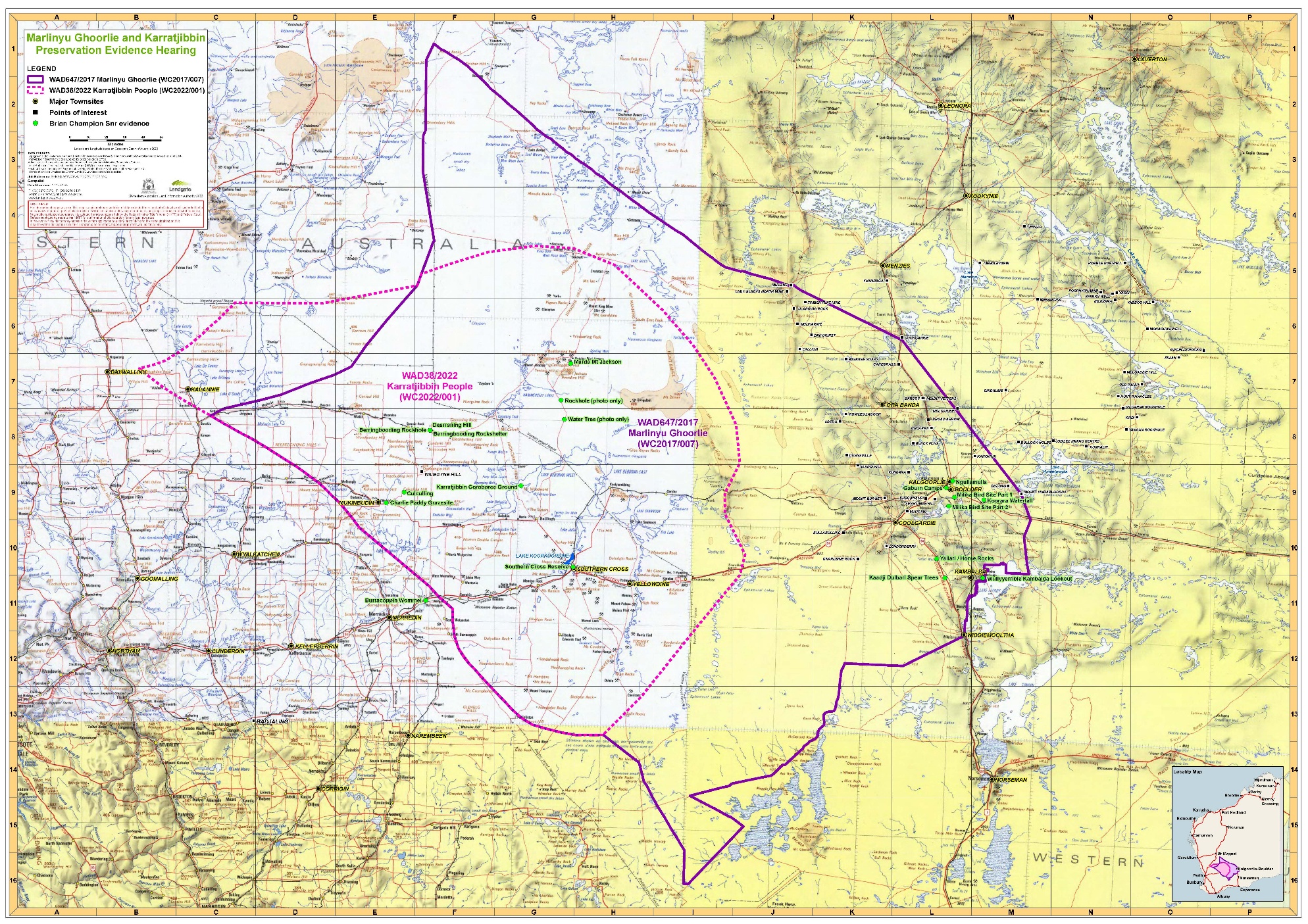
SCHEDULE OF PARTIES
WAD 647 of 2017 | |
Applicants | JAMES CHAMPION |
SIMON CHAMPION | |
TANIA CHAMPION | |
MAXINE PATRICIA DIMER | |
LEECHELLE HAMMAT | |
DARREN INDICH | |
RAELENE PEEL | |
DARRYL TROTT | |
Cooper Respondents | MARIA BANDRY |
NORMAN COOPER | |
VICTOR COOPER | |
GARY COOPER | |
Other Respondents | COMMONWEALTH OF AUSTRALIA |
SHIRE OF YILGARN | |
SHIRE OF DALWALLINU | |
ELIZABETH SAMBO | |
JAMES MURPHY | |
TREVOR HENRY DONALDSON | |
PETER JOHN DIMER | |
SHARON DIMER | |
ROSANNE DIMER | |
AUSTRALIAN LIVE-STOCK SUPPLIERS PTY LTD ACN 149 409 227 | |
HODSHON SUPER CO PTY LTD | |
BJ CAHOOTS PTY LTD | |
HONEY RESEARCH & DEVELOPMENT PTY LTD | |
CHARLES JENKIN | |
BARTON JONES | |
AMANDA JONES | |
BURCHELL FRANCIS CECIL JONES | |
JOHN JONES | |
KEITH MADER | |
SKATON NOMINEES PTY LTD | |
MT VETTERS PASTORAL CO (1966) PTY LTD | |
ARTHUR ROBERTS | |
BHP NICKEL WEST PTY LTD | |
CAMECO AUSTRALIA PTY LTD | |
CORONA MINERALS PTY LTD | |
ESPERANCE PIPELINE CO. PTY LIMITED | |
GPM RESOURCES PTY LTD | |
KALGOORLIE ORE TREATMENT COMPANY PTY LTD | |
LYSANDER RESOURCES PTY LTD | |
MH GOLD PTY LTD | |
MONTAGUE RESOURCES AUSTRALIA PTY LTD | |
NORTHERN STAR RESOURCES LIMITED (NST) | |
POLYMETALS (WA) PTY LTD | |
ROBERTSON RESOURCES PTY LTD ACN 118 366 653 | |
SHINE RESOURCES | |
SILVER LAKE (INTEGRA) PTY LIMITED | |
SILVER LAKE RESOURCES LIMITED | |
ST IVES GOLD MINING COMPANY PTY LIMITED | |
TONINO ZOCARO | |
TELSTRA CORPORATION LTD (ABN 33 051 775 556) | |
AMPLITEL PTY LTD |
WAD 38 of 2022 | |
Applicants | REGINALD YARRAN |
NORMAN PICKETT | |
MURRAY YARRAN | |
NANCY HENRY | |
Respondents | COMMONWEALTH OF AUSTRALIA |
DARRYL FOGARTY | |
ASHLEY BELL | |
BEVERLEY SLATER | |
NATIVE TITLE SERVICES GOLDFIELDS | |
TELSTRA CORPORATION LIMITED ABN 33 051 775 556 | |
CHARLES WILLIAM JENKIN | |
ARTHUR MAXWELL ROBERTS | |
YILGARN IRON PTY LTD | |
DARRYL TROTT | |
JAMES CHAMPION | |
LEECHELLE HAMMAT | |
TANIA CHAMPION | |
SIMON CHAMPION | |
DARREN INDICH | |
RAELENE PEEL | |
MAXINE DIMER | |
HENRY RICHARD DIMER |


